SB 775: Board of Psychology and Board of Behavioral Sciences.
- Session Year: 2025-2026
- House: Senate
- Latest Version Date: 2025-10-13
Current Status:
Passed
(2025-10-13: Chaptered by Secretary of State. Chapter 787, Statutes of 2025.)
Introduced
In Committee
Awaiting First Chamber Vote
Passed First Chamber
In Committee
Awaiting Second Chamber Vote
Passed Second Chamber
Enacted
(1)Existing law, the Psychology Licensing Law, establishes the Board of Psychology to license and regulate psychologists and the practice of psychology. Existing law repeals the provision establishing the board on January 1, 2026.
This bill would extend operation of the board to January 1, 2030.
Existing law authorizes a person who is licensed as a psychologist at the doctoral level in another state or territory of the United States or Canada to offer psychological services in this state for up to 30 days per year. Existing law authorizes a person other than a licensed psychologist to perform psychological functions in preparation for licensure as a psychologist if the person is registered with the board as a registered psychological associate, and establishes requirements in that regard.
This bill would require an out-of-state licensee to satisfy certain conditions to offer psychological services, including informing the client of the limited timeframe of the services and that the person is not licensed in California. The bill would require an applicant for registration as a psychological associate who was trained in an educational institution outside the United States or Canada to demonstrate to the satisfaction of the board that the applicant possesses a doctoral degree in psychology or education that is equivalent to a degree earned from a regionally accredited academic institution in the United States or Canada, as specified.
Existing law establishes qualifications for registration as a psychological testing technician, including proof of completion of a bachelors degree or graduate degree, or proof of current enrollment in a graduate degree program in psychology or in education with a field of specialization in educational psychology, counseling psychology, or school psychology. Existing law also establishes various fees relating to the licensure and regulation of the practice of psychology.
This bill would expand the list of authorized areas of study for registration as a psychological testing technician to include neuroscience, cognitive science, or behavioral science, and would specify that the board shall make the final determination as to whether a degree or degree program meets the educational requirements. The bill would establish a fee of $25 to add or change a supervisor for a psychological testing technician.
Existing law provides that a psychologists license shall be suspended automatically during any time the holder of the license is incarcerated after conviction of a felony, and provides for the continued suspension of the license if, after a hearing, it is determined in the hearing that the felony for which the licensee was convicted is substantially related to the qualifications, functions, or duties of a licensee. Existing law requires any discipline ordered to cease if the conviction is overturned on appeal.
This bill would revise and recast those provisions, including authorizing the board to decline to set aside the suspension when it appears to be in the interest of justice to do so. The bill would revise and recast provisions relating to suspended, revoked, and surrendered licenses and obtaining a new license after a license is void after not being renewed within 3 years. The bill would make various technical and other changes to the Psychology Licensing Law, including defining the term client.
(2)Existing law provides for the registration and regulation of research psychoanalysts and student research psychoanalysts by the Board of Psychology, and establishes acts for which the board may revoke or suspend registration and that are deemed unprofessional conduct. Existing law establishes fees for registration, which are deposited into the Psychology Fund.
This bill, among other changes to the provisions regulating research psychoanalysts and student research psychoanalysts, would expand the list of acts constituting unprofessional conduct that would authorize the board to suspend or revoke a registration. The bill would revise education and training requirements for registration as a research psychoanalyst, including requiring an applicant to complete certain coursework or training in detection and treatment of alcohol and other chemical substance dependency, suicide risk assessment and intervention, and aging and long-term care. The bill would establish continuing professional development requirements for research psychoanalysts. The bill would require the board to adopt a program of consumer and professional education in matters relevant to the ethical practice of psychoanalysis. The bill would establish fingerprint hard card processing fees for out-of-state applicants, as specified.
Existing law requires certain behavioral health professionals to complete training in human sexuality and to complete coursework or training in child abuse assessment and reporting, as specified. Existing law provides that the Board of Psychology and the Board of Behavioral Sciences are encouraged to include coursework regarding the assessment and reporting of elder and dependent adult abuse in the required training on aging and long-term care issues before licensure or license renewal. Existing law makes findings and declarations related to the training of certain licensed behavioral health professionals in the areas of child, elder, and dependent adult abuse assessment reporting.
This bill would include research psychoanalysts in the behavioral health professionals subject to the above-described training requirements and provisions. The bill would make various technical and other changes to the Psychology Licensing Law.
(3)Existing law establishes the Board of Behavioral Sciences in the Department of Consumer Affairs to regulate licensees under the Licensed Marriage and Family Therapist Act, the Educational Psychologist Practice Act, the Clinical Social Worker Practice Act, and the Licensed Professional Clinical Counselor Act, and authorizes the board to appoint an executive officer to exercise certain powers and perform specified duties. Existing law repeals the provision establishing the board and authorizing the board to appoint an executive officer on January 1, 2026. Existing law, until January 1, 2026, authorizes a person who holds a license in another jurisdiction of the United States as a marriage and family therapist, a clinical social worker, or a professional clinical counselor to provide those services in this state for a period not to exceed 30 days. Existing law specifies that a person who provides services pursuant to those provisions is deemed to have agreed to practicing under the jurisdiction of the board and to be bound by the laws of this state.
This bill would extend the date of the operation of the board and of authorizing the board to appoint an executive officer to January 1, 2030, and would extend the date on which the provision authorizing a person who is licensed out-of-state as a marriage and family therapist, a clinical social worker, or professional clinical counselor to practice in this state to January 1, 2030. The bill would deem a person who is licensed in another jurisdiction who provides services to have attested under penalty of perjury to practicing under the jurisdiction of the board and to be bound by the laws of this state. By expanding the scope of the crime of perjury, the bill would impose a state-mandated local program.
Existing law requires a registrant or applicant for licensure as a marriage and family therapist to pass a clinical examination, and establishes a fee of $250, which the board is authorized to increase by regulation to up to $500, for the clinical examination.
This bill would specify that the clinical examination may be administered either by the board or by a public or private organization, and would revise the fee requirement so that if the examination is administered by a public or private organization, the fee would be paid directly to the organization.
Existing law requires certain applicants for registration or licensure as a marriage and family therapist who completed graduate study on or before December 31, 2018, to submit to the board a certification by the applicants educational institution that the institutions required curriculum for graduation and associated coursework includes certain instruction in alcoholism and other chemical substance dependency and in spousal or partner abuse assessment, detection, and intervention.
This bill would delete that requirement.
Existing law requires an applicant for licensure or registration as a professional clinical counselor to obtain a degree in a program that includes a minimum of 280 hours of face-to-face supervised clinical experience counseling individuals, families, or groups. Existing law requires a professional clinical counselor trainee to receive an average of at least one hour of direct supervisor contact for every 5 hours of direct clinical counseling performed each week and specifies that not more than 6 hours of supervision shall be credited during any single week.
This bill would delete the provision limiting the number of hours of supervision credited in a single week to 6 hours.
Existing law, effective August 29, 2022, until January 1, 2026, revised provisions related to supervision via videoconferencing. In this regard, existing law defines face-to-face contact for purposes of the definition of one hour of direct supervisor contact to mean in-person contact, contact via 2-way, real-time videoconferencing, or some combination of these. Existing law requires a supervisor within 60 days of the commencement of supervision to conduct a meeting with the supervisee during which the supervisor is required to assess the appropriateness of allowing the supervisee to receive supervision via 2-way, real-time videoconferencing, as specified, and to document the results of that assessment. Existing law prohibits the supervisor from utilizing supervision via 2-way, real-time videoconferencing if their assessment finds it is inappropriate. Existing law repeals these provisions on January 1, 2026.
This bill would extend the operation of those provisions indefinitely. By extending the operation of requirements, the violation of which would be a crime, this bill would impose a state-mandated local program.
Existing law requires an applicant for licensure as a marriage and family therapist, clinical social worker, or licensed professional clinical counselor to provide copies of tax returns for each year of experience claimed for purposes of satisfying the experience requirement for licensure.
This bill would require an applicant to provide the board with a copy of the applicants most recent pay stub for experience gained during a tax year that has not ended by the date the application for licensure is received.
Existing law requires direct supervisor contact for certain experience required for licensure as a marriage and family therapist, clinical social worker, or licensed professional clinical counselor. Existing law, until January 1, 2026, authorizes contact to be via in-person contact, 2-way, real-time videoconferencing, or some combination of these, as specified. Existing law, effective January 1, 2026, authorizes only a supervisee working in an exempt setting, as specified, to obtain direct supervisor contact via 2-way, real-time videoconferencing.
This bill would make the above-described authorization related to videoconferencing permanent and would consequently delete the latter provision authorizing direct supervisor contact via videoconferencing in exempt settings.
Existing law requires the board to issue a retired license to a marriage and family therapist, licensed educational psychologist, licensed professional clinical counselor, or clinical social worker upon satisfaction of specified requirements. Existing law also authorizes a person who holds a license in another jurisdiction of the United States as a marriage and family therapist, professional clinical counselor, or clinical social worker to practice in this state for a period not to exceed 30 consecutive days if they satisfy certain conditions, and deems a person who provides services pursuant to those provisions to have agreed to practicing under the jurisdiction of the board and to be bound by the laws of this state.
The bill would revise the requirements for the issuance of a retired license, including submitting a statement under penalty of perjury that, among other things, the information provided on the application is true and correct. The bill would require out-of-state marriage and family therapists, professional clinical counselors, and clinical social workers, as a condition of practicing in this state, to submit a signed statement under penalty of perjury acknowledging that they are subject to the jurisdiction of the board and agreeing to be bound by the laws of this state. By expanding the crime of perjury, the bill would impose a state-mandated local program. The bill would revise the education, experience, and other qualifications required for licensure as an educational psychologist.
The bill would make various technical and other changes to the Licensed Marriage and Family Therapist Act, the Educational Psychologist Practice Act, the Clinical Social Worker Practice Act, and the Licensed Professional Clinical Counselor Act.
(4)This bill would incorporate additional changes to Section 27 of the Business and Professions Code proposed by SB 861 to be operative only if this bill and SB 861 are enacted and this bill is enacted last.
(5)The California Constitution requires the state to reimburse local agencies and school districts for certain costs mandated by the state. Statutory provisions establish procedures for making that reimbursement.
This bill would provide that no reimbursement is required by this act for a specified reason.
(1)Existing law, the Psychology Licensing Law, establishes the Board of Psychology to license and regulate psychologists and the practice of psychology. Existing law repeals the provision establishing the board on January 1, 2026.
This bill would extend operation of the board to January 1, 2030.
Existing law authorizes a person who is licensed as a psychologist at the doctoral level in another state or territory of the United States or Canada to offer psychological services in this state for up to 30 days per year. Existing law authorizes a person other than a licensed psychologist to perform psychological functions in preparation for licensure as a psychologist if the person is registered with the board as a registered psychological associate, and establishes requirements in that regard.
This bill would require an out-of-state licensee to satisfy certain conditions to offer psychological services, including informing the client of the limited timeframe of the services and that the person is not licensed in California. The bill would require an applicant for registration as a psychological associate who was trained in an educational institution outside the United States or Canada to demonstrate to the satisfaction of the board that the applicant possesses a doctoral degree in psychology or education that is equivalent to a degree earned from a regionally accredited academic institution in the United States or Canada, as specified.
Existing law establishes qualifications for registration as a psychological testing technician, including proof of completion of a bachelors degree or graduate degree, or proof of current enrollment in a graduate degree program in psychology or in education with a field of specialization in educational psychology, counseling psychology, or school psychology. Existing law also establishes various fees relating to the licensure and regulation of the practice of psychology.
This bill would expand the list of authorized areas of study for registration as a psychological testing technician to include neuroscience, cognitive science, or behavioral science, and would specify that the board shall make the final determination as to whether a degree or degree program meets the educational requirements. The bill would establish a fee of $25 to add or change a supervisor for a psychological testing technician.
Existing law provides that a psychologists license shall be suspended automatically during any time the holder of the license is incarcerated after conviction of a felony, and provides for the continued suspension of the license if, after a hearing, it is determined in the hearing that the felony for which the licensee was convicted is substantially related to the qualifications, functions, or duties of a licensee. Existing law requires any discipline ordered to cease if the conviction is overturned on appeal.
This bill would revise and recast those provisions, including authorizing the board to decline to set aside the suspension when it appears to be in the interest of justice to do so. The bill would revise and recast provisions relating to suspended, revoked, and surrendered licenses and obtaining a new license after a license is void after not being renewed within 3 years. The bill would make various technical and other changes to the Psychology Licensing Law, including defining the term client.
(2)Existing law provides for the registration and regulation of research psychoanalysts and student research psychoanalysts by the Board of Psychology, and establishes acts for which the board may revoke or suspend registration and that are deemed unprofessional conduct. Existing law establishes fees for registration, which are deposited into the Psychology Fund.
This bill, among other changes to the provisions regulating research psychoanalysts and student research psychoanalysts, would expand the list of acts constituting unprofessional conduct that would authorize the board to suspend or revoke a registration. The bill would revise education and training requirements for registration as a research psychoanalyst, including requiring an applicant to complete certain coursework or training in detection and treatment of alcohol and other chemical substance dependency, suicide risk assessment and intervention, and aging and long-term care. The bill would establish continuing professional development requirements for research psychoanalysts. The bill would require the board to adopt a program of consumer and professional education in matters relevant to the ethical practice of psychoanalysis. The bill would establish fingerprint hard card processing fees for out-of-state applicants, as specified.
Existing law requires certain behavioral health professionals to complete training in human sexuality and to complete coursework or training in child abuse assessment and reporting, as specified. Existing law provides that the Board of Psychology and the Board of Behavioral Sciences are encouraged to include coursework regarding the assessment and reporting of elder and dependent adult abuse in the required training on aging and long-term care issues before licensure or license renewal. Existing law makes findings and declarations related to the training of certain licensed behavioral health professionals in the areas of child, elder, and dependent adult abuse assessment reporting.
This bill would include research psychoanalysts in the behavioral health professionals subject to the above-described training requirements and provisions. The bill would make various technical and other changes to the Psychology Licensing Law.
(3)Existing law establishes the Board of Behavioral Sciences in the Department of Consumer Affairs to regulate licensees under the Licensed Marriage and Family Therapist Act, the Educational Psychologist Practice Act, the Clinical Social Worker Practice Act, and the Licensed Professional Clinical Counselor Act, and authorizes the board to appoint an executive officer to exercise certain powers and perform specified duties. Existing law repeals the provision establishing the board and authorizing the board to appoint an executive officer on January 1, 2026. Existing law, until January 1, 2026, authorizes a person who holds a license in another jurisdiction of the United States as a marriage and family therapist, a clinical social worker, or a professional clinical counselor to provide those services in this state for a period not to exceed 30 days. Existing law specifies that a person who provides services pursuant to those provisions is deemed to have agreed to practicing under the jurisdiction of the board and to be bound by the laws of this state.
This bill would extend the date of the operation of the board and of authorizing the board to appoint an executive officer to January 1, 2030, and would extend the date on which the provision authorizing a person who is licensed out-of-state as a marriage and family therapist, a clinical social worker, or professional clinical counselor to practice in this state to January 1, 2030. The bill would deem a person who is licensed in another jurisdiction who provides services to have attested under penalty of perjury to practicing under the jurisdiction of the board and to be bound by the laws of this state. By expanding the scope of the crime of perjury, the bill would impose a state-mandated local program.
Existing law requires a registrant or applicant for licensure as a marriage and family therapist to pass a clinical examination, and establishes a fee of $250, which the board is authorized to increase by regulation to up to $500, for the clinical examination.
This bill would specify that the clinical examination may be administered either by the board or by a public or private organization, and would revise the fee requirement so that if the examination is administered by a public or private organization, the fee would be paid directly to the organization.
Existing law requires certain applicants for registration or licensure as a marriage and family therapist who completed graduate study on or before December 31, 2018, to submit to the board a certification by the applicants educational institution that the institutions required curriculum for graduation and associated coursework includes certain instruction in alcoholism and other chemical substance dependency and in spousal or partner abuse assessment, detection, and intervention.
This bill would delete that requirement.
Existing law requires an applicant for licensure or registration as a professional clinical counselor to obtain a degree in a program that includes a minimum of 280 hours of face-to-face supervised clinical experience counseling individuals, families, or groups. Existing law requires a professional clinical counselor trainee to receive an average of at least one hour of direct supervisor contact for every 5 hours of direct clinical counseling performed each week and specifies that not more than 6 hours of supervision shall be credited during any single week.
This bill would delete the provision limiting the number of hours of supervision credited in a single week to 6 hours.
Existing law, effective August 29, 2022, until January 1, 2026, revised provisions related to supervision via videoconferencing. In this regard, existing law defines face-to-face contact for purposes of the definition of one hour of direct supervisor contact to mean in-person contact, contact via 2-way, real-time videoconferencing, or some combination of these. Existing law requires a supervisor within 60 days of the commencement of supervision to conduct a meeting with the supervisee during which the supervisor is required to assess the appropriateness of allowing the supervisee to receive supervision via 2-way, real-time videoconferencing, as specified, and to document the results of that assessment. Existing law prohibits the supervisor from utilizing supervision via 2-way, real-time videoconferencing if their assessment finds it is inappropriate. Existing law repeals these provisions on January 1, 2026.
This bill would extend the operation of those provisions indefinitely. By extending the operation of requirements, the violation of which would be a crime, this bill would impose a state-mandated local program.
Existing law requires an applicant for licensure as a marriage and family therapist, clinical social worker, or licensed professional clinical counselor to provide copies of tax returns for each year of experience claimed for purposes of satisfying the experience requirement for licensure.
This bill would require an applicant to provide the board with a copy of the applicants most recent pay stub for experience gained during a tax year that has not ended by the date the application for licensure is received.
Existing law requires direct supervisor contact for certain experience required for licensure as a marriage and family therapist, clinical social worker, or licensed professional clinical counselor. Existing law, until January 1, 2026, authorizes contact to be via in-person contact, 2-way, real-time videoconferencing, or some combination of these, as specified. Existing law, effective January 1, 2026, authorizes only a supervisee working in an exempt setting, as specified, to obtain direct supervisor contact via 2-way, real-time videoconferencing.
This bill would make the above-described authorization related to videoconferencing permanent and would consequently delete the latter provision authorizing direct supervisor contact via videoconferencing in exempt settings.
Existing law requires the board to issue a retired license to a marriage and family therapist, licensed educational psychologist, licensed professional clinical counselor, or clinical social worker upon satisfaction of specified requirements. Existing law also authorizes a person who holds a license in another jurisdiction of the United States as a marriage and family therapist, professional clinical counselor, or clinical social worker to practice in this state for a period not to exceed 30 consecutive days if they satisfy certain conditions, and deems a person who provides services pursuant to those provisions to have agreed to practicing under the jurisdiction of the board and to be bound by the laws of this state.
The bill would revise the requirements for the issuance of a retired license, including submitting a statement under penalty of perjury that, among other things, the information provided on the application is true and correct. The bill would require out-of-state marriage and family therapists, professional clinical counselors, and clinical social workers, as a condition of practicing in this state, to submit a signed statement under penalty of perjury acknowledging that they are subject to the jurisdiction of the board and agreeing to be bound by the laws of this state. By expanding the crime of perjury, the bill would impose a state-mandated local program. The bill would revise the education, experience, and other qualifications required for licensure as an educational psychologist.
The bill would make various technical and other changes to the Licensed Marriage and Family Therapist Act, the Educational Psychologist Practice Act, the Clinical Social Worker Practice Act, and the Licensed Professional Clinical Counselor Act.
(4)This bill would incorporate additional changes to Section 27 of the Business and Professions Code proposed by SB 861 to be operative only if this bill and SB 861 are enacted and this bill is enacted last.
(4)(5)The California Constitution requires the state to reimburse local agencies and school districts for certain costs mandated by the state. Statutory provisions establish procedures for making that reimbursement.
This bill would provide that no reimbursement is required by this act for a specified reason.
(1)Existing law, the Psychology Licensing Law, establishes the Board of Psychology to license and regulate psychologists and the practice of psychology. Existing law repeals the provision establishing the board on January 1, 2026.
This bill would extend operation of the board to January 1, 2030.
Existing law authorizes a person who is licensed as a psychologist at the doctoral level in another state or territory of the United States or Canada to offer psychological services in this state for up to 30 days per year. Existing law authorizes a person other than a licensed psychologist to perform psychological functions in preparation for licensure as a psychologist if the person is registered with the board as a registered psychological associate, and establishes requirements in that regard.
This bill would require an out-of-state licensee to satisfy certain conditions to offer psychological services, including informing the client of the limited timeframe of the services and that the person is not licensed in California. The bill would require an applicant for registration as a psychological associate who was trained in an educational institution outside the United States or Canada to demonstrate to the satisfaction of the board that the applicant possesses a doctoral degree in psychology or education that is equivalent to a degree earned from a regionally accredited academic institution in the United States or Canada, as specified.
Existing law establishes qualifications for registration as a psychological testing technician, including proof of completion of a bachelors degree or graduate degree, or proof of current enrollment in a graduate degree program in psychology or in education with a field of specialization in educational psychology, counseling psychology, or school psychology. Existing law also establishes various fees relating to the licensure and regulation of the practice of psychology.
This bill would expand the list of authorized areas of study for registration as a psychological testing technician to include neuroscience, cognitive science, or behavioral science, and would specify that the board shall make the final determination as to whether a degree or degree program meets the educational requirements. The bill would establish a fee of $25 to add or change a supervisor for a psychological testing technician.
Existing law provides that a psychologists license shall be suspended automatically during any time the holder of the license is incarcerated after conviction of a felony, and provides for the continued suspension of the license if, after a hearing, it is determined in the hearing that the felony for which the licensee was convicted is substantially related to the qualifications, functions, or duties of a licensee. Existing law requires any discipline ordered to cease if the conviction is overturned on appeal.
This bill would revise and recast those provisions, including authorizing the board to decline to set aside the suspension when it appears to be in the interest of justice to do so. The bill would revise and recast provisions relating to suspended, revoked, and surrendered licenses and obtaining a new license after a license is void after not being renewed within 3 years. The bill would make various technical and other changes to the Psychology Licensing Law, including defining the terms license, licensee, and term client.
(2)Existing law provides for the registration and regulation of research psychoanalysts and student research psychoanalysts by the Board of Psychology, and establishes acts for which the board may revoke or suspend registration and that are deemed unprofessional conduct. Existing law establishes fees for registration, which are deposited into the Psychology Fund.
This bill, among other changes to the provisions regulating research psychoanalysts and student research psychoanalysts, would expand the list of acts constituting unprofessional conduct that would authorize the board to suspend or revoke a registration. The bill would revise education and training requirements for registration as a research psychoanalyst, including requiring an applicant to complete certain coursework or training in detection and treatment of alcohol and other chemical substance dependency, suicide risk assessment and intervention, and aging and long-term care. The bill would establish continuing professional development requirements for research psychoanalysts. The bill would require the board to adopt a program of consumer and professional education in matters relevant to the ethical practice of psychoanalysis. The bill would establish fingerprint hard card processing fees for out-of-state applicants, as specified.
Existing law requires certain behavioral health professionals to complete training in human sexuality and to complete coursework or training in child abuse assessment and reporting, as specified. Existing law provides that the Board of Psychology and the Board of Behavioral Sciences are encouraged to include coursework regarding the assessment and reporting of elder and dependent adult abuse in the required training on aging and long-term care issues before licensure or license renewal. Existing law makes findings and declarations related to the training of certain licensed behavioral health professionals in the areas of child, elder, and dependent adult abuse assessment report. reporting.
This bill would include research psychoanalysts in the behavioral health professionals subject to the above-described training requirements and provisions. The bill would make various technical and other changes to the Psychology Licensing Law.
(3)Existing law establishes the Board of Behavioral Sciences in the Department of Consumer Affairs to regulate licensees under the Licensed Marriage and Family Therapist Act, the Educational Psychologist Practice Act, the Clinical Social Worker Practice Act, and the Licensed Professional Clinical Counselor Act, and authorizes the board to appoint an executive officer to exercise certain powers and perform specified duties. Existing law repeals the provision establishing the board and authorizing the board to appoint an executive officer on January 1, 2026. Existing law, until January 1, 2026, authorizes a person who holds a license in another jurisdiction of the United States as a marriage and family therapist, a clinical social worker, or a professional clinical counselor to provide those services in this state for a period not to exceed 30 days. Existing law specifies that a person who provides services pursuant to those provisions is deemed to have agreed to practicing under the jurisdiction of the board and to be bound by the laws of this state.
This bill would extend the date of the operation of the board and of authorizing the board to appoint an executive officer to January 1, 2030, and would extend the date on which the provision authorizing a person who is licensed out-of-state as a marriage and family therapist, a clinical social worker, or professional clinical counselor to practice in this state to January 1, 2030. The bill would deem a person who is licensed in another jurisdiction who provides services to have attested under penalty of perjury to practicing under the jurisdiction of the board and to be bound by the laws of this state. By expanding the scope of the crime of perjury, the bill would impose a state-mandated local program.
Existing law requires a registrant or applicant for licensure as a marriage and family therapist to pass a clinical examination, and establishes a fee of $250, which the board is authorized to increase by regulation to up to $500, for the clinical examination.
This bill would specify that the clinical examination may be administered either by the board or by a public or private organization, and would revise the fee requirement so that if the examination is administered by a public or private organization, the fee would be paid directly to the organization.
Existing law requires certain applicants for registration or licensure as a marriage and family therapist who completed graduate study on or before December 31, 2018, to submit to the board a certification by the applicants educational institution that the institutions required curriculum for graduation and associated coursework includes certain instruction in alcoholism and other chemical substance dependency and in spousal or partner abuse assessment, detection, and intervention.
This bill would delete that requirement.
Existing law requires an applicant for licensure or registration as a professional clinical counselor to obtain a degree in a program that includes a minimum of 280 hours of face-to-face supervised clinical experience counseling individuals, families, or groups. Existing law requires a professional clinical counselor trainee to receive an average of at least one hour of direct supervisor contact for every 5 hours of direct clinical counseling performed each week and specifies that not more than 6 hours of supervision shall be credited during any single week.
This bill would delete the provision limiting the number of hours of supervision credited in a single week to 6 hours.
Existing law, effective August 29, 2022, until January 1, 2026, revised provisions related to supervision via videoconferencing. In this regard, existing law defines face-to-face contact for purposes of the definition of one hour of direct supervisor contact to mean in-person contact, contact via 2-way, real-time videoconferencing, or some combination of these. Existing law requires a supervisor within 60 days of the commencement of supervision to conduct a meeting with the supervisee during which the supervisor is required to assess the appropriateness of allowing the supervisee to receive supervision via 2-way, real-time videoconferencing, as specified, and to document the results of that assessment. Existing law prohibits the supervisor from utilizing supervision via 2-way, real-time videoconferencing if their assessment finds it is inappropriate. Existing law repeals these provisions on January 1, 2026.
This bill would extend the operation of those provisions indefinitely. By extending the operation of requirements, the violation of which would be a crime, this bill would impose a state-mandated local program.
Existing law requires an applicant for licensure as a marriage and family therapist, clinical social worker, or licensed professional clinical counselor to provide copies of tax returns for each year of experience claimed for purposes of satisfying the experience requirement for licensure.
This bill would require an applicant to provide the board with a copy of the applicants most recent pay stub for experience gained during a tax year that has not ended by the date the application for licensure is received.
Existing law requires direct supervisor contact for certain experience required for licensure as a marriage and family therapist, clinical social worker, or licensed professional clinical counselor. Existing law, until January 1, 2026, authorizes contact to be via in-person contact, 2-way, real-time videoconferencing, or some combination of these, as specified. Existing law, effective January 1, 2026, authorizes only a supervisee working in an exempt setting, as specified, to obtain direct supervisor contact via 2-way, real-time videoconferencing.
This bill would make the above-described authorization related to videoconferencing permanent and would consequently delete the latter provision authorizing direct supervisor contact via videoconferencing in exempt settings.
Existing law requires the board to issue a retired license to a marriage and family therapist, licensed educational psychologist, licensed professional clinical counselor, or clinical social worker upon satisfaction of specified requirements. Existing law also authorizes a person who holds a license in another jurisdiction of the United States as a marriage and family therapist, professional clinical counselor, or clinical social worker to practice in this state for a period not to exceed 30 consecutive days if they satisfy certain conditions, and deems a person who provides services pursuant to those provisions to have agreed to practicing under the jurisdiction of the board and to be bound by the laws of this state.
The bill would revise the requirements for the issuance of a retired license, including submitting a statement under penalty of perjury that, among other things, the information provided on the application is true and correct. The bill would require out-of-state marriage and family therapists, professional clinical counselors, and clinical social workers, as a condition of practicing in this state, to submit a signed statement under penalty of perjury acknowledging that they are subject to the jurisdiction of the board and agreeing to be bound by the laws of this state. By expanding the crime of perjury, the bill would impose a state-mandated local program. The bill would revise the education, experience, and other qualifications required for licensure as an educational psychologist.
The bill would make various technical and other changes to the Licensed Marriage and Family Therapist Act, the Educational Psychologist Practice Act, the Clinical Social Worker Practice Act, and the Licensed Professional Clinical Counselor Act.
(4)The California Constitution requires the state to reimburse local agencies and school districts for certain costs mandated by the state. Statutory provisions establish procedures for making that reimbursement.
This bill would provide that no reimbursement is required by this act for a specified reason.
(1)Existing law, the Psychology Licensing Law, establishes the Board of Psychology to license and regulate psychologists and the practice of psychology. Existing law repeals the provision establishing the board on January 1, 2026.
This bill would extend operation of the board to January 1, 2030.
Existing law establishes qualifications for registration as a psychological testing technician, including proof of completion of a bachelors degree or graduate degree, or proof of current enrollment in a graduate degree program in psychology or in education with a field of specialization in educational psychology, counseling psychology, or school psychology. Existing law also establishes various fees relating to the licensure and regulation of the practice of psychology.
This bill would expand the list of authorized areas of study for registration as a psychological testing technician to include neuroscience, cognitive science, or behavioral science, and would specify that the board shall make the final determination as to whether a degree or degree program meets the educational requirements. The bill would establish a fee of $25 to add or change a supervisor for a psychological testing technician.
Existing law provides that a psychologists license shall be suspended automatically during any time the holder of the license is incarcerated after conviction of a felony, and provides for the continued suspension of the license if, after a hearing, it is determined in the hearing that the felony for which the licensee was convicted is substantially related to the qualifications, functions, or duties of a licensee. Existing law requires any discipline ordered to cease if the conviction is overturned on appeal.
This bill would revise and recast those provisions, including authorizing the board to decline to set aside the suspension when it appears to be in the interest of justice to do so. The bill would revise and recast provisions relating to suspended, revoked, and surrendered licenses and obtaining a new license after a license is void after not being renewed within 3 years. The bill would make various technical and other changes to the Psychology Licensing Law, including defining the terms license, licensee, and client.
(2)Existing law provides for the registration and regulation of research psychoanalysts and student research psychoanalysts by the Board of Psychology, and establishes acts for which the board may revoke or suspend registration and that are deemed unprofessional conduct. Existing law establishes fees for registration, which are deposited into the Psychology Fund.
This bill, among other changes to the provisions regulating research psychoanalysts and student research psychoanalysts, would expand the list of acts constituting unprofessional conduct that would authorize the board to suspend or revoke a registration. The bill would revise education and training requirements for registration as a research psychoanalyst, including requiring an applicant to complete certain coursework or training in detection and treatment of alcohol and other chemical substance dependency, suicide risk assessment and intervention, and aging and long-term care. The bill would establish continuing professional development requirements for research psychoanalysts. The bill would require the board to adopt a program of consumer and professional education in matters relevant to the ethical practice of psychoanalysis. The bill would establish fingerprint fees for applicants, as specified.
Existing law requires certain behavioral health professionals to complete training in human sexuality and to complete coursework or training in child abuse assessment and reporting, as specified. Existing law provides that the Board of Psychology and the Board of Behavioral Sciences are encouraged to include coursework regarding the assessment and reporting of elder and dependent adult abuse in the required training on aging and long-term care issues before licensure or license renewal. Existing law makes findings and declarations related to the training of certain licensed behavioral health professionals in the areas of child, elder, and dependent adult abuse assessment report.
This bill would include research psychoanalysts in the behavioral health professionals subject to the above-described training requirements and provisions. The bill would make various technical and other changes to the Psychology Licensing Law.
(2)(3)Existing law establishes the Board of Behavioral Sciences in the Department of Consumer Affairs to regulate licensees under the Licensed Marriage and Family Therapist Act, the Educational Psychologist Practice Act, the Clinical Social Worker Practice Act, and the Licensed Professional Clinical Counselor Act, and authorizes the board to appoint an executive officer to exercise certain powers and perform specified duties. Existing law repeals the provision establishing the board and authorizing the board to appoint an executive officer on January 1, 2026. Existing law, until January 1, 2026, authorizes a person who holds a license in another jurisdiction of the United States as a marriage and family therapist, a clinical social worker, or a professional clinical counselor to provide those services in this state for a period not to exceed 30 days. Existing law specifies that a person who provides services pursuant to those provisions is deemed to have agreed to practicing under the jurisdiction of the board and to be bound by the laws of this state.
This bill would extend the date of the operation of the board and of authorizing the board to appoint an executive officer to January 1, 2030, and would extend the date on which the provision authorizing a person who is licensed out-of-state as a marriage and family therapist, a clinical social worker, or professional clinical counselor to practice in this state to January 1, 2030. The bill would deem a person who is licensed in another jurisdiction who provides services to have attested under penalty of perjury to practicing under the jurisdiction of the board and to be bound by the laws of this state. By expanding the scope of the crime of perjury, the bill would impose a state-mandated local program. The bill would entitle the provisions providing for the licensure and regulation of marriage and family therapists as the Licensed Marriage and Family Therapist Practice Act.
Existing law requires a registrant or applicant for licensure as a marriage and family therapist to pass a clinical examination, and establishes a fee of $250, which the board is authorized to increase by regulation to up to $500, for the clinical examination.
This bill would specify that the clinical examination may be administered either by the board or by a public or private organization, and would revise the fee requirement so that if the examination is administered by a public or private organization, the fee would be paid directly to the organization.
Existing law requires certain applicants for registration or licensure as a marriage and family therapist who completed graduate study on or before December 31, 2018, to submit to the board a certification by the applicants educational institution that the institutions required curriculum for graduation and associated coursework includes certain instruction in alcoholism and other chemical substance dependency and in spousal or partner abuse assessment, detection, and intervention.
This bill would delete that requirement.
Existing law requires an applicant for licensure or registration as a professional clinical counselor to obtain a degree in a program that includes a minimum of 280 hours of face-to-face supervised clinical experience counseling individuals, families, or groups. Existing law requires a professional clinical counselor trainee to receive an average of at least one hour of direct supervisor contact for every 5 hours of direct clinical counseling performed each week and specifies that not more than 6 hours of supervision shall be credited during any single week.
This bill would delete the provision limiting the number of hours of supervision credited in a single week to 6 hours.
Existing law, effective August 29, 2022, until January 1, 2026, revised provisions related to supervision via videoconferencing. In this regard, existing law defines face-to-face contact for purposes of the definition of one hour of direct supervisor contact to mean in-person contact, contact via 2-way, real-time videoconferencing, or some combination of these. Existing law requires a supervisor within 60 days of the commencement of supervision to conduct a meeting with the supervisee during which the supervisor is required to assess the appropriateness of allowing the supervisee to receive supervision via 2-way, real-time videoconferencing, as specified, and to document the results of that assessment. Existing law prohibits the supervisor from utilizing supervision via 2-way, real-time videoconferencing if their assessment finds it is inappropriate. Existing law repeals these provisions on January 1, 2026.
This bill would extend the operation of those provisions indefinitely. By extending the operation of requirements, the violation of which would be a crime, this bill would impose a state-mandated local program.
Existing law requires an applicant for licensure as a marriage and family therapist, clinical social worker, or licensed professional clinical counselor to provide copies of tax returns for each year of experience claimed for purposes of satisfying the experience requirement for licensure.
This bill would require an applicant to provide the board with a copy of the applicants most recent pay stub for experience gained during a tax year that has not ended by the date the application for licensure is received.
Existing law requires direct supervisor contact for certain experience required for licensure as a marriage and family therapist, clinical social worker, or licensed professional clinical counselor. Existing law, until January 1, 2026, authorizes contact to be via in-person contact, 2-way, real-time videoconferencing, or some combination of these, as specified. Existing law, effective January 1, 2026, authorizes only a supervisee working in an exempt setting, as specified, to obtain direct supervisor contact via 2-way, real-time videoconferencing.
This bill would make the above-described authorization related to videoconferencing permanent and would consequently delete the latter provision authorizing direct supervisor contact via videoconferencing in exempt settings.
Existing law requires the board to issue a retired license to a marriage and family therapist, licensed educational psychologist, licensed professional clinical counselor, or clinical social worker upon satisfaction of specified requirements. Existing law also authorizes a person who holds a license in another jurisdiction of the United States as a marriage and family therapist, professional clinical counselor, or clinical social worker to practice in this state for a period not to exceed 30 consecutive days if they satisfy certain conditions, and deems a person who provides services pursuant to those provisions to have agreed to practicing under the jurisdiction of the board and to be bound by the laws of this state.
The bill would revise the requirements for the issuance of a retired license, including submitting a statement under penalty of perjury that, among other things, the information provided on the application is true and correct. The bill would require out-of-state marriage and family therapists, professional clinical counselors, and clinical social workers, as a condition of practicing in this state, to submit a signed statement under penalty of perjury acknowledging that they are subject to the jurisdiction of the board and agreeing to be bound by the laws of this state. By expanding the crime of perjury, the bill would impose a state-mandated local program. The bill would revise the education, experience, and other qualifications required for licensure as an educational psychologist.
The bill would make various technical and other changes to the Licensed Marriage and Family Therapist Act, the Educational Psychologist Practice Act, the Clinical Social Worker Practice Act, and the Licensed Professional Clinical Counselor Act.
(3)(4)The California Constitution requires the state to reimburse local agencies and school districts for certain costs mandated by the state. Statutory provisions establish procedures for making that reimbursement.
This bill would provide that no reimbursement is required by this act for a specified reason.
(1)Existing law, the Psychology Licensing Law, establishes the Board of Psychology to license and regulate psychologists and the practice of psychology. Existing law repeals the provision establishing the board on January 1, 2026.
This bill would extend operation of the board to January 1, 2030.
Existing law establishes qualifications for registration as a psychological testing technician, including proof of completion of a bachelors degree or graduate degree, or proof of current enrollment in a graduate degree program in psychology or in education with a field of specialization in educational psychology, counseling psychology, or school psychology. Existing law also establishes various fees relating to the licensure and regulation of the practice of psychology.
This bill would expand the list of authorized areas of study for registration as a psychological testing technician to include neuroscience, cognitive science, or behavioral science, and would specify that the board shall make the final determination as to whether a degree or degree program meets the educational requirements. The bill would establish a fee of $25 to add or change a supervisor for a psychological testing technician.
Existing law provides that a psychologists license shall be suspended automatically during any time the holder of the license is incarcerated after conviction of a felony, and provides for the continued suspension of the license if, after a hearing, it is determined in the hearing that the felony for which the licensee was convicted is substantially related to the qualifications, functions, or duties of a licensee. Existing law requires any discipline ordered to cease if the conviction is overturned on appeal.
This bill would revise and recast those provisions, including authorizing the board to decline to set aside the suspension when it appears to be in the interest of justice to do so. The bill would revise and recast provisions relating to suspended, revoked, and surrendered licenses and obtaining a new license after a license is void after not being renewed within 3 years. The bill would make various technical and other changes to the Psychology Licensing Law, including defining the terms license, licensee, and client.
(2)Existing law establishes the Board of Behavioral Sciences in the Department of Consumer Affairs to regulate licensees under the Licensed Marriage and Family Therapist Act, the Educational Psychologist Practice Act, the Clinical Social Worker Practice Act, and the Licensed Professional Clinical Counselor Act. Act, and authorizes the board to appoint an executive officer to exercise certain powers and perform specified duties. Existing law repeals the provision establishing the board and authorizing the board to appoint an executive officer on January 1, 2026. Existing law, until January 1, 2026, authorizes a person who holds a license in another jurisdiction of the United States as a marriage and family therapist, a clinical social worker, or a professional clinical counselor to provide those services in this state for a period not to exceed 30 days. Existing law specifies that a person who provides services pursuant to those provisions is deemed to have agreed to practicing under the jurisdiction of the board and to be bound by the laws of this state.
This bill would extend the date of the operation of the board and of authorizing the board to appoint an executive officer to January 1, 2030, and would extend the date on which the provision authorizing a person who is licensed out-of-state as a marriage and family therapist, a clinical social worker, or professional clinical counselor to practice in this state to January 1, 2030. The bill would deem a person who is licensed in another jurisdiction who provides services to have attested under penalty of perjury to practicing under the jurisdiction of the board and to be bound by the laws of this state. By expanding the scope of the crime of perjury, the bill would impose a state-mandated local program. The bill would entitle the provisions providing for the licensure and regulation of marriage and family therapists as the Licensed Marriage and Family Therapist Practice Act.
Existing law requires a registrant or applicant for licensure as a marriage and family therapist to pass a clinical examination, and establishes a fee of $250, which the board is authorized to increase by regulation to up to $500, for the clinical examination.
This bill would specify that the clinical examination may be administered either by the board or by a public or private organization, and would revise the fee requirement so that if the examination is administered by a public or private organization, the fee would be paid directly to the organization.
Existing law requires certain applicants for registration or licensure as a marriage and family therapist who completed graduate study on or before December 31, 2018, to submit to the board a certification by the applicants educational institution that the institutions required curriculum for graduation and associated coursework includes certain instruction in alcoholism and other chemical substance dependency and in spousal or partner abuse assessment, detection, and intervention.
This bill would delete that requirement.
Existing law requires an applicant for licensure or registration as a professional clinical counselor to obtain a degree in a program that includes a minimum of 280 hours of face-to-face supervised clinical experience counseling individuals, families, or groups. Existing law requires a professional clinical counselor trainee to receive an average of at least one hour of direct supervisor contact for every 5 hours of direct clinical counseling performed each week and specifies that not more than 6 hours of supervision shall be credited during any single week.
This bill would delete the provision limiting the number of hours of supervision credited in a single week to 6 hours.
Existing law requires an applicant for licensure as a marriage and family therapist, clinical social worker, or licensed professional clinical counselor to provide copies of tax returns for each year of experience claimed for purposes of satisfying the experience requirement for licensure.
This bill would require an applicant to provide the board with a copy of the applicants most recent pay stub for experience gained during a tax year that has not ended by the date the application for licensure is received.
Existing law requires direct supervisor contact for certain experience required for licensure as a marriage and family therapist, clinical social worker, or licensed professional clinical counselor. Existing law, until January 1, 2026, authorizes contact to be via in-person contact, 2-way, real-time videoconferencing, or some combination of these, as specified. Existing law, effective January 1, 2026, authorizes only a supervisee working in an exempt setting, as specified, to obtain direct supervisor contact via 2-way, real-time videoconferencing.
This bill would make the above-described authorization related to videoconferencing permanent and would consequently delete the latter provision authorizing direct supervisor contact via videoconferencing in exempt settings.
Existing law requires the board to issue a retired license to a marriage and family therapist, licensed educational psychologist, or licensed professional clinical counselor counselor, or clinical social worker upon satisfaction of specified requirements.
The bill would revise the requirements for the issuance of a retired license, including submitting a statement under penalty of perjury that, among other things, the information provided on the application is true and correct. By expanding the crime of perjury, the bill would impose a state-mandated local program. The bill would revise the education, experience, and other qualifications required for licensure as an educational psychologist.
The bill would make various technical and other changes to the Licensed Marriage and Family Therapist Act, the Educational Psychologist Practice Act, the Clinical Social Worker Practice Act, and the Licensed Professional Clinical Counselor Act.
(3)The California Constitution requires the state to reimburse local agencies and school districts for certain costs mandated by the state. Statutory provisions establish procedures for making that reimbursement.
This bill would provide that no reimbursement is required by this act for a specified reason.
(1)Existing law, the Psychology Licensing Law, establishes the Board of Psychology to license and regulate psychologists and the practice of psychology. Existing law repeals the provision establishing the board on January 1, 2026.
This bill would extend operation of the board to January 1, 2030.
Existing law establishes qualifications for registration as a psychological testing technician, including proof of completion of a bachelors degree or graduate degree, or proof of current enrollment in a graduate degree program in psychology or in education with a field of specialization in educational psychology, counseling psychology, or school psychology. Existing law also establishes various fees relating to the licensure and regulation of the practice of psychology.
This bill would expand the list of authorized areas of study for registration as a psychological testing technician to include neuroscience, cognitive science, or behavioral science, and would specify that the board shall make the final determination as to whether a degree or degree program meets the educational requirements. The bill would establish a fee of $25 to add or change a supervisor for a psychological testing technician.
Existing law provides that a psychologists license shall be suspended automatically during any time the holder of the license is incarcerated after conviction of a felony, and provides for the continued suspension of the license if, after a hearing, it is determined in the hearing that the felony for which the licensee was convicted is substantially related to the qualifications, functions, or duties of a licensee. Existing law requires any discipline ordered to cease if the conviction is overturned on appeal.
This bill would revise and recast those provisions, including authorizing the board to decline to set aside the suspension when it appears to be in the interest of justice to do so. The bill would revise and recast provisions relating to suspended, revoked, and surrendered licenses and obtaining a new license after a license is void after not being renewed within 3 years. The bill would make various technical and other changes to the Psychology Licensing Law, including defining the terms license, licensee, and client.
Existing(2)Existing law establishes the Board of Behavioral Sciences in the Department of Consumer Affairs to regulate licensees under the Licensed Marriage and Family Therapist Act, the Educational Psychologist Practice Act, the Clinical Social Worker Practice Act, and the Licensed Professional Clinical Counselor Act. Existing law defines advertising in each of those acts. Existing law repeals the provision establishing the board on January 1, 2026, and thereby renders the board subject to review by the appropriate policy committees of the Legislature. 2026. Existing law, until January 1, 2026, authorizes a person who holds a license in another jurisdiction of the United States as a marriage and family therapist, a clinical social worker, or a professional clinical counselor to provide those services in this state for a period not to exceed 30 days.
This bill would make technical and other changes to those definitions and would state the intent of the Legislature to evaluate the Board of Behavioral Sciences through the joint legislative sunset review oversight process and to subsequently include in the bill recommendations produced through that process. extend the date of the operation of the board to January 1, 2030, and would extend the date on which the provision authorizing a person who is licensed out-of-state as a marriage and family therapist, a clinical social worker, or professional clinical counselor to practice in this state to January 1, 2030. The bill would entitle the provisions providing for the licensure and regulation of marriage and family therapists as the Marriage and Family Therapist Practice Act.
Existing law requires certain applicants for registration or licensure as a marriage and family therapist who completed graduate study on or before December 31, 2018, to submit to the board a certification by the applicants educational institution that the institutions required curriculum for graduation and associated coursework includes certain instruction in alcoholism and other chemical substance dependency and in spousal or partner abuse assessment, detection, and intervention.
This bill would delete that requirement.
Existing law requires an applicant for licensure or registration as a professional clinical counselor to obtain a degree in a program that includes a minimum of 280 hours of face-to-face supervised clinical experience counseling individuals, families, or groups. Existing law requires a professional clinical counselor trainee to receive an average of at least one hour of direct supervisor contact for every 5 hours of direct clinical counseling performed each week and specifies that not more than 6 hours of supervision shall be credited during any single week.
This bill would delete the provision limiting the number of hours of supervision credited in a single week to 6 hours.
Existing law requires an applicant for licensure as a marriage and family therapist, clinical social worker, or licensed professional clinical counselor to provide copies of tax returns for each year of experience claimed for purposes of satisfying the experience requirement for licensure.
This bill would require an applicant to provide the board with a copy of the applicants most recent pay stub for experience gained during a tax year that has not ended by the date the application for licensure is received.
Existing law requires the board to issue a retired license to a marriage and family therapist, licensed educational psychologist, or licensed professional clinical counselor upon satisfaction of specified requirements.
The bill would revise the requirements for the issuance of a retired license, including submitting a statement under penalty of perjury that, among other things, the information provided on the application is true and correct. By expanding the crime of perjury, the bill would impose a state-mandated local program. The bill would revise the education, experience, and other qualifications required for licensure as an educational psychologist.
The bill would make various technical and other changes to the Licensed Marriage and Family Therapist Act, the Educational Psychologist Practice Act, the Clinical Social Worker Practice Act, and the Licensed Professional Clinical Counselor Act.
(3)The California Constitution requires the state to reimburse local agencies and school districts for certain costs mandated by the state. Statutory provisions establish procedures for making that reimbursement.
This bill would provide that no reimbursement is required by this act for a specified reason.
Existing law establishes the Board of Behavioral Sciences in the Department of Consumer Affairs to regulate licensees under the Marriage and Family Therapist Act, the Educational Psychologist Practice Act, the Clinical Social Worker Practice Act, and the Licensed Professional Clinical Counselor Act. Existing law defines advertising in each of those acts. Existing law repeals the provision establishing the board on January 1, 2026, and thereby renders the board subject to review by the appropriate policy committees of the Legislature.
This bill would make technical and other changes to those definitions and would state the intent of the Legislature to evaluate the Board of Behavioral Sciences through the joint legislative sunset review oversight process and to subsequently include in the bill recommendations produced through that process.
(a)Each entity specified in subdivisions (c), (d), and (e) shall provide on the internet information regarding the status of every license issued by that entity in accordance with the California Public Records Act (Division 10 (commencing with Section 7920.000) of Title 1 of the Government Code) and the Information Practices Act of 1977 (Chapter 1 (commencing with Section 1798) of Title 1.8 of Part 4 of Division 3 of the Civil Code). The public information to be provided on the internet shall include information on suspensions and revocations of licenses issued by the entity and other related enforcement action, including accusations filed pursuant to the Administrative Procedure Act (Chapter 3.5 (commencing with Section 11340) of Part 1 of Division 3 of Title 2 of the Government Code) taken by the entity relative to persons, businesses, or facilities subject to licensure or regulation by the entity. The information may not include personal information, including home telephone number, date of birth, or social security number. Each entity shall disclose a licensees address of record. However, each entity shall allow a licensee to provide a post office box number or other alternate address, instead of the licensees home address, as the address of record. This section shall not preclude an entity from also requiring a licensee, who has provided a post office box number or other alternative mailing address as the licensees address of record, to provide a physical business address or residence address only for the entitys internal administrative use and not for disclosure as the licensees address of record or disclosure on the internet.
(b)In providing information on the internet, each entity specified in subdivisions (c) and (d) shall comply with the Department of Consumer Affairs guidelines for access to public records.
(c)Each of the following entities within the Department of Consumer Affairs shall comply with the requirements of this section:
(1)The Board for Professional Engineers, Land Surveyors, and Geologists shall disclose information on its registrants and licensees.
(2)The Bureau of Automotive Repair shall disclose information on its licensees, including automotive repair dealers, smog check stations, smog check inspectors and repair technicians, and vehicle safety systems inspection stations and technicians.
(3)The Bureau of Household Goods and Services shall disclose information on its licensees, registrants, and permitholders.
(4)The Cemetery and Funeral Bureau shall disclose information on its licensees, including cemetery brokers, cemetery salespersons, cemetery managers, crematory managers, cemetery authorities, crematories, cremated remains disposers, embalmers, funeral establishments, and funeral directors.
(5)The Professional Fiduciaries Bureau shall disclose information on its licensees.
(6)The Contractors State License Board shall disclose information on its licensees and registrants in accordance with Chapter 9 (commencing with Section 7000) of Division 3. In addition to information related to licenses as specified in subdivision (a), the board shall also disclose information provided to the board by the Labor Commissioner pursuant to Section 98.9 of the Labor Code.
(7)The Bureau for Private Postsecondary Education shall disclose information on private postsecondary institutions under its jurisdiction, including disclosure of notices to comply issued pursuant to Section 94935 of the Education Code.
(8)The California Board of Accountancy shall disclose information on its licensees and registrants.
(9)The California Architects Board shall disclose information on its licensees, including architects and landscape architects.
(10)The State Athletic Commission shall disclose information on its licensees and registrants.
(11)The State Board of Barbering and Cosmetology shall disclose information on its licensees.
(12)The Acupuncture Board shall disclose information on its licensees.
(13)The Board of Behavioral Sciences shall disclose information on its licensees and registrants.
(14)The Dental Board of California shall disclose information on its licensees.
(15)The California State Board of Optometry shall disclose information on its licensees and registrants.
(16)The Board of Psychology shall disclose information on its licensees, including psychologists and registered psychological associates, psychological testing technicians, research psychoanalysts, and student research psychoanalysts.
(17)The Veterinary Medical Board shall disclose information on its licensees, registrants, and permitholders.
(d)The State Board of Chiropractic Examiners shall disclose information on its licensees.
(e)The Structural Pest Control Board shall disclose information on its licensees, including applicators, field representatives, and operators in the areas of fumigation, general pest and wood destroying pests and organisms, and wood roof cleaning and treatment.
(f)Internet for the purposes of this section has the meaning set forth in paragraph (6) of subdivision (f) of Section 17538.
SEC. 2.5.Section 27 of the Business and Professions Code is amended to read:27.(a)Each entity specified in subdivisions (c), (d), and (e) shall provide on the internet information regarding the status of every license issued by that entity in accordance with the California Public Records Act (Division 10 (commencing with Section 7920.000) of Title 1 of the Government Code) and the Information Practices Act of 1977 (Chapter 1 (commencing with Section 1798) of Title 1.8 of Part 4 of Division 3 of the Civil Code). The public information to be provided on the internet shall include information on suspensions and revocations of licenses issued by the entity and other related enforcement action, including accusations filed pursuant to the Administrative Procedure Act (Chapter 3.5 (commencing with Section 11340) of Part 1 of Division 3 of Title 2 of the Government Code) taken by the entity relative to persons, businesses, or facilities subject to licensure or regulation by the entity. The information may not include personal information, including home telephone number, date of birth, or social security number. Each entity shall disclose a licensees address of record. However, each entity shall allow a licensee to provide a post office box number or other alternate address, instead of the licensees home address, as the address of record. This section shall not preclude an entity from also requiring a licensee, who has provided a post office box number or other alternative mailing address as the licensees address of record, to provide a physical business address or residence address only for the entitys internal administrative use and not for disclosure as the licensees address of record or disclosure on the internet.
(b)In providing information on the internet, each entity specified in subdivisions (c) and (d) shall comply with the Department of Consumer Affairs guidelines for access to public records.
(c)Each of the following entities within the Department of Consumer Affairs shall comply with the requirements of this section:
(1)The Board for Professional Engineers, Land Surveyors, and Geologists shall disclose information on its registrants and licensees.
(2)The Bureau of Automotive Repair shall disclose information on its licensees, including automotive repair dealers, smog check stations, smog check inspectors and repair technicians, and vehicle safety systems inspection stations and technicians.
(3)The Bureau of Household Goods and Services shall disclose information on its licensees, registrants, and permitholders.
(4)The Cemetery and Funeral Bureau shall disclose information on its licensees, including cemetery brokers, cemetery salespersons, cemetery managers, crematory managers, cemetery authorities, crematories, cremated remains disposers, embalmers, funeral establishments, hydrolysis facilities, reduction facilities, and funeral directors.
(5)The Professional Fiduciaries Bureau shall disclose information on its licensees.
(6)The Contractors State License Board shall disclose information on its licensees and registrants in accordance with Chapter 9 (commencing with Section 7000) of Division 3. In addition to information related to licenses as specified in subdivision (a), the board shall also disclose information provided to the board by the Labor Commissioner pursuant to Section 98.9 of the Labor Code.
(7)The Bureau for Private Postsecondary Education shall disclose information on private postsecondary institutions under its jurisdiction, including disclosure of notices to comply issued pursuant to Section 94935 of the Education Code.
(8)The California Board of Accountancy shall disclose information on its licensees and registrants.
(9)The California Architects Board shall disclose information on its licensees, including architects and landscape architects.
(10)The State Athletic Commission shall disclose information on its licensees and registrants.
(11)The State Board of Barbering and Cosmetology shall disclose information on its licensees.
(12)The Acupuncture Board shall disclose information on its licensees.
(13)The Board of Behavioral Sciences shall disclose information on its licensees and registrants.
(14)The Dental Board of California shall disclose information on its licensees.
(15)The California State Board of Optometry shall disclose information on its licensees and registrants.
(16)The Board of Psychology shall disclose information on its licensees, including psychologists and registered psychological associates, psychological testing technicians, research psychoanalysts, and student research psychoanalysts.
(17)The Veterinary Medical Board shall disclose information on its licensees, registrants, and permitholders.
(d)The State Board of Chiropractic Examiners shall disclose information on its licensees.
(e)The Structural Pest Control Board shall disclose information on its licensees, including applicators, field representatives, and operators in the areas of fumigation, general pest and wood destroying pests and organisms, and wood roof cleaning and treatment.
(f)Internet for the purposes of this section has the meaning set forth in paragraph (6) of subdivision (f) of Section 17538.
SEC. 3.Section 28 of the Business and Professions Code is repealed.SEC. 4.Section 29 of the Business and Professions Code is repealed.SEC. 5.Section 729 of the Business and Professions Code is amended to read:729.(a)Any physician and surgeon, psychotherapist, research psychoanalyst, student research psychoanalyst, or alcohol and drug abuse counselor, or any person holding themselves out to be a physician and surgeon, psychotherapist, research psychoanalyst, student research psychoanalyst, or alcohol and drug abuse counselor, who engages in an act of sexual intercourse, sodomy, oral copulation, or sexual contact with a patient or client, or with a former patient or client when the relationship was terminated primarily for the purpose of engaging in those acts, unless the physician and surgeon, psychotherapist, research psychoanalyst, student research psychoanalyst, or alcohol and drug abuse counselor has referred the patient or client to an independent and objective physician and surgeon, psychotherapist, research psychoanalyst, student research psychoanalyst, or alcohol and drug abuse counselor recommended by a third-party physician and surgeon, psychotherapist, research psychoanalyst, student research psychoanalyst, or alcohol and drug abuse counselor for treatment, is guilty of sexual exploitation by a physician and surgeon, psychotherapist, research psychoanalyst, student research psychoanalyst, or alcohol and drug abuse counselor.
(b)Sexual exploitation by a physician and surgeon, psychotherapist, research psychoanalyst, student research psychoanalyst, or alcohol and drug abuse counselor is a public offense:
(1)An act in violation of subdivision (a) shall be punishable by imprisonment in a county jail for a period of not more than six months, or a fine not exceeding one thousand dollars ($1,000), or by both that imprisonment and fine.
(2)Multiple acts in violation of subdivision (a) with a single victim, when the offender has no prior conviction for sexual exploitation, shall be punishable by imprisonment in a county jail for a period of not more than six months, or a fine not exceeding one thousand dollars ($1,000), or by both that imprisonment and fine.
(3)An act or acts in violation of subdivision (a) with two or more victims shall be punishable by imprisonment pursuant to subdivision (h) of Section 1170 of the Penal Code for a period of 16 months, two years, or three years, and a fine not exceeding ten thousand dollars ($10,000); or the act or acts shall be punishable by imprisonment in a county jail for a period of not more than one year, or a fine not exceeding one thousand dollars ($1,000), or by both that imprisonment and fine.
(4)Two or more acts in violation of subdivision (a) with a single victim, when the offender has at least one prior conviction for sexual exploitation, shall be punishable by imprisonment pursuant to subdivision (h) of Section 1170 of the Penal Code for a period of 16 months, two years, or three years, and a fine not exceeding ten thousand dollars ($10,000); or the act or acts shall be punishable by imprisonment in a county jail for a period of not more than one year, or a fine not exceeding one thousand dollars ($1,000), or by both that imprisonment and fine.
(5)An act or acts in violation of subdivision (a) with two or more victims, and the offender has at least one prior conviction for sexual exploitation, shall be punishable by imprisonment pursuant to subdivision (h) of Section 1170 of the Penal Code for a period of 16 months, two years, or three years, and a fine not exceeding ten thousand dollars ($10,000).
For purposes of subdivision (a), in no instance shall consent of the patient or client be a defense. However, physicians and surgeons shall not be guilty of sexual exploitation for touching any intimate part of a patient or client unless the touching is outside the scope of medical examination and treatment, or the touching is done for sexual gratification.
(c)For purposes of this section:
(1)Psychotherapist has the same meaning as defined in Section 728.
(2)Alcohol and drug abuse counselor means an individual who holds themselves out to be an alcohol or drug abuse professional or paraprofessional.
(3)Sexual contact means sexual intercourse or the touching of an intimate part of a patient for the purpose of sexual arousal, gratification, or abuse.
(4)Intimate part and touching have the same meanings as defined in Section 243.4 of the Penal Code.
(d)In the investigation and prosecution of a violation of this section, no person shall seek to obtain disclosure of any confidential files of other patients, clients, or former patients or clients of the physician and surgeon, psychotherapist, research psychoanalyst, student research psychoanalyst, or alcohol and drug abuse counselor.
(e)This section does not apply to sexual contact between a physician and surgeon and their spouse or person in an equivalent domestic relationship when that physician and surgeon provides medical treatment, other than psychotherapeutic treatment, to their spouse or person in an equivalent domestic relationship.
(f)If a physician and surgeon, psychotherapist, research psychoanalyst, student research psychoanalyst, or alcohol and drug abuse counselor in a professional partnership or similar group has sexual contact with a patient in violation of this section, another physician and surgeon, psychotherapist, research psychoanalyst, student research psychoanalyst, or alcohol and drug abuse counselor in the partnership or group shall not be subject to action under this section solely because of the occurrence of that sexual contact.
SEC. 6.Section 2902 of the Business and Professions Code is amended to read:2902.For purposes of this chapter, the following definitions apply:
(a)Licensed psychologist means an individual to whom a license has been issued pursuant to the provisions of this chapter, which license is in force and has not been suspended or revoked.
(b)Client means a patient or recipient of psychological or psychoanalytic services.
(c)Board means the Board of Psychology.
(d)A person represents themselves to be a psychologist when the person holds themselves out to the public by any title or description of services incorporating the words psychology, psychological, psychologist, psychology consultation, psychology consultant, psychometry, psychometrics psychometrist, psychotherapy, or psychotherapist, or when the person holds themselves out to be trained, experienced, or an expert in the field of psychology.
(e)Accredited, as used with reference to academic institutions, means the University of California, the California State University, or an institution that is accredited by a national or an applicable regional accrediting agency recognized by the United States Department of Education.
(f)Approved, as used with reference to academic institutions, means an institution having approval to operate, as defined in Section 94718 of the Education Code.
SEC. 7.Section 2903 of the Business and Professions Code is amended to read:2903.(a)No person may engage in the practice of psychology, or represent themselves to be a psychologist, without a license granted under this chapter, except as otherwise provided in this chapter. The practice of psychology is defined as rendering or offering to render to individuals, groups, organizations, or the public any psychological service involving the application of psychological principles, methods, and procedures of understanding, predicting, and influencing behavior, such as the principles pertaining to learning, perception, motivation, emotions, and interpersonal relationships; and the methods and procedures of interviewing, counseling, psychotherapy, behavior modification, and hypnosis; and of constructing, administering, and interpreting tests of mental abilities, aptitudes, interests, attitudes, personality characteristics, emotions, and motivations.
(b)The application of these principles and methods includes, but is not restricted to, assessment, diagnosis, prevention, treatment, and intervention to increase effective functioning of individuals, groups, and organizations.
(c)Psychotherapy within the meaning of this chapter means the use of psychological methods in a professional relationship to assist a person or persons to acquire greater human effectiveness or to modify feelings, conditions, attitudes, and behaviors that are emotionally, intellectually, or socially ineffectual or maladaptive.
SEC. 8.Section 2908 of the Business and Professions Code is amended to read:2908.Nothing in this chapter shall be construed to prevent qualified members of other recognized professional groups licensed to practice in the State of California, such as, but not limited to, physicians and surgeons, clinical social workers, educational psychologists, marriage and family therapists, professional clinical counselors, optometrists, psychiatric technicians, or registered nurses, or attorneys admitted to the State Bar of California, or persons utilizing hypnotic techniques by referral from persons licensed to practice medicine, dentistry, or psychology, or persons utilizing hypnotic techniques which offer avocational or vocational self-improvement and do not offer therapy for emotional or mental disorders, or duly ordained members of the recognized clergy, as defined in Section 15610.19 of the Welfare and Institutions Code, or duly ordained religious practitioners from doing work of a psychological nature consistent with the laws governing their respective professions, provided they do not hold themselves out to the public by any title or description of services incorporating the words psychological, psychologist, psychology, psychometrist, psychometrics, or psychometry, or that they do not state or imply that they are licensed to practice psychology; except that persons licensed under Chapter 13.5 (commencing with Section 4989.10) of Division 2 may hold themselves out to the public as licensed educational psychologists.
SEC. 9.Section 2912 of the Business and Professions Code is repealed.SEC. 10.Section 2912 is added to the Business and Professions Code, to read:2912.(a)Notwithstanding Section 2903, a person who holds a license in another jurisdiction of the United States or in Canada as a psychologist may provide psychological services in this state for a period not to exceed 30 consecutive days in any calendar year, if all of the following conditions are met:
(1)The license from another jurisdiction is at the doctoral level in the jurisdiction in which the license was granted.
(2)The license from another jurisdiction is current, active, and unrestricted.
(3)The client is located in California during the time the person seeks to provide care in California.
(4)The client is a current client of the person and has an established, ongoing client-provider relationship with the person at the time the client became located in California.
(5)The person informs the client of the limited timeframe of the services and that the person is not licensed in California.
(6)The person provides the client with the Board of Psychologys internet website address.
(7)The person informs the client of the jurisdiction in which the person is licensed and the type of license held and provides the client with the persons license number.
(b)A person who intends to provide psychological services pursuant to this section shall provide the board with all of the following before providing services:
(1)The name under which the person is licensed in another jurisdiction, the persons mailing address, the persons phone number, the persons social security number or individual taxpayer identification number, and the persons electronic mailing address, if the person has an electronic mailing address.
(2)The jurisdiction in which the person is licensed, the type of license held, and the license number.
(3)The date on which the person will begin providing psychological services to the persons client in California.
(4)A signed statement, under penalty of perjury, acknowledging that they are subject to the jurisdiction of the board and agreeing to be bound by the laws of this state.
(c)This section does not apply to any person licensed by the board whose license has been suspended or revoked.
(d)This section shall remain in effect only until January 1, 2030, and as of that date is repealed.
SEC. 11.Section 2913 of the Business and Professions Code is amended to read:2913.A person other than a licensed psychologist may perform psychological functions in preparation for licensure as a psychologist only if all of the following conditions are met:
(a)The person is registered with the board as a registered psychological associate. This registration shall be renewed annually in accordance with regulations adopted by the board.
(b)(1)The person has completed any of the following:
(A)Completed a masters degree in psychology.
(B)Completed a masters degree in education with the field of specialization in educational psychology, counseling psychology, or school psychology.
(C)Completed three or more years of postgraduate education and has been admitted to candidacy for a doctoral degree in any of the following:
(i)Psychology with the field of specialization in clinical, counseling, school, consulting, forensic, industrial, or organizational psychology.
(ii)Education, with the field of specialization in educational psychology, counseling psychology, or school psychology.
(iii)A field of specialization designed to prepare graduates for the professional practice of psychology.
(D)Completed a doctoral degree that qualifies for licensure under Section 2914.
(2)The board shall make the final determination as to whether a degree meets the requirements of this subdivision.
(3)An applicant for registration trained in an educational institution outside of the United States or Canada shall demonstrate to the satisfaction of the board that the applicant possesses a doctoral degree in psychology or education, as specified in paragraphs (1) and (2), that is equivalent to a degree earned from a regionally accredited academic institution in the United States or Canada by providing the board with an evaluation of the degree by a foreign credential evaluation service that is a member of the National Association of Credential Evaluation Services (NACES), or by the National Register of Health Services Psychologists (NRHSP), and any other documentation the board deems necessary. The member of the NACES or the NRHSP shall submit the evaluation to the board directly and shall include in the evaluation all of the following:
(A)A transcript in English, or translated into English by the credential evaluation service, of the degree used to qualify for licensure.
(B)An indication that the degree used to qualify for licensure is verified using primary sources.
(C)A determination that the degree is equivalent to a degree that qualifies for licensure pursuant to paragraphs (1) and (2).
(c)(1)The registered psychological associate is supervised by a licensed psychologist. Any supervision may be provided in real time, which is defined as through in-person or synchronous audiovisual means, in compliance with federal and state laws related to patient health confidentiality. The registered psychological associates primary supervisor shall be responsible for ensuring that the extent, kind, and quality of the psychological services performed are consistent with the registered psychological associates and the primary supervisors training and experience. The primary supervisor shall be responsible for the registered psychological associates compliance with this chapter and regulations. A primary supervisor may delegate supervision as prescribed by the boards regulations.
(2)A licensed psychologist shall not supervise more than three registered psychological associates at any given time.
(d)A registered psychological associate shall not do either of the following:
(1)Provide psychological services to the public except as a trainee pursuant to this section.
(2)Receive payments, monetary or otherwise, directly from clients.
SEC. 12.Section 2914 of the Business and Professions Code is amended to read:2914.(a)An applicant for licensure as a psychologist shall not be subject to denial of licensure under Division 1.5 (commencing with Section 475).
(b)(1)On and after January 1, 2020, an applicant for licensure as a psychologist shall possess an earned doctoral degree in any of the following:
(A)Psychology with the field of specialization in clinical, counseling, school, consulting, forensic, industrial, or organizational psychology.
(B)Education with the field of specialization in counseling psychology, educational psychology, or school psychology.
(C)A field of specialization designed to prepare graduates for the professional practice of psychology.
(2)(A)Except as provided in subparagraph (B), the degree or training obtained pursuant to paragraph (1) shall be obtained from a college or institution of higher education that is accredited by a regional accrediting agency recognized by the United States Department of Education.
(B)Subparagraph (A) does not apply to any student who was enrolled in a doctoral program in psychology with the field of specialization in clinical, counseling, school, consulting, forensic, industrial, or organizational psychology or in education with the field of specialization in counseling psychology, educational psychology, or school psychology at a nationally accredited or approved institution as of December 31, 2016.
(3)The board shall make the final determination as to whether a degree meets the requirements of this subdivision.
(4)Until January 1, 2020, the board may accept an applicant who possesses a doctoral degree in psychology, educational psychology, or in education with the field of specialization in counseling psychology or educational psychology from an institution that is not accredited by an accrediting agency recognized by the United States Department of Education, but is approved to operate in this state by the Bureau for Private Postsecondary Education on or before July 1, 1999, and has not, since July 1, 1999, had a new location, as described in Section 94823.5 of the Education Code.
(5)An applicant for licensure as a psychologist trained in an educational institution outside the United States or Canada shall demonstrate to the satisfaction of the board that the applicant possesses a doctoral degree in psychology or education as specified in paragraphs (1) and (2) that is equivalent to a degree earned from a regionally accredited academic institution in the United States or Canada by providing the board with an evaluation of the degree by a foreign credential evaluation service that is a member of the National Association of Credential Evaluation Services (NACES), or by the National Register of Health Services Psychologists (NRHSP), and any other documentation the board deems necessary. The member of the NACES or the NRHSP shall submit the evaluation to the board directly and shall include in the evaluation all of the following:
(A)A transcript in English, or translated into English by the credential evaluation service, of the degree used to qualify for licensure as a psychologist.
(B)An indication that the degree used to qualify for licensure as a psychologist is verified using primary sources.
(C)A determination that the degree is equivalent to a degree that qualifies for licensure as a psychologist pursuant to paragraphs (1) and (2).
(c)(1)An applicant for licensure as a psychologist shall have engaged for at least two years in supervised professional experience under the direction of a licensed psychologist, the specific requirements of which shall be defined by the board in its regulations, or under suitable alternative supervision as determined by the board in regulations duly adopted under this chapter, at least one year of which shall have occurred after the applicant was awarded the qualifying doctoral degree. Any supervision may be provided in real time, which is defined as through in-person or synchronous audiovisual means, in compliance with federal and state laws related to patient health confidentiality. The supervisor shall submit verification of the experience to the trainee as prescribed by the board. If the supervising licensed psychologist fails to provide verification to the trainee in a timely manner, the board may establish alternative procedures for obtaining the necessary documentation. Absent good cause, the failure of a supervising licensed psychologist to provide the verification to the board upon request shall constitute unprofessional conduct.
(2)The board shall establish qualifications by regulation for supervising psychologists.
(d)An applicant for licensure as a psychologist shall take and pass the examination required by Section 2941 unless otherwise exempted by the board under this chapter. An applicant for licensure as a psychologist who has completed all academic coursework required for a doctoral degree as required by subdivision (b), as documented by a written certification from the registrar of the applicants educational institution or program, shall be eligible to take any and all examinations required for licensure as a psychologist. If a national licensing examination entity approved by the board imposes additional eligibility requirements beyond the completion of academic coursework, the board shall implement a process to verify that an applicant has satisfied those additional eligibility requirements. For purposes of this subdivision, academic coursework does not include participation in an internship or writing a dissertation or thesis.
(e)An applicant for licensure as a psychologist shall complete coursework or provide evidence of training in the detection and treatment of alcohol and other chemical substance dependency.
(f)An applicant for licensure as a psychologist shall complete coursework or provide evidence of training in spousal or partner abuse assessment, detection, and intervention.
SEC. 13.Section 2915.1 is added to the Business and Professions Code, to read:2915.1.(a)Any person applying for a license as a psychologist or registration as research psychoanalyst shall, in addition to any other requirements, show by evidence satisfactory to the board that they have completed training in human sexuality as a condition of licensure. The training shall be creditable toward continuing education requirements as deemed appropriate by the board, and the course shall not exceed more than 50 contact hours.
(b)The board shall exempt from the requirements of this section any persons whose field of practice is such that they are not likely to have use for this training.
(c)Human sexuality as used in this section means the study of a human being as a sexual being and how a human being functions with respect thereto.
(d)The content and length of the training shall be determined by the board.
(e)If the board proposes to establish a training program in human sexuality, the board shall first consult with other licensing boards or agencies that have established or propose to establish a training program in human sexuality to ensure that the programs are compatible in scope and content.
SEC. 14.Section 2915.2 is added to the Business and Professions Code, to read:2915.2.(a)The Legislature finds that there is a need to ensure that professionals of the healing arts who have demonstrable contact with victims and potential victims of child, elder, and dependent adult abuse, and abusers and potential abusers of children, elders, and dependent adults are provided with adequate and appropriate training regarding the assessment and reporting of child, elder, and dependent adult abuse that will ameliorate, reduce, and eliminate the trauma of abuse and neglect and ensure the reporting of abuse in a timely manner to prevent additional occurrences.
(b)The board shall establish required training in the area of child abuse assessment and reporting for all persons applying for initial licensure and renewal of a license as a psychologist or initial registration or renewal of registration as a research psychoanalyst. This training shall be required one time only for all persons applying for initial licensure or registration or for license or registration renewal.
(c)All persons applying for initial licensure or renewal of a license as a psychologist or initial registration or renewal of registration as a research psychoanalyst shall, in addition to all other requirements for licensure or renewal, have completed coursework or training in child abuse assessment and reporting that meets the requirements of this section, including detailed knowledge of the Child Abuse and Neglect Reporting Act (Article 2.5 (commencing with Section 11164) of Chapter 2 of Title 1 of Part 4 of the Penal Code). The training shall meet all of the following requirements:
(1)Be obtained from one of the following sources:
(A)An accredited or approved educational institution, as defined in Sections 2902, including extension courses offered by those institutions.
(B)A continuing education provider, as specified by the board by regulation.
(C)A course sponsored or offered by a professional association or a local, county, or state department of health or mental health for continuing education and approved or accepted by the board.
(2)Have a minimum of seven contact hours.
(3)Include the study of the assessment and method of reporting of sexual assault, neglect, severe neglect, general neglect, willful cruelty or unjustifiable punishment, corporal punishment or injury, and abuse in out-of-home care. The training shall also include physical and behavioral indicators of abuse, crisis counseling techniques, community resources, rights and responsibilities of reporting, consequences of failure to report, caring for a childs needs after a report is made, sensitivity to previously abused children and adults, and implications and methods of treatment for children and adults.
(4)An applicant shall provide the board with documentation of completion of the required child abuse training.
(d)The board shall exempt an applicant who applies for an exemption from this section and who shows to the satisfaction of the board that there would be no need for the training in the applicants practice because of the nature of that practice.
(e)It is the intent of the Legislature that a person licensed as a psychologist or registered as a research psychoanalyst have minimal but appropriate training in the areas of child, elder, and dependent adult abuse assessment and reporting. It is not intended that, by solely complying with this section, a practitioner is fully trained in the subject of treatment of child, elder, and dependent adult abuse victims and abusers.
(f)The board is encouraged to include coursework regarding the assessment and reporting of elder and dependent adult abuse in the required training on aging and long-term care issues prior to licensure or registration or license or registration renewal.
SEC. 15.Section 2915.3 is added to the Business and Professions Code, to read:2915.3.(a)The board shall consider adoption of continuing education requirements, including training in the area of recognizing chemical dependency and early intervention, for all persons applying for renewal of a license as a psychologist or registration as a research psychoanalyst.
(b)Prior to the adoption of any regulations imposing continuing education relating to alcohol and other chemical dependency, the board is urged to consider coursework to include, but not necessarily be limited to, the following topics:
(1)Historical and contemporary perspectives on alcohol and other drug abuse.
(2)Extent of the alcohol and drug abuse epidemic and its effects on the individual, family, and community.
(3)Recognizing the symptoms of alcoholism and drug addiction.
(4)Making appropriate interpretations, interventions, and referrals.
(5)Recognizing and intervening with affected family members.
(6)Learning about current programs of recovery, such as 12-step programs, and how therapists can effectively utilize these programs.
SEC. 16.Section 2915.5 of the Business and Professions Code is amended to read:2915.5.(a)Any applicant for licensure as a psychologist, as a condition of licensure, shall complete a minimum of six contact hours of coursework or applied experience in aging and long-term care, which may include, but need not be limited to, the biological, social, and psychological aspects of aging. This coursework shall include instruction on the assessment and reporting of, as well as treatment related to, elder and dependent adult abuse and neglect.
(b)In order to satisfy the coursework requirement of this section, the applicant shall submit to the board a transcript indicating completion of this coursework. In the absence of this coursework title in the transcript, the applicant shall submit a written certification from the registrar, department chair, or training director of the educational institution or program from which the applicant graduated stating that the coursework required by this section is included within the institutions required curriculum for graduation at the time the applicant graduated, or within the coursework, that was completed by the applicant.
(c)(1)If an applicant does not have coursework pursuant to this section, the applicant may obtain evidence of compliance as part of their applied experience in a practicum, internship, or formal postdoctoral placement that meets the requirement of Section 2911, or other qualifying supervised professional experience.
(2)To satisfy the applied experience requirement of this section, the applicant shall submit to the board a written certification from the director of training for the program or primary supervisor where the qualifying experience occurred stating that the training required by this section is included within the applied experience.
(d)If an applicant does not meet the curriculum or coursework requirement pursuant to this section, the applicant may obtain evidence of compliance by taking a continuing education course that meets the requirements of subdivision (d) or (e) of Section 2915 and that qualifies as a learning activity category specified in paragraph (2) or (3) of subdivision (c) of Section 2915. To satisfy this requirement, the applicant shall submit to the board a certification of completion.
(e)A written certification made or submitted pursuant to this section shall be done under penalty of perjury.
SEC. 17.Section 2920 of the Business and Professions Code is amended to read:2920.(a)The Board of Psychology shall enforce and administer this chapter. The board shall consist of nine members, four of whom shall be public members.
(b)This section shall remain in effect only until January 1, 2030, and as of that date is repealed.
SEC. 18.Section 2920.2 is added to the Business and Professions Code, to read:2920.2.Notwithstanding any other law, the repeal of Section 2920 renders the board subject to review by the appropriate policy committees of the Legislature.
SEC. 19.Section 2934.1 of the Business and Professions Code is amended to read:2934.1.The board may post on its internet website information on all current and former licensees and registrants, including the following:
(a)Any record of a disciplinary action.
(b)Any of the following actions or proceedings against the licensee or registrant:
(1)Temporary restraining orders.
(2)Interim suspension orders.
(3)Orders restricting licensed activity pursuant to Section 23 of the Penal Code.
(4)Revocations, suspensions, probations, public letters of reproval, or limitations on practice ordered by the board or by a court with jurisdiction in the state, including those made part of a probationary order, cease practice order, or stipulated settlement.
(5)Accusations or petitions to revoke filed by the board, including those accusations that are on appeal, excluding ones that have been dismissed or withdrawn where the action is no longer pending.
(6)Decisions by the board on petitions for early termination or modification of probation and petitions for reinstatement.
(7)Citations issued by the board, unless withdrawn, for five years from the date of issuance.
(8)All of the following historical information in its possession, custody, or control regarding all current and former licensees and registrants:
(9)Institutions that awarded the qualifying educational degree and type of degree awarded.
(10)A link to the licensees or registrants professional internet website. Any link that provides access to a licensees or registrants professional internet website, once clicked, shall be accompanied by a notification that informs the internet website viewer that they are no longer on the boards internet website.
(11)Other information designated by the board in regulation.
SEC. 20.Section 2936 of the Business and Professions Code is amended to read:2936.The board shall adopt a program of consumer and professional education in matters relevant to the ethical practice of psychology. The board shall establish as its standards of ethical conduct relating to the practice of psychology, the Ethical Principles of Psychologists and Code of Conduct published by the American Psychological Association (APA). The board shall apply those standards as the accepted standard of care in all licensing examination development and in all board enforcement policies and disciplinary case evaluations.
To help consumers receive appropriate psychological services, all licensed psychologists shall post, in a conspicuous location in their principal psychological business office, if any, and
in their informed consent agreement a notice that reads as follows:
NOTICE TO CONSUMERS:The Department of Consumer Affairs Board of Psychology receives and responds to questions and complaints regarding the practice of psychology. If you have questions or complaints, you may contact the board by email at [email protected], on the Internet at www.psychology.ca.gov, by calling 1-866-503-3221, or by writing to the following address:
Board of Psychology
1625 North Market Boulevard, N-215
Sacramento, California 95834
SEC. 21.Section 2950 of the Business and Professions Code is amended to read:2950.
(a)Graduates of the Psychoanalytic Center of California, the Los Angeles Institute and Society for Psychoanalytic Studies, the San Francisco Center for Psychoanalysis, the San Diego Psychoanalytic Center, or institutes deemed equivalent by the board who have completed clinical training in psychoanalysis may engage in psychoanalysis as an adjunct to teaching, training, or research and hold themselves out to the public as psychoanalysts, and students in those institutes may engage in psychoanalysis under supervision, if the students and graduates do not hold themselves out to the public by any title or description of services incorporating the words psychological, psychologist, psychology, psychometrists, psychometrics, or psychometry, or that they do not state or imply that they are licensed to practice psychology.
(b)Those students and graduates seeking to engage in psychoanalysis under this article shall register with the board, presenting evidence of their student or graduate status. The board may suspend or revoke the exemption of those persons for unprofessional conduct as defined in Sections 28, 490, 726, 729, 2936, 2960, 2960.1, 2960.6, 2963, 2966, 2969, and 2996.
(c)Each application for registration as a research psychoanalyst or student research psychoanalyst shall be made upon an online electronic form, or other form, provided by the board, and each application form shall contain a legal verification by the applicant certifying under penalty of perjury that the information provided by the applicant is true and correct and that any information in supporting documents provided by the applicant is true and correct.
SEC. 22.Section 2952 of the Business and Professions Code is amended to read:2952.(a)Each person to whom registration is granted under the provisions of this article shall pay into the Psychology Fund a fee to be fixed by the board at a sum of one hundred fifty dollars ($150).
(b)The registration shall expire after two years. The registration may be renewed biennially at a fee fixed by the board at a sum not in excess of seventy-five dollars ($75). Students seeking to renew their registration shall present to the board evidence of their continuing student status.
(c)The fee for fingerprint hard card processing for out-of-state applicants shall be one hundred eighty-four dollars ($184). Applicants shall also pay the actual cost to the board of processing the fingerprint hard card with the Department of Justice and Federal Bureau of Investigation.
(d)The money in the Psychology Fund shall be used for the administration of this chapter. Any moneys within the Contingent Fund of the Medical Board of California collected pursuant to Section 2529.5 as it read before the enactment of the statute that added this section shall be deposited in the Psychology Fund.
(e)The board may employ, subject to civil service regulations, whatever additional clerical assistance is necessary for the administration of this article.
SEC. 23.Section 2953 of the Business and Professions Code is repealed.SEC. 24.Section 2954.1 is added to the Business and Professions Code, to read:2954.1.(a)An applicant for registration as a research psychoanalyst shall not be subject to denial of registration under Division 1.5 (commencing with Section 475).
(b)An applicant for registration as a research psychoanalyst shall complete coursework or provide evidence of training in the detection and treatment of alcohol and other chemical substance dependency.
(c)An applicant for registration as a research psychoanalyst shall complete coursework or provide evidence of training in spousal or partner abuse assessment, detection, and intervention.
SEC. 25.Section 2954.2 is added to the Business and Professions Code, to read:2954.2.(a)Except as provided in this section, the board shall renew the registration of a research psychoanalyst only if the research psychoanalyst has completed 36 hours of approved continuing professional development in the preceding two years.
(b)A registered research psychoanalyst who renews or applies to reinstate their registration pursuant to this chapter shall certify under penalty of perjury that they are in compliance with this section and shall retain proof of this compliance for submission to the board upon request. False statements submitted pursuant to this section shall be a violation of Section 2970.
(c)Continuing professional development means certain learning activities approved in three different categories:
(1)Professional activities.
(2)Academic activities.
(3)Sponsored continuing education coursework.
(d)The board may develop regulations further defining acceptable continuing professional development activities.
(e)Continuing education courses approved to meet the requirements of this section shall be approved for credit by organizations approved by the board. An organization previously approved by the board to provide or approve continuing education is deemed approved under this section.
(f)The board may accept continuing education courses approved by an entity that has demonstrated to the board in writing that it has, at a minimum, a 10-year history of providing educational programming for research psychoanalysts and has documented procedures for maintaining a continuing education approval program. The board shall adopt regulations necessary for implementing this section.
(g)The administration of this section may be funded through professional registration fees and continuing education provider and course approval fees, or both. The fees related to the administration of this section shall not exceed the costs of administering the corresponding provisions of this section.
SEC. 26.Section 2954.4 is added to the Business and Professions Code, to read:2954.4.(a)Effective January 1, 2026, an applicant for registration as a research psychoanalyst shall show, as part of the application, that they have completed a minimum of six hours of coursework or applied experience under supervision in suicide risk assessment and intervention. This requirement shall be met in one of the following ways:
(1)Obtained as part of the applicants qualifying graduate degree program. To satisfy this requirement, the applicant shall submit to the board a transcript indicating completion of this coursework. In the absence of this coursework title in the transcript, the applicant shall submit a written certification from the registrar, department chair, or training director of the educational institution or program from which the applicant graduated stating that the coursework required by this section is included within the institutions curriculum required for graduation at the time the applicant graduated, or within the coursework that was completed by the applicant.
(2)Obtained as part of the applicants applied experience. Applied experience can be met in any of the following settings: practicum, internship, or other qualifying supervised professional experience. To satisfy this requirement, the applicant shall submit to the board a written certification from the director of training for the program or primary supervisor where the qualifying experience has occurred stating that the training required by this section is included within the applied experience.
(3)By taking a continuing education course that meets the requirements of subdivision (e) or (f) of Section 2954.2 and that qualifies as a continuing education learning activity category specified in paragraph (2) or (3) of subdivision (c) of Section 2954.2. To satisfy this requirement, the applicant shall submit to the board a certification of completion.
(b)Effective January 1, 2020, as a one-time requirement, a registrant, prior to the time of their first renewal after the operative date of this section, or an applicant for reactivation or reinstatement to an active registration status, shall have completed a minimum of six hours of coursework or applied experience under supervision in suicide risk assessment and intervention, as specified in subdivision (a). Proof of compliance with this section shall be certified under penalty of perjury that they are in compliance with this section and shall be retained for submission to the board upon request.
SEC. 27.Section 2954.5 is added to the Business and Professions Code, to read:2954.5.(a)Effective January 1, 2026, an applicant for registration as a research psychoanalyst, as a condition of licensure, shall complete a minimum of six contact hours of coursework or applied experience in aging and long-term care, which may include, but is not limited to, the biological, social, and psychological aspects of aging. This coursework shall include instruction on the assessment and reporting of, as well as treatment related to, elder and dependent adult abuse and neglect.
(b)In order to satisfy the coursework requirement of this section, the applicant shall submit to the board a transcript indicating completion of this coursework. In the absence of this coursework title in the transcript, the applicant shall submit a written certification from the registrar, department chair, or training director of the educational institution or program from which the applicant graduated stating that the coursework required by this section is included within the institutions required curriculum for graduation at the time the applicant graduated, or within the coursework, that was completed by the applicant.
(c)(1)If an applicant does not have coursework pursuant to this section, the applicant may obtain evidence of compliance as part of their applied experience in a practicum, internship, or other qualifying supervised professional experience.
(2)To satisfy the applied experience requirement of this section, the applicant shall submit to the board a written certification from the director of training for the program or primary supervisor where the qualifying experience occurred stating that the training required by this section is included within the applied experience.
(d)If an applicant does not meet the curriculum or coursework requirement pursuant to this section, the applicant may obtain evidence of compliance by taking a continuing education course that meets the requirements of subdivision (d) or (e) of Section 2954.2 and that qualifies as a learning activity category specified in paragraph (2) or (3) of subdivision (c) of Section 2954.2. To satisfy this requirement, the applicant shall submit to the board a certification of completion.
(e)A written certification made or submitted pursuant to this section shall be done under penalty of perjury.
SEC. 28.Section 2954.6 is added to the Business and Professions Code, to read:2954.6.(a)The board shall adopt a program of consumer and professional education in matters relevant to the ethical practice of psychoanalysis. The board shall establish as its standards of ethical conduct relating to the practice of psychoanalysis, the APsA Code of Ethics published by the American Psychoanalytic Association. Those standards shall be applied by the board as the accepted standard of care in all registration examination development and in all board enforcement policies and disciplinary case evaluations.
(b)To facilitate consumers in receiving appropriate psychoanalysis services, all registrants shall be required to post, in a conspicuous location in their principal psychoanalysis business office, a notice that reads as follows:
NOTICE TO CONSUMERS: The Department of Consumer Affairs Board of Psychology receives and responds to questions and complaints regarding the practice of psychoanalysis. If you have questions or complaints, you may contact the board by email at [email protected], on the internet at www.psychology.ca.gov, by calling 1-866-503-3221, or by writing to the following address:
Board of Psychology
1625 North Market Boulevard, Suite N215
Sacramento, California 95834
SEC. 29.Section 2960.2 of the Business and Professions Code is amended to read:2960.2.A licensed psychologist shall meet the requirements set forth in subparagraph (B) of paragraph (2) of subdivision (f) of Section 1031 of the Government Code prior to performing either of the following:
(a)An evaluation of an individuals emotional and mental condition pursuant to Section 1031 of the Government Code.
(b)An evaluation of a public officer or peace officers fitness for duty.
SEC. 30.Section 2960.5 of the Business and Professions Code is amended to read:2960.5.The board may refuse to issue any registration or license whenever it appears that an applicant may be unable to practice their profession safely due to mental illness or chemical dependency. The procedures set forth in Article 12.5 (commencing with Section 820) of Chapter 1 shall apply to any denial of a license or registration pursuant to this section.
SEC. 31.Section 2960.6 of the Business and Professions Code is amended to read:2960.6.The board may deny any application for, or may suspend or revoke a license or registration issued under this chapter for, either of the following:
(a)The revocation, suspension, or other disciplinary action, including the equivalent action of another jurisdictions licensing agency, on a license, certificate, or registration issued by that jurisdiction to practice psychology shall constitute grounds for disciplinary action for unprofessional conduct against that licensee or registrant in this state. A certified copy of the decision or judgment of the other jurisdiction shall be conclusive evidence of that action.
(b)The revocation, suspension, or other disciplinary action by any board established in this division, or the equivalent action of another jurisdictions licensing agency, of the license of a healing arts practitioner shall constitute grounds for disciplinary action against that licensee or registrant under this chapter. The grounds for the action shall be substantially related to the qualifications, functions, or duties of a licensee or registrant. A certified copy of the decision or judgment shall be conclusive evidence of that action.
SEC. 32.Section 2961 of the Business and Professions Code is amended to read:2961.After a hearing pursuant to Section 2965, the board may deny an application for a license or registration, issue a license or registration subject to terms and conditions, or suspend, revoke, or impose probationary conditions upon, a license or registration.
SEC. 33.Section 2962 of the Business and Professions Code is amended to read:2962.(a)A person whose license or registration has been revoked, suspended, or surrendered, or who has been placed on probation, may petition the board for reinstatement or modification of the penalty, including modification or termination of probation. The petition shall be on a form provided by the board and shall state any facts or information as may be required by the board, including, but not limited to, proof of compliance with the terms and conditions of the underlying disciplinary order.
(b)The petitioner may file the petition on or after the expiration of the following timeframes, each of which commences on the effective date of the decision ordering that disciplinary action, or from the date the disciplinary action is actually implemented in its entirety if the order, or any portion of it, is stayed by the board or by the superior court:
(1)Three years for reinstatement of a license or registration revoked or surrendered.
(2)Two years for early termination of probation of three years or more.
(3)Two years for modification of a condition of probation.
(4)One year for early termination of probation of less than three years.
(c)Notwithstanding Section 489, a person whose application for a license or registration has been denied by the board, for violations of Division 1.5 (commencing with Section 475) of this chapter, may reapply to the board for a license or registration only after a period of three years has elapsed from the date of the denial.
(d)The petitioner shall at all times have the burden of production of proof to establish by clear and convincing evidence that they are entitled to the relief sought in the petition.
(e)The board, when it is hearing the petition, or an administrative law judge sitting for the board, may consider all factors presented, including, but not limited to, the following:
(1)The offense for which the petitioner was disciplined.
(2)The petitioners activities during the time their license or registration was in good standing.
(3)The petitioners activities since the disciplinary action was taken.
(4)The petitioners rehabilitative efforts, general reputation for truth, and professional ability.
(f)The board may, without a hearing, deny a petition for early termination of probation or modification of penalty for any of the following reasons:
(1)The petitioner has failed to comply with the terms and conditions of the disciplinary order.
(2)The board is conducting an investigation of the petitioner while they are on probation.
(3)The petitioner has a subsequent arrest that is substantially related to the qualifications, functions, or duties of the licensee and this arrest occurred while on probation.
(4)The petitioners probation with the board is currently tolled.
(g)For reinstatements, the board may require that the petitioner execute a form authorizing release to the board, or its designee, of all information concerning the petitioners current physical and mental condition. Information provided to the board pursuant to the release shall be confidential and shall not be subject to discovery or subpoena in any other proceeding, and shall not be admissible in any action, other than before the board, to determine the petitioners fitness to practice as required by Section 822.
(h)If the board issues an order to reinstate a license or registration, the petitioner shall comply with all of the following:
(1)Fingerprint submission requirements published by the board.
(2)Provisions set forth in Section 2985.
(3)All terms and conditions as specified by the order.
SEC. 34.Section 2963 of the Business and Professions Code is amended to read:2963.A plea or verdict of guilty or a conviction following a plea of nolo contendere made to a charge which is substantially related to the qualifications, functions and duties of a psychologist, psychological associate, psychological testing technician, research psychoanalyst, or student research psychoanalyst is deemed to be a conviction within the meaning of this article. The board may order the license or registration suspended or revoked, or may decline to issue a license or registration when the time for appeal has elapsed, or the judgment of conviction has been affirmed on appeal or when an order granting probation is made suspending the imposition of sentence, irrespective of a subsequent order under Section 1203.4 of the Penal Code allowing the person to withdraw their plea of guilty and to enter a plea of not guilty, or setting aside the verdict of guilty, or dismissing the accusation, information or indictment.
SEC. 35.Section 2964 of the Business and Professions Code is amended to read:2964.Whenever the board revokes a license, it shall report the action to the National Practitioner Data Bank.
SEC. 36.Section 2964.3 of the Business and Professions Code is amended to read:2964.3.Any person required to register as a sex offender pursuant to Section 290 of the Penal Code, is not eligible for a license or registration by the board.
SEC. 37.Section 2964.5 of the Business and Professions Code is repealed.SEC. 38.Section 2964.5 is added to the Business and Professions Code, to read:2964.5.The board may require any licensee or registrant it places on probation or whose license or registration it suspends to obtain additional continuing professional development, to pass an examination as specified in Section 2941, or both.
SEC. 39.Section 2964.6 of the Business and Professions Code is repealed.SEC. 40.Section 2964.6 is added to the Business and Professions Code, to read:2964.6.The board may require any licensee or registrant it places on probation to pay the monetary costs associated with probation.
SEC. 41.Section 2966 of the Business and Professions Code is repealed.SEC. 42.Section 2966 is added to the Business and Professions Code, to read:2966.(a)Notwithstanding any other law, if a licensee or registrant is incarcerated due to conviction of a felony, regardless of whether the conviction has been appealed, their license or registration is automatically suspended during the period of incarceration.
(b)The board shall, immediately upon receipt of a certified copy of the licensees or registrants conviction, determine whether their license or registration has been automatically suspended due to incarceration, and notify the licensee or registrant of the suspension and of their right to a hearing on any board order of discipline or denial, as described in subdivision (e).
(c)Unless the conviction is for an offense specified in subdivision (d), the board shall hold a hearing to determine if the felony conviction is substantially related to the qualifications, functions, or duties of a licensee or registrant. At the discretion of the board, the hearing shall be held by an administrative law judge sitting alone or with a panel of the board. The record of the proceedings resulting in the conviction, including a transcript of the testimony, shall be received in evidence.
(d)A conviction of any crime specified in Section 187, 261, or 288 of, or former Section 262 of, the Penal Code shall be conclusively presumed to be substantially related to the qualifications, functions, or duties of a licensee or registrant and a hearing shall not be held pursuant to subdivision (c).
(e)If the hearing in subdivision (c) determines that the conviction is substantially related to the qualifications, functions, or duties of the licensee or registrant, then the license or registration shall remain suspended until either the time for appeal has elapsed if no appeal has been taken, or the judgment of conviction has been affirmed on appeal or has otherwise become final, and until further order of the board.
(f)The board may order discipline or deny a license or registration in accordance with Section 2961 if any of the following occur:
(1)The time for appeal has elapsed.
(2)The judgment of conviction has been affirmed on appeal.
(3)A court order granting probation suspends the sentence, regardless of a subsequent order under Section 1203.4 of the Penal Code allowing the person to withdraw a plea of guilty and to enter a plea of not guilty, setting aside the verdict of guilty, or dismissing the accusation, complaint, information, or indictment.
(4)The licensee or registrant elects to have the issue heard before any of the events specified in paragraphs (1), (2), or (3) occur. If the licensee or registrant elects to have the issue heard, the issue of penalty shall be heard at the hearing specified in subdivision (c).
(g)If the conviction is overturned on appeal, any discipline ordered pursuant to this section shall automatically cease. Nothing in this subdivision prohibits the board from pursuing disciplinary action based on a cause other than the overturned conviction.
(h)Upon its own motion or for good cause shown, the board may decline to set aside the suspension when it appears to be in the interest of justice to do so, with due regard to maintaining the integrity of and confidence in the psychology or psychoanalysis profession.
SEC. 43.Section 2971 of the Business and Professions Code is amended to read:2971.Whenever any person other than a licensed psychologist, registered psychological associate, psychological testing technician, research psychoanalyst, or student research psychoanalyst has engaged in any act or practice that constitutes an offense against this chapter, the superior court of any county, on application of the board, may issue an injunction or other appropriate order restraining that conduct. Proceedings under this section shall be governed by Chapter 3 (commencing with Section 525) of Title 7, Part 2 of the Code of Civil Procedure, except that it shall be presumed that there is no adequate remedy at law, and that irreparable damage will occur if the violation continues. On the written request of the board, or on its own motion, the board may commence action in the superior court under this section.
SEC. 44.Section 2985 of the Business and Professions Code is repealed.SEC. 45.Section 2985 is added to the Business and Professions Code, to read:2985.(a)A suspended license or registration is subject to expiration and shall be renewed as provided in this article. While the license or registration remains suspended, renewal does not entitle the licensee or registrant to engage in the practice of psychology or any activity authorized by registration.
(b)A revoked or surrendered license or registration is not subject to expiration and may not be renewed. If the license or registration is reinstated, the licensee or registrant shall pay the renewal fee in effect on the date on which the license or registration is reinstated, plus the delinquency fee, if any, accrued at the time the license or registration was revoked.
SEC. 46.Section 2986 of the Business and Professions Code is repealed.SEC. 47.Section 2986 is added to the Business and Professions Code, to read:2986.A psychology license is void if it is not renewed within three years from the expiration date. Once void, the board shall not restore or reissue that license. The person who held that license may apply for and obtain a new license if they meet the requirements of this chapter provided that they satisfy all of the following:
(a)They have not committed any acts or crimes constituting grounds for denial of a license.
(b)They establish to the satisfaction of the board that they are qualified to practice psychology.
(c)They pay all required fees.
SEC. 48.Section 2987 of the Business and Professions Code is amended to read:2987.The amount of the fees prescribed by this chapter shall be determined by the board, and shall be as follows:
(a)The application fee for a psychologist shall be two hundred thirty-six dollars ($236).
(b)The examination and reexamination fees for the examinations shall be the actual cost to the board of developing, purchasing, and grading of each examination, plus the actual cost to the board of administering each examination.
(c)The application fee for the California Psychology Law and Ethics Examination (CPLEE) shall be one hundred twenty-seven dollars ($127).
(d)The initial license fee for a psychologist shall be two hundred thirty-one dollars ($231).
(e)The biennial renewal fee for a psychologist shall be seven hundred ninety-five dollars ($795). The board may adopt regulations to set the fee at a higher amount, up to a maximum of one thousand one hundred dollars ($1,100).
(f)The application fee for registration as a registered psychological associate under Section 2913 shall be four hundred twenty-four dollars ($424).
(g)The annual renewal fee for registration of a psychological associate shall be two hundred twenty-four dollars ($224). The board may adopt regulations to set the fee at a higher amount, up to a maximum of four hundred dollars ($400).
(h)The duplicate license or registration fee is five dollars ($5).
(i)The delinquency fee is 50 percent of the renewal fee for each license type, not to exceed three hundred ninety-seven dollars and fifty cents ($397.50).
(j)The endorsement fee is five dollars ($5).
(k)The file transfer fee is ten dollars ($10).
(l)The registration fee for a psychological testing technician shall be seventy-five dollars ($75).
(m)The annual renewal fee for a psychological testing technician is seventy-five dollars ($75).
(n)The fee to add or change a supervisor for a psychological testing technician is twenty-five dollars ($25).
(o)The fee for fingerprint hard card processing for out-of-state applicants shall be one hundred eighty-four dollars ($184). Applicants shall also pay the actual cost to the board of processing the fingerprint hard card with the Department of Justice and Federal Bureau of Investigation.
(p)The fee for a psychological associate to add or change their supervisor shall be two hundred ten dollars ($210). The fee shall be the actual cost to the board of processing the addition or change.
(q)Notwithstanding any other provision of law, the board may reduce any fee prescribed by this section, when, in its discretion, the board deems it administratively appropriate.
SEC. 49.Section 2995 of the Business and Professions Code is amended to read:2995.A psychological corporation is a corporation that is authorized to render professional services, as defined in Section 13401 of the Corporations Code, so long as that corporation and its shareholders, officers, directors, and employees rendering professional services who are licensed as psychologists, podiatrists, registered nurses, optometrists, marriage and family therapists, professional clinical counselors, clinical social workers, chiropractors, acupuncturists, physicians and surgeons, naturopathic doctors, or midwives are in compliance with the Moscone-Knox Professional Corporation Act, this article, and all other statutes and regulations now or hereafter enacted or adopted pertaining to that corporation and the conduct of its affairs.
SEC. 50.Section 2999.101 of the Business and Professions Code is amended to read:2999.101.To register as a psychological testing technician, a person shall submit the following to the board:
(a)An application that includes the following information:
(1)The applicants name, identification, and contact information.
(2)The applicants supervisors name, license number, and contact information.
(3)Attestation under penalty of perjury that the information provided on the application is true and correct.
(b)(1)Proof of completion of a bachelors degree or graduate degree, or proof of current enrollment in a graduate degree program, from a regionally accredited university, college, or professional school, in any of the following areas:
(A)Psychology, including any field of specialization.
(B)Education, with the field of specialization in educational psychology, counseling psychology, or school psychology.
(C)Neuroscience, cognitive science, or behavioral science, including any field of specialization.
(2)The board shall make the final determination as to whether a degree or degree program meets the requirements of this subdivision.
(c)(1)Proof of completion of a minimum of 80 hours total of education and training relating to psychological or neuropsychological test administration and scoring that includes the following:
(A)At least 20 hours of direct observation, including at least 10 hours of direct observation of a licensed psychologist administering and scoring tests, and at least 10 hours of direct observation of either a licensed psychologist or registered psychological testing technician administering and scoring tests.
(B)At least 40 hours of administering and scoring tests in the presence of a licensed psychologist.
(C)At least 20 hours of education on topics including law and ethics, confidentiality, and best practices for test administration and scoring.
(2)Education and training may be obtained by doing any combination of the following:
(A)Participating in individual or group instruction provided by a licensed psychologist.
(B)Engaging in independent learning directed by a licensed psychologist.
(C)Completing graduate-level coursework at a regionally accredited university, college, or professional school.
(D)Taking continuing education courses from organizations with board approval pursuant to Section 2915.
(3)Nothing in this chapter shall prevent a person engaged in gaining the experience required by this subdivision from administering and scoring psychological and neuropsychological tests.
(d)The registration fee for a psychological testing technician as specified in Section 2987.
(e)Electronic fingerprint image scans for a state- and federal-level criminal offender record information search conducted through the Department of Justice.
SEC. 51.Section 4980.01 of the Business and Professions Code is amended to read:4980.01.(a)This chapter shall not be construed to constrict, limit, or withdraw the Medical Practice Act, the Clinical Social Worker Practice Act, the Nursing Practice Act, the Licensed Professional Clinical Counselor Act, or the Psychology Licensing Law.
(b)This chapter shall not apply to any priest, rabbi, or minister of the gospel of any religious denomination when performing counseling services as part of their pastoral or professional duties, or to any person who is admitted to practice law in the state, or a physician and surgeon who provides counseling services as part of their professional practice.
(c)This chapter shall not apply to an unlicensed or unregistered employee or volunteer working in a governmental entity, a school, a college, a university, or an institution that is both nonprofit and charitable if both of the following apply:
(1)The work of the employee or volunteer is performed under the oversight and direction of the entity.
(2)(A)On and after July 1, 2020, the employee or volunteer provides a client, prior to initiating psychotherapy services or as soon as practicably possible thereafter, a notice written in at least 12-point type that is in substantially the following form:
NOTICE TO CLIENTS
The (name of office or
unit) of the (name of agency) receives and responds to complaints regarding the practice of psychotherapy by any unlicensed or unregistered practitioner providing services at (name of agency). To file a complaint, contact (telephone number, email address, internet website, or mailing address of agency).
The Board of Behavioral Sciences receives and responds to complaints regarding services provided by individuals licensed and registered by the board. If you have a complaint and are unsure if your practitioner is licensed or registered, please contact the Board of Behavioral Sciences at 916-574-7830 for assistance or utilize the boards online license verification feature by visiting www.bbs.ca.gov.
(B)The delivery of the notice described in subparagraph (A) to the client shall be documented.
(d)A marriage and family therapist licensed under this chapter is a licentiate for purposes of paragraph (2) of subdivision (a) of Section 805, and thus is a health care provider subject to the provisions of Section 2290.5 pursuant to subdivision (b) of that section.
(e)Notwithstanding subdivisions (b) and (c), all persons registered as associates or licensed under this chapter shall not be exempt from this chapter or the jurisdiction of the board.
SEC. 52.Section 4980.03 of the Business and Professions Code is amended to read:4980.03.(a)Board, as used in this chapter, means the Board of Behavioral Sciences.
(b)Associate, as used in this chapter, means an unlicensed person who has earned a masters or doctoral degree qualifying the person for licensure and is registered with the board as an associate.
(c)Trainee, as used in this chapter, means an unlicensed person who is currently enrolled in a masters or doctoral degree program, as specified in Sections 4980.36 and 4980.37, that is designed to qualify the person for licensure under this chapter, and who has completed no less than 12 semester units or 18 quarter units of coursework in any qualifying degree program.
(d)Applicant for licensure, as used in this chapter, means an unlicensed person who has completed the required education and required hours of supervised experience for licensure.
(e)Advertising, as used in this chapter, includes, but is not limited to, any public communication, as defined in subdivision (a) of Section 651, the issuance of any card, sign, or device to any person, or the causing, permitting, or allowing of any sign or marking on, or in, any building or structure, or in any newspaper, magazine, directory, or any printed matter whatsoever, with or without any limiting qualification. Signs within religious buildings or notices in bulletins from a religious organization mailed to a congregation are not advertising within the meaning of this chapter.
(f)Experience, as used in this chapter, means experience in interpersonal relationships, psychotherapy, marriage and family therapy, direct clinical counseling, and nonclinical practice that satisfies the requirements for licensure as a marriage and family therapist.
(g)Supervisor, as used in this chapter, means an individual who meets all of the following requirements:
(1)Has held an active license for at least two years within the five-year period immediately preceding any supervision as any of the following:
(A)A licensed professional clinical counselor, licensed marriage and family therapist, psychologist licensed pursuant to Chapter 6.6 (commencing with Section 2900), licensed clinical social worker, licensed educational psychologist, or equivalent out-of-state license. A licensed educational psychologist may only supervise the provision of educationally related mental health services that are consistent with the scope of practice of an educational psychologist, as specified in Section 4989.14.
(B)A physician and surgeon who is certified in psychiatry by the American Board of Psychiatry and Neurology or an out-of-state licensed physician and surgeon who is certified in psychiatry by the American Board of Psychiatry and Neurology.
(2)For at least two years within the five-year period immediately preceding any supervision, has practiced psychotherapy, provided psychological counseling pursuant to paragraph (5) of subdivision (a) of Section 4989.14, or provided direct clinical supervision of psychotherapy performed by marriage and family therapist trainees, associate marriage and family therapists, associate professional clinical counselors, or associate clinical social workers. Supervision of psychotherapy performed by a social work intern or a professional clinical counselor trainee shall be accepted if the supervision provided is substantially equivalent to the supervision required for registrants.
(3)Has received training in supervision as specified in this chapter and by regulation.
(4)Has not provided therapeutic services to the supervisee.
(5)Has and maintains a current and active license that is not under suspension or probation as one of the following:
(A)A marriage and family therapist, professional clinical counselor, clinical social worker, or licensed educational psychologist, issued by the board.
(B)A psychologist licensed pursuant to Chapter 6.6 (commencing with Section 2900).
(C)A physician and surgeon who is certified in psychiatry by the American Board of Psychiatry and Neurology.
(6)Is not a spouse, domestic partner, or relative of the supervisee.
(7)Does not currently have or previously had a personal, professional, or business relationship with the supervisee that undermines the authority or effectiveness of the supervision.
(h)Client centered advocacy, as used in this chapter, includes, but is not limited to, researching, identifying, and accessing resources, or other activities, related to obtaining or providing services and supports for clients or groups of clients receiving psychotherapy or counseling services.
(i)Accredited, as used in this chapter, means a school, college, or university accredited by either the Commission on Accreditation for Marriage and Family Therapy Education or a regional or national institutional accrediting agency that is recognized by the United States Department of Education.
(j)Approved, as used in this chapter, means a school, college, or university that possessed unconditional approval by the Bureau for Private Postsecondary Education at the time of the applicants graduation from the school, college, or university.
SEC. 53.Section 4980.11 of the Business and Professions Code is amended to read:4980.11.(a)Notwithstanding Section 4980, a person who holds a license in another jurisdiction of the United States as a marriage and family therapist may provide marriage and family therapy services in this state for a period not to exceed 30 consecutive days in any calendar year, if all of the following conditions are met:
(1)The license from another jurisdiction is at the highest level for independent clinical practice in the jurisdiction in which the license was granted.
(2)The license from another jurisdiction is current, active, and unrestricted.
(3)The client is located in California during the time the person seeks to provide care in California.
(4)The client is a current client of the person and has an established, ongoing client-provider relationship with the person at the time the client became located in California.
(5)The person informs the client of the limited timeframe of the services and that the person is not licensed in California.
(6)The person provides the client with the Board of Behavioral Sciences internet website address.
(7)The person informs the client of the jurisdiction in which the person is licensed and the type of license held and provides the client with the persons license number.
(b)A person who intends to provide marriage and family therapy services pursuant to this section shall provide the board with all of the following information before providing services:
(1)The name under which the person is licensed in another jurisdiction, the persons mailing address, the persons phone number, the persons social security number or individual taxpayer identification number, and the persons electronic mailing address, if the person has an electronic mailing address.
(2)The jurisdiction in which the person is licensed, the type of license held, and the license number.
(3)The date on which the person will begin providing marriage and family therapy services to the persons client in California.
(c)A person who provides services pursuant to this section shall submit a signed statement, under penalty of perjury, acknowledging that they are subject to the jurisdiction of the board and agreeing to be bound by the laws of this state.
(d)This section does not apply to any person licensed by the board whose license has been suspended or revoked.
(e)This section shall remain in effect only until January 1, 2030, and as of that date is repealed.
SEC. 54.Section 4980.38 of the Business and Professions Code is amended to read:4980.38.(a)Each educational institution preparing applicants to qualify for registration or licensure shall notify each of its students by means of its public documents or otherwise in writing that its degree program is designed to meet the requirements of Section 4980.36 or 4980.37, and shall certify to the board that it has so notified its students.
(b)An applicant for registration or licensure shall submit to the board a certification by the applicants educational institution that the institutions required curriculum for graduation and any associated coursework completed by the applicant does one of the following:
(1)Meets all of the requirements set forth in Section 4980.36.
(2)Meets all of the requirements set forth in Section 4980.37.
SEC. 55.Section 4980.397 of the Business and Professions Code is amended to read:4980.397.(a)A registrant or an applicant for licensure as a marriage and family therapist shall pass the following two examinations as prescribed by the board:
(1)A California law and ethics examination.
(2)A clinical examination administered by the board or by a public or private organization, as specified by the board in regulations.
(b)Upon registration with the board, an associate marriage and family therapist shall, within the first year of registration, take an examination on California law and ethics.
(c)A registrant or an applicant for licensure may take the clinical examination only upon meeting all of the following requirements:
(1)Completion of all required supervised work experience.
(2)Completion of all education requirements.
(3)Passage of the California law and ethics examination.
SEC. 56.Section 4980.40 of the Business and Professions Code is amended to read:4980.40.An applicant for licensure shall satisfy all of the following qualifications:
(a)Meet the educational requirements of Section 4980.36 or both Sections 4980.37 and 4980.41, as applicable.
(b)Be at least 18 years of age.
(c)Have at least two years of supervised experience as specified in this chapter and its corresponding regulations.
(d)Successfully pass a California law and ethics examination and a clinical examination, as specified in Section 4980.397. An applicant who has successfully passed a previously administered written examination may be subsequently required to take and pass another written examination.
(e)Not be subject to denial of licensure under Section 480. The board shall not issue a registration or license to any person who has been convicted of a crime in this or another state or in a territory of the United States that involves sexual abuse of children or who is required to register pursuant to Section 290 of the Penal Code or the equivalent in another state or territory, in accordance with Section 480.
SEC. 57.Section 4980.41 of the Business and Professions Code is amended to read:4980.41.(a)An applicant for licensure whose education qualifies them under Section 4980.37 shall complete the following coursework or training in order to be eligible to sit for the licensing examinations as specified in Section 4980.397:
(1)A two semester or three quarter unit course in California law and professional ethics for marriage and family therapists, which shall include, but not be limited to, the following areas of study:
(A)Contemporary professional ethics and statutory, regulatory, and decisional laws that delineate the professions scope of practice.
(B)The therapeutic, clinical, and practical considerations involved in the legal and ethical practice of marriage and family therapy, including family law.
(C)The current legal patterns and trends in the mental health profession.
(D)The psychotherapist-patient privilege, confidentiality, the patient dangerous to self or others, and the treatment of minors with and without parental consent.
(E)A recognition and exploration of the relationship between a practitioners sense of self and human values and their professional behavior and ethics.
This course may be considered as part of the 48 semester or 72 quarter unit requirements contained in Section 4980.37.
(2)A minimum of seven contact hours of training or coursework in child abuse assessment and reporting as specified in Section 28 and any regulations promulgated thereunder.
(3)A minimum of 10 contact hours of training or coursework in human sexuality as specified in Section 25, and any regulations promulgated thereunder. When coursework in a masters or doctors degree program is acquired to satisfy this requirement, it shall be considered as part of the 48 semester or 72 quarter unit requirement contained in Section 4980.37.
(4)For persons who began graduate study on or after January 1, 1986, a masters or doctors degree qualifying for licensure shall include specific instruction in alcoholism and other chemical substance dependency as specified by regulation. When coursework in a masters or doctors degree program is acquired to satisfy this requirement, it shall be considered as part of the 48 semester or 72 quarter unit requirement contained in Section 4980.37. Coursework required under this paragraph may be satisfactory if taken either in fulfillment of other educational requirements for licensure or in a separate course. The applicant may satisfy this requirement by successfully completing this coursework from a masters or doctoral degree program at an accredited or approved institution, as described in subdivision (b) of Section 4980.37, or from a board-accepted provider of continuing education, as described in Section 4980.54.
(5)For persons who began graduate study during the period commencing on January 1, 1995, and ending on December 31, 2003, a masters or doctors degree qualifying for licensure shall include coursework in spousal or partner abuse assessment, detection, and intervention. For persons who began graduate study on or after January 1, 2004, a masters or doctors degree qualifying for licensure shall include a minimum of 15 contact hours of coursework in spousal or partner abuse assessment, detection, and intervention strategies, including knowledge of community resources, cultural factors, and same gender abuse dynamics. Coursework required under this paragraph may be satisfactory if taken either in fulfillment of other educational requirements for licensure or in a separate course. The applicant may satisfy this requirement by successfully completing this coursework from a masters or doctoral degree program at an accredited or approved institution, as described in subdivision (b) of Section 4980.37, or from a board-accepted provider of continuing education, as described in Section 4980.54.
(6)For persons who began graduate study on or after January 1, 2001, an applicant shall complete a minimum of a two semester or three quarter unit survey course in psychological testing. When coursework in a masters or doctors degree program is acquired to satisfy this requirement, it may be considered as part of the 48 semester or 72 quarter unit requirement of Section 4980.37.
(7)For persons who began graduate study on or after January 1, 2001, an applicant shall complete a minimum of a two semester or three quarter unit survey course in psychopharmacology. When coursework in a masters or doctors degree program is acquired to satisfy this requirement, it may be considered as part of the 48 semester or 72 quarter unit requirement of Section 4980.37.
(b)The requirements added by paragraphs (6) and (7) of subdivision (a) are intended to improve the educational qualifications for licensure in order to better prepare future licentiates for practice and are not intended in any way to expand or restrict the scope of practice for licensed marriage and family therapists.
SEC. 58.Section 4980.43.2 of the Business and Professions Code, as amended by Section 3 of Chapter 160 of the Statutes of 2024, is amended to read:4980.43.2.(a)Except for experience gained by attending workshops, seminars, training sessions, or conferences, as described in paragraph (10) of subdivision (c) of Section 4980.43, direct supervisor contact shall occur as follows:
(1)Supervision shall include at least one hour of direct supervisor contact in each week for which experience is credited in each work setting.
(2)A trainee shall receive an average of at least one hour of direct supervisor contact for every five hours of direct clinical counseling performed each week in each setting. For experience gained on or after January 1, 2009, no more than six hours of supervision, whether individual, triadic, or group, shall be credited during any single week.
(3)An associate gaining experience who performs more than 10 hours of direct clinical counseling in a week in any setting shall receive at least one additional hour of direct supervisor contact for that setting. For experience gained on or after January 1, 2009, no more than six hours of supervision, whether individual, triadic, or group, shall be credited during any single week.
(4)Of the 104 weeks of required supervision, 52 weeks shall be individual supervision, triadic supervision, or a combination of both.
(b)(1)For purposes of this chapter, one hour of direct supervisor contact means any of the following:
(A)Individual supervision, which means one hour of face-to-face contact between one supervisor and one person receiving supervision for providing clinical mental health services.
(B)Triadic supervision, which means one hour of face-to-face contact between one supervisor and two persons receiving supervision for providing clinical mental health services.
(C)Group supervision, which means two hours of face-to-face contact between one supervisor and no more than eight persons receiving supervision for providing clinical mental health services. Segments of group supervision may be split into no less than one continuous hour. A supervisor shall ensure that the amount and degree of supervision is appropriate for each person in the group.
(2)For purposes of this subdivision, face-to-face contact means in-person contact, contact via two-way, real-time videoconferencing, or some combination of these.
(c)The supervisor shall be responsible for ensuring compliance with federal and state laws relating to confidentiality of patient health information.
(d)(1)Within 60 days of the commencement of supervision, a supervisor shall conduct a meeting with the supervisee during which the supervisor shall assess the appropriateness of allowing the supervisee to receive supervision via two-way, real-time videoconferencing. This assessment of appropriateness shall include, but is not limited to, the abilities of the supervisee, the preferences of both the supervisee and supervisor, and the privacy of the locations of the supervisee and supervisor while supervision is conducted.
(2)The supervisor shall document the results of the assessment made pursuant to paragraph (1), and shall not utilize supervision via two-way, real-time videoconferencing if their assessment finds it is not appropriate.
(e)Direct supervisor contact shall occur within the same week as the hours claimed.
(f)Alternative supervision may be arranged during a supervisors vacation or sick leave if the alternative supervision meets the requirements of this chapter.
(g)Notwithstanding any other law, once the required number of experience hours are gained, associates and applicants for licensure shall receive a minimum of one hour of direct supervisor contact per week for each practice setting in which direct clinical counseling is performed. Once the required number of experience hours are gained, further supervision for nonclinical practice, as defined in paragraph (10) of subdivision (c) of Section 4980.43, shall be at the supervisors discretion.
SEC. 59.Section 4980.43.2 of the Business and Professions Code, as amended by Section 4 of Chapter 160 of the Statutes of 2024, is repealed.SEC. 60.Section 4980.43.3 of the Business and Professions Code is amended to read:4980.43.3.(a)A trainee, associate, or applicant for licensure shall only perform mental health and related services as an employee or volunteer, and not as an independent contractor. The requirements of this chapter regarding hours of experience and supervision shall apply equally to employees and volunteers. A trainee, associate, or applicant for licensure shall not perform any services or gain any experience within the scope of practice of the profession, as defined in Section 4980.02, as an independent contractor. While an associate may be either a paid employee or a volunteer, employers are encouraged to provide fair remuneration.
(1)If employed, an associate shall provide the board, upon application for licensure, with copies of the W-2 tax forms for each year of experience claimed. For experience gained during a tax year that has not ended by the date the associates application for licensure is received by the board, the associate shall provide the board with a copy of their most recent pay stub.
(2)If volunteering, an associate shall provide the board, upon application for licensure, with a letter from the associates employer verifying the associates status as a volunteer during the dates the experience was gained.
(b)(1)A trainee shall not perform services in a private practice or a professional corporation. A trainee may be credited with supervised experience completed in a setting that meets all of the following:
(A)Is not a private practice or professional corporation.
(B)Lawfully and regularly provides mental health counseling or psychotherapy.
(C)Provides oversight to ensure that the trainees work at the setting meets the experience and supervision requirements in this chapter and is within the scope of practice for the profession, as defined in Section 4980.02.
(2)Only experience gained in the position for which the trainee volunteers or is employed shall qualify as supervised experience.
(c)(1)An associate may be credited with supervised experience completed in any setting that meets both of the following:
(A)Lawfully and regularly provides mental health counseling or psychotherapy.
(B)Provides oversight to ensure that the associates work at the setting meets the experience and supervision requirements in this chapter and is within the scope of practice for the profession, as defined in Section 4980.02.
(2)Only experience gained in the position for which the associate volunteers or is employed shall qualify as supervised experience.
(3)An applicant for registration as an associate shall not be employed or volunteer in a private practice or professional corporation until the applicant has been issued an associate registration by the board.
(d)Any experience obtained under the supervision of a spouse, relative, or domestic partner shall not be credited toward the required hours of supervised experience. Any experience obtained under the supervision of a supervisor with whom the applicant has had or currently has a personal, professional, or business relationship that undermines the authority or effectiveness of the supervision shall not be credited toward the required hours of supervised experience.
(e)A trainee, associate, or applicant for licensure shall not receive any remuneration from patients or clients and shall only be paid by their employer, if an employee.
(f)A trainee, associate, or applicant for licensure shall have no proprietary interest in their employers business and shall not lease or rent space, pay for furnishings, equipment, or supplies, or in any other way pay for the obligations of their employer.
(g)A trainee, associate, or applicant for licensure who provides voluntary services in any lawful work setting and who only receives reimbursement for expenses actually incurred shall be considered an employee. The board may audit an applicant for licensure who receives reimbursement for expenses and the applicant for licensure shall have the burden of demonstrating that the payment received was for reimbursement of expenses actually incurred.
(h)A trainee, associate, or applicant for licensure who receives a stipend or educational loan repayment from a program designed to encourage demographically underrepresented groups to enter the profession or to improve recruitment and retention in underserved regions or settings shall be considered an employee. The board may audit an applicant who receives a stipend or educational loan repayment and the applicant shall have the burden of demonstrating that the payment received was for the specified purposes.
(i)An associate or a trainee may provide services via telehealth that are in the scope of practice outlined in this chapter.
(j)Each educational institution preparing applicants pursuant to this chapter shall consider requiring, and shall encourage, its students to undergo individual, marital, conjoint, family, or group counseling or psychotherapy, as appropriate. Each supervisor shall consider, advise, and encourage the supervisors associates and trainees regarding the advisability of undertaking individual, marital, conjoint, family, or group counseling or psychotherapy, as appropriate. Insofar as it is deemed appropriate and is desired by the applicant, educational institutions and supervisors are encouraged to assist the applicant to locate counseling or psychotherapy at a reasonable cost.
SEC. 61.Section 4980.50 of the Business and Professions Code is amended to read:4980.50.(a)Every applicant who meets the educational and experience requirements and applies for a license as a marriage and family therapist shall be examined by the board. The examinations shall be as set forth in Section 4980.397. The examinations shall be given at least twice a year at a time and place and under supervision as the board may determine. The board shall examine the candidate with regard to the candidates knowledge and professional skills and judgment in the utilization of appropriate techniques and methods.
(b)The board shall not deny any applicant who has submitted a complete application for examination, admission to the licensure examinations required by this section if the applicant meets the educational and experience requirements of this chapter, and has not committed any acts or engaged in any conduct that would constitute grounds to deny licensure.
(c)The board shall not deny any applicant, whose application for licensure is complete, admission to the clinical examination, nor shall the board postpone or delay any applicants clinical examination, solely upon the receipt by the board of a complaint alleging acts or conduct that would constitute grounds to deny licensure.
(d)If an applicant for examination who has passed the California law and ethics examination is the subject of a complaint or is under board investigation for acts or conduct that, if proven to be true, would constitute grounds for the board to deny licensure, the board shall permit the applicant to take the clinical examination for licensure, but may notify the applicant that licensure will not be granted pending completion of the investigation.
(e)Notwithstanding Section 135, the board may deny any applicant who has previously failed either the California law and ethics examination or the clinical examination permission to retake either examination pending completion of the investigation of any complaints against the applicant. Nothing in this section shall prohibit the board from denying an applicant admission to any examination or refusing to issue a license to any applicant when an accusation or statement of issues has been filed against the applicant pursuant to Sections 11503 and 11504 of the Government Code, respectively, or the applicant has been denied in accordance with subdivision (b) of Section 485.
(f)Notwithstanding any other provision of law, the board may destroy all examination materials two years following the date of an examination.
(g)An applicant for licensure shall not be eligible to participate in the clinical examination if the applicant fails to obtain a passing score on the clinical examination within seven years from their initial attempt, unless the applicant takes and obtains a passing score on the current version of the California law and ethics examination.
(h)A passing score on the clinical examination shall be accepted by the board for a period of seven years from the date the examination was taken.
(i)An applicant for licensure who has qualified pursuant to this chapter shall be issued a license as a marriage and family therapist in the form that the board deems appropriate.
SEC. 62.Section 4980.54 of the Business and Professions Code is amended to read:4980.54.(a)The Legislature recognizes that the education and experience requirements in this chapter constitute only minimal requirements to ensure that an applicant is prepared and qualified to take the licensure examinations as specified in Section 4980.397 and, if an applicant passes those examinations, to begin practice.
(b)In order to continuously improve the competence of licensed and registered marriage and family therapists and as a model for all psychotherapeutic professions, the Legislature encourages all licensees and registrants to regularly engage in continuing education related to the profession or scope of practice as defined in this chapter.
(c)(1)Except as provided in subdivision (f), the board shall not renew any license pursuant to this chapter unless the applicant certifies to the board, on a form prescribed by the board, that the applicant has completed not less than 36 hours of approved continuing education in or relevant to the field of marriage and family therapy in the preceding two years, as determined by the board.
(2)The board shall not renew any registration pursuant to this chapter unless the registrant certifies under penalty of perjury to the board, and on a form prescribed by the board, that they have completed not less than three hours of continuing education on the subject of California law and ethics during the preceding year.
(d)The board shall have the right to audit the records of any applicant to verify the completion of the continuing education requirement. Applicants shall maintain records of completion of required continuing education coursework for a minimum of two years and shall make these records available to the board for auditing purposes upon request.
(e)(1)In determining its continuing education requirements, the board shall consider including a course in menopausal mental health.
(2)In determining its continuing education requirements, the board shall consider including a course in maternal mental health.
(f)The board may establish exceptions from the continuing education requirements of this section for good cause, as defined by the board.
(g)The continuing education shall be obtained from one of the following sources:
(1)A school, college, or university that is accredited or approved, as defined in Section 4980.03. Nothing in this paragraph shall be construed as requiring coursework to be offered as part of a regular degree program.
(2)Other continuing education providers, as specified by the board by regulation.
(h)The board shall establish, by regulation, a procedure for identifying acceptable providers of continuing education courses, and all providers of continuing education, as described in paragraphs (1) and (2) of subdivision (g), shall adhere to procedures established by the board. The board may revoke or deny the right of a provider to offer continuing education coursework pursuant to this section for failure to comply with this section or any regulation adopted pursuant to this section.
(i)Training, education, and coursework by approved providers shall incorporate one or more of the following:
(1)Aspects of the discipline that are fundamental to the understanding or the practice of marriage and family therapy.
(2)Aspects of the discipline of marriage and family therapy in which significant recent developments have occurred.
(3)Aspects of other disciplines that enhance the understanding or the practice of marriage and family therapy.
(j)A system of continuing education for licensed marriage and family therapists shall include courses directly related to the diagnosis, assessment, and treatment of the client population being served.
(k)The continuing education requirements of this section shall comply fully with the guidelines for mandatory continuing education established by the Department of Consumer Affairs pursuant to Section 166.
SEC. 63.Section 4980.72 of the Business and Professions Code is amended to read:4980.72.The board may issue a license to a person who, at the time of submitting an application for a license pursuant to this chapter, holds a license in another jurisdiction of the United States as a marriage and family therapist at the highest level for independent clinical practice if all of the following requirements are met:
(a)The applicants license in the other jurisdiction has been current, active, and unrestricted in that jurisdiction for at least two years immediately before the date the application was received by the board. The applicant shall disclose to the board for review any past restrictions or disciplinary action on an out-of-state license, and the board shall consider these actions in determining whether to issue a license to the applicant.
(b)The applicants degree that qualified the person for the out-of-state license is a masters or doctoral degree that was obtained from an accredited or approved institution.
(c)The applicant complies with the fingerprint requirements established by Section 144.
(d)The applicant completes the coursework specified in paragraphs (1) and (2) from an accredited institution or an approved institution or from an acceptable provider of continuing education as specified in Section 4980.54. Undergraduate coursework shall not satisfy these requirements.
(1)A minimum of 12 hours of coursework in California law and professional ethics that includes, but is not limited to, instruction in advertising, scope of practice, scope of competence, treatment of minors, confidentiality, dangerous clients, psychotherapist-client privilege, recordkeeping, client access to records, state and federal laws relating to confidentiality of patient health information, dual relationships, child abuse, elder and dependent adult abuse, online therapy, insurance reimbursement, civil liability, disciplinary actions and unprofessional conduct, ethics complaints and ethical standards, termination of therapy, standards of care, relevant family law, therapist disclosures to clients, the application of legal and ethical standards in different types of work settings, and licensing law and the licensing process.
(2)At least one semester unit, or 15 hours, of instruction that includes an understanding of various California cultures and the social and psychological implications of socioeconomic position.
(e)The applicant obtains a minimum of seven contact hours of training or coursework in child abuse assessment and reporting, as specified in Section 28, and any regulations promulgated pursuant to that section.
(f)On or after January 1, 2021, the applicant shall show proof of completion of at least six hours of coursework or applied experience under supervision in suicide risk assessment and intervention using one of the methods specified in Section 4980.396.
(g)The applicant passes the board-administered California law and ethics examination specified in Section 4980.397. The clinical examination specified in Section 4980.397 shall be waived for an applicant qualifying under this section.
(h)This section was developed based on an examination of the licensure requirements for marriage and family therapists on a national level. This section shall not be construed to apply to any provisions under this division or Division 3 (commencing with Section 5000) other than this act.
SEC. 64.Section 4980.74 of the Business and Professions Code is amended to read:4980.74.(a)This section applies to persons with education gained from an out-of-state school or experience gained outside of California who apply for licensure or registration and who do not qualify for a license under Section 4980.72.
(b)The board shall accept education gained from an out-of-state school for purposes of satisfying licensure or registration requirements if the education is substantially equivalent, as defined in Section 4980.78, and the applicant complies with Section 4980.76, if applicable. The applicants degree title need not be identical to that required by Section 4980.36 or 4980.37.
(c)The board shall accept experience gained outside of California for purposes of satisfying licensure or registration requirements if the experience is substantially equivalent to the experience required by this chapter. If the applicant has fewer than 3,000 hours of qualifying supervised experience, the board shall accept as qualifying supervised experience the amount of time the applicant held an active license in good standing in another state or country as a marriage and family therapist at the highest level for independent clinical practice at a rate of 100 hours per month, up to a maximum of 1,200 hours.
(d)An applicant who obtained a license or registration in another state or country may qualify for licensure with the board without taking the clinical examination specified in Section 4980.397 if both of the following conditions are met:
(1)The applicant obtained a passing score on the clinical licensing examination set forth in regulation as accepted by the board.
(2)The applicants license or registration in that state or country is active, in good standing at the time of the application, and is not revoked, suspended, surrendered, denied, or otherwise restricted or encumbered.
SEC. 65.Section 4982 of the Business and Professions Code is amended to read:4982.The board may deny a license or registration or may suspend or revoke the license or registration of a licensee or registrant if the licensee or registrant has been guilty of unprofessional conduct. Unprofessional conduct includes, but is not limited to, the following:
(a)The conviction of a crime substantially related to the qualifications, functions, or duties of a licensee or registrant under this chapter. The record of conviction shall be conclusive evidence only of the fact that the conviction occurred. The board may inquire into the circumstances surrounding the commission of the crime in order to fix the degree of discipline or to determine if the conviction is substantially related to the qualifications, functions, or duties of a licensee or registrant under this chapter. A conviction has the same meaning as defined in Section 7.5. The board may order any license or registration suspended or revoked, or may decline to issue a license or registration when the time for appeal has elapsed, or the judgment of conviction has been affirmed on appeal, or, when an order granting probation is made suspending the imposition of sentence. All actions pursuant to this subdivision shall be taken pursuant to Division 1.5 (commencing with Section 475).
(b)Securing a license or registration by fraud, deceit, or misrepresentation on any application for licensure or registration submitted to the board, whether engaged in by an applicant for a license or registration, or by a licensee in support of any application for licensure or registration.
(c)Administering to themselves any controlled substance or using of any of the dangerous drugs specified in Section 4022, or of any alcoholic beverage to the extent, or in a manner, as to be dangerous or injurious to the person applying for a registration or license or holding a registration or license under this chapter, or to any other person, or to the public, or, to the extent that the use impairs the ability of the person applying for or holding a registration or license to conduct with safety to the public the practice authorized by the registration or license. The board shall deny an application for a registration or license or revoke the license or registration of any person, other than one who is licensed as a physician and surgeon, who uses or offers to use drugs in the course of performing marriage and family therapy services.
(d)Gross negligence or incompetence in the performance of marriage and family therapy.
(e)Violating, attempting to violate, or conspiring to violate any of the provisions of this chapter or any regulation adopted by the board.
(f)Misrepresentation as to the type or status of a license or registration held by the licensee or registrant or otherwise misrepresenting or permitting misrepresentation of the licensees or registrants education, professional qualifications, or professional affiliations to any person or entity.
(g)Impersonation of another by any licensee, registrant, or applicant for a license or registration, or, in the case of a licensee or registrant, allowing any other person to use the licensees or registrants license or registration.
(h)Aiding or abetting, or employing, directly or indirectly, any unlicensed or unregistered person to engage in conduct for which a license or registration is required under this chapter.
(i)Intentionally or recklessly causing physical or emotional harm to any client.
(j)The commission of any dishonest, corrupt, or fraudulent act substantially related to the qualifications, functions, or duties of a licensee or registrant.
(k)Engaging in sexual relations with a client, or a former client within two years following termination of therapy, soliciting sexual relations with a client, or committing an act of sexual abuse, or sexual misconduct with a client, or committing an act punishable as a sexually related crime, if that act or solicitation is substantially related to the qualifications, functions, or duties of a marriage and family therapist.
(l)Performing, or holding oneself out as being able to perform, or offering to perform, or permitting any trainee, registered associate, or applicant for licensure under supervision to perform, any professional services beyond the scope of the license authorized by this chapter.
(m)Failure to maintain confidentiality, except as otherwise required or permitted by law, of all information that has been received from a client in confidence during the course of treatment and all information about the client that is obtained from tests or other means.
(n)Prior to the commencement of treatment, failing to disclose to the client or prospective client the fee to be charged for the professional services, or the basis upon which that fee will be computed.
(o)Paying, accepting, or soliciting any consideration, compensation, or remuneration, whether monetary or otherwise, for the referral of professional clients. All consideration, compensation, or remuneration shall be in relation to professional counseling services actually provided by the licensee. This subdivision does not prevent collaboration among two or more licensees in a case or cases. However, a fee shall not be charged for that collaboration, except when disclosure of the fee has been made in compliance with subdivision (n).
(p)Advertising in a manner that is false, fraudulent, misleading, or deceptive, as defined in Section 651.
(q)Reproduction or description in public, or in any publication subject to general public distribution, of any psychological test or other assessment device, the value of which depends in whole or in part on the naivete of the subject, in ways that might invalidate the test or device.
(r)Any conduct in the supervision of any registered associate, trainee, or applicant for licensure by any licensee that violates this chapter or any rules or regulations adopted by the board.
(s)Performing or holding oneself out as being able to perform mental health services beyond the scope of ones competence, as established by ones education, training, or experience. This subdivision shall not be construed to expand the scope of the license authorized by this chapter.
(t)Permitting a trainee, registered associate, or applicant for licensure under ones supervision or control to perform, or permitting the trainee, registered associate, or applicant for licensure to hold themselves out as competent to perform, mental health services beyond the trainees, registered associates, or applicant for licensures level of education, training, or experience.
(u)The violation of any statute or regulation governing the gaining and supervision of experience required by this chapter.
(v)Failure to keep records consistent with sound clinical judgment, the standards of the profession, and the nature of the services being rendered.
(w)Failure to comply with the child abuse reporting requirements of Section 11166 of the Penal Code.
(x)Failure to comply with the elder and dependent adult abuse reporting requirements of Section 15630 of the Welfare and Institutions Code.
(y)Willful violation of Chapter 1 (commencing with Section 123100) of Part 1 of Division 106 of the Health and Safety Code.
(z)Failure to comply with the procedures set forth in Section 2290.5 when delivering health care via telehealth.
(aa)(1)Engaging in an act described in Section 261, 286, 287, or 289 of, or former Section 288a of, the Penal Code with a minor or an act described in Section 288 or 288.5 of the Penal Code regardless of whether the act occurred prior to or after the time the registration or license was issued by the board. An act described in this subdivision occurring prior to the effective date of this subdivision shall constitute unprofessional conduct and shall subject the licensee to refusal, suspension, or revocation of a license under this section.
(2)The Legislature hereby finds and declares that protection of the public, and in particular minors, from sexual misconduct by a licensee is a compelling governmental interest, and that the ability to suspend or revoke a license for sexual conduct with a minor occurring prior to the effective date of this section is equally important to protecting the public as is the ability to refuse a license for sexual conduct with a minor occurring prior to the effective date of this section.
(ab)Engaging in any conduct that subverts or attempts to subvert any licensing examination or the administration of an examination as described in Section 123.
SEC. 66.Section 4982.05 of the Business and Professions Code is repealed.SEC. 67.Section 4984.41 of the Business and Professions Code is amended to read:4984.41.(a)(1)The board shall issue, upon submission of a completed application as prescribed by this section and payment of the fee fixed by this chapter, a retired license to a marriage and family therapist who holds a license that is current and active or a license that is inactive, and whose license is not suspended, revoked, or otherwise punitively restricted by the board or subject to disciplinary action under this chapter.
(2)A marriage and family therapist license that has expired shall be issued a retired license by the board upon submission of a completed application as prescribed by this section and payment of the fee fixed by this chapter if both of the following requirements are met:
(A)The license expired within three years from the date of the boards receipt of a completed application.
(B)Immediately preceding the license expiration, and after the license expiration, the license was not suspended, revoked, or otherwise punitively restricted by the board or subject to disciplinary action under this chapter.
(3)For purposes of this section, subject to disciplinary action shall mean that the licensee had an unsatisfied cost recovery, fine or restitution order, an accusation or petition to revoke probation that has been served on the licensee alleging violations of their probation or the chapter, or an unresolved complaint or investigation pending with the board.
(b)To apply for a retired license, the applicant shall submit a completed application to the board providing all of the following information:
(1)Full name as filed with the board.
(2)Board license type, license number, and expiration date.
(3)Date of birth.
(4)Social security number or individual taxpayer identification number.
(5)A statement signed under penalty of perjury that the information provided on the application is true and correct, that the applicant understands that the holder of a retired license may not engage in any activity for which the active license was issued, and that the applicant hereby requests their license to be changed to retired status.
(c)The holder of a retired license issued pursuant to this section shall not engage in any activity for which an active marriage and family therapist license is required.
(d)The holder of a retired license shall utilize their professional title only with the unabbreviated word retired directly preceding or directly following the professional title.
(e)The holder of a retired license shall not be required to renew that license.
(f)The holder of a retired license may apply to restore to active status their license to practice marriage and family therapy if that retired license was issued less than three years prior to the date the application to restore the retired license is received by the board. A retired license may be restored to active status one time only. To restore a retired license to active status, the applicant shall meet all of the following requirements:
(1)Submit a completed application to the board containing all of the following information:
(A)Full name as filed with the board.
(B)Original board license type and original license number and expiration date.
(C)Date of birth.
(D)Social security number or individual taxpayer identification number.
(E)Whether they have been convicted, as defined in Section 490, of a misdemeanor or felony, or whether any disciplinary action has been taken by any regulatory or licensing board in this or any other state subsequent to the issuance of the retired license.
(F)A statement signed under penalty of perjury that the information provided on the application is true and correct, that the applicant did not engage in any activity for which an active license is required while the license was in retired status, and that the applicant hereby requests their license to be changed to active status.
(2)Has not committed an act or crime constituting grounds for denial of licensure.
(3)Pays the renewal fee required by this chapter.
(4)Completes the required continuing education as specified in Section 4980.54.
(5)Complies with the fingerprint submission requirements established in Section 144.
(g)An applicant requesting to restore their license pursuant to subdivision (f) whose retired license was issued in accordance with this section less than one year from the date the application to restore the retired license is received by the board shall complete 18 hours of continuing education taken within the two years prior to the date the application to restore the retired license is received by the board. This coursework shall include a minimum of six hours in the subject of California law and ethics.
(h)An applicant requesting to restore their license pursuant to subdivision (f) whose retired license was issued in accordance with this section one or more years from the date the application to restore the retired license is received by the board shall complete 36 hours of continuing education taken within the two years prior to the date the application to restore the retired license is received by the board. This coursework shall include a minimum of six hours in the subject of California law and ethics.
(i)A retired license that was issued three or more years prior shall not be restored. The holder of the retired license may apply for and obtain a new license if all of the following criteria are satisfied:
(1)Has not committed an act or crime constituting grounds for denial of licensure.
(2)Applies for licensure and pays the fee required by this chapter.
(3)Passes the examinations required for licensure.
(4)Complies with the fingerprint submission requirements established in Section 144.
SEC. 68.Section 4984.7 of the Business and Professions Code is amended to read:4984.7.(a)The board shall assess the following fees relating to the licensure of marriage and family therapists:
(1)The application fee for an associate registration shall be one hundred fifty dollars ($150). The board may adopt regulations to set the fee at a higher amount, up to a maximum of three hundred dollars ($300).
(2)The annual renewal fee for an associate registration shall be one hundred fifty dollars ($150). The board may adopt regulations to set the fee at a higher amount, up to a maximum of three hundred dollars ($300).
(3)The fee for the application for licensure shall be two hundred fifty dollars ($250). The board may adopt regulations to set the fee at a higher amount, up to a maximum of five hundred dollars ($500).
(4)(A)(i)The fee for the board-administered clinical examination, if the board chooses to adopt this examination in regulations, shall be two hundred fifty dollars ($250). The board may adopt regulations to set the fee at a higher amount, up to a maximum of five hundred dollars ($500). If the board chooses to adopt an examination administered by a public or private organization, as specified by the board in regulations, then the examination fee shall be determined by, and paid directly to, that organization.
(ii)The fee for the California law and ethics examination shall be one hundred fifty dollars ($150). The board may adopt regulations to set the fee at a higher amount, up to a maximum of three hundred dollars ($300).
(B)An applicant who fails to appear for an examination, after having been scheduled to take the examination, shall forfeit the examination fee.
(C)The amount of the examination fees shall be based on the actual cost to the board of developing, purchasing, and grading each examination and the actual cost to the board of administering each examination. The examination fees shall be adjusted periodically by regulation to reflect the actual costs incurred by the board.
(5)The fee for rescoring an examination shall be twenty dollars ($20).
(6)The fee for the issuance of an initial license shall be two hundred dollars ($200). The board may adopt regulations to set the fee at a higher amount, up to a maximum of four hundred dollars ($400).
(7)The fee for the two-year license renewal shall be two hundred dollars ($200). The board may adopt regulations to set the fee at a higher amount, up to a maximum of four hundred dollars ($400).
(8)The renewal delinquency fee shall be one-half of the fee for license renewal. A person who permits their license to expire is subject to the delinquency fee.
(9)The fee for issuance of a replacement registration, license, or certificate shall be twenty dollars ($20).
(10)The fee for issuance of a certificate or letter of good standing shall be twenty-five dollars ($25).
(11)The fee for issuance of a retired license shall be forty dollars ($40).
(b)This section shall become operative on January 1, 2021.
SEC. 69.Section 4989.20 of the Business and Professions Code is amended to read:4989.20.(a)The board may issue a license as an educational psychologist if the applicant satisfies, with proof satisfactory to the board, the following requirements:
(1)Possession of, at minimum, a masters degree in psychology, educational psychology, school psychology, counseling and guidance, or a degree deemed equivalent by the board. This degree shall be obtained from an educational institution approved by the board according to the regulations adopted under this chapter.
(2)Attainment of 18 years of age.
(3)Is not subject to denial of licensure pursuant to Section 480.
(4)Successful completion of 60 semester units or 90 quarter units of postgraduate study in pupil personnel services.
(5)Two school terms of full-time, or the equivalent to full-time, experience as a licensed or credentialed school psychologist in the public schools or in another school setting as specified in regulations. The experience shall be gained over a period of at least two school terms. The applicant shall not be credited with experience obtained more than six years immediately preceding the date on which the application for licensure was received by the board.
(6)If the experience required by paragraph (5) was completed while holding a California credential in a school located in California, completion of one of the following:
(A)A minimum of 1,200 hours of supervised professional experience in an accredited school psychology program.
(B)One school term of full-time, or the equivalent to full-time, experience as a California credentialed school psychologist in the California public schools, or in another school setting as specified in regulations, obtained under the direction of a California-licensed educational psychologist. The experience shall be gained over a period of at least one school term. The applicant shall not be credited with experience obtained more than six years immediately preceding the date on which the application for licensure was received by the board.
(7)If the experience required by paragraph (5) was not completed while holding a California credential in a school located in California, completion of one of the following:
(A)A minimum of 1,200 hours of supervised professional experience gained in California in an accredited school psychology program, gained no more than six years immediately preceding the date on which the application for licensure was received by the board.
(B)One school term of full-time, or the equivalent to full-time, experience as a California credentialed school psychologist in the California public schools, or in another school setting as specified in regulations, obtained under the direction of a California licensed educational psychologist. The experience shall be gained over a period of at least one school term. The applicant shall not be credited with experience obtained more than six years immediately preceding the date on which the application for licensure was received by the board.
(8)Passage of the licensed educational psychologist written examination administered by the board. A passing score on this examination shall be accepted by the board for a period of seven years from the date the examination was taken.
(b)For purposes of this section, the following definitions apply:
(1)Full time means the days or hours of creditable service the employer requires to be performed by the employee in a school term under their collective bargaining agreement or employment agreement. It shall consist of a minimum of 175 days, or 1,050 hours, per school term.
(2)Equivalent to full time means the days or hours of creditable service that a person who is employed on a part-time basis would be required to perform in a school term if they were employed full time in that part-time position.
(3)School term means a minimum period of 35 weeks beginning the first day and ending the last day creditable service is required to be performed by a member employed on a full-time basis, excluding any period that has been excluded pursuant to a publicly available written contractual agreement. The school term shall also be the same for an individual who is not employed on a full-time basis who is performing the same duties as a member employed on a full-time basis.
SEC. 70.Section 4989.45 of the Business and Professions Code is amended to read:4989.45.(a)(1)The board shall issue, upon submission of a completed application as prescribed by this section and payment of the fee fixed by this chapter, a retired license to a licensed educational psychologist who holds a license that is current and active or a license that is inactive, and whose license is not suspended, revoked, or otherwise punitively restricted by the board or subject to disciplinary action under this chapter.
(2)A licensed educational psychologist license that has expired shall be issued a retired license by the board upon submission of a completed application as prescribed by this section and payment of the fee fixed by this chapter if all of the following requirements are met:
(A)The license expired within three years from the date of the boards receipt of a completed application.
(B)Immediately preceding the license expiration, and after the license expiration, the license was not suspended, revoked, or otherwise punitively restricted by the board or subject to disciplinary action under this chapter.
(3)For purposes of this section, subject to disciplinary action shall mean that the licensee had an unsatisfied cost recovery, fine or restitution order, an accusation or petition to revoke probation that has been served on the licensee alleging violations of their probation or the chapter, or an unresolved complaint or investigation pending with the board.
(b)To apply for a retired license, the applicant shall submit a completed application to the board providing all of the following information:
(1)Full name as filed with the board.
(2)Board license type, license number, and expiration date.
(3)Date of birth.
(4)Social security number or individual taxpayer identification number.
(5)A statement signed under penalty of perjury that the information provided on the application is true and correct, that the applicant understands that the holder of a retired license may not engage in any activity for which the active license was issued, and that the applicant hereby requests their license to be changed to retired status.
(c)The holder of a retired license issued pursuant to this section shall not engage in any activity for which an active educational psychologist license is required.
(d)The holder of a retired license shall utilize their professional title only with the unabbreviated word retired directly preceding or directly following the professional title.
(e)The holder of a retired license shall not be required to renew that license.
(f)The holder of a retired license may apply to restore to active status their license to practice educational psychology if that retired license was issued less than three years prior to the date the application to restore the retired license is received by the board. A retired license may be restored to active status one time only. To restore a retired license to active status, the applicant shall meet all of the following requirements:
(1)Submit a completed application to the board containing all of the following information:
(A)Full name as filed with the board.
(B)Original board license type and original license number and expiration date.
(C)Date of birth.
(D)Social security number or individual taxpayer identification number.
(E)Whether they have been convicted, as defined in Section 490, of a misdemeanor or felony, or whether any disciplinary action has been taken by any regulatory or licensing board in this or any other state subsequent to the issuance of the retired license.
(F)A statement signed under penalty of perjury that the information provided on the application is true and correct, that the applicant did not engage in any activity for which an active license is required while the license was in retired status, and that the applicant hereby requests their license to be changed to active status.
(2)Has not committed an act or crime constituting grounds for denial of licensure.
(3)Pays the renewal fee required by this chapter.
(4)Completes the required continuing education as specified in Section 4989.34.
(5)Complies with the fingerprint submission requirements established in Section 144.
(g)An applicant requesting to restore their license pursuant to subdivision (f) whose retired license was issued in accordance with this section less than one year from the date the application to restore the retired license is received by the board shall complete 18 hours of continuing education taken within the two years prior to the date the application to restore the retired license is received by the board. This coursework shall include a minimum of six hours in the subject of California law and ethics.
(h)An applicant requesting to restore their license pursuant to subdivision (f) whose retired license was issued in accordance with this section one or more years from the date the application to restore the retired license is received by the board shall complete 36 hours of continuing education taken within the two years prior to the date the application to restore the retired license is received by the board. This coursework shall include a minimum of six hours in the subject of California law and ethics.
(i)A retired license that was issued three or more years prior shall not be restored. The holder of the retired license may apply for and obtain a new license if all of the following criteria are satisfied:
(1)Has not committed an act or crime constituting grounds for denial of licensure.
(2)Applies for licensure and pays the required fee.
(3)Passes the examinations required for licensure.
(4)Complies with the fingerprint submission requirements established in Section 144.
SEC. 71.Section 4989.49 of the Business and Professions Code is amended to read:4989.49.Advertising, as used in this chapter, includes, but is not limited to, any public communication as defined in subdivision (a) of Section 651, the issuance of any card, sign, or device to any person, or the causing, permitting, or allowing of any sign or marking on, or in, any building or structure, or in any newspaper, magazine, or directory, or any printed matter whatsoever, with or without any limiting qualification. Signs within religious buildings or notices in bulletins from a religious organization mailed to a congregation are not advertising within the meaning of this chapter.
SEC. 72.Section 4989.54 of the Business and Professions Code is amended to read:4989.54.The board may deny a license or may suspend or revoke the license of a licensee if the person has been guilty of unprofessional conduct. Unprofessional conduct includes, but is not limited to, the following:
(a)Conviction of a crime substantially related to the qualifications, functions, and duties of an educational psychologist.
(1)The record of conviction shall be conclusive evidence only of the fact that the conviction occurred.
(2)The board may inquire into the circumstances surrounding the commission of the crime in order to fix the degree of discipline or to determine if the conviction is substantially related to the qualifications, functions, or duties of a licensee under this chapter.
(3)A conviction has the same meaning as defined in Section 7.5.
(4)The board may order a license suspended or revoked, or may decline to issue a license when the time for appeal has elapsed, or the judgment of conviction has been affirmed on appeal, or when an order granting probation is made suspending the imposition of sentence. All actions pursuant to this subdivision shall be taken pursuant to Division 1.5 (commencing with Section 475).
(b)Securing a license by fraud, deceit, or misrepresentation on an application for licensure submitted to the board, whether engaged in by an applicant for a license or by a licensee in support of an application for licensure.
(c)Administering to themselves a controlled substance or using any of the dangerous drugs specified in Section 4022 or an alcoholic beverage to the extent, or in a manner, as to be dangerous or injurious to themselves or to any other person or to the public or to the extent that the use impairs their ability to safely perform the functions authorized by the license. The board shall deny an application for a license or revoke the license of any person, other than one who is licensed as a physician and surgeon, who uses or offers to use drugs in the course of performing educational psychology.
(d)Failure to comply with the procedures set forth in Section 2290.5 when delivering health care via telehealth.
(e)Advertising in a manner that is false, fraudulent, misleading, or deceptive, as defined in Section 651.
(f)Violating, attempting to violate, or conspiring to violate any of the provisions of this chapter or any regulation adopted by the board.
(g)Commission of any dishonest, corrupt, or fraudulent act substantially related to the qualifications, functions, or duties of a licensee.
(h)Denial of licensure, revocation, suspension, restriction, or any other disciplinary action imposed by another state or territory or possession of the United States or by any other governmental agency, on a license, certificate, or registration to practice educational psychology or any other healing art. A certified copy of the disciplinary action, decision, or judgment shall be conclusive evidence of that action.
(i)Revocation, suspension, or restriction by the board of a license, certificate, or registration to practice as an educational psychologist, a clinical social worker, professional clinical counselor, or marriage and family therapist.
(j)Failure to keep records consistent with sound clinical judgment, the standards of the profession, and the nature of the services being rendered.
(k)Gross negligence or incompetence in the practice of educational psychology.
(l)Misrepresentation as to the type or status of a license held by the licensee or otherwise misrepresenting or permitting misrepresentation of the licensees education, professional qualifications, or professional affiliations to any person or entity.
(m)Intentionally or recklessly causing physical or emotional harm to any client.
(n)Engaging in sexual relations with a client or a former client within two years following termination of professional services, soliciting sexual relations with a client, or committing an act of sexual abuse or sexual misconduct with a client or committing an act punishable as a sexually related crime, if that act or solicitation is substantially related to the qualifications, functions, or duties of a licensed educational psychologist.
(o)Before the commencement of treatment, failing to disclose to the client or prospective client the fee to be charged for the professional services or the basis upon which that fee will be computed.
(p)Paying, accepting, or soliciting any consideration, compensation, or remuneration, whether monetary or otherwise, for the referral of professional clients.
(q)Failing to maintain confidentiality, except as otherwise required or permitted by law, of all information that has been received from a client in confidence during the course of treatment and all information about the client that is obtained from tests or other means.
(r)Performing, holding oneself out as being able to perform, offering to perform, or permitting any unlicensed person under supervision to perform, any professional services beyond the scope of the license authorized by this chapter or beyond the persons field or fields of competence as established by the persons education, training, or experience. For purposes of this subdivision, unlicensed person includes, but is not limited to, an applicant for licensure, an associate, an intern, or a trainee under the Licensed Marriage and Family Therapist Practice Act (Chapter 13 (commencing with Section 4980)), the Clinical Social Worker Practice Act (Chapter 14 (commencing with Section 4991)), or the Licensed Professional Clinical Counselor Act (Chapter 16 (commencing with Section 4999.10)).
(s)Reproducing or describing in public, or in any publication subject to general public distribution, any psychological test or other assessment device the value of which depends in whole or in part on the naivete of the subject in ways that might invalidate the test or device. An educational psychologist shall limit access to the test or device to persons with professional interests who can be expected to safeguard its use.
(t)Aiding or abetting an unlicensed person to engage in conduct requiring a license under this chapter.
(u)When employed by another person or agency, encouraging, either orally or in writing, the employers or agencys clientele to utilize the persons private practice for further counseling without the approval of the employing agency or administration.
(v)Failing to comply with the child abuse reporting requirements of Section 11166 of the Penal Code.
(w)Failing to comply with the elder and adult dependent abuse reporting requirements of Section 15630 of the Welfare and Institutions Code.
(x)Willful violation of Chapter 1 (commencing with Section 123100) of Part 1 of Division 106 of the Health and Safety Code.
(y)(1)Engaging in an act described in Section 261, 286, 287, or 289 of, or former Section 288a of, the Penal Code with a minor or an act described in Section 288 or 288.5 of the Penal Code regardless of whether the act occurred prior to or after the time the registration or license was issued by the board. An act described in this subdivision occurring prior to the effective date of this subdivision shall constitute unprofessional conduct and shall subject the licensee to refusal, suspension, or revocation of a license under this section.
(2)The Legislature hereby finds and declares that protection of the public, and in particular minors, from sexual misconduct by a licensee is a compelling governmental interest, and that the ability to suspend or revoke a license for sexual conduct with a minor occurring prior to the effective date of this section is equally important to protecting the public as is the ability to refuse a license for sexual conduct with a minor occurring prior to the effective date of this section.
(z)Engaging in any conduct that subverts or attempts to subvert any licensing examination or the administration of the examination as described in Section 123.
(aa)Impersonation of another by any licensee or applicant for a license, or, in the case of a licensee, allowing any other person to use the persons license.
(ab)Permitting an unlicensed person under the licensees supervision or control to perform, or permitting that person to hold themselves out as competent to perform, mental health services beyond the unlicensed persons level of education, training, or experience. For purposes of this subdivision, unlicensed person is defined in subdivision (r).
(ac)The violation of any statute or regulation governing the gaining and supervision of experience of an unlicensed person, including an unlicensed person identified in subdivision (ab), by a licensee that violates this chapter, the Licensed Marriage and Family Therapist Practice Act (Chapter 13 (commencing with Section 4980)), the Clinical Social Worker Practice Act (Chapter 14 (commencing with Section 4991)), the Licensed Professional Clinical Counselor Act (Chapter 16 (commencing with Section 4999.10)), or any rules or regulations adopted by the board pursuant to those provisions. For purposes of this subdivision, unlicensed person is defined in subdivision (r).
(ad)The violation of any statute or regulation governing the gaining and supervision of experience of an unlicensed person required by the Licensed Marriage and Family Therapist Practice Act (Chapter 13 (commencing with Section 4980)), the Clinical Social Worker Practice Act (Chapter 14 (commencing with Section 4991)), or the Licensed Professional Clinical Counselor Act (Chapter 16 (commencing with Section 4999.10)).
SEC. 73.Section 4990 of the Business and Professions Code is amended to read:4990.(a)There is in the Department of Consumer Affairs, a Board of Behavioral Sciences that consists of the following members:
(1)Two state licensed clinical social workers.
(2)One state licensed educational psychologist.
(3)Two state licensed marriage and family therapists.
(4)One state licensed professional clinical counselor.
(5)Seven public members.
(b)Each member, except the seven public members, shall have at least two years of experience in their profession.
(c)Each member shall reside in the State of California.
(d)The Governor shall appoint five of the public members and the six licensed members with the advice and consent of the Senate. The Senate Committee on Rules and the Speaker of the Assembly shall each appoint a public member.
(e)Each member of the board shall be appointed for a term of four years. A member appointed by the Senate Committee on Rules or the Speaker of the Assembly shall hold office until the appointment and qualification of their successor or until one year from the expiration date of the term for which they were appointed, whichever first occurs. Pursuant to Section 1774 of the Government Code, a member appointed by the Governor shall hold office until the appointment and qualification of their successor or until 60 days from the expiration date of the term for which they were appointed, whichever first occurs.
(f)A vacancy on the board shall be filled by appointment for the unexpired term by the authority who appointed the member whose membership was vacated.
(g)Not later than the first of June of each calendar year, the board shall elect a chairperson and a vice chairperson from its membership.
(h)Each member of the board shall receive a per diem and reimbursement of expenses as provided in Section 103.
(i)This section shall remain in effect only until January 1, 2030, and as of that date is repealed.
SEC. 74.Section 4990.01 is added to the Business and Professions Code, to read:4990.01.Notwithstanding any other provision of law, the repeal of Section 4990 renders the board subject to review by the appropriate policy committees of the Legislature.
SEC. 75.Section 4990.04 of the Business and Professions Code is amended to read:4990.04.(a)The board shall appoint an executive officer. This position is designated as a confidential position and is exempt from civil service under subdivision (e) of Section 4 of Article VII of the California Constitution.
(b)The executive officer serves at the pleasure of the board.
(c)The executive officer shall exercise the powers and perform the duties delegated by the board and vested in them by this chapter.
(d)With the approval of the director, the board shall fix the salary of the executive officer.
(e)The chairperson and executive officer may call meetings of the board and any duly appointed committee at a specified time and place. For purposes of this section, call meetings means setting the agenda, time, date, or place for any meeting of the board or any committee.
(f)This section shall remain in effect only until January 1, 2030, and as of that date is repealed.
SEC. 76.Section 4990.26.1 is added to the Business and Professions Code, immediately following Section 4990.26, to read:4990.26.1.(a)Any person applying for a license or registration as a marriage and family therapist, clinical social worker, or professional clinical counselor shall, in addition to any other requirements, show by evidence satisfactory to the board that they have completed training in human sexuality as a condition of licensure.
(b)Human sexuality as used in this section means the study of a human being as a sexual being and how a human being functions with respect thereto.
(c)The content and length of the training shall be determined by the board.
(d)If the board proposes to establish a training program in human sexuality, the board shall first consult with other licensing boards or agencies that have established or propose to establish a training program in human sexuality to ensure that the programs are compatible in scope and content.
SEC. 77.Section 4990.26.2 is added to the Business and Professions Code, to read:4990.26.2.(a)The Legislature finds that there is a need to ensure that professionals of the healing arts who have demonstrable contact with victims and potential victims of child, elder, and dependent adult abuse, and abusers and potential abusers of children, elders, and dependent adults are provided with adequate and appropriate training regarding the assessment and reporting of child, elder, and dependent adult abuse that will ameliorate, reduce, and eliminate the trauma of abuse and neglect and ensure the reporting of abuse in a timely manner to prevent additional occurrences.
(b)The board shall establish required training in the area of child abuse assessment and reporting for all persons applying for initial licensure and renewal of licensure as a clinical social worker, professional clinical counselor, or marriage and family therapist. This training shall be required one time only for all persons applying for initial licensure or for licensure renewal.
(c)All persons applying for initial licensure or renewal of a license as a clinical social worker, professional clinical counselor, or marriage and family therapist shall, in addition to all other requirements for licensure or renewal, have completed coursework or training in child abuse assessment and reporting that meets the requirements of this section, including detailed knowledge of the Child Abuse and Neglect Reporting Act (Article 2.5 (commencing with Section 11164) of Chapter 2 of Title 1 of Part 4 of the Penal Code). The training shall meet all of the following requirements:
(1)Be obtained from one of the following sources:
(A)An accredited or approved educational institution, as defined in Sections 4980.36, 4980.37, 4996.18, and 4999.12, including extension courses offered by those institutions.
(B)A continuing education provider, as specified by the board by regulation.
(C)A course sponsored or offered by a professional association or a local, county, or state department of health or mental health for continuing education and approved or accepted by the board.
(2)Have a minimum of seven contact hours.
(3)Include the study of the assessment and method of reporting of sexual assault, neglect, severe neglect, general neglect, willful cruelty or unjustifiable punishment, corporal punishment or injury, and abuse in out-of-home care. The training shall also include physical and behavioral indicators of abuse, crisis counseling techniques, community resources, rights and responsibilities of reporting, consequences of failure to report, caring for a childs needs after a report is made, sensitivity to previously abused children and adults, and implications and methods of treatment for children and adults.
(4)An applicant shall provide the board with documentation of completion of the required child abuse training.
(d)The board shall exempt an applicant who applies for an exemption from this section and who shows to the satisfaction of the board that there would be no need for the training in the applicants practice because of the nature of that practice.
(e)It is the intent of the Legislature that a person licensed as a clinical social worker, professional clinical counselor, or marriage and family therapist have minimal but appropriate training in the areas of child, elder, and dependent adult abuse assessment and reporting. It is not intended that, by solely complying with this section, a practitioner is fully trained in the subject of treatment of child, elder, and dependent adult abuse victims and abusers.
(f)The board is encouraged to include coursework regarding the assessment and reporting of elder and dependent adult abuse in the required training on aging and long-term care issues prior to licensure or license renewal.
SEC. 78.Section 4990.26.3 is added to the Business and Professions Code, to read:4990.26.3.(a)The board shall consider adoption of continuing education requirements including training in the area of recognizing chemical dependency and early intervention for all persons applying for renewal of a license as a clinical social worker, marriage and family therapist, or professional clinical counselor.
(b)Prior to the adoption of any regulations imposing continuing education relating to alcohol and other chemical dependency, the board is urged to consider coursework to include, but not necessarily be limited to, the following topics:
(1)Historical and contemporary perspectives on alcohol and other drug abuse.
(2)Extent of the alcohol and drug abuse epidemic and its effects on the individual, family, and community.
(3)Recognizing the symptoms of alcoholism and drug addiction.
(4)Making appropriate interpretations, interventions, and referrals.
(5)Recognizing and intervening with affected family members.
(6)Learning about current programs of recovery, such as 12-step programs, and how therapists can effectively utilize these programs.
SEC. 79.Section 4992.2 of the Business and Professions Code is amended to read:4992.2.Advertising, as used in this chapter, includes, but is not limited to, any public communication as defined in subdivision (a) of Section 651, the issuance of any card, sign, or device to any person, or the causing, permitting, or allowing of any sign or marking on, or in, any building or structure, or in any newspaper, magazine, or directory, or any printed matter whatsoever, with or without any limiting qualification. Signs within religious buildings or notices in bulletins from a religious organization mailed to a congregation are not advertising within the meaning of this chapter.
SEC. 80.Section 4992.3 of the Business and Professions Code is amended to read:4992.3.The board may deny a license or a registration, or may suspend or revoke the license or registration of a licensee or registrant if the licensee or registrant has been guilty of unprofessional conduct. Unprofessional conduct includes, but is not limited to, the following:
(a)The conviction of a crime substantially related to the qualifications, functions, or duties of a licensee or registrant under this chapter. The record of conviction shall be conclusive evidence only of the fact that the conviction occurred. The board may inquire into the circumstances surrounding the commission of the crime in order to fix the degree of discipline or to determine if the conviction is substantially related to the qualifications, functions, or duties of a licensee or registrant under this chapter. A conviction has the same meaning as defined in Section 7.5. The board may order any license or registration suspended or revoked, or may decline to issue a license or registration when the time for appeal has elapsed, or the judgment of conviction has been affirmed on appeal, or, when an order granting probation is made suspending the imposition of sentence. All actions pursuant to this subdivision shall be taken pursuant to Division 1.5 (commencing with Section 475).
(b)Securing a license or registration by fraud, deceit, or misrepresentation on any application for licensure or registration submitted to the board, whether engaged in by an applicant for a license or registration, or by a licensee in support of any application for licensure or registration.
(c)Administering to themselves any controlled substance or using any of the dangerous drugs specified in Section 4022 or any alcoholic beverage to the extent, or in a manner, as to be dangerous or injurious to the person applying for a registration or license or holding a registration or license under this chapter, or to any other person, or to the public, or, to the extent that the use impairs the ability of the person applying for or holding a registration or license to conduct with safety to the public the practice authorized by the registration or license. The board shall deny an application for a registration or license or revoke the license or registration of any person who uses or offers to use drugs in the course of performing clinical social work. This provision does not apply to any person also licensed as a physician and surgeon under Chapter 5 (commencing with Section 2000) or the Osteopathic Act who lawfully prescribes drugs to a patient under the persons care.
(d)Incompetence in the performance of clinical social work.
(e)An act or omission that falls sufficiently below the standard of conduct of the profession as to constitute an act of gross negligence.
(f)Violating, attempting to violate, or conspiring to violate this chapter or any regulation adopted by the board.
(g)Misrepresentation as to the type or status of a license or registration held by the licensee or registrant or otherwise misrepresenting or permitting misrepresentation of the licensees or registrants education, professional qualifications, or professional affiliations to any person or entity. For purposes of this subdivision, this misrepresentation includes, but is not limited to, misrepresentation of the persons qualifications as an adoption service provider pursuant to Section 8502 of the Family Code.
(h)Impersonation of another by any licensee, registrant, or applicant for a license or registration, or, in the case of a licensee or registrant, allowing any other person to use the licensees or registrants license or registration.
(i)Aiding or abetting, or employing, directly or indirectly, any unlicensed or unregistered person to engage in conduct for which a license or registration is required under this chapter.
(j)Intentionally or recklessly causing physical or emotional harm to any client.
(k)The commission of any dishonest, corrupt, or fraudulent act substantially related to the qualifications, functions, or duties of a licensee or registrant.
(l)Engaging in sexual relations with a client or with a former client within two years from the termination date of therapy with the client, soliciting sexual relations with a client, or committing an act of sexual abuse, or sexual misconduct with a client, or committing an act punishable as a sexually related crime, if that act or solicitation is substantially related to the qualifications, functions, or duties of a clinical social worker.
(m)Performing, or holding oneself out as being able to perform, or offering to perform or permitting, any registered associate, trainee, or applicant for licensure under supervision to perform any professional services beyond the scope of the license authorized by this chapter.
(n)Failure to maintain confidentiality, except as otherwise required or permitted by law, of all information that has been received from a client in confidence during the course of treatment and all information about the client that is obtained from tests or other means.
(o)Prior to the commencement of treatment, failing to disclose to the client or prospective client the fee to be charged for the professional services, or the basis upon which that fee will be computed.
(p)Paying, accepting, or soliciting any consideration, compensation, or remuneration, whether monetary or otherwise, for the referral of professional clients. All consideration, compensation, or remuneration shall be in relation to professional counseling services actually provided by the licensee. This subdivision does not prevent collaboration among two or more licensees in a case or cases. However, no fee shall be charged for that collaboration, except when disclosure of the fee has been made in compliance with subdivision (o).
(q)Advertising in a manner that is false, fraudulent, misleading, or deceptive, as defined in Section 651.
(r)Reproduction or description in public, or in any publication subject to general public distribution, of any psychological test or other assessment device, the value of which depends in whole or in part on the naivete of the subject, in ways that might invalidate the test or device. A licensee shall limit access to that test or device to persons with professional interest who are expected to safeguard its use.
(s)Any conduct in the supervision of any registered associate, trainee, or applicant for licensure by any licensee that violates this chapter or any rules or regulations adopted by the board.
(t)Performing or holding oneself out as being able to perform mental health services beyond the scope of ones competence, as established by ones education, training, or experience. This subdivision shall not be construed to expand the scope of the license authorized by this chapter.
(u)Permitting an applicant for licensure, trainee, or registrant under ones supervision or control to perform, or permitting the supervisee to hold themselves out as competent to perform, mental health services beyond the supervisees level of education, training, or experience.
(v)The violation of any law governing the gaining or supervision of experience required by this chapter.
(w)Failure to keep records consistent with sound clinical judgment, the standards of the profession, and the nature of the services being rendered.
(x)Failure to comply with the child abuse reporting requirements of Section 11166 of the Penal Code.
(y)Failure to comply with the elder and dependent adult abuse reporting requirements of Section 15630 of the Welfare and Institutions Code.
(z)Willful violation of Chapter 1 (commencing with Section 123100) of Part 1 of Division 106 of the Health and Safety Code.
(aa)Failure to comply with the procedures set forth in Section 2290.5 when delivering health care via telehealth.
(ab)(1)Engaging in an act described in Section 261, 286, 287, or 289 of, or former Section 288a of, the Penal Code with a minor or an act described in Section 288 or 288.5 of the Penal Code regardless of whether the act occurred prior to or after the time the registration or license was issued by the board. An act described in this subdivision occurring prior to the effective date of this subdivision shall constitute unprofessional conduct and shall subject the licensee to refusal, suspension, or revocation of a license under this section.
(2)The Legislature hereby finds and declares that protection of the public, and in particular minors, from sexual misconduct by a licensee is a compelling governmental interest, and that the ability to suspend or revoke a license for sexual conduct with a minor occurring prior to the effective date of this section is equally important to protecting the public as is the ability to refuse a license for sexual conduct with a minor occurring prior to the effective date of this section.
(ac)Engaging in any conduct that subverts or attempts to subvert any licensing examination or the administration of the examination as described in Section 123.
SEC. 81.Section 4996.16.1 of the Business and Professions Code is amended to read:4996.16.1.(a)Notwithstanding Section 4996, a person who holds a license in another jurisdiction of the United States as a clinical social worker may provide clinical social work services in this state for a period not to exceed 30 consecutive days in any calendar year, if all of the following conditions are met:
(1)The license from another jurisdiction is at the highest level for independent clinical practice in the jurisdiction in which the license was granted.
(2)The license from another jurisdiction is current, active, and unrestricted.
(3)The client is located in California during the time the person seeks to provide care in California.
(4)The client is a current client of the person and has an established, ongoing client-provider relationship with the person at the time the client became located in California.
(5)The person informs the client of the limited timeframe of the services and that the person is not licensed in California.
(6)The person provides the client with the Board of Behavioral Sciences internet website address.
(7)The person informs the client of the jurisdiction in which the person is licensed and the type of license held and provides the client with the persons license number.
(b)A person who intends to provide clinical social work services pursuant to this section shall provide the board with all of the following information before providing services:
(1)The name under which the person is licensed in another jurisdiction, the persons mailing address, the persons phone number, the persons social security number or individual taxpayer identification number, and the persons electronic mailing address, if the person has an electronic mailing address.
(2)The jurisdiction in which the person is licensed, the type of license held, and the license number.
(3)The date on which the person will begin providing clinical social work services to the persons client in California.
(c)A person who provides services pursuant to this section shall submit a signed statement, under penalty of perjury, acknowledging that they are subject to the jurisdiction of the board and agreeing to be bound by the laws of this state.
(d)This section does not apply to any person licensed by the board whose license has been suspended or revoked.
(e)This section shall remain in effect only until January 1, 2030, and as of that date is repealed.
SEC. 82.Section 4996.23.1 of the Business and Professions Code, as amended by Section 8 of Chapter 160 of the Statutes of 2024, is amended to read:4996.23.1.(a)Except for experience gained by attending workshops, seminars, training sessions, or conferences, as described in paragraph (3) of subdivision (d) of Section 4996.23, direct supervisor contact shall occur as follows:
(1)Supervision shall include at least one hour of direct supervisor contact each week for which experience is credited in each work setting.
(2)An associate gaining experience who performs more than 10 hours of services pursuant to paragraph (2) of subdivision (d) of Section 4996.23 in a week in any setting shall receive at least one additional hour of direct supervisor contact for that setting.
(b)(1)For purposes of this chapter, one hour of direct supervisor contact means any of the following:
(A)Individual supervision, which means one hour of face-to-face contact between one supervisor and one person receiving supervision for providing clinical mental health services.
(B)Triadic supervision, which means one hour of face-to-face contact between one supervisor and two persons receiving supervision for providing clinical mental health services.
(C)Group supervision, which means two hours of face-to-face contact between one supervisor and no more than eight persons receiving supervision for providing clinical mental health services. Segments of group supervision may be split into no less than one continuous hour. A supervisor shall ensure that the amount and degree of supervision is appropriate for each person in the group.
(2)For purposes of this subdivision, face-to-face contact means in-person contact, contact via two-way, real-time videoconferencing, or some combination of these.
(c)The supervisor shall be responsible for ensuring compliance with federal and state laws relating to confidentiality of patient health information.
(d)(1)Within 60 days of the commencement of supervision, a supervisor shall conduct a meeting with the supervisee during which the supervisor shall assess the appropriateness of allowing the supervisee to receive supervision via two-way, real-time videoconferencing. This assessment of appropriateness shall include, but is not limited to, the abilities of the supervisee, the preferences of both the supervisee and supervisor, and the privacy of the locations of the supervisee and supervisor while supervision is conducted.
(2)The supervisor shall document the results of the assessment made pursuant to paragraph (1), and shall not utilize supervision via two-way, real-time videoconferencing if their assessment finds it is not appropriate.
(e)Direct supervisor contact shall occur within the same week as the hours claimed.
(f)Of the 104 weeks of required supervision, 52 weeks shall be individual supervision, triadic supervision, or a combination of both.
(g)Of the 52 weeks of required individual or triadic supervision, no less than 13 weeks shall be supervised by a licensed clinical social worker.
(h)Alternative supervision may be arranged during a supervisors vacation or sick leave if the alternative supervision meets the requirements of this chapter.
(i)Notwithstanding any other law, once the required number of experience hours are gained, an associate clinical social worker or applicant for licensure shall receive a minimum of one hour of direct supervisor contact per week for each practice setting in which direct clinical counseling is performed. Once the required number of experience hours are gained, further supervision for nonclinical practice, as described in paragraph (3) of subdivision (d) of Section 4996.23, shall be at the supervisors discretion.
SEC. 83.Section 4996.23.1 of the Business and Professions Code, as amended by Section 9 of Chapter 160 of the Statutes of 2024, is repealed.SEC. 84.Section 4996.23.2 of the Business and Professions Code is amended to read:4996.23.2.(a)An associate clinical social worker or applicant for licensure shall only perform mental health and related services as an employee or as a volunteer, not as an independent contractor. The requirements of this chapter regarding hours of experience and supervision shall apply equally to employees and volunteers. An associate or applicant for licensure shall not perform any services or gain any experience within the scope of practice of the profession, as defined in Section 4996.9, as an independent contractor. While an associate may be either a paid employee or a volunteer, employers are encouraged to provide fair remuneration.
(1)If employed, an associate shall provide the board, upon application for licensure, with copies of the corresponding W-2 tax forms for each year of experience claimed. For experience gained during a tax year that has not ended by the date the associates application for licensure is received by the board, the associate shall provide the board with a copy of their most recent pay stub.
(2)If volunteering, an associate shall provide the board, upon application for licensure, with a letter from their employer verifying the associates status as a volunteer during the dates the experience was gained.
(b)Employment in a private practice or professional corporation shall not commence until the applicant has been registered as an associate clinical social worker.
(c)Experience shall only be gained in a setting that meets both of the following:
(1)Lawfully and regularly provides clinical social work, mental health counseling, or psychotherapy.
(2)Provides oversight to ensure that the associates work at the setting meets the experience and supervision requirements set forth in this chapter and is within the scope of practice for the profession as defined in Section 4996.9.
(d)Only experience gained in the position for which the associate clinical social worker volunteers or is employed shall qualify as supervised experience.
(e)Any experience obtained under the supervision of a spouse or relative by blood or marriage shall not be credited toward the required hours of supervised experience. Any experience obtained under the supervision of a supervisor with whom the applicant has had or currently has a personal, professional, or business relationship that undermines the authority or effectiveness of the supervision shall not be credited toward the required hours of supervised experience.
(f)An associate clinical social worker or applicant for licensure who provides voluntary services in any lawful work setting and who only receives reimbursement for expenses actually incurred shall be considered an employee. The board may audit an applicant for licensure who receives reimbursement for expenses and the applicant shall have the burden of demonstrating that the payments received were for reimbursement of expenses actually incurred.
(g)An associate clinical social worker or applicant for licensure who receives a stipend or educational loan repayment from a program designed to encourage demographically underrepresented groups to enter the profession or to improve recruitment and retention in underserved regions or settings shall be considered an employee. The board may audit an applicant who receives a stipend or educational loan repayment and the applicant shall have the burden of demonstrating that the payments received were for the specified purposes.
(h)An associate or applicant for licensure shall not receive any remuneration from patients or clients and shall only be paid by their employer, if an employee.
(i)An associate or applicant for licensure shall have no proprietary interest in their employers business and shall not lease or rent space, pay for furnishings, equipment, or supplies, or in any other way pay for the obligations of their employer.
(j)An associate may provide services via telehealth that are in the scope of practice as outlined in this chapter.
(k)Each educational institution preparing applicants pursuant to this chapter shall consider requiring, and shall encourage, its students to undergo individual, marital, conjoint, family, or group counseling or psychotherapy, as appropriate. Each supervisor shall consider, advise, and encourage their supervisees regarding the advisability of undertaking individual, marital, conjoint, family, or group counseling or psychotherapy, as appropriate. Insofar as it is deemed appropriate and is desired by the applicant, educational institutions and supervisors are encouraged to assist the applicant to locate counseling or psychotherapy at a reasonable cost.
SEC. 85.Section 4997.1 of the Business and Professions Code is amended to read:4997.1.(a)(1)The board shall issue, upon submission of a completed application as prescribed by this section and payment of the fee fixed by this chapter, a retired license to a licensed clinical social worker who holds a license that is current and active or a license that is inactive, and whose license is not suspended, revoked, or otherwise punitively restricted by the board or subject to disciplinary action under this chapter.
(2)A clinical social worker license that has expired shall be issued a retired license by the board upon submission of a completed application as prescribed by this section and payment of the fee fixed by this chapter if all of the following requirements are met:
(A)The license expired within three years from the date of the boards receipt of a completed application.
(B)Immediately preceding the license expiration, and after the license expiration, the license was not suspended, revoked, or otherwise punitively restricted by the board or subject to disciplinary action under this chapter.
(3)For purposes of this section, subject to disciplinary action shall mean that the licensee had an unsatisfied cost recovery, fine or restitution order, an accusation or petition to revoke probation that has been served on the licensee alleging violations of their probation or the chapter, or an unresolved complaint or investigation pending with the board.
(b)To apply for a retired license, the applicant shall submit a completed application to the board providing all of the following information:
(1)Full name as filed with the board.
(2)Board license type, license number, and expiration date.
(3)Date of birth.
(4)Social security number or individual taxpayer identification number.
(5)A statement signed under penalty of perjury that the information provided on the application is true and correct, that the applicant understands that the holder of a retired license may not engage in any activity for which the active license was issued, and that the applicant hereby requests their license to be changed to retired status.
(c)The holder of a retired license issued pursuant to this section shall not engage in any activity for which an active clinical social worker license is required.
(d)The holder of a retired license shall utilize their professional title only with the unabbreviated word retired directly preceding or directly following the professional title.
(e)The holder of a retired license shall not be required to renew that license.
(f)The holder of a retired license may apply to restore to active status their license to practice clinical social work if that retired license was issued less than three years prior to the date the application to restore the retired license is received by the board. A retired license may be restored to active status one time only. To restore a retired license to active status, the applicant shall meet all of the following requirements:
(1)Submits a completed application to the board containing all of the following information:
(A)Full name as filed with the board.
(B)Original board license type and original license number and expiration date.
(C)Date of birth.
(D)Social security number or individual taxpayer identification number.
(E)Whether they have been convicted, as defined in Section 490, of a misdemeanor or felony, or whether any disciplinary action has been taken by any regulatory or licensing board in this or any other state, subsequent to the issuance of the retired license.
(F)A statement signed under penalty of perjury that the information provided on the application is true and correct, that the applicant did not engage in any activity for which an active license is required while the license was in retired status, and that the applicant hereby requests their license to be changed to active status.
(2)Has not committed an act or crime constituting grounds for denial of licensure.
(3)Pays the required renewal fee.
(4)Completes the required continuing education as specified in Section 4996.22.
(5)Complies with the fingerprint submission requirements established in Section 144.
(g)An applicant requesting to restore their license pursuant to subdivision (f) whose retired license was issued in accordance with this section less than one year from the date the application to restore the retired license is received by the board shall complete 18 hours of continuing education taken within the two years prior to the date the application to restore the retired license is received by the board. The coursework shall include a minimum of six hours in the subject of California law and ethics.
(h)An applicant requesting to restore their license pursuant to subdivision (f) whose retired license was issued in accordance with this section one or more years from the date the application to restore the retired license is received by the board shall complete 36 hours of continuing education taken within the two years prior to the date the application to restore the retired license is received by the board. This coursework shall include a minimum of six hours in the subject of California law and ethics.
(i)A retired license that was issued three or more years prior shall not be restored. The holder of the retired license may apply for and obtain a new license if all of the following criteria are satisfied:
(1)Has not committed an act or crime constituting grounds for denial of licensure.
(2)Applies for licensure and pays the required fees.
(3)Passes the examinations required for licensure.
(4)Complies with the fingerprint submission requirements established in Section 144.
SEC. 86.Section 4999.12 of the Business and Professions Code is amended to read:4999.12.For purposes of this chapter, the following terms have the following meanings:
(a)Board means the Board of Behavioral Sciences.
(b)Accredited means a school, college, or university accredited by a regional or national institutional accrediting agency that is recognized by the United States Department of Education.
(c)Approved means a school, college, or university that possessed unconditional approval by the Bureau for Private Postsecondary Education at the time of the applicants graduation from the school, college, or university.
(d)Applicant for licensure means an unlicensed person who has completed the required education and required hours of supervised experience for licensure.
(e)Licensed professional clinical counselor or LPCC means a person licensed under this chapter to practice professional clinical counseling, as defined in Section 4999.20.
(f)Associate means an unlicensed person who meets the requirements of Section 4999.42 and is registered with the board.
(g)Clinical counselor trainee means an unlicensed person who is currently enrolled in a masters or doctoral degree program, as specified in Section 4999.32 or 4999.33, that is designed to qualify the person for licensure and who has completed no less than 12 semester units or 18 quarter units of coursework in any qualifying degree program.
(h)Supervisor means an individual who meets all of the following requirements:
(1)Has held an active license for at least two years within the five-year period immediately preceding any supervision as either:
(A)A licensed professional clinical counselor, licensed marriage and family therapist, psychologist licensed pursuant to Chapter 6.6 (commencing with Section 2900), licensed clinical social worker, licensed educational psychologist, or equivalent out-of-state license. A licensed educational psychologist may only supervise the provision of educationally related mental health services that are consistent with the scope of practice of an educational psychologist, as specified in Section 4989.14.
(B)A physician and surgeon who is certified in psychiatry by the American Board of Psychiatry and Neurology, or an out-of-state licensed physician and surgeon who is certified in psychiatry by the American Board of Psychiatry and Neurology.
(2)For at least two years within the five-year period immediately preceding any supervision, has practiced psychotherapy, provided psychological counseling pursuant to paragraph (5) of subdivision (a) of Section 4989.14, or provided direct clinical supervision of psychotherapy performed by marriage and family therapist trainees, associate marriage and family therapists, associate professional clinical counselors, or associate clinical social workers. Supervision of psychotherapy performed by a social work intern or a professional clinical counselor trainee shall be accepted if the supervision provided is substantially equivalent to the supervision required for registrants.
(3)Has received training in supervision as specified in this chapter and by regulation.
(4)Has not provided therapeutic services to the supervisee.
(5)Has and maintains a current and active license that is not under suspension or probation as one of the following:
(A)A marriage and family therapist, professional clinical counselor, clinical social worker, or licensed educational psychologist issued by the board.
(B)A psychologist licensed pursuant to Chapter 6.6 (commencing with Section 2900).
(C)A physician and surgeon who is certified in psychiatry by the American Board of Psychiatry and Neurology.
(6)Is not a spouse, domestic partner, or relative of the supervisee.
(7)Does not currently have or previously had a personal, professional, or business relationship with the supervisee that undermines the authority or effectiveness of the supervision.
(i)Client centered advocacy includes, but is not limited to, researching, identifying, and accessing resources, or other activities, related to obtaining or providing services and supports for clients or groups of clients receiving psychotherapy or counseling services.
(j)Advertising, as used in this chapter, includes, but is not limited to, any public communication as defined in subdivision (a) of Section 651, the issuance of any card, sign, or device to any person, or the causing, permitting, or allowing of any sign or marking on, or in, any building or structure, or in any newspaper, magazine, or directory, or any printed matter whatsoever, with or without any limiting qualification. Signs within religious buildings or notices in bulletins from a religious organization mailed to a congregation are not advertising within the meaning of this chapter.
(k)Referral means evaluating and identifying the needs of a client to determine whether it is advisable to refer the client to other specialists, informing the client of that judgment, and communicating that determination as requested or deemed appropriate to referral sources.
(l)Research means a systematic effort to collect, analyze, and interpret quantitative and qualitative data that describes how social characteristics, behavior, emotion, cognitions, disabilities, mental disorders, and interpersonal transactions among individuals and organizations interact.
(m)Supervision means responsibility for, and control of, the quality of mental health and related services provided by the supervisee. Consultation or peer discussion shall not be considered supervision and shall not qualify as supervised experience. Supervision includes, but is not limited to, all of the following:
(1)Ensuring the extent, kind, and quality of counseling performed is consistent with the education, training, and experience of the supervisee.
(2)Monitoring and evaluating the supervisees assessment, diagnosis, and treatment decisions and providing regular feedback.
(3)Monitoring and evaluating the supervisees ability to provide services at the site or sites where the supervisee is practicing and to the particular clientele being served.
(4)Monitoring and addressing clinical dynamics, including, but not limited to, countertransference-, intrapsychic-, interpersonal-, or trauma-related issues that may affect the supervisory or the practitioner-patient relationship.
(5)Ensuring the supervisees compliance with laws and regulations governing the practice of licensed professional clinical counseling.
(6)Reviewing the supervisees progress notes, process notes, and other patient treatment records, as deemed appropriate by the supervisor.
(7)With the clients written consent, providing direct observation or review of audio or video recordings of the supervisees counseling or therapy, as deemed appropriate by the supervisor.
(n)Clinical setting means any setting that meets both of the following requirements:
(1)Lawfully and regularly provides mental health counseling or psychotherapy.
(2)Provides oversight to ensure that the associates work meets the experience and supervision requirements set forth in this chapter and in regulation and is within the scope of practice of the profession.
SEC. 87.Section 4999.23 of the Business and Professions Code is amended to read:4999.23.(a)Notwithstanding Section 4999.30, a person who holds a license in another jurisdiction of the United States as a professional clinical counselor may provide professional clinical counseling services in this state for a period not to exceed 30 consecutive days in any calendar year, if all of the following conditions are met:
(1)The license from another jurisdiction is at the highest level for independent clinical practice in the jurisdiction in which the license was granted.
(2)The license from another jurisdiction is current, active, and unrestricted.
(3)The client is located in California during the time the person seeks to provide care in California.
(4)The client is a current client of the person and has an established, ongoing client-provider relationship with the person at the time the client became located in California.
(5)The person informs the client of the limited timeframe of the services and that the person is not licensed in California.
(6)The person provides the client with the Board of Behavioral Sciences internet website address.
(7)The person informs the client of the jurisdiction in which the person is licensed and the type of license held and provides the client with the persons license number.
(b)A person who intends to provide professional clinical counseling services pursuant to this section shall provide the board with all of the following information before providing services:
(1)The name under which the person is licensed in another jurisdiction, the persons mailing address, the persons phone number, the persons social security number or individual taxpayer identification number, and the persons electronic mailing address, if the person has an electronic mailing address.
(2)The jurisdiction in which the person is licensed, the type of license held, and the license number.
(3)The date on which the person will begin providing professional clinical counseling services to the persons client in California.
(c)A person who provides services pursuant to this section shall submit a signed statement, under penalty of perjury, acknowledging that they are subject to the jurisdiction of the board and agreeing to be bound by the laws of this state.
(d)This section does not apply to any person licensed by the board whose license has been suspended or revoked.
(e)This section shall remain in effect only until January 1, 2030, and as of that date is repealed.
SEC. 88.Section 4999.46.2 of the Business and Professions Code, as amended by Section 14 of Chapter 160 of the Statutes of 2024, is amended to read:4999.46.2.(a)Except for experience gained by attending workshops, seminars, training sessions, or conferences, as described in paragraph (4) of subdivision (c) of Section 4999.46, direct supervisor contact shall occur as follows:
(1)Supervision shall include at least one hour of direct supervisor contact in each week for which experience is credited in each work setting.
(2)A trainee shall receive an average of at least one hour of direct supervisor contact for every five hours of direct clinical counseling performed each week in each setting.
(3)An associate gaining experience who performs more than 10 hours of direct clinical counseling in a week in any setting shall receive at least one additional hour of direct supervisor contact for that setting. For experience gained after January 1, 2009, no more than six hours of supervision, whether individual supervision, triadic supervision, or group supervision, shall be credited during any single week.
(4)Of the 104 weeks of required supervision, 52 weeks shall be individual supervision, triadic supervision, or a combination of both.
(b)(1)For purposes of this chapter, one hour of direct supervisor contact means any of the following:
(A)Individual supervision, which means one hour of face-to-face contact between one supervisor and one person receiving supervision for providing clinical mental health services.
(B)Triadic supervision, which means one hour of face-to-face contact between one supervisor and two persons receiving supervision for providing clinical mental health services.
(C)Group supervision, which means two hours of face-to-face contact between one supervisor and no more than eight persons receiving supervision for providing clinical mental health services. Segments of group supervision may be split into no less than one continuous hour. The supervisor shall ensure that the amount and degree of supervision is appropriate for each person in the group.
(2)For purposes of this subdivision, face-to-face contact means in-person contact, contact via two-way, real-time videoconferencing, or some combination of these.
(c)The supervisor shall be responsible for ensuring compliance with federal and state laws relating to confidentiality of patient health information.
(d)(1)Within 60 days of the commencement of supervision, a supervisor shall conduct a meeting with the supervisee during which the supervisor shall assess the appropriateness of allowing the supervisee to receive supervision via two-way, real-time videoconferencing. This assessment of appropriateness shall include, but is not limited to, the abilities of the supervisee, the preferences of both the supervisee and supervisor, and the privacy of the locations of the supervisee and supervisor while supervision is conducted.
(2)The supervisor shall document the results of the assessment made pursuant to paragraph (1), and shall not utilize supervision via two-way, real-time videoconferencing if their assessment finds it is not appropriate.
(e)Direct supervisor contact shall occur within the same week as the hours claimed.
(f)Alternative supervision may be arranged during a supervisors vacation or sick leave if the alternative supervision meets the requirements in this chapter.
(g)Notwithstanding any other law, once the required number of experience hours are gained, associates and applicants for licensure shall receive a minimum of one hour of direct supervisor contact per week for each practice setting in which direct clinical counseling is performed. Once the required number of experience hours are gained, further supervision for nonclinical practice, as defined in paragraph (4) of subdivision (c) of Section 4999.46, shall be at the supervisors discretion.
SEC. 89.Section 4999.46.2 of the Business and Professions Code, as amended by Section 15 of Chapter 160 of the Statutes of 2024, is repealed.SEC. 90.Section 4999.46.3 of the Business and Professions Code is amended to read:4999.46.3.(a)A clinical counselor trainee, associate, or applicant for licensure shall only perform mental health and related services as an employee or volunteer, and not as an independent contractor. The requirements of this chapter regarding hours of experience and supervision shall apply equally to employees and volunteers. A clinical counselor trainee, associate, or applicant for licensure shall not perform any services or gain any experience within the scope of practice of the profession, as defined in Section 4999.20, as an independent contractor. While an associate may be either a paid employee or a volunteer, employers are encouraged to provide fair remuneration.
(1)If employed, an associate shall provide the board, upon application for licensure, with copies of the corresponding W-2 tax forms for each year of experience claimed. For experience gained during a tax year that has not ended by the date the associates application for licensure is received by the board, the associate shall provide the board with a copy of their most recent pay stub.
(2)If volunteering, an associate shall provide the board, upon application for licensure, with a letter from their employer verifying the associates status as a volunteer during the dates the experience was gained.
(b)A clinical counselor trainee shall not perform services in a private practice or professional corporation.
(c)A trainee shall complete the required predegree supervised practicum or field study experience in a setting that meets all of the following requirements:
(1)Is not a private practice or a professional corporation.
(2)Lawfully and regularly provides mental health counseling or psychotherapy.
(3)Provides oversight to ensure that the clinical counselor trainees work at the setting meets the experience and supervision requirements in this chapter and is within the scope of practice of the profession, as defined in Section 4999.20.
(4)Only experience gained in the position for which the clinical counselor trainee volunteers or is employed shall qualify as supervised practicum or field study experience.
(d)(1)An associate may be credited with supervised experience completed in any setting that meets both of the following:
(A)Lawfully and regularly provides mental health counseling or psychotherapy.
(B)Provides oversight to ensure that the associates work at the setting meets the experience and supervision requirements in this chapter and is within the scope of practice for the profession, as defined in Section 4999.20.
(2)Only experience gained in the position for which the associate volunteers or is employed shall qualify as supervised experience.
(3)An applicant for registration as an associate shall not be employed or volunteer in a private practice or professional corporation until they have been issued an associate registration by the board.
(e)Any experience obtained under the supervision of a spouse, relative, or domestic partner shall not be credited toward the required hours of supervised experience. Any experience obtained under the supervision of a supervisor with whom the applicant has had or currently has a personal, professional, or business relationship that undermines the authority or effectiveness of the supervision shall not be credited toward the required hours of supervised experience.
(f)A clinical counselor trainee, associate, or applicant for licensure shall not receive any remuneration from patients or clients and shall only be paid by their employer, if an employee.
(g)A clinical counselor trainee, associate, or applicant for licensure shall have no proprietary interest in their employers business and shall not lease or rent space, pay for furnishings, equipment, or supplies, or in any other way pay for the obligations of their employer.
(h)A clinical counselor trainee, associate, or applicant for licensure who provides voluntary services in any lawful work setting and who only receives reimbursement for expenses actually incurred shall be considered an employee. The board may audit an applicant for licensure who receives reimbursement for expenses and the applicant for licensure shall have the burden of demonstrating that the payments received were for reimbursement of expenses actually incurred.
(i)A clinical counselor trainee, associate, or applicant for licensure who receives a stipend or educational loan repayment from a program designed to encourage demographically underrepresented groups to enter the profession or to improve recruitment and retention in underserved regions or settings shall be considered an employee. The board may audit an applicant who receives a stipend or educational loan repayment and the applicant shall have the burden of demonstrating that the payments were for the specified purposes.
(j)A clinical counselor trainee or associate may provide services via telehealth that are in the scope of practice outlined in this chapter.
(k)Each educational institution preparing applicants pursuant to this chapter shall consider requiring, and shall encourage, its students to undergo individual, marital, conjoint, family, or group counseling or psychotherapy, as appropriate. Each supervisor shall consider, advise, and encourage their associates and trainees regarding the advisability of undertaking individual, marital, conjoint, family, or group counseling or psychotherapy, as appropriate. Insofar as it is deemed appropriate and is desired by the applicant, educational institutions and supervisors are encouraged to assist the applicant to locate that counseling or psychotherapy at a reasonable cost.
SEC. 91.Section 4999.90 of the Business and Professions Code is amended to read:4999.90.The board may refuse to issue any registration or license, or may suspend or revoke the registration or license of any associate or licensed professional clinical counselor, if the applicant, licensee, or registrant has been guilty of unprofessional conduct. Unprofessional conduct includes, but is not limited to, the following:
(a)The conviction of a crime substantially related to the qualifications, functions, or duties of a licensee or registrant under this chapter. The record of conviction shall be conclusive evidence only of the fact that the conviction occurred. The board may inquire into the circumstances surrounding the commission of the crime in order to fix the degree of discipline or to determine if the conviction is substantially related to the qualifications, functions, or duties of a licensee or registrant under this chapter. A conviction has the same meaning as defined in Section 7.5. The board may order any license or registration suspended or revoked, or may decline to issue a license or registration when the time for appeal has elapsed, or the judgment of conviction has been affirmed on appeal, or, when an order granting probation is made suspending the imposition of sentence. All actions pursuant to this subdivision shall be taken pursuant to Division 1.5 (commencing with Section 475).
(b)Securing a license or registration by fraud, deceit, or misrepresentation on any application for licensure or registration submitted to the board, whether engaged in by an applicant for a license or registration, or by a licensee in support of any application for licensure or registration.
(c)Administering to themself any controlled substance or using any of the dangerous drugs specified in Section 4022, or any alcoholic beverage to the extent, or in a manner, as to be dangerous or injurious to the person applying for a registration or license or holding a registration or license under this chapter, or to any other person, or to the public, or, to the extent that the use impairs the ability of the person applying for or holding a registration or license to conduct with safety to the public the practice authorized by the registration or license. The board shall deny an application for a registration or license or revoke the license or registration of any person, other than one who is licensed as a physician and surgeon, who uses or offers to use drugs in the course of performing licensed professional clinical counseling services.
(d)Gross negligence or incompetence in the performance of licensed professional clinical counseling services.
(e)Violating, attempting to violate, or conspiring to violate any of the provisions of this chapter or any regulation adopted by the board.
(f)Misrepresentation as to the type or status of a license or registration held by the person, or otherwise misrepresenting or permitting misrepresentation of the licensees or registrants education, professional qualifications, or professional affiliations to any person or entity.
(g)Impersonation of another by any licensee, registrant, or applicant for a license or registration, or, in the case of a licensee or registrant, allowing any other person to use the licensees or registrants license or registration.
(h)Aiding or abetting, or employing, directly or indirectly, any unlicensed or unregistered person to engage in conduct for which a license or registration is required under this chapter.
(i)Intentionally or recklessly causing physical or emotional harm to any client.
(j)The commission of any dishonest, corrupt, or fraudulent act substantially related to the qualifications, functions, or duties of a licensee or registrant.
(k)Engaging in sexual relations with a client, or a former client within two years following termination of therapy, soliciting sexual relations with a client, or committing an act of sexual abuse, or sexual misconduct with a client, or committing an act punishable as a sexually related crime, if that act or solicitation is substantially related to the qualifications, functions, or duties of a licensed professional clinical counselor.
(l)Performing, or holding oneself out as being able to perform, or offering to perform, or permitting any trainee, applicant, or registrant under supervision to perform, any professional services beyond the scope of the license authorized by this chapter.
(m)Failure to maintain confidentiality, except as otherwise required or permitted by law, of all information that has been received from a client in confidence during the course of treatment and all information about the client which is obtained from tests or other means.
(n)Prior to the commencement of treatment, failing to disclose to the client or prospective client the fee to be charged for the professional services, or the basis upon which that fee will be computed.
(o)Paying, accepting, or soliciting any consideration, compensation, or remuneration, whether monetary or otherwise, for the referral of professional clients. All consideration, compensation, or remuneration shall be in relation to professional clinical counseling services actually provided by the licensee. This subdivision does not prevent collaboration among two or more licensees in a case or cases. However, no fee shall be charged for that collaboration, except when disclosure of the fee has been made in compliance with subdivision (n).
(p)Advertising in a manner that is false, fraudulent, misleading, or deceptive, as defined in Section 651.
(q)Reproduction or description in public, or in any publication subject to general public distribution, of any psychological test or other assessment device, the value of which depends in whole or in part on the naivete of the subject, in ways that might invalidate the test or device.
(r)Any conduct in the supervision of a registered associate, trainee, or applicant by any licensee that violates this chapter or any rules or regulations adopted by the board.
(s)Performing or holding oneself out as being able to perform mental health services beyond the scope of ones competence, as established by ones education, training, or experience. This subdivision shall not be construed to expand the scope of the license authorized by this chapter.
(t)Permitting a trainee, associate, or applicant under ones supervision or control to perform, or permitting the trainee, associate, or applicant to hold themself out as competent to perform, mental health services beyond the trainees, associates, or applicants level of education, training, or experience.
(u)The violation of any statute or regulation governing the gaining and supervision of experience required by this chapter.
(v)Failure to keep records consistent with sound clinical judgment, the standards of the profession, and the nature of the services being rendered.
(w)Failure to comply with the child abuse reporting requirements of Section 11166 of the Penal Code.
(x)Failing to comply with the elder and dependent adult abuse reporting requirements of Section 15630 of the Welfare and Institutions Code.
(y)Repeated acts of negligence.
(z)(1)Engaging in an act described in Section 261, 286, 287, or 289 of, or former Section 288a of, the Penal Code with a minor or an act described in Section 288 or 288.5 of the Penal Code regardless of whether the act occurred prior to or after the time the registration or license was issued by the board. An act described in this subdivision occurring prior to the effective date of this subdivision shall constitute unprofessional conduct and shall subject the licensee to refusal, suspension, or revocation of a license under this section.
(2)The Legislature hereby finds and declares that protection of the public, and in particular minors, from sexual misconduct by a licensee is a compelling governmental interest, and that the ability to suspend or revoke a license for sexual conduct with a minor occurring prior to the effective date of this section is equally important to protecting the public as is the ability to refuse a license for sexual conduct with a minor occurring prior to the effective date of this section.
(aa)Engaging in any conduct that subverts or attempts to subvert any licensing examination or the administration of an examination as described in Section 123.
(ab)Revocation, suspension, or restriction by the board of a license, certificate, or registration to practice as a professional clinical counselor, clinical social worker, educational psychologist, or marriage and family therapist.
(ac)Failure to comply with the procedures set forth in Section 2290.5 when delivering health care via telehealth.
(ad)Willful violation of Chapter 1 (commencing with Section 123100) of Part 1 of Division 106 of the Health and Safety Code.
SEC. 92.Section 4999.113 of the Business and Professions Code is amended to read:4999.113.(a)(1)The board shall issue, upon submission of a completed application as prescribed by this section and payment of the fee fixed by this chapter, a retired license to a professional clinical counselor who holds a license that is current and active or a license that is inactive, and whose license is not suspended, revoked, or otherwise punitively restricted by the board or subject to disciplinary action under this chapter.
(2)A professional clinical counselor license that has expired shall be issued a retired license by the board upon submission of a completed application as prescribed by this section and payment of the fee fixed by this chapter if both of the following requirements are met:
(A)The license expired within three years from the date of the boards receipt of a completed application.
(B)Immediately preceding the license expiration, and after the license expiration, the license was not suspended, revoked, or otherwise punitively restricted by the board or subject to disciplinary action under this chapter.
(3)For purposes of this section, subject to disciplinary action shall mean that the licensee had an unsatisfied cost recovery, fine or restitution order, an accusation or petition to revoke probation that has been served on the licensee alleging violations of their probation or the chapter, or an unresolved complaint or investigation pending with the board.
(b)To apply for a retired license, the applicant shall submit a completed application to the board providing all of the following information:
(1)Full name as filed with the board.
(2)Board license type, license number, and expiration date.
(3)Date of birth.
(4)Social security number or individual taxpayer identification number.
(5)A statement signed under penalty of perjury that the information provided on the application is true and correct, that the applicant understands that the holder of a retired license may not engage in any activity for which the active license was issued, and that the applicant hereby requests their license to be changed to retired status.
(c)The holder of a retired license issued pursuant to this section shall not engage in any activity for which an active professional clinical counselor license is required.
(d)The holder of a retired license shall utilize their professional title only with the unabbreviated word retired directly preceding or directly following the professional title.
(e)The holder of a retired license shall not be required to renew that license.
(f)The holder of a retired license may apply to restore to active status their license to practice professional clinical counseling if that retired license was issued less than three years prior to the date the application to restore the retired license is received by the board. A retired license may be restored to active status one time only. To restore a retired license to active status, the applicant shall meet all of the following requirements:
(1)Submit a completed application to the board containing all of the following information:
(A)Full name as filed with the board.
(B)Original board license type and original license number and expiration date.
(C)Date of birth.
(D)Social security number or individual taxpayer identification number.
(E)Whether they have been convicted, as defined in Section 490, of a misdemeanor or felony, or whether any disciplinary action has been taken by any regulatory or licensing board in this or any other state subsequent to the issuance of the retired license.
(F)A statement signed under penalty of perjury that the information provided on the application is true and correct, that the applicant did not engage in any activity for which an active license is required while the license was in retired status, and that the applicant hereby requests their license to be changed to active status.
(2)Has not committed an act or crime constituting grounds for denial of licensure.
(3)Pays the required renewal fee.
(4)Completes the required continuing education as specified in Section 4999.76.
(5)Complies with the fingerprint submission requirements established in Section 144.
(g)An applicant requesting to restore their license pursuant to subdivision (f) whose retired license was issued in accordance with this section less than one year from the date the application to restore the retired license is received by the board shall complete 18 hours of continuing education taken within the two years prior to the date the application to restore the retired license is received by the board. This coursework shall include a minimum of six hours in the subject of California law and ethics.
(h)An applicant requesting to restore their license pursuant to subdivision (f) whose retired license was issued in accordance with this section one or more years from the date the application to restore the retired license is received by the board shall complete 36 hours of continuing education taken within the two years prior to the date the application to restore the retired license is received by the board. This coursework shall include a minimum of six hours in the subject of California law and ethics.
(i)A retired license that was issued three or more years prior shall not be restored. The holder of the retired license may apply for and obtain a new license if all of the following criteria are satisfied:
(1)Has not committed an act or crime constituting grounds for denial of licensure.
(2)Applies for licensure and pays the required fees.
(3)Passes the examinations required for licensure.
(4)Complies with the fingerprint submission requirements established in Section 144.
SEC. 93.Section 2.5 of this bill incorporates amendments to Section 27 of the Business and Professions Code proposed by both this bill and Senate Bill 861. That section of this bill shall only become operative if (1) both bills are enacted and become effective on or before January 1, 2026, (2) each bill amends Section 27 of the Business and Professions Code, and (3) this bill is enacted after Senate Bill 861, in which case Section 2 of this bill shall not become operative.
SEC. 94.No reimbursement is required by this act pursuant to Section 6 of Article XIIIB of the California Constitution because the only costs that may be incurred by a local agency or school district will be incurred because this act creates a new crime or infraction, eliminates a crime or infraction, or changes the penalty for a crime or infraction, within the meaning of Section 17556 of the Government Code, or changes the definition of a crime within the meaning of Section 6 of Article XIIIB of the California Constitution.
(a)Each entity specified in subdivisions (c), (d), and (e) shall provide on the internet information regarding the status of every license issued by that entity in accordance with the California Public Records Act (Division 10 (commencing with Section 7920.000) of Title 1 of the Government Code) and the Information Practices Act of 1977 (Chapter 1 (commencing with Section 1798) of Title 1.8 of Part 4 of Division 3 of the Civil Code). The public information to be provided on the internet shall include information on suspensions and revocations of licenses issued by the entity and other related enforcement action, including accusations filed pursuant to the Administrative Procedure Act (Chapter 3.5 (commencing with Section 11340) of Part 1 of Division 3 of Title 2 of the Government Code) taken by the entity relative to persons, businesses, or facilities subject to licensure or regulation by the entity. The information may not include personal information, including home telephone number, date of birth, or social security number. Each entity shall disclose a licensees address of record. However, each entity shall allow a licensee to provide a post office box number or other alternate address, instead of the licensees home address, as the address of record. This section shall not preclude an entity from also requiring a licensee, who has provided a post office box number or other alternative mailing address as the licensees address of record, to provide a physical business address or residence address only for the entitys internal administrative use and not for disclosure as the licensees address of record or disclosure on the internet.
(b)In providing information on the internet, each entity specified in subdivisions (c) and (d) shall comply with the Department of Consumer Affairs guidelines for access to public records.
(c)Each of the following entities within the Department of Consumer Affairs shall comply with the requirements of this section:
(1)The Board for Professional Engineers, Land Surveyors, and Geologists shall disclose information on its registrants and licensees.
(2)The Bureau of Automotive Repair shall disclose information on its licensees, including automotive repair dealers, smog check stations, smog check inspectors and repair technicians, and vehicle safety systems inspection stations and technicians.
(3)The Bureau of Household Goods and Services shall disclose information on its licensees, registrants, and permitholders.
(4)The Cemetery and Funeral Bureau shall disclose information on its licensees, including cemetery brokers, cemetery salespersons, cemetery managers, crematory managers, cemetery authorities, crematories, cremated remains disposers, embalmers, funeral establishments, and funeral directors.
(5)The Professional Fiduciaries Bureau shall disclose information on its licensees.
(6)The Contractors State License Board shall disclose information on its licensees and registrants in accordance with Chapter 9 (commencing with Section 7000) of Division 3. In addition to information related to licenses as specified in subdivision (a), the board shall also disclose information provided to the board by the Labor Commissioner pursuant to Section 98.9 of the Labor Code.
(7)The Bureau for Private Postsecondary Education shall disclose information on private postsecondary institutions under its jurisdiction, including disclosure of notices to comply issued pursuant to Section 94935 of the Education Code.
(8)The California Board of Accountancy shall disclose information on its licensees and registrants.
(9)The California Architects Board shall disclose information on its licensees, including architects and landscape architects.
(10)The State Athletic Commission shall disclose information on its licensees and registrants.
(11)The State Board of Barbering and Cosmetology shall disclose information on its licensees.
(12)The Acupuncture Board shall disclose information on its licensees.
(13)The Board of Behavioral Sciences shall disclose information on its licensees and registrants.
(14)The Dental Board of California shall disclose information on its licensees.
(15)The California State Board of Optometry shall disclose information on its licensees and registrants.
(16)The Board of Psychology shall disclose information on its licensees, including psychologists and registered psychological associates, psychological testing technicians, research psychoanalysts, and student research psychoanalysts.
(17)The Veterinary Medical Board shall disclose information on its licensees, registrants, and permitholders.
(d)The State Board of Chiropractic Examiners shall disclose information on its licensees.
(e)The Structural Pest Control Board shall disclose information on its licensees, including applicators, field representatives, and operators in the areas of fumigation, general pest and wood destroying pests and organisms, and wood roof cleaning and treatment.
(f)Internet for the purposes of this section has the meaning set forth in paragraph (6) of subdivision (f) of Section 17538.
SEC. 2.5.Section 27 of the Business and Professions Code is amended to read:27.(a)Each entity specified in subdivisions (c), (d), and (e) shall provide on the internet information regarding the status of every license issued by that entity in accordance with the California Public Records Act (Division 10 (commencing with Section 7920.000) of Title 1 of the Government Code) and the Information Practices Act of 1977 (Chapter 1 (commencing with Section 1798) of Title 1.8 of Part 4 of Division 3 of the Civil Code). The public information to be provided on the internet shall include information on suspensions and revocations of licenses issued by the entity and other related enforcement action, including accusations filed pursuant to the Administrative Procedure Act (Chapter 3.5 (commencing with Section 11340) of Part 1 of Division 3 of Title 2 of the Government Code) taken by the entity relative to persons, businesses, or facilities subject to licensure or regulation by the entity. The information may not include personal information, including home telephone number, date of birth, or social security number. Each entity shall disclose a licensees address of record. However, each entity shall allow a licensee to provide a post office box number or other alternate address, instead of the licensees home address, as the address of record. This section shall not preclude an entity from also requiring a licensee, who has provided a post office box number or other alternative mailing address as the licensees address of record, to provide a physical business address or residence address only for the entitys internal administrative use and not for disclosure as the licensees address of record or disclosure on the internet.
(b)In providing information on the internet, each entity specified in subdivisions (c) and (d) shall comply with the Department of Consumer Affairs guidelines for access to public records.
(c)Each of the following entities within the Department of Consumer Affairs shall comply with the requirements of this section:
(1)The Board for Professional Engineers, Land Surveyors, and Geologists shall disclose information on its registrants and licensees.
(2)The Bureau of Automotive Repair shall disclose information on its licensees, including automotive repair dealers, smog check stations, smog check inspectors and repair technicians, and vehicle safety systems inspection stations and technicians.
(3)The Bureau of Household Goods and Services shall disclose information on its licensees, registrants, and permitholders.
(4)The Cemetery and Funeral Bureau shall disclose information on its licensees, including cemetery brokers, cemetery salespersons, cemetery managers, crematory managers, cemetery authorities, crematories, cremated remains disposers, embalmers, funeral establishments, hydrolysis facilities, reduction facilities, and funeral directors.
(5)The Professional Fiduciaries Bureau shall disclose information on its licensees.
(6)The Contractors State License Board shall disclose information on its licensees and registrants in accordance with Chapter 9 (commencing with Section 7000) of Division 3. In addition to information related to licenses as specified in subdivision (a), the board shall also disclose information provided to the board by the Labor Commissioner pursuant to Section 98.9 of the Labor Code.
(7)The Bureau for Private Postsecondary Education shall disclose information on private postsecondary institutions under its jurisdiction, including disclosure of notices to comply issued pursuant to Section 94935 of the Education Code.
(8)The California Board of Accountancy shall disclose information on its licensees and registrants.
(9)The California Architects Board shall disclose information on its licensees, including architects and landscape architects.
(10)The State Athletic Commission shall disclose information on its licensees and registrants.
(11)The State Board of Barbering and Cosmetology shall disclose information on its licensees.
(12)The Acupuncture Board shall disclose information on its licensees.
(13)The Board of Behavioral Sciences shall disclose information on its licensees and registrants.
(14)The Dental Board of California shall disclose information on its licensees.
(15)The California State Board of Optometry shall disclose information on its licensees and registrants.
(16)The Board of Psychology shall disclose information on its licensees, including psychologists and registered psychological associates. associates, psychological testing technicians, research psychoanalysts, and student research psychoanalysts.
(17)The Veterinary Medical Board shall disclose information on its licensees, registrants, and permitholders.
(d)The State Board of Chiropractic Examiners shall disclose information on its licensees.
(e)The Structural Pest Control Board shall disclose information on its licensees, including applicators, field representatives, and operators in the areas of fumigation, general pest and wood destroying pests and organisms, and wood roof cleaning and treatment.
(f)Internet for the purposes of this section has the meaning set forth in paragraph (6) of subdivision (f) of Section 17538.
SEC. 3.Section 28 of the Business and Professions Code is repealed.SEC. 4.Section 29 of the Business and Professions Code is repealed.SEC. 5.Section 729 of the Business and Professions Code is amended to read:729.(a)Any physician and surgeon, psychotherapist, research psychoanalyst, student research psychoanalyst, or alcohol and drug abuse counselor, or any person holding themselves out to be a physician and surgeon, psychotherapist, research psychoanalyst, student research psychoanalyst, or alcohol and drug abuse counselor, who engages in an act of sexual intercourse, sodomy, oral copulation, or sexual contact with a patient or client, or with a former patient or client when the relationship was terminated primarily for the purpose of engaging in those acts, unless the physician and surgeon, psychotherapist, research psychoanalyst, student research psychoanalyst, or alcohol and drug abuse counselor has referred the patient or client to an independent and objective physician and surgeon, psychotherapist, research psychoanalyst, student research psychoanalyst, or alcohol and drug abuse counselor recommended by a third-party physician and surgeon, psychotherapist, research psychoanalyst, student research psychoanalyst, or alcohol and drug abuse counselor for treatment, is guilty of sexual exploitation by a physician and surgeon, psychotherapist, research psychoanalyst, student research psychoanalyst, or alcohol and drug abuse counselor.
(b)Sexual exploitation by a physician and surgeon, psychotherapist, research psychoanalyst, student research psychoanalyst, or alcohol and drug abuse counselor is a public offense:
(1)An act in violation of subdivision (a) shall be punishable by imprisonment in a county jail for a period of not more than six months, or a fine not exceeding one thousand dollars ($1,000), or by both that imprisonment and fine.
(2)Multiple acts in violation of subdivision (a) with a single victim, when the offender has no prior conviction for sexual exploitation, shall be punishable by imprisonment in a county jail for a period of not more than six months, or a fine not exceeding one thousand dollars ($1,000), or by both that imprisonment and fine.
(3)An act or acts in violation of subdivision (a) with two or more victims shall be punishable by imprisonment pursuant to subdivision (h) of Section 1170 of the Penal Code for a period of 16 months, two years, or three years, and a fine not exceeding ten thousand dollars ($10,000); or the act or acts shall be punishable by imprisonment in a county jail for a period of not more than one year, or a fine not exceeding one thousand dollars ($1,000), or by both that imprisonment and fine.
(4)Two or more acts in violation of subdivision (a) with a single victim, when the offender has at least one prior conviction for sexual exploitation, shall be punishable by imprisonment pursuant to subdivision (h) of Section 1170 of the Penal Code for a period of 16 months, two years, or three years, and a fine not exceeding ten thousand dollars ($10,000); or the act or acts shall be punishable by imprisonment in a county jail for a period of not more than one year, or a fine not exceeding one thousand dollars ($1,000), or by both that imprisonment and fine.
(5)An act or acts in violation of subdivision (a) with two or more victims, and the offender has at least one prior conviction for sexual exploitation, shall be punishable by imprisonment pursuant to subdivision (h) of Section 1170 of the Penal Code for a period of 16 months, two years, or three years, and a fine not exceeding ten thousand dollars ($10,000).
For purposes of subdivision (a), in no instance shall consent of the patient or client be a defense. However, physicians and surgeons shall not be guilty of sexual exploitation for touching any intimate part of a patient or client unless the touching is outside the scope of medical examination and treatment, or the touching is done for sexual gratification.
(c)For purposes of this section:
(1)Psychotherapist has the same meaning as defined in Section 728.
(2)Alcohol and drug abuse counselor means an individual who holds themselves out to be an alcohol or drug abuse professional or paraprofessional.
(3)Sexual contact means sexual intercourse or the touching of an intimate part of a patient for the purpose of sexual arousal, gratification, or abuse.
(4)Intimate part and touching have the same meanings as defined in Section 243.4 of the Penal Code.
(d)In the investigation and prosecution of a violation of this section, no person shall seek to obtain disclosure of any confidential files of other patients, clients, or former patients or clients of the physician and surgeon, psychotherapist, research psychoanalyst, student research psychoanalyst, or alcohol and drug abuse counselor.
(e)This section does not apply to sexual contact between a physician and surgeon and their spouse or person in an equivalent domestic relationship when that physician and surgeon provides medical treatment, other than psychotherapeutic treatment, to their spouse or person in an equivalent domestic relationship.
(f)If a physician and surgeon, psychotherapist, research psychoanalyst, student research psychoanalyst, or alcohol and drug abuse counselor in a professional partnership or similar group has sexual contact with a patient in violation of this section, another physician and surgeon, psychotherapist, research psychoanalyst, student research psychoanalyst, or alcohol and drug abuse counselor in the partnership or group shall not be subject to action under this section solely because of the occurrence of that sexual contact.
SEC. 6.Section 2902 of the Business and Professions Code is amended to read:2902.For purposes of this chapter, the following definitions apply:
(a)Licensed psychologist means an individual to whom a license has been issued pursuant to the provisions of this chapter, which license is in force and has not been suspended or revoked.
(b)Client means a patient or recipient of psychological or psychoanalytic services.
(c)Board means the Board of Psychology.
(d)A person represents themselves to be a psychologist when the person holds themselves out to the public by any title or description of services incorporating the words psychology, psychological, psychologist, psychology consultation, psychology consultant, psychometry, psychometrics psychometrist, psychotherapy, or psychotherapist, or when the person holds themselves out to be trained, experienced, or an expert in the field of psychology.
(e)Accredited, as used with reference to academic institutions, means the University of California, the California State University, or an institution that is accredited by a national or an applicable regional accrediting agency recognized by the United States Department of Education.
(f)Approved, as used with reference to academic institutions, means an institution having approval to operate, as defined in Section 94718 of the Education Code.
SEC. 7.Section 2903 of the Business and Professions Code is amended to read:2903.(a)No person may engage in the practice of psychology, or represent themselves to be a psychologist, without a license granted under this chapter, except as otherwise provided in this chapter. The practice of psychology is defined as rendering or offering to render to individuals, groups, organizations, or the public any psychological service involving the application of psychological principles, methods, and procedures of understanding, predicting, and influencing behavior, such as the principles pertaining to learning, perception, motivation, emotions, and interpersonal relationships; and the methods and procedures of interviewing, counseling, psychotherapy, behavior modification, and hypnosis; and of constructing, administering, and interpreting tests of mental abilities, aptitudes, interests, attitudes, personality characteristics, emotions, and motivations.
(b)The application of these principles and methods includes, but is not restricted to, assessment, diagnosis, prevention, treatment, and intervention to increase effective functioning of individuals, groups, and organizations.
(c)Psychotherapy within the meaning of this chapter means the use of psychological methods in a professional relationship to assist a person or persons to acquire greater human effectiveness or to modify feelings, conditions, attitudes, and behaviors that are emotionally, intellectually, or socially ineffectual or maladaptive.
SEC. 8.Section 2908 of the Business and Professions Code is amended to read:2908.Nothing in this chapter shall be construed to prevent qualified members of other recognized professional groups licensed to practice in the State of California, such as, but not limited to, physicians and surgeons, clinical social workers, educational psychologists, marriage and family therapists, professional clinical counselors, optometrists, psychiatric technicians, or registered nurses, or attorneys admitted to the State Bar of California, or persons utilizing hypnotic techniques by referral from persons licensed to practice medicine, dentistry, or psychology, or persons utilizing hypnotic techniques which offer avocational or vocational self-improvement and do not offer therapy for emotional or mental disorders, or duly ordained members of the recognized clergy, as defined in Section 15610.19 of the Welfare and Institutions Code, or duly ordained religious practitioners from doing work of a psychological nature consistent with the laws governing their respective professions, provided they do not hold themselves out to the public by any title or description of services incorporating the words psychological, psychologist, psychology, psychometrist, psychometrics, or psychometry, or that they do not state or imply that they are licensed to practice psychology; except that persons licensed under Chapter 13.5 (commencing with Section 4989.10) of Division 2 may hold themselves out to the public as licensed educational psychologists.
SEC. 9.Section 2912 of the Business and Professions Code is repealed.SEC. 10.Section 2912 is added to the Business and Professions Code, to read:2912.(a)Notwithstanding Section 2903, a person who holds a license in another jurisdiction of the United States or in Canada as a psychologist may provide psychological services in this state for a period not to exceed 30 consecutive days in any calendar year, if all of the following conditions are met:
(1)The license from another jurisdiction is at the doctoral level in the jurisdiction in which the license was granted.
(2)The license from another jurisdiction is current, active, and unrestricted.
(3)The client is located in California during the time the person seeks to provide care in California.
(4)The client is a current client of the person and has an established, ongoing client-provider relationship with the person at the time the client became located in California.
(5)The person informs the client of the limited timeframe of the services and that the person is not licensed in California.
(6)The person provides the client with the Board of Psychologys internet website address.
(7)The person informs the client of the jurisdiction in which the person is licensed and the type of license held and provides the client with the persons license number.
(b)A person who intends to provide psychological services pursuant to this section shall provide the board with all of the following before providing services:
(1)The name under which the person is licensed in another jurisdiction, the persons mailing address, the persons phone number, the persons social security number or individual taxpayer identification number, and the persons electronic mailing address, if the person has an electronic mailing address.
(2)The jurisdiction in which the person is licensed, the type of license held, and the license number.
(3)The date on which the person will begin providing psychological services to the persons client in California.
(4)A signed statement, under penalty of perjury, acknowledging that they are subject to the jurisdiction of the board and agreeing to be bound by the laws of this state.
(c)This section does not apply to any person licensed by the board whose license has been suspended or revoked.
(d)This section shall remain in effect only until January 1, 2030, and as of that date is repealed.
SEC. 11.Section 2913 of the Business and Professions Code is amended to read:2913.A person other than a licensed psychologist may perform psychological functions in preparation for licensure as a psychologist only if all of the following conditions are met:
(a)The person is registered with the board as a registered psychological associate. This registration shall be renewed annually in accordance with regulations adopted by the board.
(b)(1)The person has completed any of the following:
(A)Completed a masters degree in psychology.
(B)Completed a masters degree in education with the field of specialization in educational psychology, counseling psychology, or school psychology.
(C)Completed three or more years of postgraduate education and has been admitted to candidacy for a doctoral degree in any of the following:
(i)Psychology with the field of specialization in clinical, counseling, school, consulting, forensic, industrial, or organizational psychology.
(ii)Education, with the field of specialization in educational psychology, counseling psychology, or school psychology.
(iii)A field of specialization designed to prepare graduates for the professional practice of psychology.
(D)Completed a doctoral degree that qualifies for licensure under Section 2914.
(2)The board shall make the final determination as to whether a degree meets the requirements of this subdivision.
(3)An applicant for registration trained in an educational institution outside of the United States or Canada shall demonstrate to the satisfaction of the board that the applicant possesses a doctoral degree in psychology or education, as specified in paragraphs (1) and (2), that is equivalent to a degree earned from a regionally accredited academic institution in the United States or Canada by providing the board with an evaluation of the degree by a foreign credential evaluation service that is a member of the National Association of Credential Evaluation Services (NACES), or by the National Register of Health Services Psychologists (NRHSP), and any other documentation the board deems necessary. The member of the NACES or the NRHSP shall submit the evaluation to the board directly and shall include in the evaluation all of the following:
(A)A transcript in English, or translated into English by the credential evaluation service, of the degree used to qualify for licensure.
(B)An indication that the degree used to qualify for licensure is verified using primary sources.
(C)A determination that the degree is equivalent to a degree that qualifies for licensure pursuant to paragraphs (1) and (2).
(c)(1)The registered psychological associate is supervised by a licensed psychologist. Any supervision may be provided in real time, which is defined as through in-person or synchronous audiovisual means, in compliance with federal and state laws related to patient health confidentiality. The registered psychological associates primary supervisor shall be responsible for ensuring that the extent, kind, and quality of the psychological services performed are consistent with the registered psychological associates and the primary supervisors training and experience. The primary supervisor shall be responsible for the registered psychological associates compliance with this chapter and regulations. A primary supervisor may delegate supervision as prescribed by the boards regulations.
(2)A licensed psychologist shall not supervise more than three registered psychological associates at any given time.
(d)A registered psychological associate shall not do either of the following:
(1)Provide psychological services to the public except as a trainee pursuant to this section.
(2)Receive payments, monetary or otherwise, directly from clients.
SEC. 12.Section 2914 of the Business and Professions Code is amended to read:2914.(a)An applicant for licensure as a psychologist shall not be subject to denial of licensure under Division 1.5 (commencing with Section 475).
(b)(1)On and after January 1, 2020, an applicant for licensure as a psychologist shall possess an earned doctoral degree in any of the following:
(A)Psychology with the field of specialization in clinical, counseling, school, consulting, forensic, industrial, or organizational psychology.
(B)Education with the field of specialization in counseling psychology, educational psychology, or school psychology.
(C)A field of specialization designed to prepare graduates for the professional practice of psychology.
(2)(A)Except as provided in subparagraph (B), the degree or training obtained pursuant to paragraph (1) shall be obtained from a college or institution of higher education that is accredited by a regional accrediting agency recognized by the United States Department of Education.
(B)Subparagraph (A) does not apply to any student who was enrolled in a doctoral program in psychology with the field of specialization in clinical, counseling, school, consulting, forensic, industrial, or organizational psychology or in education with the field of specialization in counseling psychology, educational psychology, or school psychology at a nationally accredited or approved institution as of December 31, 2016.
(3)The board shall make the final determination as to whether a degree meets the requirements of this subdivision.
(4)Until January 1, 2020, the board may accept an applicant who possesses a doctoral degree in psychology, educational psychology, or in education with the field of specialization in counseling psychology or educational psychology from an institution that is not accredited by an accrediting agency recognized by the United States Department of Education, but is approved to operate in this state by the Bureau for Private Postsecondary Education on or before July 1, 1999, and has not, since July 1, 1999, had a new location, as described in Section 94823.5 of the Education Code.
(5)An applicant for licensure as a psychologist trained in an educational institution outside the United States or Canada shall demonstrate to the satisfaction of the board that the applicant possesses a doctoral degree in psychology or education as specified in paragraphs (1) and (2) that is equivalent to a degree earned from a regionally accredited academic institution in the United States or Canada by providing the board with an evaluation of the degree by a foreign credential evaluation service that is a member of the National Association of Credential Evaluation Services (NACES), or by the National Register of Health Services Psychologists (NRHSP), and any other documentation the board deems necessary. The member of the NACES or the NRHSP shall submit the evaluation to the board directly and shall include in the evaluation all of the following:
(A)A transcript in English, or translated into English by the credential evaluation service, of the degree used to qualify for licensure as a psychologist.
(B)An indication that the degree used to qualify for licensure as a psychologist is verified using primary sources.
(C)A determination that the degree is equivalent to a degree that qualifies for licensure as a psychologist pursuant to paragraphs (1) and (2).
(c)(1)An applicant for licensure as a psychologist shall have engaged for at least two years in supervised professional experience under the direction of a licensed psychologist, the specific requirements of which shall be defined by the board in its regulations, or under suitable alternative supervision as determined by the board in regulations duly adopted under this chapter, at least one year of which shall have occurred after the applicant was awarded the qualifying doctoral degree. Any supervision may be provided in real time, which is defined as through in-person or synchronous audiovisual means, in compliance with federal and state laws related to patient health confidentiality. The supervisor shall submit verification of the experience to the trainee as prescribed by the board. If the supervising licensed psychologist fails to provide verification to the trainee in a timely manner, the board may establish alternative procedures for obtaining the necessary documentation. Absent good cause, the failure of a supervising licensed psychologist to provide the verification to the board upon request shall constitute unprofessional conduct.
(2)The board shall establish qualifications by regulation for supervising psychologists.
(d)An applicant for licensure as a psychologist shall take and pass the examination required by Section 2941 unless otherwise exempted by the board under this chapter. An applicant for licensure as a psychologist who has completed all academic coursework required for a doctoral degree as required by subdivision (b), as documented by a written certification from the registrar of the applicants educational institution or program, shall be eligible to take any and all examinations required for licensure as a psychologist. If a national licensing examination entity approved by the board imposes additional eligibility requirements beyond the completion of academic coursework, the board shall implement a process to verify that an applicant has satisfied those additional eligibility requirements. For purposes of this subdivision, academic coursework does not include participation in an internship or writing a dissertation or thesis.
(e)An applicant for licensure as a psychologist shall complete coursework or provide evidence of training in the detection and treatment of alcohol and other chemical substance dependency.
(f)An applicant for licensure as a psychologist shall complete coursework or provide evidence of training in spousal or partner abuse assessment, detection, and intervention.
SEC. 13.Section 2915.1 is added to the Business and Professions Code, to read:2915.1.(a)Any person applying for a license as a psychologist or registration as research psychoanalyst shall, in addition to any other requirements, show by evidence satisfactory to the board that they have completed training in human sexuality as a condition of licensure. The training shall be creditable toward continuing education requirements as deemed appropriate by the board, and the course shall not exceed more than 50 contact hours.
(b)The board shall exempt from the requirements of this section any persons whose field of practice is such that they are not likely to have use for this training.
(c)Human sexuality as used in this section means the study of a human being as a sexual being and how a human being functions with respect thereto.
(d)The content and length of the training shall be determined by the board.
(e)If the board proposes to establish a training program in human sexuality, the board shall first consult with other licensing boards or agencies that have established or propose to establish a training program in human sexuality to ensure that the programs are compatible in scope and content.
SEC. 14.Section 2915.2 is added to the Business and Professions Code, to read:2915.2.(a)The Legislature finds that there is a need to ensure that professionals of the healing arts who have demonstrable contact with victims and potential victims of child, elder, and dependent adult abuse, and abusers and potential abusers of children, elders, and dependent adults are provided with adequate and appropriate training regarding the assessment and reporting of child, elder, and dependent adult abuse that will ameliorate, reduce, and eliminate the trauma of abuse and neglect and ensure the reporting of abuse in a timely manner to prevent additional occurrences.
(b)The board shall establish required training in the area of child abuse assessment and reporting for all persons applying for initial licensure and renewal of a license as a psychologist or initial registration or renewal of registration as a research psychoanalyst. This training shall be required one time only for all persons applying for initial licensure or registration or for license or registration renewal.
(c)All persons applying for initial licensure or renewal of a license as a psychologist or initial registration or renewal of registration as a research psychoanalyst shall, in addition to all other requirements for licensure or renewal, have completed coursework or training in child abuse assessment and reporting that meets the requirements of this section, including detailed knowledge of the Child Abuse and Neglect Reporting Act (Article 2.5 (commencing with Section 11164) of Chapter 2 of Title 1 of Part 4 of the Penal Code). The training shall meet all of the following requirements:
(1)Be obtained from one of the following sources:
(A)An accredited or approved educational institution, as defined in Sections 2902, including extension courses offered by those institutions.
(B)A continuing education provider, as specified by the board by regulation.
(C)A course sponsored or offered by a professional association or a local, county, or state department of health or mental health for continuing education and approved or accepted by the board.
(2)Have a minimum of seven contact hours.
(3)Include the study of the assessment and method of reporting of sexual assault, neglect, severe neglect, general neglect, willful cruelty or unjustifiable punishment, corporal punishment or injury, and abuse in out-of-home care. The training shall also include physical and behavioral indicators of abuse, crisis counseling techniques, community resources, rights and responsibilities of reporting, consequences of failure to report, caring for a childs needs after a report is made, sensitivity to previously abused children and adults, and implications and methods of treatment for children and adults.
(4)An applicant shall provide the board with documentation of completion of the required child abuse training.
(d)The board shall exempt an applicant who applies for an exemption from this section and who shows to the satisfaction of the board that there would be no need for the training in the applicants practice because of the nature of that practice.
(e)It is the intent of the Legislature that a person licensed as a psychologist or registered as a research psychoanalyst have minimal but appropriate training in the areas of child, elder, and dependent adult abuse assessment and reporting. It is not intended that, by solely complying with this section, a practitioner is fully trained in the subject of treatment of child, elder, and dependent adult abuse victims and abusers.
(f)The board is encouraged to include coursework regarding the assessment and reporting of elder and dependent adult abuse in the required training on aging and long-term care issues prior to licensure or registration or license or registration renewal.
SEC. 15.Section 2915.3 is added to the Business and Professions Code, to read:2915.3.(a)The board shall consider adoption of continuing education requirements, including training in the area of recognizing chemical dependency and early intervention, for all persons applying for renewal of a license as a psychologist or registration as a research psychoanalyst.
(b)Prior to the adoption of any regulations imposing continuing education relating to alcohol and other chemical dependency, the board is urged to consider coursework to include, but not necessarily be limited to, the following topics:
(1)Historical and contemporary perspectives on alcohol and other drug abuse.
(2)Extent of the alcohol and drug abuse epidemic and its effects on the individual, family, and community.
(3)Recognizing the symptoms of alcoholism and drug addiction.
(4)Making appropriate interpretations, interventions, and referrals.
(5)Recognizing and intervening with affected family members.
(6)Learning about current programs of recovery, such as 12-step programs, and how therapists can effectively utilize these programs.
SEC. 16.Section 2915.5 of the Business and Professions Code is amended to read:2915.5.(a)Any applicant for licensure as a psychologist, as a condition of licensure, shall complete a minimum of six contact hours of coursework or applied experience in aging and long-term care, which may include, but need not be limited to, the biological, social, and psychological aspects of aging. This coursework shall include instruction on the assessment and reporting of, as well as treatment related to, elder and dependent adult abuse and neglect.
(b)In order to satisfy the coursework requirement of this section, the applicant shall submit to the board a transcript indicating completion of this coursework. In the absence of this coursework title in the transcript, the applicant shall submit a written certification from the registrar, department chair, or training director of the educational institution or program from which the applicant graduated stating that the coursework required by this section is included within the institutions required curriculum for graduation at the time the applicant graduated, or within the coursework, that was completed by the applicant.
(c)(1)If an applicant does not have coursework pursuant to this section, the applicant may obtain evidence of compliance as part of their applied experience in a practicum, internship, or formal postdoctoral placement that meets the requirement of Section 2911, or other qualifying supervised professional experience.
(2)To satisfy the applied experience requirement of this section, the applicant shall submit to the board a written certification from the director of training for the program or primary supervisor where the qualifying experience occurred stating that the training required by this section is included within the applied experience.
(d)If an applicant does not meet the curriculum or coursework requirement pursuant to this section, the applicant may obtain evidence of compliance by taking a continuing education course that meets the requirements of subdivision (d) or (e) of Section 2915 and that qualifies as a learning activity category specified in paragraph (2) or (3) of subdivision (c) of Section 2915. To satisfy this requirement, the applicant shall submit to the board a certification of completion.
(e)A written certification made or submitted pursuant to this section shall be done under penalty of perjury.
SEC. 17.Section 2920 of the Business and Professions Code is amended to read:2920.(a)The Board of Psychology shall enforce and administer this chapter. The board shall consist of nine members, four of whom shall be public members.
(b)This section shall remain in effect only until January 1, 2030, and as of that date is repealed.
SEC. 18.Section 2920.2 is added to the Business and Professions Code, to read:2920.2.Notwithstanding any other law, the repeal of Section 2920 renders the board subject to review by the appropriate policy committees of the Legislature.
SEC. 19.Section 2934.1 of the Business and Professions Code is amended to read:2934.1.The board may post on its internet website information on all current and former licensees and registrants, including the following:
(a)Any record of a disciplinary action.
(b)Any of the following actions or proceedings against the licensee or registrant:
(1)Temporary restraining orders.
(2)Interim suspension orders.
(3)Orders restricting licensed activity pursuant to Section 23 of the Penal Code.
(4)Revocations, suspensions, probations, public letters of reproval, or limitations on practice ordered by the board or by a court with jurisdiction in the state, including those made part of a probationary order, cease practice order, or stipulated settlement.
(5)Accusations or petitions to revoke filed by the board, including those accusations that are on appeal, excluding ones that have been dismissed or withdrawn where the action is no longer pending.
(6)Decisions by the board on petitions for early termination or modification of probation and petitions for reinstatement.
(7)Citations issued by the board, unless withdrawn, for five years from the date of issuance.
(8)All of the following historical information in its possession, custody, or control regarding all current and former licensees and registrants:
(9)Institutions that awarded the qualifying educational degree and type of degree awarded.
(10)A link to the licensees or registrants professional internet website. Any link that provides access to a licensees or registrants professional internet website, once clicked, shall be accompanied by a notification that informs the internet website viewer that they are no longer on the boards internet website.
(11)Other information designated by the board in regulation.
SEC. 20.Section 2936 of the Business and Professions Code is amended to read:2936.The board shall adopt a program of consumer and professional education in matters relevant to the ethical practice of psychology. The board shall establish as its standards of ethical conduct relating to the practice of psychology, the Ethical Principles of Psychologists and Code of Conduct published by the American Psychological Association (APA). The board shall apply those standards as the accepted standard of care in all licensing examination development and in all board enforcement policies and disciplinary case evaluations.
To help consumers receive appropriate psychological services, all licensed psychologists shall post, in a conspicuous location in their principal psychological business office, if any, and
in their informed consent agreement a notice that reads as follows:
NOTICE TO CONSUMERS:The Department of Consumer Affairs Board of Psychology receives and responds to questions and complaints regarding the practice of psychology. If you have questions or complaints, you may contact the board by email at [email protected], on the Internet at www.psychology.ca.gov, by calling 1-866-503-3221, or by writing to the following address:
Board of Psychology
1625 North Market Boulevard, N-215
Sacramento, California 95834
SEC. 21.Section 2950 of the Business and Professions Code is amended to read:2950.
(a)Graduates of the Psychoanalytic Center of California, the Los Angeles Institute and Society for Psychoanalytic Studies, the San Francisco Center for Psychoanalysis, the San Diego Psychoanalytic Center, or institutes deemed equivalent by the board who have completed clinical training in psychoanalysis may engage in psychoanalysis as an adjunct to teaching, training, or research and hold themselves out to the public as psychoanalysts, and students in those institutes may engage in psychoanalysis under supervision, if the students and graduates do not hold themselves out to the public by any title or description of services incorporating the words psychological, psychologist, psychology, psychometrists, psychometrics, or psychometry, or that they do not state or imply that they are licensed to practice psychology.
(b)Those students and graduates seeking to engage in psychoanalysis under this article shall register with the board, presenting evidence of their student or graduate status. The board may suspend or revoke the exemption of those persons for unprofessional conduct as defined in Sections 28, 490, 726, 729, 2936, 2960, 2960.1, 2960.6, 2963, 2966, 2969, and 2996.
(c)Each application for registration as a research psychoanalyst or student research psychoanalyst shall be made upon an online electronic form, or other form, provided by the board, and each application form shall contain a legal verification by the applicant certifying under penalty of perjury that the information provided by the applicant is true and correct and that any information in supporting documents provided by the applicant is true and correct.
SEC. 22.Section 2952 of the Business and Professions Code is amended to read:2952.(a)Each person to whom registration is granted under the provisions of this article shall pay into the Psychology Fund a fee to be fixed by the board at a sum of one hundred fifty dollars ($150).
(b)The registration shall expire after two years. The registration may be renewed biennially at a fee fixed by the board at a sum not in excess of seventy-five dollars ($75). Students seeking to renew their registration shall present to the board evidence of their continuing student status.
(c)The fee for fingerprint hard card processing for out-of-state applicants shall be one hundred eighty-four dollars ($184). Applicants shall also pay the actual cost to the board of processing the fingerprint hard card with the Department of Justice and Federal Bureau of Investigation.
(d)The money in the Psychology Fund shall be used for the administration of this chapter. Any moneys within the Contingent Fund of the Medical Board of California collected pursuant to Section 2529.5 as it read before the enactment of the statute that added this section shall be deposited in the Psychology Fund.
(e)The board may employ, subject to civil service regulations, whatever additional clerical assistance is necessary for the administration of this article.
SEC. 23.Section 2953 of the Business and Professions Code is repealed.SEC. 24.Section 2954.1 is added to the Business and Professions Code, to read:2954.1.(a)An applicant for registration as a research psychoanalyst shall not be subject to denial of registration under Division 1.5 (commencing with Section 475).
(b)An applicant for registration as a research psychoanalyst shall complete coursework or provide evidence of training in the detection and treatment of alcohol and other chemical substance dependency.
(c)An applicant for registration as a research psychoanalyst shall complete coursework or provide evidence of training in spousal or partner abuse assessment, detection, and intervention.
SEC. 25.Section 2954.2 is added to the Business and Professions Code, to read:2954.2.(a)Except as provided in this section, the board shall renew the registration of a research psychoanalyst only if the research psychoanalyst has completed 36 hours of approved continuing professional development in the preceding two years.
(b)A registered research psychoanalyst who renews or applies to reinstate their registration pursuant to this chapter shall certify under penalty of perjury that they are in compliance with this section and shall retain proof of this compliance for submission to the board upon request. False statements submitted pursuant to this section shall be a violation of Section 2970.
(c)Continuing professional development means certain learning activities approved in three different categories:
(1)Professional activities.
(2)Academic activities.
(3)Sponsored continuing education coursework.
(d)The board may develop regulations further defining acceptable continuing professional development activities.
(e)Continuing education courses approved to meet the requirements of this section shall be approved for credit by organizations approved by the board. An organization previously approved by the board to provide or approve continuing education is deemed approved under this section.
(f)The board may accept continuing education courses approved by an entity that has demonstrated to the board in writing that it has, at a minimum, a 10-year history of providing educational programming for research psychoanalysts and has documented procedures for maintaining a continuing education approval program. The board shall adopt regulations necessary for implementing this section.
(g)The administration of this section may be funded through professional registration fees and continuing education provider and course approval fees, or both. The fees related to the administration of this section shall not exceed the costs of administering the corresponding provisions of this section.
SEC. 26.Section 2954.4 is added to the Business and Professions Code, to read:2954.4.(a)Effective January 1, 2026, an applicant for registration as a research psychoanalyst shall show, as part of the application, that they have completed a minimum of six hours of coursework or applied experience under supervision in suicide risk assessment and intervention. This requirement shall be met in one of the following ways:
(1)Obtained as part of the applicants qualifying graduate degree program. To satisfy this requirement, the applicant shall submit to the board a transcript indicating completion of this coursework. In the absence of this coursework title in the transcript, the applicant shall submit a written certification from the registrar, department chair, or training director of the educational institution or program from which the applicant graduated stating that the coursework required by this section is included within the institutions curriculum required for graduation at the time the applicant graduated, or within the coursework that was completed by the applicant.
(2)Obtained as part of the applicants applied experience. Applied experience can be met in any of the following settings: practicum, internship, or other qualifying supervised professional experience. To satisfy this requirement, the applicant shall submit to the board a written certification from the director of training for the program or primary supervisor where the qualifying experience has occurred stating that the training required by this section is included within the applied experience.
(3)By taking a continuing education course that meets the requirements of subdivision (e) or (f) of Section 2954.2 and that qualifies as a continuing education learning activity category specified in paragraph (2) or (3) of subdivision (c) of Section 2954.2. To satisfy this requirement, the applicant shall submit to the board a certification of completion.
(b)Effective January 1, 2020, as a one-time requirement, a registrant, prior to the time of their first renewal after the operative date of this section, or an applicant for reactivation or reinstatement to an active registration status, shall have completed a minimum of six hours of coursework or applied experience under supervision in suicide risk assessment and intervention, as specified in subdivision (a). Proof of compliance with this section shall be certified under penalty of perjury that they are in compliance with this section and shall be retained for submission to the board upon request.
SEC. 27.Section 2954.5 is added to the Business and Professions Code, to read:2954.5.(a)Effective January 1, 2026, an applicant for registration as a research psychoanalyst, as a condition of licensure, shall complete a minimum of six contact hours of coursework or applied experience in aging and long-term care, which may include, but is not limited to, the biological, social, and psychological aspects of aging. This coursework shall include instruction on the assessment and reporting of, as well as treatment related to, elder and dependent adult abuse and neglect.
(b)In order to satisfy the coursework requirement of this section, the applicant shall submit to the board a transcript indicating completion of this coursework. In the absence of this coursework title in the transcript, the applicant shall submit a written certification from the registrar, department chair, or training director of the educational institution or program from which the applicant graduated stating that the coursework required by this section is included within the institutions required curriculum for graduation at the time the applicant graduated, or within the coursework, that was completed by the applicant.
(c)(1)If an applicant does not have coursework pursuant to this section, the applicant may obtain evidence of compliance as part of their applied experience in a practicum, internship, or other qualifying supervised professional experience.
(2)To satisfy the applied experience requirement of this section, the applicant shall submit to the board a written certification from the director of training for the program or primary supervisor where the qualifying experience occurred stating that the training required by this section is included within the applied experience.
(d)If an applicant does not meet the curriculum or coursework requirement pursuant to this section, the applicant may obtain evidence of compliance by taking a continuing education course that meets the requirements of subdivision (d) or (e) of Section 2954.2 and that qualifies as a learning activity category specified in paragraph (2) or (3) of subdivision (c) of Section 2954.2. To satisfy this requirement, the applicant shall submit to the board a certification of completion.
(e)A written certification made or submitted pursuant to this section shall be done under penalty of perjury.
SEC. 28.Section 2954.6 is added to the Business and Professions Code, to read:2954.6.(a)The board shall adopt a program of consumer and professional education in matters relevant to the ethical practice of psychoanalysis. The board shall establish as its standards of ethical conduct relating to the practice of psychoanalysis, the APsA Code of Ethics published by the American Psychoanalytic Association. Those standards shall be applied by the board as the accepted standard of care in all registration examination development and in all board enforcement policies and disciplinary case evaluations.
(b)To facilitate consumers in receiving appropriate psychoanalysis services, all registrants shall be required to post, in a conspicuous location in their principal psychoanalysis business office, a notice that reads as follows:
NOTICE TO CONSUMERS: The Department of Consumer Affairs Board of Psychology receives and responds to questions and complaints regarding the practice of psychoanalysis. If you have questions or complaints, you may contact the board by email at [email protected], on the internet at www.psychology.ca.gov, by calling 1-866-503-3221, or by writing to the following address:
Board of Psychology
1625 North Market Boulevard, Suite N215
Sacramento, California 95834
SEC. 29.Section 2960.2 of the Business and Professions Code is amended to read:2960.2.A licensed psychologist shall meet the requirements set forth in subparagraph (B) of paragraph (2) of subdivision (f) of Section 1031 of the Government Code prior to performing either of the following:
(a)An evaluation of an individuals emotional and mental condition pursuant to Section 1031 of the Government Code.
(b)An evaluation of a public officer or peace officers fitness for duty.
SEC. 30.Section 2960.5 of the Business and Professions Code is amended to read:2960.5.The board may refuse to issue any registration or license whenever it appears that an applicant may be unable to practice their profession safely due to mental illness or chemical dependency. The procedures set forth in Article 12.5 (commencing with Section 820) of Chapter 1 shall apply to any denial of a license or registration pursuant to this section.
SEC. 31.Section 2960.6 of the Business and Professions Code is amended to read:2960.6.The board may deny any application for, or may suspend or revoke a license or registration issued under this chapter for, either of the following:
(a)The revocation, suspension, or other disciplinary action, including the equivalent action of another jurisdictions licensing agency, on a license, certificate, or registration issued by that jurisdiction to practice psychology shall constitute grounds for disciplinary action for unprofessional conduct against that licensee or registrant in this state. A certified copy of the decision or judgment of the other jurisdiction shall be conclusive evidence of that action.
(b)The revocation, suspension, or other disciplinary action by any board established in this division, or the equivalent action of another jurisdictions licensing agency, of the license of a healing arts practitioner shall constitute grounds for disciplinary action against that licensee or registrant under this chapter. The grounds for the action shall be substantially related to the qualifications, functions, or duties of a licensee or registrant. A certified copy of the decision or judgment shall be conclusive evidence of that action.
SEC. 32.Section 2961 of the Business and Professions Code is amended to read:2961.After a hearing pursuant to Section 2965, the board may deny an application for a license or registration, issue a license or registration subject to terms and conditions, or suspend, revoke, or impose probationary conditions upon, a license or registration.
SEC. 33.Section 2962 of the Business and Professions Code is amended to read:2962.(a)A person whose license or registration has been revoked, suspended, or surrendered, or who has been placed on probation, may petition the board for reinstatement or modification of the penalty, including modification or termination of probation. The petition shall be on a form provided by the board and shall state any facts or information as may be required by the board, including, but not limited to, proof of compliance with the terms and conditions of the underlying disciplinary order.
(b)The petitioner may file the petition on or after the expiration of the following timeframes, each of which commences on the effective date of the decision ordering that disciplinary action, or from the date the disciplinary action is actually implemented in its entirety if the order, or any portion of it, is stayed by the board or by the superior court:
(1)Three years for reinstatement of a license or registration revoked or surrendered.
(2)Two years for early termination of probation of three years or more.
(3)Two years for modification of a condition of probation.
(4)One year for early termination of probation of less than three years.
(c)Notwithstanding Section 489, a person whose application for a license or registration has been denied by the board, for violations of Division 1.5 (commencing with Section 475) of this chapter, may reapply to the board for a license or registration only after a period of three years has elapsed from the date of the denial.
(d)The petitioner shall at all times have the burden of production of proof to establish by clear and convincing evidence that they are entitled to the relief sought in the petition.
(e)The board, when it is hearing the petition, or an administrative law judge sitting for the board, may consider all factors presented, including, but not limited to, the following:
(1)The offense for which the petitioner was disciplined.
(2)The petitioners activities during the time their license or registration was in good standing.
(3)The petitioners activities since the disciplinary action was taken.
(4)The petitioners rehabilitative efforts, general reputation for truth, and professional ability.
(f)The board may, without a hearing, deny a petition for early termination of probation or modification of penalty for any of the following reasons:
(1)The petitioner has failed to comply with the terms and conditions of the disciplinary order.
(2)The board is conducting an investigation of the petitioner while they are on probation.
(3)The petitioner has a subsequent arrest that is substantially related to the qualifications, functions, or duties of the licensee and this arrest occurred while on probation.
(4)The petitioners probation with the board is currently tolled.
(g)For reinstatements, the board may require that the petitioner execute a form authorizing release to the board, or its designee, of all information concerning the petitioners current physical and mental condition. Information provided to the board pursuant to the release shall be confidential and shall not be subject to discovery or subpoena in any other proceeding, and shall not be admissible in any action, other than before the board, to determine the petitioners fitness to practice as required by Section 822.
(h)If the board issues an order to reinstate a license or registration, the petitioner shall comply with all of the following:
(1)Fingerprint submission requirements published by the board.
(2)Provisions set forth in Section 2985.
(3)All terms and conditions as specified by the order.
SEC. 34.Section 2963 of the Business and Professions Code is amended to read:2963.A plea or verdict of guilty or a conviction following a plea of nolo contendere made to a charge which is substantially related to the qualifications, functions and duties of a psychologist, psychological associate, psychological testing technician, research psychoanalyst, or student research psychoanalyst is deemed to be a conviction within the meaning of this article. The board may order the license or registration suspended or revoked, or may decline to issue a license or registration when the time for appeal has elapsed, or the judgment of conviction has been affirmed on appeal or when an order granting probation is made suspending the imposition of sentence, irrespective of a subsequent order under Section 1203.4 of the Penal Code allowing the person to withdraw their plea of guilty and to enter a plea of not guilty, or setting aside the verdict of guilty, or dismissing the accusation, information or indictment.
SEC. 35.Section 2964 of the Business and Professions Code is amended to read:2964.Whenever the board revokes a license, it shall report the action to the National Practitioner Data Bank.
SEC. 36.Section 2964.3 of the Business and Professions Code is amended to read:2964.3.Any person required to register as a sex offender pursuant to Section 290 of the Penal Code, is not eligible for a license or registration by the board.
SEC. 37.Section 2964.5 of the Business and Professions Code is repealed.SEC. 38.Section 2964.5 is added to the Business and Professions Code, to read:2964.5.The board may require any licensee or registrant it places on probation or whose license or registration it suspends to obtain additional continuing professional development, to pass an examination as specified in Section 2941, or both.
SEC. 39.Section 2964.6 of the Business and Professions Code is repealed.SEC. 40.Section 2964.6 is added to the Business and Professions Code, to read:2964.6.The board may require any licensee or registrant it places on probation to pay the monetary costs associated with probation.
SEC. 41.Section 2966 of the Business and Professions Code is repealed.SEC. 42.Section 2966 is added to the Business and Professions Code, to read:2966.(a)Notwithstanding any other law, if a licensee or registrant is incarcerated due to conviction of a felony, regardless of whether the conviction has been appealed, their license or registration is automatically suspended during the period of incarceration.
(b)The board shall, immediately upon receipt of a certified copy of the licensees or registrants conviction, determine whether their license or registration has been automatically suspended due to incarceration, and notify the licensee or registrant of the suspension and of their right to a hearing on any board order of discipline or denial, as described in subdivision (e).
(c)Unless the conviction is for an offense specified in subdivision (d), the board shall hold a hearing to determine if the felony conviction is substantially related to the qualifications, functions, or duties of a licensee or registrant. At the discretion of the board, the hearing shall be held by an administrative law judge sitting alone or with a panel of the board. The record of the proceedings resulting in the conviction, including a transcript of the testimony, shall be received in evidence.
(d)A conviction of any crime specified in Section 187, 261, or 288 of, or former Section 262 of, the Penal Code shall be conclusively presumed to be substantially related to the qualifications, functions, or duties of a licensee or registrant and a hearing shall not be held pursuant to subdivision (c).
(e)If the hearing in subdivision (c) determines that the conviction is substantially related to the qualifications, functions, or duties of the licensee or registrant, then the license or registration shall remain suspended until either the time for appeal has elapsed if no appeal has been taken, or the judgment of conviction has been affirmed on appeal or has otherwise become final, and until further order of the board.
(f)The board may order discipline or deny a license or registration in accordance with Section 2961 if any of the following occur:
(1)The time for appeal has elapsed.
(2)The judgment of conviction has been affirmed on appeal.
(3)A court order granting probation suspends the sentence, regardless of a subsequent order under Section 1203.4 of the Penal Code allowing the person to withdraw a plea of guilty and to enter a plea of not guilty, setting aside the verdict of guilty, or dismissing the accusation, complaint, information, or indictment.
(4)The licensee or registrant elects to have the issue heard before any of the events specified in paragraphs (1), (2), or (3) occur. If the licensee or registrant elects to have the issue heard, the issue of penalty shall be heard at the hearing specified in subdivision (c).
(g)If the conviction is overturned on appeal, any discipline ordered pursuant to this section shall automatically cease. Nothing in this subdivision prohibits the board from pursuing disciplinary action based on a cause other than the overturned conviction.
(h)Upon its own motion or for good cause shown, the board may decline to set aside the suspension when it appears to be in the interest of justice to do so, with due regard to maintaining the integrity of and confidence in the psychology or psychoanalysis profession.
SEC. 43.Section 2971 of the Business and Professions Code is amended to read:2971.Whenever any person other than a licensed psychologist, registered psychological associate, psychological testing technician, research psychoanalyst, or student research psychoanalyst has engaged in any act or practice that constitutes an offense against this chapter, the superior court of any county, on application of the board, may issue an injunction or other appropriate order restraining that conduct. Proceedings under this section shall be governed by Chapter 3 (commencing with Section 525) of Title 7, Part 2 of the Code of Civil Procedure, except that it shall be presumed that there is no adequate remedy at law, and that irreparable damage will occur if the violation continues. On the written request of the board, or on its own motion, the board may commence action in the superior court under this section.
SEC. 44.Section 2985 of the Business and Professions Code is repealed.SEC. 45.Section 2985 is added to the Business and Professions Code, to read:2985.(a)A suspended license or registration is subject to expiration and shall be renewed as provided in this article. While the license or registration remains suspended, renewal does not entitle the licensee or registrant to engage in the practice of psychology or any activity authorized by registration.
(b)A revoked or surrendered license or registration is not subject to expiration and may not be renewed. If the license or registration is reinstated, the licensee or registrant shall pay the renewal fee in effect on the date on which the license or registration is reinstated, plus the delinquency fee, if any, accrued at the time the license or registration was revoked.
SEC. 46.Section 2986 of the Business and Professions Code is repealed.SEC. 47.Section 2986 is added to the Business and Professions Code, to read:2986.A psychology license is void if it is not renewed within three years from the expiration date. Once void, the board shall not restore or reissue that license. The person who held that license may apply for and obtain a new license if they meet the requirements of this chapter provided that they satisfy all of the following:
(a)They have not committed any acts or crimes constituting grounds for denial of a license.
(b)They establish to the satisfaction of the board that they are qualified to practice psychology.
(c)They pay all required fees.
SEC. 48.Section 2987 of the Business and Professions Code is amended to read:2987.The amount of the fees prescribed by this chapter shall be determined by the board, and shall be as follows:
(a)The application fee for a psychologist shall be two hundred thirty-six dollars ($236).
(b)The examination and reexamination fees for the examinations shall be the actual cost to the board of developing, purchasing, and grading of each examination, plus the actual cost to the board of administering each examination.
(c)The application fee for the California Psychology Law and Ethics Examination (CPLEE) shall be one hundred twenty-seven dollars ($127).
(d)The initial license fee for a psychologist shall be two hundred thirty-one dollars ($231).
(e)The biennial renewal fee for a psychologist shall be seven hundred ninety-five dollars ($795). The board may adopt regulations to set the fee at a higher amount, up to a maximum of one thousand one hundred dollars ($1,100).
(f)The application fee for registration as a registered psychological associate under Section 2913 shall be four hundred twenty-four dollars ($424).
(g)The annual renewal fee for registration of a psychological associate shall be two hundred twenty-four dollars ($224). The board may adopt regulations to set the fee at a higher amount, up to a maximum of four hundred dollars ($400).
(h)The duplicate license or registration fee is five dollars ($5).
(i)The delinquency fee is 50 percent of the renewal fee for each license type, not to exceed three hundred ninety-seven dollars and fifty cents ($397.50).
(j)The endorsement fee is five dollars ($5).
(k)The file transfer fee is ten dollars ($10).
(l)The registration fee for a psychological testing technician shall be seventy-five dollars ($75).
(m)The annual renewal fee for a psychological testing technician is seventy-five dollars ($75).
(n)The fee to add or change a supervisor for a psychological testing technician is twenty-five dollars ($25).
(o)The fee for fingerprint hard card processing for out-of-state applicants shall be one hundred eighty-four dollars ($184). Applicants shall also pay the actual cost to the board of processing the fingerprint hard card with the Department of Justice and Federal Bureau of Investigation.
(p)The fee for a psychological associate to add or change their supervisor shall be two hundred ten dollars ($210). The fee shall be the actual cost to the board of processing the addition or change.
(q)Notwithstanding any other provision of law, the board may reduce any fee prescribed by this section, when, in its discretion, the board deems it administratively appropriate.
SEC. 49.Section 2995 of the Business and Professions Code is amended to read:2995.A psychological corporation is a corporation that is authorized to render professional services, as defined in Section 13401 of the Corporations Code, so long as that corporation and its shareholders, officers, directors, and employees rendering professional services who are licensed as psychologists, podiatrists, registered nurses, optometrists, marriage and family therapists, professional clinical counselors, clinical social workers, chiropractors, acupuncturists, physicians and surgeons, naturopathic doctors, or midwives are in compliance with the Moscone-Knox Professional Corporation Act, this article, and all other statutes and regulations now or hereafter enacted or adopted pertaining to that corporation and the conduct of its affairs.
SEC. 50.Section 2999.101 of the Business and Professions Code is amended to read:2999.101.To register as a psychological testing technician, a person shall submit the following to the board:
(a)An application that includes the following information:
(1)The applicants name, identification, and contact information.
(2)The applicants supervisors name, license number, and contact information.
(3)Attestation under penalty of perjury that the information provided on the application is true and correct.
(b)(1)Proof of completion of a bachelors degree or graduate degree, or proof of current enrollment in a graduate degree program, from a regionally accredited university, college, or professional school, in any of the following areas:
(A)Psychology, including any field of specialization.
(B)Education, with the field of specialization in educational psychology, counseling psychology, or school psychology.
(C)Neuroscience, cognitive science, or behavioral science, including any field of specialization.
(2)The board shall make the final determination as to whether a degree or degree program meets the requirements of this subdivision.
(c)(1)Proof of completion of a minimum of 80 hours total of education and training relating to psychological or neuropsychological test administration and scoring that includes the following:
(A)At least 20 hours of direct observation, including at least 10 hours of direct observation of a licensed psychologist administering and scoring tests, and at least 10 hours of direct observation of either a licensed psychologist or registered psychological testing technician administering and scoring tests.
(B)At least 40 hours of administering and scoring tests in the presence of a licensed psychologist.
(C)At least 20 hours of education on topics including law and ethics, confidentiality, and best practices for test administration and scoring.
(2)Education and training may be obtained by doing any combination of the following:
(A)Participating in individual or group instruction provided by a licensed psychologist.
(B)Engaging in independent learning directed by a licensed psychologist.
(C)Completing graduate-level coursework at a regionally accredited university, college, or professional school.
(D)Taking continuing education courses from organizations with board approval pursuant to Section 2915.
(3)Nothing in this chapter shall prevent a person engaged in gaining the experience required by this subdivision from administering and scoring psychological and neuropsychological tests.
(d)The registration fee for a psychological testing technician as specified in Section 2987.
(e)Electronic fingerprint image scans for a state- and federal-level criminal offender record information search conducted through the Department of Justice.
SEC. 51.Section 4980.01 of the Business and Professions Code is amended to read:4980.01.(a)This chapter shall not be construed to constrict, limit, or withdraw the Medical Practice Act, the Clinical Social Worker Practice Act, the Nursing Practice Act, the Licensed Professional Clinical Counselor Act, or the Psychology Licensing Law.
(b)This chapter shall not apply to any priest, rabbi, or minister of the gospel of any religious denomination when performing counseling services as part of their pastoral or professional duties, or to any person who is admitted to practice law in the state, or a physician and surgeon who provides counseling services as part of their professional practice.
(c)This chapter shall not apply to an unlicensed or unregistered employee or volunteer working in a governmental entity, a school, a college, a university, or an institution that is both nonprofit and charitable if both of the following apply:
(1)The work of the employee or volunteer is performed under the oversight and direction of the entity.
(2)(A)On and after July 1, 2020, the employee or volunteer provides a client, prior to initiating psychotherapy services or as soon as practicably possible thereafter, a notice written in at least 12-point type that is in substantially the following form:
NOTICE TO CLIENTS
The (name of office or
unit) of the (name of agency) receives and responds to complaints regarding the practice of psychotherapy by any unlicensed or unregistered practitioner providing services at (name of agency). To file a complaint, contact (telephone number, email address, internet website, or mailing address of agency).
The Board of Behavioral Sciences receives and responds to complaints regarding services provided by individuals licensed and registered by the board. If you have a complaint and are unsure if your practitioner is licensed or registered, please contact the Board of Behavioral Sciences at 916-574-7830 for assistance or utilize the boards online license verification feature by visiting www.bbs.ca.gov.
(B)The delivery of the notice described in subparagraph (A) to the client shall be documented.
(d)A marriage and family therapist licensed under this chapter is a licentiate for purposes of paragraph (2) of subdivision (a) of Section 805, and thus is a health care provider subject to the provisions of Section 2290.5 pursuant to subdivision (b) of that section.
(e)Notwithstanding subdivisions (b) and (c), all persons registered as associates or licensed under this chapter shall not be exempt from this chapter or the jurisdiction of the board.
SEC. 52.Section 4980.03 of the Business and Professions Code is amended to read:4980.03.(a)Board, as used in this chapter, means the Board of Behavioral Sciences.
(b)Associate, as used in this chapter, means an unlicensed person who has earned a masters or doctoral degree qualifying the person for licensure and is registered with the board as an associate.
(c)Trainee, as used in this chapter, means an unlicensed person who is currently enrolled in a masters or doctoral degree program, as specified in Sections 4980.36 and 4980.37, that is designed to qualify the person for licensure under this chapter, and who has completed no less than 12 semester units or 18 quarter units of coursework in any qualifying degree program.
(d)Applicant for licensure, as used in this chapter, means an unlicensed person who has completed the required education and required hours of supervised experience for licensure.
(e)Advertising, as used in this chapter, includes, but is not limited to, any public communication, as defined in subdivision (a) of Section 651, the issuance of any card, sign, or device to any person, or the causing, permitting, or allowing of any sign or marking on, or in, any building or structure, or in any newspaper, magazine, directory, or any printed matter whatsoever, with or without any limiting qualification. Signs within religious buildings or notices in bulletins from a religious organization mailed to a congregation are not advertising within the meaning of this chapter.
(f)Experience, as used in this chapter, means experience in interpersonal relationships, psychotherapy, marriage and family therapy, direct clinical counseling, and nonclinical practice that satisfies the requirements for licensure as a marriage and family therapist.
(g)Supervisor, as used in this chapter, means an individual who meets all of the following requirements:
(1)Has held an active license for at least two years within the five-year period immediately preceding any supervision as any of the following:
(A)A licensed professional clinical counselor, licensed marriage and family therapist, psychologist licensed pursuant to Chapter 6.6 (commencing with Section 2900), licensed clinical social worker, licensed educational psychologist, or equivalent out-of-state license. A licensed educational psychologist may only supervise the provision of educationally related mental health services that are consistent with the scope of practice of an educational psychologist, as specified in Section 4989.14.
(B)A physician and surgeon who is certified in psychiatry by the American Board of Psychiatry and Neurology or an out-of-state licensed physician and surgeon who is certified in psychiatry by the American Board of Psychiatry and Neurology.
(2)For at least two years within the five-year period immediately preceding any supervision, has practiced psychotherapy, provided psychological counseling pursuant to paragraph (5) of subdivision (a) of Section 4989.14, or provided direct clinical supervision of psychotherapy performed by marriage and family therapist trainees, associate marriage and family therapists, associate professional clinical counselors, or associate clinical social workers. Supervision of psychotherapy performed by a social work intern or a professional clinical counselor trainee shall be accepted if the supervision provided is substantially equivalent to the supervision required for registrants.
(3)Has received training in supervision as specified in this chapter and by regulation.
(4)Has not provided therapeutic services to the supervisee.
(5)Has and maintains a current and active license that is not under suspension or probation as one of the following:
(A)A marriage and family therapist, professional clinical counselor, clinical social worker, or licensed educational psychologist, issued by the board.
(B)A psychologist licensed pursuant to Chapter 6.6 (commencing with Section 2900).
(C)A physician and surgeon who is certified in psychiatry by the American Board of Psychiatry and Neurology.
(6)Is not a spouse, domestic partner, or relative of the supervisee.
(7)Does not currently have or previously had a personal, professional, or business relationship with the supervisee that undermines the authority or effectiveness of the supervision.
(h)Client centered advocacy, as used in this chapter, includes, but is not limited to, researching, identifying, and accessing resources, or other activities, related to obtaining or providing services and supports for clients or groups of clients receiving psychotherapy or counseling services.
(i)Accredited, as used in this chapter, means a school, college, or university accredited by either the Commission on Accreditation for Marriage and Family Therapy Education or a regional or national institutional accrediting agency that is recognized by the United States Department of Education.
(j)Approved, as used in this chapter, means a school, college, or university that possessed unconditional approval by the Bureau for Private Postsecondary Education at the time of the applicants graduation from the school, college, or university.
SEC. 53.Section 4980.11 of the Business and Professions Code is amended to read:4980.11.(a)Notwithstanding Section 4980, a person who holds a license in another jurisdiction of the United States as a marriage and family therapist may provide marriage and family therapy services in this state for a period not to exceed 30 consecutive days in any calendar year, if all of the following conditions are met:
(1)The license from another jurisdiction is at the highest level for independent clinical practice in the jurisdiction in which the license was granted.
(2)The license from another jurisdiction is current, active, and unrestricted.
(3)The client is located in California during the time the person seeks to provide care in California.
(4)The client is a current client of the person and has an established, ongoing client-provider relationship with the person at the time the client became located in California.
(5)The person informs the client of the limited timeframe of the services and that the person is not licensed in California.
(6)The person provides the client with the Board of Behavioral Sciences internet website address.
(7)The person informs the client of the jurisdiction in which the person is licensed and the type of license held and provides the client with the persons license number.
(b)A person who intends to provide marriage and family therapy services pursuant to this section shall provide the board with all of the following information before providing services:
(1)The name under which the person is licensed in another jurisdiction, the persons mailing address, the persons phone number, the persons social security number or individual taxpayer identification number, and the persons electronic mailing address, if the person has an electronic mailing address.
(2)The jurisdiction in which the person is licensed, the type of license held, and the license number.
(3)The date on which the person will begin providing marriage and family therapy services to the persons client in California.
(c)A person who provides services pursuant to this section shall submit a signed statement, under penalty of perjury, acknowledging that they are subject to the jurisdiction of the board and agreeing to be bound by the laws of this state.
(d)This section does not apply to any person licensed by the board whose license has been suspended or revoked.
(e)This section shall remain in effect only until January 1, 2030, and as of that date is repealed.
SEC. 54.Section 4980.38 of the Business and Professions Code is amended to read:4980.38.(a)Each educational institution preparing applicants to qualify for registration or licensure shall notify each of its students by means of its public documents or otherwise in writing that its degree program is designed to meet the requirements of Section 4980.36 or 4980.37, and shall certify to the board that it has so notified its students.
(b)An applicant for registration or licensure shall submit to the board a certification by the applicants educational institution that the institutions required curriculum for graduation and any associated coursework completed by the applicant does one of the following:
(1)Meets all of the requirements set forth in Section 4980.36.
(2)Meets all of the requirements set forth in Section 4980.37.
SEC. 55.Section 4980.397 of the Business and Professions Code is amended to read:4980.397.(a)A registrant or an applicant for licensure as a marriage and family therapist shall pass the following two examinations as prescribed by the board:
(1)A California law and ethics examination.
(2)A clinical examination administered by the board or by a public or private organization, as specified by the board in regulations.
(b)Upon registration with the board, an associate marriage and family therapist shall, within the first year of registration, take an examination on California law and ethics.
(c)A registrant or an applicant for licensure may take the clinical examination only upon meeting all of the following requirements:
(1)Completion of all required supervised work experience.
(2)Completion of all education requirements.
(3)Passage of the California law and ethics examination.
SEC. 56.Section 4980.40 of the Business and Professions Code is amended to read:4980.40.An applicant for licensure shall satisfy all of the following qualifications:
(a)Meet the educational requirements of Section 4980.36 or both Sections 4980.37 and 4980.41, as applicable.
(b)Be at least 18 years of age.
(c)Have at least two years of supervised experience as specified in this chapter and its corresponding regulations.
(d)Successfully pass a California law and ethics examination and a clinical examination, as specified in Section 4980.397. An applicant who has successfully passed a previously administered written examination may be subsequently required to take and pass another written examination.
(e)Not be subject to denial of licensure under Section 480. The board shall not issue a registration or license to any person who has been convicted of a crime in this or another state or in a territory of the United States that involves sexual abuse of children or who is required to register pursuant to Section 290 of the Penal Code or the equivalent in another state or territory, in accordance with Section 480.
SEC. 57.Section 4980.41 of the Business and Professions Code is amended to read:4980.41.(a)An applicant for licensure whose education qualifies them under Section 4980.37 shall complete the following coursework or training in order to be eligible to sit for the licensing examinations as specified in Section 4980.397:
(1)A two semester or three quarter unit course in California law and professional ethics for marriage and family therapists, which shall include, but not be limited to, the following areas of study:
(A)Contemporary professional ethics and statutory, regulatory, and decisional laws that delineate the professions scope of practice.
(B)The therapeutic, clinical, and practical considerations involved in the legal and ethical practice of marriage and family therapy, including family law.
(C)The current legal patterns and trends in the mental health profession.
(D)The psychotherapist-patient privilege, confidentiality, the patient dangerous to self or others, and the treatment of minors with and without parental consent.
(E)A recognition and exploration of the relationship between a practitioners sense of self and human values and their professional behavior and ethics.
This course may be considered as part of the 48 semester or 72 quarter unit requirements contained in Section 4980.37.
(2)A minimum of seven contact hours of training or coursework in child abuse assessment and reporting as specified in Section 28 and any regulations promulgated thereunder.
(3)A minimum of 10 contact hours of training or coursework in human sexuality as specified in Section 25, and any regulations promulgated thereunder. When coursework in a masters or doctors degree program is acquired to satisfy this requirement, it shall be considered as part of the 48 semester or 72 quarter unit requirement contained in Section 4980.37.
(4)For persons who began graduate study on or after January 1, 1986, a masters or doctors degree qualifying for licensure shall include specific instruction in alcoholism and other chemical substance dependency as specified by regulation. When coursework in a masters or doctors degree program is acquired to satisfy this requirement, it shall be considered as part of the 48 semester or 72 quarter unit requirement contained in Section 4980.37. Coursework required under this paragraph may be satisfactory if taken either in fulfillment of other educational requirements for licensure or in a separate course. The applicant may satisfy this requirement by successfully completing this coursework from a masters or doctoral degree program at an accredited or approved institution, as described in subdivision (b) of Section 4980.37, or from a board-accepted provider of continuing education, as described in Section 4980.54.
(5)For persons who began graduate study during the period commencing on January 1, 1995, and ending on December 31, 2003, a masters or doctors degree qualifying for licensure shall include coursework in spousal or partner abuse assessment, detection, and intervention. For persons who began graduate study on or after January 1, 2004, a masters or doctors degree qualifying for licensure shall include a minimum of 15 contact hours of coursework in spousal or partner abuse assessment, detection, and intervention strategies, including knowledge of community resources, cultural factors, and same gender abuse dynamics. Coursework required under this paragraph may be satisfactory if taken either in fulfillment of other educational requirements for licensure or in a separate course. The applicant may satisfy this requirement by successfully completing this coursework from a masters or doctoral degree program at an accredited or approved institution, as described in subdivision (b) of Section 4980.37, or from a board-accepted provider of continuing education, as described in Section 4980.54.
(6)For persons who began graduate study on or after January 1, 2001, an applicant shall complete a minimum of a two semester or three quarter unit survey course in psychological testing. When coursework in a masters or doctors degree program is acquired to satisfy this requirement, it may be considered as part of the 48 semester or 72 quarter unit requirement of Section 4980.37.
(7)For persons who began graduate study on or after January 1, 2001, an applicant shall complete a minimum of a two semester or three quarter unit survey course in psychopharmacology. When coursework in a masters or doctors degree program is acquired to satisfy this requirement, it may be considered as part of the 48 semester or 72 quarter unit requirement of Section 4980.37.
(b)The requirements added by paragraphs (6) and (7) of subdivision (a) are intended to improve the educational qualifications for licensure in order to better prepare future licentiates for practice and are not intended in any way to expand or restrict the scope of practice for licensed marriage and family therapists.
SEC. 58.Section 4980.43.2 of the Business and Professions Code, as amended by Section 3 of Chapter 160 of the Statutes of 2024, is amended to read:4980.43.2.(a)Except for experience gained by attending workshops, seminars, training sessions, or conferences, as described in paragraph (10) of subdivision (c) of Section 4980.43, direct supervisor contact shall occur as follows:
(1)Supervision shall include at least one hour of direct supervisor contact in each week for which experience is credited in each work setting.
(2)A trainee shall receive an average of at least one hour of direct supervisor contact for every five hours of direct clinical counseling performed each week in each setting. For experience gained on or after January 1, 2009, no more than six hours of supervision, whether individual, triadic, or group, shall be credited during any single week.
(3)An associate gaining experience who performs more than 10 hours of direct clinical counseling in a week in any setting shall receive at least one additional hour of direct supervisor contact for that setting. For experience gained on or after January 1, 2009, no more than six hours of supervision, whether individual, triadic, or group, shall be credited during any single week.
(4)Of the 104 weeks of required supervision, 52 weeks shall be individual supervision, triadic supervision, or a combination of both.
(b)(1)For purposes of this chapter, one hour of direct supervisor contact means any of the following:
(A)Individual supervision, which means one hour of face-to-face contact between one supervisor and one person receiving supervision for providing clinical mental health services.
(B)Triadic supervision, which means one hour of face-to-face contact between one supervisor and two persons receiving supervision for providing clinical mental health services.
(C)Group supervision, which means two hours of face-to-face contact between one supervisor and no more than eight persons receiving supervision for providing clinical mental health services. Segments of group supervision may be split into no less than one continuous hour. A supervisor shall ensure that the amount and degree of supervision is appropriate for each person in the group.
(2)For purposes of this subdivision, face-to-face contact means in-person contact, contact via two-way, real-time videoconferencing, or some combination of these.
(c)The supervisor shall be responsible for ensuring compliance with federal and state laws relating to confidentiality of patient health information.
(d)(1)Within 60 days of the commencement of supervision, a supervisor shall conduct a meeting with the supervisee during which the supervisor shall assess the appropriateness of allowing the supervisee to receive supervision via two-way, real-time videoconferencing. This assessment of appropriateness shall include, but is not limited to, the abilities of the supervisee, the preferences of both the supervisee and supervisor, and the privacy of the locations of the supervisee and supervisor while supervision is conducted.
(2)The supervisor shall document the results of the assessment made pursuant to paragraph (1), and shall not utilize supervision via two-way, real-time videoconferencing if their assessment finds it is not appropriate.
(e)Direct supervisor contact shall occur within the same week as the hours claimed.
(f)Alternative supervision may be arranged during a supervisors vacation or sick leave if the alternative supervision meets the requirements of this chapter.
(g)Notwithstanding any other law, once the required number of experience hours are gained, associates and applicants for licensure shall receive a minimum of one hour of direct supervisor contact per week for each practice setting in which direct clinical counseling is performed. Once the required number of experience hours are gained, further supervision for nonclinical practice, as defined in paragraph (10) of subdivision (c) of Section 4980.43, shall be at the supervisors discretion.
SEC. 59.Section 4980.43.2 of the Business and Professions Code, as amended by Section 4 of Chapter 160 of the Statutes of 2024, is repealed.SEC. 60.Section 4980.43.3 of the Business and Professions Code is amended to read:4980.43.3.(a)A trainee, associate, or applicant for licensure shall only perform mental health and related services as an employee or volunteer, and not as an independent contractor. The requirements of this chapter regarding hours of experience and supervision shall apply equally to employees and volunteers. A trainee, associate, or applicant for licensure shall not perform any services or gain any experience within the scope of practice of the profession, as defined in Section 4980.02, as an independent contractor. While an associate may be either a paid employee or a volunteer, employers are encouraged to provide fair remuneration.
(1)If employed, an associate shall provide the board, upon application for licensure, with copies of the W-2 tax forms for each year of experience claimed. For experience gained during a tax year that has not ended by the date the associates application for licensure is received by the board, the associate shall provide the board with a copy of their most recent pay stub.
(2)If volunteering, an associate shall provide the board, upon application for licensure, with a letter from the associates employer verifying the associates status as a volunteer during the dates the experience was gained.
(b)(1)A trainee shall not perform services in a private practice or a professional corporation. A trainee may be credited with supervised experience completed in a setting that meets all of the following:
(A)Is not a private practice or professional corporation.
(B)Lawfully and regularly provides mental health counseling or psychotherapy.
(C)Provides oversight to ensure that the trainees work at the setting meets the experience and supervision requirements in this chapter and is within the scope of practice for the profession, as defined in Section 4980.02.
(2)Only experience gained in the position for which the trainee volunteers or is employed shall qualify as supervised experience.
(c)(1)An associate may be credited with supervised experience completed in any setting that meets both of the following:
(A)Lawfully and regularly provides mental health counseling or psychotherapy.
(B)Provides oversight to ensure that the associates work at the setting meets the experience and supervision requirements in this chapter and is within the scope of practice for the profession, as defined in Section 4980.02.
(2)Only experience gained in the position for which the associate volunteers or is employed shall qualify as supervised experience.
(3)An applicant for registration as an associate shall not be employed or volunteer in a private practice or professional corporation until the applicant has been issued an associate registration by the board.
(d)Any experience obtained under the supervision of a spouse, relative, or domestic partner shall not be credited toward the required hours of supervised experience. Any experience obtained under the supervision of a supervisor with whom the applicant has had or currently has a personal, professional, or business relationship that undermines the authority or effectiveness of the supervision shall not be credited toward the required hours of supervised experience.
(e)A trainee, associate, or applicant for licensure shall not receive any remuneration from patients or clients and shall only be paid by their employer, if an employee.
(f)A trainee, associate, or applicant for licensure shall have no proprietary interest in their employers business and shall not lease or rent space, pay for furnishings, equipment, or supplies, or in any other way pay for the obligations of their employer.
(g)A trainee, associate, or applicant for licensure who provides voluntary services in any lawful work setting and who only receives reimbursement for expenses actually incurred shall be considered an employee. The board may audit an applicant for licensure who receives reimbursement for expenses and the applicant for licensure shall have the burden of demonstrating that the payment received was for reimbursement of expenses actually incurred.
(h)A trainee, associate, or applicant for licensure who receives a stipend or educational loan repayment from a program designed to encourage demographically underrepresented groups to enter the profession or to improve recruitment and retention in underserved regions or settings shall be considered an employee. The board may audit an applicant who receives a stipend or educational loan repayment and the applicant shall have the burden of demonstrating that the payment received was for the specified purposes.
(i)An associate or a trainee may provide services via telehealth that are in the scope of practice outlined in this chapter.
(j)Each educational institution preparing applicants pursuant to this chapter shall consider requiring, and shall encourage, its students to undergo individual, marital, conjoint, family, or group counseling or psychotherapy, as appropriate. Each supervisor shall consider, advise, and encourage the supervisors associates and trainees regarding the advisability of undertaking individual, marital, conjoint, family, or group counseling or psychotherapy, as appropriate. Insofar as it is deemed appropriate and is desired by the applicant, educational institutions and supervisors are encouraged to assist the applicant to locate counseling or psychotherapy at a reasonable cost.
SEC. 61.Section 4980.50 of the Business and Professions Code is amended to read:4980.50.(a)Every applicant who meets the educational and experience requirements and applies for a license as a marriage and family therapist shall be examined by the board. The examinations shall be as set forth in Section 4980.397. The examinations shall be given at least twice a year at a time and place and under supervision as the board may determine. The board shall examine the candidate with regard to the candidates knowledge and professional skills and judgment in the utilization of appropriate techniques and methods.
(b)The board shall not deny any applicant who has submitted a complete application for examination, admission to the licensure examinations required by this section if the applicant meets the educational and experience requirements of this chapter, and has not committed any acts or engaged in any conduct that would constitute grounds to deny licensure.
(c)The board shall not deny any applicant, whose application for licensure is complete, admission to the clinical examination, nor shall the board postpone or delay any applicants clinical examination, solely upon the receipt by the board of a complaint alleging acts or conduct that would constitute grounds to deny licensure.
(d)If an applicant for examination who has passed the California law and ethics examination is the subject of a complaint or is under board investigation for acts or conduct that, if proven to be true, would constitute grounds for the board to deny licensure, the board shall permit the applicant to take the clinical examination for licensure, but may notify the applicant that licensure will not be granted pending completion of the investigation.
(e)Notwithstanding Section 135, the board may deny any applicant who has previously failed either the California law and ethics examination or the clinical examination permission to retake either examination pending completion of the investigation of any complaints against the applicant. Nothing in this section shall prohibit the board from denying an applicant admission to any examination or refusing to issue a license to any applicant when an accusation or statement of issues has been filed against the applicant pursuant to Sections 11503 and 11504 of the Government Code, respectively, or the applicant has been denied in accordance with subdivision (b) of Section 485.
(f)Notwithstanding any other provision of law, the board may destroy all examination materials two years following the date of an examination.
(g)An applicant for licensure shall not be eligible to participate in the clinical examination if the applicant fails to obtain a passing score on the clinical examination within seven years from their initial attempt, unless the applicant takes and obtains a passing score on the current version of the California law and ethics examination.
(h)A passing score on the clinical examination shall be accepted by the board for a period of seven years from the date the examination was taken.
(i)An applicant for licensure who has qualified pursuant to this chapter shall be issued a license as a marriage and family therapist in the form that the board deems appropriate.
SEC. 62.Section 4980.54 of the Business and Professions Code is amended to read:4980.54.(a)The Legislature recognizes that the education and experience requirements in this chapter constitute only minimal requirements to ensure that an applicant is prepared and qualified to take the licensure examinations as specified in Section 4980.397 and, if an applicant passes those examinations, to begin practice.
(b)In order to continuously improve the competence of licensed and registered marriage and family therapists and as a model for all psychotherapeutic professions, the Legislature encourages all licensees and registrants to regularly engage in continuing education related to the profession or scope of practice as defined in this chapter.
(c)(1)Except as provided in subdivision (f), the board shall not renew any license pursuant to this chapter unless the applicant certifies to the board, on a form prescribed by the board, that the applicant has completed not less than 36 hours of approved continuing education in or relevant to the field of marriage and family therapy in the preceding two years, as determined by the board.
(2)The board shall not renew any registration pursuant to this chapter unless the registrant certifies under penalty of perjury to the board, and on a form prescribed by the board, that they have completed not less than three hours of continuing education on the subject of California law and ethics during the preceding year.
(d)The board shall have the right to audit the records of any applicant to verify the completion of the continuing education requirement. Applicants shall maintain records of completion of required continuing education coursework for a minimum of two years and shall make these records available to the board for auditing purposes upon request.
(e)(1)In determining its continuing education requirements, the board shall consider including a course in menopausal mental health.
(2)In determining its continuing education requirements, the board shall consider including a course in maternal mental health.
(f)The board may establish exceptions from the continuing education requirements of this section for good cause, as defined by the board.
(g)The continuing education shall be obtained from one of the following sources:
(1)A school, college, or university that is accredited or approved, as defined in Section 4980.03. Nothing in this paragraph shall be construed as requiring coursework to be offered as part of a regular degree program.
(2)Other continuing education providers, as specified by the board by regulation.
(h)The board shall establish, by regulation, a procedure for identifying acceptable providers of continuing education courses, and all providers of continuing education, as described in paragraphs (1) and (2) of subdivision (g), shall adhere to procedures established by the board. The board may revoke or deny the right of a provider to offer continuing education coursework pursuant to this section for failure to comply with this section or any regulation adopted pursuant to this section.
(i)Training, education, and coursework by approved providers shall incorporate one or more of the following:
(1)Aspects of the discipline that are fundamental to the understanding or the practice of marriage and family therapy.
(2)Aspects of the discipline of marriage and family therapy in which significant recent developments have occurred.
(3)Aspects of other disciplines that enhance the understanding or the practice of marriage and family therapy.
(j)A system of continuing education for licensed marriage and family therapists shall include courses directly related to the diagnosis, assessment, and treatment of the client population being served.
(k)The continuing education requirements of this section shall comply fully with the guidelines for mandatory continuing education established by the Department of Consumer Affairs pursuant to Section 166.
SEC. 63.Section 4980.72 of the Business and Professions Code is amended to read:4980.72.The board may issue a license to a person who, at the time of submitting an application for a license pursuant to this chapter, holds a license in another jurisdiction of the United States as a marriage and family therapist at the highest level for independent clinical practice if all of the following requirements are met:
(a)The applicants license in the other jurisdiction has been current, active, and unrestricted in that jurisdiction for at least two years immediately before the date the application was received by the board. The applicant shall disclose to the board for review any past restrictions or disciplinary action on an out-of-state license, and the board shall consider these actions in determining whether to issue a license to the applicant.
(b)The applicants degree that qualified the person for the out-of-state license is a masters or doctoral degree that was obtained from an accredited or approved institution.
(c)The applicant complies with the fingerprint requirements established by Section 144.
(d)The applicant completes the coursework specified in paragraphs (1) and (2) from an accredited institution or an approved institution or from an acceptable provider of continuing education as specified in Section 4980.54. Undergraduate coursework shall not satisfy these requirements.
(1)A minimum of 12 hours of coursework in California law and professional ethics that includes, but is not limited to, instruction in advertising, scope of practice, scope of competence, treatment of minors, confidentiality, dangerous clients, psychotherapist-client privilege, recordkeeping, client access to records, state and federal laws relating to confidentiality of patient health information, dual relationships, child abuse, elder and dependent adult abuse, online therapy, insurance reimbursement, civil liability, disciplinary actions and unprofessional conduct, ethics complaints and ethical standards, termination of therapy, standards of care, relevant family law, therapist disclosures to clients, the application of legal and ethical standards in different types of work settings, and licensing law and the licensing process.
(2)At least one semester unit, or 15 hours, of instruction that includes an understanding of various California cultures and the social and psychological implications of socioeconomic position.
(e)The applicant obtains a minimum of seven contact hours of training or coursework in child abuse assessment and reporting, as specified in Section 28, and any regulations promulgated pursuant to that section.
(f)On or after January 1, 2021, the applicant shall show proof of completion of at least six hours of coursework or applied experience under supervision in suicide risk assessment and intervention using one of the methods specified in Section 4980.396.
(g)The applicant passes the board-administered California law and ethics examination specified in Section 4980.397. The clinical examination specified in Section 4980.397 shall be waived for an applicant qualifying under this section.
(h)This section was developed based on an examination of the licensure requirements for marriage and family therapists on a national level. This section shall not be construed to apply to any provisions under this division or Division 3 (commencing with Section 5000) other than this act.
SEC. 64.Section 4980.74 of the Business and Professions Code is amended to read:4980.74.(a)This section applies to persons with education gained from an out-of-state school or experience gained outside of California who apply for licensure or registration and who do not qualify for a license under Section 4980.72.
(b)The board shall accept education gained from an out-of-state school for purposes of satisfying licensure or registration requirements if the education is substantially equivalent, as defined in Section 4980.78, and the applicant complies with Section 4980.76, if applicable. The applicants degree title need not be identical to that required by Section 4980.36 or 4980.37.
(c)The board shall accept experience gained outside of California for purposes of satisfying licensure or registration requirements if the experience is substantially equivalent to the experience required by this chapter. If the applicant has fewer than 3,000 hours of qualifying supervised experience, the board shall accept as qualifying supervised experience the amount of time the applicant held an active license in good standing in another state or country as a marriage and family therapist at the highest level for independent clinical practice at a rate of 100 hours per month, up to a maximum of 1,200 hours.
(d)An applicant who obtained a license or registration in another state or country may qualify for licensure with the board without taking the clinical examination specified in Section 4980.397 if both of the following conditions are met:
(1)The applicant obtained a passing score on the clinical licensing examination set forth in regulation as accepted by the board.
(2)The applicants license or registration in that state or country is active, in good standing at the time of the application, and is not revoked, suspended, surrendered, denied, or otherwise restricted or encumbered.
SEC. 65.Section 4982 of the Business and Professions Code is amended to read:4982.The board may deny a license or registration or may suspend or revoke the license or registration of a licensee or registrant if the licensee or registrant has been guilty of unprofessional conduct. Unprofessional conduct includes, but is not limited to, the following:
(a)The conviction of a crime substantially related to the qualifications, functions, or duties of a licensee or registrant under this chapter. The record of conviction shall be conclusive evidence only of the fact that the conviction occurred. The board may inquire into the circumstances surrounding the commission of the crime in order to fix the degree of discipline or to determine if the conviction is substantially related to the qualifications, functions, or duties of a licensee or registrant under this chapter. A conviction has the same meaning as defined in Section 7.5. The board may order any license or registration suspended or revoked, or may decline to issue a license or registration when the time for appeal has elapsed, or the judgment of conviction has been affirmed on appeal, or, when an order granting probation is made suspending the imposition of sentence. All actions pursuant to this subdivision shall be taken pursuant to Division 1.5 (commencing with Section 475).
(b)Securing a license or registration by fraud, deceit, or misrepresentation on any application for licensure or registration submitted to the board, whether engaged in by an applicant for a license or registration, or by a licensee in support of any application for licensure or registration.
(c)Administering to themselves any controlled substance or using of any of the dangerous drugs specified in Section 4022, or of any alcoholic beverage to the extent, or in a manner, as to be dangerous or injurious to the person applying for a registration or license or holding a registration or license under this chapter, or to any other person, or to the public, or, to the extent that the use impairs the ability of the person applying for or holding a registration or license to conduct with safety to the public the practice authorized by the registration or license. The board shall deny an application for a registration or license or revoke the license or registration of any person, other than one who is licensed as a physician and surgeon, who uses or offers to use drugs in the course of performing marriage and family therapy services.
(d)Gross negligence or incompetence in the performance of marriage and family therapy.
(e)Violating, attempting to violate, or conspiring to violate any of the provisions of this chapter or any regulation adopted by the board.
(f)Misrepresentation as to the type or status of a license or registration held by the licensee or registrant or otherwise misrepresenting or permitting misrepresentation of the licensees or registrants education, professional qualifications, or professional affiliations to any person or entity.
(g)Impersonation of another by any licensee, registrant, or applicant for a license or registration, or, in the case of a licensee or registrant, allowing any other person to use the licensees or registrants license or registration.
(h)Aiding or abetting, or employing, directly or indirectly, any unlicensed or unregistered person to engage in conduct for which a license or registration is required under this chapter.
(i)Intentionally or recklessly causing physical or emotional harm to any client.
(j)The commission of any dishonest, corrupt, or fraudulent act substantially related to the qualifications, functions, or duties of a licensee or registrant.
(k)Engaging in sexual relations with a client, or a former client within two years following termination of therapy, soliciting sexual relations with a client, or committing an act of sexual abuse, or sexual misconduct with a client, or committing an act punishable as a sexually related crime, if that act or solicitation is substantially related to the qualifications, functions, or duties of a marriage and family therapist.
(l)Performing, or holding oneself out as being able to perform, or offering to perform, or permitting any trainee, registered associate, or applicant for licensure under supervision to perform, any professional services beyond the scope of the license authorized by this chapter.
(m)Failure to maintain confidentiality, except as otherwise required or permitted by law, of all information that has been received from a client in confidence during the course of treatment and all information about the client that is obtained from tests or other means.
(n)Prior to the commencement of treatment, failing to disclose to the client or prospective client the fee to be charged for the professional services, or the basis upon which that fee will be computed.
(o)Paying, accepting, or soliciting any consideration, compensation, or remuneration, whether monetary or otherwise, for the referral of professional clients. All consideration, compensation, or remuneration shall be in relation to professional counseling services actually provided by the licensee. This subdivision does not prevent collaboration among two or more licensees in a case or cases. However, a fee shall not be charged for that collaboration, except when disclosure of the fee has been made in compliance with subdivision (n).
(p)Advertising in a manner that is false, fraudulent, misleading, or deceptive, as defined in Section 651.
(q)Reproduction or description in public, or in any publication subject to general public distribution, of any psychological test or other assessment device, the value of which depends in whole or in part on the naivete of the subject, in ways that might invalidate the test or device.
(r)Any conduct in the supervision of any registered associate, trainee, or applicant for licensure by any licensee that violates this chapter or any rules or regulations adopted by the board.
(s)Performing or holding oneself out as being able to perform mental health services beyond the scope of ones competence, as established by ones education, training, or experience. This subdivision shall not be construed to expand the scope of the license authorized by this chapter.
(t)Permitting a trainee, registered associate, or applicant for licensure under ones supervision or control to perform, or permitting the trainee, registered associate, or applicant for licensure to hold themselves out as competent to perform, mental health services beyond the trainees, registered associates, or applicant for licensures level of education, training, or experience.
(u)The violation of any statute or regulation governing the gaining and supervision of experience required by this chapter.
(v)Failure to keep records consistent with sound clinical judgment, the standards of the profession, and the nature of the services being rendered.
(w)Failure to comply with the child abuse reporting requirements of Section 11166 of the Penal Code.
(x)Failure to comply with the elder and dependent adult abuse reporting requirements of Section 15630 of the Welfare and Institutions Code.
(y)Willful violation of Chapter 1 (commencing with Section 123100) of Part 1 of Division 106 of the Health and Safety Code.
(z)Failure to comply with the procedures set forth in Section 2290.5 when delivering health care via telehealth.
(aa)(1)Engaging in an act described in Section 261, 286, 287, or 289 of, or former Section 288a of, the Penal Code with a minor or an act described in Section 288 or 288.5 of the Penal Code regardless of whether the act occurred prior to or after the time the registration or license was issued by the board. An act described in this subdivision occurring prior to the effective date of this subdivision shall constitute unprofessional conduct and shall subject the licensee to refusal, suspension, or revocation of a license under this section.
(2)The Legislature hereby finds and declares that protection of the public, and in particular minors, from sexual misconduct by a licensee is a compelling governmental interest, and that the ability to suspend or revoke a license for sexual conduct with a minor occurring prior to the effective date of this section is equally important to protecting the public as is the ability to refuse a license for sexual conduct with a minor occurring prior to the effective date of this section.
(ab)Engaging in any conduct that subverts or attempts to subvert any licensing examination or the administration of an examination as described in Section 123.
SEC. 66.Section 4982.05 of the Business and Professions Code is repealed.SEC. 67.Section 4984.41 of the Business and Professions Code is amended to read:4984.41.(a)(1)The board shall issue, upon submission of a completed application as prescribed by this section and payment of the fee fixed by this chapter, a retired license to a marriage and family therapist who holds a license that is current and active or a license that is inactive, and whose license is not suspended, revoked, or otherwise punitively restricted by the board or subject to disciplinary action under this chapter.
(2)A marriage and family therapist license that has expired shall be issued a retired license by the board upon submission of a completed application as prescribed by this section and payment of the fee fixed by this chapter if both of the following requirements are met:
(A)The license expired within three years from the date of the boards receipt of a completed application.
(B)Immediately preceding the license expiration, and after the license expiration, the license was not suspended, revoked, or otherwise punitively restricted by the board or subject to disciplinary action under this chapter.
(3)For purposes of this section, subject to disciplinary action shall mean that the licensee had an unsatisfied cost recovery, fine or restitution order, an accusation or petition to revoke probation that has been served on the licensee alleging violations of their probation or the chapter, or an unresolved complaint or investigation pending with the board.
(b)To apply for a retired license, the applicant shall submit a completed application to the board providing all of the following information:
(1)Full name as filed with the board.
(2)Board license type, license number, and expiration date.
(3)Date of birth.
(4)Social security number or individual taxpayer identification number.
(5)A statement signed under penalty of perjury that the information provided on the application is true and correct, that the applicant understands that the holder of a retired license may not engage in any activity for which the active license was issued, and that the applicant hereby requests their license to be changed to retired status.
(c)The holder of a retired license issued pursuant to this section shall not engage in any activity for which an active marriage and family therapist license is required.
(d)The holder of a retired license shall utilize their professional title only with the unabbreviated word retired directly preceding or directly following the professional title.
(e)The holder of a retired license shall not be required to renew that license.
(f)The holder of a retired license may apply to restore to active status their license to practice marriage and family therapy if that retired license was issued less than three years prior to the date the application to restore the retired license is received by the board. A retired license may be restored to active status one time only. To restore a retired license to active status, the applicant shall meet all of the following requirements:
(1)Submit a completed application to the board containing all of the following information:
(A)Full name as filed with the board.
(B)Original board license type and original license number and expiration date.
(C)Date of birth.
(D)Social security number or individual taxpayer identification number.
(E)Whether they have been convicted, as defined in Section 490, of a misdemeanor or felony, or whether any disciplinary action has been taken by any regulatory or licensing board in this or any other state subsequent to the issuance of the retired license.
(F)A statement signed under penalty of perjury that the information provided on the application is true and correct, that the applicant did not engage in any activity for which an active license is required while the license was in retired status, and that the applicant hereby requests their license to be changed to active status.
(2)Has not committed an act or crime constituting grounds for denial of licensure.
(3)Pays the renewal fee required by this chapter.
(4)Completes the required continuing education as specified in Section 4980.54.
(5)Complies with the fingerprint submission requirements established in Section 144.
(g)An applicant requesting to restore their license pursuant to subdivision (f) whose retired license was issued in accordance with this section less than one year from the date the application to restore the retired license is received by the board shall complete 18 hours of continuing education taken within the two years prior to the date the application to restore the retired license is received by the board. This coursework shall include a minimum of six hours in the subject of California law and ethics.
(h)An applicant requesting to restore their license pursuant to subdivision (f) whose retired license was issued in accordance with this section one or more years from the date the application to restore the retired license is received by the board shall complete 36 hours of continuing education taken within the two years prior to the date the application to restore the retired license is received by the board. This coursework shall include a minimum of six hours in the subject of California law and ethics.
(i)A retired license that was issued three or more years prior shall not be restored. The holder of the retired license may apply for and obtain a new license if all of the following criteria are satisfied:
(1)Has not committed an act or crime constituting grounds for denial of licensure.
(2)Applies for licensure and pays the fee required by this chapter.
(3)Passes the examinations required for licensure.
(4)Complies with the fingerprint submission requirements established in Section 144.
SEC. 68.Section 4984.7 of the Business and Professions Code is amended to read:4984.7.(a)The board shall assess the following fees relating to the licensure of marriage and family therapists:
(1)The application fee for an associate registration shall be one hundred fifty dollars ($150). The board may adopt regulations to set the fee at a higher amount, up to a maximum of three hundred dollars ($300).
(2)The annual renewal fee for an associate registration shall be one hundred fifty dollars ($150). The board may adopt regulations to set the fee at a higher amount, up to a maximum of three hundred dollars ($300).
(3)The fee for the application for licensure shall be two hundred fifty dollars ($250). The board may adopt regulations to set the fee at a higher amount, up to a maximum of five hundred dollars ($500).
(4)(A)(i)The fee for the board-administered clinical examination, if the board chooses to adopt this examination in regulations, shall be two hundred fifty dollars ($250). The board may adopt regulations to set the fee at a higher amount, up to a maximum of five hundred dollars ($500). If the board chooses to adopt an examination administered by a public or private organization, as specified by the board in regulations, then the examination fee shall be determined by, and paid directly to, that organization.
(ii)The fee for the California law and ethics examination shall be one hundred fifty dollars ($150). The board may adopt regulations to set the fee at a higher amount, up to a maximum of three hundred dollars ($300).
(B)An applicant who fails to appear for an examination, after having been scheduled to take the examination, shall forfeit the examination fee.
(C)The amount of the examination fees shall be based on the actual cost to the board of developing, purchasing, and grading each examination and the actual cost to the board of administering each examination. The examination fees shall be adjusted periodically by regulation to reflect the actual costs incurred by the board.
(5)The fee for rescoring an examination shall be twenty dollars ($20).
(6)The fee for the issuance of an initial license shall be two hundred dollars ($200). The board may adopt regulations to set the fee at a higher amount, up to a maximum of four hundred dollars ($400).
(7)The fee for the two-year license renewal shall be two hundred dollars ($200). The board may adopt regulations to set the fee at a higher amount, up to a maximum of four hundred dollars ($400).
(8)The renewal delinquency fee shall be one-half of the fee for license renewal. A person who permits their license to expire is subject to the delinquency fee.
(9)The fee for issuance of a replacement registration, license, or certificate shall be twenty dollars ($20).
(10)The fee for issuance of a certificate or letter of good standing shall be twenty-five dollars ($25).
(11)The fee for issuance of a retired license shall be forty dollars ($40).
(b)This section shall become operative on January 1, 2021.
SEC. 69.Section 4989.20 of the Business and Professions Code is amended to read:4989.20.(a)The board may issue a license as an educational psychologist if the applicant satisfies, with proof satisfactory to the board, the following requirements:
(1)Possession of, at minimum, a masters degree in psychology, educational psychology, school psychology, counseling and guidance, or a degree deemed equivalent by the board. This degree shall be obtained from an educational institution approved by the board according to the regulations adopted under this chapter.
(2)Attainment of 18 years of age.
(3)Is not subject to denial of licensure pursuant to Section 480.
(4)Successful completion of 60 semester units or 90 quarter units of postgraduate study in pupil personnel services.
(5)Two school terms of full-time, or the equivalent to full-time, experience as a licensed or credentialed school psychologist in the public schools or in another school setting as specified in regulations. The experience shall be gained over a period of at least two school terms. The applicant shall not be credited with experience obtained more than six years immediately preceding the date on which the application for licensure was received by the board.
(6)If the experience required by paragraph (5) was completed while holding a California credential in a school located in California, completion of one of the following:
(A)A minimum of 1,200 hours of supervised professional experience in an accredited school psychology program.
(B)One school term of full-time, or the equivalent to full-time, experience as a California credentialed school psychologist in the California public schools, or in another school setting as specified in regulations, obtained under the direction of a California-licensed educational psychologist. The experience shall be gained over a period of at least one school term. The applicant shall not be credited with experience obtained more than six years immediately preceding the date on which the application for licensure was received by the board.
(7)If the experience required by paragraph (5) was not completed while holding a California credential in a school located in California, completion of one of the following:
(A)A minimum of 1,200 hours of supervised professional experience gained in California in an accredited school psychology program, gained no more than six years immediately preceding the date on which the application for licensure was received by the board.
(B)One school term of full-time, or the equivalent to full-time, experience as a California credentialed school psychologist in the California public schools, or in another school setting as specified in regulations, obtained under the direction of a California licensed educational psychologist. The experience shall be gained over a period of at least one school term. The applicant shall not be credited with experience obtained more than six years immediately preceding the date on which the application for licensure was received by the board.
(8)Passage of the licensed educational psychologist written examination administered by the board. A passing score on this examination shall be accepted by the board for a period of seven years from the date the examination was taken.
(b)For purposes of this section, the following definitions apply:
(1)Full time means the days or hours of creditable service the employer requires to be performed by the employee in a school term under their collective bargaining agreement or employment agreement. It shall consist of a minimum of 175 days, or 1,050 hours, per school term.
(2)Equivalent to full time means the days or hours of creditable service that a person who is employed on a part-time basis would be required to perform in a school term if they were employed full time in that part-time position.
(3)School term means a minimum period of 35 weeks beginning the first day and ending the last day creditable service is required to be performed by a member employed on a full-time basis, excluding any period that has been excluded pursuant to a publicly available written contractual agreement. The school term shall also be the same for an individual who is not employed on a full-time basis who is performing the same duties as a member employed on a full-time basis.
SEC. 70.Section 4989.45 of the Business and Professions Code is amended to read:4989.45.(a)(1)The board shall issue, upon submission of a completed application as prescribed by this section and payment of the fee fixed by this chapter, a retired license to a licensed educational psychologist who holds a license that is current and active or a license that is inactive, and whose license is not suspended, revoked, or otherwise punitively restricted by the board or subject to disciplinary action under this chapter.
(2)A licensed educational psychologist license that has expired shall be issued a retired license by the board upon submission of a completed application as prescribed by this section and payment of the fee fixed by this chapter if all of the following requirements are met:
(A)The license expired within three years from the date of the boards receipt of a completed application.
(B)Immediately preceding the license expiration, and after the license expiration, the license was not suspended, revoked, or otherwise punitively restricted by the board or subject to disciplinary action under this chapter.
(3)For purposes of this section, subject to disciplinary action shall mean that the licensee had an unsatisfied cost recovery, fine or restitution order, an accusation or petition to revoke probation that has been served on the licensee alleging violations of their probation or the chapter, or an unresolved complaint or investigation pending with the board.
(b)To apply for a retired license, the applicant shall submit a completed application to the board providing all of the following information:
(1)Full name as filed with the board.
(2)Board license type, license number, and expiration date.
(3)Date of birth.
(4)Social security number or individual taxpayer identification number.
(5)A statement signed under penalty of perjury that the information provided on the application is true and correct, that the applicant understands that the holder of a retired license may not engage in any activity for which the active license was issued, and that the applicant hereby requests their license to be changed to retired status.
(c)The holder of a retired license issued pursuant to this section shall not engage in any activity for which an active educational psychologist license is required.
(d)The holder of a retired license shall utilize their professional title only with the unabbreviated word retired directly preceding or directly following the professional title.
(e)The holder of a retired license shall not be required to renew that license.
(f)The holder of a retired license may apply to restore to active status their license to practice educational psychology if that retired license was issued less than three years prior to the date the application to restore the retired license is received by the board. A retired license may be restored to active status one time only. To restore a retired license to active status, the applicant shall meet all of the following requirements:
(1)Submit a completed application to the board containing all of the following information:
(A)Full name as filed with the board.
(B)Original board license type and original license number and expiration date.
(C)Date of birth.
(D)Social security number or individual taxpayer identification number.
(E)Whether they have been convicted, as defined in Section 490, of a misdemeanor or felony, or whether any disciplinary action has been taken by any regulatory or licensing board in this or any other state subsequent to the issuance of the retired license.
(F)A statement signed under penalty of perjury that the information provided on the application is true and correct, that the applicant did not engage in any activity for which an active license is required while the license was in retired status, and that the applicant hereby requests their license to be changed to active status.
(2)Has not committed an act or crime constituting grounds for denial of licensure.
(3)Pays the renewal fee required by this chapter.
(4)Completes the required continuing education as specified in Section 4989.34.
(5)Complies with the fingerprint submission requirements established in Section 144.
(g)An applicant requesting to restore their license pursuant to subdivision (f) whose retired license was issued in accordance with this section less than one year from the date the application to restore the retired license is received by the board shall complete 18 hours of continuing education taken within the two years prior to the date the application to restore the retired license is received by the board. This coursework shall include a minimum of six hours in the subject of California law and ethics.
(h)An applicant requesting to restore their license pursuant to subdivision (f) whose retired license was issued in accordance with this section one or more years from the date the application to restore the retired license is received by the board shall complete 36 hours of continuing education taken within the two years prior to the date the application to restore the retired license is received by the board. This coursework shall include a minimum of six hours in the subject of California law and ethics.
(i)A retired license that was issued three or more years prior shall not be restored. The holder of the retired license may apply for and obtain a new license if all of the following criteria are satisfied:
(1)Has not committed an act or crime constituting grounds for denial of licensure.
(2)Applies for licensure and pays the required fee.
(3)Passes the examinations required for licensure.
(4)Complies with the fingerprint submission requirements established in Section 144.
SEC. 71.Section 4989.49 of the Business and Professions Code is amended to read:4989.49.Advertising, as used in this chapter, includes, but is not limited to, any public communication as defined in subdivision (a) of Section 651, the issuance of any card, sign, or device to any person, or the causing, permitting, or allowing of any sign or marking on, or in, any building or structure, or in any newspaper, magazine, or directory, or any printed matter whatsoever, with or without any limiting qualification. Signs within religious buildings or notices in bulletins from a religious organization mailed to a congregation are not advertising within the meaning of this chapter.
SEC. 72.Section 4989.54 of the Business and Professions Code is amended to read:4989.54.The board may deny a license or may suspend or revoke the license of a licensee if the person has been guilty of unprofessional conduct. Unprofessional conduct includes, but is not limited to, the following:
(a)Conviction of a crime substantially related to the qualifications, functions, and duties of an educational psychologist.
(1)The record of conviction shall be conclusive evidence only of the fact that the conviction occurred.
(2)The board may inquire into the circumstances surrounding the commission of the crime in order to fix the degree of discipline or to determine if the conviction is substantially related to the qualifications, functions, or duties of a licensee under this chapter.
(3)A conviction has the same meaning as defined in Section 7.5.
(4)The board may order a license suspended or revoked, or may decline to issue a license when the time for appeal has elapsed, or the judgment of conviction has been affirmed on appeal, or when an order granting probation is made suspending the imposition of sentence. All actions pursuant to this subdivision shall be taken pursuant to Division 1.5 (commencing with Section 475).
(b)Securing a license by fraud, deceit, or misrepresentation on an application for licensure submitted to the board, whether engaged in by an applicant for a license or by a licensee in support of an application for licensure.
(c)Administering to themselves a controlled substance or using any of the dangerous drugs specified in Section 4022 or an alcoholic beverage to the extent, or in a manner, as to be dangerous or injurious to themselves or to any other person or to the public or to the extent that the use impairs their ability to safely perform the functions authorized by the license. The board shall deny an application for a license or revoke the license of any person, other than one who is licensed as a physician and surgeon, who uses or offers to use drugs in the course of performing educational psychology.
(d)Failure to comply with the procedures set forth in Section 2290.5 when delivering health care via telehealth.
(e)Advertising in a manner that is false, fraudulent, misleading, or deceptive, as defined in Section 651.
(f)Violating, attempting to violate, or conspiring to violate any of the provisions of this chapter or any regulation adopted by the board.
(g)Commission of any dishonest, corrupt, or fraudulent act substantially related to the qualifications, functions, or duties of a licensee.
(h)Denial of licensure, revocation, suspension, restriction, or any other disciplinary action imposed by another state or territory or possession of the United States or by any other governmental agency, on a license, certificate, or registration to practice educational psychology or any other healing art. A certified copy of the disciplinary action, decision, or judgment shall be conclusive evidence of that action.
(i)Revocation, suspension, or restriction by the board of a license, certificate, or registration to practice as an educational psychologist, a clinical social worker, professional clinical counselor, or marriage and family therapist.
(j)Failure to keep records consistent with sound clinical judgment, the standards of the profession, and the nature of the services being rendered.
(k)Gross negligence or incompetence in the practice of educational psychology.
(l)Misrepresentation as to the type or status of a license held by the licensee or otherwise misrepresenting or permitting misrepresentation of the licensees education, professional qualifications, or professional affiliations to any person or entity.
(m)Intentionally or recklessly causing physical or emotional harm to any client.
(n)Engaging in sexual relations with a client or a former client within two years following termination of professional services, soliciting sexual relations with a client, or committing an act of sexual abuse or sexual misconduct with a client or committing an act punishable as a sexually related crime, if that act or solicitation is substantially related to the qualifications, functions, or duties of a licensed educational psychologist.
(o)Before the commencement of treatment, failing to disclose to the client or prospective client the fee to be charged for the professional services or the basis upon which that fee will be computed.
(p)Paying, accepting, or soliciting any consideration, compensation, or remuneration, whether monetary or otherwise, for the referral of professional clients.
(q)Failing to maintain confidentiality, except as otherwise required or permitted by law, of all information that has been received from a client in confidence during the course of treatment and all information about the client that is obtained from tests or other means.
(r)Performing, holding oneself out as being able to perform, offering to perform, or permitting any unlicensed person under supervision to perform, any professional services beyond the scope of the license authorized by this chapter or beyond the persons field or fields of competence as established by the persons education, training, or experience. For purposes of this subdivision, unlicensed person includes, but is not limited to, an applicant for licensure, an associate, an intern, or a trainee under the Licensed Marriage and Family Therapist Practice Act (Chapter 13 (commencing with Section 4980)), the Clinical Social Worker Practice Act (Chapter 14 (commencing with Section 4991)), or the Licensed Professional Clinical Counselor Act (Chapter 16 (commencing with Section 4999.10)).
(s)Reproducing or describing in public, or in any publication subject to general public distribution, any psychological test or other assessment device the value of which depends in whole or in part on the naivete of the subject in ways that might invalidate the test or device. An educational psychologist shall limit access to the test or device to persons with professional interests who can be expected to safeguard its use.
(t)Aiding or abetting an unlicensed person to engage in conduct requiring a license under this chapter.
(u)When employed by another person or agency, encouraging, either orally or in writing, the employers or agencys clientele to utilize the persons private practice for further counseling without the approval of the employing agency or administration.
(v)Failing to comply with the child abuse reporting requirements of Section 11166 of the Penal Code.
(w)Failing to comply with the elder and adult dependent abuse reporting requirements of Section 15630 of the Welfare and Institutions Code.
(x)Willful violation of Chapter 1 (commencing with Section 123100) of Part 1 of Division 106 of the Health and Safety Code.
(y)(1)Engaging in an act described in Section 261, 286, 287, or 289 of, or former Section 288a of, the Penal Code with a minor or an act described in Section 288 or 288.5 of the Penal Code regardless of whether the act occurred prior to or after the time the registration or license was issued by the board. An act described in this subdivision occurring prior to the effective date of this subdivision shall constitute unprofessional conduct and shall subject the licensee to refusal, suspension, or revocation of a license under this section.
(2)The Legislature hereby finds and declares that protection of the public, and in particular minors, from sexual misconduct by a licensee is a compelling governmental interest, and that the ability to suspend or revoke a license for sexual conduct with a minor occurring prior to the effective date of this section is equally important to protecting the public as is the ability to refuse a license for sexual conduct with a minor occurring prior to the effective date of this section.
(z)Engaging in any conduct that subverts or attempts to subvert any licensing examination or the administration of the examination as described in Section 123.
(aa)Impersonation of another by any licensee or applicant for a license, or, in the case of a licensee, allowing any other person to use the persons license.
(ab)Permitting an unlicensed person under the licensees supervision or control to perform, or permitting that person to hold themselves out as competent to perform, mental health services beyond the unlicensed persons level of education, training, or experience. For purposes of this subdivision, unlicensed person is defined in subdivision (r).
(ac)The violation of any statute or regulation governing the gaining and supervision of experience of an unlicensed person, including an unlicensed person identified in subdivision (ab), by a licensee that violates this chapter, the Licensed Marriage and Family Therapist Practice Act (Chapter 13 (commencing with Section 4980)), the Clinical Social Worker Practice Act (Chapter 14 (commencing with Section 4991)), the Licensed Professional Clinical Counselor Act (Chapter 16 (commencing with Section 4999.10)), or any rules or regulations adopted by the board pursuant to those provisions. For purposes of this subdivision, unlicensed person is defined in subdivision (r).
(ad)The violation of any statute or regulation governing the gaining and supervision of experience of an unlicensed person required by the Licensed Marriage and Family Therapist Practice Act (Chapter 13 (commencing with Section 4980)), the Clinical Social Worker Practice Act (Chapter 14 (commencing with Section 4991)), or the Licensed Professional Clinical Counselor Act (Chapter 16 (commencing with Section 4999.10)).
SEC. 73.Section 4990 of the Business and Professions Code is amended to read:4990.(a)There is in the Department of Consumer Affairs, a Board of Behavioral Sciences that consists of the following members:
(1)Two state licensed clinical social workers.
(2)One state licensed educational psychologist.
(3)Two state licensed marriage and family therapists.
(4)One state licensed professional clinical counselor.
(5)Seven public members.
(b)Each member, except the seven public members, shall have at least two years of experience in their profession.
(c)Each member shall reside in the State of California.
(d)The Governor shall appoint five of the public members and the six licensed members with the advice and consent of the Senate. The Senate Committee on Rules and the Speaker of the Assembly shall each appoint a public member.
(e)Each member of the board shall be appointed for a term of four years. A member appointed by the Senate Committee on Rules or the Speaker of the Assembly shall hold office until the appointment and qualification of their successor or until one year from the expiration date of the term for which they were appointed, whichever first occurs. Pursuant to Section 1774 of the Government Code, a member appointed by the Governor shall hold office until the appointment and qualification of their successor or until 60 days from the expiration date of the term for which they were appointed, whichever first occurs.
(f)A vacancy on the board shall be filled by appointment for the unexpired term by the authority who appointed the member whose membership was vacated.
(g)Not later than the first of June of each calendar year, the board shall elect a chairperson and a vice chairperson from its membership.
(h)Each member of the board shall receive a per diem and reimbursement of expenses as provided in Section 103.
(i)This section shall remain in effect only until January 1, 2030, and as of that date is repealed.
SEC. 74.Section 4990.01 is added to the Business and Professions Code, to read:4990.01.Notwithstanding any other provision of law, the repeal of Section 4990 renders the board subject to review by the appropriate policy committees of the Legislature.
SEC. 75.Section 4990.04 of the Business and Professions Code is amended to read:4990.04.(a)The board shall appoint an executive officer. This position is designated as a confidential position and is exempt from civil service under subdivision (e) of Section 4 of Article VII of the California Constitution.
(b)The executive officer serves at the pleasure of the board.
(c)The executive officer shall exercise the powers and perform the duties delegated by the board and vested in them by this chapter.
(d)With the approval of the director, the board shall fix the salary of the executive officer.
(e)The chairperson and executive officer may call meetings of the board and any duly appointed committee at a specified time and place. For purposes of this section, call meetings means setting the agenda, time, date, or place for any meeting of the board or any committee.
(f)This section shall remain in effect only until January 1, 2030, and as of that date is repealed.
SEC. 76.Section 4990.26.1 is added to the Business and Professions Code, immediately following Section 4990.26, to read:4990.26.1.(a)Any person applying for a license or registration as a marriage and family therapist, clinical social worker, or professional clinical counselor shall, in addition to any other requirements, show by evidence satisfactory to the board that they have completed training in human sexuality as a condition of licensure.
(b)Human sexuality as used in this section means the study of a human being as a sexual being and how a human being functions with respect thereto.
(c)The content and length of the training shall be determined by the board.
(d)If the board proposes to establish a training program in human sexuality, the board shall first consult with other licensing boards or agencies that have established or propose to establish a training program in human sexuality to ensure that the programs are compatible in scope and content.
SEC. 77.Section 4990.26.2 is added to the Business and Professions Code, to read:4990.26.2.(a)The Legislature finds that there is a need to ensure that professionals of the healing arts who have demonstrable contact with victims and potential victims of child, elder, and dependent adult abuse, and abusers and potential abusers of children, elders, and dependent adults are provided with adequate and appropriate training regarding the assessment and reporting of child, elder, and dependent adult abuse that will ameliorate, reduce, and eliminate the trauma of abuse and neglect and ensure the reporting of abuse in a timely manner to prevent additional occurrences.
(b)The board shall establish required training in the area of child abuse assessment and reporting for all persons applying for initial licensure and renewal of licensure as a clinical social worker, professional clinical counselor, or marriage and family therapist. This training shall be required one time only for all persons applying for initial licensure or for licensure renewal.
(c)All persons applying for initial licensure or renewal of a license as a clinical social worker, professional clinical counselor, or marriage and family therapist shall, in addition to all other requirements for licensure or renewal, have completed coursework or training in child abuse assessment and reporting that meets the requirements of this section, including detailed knowledge of the Child Abuse and Neglect Reporting Act (Article 2.5 (commencing with Section 11164) of Chapter 2 of Title 1 of Part 4 of the Penal Code). The training shall meet all of the following requirements:
(1)Be obtained from one of the following sources:
(A)An accredited or approved educational institution, as defined in Sections 4980.36, 4980.37, 4996.18, and 4999.12, including extension courses offered by those institutions.
(B)A continuing education provider, as specified by the board by regulation.
(C)A course sponsored or offered by a professional association or a local, county, or state department of health or mental health for continuing education and approved or accepted by the board.
(2)Have a minimum of seven contact hours.
(3)Include the study of the assessment and method of reporting of sexual assault, neglect, severe neglect, general neglect, willful cruelty or unjustifiable punishment, corporal punishment or injury, and abuse in out-of-home care. The training shall also include physical and behavioral indicators of abuse, crisis counseling techniques, community resources, rights and responsibilities of reporting, consequences of failure to report, caring for a childs needs after a report is made, sensitivity to previously abused children and adults, and implications and methods of treatment for children and adults.
(4)An applicant shall provide the board with documentation of completion of the required child abuse training.
(d)The board shall exempt an applicant who applies for an exemption from this section and who shows to the satisfaction of the board that there would be no need for the training in the applicants practice because of the nature of that practice.
(e)It is the intent of the Legislature that a person licensed as a clinical social worker, professional clinical counselor, or marriage and family therapist have minimal but appropriate training in the areas of child, elder, and dependent adult abuse assessment and reporting. It is not intended that, by solely complying with this section, a practitioner is fully trained in the subject of treatment of child, elder, and dependent adult abuse victims and abusers.
(f)The board is encouraged to include coursework regarding the assessment and reporting of elder and dependent adult abuse in the required training on aging and long-term care issues prior to licensure or license renewal.
SEC. 78.Section 4990.26.3 is added to the Business and Professions Code, to read:4990.26.3.(a)The board shall consider adoption of continuing education requirements including training in the area of recognizing chemical dependency and early intervention for all persons applying for renewal of a license as a clinical social worker, marriage and family therapist, or professional clinical counselor.
(b)Prior to the adoption of any regulations imposing continuing education relating to alcohol and other chemical dependency, the board is urged to consider coursework to include, but not necessarily be limited to, the following topics:
(1)Historical and contemporary perspectives on alcohol and other drug abuse.
(2)Extent of the alcohol and drug abuse epidemic and its effects on the individual, family, and community.
(3)Recognizing the symptoms of alcoholism and drug addiction.
(4)Making appropriate interpretations, interventions, and referrals.
(5)Recognizing and intervening with affected family members.
(6)Learning about current programs of recovery, such as 12-step programs, and how therapists can effectively utilize these programs.
SEC. 79.Section 4992.2 of the Business and Professions Code is amended to read:4992.2.Advertising, as used in this chapter, includes, but is not limited to, any public communication as defined in subdivision (a) of Section 651, the issuance of any card, sign, or device to any person, or the causing, permitting, or allowing of any sign or marking on, or in, any building or structure, or in any newspaper, magazine, or directory, or any printed matter whatsoever, with or without any limiting qualification. Signs within religious buildings or notices in bulletins from a religious organization mailed to a congregation are not advertising within the meaning of this chapter.
SEC. 80.Section 4992.3 of the Business and Professions Code is amended to read:4992.3.The board may deny a license or a registration, or may suspend or revoke the license or registration of a licensee or registrant if the licensee or registrant has been guilty of unprofessional conduct. Unprofessional conduct includes, but is not limited to, the following:
(a)The conviction of a crime substantially related to the qualifications, functions, or duties of a licensee or registrant under this chapter. The record of conviction shall be conclusive evidence only of the fact that the conviction occurred. The board may inquire into the circumstances surrounding the commission of the crime in order to fix the degree of discipline or to determine if the conviction is substantially related to the qualifications, functions, or duties of a licensee or registrant under this chapter. A conviction has the same meaning as defined in Section 7.5. The board may order any license or registration suspended or revoked, or may decline to issue a license or registration when the time for appeal has elapsed, or the judgment of conviction has been affirmed on appeal, or, when an order granting probation is made suspending the imposition of sentence. All actions pursuant to this subdivision shall be taken pursuant to Division 1.5 (commencing with Section 475).
(b)Securing a license or registration by fraud, deceit, or misrepresentation on any application for licensure or registration submitted to the board, whether engaged in by an applicant for a license or registration, or by a licensee in support of any application for licensure or registration.
(c)Administering to themselves any controlled substance or using any of the dangerous drugs specified in Section 4022 or any alcoholic beverage to the extent, or in a manner, as to be dangerous or injurious to the person applying for a registration or license or holding a registration or license under this chapter, or to any other person, or to the public, or, to the extent that the use impairs the ability of the person applying for or holding a registration or license to conduct with safety to the public the practice authorized by the registration or license. The board shall deny an application for a registration or license or revoke the license or registration of any person who uses or offers to use drugs in the course of performing clinical social work. This provision does not apply to any person also licensed as a physician and surgeon under Chapter 5 (commencing with Section 2000) or the Osteopathic Act who lawfully prescribes drugs to a patient under the persons care.
(d)Incompetence in the performance of clinical social work.
(e)An act or omission that falls sufficiently below the standard of conduct of the profession as to constitute an act of gross negligence.
(f)Violating, attempting to violate, or conspiring to violate this chapter or any regulation adopted by the board.
(g)Misrepresentation as to the type or status of a license or registration held by the licensee or registrant or otherwise misrepresenting or permitting misrepresentation of the licensees or registrants education, professional qualifications, or professional affiliations to any person or entity. For purposes of this subdivision, this misrepresentation includes, but is not limited to, misrepresentation of the persons qualifications as an adoption service provider pursuant to Section 8502 of the Family Code.
(h)Impersonation of another by any licensee, registrant, or applicant for a license or registration, or, in the case of a licensee or registrant, allowing any other person to use the licensees or registrants license or registration.
(i)Aiding or abetting, or employing, directly or indirectly, any unlicensed or unregistered person to engage in conduct for which a license or registration is required under this chapter.
(j)Intentionally or recklessly causing physical or emotional harm to any client.
(k)The commission of any dishonest, corrupt, or fraudulent act substantially related to the qualifications, functions, or duties of a licensee or registrant.
(l)Engaging in sexual relations with a client or with a former client within two years from the termination date of therapy with the client, soliciting sexual relations with a client, or committing an act of sexual abuse, or sexual misconduct with a client, or committing an act punishable as a sexually related crime, if that act or solicitation is substantially related to the qualifications, functions, or duties of a clinical social worker.
(m)Performing, or holding oneself out as being able to perform, or offering to perform or permitting, any registered associate, trainee, or applicant for licensure under supervision to perform any professional services beyond the scope of the license authorized by this chapter.
(n)Failure to maintain confidentiality, except as otherwise required or permitted by law, of all information that has been received from a client in confidence during the course of treatment and all information about the client that is obtained from tests or other means.
(o)Prior to the commencement of treatment, failing to disclose to the client or prospective client the fee to be charged for the professional services, or the basis upon which that fee will be computed.
(p)Paying, accepting, or soliciting any consideration, compensation, or remuneration, whether monetary or otherwise, for the referral of professional clients. All consideration, compensation, or remuneration shall be in relation to professional counseling services actually provided by the licensee. This subdivision does not prevent collaboration among two or more licensees in a case or cases. However, no fee shall be charged for that collaboration, except when disclosure of the fee has been made in compliance with subdivision (o).
(q)Advertising in a manner that is false, fraudulent, misleading, or deceptive, as defined in Section 651.
(r)Reproduction or description in public, or in any publication subject to general public distribution, of any psychological test or other assessment device, the value of which depends in whole or in part on the naivete of the subject, in ways that might invalidate the test or device. A licensee shall limit access to that test or device to persons with professional interest who are expected to safeguard its use.
(s)Any conduct in the supervision of any registered associate, trainee, or applicant for licensure by any licensee that violates this chapter or any rules or regulations adopted by the board.
(t)Performing or holding oneself out as being able to perform mental health services beyond the scope of ones competence, as established by ones education, training, or experience. This subdivision shall not be construed to expand the scope of the license authorized by this chapter.
(u)Permitting an applicant for licensure, trainee, or registrant under ones supervision or control to perform, or permitting the supervisee to hold themselves out as competent to perform, mental health services beyond the supervisees level of education, training, or experience.
(v)The violation of any law governing the gaining or supervision of experience required by this chapter.
(w)Failure to keep records consistent with sound clinical judgment, the standards of the profession, and the nature of the services being rendered.
(x)Failure to comply with the child abuse reporting requirements of Section 11166 of the Penal Code.
(y)Failure to comply with the elder and dependent adult abuse reporting requirements of Section 15630 of the Welfare and Institutions Code.
(z)Willful violation of Chapter 1 (commencing with Section 123100) of Part 1 of Division 106 of the Health and Safety Code.
(aa)Failure to comply with the procedures set forth in Section 2290.5 when delivering health care via telehealth.
(ab)(1)Engaging in an act described in Section 261, 286, 287, or 289 of, or former Section 288a of, the Penal Code with a minor or an act described in Section 288 or 288.5 of the Penal Code regardless of whether the act occurred prior to or after the time the registration or license was issued by the board. An act described in this subdivision occurring prior to the effective date of this subdivision shall constitute unprofessional conduct and shall subject the licensee to refusal, suspension, or revocation of a license under this section.
(2)The Legislature hereby finds and declares that protection of the public, and in particular minors, from sexual misconduct by a licensee is a compelling governmental interest, and that the ability to suspend or revoke a license for sexual conduct with a minor occurring prior to the effective date of this section is equally important to protecting the public as is the ability to refuse a license for sexual conduct with a minor occurring prior to the effective date of this section.
(ac)Engaging in any conduct that subverts or attempts to subvert any licensing examination or the administration of the examination as described in Section 123.
SEC. 81.Section 4996.16.1 of the Business and Professions Code is amended to read:4996.16.1.(a)Notwithstanding Section 4996, a person who holds a license in another jurisdiction of the United States as a clinical social worker may provide clinical social work services in this state for a period not to exceed 30 consecutive days in any calendar year, if all of the following conditions are met:
(1)The license from another jurisdiction is at the highest level for independent clinical practice in the jurisdiction in which the license was granted.
(2)The license from another jurisdiction is current, active, and unrestricted.
(3)The client is located in California during the time the person seeks to provide care in California.
(4)The client is a current client of the person and has an established, ongoing client-provider relationship with the person at the time the client became located in California.
(5)The person informs the client of the limited timeframe of the services and that the person is not licensed in California.
(6)The person provides the client with the Board of Behavioral Sciences internet website address.
(7)The person informs the client of the jurisdiction in which the person is licensed and the type of license held and provides the client with the persons license number.
(b)A person who intends to provide clinical social work services pursuant to this section shall provide the board with all of the following information before providing services:
(1)The name under which the person is licensed in another jurisdiction, the persons mailing address, the persons phone number, the persons social security number or individual taxpayer identification number, and the persons electronic mailing address, if the person has an electronic mailing address.
(2)The jurisdiction in which the person is licensed, the type of license held, and the license number.
(3)The date on which the person will begin providing clinical social work services to the persons client in California.
(c)A person who provides services pursuant to this section shall submit a signed statement, under penalty of perjury, acknowledging that they are subject to the jurisdiction of the board and agreeing to be bound by the laws of this state.
(d)This section does not apply to any person licensed by the board whose license has been suspended or revoked.
(e)This section shall remain in effect only until January 1, 2030, and as of that date is repealed.
SEC. 82.Section 4996.23.1 of the Business and Professions Code, as amended by Section 8 of Chapter 160 of the Statutes of 2024, is amended to read:4996.23.1.(a)Except for experience gained by attending workshops, seminars, training sessions, or conferences, as described in paragraph (3) of subdivision (d) of Section 4996.23, direct supervisor contact shall occur as follows:
(1)Supervision shall include at least one hour of direct supervisor contact each week for which experience is credited in each work setting.
(2)An associate gaining experience who performs more than 10 hours of services pursuant to paragraph (2) of subdivision (d) of Section 4996.23 in a week in any setting shall receive at least one additional hour of direct supervisor contact for that setting.
(b)(1)For purposes of this chapter, one hour of direct supervisor contact means any of the following:
(A)Individual supervision, which means one hour of face-to-face contact between one supervisor and one person receiving supervision for providing clinical mental health services.
(B)Triadic supervision, which means one hour of face-to-face contact between one supervisor and two persons receiving supervision for providing clinical mental health services.
(C)Group supervision, which means two hours of face-to-face contact between one supervisor and no more than eight persons receiving supervision for providing clinical mental health services. Segments of group supervision may be split into no less than one continuous hour. A supervisor shall ensure that the amount and degree of supervision is appropriate for each person in the group.
(2)For purposes of this subdivision, face-to-face contact means in-person contact, contact via two-way, real-time videoconferencing, or some combination of these.
(c)The supervisor shall be responsible for ensuring compliance with federal and state laws relating to confidentiality of patient health information.
(d)(1)Within 60 days of the commencement of supervision, a supervisor shall conduct a meeting with the supervisee during which the supervisor shall assess the appropriateness of allowing the supervisee to receive supervision via two-way, real-time videoconferencing. This assessment of appropriateness shall include, but is not limited to, the abilities of the supervisee, the preferences of both the supervisee and supervisor, and the privacy of the locations of the supervisee and supervisor while supervision is conducted.
(2)The supervisor shall document the results of the assessment made pursuant to paragraph (1), and shall not utilize supervision via two-way, real-time videoconferencing if their assessment finds it is not appropriate.
(e)Direct supervisor contact shall occur within the same week as the hours claimed.
(f)Of the 104 weeks of required supervision, 52 weeks shall be individual supervision, triadic supervision, or a combination of both.
(g)Of the 52 weeks of required individual or triadic supervision, no less than 13 weeks shall be supervised by a licensed clinical social worker.
(h)Alternative supervision may be arranged during a supervisors vacation or sick leave if the alternative supervision meets the requirements of this chapter.
(i)Notwithstanding any other law, once the required number of experience hours are gained, an associate clinical social worker or applicant for licensure shall receive a minimum of one hour of direct supervisor contact per week for each practice setting in which direct clinical counseling is performed. Once the required number of experience hours are gained, further supervision for nonclinical practice, as described in paragraph (3) of subdivision (d) of Section 4996.23, shall be at the supervisors discretion.
SEC. 83.Section 4996.23.1 of the Business and Professions Code, as amended by Section 9 of Chapter 160 of the Statutes of 2024, is repealed.SEC. 84.Section 4996.23.2 of the Business and Professions Code is amended to read:4996.23.2.(a)An associate clinical social worker or applicant for licensure shall only perform mental health and related services as an employee or as a volunteer, not as an independent contractor. The requirements of this chapter regarding hours of experience and supervision shall apply equally to employees and volunteers. An associate or applicant for licensure shall not perform any services or gain any experience within the scope of practice of the profession, as defined in Section 4996.9, as an independent contractor. While an associate may be either a paid employee or a volunteer, employers are encouraged to provide fair remuneration.
(1)If employed, an associate shall provide the board, upon application for licensure, with copies of the corresponding W-2 tax forms for each year of experience claimed. For experience gained during a tax year that has not ended by the date the associates application for licensure is received by the board, the associate shall provide the board with a copy of their most recent pay stub.
(2)If volunteering, an associate shall provide the board, upon application for licensure, with a letter from their employer verifying the associates status as a volunteer during the dates the experience was gained.
(b)Employment in a private practice or professional corporation shall not commence until the applicant has been registered as an associate clinical social worker.
(c)Experience shall only be gained in a setting that meets both of the following:
(1)Lawfully and regularly provides clinical social work, mental health counseling, or psychotherapy.
(2)Provides oversight to ensure that the associates work at the setting meets the experience and supervision requirements set forth in this chapter and is within the scope of practice for the profession as defined in Section 4996.9.
(d)Only experience gained in the position for which the associate clinical social worker volunteers or is employed shall qualify as supervised experience.
(e)Any experience obtained under the supervision of a spouse or relative by blood or marriage shall not be credited toward the required hours of supervised experience. Any experience obtained under the supervision of a supervisor with whom the applicant has had or currently has a personal, professional, or business relationship that undermines the authority or effectiveness of the supervision shall not be credited toward the required hours of supervised experience.
(f)An associate clinical social worker or applicant for licensure who provides voluntary services in any lawful work setting and who only receives reimbursement for expenses actually incurred shall be considered an employee. The board may audit an applicant for licensure who receives reimbursement for expenses and the applicant shall have the burden of demonstrating that the payments received were for reimbursement of expenses actually incurred.
(g)An associate clinical social worker or applicant for licensure who receives a stipend or educational loan repayment from a program designed to encourage demographically underrepresented groups to enter the profession or to improve recruitment and retention in underserved regions or settings shall be considered an employee. The board may audit an applicant who receives a stipend or educational loan repayment and the applicant shall have the burden of demonstrating that the payments received were for the specified purposes.
(h)An associate or applicant for licensure shall not receive any remuneration from patients or clients and shall only be paid by their employer, if an employee.
(i)An associate or applicant for licensure shall have no proprietary interest in their employers business and shall not lease or rent space, pay for furnishings, equipment, or supplies, or in any other way pay for the obligations of their employer.
(j)An associate may provide services via telehealth that are in the scope of practice as outlined in this chapter.
(k)Each educational institution preparing applicants pursuant to this chapter shall consider requiring, and shall encourage, its students to undergo individual, marital, conjoint, family, or group counseling or psychotherapy, as appropriate. Each supervisor shall consider, advise, and encourage their supervisees regarding the advisability of undertaking individual, marital, conjoint, family, or group counseling or psychotherapy, as appropriate. Insofar as it is deemed appropriate and is desired by the applicant, educational institutions and supervisors are encouraged to assist the applicant to locate counseling or psychotherapy at a reasonable cost.
SEC. 85.Section 4997.1 of the Business and Professions Code is amended to read:4997.1.(a)(1)The board shall issue, upon submission of a completed application as prescribed by this section and payment of the fee fixed by this chapter, a retired license to a licensed clinical social worker who holds a license that is current and active or a license that is inactive, and whose license is not suspended, revoked, or otherwise punitively restricted by the board or subject to disciplinary action under this chapter.
(2)A clinical social worker license that has expired shall be issued a retired license by the board upon submission of a completed application as prescribed by this section and payment of the fee fixed by this chapter if all of the following requirements are met:
(A)The license expired within three years from the date of the boards receipt of a completed application.
(B)Immediately preceding the license expiration, and after the license expiration, the license was not suspended, revoked, or otherwise punitively restricted by the board or subject to disciplinary action under this chapter.
(3)For purposes of this section, subject to disciplinary action shall mean that the licensee had an unsatisfied cost recovery, fine or restitution order, an accusation or petition to revoke probation that has been served on the licensee alleging violations of their probation or the chapter, or an unresolved complaint or investigation pending with the board.
(b)To apply for a retired license, the applicant shall submit a completed application to the board providing all of the following information:
(1)Full name as filed with the board.
(2)Board license type, license number, and expiration date.
(3)Date of birth.
(4)Social security number or individual taxpayer identification number.
(5)A statement signed under penalty of perjury that the information provided on the application is true and correct, that the applicant understands that the holder of a retired license may not engage in any activity for which the active license was issued, and that the applicant hereby requests their license to be changed to retired status.
(c)The holder of a retired license issued pursuant to this section shall not engage in any activity for which an active clinical social worker license is required.
(d)The holder of a retired license shall utilize their professional title only with the unabbreviated word retired directly preceding or directly following the professional title.
(e)The holder of a retired license shall not be required to renew that license.
(f)The holder of a retired license may apply to restore to active status their license to practice clinical social work if that retired license was issued less than three years prior to the date the application to restore the retired license is received by the board. A retired license may be restored to active status one time only. To restore a retired license to active status, the applicant shall meet all of the following requirements:
(1)Submits a completed application to the board containing all of the following information:
(A)Full name as filed with the board.
(B)Original board license type and original license number and expiration date.
(C)Date of birth.
(D)Social security number or individual taxpayer identification number.
(E)Whether they have been convicted, as defined in Section 490, of a misdemeanor or felony, or whether any disciplinary action has been taken by any regulatory or licensing board in this or any other state, subsequent to the issuance of the retired license.
(F)A statement signed under penalty of perjury that the information provided on the application is true and correct, that the applicant did not engage in any activity for which an active license is required while the license was in retired status, and that the applicant hereby requests their license to be changed to active status.
(2)Has not committed an act or crime constituting grounds for denial of licensure.
(3)Pays the required renewal fee.
(4)Completes the required continuing education as specified in Section 4996.22.
(5)Complies with the fingerprint submission requirements established in Section 144.
(g)An applicant requesting to restore their license pursuant to subdivision (f) whose retired license was issued in accordance with this section less than one year from the date the application to restore the retired license is received by the board shall complete 18 hours of continuing education taken within the two years prior to the date the application to restore the retired license is received by the board. The coursework shall include a minimum of six hours in the subject of California law and ethics.
(h)An applicant requesting to restore their license pursuant to subdivision (f) whose retired license was issued in accordance with this section one or more years from the date the application to restore the retired license is received by the board shall complete 36 hours of continuing education taken within the two years prior to the date the application to restore the retired license is received by the board. This coursework shall include a minimum of six hours in the subject of California law and ethics.
(i)A retired license that was issued three or more years prior shall not be restored. The holder of the retired license may apply for and obtain a new license if all of the following criteria are satisfied:
(1)Has not committed an act or crime constituting grounds for denial of licensure.
(2)Applies for licensure and pays the required fees.
(3)Passes the examinations required for licensure.
(4)Complies with the fingerprint submission requirements established in Section 144.
SEC. 86.Section 4999.12 of the Business and Professions Code is amended to read:4999.12.For purposes of this chapter, the following terms have the following meanings:
(a)Board means the Board of Behavioral Sciences.
(b)Accredited means a school, college, or university accredited by a regional or national institutional accrediting agency that is recognized by the United States Department of Education.
(c)Approved means a school, college, or university that possessed unconditional approval by the Bureau for Private Postsecondary Education at the time of the applicants graduation from the school, college, or university.
(d)Applicant for licensure means an unlicensed person who has completed the required education and required hours of supervised experience for licensure.
(e)Licensed professional clinical counselor or LPCC means a person licensed under this chapter to practice professional clinical counseling, as defined in Section 4999.20.
(f)Associate means an unlicensed person who meets the requirements of Section 4999.42 and is registered with the board.
(g)Clinical counselor trainee means an unlicensed person who is currently enrolled in a masters or doctoral degree program, as specified in Section 4999.32 or 4999.33, that is designed to qualify the person for licensure and who has completed no less than 12 semester units or 18 quarter units of coursework in any qualifying degree program.
(h)Supervisor means an individual who meets all of the following requirements:
(1)Has held an active license for at least two years within the five-year period immediately preceding any supervision as either:
(A)A licensed professional clinical counselor, licensed marriage and family therapist, psychologist licensed pursuant to Chapter 6.6 (commencing with Section 2900), licensed clinical social worker, licensed educational psychologist, or equivalent out-of-state license. A licensed educational psychologist may only supervise the provision of educationally related mental health services that are consistent with the scope of practice of an educational psychologist, as specified in Section 4989.14.
(B)A physician and surgeon who is certified in psychiatry by the American Board of Psychiatry and Neurology, or an out-of-state licensed physician and surgeon who is certified in psychiatry by the American Board of Psychiatry and Neurology.
(2)For at least two years within the five-year period immediately preceding any supervision, has practiced psychotherapy, provided psychological counseling pursuant to paragraph (5) of subdivision (a) of Section 4989.14, or provided direct clinical supervision of psychotherapy performed by marriage and family therapist trainees, associate marriage and family therapists, associate professional clinical counselors, or associate clinical social workers. Supervision of psychotherapy performed by a social work intern or a professional clinical counselor trainee shall be accepted if the supervision provided is substantially equivalent to the supervision required for registrants.
(3)Has received training in supervision as specified in this chapter and by regulation.
(4)Has not provided therapeutic services to the supervisee.
(5)Has and maintains a current and active license that is not under suspension or probation as one of the following:
(A)A marriage and family therapist, professional clinical counselor, clinical social worker, or licensed educational psychologist issued by the board.
(B)A psychologist licensed pursuant to Chapter 6.6 (commencing with Section 2900).
(C)A physician and surgeon who is certified in psychiatry by the American Board of Psychiatry and Neurology.
(6)Is not a spouse, domestic partner, or relative of the supervisee.
(7)Does not currently have or previously had a personal, professional, or business relationship with the supervisee that undermines the authority or effectiveness of the supervision.
(i)Client centered advocacy includes, but is not limited to, researching, identifying, and accessing resources, or other activities, related to obtaining or providing services and supports for clients or groups of clients receiving psychotherapy or counseling services.
(j)Advertising, as used in this chapter, includes, but is not limited to, any public communication as defined in subdivision (a) of Section 651, the issuance of any card, sign, or device to any person, or the causing, permitting, or allowing of any sign or marking on, or in, any building or structure, or in any newspaper, magazine, or directory, or any printed matter whatsoever, with or without any limiting qualification. Signs within religious buildings or notices in bulletins from a religious organization mailed to a congregation are not advertising within the meaning of this chapter.
(k)Referral means evaluating and identifying the needs of a client to determine whether it is advisable to refer the client to other specialists, informing the client of that judgment, and communicating that determination as requested or deemed appropriate to referral sources.
(l)Research means a systematic effort to collect, analyze, and interpret quantitative and qualitative data that describes how social characteristics, behavior, emotion, cognitions, disabilities, mental disorders, and interpersonal transactions among individuals and organizations interact.
(m)Supervision means responsibility for, and control of, the quality of mental health and related services provided by the supervisee. Consultation or peer discussion shall not be considered supervision and shall not qualify as supervised experience. Supervision includes, but is not limited to, all of the following:
(1)Ensuring the extent, kind, and quality of counseling performed is consistent with the education, training, and experience of the supervisee.
(2)Monitoring and evaluating the supervisees assessment, diagnosis, and treatment decisions and providing regular feedback.
(3)Monitoring and evaluating the supervisees ability to provide services at the site or sites where the supervisee is practicing and to the particular clientele being served.
(4)Monitoring and addressing clinical dynamics, including, but not limited to, countertransference-, intrapsychic-, interpersonal-, or trauma-related issues that may affect the supervisory or the practitioner-patient relationship.
(5)Ensuring the supervisees compliance with laws and regulations governing the practice of licensed professional clinical counseling.
(6)Reviewing the supervisees progress notes, process notes, and other patient treatment records, as deemed appropriate by the supervisor.
(7)With the clients written consent, providing direct observation or review of audio or video recordings of the supervisees counseling or therapy, as deemed appropriate by the supervisor.
(n)Clinical setting means any setting that meets both of the following requirements:
(1)Lawfully and regularly provides mental health counseling or psychotherapy.
(2)Provides oversight to ensure that the associates work meets the experience and supervision requirements set forth in this chapter and in regulation and is within the scope of practice of the profession.
SEC. 87.Section 4999.23 of the Business and Professions Code is amended to read:4999.23.(a)Notwithstanding Section 4999.30, a person who holds a license in another jurisdiction of the United States as a professional clinical counselor may provide professional clinical counseling services in this state for a period not to exceed 30 consecutive days in any calendar year, if all of the following conditions are met:
(1)The license from another jurisdiction is at the highest level for independent clinical practice in the jurisdiction in which the license was granted.
(2)The license from another jurisdiction is current, active, and unrestricted.
(3)The client is located in California during the time the person seeks to provide care in California.
(4)The client is a current client of the person and has an established, ongoing client-provider relationship with the person at the time the client became located in California.
(5)The person informs the client of the limited timeframe of the services and that the person is not licensed in California.
(6)The person provides the client with the Board of Behavioral Sciences internet website address.
(7)The person informs the client of the jurisdiction in which the person is licensed and the type of license held and provides the client with the persons license number.
(b)A person who intends to provide professional clinical counseling services pursuant to this section shall provide the board with all of the following information before providing services:
(1)The name under which the person is licensed in another jurisdiction, the persons mailing address, the persons phone number, the persons social security number or individual taxpayer identification number, and the persons electronic mailing address, if the person has an electronic mailing address.
(2)The jurisdiction in which the person is licensed, the type of license held, and the license number.
(3)The date on which the person will begin providing professional clinical counseling services to the persons client in California.
(c)A person who provides services pursuant to this section shall submit a signed statement, under penalty of perjury, acknowledging that they are subject to the jurisdiction of the board and agreeing to be bound by the laws of this state.
(d)This section does not apply to any person licensed by the board whose license has been suspended or revoked.
(e)This section shall remain in effect only until January 1, 2030, and as of that date is repealed.
SEC. 88.Section 4999.46.2 of the Business and Professions Code, as amended by Section 14 of Chapter 160 of the Statutes of 2024, is amended to read:4999.46.2.(a)Except for experience gained by attending workshops, seminars, training sessions, or conferences, as described in paragraph (4) of subdivision (c) of Section 4999.46, direct supervisor contact shall occur as follows:
(1)Supervision shall include at least one hour of direct supervisor contact in each week for which experience is credited in each work setting.
(2)A trainee shall receive an average of at least one hour of direct supervisor contact for every five hours of direct clinical counseling performed each week in each setting.
(3)An associate gaining experience who performs more than 10 hours of direct clinical counseling in a week in any setting shall receive at least one additional hour of direct supervisor contact for that setting. For experience gained after January 1, 2009, no more than six hours of supervision, whether individual supervision, triadic supervision, or group supervision, shall be credited during any single week.
(4)Of the 104 weeks of required supervision, 52 weeks shall be individual supervision, triadic supervision, or a combination of both.
(b)(1)For purposes of this chapter, one hour of direct supervisor contact means any of the following:
(A)Individual supervision, which means one hour of face-to-face contact between one supervisor and one person receiving supervision for providing clinical mental health services.
(B)Triadic supervision, which means one hour of face-to-face contact between one supervisor and two persons receiving supervision for providing clinical mental health services.
(C)Group supervision, which means two hours of face-to-face contact between one supervisor and no more than eight persons receiving supervision for providing clinical mental health services. Segments of group supervision may be split into no less than one continuous hour. The supervisor shall ensure that the amount and degree of supervision is appropriate for each person in the group.
(2)For purposes of this subdivision, face-to-face contact means in-person contact, contact via two-way, real-time videoconferencing, or some combination of these.
(c)The supervisor shall be responsible for ensuring compliance with federal and state laws relating to confidentiality of patient health information.
(d)(1)Within 60 days of the commencement of supervision, a supervisor shall conduct a meeting with the supervisee during which the supervisor shall assess the appropriateness of allowing the supervisee to receive supervision via two-way, real-time videoconferencing. This assessment of appropriateness shall include, but is not limited to, the abilities of the supervisee, the preferences of both the supervisee and supervisor, and the privacy of the locations of the supervisee and supervisor while supervision is conducted.
(2)The supervisor shall document the results of the assessment made pursuant to paragraph (1), and shall not utilize supervision via two-way, real-time videoconferencing if their assessment finds it is not appropriate.
(e)Direct supervisor contact shall occur within the same week as the hours claimed.
(f)Alternative supervision may be arranged during a supervisors vacation or sick leave if the alternative supervision meets the requirements in this chapter.
(g)Notwithstanding any other law, once the required number of experience hours are gained, associates and applicants for licensure shall receive a minimum of one hour of direct supervisor contact per week for each practice setting in which direct clinical counseling is performed. Once the required number of experience hours are gained, further supervision for nonclinical practice, as defined in paragraph (4) of subdivision (c) of Section 4999.46, shall be at the supervisors discretion.
SEC. 89.Section 4999.46.2 of the Business and Professions Code, as amended by Section 15 of Chapter 160 of the Statutes of 2024, is repealed.SEC. 90.Section 4999.46.3 of the Business and Professions Code is amended to read:4999.46.3.(a)A clinical counselor trainee, associate, or applicant for licensure shall only perform mental health and related services as an employee or volunteer, and not as an independent contractor. The requirements of this chapter regarding hours of experience and supervision shall apply equally to employees and volunteers. A clinical counselor trainee, associate, or applicant for licensure shall not perform any services or gain any experience within the scope of practice of the profession, as defined in Section 4999.20, as an independent contractor. While an associate may be either a paid employee or a volunteer, employers are encouraged to provide fair remuneration.
(1)If employed, an associate shall provide the board, upon application for licensure, with copies of the corresponding W-2 tax forms for each year of experience claimed. For experience gained during a tax year that has not ended by the date the associates application for licensure is received by the board, the associate shall provide the board with a copy of their most recent pay stub.
(2)If volunteering, an associate shall provide the board, upon application for licensure, with a letter from their employer verifying the associates status as a volunteer during the dates the experience was gained.
(b)A clinical counselor trainee shall not perform services in a private practice or professional corporation.
(c)A trainee shall complete the required predegree supervised practicum or field study experience in a setting that meets all of the following requirements:
(1)Is not a private practice or a professional corporation.
(2)Lawfully and regularly provides mental health counseling or psychotherapy.
(3)Provides oversight to ensure that the clinical counselor trainees work at the setting meets the experience and supervision requirements in this chapter and is within the scope of practice of the profession, as defined in Section 4999.20.
(4)Only experience gained in the position for which the clinical counselor trainee volunteers or is employed shall qualify as supervised practicum or field study experience.
(d)(1)An associate may be credited with supervised experience completed in any setting that meets both of the following:
(A)Lawfully and regularly provides mental health counseling or psychotherapy.
(B)Provides oversight to ensure that the associates work at the setting meets the experience and supervision requirements in this chapter and is within the scope of practice for the profession, as defined in Section 4999.20.
(2)Only experience gained in the position for which the associate volunteers or is employed shall qualify as supervised experience.
(3)An applicant for registration as an associate shall not be employed or volunteer in a private practice or professional corporation until they have been issued an associate registration by the board.
(e)Any experience obtained under the supervision of a spouse, relative, or domestic partner shall not be credited toward the required hours of supervised experience. Any experience obtained under the supervision of a supervisor with whom the applicant has had or currently has a personal, professional, or business relationship that undermines the authority or effectiveness of the supervision shall not be credited toward the required hours of supervised experience.
(f)A clinical counselor trainee, associate, or applicant for licensure shall not receive any remuneration from patients or clients and shall only be paid by their employer, if an employee.
(g)A clinical counselor trainee, associate, or applicant for licensure shall have no proprietary interest in their employers business and shall not lease or rent space, pay for furnishings, equipment, or supplies, or in any other way pay for the obligations of their employer.
(h)A clinical counselor trainee, associate, or applicant for licensure who provides voluntary services in any lawful work setting and who only receives reimbursement for expenses actually incurred shall be considered an employee. The board may audit an applicant for licensure who receives reimbursement for expenses and the applicant for licensure shall have the burden of demonstrating that the payments received were for reimbursement of expenses actually incurred.
(i)A clinical counselor trainee, associate, or applicant for licensure who receives a stipend or educational loan repayment from a program designed to encourage demographically underrepresented groups to enter the profession or to improve recruitment and retention in underserved regions or settings shall be considered an employee. The board may audit an applicant who receives a stipend or educational loan repayment and the applicant shall have the burden of demonstrating that the payments were for the specified purposes.
(j)A clinical counselor trainee or associate may provide services via telehealth that are in the scope of practice outlined in this chapter.
(k)Each educational institution preparing applicants pursuant to this chapter shall consider requiring, and shall encourage, its students to undergo individual, marital, conjoint, family, or group counseling or psychotherapy, as appropriate. Each supervisor shall consider, advise, and encourage their associates and trainees regarding the advisability of undertaking individual, marital, conjoint, family, or group counseling or psychotherapy, as appropriate. Insofar as it is deemed appropriate and is desired by the applicant, educational institutions and supervisors are encouraged to assist the applicant to locate that counseling or psychotherapy at a reasonable cost.
SEC. 91.Section 4999.90 of the Business and Professions Code is amended to read:4999.90.The board may refuse to issue any registration or license, or may suspend or revoke the registration or license of any associate or licensed professional clinical counselor, if the applicant, licensee, or registrant has been guilty of unprofessional conduct. Unprofessional conduct includes, but is not limited to, the following:
(a)The conviction of a crime substantially related to the qualifications, functions, or duties of a licensee or registrant under this chapter. The record of conviction shall be conclusive evidence only of the fact that the conviction occurred. The board may inquire into the circumstances surrounding the commission of the crime in order to fix the degree of discipline or to determine if the conviction is substantially related to the qualifications, functions, or duties of a licensee or registrant under this chapter. A conviction has the same meaning as defined in Section 7.5. The board may order any license or registration suspended or revoked, or may decline to issue a license or registration when the time for appeal has elapsed, or the judgment of conviction has been affirmed on appeal, or, when an order granting probation is made suspending the imposition of sentence. All actions pursuant to this subdivision shall be taken pursuant to Division 1.5 (commencing with Section 475).
(b)Securing a license or registration by fraud, deceit, or misrepresentation on any application for licensure or registration submitted to the board, whether engaged in by an applicant for a license or registration, or by a licensee in support of any application for licensure or registration.
(c)Administering to themself any controlled substance or using any of the dangerous drugs specified in Section 4022, or any alcoholic beverage to the extent, or in a manner, as to be dangerous or injurious to the person applying for a registration or license or holding a registration or license under this chapter, or to any other person, or to the public, or, to the extent that the use impairs the ability of the person applying for or holding a registration or license to conduct with safety to the public the practice authorized by the registration or license. The board shall deny an application for a registration or license or revoke the license or registration of any person, other than one who is licensed as a physician and surgeon, who uses or offers to use drugs in the course of performing licensed professional clinical counseling services.
(d)Gross negligence or incompetence in the performance of licensed professional clinical counseling services.
(e)Violating, attempting to violate, or conspiring to violate any of the provisions of this chapter or any regulation adopted by the board.
(f)Misrepresentation as to the type or status of a license or registration held by the person, or otherwise misrepresenting or permitting misrepresentation of the licensees or registrants education, professional qualifications, or professional affiliations to any person or entity.
(g)Impersonation of another by any licensee, registrant, or applicant for a license or registration, or, in the case of a licensee or registrant, allowing any other person to use the licensees or registrants license or registration.
(h)Aiding or abetting, or employing, directly or indirectly, any unlicensed or unregistered person to engage in conduct for which a license or registration is required under this chapter.
(i)Intentionally or recklessly causing physical or emotional harm to any client.
(j)The commission of any dishonest, corrupt, or fraudulent act substantially related to the qualifications, functions, or duties of a licensee or registrant.
(k)Engaging in sexual relations with a client, or a former client within two years following termination of therapy, soliciting sexual relations with a client, or committing an act of sexual abuse, or sexual misconduct with a client, or committing an act punishable as a sexually related crime, if that act or solicitation is substantially related to the qualifications, functions, or duties of a licensed professional clinical counselor.
(l)Performing, or holding oneself out as being able to perform, or offering to perform, or permitting any trainee, applicant, or registrant under supervision to perform, any professional services beyond the scope of the license authorized by this chapter.
(m)Failure to maintain confidentiality, except as otherwise required or permitted by law, of all information that has been received from a client in confidence during the course of treatment and all information about the client which is obtained from tests or other means.
(n)Prior to the commencement of treatment, failing to disclose to the client or prospective client the fee to be charged for the professional services, or the basis upon which that fee will be computed.
(o)Paying, accepting, or soliciting any consideration, compensation, or remuneration, whether monetary or otherwise, for the referral of professional clients. All consideration, compensation, or remuneration shall be in relation to professional clinical counseling services actually provided by the licensee. This subdivision does not prevent collaboration among two or more licensees in a case or cases. However, no fee shall be charged for that collaboration, except when disclosure of the fee has been made in compliance with subdivision (n).
(p)Advertising in a manner that is false, fraudulent, misleading, or deceptive, as defined in Section 651.
(q)Reproduction or description in public, or in any publication subject to general public distribution, of any psychological test or other assessment device, the value of which depends in whole or in part on the naivete of the subject, in ways that might invalidate the test or device.
(r)Any conduct in the supervision of a registered associate, trainee, or applicant by any licensee that violates this chapter or any rules or regulations adopted by the board.
(s)Performing or holding oneself out as being able to perform mental health services beyond the scope of ones competence, as established by ones education, training, or experience. This subdivision shall not be construed to expand the scope of the license authorized by this chapter.
(t)Permitting a trainee, associate, or applicant under ones supervision or control to perform, or permitting the trainee, associate, or applicant to hold themself out as competent to perform, mental health services beyond the trainees, associates, or applicants level of education, training, or experience.
(u)The violation of any statute or regulation governing the gaining and supervision of experience required by this chapter.
(v)Failure to keep records consistent with sound clinical judgment, the standards of the profession, and the nature of the services being rendered.
(w)Failure to comply with the child abuse reporting requirements of Section 11166 of the Penal Code.
(x)Failing to comply with the elder and dependent adult abuse reporting requirements of Section 15630 of the Welfare and Institutions Code.
(y)Repeated acts of negligence.
(z)(1)Engaging in an act described in Section 261, 286, 287, or 289 of, or former Section 288a of, the Penal Code with a minor or an act described in Section 288 or 288.5 of the Penal Code regardless of whether the act occurred prior to or after the time the registration or license was issued by the board. An act described in this subdivision occurring prior to the effective date of this subdivision shall constitute unprofessional conduct and shall subject the licensee to refusal, suspension, or revocation of a license under this section.
(2)The Legislature hereby finds and declares that protection of the public, and in particular minors, from sexual misconduct by a licensee is a compelling governmental interest, and that the ability to suspend or revoke a license for sexual conduct with a minor occurring prior to the effective date of this section is equally important to protecting the public as is the ability to refuse a license for sexual conduct with a minor occurring prior to the effective date of this section.
(aa)Engaging in any conduct that subverts or attempts to subvert any licensing examination or the administration of an examination as described in Section 123.
(ab)Revocation, suspension, or restriction by the board of a license, certificate, or registration to practice as a professional clinical counselor, clinical social worker, educational psychologist, or marriage and family therapist.
(ac)Failure to comply with the procedures set forth in Section 2290.5 when delivering health care via telehealth.
(ad)Willful violation of Chapter 1 (commencing with Section 123100) of Part 1 of Division 106 of the Health and Safety Code.
SEC. 92.Section 4999.113 of the Business and Professions Code is amended to read:4999.113.(a)(1)The board shall issue, upon submission of a completed application as prescribed by this section and payment of the fee fixed by this chapter, a retired license to a professional clinical counselor who holds a license that is current and active or a license that is inactive, and whose license is not suspended, revoked, or otherwise punitively restricted by the board or subject to disciplinary action under this chapter.
(2)A professional clinical counselor license that has expired shall be issued a retired license by the board upon submission of a completed application as prescribed by this section and payment of the fee fixed by this chapter if both of the following requirements are met:
(A)The license expired within three years from the date of the boards receipt of a completed application.
(B)Immediately preceding the license expiration, and after the license expiration, the license was not suspended, revoked, or otherwise punitively restricted by the board or subject to disciplinary action under this chapter.
(3)For purposes of this section, subject to disciplinary action shall mean that the licensee had an unsatisfied cost recovery, fine or restitution order, an accusation or petition to revoke probation that has been served on the licensee alleging violations of their probation or the chapter, or an unresolved complaint or investigation pending with the board.
(b)To apply for a retired license, the applicant shall submit a completed application to the board providing all of the following information:
(1)Full name as filed with the board.
(2)Board license type, license number, and expiration date.
(3)Date of birth.
(4)Social security number or individual taxpayer identification number.
(5)A statement signed under penalty of perjury that the information provided on the application is true and correct, that the applicant understands that the holder of a retired license may not engage in any activity for which the active license was issued, and that the applicant hereby requests their license to be changed to retired status.
(c)The holder of a retired license issued pursuant to this section shall not engage in any activity for which an active professional clinical counselor license is required.
(d)The holder of a retired license shall utilize their professional title only with the unabbreviated word retired directly preceding or directly following the professional title.
(e)The holder of a retired license shall not be required to renew that license.
(f)The holder of a retired license may apply to restore to active status their license to practice professional clinical counseling if that retired license was issued less than three years prior to the date the application to restore the retired license is received by the board. A retired license may be restored to active status one time only. To restore a retired license to active status, the applicant shall meet all of the following requirements:
(1)Submit a completed application to the board containing all of the following information:
(A)Full name as filed with the board.
(B)Original board license type and original license number and expiration date.
(C)Date of birth.
(D)Social security number or individual taxpayer identification number.
(E)Whether they have been convicted, as defined in Section 490, of a misdemeanor or felony, or whether any disciplinary action has been taken by any regulatory or licensing board in this or any other state subsequent to the issuance of the retired license.
(F)A statement signed under penalty of perjury that the information provided on the application is true and correct, that the applicant did not engage in any activity for which an active license is required while the license was in retired status, and that the applicant hereby requests their license to be changed to active status.
(2)Has not committed an act or crime constituting grounds for denial of licensure.
(3)Pays the required renewal fee.
(4)Completes the required continuing education as specified in Section 4999.76.
(5)Complies with the fingerprint submission requirements established in Section 144.
(g)An applicant requesting to restore their license pursuant to subdivision (f) whose retired license was issued in accordance with this section less than one year from the date the application to restore the retired license is received by the board shall complete 18 hours of continuing education taken within the two years prior to the date the application to restore the retired license is received by the board. This coursework shall include a minimum of six hours in the subject of California law and ethics.
(h)An applicant requesting to restore their license pursuant to subdivision (f) whose retired license was issued in accordance with this section one or more years from the date the application to restore the retired license is received by the board shall complete 36 hours of continuing education taken within the two years prior to the date the application to restore the retired license is received by the board. This coursework shall include a minimum of six hours in the subject of California law and ethics.
(i)A retired license that was issued three or more years prior shall not be restored. The holder of the retired license may apply for and obtain a new license if all of the following criteria are satisfied:
(1)Has not committed an act or crime constituting grounds for denial of licensure.
(2)Applies for licensure and pays the required fees.
(3)Passes the examinations required for licensure.
(4)Complies with the fingerprint submission requirements established in Section 144.
SEC. 93.Section 2.5 of this bill incorporates amendments to Section 27 of the Business and Professions Code proposed by both this bill and Senate Bill 861. That section of this bill shall only become operative if (1) both bills are enacted and become effective on or before January 1, 2026, (2) each bill amends Section 27 of the Business and Professions Code, and (3) this bill is enacted after Senate Bill 861, in which case Section 2 of this bill shall not become operative.
SEC. 93.SEC. 94.No reimbursement is required by this act pursuant to Section 6 of Article XIIIB of the California Constitution because the only costs that may be incurred by a local agency or school district will be incurred because this act creates a new crime or infraction, eliminates a crime or infraction, or changes the penalty for a crime or infraction, within the meaning of Section 17556 of the Government Code, or changes the definition of a crime within the meaning of Section 6 of Article XIIIB of the California Constitution.
(a)Each entity specified in subdivisions (c), (d), and (e) shall provide on the internet information regarding the status of every license issued by that entity in accordance with the California Public Records Act (Division 10 (commencing with Section 7920.000) of Title 1 of the Government Code) and the Information Practices Act of 1977 (Chapter 1 (commencing with Section 1798) of Title 1.8 of Part 4 of Division 3 of the Civil Code). The public information to be provided on the internet shall include information on suspensions and revocations of licenses issued by the entity and other related enforcement action, including accusations filed pursuant to the Administrative Procedure Act (Chapter 3.5 (commencing with Section 11340) of Part 1 of Division 3 of Title 2 of the Government Code) taken by the entity relative to persons, businesses, or facilities subject to licensure or regulation by the entity. The information may not include personal information, including home telephone number, date of birth, or social security number. Each entity shall disclose a licensees address of record. However, each entity shall allow a licensee to provide a post office box number or other alternate address, instead of the licensees home address, as the address of record. This section shall not preclude an entity from also requiring a licensee, who has provided a post office box number or other alternative mailing address as the licensees address of record, to provide a physical business address or residence address only for the entitys internal administrative use and not for disclosure as the licensees address of record or disclosure on the internet.
(b)In providing information on the internet, each entity specified in subdivisions (c) and (d) shall comply with the Department of Consumer Affairs guidelines for access to public records.
(c)Each of the following entities within the Department of Consumer Affairs shall comply with the requirements of this section:
(1)The Board for Professional Engineers, Land Surveyors, and Geologists shall disclose information on its registrants and licensees.
(2)The Bureau of Automotive Repair shall disclose information on its licensees, including automotive repair dealers, smog check stations, smog check inspectors and repair technicians, and vehicle safety systems inspection stations and technicians.
(3)The Bureau of Household Goods and Services shall disclose information on its licensees, registrants, and permitholders.
(4)The Cemetery and Funeral Bureau shall disclose information on its licensees, including cemetery brokers, cemetery salespersons, cemetery managers, crematory managers, cemetery authorities, crematories, cremated remains disposers, embalmers, funeral establishments, and funeral directors.
(5)The Professional Fiduciaries Bureau shall disclose information on its licensees.
(6)The Contractors State License Board shall disclose information on its licensees and registrants in accordance with Chapter 9 (commencing with Section 7000) of Division 3. In addition to information related to licenses as specified in subdivision (a), the board shall also disclose information provided to the board by the Labor Commissioner pursuant to Section 98.9 of the Labor Code.
(7)The Bureau for Private Postsecondary Education shall disclose information on private postsecondary institutions under its jurisdiction, including disclosure of notices to comply issued pursuant to Section 94935 of the Education Code.
(8)The California Board of Accountancy shall disclose information on its licensees and registrants.
(9)The California Architects Board shall disclose information on its licensees, including architects and landscape architects.
(10)The State Athletic Commission shall disclose information on its licensees and registrants.
(11)The State Board of Barbering and Cosmetology shall disclose information on its licensees.
(12)The Acupuncture Board shall disclose information on its licensees.
(13)The Board of Behavioral Sciences shall disclose information on its licensees and registrants.
(14)The Dental Board of California shall disclose information on its licensees.
(15)The California State Board of Optometry shall disclose information on its licensees and registrants.
(16)The Board of Psychology shall disclose information on its licensees, including psychologists and registered psychological associates. associates, psychological testing technicians, research psychoanalysts, and student research psychoanalysts.
(17)The Veterinary Medical Board shall disclose information on its licensees, registrants, and permitholders.
(d)The State Board of Chiropractic Examiners shall disclose information on its licensees.
(e)The Structural Pest Control Board shall disclose information on its licensees, including applicators, field representatives, and operators in the areas of fumigation, general pest and wood destroying pests and organisms, and wood roof cleaning and treatment.
(f)Internet for the purposes of this section has the meaning set forth in paragraph (6) of subdivision (f) of Section 17538.
SEC. 3.Section 28 of the Business and Professions Code is repealed.28.(a)The Legislature finds that there is a need to ensure that professionals of the healing arts who have demonstrable contact with victims and potential victims of child, elder, and dependent adult abuse, and abusers and potential abusers of children, elders, and dependent adults are provided with adequate and appropriate training regarding the assessment and reporting of child, elder, and dependent adult abuse that will ameliorate, reduce, and eliminate the trauma of abuse and neglect and ensure the reporting of abuse in a timely manner to prevent additional occurrences.(b)The Board of Psychology and the Board of Behavioral Sciences shall establish required training in the area of child abuse assessment and reporting for all persons applying for initial licensure and renewal of a license as a psychologist, clinical social worker, professional clinical counselor, or marriage and family therapist. This training shall be required one time only for all persons applying for initial licensure or for licensure renewal.(c)All persons applying for initial licensure or renewal of a license as a psychologist, clinical social worker, professional clinical counselor, or marriage and family therapist shall, in addition to all other requirements for licensure or renewal, have completed coursework or training in child abuse assessment and reporting that meets the requirements of this section, including detailed knowledge of the Child Abuse and Neglect Reporting Act (Article 2.5 (commencing with Section 11164) of Chapter 2 of Title 1 of Part 4 of the Penal Code). The training shall meet all of the following requirements:(1)Be obtained from one of the following sources:(A)An accredited or approved educational institution, as defined in Sections 2902, 4980.36, 4980.37, 4996.18, and 4999.12, including extension courses offered by those institutions.(B)A continuing education provider as specified by the responsible board by regulation.(C)A course sponsored or offered by a professional association or a local, county, or state department of health or mental health for continuing education and approved or accepted by the responsible board.(2)Have a minimum of seven contact hours.(3)Include the study of the assessment and method of reporting of sexual assault, neglect, severe neglect, general neglect, willful cruelty or unjustifiable punishment, corporal punishment or injury, and abuse in out-of-home care. The training shall also include physical and behavioral indicators of abuse, crisis counseling techniques, community resources, rights and responsibilities of reporting, consequences of failure to report, caring for a childs needs after a report is made, sensitivity to previously abused children and adults, and implications and methods of treatment for children and adults.(4)An applicant shall provide the appropriate board with documentation of completion of the required child abuse training.(d)The Board of Psychology and the Board of Behavioral Sciences shall exempt an applicant who applies for an exemption from this section and who shows to the satisfaction of the board that there would be no need for the training in the applicants practice because of the nature of that practice.(e)It is the intent of the Legislature that a person licensed as a psychologist, clinical social worker, professional clinical counselor, or marriage and family therapist have minimal but appropriate training in the areas of child, elder, and dependent adult abuse assessment and reporting. It is not intended that, by solely complying with this section, a practitioner is fully trained in the subject of treatment of child, elder, and dependent adult abuse victims and abusers.(f)The Board of Psychology and the Board of Behavioral Sciences are encouraged to include coursework regarding the assessment and reporting of elder and dependent adult abuse in the required training on aging and long-term care issues prior to licensure or license renewal.SEC. 4.Section 29 of the Business and Professions Code is repealed.29.(a)The Board of Psychology and the Board of Behavioral Sciences shall consider adoption of continuing education requirements including training in the area of recognizing chemical dependency and early intervention for all persons applying for renewal of a license as a psychologist, clinical social worker, marriage and family therapist, or professional clinical counselor.(b)Prior to the adoption of any regulations imposing continuing education relating to alcohol and other chemical dependency, the boards are urged to consider coursework to include, but not necessarily be limited to, the following topics:(1)Historical and contemporary perspectives on alcohol and other drug abuse.(2)Extent of the alcohol and drug abuse epidemic and its effects on the individual, family, and community.(3)Recognizing the symptoms of alcoholism and drug addiction.(4)Making appropriate interpretations, interventions, and referrals.(5)Recognizing and intervening with affected family members.(6)Learning about current programs of recovery, such as 12 step programs, and how therapists can effectively utilize these programs.SEC. 3.SEC. 5.Section 729 of the Business and Professions Code is amended to read:729.(a)Any physician and surgeon, psychotherapist, research psychoanalyst, student research psychoanalyst, or alcohol and drug abuse counselor counselor, or any person holding themselves out to be a physician and surgeon, psychotherapist, research psychoanalyst, student research psychoanalyst, or alcohol and drug abuse counselor, who engages in an act of sexual intercourse, sodomy, oral copulation, or sexual contact with a patient or client, or with a former patient or client when the relationship was terminated primarily for the purpose of engaging in those acts, unless the physician and surgeon, psychotherapist, research psychoanalyst, student research psychoanalyst, or alcohol and drug abuse counselor has referred the patient or client to an independent and objective physician and surgeon, psychotherapist, research psychoanalyst, student research psychoanalyst, or alcohol and drug abuse counselor recommended by a third-party physician and surgeon, psychotherapist, research psychoanalyst, student research psychoanalyst, or alcohol and drug abuse counselor for treatment, is guilty of sexual exploitation by a physician and surgeon, psychotherapist, research psychoanalyst, student research psychoanalyst, or alcohol and drug abuse counselor.
(b)Sexual exploitation by a physician and surgeon, psychotherapist, research psychoanalyst, student research psychoanalyst, or alcohol and drug abuse counselor is a public offense:
(1)An act in violation of subdivision (a) shall be punishable by imprisonment in a county jail for a period of not more than six months, or a fine not exceeding one thousand dollars ($1,000), or by both that imprisonment and fine.
(2)Multiple acts in violation of subdivision (a) with a single victim, when the offender has no prior conviction for sexual exploitation, shall be punishable by imprisonment in a county jail for a period of not more than six months, or a fine not exceeding one thousand dollars ($1,000), or by both that imprisonment and fine.
(3)An act or acts in violation of subdivision (a) with two or more victims shall be punishable by imprisonment pursuant to subdivision (h) of Section 1170 of the Penal Code for a period of 16 months, two years, or three years, and a fine not exceeding ten thousand dollars ($10,000); or the act or acts shall be punishable by imprisonment in a county jail for a period of not more than one year, or a fine not exceeding one thousand dollars ($1,000), or by both that imprisonment and fine.
(4)Two or more acts in violation of subdivision (a) with a single victim, when the offender has at least one prior conviction for sexual exploitation, shall be punishable by imprisonment pursuant to subdivision (h) of Section 1170 of the Penal Code for a period of 16 months, two years, or three years, and a fine not exceeding ten thousand dollars ($10,000); or the act or acts shall be punishable by imprisonment in a county jail for a period of not more than one year, or a fine not exceeding one thousand dollars ($1,000), or by both that imprisonment and fine.
(5)An act or acts in violation of subdivision (a) with two or more victims, and the offender has at least one prior conviction for sexual exploitation, shall be punishable by imprisonment pursuant to subdivision (h) of Section 1170 of the Penal Code for a period of 16 months, two years, or three years, and a fine not exceeding ten thousand dollars ($10,000).
For purposes of subdivision (a), in no instance shall consent of the patient or client be a defense. However, physicians and surgeons shall not be guilty of sexual exploitation for touching any intimate part of a patient or client unless the touching is outside the scope of medical examination and treatment, or the touching is done for sexual gratification.
(c)For purposes of this section:
(1)Psychotherapist has the same meaning as defined in Section 728.
(2)Alcohol and drug abuse counselor means an individual who holds themselves out to be an alcohol or drug abuse professional or paraprofessional.
(3)Sexual contact means sexual intercourse or the touching of an intimate part of a patient for the purpose of sexual arousal, gratification, or abuse.
(4)Intimate part and touching have the same meanings as defined in Section 243.4 of the Penal Code.
(d)In the investigation and prosecution of a violation of this section, no person shall seek to obtain disclosure of any confidential files of other patients, clients, or former patients or clients of the physician and surgeon, psychotherapist, research psychoanalyst, student research psychoanalyst, or alcohol and drug abuse counselor.
(e)This section does not apply to sexual contact between a physician and surgeon and their spouse or person in an equivalent domestic relationship when that physician and surgeon provides medical treatment, other than psychotherapeutic treatment, to their spouse or person in an equivalent domestic relationship.
(f)If a physician and surgeon, psychotherapist, research psychoanalyst, student research psychoanalyst, or alcohol and drug abuse counselor in a professional partnership or similar group has sexual contact with a patient in violation of this section, another physician and surgeon, psychotherapist, research psychoanalyst, student research psychoanalyst, or alcohol and drug abuse counselor in the partnership or group shall not be subject to action under this section solely because of the occurrence of that sexual contact.
SEC. 4.SEC. 6.Section 2902 of the Business and Professions Code is amended to read:2902.For purposes of this chapter, the following definitions apply:
(a)Licensed psychologist means an individual to whom a license has been issued pursuant to the provisions of this chapter, which license is in force and has not been suspended or revoked.
(b)License means a psychologist license or a registration issued by the board.(c)Licensee means a licensed psychologist or a registered psychological associate regulated by the board.(d)(b)Client means a patient or recipient of psychological or psychoanalytic services.
(e)(c)Board means the Board of Psychology.
(f)(d)A person represents themselves to be a psychologist when the person holds themselves out to the public by any title or description of services incorporating the words psychology, psychological, psychologist, psychology consultation, psychology consultant, psychometry, psychometrics psychometrist, psychotherapy, or psychotherapist, or when the person holds themselves out to be trained, experienced, or an expert in the field of psychology.
(g)(e)Accredited, as used with reference to academic institutions, means the University of California, the California State University, or an institution that is accredited by a national or an applicable regional accrediting agency recognized by the United States Department of Education.
(h)(f)Approved, as used with reference to academic institutions, means an institution having approval to operate, as defined in Section 94718 of the Education Code.
SEC. 5.SEC. 7.Section 2903 of the Business and Professions Code is amended to read:2903.(a)No person may engage in the practice of psychology, or represent themselves to be a psychologist, without a license granted under this chapter, except as otherwise provided in this chapter. The practice of psychology is defined as rendering or offering to render to individuals, groups, organizations, or the public any psychological service involving the application of psychological principles, methods, and procedures of understanding, predicting, and influencing behavior, such as the principles pertaining to learning, perception, motivation, emotions, and interpersonal relationships; and the methods and procedures of interviewing, counseling, psychotherapy, behavior modification, and hypnosis; and of constructing, administering, and interpreting tests of mental abilities, aptitudes, interests, attitudes, personality characteristics, emotions, and motivations.
(b)The application of these principles and methods includes, but is not restricted to, assessment, diagnosis, prevention, treatment, and intervention to increase effective functioning of individuals, groups, and organizations.
(c)Psychotherapy within the meaning of this chapter means the use of psychological methods in a professional relationship to assist a person or persons to acquire greater human effectiveness or to modify feelings, conditions, attitudes, and behaviors that are emotionally, intellectually, or socially ineffectual or maladaptive.
SEC. 6.SEC. 8.Section 2908 of the Business and Professions Code is amended to read:2908.Nothing in this chapter shall be construed to prevent qualified members of other recognized professional groups licensed to practice in the State of California, such as, but not limited to, physicians, physicians and surgeons, clinical social workers, educational psychologists, marriage and family therapists, licensed professional clinical counselors, optometrists, psychiatric technicians, or registered nurses, or attorneys admitted to the State Bar of California, or persons utilizing hypnotic techniques by referral from persons licensed to practice medicine, dentistry, or psychology, or persons utilizing hypnotic techniques which offer avocational or vocational self-improvement and do not offer therapy for emotional or mental disorders, or duly ordained members of the recognized clergy, as defined in Section 15610.19 of the Welfare and Institutions Code, or duly ordained religious practitioners from doing work of a psychological nature consistent with the laws governing their respective professions, provided they do not hold themselves out to the public by any title or description of services incorporating the words psychological, psychologist, psychology, psychometrist, psychometrics, or psychometry, or that they do not state or imply that they are licensed to practice psychology; except that persons licensed under Chapter 13.5 (commencing with Section 4989.10) of Division 2 may hold themselves out to the public as licensed educational psychologists.
SEC. 7.SEC. 9.Section 2912 of the Business and Professions Code is repealed.SEC. 8.SEC. 10.Section 2912 is added to the Business and Professions Code, to read:2912.(a)Notwithstanding Section 2903, a person who holds a license in another jurisdiction of the United States or in Canada as a psychologist at the doctoral level may provide psychological services in this state for a period not to exceed 30 consecutive days in any calendar year, if all of the following conditions are met:
(1)The license from another jurisdiction is at the doctoral level in the jurisdiction in which the license was granted.
(2)The license from another jurisdiction is current, active, and unrestricted.
(3)The client is located in California during the time the person seeks to provide care in California.
(4)The client is a current client of the person and has an established, ongoing client-provider relationship with the person at the time the client became located in California.
(5)The person informs the client of the limited timeframe of the services and that the person is not licensed in California.
(6)The person provides the client with the Board of Psychologys internet website address.
(7)The person informs the client of the jurisdiction in which the person is licensed and the type of license held and provides the client with the persons license number.
(b)A person who intends to provide psychological services pursuant to this section shall provide the board with all of the following information before providing services:
(1)The name under which the person is licensed in another jurisdiction, the persons mailing address, the persons phone number, the persons social security number or individual taxpayer identification number, and the persons electronic mailing address, if the person has an electronic mailing address.
(2)The jurisdiction in which the person is licensed, the type of license held, and the license number.
(3)The date on which the person will begin providing psychological services to the persons client in California.
(c)A person who provides services pursuant to this section shall submit a(4)A signed statement, under penalty of perjury, acknowledging that they are subject to the jurisdiction of the board and agreeing to be bound by the laws of this state.
(d)(c)This section does not apply to any person licensed by the board whose license has been suspended or revoked.
(e)(d)This section shall remain in effect only until January 1, 2030, and as of that date is repealed.
SEC. 11.Section 2913 of the Business and Professions Code is amended to read:2913.A person other than a licensed psychologist may perform psychological functions in preparation for licensure as a psychologist only if all of the following conditions are met:
(a)The person is registered with the board as a registered psychological associate. This registration shall be renewed annually in accordance with regulations adopted by the board.
(b)(1)The person has completed or is any of the following:
(A)Completed a masters degree in psychology.
(B)Completed a masters degree in education with the field of specialization in educational psychology, counseling psychology, or school psychology.
(C)Is an admitted candidate Completed three or more years of postgraduate education and has been admitted to candidacy for a doctoral degree in any of the following:
(i)Psychology with the field of specialization in clinical, counseling, school, consulting, forensic, industrial, or organizational psychology.
(ii)Education, with the field of specialization in educational psychology, counseling psychology, or school psychology.
(iii)A field of specialization designed to prepare graduates for the professional practice of psychology after having satisfactorily completed three or more years of postgraduate education in psychology and having passed preliminary doctoral examinations. psychology.
(D)Completed a doctoral degree that qualifies for licensure under Section 2914.
(2) The board shall make the final determination as to whether a degree meets the requirements of this subdivision.
(3)An applicant for registration trained in an educational institution outside of the United States or Canada shall demonstrate to the satisfaction of the board that the applicant possesses a doctoral degree in psychology or education, as specified in paragraphs (1) and (2), that is equivalent to a degree earned from a regionally accredited academic institution in the United States or Canada by providing the board with an evaluation of the degree by a foreign credential evaluation service that is a member of the National Association of Credential Evaluation Services (NACES), or by the National Register of Health Services Psychologists (NRHSP), and any other documentation the board deems necessary. The member of the NACES or the NRHSP shall submit the evaluation to the board directly and shall include in the evaluation all of the following:
(A)A transcript in English, or translated into English by the credential evaluation service, of the degree used to qualify for licensure.
(B)An indication that the degree used to qualify for licensure is verified using primary sources.
(C)A determination that the degree is equivalent to a degree that qualifies for licensure pursuant to paragraphs (1) and (2).
(c)(1)The registered psychological associate is supervised by a licensed psychologist. Any supervision may be provided in real time, which is defined as through in-person or synchronous audiovisual means, in compliance with federal and state laws related to patient health confidentiality. The registered psychological associates primary supervisor shall be responsible for ensuring that the extent, kind, and quality of the psychological services performed are consistent with the registered psychological associates and the primary supervisors training and experience. The primary supervisor shall be responsible for the registered psychological associates compliance with this chapter and regulations. A primary supervisor may delegate supervision as prescribed by the boards regulations.
(2)A licensed psychologist shall not supervise more than three registered psychological associates at any given time.
(d)A registered psychological associate shall not do either of the following:
(1)Provide psychological services to the public except as a trainee pursuant to this section.
(2)Receive payments, monetary or otherwise, directly from clients.
SEC. 12.Section 2914 of the Business and Professions Code is amended to read:2914.(a)An applicant for licensure as a psychologist shall not be subject to denial of licensure under Division 1.5 (commencing with Section 475).
(b)(1)On and after January 1, 2020, an applicant for licensure as a psychologist shall possess an earned doctoral degree in any of the following:
(A)Psychology with the field of specialization in clinical, counseling, school, consulting, forensic, industrial, or organizational psychology.
(B)Education with the field of specialization in counseling psychology, educational psychology, or school psychology.
(C)A field of specialization designed to prepare graduates for the professional practice of psychology.
(2)(A)Except as provided in subparagraph (B), the degree or training obtained pursuant to paragraph (1) shall be obtained from a college or institution of higher education that is accredited by a regional accrediting agency recognized by the United States Department of Education.
(B)Subparagraph (A) does not apply to any student who was enrolled in a doctoral program in psychology with the field of specialization in clinical, counseling, school, consulting, forensic, industrial, or organizational psychology or in education with the field of specialization in counseling psychology, educational psychology, or school psychology at a nationally accredited or approved institution as of December 31, 2016.
(3)The board shall make the final determination as to whether a degree meets the requirements of this subdivision.
(4)Until January 1, 2020, the board may accept an applicant who possesses a doctoral degree in psychology, educational psychology, or in education with the field of specialization in counseling psychology or educational psychology from an institution that is not accredited by an accrediting agency recognized by the United States Department of Education, but is approved to operate in this state by the Bureau for Private Postsecondary Education on or before July 1, 1999, and has not, since July 1, 1999, had a new location, as described in Section 94823.5 of the Education Code.
(5)An applicant for licensure as a psychologist trained in an educational institution outside the United States or Canada shall demonstrate to the satisfaction of the board that the applicant possesses a doctoral degree in psychology or education as specified in paragraphs (1) and (2) that is equivalent to a degree earned from a regionally accredited academic institution in the United States or Canada by providing the board with an evaluation of the degree by a foreign credential evaluation service that is a member of the National Association of Credential Evaluation Services (NACES), or by the National Register of Health Services Psychologists (NRHSP), and any other documentation the board deems necessary. The member of the NACES or the NRHSP shall submit the evaluation to the board directly and shall include in the evaluation all of the following:
(A)A transcript in English, or translated into English by the credential evaluation service, of the degree used to qualify for licensure. licensure as a psychologist.
(B)An indication that the degree used to qualify for licensure as a psychologist is verified using primary sources.
(C)A determination that the degree is equivalent to a degree that qualifies for licensure as a psychologist pursuant to paragraphs (1) and (2).
(c)(1)An applicant for licensure as a psychologist shall have engaged for at least two years in supervised professional experience under the direction of a licensed psychologist, the specific requirements of which shall be defined by the board in its regulations, or under suitable alternative supervision as determined by the board in regulations duly adopted under this chapter, at least one year of which shall have occurred after the applicant was awarded the qualifying doctoral degree. Any supervision may be provided in real time, which is defined as through in-person or synchronous audiovisual means, in compliance with federal and state laws related to patient health confidentiality. The supervisor shall submit verification of the experience to the trainee as prescribed by the board. If the supervising licensed psychologist fails to provide verification to the trainee in a timely manner, the board may establish alternative procedures for obtaining the necessary documentation. Absent good cause, the failure of a supervising licensed psychologist to provide the verification to the board upon request shall constitute unprofessional conduct.
(2)The board shall establish qualifications by regulation for supervising psychologists.
(d)An applicant for licensure as a psychologist shall take and pass the examination required by Section 2941 unless otherwise exempted by the board under this chapter. An applicant for licensure as a psychologist who has completed all academic coursework required for a doctoral degree as required by subdivision (b), as documented by a written certification from the registrar of the applicants educational institution or program, shall be eligible to take any and all examinations required for licensure. licensure as a psychologist. If a national licensing examination entity approved by the board imposes additional eligibility requirements beyond the completion of academic coursework, the board shall implement a process to verify that an applicant has satisfied those additional eligibility requirements. For purposes of this subdivision, academic coursework does not include participation in an internship or writing a dissertation or thesis.
(e)An applicant for licensure as a psychologist shall complete coursework or provide evidence of training in the detection and treatment of alcohol and other chemical substance dependency.
(f)An applicant for licensure as a psychologist shall complete coursework or provide evidence of training in spousal or partner abuse assessment, detection, and intervention.
SEC. 13.Section 2915.1 is added to the Business and Professions Code, to read:2915.1.(a)Any person applying for a license as a psychologist or registration as research psychoanalyst shall, in addition to any other requirements, show by evidence satisfactory to the board that they have completed training in human sexuality as a condition of licensure. The training shall be creditable toward continuing education requirements as deemed appropriate by the board, and the course shall not exceed more than 50 contact hours.
(b)The board shall exempt from the requirements of this section any persons whose field of practice is such that they are not likely to have use for this training.
(c)Human sexuality as used in this section means the study of a human being as a sexual being and how a human being functions with respect thereto.
(d)The content and length of the training shall be determined by the board.
(e)If the board proposes to establish a training program in human sexuality, the board shall first consult with other licensing boards or agencies that have established or propose to establish a training program in human sexuality to ensure that the programs are compatible in scope and content.
SEC. 14.Section 2915.2 is added to the Business and Professions Code, to read:2915.2.(a)The Legislature finds that there is a need to ensure that professionals of the healing arts who have demonstrable contact with victims and potential victims of child, elder, and dependent adult abuse, and abusers and potential abusers of children, elders, and dependent adults are provided with adequate and appropriate training regarding the assessment and reporting of child, elder, and dependent adult abuse that will ameliorate, reduce, and eliminate the trauma of abuse and neglect and ensure the reporting of abuse in a timely manner to prevent additional occurrences.
(b)The board shall establish required training in the area of child abuse assessment and reporting for all persons applying for initial licensure and renewal of a license as a psychologist or initial registration or renewal of registration as a research psychoanalyst. This training shall be required one time only for all persons applying for initial licensure or registration or for license or registration renewal.
(c)All persons applying for initial licensure or renewal of a license as a psychologist or initial registration or renewal of registration as a research psychoanalyst shall, in addition to all other requirements for licensure or renewal, have completed coursework or training in child abuse assessment and reporting that meets the requirements of this section, including detailed knowledge of the Child Abuse and Neglect Reporting Act (Article 2.5 (commencing with Section 11164) of Chapter 2 of Title 1 of Part 4 of the Penal Code). The training shall meet all of the following requirements:
(1)Be obtained from one of the following sources:
(A)An accredited or approved educational institution, as defined in Sections 2902, including extension courses offered by those institutions.
(B)A continuing education provider, as specified by the board by regulation.
(C)A course sponsored or offered by a professional association or a local, county, or state department of health or mental health for continuing education and approved or accepted by the board.
(2)Have a minimum of seven contact hours.
(3)Include the study of the assessment and method of reporting of sexual assault, neglect, severe neglect, general neglect, willful cruelty or unjustifiable punishment, corporal punishment or injury, and abuse in out-of-home care. The training shall also include physical and behavioral indicators of abuse, crisis counseling techniques, community resources, rights and responsibilities of reporting, consequences of failure to report, caring for a childs needs after a report is made, sensitivity to previously abused children and adults, and implications and methods of treatment for children and adults.
(4)An applicant shall provide the board with documentation of completion of the required child abuse training.
(d)The board shall exempt an applicant who applies for an exemption from this section and who shows to the satisfaction of the board that there would be no need for the training in the applicants practice because of the nature of that practice.
(e)It is the intent of the Legislature that a person licensed as a psychologist or registered as a research psychoanalyst have minimal but appropriate training in the areas of child, elder, and dependent adult abuse assessment and reporting. It is not intended that, by solely complying with this section, a practitioner is fully trained in the subject of treatment of child, elder, and dependent adult abuse victims and abusers.
(f)The board is encouraged to include coursework regarding the assessment and reporting of elder and dependent adult abuse in the required training on aging and long-term care issues prior to licensure or registration or license or registration renewal.
SEC. 15.Section 2915.3 is added to the Business and Professions Code, to read:2915.3.(a)The board shall consider adoption of continuing education requirements, including training in the area of recognizing chemical dependency and early intervention, for all persons applying for renewal of a license as a psychologist or registration as a research psychoanalyst.
(b)Prior to the adoption of any regulations imposing continuing education relating to alcohol and other chemical dependency, the board is urged to consider coursework to include, but not necessarily be limited to, the following topics:
(1)Historical and contemporary perspectives on alcohol and other drug abuse.
(2)Extent of the alcohol and drug abuse epidemic and its effects on the individual, family, and community.
(3)Recognizing the symptoms of alcoholism and drug addiction.
(4)Making appropriate interpretations, interventions, and referrals.
(5)Recognizing and intervening with affected family members.
(6)Learning about current programs of recovery, such as 12-step programs, and how therapists can effectively utilize these programs.
SEC. 9.SEC. 16.Section 2915.5 of the Business and Professions Code is amended to read:2915.5.(a)Any applicant for licensure as a psychologist, as a condition of licensure, shall complete a minimum of six contact hours of coursework or applied experience in aging and long-term care, which may include, but need not be limited to, the biological, social, and psychological aspects of aging. This coursework shall include instruction on the assessment and reporting of, as well as treatment related to, elder and dependent adult abuse and neglect.
(b)In order to satisfy the coursework requirement of this section, the applicant shall submit to the board a transcript indicating completion of this coursework. In the absence of this coursework title in the transcript, the applicant shall submit a written certification from the registrar, department chair, or training director of the educational institution or program from which the applicant graduated stating that the coursework required by this section is included within the institutions required curriculum for graduation at the time the applicant graduated, or within the coursework, that was completed by the applicant.
(c)(1)If an applicant does not have coursework pursuant to this section, the applicant may obtain evidence of compliance as part of their applied experience in a practicum, internship, or formal postdoctoral placement that meets the requirement of Section 2911, or other qualifying supervised professional experience.
(2)To satisfy the applied experience requirement of this section, the applicant shall submit to the board a written certification from the director of training for the program or primary supervisor where the qualifying experience occurred stating that the training required by this section is included within the applied experience.
(d)If an applicant does not meet the curriculum or coursework requirement pursuant to this section, the applicant may obtain evidence of compliance by taking a continuing education course that meets the requirements of subdivision (d) or (e) of Section 2915 and that qualifies as a learning activity category specified in paragraph (2) or (3) of subdivision (c) of Section 2915. To satisfy this requirement, the applicant shall submit to the board a certification of completion.
(e)A written certification made or submitted pursuant to this section shall be done under penalty of perjury.
SEC. 10.SEC. 17.Section 2920 of the Business and Professions Code is amended to read:2920.(a)The Board of Psychology shall enforce and administer this chapter. The board shall consist of nine members, four of whom shall be public members.
(b)This section shall remain in effect only until January 1, 2030, and as of that date is repealed.
SEC. 11.SEC. 18.Section 2920.2 is added to the Business and Professions Code, to read:2920.2.Notwithstanding any other law, the repeal of Section 2920 renders the board subject to review by the appropriate policy committees of the Legislature.
SEC. 12.SEC. 19.Section 2934.1 of the Business and Professions Code is amended to read:2934.1.The board may post on its internet website information on all current and former licensees, licensees and registrants, including the following:
(a)Any record of a disciplinary action.
(b)Any of the following actions or proceedings against the licensee: licensee or registrant:
(1)Temporary restraining orders.
(2)Interim suspension orders.
(3)Orders restricting licensed activity pursuant to Section 23 of the Penal Code.
(4)Revocations, suspensions, probations, public letters of reproval, or limitations on practice ordered by the board or by a court with jurisdiction in the state, including those made part of a probationary order, cease practice order, or stipulated settlement.
(5)Accusations or petitions to revoke filed by the board, including those accusations that are on appeal, excluding ones that have been dismissed or withdrawn where the action is no longer pending.
(6)Decisions by the board on petitions for early termination or modification of probation and petitions for reinstatement.
(7)Citations issued by the board, unless withdrawn, for five years from the date of issuance.
(8)All of the following historical information in its possession, custody, or control regarding all current and former licensees: licensees and registrants:
(9)Institutions that awarded the qualifying educational degree and type of degree awarded.
(10)A link to the licensees or registrants professional internet website. Any link that provides access to a licensees or registrants professional internet website, once clicked, shall be accompanied by a notification that informs the internet website viewer that they are no longer on the boards internet website.
(11)Other information designated by the board in regulation.
SEC. 13.SEC. 20.Section 2936 of the Business and Professions Code is amended to read:2936.The board shall adopt a program of consumer and professional education in matters relevant to the ethical practice of psychology. The board shall establish as its standards of ethical conduct relating to the practice of psychology, the Ethical Principles of Psychologists and Code of Conduct published by the American Psychological Association (APA). The board shall apply those standards as the accepted standard of care in all licensing examination development and in all board enforcement policies and disciplinary case evaluations.
To help consumers receive appropriate psychological services, all licensees
licensed psychologists shall post, in a conspicuous location in their principal psychological business office, if any, and in their informed consent agreement a notice that reads as follows:
NOTICE TO CONSUMERS:The Department of Consumer Affairs Board of Psychology receives and responds to questions and complaints regarding the practice of psychology. If you have questions or complaints, you may contact the board by email at [email protected], on the Internet at www.psychology.ca.gov, by calling 1-866-503-3221, or by writing to the following address:
Board of Psychology
1625 North Market Boulevard, N-215
Sacramento, California 95834
SEC. 14.SEC. 21.Section 2950 of the Business and Professions Code is amended to read:2950.
(a)Graduates of the Southern California Psychoanalytic Institute, the Los Angeles Psychoanalytic Society and Institute, the San Francisco Psychoanalytic Institute, Psychoanalytic Center of California, the Los Angeles Institute and Society for Psychoanalytic Studies, the San Francisco Center for Psychoanalysis, the San Diego Psychoanalytic Center, or institutes deemed equivalent by the board who have completed clinical training in psychoanalysis may engage in psychoanalysis as an adjunct to teaching, training, or research and hold themselves out to the public as psychoanalysts, and students in those institutes may engage in psychoanalysis under supervision, if the students and graduates do not hold themselves out to the public by any title or description of services incorporating the words psychological, psychologist, psychology, psychometrists, psychometrics, or psychometry, or that they do not state or imply that they are licensed to practice psychology.
(b)Those students and graduates seeking to engage in psychoanalysis under this article shall register with the board, presenting evidence of their student or graduate status. The board may suspend or revoke the exemption of those persons for unprofessional conduct as defined in Sections 28, 490, 726, 729, 2936, 2960, 2960.1, 2960.6, 2963, 2966, 2969, and 2996.
(c)Each application for registration as a research psychoanalyst or student research psychoanalyst shall be made upon an online electronic form, or other form, provided by the board, and each application form shall contain a legal verification by the applicant certifying under penalty of perjury that the information provided by the applicant is true and correct and that any information in supporting documents provided by the applicant is true and correct.
SEC. 15.SEC. 22.Section 2952 of the Business and Professions Code is amended to read:2952.(a)Each person to whom registration is granted under the provisions of this article shall pay into the Psychology Fund a fee to be fixed by the board at a sum of one hundred fifty dollars ($150).
(b)The registration shall expire after two years. The registration may be renewed biennially at a fee fixed by the board at a sum not in excess of seventy-five dollars ($75). Students seeking to renew their registration shall present to the board evidence of their continuing student status.
(c)Except as specified in subdivision (d), an applicant for registration shall pay a fingerprint processing fee of forty nine-dollars ($49).(d)An out-of-state applicant for registration shall pay a fingerprint hard card processing fee of one hundred eighty-four dollars ($184).(c)The fee for fingerprint hard card processing for out-of-state applicants shall be one hundred eighty-four dollars ($184). Applicants shall also pay the actual cost to the board of processing the fingerprint hard card with the Department of Justice and Federal Bureau of Investigation.
(e)(d)The money in the Psychology Fund shall be used for the administration of this chapter. Any moneys within the Contingent Fund of the Medical Board of California collected pursuant to Section 2529.5 as it read before the enactment of the statute that added this section shall be deposited in the Psychology Fund.
(f)(e)The board may employ, subject to civil service regulations, whatever additional clerical assistance is necessary for the administration of this article.
SEC. 16.SEC. 23.Section 2953 of the Business and Professions Code is repealed.SEC. 17.SEC. 24.Section 2954.1 is added to the Business and Professions Code, to read:2954.1.(a)An applicant for registration as a research psychoanalyst shall not be subject to denial of registration under Division 1.5 (commencing with Section 475).
(b)An applicant for registration as a research psychoanalyst shall complete coursework or provide evidence of training in the detection and treatment of alcohol and other chemical substance dependency.
(c)An applicant for registration as a research psychoanalyst shall complete coursework or provide evidence of training in spousal or partner abuse assessment, detection, and intervention.
SEC. 18.SEC. 25.Section 2954.2 is added to the Business and Professions Code, to read:2954.2.(a)Except as provided in this section, the board shall renew the registration of a research psychoanalyst only if the research psychoanalyst has completed 36 hours of approved continuing professional development in the preceding two years.
(b)A registered research psychoanalyst who renews or applies to reinstate their registration pursuant to this chapter shall certify under penalty of perjury that they are in compliance with this section and shall retain proof of this compliance for submission to the board upon request. False statements submitted pursuant to this section shall be a violation of Section 2970.
(c)Continuing professional development means certain learning activities approved in three different categories:
(1)Professional activities.
(2)Academic activities.
(3)Sponsored continuing education coursework.
(d)The board may develop regulations further defining acceptable continuing professional development activities.
(e)Continuing education courses approved to meet the requirements of this section shall be approved for credit by organizations approved by the board. An organization previously approved by the board to provide or approve continuing education is deemed approved under this section.
(f)The board may accept continuing education courses approved by an entity that has demonstrated to the board in writing that it has, at a minimum, a 10-year history of providing educational programming for research psychoanalysts and has documented procedures for maintaining a continuing education approval program. The board shall adopt regulations necessary for implementing this section.
(g)The administration of this section may be funded through professional registration fees and continuing education provider and course approval fees, or both. The fees related to the administration of this section shall not exceed the costs of administering the corresponding provisions of this section.
SEC. 19.SEC. 26.Section 2954.4 is added to the Business and Professions Code, to read:2954.4.(a)Effective January 1, 2026, an applicant for registration as a research psychoanalyst shall show, as part of the application, that they have completed a minimum of six hours of coursework or applied experience under supervision in suicide risk assessment and intervention. This requirement shall be met in one of the following ways:
(1)Obtained as part of the applicants qualifying graduate degree program. To satisfy this requirement, the applicant shall submit to the board a transcript indicating completion of this coursework. In the absence of this coursework title in the transcript, the applicant shall submit a written certification from the registrar, department chair, or training director of the educational institution or program from which the applicant graduated stating that the coursework required by this section is included within the institutions curriculum required for graduation at the time the applicant graduated, or within the coursework that was completed by the applicant.
(2)Obtained as part of the applicants applied experience. Applied experience can be met in any of the following settings: practicum, internship, or other qualifying supervised professional experience. To satisfy this requirement, the applicant shall submit to the board a written certification from the director of training for the program or primary supervisor where the qualifying experience has occurred stating that the training required by this section is included within the applied experience.
(3)By taking a continuing education course that meets the requirements of subdivision (e) or (f) of Section 2954.2 and that qualifies as a continuing education learning activity category specified in paragraph (2) or (3) of subdivision (c) of Section 2954.2. To satisfy this requirement, the applicant shall submit to the board a certification of completion.
(b)Effective January 1, 2020, as a one-time requirement, a registrant, prior to the time of their first renewal after the operative date of this section, or an applicant for reactivation or reinstatement to an active registration status, shall have completed a minimum of six hours of coursework or applied experience under supervision in suicide risk assessment and intervention, as specified in subdivision (a). Proof of compliance with this section shall be certified under penalty of perjury that they are in compliance with this section and shall be retained for submission to the board upon request.
SEC. 20.SEC. 27.Section 2954.5 is added to the Business and Professions Code, to read:2954.5.(a)Effective January 1, 2026, an applicant for registration as a research psychoanalyst, as a condition of licensure, shall complete a minimum of six contact hours of coursework or applied experience in aging and long-term care, which may include, but is not limited to, the biological, social, and psychological aspects of aging. This coursework shall include instruction on the assessment and reporting of, as well as treatment related to, elder and dependent adult abuse and neglect.
(b)In order to satisfy the coursework requirement of this section, the applicant shall submit to the board a transcript indicating completion of this coursework. In the absence of this coursework title in the transcript, the applicant shall submit a written certification from the registrar, department chair, or training director of the educational institution or program from which the applicant graduated stating that the coursework required by this section is included within the institutions required curriculum for graduation at the time the applicant graduated, or within the coursework, that was completed by the applicant.
(c)(1)If an applicant does not have coursework pursuant to this section, the applicant may obtain evidence of compliance as part of their applied experience in a practicum, internship, or other qualifying supervised professional experience.
(2)To satisfy the applied experience requirement of this section, the applicant shall submit to the board a written certification from the director of training for the program or primary supervisor where the qualifying experience occurred stating that the training required by this section is included within the applied experience.
(d)If an applicant does not meet the curriculum or coursework requirement pursuant to this section, the applicant may obtain evidence of compliance by taking a continuing education course that meets the requirements of subdivision (d) or (e) of Section 2954.2 and that qualifies as a learning activity category specified in paragraph (2) or (3) of subdivision (c) of Section 2954.2. To satisfy this requirement, the applicant shall submit to the board a certification of completion.
(e)A written certification made or submitted pursuant to this section shall be done under penalty of perjury.
SEC. 21.SEC. 28.Section 2954.6 is added to the Business and Professions Code, to read:2954.6.(a)The board shall adopt a program of consumer and professional education in matters relevant to the ethical practice of psychoanalysis. The board shall establish as its standards of ethical conduct relating to the practice of psychology, the Ethical Principles of Psychologists and Code of Conduct psychoanalysis, the APsA Code of Ethics published by the American Psychoanalytic Association. Those standards shall be applied by the board as the accepted standard of care in all registration examination development and in all board enforcement policies and disciplinary case evaluations.
(b)To facilitate consumers in receiving appropriate psychoanalysis services, all registrants shall be required to post, in a conspicuous location in their principal psychoanalysis business office, a notice that reads as follows:
NOTICE TO CONSUMERS: The Department of Consumer Affairs Board of Psychology receives and responds to questions and complaints regarding the practice of psychoanalysis. If you have questions or complaints, you may contact the board by email at [email protected], on the internet at www.psychology.ca.gov, by calling 1-866-503-3221, or by writing to the following address:
Board of Psychology
1625 North Market Boulevard, Suite N215
Sacramento, California 95834
SEC. 22.SEC. 29.Section 2960.2 of the Business and Professions Code is amended to read:2960.2.A licensee licensed psychologist shall meet the requirements set forth in subparagraph (B) of paragraph (2) of subdivision (f) of Section 1031 of the Government Code prior to performing either of the following:
(a)An evaluation of an individuals emotional and mental condition pursuant to Section 1031 of the Government Code.
(b)An evaluation of a public officer or peace officers fitness for duty.
SEC. 30.Section 2960.5 of the Business and Professions Code is amended to read:2960.5.The board may refuse to issue any registration or license whenever it appears that an applicant may be unable to practice his or her their profession safely due to mental illness or chemical dependency. The procedures set forth in Article 12.5 (commencing with Section 820) of Chapter 1 shall apply to any denial of a license or registration pursuant to this section.
SEC. 23.SEC. 31.Section 2960.6 of the Business and Professions Code is amended to read:2960.6.The board may deny any application for, or may suspend or revoke a license or registration issued under this chapter for, either of the following:
(a)The revocation, suspension, or other disciplinary action, including the equivalent action of another jurisdictions licensing agency, on a license, certificate, or registration issued by that jurisdiction to practice psychology shall constitute grounds for disciplinary action for unprofessional conduct against that licensee or registrant in this state. A certified copy of the decision or judgment of the other jurisdiction shall be conclusive evidence of that action.
(b)The revocation, suspension, or other disciplinary action by any board established in this division, or the equivalent action of another jurisdictions licensing agency, of the license of a healing arts practitioner shall constitute grounds for disciplinary action against that licensee or registrant under this chapter. The grounds for the action shall be substantially related to the qualifications, functions, or duties of a licensee. licensee or registrant. A certified copy of the decision or judgment shall be conclusive evidence of that action.
SEC. 24.SEC. 32.Section 2961 of the Business and Professions Code is amended to read:2961.After a hearing pursuant to Section 2965, the board may deny an application for a license, license or registration, issue a license or registration subject to terms and conditions, or suspend, revoke, or impose probationary conditions upon, a license. license or registration.
SEC. 25.SEC. 33.Section 2962 of the Business and Professions Code is amended to read:2962.(a)A person whose license or registration has been revoked, suspended, or surrendered, or who has been placed on probation, may petition the board for reinstatement or modification of the penalty, including modification or termination of probation. The petition shall be on a form provided by the board and shall state any facts or information as may be required by the board, including, but not limited to, proof of compliance with the terms and conditions of the underlying disciplinary order.
(b)The petitioner may file the petition on or after the expiration of the following timeframes, each of which commences on the effective date of the decision ordering that disciplinary action, or from the date the disciplinary action is actually implemented in its entirety if the order, or any portion of it, is stayed by the board or by the superior court:
(1)Three years for reinstatement of a license or registration revoked or surrendered.
(2)Two years for early termination of probation of three years or more.
(3)Two years for modification of a condition of probation.
(4)One year for early termination of probation of less than three years.
(c)Notwithstanding Section 489, a person whose application for a license or registration has been denied by the board, for violations of Division 1.5 (commencing with Section 475) of this chapter, may reapply to the board for a license or registration only after a period of three years has elapsed from the date of the denial.
(d)The petitioner shall at all times have the burden of production of proof to establish by clear and convincing evidence that they are entitled to the relief sought in the petition.
(e)The board, when it is hearing the petition, or an administrative law judge sitting for the board, may consider all factors presented, including, but not limited to, the following:
(1)The offense for which the petitioner was disciplined.
(2)The petitioners activities during the time their license or registration was in good standing.
(3)The petitioners activities since the disciplinary action was taken.
(4)The petitioners rehabilitative efforts, general reputation for truth, and professional ability.
(f)The board may, without a hearing, deny a petition for early termination of probation or modification of penalty for any of the following reasons:
(1)The petitioner has failed to comply with the terms and conditions of the disciplinary order.
(2)The board is conducting an investigation of the petitioner while they are on probation.
(3)The petitioner has a subsequent arrest that is substantially related to the qualifications, functions, or duties of the licensee and this arrest occurred while on probation.
(4)The petitioners probation with the board is currently tolled.
(g)For reinstatements, the board may require that the petitioner execute a form authorizing release to the board, or its designee, of all information concerning the petitioners current physical and mental condition. Information provided to the board pursuant to the release shall be confidential and shall not be subject to discovery or subpoena in any other proceeding, and shall not be admissible in any action, other than before the board, to determine the petitioners fitness to practice as required by Section 822.
(h)If the board issues an order to reinstate a license, license or registration, the petitioner shall comply with all of the following:
(1)Fingerprint submission requirements published by the board.
(2)Provisions set forth in Section 2985.
(3)All terms and conditions as specified by the order.
SEC. 26.SEC. 34.Section 2963 of the Business and Professions Code is amended to read:2963.A plea or verdict of guilty or a conviction following a plea of nolo contendere made to a charge which is substantially related to the qualifications, functions and duties of a psychologist, psychological assistant, associate, psychological testing technician, research psychoanalyst, or student research psychoanalyst is deemed to be a conviction within the meaning of this article. The board may order the license or registration suspended or revoked, or may decline to issue a license or registration when the time for appeal has elapsed, or the judgment of conviction has been affirmed on appeal or when an order granting probation is made suspending the imposition of sentence, irrespective of a subsequent order under Section 1203.4 of the Penal Code allowing the person to withdraw their plea of guilty and to enter a plea of not guilty, or setting aside the verdict of guilty, or dismissing the accusation, information or indictment.
SEC. 27.SEC. 35.Section 2964 of the Business and Professions Code is amended to read:2964.Whenever the board revokes a license, it shall report the action to the National Practitioner Data Bank.
SEC. 28.SEC. 36.Section 2964.3 of the Business and Professions Code is amended to read:2964.3.Any person required to register as a sex offender pursuant to Section 290 of the Penal Code, is not eligible for licensure a license or registration by the board.
SEC. 29.SEC. 37.Section 2964.5 of the Business and Professions Code is repealed.SEC. 30.SEC. 38.Section 2964.5 is added to the Business and Professions Code, to read:2964.5.The board may require any licensee or registrant it places on probation or whose license or registration it suspends to obtain additional continuing professional development, to pass an examination as specified in Section 2941, or both.
SEC. 31.SEC. 39.Section 2964.6 of the Business and Professions Code is repealed.SEC. 32.SEC. 40.Section 2964.6 is added to the Business and Professions Code, to read:2964.6.The board may require any licensee or registrant it places on probation to pay the monetary costs associated with probation.
SEC. 33.SEC. 41.Section 2966 of the Business and Professions Code is repealed.SEC. 34.SEC. 42.Section 2966 is added to the Business and Professions Code, to read:2966.(a)Notwithstanding any other law, if a licensee, research psychoanalyst, or student research psychoanalyst licensee or registrant is incarcerated due to conviction of a felony, regardless of whether the conviction has been appealed, their license or registration is automatically suspended during the period of incarceration.
(b)The board shall, immediately upon receipt of a certified copy of the licensees or registrants conviction, determine whether their license or registration has been automatically suspended due to incarceration, and notify the licensee or registrant of the suspension and of their right to a hearing on any board order of discipline or denial, as described in subdivision (e).
(c)Unless the conviction is for an offense specified in subdivision (d), the board shall hold a hearing to determine if the felony conviction is substantially related to the qualifications, functions, or duties of a licensee or registrant. At the discretion of the board, the hearing shall be held by an administrative law judge sitting alone or with a panel of the board. The record of the proceedings resulting in the conviction, including a transcript of the testimony, shall be received in evidence.
(d)A conviction of any crime specified in Section 187, 261, or 288 of, or former Section 262 of, the Penal Code shall be conclusively presumed to be substantially related to the qualifications, functions, or duties of a psychologist or psychotherapist, as applicable, licensee or registrant and a hearing shall not be held pursuant to subdivision (c).
(e)If the hearing in subdivision (c) determines that the conviction is substantially related to the qualifications, functions, or duties of the licensee or registrant, then the license or registration shall remain suspended until either the time for appeal has elapsed if no appeal has been taken, or the judgment of conviction has been affirmed on appeal or has otherwise become final, and until further order of the board.
(f)The board may order discipline or deny a license or registration in accordance with Section 2961 if any of the following occur:
(1)The time for appeal has elapsed.
(2)The judgment of conviction has been affirmed on appeal.
(3)A court order granting probation suspends the sentence, regardless of a subsequent order under Section 1203.4 of the Penal Code allowing the person to withdraw a plea of guilty and to enter a plea of not guilty, setting aside the verdict of guilty, or dismissing the accusation, complaint, information, or indictment.
(4)The licensee or registrant elects to have the issue heard before any of the events specified in paragraphs (1), (2), or (3) occur. If the licensee or registrant elects to have the issue heard, the issue of penalty shall be heard at the hearing specified in subdivision (c).
(g)If the conviction is overturned on appeal, any discipline ordered pursuant to this section shall automatically cease. Nothing in this subdivision prohibits the board from pursuing disciplinary action based on a cause other than the overturned conviction.
(h)Upon its own motion or for good cause shown, the board may decline to set aside the suspension when it appears to be in the interest of justice to do so, with due regard to maintaining the integrity of and confidence in the psychology or psychotherapy psychoanalysis profession.
SEC. 35.SEC. 43.Section 2971 of the Business and Professions Code is amended to read:2971.Whenever any person other than a licensed psychologist psychologist, registered psychological associate, psychological testing technician, research psychoanalyst, or student research psychoanalyst has engaged in any act or practice that constitutes an offense against this chapter, the superior court of any county, on application of the board, may issue an injunction or other appropriate order restraining that conduct. Proceedings under this section shall be governed by Chapter 3 (commencing with Section 525) of Title 7, Part 2 of the Code of Civil Procedure, except that it shall be presumed that there is no adequate remedy at law, and that irreparable damage will occur if the violation continues. On the written request of the board, or on its own motion, the board may commence action in the superior court under this section.
SEC. 36.SEC. 44.Section 2985 of the Business and Professions Code is repealed.SEC. 37.SEC. 45.Section 2985 is added to the Business and Professions Code, to read:2985.(a)A suspended license or registration is subject to expiration and shall be renewed as provided in this article. While the license or registration remains suspended, renewal does not entitle the licensee or registrant to engage in the practice of psychology. psychology or any activity authorized by registration.
(b)A revoked or surrendered license or registration is not subject to expiration and may not be renewed. If the license or registration is reinstated, the licensee or registrant shall pay the renewal fee in effect on the date on which the license or registration is reinstated, plus the delinquency fee, if any, accrued at the time the license or registration was revoked.
SEC. 38.SEC. 46.Section 2986 of the Business and Professions Code is repealed.SEC. 39.SEC. 47.Section 2986 is added to the Business and Professions Code, to read:2986.A psychology license is void if it is not renewed within three years from the expiration date. Once void, the board shall not restore or reissue that license. The person who held that license may apply for and obtain a new license if they meet the requirements of this chapter provided that they satisfy all of the following:
(a)They have not committed any acts or crimes constituting grounds for denial of a license.
(b)They establish to the satisfaction of the board that they are qualified to practice psychology.
(c)They pay all required fees.
SEC. 40.SEC. 48.Section 2987 of the Business and Professions Code is amended to read:2987.The amount of the fees prescribed by this chapter shall be determined by the board, and shall be as follows:
(a)The application fee for a psychologist shall be two hundred thirty-six dollars ($236).
(b)The examination and reexamination fees for the examinations shall be the actual cost to the board of developing, purchasing, and grading of each examination, plus the actual cost to the board of administering each examination.
(c)The application fee for the California Psychology Law and Ethics Examination (CPLEE) shall be one hundred twenty-seven dollars ($127).
(d)The initial license fee for a psychologist shall be two hundred thirty-one dollars ($231).
(e)The biennial renewal fee for a psychologist shall be seven hundred ninety-five dollars ($795). The board may adopt regulations to set the fee at a higher amount, up to a maximum of one thousand one hundred dollars ($1,100).
(f)The application fee for registration as a registered psychological associate under Section 2913 shall be four hundred twenty-four dollars ($424).
(g)The annual renewal fee for registration of a psychological associate shall be two hundred twenty-four dollars ($224). The board may adopt regulations to set the fee at a higher amount, up to a maximum of four hundred dollars ($400).
(h)The duplicate license or registration fee is five dollars ($5).
(i)The delinquency fee is 50 percent of the renewal fee for each license type, not to exceed three hundred ninety-seven dollars and fifty cents ($397.50).
(j)The endorsement fee is five dollars ($5).
(k)The file transfer fee is ten dollars ($10).
(l)The registration fee for a psychological testing technician shall be seventy-five dollars ($75).
(m)The annual renewal fee for a psychological testing technician is seventy-five dollars ($75).
(n)The fee to add or change a supervisor for a psychological testing technician is twenty-five dollars ($25).
(o)The fee for fingerprint hard card processing for out-of-state applicants shall be one hundred eighty-four dollars ($184). Applicants shall also pay the actual cost to the board of processing the fingerprint hard card with the Department of Justice and Federal Bureau of Investigation.
(p)The fee for a psychological associate to add or change their supervisor shall be two hundred ten dollars ($210). The fee shall be the actual cost to the board of processing the addition or change.
(q)Notwithstanding any other provision of law, the board may reduce any fee prescribed by this section, when, in its discretion, the board deems it administratively appropriate.
SEC. 41.SEC. 49.Section 2995 of the Business and Professions Code is amended to read:2995.A psychological corporation is a corporation that is authorized to render professional services, as defined in Section 13401 of the Corporations Code, so long as that corporation and its shareholders, officers, directors, and employees rendering professional services who are licensed as psychologists, podiatrists, registered nurses, optometrists, marriage and family therapists, licensed professional clinical counselors, licensed clinical social workers, chiropractors, acupuncturists, physicians and surgeons, naturopathic doctors, or midwives are in compliance with the Moscone-Knox Professional Corporation Act, this article, and all other statutes and regulations now or hereafter enacted or adopted pertaining to that corporation and the conduct of its affairs.
SEC. 42.SEC. 50.Section 2999.101 of the Business and Professions Code is amended to read:2999.101.To register as a psychological testing technician, a person shall submit the following to the board:
(a)An application that includes the following information:
(1)The applicants name, identification, and contact information.
(2)The applicants supervisors name, license number, and contact information.
(3)Attestation under penalty of perjury that the information provided on the application is true and correct.
(b)(1)Proof of completion of a bachelors degree or graduate degree, or proof of current enrollment in a graduate degree program, from a regionally accredited university, college, or professional school, in any of the following areas:
(A)Psychology, including any field of specialization.
(B)Education, with the field of specialization in educational psychology, counseling psychology, or school psychology.
(C)Neuroscience, cognitive science, or behavioral science, including any field of specialization.
(2)The board shall make the final determination as to whether a degree or degree program meets the requirements of this subdivision.
(c)(1)Proof of completion of a minimum of 80 hours total of education and training relating to psychological or neuropsychological test administration and scoring that includes the following:
(A)At least 20 hours of direct observation, including at least 10 hours of direct observation of a licensed psychologist administering and scoring tests, and at least 10 hours of direct observation of either a licensed psychologist or registered psychological testing technician administering and scoring tests.
(B)At least 40 hours of administering and scoring tests in the presence of a licensed psychologist.
(C)At least 20 hours of education on topics including law and ethics, confidentiality, and best practices for test administration and scoring.
(2)Education and training may be obtained by doing any combination of the following:
(A)Participating in individual or group instruction provided by a licensed psychologist.
(B)Engaging in independent learning directed by a licensed psychologist.
(C)Completing graduate-level coursework at a regionally accredited university, college, or professional school.
(D)Taking continuing education courses from organizations with board approval pursuant to Section 2915.
(3)Nothing in this chapter shall prevent a person engaged in gaining the experience required by this subdivision from administering and scoring psychological and neuropsychological tests.
(d)The registration fee for a psychological testing technician as specified in Section 2987.
(e)Electronic fingerprint image scans for a state- and federal-level criminal offender record information search conducted through the Department of Justice.
SEC. 43.SEC. 51.Section 4980.01 of the Business and Professions Code is amended to read:4980.01.(a)This chapter shall not be construed to constrict, limit, or withdraw the Medical Practice Act, the Clinical Social Worker Practice Act, the Nursing Practice Act, the Licensed Professional Clinical Counselor Act, or the Psychology Licensing Law.
(b)This chapter shall not apply to any priest, rabbi, or minister of the gospel of any religious denomination when performing counseling services as part of their pastoral or professional duties, or to any person who is admitted to practice law in the state, or a physician and surgeon who provides counseling services as part of their professional practice.
(c)This chapter shall not apply to an unlicensed or unregistered employee or volunteer working in a governmental entity, a school, a college, a university, or an institution that is both nonprofit and charitable if both of the following apply:
(1)The work of the employee or volunteer is performed under the oversight and direction of the entity.
(2)(A)On and after July 1, 2020, the employee or volunteer provides a client, prior to initiating psychotherapy services or as soon as practicably possible thereafter, a notice written in at least 12-point type that is in substantially the following form:
NOTICE TO CLIENTS
The (name of office or
unit) of the (name of agency) receives and responds to complaints regarding the practice of psychotherapy by any unlicensed or unregistered practitioner providing services at (name of agency). To file a complaint, contact (telephone number, email address, internet website, or mailing address of agency).
The Board of Behavioral Sciences receives and responds to complaints regarding services provided by individuals licensed and registered by the board. If you have a complaint and are unsure if your practitioner is licensed or registered, please contact the Board of Behavioral Sciences at 916-574-7830 for assistance or utilize the boards online license verification feature by visiting www.bbs.ca.gov.
(B)The delivery of the notice described in subparagraph (A) to the client shall be documented.
(d)A marriage and family therapist licensed under this chapter is a licentiate for purposes of paragraph (2) of subdivision (a) of Section 805, and thus is a health care provider subject to the provisions of Section 2290.5 pursuant to subdivision (b) of that section.
(e)Notwithstanding subdivisions (b) and (c), all persons registered as associates or licensed under this chapter shall not be exempt from this chapter or the jurisdiction of the board.
SEC. 44.SEC. 52.Section 4980.03 of the Business and Professions Code is amended to read:4980.03.(a)Board, as used in this chapter, means the Board of Behavioral Sciences.
(b)Associate, as used in this chapter, means an unlicensed person who has earned a masters or doctoral degree qualifying the person for licensure and is registered with the board as an associate.
(c)Trainee, as used in this chapter, means an unlicensed person who is currently enrolled in a masters or doctoral degree program, as specified in Sections 4980.36 and 4980.37, that is designed to qualify the person for licensure under this chapter, and who has completed no less than 12 semester units or 18 quarter units of coursework in any qualifying degree program.
(d)Applicant for licensure, as used in this chapter, means an unlicensed person who has completed the required education and required hours of supervised experience for licensure.
(e)Advertising, as used in this chapter, includes, but is not limited to, any public communication, as defined in subdivision (a) of Section 651, the issuance of any card, sign, or device to any person, or the causing, permitting, or allowing of any sign or marking on, or in, any building or structure, or in any newspaper, magazine, directory, or any printed matter whatsoever, with or without any limiting qualification. Signs within religious buildings or notices in bulletins from a religious organization mailed to a congregation are not advertising within the meaning of this chapter.
(f)Experience, as used in this chapter, means experience in interpersonal relationships, psychotherapy, marriage and family therapy, direct clinical counseling, and nonclinical practice that satisfies the requirements for licensure as a marriage and family therapist.
(g)Supervisor, as used in this chapter, means an individual who meets all of the following requirements:
(1)Has held an active license for at least two years within the five-year period immediately preceding any supervision as any of the following:
(A)A licensed professional clinical counselor, licensed marriage and family therapist, psychologist licensed pursuant to Chapter 6.6 (commencing with Section 2900), licensed clinical social worker, licensed educational psychologist, or equivalent out-of-state license. A licensed educational psychologist may only supervise the provision of educationally related mental health services that are consistent with the scope of practice of an educational psychologist, as specified in Section 4989.14.
(B)A physician and surgeon who is certified in psychiatry by the American Board of Psychiatry and Neurology or an out-of-state licensed physician and surgeon who is certified in psychiatry by the American Board of Psychiatry and Neurology.
(2)For at least two years within the five-year period immediately preceding any supervision, has practiced psychotherapy, provided psychological counseling pursuant to paragraph (5) of subdivision (a) of Section 4989.14, or provided direct clinical supervision of psychotherapy performed by marriage and family therapist trainees, associate marriage and family therapists, associate professional clinical counselors, or associate clinical social workers. Supervision of psychotherapy performed by a social work intern or a professional clinical counselor trainee shall be accepted if the supervision provided is substantially equivalent to the supervision required for registrants.
(3)Has received training in supervision as specified in this chapter and by regulation.
(4)Has not provided therapeutic services to the supervisee.
(5)Has and maintains a current and active license that is not under suspension or probation as one of the following:
(A)A marriage and family therapist, professional clinical counselor, clinical social worker, or licensed educational psychologist, issued by the board.
(B)A psychologist licensed pursuant to Chapter 6.6 (commencing with Section 2900).
(C)A physician and surgeon who is certified in psychiatry by the American Board of Psychiatry and Neurology.
(6)Is not a spouse, domestic partner, or relative of the supervisee.
(7)Does not currently have or previously had a personal, professional, or business relationship with the supervisee that undermines the authority or effectiveness of the supervision.
(h)Client centered advocacy, as used in this chapter, includes, but is not limited to, researching, identifying, and accessing resources, or other activities, related to obtaining or providing services and supports for clients or groups of clients receiving psychotherapy or counseling services.
(i)Accredited, as used in this chapter, means a school, college, or university accredited by either the Commission on Accreditation for Marriage and Family Therapy Education or a regional or national institutional accrediting agency that is recognized by the United States Department of Education.
(j)Approved, as used in this chapter, means a school, college, or university that possessed unconditional approval by the Bureau for Private Postsecondary Education at the time of the applicants graduation from the school, college, or university.
SEC. 45.SEC. 53.Section 4980.11 of the Business and Professions Code is amended to read:4980.11.(a)Notwithstanding Section 4980, a person who holds a license in another jurisdiction of the United States as a marriage and family therapist may provide marriage and family therapy services in this state for a period not to exceed 30 consecutive days in any calendar year, if all of the following conditions are met:
(1)The license from another jurisdiction is at the highest level for independent clinical practice in the jurisdiction in which the license was granted.
(2)The license from another jurisdiction is current, active, and unrestricted.
(3)The client is located in California during the time the person seeks to provide care in California.
(4)The client is a current client of the person and has an established, ongoing client-provider relationship with the person at the time the client became located in California.
(5)The person informs the client of the limited timeframe of the services and that the person is not licensed in California.
(6)The person provides the client with the Board of Behavioral Sciences internet website address.
(7)The person informs the client of the jurisdiction in which the person is licensed and the type of license held and provides the client with the persons license number.
(b)A person who intends to provide marriage and family therapy services pursuant to this section shall provide the board with all of the following information before providing services:
(1)The name under which the person is licensed in another jurisdiction, the persons mailing address, the persons phone number, the persons social security number or individual taxpayer identification number, and the persons electronic mailing address, if the person has an electronic mailing address.
(2)The jurisdiction in which the person is licensed, the type of license held, and the license number.
(3)The date on which the person will begin providing marriage and family therapy services to the persons client in California.
(c)A person who provides services pursuant to this section shall submit a signed statement, under penalty of perjury, acknowledging that they are subject to the jurisdiction of the board and agreeing to be bound by the laws of this state.
(d)This section does not apply to any person licensed by the board whose license has been suspended or revoked.
(e)This section shall remain in effect only until January 1, 2030, and as of that date is repealed.
SEC. 46.SEC. 54.Section 4980.38 of the Business and Professions Code is amended to read:4980.38.(a)Each educational institution preparing applicants to qualify for registration or licensure shall notify each of its students by means of its public documents or otherwise in writing that its degree program is designed to meet the requirements of Section 4980.36 or 4980.37, and shall certify to the board that it has so notified its students.
(b)An applicant for registration or licensure shall submit to the board a certification by the applicants educational institution that the institutions required curriculum for graduation and any associated coursework completed by the applicant does one of the following:
(1)Meets all of the requirements set forth in Section 4980.36.
(2)Meets all of the requirements set forth in Section 4980.37.
SEC. 47.SEC. 55.Section 4980.397 of the Business and Professions Code is amended to read:4980.397.(a)A registrant or an applicant for licensure as a marriage and family therapist shall pass the following two examinations as prescribed by the board:
(1)A California law and ethics examination.
(2)A clinical examination administered by the board or by a public or private organization, as specified by the board in regulations.
(b)Upon registration with the board, an associate marriage and family therapist shall, within the first year of registration, take an examination on California law and ethics.
(c)A registrant or an applicant for licensure may take the clinical examination only upon meeting all of the following requirements:
(1)Completion of all required supervised work experience.
(2)Completion of all education requirements.
(3)Passage of the California law and ethics examination.
SEC. 48.SEC. 56.Section 4980.40 of the Business and Professions Code is amended to read:4980.40.An applicant for licensure shall satisfy all of the following qualifications:
(a)Meet the educational requirements of Section 4980.36 or both Sections 4980.37 and 4980.41, as applicable.
(b)Be at least 18 years of age.
(c)Have at least two years of supervised experience as specified in this chapter and its corresponding regulations.
(d)Successfully pass a California law and ethics examination and a clinical examination, as specified in Section 4980.397. An applicant who has successfully passed a previously administered written examination may be subsequently required to take and pass another written examination.
(e)Not be subject to denial of licensure under Section 480. The board shall not issue a registration or license to any person who has been convicted of a crime in this or another state or in a territory of the United States that involves sexual abuse of children or who is required to register pursuant to Section 290 of the Penal Code or the equivalent in another state or territory, in accordance with Section 480.
SEC. 49.SEC. 57.Section 4980.41 of the Business and Professions Code is amended to read:4980.41.(a)An applicant for licensure whose education qualifies them under Section 4980.37 shall complete the following coursework or training in order to be eligible to sit for the licensing examinations as specified in Section 4980.397:
(1)A two semester or three quarter unit course in California law and professional ethics for marriage and family therapists, which shall include, but not be limited to, the following areas of study:
(A)Contemporary professional ethics and statutory, regulatory, and decisional laws that delineate the professions scope of practice.
(B)The therapeutic, clinical, and practical considerations involved in the legal and ethical practice of marriage and family therapy, including family law.
(C)The current legal patterns and trends in the mental health profession.
(D)The psychotherapist-patient privilege, confidentiality, the patient dangerous to self or others, and the treatment of minors with and without parental consent.
(E)A recognition and exploration of the relationship between a practitioners sense of self and human values and their professional behavior and ethics.
This course may be considered as part of the 48 semester or 72 quarter unit requirements contained in Section 4980.37.
(2)A minimum of seven contact hours of training or coursework in child abuse assessment and reporting as specified in Section 28 and any regulations promulgated thereunder.
(3)A minimum of 10 contact hours of training or coursework in human sexuality as specified in Section 25, and any regulations promulgated thereunder. When coursework in a masters or doctors degree program is acquired to satisfy this requirement, it shall be considered as part of the 48 semester or 72 quarter unit requirement contained in Section 4980.37.
(4)For persons who began graduate study on or after January 1, 1986, a masters or doctors degree qualifying for licensure shall include specific instruction in alcoholism and other chemical substance dependency as specified by regulation. When coursework in a masters or doctors degree program is acquired to satisfy this requirement, it shall be considered as part of the 48 semester or 72 quarter unit requirement contained in Section 4980.37. Coursework required under this paragraph may be satisfactory if taken either in fulfillment of other educational requirements for licensure or in a separate course. The applicant may satisfy this requirement by successfully completing this coursework from a masters or doctoral degree program at an accredited or approved institution, as described in subdivision (b) of Section 4980.37, or from a board-accepted provider of continuing education, as described in Section 4980.54.
(5)For persons who began graduate study during the period commencing on January 1, 1995, and ending on December 31, 2003, a masters or doctors degree qualifying for licensure shall include coursework in spousal or partner abuse assessment, detection, and intervention. For persons who began graduate study on or after January 1, 2004, a masters or doctors degree qualifying for licensure shall include a minimum of 15 contact hours of coursework in spousal or partner abuse assessment, detection, and intervention strategies, including knowledge of community resources, cultural factors, and same gender abuse dynamics. Coursework required under this paragraph may be satisfactory if taken either in fulfillment of other educational requirements for licensure or in a separate course. The applicant may satisfy this requirement by successfully completing this coursework from a masters or doctoral degree program at an accredited or approved institution, as described in subdivision (b) of Section 4980.37, or from a board-accepted provider of continuing education, as described in Section 4980.54.
(6)For persons who began graduate study on or after January 1, 2001, an applicant shall complete a minimum of a two semester or three quarter unit survey course in psychological testing. When coursework in a masters or doctors degree program is acquired to satisfy this requirement, it may be considered as part of the 48 semester or 72 quarter unit requirement of Section 4980.37.
(7)For persons who began graduate study on or after January 1, 2001, an applicant shall complete a minimum of a two semester or three quarter unit survey course in psychopharmacology. When coursework in a masters or doctors degree program is acquired to satisfy this requirement, it may be considered as part of the 48 semester or 72 quarter unit requirement of Section 4980.37.
(b)The requirements added by paragraphs (6) and (7) of subdivision (a) are intended to improve the educational qualifications for licensure in order to better prepare future licentiates for practice and are not intended in any way to expand or restrict the scope of practice for licensed marriage and family therapists.
SEC. 50.SEC. 58.Section 4980.43.2 of the Business and Professions Code, as amended by Section 3 of Chapter 160 of the Statutes of 2024, is amended to read:4980.43.2.(a)Except for experience gained by attending workshops, seminars, training sessions, or conferences, as described in paragraph (10) of subdivision (c) of Section 4980.43, direct supervisor contact shall occur as follows:
(1)Supervision shall include at least one hour of direct supervisor contact in each week for which experience is credited in each work setting.
(2)A trainee shall receive an average of at least one hour of direct supervisor contact for every five hours of direct clinical counseling performed each week in each setting. For experience gained on or after January 1, 2009, no more than six hours of supervision, whether individual, triadic, or group, shall be credited during any single week.
(3)An associate gaining experience who performs more than 10 hours of direct clinical counseling in a week in any setting shall receive at least one additional hour of direct supervisor contact for that setting. For experience gained on or after January 1, 2009, no more than six hours of supervision, whether individual, triadic, or group, shall be credited during any single week.
(4)Of the 104 weeks of required supervision, 52 weeks shall be individual supervision, triadic supervision, or a combination of both.
(b)(1)For purposes of this chapter, one hour of direct supervisor contact means any of the following:
(A)Individual supervision, which means one hour of face-to-face contact between one supervisor and one person receiving supervision for providing clinical mental health services.
(B)Triadic supervision, which means one hour of face-to-face contact between one supervisor and two persons receiving supervision for providing clinical mental health services.
(C)Group supervision, which means two hours of face-to-face contact between one supervisor and no more than eight persons receiving supervision for providing clinical mental health services. Segments of group supervision may be split into no less than one continuous hour. A supervisor shall ensure that the amount and degree of supervision is appropriate for each person in the group.
(2)For purposes of this subdivision, face-to-face contact means in-person contact, contact via two-way, real-time videoconferencing, or some combination of these.
(c)The supervisor shall be responsible for ensuring compliance with federal and state laws relating to confidentiality of patient health information.
(d)(1)Within 60 days of the commencement of supervision, a supervisor shall conduct a meeting with the supervisee during which the supervisor shall assess the appropriateness of allowing the supervisee to receive supervision via two-way, real-time videoconferencing. This assessment of appropriateness shall include, but is not limited to, the abilities of the supervisee, the preferences of both the supervisee and supervisor, and the privacy of the locations of the supervisee and supervisor while supervision is conducted.
(2)The supervisor shall document the results of the assessment made pursuant to paragraph (1), and shall not utilize supervision via two-way, real-time videoconferencing if their assessment finds it is not appropriate.
(e)Direct supervisor contact shall occur within the same week as the hours claimed.
(f)Alternative supervision may be arranged during a supervisors vacation or sick leave if the alternative supervision meets the requirements of this chapter.
(g)Notwithstanding any other law, once the required number of experience hours are gained, associates and applicants for licensure shall receive a minimum of one hour of direct supervisor contact per week for each practice setting in which direct clinical counseling is performed. Once the required number of experience hours are gained, further supervision for nonclinical practice, as defined in paragraph (10) of subdivision (c) of Section 4980.43, shall be at the supervisors discretion.
SEC. 51.SEC. 59.Section 4980.43.2 of the Business and Professions Code, as amended by Section 4 of Chapter 160 of the Statutes of 2024, is repealed.SEC. 52.SEC. 60.Section 4980.43.3 of the Business and Professions Code is amended to read:4980.43.3.(a)A trainee, associate, or applicant for licensure shall only perform mental health and related services as an employee or volunteer, and not as an independent contractor. The requirements of this chapter regarding hours of experience and supervision shall apply equally to employees and volunteers. A trainee, associate, or applicant for licensure shall not perform any services or gain any experience within the scope of practice of the profession, as defined in Section 4980.02, as an independent contractor. While an associate may be either a paid employee or a volunteer, employers are encouraged to provide fair remuneration.
(1)If employed, an associate shall provide the board, upon application for licensure, with copies of the W-2 tax forms for each year of experience claimed. For experience gained during a tax year that has not ended by the date the associates application for licensure is received by the board, the associate shall provide the board with a copy of their most recent pay stub.
(2)If volunteering, an associate shall provide the board, upon application for licensure, with a letter from the associates employer verifying the associates status as a volunteer during the dates the experience was gained.
(b)(1)A trainee shall not perform services in a private practice or a professional corporation. A trainee may be credited with supervised experience completed in a setting that meets all of the following:
(A)Is not a private practice or professional corporation.
(B)Lawfully and regularly provides mental health counseling or psychotherapy.
(C)Provides oversight to ensure that the trainees work at the setting meets the experience and supervision requirements in this chapter and is within the scope of practice for the profession, as defined in Section 4980.02.
(2)Only experience gained in the position for which the trainee volunteers or is employed shall qualify as supervised experience.
(c)(1)An associate may be credited with supervised experience completed in any setting that meets both of the following:
(A)Lawfully and regularly provides mental health counseling or psychotherapy.
(B)Provides oversight to ensure that the associates work at the setting meets the experience and supervision requirements in this chapter and is within the scope of practice for the profession, as defined in Section 4980.02.
(2)Only experience gained in the position for which the associate volunteers or is employed shall qualify as supervised experience.
(3)An applicant for registration as an associate shall not be employed or volunteer in a private practice or professional corporation until the applicant has been issued an associate registration by the board.
(d)Any experience obtained under the supervision of a spouse, relative, or domestic partner shall not be credited toward the required hours of supervised experience. Any experience obtained under the supervision of a supervisor with whom the applicant has had or currently has a personal, professional, or business relationship that undermines the authority or effectiveness of the supervision shall not be credited toward the required hours of supervised experience.
(e)A trainee, associate, or applicant for licensure shall not receive any remuneration from patients or clients and shall only be paid by their employer, if an employee.
(f)A trainee, associate, or applicant for licensure shall have no proprietary interest in their employers business and shall not lease or rent space, pay for furnishings, equipment, or supplies, or in any other way pay for the obligations of their employer.
(g)A trainee, associate, or applicant for licensure who provides voluntary services in any lawful work setting and who only receives reimbursement for expenses actually incurred shall be considered an employee. The board may audit an applicant for licensure who receives reimbursement for expenses and the applicant for licensure shall have the burden of demonstrating that the payment received was for reimbursement of expenses actually incurred.
(h)A trainee, associate, or applicant for licensure who receives a stipend or educational loan repayment from a program designed to encourage demographically underrepresented groups to enter the profession or to improve recruitment and retention in underserved regions or settings shall be considered an employee. The board may audit an applicant who receives a stipend or educational loan repayment and the applicant shall have the burden of demonstrating that the payment received was for the specified purposes.
(i)An associate or a trainee may provide services via telehealth that are in the scope of practice outlined in this chapter.
(j)Each educational institution preparing applicants pursuant to this chapter shall consider requiring, and shall encourage, its students to undergo individual, marital, conjoint, family, or group counseling or psychotherapy, as appropriate. Each supervisor shall consider, advise, and encourage the supervisors associates and trainees regarding the advisability of undertaking individual, marital, conjoint, family, or group counseling or psychotherapy, as appropriate. Insofar as it is deemed appropriate and is desired by the applicant, educational institutions and supervisors are encouraged to assist the applicant to locate counseling or psychotherapy at a reasonable cost.
SEC. 53.SEC. 61.Section 4980.50 of the Business and Professions Code is amended to read:4980.50.(a)Every applicant who meets the educational and experience requirements and applies for a license as a marriage and family therapist shall be examined by the board. The examinations shall be as set forth in Section 4980.397. The examinations shall be given at least twice a year at a time and place and under supervision as the board may determine. The board shall examine the candidate with regard to the candidates knowledge and professional skills and judgment in the utilization of appropriate techniques and methods.
(b)The board shall not deny any applicant who has submitted a complete application for examination, admission to the licensure examinations required by this section if the applicant meets the educational and experience requirements of this chapter, and has not committed any acts or engaged in any conduct that would constitute grounds to deny licensure.
(c)The board shall not deny any applicant, whose application for licensure is complete, admission to the clinical examination, nor shall the board postpone or delay any applicants clinical examination, solely upon the receipt by the board of a complaint alleging acts or conduct that would constitute grounds to deny licensure.
(d)If an applicant for examination who has passed the California law and ethics examination is the subject of a complaint or is under board investigation for acts or conduct that, if proven to be true, would constitute grounds for the board to deny licensure, the board shall permit the applicant to take the clinical examination for licensure, but may notify the applicant that licensure will not be granted pending completion of the investigation.
(e)Notwithstanding Section 135, the board may deny any applicant who has previously failed either the California law and ethics examination or the clinical examination permission to retake either examination pending completion of the investigation of any complaints against the applicant. Nothing in this section shall prohibit the board from denying an applicant admission to any examination or refusing to issue a license to any applicant when an accusation or statement of issues has been filed against the applicant pursuant to Sections 11503 and 11504 of the Government Code, respectively, or the applicant has been denied in accordance with subdivision (b) of Section 485.
(f)Notwithstanding any other provision of law, the board may destroy all examination materials two years following the date of an examination.
(g)An applicant for licensure shall not be eligible to participate in the clinical examination if the applicant fails to obtain a passing score on the clinical examination within seven years from their initial attempt, unless the applicant takes and obtains a passing score on the current version of the California law and ethics examination.
(h)A passing score on the clinical examination shall be accepted by the board for a period of seven years from the date the examination was taken.
(i)An applicant for licensure who has qualified pursuant to this chapter shall be issued a license as a marriage and family therapist in the form that the board deems appropriate.
SEC. 54.SEC. 62.Section 4980.54 of the Business and Professions Code is amended to read:4980.54.(a)The Legislature recognizes that the education and experience requirements in this chapter constitute only minimal requirements to ensure that an applicant is prepared and qualified to take the licensure examinations as specified in Section 4980.397 and, if an applicant passes those examinations, to begin practice.
(b)In order to continuously improve the competence of licensed and registered marriage and family therapists and as a model for all psychotherapeutic professions, the Legislature encourages all licensees and registrants to regularly engage in continuing education related to the profession or scope of practice as defined in this chapter.
(c)(1)Except as provided in subdivision (f), the board shall not renew any license pursuant to this chapter unless the applicant certifies to the board, on a form prescribed by the board, that the applicant has completed not less than 36 hours of approved continuing education in or relevant to the field of marriage and family therapy in the preceding two years, as determined by the board.
(2)The board shall not renew any registration pursuant to this chapter unless the registrant certifies under penalty of perjury to the board, and on a form prescribed by the board, that they have completed not less than three hours of continuing education on the subject of California law and ethics during the preceding year.
(d)The board shall have the right to audit the records of any applicant to verify the completion of the continuing education requirement. Applicants shall maintain records of completion of required continuing education coursework for a minimum of two years and shall make these records available to the board for auditing purposes upon request.
(e)(1)In determining its continuing education requirements, the board shall consider including a course in menopausal mental health.
(2)In determining its continuing education requirements, the board shall consider including a course in maternal mental health.
(f)The board may establish exceptions from the continuing education requirements of this section for good cause, as defined by the board.
(g)The continuing education shall be obtained from one of the following sources:
(1)A school, college, or university that is accredited or approved, as defined in Section 4980.03. Nothing in this paragraph shall be construed as requiring coursework to be offered as part of a regular degree program.
(2)Other continuing education providers, as specified by the board by regulation.
(h)The board shall establish, by regulation, a procedure for identifying acceptable providers of continuing education courses, and all providers of continuing education, as described in paragraphs (1) and (2) of subdivision (g), shall adhere to procedures established by the board. The board may revoke or deny the right of a provider to offer continuing education coursework pursuant to this section for failure to comply with this section or any regulation adopted pursuant to this section.
(i)Training, education, and coursework by approved providers shall incorporate one or more of the following:
(1)Aspects of the discipline that are fundamental to the understanding or the practice of marriage and family therapy.
(2)Aspects of the discipline of marriage and family therapy in which significant recent developments have occurred.
(3)Aspects of other disciplines that enhance the understanding or the practice of marriage and family therapy.
(j)A system of continuing education for licensed marriage and family therapists shall include courses directly related to the diagnosis, assessment, and treatment of the client population being served.
(k)The continuing education requirements of this section shall comply fully with the guidelines for mandatory continuing education established by the Department of Consumer Affairs pursuant to Section 166.
SEC. 55.SEC. 63.Section 4980.72 of the Business and Professions Code is amended to read:4980.72.The board may issue a license to a person who, at the time of submitting an application for a license pursuant to this chapter, holds a license in another jurisdiction of the United States as a marriage and family therapist at the highest level for independent clinical practice if all of the following requirements are met:
(a)The applicants license in the other jurisdiction has been current, active, and unrestricted in that jurisdiction for at least two years immediately before the date the application was received by the board. The applicant shall disclose to the board for review any past restrictions or disciplinary action on an out-of-state license, and the board shall consider these actions in determining whether to issue a license to the applicant.
(b)The applicants degree that qualified the person for the out-of-state license is a masters or doctoral degree that was obtained from an accredited or approved institution.
(c)The applicant complies with the fingerprint requirements established by Section 144.
(d)The applicant completes the coursework specified in paragraphs (1) and (2) from an accredited institution or an approved institution or from an acceptable provider of continuing education as specified in Section 4980.54. Undergraduate coursework shall not satisfy these requirements.
(1)A minimum of 12 hours of coursework in California law and professional ethics that includes, but is not limited to, instruction in advertising, scope of practice, scope of competence, treatment of minors, confidentiality, dangerous clients, psychotherapist-client privilege, recordkeeping, client access to records, state and federal laws relating to confidentiality of patient health information, dual relationships, child abuse, elder and dependent adult abuse, online therapy, insurance reimbursement, civil liability, disciplinary actions and unprofessional conduct, ethics complaints and ethical standards, termination of therapy, standards of care, relevant family law, therapist disclosures to clients, the application of legal and ethical standards in different types of work settings, and licensing law and the licensing process.
(2)At least one semester unit, or 15 hours, of instruction that includes an understanding of various California cultures and the social and psychological implications of socioeconomic position.
(e)The applicant obtains a minimum of seven contact hours of training or coursework in child abuse assessment and reporting, as specified in Section 28, and any regulations promulgated pursuant to that section.
(f)On or after January 1, 2021, the applicant shall show proof of completion of at least six hours of coursework or applied experience under supervision in suicide risk assessment and intervention using one of the methods specified in Section 4980.396.
(g)The applicant passes the board-administered California law and ethics examination specified in Section 4980.397. The clinical examination specified in Section 4980.397 shall be waived for an applicant qualifying under this section.
(h)This section was developed based on an examination of the licensure requirements for marriage and family therapists on a national level. This section shall not be construed to apply to any provisions under this division or Division 3 (commencing with Section 5000) other than this act.
SEC. 56.SEC. 64.Section 4980.74 of the Business and Professions Code is amended to read:4980.74.(a)This section applies to persons with education gained from an out-of-state school or experience gained outside of California who apply for licensure or registration and who do not qualify for a license under Section 4980.72.
(b)The board shall accept education gained from an out-of-state school for purposes of satisfying licensure or registration requirements if the education is substantially equivalent, as defined in Section 4980.78, and the applicant complies with Section 4980.76, if applicable. The applicants degree title need not be identical to that required by Section 4980.36 or 4980.37.
(c)The board shall accept experience gained outside of California for purposes of satisfying licensure or registration requirements if the experience is substantially equivalent to the experience required by this chapter. If the applicant has fewer than 3,000 hours of qualifying supervised experience, the board shall accept as qualifying supervised experience the amount of time the applicant held an active license in good standing in another state or country as a marriage and family therapist at the highest level for independent clinical practice at a rate of 100 hours per month, up to a maximum of 1,200 hours.
(d)An applicant who obtained a license or registration in another state or country may qualify for licensure with the board without taking the clinical examination specified in Section 4980.397 if both of the following conditions are met:
(1)The applicant obtained a passing score on the clinical licensing examination set forth in regulation as accepted by the board.
(2)The applicants license or registration in that state or country is active, in good standing at the time of the application, and is not revoked, suspended, surrendered, denied, or otherwise restricted or encumbered.
SEC. 57.SEC. 65.Section 4982 of the Business and Professions Code is amended to read:4982.The board may deny a license or registration or may suspend or revoke the license or registration of a licensee or registrant if the licensee or registrant has been guilty of unprofessional conduct. Unprofessional conduct includes, but is not limited to, the following:
(a)The conviction of a crime substantially related to the qualifications, functions, or duties of a licensee or registrant under this chapter. The record of conviction shall be conclusive evidence only of the fact that the conviction occurred. The board may inquire into the circumstances surrounding the commission of the crime in order to fix the degree of discipline or to determine if the conviction is substantially related to the qualifications, functions, or duties of a licensee or registrant under this chapter. A conviction has the same meaning as defined in Section 7.5. The board may order any license or registration suspended or revoked, or may decline to issue a license or registration when the time for appeal has elapsed, or the judgment of conviction has been affirmed on appeal, or, when an order granting probation is made suspending the imposition of sentence. All actions pursuant to this subdivision shall be taken pursuant to Division 1.5 (commencing with Section 475).
(b)Securing a license or registration by fraud, deceit, or misrepresentation on any application for licensure or registration submitted to the board, whether engaged in by an applicant for a license or registration, or by a licensee in support of any application for licensure or registration.
(c)Administering to themselves any controlled substance or using of any of the dangerous drugs specified in Section 4022, or of any alcoholic beverage to the extent, or in a manner, as to be dangerous or injurious to the person applying for a registration or license or holding a registration or license under this chapter, or to any other person, or to the public, or, to the extent that the use impairs the ability of the person applying for or holding a registration or license to conduct with safety to the public the practice authorized by the registration or license. The board shall deny an application for a registration or license or revoke the license or registration of any person, other than one who is licensed as a physician and surgeon, who uses or offers to use drugs in the course of performing marriage and family therapy services.
(d)Gross negligence or incompetence in the performance of marriage and family therapy.
(e)Violating, attempting to violate, or conspiring to violate any of the provisions of this chapter or any regulation adopted by the board.
(f)Misrepresentation as to the type or status of a license or registration held by the licensee or registrant or otherwise misrepresenting or permitting misrepresentation of the licensees or registrants education, professional qualifications, or professional affiliations to any person or entity.
(g)Impersonation of another by any licensee, registrant, or applicant for a license or registration, or, in the case of a licensee or registrant, allowing any other person to use the licensees or registrants license or registration.
(h)Aiding or abetting, or employing, directly or indirectly, any unlicensed or unregistered person to engage in conduct for which a license or registration is required under this chapter.
(i)Intentionally or recklessly causing physical or emotional harm to any client.
(j)The commission of any dishonest, corrupt, or fraudulent act substantially related to the qualifications, functions, or duties of a licensee or registrant.
(k)Engaging in sexual relations with a client, or a former client within two years following termination of therapy, soliciting sexual relations with a client, or committing an act of sexual abuse, or sexual misconduct with a client, or committing an act punishable as a sexually related crime, if that act or solicitation is substantially related to the qualifications, functions, or duties of a marriage and family therapist.
(l)Performing, or holding oneself out as being able to perform, or offering to perform, or permitting any trainee, registered associate, or applicant for licensure under supervision to perform, any professional services beyond the scope of the license authorized by this chapter.
(m)Failure to maintain confidentiality, except as otherwise required or permitted by law, of all information that has been received from a client in confidence during the course of treatment and all information about the client that is obtained from tests or other means.
(n)Prior to the commencement of treatment, failing to disclose to the client or prospective client the fee to be charged for the professional services, or the basis upon which that fee will be computed.
(o)Paying, accepting, or soliciting any consideration, compensation, or remuneration, whether monetary or otherwise, for the referral of professional clients. All consideration, compensation, or remuneration shall be in relation to professional counseling services actually provided by the licensee. This subdivision does not prevent collaboration among two or more licensees in a case or cases. However, a fee shall not be charged for that collaboration, except when disclosure of the fee has been made in compliance with subdivision (n).
(p)Advertising in a manner that is false, fraudulent, misleading, or deceptive, as defined in Section 651.
(q)Reproduction or description in public, or in any publication subject to general public distribution, of any psychological test or other assessment device, the value of which depends in whole or in part on the naivete of the subject, in ways that might invalidate the test or device.
(r)Any conduct in the supervision of any registered associate, trainee, or applicant for licensure by any licensee that violates this chapter or any rules or regulations adopted by the board.
(s)Performing or holding oneself out as being able to perform mental health services beyond the scope of ones competence, as established by ones education, training, or experience. This subdivision shall not be construed to expand the scope of the license authorized by this chapter.
(t)Permitting a trainee, registered associate, or applicant for licensure under ones supervision or control to perform, or permitting the trainee, registered associate, or applicant for licensure to hold themselves out as competent to perform, mental health services beyond the trainees, registered associates, or applicant for licensures level of education, training, or experience.
(u)The violation of any statute or regulation governing the gaining and supervision of experience required by this chapter.
(v)Failure to keep records consistent with sound clinical judgment, the standards of the profession, and the nature of the services being rendered.
(w)Failure to comply with the child abuse reporting requirements of Section 11166 of the Penal Code.
(x)Failure to comply with the elder and dependent adult abuse reporting requirements of Section 15630 of the Welfare and Institutions Code.
(y)Willful violation of Chapter 1 (commencing with Section 123100) of Part 1 of Division 106 of the Health and Safety Code.
(z)Failure to comply with the procedures set forth in Section 2290.5 when delivering health care via telehealth.
(aa)(1)Engaging in an act described in Section 261, 286, 287, or 289 of, or former Section 288a of, the Penal Code with a minor or an act described in Section 288 or 288.5 of the Penal Code regardless of whether the act occurred prior to or after the time the registration or license was issued by the board. An act described in this subdivision occurring prior to the effective date of this subdivision shall constitute unprofessional conduct and shall subject the licensee to refusal, suspension, or revocation of a license under this section.
(2)The Legislature hereby finds and declares that protection of the public, and in particular minors, from sexual misconduct by a licensee is a compelling governmental interest, and that the ability to suspend or revoke a license for sexual conduct with a minor occurring prior to the effective date of this section is equally important to protecting the public as is the ability to refuse a license for sexual conduct with a minor occurring prior to the effective date of this section.
(ab)Engaging in any conduct that subverts or attempts to subvert any licensing examination or the administration of an examination as described in Section 123.
SEC. 58.SEC. 66.Section 4982.05 of the Business and Professions Code is repealed.SEC. 59.SEC. 67.Section 4984.41 of the Business and Professions Code is amended to read:4984.41.(a)(1)The board shall issue, upon submission of a completed application as prescribed by this section and payment of the fee fixed by this chapter, a retired license to a marriage and family therapist who holds a license that is current and active or a license that is inactive, and whose license is not suspended, revoked, or otherwise punitively restricted by the board or subject to disciplinary action under this chapter.
(2)A marriage and family therapist license that has expired shall be issued a retired license by the board upon submission of a completed application as prescribed by this section and payment of the fee fixed by this chapter if both of the following requirements are met:
(A)The license expired within three years from the date of the boards receipt of a completed application.
(B)Immediately preceding the license expiration, and after the license expiration, the license was not suspended, revoked, or otherwise punitively restricted by the board or subject to disciplinary action under this chapter.
(3)For purposes of this section, subject to disciplinary action shall mean that the licensee had an unsatisfied cost recovery, fine or restitution order, an accusation or petition to revoke probation that has been served on the licensee alleging violations of their probation or the chapter, or an unresolved complaint or investigation pending with the board.
(b)To apply for a retired license, the applicant shall submit a completed application to the board providing all of the following information:
(1)Full name as filed with the board.
(2)Board license type, license number, and expiration date.
(3)Date of birth.
(4)Social security number or individual taxpayer identification number.
(5)A statement signed under penalty of perjury that the information provided on the application is true and correct, that the applicant understands that the holder of a retired license may not engage in any activity for which the active license was issued, and that the applicant hereby requests their license to be changed to retired status.
(c)The holder of a retired license issued pursuant to this section shall not engage in any activity for which an active marriage and family therapist license is required.
(d)The holder of a retired license shall utilize their professional title only with the unabbreviated word retired directly preceding or directly following the professional title.
(e)The holder of a retired license shall not be required to renew that license.
(f)The holder of a retired license may apply to restore to active status their license to practice marriage and family therapy if that retired license was issued less than three years prior to the date the application to restore the retired license is received by the board. A retired license may be restored to active status one time only. To restore a retired license to active status, the applicant shall meet all of the following requirements:
(1)Submit a completed application to the board containing all of the following information:
(A)Full name as filed with the board.
(B)Original board license type and original license number and expiration date.
(C)Date of birth.
(D)Social security number or individual taxpayer identification number.
(E)Whether they have been convicted, as defined in Section 490, of a misdemeanor or felony, or whether any disciplinary action has been taken by any regulatory or licensing board in this or any other state subsequent to the issuance of the retired license.
(F)A statement signed under penalty of perjury that the information provided on the application is true and correct, that the applicant did not engage in any activity for which an active license is required while the license was in retired status, and that the applicant hereby requests their license to be changed to active status.
(2)Has not committed an act or crime constituting grounds for denial of licensure.
(3)Pays the renewal fee required by this chapter.
(4)Completes the required continuing education as specified in Section 4980.54.
(5)Complies with the fingerprint submission requirements established in Section 144.
(g)An applicant requesting to restore their license pursuant to subdivision (f) whose retired license was issued in accordance with this section less than one year from the date the application to restore the retired license is received by the board shall complete 18 hours of continuing education taken within the two years prior to the date the application to restore the retired license is received by the board. This coursework shall include a minimum of six hours in the subject of California law and ethics.
(h)An applicant requesting to restore their license pursuant to subdivision (f) whose retired license was issued in accordance with this section one or more years from the date the application to restore the retired license is received by the board shall complete 36 hours of continuing education taken within the two years prior to the date the application to restore the retired license is received by the board. This coursework shall include a minimum of six hours in the subject of California law and ethics.
(i)A retired license that was issued three or more years prior shall not be restored. The holder of the retired license may apply for and obtain a new license if all of the following criteria are satisfied:
(1)Has not committed an act or crime constituting grounds for denial of licensure.
(2)Applies for licensure and pays the fee required by this chapter.
(3)Passes the examinations required for licensure.
(4)Complies with the fingerprint submission requirements established in Section 144.
SEC. 60.SEC. 68.Section 4984.7 of the Business and Professions Code is amended to read:4984.7.(a)The board shall assess the following fees relating to the licensure of marriage and family therapists:
(1)The application fee for an associate registration shall be one hundred fifty dollars ($150). The board may adopt regulations to set the fee at a higher amount, up to a maximum of three hundred dollars ($300).
(2)The annual renewal fee for an associate registration shall be one hundred fifty dollars ($150). The board may adopt regulations to set the fee at a higher amount, up to a maximum of three hundred dollars ($300).
(3)The fee for the application for licensure shall be two hundred fifty dollars ($250). The board may adopt regulations to set the fee at a higher amount, up to a maximum of five hundred dollars ($500).
(4)(A)(i)The fee for the board-administered clinical examination, if the board chooses to adopt this examination in regulations, shall be two hundred fifty dollars ($250). The board may adopt regulations to set the fee at a higher amount, up to a maximum of five hundred dollars ($500). If the board chooses to adopt an examination administered by a public or private organization, as specified by the board in regulations, then the examination fee shall be determined by, and paid directly to, that organization.
(ii)The fee for the California law and ethics examination shall be one hundred fifty dollars ($150). The board may adopt regulations to set the fee at a higher amount, up to a maximum of three hundred dollars ($300).
(B)An applicant who fails to appear for an examination, after having been scheduled to take the examination, shall forfeit the examination fee.
(C)The amount of the examination fees shall be based on the actual cost to the board of developing, purchasing, and grading each examination and the actual cost to the board of administering each examination. The examination fees shall be adjusted periodically by regulation to reflect the actual costs incurred by the board.
(5)The fee for rescoring an examination shall be twenty dollars ($20).
(6)The fee for the issuance of an initial license shall be two hundred dollars ($200). The board may adopt regulations to set the fee at a higher amount, up to a maximum of four hundred dollars ($400).
(7)The fee for the two-year license renewal shall be two hundred dollars ($200). The board may adopt regulations to set the fee at a higher amount, up to a maximum of four hundred dollars ($400).
(8)The renewal delinquency fee shall be one-half of the fee for license renewal. A person who permits their license to expire is subject to the delinquency fee.
(9)The fee for issuance of a replacement registration, license, or certificate shall be twenty dollars ($20).
(10)The fee for issuance of a certificate or letter of good standing shall be twenty-five dollars ($25).
(11)The fee for issuance of a retired license shall be forty dollars ($40).
(b)This section shall become operative on January 1, 2021.
SEC. 61.SEC. 69.Section 4989.20 of the Business and Professions Code is amended to read:4989.20.(a)The board may issue a license as an educational psychologist if the applicant satisfies, with proof satisfactory to the board, the following requirements:
(1)Possession of, at minimum, a masters degree in psychology, educational psychology, school psychology, counseling and guidance, or a degree deemed equivalent by the board. This degree shall be obtained from an educational institution approved by the board according to the regulations adopted under this chapter.
(2)Attainment of 18 years of age.
(3)Is not subject to denial of licensure pursuant to Section 480.
(4)Successful completion of 60 semester units or 90 quarter units of postgraduate study in pupil personnel services.
(5)Two school terms of full-time, or the equivalent to full-time, experience as a licensed or credentialed school psychologist in the public schools or in another school setting as specified in regulations. The experience shall be gained over a period of at least two school terms. The applicant shall not be credited with experience obtained more than six years immediately preceding the date on which the application for licensure was received by the board.
(6)If the experience required by paragraph (5) was completed while holding a California credential in a school located in California, completion of one of the following:
(A)A minimum of 1,200 hours of supervised professional experience in an accredited school psychology program.
(B)One school term of full-time, or the equivalent to full-time, experience as a California credentialed school psychologist in the California public schools, or in another school setting as specified in regulations, obtained under the direction of a California-licensed educational psychologist. The experience shall be gained over a period of at least one school term. The applicant shall not be credited with experience obtained more than six years immediately preceding the date on which the application for licensure was received by the board.
(7)If the experience required by paragraph (5) was not completed while holding a California credential in a school located in California, completion of one of the following:
(A)A minimum of 1,200 hours of supervised professional experience gained in California in an accredited school psychology program, gained no more than six years immediately preceding the date on which the application for licensure was received by the board.
(B)One school term of full-time, or the equivalent to full-time, experience as a California credentialed school psychologist in the California public schools, or in another school setting as specified in regulations, obtained under the direction of a California licensed educational psychologist. The experience shall be gained over a period of at least one school term. The applicant shall not be credited with experience obtained more than six years immediately preceding the date on which the application for licensure was received by the board.
(8)Passage of the licensed educational psychologist written examination administered by the board. A passing score on this examination shall be accepted by the board for a period of seven years from the date the examination was taken.
(b)For purposes of this section, the following definitions apply:
(1)Full time means the days or hours of creditable service the employer requires to be performed by the employee in a school term under their collective bargaining agreement or employment agreement. It shall consist of a minimum of 175 days, or 1,050 hours, per school term.
(2)Equivalent to full time means the days or hours of creditable service that a person who is employed on a part-time basis would be required to perform in a school term if they were employed full time in that part-time position.
(3)School term means a minimum period of 35 weeks beginning the first day and ending the last day creditable service is required to be performed by a member employed on a full-time basis, excluding any period that has been excluded pursuant to a publicly available written contractual agreement. The school term shall also be the same for an individual who is not employed on a full-time basis who is performing the same duties as a member employed on a full-time basis.
SEC. 62.SEC. 70.Section 4989.45 of the Business and Professions Code is amended to read:4989.45.(a)(1)The board shall issue, upon submission of a completed application as prescribed by this section and payment of the fee fixed by this chapter, a retired license to a licensed educational psychologist who holds a license that is current and active or a license that is inactive, and whose license is not suspended, revoked, or otherwise punitively restricted by the board or subject to disciplinary action under this chapter.
(2)A licensed educational psychologist license that has expired shall be issued a retired license by the board upon submission of a completed application as prescribed by this section and payment of the fee fixed by this chapter if all of the following requirements are met:
(A)The license expired within three years from the date of the boards receipt of a completed application.
(B)Immediately preceding the license expiration, and after the license expiration, the license was not suspended, revoked, or otherwise punitively restricted by the board or subject to disciplinary action under this chapter.
(3)For purposes of this section, subject to disciplinary action shall mean that the licensee had an unsatisfied cost recovery, fine or restitution order, an accusation or petition to revoke probation that has been served on the licensee alleging violations of their probation or the chapter, or an unresolved complaint or investigation pending with the board.
(b)To apply for a retired license, the applicant shall submit a completed application to the board providing all of the following information:
(1)Full name as filed with the board.
(2)Board license type, license number, and expiration date.
(3)Date of birth.
(4)Social security number or individual taxpayer identification number.
(5)A statement signed under penalty of perjury that the information provided on the application is true and correct, that the applicant understands that the holder of a retired license may not engage in any activity for which the active license was issued, and that the applicant hereby requests their license to be changed to retired status.
(c)The holder of a retired license issued pursuant to this section shall not engage in any activity for which an active educational psychologist license is required.
(d)The holder of a retired license shall utilize their professional title only with the unabbreviated word retired directly preceding or directly following the professional title.
(e)The holder of a retired license shall not be required to renew that license.
(f)The holder of a retired license may apply to restore to active status their license to practice educational psychology if that retired license was issued less than three years prior to the date the application to restore the retired license is received by the board. A retired license may be restored to active status one time only. To restore a retired license to active status, the applicant shall meet all of the following requirements:
(1)Submit a completed application to the board containing all of the following information:
(A)Full name as filed with the board.
(B)Original board license type and original license number and expiration date.
(C)Date of birth.
(D)Social security number or individual taxpayer identification number.
(E)Whether they have been convicted, as defined in Section 490, of a misdemeanor or felony, or whether any disciplinary action has been taken by any regulatory or licensing board in this or any other state subsequent to the issuance of the retired license.
(F)A statement signed under penalty of perjury that the information provided on the application is true and correct, that the applicant did not engage in any activity for which an active license is required while the license was in retired status, and that the applicant hereby requests their license to be changed to active status.
(2)Has not committed an act or crime constituting grounds for denial of licensure.
(3)Pays the renewal fee required by this chapter.
(4)Completes the required continuing education as specified in Section 4989.34.
(5)Complies with the fingerprint submission requirements established in Section 144.
(g)An applicant requesting to restore their license pursuant to subdivision (f) whose retired license was issued in accordance with this section less than one year from the date the application to restore the retired license is received by the board shall complete 18 hours of continuing education taken within the two years prior to the date the application to restore the retired license is received by the board. This coursework shall include a minimum of six hours in the subject of California law and ethics.
(h)An applicant requesting to restore their license pursuant to subdivision (f) whose retired license was issued in accordance with this section one or more years from the date the application to restore the retired license is received by the board shall complete 36 hours of continuing education taken within the two years prior to the date the application to restore the retired license is received by the board. This coursework shall include a minimum of six hours in the subject of California law and ethics.
(i)A retired license that was issued three or more years prior shall not be restored. The holder of the retired license may apply for and obtain a new license if all of the following criteria are satisfied:
(1)Has not committed an act or crime constituting grounds for denial of licensure.
(2)Applies for licensure and pays the required fee.
(3)Passes the examinations required for licensure.
(4)Complies with the fingerprint submission requirements established in Section 144.
SEC. 63.SEC. 71.Section 4989.49 of the Business and Professions Code is amended to read:4989.49.Advertising, as used in this chapter, includes, but is not limited to, any public communication as defined in subdivision (a) of Section 651, the issuance of any card, sign, or device to any person, or the causing, permitting, or allowing of any sign or marking on, or in, any building or structure, or in any newspaper, magazine, or directory, or any printed matter whatsoever, with or without any limiting qualification. Signs within religious buildings or notices in bulletins from a religious organization mailed to a congregation are not advertising within the meaning of this chapter.
SEC. 64.SEC. 72.Section 4989.54 of the Business and Professions Code is amended to read:4989.54.The board may deny a license or may suspend or revoke the license of a licensee if the person has been guilty of unprofessional conduct. Unprofessional conduct includes, but is not limited to, the following:
(a)Conviction of a crime substantially related to the qualifications, functions, and duties of an educational psychologist.
(1)The record of conviction shall be conclusive evidence only of the fact that the conviction occurred.
(2)The board may inquire into the circumstances surrounding the commission of the crime in order to fix the degree of discipline or to determine if the conviction is substantially related to the qualifications, functions, or duties of a licensee under this chapter.
(3)A conviction has the same meaning as defined in Section 7.5.
(4)The board may order a license suspended or revoked, or may decline to issue a license when the time for appeal has elapsed, or the judgment of conviction has been affirmed on appeal, or when an order granting probation is made suspending the imposition of sentence. All actions pursuant to this subdivision shall be taken pursuant to Division 1.5 (commencing with Section 475).
(b)Securing a license by fraud, deceit, or misrepresentation on an application for licensure submitted to the board, whether engaged in by an applicant for a license or by a licensee in support of an application for licensure.
(c)Administering to themselves a controlled substance or using any of the dangerous drugs specified in Section 4022 or an alcoholic beverage to the extent, or in a manner, as to be dangerous or injurious to themselves or to any other person or to the public or to the extent that the use impairs their ability to safely perform the functions authorized by the license. The board shall deny an application for a license or revoke the license of any person, other than one who is licensed as a physician and surgeon, who uses or offers to use drugs in the course of performing educational psychology.
(d)Failure to comply with the procedures set forth in Section 2290.5 when delivering health care via telehealth.
(e)Advertising in a manner that is false, fraudulent, misleading, or deceptive, as defined in Section 651.
(f)Violating, attempting to violate, or conspiring to violate any of the provisions of this chapter or any regulation adopted by the board.
(g)Commission of any dishonest, corrupt, or fraudulent act substantially related to the qualifications, functions, or duties of a licensee.
(h)Denial of licensure, revocation, suspension, restriction, or any other disciplinary action imposed by another state or territory or possession of the United States or by any other governmental agency, on a license, certificate, or registration to practice educational psychology or any other healing art. A certified copy of the disciplinary action, decision, or judgment shall be conclusive evidence of that action.
(i)Revocation, suspension, or restriction by the board of a license, certificate, or registration to practice as an educational psychologist, a clinical social worker, professional clinical counselor, or marriage and family therapist.
(j)Failure to keep records consistent with sound clinical judgment, the standards of the profession, and the nature of the services being rendered.
(k)Gross negligence or incompetence in the practice of educational psychology.
(l)Misrepresentation as to the type or status of a license held by the licensee or otherwise misrepresenting or permitting misrepresentation of the licensees education, professional qualifications, or professional affiliations to any person or entity.
(m)Intentionally or recklessly causing physical or emotional harm to any client.
(n)Engaging in sexual relations with a client or a former client within two years following termination of professional services, soliciting sexual relations with a client, or committing an act of sexual abuse or sexual misconduct with a client or committing an act punishable as a sexually related crime, if that act or solicitation is substantially related to the qualifications, functions, or duties of a licensed educational psychologist.
(o)Before the commencement of treatment, failing to disclose to the client or prospective client the fee to be charged for the professional services or the basis upon which that fee will be computed.
(p)Paying, accepting, or soliciting any consideration, compensation, or remuneration, whether monetary or otherwise, for the referral of professional clients.
(q)Failing to maintain confidentiality, except as otherwise required or permitted by law, of all information that has been received from a client in confidence during the course of treatment and all information about the client that is obtained from tests or other means.
(r)Performing, holding oneself out as being able to perform, offering to perform, or permitting any unlicensed person under supervision to perform, any professional services beyond the scope of the license authorized by this chapter or beyond the persons field or fields of competence as established by the persons education, training, or experience. For purposes of this subdivision, unlicensed person includes, but is not limited to, an applicant for licensure, an associate, an intern, or a trainee under the Licensed Marriage and Family Therapist Practice Act (Chapter 13 (commencing with Section 4980)), the Clinical Social Worker Practice Act (Chapter 14 (commencing with Section 4991)), or the Licensed Professional Clinical Counselor Act (Chapter 16 (commencing with Section 4999.10)).
(s)Reproducing or describing in public, or in any publication subject to general public distribution, any psychological test or other assessment device the value of which depends in whole or in part on the naivete of the subject in ways that might invalidate the test or device. An educational psychologist shall limit access to the test or device to persons with professional interests who can be expected to safeguard its use.
(t)Aiding or abetting an unlicensed person to engage in conduct requiring a license under this chapter.
(u)When employed by another person or agency, encouraging, either orally or in writing, the employers or agencys clientele to utilize the persons private practice for further counseling without the approval of the employing agency or administration.
(v)Failing to comply with the child abuse reporting requirements of Section 11166 of the Penal Code.
(w)Failing to comply with the elder and adult dependent abuse reporting requirements of Section 15630 of the Welfare and Institutions Code.
(x)Willful violation of Chapter 1 (commencing with Section 123100) of Part 1 of Division 106 of the Health and Safety Code.
(y)(1)Engaging in an act described in Section 261, 286, 287, or 289 of, or former Section 288a of, the Penal Code with a minor or an act described in Section 288 or 288.5 of the Penal Code regardless of whether the act occurred prior to or after the time the registration or license was issued by the board. An act described in this subdivision occurring prior to the effective date of this subdivision shall constitute unprofessional conduct and shall subject the licensee to refusal, suspension, or revocation of a license under this section.
(2)The Legislature hereby finds and declares that protection of the public, and in particular minors, from sexual misconduct by a licensee is a compelling governmental interest, and that the ability to suspend or revoke a license for sexual conduct with a minor occurring prior to the effective date of this section is equally important to protecting the public as is the ability to refuse a license for sexual conduct with a minor occurring prior to the effective date of this section.
(z)Engaging in any conduct that subverts or attempts to subvert any licensing examination or the administration of the examination as described in Section 123.
(aa)Impersonation of another by any licensee or applicant for a license, or, in the case of a licensee, allowing any other person to use the persons license.
(ab)Permitting an unlicensed person under the licensees supervision or control to perform, or permitting that person to hold themselves out as competent to perform, mental health services beyond the unlicensed persons level of education, training, or experience. For purposes of this subdivision, unlicensed person is defined in subdivision (r).
(ac)The violation of any statute or regulation governing the gaining and supervision of experience of an unlicensed person, including an unlicensed person identified in subdivision (ab), by a licensee that violates this chapter, the Licensed Marriage and Family Therapist Practice Act (Chapter 13 (commencing with Section 4980)), the Clinical Social Worker Practice Act (Chapter 14 (commencing with Section 4991)), the Licensed Professional Clinical Counselor Act (Chapter 16 (commencing with Section 4999.10)), or any rules or regulations adopted by the board pursuant to those provisions. For purposes of this subdivision, unlicensed person is defined in subdivision (r).
(ad)The violation of any statute or regulation governing the gaining and supervision of experience of an unlicensed person required by the Licensed Marriage and Family Therapist Practice Act (Chapter 13 (commencing with Section 4980)), the Clinical Social Worker Practice Act (Chapter 14 (commencing with Section 4991)), or the Licensed Professional Clinical Counselor Act (Chapter 16 (commencing with Section 4999.10)).
SEC. 65.SEC. 73.Section 4990 of the Business and Professions Code is amended to read:4990.(a)There is in the Department of Consumer Affairs, a Board of Behavioral Sciences that consists of the following members:
(1)Two state licensed clinical social workers.
(2)One state licensed educational psychologist.
(3)Two state licensed marriage and family therapists.
(4)One state licensed professional clinical counselor.
(5)Seven public members.
(b)Each member, except the seven public members, shall have at least two years of experience in their profession.
(c)Each member shall reside in the State of California.
(d)The Governor shall appoint five of the public members and the six licensed members with the advice and consent of the Senate. The Senate Committee on Rules and the Speaker of the Assembly shall each appoint a public member.
(e)Each member of the board shall be appointed for a term of four years. A member appointed by the Senate Committee on Rules or the Speaker of the Assembly shall hold office until the appointment and qualification of their successor or until one year from the expiration date of the term for which they were appointed, whichever first occurs. Pursuant to Section 1774 of the Government Code, a member appointed by the Governor shall hold office until the appointment and qualification of their successor or until 60 days from the expiration date of the term for which they were appointed, whichever first occurs.
(f)A vacancy on the board shall be filled by appointment for the unexpired term by the authority who appointed the member whose membership was vacated.
(g)Not later than the first of June of each calendar year, the board shall elect a chairperson and a vice chairperson from its membership.
(h)Each member of the board shall receive a per diem and reimbursement of expenses as provided in Section 103.
(i)This section shall remain in effect only until January 1, 2030, and as of that date is repealed.
SEC. 66.SEC. 74.Section 4990.01 is added to the Business and Professions Code, to read:4990.01.Notwithstanding any other provision of law, the repeal of Section 4990 renders the board subject to review by the appropriate policy committees of the Legislature.
SEC. 67.SEC. 75.Section 4990.04 of the Business and Professions Code is amended to read:4990.04.(a)The board shall appoint an executive officer. This position is designated as a confidential position and is exempt from civil service under subdivision (e) of Section 4 of Article VII of the California Constitution.
(b)The executive officer serves at the pleasure of the board.
(c)The executive officer shall exercise the powers and perform the duties delegated by the board and vested in them by this chapter.
(d)With the approval of the director, the board shall fix the salary of the executive officer.
(e)The chairperson and executive officer may call meetings of the board and any duly appointed committee at a specified time and place. For purposes of this section, call meetings means setting the agenda, time, date, or place for any meeting of the board or any committee.
(f)This section shall remain in effect only until January 1, 2030, and as of that date is repealed.
SEC. 76.Section 4990.26.1 is added to the Business and Professions Code, immediately following Section 4990.26, to read:4990.26.1.(a)Any person applying for a license or registration as a marriage and family therapist, clinical social worker, or professional clinical counselor shall, in addition to any other requirements, show by evidence satisfactory to the board that they have completed training in human sexuality as a condition of licensure.
(b)Human sexuality as used in this section means the study of a human being as a sexual being and how a human being functions with respect thereto.
(c)The content and length of the training shall be determined by the board.
(d)If the board proposes to establish a training program in human sexuality, the board shall first consult with other licensing boards or agencies that have established or propose to establish a training program in human sexuality to ensure that the programs are compatible in scope and content.
SEC. 77.Section 4990.26.2 is added to the Business and Professions Code, to read:4990.26.2.(a)The Legislature finds that there is a need to ensure that professionals of the healing arts who have demonstrable contact with victims and potential victims of child, elder, and dependent adult abuse, and abusers and potential abusers of children, elders, and dependent adults are provided with adequate and appropriate training regarding the assessment and reporting of child, elder, and dependent adult abuse that will ameliorate, reduce, and eliminate the trauma of abuse and neglect and ensure the reporting of abuse in a timely manner to prevent additional occurrences.
(b)The board shall establish required training in the area of child abuse assessment and reporting for all persons applying for initial licensure and renewal of licensure as a clinical social worker, professional clinical counselor, or marriage and family therapist. This training shall be required one time only for all persons applying for initial licensure or for licensure renewal.
(c)All persons applying for initial licensure or renewal of a license as a clinical social worker, professional clinical counselor, or marriage and family therapist shall, in addition to all other requirements for licensure or renewal, have completed coursework or training in child abuse assessment and reporting that meets the requirements of this section, including detailed knowledge of the Child Abuse and Neglect Reporting Act (Article 2.5 (commencing with Section 11164) of Chapter 2 of Title 1 of Part 4 of the Penal Code). The training shall meet all of the following requirements:
(1)Be obtained from one of the following sources:
(A)An accredited or approved educational institution, as defined in Sections 4980.36, 4980.37, 4996.18, and 4999.12, including extension courses offered by those institutions.
(B)A continuing education provider, as specified by the board by regulation.
(C)A course sponsored or offered by a professional association or a local, county, or state department of health or mental health for continuing education and approved or accepted by the board.
(2)Have a minimum of seven contact hours.
(3)Include the study of the assessment and method of reporting of sexual assault, neglect, severe neglect, general neglect, willful cruelty or unjustifiable punishment, corporal punishment or injury, and abuse in out-of-home care. The training shall also include physical and behavioral indicators of abuse, crisis counseling techniques, community resources, rights and responsibilities of reporting, consequences of failure to report, caring for a childs needs after a report is made, sensitivity to previously abused children and adults, and implications and methods of treatment for children and adults.
(4)An applicant shall provide the board with documentation of completion of the required child abuse training.
(d)The board shall exempt an applicant who applies for an exemption from this section and who shows to the satisfaction of the board that there would be no need for the training in the applicants practice because of the nature of that practice.
(e)It is the intent of the Legislature that a person licensed as a clinical social worker, professional clinical counselor, or marriage and family therapist have minimal but appropriate training in the areas of child, elder, and dependent adult abuse assessment and reporting. It is not intended that, by solely complying with this section, a practitioner is fully trained in the subject of treatment of child, elder, and dependent adult abuse victims and abusers.
(f)The board is encouraged to include coursework regarding the assessment and reporting of elder and dependent adult abuse in the required training on aging and long-term care issues prior to licensure or license renewal.
SEC. 78.Section 4990.26.3 is added to the Business and Professions Code, to read:4990.26.3.(a)The board shall consider adoption of continuing education requirements including training in the area of recognizing chemical dependency and early intervention for all persons applying for renewal of a license as a clinical social worker, marriage and family therapist, or professional clinical counselor.
(b)Prior to the adoption of any regulations imposing continuing education relating to alcohol and other chemical dependency, the board is urged to consider coursework to include, but not necessarily be limited to, the following topics:
(1)Historical and contemporary perspectives on alcohol and other drug abuse.
(2)Extent of the alcohol and drug abuse epidemic and its effects on the individual, family, and community.
(3)Recognizing the symptoms of alcoholism and drug addiction.
(4)Making appropriate interpretations, interventions, and referrals.
(5)Recognizing and intervening with affected family members.
(6)Learning about current programs of recovery, such as 12-step programs, and how therapists can effectively utilize these programs.
SEC. 68.SEC. 79.Section 4992.2 of the Business and Professions Code is amended to read:4992.2.Advertising, as used in this chapter, includes, but is not limited to, any public communication as defined in subdivision (a) of Section 651, the issuance of any card, sign, or device to any person, or the causing, permitting, or allowing of any sign or marking on, or in, any building or structure, or in any newspaper, magazine, or directory, or any printed matter whatsoever, with or without any limiting qualification. Signs within religious buildings or notices in bulletins from a religious organization mailed to a congregation are not advertising within the meaning of this chapter.
SEC. 69.SEC. 80.Section 4992.3 of the Business and Professions Code is amended to read:4992.3.The board may deny a license or a registration, or may suspend or revoke the license or registration of a licensee or registrant if the licensee or registrant has been guilty of unprofessional conduct. Unprofessional conduct includes, but is not limited to, the following:
(a)The conviction of a crime substantially related to the qualifications, functions, or duties of a licensee or registrant under this chapter. The record of conviction shall be conclusive evidence only of the fact that the conviction occurred. The board may inquire into the circumstances surrounding the commission of the crime in order to fix the degree of discipline or to determine if the conviction is substantially related to the qualifications, functions, or duties of a licensee or registrant under this chapter. A conviction has the same meaning as defined in Section 7.5. The board may order any license or registration suspended or revoked, or may decline to issue a license or registration when the time for appeal has elapsed, or the judgment of conviction has been affirmed on appeal, or, when an order granting probation is made suspending the imposition of sentence. All actions pursuant to this subdivision shall be taken pursuant to Division 1.5 (commencing with Section 475).
(b)Securing a license or registration by fraud, deceit, or misrepresentation on any application for licensure or registration submitted to the board, whether engaged in by an applicant for a license or registration, or by a licensee in support of any application for licensure or registration.
(c)Administering to themselves any controlled substance or using any of the dangerous drugs specified in Section 4022 or any alcoholic beverage to the extent, or in a manner, as to be dangerous or injurious to the person applying for a registration or license or holding a registration or license under this chapter, or to any other person, or to the public, or, to the extent that the use impairs the ability of the person applying for or holding a registration or license to conduct with safety to the public the practice authorized by the registration or license. The board shall deny an application for a registration or license or revoke the license or registration of any person who uses or offers to use drugs in the course of performing clinical social work. This provision does not apply to any person also licensed as a physician and surgeon under Chapter 5 (commencing with Section 2000) or the Osteopathic Act who lawfully prescribes drugs to a patient under the persons care.
(d)Incompetence in the performance of clinical social work.
(e)An act or omission that falls sufficiently below the standard of conduct of the profession as to constitute an act of gross negligence.
(f)Violating, attempting to violate, or conspiring to violate this chapter or any regulation adopted by the board.
(g)Misrepresentation as to the type or status of a license or registration held by the licensee or registrant or otherwise misrepresenting or permitting misrepresentation of the licensees or registrants education, professional qualifications, or professional affiliations to any person or entity. For purposes of this subdivision, this misrepresentation includes, but is not limited to, misrepresentation of the persons qualifications as an adoption service provider pursuant to Section 8502 of the Family Code.
(h)Impersonation of another by any licensee, registrant, or applicant for a license or registration, or, in the case of a licensee or registrant, allowing any other person to use the licensees or registrants license or registration.
(i)Aiding or abetting, or employing, directly or indirectly, any unlicensed or unregistered person to engage in conduct for which a license or registration is required under this chapter.
(j)Intentionally or recklessly causing physical or emotional harm to any client.
(k)The commission of any dishonest, corrupt, or fraudulent act substantially related to the qualifications, functions, or duties of a licensee or registrant.
(l)Engaging in sexual relations with a client or with a former client within two years from the termination date of therapy with the client, soliciting sexual relations with a client, or committing an act of sexual abuse, or sexual misconduct with a client, or committing an act punishable as a sexually related crime, if that act or solicitation is substantially related to the qualifications, functions, or duties of a clinical social worker.
(m)Performing, or holding oneself out as being able to perform, or offering to perform or permitting, any registered associate, trainee, or applicant for licensure under supervision to perform any professional services beyond the scope of the license authorized by this chapter.
(n)Failure to maintain confidentiality, except as otherwise required or permitted by law, of all information that has been received from a client in confidence during the course of treatment and all information about the client that is obtained from tests or other means.
(o)Prior to the commencement of treatment, failing to disclose to the client or prospective client the fee to be charged for the professional services, or the basis upon which that fee will be computed.
(p)Paying, accepting, or soliciting any consideration, compensation, or remuneration, whether monetary or otherwise, for the referral of professional clients. All consideration, compensation, or remuneration shall be in relation to professional counseling services actually provided by the licensee. This subdivision does not prevent collaboration among two or more licensees in a case or cases. However, no fee shall be charged for that collaboration, except when disclosure of the fee has been made in compliance with subdivision (o).
(q)Advertising in a manner that is false, fraudulent, misleading, or deceptive, as defined in Section 651.
(r)Reproduction or description in public, or in any publication subject to general public distribution, of any psychological test or other assessment device, the value of which depends in whole or in part on the naivete of the subject, in ways that might invalidate the test or device. A licensee shall limit access to that test or device to persons with professional interest who are expected to safeguard its use.
(s)Any conduct in the supervision of any registered associate, trainee, or applicant for licensure by any licensee that violates this chapter or any rules or regulations adopted by the board.
(t)Performing or holding oneself out as being able to perform mental health services beyond the scope of ones competence, as established by ones education, training, or experience. This subdivision shall not be construed to expand the scope of the license authorized by this chapter.
(u)Permitting an applicant for licensure, trainee, or registrant under ones supervision or control to perform, or permitting the supervisee to hold themselves out as competent to perform, mental health services beyond the supervisees level of education, training, or experience.
(v)The violation of any law governing the gaining or supervision of experience required by this chapter.
(w)Failure to keep records consistent with sound clinical judgment, the standards of the profession, and the nature of the services being rendered.
(x)Failure to comply with the child abuse reporting requirements of Section 11166 of the Penal Code.
(y)Failure to comply with the elder and dependent adult abuse reporting requirements of Section 15630 of the Welfare and Institutions Code.
(z)Willful violation of Chapter 1 (commencing with Section 123100) of Part 1 of Division 106 of the Health and Safety Code.
(aa)Failure to comply with the procedures set forth in Section 2290.5 when delivering health care via telehealth.
(ab)(1)Engaging in an act described in Section 261, 286, 287, or 289 of, or former Section 288a of, the Penal Code with a minor or an act described in Section 288 or 288.5 of the Penal Code regardless of whether the act occurred prior to or after the time the registration or license was issued by the board. An act described in this subdivision occurring prior to the effective date of this subdivision shall constitute unprofessional conduct and shall subject the licensee to refusal, suspension, or revocation of a license under this section.
(2)The Legislature hereby finds and declares that protection of the public, and in particular minors, from sexual misconduct by a licensee is a compelling governmental interest, and that the ability to suspend or revoke a license for sexual conduct with a minor occurring prior to the effective date of this section is equally important to protecting the public as is the ability to refuse a license for sexual conduct with a minor occurring prior to the effective date of this section.
(ac)Engaging in any conduct that subverts or attempts to subvert any licensing examination or the administration of the examination as described in Section 123.
SEC. 70.SEC. 81.Section 4996.16.1 of the Business and Professions Code is amended to read:4996.16.1.(a)Notwithstanding Section 4996, a person who holds a license in another jurisdiction of the United States as a clinical social worker may provide clinical social work services in this state for a period not to exceed 30 consecutive days in any calendar year, if all of the following conditions are met:
(1)The license from another jurisdiction is at the highest level for independent clinical practice in the jurisdiction in which the license was granted.
(2)The license from another jurisdiction is current, active, and unrestricted.
(3)The client is located in California during the time the person seeks to provide care in California.
(4)The client is a current client of the person and has an established, ongoing client-provider relationship with the person at the time the client became located in California.
(5)The person informs the client of the limited timeframe of the services and that the person is not licensed in California.
(6)The person provides the client with the Board of Behavioral Sciences internet website address.
(7)The person informs the client of the jurisdiction in which the person is licensed and the type of license held and provides the client with the persons license number.
(b)A person who intends to provide clinical social work services pursuant to this section shall provide the board with all of the following information before providing services:
(1)The name under which the person is licensed in another jurisdiction, the persons mailing address, the persons phone number, the persons social security number or individual taxpayer identification number, and the persons electronic mailing address, if the person has an electronic mailing address.
(2)The jurisdiction in which the person is licensed, the type of license held, and the license number.
(3)The date on which the person will begin providing clinical social work services to the persons client in California.
(c)A person who provides services pursuant to this section shall submit a signed statement, under penalty of perjury, acknowledging that they are subject to the jurisdiction of the board and agreeing to be bound by the laws of this state.
(d)This section does not apply to any person licensed by the board whose license has been suspended or revoked.
(e)This section shall remain in effect only until January 1, 2030, and as of that date is repealed.
SEC. 71.SEC. 82.Section 4996.23.1 of the Business and Professions Code, as amended by Section 8 of Chapter 160 of the Statutes of 2024, is amended to read:4996.23.1.(a)Except for experience gained by attending workshops, seminars, training sessions, or conferences, as described in paragraph (3) of subdivision (d) of Section 4996.23, direct supervisor contact shall occur as follows:
(1)Supervision shall include at least one hour of direct supervisor contact each week for which experience is credited in each work setting.
(2)An associate gaining experience who performs more than 10 hours of services pursuant to paragraph (2) of subdivision (d) of Section 4996.23 in a week in any setting shall receive at least one additional hour of direct supervisor contact for that setting.
(b)(1)For purposes of this chapter, one hour of direct supervisor contact means any of the following:
(A)Individual supervision, which means one hour of face-to-face contact between one supervisor and one person receiving supervision for providing clinical mental health services.
(B)Triadic supervision, which means one hour of face-to-face contact between one supervisor and two persons receiving supervision for providing clinical mental health services.
(C)Group supervision, which means two hours of face-to-face contact between one supervisor and no more than eight persons receiving supervision for providing clinical mental health services. Segments of group supervision may be split into no less than one continuous hour. A supervisor shall ensure that the amount and degree of supervision is appropriate for each person in the group.
(2)For purposes of this subdivision, face-to-face contact means in-person contact, contact via two-way, real-time videoconferencing, or some combination of these.
(c)The supervisor shall be responsible for ensuring compliance with federal and state laws relating to confidentiality of patient health information.
(d)(1)Within 60 days of the commencement of supervision, a supervisor shall conduct a meeting with the supervisee during which the supervisor shall assess the appropriateness of allowing the supervisee to receive supervision via two-way, real-time videoconferencing. This assessment of appropriateness shall include, but is not limited to, the abilities of the supervisee, the preferences of both the supervisee and supervisor, and the privacy of the locations of the supervisee and supervisor while supervision is conducted.
(2)The supervisor shall document the results of the assessment made pursuant to paragraph (1), and shall not utilize supervision via two-way, real-time videoconferencing if their assessment finds it is not appropriate.
(e)Direct supervisor contact shall occur within the same week as the hours claimed.
(f)Of the 104 weeks of required supervision, 52 weeks shall be individual supervision, triadic supervision, or a combination of both.
(g)Of the 52 weeks of required individual or triadic supervision, no less than 13 weeks shall be supervised by a licensed clinical social worker.
(h)Alternative supervision may be arranged during a supervisors vacation or sick leave if the alternative supervision meets the requirements of this chapter.
(i)Notwithstanding any other law, once the required number of experience hours are gained, an associate clinical social worker or applicant for licensure shall receive a minimum of one hour of direct supervisor contact per week for each practice setting in which direct clinical counseling is performed. Once the required number of experience hours are gained, further supervision for nonclinical practice, as described in paragraph (3) of subdivision (d) of Section 4996.23, shall be at the supervisors discretion.
SEC. 72.SEC. 83.Section 4996.23.1 of the Business and Professions Code, as amended by Section 9 of Chapter 160 of the Statutes of 2024, is repealed.SEC. 73.SEC. 84.Section 4996.23.2 of the Business and Professions Code is amended to read:4996.23.2.(a)An associate clinical social worker or applicant for licensure shall only perform mental health and related services as an employee or as a volunteer, not as an independent contractor. The requirements of this chapter regarding hours of experience and supervision shall apply equally to employees and volunteers. An associate or applicant for licensure shall not perform any services or gain any experience within the scope of practice of the profession, as defined in Section 4996.9, as an independent contractor. While an associate may be either a paid employee or a volunteer, employers are encouraged to provide fair remuneration.
(1)If employed, an associate shall provide the board, upon application for licensure, with copies of the corresponding W-2 tax forms for each year of experience claimed. For experience gained during a tax year that has not ended by the date the associates application for licensure is received by the board, the associate shall provide the board with a copy of their most recent pay stub.
(2)If volunteering, an associate shall provide the board, upon application for licensure, with a letter from their employer verifying the associates status as a volunteer during the dates the experience was gained.
(b)Employment in a private practice or professional corporation shall not commence until the applicant has been registered as an associate clinical social worker.
(c)Experience shall only be gained in a setting that meets both of the following:
(1)Lawfully and regularly provides clinical social work, mental health counseling, or psychotherapy.
(2)Provides oversight to ensure that the associates work at the setting meets the experience and supervision requirements set forth in this chapter and is within the scope of practice for the profession as defined in Section 4996.9.
(d)Only experience gained in the position for which the associate clinical social worker volunteers or is employed shall qualify as supervised experience.
(e)Any experience obtained under the supervision of a spouse or relative by blood or marriage shall not be credited toward the required hours of supervised experience. Any experience obtained under the supervision of a supervisor with whom the applicant has had or currently has a personal, professional, or business relationship that undermines the authority or effectiveness of the supervision shall not be credited toward the required hours of supervised experience.
(f)An associate clinical social worker or applicant for licensure who provides voluntary services in any lawful work setting and who only receives reimbursement for expenses actually incurred shall be considered an employee. The board may audit an applicant for licensure who receives reimbursement for expenses and the applicant shall have the burden of demonstrating that the payments received were for reimbursement of expenses actually incurred.
(g)An associate clinical social worker or applicant for licensure who receives a stipend or educational loan repayment from a program designed to encourage demographically underrepresented groups to enter the profession or to improve recruitment and retention in underserved regions or settings shall be considered an employee. The board may audit an applicant who receives a stipend or educational loan repayment and the applicant shall have the burden of demonstrating that the payments received were for the specified purposes.
(h)An associate or applicant for licensure shall not receive any remuneration from patients or clients and shall only be paid by their employer, if an employee.
(i)An associate or applicant for licensure shall have no proprietary interest in their employers business and shall not lease or rent space, pay for furnishings, equipment, or supplies, or in any other way pay for the obligations of their employer.
(j)An associate may provide services via telehealth that are in the scope of practice as outlined in this chapter.
(k)Each educational institution preparing applicants pursuant to this chapter shall consider requiring, and shall encourage, its students to undergo individual, marital, conjoint, family, or group counseling or psychotherapy, as appropriate. Each supervisor shall consider, advise, and encourage their supervisees regarding the advisability of undertaking individual, marital, conjoint, family, or group counseling or psychotherapy, as appropriate. Insofar as it is deemed appropriate and is desired by the applicant, educational institutions and supervisors are encouraged to assist the applicant to locate counseling or psychotherapy at a reasonable cost.
SEC. 74.SEC. 85.Section 4997.1 of the Business and Professions Code is amended to read:4997.1.(a)(1)The board shall issue, upon submission of a completed application as prescribed by this section and payment of the fee fixed by this chapter, a retired license to a licensed clinical social worker who holds a license that is current and active or a license that is inactive, and whose license is not suspended, revoked, or otherwise punitively restricted by the board or subject to disciplinary action under this chapter.
(2)A clinical social worker license that has expired shall be issued a retired license by the board upon submission of a completed application as prescribed by this section and payment of the fee fixed by this chapter if all of the following requirements are met:
(A)The license expired within three years from the date of the boards receipt of a completed application.
(B)Immediately preceding the license expiration, and after the license expiration, the license was not suspended, revoked, or otherwise punitively restricted by the board or subject to disciplinary action under this chapter.
(3)For purposes of this section, subject to disciplinary action shall mean that the licensee had an unsatisfied cost recovery, fine or restitution order, an accusation or petition to revoke probation that has been served on the licensee alleging violations of their probation or the chapter, or an unresolved complaint or investigation pending with the board.
(b)To apply for a retired license, the applicant shall submit a completed application to the board providing all of the following information:
(1)Full name as filed with the board.
(2)Board license type, license number, and expiration date.
(3)Date of birth.
(4)Social security number or individual taxpayer identification number.
(5)A statement signed under penalty of perjury that the information provided on the application is true and correct, that the applicant understands that the holder of a retired license may not engage in any activity for which the active license was issued, and that the applicant hereby requests their license to be changed to retired status.
(c)The holder of a retired license issued pursuant to this section shall not engage in any activity for which an active clinical social worker license is required.
(d)The holder of a retired license shall utilize their professional title only with the unabbreviated word retired directly preceding or directly following the professional title.
(e)The holder of a retired license shall not be required to renew that license.
(f)The holder of a retired license may apply to restore to active status their license to practice clinical social work if that retired license was issued less than three years prior to the date the application to restore the retired license is received by the board. A retired license may be restored to active status one time only. To restore a retired license to active status, the applicant shall meet all of the following requirements:
(1)Submits a completed application to the board containing all of the following information:
(A)Full name as filed with the board.
(B)Original board license type and original license number and expiration date.
(C)Date of birth.
(D)Social security number or individual taxpayer identification number.
(E)Whether they have been convicted, as defined in Section 490, of a misdemeanor or felony, or whether any disciplinary action has been taken by any regulatory or licensing board in this or any other state, subsequent to the issuance of the retired license.
(F)A statement signed under penalty of perjury that the information provided on the application is true and correct, that the applicant did not engage in any activity for which an active license is required while the license was in retired status, and that the applicant hereby requests their license to be changed to active status.
(2)Has not committed an act or crime constituting grounds for denial of licensure.
(3)Pays the required renewal fee.
(4)Completes the required continuing education as specified in Section 4996.22.
(5)Complies with the fingerprint submission requirements established in Section 144.
(g)An applicant requesting to restore their license pursuant to subdivision (f) whose retired license was issued in accordance with this section less than one year from the date the application to restore the retired license is received by the board shall complete 18 hours of continuing education taken within the two years prior to the date the application to restore the retired license is received by the board. The coursework shall include a minimum of six hours in the subject of California law and ethics.
(h)An applicant requesting to restore their license pursuant to subdivision (f) whose retired license was issued in accordance with this section one or more years from the date the application to restore the retired license is received by the board shall complete 36 hours of continuing education taken within the two years prior to the date the application to restore the retired license is received by the board. This coursework shall include a minimum of six hours in the subject of California law and ethics.
(i)A retired license that was issued three or more years prior shall not be restored. The holder of the retired license may apply for and obtain a new license if all of the following criteria are satisfied:
(1)Has not committed an act or crime constituting grounds for denial of licensure.
(2)Applies for licensure and pays the required fees.
(3)Passes the examinations required for licensure.
(4)Complies with the fingerprint submission requirements established in Section 144.
SEC. 75.SEC. 86.Section 4999.12 of the Business and Professions Code is amended to read:4999.12.For purposes of this chapter, the following terms have the following meanings:
(a)Board means the Board of Behavioral Sciences.
(b)Accredited means a school, college, or university accredited by a regional or national institutional accrediting agency that is recognized by the United States Department of Education.
(c)Approved means a school, college, or university that possessed unconditional approval by the Bureau for Private Postsecondary Education at the time of the applicants graduation from the school, college, or university.
(d)Applicant for licensure means an unlicensed person who has completed the required education and required hours of supervised experience for licensure.
(e)Licensed professional clinical counselor or LPCC means a person licensed under this chapter to practice professional clinical counseling, as defined in Section 4999.20.
(f)Associate means an unlicensed person who meets the requirements of Section 4999.42 and is registered with the board.
(g)Clinical counselor trainee means an unlicensed person who is currently enrolled in a masters or doctoral degree program, as specified in Section 4999.32 or 4999.33, that is designed to qualify the person for licensure and who has completed no less than 12 semester units or 18 quarter units of coursework in any qualifying degree program.
(h)Supervisor means an individual who meets all of the following requirements:
(1)Has held an active license for at least two years within the five-year period immediately preceding any supervision as either:
(A)A licensed professional clinical counselor, licensed marriage and family therapist, psychologist licensed pursuant to Chapter 6.6 (commencing with Section 2900), licensed clinical social worker, licensed educational psychologist, or equivalent out-of-state license. A licensed educational psychologist may only supervise the provision of educationally related mental health services that are consistent with the scope of practice of an educational psychologist, as specified in Section 4989.14.
(B)A physician and surgeon who is certified in psychiatry by the American Board of Psychiatry and Neurology, or an out-of-state licensed physician and surgeon who is certified in psychiatry by the American Board of Psychiatry and Neurology.
(2)For at least two years within the five-year period immediately preceding any supervision, has practiced psychotherapy, provided psychological counseling pursuant to paragraph (5) of subdivision (a) of Section 4989.14, or provided direct clinical supervision of psychotherapy performed by marriage and family therapist trainees, associate marriage and family therapists, associate professional clinical counselors, or associate clinical social workers. Supervision of psychotherapy performed by a social work intern or a professional clinical counselor trainee shall be accepted if the supervision provided is substantially equivalent to the supervision required for registrants.
(3)Has received training in supervision as specified in this chapter and by regulation.
(4)Has not provided therapeutic services to the supervisee.
(5)Has and maintains a current and active license that is not under suspension or probation as one of the following:
(A)A marriage and family therapist, professional clinical counselor, clinical social worker, or licensed educational psychologist issued by the board.
(B)A psychologist licensed pursuant to Chapter 6.6 (commencing with Section 2900).
(C)A physician and surgeon who is certified in psychiatry by the American Board of Psychiatry and Neurology.
(6)Is not a spouse, domestic partner, or relative of the supervisee.
(7)Does not currently have or previously had a personal, professional, or business relationship with the supervisee that undermines the authority or effectiveness of the supervision.
(i)Client centered advocacy includes, but is not limited to, researching, identifying, and accessing resources, or other activities, related to obtaining or providing services and supports for clients or groups of clients receiving psychotherapy or counseling services.
(j)Advertising, as used in this chapter, includes, but is not limited to, any public communication as defined in subdivision (a) of Section 651, the issuance of any card, sign, or device to any person, or the causing, permitting, or allowing of any sign or marking on, or in, any building or structure, or in any newspaper, magazine, or directory, or any printed matter whatsoever, with or without any limiting qualification. Signs within religious buildings or notices in bulletins from a religious organization mailed to a congregation are not advertising within the meaning of this chapter.
(k)Referral means evaluating and identifying the needs of a client to determine whether it is advisable to refer the client to other specialists, informing the client of that judgment, and communicating that determination as requested or deemed appropriate to referral sources.
(l)Research means a systematic effort to collect, analyze, and interpret quantitative and qualitative data that describes how social characteristics, behavior, emotion, cognitions, disabilities, mental disorders, and interpersonal transactions among individuals and organizations interact.
(m)Supervision means responsibility for, and control of, the quality of mental health and related services provided by the supervisee. Consultation or peer discussion shall not be considered supervision and shall not qualify as supervised experience. Supervision includes, but is not limited to, all of the following:
(1)Ensuring the extent, kind, and quality of counseling performed is consistent with the education, training, and experience of the supervisee.
(2)Monitoring and evaluating the supervisees assessment, diagnosis, and treatment decisions and providing regular feedback.
(3)Monitoring and evaluating the supervisees ability to provide services at the site or sites where the supervisee is practicing and to the particular clientele being served.
(4)Monitoring and addressing clinical dynamics, including, but not limited to, countertransference-, intrapsychic-, interpersonal-, or trauma-related issues that may affect the supervisory or the practitioner-patient relationship.
(5)Ensuring the supervisees compliance with laws and regulations governing the practice of licensed professional clinical counseling.
(6)Reviewing the supervisees progress notes, process notes, and other patient treatment records, as deemed appropriate by the supervisor.
(7)With the clients written consent, providing direct observation or review of audio or video recordings of the supervisees counseling or therapy, as deemed appropriate by the supervisor.
(n)Clinical setting means any setting that meets both of the following requirements:
(1)Lawfully and regularly provides mental health counseling or psychotherapy.
(2)Provides oversight to ensure that the associates work meets the experience and supervision requirements set forth in this chapter and in regulation and is within the scope of practice of the profession.
SEC. 76.SEC. 87.Section 4999.23 of the Business and Professions Code is amended to read:4999.23.(a)Notwithstanding Section 4999.30, a person who holds a license in another jurisdiction of the United States as a professional clinical counselor may provide professional clinical counseling services in this state for a period not to exceed 30 consecutive days in any calendar year, if all of the following conditions are met:
(1)The license from another jurisdiction is at the highest level for independent clinical practice in the jurisdiction in which the license was granted.
(2)The license from another jurisdiction is current, active, and unrestricted.
(3)The client is located in California during the time the person seeks to provide care in California.
(4)The client is a current client of the person and has an established, ongoing client-provider relationship with the person at the time the client became located in California.
(5)The person informs the client of the limited timeframe of the services and that the person is not licensed in California.
(6)The person provides the client with the Board of Behavioral Sciences internet website address.
(7)The person informs the client of the jurisdiction in which the person is licensed and the type of license held and provides the client with the persons license number.
(b)A person who intends to provide professional clinical counseling services pursuant to this section shall provide the board with all of the following information before providing services:
(1)The name under which the person is licensed in another jurisdiction, the persons mailing address, the persons phone number, the persons social security number or individual taxpayer identification number, and the persons electronic mailing address, if the person has an electronic mailing address.
(2)The jurisdiction in which the person is licensed, the type of license held, and the license number.
(3)The date on which the person will begin providing professional clinical counseling services to the persons client in California.
(c)A person who provides services pursuant to this section shall submit a signed statement, under penalty of perjury, acknowledging that they are subject to the jurisdiction of the board and agreeing to be bound by the laws of this state.
(d)This section does not apply to any person licensed by the board whose license has been suspended or revoked.
(e)This section shall remain in effect only until January 1, 2030, and as of that date is repealed.
SEC. 77.SEC. 88.Section 4999.46.2 of the Business and Professions Code, as amended by Section 14 of Chapter 160 of the Statutes of 2024, is amended to read:4999.46.2.(a)Except for experience gained by attending workshops, seminars, training sessions, or conferences, as described in paragraph (4) of subdivision (c) of Section 4999.46, direct supervisor contact shall occur as follows:
(1)Supervision shall include at least one hour of direct supervisor contact in each week for which experience is credited in each work setting.
(2)A trainee shall receive an average of at least one hour of direct supervisor contact for every five hours of direct clinical counseling performed each week in each setting.
(3)An associate gaining experience who performs more than 10 hours of direct clinical counseling in a week in any setting shall receive at least one additional hour of direct supervisor contact for that setting. For experience gained after January 1, 2009, no more than six hours of supervision, whether individual supervision, triadic supervision, or group supervision, shall be credited during any single week.
(4)Of the 104 weeks of required supervision, 52 weeks shall be individual supervision, triadic supervision, or a combination of both.
(b)(1)For purposes of this chapter, one hour of direct supervisor contact means any of the following:
(A)Individual supervision, which means one hour of face-to-face contact between one supervisor and one person receiving supervision for providing clinical mental health services.
(B)Triadic supervision, which means one hour of face-to-face contact between one supervisor and two persons receiving supervision for providing clinical mental health services.
(C)Group supervision, which means two hours of face-to-face contact between one supervisor and no more than eight persons receiving supervision for providing clinical mental health services. Segments of group supervision may be split into no less than one continuous hour. The supervisor shall ensure that the amount and degree of supervision is appropriate for each person in the group.
(2)For purposes of this subdivision, face-to-face contact means in-person contact, contact via two-way, real-time videoconferencing, or some combination of these.
(c)The supervisor shall be responsible for ensuring compliance with federal and state laws relating to confidentiality of patient health information.
(d)(1)Within 60 days of the commencement of supervision, a supervisor shall conduct a meeting with the supervisee during which the supervisor shall assess the appropriateness of allowing the supervisee to receive supervision via two-way, real-time videoconferencing. This assessment of appropriateness shall include, but is not limited to, the abilities of the supervisee, the preferences of both the supervisee and supervisor, and the privacy of the locations of the supervisee and supervisor while supervision is conducted.
(2)The supervisor shall document the results of the assessment made pursuant to paragraph (1), and shall not utilize supervision via two-way, real-time videoconferencing if their assessment finds it is not appropriate.
(e)Direct supervisor contact shall occur within the same week as the hours claimed.
(f)Alternative supervision may be arranged during a supervisors vacation or sick leave if the alternative supervision meets the requirements in this chapter.
(g)Notwithstanding any other law, once the required number of experience hours are gained, associates and applicants for licensure shall receive a minimum of one hour of direct supervisor contact per week for each practice setting in which direct clinical counseling is performed. Once the required number of experience hours are gained, further supervision for nonclinical practice, as defined in paragraph (4) of subdivision (c) of Section 4999.46, shall be at the supervisors discretion.
SEC. 78.SEC. 89.Section 4999.46.2 of the Business and Professions Code, as amended by Section 15 of Chapter 160 of the Statutes of 2024, is repealed.SEC. 79.SEC. 90.Section 4999.46.3 of the Business and Professions Code is amended to read:4999.46.3.(a)A clinical counselor trainee, associate, or applicant for licensure shall only perform mental health and related services as an employee or volunteer, and not as an independent contractor. The requirements of this chapter regarding hours of experience and supervision shall apply equally to employees and volunteers. A clinical counselor trainee, associate, or applicant for licensure shall not perform any services or gain any experience within the scope of practice of the profession, as defined in Section 4999.20, as an independent contractor. While an associate may be either a paid employee or a volunteer, employers are encouraged to provide fair remuneration.
(1)If employed, an associate shall provide the board, upon application for licensure, with copies of the corresponding W-2 tax forms for each year of experience claimed. For experience gained during a tax year that has not ended by the date the associates application for licensure is received by the board, the associate shall provide the board with a copy of their most recent pay stub.
(2)If volunteering, an associate shall provide the board, upon application for licensure, with a letter from their employer verifying the associates status as a volunteer during the dates the experience was gained.
(b)A clinical counselor trainee shall not perform services in a private practice or professional corporation.
(c)A trainee shall complete the required predegree supervised practicum or field study experience in a setting that meets all of the following requirements:
(1)Is not a private practice or a professional corporation.
(2)Lawfully and regularly provides mental health counseling or psychotherapy.
(3)Provides oversight to ensure that the clinical counselor trainees work at the setting meets the experience and supervision requirements in this chapter and is within the scope of practice of the profession, as defined in Section 4999.20.
(4)Only experience gained in the position for which the clinical counselor trainee volunteers or is employed shall qualify as supervised practicum or field study experience.
(d)(1)An associate may be credited with supervised experience completed in any setting that meets both of the following:
(A)Lawfully and regularly provides mental health counseling or psychotherapy.
(B)Provides oversight to ensure that the associates work at the setting meets the experience and supervision requirements in this chapter and is within the scope of practice for the profession, as defined in Section 4999.20.
(2)Only experience gained in the position for which the associate volunteers or is employed shall qualify as supervised experience.
(3)An applicant for registration as an associate shall not be employed or volunteer in a private practice or professional corporation until they have been issued an associate registration by the board.
(e)Any experience obtained under the supervision of a spouse, relative, or domestic partner shall not be credited toward the required hours of supervised experience. Any experience obtained under the supervision of a supervisor with whom the applicant has had or currently has a personal, professional, or business relationship that undermines the authority or effectiveness of the supervision shall not be credited toward the required hours of supervised experience.
(f)A clinical counselor trainee, associate, or applicant for licensure shall not receive any remuneration from patients or clients and shall only be paid by their employer, if an employee.
(g)A clinical counselor trainee, associate, or applicant for licensure shall have no proprietary interest in their employers business and shall not lease or rent space, pay for furnishings, equipment, or supplies, or in any other way pay for the obligations of their employer.
(h)A clinical counselor trainee, associate, or applicant for licensure who provides voluntary services in any lawful work setting and who only receives reimbursement for expenses actually incurred shall be considered an employee. The board may audit an applicant for licensure who receives reimbursement for expenses and the applicant for licensure shall have the burden of demonstrating that the payments received were for reimbursement of expenses actually incurred.
(i)A clinical counselor trainee, associate, or applicant for licensure who receives a stipend or educational loan repayment from a program designed to encourage demographically underrepresented groups to enter the profession or to improve recruitment and retention in underserved regions or settings shall be considered an employee. The board may audit an applicant who receives a stipend or educational loan repayment and the applicant shall have the burden of demonstrating that the payments were for the specified purposes.
(j)A clinical counselor trainee or associate may provide services via telehealth that are in the scope of practice outlined in this chapter.
(k)Each educational institution preparing applicants pursuant to this chapter shall consider requiring, and shall encourage, its students to undergo individual, marital, conjoint, family, or group counseling or psychotherapy, as appropriate. Each supervisor shall consider, advise, and encourage their associates and trainees regarding the advisability of undertaking individual, marital, conjoint, family, or group counseling or psychotherapy, as appropriate. Insofar as it is deemed appropriate and is desired by the applicant, educational institutions and supervisors are encouraged to assist the applicant to locate that counseling or psychotherapy at a reasonable cost.
SEC. 80.SEC. 91.Section 4999.90 of the Business and Professions Code is amended to read:4999.90.The board may refuse to issue any registration or license, or may suspend or revoke the registration or license of any associate or licensed professional clinical counselor, if the applicant, licensee, or registrant has been guilty of unprofessional conduct. Unprofessional conduct includes, but is not limited to, the following:
(a)The conviction of a crime substantially related to the qualifications, functions, or duties of a licensee or registrant under this chapter. The record of conviction shall be conclusive evidence only of the fact that the conviction occurred. The board may inquire into the circumstances surrounding the commission of the crime in order to fix the degree of discipline or to determine if the conviction is substantially related to the qualifications, functions, or duties of a licensee or registrant under this chapter. A conviction has the same meaning as defined in Section 7.5. The board may order any license or registration suspended or revoked, or may decline to issue a license or registration when the time for appeal has elapsed, or the judgment of conviction has been affirmed on appeal, or, when an order granting probation is made suspending the imposition of sentence. All actions pursuant to this subdivision shall be taken pursuant to Division 1.5 (commencing with Section 475).
(b)Securing a license or registration by fraud, deceit, or misrepresentation on any application for licensure or registration submitted to the board, whether engaged in by an applicant for a license or registration, or by a licensee in support of any application for licensure or registration.
(c)Administering to themself any controlled substance or using any of the dangerous drugs specified in Section 4022, or any alcoholic beverage to the extent, or in a manner, as to be dangerous or injurious to the person applying for a registration or license or holding a registration or license under this chapter, or to any other person, or to the public, or, to the extent that the use impairs the ability of the person applying for or holding a registration or license to conduct with safety to the public the practice authorized by the registration or license. The board shall deny an application for a registration or license or revoke the license or registration of any person, other than one who is licensed as a physician and surgeon, who uses or offers to use drugs in the course of performing licensed professional clinical counseling services.
(d)Gross negligence or incompetence in the performance of licensed professional clinical counseling services.
(e)Violating, attempting to violate, or conspiring to violate any of the provisions of this chapter or any regulation adopted by the board.
(f)Misrepresentation as to the type or status of a license or registration held by the person, or otherwise misrepresenting or permitting misrepresentation of the licensees or registrants education, professional qualifications, or professional affiliations to any person or entity.
(g)Impersonation of another by any licensee, registrant, or applicant for a license or registration, or, in the case of a licensee or registrant, allowing any other person to use the licensees or registrants license or registration.
(h)Aiding or abetting, or employing, directly or indirectly, any unlicensed or unregistered person to engage in conduct for which a license or registration is required under this chapter.
(i)Intentionally or recklessly causing physical or emotional harm to any client.
(j)The commission of any dishonest, corrupt, or fraudulent act substantially related to the qualifications, functions, or duties of a licensee or registrant.
(k)Engaging in sexual relations with a client, or a former client within two years following termination of therapy, soliciting sexual relations with a client, or committing an act of sexual abuse, or sexual misconduct with a client, or committing an act punishable as a sexually related crime, if that act or solicitation is substantially related to the qualifications, functions, or duties of a licensed professional clinical counselor.
(l)Performing, or holding oneself out as being able to perform, or offering to perform, or permitting any trainee, applicant, or registrant under supervision to perform, any professional services beyond the scope of the license authorized by this chapter.
(m)Failure to maintain confidentiality, except as otherwise required or permitted by law, of all information that has been received from a client in confidence during the course of treatment and all information about the client which is obtained from tests or other means.
(n)Prior to the commencement of treatment, failing to disclose to the client or prospective client the fee to be charged for the professional services, or the basis upon which that fee will be computed.
(o)Paying, accepting, or soliciting any consideration, compensation, or remuneration, whether monetary or otherwise, for the referral of professional clients. All consideration, compensation, or remuneration shall be in relation to professional clinical counseling services actually provided by the licensee. This subdivision does not prevent collaboration among two or more licensees in a case or cases. However, no fee shall be charged for that collaboration, except when disclosure of the fee has been made in compliance with subdivision (n).
(p)Advertising in a manner that is false, fraudulent, misleading, or deceptive, as defined in Section 651.
(q)Reproduction or description in public, or in any publication subject to general public distribution, of any psychological test or other assessment device, the value of which depends in whole or in part on the naivete of the subject, in ways that might invalidate the test or device.
(r)Any conduct in the supervision of a registered associate, trainee, or applicant by any licensee that violates this chapter or any rules or regulations adopted by the board.
(s)Performing or holding oneself out as being able to perform mental health services beyond the scope of ones competence, as established by ones education, training, or experience. This subdivision shall not be construed to expand the scope of the license authorized by this chapter.
(t)Permitting a trainee, associate, or applicant under ones supervision or control to perform, or permitting the trainee, associate, or applicant to hold themself out as competent to perform, mental health services beyond the trainees, associates, or applicants level of education, training, or experience.
(u)The violation of any statute or regulation governing the gaining and supervision of experience required by this chapter.
(v)Failure to keep records consistent with sound clinical judgment, the standards of the profession, and the nature of the services being rendered.
(w)Failure to comply with the child abuse reporting requirements of Section 11166 of the Penal Code.
(x)Failing to comply with the elder and dependent adult abuse reporting requirements of Section 15630 of the Welfare and Institutions Code.
(y)Repeated acts of negligence.
(z)(1)Engaging in an act described in Section 261, 286, 287, or 289 of, or former Section 288a of, the Penal Code with a minor or an act described in Section 288 or 288.5 of the Penal Code regardless of whether the act occurred prior to or after the time the registration or license was issued by the board. An act described in this subdivision occurring prior to the effective date of this subdivision shall constitute unprofessional conduct and shall subject the licensee to refusal, suspension, or revocation of a license under this section.
(2)The Legislature hereby finds and declares that protection of the public, and in particular minors, from sexual misconduct by a licensee is a compelling governmental interest, and that the ability to suspend or revoke a license for sexual conduct with a minor occurring prior to the effective date of this section is equally important to protecting the public as is the ability to refuse a license for sexual conduct with a minor occurring prior to the effective date of this section.
(aa)Engaging in any conduct that subverts or attempts to subvert any licensing examination or the administration of an examination as described in Section 123.
(ab)Revocation, suspension, or restriction by the board of a license, certificate, or registration to practice as a professional clinical counselor, clinical social worker, educational psychologist, or marriage and family therapist.
(ac)Failure to comply with the procedures set forth in Section 2290.5 when delivering health care via telehealth.
(ad)Willful violation of Chapter 1 (commencing with Section 123100) of Part 1 of Division 106 of the Health and Safety Code.
SEC. 81.SEC. 92.Section 4999.113 of the Business and Professions Code is amended to read:4999.113.(a)(1)The board shall issue, upon submission of a completed application as prescribed by this section and payment of the fee fixed by this chapter, a retired license to a professional clinical counselor who holds a license that is current and active or a license that is inactive, and whose license is not suspended, revoked, or otherwise punitively restricted by the board or subject to disciplinary action under this chapter.
(2)A professional clinical counselor license that has expired shall be issued a retired license by the board upon submission of a completed application as prescribed by this section and payment of the fee fixed by this chapter if both of the following requirements are met:
(A)The license expired within three years from the date of the boards receipt of a completed application.
(B)Immediately preceding the license expiration, and after the license expiration, the license was not suspended, revoked, or otherwise punitively restricted by the board or subject to disciplinary action under this chapter.
(3)For purposes of this section, subject to disciplinary action shall mean that the licensee had an unsatisfied cost recovery, fine or restitution order, an accusation or petition to revoke probation that has been served on the licensee alleging violations of their probation or the chapter, or an unresolved complaint or investigation pending with the board.
(b)To apply for a retired license, the applicant shall submit a completed application to the board providing all of the following information:
(1)Full name as filed with the board.
(2)Board license type, license number, and expiration date.
(3)Date of birth.
(4)Social security number or individual taxpayer identification number.
(5)A statement signed under penalty of perjury that the information provided on the application is true and correct, that the applicant understands that the holder of a retired license may not engage in any activity for which the active license was issued, and that the applicant hereby requests their license to be changed to retired status.
(c)The holder of a retired license issued pursuant to this section shall not engage in any activity for which an active professional clinical counselor license is required.
(d)The holder of a retired license shall utilize their professional title only with the unabbreviated word retired directly preceding or directly following the professional title.
(e)The holder of a retired license shall not be required to renew that license.
(f)The holder of a retired license may apply to restore to active status their license to practice professional clinical counseling if that retired license was issued less than three years prior to the date the application to restore the retired license is received by the board. A retired license may be restored to active status one time only. To restore a retired license to active status, the applicant shall meet all of the following requirements:
(1)Submit a completed application to the board containing all of the following information:
(A)Full name as filed with the board.
(B)Original board license type and original license number and expiration date.
(C)Date of birth.
(D)Social security number or individual taxpayer identification number.
(E)Whether they have been convicted, as defined in Section 490, of a misdemeanor or felony, or whether any disciplinary action has been taken by any regulatory or licensing board in this or any other state subsequent to the issuance of the retired license.
(F)A statement signed under penalty of perjury that the information provided on the application is true and correct, that the applicant did not engage in any activity for which an active license is required while the license was in retired status, and that the applicant hereby requests their license to be changed to active status.
(2)Has not committed an act or crime constituting grounds for denial of licensure.
(3)Pays the required renewal fee.
(4)Completes the required continuing education as specified in Section 4999.76.
(5)Complies with the fingerprint submission requirements established in Section 144.
(g)An applicant requesting to restore their license pursuant to subdivision (f) whose retired license was issued in accordance with this section less than one year from the date the application to restore the retired license is received by the board shall complete 18 hours of continuing education taken within the two years prior to the date the application to restore the retired license is received by the board. This coursework shall include a minimum of six hours in the subject of California law and ethics.
(h)An applicant requesting to restore their license pursuant to subdivision (f) whose retired license was issued in accordance with this section one or more years from the date the application to restore the retired license is received by the board shall complete 36 hours of continuing education taken within the two years prior to the date the application to restore the retired license is received by the board. This coursework shall include a minimum of six hours in the subject of California law and ethics.
(i)A retired license that was issued three or more years prior shall not be restored. The holder of the retired license may apply for and obtain a new license if all of the following criteria are satisfied:
(1)Has not committed an act or crime constituting grounds for denial of licensure.
(2)Applies for licensure and pays the required fees.
(3)Passes the examinations required for licensure.
(4)Complies with the fingerprint submission requirements established in Section 144.
SEC. 82.SEC. 93.No reimbursement is required by this act pursuant to Section 6 of Article XIIIB of the California Constitution because the only costs that may be incurred by a local agency or school district will be incurred because this act creates a new crime or infraction, eliminates a crime or infraction, or changes the penalty for a crime or infraction, within the meaning of Section 17556 of the Government Code, or changes the definition of a crime within the meaning of Section 6 of Article XIIIB of the California Constitution.
(a)Any person applying for a license, registration, or the first renewal of a license, after the effective date of this section, as a licensed marriage and family therapist, a licensed clinical social worker, a licensed psychologist, a research psychoanalyst, or a licensed professional clinical counselor shall, in addition to any other requirements, show by evidence satisfactory to the agency regulating the business or profession, that they have completed training in human sexuality as a condition of licensure. The training shall be creditable toward continuing education requirements as deemed appropriate by the agency regulating the business or profession, and the course shall not exceed more than 50 contact hours.
The(b)The Board of Psychology shall exempt from the requirements of this section any persons whose field of practice is such that they are not likely to have use for this training.
Human(c)Human sexuality as used in this section means the study of a human being as a sexual being and how a human being functions with respect thereto.
The(d)The content and length of the training shall be determined by the administrative agency regulating the business or profession and the agency shall proceed immediately upon the effective date of this section to determine what training, and the quality of staff to provide the training, is available and shall report its determination to the Legislature on or before July 1, 1977.
If(e)If a licensing board or agency proposes to establish a training program in human sexuality, the board or agency shall first consult with other licensing boards or agencies that have established or propose to establish a training program in human sexuality to ensure that the programs are compatible in scope and content.
SEC. 2.Section 28 of the Business and Professions Code is amended to read:28.(a)The Legislature finds that there is a need to ensure that professionals of the healing arts who have demonstrable contact with victims and potential victims of child, elder, and dependent adult abuse, and abusers and potential abusers of children, elders, and dependent adults are provided with adequate and appropriate training regarding the assessment and reporting of child, elder, and dependent adult abuse that will ameliorate, reduce, and eliminate the trauma of abuse and neglect and ensure the reporting of abuse in a timely manner to prevent additional occurrences.
(b)The Board of Psychology and the Board of Behavioral Sciences shall establish required training in the area of child abuse assessment and reporting for all persons applying for initial licensure and renewal of a license as a psychologist, clinical social worker, professional clinical counselor, or marriage and family therapist. therapist or registration as a research psychoanalyst. This training shall be required one time only for all persons applying for initial licensure or registration or for licensure or registration renewal.
(c)All persons applying for initial licensure or renewal of a license as a psychologist, clinical social worker, professional clinical counselor, or marriage and family therapist or registration as a research psychoanalyst shall, in addition to all other requirements for licensure or renewal, have completed coursework or training in child abuse assessment and reporting that meets the requirements of this section, including detailed knowledge of the Child Abuse and Neglect Reporting Act (Article 2.5 (commencing with Section 11164) of Chapter 2 of Title 1 of Part 4 of the Penal Code). The training shall meet all of the following requirements:
(1)Be obtained from one of the following sources:
(A)An accredited or approved educational institution, as defined in Sections 2902, 4980.36, 4980.37, 4996.18, and 4999.12, including extension courses offered by those institutions.
(B)A continuing education provider as specified by the responsible board by regulation.
(C)A course sponsored or offered by a professional association or a local, county, or state department of health or mental health for continuing education and approved or accepted by the responsible board.
(2)Have a minimum of seven contact hours.
(3)Include the study of the assessment and method of reporting of sexual assault, neglect, severe neglect, general neglect, willful cruelty or unjustifiable punishment, corporal punishment or injury, and abuse in out-of-home care. The training shall also include physical and behavioral indicators of abuse, crisis counseling techniques, community resources, rights and responsibilities of reporting, consequences of failure to report, caring for a childs needs after a report is made, sensitivity to previously abused children and adults, and implications and methods of treatment for children and adults.
(4)An applicant shall provide the appropriate board with documentation of completion of the required child abuse training.
(d)The Board of Psychology and the Board of Behavioral Sciences shall exempt an applicant who applies for an exemption from this section and who shows to the satisfaction of the board that there would be no need for the training in the applicants practice because of the nature of that practice.
(e)It is the intent of the Legislature that a person licensed as a psychologist, clinical social worker, professional clinical counselor, or marriage and family therapist or registered as a research psychoanalyst have minimal but appropriate training in the areas of child, elder, and dependent adult abuse assessment and reporting. It is not intended that, by solely complying with this section, a practitioner is fully trained in the subject of treatment of child, elder, and dependent adult abuse victims and abusers.
(f)The Board of Psychology and the Board of Behavioral Sciences are encouraged to include coursework regarding the assessment and reporting of elder and dependent adult abuse in the required training on aging and long-term care issues prior to licensure or registration or license or registration renewal.
SEC. 3.Section 729 of the Business and Professions Code is amended to read:729.(a)Any physician and surgeon, psychotherapist, research psychoanalyst, alcohol and drug abuse counselor or any person holding himself or herself themselves out to be a physician and surgeon, psychotherapist, research psychoanalyst, student research psychoanalyst, or alcohol and drug abuse counselor, who engages in an act of sexual intercourse, sodomy, oral copulation, or sexual contact with a patient or client, or with a former patient or client when the relationship was terminated primarily for the purpose of engaging in those acts, unless the physician and surgeon, psychotherapist, or alcohol and drug abuse counselor has referred the patient or client to an independent and objective physician and surgeon, psychotherapist, research psychoanalyst, student research psychoanalyst, or alcohol and drug abuse counselor recommended by a third-party physician and surgeon, psychotherapist, research psychoanalyst, student research psychoanalyst, or alcohol and drug abuse counselor for treatment, is guilty of sexual exploitation by a physician and surgeon, psychotherapist, research psychoanalyst, student research psychoanalyst, or alcohol and drug abuse counselor.
(b)Sexual exploitation by a physician and surgeon, psychotherapist, or alcohol and drug abuse counselor is a public offense:
(1)An act in violation of subdivision (a) shall be punishable by imprisonment in a county jail for a period of not more than six months, or a fine not exceeding one thousand dollars ($1,000), or by both that imprisonment and fine.
(2)Multiple acts in violation of subdivision (a) with a single victim, when the offender has no prior conviction for sexual exploitation, shall be punishable by imprisonment in a county jail for a period of not more than six months, or a fine not exceeding one thousand dollars ($1,000), or by both that imprisonment and fine.
(3)An act or acts in violation of subdivision (a) with two or more victims shall be punishable by imprisonment pursuant to subdivision (h) of Section 1170 of the Penal Code for a period of 16 months, two years, or three years, and a fine not exceeding ten thousand dollars ($10,000); or the act or acts shall be punishable by imprisonment in a county jail for a period of not more than one year, or a fine not exceeding one thousand dollars ($1,000), or by both that imprisonment and fine.
(4)Two or more acts in violation of subdivision (a) with a single victim, when the offender has at least one prior conviction for sexual exploitation, shall be punishable by imprisonment pursuant to subdivision (h) of Section 1170 of the Penal Code for a period of 16 months, two years, or three years, and a fine not exceeding ten thousand dollars ($10,000); or the act or acts shall be punishable by imprisonment in a county jail for a period of not more than one year, or a fine not exceeding one thousand dollars ($1,000), or by both that imprisonment and fine.
(5)An act or acts in violation of subdivision (a) with two or more victims, and the offender has at least one prior conviction for sexual exploitation, shall be punishable by imprisonment pursuant to subdivision (h) of Section 1170 of the Penal Code for a period of 16 months, two years, or three years, and a fine not exceeding ten thousand dollars ($10,000).
For purposes of subdivision (a), in no instance shall consent of the patient or client be a defense. However, physicians and surgeons shall not be guilty of sexual exploitation for touching any intimate part of a patient or client unless the touching is outside the scope of medical examination and treatment, or the touching is done for sexual gratification.
(c)For purposes of this section:
(1)Psychotherapist has the same meaning as defined in Section 728.
(2)Alcohol and drug abuse counselor means an individual who holds himself or herself themselves out to be an alcohol or drug abuse professional or paraprofessional.
(3)Sexual contact means sexual intercourse or the touching of an intimate part of a patient for the purpose of sexual arousal, gratification, or abuse.
(4)Intimate part and touching have the same meanings as defined in Section 243.4 of the Penal Code.
(d)In the investigation and prosecution of a violation of this section, no person shall seek to obtain disclosure of any confidential files of other patients, clients, or former patients or clients of the physician and surgeon, psychotherapist, research psychoanalyst, student research psychoanalyst, or alcohol and drug abuse counselor.
(e)This section does not apply to sexual contact between a physician and surgeon and his or her their spouse or person in an equivalent domestic relationship when that physician and surgeon provides medical treatment, other than psychotherapeutic treatment, to his or her their spouse or person in an equivalent domestic relationship.
(f)If a physician and surgeon, psychotherapist, or alcohol and drug abuse counselor in a professional partnership or similar group has sexual contact with a patient in violation of this section, another physician and surgeon, psychotherapist, research psychoanalyst, student research psychoanalyst, or alcohol and drug abuse counselor in the partnership or group shall not be subject to action under this section solely because of the occurrence of that sexual contact.
SECTION 1.SEC. 4.Section 2902 of the Business and Professions Code is amended to read:2902.For purposes of this chapter, the following definitions apply:
(a)Licensed psychologist means an individual to whom a license has been issued pursuant to the provisions of this chapter, which license is in force and has not been suspended or revoked.
(b)License means a psychologist license or a registration issued by the board.
(c)Licensee means a licensed psychologist or a registered psychological associate regulated by the board.
(d)Client means a patient or recipient of psychological services.
(e)Board means the Board of Psychology.
(f)A person represents themselves to be a psychologist when the person holds themselves out to the public by any title or description of services incorporating the words psychology, psychological, psychologist, psychology consultation, psychology consultant, psychometry, psychometrics psychometrist, psychotherapy, or psychotherapist, or when the person holds themselves out to be trained, experienced, or an expert in the field of psychology.
(g)Accredited, as used with reference to academic institutions, means the University of California, the California State University, or an institution that is accredited by a national or an applicable regional accrediting agency recognized by the United States Department of Education.
(h)Approved, as used with reference to academic institutions, means an institution having approval to operate, as defined in Section 94718 of the Education Code.
SEC. 2.SEC. 5.Section 2903 of the Business and Professions Code is amended to read:2903.(a)No person may engage in the practice of psychology, or represent themselves to be a psychologist, without a license granted under this chapter, except as otherwise provided in this chapter. The practice of psychology is defined as rendering or offering to render to individuals, groups, organizations, or the public any psychological service involving the application of psychological principles, methods, and procedures of understanding, predicting, and influencing behavior, such as the principles pertaining to learning, perception, motivation, emotions, and interpersonal relationships; and the methods and procedures of interviewing, counseling, psychotherapy, behavior modification, and hypnosis; and of constructing, administering, and interpreting tests of mental abilities, aptitudes, interests, attitudes, personality characteristics, emotions, and motivations.
(b)The application of these principles and methods includes, but is not restricted to, assessment, diagnosis, prevention, treatment, and intervention to increase effective functioning of individuals, groups, and organizations.
(c)Psychotherapy within the meaning of this chapter means the use of psychological methods in a professional relationship to assist a person or persons to acquire greater human effectiveness or to modify feelings, conditions, attitudes, and behaviors that are emotionally, intellectually, or socially ineffectual or maladaptive.
SEC. 3.SEC. 6.Section 2908 of the Business and Professions Code is amended to read:2908.Nothing in this chapter shall be construed to prevent qualified members of other recognized professional groups licensed to practice in the State of California, such as, but not limited to, physicians, clinical social workers, educational psychologists, marriage and family therapists, licensed professional clinical counselors, optometrists, psychiatric technicians, or registered nurses, or attorneys admitted to the State Bar of California, or persons utilizing hypnotic techniques by referral from persons licensed to practice medicine, dentistry, or psychology, or persons utilizing hypnotic techniques which offer avocational or vocational self-improvement and do not offer therapy for emotional or mental disorders, or duly ordained members of the recognized clergy, as defined in Section 15610.19 of the Welfare and Institutions Code, or duly ordained religious practitioners from doing work of a psychological nature consistent with the laws governing their respective professions, provided they do not hold themselves out to the public by any title or description of services incorporating the words psychological, psychologist, psychology, psychometrist, psychometrics, or psychometry, or that they do not state or imply that they are licensed to practice psychology; except that persons licensed under Chapter 13.5 (commencing with Section 4989.10) of Division 2 may hold themselves out to the public as licensed educational psychologists.
SEC. 7.Section 2912 of the Business and Professions Code is repealed.2912.Nothing in this chapter shall be construed to restrict or prevent a person who is licensed as a psychologist at the doctoral level in another state or territory of the United States or in Canada from offering psychological services in this state for a period not to exceed 30 days in any calendar year.SEC. 8.Section 2912 is added to the Business and Professions Code, to read:2912.(a)Notwithstanding Section 2903, a person who holds a license in another jurisdiction of the United States or in Canada as a psychologist at the doctoral level may provide psychological services in this state for a period not to exceed 30 consecutive days in any calendar year, if all of the following conditions are met:
(1)The license from another jurisdiction is at the doctoral level in the jurisdiction in which the license was granted.
(2)The license from another jurisdiction is current, active, and unrestricted.
(3)The client is located in California during the time the person seeks to provide care in California.
(4)The client is a current client of the person and has an established, ongoing client-provider relationship with the person at the time the client became located in California.
(5)The person informs the client of the limited timeframe of the services and that the person is not licensed in California.
(6)The person provides the client with the Board of Psychologys internet website address.
(7)The person informs the client of the jurisdiction in which the person is licensed and the type of license held and provides the client with the persons license number.
(b)A person who intends to provide psychological services pursuant to this section shall provide the board with all of the following information before providing services:
(1)The name under which the person is licensed in another jurisdiction, the persons mailing address, the persons phone number, the persons social security number or individual taxpayer identification number, and the persons electronic mailing address, if the person has an electronic mailing address.
(2)The jurisdiction in which the person is licensed, the type of license held, and the license number.
(3)The date on which the person will begin providing psychological services to the persons client in California.
(c)A person who provides services pursuant to this section shall submit a signed statement, under penalty of perjury, acknowledging that they are subject to the jurisdiction of the board and agreeing to be bound by the laws of this state.
(d)This section does not apply to any person licensed by the board whose license has been suspended or revoked.
(e)This section shall remain in effect only until January 1, 2030, and as of that date is repealed.
SEC. 9.Section 2915.5 of the Business and Professions Code is amended to read:2915.5.(a)Any applicant for licensure as a psychologist psychologist, as a condition of licensure, shall complete a minimum of six contact hours of coursework or applied experience in aging and long-term care, which may include, but need not be limited to, the biological, social, and psychological aspects of aging. This coursework shall include instruction on the assessment and reporting of, as well as treatment related to, elder and dependent adult abuse and neglect.
(b)In order to satisfy the coursework requirement of this section, the applicant shall submit to the board a transcript indicating completion of this coursework. In the absence of this coursework title in the transcript, the applicant shall submit a written certification from the registrar, department chair, or training director of the educational institution or program from which the applicant graduated stating that the coursework required by this section is included within the institutions required curriculum for graduation at the time the applicant graduated, or within the coursework, that was completed by the applicant.
(c)(1)If an applicant does not have coursework pursuant to this section, the applicant may obtain evidence of compliance as part of their applied experience in a practicum, internship, or formal postdoctoral placement that meets the requirement of Section 2911, or other qualifying supervised professional experience.
(2)To satisfy the applied experience requirement of this section, the applicant shall submit to the board a written certification from the director of training for the program or primary supervisor where the qualifying experience occurred stating that the training required by this section is included within the applied experience.
(d)If an applicant does not meet the curriculum or coursework requirement pursuant to this section, the applicant may obtain evidence of compliance by taking a continuing education course that meets the requirements of subdivision (d) or (e) of Section 2915 and that qualifies as a learning activity category specified in paragraph (2) or (3) of subdivision (c) of Section 2915. To satisfy this requirement, the applicant shall submit to the board a certification of completion.
(e)A written certification made or submitted pursuant to this section shall be done under penalty of perjury.
SEC. 4.SEC. 10.Section 2920 of the Business and Professions Code is amended to read:2920.(a)The Board of Psychology shall enforce and administer this chapter. The board shall consist of nine members, four of whom shall be public members.
(b)This section shall remain in effect only until January 1, 2030, and as of that date is repealed.
SEC. 5.SEC. 11.Section 2920.2 is added to the Business and Professions Code, to read:2920.2.Notwithstanding any other law, the repeal of Section 2920 renders the board subject to review by the appropriate policy committees of the Legislature.
SEC. 12.Section 2934.1 of the Business and Professions Code is amended to read:2934.1.(a)The board may post on its Internet Web site the following information on the current status of the license for all current and former licensees: internet website information on all current and former licensees, including the following:
(1)Whether or not the licensee has a(a)Any record of a disciplinary action.
(2)(b)Any of the following enforcement actions or proceedings against the licensee:
(A)(1)Temporary restraining orders.
(B)(2)Interim suspension orders.
(3)Orders restricting licensed activity pursuant to Section 23 of the Penal Code.
(C)(4)Revocations, suspensions, probations, public letters of reproval, or limitations on practice ordered by the board or by a court with jurisdiction in the state, including those made part of a probationary order, cease practice order, or stipulated agreement. settlement.
(D)(5)Accusations or petitions to revoke filed by the board, including those accusations that are on appeal, excluding ones that have been dismissed or withdrawn where the action is no longer pending.
(6)Decisions by the board on petitions for early termination or modification of probation and petitions for reinstatement.
(E)(7)Citations issued by the board. Unless withdrawn, citations shall be posted board, unless withdrawn, for five years from the date of issuance.
(b)The board may also post on its Internet Web site all(8)All of the following historical information in its possession, custody, or control regarding all current and former licensees:
(1)(9)Institutions that awarded the qualifying educational degree and type of degree awarded.
(2)(10)A link to the licensees professional Internet Web site. internet website. Any link that provides access to a licensees professional Internet Web site, internet website, once clicked, shall be accompanied by a notification that informs the Internet Web site internet website viewer that they are no longer on the boards Internet Web site. internet website.
(c)The board may also post other(11)Other information designated by the board in regulation.
SEC. 6.SEC. 13.Section 2936 of the Business and Professions Code is amended to read:2936.The board shall adopt a program of consumer and professional education in matters relevant to the ethical practice of psychology. The board shall establish as its standards of ethical conduct relating to the practice of psychology, the Ethical Principles of Psychologists and Code of Conduct published by the American Psychological Association (APA). The board shall apply those standards as the accepted standard of care in all licensing examination development and in all board enforcement policies and disciplinary case evaluations.
To help consumers receive appropriate psychological services, all licensees shall post, in a conspicuous location in their principal psychological business office, if any, and in their informed
consent agreement a notice that reads as follows:
NOTICE TO CONSUMERS:The Department of Consumer Affairs Board of Psychology receives and responds to questions and complaints regarding the practice of psychology. If you have questions or complaints, you may contact the board by email at [email protected], on the Internet at www.psychology.ca.gov, by calling 1-866-503-3221, or by writing to the following address:
Board of Psychology
1625 North Market Boulevard, N-215
Sacramento, California 95834
SEC. 14.Section 2950 of the Business and Professions Code is amended to read:2950.
(a)Graduates of the Southern California Psychoanalytic Institute, the Los Angeles Psychoanalytic Society and Institute, the San Francisco Psychoanalytic Institute, the San Diego Psychoanalytic Center, or institutes deemed equivalent by the board who have completed clinical training in psychoanalysis may engage in psychoanalysis as an adjunct to teaching, training, or research and hold themselves out to the public as psychoanalysts, and students in those institutes may engage in psychoanalysis under supervision, if the students and graduates do not hold themselves out to the public by any title or description of services incorporating the words psychological, psychologist, psychology, psychometrists, psychometrics, or psychometry, or that they do not state or imply that they are licensed to practice psychology.
(b)Those students and graduates seeking to engage in psychoanalysis under this article shall register with the board, presenting evidence of their student or graduate status. The board may suspend or revoke the exemption of those persons for unprofessional conduct as defined in Sections 28, 490, 726, 729, 2936, 2960, 2960.1, 2960.6, 2963, 2966, 2969, and 2996.
(c)Each application for registration as a research psychoanalyst or student research psychoanalyst shall be made upon an online electronic form, or other form, provided by the board, and each application form shall contain a legal verification by the applicant certifying under penalty of perjury that the information provided by the applicant is true and correct and that any information in supporting documents provided by the applicant is true and correct.
SEC. 7.SEC. 15.Section 2952 of the Business and Professions Code is amended to read:2952.(a)Each person to whom registration is granted under the provisions of this article shall pay into the Psychology Fund a fee to be fixed by the board at a sum of one hundred fifty dollars ($150).
(b)The registration shall expire after two years. The registration may be renewed biennially at a fee fixed by the board at a sum not in excess of seventy-five dollars ($75). Students seeking to renew their registration shall present to the board evidence of their continuing student status.
(c)Except as specified in subdivision (d), an applicant for registration shall pay a fingerprint processing fee of forty nine-dollars ($49).
(d)An out-of-state applicant for registration shall pay a fingerprint hard card processing fee of one hundred eighty-four dollars ($184).
(c)(e)The money in the Psychology Fund shall be used for the administration of this chapter. Any moneys within the Contingent Fund of the Medical Board of California collected pursuant to Section 2529.5 as it read before the enactment of the statute that added this section shall be deposited in the Psychology Fund.
(d)(f)The board may employ, subject to civil service regulations, whatever additional clerical assistance is necessary for the administration of this article.
SEC. 16.Section 2953 of the Business and Professions Code is repealed.2953.(a)Except as provided in subdivisions (b) and (c), the board shall revoke the registration of any person who has been required to register as a sex offender pursuant to Section 290 of the Penal Code for conduct that occurred on or after January 1, 2017.(b)This section shall not apply to a person who is required to register as a sex offender pursuant to Section 290 of the Penal Code solely because of a misdemeanor conviction under Section 314 of the Penal Code.(c)This section shall not apply to a person who has been relieved under Section 290.5 of the Penal Code of their duty to register as a sex offender, or whose duty to register has otherwise been formally terminated under California law.(d)A proceeding to revoke a registration pursuant to this section shall be conducted in accordance with Chapter 5 (commencing with Section 11500) of Part 1 of Division 3 of Title 2 of the Government Code.SEC. 17.Section 2954.1 is added to the Business and Professions Code, to read:2954.1.(a)An applicant for registration as a research psychoanalyst shall not be subject to denial of registration under Division 1.5 (commencing with Section 475).
(b)An applicant for registration as a research psychoanalyst shall complete coursework or provide evidence of training in the detection and treatment of alcohol and other chemical substance dependency.
(c)An applicant for registration as a research psychoanalyst shall complete coursework or provide evidence of training in spousal or partner abuse assessment, detection, and intervention.
SEC. 18.Section 2954.2 is added to the Business and Professions Code, to read:2954.2.(a)Except as provided in this section, the board shall renew the registration of a research psychoanalyst only if the research psychoanalyst has completed 36 hours of approved continuing professional development in the preceding two years.
(b)A registered research psychoanalyst who renews or applies to reinstate their registration pursuant to this chapter shall certify under penalty of perjury that they are in compliance with this section and shall retain proof of this compliance for submission to the board upon request. False statements submitted pursuant to this section shall be a violation of Section 2970.
(c)Continuing professional development means certain learning activities approved in three different categories:
(1)Professional activities.
(2)Academic activities.
(3)Sponsored continuing education coursework.
(d)The board may develop regulations further defining acceptable continuing professional development activities.
(e)Continuing education courses approved to meet the requirements of this section shall be approved for credit by organizations approved by the board. An organization previously approved by the board to provide or approve continuing education is deemed approved under this section.
(f)The board may accept continuing education courses approved by an entity that has demonstrated to the board in writing that it has, at a minimum, a 10-year history of providing educational programming for research psychoanalysts and has documented procedures for maintaining a continuing education approval program. The board shall adopt regulations necessary for implementing this section.
(g)The administration of this section may be funded through professional registration fees and continuing education provider and course approval fees, or both. The fees related to the administration of this section shall not exceed the costs of administering the corresponding provisions of this section.
SEC. 19.Section 2954.4 is added to the Business and Professions Code, to read:2954.4.(a)Effective January 1, 2026, an applicant for registration as a research psychoanalyst shall show, as part of the application, that they have completed a minimum of six hours of coursework or applied experience under supervision in suicide risk assessment and intervention. This requirement shall be met in one of the following ways:
(1)Obtained as part of the applicants qualifying graduate degree program. To satisfy this requirement, the applicant shall submit to the board a transcript indicating completion of this coursework. In the absence of this coursework title in the transcript, the applicant shall submit a written certification from the registrar, department chair, or training director of the educational institution or program from which the applicant graduated stating that the coursework required by this section is included within the institutions curriculum required for graduation at the time the applicant graduated, or within the coursework that was completed by the applicant.
(2)Obtained as part of the applicants applied experience. Applied experience can be met in any of the following settings: practicum, internship, or other qualifying supervised professional experience. To satisfy this requirement, the applicant shall submit to the board a written certification from the director of training for the program or primary supervisor where the qualifying experience has occurred stating that the training required by this section is included within the applied experience.
(3)By taking a continuing education course that meets the requirements of subdivision (e) or (f) of Section 2954.2 and that qualifies as a continuing education learning activity category specified in paragraph (2) or (3) of subdivision (c) of Section 2954.2. To satisfy this requirement, the applicant shall submit to the board a certification of completion.
(b)Effective January 1, 2020, as a one-time requirement, a registrant, prior to the time of their first renewal after the operative date of this section, or an applicant for reactivation or reinstatement to an active registration status, shall have completed a minimum of six hours of coursework or applied experience under supervision in suicide risk assessment and intervention, as specified in subdivision (a). Proof of compliance with this section shall be certified under penalty of perjury that they are in compliance with this section and shall be retained for submission to the board upon request.
SEC. 20.Section 2954.5 is added to the Business and Professions Code, to read:2954.5.(a)Effective January 1, 2026, an applicant for registration as a research psychoanalyst, as a condition of licensure, shall complete a minimum of six contact hours of coursework or applied experience in aging and long-term care, which may include, but is not limited to, the biological, social, and psychological aspects of aging. This coursework shall include instruction on the assessment and reporting of, as well as treatment related to, elder and dependent adult abuse and neglect.
(b)In order to satisfy the coursework requirement of this section, the applicant shall submit to the board a transcript indicating completion of this coursework. In the absence of this coursework title in the transcript, the applicant shall submit a written certification from the registrar, department chair, or training director of the educational institution or program from which the applicant graduated stating that the coursework required by this section is included within the institutions required curriculum for graduation at the time the applicant graduated, or within the coursework, that was completed by the applicant.
(c)(1)If an applicant does not have coursework pursuant to this section, the applicant may obtain evidence of compliance as part of their applied experience in a practicum, internship, or other qualifying supervised professional experience.
(2)To satisfy the applied experience requirement of this section, the applicant shall submit to the board a written certification from the director of training for the program or primary supervisor where the qualifying experience occurred stating that the training required by this section is included within the applied experience.
(d)If an applicant does not meet the curriculum or coursework requirement pursuant to this section, the applicant may obtain evidence of compliance by taking a continuing education course that meets the requirements of subdivision (d) or (e) of Section 2954.2 and that qualifies as a learning activity category specified in paragraph (2) or (3) of subdivision (c) of Section 2954.2. To satisfy this requirement, the applicant shall submit to the board a certification of completion.
(e)A written certification made or submitted pursuant to this section shall be done under penalty of perjury.
SEC. 21.Section 2954.6 is added to the Business and Professions Code, to read:2954.6.(a)The board shall adopt a program of consumer and professional education in matters relevant to the ethical practice of psychoanalysis. The board shall establish as its standards of ethical conduct relating to the practice of psychology, the Ethical Principles of Psychologists and Code of Conduct published by the American Psychoanalytic Association. Those standards shall be applied by the board as the accepted standard of care in all registration examination development and in all board enforcement policies and disciplinary case evaluations.
(b)To facilitate consumers in receiving appropriate psychoanalysis services, all registrants shall be required to post, in a conspicuous location in their principal psychoanalysis business office, a notice that reads as follows:
NOTICE TO CONSUMERS: The Department of Consumer Affairs Board of Psychology receives and responds to questions and complaints regarding the practice of psychoanalysis. If you have questions or complaints, you may contact the board by email at [email protected], on the internet at www.psychology.ca.gov, by calling 1-866-503-3221, or by writing to the following address:
Board of Psychology
1625 North Market Boulevard, Suite N215
Sacramento, California 95834
SEC. 22.Section 2960.2 of the Business and Professions Code is amended to read:2960.2.(a)A licensee shall meet the requirements set forth in subparagraph (B) of paragraph (2) of subdivision (f) of Section 1031 of the Government Code prior to performing either of the following:
(1)(a)An evaluation of a peace officer applicants an individuals emotional and mental condition. condition pursuant to Section 1031 of the Government Code.
(2)(b)An evaluation of a public officer or peace officers fitness for duty.
(b)This section shall become operative on January 1, 2005.SEC. 8.SEC. 23.Section 2960.6 of the Business and Professions Code is amended to read:2960.6.The board may deny any application for, or may suspend or revoke a license issued under this chapter for, either of the following:
(a)The revocation, suspension, or other disciplinary action, including the equivalent action of another jurisdictions licensing agency, on a license, certificate, or registration issued by that jurisdiction to practice psychology shall constitute grounds for disciplinary action for unprofessional conduct against that licensee in this state. A certified copy of the decision or judgment of the other jurisdiction shall be conclusive evidence of that action.
(b)The revocation, suspension, or other disciplinary action by any board established in this division, or the equivalent action of another jurisdictions licensing agency, of the license of a healing arts practitioner shall constitute grounds for disciplinary action against that licensee under this chapter. The grounds for the action shall be substantially related to the qualifications, functions, or duties of a licensee. A certified copy of the decision or judgment shall be conclusive evidence of that action.
SEC. 9.SEC. 24.Section 2961 of the Business and Professions Code is amended to read:2961.After a hearing pursuant to Section 2965, the board may deny an application for a license, issue a license subject to terms and conditions, or suspend, revoke, or impose probationary conditions upon, a license.
SEC. 25.Section 2962 of the Business and Professions Code is amended to read:2962.(a)A person whose license or registration has been revoked, suspended, or surrendered, or who has been placed on probation, may petition the board for reinstatement or modification of the penalty, including modification or termination of probation, after a period of not less than the following minimum periods has elapsed from the effective date of the decision ordering that disciplinary action: probation. The petition shall be on a form provided by the board and shall state any facts or information as may be required by the board, including, but not limited to, proof of compliance with the terms and conditions of the underlying disciplinary order.
(b)The petitioner may file the petition on or after the expiration of the following timeframes, each of which commences on the effective date of the decision ordering that disciplinary action, or from the date the disciplinary action is actually implemented in its entirety if the order, or any portion of it, is stayed by the board or by the superior court:
(1)At least three Three years for reinstatement of a license revoked or surrendered.
(2)At least two Two years for early termination of probation of three years or more.
(3)At least two Two years for modification of a condition of probation.
(4)At least one One year for early termination of probation of less than three years.
(b)The board may require an examination for that reinstatement.(c)Notwithstanding Section 489, a person whose application for a license or registration has been denied by the board, for violations of Division 1.5 (commencing with Section 475) of this chapter, may reapply to the board for a license or registration only after a period of three years has elapsed from the date of the denial.
(d)The petitioner shall at all times have the burden of production of proof to establish by clear and convincing evidence that they are entitled to the relief sought in the petition.
(e)The board, when it is hearing the petition, or an administrative law judge sitting for the board, may consider all factors presented, including, but not limited to, the following:
(1)The offense for which the petitioner was disciplined.
(2)The petitioners activities during the time their license or registration was in good standing.
(3)The petitioners activities since the disciplinary action was taken.
(4)The petitioners rehabilitative efforts, general reputation for truth, and professional ability.
(f)The board may, without a hearing, deny a petition for early termination of probation or modification of penalty for any of the following reasons:
(1)The petitioner has failed to comply with the terms and conditions of the disciplinary order.
(2)The board is conducting an investigation of the petitioner while they are on probation.
(3)The petitioner has a subsequent arrest that is substantially related to the qualifications, functions, or duties of the licensee and this arrest occurred while on probation.
(4)The petitioners probation with the board is currently tolled.
(g)For reinstatements, the board may require that the petitioner execute a form authorizing release to the board, or its designee, of all information concerning the petitioners current physical and mental condition. Information provided to the board pursuant to the release shall be confidential and shall not be subject to discovery or subpoena in any other proceeding, and shall not be admissible in any action, other than before the board, to determine the petitioners fitness to practice as required by Section 822.
(h)If the board issues an order to reinstate a license, the petitioner shall comply with all of the following:
(1)Fingerprint submission requirements published by the board.
(2)Provisions set forth in Section 2985.
(3)All terms and conditions as specified by the order.
SEC. 26.Section 2963 of the Business and Professions Code is amended to read:2963.A plea or verdict of guilty or a conviction following a plea of nolo contendere made to a charge which is substantially related to the qualifications, functions and duties of a psychologist or psychological assistant psychologist, psychological assistant, research psychoanalyst, or student research psychoanalyst is deemed to be a conviction within the meaning of this article. The board may order the license or registration suspended or revoked, or may decline to issue a license or registration when the time for appeal has elapsed, or the judgment of conviction has been affirmed on appeal or when an order granting probation is made suspending the imposition of sentence, irrespective of a subsequent order under Section 1203.4 of the Penal Code allowing the person to withdraw his or her their plea of guilty and to enter a plea of not guilty, or setting aside the verdict of guilty, or dismissing the accusation, information or indictment.
SEC. 27.Section 2964 of the Business and Professions Code is amended to read:2964.Whenever the board orders a license revoked for cause, with the exception of nonpayment of fees, or restores a license, these facts shall be reported to all other state psychology licensing boards. revokes a license, it shall report the action to the National Practitioner Data Bank.
SEC. 10.SEC. 28.Section 2964.3 of the Business and Professions Code is amended to read:2964.3.Any person required to register as a sex offender pursuant to Section 290 of the Penal Code, is not eligible for licensure by the board.
SEC. 11.SEC. 29.Section 2964.5 of the Business and Professions Code is repealed.SEC. 12.SEC. 30.Section 2964.5 is added to the Business and Professions Code, to read:2964.5.The board may require any licensee it places on probation or whose license it suspends to obtain additional continuing professional development, to pass an examination as specified in Section 2941, or both.
SEC. 13.SEC. 31.Section 2964.6 of the Business and Professions Code is repealed.SEC. 14.SEC. 32.Section 2964.6 is added to the Business and Professions Code, to read:2964.6.The board may require any licensee it places on probation to pay the monetary costs associated with probation.
SEC. 15.SEC. 33.Section 2966 of the Business and Professions Code is repealed.SEC. 16.SEC. 34.Section 2966 is added to the Business and Professions Code, to read:2966.(a)Notwithstanding any other law, if a licensee licensee, research psychoanalyst, or student research psychoanalyst is incarcerated due to conviction of a felony, regardless of whether the conviction has been appealed, their license or registration is automatically suspended during the period of incarceration.
(b)The board shall, immediately upon receipt of a certified copy of the licensees or registrants conviction, determine whether their license or registration has been automatically suspended due to incarceration, and notify the licensee or registrant of the suspension and of the licensees their right to a hearing on any board order of discipline or denial, as described in subdivision (e).
(c)Unless the conviction is for an offense specified in subdivision (d), the board shall hold a hearing to determine if the felony conviction is substantially related to the qualifications, functions, or duties of a licensee. licensee or registrant. At the discretion of the board, the hearing shall be held by an administrative law judge sitting alone or with a panel of the board. The record of the proceedings resulting in the conviction, including a transcript of the testimony, shall be received in evidence.
(d)A conviction of any crime specified in Section 187, 261, or 288 of, or former Section 262 of, the Penal Code shall be conclusively presumed to be substantially related to the qualifications, functions, or duties of a psychologist psychologist or psychotherapist, as applicable, and a hearing shall not be held pursuant to subdivision (c).
(e)If the hearing in subdivision (c) determines that the conviction is substantially related to the qualifications, functions, or duties of the licensee, licensee or registrant, then the license or registration shall remain suspended until either the time for appeal has elapsed if no appeal has been taken, or the judgment of conviction has been affirmed on appeal or has otherwise become final, and until further order of the board.
(f)The board may order discipline or deny a license or registration in accordance with Section 2961 if any of the following occur:
(1)The time for appeal has elapsed.
(2)The judgment of conviction has been affirmed on appeal.
(3)A court order granting probation suspends the sentence, regardless of a subsequent order under Section 1203.4 of the Penal Code allowing the person to withdraw a plea of guilty and to enter a plea of not guilty, setting aside the verdict of guilty, or dismissing the accusation, complaint, information, or indictment.
(4)The licensee or registrant elects to have the issue heard before any of the events specified in paragraphs (1), (2), or (3) occur. If the licensee or registrant elects to have the issue heard, the issue of penalty shall be heard at the hearing specified in subdivision (c).
(g)If the conviction is overturned on appeal, any discipline ordered pursuant to this section shall automatically cease. Nothing in this subdivision prohibits the board from pursuing disciplinary action based on a cause other than the overturned conviction.
(h)Upon its own motion or for good cause shown, the board may decline to set aside the suspension when it appears to be in the interest of justice to do so, with due regard to maintaining the integrity of and confidence in the psychology or psychotherapy profession.
SEC. 35.Section 2971 of the Business and Professions Code is amended to read:2971.Whenever any person other than a licensed psychologist has engaged in any act or practice that constitutes an offense against this chapter, the superior court of any county, on application of the board, may issue an injunction or other appropriate order restraining that conduct. Proceedings under this section shall be governed by Chapter 3 (commencing with Section 525) of Title 7, Part 2 of the Code of Civil Procedure, except that it shall be presumed that there is no adequate remedy at law, and that irreparable damage will occur if the continued violation is not restrained or enjoined. violation continues. On the written request of the board, or on its own motion, the board may commence action in the superior court under this section.
SEC. 17.SEC. 36.Section 2985 of the Business and Professions Code is repealed.SEC. 18.SEC. 37.Section 2985 is added to the Business and Professions Code, to read:2985.(a)A suspended license is subject to expiration and shall be renewed as provided in this article. While the license remains suspended, renewal does not entitle the licensee to engage in the practice of psychology.
(b)A revoked or surrendered license is not subject to expiration and may not be renewed. If the license is reinstated, the licensee shall pay the renewal fee in effect on the date on which the license is reinstated, plus the delinquency fee, if any, accrued at the time the license was revoked.
SEC. 19.SEC. 38.Section 2986 of the Business and Professions Code is repealed.SEC. 20.SEC. 39.Section 2986 is added to the Business and Professions Code, to read:2986.A psychology license is void if it is not renewed within three years from the expiration date. Once void, the board shall not restore or reissue that license. The person who held that license may apply for and obtain a new license if they meet the requirements of this chapter provided that they satisfy all of the following:
(a)They have not committed any acts or crimes constituting grounds for denial of a license.
(b)They establish to the satisfaction of the board that they are qualified to practice psychology.
(c)They pay all required fees.
SEC. 21.SEC. 40.Section 2987 of the Business and Professions Code is amended to read:2987.The amount of the fees prescribed by this chapter shall be determined by the board, and shall be as follows:
(a)The application fee for a psychologist shall be two hundred thirty-six dollars ($236).
(b)The examination and reexamination fees for the examinations shall be the actual cost to the board of developing, purchasing, and grading of each examination, plus the actual cost to the board of administering each examination.
(c)The application fee for the California Psychology Law and Ethics Examination (CPLEE) shall be one hundred twenty-seven dollars ($127).
(d)The initial license fee for a psychologist shall be two hundred thirty-one dollars ($231).
(e)The biennial renewal fee for a psychologist shall be seven hundred ninety-five dollars ($795). The board may adopt regulations to set the fee at a higher amount, up to a maximum of one thousand one hundred dollars ($1,100).
(f)The application fee for registration as a registered psychological associate under Section 2913 shall be four hundred twenty-four dollars ($424).
(g)The annual renewal fee for registration of a psychological associate shall be two hundred twenty-four dollars ($224). The board may adopt regulations to set the fee at a higher amount, up to a maximum of four hundred dollars ($400).
(h)The duplicate license or registration fee is five dollars ($5).
(i)The delinquency fee is 50 percent of the renewal fee for each license type, not to exceed three hundred ninety-seven dollars and fifty cents ($397.50).
(j)The endorsement fee is five dollars ($5).
(k)The file transfer fee is ten dollars ($10).
(l)The registration fee for a psychological testing technician shall be seventy-five dollars ($75).
(m)The annual renewal fee for a psychological testing technician is seventy-five dollars ($75).
(n)The fee to add or change a supervisor for a psychological testing technician is twenty-five dollars ($25).
(o)The fee for Fingerprint Hard Card Processing for Out of State Applicants fingerprint hard card processing for out-of-state applicants shall be one hundred eighty-four dollars ($184). Applicants shall also pay the actual cost to the board of processing the fingerprint hard card with the Department of Justice and Federal Bureau of Investigation.
(p)The fee for a psychological associate to add or change their supervisor shall be two hundred ten dollars ($210). The fee shall be the actual cost to the board of processing the addition or change.
(q)Notwithstanding any other provision of law, the board may reduce any fee prescribed by this section, when, in its discretion, the board deems it administratively appropriate.
SEC. 41.Section 2995 of the Business and Professions Code is amended to read:2995.A psychological corporation is a corporation that is authorized to render professional services, as defined in Section 13401 of the Corporations Code, so long as that corporation and its shareholders, officers, directors, and employees rendering professional services who are licensed as psychologists, podiatrists, registered nurses, optometrists, marriage and family therapists, licensed professional clinical counselors, licensed clinical social workers, chiropractors, acupuncturists, or physicians and surgeons, naturopathic doctors, or midwives are in compliance with the Moscone-Knox Professional Corporation Act, this article, and all other statutes and regulations now or hereafter enacted or adopted pertaining to that corporation and the conduct of its affairs.
SEC. 22.SEC. 42.Section 2999.101 of the Business and Professions Code is amended to read:2999.101.To register as a psychological testing technician, a person shall submit the following to the board:
(a)An application that includes the following information:
(1)The applicants name, identification, and contact information.
(2)The applicants supervisors name, license number, and contact information.
(3)Attestation under penalty of perjury that the information provided on the application is true and correct.
(b)(1)Proof of completion of a bachelors degree or graduate degree, or proof of current enrollment in a graduate degree program, from a regionally accredited university, college, or professional school, in any of the following areas:
(A)Psychology, including any field of specialization.
(B)Education, with the field of specialization in educational psychology, counseling psychology, or school psychology.
(C)Neuroscience, cognitive science, or behavioral science, including any field of specialization.
(2)The board shall make the final determination as to whether a degree or degree program meets the requirements of this subdivision.
(c)(1)Proof of completion of a minimum of 80 hours total of education and training relating to psychological or neuropsychological test administration and scoring that includes the following:
(A)At least 20 hours of direct observation, including at least 10 hours of direct observation of a licensed psychologist administering and scoring tests, and at least 10 hours of direct observation of either a licensed psychologist or registered psychological testing technician administering and scoring tests.
(B)At least 40 hours of administering and scoring tests in the presence of a licensed psychologist.
(C)At least 20 hours of education on topics including law and ethics, confidentiality, and best practices for test administration and scoring.
(2)Education and training may be obtained by doing any combination of the following:
(A)Participating in individual or group instruction provided by a licensed psychologist.
(B)Engaging in independent learning directed by a licensed psychologist.
(C)Completing graduate-level coursework at a regionally accredited university, college, or professional school.
(D)Taking continuing education courses from organizations with board approval pursuant to Section 2915.
(3)Nothing in this chapter shall prevent a person engaged in gaining the experience required by this subdivision from administering and scoring psychological and neuropsychological tests.
(d)The registration fee for a psychological testing technician as specified in Section 2987.
(e)Electronic fingerprint image scans for a state- and federal-level criminal offender record information search conducted through the Department of Justice.
SEC. 23.Section 4980 of the Business and Professions Code is amended to read:4980.(a)This chapter constitutes, and may be cited as, the Licensed Marriage and Family Therapist Practice Act. (b)(1)Many California families and many individual Californians are experiencing difficulty and distress and are in need of wise, competent, caring, compassionate, and effective counseling in order to enable them to improve and maintain healthy family relationships.(2)Healthy individuals and healthy families and healthy relationships are inherently beneficial and crucial to a healthy society and are our most precious and valuable natural resource. Licensed marriage and family therapists provide a crucial support for the well-being of the people and the State of California. (c)A person shall not engage in the practice of marriage and family therapy, as defined by Section 4980.02, unless the person holds a valid license as a marriage and family therapist pursuant to this chapter. (d)Except as provided in subdivision (e), a person shall not do either of the following without a license obtained pursuant to this chapter.(1)Advertise that the person performs the services of a marriage, family, child, domestic, or marital consultant.(2)Use the titles listed in paragraph (1) or any similar titles, including the letters L.M.F.T., M.F.T., or M.F.C.C., or another name, word, initial, or symbol in connection with or following the persons name to imply that the person performs the services suggested by those titles.(e)(1)A person licensed under Article 4 (commencing with Section 4996) of Chapter 14 or under Chapter 6.6 (commencing with Section 2900) may engage in the practice of marriage and family therapy and advertise that the person practices marriage and family therapy.(2)A person described in paragraph (1) shall not advertise that the person holds the marriage and family therapists license, including by using the letters L.M.F.T., M.F.T., or M.F.C.C., or another name, word, initial, or symbol in connection with or following the persons name to imply licensure as a marriage and family therapist, unless the person is licensed pursuant to this chapter.SEC. 24.SEC. 43.Section 4980.01 of the Business and Professions Code is amended to read:4980.01.(a)This chapter shall not be construed to constrict, limit, or withdraw the Medical Practice Act, the Clinical Social Worker Practice Act, the Nursing Practice Act, the Licensed Professional Clinical Counselor Act, or the Psychology Licensing Law.
(b)This chapter shall not apply to any priest, rabbi, or minister of the gospel of any religious denomination when performing counseling services as part of their pastoral or professional duties, or to any person who is admitted to practice law in the state, or a physician and surgeon who provides counseling services as part of their professional practice.
(c)This chapter shall not apply to an unlicensed or unregistered employee or volunteer working in a governmental entity, a school, a college, a university, or an institution that is both nonprofit and charitable if both of the following apply:
(1)The work of the employee or volunteer is performed under the oversight and direction of the entity.
(2)(A)On and after July 1, 2020, the employee or volunteer provides a client, prior to initiating psychotherapy services or as soon as practicably possible thereafter, a notice written in at least 12-point type that is in substantially the following form:
NOTICE TO CLIENTS
The (name of office or
unit) of the (name of agency) receives and responds to complaints regarding the practice of psychotherapy by any unlicensed or unregistered practitioner providing services at (name of agency). To file a complaint, contact (telephone number, email address, internet website, or mailing address of agency).
The Board of Behavioral Sciences receives and responds to complaints regarding services provided by individuals licensed and registered by the board. If you have a complaint and are unsure if your practitioner is licensed or registered, please contact the Board of Behavioral Sciences at 916-574-7830 for assistance or utilize the boards online license verification feature by visiting www.bbs.ca.gov.
(B)The delivery of the notice described in subparagraph (A) to the client shall be documented.
(d)A marriage and family therapist licensed under this chapter is a licentiate for purposes of paragraph (2) of subdivision (a) of Section 805, and thus is a health care provider subject to the provisions of Section 2290.5 pursuant to subdivision (b) of that section.
(e)Notwithstanding subdivisions (b) and (c), all persons registered as associates or licensed under this chapter shall not be exempt from this chapter or the jurisdiction of the board.
SEC. 25.SEC. 44.Section 4980.03 of the Business and Professions Code is amended to read:4980.03.(a)Board, as used in this chapter, means the Board of Behavioral Sciences.
(b)Associate, as used in this chapter, means an unlicensed person who has earned a masters or doctoral degree qualifying the person for licensure and is registered with the board as an associate.
(c)Trainee, as used in this chapter, means an unlicensed person who is currently enrolled in a masters or doctoral degree program, as specified in Sections 4980.36 and 4980.37, that is designed to qualify the person for licensure under this chapter, and who has completed no less than 12 semester units or 18 quarter units of coursework in any qualifying degree program.
(d)Applicant for licensure, as used in this chapter, means an unlicensed person who has completed the required education and required hours of supervised experience for licensure.
(e)Advertising, as used in this chapter, includes, but is not limited to, any public communication, as defined in subdivision (a) of Section 651, the issuance of any card, sign, or device to any person, or the causing, permitting, or allowing of any sign or marking on, or in, any building or structure, or in any newspaper, magazine, directory, or any printed matter whatsoever, with or without any limiting qualification. Signs within religious buildings or notices in bulletins from a religious organization mailed to a congregation are not advertising within the meaning of this chapter.
(f)Experience, as used in this chapter, means experience in interpersonal relationships, psychotherapy, marriage and family therapy, direct clinical counseling, and nonclinical practice that satisfies the requirements for licensure as a marriage and family therapist.
(g)Supervisor, as used in this chapter, means an individual who meets all of the following requirements:
(1)Has held an active license for at least two years within the five-year period immediately preceding any supervision as any of the following:
(A)A licensed professional clinical counselor, licensed marriage and family therapist, psychologist licensed pursuant to Chapter 6.6 (commencing with Section 2900), licensed clinical social worker, licensed educational psychologist, or equivalent out-of-state license. A licensed educational psychologist may only supervise the provision of educationally related mental health services that are consistent with the scope of practice of an educational psychologist, as specified in Section 4989.14.
(B)A physician and surgeon who is certified in psychiatry by the American Board of Psychiatry and Neurology or an out-of-state licensed physician and surgeon who is certified in psychiatry by the American Board of Psychiatry and Neurology.
(2)For at least two years within the five-year period immediately preceding any supervision, has practiced psychotherapy, provided psychological counseling pursuant to paragraph (5) of subdivision (a) of Section 4989.14, or provided direct clinical supervision of psychotherapy performed by marriage and family therapist trainees, associate marriage and family therapists, associate professional clinical counselors, or associate clinical social workers. Supervision of psychotherapy performed by a social work intern or a professional clinical counselor trainee shall be accepted if the supervision provided is substantially equivalent to the supervision required for registrants.
(3)Has received training in supervision as specified in this chapter and by regulation.
(4)Has not provided therapeutic services to the supervisee.
(5)Has and maintains a current and active license that is not under suspension or probation as one of the following:
(A)A marriage and family therapist, professional clinical counselor, clinical social worker, or licensed educational psychologist, issued by the board.
(B)A psychologist licensed pursuant to Chapter 6.6 (commencing with Section 2900).
(C)A physician and surgeon who is certified in psychiatry by the American Board of Psychiatry and Neurology.
(6)Is not a spouse, domestic partner, or relative of the supervisee.
(7)Does not currently have or previously had a personal, professional, or business relationship with the supervisee that undermines the authority or effectiveness of the supervision.
(h)Client centered advocacy, as used in this chapter, includes, but is not limited to, researching, identifying, and accessing resources, or other activities, related to obtaining or providing services and supports for clients or groups of clients receiving psychotherapy or counseling services.
(i)Accredited, as used in this chapter, means a school, college, or university accredited by either the Commission on Accreditation for Marriage and Family Therapy Education or a regional or national institutional accrediting agency that is recognized by the United States Department of Education.
(j)Approved, as used in this chapter, means a school, college, or university that possessed unconditional approval by the Bureau for Private Postsecondary Education at the time of the applicants graduation from the school, college, or university.
SEC. 26.SEC. 45.Section 4980.11 of the Business and Professions Code is amended to read:4980.11.(a)Notwithstanding Section 4980, a person who holds a license in another jurisdiction of the United States as a marriage and family therapist may provide marriage and family therapy services in this state for a period not to exceed 30 consecutive days in any calendar year, if all of the following conditions are met:
(1)The license from another jurisdiction is at the highest level for independent clinical practice in the jurisdiction in which the license was granted.
(2)The license from another jurisdiction is current, active, and unrestricted.
(3)The client is located in California during the time the person seeks to provide care in California.
(4)The client is a current client of the person and has an established, ongoing client-provider relationship with the person at the time the client became located in California.
(5)The person informs the client of the limited timeframe of the services and that the person is not licensed in California.
(6)The person provides the client with the Board of Behavioral Sciences internet website address.
(7)The person informs the client of the jurisdiction in which the person is licensed and the type of license held and provides the client with the persons license number.
(b)A person who intends to provide marriage and family therapy services pursuant to this section shall provide the board with all of the following information before providing services:
(1)The name under which the person is licensed in another jurisdiction, the persons mailing address, the persons phone number, the persons social security number or individual taxpayer identification number, and the persons electronic mailing address, if the person has an electronic mailing address.
(2)The jurisdiction in which the person is licensed, the type of license held, and the license number.
(3)The date on which the person will begin providing marriage and family therapy services to the persons client in California.
(c)A person who provides services pursuant to this section is deemed to have agreed, and attested under penalty of perjury, to practicing under the jurisdiction of the board and shall submit a signed statement, under penalty of perjury, acknowledging that they are subject to the jurisdiction of the board and agreeing to be bound by the laws of this state.
(d)This section does not apply to any person licensed by the board whose license has been suspended or revoked.
(e)This section shall remain in effect only until January 1, 2030, and as of that date is repealed.
SEC. 27.SEC. 46.Section 4980.38 of the Business and Professions Code is amended to read:4980.38.(a)Each educational institution preparing applicants to qualify for registration or licensure shall notify each of its students by means of its public documents or otherwise in writing that its degree program is designed to meet the requirements of Section 4980.36 or 4980.37, and shall certify to the board that it has so notified its students.
(b)An applicant for registration or licensure shall submit to the board a certification by the applicants educational institution that the institutions required curriculum for graduation and any associated coursework completed by the applicant does one of the following:
(1)Meets all of the requirements set forth in Section 4980.36.
(2)Meets all of the requirements set forth in Section 4980.37.
SEC. 28.SEC. 47.Section 4980.397 of the Business and Professions Code is amended to read:4980.397.(a)A registrant or an applicant for licensure as a marriage and family therapist shall pass the following two examinations as prescribed by the board:
(1)A California law and ethics examination.
(2)A clinical examination administered by the board or by a public or private organization, as specified by the board in regulations.
(b)Upon registration with the board, an associate marriage and family therapist shall, within the first year of registration, take an examination on California law and ethics.
(c)A registrant or an applicant for licensure may take the clinical examination only upon meeting all of the following requirements:
(1)Completion of all required supervised work experience.
(2)Completion of all education requirements.
(3)Passage of the California law and ethics examination.
SEC. 29.SEC. 48.Section 4980.40 of the Business and Professions Code is amended to read:4980.40.An applicant for licensure shall satisfy all of the following qualifications:
(a)Meet the educational requirements of Section 4980.36 or both Sections 4980.37 and 4980.41, as applicable.
(b)Be at least 18 years of age.
(c)Have at least two years of supervised experience as specified in this chapter and its corresponding regulations.
(d)Successfully pass a California law and ethics examination and a clinical examination, as specified in Section 4980.397. An applicant who has successfully passed a previously administered written examination may be subsequently required to take and pass another written examination.
(e)Not be subject to denial of licensure under Section 480. The board shall not issue a registration or license to any person who has been convicted of a crime in this or another state or in a territory of the United States that involves sexual abuse of children or who is required to register pursuant to Section 290 of the Penal Code or the equivalent in another state or territory, in accordance with Section 480.
SEC. 30.SEC. 49.Section 4980.41 of the Business and Professions Code is amended to read:4980.41.(a)An applicant for licensure whose education qualifies them under Section 4980.37 shall complete the following coursework or training in order to be eligible to sit for the licensing examinations as specified in Section 4980.397:
(1)A two semester or three quarter unit course in California law and professional ethics for marriage and family therapists, which shall include, but not be limited to, the following areas of study:
(A)Contemporary professional ethics and statutory, regulatory, and decisional laws that delineate the professions scope of practice.
(B)The therapeutic, clinical, and practical considerations involved in the legal and ethical practice of marriage and family therapy, including family law.
(C)The current legal patterns and trends in the mental health profession.
(D)The psychotherapist-patient privilege, confidentiality, the patient dangerous to self or others, and the treatment of minors with and without parental consent.
(E)A recognition and exploration of the relationship between a practitioners sense of self and human values and their professional behavior and ethics.
This course may be considered as part of the 48 semester or 72 quarter unit requirements contained in Section 4980.37.
(2)A minimum of seven contact hours of training or coursework in child abuse assessment and reporting as specified in Section 28 and any regulations promulgated thereunder.
(3)A minimum of 10 contact hours of training or coursework in human sexuality as specified in Section 25, and any regulations promulgated thereunder. When coursework in a masters or doctors degree program is acquired to satisfy this requirement, it shall be considered as part of the 48 semester or 72 quarter unit requirement contained in Section 4980.37.
(4)For persons who began graduate study on or after January 1, 1986, a masters or doctors degree qualifying for licensure shall include specific instruction in alcoholism and other chemical substance dependency as specified by regulation. When coursework in a masters or doctors degree program is acquired to satisfy this requirement, it shall be considered as part of the 48 semester or 72 quarter unit requirement contained in Section 4980.37. Coursework required under this paragraph may be satisfactory if taken either in fulfillment of other educational requirements for licensure or in a separate course. The applicant may satisfy this requirement by successfully completing this coursework from a masters or doctoral degree program at an accredited or approved institution, as described in subdivision (b) of Section 4980.37, or from a board-accepted provider of continuing education, as described in Section 4980.54.
(5)For persons who began graduate study during the period commencing on January 1, 1995, and ending on December 31, 2003, a masters or doctors degree qualifying for licensure shall include coursework in spousal or partner abuse assessment, detection, and intervention. For persons who began graduate study on or after January 1, 2004, a masters or doctors degree qualifying for licensure shall include a minimum of 15 contact hours of coursework in spousal or partner abuse assessment, detection, and intervention strategies, including knowledge of community resources, cultural factors, and same gender abuse dynamics. Coursework required under this paragraph may be satisfactory if taken either in fulfillment of other educational requirements for licensure or in a separate course. The applicant may satisfy this requirement by successfully completing this coursework from a masters or doctoral degree program at an accredited or approved institution, as described in subdivision (b) of Section 4980.37, or from a board-accepted provider of continuing education, as described in Section 4980.54.
(6)For persons who began graduate study on or after January 1, 2001, an applicant shall complete a minimum of a two semester or three quarter unit survey course in psychological testing. When coursework in a masters or doctors degree program is acquired to satisfy this requirement, it may be considered as part of the 48 semester or 72 quarter unit requirement of Section 4980.37.
(7)For persons who began graduate study on or after January 1, 2001, an applicant shall complete a minimum of a two semester or three quarter unit survey course in psychopharmacology. When coursework in a masters or doctors degree program is acquired to satisfy this requirement, it may be considered as part of the 48 semester or 72 quarter unit requirement of Section 4980.37.
(b)The requirements added by paragraphs (6) and (7) of subdivision (a) are intended to improve the educational qualifications for licensure in order to better prepare future licentiates for practice and are not intended in any way to expand or restrict the scope of practice for licensed marriage and family therapists.
SEC. 31.SEC. 50.Section 4980.43.2 of the Business and Professions Code, as amended by Section 3 of Chapter 160 of the Statutes of 2024, is amended to read:4980.43.2.(a)Except for experience gained by attending workshops, seminars, training sessions, or conferences, as described in paragraph (10) of subdivision (c) of Section 4980.43, direct supervisor contact shall occur as follows:
(1)Supervision shall include at least one hour of direct supervisor contact in each week for which experience is credited in each work setting.
(2)A trainee shall receive an average of at least one hour of direct supervisor contact for every five hours of direct clinical counseling performed each week in each setting. For experience gained on or after January 1, 2009, no more than six hours of supervision, whether individual, triadic, or group, shall be credited during any single week.
(3)An associate gaining experience who performs more than 10 hours of direct clinical counseling in a week in any setting shall receive at least one additional hour of direct supervisor contact for that setting. For experience gained on or after January 1, 2009, no more than six hours of supervision, whether individual, triadic, or group, shall be credited during any single week.
(4)Of the 104 weeks of required supervision, 52 weeks shall be individual supervision, triadic supervision, or a combination of both.
(b)(1)For purposes of this chapter, one hour of direct supervisor contact means any of the following:
(A)Individual supervision, which means one hour of face-to-face contact between one supervisor and one person receiving supervision for providing clinical mental health services.
(B)Triadic supervision, which means one hour of face-to-face contact between one supervisor and two persons receiving supervision for providing clinical mental health services.
(C)Group supervision, which means two hours of face-to-face contact between one supervisor and no more than eight persons receiving supervision for providing clinical mental health services. Segments of group supervision may be split into no less than one continuous hour. A supervisor shall ensure that the amount and degree of supervision is appropriate for each person in the group.
(2)For purposes of this subdivision, face-to-face contact means in-person contact, contact via two-way, real-time videoconferencing, or some combination of these.
(c)The supervisor shall be responsible for ensuring compliance with federal and state laws relating to confidentiality of patient health information.
(d)(1)Within 60 days of the commencement of supervision, a supervisor shall conduct a meeting with the supervisee during which the supervisor shall assess the appropriateness of allowing the supervisee to receive supervision via two-way, real-time videoconferencing. This assessment of appropriateness shall include, but is not limited to, the abilities of the supervisee, the preferences of both the supervisee and supervisor, and the privacy of the locations of the supervisee and supervisor while supervision is conducted.
(2)The supervisor shall document the results of the assessment made pursuant to paragraph (1), and shall not utilize supervision via two-way, real-time videoconferencing if their assessment finds it is not appropriate.
(e)Direct supervisor contact shall occur within the same week as the hours claimed.
(f)Alternative supervision may be arranged during a supervisors vacation or sick leave if the alternative supervision meets the requirements of this chapter.
(g)Notwithstanding any other law, once the required number of experience hours are gained, associates and applicants for licensure shall receive a minimum of one hour of direct supervisor contact per week for each practice setting in which direct clinical counseling is performed. Once the required number of experience hours are gained, further supervision for nonclinical practice, as defined in paragraph (10) of subdivision (c) of Section 4980.43, shall be at the supervisors discretion.
SEC. 32.SEC. 51.Section 4980.43.2 of the Business and Professions Code, as amended by Section 4 of Chapter 160 of the Statutes of 2024, is repealed.SEC. 33.SEC. 52.Section 4980.43.3 of the Business and Professions Code is amended to read:4980.43.3.(a)A trainee, associate, or applicant for licensure shall only perform mental health and related services as an employee or volunteer, and not as an independent contractor. The requirements of this chapter regarding hours of experience and supervision shall apply equally to employees and volunteers. A trainee, associate, or applicant for licensure shall not perform any services or gain any experience within the scope of practice of the profession, as defined in Section 4980.02, as an independent contractor. While an associate may be either a paid employee or a volunteer, employers are encouraged to provide fair remuneration.
(1)If employed, an associate shall provide the board, upon application for licensure, with copies of the W-2 tax forms for each year of experience claimed. For experience gained during a tax year that has not ended by the date the associates application for licensure is received by the board, the associate shall provide the board with a copy of their most recent pay stub.
(2)If volunteering, an associate shall provide the board, upon application for licensure, with a letter from the associates employer verifying the associates status as a volunteer during the dates the experience was gained.
(b)(1)A trainee shall not perform services in a private practice or a professional corporation. A trainee may be credited with supervised experience completed in a setting that meets all of the following:
(A)Is not a private practice or professional corporation.
(B)Lawfully and regularly provides mental health counseling or psychotherapy.
(C)Provides oversight to ensure that the trainees work at the setting meets the experience and supervision requirements in this chapter and is within the scope of practice for the profession, as defined in Section 4980.02.
(2)Only experience gained in the position for which the trainee volunteers or is employed shall qualify as supervised experience.
(c)(1)An associate may be credited with supervised experience completed in any setting that meets both of the following:
(A)Lawfully and regularly provides mental health counseling or psychotherapy.
(B)Provides oversight to ensure that the associates work at the setting meets the experience and supervision requirements in this chapter and is within the scope of practice for the profession, as defined in Section 4980.02.
(2)Only experience gained in the position for which the associate volunteers or is employed shall qualify as supervised experience.
(3)An applicant for registration as an associate shall not be employed or volunteer in a private practice or professional corporation until the applicant has been issued an associate registration by the board.
(d)Any experience obtained under the supervision of a spouse, relative, or domestic partner shall not be credited toward the required hours of supervised experience. Any experience obtained under the supervision of a supervisor with whom the applicant has had or currently has a personal, professional, or business relationship that undermines the authority or effectiveness of the supervision shall not be credited toward the required hours of supervised experience.
(e)A trainee, associate, or applicant for licensure shall not receive any remuneration from patients or clients and shall only be paid by their employer, if an employee.
(f)A trainee, associate, or applicant for licensure shall have no proprietary interest in their employers business and shall not lease or rent space, pay for furnishings, equipment, or supplies, or in any other way pay for the obligations of their employer.
(g)A trainee, associate, or applicant for licensure who provides voluntary services in any lawful work setting and who only receives reimbursement for expenses actually incurred shall be considered an employee. The board may audit an applicant for licensure who receives reimbursement for expenses and the applicant for licensure shall have the burden of demonstrating that the payment received was for reimbursement of expenses actually incurred.
(h)A trainee, associate, or applicant for licensure who receives a stipend or educational loan repayment from a program designed to encourage demographically underrepresented groups to enter the profession or to improve recruitment and retention in underserved regions or settings shall be considered an employee. The board may audit an applicant who receives a stipend or educational loan repayment and the applicant shall have the burden of demonstrating that the payment received was for the specified purposes.
(i)An associate or a trainee may provide services via telehealth that are in the scope of practice outlined in this chapter.
(j)Each educational institution preparing applicants pursuant to this chapter shall consider requiring, and shall encourage, its students to undergo individual, marital, conjoint, family, or group counseling or psychotherapy, as appropriate. Each supervisor shall consider, advise, and encourage the supervisors associates and trainees regarding the advisability of undertaking individual, marital, conjoint, family, or group counseling or psychotherapy, as appropriate. Insofar as it is deemed appropriate and is desired by the applicant, educational institutions and supervisors are encouraged to assist the applicant to locate counseling or psychotherapy at a reasonable cost.
SEC. 34.SEC. 53.Section 4980.50 of the Business and Professions Code is amended to read:4980.50.(a)Every applicant who meets the educational and experience requirements and applies for a license as a marriage and family therapist shall be examined by the board. The examinations shall be as set forth in Section 4980.397. The examinations shall be given at least twice a year at a time and place and under supervision as the board may determine. The board shall examine the candidate with regard to the candidates knowledge and professional skills and judgment in the utilization of appropriate techniques and methods.
(b)The board shall not deny any applicant who has submitted a complete application for examination, admission to the licensure examinations required by this section if the applicant meets the educational and experience requirements of this chapter, and has not committed any acts or engaged in any conduct that would constitute grounds to deny licensure.
(c)The board shall not deny any applicant, whose application for licensure is complete, admission to the clinical examination, nor shall the board postpone or delay any applicants clinical examination, solely upon the receipt by the board of a complaint alleging acts or conduct that would constitute grounds to deny licensure.
(d)If an applicant for examination who has passed the California law and ethics examination is the subject of a complaint or is under board investigation for acts or conduct that, if proven to be true, would constitute grounds for the board to deny licensure, the board shall permit the applicant to take the clinical examination for licensure, but may notify the applicant that licensure will not be granted pending completion of the investigation.
(e)Notwithstanding Section 135, the board may deny any applicant who has previously failed either the California law and ethics examination or the clinical examination permission to retake either examination pending completion of the investigation of any complaints against the applicant. Nothing in this section shall prohibit the board from denying an applicant admission to any examination or refusing to issue a license to any applicant when an accusation or statement of issues has been filed against the applicant pursuant to Sections 11503 and 11504 of the Government Code, respectively, or the applicant has been denied in accordance with subdivision (b) of Section 485.
(f)Notwithstanding any other provision of law, the board may destroy all examination materials two years following the date of an examination.
(g)An applicant for licensure shall not be eligible to participate in the clinical examination if the applicant fails to obtain a passing score on the clinical examination within seven years from their initial attempt, unless the applicant takes and obtains a passing score on the current version of the California law and ethics examination.
(h)A passing score on the clinical examination shall be accepted by the board for a period of seven years from the date the examination was taken.
(i)An applicant for licensure who has qualified pursuant to this chapter shall be issued a license as a marriage and family therapist in the form that the board deems appropriate.
SEC. 35.SEC. 54.Section 4980.54 of the Business and Professions Code is amended to read:4980.54.(a)The Legislature recognizes that the education and experience requirements in this chapter constitute only minimal requirements to ensure that an applicant is prepared and qualified to take the licensure examinations as specified in Section 4980.397 and, if an applicant passes those examinations, to begin practice.
(b)In order to continuously improve the competence of licensed and registered marriage and family therapists and as a model for all psychotherapeutic professions, the Legislature encourages all licensees and registrants to regularly engage in continuing education related to the profession or scope of practice as defined in this chapter.
(c)(1)Except as provided in subdivision (f), the board shall not renew any license pursuant to this chapter unless the applicant certifies to the board, on a form prescribed by the board, that the applicant has completed not less than 36 hours of approved continuing education in or relevant to the field of marriage and family therapy in the preceding two years, as determined by the board.
(2)The board shall not renew any registration pursuant to this chapter unless the registrant certifies under penalty of perjury to the board, and on a form prescribed by the board, that they have completed not less than three hours of continuing education on the subject of California law and ethics during the preceding year.
(d)The board shall have the right to audit the records of any applicant to verify the completion of the continuing education requirement. Applicants shall maintain records of completion of required continuing education coursework for a minimum of two years and shall make these records available to the board for auditing purposes upon request.
(e)(1)In determining its continuing education requirements, the board shall consider including a course in menopausal mental health.
(2)In determining its continuing education requirements, the board shall consider including a course in maternal mental health.
(f)The board may establish exceptions from the continuing education requirements of this section for good cause, as defined by the board.
(g)The continuing education shall be obtained from one of the following sources:
(1)A school, college, or university that is accredited or approved, as defined in Section 4980.03. Nothing in this paragraph shall be construed as requiring coursework to be offered as part of a regular degree program.
(2)Other continuing education providers, as specified by the board by regulation.
(h)The board shall establish, by regulation, a procedure for identifying acceptable providers of continuing education courses, and all providers of continuing education, as described in paragraphs (1) and (2) of subdivision (g), shall adhere to procedures established by the board. The board may revoke or deny the right of a provider to offer continuing education coursework pursuant to this section for failure to comply with this section or any regulation adopted pursuant to this section.
(i)Training, education, and coursework by approved providers shall incorporate one or more of the following:
(1)Aspects of the discipline that are fundamental to the understanding or the practice of marriage and family therapy.
(2)Aspects of the discipline of marriage and family therapy in which significant recent developments have occurred.
(3)Aspects of other disciplines that enhance the understanding or the practice of marriage and family therapy.
(j)A system of continuing education for licensed marriage and family therapists shall include courses directly related to the diagnosis, assessment, and treatment of the client population being served.
(k)The continuing education requirements of this section shall comply fully with the guidelines for mandatory continuing education established by the Department of Consumer Affairs pursuant to Section 166.
SEC. 36.SEC. 55.Section 4980.72 of the Business and Professions Code is amended to read:4980.72.The board may issue a license to a person who, at the time of submitting an application for a license pursuant to this chapter, holds a license in another jurisdiction of the United States as a marriage and family therapist at the highest level for independent clinical practice if all of the following requirements are met:
(a)The applicants license in the other jurisdiction has been current, active, and unrestricted in that jurisdiction for at least two years immediately before the date the application was received by the board. The applicant shall disclose to the board for review any past restrictions or disciplinary action on an out-of-state license, and the board shall consider these actions in determining whether to issue a license to the applicant.
(b)The applicants degree that qualified the person for the out-of-state license is a masters or doctoral degree that was obtained from an accredited or approved institution.
(c)The applicant complies with the fingerprint requirements established by Section 144.
(d)The applicant completes the coursework specified in paragraphs (1) and (2) from an accredited institution or an approved institution or from an acceptable provider of continuing education as specified in Section 4980.54. Undergraduate coursework shall not satisfy these requirements.
(1)A minimum of 12 hours of coursework in California law and professional ethics that includes, but is not limited to, instruction in advertising, scope of practice, scope of competence, treatment of minors, confidentiality, dangerous clients, psychotherapist-client privilege, recordkeeping, client access to records, state and federal laws relating to confidentiality of patient health information, dual relationships, child abuse, elder and dependent adult abuse, online therapy, insurance reimbursement, civil liability, disciplinary actions and unprofessional conduct, ethics complaints and ethical standards, termination of therapy, standards of care, relevant family law, therapist disclosures to clients, the application of legal and ethical standards in different types of work settings, and licensing law and the licensing process.
(2)At least one semester unit, or 15 hours, of instruction that includes an understanding of various California cultures and the social and psychological implications of socioeconomic position.
(e)The applicant obtains a minimum of seven contact hours of training or coursework in child abuse assessment and reporting, as specified in Section 28, and any regulations promulgated pursuant to that section.
(f)On or after January 1, 2021, the applicant shall show proof of completion of at least six hours of coursework or applied experience under supervision in suicide risk assessment and intervention using one of the methods specified in Section 4980.396.
(g)The applicant passes the board-administered California law and ethics examination specified in Section 4980.397. The clinical examination specified in Section 4980.397 shall be waived for an applicant qualifying under this section.
(h)This section was developed based on an examination of the licensure requirements for marriage and family therapists on a national level. This section shall not be construed to apply to any provisions under this division or Division 3 (commencing with Section 5000) other than this act.
SEC. 37.SEC. 56.Section 4980.74 of the Business and Professions Code is amended to read:4980.74.(a)This section applies to persons with education gained from an out-of-state school or experience gained outside of California who apply for licensure or registration and who do not qualify for a license under Section 4980.72.
(b)The board shall accept education gained from an out-of-state school for purposes of satisfying licensure or registration requirements if the education is substantially equivalent, as defined in Section 4980.78, and the applicant complies with Section 4980.76, if applicable. The applicants degree title need not be identical to that required by Section 4980.36 or 4980.37.
(c)The board shall accept experience gained outside of California for purposes of satisfying licensure or registration requirements if the experience is substantially equivalent to the experience required by this chapter. If the applicant has fewer than 3,000 hours of qualifying supervised experience, the board shall accept as qualifying supervised experience the amount of time the applicant held an active license in good standing in another state or country as a marriage and family therapist at the highest level for independent clinical practice at a rate of 100 hours per month, up to a maximum of 1,200 hours.
(d)An applicant who obtained a license or registration in another state or country may qualify for licensure with the board without taking the clinical examination specified in Section 4980.397 if both of the following conditions are met:
(1)The applicant obtained a passing score on the clinical licensing examination set forth in regulation as accepted by the board.
(2)The applicants license or registration in that state or country is active, in good standing at the time of the application, and is not revoked, suspended, surrendered, denied, or otherwise restricted or encumbered.
SEC. 38.SEC. 57.Section 4982 of the Business and Professions Code is amended to read:4982.The board may deny a license or registration or may suspend or revoke the license or registration of a licensee or registrant if the licensee or registrant has been guilty of unprofessional conduct. Unprofessional conduct includes, but is not limited to, the following:
(a)The conviction of a crime substantially related to the qualifications, functions, or duties of a licensee or registrant under this chapter. The record of conviction shall be conclusive evidence only of the fact that the conviction occurred. The board may inquire into the circumstances surrounding the commission of the crime in order to fix the degree of discipline or to determine if the conviction is substantially related to the qualifications, functions, or duties of a licensee or registrant under this chapter. A conviction has the same meaning as defined in Section 7.5. The board may order any license or registration suspended or revoked, or may decline to issue a license or registration when the time for appeal has elapsed, or the judgment of conviction has been affirmed on appeal, or, when an order granting probation is made suspending the imposition of sentence. All actions pursuant to this subdivision shall be taken pursuant to Division 1.5 (commencing with Section 475).
(b)Securing a license or registration by fraud, deceit, or misrepresentation on any application for licensure or registration submitted to the board, whether engaged in by an applicant for a license or registration, or by a licensee in support of any application for licensure or registration.
(c)Administering to themselves any controlled substance or using of any of the dangerous drugs specified in Section 4022, or of any alcoholic beverage to the extent, or in a manner, as to be dangerous or injurious to the person applying for a registration or license or holding a registration or license under this chapter, or to any other person, or to the public, or, to the extent that the use impairs the ability of the person applying for or holding a registration or license to conduct with safety to the public the practice authorized by the registration or license. The board shall deny an application for a registration or license or revoke the license or registration of any person, other than one who is licensed as a physician and surgeon, who uses or offers to use drugs in the course of performing marriage and family therapy services.
(d)Gross negligence or incompetence in the performance of marriage and family therapy.
(e)Violating, attempting to violate, or conspiring to violate any of the provisions of this chapter or any regulation adopted by the board.
(f)Misrepresentation as to the type or status of a license or registration held by the licensee or registrant or otherwise misrepresenting or permitting misrepresentation of the licensees or registrants education, professional qualifications, or professional affiliations to any person or entity.
(g)Impersonation of another by any licensee, registrant, or applicant for a license or registration, or, in the case of a licensee or registrant, allowing any other person to use the licensees or registrants license or registration.
(h)Aiding or abetting, or employing, directly or indirectly, any unlicensed or unregistered person to engage in conduct for which a license or registration is required under this chapter.
(i)Intentionally or recklessly causing physical or emotional harm to any client.
(j)The commission of any dishonest, corrupt, or fraudulent act substantially related to the qualifications, functions, or duties of a licensee or registrant.
(k)Engaging in sexual relations with a client, or a former client within two years following termination of therapy, soliciting sexual relations with a client, or committing an act of sexual abuse, or sexual misconduct with a client, or committing an act punishable as a sexually related crime, if that act or solicitation is substantially related to the qualifications, functions, or duties of a marriage and family therapist.
(l)Performing, or holding oneself out as being able to perform, or offering to perform, or permitting any trainee, registered associate, or applicant for licensure under supervision to perform, any professional services beyond the scope of the license authorized by this chapter.
(m)Failure to maintain confidentiality, except as otherwise required or permitted by law, of all information that has been received from a client in confidence during the course of treatment and all information about the client that is obtained from tests or other means.
(n)Prior to the commencement of treatment, failing to disclose to the client or prospective client the fee to be charged for the professional services, or the basis upon which that fee will be computed.
(o)Paying, accepting, or soliciting any consideration, compensation, or remuneration, whether monetary or otherwise, for the referral of professional clients. All consideration, compensation, or remuneration shall be in relation to professional counseling services actually provided by the licensee. This subdivision does not prevent collaboration among two or more licensees in a case or cases. However, a fee shall not be charged for that collaboration, except when disclosure of the fee has been made in compliance with subdivision (n).
(p)Advertising in a manner that is false, fraudulent, misleading, or deceptive, as defined in Section 651.
(q)Reproduction or description in public, or in any publication subject to general public distribution, of any psychological test or other assessment device, the value of which depends in whole or in part on the naivete of the subject, in ways that might invalidate the test or device.
(r)Any conduct in the supervision of any registered associate, trainee, or applicant for licensure by any licensee that violates this chapter or any rules or regulations adopted by the board.
(s)Performing or holding oneself out as being able to perform mental health services beyond the scope of ones competence, as established by ones education, training, or experience. This subdivision shall not be construed to expand the scope of the license authorized by this chapter.
(t)Permitting a trainee, registered associate, or applicant for licensure under ones supervision or control to perform, or permitting the trainee, registered associate, or applicant for licensure to hold themselves out as competent to perform, mental health services beyond the trainees, registered associates, or applicant for licensures level of education, training, or experience.
(u)The violation of any statute or regulation governing the gaining and supervision of experience required by this chapter.
(v)Failure to keep records consistent with sound clinical judgment, the standards of the profession, and the nature of the services being rendered.
(w)Failure to comply with the child abuse reporting requirements of Section 11166 of the Penal Code.
(x)Failure to comply with the elder and dependent adult abuse reporting requirements of Section 15630 of the Welfare and Institutions Code.
(y)Willful violation of Chapter 1 (commencing with Section 123100) of Part 1 of Division 106 of the Health and Safety Code.
(z)Failure to comply with the procedures set forth in Section 2290.5 when delivering health care via telehealth.
(aa)(1)Engaging in an act described in Section 261, 286, 287, or 289 of, or former Section 288a of, the Penal Code with a minor or an act described in Section 288 or 288.5 of the Penal Code regardless of whether the act occurred prior to or after the time the registration or license was issued by the board. An act described in this subdivision occurring prior to the effective date of this subdivision shall constitute unprofessional conduct and shall subject the licensee to refusal, suspension, or revocation of a license under this section.
(2)The Legislature hereby finds and declares that protection of the public, and in particular minors, from sexual misconduct by a licensee is a compelling governmental interest, and that the ability to suspend or revoke a license for sexual conduct with a minor occurring prior to the effective date of this section is equally important to protecting the public as is the ability to refuse a license for sexual conduct with a minor occurring prior to the effective date of this section.
(ab)Engaging in any conduct that subverts or attempts to subvert any licensing examination or the administration of an examination as described in Section 123.
SEC. 39.SEC. 58.Section 4982.05 of the Business and Professions Code is repealed.SEC. 40.SEC. 59.Section 4984.41 of the Business and Professions Code is amended to read:4984.41.(a)(1)The board shall issue, upon submission of a completed application as prescribed by this section and payment of the fee fixed by this chapter, a retired license to a marriage and family therapist who holds a license that is current and active or a license that is inactive, and whose license is not suspended, revoked, or otherwise punitively restricted by the board or subject to disciplinary action under this chapter.
(2)A marriage and family therapist license that has expired shall be issued a retired license by the board upon submission of a completed application as prescribed by this section and payment of the fee fixed by this chapter if both of the following requirements are met:
(A)The license expired within three years from the date of the boards receipt of a completed application.
(B)Immediately preceding the license expiration, and after the license expiration, the license was not suspended, revoked, or otherwise punitively restricted by the board or subject to disciplinary action under this chapter.
(3)For purposes of this section, subject to disciplinary action shall mean that the licensee had an unsatisfied cost recovery, fine or restitution order, an accusation or petition to revoke probation that has been served on the licensee alleging violations of their probation or the chapter, or an unresolved complaint or investigation pending with the board.
(b)To apply for a retired license, the applicant shall submit a completed application to the board providing all of the following information:
(1)Full name as filed with the board.
(2)Board license type, license number, and expiration date.
(3)Date of birth.
(4)Social security number or individual taxpayer identification number.
(5)A statement signed under penalty of perjury that the information provided on the application is true and correct, that the applicant understands that the holder of a retired license may not engage in any activity for which the active license was issued, and that the applicant hereby requests their license to be changed to retired status.
(c)The holder of a retired license issued pursuant to this section shall not engage in any activity for which an active marriage and family therapist license is required.
(d)The holder of a retired license shall utilize their professional title only with the unabbreviated word retired directly preceding or directly following the professional title.
(e)The holder of a retired license shall not be required to renew that license.
(f)The holder of a retired license may apply to restore to active status their license to practice marriage and family therapy if that retired license was issued less than three years prior to the date the application to restore the retired license is received by the board. A retired license may be restored to active status one time only. To restore a retired license to active status, the applicant shall meet all of the following requirements:
(1)Submit a completed application to the board containing all of the following information:
(A)Full name as filed with the board.
(B)Original board license type and original license number and expiration date.
(C)Date of birth.
(D)Social security number or individual taxpayer identification number.
(E)Whether they have been convicted, as defined in Section 490, of a misdemeanor or felony, or whether any disciplinary action has been taken by any regulatory or licensing board in this or any other state subsequent to the issuance of the retired license.
(F)A statement signed under penalty of perjury that the information provided on the application is true and correct, that the applicant did not engage in any activity for which an active license is required while the license was in retired status, and that the applicant hereby requests their license to be changed to active status.
(2)Has not committed an act or crime constituting grounds for denial of licensure.
(3)Pays the renewal fee required by this chapter.
(4)Completes the required continuing education as specified in Section 4980.54.
(5)Complies with the fingerprint submission requirements established in Section 144.
(g)An applicant requesting to restore their license pursuant to subdivision (f) whose retired license was issued in accordance with this section less than one year from the date the application to restore the retired license is received by the board shall complete 18 hours of continuing education taken within the two years prior to the date the application to restore the retired license is received by the board. This coursework shall include a minimum of six hours in the subject of California law and ethics.
(h)An applicant requesting to restore their license pursuant to subdivision (f) whose retired license was issued in accordance with this section one or more years from the date the application to restore the retired license is received by the board shall complete 36 hours of continuing education taken within the two years prior to the date the application to restore the retired license is received by the board. This coursework shall include a minimum of six hours in the subject of California law and ethics.
(i)A retired license that was issued three or more years prior shall not be restored. The holder of the retired license may apply for and obtain a new license if all of the following criteria are satisfied:
(1)Has not committed an act or crime constituting grounds for denial of licensure.
(2)Applies for licensure and pays the fee required by this chapter.
(3)Passes the examinations required for licensure.
(4)Complies with the fingerprint submission requirements established in Section 144.
SEC. 41.SEC. 60.Section 4984.7 of the Business and Professions Code is amended to read:4984.7.(a)The board shall assess the following fees relating to the licensure of marriage and family therapists:
(1)The application fee for an associate registration shall be one hundred fifty dollars ($150). The board may adopt regulations to set the fee at a higher amount, up to a maximum of three hundred dollars ($300).
(2)The annual renewal fee for an associate registration shall be one hundred fifty dollars ($150). The board may adopt regulations to set the fee at a higher amount, up to a maximum of three hundred dollars ($300).
(3)The fee for the application for licensure shall be two hundred fifty dollars ($250). The board may adopt regulations to set the fee at a higher amount, up to a maximum of five hundred dollars ($500).
(4)(A)(i)The fee for the board-administered clinical examination, if the board chooses to adopt this examination in regulations, shall be two hundred fifty dollars ($250). The board may adopt regulations to set the fee at a higher amount, up to a maximum of five hundred dollars ($500). If the board chooses to adopt an examination administered by a public or private organization, as specified by the board in regulations, then the examination fee shall be determined by, and paid directly to, that organization.
(ii)The fee for the California law and ethics examination shall be one hundred fifty dollars ($150). The board may adopt regulations to set the fee at a higher amount, up to a maximum of three hundred dollars ($300).
(B)An applicant who fails to appear for an examination, after having been scheduled to take the examination, shall forfeit the examination fee.
(C)The amount of the examination fees shall be based on the actual cost to the board of developing, purchasing, and grading each examination and the actual cost to the board of administering each examination. The examination fees shall be adjusted periodically by regulation to reflect the actual costs incurred by the board.
(5)The fee for rescoring an examination shall be twenty dollars ($20).
(6)The fee for the issuance of an initial license shall be two hundred dollars ($200). The board may adopt regulations to set the fee at a higher amount, up to a maximum of four hundred dollars ($400).
(7)The fee for the two-year license renewal shall be two hundred dollars ($200). The board may adopt regulations to set the fee at a higher amount, up to a maximum of four hundred dollars ($400).
(8)The renewal delinquency fee shall be one-half of the fee for license renewal. A person who permits their license to expire is subject to the delinquency fee.
(9)The fee for issuance of a replacement registration, license, or certificate shall be twenty dollars ($20).
(10)The fee for issuance of a certificate or letter of good standing shall be twenty-five dollars ($25).
(11)The fee for issuance of a retired license shall be forty dollars ($40).
(b)This section shall become operative on January 1, 2021.
SEC. 42.SEC. 61.Section 4989.20 of the Business and Professions Code is amended to read:4989.20.(a)The board may issue a license as an educational psychologist if the applicant satisfies, with proof satisfactory to the board, the following requirements:
(1)Possession of, at minimum, a masters degree in psychology, educational psychology, school psychology, counseling and guidance, or a degree deemed equivalent by the board. This degree shall be obtained from an educational institution approved by the board according to the regulations adopted under this chapter.
(2)Attainment of 18 years of age.
(3)Is not subject to denial of licensure pursuant to Section 480.
(4)Successful completion of 60 semester units or 90 quarter units of postgraduate study in pupil personnel services.
(5)Two school terms of full-time, or the equivalent to full-time, experience as a licensed or credentialed school psychologist in the public schools or in another school setting as specified in regulations. The experience shall be gained over a period of at least two school terms. The applicant shall not be credited with experience obtained more than six years immediately preceding the date on which the application for licensure was received by the board.
(6)If the experience required by paragraph (5) was completed while holding a California credential in a school located in California, completion of one of the following:
(A)A minimum of 1,200 hours of supervised professional experience in an accredited school psychology program.
(B)One school term of full-time, or the equivalent to full-time, experience as a California credentialed school psychologist in the California public schools, or in another school setting as specified in regulations, obtained under the direction of a California-licensed educational psychologist. The experience shall be gained over a period of at least one school term. The applicant shall not be credited with experience obtained more than six years immediately preceding the date on which the application for licensure was received by the board.
(7)If the experience required by paragraph (5) was not completed while holding a California credential in a school located in California, completion of one of the following:
(A)A minimum of 1,200 hours of supervised professional experience gained in California in an accredited school psychology program, gained no more than six years immediately preceding the date on which the application for licensure was received by the board.
(B)One school term of full-time, or the equivalent to full-time, experience as a California credentialed school psychologist in the California public schools, or in another school setting as specified in regulations, obtained under the direction of a California licensed educational psychologist. The experience shall be gained over a period of at least one school term. The applicant shall not be credited with experience obtained more than six years immediately preceding the date on which the application for licensure was received by the board.
(8)Passage of the licensed educational psychologist written examination administered by the board. A passing score on this examination shall be accepted by the board for a period of seven years from the date the examination was taken.
(b)For purposes of this section, the following definitions apply:
(1)Full time means the days or hours of creditable service the employer requires to be performed by the employee in a school term under their collective bargaining agreement or employment agreement. It shall consist of a minimum of 175 days, or 1,050 hours, per school term.
(2)Equivalent to full time means the days or hours of creditable service that a person who is employed on a part-time basis would be required to perform in a school term if they were employed full time in that part-time position.
(3)School term means a minimum period of 35 weeks beginning the first day and ending the last day creditable service is required to be performed by a member employed on a full-time basis, excluding any period that has been excluded pursuant to a publicly available written contractual agreement. The school term shall also be the same for an individual who is not employed on a full-time basis who is performing the same duties as a member employed on a full-time basis.
SEC. 43.SEC. 62.Section 4989.45 of the Business and Professions Code is amended to read:4989.45.(a)(1)The board shall issue, upon submission of a completed application as prescribed by this section and payment of the fee fixed by this chapter, a retired license to a licensed educational psychologist who holds a license that is current and active or a license that is inactive, and whose license is not suspended, revoked, or otherwise punitively restricted by the board or subject to disciplinary action under this chapter.
(2)A licensed educational psychologist license that has expired shall be issued a retired license by the board upon submission of a completed application as prescribed by this section and payment of the fee fixed by this chapter if all of the following requirements are met:
(A)The license expired within three years from the date of the boards receipt of a completed application.
(B)Immediately preceding the license expiration, and after the license expiration, the license was not suspended, revoked, or otherwise punitively restricted by the board or subject to disciplinary action under this chapter.
(3)For purposes of this section, subject to disciplinary action shall mean that the licensee had an unsatisfied cost recovery, fine or restitution order, an accusation or petition to revoke probation that has been served on the licensee alleging violations of their probation or the chapter, or an unresolved complaint or investigation pending with the board.
(b)To apply for a retired license, the applicant shall submit a completed application to the board providing all of the following information:
(1)Full name as filed with the board.
(2)Board license type, license number, and expiration date.
(3)Date of birth.
(4)Social security number or individual taxpayer identification number.
(5)A statement signed under penalty of perjury that the information provided on the application is true and correct, that the applicant understands that the holder of a retired license may not engage in any activity for which the active license was issued, and that the applicant hereby requests their license to be changed to retired status.
(c)The holder of a retired license issued pursuant to this section shall not engage in any activity for which an active educational psychologist license is required.
(d)The holder of a retired license shall utilize their professional title only with the unabbreviated word retired directly preceding or directly following the professional title.
(e)The holder of a retired license shall not be required to renew that license.
(f)The holder of a retired license may apply to restore to active status their license to practice educational psychology if that retired license was issued less than three years prior to the date the application to restore the retired license is received by the board. A retired license may be restored to active status one time only. To restore a retired license to active status, the applicant shall meet all of the following requirements:
(1)Submit a completed application to the board containing all of the following information:
(A)Full name as filed with the board.
(B)Original board license type and original license number and expiration date.
(C)Date of birth.
(D)Social security number or individual taxpayer identification number.
(E)Whether they have been convicted, as defined in Section 490, of a misdemeanor or felony, or whether any disciplinary action has been taken by any regulatory or licensing board in this or any other state subsequent to the issuance of the retired license.
(F)A statement signed under penalty of perjury that the information provided on the application is true and correct, that the applicant did not engage in any activity for which an active license is required while the license was in retired status, and that the applicant hereby requests their license to be changed to active status.
(2)Has not committed an act or crime constituting grounds for denial of licensure.
(3)Pays the renewal fee required by this chapter.
(4)Completes the required continuing education as specified in Section 4989.34.
(5)Complies with the fingerprint submission requirements established in Section 144.
(g)An applicant requesting to restore their license pursuant to subdivision (f) whose retired license was issued in accordance with this section less than one year from the date the application to restore the retired license is received by the board shall complete 18 hours of continuing education taken within the two years prior to the date the application to restore the retired license is received by the board. This coursework shall include a minimum of six hours in the subject of California law and ethics.
(h)An applicant requesting to restore their license pursuant to subdivision (f) whose retired license was issued in accordance with this section one or more years from the date the application to restore the retired license is received by the board shall complete 36 hours of continuing education taken within the two years prior to the date the application to restore the retired license is received by the board. This coursework shall include a minimum of six hours in the subject of California law and ethics.
(i)A retired license that was issued three or more years prior shall not be restored. The holder of the retired license may apply for and obtain a new license if all of the following criteria are satisfied:
(1)Has not committed an act or crime constituting grounds for denial of licensure.
(2)Applies for licensure and pays the required fee.
(3)Passes the examinations required for licensure.
(4)Complies with the fingerprint submission requirements established in Section 144.
SEC. 44.SEC. 63.Section 4989.49 of the Business and Professions Code is amended to read:4989.49.Advertising, as used in this chapter, includes, but is not limited to, any public communication as defined in subdivision (a) of Section 651, the issuance of any card, sign, or device to any person, or the causing, permitting, or allowing of any sign or marking on, or in, any building or structure, or in any newspaper, magazine, or directory, or any printed matter whatsoever, with or without any limiting qualification. Signs within religious buildings or notices in bulletins from a religious organization mailed to a congregation are not advertising within the meaning of this chapter.
SEC. 45.SEC. 64.Section 4989.54 of the Business and Professions Code is amended to read:4989.54.The board may deny a license or may suspend or revoke the license of a licensee if the person has been guilty of unprofessional conduct. Unprofessional conduct includes, but is not limited to, the following:
(a)Conviction of a crime substantially related to the qualifications, functions, and duties of an educational psychologist.
(1)The record of conviction shall be conclusive evidence only of the fact that the conviction occurred.
(2)The board may inquire into the circumstances surrounding the commission of the crime in order to fix the degree of discipline or to determine if the conviction is substantially related to the qualifications, functions, or duties of a licensee under this chapter.
(3)A conviction has the same meaning as defined in Section 7.5.
(4)The board may order a license suspended or revoked, or may decline to issue a license when the time for appeal has elapsed, or the judgment of conviction has been affirmed on appeal, or when an order granting probation is made suspending the imposition of sentence. All actions pursuant to this subdivision shall be taken pursuant to Division 1.5 (commencing with Section 475).
(b)Securing a license by fraud, deceit, or misrepresentation on an application for licensure submitted to the board, whether engaged in by an applicant for a license or by a licensee in support of an application for licensure.
(c)Administering to themselves a controlled substance or using any of the dangerous drugs specified in Section 4022 or an alcoholic beverage to the extent, or in a manner, as to be dangerous or injurious to themselves or to any other person or to the public or to the extent that the use impairs their ability to safely perform the functions authorized by the license. The board shall deny an application for a license or revoke the license of any person, other than one who is licensed as a physician and surgeon, who uses or offers to use drugs in the course of performing educational psychology.
(d)Failure to comply with the procedures set forth in Section 2290.5 when delivering health care via telehealth.
(e)Advertising in a manner that is false, fraudulent, misleading, or deceptive, as defined in Section 651.
(f)Violating, attempting to violate, or conspiring to violate any of the provisions of this chapter or any regulation adopted by the board.
(g)Commission of any dishonest, corrupt, or fraudulent act substantially related to the qualifications, functions, or duties of a licensee.
(h)Denial of licensure, revocation, suspension, restriction, or any other disciplinary action imposed by another state or territory or possession of the United States or by any other governmental agency, on a license, certificate, or registration to practice educational psychology or any other healing art. A certified copy of the disciplinary action, decision, or judgment shall be conclusive evidence of that action.
(i)Revocation, suspension, or restriction by the board of a license, certificate, or registration to practice as an educational psychologist, a clinical social worker, professional clinical counselor, or marriage and family therapist.
(j)Failure to keep records consistent with sound clinical judgment, the standards of the profession, and the nature of the services being rendered.
(k)Gross negligence or incompetence in the practice of educational psychology.
(l)Misrepresentation as to the type or status of a license held by the licensee or otherwise misrepresenting or permitting misrepresentation of the licensees education, professional qualifications, or professional affiliations to any person or entity.
(m)Intentionally or recklessly causing physical or emotional harm to any client.
(n)Engaging in sexual relations with a client or a former client within two years following termination of professional services, soliciting sexual relations with a client, or committing an act of sexual abuse or sexual misconduct with a client or committing an act punishable as a sexually related crime, if that act or solicitation is substantially related to the qualifications, functions, or duties of a licensed educational psychologist.
(o)Before the commencement of treatment, failing to disclose to the client or prospective client the fee to be charged for the professional services or the basis upon which that fee will be computed.
(p)Paying, accepting, or soliciting any consideration, compensation, or remuneration, whether monetary or otherwise, for the referral of professional clients.
(q)Failing to maintain confidentiality, except as otherwise required or permitted by law, of all information that has been received from a client in confidence during the course of treatment and all information about the client that is obtained from tests or other means.
(r)Performing, holding oneself out as being able to perform, offering to perform, or permitting any unlicensed person under supervision to perform, any professional services beyond the scope of the license authorized by this chapter or beyond the persons field or fields of competence as established by the persons education, training, or experience. For purposes of this subdivision, unlicensed person includes, but is not limited to, an applicant for licensure, an associate, an intern, or a trainee under the Licensed Marriage and Family Therapist Practice Act (Chapter 13 (commencing with Section 4980)), the Clinical Social Worker Practice Act (Chapter 14 (commencing with Section 4991)), or the Licensed Professional Clinical Counselor Act (Chapter 16 (commencing with Section 4999.10)).
(s)Reproducing or describing in public, or in any publication subject to general public distribution, any psychological test or other assessment device the value of which depends in whole or in part on the naivete of the subject in ways that might invalidate the test or device. An educational psychologist shall limit access to the test or device to persons with professional interests who can be expected to safeguard its use.
(t)Aiding or abetting an unlicensed person to engage in conduct requiring a license under this chapter.
(u)When employed by another person or agency, encouraging, either orally or in writing, the employers or agencys clientele to utilize the persons private practice for further counseling without the approval of the employing agency or administration.
(v)Failing to comply with the child abuse reporting requirements of Section 11166 of the Penal Code.
(w)Failing to comply with the elder and adult dependent abuse reporting requirements of Section 15630 of the Welfare and Institutions Code.
(x)Willful violation of Chapter 1 (commencing with Section 123100) of Part 1 of Division 106 of the Health and Safety Code.
(y)(1)Engaging in an act described in Section 261, 286, 287, or 289 of, or former Section 288a of, the Penal Code with a minor or an act described in Section 288 or 288.5 of the Penal Code regardless of whether the act occurred prior to or after the time the registration or license was issued by the board. An act described in this subdivision occurring prior to the effective date of this subdivision shall constitute unprofessional conduct and shall subject the licensee to refusal, suspension, or revocation of a license under this section.
(2)The Legislature hereby finds and declares that protection of the public, and in particular minors, from sexual misconduct by a licensee is a compelling governmental interest, and that the ability to suspend or revoke a license for sexual conduct with a minor occurring prior to the effective date of this section is equally important to protecting the public as is the ability to refuse a license for sexual conduct with a minor occurring prior to the effective date of this section.
(z)Engaging in any conduct that subverts or attempts to subvert any licensing examination or the administration of the examination as described in Section 123.
(aa)Impersonation of another by any licensee or applicant for a license, or, in the case of a licensee, allowing any other person to use the persons license.
(ab)Permitting an unlicensed person under the licensees supervision or control to perform, or permitting that person to hold themselves out as competent to perform, mental health services beyond the unlicensed persons level of education, training, or experience. For purposes of this subdivision, unlicensed person is defined in subdivision (r).
(ac)The violation of any statute or regulation governing the gaining and supervision of experience of an unlicensed person, including an unlicensed person identified in subdivision (ab), by a licensee that violates this chapter, the Licensed Marriage and Family Therapist Practice Act (Chapter 13 (commencing with Section 4980)), the Clinical Social Worker Practice Act (Chapter 14 (commencing with Section 4991)), the Licensed Professional Clinical Counselor Act (Chapter 16 (commencing with Section 4999.10)), or any rules or regulations adopted by the board pursuant to those provisions. For purposes of this subdivision, unlicensed person is defined in subdivision (r).
(ad)The violation of any statute or regulation governing the gaining and supervision of experience of an unlicensed person required by the Licensed Marriage and Family Therapist Practice Act (Chapter 13 (commencing with Section 4980)), the Clinical Social Worker Practice Act (Chapter 14 (commencing with Section 4991)), or the Licensed Professional Clinical Counselor Act (Chapter 16 (commencing with Section 4999.10)).
SEC. 46.SEC. 65.Section 4990 of the Business and Professions Code is amended to read:4990.(a)There is in the Department of Consumer Affairs, a Board of Behavioral Sciences that consists of the following members:
(1)Two state licensed clinical social workers.
(2)One state licensed educational psychologist.
(3)Two state licensed marriage and family therapists.
(4)One state licensed professional clinical counselor.
(5)Seven public members.
(b)Each member, except the seven public members, shall have at least two years of experience in their profession.
(c)Each member shall reside in the State of California.
(d)The Governor shall appoint five of the public members and the six licensed members with the advice and consent of the Senate. The Senate Committee on Rules and the Speaker of the Assembly shall each appoint a public member.
(e)Each member of the board shall be appointed for a term of four years. A member appointed by the Senate Committee on Rules or the Speaker of the Assembly shall hold office until the appointment and qualification of their successor or until one year from the expiration date of the term for which they were appointed, whichever first occurs. Pursuant to Section 1774 of the Government Code, a member appointed by the Governor shall hold office until the appointment and qualification of their successor or until 60 days from the expiration date of the term for which they were appointed, whichever first occurs.
(f)A vacancy on the board shall be filled by appointment for the unexpired term by the authority who appointed the member whose membership was vacated.
(g)Not later than the first of June of each calendar year, the board shall elect a chairperson and a vice chairperson from its membership.
(h)Each member of the board shall receive a per diem and reimbursement of expenses as provided in Section 103.
(i)This section shall remain in effect only until January 1, 2030, and as of that date is repealed.
SEC. 47.SEC. 66.Section 4990.01 is added to the Business and Professions Code, to read:4990.01.Notwithstanding any other provision of law, the repeal of Section 4990 renders the board subject to review by the appropriate policy committees of the Legislature.
SEC. 48.SEC. 67.Section 4990.04 of the Business and Professions Code is amended to read:4990.04.(a)The board shall appoint an executive officer. This position is designated as a confidential position and is exempt from civil service under subdivision (e) of Section 4 of Article VII of the California Constitution.
(b)The executive officer serves at the pleasure of the board.
(c)The executive officer shall exercise the powers and perform the duties delegated by the board and vested in them by this chapter.
(d)With the approval of the director, the board shall fix the salary of the executive officer.
(e)The chairperson and executive officer may call meetings of the board and any duly appointed committee at a specified time and place. For purposes of this section, call meetings means setting the agenda, time, date, or place for any meeting of the board or any committee.
(f)This section shall remain in effect only until January 1, 2030, and as of that date is repealed.
SEC. 49.SEC. 68.Section 4992.2 of the Business and Professions Code is amended to read:4992.2.Advertising, as used in this chapter, includes, but is not limited to, any public communication as defined in subdivision (a) of Section 651, the issuance of any card, sign, or device to any person, or the causing, permitting, or allowing of any sign or marking on, or in, any building or structure, or in any newspaper, magazine, or directory, or any printed matter whatsoever, with or without any limiting qualification. Signs within religious buildings or notices in bulletins from a religious organization mailed to a congregation are not advertising within the meaning of this chapter.
SEC. 50.SEC. 69.Section 4992.3 of the Business and Professions Code is amended to read:4992.3.The board may deny a license or a registration, or may suspend or revoke the license or registration of a licensee or registrant if the licensee or registrant has been guilty of unprofessional conduct. Unprofessional conduct includes, but is not limited to, the following:
(a)The conviction of a crime substantially related to the qualifications, functions, or duties of a licensee or registrant under this chapter. The record of conviction shall be conclusive evidence only of the fact that the conviction occurred. The board may inquire into the circumstances surrounding the commission of the crime in order to fix the degree of discipline or to determine if the conviction is substantially related to the qualifications, functions, or duties of a licensee or registrant under this chapter. A conviction has the same meaning as defined in Section 7.5. The board may order any license or registration suspended or revoked, or may decline to issue a license or registration when the time for appeal has elapsed, or the judgment of conviction has been affirmed on appeal, or, when an order granting probation is made suspending the imposition of sentence. All actions pursuant to this subdivision shall be taken pursuant to Division 1.5 (commencing with Section 475).
(b)Securing a license or registration by fraud, deceit, or misrepresentation on any application for licensure or registration submitted to the board, whether engaged in by an applicant for a license or registration, or by a licensee in support of any application for licensure or registration.
(c)Administering to themselves any controlled substance or using any of the dangerous drugs specified in Section 4022 or any alcoholic beverage to the extent, or in a manner, as to be dangerous or injurious to the person applying for a registration or license or holding a registration or license under this chapter, or to any other person, or to the public, or, to the extent that the use impairs the ability of the person applying for or holding a registration or license to conduct with safety to the public the practice authorized by the registration or license. The board shall deny an application for a registration or license or revoke the license or registration of any person who uses or offers to use drugs in the course of performing clinical social work. This provision does not apply to any person also licensed as a physician and surgeon under Chapter 5 (commencing with Section 2000) or the Osteopathic Act who lawfully prescribes drugs to a patient under the persons care.
(d)Incompetence in the performance of clinical social work.
(e)An act or omission that falls sufficiently below the standard of conduct of the profession as to constitute an act of gross negligence.
(f)Violating, attempting to violate, or conspiring to violate this chapter or any regulation adopted by the board.
(g)Misrepresentation as to the type or status of a license or registration held by the licensee or registrant or otherwise misrepresenting or permitting misrepresentation of the licensees or registrants education, professional qualifications, or professional affiliations to any person or entity. For purposes of this subdivision, this misrepresentation includes, but is not limited to, misrepresentation of the persons qualifications as an adoption service provider pursuant to Section 8502 of the Family Code.
(h)Impersonation of another by any licensee, registrant, or applicant for a license or registration, or, in the case of a licensee or registrant, allowing any other person to use the licensees or registrants license or registration.
(i)Aiding or abetting, or employing, directly or indirectly, any unlicensed or unregistered person to engage in conduct for which a license or registration is required under this chapter.
(j)Intentionally or recklessly causing physical or emotional harm to any client.
(k)The commission of any dishonest, corrupt, or fraudulent act substantially related to the qualifications, functions, or duties of a licensee or registrant.
(l)Engaging in sexual relations with a client or with a former client within two years from the termination date of therapy with the client, soliciting sexual relations with a client, or committing an act of sexual abuse, or sexual misconduct with a client, or committing an act punishable as a sexually related crime, if that act or solicitation is substantially related to the qualifications, functions, or duties of a clinical social worker.
(m)Performing, or holding oneself out as being able to perform, or offering to perform or permitting, any registered associate, trainee, or applicant for licensure under supervision to perform any professional services beyond the scope of the license authorized by this chapter.
(n)Failure to maintain confidentiality, except as otherwise required or permitted by law, of all information that has been received from a client in confidence during the course of treatment and all information about the client that is obtained from tests or other means.
(o)Prior to the commencement of treatment, failing to disclose to the client or prospective client the fee to be charged for the professional services, or the basis upon which that fee will be computed.
(p)Paying, accepting, or soliciting any consideration, compensation, or remuneration, whether monetary or otherwise, for the referral of professional clients. All consideration, compensation, or remuneration shall be in relation to professional counseling services actually provided by the licensee. This subdivision does not prevent collaboration among two or more licensees in a case or cases. However, no fee shall be charged for that collaboration, except when disclosure of the fee has been made in compliance with subdivision (o).
(q)Advertising in a manner that is false, fraudulent, misleading, or deceptive, as defined in Section 651.
(r)Reproduction or description in public, or in any publication subject to general public distribution, of any psychological test or other assessment device, the value of which depends in whole or in part on the naivete of the subject, in ways that might invalidate the test or device. A licensee shall limit access to that test or device to persons with professional interest who are expected to safeguard its use.
(s)Any conduct in the supervision of any registered associate, trainee, or applicant for licensure by any licensee that violates this chapter or any rules or regulations adopted by the board.
(t)Performing or holding oneself out as being able to perform mental health services beyond the scope of ones competence, as established by ones education, training, or experience. This subdivision shall not be construed to expand the scope of the license authorized by this chapter.
(u)Permitting an applicant for licensure, trainee, or registrant under ones supervision or control to perform, or permitting the supervisee to hold themselves out as competent to perform, mental health services beyond the supervisees level of education, training, or experience.
(v)The violation of any law governing the gaining or supervision of experience required by this chapter.
(w)Failure to keep records consistent with sound clinical judgment, the standards of the profession, and the nature of the services being rendered.
(x)Failure to comply with the child abuse reporting requirements of Section 11166 of the Penal Code.
(y)Failure to comply with the elder and dependent adult abuse reporting requirements of Section 15630 of the Welfare and Institutions Code.
(z)Willful violation of Chapter 1 (commencing with Section 123100) of Part 1 of Division 106 of the Health and Safety Code.
(aa)Failure to comply with the procedures set forth in Section 2290.5 when delivering health care via telehealth.
(ab)(1)Engaging in an act described in Section 261, 286, 287, or 289 of, or former Section 288a of, the Penal Code with a minor or an act described in Section 288 or 288.5 of the Penal Code regardless of whether the act occurred prior to or after the time the registration or license was issued by the board. An act described in this subdivision occurring prior to the effective date of this subdivision shall constitute unprofessional conduct and shall subject the licensee to refusal, suspension, or revocation of a license under this section.
(2)The Legislature hereby finds and declares that protection of the public, and in particular minors, from sexual misconduct by a licensee is a compelling governmental interest, and that the ability to suspend or revoke a license for sexual conduct with a minor occurring prior to the effective date of this section is equally important to protecting the public as is the ability to refuse a license for sexual conduct with a minor occurring prior to the effective date of this section.
(ac)Engaging in any conduct that subverts or attempts to subvert any licensing examination or the administration of the examination as described in Section 123.
SEC. 51.SEC. 70.Section 4996.16.1 of the Business and Professions Code is amended to read:4996.16.1.(a)Notwithstanding Section 4996, a person who holds a license in another jurisdiction of the United States as a clinical social worker may provide clinical social work services in this state for a period not to exceed 30 consecutive days in any calendar year, if all of the following conditions are met:
(1)The license from another jurisdiction is at the highest level for independent clinical practice in the jurisdiction in which the license was granted.
(2)The license from another jurisdiction is current, active, and unrestricted.
(3)The client is located in California during the time the person seeks to provide care in California.
(4)The client is a current client of the person and has an established, ongoing client-provider relationship with the person at the time the client became located in California.
(5)The person informs the client of the limited timeframe of the services and that the person is not licensed in California.
(6)The person provides the client with the Board of Behavioral Sciences internet website address.
(7)The person informs the client of the jurisdiction in which the person is licensed and the type of license held and provides the client with the persons license number.
(b)A person who intends to provide clinical social work services pursuant to this section shall provide the board with all of the following information before providing services:
(1)The name under which the person is licensed in another jurisdiction, the persons mailing address, the persons phone number, the persons social security number or individual taxpayer identification number, and the persons electronic mailing address, if the person has an electronic mailing address.
(2)The jurisdiction in which the person is licensed, the type of license held, and the license number.
(3)The date on which the person will begin providing clinical social work services to the persons client in California.
(c)A person who provides services pursuant to this section is deemed to have agreed, and attested under penalty of perjury, to practicing under the jurisdiction of the board and shall submit a signed statement, under penalty of perjury, acknowledging that they are subject to the jurisdiction of the board and agreeing to be bound by the laws of this state.
(d)This section does not apply to any person licensed by the board whose license has been suspended or revoked.
(e)This section shall remain in effect only until January 1, 2030, and as of that date is repealed.
SEC. 52.SEC. 71.Section 4996.23.1 of the Business and Professions Code, as amended by Section 8 of Chapter 160 of the Statutes of 2024, is amended to read:4996.23.1.(a)Except for experience gained by attending workshops, seminars, training sessions, or conferences, as described in paragraph (3) of subdivision (d) of Section 4996.23, direct supervisor contact shall occur as follows:
(1)Supervision shall include at least one hour of direct supervisor contact each week for which experience is credited in each work setting.
(2)An associate gaining experience who performs more than 10 hours of services pursuant to paragraph (2) of subdivision (d) of Section 4996.23 in a week in any setting shall receive at least one additional hour of direct supervisor contact for that setting.
(b)(1)For purposes of this chapter, one hour of direct supervisor contact means any of the following:
(A)Individual supervision, which means one hour of face-to-face contact between one supervisor and one person receiving supervision for providing clinical mental health services.
(B)Triadic supervision, which means one hour of face-to-face contact between one supervisor and two persons receiving supervision for providing clinical mental health services.
(C)Group supervision, which means two hours of face-to-face contact between one supervisor and no more than eight persons receiving supervision for providing clinical mental health services. Segments of group supervision may be split into no less than one continuous hour. A supervisor shall ensure that the amount and degree of supervision is appropriate for each person in the group.
(2)For purposes of this subdivision, face-to-face contact means in-person contact, contact via two-way, real-time videoconferencing, or some combination of these.
(c)The supervisor shall be responsible for ensuring compliance with federal and state laws relating to confidentiality of patient health information.
(d)(1)Within 60 days of the commencement of supervision, a supervisor shall conduct a meeting with the supervisee during which the supervisor shall assess the appropriateness of allowing the supervisee to receive supervision via two-way, real-time videoconferencing. This assessment of appropriateness shall include, but is not limited to, the abilities of the supervisee, the preferences of both the supervisee and supervisor, and the privacy of the locations of the supervisee and supervisor while supervision is conducted.
(2)The supervisor shall document the results of the assessment made pursuant to paragraph (1), and shall not utilize supervision via two-way, real-time videoconferencing if their assessment finds it is not appropriate.
(e)Direct supervisor contact shall occur within the same week as the hours claimed.
(f)Of the 104 weeks of required supervision, 52 weeks shall be individual supervision, triadic supervision, or a combination of both.
(g)Of the 52 weeks of required individual or triadic supervision, no less than 13 weeks shall be supervised by a licensed clinical social worker.
(h)Alternative supervision may be arranged during a supervisors vacation or sick leave if the alternative supervision meets the requirements of this chapter.
(i)Notwithstanding any other law, once the required number of experience hours are gained, an associate clinical social worker or applicant for licensure shall receive a minimum of one hour of direct supervisor contact per week for each practice setting in which direct clinical counseling is performed. Once the required number of experience hours are gained, further supervision for nonclinical practice, as described in paragraph (3) of subdivision (d) of Section 4996.23, shall be at the supervisors discretion.
SEC. 53.SEC. 72.Section 4996.23.1 of the Business and Professions Code, as amended by Section 9 of Chapter 160 of the Statutes of 2024, is repealed.SEC. 54.SEC. 73.Section 4996.23.2 of the Business and Professions Code is amended to read:4996.23.2.(a)An associate clinical social worker or applicant for licensure shall only perform mental health and related services as an employee or as a volunteer, not as an independent contractor. The requirements of this chapter regarding hours of experience and supervision shall apply equally to employees and volunteers. An associate or applicant for licensure shall not perform any services or gain any experience within the scope of practice of the profession, as defined in Section 4996.9, as an independent contractor. While an associate may be either a paid employee or a volunteer, employers are encouraged to provide fair remuneration.
(1)If employed, an associate shall provide the board, upon application for licensure, with copies of the corresponding W-2 tax forms for each year of experience claimed. For experience gained during a tax year that has not ended by the date the associates application for licensure is received by the board, the associate shall provide the board with a copy of their most recent pay stub.
(2)If volunteering, an associate shall provide the board, upon application for licensure, with a letter from their employer verifying the associates status as a volunteer during the dates the experience was gained.
(b)Employment in a private practice or professional corporation shall not commence until the applicant has been registered as an associate clinical social worker.
(c)Experience shall only be gained in a setting that meets both of the following:
(1)Lawfully and regularly provides clinical social work, mental health counseling, or psychotherapy.
(2)Provides oversight to ensure that the associates work at the setting meets the experience and supervision requirements set forth in this chapter and is within the scope of practice for the profession as defined in Section 4996.9.
(d)Only experience gained in the position for which the associate clinical social worker volunteers or is employed shall qualify as supervised experience.
(e)Any experience obtained under the supervision of a spouse or relative by blood or marriage shall not be credited toward the required hours of supervised experience. Any experience obtained under the supervision of a supervisor with whom the applicant has had or currently has a personal, professional, or business relationship that undermines the authority or effectiveness of the supervision shall not be credited toward the required hours of supervised experience.
(f)An associate clinical social worker or applicant for licensure who provides voluntary services in any lawful work setting and who only receives reimbursement for expenses actually incurred shall be considered an employee. The board may audit an applicant for licensure who receives reimbursement for expenses and the applicant shall have the burden of demonstrating that the payments received were for reimbursement of expenses actually incurred.
(g)An associate clinical social worker or applicant for licensure who receives a stipend or educational loan repayment from a program designed to encourage demographically underrepresented groups to enter the profession or to improve recruitment and retention in underserved regions or settings shall be considered an employee. The board may audit an applicant who receives a stipend or educational loan repayment and the applicant shall have the burden of demonstrating that the payments received were for the specified purposes.
(h)An associate or applicant for licensure shall not receive any remuneration from patients or clients and shall only be paid by their employer, if an employee.
(i)An associate or applicant for licensure shall have no proprietary interest in their employers business and shall not lease or rent space, pay for furnishings, equipment, or supplies, or in any other way pay for the obligations of their employer.
(j)An associate may provide services via telehealth that are in the scope of practice as outlined in this chapter.
(k)Each educational institution preparing applicants pursuant to this chapter shall consider requiring, and shall encourage, its students to undergo individual, marital, conjoint, family, or group counseling or psychotherapy, as appropriate. Each supervisor shall consider, advise, and encourage their supervisees regarding the advisability of undertaking individual, marital, conjoint, family, or group counseling or psychotherapy, as appropriate. Insofar as it is deemed appropriate and is desired by the applicant, educational institutions and supervisors are encouraged to assist the applicant to locate counseling or psychotherapy at a reasonable cost.
SEC. 55.SEC. 74.Section 4997.1 of the Business and Professions Code is amended to read:4997.1.(a)(1)The board shall issue, upon submission of a completed application as prescribed by this section and payment of the fee fixed by this chapter, a retired license to a licensed clinical social worker who holds a license that is current and active or a license that is inactive, and whose license is not suspended, revoked, or otherwise punitively restricted by the board or subject to disciplinary action under this chapter.
(2)A clinical social worker license that has expired shall be issued a retired license by the board upon submission of a completed application as prescribed by this section and payment of the fee fixed by this chapter if all of the following requirements are met:
(A)The license expired within three years from the date of the boards receipt of a completed application.
(B)Immediately preceding the license expiration, and after the license expiration, the license was not suspended, revoked, or otherwise punitively restricted by the board or subject to disciplinary action under this chapter.
(3)For purposes of this section, subject to disciplinary action shall mean that the licensee had an unsatisfied cost recovery, fine or restitution order, an accusation or petition to revoke probation that has been served on the licensee alleging violations of their probation or the chapter, or an unresolved complaint or investigation pending with the board.
(b)To apply for a retired license, the applicant shall submit a completed application to the board providing all of the following information:
(1)Full name as filed with the board.
(2)Board license type, license number, and expiration date.
(3)Date of birth.
(4)Social security number or individual taxpayer identification number.
(5)A statement signed under penalty of perjury that the information provided on the application is true and correct, that the applicant understands that the holder of a retired license may not engage in any activity for which the active license was issued, and that the applicant hereby requests their license to be changed to retired status.
(c)The holder of a retired license issued pursuant to this section shall not engage in any activity for which an active clinical social worker license is required.
(d)The holder of a retired license shall utilize their professional title only with the unabbreviated word retired directly preceding or directly following the professional title.
(e)The holder of a retired license shall not be required to renew that license.
(f)The holder of a retired license may apply to restore to active status their license to practice clinical social work if that retired license was issued less than three years prior to the date the application to restore the retired license is received by the board. A retired license may be restored to active status one time only. To restore a retired license to active status, the applicant shall meet all of the following requirements:
(1)Submits a completed application to the board containing all of the following information:
(A)Full name as filed with the board.
(B)Original board license type and original license number and expiration date.
(C)Date of birth.
(D)Social security number or individual taxpayer identification number.
(E)Whether they have been convicted, as defined in Section 490, of a misdemeanor or felony, or whether any disciplinary action has been taken by any regulatory or licensing board in this or any other state, subsequent to the issuance of the retired license.
(F)A statement signed under penalty of perjury that the information provided on the application is true and correct, that the applicant did not engage in any activity for which an active license is required while the license was in retired status, and that the applicant hereby requests their license to be changed to active status.
(2)Has not committed an act or crime constituting grounds for denial of licensure.
(3)Pays the required renewal fee.
(4)Completes the required continuing education as specified in Section 4996.22.
(5)Complies with the fingerprint submission requirements established in Section 144.
(g)An applicant requesting to restore their license pursuant to subdivision (f) whose retired license was issued in accordance with this section less than one year from the date the application to restore the retired license is received by the board shall complete 18 hours of continuing education taken within the two years prior to the date the application to restore the retired license is received by the board. The coursework shall include a minimum of six hours in the subject of California law and ethics.
(h)An applicant requesting to restore their license pursuant to subdivision (f) whose retired license was issued in accordance with this section one or more years from the date the application to restore the retired license is received by the board shall complete 36 hours of continuing education taken within the two years prior to the date the application to restore the retired license is received by the board. This coursework shall include a minimum of six hours in the subject of California law and ethics.
(i)A retired license that was issued three or more years prior shall not be restored. The holder of the retired license may apply for and obtain a new license if all of the following criteria are satisfied:
(1)Has not committed an act or crime constituting grounds for denial of licensure.
(2)Applies for licensure and pays the required fees.
(3)Passes the examinations required for licensure.
(4)Complies with the fingerprint submission requirements established in Section 144.
SEC. 56.SEC. 75.Section 4999.12 of the Business and Professions Code is amended to read:4999.12.For purposes of this chapter, the following terms have the following meanings:
(a)Board means the Board of Behavioral Sciences.
(b)Accredited means a school, college, or university accredited by a regional or national institutional accrediting agency that is recognized by the United States Department of Education.
(c)Approved means a school, college, or university that possessed unconditional approval by the Bureau for Private Postsecondary Education at the time of the applicants graduation from the school, college, or university.
(d)Applicant for licensure means an unlicensed person who has completed the required education and required hours of supervised experience for licensure.
(e)Licensed professional clinical counselor or LPCC means a person licensed under this chapter to practice professional clinical counseling, as defined in Section 4999.20.
(f)Associate means an unlicensed person who meets the requirements of Section 4999.42 and is registered with the board.
(g)Clinical counselor trainee means an unlicensed person who is currently enrolled in a masters or doctoral degree program, as specified in Section 4999.32 or 4999.33, that is designed to qualify the person for licensure and who has completed no less than 12 semester units or 18 quarter units of coursework in any qualifying degree program.
(h)Supervisor means an individual who meets all of the following requirements:
(1)Has held an active license for at least two years within the five-year period immediately preceding any supervision as either:
(A)A licensed professional clinical counselor, licensed marriage and family therapist, psychologist licensed pursuant to Chapter 6.6 (commencing with Section 2900), licensed clinical social worker, licensed educational psychologist, or equivalent out-of-state license. A licensed educational psychologist may only supervise the provision of educationally related mental health services that are consistent with the scope of practice of an educational psychologist, as specified in Section 4989.14.
(B)A physician and surgeon who is certified in psychiatry by the American Board of Psychiatry and Neurology, or an out-of-state licensed physician and surgeon who is certified in psychiatry by the American Board of Psychiatry and Neurology.
(2)For at least two years within the five-year period immediately preceding any supervision, has practiced psychotherapy, provided psychological counseling pursuant to paragraph (5) of subdivision (a) of Section 4989.14, or provided direct clinical supervision of psychotherapy performed by marriage and family therapist trainees, associate marriage and family therapists, associate professional clinical counselors, or associate clinical social workers. Supervision of psychotherapy performed by a social work intern or a professional clinical counselor trainee shall be accepted if the supervision provided is substantially equivalent to the supervision required for registrants.
(3)Has received training in supervision as specified in this chapter and by regulation.
(4)Has not provided therapeutic services to the supervisee.
(5)Has and maintains a current and active license that is not under suspension or probation as one of the following:
(A)A marriage and family therapist, professional clinical counselor, clinical social worker, or licensed educational psychologist issued by the board.
(B)A psychologist licensed pursuant to Chapter 6.6 (commencing with Section 2900).
(C)A physician and surgeon who is certified in psychiatry by the American Board of Psychiatry and Neurology.
(6)Is not a spouse, domestic partner, or relative of the supervisee.
(7)Does not currently have or previously had a personal, professional, or business relationship with the supervisee that undermines the authority or effectiveness of the supervision.
(i)Client centered advocacy includes, but is not limited to, researching, identifying, and accessing resources, or other activities, related to obtaining or providing services and supports for clients or groups of clients receiving psychotherapy or counseling services.
(j)Advertising, as used in this chapter, includes, but is not limited to, any public communication as defined in subdivision (a) of Section 651, the issuance of any card, sign, or device to any person, or the causing, permitting, or allowing of any sign or marking on, or in, any building or structure, or in any newspaper, magazine, or directory, or any printed matter whatsoever, with or without any limiting qualification. Signs within religious buildings or notices in bulletins from a religious organization mailed to a congregation are not advertising within the meaning of this chapter.
(k)Referral means evaluating and identifying the needs of a client to determine whether it is advisable to refer the client to other specialists, informing the client of that judgment, and communicating that determination as requested or deemed appropriate to referral sources.
(l)Research means a systematic effort to collect, analyze, and interpret quantitative and qualitative data that describes how social characteristics, behavior, emotion, cognitions, disabilities, mental disorders, and interpersonal transactions among individuals and organizations interact.
(m)Supervision means responsibility for, and control of, the quality of mental health and related services provided by the supervisee. Consultation or peer discussion shall not be considered supervision and shall not qualify as supervised experience. Supervision includes, but is not limited to, all of the following:
(1)Ensuring the extent, kind, and quality of counseling performed is consistent with the education, training, and experience of the supervisee.
(2)Monitoring and evaluating the supervisees assessment, diagnosis, and treatment decisions and providing regular feedback.
(3)Monitoring and evaluating the supervisees ability to provide services at the site or sites where the supervisee is practicing and to the particular clientele being served.
(4)Monitoring and addressing clinical dynamics, including, but not limited to, countertransference-, intrapsychic-, interpersonal-, or trauma-related issues that may affect the supervisory or the practitioner-patient relationship.
(5)Ensuring the supervisees compliance with laws and regulations governing the practice of licensed professional clinical counseling.
(6)Reviewing the supervisees progress notes, process notes, and other patient treatment records, as deemed appropriate by the supervisor.
(7)With the clients written consent, providing direct observation or review of audio or video recordings of the supervisees counseling or therapy, as deemed appropriate by the supervisor.
(n)Clinical setting means any setting that meets both of the following requirements:
(1)Lawfully and regularly provides mental health counseling or psychotherapy.
(2)Provides oversight to ensure that the associates work meets the experience and supervision requirements set forth in this chapter and in regulation and is within the scope of practice of the profession.
SEC. 57.SEC. 76.Section 4999.23 of the Business and Professions Code is amended to read:4999.23.(a)Notwithstanding Section 4999.30, a person who holds a license in another jurisdiction of the United States as a professional clinical counselor may provide professional clinical counseling services in this state for a period not to exceed 30 consecutive days in any calendar year, if all of the following conditions are met:
(1)The license from another jurisdiction is at the highest level for independent clinical practice in the jurisdiction in which the license was granted.
(2)The license from another jurisdiction is current, active, and unrestricted.
(3)The client is located in California during the time the person seeks to provide care in California.
(4)The client is a current client of the person and has an established, ongoing client-provider relationship with the person at the time the client became located in California.
(5)The person informs the client of the limited timeframe of the services and that the person is not licensed in California.
(6)The person provides the client with the Board of Behavioral Sciences internet website address.
(7)The person informs the client of the jurisdiction in which the person is licensed and the type of license held and provides the client with the persons license number.
(b)A person who intends to provide professional clinical counseling services pursuant to this section shall provide the board with all of the following information before providing services:
(1)The name under which the person is licensed in another jurisdiction, the persons mailing address, the persons phone number, the persons social security number or individual taxpayer identification number, and the persons electronic mailing address, if the person has an electronic mailing address.
(2)The jurisdiction in which the person is licensed, the type of license held, and the license number.
(3)The date on which the person will begin providing professional clinical counseling services to the persons client in California.
(c)A person who provides services pursuant to this section is deemed to have agreed, and attested under penalty of perjury, to practicing under the jurisdiction of the board and shall submit a signed statement, under penalty of perjury, acknowledging that they are subject to the jurisdiction of the board and agreeing to be bound by the laws of this state.
(d)This section does not apply to any person licensed by the board whose license has been suspended or revoked.
(e)This section shall remain in effect only until January 1, 2030, and as of that date is repealed.
SEC. 58.SEC. 77.Section 4999.46.2 of the Business and Professions Code, as amended by Section 14 of Chapter 160 of the Statutes of 2024, is amended to read:4999.46.2.(a)Except for experience gained by attending workshops, seminars, training sessions, or conferences, as described in paragraph (4) of subdivision (c) of Section 4999.46, direct supervisor contact shall occur as follows:
(1)Supervision shall include at least one hour of direct supervisor contact in each week for which experience is credited in each work setting.
(2)A trainee shall receive an average of at least one hour of direct supervisor contact for every five hours of direct clinical counseling performed each week in each setting. For experience gained after January 1, 2009, no more than six hours of supervision, whether individual, triadic, or group, shall be credited during any single week.
(3)An associate gaining experience who performs more than 10 hours of direct clinical counseling in a week in any setting shall receive at least one additional hour of direct supervisor contact for that setting. For experience gained after January 1, 2009, no more than six hours of supervision, whether individual supervision, triadic supervision, or group supervision, shall be credited during any single week.
(4)Of the 104 weeks of required supervision, 52 weeks shall be individual supervision, triadic supervision, or a combination of both.
(b)(1)For purposes of this chapter, one hour of direct supervisor contact means any of the following:
(A)Individual supervision, which means one hour of face-to-face contact between one supervisor and one person receiving supervision for providing clinical mental health services.
(B)Triadic supervision, which means one hour of face-to-face contact between one supervisor and two persons receiving supervision for providing clinical mental health services.
(C)Group supervision, which means two hours of face-to-face contact between one supervisor and no more than eight persons receiving supervision for providing clinical mental health services. Segments of group supervision may be split into no less than one continuous hour. The supervisor shall ensure that the amount and degree of supervision is appropriate for each person in the group.
(2)For purposes of this subdivision, face-to-face contact means in-person contact, contact via two-way, real-time videoconferencing, or some combination of these.
(c)The supervisor shall be responsible for ensuring compliance with federal and state laws relating to confidentiality of patient health information.
(d)(1)Within 60 days of the commencement of supervision, a supervisor shall conduct a meeting with the supervisee during which the supervisor shall assess the appropriateness of allowing the supervisee to receive supervision via two-way, real-time videoconferencing. This assessment of appropriateness shall include, but is not limited to, the abilities of the supervisee, the preferences of both the supervisee and supervisor, and the privacy of the locations of the supervisee and supervisor while supervision is conducted.
(2)The supervisor shall document the results of the assessment made pursuant to paragraph (1), and shall not utilize supervision via two-way, real-time videoconferencing if their assessment finds it is not appropriate.
(e)Direct supervisor contact shall occur within the same week as the hours claimed.
(f)Alternative supervision may be arranged during a supervisors vacation or sick leave if the alternative supervision meets the requirements in this chapter.
(g)Notwithstanding any other law, once the required number of experience hours are gained, associates and applicants for licensure shall receive a minimum of one hour of direct supervisor contact per week for each practice setting in which direct clinical counseling is performed. Once the required number of experience hours are gained, further supervision for nonclinical practice, as defined in paragraph (4) of subdivision (c) of Section 4999.46, shall be at the supervisors discretion.
SEC. 59.SEC. 78.Section 4999.46.2 of the Business and Professions Code, as amended by Section 15 of Chapter 160 of the Statutes of 2024, is repealed.SEC. 60.SEC. 79.Section 4999.46.3 of the Business and Professions Code is amended to read:4999.46.3.(a)A clinical counselor trainee, associate, or applicant for licensure shall only perform mental health and related services as an employee or volunteer, and not as an independent contractor. The requirements of this chapter regarding hours of experience and supervision shall apply equally to employees and volunteers. A clinical counselor trainee, associate, or applicant for licensure shall not perform any services or gain any experience within the scope of practice of the profession, as defined in Section 4999.20, as an independent contractor. While an associate may be either a paid employee or a volunteer, employers are encouraged to provide fair remuneration.
(1)If employed, an associate shall provide the board, upon application for licensure, with copies of the corresponding W-2 tax forms for each year of experience claimed. For experience gained during a tax year that has not ended by the date the associates application for licensure is received by the board, the associate shall provide the board with a copy of their most recent pay stub.
(2)If volunteering, an associate shall provide the board, upon application for licensure, with a letter from their employer verifying the associates status as a volunteer during the dates the experience was gained.
(b)A clinical counselor trainee shall not perform services in a private practice or professional corporation.
(c)A trainee shall complete the required predegree supervised practicum or field study experience in a setting that meets all of the following requirements:
(1)Is not a private practice or a professional corporation.
(2)Lawfully and regularly provides mental health counseling or psychotherapy.
(3)Provides oversight to ensure that the clinical counselor trainees work at the setting meets the experience and supervision requirements in this chapter and is within the scope of practice of the profession, as defined in Section 4999.20.
(4)Only experience gained in the position for which the clinical counselor trainee volunteers or is employed shall qualify as supervised practicum or field study experience.
(d)(1)An associate may be credited with supervised experience completed in any setting that meets both of the following:
(A)Lawfully and regularly provides mental health counseling or psychotherapy.
(B)Provides oversight to ensure that the associates work at the setting meets the experience and supervision requirements in this chapter and is within the scope of practice for the profession, as defined in Section 4999.20.
(2)Only experience gained in the position for which the associate volunteers or is employed shall qualify as supervised experience.
(3)An applicant for registration as an associate shall not be employed or volunteer in a private practice or professional corporation until they have been issued an associate registration by the board.
(e)Any experience obtained under the supervision of a spouse, relative, or domestic partner shall not be credited toward the required hours of supervised experience. Any experience obtained under the supervision of a supervisor with whom the applicant has had or currently has a personal, professional, or business relationship that undermines the authority or effectiveness of the supervision shall not be credited toward the required hours of supervised experience.
(f)A clinical counselor trainee, associate, or applicant for licensure shall not receive any remuneration from patients or clients and shall only be paid by their employer, if an employee.
(g)A clinical counselor trainee, associate, or applicant for licensure shall have no proprietary interest in their employers business and shall not lease or rent space, pay for furnishings, equipment, or supplies, or in any other way pay for the obligations of their employer.
(h)A clinical counselor trainee, associate, or applicant for licensure who provides voluntary services in any lawful work setting and who only receives reimbursement for expenses actually incurred shall be considered an employee. The board may audit an applicant for licensure who receives reimbursement for expenses and the applicant for licensure shall have the burden of demonstrating that the payments received were for reimbursement of expenses actually incurred.
(i)A clinical counselor trainee, associate, or applicant for licensure who receives a stipend or educational loan repayment from a program designed to encourage demographically underrepresented groups to enter the profession or to improve recruitment and retention in underserved regions or settings shall be considered an employee. The board may audit an applicant who receives a stipend or educational loan repayment and the applicant shall have the burden of demonstrating that the payments were for the specified purposes.
(j)A clinical counselor trainee or associate may provide services via telehealth that are in the scope of practice outlined in this chapter.
(k)Each educational institution preparing applicants pursuant to this chapter shall consider requiring, and shall encourage, its students to undergo individual, marital, conjoint, family, or group counseling or psychotherapy, as appropriate. Each supervisor shall consider, advise, and encourage their associates and trainees regarding the advisability of undertaking individual, marital, conjoint, family, or group counseling or psychotherapy, as appropriate. Insofar as it is deemed appropriate and is desired by the applicant, educational institutions and supervisors are encouraged to assist the applicant to locate that counseling or psychotherapy at a reasonable cost.
SEC. 61.SEC. 80.Section 4999.90 of the Business and Professions Code is amended to read:4999.90.The board may refuse to issue any registration or license, or may suspend or revoke the registration or license of any associate or licensed professional clinical counselor, if the applicant, licensee, or registrant has been guilty of unprofessional conduct. Unprofessional conduct includes, but is not limited to, the following:
(a)The conviction of a crime substantially related to the qualifications, functions, or duties of a licensee or registrant under this chapter. The record of conviction shall be conclusive evidence only of the fact that the conviction occurred. The board may inquire into the circumstances surrounding the commission of the crime in order to fix the degree of discipline or to determine if the conviction is substantially related to the qualifications, functions, or duties of a licensee or registrant under this chapter. A conviction has the same meaning as defined in Section 7.5. The board may order any license or registration suspended or revoked, or may decline to issue a license or registration when the time for appeal has elapsed, or the judgment of conviction has been affirmed on appeal, or, when an order granting probation is made suspending the imposition of sentence. All actions pursuant to this subdivision shall be taken pursuant to Division 1.5 (commencing with Section 475).
(b)Securing a license or registration by fraud, deceit, or misrepresentation on any application for licensure or registration submitted to the board, whether engaged in by an applicant for a license or registration, or by a licensee in support of any application for licensure or registration.
(c)Administering to themself any controlled substance or using any of the dangerous drugs specified in Section 4022, or any alcoholic beverage to the extent, or in a manner, as to be dangerous or injurious to the person applying for a registration or license or holding a registration or license under this chapter, or to any other person, or to the public, or, to the extent that the use impairs the ability of the person applying for or holding a registration or license to conduct with safety to the public the practice authorized by the registration or license. The board shall deny an application for a registration or license or revoke the license or registration of any person, other than one who is licensed as a physician and surgeon, who uses or offers to use drugs in the course of performing licensed professional clinical counseling services.
(d)Gross negligence or incompetence in the performance of licensed professional clinical counseling services.
(e)Violating, attempting to violate, or conspiring to violate any of the provisions of this chapter or any regulation adopted by the board.
(f)Misrepresentation as to the type or status of a license or registration held by the person, or otherwise misrepresenting or permitting misrepresentation of the licensees or registrants education, professional qualifications, or professional affiliations to any person or entity.
(g)Impersonation of another by any licensee, registrant, or applicant for a license or registration, or, in the case of a licensee or registrant, allowing any other person to use the licensees or registrants license or registration.
(h)Aiding or abetting, or employing, directly or indirectly, any unlicensed or unregistered person to engage in conduct for which a license or registration is required under this chapter.
(i)Intentionally or recklessly causing physical or emotional harm to any client.
(j)The commission of any dishonest, corrupt, or fraudulent act substantially related to the qualifications, functions, or duties of a licensee or registrant.
(k)Engaging in sexual relations with a client, or a former client within two years following termination of therapy, soliciting sexual relations with a client, or committing an act of sexual abuse, or sexual misconduct with a client, or committing an act punishable as a sexually related crime, if that act or solicitation is substantially related to the qualifications, functions, or duties of a licensed professional clinical counselor.
(l)Performing, or holding oneself out as being able to perform, or offering to perform, or permitting any trainee, applicant, or registrant under supervision to perform, any professional services beyond the scope of the license authorized by this chapter.
(m)Failure to maintain confidentiality, except as otherwise required or permitted by law, of all information that has been received from a client in confidence during the course of treatment and all information about the client which is obtained from tests or other means.
(n)Prior to the commencement of treatment, failing to disclose to the client or prospective client the fee to be charged for the professional services, or the basis upon which that fee will be computed.
(o)Paying, accepting, or soliciting any consideration, compensation, or remuneration, whether monetary or otherwise, for the referral of professional clients. All consideration, compensation, or remuneration shall be in relation to professional clinical counseling services actually provided by the licensee. This subdivision does not prevent collaboration among two or more licensees in a case or cases. However, no fee shall be charged for that collaboration, except when disclosure of the fee has been made in compliance with subdivision (n).
(p)Advertising in a manner that is false, fraudulent, misleading, or deceptive, as defined in Section 651.
(q)Reproduction or description in public, or in any publication subject to general public distribution, of any psychological test or other assessment device, the value of which depends in whole or in part on the naivete of the subject, in ways that might invalidate the test or device.
(r)Any conduct in the supervision of a registered associate, trainee, or applicant by any licensee that violates this chapter or any rules or regulations adopted by the board.
(s)Performing or holding oneself out as being able to perform mental health services beyond the scope of ones competence, as established by ones education, training, or experience. This subdivision shall not be construed to expand the scope of the license authorized by this chapter.
(t)Permitting a trainee, associate, or applicant under ones supervision or control to perform, or permitting the trainee, associate, or applicant to hold themself out as competent to perform, mental health services beyond the trainees, associates, or applicants level of education, training, or experience.
(u)The violation of any statute or regulation governing the gaining and supervision of experience required by this chapter.
(v)Failure to keep records consistent with sound clinical judgment, the standards of the profession, and the nature of the services being rendered.
(w)Failure to comply with the child abuse reporting requirements of Section 11166 of the Penal Code.
(x)Failing to comply with the elder and dependent adult abuse reporting requirements of Section 15630 of the Welfare and Institutions Code.
(y)Repeated acts of negligence.
(z)(1)Engaging in an act described in Section 261, 286, 287, or 289 of, or former Section 288a of, the Penal Code with a minor or an act described in Section 288 or 288.5 of the Penal Code regardless of whether the act occurred prior to or after the time the registration or license was issued by the board. An act described in this subdivision occurring prior to the effective date of this subdivision shall constitute unprofessional conduct and shall subject the licensee to refusal, suspension, or revocation of a license under this section.
(2)The Legislature hereby finds and declares that protection of the public, and in particular minors, from sexual misconduct by a licensee is a compelling governmental interest, and that the ability to suspend or revoke a license for sexual conduct with a minor occurring prior to the effective date of this section is equally important to protecting the public as is the ability to refuse a license for sexual conduct with a minor occurring prior to the effective date of this section.
(aa)Engaging in any conduct that subverts or attempts to subvert any licensing examination or the administration of an examination as described in Section 123.
(ab)Revocation, suspension, or restriction by the board of a license, certificate, or registration to practice as a professional clinical counselor, clinical social worker, educational psychologist, or marriage and family therapist.
(ac)Failure to comply with the procedures set forth in Section 2290.5 when delivering health care via telehealth.
(ad)Willful violation of Chapter 1 (commencing with Section 123100) of Part 1 of Division 106 of the Health and Safety Code.
SEC. 62.SEC. 81.Section 4999.113 of the Business and Professions Code is amended to read:4999.113.(a)(1)The board shall issue, upon submission of a completed application as prescribed by this section and payment of the fee fixed by this chapter, a retired license to a professional clinical counselor who holds a license that is current and active or a license that is inactive, and whose license is not suspended, revoked, or otherwise punitively restricted by the board or subject to disciplinary action under this chapter.
(2)A professional clinical counselor license that has expired shall be issued a retired license by the board upon submission of a completed application as prescribed by this section and payment of the fee fixed by this chapter if both of the following requirements are met:
(A)The license expired within three years from the date of the boards receipt of a completed application.
(B)Immediately preceding the license expiration, and after the license expiration, the license was not suspended, revoked, or otherwise punitively restricted by the board or subject to disciplinary action under this chapter.
(3)For purposes of this section, subject to disciplinary action shall mean that the licensee had an unsatisfied cost recovery, fine or restitution order, an accusation or petition to revoke probation that has been served on the licensee alleging violations of their probation or the chapter, or an unresolved complaint or investigation pending with the board.
(b)To apply for a retired license, the applicant shall submit a completed application to the board providing all of the following information:
(1)Full name as filed with the board.
(2)Board license type, license number, and expiration date.
(3)Date of birth.
(4)Social security number or individual taxpayer identification number.
(5)A statement signed under penalty of perjury that the information provided on the application is true and correct, that the applicant understands that the holder of a retired license may not engage in any activity for which the active license was issued, and that the applicant hereby requests their license to be changed to retired status.
(c)The holder of a retired license issued pursuant to this section shall not engage in any activity for which an active professional clinical counselor license is required.
(d)The holder of a retired license shall utilize their professional title only with the unabbreviated word retired directly preceding or directly following the professional title.
(e)The holder of a retired license shall not be required to renew that license.
(f)The holder of a retired license may apply to restore to active status their license to practice professional clinical counseling if that retired license was issued less than three years prior to the date the application to restore the retired license is received by the board. A retired license may be restored to active status one time only. To restore a retired license to active status, the applicant shall meet all of the following requirements:
(1)Submit a completed application to the board containing all of the following information:
(A)Full name as filed with the board.
(B)Original board license type and original license number and expiration date.
(C)Date of birth.
(D)Social security number or individual taxpayer identification number.
(E)Whether they have been convicted, as defined in Section 490, of a misdemeanor or felony, or whether any disciplinary action has been taken by any regulatory or licensing board in this or any other state subsequent to the issuance of the retired license.
(F)A statement signed under penalty of perjury that the information provided on the application is true and correct, that the applicant did not engage in any activity for which an active license is required while the license was in retired status, and that the applicant hereby requests their license to be changed to active status.
(2)Has not committed an act or crime constituting grounds for denial of licensure.
(3)Pays the required renewal fee.
(4)Completes the required continuing education as specified in Section 4999.76.
(5)Complies with the fingerprint submission requirements established in Section 144.
(g)An applicant requesting to restore their license pursuant to subdivision (f) whose retired license was issued in accordance with this section less than one year from the date the application to restore the retired license is received by the board shall complete 18 hours of continuing education taken within the two years prior to the date the application to restore the retired license is received by the board. This coursework shall include a minimum of six hours in the subject of California law and ethics.
(h)An applicant requesting to restore their license pursuant to subdivision (f) whose retired license was issued in accordance with this section one or more years from the date the application to restore the retired license is received by the board shall complete 36 hours of continuing education taken within the two years prior to the date the application to restore the retired license is received by the board. This coursework shall include a minimum of six hours in the subject of California law and ethics.
(i)A retired license that was issued three or more years prior shall not be restored. The holder of the retired license may apply for and obtain a new license if all of the following criteria are satisfied:
(1)Has not committed an act or crime constituting grounds for denial of licensure.
(2)Applies for licensure and pays the required fees.
(3)Passes the examinations required for licensure.
(4)Complies with the fingerprint submission requirements established in Section 144.
SEC. 63.SEC. 82.No reimbursement is required by this act pursuant to Section 6 of Article XIIIB of the California Constitution because the only costs that may be incurred by a local agency or school district will be incurred because this act creates a new crime or infraction, eliminates a crime or infraction, or changes the penalty for a crime or infraction, within the meaning of Section 17556 of the Government Code, or changes the definition of a crime within the meaning of Section 6 of Article XIIIB of the California Constitution.
For purposes of this chapter, the following definitions apply:
(a)Licensed psychologist means an individual to whom a license has been issued pursuant to the provisions of this chapter, which license is in force and has not been suspended or revoked.
(b)License means a psychologist license or a registration issued by the board.
(c)Licensee means a licensed psychologist or a registered psychological associate regulated by the board.
(d)Client means a patient or recipient of psychological services.
(e)Board means the Board of Psychology.
(f)A person represents themselves to be a psychologist when the person holds themselves out to the public by any title or description of services incorporating the words psychology, psychological, psychologist, psychology consultation, psychology consultant, psychometry, psychometrics psychometrist, psychotherapy, or psychotherapist, or when the person holds themselves out to be trained, experienced, or an expert in the field of psychology.
(g)Accredited, as used with reference to academic institutions, means the University of California, the California State University, or an institution that is accredited by a national or an applicable regional accrediting agency recognized by the United States Department of Education.
(h)Approved, as used with reference to academic institutions, means an institution having approval to operate, as defined in Section 94718 of the Education Code.
SEC. 2.Section 2903 of the Business and Professions Code is amended to read:2903.(a)No person may engage in the practice of psychology, or represent themselves to be a psychologist, without a license granted under this chapter, except as otherwise provided in this chapter. The practice of psychology is defined as rendering or offering to render to individuals, groups, organizations, or the public any psychological service involving the application of psychological principles, methods, and procedures of understanding, predicting, and influencing behavior, such as the principles pertaining to learning, perception, motivation, emotions, and interpersonal relationships; and the methods and procedures of interviewing, counseling, psychotherapy, behavior modification, and hypnosis; and of constructing, administering, and interpreting tests of mental abilities, aptitudes, interests, attitudes, personality characteristics, emotions, and motivations.
(b)The application of these principles and methods includes, but is not restricted to, assessment, diagnosis, prevention, treatment, and intervention to increase effective functioning of individuals, groups, and organizations.
(c)Psychotherapy within the meaning of this chapter means the use of psychological methods in a professional relationship to assist a person or persons to acquire greater human effectiveness or to modify feelings, conditions, attitudes, and behaviors that are emotionally, intellectually, or socially ineffectual or maladaptive.
SEC. 3.Section 2908 of the Business and Professions Code is amended to read:2908.Nothing in this chapter shall be construed to prevent qualified members of other recognized professional groups licensed to practice in the State of California, such as, but not limited to, physicians, clinical social workers, educational psychologists, marriage and family therapists, licensed professional clinical counselors, optometrists, psychiatric technicians, or registered nurses, or attorneys admitted to the State Bar of California, or persons utilizing hypnotic techniques by referral from persons licensed to practice medicine, dentistry, or psychology, or persons utilizing hypnotic techniques which offer avocational or vocational self-improvement and do not offer therapy for emotional or mental disorders, or duly ordained members of the recognized clergy, as defined in Section 15610.19 of the Welfare and Institutions Code, or duly ordained religious practitioners from doing work of a psychological nature consistent with the laws governing their respective professions, provided they do not hold themselves out to the public by any title or description of services incorporating the words psychological, psychologist, psychology, psychometrist, psychometrics, or psychometry, or that they do not state or imply that they are licensed to practice psychology; except that persons licensed under Chapter 13.5 (commencing with Section 4989.10) of Division 2 may hold themselves out to the public as licensed educational psychologists.
SEC. 4.Section 2920 of the Business and Professions Code is amended to read:2920.(a)The Board of Psychology shall enforce and administer this chapter. The board shall consist of nine members, four of whom shall be public members.
(b)This section shall remain in effect only until January 1, 2030, and as of that date is repealed.
SEC. 5.Section 2920.2 is added to the Business and Professions Code, to read:2920.2.Notwithstanding any other law, the repeal of Section 2920 renders the board subject to review by the appropriate policy committees of the Legislature.
SEC. 6.Section 2936 of the Business and Professions Code is amended to read:2936.The board shall adopt a program of consumer and professional education in matters relevant to the ethical practice of psychology. The board shall establish as its standards of ethical conduct relating to the practice of psychology, the Ethical Principles of Psychologists and Code of Conduct published by the American Psychological Association (APA). The board shall apply those standards as the accepted standard of care in all licensing examination development and in all board enforcement policies and disciplinary case evaluations.
To help consumers receive appropriate psychological services, all licensees shall post, in a conspicuous location in their principal psychological business office, if any, and in
their informed consent agreement a notice that reads as follows:
NOTICE TO CONSUMERS:The Department of Consumer Affairs Board of Psychology receives and responds to questions and complaints regarding the practice of psychology. If you have questions or complaints, you may contact the board by email at [email protected], on the Internet at www.psychology.ca.gov, by calling 1-866-503-3221, or by writing to the following address:
Board of Psychology
1625 North Market Boulevard, N-215
Sacramento, California 95834
SEC. 7.Section 2952 of the Business and Professions Code is amended to read:2952.
(a)Each person to whom registration is granted under the provisions of this article shall pay into the Psychology Fund a fee to be fixed by the board at a sum of one hundred fifty dollars ($150).
(b)The registration shall expire after two years. The registration may be renewed biennially at a fee fixed by the board at a sum not in excess of seventy-five dollars ($75). Students seeking to renew their registration shall present to the board evidence of their continuing student status.
(c)The money in the Psychology Fund shall be used for the administration of this chapter. Any moneys within the Contingent Fund of the Medical Board of California collected pursuant to Section 2529.5 as it read before the enactment of the statute that added this section shall be deposited in the Psychology Fund.
(d)The board may employ, subject to civil service regulations, whatever additional clerical assistance is necessary for the administration of this article.
SEC. 8.Section 2960.6 of the Business and Professions Code is amended to read:2960.6.The board may deny any application for, or may suspend or revoke a license issued under this chapter for, either of the following:
(a)The revocation, suspension, or other disciplinary action, including the equivalent action of another jurisdictions licensing agency, on a license, certificate, or registration issued by that jurisdiction to practice psychology shall constitute grounds for disciplinary action for unprofessional conduct against that licensee in this state. A certified copy of the decision or judgment of the other jurisdiction shall be conclusive evidence of that action.
(b)The revocation, suspension, or other disciplinary action by any board established in this division, or the equivalent action of another jurisdictions licensing agency, of the license of a healing arts practitioner shall constitute grounds for disciplinary action against that licensee under this chapter. The grounds for the action shall be substantially related to the qualifications, functions, or duties of a licensee. A certified copy of the decision or judgment shall be conclusive evidence of that action.
SEC. 9.Section 2961 of the Business and Professions Code is amended to read:2961.After a hearing pursuant to Section 2965, the board may deny an application for a license, issue a license subject to terms and conditions, or suspend, revoke, or impose probationary conditions upon, a license.
SEC. 10.Section 2964.3 of the Business and Professions Code is amended to read:2964.3.Any person required to register as a sex offender pursuant to Section 290 of the Penal Code, is not eligible for licensure by the board.
SEC. 11.Section 2964.5 of the Business and Professions Code is repealed.SEC. 12.Section 2964.5 is added to the Business and Professions Code, to read:2964.5.The board may require any licensee it places on probation or whose license it suspends to obtain additional continuing professional development, to pass an examination as specified in Section 2941, or both.
SEC. 13.Section 2964.6 of the Business and Professions Code is repealed.SEC. 14.Section 2964.6 is added to the Business and Professions Code, to read:2964.6.The board may require any licensee it places on probation to pay the monetary costs associated with probation.
SEC. 15.Section 2966 of the Business and Professions Code is repealed.SEC. 16.Section 2966 is added to the Business and Professions Code, to read:2966.(a)Notwithstanding any other law, if a licensee is incarcerated due to conviction of a felony, regardless of whether the conviction has been appealed, their license is automatically suspended during the period of incarceration.
(b)The board shall, immediately upon receipt of a certified copy of the licensees conviction, determine whether their license has been automatically suspended due to incarceration, and notify the licensee of the suspension and of the licensees right to a hearing on any board order of discipline or denial, as described in subdivision (e).
(c)Unless the conviction is for an offense specified in subdivision (d), the board shall hold a hearing to determine if the felony conviction is substantially related to the qualifications, functions, or duties of a licensee. At the discretion of the board, the hearing shall be held by an administrative law judge sitting alone or with a panel of the board. The record of the proceedings resulting in the conviction, including a transcript of the testimony, shall be received in evidence.
(d)A conviction of any crime specified in Section 187, 261, or 288 of, or former Section 262 of, the Penal Code shall be conclusively presumed to be substantially related to the qualifications, functions, or duties of a psychologist and a hearing shall not be held pursuant to subdivision (c).
(e)If the hearing in subdivision (c) determines that the conviction is substantially related to the qualifications, functions, or duties of the licensee, then the license shall remain suspended until either the time for appeal has elapsed if no appeal has been taken, or the judgment of conviction has been affirmed on appeal or has otherwise become final, and until further order of the board.
(f)The board may order discipline or deny a license in accordance with Section 2961 if any of the following occur:
(1)The time for appeal has elapsed.
(2)The judgment of conviction has been affirmed on appeal.
(3)A court order granting probation suspends the sentence, regardless of a subsequent order under Section 1203.4 of the Penal Code allowing the person to withdraw a plea of guilty and to enter a plea of not guilty, setting aside the verdict of guilty, or dismissing the accusation, complaint, information, or indictment.
(4)The licensee elects to have the issue heard before any of the events specified in paragraphs (1), (2), or (3) occur. If the licensee elects to have the issue heard, the issue of penalty shall be heard at the hearing specified in subdivision (c).
(g)If the conviction is overturned on appeal, any discipline ordered pursuant to this section shall automatically cease. Nothing in this subdivision prohibits the board from pursuing disciplinary action based on a cause other than the overturned conviction.
(h)Upon its own motion or for good cause shown, the board may decline to set aside the suspension when it appears to be in the interest of justice to do so, with due regard to maintaining the integrity of and confidence in the psychology profession.
SEC. 17.Section 2985 of the Business and Professions Code is repealed.SEC. 18.Section 2985 is added to the Business and Professions Code, to read:2985.(a)A suspended license is subject to expiration and shall be renewed as provided in this article. While the license remains suspended, renewal does not entitle the licensee to engage in the practice of psychology.
(b)A revoked or surrendered license is not subject to expiration and may not be renewed. If the license is reinstated, the licensee shall pay the renewal fee in effect on the date on which the license is reinstated, plus the delinquency fee, if any, accrued at the time the license was revoked.
SEC. 19.Section 2986 of the Business and Professions Code is repealed.SEC. 20.Section 2986 is added to the Business and Professions Code, to read:2986.A psychology license is void if it is not renewed within three years from the expiration date. Once void, the board shall not restore or reissue that license. The person who held that license may apply for and obtain a new license if they meet the requirements of this chapter provided that they satisfy all of the following:
(a)They have not committed any acts or crimes constituting grounds for denial of a license.
(b)They establish to the satisfaction of the board that they are qualified to practice psychology.
(c)They pay all required fees.
SEC. 21.Section 2987 of the Business and Professions Code is amended to read:2987.The amount of the fees prescribed by this chapter shall be determined by the board, and shall be as follows:
(a)The application fee for a psychologist shall be two hundred thirty-six dollars ($236).
(b)The examination and reexamination fees for the examinations shall be the actual cost to the board of developing, purchasing, and grading of each examination, plus the actual cost to the board of administering each examination.
(c)The application fee for the California Psychology Law and Ethics Examination (CPLEE) shall be one hundred twenty-seven dollars ($127).
(d)The initial license fee for a psychologist shall be two hundred thirty-one dollars ($231).
(e)The biennial renewal fee for a psychologist shall be seven hundred ninety-five dollars ($795). The board may adopt regulations to set the fee at a higher amount, up to a maximum of one thousand one hundred dollars ($1,100).
(f)The application fee for registration as a registered psychological associate under Section 2913 shall be four hundred twenty-four dollars ($424).
(g)The annual renewal fee for registration of a psychological associate shall be two hundred twenty-four dollars ($224). The board may adopt regulations to set the fee at a higher amount, up to a maximum of four hundred dollars ($400).
(h)The duplicate license or registration fee is five dollars ($5).
(i)The delinquency fee is 50 percent of the renewal fee for each license type, not to exceed three hundred ninety-seven dollars and fifty cents ($397.50).
(j)The endorsement fee is five dollars ($5).
(k)The file transfer fee is ten dollars ($10).
(l)The registration fee for a psychological testing technician shall be seventy-five dollars ($75).
(m)The annual renewal fee for a psychological testing technician is seventy-five dollars ($75).
(n)The fee to add or change a supervisor for a psychological testing technician is twenty-five dollars($25). dollars ($25).
(o)The fee for Fingerprint Hard Card Processing for Out of State Applicants shall be one hundred eighty-four dollars ($184). Applicants shall also pay the actual cost to the board of processing the fingerprint hard card with the Department of Justice and Federal Bureau of Investigation.
(p)The fee for a psychological associate to add or change their supervisor shall be two hundred ten dollars ($210). The fee shall be the actual cost to the board of processing the addition or change.
(q)Notwithstanding any other provision of law, the board may reduce any fee prescribed by this section, when, in its discretion, the board deems it administratively appropriate.
SEC. 22.Section 2999.101 of the Business and Professions Code is amended to read:2999.101.To register as a psychological testing technician, a person shall submit the following to the board:
(a)An application that includes the following information:
(1)The applicants name, identification, and contact information.
(2)The applicants supervisors name, license number, and contact information.
(3)Attestation under penalty of perjury that the information provided on the application is true and correct.
(b)(1)Proof of completion of a bachelors degree or graduate degree, or proof of current enrollment in a graduate degree program, from a regionally accredited university, college, or professional school, in any of the following areas:
(A)Psychology, including any field of specialization.
(B)Education, with the field of specialization in educational psychology, counseling psychology, or school psychology.
(C)Neuroscience, cognitive science, or behavioral science, including any field of specialization.
(2)The board shall make the final determination as to whether a degree or degree program meets the requirements of this subdivision.
(c)(1)Proof of completion of a minimum of 80 hours total of education and training relating to psychological or neuropsychological test administration and scoring that includes the following:
(A)At least 20 hours of direct observation, including at least 10 hours of direct observation of a licensed psychologist administering and scoring tests, and at least 10 hours of direct observation of either a licensed psychologist or registered psychological testing technician administering and scoring tests.
(B)At least 40 hours of administering and scoring tests in the presence of a licensed psychologist.
(C)At least 20 hours of education on topics including law and ethics, confidentiality, and best practices for test administration and scoring.
(2)Education and training may be obtained by doing any combination of the following:
(A)Participating in individual or group instruction provided by a licensed psychologist.
(B)Engaging in independent learning directed by a licensed psychologist.
(C)Completing graduate-level coursework at a regionally accredited university, college, or professional school.
(D)Taking continuing education courses from organizations with board approval pursuant to Section 2915.
(3)Nothing in this chapter shall prevent a person engaged in gaining the experience required by this subdivision from administering and scoring psychological and neuropsychological tests.
(d)The registration fee for a psychological testing technician as specified in Section 2987.
(e)Electronic fingerprint image scans for a state- and federal-level criminal offender record information search conducted through the Department of Justice.
SEC. 23.Section 4980 of the Business and Professions Code is amended to read:4980.(a)This chapter constitutes, and may be cited as, the Licensed Marriage and Family Therapist Practice Act.
(b)(1)Many California families and many individual Californians are experiencing difficulty and distress and are in need of wise, competent, caring, compassionate, and effective counseling in order to enable them to improve and maintain healthy family relationships.
(2)Healthy individuals and healthy families and healthy relationships are inherently beneficial and crucial to a healthy society and are our most precious and valuable natural resource. Licensed marriage and family therapists provide a crucial support for the well-being of the people and the State of California.
(c)A person shall not engage in the practice of marriage and family therapy, as defined by Section 4980.02, unless the person holds a valid license as a marriage and family therapist pursuant to this chapter.
(d)Except as provided in subdivision (e), a person shall not do either of the following without a license obtained pursuant to this chapter.
(1)Advertise that the person performs the services of a marriage, family, child, domestic, or marital consultant.
(2)Use the titles listed in paragraph (1) or any similar titles, including the letters L.M.F.T., M.F.T., or M.F.C.C., or another name, word, initial, or symbol in connection with or following the persons name to imply that the person performs the services suggested by those titles.
(e)(1)A person licensed under Article 4 (commencing with Section 4996) of Chapter 14 or under Chapter 6.6 (commencing with Section 2900) may engage in the practice of marriage and family therapy and advertise that the person practices marriage and family therapy.
(2)A person described in paragraph (1) shall not advertise that the person holds the marriage and family therapists license, including by using the letters L.M.F.T., M.F.T., or M.F.C.C., or another name, word, initial, or symbol in connection with or following the persons name to imply licensure as a marriage and family therapist, unless the person is licensed pursuant to this chapter.
SEC. 24.Section 4980.01 of the Business and Professions Code is amended to read:4980.01.(a)This chapter shall not be construed to constrict, limit, or withdraw the Medical Practice Act, the Clinical Social Worker Practice Act, the Nursing Practice Act, the Licensed Professional Clinical Counselor Act, or the Psychology Licensing Law.
(b)This chapter shall not apply to any priest, rabbi, or minister of the gospel of any religious denomination when performing counseling services as part of their pastoral or professional duties, or to any person who is admitted to practice law in the state, or a physician and surgeon who provides counseling services as part of their professional practice.
(c)This chapter shall not apply to an unlicensed or unregistered employee or volunteer working in a governmental entity, a school, a college, a university, or an institution that is both nonprofit and charitable if both of the following apply:
(1)The work of the employee or volunteer is performed under the oversight and direction of the entity.
(2)(A)On and after July 1, 2020, the employee or volunteer provides a client, prior to initiating psychotherapy services or as soon as practicably possible thereafter, a notice written in at least 12-point type that is in substantially the following form:
NOTICE TO CLIENTS
The (name of office or
unit) of the (name of agency) receives and responds to complaints regarding the practice of psychotherapy by any unlicensed or unregistered practitioner providing services at (name of agency). To file a complaint, contact (telephone number, email address, internet website, or mailing address of agency).
The Board of Behavioral Sciences receives and responds to complaints regarding services provided by individuals licensed and registered by the board. If you have a complaint and are unsure if your practitioner is licensed or registered, please contact the Board of Behavioral Sciences at 916-574-7830 for assistance or utilize the boards online license verification feature by visiting www.bbs.ca.gov.
(B)The delivery of the notice described in subparagraph (A) to the client shall be documented.
(d)A marriage and family therapist licensed under this chapter is a licentiate for purposes of paragraph (2) of subdivision (a) of Section 805, and thus is a health care provider subject to the provisions of Section 2290.5 pursuant to subdivision (b) of that section.
(e)Notwithstanding subdivisions (b) and (c), all persons registered as associates or licensed under this chapter shall not be exempt from this chapter or the jurisdiction of the board.
SEC. 25.Section 4980.03 of the Business and Professions Code is amended to read:4980.03.(a)Board, as used in this chapter, means the Board of Behavioral Sciences.
(b)Associate, as used in this chapter, means an unlicensed person who has earned a masters or doctoral degree qualifying the person for licensure and is registered with the board as an associate.
(c)Trainee, as used in this chapter, means an unlicensed person who is currently enrolled in a masters or doctoral degree program, as specified in Sections 4980.36 and 4980.37, that is designed to qualify the person for licensure under this chapter, and who has completed no less than 12 semester units or 18 quarter units of coursework in any qualifying degree program.
(d)Applicant for licensure, as used in this chapter, means an unlicensed person who has completed the required education and required hours of supervised experience for licensure.
(e)Advertising, as used in this chapter, includes, but is not limited to, any public communication, as defined in subdivision (a) of Section 651, the issuance of any card, sign, or device to any person, or the causing, permitting, or allowing of any sign or marking on, or in, any building or structure, or in any newspaper, magazine, directory, or any printed matter whatsoever, with or without any limiting qualification. Signs within religious buildings or notices in bulletins from a religious organization mailed to a congregation are not advertising within the meaning of this chapter.
(f)Experience, as used in this chapter, means experience in interpersonal relationships, psychotherapy, marriage and family therapy, direct clinical counseling, and nonclinical practice that satisfies the requirements for licensure as a marriage and family therapist.
(g)Supervisor, as used in this chapter, means an individual who meets all of the following requirements:
(1)Has held an active license for at least two years within the five-year period immediately preceding any supervision as any of the following:
(A)A licensed professional clinical counselor, licensed marriage and family therapist, psychologist licensed pursuant to Chapter 6.6 (commencing with Section 2900), licensed clinical social worker, licensed educational psychologist, or equivalent out-of-state license. A licensed educational psychologist may only supervise the provision of educationally related mental health services that are consistent with the scope of practice of an educational psychologist, as specified in Section 4989.14.
(B)A physician and surgeon who is certified in psychiatry by the American Board of Psychiatry and Neurology or an out-of-state licensed physician and surgeon who is certified in psychiatry by the American Board of Psychiatry and Neurology.
(2)For at least two years within the five-year period immediately preceding any supervision, has practiced psychotherapy, provided psychological counseling pursuant to paragraph (5) of subdivision (a) of Section 4989.14, or provided direct clinical supervision of psychotherapy performed by marriage and family therapist trainees, associate marriage and family therapists, associate professional clinical counselors, or associate clinical social workers. Supervision of psychotherapy performed by a social work intern or a professional clinical counselor trainee shall be accepted if the supervision provided is substantially equivalent to the supervision required for registrants.
(3)Has received training in supervision as specified in this chapter and by regulation.
(4)Has not provided therapeutic services to the supervisee.
(5)Has and maintains a current and active license that is not under suspension or probation as one of the following:
(A)A marriage and family therapist, professional clinical counselor, clinical social worker, or licensed educational psychologist, issued by the board.
(B)A psychologist licensed pursuant to Chapter 6.6 (commencing with Section 2900).
(C)A physician and surgeon who is certified in psychiatry by the American Board of Psychiatry and Neurology.
(6)Is not a spouse, domestic partner, or relative of the supervisee.
(7)Does not currently have or previously had a personal, professional, or business relationship with the supervisee that undermines the authority or effectiveness of the supervision.
(h)Client centered advocacy, as used in this chapter, includes, but is not limited to, researching, identifying, and accessing resources, or other activities, related to obtaining or providing services and supports for clients or groups of clients receiving psychotherapy or counseling services.
(i)Accredited, as used in this chapter, means a school, college, or university accredited by either the Commission on Accreditation for Marriage and Family Therapy Education or a regional or national institutional accrediting agency that is recognized by the United States Department of Education.
(j)Approved, as used in this chapter, means a school, college, or university that possessed unconditional approval by the Bureau for Private Postsecondary Education at the time of the applicants graduation from the school, college, or university.
SEC. 26.Section 4980.11 of the Business and Professions Code is amended to read:4980.11.(a)Notwithstanding Section 4980, a person who holds a license in another jurisdiction of the United States as a marriage and family therapist may provide marriage and family therapy services in this state for a period not to exceed 30 consecutive days in any calendar year, if all of the following conditions are met:
(1)The license from another jurisdiction is at the highest level for independent clinical practice in the jurisdiction in which the license was granted.
(2)The license from another jurisdiction is current, active, and unrestricted.
(3)The client is located in California during the time the person seeks to provide care in California.
(4)The client is a current client of the person and has an established, ongoing client-provider relationship with the person at the time the client became located in California.
(5)The person informs the client of the limited timeframe of the services and that the person is not licensed in California.
(6)The person provides the client with the Board of Behavioral Sciences internet website address.
(7)The person informs the client of the jurisdiction in which the person is licensed and the type of license held and provides the client with the persons license number.
(b)A person who intends to provide marriage and family therapy services pursuant to this section shall provide the board with all of the following information before providing services:
(1)The name under which the person is licensed in another jurisdiction, the persons mailing address, the persons phone number, the persons social security number or individual taxpayer identification number, and the persons electronic mailing address, if the person has an electronic mailing address.
(2)The jurisdiction in which the person is licensed, the type of license held, and the license number.
(3)The date on which the person will begin providing marriage and family therapy services to the persons client in California.
(c)A person who provides services pursuant to this section is deemed to have agreed agreed, and attested under penalty of perjury, to practicing under the jurisdiction of the board and to be bound by the laws of this state.
(d)This section does not apply to any person licensed by the board whose license has been suspended or revoked.
(e)This section shall remain in effect only until January 1, 2030, and as of that date is repealed.
SEC. 27.Section 4980.38 of the Business and Professions Code is amended to read:4980.38.(a)Each educational institution preparing applicants to qualify for registration or licensure shall notify each of its students by means of its public documents or otherwise in writing that its degree program is designed to meet the requirements of Section 4980.36 or 4980.37, and shall certify to the board that it has so notified its students.
(b)An applicant for registration or licensure shall submit to the board a certification by the applicants educational institution that the institutions required curriculum for graduation and any associated coursework completed by the applicant does one of the following:
(1)Meets all of the requirements set forth in Section 4980.36.
(2)Meets all of the requirements set forth in Section 4980.37.
SEC. 28.Section 4980.397 of the Business and Professions Code is amended to read:4980.397.(a)A registrant or an applicant for licensure as a marriage and family therapist shall pass the following two examinations as prescribed by the board:
(1)A California law and ethics examination.
(2)A clinical examination. examination administered by the board or by a public or private organization, as specified by the board in regulations.
(b)Upon registration with the board, an associate marriage and family therapist shall, within the first year of registration, take an examination on California law and ethics.
(c)A registrant or an applicant for licensure may take the clinical examination only upon meeting all of the following requirements:
(1)Completion of all required supervised work experience.
(2)Completion of all education requirements.
(3)Passage of the California law and ethics examination.
SEC. 29.Section 4980.40 of the Business and Professions Code is amended to read:4980.40.An applicant for licensure shall satisfy all of the following qualifications:
(a)Meet the educational requirements of Section 4980.36 or both Sections 4980.37 and 4980.41, as applicable.
(b)Be at least 18 years of age.
(c)Have at least two years of supervised experience as specified in this chapter and its corresponding regulations.
(d)Successfully pass a California law and ethics examination and a clinical examination. examination, as specified in Section 4980.397. An applicant who has successfully passed a previously administered written examination may be subsequently required to take and pass another written examination.
(e)Not be subject to denial of licensure under Section 480. The board shall not issue a registration or license to any person who has been convicted of a crime in this or another state or in a territory of the United States that involves sexual abuse of children or who is required to register pursuant to Section 290 of the Penal Code or the equivalent in another state or territory, in accordance with Section 480.
SEC. 30.Section 4980.41 of the Business and Professions Code is amended to read:4980.41.(a)An applicant for licensure whose education qualifies him or her them under Section 4980.37 shall complete the following coursework or training in order to be eligible to sit for the licensing examinations as specified in subdivision (d) of Section 4980.40: Section 4980.397:
(1)A two semester or three quarter unit course in California law and professional ethics for marriage and family therapists, which shall include, but not be limited to, the following areas of study:
(A)Contemporary professional ethics and statutory, regulatory, and decisional laws that delineate the professions scope of practice.
(B)The therapeutic, clinical, and practical considerations involved in the legal and ethical practice of marriage and family therapy, including family law.
(C)The current legal patterns and trends in the mental health profession.
(D)The psychotherapist-patient privilege, confidentiality, the patient dangerous to self or others, and the treatment of minors with and without parental consent.
(E)A recognition and exploration of the relationship between a practitioners sense of self and human values and his or her their professional behavior and ethics.
This course may be considered as part of the 48 semester or 72 quarter unit requirements contained in Section 4980.37.
(2)A minimum of seven contact hours of training or coursework in child abuse assessment and reporting as specified in Section 28 and any regulations promulgated thereunder.
(3)A minimum of 10 contact hours of training or coursework in human sexuality as specified in Section 25, and any regulations promulgated thereunder. When coursework in a masters or doctors degree program is acquired to satisfy this requirement, it shall be considered as part of the 48 semester or 72 quarter unit requirement contained in Section 4980.37.
(4)For persons who began graduate study on or after January 1, 1986, a masters or doctors degree qualifying for licensure shall include specific instruction in alcoholism and other chemical substance dependency as specified by regulation. When coursework in a masters or doctors degree program is acquired to satisfy this requirement, it shall be considered as part of the 48 semester or 72 quarter unit requirement contained in Section 4980.37. Coursework required under this paragraph may be satisfactory if taken either in fulfillment of other educational requirements for licensure or in a separate course. The applicant may satisfy this requirement by successfully completing this coursework from a masters or doctoral degree program at an accredited or approved institution, as described in subdivision (b) of Section 4980.37, or from a board-accepted provider of continuing education, as described in Section 4980.54.
(5)For persons who began graduate study during the period commencing on January 1, 1995, and ending on December 31, 2003, a masters or doctors degree qualifying for licensure shall include coursework in spousal or partner abuse assessment, detection, and intervention. For persons who began graduate study on or after January 1, 2004, a masters or doctors degree qualifying for licensure shall include a minimum of 15 contact hours of coursework in spousal or partner abuse assessment, detection, and intervention strategies, including knowledge of community resources, cultural factors, and same gender abuse dynamics. Coursework required under this paragraph may be satisfactory if taken either in fulfillment of other educational requirements for licensure or in a separate course. The applicant may satisfy this requirement by successfully completing this coursework from a masters or doctoral degree program at an accredited or approved institution, as described in subdivision (b) of Section 4980.37, or from a board-accepted provider of continuing education, as described in Section 4980.54.
(6)For persons who began graduate study on or after January 1, 2001, an applicant shall complete a minimum of a two semester or three quarter unit survey course in psychological testing. When coursework in a masters or doctors degree program is acquired to satisfy this requirement, it may be considered as part of the 48 semester or 72 quarter unit requirement of Section 4980.37.
(7)For persons who began graduate study on or after January 1, 2001, an applicant shall complete a minimum of a two semester or three quarter unit survey course in psychopharmacology. When coursework in a masters or doctors degree program is acquired to satisfy this requirement, it may be considered as part of the 48 semester or 72 quarter unit requirement of Section 4980.37.
(b)The requirements added by paragraphs (6) and (7) of subdivision (a) are intended to improve the educational qualifications for licensure in order to better prepare future licentiates for practice and are not intended in any way to expand or restrict the scope of practice for licensed marriage and family therapists.
SEC. 31.Section 4980.43.2 of the Business and Professions Code, as amended by Section 3 of Chapter 160 of the Statutes of 2024, is amended to read:4980.43.2.(a)Except for experience gained by attending workshops, seminars, training sessions, or conferences, as described in paragraph (10) of subdivision (c) of Section 4980.43, direct supervisor contact shall occur as follows:
(1)Supervision shall include at least one hour of direct supervisor contact in each week for which experience is credited in each work setting.
(2)A trainee shall receive an average of at least one hour of direct supervisor contact for every five hours of direct clinical counseling performed each week in each setting. For experience gained on or after January 1, 2009, no more than six hours of supervision, whether individual, triadic, or group, shall be credited during any single week.
(3)An associate gaining experience who performs more than 10 hours of direct clinical counseling in a week in any setting shall receive at least one additional hour of direct supervisor contact for that setting. For experience gained on or after January 1, 2009, no more than six hours of supervision, whether individual, triadic, or group, shall be credited during any single week.
(4)Of the 104 weeks of required supervision, 52 weeks shall be individual supervision, triadic supervision, or a combination of both.
(b)(1)For purposes of this chapter, one hour of direct supervisor contact means any of the following:
(A)Individual supervision, which means one hour of face-to-face contact between one supervisor and one person receiving supervision for providing clinical mental health services.
(B)Triadic supervision, which means one hour of face-to-face contact between one supervisor and two persons receiving supervision for providing clinical mental health services.
(C)Group supervision, which means two hours of face-to-face contact between one supervisor and no more than eight persons receiving supervision for providing clinical mental health services. Segments of group supervision may be split into no less than one continuous hour. A supervisor shall ensure that the amount and degree of supervision is appropriate for each person in the group.
(2)For purposes of this subdivision, face-to-face contact means in-person contact, contact via two-way, real-time videoconferencing, or some combination of these.
(c)The supervisor shall be responsible for ensuring compliance with federal and state laws relating to confidentiality of patient health information.
(d)(1)Within 60 days of the commencement of supervision, a supervisor shall conduct a meeting with the supervisee during which the supervisor shall assess the appropriateness of allowing the supervisee to receive supervision via two-way, real-time videoconferencing. This assessment of appropriateness shall include, but is not limited to, the abilities of the supervisee, the preferences of both the supervisee and supervisor, and the privacy of the locations of the supervisee and supervisor while supervision is conducted.
(2)The supervisor shall document the results of the assessment made pursuant to paragraph (1), and shall not utilize supervision via two-way, real-time videoconferencing if their assessment finds it is not appropriate.
(e)Direct supervisor contact shall occur within the same week as the hours claimed.
(f)Alternative supervision may be arranged during a supervisors vacation or sick leave if the alternative supervision meets the requirements of this chapter.
(g)Notwithstanding any other law, once the required number of experience hours are gained, associates and applicants for licensure shall receive a minimum of one hour of direct supervisor contact per week for each practice setting in which direct clinical counseling is performed. Once the required number of experience hours are gained, further supervision for nonclinical practice, as defined in paragraph (10) of subdivision (c) of Section 4980.43, shall be at the supervisors discretion.
(h)This section shall remain in effect only until January 1, 2026, and as of that date is repealed.SEC. 32.Section 4980.43.2 of the Business and Professions Code, as amended by Section 4 of Chapter 160 of the Statutes of 2024, is repealed.4980.43.2.(a)Except for experience gained by attending workshops, seminars, training sessions, or conferences, as described in paragraph (10) of subdivision (c) of Section 4980.43, direct supervisor contact shall occur as follows:(1)Supervision shall include at least one hour of direct supervisor contact in each week for which experience is credited in each work setting.(2)A trainee shall receive an average of at least one hour of direct supervisor contact for every five hours of direct clinical counseling performed each week in each setting. For experience gained on or after January 1, 2009, no more than six hours of supervision, whether individual, triadic, or group, shall be credited during any single week.(3)An associate gaining experience who performs more than 10 hours of direct clinical counseling in a week in any setting shall receive at least one additional hour of direct supervisor contact for that setting. For experience gained on or after January 1, 2009, no more than six hours of supervision, whether individual, triadic, or group, shall be credited during any single week.(4)Of the 104 weeks of required supervision, 52 weeks shall be individual supervision, triadic supervision, or a combination of both.(b)For purposes of this chapter, one hour of direct supervisor contact means any of the following:(1)Individual supervision, which means one hour of face-to-face contact between one supervisor and one person receiving supervision for providing clinical mental health services.(2)Triadic supervision, which means one hour of face-to-face contact between one supervisor and two persons receiving supervision for providing clinical mental health services.(3)Group supervision, which means two hours of face-to-face contact between one supervisor and no more than eight persons receiving supervision for providing clinical mental health services. Segments of group supervision may be split into no less than one continuous hour. A supervisor shall ensure that the amount and degree of supervision is appropriate for each person in the group.(c)Direct supervisor contact shall occur within the same week as the hours claimed.(d)Alternative supervision may be arranged during a supervisors vacation or sick leave if the alternative supervision meets the requirements of this chapter.(e)Notwithstanding subdivision (b), a supervisee working in an exempt setting described in Section 4980.01 may obtain the required weekly direct supervisor contact via two-way, real-time videoconferencing. The supervisor shall be responsible for ensuring compliance with federal and state laws relating to confidentiality of patient health information.(f)Notwithstanding any other law, once the required number of experience hours are gained, associates and applicants for licensure shall receive a minimum of one hour of direct supervisor contact per week for each practice setting in which direct clinical counseling is performed. Once the required number of experience hours are gained, further supervision for nonclinical practice, as defined in paragraph (10) of subdivision (c) of Section 4980.43, shall be at the supervisors discretion.(g)This section shall become operative on January 1, 2026.SEC. 28.SEC. 33.Section 4980.43.3 of the Business and Professions Code is amended to read:4980.43.3.(a)A trainee, associate, or applicant for licensure shall only perform mental health and related services as an employee or volunteer, and not as an independent contractor. The requirements of this chapter regarding hours of experience and supervision shall apply equally to employees and volunteers. A trainee, associate, or applicant for licensure shall not perform any services or gain any experience within the scope of practice of the profession, as defined in Section 4980.02, as an independent contractor. While an associate may be either a paid employee or a volunteer, employers are encouraged to provide fair remuneration.
(1)If employed, an associate shall provide the board, upon application for licensure, with copies of the W-2 tax forms for each year of experience claimed. For experience gained during a tax year that has not ended by the date the associates application for licensure is received by the board, the associate shall provide the board with a copy of their most recent pay stub.
(2)If volunteering, an associate shall provide the board, upon application for licensure, with a letter from the associates employer verifying the associates status as a volunteer during the dates the experience was gained.
(b)(1)A trainee shall not perform services in a private practice or a professional corporation. A trainee may be credited with supervised experience completed in a setting that meets all of the following:
(A)Is not a private practice or professional corporation.
(B)Lawfully and regularly provides mental health counseling or psychotherapy.
(C)Provides oversight to ensure that the trainees work at the setting meets the experience and supervision requirements in this chapter and is within the scope of practice for the profession, as defined in Section 4980.02.
(2)Only experience gained in the position for which the trainee volunteers or is employed shall qualify as supervised experience.
(c)(1)An associate may be credited with supervised experience completed in any setting that meets both of the following:
(A)Lawfully and regularly provides mental health counseling or psychotherapy.
(B)Provides oversight to ensure that the associates work at the setting meets the experience and supervision requirements in this chapter and is within the scope of practice for the profession, as defined in Section 4980.02.
(2)Only experience gained in the position for which the associate volunteers or is employed shall qualify as supervised experience.
(3)An applicant for registration as an associate shall not be employed or volunteer in a private practice or professional corporation until the applicant has been issued an associate registration by the board.
(d)Any experience obtained under the supervision of a spouse, relative, or domestic partner shall not be credited toward the required hours of supervised experience. Any experience obtained under the supervision of a supervisor with whom the applicant has had or currently has a personal, professional, or business relationship that undermines the authority or effectiveness of the supervision shall not be credited toward the required hours of supervised experience.
(e)A trainee, associate, or applicant for licensure shall not receive any remuneration from patients or clients and shall only be paid by their employer, if an employee.
(f)A trainee, associate, or applicant for licensure shall have no proprietary interest in their employers business and shall not lease or rent space, pay for furnishings, equipment, or supplies, or in any other way pay for the obligations of their employer.
(g)A trainee, associate, or applicant for licensure who provides voluntary services in any lawful work setting and who only receives reimbursement for expenses actually incurred shall be considered an employee. The board may audit an applicant for licensure who receives reimbursement for expenses and the applicant for licensure shall have the burden of demonstrating that the payment received was for reimbursement of expenses actually incurred.
(h)A trainee, associate, or applicant for licensure who receives a stipend or educational loan repayment from a program designed to encourage demographically underrepresented groups to enter the profession or to improve recruitment and retention in underserved regions or settings shall be considered an employee. The board may audit an applicant who receives a stipend or educational loan repayment and the applicant shall have the burden of demonstrating that the payment received was for the specified purposes.
(i)An associate or a trainee may provide services via telehealth that are in the scope of practice outlined in this chapter.
(j)Each educational institution preparing applicants pursuant to this chapter shall consider requiring, and shall encourage, its students to undergo individual, marital, conjoint, family, or group counseling or psychotherapy, as appropriate. Each supervisor shall consider, advise, and encourage the supervisors associates and trainees regarding the advisability of undertaking individual, marital, conjoint, family, or group counseling or psychotherapy, as appropriate. Insofar as it is deemed appropriate and is desired by the applicant, educational institutions and supervisors are encouraged to assist the applicant to locate counseling or psychotherapy at a reasonable cost.
SEC. 34.Section 4980.50 of the Business and Professions Code is amended to read:4980.50.(a)Every applicant who meets the educational and experience requirements and applies for a license as a marriage and family therapist shall be examined by the board. The examinations shall be as set forth in subdivision (d) of Section 4980.40. Section 4980.397. The examinations shall be given at least twice a year at a time and place and under supervision as the board may determine. The board shall examine the candidate with regard to the candidates knowledge and professional skills and judgment in the utilization of appropriate techniques and methods.
(b)The board shall not deny any applicant who has submitted a complete application for examination, admission to the licensure examinations required by this section if the applicant meets the educational and experience requirements of this chapter, and has not committed any acts or engaged in any conduct that would constitute grounds to deny licensure.
(c)The board shall not deny any applicant, whose application for licensure is complete, admission to the clinical examination, nor shall the board postpone or delay any applicants clinical examination, solely upon the receipt by the board of a complaint alleging acts or conduct that would constitute grounds to deny licensure.
(d)If an applicant for examination who has passed the California law and ethics examination is the subject of a complaint or is under board investigation for acts or conduct that, if proven to be true, would constitute grounds for the board to deny licensure, the board shall permit the applicant to take the clinical examination for licensure, but may notify the applicant that licensure will not be granted pending completion of the investigation.
(e)Notwithstanding Section 135, the board may deny any applicant who has previously failed either the California law and ethics examination or the clinical examination permission to retake either examination pending completion of the investigation of any complaints against the applicant. Nothing in this section shall prohibit the board from denying an applicant admission to any examination or refusing to issue a license to any applicant when an accusation or statement of issues has been filed against the applicant pursuant to Sections 11503 and 11504 of the Government Code, respectively, or the applicant has been denied in accordance with subdivision (b) of Section 485.
(f)Notwithstanding any other provision of law, the board may destroy all examination materials two years following the date of an examination.
(g)An applicant for licensure shall not be eligible to participate in the clinical examination if the applicant fails to obtain a passing score on the clinical examination within seven years from their initial attempt, unless the applicant takes and obtains a passing score on the current version of the California law and ethics examination.
(h)A passing score on the clinical examination shall be accepted by the board for a period of seven years from the date the examination was taken.
(i)An applicant for licensure who has qualified pursuant to this chapter shall be issued a license as a marriage and family therapist in the form that the board deems appropriate.
SEC. 35.Section 4980.54 of the Business and Professions Code is amended to read:4980.54.(a)The Legislature recognizes that the education and experience requirements in this chapter constitute only minimal requirements to ensure that an applicant is prepared and qualified to take the licensure examinations as specified in subdivision (d) of Section 4980.40 Section 4980.397 and, if an applicant passes those examinations, to begin practice.
(b)In order to continuously improve the competence of licensed and registered marriage and family therapists and as a model for all psychotherapeutic professions, the Legislature encourages all licensees and registrants to regularly engage in continuing education related to the profession or scope of practice as defined in this chapter.
(c)(1)Except as provided in subdivision (f), the board shall not renew any license pursuant to this chapter unless the applicant certifies to the board, on a form prescribed by the board, that the applicant has completed not less than 36 hours of approved continuing education in or relevant to the field of marriage and family therapy in the preceding two years, as determined by the board.
(2)The board shall not renew any registration pursuant to this chapter unless the registrant certifies under penalty of perjury to the board, and on a form prescribed by the board, that they have completed not less than three hours of continuing education on the subject of California law and ethics during the preceding year.
(d)The board shall have the right to audit the records of any applicant to verify the completion of the continuing education requirement. Applicants shall maintain records of completion of required continuing education coursework for a minimum of two years and shall make these records available to the board for auditing purposes upon request.
(e)(1)In determining its continuing education requirements, the board shall consider including a course in menopausal mental health.
(2)In determining its continuing education requirements, the board shall consider including a course in maternal mental health.
(f)The board may establish exceptions from the continuing education requirements of this section for good cause, as defined by the board.
(g)The continuing education shall be obtained from one of the following sources:
(1)A school, college, or university that is accredited or approved, as defined in Section 4980.03. Nothing in this paragraph shall be construed as requiring coursework to be offered as part of a regular degree program.
(2)Other continuing education providers, as specified by the board by regulation.
(h)The board shall establish, by regulation, a procedure for identifying acceptable providers of continuing education courses, and all providers of continuing education, as described in paragraphs (1) and (2) of subdivision (g), shall adhere to procedures established by the board. The board may revoke or deny the right of a provider to offer continuing education coursework pursuant to this section for failure to comply with this section or any regulation adopted pursuant to this section.
(i)Training, education, and coursework by approved providers shall incorporate one or more of the following:
(1)Aspects of the discipline that are fundamental to the understanding or the practice of marriage and family therapy.
(2)Aspects of the discipline of marriage and family therapy in which significant recent developments have occurred.
(3)Aspects of other disciplines that enhance the understanding or the practice of marriage and family therapy.
(j)A system of continuing education for licensed marriage and family therapists shall include courses directly related to the diagnosis, assessment, and treatment of the client population being served.
(k)The continuing education requirements of this section shall comply fully with the guidelines for mandatory continuing education established by the Department of Consumer Affairs pursuant to Section 166.
SEC. 36.Section 4980.72 of the Business and Professions Code is amended to read:4980.72.The board may issue a license to a person who, at the time of submitting an application for a license pursuant to this chapter, holds a license in another jurisdiction of the United States as a marriage and family therapist at the highest level for independent clinical practice if all of the following requirements are met:
(a)The applicants license in the other jurisdiction has been current, active, and unrestricted in that jurisdiction for at least two years immediately before the date the application was received by the board. The applicant shall disclose to the board for review any past restrictions or disciplinary action on an out-of-state license, and the board shall consider these actions in determining whether to issue a license to the applicant.
(b)The applicants degree that qualified the person for the out-of-state license is a masters or doctoral degree that was obtained from an accredited or approved institution.
(c)The applicant complies with the fingerprint requirements established by Section 144.
(d)The applicant completes the coursework specified in paragraphs (1) and (2) from an accredited institution or an approved institution or from an acceptable provider of continuing education as specified in Section 4980.54. Undergraduate coursework shall not satisfy these requirements.
(1)A minimum of 12 hours of coursework in California law and professional ethics that includes, but is not limited to, instruction in advertising, scope of practice, scope of competence, treatment of minors, confidentiality, dangerous clients, psychotherapist-client privilege, recordkeeping, client access to records, state and federal laws relating to confidentiality of patient health information, dual relationships, child abuse, elder and dependent adult abuse, online therapy, insurance reimbursement, civil liability, disciplinary actions and unprofessional conduct, ethics complaints and ethical standards, termination of therapy, standards of care, relevant family law, therapist disclosures to clients, the application of legal and ethical standards in different types of work settings, and licensing law and the licensing process.
(2)At least one semester unit, or 15 hours, of instruction that includes an understanding of various California cultures and the social and psychological implications of socioeconomic position.
(e)The applicant obtains a minimum of seven contact hours of training or coursework in child abuse assessment and reporting, as specified in Section 28, and any regulations promulgated pursuant to that section.
(f)On or after January 1, 2021, the applicant shall show proof of completion of at least six hours of coursework or applied experience under supervision in suicide risk assessment and intervention using one of the methods specified in Section 4980.396.
(g)The applicant passes the board-administered California law and ethics examination specified in subdivision (d) of Section 4980.40. Section 4980.397. The clinical examination specified in subdivision (d) of Section 4980.40 Section 4980.397 shall be waived for an applicant qualifying under this section.
(h)This section was developed based on an examination of the licensure requirements for marriage and family therapists on a national level. This section shall not be construed to apply to any provisions under this division or Division 3 (commencing with Section 5000) other than this act.
SEC. 37.Section 4980.74 of the Business and Professions Code is amended to read:4980.74.(a)This section applies to persons with education gained from an out-of-state school or experience gained outside of California who apply for licensure or registration and who do not qualify for a license under Section 4980.72.
(b)The board shall accept education gained from an out-of-state school for purposes of satisfying licensure or registration requirements if the education is substantially equivalent, as defined in Section 4980.78, and the applicant complies with Section 4980.76, if applicable. The applicants degree title need not be identical to that required by Section 4980.36 or 4980.37.
(c)The board shall accept experience gained outside of California for purposes of satisfying licensure or registration requirements if the experience is substantially equivalent to the experience required by this chapter. If the applicant has fewer than 3,000 hours of qualifying supervised experience, the board shall accept as qualifying supervised experience the amount of time the applicant held an active license in good standing in another state or country as a marriage and family therapist at the highest level for independent clinical practice at a rate of 100 hours per month, up to a maximum of 1,200 hours.
(d)An applicant who obtained a license or registration in another state or country may qualify for licensure with the board without taking the clinical examination specified in Section 4980.40 4980.397 if both of the following conditions are met:
(1)The applicant obtained a passing score on the clinical licensing examination set forth in regulation as accepted by the board.
(2)The applicants license or registration in that state or country is active, in good standing at the time of the application, and is not revoked, suspended, surrendered, denied, or otherwise restricted or encumbered.
SEC. 29.SEC. 38.Section 4982 of the Business and Professions Code is amended to read:4982.The board may deny a license or registration or may suspend or revoke the license or registration of a licensee or registrant if the licensee or registrant has been guilty of unprofessional conduct. Unprofessional conduct includes, but is not limited to, the following:
(a)The conviction of a crime substantially related to the qualifications, functions, or duties of a licensee or registrant under this chapter. The record of conviction shall be conclusive evidence only of the fact that the conviction occurred. The board may inquire into the circumstances surrounding the commission of the crime in order to fix the degree of discipline or to determine if the conviction is substantially related to the qualifications, functions, or duties of a licensee or registrant under this chapter. A conviction has the same meaning as defined in Section 7.5. The board may order any license or registration suspended or revoked, or may decline to issue a license or registration when the time for appeal has elapsed, or the judgment of conviction has been affirmed on appeal, or, when an order granting probation is made suspending the imposition of sentence. All actions pursuant to this subdivision shall be taken pursuant to Division 1.5 (commencing with Section 475).
(b)Securing a license or registration by fraud, deceit, or misrepresentation on any application for licensure or registration submitted to the board, whether engaged in by an applicant for a license or registration, or by a licensee in support of any application for licensure or registration.
(c)Administering to themselves any controlled substance or using of any of the dangerous drugs specified in Section 4022, or of any alcoholic beverage to the extent, or in a manner, as to be dangerous or injurious to the person applying for a registration or license or holding a registration or license under this chapter, or to any other person, or to the public, or, to the extent that the use impairs the ability of the person applying for or holding a registration or license to conduct with safety to the public the practice authorized by the registration or license. The board shall deny an application for a registration or license or revoke the license or registration of any person, other than one who is licensed as a physician and surgeon, who uses or offers to use drugs in the course of performing marriage and family therapy services.
(d)Gross negligence or incompetence in the performance of marriage and family therapy.
(e)Violating, attempting to violate, or conspiring to violate any of the provisions of this chapter or any regulation adopted by the board.
(f)Misrepresentation as to the type or status of a license or registration held by the licensee or registrant or otherwise misrepresenting or permitting misrepresentation of the licensees or registrants education, professional qualifications, or professional affiliations to any person or entity.
(g)Impersonation of another by any licensee, registrant, or applicant for a license or registration, or, in the case of a licensee or registrant, allowing any other person to use the licensees or registrants license or registration.
(h)Aiding or abetting, or employing, directly or indirectly, any unlicensed or unregistered person to engage in conduct for which a license or registration is required under this chapter.
(i)Intentionally or recklessly causing physical or emotional harm to any client.
(j)The commission of any dishonest, corrupt, or fraudulent act substantially related to the qualifications, functions, or duties of a licensee or registrant.
(k)Engaging in sexual relations with a client, or a former client within two years following termination of therapy, soliciting sexual relations with a client, or committing an act of sexual abuse, or sexual misconduct with a client, or committing an act punishable as a sexually related crime, if that act or solicitation is substantially related to the qualifications, functions, or duties of a marriage and family therapist.
(l)Performing, or holding oneself out as being able to perform, or offering to perform, or permitting any trainee, registered associate, or applicant for licensure under supervision to perform, any professional services beyond the scope of the license authorized by this chapter.
(m)Failure to maintain confidentiality, except as otherwise required or permitted by law, of all information that has been received from a client in confidence during the course of treatment and all information about the client that is obtained from tests or other means.
(n)Prior to the commencement of treatment, failing to disclose to the client or prospective client the fee to be charged for the professional services, or the basis upon which that fee will be computed.
(o)Paying, accepting, or soliciting any consideration, compensation, or remuneration, whether monetary or otherwise, for the referral of professional clients. All consideration, compensation, or remuneration shall be in relation to professional counseling services actually provided by the licensee. This subdivision does not prevent collaboration among two or more licensees in a case or cases. However, a fee shall not be charged for that collaboration, except when disclosure of the fee has been made in compliance with subdivision (n).
(p)Advertising in a manner that is false, fraudulent, misleading, or deceptive, as defined in Section 651.
(q)Reproduction or description in public, or in any publication subject to general public distribution, of any psychological test or other assessment device, the value of which depends in whole or in part on the naivete of the subject, in ways that might invalidate the test or device.
(r)Any conduct in the supervision of any registered associate, trainee, or applicant for licensure by any licensee that violates this chapter or any rules or regulations adopted by the board.
(s)Performing or holding oneself out as being able to perform mental health services beyond the scope of ones competence, as established by ones education, training, or experience. This subdivision shall not be construed to expand the scope of the license authorized by this chapter.
(t)Permitting a trainee, registered associate, or applicant for licensure under ones supervision or control to perform, or permitting the trainee, registered associate, or applicant for licensure to hold themselves out as competent to perform, mental health services beyond the trainees, registered associates, or applicant for licensures level of education, training, or experience.
(u)The violation of any statute or regulation governing the gaining and supervision of experience required by this chapter.
(v)Failure to keep records consistent with sound clinical judgment, the standards of the profession, and the nature of the services being rendered.
(w)Failure to comply with the child abuse reporting requirements of Section 11166 of the Penal Code.
(x)Failure to comply with the elder and dependent adult abuse reporting requirements of Section 15630 of the Welfare and Institutions Code.
(y)Willful violation of Chapter 1 (commencing with Section 123100) of Part 1 of Division 106 of the Health and Safety Code.
(z)Failure to comply with the procedures set forth in Section 2290.5 when delivering health care via telehealth.
(aa)(1)Engaging in an act described in Section 261, 286, 287, or 289 of, or former Section 288a of, the Penal Code with a minor or an act described in Section 288 or 288.5 of the Penal Code regardless of whether the act occurred prior to or after the time the registration or license was issued by the board. An act described in this subdivision occurring prior to the effective date of this subdivision shall constitute unprofessional conduct and shall subject the licensee to refusal, suspension, or revocation of a license under this section.
(2)The Legislature hereby finds and declares that protection of the public, and in particular minors, from sexual misconduct by a licensee is a compelling governmental interest, and that the ability to suspend or revoke a license for sexual conduct with a minor occurring prior to the effective date of this section is equally important to protecting the public as is the ability to refuse a license for sexual conduct with a minor occurring prior to the effective date of this section.
(ab)Engaging in any conduct that subverts or attempts to subvert any licensing examination or the administration of an examination as described in Section 123.
SEC. 30.SEC. 39.Section 4982.05 of the Business and Professions Code is repealed.SEC. 31.SEC. 40.Section 4984.41 of the Business and Professions Code is amended to read:4984.41.(a)(1)The board shall issue, upon submission of a completed application as prescribed by this section and payment of the fee fixed by this chapter, a retired license to a marriage and family therapist who holds a license that is current and active or a license that is inactive, and whose license is not suspended, revoked, or otherwise punitively restricted by the board or subject to disciplinary action under this chapter.
(2)A marriage and family therapist license that has expired shall be issued a retired license by the board upon submission of a completed application as prescribed by this section and payment of the fee fixed by this chapter if all both of the following requirements are met:
(A)The license expired within three years from the date of the boards receipt of a completed application.
(B)Immediately preceding the license expiration, and after the license expiration, the license was not suspended, revoked, or otherwise punitively restricted by the board or subject to disciplinary action under this chapter.
(3)For purposes of this section, subject to disciplinary action shall mean that the licensee had an unsatisfied cost recovery, fine or restitution order, an accusation or petition to revoke probation that has been served on the licensee alleging violations of their probation or the chapter, or an unresolved complaint or investigation pending with the board.
(b)To apply for a retired license, the applicant shall submit a completed application to the board providing all of the following information:
(1)Full name as filed with the board.
(2)Board license type, license number, and expiration date.
(3)Date of birth.
(4)Social security number or individual taxpayer identification number.
(5)A statement signed under penalty of perjury that the information provided on the application is true and correct, that the applicant understands that the holder of a retired license may not engage in any activity for which the active license was issued, and that the applicant hereby requests their license to be changed to retired status.
(c)The holder of a retired license issued pursuant to this section shall not engage in any activity for which an active marriage and family therapist license is required.
(d)The holder of a retired license shall utilize their professional title only with the unabbreviated word retired directly preceding or directly following the professional title.
(e)The holder of a retired license shall not be required to renew that license.
(f)The holder of a retired license may apply to restore to active status their license to practice marriage and family therapy if that retired license was issued less than three years prior to the date the application to restore the retired license is received by the board. A retired license may be restored to active status one time only. To restore a retired license to active status, the applicant shall meet all of the following requirements:
(1)Submit a completed application to the board containing all of the following information:
(A)Full name as filed with the board.
(B)Original board license type and original license number and expiration date.
(C)Date of birth.
(D)Social security number or individual taxpayer identification number.
(E)Whether they have been convicted, as defined in Section 490, of a misdemeanor or felony, or whether any disciplinary action has been taken in by any regulatory or licensing board in this or any other state subsequent to the issuance of a the retired license.
(F)A statement signed under penalty of perjury that the information provided on the application is true and correct, that the applicant did not engage in any activity for which an active license is required while the license was in retired status, and that the applicant hereby requests their license to be changed to active status.
(2)Has not committed an act or crime constituting grounds for denial of licensure.
(3)Pays the renewal fee required by this chapter.
(4)Completes the required continuing education as specified in Section 4980.54.
(5)Complies with the fingerprint submission requirements established in Section 144.
(g)An applicant requesting to restore their license pursuant to subdivision (f) whose retired license was issued in accordance with this section less than one year from the date the application to restore the retired license is received by the board shall complete 18 hours of continuing education taken within the two years prior to the date the application to restore the retired license is received by the board. This coursework shall include a minimum of six hours in the subject of California law and ethics.
(h)An applicant requesting to restore their license pursuant to subdivision (f) whose retired license was issued in accordance with this section one or more years from the date the application to restore the retired license is received by the board shall complete 36 hours of continuing education taken within the two years prior to the date the application to restore the retired license is received by the board. This coursework shall include a minimum of six hours in the subject of California law and ethics.
(i)A retired license that was issued three or more years prior shall not be restored. The holder of the retired license may apply for and obtain a new license if all of the following criteria are satisfied:
(1)Has not committed an act or crime constituting grounds for denial of licensure.
(2)Applies for licensure and pays the fee required by this chapter.
(3)Passes the examinations required for licensure.
(4)Complies with the fingerprint submission requirements established in Section 144.
SEC. 41.Section 4984.7 of the Business and Professions Code is amended to read:4984.7.(a)The board shall assess the following fees relating to the licensure of marriage and family therapists:
(1)The application fee for an associate registration shall be one hundred fifty dollars ($150). The board may adopt regulations to set the fee at a higher amount, up to a maximum of three hundred dollars ($300).
(2)The annual renewal fee for an associate registration shall be one hundred fifty dollars ($150). The board may adopt regulations to set the fee at a higher amount, up to a maximum of three hundred dollars ($300).
(3)The fee for the application for licensure shall be two hundred fifty dollars ($250). The board may adopt regulations to set the fee at a higher amount, up to a maximum of five hundred dollars ($500).
(4)(A)(i)The fee for the clinical examination board-administered clinical examination, if the board chooses to adopt this examination in regulations, shall be two hundred fifty dollars ($250). The board may adopt regulations to set the fee at a higher amount, up to a maximum of five hundred dollars ($500). If the board chooses to adopt an examination administered by a public or private organization, as specified by the board in regulations, then the examination fee shall be determined by, and paid directly to, that organization.
(ii)The fee for the California law and ethics examination shall be one hundred fifty dollars ($150). The board may adopt regulations to set the fee at a higher amount, up to a maximum of three hundred dollars ($300).
(B)An applicant who fails to appear for an examination, after having been scheduled to take the examination, shall forfeit the examination fee.
(C)The amount of the examination fees shall be based on the actual cost to the board of developing, purchasing, and grading each examination and the actual cost to the board of administering each examination. The examination fees shall be adjusted periodically by regulation to reflect the actual costs incurred by the board.
(5)The fee for rescoring an examination shall be twenty dollars ($20).
(6)The fee for the issuance of an initial license shall be two hundred dollars ($200). The board may adopt regulations to set the fee at a higher amount, up to a maximum of four hundred dollars ($400).
(7)The fee for the two-year license renewal shall be two hundred dollars ($200). The board may adopt regulations to set the fee at a higher amount, up to a maximum of four hundred dollars ($400).
(8)The renewal delinquency fee shall be one-half of the fee for license renewal. A person who permits their license to expire is subject to the delinquency fee.
(9)The fee for issuance of a replacement registration, license, or certificate shall be twenty dollars ($20).
(10)The fee for issuance of a certificate or letter of good standing shall be twenty-five dollars ($25).
(11)The fee for issuance of a retired license shall be forty dollars ($40).
(b)This section shall become operative on January 1, 2021.
SEC. 32.SEC. 42.Section 4989.20 of the Business and Professions Code is amended to read:4989.20.(a)The board may issue a license as an educational psychologist if the applicant satisfies, with proof satisfactory to the board, the following requirements:
(1)Possession of, at minimum, a masters degree in psychology, educational psychology, school psychology, counseling and guidance, or a degree deemed equivalent by the board. This degree shall be obtained from an educational institution approved by the board according to the regulations adopted under this chapter.
(2)Attainment of 18 years of age.
(3)Is not subject to denial of licensure pursuant to Section 480.
(4)Successful completion of 60 semester units or 90 quarter units of postgraduate study in pupil personnel services.
(5)Two school terms of full-time, or the equivalent to full-time, experience as a licensed or credentialed school psychologist in the public schools or in another school setting as specified in regulations. The experience shall be gained over a period of at least two school terms. The applicant shall not be credited with experience obtained more than six years immediately preceding the date on which the application for licensure was received by the board.
(6)If the experience required by paragraph (5) was completed while holding a California credential in a school located in California, completion of one of the following:
(A)A minimum of 1,200 hours of supervised professional experience in an accredited school psychology program.
(B)One school term of full-time, or the equivalent to full-time, experience as a California credentialed school psychologist in the California public schools, or in another school setting as specified in regulations, obtained under the direction of a California-licensed educational psychologist. The experience shall be gained over a period of at least one school term. The applicant shall not be credited with experience obtained more than six years immediately preceding the date on which the application for licensure was received by the board.
(7)If the experience required by paragraph (5) was not completed while holding a California credential in a school located in California, completion of one of the following:
(A)A minimum of 1,200 hours of supervised professional experience gained in California in an accredited school psychology program, gained no more than six years immediately preceding the date on which the application for licensure was received by the board.
(B)One school term of full-time, or the equivalent to full-time, experience as a California credentialed school psychologist in the California public schools, or in another school setting as specified in regulations, obtained under the direction of a California licensed educational psychologist or a California licensed psychologist. The experience shall be gained over a period of at least one school term. The applicant shall not be credited with experience obtained more than six years immediately preceding the date on which the application for licensure was received by the board.
(8)Passage of the licensed educational psychologist written examination administered by the board. A passing score on this examination shall be accepted by the board for a period of seven years from the date the examination was taken.
(b)For purposes of this section, the following definitions apply:
(1)Full time means the days or hours of creditable service the employer requires to be performed by the employee in a school term under their collective bargaining agreement or employment agreement. It shall consist of a minimum of 175 days, or 1,050 hours, per school term.
(2)Equivalent to full time means the days or hours of creditable service that a person who is employed on a part-time basis would be required to perform in a school term if they were employed full time in that part-time position.
(3)School term means a minimum period of 35 weeks beginning the first day and ending the last day creditable service is required to be performed by a member employed on a full-time basis, excluding any period that has been excluded pursuant to a publicly available written contractual agreement. The school term shall also be the same for an individual who is not employed on a full-time basis who is performing the same duties as a member employed on a full-time basis.
SEC. 33.SEC. 43.Section 4989.45 of the Business and Professions Code is amended to read:4989.45.(a)(1)The board shall issue, upon submission of a completed application as prescribed by this section and payment of the fee fixed by this chapter, a retired license to a licensed educational psychologist who holds a license that is current and active or a license that is inactive, and whose license is not suspended, revoked, or otherwise punitively restricted by the board or subject to disciplinary action under this chapter.
(2)A licensed educational psychologist license that has expired shall be issued a retired license by the board upon submission of a completed application as prescribed by this section and payment of the fee fixed by this chapter if all of the following requirements are met:
(A)The license expired within three years from the date of the boards receipt of a completed application.
(B)Immediately preceding the license expiration, and after the license expiration, the license was not suspended, revoked, or otherwise punitively restricted by the board or subject to disciplinary action under this chapter.
(3)For purposes of this section, subject to disciplinary action shall mean that the licensee had an unsatisfied cost recovery, fine or restitution order, an accusation or petition to revoke probation that has been served on the licensee alleging violations of their probation or the chapter, or an unresolved complaint or investigation pending with the board.
(b)To apply for a retired license, the applicant shall submit a completed application to the board providing all of the following information:
(1)Full name as filed with the board.
(2)Board license type, license number, and expiration date.
(3)Date of birth.
(4)Social security number or individual taxpayer identification number.
(5)A statement signed under penalty of perjury that the information provided on the application is true and correct, that the applicant understands that the holder of a retired license may not engage in any activity for which the active license was issued, and that the applicant hereby requests their license to be changed to retired status.
(c)The holder of a retired license issued pursuant to this section shall not engage in any activity for which an active educational psychologist license is required.
(d)The holder of a retired license shall utilize their professional title only with the unabbreviated word retired directly preceding or directly following the professional title.
(e)The holder of a retired license shall not be required to renew that license.
(f)The holder of a retired license may apply to restore to active status their license to practice educational psychology if that retired license was issued less than three years prior to the date the application to restore the retired license is received by the board. A retired license may be restored to active status one time only. To restore a retired license to active status, the applicant shall meet all of the following requirements:
(1)Submit a completed application to the board containing all of the following information:
(A)Full name as filed with the board.
(B)Original board license type and original license number and expiration date.
(C)Date of birth.
(D)Social security number or individual taxpayer identification number.
(E)Whether they have been convicted, as defined in Section 490, of a misdemeanor or felony, or whether any disciplinary action has been taken in by any regulatory or licensing board in this or any other state subsequent to the issuance of a the retired license.
(F)A statement signed under penalty of perjury that the information provided on the application is true and correct, that the applicant did not engage in any activity for which an active license is required while the license was in retired status, and that the applicant hereby requests their license to be changed to active status.
(2)Has not committed an act or crime constituting grounds for denial of licensure.
(3)Pays the renewal fee fixed required by this chapter.
(4)Completes the required continuing education as specified in Section 4989.34.
(5)Complies with the fingerprint submission requirements established in Section 144.
(g)An applicant requesting to restore their license pursuant to subdivision (f) whose retired license was issued in accordance with this section less than one year from the date the application to restore the retired license is received by the board shall complete 18 hours of continuing education taken within the two years prior to the date the application to restore the retired license is received by the board. This coursework shall include a minimum of six hours in the subject of California law and ethics.
(h)An applicant requesting to restore their license pursuant to subdivision (f) whose retired license was issued in accordance with this section one or more years from the date the application to restore the retired license is received by the board shall complete 36 hours of continuing education taken within the two years prior to the date the application to restore the retired license is received by the board. This coursework shall include a minimum of six hours in the subject of California law and ethics.
(i)A retired license that was issued three or more years prior shall not be restored. The holder of the retired license may apply for and obtain a new license if all of the following criteria are satisfied:
(1)Has not committed an act or crime constituting grounds for denial of licensure.
(2)Applies for licensure and pays the required fee.
(3)Passes the examinations required for licensure.
(4)Complies with the fingerprint submission requirements established in Section 144.
SEC. 34.SEC. 44.Section 4989.49 of the Business and Professions Code is amended to read:4989.49.Advertising, as used in this chapter, includes, but is not limited to, any public communication as defined in subdivision (a) of Section 651, the issuance of any card, sign, or device to any person, or the causing, permitting, or allowing of any sign or marking on, or in, any building or structure, or in any newspaper, magazine, or directory, or any printed matter whatsoever, with or without any limiting qualification. Signs within religious buildings or notices in bulletins from a religious organization mailed to a congregation are not advertising within the meaning of this chapter.
SEC. 35.SEC. 45.Section 4989.54 of the Business and Professions Code is amended to read:4989.54.The board may deny a license or may suspend or revoke the license of a licensee if the person has been guilty of unprofessional conduct. Unprofessional conduct includes, but is not limited to, the following:
(a)Conviction of a crime substantially related to the qualifications, functions, and duties of an educational psychologist.
(1)The record of conviction shall be conclusive evidence only of the fact that the conviction occurred.
(2)The board may inquire into the circumstances surrounding the commission of the crime in order to fix the degree of discipline or to determine if the conviction is substantially related to the qualifications, functions, or duties of a licensee under this chapter.
(3)A conviction has the same meaning as defined in Section 7.5.
(4)The board may order a license suspended or revoked, or may decline to issue a license when the time for appeal has elapsed, or the judgment of conviction has been affirmed on appeal, or when an order granting probation is made suspending the imposition of sentence. All actions pursuant to this subdivision shall be taken pursuant to Division 1.5 (commencing with Section 475).
(b)Securing a license by fraud, deceit, or misrepresentation on an application for licensure submitted to the board, whether engaged in by an applicant for a license or by a licensee in support of an application for licensure.
(c)Administering to themselves a controlled substance or using any of the dangerous drugs specified in Section 4022 or an alcoholic beverage to the extent, or in a manner, as to be dangerous or injurious to themselves or to any other person or to the public or to the extent that the use impairs their ability to safely perform the functions authorized by the license. The board shall deny an application for a license or revoke the license of any person, other than one who is licensed as a physician and surgeon, who uses or offers to use drugs in the course of performing educational psychology.
(d)Failure to comply with the procedures set forth in Section 2290.5 when delivering health care via telehealth.
(e)Advertising in a manner that is false, fraudulent, misleading, or deceptive, as defined in Section 651.
(f)Violating, attempting to violate, or conspiring to violate any of the provisions of this chapter or any regulation adopted by the board.
(g)Commission of any dishonest, corrupt, or fraudulent act substantially related to the qualifications, functions, or duties of a licensee.
(h)Denial of licensure, revocation, suspension, restriction, or any other disciplinary action imposed by another state or territory or possession of the United States or by any other governmental agency, on a license, certificate, or registration to practice educational psychology or any other healing art. A certified copy of the disciplinary action, decision, or judgment shall be conclusive evidence of that action.
(i)Revocation, suspension, or restriction by the board of a license, certificate, or registration to practice as an educational psychologist, a clinical social worker, professional clinical counselor, or marriage and family therapist.
(j)Failure to keep records consistent with sound clinical judgment, the standards of the profession, and the nature of the services being rendered.
(k)Gross negligence or incompetence in the practice of educational psychology.
(l)Misrepresentation as to the type or status of a license held by the licensee or otherwise misrepresenting or permitting misrepresentation of the licensees education, professional qualifications, or professional affiliations to any person or entity.
(m)Intentionally or recklessly causing physical or emotional harm to any client.
(n)Engaging in sexual relations with a client or a former client within two years following termination of professional services, soliciting sexual relations with a client, or committing an act of sexual abuse or sexual misconduct with a client or committing an act punishable as a sexually related crime, if that act or solicitation is substantially related to the qualifications, functions, or duties of a licensed educational psychologist.
(o)Before the commencement of treatment, failing to disclose to the client or prospective client the fee to be charged for the professional services or the basis upon which that fee will be computed.
(p)Paying, accepting, or soliciting any consideration, compensation, or remuneration, whether monetary or otherwise, for the referral of professional clients.
(q)Failing to maintain confidentiality, except as otherwise required or permitted by law, of all information that has been received from a client in confidence during the course of treatment and all information about the client that is obtained from tests or other means.
(r)Performing, holding oneself out as being able to perform, offering to perform, or permitting any unlicensed person under supervision to perform, any professional services beyond the scope of the license authorized by this chapter or beyond the persons field or fields of competence as established by the persons education, training, or experience. For purposes of this subdivision, unlicensed person includes, but is not limited to, an applicant for licensure, an associate, an intern, or a trainee under the Licensed Marriage and Family Therapist Practice Act (Chapter 13 (commencing with Section 4980)), the Clinical Social Worker Practice Act (Chapter 14 (commencing with Section 4991)), or the Licensed Professional Clinical Counselor Act (Chapter 16 (commencing with Section 4999.10)).
(s)Reproducing or describing in public, or in any publication subject to general public distribution, any psychological test or other assessment device the value of which depends in whole or in part on the naivete of the subject in ways that might invalidate the test or device. An educational psychologist shall limit access to the test or device to persons with professional interests who can be expected to safeguard its use.
(t)Aiding or abetting an unlicensed person to engage in conduct requiring a license under this chapter.
(u)When employed by another person or agency, encouraging, either orally or in writing, the employers or agencys clientele to utilize the persons private practice for further counseling without the approval of the employing agency or administration.
(v)Failing to comply with the child abuse reporting requirements of Section 11166 of the Penal Code.
(w)Failing to comply with the elder and adult dependent abuse reporting requirements of Section 15630 of the Welfare and Institutions Code.
(x)Willful violation of Chapter 1 (commencing with Section 123100) of Part 1 of Division 106 of the Health and Safety Code.
(y)(1)Engaging in an act described in Section 261, 286, 287, or 289 of, or former Section 288a of, the Penal Code with a minor or an act described in Section 288 or 288.5 of the Penal Code regardless of whether the act occurred prior to or after the time the registration or license was issued by the board. An act described in this subdivision occurring prior to the effective date of this subdivision shall constitute unprofessional conduct and shall subject the licensee to refusal, suspension, or revocation of a license under this section.
(2)The Legislature hereby finds and declares that protection of the public, and in particular minors, from sexual misconduct by a licensee is a compelling governmental interest, and that the ability to suspend or revoke a license for sexual conduct with a minor occurring prior to the effective date of this section is equally important to protecting the public as is the ability to refuse a license for sexual conduct with a minor occurring prior to the effective date of this section.
(z)Engaging in any conduct that subverts or attempts to subvert any licensing examination or the administration of the examination as described in Section 123.
(aa)Impersonation of another by any licensee or applicant for a license, or, in the case of a licensee, allowing any other person to use the persons license.
(ab)Permitting an unlicensed person under the licensees supervision or control to perform, or permitting that person to hold themselves out as competent to perform, mental health services beyond the unlicensed persons level of education, training, or experience. For purposes of this subdivision, unlicensed person is defined in subdivision (r).
(ac)The violation of any statute or regulation governing the gaining and supervision of experience of an unlicensed person, including an unlicensed person identified in subdivision (ab), by a licensee that violates this chapter, the Licensed Marriage and Family Therapist Practice Act (Chapter 13 (commencing with Section 4980)), the Clinical Social Worker Practice Act (Chapter 14 (commencing with Section 4991)), the Licensed Professional Clinical Counselor Act (Chapter 16 (commencing with Section 4999.10)), or any rules or regulations adopted by the board pursuant to those provisions. For purposes of this subdivision, unlicensed person is defined in subdivision (r).
(ad)The violation of any statute or regulation governing the gaining and supervision of experience of an unlicensed person required by the Licensed Marriage and Family Therapist Practice Act (Chapter 13 (commencing with Section 4980)), the Clinical Social Worker Practice Act (Chapter 14 (commencing with Section 4991)), or the Licensed Professional Clinical Counselor Act (Chapter 16 (commencing with Section 4999.10)).
SEC. 36.SEC. 46.Section 4990 of the Business and Professions Code is amended to read:4990.(a)There is in the Department of Consumer Affairs, a Board of Behavioral Sciences that consists of the following members:
(1)Two state licensed clinical social workers.
(2)One state licensed educational psychologist.
(3)Two state licensed marriage and family therapists.
(4)One state licensed professional clinical counselor.
(5)Seven public members.
(b)Each member, except the seven public members, shall have at least two years of experience in their profession.
(c)Each member shall reside in the State of California.
(d)The Governor shall appoint five of the public members and the six licensed members with the advice and consent of the Senate. The Senate Committee on Rules and the Speaker of the Assembly shall each appoint a public member.
(e)Each member of the board shall be appointed for a term of four years. A member appointed by the Senate Committee on Rules or the Speaker of the Assembly shall hold office until the appointment and qualification of their successor or until one year from the expiration date of the term for which they were appointed, whichever first occurs. Pursuant to Section 1774 of the Government Code, a member appointed by the Governor shall hold office until the appointment and qualification of their successor or until 60 days from the expiration date of the term for which they were appointed, whichever first occurs.
(f)A vacancy on the board shall be filled by appointment for the unexpired term by the authority who appointed the member whose membership was vacated.
(g)Not later than the first of June of each calendar year, the board shall elect a chairperson and a vice chairperson from its membership.
(h)Each member of the board shall receive a per diem and reimbursement of expenses as provided in Section 103.
(i)This section shall remain in effect only until January 1, 2030, and as of that date is repealed.
SEC. 37.SEC. 47.Section 4990.01 is added to the Business and Professions Code, to read:4990.01.Notwithstanding any other provision of law, the repeal of Section 4990 renders the board subject to review by the appropriate policy committees of the Legislature.
SEC. 48.Section 4990.04 of the Business and Professions Code is amended to read:4990.04.(a)The board shall appoint an executive officer. This position is designated as a confidential position and is exempt from civil service under subdivision (e) of Section 4 of Article VII of the California Constitution.
(b)The executive officer serves at the pleasure of the board.
(c)The executive officer shall exercise the powers and perform the duties delegated by the board and vested in them by this chapter.
(d)With the approval of the director, the board shall fix the salary of the executive officer.
(e)The chairperson and executive officer may call meetings of the board and any duly appointed committee at a specified time and place. For purposes of this section, call meetings means setting the agenda, time, date, or place for any meeting of the board or any committee.
(f)This section shall remain in effect only until January 1, 2026, 2030, and as of that date is repealed.
SEC. 38.SEC. 49.Section 4992.2 of the Business and Professions Code is amended to read:4992.2.Advertising, as used in this chapter, includes, but is not limited to, any public communication as defined in subdivision (a) of Section 651, the issuance of any card, sign, or device to any person, or the causing, permitting, or allowing of any sign or marking on, or in, any building or structure, or in any newspaper, magazine, or directory, or any printed matter whatsoever, with or without any limiting qualification. Signs within religious buildings or notices in bulletins from a religious organization mailed to a congregation are not advertising within the meaning of this chapter.
SEC. 39.SEC. 50.Section 4992.3 of the Business and Professions Code is amended to read:4992.3.The board may deny a license or a registration, or may suspend or revoke the license or registration of a licensee or registrant if the licensee or registrant has been guilty of unprofessional conduct. Unprofessional conduct includes, but is not limited to, the following:
(a)The conviction of a crime substantially related to the qualifications, functions, or duties of a licensee or registrant under this chapter. The record of conviction shall be conclusive evidence only of the fact that the conviction occurred. The board may inquire into the circumstances surrounding the commission of the crime in order to fix the degree of discipline or to determine if the conviction is substantially related to the qualifications, functions, or duties of a licensee or registrant under this chapter. A conviction has the same meaning as defined in Section 7.5. The board may order any license or registration suspended or revoked, or may decline to issue a license or registration when the time for appeal has elapsed, or the judgment of conviction has been affirmed on appeal, or, when an order granting probation is made suspending the imposition of sentence. All actions pursuant to this subdivision shall be taken pursuant to Division 1.5 (commencing with Section 475).
(b)Securing a license or registration by fraud, deceit, or misrepresentation on any application for licensure or registration submitted to the board, whether engaged in by an applicant for a license or registration, or by a licensee in support of any application for licensure or registration.
(c)Administering to themselves any controlled substance or using any of the dangerous drugs specified in Section 4022 or any alcoholic beverage to the extent, or in a manner, as to be dangerous or injurious to the person applying for a registration or license or holding a registration or license under this chapter, or to any other person, or to the public, or, to the extent that the use impairs the ability of the person applying for or holding a registration or license to conduct with safety to the public the practice authorized by the registration or license. The board shall deny an application for a registration or license or revoke the license or registration of any person who uses or offers to use drugs in the course of performing clinical social work. This provision does not apply to any person also licensed as a physician and surgeon under Chapter 5 (commencing with Section 2000) or the Osteopathic Act who lawfully prescribes drugs to a patient under the persons care.
(d)Incompetence in the performance of clinical social work.
(e)An act or omission that falls sufficiently below the standard of conduct of the profession as to constitute an act of gross negligence.
(f)Violating, attempting to violate, or conspiring to violate this chapter or any regulation adopted by the board.
(g)Misrepresentation as to the type or status of a license or registration held by the licensee or registrant or otherwise misrepresenting or permitting misrepresentation of the licensees or registrants education, professional qualifications, or professional affiliations to any person or entity. For purposes of this subdivision, this misrepresentation includes, but is not limited to, misrepresentation of the persons qualifications as an adoption service provider pursuant to Section 8502 of the Family Code.
(h)Impersonation of another by any licensee, registrant, or applicant for a license or registration, or, in the case of a licensee or registrant, allowing any other person to use the licensees or registrants license or registration.
(i)Aiding or abetting, or employing, directly or indirectly, any unlicensed or unregistered person to engage in conduct for which a license or registration is required under this chapter.
(j)Intentionally or recklessly causing physical or emotional harm to any client.
(k)The commission of any dishonest, corrupt, or fraudulent act substantially related to the qualifications, functions, or duties of a licensee or registrant.
(l)Engaging in sexual relations with a client or with a former client within two years from the termination date of therapy with the client, soliciting sexual relations with a client, or committing an act of sexual abuse, or sexual misconduct with a client, or committing an act punishable as a sexually related crime, if that act or solicitation is substantially related to the qualifications, functions, or duties of a clinical social worker.
(m)Performing, or holding oneself out as being able to perform, or offering to perform or permitting, any registered associate, trainee, or applicant for licensure under supervision to perform any professional services beyond the scope of the license authorized by this chapter.
(n)Failure to maintain confidentiality, except as otherwise required or permitted by law, of all information that has been received from a client in confidence during the course of treatment and all information about the client that is obtained from tests or other means.
(o)Prior to the commencement of treatment, failing to disclose to the client or prospective client the fee to be charged for the professional services, or the basis upon which that fee will be computed.
(p)Paying, accepting, or soliciting any consideration, compensation, or remuneration, whether monetary or otherwise, for the referral of professional clients. All consideration, compensation, or remuneration shall be in relation to professional counseling services actually provided by the licensee. This subdivision does not prevent collaboration among two or more licensees in a case or cases. However, no fee shall be charged for that collaboration, except when disclosure of the fee has been made in compliance with subdivision (o).
(q)Advertising in a manner that is false, fraudulent, misleading, or deceptive, as defined in Section 651.
(r)Reproduction or description in public, or in any publication subject to general public distribution, of any psychological test or other assessment device, the value of which depends in whole or in part on the naivete of the subject, in ways that might invalidate the test or device. A licensee shall limit access to that test or device to persons with professional interest who are expected to safeguard its use.
(s)Any conduct in the supervision of any registered associate, trainee, or applicant for licensure by any licensee that violates this chapter or any rules or regulations adopted by the board.
(t)Performing or holding oneself out as being able to perform mental health services beyond the scope of ones competence, as established by ones education, training, or experience. This subdivision shall not be construed to expand the scope of the license authorized by this chapter.
(u)Permitting an applicant for licensure, trainee, or registrant under ones supervision or control to perform, or permitting the supervisee to hold themselves out as competent to perform, mental health services beyond the supervisees level of education, training, or experience.
(v)The violation of any law governing the gaining or supervision of experience required by this chapter.
(w)Failure to keep records consistent with sound clinical judgment, the standards of the profession, and the nature of the services being rendered.
(x)Failure to comply with the child abuse reporting requirements of Section 11166 of the Penal Code.
(y)Failure to comply with the elder and dependent adult abuse reporting requirements of Section 15630 of the Welfare and Institutions Code.
(z)Willful violation of Chapter 1 (commencing with Section 123100) of Part 1 of Division 106 of the Health and Safety Code.
(aa)Failure to comply with the procedures set forth in Section 2290.5 when delivering health care via telehealth.
(ab)(1)Engaging in an act described in Section 261, 286, 287, or 289 of, or former Section 288a of, the Penal Code with a minor or an act described in Section 288 or 288.5 of the Penal Code regardless of whether the act occurred prior to or after the time the registration or license was issued by the board. An act described in this subdivision occurring prior to the effective date of this subdivision shall constitute unprofessional conduct and shall subject the licensee to refusal, suspension, or revocation of a license under this section.
(2)The Legislature hereby finds and declares that protection of the public, and in particular minors, from sexual misconduct by a licensee is a compelling governmental interest, and that the ability to suspend or revoke a license for sexual conduct with a minor occurring prior to the effective date of this section is equally important to protecting the public as is the ability to refuse a license for sexual conduct with a minor occurring prior to the effective date of this section.
(ac)Engaging in any conduct that subverts or attempts to subvert any licensing examination or the administration of the examination as described in Section 123.
SEC. 40.SEC. 51.Section 4996.16.1 of the Business and Professions Code is amended to read:4996.16.1.(a)Notwithstanding Section 4996, a person who holds a license in another jurisdiction of the United States as a clinical social worker may provide clinical social work services in this state for a period not to exceed 30 consecutive days in any calendar year, if all of the following conditions are met:
(1)The license from another jurisdiction is at the highest level for independent clinical practice in the jurisdiction in which the license was granted.
(2)The license from another jurisdiction is current, active, and unrestricted.
(3)The client is located in California during the time the person seeks to provide care in California.
(4)The client is a current client of the person and has an established, ongoing client-provider relationship with the person at the time the client became located in California.
(5)The person informs the client of the limited timeframe of the services and that the person is not licensed in California.
(6)The person provides the client with the Board of Behavioral Sciences internet website address.
(7)The person informs the client of the jurisdiction in which the person is licensed and the type of license held and provides the client with the persons license number.
(b)A person who intends to provide clinical social work services pursuant to this section shall provide the board with all of the following information before providing services:
(1)The name under which the person is licensed in another jurisdiction, the persons mailing address, the persons phone number, the persons social security number or individual taxpayer identification number, and the persons electronic mailing address, if the person has an electronic mailing address.
(2)The jurisdiction in which the person is licensed, the type of license held, and the license number.
(3)The date on which the person will begin providing clinical social work services to the persons client in California.
(c)A person who provides services pursuant to this section is deemed to have agreed agreed, and attested under penalty of perjury, to practicing under the jurisdiction of the board and to be bound by the laws of this state.
(d)This section does not apply to any person licensed by the board whose license has been suspended or revoked.
(e)This section shall remain in effect only until January 1, 2030, and as of that date is repealed.
SEC. 41.Section 4996.23.1 of the Business and Professions Code, as amended by Section 9 of Chapter 160 of the Statutes of 2024, is amended to read:4996.23.1.(a)Except for experience gained by attending workshops, seminars, training sessions, or conferences, as described in paragraph (3) of subdivision (d) of Section 4996.23, direct supervisor contact shall occur as follows:(1)Supervision shall include at least one hour of direct supervisor contact each week for which experience is credited in each work setting.(2)An associate gaining experience who performs more than 10 hours of services pursuant to paragraph (2) of subdivision (d) of Section 4996.23 in a week in any setting shall receive at least one additional hour of direct supervisor contact for that setting.(b)For purposes of this chapter, one hour of direct supervisor contact means any of the following:(1)Individual supervision, which means one hour of face-to-face contact between one supervisor and one person receiving supervision for providing clinical mental health services.(2)Triadic supervision, which means one hour of face-to-face contact between one supervisor and two persons receiving supervision for providing clinical mental health services.(3)Group supervision, which means two hours of face-to-face contact between one supervisor and no more than eight persons receiving supervision for providing clinical mental health services. Segments of group supervision may be split into no less than one continuous hour. A supervisor shall ensure that the amount and degree of supervision is appropriate for each person in the group.(c)Direct supervisor contact shall occur within the same week as the hours claimed.(d)Of the 104 weeks of required supervision, 52 weeks shall be individual supervision, triadic supervision, or a combination of both.(e)Of the 52 weeks of required individual or triadic supervision, no less than 13 weeks shall be supervised by a licensed clinical social worker.(f)Alternative supervision may be arranged during a supervisors vacation or sick leave if the alternative supervision meets the requirements of this chapter.(g)Notwithstanding subdivision (b), a supervisee working in an exempt setting described in Section 4996.14 may obtain the required weekly direct supervisor contact via two-way, real-time videoconferencing. The supervisor shall be responsible for ensuring compliance with state and federal laws relating to confidentiality of patient health information.(h)Notwithstanding any other law, once the required number of experience hours are gained, an associate clinical social worker or applicant for licensure shall receive a minimum of one hour of direct supervisor contact per week for each practice setting in which direct clinical counseling is performed. Once the required number of experience hours are gained, further supervision for nonclinical practice, as described in paragraph (3) of subdivision (d) of Section 4996.23, shall be at the supervisors discretion.(i)This section shall become operative on January 1, 2026.SEC. 52.Section 4996.23.1 of the Business and Professions Code, as amended by Section 8 of Chapter 160 of the Statutes of 2024, is amended to read:4996.23.1.(a)Except for experience gained by attending workshops, seminars, training sessions, or conferences, as described in paragraph (3) of subdivision (d) of Section 4996.23, direct supervisor contact shall occur as follows:
(1)Supervision shall include at least one hour of direct supervisor contact each week for which experience is credited in each work setting.
(2)An associate gaining experience who performs more than 10 hours of direct clinical counseling services pursuant to paragraph (2) of subdivision (d) of Section 4996.23 in a week in any setting shall receive at least one additional hour of direct supervisor contact for that setting.
(b)(1)For purposes of this chapter, one hour of direct supervisor contact means any of the following:
(A)Individual supervision, which means one hour of face-to-face contact between one supervisor and one person receiving supervision for providing clinical mental health services.
(B)Triadic supervision, which means one hour of face-to-face contact between one supervisor and two persons receiving supervision for providing clinical mental health services.
(C)Group supervision, which means two hours of face-to-face contact between one supervisor and no more than eight persons receiving supervision for providing clinical mental health services. Segments of group supervision may be split into no less than one continuous hour. A supervisor shall ensure that the amount and degree of supervision is appropriate for each person in the group.
(2)For purposes of this subdivision, face-to-face contact means in-person contact, contact via two-way, real-time videoconferencing, or some combination of these.
(c)The supervisor shall be responsible for ensuring compliance with federal and state laws relating to confidentiality of patient health information.
(d)(1)Within 60 days of the commencement of supervision, a supervisor shall conduct a meeting with the supervisee during which the supervisor shall assess the appropriateness of allowing the supervisee to receive supervision via two-way, real-time videoconferencing. This assessment of appropriateness shall include, but is not limited to, the abilities of the supervisee, the preferences of both the supervisee and supervisor, and the privacy of the locations of the supervisee and supervisor while supervision is conducted.
(2)The supervisor shall document the results of the assessment made pursuant to paragraph (1), and shall not utilize supervision via two-way, real-time videoconferencing if their assessment finds it is not appropriate.
(e)Direct supervisor contact shall occur within the same week as the hours claimed.
(f)Of the 104 weeks of required supervision, 52 weeks shall be individual supervision, triadic supervision, or a combination of both.
(g)Of the 52 weeks of required individual or triadic supervision, no less than 13 weeks shall be supervised by a licensed clinical social worker.
(h)Alternative supervision may be arranged during a supervisors vacation or sick leave if the alternative supervision meets the requirements of this chapter.
(i)Notwithstanding any other law, once the required number of experience hours are gained, an associate clinical social worker or applicant for licensure shall receive a minimum of one hour of direct supervisor contact per week for each practice setting in which direct clinical counseling is performed. Once the required number of experience hours are gained, further supervision for nonclinical practice, as described in paragraph (3) of subdivision (d) of Section 4996.23, shall be at the supervisors discretion.
(j)This section shall remain in effect only until January 1, 2026, and as of that date is repealed.SEC. 53.Section 4996.23.1 of the Business and Professions Code, as amended by Section 9 of Chapter 160 of the Statutes of 2024, is repealed.4996.23.1.(a)Except for experience gained by attending workshops, seminars, training sessions, or conferences, as described in paragraph (3) of subdivision (d) of Section 4996.23, direct supervisor contact shall occur as follows:(1)Supervision shall include at least one hour of direct supervisor contact each week for which experience is credited in each work setting.(2)An associate gaining experience who performs more than 10 hours of direct clinical counseling in a week in any setting shall receive at least one additional hour of direct supervisor contact for that setting.(b)For purposes of this chapter, one hour of direct supervisor contact means any of the following:(1)Individual supervision, which means one hour of face-to-face contact between one supervisor and one person receiving supervision for providing clinical mental health services.(2)Triadic supervision, which means one hour of face-to-face contact between one supervisor and two persons receiving supervision for providing clinical mental health services.(3)Group supervision, which means two hours of face-to-face contact between one supervisor and no more than eight persons receiving supervision for providing clinical mental health services. Segments of group supervision may be split into no less than one continuous hour. A supervisor shall ensure that the amount and degree of supervision is appropriate for each person in the group.(c)Direct supervisor contact shall occur within the same week as the hours claimed.(d)Of the 104 weeks of required supervision, 52 weeks shall be individual supervision, triadic supervision, or a combination of both.(e)Of the 52 weeks of required individual or triadic supervision, no less than 13 weeks shall be supervised by a licensed clinical social worker.(f)Alternative supervision may be arranged during a supervisors vacation or sick leave if the alternative supervision meets the requirements of this chapter.(g)Notwithstanding subdivision (b), a supervisee working in an exempt setting described in Section 4996.14 may obtain the required weekly direct supervisor contact via two-way, real-time videoconferencing. The supervisor shall be responsible for ensuring compliance with state and federal laws relating to confidentiality of patient health information.(h)Notwithstanding any other law, once the required number of experience hours are gained, an associate clinical social worker or applicant for licensure shall receive a minimum of one hour of direct supervisor contact per week for each practice setting in which direct clinical counseling is performed. Once the required number of experience hours are gained, further supervision for nonclinical practice, as described in paragraph (3) of subdivision (d) of Section 4996.23, shall be at the supervisors discretion.(i)This section shall become operative on January 1, 2026.SEC. 42.SEC. 54.Section 4996.23.2 of the Business and Professions Code is amended to read:4996.23.2.(a)An associate clinical social worker or applicant for licensure shall only perform mental health and related services as an employee or as a volunteer, not as an independent contractor. The requirements of this chapter regarding hours of experience and supervision shall apply equally to employees and volunteers. An associate or applicant for licensure shall not perform any services or gain any experience within the scope of practice of the profession, as defined in Section 4996.9, as an independent contractor. While an associate may be either a paid employee or a volunteer, employers are encouraged to provide fair remuneration.
(1)If employed, an associate shall provide the board, upon application for licensure, with copies of the corresponding W-2 tax forms for each year of experience claimed. For experience gained during a tax year that has not ended by the date the associates application for licensure is received by the board, the associate shall provide the board with a copy of their most recent pay stub.
(2)If volunteering, an associate shall provide the board, upon application for licensure, with a letter from their employer verifying the associates status as a volunteer during the dates the experience was gained.
(b)Employment in a private practice or professional corporation shall not commence until the applicant has been registered as an associate clinical social worker.
(c)Experience shall only be gained in a setting that meets both of the following:
(1)Lawfully and regularly provides clinical social work, mental health counseling, or psychotherapy.
(2)Provides oversight to ensure that the associates work at the setting meets the experience and supervision requirements set forth in this chapter and is within the scope of practice for the profession as defined in Section 4996.9.
(d)Only experience gained in the position for which the associate clinical social worker volunteers or is employed shall qualify as supervised experience.
(e)Any experience obtained under the supervision of a spouse or relative by blood or marriage shall not be credited toward the required hours of supervised experience. Any experience obtained under the supervision of a supervisor with whom the applicant has had or currently has a personal, professional, or business relationship that undermines the authority or effectiveness of the supervision shall not be credited toward the required hours of supervised experience.
(f)An associate clinical social worker or applicant for licensure who provides voluntary services in any lawful work setting and who only receives reimbursement for expenses actually incurred shall be considered an employee. The board may audit an applicant for licensure who receives reimbursement for expenses and the applicant shall have the burden of demonstrating that the payments received were for reimbursement of expenses actually incurred.
(g)An associate clinical social worker or applicant for licensure who receives a stipend or educational loan repayment from a program designed to encourage demographically underrepresented groups to enter the profession or to improve recruitment and retention in underserved regions or settings shall be considered an employee. The board may audit an applicant who receives a stipend or educational loan repayment and the applicant shall have the burden of demonstrating that the payments received were for the specified purposes.
(h)An associate or applicant for licensure shall not receive any remuneration from patients or clients and shall only be paid by their employer, if an employee.
(i)An associate or applicant for licensure shall have no proprietary interest in their employers business and shall not lease or rent space, pay for furnishings, equipment, or supplies, or in any other way pay for the obligations of their employer.
(j)An associate may provide services via telehealth that are in the scope of practice as outlined in this chapter.
(k)Each educational institution preparing applicants pursuant to this chapter shall consider requiring, and shall encourage, its students to undergo individual, marital, conjoint, family, or group counseling or psychotherapy, as appropriate. Each supervisor shall consider, advise, and encourage their supervisees regarding the advisability of undertaking individual, marital, conjoint, family, or group counseling or psychotherapy, as appropriate. Insofar as it is deemed appropriate and is desired by the applicant, educational institutions and supervisors are encouraged to assist the applicant to locate counseling or psychotherapy at a reasonable cost.
SEC. 55.Section 4997.1 of the Business and Professions Code is amended to read:4997.1.(a)(1)The board shall issue, upon application submission of a completed application as prescribed by this section and payment of the fee fixed by this chapter, a retired license to a licensed clinical social worker who holds a license that is current and active or a license that is inactive, and whose license is not suspended, revoked, or otherwise punitively restricted by the board or subject to disciplinary action under this chapter.
(2)A clinical social worker license that has expired shall be issued a retired license by the board upon submission of a completed application as prescribed by this section and payment of the fee fixed by this chapter if all of the following requirements are met:
(A)The license expired within three years from the date of the boards receipt of a completed application.
(B)Immediately preceding the license expiration, and after the license expiration, the license was not suspended, revoked, or otherwise punitively restricted by the board or subject to disciplinary action under this chapter.
(3)For purposes of this section, subject to disciplinary action shall mean that the licensee had an unsatisfied cost recovery, fine or restitution order, an accusation or petition to revoke probation that has been served on the licensee alleging violations of their probation or the chapter, or an unresolved complaint or investigation pending with the board.
(b)To apply for a retired license, the applicant shall submit a completed application to the board providing all of the following information:
(1)Full name as filed with the board.
(2)Board license type, license number, and expiration date.
(3)Date of birth.
(4)Social security number or individual taxpayer identification number.
(5)A statement signed under penalty of perjury that the information provided on the application is true and correct, that the applicant understands that the holder of a retired license may not engage in any activity for which the active license was issued, and that the applicant hereby requests their license to be changed to retired status.
(b)(c)The holder of a retired license issued pursuant to this section shall not engage in any activity for which an active clinical social worker license is required.
(d)The holder of a retired license shall utilize their professional title only with the unabbreviated word retired directly preceding or directly following the professional title.
(c)(e)The holder of a retired license shall not be required to renew that license.
(d)(f)The holder of a retired license may apply to restore to active status his or her their license to practice clinical social work if that retired license was issued less than three years prior to the application date, and the applicant meets date the application to restore the retired license is received by the board. A retired license may be restored to active status one time only. To restore a retired license to active status, the applicant shall meet all of the following requirements:
(1)Submits a completed application to the board containing all of the following information:
(A)Full name as filed with the board.
(B)Original board license type and original license number and expiration date.
(C)Date of birth.
(D)Social security number or individual taxpayer identification number.
(E)Whether they have been convicted, as defined in Section 490, of a misdemeanor or felony, or whether any disciplinary action has been taken by any regulatory or licensing board in this or any other state, subsequent to the issuance of the retired license.
(F)A statement signed under penalty of perjury that the information provided on the application is true and correct, that the applicant did not engage in any activity for which an active license is required while the license was in retired status, and that the applicant hereby requests their license to be changed to active status.
(1)(2)Has not committed an act or crime constituting grounds for denial of licensure.
(2)(3)Pays the required renewal fee.
(3)(4)Completes the required continuing education as specified in Section 4996.22.
(4)(5)Complies with the fingerprint submission requirements established by the board in regulation. in Section 144.
(e)An applicant requesting to restore his or her license pursuant to subdivision (d), whose license was issued in accordance with this section less than one year from the date of the application, shall complete 18 hours of continuing education as specified in Section 4996.22.(f)An applicant requesting to restore his or her license pursuant to subdivision (d), whose license was issued in accordance with this section one or more years from the date of application, shall complete 36 hours of continuing education as specified in Section 4996.22.(g)The holder of a retired license may apply to restore to active status his or her license to practice clinical social work if that retired license was issued three or more years prior to the application date, and the applicant meets all of the following requirements:(g)An applicant requesting to restore their license pursuant to subdivision (f) whose retired license was issued in accordance with this section less than one year from the date the application to restore the retired license is received by the board shall complete 18 hours of continuing education taken within the two years prior to the date the application to restore the retired license is received by the board. The coursework shall include a minimum of six hours in the subject of California law and ethics.
(h)An applicant requesting to restore their license pursuant to subdivision (f) whose retired license was issued in accordance with this section one or more years from the date the application to restore the retired license is received by the board shall complete 36 hours of continuing education taken within the two years prior to the date the application to restore the retired license is received by the board. This coursework shall include a minimum of six hours in the subject of California law and ethics.
(i)A retired license that was issued three or more years prior shall not be restored. The holder of the retired license may apply for and obtain a new license if all of the following criteria are satisfied:
(1)Has not committed an act or crime constituting grounds for denial of licensure.
(2)Applies for licensure and pays the required fees.
(3)Passes the examinations required for licensure.
(4)Complies with the fingerprint submission requirements established by the board in regulation. in Section 144.
SEC. 43.SEC. 56.Section 4999.12 of the Business and Professions Code is amended to read:4999.12.For purposes of this chapter, the following terms have the following meanings:
(a)Board means the Board of Behavioral Sciences.
(b)Accredited means a school, college, or university accredited by a regional or national institutional accrediting agency that is recognized by the United States Department of Education.
(c)Approved means a school, college, or university that possessed unconditional approval by the Bureau for Private Postsecondary Education at the time of the applicants graduation from the school, college, or university.
(d)Applicant for licensure means an unlicensed person who has completed the required education and required hours of supervised experience for licensure.
(e)Licensed professional clinical counselor or LPCC means a person licensed under this chapter to practice professional clinical counseling, as defined in Section 4999.20.
(f)Associate means an unlicensed person who meets the requirements of Section 4999.42 and is registered with the board.
(g)Clinical counselor trainee means an unlicensed person who is currently enrolled in a masters or doctoral degree program, as specified in Section 4999.32 or 4999.33, that is designed to qualify the person for licensure and who has completed no less than 12 semester units or 18 quarter units of coursework in any qualifying degree program.
(h)Supervisor means an individual who meets all of the following requirements:
(1)Has held an active license for at least two years within the five-year period immediately preceding any supervision as either:
(A)A licensed professional clinical counselor, licensed marriage and family therapist, psychologist licensed pursuant to Chapter 6.6 (commencing with Section 2900), licensed clinical social worker, licensed educational psychologist, or equivalent out-of-state license. A licensed educational psychologist may only supervise the provision of educationally related mental health services that are consistent with the scope of practice of an educational psychologist, as specified in Section 4989.14.
(B)A physician and surgeon who is certified in psychiatry by the American Board of Psychiatry and Neurology, or an out-of-state licensed physician and surgeon who is certified in psychiatry by the American Board of Psychiatry and Neurology.
(2)For at least two years within the five-year period immediately preceding any supervision, has practiced psychotherapy, provided psychological counseling pursuant to paragraph (5) of subdivision (a) of Section 4989.14, or provided direct clinical supervision of psychotherapy performed by marriage and family therapist trainees, associate marriage and family therapists, associate professional clinical counselors, or associate clinical social workers. Supervision of psychotherapy performed by a social work intern or a professional clinical counselor trainee shall be accepted if the supervision provided is substantially equivalent to the supervision required for registrants.
(3)Has received training in supervision as specified in this chapter and by regulation.
(4)Has not provided therapeutic services to the supervisee.
(5)Has and maintains a current and active license that is not under suspension or probation as one of the following:
(A)A marriage and family therapist, professional clinical counselor, clinical social worker, or licensed educational psychologist issued by the board.
(B)A psychologist licensed pursuant to Chapter 6.6 (commencing with Section 2900).
(C)A physician and surgeon who is certified in psychiatry by the American Board of Psychiatry and Neurology.
(6)Is not a spouse, domestic partner, or relative of the supervisee.
(7)Does not currently have or previously had a personal, professional, or business relationship with the supervisee that undermines the authority or effectiveness of the supervision.
(i)Client centered advocacy includes, but is not limited to, researching, identifying, and accessing resources, or other activities, related to obtaining or providing services and supports for clients or groups of clients receiving psychotherapy or counseling services.
(j)Advertising, as used in this chapter, includes, but is not limited to, any public communication as defined in subdivision (a) of Section 651, the issuance of any card, sign, or device to any person, or the causing, permitting, or allowing of any sign or marking on, or in, any building or structure, or in any newspaper, magazine, or directory, or any printed matter whatsoever, with or without any limiting qualification. Signs within religious buildings or notices in bulletins from a religious organization mailed to a congregation are not advertising within the meaning of this chapter.
(k)Referral means evaluating and identifying the needs of a client to determine whether it is advisable to refer the client to other specialists, informing the client of that judgment, and communicating that determination as requested or deemed appropriate to referral sources.
(l)Research means a systematic effort to collect, analyze, and interpret quantitative and qualitative data that describes how social characteristics, behavior, emotion, cognitions, disabilities, mental disorders, and interpersonal transactions among individuals and organizations interact.
(m)Supervision means responsibility for, and control of, the quality of mental health and related services provided by the supervisee. Consultation or peer discussion shall not be considered supervision and shall not qualify as supervised experience. Supervision includes, but is not limited to, all of the following:
(1)Ensuring the extent, kind, and quality of counseling performed is consistent with the education, training, and experience of the supervisee.
(2)Monitoring and evaluating the supervisees assessment, diagnosis, and treatment decisions and providing regular feedback.
(3)Monitoring and evaluating the supervisees ability to provide services at the site or sites where the supervisee is practicing and to the particular clientele being served.
(4)Monitoring and addressing clinical dynamics, including, but not limited to, countertransference-, intrapsychic-, interpersonal-, or trauma-related issues that may affect the supervisory or the practitioner-patient relationship.
(5)Ensuring the supervisees compliance with laws and regulations governing the practice of licensed professional clinical counseling.
(6)Reviewing the supervisees progress notes, process notes, and other patient treatment records, as deemed appropriate by the supervisor.
(7)With the clients written consent, providing direct observation or review of audio or video recordings of the supervisees counseling or therapy, as deemed appropriate by the supervisor.
(n)Clinical setting means any setting that meets both of the following requirements:
(1)Lawfully and regularly provides mental health counseling or psychotherapy.
(2)Provides oversight to ensure that the associates work meets the experience and supervision requirements set forth in this chapter and in regulation and is within the scope of practice of the profession.
SEC. 44.SEC. 57.Section 4999.23 of the Business and Professions Code is amended to read:4999.23.(a)Notwithstanding Section 4999.30, a person who holds a license in another jurisdiction of the United States as a professional clinical counselor may provide professional clinical counseling services in this state for a period not to exceed 30 consecutive days in any calendar year, if all of the following conditions are met:
(1)The license from another jurisdiction is at the highest level for independent clinical practice in the jurisdiction in which the license was granted.
(2)The license from another jurisdiction is current, active, and unrestricted.
(3)The client is located in California during the time the person seeks to provide care in California.
(4)The client is a current client of the person and has an established, ongoing client-provider relationship with the person at the time the client became located in California.
(5)The person informs the client of the limited timeframe of the services and that the person is not licensed in California.
(6)The person provides the client with the Board of Behavioral Sciences internet website address.
(7)The person informs the client of the jurisdiction in which the person is licensed and the type of license held and provides the client with the persons license number.
(b)A person who intends to provide professional clinical counseling services pursuant to this section shall provide the board with all of the following information before providing services:
(1)The name under which the person is licensed in another jurisdiction, the persons mailing address, the persons phone number, the persons social security number or individual taxpayer identification number, and the persons electronic mailing address, if the person has an electronic mailing address.
(2)The jurisdiction in which the person is licensed, the type of license held, and the license number.
(3)The date on which the person will begin providing professional clinical counseling services to the persons client in California.
(c)A person who provides services pursuant to this section is deemed to have agreed agreed, and attested under penalty of perjury, to practicing under the jurisdiction of the board and to be bound by the laws of this state.
(d)This section does not apply to any person licensed by the board whose license has been suspended or revoked.
(e)This section shall remain in effect only until January 1, 2030, and as of that date is repealed.
SEC. 45.Section 4999.46.2 of the Business and Professions Code, as amended by Section 15 of Chapter 160 of the Statutes of 2024, is amended to read:4999.46.2.(a)Except for experience gained by attending workshops, seminars, training sessions, or conferences, as described in paragraph (4) of subdivision (c) of Section 4999.46, direct supervisor contact shall occur as follows:(1)Supervision shall include at least one hour of direct supervisor contact in each week for which experience is credited in each work setting.(2)A trainee shall receive an average of at least one hour of direct supervisor contact for every five hours of direct clinical counseling performed each week in each setting.(3)An associate gaining experience who performs more than 10 hours of direct clinical counseling in a week in any setting shall receive at least one additional hour of direct supervisor contact for that setting. For experience gained after January 1, 2009, no more than six hours of supervision, whether individual supervision, triadic supervision, or group supervision, shall be credited during any single week.(4)Of the 104 weeks of required supervision, 52 weeks shall be individual supervision, triadic supervision, or a combination of both.(b)For purposes of this chapter, one hour of direct supervisor contact means any of the following:(1)Individual supervision, which means one hour of face-to-face contact between one supervisor and one person receiving supervision for providing clinical mental health services.(2)Triadic supervision, which means one hour of face-to-face contact between one supervisor and two persons receiving supervision for providing clinical mental health services.(3)Group supervision, which means two hours of face-to-face contact between one supervisor and no more than eight persons receiving supervision for providing clinical mental health services. Segments of group supervision may be split into no less than one continuous hour. The supervisor shall ensure that the amount and degree of supervision is appropriate for each person in the group.(c)Direct supervisor contact shall occur within the same week as the hours claimed.(d)Alternative supervision may be arranged during a supervisors vacation or sick leave if the alternative supervision meets the requirements in this chapter.(e)Notwithstanding subdivision (b), a supervisee working in an exempt setting described in Section 4999.22 may obtain the required weekly direct supervisor contact via two-way, real-time videoconferencing. The supervisor shall be responsible for ensuring compliance with federal and state laws relating to confidentiality of patient health information.(f)Notwithstanding any other law, once the required number of experience hours are gained, associates and applicants for licensure shall receive a minimum of one hour of direct supervisor contact per week for each practice setting in which direct clinical counseling is performed. Once the required number of experience hours are gained, further supervision for nonclinical practice, as defined in paragraph (4) of subdivision (c) of Section 4999.46, shall be at the supervisors discretion.(g)This section shall become operative on January 1, 2026.SEC. 58.Section 4999.46.2 of the Business and Professions Code, as amended by Section 14 of Chapter 160 of the Statutes of 2024, is amended to read:4999.46.2.(a)Except for experience gained by attending workshops, seminars, training sessions, or conferences, as described in paragraph (4) of subdivision (c) of Section 4999.46, direct supervisor contact shall occur as follows:
(1)Supervision shall include at least one hour of direct supervisor contact in each week for which experience is credited in each work setting.
(2)A trainee shall receive an average of at least one hour of direct supervisor contact for every five hours of direct clinical counseling performed each week in each setting. For experience gained after January 1, 2009, no more than six hours of supervision, whether individual, triadic, or group, shall be credited during any single week.
(3)An associate gaining experience who performs more than 10 hours of direct clinical counseling in a week in any setting shall receive at least one additional hour of direct supervisor contact for that setting. For experience gained after January 1, 2009, no more than six hours of supervision, whether individual supervision, triadic supervision, or group supervision, shall be credited during any single week.
(4)Of the 104 weeks of required supervision, 52 weeks shall be individual supervision, triadic supervision, or a combination of both.
(b)(1)For purposes of this chapter, one hour of direct supervisor contact means any of the following:
(A)Individual supervision, which means one hour of face-to-face contact between one supervisor and one person receiving supervision for providing clinical mental health services.
(B)Triadic supervision, which means one hour of face-to-face contact between one supervisor and two persons receiving supervision for providing clinical mental health services.
(C)Group supervision, which means two hours of face-to-face contact between one supervisor and no more than eight persons receiving supervision for providing clinical mental health services. Segments of group supervision may be split into no less than one continuous hour. The supervisor shall ensure that the amount and degree of supervision is appropriate for each person in the group.
(2)For purposes of this subdivision, face-to-face contact means in-person contact, contact via two-way, real-time videoconferencing, or some combination of these.
(c)The supervisor shall be responsible for ensuring compliance with federal and state laws relating to confidentiality of patient health information.
(d)(1)Within 60 days of the commencement of supervision, a supervisor shall conduct a meeting with the supervisee during which the supervisor shall assess the appropriateness of allowing the supervisee to receive supervision via two-way, real-time videoconferencing. This assessment of appropriateness shall include, but is not limited to, the abilities of the supervisee, the preferences of both the supervisee and supervisor, and the privacy of the locations of the supervisee and supervisor while supervision is conducted.
(2)The supervisor shall document the results of the assessment made pursuant to paragraph (1), and shall not utilize supervision via two-way, real-time videoconferencing if their assessment finds it is not appropriate.
(e)Direct supervisor contact shall occur within the same week as the hours claimed.
(f)Alternative supervision may be arranged during a supervisors vacation or sick leave if the alternative supervision meets the requirements in this chapter.
(g)Notwithstanding any other law, once the required number of experience hours are gained, associates and applicants for licensure shall receive a minimum of one hour of direct supervisor contact per week for each practice setting in which direct clinical counseling is performed. Once the required number of experience hours are gained, further supervision for nonclinical practice, as defined in paragraph (4) of subdivision (c) of Section 4999.46, shall be at the supervisors discretion.
(h)This section shall remain in effect only until January 1, 2026, and as of that date is repealed.SEC. 59.Section 4999.46.2 of the Business and Professions Code, as amended by Section 15 of Chapter 160 of the Statutes of 2024, is repealed.4999.46.2.(a)Except for experience gained by attending workshops, seminars, training sessions, or conferences, as described in paragraph (4) of subdivision (c) of Section 4999.46, direct supervisor contact shall occur as follows:(1)Supervision shall include at least one hour of direct supervisor contact in each week for which experience is credited in each work setting.(2)A trainee shall receive an average of at least one hour of direct supervisor contact for every five hours of direct clinical counseling performed each week in each setting. For experience gained after January 1, 2009, no more than six hours of supervision, whether individual, triadic, or group, shall be credited during any single week.(3)An associate gaining experience who performs more than 10 hours of direct clinical counseling in a week in any setting shall receive at least one additional hour of direct supervisor contact for that setting. For experience gained after January 1, 2009, no more than six hours of supervision, whether individual supervision, triadic supervision, or group supervision, shall be credited during any single week.(4)Of the 104 weeks of required supervision, 52 weeks shall be individual supervision, triadic supervision, or a combination of both.(b)For purposes of this chapter, one hour of direct supervisor contact means any of the following:(1)Individual supervision, which means one hour of face-to-face contact between one supervisor and one person receiving supervision for providing clinical mental health services.(2)Triadic supervision, which means one hour of face-to-face contact between one supervisor and two persons receiving supervision for providing clinical mental health services.(3)Group supervision, which means two hours of face-to-face contact between one supervisor and no more than eight persons receiving supervision for providing clinical mental health services. Segments of group supervision may be split into no less than one continuous hour. The supervisor shall ensure that the amount and degree of supervision is appropriate for each person in the group.(c)Direct supervisor contact shall occur within the same week as the hours claimed.(d)Alternative supervision may be arranged during a supervisors vacation or sick leave if the alternative supervision meets the requirements in this chapter.(e)Notwithstanding subdivision (b), a supervisee working in an exempt setting described in Section 4999.22 may obtain the required weekly direct supervisor contact via two-way, real-time videoconferencing. The supervisor shall be responsible for ensuring compliance with federal and state laws relating to confidentiality of patient health information.(f)Notwithstanding any other law, once the required number of experience hours are gained, associates and applicants for licensure shall receive a minimum of one hour of direct supervisor contact per week for each practice setting in which direct clinical counseling is performed. Once the required number of experience hours are gained, further supervision for nonclinical practice, as defined in paragraph (4) of subdivision (c) of Section 4999.46, shall be at the supervisors discretion.(g)This section shall become operative on January 1, 2026.SEC. 46.SEC. 60.Section 4999.46.3 of the Business and Professions Code is amended to read:4999.46.3.(a)A clinical counselor trainee, associate, or applicant for licensure shall only perform mental health and related services as an employee or volunteer, and not as an independent contractor. The requirements of this chapter regarding hours of experience and supervision shall apply equally to employees and volunteers. A clinical counselor trainee, associate, or applicant for licensure shall not perform any services or gain any experience within the scope of practice of the profession, as defined in Section 4999.20, as an independent contractor. While an associate may be either a paid employee or a volunteer, employers are encouraged to provide fair remuneration.
(1)If employed, an associate shall provide the board, upon application for licensure, with copies of the corresponding W-2 tax forms for each year of experience claimed. For experience gained during a tax year that has not ended by the date the associates application for licensure is received by the board, the associate shall provide the board with a copy of their most recent pay stub.
(2)If volunteering, an associate shall provide the board, upon application for licensure, with a letter from their employer verifying the associates status as a volunteer during the dates the experience was gained.
(b)A clinical counselor trainee shall not perform services in a private practice or professional corporation.
(c)A trainee shall complete the required predegree supervised practicum or field study experience in a setting that meets all of the following requirements:
(1)Is not a private practice or a professional corporation.
(2)Lawfully and regularly provides mental health counseling or psychotherapy.
(3)Provides oversight to ensure that the clinical counselor trainees work at the setting meets the experience and supervision requirements in this chapter and is within the scope of practice of the profession, as defined in Section 4999.20.
(4)Only experience gained in the position for which the clinical counselor trainee volunteers or is employed shall qualify as supervised practicum or field study experience.
(d)(1)An associate may be credited with supervised experience completed in any setting that meets both of the following:
(A)Lawfully and regularly provides mental health counseling or psychotherapy.
(B)Provides oversight to ensure that the associates work at the setting meets the experience and supervision requirements in this chapter and is within the scope of practice for the profession, as defined in Section 4999.20.
(2)Only experience gained in the position for which the associate volunteers or is employed shall qualify as supervised experience.
(3)An applicant for registration as an associate shall not be employed or volunteer in a private practice or professional corporation until they have been issued an associate registration by the board.
(e)Any experience obtained under the supervision of a spouse, relative, or domestic partner shall not be credited toward the required hours of supervised experience. Any experience obtained under the supervision of a supervisor with whom the applicant has had or currently has a personal, professional, or business relationship that undermines the authority or effectiveness of the supervision shall not be credited toward the required hours of supervised experience.
(f)A clinical counselor trainee, associate, or applicant for licensure shall not receive any remuneration from patients or clients and shall only be paid by their employer, if an employee.
(g)A clinical counselor trainee, associate, or applicant for licensure shall have no proprietary interest in their employers business and shall not lease or rent space, pay for furnishings, equipment, or supplies, or in any other way pay for the obligations of their employer.
(h)A clinical counselor trainee, associate, or applicant for licensure who provides voluntary services in any lawful work setting and who only receives reimbursement for expenses actually incurred shall be considered an employee. The board may audit an applicant for licensure who receives reimbursement for expenses and the applicant for licensure shall have the burden of demonstrating that the payments received were for reimbursement of expenses actually incurred.
(i)A clinical counselor trainee, associate, or applicant for licensure who receives a stipend or educational loan repayment from a program designed to encourage demographically underrepresented groups to enter the profession or to improve recruitment and retention in underserved regions or settings shall be considered an employee. The board may audit an applicant who receives a stipend or educational loan repayment and the applicant shall have the burden of demonstrating that the payments were for the specified purposes.
(j)A clinical counselor trainee or associate may provide services via telehealth that are in the scope of practice outlined in this chapter.
(k)Each educational institution preparing applicants pursuant to this chapter shall consider requiring, and shall encourage, its students to undergo individual, marital, conjoint, family, or group counseling or psychotherapy, as appropriate. Each supervisor shall consider, advise, and encourage their associates and trainees regarding the advisability of undertaking individual, marital, conjoint, family, or group counseling or psychotherapy, as appropriate. Insofar as it is deemed appropriate and is desired by the applicant, educational institutions and supervisors are encouraged to assist the applicant to locate that counseling or psychotherapy at a reasonable cost.
SEC. 61.Section 4999.90 of the Business and Professions Code is amended to read:4999.90.The board may refuse to issue any registration or license, or may suspend or revoke the registration or license of any associate or licensed professional clinical counselor, if the applicant, licensee, or registrant has been guilty of unprofessional conduct. Unprofessional conduct includes, but is not limited to, the following:
(a)The conviction of a crime substantially related to the qualifications, functions, or duties of a licensee or registrant under this chapter. The record of conviction shall be conclusive evidence only of the fact that the conviction occurred. The board may inquire into the circumstances surrounding the commission of the crime in order to fix the degree of discipline or to determine if the conviction is substantially related to the qualifications, functions, or duties of a licensee or registrant under this chapter. A conviction has the same meaning as defined in Section 7.5. The board may order any license or registration suspended or revoked, or may decline to issue a license or registration when the time for appeal has elapsed, or the judgment of conviction has been affirmed on appeal, or, when an order granting probation is made suspending the imposition of sentence. All actions pursuant to this subdivision shall be taken pursuant to Division 1.5 (commencing with Section 475).
(b)Securing a license or registration by fraud, deceit, or misrepresentation on any application for licensure or registration submitted to the board, whether engaged in by an applicant for a license or registration, or by a licensee in support of any application for licensure or registration.
(c)Administering to themself any controlled substance or using any of the dangerous drugs specified in Section 4022, or any alcoholic beverage to the extent, or in a manner, as to be dangerous or injurious to the person applying for a registration or license or holding a registration or license under this chapter, or to any other person, or to the public, or, to the extent that the use impairs the ability of the person applying for or holding a registration or license to conduct with safety to the public the practice authorized by the registration or license. The board shall deny an application for a registration or license or revoke the license or registration of any person, other than one who is licensed as a physician and surgeon, who uses or offers to use drugs in the course of performing licensed professional clinical counseling services.
(d)Gross negligence or incompetence in the performance of licensed professional clinical counseling services.
(e)Violating, attempting to violate, or conspiring to violate any of the provisions of this chapter or any regulation adopted by the board.
(f)Misrepresentation as to the type or status of a license or registration held by the person, or otherwise misrepresenting or permitting misrepresentation of the licensees or registrants education, professional qualifications, or professional affiliations to any person or entity.
(g)Impersonation of another by any licensee, registrant, or applicant for a license or registration, or, in the case of a licensee or registrant, allowing any other person to use the licensees or registrants license or registration.
(h)Aiding or abetting, or employing, directly or indirectly, any unlicensed or unregistered person to engage in conduct for which a license or registration is required under this chapter.
(i)Intentionally or recklessly causing physical or emotional harm to any client.
(j)The commission of any dishonest, corrupt, or fraudulent act substantially related to the qualifications, functions, or duties of a licensee or registrant.
(k)Engaging in sexual relations with a client, or a former client within two years following termination of therapy, soliciting sexual relations with a client, or committing an act of sexual abuse, or sexual misconduct with a client, or committing an act punishable as a sexually related crime, if that act or solicitation is substantially related to the qualifications, functions, or duties of a licensed professional clinical counselor.
(l)Performing, or holding oneself out as being able to perform, or offering to perform, or permitting any trainee, applicant, or registrant under supervision to perform, any professional services beyond the scope of the license authorized by this chapter.
(m)Failure to maintain confidentiality, except as otherwise required or permitted by law, of all information that has been received from a client in confidence during the course of treatment and all information about the client which is obtained from tests or other means.
(n)Prior to the commencement of treatment, failing to disclose to the client or prospective client the fee to be charged for the professional services, or the basis upon which that fee will be computed.
(o)Paying, accepting, or soliciting any consideration, compensation, or remuneration, whether monetary or otherwise, for the referral of professional clients. All consideration, compensation, or remuneration shall be in relation to professional clinical counseling services actually provided by the licensee. This subdivision does not prevent collaboration among two or more licensees in a case or cases. However, no fee shall be charged for that collaboration, except when disclosure of the fee has been made in compliance with subdivision (n).
(p)Advertising in a manner that is false, fraudulent, misleading, or deceptive, as defined in Section 651.
(q)Reproduction or description in public, or in any publication subject to general public distribution, of any psychological test or other assessment device, the value of which depends in whole or in part on the naivete of the subject, in ways that might invalidate the test or device.
(r)Any conduct in the supervision of a registered associate, trainee, or applicant by any licensee that violates this chapter or any rules or regulations adopted by the board.
(s)Performing or holding oneself out as being able to perform mental health services beyond the scope of ones competence, as established by ones education, training, or experience. This subdivision shall not be construed to expand the scope of the license authorized by this chapter.
(t)Permitting a trainee, associate, or applicant under ones supervision or control to perform, or permitting the trainee, associate, or applicant to hold themself out as competent to perform, mental health services beyond the trainees, associates, or applicants level of education, training, or experience.
(u)The violation of any statute or regulation governing the gaining and supervision of experience required by this chapter.
(v)Failure to keep records consistent with sound clinical judgment, the standards of the profession, and the nature of the services being rendered.
(w)Failure to comply with the child abuse reporting requirements of Section 11166 of the Penal Code.
(x)Failing to comply with the elder and dependent adult abuse reporting requirements of Section 15630 of the Welfare and Institutions Code.
(y)Repeated acts of negligence.
(z)(1)Engaging in an act described in Section 261, 286, 287, or 289 of, or former Section 288a of, the Penal Code with a minor or an act described in Section 288 or 288.5 of the Penal Code regardless of whether the act occurred prior to or after the time the registration or license was issued by the board. An act described in this subdivision occurring prior to the effective date of this subdivision shall constitute unprofessional conduct and shall subject the licensee to refusal, suspension, or revocation of a license under this section.
(2)The Legislature hereby finds and declares that protection of the public, and in particular minors, from sexual misconduct by a licensee is a compelling governmental interest, and that the ability to suspend or revoke a license for sexual conduct with a minor occurring prior to the effective date of this section is equally important to protecting the public as is the ability to refuse a license for sexual conduct with a minor occurring prior to the effective date of this section.
(aa)Engaging in any conduct that subverts or attempts to subvert any licensing examination or the administration of an examination as described in Section 123.
(ab)Revocation, suspension, or restriction by the board of a license, certificate, or registration to practice as a professional clinical counselor, clinical social worker, educational psychologist, or marriage and family therapist.
(ac)Failing Failure to comply with the procedures set forth in Section 2290.5 when delivering health care via telehealth.
(ad)Willful violation of Chapter 1 (commencing with Section 123100) of Part 1 of Division 106 of the Health and Safety Code.
SEC. 47.SEC. 62.Section 4999.113 of the Business and Professions Code is amended to read:4999.113.(a)(1)The board shall issue, upon submission of a completed application as prescribed by this section and payment of the fee fixed by this chapter, a retired license to a professional clinical counselor who holds a license that is current and active or a license that is inactive, and whose license is not suspended, revoked, or otherwise punitively restricted by the board or subject to disciplinary action under this chapter.
(2)A professional clinical counselor license that has expired shall be issued a retired license by the board upon submission of a completed application as prescribed by this section and payment of the fee fixed by this chapter if all both of the following requirements are met:
(A)The license expired within three years from the date of the boards receipt of a completed application.
(B)Immediately preceding the license expiration, and after the license expiration, the license was not suspended, revoked, or otherwise punitively restricted by the board or subject to disciplinary action under this chapter.
(3)For purposes of this section, subject to disciplinary action shall mean that the licensee had an unsatisfied cost recovery, fine or restitution order, an accusation or petition to revoke probation that has been served on the licensee alleging violations of their probation or the chapter, or an unresolved complaint or investigation pending with the board.
(b)To apply for a retired license, the applicant shall submit a completed application to the board providing all of the following information:
(1)Full name as filed with the board.
(2)Board license type, license number, and expiration date.
(3)Date of birth.
(4)Social security number or individual taxpayer identification number.
(5)A statement signed under penalty of perjury that the information provided on the application is true and correct, that the applicant understands that the holder of a retired license may not engage in any activity for which the active license was issued, and that the applicant hereby requests their license to be changed to retired status.
(c)The holder of a retired license issued pursuant to this section shall not engage in any activity for which an active professional clinical counselor license is required.
(d)The holder of a retired license shall utilize their professional title only with the unabbreviated word retired directly preceding or directly following the professional title.
(e)The holder of a retired license shall not be required to renew that license.
(f)The holder of a retired license may apply to restore to active status their license to practice professional clinical counseling if that retired license was issued less than three years prior to the date the application to restore the retired license is received by the board. A retired license may be restored to active status one time only. To restore a retired license to active status, the applicant shall meet all of the following requirements:
(1)Submit a completed application to the board containing all of the following information:
(A)Full name as filed with the board.
(B)Original board license type and original license number and expiration date.
(C)Date of birth.
(D)Social security number or individual taxpayer identification number.
(E)Whether they have been convicted, as defined in Section 490, of a misdemeanor or felony, or whether any disciplinary action has been taken in by any regulatory or licensing board in this or any other state subsequent to the issuance of a the retired license.
(F)A statement signed under penalty of perjury that the information provided on the application is true and correct, that the applicant did not engage in any activity for which an active license is required while the license was in retired status, and that the applicant hereby requests their license to be changed to active status.
(2)Has not committed an act or crime constituting grounds for denial of licensure.
(3)Pays the required renewal fee.
(4)Completes the required continuing education as specified in Section 4999.76.
(5)Complies with the fingerprint submission requirements established in Section 144.
(g)An applicant requesting to restore their license pursuant to subdivision (f) whose retired license was issued in accordance with this section less than one year from the date the application to restore the retired license is received by the board shall complete 18 hours of continuing education taken within the two years prior to the date the application to restore the retired license is received by the board. This coursework shall include a minimum of six hours in the subject of California law and ethics.
(h)An applicant requesting to restore their license pursuant to subdivision (f) whose retired license was issued in accordance with this section one or more years from the date the application to restore the retired license is received by the board shall complete 36 hours of continuing education taken within the two years prior to the date the application to restore the retired license is received by the board. This coursework shall include a minimum of six hours in the subject of California law and ethics.
(i)A retired license that was issued three or more years prior shall not be restored. The holder of the retired license may apply for and obtain a new license if all of the following criteria are satisfied:
(1)Has not committed an act or crime constituting grounds for denial of licensure.
(2)Applies for licensure and pays the required fees.
(3)Passes the examinations required for licensure.
(4)Complies with the fingerprint submission requirements established in Section 144.
SEC. 48.SEC. 63.No reimbursement is required by this act pursuant to Section 6 of Article XIIIB of the California Constitution because the only costs that may be incurred by a local agency or school district will be incurred because this act creates a new crime or infraction, eliminates a crime or infraction, or changes the penalty for a crime or infraction, within the meaning of Section 17556 of the Government Code, or changes the definition of a crime within the meaning of Section 6 of Article XIIIB of the California Constitution.
As used in this chapter, unless the context clearly requires otherwise and except as in this chapter expressly otherwise provided For purposes of this chapter, the following definitions apply:
(a)Licensed psychologist means an individual to whom a license has been issued pursuant to the provisions of this chapter, which license is in force and has not been suspended or revoked.
(b)License means a psychologist license or a registration issued by the board.
(c)Licensee means a licensed psychologist or a registered psychological associate regulated by the board.
(d)Client means a patient or recipient of psychological services.
(b)(e)Board means the Board of Psychology.
(c)(f)A person represents himself or herself themselves to be a psychologist when the person holds himself or herself themselves out to the public by any title or description of services incorporating the words psychology, psychological, psychologist, psychology consultation, psychology consultant, psychometry, psychometrics or psychometrist, psychotherapy, or psychotherapist, psychoanalysis, or psychoanalyst, or when the person holds himself or herself themselves out to be trained, experienced, or an expert in the field of psychology.
(d)(g)Accredited, as used with reference to academic institutions, means the University of California, the California State University, or an institution that is accredited by a national or an applicable regional accrediting agency recognized by the United States Department of Education.
(e)(h)Approved, as used with reference to academic institutions, means an institution having approval to operate, as defined in Section 94718 of the Education Code.
SEC. 2.Section 2903 of the Business and Professions Code is amended to read:2903.(a)No person may engage in the practice of psychology, or represent himself or herself themselves to be a psychologist, without a license granted under this chapter, except as otherwise provided in this chapter. The practice of psychology is defined as rendering or offering to render to individuals, groups, organizations, or the public any psychological service involving the application of psychological principles, methods, and procedures of understanding, predicting, and influencing behavior, such as the principles pertaining to learning, perception, motivation, emotions, and interpersonal relationships; and the methods and procedures of interviewing, counseling, psychotherapy, behavior modification, and hypnosis; and of constructing, administering, and interpreting tests of mental abilities, aptitudes, interests, attitudes, personality characteristics, emotions, and motivations.
(b)The application of these principles and methods includes, but is not restricted to: to, assessment, diagnosis, prevention, treatment, and intervention to increase effective functioning of individuals, groups, and organizations.
(c)Psychotherapy within the meaning of this chapter means the use of psychological methods in a professional relationship to assist a person or persons to acquire greater human effectiveness or to modify feelings, conditions, attitudes, and behaviors that are emotionally, intellectually, or socially ineffectual or maladaptive.
SEC. 3.Section 2908 of the Business and Professions Code is amended to read:2908.Nothing in this chapter shall be construed to prevent qualified members of other recognized professional groups licensed to practice in the State of California, such as, but not limited to, physicians, clinical social workers, educational psychologists, marriage and family therapists, licensed professional clinical counselors, optometrists, psychiatric technicians, or registered nurses, or attorneys admitted to the State Bar of California, or persons utilizing hypnotic techniques by referral from persons licensed to practice medicine, dentistry, or psychology, or persons utilizing hypnotic techniques which offer avocational or vocational self-improvement and do not offer therapy for emotional or mental disorders, or duly ordained members of the recognized clergy, as defined in Section 15610.19 of the Welfare and Institutions Code, or duly ordained religious practitioners from doing work of a psychological nature consistent with the laws governing their respective professions, provided they do not hold themselves out to the public by any title or description of services incorporating the words psychological, psychologist, psychology, psychometrist, psychometrics, or psychometry, or that they do not state or imply that they are licensed to practice psychology; except that persons licensed under Chapter 13.5 (commencing with Section 4989.10) of Division 2 may hold themselves out to the public as licensed educational psychologists.
SEC. 4.Section 2920 of the Business and Professions Code is amended to read:2920.(a)The Board of Psychology shall enforce and administer this chapter. The board shall consist of nine members, four of whom shall be public members.
(b)This section shall remain in effect only until January 1, 2026, 2030, and as of that date is repealed.
(c)Notwithstanding any other law, the repeal of this section renders the board subject to review by the appropriate policy committees of the Legislature.SEC. 5.Section 2920.2 is added to the Business and Professions Code, to read:2920.2.Notwithstanding any other law, the repeal of Section 2920 renders the board subject to review by the appropriate policy committees of the Legislature.
SEC. 6.Section 2936 of the Business and Professions Code is amended to read:2936.The board shall adopt a program of consumer and professional education in matters relevant to the ethical practice of psychology. The board shall establish as its standards of ethical conduct relating to the practice of psychology, the Ethical Principles of Psychologists and Code of Conduct published by the American Psychological Association (APA). Those standards shall be applied by the board The board shall apply those standards as the accepted standard of care in all licensing examination development and in all board enforcement policies and disciplinary case evaluations.
To facilitate
help consumers in receiving receive appropriate psychological services, all licensees and registrants shall be required to shall post, in a conspicuous location in their principal psychological business office, if any, and in their informed consent agreement a notice which that reads as follows:
NOTICE TO CONSUMERS:The Department of Consumer Affairs Board of Psychology receives and responds to questions and complaints regarding the practice of psychology. If you have questions or complaints, you may contact the board by email at [email protected], on the Internet at www.psychology.ca.gov, by calling 1-866-503-3221, or by writing to the following address:
Board of Psychology
1625 North Market Boulevard, Suite 215 N-215
Sacramento, California 95834
SEC. 7.Section 2952 of the Business and Professions Code is amended to read:2952.
(a)Each person to whom registration is granted under the provisions of this chapter article shall pay into the Psychology Fund a fee to be fixed by the board at a sum of one hundred fifty dollars ($150).
(b)The registration shall expire after two years. The registration may be renewed biennially at a fee fixed by the board at a sum not in excess of seventy-five dollars ($75). Students seeking to renew their registration shall present to the board evidence of their continuing student status.
(c)The money in the Psychology Fund shall be used for the administration of this chapter. Any moneys within the Contingent Fund of the Medical Board of California collected pursuant to Section 2529.5 as it read before the enactment of the statute that added this section, section shall be deposited in the Psychology Fund.
(d)The board may employ, subject to civil service regulations, whatever additional clerical assistance is necessary for the administration of this article.
SEC. 8.Section 2960.6 of the Business and Professions Code is amended to read:2960.6.The board may deny any application for, or may suspend or revoke a license or registration issued under this chapter for, any either of the following:
(a)The revocation, suspension, or other disciplinary action imposed by another state or country action, including the equivalent action of another jurisdictions licensing agency, on a license, certificate, or registration issued by that state or country jurisdiction to practice psychology shall constitute grounds for disciplinary action for unprofessional conduct against that licensee or registrant in this state. A certified copy of the decision or judgment of the other state or country jurisdiction shall be conclusive evidence of that action.
(b)The revocation, suspension, or other disciplinary action by any board established in this division, or the equivalent action of another states or countrys jurisdictions licensing agency, of the license of a healing arts practitioner shall constitute grounds for disciplinary action against that licensee or registrant under this chapter. The grounds for the action shall be substantially related to the qualifications, functions, or duties of a psychologist or psychological assistant. licensee. A certified copy of the decision or judgment shall be conclusive evidence of that action.
SEC. 9.Section 2961 of the Business and Professions Code is amended to read:2961.The After a hearing pursuant to Section 2965, the board may deny an application for, or issue for a license, issue a license subject to terms and conditions, or suspend or suspend, revoke, or impose probationary conditions upon, a license or registration after a hearing as provided in Section 2965. license.
SEC. 10.Section 2964.3 of the Business and Professions Code is amended to read:2964.3.Any person required to register as a sex offender pursuant to Section 290 of the Penal Code, is not eligible for licensure or registration by the board.
SEC. 11.Section 2964.5 of the Business and Professions Code is repealed.2964.5.The board at its discretion may require any licensee placed on probation or whose license is suspended, to obtain additional professional training, to pass an examination upon the completion of that training, and to pay the necessary examination fee. The examination may be written or oral or both, and may include a practical or clinical examination.SEC. 12.Section 2964.5 is added to the Business and Professions Code, to read:2964.5.The board may require any licensee it places on probation or whose license it suspends to obtain additional continuing professional development, to pass an examination as specified in Section 2941, or both.
SEC. 13.Section 2964.6 of the Business and Professions Code is repealed.2964.6.An administrative disciplinary decision that imposes terms of probation may include, among other things, a requirement that the licensee who is being placed on probation pay the monetary costs associated with monitoring the probation.SEC. 14.Section 2964.6 is added to the Business and Professions Code, to read:2964.6.The board may require any licensee it places on probation to pay the monetary costs associated with probation.
SEC. 15.Section 2966 of the Business and Professions Code is repealed.2966.(a)A psychologists license shall be suspended automatically during any time that the holder of the license is incarcerated after conviction of a felony, regardless of whether the conviction has been appealed. The board shall, immediately upon receipt of the certified copy of the record of conviction, determine whether the license of the psychologist has been automatically suspended by virtue of the psychologists incarceration, and if so, the duration of that suspension. The board shall notify the psychologist of the license suspension and of the right to elect to have the issue of penalty heard as provided in this section.(b)Upon receipt of the certified copy of the record of conviction, if after a hearing it is determined therefrom that the felony of which the licensee was convicted was substantially related to the qualifications, functions, or duties of a psychologist, the board shall suspend the license until the time for appeal has elapsed, if an appeal has not been taken, or until the judgment of conviction has been affirmed on appeal or has otherwise become final, and until further order of the board. The issue of substantial relationship shall be heard by an administrative law judge sitting alone or with a panel of the board, in the discretion of the board.(c)Notwithstanding subdivision (b), a conviction of any crime referred to in Section 187, 261, 288, or former Section 262, of the Penal Code shall be conclusively presumed to be substantially related to the qualifications, functions, or duties of a psychologist and a hearing shall not be held on this issue. Upon its own motion or for good cause shown, the board may decline to impose or may set aside the suspension when it appears to be in the interest of justice to do so, with due regard to maintaining the integrity of and confidence in the psychology profession.(d)(1)Discipline or the denial of the license may be ordered in accordance with Section 2961, or the board may order the denial of the license when the time for appeal has elapsed, the judgment of conviction has been affirmed on appeal, or an order granting probation is made suspending the imposition of sentence, irrespective of a subsequent order under Section 1203.4 of the Penal Code allowing the person to withdraw a plea of guilty and to enter a plea of not guilty, setting aside the verdict of guilty, or dismissing the accusation, complaint, information, or indictment.(2)The issue of penalty shall be heard by an administrative law judge sitting alone or with a panel of the board, in the discretion of the board. The hearing shall not be commenced until the judgment of conviction has become final or, irrespective of a subsequent order under Section 1203.4 of the Penal Code, an order granting probation has been made suspending the imposition of sentence; except that a licensee may, at the licensees option, elect to have the issue of penalty decided before those time periods have elapsed. Where the licensee so elects, the issue of penalty shall be heard in the manner described in this section at the hearing to determine whether the conviction was substantially related to the qualifications, functions, or duties of a psychologist. If the conviction of a licensee who has made this election is overturned on appeal, any discipline ordered pursuant to this section shall automatically cease. This subdivision does not prohibit the board from pursuing disciplinary action based on any cause other than the overturned conviction.(e)The record of the proceedings resulting in the conviction, including a transcript of the testimony therein, may be received in evidence.SEC. 16.Section 2966 is added to the Business and Professions Code, to read:2966.(a)Notwithstanding any other law, if a licensee is incarcerated due to conviction of a felony, regardless of whether the conviction has been appealed, their license is automatically suspended during the period of incarceration.
(b)The board shall, immediately upon receipt of a certified copy of the licensees conviction, determine whether their license has been automatically suspended due to incarceration, and notify the licensee of the suspension and of the licensees right to a hearing on any board order of discipline or denial, as described in subdivision (e).
(c)Unless the conviction is for an offense specified in subdivision (d), the board shall hold a hearing to determine if the felony conviction is substantially related to the qualifications, functions, or duties of a licensee. At the discretion of the board, the hearing shall be held by an administrative law judge sitting alone or with a panel of the board. The record of the proceedings resulting in the conviction, including a transcript of the testimony, shall be received in evidence.
(d)A conviction of any crime specified in Section 187, 261, or 288 of, or former Section 262 of, the Penal Code shall be conclusively presumed to be substantially related to the qualifications, functions, or duties of a psychologist and a hearing shall not be held pursuant to subdivision (c).
(e)If the hearing in subdivision (c) determines that the conviction is substantially related to the qualifications, functions, or duties of the licensee, then the license shall remain suspended until either the time for appeal has elapsed if no appeal has been taken, or the judgment of conviction has been affirmed on appeal or has otherwise become final, and until further order of the board.
(f)The board may order discipline or deny a license in accordance with Section 2961 if any of the following occur:
(1)The time for appeal has elapsed.
(2)The judgment of conviction has been affirmed on appeal.
(3)A court order granting probation suspends the sentence, regardless of a subsequent order under Section 1203.4 of the Penal Code allowing the person to withdraw a plea of guilty and to enter a plea of not guilty, setting aside the verdict of guilty, or dismissing the accusation, complaint, information, or indictment.
(4)The licensee elects to have the issue heard before any of the events specified in paragraphs (1), (2), or (3) occur. If the licensee elects to have the issue heard, the issue of penalty shall be heard at the hearing specified in subdivision (c).
(g)If the conviction is overturned on appeal, any discipline ordered pursuant to this section shall automatically cease. Nothing in this subdivision prohibits the board from pursuing disciplinary action based on a cause other than the overturned conviction.
(h)Upon its own motion or for good cause shown, the board may decline to set aside the suspension when it appears to be in the interest of justice to do so, with due regard to maintaining the integrity of and confidence in the psychology profession.
SEC. 17.Section 2985 of the Business and Professions Code is repealed.2985.A suspended license is subject to expiration and shall be renewed as provided in this article, but such renewal does not entitle the licensee, while the license remains suspended, and until it is reinstated, to engage in the licensed activity, or in any other activity or conduct in violation of the order or judgment by which the license was suspended.A license revoked on disciplinary grounds is subject to expiration as provided in this article, but it may not be renewed. If it is reinstated after its expiration, the licensee, as a condition to reinstatement, shall pay a reinstatement fee in an amount equal to the renewal fee in effect on the last preceding regular renewal date before the date on which it is reinstated, plus the delinquency fee, if any, accrued at the time of its revocation.SEC. 18.Section 2985 is added to the Business and Professions Code, to read:2985.(a)A suspended license is subject to expiration and shall be renewed as provided in this article. While the license remains suspended, renewal does not entitle the licensee to engage in the practice of psychology.
(b)A revoked or surrendered license is not subject to expiration and may not be renewed. If the license is reinstated, the licensee shall pay the renewal fee in effect on the date on which the license is reinstated, plus the delinquency fee, if any, accrued at the time the license was revoked.
SEC. 19.Section 2986 of the Business and Professions Code is repealed.2986.A person who fails to renew his or her license within the three years after its expiration may not renew it, and it may not be restored, reissued, or reinstated thereafter, but that person may apply for and obtain a new license if he or she meets the requirements of this chapter provided that he or she:(a)Has not committed any acts or crimes constituting grounds for denial of licensure.(b)Establishes to the satisfaction of the board that with due regard for the public interest, he or she is qualified to practice psychology.(c)Pays all of the fees that would be required if application for licensure was being made for the first time.The board may provide for the waiver or refund of all or any part of an examination fee in those cases in which a license is issued without examination pursuant to this section.SEC. 20.Section 2986 is added to the Business and Professions Code, to read:2986.A psychology license is void if it is not renewed within three years from the expiration date. Once void, the board shall not restore or reissue that license. The person who held that license may apply for and obtain a new license if they meet the requirements of this chapter provided that they satisfy all of the following:
(a)They have not committed any acts or crimes constituting grounds for denial of a license.
(b)They establish to the satisfaction of the board that they are qualified to practice psychology.
(c)They pay all required fees.
SEC. 21.Section 2987 of the Business and Professions Code is amended to read:2987.The amount of the fees prescribed by this chapter shall be determined by the board, and shall be as follows:
(a)The application fee for a psychologist shall be two hundred thirty-six dollars ($236).
(b)The examination and reexamination fees for the examinations shall be the actual cost to the board of developing, purchasing, and grading of each examination, plus the actual cost to the board of administering each examination.
(c)The application fee for the California Psychology Law and Ethics Examination (CPLEE) shall be one hundred twenty-seven dollars ($127).
(d)The initial license fee for a psychologist shall be two hundred thirty-one dollars ($231).
(e)The biennial renewal fee for a psychologist shall be seven hundred ninety-five dollars ($795). The board may adopt regulations to set the fee at a higher amount, up to a maximum of one thousand one hundred dollars ($1,100).
(f)The application fee for registration as a registered psychological associate under Section 2913 shall be four hundred twenty-four dollars ($424).
(g)The annual renewal fee for registration of a psychological associate shall be two hundred twenty-four dollars ($224). The board may adopt regulations to set the fee at a higher amount, up to a maximum of four hundred dollars ($400).
(h)The duplicate license or registration fee is five dollars ($5).
(i)The delinquency fee is 50 percent of the renewal fee for each license type, not to exceed three hundred ninety-seven dollars and fifty cents ($397.50).
(j)The endorsement fee is five dollars ($5).
(k)The file transfer fee is ten dollars ($10).
(l)The registration fee for a psychological testing technician shall be seventy-five dollars ($75).
(m)The annual renewal fee for a psychological testing technician is seventy-five dollars ($75).
(n)The fee to add or change a supervisor for a psychological testing technician is twenty-five dollars($25).
(n)(o)The fee for Fingerprint Hard Card Processing for Out of State Applicants shall be one hundred eighty-four dollars ($184). Applicants shall also pay the actual cost to the board of processing the fingerprint hard card with the Department of Justice and Federal Bureau of Investigation.
(o)(p)The fee for a psychological associate to add or change their supervisor shall be two hundred ten dollars ($210). The fee shall be the actual cost to the board of processing the addition or change.
(p)(q)Notwithstanding any other provision of law, the board may reduce any fee prescribed by this section, when, in its discretion, the board deems it administratively appropriate.
SEC. 22.Section 2999.101 of the Business and Professions Code is amended to read:2999.101.To register as a psychological testing technician, a person shall submit the following to the board:
(a)An application that includes the following information:
(1)The applicants name, identification, and contact information.
(2)The applicants supervisors name, license number, and contact information.
(3)Attestation under penalty of perjury that the information provided on the application is true and correct.
(b)(1)Proof of completion of a bachelors degree or graduate degree, or proof of current enrollment in a graduate degree program, from a regionally accredited university, college, or professional school, in either any of the following subjects: areas:
(1)Psychology.(A)Psychology, including any field of specialization.
(2)(B)Education, with the field of specialization in educational psychology, counseling psychology, or school psychology.
(C)Neuroscience, cognitive science, or behavioral science, including any field of specialization.
(2)The board shall make the final determination as to whether a degree or degree program meets the requirements of this subdivision.
(c)(1)Proof of completion of a minimum of 80 hours total of education and training relating to psychological or neuropsychological test administration and scoring that includes the following:
(A)At least 20 hours of direct observation, including at least 10 hours of direct observation of a licensed psychologist administering and scoring tests, and at least 10 hours of direct observation of either a licensed psychologist or registered psychological testing technician administering and scoring tests.
(B)At least 40 hours of administering and scoring tests in the presence of a licensed psychologist.
(C)At least 20 hours of education on topics including law and ethics, confidentiality, and best practices for test administration and scoring.
(2)Education and training may be obtained by doing any combination of the following:
(A)Participating in individual or group instruction provided by a licensed psychologist.
(B)Engaging in independent learning directed by a licensed psychologist.
(C)Completing graduate-level coursework at a regionally accredited university, college, or professional school.
(D)Taking continuing education courses from organizations with board approval pursuant to Section 2915.
(3)Nothing in this chapter shall prevent a person engaged in gaining the experience required by this subdivision from administering and scoring psychological and neuropsychological tests.
(d)The registration fee for a psychological testing technician as specified in Section 2987.
(e)Electronic fingerprint image scans for a state- and federal-level criminal offender record information search conducted through the Department of Justice.
SEC. 23.Section 4980 of the Business and Professions Code is amended to read:4980.(a)This chapter constitutes, and may be cited as, the Marriage and Family Therapist Practice Act.
(a)(b)(1)Many California families and many individual Californians are experiencing difficulty and distress and are in need of wise, competent, caring, compassionate, and effective counseling in order to enable them to improve and maintain healthy family relationships.
(2)Healthy individuals and healthy families and healthy relationships are inherently beneficial and crucial to a healthy society and are our most precious and valuable natural resource. Licensed marriage and family therapists provide a crucial support for the well-being of the people and the State of California.
(b)(c)A person shall not engage in the practice of marriage and family therapy, as defined by Section 4980.02, unless the person holds a valid license as a marriage and family therapist pursuant to this chapter.
(c)(d)Except as provided in subdivision (d), (e), a person shall not do either of the following without a license obtained pursuant to this chapter.
(1)Advertise that the person performs the services of a marriage, family, child, domestic, or marital consultant.
(2)Use the titles listed in paragraph (1) or any similar titles, including the letters L.M.F.T., M.F.T., or M.F.C.C., or another name, word, initial, or symbol in connection with or following the persons name to imply that the person performs the services suggested by those titles.
(d)(e)(1)A person licensed under Article 4 (commencing with Section 4996) of Chapter 14 or under Chapter 6.6 (commencing with Section 2900) may engage in the practice of marriage and family therapy and advertise that the person practices marriage and family therapy.
(2)A person described in paragraph (1) shall not advertise that the person holds the marriage and family therapists license, including by using the letters L.M.F.T., M.F.T., or M.F.C.C., or another name, word, initial, or symbol in connection with or following the persons name to imply licensure as a marriage and family therapist, unless the person is licensed pursuant to this chapter.
SEC. 24.Section 4980.01 of the Business and Professions Code is amended to read:4980.01.(a)This chapter shall not be construed to constrict, limit, or withdraw the Medical Practice Act, the Social Work Licensing Law, Clinical Social Worker Practice Act, the Nursing Practice Act, the Licensed Professional Clinical Counselor Act, or the Psychology Licensing Law.
(b)This chapter shall not apply to any priest, rabbi, or minister of the gospel of any religious denomination when performing counseling services as part of their pastoral or professional duties, or to any person who is admitted to practice law in the state, or a physician and surgeon who provides counseling services as part of their professional practice.
(c)This chapter shall not apply to an unlicensed or unregistered employee or volunteer working in a governmental entity, a school, a college, a university, or an institution that is both nonprofit and charitable if both of the following apply:
(1)The work of the employee or volunteer is performed under the oversight and direction of the entity.
(2)(A)On and after July 1, 2020, the employee or volunteer provides a client, prior to initiating psychotherapy services or as soon as practicably possible thereafter, a notice written in at least 12-point type that is in substantially the following form:
NOTICE TO CLIENTS
The (Name (name of office or unit) of the (Name (name of agency) receives and responds to complaints regarding the practice of psychotherapy by any unlicensed or unregistered practitioner providing services at (Name (name of agency). To file a complaint, contact (Telephone
(telephone number, email address, internet website, or mailing address of agency).
The Board of Behavioral Sciences receives and responds to complaints regarding services provided by individuals licensed and registered by the board. If you have a complaint and are unsure if your practitioner is licensed or registered, please contact the Board of Behavioral Sciences at 916-574-7830 for assistance or utilize the boards online license verification feature by visiting www.bbs.ca.gov.
(B)The delivery of the notice described in subparagraph (A) to the client shall be documented.
(d)A marriage and family therapist licensed under this chapter is a licentiate for purposes of paragraph (2) of subdivision (a) of Section 805, and thus is a health care provider subject to the provisions of Section 2290.5 pursuant to subdivision (b) of that section.
(e)Notwithstanding subdivisions (b) and (c), all persons registered as associates or licensed under this chapter shall not be exempt from this chapter or the jurisdiction of the board.
SEC. 2.SEC. 25.Section 4980.03 of the Business and Professions Code is amended to read:4980.03.(a)Board, as used in this chapter, means the Board of Behavioral Sciences.
(b)Associate, as used in this chapter, means an unlicensed person who has earned a masters or doctoral degree qualifying the person for licensure and is registered with the board as an associate.
(c)Trainee, as used in this chapter, means an unlicensed person who is currently enrolled in a masters or doctoral degree program, as specified in Sections 4980.36 and 4980.37, that is designed to qualify the person for licensure under this chapter, and who has completed no less than 12 semester units or 18 quarter units of coursework in any qualifying degree program.
(d)Applicant for licensure, as used in this chapter, means an unlicensed person who has completed the required education and required hours of supervised experience for licensure.
(e)Advertising, as used in this chapter, includes, but is not limited to, any public communication, as defined in subdivision (a) of Section 651, the issuance of any card, sign, or device to any person, or the causing, permitting, or allowing of any sign or marking on, or in, any building or structure, or in any newspaper, magazine, directory, or any printed matter whatsoever, with or without any limiting qualification. Signs within religious buildings or notices in bulletins from a religious organization mailed to a congregation are not advertising within the meaning of this chapter.
(f)Experience, as used in this chapter, means experience in interpersonal relationships, psychotherapy, marriage and family therapy, direct clinical counseling, and nonclinical practice that satisfies the requirements for licensure as a marriage and family therapist.
(g)Supervisor, as used in this chapter, means an individual who meets all of the following requirements:
(1)Has held an active license for at least two years within the five-year period immediately preceding any supervision as any of the following:
(A)A licensed professional clinical counselor, licensed marriage and family therapist, psychologist licensed pursuant to Chapter 6.6 (commencing with Section 2900), licensed clinical social worker, licensed educational psychologist, or equivalent out-of-state license. A licensed educational psychologist may only supervise the provision of educationally related mental health services that are consistent with the scope of practice of an educational psychologist, as specified in Section 4989.14.
(B)A physician and surgeon who is certified in psychiatry by the American Board of Psychiatry and Neurology or an out-of-state licensed physician and surgeon who is certified in psychiatry by the American Board of Psychiatry and Neurology.
(2)For at least two years within the five-year period immediately preceding any supervision, has practiced psychotherapy, provided psychological counseling pursuant to paragraph (5) of subdivision (a) of Section 4989.14, or provided direct clinical supervision of psychotherapy performed by marriage and family therapist trainees, associate marriage and family therapists, associate professional clinical counselors, or associate clinical social workers. Supervision of psychotherapy performed by a social work intern or a professional clinical counselor trainee shall be accepted if the supervision provided is substantially equivalent to the supervision required for registrants.
(3)Has received training in supervision as specified in this chapter and by regulation.
(4)Has not provided therapeutic services to the supervisee.
(5)Has and maintains a current and active license that is not under suspension or probation as one of the following:
(A)A marriage and family therapist, professional clinical counselor, clinical social worker, or licensed educational psychologist, issued by the board.
(B)A psychologist licensed pursuant to Chapter 6.6 (commencing with Section 2900).
(C)A physician and surgeon who is certified in psychiatry by the American Board of Psychiatry and Neurology.
(6)Is not a spouse, domestic partner, or relative of the supervisee.
(7)Does not currently have or previously had a personal, professional, or business relationship with the supervisee that undermines the authority or effectiveness of the supervision.
(h)Client centered advocacy, as used in this chapter, includes, but is not limited to, researching, identifying, and accessing resources, or other activities, related to obtaining or providing services and supports for clients or groups of clients receiving psychotherapy or counseling services.
(i)Accredited, as used in this chapter, means a school, college, or university accredited by either the Commission on Accreditation for Marriage and Family Therapy Education or a regional or national institutional accrediting agency that is recognized by the United States Department of Education.
(j)Approved, as used in this chapter, means a school, college, or university that possessed unconditional approval by the Bureau for Private Postsecondary Education at the time of the applicants graduation from the school, college, or university.
SEC. 26.Section 4980.11 of the Business and Professions Code is amended to read:4980.11.(a)Notwithstanding Section 4980, a person who holds a license in another jurisdiction of the United States as a marriage and family therapist may provide marriage and family therapy services in this state for a period not to exceed 30 consecutive days in any calendar year, if all of the following conditions are met:
(1)The license from another jurisdiction is at the highest level for independent clinical practice in the jurisdiction in which the license was granted.
(2)The license from another jurisdiction is current, active, and unrestricted.
(3)The client is located in California during the time the person seeks to provide care in California.
(4)The client is a current client of the person and has an established, ongoing client-provider relationship with the person at the time the client became located in California.
(5)The person informs the client of the limited timeframe of the services and that the person is not licensed in California.
(6)The person provides the client with the Board of Behavioral Sciences internet website address.
(7)The person informs the client of the jurisdiction in which the person is licensed and the type of license held and provides the client with the persons license number.
(b)A person who intends to provide marriage and family therapy services pursuant to this section shall provide the board with all of the following information before providing services:
(1)The name under which the person is licensed in another jurisdiction, the persons mailing address, the persons phone number, the persons social security number or individual taxpayer identification number, and the persons electronic mailing address, if the person has an electronic mailing address.
(2)The jurisdiction in which the person is licensed, the type of license held, and the license number.
(3)The date on which the person will begin providing marriage and family therapy services to the persons client in California.
(c)A person who provides services pursuant to this section is deemed to have agreed to practicing under the jurisdiction of the board and to be bound by the laws of this state.
(d)This section does not apply to any person licensed by the board whose license has been suspended or revoked.
(e)This section shall remain in effect only until January 1, 2026, 2030, and as of that date is repealed.
SEC. 27.Section 4980.38 of the Business and Professions Code is amended to read:4980.38.(a)Each educational institution preparing applicants to qualify for registration or licensure shall notify each of its students by means of its public documents or otherwise in writing that its degree program is designed to meet the requirements of Section 4980.36 or 4980.37, and shall certify to the board that it has so notified its students.
(b)An applicant for registration or licensure shall submit to the board a certification by the applicants educational institution that the institutions required curriculum for graduation and any associated coursework completed by the applicant does one of the following:
(1)Meets all of the requirements set forth in Section 4980.36.
(2)Meets all of the requirements set forth in Section 4980.37 and paragraphs (4) and (5) of subdivision (a) of Section 4980.41. 4980.37.
SEC. 28.Section 4980.43.3 of the Business and Professions Code is amended to read:4980.43.3.(a)A trainee, associate, or applicant for licensure shall only perform mental health and related services as an employee or volunteer, and not as an independent contractor. The requirements of this chapter regarding hours of experience and supervision shall apply equally to employees and volunteers. A trainee, associate, or applicant for licensure shall not perform any services or gain any experience within the scope of practice of the profession, as defined in Section 4980.02, as an independent contractor. While an associate may be either a paid employee or a volunteer, employers are encouraged to provide fair remuneration.
(1)If employed, an associate shall provide the board, upon application for licensure, with copies of the W-2 tax forms for each year of experience claimed. For experience gained during a tax year that has not ended by the date the associates application for licensure is received by the board, the associate shall provide the board with a copy of their most recent pay stub.
(2)If volunteering, an associate shall provide the board, upon application for licensure, with a letter from the associates employer verifying the associates status as a volunteer during the dates the experience was gained.
(b)(1)A trainee shall not perform services in a private practice or a professional corporation. A trainee may be credited with supervised experience completed in a setting that meets all of the following:
(A)Is not a private practice or professional corporation.
(B)Lawfully and regularly provides mental health counseling or psychotherapy.
(C)Provides oversight to ensure that the trainees work at the setting meets the experience and supervision requirements in this chapter and is within the scope of practice for the profession, as defined in Section 4980.02.
(2)Only experience gained in the position for which the trainee volunteers or is employed shall qualify as supervised experience.
(c)(1)An associate may be credited with supervised experience completed in any setting that meets both of the following:
(A)Lawfully and regularly provides mental health counseling or psychotherapy.
(B)Provides oversight to ensure that the associates work at the setting meets the experience and supervision requirements in this chapter and is within the scope of practice for the profession, as defined in Section 4980.02.
(2)Only experience gained in the position for which the associate volunteers or is employed shall qualify as supervised experience.
(3)An applicant for registration as an associate shall not be employed or volunteer in a private practice or professional corporation until the applicant has been issued an associate registration by the board.
(d)Any experience obtained under the supervision of a spouse, relative, or domestic partner shall not be credited toward the required hours of supervised experience. Any experience obtained under the supervision of a supervisor with whom the applicant has had or currently has a personal, professional, or business relationship that undermines the authority or effectiveness of the supervision shall not be credited toward the required hours of supervised experience.
(e)A trainee, associate, or applicant for licensure shall not receive any remuneration from patients or clients and shall only be paid by their employer, if an employee.
(f)A trainee, associate, or applicant for licensure shall have no proprietary interest in their employers business and shall not lease or rent space, pay for furnishings, equipment, or supplies, or in any other way pay for the obligations of their employer.
(g)A trainee, associate, or applicant for licensure who provides voluntary services in any lawful work setting and who only receives reimbursement for expenses actually incurred shall be considered an employee. The board may audit an applicant for licensure who receives reimbursement for expenses and the applicant for licensure shall have the burden of demonstrating that the payment received was for reimbursement of expenses actually incurred.
(h)A trainee, associate, or applicant for licensure who receives a stipend or educational loan repayment from a program designed to encourage demographically underrepresented groups to enter the profession or to improve recruitment and retention in underserved regions or settings shall be considered an employee. The board may audit an applicant who receives a stipend or educational loan repayment and the applicant shall have the burden of demonstrating that the payment received was for the specified purposes.
(i)An associate or a trainee may provide services via telehealth that are in the scope of practice outlined in this chapter.
(j)Each educational institution preparing applicants pursuant to this chapter shall consider requiring, and shall encourage, its students to undergo individual, marital, conjoint, family, or group counseling or psychotherapy, as appropriate. Each supervisor shall consider, advise, and encourage the supervisors associates and trainees regarding the advisability of undertaking individual, marital, conjoint, family, or group counseling or psychotherapy, as appropriate. Insofar as it is deemed appropriate and is desired by the applicant, educational institutions and supervisors are encouraged to assist the applicant to locate counseling or psychotherapy at a reasonable cost.
SEC. 29.Section 4982 of the Business and Professions Code is amended to read:4982.The board may deny a license or registration or may suspend or revoke the license or registration of a licensee or registrant if the licensee or registrant has been guilty of unprofessional conduct. Unprofessional conduct includes, but is not limited to, the following:
(a)The conviction of a crime substantially related to the qualifications, functions, or duties of a licensee or registrant under this chapter. The record of conviction shall be conclusive evidence only of the fact that the conviction occurred. The board may inquire into the circumstances surrounding the commission of the crime in order to fix the degree of discipline or to determine if the conviction is substantially related to the qualifications, functions, or duties of a licensee or registrant under this chapter. A conviction has the same meaning as defined in Section 7.5. The board may order any license or registration suspended or revoked, or may decline to issue a license or registration when the time for appeal has elapsed, or the judgment of conviction has been affirmed on appeal, or, when an order granting probation is made suspending the imposition of sentence. All actions pursuant to this subdivision shall be taken pursuant to Division 1.5 (commencing with Section 475).
(b)Securing a license or registration by fraud, deceit, or misrepresentation on any application for licensure or registration submitted to the board, whether engaged in by an applicant for a license or registration, or by a licensee in support of any application for licensure or registration.
(c)Administering to themself themselves any controlled substance or using of any of the dangerous drugs specified in Section 4022, or of any alcoholic beverage to the extent, or in a manner, as to be dangerous or injurious to the person applying for a registration or license or holding a registration or license under this chapter, or to any other person, or to the public, or, to the extent that the use impairs the ability of the person applying for or holding a registration or license to conduct with safety to the public the practice authorized by the registration or license. The board shall deny an application for a registration or license or revoke the license or registration of any person, other than one who is licensed as a physician and surgeon, who uses or offers to use drugs in the course of performing marriage and family therapy services.
(d)Gross negligence or incompetence in the performance of marriage and family therapy.
(e)Violating, attempting to violate, or conspiring to violate any of the provisions of this chapter or any regulation adopted by the board.
(f)Misrepresentation as to the type or status of a license or registration held by the licensee or registrant or otherwise misrepresenting or permitting misrepresentation of the licensees or registrants education, professional qualifications, or professional affiliations to any person or entity.
(g)Impersonation of another by any licensee, registrant, or applicant for a license or registration, or, in the case of a licensee or registrant, allowing any other person to use the licensees or registrants license or registration.
(h)Aiding or abetting, or employing, directly or indirectly, any unlicensed or unregistered person to engage in conduct for which a license or registration is required under this chapter.
(i)Intentionally or recklessly causing physical or emotional harm to any client.
(j)The commission of any dishonest, corrupt, or fraudulent act substantially related to the qualifications, functions, or duties of a licensee or registrant.
(k)Engaging in sexual relations with a client, or a former client within two years following termination of therapy, soliciting sexual relations with a client, or committing an act of sexual abuse, or sexual misconduct with a client, or committing an act punishable as a sexually related crime, if that act or solicitation is substantially related to the qualifications, functions, or duties of a marriage and family therapist.
(l)Performing, or holding oneself out as being able to perform, or offering to perform, or permitting any trainee, registered associate, or applicant for licensure under supervision to perform, any professional services beyond the scope of the license authorized by this chapter.
(m)Failure to maintain confidentiality, except as otherwise required or permitted by law, of all information that has been received from a client in confidence during the course of treatment and all information about the client that is obtained from tests or other means.
(n)Prior to the commencement of treatment, failing to disclose to the client or prospective client the fee to be charged for the professional services, or the basis upon which that fee will be computed.
(o)Paying, accepting, or soliciting any consideration, compensation, or remuneration, whether monetary or otherwise, for the referral of professional clients. All consideration, compensation, or remuneration shall be in relation to professional counseling services actually provided by the licensee. This subdivision does not prevent collaboration among two or more licensees in a case or cases. However, a fee shall not be charged for that collaboration, except when disclosure of the fee has been made in compliance with subdivision (n).
(p)Advertising in a manner that is false, fraudulent, misleading, or deceptive, as defined in Section 651.
(q)Reproduction or description in public, or in any publication subject to general public distribution, of any psychological test or other assessment device, the value of which depends in whole or in part on the naivete of the subject, in ways that might invalidate the test or device.
(r)Any conduct in the supervision of any registered associate, trainee, or applicant for licensure by any licensee that violates this chapter or any rules or regulations adopted by the board.
(s)Performing or holding oneself out as being able to perform mental health services beyond the scope of ones competence, as established by ones education, training, or experience. This subdivision shall not be construed to expand the scope of the license authorized by this chapter.
(t)Permitting a trainee, registered associate, or applicant for licensure under ones supervision or control to perform, or permitting the trainee, registered associate, or applicant for licensure to hold themself themselves out as competent to perform, mental health services beyond the trainees, registered associates, or applicant for licensures level of education, training, or experience.
(u)The violation of any statute or regulation governing the gaining and supervision of experience required by this chapter.
(v)Failure to keep records consistent with sound clinical judgment, the standards of the profession, and the nature of the services being rendered.
(w)Failure to comply with the child abuse reporting requirements of Section 11166 of the Penal Code.
(x)Failure to comply with the elder and dependent adult abuse reporting requirements of Section 15630 of the Welfare and Institutions Code.
(y)Willful violation of Chapter 1 (commencing with Section 123100) of Part 1 of Division 106 of the Health and Safety Code.
(z)Failure to comply with Section 2290.5. the procedures set forth in Section 2290.5 when delivering health care via telehealth.
(aa)(1)Engaging in an act described in Section 261, 286, 287, or 289 of, or former Section 288a of, the Penal Code with a minor or an act described in Section 288 or 288.5 of the Penal Code regardless of whether the act occurred prior to or after the time the registration or license was issued by the board. An act described in this subdivision occurring prior to the effective date of this subdivision shall constitute unprofessional conduct and shall subject the licensee to refusal, suspension, or revocation of a license under this section.
(2)The Legislature hereby finds and declares that protection of the public, and in particular minors, from sexual misconduct by a licensee is a compelling governmental interest, and that the ability to suspend or revoke a license for sexual conduct with a minor occurring prior to the effective date of this section is equally important to protecting the public as is the ability to refuse a license for sexual conduct with a minor occurring prior to the effective date of this section.
(ab)Engaging in any conduct that subverts or attempts to subvert any licensing examination or the administration of an examination as described in Section 123.
SEC. 30.Section 4982.05 of the Business and Professions Code is repealed.4982.05.(a)Except as provided in subdivisions (b), (c), and (e), any accusation filed against a licensee pursuant to Section 11503 of the Government Code shall be filed within three years from the date the board discovers the alleged act or omission that is the basis for disciplinary action, or within seven years from the date the alleged act or omission that is the basis for disciplinary action occurred, whichever occurs first.(b)An accusation filed against a licensee pursuant to Section 11503 of the Government Code alleging the procurement of a license by fraud or misrepresentation is not subject to the limitations set forth in subdivision (a).(c)The limitation provided for by subdivision (a) shall be tolled for the length of time required to obtain compliance when a report required to be filed by the licensee or registrant with the board pursuant to Article 11 (commencing with Section 800) of Chapter 1 is not filed in a timely fashion.(d)If an alleged act or omission involves a minor, the seven-year limitations period provided for by subdivision (a) and the 10-year limitations period provided for by subdivision (e) shall be tolled until the minor reaches the age of majority.(e)An accusation filed against a licensee pursuant to Section 11503 of the Government Code alleging sexual misconduct shall be filed within three years after the board discovers the act or omission alleged as the grounds for disciplinary action, or within 10 years after the act or omission alleged as the grounds for disciplinary action occurs, whichever occurs first. This subdivision shall apply to a complaint alleging sexual misconduct received by the board on and after January 1, 2002.(f)The limitations period provided by subdivision (a) shall be tolled during any period if material evidence necessary for prosecuting or determining whether a disciplinary action would be appropriate is unavailable to the board due to an ongoing criminal investigation.(g)For purposes of this section, discovers means the later of the occurrence of any of the following with respect to each act or omission alleged as the basis for disciplinary action:(1)The date the board received a complaint or report describing the act or omission.(2)The date, subsequent to the original complaint or report, on which the board became aware of any additional acts or omissions alleged as the basis for disciplinary action against the same individual.(3)The date the board receives from the complainant a written release of information pertaining to the complainants diagnosis and treatment.SEC. 31.Section 4984.41 of the Business and Professions Code is amended to read:4984.41.(a)(1)The board shall issue, upon submission of a completed application as prescribed by this section and payment of the fee fixed by this chapter, a retired license to a marriage and family therapist who holds a license that is current and active or a license that is inactive, and whose license is not suspended, revoked, or otherwise punitively restricted by the board or subject to disciplinary action under this chapter.
(2)A marriage and family therapist license that has expired shall be issued a retired license by the board upon submission of a completed application as prescribed by this section and payment of the fee fixed by this chapter if all of the following requirements are met:
(A)The license expired within three years from the date of the boards receipt of a completed application.
(B)Immediately preceding the license expiration, and after the license expiration, the license was not suspended, revoked, or otherwise punitively restricted by the board or subject to disciplinary action under this chapter.
(3)For purposes of this section, subject to disciplinary action shall mean that the licensee had an unsatisfied cost recovery, fine or restitution order, an accusation or petition to revoke probation that has been served on the licensee alleging violations of their probation or the chapter, or an unresolved complaint or investigation pending with the board.
(b)To apply for a retired license, the applicant shall submit a completed application to the board providing all of the following information:
(1)Full name as filed with the board.
(2)Board license type, license number, and expiration date.
(3)Date of birth.
(4)Social security number or individual taxpayer identification number.
(5)A statement signed under penalty of perjury that the information provided on the application is true and correct, that the applicant understands that the holder of a retired license may not engage in any activity for which the active license was issued, and that the applicant hereby requests their license to be changed to retired status.
(b)(c)The holder of a retired license issued pursuant to this section shall not engage in any activity for which an active marriage and family therapist license is required.
(d)The holder of a retired license shall utilize their professional title only with the unabbreviated word retired directly preceding or directly following the professional title.
(c)(e)The holder of a retired license shall not be required to renew that license.
(d)(f)The holder of a retired license may apply to restore to active status his or her their license to practice marriage and family therapy if that retired license was issued less than three years prior to the application date, and the applicant meets all of the following requirements: date the application to restore the retired license is received by the board. A retired license may be restored to active status one time only. To restore a retired license to active status, the applicant shall meet all of the following requirements:
(1)Submit a completed application to the board containing all of the following information:
(A)Full name as filed with the board.
(B)Original board license type and original license number and expiration date.
(C)Date of birth.
(D)Social security number or individual taxpayer identification number.
(E)Whether they have been convicted, as defined in Section 490, of a misdemeanor or felony, or whether any disciplinary action has been taken in any regulatory or licensing board in this or any other state subsequent to the issuance of a retired license.
(F)A statement signed under penalty of perjury that the information provided on the application is true and correct, that the applicant did not engage in any activity for which an active license is required while the license was in retired status, and that the applicant hereby requests their license to be changed to active status.
(1)(2)Has not committed an act or crime constituting grounds for denial of licensure.
(2)(3)Pays the renewal fee required by this chapter.
(3)(4)Completes the required continuing education as specified in Section 4980.54.
(4)(5)Complies with the fingerprint submission requirements established by the board in regulation. in Section 144.
(e)An applicant requesting to restore his or her license pursuant to subdivision (d), whose license was issued in accordance with this section less than one year from the date of the application, shall complete 18 hours of continuing education as specified in Section 4980.54.(f)An applicant requesting to restore his or her license pursuant to subdivision (d), whose license was issued in accordance with this section one or more years from the date of the application, shall complete 36 hours of continuing education as specified in Section 4980.54.(g)The holder of a retired license may apply to restore to active status his or her license to practice marriage and family therapy if that retired license was issued three or more years prior to the application date, and the applicant meets all of the following requirements:(g)An applicant requesting to restore their license pursuant to subdivision (f) whose retired license was issued in accordance with this section less than one year from the date the application to restore the retired license is received by the board shall complete 18 hours of continuing education taken within the two years prior to the date the application to restore the retired license is received by the board. This coursework shall include a minimum of six hours in the subject of California law and ethics.
(h)An applicant requesting to restore their license pursuant to subdivision (f) whose retired license was issued in accordance with this section one or more years from the date the application to restore the retired license is received by the board shall complete 36 hours of continuing education taken within the two years prior to the date the application to restore the retired license is received by the board. This coursework shall include a minimum of six hours in the subject of California law and ethics.
(i)A retired license that was issued three or more years prior shall not be restored. The holder of the retired license may apply for and obtain a new license if all of the following criteria are satisfied:
(1)Has not committed an act or crime constituting grounds for denial of licensure.
(2)Applies for licensure and pays the fee required by this chapter.
(3)Passes the examinations required for licensure.
(4)Complies with the fingerprint submission requirements established by the board in regulation. in Section 144.
SEC. 32.Section 4989.20 of the Business and Professions Code is amended to read:4989.20.(a)The board may issue a license as an educational psychologist if the applicant satisfies, with proof satisfactory to the board, the following requirements:
(1)Possession of, at minimum, a masters degree in psychology, educational psychology, school psychology, counseling and guidance, or a degree deemed equivalent by the board. This degree shall be obtained from an educational institution approved by the board according to the regulations adopted under this chapter.
(2)Attainment of 18 years of age.
(3)Is not subject to denial of licensure pursuant to Section 480.
(4)Successful completion of 60 semester hours of postgraduate work in pupil personnel services.(5)Two years of full-time, or the equivalent to full-time, experience as a credentialed school psychologist in the public schools. The applicant shall not be credited with experience obtained more than six years prior to filing the application for licensure.(6)One of the following:(A)One year of supervised professional experience in an accredited school psychology program.(B)In addition to the requirements of paragraph (5), one year of full-time, or the equivalent to full-time, experience as a credentialed school psychologist in the public schools obtained under the direction of a licensed educational psychologist or a licensed psychologist.(7)Passage of an examination specified by the board.(4)Successful completion of 60 semester units or 90 quarter units of postgraduate study in pupil personnel services.
(5)Two school terms of full-time, or the equivalent to full-time, experience as a licensed or credentialed school psychologist in the public schools or in another school setting as specified in regulations. The experience shall be gained over a period of at least two school terms. The applicant shall not be credited with experience obtained more than six years immediately preceding the date on which the application for licensure was received by the board.
(6)If the experience required by paragraph (5) was completed while holding a California credential in a school located in California, completion of one of the following:
(A)A minimum of 1,200 hours of supervised professional experience in an accredited school psychology program.
(B)One school term of full-time, or the equivalent to full-time, experience as a California credentialed school psychologist in the California public schools, or in another school setting as specified in regulations, obtained under the direction of a California-licensed educational psychologist. The applicant shall not be credited with experience obtained more than six years immediately preceding the date on which the application for licensure was received by the board.
(7)If the experience required by paragraph (5) was not completed while holding a California credential in a school located in California, completion of one of the following:
(A)A minimum of 1,200 hours of supervised professional experience gained in California in an accredited school psychology program, gained no more than six years immediately preceding the date on which the application for licensure was received by the board.
(B)One school term of full-time, or the equivalent to full-time, experience as a California credentialed school psychologist in the California public schools, or in another school setting as specified in regulations, obtained under the direction of a California licensed educational psychologist or a California licensed psychologist. The experience shall be gained over a period of at least one school term. The applicant shall not be credited with experience obtained more than six years immediately preceding the date on which the application for licensure was received by the board.
(8)Passage of the licensed educational psychologist written examination administered by the board. A passing score on this examination shall be accepted by the board for a period of seven years from the date the examination was taken.
(b)For purposes of this section, the following definitions apply:
(1)Full time means the days or hours of creditable service the employer requires to be performed by the employee in a school term under their collective bargaining agreement or employment agreement. It shall consist of a minimum of 175 days, or 1,050 hours, per school term.
(2)Equivalent to full time means the days or hours of creditable service that a person who is employed on a part-time basis would be required to perform in a school term if they were employed full time in that part-time position.
(3)School term means a minimum period of 35 weeks beginning the first day and ending the last day creditable service is required to be performed by a member employed on a full-time basis, excluding any period that has been excluded pursuant to a publicly available written contractual agreement. The school term shall also be the same for an individual who is not employed on a full-time basis who is performing the same duties as a member employed on a full-time basis.
SEC. 33.Section 4989.45 of the Business and Professions Code is amended to read:4989.45.(a)(1)The board shall issue, upon submission of a completed application as prescribed by this section and payment of the fee fixed by this chapter, a retired license to a licensed educational psychologist who holds a license that is current and active or a license that is inactive, and whose license is not suspended, revoked, or otherwise punitively restricted by the board or subject to disciplinary action under this chapter.
(2)A licensed educational psychologist license that has expired shall be issued a retired license by the board upon submission of a completed application as prescribed by this section and payment of the fee fixed by this chapter if all of the following requirements are met:
(A)The license expired within three years from the date of the boards receipt of a completed application.
(B)Immediately preceding the license expiration, and after the license expiration, the license was not suspended, revoked, or otherwise punitively restricted by the board or subject to disciplinary action under this chapter.
(3)For purposes of this section, subject to disciplinary action shall mean that the licensee had an unsatisfied cost recovery, fine or restitution order, an accusation or petition to revoke probation that has been served on the licensee alleging violations of their probation or the chapter, or an unresolved complaint or investigation pending with the board.
(b)To apply for a retired license, the applicant shall submit a completed application to the board providing all of the following information:
(1)Full name as filed with the board.
(2)Board license type, license number, and expiration date.
(3)Date of birth.
(4)Social security number or individual taxpayer identification number.
(5)A statement signed under penalty of perjury that the information provided on the application is true and correct, that the applicant understands that the holder of a retired license may not engage in any activity for which the active license was issued, and that the applicant hereby requests their license to be changed to retired status.
(b)(c)The holder of a retired license issued pursuant to this section shall not engage in any activity for which an active educational psychologist license is required.
(d)The holder of a retired license shall utilize their professional title only with the unabbreviated word retired directly preceding or directly following the professional title.
(c)(e)The holder of a retired license shall not be required to renew that license.
(d)(f)The holder of a retired license may apply to restore to active status his or her their license to practice educational psychology if that retired license was issued less than three years prior to the application date, and the applicant meets all of the following requirements: date the application to restore the retired license is received by the board. A retired license may be restored to active status one time only. To restore a retired license to active status, the applicant shall meet all of the following requirements:
(1)Submit a completed application to the board containing all of the following information:
(A)Full name as filed with the board.
(B)Original board license type and original license number and expiration date.
(C)Date of birth.
(D)Social security number or individual taxpayer identification number.
(E)Whether they have been convicted, as defined in Section 490, of a misdemeanor or felony, or whether any disciplinary action has been taken in any regulatory or licensing board in this or any other state subsequent to the issuance of a retired license.
(F)A statement signed under penalty of perjury that the information provided on the application is true and correct, that the applicant did not engage in any activity for which an active license is required while the license was in retired status, and that the applicant hereby requests their license to be changed to active status.
(1)(2)Has not committed an act or crime constituting grounds for denial of licensure.
(2)(3)Pays the renewal fee fixed by this chapter.
(3)(4)Completes the required continuing education as specified in Section 4989.34.
(4)(5)Complies with the fingerprint submission requirements established by the board in regulation. in Section 144.
(e)An applicant requesting to restore his or her license pursuant to subdivision (d), whose license was issued in accordance with this section less than one year from the date of the application, shall complete 18 hours of continuing education as specified in Section 4989.34.(f)An applicant requesting to restore his or her license pursuant to subdivision (d), whose license was issued in accordance with this section one or more years from the date of application, shall complete 36 hours of continuing education as specified in Section 4989.34.(g)The holder of a retired license may apply to restore to active status his or her license to practice educational psychology if that retired license was issued three or more years prior to the application date, and the applicant meets all of the following requirements:(g)An applicant requesting to restore their license pursuant to subdivision (f) whose retired license was issued in accordance with this section less than one year from the date the application to restore the retired license is received by the board shall complete 18 hours of continuing education taken within the two years prior to the date the application to restore the retired license is received by the board. This coursework shall include a minimum of six hours in the subject of California law and ethics.
(h)An applicant requesting to restore their license pursuant to subdivision (f) whose retired license was issued in accordance with this section one or more years from the date the application to restore the retired license is received by the board shall complete 36 hours of continuing education taken within the two years prior to the date the application to restore the retired license is received by the board. This coursework shall include a minimum of six hours in the subject of California law and ethics.
(i)A retired license that was issued three or more years prior shall not be restored. The holder of the retired license may apply for and obtain a new license if all of the following criteria are satisfied:
(1)Has not committed an act or crime constituting grounds for denial of licensure.
(2)Applies for licensure and pays the required fee.
(3)Passes the examinations required for licensure.
(4)Complies with the fingerprint submission requirements established by the board in regulation. in Section 144.
SEC. 3.SEC. 34.Section 4989.49 of the Business and Professions Code is amended to read:4989.49.Advertising, as used in this chapter, includes, but is not limited to, any public communication as defined in subdivision (a) of Section 651, the issuance of any card, sign, or device to any person, or the causing, permitting, or allowing of any sign or marking on, or in, any building or structure, or in any newspaper, magazine, or directory, or any printed matter whatsoever, with or without any limiting qualification. Signs within religious buildings or notices in bulletins from a religious organization mailed to a congregation are not advertising within the meaning of this chapter.
SEC. 35.Section 4989.54 of the Business and Professions Code is amended to read:4989.54.The board may deny a license or may suspend or revoke the license of a licensee if the person has been guilty of unprofessional conduct. Unprofessional conduct includes, but is not limited to, the following:
(a)Conviction of a crime substantially related to the qualifications, functions, and duties of an educational psychologist.
(1)The record of conviction shall be conclusive evidence only of the fact that the conviction occurred.
(2)The board may inquire into the circumstances surrounding the commission of the crime in order to fix the degree of discipline or to determine if the conviction is substantially related to the qualifications, functions, or duties of a licensee under this chapter.
(3)A conviction has the same meaning as defined in Section 7.5.
(4)The board may order a license suspended or revoked, or may decline to issue a license when the time for appeal has elapsed, or the judgment of conviction has been affirmed on appeal, or when an order granting probation is made suspending the imposition of sentence. All actions pursuant to this subdivision shall be taken pursuant to Division 1.5 (commencing with Section 475).
(b)Securing a license by fraud, deceit, or misrepresentation on an application for licensure submitted to the board, whether engaged in by an applicant for a license or by a licensee in support of an application for licensure.
(c)Administering to themselves a controlled substance or using any of the dangerous drugs specified in Section 4022 or an alcoholic beverage to the extent, or in a manner, as to be dangerous or injurious to themselves or to any other person or to the public or to the extent that the use impairs their ability to safely perform the functions authorized by the license. The board shall deny an application for a license or revoke the license of any person, other than one who is licensed as a physician and surgeon, who uses or offers to use drugs in the course of performing educational psychology.
(d)Failure to comply with the consent provisions in Section 2290.5. procedures set forth in Section 2290.5 when delivering health care via telehealth.
(e)Advertising in a manner that is false, fraudulent, misleading, or deceptive, as defined in Section 651.
(f)Violating, attempting to violate, or conspiring to violate any of the provisions of this chapter or any regulation adopted by the board.
(g)Commission of any dishonest, corrupt, or fraudulent act substantially related to the qualifications, functions, or duties of a licensee.
(h)Denial of licensure, revocation, suspension, restriction, or any other disciplinary action imposed by another state or territory or possession of the United States or by any other governmental agency, on a license, certificate, or registration to practice educational psychology or any other healing art. A certified copy of the disciplinary action, decision, or judgment shall be conclusive evidence of that action.
(i)Revocation, suspension, or restriction by the board of a license, certificate, or registration to practice as an educational psychologist, a clinical social worker, professional clinical counselor, or marriage and family therapist.
(j)Failure to keep records consistent with sound clinical judgment, the standards of the profession, and the nature of the services being rendered.
(k)Gross negligence or incompetence in the practice of educational psychology.
(l)Misrepresentation as to the type or status of a license held by the licensee or otherwise misrepresenting or permitting misrepresentation of the licensees education, professional qualifications, or professional affiliations to any person or entity.
(m)Intentionally or recklessly causing physical or emotional harm to any client.
(n)Engaging in sexual relations with a client or a former client within two years following termination of professional services, soliciting sexual relations with a client, or committing an act of sexual abuse or sexual misconduct with a client or committing an act punishable as a sexually related crime, if that act or solicitation is substantially related to the qualifications, functions, or duties of a licensed educational psychologist.
(o)Before the commencement of treatment, failing to disclose to the client or prospective client the fee to be charged for the professional services or the basis upon which that fee will be computed.
(p)Paying, accepting, or soliciting any consideration, compensation, or remuneration, whether monetary or otherwise, for the referral of professional clients.
(q)Failing to maintain confidentiality, except as otherwise required or permitted by law, of all information that has been received from a client in confidence during the course of treatment and all information about the client that is obtained from tests or other means.
(r)Performing, holding oneself out as being able to perform, offering to perform, or permitting any unlicensed person under supervision to perform, any professional services beyond the scope of the license authorized by this chapter or beyond the persons field or fields of competence as established by the persons education, training, or experience. For purposes of this subdivision, unlicensed person includes, but is not limited to, an applicant for licensure, an associate, an intern, or a trainee under the Licensed Marriage and Family Therapist Practice Act (Chapter 13 (commencing with Section 4980)), the Clinical Social Worker Practice Act (Chapter 14 (commencing with Section 4991)), or the Licensed Professional Clinical Counselor Act (Chapter 16 (commencing with Section 4999.10)).
(s)Reproducing or describing in public, or in any publication subject to general public distribution, any psychological test or other assessment device the value of which depends in whole or in part on the naivete of the subject in ways that might invalidate the test or device. An educational psychologist shall limit access to the test or device to persons with professional interests who can be expected to safeguard its use.
(t)Aiding or abetting an unlicensed person to engage in conduct requiring a license under this chapter.
(u)When employed by another person or agency, encouraging, either orally or in writing, the employers or agencys clientele to utilize the persons private practice for further counseling without the approval of the employing agency or administration.
(v)Failing to comply with the child abuse reporting requirements of Section 11166 of the Penal Code.
(w)Failing to comply with the elder and adult dependent abuse reporting requirements of Section 15630 of the Welfare and Institutions Code.
(x)Willful violation of Chapter 1 (commencing with Section 123100) of Part 1 of Division 106 of the Health and Safety Code.
(y)(1)Engaging in an act described in Section 261, 286, 287, or 289 of, or former Section 288a of, the Penal Code with a minor or an act described in Section 288 or 288.5 of the Penal Code regardless of whether the act occurred prior to or after the time the registration or license was issued by the board. An act described in this subdivision occurring prior to the effective date of this subdivision shall constitute unprofessional conduct and shall subject the licensee to refusal, suspension, or revocation of a license under this section.
(2)The Legislature hereby finds and declares that protection of the public, and in particular minors, from sexual misconduct by a licensee is a compelling governmental interest, and that the ability to suspend or revoke a license for sexual conduct with a minor occurring prior to the effective date of this section is equally important to protecting the public as is the ability to refuse a license for sexual conduct with a minor occurring prior to the effective date of this section.
(z)Engaging in any conduct that subverts or attempts to subvert any licensing examination or the administration of the examination as described in Section 123.
(aa)Impersonation of another by any licensee or applicant for a license, or, in the case of a licensee, allowing any other person to use the persons license.
(ab)Permitting an unlicensed person under the licensees supervision or control to perform, or permitting that person to hold themselves out as competent to perform, mental health services beyond the unlicensed persons level of education, training, or experience. For purposes of this subdivision, unlicensed person is defined in subdivision (r).
(ac)The violation of any statute or regulation governing the gaining and supervision of experience of an unlicensed person, including an unlicensed person identified in subdivision (ab), by a licensee that violates this chapter, the Licensed Marriage and Family Therapist Practice Act (Chapter 13 (commencing with Section 4980)), the Clinical Social Worker Practice Act (Chapter 14 (commencing with Section 4991)), the Licensed Professional Clinical Counselor Act (Chapter 16 (commencing with Section 4999.10)), or any rules or regulations adopted by the board pursuant to those provisions. For purposes of this subdivision, unlicensed person is defined in subdivision (r).
(ad)The violation of any statute or regulation governing the gaining and supervision of experience of an unlicensed person required by the Licensed Marriage and Family Therapist Practice Act (Chapter 13 (commencing with Section 4980)), the Clinical Social Worker Practice Act (Chapter 14 (commencing with Section 4991)), or the Licensed Professional Clinical Counselor Act (Chapter 16 (commencing with Section 4999.10)).
SEC. 36.Section 4990 of the Business and Professions Code is amended to read:4990.(a)There is in the Department of Consumer Affairs, a Board of Behavioral Sciences that consists of the following members:
(1)Two state licensed clinical social workers.
(2)One state licensed educational psychologist.
(3)Two state licensed marriage and family therapists.
(4)One state licensed professional clinical counselor.
(5)Seven public members.
(b)Each member, except the seven public members, shall have at least two years of experience in their profession.
(c)Each member shall reside in the State of California.
(d)The Governor shall appoint five of the public members and the six licensed members with the advice and consent of the Senate. The Senate Committee on Rules and the Speaker of the Assembly shall each appoint a public member.
(e)Each member of the board shall be appointed for a term of four years. A member appointed by the Senate Committee on Rules or the Speaker of the Assembly shall hold office until the appointment and qualification of their successor or until one year from the expiration date of the term for which they were appointed, whichever first occurs. Pursuant to Section 1774 of the Government Code, a member appointed by the Governor shall hold office until the appointment and qualification of their successor or until 60 days from the expiration date of the term for which they were appointed, whichever first occurs.
(f)A vacancy on the board shall be filled by appointment for the unexpired term by the authority who appointed the member whose membership was vacated.
(g)Not later than the first of June of each calendar year, the board shall elect a chairperson and a vice chairperson from its membership.
(h)Each member of the board shall receive a per diem and reimbursement of expenses as provided in Section 103.
(i)This section shall remain in effect only until January 1, 2026, 2030, and as of that date is repealed.
(j)Notwithstanding any other provision of law, the repeal of this section renders the board subject to review by the appropriate policy committees of the Legislature.SEC. 37.Section 4990.01 is added to the Business and Professions Code, to read:4990.01.Notwithstanding any other provision of law, the repeal of Section 4990 renders the board subject to review by the appropriate policy committees of the Legislature.
SEC. 4.SEC. 38.Section 4992.2 of the Business and Professions Code is amended to read:4992.2.Advertising, as used in this chapter, includes, but is not limited to, any public communication as defined in subdivision (a) of Section 651, the issuance of any card, sign, or device to any person, or the causing, permitting, or allowing of any sign or marking on, or in, any building or structure, or in any newspaper, magazine, or directory, or any printed matter whatsoever, with or without any limiting qualification. Signs within religious buildings or notices in bulletins from a religious organization mailed to a congregation are not advertising within the meaning of this chapter.
SEC. 39.Section 4992.3 of the Business and Professions Code is amended to read:4992.3.The board may deny a license or a registration, or may suspend or revoke the license or registration of a licensee or registrant if the licensee or registrant has been guilty of unprofessional conduct. Unprofessional conduct includes, but is not limited to, the following:
(a)The conviction of a crime substantially related to the qualifications, functions, or duties of a licensee or registrant under this chapter. The record of conviction shall be conclusive evidence only of the fact that the conviction occurred. The board may inquire into the circumstances surrounding the commission of the crime in order to fix the degree of discipline or to determine if the conviction is substantially related to the qualifications, functions, or duties of a licensee or registrant under this chapter. A conviction has the same meaning as defined in Section 7.5. The board may order any license or registration suspended or revoked, or may decline to issue a license or registration when the time for appeal has elapsed, or the judgment of conviction has been affirmed on appeal, or, when an order granting probation is made suspending the imposition of sentence. All actions pursuant to this subdivision shall be taken pursuant to Division 1.5 (commencing with Section 475).
(b)Securing a license or registration by fraud, deceit, or misrepresentation on any application for licensure or registration submitted to the board, whether engaged in by an applicant for a license or registration, or by a licensee in support of any application for licensure or registration.
(c)Administering to themself themselves any controlled substance or using any of the dangerous drugs specified in Section 4022 or any alcoholic beverage to the extent, or in a manner, as to be dangerous or injurious to the person applying for a registration or license or holding a registration or license under this chapter, or to any other person, or to the public, or, to the extent that the use impairs the ability of the person applying for or holding a registration or license to conduct with safety to the public the practice authorized by the registration or license. The board shall deny an application for a registration or license or revoke the license or registration of any person who uses or offers to use drugs in the course of performing clinical social work. This provision does not apply to any person also licensed as a physician and surgeon under Chapter 5 (commencing with Section 2000) or the Osteopathic Act who lawfully prescribes drugs to a patient under the persons care.
(d)Incompetence in the performance of clinical social work.
(e)An act or omission that falls sufficiently below the standard of conduct of the profession as to constitute an act of gross negligence.
(f)Violating, attempting to violate, or conspiring to violate this chapter or any regulation adopted by the board.
(g)Misrepresentation as to the type or status of a license or registration held by the licensee or registrant or otherwise misrepresenting or permitting misrepresentation of the licensees or registrants education, professional qualifications, or professional affiliations to any person or entity. For purposes of this subdivision, this misrepresentation includes, but is not limited to, misrepresentation of the persons qualifications as an adoption service provider pursuant to Section 8502 of the Family Code.
(h)Impersonation of another by any licensee, registrant, or applicant for a license or registration, or, in the case of a licensee or registrant, allowing any other person to use the licensees or registrants license or registration.
(i)Aiding or abetting, or employing, directly or indirectly, any unlicensed or unregistered person to engage in conduct for which a license or registration is required under this chapter.
(j)Intentionally or recklessly causing physical or emotional harm to any client.
(k)The commission of any dishonest, corrupt, or fraudulent act substantially related to the qualifications, functions, or duties of a licensee or registrant.
(l)Engaging in sexual relations with a client or with a former client within two years from the termination date of therapy with the client, soliciting sexual relations with a client, or committing an act of sexual abuse, or sexual misconduct with a client, or committing an act punishable as a sexually related crime, if that act or solicitation is substantially related to the qualifications, functions, or duties of a clinical social worker.
(m)Performing, or holding oneself out as being able to perform, or offering to perform or permitting, any registered associate, trainee, or applicant for licensure under supervision to perform any professional services beyond the scope of the license authorized by this chapter.
(n)Failure to maintain confidentiality, except as otherwise required or permitted by law, of all information that has been received from a client in confidence during the course of treatment and all information about the client that is obtained from tests or other means.
(o)Prior to the commencement of treatment, failing to disclose to the client or prospective client the fee to be charged for the professional services, or the basis upon which that fee will be computed.
(p)Paying, accepting, or soliciting any consideration, compensation, or remuneration, whether monetary or otherwise, for the referral of professional clients. All consideration, compensation, or remuneration shall be in relation to professional counseling services actually provided by the licensee. This subdivision does not prevent collaboration among two or more licensees in a case or cases. However, no fee shall be charged for that collaboration, except when disclosure of the fee has been made in compliance with subdivision (o).
(q)Advertising in a manner that is false, fraudulent, misleading, or deceptive, as defined in Section 651.
(r)Reproduction or description in public, or in any publication subject to general public distribution, of any psychological test or other assessment device, the value of which depends in whole or in part on the naivete of the subject, in ways that might invalidate the test or device. A licensee shall limit access to that test or device to persons with professional interest who are expected to safeguard its use.
(s)Any conduct in the supervision of any registered associate, trainee, or applicant for licensure by any licensee that violates this chapter or any rules or regulations adopted by the board.
(t)Performing or holding oneself out as being able to perform mental health services beyond the scope of ones competence, as established by ones education, training, or experience. This subdivision shall not be construed to expand the scope of the license authorized by this chapter.
(u)Permitting an applicant for licensure, trainee, or registrant under ones supervision or control to perform, or permitting the supervisee to hold themself themselves out as competent to perform, mental health services beyond the supervisees level of education, training, or experience.
(v)The violation of any law governing the gaining or supervision of experience required by this chapter.
(w)Failure to keep records consistent with sound clinical judgment, the standards of the profession, and the nature of the services being rendered.
(x)Failure to comply with the child abuse reporting requirements of Section 11166 of the Penal Code.
(y)Failure to comply with the elder and dependent adult abuse reporting requirements of Section 15630 of the Welfare and Institutions Code.
(z)Willful violation of Chapter 1 (commencing with Section 123100) of Part 1 of Division 106 of the Health and Safety Code.
(aa)Failure to comply with Section 2290.5. the procedures set forth in Section 2290.5 when delivering health care via telehealth.
(ab)(1)Engaging in an act described in Section 261, 286, 287, or 289 of, or former Section 288a of, the Penal Code with a minor or an act described in Section 288 or 288.5 of the Penal Code regardless of whether the act occurred prior to or after the time the registration or license was issued by the board. An act described in this subdivision occurring prior to the effective date of this subdivision shall constitute unprofessional conduct and shall subject the licensee to refusal, suspension, or revocation of a license under this section.
(2)The Legislature hereby finds and declares that protection of the public, and in particular minors, from sexual misconduct by a licensee is a compelling governmental interest, and that the ability to suspend or revoke a license for sexual conduct with a minor occurring prior to the effective date of this section is equally important to protecting the public as is the ability to refuse a license for sexual conduct with a minor occurring prior to the effective date of this section.
(ac)Engaging in any conduct that subverts or attempts to subvert any licensing examination or the administration of the examination as described in Section 123.
SEC. 40.Section 4996.16.1 of the Business and Professions Code is amended to read:4996.16.1.(a)Notwithstanding Section 4996, a person who holds a license in another jurisdiction of the United States as a clinical social worker may provide clinical social work services in this state for a period not to exceed 30 consecutive days in any calendar year, if all of the following conditions are met:
(1)The license from another jurisdiction is at the highest level for independent clinical practice in the jurisdiction in which the license was granted.
(2)The license from another jurisdiction is current, active, and unrestricted.
(3)The client is located in California during the time the person seeks to provide care in California.
(4)The client is a current client of the person and has an established, ongoing client-provider relationship with the person at the time the client became located in California.
(5)The person informs the client of the limited timeframe of the services and that the person is not licensed in California.
(6)The person provides the client with the Board of Behavioral Sciences internet website address.
(7)The person informs the client of the jurisdiction in which the person is licensed and the type of license held and provides the client with the persons license number.
(b)A person who intends to provide clinical social work services pursuant to this section shall provide the board with all of the following information before providing services:
(1)The name under which the person is licensed in another jurisdiction, the persons mailing address, the persons phone number, the persons social security number or individual taxpayer identification number, and the persons electronic mailing address, if the person has an electronic mailing address.
(2)The jurisdiction in which the person is licensed, the type of license held, and the license number.
(3)The date on which the person will begin providing clinical social work services to the persons client in California.
(c)A person who provides services pursuant to this section is deemed to have agreed to practicing under the jurisdiction of the board and to be bound by the laws of this state.
(d)This section does not apply to any person licensed by the board whose license has been suspended or revoked.
(e)This section shall remain in effect only until January 1, 2026, 2030, and as of that date is repealed.
SEC. 41.Section 4996.23.1 of the Business and Professions Code, as amended by Section 9 of Chapter 160 of the Statutes of 2024, is amended to read:4996.23.1.(a)Except for experience gained by attending workshops, seminars, training sessions, or conferences, as described in paragraph (3) of subdivision (d) of Section 4996.23, direct supervisor contact shall occur as follows:
(1)Supervision shall include at least one hour of direct supervisor contact each week for which experience is credited in each work setting.
(2)An associate gaining experience who performs more than 10 hours of direct clinical counseling services pursuant to paragraph (2) of subdivision (d) of Section 4996.23 in a week in any setting shall receive at least one additional hour of direct supervisor contact for that setting.
(b)For purposes of this chapter, one hour of direct supervisor contact means any of the following:
(1)Individual supervision, which means one hour of face-to-face contact between one supervisor and one person receiving supervision for providing clinical mental health services.
(2)Triadic supervision, which means one hour of face-to-face contact between one supervisor and two persons receiving supervision for providing clinical mental health services.
(3)Group supervision, which means two hours of face-to-face contact between one supervisor and no more than eight persons receiving supervision for providing clinical mental health services. Segments of group supervision may be split into no less than one continuous hour. A supervisor shall ensure that the amount and degree of supervision is appropriate for each person in the group.
(c)Direct supervisor contact shall occur within the same week as the hours claimed.
(d)Of the 104 weeks of required supervision, 52 weeks shall be individual supervision, triadic supervision, or a combination of both.
(e)Of the 52 weeks of required individual or triadic supervision, no less than 13 weeks shall be supervised by a licensed clinical social worker.
(f)Alternative supervision may be arranged during a supervisors vacation or sick leave if the alternative supervision meets the requirements of this chapter.
(g)Notwithstanding subdivision (b), a supervisee working in an exempt setting described in Section 4996.14 may obtain the required weekly direct supervisor contact via two-way, real-time videoconferencing. The supervisor shall be responsible for ensuring compliance with state and federal laws relating to confidentiality of patient health information.
(h)Notwithstanding any other law, once the required number of experience hours are gained, an associate clinical social worker or applicant for licensure shall receive a minimum of one hour of direct supervisor contact per week for each practice setting in which direct clinical counseling is performed. Once the required number of experience hours are gained, further supervision for nonclinical practice, as described in paragraph (3) of subdivision (d) of Section 4996.23, shall be at the supervisors discretion.
(i)This section shall become operative on January 1, 2026.
SEC. 42.Section 4996.23.2 of the Business and Professions Code is amended to read:4996.23.2.(a)An associate clinical social worker or applicant for licensure shall only perform mental health and related services as an employee or as a volunteer, not as an independent contractor. The requirements of this chapter regarding hours of experience and supervision shall apply equally to employees and volunteers. An associate or applicant for licensure shall not perform any services or gain any experience within the scope of practice of the profession, as defined in Section 4996.9, as an independent contractor. While an associate may be either a paid employee or a volunteer, employers are encouraged to provide fair remuneration.
(1)If employed, an associate shall provide the board, upon application for licensure, with copies of the corresponding W-2 tax forms for each year of experience claimed. For experience gained during a tax year that has not ended by the date the associates application for licensure is received by the board, the associate shall provide the board with a copy of their most recent pay stub.
(2)If volunteering, an associate shall provide the board, upon application for licensure, with a letter from their employer verifying the associates status as a volunteer during the dates the experience was gained.
(b)Employment in a private practice or professional corporation shall not commence until the applicant has been registered as an associate clinical social worker.
(c)Experience shall only be gained in a setting that meets both of the following:
(1)Lawfully and regularly provides clinical social work, mental health counseling, or psychotherapy.
(2)Provides oversight to ensure that the associates work at the setting meets the experience and supervision requirements set forth in this chapter and is within the scope of practice for the profession as defined in Section 4996.9.
(d)Only experience gained in the position for which the associate clinical social worker volunteers or is employed shall qualify as supervised experience.
(e)Any experience obtained under the supervision of a spouse or relative by blood or marriage shall not be credited toward the required hours of supervised experience. Any experience obtained under the supervision of a supervisor with whom the applicant has had or currently has a personal, professional, or business relationship that undermines the authority or effectiveness of the supervision shall not be credited toward the required hours of supervised experience.
(f)An associate clinical social worker or applicant for licensure who provides voluntary services in any lawful work setting and who only receives reimbursement for expenses actually incurred shall be considered an employee. The board may audit an applicant for licensure who receives reimbursement for expenses and the applicant shall have the burden of demonstrating that the payments received were for reimbursement of expenses actually incurred.
(g)An associate clinical social worker or applicant for licensure who receives a stipend or educational loan repayment from a program designed to encourage demographically underrepresented groups to enter the profession or to improve recruitment and retention in underserved regions or settings shall be considered an employee. The board may audit an applicant who receives a stipend or educational loan repayment and the applicant shall have the burden of demonstrating that the payments received were for the specified purposes.
(h)An associate or applicant for licensure shall not receive any remuneration from patients or clients and shall only be paid by their employer, if an employee.
(i)An associate or applicant for licensure shall have no proprietary interest in their employers business and shall not lease or rent space, pay for furnishings, equipment, or supplies, or in any other way pay for the obligations of their employer.
(j)An associate may provide services via telehealth that are in the scope of practice as outlined in this chapter.
(k)Each educational institution preparing applicants pursuant to this chapter shall consider requiring, and shall encourage, its students to undergo individual, marital, conjoint, family, or group counseling or psychotherapy, as appropriate. Each supervisor shall consider, advise, and encourage their supervisees regarding the advisability of undertaking individual, marital, conjoint, family, or group counseling or psychotherapy, as appropriate. Insofar as it is deemed appropriate and is desired by the applicant, educational institutions and supervisors are encouraged to assist the applicant to locate counseling or psychotherapy at a reasonable cost.
SEC. 5.SEC. 43.Section 4999.12 of the Business and Professions Code is amended to read:4999.12.For purposes of this chapter, the following terms have the following meanings:
(a)Board means the Board of Behavioral Sciences.
(b)Accredited means a school, college, or university accredited by a regional or national institutional accrediting agency that is recognized by the United States Department of Education.
(c)Approved means a school, college, or university that possessed unconditional approval by the Bureau for Private Postsecondary Education at the time of the applicants graduation from the school, college, or university.
(d)Applicant for licensure means an unlicensed person who has completed the required education and required hours of supervised experience for licensure.
(e)Licensed professional clinical counselor or LPCC means a person licensed under this chapter to practice professional clinical counseling, as defined in Section 4999.20.
(f)Associate means an unlicensed person who meets the requirements of Section 4999.42 and is registered with the board.
(g)Clinical counselor trainee means an unlicensed person who is currently enrolled in a masters or doctoral degree program, as specified in Section 4999.32 or 4999.33, that is designed to qualify the person for licensure and who has completed no less than 12 semester units or 18 quarter units of coursework in any qualifying degree program.
(h)Supervisor means an individual who meets all of the following requirements:
(1)Has held an active license for at least two years within the five-year period immediately preceding any supervision as either:
(A)A licensed professional clinical counselor, licensed marriage and family therapist, psychologist licensed pursuant to Chapter 6.6 (commencing with Section 2900), licensed clinical social worker, licensed educational psychologist, or equivalent out-of-state license. A licensed educational psychologist may only supervise the provision of educationally related mental health services that are consistent with the scope of practice of an educational psychologist, as specified in Section 4989.14.
(B)A physician and surgeon who is certified in psychiatry by the American Board of Psychiatry and Neurology, or an out-of-state licensed physician and surgeon who is certified in psychiatry by the American Board of Psychiatry and Neurology.
(2)For at least two years within the five-year period immediately preceding any supervision, has practiced psychotherapy, provided psychological counseling pursuant to paragraph (5) of subdivision (a) of Section 4989.14, or provided direct clinical supervision of psychotherapy performed by marriage and family therapist trainees, associate marriage and family therapists, associate professional clinical counselors, or associate clinical social workers. Supervision of psychotherapy performed by a social work intern or a professional clinical counselor trainee shall be accepted if the supervision provided is substantially equivalent to the supervision required for registrants.
(3)Has received training in supervision as specified in this chapter and by regulation.
(4)Has not provided therapeutic services to the supervisee.
(5)Has and maintains a current and active license that is not under suspension or probation as one of the following:
(A)A marriage and family therapist, professional clinical counselor, clinical social worker, or licensed educational psychologist issued by the board.
(B)A psychologist licensed pursuant to Chapter 6.6 (commencing with Section 2900).
(C)A physician and surgeon who is certified in psychiatry by the American Board of Psychiatry and Neurology.
(6)Is not a spouse, domestic partner, or relative of the supervisee.
(7)Does not currently have or previously had a personal, professional, or business relationship with the supervisee that undermines the authority or effectiveness of the supervision.
(i)Client centered advocacy includes, but is not limited to, researching, identifying, and accessing resources, or other activities, related to obtaining or providing services and supports for clients or groups of clients receiving psychotherapy or counseling services.
(j)Advertising, as used in this chapter, includes, but is not limited to, any public communication as defined in subdivision (a) of Section 651, the issuance of any card, sign, or device to any person, or the causing, permitting, or allowing of any sign or marking on, or in, any building or structure, or in any newspaper, magazine, or directory, or any printed matter whatsoever, with or without any limiting qualification. Signs within religious buildings or notices in bulletins from a religious organization mailed to a congregation are not advertising within the meaning of this chapter.
(k)Referral means evaluating and identifying the needs of a client to determine whether it is advisable to refer the client to other specialists, informing the client of that judgment, and communicating that determination as requested or deemed appropriate to referral sources.
(l)Research means a systematic effort to collect, analyze, and interpret quantitative and qualitative data that describes how social characteristics, behavior, emotion, cognitions, disabilities, mental disorders, and interpersonal transactions among individuals and organizations interact.
(m)Supervision means responsibility for, and control of, the quality of mental health and related services provided by the supervisee. Consultation or peer discussion shall not be considered supervision and shall not qualify as supervised experience. Supervision includes, but is not limited to, all of the following:
(1)Ensuring the extent, kind, and quality of counseling performed is consistent with the education, training, and experience of the supervisee.
(2)Monitoring and evaluating the supervisees assessment, diagnosis, and treatment decisions and providing regular feedback.
(3)Monitoring and evaluating the supervisees ability to provide services at the site or sites where the supervisee is practicing and to the particular clientele being served.
(4)Monitoring and addressing clinical dynamics, including, but not limited to, countertransference-, intrapsychic-, interpersonal-, or trauma-related issues that may affect the supervisory or the practitioner-patient relationship.
(5)Ensuring the supervisees compliance with laws and regulations governing the practice of licensed professional clinical counseling.
(6)Reviewing the supervisees progress notes, process notes, and other patient treatment records, as deemed appropriate by the supervisor.
(7)With the clients written consent, providing direct observation or review of audio or video recordings of the supervisees counseling or therapy, as deemed appropriate by the supervisor.
(n)Clinical setting means any setting that meets both of the following requirements:
(1)Lawfully and regularly provides mental health counseling or psychotherapy.
(2)Provides oversight to ensure that the associates work meets the experience and supervision requirements set forth in this chapter and in regulation and is within the scope of practice of the profession.
SEC. 44.Section 4999.23 of the Business and Professions Code is amended to read:4999.23.(a)Notwithstanding Section 4999.30, a person who holds a license in another jurisdiction of the United States as a professional clinical counselor may provide professional clinical counseling services in this state for a period not to exceed 30 consecutive days in any calendar year, if all of the following conditions are met:
(1)The license from another jurisdiction is at the highest level for independent clinical practice in the jurisdiction in which the license was granted.
(2)The license from another jurisdiction is current, active, and unrestricted.
(3)The client is located in California during the time the person seeks to provide care in California.
(4)The client is a current client of the person and has an established, ongoing client-provider relationship with the person at the time the client became located in California.
(5)The person informs the client of the limited timeframe of the services and that the person is not licensed in California.
(6)The person provides the client with the Board of Behavioral Sciences internet website address.
(7)The person informs the client of the jurisdiction in which the person is licensed and the type of license held and provides the client with the persons license number.
(b)A person who intends to provide professional clinical counseling services pursuant to this section shall provide the board with all of the following information before providing services:
(1)The name under which the person is licensed in another jurisdiction, the persons mailing address, the persons phone number, the persons social security number or individual taxpayer identification number, and the persons electronic mailing address, if the person has an electronic mailing address.
(2)The jurisdiction in which the person is licensed, the type of license held, and the license number.
(3)The date on which the person will begin providing professional clinical counseling services to the persons client in California.
(c)A person who provides services pursuant to this section is deemed to have agreed to practicing under the jurisdiction of the board and to be bound by the laws of this state.
(d)This section does not apply to any person licensed by the board whose license has been suspended or revoked.
(e)This section shall remain in effect only until January 1, 2026, 2030, and as of that date is repealed.
SEC. 45.Section 4999.46.2 of the Business and Professions Code, as amended by Section 15 of Chapter 160 of the Statutes of 2024, is amended to read:4999.46.2.(a)Except for experience gained by attending workshops, seminars, training sessions, or conferences, as described in paragraph (4) of subdivision (c) of Section 4999.46, direct supervisor contact shall occur as follows:
(1)Supervision shall include at least one hour of direct supervisor contact in each week for which experience is credited in each work setting.
(2)A trainee shall receive an average of at least one hour of direct supervisor contact for every five hours of direct clinical counseling performed each week in each setting. For experience gained after January 1, 2009, no more than six hours of supervision, whether individual, triadic, or group, shall be credited during any single week.
(3)An associate gaining experience who performs more than 10 hours of direct clinical counseling in a week in any setting shall receive at least one additional hour of direct supervisor contact for that setting. For experience gained after January 1, 2009, no more than six hours of supervision, whether individual supervision, triadic supervision, or group supervision, shall be credited during any single week.
(4)Of the 104 weeks of required supervision, 52 weeks shall be individual supervision, triadic supervision, or a combination of both.
(b)For purposes of this chapter, one hour of direct supervisor contact means any of the following:
(1)Individual supervision, which means one hour of face-to-face contact between one supervisor and one person receiving supervision for providing clinical mental health services.
(2)Triadic supervision, which means one hour of face-to-face contact between one supervisor and two persons receiving supervision for providing clinical mental health services.
(3)Group supervision, which means two hours of face-to-face contact between one supervisor and no more than eight persons receiving supervision for providing clinical mental health services. Segments of group supervision may be split into no less than one continuous hour. The supervisor shall ensure that the amount and degree of supervision is appropriate for each person in the group.
(c)Direct supervisor contact shall occur within the same week as the hours claimed.
(d)Alternative supervision may be arranged during a supervisors vacation or sick leave if the alternative supervision meets the requirements in this chapter.
(e)Notwithstanding subdivision (b), a supervisee working in an exempt setting described in Section 4999.22 may obtain the required weekly direct supervisor contact via two-way, real-time videoconferencing. The supervisor shall be responsible for ensuring compliance with federal and state laws relating to confidentiality of patient health information.
(f)Notwithstanding any other law, once the required number of experience hours are gained, associates and applicants for licensure shall receive a minimum of one hour of direct supervisor contact per week for each practice setting in which direct clinical counseling is performed. Once the required number of experience hours are gained, further supervision for nonclinical practice, as defined in paragraph (4) of subdivision (c) of Section 4999.46, shall be at the supervisors discretion.
(g)This section shall become operative on January 1, 2026.
SEC. 46.Section 4999.46.3 of the Business and Professions Code is amended to read:4999.46.3.(a)A clinical counselor trainee, associate, or applicant for licensure shall only perform mental health and related services as an employee or volunteer, and not as an independent contractor. The requirements of this chapter regarding hours of experience and supervision shall apply equally to employees and volunteers. A clinical counselor trainee, associate, or applicant for licensure shall not perform any services or gain any experience within the scope of practice of the profession, as defined in Section 4999.20, as an independent contractor. While an associate may be either a paid employee or a volunteer, employers are encouraged to provide fair remuneration.
(1)If employed, an associate shall provide the board, upon application for licensure, with copies of the corresponding W-2 tax forms for each year of experience claimed. For experience gained during a tax year that has not ended by the date the associates application for licensure is received by the board, the associate shall provide the board with a copy of their most recent pay stub.
(2)If volunteering, an associate shall provide the board, upon application for licensure, with a letter from their employer verifying the associates status as a volunteer during the dates the experience was gained.
(b)A clinical counselor trainee shall not perform services in a private practice or professional corporation.
(c)A trainee shall complete the required predegree supervised practicum or field study experience in a setting that meets all of the following requirements:
(1)Is not a private practice or a professional corporation.
(2)Lawfully and regularly provides mental health counseling or psychotherapy.
(3)Provides oversight to ensure that the clinical counselor trainees work at the setting meets the experience and supervision requirements in this chapter and is within the scope of practice of the profession, as defined in Section 4999.20.
(4)Only experience gained in the position for which the clinical counselor trainee volunteers or is employed shall qualify as supervised practicum or field study experience.
(d)(1)An associate may be credited with supervised experience completed in any setting that meets both of the following:
(A)Lawfully and regularly provides mental health counseling or psychotherapy.
(B)Provides oversight to ensure that the associates work at the setting meets the experience and supervision requirements in this chapter and is within the scope of practice for the profession, as defined in Section 4999.20.
(2)Only experience gained in the position for which the associate volunteers or is employed shall qualify as supervised experience.
(3)An applicant for registration as an associate shall not be employed or volunteer in a private practice or professional corporation until they have been issued an associate registration by the board.
(e)Any experience obtained under the supervision of a spouse, relative, or domestic partner shall not be credited toward the required hours of supervised experience. Any experience obtained under the supervision of a supervisor with whom the applicant has had or currently has a personal, professional, or business relationship that undermines the authority or effectiveness of the supervision shall not be credited toward the required hours of supervised experience.
(f)A clinical counselor trainee, associate, or applicant for licensure shall not receive any remuneration from patients or clients and shall only be paid by their employer, if an employee.
(g)A clinical counselor trainee, associate, or applicant for licensure shall have no proprietary interest in their employers business and shall not lease or rent space, pay for furnishings, equipment, or supplies, or in any other way pay for the obligations of their employer.
(h)A clinical counselor trainee, associate, or applicant for licensure who provides voluntary services in any lawful work setting and who only receives reimbursement for expenses actually incurred shall be considered an employee. The board may audit an applicant for licensure who receives reimbursement for expenses and the applicant for licensure shall have the burden of demonstrating that the payments received were for reimbursement of expenses actually incurred.
(i)A clinical counselor trainee, associate, or applicant for licensure who receives a stipend or educational loan repayment from a program designed to encourage demographically underrepresented groups to enter the profession or to improve recruitment and retention in underserved regions or settings shall be considered an employee. The board may audit an applicant who receives a stipend or educational loan repayment and the applicant shall have the burden of demonstrating that the payments were for the specified purposes.
(j)A clinical counselor trainee or associate may provide services via telehealth that are in the scope of practice outlined in this chapter.
(k)Each educational institution preparing applicants pursuant to this chapter shall consider requiring, and shall encourage, its students to undergo individual, marital, conjoint, family, or group counseling or psychotherapy, as appropriate. Each supervisor shall consider, advise, and encourage their associates and trainees regarding the advisability of undertaking individual, marital, conjoint, family, or group counseling or psychotherapy, as appropriate. Insofar as it is deemed appropriate and is desired by the applicant, educational institutions and supervisors are encouraged to assist the applicant to locate that counseling or psychotherapy at a reasonable cost.
SEC. 47.Section 4999.113 of the Business and Professions Code is amended to read:4999.113.(a)(1)The board shall issue, upon submission of a completed application as prescribed by this section and payment of the fee fixed by this chapter, a retired license to a professional clinical counselor who holds a license that is current and active or a license that is inactive, and whose license is not suspended, revoked, or otherwise punitively restricted by the board or subject to disciplinary action under this chapter.
(2)A professional clinical counselor license that has expired shall be issued a retired license by the board upon submission of a completed application as prescribed by this section and payment of the fee fixed by this chapter if all of the following requirements are met:
(A)The license expired within three years from the date of the boards receipt of a completed application.
(B)Immediately preceding the license expiration, and after the license expiration, the license was not suspended, revoked, or otherwise punitively restricted by the board or subject to disciplinary action under this chapter.
(3)For purposes of this section, subject to disciplinary action shall mean that the licensee had an unsatisfied cost recovery, fine or restitution order, an accusation or petition to revoke probation that has been served on the licensee alleging violations of their probation or the chapter, or an unresolved complaint or investigation pending with the board.
(b)To apply for a retired license, the applicant shall submit a completed application to the board providing all of the following information:
(1)Full name as filed with the board.
(2)Board license type, license number, and expiration date.
(3)Date of birth.
(4)Social security number or individual taxpayer identification number.
(5)A statement signed under penalty of perjury that the information provided on the application is true and correct, that the applicant understands that the holder of a retired license may not engage in any activity for which the active license was issued, and that the applicant hereby requests their license to be changed to retired status.
(b)(c)The holder of a retired license issued pursuant to this section shall not engage in any activity for which an active professional clinical counselor license is required.
(d)The holder of a retired license shall utilize their professional title only with the unabbreviated word retired directly preceding or directly following the professional title.
(c)(e)The holder of a retired license shall not be required to renew that license.
(d)(f)The holder of a retired license may apply to restore to active status his or her their license to practice professional clinical counseling if that retired license was issued less than three years prior to the application date, and the applicant meets all of the following requirements: date the application to restore the retired license is received by the board. A retired license may be restored to active status one time only. To restore a retired license to active status, the applicant shall meet all of the following requirements:
(1)Submit a completed application to the board containing all of the following information:
(A)Full name as filed with the board.
(B)Original board license type and original license number and expiration date.
(C)Date of birth.
(D)Social security number or individual taxpayer identification number.
(E)Whether they have been convicted, as defined in Section 490, of a misdemeanor or felony, or whether any disciplinary action has been taken in any regulatory or licensing board in this or any other state subsequent to the issuance of a retired license.
(F)A statement signed under penalty of perjury that the information provided on the application is true and correct, that the applicant did not engage in any activity for which an active license is required while the license was in retired status, and that the applicant hereby requests their license to be changed to active status.
(1)(2)Has not committed an act or crime constituting grounds for denial of licensure.
(2)(3)Pays the required renewal fee.
(3)(4)Completes the required continuing education as specified in Section 4999.76.
(4)(5)Complies with the fingerprint submission requirements established by the board in regulation. in Section 144.
(e)An applicant requesting to restore his or her license pursuant to subdivision (d), whose license was issued in accordance with this section less than one year from the date of the application, shall complete 18 hours of continuing education as specified in Section 4999.76.(f)An applicant requesting to restore his or her license pursuant to subdivision (d), whose license was issued in accordance with this section one or more years from the date of application, shall complete 36 hours of continuing education as specified in Section 4999.76.(g)The holder of a retired license may apply to restore to active status his or her license to practice professional clinical counseling if that retired license was issued three or more years prior to the application date, and the applicant meets all of the following requirements:(g)An applicant requesting to restore their license pursuant to subdivision (f) whose retired license was issued in accordance with this section less than one year from the date the application to restore the retired license is received by the board shall complete 18 hours of continuing education taken within the two years prior to the date the application to restore the retired license is received by the board. This coursework shall include a minimum of six hours in the subject of California law and ethics.
(h)An applicant requesting to restore their license pursuant to subdivision (f) whose retired license was issued in accordance with this section one or more years from the date the application to restore the retired license is received by the board shall complete 36 hours of continuing education taken within the two years prior to the date the application to restore the retired license is received by the board. This coursework shall include a minimum of six hours in the subject of California law and ethics.
(i)A retired license that was issued three or more years prior shall not be restored. The holder of the retired license may apply for and obtain a new license if all of the following criteria are satisfied:
(1)Has not committed an act or crime constituting grounds for denial of licensure.
(2)Applies for licensure and pays the required fees.
(3)Passes the examinations required for licensure.
(4)Complies with the fingerprint submission requirements established by the board in regulation. in Section 144.
SEC. 48.No reimbursement is required by this act pursuant to Section 6 of Article XIIIB of the California Constitution because the only costs that may be incurred by a local agency or school district will be incurred because this act creates a new crime or infraction, eliminates a crime or infraction, or changes the penalty for a crime or infraction, within the meaning of Section 17556 of the Government Code, or changes the definition of a crime within the meaning of Section 6 of Article XIIIB of the California Constitution.
It is the intent of the Legislature to evaluate the Board of Behavioral Sciences through the joint legislative sunset review oversight process and to subsequently include in this bill recommendations produced through that process.
SEC. 2.Section 4980.03 of the Business and Professions Code is amended to read:4980.03.(a)Board, as used in this chapter, means the Board of Behavioral Sciences.
(b)Associate, as used in this chapter, means an unlicensed person who has earned a masters or doctoral degree qualifying the person for licensure and is registered with the board as an associate.
(c)Trainee, as used in this chapter, means an unlicensed person who is currently enrolled in a masters or doctoral degree program, as specified in Sections 4980.36 and 4980.37, that is designed to qualify the person for licensure under this chapter, and who has completed no less than 12 semester units or 18 quarter units of coursework in any qualifying degree program.
(d)Applicant for licensure, as used in this chapter, means an unlicensed person who has completed the required education and required hours of supervised experience for licensure.
(e)Advertise, Advertising, as used in this chapter, includes, but is not limited to, any public communication, as defined in subdivision (a) of Section 651, the issuance of any card, sign, or device to any person, or the causing, permitting, or allowing of any sign or marking on, or in, any building or structure, or in any newspaper or magazine or in any newspaper, magazine, directory, or any printed matter whatsoever, with or without any limiting qualification. Signs within religious buildings or notices in church bulletins from a religious organization mailed to a congregation are not advertising within the meaning of this chapter.
(f)Experience, as used in this chapter, means experience in interpersonal relationships, psychotherapy, marriage and family therapy, direct clinical counseling, and nonclinical practice that satisfies the requirements for licensure as a marriage and family therapist.
(g)Supervisor, as used in this chapter, means an individual who meets all of the following requirements:
(1)Has held an active license for at least two years within the five-year period immediately preceding any supervision as any of the following:
(A)A licensed professional clinical counselor, licensed marriage and family therapist, psychologist licensed pursuant to Chapter 6.6 (commencing with Section 2900), licensed clinical social worker, licensed educational psychologist, or equivalent out-of-state license. A licensed educational psychologist may only supervise the provision of educationally related mental health services that are consistent with the scope of practice of an educational psychologist, as specified in Section 4989.14.
(B)A physician and surgeon who is certified in psychiatry by the American Board of Psychiatry and Neurology or an out-of-state licensed physician and surgeon who is certified in psychiatry by the American Board of Psychiatry and Neurology.
(2)For at least two years within the five-year period immediately preceding any supervision, has practiced psychotherapy, provided psychological counseling pursuant to paragraph (5) of subdivision (a) of Section 4989.14, or provided direct clinical supervision of psychotherapy performed by marriage and family therapist trainees, associate marriage and family therapists, associate professional clinical counselors, or associate clinical social workers. Supervision of psychotherapy performed by a social work intern or a professional clinical counselor trainee shall be accepted if the supervision provided is substantially equivalent to the supervision required for registrants.
(3)Has received training in supervision as specified in this chapter and by regulation.
(4)Has not provided therapeutic services to the supervisee.
(5)Has and maintains a current and active license that is not under suspension or probation as one of the following:
(A)A marriage and family therapist, professional clinical counselor, clinical social worker, or licensed educational psychologist, issued by the board.
(B)A psychologist licensed pursuant to Chapter 6.6 (commencing with Section 2900).
(C)A physician and surgeon who is certified in psychiatry by the American Board of Psychiatry and Neurology.
(6)Is not a spouse, domestic partner, or relative of the supervisee.
(7)Does not currently have or previously had a personal, professional, or business relationship with the supervisee that undermines the authority or effectiveness of the supervision.
(h)Client centered advocacy, as used in this chapter, includes, but is not limited to, researching, identifying, and accessing resources, or other activities, related to obtaining or providing services and supports for clients or groups of clients receiving psychotherapy or counseling services.
(i)Accredited, as used in this chapter, means a school, college, or university accredited by either the Commission on Accreditation for Marriage and Family Therapy Education or a regional or national institutional accrediting agency that is recognized by the United States Department of Education.
(j)Approved, as used in this chapter, means a school, college, or university that possessed unconditional approval by the Bureau for Private Postsecondary Education at the time of the applicants graduation from the school, college, or university.
SEC. 3.Section 4989.49 of the Business and Professions Code is amended to read:4989.49.Advertising, as used in this chapter, includes, but is not limited to, any public communication as defined in subdivision (a) of Section 651, the issuance of any card, sign, or device to any person, or the causing, permitting, or allowing of any sign or marking on, or in, any building or structure, or in any newspaper, magazine, or directory, or any printed matter whatsoever, with or without any limiting qualification. Signs within religious buildings or notices in bulletins from a religious organization mailed to a congregation shall not be construed as are not advertising within the meaning of this chapter.
SEC. 4.Section 4992.2 of the Business and Professions Code is amended to read:4992.2.Advertising, as used in this chapter, includes, but is not limited to, any public communication as defined in subdivision (a) of Section 651, the issuance of any card, sign, or device to any person, or the causing, permitting, or allowing of any sign or marking on, or in, any building or structure, or in any newspaper, magazine, or directory, or any printed matter whatsoever, with or without any limiting qualification. Signs within religious buildings or notices in bulletins from a religious organization mailed to a congregation shall not be construed as are not advertising within the meaning of this chapter.
SEC. 5.Section 4999.12 of the Business and Professions Code is amended to read:4999.12.For purposes of this chapter, the following terms have the following meanings:
(a)Board means the Board of Behavioral Sciences.
(b)Accredited means a school, college, or university accredited by a regional or national institutional accrediting agency that is recognized by the United States Department of Education.
(c)Approved means a school, college, or university that possessed unconditional approval by the Bureau for Private Postsecondary Education at the time of the applicants graduation from the school, college, or university.
(d)Applicant for licensure means an unlicensed person who has completed the required education and required hours of supervised experience for licensure.
(e)Licensed professional clinical counselor or LPCC means a person licensed under this chapter to practice professional clinical counseling, as defined in Section 4999.20.
(f)Associate means an unlicensed person who meets the requirements of Section 4999.42 and is registered with the board.
(g)Clinical counselor trainee means an unlicensed person who is currently enrolled in a masters or doctoral degree program, as specified in Section 4999.32 or 4999.33, that is designed to qualify the person for licensure and who has completed no less than 12 semester units or 18 quarter units of coursework in any qualifying degree program.
(h)Supervisor means an individual who meets all of the following requirements:
(1)Has held an active license for at least two years within the five-year period immediately preceding any supervision as either:
(A)A licensed professional clinical counselor, licensed marriage and family therapist, psychologist licensed pursuant to Chapter 6.6 (commencing with Section 2900), licensed clinical social worker, licensed educational psychologist, or equivalent out-of-state license. A licensed educational psychologist may only supervise the provision of educationally related mental health services that are consistent with the scope of practice of an educational psychologist, as specified in Section 4989.14.
(B)A physician and surgeon who is certified in psychiatry by the American Board of Psychiatry and Neurology, or an out-of-state licensed physician and surgeon who is certified in psychiatry by the American Board of Psychiatry and Neurology.
(2)For at least two years within the five-year period immediately preceding any supervision, has practiced psychotherapy, provided psychological counseling pursuant to paragraph (5) of subdivision (a) of Section 4989.14, or provided direct clinical supervision of psychotherapy performed by marriage and family therapist trainees, associate marriage and family therapists, associate professional clinical counselors, or associate clinical social workers. Supervision of psychotherapy performed by a social work intern or a professional clinical counselor trainee shall be accepted if the supervision provided is substantially equivalent to the supervision required for registrants.
(3)Has received training in supervision as specified in this chapter and by regulation.
(4)Has not provided therapeutic services to the supervisee.
(5)Has and maintains a current and active license that is not under suspension or probation as one of the following:
(A)A marriage and family therapist, professional clinical counselor, clinical social worker, or licensed educational psychologist issued by the board.
(B)A psychologist licensed pursuant to Chapter 6.6 (commencing with Section 2900).
(C)A physician and surgeon who is certified in psychiatry by the American Board of Psychiatry and Neurology.
(6)Is not a spouse, domestic partner, or relative of the supervisee.
(7)Does not currently have or previously had a personal, professional, or business relationship with the supervisee that undermines the authority or effectiveness of the supervision.
(i)Client centered advocacy includes, but is not limited to, researching, identifying, and accessing resources, or other activities, related to obtaining or providing services and supports for clients or groups of clients receiving psychotherapy or counseling services.
(j)Advertising or advertise includes, but is not limited to, Advertising, as used in this chapter, includes, but is not limited to, any public communication as defined in subdivision (a) of Section 651, the issuance of any card, sign, or device to any person, or the causing, permitting, or allowing of any sign or marking on, or in, any building or structure, or in any newspaper or magazine or in any newspaper, magazine, or directory, or any printed matter whatsoever, with or without any limiting qualification. It also includes business solicitations communicated by radio or television broadcasting. Signs within church religious buildings or notices in church bulletins from a religious organization mailed to a congregation are not advertising within the meaning of this chapter.
(k)Referral means evaluating and identifying the needs of a client to determine whether it is advisable to refer the client to other specialists, informing the client of that judgment, and communicating that determination as requested or deemed appropriate to referral sources.
(l)Research means a systematic effort to collect, analyze, and interpret quantitative and qualitative data that describes how social characteristics, behavior, emotion, cognitions, disabilities, mental disorders, and interpersonal transactions among individuals and organizations interact.
(m)Supervision means responsibility for, and control of, the quality of mental health and related services provided by the supervisee. Consultation or peer discussion shall not be considered supervision and shall not qualify as supervised experience. Supervision includes, but is not limited to, all of the following:
(1)Ensuring the extent, kind, and quality of counseling performed is consistent with the education, training, and experience of the supervisee.
(2)Monitoring and evaluating the supervisees assessment, diagnosis, and treatment decisions and providing regular feedback.
(3)Monitoring and evaluating the supervisees ability to provide services at the site or sites where the supervisee is practicing and to the particular clientele being served.
(4)Monitoring and addressing clinical dynamics, including, but not limited to, countertransference-, intrapsychic-, interpersonal-, or trauma-related issues that may affect the supervisory or the practitioner-patient relationship.
(5)Ensuring the supervisees compliance with laws and regulations governing the practice of licensed professional clinical counseling.
(6)Reviewing the supervisees progress notes, process notes, and other patient treatment records, as deemed appropriate by the supervisor.
(7)With the clients written consent, providing direct observation or review of audio or video recordings of the supervisees counseling or therapy, as deemed appropriate by the supervisor.
(n)Clinical setting means any setting that meets both of the following requirements:
(1)Lawfully and regularly provides mental health counseling or psychotherapy.
(2)Provides oversight to ensure that the associates work meets the experience and supervision requirements set forth in this chapter and in regulation and is within the scope of practice of the profession.
|
Date
|
Status
|
|---|---|
| Oct 13, 2025 | Chaptered by Secretary of State. Chapter 787, Statutes of 2025. |
| Oct 13, 2025 | Approved by the Governor. |
| Sep 23, 2025 | Enrolled and presented to the Governor at 2 p.m. |
| Sep 13, 2025 | Assembly amendments concurred in. (Ayes 37. Noes 0. Page 3033.) Ordered to engrossing and enrolling. |
| Sep 13, 2025 | In Senate. Concurrence in Assembly amendments pending. |
| Sep 12, 2025 | Read third time. Passed. (Ayes 78. Noes 1. Page 3403.) Ordered to the Senate. |
| Sep 3, 2025 | Ordered to third reading. |
| Sep 3, 2025 | Read third time and amended. |
| Sep 3, 2025 | Read second time. Ordered to third reading. |
| Sep 2, 2025 | Read second time and amended. Ordered to second reading. |
| Aug 29, 2025 | From committee: Do pass as amended. (Ayes 11. Noes 0.) (August 29). |
| Aug 20, 2025 | August 20 set for first hearing. Placed on APPR. suspense file. |
| Jul 8, 2025 | From committee: Do pass and re-refer to Com. on APPR. (Ayes 16. Noes 0.) (July 8). Re-referred to Com. on APPR. |
| Jul 2, 2025 | From committee with author's amendments. Read second time and amended. Re-referred to Com. on B. & P. |
| Jun 16, 2025 | Referred to Com. on B. & P. |
| Jun 5, 2025 | In Assembly. Read first time. Held at Desk. |
| Jun 4, 2025 | Read third time. Passed. (Ayes 39. Noes 0. Page 1523.) Ordered to the Assembly. |
| Jun 2, 2025 | Ordered to special consent calendar. |
| May 27, 2025 | Read second time. Ordered to third reading. |
| May 23, 2025 | Read second time and amended. Ordered to second reading. |
| May 23, 2025 | From committee: Do pass as amended. (Ayes 6. Noes 0. Page 1213.) (May 23). |
| May 16, 2025 | Set for hearing May 23. |
| May 12, 2025 | May 12 hearing: Placed on APPR. suspense file. |
| May 6, 2025 | Set for hearing May 12. |
| May 1, 2025 | Read second time and amended. Re-referred to Com. on APPR. |
| Apr 30, 2025 | From committee: Do pass as amended and re-refer to Com. on APPR. (Ayes 11. Noes 0. Page 917.) (April 28). |
| Mar 18, 2025 | Set for hearing April 28. |
| Mar 12, 2025 | Referred to Com. on B. P. & E.D. |
| Feb 24, 2025 | Read first time. |
| Feb 24, 2025 | From printer. May be acted upon on or after March 24. |
| Feb 21, 2025 | Introduced. To Com. on RLS. for assignment. To print. |
|
Date
|
Description
|
Location
|
Votes
|
|
|---|---|---|---|---|
| Sep 13, 2025 | Unfinished Business SB775 Ashby Concurrence | Senate Floor |
Passed |
|
| Sep 12, 2025 | Unfinished Business SB775 Ashby Concurrence | Senate Floor |
Passed |
|
| Sep 12, 2025 | SB 775 Ashby Senate Third Reading By Berman | Assembly Floor |
Passed |
|
| Aug 29, 2025 | Do pass as amended. | Assembly Standing Committee on Appropriations |
Passed |
|
| Jul 8, 2025 | Do pass and be re-referred to the Committee on [Appropriations] | Assembly Standing Committee on Business and Professions |
Passed |
|
| Jun 4, 2025 | Special Consent SB775 Ashby | Senate Floor |
Passed |
|
| May 23, 2025 | Do pass as amended | Senate Standing Committee on Appropriations |
Passed |
|
| May 12, 2025 | Placed on suspense file | Senate Standing Committee on Appropriations |
Passed |
|
| Apr 28, 2025 | Do pass as amended, but first amend, and re-refer to the Committee on [Appropriations] | Senate Standing Committee on Business, Professions and Economic Development |
Passed |
This list shows positions taken on this bill by organizations on the date displayed, which is linked to the original source.
Positions by individuals are not included.
|
Organization
|
Position
|
Date
|
|---|---|---|
| Board of Behavioral Sciences | ** Support | |
| California Association Of Marriage And Family Therapists | ** Support | |
| California Association Of School Psychologists | ** Support | |
| California Psychological Association | ** Support |
SENATE RULES COMMITTEE Office of Senate Floor Analyses (916) 651-1520 Fax: (916) 327-4478 | SB 775 |
UNFINISHED BUSINESS
Bill No: SB 775
Author: Ashby (D)
Amended: 9/3/25
Vote: 21
SENATE BUS., PROF. & ECON. DEV. COMMITTEE: 11-0, 4/28/25
AYES: Ashby, Choi, Archuleta, Arreguín, Grayson, Menjivar, Niello, Smallwood-Cuevas, Strickland, Umberg, Weber Pierson
SENATE APPROPRIATIONS COMMITTEE: 6-0, 5/23/25
AYES: Caballero, Seyarto, Cabaldon, Grayson, Richardson, Wahab
NO VOTE RECORDED: Dahle
SENATE FLOOR: 39-0, 6/4/25
AYES: Allen, Alvarado-Gil, Archuleta, Arreguín, Ashby, Becker, Blakespear, Cabaldon, Caballero, Cervantes, Choi, Cortese, Dahle, Durazo, Gonzalez, Grayson, Grove, Hurtado, Jones, Laird, Limón, McGuire, McNerney, Menjivar, Niello, Ochoa Bogh, Padilla, Pérez, Richardson, Rubio, Seyarto, Smallwood-Cuevas, Stern, Strickland, Umberg, Valladares, Wahab, Weber Pierson, Wiener
NO VOTE RECORDED: Reyes
ASSEMBLY FLOOR: 78-1, 9/12/25 - See last page for vote
SUBJECT: Board of Psychology and Board of Behavioral Sciences
SOURCE: Author
DIGEST:
This bill is the sunset bill for the Board of Behavioral Sciences (BBS) and Board of Psychology (BOP) which makes various changes to the regulation of BBS and BOP licensees and registrants stemming from the joint sunset review oversight programs.
Assembly Amendments
clarify the requirements for a qualifying degree for psychological associates, including those holding foreign master’s degrees or doctoral candidates; requires research psychoanalysts and student research psychoanalysts to complete various education and training and pay a finger print processing fee of $49, with out-of-state applicants paying a fingerprint processing fee of $184; clarifies that current authorization for a person who is licensed as a psychologist in another state, U.S. territory, or Canada to offer psychological services in California is limited to 30 consecutive days, if specified conditions are met and sunsets this temporary practice authorization on January 1, 2030; clarifies BOP petitioner requirements for reinstatement of a license or registration; enumerates conditions for licensure or registration suspension; enumerates allowable information to be posted on the BOP website of all current and former licensees and registrants; requires the BOP to report license revocation to the National Practitioner Data Bank in lieu of all other state licensing boards; makes various clarifying and technical changes and includes language to address a chaptering conflict with SB 861.
ANALYSIS:
Existing law:
- Establishes, until January 1, 2026, the Board of Behavioral Sciences (BBS) to administer the Licensed Marriage and Family Therapist (LMFT) Act, the Licensed Educational Psychologist (LEP) Practice Act, the Licensed Clinical Social Workers (LCSW) Practice Act, and the Licensed Professional Clinical Counselor (LPCC) Act. (Business & Professions Code (BPC) § 4990.12
- Establishes, until January 1, 2026, the Board of Psychology responsible for the licensing and enforcement of the psychology profession in California (BPC § 2920 et seq.)
This bill:
- Requires research psychoanalysts and student research psychoanalysts to complete various education and training.
- Clarifies that the current authorization for a person who is licensed as a psychologist in another state, U.S. territory, or Canada to offer psychological services in California is limited to 30 consecutive days, if specified conditions are met (emphasis added to distinguish from existing law), and sunset this authorization on January 1, 2030.
- Reinstates a $25 fee to add or change a supervisor for a psychological testing technician.
- Expands the allowable degrees for registration as a psychological testing technician to include neuroscience, cognitive science, or behavioral science, and give the BOP the final determination as to whether a degree or degree program qualifies.
- Extends to January 1, 2030, existing authorization for a person who holds a license in another jurisdiction of the United States as a marriage and family therapist, professional clinical counselor, or clinical social worker, to provide professional services in California for 30 consecutive days, if they submit a signed statement, under penalty of perjury, acknowledging that they are subject to the jurisdiction of the BBS and agreeing to be bound by the laws of this state.
- Authorize the BBS to require a registrant or applicant for licensure as a marriage and family therapist to pass a clinical examination administered by the BBS or by a public or private organization, as specified by the BBS in regulations.
- Repeals the sunset date on provisions allowing supervision of marriage and family therapist trainees and associates, clinical social work associates, and professional clinical counselor trainees and associates via videoconferencing in all settings, not just in exempt settings.
- Enumerates eligibility requirements for a retired license issued by the BBS.
- Clarifies and enumerates new requirements for an educational psychologist license.
- Extends the sunset date for the BOP and BBS to January 1, 2030.
Background
Oversight Hearings and Sunset Review of Licensing Boards and Programs. In March 2025, the Senate Business, Professions and Economic Development Committee and the Assembly Committee on Business and Professions (Committees) began their comprehensive sunset review oversight of ten regulatory entities including BBS and BOP. The Committees conducted three oversight hearings. This bill and the accompanying sunset bills are intended to implement legislative changes as recommended by staff of the Committees, and which are reflected in the Background Papers prepared by Committee staff for each agency and program reviewed this year.
Background on BBS. BBS licenses and regulates LCSWs, LMFTs, LEPs, and LPCCs. Additionally, the Board registers Associate Clinical Social Workers (ASWs), Associate Marriage and Family Therapists (AMFTs), and Associate Professional Clinical Counselors (APCCs).
The Board is responsible for the regulatory oversight of over 148,000 licensees and registrants. Each profession has its own scope of practice, entry-level requirements and professional settings with some overlap in areas. LMFTs are employed in mental health agencies, counseling centers, and private practice. LMFTs utilize counseling or therapeutic techniques to assist individuals, couples, families, and groups with a focus on marriage, family, and relationship issues. AMFTs have completed the required educational program and are in the process of obtaining the hours of supervisory experience required for licensure. LCSWs are employed in health facilities, private practice, and state and county mental health agencies. LCSWs utilize counseling and psychotherapeutic techniques to assist individuals, couples, families, and groups. ASWs have completed the required educational program and are in the process of obtaining the hours of supervisory experience required for licensure. LEPs work in schools or in private practice and provide educational counseling services such as aptitude and achievement testing or psychological testing. LEPs may not provide psychological testing or counseling services that are unrelated to academic learning processes in the education system. LPCCs work in a variety of settings including hospitals, private practice, and community-based mental health organizations. They apply counseling interventions and psychotherapeutic techniques to identify and remediate cognitive, mental, and emotional issues, including personal growth, adjustment to disability, crisis intervention, and psychosocial and environmental problems. LPCCs work in a variety of settings including hospitals, private practice, and community-based mental health organizations. APCCs have completed the required educational program and are in the process of obtaining the hours of supervisory experience required for licensure.
Background on BOP. The California Board of Psychology regulates psychologists, registered psychological associates, psychological testing technicians, and student research psychoanalysts. Psychological associates perform psychological functions under the primary supervision of a qualified licensed psychologists. Research psychoanalysts and student research psychoanalysts engage in psychoanalysis as an adjunct to teaching, training, or research and will receive primary supervision from a qualified professional.
Psychologists diagnose and engage in non-pharmacological treatment and prevention. Psychological associates accrue supervised professional experience necessary for licensure as a psychologist. They may perform all of the functions of a psychologist under the supervision of a licensed psychologist with the exception of accepting payment directly from clients. Psychological testing technicians administer and score standardized psychological tests and observe and describe clients’ test behavior and test responses under the supervision of licensed psychologists. Psychological testing technicians are prohibited from selecting tests or versions of tests, interpreting test results, writing test reports, or providing feedback to clients. Research psychoanalysts engage in clinical psychoanalysis as adjuncts to their academic teaching, research or training duties. Psychoanalysis is a specialty in psychology utilizing a vast body of knowledge and intensive treatment approaches such as, promoting awareness of unconscious, maladaptive and habitually recurrent patterns of emotion and behavior patterns. Psychoanalytical training requires four to eight years of advanced study after completion of a doctoral degree in psychology and further specialized training at a psychoanalytic institute, postdoctoral university program or an equivalent program approved by the American Board and Academy of Psychoanalysis Student. Student research psychoanalysts have the same scope of practice as research psychoanalysts but are required to be under the supervision of a research psychoanalysts with at least five years of postgraduate clinical experience in psychoanalysis.
FISCAL EFFECT: Appropriation: No Fiscal Com.: Yes Local: Yes
According to the Assembly Committee on Appropriations, this bill has ongoing costs of approximately $8.8 million annually for the continued operation of BOP’s licensing and enforcement activities and ongoing costs of approximately $15.7 million annually for the continued operation of BBS’ licensing and enforcement activities through January 1, 2030. The BOP and BBS anticipate minor and absorbable workload costs to implement the additional provisions of this bill.
SUPPORT: (Verified 9/9/25)
Board of Behavioral Sciences
California Association of Marriage and Family Therapists
California Association of School Psychologists
California Psychological Association
OPPOSITION: (Verified 9/9/25)
None received
ARGUMENTS IN SUPPORT: California Association of Marriage and Family Therapists notes, “CAMFT is particularly supportive of the added provision that would allow the BBS, through regulation, to adopt the Association of Marital and Family Therapy Regulatory Boards’ (AMFTRB) Marital and Family Therapy National Examination as the clinical examination for Marriage and Family Therapist (MFT) licensure in California. CAMFT believes that transitioning to the AMFTRB national exam will align California with national standards, eliminate inconsistencies, continue to uphold consumer protection for clients, and put California MFTs in the best position to succeed. For these reasons, we are proud to support SB 775.
California Association of School Psychologists states, “SB 775 provides essential support and clarity by establishing much needed standards for experience requirements of LEPs and the issuance and renewal of LEP licensees for In-State and Out-of-State applicants. CASP appreciates the work of the staff at the BBS and the legislative staff as this measure moves through the sunset review process.
California Psychological Association notes in support, “The California Psychological Association (CPA), a non-profit association of licensed psychologists, is pleased to support SB 775 (Ashby), which would extend the Board of Psychology’s sunset date until January 1, 2030, refines the temporary practice allowance for out-of-state psychologists, and makes other clarifying changes to the Board’s enforcement provisions to align with regulatory practices. CPA is particularly supportive of the inclusion of language expanding the degrees to qualify as a psychological testing technician to include individuals with bachelor’s degrees in neuroscience, cognitive science, behavioral science, and makes other clarifying changes. These important changes will improve access to psychological testing services, important for individuals with autism, Alzheimer’s disease, and other conditions. We are grateful to the Legislature for including this language and the support of the Board of Psychology.
ASSEMBLY FLOOR: 78-1, 9/12/25
AYES: Addis, Aguiar-Curry, Ahrens, Alanis, Alvarez, Arambula, Ávila Farías, Bains, Bauer-Kahan, Bennett, Berman, Boerner, Bonta, Bryan, Calderon, Caloza, Carrillo, Castillo, Chen, Connolly, Davies, Dixon, Elhawary, Ellis, Flora, Fong, Gabriel, Gallagher, Garcia, Gipson, Jeff Gonzalez, Mark González, Hadwick, Haney, Harabedian, Hart, Hoover, Irwin, Jackson, Johnson, Kalra, Krell, Lackey, Lee, Lowenthal, Macedo, McKinnor, Muratsuchi, Nguyen, Ortega, Pacheco, Papan, Patel, Patterson, Pellerin, Petrie-Norris, Quirk-Silva, Ramos, Ransom, Celeste Rodriguez, Michelle Rodriguez, Rogers, Blanca Rubio, Sanchez, Schultz, Sharp-Collins, Solache, Soria, Stefani, Ta, Tangipa, Valencia, Wallis, Ward, Wicks, Wilson, Zbur, Rivas
NOES: DeMaio
NO VOTE RECORDED: Schiavo
Prepared by: Anna Billy / B.,P. & E.D. / (916) 651-4104
7/22/26 11:00:27
**** END ****
SENATE RULES COMMITTEE Office of Senate Floor Analyses (916) 651-1520 Fax: (916) 327-4478 | SB 775 |
UNFINISHED BUSINESS
Bill No: SB 775
Author: Ashby (D)
Amended: 9/3/25 in Assembly
Vote: 21
SENATE BUS., PROF. & ECON. DEV. COMMITTEE: 11-0, 4/28/25
AYES: Ashby, Choi, Archuleta, Arreguín, Grayson, Menjivar, Niello, Smallwood-Cuevas, Strickland, Umberg, Weber Pierson
SENATE APPROPRIATIONS COMMITTEE: 6-0, 5/23/25
AYES: Caballero, Seyarto, Cabaldon, Grayson, Richardson, Wahab
NO VOTE RECORDED: Dahle
SENATE FLOOR: 39-0, 6/4/25
AYES: Allen, Alvarado-Gil, Archuleta, Arreguín, Ashby, Becker, Blakespear, Cabaldon, Caballero, Cervantes, Choi, Cortese, Dahle, Durazo, Gonzalez, Grayson, Grove, Hurtado, Jones, Laird, Limón, McGuire, McNerney, Menjivar, Niello, Ochoa Bogh, Padilla, Pérez, Richardson, Rubio, Seyarto, Smallwood-Cuevas, Stern, Strickland, Umberg, Valladares, Wahab, Weber Pierson, Wiener
NO VOTE RECORDED: Reyes
ASSEMBLY FLOOR: 67-0, 9/12/5 – Roll call available
SUBJECT: Board of Psychology and Board of Behavioral Sciences
SOURCE: Author
DIGEST:
This bill is the sunset bill for the Board of Behavioral Sciences (BBS) and Board of Psychology (BOP) which makes various changes to the regulation of BBS and BOP licensees and registrants stemming from the joint sunset review oversight programs.
Assembly Amendments
clarify the requirements for a qualifying degree for psychological associates, including those holding foreign master’s degrees or doctoral candidates; requires research psychoanalysts and student research psychoanalysts to complete various education and training and pay a finger print processing fee of $49, with out-of-state applicants paying a fingerprint processing fee of $184; clarifies that current authorization for a person who is licensed as a psychologist in another state, U.S. territory, or Canada to offer psychological services in California is limited to 30 consecutive days, if specified conditions are met and sunsets this temporary practice authorization on January 1, 2030; clarifies BOP petitioner requirements for reinstatement of a license or registration; enumerates conditions for licensure or registration suspension; enumerates allowable information to be posted on the BOP website of all current and former licensees and registrants; requires the BOP to report license revocation to the National Practitioner Data Bank in lieu of all other state licensing boards; makes various clarifying and technical changes and includes language to address a chaptering conflict with SB 861.
ANALYSIS:
Existing law:
- Establishes, until January 1, 2026, the Board of Behavioral Sciences (BBS) to administer the Licensed Marriage and Family Therapist (LMFT) Act, the Licensed Educational Psychologist (LEP) Practice Act, the Licensed Clinical Social Workers (LCSW) Practice Act, and the Licensed Professional Clinical Counselor (LPCC) Act. (Business & Professions Code (BPC) § 4990.12
- Establishes, until January 1, 2026, the Board of Psychology responsible for the licensing and enforcement of the psychology profession in California (BPC § 2920 et seq.)
This bill:
- Requires research psychoanalysts and student research psychoanalysts to complete various education and training.
- Clarifies that the current authorization for a person who is licensed as a psychologist in another state, U.S. territory, or Canada to offer psychological services in California is limited to 30 consecutive days, if specified conditions are met (emphasis added to distinguish from existing law), and sunset this authorization on January 1, 2030.
- Reinstates a $25 fee to add or change a supervisor for a psychological testing technician.
- Expands the allowable degrees for registration as a psychological testing technician to include neuroscience, cognitive science, or behavioral science, and give the BOP the final determination as to whether a degree or degree program qualifies.
- Extends to January 1, 2030, existing authorization for a person who holds a license in another jurisdiction of the United States as a marriage and family therapist, professional clinical counselor, or clinical social worker, to provide professional services in California for 30 consecutive days, if they submit a signed statement, under penalty of perjury, acknowledging that they are subject to the jurisdiction of the BBS and agreeing to be bound by the laws of this state.
- Authorize the BBS to require a registrant or applicant for licensure as a marriage and family therapist to pass a clinical examination administered by the BBS or by a public or private organization, as specified by the BBS in regulations.
- Repeals the sunset date on provisions allowing supervision of marriage and family therapist trainees and associates, clinical social work associates, and professional clinical counselor trainees and associates via videoconferencing in all settings, not just in exempt settings.
- Enumerates eligibility requirements for a retired license issued by the BBS.
- Clarifies and enumerates new requirements for an educational psychologist license.
- Extends the sunset date for the BOP and BBS to January 1, 2030.
Background
Oversight Hearings and Sunset Review of Licensing Boards and Programs. In March 2025, the Senate Business, Professions and Economic Development Committee and the Assembly Committee on Business and Professions (Committees) began their comprehensive sunset review oversight of ten regulatory entities including BBS and BOP. The Committees conducted three oversight hearings. This bill and the accompanying sunset bills are intended to implement legislative changes as recommended by staff of the Committees, and which are reflected in the Background Papers prepared by Committee staff for each agency and program reviewed this year.
Background on BBS. BBS licenses and regulates LCSWs, LMFTs, LEPs, and LPCCs. Additionally, the Board registers Associate Clinical Social Workers (ASWs), Associate Marriage and Family Therapists (AMFTs), and Associate Professional Clinical Counselors (APCCs).
The Board is responsible for the regulatory oversight of over 148,000 licensees and registrants. Each profession has its own scope of practice, entry-level requirements and professional settings with some overlap in areas. LMFTs are employed in mental health agencies, counseling centers, and private practice. LMFTs utilize counseling or therapeutic techniques to assist individuals, couples, families, and groups with a focus on marriage, family, and relationship issues. AMFTs have completed the required educational program and are in the process of obtaining the hours of supervisory experience required for licensure. LCSWs are employed in health facilities, private practice, and state and county mental health agencies. LCSWs utilize counseling and psychotherapeutic techniques to assist individuals, couples, families, and groups. ASWs have completed the required educational program and are in the process of obtaining the hours of supervisory experience required for licensure. LEPs work in schools or in private practice and provide educational counseling services such as aptitude and achievement testing or psychological testing. LEPs may not provide psychological testing or counseling services that are unrelated to academic learning processes in the education system. LPCCs work in a variety of settings including hospitals, private practice, and community-based mental health organizations. They apply counseling interventions and psychotherapeutic techniques to identify and remediate cognitive, mental, and emotional issues, including personal growth, adjustment to disability, crisis intervention, and psychosocial and environmental problems. LPCCs work in a variety of settings including hospitals, private practice, and community-based mental health organizations. APCCs have completed the required educational program and are in the process of obtaining the hours of supervisory experience required for licensure.
Background on BOP. The California Board of Psychology regulates psychologists, registered psychological associates, psychological testing technicians, and student research psychoanalysts. Psychological associates perform psychological functions under the primary supervision of a qualified licensed psychologists. Research psychoanalysts and student research psychoanalysts engage in psychoanalysis as an adjunct to teaching, training, or research and will receive primary supervision from a qualified professional.
Psychologists diagnose and engage in non-pharmacological treatment and prevention. Psychological associates accrue supervised professional experience necessary for licensure as a psychologist. They may perform all of the functions of a psychologist under the supervision of a licensed psychologist with the exception of accepting payment directly from clients. Psychological testing technicians administer and score standardized psychological tests and observe and describe clients’ test behavior and test responses under the supervision of licensed psychologists. Psychological testing technicians are prohibited from selecting tests or versions of tests, interpreting test results, writing test reports, or providing feedback to clients. Research psychoanalysts engage in clinical psychoanalysis as adjuncts to their academic teaching, research or training duties. Psychoanalysis is a specialty in psychology utilizing a vast body of knowledge and intensive treatment approaches such as, promoting awareness of unconscious, maladaptive and habitually recurrent patterns of emotion and behavior patterns. Psychoanalytical training requires four to eight years of advanced study after completion of a doctoral degree in psychology and further specialized training at a psychoanalytic institute, postdoctoral university program or an equivalent program approved by the American Board and Academy of Psychoanalysis Student. Student research psychoanalysts have the same scope of practice as research psychoanalysts but are required to be under the supervision of a research psychoanalysts with at least five years of postgraduate clinical experience in psychoanalysis.
FISCAL EFFECT: Appropriation: No Fiscal Com.: Yes Local: Yes
According to the Assembly Committee on Appropriations, this bill has ongoing costs of approximately $8.8 million annually for the continued operation of BOP’s licensing and enforcement activities and ongoing costs of approximately $15.7 million annually for the continued operation of BBS’ licensing and enforcement activities through January 1, 2030. The BOP and BBS anticipate minor and absorbable workload costs to implement the additional provisions of this bill.
SUPPORT: (Verified 9/9/25)
Board of Behavioral Sciences
California Association of Marriage and Family Therapists
California Association of School Psychologists
California Psychological Association
OPPOSITION: (Verified 9/9/25)
None received
ARGUMENTS IN SUPPORT: California Association of Marriage and Family Therapists notes, “CAMFT is particularly supportive of the added provision that would allow the BBS, through regulation, to adopt the Association of Marital and Family Therapy Regulatory Boards’ (AMFTRB) Marital and Family Therapy National Examination as the clinical examination for Marriage and Family Therapist (MFT) licensure in California. CAMFT believes that transitioning to the AMFTRB national exam will align California with national standards, eliminate inconsistencies, continue to uphold consumer protection for clients, and put California MFTs in the best position to succeed. For these reasons, we are proud to support SB 775.
California Association of School Psychologists states, “SB 775 provides essential support and clarity by establishing much needed standards for experience requirements of LEPs and the issuance and renewal of LEP licensees for In-State and Out-of-State applicants. CASP appreciates the work of the staff at the BBS and the legislative staff as this measure moves through the sunset review process.
California Psychological Association notes in support, “The California Psychological Association (CPA), a non-profit association of licensed psychologists, is pleased to support SB 775 (Ashby), which would extend the Board of Psychology’s sunset date until January 1, 2030, refines the temporary practice allowance for out-of-state psychologists, and makes other clarifying changes to the Board’s enforcement provisions to align with regulatory practices. CPA is particularly supportive of the inclusion of language expanding the degrees to qualify as a psychological testing technician to include individuals with bachelor’s degrees in neuroscience, cognitive science, behavioral science, and makes other clarifying changes. These important changes will improve access to psychological testing services, important for individuals with autism, Alzheimer’s disease, and other conditions. We are grateful to the Legislature for including this language and the support of the Board of Psychology.
Prepared by: Anna Billy / B., P. & E.D. /
9/12/25 20:14:08
**** END ****
SENATE THIRD READING
STR Bill Id:SB 775
Author:(Ashby)
As Amended Ver: September 2, 2025
Majority vote
SUMMARY
Extends the sunset date for the California Board of Psychology (BOP) and the Board of Behavioral Sciences (BBS) until January 1, 2030, and makes additional technical changes, statutory improvements, and policy reforms in response to issues raised during the boards' sunset review oversight process.
Major Provisions
- Require research psychoanalysts and student research psychoanalysts to complete various education and training.
- Clarify that the current authorization for a person who is licensed as a psychologist in another state, U.S. territory, or Canada to offer psychological services in California is limited to 30 consecutive days, if specified conditions are met (emphasis added to distinguish from existing law), and sunset this authorization on January 1, 2030.
- Reinstate a $25 fee to add or change a supervisor for a psychological testing technician.
- Expand the allowable degrees for registration as a psychological testing technician to include neuroscience, cognitive science, or behavioral science, and give the BOP the final determination as to whether a degree or degree program qualifies.
- Extend to January 1, 2030, existing authorization for a person who holds a license in another jurisdiction of the United States as a marriage and family therapist, professional clinical counselor, or clinical social worker, to provide professional services in California for 30 consecutive days, if they submit a signed statement, under penalty of perjury, acknowledging that they are subject to the jurisdiction of the BBS and agreeing to be bound by the laws of this state (emphasis added to distinguish from existing law).
- Authorize the BBS to require a registrant or applicant for licensure as a marriage and family therapist to pass a clinical examination administered by the BBS or by a public or private organization, as specified by the BBS in regulations (emphasis added to distinguish from existing law).
- Repeals the sunset date on provisions allowing supervision of marriage and family therapist trainees and associates, clinical social work associates, and professional clinical counselor trainees and associates via videoconferencing in all settings, not just in exempt settings.
- Enumerates eligibility requirements for a retired license issued by the BBS.
- Clarifies and enumerates new requirements for an educational psychologist license.
- Extends the sunset date for the BOP and BBS to January 1, 2030.
COMMENTS
Board of Psychology and Board of Behavioral Sciences. Through its administration and enforcement of the Licensing Law, the BOP regulates psychologists, psychological associates, psychological testing technicians, research psychoanalysts, and student research psychoanalysts. The BBS licenses and regulates Licensed Clinical Social Workers (LCSWs), Licensed Marriage and Family Therapists (LMFTs), Licensed Educational Psychologists (LEPs), and Licensed Professional Clinical Counselors (LPCCs). The BBS also registers Associate clinical social workers, marriage and family therapists, and professional clinical counselors.
Sunset Review and Current Issues. In preparation for the sunset hearings, committee staff publish background papers that identify outstanding issues related to the entity being reviewed. All background papers are available on the committee's website: https://abp.assembly.ca.gov/hearings/joint-sunset-review-oversight-hearings. The following issues are addressed in this bill:
Board of Psychology:
- Sunset Issue no. 5: Examination, education, and experience requirements for associates. Registered psychological associates are required to have completed a master's degree in psychology, a master's degree in education specializing in education psychology, counseling psychology, or school psychology, or be admitted candidates for a doctoral degree in psychology, education, or a related field as specified. If the applicant is an admitted candidate for a doctoral degree in a field other than psychology or education, they must have satisfactorily completed three or more years of postgraduate education in psychology and have passed preliminary doctoral examinations. A foreign doctoral degree may satisfy the degree requirements if certain conditions are met. This bill clarifies the requirements for a qualifying degree.
- Sunset Issue no. 6. Change-of-supervisor fee for psychological testing technicians. Psychological testing technicians are required to work under the direct supervision of the licensed psychologist and must notify the BOP of any changes to their direct supervisor, provide specified information about their new supervisor, and pay a fee. The fee was initially set at $25, but SB 816 (Roth), Chapter 723, Statutes of 2023, erroneously deleted the fee altogether when it established a fee for psychological associates to add or change supervisors. This bill replaces the $25 fee for psychological testing technicians.
- Sunset Issue no. 8: Allowable Degrees for Psychological Testing Technician Registration. Psychological testing technicians are required to have a bachelor's degree in psychology or education with specialization in educational psychology, counseling psychology, or school psychology. However, the California Psychological Association (CPA) argues that the specificity of current law has prevented applicants with similar degrees from successfully registering with the BOP. This bill expands the bachelor's degrees allowable for registration as a psychological testing technician.
- Sunset Issue no. 9: Research Psychoanalysts and Student Research Psychoanalysts.SB 815 (Roth), Chapter 294, Statutes of 2023, transferred oversight of research psychoanalysts and student research psychoanalysts from the Medical Board of California to the BOP on January 1, 2025. This bill subjects research psychoanalysts and student research psychoanalysts to various educational, notice, and other legal requirements consistent with those for licensed psychologists.
- Sunset Issue no. 14: Temporary Practice. BPC Section 2912 permits a psychologist licensed in another state or Canada at the doctoral level to provide psychological services in California for up to 30 days in a calendar year. It is currently unclear whether the limit applies to consecutive or nonconsecutive days. Moreover, it is uncertain whether "day" means any portion of a day or a specific number of hours in a day. This bill clarifies that the current authorization is limited to 30 consecutive days, provided specified conditions are met, and extends the temporary practice allowance to January 1, 2030.
- Sunset Issue no. 16. Technical Cleanup. This bill includes numerous clarifying and technical amendments.
- Sunset Issue no. 17. Sunset Extension. This bill extends the BOP's sunset date to January 1, 2030.
Board of Behavioral Sciences.
- Sunset Issue no. 3: Marriage and Family Therapy National Exam. To become a LMFT in California, one must pass the Board-administered LMFT clinical exam. The Board, in collaboration with the Department of Consumer Affairs' Office of Professional Examination Services (OPES) and Board SMEs, develops the examination.
California is the only state that utilizes a Board-administered clinical exam; all other states require passing the AMFTRB Marital and Family Therapy National Exam (AMFTRB National Exam). Currently, the Board has adopted national clinical examinations for LCSWs and LPCCs, but has not adopted the AMFTRB National Exam for LMFTs. This bill authorizes the BBS to require a registrant or applicant for licensure as a marriage and family therapist to pass a clinical examination administered by the BBS or by a public or private organization, as specified by the BBS in regulations (emphasis added to distinguish from existing law).
- Sunset Issue no. 6: Video Supervision Allowance. In 2022, the BBS sponsored AB 1758 (Aguiar-Curry), Chapter 204, Statutes of 2022, which allowed supervision of associates and trainees to take place via videoconferencing in all settings, not just exempt settings, until January 1, 2026. This bill repeals the sunset date.
- Sunset Issue no. 7: Temporary Practice Allowance. In 2023, the BBS sponsored AB 232 (Aguiar-Curry), Chapter 640, Statutes of 2023, that provides a 30-day temporary practice allowance to qualifying practitioners licensed in another state who are treating existing clients in California or who are visiting or relocating to California. A temporary practice allowance may be requested only once per calendar year and is valid for 30 consecutive days. To qualify, a practitioner must hold a license in a jurisdiction that permits clinical practice at the highest level in that jurisdiction. The license must be current, active, and unrestricted, and the existing client must be located in California during the time they are seeking care. This bill extends to January 1, 2030, existing authorization for a person who holds a license in another jurisdiction of the United States as a marriage and family therapist, professional clinical counselor, or clinical social worker, to provide professional services in California for 30 consecutive days, if they submit a signed statement, under penalty of perjury, acknowledging that they are subject to the jurisdiction of the BBS and agreeing to be bound by the laws of this state (emphasis added to distinguish from existing law).
- Sunset Issue no. 15: Technical Cleanup. This bill included numerous clarifying and technical amendments.
- Sunset Issue no. 16. Sunset Extension. This bill extends the BBS's sunset date to January 1, 2030.
According to the Author
Each year, the Assembly Committee on Business and Professions and the Senate Committee on Business, Professions, and Economic Development hold joint sunset review oversight hearings to review the licensing boards under the Department of Consumer Affairs (DCA). The DCA boards are responsible for protecting consumers and the public and regulating the professionals they license. The sunset review process provides an opportunity for the Legislature, DCA, boards, and stakeholders to discuss the boards' performance and make recommendations for improvements. This bill is a "sunset" bill, intended to extend the repeal date of two DCA boards—the Board of Psychology and the Board of Behavioral Sciences—and to incorporate the recommendations from their respective sunset review oversight hearings.
Arguments in Support
The California Association of Marriage and Family Therapists writes in support:
CAMFT is particularly supportive of the added provision that would allow the BBS, through regulation, to adopt the Association of Marital and Family Therapy Regulatory Boards' (AMFTRB) Marital and Family Therapy National Examination as the clinical examination for Marriage and Family Therapist (MFT) licensure in California. California is currently the only state of fifty that has its own state clinical exam and has not adopted the AMFTRB national exam. Allowing the Board the ability to make this transition through the regulatory process will significantly improve license portability across state lines and expand federal employment opportunities for California MFTs while maintaining consumer protection.
The California Association of School Psychologists writes in support:
[This bill] provides essential support and clarity by establishing much needed standards for experience requirements of LEPs and the issuance and renewal of LEP licensees for In-State and Out-of-State applicants. With the passage of this provision in [this bill], California can attract and retain well-qualified professionals, alleviating staffing shortages and enhancing critical student support services.
Arguments in Opposition
There is no opposition on file.
FISCAL COMMENTS
According to the Assembly Appropriations Committee:
- BOP. Ongoing costs of approximately $8.8 million annually for the continued operation of BOP's licensing and enforcement activities through January 1, 2030 (Psychology Fund). BOP anticipates minor and absorbable workload costs to implement the additional provisions of this bill. BOP notes reinstatement of the $25 change-of-supervisor fee for Psychological Testing Technicians provides minor revenue, and the $184 fingerprint hard card processing fee for out-of-state applicants who cannot use California's Live Scan system, allows BOP to absorb administrative costs.
- BBS. Ongoing costs of approximately $15.7 million annually for the continued operation of BBS' licensing and enforcement activities through January 1, 2030 (Behavioral Science Examiners Fund, Professions and Vocations Fund). BBS anticipates minor and absorbable workload costs to implement the additional provisions of the bill.
In addition, the Department of Consumer Affairs (DCA) Office of Information Services (OIS) estimates absorbable costs of $26,000 to add two new fee codes for BOP and add two new business rules and update self-attestation language on various application types for BBS.
VOTES
SENATE FLOOR: 39-0-1
YES: Allen, Alvarado-Gil, Archuleta, Arreguín, Ashby, Becker, Blakespear, Cabaldon, Caballero, Cervantes, Choi, Cortese, Dahle, Durazo, Gonzalez, Grayson, Grove, Hurtado, Jones, Laird, Limón, McGuire, McNerney, Menjivar, Niello, Ochoa Bogh, Padilla, Pérez, Richardson, Rubio, Seyarto, Smallwood-Cuevas, Stern, Strickland, Umberg, Valladares, Wahab, Weber Pierson, Wiener
ABS, ABST OR NV: Reyes
ASM BUSINESS AND PROFESSIONS: 16-0-2
YES: Berman, Flora, Ahrens, Alanis, Bains, Caloza, Elhawary, Hadwick, Haney, Irwin, Jackson, Krell, Lowenthal, Macedo, Nguyen, Pellerin
ABS, ABST OR NV: Bauer-Kahan, Chen
ASM APPROPRIATIONS: 11-0-4
YES: Wicks, Arambula, Calderon, Caloza, Elhawary, Fong, Mark González, Ahrens, Pacheco, Pellerin, Solache
ABS, ABST OR NV: Sanchez, Dixon, Ta, Tangipa
UPDATED
VERSION: September 2, 2025
CONSULTANT: Kaitlin Curry / B. & P. / (916) 319-3301 FN: 0001412
SENATE THIRD READING
STR Bill Id:SB 775
Author:(Ashby)
As Amended Ver:September 3, 2025
Majority vote
SUMMARY
Extends the sunset date for the California Board of Psychology (BOP) and the Board of Behavioral Sciences (BBS) until January 1, 2030, and makes additional technical changes, statutory improvements, and policy reforms in response to issues raised during the boards' sunset review oversight process.
Major Provisions
- Require research psychoanalysts and student research psychoanalysts to complete various education and training.
Clarify that the current authorization for a person who is licensed as a psychologist in another state, U.S. territory, or Canada to offer psychological services in California is limited to 30 consecutive days, if specified conditions are met (emphasis added to distinguish from existing law), and sunset this authorization on January 1, 2030.
Reinstate a $25 fee to add or change a supervisor for a psychological testing technician.
Expand the allowable degrees for registration as a psychological testing technician to include neuroscience, cognitive science, or behavioral science, and give the BOP the final determination as to whether a degree or degree program qualifies.
Extend to January 1, 2030, existing authorization for a person who holds a license in another jurisdiction of the United States as a marriage and family therapist, professional clinical counselor, or clinical social worker, to provide professional services in California for 30 consecutive days, if they submit a signed statement, under penalty of perjury, acknowledging that they are subject to the jurisdiction of the BBS and agreeing to be bound by the laws of this state (emphasis added to distinguish from existing law).
Authorize the BBS to require a registrant or applicant for licensure as a marriage and family therapist to pass a clinical examination administered by the BBS or by a public or private organization, as specified by the BBS in regulations (emphasis added to distinguish from existing law).
Repeals the sunset date on provisions allowing supervision of marriage and family therapist trainees and associates, clinical social work associates, and professional clinical counselor trainees and associates via videoconferencing in all settings, not just in exempt settings.
Enumerates eligibility requirements for a retired license issued by the BBS.
Clarifies and enumerates new requirements for an educational psychologist license.
Extends the sunset date for the BOP and BBS to January 1, 2030.
COMMENTS
Board of Psychology and Board of Behavioral Sciences. Through its administration and enforcement of the Licensing Law, the BOP regulates psychologists, psychological associates, psychological testing technicians, research psychoanalysts, and student research psychoanalysts. The BBS licenses and regulates Licensed Clinical Social Workers (LCSWs), Licensed Marriage and Family Therapists (LMFTs), Licensed Educational Psychologists (LEPs), and Licensed Professional Clinical Counselors (LPCCs). The BBS also registers Associate clinical social workers, marriage and family therapists, and professional clinical counselors.
Sunset Review and Current Issues. In preparation for the sunset hearings, committee staff publish background papers that identify outstanding issues related to the entity being reviewed. All background papers are available on the committee's website: https://abp.assembly.ca.gov/hearings/joint-sunset-review-oversight-hearings. The following issues are addressed in this bill:
Board of Psychology:
- Sunset Issue #5: Examination, education, and experience requirements for associates. Registered psychological associates are required to have completed a master's degree in psychology, a master's degree in education specializing in education psychology, counseling psychology, or school psychology, or be admitted candidates for a doctoral degree in psychology, education, or a related field as specified. If the applicant is an admitted candidate for a doctoral degree in a field other than psychology or education, they must have satisfactorily completed three or more years of postgraduate education in psychology and have passed preliminary doctoral examinations. A foreign doctoral degree may satisfy the degree requirements if certain conditions are met. This bill clarifies the requirements for a qualifying degree.
- Sunset Issue #6. Change-of-supervisor fee for psychological testing technicians. Psychological testing technicians are required to work under the direct supervision of the licensed psychologist and must notify the BOP of any changes to their direct supervisor, provide specified information about their new supervisor, and pay a fee. The fee was initially set at $25, but SB 816 (Roth), Chapter 723, Statutes of 2023, erroneously deleted the fee altogether when it established a fee for psychological associates to add or change supervisors. This bill replaces the $25 fee for psychological testing technicians.
- Sunset Issue #8: Allowable Degrees for Psychological Testing Technician Registration. Psychological testing technicians are required to have a bachelor's degree in psychology or education with specialization in educational psychology, counseling psychology, or school psychology. However, the California Psychological Association (CPA) argues that the specificity of current law has prevented applicants with similar degrees from successfully registering with the BOP. This bill expands the bachelor's degrees allowable for registration as a psychological testing technician.
- Sunset Issue #9: Research Psychoanalysts and Student Research Psychoanalysts.SB 815 (Roth), Chapter 294, Statutes of 2023, transferred oversight of research psychoanalysts and student research psychoanalysts from the Medical Board of California to the BOP on January 1, 2025. This bill subjects research psychoanalysts and student research psychoanalysts to various educational, notice, and other legal requirements consistent with those for licensed psychologists.
- Sunset Issue # 14: Temporary Practice. BPC Section 2912 permits a psychologist licensed in another state or Canada at the doctoral level to provide psychological services in California for up to 30 days in a calendar year. It is currently unclear whether the limit applies to consecutive or nonconsecutive days. Moreover, it is uncertain whether "day" means any portion of a day or a specific number of hours in a day. This bill clarifies that the current authorization is limited to 30 consecutive days, provided specified conditions are met, and extends the temporary practice allowance to January 1, 2030.
- Sunset Issue #16. Technical Cleanup. This bill includes numerous clarifying and technical amendments.
- Sunset Issue #17. Sunset Extension. This bill extends the BOP's sunset date to January 1, 2030.
Board of Behavioral Sciences.
- Sunset Issue #3: Marriage and Family Therapy National Exam. To become a LMFT in California, one must pass the Board-administered LMFT clinical exam. The Board, in collaboration with the Department of Consumer Affairs' Office of Professional Examination Services (OPES) and Board SMEs, develops the examination.
California is the only state that utilizes a Board-administered clinical exam; all other states require passing the AMFTRB Marital and Family Therapy National Exam (AMFTRB National Exam). Currently, the Board has adopted national clinical examinations for LCSWs and LPCCs, but has not adopted the AMFTRB National Exam for LMFTs. This bill authorizes the BBS to require a registrant or applicant for licensure as a marriage and family therapist to pass a clinical examination administered by the BBS or by a public or private organization, as specified by the BBS in regulations (emphasis added to distinguish from existing law).
- Sunset Issue #6: Video Supervision Allowance. In 2022, the BBS sponsored AB 1758 (Aguiar-Curry), Chapter 204, Statutes of 2022, which allowed supervision of associates and trainees to take place via videoconferencing in all settings, not just exempt settings, until January 1, 2026. This bill repeals the sunset date.
- Sunset Issue # 7: Temporary Practice Allowance. In 2023, the BBS sponsored AB 232 (Aguiar-Curry), Chapter 640, Statutes of 2023, that provides a 30-day temporary practice allowance to qualifying practitioners licensed in another state who are treating existing clients in California or who are visiting or relocating to California. A temporary practice allowance may be requested only once per calendar year and is valid for 30 consecutive days. To qualify, a practitioner must hold a license in a jurisdiction that permits clinical practice at the highest level in that jurisdiction. The license must be current, active, and unrestricted, and the existing client must be located in California during the time they are seeking care. This bill extends to January 1, 2030, existing authorization for a person who holds a license in another jurisdiction of the United States as a marriage and family therapist, professional clinical counselor, or clinical social worker, to provide professional services in California for 30 consecutive days, if they submit a signed statement, under penalty of perjury, acknowledging that they are subject to the jurisdiction of the BBS and agreeing to be bound by the laws of this state (emphasis added to distinguish from existing law).
- Sunset Issue #15: Technical Cleanup. This bill included numerous clarifying and technical amendments.
- Sunset Issue #16. Sunset Extension. This bill extends the BBS's sunset date to January 1, 2030.
According to the Author
Each year, the Assembly Committee on Business and Professions and the Senate Committee on Business, Professions, and Economic Development hold joint sunset review oversight hearings to review the licensing boards under the Department of Consumer Affairs (DCA). The DCA boards are responsible for protecting consumers and the public and regulating the professionals they license. The sunset review process provides an opportunity for the Legislature, DCA, boards, and stakeholders to discuss the boards' performance and make recommendations for improvements. This bill is a "sunset" bill, intended to extend the repeal date of two DCA boards—the Board of Psychology and the Board of Behavioral Sciences—and to incorporate the recommendations from their respective sunset review oversight hearings.
Arguments in Support
The California Association of Marriage and Family Therapists writes in support:
CAMFT is particularly supportive of the added provision that would allow the BBS, through regulation, to adopt the Association of Marital and Family Therapy Regulatory Boards' (AMFTRB) Marital and Family Therapy National Examination as the clinical examination for Marriage and Family Therapist (MFT) licensure in California. California is currently the only state of fifty that has its own state clinical exam and has not adopted the AMFTRB national exam. Allowing the Board the ability to make this transition through the regulatory process will significantly improve license portability across state lines and expand federal employment opportunities for California MFTs while maintaining consumer protection.
The California Association of School Psychologists writes in support:
[This bill] provides essential support and clarity by establishing much needed standards for experience requirements of LEPs and the issuance and renewal of LEP licensees for In-State and Out-of-State applicants. With the passage of this provision in [this bill], California can attract and retain well-qualified professionals, alleviating staffing shortages and enhancing critical student support services.
Arguments in Opposition
There is no opposition on file.
FISCAL COMMENTS
According to the Assembly Appropriations Committee:
- BOP. Ongoing costs of approximately $8.8 million annually for the continued operation of BOP's licensing and enforcement activities through January 1, 2030 (Psychology Fund). BOP anticipates minor and absorbable workload costs to implement the additional provisions of this bill. BOP notes reinstatement of the $25 change-of-supervisor fee for Psychological Testing Technicians provides minor revenue, and the $184 fingerprint hard card processing fee for out-of-state applicants who cannot use California's Live Scan system, allows BOP to absorb administrative costs.
- BBS. Ongoing costs of approximately $15.7 million annually for the continued operation of BBS' licensing and enforcement activities through January 1, 2030 (Behavioral Science Examiners Fund, Professions and Vocations Fund). BBS anticipates minor and absorbable workload costs to implement the additional provisions of the bill.
In addition, the Department of Consumer Affairs (DCA) Office of Information Services (OIS) estimates absorbable costs of $26,000 to add two new fee codes for BOP and add two new business rules and update self-attestation language on various application types for BBS.
VOTES
SENATE FLOOR: 39-0-1
YES: Allen, Alvarado-Gil, Archuleta, Arreguín, Ashby, Becker, Blakespear, Cabaldon, Caballero, Cervantes, Choi, Cortese, Dahle, Durazo, Gonzalez, Grayson, Grove, Hurtado, Jones, Laird, Limón, McGuire, McNerney, Menjivar, Niello, Ochoa Bogh, Padilla, Pérez, Richardson, Rubio, Seyarto, Smallwood-Cuevas, Stern, Strickland, Umberg, Valladares, Wahab, Weber Pierson, Wiener
ABS, ABST OR NV: Reyes
ASM BUSINESS AND PROFESSIONS: 16-0-2
YES: Berman, Flora, Ahrens, Alanis, Bains, Caloza, Elhawary, Hadwick, Haney, Irwin, Jackson, Krell, Lowenthal, Macedo, Nguyen, Pellerin
ABS, ABST OR NV: Bauer-Kahan, Chen
ASM APPROPRIATIONS: 11-0-4
YES: Wicks, Arambula, Calderon, Caloza, Elhawary, Fong, Mark González, Ahrens, Pacheco, Pellerin, Solache
ABS, ABST OR NV: Sanchez, Dixon, Ta, Tangipa
UPDATED
VERSION: September 3, 2025
CONSULTANT: Kaitlin Curry / B. & P. / (916) 319-3301 FN: 0001591
Date of Hearing: August 20, 2025
ASSEMBLY COMMITTEE ON APPROPRIATIONS
Buffy Wicks, Chair
SBPCA Bill Id:SB 775
Author:(Ashby) – As Amended Ver:July 2, 2025
Policy Committee: | Business and Professions | Vote: | 16 - 0 |
|
| ||
|
|
Urgency: No State Mandated Local Program: Yes Reimbursable: No
SUMMARY:
This bill extends the operations of the California Board of Psychology (BOP) and the Board of Behavioral Sciences (BBS) to January 1, 2030, and makes additional technical changes, statutory improvements, and policy reforms in response to issues raised during the boards’ sunset review oversight process.
Specifically, in addition to numerous technical, clarifying, and other changes, this bill:
- Extends the sunset dates for both BOP and BBS by four years, from January 1, 2026, to January 1, 2030.
- Requires an applicant for registration with BOP as a research psychoanalyst to pay a fingerprint processing fee of $49, and an out-of-state applicant who cannot use California’s Live Scan system for registration as a research psychoanalyst to pay a fingerprint hard card processing fee of $184.
- Reinstates a $25 fee to add or change a supervisor for a psychological testing technician.
FISCAL EFFECT:
- BOP. Ongoing costs of approximately $8.8 million annually for the continued operation of BOP’s licensing and enforcement activities through January 1, 2030 (Psychology Fund). BOP anticipates minor and absorbable workload costs to implement the additional provisions of this bill. BOP notes reinstatement of the $25 change-of-supervisor fee for Psychological Testing Technicians provides minor revenue, and the $184 fingerprint hard card processing fee for out-of-state applicants who cannot use California’s Live Scan system, allows BOP to absorb administrative costs.
- BBS. Ongoing costs of approximately $15.7 million annually for the continued operation of BBS’ licensing and enforcement activities through January 1, 2030 (Behavioral Science Examiners Fund, Professions and Vocations Fund). BBS anticipates minor and absorbable workload costs to implement the additional provisions of the bill.
In addition, the Department of Consumer Affairs (DCA) Office of Information Services (OIS) estimates absorbable costs of $26,000 to add two new fee codes for BOP and add two new business rules and update self-attestation language on various application types for BBS.
COMMENTS:
- Purpose. Each year, the Assembly Committee on Business and Professions and the Senate Committee on Business, Professions, and Economic Development (collectively, committees) hold joint sunset review oversight hearings to review the licensing boards under the DCA. The DCA boards are responsible for protecting consumers and the public and regulating the professionals they license. Each board subject to review has an enacting statute with a repeal date and each board’s authority must be extended by the Legislature before the repeal date; otherwise the board will lose its statutory mandate. This bill extends the repeal date for the BOP and the BBS. The sunset review process provides an opportunity for the Legislature, DCA, boards, and stakeholders to discuss the boards’ performance and make recommendations for improvements.
- Background. BOP. BOP regulates psychologists, psychological associates, psychological testing technicians, research psychoanalysts, and student research psychoanalysts. BOP is responsible for the following: establishing pathways to licensure and registration; ensuring that licensees and registrants maintain competency; advocating for and implementing statutory and regulatory changes to further the BOP's consumer protection mission while maintaining access to psychological services; investigating complaints against licensees and registrants and taking disciplinary action where appropriate; and educating consumers, licensees, registrants, students, and other stakeholders about the practice of psychology and associated services and the laws that govern them.
BBS. BBS licenses and regulates Licensed Clinical Social Workers (LCSWs), Licensed Marriage and Family Therapists (LMFTs), Licensed Educational Psychologists (LEPs), and Licensed Professional Clinical Counselors (LPCCs). Additionally, the BBS registers Associate Clinical Social Workers (ASWs), Associate Marriage and Family Therapists (AMFTs), and Associate Professional Clinical Counselors (APCCs). BBS is responsible for the regulatory oversight of over 148,000 licensees and registrants. Each profession has its own scope of practice, entry-level requirements, and professional settings with some overlap in areas.
Issues Raised During Sunset Review. In preparation for sunset review oversight hearings earlier this year, committee staff prepared background papers that identify outstanding issues for each entity being reviewed. For BOP, sunset issues include qualifications for registered psychological associates, change-of-supervisor fee for psychological testing technicians, allowable degrees for psychological testing technician registration, oversight of research psychoanalysts and student research psychoanalysts (transferred from the Medical Board of California), and the temporary practice allowance for psychologists licensed in another state or Canada. For BBS, sunset issues include LMFT national exam, video supervision sunset, and a temporary practice allowance for practitioners licensed in another state.
Analysis Prepared by: Allegra Kim / APPR. / (916) 319-2081
SENATE RULES COMMITTEE Office of Senate Floor Analyses (916) 651-1520 Fax: (916) 327-4478 | SB 775 |
THIRD READING
Bill No: SB 775
Author: Ashby (D)
Amended: 5/23/25
Vote: 21
SENATE BUS., PROF. & ECON. DEV. COMMITTEE: 11-0, 4/28/25
AYES: Ashby, Choi, Archuleta, Arreguín, Grayson, Menjivar, Niello, Smallwood-Cuevas, Strickland, Umberg, Weber Pierson
SENATE APPROPRIATIONS COMMITTEE: 6-0, 5/23/25
AYES: Caballero, Seyarto, Cabaldon, Grayson, Richardson, Wahab
NO VOTE RECORDED: Dahle
SUBJECT: Board of Psychology and Board of Behavioral Sciences
SOURCE: Author
DIGEST:
This bill is the sunset bill for the Board of Behavioral Sciences (BBS) and Board of Psychology (BOP) which makes various changes to the regulation of BBS and BOP licensees and registrants stemming from the joint sunset review oversight of the programs.
ANALYSIS:
Existing law:
- Establishes, until January 1, 2026, the Board of Behavioral Sciences (BBS) to administer the Licensed Marriage and Family Therapist (LMFT) Act, the Licensed Educational Psychologist (LEP) Practice Act, the Licensed Clinical Social Worker (LCSW) Practice Act, and the Licensed Professional Clinical Counselor (LPCC) Act. (Business & Professions Code (BPC) § 4990.12)
- Establishes, until January 1, 2026, the Board of Psychology responsible for the licensing and enforcement of the psychology profession in California. (BPC § 2920 et seq.)
This bill:
- Extends the operations of BBS and authority for BBS to appoint an executive officer from January 1, 2026 to January 1, 2030.
- Specifies the name of the Licensed Marriage and Family Therapist Practice Act.
- Authorizes the clinical examination for licensure as a LMFT to be administered either by the BBS or by a public or private organization. If the exam is administered by a public or private organization, specifies the fee be paid directly to that organization.
- Deletes the sunset date on provisions authorizing direct supervisor contact for certain experience required for licensure as a LMFT, LCSW, or LPCC to be done through 2-way, real-time videoconferencing.
- Extends the ability for supervision via videoconferencing in all settings, not just exempt settings, in perpetuity by removing the sunset date for that authority.
- Clarifies the supervision ratio for Associate Social Work (ASWs) to include that an additional hour of supervision per week for hours over 10 per week per setting applies to the required 2,000 experience hours in clinical psychosocial diagnosis, assessment, and treatment.
- Specifies experience requirements for LEPs and clarifies requirements for In-State and Out-of-State School Psychologists. Adds an age limit to a passing score on the LEP exam.
- Eliminates duplicative language related to LMFT enforcement statute of limitations.
- Deletes reference to supervision for LPCC trainees who are not permitted to count pre-degree hours.
- Amends unprofessional conduct provisions for all four practice acts administered by BBS in order to ensure consistency and clarity.
- Deletes the requirement that courses for LMFTs in alcoholism and other chemical substance dependency, and spousal or partner abuse, assessment, detection, and intervention are contained in their qualifying degree.
- Clarifies that an ASW, AMFT, and APPC, applying for licensure may provide a copy of the most recent pay stub for proof of experience claimed upon their application, if their W-2 tax form is not yet available for the year.
- Clarifies that a retired license in all four practice acts can be expired; clarifies what “subject to disciplinary action” means; specifies information needed to retire a license, or restore a retired license to be activated; specifies the professional title a retired license may use; limits reactivation of a retired license to one time only. Specifies requirements around the issuance and use of a retired LCSW license, and the process for restoring a retired license to active status.
- Makes clarifying, technical, and conforming changes to BBS operations by updating the definition of advertising in each of the practice acts administered by BBS.
- Extends the operations of BOP until January 1, 2030.
- Expands the allowable degrees of Psychological Testing Technicians.
- Reinstates the $25 change-of-supervisor fee for Psychological Testing Technicians.
Background
Oversight Hearings and Sunset Review of Licensing Boards and Programs. In March 2025, the Senate Business, Professions and Economic Development Committee and the Assembly Committee on Business and Professions (Committees) began their comprehensive sunset review oversight of ten regulatory entities including BBS and BOP. The Committees conducted three oversight hearings. This bill and the accompanying sunset bills are intended to implement legislative changes as recommended by staff of the Committees, and which are reflected in the Background Papers prepared by Committee staff for each agency and program reviewed this year.
Background on BBS. BBS licenses and regulates LCSWs, LMFTs, LEPs, and LPCCs. Additionally, the Board registers Associates Clinical Social Workers (ASWs), Associate Marriage and Family Therapists (AWSs), Associate Marriage and Family Therapists (AMFTs), and Associate Professional Clinical Counselors (APCCs).
The Board is responsible for the regulatory oversight of over 148,000 licensees and registrants. Each profession has its own scope of practice, entry-level requirements, and professional settings with some overlap in areas. LMFTs are employed in mental health agencies, counseling centers, and private practice. LMFT’s utilize counseling or therapeutic techniques to assist individuals, couples, families, and groups with a focus on marriage, family, and relationship issues. AMFTs have completed the required educational program and are in the process of obtaining the hours of supervisory experience required for licensure. LCSWs are employed in health facilities, private practice, and state and county mental health agencies. LCSWs utilize counseling and psychotherapeutic techniques to assist individuals, couples, families, and groups. ASWs have completed the required educational program and are in the process of obtaining the hours of supervisory experience required for licensure. LEPs work in schools or in private practice and provide educational counseling services such as aptitude and achievement testing or psychological testing. LEPs may not provide psychological testing or counseling services that are unrelated to academic learning processes in the education system. LPCCs work in a variety of settings including hospitals, private practice, and community-based mental health organizations. They apply counseling interventions and psychotherapeutic techniques to identify and remediate cognitive, mental, and emotional issues, including personal growth, adjustment to disability, crisis intervention, and psychosocial and environmental problems. LPCCs work in a variety of settings including hospitals, private practice, and community-based mental health organizations. APCCs have completed the required educational program and are in the process of obtaining the hours of supervisory experience required for licensure.
Background on BOP. The California Board of Psychology regulates psychologists, registered psychological associates, psychological testing technicians, and student research psychoanalysts. Psychological associates perform psychological functions under the primary supervision of a qualified licensed psychologist. Research psychoanalysts and student research psychoanalysts engage in psychoanalysis as an adjunct to teaching, training, or research and will receive primary supervision from a qualified professional.
Psychologists diagnose and engage in non-pharmacological treatment and prevention. Psychological associates accrue supervised professional experience necessary for licensure as a psychologist. They may perform all of the functions of a psychologist under the supervision of a licensed psychologist with the exception of accepting payment directly from clients. Psychological testing technicians administer and score standardized psychological tests and observe and describe clients’ test behavior and test responses under the supervision of licensed psychologists. Psychological testing technicians are prohibited from selecting tests or versions of tests, interpreting test results, writing test reports, or providing feedback to clients. Research psychoanalysts engage in clinical psychoanalysis as adjuncts to their academic teaching, research or training duties. Psychoanalysis is a specialty in psychology utilizing a vast body of knowledge and intensive treatment approaches such as, promoting awareness of unconscious, maladaptive and habitually recurrent patterns of emotion and behavior patterns. Psychoanalytical training requires four to eight years of advanced study after completion of a doctoral degree in psychology and further specialized training at a psychoanalytic institute, postdoctoral university program or an equivalent program approved by the American Board and Academy of Psychoanalysis. Student research psychoanalysts have the same scope of practice as research psychoanalysts but are required to be under the supervision of a research psychoanalysts with at least five years of postgraduate clinical experience in psychoanalysis.
Comments
BOP requests that additional issues be addressed and that this bill be amended to: clarify degree requirements for psychological associate applicants, particularly those holding foreign master's degrees or pursuing doctoral candidacy; align the definition of psychological corporations with the Moscone-Knox Professional Corporation Act, ensuring consistency in officer eligibility and licensed professional roles; align enforcement provisions with current regulatory practices and; ensure consistency across licensing laws and better integration of the research psychoanalyst profession within the Board’s regulations.
The California Behavioral Health Association and National Association of Social Workers requests that one of the proposals outlined in the Board of Psychology’s Sunset Report to the Legislature related to psychotherapist-patient privilege exceptions for the purpose of BOP investigations not move forward. This bill does not currently contemplate this issue.
FISCAL EFFECT: Appropriation: No Fiscal Com.: Yes Local: Yes
According to the Senate Committee on Appropriations, “this bill will result in unknown minor increase in revenue to the BOP from the reinstatement of the BOP’s $25 change-of-supervisor fee for Psychological Testing Technicians which will offset additional minor workload to BOP to process change-of-supervisor requests, to some extent. The bill will also result in unknown revenue impact to the BBS from the revised requirements related to the issuance of a retired license. BBS anticipates other workload impacts to be minor and absorbable. The Office of Information Services in the Department of Consumer Affairs notes absorbable costs of $3,000 for IT changes to add new business rules for BBS and create a new fee code for BOP.”
SUPPORT: (Verified 5/23/25)
Board of Behavioral Sciences
OPPOSITION: (Verified 5/23/25)
Prepared by: Anna Billy / B., P. & E.D. /
5/27/25 14:37:15
**** END ****
SENATE COMMITTEE ON
Senator Anna Caballero, Chair
2025 - 2026 Regular Session
SB 775 (Ashby) - Board of Psychology and Board of Behavioral Sciences
Version: | Policy Vote: |
Urgency: | Mandate: |
Hearing Date: | Consultant: |
Bill Summary:
SB 775 is the sunset bill for the Board of Psychology (BOP) and the Board of Behavioral Sciences (BBS) and makes changes recommended during the joint sunset review of the BOP and BBS.
*********** ANALYSIS ADDENDUM – SUSPENSE FILE ***********
The following information is revised to reflect amendments
adopted by the committee on May 23, 2025
Fiscal Impact:
- Unknown minor increase in revenue to the BOP from the reinstatement of the BOP’s $25 change-of-supervisor fee for Psychological Testing Technicians (Psychology Fund). Increased fee revenue will offset additional minor workload to BOP to process change-of-supervisor requests, to some extent.
- Unknown revenue impact to the BBS from the revised requirements related to the issuance of a retired license. Current law requires a licensee to pay to renew their inactive license status prior to retiring that license. Under this bill, BBS notes the licensee would only need to pay the retired license fee exclusive of any outstanding fees. BBS anticipates other workload impacts to be minor and absorbable.
- The Office of Information Services (OIS) in the Department of Consumer Affairs notes absorbable costs of $3,000 for IT changes to add new business rules for BBS and create a new fee code for BOP.
Author Amendments:
- Specify the name of the Licensed Marriage and Family Therapist Practice Act.
- Specify the clinical examination for licensure as a licensed marriage and family therapist (LMFT) may be administered either by the BBS or by a public or private organization. If the exam is administered by a public or private organization, specifies the fee be paid directly to that organization.
- Remove sunset date on provisions authorizing direct supervisor contact for certain experience required for licensure as a LMFT, licensed clinical social worker (LCSW), or licensed professional clinical counselor (LPCC) to be done through 2-way, real-time videoconferencing.
- Specify requirements around the issuance and use of a retired LCSW license, and the process for restoring a retired license to active status.
- Extends the sunset date for the BBS to appoint an executive officer from January 1, 2026 to January 1, 2030.
- Make other technical and conforming changes.
-- END --
SENATE COMMITTEE ON APPROPRIATIONS
Senator Anna Caballero, Chair
2025 - 2026 Regular Session
SB 775 (Ashby) - Board of Psychology and Board of Behavioral Sciences
Version: May 1, 2025 | Policy Vote: B., P. & E.D. 11 - 0 |
Urgency: No | Mandate: Yes |
Hearing Date: May 12, 2025 | Consultant: Janelle Miyashiro |
Bill Summary:
SB 775 is the sunset bill for the Board of Psychology (BOP) and the Board of Behavioral Sciences (BBS) and makes changes recommended during the joint sunset review of the BOP and BBS.
Fiscal Impact:
The 2025-26 Governor’s Budget provides:
- Approximately $8.19 million (Psychology Fund) and 27.3 positions to support the continued operation of BOP’s licensing and enforcement activities.
- Approximately $14.68 million (Behavioral Sciences Fund) and 66.5 positions to support the continued operation of BBS’s licensing and enforcement activities.
The bill reinstates the BOP’s $25 change-of-supervisor fee for Psychological Testing Technicians, which may generate minor revenue. This will offset, to some extent, minor workload to BOP to process change-of-supervisor requests.
The bill also revises requirements related to the issuance of a retired license by the BBS. Current law requires a licensee to pay to renew their inactive license status prior to retiring that license. Under this bill, BBS notes the licensee would only need to pay the retired license fee exclusive of any outstanding fees. BBS notes it is unknown what the revenue impacts this change will have. BBS anticipates other workload impacts to be minor and absorbable.
The Office of Information Services (OIS) in the Department of Consumer Affairs notes absorbable costs of $3,000 for IT changes to add new business rules for BBS and create a new fee code for BOP.
Background:
In March 2024, the Senate Business, Professions and Economic Development Committee and the Assembly Committee on Business and Professions (Committees) began their comprehensive sunset review oversight of ten regulatory entities, including BOP and BBS. The Committees conducted three oversight hearings. This bill and the accompanying sunset bills are intended to implement legislative changes as recommended by staff of the Committees, and which are reflected in the Background Papers prepared by Committee staff for each agency and program reviewed this year.
Proposed Law:
- Extends operation of the BOP and BBS by four years until January 1, 2030.
- Makes various changes to the following practice acts as recommended during the Committees joint sunset review oversight hearings:
- Psychology Licensing Law.
- Marriage and Family Therapist Act.
- Educational Psychologist Practice Act.
- Clinical Social Worker Practice Act.
- Licensed Professional Clinical Counselor Act.
Related Legislation:
SB 774 (Ashby, 2025) is the Department of Real Estate and Bureau of Real Estate Appraisers sunset bill. SB 774 is pending in this committee.
SB 776 (Ashby, 2025) is the State Board of Optometry sunset bill. SB 776 is pending in this committee.
AB 1501 (Berman, 2025) is the Physician Assistant Board and Podiatric Medical Board of California sunset bill. AB 1501 is pending in the Assembly Appropriations Committee.
AB 1502 (Berman, 2025) is the California Veterinary Medical Board sunset bill. AB 1502 is pending in the Assembly Appropriations Committee.
AB 1503 (Berman, 2025) is the California State Board of Pharmacy sunset bill. AB 1503 is pending in the Assembly Appropriations Committee.
AB 1504 (Berman, 2025) is the California Massage Therapy Council sunset bill. AB 1504 is pending in the Assembly Appropriations Committee.
-- END --
SENATE COMMITTEE ON
BUSINESS, PROFESSIONS AND ECONOMIC DEVELOPMENT
Senator Angelique Ashby, Chair
2025 - 2026 Regular
Bill No: SB 775 Hearing Date: April 28, 2025
Author: | Ashby | ||
Version: |
| ||
Urgency: | Fiscal: | ||
Consultant: | |||
Subject: Healing arts: Board of Behavioral Sciences: Board of Psychology: licensees
SUMMARY:
The sunset bill for the Board of Behavioral Sciences (BBS); makes various changes to the regulation of licensed and registered professionals by BBS stemming from the joint sunset review oversight of the BBS.
Existing law:
- Establishes, until January 1, 2026, the Board of Behavioral Sciences (BBS) to administer the Licensed Marriage and Family Therapist (LMFT) Act, the Licensed Educational Psychologist (LEP) Practice Act, the Licensed Clinical Social Worker (LCSW) Practice Act, and the Licensed Professional Clinical Counselor (LPCC) Act. (Business & Professions Code (BPC) § 4990.12)
- Establishes, until January 1, 2026, the Board of Psychology (BOP) responsible for the licensing and enforcement of the psychology profession in California. (BPC § 2920 et seq.)
This bill:
- Makes clarifying, technical, and conforming changes to BBS operations by updating the definition of advertising in each of the practice acts administered by BBS.
FISCAL EFFECT:
Unknown. This bill is keyed fiscal by Legislative Counsel.
COMMENTS:
- Purpose. This bill is one of three sunset bills sponsored by the Author. According to the Author, “This bill is necessary to make changes to the Board of Behavioral Sciences and Board of Psychology to improve oversight of the regulated professions under the jurisdiction of the Boards.”
- Oversight Hearings and Sunset Review of Licensing Boards and Programs. In March 2025, the Senate Business, Professions and Economic Development Committee and the Assembly Committee on Business and Professions (Committees) began their comprehensive sunset review oversight of ten regulatory entities including BBS and BOP. The Committees conducted three oversight hearings. This bill and the accompanying sunset bills are intended to implement legislative changes as recommended by staff of the Committees, and which are reflected in the Background Papers prepared by Committee staff for each agency and program reviewed this year.
- Background on BBS. BBS licenses and regulates LCSWs, LMFTs, LEPs, and LPCCs. Additionally, the Board registers Associates Clinical Social Workers (ASWs), Associate Marriage and Family Therapists (AWSs), Associate Marriage and Family Therapists (AMFTs), and Associate Professional Clinical Counselors (APCCs).
The Board is responsible for the regulatory oversight of over 148,000 licensees and registrants. Each profession has its own scope of practice, entry-level requirements, and professional settings with some overlap in areas.
- LMFTs are employed in mental health agencies, counseling centers, and private practice. LMFT’s utilize counseling or therapeutic techniques to assist individuals, couples, families, and groups with a focus on marriage, family, and relationship issues.
- AMFTs have completed the required educational program and are in the process of obtaining the hours of supervisory experience required for licensure.
- LCSWs are employed in health facilities, private practice, and state and county mental health agencies. LCSWs utilize counseling and psychotherapeutic techniques to assist individuals, couples, families, and groups.
ASWs have completed the required educational program and are in the process of obtaining the hours of supervisory experience required for licensure.
- LEPs work in schools or in private practice and provide educational counseling services such as aptitude and achievement testing or psychological testing. LEPs may not provide psychological testing or counseling services that are unrelated to academic learning processes in the education system.
- LPCCs work in a variety of settings including hospitals, private practice, and community-based mental health organizations. They apply counseling interventions and psychotherapeutic techniques to identify and remediate cognitive, mental, and emotional issues, including personal growth, adjustment to disability, crisis intervention, and psychosocial and environmental problems. LPCCs work in a variety of settings including hospitals, private practice, and community-based mental health organizations.
- APCCs have completed the required educational program and are in the process of obtaining the hours of supervisory experience required for licensure.
Business and Professions Code (BPC) §4990.16 states that protection of the public shall be the highest priority for the Board in exercising its licensing, regulatory, and disciplinary functions.
- Sunset Review Oversight of BBS. The following are select issues pertaining to the BBS that will be addressed in this bill moving forward, along with background information concerning the particular issue.
- Video Supervision Allowance In All Settings.
Background: In 2022, the Board sponsored, AB 1758 (Aguiar-Curry, Chapter 204, Statutes of 2022), allowing supervision to take place via videoconferencing in all settings, not just in exempt settings. Previously, supervision had only been permitted via videoconferencing for supervisees in exempt settings such as a government entity, school, college, university, or an institution that is both nonprofit and charitable. AB 1758 requires the supervisor to conduct an assessment of each supervisee within 60 days in order to determine the appropriateness of the supervisee for supervision via videoconferencing. Supervision via videoconferencing must not be utilized if the supervisor determines it is not appropriate.
In response to the COVID 19 pandemic the bill was run as an urgency measure. At that time, law waivers were provided so that supervisees and supervisors in all settings could maintain social distancing. As time went on many unexpected benefits occurred including: increased access to supervision for pre-licensees in rural or underserved settings, the ability to maintain the supervisor-supervisee relationship if one party moves further away, and the ability of supervisors and supervisees with disabilities or health issues to continue working easily. The Board notes that based on feedback from supervisors and supervisees, examination of current research on supervising via video conferencing and minimal complaints to the Board’s Enforcement Unit, the Board believes that removing the sunset provision is the most effective course of action.
This bill will propose to delete the sunset.
- Technical Changes may Improve Effectiveness of the Laws Administered by the BBS
Background: Under current law BPC §4982.05 which details the enforcement statute of limitations for LMFTs, is unnecessary because BPC § 4990.32 the Board’s general statute that already applies to all four practice act contains nearly identical language.
Background: Amend BPC § 4996.23.1 Supervision ratio for ASWs. Associates who perform more than 10 hours of certain types of supervised experience per week in a setting are required to have at least one additional hour of direct supervisor contact for that week for that setting. Amending BPC § 4996.23.1 (a)(2) as follows, clarifies that the additional hour of supervision per week for hours over 10 per week per setting applies to the required 2,000 experience hours in clinical psychosocial diagnosis, assessment, and treatment that is referenced in BPC § 4996.23 (d)(2).
Background: Amend BPC §§ 4980.03 (e), 4989.49, 4992.2 and 4999.12 (j) to mirror language in BPC§ 651 (a) so that the definition of advertising is consistent in all four practice acts.
Background: Delete BPC § 4999.46 (a)(2) which discusses the amount of supervision required for professional clinical counselor trainees (PCC trainees) as PCC trainees are not permitted to count pre-degree hours.
Background: Amend BPC §§ 4980.43.3 (a)(1), 4996.23.2 (a)(1), and 4999.46.3(a)(1) which requires associates applying for LMFT, LCSW, and LPCC licensure, to provide the Board with copies of their W-2 tax forms for each year of experience claimed upon application for licensure. Add clarifying language that an associate may provide the Board with a copy of their most recent pay stub if a tax return for that year is not yet available.
Background: Amend BPC §§ 4982, 4989.54, and 4992.3 to use the same language used in BPC § 4999.90 (ac)) ensuring consistency and clarity surrounding the unprofessional conduct provisions for the LMFT, LEP, LCSW, and LPCC practice acts.
Background: Degree program Certification of Meeting Registration and Licensure Requirement. BPC §§ 4980.36 and 4980.37 contain the degree requirements for AMFT registration and LMFT licensure depending on the date that the degree was begun and completed. BPC § 4980.36 contains the current degree requirements and BPC § 4980.37 contains requirements for older degrees that were begun before August 1, 2012 and completed before December 31, 2018. Applicants with older degrees qualifying under BPC 4980.37 must also complete additional coursework including alcoholism and chemical substance dependency, and spousal or partner abuse assessment, detection, and intervention. Prior to 2014, those two courses must have been completed within the qualifying master’s degree program. If not, the degree was considered non-qualifying. AB 428 (Chapter 376, Statutes of 2013) allowed those two courses to be remediated outside of the degree program by taking an additional master’s level course, or coursework from an accepted continuing education provider.
This bill will be amended to strike the requirement in BPC 4980.38 (b) (2) that a qualifying degree program certify that it meets the requirements in BPC § 4980 (a)(4) and (5), as those two courses are permitted to be remediated outside of the qualifying degree program.
This bill will be amended to clarify the following: to retire a license in all four practice acts a license must be current and active, inactive or expired within the past three years; clarifies what “subject to disciplinary action” means; specifies information needed to retire a license; or restore a retired license to be activated; specifies the professional title a retired licensee may use; limits reactivation of a retired license to one time only.
- Licensed Educational Psychologists Licensure Requirements – Clarifying Law and Providing a Clearer Pathway to Licensure for Out-of-State Applicants.
Background: Current requirements for LEP licensure are as follows:
- 60 semester hours of postgraduate work in pupil personnel services; and
- Two years of full-time (or equivalent) experience as a credentialed school psychologist in the public schools; and
- One of the following: One year of supervised professional experience in an accredited school psychology program; OR one additional year of full-time (or equivalent) experience as a credentialed school psychologist in the public schools under the direction of an LEP or licensed psychologist.
SB 775 will be amended to include the following amendments:
- To align with language used in the Commission on Teacher Credentialing’s “Pupil Personnel Services: School Psychology Preconditions, Program Standards, and Performance Expectations” change the requirement of “60 semester hours of postgraduate work” to instead say “60 semester units or 90 quarter units of postgraduate study.”
- Requiring experience in years rather than hours can be confusing as a school year does not equate to a full calendar year. School districts use “school terms” and “school years” to measure work time, not hours which makes it difficult to assess experience for LEP applicants in the same way the BBS does for other types of applicants. For better clarification, replace the current measure of experience in years to instead be measured in “school terms” defined in the Education Code (EC) § 22168.5 as a “minimum period of 35 weeks.”
- To enable school districts and supervisors to attest that an LEP applicant has met precise standards, provide a definition in LEP statute of “full-time” and “equivalent to full-time” aligning with the definition found in EC §§ 22138.5 (b) 22138.6.
- Specify that all required experience as a credentialed school psychologist be gained over a period of at least one or two school terms.
- Specify that all required experience as a credentialed school psychologist be no more than 6 years old prior to filing the application for licensure.
- Clarify that the required year of supervised professional experience in an accredited school psychology program must be 1,200 hours (instead of one year). This aligns with the field experience requirement of the Commission on Teacher Credentialing’s “Pupil Personnel Services: School Psychology Preconditions, Program Standards, and Performance Expectation.”
- Clarifying Requirements for In-State versus Out-of-State School Psychologists
Background: Current statute does not specify if the experience as a credentialed school psychologist must be done while holding a California credential in a California school or one from another state. It also does not specify whether the additional year of experience must be California-specific experience. The language in this bill provides two options based on whether or not the required two school terms of experience as a licensed or credentialed school psychologist specified in BPC § 4989.20 (a)(5) was gained with a California credential in a school located in California or not.
- If the required experience in paragraph (a)(5) was gained with a California credential in a California school, then the applicant must either choose to qualify by also having 1,200 hours of supervised experience in an accredited school psychology program (no age limit on these hours), or by obtaining one school term of full-time experience as a California credentialed school psychologist in the California public schools, under the direction of a California LEP, with the experience being no more than six years old.
- If the applicant did not gain the experience required by (a)(5) while holding a California credential in a California school, then the applicant must either choose to qualify by having 1,200 hours of supervised experience that was gained in California in an accredited school psychology program (gained in the past 6 years to ensure the California experience is current), or by obtaining one school term of full-time experience as a California credentialed school psychologist in the California public schools, under the direction of a California LEP, with the experience being no more than six years old. This option ensures that an out-of-state trained school psychologist has experience working within a California school system to become familiar with the complexity of California laws and cultures, but allows them to utilize their experience if they obtained their degree in California.
In addition, the proposal will require that for California credential holders, the one school term of additional experience must be under the direction of a California licensed LEP. It will also allow the experience gained in (a)(5) to be experience as a licensed or credentialed school psychologist in the public schools, as some states license school psychologists rather than credentialing them.
- Adding an Age Limit to a Passing Score on the LEP Exam
Background: Current law does not specify an age limit for a passing score on the LEP exam nor does it formally name the LEP examination, other than referring to it as an examination specified by the BBS. For the LMFT, LCSW, and LPCC clinical exams the law specifies that the BBS will accept a passing score for seven years from the date the exam was taken. SB 775 will be amended to place a seven year age limit on the allowable age of the LEP written examination and formally name the exam the “licensed educational psychologist written examination administered by the board.”
- Background on BOP. The California Board of Psychology regulates psychologists, registered psychological associates, psychological testing technicians, and student research psychoanalysts. Psychological associates perform psychological functions under the primary supervision of a qualified licensed psychologist. Research psychoanalysts and student research psychoanalysts engage in psychoanalysis as an adjunct to teaching, training, or research and will receive primary supervision from a qualified professional.
- Psychologists diagnose and engage in non-pharmacological treatment and prevention. Psychological associates accrue supervised professional experience necessary for licensure as a psychologist. They may perform all of the functions of a psychologist under the supervision of a licensed psychologist with the exception of accepting payment directly from clients.
- Psychological testing technicians administer and score standardized psychological tests and observe and describe clients’ test behavior and test responses under the supervision of licensed psychologists. Psychological testing technicians are prohibited from selecting tests or versions of tests, interpreting test results, writing test reports, or providing feedback to clients.
- Research psychoanalysts engage in clinical psychoanalysis as adjuncts to their academic teaching, research or training duties. Psychoanalysis is a specialty in psychology utilizing a vast body of knowledge and intensive treatment approaches such as, promoting awareness of unconscious, maladaptive and habitually recurrent patterns of emotion and behavior patterns. Psychoanalytical training requires four to eight years of advanced study after completion of a doctoral degree in psychology and further specialized training at a psychoanalytic institute, postdoctoral university program or an equivalent program approved by the American Board and Academy of Psychoanalysis.
- Student research psychoanalysts have the same scope of practice as research psychoanalysts but are required to be under the supervision of a research psychoanalysts with at least five years of postgraduate clinical experience in psychoanalysis.
.
The mission of the BOP is to, “Protect consumers of psychological services by licensing psychologists regulating the practice of psychology, and supporting the evolution of the profession.”
- Sunset Review Oversight of BOP. Following are select issues pertaining to the BOP, along with background information concerning the particular issue.
- Change of Supervisor Fee
Background: SB 1428 (Archuleta, Chapter 622, Statutes of 2022) established a registration requirement for psychological testing technicians (PTTs). PTTs are required to work under the direct supervision of the licensed psychologist and must notify the BOP of any changes to their direct supervisor, provide specific information about their new supervisor and pay a fee. The fee was initially set at $25, but SB 816 (Roth, Chapter 723, Statutes of 2023) erroneously deleted the fee altogether when it established a fee for psychological associates to add or change supervisors. This bill will be amended to reinstate the $25 fee for PTTs.
- Psychological Testing Technician Registration
Background: SB 1428 (Archuleta, Chapter 622, Statute of 2022) established psychological testing technicians (PTTs). Registered PTTs who are under the direct supervision of licensed psychologists can administer and score standardized objective psychological tests and observe and describe a clients’ test behavior and test responses. The current degrees in statue require that the person must either have a bachelor’s degree in psychology, a bachelor’s degree in education with a specialization in psychology or be enrolled in a graduate program for psychology or education psychology. According to the California Psychological Association (CPA), the “current language is restrictive and since registration, highly qualified individuals with related degrees, such as neuroscience, cognitive science, behavioral science, or psychological science have not been able to register as a PTT.” The CPA is proposing to extend the eligible bachelor degrees that are acceptable to the BOP for registration as a PTT. They further argue that “related degrees such as neuroscience, cognitive science, behavioral science and psychological science provide the necessary background in biological, behavioral, cognitive, and sociocultural bases of behavior and provide a foundational knowledge for a PTT.”
SB 775 will be amended to expand the related degrees to include additional specializations in psychology and the sciences and will authorize BOP to have the final determinations on degree eligibility.
- Additional Issues.
National Exam. To become a LMFT in California you must pass the Board administered LMFT clinical exam. California is the only state that utilizes a Board administered clinical exam; all other states require passing the AMFTRB Marital and Family Therapy National Exam (AMFTRB National Exam). Currently, the Board has adopted national clinical examinations for LCSWs and LPCCs but has not adopted the AMFTRB National Exam for LMFTs. The topic of adoption of the AMFTRB National Exam for LMFT licensure continues to receive heightened scrutiny by stakeholders due to the growing popularity of telehealth services and license portability among licensed professionals. Subsequently, the Board, through a succession of meetings, voted at its May 2024 Board meeting and ultimately approved statutory amendments to begin the process of accepting the AMFTRB National Exam provided specific conditions are met. The Board reports that it is working with the national exam developer to ensure that there are adequate exam offerings for applicants. Moving forward, the Author may wish to clarify that BBS move to the AMFTRB National Exam.
BBS Temporary Practice Authority. In 2023, the Board sponsored AB 232 (Aguiar-Curry, Chapter 640, Statutes of 2023) that provides a 30-day temporary practice allowance to qualifying practitioners licensed in another state who are treating existing clients in California or who are visiting or relocating to California. A temporary practice allowance may only be requested one time per calendar year and is valid for 30 consecutive days. To qualify, a practitioner must hold a license in a jurisdiction that permits clinical practice at the highest level in that jurisdiction. The license must be current, active, and unrestricted and the existing client must be located in California during the time they are seeking care.
The program has been in effect since January 1, 2024 and the Board reports it has received 553 applications for temporary practice allowance with an average of 43 applications a month. The bill included a sunset date of January 1, 2026 to coincide with the Board’s 2025 sunset review. To allow for more time to collect data about the efficacy of the program, the Board is proposing extending the temporary practice allowance sunset date to January 1, 2030. Moving forward, the Author may wish to authorize continued temporary practice authority with appropriate parameters in place for BBS to ensure robust oversight.
- Proposed Author’s Amendments.
The Author is proposing to include the following changes to this bill as it moves from this committee:
Extend the operations of BBS and BOP until January 1, 2030.
Extends the ability for supervision via videoconferencing in all settings, not just exempt settings, in perpetuity by removing the sunset date for that authority.
Clarify the supervision ratio for Associate Social Work (ASWs) to include that an additional hour of supervision per week for hours over 10 per week per setting applies to the required 2,000 experience hours in clinical psychosocial diagnosis, assessment, and treatment.
Specify experience requirements for LEPs and clarifies requirements for In-State and Out-of-State School Psychologists. Adds an age limit to a passing score on the LEP exam.
Strike duplicative language related to LMFT enforcement statute of limitations.
Delete reference to supervision for LPCC trainees who are not permitted to count pre-degree hours.
Amend unprofessional conduct provisions for all four practice acts to ensure consistency and clarity.
Strike the requirement that courses for LMFTs in alcoholism and other chemical substance dependency, and spousal or partner abuse, assessment, detection, and intervention are contained in their qualifying degree.
Clarify that an ASW, AMFT, and APPC, applying for licensure may provide a copy of the most recent pay stub for proof of experience claimed upon their application, if their W-2 tax form is not yet available for the year.
Clarify that a retired license in all four practice acts can be expired; clarifies what “subject to disciplinary action” means; specifies information needed to retire a license, or restore a retired license to be activated; specifies the professional title a retired license may use; limits reactivation of a retired license to one time only.
Expand the allowable degrees of Psychological Testing Technicians.
Reinstate the $25 change-of-supervisor fee for Psychological Testing Technicians.
SUPPORT AND OPPOSITION:
Support:
None received
Opposition:
None received
-- END --
Discussed in Hearing
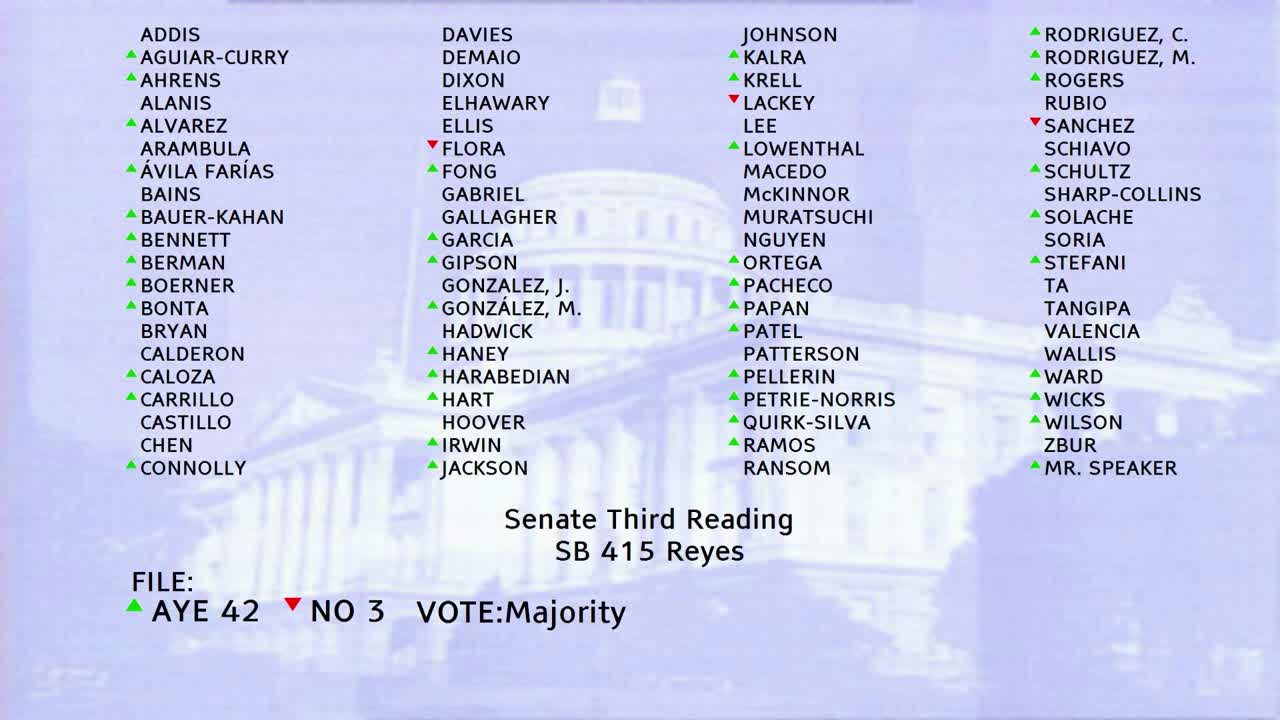 1MIN
Assembly Floor
 57SEC
Senate Floor
 5MIN
Assembly Standing Committee on Business and Professions
 2MIN
Senate Standing Committee on Business, Professions and Economic Development
Bill Author
Bill Co-Author(s):