SB 782: Enhanced infrastructure financing district: climate resilience districts.
- Session Year: 2025-2026
- House: Senate
- Latest Version Date: 2025-10-10
Current Status:
Passed
(2025-10-10: Chaptered by Secretary of State. Chapter 552, Statutes of 2025.)
Introduced
In Committee
Awaiting First Chamber Vote
Passed First Chamber
In Committee
Awaiting Second Chamber Vote
Passed Second Chamber
Enacted
Existing law authorizes the legislative body of a city or a county to designate a proposed enhanced infrastructure financing district to finance public capital facilities or other specified projects, with a governing body referred to as the public financing authority, by adopting a resolution of intention to establish the proposed district.
Existing law authorizes a city, county, city and county, special district, or a combination of any of those entities to form a climate resilience district, as described, for the purposes of raising and allocating funding for eligible projects and the operating expenses of eligible projects. Existing law deems each district to be an enhanced infrastructure financing district and requires each district to comply with existing law concerning enhanced infrastructure financing districts, except as specified. Existing law requires a district to finance only specified projects that meet the definition of an eligible project, including projects that address sea level rise, extreme heat, extreme cold, the risk of wildfire, drought, and the risk of flooding, as specified.
This bill would authorize a city or county to adopt a resolution providing for the division of taxes of any participating entity without following specified procedures for the preparation and adoption of an infrastructure financing plan, if certain conditions are met. The bill would require the city or county entity proposing formation of the district to hold a public meeting to consider the resolution of intention to establish the district and the governing board of the district to hold a public meeting to consider the adoption of the infrastructure financing plan. The bill would require the city and county entity and the governing board of the district to post specified notices prior to the respective meetings, as specified. The bill would require the resolution to include specified information, including that incremental property tax revenue from the city or county and all affected taxing entities within the district may be used to finance the districts activities. The bill would require the infrastructure financing plan to be made available for public inspection at least 30 days before the governing board of the districts meeting, and would require the designated official of the district to consult with each affected taxing entity prior to development of the infrastructure financing plan.
The bill would require public members appointed to the governing board of a district established pursuant to these provisions, as specified, to be residents of, own property in, or represent a business within the boundaries of the district and to serve terms of not fewer than 4 years, subject to specified term limits. The bill would limit the use of the districts revenue to repairing or replacing buildings, low- and moderate-income housing, facilities, structures, or other improvements within the district that have been damaged or destroyed by a disaster, as defined, mitigating the risk of a future disaster, or supporting economic recovery from a disaster, as specified. The bill would define disaster for these purposes to mean a disaster for which the Governor has declared a state of emergency, as specified.
This bill would declare that it is to take effect immediately as an urgency statute.
Existing law authorizes the legislative body of a city or a county to designate a proposed enhanced infrastructure financing district to finance public capital facilities or other specified projects, with a governing body referred to as the public financing authority, by adopting a resolution of intention to establish the proposed district.
Existing law authorizes a city, county, city and county, special district, or a combination of any of those entities to form a climate resilience district, as described, for the purposes of raising and allocating funding for eligible projects and the operating expenses of eligible projects. Existing law deems each district to be an enhanced infrastructure financing district and requires each district to comply with existing law concerning enhanced infrastructure financing districts, except as specified. Existing law requires a district to finance only specified projects that meet the definition of an eligible project, including projects that address sea level rise, extreme heat, extreme cold, the risk of wildfire, drought, and the risk of flooding, as specified.
This bill would authorize a city or county to adopt a resolution providing for the division of taxes of any participating entity without following specified procedures for the preparation and adoption of an infrastructure financing plan, if certain conditions are met. The bill would require the city or county entity proposing formation of the district to hold a public meeting to consider the resolution of intention to establish the district and the governing board of the district to hold a public meeting to consider the adoption of the infrastructure financing plan. The bill would require the city and county entity and the governing board of the district to post specified notices prior to the respective meetings, as specified. The bill would require the resolution to include specified information, including that incremental property tax revenue from the city or county and all affected taxing entities within the district may be used to finance the districts activities. The bill would require the infrastructure financing plan to be made available for public inspection at least 30 days before the governing board of the districts meeting, and would require the designated official of the district to consult with each affected taxing entity prior to development of the infrastructure financing plan.
ThisThe bill would require public members appointed to the governing board of a district established pursuant to these provisions, as specified, to be residents of, own property in, or represent a business within the boundaries of the district and to serve terms of not fewer than 4 years, subject to specified term limits. The bill would limit the use of the districts revenue to repairing or replacing buildings, low- and moderate-income housing, facilities, structures, or other improvements within the district, district that have been damaged or destroyed by a disaster, as defined, mitigating the risk of a future disaster, or supporting economic recovery from a disaster, as specified. The bill would define disaster for these purposes to mean a disaster for which the Governor has declared a state of emergency, as specified.
This bill would declare that it is to take effect immediately as an urgency statute.
Existing law authorizes the legislative body of a city or a county to designate a proposed enhanced infrastructure financing district to finance public capital facilities or other specified projects, with a governing body referred to as the public financing authority, by adopting a resolution of intention to establish the proposed district.
Existing law authorizes a city, county, city and county, special district, or a combination of any of those entities to form a climate resilience district, as described, for the purposes of raising and allocating funding for eligible projects and the operating expenses of eligible projects. Existing law deems each district to be an enhanced infrastructure financing district and requires each district to comply with existing law concerning enhanced infrastructure financing districts, except as specified. Existing law requires a district to finance only specified projects that meet the definition of an eligible project, including projects that address sea level rise, extreme heat, extreme cold, the risk of wildfire, drought, and the risk of flooding, as specified.
This bill would authorize a city or county to adopt a resolution providing for the division of taxes of any participating entity without following specified procedures for the preparation and adoption of an infrastructure financing plan, if certain conditions are met. The bill would require the city or county entity proposing formation of the district to hold a public meeting to consider the resolution of intention to establish the district and a second public the governing board of the district to hold a public meeting to consider the adoption of the infrastructure financing plan, and plan. The bill would require the entity proposing formation of the district city and county entity and the governing board of the district to post specified notices prior to the meetings. respective meetings, as specified. The bill would require the resolution to include specified information, including that incremental property tax revenue from the city or county and all affected taxing entities within the district may be used to finance the districts activities. The bill would require the district to make the infrastructure financing plan to be made available for public inspection at least 30 days before the second public governing board of the districts meeting, and would require the designated official of the district to consult with each affected taxing entity prior to development of the infrastructure financing plan.
This bill would limit the use of the districts revenue to repairing or replacing buildings, low- and moderate-income housing, facilities, structures, or other improvements within the district, that have been damaged or destroyed by a disaster, as defined, mitigating the risk of a future disaster, or supporting economic recovery from a disaster, as specified. The bill would define disaster for these purposes to mean a disaster for which the Governor has declared a state of emergency, as specified.
This bill would declare that it is to take effect immediately as an urgency statute.
Existing law authorizes the legislative body of a city or a county to designate a proposed enhanced infrastructure financing district to finance public capital facilities or other specified projects, with a governing body referred to as the public financing authority, by adopting a resolution of intention to establish the proposed district.
Existing law authorizes a city, county, city and county, special district, or a combination of any of those entities to form a climate resilience district, as described, for the purposes of raising and allocating funding for eligible projects and the operating expenses of eligible projects. Existing law deems each district to be an enhanced infrastructure financing district and requires each district to comply with existing law concerning enhanced infrastructure financing districts, except as specified. Existing law requires a district to finance only specified projects that meet the definition of an eligible project, including projects that address sea level rise, extreme heat, extreme cold, the risk of wildfire, drought, and the risk of flooding, as specified.
This bill would authorize a city or county to adopt a resolution providing for the division of taxes of any participating entity without following specified procedures for the preparation and adoption of an infrastructure financing plan, if certain conditions are met. The bill would require the entity proposing formation of the district to hold a public meeting to consider the resolution of intention to establish the district and a second public meeting to consider the adoption of the infrastructure financing plan, and would require the entity proposing formation of the district to post specified notices prior to the meetings. The bill would require the resolution to include specified information, including that incremental property tax revenue from the city or county and all affected taxing entities within the district may be used to finance the districts activities. The bill would require the district to make the infrastructure financing plan available for public inspection at least 30 days before the second public meeting, and would require the designated official of the district to consult with each affected taxing entity prior to development of the infrastructure financing plan.
This bill would limit the use of the districts revenue to repairing or replacing buildings, low- and moderate-income housing, facilities, structures, or other improvements within the district, that have been damaged or destroyed by a disaster, as defined, mitigating the risk of a future disaster, or supporting economic recovery from a disaster, as specified. The bill would define disaster for these purposes to mean a disaster for which the Governor has declared a state of emergency, as specified.
This bill would declare that it is to take effect immediately as an urgency statute.
Existing law authorizes the legislative body of a city or a county to designate a proposed enhanced infrastructure financing district to finance public capital facilities or other specified projects, with a governing body referred to as the public financing authority, by adopting a resolution of intention to establish the proposed district.
Existing law authorizes a city, county, city and county, special district, or a combination of any of those entities to form a climate resilience district, as described, for the purposes of raising and allocating funding for eligible projects and the operating expenses of eligible projects. Existing law deems each district to be an enhanced infrastructure financing district and requires each district to comply with existing law concerning enhanced infrastructure financing districts, except as specified. Existing law requires a district to finance only specified projects that meet the definition of an eligible project, including projects that address sea level rise, extreme heat, extreme cold, the risk of wildfire, drought, and the risk of flooding, as specified.
This bill would authorize a city or county to adopt a resolution providing for the division of taxes of any participating entity without following specified procedures for the preparation and adoption of an infrastructure financing plan, if certain conditions are met. The bill would require the entity proposing formation of the district to hold a public meeting to consider the resolution of intention to establish the district and a second public meeting to consider the adoption of the infrastructure financing plan, and would require the entity proposing formation of the district to post specified notices prior to the meetings. The bill would require the resolution to include specified information, including that incremental property tax revenue from the city or county and all affected taxing entities within the district may be used to finance the districts activities. The bill would require the district to make the infrastructure financing plan available for public inspection at least 10 30 days before the hearing to approve the formation of the district, second public meeting, and would require the designated official of the district to consult with each affected taxing entity prior to development of the infrastructure financing plan.
This bill would limit the use of the districts revenue to repairing or replacing buildings, low- and moderate-income housing, facilities, structures, or other improvements within the district, that have been damaged or destroyed by a disaster, as defined, or addressing mitigating the risk of a future disaster. disaster, or supporting economic recovery from a disaster, as specified. The bill would define disaster for these purposes to mean any flood, fire, hurricane, earthquake, storm, tidal wave, or other catastrophe for which the Governor has certified the need for assistance and which the President of the United States has determined to be a major disaster, a disaster for which the Governor has declared a state of emergency, as specified.
Existing law authorizes the legislative body of a city or a county to designate a proposed enhanced infrastructure financing district to finance public capital facilities or other specified projects, with a governing body referred to as the public financing authority, by adopting a resolution of intention to establish the proposed district.
Existing law authorizes a city, county, city and county, special district, or a combination of any of those entities to form a climate resilience district, as described, for the purposes of raising and allocating funding for eligible projects and the operating expenses of eligible projects. Existing law deems each district to be an enhanced infrastructure financing district and requires each district to comply with existing law concerning enhanced infrastructure financing districts, except as specified. Existing law requires a district to finance only specified projects that meet the definition of an eligible project, including projects that address sea level rise, extreme heat, extreme cold, the risk of wildfire, drought, and the risk of flooding, as specified.
This bill would authorize a city or county to adopt a resolution providing for the division of taxes of any participating entity without following specified procedures for the preparation and adoption of an infrastructure financing plan, if certain conditions are met. The bill would require the district to hold a public meeting to consider the resolution of intention to establish the district and a second public meeting to consider the adoption of the infrastructure financing plan, and would require the district to post specified notices prior to the meetings. The bill would require the resolution to include specified information, including that incremental property tax revenue from the city or county and all affected taxing entities within the district may be used to finance the districts activities. The bill would require the district to make the infrastructure financing plan available for public inspection at least 10 days before the hearing to approve the formation of the district, and would require the designated official of the district to consult with each affected taxing entity prior to development of the infrastructure financing plan.
This bill would limit the use of the districts revenue to repairing or replacing buildings, low- and moderate-income housing, facilities, structures, or other improvements within the district, that have been damaged or destroyed by a disaster, as defined, or addressing the risk of a future disaster. The bill would define disaster for these purposes to mean any flood, fire, hurricane, earthquake, storm, tidal wave, or other catastrophe for which the Governor has certified the need for assistance and which the President of the United States has determined to be a major disaster, as specified.
Existing law authorizes the legislative body of a city or a county to designate a proposed enhanced infrastructure financing district, with a governing body referred to as the public financing authority, to finance public capital facilities and specified other projects that provide significant benefits to the district or surrounding community. Existing law makes findings and declarations related to these provisions.This bill would make additional findings and declarations that public benefits will accrue if local agencies, excluding schools, are provided a means to, among other things, mitigate wildfires by financing heavy equipment for vegetation clearance, undergrounding of local publicly owned electric utilities, and other firefighting equipment.Existing law authorizes the legislative body of a city or a county to designate a proposed enhanced infrastructure financing district, with a governing body referred to as the public financing authority, to finance public capital facilities and specified other projects that provide significant benefits to the district or surrounding community. Existing law makes findings and declarations related to these provisions.
This bill would make additional findings and declarations that public benefits will accrue if local agencies, excluding schools, are provided a means to, among other things, mitigate wildfires by financing heavy equipment for vegetation clearance, undergrounding of local publicly owned electric utilities, and other firefighting equipment.
(a)Notwithstanding subdivision (b) of Section 62304, a city or county may adopt a resolution providing for the division of taxes of any participating entity without following the procedures for the preparation and adoption of an infrastructure financing plan described in Sections 53398.59 to 53398.66, inclusive, if all of the following are met:
(1)(A)The boundaries of the proposed district are limited to an area in which the disaster damage has caused conditions that are so prevalent and so substantial that they have caused a reduction, or a lack, of the normal predisaster usage of the area to an extent that causes a serious physical and economic burden that cannot reasonably be expected to be reversed or alleviated during the term of the infrastructure financing plan by private enterprise or governmental action, or both, without redevelopment.
(B)Areas adjacent to the disaster area may be included within the boundaries of the proposed district, but those adjacent areas shall be no more than 20 percent of the total district area.
(C)The city or county adopts the resolution no more than two years after the proclamation of the disaster.
(2)The resolution does all of the following:
(A)State that a district is proposed to be established under the terms of this division and describe the boundaries of the proposed district, which may be accomplished by reference to a map on file in the office of the clerk of the city or in the office of the recorder of the county, as applicable. The map may identify, within a district, certain areas which shall be referred to as project areas.
(B)State the type of public facilities and development proposed to be financed or assisted by the district in accordance with subdivision (f).
(C)State the need for the district and the goals the district proposes to achieve.
(D)State that incremental property tax revenue from the city or county and all affected taxing entities within the district, if approved by resolution pursuant to Section 53398.68, may be used to finance these activities.
(E)(i)State that a city, county, or city and county may allocate tax revenues derived from local sales and use taxes imposed pursuant to the Bradley-Burns Uniform Local Sales and Use Tax Law (Part 1.5 (commencing with Section 7200) of Division 2 of the Revenue and Taxation Code) or transactions and use taxes imposed in accordance with the Transactions and Use Tax Law (Part 1.6 (commencing with Section 7251) of Division 2 of the Revenue and Taxation Code) to a district pursuant to Section 53398.75.5, if applicable.
(ii)The legislative body of the city or county that elects to make an allocation pursuant to clause (i) shall enact an ordinance to establish the following:
(I)The procedure by which the city or county will calculate the revenues derived from sales and use taxes and transactions and use taxes to be allocated to the district.
(II)The decision process by which the city or county will determine the amount that will be dedicated to the proposed district.
(F)Fix a time and place for the public meeting on the proposal.
(b)(1)The city or county entity proposing formation of the district shall hold a public meeting to consider the resolution of intention to establish the district.
(2)The governing board of the district shall hold a public meeting to consider the adoption of the infrastructure financing plan.
(c)(1)The city or county entity proposing formation of the district shall post notice of the meeting described in paragraph (1) of subdivision (b) in an easily identifiable and accessible location on the local agencys internet website at least 10 days before the meeting. The notice shall do all of the following:
(A)Describe specifically the boundaries of the proposed area.
(B)Describe the purpose of the infrastructure financing plan.
(C)State the day, hour, and place when and where the public can inspect documents related to the district.
(2)The governing board of the district shall post notice of the meeting described in paragraph (2) of subdivision (b) in an easily identifiable and accessible location on the districts internet website at least 10 days before the meeting. The notice shall do all of the following:
(A)Describe specifically the boundaries of the proposed area.
(B)Describe the purpose of the infrastructure financing plan.
(C)State the day, hour, and place when and where the public can inspect documents related to the district.
(d)After adopting the resolution of intention to establish a district, the city or county shall designate an official to prepare a proposed infrastructure financing plan. This plan shall include all of the information required in Section 53398.63. The infrastructure financing plan shall be made available for public inspection at least 30 days before the governing board of the districts public meeting. The designated official shall consult with each affected taxing entity, and, at the request of any affected taxing entity, shall meet with representatives of an affected taxing entity. Any affected taxing entity may suggest revisions to the plan.
(e)The district shall follow the procedures for amending the infrastructure financing plan and providing an annual report described in subdivision (j) of Section 53398.66, except that it shall not be required to mail any written notices.
(f)A district established pursuant to this section shall limit the use of its revenue to only the following:
(1)The purpose of acquiring, demolishing, removing, relocating, repairing, restoring, rehabilitating, or replacing buildings, low- and moderate-income housing, facilities, structures, or other improvements, in accordance with applicable laws, which are within the district, and which have been damaged or destroyed by the disaster, which are unsafe to occupy, or which are required to be acquired, demolished, altered, or removed because of the disaster.
(2)The purpose of mitigating the risk of a future disaster, including, but not limited to, both of the following:
(A)Water and energy resource access and availability during emergencies and natural disasters.
(B)Undergrounding and hardening of electrical lines and other utilities.
(3)The purpose of supporting economic recovery from a disaster, including, but not limited to, all of the following:
(A)Residential and commercial reconstruction.
(B)Affordable housing development pursuant to the provisions of Section 53398.52.
(C)Prevention of displacement.
(D)Low-interest construction loans.
(E)Capital access programs for small businesses.
(F)Workforce development and job training programs.
(g)Except as specifically provided in this section, a district established pursuant to this section shall comply with the provisions of this division.
(h)Notwithstanding Section 53398.63, a district established pursuant to this section may plan, adopt, and implement an infrastructure financing plan, and the legislative body of the city or county that created it may approve projects in the disaster area even if it is inconsistent with the general plan, and specific plan, if applicable, of the city or county within which the district is located.
(i)For a district established pursuant to this section, both of the following shall apply:
(1)Bond proceeds shall not be used for costs of operations, programs, or providing services of any kind.
(2)Notwithstanding Section 54902, the statement required by Section 54900 may be filed with the auditor of each levying county, and the statement and the map or plat shall be filed with each assessor whose roll is used for the levy and with the State Board of Equalization in Sacramento, no later than January 31 of the year in which the assessments or taxes are to be levied.
(j)Prior to the termination of the district, a city or county may include all or a portion of the district within a separate district. However, any portion of the district included within the separate district shall meet all the requirements of this division.
(k)The public members appointed in compliance with Section 62305 to the governing board of a district established pursuant to this section shall be residents of, own property in, or represent a business within the boundaries of the district and shall serve terms of not fewer than four years, subject to any applicable term limits established by the legislative body.
(l)For the purposes of this section, disaster means a disaster for which the Governor has declared a state of emergency pursuant to Section 8625 of the California Emergency Services Act (Chapter 7 (commencing with Section 8550) of Division 1 of Title 2).
SEC. 2.This act is an urgency statute necessary for the immediate preservation of the public peace, health, or safety within the meaning of Article IV of the California Constitution and shall go into immediate effect. The facts constituting the necessity are:
In order to ensure the timely restoration of critical infrastructure, uninterrupted delivery of public services, and economic stability, including communities devastated by the January 2025 wildfires in the County of Los Angeles, and to prevent unnecessary delays in rebuilding critical infrastructure, roads, and essential facilities, it is necessary that this act take effect immediately.
(a)Notwithstanding subdivision (b) of Section 62304, a city or county may adopt a resolution providing for the division of taxes of any participating entity without following the procedures for the preparation and adoption of an infrastructure financing plan described in Sections 53398.59 to 53398.66, inclusive, if all of the following are met:
(1)(A)The boundaries of the proposed district are limited to an area in which the disaster damage has caused conditions that are so prevalent and so substantial that they have caused a reduction, or a lack, of the normal predisaster usage of the area to an extent that causes a serious physical and economic burden that cannot reasonably be expected to be reversed or alleviated during the term of the infrastructure financing plan by private enterprise or governmental action, or both, without redevelopment.
(B)Areas adjacent to the disaster area may be included within the boundaries of the proposed district, but those adjacent areas shall be no more than 20 percent of the total district area.
(C)The city or county adopts the resolution no more than two years after the proclamation of the disaster.
(2)The resolution does all of the following:
(A)State that a district is proposed to be established under the terms of this division and describe the boundaries of the proposed district, which may be accomplished by reference to a map on file in the office of the clerk of the city or in the office of the recorder of the county, as applicable. The map may identify, within a district, certain areas which shall be referred to as project areas.
(B)State the type of public facilities and development proposed to be financed or assisted by the district in accordance with subdivision (f).
(C)State the need for the district and the goals the district proposes to achieve.
(D)State that incremental property tax revenue from the city or county and all affected taxing entities within the district, if approved by resolution pursuant to Section 53398.68, may be used to finance these activities.
(E)(i)State that a city, county, or city and county may allocate tax revenues derived from local sales and use taxes imposed pursuant to the Bradley-Burns Uniform Local Sales and Use Tax Law (Part 1.5 (commencing with Section 7200) of Division 2 of the Revenue and Taxation Code) or transactions and use taxes imposed in accordance with the Transactions and Use Tax Law (Part 1.6 (commencing with Section 7251) of Division 2 of the Revenue and Taxation Code) to a district pursuant to Section 53398.75.5, if applicable.
(ii)The legislative body of the city or county that elects to make an allocation pursuant to clause (i) shall enact an ordinance to establish the following:
(I)The procedure by which the city or county will calculate the revenues derived from sales and use taxes and transactions and use taxes to be allocated to the district.
(II)The decision process by which the city or county will determine the amount that will be dedicated to the proposed district.
(F)Fix a time and place for the public meeting on the proposal.
(b)(1)The city or county entity proposing formation of the district shall hold a public meeting to consider the resolution of intention to establish the district.
(2)The governing board of the district shall hold a public meeting to consider the adoption of the infrastructure financing plan.
(c)(1)The city or county entity proposing formation of the district shall post notice of the meeting described in paragraph (1) of subdivision (b) in an easily identifiable and accessible location on the local agencys internet website at least 10 days before the meeting. The notice shall do all of the following:
(A)Describe specifically the boundaries of the proposed area.
(B)Describe the purpose of the infrastructure financing plan.
(C)State the day, hour, and place when and where the public can inspect documents related to the district.
(2)The governing board of the district shall post notice of the meeting described in paragraph (2) of subdivision (b) in an easily identifiable and accessible location on the districts internet website at least 10 days before the meeting. The notice shall do all of the following:
(A)Describe specifically the boundaries of the proposed area.
(B)Describe the purpose of the infrastructure financing plan.
(C)State the day, hour, and place when and where the public can inspect documents related to the district.
(d)After adopting the resolution of intention to establish a district, the city or county shall designate an official to prepare a proposed infrastructure financing plan. This plan shall include all of the information required in Section 53398.63. The infrastructure financing plan shall be made available for public inspection at least 30 days before the governing board of the districts public meeting. The designated official shall consult with each affected taxing entity, and, at the request of any affected taxing entity, shall meet with representatives of an affected taxing entity. Any affected taxing entity may suggest revisions to the plan.
(e)The district shall follow the procedures for amending the infrastructure financing plan and providing an annual report described in subdivision (j) of Section 53398.66, except that it shall not be required to mail any written notices.
(f)A district established pursuant to this section shall limit the use of its revenue to only the following:
(1)The purpose of acquiring, demolishing, removing, relocating, repairing, restoring, rehabilitating, or replacing buildings, low- and moderate-income housing, facilities, structures, or other improvements, in accordance with applicable laws, which are within the district, and which have been damaged or destroyed by the disaster, which are unsafe to occupy, or which are required to be acquired, demolished, altered, or removed because of the disaster.
(2)The purpose of mitigating the risk of a future disaster, including, but not limited to, both of the following:
(A)Water and energy resource access and availability during emergencies and natural disasters.
(B)Undergrounding and hardening of electrical lines and other utilities.
(3)The purpose of supporting economic recovery from a disaster, including, but not limited to, all of the following:
(A)Residential and commercial reconstruction.
(B)Affordable housing development pursuant to the provisions of Section 53398.52.
(C)Prevention of displacement.
(D)Low-interest construction loans.
(E)Capital access programs for small businesses.
(F)Workforce development and job training programs.
(g)Except as specifically provided in this section, a district established pursuant to this section shall comply with the provisions of this division.
(h)Notwithstanding Section 53398.63, a district established pursuant to this section may plan, adopt, and implement an infrastructure financing plan, and the legislative body of the city or county that created it may approve projects in the disaster area even if it is inconsistent with the general plan, and specific plan, if applicable, of the city or county within which the district is located.
(i)For a district established pursuant to this section, both of the following shall apply:
(1)Bond proceeds shall not be used for costs of operations, programs, or providing services of any kind.
(2)Notwithstanding Section 54902, the statement required by Section 54900 may be filed with the auditor of each levying county, and the statement and the map or plat shall be filed with each assessor whose roll is used for the levy and with the State Board of Equalization in Sacramento, no later than January 31 of the year in which the assessments or taxes are to be levied.
(j)Prior to the termination of the district, a city or county may include all or a portion of the district within a separate district. However, any portion of the district included within the separate district shall meet all the requirements of this division.
(k)The public members appointed in compliance with Section 62305 to the governing board of a district established pursuant to this section shall be residents of, own property in, or represent a business within the boundaries of the district and shall serve terms of not fewer than four years, subject to any applicable term limits established by the legislative body.
(k)(l)For the purposes of this section, disaster means a disaster for which the Governor has declared a state of emergency pursuant to Section 8625 of the California Emergency Services Act (Chapter 7 (commencing with Section 8550) of Division 1 of Title 2).
SEC. 2.This act is an urgency statute necessary for the immediate preservation of the public peace, health, or safety within the meaning of Article IV of the California Constitution and shall go into immediate effect. The facts constituting the necessity are:
In order to ensure the timely restoration of critical infrastructure, uninterrupted delivery of public services, and economic stability, including communities devastated by the January 2025 wildfires in the County of Los Angeles, and to prevent unnecessary delays in rebuilding critical infrastructure, roads, and essential facilities, it is necessary that this act take effect immediately.
(a)Notwithstanding subdivision (b) of Section 62304, a city or county may adopt a resolution providing for the division of taxes of any participating entity without following the procedures for the preparation and adoption of an infrastructure financing plan described in Sections 53398.59 to 53398.66, inclusive, if all of the following are met:
(1)(A)The boundaries of the proposed district are limited to an area in which the disaster damage has caused conditions that are so prevalent and so substantial that they have caused a reduction, or a lack, of the normal predisaster usage of the area to an extent that causes a serious physical and economic burden that cannot reasonably be expected to be reversed or alleviated during the term of the infrastructure financing plan by private enterprise or governmental action, or both, without redevelopment.
(B)Areas adjacent to the disaster area may be included within the boundaries of the proposed district, but those adjacent areas shall be no more than 20 percent of the total district area.
(C)The city or county adopts the resolution no more than two years after the proclamation of the disaster.
(2)The resolution does all of the following:
(A)State that a district is proposed to be established under the terms of this chapter division and describe the boundaries of the proposed district, which may be accomplished by reference to a map on file in the office of the clerk of the city or in the office of the recorder of the county, as applicable. The map may identify, within a district, certain areas which shall be referred to as project areas.
(B)State the type of public facilities and development proposed to be financed or assisted by the district in accordance with subdivision (f).
(C)State the need for the district and the goals the district proposes to achieve.
(D)State that incremental property tax revenue from the city or county and all affected taxing entities within the district, if approved by resolution pursuant to Section 53398.68, may be used to finance these activities.
(E)(i)State that a city, county, or city and county may allocate tax revenues derived from local sales and use taxes imposed pursuant to the Bradley-Burns Uniform Local Sales and Use Tax Law (Part 1.5 (commencing with Section 7200) of Division 2 of the Revenue and Taxation Code) or transactions and use taxes imposed in accordance with the Transactions and Use Tax Law (Part 1.6 (commencing with Section 7251) of Division 2 of the Revenue and Taxation Code) to a district pursuant to Section 53398.75.5, if applicable.
(ii)The legislative body of the city or county that elects to make an allocation pursuant to clause (i) shall enact an ordinance to establish the following:
(I)The procedure by which the city or county will calculate the revenues derived from sales and use taxes and transactions and use taxes to be allocated to the enhanced infrastructure financing district.
(II)The decision process by which the city or county will determine the amount that will be dedicated to the proposed district.
(F)Fix a time and place for the public meetings meeting on the proposal.
(b)(1)The city or county entity proposing formation of the district shall hold two public meetings on the proposal. The first public meeting shall be a public meeting to consider the resolution of intention to establish the district. The second public meeting shall be
(2)The governing board of the district shall hold a public meeting to consider the adoption of the infrastructure financing plan.
(c)(1)The city or county entity proposing formation of the district shall post notice of each meeting required by this section the meeting described in paragraph (1) of subdivision (b) in an easily identifiable and accessible location on the districts local agencys internet website at least 10 days before the meeting. The notice shall do all of the following:
(1)(A)Describe specifically the boundaries of the proposed area.
(2)(B)Describe the purpose of the infrastructure financing plan.
(3)(C)State the day, hour, and place when and where the public can inspect documents related to the district.
(2)The governing board of the district shall post notice of the meeting described in paragraph (2) of subdivision (b) in an easily identifiable and accessible location on the districts internet website at least 10 days before the meeting. The notice shall do all of the following:
(A)Describe specifically the boundaries of the proposed area.
(B)Describe the purpose of the infrastructure financing plan.
(C)State the day, hour, and place when and where the public can inspect documents related to the district.
(d)After adopting the resolution of intention to establish a district, the city or county shall designate an official to prepare a proposed infrastructure financing plan. This plan shall include all of the information required in Section 53398.63. The infrastructure financing plan shall be made available for public inspection at least 30 days before the second governing board of the districts public meeting. The designated official shall consult with each affected taxing entity, and, at the request of any affected taxing entity, shall meet with representatives of an affected taxing entity. Any affected taxing entity may suggest revisions to the plan.
(e)The district shall follow the procedures for amending the infrastructure financing plan and providing an annual report described in subdivision (j) of Section 53398.66, except that it shall not be required to mail any written notices.
(f)A district established pursuant to this section shall limit the use of its revenue to only the following:
(1)The purpose of acquiring, demolishing, removing, relocating, repairing, restoring, rehabilitating, or replacing buildings, low- and moderate-income housing, facilities, structures, or other improvements, in accordance with applicable laws, which are within the district, and which have been damaged or destroyed by the disaster, which are unsafe to occupy, or which are required to be acquired, demolished, altered, or removed because of the disaster.
(2)The purpose of mitigating the risk of a future disaster, including, but not limited to, both of the following:
(A)Water and energy resource access and availability during emergencies and natural disasters disasters.
(B)Undergrounding and hardening of electrical lines and other utilities.
(3)The purpose of supporting economic recovery from a disaster, including, but not limited to, all of the following:
(A)Residential and commercial reconstruction.
(B)Affordable housing development pursuant to the provisions of Section 53398.52.
(C)Prevention of displacement.
(D)Low-interest construction loans.
(E)Capital access programs for small businesses.
(F)Workforce development and job training programs.
(g)Except as specifically provided in this section, a district established pursuant to this section shall comply with the provisions of Chapter 2.99 (commencing with Section 53398.50) of Part 1 of Division 2 of Title 5. this division.
(h)Notwithstanding Section 53398.63, a district established pursuant to this section may plan, adopt, and implement an infrastructure financing plan, and the legislative body of the city or county that created it may approve projects in the disaster area even if it is inconsistent with the general plan, and specific plan, if applicable, of the city or county within which the district is located.
(i)For a district established pursuant to this section, both of the following shall apply:
(1)Bond proceeds shall not be used for costs of operations, programs, or providing services of any kind.
(2)Notwithstanding Section 54902, the statement required by Section 54900 may be filed with the auditor of each levying county, and the statement and the map or plat shall be filed with each assessor whose roll is used for the levy and with the State Board of Equalization in Sacramento, no later than January 31 of the year in which the assessments or taxes are to be levied.
(j)Prior to the termination of the district, a city or county may include all or a portion of the district within a separate district. However, any portion of the district included within the separate district shall meet all the requirements of this division.
(k)For the purposes of this section, disaster means a disaster for which the Governor has declared a state of emergency pursuant to Section 8625 of the California Emergency Services Act (Chapter 7 (commencing with Section 8550) of Division 1 of Title 2).
SEC. 2.This act is an urgency statute necessary for the immediate preservation of the public peace, health, or safety within the meaning of Article IV of the California Constitution and shall go into immediate effect. The facts constituting the necessity are:
In order to ensure the timely restoration of critical infrastructure, uninterrupted delivery of public services, and economic stability, including communities devastated by the January 2025 wildfires in the County of Los Angeles, and to prevent unnecessary delays in rebuilding critical infrastructure, roads, and essential facilities, it is necessary that this act take effect immediately.
(a)Notwithstanding subdivision (b) of Section 62304, a city or county may adopt a resolution providing for the division of taxes of any participating entity without following the procedures for the preparation and adoption of an infrastructure financing plan described in Sections 53398.59 to 53398.66, inclusive, if all of the following are met:
(1)(A)The boundaries of the proposed district are limited to an area in which the disaster damage has caused conditions that are so prevalent and so substantial that they have caused a reduction, or a lack, of the normal predisaster usage of the area to an extent that causes a serious physical and economic burden that cannot reasonably be expected to be reversed or alleviated during the term of the infrastructure financing plan by private enterprise or governmental action, or both, without redevelopment.
(B)Areas adjacent to the disaster area may be included within the boundaries of the proposed district, but those adjacent areas shall be no more than 20 percent of the total district area.
(C)The city or county adopts the resolution no more than two years after the proclamation of the disaster.
(2)The resolution does all of the following:
(A)State that a district is proposed to be established under the terms of this chapter and describe the boundaries of the proposed district, which may be accomplished by reference to a map on file in the office of the clerk of the city or in the office of the recorder of the county, as applicable. The map may identify, within a district, certain areas which shall be referred to as project areas.
(B)State the type of public facilities and development proposed to be financed or assisted by the district in accordance with subdivision (f).
(C)State the need for the district and the goals the district proposes to achieve.
(D)State that incremental property tax revenue from the city or county and all affected taxing entities within the district, if approved by resolution pursuant to Section 53398.68, may be used to finance these activities.
(E)(i)State that a city, county, or city and county may allocate tax revenues derived from local sales and use taxes imposed pursuant to the Bradley-Burns Uniform Local Sales and Use Tax Law (Part 1.5 (commencing with Section 7200) of Division 2 of the Revenue and Taxation Code) or transactions and use taxes imposed in accordance with the Transactions and Use Tax Law (Part 1.6 (commencing with Section 7251) of Division 2 of the Revenue and Taxation Code) to a district pursuant to Section 53398.75.5, if applicable.
(ii)The legislative body of the city or county that elects to make an allocation pursuant to clause (i) shall enact an ordinance to establish the following:
(I)The procedure by which the city or county will calculate the revenues derived from sales and use taxes and transactions and use taxes to be allocated to the enhanced infrastructure financing district.
(II)The decision process by which the city or county will determine the amount that will be dedicated to the proposed district.
(F)Fix a time and place for public meetings on the proposal.
(b)The entity proposing formation of the district shall hold two public meetings on the proposal. The first public meeting shall be to consider the resolution of intention to establish the district. The second public meeting shall be to consider the adoption of the infrastructure financing plan.
(c)The entity proposing formation of the district shall post notice of each meeting required by this section in an easily identifiable and accessible location on the districts internet website at least 10 days before the meeting. The notice shall do all of the following:
(1)Describe specifically the boundaries of the proposed area.
(2)Describe the purpose of the infrastructure financing plan.
(3)State the day, hour, and place when and where the public can inspect documents related to the district.
(d)After adopting the resolution of intention to establish a district, the city or county shall designate an official to prepare a proposed infrastructure financing plan. This plan shall include all of the information required in Section 53398.63. The infrastructure financing plan shall be made available for public inspection at least 30 days before the second public meeting. The designated official shall consult with each affected taxing entity, and, at the request of any affected taxing entity, shall meet with representatives of an affected taxing entity. Any affected taxing entity may suggest revisions to the plan.
(e)The district shall follow the procedures for amending the infrastructure financing plan and providing an annual report described in subdivision (j) of Section 53398.66, except that it shall not be required to mail any written notices.
(f)A district established pursuant to this section shall limit the use of its revenue to only the following:
(1)The purpose of acquiring, demolishing, removing, relocating, repairing, restoring, rehabilitating, or replacing buildings, low- and moderate-income housing, facilities, structures, or other improvements, in accordance with applicable laws, which are within the district, and which have been damaged or destroyed by the disaster, which are unsafe to occupy, or which are required to be acquired, demolished, altered, or removed because of the disaster.
(2)The purpose of mitigating the risk of a future disaster, including, but not limited to, both of the following:
(A)Water and energy resource access and availability during emergencies and natural disasters
(B)Undergrounding and hardening of electrical lines and other utilities.
(3)The purpose of supporting economic recovery from a disaster, including, but not limited to, all of the following:
(A)Residential and commercial reconstruction.
(B)Affordable housing development pursuant to the provisions of Section 53398.52.
(C)Prevention of displacement.
(D)Low-interest construction loans.
(E)Capital access programs for small businesses.
(F)Workforce development and job training programs.
(g)Except as specifically provided in this section, a district established pursuant to this section shall comply with the provisions of Chapter 2.99 (commencing with Section 53398.50) of Part 1 of Division 2 of Title 5.
(h)Notwithstanding Section 53398.63, a district established pursuant to this section may plan, adopt, and implement an infrastructure financing plan, and the legislative body of the city or county that created it may approve projects in the disaster area even if it is inconsistent with the general plan, and specific plan, if applicable, of the city or county within which the district is located.
(i)For a district established pursuant to this section, both of the following shall apply:
(1)Bond proceeds shall not be used for costs of operations, programs, or providing services of any kind.
(2)Notwithstanding Section 54902, the statement required by Section 54900 may be filed with the auditor of each levying county, and the statement and the map or plat shall be filed with each assessor whose roll is used for the levy and with the State Board of Equalization in Sacramento, no later than January 31 of the year in which the assessments or taxes are to be levied.
(j)Prior to the termination of the district, a city or county may include all or a portion of the district within a separate district. However, any portion of the district included within the separate district shall meet all the requirements of this division.
(k)For the purposes of this section, disaster means a disaster for which the Governor has declared a state of emergency pursuant to Section 8625 of the California Emergency Services Act (Chapter 7 (commencing with Section 8550) of Division 1 of Title 2).
SEC. 2.This act is an urgency statute necessary for the immediate preservation of the public peace, health, or safety within the meaning of Article IV of the California Constitution and shall go into immediate effect. The facts constituting the necessity are:
In order to ensure the safety of all students, teachers, faculty, and staff by preventing panic and to promote a greater sense of calm and security on schoolsites and campuses, timely restoration of critical infrastructure, uninterrupted delivery of public services, and economic stability, including communities devastated by the January 2025 wildfires in the County of Los Angeles, and to prevent unnecessary delays in rebuilding critical infrastructure, roads, and essential facilities, it is necessary that this act take effect immediately.
(a)Notwithstanding subdivision (b) of Section 62304, a city or county may adopt a resolution providing for the division of taxes of any participating entity without following the procedures for the preparation and adoption of an infrastructure financing plan described in Sections 53398.59 to 53398.66, inclusive, if all of the following are met:
(1)(A)The boundaries of the proposed district are limited to an area in which the disaster damage has caused conditions that are so prevalent and so substantial that they have caused a reduction, or a lack, of the normal predisaster usage of the area to an extent that causes a serious physical and economic burden that cannot reasonably be expected to be reversed or alleviated during the term of the infrastructure financing plan by private enterprise or governmental action, or both, without redevelopment.
(B)Areas adjacent to the disaster area may be included within the boundaries of the proposed district, but those adjacent areas shall be no more than 20 percent of the total district area.
(C)The city or county adopts the resolution no more than two years after the proclamation of the disaster.
(2)The resolution does all of the following:
(A)State that a district is proposed to be established under the terms of this chapter and describe the boundaries of the proposed district, which may be accomplished by reference to a map on file in the office of the clerk of the city or in the office of the recorder of the county, as applicable. The map may identify, within a district, certain areas which shall be referred to as project areas.
(B)State the type of public facilities and development proposed to be financed or assisted by the district in accordance with subdivision (f).
(C)State the need for the district and the goals the district proposes to achieve.
(D)State that incremental property tax revenue from the city or county and all affected taxing entities within the district, if approved by resolution pursuant to Section 53398.68, may be used to finance these activities.
(E)(i)State that a city, county, or city and county may allocate tax revenues derived from local sales and use taxes imposed pursuant to the Bradley-Burns Uniform Local Sales and Use Tax Law (Part 1.5 (commencing with Section 7200) of Division 2 of the Revenue and Taxation Code) or transactions and use taxes imposed in accordance with the Transactions and Use Tax Law (Part 1.6 (commencing with Section 7251) of Division 2 of the Revenue and Taxation Code) to a district pursuant to Section 53398.75.5, if applicable.
(ii)The legislative body of the city or county that elects to make an allocation pursuant to clause (i) shall enact an ordinance to establish the following:
(I)The procedure by which the city or county will calculate the revenues derived from sales and use taxes and transactions and use taxes to be allocated to the enhanced infrastructure financing district.
(II)The decision process by which the city or county will determine the amount that will be dedicated to the proposed district.
(F)Fix a time and place for public meetings on the proposal.
(b)The entity proposing formation of the district shall hold two public meetings on the proposal. The first public meeting shall be to consider the resolution of intention to establish the district. The second public meeting shall be to consider the adoption of the infrastructure financing plan.
(c)The entity proposing formation of the district shall post notice of each meeting required by this section in an easily identifiable and accessible location on the districts internet website at least 10 days before the meeting. The notice shall do all of the following:
(1)Describe specifically the boundaries of the proposed area.
(2)Describe the purpose of the infrastructure financing plan.
(3)State the day, hour, and place when and where the public can inspect documents related to the district.
(d)After adopting the resolution of intention to establish a district, the city or county shall designate an official to prepare a proposed infrastructure financing plan. This plan shall include all of the information required in Section 53398.63. The infrastructure financing plan shall be made available for public inspection at least 30 days before the second public meeting. The designated official shall consult with each affected taxing entity, and, at the request of any affected taxing entity, shall meet with representatives of an affected taxing entity. Any affected taxing entity may suggest revisions to the plan.
(e)The district shall follow the procedures for amending the infrastructure financing plan and providing an annual report described in subdivision (j) of Section 53398.66, except that it shall not be required to mail any written notices.
(f)A district established pursuant to this section shall limit the use of its revenue to only the following:
(1)The purpose of acquiring, demolishing, removing, relocating, repairing, restoring, rehabilitating, or replacing buildings, low- and moderate-income housing, facilities, structures, or other improvements, in accordance with applicable laws, which are within the district, and which have been damaged or destroyed by the disaster, which are unsafe to occupy, or which are required to be acquired, demolished, altered, or removed because of the disaster.
(2)The purpose of mitigating the risk of a future disaster, including, but not limited to, both of the following:
(A)Water and energy resource access and availability during emergencies and natural disasters
(B)Undergrounding and hardening of electrical lines and other utilities.
(3)The purpose of supporting economic recovery from a disaster, including, but not limited to, all of the following:
(A)Residential and commercial reconstruction.
(B)Affordable housing development pursuant to the provisions of Section 53398.52.
(C)Prevention of displacement.
(D)Low-interest construction loans.
(E)Capital access programs for small businesses.
(F)Workforce development and job training programs.
(g)Except as specifically provided in this section, a district established pursuant to this section shall comply with the provisions of Chapter 2.99 (commencing with Section 53398.50) of Part 1 of Division 2 of Title 5.
(h)Notwithstanding Section 53398.63, a district established pursuant to this section may plan, adopt, and implement an infrastructure financing plan, and the legislative body of the city or county that created it may approve projects in the disaster area even if it is inconsistent with the general plan, and specific plan, if applicable, of the city or county within which the district is located.
(i)For a district established pursuant to this section, both of the following shall apply:
(1)Bond proceeds shall not be used for costs of operations, programs, or providing services of any kind.
(2)Notwithstanding Section 54902, the statement required by Section 54900 may be filed with the auditor of each levying county, and the statement and the map or plat shall be filed with each assessor whose roll is used for the levy and with the State Board of Equalization in Sacramento, no later than January 31 of the year in which the assessments or taxes are to be levied.
(j)Prior to the termination of the district, a city or county may include all or a portion of the district within a separate district. However, any portion of the district included within the separate district shall meet all the requirements of this division.
(k)For the purposes of this section, disaster means a disaster for which the Governor has declared a state of emergency pursuant to Section 8625 of the California Emergency Services Act (Chapter 7 (commencing with Section 8550) of Division 1 of Title 2).
SEC. 2.This act is an urgency statute necessary for the immediate preservation of the public peace, health, or safety within the meaning of Article IV of the California Constitution and shall go into immediate effect. The facts constituting the necessity are:
In order to ensure the safety of all students, teachers, faculty, and staff by preventing panic and to promote a greater sense of calm and security on schoolsites and campuses, it is necessary that this act take effect immediately.
(a)Notwithstanding subdivision (b) of Section 62304, a city or county may adopt a resolution providing for the division of taxes of any participating entity without following the procedures for the preparation and adoption of an infrastructure financing plan described in Sections 53398.59 to 53398.66, inclusive, if both all of the following are met:
(1)(A)The boundaries of the proposed district are limited to an area in which the disaster damage has caused conditions that are so prevalent and so substantial that they have caused a reduction, or a lack, of the normal predisaster usage of the area to an extent that causes a serious physical and economic burden that cannot reasonably be expected to be reversed or alleviated during the term of the infrastructure financing plan by private enterprise or governmental action, or both, without redevelopment.
(B)Areas adjacent to the disaster area may be included within the boundaries of the proposed district, but those adjacent areas shall be no more than 20 percent of the total district area.
(C)The city or county adopts the resolution no more than two years after the proclamation of the disaster.
(2)The resolution does all of the following:
(A)State that a district is proposed to be established under the terms of this chapter and describe the boundaries of the proposed district, which may be accomplished by reference to a map on file in the office of the clerk of the city or in the office of the recorder of the county, as applicable. The map may identify, within a district, certain areas which shall be referred to as project areas.
(B)State the type of public facilities and development proposed to be financed or assisted by the district in accordance with Section 53398.52. subdivision (f).
(C)State the need for the district and the goals the district proposes to achieve.
(D)State that incremental property tax revenue from the city or county and all affected taxing entities within the district, if approved by resolution pursuant to Section 53398.68, may be used to finance these activities.
(E)(i)State that a city, county, or city and county may allocate tax revenues derived from local sales and use taxes imposed pursuant to the Bradley-Burns Uniform Local Sales and Use Tax Law (Part 1.5 (commencing with Section 7200) of Division 2 of the Revenue and Taxation Code) or transactions and use taxes imposed in accordance with the Transactions and Use Tax Law (Part 1.6 (commencing with Section 7251) of Division 2 of the Revenue and Taxation Code) to a district pursuant to Section 53398.75.5, if applicable.
(ii)The legislative body of the city or county that elects to make an allocation pursuant to clause (i) shall adopt enact an ordinance to establish the following:
(I)The procedure by which the city or county will calculate the revenues derived from sales and use taxes and transactions and use taxes to be allocated to the enhanced infrastructure financing district.
(II)The decision process by which the city or county will determine the amount that will be dedicated to the proposed district.
(F)Fix a time and place for public meetings on the proposal.
(b)The entity proposing formation of the district shall hold two public meetings on the proposal. The first public meeting shall be to consider the resolution of intention to establish the district. The second public meeting shall be to consider the adoption of the infrastructure financing plan.
(c)The entity proposing formation of the district shall post notice of each meeting required by this section in an easily identifiable and accessible location on the districts internet website at least 10 days before the meeting. The notice shall do all of the following:
(1)Describe specifically the boundaries of the proposed area.
(2)Describe the purpose of the infrastructure financing plan.
(3)State the day, hour, and place when and where the public can inspect documents related to the district.
(d)After adopting the resolution of intention to establish a district, the city or county shall designate an official to prepare a proposed infrastructure financing plan. This plan shall include all of the information required in Section 53398.63. The infrastructure financing plan shall be made available for public inspection at least 10 30 days before the hearing to approve the formation of the district. second public meeting. The designated official shall consult with each affected taxing entity, and, at the request of any affected taxing entity, shall meet with representatives of an affected taxing entity. Any affected taxing entity may suggest revisions to the plan.
(e)The district shall follow the procedures for amending the infrastructure financing plan and providing an annual report described in subdivision (j) of Section 53398.66, except that it shall not be required to mail any written notices.
(f)A district established pursuant to this section shall limit the use of its revenue to either of only the following:
(1)The purpose of acquiring, demolishing, removing, relocating, repairing, restoring, rehabilitating, or replacing buildings, low- and moderate-income housing, facilities, structures, or other improvements, in accordance with applicable laws, which are within the district, and which have been damaged or destroyed by the disaster, which are unsafe to occupy, or which are required to be acquired, demolished, altered, or removed because of the disaster.
(2)The purpose of addressing mitigating the risk of a future disaster. disaster, including, but not limited to, both of the following:
(A)Water and energy resource access and availability during emergencies and natural disasters
(B)Undergrounding and hardening of electrical lines and other utilities.
(3)The purpose of supporting economic recovery from a disaster, including, but not limited to, all of the following:
(A)Residential and commercial reconstruction.
(B)Affordable housing development pursuant to the provisions of Section 53398.52.
(C)Prevention of displacement.
(D)Low-interest construction loans.
(E)Capital access programs for small businesses.
(F)Workforce development and job training programs.
(g)Except as specifically provided in this section, a district established pursuant to this section shall comply with the provisions of Chapter 2.99 (commencing with Section 53398.50) of Part 1 of Division 2 of Title 5.
(h)Notwithstanding Section 53398.63, a district established pursuant to this section may plan, adopt, and implement an infrastructure financing plan, and the legislative body of the city or county that created it may approve projects in the disaster area even if it is inconsistent with the general plan, and specific plan, if applicable, of the city or county within which the district is located.
(i)For a district established pursuant to this section, both of the following shall apply:
(1)Bond proceeds shall not be used for costs of operations, programs, or providing services of any kind.
(2)Notwithstanding Section 54902, the statement required by Section 54900 may be filed with the auditor of each levying county, and the statement and the map or plat shall be filed with each assessor whose roll is used for the levy and with the State Board of Equalization in Sacramento, no later than January 31 of the year in which the assessments or taxes are to be levied.
(i)(j)Prior to the termination of the district, a city or county may include all or a portion of the district within a separate district. However, any portion of the district included within the separate district shall meet all the requirements of this division.
(j)(k)For the purposes of this section, disaster means any flood, fire, hurricane, earthquake, storm, tidal wave, or other catastrophe occurring on or after January 1, 1996, for which the Governor of the state has certified the need for assistance and which the President of the United States has determined to be a major disaster pursuant to the Robert T. Stafford Disaster Relief and Emergency Assistance Act (Public Law 93288), as it may be from time to time amended. a disaster for which the Governor has declared a state of emergency pursuant to Section 8625 of the California Emergency Services Act (Chapter 7(commencing with Section 8550) of Division 1 of Title 2).
(a)Notwithstanding subdivision (b) of Section 62304, a city or county may adopt a resolution providing for the division of taxes of any participating entity without following the procedures for the preparation and adoption of an infrastructure financing plan described in Sections 53398.59 to 53398.66, inclusive, if both of the following are met:
(1)The boundaries of the proposed district are limited to an area in which the disaster damage has caused conditions that are so prevalent and so substantial that they have caused a reduction, or a lack, of the normal predisaster usage of the area to an extent that causes a serious physical and economic burden that cannot reasonably be expected to be reversed or alleviated during the term of the infrastructure financing plan by private enterprise or governmental action, or both, without redevelopment.
(2)The resolution does all of the following:
(A)State that a district is proposed to be established under the terms of this chapter and describe the boundaries of the proposed district, which may be accomplished by reference to a map on file in the office of the clerk of the city or in the office of the recorder of the county, as applicable. The map may identify, within a district, certain areas which shall be referred to as project areas.
(B)State the type of public facilities and development proposed to be financed or assisted by the district in accordance with Section 53398.52.
(C)State the need for the district and the goals the district proposes to achieve.
(D)State that incremental property tax revenue from the city or county and all affected taxing entities within the district, if approved by resolution pursuant to Section 53398.68, may be used to finance these activities.
(E)(i)State that a city, county, or city and county may allocate tax revenues derived from local sales and use taxes imposed pursuant to the Bradley-Burns Uniform Local Sales and Use Tax Law (Part 1.5 (commencing with Section 7200) of Division 2 of the Revenue and Taxation Code) or transactions and use taxes imposed in accordance with the Transactions and Use Tax Law (Part 1.6 (commencing with Section 7251) of Division 2 of the Revenue and Taxation Code) to a district pursuant to Section 53398.75.5, if applicable.
(ii)The legislative body of the city or county that elects to make an allocation pursuant to clause (i) shall adopt an ordinance to establish the following:
(I)The procedure by which the city or county will calculate the revenues derived from sales and use taxes and transactions and use taxes to be allocated to the enhanced infrastructure financing district.
(II)The decision process by which the city or county will determine the amount that will be dedicated to the proposed district.
(F)Fix a time and place for public meetings on the proposal.
(b)The district shall hold two public meetings on the proposal. The first public meeting shall be to consider the resolution of intention to establish the district. The second public meeting shall be to consider the adoption of the infrastructure financing plan.
(c)The district shall post notice of each meeting required by this section in an easily identifiable and accessible location on the districts internet website at least 10 days before the meeting. The notice shall do all of the following:
(1)Describe specifically the boundaries of the proposed area.
(2)Describe the purpose of the infrastructure financing plan.
(3)State the day, hour, and place when and where the public can inspect documents related to the district.
(d)After adopting the resolution of intention to establish a district, the city or county shall designate an official to prepare a proposed infrastructure financing plan. This plan shall include all of the information required in Section 53398.63. The infrastructure financing plan shall be made available for public inspection at least 10 days before the hearing to approve the formation of the district. The designated official shall consult with each affected taxing entity, and, at the request of any affected taxing entity, shall meet with representatives of an affected taxing entity. Any affected taxing entity may suggest revisions to the plan.
(e)The district shall follow the procedures for amending the infrastructure financing plan and providing an annual report described in subdivision (j) of Section 53398.66, except that it shall not be required to mail any written notices.
(f)A district established pursuant to this section shall limit the use of its revenue to either of the following:
(1)The purpose of acquiring, demolishing, removing, relocating, repairing, restoring, rehabilitating, or replacing buildings, low- and moderate-income housing, facilities, structures, or other improvements, in accordance with applicable laws, which are within the district, and which have been damaged or destroyed by the disaster, which are unsafe to occupy, or which are required to be acquired, demolished, altered, or removed because of the disaster.
(2)The purpose of addressing the risk of a future disaster.
(g)Except as specifically provided in this section, a district established pursuant to this section shall comply with the provisions of Chapter 2.99 (commencing with Section 53398.50) of Part 1 of Division 2 of Title 5.
(h)Notwithstanding Section 53398.63, a district established pursuant to this section may plan, adopt, and implement an infrastructure financing plan, and the legislative body of the city or county that created it may approve projects in the disaster area even if it is inconsistent with the general plan, and specific plan, if applicable, of the city or county within which the district is located.
(i)Prior to the termination of the district, a city or county may include all or a portion of the district within a separate district. However, any portion of the district included within the separate district shall meet all the requirements of this division.
(j)For the purposes of this section, disaster means any flood, fire, hurricane, earthquake, storm, tidal wave, or other catastrophe occurring on or after January 1, 1996, for which the Governor of the state has certified the need for assistance and which the President of the United States has determined to be a major disaster pursuant to the Robert T. Stafford Disaster Relief and Emergency Assistance Act (Public Law 93288), as it may be from time to time amended.
SECTION 1.Section 53398.50 of the Government Code is amended to read:53398.50.The Legislature finds and declares that with the dissolution of redevelopment agencies, public benefits will accrue if local agencies, excluding schools, are provided a means to finance the reuse and revitalization of former military bases, fund the creation of transit priority projects and the implementation of sustainable communities plans, fund projects that enable communities to adapt to the impacts of climate change, including to improve air quality, mitigate wildfires, including financing heavy equipment for vegetation clearance, undergrounding of local publicly owned electric utilities, and other firefighting equipment, construct and rehabilitate affordable housing units, fund port and harbor infrastructure, fund projects to improve broadband internet access service, construct facilities for nonprofit community organizations that provide health, youth, homeless, and social services, and construct facilities to house providers of consumer goods and services in the communities served by these efforts.The Legislature finds and declares that with the dissolution of redevelopment agencies, public benefits will accrue if local agencies, excluding schools, are provided a means to finance the reuse and revitalization of former military bases, fund the creation of transit priority projects and the implementation of sustainable communities plans, fund projects that enable communities to adapt to the impacts of climate change, including to improve air quality, mitigate wildfires, including financing heavy equipment for vegetation clearance, undergrounding of local publicly owned electric utilities, and other firefighting equipment, construct and rehabilitate affordable housing units, fund port and harbor infrastructure, fund projects to improve broadband internet access service, construct facilities for nonprofit community organizations that provide health, youth, homeless, and social services, and construct facilities to house providers of consumer goods and services in the communities served by these efforts.
|
Date
|
Status
|
|---|---|
| Oct 10, 2025 | Chaptered by Secretary of State. Chapter 552, Statutes of 2025. |
| Oct 10, 2025 | Approved by the Governor. |
| Sep 9, 2025 | Enrolled and presented to the Governor at 2 p.m. |
| Sep 4, 2025 | Assembly amendments concurred in. (Ayes 39. Noes 0. Page 2513.) Ordered to engrossing and enrolling. |
| Sep 3, 2025 | In Senate. Concurrence in Assembly amendments pending. |
| Sep 3, 2025 | Read third time. Urgency clause adopted. Passed. (Ayes 77. Noes 1. Page 2864.) Ordered to the Senate. |
| Aug 27, 2025 | Ordered to third reading. |
| Aug 27, 2025 | Read third time and amended. |
| Aug 18, 2025 | Read second time. Ordered to third reading. |
| Jul 17, 2025 | Read second time and amended. Ordered to second reading. |
| Jul 17, 2025 | From committee: Do pass as amended. (Ayes 10. Noes 0.) (July 16). |
| Jul 17, 2025 | Assembly Rule 63 suspended. (Ayes 49. Noes 15. Page 2578.) |
| Jul 2, 2025 | From committee with author's amendments. Read second time and amended. Re-referred to Com. on L. GOV. |
| Jun 5, 2025 | Referred to Com. on L. GOV. |
| May 28, 2025 | In Assembly. Read first time. Held at Desk. |
| May 28, 2025 | Read third time. Urgency clause adopted. Passed. (Ayes 38. Noes 0. Page 1298.) Ordered to the Assembly. |
| May 21, 2025 | Read second time. Ordered to third reading. |
| May 20, 2025 | Ordered to second reading. |
| May 20, 2025 | Read third time and amended. |
| May 8, 2025 | Read second time and amended. Ordered to third reading. |
| May 7, 2025 | From committee: Do pass as amended. (Ayes 7. Noes 0. Page 1039.) (May 7). |
| Apr 8, 2025 | Set for hearing May 7. |
| Apr 7, 2025 | April 23 hearing postponed by committee. |
| Apr 4, 2025 | Set for hearing April 23. |
| Apr 2, 2025 | Re-referred to Com. on L. GOV. |
| Mar 26, 2025 | From committee with author's amendments. Read second time and amended. Re-referred to Com. on RLS. |
| Mar 12, 2025 | Referred to Com. on RLS. |
| Feb 24, 2025 | Read first time. |
| Feb 24, 2025 | From printer. May be acted upon on or after March 24. |
| Feb 21, 2025 | Introduced. To Com. on RLS. for assignment. To print. |
|
Date
|
Description
|
Location
|
Votes
|
|
|---|---|---|---|---|
| Sep 4, 2025 | Unfinished Business SB782 Pérez Urgency Clause Concurrence | Senate Floor |
Passed |
|
| Sep 3, 2025 | The committee(s) on EDU recommend(s) that the measure be PASSED, WITH AMENDMENTS and be recommitted | Assembly Floor |
Passed |
|
| Jul 16, 2025 | Do pass as amended. | Assembly Standing Committee on Local Government |
Passed |
|
| May 28, 2025 | Senate 3rd Reading SB782 Pérez Urgency Clause | Senate Floor |
Passed |
|
| May 7, 2025 | Do pass as amended | Senate Standing Committee on Local Government |
Passed |
This list shows positions taken on this bill by organizations on the date displayed, which is linked to the original source.
Positions by individuals are not included.
|
Organization
|
Position
|
Date
|
|---|---|---|
| California Democratic Party Rural Caucus | ** Support | |
| California incorporated | ** Against | |
| California (un)Incorporated | ** Against | |
| CDP Rural Caucus | ** Support | |
| City Of Los Angeles | ** Support | |
| County of Los Angeles Board of Supervisors | ** Support | |
| County of Los Angeles Board of Supervisors (source) | ** Support | |
| Sustainable Community Development Corporation | ** Against |
SENATE RULES COMMITTEE Office of Senate Floor Analyses (916) 651-1520 Fax: (916) 327-4478 | SB 782 |
UNFINISHED BUSINESS
Bill No: SB 782
Author: Pérez (D)
Amended: 8/27/25 in Assembly
Vote: 27 - Urgency
SENATE LOCAL GOVERNMENT COMMITTEE: 7-0, 5/7/25
AYES: Durazo, Choi, Arreguín, Cabaldon, Laird, Seyarto, Wiener
SENATE FLOOR: 38-0, 5/28/25
AYES: Allen, Alvarado-Gil, Archuleta, Arreguín, Ashby, Becker, Blakespear, Cabaldon, Caballero, Cervantes, Choi, Cortese, Dahle, Durazo, Gonzalez, Grayson, Hurtado, Jones, Laird, Limón, McGuire, McNerney, Menjivar, Niello, Ochoa Bogh, Padilla, Pérez, Richardson, Rubio, Seyarto, Smallwood-Cuevas, Stern, Strickland, Umberg, Valladares, Wahab, Weber Pierson, Wiener
NO VOTE RECORDED: Grove, Reyes
ASSEMBLY FLOOR: 77-1, 9/3/25 - See last page for vote
SUBJECT: Enhanced infrastructure financing district: climate resilience districts
SOURCE: County of Los Angeles Board of Supervisors
DIGEST:
This bill creates a subcategory of climate resilience districts to finance disaster recovery efforts.
Assembly Amendments
of 8/27/25 require the public members of the governing board to be residents of, own property in, or represent a business within the boundaries of the district and apply term limits to those members, and make other conforming, clarifying, and technical changes.
ANALYSIS:
Existing law:
- Creates enhanced infrastructure financing districts (EIFDs) and allows them to finance public capital facilities or other specified projects of communitywide significance that provide significant benefits to the district or the surrounding community with an estimated useful life of 15 years or more, including projects that enable communities to adapt to the impacts of climate change.
- Allows, in addition to construction costs, EIFDs to finance planning and design work, displacement of affordable housing residents, defending the district against protests over their formation, and the ongoing or capitalized costs to maintain the projects the district finances.
- Provides that an EIFD is governed by a public financing authority (PFA) with three members of each participating taxing entity’s legislative body and a minimum of two public members. Member agencies can also appoint an alternate member from their legislative body. If at least three taxing entities participate in the district, upon agreement of all taxing entities participating, the district’s governing board can be reduced to one member and one alternate member of each legislative body and a minimum of two public members.
- Requires the PFA to hold public meetings and meet notice requirements to consider an EIFD’s formation, as specified.
- Authorizes a city, county, city and county, or a combination of these to form a climate resilience district (CRD) for the purpose of raising and allocating funding for eligible projects and the operating expenses of eligible projects.
- Requires the agency forming the CRD to adopt a resolution describing the intent, boundaries, projects, goals for the district, as well as whether it intends to use property tax increment to finance projects.
- Defines a “participating entity” to mean a city, county, or special district that is an affected taxing entity within the CRD and has adopted a resolution to provide for the division of taxes.
- Defines a “participating member city or county” to mean a city or county that does not adopt a resolution to provide for the division of taxes, but instead adopts a resolution at a public hearing to participate in, and have its territory subject to, the jurisdiction, powers, and authority of the CRD provided that it receives representation on the CRD board.
- Provides that the agency forming the CRD must enact a resolution providing for the division of taxes of any participating entity pursuant to the procedures for the preparation and adoption of an infrastructure financing plan in EIFD law. A district that completes these procedures must follow the procedures for the division of taxes and issuance of tax increment bonds described in EIFD law.
- Provides that a district must be governed by a board that has the same membership as a public financing authority as described in EIFD law. The board shall have the same powers and requirements as a public financing authority, unless otherwise specified.
This bill:
- Creates a subcategory of CRDs to finance disaster recovery efforts. These disaster recover districts have the same powers of a CRD, but with several differences. Under existing law, before CRDs can use tax increment financing (TIF), they have to go through various meetings and notices. The measure allows these disaster recovery districts to bypass these meeting and notice requirements if the resolution to use TIF does both of the following:
- Limits the district’s boundaries to areas where disaster damage is so prevalent and substantial that there is a significant reduction in the normal pre-disaster economic or physical usage of an area that cannot reasonably be expected to be reversed or alleviated during the term of the infrastructure financing plan without redevelopment, and includes other specified information like the types of projects the district will finance; and
- Fixes a time and place for public meetings on the proposal.
- Requires the city or county proposing formation of a district to hold a public meeting on the proposal to consider the resolution to create the district.
- Requires the district to hold a meeting to consider the adoption of the infrastructure financing plan.
- Requires the city or county and the district to post notice of each meeting in an easily identifiable and accessible location on its website at least 10 days before the meeting. This notice is the only notice required for the creation of a district, and must include a description of the district’s boundaries, infrastructure financing plan, and the time and place when and where the public can inspect documents related to the district.
- Requires a district, after adopting the resolution to establish the district, the city or county must designate an official to prepare the infrastructure financing plan, which must be available to the public at least 30 days before the district’s public meeting. The designated official must consult with each affecting taxing entity, meet with them upon request, and allow them to suggest revisions to the plan. The district must have the same procedures for amending the infrastructure financing plan and providing an annual report as CRDs and EIFDs, except that it does not have to mail any written notices.
- Limits district boundaries to disaster areas or areas adjacent to the disaster area, but adjacent areas cannot exceed 20% of the total district area.
- Limits districts’ use of revenues for the purposes of:
- Supporting efforts to acquire, demolish, remove, relocate, repair, restore, rehabilitate, renovate, or replace buildings, affordable housing, facilities, structures, parks and open space, wildlife corridors, or other improvements or infrastructure, within the district which the disaster has damaged, destroyed, or substantially impacted, are unsafe to occupy or use, or need to be acquired, demolished, altered, or removed because of the disaster; and
- Mitigating the risk of a future disaster, as specified.
- Prohibits a district from using bond proceeds for costs of operations, programs, or providing services of any kind.
- Requires districts to comply with EIFD law, but the city or county that created it may approve projects in the disaster area even if they are inconsistent with the general plan and any applicable specific plan. Before the district terminates, a city or county may include all or portion of the district within a separate district, but the parts of the initial district must continue to meet statutory requirements for CRDs.
Background
The California Constitution allows the Legislature to authorize local agencies to provide for the assessment or reassessment of taxable property “physically damaged or destroyed” for property tax purposes. Upon a taxpayer filing a valid claim, assessors must revalue property affected by the disaster, which often lowers the assessed value of the property to the land value leading to significantly less property tax revenue for affected local agencies. The property retains its disaster-affected value until fully restored, reconstructed, or rebuilt.
Comments
Purpose of this bill. According to the author, “In January of this year, 14 destructive wildfires – namely the Eaton and Palisades Fire – ravaged the Los Angeles metropolitan region and San Diego County. These fires claimed at least 29 lives, forced over 200,000 residents to evacuate, and burned over 57,000 acres of land, and destroyed more than 18,000 homes and structures. The devastation exposed the shortcomings of traditional financing methods – they are often too slow and cumbersome to meet the urgent needs of the communities in crisis. That is why I am authoring SB 782, to ensure Los Angeles County can rebuild quickly and effectively. This bill establishes a pathway for creating disaster recovery financing districts to rapidly mobilize resources for repairs, mitigation and resilience-building through a community-based approach. It will help local communities rebuild and promote equitable development in the areas most impacted by disasters. Additionally, it ensures that revenue generated through the financing district is strictly dedicated to economic recovery and workforce development programs. By targeting these investments, this legislation not only accelerates recovery, but it also strengthens a community’s ability to face future disasters.”
Timing is everything. A key factor in the success of a TIF district is figuring out when to create it. If the local agency forms the TIF district too soon, it will be years until it begins to create sufficient revenue to successfully finance projects, or the development may not materialize, meaning the resources to create the district are wasted. If the local agency forms the TIF district too late, reassessments may occur before the district begins to capture revenue and the district may never provide sufficient revenue to successfully finance projects. Timing will be even more important in the case of a disaster-oriented TIF district like SB 782. Forming a TIF district when most properties are at their disaster-affected values could generate significant TIF revenues if properties are rebuilt and/or improved. However, this shifts that property tax revenue away from core programs or services towards infrastructure. In other words, if the city or county forms the district too early and captures too much TIF revenue, city or county budget problems could deepen and resources to maintain staffing levels may fall short. On the other hand, if the city or county creates the TIF district too late in the rebuild process, the assessor may have already restored property values to their pre-disaster levels, meaning the district generates very little TIF revenue, and may not help the city or county to finance infrastructure necessary for the rebuilding efforts. If enacted, cities and counties need to time the creation of these disaster recovery districts to balance their existing budgetary needs and generate sufficient revenue to finance infrastructure projects. SB 782 trusts local governments to make this decision on their own, but more oversight or accountability may be necessary to ensure these local governments avoid making economic conditions worse.
FISCAL EFFECT: Appropriation: No Fiscal Com.: No Local: No
SUPPORT: (Verified 9/3/25)
County of Los Angeles Board of Supervisors (source)
CDP Rural Caucus
City of Los Angeles
OPPOSITION: (Verified 9/3/25)
California (UN)incorporated
Sustainable Community Development Corporation
ASSEMBLY FLOOR: 77-1, 9/3/25
AYES: Addis, Aguiar-Curry, Ahrens, Alanis, Alvarez, Arambula, Ávila Farías, Bains, Bauer-Kahan, Bennett, Berman, Boerner, Bonta, Bryan, Calderon, Caloza, Carrillo, Castillo, Chen, Connolly, Davies, Dixon, Elhawary, Ellis, Flora, Fong, Gabriel, Gallagher, Garcia, Gipson, Jeff Gonzalez, Mark González, Hadwick, Haney, Harabedian, Hart, Hoover, Irwin, Jackson, Kalra, Krell, Lackey, Lee, Lowenthal, Macedo, McKinnor, Muratsuchi, Nguyen, Ortega, Pacheco, Papan, Patel, Patterson, Pellerin, Petrie-Norris, Quirk-Silva, Ramos, Ransom, Celeste Rodriguez, Michelle Rodriguez, Rogers, Blanca Rubio, Sanchez, Schiavo, Schultz, Sharp-Collins, Solache, Soria, Stefani, Ta, Valencia, Wallis, Ward, Wicks, Wilson, Zbur, Rivas
NOES: DeMaio
NO VOTE RECORDED: Tangipa
Prepared by: Jonathan Peterson / L. GOV. / (916) 651-4119
9/3/25 18:38:18
**** END ****
SENATE THIRD READING
STR Bill Id:SB 782
Author:(Pérez)
As Amended Ver:August 27, 2025
2/3 vote. Urgency
SUMMARY
Creates a subcategory of climate resilience districts (CRDs) to finance disaster recovery efforts.
Major Provisions
- Authorizes a city or county to adopt a resolution providing for the division of taxes of any participating entity without following the procedures for the preparation and adoption of an infrastructure financing plan (IFP) as described in Enhanced Infrastructure Finance District (EIFD) Law if all of the following are met:
- The boundaries of the proposed CRD are limited to an area in which the disaster damage has caused conditions that are so prevalent and so substantial that they have caused a reduction, or a lack, of the normal predisaster usage of the area to an extent that causes a serious physical and economic burden that cannot reasonably be expected to be reversed or alleviated during the term of the IFP by private enterprise or governmental action, or both, without redevelopment.
- Areas adjacent to the disaster area may be included within the boundaries of the proposed CRD, but those adjacent areas shall be no more than 20% of the total district area.
- The city or county adopts a resolution no more than two years after the proclamation of the disaster.
- The resolution contains specified information.
- Provides that the city or county entity proposing formation of the CRD shall hold a public meeting on the proposal to consider the resolution of intention to establish the CRD. A second public meeting shall be held by the governing board of the CRD to consider the adoption of the IFP. Specified notice for the meetings shall be provided.
- Provides that after adopting the resolution of intention to establish a CRD, the city or county shall designate an official to prepare a proposed IFP. This plan shall include all specified information and shall be made available for public inspection at least 30 days before the public meeting held by the CRD's governing board. The designated official shall consult with each affected taxing entity, and, at the request of any affected taxing entity, shall meet with representatives of an affected taxing entity. Any affected taxing entity may suggest revision to the plan.
- Requires the CRD to follow the procedures for amending the IFP and providing an annual report outlined in EIFD Law, except that it shall not be required to mail any written notices.
- Provides that a CRD established pursuant to this bill shall limit the use of its revenue as specified.
- Provides that except as specifically provided in this bill, a CRD established pursuant to this bill shall comply with CRD Law.
- Specifies that a CRD established pursuant to this bill may plan, adopt, and implement an IFP, and the legislative body of the city or county that created it may approve projects in the disaster area even if it is inconsistent with the general plan, and specific plan, if applicable, of the city or county within which the CRD is located.
- Provides that, for a CRD established pursuant to this bill, both of the following shall apply:
- Bond proceeds shall not be used for costs of operations, programs, or providing services of any kind.
- The specified statement required by existing law may be filed with the auditor of each levying county, and the statement and the map or plat shall be filed with each assessor whose roll is used for the levy and with the State Board of Equalization in Sacramento, no later than January 31 of the year in which the assessments or taxes are to be levied.
- Specifies that the public members appointed to the governing board of a CRD established pursuant to this bill shall be residents of, own property in, or represent a business within the boundaries of the district and shall serve terms of not fewer than four years, subject to any applicable term limits established by the legislative body.
- Provides that for the purposes of this bill, "disaster" means a disaster for which the Governor has declared a state of emergency pursuant to the California Emergency Services Act.
COMMENTS
- Los Angeles Fires. In early January 2025, extremely dry conditions and high winds in Los Angeles resulted in two of the most destructive wildfires in state history. According to a January 31, 2025, NBC News article, "The Palisades fire, which started on January 7th, burned a total of 23,448 acres and damaged or destroyed almost 8,000 structures in the Pacific Palisades and Topanga State Park area of west Los Angeles. That same day, other fires also broke out in the greater Los Angeles area: the Eaton and Hughes fires. The Eaton fire consumed 14,021 acres and damaged or destroyed more than 10,000 structures, including significant portions of the unincorporated community of Altadena. The fires destroyed about half of all properties in both Palisades and Altadena and caused the deaths of at least 29 people.
According to a February 21, 2025, Los Angeles Times article, "Real estate losses from the Palisades and Eaton fires could top $30 billion, and government agencies that receive revenue from taxes stand to lose $61 million or more annually while homes are being rebuilt, a Times analysis shows.
"The analysis, comparing California Department of Forestry and Fire Protection assessments of buildings destroyed and damaged with Los Angeles County assessor parcel records, gives new perspective to the extent of the toll on the two communities. The fires destroyed structures on 56% of all the properties making up the Pacific Palisades. Nearly half of properties in Altadena were destroyed. More than 300 were commercial buildings. Churches, schools and hospitals were also lost. By far, the biggest impact was on homes.
"In all, just under 13,000 households were displaced by the two fires. They came from nearly 9,700 single-family homes and condominiums, almost 700 apartment units, more than 2,000 units of duplexes and bungalow courts and 373 mobile homes that Cal Fire determined were either destroyed or heavily damaged."
- Redevelopment. Article XVI, Section 16 of the California Constitution authorizes the Legislature to provide for the formation of redevelopment agencies (RDAs) to eliminate blight in an area by means of a self-financing schedule that pays for the redevelopment project with tax increment derived from any increase in the assessed value of property within the redevelopment project area (or tax increment). Generally, property tax increment financing involves a local government forming a tax increment financing district to issue bonds and use the bond proceeds to pay project costs within the boundaries of a specified project area. To repay the bonds, the district captures increased property tax revenues that are generated when projects financed by the bonds increase assessed property values within the project area.
To calculate the increased property tax revenues captured by the district, the amount of property tax revenues received by any local government participating in the district is "frozen" at the amount it received from property within a project area prior to the project area's formation. In future years, as the project area's assessed valuation grows above the frozen base, the resulting additional property tax revenues — the so-called property tax "increment" revenues — flow to the tax increment financing district instead of other local governments. After the bonds have been fully repaid using the incremental property tax revenues, the district is dissolved, ending the diversion of tax increment revenues from participating local governments.
Prior to Proposition 13, very few RDAs existed; however, after its passage, RDAs became a source of funding for a variety of local infrastructure activities. Eventually, RDAs were required to set aside 20% of funding generated in a project area to increase the supply of low and moderate income housing in the project areas. At the time RDAs were dissolved, the Controller estimated that statewide, RDAs were obligated to spend $1 billion on affordable housing. At the time of dissolution, over 400 RDAs statewide were diverting 12% of property taxes, over $5.6 billion yearly.
In 2011, facing a severe budget shortfall, the Governor proposed eliminating RDAs in order to deliver more property taxes to other local agencies. Ultimately, the Legislature approved and the Governor signed two measures, ABX1 26 (Blumenfield), Chapter 5 Statutes of 2011 and ABX1 27 (Blumenfield), Chapter 6, Statutes of 2011 that together dissolved RDAs as they existed at the time and created a voluntary redevelopment program on a smaller scale. In response, the California Redevelopment Association (CRA) and the League of California Cities, along with other parties, filed suit challenging the two measures. The Supreme Court denied the petition for peremptory writ of mandate with respect to ABX1 26. However, the Court did grant CRA's petition with respect to ABX1 27. As a result, all RDAs were required to dissolve as of February 1, 2012.
- Attempts to Replace RDAs. After the Supreme Court's 2011 Matosantos decision dissolved all RDAs, legislators enacted several measures creating new tax increment financing tools to pay for local economic development. The Legislature authorized the creation of EIFDs [SB 628 (Beall), Chapter 785, Statutes of 2014] quickly followed by CRIAs [AB 2 (Alejo), Chapter 319, Statutes of 2015]. Similar to EIFDs, CRIAs use tax increment financing to fund infrastructure projects. CRIAs may currently only be formed in economically depressed areas.
The Legislature has also authorized the formation of affordable housing authorities (AHAs), which may use tax increment financing exclusively for rehabilitating and constructing affordable housing and also do not require voter approval to issue bonds [AB 1598 (Mullin), Chapter 764, Statutes of 2017]. SB 961 (Allen), Chapter 559, Statutes of 2018, removed the vote requirement for a subset of EIFDs to issue bonds and required these EIFDs to instead solicit public input, and AB 116 (Ting), Chapter 656, Statutes of 2019, removed the voter requirement for any EIFD to issues bonds in favor of a formal protest process. SB 852 (Dodd), Chapter 266, Statutes of 2022, created climate resilience districts (CRDs), which can also utilize tax-increment financing. CRDs were also given the authority to issue general obligation bonds and impose special taxes. While these entities share fundamental similarities with RDAs in terms of using various forms of tax-increment financing, they differ in two significant aspects, 1) not having access to the school's share of property tax increment, and 2) not automatically including the tax increment of other taxing entities.
According to the Author
"In January of this year, 14 destructive wildfires – namely the Eaton and Palisades Fire – ravaged the Los Angeles metropolitan region and San Diego County. These fires claimed at least 29 lives, forced over 200,000 residents to evacuate, burned over 57,000 acres of land, and destroyed more than 18,000 homes and structures. The devastation exposed the shortcomings of traditional financing methods – they are often too slow and cumbersome to meet the urgent needs of the communities in crisis.
"That is why I am authoring SB 782, to ensure Los Angeles County can rebuild quickly and effectively. This bill establishes a pathway for creating disaster recovery financing districts to rapidly mobilize resources for repairs, mitigation and resilience-building through a community-based approach. It will help local communities rebuild and promote equitable development in the areas most impacted by disasters. Additionally, it ensures that revenue generated through the financing district is strictly dedicated to economic recovery and workforce development programs. By targeting these investments, this legislation not only accelerates recovery, but it also strengthens a community's ability to face future disasters."
Arguments in Support
According to the sponsor, Los Angeles County, "In the wake of the January 2025 wildfires—which destroyed over 18,000 structures, claimed 29 lives, and displaced hundreds of thousands—SB 782 offers a streamlined, community-driven path to recovery. By allowing jurisdictions to define disaster zones, dedicate local tax revenues, and accelerate rebuilding through emergency procurement and expedited approvals, this bill equips local governments with the tools to respond swiftly and effectively.
"SB 782 will support housing, infrastructure, risk mitigation, small business recovery, and workforce development—ensuring communities like Los Angeles County can rebuild stronger and more resilient."
Arguments in Opposition
According to California (un)Incorporated, "Unfortunately, SB 782 works against local control for unincorporated communities like Altadena because it:
- Was devised without community consultation and education,
- Creates a new and largely unaccountable bureaucracy - yet another top-down governing body that keeps the community at arm's length from decisions involving its own future,
- Vests power in the hands of an outside, non-resident organization - an aspect of the municipal incorporation provisions of the Cortese-Knox-Hertzberg Act for which we seek reform, and
- Works against the community-driven rebuilding effort envisioned by AB 797, already approved by the state Assembly, which would provide an innovative mechanism to guide and transform local economic development in addition to disaster response
"We believe the residents and businesses of unincorporated communities deserve the same rights and privileges held by residents and businesses of incorporated municipalities. Altadena, Pasadena and Sierra Madre are all resilient, closely-knit communities. They all suffered harm from the Eaton Fire. Being cities, both Pasadena and Sierra Madre are entrusted with leadership to rebuild their damaged neighborhoods. But Altadena, being unincorporated, does not have a Mayor and City Council. Altadena's future must rely on the kindness of people and institutions who are not part of the community fabric. That is a strategy for ineffectiveness. SB 782 would continue the state's unfair and undemocratic treatment of Californians whose voices, needs and hopes are often overlooked because their communities are unincorporated."
FISCAL COMMENTS
None.
VOTES
SENATE FLOOR: 38-0-2
YES: Allen, Alvarado-Gil, Archuleta, Arreguín, Ashby, Becker, Blakespear, Cabaldon, Caballero, Cervantes, Choi, Cortese, Dahle, Durazo, Gonzalez, Grayson, Hurtado, Jones, Laird, Limón, McGuire, McNerney, Menjivar, Niello, Ochoa Bogh, Padilla, Pérez, Richardson, Rubio, Seyarto, Smallwood-Cuevas, Stern, Strickland, Umberg, Valladares, Wahab, Weber Pierson, Wiener
ABS, ABST OR NV: Grove, Reyes
ASM LOCAL GOVERNMENT: 10-0-0
YES: Carrillo, Ta, Hoover, Pacheco, Ramos, Ransom, Blanca Rubio, Stefani, Ward, Wilson
UPDATED
VERSION: August 27, 2025
CONSULTANT: Jimmy MacDonald / L. GOV. / (916) 319-3958 FN: 0001273
SENATE THIRD READING
STR Bill Id:SB 782
Author:(Pérez)
As Amended Ver:July 17, 2025
2/3 vote. Urgency
SUMMARY
Creates a subcategory of climate resilience districts (CRDs) to finance disaster recovery efforts.
Major Provisions
- Authorizes a city or county to adopt a resolution providing for the division of taxes of any participating entity without following the procedures for the preparation and adoption of an infrastructure financing plan (IFP) as described in Enhanced Infrastructure Finance District (EIFD) Law if all of the following are met:
- The boundaries of the proposed CRD are limited to an area in which the disaster damage has caused conditions that are so prevalent and so substantial that they have caused a reduction, or a lack, of the normal predisaster usage of the area to an extent that causes a serious physical and economic burden that cannot reasonably be expected to be reversed or alleviated during the term of the IFP by private enterprise or governmental action, or both, without redevelopment.
- Areas adjacent to the disaster area may be included within the boundaries of the proposed CRD, but those adjacent areas shall be no more than 20% of the total district area.
- The city or county adopts a resolution no more than two years after the proclamation of the disaster.
- The resolution contains specified information.
- Provides that the city or county entity proposing formation of the CRD shall hold a public meeting on the proposal to consider the resolution of intention to establish the CRD. A second public meeting shall be held by the governing board of the CRD to consider the adoption of the IFP. Specified notice for the meetings shall be provided.
- Provides that after adopting the resolution of intention to establish a CRD, the city or county shall designate an official to prepare a proposed IFP. This plan shall include all specified information and shall be made available for public inspection at least 30 days before the public meeting held by the CRD's governing board. The designated official shall consult with each affected taxing entity, and, at the request of any affected taxing entity, shall meet with representatives of an affected taxing entity. Any affected taxing entity may suggest revision to the plan.
- Requires the CRD to follow the procedures for amending the IFP and providing an annual report outlined in EIFD Law, except that it shall not be required to mail any written notices.
- Provides that a CRD established pursuant to this bill shall limit the use of its revenue as specified.
- Provides that except as specifically provided in this bill, a CRD established pursuant to this bill shall comply with CRD Law.
- Specifies that a CRD established pursuant to this bill may plan, adopt, and implement an IFP, and the legislative body of the city or county that created it may approve projects in the disaster area even if it is inconsistent with the general plan, and specific plan, if applicable, of the city or county within which the CRD is located.
- Provides that, for a CRD established pursuant to this bill, both of the following shall apply:
- Bond proceeds shall not be used for costs of operations, programs, or providing services of any kind.
- The specified statement required by existing law may be filed with the auditor of each levying county, and the statement and the map or plat shall be filed with each assessor whose roll is used for the levy and with the State Board of Equalization in Sacramento, no later than January 31 of the year in which the assessments or taxes are to be levied.
- Provides that for the purposes of this bill, "disaster" means a disaster for which the Governor has declared a state of emergency pursuant to the California Emergency Services Act.
COMMENTS
- Los Angeles Fires. In early January 2025, extremely dry conditions and high winds in Los Angeles resulted in two of the most destructive wildfires in state history. According to a January 31, 2025, NBC News article, "The Palisades fire, which started on January 7th, burned a total of 23,448 acres and damaged or destroyed almost 8,000 structures in the Pacific Palisades and Topanga State Park area of west Los Angeles. That same day, other fires also broke out in the greater Los Angeles area: the Eaton and Hughes fires. The Eaton fire consumed 14,021 acres and damaged or destroyed more than 10,000 structures, including significant portions of the unincorporated community of Altadena. The fires destroyed about half of all properties in both Palisades and Altadena and caused the deaths of at least 29 people.
According to a February 21, 2025, Los Angeles Times article, "Real estate losses from the Palisades and Eaton fires could top $30 billion, and government agencies that receive revenue from taxes stand to lose $61 million or more annually while homes are being rebuilt, a Times analysis shows.
"The analysis, comparing California Department of Forestry and Fire Protection assessments of buildings destroyed and damaged with Los Angeles County assessor parcel records, gives new perspective to the extent of the toll on the two communities. The fires destroyed structures on 56% of all the properties making up the Pacific Palisades. Nearly half of properties in Altadena were destroyed. More than 300 were commercial buildings. Churches, schools and hospitals were also lost. By far, the biggest impact was on homes.
"In all, just under 13,000 households were displaced by the two fires. They came from nearly 9,700 single-family homes and condominiums, almost 700 apartment units, more than 2,000 units of duplexes and bungalow courts and 373 mobile homes that Cal Fire determined were either destroyed or heavily damaged."
- Redevelopment. Article XVI, Section 16 of the California Constitution authorizes the Legislature to provide for the formation of redevelopment agencies (RDAs) to eliminate blight in an area by means of a self-financing schedule that pays for the redevelopment project with tax increment derived from any increase in the assessed value of property within the redevelopment project area (or tax increment). Generally, property tax increment financing involves a local government forming a tax increment financing district to issue bonds and use the bond proceeds to pay project costs within the boundaries of a specified project area. To repay the bonds, the district captures increased property tax revenues that are generated when projects financed by the bonds increase assessed property values within the project area.
To calculate the increased property tax revenues captured by the district, the amount of property tax revenues received by any local government participating in the district is "frozen" at the amount it received from property within a project area prior to the project area's formation. In future years, as the project area's assessed valuation grows above the frozen base, the resulting additional property tax revenues — the so-called property tax "increment" revenues — flow to the tax increment financing district instead of other local governments. After the bonds have been fully repaid using the incremental property tax revenues, the district is dissolved, ending the diversion of tax increment revenues from participating local governments.
Prior to Proposition 13, very few RDAs existed; however, after its passage, RDAs became a source of funding for a variety of local infrastructure activities. Eventually, RDAs were required to set aside 20% of funding generated in a project area to increase the supply of low and moderate income housing in the project areas. At the time RDAs were dissolved, the Controller estimated that statewide, RDAs were obligated to spend $1 billion on affordable housing. At the time of dissolution, over 400 RDAs statewide were diverting 12% of property taxes, over $5.6 billion yearly.
In 2011, facing a severe budget shortfall, the Governor proposed eliminating RDAs in order to deliver more property taxes to other local agencies. Ultimately, the Legislature approved and the Governor signed two measures, ABX1 26 (Blumenfield), Chapter 5 Statutes of 2011 and ABX1 27 (Blumenfield), Chapter 6, Statutes of 2011 that together dissolved RDAs as they existed at the time and created a voluntary redevelopment program on a smaller scale. In response, the California Redevelopment Association (CRA) and the League of California Cities, along with other parties, filed suit challenging the two measures. The Supreme Court denied the petition for peremptory writ of mandate with respect to ABX1 26. However, the Court did grant CRA's petition with respect to ABX1 27. As a result, all RDAs were required to dissolve as of February 1, 2012.
- Attempts to Replace RDAs. After the Supreme Court's 2011 Matosantos decision dissolved all RDAs, legislators enacted several measures creating new tax increment financing tools to pay for local economic development. The Legislature authorized the creation of EIFDs [SB 628 (Beall), Chapter 785, Statutes of 2014] quickly followed by CRIAs [AB 2 (Alejo), Chapter 319, Statutes of 2015]. Similar to EIFDs, CRIAs use tax increment financing to fund infrastructure projects. CRIAs may currently only be formed in economically depressed areas.
The Legislature has also authorized the formation of affordable housing authorities (AHAs), which may use tax increment financing exclusively for rehabilitating and constructing affordable housing and also do not require voter approval to issue bonds [AB 1598 (Mullin), Chapter 764, Statutes of 2017]. SB 961 (Allen), Chapter 559, Statutes of 2018, removed the vote requirement for a subset of EIFDs to issue bonds and required these EIFDs to instead solicit public input, and AB 116 (Ting), Chapter 656, Statutes of 2019, removed the voter requirement for any EIFD to issues bonds in favor of a formal protest process. SB 852 (Dodd), Chapter 266, Statutes of 2022, created climate resilience districts (CRDs), which can also utilize tax-increment financing. CRDs were also given the authority to issue general obligation bonds and impose special taxes. While these entities share fundamental similarities with RDAs in terms of using various forms of tax-increment financing, they differ in two significant aspects, 1) not having access to the school's share of property tax increment, and 2) not automatically including the tax increment of other taxing entities.
According to the Author
"In January of this year, 14 destructive wildfires – namely the Eaton and Palisades Fire – ravaged the Los Angeles metropolitan region and San Diego County. These fires claimed at least 29 lives, forced over 200,000 residents to evacuate, burned over 57,000 acres of land, and destroyed more than 18,000 homes and structures. The devastation exposed the shortcomings of traditional financing methods – they are often too slow and cumbersome to meet the urgent needs of the communities in crisis.
"That is why I am authoring SB 782, to ensure Los Angeles County can rebuild quickly and effectively. This bill establishes a pathway for creating disaster recovery financing districts to rapidly mobilize resources for repairs, mitigation and resilience-building through a community-based approach. It will help local communities rebuild and promote equitable development in the areas most impacted by disasters. Additionally, it ensures that revenue generated through the financing district is strictly dedicated to economic recovery and workforce development programs. By targeting these investments, this legislation not only accelerates recovery, but it also strengthens a community's ability to face future disasters."
Arguments in Support
According to the sponsor, Los Angeles County, "In the wake of the January 2025 wildfires—which destroyed over 18,000 structures, claimed 29 lives, and displaced hundreds of thousands—SB 782 offers a streamlined, community-driven path to recovery. By allowing jurisdictions to define disaster zones, dedicate local tax revenues, and accelerate rebuilding through emergency procurement and expedited approvals, this bill equips local governments with the tools to respond swiftly and effectively.
"SB 782 will support housing, infrastructure, risk mitigation, small business recovery, and workforce development—ensuring communities like Los Angeles County can rebuild stronger and more resilient."
Arguments in Opposition
According to California (un)Incorporated, "Unfortunately, SB 782 works against local control for unincorporated communities like Altadena because it:
- Was devised without community consultation and education,
- Creates a new and largely unaccountable bureaucracy - yet another top-down governing body that keeps the community at arm's length from decisions involving its own future,
- Vests power in the hands of an outside, non-resident organization - an aspect of the municipal incorporation provisions of the Cortese-Knox-Hertzberg Act for which we seek reform, and
- Works against the community-driven rebuilding effort envisioned by AB 797, already approved by the state Assembly, which would provide an innovative mechanism to guide and transform local economic development in addition to disaster response
"We believe the residents and businesses of unincorporated communities deserve the same rights and privileges held by residents and businesses of incorporated municipalities. Altadena, Pasadena and Sierra Madre are all resilient, closely-knit communities. They all suffered harm from the Eaton Fire. Being cities, both Pasadena and Sierra Madre are entrusted with leadership to rebuild their damaged neighborhoods. But Altadena, being unincorporated, does not have a Mayor and City Council. Altadena's future must rely on the kindness of people and institutions who are not part of the community fabric. That is a strategy for ineffectiveness. SB 782 would continue the state's unfair and undemocratic treatment of Californians whose voices, needs and hopes are often overlooked because their communities are unincorporated."
FISCAL COMMENTS
None.
VOTES
SENATE FLOOR: 38-0-2
YES: Allen, Alvarado-Gil, Archuleta, Arreguín, Ashby, Becker, Blakespear, Cabaldon, Caballero, Cervantes, Choi, Cortese, Dahle, Durazo, Gonzalez, Grayson, Hurtado, Jones, Laird, Limón, McGuire, McNerney, Menjivar, Niello, Ochoa Bogh, Padilla, Pérez, Richardson, Rubio, Seyarto, Smallwood-Cuevas, Stern, Strickland, Umberg, Valladares, Wahab, Weber Pierson, Wiener
ABS, ABST OR NV: Grove, Reyes
ASM LOCAL GOVERNMENT: 10-0-0
YES: Carrillo, Ta, Hoover, Pacheco, Ramos, Ransom, Blanca Rubio, Stefani, Ward, Wilson
UPDATED
VERSION: July 17, 2025
CONSULTANT: Jimmy MacDonald / L. GOV. / (916) 319-3958 FN: 0001152
Date of Hearing: July 16, 2025
ASSEMBLY COMMITTEE ON LOCAL GOVERNMENT
Juan Carrillo, Chair
SBPCA Bill Id:SB 782
Author:(Pérez) – As Amended Ver: July 2, 2025
SENATE VOTE: 38-0
SUBJECT: Enhanced infrastructure financing district: climate resilience districts.
SUMMARY: Creates a subcategory of climate resilience districts (CRDs) to finance disaster recovery efforts. Specifically, this bill:
- Authorizes a city or county to adopt a resolution providing for the division of taxes of any participating entity without following the procedures for the preparation and adoption of an infrastructure financing plan (IFP) as described in Enhanced Infrastructure Finance District (EIFD) Law if all of the following are met:
- The boundaries of the proposed CRD are limited to an area in which the disaster damage has caused conditions that are so prevalent and so substantial that they have caused a reduction, or a lack, of the normal predisaster usage of the area to an extent that causes a serious physical and economic burden that cannot reasonably be expected to be reversed or alleviated during the term of the IFP by private enterprise or governmental action, or both, without redevelopment.
- Areas adjacent to the disaster area may be included within the boundaries of the proposed CRD, but those adjacent areas shall be no more than 20% of the total district area.
- The city or county adopts a resolution no more than two years after the proclamation of the disaster.
- The resolution does all of the following:
- State that a CRD is proposed to be established under the terms of CRD Law and describe the boundaries of the proposed district, which may be accomplished by reference to a map on file in the office of the clerk of the city or in the office of the recorder of the county, as applicable. The map may identify, within a district, certain areas which shall be referred to as “project areas.”
- State the need for the CRD and the goals the CRD proposes to achieve.
- State that incremental property tax revenue from the city or county and all affected taxing entities within the CRD, if approved by resolution, as specified, may be used to finance these activities.
- State that a city, county, or city and county may allocate tax revenues derived from local sales and use taxes imposed pursuant to the Bradley-Burns Uniform Local Sales and Use Tax Law or transactions and use taxes (TUTs) imposed in accordance with the TUT Law to a district, as specified, if applicable. The legislative body of the city or county that elects to make an allocation of such taxes shall enact an ordinance to establish the following:
- The procedure by which the city or county will calculate the revenues derived from sales and use taxes and TUTs to be allocated to the EIFD.
- The decision process by which the city or county will determine the amount that will be dedicated to the proposed CRD.
- Fix a time and place for public meetings on the proposal.
- Provides that the entity proposing formation of the CRD shall hold two public meetings on the proposal. The first public meeting shall be to consider the resolution of intention to establish the CRD. The second public meetings shall be to consider the adoption of the IFP.
- Specifies that the entity proposing the formation of the CRD shall post notice of each meeting required by this bill in an easily identifiable and accessible location on the CRD’s internet website at least 10 days before the meeting. The notice shall do all of the following:
- Describe specifically the boundaries of the proposed area.
- Describe the purpose of the IFP.
- State the day, hour, and place when and where the public can inspect documents related to the CRD.
- Provides that after adopting the resolution of intention to establish a CRD, the city or county shall designate an official to prepare a proposed IFP. This plan shall include all specified information and shall be made available for public inspection at least 30 days before the second public meeting. The designated official shall consult with each affected taxing entity, and, at the request of any affected taxing entity, shall meet with representatives of an affected taxing entity. Any affected taxing entity may suggest revision to the plan.
- Requires the CRD to follow the procedures for amending the IFP and providing an annual report outlined in EIFD Law, except that it shall not be required to mail any written notices.
- Specifies that a CRD established pursuant to this bill shall limit the use of its revenue to only the following:
- The purpose of acquiring, demolishing, removing, relocating, repairing, restoring, rehabilitating, or replacing buildings, low- and moderate-income housing, facilities, structures, or other improvements, in accordance with applicable laws, which are within the district, and which have been damaged or destroyed by the disaster, which are unsafe to occupy, or which are required to be acquired, demolished, altered, or removed because of the disaster.
- The purpose of mitigating the risk of a future disaster, including, but not limited to, both of the following:
- Water and energy resource access and availability during emergencies and natural disasters.
- Undergrounding and hardening of electrical lines and other utilities.
- The purpose of supporting economic recovery from a disaster, including but not limited to, all of the following:
- Residential and commercial reconstruction.
- Affordable housing development, as specified.
- Prevention of displacement.
- Low-interest construction loans.
- Capital access programs for small businesses.
- Workforce development and job training programs.
- Provides that except as specifically provided in this bill, a CRD established pursuant to this bill shall comply with EIFD Law.
- Specifies that a CRD established pursuant to this bill may plan, adopt, and implement an IFP, and the legislative body of the city or county that created it may approve projects in the disaster area even if it is inconsistent with the general plan, and specific plan, if applicable, of the city or county within which the CRD is located.
- Provides that, for a CRD established pursuant to this bill, both of the following shall apply:
- Bond proceeds shall not be used for costs of operations, programs, or providing services of any kind.
- The specified statement required by existing law may be filed with the auditor of each levying county, and the statement and the map or plat shall be filed with each assessor whose roll is used for the levy and with the State Board of Equalization in Sacramento, no later than January 31 of the year in which the assessments or taxes are to be levied.
- Specifies that prior to the termination of the CRD, a city or county may include all or a portion of the CRD within a separate CRD. However, any portion of the CRD included within the separate district shall meet all of the requirements of CRD Law.
- Provides that for the purposes of this bill, “disaster” means a disaster for which the Governor has declared a state of emergency pursuant to the California Emergency Services Act.
- Specifies that this bill is an urgency statute necessary for the immediate preservation of the public peace, health, or safety within the meaning of Article IV of the California Constitution and shall go into immediate effect. The facts constituting the necessity are:
In order to ensure the timely restoration of critical infrastructure, uninterrupted delivery of public services, and economic stability, including communities devastated by the January 2025 wildfires in Los Angeles County, and to prevent unnecessary delays in rebuilding critical infrastructure, roads, and essential facilities, it is necessary that this bill take effect immediately.
FISCAL EFFECT: None.
COMMENTS:
- Los Angeles Fires. In early January 2025, extremely dry conditions and high winds in Los Angeles resulted in two of the most destructive wildfires in state history. According to a January 31, 2025, NBC News article, “The Palisades fire, which started on January 7th, burned a total of 23,448 acres and damaged or destroyed almost 8,000 structures in the Pacific Palisades and Topanga State Park area of west Los Angeles. That same day, other fires also broke out in the greater Los Angeles area: the Eaton and Hughes fires. The Eaton fire consumed 14,021 acres and damaged or destroyed more than 10,000 structures, including significant portions of the unincorporated community of Altadena. The fires destroyed about half of all properties in both Palisades and Altadena and caused the deaths of at least 29 people.
According to a February 21, 2025, Los Angeles Times article, “Real estate losses from the Palisades and Eaton fires could top $30 billion, and government agencies that receive revenue from taxes stand to lose $61 million or more annually while homes are being rebuilt, a Times analysis shows.
“The analysis, comparing California Department of Forestry and Fire Protection assessments of buildings destroyed and damaged with Los Angeles County assessor parcel records, gives new perspective to the extent of the toll on the two communities. The fires destroyed structures on 56% of all the properties making up the Pacific Palisades. Nearly half of properties in Altadena were destroyed. More than 300 were commercial buildings. Churches, schools and hospitals were also lost. By far, the biggest impact was on homes.
“In all, just under 13,000 households were displaced by the two fires. They came from nearly 9,700 single-family homes and condominiums, almost 700 apartment units, more than 2,000 units of duplexes and bungalow courts and 373 mobile homes that Cal Fire determined were either destroyed or heavily damaged.”
- Redevelopment. Article XVI, Section 16 of the California Constitution authorizes the Legislature to provide for the formation of redevelopment agencies (RDAs) to eliminate blight in an area by means of a self-financing schedule that pays for the redevelopment project with tax increment derived from any increase in the assessed value of property within the redevelopment project area (or tax increment). Generally, property tax increment financing involves a local government forming a tax increment financing district to issue bonds and use the bond proceeds to pay project costs within the boundaries of a specified project area. To repay the bonds, the district captures increased property tax revenues that are generated when projects financed by the bonds increase assessed property values within the project area.
To calculate the increased property tax revenues captured by the district, the amount of property tax revenues received by any local government participating in the district is “frozen” at the amount it received from property within a project area prior to the project area’s formation. In future years, as the project area's assessed valuation grows above the frozen base, the resulting additional property tax revenues — the so-called property tax “increment” revenues — flow to the tax increment financing district instead of other local
governments. After the bonds have been fully repaid using the incremental property tax revenues, the district is dissolved, ending the diversion of tax increment revenues from participating local governments.
Prior to Proposition 13, very few RDAs existed; however, after its passage, RDAs became a source of funding for a variety of local infrastructure activities. Eventually, RDAs were required to set aside 20% of funding generated in a project area to increase the supply of low and moderate income housing in the project areas. At the time RDAs were dissolved, the Controller estimated that statewide, RDAs were obligated to spend $1 billion on affordable housing. At the time of dissolution, over 400 RDAs statewide were diverting 12% of property taxes, over $5.6 billion yearly.
In 2011, facing a severe budget shortfall, the Governor proposed eliminating RDAs in order to deliver more property taxes to other local agencies. Ultimately, the Legislature approved and the Governor signed two measures, ABX1 26 (Blumenfield), Chapter 5 and ABX1 27 (Blumenfield), Chapter 6 that together dissolved RDAs as they existed at the time and created a voluntary redevelopment program on a smaller scale. In response, the California Redevelopment Association (CRA) and the League of California Cities, along with other parties, filed suit challenging the two measures. The Supreme Court denied the petition for peremptory writ of mandate with respect to ABX1 26. However, the Court did grant CRA's petition with respect to ABX1 27. As a result, all RDAs were required to dissolve as of February 1, 2012.
- Disaster RDAs. Because of their extraordinary powers to generate public capital and manage real estate, redevelopment agencies could speed recovery after disasters. The Community Redevelopment Disaster Project Law allowed local officials to accelerate the adoption of redevelopment plans after declared disasters [AB 189 (Hauser), Chapter 186, Statutes of 1995].
Standard redevelopment law set time limits on redevelopment activities: 20 years to create debt, 30 years for the effectiveness of the redevelopment plan, and 45 years to repay debt with property tax increment revenues. The disaster redevelopment law cut those deadlines to 10 years to create debt, 10 years for the plan’s effectiveness, and 30 years to repay debt.
- Attempts to Replace RDAs. After the Supreme Court’s 2011 Matosantos decision dissolved all RDAs, legislators enacted several measures creating new tax increment financing tools to pay for local economic development. The Legislature authorized the creation of EIFDs [SB 628 (Beall), Chapter 785, Statutes of 2014] quickly followed by CRIAs [AB 2 (Alejo), Chapter 319, Statutes of 2015]. Similar to EIFDs, CRIAs use tax increment financing to fund infrastructure projects. CRIAs may currently only be formed in economically depressed areas.
The Legislature has also authorized the formation of affordable housing authorities (AHAs), which may use tax increment financing exclusively for rehabilitating and constructing affordable housing and also do not require voter approval to issue bonds [AB 1598 (Mullin), Chapter 764, Statutes of 2017]. SB 961 (Allen), Chapter 559, Statutes of 2018, removed the vote requirement for a subset of EIFDs to issue bonds and required these EIFDs to instead solicit public input, and AB 116 (Ting), Chapter 656, Statutes of 2019, removed the voter requirement for any EIFD to issues bonds in favor of a formal protest process. SB 852 (Dodd), Chapter 266, Statutes of 2022, created climate resilience districts (CRDs), which can also utilize tax-increment financing. CRDs were also given the authority to issue general obligation bonds and impose special taxes. While these entities share fundamental similarities with RDAs in terms of using various forms of tax-increment financing, they differ in two significant aspects, 1) not having access to the school’s share of property tax increment, and 2) not automatically including the tax increment of other taxing entities.
- EIFD Governance. To create an EIFD, the legislative body of a city or county must adopt a resolution of intention to establish the EIFD. The resolution must state a time and place for a hearing on the proposal, the proposed district’s boundaries, the types of facilities and development to be financed, the need for the district, the goals the district proposes to achieve, and that incremental property tax revenues may be used to finance the EIFD’s activities.
An EIFD is governed by a public financing authority (PFA) with three members of each participating taxing entity’s legislative body and a minimum of two public members. Member agencies can also appoint an alternate member from their legislative body. If at least three taxing entities participate in the district, they can agree to reduce the district’s governing board to one member and one alternate member of each legislative body and a minimum of two public members. - EIFD Formation and Plan Adoption. The city or county must create the PFA at the same time it adopts the resolution of intention. The PFA then provides public notice and directs an official to prepare an IFP. This process requires the PFA to make the draft infrastructure IFP available to the public and to each landowner within the area at least 30 days before noticing the first public meeting. SB 1140 (Caballero), Chapter 599, Statutes of 2024, made a number of changes to EIFD law, including reducing the number of meetings a PFA must hold to consider an EIFD’s formation from four to three as follows:
- One meeting to present the IFP to the public and answer questions.
- One public hearing to consider any written and oral comments and take action to modify or reject the IFP.
- If the IFP is not rejected at the first hearing, the PFA must hold a second public hearing where it must hold a protest proceeding to consider IFP adoption.
- One meeting to present the IFP to the public and answer questions.
These meetings must be at least 30 days apart and noticed in an easily identifiable and accessible location on the EIFD’s website. The PFA must mail a written notice, within the propose EIFD, of the meeting or public hearing to each landowner, each resident, and each taxing entity at least 10 days before the meeting or public hearing. Before the PFA holds each public meeting or hearing, it must meet certain noticing requirements. All notices must describe the:
- EIFD’s boundaries.
- Purpose of the IFP.
- Time, place, and location where people can provide written and oral comments.
- EIFD’s boundaries.
To reduce mailing costs, SB 780 (Cortese), Chapter 391, Statutes of 2021, allowed the PFA to consolidate some of the mailing and meeting notice requirements. Under this alternative process, the official responsible mails each landowner, resident, and affected taxing entity a notice at least 40 days prior to the first meeting with: (1) a plan summary, (2) a website where the documents are available, (3) a contact person to receive requests for mailed materials, and, (4) the location and time for the first two public meetings. SB 1140 revised the alternative mailing and noticing process to include all EIFD formation meetings, annual reports, and potential amendments, and required specified information to be included in the notice, as applicable. The PFA must also review the IFP annually and adopt an annual report by June 30 each year, make any amendments to the IFP that are necessary, and prepare an annual independent financial audit.
- Climate Resilience Districts. SB 852 (Dodd), Chapter 266, Statutes of 2022, authorized a city, county, city and county, or a combination of these to form a CRD for the purpose of raising and allocating funding for eligible projects to address climate change mitigation, adaptation, or resilience and the operating expenses of these projects. The bill required the agency forming the CRD to adopt a resolution describing the intent, boundaries, projects, and goals for the district, as well as whether it intends to use property tax increment to finance projects. SB 852 also prohibited the agency forming the CRD from enacting a resolution providing for the division of taxes of any participating entity unless it follows the procedures for the preparation and adoption of an IFP in EIFD law.
SB 852 provided that CRDs can only use bond proceeds to finance eligible projects that meet the requirements for capital projects EIFDs can finance and granted CRDs specific powers, and requires each CRD to adopt an annual expenditure plan and operating and capital improvement budget that, adopted after a public hearing, are subject to review and revision at least annually. While SB 852 does not grant CRDs access to a greater share of property tax increment, it did give CRDs substantial new powers that other tax increment financing districts do not have. For example, EIFDs cannot issue general obligation bonds or revenue bonds, or impose special taxes or property-related fees as CRDs can.
SB 852 made the Sonoma County Regional Climate Protection Authority a CRD, which is the only CRD in operation.
- Bill Summary. This bill creates a subcategory of CRDs to finance disaster recovery efforts. These districts have the same powers of a CRD, but with several differences. Under existing law, before CRDs can use tax increment financing, they have to go through various meetings and notices. The measure allows a city or county to bypass some of these meeting and notice requirements if a resolution that is adopted to use tax increment financing contains specified information and if the following are met:
- District boundaries are limited to areas where disaster damage is so prevalent and substantial that there is a significant reduction in the normal pre-disaster economic or physical usage of an area that cannot reasonably be expected to be reversed or alleviated during the term of the IFP without redevelopment.
- Areas adjacent to the disaster area may be included but those areas must not be more than 20% of the total district area.
- The city or county adopts the resolution within two years of the disaster proclamation.
- District boundaries are limited to areas where disaster damage is so prevalent and substantial that there is a significant reduction in the normal pre-disaster economic or physical usage of an area that cannot reasonably be expected to be reversed or alleviated during the term of the IFP without redevelopment.
This bill also requires the entity proposing formation of a district to hold two public meetings on the proposal and specifies what must be considered at each meeting, the noticing requirements, and the requirements for the preparation and adoption of an IFP. Lastly, this bill enumerates how a district may use its revenue, including limiting the use of bond proceeds from being used for the cost of operation, programs or providing services.
Los Angeles County is the sponsor of this bill.
- Author’s Statement. According to the Author, “In January of this year, 14 destructive wildfires – namely the Eaton and Palisades Fire – ravaged the Los Angeles metropolitan region and San Diego County. These fires claimed at least 29 lives, forced over 200,000 residents to evacuate, burned over 57,000 acres of land, and destroyed more than 18,000 homes and structures. The devastation exposed the shortcomings of traditional financing methods – they are often too slow and cumbersome to meet the urgent needs of the communities in crisis.
“That is why I am authoring SB 782, to ensure Los Angeles County can rebuild quickly and effectively. This bill establishes a pathway for creating disaster recovery financing districts to rapidly mobilize resources for repairs, mitigation and resilience-building through a community-based approach. It will help local communities rebuild and promote equitable development in the areas most impacted by disasters. Additionally, it ensures that revenue generated through the financing district is strictly dedicated to economic recovery and workforce development programs. By targeting these investments, this legislation not only accelerates recovery, but it also strengthens a community’s ability to face future disasters.”
- Policy Considerations. The Committee may wish to consider the following:
- Striking the Right Balance. The lengthy formation process for EIFDs has often been cited as an impediment for some local agencies. It can take up to a year for them to work through the extensive EIFD formation process. As stated by the author, traditional financing methods are often too slow and cumbersome to meet the urgent needs of communities after a disaster. While the Legislature recently streamlined the EIFD formation process with the adoption of SB 1140 last year, SB 1140’s impact on the formation process is not yet clear. This bill condenses the meeting and notice requirements further to make it easier for a city or county to establish a CRD (which must adhere to the same requirements as an EIFD), reducing the number of meetings from three to two and forgoing the opportunity for the public to weigh in during a formalized protest process. Is posting a notice on its website and holding two public meetings sufficient to inform the public on the potential CRD’s formation? The Committee may wish to consider if this bill strikes the right balance between the need to respond to declared disasters and the ability of the public to provide input.
- Who Holds the Meetings? Existing law authorizes a city or county, or a combination of those entities, to form a CRD; however, this bill requires the entity proposing formation of the district to hold both required public meetings when considering the establishing the CRD and the adoption of the IFP. As currently drafted, this bill does not account for the scenario of when more than one agency partners to form a CRD. If agencies establish a CRD together, all participating agencies would be represented on the governing board of the CRD. Should it be the governing board of the CRD that holds the second meeting to consider the adopted of the IFP to ensure all partnering agencies are able to participate? In light of this question, the Committee may wish to consider if additional clarity is needed.
- Striking the Right Balance. The lengthy formation process for EIFDs has often been cited as an impediment for some local agencies. It can take up to a year for them to work through the extensive EIFD formation process. As stated by the author, traditional financing methods are often too slow and cumbersome to meet the urgent needs of communities after a disaster. While the Legislature recently streamlined the EIFD formation process with the adoption of SB 1140 last year, SB 1140’s impact on the formation process is not yet clear. This bill condenses the meeting and notice requirements further to make it easier for a city or county to establish a CRD (which must adhere to the same requirements as an EIFD), reducing the number of meetings from three to two and forgoing the opportunity for the public to weigh in during a formalized protest process. Is posting a notice on its website and holding two public meetings sufficient to inform the public on the potential CRD’s formation? The Committee may wish to consider if this bill strikes the right balance between the need to respond to declared disasters and the ability of the public to provide input.
- Committee Amendments. In response to policy consideration b), above, the Committee may wish to consider the following amendments:
62313(b)(1) The entity city or county proposing formation of the district shall hold two a public meetings on the proposal. The first public meeting shall be to consider the resolution of intention to establish the district.
(2)The governing board of the district shall hold a public meeting The second public meeting shall be to consider the adoption of the infrastructure financing plan.
(c) The entity city or county proposing formation of the district shall post notice of each the meeting described in Paragraph (1) of subdivision (b) required by this section in an easily identifiable and accessible location on the district’s local agency’s internet website at least 10 days before the meeting. The notice shall do all of the following:
(1) Describe specifically the boundaries of the proposed area.
(2) Describe the purpose of the infrastructure financing plan.
(3) State the day, hour, and place when and where the public can inspect documents related to the district.
(d) The governing board of the district shall post notice of the meeting described in Paragraph (2) of subdivision (b) in an easily identifiable and accessible location on the district’s internet website at least 10 days before the meeting. The notice shall do all of the following:
(1) Describe specifically the boundaries of the proposed area.
(2) Describe the purpose of the infrastructure financing plan.
(3) State the day, hour, and place when and where the public can inspect documents related to the district.
- Technical Amendments. The Committee may wish to consider the following technical and conforming amendments:
- Page 2, Line 1: SECTION 1. Section 62313 is added to the Government Code, immediately following Section 62312
- Page 4, Line 6: use taxes to be allocated to the
enhanced infrastructure financing - Page 4, Line 30: least 30 days before the
seconddistrict’s public meeting. The designated - Page 5, Line 12: emergencies and natural disasters.
- Page 5, lines 26-27: of
Chapter 2.99 (commencing with Section 53398.50) of Part 1 of line 27 Division 2 of Title 5this division.
- Page 2, Line 1: SECTION 1. Section 62313 is added to the Government Code, immediately following Section 62312
- Related Legislation. AB 417 (Carrillo) makes numerous changes to EIFD law and CRIA law. AB 417 is currently on the Senate Floor.
SB 5 (Cabaldon) prohibits EIFDs and CRIAs from including taxes levied upon parcels enrolled in a Williamson Act or farmland security zone contract. SB 5 is currently in this committee
SB 516 (Ashby) enacts the California Capital City Downtown Revitalization Act, which creates a new type of EIFD specific to Downtown Sacramento. SB 516 is currently in this committee.
SB 549 (Allen) removes the authority for a subset of EIFDs to receive sales and use tax revenue and authorizes Los Angeles County to establish a Resilient Rebuilding Authority. SB 549 is currently in this committee.
- Arguments in Support. According to the sponsor, Los Angeles County, “In the wake of the January 2025 wildfires—which destroyed over 18,000 structures, claimed 29 lives, and displaced hundreds of thousands—SB 782 offers a streamlined, community-driven path to recovery. By allowing jurisdictions to define disaster zones, dedicate local tax revenues, and accelerate rebuilding through emergency procurement and expedited approvals, this bill equips local governments with the tools to respond swiftly and effectively.
“SB 782 will support housing, infrastructure, risk mitigation, small business recovery, and workforce development—ensuring communities like Los Angeles County can rebuild stronger and more resilient.”
- Arguments in Opposition. According to California (un)Incorporated, “Unfortunately, SB782 works against local control for unincorporated communities like Altadena because it:
- Was devised without community consultation and education,
- Creates a new and largely unaccountable bureaucracy - yet another top-down governing body that keeps the community at arm’s length from decisions involving its own future,
- Vests power in the hands of an outside, non-resident organization - an aspect of the municipal incorporation provisions of the Cortese-Knox-Hertzberg Act for which we seek reform, and
- Works against the community-driven rebuilding effort envisioned by AB797, already approved by the state Assembly, which would provide an innovative mechanism to guide and transform local economic development in addition to disaster response
“We believe the residents and businesses of unincorporated communities deserve the same rights and privileges held by residents and businesses of incorporated municipalities. Altadena, Pasadena and Sierra Madre are all resilient, closely-knit communities. They all suffered harm from the Eaton Fire. Being cities, both Pasadena and Sierra Madre are entrusted with leadership to rebuild their damaged neighborhoods. But Altadena, being unincorporated, does not have a Mayor and City Council. Altadena’s future must rely on the kindness of people and institutions who are not part of the community fabric. That is a strategy for ineffectiveness. SB782 would continue the state’s unfair and undemocratic treatment of Californians whose voices, needs and hopes are often overlooked because their communities are unincorporated.”
REGISTERED SUPPORT / OPPOSITION:
Support
Los Angeles County [SPONSOR]
California Democratic Party Rural Caucus
Opposition
California (un)Incorporated
Sustainable Community Development Corporation
Analysis Prepared by: Jimmy MacDonald / L. GOV. / (916) 319-3958
SENATE RULES COMMITTEE Office of Senate Floor Analyses (916) 651-1520 Fax: (916) 327-4478 | SB 782 |
THIRD READING
Bill No: SB 782
Author: Pérez (D)
Amended: 5/20/25
Vote: 27- Urgency
SENATE LOCAL GOVERNMENT COMMITTEE: 7-0, 5/7/25
AYES: Durazo, Choi, Arreguín, Cabaldon, Laird, Seyarto, Wiener
SUBJECT: Enhanced infrastructure financing district: climate resilience districts
SOURCE: County of Los Angeles
DIGEST:
This bill creates a subcategory of climate resilience districts to finance disaster recovery efforts.
Senate Floor Amendments of 5/15/25 add an urgency clause.
ANALYSIS:
Existing law:
- Creates enhanced infrastructure financing districts (EIFDs) and allows them to finance public capital facilities or other specified projects of communitywide significance that provide significant benefits to the district or the surrounding community with an estimated useful life of 15 years or more, including projects that enable communities to adapt to the impacts of climate change.
- Allows, in addition to construction costs, EIFDs to finance planning and design work, displacement of affordable housing residents, defending the district against protests over their formation, and the ongoing or capitalized costs to maintain the projects the district finances.
- Provides that an EIFD is governed by a public financing authority (PFA) with three members of each participating taxing entity’s legislative body and a minimum of two public members. Member agencies can also appoint an alternate member from their legislative body. If at least three taxing entities participate in the district, upon agreement of all taxing entities participating, the district’s governing board can be reduced to one member and one alternate member of each legislative body and a minimum of two public members.
- Requires the PFA to hold public meetings and meet notice requirements to consider an EIFD’s formation, as specified.
- Authorizes a city, county, city and county, or a combination of these to form a climate resilience district (CRD) for the purpose of raising and allocating funding for eligible projects and the operating expenses of eligible projects.
- Requires the agency forming the CRD to adopt a resolution describing the intent, boundaries, projects, goals for the district, as well as whether it intends to use property tax increment to finance projects.
- Defines a “participating entity” to mean a city, county, or special district that is an affected taxing entity within the CRD and has adopted a resolution to provide for the division of taxes.
- Defines a “participating member city or county” to mean a city or county that does not adopt a resolution to provide for the division of taxes, but instead adopts a resolution at a public hearing to participate in, and have its territory subject to, the jurisdiction, powers, and authority of the CRD provided that it receives representation on the CRD board.
- Provides that the agency forming the CRD must enact a resolution providing for the division of taxes of any participating entity pursuant to the procedures for the preparation and adoption of an infrastructure financing plan in EIFD law. A district that completes these procedures must follow the procedures for the division of taxes and issuance of tax increment bonds described in EIFD law.
- Provides that a district must be governed by a board that has the same membership as a public financing authority as described in EIFD law. The board shall have the same powers and requirements as a public financing authority, unless otherwise specified.
This bill:
- Creates a subcategory of CRDs to finance disaster recovery efforts. These disaster recover districts have the same powers of a CRD, but with several differences. Under existing law, before CRDs can use tax increment financing (TIF), they have to go through various meetings and notices. The measure allows these disaster recovery districts to bypass these meeting and notice requirements if the resolution to use TIF does both of the following:
- Limits the district’s boundaries to areas where disaster damage is so prevalent and substantial that there is a significant reduction in the normal pre-disaster economic or physical usage of an area that cannot reasonably be expected to be reversed or alleviated during the term of the infrastructure financing plan without redevelopment, and includes other specified information like the types of projects the district will finance; and
- Fixes a time and place for public meetings on the proposal.
- Requires the entity proposing formation of a district to hold two public meetings on the proposal. The first meeting is to consider the resolution to create the district. The second meeting is to consider the adoption of the infrastructure financing plan. The entity must post notice of each meeting in an easily identifiable and accessible location on its website at least 10 days before the meeting. This notice is the only notice required for the creation of a district, and must include a description of the district’s boundaries, infrastructure financing plan, and the time and place when and where the public can inspect documents related to the district.
- Requires a district, after adopting the resolution to establish the district, the city or county must designate an official to prepare the infrastructure financing plan, which must be available to the public at least 30 days before the second public meeting. The designated official must consult with each affecting taxing entity, meet with them upon request, and allow them to suggest revisions to the plan. The district must have the same procedures for amending the infrastructure financing plan and providing an annual report as CRDs and EIFDs, except that it does not have to mail any written notices.
- Limits district boundaries to disaster areas or areas adjacent to the disaster area, but adjacent areas cannot exceed 20% of the total district area.
- Limits districts’ use of revenues for the purposes of:
- Supporting efforts to acquire, demolish, remove, relocate, repair, restore, rehabilitate, renovate, or replace buildings, affordable housing, facilities, structures, parks and open space, wildlife corridors, or other improvements or infrastructure, within the district which the disaster has damaged, destroyed, or substantially impacted, are unsafe to occupy or use, or need to be acquired, demolished, altered, or removed because of the disaster; and
- Mitigating the risk of a future disaster, as specified.
- Prohibits a district from using bond proceeds for costs of operations, programs, or providing services of any kind.
- Requires districts to comply with EIFD law, but the city or county that created it may approve projects in the disaster area even if they are inconsistent with the general plan and any applicable specific plan. Before the district terminates, a city or county may include all or portion of the district within a separate district, but the parts of the initial district must continue to meet statutory requirements for CRDs.
Background
The California Constitution allows the Legislature to authorize local agencies to provide for the assessment or reassessment of taxable property “physically damaged or destroyed” for property tax purposes. Upon a taxpayer filing a valid claim, assessors must revalue property affected by the disaster, which often lowers the assessed value of the property to the land value leading to significantly less property tax revenue for affected local agencies. The property retains its disaster-affected value until fully restored, reconstructed, or rebuilt.
Comments
Purpose of this bill. According to the author, “In January of this year, 14 destructive wildfires – namely the Eaton and Palisades Fire – ravaged the Los Angeles metropolitan region and San Diego County. These fires claimed at least 29 lives, forced over 200,000 residents to evacuate, and burned over 57,000 acres of land, and destroyed more than 18,000 homes and structures. The devastation exposed the shortcomings of traditional financing methods – they are often too slow and cumbersome to meet the urgent needs of the communities in crisis. That is why I am authoring SB 782, to ensure Los Angeles County can rebuild quickly and effectively. This bill establishes a pathway for creating disaster recovery financing districts to rapidly mobilize resources for repairs, mitigation and resilience-building through a community-based approach. It will help local communities rebuild and promote equitable development in the areas most impacted by disasters. Additionally, it ensures that revenue generated through the financing district is strictly dedicated to economic recovery and workforce development programs. By targeting these investments, this legislation not only accelerates recovery, but it also strengthens a community’s ability to face future disasters.”
Timing is everything. A key factor in the success of a TIF district is figuring out when to create it. If the local agency forms the TIF district too soon, it will be years until it begins to create sufficient revenue to successfully finance projects, or the development may not materialize, meaning the resources to create the district are wasted. If the local agency forms the TIF district too late, reassessments may occur before the district begins to capture revenue and the district may never provide sufficient revenue to successfully finance projects. Timing will be even more important in the case of a disaster-oriented TIF district like SB 782. Forming a TIF district when most properties are at their disaster-affected values could generate significant TIF revenues if properties are rebuilt and/or improved. However, this shifts that property tax revenue away from core programs or services towards infrastructure. In other words, if the city or county forms the district too early and captures too much TIF revenue, city or county budget problems could deepen and resources to maintain staffing levels may fall short. On the other hand, if the city or county creates the TIF district too late in the rebuild process, the assessor may have already restored property values to their pre-disaster levels, meaning the district generates very little TIF revenue, and may not help the city or county to finance infrastructure necessary for the rebuilding efforts. If enacted, cities and counties need to time the creation of these disaster recovery districts to balance their existing budgetary needs and generate sufficient revenue to finance infrastructure projects. SB 782 trusts local governments to make this decision on their own, but more oversight or accountability may be necessary to ensure these local governments avoid making economic conditions worse.
FISCAL EFFECT: Appropriation: No Fiscal Com.: No Local: No
SUPPORT: (Verified 5/20/25)
County of Los Angeles Board of Supervisors (Source)
OPPOSITION: (Verified 5/20/25)
Prepared by: Jonathan Peterson / L. GOV. / (916) 651-4119
5/21/25 9:27:55
**** END ****
SENATE RULES COMMITTEE Office of Senate Floor Analyses (916) 651-1520 Fax: (916) 327-4478 | SB 782 |
THIRD READING
Bill No: SB 782
Author: Pérez (D)
Amended: 5/8/25
Vote: 21
SENATE LOCAL GOVERNMENT COMMITTEE: 7-0, 5/7/25
AYES: Durazo, Choi, Arreguín, Cabaldon, Laird, Seyarto, Wiener
SUBJECT: Enhanced infrastructure financing district: climate resilience districts
SOURCE: County of Los Angeles
DIGEST:
This bill creates a subcategory of climate resilience districts to finance disaster recovery efforts.
ANALYSIS:
Existing law:
- Creates enhanced infrastructure financing districts (EIFDs) and allows them to finance public capital facilities or other specified projects of communitywide significance that provide significant benefits to the district or the surrounding community with an estimated useful life of 15 years or more, including projects that enable communities to adapt to the impacts of climate change.
- Allows, in addition to construction costs, EIFDs to finance planning and design work, displacement of affordable housing residents, defending the district against protests over their formation, and the ongoing or capitalized costs to maintain the projects the district finances.
- Provides that an EIFD is governed by a public financing authority (PFA) with three members of each participating taxing entity’s legislative body and a minimum of two public members. Member agencies can also appoint an alternate member from their legislative body. If at least three taxing entities participate in the district, upon agreement of all taxing entities participating, the district’s governing board can be reduced to one member and one alternate member of each legislative body and a minimum of two public members.
- Requires the PFA to hold public meetings and meet notice requirements to consider an EIFD’s formation, as specified.
- Authorizes a city, county, city and county, or a combination of these to form a climate resilience district (CRD) for the purpose of raising and allocating funding for eligible projects and the operating expenses of eligible projects.
- Requires the agency forming the CRD to adopt a resolution describing the intent, boundaries, projects, goals for the district, as well as whether it intends to use property tax increment to finance projects.
- Defines a “participating entity” to mean a city, county, or special district that is an affected taxing entity within the CRD and has adopted a resolution to provide for the division of taxes.
- Defines a “participating member city or county” to mean a city or county that does not adopt a resolution to provide for the division of taxes, but instead adopts a resolution at a public hearing to participate in, and have its territory subject to, the jurisdiction, powers, and authority of the CRD provided that it receives representation on the CRD board.
- Provides that the agency forming the CRD must enact a resolution providing for the division of taxes of any participating entity pursuant to the procedures for the preparation and adoption of an infrastructure financing plan in EIFD law. A district that completes these procedures must follow the procedures for the division of taxes and issuance of tax increment bonds described in EIFD law.
- Provides that a district must be governed by a board that has the same membership as a public financing authority as described in EIFD law. The board shall have the same powers and requirements as a public financing authority, unless otherwise specified.
This bill:
- Creates a subcategory of CRDs to finance disaster recovery efforts. These disaster recover districts have the same powers of a CRD, but with several differences. Under existing law, before CRDs can use tax increment financing (TIF), they have to go through various meetings and notices. The measure allows these disaster recovery districts to bypass these meeting and notice requirements if the resolution to use TIF does both of the following:
- Limits the district’s boundaries to areas where disaster damage is so prevalent and substantial that there is a significant reduction in the normal pre-disaster economic or physical usage of an area that cannot reasonably be expected to be reversed or alleviated during the term of the infrastructure financing plan without redevelopment, and includes other specified information like the types of projects the district will finance; and
- Fixes a time and place for public meetings on the proposal.
- Requires the entity proposing formation of a district to hold two public meetings on the proposal. The first meeting is to consider the resolution to create the district. The second meeting is to consider the adoption of the infrastructure financing plan. The entity must post notice of each meeting in an easily identifiable and accessible location on its website at least 10 days before the meeting. This notice is the only notice required for the creation of a district, and must include a description of the district’s boundaries, infrastructure financing plan, and the time and place when and where the public can inspect documents related to the district.
- Requires a district, after adopting the resolution to establish the district, the city or county must designate an official to prepare the infrastructure financing plan, which must be available to the public at least 30 days before the second public meeting. The designated official must consult with each affecting taxing entity, meet with them upon request, and allow them to suggest revisions to the plan. The district must have the same procedures for amending the infrastructure financing plan and providing an annual report as CRDs and EIFDs, except that it does not have to mail any written notices.
- Limits district boundaries to disaster areas or areas adjacent to the disaster area, but adjacent areas cannot exceed 20% of the total district area.
- Limits districts’ use of revenues for the purposes of:
- Supporting efforts to acquire, demolish, remove, relocate, repair, restore, rehabilitate, renovate, or replace buildings, affordable housing, facilities, structures, parks and open space, wildlife corridors, or other improvements or infrastructure, within the district which the disaster has damaged, destroyed, or substantially impacted, are unsafe to occupy or use, or need to be acquired, demolished, altered, or removed because of the disaster; and
- Mitigating the risk of a future disaster, as specified.
- Prohibits a district from using bond proceeds for costs of operations, programs, or providing services of any kind.
- Requires districts to comply with EIFD law, but the city or county that created it may approve projects in the disaster area even if they are inconsistent with the general plan and any applicable specific plan. Before the district terminates, a city or county may include all or portion of the district within a separate district, but the parts of the initial district must continue to meet statutory requirements for CRDs.
Background
The California Constitution allows the Legislature to authorize local agencies to provide for the assessment or reassessment of taxable property “physically damaged or destroyed” for property tax purposes. Upon a taxpayer filing a valid claim, assessors must revalue property affected by the disaster, which often lowers the assessed value of the property to the land value leading to significantly less property tax revenue for affected local agencies. The property retains its disaster-affected value until fully restored, reconstructed, or rebuilt.
Comments
Purpose of the bill. According to the author, “In January of this year, 14 destructive wildfires – namely the Eaton and Palisades Fire – ravaged the Los Angeles metropolitan region and San Diego County. These fires claimed at least 29 lives, forced over 200,000 residents to evacuate, and burned over 57,000 acres of land, and destroyed more than 18,000 homes and structures. The devastation exposed the shortcomings of traditional financing methods – they are often too slow and cumbersome to meet the urgent needs of the communities in crisis. That is why I am authoring SB 782, to ensure Los Angeles County can rebuild quickly and effectively. This bill establishes a pathway for creating disaster recovery financing districts to rapidly mobilize resources for repairs, mitigation and resilience-building through a community-based approach. It will help local communities rebuild and promote equitable development in the areas most impacted by disasters. Additionally, it ensures that revenue generated through the financing district is strictly dedicated to economic recovery and workforce development programs. By targeting these investments, this legislation not only accelerates recovery, but it also strengthens a community’s ability to face future disasters.”
Timing is everything. A key factor in the success of a TIF district is figuring out when to create it. If the local agency forms the TIF district too soon, it will be years until it begins to create sufficient revenue to successfully finance projects, or the development may not materialize, meaning the resources to create the district are wasted. If the local agency forms the TIF district too late, reassessments may occur before the district begins to capture revenue and the district may never provide sufficient revenue to successfully finance projects. Timing will be even more important in the case of a disaster-oriented TIF district like SB 782. Forming a TIF district when most properties are at their disaster-affected values could generate significant TIF revenues if properties are rebuilt and/or improved. However, this shifts that property tax revenue away from core programs or services towards infrastructure. In other words, if the city or county forms the district too early and captures too much TIF revenue, city or county budget problems could deepen and resources to maintain staffing levels may fall short. On the other hand, if the city or county creates the TIF district too late in the rebuild process, the assessor may have already restored property values to their pre-disaster levels, meaning the district generates very little TIF revenue, and may not help the city or county to finance infrastructure necessary for the rebuilding efforts. If enacted, cities and counties need to time the creation of these disaster recovery districts to balance their existing budgetary needs and generate sufficient revenue to finance infrastructure projects. SB 782 trusts local governments to make this decision on their own, but more oversight or accountability may be necessary to ensure these local governments avoid making economic conditions worse.
FISCAL EFFECT: Appropriation: No Fiscal Com.: No Local: No
SUPPORT: (Verified 5/8/25)
County of Los Angeles Board of Supervisors (Source)
OPPOSITION: (Verified 5/8/25)
Prepared by: Jonathan Peterson / L. GOV. / (916) 651-4119
5/9/25 13:49:47
**** END ****
SENATE COMMITTEE ON LOCAL GOVERNMENT
Senator María Elena Durazo, Chair
2025 - 2026 Regular
Bill No: | SB 782 | Hearing Date: | 5/7/25 |
Author: | Pérez | Fiscal: | No |
Version: | 3/26/25 | Consultant: | Peterson |
Enhanced infrastructure financing district: climate resilience districts
Creates a subcategory of climate resilience districts to finance disaster recovery efforts.
Background
Redevelopment agencies. From the early 1950s until their dissolution in 2011, California redevelopment agencies (RDAs) used property tax increment financing (TIF) to pay for economic development projects in blighted areas pursuant to Community Redevelopment Law. Generally, TIF involves a local government forming a TIF district to issue bonds and use the bond proceeds to pay project costs within the boundaries of a specified project area. To repay the bonds, the district captures increased property tax revenues generated when projects the bonds finance increase assessed property values within the project area. To calculate the increased property tax revenues captured by the district, the amount of property tax revenues received by any local agency participating in the district is “frozen” at the amount it received from property within a project area prior to the project area’s formation. In future years, as the project area’s assessed valuation grows above the frozen base, the resulting additional property tax revenues—the so-called property tax “increment” revenues—flow to the TIF district instead of other local agencies. After the district has repaid the bonds using the incremental property tax revenues, the district dissolves, ending the diversion of tax increment revenues from participating local agencies.
Citing a significant state General Fund deficit, Governor Brown’s 2011-12 budget proposed eliminating RDAs and diverting billions of dollars of property tax revenues back to schools, cities, and counties to fund core services. Among the statutory changes the Legislature adopted to implement the 2011-12 budget, AB X1 26 (Blumenfield, 2011) dissolved all RDAs. The California Supreme Court's 2011 ruling in California Redevelopment Association v. Matosantos upheld the dissolution of RDAs.
RDAs’ dissolution deprived many local governments of the primary tool they used to eliminate physical and economic blight, finance new construction, improve public infrastructure, rehabilitate existing buildings, and increase the supply of affordable housing.
Disaster RDAs. Because of their extraordinary powers to generate public capital and manage real estate, redevelopment agencies can speed recovery after disasters. The Community Redevelopment Disaster Project Law allows local officials to accelerate the adoption of redevelopment plans after declared disasters (AB 189, Hauser, 1995).
Standard redevelopment law sets time limits on redevelopment activities: 20 years to create debt, 30 years for the effectiveness of the redevelopment plan, and 45 years to repay debt with property tax increment revenues. The disaster redevelopment law cuts those deadlines to 10 years to create debt, 10 years for the plan’s effectiveness, and 30 years to repay debt.
Enhanced Infrastructure Financing Districts. After RDAs were dissolved in 2011, local officials sought other ways to use TIF to raise the capital they need to fund public works projects. In response, the Legislature enacted SB 628 (Beall, 2014) to allow local officials to create Enhanced Infrastructure Financing Districts (EIFDs), which augment the tax increment financing powers available to local agencies under existing infrastructure financing district statutes. While the Legislature has created other similar financing tools, they have seldom, or never, been used.
EIFDs can finance public capital facilities or other specified projects of communitywide significance that provide significant benefits to the district or the surrounding community with an estimated useful life of 15 years or more. This includes projects that enable communities to adapt to the impacts of climate change, including, but not limited to, higher average temperatures, decreased air and water quality, the spread of infectious and vector-borne diseases, other public health impacts, extreme weather events, sea level rise, flooding, heat waves, wildfires, and drought (AB 733, Berman, 2017). To do this they must follow a specific process for adopting an infrastructure financing plan so that the public is aware of the projects the district intends to finance.
In addition to construction costs, EIFDs can finance: (1) planning and design work, (2) displacement of affordable housing residents, (3) defending the district against protests over existence or plans, and (4) the ongoing or capitalized costs to maintain the projects the district finances. The EIFD must not use bond proceeds to finance maintenance of any kind, and must not finance costs for ongoing operations or providing services.
Climate resilience districts. SB 852 (Dodd, 2022) created climate resilience districts (CRDs), which not only have all the powers of an EIFD, and must go through the same public meeting and notice process to use TIF, but can also impose benefit assessments, special taxes, property-related fees, and other service charges. While EIFDs can finance a broad range of public facilities, CRDs can only finance projects dealing with climate resilience.
Los Angeles fires. In early January 2025, extremely dry conditions and high winds in Los Angeles resulted in two of the most destructive wildfires in state history. The Palisades fire, which started on January 7th, burned a total of 23,448 acres and damaged or destroyed almost 8,000 structures in the Pacific Palisades and Topanga State Park area of west Los Angeles. That same day, other fires also broke out in the greater Los Angeles area: the Eaton and Hughes fires. The Eaton fire consumed 14,021 acres and damaged or destroyed more than 10,000 structures, including significant portions of the unincorporated community of Altadena. The fires destroyed about half of all properties in both Palisades and Altadena and caused the deaths of 30 people.
Real estate losses have been estimated to be as high as $30 billion, and just under 13,000 households were displaced by the Palisades and Eaton fires. An estimated 9,592 single family homes and condominiums, 678 apartment units, 2,210 duplex and bungalow courts, and 373 mobilehomes were either heavily damaged or destroyed.
The author wants to create an infrastructure financing district to help with the fire recovery efforts in Los Angeles County and future disasters.
Proposed Law
Senate Bill 782 creates a subcategory of CRDs to finance disaster recovery efforts. These disaster recover districts have the same powers of a CRD, but with several differences. Under existing law, before CRDs can use TIF financing, they have to go through various meetings and notices. SB 782 allows these disaster recovery districts to bypass these meeting and notice requirements if the resolution to use TIF financing does both of the following:
- Limits the district’s boundaries to areas where disaster damage is so prevalent and substantial that there is a significant reduction in the normal pre-disaster economic or physical usage of an area that cannot reasonably be expected to be reversed or alleviated during the term of the infrastructure financing plan without redevelopment, and includes other specified information like the types of projects the district will finance; and
- Fixes a time and place for public meetings on the proposal.
The district must hold two public meetings on the proposal. The first meeting is to consider the resolution to create the district. The second meeting is to consider the adoption of the infrastructure financing plan. The district must post notice of each meeting in an easily identifiable and accessible location on its website at least 10 days before the meeting. This notice is the only notice required for the creation of a district, and must include a description of the district’s boundaries, infrastructure financing plan, and the time and place when and where the public can inspect documents related to the district.
After adopting the resolution to establish the district, the city or county must designate an official to prepare the infrastructure financing plan, which must be available to the public at least 10 days before approving the district. The designated official must consult with each affecting taxing entity, meet with them upon request, and allow them to suggest revisions to the plan. The district must have the same procedures for amending the infrastructure financing plan and providing an annual report as CRDs and EIFDs, except that it does not have to mail any written notices.
These districts can only use their revenues for the purposes of:
- Supporting efforts to acquire, demolish, remove, relocate, repair, restore, rehabilitate, renovate, or replace buildings, affordable housing, facilities, structures, parks and open space, wildlife corridors, or other improvements or infrastructure, within the district which the disaster has damaged, destroyed, or substantially impacted, are unsafe to occupy or use, or need to be acquired, demolished, altered, or removed because of the disaster; or
- Addressing the risk of a future disaster.
These districts must comply with EIFD law, but the city or county that created it may approve projects in the disaster area even if they are inconsistent with the general plan and any applicable specific plan. Before the district terminates, a city or county may include all or portion of the district within a separate district, but the parts of the initial district must continue to meet statutory requirements for CRDs.
Disasters for which the city or county can create a district require the Governor to ask for federal assistance and the President of the United States to certify them as major disasters.
Comments
1. Purpose of the bill. According to the author, “In January of this year, 14 destructive wildfires – namely the Eaton and Palisades Fire – ravaged the Los Angeles metropolitan region and San Diego County. These fires claimed at least 29 lives, forced over 200,000 residents to evacuate, burned over 57,000 acres of land, and destroyed more than 18,000 homes and structures. The devastation exposed the shortcomings of traditional financing methods – they are often too slow and cumbersome to meet the urgent needs of the communities in crisis.
“That is why I am authoring SB 782, to ensure Los Angeles County can rebuild quickly and effectively. This bill establishes a pathway for creating disaster recovery financing districts to rapidly mobilize resources for repairs, mitigation and resilience-building through a community-based approach. It will help local communities rebuild and promote equitable development in the areas most impacted by disasters. Additionally, it ensures that revenue generated through the financing district is strictly dedicated to economic recovery and workforce development programs. By targeting these investments, this legislation not only accelerates recovery, but it also strengthens a community’s ability to face future disasters.”
2. Timing is everything. A key factor in the success of a TIF district is figuring out when to create it. If the local agency forms the TIF district too soon, it will be years until it begins to create sufficient revenue to successfully finance projects, or the development may not materialize, meaning the resources to create the district are wasted. If the local agency forms the TIF district too late, reassessments may occur before the district begins to capture revenue and the district may never provide sufficient revenue to successfully finance projects.
TIF districts are most effective when local governments create them before a transformative development event, such as significant investment in specific area. Once completed, property values surrounding these transformative development events will likely increase as demand for housing and commercial businesses increases, which in turn increases revenue flowing to the TIF district. If a local agency did not create the EIFD, the increment would flow back to the city’s general fund and be divvied out to the city’s existing programs and services. Some of these resources may find their way to the same areas of the district, but those resources may be insufficient to issue debt to finance projects. Without a district, debt for these projects would be more difficult to issue because they would likely require 2/3 voter approval under the State Constitution.
The California Constitution allows the Legislature to authorize local agencies to provide for the assessment or reassessment of taxable property “physically damaged or destroyed” for property tax purposes. Upon a taxpayer filing a valid claim, assessors must revalue property affected by the disaster, which often lowers the assessed value of the property to the land value leading to significantly less property tax revenue for affected local agencies. The property retains its disaster-affected value until fully restored, reconstructed, or rebuilt.
Timing will be even more important in the case of a disaster-oriented TIF district like SB 782. Forming a TIF district when most properties are at their disaster-affected values could generate significant TIF revenues if properties are rebuilt and/or improved. However, this shifts that property tax revenue away from core programs or services towards infrastructure. In the case of the Los Angeles fires, both the City and County of Los Angeles are facing significant budget shortfalls leading both agencies to propose thousands of layoffs. Revenue diverted to the TIF district could instead go to retain some of these employees. Unless properties change ownership or receive significant improvements, property tax revenue will only return to its pre-disaster levels, meaning the district is shifting dollars from programs and services to infrastructure, not generating revenue beyond pre-disaster levels. In other words, if the city or county forms the district too early and captures too much TIF revenue, city or county budget problems could deepen and resources to maintain staffing levels may fall short. On the other hand, if the city or county creates the TIF district too late in the rebuild process, the assessor may have already restored property values to their pre-disaster levels, meaning the district generates very little TIF revenue, and may not help the city or county to finance infrastructure necessary for the rebuilding efforts.
If enacted, cities and counties need to time the creation of these disaster recovery districts to balance their existing budgetary needs and generate sufficient revenue to finance infrastructure projects. SB 782 trusts local governments to make this decision on their own, but more oversight or accountability may be necessary to ensure these local governments avoid making economic conditions worse.
3. Drawing within the lines. SB 782 limits these district’s boundaries to areas where disaster damage is so prevalent and substantial that there is a significant reduction in the normal pre-disaster economic conditions. If properties are slow to rebuild, then a district with boundaries exclusively in these areas may not generate sufficient revenue. If the district included areas less directly affected by the disaster, but likely to benefit from the return of the disaster affected areas, the broader boundaries could help generate enough revenue to get infrastructure projects off the ground. The Committee may wish to consider amending the bill to allow a district to include a portion of territories adjacent to the disaster-affected area.
4. Need for speed. One challenge with existing TIF statutes is a relatively lengthy formation process. Some local agencies estimate that it can take up to a year for them to work through the cumbersome district formation process. While the Legislature recently streamlined the EIFD formation process (SB 1140, Caballero, 2024), the legislation’s impact on the formation process is not yet clear. SB 782 makes further cuts to meeting and notice requirements to make it easier for a city or county to time the formation of a TIF district, which could help ensure that it generates sufficient revenue to finance infrastructure without unintentionally creating fiscal shortfalls in other areas of the city or county. However, the public would receive less notice of the district’s plans and have fewer opportunities to weigh in. Is posting a notice on its website and holding two public meetings sufficient to inform the public on the potential district’s formation? Additionally, SB 782 does not specify how long the local agency has to create a district after it occurs. This could give local governments the opportunity to create a district to bypass transparency requirements after immediate disaster needs subside. The Committee may wish to consider amending the bill to limit the amount of a time a city or county has to form a disaster recovery district after the disaster occurs.
5. Clarify projects to fund. SB 782 requires these districts to fund mostly traditional infrastructure projects like replacing destroyed buildings. However, these local governments undoubtedly have a need to provide other programs and services like helping businesses and workers recover. While the city or county could use its general fund for these purposes, since these districts have the powers of a CRD, they also have other tools like sales and use tax revenue or assessments that could help fund these programs without issuing debt. The Committee may wish to consider amending the bill to expand what these districts can fund, but clarify that bonds cannot finance programs and services.
6. Help is not on the way. For a city or county to create an SB 782 district, the Governor must ask for federal assistance and the President of the United States has to certify that it meets the definition of a major disaster, a remnant of disaster RDA law. Requiring federal classification could compromise the timing of district creation and unnecessarily limit the use of these districts. The Committee may wish to consider amending the bill to remove the federal government’s role in the creation of these districts.
7. Out of focus. The Committee may wish to consider the following clarifying amendments to SB 782 to ensure that the author’s intent is accurately carried out:
- SB 782 requires the district to hold meetings to consider whether it should be formed. To clarify who holds the meetings to consider the district’s formation, the Committee may wish to consider amending the bill to specify that it is the responsibility for the entity proposing its formation.
- SB 782 specifies that the infrastructure financing plan must be available for public inspection at least 10 days before the hearing to approve the formation of the district. However, the district holds two meetings to approve the formation of a district, so it remains unclear which meeting this applies to. The Committee may wish to consider amending the bill to clarify when the infrastructure financing plan must be made available.
- SB 782 refers to the adoption of an ordinance. However, cities and counties enact ordinances, they do not adopt them. The Committee may wish to consider amending the bill to clarify this process.
8. Related legislation. The Legislature is considering several measures dealing with infrastructure financing districts:
- SB 5 (Cabaldon), which the Committee passed on a 5-2 vote at its April 23rd meeting, prohibits enhanced infrastructure financing districts (EIFDs) and community revitalization and investment authorities (CRIAs) from including taxes levied upon parcels enrolled in a Williamson Act or farmland security zone contract. The measure is currently pending on the Senate Floor.
- SB 516 (Asbhy) enacts the California Capital City Downtown Revitalization Act, which creates a new type of enhanced infrastructure financing district specific to Downtown Sacramento. The measure is also scheduled for the Committee’s May 7th meeting.
- SB 549 (Allen) Removes the authority for a subset of enhanced infrastructure financing districts to receive sales and use tax revenue, and no longer requires them to be contiguous. The measure is also scheduled for the Committee’s May 7th meeting.
- AB 417 (Carrillo) makes numerous changes to EIFD law and Community Revitalization and Investment Authority (CRIA) law. The measure is awaiting referral in the Senate Rules Committee.
Support and Opposition
(5/2/2025)
Support: County of Los Angeles Board of Supervisors (Sponsor)
Opposition: None Submitted
-- END --
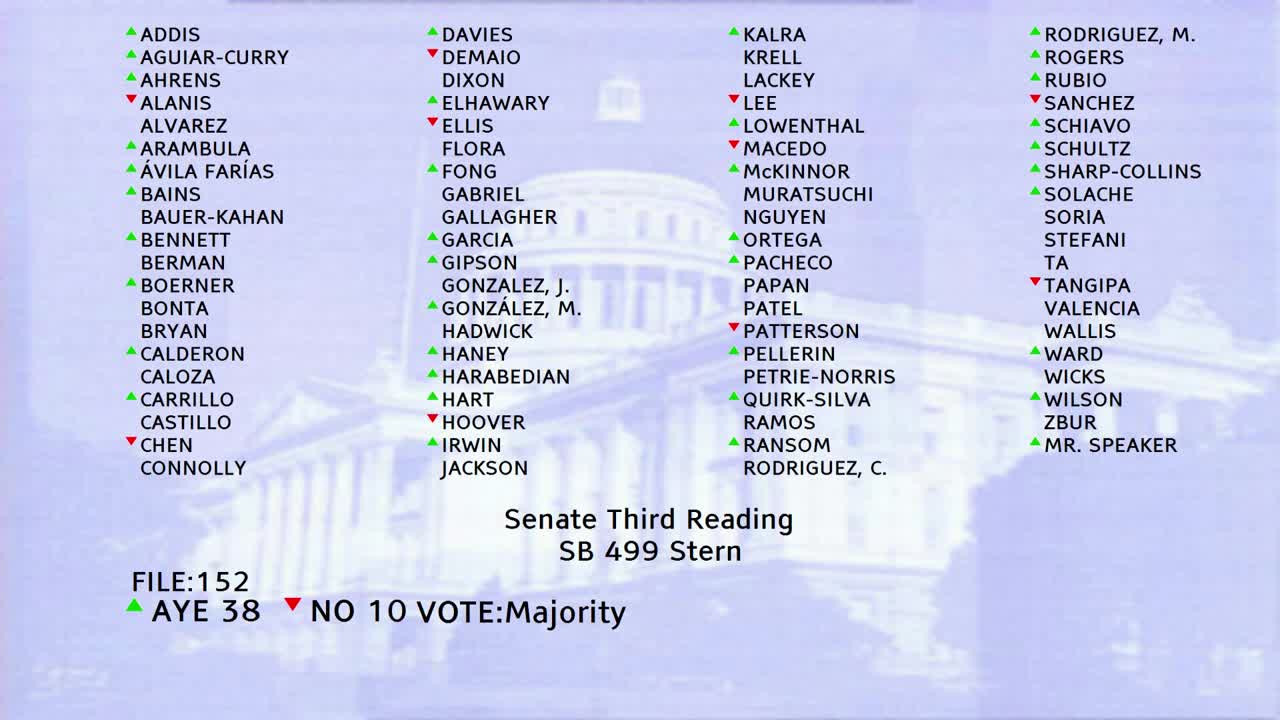
Bill Author

Bill Co-Author(s):