SB 787: Energy: equitable clean energy supply chains and industrial policy in California.
- Session Year: 2025-2026
- House: Senate
- Latest Version Date: 2025-09-18
Current Status:
Failed
(2026-03-02: Veto sustained.)
Introduced
In Committee
Awaiting First Chamber Vote
Passed First Chamber
In Committee
Awaiting Second Chamber Vote
Passed Second Chamber
Enacted
Existing law requires the State Energy Resources Conservation and Development Commission (Energy Commission) to adopt, on a biennial basis, an integrated energy policy report that contains an overview of major energy trends and issues facing the state, including supply, demand, pricing, reliability, efficiency, and impacts on public health and safety, the economy, resources, and the environment. Existing law requires that the report present policy recommendations based on an in-depth and integrated analysis of the most current and pressing energy issues facing the state.
This bill would require the Energy Commission, on or before March 1, 2027, to designate a person within the Energy Commission or identify and retain an external candidate to serve as the Senior Counselor on Industrial Policy and Clean Energy Development, and would require the senior counselor to, among other things, convene working groups that focus on certain issues, as provided. The bill would require the Energy Commission, the Governors Office of Business and Economic Development, the Labor and Workforce Development Agency, the Public Utilities Commission, the Department of General Services, and the office of the Treasurer, on or before March 1, 2027, to enter into a memorandum of understanding on equitable clean energy supply chains and industrial policy in California with specified goals and provisions, as provided. The bill would require the senior counselor to track and coordinate the work under the memorandum of understanding and to prepare an annual report summarizing the key findings and recommendations resulting from that work. The bill would require that the report be presented at a public meeting of the Energy Commission and be published on the Energy Commissions internet website. The bill would establish in the State Treasury the Equitable Clean Energy Supply Chain and Industrial Policy Fund and would, upon appropriation by the Legislature, authorize the moneys in the fund to be expended for purposes of the bill.
Existing law requires the State Energy Resources Conservation and Development Commission (Energy Commission) to adopt, on a biennial basis, an integrated energy policy report that contains an overview of major energy trends and issues facing the state, including supply, demand, pricing, reliability, efficiency, and impacts on public health and safety, the economy, resources, and the environment. Existing law requires that the report present policy recommendations based on an in-depth and integrated analysis of the most current and pressing energy issues facing the state.
This bill would require the Energy Commission, on or before March 1, 2026, 2027, to designate a person, person within the Energy Commission, Commission or identify and retain an external candidate to serve as the Senior Counselor on Industrial Policy and Clean Energy Development, and would require the senior counselor to, among other things, convene working groups that focus on certain issues, as provided. The bill would require the Energy Commission, the Governors Office of Business and Economic Development, the Labor and Workforce Development Agency, the Public Utilities Commission, the Department of General Services, and the office of the Treasurer, on or before March 1, 2026, 2027, to enter into a memorandum of understanding on equitable clean energy supply chains and industrial policy in California with specified goals and provisions, as provided. The bill would require the senior counselor to track and coordinate the work under the memorandum of understanding and to prepare an annual report summarizing the key findings and recommendations resulting from that work. The bill would require that the report be presented at a public meeting of the Energy Commission and be published on the Energy Commissions internet website. The bill would establish in the State Treasury the Equitable Clean Energy Supply Chain and Industrial Policy Fund and would, upon appropriation by the Legislature, authorize the moneys in the fund to be expended for purposes of the bill.
Existing law requires the State Energy Resources Conservation and Development Commission (Energy Commission) to adopt, on a biennial basis, an integrated energy policy report that contains an overview of major energy trends and issues facing the state, including supply, demand, pricing, reliability, efficiency, and impacts on public health and safety, the economy, resources, and the environment. Existing law requires that the report present policy recommendations based on an in-depth and integrated analysis of the most current and pressing energy issues facing the state.
This bill would require the Energy Commission, on or before March 1, 2026, to designate a person, within the Energy Commission, to serve as the Senior Counselor on Industrial Policy and Clean Energy Development, and would require the senior counselor to, among other things, convene working groups that focus on certain issues, as provided. The bill would require the Energy Commission, the Governors Office of Business and Economic Development, the Labor and Workforce Development Agency, the Public Utilities Commission, the Department of Water Resources, the Department of General Services, and the office of the Treasurer, on or before March 1, 2026, to enter into a memorandum of understanding on equitable clean energy supply chains and industrial policy in California with specified goals and provisions, as provided. The bill would require the senior counselor to track and coordinate the work taken under the memorandum of understanding and to prepare an annual report summarizing the key findings and recommendations resulting from that work. The bill would require that the report be presented at a public meeting of the Energy Commission and be published on the Energy Commissions internet website. The bill would establish in the State Treasury the Equitable Clean Energy Supply Chain and Industrial Policy Fund and would, upon appropriation by the Legislature, authorize the moneys in the fund be expended for purposes of the bill.
Existing law requires the State Energy Resources Conservation and Development Commission (Energy Commission) to adopt, on a biennial basis, an integrated energy policy report that contains an overview of major energy trends and issues facing the state, including supply, demand, pricing, reliability, efficiency, and impacts on public health and safety, the economy, resources, and the environment. Existing law requires that the report to present policy recommendations based on an in-depth and integrated analysis of the most current and pressing energy issues facing the state.
This bill would require the commission, Energy Commission, on or before March 1, 2026, to designate a person, within the commission, Energy Commission, to serve as the Senior Counselor on Industrial Policy and Clean Energy Development Development, and would specify require the senior counselors duties. The bill would require the Senior Counselor on Industrial Policy and Clean Energy Development to counselor to, among other things, convene working groups that focus on certain issues, as provided. The bill would require the commission, Energy Commission, the Governors Office of Business and Economic Development, the Labor and Workforce Development Agency, the Public Utilities Commission, the Department of Water Resources, the Department of General Services, and the office of the Treasurer, on or before March 1, 2026, to enter into an a memorandum of understanding on equitable clean energy supply chains and industrial policy in California to, among other things, review, investigate, and develop strategies for building integrated industrial bases in California to support the zero-emission vehicle and battery supply chain industries, offshore wind and offshore wind component industries, and building decarbonization and heat pump industries through industrial planning and public investment, procurement, and subsidization, with specified goals and provisions, as provided. The bill would require the Senior Counselor on Industrial Policy and Clean Energy Development senior counselor to track and coordinate the work taken under the memorandum of understanding and to prepare an annual report summarizing the key findings and recommendations resulting from that work. The bill would require that the report be presented at a public meeting of the commission Energy Commission and be published on the commissions Energy Commissions internet website. The bill would establish in the State Treasury the Equitable Clean Energy Supply Chain and Industrial Policy Fund and would, upon appropriation by the Legislature, authorize the moneys in the fund be expended for the purposes of the bill.
Existing law requires the State Energy Resources Conservation and Development Commission to adopt, on a biennial basis, an integrated energy policy report that contains an overview of major energy trends and issues facing the state, including supply, demand, pricing, reliability, efficiency, and impacts on public health and safety, the economy, resources, and the environment. Existing law requires the report to present policy recommendations based on an in-depth and integrated analysis of the most current and pressing energy issues facing the state.
This bill would require the commission, on or before March 1, 2026, to designate a person, within the commission, to serve as the Senior Counselor on Industrial Policy and Clean Energy Development and would specify the senior counselors duties. The bill would require the Senior Counselor on Industrial Policy and Clean Energy Development to convene working groups that focus on certain issues, as provided. The bill would require the commission, the Governors Office of Business and Economic Development, the Secretary of Labor, Labor and Workforce Development Agency, the Public Utilities Commission, the Department of Water Resources, the Department of General Services, and the office of the Treasurer, on or before March 1, 2026, to enter into an a memorandum of understanding on equitable clean energy supply chains and industrial policy in California to, among other things, review, investigate, and develop strategies for building integrated industrial bases in California to support the zero-emission vehicle and battery supply chain industries, offshore wind and offshore wind component industries, and building decarbonization and heat pump industries through industrial planning and public investment, procurement, and subsidization, as provided. The bill would require the Senior Counselor on Industrial Policy and Clean Energy Development to track and coordinate the work taken under the memorandum of understanding and to prepare an annual report summarizing the key findings and recommendations resulting from that work. The bill would require that the report be presented at a public meeting of the commission and be published on the commissions internet website. The bill would establish in the State Treasury the Equitable Clean Energy Supply Chain and Industrial Policy Fund and would, upon appropriation by the Legislature, authorize the moneys in the fund be expended for the purposes of the bill.
Existing law requires the State Energy Resources Conservation and Development Commission to adopt, on a biennial basis, an integrated energy policy report that contains an overview of major energy trends and issues facing the state, including supply, demand, pricing, reliability, efficiency, and impacts on public health and safety, the economy, resources, and the environment. Existing law requires the report to present policy recommendations based on an in-depth and integrated analysis of the most current and pressing energy issues facing the state.
This bill would require the commission, on or before March 1, 2026, to designate a person, within the commission, to serve as the Senior Counselor on Industrial Policy and Clean Energy Development and would specify the senior counselors duties. The bill would require the Senior Counselor on Industrial Policy and Clean Energy Development to convene working groups that focus on certain issues, as provided. The bill would require the senior counselor, on or before March 1, 2026, to convene the Task Force commission, the Governors Office of Business and Economic Development, the Secretary of Labor, the Public Utilities Commission, the Department of Water Resources, the Department of General Services, and the office of the Treasurer, on or before March 1, 2026, to enter into an a memorandum of understanding on Equitable Clean Energy Supply Chains and Industrial Policy in California, as provided, and would specify the duties and responsibilities of the task force. The bill would require the task force, on or before June 1, 2027, to submit to the Legislature a report on, among other things, its recommendations on strategies that would maximize the impact of state funds on promoting certain clean energy industries. The bill would require the Senior Counselor on Infrastructure, upon the issuance of the report, but on or before January 1, 2028, to convene certain state agencies to develop a workplan to implement the recommendations made in the report. The bill would require the senior counselor to coordinate the implementation of the workplan and would require the senior counselor, on or before June 1, 2028, and annually thereafter, to submit to the Legislature a report documenting the progress on the implementation of the recommendations. equitable clean energy supply chains and industrial policy in California to, among other things, review, investigate, and develop strategies for building integrated industrial bases in California to support the zero-emission vehicle and battery supply chain industries, offshore wind and offshore wind component industries, and building decarbonization and heat pump industries through industrial planning and public investment, procurement, and subsidization, as provided. The bill would require the Senior Counselor on Industrial Policy and Clean Energy Development to track and coordinate the work taken under the memorandum of understanding and to prepare an annual report summarizing the key findings and recommendations resulting from that work. The bill would require that the report be presented at a public meeting of the commission and be published on the commissions internet website. The bill would establish in the State Treasury the Equitable Clean Energy Supply Chain and Industrial Policy Fund and would, upon appropriation by the Legislature, authorize the moneys in the fund be expended for the purposes of the bill.
Existing law requires the State Energy Resources Conservation and Development Commission to adopt, on a biennial basis, an integrated energy policy report that contains an overview of major energy trends and issues facing the state, including supply, demand, pricing, reliability, efficiency, and impacts on public health and safety, the economy, resources, and the environment. Existing law requires the report to present policy recommendations based on an in-depth and integrated analysis of the most current and pressing energy issues facing the state.
This bill would require the commission, on or before March 1, 2026, to designate a person, within the commission, to serve as the Senior Counselor on Industrial Policy and Clean Energy Development and would specify the senior counselors duties. The bill would require the senior counselor, on or before March 1, 2026, to convene the Task Force on Equitable Clean Energy Supply Chains and Industrial Policy in California, as provided, and would specify the duties and responsibilities of the task force. The bill would require the task force, on or before June 1, 2027, to submit to the Legislature a report on, among other things, its recommendations on strategies that would maximize the impact of state funds on promoting certain clean energy industries. The bill would require the Senior Counselor on Infrastructure, upon the issuance of the report, but on or before January 1, 2028, to convene certain state agencies to develop a workplan to implement the recommendations made in the report. The bill would require the senior counselor to coordinate the implementation of the workplan and would require the senior counselor, on or before June 1, 2028, and annually thereafter, to submit to the Legislature a report documenting the progress on the implementation of the recommendations. The bill would establish in the State Treasury the Equitable Clean Energy Supply Chain and Industrial Policy Fund and would, upon appropriation by the Legislature, authorize the moneys in the fund be expended for the purposes of the bill.
(a)The Legislature finds and declares all of the following:
(1)California has ambitious goals for building a new, green economy that accelerates clean energy growth and provides quality jobs for its citizens.
(2)Section 454.53 of the Public Utilities Code requires that renewable and zero-carbon energy resources supply 100 percent of retail electricity sales by 2045.
(3)In 2020, Governor Newsom signed Executive Order No. N-79-20, which required all light-duty vehicles sold in California to be zero emission by 2035.
(4)In 2022 the Blue Ribbon Commission on Lithium Extraction in California issued a report stating that the Salton Sea geothermal resource area is well positioned to become a competitive source of lithium that could satisfy more than one-third of todays worldwide lithium demand. These resources could also support a California-based battery manufacturing supply chain that provides high-wage jobs in the state.
(5)The State Energy Resources Conservation and Development Commission has set a goal of deploying 2,000 to 5,000 megawatts (MW), inclusive, of offshore wind by 2030 and 25,000 MW by 2045, enough electricity to power 3,750,000 homes initially and 25,000,000 homes by mid-century. In its Assembly Bill 525 Offshore Wind Strategic Plan, the commission estimates 2,375 to 8,280 jobs, inclusive, created in this sector by 2030 and 5,063 to 17,950 jobs, inclusive, by 2045. The amount and longevity of job growth is highly dependent on how much of the supply chain California is able to attract.
(6)Chapter 314 of the Statutes of 2023 requires the commission, in consultation with specified state agencies, to conduct a study on the feasibility of achieving 50 percent and 65 percent in-state assembly and manufacturing of offshore wind energy projects and specified federal domestic content thresholds for offshore wind energy projects and to submit a report on the study to the Governor and the Legislature on or before December 31, 2027.
(7)In a letter to the State Air Resources Board in 2022, Governor Newsom declared the need for 3,000,000 clean and healthy homes by 2030, and 6,000,000 heat pumps by 2030. Electrified home construction also has the potential to bring significant job growth to California.
(8)Batteries, building decarbonization, and offshore wind are widely understood to be critical clean energy sectors. Yet numerous recent reports, including Financing a Climate-Safe Future: Low- and Moderate-Income Residential Building Decarbonization (August 2023), authored by multiple organizations, The Cost of Offshore Wind Energy in the United States From 2025 to 2050 (August 2024), authored by the National Renewable Energy Laboratory, and Powering Prosperity: Building an Inclusive Lithium Supply Chain in Californias Salton Sea Region (March 2024), authored by New Energy Nexus, show that the battery, heat pump, and offshore wind industries are not on track to achieve deployment rates at pace with climate goals, scale in-state production and jobs, or bring down costs to consumers under current business models.
(9)In 2023, Governor Newsom signed Executive Order No. N-8-23, which ordered the Senior Counselor on Infrastructure to convene an Infrastructure Strike Team to work across state agencies to accelerate the development of clean infrastructure, including in the clean energy sector, across the state. One of the stated goals of this effort is to create high-quality, broadly accessible jobs in California, and to ensure those jobs are accessible to California communities that have suffered inequitable infrastructure development and a disproportionate burden of negative impacts from development.
(10)Chapter 135 of the Statutes of 2017 requires the California Workforce Development Board to present a report to the Legislature on strategies to help industry, workers, and communities transition to economic and labor-market changes related to statewide greenhouse gas emissions reduction goals. The resulting report, issued by the University of California, Berkeley Labor Center, provides strategies for creating high road jobs in California, which this act seeks to build upon.
(11)On February 26, 2025, Governor Newsom released a California Jobs First Economic Blueprint to guide the states investments in key sectors to drive sustainable economic growth, innovation, and access to good-paying jobs over the next decade. Batteries, electric vehicles, offshore wind, and critical materials are among the industries named for prioritization in the blueprint and in most of the Jobs First Collaboratives regional plans.
(12)At present, no state-led interagency process exists to coordinate state agency planning, rulemaking, subsidization, permitting, technical assistance, procurement, and other state administrative functions in the lithium ion battery, building decarbonization, and offshore wind industries. The lack of such processes has been credited by stakeholders as a significant limiting factor to accelerating clean energy deployment, developing in-state supply chains and high road jobs, and ensuring affordability of new clean energy technologies to ratepayers and working class communities.
(13)At present, no regular and ongoing state-led process exists to coordinate industry stakeholders, including clean energy equipment and component manufacturers, clean energy developers, labor, communities, environmental organizations, and other key stakeholders, to identify barriers to in-state industrial development and to inform state level industry planning for batteries, offshore wind, and building decarbonization. Numerous national and subnational governments around the world have recognized the need for embedding key industry stakeholders into industrial policy making processes.
(b)It is the intent of the Legislature to create new formalized partnerships between state agencies, labor, community organizations, environmental organizations, clean energy industry representatives, local governments, and academic institutions to facilitate a thoughtful consideration of comprehensive industrial policies to support all of the following:
(1)Building integrated industrial bases in California to support the zero-emission vehicle and battery supply chain industries, offshore wind and offshore wind component industries, and building decarbonization and heat pump industries through industrial planning, public investment, procurement, and subsidization.
(2)Accelerating deployment of battery, heat pump, and offshore wind technologies at scale.
(3)Creating high road manufacturing, installation, and construction jobs for California workers in the battery, heat pump, and offshore wind supply chains.
(4)Creating pathways to high road jobs for workers from disadvantaged and Native American communities in California through apprenticeship programs, preapprenticeship programs, and joint labor-management training programs.
(5)Ensuring environmental justice and responsible material sourcing in the build out of listed supply chains.
(6)Reducing the cost of electricity, energy products, and energy services for public purchasers and all Californians, but especially low-income customers, disadvantaged communities, and tribal communities.
(c)It is the intent of the Legislature to achieve in-state production of manufactured products, scaled deployment of clean energy resources, and lower unit prices of needed goods and services for public entities and low-income consumers through the use of new market-building industrial policies, including, but not limited to, all of the following:
(1)State stockpiles of critical equipment.
(2)State advanced-purchase agreements.
(3)Central and leveraged procurement.
(4)State enterprises.
(5)State authorities.
(6)Public-private joint ventures.
(7)Public equity stakes.
(8)Price management.
(9)Bond issuance.
(10)Novel forms of public financing for industrial development.
SEC. 2.Chapter 8.5 (commencing with Section 25730) is added to Division 15 of the Public Resources Code, to read:8.5.Senior Counselor on Industrial Policy and Clean Energy Development25730.For purposes of this chapter, all of the following definitions apply:
(a)Fund means the Equitable Clean Energy Supply Chain and Industrial Policy Fund established pursuant to Section 25733.
(b)High road job means employment that is consistent with the job quality standards and employment practices set forth in subdivision (s) of Section 14005 of the Unemployment Insurance Code.
(c)Senior counselor means the Senior Counselor on Industrial Policy and Clean Energy Development designated pursuant to Section 25731.
(d)Strategic industries means the offshore wind, battery, and building decarbonization and heat pump industries.
25731.(a)On or before March 1, 2027, the commission shall designate a person within the commission or identify and retain an external candidate to serve as the Senior Counselor on Industrial Policy and Clean Energy Development.
(b)The senior counselor shall do all of the following:
(1)Collect data relevant to the development of the strategic industries, including firm and consumer costs, prices, and technological development pathway data, industrial economic analyses, technology deployment rates, and workforce development needs, and publish the information on a publicly accessible, commission-approved internet website.
(2)Coordinate firms, industry associations, technical assistance providers, and labor unions in relevant industries, including, but not limited to, original equipment manufacturers, suppliers, installers, and distribution networks, to develop a synergistic and integrated California clean energy and decarbonization production and deployment ecosystem, and to identify priority industry segments for development to achieve vertically and horizontally integrated in-state industry growth.
(3)In partnership with the Governors Office of Business and Economic Development and the Office of Land Use and Climate Innovation, serve as a central point of contact between state agencies and companies in strategic industries that are interested in siting, expanding, or retaining production facilities in California, and compile and offer streamlined information about financial and site selection assistance, workforce development and apprenticeship resources, and other supportive state, local, and nonprofit services for those companies.
(4)Convene at least two public meetings per year at which state agencies discuss their ongoing and planned work in the strategic industries, and public comments and recommendations are solicited regarding how state agencies can most effectively facilitate the accelerated deployment of clean energy technologies, the reduction of prices for California ratepayers, and the creation of high road jobs in strategic industries. The meetings shall include reports from state agencies party to the memorandum of understanding described in subdivision (a) of Section 25732 on the status of activities conducted pursuant to the memorandum of understanding, reports from members of the working groups listed in paragraph (5), and public comment.
(5)(A)Convene working groups focused on specific issues, including home batteries, vehicle batteries, grid-scale batteries, battery recycling, offshore wind, and building decarbonization. These working groups may include, at the senior counselors discretion, representatives of state agencies, labor, private firms, environmental protection advocates, environmental justice groups, tribal communities, and other experts and stakeholders, as appropriate. The working groups shall identify and evaluate potential administrative, programmatic, statutory, and regulatory changes to accelerate the in-state growth of the relevant supply chains, accelerate the deployment of clean energy technology, increase the availability of high road jobs, and lower prices for low-income Californians, and promote environmental justice, including responsible materials sourcing, processing, repair, reuse, and recycling.
(B)In identifying potential statutory and regulatory changes pursuant to subparagraph (A), the working groups shall consider all of the following:
(i)State stockpiles of critical equipment.
(ii)Direct, leveraged, or central procurement of critical equipment.
(iii)Advanced market commitments by state or state-regulated entities.
(iv)Public equity and direct public investment, including through public pension funds in strategic private companies.
(v)The establishment of public-private joint ventures and state-owned enterprises at various stages of supply chains.
(vi)The identification and coordination of strategic state pension fund project investment targets.
(vii)Bond issuance and development of state-backed financial products.
(viii)Price management policies.
25732.(a)On or before March 1, 2027, the commission, the Governors Office of Business and Economic Development, the Labor and Workforce Development Agency, the Public Utilities Commission, the Department of General Services, and the office of the Treasurer shall enter into a memorandum of understanding on equitable clean energy supply chains and industrial policy in California with all of the following goals:
(1)Building integrated industrial bases in California to support the zero-emission vehicle and battery supply chain industries, offshore wind and offshore wind component industries, and building decarbonization and heat pump industries through industrial planning, public investment, procurement, and subsidization.
(2)Accelerating deployment of battery, heat pump, and offshore wind technologies at scale.
(3)Creating high road jobs in the manufacturing, installation, and construction industries for California workers in the battery, heat pump, and offshore wind supply chains.
(4)Creating pathways to high road jobs for workers from disadvantaged and Native American communities in California through leveraging registered apprenticeship programs, preapprenticeship programs, and joint labor-management training programs.
(5)Ensuring environmental justice in the build out of listed supply chains.
(6)Reducing the cost of electricity, energy products, and energy services for public purchasers and all Californians, but especially low-income customers, disadvantaged communities, and tribal communities.
(b)In furtherance of the goals specified in subdivision (a), the memorandum of understanding shall include provisions to accomplish all the following:
(1)Survey public and private spending for the electric vehicle and battery supply chain industries, offshore wind industry, and building decarbonization and heat pump industries, and provide recommendations on strategies to maximize the impact of state funds in strategically developing vertically and horizontally integrated in-state supply chains and, especially, the development of priority industry segments as identified in paragraph (2) of subdivision (b) of Section 25731. These recommendations shall include research and development programs, economic development programs, government procurement, direct industry incentives, consumer incentives, and utility and infrastructure programs.
(2)Identify how to best coordinate all of the following activities relating to zero-emission vehicle and battery supply chain industries, offshore wind and offshore wind component industries, and building decarbonization and heat pump industries with relevant state, federal, and local agencies:
(A)Research and development.
(B)Economic development programs.
(C)Industry incentives.
(D)Utility and infrastructure programs.
(E)Siting services to achieve values-driven supply chain development.
(F)Integration of workforce standards, community benefits agreement models, workforce training and targeted hiring programs into state awarding processes identified as relevant to the battery, building decarbonization, and offshore wind supply chains.
(3)Identify the need for additional research to fulfill long-term goals in the strategic industries described in subdivision (a), which may include, but shall not be limited to, supply chain reviews, workforce needs assessments, market research, and economic and environmental impact modeling.
(c)The senior counselor shall track and coordinate the work under the memorandum of understanding. The senior counselor shall prepare an annual report summarizing the key findings and recommendations resulting from activities undertaken pursuant to the memorandum of understanding. The report shall be presented annually at a public meeting of the commission and published annually on the commissions internet website.
25733.(a)There is hereby established in the State Treasury the Equitable Clean Energy Supply Chain and Industrial Policy Fund.
(b)Moneys that may be deposited into the fund include, but are not limited to, both of the following:
(1)Moneys received from the federal government that are authorized to be spent for purposes of this chapter.
(2)Donations from private entities, nonprofits, or local governments for purposes of this chapter.
(c)Upon appropriation by the Legislature, moneys in the fund shall be expended for purposes of this chapter.
(a)The Legislature finds and declares all of the following:
(1)California has ambitious goals for building a new, green economy that accelerates clean energy growth and provides quality jobs for its citizens.
(2)Section 454.53 of the Public Utilities Code requires that renewable and zero-carbon energy resources supply 100 percent of retail electricity sales by 2045.
(3)In 2020, Governor Newsom signed Executive Order No. N-79-20, which required all light-duty vehicles sold in California to be zero emission by 2035.
(4)In 2022 the Blue Ribbon Commission on Lithium Extraction in California issued a report stating that the Salton Sea geothermal resource area is well positioned to become a competitive source of lithium that could satisfy more than one-third of todays worldwide lithium demand. These resources could also support a California-based battery manufacturing supply chain that provides high-wage jobs in the state.
(5)The State Energy Resources Conservation and Development Commission has set a goal of deploying 2,000 to 5,000 megawatts (MW), inclusive, of offshore wind by 2030 and 25,000 MW by 2045, enough electricity to power 3,750,000 homes initially and 25,000,000 homes by mid-century. In its Assembly Bill 525 Offshore Wind Strategic Plan, the commission estimates 2,375 to 8,280 jobs, inclusive, created in this sector by 2030 and 5,063 to 17,950 jobs, inclusive, by 2045. The amount and longevity of job growth is highly dependent on how much of the supply chain California is able to attract.
(6)Chapter 314 of the Statutes of 2023 requires the commission, in consultation with specified state agencies, to conduct a study on the feasibility of achieving 50 percent and 65 percent in-state assembly and manufacturing of offshore wind energy projects and specified federal domestic content thresholds for offshore wind energy projects and to submit a report on the study to the Governor and the Legislature on or before December 31, 2027.
(7)In a letter to the State Air Resources Board in 2022, Governor Newsom declared the need for 3,000,000 clean and healthy homes by 2030, and 6,000,000 heat pumps by 2030. Electrified home construction also has the potential to bring significant job growth to California.
(8)Batteries, building decarbonization, and offshore wind are widely understood to be critical clean energy sectors. Yet numerous recent reports, including Financing a Climate-Safe Future: Low- and Moderate-Income Residential Building Decarbonization (August 2023), authored by multiple organizations, The Cost of Offshore Wind Energy in the United States From 2025 to 2050 (August 2024), authored by the National Renewable Energy Laboratory, and Powering Prosperity: Building an Inclusive Lithium Supply Chain in Californias Salton Sea Region (March 2024), authored by New Energy Nexus, show that the battery, heat pump, and offshore wind industries are not on track to achieve deployment rates at pace with climate goals, scale in-state production and jobs, or bring down costs to consumers under current business models.
(9)In 2023, Governor Newsom signed Executive Order No. N-8-23, which ordered the Senior Counselor on Infrastructure to convene an Infrastructure Strike Team to work across state agencies to accelerate the development of clean infrastructure, including in the clean energy sector, across the state. One of the stated goals of this effort is to create high-quality, broadly accessible jobs in California, and to ensure those jobs are accessible to California communities that have suffered inequitable infrastructure development and a disproportionate burden of negative impacts from development.
(10)Chapter 135 of the Statutes of 2017 requires the California Workforce Development Board to present a report to the Legislature on strategies to help industry, workers, and communities transition to economic and labor-market changes related to statewide greenhouse gas emissions reduction goals. The resulting report, issued by the University of California, Berkeley Labor Center, provides strategies for creating high road jobs in California, which this act seeks to build upon.
(11)On February 26, 2025, Governor Newsom released a California Jobs First Economic Blueprint to guide the states investments in key sectors to drive sustainable economic growth, innovation, and access to good-paying jobs over the next decade. Batteries, electric vehicles, offshore wind, and critical materials are among the industries named for prioritization in the blueprint and in most of the Jobs First Collaboratives regional plans.
(12)At present, no state-led interagency process exists to coordinate state agency planning, rulemaking, subsidization, permitting, technical assistance, procurement, and other state administrative functions in the lithium ion battery, building decarbonization, and offshore wind industries. The lack of such processes has been credited by stakeholders as a significant limiting factor to accelerating clean energy deployment, developing in-state supply chains and high road jobs, and ensuring affordability of new clean energy technologies to ratepayers and working class communities.
(13)At present, no regular and ongoing state-led process exists to coordinate industry stakeholders, including clean energy equipment and component manufacturers, clean energy developers, labor, communities, environmental organizations, and other key stakeholders, to identify barriers to in-state industrial development and to inform state level industry planning for batteries, offshore wind, and building decarbonization. Numerous national and subnational governments around the world have recognized the need for embedding key industry stakeholders into industrial policy making processes.
(b)It is the intent of the Legislature to create new formalized partnerships between state agencies, labor, community organizations, environmental organizations, clean energy industry representatives, local governments, and academic institutions to facilitate a thoughtful consideration of comprehensive industrial policies to support all of the following:
(1)Building integrated industrial bases in California to support the zero-emission vehicle and battery supply chain industries, offshore wind and offshore wind component industries, and building decarbonization and heat pump industries through industrial planning, public investment, procurement, and subsidization.
(2)Accelerating deployment of battery, heat pump, and offshore wind technologies at scale.
(3)Creating high road manufacturing, installation, and construction jobs for California workers in the battery, heat pump, and offshore wind supply chains.
(4)Creating pathways to high road jobs for workers from disadvantaged and Native American communities in California through apprenticeship programs, preapprenticeship programs, and joint labor-management training programs.
(5)Ensuring environmental justice and responsible material sourcing in the build out of listed supply chains.
(6)Reducing the cost of electricity, energy products, and energy services for public purchasers and all Californians, but especially low-income customers, disadvantaged communities, and tribal communities.
(c)It is the intent of the Legislature to achieve in-state production of manufactured products, scaled deployment of clean energy resources, and lower unit prices of needed goods and services for public entities and low-income consumers through the use of new market-building industrial policies, including, but not limited to, all of the following:
(1)State stockpiles of critical equipment.
(2)State advanced-purchase agreements.
(3)Central and leveraged procurement.
(4)State enterprises.
(5)State authorities.
(6)Public-private joint ventures.
(7)Public equity stakes.
(8)Price management.
(9)Bond issuance.
(10)Novel forms of public financing for industrial development.
SEC. 2.Chapter 8.5 (commencing with Section 25730) is added to Division 15 of the Public Resources Code, to read:8.5.Senior Counselor on Industrial Policy and Clean Energy Development25730.For purposes of this chapter, all of the following definitions apply:
(a)Fund means the Equitable Clean Energy Supply Chain and Industrial Policy Fund established pursuant to Section 25733.
(b)High road job means employment that is consistent with the job quality standards and employment practices set forth in subdivision (s) of Section 14005 of the Unemployment Insurance Code.
(c)Senior counselor means the Senior Counselor on Industrial Policy and Clean Energy Development designated pursuant to Section 25731.
(d)Strategic industries means the offshore wind, battery, and building decarbonization and heat pump industries.
25731.(a)On or before March 1, 2026, 2027, the commission shall designate a person, person within the commission, commission or identify and retain an external candidate to serve as the Senior Counselor on Industrial Policy and Clean Energy Development.
(b)The senior counselor shall do all of the following:
(1)Collect data relevant to the development of the strategic industries, including firm and consumer costs, prices, and technological development pathway data, industrial economic analyses, technology deployment rates, and workforce development needs, and publish the information on a publicly accessible, commission-approved internet website.
(2)Coordinate firms, industry associations, technical assistance providers, and labor unions in relevant industries, including, but not limited to, original equipment manufacturers, suppliers, installers, and distribution networks, to develop a synergistic and integrated California clean energy and decarbonization production and deployment ecosystem, and to identify priority industry segments for development to achieve vertically and horizontally integrated in-state industry growth.
(3)In partnership with the Governors Office of Business and Economic Development and the Office of Land Use and Climate Innovation, serve as a central point of contact between state agencies and companies in strategic industries that are interested in siting, expanding, or retaining production facilities in California, and compile and offer streamlined information about financial and site selection assistance, workforce development and apprenticeship resources, and other supportive state, local, and nonprofit services for those companies.
(4)Convene at least two public meetings per year at which state agencies discuss their ongoing and planned work in the strategic industries, and public comments and recommendations are solicited regarding how state agencies can most effectively facilitate the accelerated deployment of clean energy technologies, the reduction of prices for California ratepayers, and the creation of high road jobs in strategic industries. The meetings shall include reports from state agencies party to the memorandum of understanding described in subdivision (a) of Section 25732 on the status of activities conducted pursuant to the memorandum of understanding, reports from members of the working groups listed in paragraph (5), and public comment.
(5)(A)Convene working groups focused on specific issues, including home batteries, vehicle batteries, grid-scale batteries, battery recycling, offshore wind, and building decarbonization. These working groups may include, at the senior counselors discretion, representatives of state agencies, labor, private firms, environmental protection advocates, environmental justice groups, tribal communities, and other experts and stakeholders, as appropriate. The working groups shall identify and evaluate potential administrative, programmatic, statutory, and regulatory changes to accelerate the in-state growth of the relevant supply chains, accelerate the deployment of clean energy technology, increase the availability of high road jobs, and lower prices for low-income Californians, and promote environmental justice, including responsible materials sourcing, processing, repair, reuse, and recycling.
(B)In identifying potential statutory and regulatory changes pursuant to subparagraph (A), the working groups shall consider all of the following:
(i)State stockpiles of critical equipment.
(ii)Direct, leveraged, or central procurement of critical equipment.
(iii)Advanced market commitments by state or state-regulated entities.
(iv)Public equity and direct public investment, including through public pension funds in strategic private companies.
(v)The establishment of public-private joint ventures and state-owned enterprises at various stages of supply chains.
(vi)The identification and coordination of strategic state pension fund project investment targets.
(vii)Bond issuance and development of state-backed financial products.
(viii)Price management policies.
25732.(a)On or before March 1, 2026, 2027, the commission, the Governors Office of Business and Economic Development, the Labor and Workforce Development Agency, the Public Utilities Commission, the Department of General Services, and the office of the Treasurer shall enter into a memorandum of understanding on equitable clean energy supply chains and industrial policy in California with all of the following goals:
(1)Building integrated industrial bases in California to support the zero-emission vehicle and battery supply chain industries, offshore wind and offshore wind component industries, and building decarbonization and heat pump industries through industrial planning, public investment, procurement, and subsidization.
(2)Accelerating deployment of battery, heat pump, and offshore wind technologies at scale.
(3)Creating high road jobs in the manufacturing, installation, and construction industries for California workers in the battery, heat pump, and offshore wind supply chains.
(4)Creating pathways to high road jobs for workers from disadvantaged and Native American communities in California through leveraging registered apprenticeship programs, preapprenticeship programs, and joint labor-management training programs.
(5)Ensuring environmental justice in the build out of listed supply chains.
(6)Reducing the cost of electricity, energy products, and energy services for public purchasers and all Californians, but especially low-income customers, disadvantaged communities, and tribal communities.
(b)In furtherance of the goals specified in subdivision (a), the memorandum of understanding shall include provisions to accomplish all the following:
(1)Survey public and private spending for the electric vehicle and battery supply chain industries, offshore wind industry, and building decarbonization and heat pump industries, and provide recommendations on strategies to maximize the impact of state funds in strategically developing vertically and horizontally integrated in-state supply chains and, especially, the development of priority industry segments as identified in paragraph (2) of subdivision (b) of Section 25731. These recommendations shall include research and development programs, economic development programs, government procurement, direct industry incentives, consumer incentives, and utility and infrastructure programs.
(2)Identify how to best coordinate all of the following activities relating to zero-emission vehicle and battery supply chain industries, offshore wind and offshore wind component industries, and building decarbonization and heat pump industries with relevant state, federal, and local agencies:
(A)Research and development.
(B)Economic development programs.
(C)Industry incentives.
(D)Utility and infrastructure programs.
(E)Siting services to achieve values-driven supply chain development.
(F)Integration of workforce standards, community benefits agreement models, workforce training and targeted hiring programs into state awarding processes identified as relevant to the battery, building decarbonization, and offshore wind supply chains.
(3)Identify the need for additional research to fulfill long-term goals in the strategic industries described in subdivision (a), which may include, but shall not be limited to, supply chain reviews, workforce needs assessments, market research, and economic and environmental impact modeling.
(c)The senior counselor shall track and coordinate the work under the memorandum of understanding. The senior counselor shall prepare an annual report summarizing the key findings and recommendations resulting from activities undertaken pursuant to the memorandum of understanding. The report shall be presented annually at a public meeting of the commission and published annually on the commissions internet website.
25733.(a)There is hereby established in the State Treasury the Equitable Clean Energy Supply Chain and Industrial Policy Fund.
(b)Moneys that may be deposited into the fund include, but are not limited to, both of the following:
(1)Moneys received from the federal government that are authorized to be spent for purposes of this chapter.
(2)Donations from private entities, nonprofits, or local governments for purposes of this chapter.
(c)Upon appropriation by the Legislature, moneys in the fund shall be expended for purposes of this chapter.
(a)The Legislature finds and declares all of the following:
(1)California has ambitious goals for building a new, green economy that accelerates clean energy growth and provides quality jobs for its citizens.
(2)Section 454.53 of the Public Utilities Code requires that renewable and zero-carbon energy resources supply 100 percent of retail electricity sales by 2045.
(3)In 2020, Governor Newsom signed Executive Order No. N-79-20, which required all light-duty vehicles sold in California to be zero emission by 2035.
(4)In 2022 the Blue Ribbon Commission on Lithium Extraction in California issued a report stating that the Salton Sea geothermal resource area is well positioned to become a competitive source of lithium that could satisfy more than one-third of todays worldwide lithium demand. These resources could also support a California-based battery manufacturing supply chain that provides high-wage jobs in the state.
(5)The State Energy Resources Conservation and Development Commission has set a goal of deploying 2,000 to 5,000 megawatts (MW), inclusive, of offshore wind by 2030 and 25,000 MW by 2045, enough electricity to power 3,750,000 homes initially and 25,000,000 homes by mid-century. In its Assembly Bill 525 Offshore Wind Strategic Plan, the commission estimates 2,375 to 8,280 jobs, inclusive, created in this sector by 2030 and 5,063 to 17,950 jobs, inclusive, by 2045. The amount and longevity of job growth is highly dependent on how much of the supply chain California is able to attract.
(6)Chapter 314 of the Statutes of 2023 requires the commission, in consultation with specified state agencies, to conduct a study on the feasibility of achieving 50 percent and 65 percent in-state assembly and manufacturing of offshore wind energy projects and specified federal domestic content thresholds for offshore wind energy projects and to submit a report on the study to the Governor and the Legislature on or before December 31, 2027.
(7)In a letter to the State Air Resources Board in 2022, Governor Newsom declared the need for 3,000,000 clean and healthy homes by 2030, and 6,000,000 heat pumps by 2030. Electrified home construction also has the potential to bring significant job growth to California.
(8)Batteries, building decarbonization, and offshore wind are widely understood to be critical clean energy sectors. Yet numerous recent reports, including Financing a Climate-Safe Future: Low- and Moderate-Income Residential Building Decarbonization (August 2023), authored by multiple organizations, The Cost of Offshore Wind Energy in the United States From 2025 to 2050 (August 2024), authored by the National Renewable Energy Laboratory, and Powering Prosperity: Building an Inclusive Lithium Supply Chain in Californias Salton Sea Region (March 2024), authored by New Energy Nexus, show that the battery, heat pump, and offshore wind industries are not on track to achieve deployment rates at pace with climate goals, scale in-state production and jobs, or bring down costs to consumers under current business models.
(9)In 2023, Governor Newsom signed Executive Order No. N-8-23, which ordered the Senior Counselor on Infrastructure to convene an Infrastructure Strike Team to work across state agencies to accelerate the development of clean infrastructure, including in the clean energy sector, across the state. One of the stated goals of this effort is to create high-quality, broadly accessible jobs in California, and to ensure those jobs are accessible to California communities that have suffered inequitable infrastructure development and a disproportionate burden of negative impacts from development.
(10)Chapter 135 of the Statutes of 2017 requires the California Workforce Development Board to present a report to the Legislature on strategies to help industry, workers, and communities transition to economic and labor-market changes related to statewide greenhouse gas emissions reduction goals. The resulting report, issued by the University of California, Berkeley Labor Center, provides strategies for creating high road jobs in California, which this act seeks to build upon.
(11)On February 26, 2025, Governor Newsom released a California Jobs First Economic Blueprint to guide the states investments in key sectors to drive sustainable economic growth, innovation, and access to good-paying jobs over the next decade. Batteries, electric vehicles, offshore wind, and critical materials are among the industries named for prioritization in the blueprint and in most of the Jobs First Collaboratives regional plans.
(12)At present, no state-led interagency process exists to coordinate state agency planning, rulemaking, subsidization, permitting, technical assistance, procurement, and other state administrative functions in the lithium ion battery, building decarbonization, and offshore wind industries. The lack of such processes has been credited by stakeholders as a significant limiting factor to accelerating clean energy deployment, developing in-state supply chains and high road jobs, and ensuring affordability of new clean energy technologies to ratepayers and working class communities.
(13)At present, no regular and ongoing state-led process exists to coordinate industry stakeholders, including clean energy equipment and component manufacturers, clean energy developers, labor, communities, environmental organizations, and other key stakeholders, to identify barriers to in-state industrial development and to inform state level industry planning for batteries, offshore wind, and building decarbonization. Numerous national and subnational governments around the world have recognized the need for embedding key industry stakeholders into industrial policy making processes.
(b)It is the intent of the Legislature to create new formalized partnerships between state agencies, labor, community organizations, environmental organizations, clean energy industry representatives, local governments, and academic institutions to facilitate a thoughtful consideration of comprehensive industrial policies to support all of the following:
(1)Building integrated industrial bases in California to support the zero-emission vehicle and battery supply chain industries, offshore wind and offshore wind component industries, and building decarbonization and heat pump industries through industrial planning, public investment, procurement, and subsidization.
(2)Accelerating deployment of battery, heat pump, and offshore wind technologies at scale.
(3)Creating high road manufacturing, installation, and construction jobs for California workers in the battery, heat pump, and offshore wind supply chains.
(4)Creating pathways to high road jobs for workers from disadvantaged and Native American communities in California through apprenticeship programs, preapprenticeship programs, and joint labor-management training programs.
(5)Ensuring environmental justice and responsible material sourcing in the build out of listed supply chains.
(6)Reducing the cost of electricity, energy products, and energy services for public purchasers and all Californians, but especially low-income customers, disadvantaged communities, and tribal communities.
(c)It is the intent of the Legislature to achieve in-state production of manufactured products, scaled deployment of clean energy resources, and lower unit prices of needed goods and services for public entities and low-income consumers through the use of new market-building industrial policies, including, but not limited to, all of the following:
(1)State stockpiles of critical equipment.
(2)State advanced-purchase agreements.
(3)Central and leveraged procurement.
(4)State enterprises.
(5)State authorities.
(6)Public-private joint ventures.
(7)Public equity stakes.
(8)Price management.
(9)Bond issuance.
(10)Novel forms of public financing for industrial development.
SEC. 2.Chapter 8.5 (commencing with Section 25730) is added to Division 15 of the Public Resources Code, to read:8.5.Senior Counselor on Industrial Policy and Clean Energy Development25730.For purposes of this chapter, all of the following definitions apply:
(a)Fund means the Equitable Clean Energy Supply Chain and Industrial Policy Fund established pursuant to Section 25733.
(b)High road job means employment that is consistent with the job quality standards and employment practices set forth in subdivision (s) of Section 14005 of the Unemployment Insurance Code.
(c)Senior counselor means the Senior Counselor on Industrial Policy and Clean Energy Development designated pursuant to Section 25731.
(d)Strategic industries means the offshore wind, battery, and building decarbonization and heat pump industries.
25731.(a)On or before March 1, 2026, the commission shall designate a person, within the commission, to serve as the Senior Counselor on Industrial Policy and Clean Energy Development.
(b)The senior counselor shall do all of the following:
(1)Collect data relevant to the development of the strategic industries, including firm and consumer costs, prices, and technological development pathway data, industrial economic analyses, technology deployment rates, and workforce development needs, and publish the information on a publicly accessible, commission-approved internet website.
(2)Coordinate firms, industry associations, technical assistance providers, and labor unions in relevant industries, including, but not limited to, original equipment manufacturers, suppliers, installers, and distribution networks, to develop a synergistic and integrated California clean energy and decarbonization production and deployment ecosystem, and to identify priority industry segments for development to achieve vertically and horizontally integrated in-state industry growth.
(3)In partnership with the Governors Office of Business and Economic Development and the Office of Land Use and Climate Innovation, serve as a central point of contact between state agencies and companies in strategic industries that are interested in siting, expanding, or retaining production facilities in California, and compile and offer streamlined information about financial and site selection assistance, workforce development and apprenticeship resources, and other supportive state, local, and nonprofit services for those companies.
(4)Convene at least two public meetings per year at which state agencies discuss their ongoing and planned work in the strategic industries, and public comments and recommendations are solicited regarding how state agencies can most effectively facilitate the accelerated deployment of clean energy technologies, the reduction of prices for California ratepayers, and the creation of high road jobs in strategic industries. The meetings shall include reports from state agencies party to the memorandum of understanding described in subdivision (a) of Section 25732 on the status of activities conducted pursuant to the memorandum of understanding, reports from members of the working groups listed in paragraph (5), and public comment.
(5)(A)Convene working groups focused on specific issues, including home batteries, vehicle batteries, grid-scale batteries, battery recycling, offshore wind, and building decarbonization. These working groups may include, at the senior counselors discretion, representatives of state agencies, labor, private firms, environmental protection advocates, environmental justice groups, tribal communities, and other experts and stakeholders, as appropriate. The working groups shall identify and evaluate potential administrative, programmatic, statutory, and regulatory changes to accelerate the in-state growth of the relevant supply chains, accelerate the deployment of clean energy technology, increase the availability of high road jobs, and lower prices for low-income Californians, and promote environmental justice, including responsible materials sourcing, processing, repair, reuse, and recycling.
(B)In identifying potential statutory and regulatory changes pursuant to subparagraph (A), the working groups shall consider all of the following:
(i)State stockpiles of critical equipment.
(ii)Direct, leveraged, or central procurement of critical equipment.
(iii)Advanced market commitments by state or state-regulated entities.
(iv)Public equity and direct public investment, including through public pension funds in strategic private companies.
(v)The establishment of public-private joint ventures and state-owned enterprises at various stages of supply chains.
(vi)The identification and coordination of strategic state pension fund project investment targets.
(vii)Bond issuance and development of state-backed financial products.
(viii)Price management policies.
25732.(a)On or before March 1, 2026, the commission, the Governors Office of Business and Economic Development, the Labor and Workforce Development Agency, the Public Utilities Commission, the Department of Water Resources, the Department of General Services, and the office of the Treasurer shall enter into a memorandum of understanding on equitable clean energy supply chains and industrial policy in California with all of the following goals:
(1)Building integrated industrial bases in California to support the zero-emission vehicle and battery supply chain industries, offshore wind and offshore wind component industries, and building decarbonization and heat pump industries through industrial planning, public investment, procurement, and subsidization.
(2)Accelerating deployment of battery, heat pump, and offshore wind technologies at scale.
(3)Creating high road jobs in the manufacturing, installation, and construction industries for California workers in the battery, heat pump, and offshore wind supply chains.
(4)Creating pathways to high road jobs for workers from disadvantaged and Native American communities in California through leveraging registered apprenticeship programs, preapprenticeship programs, and joint labor-management training programs.
(5)Ensuring environmental justice in the build out of listed supply chains.
(6)Reducing the cost of electricity, energy products, and energy services for public purchasers and all Californians, but especially low-income customers, disadvantaged communities, and tribal communities.
(b)In furtherance of the goals specified in subdivision (a), the memorandum of understanding shall include provisions to accomplish all the following:
(1)Survey public and private spending for the electric vehicle and battery supply chain industries, offshore wind industry, and building decarbonization and heat pump industries, and provide recommendations on strategies to maximize the impact of state funds in strategically developing vertically and horizontally integrated in-state supply chains and, especially, the development of priority industry segments as identified in paragraph (2) of subdivision (b) of Section 25731. These recommendations shall include research and development programs, economic development programs, government procurement, direct industry incentives, consumer incentives, and utility and infrastructure programs.
(2)Identify how to best coordinate all of the following activities relating to zero-emission vehicle and battery supply chain industries, offshore wind and offshore wind component industries, and building decarbonization and heat pump industries with relevant state, federal, and local agencies:
(A)Research and development.
(B)Economic development programs.
(C)Industry incentives.
(D)Utility and infrastructure programs.
(E)Siting services to achieve values-driven supply chain development.
(F)Integration of workforce standards, community benefits agreement models, workforce training and targeted hiring programs into state awarding processes identified as relevant to the battery, building decarbonization, and offshore wind supply chains.
(3)Identify the need for additional research to fulfill long-term goals in the strategic industries described in subdivision (a), which may include, but shall not be limited to, supply chain reviews, workforce needs assessments, market research, and economic and environmental impact modeling.
(c)The senior counselor shall track and coordinate the work under the memorandum of understanding. The senior counselor shall prepare an annual report summarizing the key findings and recommendations resulting from activities undertaken pursuant to the memorandum of understanding. The report shall be presented annually at a public meeting of the commission and published annually on the commissions internet website.
25733.(a)There is hereby established in the State Treasury the Equitable Clean Energy Supply Chain and Industrial Policy Fund.
(b)Moneys that may be deposited into the fund include, but are not limited to, both of the following:
(1)Moneys received from the federal government that are authorized to be spent for purposes of this chapter.
(2)Donations from private entities, nonprofits, or local governments for purposes of this chapter.
(c)Upon appropriation by the Legislature, moneys in the fund shall be expended for purposes of this chapter.
(a)The Legislature finds and declares all of the following:
(1)California has ambitious goals for building a new, green economy that accelerates clean energy growth and provides quality jobs for its citizens.
(2)Section 454.53 of the Public Utilities Code requires that renewable and zero-carbon energy resources supply 100 percent of retail electricity sales by 2045.
(3)In 2020, Governor Newsom signed Executive Order No. N-79-20, that which required all light-duty vehicles sold in California to be zero emission by 2035.
(4)In 2022 the Blue Ribbon Commission on Lithium Extraction in California issued a report stating that the Salton Sea geothermal resource area is well positioned to become a competitive source of lithium that could satisfy more than one-third of todays worldwide lithium demand. These resources could also support a California-based battery manufacturing supply chain that provides high-wage jobs in the state.
(5)The State Energy Resources Conservation and Development Commission has set a goal of deploying 2,000 to 5,000 megawatts (MW), inclusive, of offshore wind by 2030 and 25,000 MW by 2045, enough electricity to power 3,750,000 homes initially and 25,000,000 homes by mid-century. In its Assembly Bill 525 Offshore Wind Strategic Plan, the commission estimates 2,375 to 8,280 jobs, inclusive, created in this sector by 2030 and 5,063 to 17,950 jobs, inclusive, by 2045. The amount and longevity of job growth is highly dependent on how much of the supply chain California is able to attract.
(6)Chapter 314 of the Statutes of 2023 requires the commission, in consultation with specified state agencies, to conduct a study on the feasibility of achieving 50 percent and 65 percent in-state assembly and manufacturing of offshore wind energy projects and specified federal domestic content thresholds for offshore wind energy projects and to submit a report on the study to the Governor and the Legislature on or before December 31, 2027.
(6)(7)In a letter to the State Air Resources Board in 2022, Governor Newsom declared the need for 3,000,000 clean and healthy homes by 2030, and 6,000,000 heat pumps by 2030. Electrified home construction also has the potential to bring significant job growth to California.
(8)Batteries, building decarbonization, and offshore wind are widely understood to be critical clean energy sectors. Yet numerous recent reports, including Financing a Climate-Safe Future: Low- and Moderate-Income Residential Building Decarbonization (August 2023), authored by multiple organizations, The Cost of Offshore Wind Energy in the United States From 2025 to 2050 (August 2024), authored by the National Renewable Energy Laboratory, and Powering Prosperity: Building an Inclusive Lithium Supply Chain in Californias Salton Sea Region (March 2024), authored by New Energy Nexus, show that the battery, heat pump, and offshore wind industries are not on track to achieve deployment rates at pace with climate goals, scale in-state production and jobs, or bring down costs to consumers under current business models.
(7)(9)In 2023, Governor Newsom signed Executive Order No. N-8-23 that N-8-23, which ordered the Senior Counselor on Infrastructure to convene an Infrastructure Strike Team to work across state agencies to accelerate the development of clean infrastructure, including in the clean energy sector, across the state. One of the stated goals of this effort is to create high-quality, broadly accessible jobs in California, and to ensure those jobs are accessible to California communities that have suffered inequitable infrastructure development and a disproportionate burden of negative impacts from development.
(8)(10)Chapter 135 of the Statutes of 2017 requires the California Workforce Development Board to present a report to the Legislature on strategies to help industry, workers, and communities transition to economic and labor-market changes related to statewide greenhouse gas emissions reduction goals. The resulting report, issued by the University of California, Berkeley Labor Center, provides strategies for creating high road jobs in California, which this act seeks to build upon.
(9)(11)On November 21, 2024, February 26, 2025, Governor Newsom announced that the Governors Office of Business and Economic Development would release released a California Jobs First Economic Blueprint to guide the states investments in key sectors to drive sustainable economic growth, innovation, and access to good-paying jobs over the next decade. Batteries, electric vehicles, offshore wind, and critical materials are among the industries named for prioritization in the blueprint. blueprint and in most of the Jobs First Collaboratives regional plans.
(12)At present, no state-led interagency process exists to coordinate state agency planning, rulemaking, subsidization, permitting, technical assistance, procurement, and other state administrative functions in the lithium ion battery, building decarbonization, and offshore wind industries. The lack of such processes has been credited by stakeholders as a significant limiting factor to accelerating clean energy deployment, developing in-state supply chains and high road jobs, and ensuring affordability of new clean energy technologies to ratepayers and working class communities.
(13)At present, no regular and ongoing state-led process exists to coordinate industry stakeholders, including clean energy equipment and component manufacturers, clean energy developers, labor, communities, environmental organizations, and other key stakeholders, to identify barriers to in-state industrial development and to inform state level industry planning for batteries, offshore wind, and building decarbonization. Numerous national and subnational governments around the world have recognized the need for embedding key industry stakeholders into industrial policy making processes.
(b)It is the intent of the Legislature to create new formalized partnerships between state agencies, labor, community organizations, environmental organizations, clean energy industry representatives, local governments, and academic institutions to facilitate a thoughtful consideration of comprehensive industrial policies to support supply chain development in strategic clean energy supply chains, accelerate deployment of energy resources affordable to working class Californians, grow high road jobs in California, and accelerate decarbonization. all of the following:
(1)Building integrated industrial bases in California to support the zero-emission vehicle and battery supply chain industries, offshore wind and offshore wind component industries, and building decarbonization and heat pump industries through industrial planning, public investment, procurement, and subsidization.
(2)Accelerating deployment of battery, heat pump, and offshore wind technologies at scale.
(3)Creating high road manufacturing, installation, and construction jobs for California workers in the battery, heat pump, and offshore wind supply chains.
(4)Creating pathways to high road jobs for workers from disadvantaged and Native American communities in California through apprenticeship programs, preapprenticeship programs, and joint labor-management training programs.
(5)Ensuring environmental justice and responsible material sourcing in the build out of listed supply chains.
(6)Reducing the cost of electricity, energy products, and energy services for public purchasers and all Californians, but especially low-income customers, disadvantaged communities, and tribal communities.
(c)It is the intent of the Legislature to achieve in-state production of manufactured products, scaled deployment of clean energy resources, and lower unit prices of needed goods and services for public entities and low-income consumers through the use of new market-building industrial policies, including, but not limited to, all of the following:
(1)State stockpiles of critical equipment.
(2)State advanced-purchase agreements.
(3)Central and leveraged procurement.
(4)State enterprises.
(5)State authorities.
(6)Public-private joint ventures.
(7)Public equity stakes.
(8)Price management.
(9)Bond issuance.
(10)Novel forms of public financing for industrial development.
SEC. 2.Chapter 8.5 (commencing with Section 25730) is added to Division 15 of the Public Resources Code, to read:8.5.Task Force Senior Counselor on Industrial Policy and Clean Energy Development25730.For purposes of this chapter, all of the following definitions apply:
(a)Fund means the Equitable Clean Energy Supply Chain and Industrial Policy Fund established pursuant to Section 25733.
(b)High road job means employment that is consistent with the job quality standards and employment practices set forth in subdivision (s) of Section 14005 of the Unemployment Insurance Code.
(b)(c)Senior counselor means the Senior Counselor on Industrial Policy and Clean Energy Development designated pursuant to Section 25731.
(c)Senior Counselor on Infrastructure means the Senior Counselor on Infrastructure referenced in Governor Newsoms Executive Order No. N-8-23.(d)Strategic industries means the offshore wind, battery, and building decarbonization and heat pump industries.
25731.(a)On or before March 1, 2026, the commission shall designate a person, within the commission, to serve as the Senior Counselor on Industrial Policy and Clean Energy Development.
(b)The senior counselor shall do all of the following:
(1)Collect industry, firm, and consumer data, assess industrial economics, rates of clean energy technology deployment, and workforce development needs associated with zero-emission vehicle and battery supply chain industries, offshore wind and offshore wind component industries, and building decarbonization and heat pump industries, and provide that data to the public. data relevant to the development of the strategic industries, including firm and consumer costs, prices, and technological development pathway data, industrial economic analyses, technology deployment rates, and workforce development needs, and publish the information on a publicly accessible, commission-approved internet website.
(2)Coordinate firms, industry associations, technical assistance providers, and labor unions in relevant industries, including, but not limited to, original equipment manufacturers, suppliers, installers, and distribution networks, to develop a synergistic and integrated California clean energy and decarbonization production and deployment ecosystem, and to identify priority industry segments for development to achieve vertically and horizontally integrated in-state industry growth.
(3)Serve In partnership with the Governors Office of Business and Economic Development and the Office of Land Use and Climate Innovation, serve as a central point of contact for between state agencies and companies in relevant supply chains strategic industries that are interested in siting siting, expanding, or retaining production facilities in California, and compile and offer streamlined information about financial and site selection assistance, workforce development and apprenticeship resources, and other supportive state, local, and nonprofit services for those companies.
(4)Convene at least three two public meetings per year to evaluate how the activities of at which state agencies discuss their ongoing and planned work in the strategic industries, and public comments and recommendations are solicited regarding how state agencies relating to the strategic industries can most effectively facilitate the accelerated deployment of clean energy technologies, reduce the reduction of prices for California ratepayers, and create high-quality jobs. the creation of high road jobs in strategic industries. The meetings shall include reports from state agencies party to the memorandum of understanding described in subdivision (a) of Section 25732 on the status of activities conducted pursuant to the memorandum of understanding, reports from members of the working groups listed in paragraph (5), and public comment.
(5)(A)Convene working groups focused on specific issues, including home batteries, vehicle batteries, grid-scale batteries, battery recycling, offshore wind, and building decarbonization, workforce development, and affordability. decarbonization. These working groups may include, at the senior counselors discretion, representatives of state agencies, labor, private firms, environmental groups, and protection advocates, environmental justice groups, tribal communities communities, and other experts and stakeholders, as appropriate. The working groups shall identify and evaluate potential statutory administrative, programmatic, statutory, and regulatory changes to accelerate the instate in-state growth of the relevant supply chains, accelerate the deployment of clean energy technology, increase the availability of high-quality high road jobs, and lower prices. prices for low-income Californians, and promote environmental justice, including responsible materials sourcing, processing, repair, reuse, and recycling.
(B)In identifying potential statutory and regulatory changes pursuant to subparagraph (A), the working groups shall consider all of the following:
(i)The state State stockpiles of critical equipment.
(ii)Direct, leveraged, or central procurement of critical equipment.
(iii)Advanced market commitments by state or state-regulated entities.
(iv)Public equity investment and direct public investment, including through public pension funds in strategic private companies.
(v)The establishment of public-private joint ventures and state-owned enterprises at various stages of supply chains.
(vi)The identification and coordination of strategic state pension fund project investment targets.
(vii)Bond issuance and development of state-backed financial products.
(viii)Price management policies.
25732.(a)On or before March 1, 2026, the commission, the Governors Office of Business and Economic Development, the Labor and Workforce Development Agency, the Public Utilities Commission, the Department of Water Resources, the Department of General Services, and the office of the Treasurer shall enter into a memorandum of understanding on equitable clean energy supply chains and industrial policy in California to do all of the following: with all of the following goals:
(1)Review, investigate, and develop strategies for building integrated industrial bases in California to support the zero-emission vehicle and battery supply chain industries, offshore wind and offshore wind component industries, and building decarbonization and heat pump industries through industrial planning and public investment, procurement, and subsidization. The strategies developed shall accomplish all of the following:(A)Accelerate the deployment of battery, heat pump, and offshore wind technologies at scale.(B)Create high-quality manufacturing and installation jobs for workers from disadvantaged and Native American tribal communities in California.(C)Ensure environmental justice in the build out of listed supply chains.(D)Reduce the cost of energy products and services for public purchasers and all Californians, but especially low-income customers, disadvantaged communities, and tribal communities.(1)Building integrated industrial bases in California to support the zero-emission vehicle and battery supply chain industries, offshore wind and offshore wind component industries, and building decarbonization and heat pump industries through industrial planning, public investment, procurement, and subsidization.
(2)Accelerating deployment of battery, heat pump, and offshore wind technologies at scale.
(3)Creating high road jobs in the manufacturing, installation, and construction industries for California workers in the battery, heat pump, and offshore wind supply chains.
(4)Creating pathways to high road jobs for workers from disadvantaged and Native American communities in California through apprenticeship programs, preapprenticeship programs, and joint labor-management training programs.
(5)Ensuring environmental justice in the build out of listed supply chains.
(6)Reducing the cost of electricity, energy products, and energy services for public purchasers and all Californians, but especially low-income customers, disadvantaged communities, and tribal communities.
(b)In furtherance of the goals specified in subdivision (a), the memorandum of understanding shall include provisions to accomplish all the following:
(2)(1)Survey public and private spending for the electric vehicle and battery supply chain industries, offshore wind industry, and building decarbonization and heat pump industries, and provide recommendations on strategies to maximize the impact of state funds in strategically developing vertically and horizontally integrated in-state supply chains and, especially, the development of priority industry segments as identified in paragraph (2) of subdivision (b) of Section 25731. This coordination These recommendations shall involve include research and development programs, economic development programs, government procurement, direct industry incentives, consumer incentives, and utility and infrastructure programs.
(3)Identify priority industry segments for development to achieve vertically and horizontally integrated in-state industry growth.(4)Identify and evaluate economic development and industrial policies necessary to induce demand, induce in-state production of manufactured products, increase the availability of high-quality jobs, and lower unit prices to public entities and low-income consumers of needed goods and services. The appropriate agency or agencies responsible for implementing this paragraph under the memorandum of understanding shall specifically analyze all of the following policy mechanisms and how they may be tailored to specific industries and the California economy:(A)State stockpiles of critical equipment.(B)Direct, leveraged, or central procurement of critical equipment.(C)Advanced market commitments by state or state-regulated entities.(D)The state taking of equity stakes in strategic private companies.(E)Establishment of state-private joint ventures and state-owned enterprises at various stages of supply chains.(F)Identification and coordination of strategic state pension fund project investment targets.(G)Bond issuance and development of state-backed financial products.(H)Price management policies.(5)(2)Identify how to best coordinate all of the following activities relating to zero-emission vehicle and battery supply chain industries, offshore wind and offshore wind component industries, and building decarbonization and heat pump industries with relevant state, federal, and local agencies:
(A)Research and development.
(B)Economic development programs.
(C)Industry incentives.
(D)Utility and infrastructure programs.
(E)Siting services to achieve values-driven supply chain development.
(6)Develop(F)Integration of workforce standards, community benefits agreement models, workforce training and targeted hiring programs, productivity enhancements, university research and development, and commercialization of innovative technology. programs into state awarding processes identified as relevant to the battery, building decarbonization, and offshore wind supply chains.
(3)Identify the need for additional research to fulfill long-term goals in the strategic industries described in subdivision (a), which may include, but shall not be limited to, supply chain reviews, workforce needs assessments, market research, and economic and environmental impact modeling.
(b)(c)The senior counselor shall track and coordinate the work under the memorandum of understanding. The senior counselor shall prepare an annual report summarizing the key findings and recommendations resulting from activities undertaken pursuant to the memorandum of understanding. The report shall be presented annually at a public meeting of the commission and published annually on the commissions internet website.
25733.(a)There is hereby established in the State Treasury the Equitable Clean Energy Supply Chain and Industrial Policy Fund.
(b)Moneys that may be deposited into the fund include, but are not limited to, both of the following:
(1)Moneys received from the federal government that are authorized to be spent for purposes of this chapter.
(2)Donations from private entities, nonprofits, or local governments for purposes of this chapter.
(c)Upon appropriation by the Legislature, moneys in the fund shall be expended for purposes of this chapter.
REVISIONS: HeadingLine 2.(a)The Legislature finds and declares all of the following:
(1)California has ambitious goals for building a new, green economy that accelerates clean energy growth and provides quality jobs for its citizens.
(2)Section 454.53 of the Public Utilities Code requires that renewable and zero-carbon energy resources supply 100 percent of retail electricity sales by 2045.
(3)In 2020, Governor Newsom signed Executive Order No. N-79-20, that required all light-duty vehicles sold in California to be zero emission by 2035.
(4)In 2022 the Blue Ribbon Commission on Lithium Extraction in California issued a report stating that the Salton Sea geothermal resource area is well positioned to become a competitive source of lithium that could satisfy more than one-third of todays worldwide lithium demand. These resources could also support a California-based battery manufacturing supply chain that provides high-wage jobs in the state.
(5)The State Energy Resources Conservation and Development Commission has set a goal of deploying 2,000 to 5,000 megawatts (MW), inclusive, of offshore wind by 2030 and 25,000 MW by 2045, enough electricity to power 3,750,000 homes initially and 25,000,000 homes by mid-century. In its Assembly Bill 525 Offshore Wind Strategic Plan, the commission estimates 2,375 to 8,280 jobs, inclusive, created in this sector by 2030 and 5,063 to 17,950 jobs, inclusive, by 2045. The amount and longevity of job growth is highly dependent on how much of the supply chain California is able to attract.
(6)In a letter to the State Air Resources Board in 2022, Governor Newsom declared the need for 3,000,000 clean and healthy homes by 2030, and 6,000,000 heat pumps by 2030. Electrified home construction also has the potential to bring significant job growth to California.
(7)In 2023, Governor Newsom signed Executive Order No. N-8-23 that ordered the Senior Counselor on Infrastructure to convene an Infrastructure Strike Team to work across state agencies to accelerate the development of clean infrastructure, including in the clean energy sector, across the state. One of the stated goals of this effort is to create high-quality, broadly accessible jobs in California, and to ensure those jobs are accessible to California communities that have suffered inequitable infrastructure development and a disproportionate burden of negative impacts from development.
(8)Chapter 135 of the Statutes of 2017 requires the California Workforce Development Board to present a report to the Legislature on strategies to help industry, workers, and communities transition to economic and labor-market changes related to statewide greenhouse gas emissions reduction goals. The resulting report, issued by the University of California, Berkeley Labor Center, provides strategies for creating high road jobs in California, which this act seeks to build upon.
(9)On November 21, 2024, Governor Newsom announced that the Governors Office of Business and Economic Development would release a California Jobs First Economic Blueprint to guide the states investments in key sectors to drive sustainable economic growth, innovation, and access to good-paying jobs over the next decade. Batteries, electric vehicles, offshore wind, and critical materials are among industries named for prioritization in the blueprint.
(b)It is the intent of the Legislature to create new formalized partnerships between state agencies, labor, community organizations, environmental organizations, clean energy industry representatives, local governments, and academic institutions to facilitate a thoughtful consideration of comprehensive industrial policies to support supply chain development in strategic clean energy supply chains, accelerate deployment of energy resources affordable to working class Californians, grow high road jobs in California, and accelerate decarbonization.
SEC. 2.Chapter 8.5 (commencing with Section 25730) is added to Division 15 of the Public Resources Code, to read:8.5.Task Force on Industrial Policy and Clean Energy Development25730.For purposes of this chapter, all of the following definitions apply:
(a)Fund means the Equitable Clean Energy Supply Chain and Industrial Policy Fund established pursuant to Section 25733.
(b)Senior counselor means the Senior Counselor on Industrial Policy and Clean Energy Development designated pursuant to Section 25731.
(c)Senior Counselor on Infrastructure means the Senior Counselor on Infrastructure referenced in Governor Newsoms Executive Order No. N-8-23.
25731.(a)On or before March 1, 2026, the commission shall designate a person, within the commission, to serve as the Senior Counselor on Industrial Policy and Clean Energy Development.
(b)The senior counselor shall do all of the following:
(1)Collect industry, firm, and consumer data, assess industrial economics, rates of clean energy technology deployment, and workforce development needs associated with zero-emission vehicle and battery supply chain industries, offshore wind and offshore wind component industries, and building decarbonization and heat pump industries, and provide that data to the public.
(2)Coordinate firms, industry associations, technical assistance providers, and labor unions in relevant industries, including, but not limited to, original equipment manufacturers, suppliers, installers, and distribution networks, to develop a synergistic and integrated California clean energy and decarbonization production and deployment ecosystem, and to identify priority industry segments for development to achieve vertically and horizontally integrated in-state industry growth.
(3)Serve as a central point of contact for companies in relevant supply chains interested in siting production facilities in California, and compile and offer streamlined information about financial and site selection assistance, workforce development and apprenticeship resources, and other supportive state, local, and nonprofit services for those companies.
(4)Convene at least three public meetings per year to evaluate how the activities of state agencies relating to the strategic industries can most effectively facilitate the accelerated deployment of clean energy technologies, reduce prices for California ratepayers, and create high-quality jobs.
(5)(A)Convene working groups focused on specific issues, including home batteries, grid-scale batteries, offshore wind, building decarbonization, workforce development, and affordability. These working groups may include, at the senior counselors discretion, representatives of state agencies, labor, private firms, environmental groups, and tribal communities and other experts and stakeholders, as appropriate. The working groups shall identify and evaluate potential statutory and regulatory changes to accelerate the instate growth of the relevant supply chains, increase the availability of high-quality jobs, and lower prices.
(B)In identifying potential statutory and regulatory changes pursuant to subparagraph (A), the working groups shall consider all of the following:
(i)The state stockpiles of critical equipment.
(ii)Direct, leveraged, or central procurement of critical equipment.
(iii)Advanced market commitments by state or state-regulated entities.
(iv)Public equity investment in strategic private companies.
(v)The establishment of public-private joint ventures and state-owned enterprises at various stages of supply chains.
(vi)The identification and coordination of strategic state pension fund project investment targets.
(vii)Bond issuance and development of state-backed financial products.
(viii)Price management policies.
25732.(a)On or before March 1, 2026, the commission, the Governors Office of Business and Economic Development, the Secretary of Labor, Labor and Workforce Development Agency, the Public Utilities Commission, the Department of Water Resources, the Department of General Services, and the office of the Treasurer shall enter into a memorandum of understanding on equitable clean energy supply chains and industrial policy in California to do all of the following:
(1)Review, investigate, and develop strategies for building integrated industrial bases in California to support the zero-emission vehicle and battery supply chain industries, offshore wind and offshore wind component industries, and building decarbonization and heat pump industries through industrial planning and public investment, procurement, and subsidization. The strategies developed shall accomplish all of the following:
(A)Accelerate the deployment of battery, heat pump, and offshore wind technologies at scale.
(B)Create high-quality union manufacturing and installation jobs for workers from disadvantaged and Native American tribal communities in California.
(C)Ensure environmental justice in the build out of listed supply chains.
(D)Reduce the cost of energy products and services for public purchasers and all Californians, but especially low-income customers, disadvantaged communities, and tribal communities.
(2)Survey public and private spending for the electric vehicle and battery supply chain industries, offshore wind industry, and building decarbonization and heat pump industries, and provide recommendations on strategies to maximize the impact of state funds in strategically developing vertically and horizontally integrated in-state supply chains and, especially, the development of priority industry segments as identified in paragraph (2) of subdivision (b) of Section 25731. This coordination shall involve research and development programs, economic development programs, direct industry incentives, and utility and infrastructure programs.
(3)Identify priority industry segments for development to achieve vertically and horizontally integrated in-state industry growth.
(4)Identify and evaluate economic development and industrial policies necessary to induce demand, induce in-state production of manufactured products, increase the availability of high-quality jobs, and lower unit prices to public entities and low-income consumers of needed goods and services. The appropriate agency or agencies responsible for implementing this paragraph under the memorandum of understanding shall specifically analyze all of the following policy mechanisms and how they may be tailored to specific industries and the California economy:
(A)State stockpiles of critical equipment.
(B)Direct, leveraged, or central procurement of critical equipment.
(C)Advanced market commitments by state or state-regulated entities.
(D)The state taking of equity stakes in strategic private companies.
(E)Establishment of state-private joint ventures and state-owned enterprises at various stages of supply chains.
(F)Identification and coordination of strategic state pension fund project investment targets.
(G)Bond issuance and development of state-backed financial products.
(H)Price management policies.
(5)Identify how to best coordinate all of the following activities relating to zero-emission vehicle and battery supply chain industries, offshore wind and offshore wind component industries, and building decarbonization and heat pump industries with relevant state, federal, and local agencies:
(A)Research and development.
(B)Economic development programs.
(C)Industry incentives.
(D)Utility and infrastructure programs.
(E)Siting services to achieve values-driven supply chain development.
(6)Develop workforce standards, community benefits agreement models, workforce training and targeted hiring programs, productivity enhancements, university research and development, and commercialization of innovative technology.
(b)The senior counselor shall track and coordinate the work under the memorandum of understanding. The senior counselor shall prepare an annual report summarizing the key findings and recommendations resulting from activities undertaken pursuant to the memorandum of understanding. The report shall be presented annually at a public meeting of the commission and published annually on the commissions internet website.
25733.(a)There is hereby established in the State Treasury the Equitable Clean Energy Supply Chain and Industrial Policy Fund.
(b)Moneys that may be deposited into the fund include, but are not limited to, both of the following:
(1)Moneys received from the federal government that are authorized to be spent for purposes of this chapter.
(2)Donations from private entities, nonprofits, or local governments for purposes of this chapter.
(c)Upon appropriation by the Legislature, moneys in the fund shall be expended for purposes of this chapter.
(a)The Legislature finds and declares all of the following:
(1)California has ambitious goals for building a new, green economy that accelerates clean energy growth and provides quality jobs for its citizens.
(2)Section 454.53 of the Public Utilities Code requires that renewable and zero-carbon energy resources supply 100 percent of retail electricity sales by 2045.
(3)In 2020, Governor Newsom signed Executive Order No. N-79-20, that required all light-duty vehicles sold in California to be zero emission by 2035.
(4)In 2022 the Blue Ribbon Commission on Lithium Extraction in California issued a report stating that the Salton Sea geothermal resource area is well positioned to become a competitive source of lithium that could satisfy more than one-third of todays worldwide lithium demand. These resources could also support a California-based battery manufacturing supply chain that provides high-wage jobs in the state.
(5)The State Energy Resources Conservation and Development Commission has set a goal of deploying 2,000 to 5,000 megawatts (MW), inclusive, of offshore wind by 2030 and 25,000 MW by 2045, enough electricity to power 3,750,000 homes initially and 25,000,000 homes by mid-century. In its Assembly Bill 525 Offshore Wind Strategic Plan, the commission estimates 2,375 to 8,280 jobs, inclusive, created in this sector by 2030 and 5,063 to 17,950 jobs, inclusive, by 2045. The amount and longevity of job growth is highly dependent on how much of the supply chain California is able to attract.
(6)In a letter to the State Air Resources Board in 2022, Governor Newsom declared the need for 3,000,000 clean and healthy homes by 2030, and 6,000,000 heat pumps by 2030. Electrified home construction also has the potential to bring significant job growth to California.
(7)In 2023, Governor Newsom signed Executive Order No. N-8-23 that ordered the Senior Counselor on Infrastructure to convene an Infrastructure Strike Team to work across state agencies to accelerate the development of clean infrastructure, including in the clean energy sector, across the state. One of the stated goals of this effort is to create high-quality, broadly accessible jobs in California, and to ensure those jobs are accessible to California communities that have suffered inequitable infrastructure development and a disproportionate burden of negative impacts from development.
(8)Chapter 135 of the Statutes of 2017 requires the California Workforce Development Board to present a report to the Legislature on strategies to help industry, workers, and communities transition to economic and labor-market changes related to statewide greenhouse gas emissions reduction goals. The resulting report, issued by the University of California, Berkeley Labor Center, provides strategies for creating high road jobs in California, which this act seeks to build upon.
(9)On November 21, 2024, Governor Newsom announced that the Governors Office of Business and Economic Development would release a California Jobs First Economic Blueprint to guide the states investments in key sectors to drive sustainable economic growth, innovation, and access to good-paying jobs over the next decade. Batteries, electric vehicles, offshore wind, and critical materials are among industries named for prioritization in the blueprint.
(b)It is the intent of the Legislature to create new formalized partnerships between state agencies, labor, community organizations, environmental organizations, clean energy industry representatives, local governments, and academic institutions to facilitate a thoughtful consideration of comprehensive industrial policies to support supply chain development in strategic clean energy supply chains, accelerate deployment of energy resources affordable to working class Californians, grow high road jobs in California, and accelerate decarbonization.
SEC. 2.Chapter 8.5 (commencing with Section 25730) is added to Division 15 of the Public Resources Code, to read:8.5.Task Force on Industrial Policy and Clean Energy Development25730.For purposes of this chapter, all of the following definitions apply:
(a)Fund means the Equitable Clean Energy Supply Chain and Industrial Policy Fund established pursuant to Section 25736. 25733.
(b)Senior counselor means the Senior Counselor on Industrial Policy and Clean Energy Development designated pursuant to Section 25731.
(c)Senior Counselor on Infrastructure means the Senior Counselor on Infrastructure referenced in Governor Newsoms Executive Order No. N-8-23.
(d)Task force means the Task Force on Equitable Clean Energy Supply Chains and Industrial Policy in California convened pursuant to Section 25732.25731.(a)On or before March 1, 2026, the commission shall designate a person, within the commission, to serve as the Senior Counselor on Industrial Policy and Clean Energy Development.
(b)The senior counselor shall do all of the following:
(1)Collect industry, firm, and consumer data, assess industrial economics, rates of clean energy technology deployment, and workforce development needs associated with zero-emission vehicle and battery supply chain industries, offshore wind and offshore wind component industries, and building decarbonization and heat pump industries, and provide that data to the public.
(2)Coordinate firms, industry associations, technical assistance providers, and labor unions in relevant industries, including, but not limited to, original equipment manufacturers, suppliers, installers, and distribution networks, to develop a synergistic and integrated California clean energy and decarbonization production and deployment ecosystem. ecosystem, and to identify priority industry segments for development to achieve vertically and horizontally integrated in-state industry growth.
(3)Serve as a central point of contact for companies in relevant supply chains interested in siting production facilities in California, and compile and offer streamlined information about financial and site selection assistance, workforce development and apprenticeship resources, and other supportive state, local, and nonprofit services for those companies.
(4)Convene at least three public meetings per year to evaluate how the activities of state agencies relating to the strategic industries can most effectively facilitate the accelerated deployment of clean energy technologies, reduce prices for California ratepayers, and create high-quality jobs.
(5)(A)Convene working groups focused on specific issues, including home batteries, grid-scale batteries, offshore wind, building decarbonization, workforce development, and affordability. These working groups may include, at the senior counselors discretion, representatives of state agencies, labor, private firms, environmental groups, and tribal communities and other experts and stakeholders, as appropriate. The working groups shall identify and evaluate potential statutory and regulatory changes to accelerate the instate growth of the relevant supply chains, increase the availability of high-quality jobs, and lower prices.
(B)In identifying potential statutory and regulatory changes pursuant to subparagraph (A), the working groups shall consider all of the following:
(i)The state stockpiles of critical equipment.
(ii)Direct, leveraged, or central procurement of critical equipment.
(iii)Advanced market commitments by state or state-regulated entities.
(iv)Public equity investment in strategic private companies.
(v)The establishment of public-private joint ventures and state-owned enterprises at various stages of supply chains.
(vi)The identification and coordination of strategic state pension fund project investment targets.
(vii)Bond issuance and development of state-backed financial products.
(viii)Price management policies.
25732.(a)On or before March 1, 2026, using the commissions existing budgetary resources, the senior counselor shall convene the Task Force on Equitable Clean Energy Supply Chains and Industrial Policy in California consisting of all of the following members: (1)Nine members appointed by the Governor as follows:(A)One member representing workers in the building trades.(B)One member representing workers in the manufacturing sector.(C)One member with a background in workforce development.(D)One member with a background in environmental protection.(E)One member representing the interests of electricity customers.(F)One member representing the interests of California Native American tribes.(G)One member representing the interests of clean energy developers or component manufacturers.(H)One member representing academic institutions with a focus on economics and labor.(I)One member representing the interests of environmental justice communities.(2)One member appointed by the Senate Committee on Rules.(3)One member appointed by the Speaker of the Assembly.(4)The Director of the Governors Office of Business and Economic Development or the directors designee.(5)The Secretary of Labor and Workforce Development or the secretarys designee.(6)The Treasurer or the Treasurers designee.(7)The senior counselor, as an ex officio, nonvoting member.(b)The members of the task force shall select a chair from its members.25733.(a)The task force shall have all of the following duties and responsibilities:25732.(a)On or before March 1, 2026, the commission, the Governors Office of Business and Economic Development, the Secretary of Labor, the Public Utilities Commission, the Department of Water Resources, the Department of General Services, and the office of the Treasurer shall enter into a memorandum of understanding on equitable clean energy supply chains and industrial policy in California to do all of the following:
(1)Reviewing, investigating, and proposing Review, investigate, and develop strategies for building integrated industrial bases in California to support the zero-emission vehicle and battery supply chain industries, offshore wind and offshore wind component industries, and building decarbonization and heat pump industries through industrial planning and public investment, procurement, and subsidization. The strategies developed shall accomplish all of the following:
(2)Accelerating(A)Accelerate the deployment of battery, heat pump, and offshore wind technologies at scale.
(3)Creating(B)Create high-quality union manufacturing and installation jobs for workers from disadvantaged and Native American tribal communities in California.
(4)Ensuring(C)Ensure environmental justice in the build out of listed supply chains.
(5)Reducing(D)Reduce the cost of energy products and services for public purchasers and all Californians, but especially low-income customers, disadvantaged communities, and tribal communities.
(b)In furtherance of subdivision (a), the task force shall do all of the following:(1)(2)Survey public and private spending for the electric vehicle and battery supply chain industries, offshore wind industry, and building decarbonization and heat pump industries, and provide recommendations on strategies that would maximize the impact of state funds in promoting these industries. to maximize the impact of state funds in strategically developing vertically and horizontally integrated in-state supply chains and, especially, the development of priority industry segments as identified in paragraph (2) of subdivision (b) of Section 25731. This coordination shall involve research and development programs, economic development programs, direct industry incentives, and utility and infrastructure programs.
(2)(3)Identify priority industry segments for development to achieve vertically and horizontally integrated in-state industry growth.
(3)(4)Identify and evaluate economic development and industrial policies necessary to induce demand, induce in-state production of manufactured products, increase the availability of high-quality jobs, and lower unit prices to public entities and low-income consumers of needed goods and services. The task force appropriate agency or agencies responsible for implementing this paragraph under the memorandum of understanding shall specifically analyze all of the following policy mechanisms and how they may be tailored to specific industries and the California economy:
(A)State stockpiles of critical equipment.
(B)Direct, leveraged, or central procurement of critical equipment.
(C)Advanced market commitments by state or state-regulated entities.
(D)The state taking of equity stakes in strategic private companies.
(E)Establishment of state-private joint ventures and state-owned enterprises at various stages of supply chains.
(F)Identification and coordination of strategic state pension fund project investment targets.
(G)Bond issuance and development of state-backed financial products.
(H)Price management policies.
(4)Make recommendations on(5)Identify how to best coordinate all of the following activities relating to named industries zero-emission vehicle and battery supply chain industries, offshore wind and offshore wind component industries, and building decarbonization and heat pump industries with relevant state, federal, and local agencies:
(A)Research and development.
(B)Economic development programs.
(C)Industry incentives.
(D)Utility and infrastructure programs.
(E)Siting services to achieve values-driven supply chain development.
(5)Propose(6)Develop workforce standards, community benefits agreement models, workforce training and targeted hiring programs, productivity enhancements, university research and development, and commercialization of innovative technology.
(c)The task force may take public input for recommendations on issues listed in subdivision (b) and may form working groups particular to industries studied by the task force.(b)The senior counselor shall track and coordinate the work under the memorandum of understanding. The senior counselor shall prepare an annual report summarizing the key findings and recommendations resulting from activities undertaken pursuant to the memorandum of understanding. The report shall be presented annually at a public meeting of the commission and published annually on the commissions internet website.
25734.(a)On or before June 1, 2027, the task force shall submit to the Legislature a report containing its findings and recommendations resulting from its actions taken pursuant to subdivision (b) of Section 25733. (b)(1)A report to be submitted pursuant to subdivision (a) shall be submitted in compliance with Section 9795 of the Government Code.(2)Pursuant to Section 10231.5 of the Government Code, this section is repealed on January 1, 2031.25735.(a)Upon the submission of the report pursuant to Section 25734, but on or before January 1, 2028, the Senior Counselor on Infrastructure shall convene the commission, the Governors Office of Business and Economic Development, the Labor and Workforce Development Agency, and the Treasurer, to develop, with relevant state and local agencies, a workplan to implement the recommendations made in the report.(b)The workplan shall be made publicly available on the Governors Office of Business and Economic Developments internet website.(c)(1)The senior counselor shall coordinate the implementation of the workplan.(2)Notwithstanding Section 10231.5 of the Government Code, on or before June 1, 2028, and annually thereafter, the senior counselor shall submit to the Legislature, in compliance with Section 9795 of the Government Code, a report documenting the progress on the implementation of the recommendations made by the task force through the implementation of the workplan.25736.25733.(a)There is hereby established in the State Treasury the Equitable Clean Energy Supply Chain and Industrial Policy Fund.
(b)Moneys that may be deposited into the fund include, but are not limited to, both of the following:
(1)Moneys received from the federal government that are authorized to be spent for purposes of this chapter.
(2)Donations from private entities, nonprofits, or local governments for purposes of this chapter.
(c)Upon appropriation by the Legislature, moneys in the fund shall be expended for purposes of this chapter.
(a)The Legislature finds and declares all of the following:
(1)California has ambitious goals for building a new, green economy that accelerates clean energy growth and provides quality jobs for its citizens.
(2)Section 454.53 of the Public Utilities Code requires that renewable and zero-carbon energy resources supply 100 percent of retail electricity sales by 2045.
(3)In 2020, Governor Newsom signed Executive Order No. N-79-20, that required all light-duty vehicles sold in California to be zero emission by 2035.
(4)In 2022 the Blue Ribbon Commission on Lithium Extraction in California issued a report stating that the Salton Sea geothermal resource area is well positioned to become a competitive source of lithium that could satisfy more than one-third of todays worldwide lithium demand. These resources could also support a California-based battery manufacturing supply chain that provides high-wage jobs in the state.
(5)The State Energy Resources Conservation and Development Commission has set a goal of deploying 2,000 to 5,000 megawatts (MW), inclusive, of offshore wind by 2030 and 25,000 MW by 2045, enough electricity to power 3,750,000 homes initially and 25,000,000 homes by mid-century. In its Assembly Bill 525 Offshore Wind Strategic Plan, the commission estimates 2,375 to 8,280 jobs, inclusive, created in this sector by 2030 and 5,063 to 17,950 jobs, inclusive, by 2045. The amount and longevity of job growth is highly dependent on how much of the supply chain California is able to attract.
(6)In a letter to the State Air Resources Board in 2022, Governor Newsom declared the need for 3,000,000 clean and healthy homes by 2030, and 6,000,000 heat pumps by 2030. Electrified home construction also has the potential to bring significant job growth to California.
(7)In 2023, Governor Newsom signed Executive Order No. N-8-23 that ordered the Senior Counselor on Infrastructure to convene an Infrastructure Strike Team to work across state agencies to accelerate the development of clean infrastructure, including in the clean energy sector, across the state. One of the stated goals of this effort is to create high-quality, broadly accessible jobs in California, and to ensure those jobs are accessible to California communities that have suffered inequitable infrastructure development and a disproportionate burden of negative impacts from development.
(8)Chapter 135 of the Statutes of 2017 requires the California Workforce Development Board to present a report to the Legislature on strategies to help industry, workers, and communities transition to economic and labor-market changes related to statewide greenhouse gas emissions reduction goals. The resulting report, issued by the University of California, Berkeley Labor Center, provides strategies for creating high road jobs in California, which this act seeks to build upon.
(9)On November 21, 2024, Governor Newsom announced that the Governors Office of Business and Economic Development would release a California Jobs First Economic Blueprint to guide the states investments in key sectors to drive sustainable economic growth, innovation, and access to good-paying jobs over the next decade. Batteries, electric vehicles, offshore wind, and critical materials are among industries named for prioritization in the blueprint.
(b)It is the intent of the Legislature to create new formalized partnerships between state agencies, labor, community organizations, environmental organizations, clean energy industry representatives, local governments, and academic institutions to facilitate a thoughtful consideration of comprehensive industrial policies to support supply chain development in strategic clean energy supply chains, accelerate deployment of energy resources affordable to working class Californians, grow high road jobs in California, and accelerate decarbonization.
SEC. 2.Chapter 8.5 (commencing with Section 25730) is added to Division 15 of the Public Resources Code, to read:8.5.Task Force on Industrial Policy and Clean Energy Development25730.For purposes of this chapter, all of the following definitions apply:
(a)Fund means the Equitable Clean Energy Supply Chain and Industrial Policy Fund established pursuant to Section 25736.
(b)Senior counselor means the Senior Counselor on Industrial Policy and Clean Energy Development designated pursuant to Section 25731.
(c)Senior Counselor on Infrastructure means the Senior Counselor on Infrastructure referenced in Governor Newsoms Executive Order No. N-8-23.
(d)Task force means the Task Force on Equitable Clean Energy Supply Chains and Industrial Policy in California convened pursuant to Section 25732.
25731.(a)On or before March 1, 2026, the commission shall designate a person, within the commission, to serve as the Senior Counselor on Industrial Policy and Clean Energy Development.
(b)The senior counselor shall do all of the following:
(1)Collect industry, firm, and consumer data, assess industrial economics, rates of clean energy technology deployment, and workforce development needs associated with zero-emission vehicle and battery supply chain industries, offshore wind and offshore wind component industries, and building decarbonization and heat pump industries, and provide that data to the public.
(2)Coordinate firms, industry associations, technical assistance providers, and labor unions in relevant industries, including, but not limited to, original equipment manufacturers, suppliers, installers, and distribution networks, to develop a synergistic and integrated California clean energy and decarbonization production and deployment ecosystem.
(3)Serve as a central point of contact for companies in relevant supply chains interested in siting production facilities in California, and compile and offer streamlined information about financial and site selection assistance, workforce development and apprenticeship resources, and other supportive state, local, and nonprofit services for those companies.
25732.(a)On or before March 1, 2026, using the commissions existing budgetary resources, the senior counselor shall convene the Task Force on Equitable Clean Energy Supply Chains and Industrial Policy in California consisting of all of the following members:
(1)Nine members appointed by the Governor as follows:
(A)One member representing workers in the building trades.
(B)One member representing workers in the manufacturing sector.
(C)One member with a background in workforce development.
(D)One member with a background in environmental protection.
(E)One member representing the interests of electricity customers.
(F)One member representing the interests of California Native American tribes.
(G)One member representing the interests of clean energy developers or component manufacturers.
(H)One member representing academic institutions with a focus on economics and labor.
(I)One member representing the interests of environmental justice communities.
(2)One member appointed by the Senate Committee on Rules.
(3)One member appointed by the Speaker of the Assembly.
(4)The Director of the Governors Office of Business and Economic Development or the directors designee.
(5)The Secretary of Labor and Workforce Development or the secretarys designee.
(6)The Treasurer or the Treasurers designee.
(7)The senior counselor, as an ex officio, nonvoting member.
(b)The members of the task force shall select a chair from its members.
25733.(a)The task force shall have all of the following duties and responsibilities:
(1)Reviewing, investigating, and proposing strategies for building integrated industrial bases in California to support the zero-emission vehicle and battery supply chain industries, offshore wind and offshore wind component industries, and building decarbonization and heat pump industries through industrial planning and public investment, procurement, and subsidization.
(2)Accelerating deployment of battery, heat pump, and offshore wind technologies at scale.
(3)Creating high-quality union manufacturing and installation jobs for workers from disadvantaged and Native American tribal communities in California.
(4)Ensuring environmental justice in the build out of listed supply chains.
(5)Reducing the cost of energy products and services for public purchasers and all Californians, but especially low-income customers, disadvantaged communities, and tribal communities.
(b)In furtherance of subdivision (a), the task force shall do all of the following:
(1)Survey public and private spending for the electric vehicle and battery supply chain industries, offshore wind industry, and building decarbonization and heat pump industries, and provide recommendations on strategies that would maximize the impact of state funds in promoting these industries.
(2)Identify priority industry segments for development to achieve vertically and horizontally integrated in-state industry growth.
(3)Identify and evaluate economic development and industrial policies necessary to induce demand, induce in-state production of manufactured products, increase the availability of high-quality jobs, and lower unit prices to public entities and low-income consumers of needed goods and services. The task force shall specifically analyze all of the following policy mechanisms and how they may be tailored to specific industries and the California economy:
(A)State stockpiles of critical equipment.
(B)Direct, leveraged, or central procurement of critical equipment.
(C)Advanced market commitments by state or state-regulated entities.
(D)The state taking of equity stakes in strategic private companies.
(E)Establishment of state-private joint ventures and state-owned enterprises at various stages of supply chains.
(F)Identification and coordination of strategic state pension fund project investment targets.
(G)Bond issuance and development of state-backed financial products.
(H)Price management policies.
(4)Make recommendations on how to best coordinate all of the following activities relating to named industries with relevant state, federal, and local agencies:
(A)Research and development.
(B)Economic development programs.
(C)Industry incentives.
(D)Utility and infrastructure programs.
(E)Siting services to achieve values-driven supply chain development.
(5)Propose workforce standards, community benefits agreement models, workforce training and targeted hiring programs, productivity enhancements, university research and development, and commercialization of innovative technology.
(c)The task force may take public input for recommendations on issues listed in subdivision (b) and may form working groups particular to industries studied by the task force.
25734.(a)On or before June 1, 2027, the task force shall submit to the Legislature a report containing its findings and recommendations resulting from its actions taken pursuant to subdivision (b) of Section 25733.
(b)(1)A report to be submitted pursuant to subdivision (a) shall be submitted in compliance with Section 9795 of the Government Code.
(2)Pursuant to Section 10231.5 of the Government Code, this section is repealed on January 1, 2031.
25735.(a)Upon the submission of the report pursuant to Section 25734, but on or before January 1, 2028, the Senior Counselor on Infrastructure shall convene the commission, the Governors Office of Business and Economic Development, the Labor and Workforce Development Agency, and the Treasurer, to develop, with relevant state and local agencies, a workplan to implement the recommendations made in the report.
(b)The workplan shall be made publicly available on the Governors Office of Business and Economic Developments internet website.
(c)(1)The senior counselor shall coordinate the implementation of the workplan.
(2)Notwithstanding Section 10231.5 of the Government Code, on or before June 1, 2028, and annually thereafter, the senior counselor shall submit to the Legislature, in compliance with Section 9795 of the Government Code, a report documenting the progress on the implementation of the recommendations made by the task force through the implementation of the workplan.
25736.(a)There is hereby established in the State Treasury the Equitable Clean Energy Supply Chain and Industrial Policy Fund.
(b)Moneys that may be deposited into the fund include, but are not limited to, both of the following:
(1)Moneys received from the federal government that are authorized to be spent for purposes of this chapter.
(2)Donations from private entities, nonprofits, or local governments for purposes of this chapter.
(c)Upon appropriation by the Legislature, moneys in the fund shall be expended for purposes of this chapter.
|
Date
|
Status
|
|---|---|
| Mar 2, 2026 | Veto sustained. |
| Mar 2, 2026 | Stricken from file. |
| Oct 13, 2025 | In Senate. Consideration of Governor's veto pending. |
| Oct 13, 2025 | Vetoed by the Governor. |
| Sep 23, 2025 | Enrolled and presented to the Governor at 2 p.m. |
| Sep 13, 2025 | Assembly amendments concurred in. (Ayes 29. Noes 8. Page 3028.) Ordered to engrossing and enrolling. |
| Sep 12, 2025 | In Senate. Concurrence in Assembly amendments pending. |
| Sep 12, 2025 | Read third time. Passed. (Ayes 64. Noes 10. Page 3405.) Ordered to the Senate. |
| Sep 5, 2025 | Ordered to third reading. |
| Sep 5, 2025 | Read third time and amended. |
| Sep 5, 2025 | Assembly Rule 69(b)(1) suspended. |
| Sep 3, 2025 | Read second time. Ordered to third reading. |
| Sep 2, 2025 | Read second time and amended. Ordered to second reading. |
| Aug 29, 2025 | From committee: Do pass as amended. (Ayes 11. Noes 3.) (August 29). |
| Aug 20, 2025 | August 20 set for first hearing. Placed on APPR. suspense file. |
| Jul 15, 2025 | From committee: Do pass and re-refer to Com. on APPR. (Ayes 14. Noes 1.) (July 14). Re-referred to Com. on APPR. |
| Jul 15, 2025 | Coauthors revised. |
| Jul 10, 2025 | From committee: Do pass and re-refer to Com. on TRANS. (Ayes 15. Noes 1.) (July 9). Re-referred to Com. on TRANS. |
| Jul 10, 2025 | Coauthors revised. |
| Jun 26, 2025 | From committee with author's amendments. Read second time and amended. Re-referred to Com. on U. & E. |
| Jun 16, 2025 | Referred to Coms. on U. & E. and TRANS. |
| Jun 3, 2025 | In Assembly. Read first time. Held at Desk. |
| Jun 2, 2025 | Read third time. Passed. (Ayes 28. Noes 10. Page 1397.) Ordered to the Assembly. |
| May 23, 2025 | Read second time. Ordered to third reading. |
| May 23, 2025 | From committee: Do pass. (Ayes 5. Noes 1. Page 1213.) (May 23). |
| May 16, 2025 | Set for hearing May 23. |
| May 12, 2025 | May 12 hearing: Placed on APPR. suspense file. |
| May 2, 2025 | Set for hearing May 12. |
| Apr 28, 2025 | Read second time and amended. Re-referred to Com. on APPR. |
| Apr 24, 2025 | From committee: Do pass as amended and re-refer to Com. on APPR. (Ayes 14. Noes 2. Page 811.) (April 21). |
| Apr 10, 2025 | Set for hearing April 21. |
| Apr 8, 2025 | From committee with author's amendments. Read second time and amended. Re-referred to Com. on E., U & C. |
| Mar 12, 2025 | Referred to Com. on E., U & C. |
| Feb 24, 2025 | Read first time. |
| Feb 24, 2025 | From printer. May be acted upon on or after March 24. |
| Feb 21, 2025 | Introduced. To Com. on RLS. for assignment. To print. |
|
Date
|
Description
|
Location
|
Votes
|
|
|---|---|---|---|---|
| Sep 13, 2025 | Unfinished Business SB787 McNerney et al. Concurrence | Senate Floor |
Passed |
|
| Sep 12, 2025 | Unfinished Business SB787 McNerney et al. Concurrence | Senate Floor |
Passed |
|
| Sep 12, 2025 | SB 787 McNerney Senate Third Reading By Petrie-Norris | Assembly Floor |
Passed |
|
| Aug 29, 2025 | Do pass as amended. | Assembly Standing Committee on Appropriations |
Passed |
|
| Jul 14, 2025 | Do pass and be re-referred to the Committee on [Appropriations] | Assembly Standing Committee on Transportation |
Passed |
|
| Jul 9, 2025 | Do pass and be re-referred to the Committee on [Transportation] | Assembly Standing Committee on Utilities and Energy |
Passed |
|
| Jun 2, 2025 | Senate 3rd Reading SB787 McNerney | Senate Floor |
Passed |
|
| May 23, 2025 | Do pass | Senate Standing Committee on Appropriations |
Passed |
|
| May 12, 2025 | Placed on suspense file | Senate Standing Committee on Appropriations |
Passed |
|
| Apr 21, 2025 | Do pass as amended, but first amend, and re-refer to the Committee on [Appropriations] | Senate Standing Committee on Energy, Utilities and Communications |
Passed |
This list shows positions taken on this bill by organizations on the date displayed, which is linked to the original source.
Positions by individuals are not included.
|
Organization
|
Position
|
Date
|
|---|---|---|
| 350 Bay Area Action | ** Support | |
| Active San Gabriel Valley | ** Support | |
| Advanced Energy United | ** Support | |
| Alameda County Democratic Party | ** Support | |
| American Clean Power-California | ** Support | |
| American Wind Energy Association | ** Support | |
| BlueGreen Alliance | ** Support | |
| Brightline Defense | ** Support | |
| Cal EPIC | ** Support | |
| California Association of Professional Scientists Local 1115 | ** Support | |
| California Democratic Party | ** Support | |
| California Electric Transportation Coalition | ** Support | |
| California Environmental Voters | ** Support | |
| California Federation of Labor Unions | ** Support | |
| California Federation of Teachers, AFL-CIO | ** Support | |
| California Forward | ** Support | |
| California Green New Deal Coalition | ** Support | |
| California Labor for Climate Jobs | ** Support | |
| California State Association Of Electrical Workers | ** Support | |
| California State Pipe Trades Council | ** Support | |
| Calstart | ** Support | |
| Central Coast Alliance United for a Sustainable Economy | ** Support | |
| Central Coast Labor Council | ** Support | |
| Ceres, Inc. | ** Support | |
| cleanearth4kids.org | ** Support | |
| Comite Civico del Valle, Inc. | ** Support | |
| County of San Mateo | ** Support | |
| County of Santa Clara | ** Support | |
| E2 Environmental Entrepreneurs | ** Support | |
| Earthworks | ** Support | |
| environmental advocates | ** Support | |
| Environmental Protection Information Center | ** Support | |
| EOPA Code Blue | ** Support | |
| Gaia | ** Support | |
| Global Witness | ** Support | |
| Greenpeace Usa | ** Support | |
| Green Policy Initiative | ** Support | |
| imperial Valley Equity and Justice Coalition | ** Support | |
| Industrious Labs | ** Support | |
| International Union, United Automobile, Aerospace, and Agricultural Implement Workers of America, Region 6 | ** Support | |
| jobs to move america | ** Support | |
| Labor groups | ** Support | |
| Mighty Earth | ** Support | |
| Move California | ** Support | |
| Natural Resources Defense Council | ** Support | |
| None on File | ** Against | |
| NRDC | ** Support | |
| Plug In America | ** Support | |
| Port of Long Beach | ** Support | |
| private businesses | ** Support | |
| Public Citizen | ** Support | |
| Rising Sun Center for Opportunity | ** Support | |
| Ryvid | ** Support | |
| Ryvid, INC. | ** Support | |
| SEIU California | ** Support | |
| Sierra Club California | ** Support | |
| SMART, Sheet Metal Workers' Local 104 | ** Support | |
| SPUR | ** Support | |
| State Building and Construction Trades Council | ** Support | |
| Sylvatex | ** Support | |
| Sylvatex, Inc. | ** Support | |
| Union Of Concerned Scientists | ** Support | |
| United Steelworkers District 12 | ** Support | |
| US Green Building Council, California | ** Support | |
| Western States Council Sheet Metal, Air, Rail And Transportation | ** Support | |
| Workers of America, Region 6 | ** Support | |
| Working Partnerships USA | ** Support |
SENATE RULES COMMITTEE Office of Senate Floor Analyses (916) 651-1520 Fax: (916) 327-4478 | SB 787 |
VETO
Bill No: SB 787
Author: McNerney (D), et al.
Enrolled: 9/18/25
Vote: 27
SENATE ENERGY, U. & C. COMMITTEE: 14-2, 4/21/25
AYES: Becker, Allen, Archuleta, Arreguín, Ashby, Caballero, Gonzalez, Grayson, Limón, McNerney, Rubio, Stern, Strickland, Wahab
NOES: Ochoa Bogh, Dahle
NO VOTE RECORDED: Grove
SENATE APPROPRIATIONS COMMITTEE: 5-1, 5/23/25
AYES: Caballero, Cabaldon, Grayson, Richardson, Wahab
NOES: Seyarto
NO VOTE RECORDED: Dahle
SENATE FLOOR: 28-10, 6/2/25
AYES: Allen, Archuleta, Arreguín, Ashby, Becker, Blakespear, Cabaldon, Caballero, Cervantes, Cortese, Durazo, Gonzalez, Grayson, Laird, Limón, McGuire, McNerney, Menjivar, Padilla, Pérez, Richardson, Rubio, Smallwood-Cuevas, Stern, Umberg, Wahab, Weber Pierson, Wiener
NOES: Alvarado-Gil, Choi, Dahle, Grove, Jones, Niello, Ochoa Bogh, Seyarto, Strickland, Valladares
NO VOTE RECORDED: Hurtado, Reyes
SENATE FLOOR: 29-8, 9/13/25
AYES: Allen, Archuleta, Arreguín, Ashby, Becker, Blakespear, Cabaldon, Caballero, Cervantes, Cortese, Durazo, Grayson, Hurtado, Laird, Limón, McGuire, McNerney, Menjivar, Padilla, Pérez, Reyes, Richardson, Rubio, Smallwood-Cuevas, Stern, Umberg, Wahab, Weber Pierson, Wiener
NOES: Alvarado-Gil, Dahle, Grove, Jones, Niello, Ochoa Bogh, Seyarto, Strickland
NO VOTE RECORDED: Choi, Gonzalez, Valladares
ASSEMBLY FLOOR: 64-10, 9/12/25 - See last page for vote
SUBJECT: Energy: equitable clean energy supply chains and industrial policy in California
SOURCE: International Union, United Automobile, Aerospace, and Agricultural Implement Workers of America, Region 6
DIGEST:
This bill (1) requires specified state agencies, including, but not limited to, the California Energy Commission (CEC), California Public Utilities Commission (CPUC), and the Governor’s Office of Business and Economic Development (GO-Biz) to enter into a memorandum of understanding (MOU) to carry out certain duties to develop equitable clean energy supply chains in California. This bill (2) establishes the Equitable Clean Energy Supply Chain and Industrial Policy Fund in the State Treasury and requires the CEC to designate a person within the CEC or an external candidate to serve as the Senior Counselor on Industrial Policy and Clean Energy Development.
ANALYSIS:
Existing law:
- Establishes the CEC, consisting of five members appointed by the Governor, and specifies the duties of the CEC. Every two years, the Governor must designate a chair and vice chair from the CEC’s membership. The CEC must appoint a public adviser every three years to carry out certain public engagement duties. (Public Resources Code §25200 et. seq.)
- Requires the CEC to assess trends in energy consumption and analyze the social, economic, and environmental consequences of these trends. The CEC must establish energy conservation measures, including building and appliance energy efficiency standards, and recommend additional conservation measures to the Governor and the Legislature. (Public Resources Code §25216)
- Establishes the Strategic Reliability Reserve to fund the development of new energy resources that ensure electrical grid reliability and support the state’s transition to cleaner energy resources. Existing law requires the CEC to administer the following two programs under the Strategic Reliability Reserve:
- The Demand Side Grid Support (DSGS) program, which provides incentives to support customer load reduction and backup generation to support the grid during extreme events.
- Distributed Electricity Backup Assets (DEBA) programs, which incentivizes the deployment of distributed energy resources that can help provide emergency supply or load reduction in response to grid events. (Public Resources Code §25790 et. seq.)
- Requires the CEC to create a strategic plan for developing offshore wind (OSW) resources, as specified. Existing law also requires the CEC to provide an estimate, by June 1, 2022, on the maximum feasible capacity of OSW to achieve reliability, ratepayer, employment, and decarbonization benefits. This estimate must include megawatt OSW planning goals for 2030 and 2045. Existing law establishes criteria the CEC must consider when creating these megawatt goals, including, but not limited to the potential to attract supply-chain manufacturing for OSW components in the Pacific region. (Public Resources Code §25991)
This bill:
- Requires the CEC to designate a person within the CEC or an external candidate to serve as the Senior Counselor on Industrial Policy and Clean Energy Development by March 1, 2027. This bill specifies the duties of this Senior Counselor, including, but not limited to, collecting data on workforce and clean energy supply chains, coordinating with stakeholders, serving as a single point of contact for companies siting certain production facilities in California, and convening working groups to consider various policies aimed at encouraging the development of in-state clean energy supply chains.
- Requires the following agencies to enter into a MOU by March 1, 2027, to carry out certain duties to support the development of equitable clean energy supply chains and industrial policy:
- CEC.
- GO-Biz.
- Labor and Workforce Development Agency.
- CPUC.
- Department of General Services (DGS).
- Office of the Treasurer.
- Requires the MOU to do the following:
- Develop strategies for establishing specific facilities in California to support zero-emission vehicle (ZEV) and battery supply chains, OSW industry, building decarbonization and heat pump industries, as specified.
- Provide recommendations on how to maximize the impact of state funds to develop in-state supply chains for segments of the ZEV, battery manufacturing, OSW, building decarbonization and heat pump industries.
- Identify best practices for coordinating activities related to supply chain development and integration of workforce standards, community benefits agreement models, and training and hiring programs into the state awarding processes.
- Identify certain research needs, which may include supply chain reviews, workforce needs assessments, and economic and environmental impact modeling.
- Requires the Senior Counselor on Industrial Policy and Clean Energy Development to report annually on activities undertaken pursuant to the MOU required by this bill. This bill requires the CEC to publish the Senior Counselor’s annual report on the CEC’s website.
- Establishes the Equitable Clean Energy Supply Chain and Industrial Policy Fund in the State Treasury for the purposes of collecting moneys, including private and nonprofit donations, which may be used to fund this bill. This bill specifies that use of any moneys deposited in this fund shall be contingent upon receipt of a legislative appropriation.
Background
Bill is one of several recent measures aimed at growing high-road jobs in the clean energy sector. In 2017 the Legislature passed AB 398 (E. Garcia, Chapter 135, Statutes of 2017), which extended California’s Cap and Trade program; however, the bill also required the California Workforce Development Board (CWDB) to submit a report to the Legislature on strategies to help better address labor challenges associated with the transition to cleaner technologies, fuels, and energy resources. The CWDB commissioned the Center for Labor Research and Education at the University of California, Berkeley, to help prepare this report pursuant to the bill. The report made a number of recommendations supporting high-quality job development in the clean energy, technology, and transportation sectors; however, the report acknowledged that it lacked the scope to assess needs for workforce development in the manufacturing supply chain for low-carbon energy. It also recommended that the state should identify opportunities to support training and development needed to encourage adoption of emerging technologies that facilitate higher levels of renewable energy integration. The report specifically addressed the potential to plan for workforce needs associated with OSW. The report stated: “California already has a number of programs—ranging from ratepayer-funded research and demonstration projects to pilot incentive programs and small-scale procurement mandates—that could generate information about workforce needs. At various points in this process of OSW development, the state could carry out workforce analysis and planning.”
Since the publication of CWDB’s report, the Legislature has considered and passed several measures aimed at furthering clean technology supply chains and high-quality jobs associated with those supply chains. The Legislature has also passed several measures aimed at giving the state a larger role in developing emerging clean energy resources. This bill requires various state agencies, including those engaged in developing these new energy resources, to enter into an MOU to develop specified strategies for building clean technology supply chains and associated high-quality jobs. These requirements generally align with recommendations from CWDB’s report.
Federal policy changes may impact California’s ability to grow clean supply chains and associated jobs. In addition to requiring states to enter into an MOU, this bill also establishes a fund to collect moneys to support the implementation of strategies to create clean energy supply chains and associated jobs. While this bill enables this fund to collect funding from a variety of sources, it specifically authorizes the fund to accept federal funds authorized for the purposes of developing clean technology and energy supply chains. Other funding sources may be available for this bill’s purpose; however, federal grants and direct tax benefits are the largest potential source of funding for clean technology supply chain development. Changes to the rules and availability of these grants and tax credits may limit the amount of monies available for this bill’s Equitable Clean Energy Supply Chain and Industrial Policy Fund.
California has taken a number of steps aimed at developing more domestic resources to support the development of clean technology supply chains in-state; however, is unlikely that all the resources for these supply chains can be developed entirely within the state or within the United States. The Biden Administration sought to leverage a variety of grants and tax incentives to develop more domestic raw materials and components for clean technology in the United States through the Infrastructure Investment and Jobs Act (IIJA) and Inflation Reduction Act (IRA). These measures also included requirements aimed at leveraging grants and tax benefits to create high-quality jobs in the manufacturing and deployment of clean technology and infrastructure. While states have made progress in drawing down funds from the IIJA and IRA, the status of many of these funds are unclear since the Trump Administration announced rollbacks of many grants and rules supporting the tax credits. In addition to the potential loss of these funds, recently imposed tariffs may increase costs for goods and services that are necessary to develop and deploy clean energy and transportation resources.
Related/Prior Legislation
SB 322 (Becker) of 2023, would have established requirements for the CEC’s administration of the ZEV Battery Manufacturing Block Grant program aimed at encouraging high-road jobs. Specifically, the bill would have established eligibility, scoring, labor, and reporting criteria for the program. The bill died in the Assembly Appropriations Committee.
AB 205 (Committee on Budget, Chapter 61, Statutes of 2022) established, among other provisions, the Strategic Reliability Reserve and required the CEC to administer the DSGS and DEBA programs to incentivize certain demand-side resources to support electrical grid reliability.
AB 525 (Chiu, Chapter 231, Statutes of 2021) required the CEC to create a strategic plan for the development of OSW resources and set megawatt planning goals for those resources, as specified.
SB 589 (Hueso, Chapter 732, Statutes of 2021) expanded the types of projects eligible for funding from the CTP to include projects that develop in-state supply chains and the workforce for raw materials and components needed for ZEV manufacturing. The bill also expanded the groups the CEC must consult as part of CTP workforce development efforts.
AB 398 (E. Garcia, Chapter 135, Statutes of 2017) among other provisions extending the Cap and Trade program, required the CWDB submit a report to the Legislature on strategies to help industries, workers, and communities with the transition to cleaner fuels, technologies, and energy resources that support the state’s greenhouse gas reduction goals.
FISCAL EFFECT: Appropriation: No Fiscal Com.: Yes Local: No
According to the Assembly Appropriations Committee:
- This bill will entail significant new administrative work for CEC to establish the senior counselor position and support administration of the senior counselor’s efforts to accelerate deployment of clean energy technologies. Costs to CEC will likely be in the low hundreds of thousands of dollars, onetime, to establish the position, and in the mid hundreds of thousands of dollars annually ongoing, which includes the senior counselor’s salary and related costs (Energy Resources Programs Account (ERPA)).
CEC describes the work this bill asks of it as “a very large workload” and “on a very tight timeline.” CEC estimates costs to implement all aspects of the bill at approximately $1.1 million: two positions at an annual cost of approximately $212,000 each, and $750,000 for a contract with outside consultants. CEC notes the ongoing structural deficit within ERPA and advises it “may not be an appropriate fund source to support the implementation of this bill.”
- For each of the agencies the bill tasks with entering into an MOU on equitable clean energy supply chains and industrial policy, the bill will create onetime legal and administrative work to develop the MOU. Cost for each agency will likely range from the tens of thousands of dollars to low hundreds of thousands of dollars. For example, the Workforce Development Board estimates costs of at least $256,000.
- The CPUC provides a cost estimate of $900,000 (Public Utilities Commission Utilities Reimbursement Account) to support the training objectives of the bill by supplementing its student internship opportunities. The other agencies this bill directs to enter into the MOU may face similar cost of a greater or lesser amount, though none provided an estimate of costs to this committee by the time this analysis was prepared.
- Cost pressure of an unknown but significant amount, likely in the tens of millions to hundreds of millions of dollars, to fund eligible expenses from the Equitable Clean Energy Supply Chain and Industrial Policy Fund (General Fund, special funds and bond funds).
SUPPORT: (Verified 10/13/25)
International Union, United Automobile, Aerospace, and Agricultural Implement
Workers of America, Region 6 (Source)
350 Bay Area Action
Active San Gabriel Valley
Advanced Energy United
Alameda County Democratic Party
American Clean Power-California
BlueGreen Alliance
Brightline Defense
Cal EPIC
California Association of Professional Scientists Local 1115
California Democratic Party
California Electric Transportation Coalition
California Environmental Voters
California Federation of Teachers, AFL-CIO
California Federation of Labor Unions
California Forward
California Green New Deal Coalition
California Labor for Climate Jobs
California State Association of Electrical Workers
California State Pipe Trades Council
CalStart
Central Coast Alliance United for a Sustainable Economy
Central Coast Labor Council
Ceres, Inc.
CleanEarth4Kids.org
Comite Civico Del Valle, Inc.
County of San Mateo
County of Santa Clara
E2-Environmental Entrepreneurs
Earthworks
Environmental Protection Information Center
EOPA Code Blue
Green Policy Initiative
Greenpeace USA
Imperial Valley Equity and Justice Coalition
Industrious Labs
Jobs to Move America
Mighty Earth
Move California
Natural Resources Defense Council
Port of Long Beach
Public Citizen
Rising Sun Center for Opportunity
Ryvid, Inc.
SEIU California
Sierra Club California
SMART, Sheet Metal Workers' Local 104
SPUR
State Building and Construction Trades Council
Sylvatex, Inc.
Union of Concerned Scientists
United Steelworkers District 12
US Green Building Council, California
Western States Council Sheet Metal, Air, Rail and Transportation
Working Partnerships USA
OPPOSITION: (Verified 10/13/25)
None received
ARGUMENTS IN SUPPORT: According to the author:
California has ambitious goals for building a green economy that accelerates affordable clean energy growth and provides quality jobs for its citizens. The state has made tremendous progress in clean energy innovation and installation. However, the state lacks a comprehensive, all-of-government approach to building out the clean energy supply chain and related workforce, especially in the growing industries of energy storage, building decarbonization technologies, and offshore wind. SB 787 formalizes partnerships between state agencies, labor, environmental organizations, clean energy industries, and other relevant sectors to coordinate CA’s supply chain development for these key industries. SB 787 will help the state meet our ambitious clean energy goals while also creating strong family-supporting manufacturing jobs and advancing economic development goals across every region of the state.
GOVERNOR'S VETO MESSAGE:
This bill would require the California Energy Commission (CEC) to designate a person to serve as the Senior Counselor on Industrial Policy and Clean Energy Development in order to convene working groups focused on specific issues, including batteries, offshore wind, building decarbonization, workforce development, heat pumps, and affordability. This bill would also require the CEC to enter into a Memorandum of Understanding (MOU) with various agencies on equitable clean energy supply chains and require the Senior Counselor to present an annual report to the CEC, presenting findings and recommendations on strategies and activities undertaken pursuant to the MOU.
Transitioning to a low-carbon, clean energy economy requires active coordination and collaboration among multiple state agencies to effectively implement key policies that shape and influence this transition. This is why there is deliberate and constant engagement among all state agencies involved in this transition, through collaborative decision-making and interagency working groups, among other joint efforts.
While laudable, this bill would create a position whose responsibilities would duplicate, conflict with, and overlap existing positions and coordinating structures throughout my Administration. The role of creating robust supply chains, enabling the deployment of clean energy and low-carbon, advanced technologies, and developing the 21st-century workforce to support these efforts is not reserved for one position alone. It requires the whole of state government and dozens of dedicated public servants to implement. For these reasons, I cannot sign this bill.
ASSEMBLY FLOOR: 64-10, 9/12/25
AYES: Addis, Aguiar-Curry, Ahrens, Alanis, Alvarez, Arambula, Ávila Farías, Bains, Bauer-Kahan, Bennett, Berman, Boerner, Bonta, Bryan, Calderon, Caloza, Carrillo, Chen, Connolly, Davies, Elhawary, Fong, Gabriel, Garcia, Gipson, Jeff Gonzalez, Mark González, Haney, Harabedian, Hart, Irwin, Jackson, Kalra, Krell, Lee, Lowenthal, McKinnor, Muratsuchi, Nguyen, Ortega, Pacheco, Papan, Patel, Pellerin, Petrie-Norris, Quirk-Silva, Ramos, Ransom, Celeste Rodriguez, Michelle Rodriguez, Rogers, Blanca Rubio, Schiavo, Schultz, Sharp-Collins, Solache, Soria, Stefani, Valencia, Ward, Wicks, Wilson, Zbur, Rivas
NOES: DeMaio, Dixon, Ellis, Gallagher, Hadwick, Johnson, Macedo, Sanchez, Tangipa, Wallis
NO VOTE RECORDED: Castillo, Flora, Hoover, Lackey, Patterson, Ta
Prepared by: Sarah Smith / E., U. & C. / (916) 651-4107
10/15/25 14:16:54
SENATE RULES COMMITTEE Office of Senate Floor Analyses (916) 651-1520 Fax: (916) 327-4478 | SB 787 |
UNFINISHED BUSINESS
Bill No: SB 787
Author: McNerney (D), et al.
Amended: 9/5/25
Vote: 21
SENATE ENERGY, U. & C. COMMITTEE: 14-2, 4/21/25
AYES: Becker, Allen, Archuleta, Arreguín, Ashby, Caballero, Gonzalez, Grayson, Limón, McNerney, Rubio, Stern, Strickland, Wahab
NOES: Ochoa Bogh, Dahle
NO VOTE RECORDED: Grove
SENATE APPROPRIATIONS COMMITTEE: 5-1, 5/23/25
AYES: Caballero, Cabaldon, Grayson, Richardson, Wahab
NOES: Seyarto
NO VOTE RECORDED: Dahle
SENATE FLOOR: 28-10, 6/2/25
AYES: Allen, Archuleta, Arreguín, Ashby, Becker, Blakespear, Cabaldon, Caballero, Cervantes, Cortese, Durazo, Gonzalez, Grayson, Laird, Limón, McGuire, McNerney, Menjivar, Padilla, Pérez, Richardson, Rubio, Smallwood-Cuevas, Stern, Umberg, Wahab, Weber Pierson, Wiener
NOES: Alvarado-Gil, Choi, Dahle, Grove, Jones, Niello, Ochoa Bogh, Seyarto, Strickland, Valladares
NO VOTE RECORDED: Hurtado, Reyes
ASSEMBLY FLOOR: 53-9, 9/12/25 – Roll call vote not available.
SUBJECT: Energy: equitable clean energy supply chains and industrial policy in California
SOURCE: International Union, United Automobile, Aerospace, and Agricultural Implement Workers of America, Region 6
DIGEST:
This bill (1) requires specified state agencies, including, but not limited to, the California Energy Commission (CEC), California Public Utilities Commission (CPUC), and the Governor’s Office of Business and Economic Development (GO-Biz) to enter into a memorandum of understanding (MOU) to carry out certain duties to develop equitable clean energy supply chains in California. This bill (2) establishes the Equitable Clean Energy Supply Chain and Industrial Policy Fund in the State Treasury and requires the CEC to designate a person within the CEC or an external candidate to serve as the Senior Counselor on Industrial Policy and Clean Energy Development.
Assembly Amendments
of 9/5/25 removes the Department of Water Resources from the list of agencies that must enter into the MOU required by this bill, clarify various goals and requirements for work performed under this bill’s MOU, allow the CEC to designate an external candidate as the Senior Counselor under this bill, and shift deadlines in the bill from 2026 to 2027.
ANALYSIS:
Existing law:
- Establishes the CEC, consisting of five members appointed by the Governor, and specifies the duties of the CEC. Every two years, the Governor must designate a chair and vice chair from the CEC’s membership. The CEC must appoint a public adviser every three years to carry out certain public engagement duties. (Public Resources Code §25200 et. seq.)
- Requires the CEC to assess trends in energy consumption and analyze the social, economic, and environmental consequences of these trends. The CEC must establish energy conservation measures, including building and appliance energy efficiency standards, and recommend additional conservation measures to the Governor and the Legislature. (Public Resources Code §25216)
- Establishes the Strategic Reliability Reserve to fund the development of new energy resources that ensure electrical grid reliability and support the state’s transition to cleaner energy resources. Existing law requires the CEC to administer the following two programs under the Strategic Reliability Reserve:
- The Demand Side Grid Support (DSGS) program, which provides incentives to support customer load reduction and backup generation to support the grid during extreme events.
- Distributed Electricity Backup Assets (DEBA) programs, which incentivizes the deployment of distributed energy resources that can help provide emergency supply or load reduction in response to grid events. (Public Resources Code §25790 et. seq.)
- Requires the CEC to create a strategic plan for developing offshore wind resources, as specified. Existing law also requires the CEC to provide an estimate by June 1, 2022 on the maximum feasible capacity of offshore wind to achieve reliability, ratepayer, employment, and decarbonization benefits. This estimate must include megawatt offshore wind planning goals for 2030 and 2045. Existing law establishes criteria the CEC must consider when creating these megawatt goals, including, but not limited to the potential to attract supply-chain manufacturing for offshore wind components in the Pacific region. (Public Resources Code §25991)
This bill:
- Requires the CEC to designate a person within the CEC or an external candidate to serve as the Senior Counselor on Industrial Policy and Clean Energy Development by March 1, 2027. This bill specifies the duties of this Senior Counselor, including, but not limited to, collecting data on workforce and clean energy supply chains, coordinating with stakeholders, serving as a single point of contact for companies siting certain production facilities in California, and convening working groups to consider various policies aimed at encouraging the development of in-state clean energy supply chains.
- Requires the following agencies to enter into a MOU by March 1, 2027 to carry out certain duties to support the development of equitable clean energy supply chains and industrial policy:
- CEC.
- GO-Biz.
- Labor and Workforce Development Agency.
- CPUC.
- Department of General Services (DGS).
- Office of the Treasurer.
- Requires the MOU to do the following:
- Develop strategies for establishing specific facilities in California to support zero-emission vehicle (ZEV) and battery supply chains, offshore wind industry, building decarbonization and heat pump industries, as specified.
- Provide recommendations on how to maximize the impact of state funds to develop in-state supply chains for segments of the ZEV, battery manufacturing, offshore wind, building decarbonization and heat pump industries.
- Identify best practices for coordinating activities related to supply chain development and integration of workforce standards, community benefits agreement models, and training and hiring programs into the state awarding processes.
- Identify certain research needs, which may include supply chain reviews, workforce needs assessments, and economic and environmental impact modeling.
- Requires the Senior Counselor on Industrial Policy and Clean Energy Development to report annually on activities undertaken pursuant to the MOU required by this bill. This bill requires the CEC to publish the Senior Counselor’s annual report on the CEC’s website.
- Establishes the Equitable Clean Energy Supply Chain and Industrial Policy Fund in the State Treasury for the purposes of collecting moneys, including private and nonprofit donations, which may be used to fund this bill. This bill specifies that use of any moneys deposited in this fund shall be contingent upon receipt of a legislative appropriation.
Background
Bill is one of several recent measures aimed at growing high-road jobs in the clean energy sector. In 2017 the Legislature passed AB 398 (E. Garcia, Chapter 135, Statutes of 2017), which extended California’s Cap and Trade program; however, the bill also required the California Workforce Development Board (CWDB) to submit a report to the Legislature on strategies to help better address labor challenges associated with the transition to cleaner technologies, fuels, and energy resources. The CWDB commissioned the Center for Labor Research and Education at the University of California, Berkeley, to help prepare this report pursuant to the bill. The report made a number of recommendations supporting high-quality job development in the clean energy, technology, and transportation sectors; however, the report acknowledged that it lacked the scope to assess needs for workforce development in the manufacturing supply chain for low-carbon energy. It also recommended that the state should identify opportunities to support training and development needed to encourage adoption of emerging technologies that facilitate higher levels of renewable energy integration. The report specifically addressed the potential to plan for workforce needs associated with offshore wind. The report stated: “California already has a number of programs—ranging from ratepayer-funded research and demonstration projects to pilot incentive programs and small-scale procurement mandates—that could generate information about workforce needs. At various points in this process of offshore wind development, the state could carry out workforce analysis and planning.”
Since the publication of CWDB’s report, the Legislature has considered and passed several measures aimed at furthering clean technology supply chains and high-quality jobs associated with those supply chains. The Legislature has also passed several measures aimed at giving the state a larger role in developing emerging clean energy resources. This bill requires various state agencies, including those engaged in developing these new energy resources, to enter into an MOU to develop specified strategies for building clean technology supply chains and associated high-quality jobs. These requirements generally align with recommendations from CWDB’s report.
Federal policy changes may impact California’s ability to grow clean supply chains and associated jobs. In addition to requiring states to enter into an MOU, this bill also establishes a fund to collect moneys to support the implementation of strategies to create clean energy supply chains and associated jobs. While this bill enables this fund to collect funding from a variety of sources, it specifically authorizes the fund to accept federal funds authorized for the purposes of developing clean technology and energy supply chains. Other funding sources may be available for this bill’s purpose; however, federal grants and direct tax benefits are the largest potential source of funding for clean technology supply chain development. Changes to the rules and availability of these grants and tax credits may limit the amount of monies available for this bill’s Equitable Clean Energy Supply Chain and Industrial Policy Fund.
California has taken a number of steps aimed at developing more domestic resources to support the development of clean technology supply chains in-state; however, is unlikely that all the resources for these supply chains can be developed entirely within the state or within the United States. The Biden Administration sought to leverage a variety of grants and tax incentives to develop more domestic raw materials and components for clean technology in the United States through the Infrastructure Investment and Jobs Act (IIJA) and Inflation Reduction Act (IRA). These measures also included requirements aimed at leveraging grants and tax benefits to create high-quality jobs in the manufacturing and deployment of clean technology and infrastructure. While states have made progress in drawing down funds from the IIJA and IRA, the status of many of these funds are unclear since the Trump Administration announced rollbacks of many grants and rules supporting the tax credits. In addition to the potential loss of these funds, recently imposed tariffs may increase costs for goods and services that are necessary to develop and deploy clean energy and transportation resources.
Related/Prior Legislation
SB 322 (Becker) of 2023, would have established requirements for the CEC’s administration of the ZEV Battery Manufacturing Block Grant program aimed at encouraging high-road jobs. Specifically, the bill would have established eligibility, scoring, labor, and reporting criteria for the program. The bill died in the Assembly Appropriations Committee.
AB 205 (Committee on Budget, Chapter 61, Statutes of 2022) established, among other provisions, the Strategic Reliability Reserve and required the CEC to administer the DSGS and DEBA programs to incentivize certain demand-side resources to support electrical grid reliability.
AB 525 (Chiu, Chapter 231, Statutes of 2021) required the CEC to create a strategic plan for the development of offshore wind resources and set megawatt planning goals for those resources, as specified.
SB 589 (Hueso, Chapter 732, Statutes of 2021) expanded the types of projects eligible for funding from the CTP to include projects that develop in-state supply chains and the workforce for raw materials and components needed for ZEV manufacturing. The bill also expanded the groups the CEC must consult as part of CTP workforce development efforts.
AB 398 (E. Garcia, Chapter 135, Statutes of 2017) among other provisions extending the Cap and Trade program, required the CWDB submit a report to the Legislature on strategies to help industries, workers, and communities with the transition to cleaner fuels, technologies, and energy resources that support the state’s greenhouse gas reduction goals.
FISCAL EFFECT: Appropriation: No Fiscal Com.: Yes Local: No
According to the Assembly Appropriations Committee:
- This bill will entail significant new administrative work for CEC to establish the senior counselor position and support administration of the senior counselor’s efforts to accelerate deployment of clean energy technologies. Costs to CEC will likely be in the low hundreds of thousands of dollars, onetime, to establish the position, and in the mid hundreds of thousands of dollars annually ongoing, which includes the senior counselor’s salary and related costs (Energy Resources Programs Account (ERPA)).
CEC describes the work this bill asks of it as “a very large workload” and “on a very tight timeline.” CEC estimates costs to implement all aspects of the bill at approximately $1.1 million: two positions at an annual cost of approximately $212,000 each, and $750,000 for a contract with outside consultants. CEC notes the ongoing structural deficit within ERPA and advises it “may not be an appropriate fund source to support the implementation of this bill.”
- For each of the agencies the bill tasks with entering into an MOU on equitable clean energy supply chains and industrial policy, the bill will create onetime legal and administrative work to develop the MOU. Cost for each agency will likely range from the tens of thousands of dollars to low hundreds of thousands of dollars. For example, the Workforce Development Board estimates costs of at least $256,000.
- The CPUC provides a cost estimate of $900,000 (Public Utilities Commission Utilities Reimbursement Account) to support the training objectives of the bill by supplementing its student internship opportunities. The other agencies this bill directs to enter into the MOU may face similar cost of a greater or lesser amount, though none provided an estimate of costs to this committee by the time this analysis was prepared.
- Cost pressure of an unknown but significant amount, likely in the tens of millions to hundreds of millions of dollars, to fund eligible expenses from the Equitable Clean Energy Supply Chain and Industrial Policy Fund (General Fund, special funds and bond funds).
SUPPORT: (Verified 9/9/25)
International Union, United Automobile, Aerospace, and Agricultural Implement
Workers of America, Region 6 (Source)
350 Bay Area Action
Active San Gabriel Valley
Advanced Energy United
Alameda County Democratic Party
American Clean Power-California
BlueGreen Alliance
Brightline Defense
Cal EPIC
California Association of Professional Scientists Local 1115
California Democratic Party
California Electric Transportation Coalition
California Environmental Voters
California Federation of Teachers, AFL-CIO
California Federation of Labor Unions
California Forward
California Green New Deal Coalition
California Labor for Climate Jobs
California State Association of Electrical Workers
California State Pipe Trades Council
CalStart
Central Coast Alliance United for a Sustainable Economy
Central Coast Labor Council
Ceres, Inc.
CleanEarth4Kids.org
Comite Civico Del Valle, Inc.
County of San Mateo
County of Santa Clara
E2-Environmental Entrepreneurs
Earthworks
Environmental Protection Information Center
EOPA Code Blue
Green Policy Initiative
Greenpeace USA
Imperial Valley Equity and Justice Coalition
Industrious Labs
Jobs to Move America
Mighty Earth
Move California
Natural Resources Defense Council
Port of Long Beach
Public Citizen
Rising Sun Center for Opportunity
Ryvid, Inc.
SEIU California
Sierra Club California
SMART, Sheet Metal Workers' Local 104
SPUR
State Building and Construction Trades Council
Sylvatex, Inc.
Union of Concerned Scientists
United Steelworkers District 12
US Green Building Council, California
Western States Council Sheet Metal, Air, Rail and Transportation
Working Partnerships USA
OPPOSITION: (Verified 9/9/25)
None received
ARGUMENTS IN SUPPORT: According to the author:
California has ambitious goals for building a green economy that accelerates affordable clean energy growth and provides quality jobs for its citizens. The state has made tremendous progress in clean energy innovation and installation. However, the state lacks a comprehensive, all-of-government approach to building out the clean energy supply chain and related workforce, especially in the growing industries of energy storage, building decarbonization technologies, and offshore wind. SB 787 formalizes partnerships between state agencies, labor, environmental organizations, clean energy industries, and other relevant sectors to coordinate CA’s supply chain development for these key industries. SB 787 will help the state meet our ambitious clean energy goals while also creating strong family-supporting manufacturing jobs, and advancing economic development goals across every region of the state.
Prepared by: Sarah Smith / E., U. & C. / (916) 651-4107
9/12/25 20:20:43
**** END ****
SENATE THIRD READING
STR Bill Id:SB 787
Author:(McNerney)
As Amended Ver:September 5, 2025
Majority vote
SUMMARY
Requires the California Energy Commission (CEC), in coordination with other several agencies to enter into a memorandum of understanding (MOU) to carry out specified duties related to the development of equitable clean energy supply chains in California. Also establishes a new position at the CEC —or requires the CEC to identify and retain an external candidate—to serve as the Senior Counselor on Industrial Policy and Clean Energy Development, tasked with facilitating the accelerated deployment of clean energy technologies.
Major Provisions
- Directs the CEC and other state agencies—the Governor's Office of Business and Economic Development (GoBiz), the Labor and Workforce Development Agency, the California Public Utilities Commission (CPUC), the Department of General Services (DGS), and the office of the Treasurer (State Treasurer)—on or before March 1, 2027, to enter into an MOU on equitable clean energy supply chains and industrial policy in California with specified goals and provisions.
- Requires the CEC, by March 1, 2027, to establish a new position or at the CEC or identify and retain an external candidate to serve as the Senior Counselor on Industrial Policy and Clean Energy Development, tasked with facilitating the accelerated deployment of clean energy technologies.
- Tasks the senior counselor with tracking and coordinating the work under the MOU preparing an annual report summarizing the key findings and recommendations resulting from activities undertaken pursuant to the MOU, to be presented annually at a public meeting of the CEC and published annually on its website.
- Establishes the Equitable Clean Energy Supply Chain and Industrial Policy Fund in the State Treasury to collect and allocate monies for the purposes outlined in this bill.
COMMENTS
California's Climate and Clean Energy Goals. AB 32 (Núñez, Chapter 488, Statutes of 2006) required CARB to develop a Scoping Plan to reduce statewide greenhouse gas (GHG) emissions to 1990 levels by 2020— a goal California achieved ahead of schedule in 2016. SB 32 (Pavley, Chapter 249, Statutes of 2016) expanded this mandate by requiring emissions be reduced to 40% below 1990 levels by 2030. CARB's 2022 Scoping Plan sets declining electricity sector targets as part of the state's strategy to achieve carbon neutrality by 2045, requiring coordinated reductions across all major sectors of the economy.
Despite this framework, California lacks a single entity responsible for coordinating and ensuring achievement of its clean energy policies. To address the gap, this bill requires the CEC, by March 1, 2027, to establish a new position or at the CEC or identify and retain an external candidate to serve as the Senior Counselor on Industrial Policy and Clean Energy Development, tasked with facilitating the accelerated deployment of clean energy technologies and convening a multi-agency task force to guide an equitable clean energy supply chain strategy. The bill further requires the CEC, and other specified agencies to enter into a memorandum of understanding by March 1, 2027 on equitable clean energy supply chains and industrial policy in California with specified goals and actions.
According to the Author
According to the author, "California has ambitious goals for building a green economy that accelerates affordable clean energy growth and provides quality jobs for its citizens. The state has made tremendous progress in clean energy innovation and installation. However, the state lacks a comprehensive, all-of-government approach to building out the clean energy supply chain and related workforce, especially in the growing industries of batteries and energy storage, building decarbonization technologies, and offshore wind. SB 787 formalizes partnerships between state agencies, labor, environmental organizations, clean energy industries, and other relevant sectors to coordinate CA's supply chain development goals for these key industries. SB 787 will help the state meet our ambitious clean energy goals affordably for working families while also creating strong family-supporting manufacturing jobs, and advancing economic development goals across every region of the state."
Arguments in Support
This legislation is supported by labor groups, environmental advocates, and private businesses, who emphasize that the bill could create high-quality jobs, strengthen in-state supply chains, and advance California's climate and energy affordability goals.
Arguments in Opposition
None on file.
FISCAL COMMENTS
According to the Assembly Committee on Appropriations:
- This bill requires significant new administrative work at the CEC to establish and support a senior counselor position. Costs are estimated in the low hundreds of thousands of dollars one-time to create the position, and in the mid hundreds of thousands annually on an ongoing basis. CEC estimates costs to implement all aspects of the bill at approximately $1.1 million.
- This bill creates one-time legal and administrative costs for each agency tasked with entering into an MOU on equitable clean energy supply chains and industrial policy, ranging from the tens of thousands to low hundreds of thousands of dollars.
- The CPUC estimates costs of $900,000 to expand student internship opportunities under the bill. Other agencies directed to enter into the MOU may face similar costs, though none provided estimates to the committee.
- This bill creates unknown cost pressure but potentially significant amount—likely ranging from tens to hundreds of millions of dollars—from the Equitable Clean Energy Supply Chain and Industrial Policy Fund.
VOTES
SENATE FLOOR: 28-10-2
YES: Allen, Archuleta, Arreguín, Ashby, Becker, Blakespear, Cabaldon, Caballero, Cervantes, Cortese, Durazo, Gonzalez, Grayson, Laird, Limón, McGuire, McNerney, Menjivar, Padilla, Pérez, Richardson, Rubio, Smallwood-Cuevas, Stern, Umberg, Wahab, Weber Pierson, Wiener
NO: Alvarado-Gil, Choi, Dahle, Grove, Jones, Niello, Ochoa Bogh, Seyarto, Strickland, Valladares
ABS, ABST OR NV: Hurtado, Reyes
ASM UTILITIES AND ENERGY: 15-1-2
YES: Petrie-Norris, Boerner, Calderon, Chen, Davies, Mark González, Harabedian, Hart, Irwin, Kalra, Papan, Rogers, Schiavo, Schultz, Zbur
NO: Patterson
ABS, ABST OR NV: Ta, Wallis
ASM TRANSPORTATION: 14-1-1
YES: Wilson, Davies, Aguiar-Curry, Ahrens, Carrillo, Harabedian, Hart, Hoover, Jackson, Lowenthal, Papan, Ransom, Rogers, Ward
NO: Macedo
ABS, ABST OR NV: Lackey
ASM APPROPRIATIONS: 11-3-1
YES: Wicks, Arambula, Calderon, Caloza, Elhawary, Fong, Mark González, Ahrens, Pacheco, Pellerin, Solache
NO: Sanchez, Dixon, Tangipa
ABS, ABST OR NV: Ta
UPDATED
VERSION: September 5, 2025
CONSULTANT: Lina V. Malova / U. & E. / (916) 319-2083 FN: 0001775
SENATE THIRD READING
STR Bill Id:SB 787
Author:(McNerney)
As Amended Ver:September 2, 2025
Majority vote
SUMMARY
Requires the California Energy Commission (CEC), in coordination with other several agencies to enter into a memorandum of understanding (MOU) to carry out specified duties related to the development of equitable clean energy supply chains in California, and also establishes a new position at the CEC—the Senior Counselor on Industrial Policy and Clean Energy Development—to facilitate the accelerated deployment of clean energy technologies.
Major Provisions
- Directs the CEC and other state agencies—the Governor′s Office of Business and Economic Development (GoBiz), the Labor and Workforce Development Agency, the California Public Utilities Commission (CPUC), the Department of General Services (DGS), and the office of the Treasurer (State Treasurer)—on or before March 1, 2026, to enter into an MOU on equitable clean energy supply chains and industrial policy in California with specified goals and provisions.
- Requires the CEC, by March 1, 2026, to establish the position of the Senior Counselor on Industrial Policy and Clean Energy Development, along with other duties, to facilitate the accelerated deployment, of clean energy technologies.
- Tasks the senior counselor with tracking and coordinating the work under the MOU preparing an annual report summarizing the key findings and recommendations resulting from activities undertaken pursuant to the MOU, to be presented annually at a public meeting of the CEC and published annually on its website.
- Establishes the Equitable Clean Energy Supply Chain and Industrial Policy Fund in the State Treasury to collect and allocate monies for the purposes outlined in this bill.
COMMENTS
California′s Climate and Clean Energy Goals. AB 32 (Núñez, Chapter 488, Statutes of 2006) required CARB to develop a Scoping Plan to reduce statewide greenhouse gas (GHG) emissions to 1990 levels by 2020— a goal California achieved ahead of schedule in 2016. SB 32 (Pavley, Chapter 249, Statutes of 2016) expanded this mandate by requiring emissions be reduced to 40% below 1990 levels by 2030. CARB′s 2022 Scoping Plan sets declining electricity sector targets as part of the state′s strategy to achieve carbon neutrality by 2045, requiring coordinated reductions across all major sectors of the economy.
Despite this framework, California lacks a single entity responsible for coordinating and ensuring achievement of its clean energy policies. To address the gap, this legislation directs the CEC to establish a Senior Counselor on Industrial Policy and Clean Energy Development and to convene a multi-agency task force to guide an equitable clean energy supply chain strategy. The bill further requires the CEC, and other specified agencies to enter into a memorandum of understanding by March 1, 2026 on equitable clean energy supply chains and industrial policy in California with specified goals and actions.
According to the Author
According to the author, ″California has ambitious goals for building a green economy that accelerates affordable clean energy growth and provides quality jobs for its citizens. The state has made tremendous progress in clean energy innovation and installation. However, the state lacks a comprehensive, all-of-government approach to building out the clean energy supply chain and related workforce, especially in the growing industries of batteries and energy storage, building decarbonization technologies, and offshore wind. SB 787 formalizes partnerships between state agencies, labor, environmental organizations, clean energy industries, and other relevant sectors to coordinate CA′s supply chain development goals for these key industries. SB 787 will help the state meet our ambitious clean energy goals affordably for working families while also creating strong family-supporting manufacturing jobs, and advancing economic development goals across every region of the state.″
Arguments in Support
This legislation is supported by labor groups, environmental advocates, and private businesses, who emphasize that the bill could create high-quality jobs, strengthen in-state supply chains, and advance California′s climate and energy affordability goals.
Arguments in Opposition
None on file.
FISCAL COMMENTS
According to the Assembly Committee on Appropriations:
- This bill requires significant new administrative work at the CEC to establish and support a senior counselor position. Costs are estimated in the low hundreds of thousands of dollars one-time to create the position, and in the mid hundreds of thousands annually on an ongoing basis. CEC estimates costs to implement all aspects of the bill at approximately $1.1 million.
- This bill creates one-time legal and administrative costs for each agency tasked with entering into an MOU on equitable clean energy supply chains and industrial policy, ranging from the tens of thousands to low hundreds of thousands of dollars.
- The CPUC estimates costs of $900,000 to expand student internship opportunities under the bill. Other agencies directed to enter into the MOU may face similar costs, though none provided estimates to the committee.
- This bill creates cost pressures of an unknown but potentially significant amount—likely ranging from tens to hundreds of millions of dollars—from the Equitable Clean Energy Supply Chain and Industrial Policy Fund.
VOTES
SENATE FLOOR: 28-10-2
YES: Allen, Archuleta, Arreguín, Ashby, Becker, Blakespear, Cabaldon, Caballero, Cervantes, Cortese, Durazo, Gonzalez, Grayson, Laird, Limón, McGuire, McNerney, Menjivar, Padilla, Pérez, Richardson, Rubio, Smallwood-Cuevas, Stern, Umberg, Wahab, Weber Pierson, Wiener
NO: Alvarado-Gil, Choi, Dahle, Grove, Jones, Niello, Ochoa Bogh, Seyarto, Strickland, Valladares
ABS, ABST OR NV: Hurtado, Reyes
ASM UTILITIES AND ENERGY: 15-1-2
YES: Petrie-Norris, Boerner, Calderon, Chen, Davies, Mark González, Harabedian, Hart, Irwin, Kalra, Papan, Rogers, Schiavo, Schultz, Zbur
NO: Patterson
ABS, ABST OR NV: Ta, Wallis
ASM TRANSPORTATION: 14-1-1
YES: Wilson, Davies, Aguiar-Curry, Ahrens, Carrillo, Harabedian, Hart, Hoover, Jackson, Lowenthal, Papan, Ransom, Rogers, Ward
NO: Macedo
ABS, ABST OR NV: Lackey
ASM APPROPRIATIONS: 11-3-1
YES: Wicks, Arambula, Calderon, Caloza, Elhawary, Fong, Mark González, Ahrens, Pacheco, Pellerin, Solache
NO: Sanchez, Dixon, Tangipa
ABS, ABST OR NV: Ta
UPDATED
VERSION: September 2, 2025
CONSULTANT: Lina V. Malova / U. & E. / (916) 319-2083 FN: 0001486
Date of Hearing: August 20, 2025
ASSEMBLY COMMITTEE ON APPROPRIATIONS
Buffy Wicks, Chair
SBPCA Bill Id:SB 787
Author:(McNerney) – As Amended Ver:June 26, 2025
Policy Committee: | Utilities and Energy | Vote: | 15 - 1 |
Transportation | 14 - 1 | ||
|
|
Urgency: No State Mandated Local Program: No Reimbursable: No
SUMMARY:
This bill establishes a new position at the California Energy Commission (CEC)—the Senior Counselor on Industrial Policy and Clean Energy Development—to generally facilitate the accelerated deployment of clean energy technologies, and requires CEC and several other state agencies to enter into a memorandum of understanding (MOU) on equitable clean energy supply chains and industrial policy in California.
Specifically, this bill, among other things:
- Directs CEC, by March 1, 2026, to establish the position of the Senior Counselor on Industrial Policy and Clean Energy Development to facilitate the accelerated deployment of clean energy technologies and prescribes numerous data collection and stakeholder and policy coordination activities the senior counselor is to undertake.
- Directs CEC and several other specified state agencies—the Governor’s Office of Business and Economic Development (GoBiz), the Labor and Workforce Development Agency, the California Public Utilities Commission (CPUC), the Department of Water Resources (DWR), the Department of General Services (DGS), and the office of the Treasurer (State Treasurer)—on or before March 1, 2026, to enter into an MOU on equitable clean energy supply chains and industrial policy in California with specified clean energy and industrial policy.
- Charges the senior counselor with tracking and coordinating the work under the MOU preparing an annual report summarizing the key findings and recommendations resulting from activities undertaken pursuant to the MOU, to be presented annually at a public meeting of CEC and published annually on its website.
- Creates the Equitable Clean Energy Supply Chain and Industrial Policy Fund, monies in which are to be expended, upon appropriation, for purposes described in this bill.
FISCAL EFFECT:
- This bill will entail significant new administrative work for CEC to establish the senior counselor position and support administration of the senior counselor’s efforts to accelerate deployment of clean energy technologies. Costs to CEC will likely be in the low hundreds of thousands of dollars, onetime, to establish the position, and in the mid hundreds of thousands of dollars annually ongoing, which includes the senior counselor’s salary and related costs (Energy Resources Programs Account (ERPA)).
CEC describes the work this bill asks of it as “a very large workload” and “on a very tight timeline.” CEC estimates costs to implement all aspects of the bill at approximately $1.1 million: two positions at an annual cost of approximately $212,000 each, and $750,000 for a contract with outside consultants. CEC notes the ongoing structural deficit within ERPA and advises it “may not be an appropriate fund source to support the implementation of this bill.”
- For each of the agencies the bill tasks with entering into an MOU on equitable clean energy supply chains and industrial policy, the bill will create onetime legal and administrative work to develop the MOU. Cost for each agency will likely range from the tens of thousands of dollars to low hundreds of thousands of dollars. For example, the Workforce Development Board estimates costs of at least $256,000.
- The CPUC provides a cost estimate of $900,000 (Public Utilities Commission Utilities Reimbursement Account) to support the training objectives of the bill by supplementing its student internship opportunities. The other agencies this bill directs to enter into the MOU may face similar cost of a greater or lesser amount, though none provided an estimate of costs to this committee by the time this analysis was prepared.
- Cost pressure of an unknown but significant amount, likely in the tens of millions to hundreds of millions of dollars, to fund eligible expenses from the Equitable Clean Energy Supply Chain and Industrial Policy Fund (General Fund, special funds and bond funds).
COMMENTS:
The state has numerous and ambitious clean energy goals. Various state agencies—individually or, sometimes, collectively—are directed in statute or tasked by the Governor with furthering or with ensuring their achievement, usually based on each agency’s expertise or scope of responsibility. For example, the CPUC, as the state regulator of the privately owned investor-owned energy utilities (IOUs), is tasked with monitoring and enforcing IOU compliance with the state’s renewable energy procurement requirements. The Air Resources Board (ARB), as the state’s air quality regulator, regularly prepares a scoping plan that lays out how the California will reduce its emissions of greenhouse gases, in keeping with state law. DWR procures electricity to compensate for supply shortfalls. GoBiz identifies barriers to local permitting of clean energy resources. And CEC regularly develops energy efficiency standards for buildings and appliances that are incorporated into the state’s building code. In addition, many of these state agencies have agreements—both formal and informal—to coordinate on clean energy.
However, there is no one entity in California state government responsible for overall coordination and achievement of the state’s overall clean energy polies. Over the years, some have seen this lack of a single point of accountability and have called for remedies, such as the creation of a state-level department of energy within which to consolidate all of the state’s clean energy efforts.
The author, too, shares this criticism of the state’s clean energy efforts, asserting California lacks a “comprehensive, all-of-government approach to building out the clean energy supply chain and related workforce.” The author describes this bill as formalizing “partnerships between state agencies, labor, environmental organizations, clean energy industries, and other relevant sectors to coordinate CA’s supply chain development goals for these key industries,” thereby helping the state meets its clean energy goals affordably while creating “strong family-supporting manufacturing jobs, and advancing economic development goals across every region of the state.”
Many seem to agree. The bill is supported by a very long list of labor groups, environmental advocacy organizations, and private businesses and associations. And there is no opposition to the bill.
Analysis Prepared by: Jay Dickenson / APPR. / (916) 319-2081
Date of Hearing: July 14, 2025
ASSEMBLY COMMITTEE ON TRANSPORTATION
Lori D. Wilson, Chair
SBPCA Bill Id:SB 787
Author:(McNerney) – As Amended Ver:June 26, 2025
SENATE VOTE: 28-10
SUBJECT: Energy: equitable clean energy supply chains and industrial policy in California
SUMMARY: Requires the California Energy Commission (CEC), California Public Utilities Commission (CPUC), Department of Water Resources (DWR), and the Governor’s Office of Business and Economic Development (GO-Biz) to enter into a memorandum of understanding (MOU) to carry out specified duties to develop equitable clean energy supply chains in California by March 1, 2026. Specifically, this bill:
- Establishes the Equitable Clean Energy Supply Chain and Industrial Policy Fund in the State Treasury for the purposes of collecting moneys, including private and nonprofit donations, which may be used to fund purposes of this bill.
- Requires the CEC to designate a person within the CEC to serve as the Senior Counselor on Industrial Policy and Clean Energy Development by March 1, 2026 who shall do all of the following:
- Collect data relevant to the development of the strategic industries, including firm and consumer costs, prices, and technological development pathway data, industrial economic analyses, technology deployment rates, and workforce development needs, and publish the information on a publicly accessible, commission-approved internet website;
- Coordinate firms, industry associations, technical assistance providers, and labor unions in relevant industries, including, but not limited to, original equipment manufacturers, suppliers, installers, and distribution networks, to develop a clean energy and decarbonization production and deployment ecosystem, and to identify priority industry segments for development to achieve vertically and horizontally integrated in-state industry growth;
- Serve as a single point of contact, in partnership with the GO-Biz and the Office of Land Use and Climate Innovation, for companies siting, expanding or retaining certain production facilities in California and compile and offer streamlined information about financial and site selection assistance, workforce development and apprenticeship resources, and other supportive state, local, and nonprofit services for those companies;
- Convene at least two public meetings per year at which state agencies discuss their ongoing and planned work in the strategic industries, and public comments and recommendations are solicited regarding how state agencies can most effectively facilitate the accelerated deployment of clean energy technologies the reduction of prices for California ratepayers, and the creation of high road jobs in strategic industries;
- Convene working groups focused on specific issues, including home batteries, vehicle batteries, grid-scale batteries, battery recycling, offshore wind, and building decarbonization. These working groups may include, at the senior counselor’s discretion, representatives of state agencies, labor, private firms, environmental protection advocates, environmental justice groups, tribal communities, and other experts and stakeholders, as appropriate. The working groups shall identify and evaluate potential statutory administrative, programmatic, and regulatory changes to accelerate the in-state growth of the relevant supply chains, accelerate the deployment of clean energy technology, increase the availability of high road jobs, and lower prices for low-income Californians, and promote environmental justice, including responsible materials sourcing, processing, repair, reuse, and recycling; and,
- Report annually on activities undertaken pursuant to the MOU required by this bill and requires the CEC to this report on the CEC’s website.
- Requires the following agencies to enter into a MOU by March 1, 2026 to support the development of equitable clean energy supply chains and industrial policy:
- CEC;
- GO-Biz;
- Labor and Workforce Development Agency;
- CPUC;
- DWR;
- Department of General Services (DGS); and,
- Office of the Treasurer.
- Requires the MOU to work towards the following goals:
- Building integrated industrial bases in California to support the zero-emission vehicle and battery supply chain industries, offshore wind and offshore wind component industries, and building decarbonization and heat pump industries through industrial planning, public investment, procurement, and subsidization;
- Accelerating deployment of battery, heat pump, and offshore wind technologies at scale;
- Creating high road jobs in the manufacturing, installation, and construction industries for California workers in the battery, heat pump, and offshore wind supply chains;
- Creating pathways to high road jobs for workers from disadvantaged and Native American communities in California through apprenticeship programs, preapprenticeship programs, and joint labor-management training programs;
- Ensuring environmental justice in the build out of listed supply chains; and,
- Reducing the cost of electricity, energy products, and energy services for public purchasers and all Californians, but especially low-income customers, disadvantaged communities, and tribal communities.
- Defines “strategic industries” as offshore wind, battery, and building decarbonization and heat pump industries.
EXISTING LAW:
- Establishes the CEC, consisting of five members appointed by the Governor, and specifies the duties of the CEC. Every two years, the Governor must designate a chair and vice chair from the CEC’s membership. The CEC must appoint a public adviser every three years to carry out certain public engagement duties. (Public Resources Code (PRC) 25200)
- Requires the CEC to assess trends in energy consumption and analyze the social, economic, and environmental consequences of these trends. The CEC must establish energy conservation measures, including building and appliance energy efficiency standards, and recommend additional conservation measures to the Governor and the Legislature. (PRC 25216)
- Establishes the Strategic Reliability Reserve to fund the development of new energy resources that ensure electrical grid reliability and support the state’s transition to cleaner energy resources. Existing law requires the CEC to administer the following two programs under the Strategic Reliability Reserve:
- The Demand Side Grid Support (DSGS) program, which provides incentives to support customer load reduction and backup generation to support the grid during extreme events; and,
- Distributed Electricity Backup Assets (DEBA) programs, which incentivizes the deployment of distributed energy resources that can help provide emergency supply or load reduction in response to grid events. (PRC 25790)
- Requires the CEC to create a strategic plan for developing offshore wind resources, as specified. Existing law also requires the CEC to provide an estimate by June 1, 2022 on the maximum feasible capacity of offshore wind to achieve reliability, ratepayer, employment, and decarbonization benefits. This estimate must include megawatt offshore wind planning goals for 2030 and 2045. Existing law establishes criteria the CEC must consider when creating these megawatt goals, including, but not limited to the potential to attract supply-chain manufacturing for offshore wind components in the Pacific region. (PRC 25991)
FISCAL EFFECT: According to the Senate Appropriations Committee, “The CEC estimates ongoing costs of about $1.1 million (Energy Resources Program Account [ERPA] or other fund) for two positions and contract support to implement the provisions of this bill. Unknown but likely significant ongoing costs (various funds) for other state agencies including, but not limited to, CEC, California Public Utilities Commission (CPUC), Department of Water Resources (DWR), and the Governor’s Office of Business and Economic Development (GO-Biz) to enter into the MOU.”
COMMENTS: GHG reduction goals. The Legislature has set a number of goals to reduce GHG emissions and address climate change. The Global Warming Solutions Act of 2006, AB 32 (Nuñez), Chapter 488, Statutes of 2006 and subsequent companion legislation SB 32 (Pavley), Chapter 249, Statutes of 2016, requires California to reduce statewide GHG emissions to 40% below the 1990 level by 2030. AB 1279 (Muratsuchi), Chapter 337, Statutes of 2022 establishes the policy of the state to achieve carbon neutrality as soon as possible, but no later than 2045. CARB is responsible for developing a Scoping Plan to detail how the state will achieve its GHG emissions reduction targets mandated by law.
High road jobs. In 2017 the Legislature passed AB 398 (E. Garcia, Chapter 135, Statutes of 2017), which extended California’s Cap and Trade program. AB 398 also required the California Workforce Development Board (CWDB) to submit a report to the Legislature on strategies to help better address labor challenges associated with the transition to cleaner technologies, fuels, and energy resources. The report acknowledged that it lacked the scope to assess needs for workforce development in the manufacturing supply chain for low-carbon energy. It also recommended that the state should identify opportunities to support training and development needed to encourage adoption of emerging technologies that facilitate higher levels of renewable energy integration. The report specifically addressed the potential to plan for workforce needs associated with offshore wind. The report stated: “California already has a number of programs—ranging from ratepayer-funded research and demonstration projects to pilot incentive programs and small-scale procurement mandates—that could generate information about workforce needs. At various points in this process of offshore wind development, the state could carry out workforce analysis and planning.”
Since the publication of CWDB’s report, the Legislature has passed several measures aimed at furthering clean technology supply chains and high-quality jobs associated with those supply chains. The Legislature has also passed several measures aimed at giving the state a larger role in developing emerging clean energy resources. This bill requires various state agencies, including those engaged in developing these new energy resources, to enter into an MOU to develop specified strategies for building clean technology supply chains and associated high-quality jobs. These requirements generally align with recommendations from CWDB’s report.
Federal government headwinds. In addition to requiring states to enter into an MOU, this bill establishes a fund to collect moneys from a variety of sources to support the implementation of strategies to create clean energy supply chains and associated jobs. Federal grants and direct tax benefits are the largest potential source of funding for clean technology supply chain development. Changes to the rules and availability of these grants and tax credits may limit the amount of monies ultimately available for this bill’s Equitable Clean Energy Supply Chain and Industrial Policy Fund.
California has taken a number of steps to develop domestic resources to support the development of clean technology supply chains in-state. It is unlikely that all the resources for these supply chains can be developed entirely within the state or within the United States. The Biden Administration sought to leverage a variety of grants and tax incentives to develop more domestic raw materials and components for clean technology in the United States through the Infrastructure Investment and Jobs Act (IIJA) and Inflation Reduction Act (IRA). These measures also included requirements aimed at leveraging grants and tax benefits to create high-quality jobs in the manufacturing and deployment of clean technology and infrastructure.
While states have made progress in drawing down funds from the IIJA and IRA, the status of many of these funds are unclear since the Trump Administration announced rollbacks of many grants and rules supporting the tax credits. In addition to the potential loss of these funds, recently imposed tariffs may increase costs of goods and services that are necessary to develop and deploy clean energy and transportation resources.
According to the author. “California has ambitious goals for building a green economy that accelerates affordable clean energy growth and provides quality jobs for its citizens. The state has made tremendous progress in clean energy innovation and installation. However, the state lacks a comprehensive, all-of-government approach to building out the clean energy supply chain and related workforce, especially in the growing industries of batteries and energy storage, building decarbonization technologies, and offshore wind. SB 787 formalizes partnerships between state agencies, labor, environmental organizations, clean energy industries, and other relevant sectors to coordinate CA’s supply chain development goals for these key industries. SB 787 will help the state meet our ambitious clean energy goals affordably for working families while also creating strong family-supporting manufacturing jobs, and advancing economic development goals across every region of the state.”
Arguments in support. Advanced Energy United writes, “SB 787 takes aim at a key missing piece in the state’s clean energy leadership: a coordinated industrial strategy to support domestic supply chains for high-impact technologies like batteries, heat pumps, and offshore wind. While California leads in policy ambition and clean energy demand, we lag in the integrated, state-led efforts needed to build domestic manufacturing ecosystems that can serve that demand. Without decisive coordination, we risk outsourcing the jobs, innovation, and supply chain security associated with the clean energy economy.
The timing is critical. As federal policy headwinds and market disruptions threaten to slow domestic clean energy manufacturing in other parts of the country, California has a chance to step up and say: We are open for clean energy manufacturing. SB 787 sends that signal by creating a central hub to coordinate across agencies and industry, support siting and permitting, and lower costs through innovative market-shaping tools like strategic procurement, financing mechanisms, and public-private partnerships.”
Double referral. This bill is double referred to the Assembly Committee on Utilities and Energy where it will be heard on matters under their jurisdiction.
Previous and related legislation. SB 322 (Becker of 2023), would have established requirements for the CEC’s administration of the ZEV Battery Manufacturing Block Grant program aimed at encouraging high-road jobs. Specifically, the bill would have established eligibility, scoring, labor, and reporting criteria for the program. The bill died in the Assembly Appropriations Committee.
AB 205 (Committee on Budget, Chapter 61, Statutes of 2022) among other provisions, established the Strategic Reliability Reserve and required the CEC to administer the DSGS and DEBA programs to incentivize certain demand-side resources to support electrical grid reliability.
AB 525 (Chiu) Chapter 231, Statutes of 2021 required the CEC to create a strategic plan for the development of offshore wind resources and set megawatt planning goals for those resources, as specified.
SB 589 (Hueso) Chapter 732, Statutes of 2021 expanded the types of projects eligible for funding from the CTP to include projects that develop in-state supply chains and the workforce for raw materials and components needed for ZEV manufacturing. The bill also expanded the groups the CEC must consult as part of CTP workforce development efforts.
AB 398 (E. Garcia) Chapter 135, Statutes of 2017 among other provisions extending the Cap and Trade program, required the CWDB submit a report to the Legislature on strategies to help industries, workers, and communities with the transition to cleaner fuels, technologies, and energy resources that support the state’s greenhouse gas reduction goals.
REGISTERED SUPPORT / OPPOSITION:
Support
Active San Gabriel Valley
Advanced Energy United
Bluegreen Alliance
Brightline Defense
Cal Epic
California Environmental Voters
California Federation of Teachers
California Forward
California Green New Deal Coalition
California Labor Federation, AFL-CIO
California Labor for Climate Jobs
California State Association of Electrical Workers
California State Council of the Service Employees International Union
California State Pipe Trades Council
Calstart
Caps, UAW Local 1115
Central Coast Alliance United for a Sustainable Economy
Central Coast Labor Council
Comite Civico Del Valle
E2
Earthworks
EOPA Code Blue
Environmental Protection Information Center
Gaia
Global Witness
Greenpeace USA
Imperial Valley Equity & Justice Coalition
Industrious Labs
Jobs to Move America
Mighty Earth
Move California
NRDC
Plug in America
Port of Long Beach
Public Citizen
Rising Sun Center for Opportunity
Ryvid
Sheet Metal Workers' Local Union No. 104 (SMART)
Sierra Club California
Spur
Sylvatex
UAW Region 6
Union of Concerned Scientists
United Steelworkers District 12
USGBC California
Western States Council Sheet Metal, Air, Rail and Transportation
Working Partnerships USA
Opposition
None on file
Analysis Prepared by: Aaron Kurz / TRANS. / (916) 319-2093
Date of Hearing: July 9, 2025
ASSEMBLY COMMITTEE ON UTILITIES AND ENERGY
Cottie Petrie-Norris, Chair
SBPCA Bill Id:SB 787
Author:(McNerney) – As Amended Ver:June 26, 2025
SENATE VOTE: 28-10
SUBJECT: Energy: equitable clean energy supply chains and industrial policy in California
SUMMARY: Requires specified state agencies to enter into a memorandum of understanding (MOU) to carry out certain duties to develop equitable clean energy supply chains in California. Additionally, establishes the Equitable Clean Energy Supply Chain and Industrial Policy Fund in the State Treasury and requires the California Energy Commission (CEC) to designate a Senior Counselor on Industrial Policy and Clean Energy Development. Specifically, this bill:
- Requires the CEC to designate a person within the agency to serve as the Senior Counselor on Industrial Policy and Clean Energy Development by March 1, 2026. Among other duties as specified, the Senior Counselor shall:
- Collect data relevant to the development of the strategic industries.
- Coordinate relevant industries to develop a synergistic, integrated and decarbonization ecosystem in California and identify priority industry segments for integrated in-state industry growth.
- Serve as a single point of contact between state agencies and in strategic industries in California that are interested in siting, expanding or retaining production facilities in California.
- Convene public meetings at which state agencies discuss their ongoing and planned work in the strategic industries.
- Convene working groups on specified issues, including home vehicle and grid-scale batteries, battery recycling offshore wind, and building decarbonization.
- Requires the following agencies to enter into an MOU by March 1, 2026 to carry out certain duties to support the development of equitable clean energy supply chains and industrial policy:
- CEC
- GO-Biz
- Secretary of Labor
- CPUC
- DWR
- Department of General Services (DGS)
- Office of the Treasurer
- Requires the MOU to do the following:
- Survey public and private spending for the electric vehicle and battery supply chain industries, offshore wind industry, building decarbonization and heat pump industries, and provide recommendations on strategies to maximize the impact of state funds in strategically developing vertically and horizontally integrated in-state supply chains.
- Identify how to best coordinate specified activities, including industry incentives, workforce standards relating to zero-emission vehicles and battery supply chain industries, offshore wind and offshore wind component industries, and building decarbonization and heat pump industries with relevant state, federal, and local agencies.
- Identify the need for additional research to fulfill long-term goals of strategic industries—including zero-emission vehicles, battery supply chains, offshore wind, building decarbonization, and heat pumps.
- Requires the Senior Counselor on Industrial Policy and Clean Energy Development to report annually on activities undertaken pursuant to the MOU, and directs the CEC to publish the Senior Counselor’s annual report on its website.
EXISTING LAW:
- Establishes the policy that all of the state's retail electricity be supplied with a mix of Renewables Portfolio Standard (RPS)-eligible and zero-carbon resources by December 31, 2045, for a total of 100% clean energy. Requires the California Public Utilities Commission (CPUC), in consultation with the California Energy Commission (CEC), California Air Resources Board (CARB), and all California balancing authorities, to issue a joint report to the Legislature by January 1, 2021, reviewing and evaluating the 100%clean energy policy, and every four years thereafter. (Public Utilities Code § 454.53)
- Requires the CEC to adopt a biennial integrated energy policy report that provides an overview of major energy trends and issues in California, including energy supply, demand, pricing, reliability, efficiency, and related impacts on public health and safety, the economy, natural resources, and the environment. (Public Utilities Code § 25302)
- Establishes the CEC, consisting of five members appointed by the Governor, and specifies the duties of the CEC. Every two years, the Governor must designate a chair and vice chair from the CEC’s membership. The CEC must appoint a public adviser every three years to carry out certain public engagement duties. (Public Resources Code § 25200 et. seq.)
- Requires the CEC to assess trends in energy consumption and analyze the social, economic, and environmental consequences of these trends. The CEC must establish energy conservation measures, including building and appliance energy efficiency standards, and recommend additional conservation measures to the Governor and the Legislature. (Public Resources Code § 25216)
- Establishes the Strategic Reliability Reserve to fund the development of new energy resources that ensure electrical grid reliability and support the state’s transition to cleaner energy resources. Existing law requires the CEC to administer the following two programs under the Strategic Reliability Reserve:
- The Demand Side Grid Support (DSGS) program provides incentives to support customer load reduction and backup generation to support the grid during extreme events.
- Distributed Electricity Backup Assets (DEBA) programs, which incentivize the deployment of distributed energy resources that can help provide emergency supply or load reduction in response to grid events. (Public Resources Code §25790 et. seq.)
- Requires the CEC to create a strategic plan for developing offshore wind resources, as specified. Existing law also requires the CEC to provide an estimate by June 1, 2022 on the maximum feasible capacity of offshore wind to achieve reliability, ratepayer, employment, and decarbonization benefits. This estimate must include megawatt offshore wind planning goals for 2030 and 2045. Existing law establishes criteria the CEC must consider when creating these megawatt goals, including, but not limited to the potential to attract supply-chain manufacturing for offshore wind components in the Pacific region. (Public Resources Code § 25991)
FISCAL EFFECT: According to the Senate Committee on Appropriations, the CEC estimates ongoing costs of approximately $1.1 million for two positions and contract support to implement this legislation. Additionally, the measure may also result in unknown, potentially significant ongoing costs for other state agencies to implement the required MOU.
CUSTOMER COST IMPACTS: Unknown.
BACKGROUND:
California’s Climate and Energy Goals — AB 32 (Nunez, Chapter 488, Statutes of 2006), also known as the California Global Warming Solutions Act of 2006, directed CARB to develop a Scoping Plan outlining the state’s strategy to reduce greenhouse gas (GHG) emissions to 1990 levels by 2020. California met the AB 32 target—ahead of schedule in 2016. This policy has since been updated by SB 32 (Pavley, Chapter 249, Statutes of 2016), which requires statewide GHG emissions to be reduced to 40% below the 1990 level by 2030. For the electricity sector, the Scoping Plan establishes a target range for the sector’s GHG emission reductions that reflects its relative role in achieving the economy wide GHG reductions. The updated Scoping Plan released by CARB in December 2022 sets decreasing electricity sector targets to achieve carbon neutrality by 2045.[1] Reaching these goals requires coordinated GHG reductions across major pillars of the economy.
Offshore Wind—Solar energy has been the dominant source of California’s renewable energy resources, accounting for nearly 20%[2] of the state’s electricity supply. However, as solar generation increases in California, the mismatch between when it is generated and when it is needed poses challenges for grid stability and operation. According to the CEC, Offshore Wind (OSW) has the potential to produce electricity during periods when solar production declines. In 2021, the Legislature passed AB 525 (Chiu, Chapter 231, Statutes of 2021), which requires the CEC in coordination with federal, state, and local agencies, California Native American tribes, and a variety of other stakeholders, to develop a strategic plan for OSW development in federal waters off the California Coast. In July 2024, the CEC adopted a comprehensive strategic plan to guide the development of OSW and help reach the 2045 carbon neutrality goal.[3]
Building Decarbonization. According to CARB, residential and commercial buildings are responsible for roughly 25% of California’s GHG emissions. In 2018, AB 3232 (Friedman, Chapter 373, Statutes of 2018) directed the CEC in consultation with the CPUC and other state agencies to assess the feasibility of reducing GHG emissions from buildings to 40% below 1990 levels by 2030. The resulting assessment, published in 2021, provided a framework for addressing the key challenges in decarbonizing the building sector. However, the report also acknowledged significant barriers, including limited consumer awareness and financing availability.
Electric Vehicle Policies— California’s transportation sector is currently the largest source of GHG emissions in the state. According to CARB, direct emissions from transportation sources—including on-road vehicles, intrastate aviation, rail, and other modes—account for 37% of California’s total GHG emissions.[4] Recognizing the need to reduce emissions, Governor Newsom issued Executive Order N-79-20 in September 2020, directing that 100% of new in-state passenger car and truck sales be zero-emission by 2035. California is advancing several efforts to support this transition, including electric vehicle purchase incentives, investments in charging infrastructure, utility-led electrification programs, and regulatory actions led by CARB and the CEC. In parallel, the state is working to strengthen the electric vehicle and battery supply chain industries to meet future demand for zero-emission vehicles, expand in-state manufacturing, and create high-quality clean energy jobs. These efforts include lithium extraction and processing at the Salton Sea—an emerging resource that could play a key role in domestic battery production while generating economic opportunities in nearby communities.
According to an analysis by the Department of Energy’s Lawrence Berkeley National Laboratory, the Salton Sea region could hold more than 3,400 kilotons of lithium—enough to support the production of over 375 million electric vehicle batteries. In recent years, several companies have begun piloting technologies to extract lithium directly from geothermal brines, providing a cleaner alternative to traditional mining methods. As global demand for lithium accelerates, tapping into this domestic resource presents a strategic opportunity to reduce import dependence and advance California’s position within the clean energy supply chain.
COMMENTS:
- Author’s Statement. According to the author, “California has ambitious goals for building a green economy that accelerates affordable clean energy growth and provides quality jobs for its citizens. The state has made tremendous progress in clean energy innovation and installation. However, the state lacks a comprehensive, all-of-government approach to building out the clean energy supply chain and related workforce, especially in the growing industries of batteries and energy storage, building decarbonization technologies, and offshore wind. SB 787 formalizes partnerships between state agencies, labor, environmental organizations, clean energy industries, and other relevant sectors to coordinate CA’s supply chain development goals for these key industries. SB 787 will help the state meet our ambitious clean energy goals affordably for working families while also creating strong family-supporting manufacturing jobs, and advancing economic development goals across every region of the state.”
- Purpose of Bill. This bill seeks to strengthen coordinate the state’s decarbonization efforts. While progress is underway, deployment of critical energy technologies is yet to occur at the pace required, and opportunities remain to better align in-state demand with high-road job creation in supply chains, particularly for communities that stand to benefit the most. Furthermore, reducing consumer costs—especially for low-income households—could benefit from more coordination across programs, incentives, and market mechanisms. This therefore underscores the need for a unified, strategic, cross-agency approach to planning and investment that supports a broader vision to decarbonize affordably and equitably. To that end, this legislation establishes a formal framework for interagency collaboration through a MOU, focused on advancing strategic technologies, building resilient supply chains, and ensuring California’s clean energy transition delivers broad economic and climate benefits statewide.
- Uncertainly Remains. The sectors prioritized by the bill—such as offshore wind, heat pumps, and electric vehicles—are facing reduced federal support and the rollback of key clean energy policies. While California remains committed to its climate and clean energy goals, shifting federal priorities—and the imposition of tariffs on critical technologies and components—may limit opportunities for coordination, and investment. These federal challenges, paired with a constrained state budget, create real uncertainty about how quickly and at what scale these industries could develop. On the other hand, this measure may create an opportunity for the state to take a more proactive role in shaping the direction of these sectors—by establishing priorities, coordinating state-level actions, and anchoring these emerging sectors in policies that drive investment, accelerate deployment, and deliver workforce benefits that are aligned with California’s climate and energy goals and equity commitments.
- Aligning State Efforts. While concerns have been raised about potential overlap with existing state programs, this legislation could provide an opportunity to improve coordination and alignment across agencies with shared goals. With multiple agencies already engaged in supporting clean energy, manufacturing, and investment initiatives —particularly in sectors such as offshore wind, zero-emission vehicles, heat pumps, and battery technologies—this bill creates a framework to unify those efforts. By establishing a clear role for the Senior Counselor on Industrial Policy and Clean Energy Development at the CEC, the measure creates a pathway to identify synergies, avoid duplication, and ensure that public investments are directed where they can be most effective. However, a deliberate and collaborative approach to implementation will be key to ensuring the bill complements—rather than competes with—existing state efforts.
- Related Legislation.
SB 86 (McNerney, 2025) would extend and expand tax incentives for green energy manufacturers operating in California. It also includes nuclear fusion manufacturing in the incentive program, aiming to create clean manufacturing energy jobs within the state. Status: Committee on Appropriations
- Prior Legislation.
SB 322 (Becker 2023) would have established requirements for the CEC’s administration of the ZEV Battery Manufacturing Block Grant program aimed at encouraging high-road jobs. Specifically, the bill would have established eligibility, scoring, labor, and reporting criteria for the program. The bill died in the Assembly Appropriations Committee.
AB 205, among other provisions, established the Strategic Reliability Reserve and required the CEC to administer the DSGS and DEBA programs to incentivize certain demand-side resources to support electrical grid reliability. Status: Committee on Budget, Chapter 61, Statutes of 2022.
AB 525 required the CEC to create a strategic plan for the development of offshore wind resources and set megawatt planning goals for those resources, as specified. (Chiu, Chapter 231, Statutes of 2021.
SB 589 (Hueso) expanded the types of projects eligible for funding from the CTP to include projects that develop in-state supply chains and the workforce for raw materials and components needed for ZEV manufacturing. The bill also expanded the groups the CEC must consult as part of CTP workforce development efforts. Status: Chapter 732, Statutes of 2021.
AB 398 (E. Garcia), among other provisions extending the Cap and Trade program, required the CWDB to submit a report to the Legislature on strategies to help industries, workers, and communities with the transition to cleaner fuels, technologies, and energy resources that support the state’s greenhouse gas reduction goals. Status: Chapter 135, Statutes of 2017.
SB 100 (De León) establishes the 100 Percent Clean Energy Act of 2018, which increases the Renewables Portfolio Standard (RPS) requirement from 50% by 2030 to 60% and creates the policy of planning to meet all of the state's retail electricity supply with a mix of RPS-eligible and zero-carbon resources by December 31, 2045, for a total of 100% clean energy. Requires the CPUC, in consultation with the CEC, CARB, and all California balancing authorities, to issue a joint report to the Legislature by January 1, 2021, reviewing and evaluating the 100% clean energy policy. Status: Chapter 312, Statutes of 2018.
- Double Referral. This bill is double referred. Upon passage in this committee, it will be referred to the Assembly Committee on Transportation for its review.
REGISTERED SUPPORT / OPPOSITION:
Support
Active San Gabriel Valley
Advanced Energy United
American Wind Energy Association
Bluegreen Alliance
Brightline Defense
Cal Epic
California Environmental Voters (formerly Clcv)
California Federation of Teachers
California Forward
California Green New Deal Coalition
California Labor Federation, Afl-cio
California Labor for Climate Jobs
California State Association of Electrical Workers
California State Council of the Service Employees International Union (seiu California)
California State Pipe Trades Council
Calstart
Caps, UAW Local 1115
Central Coast Alliance United for a Sustainable Economy
Central Coast Labor Council
Ceres, INC.
Comite Civico Del Valle, INC.
E2
Earthworks
Eopa Code Blue
Epic - Environmental Protection Information Center
Gaia
Global Witness
Green Policy Initiative
Greenpeace USA
Imperial Valley Equity & Justice Coalition
Industrious Labs
Jobs to Move America
Mighty Earth
Move California
Nrdc
Plug in America
Port of Long Beach
Public Citizen
Rising Sun Center for Opportunity
Ryvid, INC.
Sheet Metal Workers' Local Union No. 104 (SMART)
Sierra Club California
Spur
Sylvatex, INC.
UAW Region 6
Union of Concerned Scientists
United Steelworkers District 12
Usgbc California
Western States Council Sheet Metal, Air, Rail and Transportation
Working Partnerships USA
Opposition
None on file.
Analysis Prepared by: Lina V. Malova / U. & E. / (916) 319-2083
Public Utilities Code §454.53 ↑
61% = 39.4% from renewables (solar, wind, geothermal, biomass, small hydro) + 10.8% from large hydro + 10.7% from nuclear. CEC; “Clean Energy Serving California”; https://www.energy.ca.gov/programs-and-topics/topics/renewableenergy/clean-energy-serving-California ↑
CEC; “AB 525 Reports: Offshore Renewable Energy”; https://www.energy.ca.gov/data-reports/reports/ab-525-reportsoffshore-renewable-energy; July10, 2024 ↑
Pg.30, CARB; “California Greenhouse Gas Emissions for 2000 to 2020 Trends of Emissions and Other Indicators; October 2022; California Greenhouse Gas Emissions for 2000 to 2020 Trends of Emissions and Other Indicators ↑
SENATE RULES COMMITTEE Office of Senate Floor Analyses (916) 651-1520 Fax: (916) 327-4478 | SB 787 |
THIRD READING
Bill No: SB 787
Author: McNerney (D)
Amended: 4/28/25
Vote: 21
SENATE ENERGY, U. & C. COMMITTEE: 14-2, 4/21/25
AYES: Becker, Allen, Archuleta, Arreguín, Ashby, Caballero, Gonzalez, Grayson, Limón, McNerney, Rubio, Stern, Strickland, Wahab
NOES: Ochoa Bogh, Dahle
NO VOTE RECORDED: Grove
SENATE APPROPRIATIONS COMMITTEE: 5-1, 5/23/25
AYES: Caballero, Cabaldon, Grayson, Richardson, Wahab
NOES: Seyarto
NO VOTE RECORDED: Dahle
SUBJECT: Energy: equitable clean energy supply chains and industrial policy in California
SOURCE: International Union, United Automobile, Aerospace, and Agricultural Implement Workers of America, Region 6
DIGEST:
This bill (1) requires specified state agencies, including, but not limited to, the California Energy Commission (CEC), California Public Utilities Commission (CPUC), Department of Water Resources (DWR), and the Governor’s Office of Business and Economic Development (GO-Biz) to enter into a memorandum of understanding (MOU) to carry out certain duties to develop equitable clean energy supply chains in California. This bill also (2) establishes the Equitable Clean Energy Supply Chain and Industrial Policy Fund in the State Treasury and requires the CEC to designate a person within the CEC to serve as the Senior Counselor on Industrial Policy and Clean Energy Development.
ANALYSIS:
Existing law:
- Establishes the CEC, consisting of five members appointed by the Governor, and specifies the duties of the CEC. Every two years, the Governor must designate a chair and vice chair from the CEC’s membership. The CEC must appoint a public adviser every three years to carry out certain public engagement duties. (Public Resources Code §25200 et. seq.)
- Requires the CEC to assess trends in energy consumption and analyze the social, economic, and environmental consequences of these trends. The CEC must establish energy conservation measures, including building and appliance energy efficiency standards, and recommend additional conservation measures to the Governor and the Legislature. (Public Resources Code §25216)
- Establishes the Strategic Reliability Reserve to fund the development of new energy resources that ensure electrical grid reliability and support the state’s transition to cleaner energy resources. Existing law requires the CEC to administer the following two programs under the Strategic Reliability Reserve:
- The Demand Side Grid Support (DSGS) program, which provides incentives to support customer load reduction and backup generation to support the grid during extreme events.
- Distributed Electricity Backup Assets (DEBA) programs, which incentivizes the deployment of distributed energy resources that can help provide emergency supply or load reduction in response to grid events. (Public Resources Code §25790 et. seq.)
- Requires the CEC to create a strategic plan for developing offshore wind resources, as specified. Existing law also requires the CEC to provide an estimate by June 1, 2022 on the maximum feasible capacity of offshore wind to achieve reliability, ratepayer, employment, and decarbonization benefits. This estimate must include megawatt offshore wind planning goals for 2030 and 2045. Existing law establishes criteria the CEC must consider when creating these megawatt goals, including, but not limited to the potential to attract supply-chain manufacturing for offshore wind components in the Pacific region. (Public Resources Code §25991)
This bill:
- Requires the CEC to designate a person within the CEC to serve as the Senior Counselor on Industrial Policy and Clean Energy Development by March 1, 2026. This bill specifies the duties of this Senior Counselor, including, but not limited to, collecting data on workforce and clean energy supply chains, coordinating with stakeholders, serving as a single point of contact for companies siting certain production facilities in California, and convening working groups to consider various policies aimed at encouraging the development of in-state clean energy supply chains.
- Requires the following agencies to enter into a MOU by March 1, 2026 to carry out certain duties to support the development of equitable clean energy supply chains and industrial policy:
- CEC.
- GO-Biz.
- Labor and Workforce Development Agency.
- CPUC.
- DWR.
- Department of General Services (DGS).
- Office of the Treasurer.
- Requires the MOU to do the following:
- Develop strategies for establishing specific facilities in California to support zero-emission vehicle (ZEV) and battery supply chains, offshore wind industry, building decarbonization and heat pump industries, as specified.
- Provide recommendations on how to maximize the impact of state funds to develop in-state supply chains for segments of the ZEV, battery manufacturing, offshore wind, building decarbonization and heat pump industries.
- Identify segments of certain industries to prioritize in developing supply chains for clean energy resources.
- Evaluate economic development policies needed to increase demand for in-state manufacturing and increase high-quality jobs, as specified. This bill requires agencies to analyze specific policy mechanisms for achieving these goals, including, but not limited to, establishing state stockpiles of critical equipment, various state financing mechanisms, and pension fund investments.
- Identify best practices for coordinating activities related to supply chain development.
- Develop workforce standards, community benefits agreement models, training and hiring programs, productivity enhancement, research and development, and commercialization of certain technology.
- Requires the Senior Counselor on Industrial Policy and Clean Energy Development to report annually on activities undertaken pursuant to the MOU required by this bill. This bill requires the CEC to publish the Senior Counselor’s annual report on the CEC’s website.
- Establishes the Equitable Clean Energy Supply Chain and Industrial Policy Fund in the State Treasury for the purposes of collecting moneys, including private and nonprofit donations, which may be used to fund this bill. This bill specifies that use of any moneys deposited in this fund shall be contingent upon receipt of a legislative appropriation.
Background
Bill is one of several recent measures aimed at growing high-road jobs in the clean energy sector. In 2017 the Legislature passed AB 398 (E. Garcia, Chapter 135, Statutes of 2017), which extended California’s Cap and Trade program; however, the bill also required the California Workforce Development Board (CWDB) to submit a report to the Legislature on strategies to help better address labor challenges associated with the transition to cleaner technologies, fuels, and energy resources. The CWDB commissioned the Center for Labor Research and Education at the University of California, Berkeley, to help prepare this report pursuant to the bill. The report made a number of recommendations supporting high-quality job development in the clean energy, technology, and transportation sectors; however, the report acknowledged that it lacked the scope to assess needs for workforce development in the manufacturing supply chain for low-carbon energy. It also recommended that the state should identify opportunities to support training and development needed to encourage adoption of emerging technologies that facilitate higher levels of renewable energy integration. The report specifically addressed the potential to plan for workforce needs associated with offshore wind. The report stated: “California already has a number of programs—ranging from ratepayer-funded research and demonstration projects to pilot incentive programs and small-scale procurement mandates—that could generate information about workforce needs. At various points in this process of offshore wind development, the state could carry out workforce analysis and planning.”
Since the publication of CWDB’s report, the Legislature has considered and passed several measures aimed at furthering clean technology supply chains and high-quality jobs associated with those supply chains. The Legislature has also passed several measures aimed at giving the state a larger role in developing emerging clean energy resources. This bill requires various state agencies, including those engaged in developing these new energy resources, to enter into an MOU to develop specified strategies for building clean technology supply chains and associated high-quality jobs. These requirements generally align with recommendations from CWDB’s report.
Federal policy changes may impact California’s ability to grow clean supply chains and associated jobs. In addition to requiring states to enter into an MOU, this bill also establishes a fund to collect moneys to support the implementation of strategies to create clean energy supply chains and associated jobs. While this bill enables this fund to collect funding from a variety of sources, it specifically authorizes the fund to accept federal funds authorized for the purposes of developing clean technology and energy supply chains. Other funding sources may be available for this bill’s purpose; however, federal grants and direct tax benefits are the largest potential source of funding for clean technology supply chain development. Changes to the rules and availability of these grants and tax credits may limit the amount of monies available for this bill’s Equitable Clean Energy Supply Chain and Industrial Policy Fund.
California has taken a number of steps aimed at developing more domestic resources to support the development of clean technology supply chains in-state; however, is unlikely that all the resources for these supply chains can be developed entirely within the state or within the United States. The Biden Administration sought to leverage a variety of grants and tax incentives to develop more domestic raw materials and components for clean technology in the United States through the Infrastructure Investment and Jobs Act (IIJA) and Inflation Reduction Act (IRA). These measures also included requirements aimed at leveraging grants and tax benefits to create high-quality jobs in the manufacturing and deployment of clean technology and infrastructure. While states have made progress in drawing down funds from the IIJA and IRA, the status of many of these funds are unclear since the Trump Administration announced rollbacks of many grants and rules supporting the tax credits. In addition to the potential loss of these funds, recently imposed tariffs may increase costs for goods and services that are necessary to develop and deploy clean energy and transportation resources.
Related/Prior Legislation
SB 322 (Becker) of 2023, would have established requirements for the CEC’s administration of the ZEV Battery Manufacturing Block Grant program aimed at encouraging high-road jobs. Specifically, the bill would have established eligibility, scoring, labor, and reporting criteria for the program. The bill died in the Assembly Appropriations Committee.
AB 205 (Committee on Budget, Chapter 61, Statutes of 2022) among other provisions, established the Strategic Reliability Reserve and required the CEC to administer the DSGS and DEBA programs to incentivize certain demand-side resources to support electrical grid reliability.
AB 525 (Chiu, Chapter 231, Statutes of 2021) required the CEC to create a strategic plan for the development of offshore wind resources and set megawatt planning goals for those resources, as specified.
SB 589 (Hueso, Chapter 732, Statutes of 2021) expanded the types of projects eligible for funding from the CTP to include projects that develop in-state supply chains and the workforce for raw materials and components needed for ZEV manufacturing. The bill also expanded the groups the CEC must consult as part of CTP workforce development efforts.
AB 398 (E. Garcia, Chapter 135, Statutes of 2017) among other provisions extending the Cap and Trade program, required the CWDB submit a report to the Legislature on strategies to help industries, workers, and communities with the transition to cleaner fuels, technologies, and energy resources that support the state’s greenhouse gas reduction goals.
FISCAL EFFECT: Appropriation: No Fiscal Com.: Yes Local: No
According to the Senate Appropriations Committee:
- The CEC estimates ongoing costs of about $1.1 million (Energy Resources Program Account [ERPA] or other fund) for 2 positions and contract support to implement the provisions of this bill.
- Unknown but likely significant ongoing costs (various funds) for other state agencies including, but not limited to, CEC, California Public Utilities Commission (CPUC), Department of Water Resources (DWR), and the Governor’s Office of Business and Economic Development (GO-Biz) to enter into the MOU.
SUPPORT: (Verified 5/22/25)
International Union, United Automobile, Aerospace, and Agricultural Implement
Workers of America, Region 6 (Source)
BlueGreen Alliance
Brightline Defense
Cal EPIC
California Electric Transportation Coalition
California Environmental Voters
California Federation of Teachers, AFL-CIO
California Federation of Labor Unions
California Forward
California Green New Deal Coalition
California State Association of Electrical Workers
California State Pipe Trades Council
Central Coast Alliance United for a Sustainable Economy
Central Coast Labor Council
Ceres, Inc.
Comite Civico Del Valle, Inc.
E2-Environmental Entrepreneurs
Earthworks
Environmental Protection Information Center
EOPA Code Blue
Greenpeace USA
Imperial Valley Equity and Justice Coalition
Jobs to Move America
Move California
Natural Resources Defense Council
Northern California Sheet Metal Workers' Local 104
Port of Long Beach
Public Citizen
Rising Sun Center for Opportunity
Ryvid, Inc.
SEIU California
Sierra Club California
SPUR
State Building and Construction Trades Council
Sylvatex, Inc.
Union of Concerned Scientists
United Steelworkers District 12
US Green Building Council, California
Western States Council Sheet Metal, Air, Rail and Transportation
OPPOSITION: (Verified 5/22/25)
None received
ARGUMENTS IN SUPPORT: According to the author:
California has ambitious goals for building a green economy that accelerates affordable clean energy growth and provides quality jobs for its citizens. The state has made tremendous progress in clean energy innovation and installation. However, the state lacks a comprehensive, all-of-government approach to building out the clean energy supply chain and related workforce, especially in the growing industries of energy storage, building decarbonization technologies, and offshore wind. SB 787 formalizes partnerships between state agencies, labor, environmental organizations, clean energy industries, and other relevant sectors to coordinate CA’s supply chain development for these key industries. SB 787 will help the state meet our ambitious clean energy goals while also creating strong family-supporting manufacturing jobs, and advancing economic development goals across every region of the state.
Prepared by: Sarah Smith / E., U. & C. / (916) 651-4107
5/26/25 13:55:03
**** END ****
SENATE COMMITTEE ON
Senator Anna Caballero, Chair
2025 - 2026 Regular Session
SB 787 (McNerney) - Energy: equitable clean energy supply chains and industrial policy in California
Version: April 28, 2025 | Policy Vote: E., U. & C. 14 - 2 |
Urgency: No | Mandate: No |
Hearing Date: May 12, 2025 | Consultant: Ashley Ames |
Bill Summary:
This bill would require specified state agencies to enter into a memorandum of understanding (MOU) to carry out certain duties to develop equitable clean energy supply chains in California. It would also establish the Equitable Clean Energy Supply Chain and Industrial Policy Fund in the State Treasury and require the CEC to designate a person within the CEC to serve as the Senior Counselor on Industrial Policy and Clean Energy Development.
Fiscal Impact:
- The CEC estimates ongoing costs of about $1.1 million (Energy Resources Program Account [ERPA] or other fund) for 2 positions and contract support to implement the provisions of this bill.
- Unknown but likely significant ongoing costs (various funds) for other state agencies including, but not limited to, CEC, California Public Utilities Commission (CPUC), Department of Water Resources (DWR), and the Governor’s Office of Business and Economic Development (GO-Biz) to enter into the MOU.
Background:
This bill is one of several recent measures aimed at growing high-road jobs in the clean energy sector. In 2017 the Legislature passed AB 398 (E. Garcia, Chapter 135, Statutes of 2017), which extended California’s Cap and Trade program; however, the bill also required the California Workforce Development Board (CWDB) to submit a report to the Legislature on strategies to help better address labor challenges associated with the transition to cleaner technologies, fuels, and energy resources. The CWDB commissioned the Center for Labor Research and Education at the University of California, Berkeley, to help prepare this report pursuant to the bill. The report made a number of recommendations supporting high-quality job development in the clean energy, technology, and transportation sectors; however, the report acknowledged that it lacked the scope to assess needs for workforce development in the manufacturing supply chain for low-carbon energy. It also recommended that the state should identify opportunities to support training and development needed to encourage adoption of emerging technologies that facilitate higher levels of renewable energy integration. The report specifically addressed the potential to plan for workforce needs associated with offshore wind. The report stated: “California already has a number of programs—ranging from ratepayer-funded research and demonstration projects to pilot incentive programs and small-scale procurement mandates—that could generate information about workforce needs. At various points in this process of offshore wind development, the state could carry out workforce analysis and planning.”
Since the publication of CWDB’s report, the Legislature has considered and passed several measures aimed at furthering clean technology supply chains and high-quality jobs associated with those supply chains. The Legislature has also passed several measures aimed at giving the state a larger role in developing emerging clean energy resources. This bill requires various state agencies, including those engaged in developing these new energy resources, to enter into an MOU to develop specified strategies for building clean technology supply chains and associated high-quality jobs. These requirements generally align with recommendations from CWDB’s report.
Federal policy changes may impact California’s ability to grow clean supply chains and associated jobs. In addition to requiring states to enter into an MOU, this bill also establishes a fund to collect moneys to support the implementation of strategies to create clean energy supply chains and associated jobs. While this bill enables this fund to collect funding from a variety of sources, it specifically authorizes the fund to accept federal funds authorized for the purposes of developing clean technology and energy supply chains. Other funding sources may be available for this bill’s purpose; however, federal grants and direct tax benefits are the largest potential source of funding for clean technology supply chain development. Changes to the rules and availability of these grants and tax credits may limit the amount of monies available for this bill’s Equitable Clean Energy Supply Chain and Industrial Policy Fund.
California has taken a number of steps aimed at developing more domestic resources to support the development of clean technology supply chains in-state; however, is unlikely that all the resources for these supply chains can be developed entirely within the state or within the United States. The Biden Administration sought to leverage a variety of grants and tax incentives to develop more domestic raw materials and components for clean technology in the United States through the Infrastructure Investment and Jobs Act (IIJA) and Inflation Reduction Act (IRA). These measures also included requirements aimed at leveraging grants and tax benefits to create high-quality jobs in the manufacturing and deployment of clean technology and infrastructure. While states have made progress in drawing down funds from the IIJA and IRA, the status of many of these funds are unclear since the Trump Administration announced rollbacks of many grants and rules supporting the tax credits. In addition to the potential loss of these funds, recently imposed tariffs may increase costs for goods and services that are necessary to develop and deploy clean energy and transportation resources.
Proposed Law:
This bill would require specified state agencies, including, but not limited to, CEC, California Public Utilities Commission (CPUC), Department of Water Resources (DWR), and the Governor’s Office of Business and Economic Development (GO-Biz) to enter into a memorandum of understanding (MOU) to carry out certain duties to develop equitable clean energy supply chains in California., among other things. It would:
- Require the CEC to designate a person within the CEC to serve as the Senior Counselor on Industrial Policy and Clean Energy Development by March 1, 2026. This bill specifies the duties of this Senior Counselor, including, but not limited to, collecting data on workforce and clean energy supply chains, coordinating with stakeholders, serving as a single point of contact for companies siting certain production facilities in California, and convening working groups to consider various policies aimed at encouraging the development of in-state clean energy supply chains.
- Require the following agencies to enter into a MOU by March 1, 2026 to carry out certain duties to support the development of equitable clean energy supply chains and industrial policy:
- CEC.
- GO-Biz.
- LWDA.
- CPUC.
- DWR.
- Department of General Services (DGS).
- Office of the Treasurer.
- Require the MOU to do the following:
- Develop strategies for establishing specific facilities in California to support zero-emission vehicle (ZEV) and battery supply chains, offshore wind industry, building decarbonization and heat pump industries, as specified.
- Provide recommendations on how to maximize the impact of state funds to develop in-state supply chains for segments of the ZEV, battery manufacturing, offshore wind, building decarbonization and heat pump industries.
- Identify segments of certain industries to prioritize in developing supply chains for clean energy resources.
- Evaluate economic development policies needed to increase demand for in-state manufacturing and increase high-quality jobs, as specified. This bill requires agencies to analyze specific policy mechanisms for achieving these goals, including, but not limited to, establishing state stockpiles of critical equipment, various state financing mechanisms, and pension fund investments.
- Identify best practices for coordinating activities related to supply chain development.
- Develop workforce standards, community benefits agreement models, training and hiring programs, productivity enhancement, research and development, and commercialization of certain technology.
- Require the Senior Counselor on Industrial Policy and Clean Energy Development to report annually on activities undertaken pursuant to the MOU required by this bill. This bill requires the CEC to publish the Senior Counselor’s annual report on the CEC’s website.
- Establish the Equitable Clean Energy Supply Chain and Industrial Policy Fund in the State Treasury for the purposes of collecting moneys, including private and nonprofit donations, which may be used to fund this bill. This bill specifies that use of any moneys deposited in this fund shall be contingent upon receipt of a legislative appropriation.
Related Legislation:
SB 322 (Becker) of 2023, would have established requirements for the CEC’s administration of the ZEV Battery Manufacturing Block Grant program aimed at encouraging high-road jobs. Specifically, the bill would have established eligibility, scoring, labor, and reporting criteria for the program. The bill died in the Assembly Appropriations Committee.
AB 205 (Committee on Budget, Chapter 61, Statutes of 2022) among other provisions, established the Strategic Reliability Reserve and required the CEC to administer the DSGS and DEBA programs to incentivize certain demand-side resources to support electrical grid reliability.
AB 525 (Chiu, Chapter 231, Statutes of 2021) required the CEC to create a strategic plan for the development of offshore wind resources and set megawatt planning goals for those resources, as specified.
SB 589 (Hueso, Chapter 732, Statutes of 2021) expanded the types of projects eligible for funding from the CTP to include projects that develop in-state supply chains and the workforce for raw materials and components needed for ZEV manufacturing. The bill also expanded the groups the CEC must consult as part of CTP workforce development efforts.
AB 398 (E. Garcia, Chapter 135, Statutes of 2017) among other provisions extending the Cap and Trade program, required the CWDB submit a report to the Legislature on strategies to help industries, workers, and communities with the transition to cleaner fuels, technologies, and energy resources that support the state’s greenhouse gas reduction goals.
-- END --
SENATE COMMITTEE ON ENERGY, UTILITIES AND COMMUNICATIONS
Senator Josh Becker, Chair
2025 - 2026 Regular
Bill No: SB 787 Hearing Date: 4/21/2025
Author: | McNerney | ||
Version: | 4/8/2025 Amended | ||
Urgency: | No | Fiscal: | Yes |
Consultant: | Sarah Smith | ||
SUBJECT: Energy: equitable clean energy supply chains and industrial policy in California
DIGEST: This bill requires specified state agencies, including, but not limited to, the California Energy Commission (CEC), California Public Utilities Commission (CPUC), Department of Water Resources (DWR), and the Governor’s Office of Business and Economic Development (GO-Biz) to enter into a memorandum of understanding (MOU) to carry out certain duties to develop equitable clean energy supply chains in California. This bill also establishes the Equitable Clean Energy Supply Chain and Industrial Policy Fund in the State Treasury and requires the CEC to designate a person within the CEC to serve as the Senior Counselor on Industrial Policy and Clean Energy Development.
ANALYSIS:
Existing law:
- Establishes the CEC, consisting of five members appointed by the Governor, and specifies the duties of the CEC. Every two years, the Governor must designate a chair and vice chair from the CEC’s membership. The CEC must appoint a public adviser every three years to carry out certain public engagement duties. (Public Resources Code §25200 et. seq.)
- Requires the CEC to assess trends in energy consumption and analyze the social, economic, and environmental consequences of these trends. The CEC must establish energy conservation measures, including building and appliance energy efficiency standards, and recommend additional conservation measures to the Governor and the Legislature. (Public Resources Code §25216)
- Establishes the Strategic Reliability Reserve to fund the development of new energy resources that ensure electrical grid reliability and support the state’s transition to cleaner energy resources. Existing law requires the CEC to administer the following two programs under the Strategic Reliability Reserve:
- The Demand Side Grid Support (DSGS) program, which provides incentives to support customer load reduction and backup generation to support the grid during extreme events.
- Distributed Electricity Backup Assets (DEBA) programs, which incentivizes the deployment of distributed energy resources that can help provide emergency supply or load reduction in response to grid events. (Public Resources Code §25790 et. seq.)
- Requires the CEC to create a strategic plan for developing offshore wind resources, as specified. Existing law also requires the CEC to provide an estimate by June 1, 2022 on the maximum feasible capacity of offshore wind to achieve reliability, ratepayer, employment, and decarbonization benefits. This estimate must include megawatt offshore wind planning goals for 2030 and 2045. Existing law establishes criteria the CEC must consider when creating these megawatt goals, including, but not limited to the potential to attract supply-chain manufacturing for offshore wind components in the Pacific region. (Public Resources Code §25991)
This bill:
- Requires the CEC to designate a person within the CEC to serve as the Senior Counselor on Industrial Policy and Clean Energy Development by March 1, 2026. This bill specifies the duties of this Senior Counselor, including, but not limited to, collecting data on workforce and clean energy supply chains, coordinating with stakeholders, serving as a single point of contact for companies siting certain production facilities in California, and convening working groups to consider various policies aimed at encouraging the development of in-state clean energy supply chains.
- Requires the following agencies to enter into a MOU by March 1, 2026 to carry out certain duties to support the development of equitable clean energy supply chains and industrial policy:
- CEC.
- GO-Biz.
- Secretary of Labor.
- CPUC.
- DWR.
- Department of General Services (DGS).
- Office of the Treasurer.
- Requires the MOU to do the following:
- Develop strategies for establishing specific facilities in California to support zero-emission vehicle (ZEV) and battery supply chains, offshore wind industry, building decarbonization and heat pump industries, as specified.
- Provide recommendations on how to maximize the impact of state funds to develop in-state supply chains for segments of the ZEV, battery manufacturing, offshore wind, building decarbonization and heat pump industries.
- Identify segments of certain industries to prioritize in developing supply chains for clean energy resources.
- Evaluate economic development policies needed to increase demand for in-state manufacturing and increase high-quality jobs, as specified. This bill requires agencies to analyze specific policy mechanisms for achieving these goals, including, but not limited to, establishing state stockpiles of critical equipment, various state financing mechanisms, and pension fund investments.
- Identify best practices for coordinating activities related to supply chain development.
- Develop workforce standards, community benefits agreement models, training and hiring programs, productivity enhancement, research and development, and commercialization of certain technology.
- Requires the Senior Counselor on Industrial Policy and Clean Energy Development to report annually on activities undertaken pursuant to the MOU required by this bill. This bill requires the CEC to publish the Senior Counselor’s annual report on the CEC’s website.
- Establishes the Equitable Clean Energy Supply Chain and Industrial Policy Fund in the State Treasury for the purposes of collecting moneys, including private and nonprofit donations, which may be used to fund this bill. This bill specifies that use of any moneys deposited in this fund shall be contingent upon receipt of a legislative appropriation.
Background
Bill is one of several recent measures aimed at growing high-road jobs in the clean energy sector. In 2017 the Legislature passed AB 398 (E. Garcia, Chapter 135, Statutes of 2017), which extended California’s Cap and Trade program; however, the bill also required the California Workforce Development Board (CWDB) to submit a report to the Legislature on strategies to help better address labor challenges associated with the transition to cleaner technologies, fuels, and energy resources. The CWDB commissioned the Center for Labor Research and Education at the University of California, Berkeley, to help prepare this report pursuant to the bill. The report made a number of recommendations supporting high-quality job development in the clean energy, technology, and transportation sectors; however, the report acknowledged that it lacked the scope to assess needs for workforce development in the manufacturing supply chain for low-carbon energy. It also recommended that the state should identify opportunities to support training and development needed to encourage adoption of emerging technologies that facilitate higher levels of renewable energy integration. The report specifically addressed the potential to plan for workforce needs associated with offshore wind. The report stated: “California already has a number of programs—ranging from ratepayer-funded research and demonstration projects to pilot incentive programs and small-scale procurement mandates—that could generate information about workforce needs. At various points in this process of offshore wind development, the state could carry out workforce analysis and planning.”
Since the publication of CWDB’s report, the Legislature has considered and passed several measures aimed at furthering clean technology supply chains and high-quality jobs associated with those supply chains. The Legislature has also passed several measures aimed at giving the state a larger role in developing emerging clean energy resources. This bill requires various state agencies, including those engaged in developing these new energy resources, to enter into an MOU to develop specified strategies for building clean technology supply chains and associated high-quality jobs. These requirements generally align with recommendations from CWDB’s report.
Federal policy changes may impact California’s ability to grow clean supply chains and associated jobs. In addition to requiring states to enter into an MOU, this bill also establishes a fund to collect moneys to support the implementation of strategies to create clean energy supply chains and associated jobs. While this bill enables this fund to collect funding from a variety of sources, it specifically authorizes the fund to accept federal funds authorized for the purposes of developing clean technology and energy supply chains. Other funding sources may be available for this bill’s purpose; however, federal grants and direct tax benefits are the largest potential source of funding for clean technology supply chain development. Changes to the rules and availability of these grants and tax credits may limit the amount of monies available for this bill’s Equitable Clean Energy Supply Chain and Industrial Policy Fund.
California has taken a number of steps aimed at developing more domestic resources to support the development of clean technology supply chains in-state; however, is unlikely that all the resources for these supply chains can be developed entirely within the state or within the United States. The Biden Administration sought to leverage a variety of grants and tax incentives to develop more domestic raw materials and components for clean technology in the United States through the Infrastructure Investment and Jobs Act (IIJA) and Inflation Reduction Act (IRA). These measures also included requirements aimed at leveraging grants and tax benefits to create high-quality jobs in the manufacturing and deployment of clean technology and infrastructure. While states have made progress in drawing down funds from the IIJA and IRA, the status of many of these funds are unclear since the Trump Administration announced rollbacks of many grants and rules supporting the tax credits. In addition to the potential loss of these funds, recently imposed tariffs may increase costs for goods and services that are necessary to develop and deploy clean energy and transportation resources.
Need for Amendments. This bill specifies the parties that must enter into the MOU required by this bill. As currently written, the “Secretary of Labor” is the only cabinet-level appointee specifically required to enter into the MOU. This does not appear to be the author’s intent. As a result, the author and committee may wish to amend this bill to replace the Secretary of Labor with the Labor and Workforce Development Agency as a party to the MOU. Additionally, this bill requires the MOU to include strategies to create union manufacturing and installation jobs for workers from disadvantaged and tribal communities. However, it is unclear how the CEC will presume the collective bargaining status or union representation for jobs and facilities that may not yet exist or why the MOU would address union representation solely for workers from these communities. As a result, the author and committee may wish to remove the reference to “union” jobs and instead retain strategies for creating high-quality jobs for workers from these communities.
Prior/Related Legislation
SB 322 (Becker) of 2023, would have established requirements for the CEC’s administration of the ZEV Battery Manufacturing Block Grant program aimed at encouraging high-road jobs. Specifically, the bill would have established eligibility, scoring, labor, and reporting criteria for the program. The bill died in the Assembly Appropriations Committee.
AB 205 (Committee on Budget, Chapter 61, Statutes of 2022) among other provisions, established the Strategic Reliability Reserve and required the CEC to administer the DSGS and DEBA programs to incentivize certain demand-side resources to support electrical grid reliability.
AB 525 (Chiu, Chapter 231, Statutes of 2021) required the CEC to create a strategic plan for the development of offshore wind resources and set megawatt planning goals for those resources, as specified.
SB 589 (Hueso, Chapter 732, Statutes of 2021) expanded the types of projects eligible for funding from the CTP to include projects that develop in-state supply chains and the workforce for raw materials and components needed for ZEV manufacturing. The bill also expanded the groups the CEC must consult as part of CTP workforce development efforts.
AB 398 (E. Garcia, Chapter 135, Statutes of 2017) among other provisions extending the Cap and Trade program, required the CWDB submit a report to the Legislature on strategies to help industries, workers, and communities with the transition to cleaner fuels, technologies, and energy resources that support the state’s greenhouse gas reduction goals.
FISCAL EFFECT: Appropriation: No Fiscal Com.: Yes Local: No
SUPPORT:
International Union, United Automobile, Aerospace, and Agricultural Implement
Workers of America, Region 6 (Sponsor)
BlueGreen Alliance
Brightline Defense
Cal EPIC
California Environmental Voters
California Federation of Teachers AFL-CIO
California Federation of Labor Unions
California Forward
California Green New Deal Coalition
California State Association of Electrical Workers
California State Pipe Trades Council
Central Coast Alliance United for a Sustainable Economy
Central Coast Labor Council
Ceres, Inc.
Comite Civico Del Valle, Inc.
E2-Environmental Entrepreneurs
Earthworks
Environmental Protection Information Center
EOPA Code Blue
Greenpeace USA
Imperial Valley Equity and Justice Coalition
Jobs to Move America
Move California
Natural Resources Defense Council
Port of Long Beach
Public Citizen
Rising Sun Center for Opportunity
Ryvid, INC.
SEIU California
Sierra Club California
SMART, Sheet Metal Workers' Local Union 104
SPUR
State Building and Construction Trades Council
Sylvatex, Inc.
Union of Concerned Scientists
United Steelworkers District 12
US Green Building Council, California
Western States Council Sheet Metal, Air, Rail and Transportation
OPPOSITION:
None received
ARGUMENTS IN SUPPORT: According to the author:
California has ambitious goals for building a green economy that accelerates affordable clean energy growth and provides quality jobs for its citizens. The state has made tremendous progress in clean energy innovation and installation. However, the state lacks a comprehensive, all-of-government approach to building out the clean energy supply chain and related workforce, especially in the growing industries of energy storage, building decarbonization technologies, and offshore wind. SB 787 formalizes partnerships between state agencies, labor, environmental organizations, clean energy industries, and other relevant sectors to coordinate CA’s supply chain development for these key industries. SB 787 will help the state meet our ambitious clean energy goals while also creating strong family-supporting manufacturing jobs, and advancing economic development goals across every region of the state.
-- END --
Discussed in Hearing
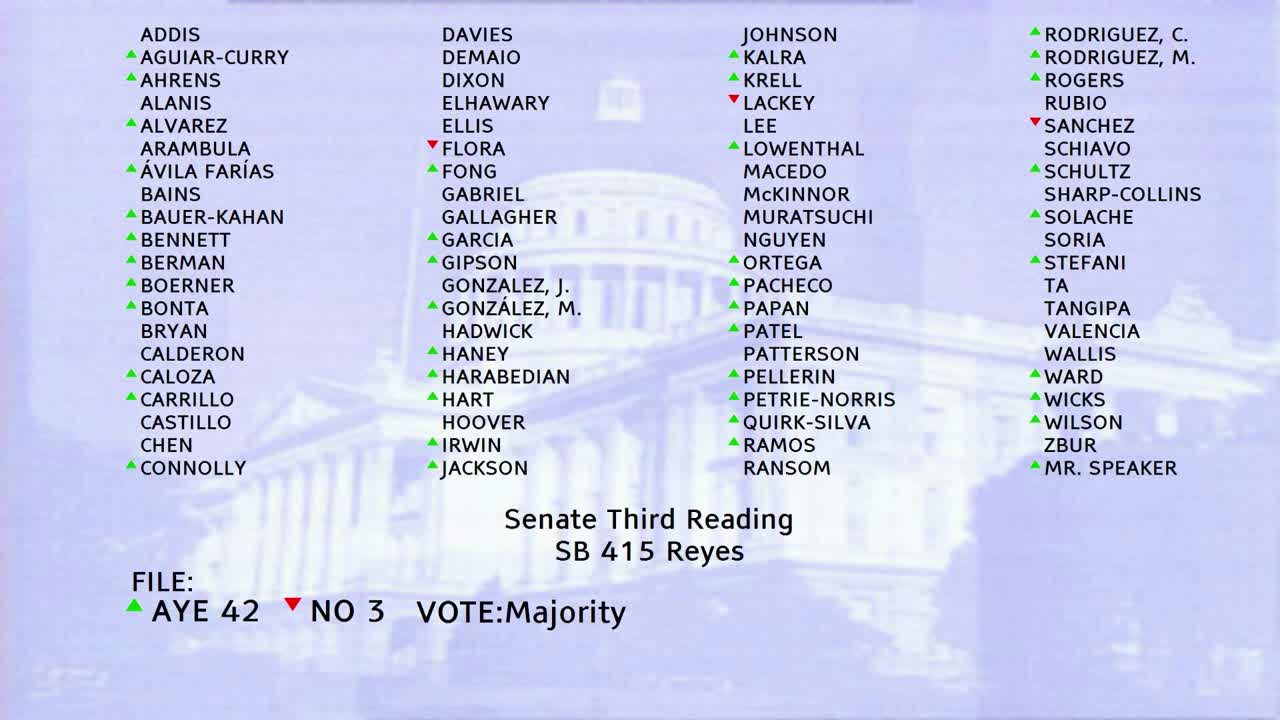 1MIN
Assembly Floor
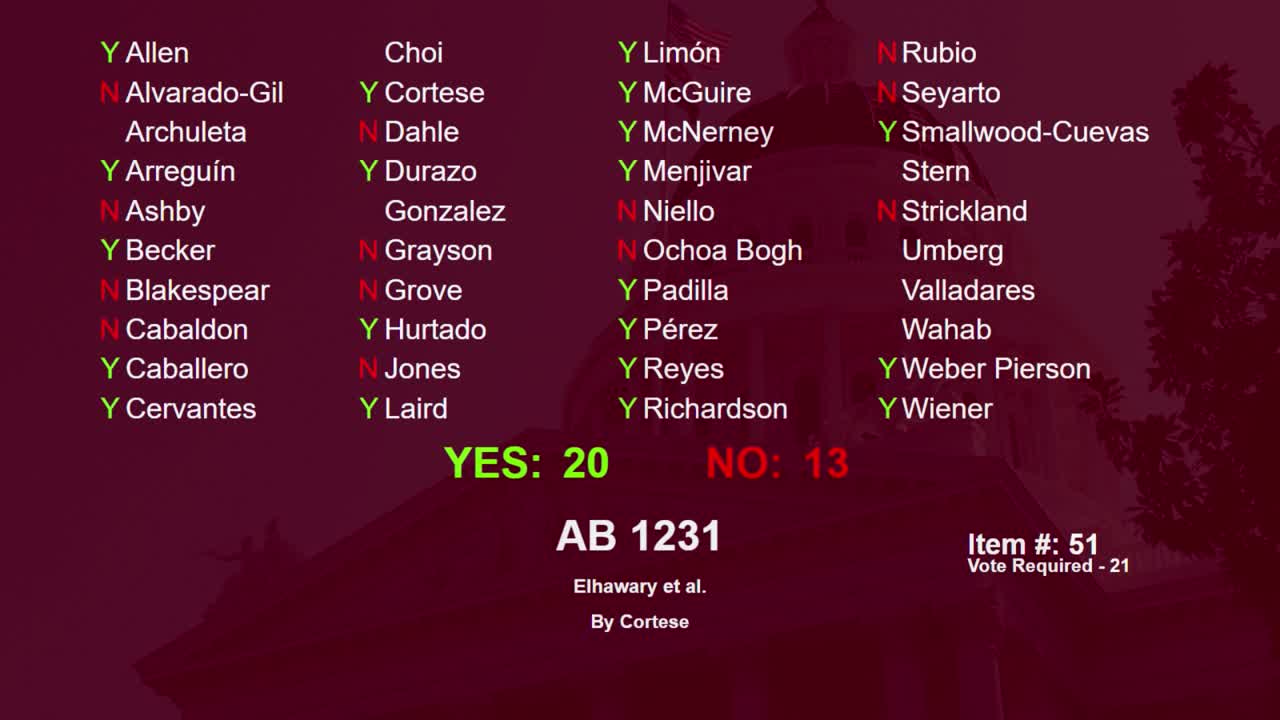 1MIN
Senate Floor
 9MIN
Assembly Standing Committee on Transportation
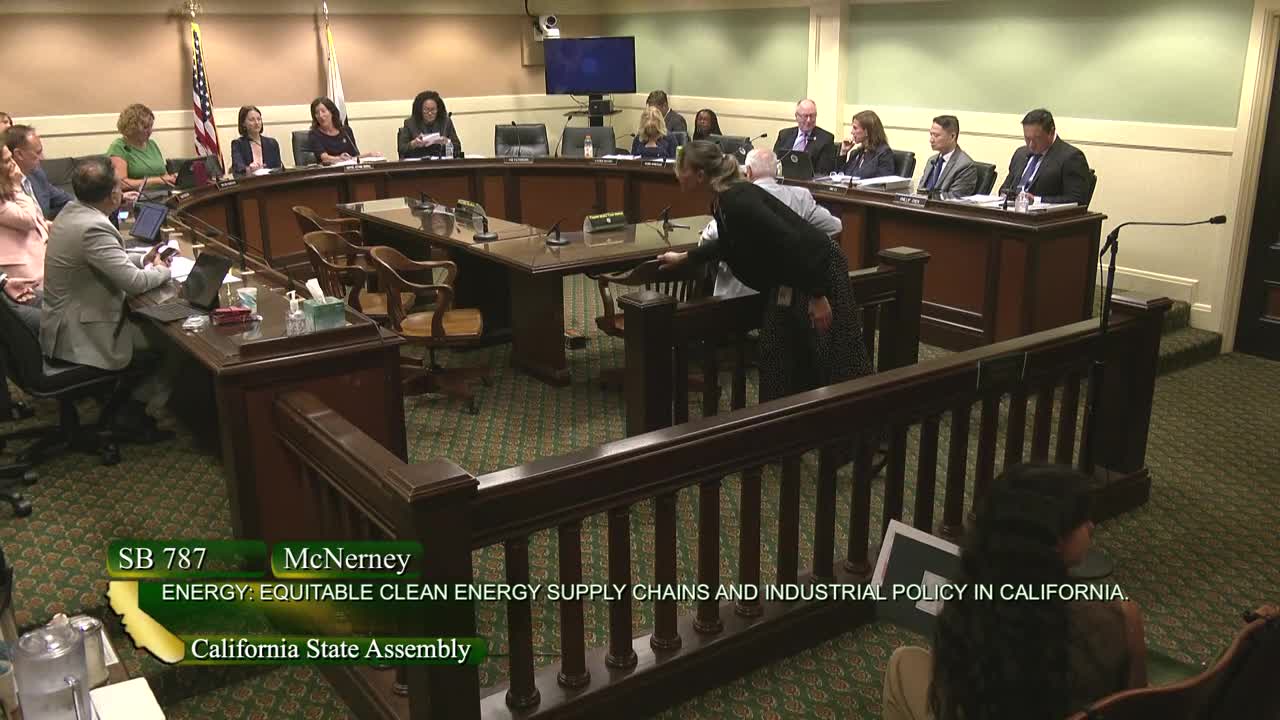 12MIN
Assembly Standing Committee on Utilities and Energy
 5MIN
Senate Floor
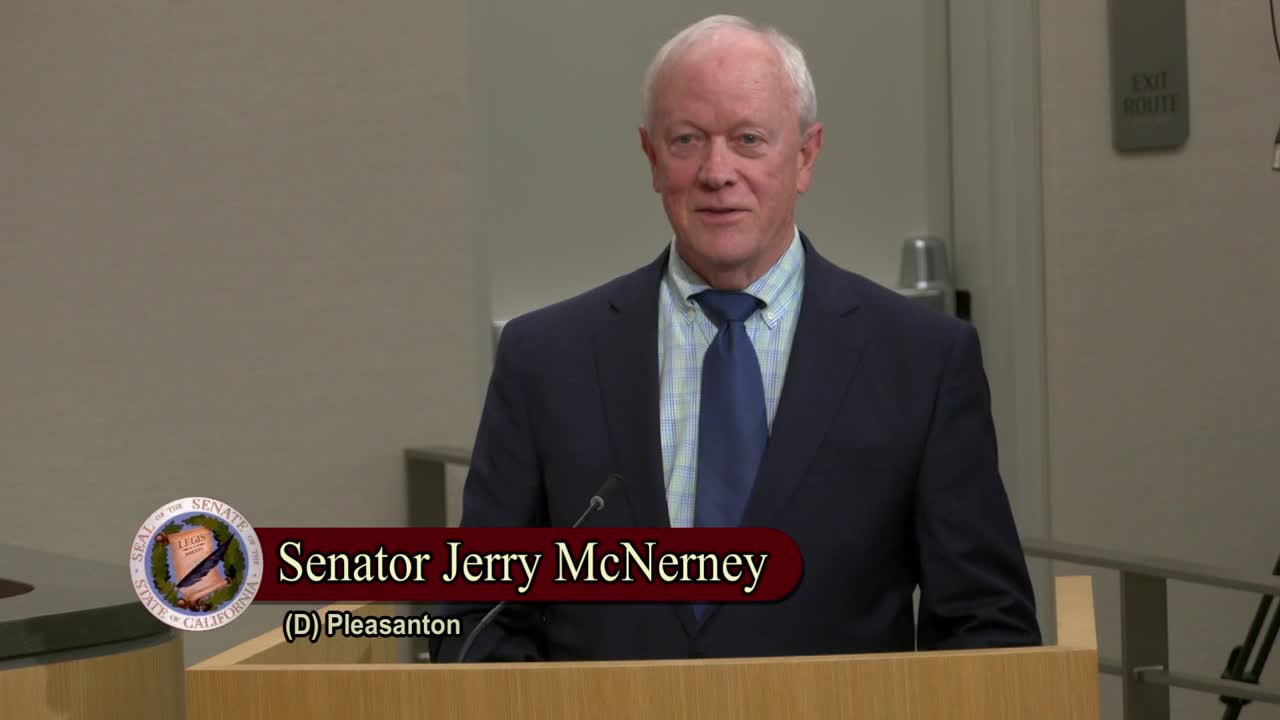 17MIN
Senate Standing Committee on Energy, Utilities and Communications
Bill Author