SB 81: Health and care facilities: information sharing.
- Session Year: 2025-2026
- House: Senate
- Latest Version Date: 2025-09-20
Current Status:
Passed
(2025-09-20: Chaptered by Secretary of State. Chapter 123, Statutes of 2025.)
Introduced
In Committee
Awaiting First Chamber Vote
Passed First Chamber
In Committee
Awaiting Second Chamber Vote
Passed Second Chamber
Enacted
(1)The Confidentiality of Medical Information Act (CMIA) prohibits a provider of health care, a health care service plan, a contractor, or a corporation and its subsidiaries and affiliates from intentionally sharing, selling, using for marketing, or otherwise using any medical information, as defined, for any purpose not necessary to provide health care services to a patient, except as provided. The CMIA prohibits a provider of health care, health care service plan, or contractor from disclosing medical information regarding a patient of the provider of health care or an enrollee or subscriber of a health care service plan without first obtaining authorization from the patient, except if the disclosure is compelled by, among other things, a search warrant lawfully issued to a governmental law enforcement agency or a court order. Existing law makes a violation of these provisions that results in economic loss or personal injury to a patient punishable as a misdemeanor.
This bill would revise the definition of medical information to include immigration status, including current and prior immigration status, and place of birth, if that information is known or collected, as specified, and would define immigration enforcement to mean any and all efforts to investigate, enforce, or assist in the investigation or enforcement of any federal civil immigration law, and also includes any and all efforts to investigate, enforce, or assist in the investigation or enforcement of any federal criminal immigration law that penalizes a persons presence in, entry or reentry to, or employment in, the United States. The bill would specify that a provider of health care, health care service plan, or contractor shall disclose medical information regarding a patient of the provider of health care or an enrollee or subscriber or a health care service plan pursuant to a valid search warrant issued by a judicial officer, including a magistrate, to a governmental law enforcement agency, or pursuant to a state or federal court order issued by a court of this state or a federal court. The bill would also prohibit, except to the extent expressly authorized by a patient, enrollee, or subscriber, or as otherwise permitted or required, a provider of health care, health care service plan, contractor, or corporation and its subsidiaries and affiliates from disclosing medical information for immigration enforcement. Because the bill would expand the scope of a crime, it would impose a state-mandated local program.
(2)Under existing law, the State Department of Public Health is responsible for the licensing and regulation of various facilities and settings that provide health care services, as specified. Existing law makes a willful violation of these provisions a crime.
This bill would require health care provider entities, as defined, to establish or amend procedures for monitoring, documenting, and receiving visitors to health care provider entities to the extent possible. The bill would require health care provider entity personnel to immediately notify health care provider entity management, administration, or legal counsel of any request for access to a health care provider entity site or patient for immigration enforcement, and to provide any requests for review of health care provider entity documents, as prescribed. The bill would prohibit, unless required by state or federal law, a health care provider entity and its personnel from allowing any person access to nonpublic areas of the providers facilities for immigration enforcement purposes, except as specified. The bill would require health care provider entities to inform staff and relevant volunteers on how to respond to requests relating to immigration enforcement that grants access to health care provider entity sites or to patients. The bill would require that health care provider entities comply with these provisions within 45 days from their effective date. By expanding the scope of a crime and increasing duties on local health officials, the bill would impose a state-mandated local program.
The California Constitution requires the state to reimburse local agencies and school districts for certain costs mandated by the state. Statutory provisions establish procedures for making that reimbursement.
This bill would provide that with regard to certain mandates no reimbursement is required by this act for a specified reason.
With regard to any other mandates, this bill would provide that, if the Commission on State Mandates determines that the bill contains costs so mandated by the state, reimbursement for those costs shall be made pursuant to the statutory provisions noted above.
This bill would provide that no reimbursement is required by this act for a specified reason.
This bill would declare that it is to take effect immediately as an urgency statute.
(1)The Confidentiality of Medical Information Act (CMIA) prohibits a provider of health care, a health care service plan, a contractor, or a corporation and its subsidiaries and affiliates from intentionally sharing, selling, using for marketing, or otherwise using any medical information, as defined, for any purpose not necessary to provide health care services to a patient, except as provided. The CMIA prohibits a provider of health care, health care service plan, or contractor from disclosing medical information regarding a patient of the provider of health care or an enrollee or subscriber of a health care service plan without first obtaining authorization from the patient, except if the disclosure is compelled by, among other things, a search warrant lawfully issued to a governmental law enforcement agency or a court order. Existing law makes a violation of these provisions that results in economic loss or personal injury to a patient punishable as a misdemeanor.
This bill would revise the definition of medical information to include immigration status, including current and prior immigration status, and place of birth, if that information is known or collected, as specified, and would define immigration enforcement to mean any and all efforts to investigate, enforce, or assist in the investigation or enforcement of any federal civil immigration law, and also includes any and all efforts to investigate, enforce, or assist in the investigation or enforcement of any federal criminal immigration law that penalizes a persons presence in, entry or reentry to, or employment in, the United States. The bill would specify that a provider of health care, health care service plan, or contractor shall disclose medical information regarding a patient of the provider of health care or an enrollee or subscriber or a health care service plan pursuant to a valid search warrant issued by a judicial officer, including a magistrate, to a governmental law enforcement agency, or pursuant to a state or federal court order issued by a court of this state or a federal court. The bill would also prohibit, except to the extent expressly authorized by a patient, enrollee, or subscriber, or as otherwise permitted or required, a provider of health care, health care service plan, contractor, or corporation and its subsidiaries and affiliates from disclosing medical information for immigration enforcement. Because the bill would expand the scope of a crime, it would impose a state-mandated local program.
(2)Under existing law, the State Department of Public Health is responsible for the licensing and regulation of various facilities and settings that provide health care services, as specified. Existing law makes a willful violation of these provisions a crime.
This bill would require health care provider entities, as defined, to establish or amend procedures for monitoring, documenting, and receiving visitors to health care provider entities to the extent possible. The bill would require health care provider entity personnel to immediately notify health care provider entity management, administration, or legal counsel of any request for access to a health care provider entity site or patient for immigration enforcement, and to provide any requests for review of health care provider entity documents, as prescribed. The bill would prohibit, unless required by state or federal law, a health care provider entity and its personnel from allowing any person access to nonpublic areas of the providers facilities for immigration enforcement purposes, except as specified. The bill would require health care provider entities to inform staff and relevant volunteers on how to respond to requests relating to immigration enforcement that grants access to health care provider entity sites or to patients. The bill would require that health care provider entities comply with these provisions within 45 days from their effective date. By expanding the scope of a crime and increasing duties on local health officials, the bill would impose a state-mandated local program.
The California Constitution requires the state to reimburse local agencies and school districts for certain costs mandated by the state. Statutory provisions establish procedures for making that reimbursement.
This bill would provide that with regard to certain mandates no reimbursement is required by this act for a specified reason.
With regard to any other mandates, this bill would provide that, if the Commission on State Mandates determines that the bill contains costs so mandated by the state, reimbursement for those costs shall be made pursuant to the statutory provisions noted above.
This bill would provide that no reimbursement is required by this act for a specified reason.
This bill would declare that it is to take effect immediately as an urgency statute.
(1)The Confidentiality of Medical Information Act (CMIA) prohibits a provider of health care, a health care service plan, a contractor, or a corporation and its subsidiaries and affiliates from intentionally sharing, selling, using for marketing, or otherwise using any medical information, as defined, for any purpose not necessary to provide health care services to a patient, except as provided. The CMIA prohibits a provider of health care, health care service plan, or contractor from disclosing medical information regarding a patient of the provider of health care or an enrollee or subscriber of a health care service plan without first obtaining authorization from the patient, except if the disclosure is compelled by, among other things, a search warrant lawfully issued to a governmental law enforcement agency or a court order. Existing law makes a violation of these provisions that results in economic loss or personal injury to a patient punishable as a misdemeanor.
This bill would revise the definition of medical information to include immigration status, including current and prior immigration status, and place of birth, if that information is known or collected, as specified, and would define immigration enforcement to mean any and all efforts to investigate, enforce, or assist in the investigation or enforcement of any federal civil immigration law, and also includes any and all efforts to investigate, enforce, or assist in the investigation or enforcement of any federal criminal immigration law that penalizes a persons presence in, entry or reentry to, or employment in, the United States. The bill would specify that a provider of health care, health care service plan, or contractor shall disclose medical information regarding a patient of the provider of health care or an enrollee or subscriber or a health care service plan pursuant to a valid search warrant issued by a judicial officer, including a magistrate, to a governmental law enforcement agency, or pursuant to a state or federal court order issued by a court of this state. state or a federal court. The bill would also prohibit, except to the extent expressly authorized by a patient, enrollee, or subscriber, or as otherwise permitted or required, a provider of health care, health care service plan, contractor, or corporation and its subsidiaries and affiliates from disclosing medical information for immigration enforcement. Because the bill would expand the scope of a crime, it would impose a state-mandated local program.
(2)Under existing law, the State Department of Public Health is responsible for the licensing and regulation of various facilities and settings that provide health care services, as specified. Existing law makes a willful violation of these provisions a crime.
This bill would require health care provider entities, as defined, to establish or amend procedures for monitoring monitoring, documenting, and receiving visitors to health care provider entities to the extent possible. The bill would require health care provider entity personnel to immediately notify health care provider entity management, administration, or legal counsel of any request for access to a health care provider entity site or patient for immigration enforcement, and to provide any requests for review of health care provider entity documents, as prescribed. The bill would prohibit, to the extent permitted by state and unless required by state or federal law, a health care provider entity and its personnel from allowing any person access to nonpublic areas of the providers facilities for immigration enforcement, enforcement purposes, except as specified. The bill would require health care provider entities to inform staff and relevant volunteers on how to respond to requests relating to immigration enforcement that grants access to health care provider entity sites or to patients. The bill would require that health care provider entities comply with these provisions within 45 days from their effective date. By expanding the scope of a crime and increasing duties on local health officials, the bill would impose a state-mandated local program.
The California Constitution requires the state to reimburse local agencies and school districts for certain costs mandated by the state. Statutory provisions establish procedures for making that reimbursement.
This bill would provide that with regard to certain mandates no reimbursement is required by this act for a specified reason.
With regard to any other mandates, this bill would provide that, if the Commission on State Mandates determines that the bill contains costs so mandated by the state, reimbursement for those costs shall be made pursuant to the statutory provisions noted above.
This bill would provide that no reimbursement is required by this act for a specified reason.
This bill would declare that it is to take effect immediately as an urgency statute.
(1)The Confidentiality of Medical Information Act (CMIA) prohibits a provider of health care, a health care service plan, a contractor, or a corporation and its subsidiaries and affiliates from intentionally sharing, selling, using for marketing, or otherwise using any medical information, as defined, for any purpose not necessary to provide health care services to a patient, except as provided. The CMIA prohibits a provider of health care, health care service plan, or contractor from disclosing medical information regarding a patient of the provider of health care or an enrollee or subscriber of a health care service plan without first obtaining authorization from the patient, except if the disclosure is compelled by, among other things, a search warrant lawfully issued to a governmental law enforcement agency or a court order. Existing law makes a violation of these provisions that results in economic loss or personal injury to a patient punishable as a misdemeanor.
This bill would revise the definition of medical information to include immigration status, including current and prior immigration status, and place of birth, and would define immigration enforcement to mean any and all efforts to investigate, enforce, or assist in the investigation or enforcement of any federal civil immigration law, and also includes any and all efforts to investigate, enforce, or assist in the investigation or enforcement of any federal criminal immigration that penalizes a persons presence in, entry or reentry to, or employment in, the United States. The bill would specify that a provider of health care, health care service plan, or contractor shall disclose medical information regarding a patient of the provider of health care or an enrollee or subscriber or a health care service plan pursuant to a valid search warrant issued by a judicial officer, including a magistrate, to a governmental law enforcement agency, or pursuant to a court order issued by a court of this state. The bill would also prohibit, except to the extent expressly authorized by a patient, enrollee, or subscriber, or as otherwise permitted or required, a provider of health care, health care service plan, contractor, or corporation and its subsidiaries and affiliates from disclosing medical information for immigration enforcement. Because the bill would expand the scope of a crime, it would impose a state-mandated local program.
(2)Under existing law, the State Department of Public Health is responsible for the licensing and regulation of various facilities and settings that provide health care services, as specified. Existing law makes a willful violation of these provisions a crime.
This bill would require health care provider entities, as defined, to establish or amend procedures for monitoring and receiving visitors to health care provider entities to the extent possible. The bill would require health care provider entity personnel to immediately notify health care provider entity management, administration, or legal counsel of any request for access to a health care provider entity site or patient for immigration enforcement, and to provide any requests for review of health care provider entity documents, as prescribed. The bill would prohibit, to the extent permitted by state and federal law, a health care provider entity and its personnel from granting allowing access to nonpublic areas of the providers facilities for immigration enforcement without a valid judicial warrant or court order. enforcement, except as specified. The bill would require health care provider entities to inform staff and relevant volunteers on how to respond to requests relating to immigration enforcement that grants access to health care provider entity sites or to patients. The bill would require that health care provider entities comply with these provisions within 45 days from their effective date. By expanding the scope of a crime and increasing duties on local health officials, the bill would impose a state-mandated local program.
The California Constitution requires the state to reimburse local agencies and school districts for certain costs mandated by the state. Statutory provisions establish procedures for making that reimbursement.
This bill would provide that with regard to certain mandates no reimbursement is required by this act for a specified reason.
With regard to any other mandates, this bill would provide that, if the Commission on State Mandates determines that the bill contains costs so mandated by the state, reimbursement for those costs shall be made pursuant to the statutory provisions noted above.
This bill would provide that no reimbursement is required by this act for a specified reason.
This bill would declare that it is to take effect immediately as an urgency statute.
(1)The Confidentiality of Medical Information Act (CMIA) prohibits a provider of health care, a health care service plan, a contractor, or a corporation and its subsidiaries and affiliates from intentionally sharing, selling, using for marketing, or otherwise using any medical information, as defined, for any purpose not necessary to provide health care services to a patient, except as provided. The CMIA authorizes prohibits a provider of health care, health care service plan, or contractor to disclose from disclosing medical information regarding a patient of the provider of health care or an enrollee or subscriber of a health care service plan with without first obtaining authorization from the patient or pursuant to patient, except if the disclosure is compelled by, among other things, a search warrant lawfully issued to a governmental law enforcement agency. agency or a court order. Existing law makes a violation of these provisions that results in economic loss or personal injury to a patient punishable as a misdemeanor.
This bill would revise the definition of medical information to include immigration status, including current and prior immigration status, and place of birth, and would define immigration enforcement to mean any and all efforts to investigate, enforce, or assist in the investigation or enforcement of any federal civil immigration law, and also includes any and all efforts to investigate, enforce, or assist in the investigation or enforcement of any federal criminal immigration that penalizes a persons presence in, entry or reentry to, or employment in, the United States. The bill would specify that a provider of health care, health care service plan, or contractor may shall disclose medical information regarding a patient of the provider of health care or an enrollee or subscriber or a health care service plan pursuant to a valid search warrant issued by a judicial officer, including a magistrate, to a governmental law enforcement agency. agency, or pursuant to a court order issued by a court of this state. The bill would also prohibit, except to the extent expressly authorized by a patient, enrollee, or subscriber, or as otherwise permitted or required, a provider of health care, health care service plan, contractor, or corporation and its subsidiaries and affiliates from disclosing medical information for immigration enforcement. Because the bill would expand the scope of a crime, it would impose a state-mandated local program.
(2)Under existing law, the State Department of Public Health is responsible for the licensing and regulation of various facilities and settings that provide health care services, as specified. Existing law makes a willful violation of these provisions a crime.
This bill would require health care provider entities, as defined, to establish or amend procedures for monitoring and receiving visitors to health care provider entities to the extent possible. The bill would require health care provider entity personnel to immediately notify health care provider entity management, administration, or legal counsel of any request for access to a health care provider entity site or patient for immigration enforcement, and to provide any requests for review of health care provider entity documents, as prescribed. The bill would prohibit, to the extent permitted by state and federal law, a health care provider entity and its personnel from granting access to nonpublic areas of the providers facilities for immigration enforcement without a valid judicial warrant or court order. The bill would require health care provider entities to inform staff and relevant volunteers on how to respond to requests relating to immigration enforcement that grants access to health care provider entity sites or to patients. The bill would require that health care provider entities comply with these provisions within 45 days from their effective date. By expanding the scope of a crime and increasing duties on local health officials, the bill would impose a state-mandated local program.
The California Constitution requires the state to reimburse local agencies and school districts for certain costs mandated by the state. Statutory provisions establish procedures for making that reimbursement.
This bill would provide that with regard to certain mandates no reimbursement is required by this act for a specified reason.
With regard to any other mandates, this bill would provide that, if the Commission on State Mandates determines that the bill contains costs so mandated by the state, reimbursement for those costs shall be made pursuant to the statutory provisions noted above.
This bill would provide that no reimbursement is required by this act for a specified reason.
This bill would declare that it is to take effect immediately as an urgency statute.
(1)The Confidentiality of Medical Information Act (CMIA) prohibits a provider of health care, a health care service plan, a contractor, or a corporation and its subsidiaries and affiliates from intentionally sharing, selling, using for marketing, or otherwise using any medical information, as defined, for any purpose not necessary to provide health care services to a patient, except as provided. The CMIA authorizes a provider of health care, health care service plan, or contractor to disclose medical information regarding a patient of the provider of health care or an enrollee or subscriber of a health care service plan with authorization from the patient or pursuant to a search warrant lawfully issued to a governmental law enforcement agency. Existing law makes a violation of these provisions that results in economic loss or personal injury to a patient punishable as a misdemeanor.
This bill would revise the definition of medical information to include immigration status, including current and prior immigration status, and place of birth, and would define immigration enforcement to mean any and all efforts to investigate, enforce, or assist in the investigation or enforcement of any federal civil immigration law, and also includes any and all efforts to investigate, enforce, or assist in the investigation or enforcement of any federal criminal immigration that penalizes a persons presence in, entry or reentry to, or employment in, the United States. The bill would specify that a provider of health care, health care service plan, or contractor may disclose medical information regarding a patient of the provider of health care or an enrollee or subscriber or a health care service plan pursuant to a valid search warrant issued by a judicial officer, including a magistrate, to a governmental law enforcement agency. The bill would also prohibit, except to the extent expressly authorized by a patient, enrollee, or subscriber, or as otherwise permitted or required, a provider of health care, health care service plan, contractor, or corporation and its subsidiaries and affiliates from disclosing medical information for immigration enforcement. Because the bill would expand the scope of a crime, it would impose a state-mandated local program.
(2)Under existing law, the State Department of Public Health is responsible for the licensing and regulation of various facilities and settings that provide health care services, as specified. Existing law makes a willful violation of these provisions a crime.
This bill would require health care provider entities, as defined, to establish or amend procedures for monitoring and receiving visitors to health care provider entities to the extent possible. The bill would require, when circumstances allow, require health care provider entity personnel to immediately notify health care provider entity management, administration, or legal counsel of any request for access to a health care provider entity site or patient for immigration enforcement, and to provide any requests for review of health care provider entity documents, as prescribed. The bill would prohibit, to the extent permitted by state and federal law, a health care provider entity and its personnel from granting access to nonpublic areas of the providers facilities for immigration enforcement without a valid judicial warrant or court order. The bill would require health care provider entities to inform staff and relevant volunteers on how to respond to requests relating to immigration enforcement that grants access to health care provider entity sites or to patients. The bill would require that health care provider entities comply with these provisions within 45 days from their effective date. By expanding the scope of a crime and increasing duties on local health officials, the bill would impose a state-mandated local program.
The California Constitution requires the state to reimburse local agencies and school districts for certain costs mandated by the state. Statutory provisions establish procedures for making that reimbursement.
This bill would provide that with regard to certain mandates no reimbursement is required by this act for a specified reason.
With regard to any other mandates, this bill would provide that, if the Commission on State Mandates determines that the bill contains costs so mandated by the state, reimbursement for those costs shall be made pursuant to the statutory provisions noted above.
This bill would provide that no reimbursement is required by this act for a specified reason.
This bill would declare that it is to take effect immediately as an urgency statute.
(1)The Confidentiality of Medical Information Act (CMIA) prohibits a provider of health care, a health care service plan, a contractor, or a corporation and its subsidiaries and affiliates from intentionally sharing, selling, using for marketing, or otherwise using any medical information, as defined, for any purpose not necessary to provide health care services to a patient, except as provided. The CMIA authorizes a provider of health care, health care service plan, or contractor to disclose medical information regarding a patient of the provider of health care or an enrollee or subscriber of a health care service plan with authorization from the patient or pursuant to a search warrant lawfully issued to a governmental law enforcement agency. Existing law makes a violation of these provisions that results in economic loss or personal injury to a patient punishable as a misdemeanor.
This bill would revise the definition of medical information to include immigration status, including current and prior immigration status, and place of birth, and would define immigration enforcement to mean any and all efforts to investigate, enforce, or assist in the investigation or enforcement of any federal civil immigration law, and also includes any and all efforts to investigate, enforce, or assist in the investigation or enforcement of any federal criminal immigration that penalizes a persons presence in, entry or reentry to, or employment in, the United States. The bill would specify that a provider of health care, health care service plan, or contractor may disclose medical information regarding a patient of the provider of health care or an enrollee or subscriber or a health care service plan pursuant to a valid search warrant issued by a judicial officer, including a magistrate, to a governmental law enforcement agency. The bill would also prohibit, except to the extent expressly authorized by a patient, enrollee, or subscriber, or as otherwise permitted or required, a provider of health care, health care service plan, contractor, or corporation and its subsidiaries and affiliates from disclosing medical information for immigration enforcement. Because the bill would expand the scope of a crime, it would impose a state-mandated local program.
(2)Under existing law, the State Department of Public Health is responsible for the licensing and regulation of various facilities and settings that provide health care services, as specified. Existing law makes a willful violation of these provisions a crime.
This bill would require health care provider entities, as defined, to establish or amend procedures for monitoring and receiving visitors to health care provider entities to the extent possible. The bill would require, when circumstances allow, health care provider entity personnel to immediately notify health care provider entity management, administration, or legal counsel of any request for access to a health care provider entity site or patient for immigration enforcement, and to provide any requests for review of health care provider entity documents, as prescribed. The bill would prohibit, to the extent permitted by state and federal law, a health care provider entity and its personnel from granting access to nonpublic areas of the providers facilities for immigration enforcement without a valid judicial warrant or court order. The bill would require health care provider entities to inform staff and relevant volunteers on how to respond to requests relating to immigration enforcement that grants access to health care provider entity sites or to patients. The bill would require that health care provider entities comply with these provisions within 45 days from their effective date. By expanding the scope of a crime and increasing duties on local health officials, the bill would impose a state-mandated local program.
The California Constitution requires the state to reimburse local agencies and school districts for certain costs mandated by the state. Statutory provisions establish procedures for making that reimbursement.
This bill would provide that with regard to certain mandates no reimbursement is required by this act for a specified reason.
With regard to any other mandates, this bill would provide that, if the Commission on State Mandates determines that the bill contains costs so mandated by the state, reimbursement for those costs shall be made pursuant to the statutory provisions noted above.
This bill would provide that no reimbursement is required by this act for a specified reason.
This bill would declare that it is to take effect immediately as an urgency statute.
(1)The Confidentiality of Medical Information Act (CMIA) prohibits a provider of health care, a health care service plan, a contractor, or a corporation and its subsidiaries and affiliates from intentionally sharing, selling, using for marketing, or otherwise using any medical information, as defined, for any purpose not necessary to provide health care services to a patient, except as provided. The CMIA authorizes a provider of health care, health care service plan, or contractor to disclose medical information regarding a patient of the provider of health care or an enrollee or subscriber of a health care service plan with authorization from the patient or pursuant to a search warrant lawfully issued to a governmental law enforcement agency. Existing law makes a violation of these provisions that results in economic loss or personal injury to a patient punishable as a misdemeanor.
This bill would revise the definition of medical information to include immigration status, including current and prior immigration status, and place of birth, and would define immigration enforcement to mean any and all efforts to investigate, enforce, or assist in the investigation or enforcement of any federal civil immigration law, and also includes any and all efforts to investigate, enforce, or assist in the investigation or enforcement of any federal criminal immigration that penalizes a persons presence in, entry or reentry to, or employment in, the United States. The bill would specify that a provider of health care, health care service plan, or contractor may disclose medical information regarding a patient of the provider of health care or an enrollee or subscriber or a health care service plan pursuant to a search warrant lawfully issued and signed by a judge, including a magistrate judge, valid search warrant issued by a judicial officer, including a magistrate, to a governmental law enforcement agency. The bill would also prohibit, except to the extent expressly authorized by a patient, enrollee, or subscriber, or as otherwise required, a provider of health care, health care service plan, contractor, or corporation and its subsidiaries and affiliates from disclosing medical information for immigration enforcement. Because the bill would expand the scope of a crime, it would impose a state-mandated local program.
(2)Under existing law, the State Department of Public Health is responsible for the licensing and regulation of various facilities and settings that provide health care services, as specified. Existing law makes a willful violation of these provisions a crime.
This bill would require health care provider entities, as defined, to establish or amend procedures for monitoring and receiving visitors to health care provider entities to the extent possible. The bill would require, when circumstances allow, health care provider entity personnel to immediately notify health care provider entity management, administration, or legal counsel of any request for access to a health care provider entity site or patient for immigration enforcement, and to provide any requests for review of health care provider entity documents, as prescribed. The bill would prohibit, to the extent permitted by state and federal law, a health care provider entity and its personnel from granting access to nonpublic areas of the providers facilities for immigration enforcement without a valid judicial warrant or court order. The bill would require health care provider entities to inform staff and relevant volunteers on how to respond to requests relating to immigration enforcement that grants access to health care provider entity sites or to patients. The bill would require that health care provider entities comply with these provisions within 45 days from their effective date. By expanding the scope of a crime, crime and increasing duties on local health officials, the bill would impose a state-mandated local program.
The California Constitution requires the state to reimburse local agencies and school districts for certain costs mandated by the state. Statutory provisions establish procedures for making that reimbursement.The California Constitution requires the state to reimburse local agencies and school districts for certain costs mandated by the state. Statutory provisions establish procedures for making that reimbursement.
This bill would provide that with regard to certain mandates no reimbursement is required by this act for a specified reason.
With regard to any other mandates, this bill would provide that, if the Commission on State Mandates determines that the bill contains costs so mandated by the state, reimbursement for those costs shall be made pursuant to the statutory provisions noted above.
This bill would provide that no reimbursement is required by this act for a specified reason.
This bill would declare that it is to take effect immediately as an urgency statute.
(1)The Confidentiality of Medical Information Act (CMIA) prohibits a provider of health care, a health care service plan, a contractor, or a corporation and its subsidiaries and affiliates from intentionally sharing, selling, using for marketing, or otherwise using any medical information, as defined, for any purpose not necessary to provide health care services to a patient, except as provided. The CMIA authorizes a provider of health care, health care service plan, or contractor to disclose medical information regarding a patient of the provider of health care or an enrollee or subscriber of a health care service plan with authorization from the patient or pursuant to a search warrant lawfully issued to a governmental law enforcement agency. Existing law makes a violation of these provisions that results in economic loss or personal injury to a patient punishable as a misdemeanor.
This bill would revise the definition of medical information to include immigration status, including current and prior immigration status, and place of birth, and would define immigration enforcement to mean any and all efforts to investigate, enforce, or assist in the investigation or enforcement of any federal civil immigration law, and also includes any and all efforts to investigate, enforce, or assist in the investigation or enforcement of any federal criminal immigration that penalizes a persons presence in, entry or reentry to, or employment in, the United States. The bill would specify that a provider of health care, health care service plan, or contractor may disclose medical information regarding a patient of the provider of health care or an enrollee or subscriber or a health care service plan pursuant to a search warrant lawfully issued and signed by a judge, including a magistrate judge, to a governmental law enforcement agency. The bill would also prohibit, except to the extent expressly authorized by a patient, enrollee, or subscriber, or as otherwise required, a provider of health care, health care service plan, contractor, or corporation and its subsidiaries and affiliates from disclosing medical information for immigration enforcement. The bill would prohibit, to the extent permitted by state and federal law, and to the extent possible, a provider of health care, health care service plan, contractor, or employer from allowing access to a patient for immigration enforcement. Because the bill would expand the scope of a crime, it would impose a state-mandated local program.
(2)Under existing law, the State Department of Public Health is responsible for the licensing and regulation of various facilities and settings that provide health care services, as specified. Existing law makes a willful violation of these provisions a crime.
This bill would require health care provider entities, as defined, to establish or amend procedures for monitoring and receiving visitors to health care provider entities to the extent possible. The bill would require, when circumstances allow, health care provider entity personnel to immediately notify health care provider entity management, administration, or legal counsel of any request for access to a health care provider entity site or patient for immigration enforcement, and to provide any requests for review of health care provider entity documents, as prescribed. The bill would prohibit, to the extent permitted by state and federal law, a health care provider entity and its personnel from granting access to nonpublic areas of the providers facilities for immigration enforcement without a valid judicial warrant or court order. The bill would require health care provider entities to inform staff and relevant volunteers on how to respond to requests relating to immigration enforcement that grants access to health care provider entity sites or to patients. The bill would require that health care provider entities comply with these provisions within 45 days from their effective date. By expanding the scope of a crime, the bill would impose a state-mandated local program.
The California Constitution requires the state to reimburse local agencies and school districts for certain costs mandated by the state. Statutory provisions establish procedures for making that reimbursement.
This bill would provide that no reimbursement is required by this act for a specified reason.
This bill would declare that it is to take effect immediately as an urgency statute.
(1)The Confidentiality of Medical Information Act (CMIA) prohibits a provider of health care, a health care service plan, a contractor, or a corporation and its subsidiaries and affiliates from intentionally sharing, selling, using for marketing, or otherwise using any medical information, as defined, for any purpose not necessary to provide health care services to a patient, except as provided. The CMIA authorizes a provider of health care, health care service plan, or contractor to disclose medical information regarding a patient of the provider of health care or an enrollee or subscriber of a health care service plan with authorization from the patient or pursuant to a search warrant lawfully issued to a governmental law enforcement agency. Existing law makes a violation of these provisions that results in economic loss or personal injury to a patient punishable as a misdemeanor.
This bill would revise the definition of medical information to include immigration status, including current and prior immigration status, and place of birth, and would define immigration enforcement to mean any and all efforts to investigate, enforce, or assist in the investigation or enforcement of any federal civil immigration law, and also includes any and all efforts to investigate, enforce, or assist in the investigation or enforcement of any federal criminal immigration that penalizes a persons presence in, entry or reentry to, or employment in, the United States. The bill would specify that a provider of health care, health care service plan, or contractor may disclose medical information regarding a patient of the provider of health care or an enrollee or subscriber or a health care service plan pursuant to a search warrant lawfully issued and signed by a judge, including a magistrate judge, to a governmental law enforcement agency. The bill would also prohibit, except to the extent expressly authorized by a patient, enrollee, or subscriber, or as otherwise required, a provider of health care, health care service plan, contractor, or corporation and its subsidiaries and affiliates from disclosing medical information for immigration enforcement. The bill would prohibit, to the extent permitted by state and federal law, and to the extent possible, a provider of health care, health care service plan, contractor, or employer from allowing access to a patient for immigration enforcement. Because the bill would expand the scope of a crime, it would impose a state-mandated local program.
(2)Under existing law, the State Department of Public Health is responsible for the licensing and regulation of various facilities and settings that provide health care services, as specified. Existing law makes a willful violation of these provisions a crime.
This bill would require health care provider entities, as defined, to establish or amend procedures for monitoring and receiving visitors to health care provider entities to the extent possible. The bill would require, when circumstances allow, health care provider entity personnel to immediately notify health care provider entity management, administration, or legal counsel of any request for access to a health care provider entity site or patient for immigration enforcement, and to provide any requests for review of health care provider entity documents, as prescribed. The bill would prohibit, to the extent permitted by state and federal law, a health care provider entity and its personnel from granting access to nonpublic areas of the providers facilities for immigration enforcement without a valid judicial warrant or court order. The bill would require health care provider entities to inform staff and relevant volunteers on how to respond to requests relating to immigration enforcement that grants access to health care provider entity sites or to patients. The bill would require that health care provider entities comply with these provisions within 45 days from their effective date. By expanding the scope of a crime, the bill would impose a state-mandated local program.
The California Constitution requires the state to reimburse local agencies and school districts for certain costs mandated by the state. Statutory provisions establish procedures for making that reimbursement.
This bill would provide that no reimbursement is required by this act for a specified reason.
This bill would declare that it is to take effect immediately as an urgency statute.
Existing law requires the State Department of Public Health to license and regulate each health facility, defined to mean a facility, place, or building that is organized, maintained, and operated for the diagnosis, care, prevention, and treatment of human illness, and to which persons are admitted for a 24-hour stay or longer, and includes, among others, a general acute care hospital, an acute psychiatric hospital, and a skilled nursing facility.Existing law, the Confidentiality of Medical Information Act, prohibits a health care provider, a contractor, or a health care service plan from disclosing medical information, as defined, regarding a patient of the provider or an enrollee or subscriber of the health care service plan without first obtaining an authorization, except as specified. This bill would state the intent of the Legislature to enact legislation to prohibit health facilities from collaborating with, providing access to, or providing information, including patient data or records, about patients to, immigration authorities.Existing law requires the State Department of Public Health to license and regulate each health facility, defined to mean a facility, place, or building that is organized, maintained, and operated for the diagnosis, care, prevention, and treatment of human illness, and to which persons are admitted for a 24-hour stay or longer, and includes, among others, a general acute care hospital, an acute psychiatric hospital, and a skilled nursing facility.
Existing law, the Confidentiality of Medical Information Act, prohibits a health care provider, a contractor, or a health care service plan from disclosing medical information, as defined, regarding a patient of the provider or an enrollee or subscriber of the health care service plan without first obtaining an authorization, except as specified.
This bill would state the intent of the Legislature to enact legislation to prohibit health facilities from collaborating with, providing access to, or providing information, including patient data or records, about patients to, immigration authorities.
For purposes of this part:
(a)Authorization means permission granted in accordance with Section 56.11 or 56.21 for the disclosure of medical information.
(b)Authorized recipient means a person who is authorized to receive medical information pursuant to Section 56.10 or 56.20.
(c)Confidential communications request means a request by a subscriber or enrollee that health care service plan communications containing medical information be communicated to them at a specific mail or email address or specific telephone number, as designated by the subscriber or enrollee.
(d)Contractor means a person or entity that is a medical group, independent practice association, pharmaceutical benefits manager, or a medical service organization and is not a health care service plan or provider of health care. Contractor does not include insurance institutions as defined in subdivision (k) of Section 791.02 of the Insurance Code or pharmaceutical benefits managers licensed pursuant to the Knox-Keene Health Care Service Plan Act of 1975 (Chapter 2.2 (commencing with Section 1340) of Division 2 of the Health and Safety Code).
(e)Enrollee has the same meaning as that term is defined in Section 1345 of the Health and Safety Code.
(f)Expiration date or event means a specified date or an occurrence relating to the individual to whom the medical information pertains or the purpose of the use or disclosure, after which the provider of health care, health care service plan, pharmaceutical company, or contractor is no longer authorized to disclose the medical information.
(g)Health care service plan means an entity regulated pursuant to the Knox-Keene Health Care Service Plan Act of 1975 (Chapter 2.2 (commencing with Section 1340) of Division 2 of the Health and Safety Code).
(h)Licensed health care professional means a person licensed or certified pursuant to Division 2 (commencing with Section 500) of the Business and Professions Code, the Osteopathic Initiative Act or the Chiropractic Initiative Act, or Division 2.5 (commencing with Section 1797) of the Health and Safety Code.
(i)Marketing means to make a communication about a product or service that encourages recipients of the communication to purchase or use the product or service.
Marketing does not include any of the following:
(1)Communications made orally or in writing for which the communicator does not receive direct or indirect remuneration, including, but not limited to, gifts, fees, payments, subsidies, or other economic benefits, from a third party for making the communication.
(2)Communications made to current enrollees solely for the purpose of describing a providers participation in an existing health care provider network or health plan network of a Knox-Keene licensed health plan to which the enrollees already subscribe; communications made to current enrollees solely for the purpose of describing if, and the extent to which, a product or service, or payment for a product or service, is provided by a provider, contractor, or plan or included in a plan of benefits of a Knox-Keene licensed health plan to which the enrollees already subscribe; or communications made to plan enrollees describing the availability of more cost-effective pharmaceuticals.
(3)Communications that are tailored to the circumstances of a particular individual to educate or advise the individual about treatment options, and otherwise maintain the individuals adherence to a prescribed course of medical treatment, as provided in Section 1399.901 of the Health and Safety Code, for a chronic and seriously debilitating or life-threatening condition as defined in subdivisions (d) and (e) of Section 1367.21 of the Health and Safety Code, if the health care provider, contractor, or health plan receives direct or indirect remuneration, including, but not limited to, gifts, fees, payments, subsidies, or other economic benefits, from a third party for making the communication, if all of the following apply:
(A)The individual receiving the communication is notified in the communication in typeface no smaller than 14-point type of the fact that the provider, contractor, or health plan has been remunerated and the source of the remuneration.
(B)The individual is provided the opportunity to opt out of receiving future remunerated communications.
(C)The communication contains instructions in typeface no smaller than 14-point type describing how the individual can opt out of receiving further communications by calling a toll-free number of the health care provider, contractor, or health plan making the remunerated communications. Further communication shall not be made to an individual who has opted out after 30 calendar days from the date the individual makes the opt-out request.
(j)(1)Medical information means any individually identifiable information, in electronic or physical form, in possession of or derived from a provider of health care, health care service plan, pharmaceutical company, or contractor regarding a patients medical history, mental health application information, reproductive or sexual health application information, mental or physical condition, or treatment. Individually identifiable means that the medical information includes or contains any element of personal identifying information sufficient to allow identification of the individual, such as the patients name, address, electronic mail address, telephone number, or social security number, or other information that, alone or in combination with other publicly available information, reveals the identity of the individual.
(2)If individually identifying information regarding immigration status, including current and prior immigration status, or place of birth, is known or collected in electronic or physical form by a provider of health care, health care service plan, pharmaceutical company, or contractor regarding a patients medical history, it shall be treated as medical information, as defined in paragraph (1).
(k)Mental health application information means information related to a consumers inferred or diagnosed mental health or substance use disorder, as defined in Section 1374.72 of the Health and Safety Code, collected by a mental health digital service.
(l)Mental health digital service means a mobile-based application or internet website that collects mental health application information from a consumer, markets itself as facilitating mental health services to a consumer, and uses the information to facilitate mental health services to a consumer.
(m)Patient means a natural person, whether or not still living, who received health care services from a provider of health care and to whom medical information pertains.
(n)Pharmaceutical company means a company or business, or an agent or representative thereof, that manufactures, sells, or distributes pharmaceuticals, medications, or prescription drugs. Pharmaceutical company does not include a pharmaceutical benefits manager, as included in subdivision (c), or a provider of health care.
(o)Protected individual means any adult covered by the subscribers health care service plan or a minor who can consent to a health care service without the consent of a parent or legal guardian, pursuant to state or federal law. Protected individual does not include an individual that lacks the capacity to give informed consent for health care pursuant to Section 813 of the Probate Code.
(p)Provider of health care means a person licensed or certified pursuant to Division 2 (commencing with Section 500) of the Business and Professions Code; a person licensed pursuant to the Osteopathic Initiative Act or the Chiropractic Initiative Act; a person certified pursuant to Division 2.5 (commencing with Section 1797) of the Health and Safety Code; or a clinic, health dispensary, or health facility licensed pursuant to Division 2 (commencing with Section 1200) of the Health and Safety Code. Provider of health care does not include insurance institutions as defined in subdivision (k) of Section 791.02 of the Insurance Code.
(q)Reproductive or sexual health application information means information about a consumers reproductive health, menstrual cycle, fertility, pregnancy, pregnancy outcome, plans to conceive, or type of sexual activity collected by a reproductive or sexual health digital service, including, but not limited to, information from which one can infer someones pregnancy status, menstrual cycle, fertility, hormone levels, birth control use, sexual activity, or gender identity.
(r)Reproductive or sexual health digital service means a mobile-based application or internet website that collects reproductive or sexual health application information from a consumer, markets itself as facilitating reproductive or sexual health services to a consumer, and uses the information to facilitate reproductive or sexual health services to a consumer.
(s)Sensitive services means all health care services related to mental or behavioral health, sexual and reproductive health, sexually transmitted infections, substance use disorder, gender-affirming care, and intimate partner violence, and includes services described in Sections 6924, 6925, 6926, 6927, 6928, 6929, and 6930 of the Family Code, and Sections 121020 and 124260 of the Health and Safety Code, obtained by a patient at or above the minimum age specified for consenting to the service specified in the section.
(t)Subscriber has the same meaning as that term is defined in Section 1345 of the Health and Safety Code.
(u)Immigration enforcement means any and all efforts to investigate, enforce, or assist in the investigation or enforcement of any federal civil immigration law, and also includes any and all efforts to investigate, enforce, or assist in the investigation or enforcement of any federal criminal immigration law that penalizes a persons presence in, entry or reentry to, or employment in, the United States.
SEC. 2.Section 56.10 of the Civil Code is amended to read:56.10.(a)A provider of health care, health care service plan, or contractor shall not disclose medical information regarding a patient of the provider of health care or an enrollee or subscriber of a health care service plan without first obtaining an authorization, except as provided in subdivision (b) or (c).
(b)A provider of health care, a health care service plan, or a contractor shall disclose medical information if the disclosure is compelled by any of the following:
(1)(A)A court order issued by a court of this state or a federal court, including, but not limited to, a court order issued by a court of this state pursuant to Section 2029.300 of the Code of Civil Procedure relating to a foreign subpoena.
(B)A provider of health care, health care service plan, or contractor shall not comply with a court order that constitutes a foreign subpoena, absent a court order issued pursuant to Section 2029.300 of the Code of Civil Procedure.
(2)A board, commission, or administrative agency for purposes of adjudication pursuant to its lawful authority.
(3)A party to a proceeding before a court or administrative agency pursuant to a subpoena, subpoena duces tecum, notice to appear served pursuant to Section 1987 of the Code of Civil Procedure, or any provision authorizing discovery in a proceeding before a court or administrative agency.
(4)A board, commission, or administrative agency pursuant to an investigative subpoena issued under Article 2 (commencing with Section 11180) of Chapter 2 of Part 1 of Division 3 of Title 2 of the Government Code.
(5)An arbitrator or arbitration panel, when arbitration is lawfully requested by either party, pursuant to a subpoena duces tecum issued under Section 1282.6 of the Code of Civil Procedure, or another provision authorizing discovery in a proceeding before an arbitrator or arbitration panel.
(6)A valid search warrant issued by a judicial officer, including a magistrate, to a governmental law enforcement agency, including a search warrant from another state that is based on either of the following and execution of the search warrant would not constitute a violation of Section 13778.2 of the Penal Code:
(A)Another states law, so long as that states law does not interfere with California law, including, but not limited to, the Reproductive Privacy Act (Article 2.5 (commencing with Section 123460) of Chapter 2 of Part 2 of Division 106 of the Health and Safety Code).
(B)A foreign penal civil action, as defined in Section 2029.200 of the Code of Civil Procedure.
(7)The patient or the patients representative pursuant to Chapter 1 (commencing with Section 123100) of Part 1 of Division 106 of the Health and Safety Code.
(8)A medical examiner, forensic pathologist, or coroner, when requested in the course of an investigation by a medical examiner, forensic pathologist, or coroners office for the purpose of identifying the decedent or locating next of kin, or when investigating deaths that may involve public health concerns, organ or tissue donation, child abuse, elder abuse, suicides, poisonings, accidents, sudden infant deaths, suspicious deaths, unknown deaths, or criminal deaths, or upon notification of, or investigation of, imminent deaths that may involve organ or tissue donation pursuant to Section 7151.15 of the Health and Safety Code, or when otherwise authorized by the decedents representative. Medical information requested by a medical examiner, forensic pathologist, or coroner under this paragraph shall be limited to information regarding the patient who is the decedent and who is the subject of the investigation or who is the prospective donor and shall be disclosed to a medical examiner, forensic pathologist, or coroner without delay upon request. A medical examiner, forensic pathologist, or coroner shall not disclose the information contained in the medical record obtained pursuant to this paragraph to a third party without a court order or authorization pursuant to paragraph (4) of subdivision (c) of Section 56.11.
(9)When otherwise specifically required by law.
(c)A provider of health care or a health care service plan may disclose medical information as follows:
(1)The information may be disclosed to providers of health care, health care service plans, contractors, or other health care professionals or facilities for purposes of diagnosis or treatment of the patient. This includes, in an emergency situation, the communication of patient information by radio transmission or other means between emergency medical personnel at the scene of an emergency, or in an emergency medical transport vehicle, and emergency medical personnel at a health facility licensed pursuant to Chapter 2 (commencing with Section 1250) of Division 2 of the Health and Safety Code.
(2)The information may be disclosed to an insurer, employer, health care service plan, hospital service plan, employee benefit plan, governmental authority, contractor, or other person or entity responsible for paying for health care services rendered to the patient, to the extent necessary to allow responsibility for payment to be determined and payment to be made. If (A) the patient is, by reason of a comatose or other disabling medical condition, unable to consent to the disclosure of medical information and (B) no other arrangements have been made to pay for the health care services being rendered to the patient, the information may be disclosed to a governmental authority to the extent necessary to determine the patients eligibility for, and to obtain, payment under a governmental program for health care services provided to the patient. The information may also be disclosed to another provider of health care or health care service plan as necessary to assist the other provider or health care service plan in obtaining payment for health care services rendered by that provider of health care or health care service plan to the patient.
(3)The information may be disclosed to a person or entity that provides billing, claims management, medical data processing, or other administrative services for providers of health care or health care service plans or for any of the persons or entities specified in paragraph (2). However, that disclosed information shall not be further disclosed by the recipient in a way that would violate this part.
(4)The information may be disclosed to organized committees and agents of professional societies or of medical staffs of licensed hospitals, licensed health care service plans, professional standards review organizations, independent medical review organizations and their selected reviewers, utilization and quality control peer review organizations as established by Congress in Public Law 97-248 in 1982, contractors, or persons or organizations insuring, responsible for, or defending professional liability that a provider may incur, if the committees, agents, health care service plans, organizations, reviewers, contractors, or persons are engaged in reviewing the competence or qualifications of health care professionals or in reviewing health care services with respect to medical necessity, level of care, quality of care, or justification of charges.
(5)The information in the possession of a provider of health care or a health care service plan may be reviewed by a private or public body responsible for licensing or accrediting the provider of health care or a health care service plan. However, no patient-identifying medical information may be removed from the premises except as expressly permitted or required elsewhere by law, nor shall that information be further disclosed by the recipient in a way that would violate this part.
(6)The information may be disclosed to a medical examiner, forensic pathologist, or county coroner in the course of an investigation by a medical examiner, forensic pathologist, or coroners office when requested for all purposes not included in paragraph (8) of subdivision (b). A medical examiner, forensic pathologist, or coroner shall not disclose the information contained in the medical record obtained pursuant to this paragraph to a third party without a court order or authorization pursuant to paragraph (4) of subdivision (c) of Section 56.11.
(7)The information may be disclosed to public agencies, clinical investigators, including investigators conducting epidemiologic studies, health care research organizations, and accredited public or private nonprofit educational or health care institutions for bona fide research purposes. However, no information so disclosed shall be further disclosed by the recipient in a way that would disclose the identity of a patient or violate this part.
(8)A provider of health care or health care service plan that has created medical information as a result of employment-related health care services to an employee conducted at the specific prior written request and expense of the employer may disclose to the employees employer that part of the information that:
(A)Is relevant in a lawsuit, arbitration, grievance, or other claim or challenge to which the employer and the employee are parties and in which the patient has placed in issue the patients medical history, mental or physical condition, or treatment, provided that information may only be used or disclosed in connection with that proceeding.
(B)Describes functional limitations of the patient that may entitle the patient to leave from work for medical reasons or limit the patients fitness to perform the patients present employment, provided that no statement of medical cause is included in the information disclosed.
(9)Unless the provider of health care or a health care service plan is notified in writing of an agreement by the sponsor, insurer, or administrator to the contrary, the information may be disclosed to a sponsor, insurer, or administrator of a group or individual insured or uninsured plan or policy that the patient seeks coverage by or benefits from, if the information was created by the provider of health care or health care service plan as the result of services conducted at the specific prior written request and expense of the sponsor, insurer, or administrator for the purpose of evaluating the application for coverage or benefits.
(10)The information may be disclosed to a health care service plan by providers of health care that contract with the health care service plan and may be transferred between providers of health care that contract with the health care service plan, for the purpose of administering the health care service plan. Medical information shall not otherwise be disclosed by a health care service plan except in accordance with this part.
(11)This part does not prevent the disclosure by a provider of health care or a health care service plan to an insurance institution, agent, or support organization, subject to Article 6.6 (commencing with Section 791) of Chapter 1 of Part 2 of Division 1 of the Insurance Code, of medical information if the insurance institution, agent, or support organization has complied with all of the requirements for obtaining the information pursuant to Article 6.6 (commencing with Section 791) of Chapter 1 of Part 2 of Division 1 of the Insurance Code.
(12)The information relevant to the patients condition, care, and treatment provided may be disclosed to a probate court investigator in the course of an investigation required or authorized in a conservatorship proceeding under the Guardianship-Conservatorship Law as defined in Section 1400 of the Probate Code, or to a probate court investigator, probation officer, or domestic relations investigator engaged in determining the need for an initial guardianship or continuation of an existing guardianship.
(13)The information may be disclosed to an organ procurement organization or a tissue bank processing the tissue of a decedent for transplantation into the body of another person, but only with respect to the donating decedent, for the purpose of aiding the transplant. For the purpose of this paragraph, tissue bank and tissue have the same meanings as defined in Section 1635 of the Health and Safety Code.
(14)The information may be disclosed when the disclosure is otherwise specifically authorized by law, including, but not limited to, the voluntary reporting, either directly or indirectly, to the United States Food and Drug Administration of adverse events related to drug products or medical device problems, or to disclosures made pursuant to subdivisions (b) and (c) of Section 11167 of the Penal Code by a person making a report pursuant to Sections 11165.9 and 11166 of the Penal Code, provided that those disclosures concern a report made by that person.
(15)Basic information, including the patients name, city of residence, age, sex, and general condition, may be disclosed to a state-recognized or federally recognized disaster relief organization for the purpose of responding to disaster welfare inquiries.
(16)The information may be disclosed to a third party for purposes of encoding, encrypting, or otherwise anonymizing data. However, no information so disclosed shall be further disclosed by the recipient in a way that would violate this part, including the unauthorized manipulation of coded or encrypted medical information that reveals individually identifiable medical information.
(17)For purposes of disease management programs and services as defined in Section 1399.901 of the Health and Safety Code, information may be disclosed as follows: (A) to an entity contracting with a health care service plan or the health care service plans contractors to monitor or administer care of enrollees for a covered benefit, if the disease management services and care are authorized by a treating physician, or (B) to a disease management organization, as defined in Section 1399.900 of the Health and Safety Code, that complies fully with the physician authorization requirements of Section 1399.902 of the Health and Safety Code, if the health care service plan or its contractor provides or has provided a description of the disease management services to a treating physician or to the health care service plans or contractors network of physicians. This paragraph does not require physician authorization for the care or treatment of the adherents of a well-recognized church or religious denomination who depend solely upon prayer or spiritual means for healing in the practice of the religion of that church or denomination.
(18)The information may be disclosed, as permitted by state and federal law or regulation, to a local health department for the purpose of preventing or controlling disease, injury, or disability, including, but not limited to, the reporting of disease, injury, vital events, including, but not limited to, birth or death, and the conduct of public health surveillance, public health investigations, and public health interventions, as authorized or required by state or federal law or regulation.
(19)The information may be disclosed, consistent with applicable law and standards of ethical conduct, by a psychotherapist, as defined in Section 1010 of the Evidence Code, if the psychotherapist, in good faith, believes the disclosure is necessary to prevent or lessen a serious and imminent threat to the health or safety of a reasonably foreseeable victim or victims, and the disclosure is made to a person or persons reasonably able to prevent or lessen the threat, including the target of the threat.
(20)The information may be disclosed as described in Section 56.103.
(21)(A)The information may be disclosed to an employee welfare benefit plan, as defined under Section 3(1) of the Employee Retirement Income Security Act of 1974 (29 U.S.C. Sec. 1002(1)), which is formed under Section 302(c)(5) of the Taft-Hartley Act (29 U.S.C. Sec. 186(c)(5)), to the extent that the employee welfare benefit plan provides medical care, and may also be disclosed to an entity contracting with the employee welfare benefit plan for billing, claims management, medical data processing, or other administrative services related to the provision of medical care to persons enrolled in the employee welfare benefit plan for health care coverage, if all of the following conditions are met:
(i)The disclosure is for the purpose of determining eligibility, coordinating benefits, or allowing the employee welfare benefit plan or the contracting entity to advocate on the behalf of a patient or enrollee with a provider, a health care service plan, or a state or federal regulatory agency.
(ii)The request for the information is accompanied by a written authorization for the release of the information submitted in a manner consistent with subdivision (a) and Section 56.11.
(iii)The disclosure is authorized by and made in a manner consistent with the federal Health Insurance Portability and Accountability Act of 1996 (Public Law 104-191).
(iv)Any information disclosed is not further used or disclosed by the recipient in any way that would directly or indirectly violate this part or the restrictions imposed by Part 164 of Title 45 of the Code of Federal Regulations, including the manipulation of the information in any way that might reveal individually identifiable medical information.
(B)For purposes of this paragraph, Section 1374.8 of the Health and Safety Code shall not apply.
(22)Information may be disclosed pursuant to subdivision (a) of Section 15633.5 of the Welfare and Institutions Code by a person required to make a report pursuant to Section 15630 of the Welfare and Institutions Code, provided that the disclosure under subdivision (a) of Section 15633.5 concerns a report made by that person. Covered entities, as they are defined in Section 160.103 of Title 45 of the Code of Federal Regulations, shall comply with the requirements of the federal Health Insurance Portability and Accountability Act of 1996 (HIPAA) privacy rule pursuant to subsection (c) of Section 164.512 of Title 45 of the Code of Federal Regulations if the disclosure is not for the purpose of public health surveillance, investigation, intervention, or reporting an injury or death.
(23)The information may be disclosed to a school-linked services coordinator pursuant to a written authorization between the health provider and the patient or client that complies with the federal Health Insurance Portability and Accountability Act of 1996.
(24)Mental health records, as defined in subdivision (c) of Section 5073 of the Penal Code, may be disclosed by a county correctional facility, county medical facility, state correctional facility, or state hospital, as required by Section 5073 of the Penal Code.
(d)Except to the extent expressly authorized by a patient, enrollee, or subscriber, or as provided by subdivisions (b) and (c), a provider of health care, health care service plan, contractor, or corporation and its subsidiaries and affiliates shall not intentionally share, sell, use for marketing, or otherwise use medical information for a purpose not necessary to provide health care services to the patient.
(e)Except to the extent expressly authorized by a patient or enrollee or subscriber or as provided by subdivisions (b) and (c), a contractor or corporation and its subsidiaries and affiliates shall not further disclose medical information regarding a patient of the provider of health care or an enrollee or subscriber of a health care service plan or insurer or self-insured employer received under this section to a person or entity that is not engaged in providing direct health care services to the patient or the patients provider of health care or health care service plan or insurer or self-insured employer.
(f)Except to the extent expressly authorized by a patient, enrollee, or subscriber, or as required by subdivision (b), or as permitted by subdivision (c), a provider of health care, health care service plan, contractor, or corporation and its subsidiaries and affiliates shall not disclose medical information for immigration enforcement.
(g)For purposes of this section, the following definitions apply:
(1)Medical examiner, forensic pathologist, or coroner means a coroner or deputy coroner, as described in subdivision (c) of Section 830.35 of the Penal Code, or a licensed physician who currently performs official autopsies on behalf of a county coroners office or a medical examiners office, whether as a government employee or under contract to that office.
(2)School-linked services coordinator means an individual located on a school campus or under contract by a county behavioral health provider agency for the treatment and health care operations and referrals of students and their families that holds any of the following:
(A)A services credential with a specialization in pupil personnel services, as described in Section 44266 of the Education Code.
(B)A services credential with a specialization in health authorizing service as a school nurse, as described in Section 44877 of the Education Code.
(C)A license to engage in the practice of marriage and family therapy issued pursuant to Chapter 13 (commencing with Section 4980) of Division 2 of the Business and Professions Code.
(D)A license to engage in the practice of educational psychology issued pursuant to Chapter 13.5 (commencing with Section 4989.10) of Division 2 of the Business and Professions Code.
(E)A license to engage in the practice of professional clinical counseling issued pursuant to Chapter 16 (commencing with Section 4999.10) of Division 2 of the Business and Professions Code.
SEC. 3.Chapter 2 (commencing with Section 24250) is added to Division 20 of the Health and Safety Code, to read:2.Patient Access and Protection24250.(a)A health care provider entity shall, to the extent possible, establish or amend procedures for monitoring, documenting, and receiving visitors to health care provider entities consistent with this chapter. Health care provider entities are encouraged to post a notice to authorities at facility entrances.
(b)(1)Health care provider entity personnel shall immediately notify health care provider entity management, administration, or legal counsel of any request for access to a health care provider entity site or patient for immigration enforcement.
(2)Health care provider entity personnel shall immediately provide any requests for review of health care provider entity documents, including through a lawfully issued subpoena, warrant, or court order, to health care provider entity management, administration, or legal counsel.
(3)If a request is made to access a health care provider entity site or patient, including to obtain information about a patient or their family, for immigration enforcement, health care provider entity personnel shall direct that request to the designated health care provider entity management, administrator, or legal counsel.
24251.(a)To enhance privacy available to facility users and promote a safe environment conducive to the facilitys mission and patient care, a health care provider entity shall designate areas where patients are receiving treatment or care, or where a patient is discussing protected health information, as nonpublic. The facility is encouraged to designate these areas through mapping, signage, key entry, policy, or a combination of those.
(b)Unless required by state or federal law, a health care provider entity and its personnel shall not allow any person access to the nonpublic areas of the facility, as described in subdivision (a), for immigration enforcement purposes, unless that person has a valid judicial warrant or court order that specifically grants access to the nonpublic areas of the facility.
(c)A health care provider entity and its personnel shall, to the extent possible, have the denial of permission for access to nonpublic areas of the facility pursuant to subdivision (b) witnessed and documented by at least one health care provider entity personnel.
(d)Health care provider entities shall inform staff and relevant volunteers on how to respond to requests relating to immigration enforcement that grants access to health care provider entity sites or to patients.
24252.For purposes of this chapter, health care provider entity includes all of the following:
(a)(1)Public hospitals, which means a hospital that is licensed to a county, a city, a city and county, the State of California, the University of California, a local health care district, a local health authority, or any other political subdivision of the state.
(2)Nonpublic hospitals, which means a hospital that meets both of the following conditions:
(A)The hospital does not meet the definition of a public hospital, as defined in paragraph (1).
(B)The hospital is licensed as a general acute care hospital, as defined in Section 1250, pursuant to Chapter 2 (commencing with Section 1250) of Division 2.
(b)Clinics, as defined in Section 1200 and 1200.1, a clinic licensed pursuant to Section 1204, and a clinic exempt from licensure pursuant to subdivisions (b) and (h) of Section 1206.
(c)A physician organization, as defined in subdivision (p) of Section 127500.2.
(d)Providers, as defined in subdivision (q) of Section 127500.2.
(e)Integrated health care delivery systems, as defined in Section 1182.14 of the Labor Code.
(f)Other heath care providers that deliver or furnish services related to physical or mental health and wellness, education, or access to justice.
24253.For purposes of this chapter, immigration enforcement means any and all efforts to investigate, enforce, or assist in the investigation or enforcement of any federal civil immigration law, and also includes any and all efforts to investigate, enforce, or assist in the investigation or enforcement of any federal criminal immigration law that penalizes a persons presence in, entry or reentry to, or employment in, the United States.
24254.This section does not prohibit a person who is in lawful custody from being accompanied to access health care services and for their transportation and arrangement to health care provider entities, and does not prohibit any person from entering nonpublic areas of a hospital to receive care for themselves or someone in their care or custody.
24255.This chapter shall apply to all health care provider entities that receive public funding. All other health care provider entities that are not subject to this chapter are encouraged to adopt the requirements specified in this chapter.
24256.Health care provider entities shall have 45 days from the effective date of this chapter to comply with the requirements contained herein.
24257.The provisions of this chapter are severable. If any provision of this chapter or its application is held invalid, that invalidity shall not affect other provisions or applications that can be given effect without the invalid provision or application.
SEC. 4.No reimbursement is required by this act pursuant to Section 6 of Article XIIIB of the California Constitution for certain costs that may be incurred by a local agency or school district because, in that regard, this act creates a new crime or infraction, eliminates a crime or infraction, or changes the penalty for a crime or infraction, within the meaning of Section 17556 of the Government Code, or changes the definition of a crime within the meaning of Section 6 of Article XIIIB of the California Constitution.
However, if the Commission on State Mandates determines that this act contains other costs mandated by the state, reimbursement to local agencies and school districts for those costs shall be made pursuant to Part 7 (commencing with Section 17500) of Division 4 of Title 2 of the Government Code.
SEC. 5.This act is an urgency statute necessary for the immediate preservation of the public peace, health, or safety within the meaning of Article IV of the California Constitution and shall go into immediate effect. The facts constituting the necessity are:
To ensure that vulnerable families and their children are able to access their medical and health care services and needs without fear of deportation, harassment, or intimidation, it is necessary that this act take effect immediately.
For purposes of this part:
(a)Authorization means permission granted in accordance with Section 56.11 or 56.21 for the disclosure of medical information.
(b)Authorized recipient means a person who is authorized to receive medical information pursuant to Section 56.10 or 56.20.
(c)Confidential communications request means a request by a subscriber or enrollee that health care service plan communications containing medical information be communicated to them at a specific mail or email address or specific telephone number, as designated by the subscriber or enrollee.
(d)Contractor means a person or entity that is a medical group, independent practice association, pharmaceutical benefits manager, or a medical service organization and is not a health care service plan or provider of health care. Contractor does not include insurance institutions as defined in subdivision (k) of Section 791.02 of the Insurance Code or pharmaceutical benefits managers licensed pursuant to the Knox-Keene Health Care Service Plan Act of 1975 (Chapter 2.2 (commencing with Section 1340) of Division 2 of the Health and Safety Code).
(e)Enrollee has the same meaning as that term is defined in Section 1345 of the Health and Safety Code.
(f)Expiration date or event means a specified date or an occurrence relating to the individual to whom the medical information pertains or the purpose of the use or disclosure, after which the provider of health care, health care service plan, pharmaceutical company, or contractor is no longer authorized to disclose the medical information.
(g)Health care service plan means an entity regulated pursuant to the Knox-Keene Health Care Service Plan Act of 1975 (Chapter 2.2 (commencing with Section 1340) of Division 2 of the Health and Safety Code).
(h)Licensed health care professional means a person licensed or certified pursuant to Division 2 (commencing with Section 500) of the Business and Professions Code, the Osteopathic Initiative Act or the Chiropractic Initiative Act, or Division 2.5 (commencing with Section 1797) of the Health and Safety Code.
(i)Marketing means to make a communication about a product or service that encourages recipients of the communication to purchase or use the product or service.
Marketing does not include any of the following:
(1)Communications made orally or in writing for which the communicator does not receive direct or indirect remuneration, including, but not limited to, gifts, fees, payments, subsidies, or other economic benefits, from a third party for making the communication.
(2)Communications made to current enrollees solely for the purpose of describing a providers participation in an existing health care provider network or health plan network of a Knox-Keene licensed health plan to which the enrollees already subscribe; communications made to current enrollees solely for the purpose of describing if, and the extent to which, a product or service, or payment for a product or service, is provided by a provider, contractor, or plan or included in a plan of benefits of a Knox-Keene licensed health plan to which the enrollees already subscribe; or communications made to plan enrollees describing the availability of more cost-effective pharmaceuticals.
(3)Communications that are tailored to the circumstances of a particular individual to educate or advise the individual about treatment options, and otherwise maintain the individuals adherence to a prescribed course of medical treatment, as provided in Section 1399.901 of the Health and Safety Code, for a chronic and seriously debilitating or life-threatening condition as defined in subdivisions (d) and (e) of Section 1367.21 of the Health and Safety Code, if the health care provider, contractor, or health plan receives direct or indirect remuneration, including, but not limited to, gifts, fees, payments, subsidies, or other economic benefits, from a third party for making the communication, if all of the following apply:
(A)The individual receiving the communication is notified in the communication in typeface no smaller than 14-point type of the fact that the provider, contractor, or health plan has been remunerated and the source of the remuneration.
(B)The individual is provided the opportunity to opt out of receiving future remunerated communications.
(C)The communication contains instructions in typeface no smaller than 14-point type describing how the individual can opt out of receiving further communications by calling a toll-free number of the health care provider, contractor, or health plan making the remunerated communications. Further communication shall not be made to an individual who has opted out after 30 calendar days from the date the individual makes the opt-out request.
(j)(1)Medical information means any individually identifiable information, in electronic or physical form, in possession of or derived from a provider of health care, health care service plan, pharmaceutical company, or contractor regarding a patients medical history, mental health application information, reproductive or sexual health application information, mental or physical condition, or treatment. Individually identifiable means that the medical information includes or contains any element of personal identifying information sufficient to allow identification of the individual, such as the patients name, address, electronic mail address, telephone number, or social security number, or other information that, alone or in combination with other publicly available information, reveals the identity of the individual.
(2)If individually identifying information regarding immigration status, including current and prior immigration status, or place of birth, is known or collected in electronic or physical form by a provider of health care, health care service plan, pharmaceutical company, or contractor regarding a patients medical history, it shall be treated as medical information, as defined in paragraph (1).
(k)Mental health application information means information related to a consumers inferred or diagnosed mental health or substance use disorder, as defined in Section 1374.72 of the Health and Safety Code, collected by a mental health digital service.
(l)Mental health digital service means a mobile-based application or internet website that collects mental health application information from a consumer, markets itself as facilitating mental health services to a consumer, and uses the information to facilitate mental health services to a consumer.
(m)Patient means a natural person, whether or not still living, who received health care services from a provider of health care and to whom medical information pertains.
(n)Pharmaceutical company means a company or business, or an agent or representative thereof, that manufactures, sells, or distributes pharmaceuticals, medications, or prescription drugs. Pharmaceutical company does not include a pharmaceutical benefits manager, as included in subdivision (c), or a provider of health care.
(o)Protected individual means any adult covered by the subscribers health care service plan or a minor who can consent to a health care service without the consent of a parent or legal guardian, pursuant to state or federal law. Protected individual does not include an individual that lacks the capacity to give informed consent for health care pursuant to Section 813 of the Probate Code.
(p)Provider of health care means a person licensed or certified pursuant to Division 2 (commencing with Section 500) of the Business and Professions Code; a person licensed pursuant to the Osteopathic Initiative Act or the Chiropractic Initiative Act; a person certified pursuant to Division 2.5 (commencing with Section 1797) of the Health and Safety Code; or a clinic, health dispensary, or health facility licensed pursuant to Division 2 (commencing with Section 1200) of the Health and Safety Code. Provider of health care does not include insurance institutions as defined in subdivision (k) of Section 791.02 of the Insurance Code.
(q)Reproductive or sexual health application information means information about a consumers reproductive health, menstrual cycle, fertility, pregnancy, pregnancy outcome, plans to conceive, or type of sexual activity collected by a reproductive or sexual health digital service, including, but not limited to, information from which one can infer someones pregnancy status, menstrual cycle, fertility, hormone levels, birth control use, sexual activity, or gender identity.
(r)Reproductive or sexual health digital service means a mobile-based application or internet website that collects reproductive or sexual health application information from a consumer, markets itself as facilitating reproductive or sexual health services to a consumer, and uses the information to facilitate reproductive or sexual health services to a consumer.
(s)Sensitive services means all health care services related to mental or behavioral health, sexual and reproductive health, sexually transmitted infections, substance use disorder, gender-affirming care, and intimate partner violence, and includes services described in Sections 6924, 6925, 6926, 6927, 6928, 6929, and 6930 of the Family Code, and Sections 121020 and 124260 of the Health and Safety Code, obtained by a patient at or above the minimum age specified for consenting to the service specified in the section.
(t)Subscriber has the same meaning as that term is defined in Section 1345 of the Health and Safety Code.
(u)Immigration enforcement means any and all efforts to investigate, enforce, or assist in the investigation or enforcement of any federal civil immigration law, and also includes any and all efforts to investigate, enforce, or assist in the investigation or enforcement of any federal criminal immigration law that penalizes a persons presence in, entry or reentry to, or employment in, the United States.
SEC. 2.Section 56.10 of the Civil Code is amended to read:56.10.(a)A provider of health care, health care service plan, or contractor shall not disclose medical information regarding a patient of the provider of health care or an enrollee or subscriber of a health care service plan without first obtaining an authorization, except as provided in subdivision (b) or (c).
(b)A provider of health care, a health care service plan, or a contractor shall disclose medical information if the disclosure is compelled by any of the following:
(1)(A)A court order issued by a court of this state or a federal court, including, but not limited to, a court order issued by a court of this state pursuant to Section 2029.300 of the Code of Civil Procedure relating to a foreign subpoena.
(B)A provider of health care, health care service plan, or contractor shall not comply with a court order that constitutes a foreign subpoena, absent a court order issued pursuant to Section 2029.300 of the Code of Civil Procedure.
(2)A board, commission, or administrative agency for purposes of adjudication pursuant to its lawful authority.
(3)A party to a proceeding before a court or administrative agency pursuant to a subpoena, subpoena duces tecum, notice to appear served pursuant to Section 1987 of the Code of Civil Procedure, or any provision authorizing discovery in a proceeding before a court or administrative agency.
(4)A board, commission, or administrative agency pursuant to an investigative subpoena issued under Article 2 (commencing with Section 11180) of Chapter 2 of Part 1 of Division 3 of Title 2 of the Government Code.
(5)An arbitrator or arbitration panel, when arbitration is lawfully requested by either party, pursuant to a subpoena duces tecum issued under Section 1282.6 of the Code of Civil Procedure, or another provision authorizing discovery in a proceeding before an arbitrator or arbitration panel.
(6)A valid search warrant issued by a judicial officer, including a magistrate, to a governmental law enforcement agency, including a search warrant from another state that is based on either of the following and execution of the search warrant would not constitute a violation of Section 13778.2 of the Penal Code:
(A)Another states law, so long as that states law does not interfere with California law, including, but not limited to, the Reproductive Privacy Act (Article 2.5 (commencing with Section 123460) of Chapter 2 of Part 2 of Division 106 of the Health and Safety Code).
(B)A foreign penal civil action, as defined in Section 2029.200 of the Code of Civil Procedure.
(7)The patient or the patients representative pursuant to Chapter 1 (commencing with Section 123100) of Part 1 of Division 106 of the Health and Safety Code.
(8)A medical examiner, forensic pathologist, or coroner, when requested in the course of an investigation by a medical examiner, forensic pathologist, or coroners office for the purpose of identifying the decedent or locating next of kin, or when investigating deaths that may involve public health concerns, organ or tissue donation, child abuse, elder abuse, suicides, poisonings, accidents, sudden infant deaths, suspicious deaths, unknown deaths, or criminal deaths, or upon notification of, or investigation of, imminent deaths that may involve organ or tissue donation pursuant to Section 7151.15 of the Health and Safety Code, or when otherwise authorized by the decedents representative. Medical information requested by a medical examiner, forensic pathologist, or coroner under this paragraph shall be limited to information regarding the patient who is the decedent and who is the subject of the investigation or who is the prospective donor and shall be disclosed to a medical examiner, forensic pathologist, or coroner without delay upon request. A medical examiner, forensic pathologist, or coroner shall not disclose the information contained in the medical record obtained pursuant to this paragraph to a third party without a court order or authorization pursuant to paragraph (4) of subdivision (c) of Section 56.11.
(9)When otherwise specifically required by law.
(c)A provider of health care or a health care service plan may disclose medical information as follows:
(1)The information may be disclosed to providers of health care, health care service plans, contractors, or other health care professionals or facilities for purposes of diagnosis or treatment of the patient. This includes, in an emergency situation, the communication of patient information by radio transmission or other means between emergency medical personnel at the scene of an emergency, or in an emergency medical transport vehicle, and emergency medical personnel at a health facility licensed pursuant to Chapter 2 (commencing with Section 1250) of Division 2 of the Health and Safety Code.
(2)The information may be disclosed to an insurer, employer, health care service plan, hospital service plan, employee benefit plan, governmental authority, contractor, or other person or entity responsible for paying for health care services rendered to the patient, to the extent necessary to allow responsibility for payment to be determined and payment to be made. If (A) the patient is, by reason of a comatose or other disabling medical condition, unable to consent to the disclosure of medical information and (B) no other arrangements have been made to pay for the health care services being rendered to the patient, the information may be disclosed to a governmental authority to the extent necessary to determine the patients eligibility for, and to obtain, payment under a governmental program for health care services provided to the patient. The information may also be disclosed to another provider of health care or health care service plan as necessary to assist the other provider or health care service plan in obtaining payment for health care services rendered by that provider of health care or health care service plan to the patient.
(3)The information may be disclosed to a person or entity that provides billing, claims management, medical data processing, or other administrative services for providers of health care or health care service plans or for any of the persons or entities specified in paragraph (2). However, that disclosed information shall not be further disclosed by the recipient in a way that would violate this part.
(4)The information may be disclosed to organized committees and agents of professional societies or of medical staffs of licensed hospitals, licensed health care service plans, professional standards review organizations, independent medical review organizations and their selected reviewers, utilization and quality control peer review organizations as established by Congress in Public Law 97-248 in 1982, contractors, or persons or organizations insuring, responsible for, or defending professional liability that a provider may incur, if the committees, agents, health care service plans, organizations, reviewers, contractors, or persons are engaged in reviewing the competence or qualifications of health care professionals or in reviewing health care services with respect to medical necessity, level of care, quality of care, or justification of charges.
(5)The information in the possession of a provider of health care or a health care service plan may be reviewed by a private or public body responsible for licensing or accrediting the provider of health care or a health care service plan. However, no patient-identifying medical information may be removed from the premises except as expressly permitted or required elsewhere by law, nor shall that information be further disclosed by the recipient in a way that would violate this part.
(6)The information may be disclosed to a medical examiner, forensic pathologist, or county coroner in the course of an investigation by a medical examiner, forensic pathologist, or coroners office when requested for all purposes not included in paragraph (8) of subdivision (b). A medical examiner, forensic pathologist, or coroner shall not disclose the information contained in the medical record obtained pursuant to this paragraph to a third party without a court order or authorization pursuant to paragraph (4) of subdivision (c) of Section 56.11.
(7)The information may be disclosed to public agencies, clinical investigators, including investigators conducting epidemiologic studies, health care research organizations, and accredited public or private nonprofit educational or health care institutions for bona fide research purposes. However, no information so disclosed shall be further disclosed by the recipient in a way that would disclose the identity of a patient or violate this part.
(8)A provider of health care or health care service plan that has created medical information as a result of employment-related health care services to an employee conducted at the specific prior written request and expense of the employer may disclose to the employees employer that part of the information that:
(A)Is relevant in a lawsuit, arbitration, grievance, or other claim or challenge to which the employer and the employee are parties and in which the patient has placed in issue the patients medical history, mental or physical condition, or treatment, provided that information may only be used or disclosed in connection with that proceeding.
(B)Describes functional limitations of the patient that may entitle the patient to leave from work for medical reasons or limit the patients fitness to perform the patients present employment, provided that no statement of medical cause is included in the information disclosed.
(9)Unless the provider of health care or a health care service plan is notified in writing of an agreement by the sponsor, insurer, or administrator to the contrary, the information may be disclosed to a sponsor, insurer, or administrator of a group or individual insured or uninsured plan or policy that the patient seeks coverage by or benefits from, if the information was created by the provider of health care or health care service plan as the result of services conducted at the specific prior written request and expense of the sponsor, insurer, or administrator for the purpose of evaluating the application for coverage or benefits.
(10)The information may be disclosed to a health care service plan by providers of health care that contract with the health care service plan and may be transferred between providers of health care that contract with the health care service plan, for the purpose of administering the health care service plan. Medical information shall not otherwise be disclosed by a health care service plan except in accordance with this part.
(11)This part does not prevent the disclosure by a provider of health care or a health care service plan to an insurance institution, agent, or support organization, subject to Article 6.6 (commencing with Section 791) of Chapter 1 of Part 2 of Division 1 of the Insurance Code, of medical information if the insurance institution, agent, or support organization has complied with all of the requirements for obtaining the information pursuant to Article 6.6 (commencing with Section 791) of Chapter 1 of Part 2 of Division 1 of the Insurance Code.
(12)The information relevant to the patients condition, care, and treatment provided may be disclosed to a probate court investigator in the course of an investigation required or authorized in a conservatorship proceeding under the Guardianship-Conservatorship Law as defined in Section 1400 of the Probate Code, or to a probate court investigator, probation officer, or domestic relations investigator engaged in determining the need for an initial guardianship or continuation of an existing guardianship.
(13)The information may be disclosed to an organ procurement organization or a tissue bank processing the tissue of a decedent for transplantation into the body of another person, but only with respect to the donating decedent, for the purpose of aiding the transplant. For the purpose of this paragraph, tissue bank and tissue have the same meanings as defined in Section 1635 of the Health and Safety Code.
(14)The information may be disclosed when the disclosure is otherwise specifically authorized by law, including, but not limited to, the voluntary reporting, either directly or indirectly, to the United States Food and Drug Administration of adverse events related to drug products or medical device problems, or to disclosures made pursuant to subdivisions (b) and (c) of Section 11167 of the Penal Code by a person making a report pursuant to Sections 11165.9 and 11166 of the Penal Code, provided that those disclosures concern a report made by that person.
(15)Basic information, including the patients name, city of residence, age, sex, and general condition, may be disclosed to a state-recognized or federally recognized disaster relief organization for the purpose of responding to disaster welfare inquiries.
(16)The information may be disclosed to a third party for purposes of encoding, encrypting, or otherwise anonymizing data. However, no information so disclosed shall be further disclosed by the recipient in a way that would violate this part, including the unauthorized manipulation of coded or encrypted medical information that reveals individually identifiable medical information.
(17)For purposes of disease management programs and services as defined in Section 1399.901 of the Health and Safety Code, information may be disclosed as follows: (A) to an entity contracting with a health care service plan or the health care service plans contractors to monitor or administer care of enrollees for a covered benefit, if the disease management services and care are authorized by a treating physician, or (B) to a disease management organization, as defined in Section 1399.900 of the Health and Safety Code, that complies fully with the physician authorization requirements of Section 1399.902 of the Health and Safety Code, if the health care service plan or its contractor provides or has provided a description of the disease management services to a treating physician or to the health care service plans or contractors network of physicians. This paragraph does not require physician authorization for the care or treatment of the adherents of a well-recognized church or religious denomination who depend solely upon prayer or spiritual means for healing in the practice of the religion of that church or denomination.
(18)The information may be disclosed, as permitted by state and federal law or regulation, to a local health department for the purpose of preventing or controlling disease, injury, or disability, including, but not limited to, the reporting of disease, injury, vital events, including, but not limited to, birth or death, and the conduct of public health surveillance, public health investigations, and public health interventions, as authorized or required by state or federal law or regulation.
(19)The information may be disclosed, consistent with applicable law and standards of ethical conduct, by a psychotherapist, as defined in Section 1010 of the Evidence Code, if the psychotherapist, in good faith, believes the disclosure is necessary to prevent or lessen a serious and imminent threat to the health or safety of a reasonably foreseeable victim or victims, and the disclosure is made to a person or persons reasonably able to prevent or lessen the threat, including the target of the threat.
(20)The information may be disclosed as described in Section 56.103.
(21)(A)The information may be disclosed to an employee welfare benefit plan, as defined under Section 3(1) of the Employee Retirement Income Security Act of 1974 (29 U.S.C. Sec. 1002(1)), which is formed under Section 302(c)(5) of the Taft-Hartley Act (29 U.S.C. Sec. 186(c)(5)), to the extent that the employee welfare benefit plan provides medical care, and may also be disclosed to an entity contracting with the employee welfare benefit plan for billing, claims management, medical data processing, or other administrative services related to the provision of medical care to persons enrolled in the employee welfare benefit plan for health care coverage, if all of the following conditions are met:
(i)The disclosure is for the purpose of determining eligibility, coordinating benefits, or allowing the employee welfare benefit plan or the contracting entity to advocate on the behalf of a patient or enrollee with a provider, a health care service plan, or a state or federal regulatory agency.
(ii)The request for the information is accompanied by a written authorization for the release of the information submitted in a manner consistent with subdivision (a) and Section 56.11.
(iii)The disclosure is authorized by and made in a manner consistent with the federal Health Insurance Portability and Accountability Act of 1996 (Public Law 104-191).
(iv)Any information disclosed is not further used or disclosed by the recipient in any way that would directly or indirectly violate this part or the restrictions imposed by Part 164 of Title 45 of the Code of Federal Regulations, including the manipulation of the information in any way that might reveal individually identifiable medical information.
(B)For purposes of this paragraph, Section 1374.8 of the Health and Safety Code shall not apply.
(22)Information may be disclosed pursuant to subdivision (a) of Section 15633.5 of the Welfare and Institutions Code by a person required to make a report pursuant to Section 15630 of the Welfare and Institutions Code, provided that the disclosure under subdivision (a) of Section 15633.5 concerns a report made by that person. Covered entities, as they are defined in Section 160.103 of Title 45 of the Code of Federal Regulations, shall comply with the requirements of the federal Health Insurance Portability and Accountability Act of 1996 (HIPAA) privacy rule pursuant to subsection (c) of Section 164.512 of Title 45 of the Code of Federal Regulations if the disclosure is not for the purpose of public health surveillance, investigation, intervention, or reporting an injury or death.
(23)The information may be disclosed to a school-linked services coordinator pursuant to a written authorization between the health provider and the patient or client that complies with the federal Health Insurance Portability and Accountability Act of 1996.
(24)Mental health records, as defined in subdivision (c) of Section 5073 of the Penal Code, may be disclosed by a county correctional facility, county medical facility, state correctional facility, or state hospital, as required by Section 5073 of the Penal Code.
(d)Except to the extent expressly authorized by a patient, enrollee, or subscriber, or as provided by subdivisions (b) and (c), a provider of health care, health care service plan, contractor, or corporation and its subsidiaries and affiliates shall not intentionally share, sell, use for marketing, or otherwise use medical information for a purpose not necessary to provide health care services to the patient.
(e)Except to the extent expressly authorized by a patient or enrollee or subscriber or as provided by subdivisions (b) and (c), a contractor or corporation and its subsidiaries and affiliates shall not further disclose medical information regarding a patient of the provider of health care or an enrollee or subscriber of a health care service plan or insurer or self-insured employer received under this section to a person or entity that is not engaged in providing direct health care services to the patient or the patients provider of health care or health care service plan or insurer or self-insured employer.
(f)Except to the extent expressly authorized by a patient, enrollee, or subscriber, or as required by subdivision (b), or as permitted by subdivision (c), a provider of health care, health care service plan, contractor, or corporation and its subsidiaries and affiliates shall not disclose medical information for immigration enforcement.
(g)For purposes of this section, the following definitions apply:
(1)Medical examiner, forensic pathologist, or coroner means a coroner or deputy coroner, as described in subdivision (c) of Section 830.35 of the Penal Code, or a licensed physician who currently performs official autopsies on behalf of a county coroners office or a medical examiners office, whether as a government employee or under contract to that office.
(2)School-linked services coordinator means an individual located on a school campus or under contract by a county behavioral health provider agency for the treatment and health care operations and referrals of students and their families that holds any of the following:
(A)A services credential with a specialization in pupil personnel services, as described in Section 44266 of the Education Code.
(B)A services credential with a specialization in health authorizing service as a school nurse, as described in Section 44877 of the Education Code.
(C)A license to engage in the practice of marriage and family therapy issued pursuant to Chapter 13 (commencing with Section 4980) of Division 2 of the Business and Professions Code.
(D)A license to engage in the practice of educational psychology issued pursuant to Chapter 13.5 (commencing with Section 4989.10) of Division 2 of the Business and Professions Code.
(E)A license to engage in the practice of professional clinical counseling issued pursuant to Chapter 16 (commencing with Section 4999.10) of Division 2 of the Business and Professions Code.
SEC. 3.Chapter 2 (commencing with Section 24250) is added to Division 20 of the Health and Safety Code, to read:2.Patient Access and Protection24250.(a)A health care provider entity shall, to the extent possible, establish or amend procedures for monitoring, documenting, and receiving visitors to health care provider entities consistent with this chapter. Health care provider entities are encouraged to post a notice to authorities at facility entrances.
(b)(1)Health care provider entity personnel shall immediately notify health care provider entity management, administration, or legal counsel of any request for access to a health care provider entity site or patient for immigration enforcement.
(2)Health care provider entity personnel shall immediately provide any requests for review of health care provider entity documents, including through a lawfully issued subpoena, warrant, or court order, to health care provider entity management, administration, or legal counsel.
(3)If a request is made to access a health care provider entity site or patient, including to obtain information about a patient or their family, for immigration enforcement, health care provider entity personnel shall direct that request to the designated health care provider entity management, administrator, or legal counsel.
24251.(a)To enhance privacy available to facility users and promote a safe environment conducive to the facilitys mission and patient care, a health care provider entity shall designate areas where patients are receiving treatment or care, or where a patient is discussing protected health information, as nonpublic. The facility is encouraged to designate these areas through mapping, signage, key entry, policy, or a combination of those.
(b)Unless required by state or federal law, a health care provider entity and its personnel shall not allow any person access to the nonpublic areas of the facility, as described in subdivision (a), for immigration enforcement purposes, unless that person has a valid judicial warrant or court order that specifically grants access to the nonpublic areas of the facility.
(c)A health care provider entity and its personnel shall, to the extent possible, have the denial of permission for access to nonpublic areas of the facility pursuant to subdivision (b) witnessed and documented by at least one health care provider entity personnel.
(d)Health care provider entities shall inform staff and relevant volunteers on how to respond to requests relating to immigration enforcement that grants access to health care provider entity sites or to patients.
24252.For purposes of this chapter, health care provider entity includes all of the following:
(a)(1)Public hospitals, which means a hospital that is licensed to a county, a city, a city and county, the State of California, the University of California, a local health care district, a local health authority, or any other political subdivision of the state.
(2)Nonpublic hospitals, which means a hospital that meets both of the following conditions:
(A)The hospital does not meet the definition of a public hospital, as defined in paragraph (1).
(B)The hospital is licensed as a general acute care hospital, as defined in Section 1250, pursuant to Chapter 2 (commencing with Section 1250) of Division 2.
(b)Clinics, as defined in Section 1200 and 1200.1, a clinic licensed pursuant to Section 1204, and a clinic exempt from licensure pursuant to subdivisions (b) and (h) of Section 1206.
(c)A physician organization, as defined in subdivision (p) of Section 127500.2.
(d)Providers, as defined in subdivision (q) of Section 127500.2.
(e)Integrated health care delivery systems, as defined in Section 1182.14 of the Labor Code.
(f)Other heath care providers that deliver or furnish services related to physical or mental health and wellness, education, or access to justice.
24253.For purposes of this chapter, immigration enforcement means any and all efforts to investigate, enforce, or assist in the investigation or enforcement of any federal civil immigration law, and also includes any and all efforts to investigate, enforce, or assist in the investigation or enforcement of any federal criminal immigration law that penalizes a persons presence in, entry or reentry to, or employment in, the United States.
24254.This section does not prohibit a person who is in lawful custody from being accompanied to access health care services and for their transportation and arrangement to health care provider entities, and does not prohibit any person from entering nonpublic areas of a hospital to receive care for themselves or someone in their care or custody.
24255.This chapter shall apply to all health care provider entities that receive public funding. All other health care provider entities that are not subject to this chapter are encouraged to adopt the requirements specified in this chapter.
24256.Health care provider entities shall have 45 days from the effective date of this chapter to comply with the requirements contained herein.
24257.The provisions of this chapter are severable. If any provision of this chapter or its application is held invalid, that invalidity shall not affect other provisions or applications that can be given effect without the invalid provision or application.
SEC. 4.No reimbursement is required by this act pursuant to Section 6 of Article XIIIB of the California Constitution for certain costs that may be incurred by a local agency or school district because, in that regard, this act creates a new crime or infraction, eliminates a crime or infraction, or changes the penalty for a crime or infraction, within the meaning of Section 17556 of the Government Code, or changes the definition of a crime within the meaning of Section 6 of Article XIIIB of the California Constitution.
However, if the Commission on State Mandates determines that this act contains other costs mandated by the state, reimbursement to local agencies and school districts for those costs shall be made pursuant to Part 7 (commencing with Section 17500) of Division 4 of Title 2 of the Government Code.
SEC. 5.This act is an urgency statute necessary for the immediate preservation of the public peace, health, or safety within the meaning of Article IV of the California Constitution and shall go into immediate effect. The facts constituting the necessity are:
To ensure that vulnerable families and their children are able to access their medical and health care services and needs without fear of deportation, harassment, or intimidation, it is necessary that this act take effect immediately.
For purposes of this part:
(a)Authorization means permission granted in accordance with Section 56.11 or 56.21 for the disclosure of medical information.
(b)Authorized recipient means a person who is authorized to receive medical information pursuant to Section 56.10 or 56.20.
(c)Confidential communications request means a request by a subscriber or enrollee that health care service plan communications containing medical information be communicated to them at a specific mail or email address or specific telephone number, as designated by the subscriber or enrollee.
(d)Contractor means a person or entity that is a medical group, independent practice association, pharmaceutical benefits manager, or a medical service organization and is not a health care service plan or provider of health care. Contractor does not include insurance institutions as defined in subdivision (k) of Section 791.02 of the Insurance Code or pharmaceutical benefits managers licensed pursuant to the Knox-Keene Health Care Service Plan Act of 1975 (Chapter 2.2 (commencing with Section 1340) of Division 2 of the Health and Safety Code).
(e)Enrollee has the same meaning as that term is defined in Section 1345 of the Health and Safety Code.
(f)Expiration date or event means a specified date or an occurrence relating to the individual to whom the medical information pertains or the purpose of the use or disclosure, after which the provider of health care, health care service plan, pharmaceutical company, or contractor is no longer authorized to disclose the medical information.
(g)Health care service plan means an entity regulated pursuant to the Knox-Keene Health Care Service Plan Act of 1975 (Chapter 2.2 (commencing with Section 1340) of Division 2 of the Health and Safety Code).
(h)Licensed health care professional means a person licensed or certified pursuant to Division 2 (commencing with Section 500) of the Business and Professions Code, the Osteopathic Initiative Act or the Chiropractic Initiative Act, or Division 2.5 (commencing with Section 1797) of the Health and Safety Code.
(i)Marketing means to make a communication about a product or service that encourages recipients of the communication to purchase or use the product or service.
Marketing does not include any of the following:
(1)Communications made orally or in writing for which the communicator does not receive direct or indirect remuneration, including, but not limited to, gifts, fees, payments, subsidies, or other economic benefits, from a third party for making the communication.
(2)Communications made to current enrollees solely for the purpose of describing a providers participation in an existing health care provider network or health plan network of a Knox-Keene licensed health plan to which the enrollees already subscribe; communications made to current enrollees solely for the purpose of describing if, and the extent to which, a product or service, or payment for a product or service, is provided by a provider, contractor, or plan or included in a plan of benefits of a Knox-Keene licensed health plan to which the enrollees already subscribe; or communications made to plan enrollees describing the availability of more cost-effective pharmaceuticals.
(3)Communications that are tailored to the circumstances of a particular individual to educate or advise the individual about treatment options, and otherwise maintain the individuals adherence to a prescribed course of medical treatment, as provided in Section 1399.901 of the Health and Safety Code, for a chronic and seriously debilitating or life-threatening condition as defined in subdivisions (d) and (e) of Section 1367.21 of the Health and Safety Code, if the health care provider, contractor, or health plan receives direct or indirect remuneration, including, but not limited to, gifts, fees, payments, subsidies, or other economic benefits, from a third party for making the communication, if all of the following apply:
(A)The individual receiving the communication is notified in the communication in typeface no smaller than 14-point type of the fact that the provider, contractor, or health plan has been remunerated and the source of the remuneration.
(B)The individual is provided the opportunity to opt out of receiving future remunerated communications.
(C)The communication contains instructions in typeface no smaller than 14-point type describing how the individual can opt out of receiving further communications by calling a toll-free number of the health care provider, contractor, or health plan making the remunerated communications. Further communication shall not be made to an individual who has opted out after 30 calendar days from the date the individual makes the opt-out request.
(j)(1)Medical information means any individually identifiable information, in electronic or physical form, in possession of or derived from a provider of health care, health care service plan, pharmaceutical company, or contractor regarding a patients medical history, mental health application information, reproductive or sexual health application information, immigration status, including current and prior immigration status, place of birth, mental or physical condition, or treatment. Individually identifiable means that the medical information includes or contains any element of personal identifying information sufficient to allow identification of the individual, such as the patients name, address, electronic mail address, telephone number, or social security number, or other information that, alone or in combination with other publicly available information, reveals the identity of the individual.
(2)If individually identifying information regarding immigration status, including current and prior immigration status, or place of birth, is known or collected in electronic or physical form by a provider of health care, health care service plan, pharmaceutical company, or contractor regarding a patients medical history, it shall be treated as medical information, as defined in paragraph (1).
(k)Mental health application information means information related to a consumers inferred or diagnosed mental health or substance use disorder, as defined in Section 1374.72 of the Health and Safety Code, collected by a mental health digital service.
(l)Mental health digital service means a mobile-based application or internet website that collects mental health application information from a consumer, markets itself as facilitating mental health services to a consumer, and uses the information to facilitate mental health services to a consumer.
(m)Patient means a natural person, whether or not still living, who received health care services from a provider of health care and to whom medical information pertains.
(n)Pharmaceutical company means a company or business, or an agent or representative thereof, that manufactures, sells, or distributes pharmaceuticals, medications, or prescription drugs. Pharmaceutical company does not include a pharmaceutical benefits manager, as included in subdivision (c), or a provider of health care.
(o)Protected individual means any adult covered by the subscribers health care service plan or a minor who can consent to a health care service without the consent of a parent or legal guardian, pursuant to state or federal law. Protected individual does not include an individual that lacks the capacity to give informed consent for health care pursuant to Section 813 of the Probate Code.
(p)Provider of health care means a person licensed or certified pursuant to Division 2 (commencing with Section 500) of the Business and Professions Code; a person licensed pursuant to the Osteopathic Initiative Act or the Chiropractic Initiative Act; a person certified pursuant to Division 2.5 (commencing with Section 1797) of the Health and Safety Code; or a clinic, health dispensary, or health facility licensed pursuant to Division 2 (commencing with Section 1200) of the Health and Safety Code. Provider of health care does not include insurance institutions as defined in subdivision (k) of Section 791.02 of the Insurance Code.
(q)Reproductive or sexual health application information means information about a consumers reproductive health, menstrual cycle, fertility, pregnancy, pregnancy outcome, plans to conceive, or type of sexual activity collected by a reproductive or sexual health digital service, including, but not limited to, information from which one can infer someones pregnancy status, menstrual cycle, fertility, hormone levels, birth control use, sexual activity, or gender identity.
(r)Reproductive or sexual health digital service means a mobile-based application or internet website that collects reproductive or sexual health application information from a consumer, markets itself as facilitating reproductive or sexual health services to a consumer, and uses the information to facilitate reproductive or sexual health services to a consumer.
(s)Sensitive services means all health care services related to mental or behavioral health, sexual and reproductive health, sexually transmitted infections, substance use disorder, gender-affirming care, and intimate partner violence, and includes services described in Sections 6924, 6925, 6926, 6927, 6928, 6929, and 6930 of the Family Code, and Sections 121020 and 124260 of the Health and Safety Code, obtained by a patient at or above the minimum age specified for consenting to the service specified in the section.
(t)Subscriber has the same meaning as that term is defined in Section 1345 of the Health and Safety Code.
(u)Immigration enforcement means any and all efforts to investigate, enforce, or assist in the investigation or enforcement of any federal civil immigration law, and also includes any and all efforts to investigate, enforce, or assist in the investigation or enforcement of any federal criminal immigration law that penalizes a persons presence in, entry or reentry to, or employment in, the United States.
SEC. 2.Section 56.10 of the Civil Code is amended to read:56.10.(a)A provider of health care, health care service plan, or contractor shall not disclose medical information regarding a patient of the provider of health care or an enrollee or subscriber of a health care service plan without first obtaining an authorization, except as provided in subdivision (b) or (c).
(b)A provider of health care, a health care service plan, or a contractor shall disclose medical information if the disclosure is compelled by any of the following:
(1)(A)A court order issued by a court of this state, state or a federal court, including, but not limited to, a court order issued by a court of this state pursuant to Section 2029.300 of the Code of Civil Procedure relating to a foreign subpoena.
(B)A provider of health care, health care service plan, or contractor shall not comply with a court order that constitutes a foreign subpoena, absent a court order issued pursuant to Section 2029.300 of the Code of Civil Procedure.
(2)A board, commission, or administrative agency for purposes of adjudication pursuant to its lawful authority.
(3)A party to a proceeding before a court or administrative agency pursuant to a subpoena, subpoena duces tecum, notice to appear served pursuant to Section 1987 of the Code of Civil Procedure, or any provision authorizing discovery in a proceeding before a court or administrative agency.
(4)A board, commission, or administrative agency pursuant to an investigative subpoena issued under Article 2 (commencing with Section 11180) of Chapter 2 of Part 1 of Division 3 of Title 2 of the Government Code.
(5)An arbitrator or arbitration panel, when arbitration is lawfully requested by either party, pursuant to a subpoena duces tecum issued under Section 1282.6 of the Code of Civil Procedure, or another provision authorizing discovery in a proceeding before an arbitrator or arbitration panel.
(6)A valid search warrant issued by a judicial officer, including a magistrate, to a governmental law enforcement agency, including a search warrant from another state that is based on either of the following and execution of the search warrant would not constitute a violation of Section 13778.2 of the Penal Code:
(A)Another states law, so long as that states law does not interfere with California law, including, but not limited to, the Reproductive Privacy Act (Article 2.5 (commencing with Section 123460) of Chapter 2 of Part 2 of Division 106 of the Health and Safety Code).
(B)A foreign penal civil action, as defined in Section 2029.200 of the Code of Civil Procedure.
(7)The patient or the patients representative pursuant to Chapter 1 (commencing with Section 123100) of Part 1 of Division 106 of the Health and Safety Code.
(8)A medical examiner, forensic pathologist, or coroner, when requested in the course of an investigation by a medical examiner, forensic pathologist, or coroners office for the purpose of identifying the decedent or locating next of kin, or when investigating deaths that may involve public health concerns, organ or tissue donation, child abuse, elder abuse, suicides, poisonings, accidents, sudden infant deaths, suspicious deaths, unknown deaths, or criminal deaths, or upon notification of, or investigation of, imminent deaths that may involve organ or tissue donation pursuant to Section 7151.15 of the Health and Safety Code, or when otherwise authorized by the decedents representative. Medical information requested by a medical examiner, forensic pathologist, or coroner under this paragraph shall be limited to information regarding the patient who is the decedent and who is the subject of the investigation or who is the prospective donor and shall be disclosed to a medical examiner, forensic pathologist, or coroner without delay upon request. A medical examiner, forensic pathologist, or coroner shall not disclose the information contained in the medical record obtained pursuant to this paragraph to a third party without a court order or authorization pursuant to paragraph (4) of subdivision (c) of Section 56.11.
(9)When otherwise specifically required by law.
(c)A provider of health care or a health care service plan may disclose medical information as follows:
(1)The information may be disclosed to providers of health care, health care service plans, contractors, or other health care professionals or facilities for purposes of diagnosis or treatment of the patient. This includes, in an emergency situation, the communication of patient information by radio transmission or other means between emergency medical personnel at the scene of an emergency, or in an emergency medical transport vehicle, and emergency medical personnel at a health facility licensed pursuant to Chapter 2 (commencing with Section 1250) of Division 2 of the Health and Safety Code.
(2)The information may be disclosed to an insurer, employer, health care service plan, hospital service plan, employee benefit plan, governmental authority, contractor, or other person or entity responsible for paying for health care services rendered to the patient, to the extent necessary to allow responsibility for payment to be determined and payment to be made. If (A) the patient is, by reason of a comatose or other disabling medical condition, unable to consent to the disclosure of medical information and (B) no other arrangements have been made to pay for the health care services being rendered to the patient, the information may be disclosed to a governmental authority to the extent necessary to determine the patients eligibility for, and to obtain, payment under a governmental program for health care services provided to the patient. The information may also be disclosed to another provider of health care or health care service plan as necessary to assist the other provider or health care service plan in obtaining payment for health care services rendered by that provider of health care or health care service plan to the patient.
(3)The information may be disclosed to a person or entity that provides billing, claims management, medical data processing, or other administrative services for providers of health care or health care service plans or for any of the persons or entities specified in paragraph (2). However, that disclosed information shall not be further disclosed by the recipient in a way that would violate this part.
(4)The information may be disclosed to organized committees and agents of professional societies or of medical staffs of licensed hospitals, licensed health care service plans, professional standards review organizations, independent medical review organizations and their selected reviewers, utilization and quality control peer review organizations as established by Congress in Public Law 97-248 in 1982, contractors, or persons or organizations insuring, responsible for, or defending professional liability that a provider may incur, if the committees, agents, health care service plans, organizations, reviewers, contractors, or persons are engaged in reviewing the competence or qualifications of health care professionals or in reviewing health care services with respect to medical necessity, level of care, quality of care, or justification of charges.
(5)The information in the possession of a provider of health care or a health care service plan may be reviewed by a private or public body responsible for licensing or accrediting the provider of health care or a health care service plan. However, no patient-identifying medical information may be removed from the premises except as expressly permitted or required elsewhere by law, nor shall that information be further disclosed by the recipient in a way that would violate this part.
(6)The information may be disclosed to a medical examiner, forensic pathologist, or county coroner in the course of an investigation by a medical examiner, forensic pathologist, or coroners office when requested for all purposes not included in paragraph (8) of subdivision (b). A medical examiner, forensic pathologist, or coroner shall not disclose the information contained in the medical record obtained pursuant to this paragraph to a third party without a court order or authorization pursuant to paragraph (4) of subdivision (c) of Section 56.11.
(7)The information may be disclosed to public agencies, clinical investigators, including investigators conducting epidemiologic studies, health care research organizations, and accredited public or private nonprofit educational or health care institutions for bona fide research purposes. However, no information so disclosed shall be further disclosed by the recipient in a way that would disclose the identity of a patient or violate this part.
(8)A provider of health care or health care service plan that has created medical information as a result of employment-related health care services to an employee conducted at the specific prior written request and expense of the employer may disclose to the employees employer that part of the information that:
(A)Is relevant in a lawsuit, arbitration, grievance, or other claim or challenge to which the employer and the employee are parties and in which the patient has placed in issue the patients medical history, mental or physical condition, or treatment, provided that information may only be used or disclosed in connection with that proceeding.
(B)Describes functional limitations of the patient that may entitle the patient to leave from work for medical reasons or limit the patients fitness to perform the patients present employment, provided that no statement of medical cause is included in the information disclosed.
(9)Unless the provider of health care or a health care service plan is notified in writing of an agreement by the sponsor, insurer, or administrator to the contrary, the information may be disclosed to a sponsor, insurer, or administrator of a group or individual insured or uninsured plan or policy that the patient seeks coverage by or benefits from, if the information was created by the provider of health care or health care service plan as the result of services conducted at the specific prior written request and expense of the sponsor, insurer, or administrator for the purpose of evaluating the application for coverage or benefits.
(10)The information may be disclosed to a health care service plan by providers of health care that contract with the health care service plan and may be transferred between providers of health care that contract with the health care service plan, for the purpose of administering the health care service plan. Medical information shall not otherwise be disclosed by a health care service plan except in accordance with this part.
(11)This part does not prevent the disclosure by a provider of health care or a health care service plan to an insurance institution, agent, or support organization, subject to Article 6.6 (commencing with Section 791) of Chapter 1 of Part 2 of Division 1 of the Insurance Code, of medical information if the insurance institution, agent, or support organization has complied with all of the requirements for obtaining the information pursuant to Article 6.6 (commencing with Section 791) of Chapter 1 of Part 2 of Division 1 of the Insurance Code.
(12)The information relevant to the patients condition, care, and treatment provided may be disclosed to a probate court investigator in the course of an investigation required or authorized in a conservatorship proceeding under the Guardianship-Conservatorship Law as defined in Section 1400 of the Probate Code, or to a probate court investigator, probation officer, or domestic relations investigator engaged in determining the need for an initial guardianship or continuation of an existing guardianship.
(13)The information may be disclosed to an organ procurement organization or a tissue bank processing the tissue of a decedent for transplantation into the body of another person, but only with respect to the donating decedent, for the purpose of aiding the transplant. For the purpose of this paragraph, tissue bank and tissue have the same meanings as defined in Section 1635 of the Health and Safety Code.
(14)The information may be disclosed when the disclosure is otherwise specifically authorized by law, including, but not limited to, the voluntary reporting, either directly or indirectly, to the United States Food and Drug Administration of adverse events related to drug products or medical device problems, or to disclosures made pursuant to subdivisions (b) and (c) of Section 11167 of the Penal Code by a person making a report pursuant to Sections 11165.9 and 11166 of the Penal Code, provided that those disclosures concern a report made by that person.
(15)Basic information, including the patients name, city of residence, age, sex, and general condition, may be disclosed to a state-recognized or federally recognized disaster relief organization for the purpose of responding to disaster welfare inquiries.
(16)The information may be disclosed to a third party for purposes of encoding, encrypting, or otherwise anonymizing data. However, no information so disclosed shall be further disclosed by the recipient in a way that would violate this part, including the unauthorized manipulation of coded or encrypted medical information that reveals individually identifiable medical information.
(17)For purposes of disease management programs and services as defined in Section 1399.901 of the Health and Safety Code, information may be disclosed as follows: (A) to an entity contracting with a health care service plan or the health care service plans contractors to monitor or administer care of enrollees for a covered benefit, if the disease management services and care are authorized by a treating physician, or (B) to a disease management organization, as defined in Section 1399.900 of the Health and Safety Code, that complies fully with the physician authorization requirements of Section 1399.902 of the Health and Safety Code, if the health care service plan or its contractor provides or has provided a description of the disease management services to a treating physician or to the health care service plans or contractors network of physicians. This paragraph does not require physician authorization for the care or treatment of the adherents of a well-recognized church or religious denomination who depend solely upon prayer or spiritual means for healing in the practice of the religion of that church or denomination.
(18)The information may be disclosed, as permitted by state and federal law or regulation, to a local health department for the purpose of preventing or controlling disease, injury, or disability, including, but not limited to, the reporting of disease, injury, vital events, including, but not limited to, birth or death, and the conduct of public health surveillance, public health investigations, and public health interventions, as authorized or required by state or federal law or regulation.
(19)The information may be disclosed, consistent with applicable law and standards of ethical conduct, by a psychotherapist, as defined in Section 1010 of the Evidence Code, if the psychotherapist, in good faith, believes the disclosure is necessary to prevent or lessen a serious and imminent threat to the health or safety of a reasonably foreseeable victim or victims, and the disclosure is made to a person or persons reasonably able to prevent or lessen the threat, including the target of the threat.
(20)The information may be disclosed as described in Section 56.103.
(21)(A)The information may be disclosed to an employee welfare benefit plan, as defined under Section 3(1) of the Employee Retirement Income Security Act of 1974 (29 U.S.C. Sec. 1002(1)), which is formed under Section 302(c)(5) of the Taft-Hartley Act (29 U.S.C. Sec. 186(c)(5)), to the extent that the employee welfare benefit plan provides medical care, and may also be disclosed to an entity contracting with the employee welfare benefit plan for billing, claims management, medical data processing, or other administrative services related to the provision of medical care to persons enrolled in the employee welfare benefit plan for health care coverage, if all of the following conditions are met:
(i)The disclosure is for the purpose of determining eligibility, coordinating benefits, or allowing the employee welfare benefit plan or the contracting entity to advocate on the behalf of a patient or enrollee with a provider, a health care service plan, or a state or federal regulatory agency.
(ii)The request for the information is accompanied by a written authorization for the release of the information submitted in a manner consistent with subdivision (a) and Section 56.11.
(iii)The disclosure is authorized by and made in a manner consistent with the federal Health Insurance Portability and Accountability Act of 1996 (Public Law 104-191).
(iv)Any information disclosed is not further used or disclosed by the recipient in any way that would directly or indirectly violate this part or the restrictions imposed by Part 164 of Title 45 of the Code of Federal Regulations, including the manipulation of the information in any way that might reveal individually identifiable medical information.
(B)For purposes of this paragraph, Section 1374.8 of the Health and Safety Code shall not apply.
(22)Information may be disclosed pursuant to subdivision (a) of Section 15633.5 of the Welfare and Institutions Code by a person required to make a report pursuant to Section 15630 of the Welfare and Institutions Code, provided that the disclosure under subdivision (a) of Section 15633.5 concerns a report made by that person. Covered entities, as they are defined in Section 160.103 of Title 45 of the Code of Federal Regulations, shall comply with the requirements of the federal Health Insurance Portability and Accountability Act of 1996 (HIPAA) privacy rule pursuant to subsection (c) of Section 164.512 of Title 45 of the Code of Federal Regulations if the disclosure is not for the purpose of public health surveillance, investigation, intervention, or reporting an injury or death.
(23)The information may be disclosed to a school-linked services coordinator pursuant to a written authorization between the health provider and the patient or client that complies with the federal Health Insurance Portability and Accountability Act of 1996.
(24)Mental health records, as defined in subdivision (c) of Section 5073 of the Penal Code, may be disclosed by a county correctional facility, county medical facility, state correctional facility, or state hospital, as required by Section 5073 of the Penal Code.
(d)Except to the extent expressly authorized by a patient, enrollee, or subscriber, or as provided by subdivisions (b) and (c), a provider of health care, health care service plan, contractor, or corporation and its subsidiaries and affiliates shall not intentionally share, sell, use for marketing, or otherwise use medical information for a purpose not necessary to provide health care services to the patient.
(e)Except to the extent expressly authorized by a patient or enrollee or subscriber or as provided by subdivisions (b) and (c), a contractor or corporation and its subsidiaries and affiliates shall not further disclose medical information regarding a patient of the provider of health care or an enrollee or subscriber of a health care service plan or insurer or self-insured employer received under this section to a person or entity that is not engaged in providing direct health care services to the patient or the patients provider of health care or health care service plan or insurer or self-insured employer.
(f)Except to the extent expressly authorized by a patient, enrollee, or subscriber, or as required by subdivision (b), or as permitted by subdivision (c), a provider of health care, health care service plan, contractor, or corporation and its subsidiaries and affiliates shall not disclose medical information for immigration enforcement.
(g)For purposes of this section, the following definitions apply:
(1)Medical examiner, forensic pathologist, or coroner means a coroner or deputy coroner, as described in subdivision (c) of Section 830.35 of the Penal Code, or a licensed physician who currently performs official autopsies on behalf of a county coroners office or a medical examiners office, whether as a government employee or under contract to that office.
(2)School-linked services coordinator means an individual located on a school campus or under contract by a county behavioral health provider agency for the treatment and health care operations and referrals of students and their families that holds any of the following:
(A)A services credential with a specialization in pupil personnel services, as described in Section 44266 of the Education Code.
(B)A services credential with a specialization in health authorizing service as a school nurse, as described in Section 44877 of the Education Code.
(C)A license to engage in the practice of marriage and family therapy issued pursuant to Chapter 13 (commencing with Section 4980) of Division 2 of the Business and Professions Code.
(D)A license to engage in the practice of educational psychology issued pursuant to Chapter 13.5 (commencing with Section 4989.10) of Division 2 of the Business and Professions Code.
(E)A license to engage in the practice of professional clinical counseling issued pursuant to Chapter 16 (commencing with Section 4999.10) of Division 2 of the Business and Professions Code.
SEC. 3.Chapter 1.5 (commencing with Section 1249) is added to Division 2 of the Health and Safety Code, to read:1.5.Patient Access and Protection1249.(a)A health care provider entity shall, to the extent possible, establish or amend procedures for monitoring and receiving visitors to health care provider entities consistent with this chapter. Health care provider entities are encouraged to post a notice to authorities at facility entrances.(b)Health care provider entity personnel shall immediately notify health care provider entity management, administration, or legal counsel of any request for access to a health care provider entity site or patient for immigration enforcement, and to provide any requests for review of health care provider entity documents, including through a lawfully issued subpoena, warrant, or court order. If a request is made to access a health care provider entity site or patient, including to obtain information about a patient or their family, for immigration enforcement, health care provider entity personnel shall direct such request to the designated health care provider entity management, administrator, or legal counsel.1249.1.(a)To enhance privacy available to facility users and promote a safe environment conducive to the facilitys mission and patient care, a health care provider entity shall designate areas where patients are receiving treatment or care, or where a patient is discussing protected health information, as nonpublic. The facility is encouraged to designate these areas through mapping, signage, key entry, policy, or a combination of those.(b)To the extent permitted by state and federal law, a health care provider entity and its personnel shall not allow access to the nonpublic areas of the facility, as described in subdivision (a), for immigration enforcement, unless it is for the purpose of enforcing criminal laws, or a valid judicial warrant or court order specifically grants access to the nonpublic areas of the facility.(c)A health care provider entity and its personnel shall, to the extent possible, have the denial of permission for access to nonpublic areas of the facility pursuant to subdivision (b) witnessed and documented by at least one health care provider entity personnel.(d)Health care provider entities shall inform staff and relevant volunteers on how to respond to requests relating to immigration enforcement that grants access to health care provider entity sites or to patients.1249.2.For purposes of this chapter, health care provider entity includes all of the following:(a)Health facilities as defined in Section 1250.(b)Clinics as defined in Section 1200 and 1200.1, a clinic licensed pursuant to Section 1204, and a clinic exempt from licensure pursuant to subdivisions (b) and (h) of Section 1206.(c)A physician organization as defined in subdivision (p) of Section 127500.2.(d)Providers as defined in subdivision (q) of Section 127500.2.(e)Integrated health care delivery systems as defined in Section 1182.14 of the Labor Code.1249.3.This chapter shall apply to all health care provider entities that meet any of the following criteria:(a)Health care provider entities operated by the state or a political subdivision of the state.(b)Health care provider entities that provide services related to physical or mental health and wellness, education, or access to justice, including the University of California.(c)Health care provider entities that receive state funding.(d)All other health care provider entities.1249.4.For purposes of this chapter, immigration enforcement means any and all efforts to investigate, enforce, or assist in the investigation or enforcement of any federal civil immigration law, and also includes any and all efforts to investigate, enforce, or assist in the investigation or enforcement of any federal criminal immigration law that penalizes a persons presence in, entry or reentry to, or employment in, the United States.1249.5.Health care provider entities shall have 45 days from the effective date of this chapter to comply with the requirements contained herein.1249.6.The provisions of this chapter are severable. If any provision of this chapter or its application is held invalid, that invalidity shall not affect other provisions or applications that can be given effect without the invalid provision or application.SEC. 3.Chapter 2 (commencing with Section 24250) is added to Division 20 of the Health and Safety Code, to read:2.Patient Access and Protection24250.(a)A health care provider entity shall, to the extent possible, establish or amend procedures for monitoring, documenting, and receiving visitors to health care provider entities consistent with this chapter. Health care provider entities are encouraged to post a notice to authorities at facility entrances.
(b)(1)Health care provider entity personnel shall immediately notify health care provider entity management, administration, or legal counsel of any request for access to a health care provider entity site or patient for immigration enforcement.
(2)Health care provider entity personnel shall immediately provide any requests for review of health care provider entity documents, including through a lawfully issued subpoena, warrant, or court order, to health care provider entity management, administration, or legal counsel.
(3)If a request is made to access a health care provider entity site or patient, including to obtain information about a patient or their family, for immigration enforcement, health care provider entity personnel shall direct that request to the designated health care provider entity management, administrator, or legal counsel.
24251.(a)To enhance privacy available to facility users and promote a safe environment conducive to the facilitys mission and patient care, a health care provider entity shall designate areas where patients are receiving treatment or care, or where a patient is discussing protected health information, as nonpublic. The facility is encouraged to designate these areas through mapping, signage, key entry, policy, or a combination of those.
(b)Unless required by state or federal law, a health care provider entity and its personnel shall not allow any person access to the nonpublic areas of the facility, as described in subdivision (a), for immigration enforcement purposes, unless that person has a valid judicial warrant or court order that specifically grants access to the nonpublic areas of the facility.
(c)A health care provider entity and its personnel shall, to the extent possible, have the denial of permission for access to nonpublic areas of the facility pursuant to subdivision (b) witnessed and documented by at least one health care provider entity personnel.
(d)Health care provider entities shall inform staff and relevant volunteers on how to respond to requests relating to immigration enforcement that grants access to health care provider entity sites or to patients.
24252.For purposes of this chapter, health care provider entity includes all of the following:
(a)(1)Public hospitals, which means a hospital that is licensed to a county, a city, a city and county, the State of California, the University of California, a local health care district, a local health authority, or any other political subdivision of the state.
(2)Nonpublic hospitals, which means a hospital that meets both of the following conditions:
(A)The hospital does not meet the definition of a public hospital, as defined in paragraph (1).
(B)The hospital is licensed as a general acute care hospital, as defined in Section 1250, pursuant to Chapter 2 (commencing with Section 1250) of Division 2.
(b)Clinics, as defined in Section 1200 and 1200.1, a clinic licensed pursuant to Section 1204, and a clinic exempt from licensure pursuant to subdivisions (b) and (h) of Section 1206.
(c)A physician organization, as defined in subdivision (p) of Section 127500.2.
(d)Providers, as defined in subdivision (q) of Section 127500.2.
(e)Integrated health care delivery systems, as defined in Section 1182.14 of the Labor Code.
(f)Other heath care providers that deliver or furnish services related to physical or mental health and wellness, education, or access to justice.
24253.For purposes of this chapter, immigration enforcement means any and all efforts to investigate, enforce, or assist in the investigation or enforcement of any federal civil immigration law, and also includes any and all efforts to investigate, enforce, or assist in the investigation or enforcement of any federal criminal immigration law that penalizes a persons presence in, entry or reentry to, or employment in, the United States.
24254.This section does not prohibit a person who is in lawful custody from being accompanied to access health care services and for their transportation and arrangement to health care provider entities, and does not prohibit any person from entering nonpublic areas of a hospital to receive care for themselves or someone in their care or custody.
24255.This chapter shall apply to all health care provider entities that receive public funding. All other health care provider entities that are not subject to this chapter are encouraged to adopt the requirements specified in this chapter.
24256.Health care provider entities shall have 45 days from the effective date of this chapter to comply with the requirements contained herein.
24257.The provisions of this chapter are severable. If any provision of this chapter or its application is held invalid, that invalidity shall not affect other provisions or applications that can be given effect without the invalid provision or application.
SEC. 4.No reimbursement is required by this act pursuant to Section 6 of Article XIIIB of the California Constitution for certain costs that may be incurred by a local agency or school district because, in that regard, this act creates a new crime or infraction, eliminates a crime or infraction, or changes the penalty for a crime or infraction, within the meaning of Section 17556 of the Government Code, or changes the definition of a crime within the meaning of Section 6 of Article XIIIB of the California Constitution.
However, if the Commission on State Mandates determines that this act contains other costs mandated by the state, reimbursement to local agencies and school districts for those costs shall be made pursuant to Part 7 (commencing with Section 17500) of Division 4 of Title 2 of the Government Code.
SEC. 5.This act is an urgency statute necessary for the immediate preservation of the public peace, health, or safety within the meaning of Article IV of the California Constitution and shall go into immediate effect. The facts constituting the necessity are:
To ensure that vulnerable families and their children are able to access their medical and health care services and needs without fear of deportation, harassment, or intimidation, it is necessary that this act take effect immediately.
For purposes of this part:
(a)Authorization means permission granted in accordance with Section 56.11 or 56.21 for the disclosure of medical information.
(b)Authorized recipient means a person who is authorized to receive medical information pursuant to Section 56.10 or 56.20.
(c)Confidential communications request means a request by a subscriber or enrollee that health care service plan communications containing medical information be communicated to them at a specific mail or email address or specific telephone number, as designated by the subscriber or enrollee.
(d)Contractor means a person or entity that is a medical group, independent practice association, pharmaceutical benefits manager, or a medical service organization and is not a health care service plan or provider of health care. Contractor does not include insurance institutions as defined in subdivision (k) of Section 791.02 of the Insurance Code or pharmaceutical benefits managers licensed pursuant to the Knox-Keene Health Care Service Plan Act of 1975 (Chapter 2.2 (commencing with Section 1340) of Division 2 of the Health and Safety Code).
(e)Enrollee has the same meaning as that term is defined in Section 1345 of the Health and Safety Code.
(f)Expiration date or event means a specified date or an occurrence relating to the individual to whom the medical information pertains or the purpose of the use or disclosure, after which the provider of health care, health care service plan, pharmaceutical company, or contractor is no longer authorized to disclose the medical information.
(g)Health care service plan means an entity regulated pursuant to the Knox-Keene Health Care Service Plan Act of 1975 (Chapter 2.2 (commencing with Section 1340) of Division 2 of the Health and Safety Code).
(h)Licensed health care professional means a person licensed or certified pursuant to Division 2 (commencing with Section 500) of the Business and Professions Code, the Osteopathic Initiative Act or the Chiropractic Initiative Act, or Division 2.5 (commencing with Section 1797) of the Health and Safety Code.
(i)Marketing means to make a communication about a product or service that encourages recipients of the communication to purchase or use the product or service.
Marketing does not include any of the following:
(1)Communications made orally or in writing for which the communicator does not receive direct or indirect remuneration, including, but not limited to, gifts, fees, payments, subsidies, or other economic benefits, from a third party for making the communication.
(2)Communications made to current enrollees solely for the purpose of describing a providers participation in an existing health care provider network or health plan network of a Knox-Keene licensed health plan to which the enrollees already subscribe; communications made to current enrollees solely for the purpose of describing if, and the extent to which, a product or service, or payment for a product or service, is provided by a provider, contractor, or plan or included in a plan of benefits of a Knox-Keene licensed health plan to which the enrollees already subscribe; or communications made to plan enrollees describing the availability of more cost-effective pharmaceuticals.
(3)Communications that are tailored to the circumstances of a particular individual to educate or advise the individual about treatment options, and otherwise maintain the individuals adherence to a prescribed course of medical treatment, as provided in Section 1399.901 of the Health and Safety Code, for a chronic and seriously debilitating or life-threatening condition as defined in subdivisions (d) and (e) of Section 1367.21 of the Health and Safety Code, if the health care provider, contractor, or health plan receives direct or indirect remuneration, including, but not limited to, gifts, fees, payments, subsidies, or other economic benefits, from a third party for making the communication, if all of the following apply:
(A)The individual receiving the communication is notified in the communication in typeface no smaller than 14-point type of the fact that the provider, contractor, or health plan has been remunerated and the source of the remuneration.
(B)The individual is provided the opportunity to opt out of receiving future remunerated communications.
(C)The communication contains instructions in typeface no smaller than 14-point type describing how the individual can opt out of receiving further communications by calling a toll-free number of the health care provider, contractor, or health plan making the remunerated communications. Further communication shall not be made to an individual who has opted out after 30 calendar days from the date the individual makes the opt-out request.
(j)Medical information means any individually identifiable information, in electronic or physical form, in possession of or derived from a provider of health care, health care service plan, pharmaceutical company, or contractor regarding a patients medical history, mental health application information, reproductive or sexual health application information, immigration status, including current and prior immigration status, place of birth, mental or physical condition, or treatment. Individually identifiable means that the medical information includes or contains any element of personal identifying information sufficient to allow identification of the individual, such as the patients name, address, electronic mail address, telephone number, or social security number, or other information that, alone or in combination with other publicly available information, reveals the identity of the individual.
(k)Mental health application information means information related to a consumers inferred or diagnosed mental health or substance use disorder, as defined in Section 1374.72 of the Health and Safety Code, collected by a mental health digital service.
(l)Mental health digital service means a mobile-based application or internet website that collects mental health application information from a consumer, markets itself as facilitating mental health services to a consumer, and uses the information to facilitate mental health services to a consumer.
(m)Patient means a natural person, whether or not still living, who received health care services from a provider of health care and to whom medical information pertains.
(n)Pharmaceutical company means a company or business, or an agent or representative thereof, that manufactures, sells, or distributes pharmaceuticals, medications, or prescription drugs. Pharmaceutical company does not include a pharmaceutical benefits manager, as included in subdivision (c), or a provider of health care.
(o)Protected individual means any adult covered by the subscribers health care service plan or a minor who can consent to a health care service without the consent of a parent or legal guardian, pursuant to state or federal law. Protected individual does not include an individual that lacks the capacity to give informed consent for health care pursuant to Section 813 of the Probate Code.
(p)Provider of health care means a person licensed or certified pursuant to Division 2 (commencing with Section 500) of the Business and Professions Code; a person licensed pursuant to the Osteopathic Initiative Act or the Chiropractic Initiative Act; a person certified pursuant to Division 2.5 (commencing with Section 1797) of the Health and Safety Code; or a clinic, health dispensary, or health facility licensed pursuant to Division 2 (commencing with Section 1200) of the Health and Safety Code. Provider of health care does not include insurance institutions as defined in subdivision (k) of Section 791.02 of the Insurance Code.
(q)Reproductive or sexual health application information means information about a consumers reproductive health, menstrual cycle, fertility, pregnancy, pregnancy outcome, plans to conceive, or type of sexual activity collected by a reproductive or sexual health digital service, including, but not limited to, information from which one can infer someones pregnancy status, menstrual cycle, fertility, hormone levels, birth control use, sexual activity, or gender identity.
(r)Reproductive or sexual health digital service means a mobile-based application or internet website that collects reproductive or sexual health application information from a consumer, markets itself as facilitating reproductive or sexual health services to a consumer, and uses the information to facilitate reproductive or sexual health services to a consumer.
(s)Sensitive services means all health care services related to mental or behavioral health, sexual and reproductive health, sexually transmitted infections, substance use disorder, gender-affirming care, and intimate partner violence, and includes services described in Sections 6924, 6925, 6926, 6927, 6928, 6929, and 6930 of the Family Code, and Sections 121020 and 124260 of the Health and Safety Code, obtained by a patient at or above the minimum age specified for consenting to the service specified in the section.
(t)Subscriber has the same meaning as that term is defined in Section 1345 of the Health and Safety Code.
(u)Immigration enforcement means any and all efforts to investigate, enforce, or assist in the investigation or enforcement of any federal civil immigration law, and also includes any and all efforts to investigate, enforce, or assist in the investigation or enforcement of any federal criminal immigration law that penalizes a persons presence in, entry or reentry to, or employment in, the United States.
SEC. 2.Section 56.10 of the Civil Code is amended to read:56.10.(a)A provider of health care, health care service plan, or contractor shall not disclose medical information regarding a patient of the provider of health care or an enrollee or subscriber of a health care service plan without first obtaining an authorization, except as provided in subdivision (b) or (c).
(b)A provider of health care, a health care service plan, or a contractor shall disclose medical information if the disclosure is compelled by any of the following:
(1)(A)A court order issued by a court of this state, including, but not limited to, a court order issued by a court of this state pursuant to Section 2029.300 of the Code of Civil Procedure relating to a foreign subpoena.
(B)A provider of health care, health care service plan, or contractor shall not comply with a court order that constitutes a foreign subpoena, absent a court order issued pursuant to Section 2029.300 of the Code of Civil Procedure.
(2)A board, commission, or administrative agency for purposes of adjudication pursuant to its lawful authority.
(3)A party to a proceeding before a court or administrative agency pursuant to a subpoena, subpoena duces tecum, notice to appear served pursuant to Section 1987 of the Code of Civil Procedure, or any provision authorizing discovery in a proceeding before a court or administrative agency.
(4)A board, commission, or administrative agency pursuant to an investigative subpoena issued under Article 2 (commencing with Section 11180) of Chapter 2 of Part 1 of Division 3 of Title 2 of the Government Code.
(5)An arbitrator or arbitration panel, when arbitration is lawfully requested by either party, pursuant to a subpoena duces tecum issued under Section 1282.6 of the Code of Civil Procedure, or another provision authorizing discovery in a proceeding before an arbitrator or arbitration panel.
(6)A valid search warrant issued by a judicial officer, including a magistrate, to a governmental law enforcement agency, including a search warrant from another state that is based on either of the following and execution of the search warrant would not constitute a violation of Section 13778.2 of the Penal Code:
(A)Another states law, so long as that states law does not interfere with California law, including, but not limited to, the Reproductive Privacy Act (Article 2.5 (commencing with Section 123460) of Chapter 2 of Part 2 of Division 106 of the Health and Safety Code).
(B)A foreign penal civil action, as defined in Section 2029.200 of the Code of Civil Procedure.
(7)The patient or the patients representative pursuant to Chapter 1 (commencing with Section 123100) of Part 1 of Division 106 of the Health and Safety Code.
(8)A medical examiner, forensic pathologist, or coroner, when requested in the course of an investigation by a medical examiner, forensic pathologist, or coroners office for the purpose of identifying the decedent or locating next of kin, or when investigating deaths that may involve public health concerns, organ or tissue donation, child abuse, elder abuse, suicides, poisonings, accidents, sudden infant deaths, suspicious deaths, unknown deaths, or criminal deaths, or upon notification of, or investigation of, imminent deaths that may involve organ or tissue donation pursuant to Section 7151.15 of the Health and Safety Code, or when otherwise authorized by the decedents representative. Medical information requested by a medical examiner, forensic pathologist, or coroner under this paragraph shall be limited to information regarding the patient who is the decedent and who is the subject of the investigation or who is the prospective donor and shall be disclosed to a medical examiner, forensic pathologist, or coroner without delay upon request. A medical examiner, forensic pathologist, or coroner shall not disclose the information contained in the medical record obtained pursuant to this paragraph to a third party without a court order or authorization pursuant to paragraph (4) of subdivision (c) of Section 56.11.
(9)When otherwise specifically required by law.
(c)A provider of health care or a health care service plan may disclose medical information as follows:
(1)The information may be disclosed to providers of health care, health care service plans, contractors, or other health care professionals or facilities for purposes of diagnosis or treatment of the patient. This includes, in an emergency situation, the communication of patient information by radio transmission or other means between emergency medical personnel at the scene of an emergency, or in an emergency medical transport vehicle, and emergency medical personnel at a health facility licensed pursuant to Chapter 2 (commencing with Section 1250) of Division 2 of the Health and Safety Code.
(2)The information may be disclosed to an insurer, employer, health care service plan, hospital service plan, employee benefit plan, governmental authority, contractor, or other person or entity responsible for paying for health care services rendered to the patient, to the extent necessary to allow responsibility for payment to be determined and payment to be made. If (A) the patient is, by reason of a comatose or other disabling medical condition, unable to consent to the disclosure of medical information and (B) no other arrangements have been made to pay for the health care services being rendered to the patient, the information may be disclosed to a governmental authority to the extent necessary to determine the patients eligibility for, and to obtain, payment under a governmental program for health care services provided to the patient. The information may also be disclosed to another provider of health care or health care service plan as necessary to assist the other provider or health care service plan in obtaining payment for health care services rendered by that provider of health care or health care service plan to the patient.
(3)The information may be disclosed to a person or entity that provides billing, claims management, medical data processing, or other administrative services for providers of health care or health care service plans or for any of the persons or entities specified in paragraph (2). However, that disclosed information shall not be further disclosed by the recipient in a way that would violate this part.
(4)The information may be disclosed to organized committees and agents of professional societies or of medical staffs of licensed hospitals, licensed health care service plans, professional standards review organizations, independent medical review organizations and their selected reviewers, utilization and quality control peer review organizations as established by Congress in Public Law 97-248 in 1982, contractors, or persons or organizations insuring, responsible for, or defending professional liability that a provider may incur, if the committees, agents, health care service plans, organizations, reviewers, contractors, or persons are engaged in reviewing the competence or qualifications of health care professionals or in reviewing health care services with respect to medical necessity, level of care, quality of care, or justification of charges.
(5)The information in the possession of a provider of health care or a health care service plan may be reviewed by a private or public body responsible for licensing or accrediting the provider of health care or a health care service plan. However, no patient-identifying medical information may be removed from the premises except as expressly permitted or required elsewhere by law, nor shall that information be further disclosed by the recipient in a way that would violate this part.
(6)The information may be disclosed to a medical examiner, forensic pathologist, or county coroner in the course of an investigation by a medical examiner, forensic pathologist, or coroners office when requested for all purposes not included in paragraph (8) of subdivision (b). A medical examiner, forensic pathologist, or coroner shall not disclose the information contained in the medical record obtained pursuant to this paragraph to a third party without a court order or authorization pursuant to paragraph (4) of subdivision (c) of Section 56.11.
(7)The information may be disclosed to public agencies, clinical investigators, including investigators conducting epidemiologic studies, health care research organizations, and accredited public or private nonprofit educational or health care institutions for bona fide research purposes. However, no information so disclosed shall be further disclosed by the recipient in a way that would disclose the identity of a patient or violate this part.
(8)A provider of health care or health care service plan that has created medical information as a result of employment-related health care services to an employee conducted at the specific prior written request and expense of the employer may disclose to the employees employer that part of the information that:
(A)Is relevant in a lawsuit, arbitration, grievance, or other claim or challenge to which the employer and the employee are parties and in which the patient has placed in issue the patients medical history, mental or physical condition, or treatment, provided that information may only be used or disclosed in connection with that proceeding.
(B)Describes functional limitations of the patient that may entitle the patient to leave from work for medical reasons or limit the patients fitness to perform the patients present employment, provided that no statement of medical cause is included in the information disclosed.
(9)Unless the provider of health care or a health care service plan is notified in writing of an agreement by the sponsor, insurer, or administrator to the contrary, the information may be disclosed to a sponsor, insurer, or administrator of a group or individual insured or uninsured plan or policy that the patient seeks coverage by or benefits from, if the information was created by the provider of health care or health care service plan as the result of services conducted at the specific prior written request and expense of the sponsor, insurer, or administrator for the purpose of evaluating the application for coverage or benefits.
(10)The information may be disclosed to a health care service plan by providers of health care that contract with the health care service plan and may be transferred between providers of health care that contract with the health care service plan, for the purpose of administering the health care service plan. Medical information shall not otherwise be disclosed by a health care service plan except in accordance with this part.
(11)This part does not prevent the disclosure by a provider of health care or a health care service plan to an insurance institution, agent, or support organization, subject to Article 6.6 (commencing with Section 791) of Chapter 1 of Part 2 of Division 1 of the Insurance Code, of medical information if the insurance institution, agent, or support organization has complied with all of the requirements for obtaining the information pursuant to Article 6.6 (commencing with Section 791) of Chapter 1 of Part 2 of Division 1 of the Insurance Code.
(12)The information relevant to the patients condition, care, and treatment provided may be disclosed to a probate court investigator in the course of an investigation required or authorized in a conservatorship proceeding under the Guardianship-Conservatorship Law as defined in Section 1400 of the Probate Code, or to a probate court investigator, probation officer, or domestic relations investigator engaged in determining the need for an initial guardianship or continuation of an existing guardianship.
(13)The information may be disclosed to an organ procurement organization or a tissue bank processing the tissue of a decedent for transplantation into the body of another person, but only with respect to the donating decedent, for the purpose of aiding the transplant. For the purpose of this paragraph, tissue bank and tissue have the same meanings as defined in Section 1635 of the Health and Safety Code.
(14)The information may be disclosed when the disclosure is otherwise specifically authorized by law, including, but not limited to, the voluntary reporting, either directly or indirectly, to the United States Food and Drug Administration of adverse events related to drug products or medical device problems, or to disclosures made pursuant to subdivisions (b) and (c) of Section 11167 of the Penal Code by a person making a report pursuant to Sections 11165.9 and 11166 of the Penal Code, provided that those disclosures concern a report made by that person.
(15)Basic information, including the patients name, city of residence, age, sex, and general condition, may be disclosed to a state-recognized or federally recognized disaster relief organization for the purpose of responding to disaster welfare inquiries.
(16)The information may be disclosed to a third party for purposes of encoding, encrypting, or otherwise anonymizing data. However, no information so disclosed shall be further disclosed by the recipient in a way that would violate this part, including the unauthorized manipulation of coded or encrypted medical information that reveals individually identifiable medical information.
(17)For purposes of disease management programs and services as defined in Section 1399.901 of the Health and Safety Code, information may be disclosed as follows: (A) to an entity contracting with a health care service plan or the health care service plans contractors to monitor or administer care of enrollees for a covered benefit, if the disease management services and care are authorized by a treating physician, or (B) to a disease management organization, as defined in Section 1399.900 of the Health and Safety Code, that complies fully with the physician authorization requirements of Section 1399.902 of the Health and Safety Code, if the health care service plan or its contractor provides or has provided a description of the disease management services to a treating physician or to the health care service plans or contractors network of physicians. This paragraph does not require physician authorization for the care or treatment of the adherents of a well-recognized church or religious denomination who depend solely upon prayer or spiritual means for healing in the practice of the religion of that church or denomination.
(18)The information may be disclosed, as permitted by state and federal law or regulation, to a local health department for the purpose of preventing or controlling disease, injury, or disability, including, but not limited to, the reporting of disease, injury, vital events, including, but not limited to, birth or death, and the conduct of public health surveillance, public health investigations, and public health interventions, as authorized or required by state or federal law or regulation.
(19)The information may be disclosed, consistent with applicable law and standards of ethical conduct, by a psychotherapist, as defined in Section 1010 of the Evidence Code, if the psychotherapist, in good faith, believes the disclosure is necessary to prevent or lessen a serious and imminent threat to the health or safety of a reasonably foreseeable victim or victims, and the disclosure is made to a person or persons reasonably able to prevent or lessen the threat, including the target of the threat.
(20)The information may be disclosed as described in Section 56.103.
(21)(A)The information may be disclosed to an employee welfare benefit plan, as defined under Section 3(1) of the Employee Retirement Income Security Act of 1974 (29 U.S.C. Sec. 1002(1)), which is formed under Section 302(c)(5) of the Taft-Hartley Act (29 U.S.C. Sec. 186(c)(5)), to the extent that the employee welfare benefit plan provides medical care, and may also be disclosed to an entity contracting with the employee welfare benefit plan for billing, claims management, medical data processing, or other administrative services related to the provision of medical care to persons enrolled in the employee welfare benefit plan for health care coverage, if all of the following conditions are met:
(i)The disclosure is for the purpose of determining eligibility, coordinating benefits, or allowing the employee welfare benefit plan or the contracting entity to advocate on the behalf of a patient or enrollee with a provider, a health care service plan, or a state or federal regulatory agency.
(ii)The request for the information is accompanied by a written authorization for the release of the information submitted in a manner consistent with subdivision (a) and Section 56.11.
(iii)The disclosure is authorized by and made in a manner consistent with the federal Health Insurance Portability and Accountability Act of 1996 (Public Law 104-191).
(iv)Any information disclosed is not further used or disclosed by the recipient in any way that would directly or indirectly violate this part or the restrictions imposed by Part 164 of Title 45 of the Code of Federal Regulations, including the manipulation of the information in any way that might reveal individually identifiable medical information.
(B)For purposes of this paragraph, Section 1374.8 of the Health and Safety Code shall not apply.
(22)Information may be disclosed pursuant to subdivision (a) of Section 15633.5 of the Welfare and Institutions Code by a person required to make a report pursuant to Section 15630 of the Welfare and Institutions Code, provided that the disclosure under subdivision (a) of Section 15633.5 concerns a report made by that person. Covered entities, as they are defined in Section 160.103 of Title 45 of the Code of Federal Regulations, shall comply with the requirements of the federal Health Insurance Portability and Accountability Act of 1996 (HIPAA) privacy rule pursuant to subsection (c) of Section 164.512 of Title 45 of the Code of Federal Regulations if the disclosure is not for the purpose of public health surveillance, investigation, intervention, or reporting an injury or death.
(23)The information may be disclosed to a school-linked services coordinator pursuant to a written authorization between the health provider and the patient or client that complies with the federal Health Insurance Portability and Accountability Act of 1996.
(24)Mental health records, as defined in subdivision (c) of Section 5073 of the Penal Code, may be disclosed by a county correctional facility, county medical facility, state correctional facility, or state hospital, as required by Section 5073 of the Penal Code.
(d)Except to the extent expressly authorized by a patient, enrollee, or subscriber, or as provided by subdivisions (b) and (c), a provider of health care, health care service plan, contractor, or corporation and its subsidiaries and affiliates shall not intentionally share, sell, use for marketing, or otherwise use medical information for a purpose not necessary to provide health care services to the patient.
(e)Except to the extent expressly authorized by a patient or enrollee or subscriber or as provided by subdivisions (b) and (c), a contractor or corporation and its subsidiaries and affiliates shall not further disclose medical information regarding a patient of the provider of health care or an enrollee or subscriber of a health care service plan or insurer or self-insured employer received under this section to a person or entity that is not engaged in providing direct health care services to the patient or the patients provider of health care or health care service plan or insurer or self-insured employer.
(f)Except to the extent expressly authorized by a patient, enrollee, or subscriber, or as required by subdivision (b), or as permitted by subdivision (c), a provider of health care, health care service plan, contractor, or corporation and its subsidiaries and affiliates shall not disclose medical information for immigration enforcement.
(g)For purposes of this section, the following definitions apply:
(1)Medical examiner, forensic pathologist, or coroner means a coroner or deputy coroner, as described in subdivision (c) of Section 830.35 of the Penal Code, or a licensed physician who currently performs official autopsies on behalf of a county coroners office or a medical examiners office, whether as a government employee or under contract to that office.
(2)School-linked services coordinator means an individual located on a school campus or under contract by a county behavioral health provider agency for the treatment and health care operations and referrals of students and their families that holds any of the following:
(A)A services credential with a specialization in pupil personnel services, as described in Section 44266 of the Education Code.
(B)A services credential with a specialization in health authorizing service as a school nurse, as described in Section 44877 of the Education Code.
(C)A license to engage in the practice of marriage and family therapy issued pursuant to Chapter 13 (commencing with Section 4980) of Division 2 of the Business and Professions Code.
(D)A license to engage in the practice of educational psychology issued pursuant to Chapter 13.5 (commencing with Section 4989.10) of Division 2 of the Business and Professions Code.
(E)A license to engage in the practice of professional clinical counseling issued pursuant to Chapter 16 (commencing with Section 4999.10) of Division 2 of the Business and Professions Code.
SEC. 3.Chapter 1.5 (commencing with Section 1249) is added to Division 2 of the Health and Safety Code, to read:1.5.Patient Access and Protection1249.(a)A health care provider entity shall, to the extent possible, establish or amend procedures for monitoring and receiving visitors to health care provider entities consistent with this chapter. Health care provider entities are encouraged to post a notice to authorities at facility entrances.
(b)Health care provider entity personnel shall immediately notify health care provider entity management, administration, or legal counsel of any request for access to a health care provider entity site or patient for immigration enforcement, and to provide any requests for review of health care provider entity documents, including through a lawfully issued subpoena, warrant, or court order. If a request is made to access a health care provider entity site or patient, including to obtain information about a patient or their family, for immigration enforcement, health care provider entity personnel shall direct such request to the designated health care provider entity management, administrator, or legal counsel.
1249.1.(a)To enhance privacy available to facility users and promote a safe environment conducive to the facilitys mission and patient care, a health care provider entity shall designate areas where patients are receiving treatment or care, or where a patient is discussing protected health information, as nonpublic. The facility is encouraged to designate these areas through mapping, signage, key entry, policy, or a combination of those.
(b)To the extent permitted by state and federal law, a health care provider entity and its personnel shall not grant allow access to the nonpublic areas of the facility, as described in subdivision (a), for immigration enforcement without a valid judicial warrant or court order. enforcement, unless it is for the purpose of enforcing criminal laws, or a valid judicial warrant or court order specifically grants access to the nonpublic areas of the facility.
(c)A health care provider entity and its personnel shall, to the extent possible, have the denial of permission for access to nonpublic areas of the facility pursuant to subdivision (b) witnessed and documented by at least one health care provider entity personnel.
(d)Health care provider entities shall inform staff and relevant volunteers on how to respond to requests relating to immigration enforcement that grants access to health care provider entity sites or to patients.
1249.2.For purposes of this chapter, health care provider entity includes all of the following:
(a)Health facilities as defined in Section 1250.
(b)Clinics as defined in Section 1200 and 1200.1, a clinic licensed pursuant to Section 1204, and a clinic exempt from licensure pursuant to subdivisions (b) and (h) of Section 1206.
(c)A physician organization as defined in subdivision (p) of Section 127500.2.
(d)Providers as defined in subdivision (q) of Section 127500.2.
(e)Integrated health care delivery systems as defined in Section 1182.14 of the Labor Code.
1249.3.This chapter shall apply to all health care provider entities that meet any of the following criteria:
(a)Health care provider entities operated by the state or a political subdivision of the state.
(b)Health care provider entities that provide services related to physical or mental health and wellness, education, or access to justice, including the University of California.
(c)Health care provider entities that receive state funding.
(d)All other health care provider entities.
1249.4.For purposes of this chapter, immigration enforcement means any and all efforts to investigate, enforce, or assist in the investigation or enforcement of any federal civil immigration law, and also includes any and all efforts to investigate, enforce, or assist in the investigation or enforcement of any federal criminal immigration law that penalizes a persons presence in, entry or reentry to, or employment in, the United States.
1249.5.Health care provider entities shall have 45 days from the effective date of this chapter to comply with the requirements contained herein.
1249.6.The provisions of this chapter are severable. If any provision of this chapter or its application is held invalid, that invalidity shall not affect other provisions or applications that can be given effect without the invalid provision or application.
SEC. 4.No reimbursement is required by this act pursuant to Section 6 of Article XIIIB of the California Constitution for certain costs that may be incurred by a local agency or school district because, in that regard, this act creates a new crime or infraction, eliminates a crime or infraction, or changes the penalty for a crime or infraction, within the meaning of Section 17556 of the Government Code, or changes the definition of a crime within the meaning of Section 6 of Article XIIIB of the California Constitution.
However, if the Commission on State Mandates determines that this act contains other costs mandated by the state, reimbursement to local agencies and school districts for those costs shall be made pursuant to Part 7 (commencing with Section 17500) of Division 4 of Title 2 of the Government Code.
SEC. 5.This act is an urgency statute necessary for the immediate preservation of the public peace, health, or safety within the meaning of Article IV of the California Constitution and shall go into immediate effect. The facts constituting the necessity are:
To ensure that vulnerable families and their children are able to access their medical and health care services and needs without fear of deportation, harassment, or intimidation, it is necessary that this act take effect immediately.
For purposes of this part:
(a)Authorization means permission granted in accordance with Section 56.11 or 56.21 for the disclosure of medical information.
(b)Authorized recipient means a person who is authorized to receive medical information pursuant to Section 56.10 or 56.20.
(c)Confidential communications request means a request by a subscriber or enrollee that health care service plan communications containing medical information be communicated to them at a specific mail or email address or specific telephone number, as designated by the subscriber or enrollee.
(d)Contractor means a person or entity that is a medical group, independent practice association, pharmaceutical benefits manager, or a medical service organization and is not a health care service plan or provider of health care. Contractor does not include insurance institutions as defined in subdivision (k) of Section 791.02 of the Insurance Code or pharmaceutical benefits managers licensed pursuant to the Knox-Keene Health Care Service Plan Act of 1975 (Chapter 2.2 (commencing with Section 1340) of Division 2 of the Health and Safety Code).
(e)Enrollee has the same meaning as that term is defined in Section 1345 of the Health and Safety Code.
(f)Expiration date or event means a specified date or an occurrence relating to the individual to whom the medical information pertains or the purpose of the use or disclosure, after which the provider of health care, health care service plan, pharmaceutical company, or contractor is no longer authorized to disclose the medical information.
(g)Health care service plan means an entity regulated pursuant to the Knox-Keene Health Care Service Plan Act of 1975 (Chapter 2.2 (commencing with Section 1340) of Division 2 of the Health and Safety Code).
(h)Licensed health care professional means a person licensed or certified pursuant to Division 2 (commencing with Section 500) of the Business and Professions Code, the Osteopathic Initiative Act or the Chiropractic Initiative Act, or Division 2.5 (commencing with Section 1797) of the Health and Safety Code.
(i)Marketing means to make a communication about a product or service that encourages recipients of the communication to purchase or use the product or service.
Marketing does not include any of the following:
(1)Communications made orally or in writing for which the communicator does not receive direct or indirect remuneration, including, but not limited to, gifts, fees, payments, subsidies, or other economic benefits, from a third party for making the communication.
(2)Communications made to current enrollees solely for the purpose of describing a providers participation in an existing health care provider network or health plan network of a Knox-Keene licensed health plan to which the enrollees already subscribe; communications made to current enrollees solely for the purpose of describing if, and the extent to which, a product or service, or payment for a product or service, is provided by a provider, contractor, or plan or included in a plan of benefits of a Knox-Keene licensed health plan to which the enrollees already subscribe; or communications made to plan enrollees describing the availability of more cost-effective pharmaceuticals.
(3)Communications that are tailored to the circumstances of a particular individual to educate or advise the individual about treatment options, and otherwise maintain the individuals adherence to a prescribed course of medical treatment, as provided in Section 1399.901 of the Health and Safety Code, for a chronic and seriously debilitating or life-threatening condition as defined in subdivisions (d) and (e) of Section 1367.21 of the Health and Safety Code, if the health care provider, contractor, or health plan receives direct or indirect remuneration, including, but not limited to, gifts, fees, payments, subsidies, or other economic benefits, from a third party for making the communication, if all of the following apply:
(A)The individual receiving the communication is notified in the communication in typeface no smaller than 14-point type of the fact that the provider, contractor, or health plan has been remunerated and the source of the remuneration.
(B)The individual is provided the opportunity to opt out of receiving future remunerated communications.
(C)The communication contains instructions in typeface no smaller than 14-point type describing how the individual can opt out of receiving further communications by calling a toll-free number of the health care provider, contractor, or health plan making the remunerated communications. Further communication shall not be made to an individual who has opted out after 30 calendar days from the date the individual makes the opt-out request.
(j)Medical information means any individually identifiable information, in electronic or physical form, in possession of or derived from a provider of health care, health care service plan, pharmaceutical company, or contractor regarding a patients medical history, mental health application information, reproductive or sexual health application information, immigration status, including current and prior immigration status, place of birth, mental or physical condition, or treatment. Individually identifiable means that the medical information includes or contains any element of personal identifying information sufficient to allow identification of the individual, such as the patients name, address, electronic mail address, telephone number, or social security number, or other information that, alone or in combination with other publicly available information, reveals the identity of the individual.
(k)Mental health application information means information related to a consumers inferred or diagnosed mental health or substance use disorder, as defined in Section 1374.72 of the Health and Safety Code, collected by a mental health digital service.
(l)Mental health digital service means a mobile-based application or internet website that collects mental health application information from a consumer, markets itself as facilitating mental health services to a consumer, and uses the information to facilitate mental health services to a consumer.
(m)Patient means a natural person, whether or not still living, who received health care services from a provider of health care and to whom medical information pertains.
(n)Pharmaceutical company means a company or business, or an agent or representative thereof, that manufactures, sells, or distributes pharmaceuticals, medications, or prescription drugs. Pharmaceutical company does not include a pharmaceutical benefits manager, as included in subdivision (c), or a provider of health care.
(o)Protected individual means any adult covered by the subscribers health care service plan or a minor who can consent to a health care service without the consent of a parent or legal guardian, pursuant to state or federal law. Protected individual does not include an individual that lacks the capacity to give informed consent for health care pursuant to Section 813 of the Probate Code.
(p)Provider of health care means a person licensed or certified pursuant to Division 2 (commencing with Section 500) of the Business and Professions Code; a person licensed pursuant to the Osteopathic Initiative Act or the Chiropractic Initiative Act; a person certified pursuant to Division 2.5 (commencing with Section 1797) of the Health and Safety Code; or a clinic, health dispensary, or health facility licensed pursuant to Division 2 (commencing with Section 1200) of the Health and Safety Code. Provider of health care does not include insurance institutions as defined in subdivision (k) of Section 791.02 of the Insurance Code.
(q)Reproductive or sexual health application information means information about a consumers reproductive health, menstrual cycle, fertility, pregnancy, pregnancy outcome, plans to conceive, or type of sexual activity collected by a reproductive or sexual health digital service, including, but not limited to, information from which one can infer someones pregnancy status, menstrual cycle, fertility, hormone levels, birth control use, sexual activity, or gender identity.
(r)Reproductive or sexual health digital service means a mobile-based application or internet website that collects reproductive or sexual health application information from a consumer, markets itself as facilitating reproductive or sexual health services to a consumer, and uses the information to facilitate reproductive or sexual health services to a consumer.
(s)Sensitive services means all health care services related to mental or behavioral health, sexual and reproductive health, sexually transmitted infections, substance use disorder, gender-affirming care, and intimate partner violence, and includes services described in Sections 6924, 6925, 6926, 6927, 6928, 6929, and 6930 of the Family Code, and Sections 121020 and 124260 of the Health and Safety Code, obtained by a patient at or above the minimum age specified for consenting to the service specified in the section.
(t)Subscriber has the same meaning as that term is defined in Section 1345 of the Health and Safety Code.
(u)Immigration enforcement means any and all efforts to investigate, enforce, or assist in the investigation or enforcement of any federal civil immigration law, and also includes any and all efforts to investigate, enforce, or assist in the investigation or enforcement of any federal criminal immigration law that penalizes a persons presence in, entry or reentry to, or employment in, the United States.
SEC. 2.Section 56.10 of the Civil Code is amended to read:56.10.(a)A provider of health care, health care service plan, or contractor shall not disclose medical information regarding a patient of the provider of health care or an enrollee or subscriber of a health care service plan without first obtaining an authorization, except as provided in subdivision (b) or (c).
(b)A provider of health care, a health care service plan, or a contractor shall disclose medical information if the disclosure is compelled by any of the following:
(1)(A)A court order. order issued by a court of this state, including, but not limited to, a court order issued by a court of this state pursuant to Section 2029.300 of the Code of Civil Procedure relating to a foreign subpoena.
(B)A provider of health care, health care service plan, or contractor shall not comply with a court order that constitutes a foreign subpoena, absent a court order issued pursuant to Section 2029.300 of the Code of Civil Procedure.
(2)A board, commission, or administrative agency for purposes of adjudication pursuant to its lawful authority.
(3)A party to a proceeding before a court or administrative agency pursuant to a subpoena, subpoena duces tecum, notice to appear served pursuant to Section 1987 of the Code of Civil Procedure, or any provision authorizing discovery in a proceeding before a court or administrative agency.
(4)A board, commission, or administrative agency pursuant to an investigative subpoena issued under Article 2 (commencing with Section 11180) of Chapter 2 of Part 1 of Division 3 of Title 2 of the Government Code.
(5)An arbitrator or arbitration panel, when arbitration is lawfully requested by either party, pursuant to a subpoena duces tecum issued under Section 1282.6 of the Code of Civil Procedure, or another provision authorizing discovery in a proceeding before an arbitrator or arbitration panel.
(6)A valid search warrant issued by a judicial officer, including a magistrate, to a governmental law enforcement agency. agency, including a search warrant from another state that is based on either of the following and execution of the search warrant would not constitute a violation of Section 13778.2 of the Penal Code:
(A)Another states law, so long as that states law does not interfere with California law, including, but not limited to, the Reproductive Privacy Act (Article 2.5 (commencing with Section 123460) of Chapter 2 of Part 2 of Division 106 of the Health and Safety Code).
(B)A foreign penal civil action, as defined in Section 2029.200 of the Code of Civil Procedure.
(7)The patient or the patients representative pursuant to Chapter 1 (commencing with Section 123100) of Part 1 of Division 106 of the Health and Safety Code.
(8)A medical examiner, forensic pathologist, or coroner, when requested in the course of an investigation by a medical examiner, forensic pathologist, or coroners office for the purpose of identifying the decedent or locating next of kin, or when investigating deaths that may involve public health concerns, organ or tissue donation, child abuse, elder abuse, suicides, poisonings, accidents, sudden infant deaths, suspicious deaths, unknown deaths, or criminal deaths, or upon notification of, or investigation of, imminent deaths that may involve organ or tissue donation pursuant to Section 7151.15 of the Health and Safety Code, or when otherwise authorized by the decedents representative. Medical information requested by a medical examiner, forensic pathologist, or coroner under this paragraph shall be limited to information regarding the patient who is the decedent and who is the subject of the investigation or who is the prospective donor and shall be disclosed to a medical examiner, forensic pathologist, or coroner without delay upon request. A medical examiner, forensic pathologist, or coroner shall not disclose the information contained in the medical record obtained pursuant to this paragraph to a third party without a court order or authorization pursuant to paragraph (4) of subdivision (c) of Section 56.11.
(9)When otherwise specifically required by law.
(c)A provider of health care or a health care service plan may disclose medical information as follows:
(1)The information may be disclosed to providers of health care, health care service plans, contractors, or other health care professionals or facilities for purposes of diagnosis or treatment of the patient. This includes, in an emergency situation, the communication of patient information by radio transmission or other means between emergency medical personnel at the scene of an emergency, or in an emergency medical transport vehicle, and emergency medical personnel at a health facility licensed pursuant to Chapter 2 (commencing with Section 1250) of Division 2 of the Health and Safety Code.
(2)The information may be disclosed to an insurer, employer, health care service plan, hospital service plan, employee benefit plan, governmental authority, contractor, or other person or entity responsible for paying for health care services rendered to the patient, to the extent necessary to allow responsibility for payment to be determined and payment to be made. If (A) the patient is, by reason of a comatose or other disabling medical condition, unable to consent to the disclosure of medical information and (B) no other arrangements have been made to pay for the health care services being rendered to the patient, the information may be disclosed to a governmental authority to the extent necessary to determine the patients eligibility for, and to obtain, payment under a governmental program for health care services provided to the patient. The information may also be disclosed to another provider of health care or health care service plan as necessary to assist the other provider or health care service plan in obtaining payment for health care services rendered by that provider of health care or health care service plan to the patient.
(3)The information may be disclosed to a person or entity that provides billing, claims management, medical data processing, or other administrative services for providers of health care or health care service plans or for any of the persons or entities specified in paragraph (2). However, that disclosed information shall not be further disclosed by the recipient in a way that would violate this part.
(4)The information may be disclosed to organized committees and agents of professional societies or of medical staffs of licensed hospitals, licensed health care service plans, professional standards review organizations, independent medical review organizations and their selected reviewers, utilization and quality control peer review organizations as established by Congress in Public Law 97-248 in 1982, contractors, or persons or organizations insuring, responsible for, or defending professional liability that a provider may incur, if the committees, agents, health care service plans, organizations, reviewers, contractors, or persons are engaged in reviewing the competence or qualifications of health care professionals or in reviewing health care services with respect to medical necessity, level of care, quality of care, or justification of charges.
(5)The information in the possession of a provider of health care or a health care service plan may be reviewed by a private or public body responsible for licensing or accrediting the provider of health care or a health care service plan. However, no patient-identifying medical information may be removed from the premises except as expressly permitted or required elsewhere by law, nor shall that information be further disclosed by the recipient in a way that would violate this part.
(6)The information may be disclosed to a medical examiner, forensic pathologist, or county coroner in the course of an investigation by a medical examiner, forensic pathologist, or coroners office when requested for all purposes not included in paragraph (8) of subdivision (b). A medical examiner, forensic pathologist, or coroner shall not disclose the information contained in the medical record obtained pursuant to this paragraph to a third party without a court order or authorization pursuant to paragraph (4) of subdivision (c) of Section 56.11.
(7)The information may be disclosed to public agencies, clinical investigators, including investigators conducting epidemiologic studies, health care research organizations, and accredited public or private nonprofit educational or health care institutions for bona fide research purposes. However, no information so disclosed shall be further disclosed by the recipient in a way that would disclose the identity of a patient or violate this part.
(8)A provider of health care or health care service plan that has created medical information as a result of employment-related health care services to an employee conducted at the specific prior written request and expense of the employer may disclose to the employees employer that part of the information that:
(A)Is relevant in a lawsuit, arbitration, grievance, or other claim or challenge to which the employer and the employee are parties and in which the patient has placed in issue the patients medical history, mental or physical condition, or treatment, provided that information may only be used or disclosed in connection with that proceeding.
(B)Describes functional limitations of the patient that may entitle the patient to leave from work for medical reasons or limit the patients fitness to perform the patients present employment, provided that no statement of medical cause is included in the information disclosed.
(9)Unless the provider of health care or a health care service plan is notified in writing of an agreement by the sponsor, insurer, or administrator to the contrary, the information may be disclosed to a sponsor, insurer, or administrator of a group or individual insured or uninsured plan or policy that the patient seeks coverage by or benefits from, if the information was created by the provider of health care or health care service plan as the result of services conducted at the specific prior written request and expense of the sponsor, insurer, or administrator for the purpose of evaluating the application for coverage or benefits.
(10)The information may be disclosed to a health care service plan by providers of health care that contract with the health care service plan and may be transferred between providers of health care that contract with the health care service plan, for the purpose of administering the health care service plan. Medical information shall not otherwise be disclosed by a health care service plan except in accordance with this part.
(11)This part does not prevent the disclosure by a provider of health care or a health care service plan to an insurance institution, agent, or support organization, subject to Article 6.6 (commencing with Section 791) of Chapter 1 of Part 2 of Division 1 of the Insurance Code, of medical information if the insurance institution, agent, or support organization has complied with all of the requirements for obtaining the information pursuant to Article 6.6 (commencing with Section 791) of Chapter 1 of Part 2 of Division 1 of the Insurance Code.
(12)The information relevant to the patients condition, care, and treatment provided may be disclosed to a probate court investigator in the course of an investigation required or authorized in a conservatorship proceeding under the Guardianship-Conservatorship Law as defined in Section 1400 of the Probate Code, or to a probate court investigator, probation officer, or domestic relations investigator engaged in determining the need for an initial guardianship or continuation of an existing guardianship.
(13)The information may be disclosed to an organ procurement organization or a tissue bank processing the tissue of a decedent for transplantation into the body of another person, but only with respect to the donating decedent, for the purpose of aiding the transplant. For the purpose of this paragraph, tissue bank and tissue have the same meanings as defined in Section 1635 of the Health and Safety Code.
(14)The information may be disclosed when the disclosure is otherwise specifically authorized by law, including, but not limited to, the voluntary reporting, either directly or indirectly, to the United States Food and Drug Administration of adverse events related to drug products or medical device problems, or to disclosures made pursuant to subdivisions (b) and (c) of Section 11167 of the Penal Code by a person making a report pursuant to Sections 11165.9 and 11166 of the Penal Code, provided that those disclosures concern a report made by that person.
(15)Basic information, including the patients name, city of residence, age, sex, and general condition, may be disclosed to a state-recognized or federally recognized disaster relief organization for the purpose of responding to disaster welfare inquiries.
(16)The information may be disclosed to a third party for purposes of encoding, encrypting, or otherwise anonymizing data. However, no information so disclosed shall be further disclosed by the recipient in a way that would violate this part, including the unauthorized manipulation of coded or encrypted medical information that reveals individually identifiable medical information.
(17)For purposes of disease management programs and services as defined in Section 1399.901 of the Health and Safety Code, information may be disclosed as follows: (A) to an entity contracting with a health care service plan or the health care service plans contractors to monitor or administer care of enrollees for a covered benefit, if the disease management services and care are authorized by a treating physician, or (B) to a disease management organization, as defined in Section 1399.900 of the Health and Safety Code, that complies fully with the physician authorization requirements of Section 1399.902 of the Health and Safety Code, if the health care service plan or its contractor provides or has provided a description of the disease management services to a treating physician or to the health care service plans or contractors network of physicians. This paragraph does not require physician authorization for the care or treatment of the adherents of a well-recognized church or religious denomination who depend solely upon prayer or spiritual means for healing in the practice of the religion of that church or denomination.
(18)The information may be disclosed, as permitted by state and federal law or regulation, to a local health department for the purpose of preventing or controlling disease, injury, or disability, including, but not limited to, the reporting of disease, injury, vital events, including, but not limited to, birth or death, and the conduct of public health surveillance, public health investigations, and public health interventions, as authorized or required by state or federal law or regulation.
(19)The information may be disclosed, consistent with applicable law and standards of ethical conduct, by a psychotherapist, as defined in Section 1010 of the Evidence Code, if the psychotherapist, in good faith, believes the disclosure is necessary to prevent or lessen a serious and imminent threat to the health or safety of a reasonably foreseeable victim or victims, and the disclosure is made to a person or persons reasonably able to prevent or lessen the threat, including the target of the threat.
(20)The information may be disclosed as described in Section 56.103.
(21)(A)The information may be disclosed to an employee welfare benefit plan, as defined under Section 3(1) of the Employee Retirement Income Security Act of 1974 (29 U.S.C. Sec. 1002(1)), which is formed under Section 302(c)(5) of the Taft-Hartley Act (29 U.S.C. Sec. 186(c)(5)), to the extent that the employee welfare benefit plan provides medical care, and may also be disclosed to an entity contracting with the employee welfare benefit plan for billing, claims management, medical data processing, or other administrative services related to the provision of medical care to persons enrolled in the employee welfare benefit plan for health care coverage, if all of the following conditions are met:
(i)The disclosure is for the purpose of determining eligibility, coordinating benefits, or allowing the employee welfare benefit plan or the contracting entity to advocate on the behalf of a patient or enrollee with a provider, a health care service plan, or a state or federal regulatory agency.
(ii)The request for the information is accompanied by a written authorization for the release of the information submitted in a manner consistent with subdivision (a) and Section 56.11.
(iii)The disclosure is authorized by and made in a manner consistent with the federal Health Insurance Portability and Accountability Act of 1996 (Public Law 104-191).
(iv)Any information disclosed is not further used or disclosed by the recipient in any way that would directly or indirectly violate this part or the restrictions imposed by Part 164 of Title 45 of the Code of Federal Regulations, including the manipulation of the information in any way that might reveal individually identifiable medical information.
(B)For purposes of this paragraph, Section 1374.8 of the Health and Safety Code shall not apply.
(22)Information may be disclosed pursuant to subdivision (a) of Section 15633.5 of the Welfare and Institutions Code by a person required to make a report pursuant to Section 15630 of the Welfare and Institutions Code, provided that the disclosure under subdivision (a) of Section 15633.5 concerns a report made by that person. Covered entities, as they are defined in Section 160.103 of Title 45 of the Code of Federal Regulations, shall comply with the requirements of the federal Health Insurance Portability and Accountability Act of 1996 (HIPAA) privacy rule pursuant to subsection (c) of Section 164.512 of Title 45 of the Code of Federal Regulations if the disclosure is not for the purpose of public health surveillance, investigation, intervention, or reporting an injury or death.
(23)The information may be disclosed to a school-linked services coordinator pursuant to a written authorization between the health provider and the patient or client that complies with the federal Health Insurance Portability and Accountability Act of 1996.
(24)Mental health records, as defined in subdivision (c) of Section 5073 of the Penal Code, may be disclosed by a county correctional facility, county medical facility, state correctional facility, or state hospital, as required by Section 5073 of the Penal Code.
(d)Except to the extent expressly authorized by a patient, enrollee, or subscriber, or as provided by subdivisions (b) and (c), a provider of health care, health care service plan, contractor, or corporation and its subsidiaries and affiliates shall not intentionally share, sell, use for marketing, or otherwise use medical information for a purpose not necessary to provide health care services to the patient.
(e)Except to the extent expressly authorized by a patient or enrollee or subscriber or as provided by subdivisions (b) and (c), a contractor or corporation and its subsidiaries and affiliates shall not further disclose medical information regarding a patient of the provider of health care or an enrollee or subscriber of a health care service plan or insurer or self-insured employer received under this section to a person or entity that is not engaged in providing direct health care services to the patient or the patients provider of health care or health care service plan or insurer or self-insured employer.
(f)Except to the extent expressly authorized by a patient, enrollee, or subscriber, or as required by subdivision (b), or as permitted by subdivision (c), a provider of health care, health care service plan, contractor, or corporation and its subsidiaries and affiliates shall not disclose medical information for immigration enforcement.
(g)For purposes of this section, the following definitions apply:
(1)Medical examiner, forensic pathologist, or coroner means a coroner or deputy coroner, as described in subdivision (c) of Section 830.35 of the Penal Code, or a licensed physician who currently performs official autopsies on behalf of a county coroners office or a medical examiners office, whether as a government employee or under contract to that office.
(2)School-linked services coordinator means an individual located on a school campus or under contract by a county behavioral health provider agency for the treatment and health care operations and referrals of students and their families that holds any of the following:
(A)A services credential with a specialization in pupil personnel services, as described in Section 44266 of the Education Code.
(B)A services credential with a specialization in health authorizing service as a school nurse, as described in Section 44877 of the Education Code.
(C)A license to engage in the practice of marriage and family therapy issued pursuant to Chapter 13 (commencing with Section 4980) of Division 2 of the Business and Professions Code.
(D)A license to engage in the practice of educational psychology issued pursuant to Chapter 13.5 (commencing with Section 4989.10) of Division 2 of the Business and Professions Code.
(E)A license to engage in the practice of professional clinical counseling issued pursuant to Chapter 16 (commencing with Section 4999.10) of Division 2 of the Business and Professions Code.
SEC. 3.Chapter 1.5 (commencing with Section 1249) is added to Division 2 of the Health and Safety Code, to read:1.5.Patient Access and Protection1249.(a)A health care provider entity shall, to the extent possible, establish or amend procedures for monitoring and receiving visitors to health care provider entities consistent with this chapter. Health care provider entities are encouraged to post a notice to authorities at facility entrances.
(b)Health care provider entity personnel shall immediately notify health care provider entity management, administration, or legal counsel of any request for access to a health care provider entity site or patient for immigration enforcement, and to provide any requests for review of health care provider entity documents, including through a lawfully issued subpoena, warrant, or court order. If a request is made to access a health care provider entity site or patient, including to obtain information about a patient or their family, for immigration enforcement, health care provider entity personnel shall direct such request to the designated health care provider entity management, administrator, or legal counsel.
1249.1.(a)To enhance privacy available to facility users and promote a safe environment conducive to the facilitys mission and patient care, a health care provider entity shall designate areas where patients are receiving treatment or care, or where a patient is discussing protected health information, as nonpublic. The facility is encouraged to designate these areas through mapping, signage, key entry, policy, or a combination of those.
(b)To the extent permitted by state and federal law, a health care provider entity and its personnel shall not grant access to the nonpublic areas of the facility, as described in subdivision (a), for immigration enforcement without a valid judicial warrant or court order.
(c)A health care provider entity and its personnel shall, to the extent possible, have the denial of permission for access to nonpublic areas of the facility pursuant to subdivision (b) witnessed and documented by at least one health care provider entity personnel.
(d)Health care provider entities shall inform staff and relevant volunteers on how to respond to requests relating to immigration enforcement that grants access to health care provider entity sites or to patients.
1249.2.For purposes of this chapter, health care provider entity includes all of the following:
(a)Health facilities as defined in Section 1250.
(b)Clinics as defined in Section 1200 and 1200.1, a clinic licensed pursuant to Section 1204, and a clinic exempt from licensure pursuant to subdivisions (b) and (h) of Section 1206.
(c)A physician organization as defined in subdivision (p) of Section 127500.2.
(d)Providers as defined in subdivision (q) of Section 127500.2.
(e)Integrated health care delivery systems as defined in Section 1182.14 of the Labor Code.
1249.3.This chapter shall apply to all health care provider entities that meet any of the following criteria:
(a)Health care provider entities operated by the state or a political subdivision of the state.
(b)Health care provider entities that provide services related to physical or mental health and wellness, education, or access to justice, including the University of California.
(c)Health care provider entities that receive state funding.
(d)All other health care provider entities.
1249.4.For purposes of this chapter, immigration enforcement means any and all efforts to investigate, enforce, or assist in the investigation or enforcement of any federal civil immigration law, and also includes any and all efforts to investigate, enforce, or assist in the investigation or enforcement of any federal criminal immigration law that penalizes a persons presence in, entry or reentry to, or employment in, the United States.
1249.5.Health care provider entities shall have 45 days from the effective date of this chapter to comply with the requirements contained herein.
1249.6.The provisions of this chapter are severable. If any provision of this chapter or its application is held invalid, that invalidity shall not affect other provisions or applications that can be given effect without the invalid provision or application.
SEC. 4.No reimbursement is required by this act pursuant to Section 6 of Article XIIIB of the California Constitution for certain costs that may be incurred by a local agency or school district because, in that regard, this act creates a new crime or infraction, eliminates a crime or infraction, or changes the penalty for a crime or infraction, within the meaning of Section 17556 of the Government Code, or changes the definition of a crime within the meaning of Section 6 of Article XIIIB of the California Constitution.
However, if the Commission on State Mandates determines that this act contains other costs mandated by the state, reimbursement to local agencies and school districts for those costs shall be made pursuant to Part 7 (commencing with Section 17500) of Division 4 of Title 2 of the Government Code.
SEC. 5.This act is an urgency statute necessary for the immediate preservation of the public peace, health, or safety within the meaning of Article IV of the California Constitution and shall go into immediate effect. The facts constituting the necessity are:
To ensure that vulnerable families and their children are able to access their medical and health care services and needs without fear of deportation, harassment, or intimidation, it is necessary that this act take effect immediately.
For purposes of this part:
(a)Authorization means permission granted in accordance with Section 56.11 or 56.21 for the disclosure of medical information.
(b)Authorized recipient means a person who is authorized to receive medical information pursuant to Section 56.10 or 56.20.
(c)Confidential communications request means a request by a subscriber or enrollee that health care service plan communications containing medical information be communicated to them at a specific mail or email address or specific telephone number, as designated by the subscriber or enrollee.
(d)Contractor means a person or entity that is a medical group, independent practice association, pharmaceutical benefits manager, or a medical service organization and is not a health care service plan or provider of health care. Contractor does not include insurance institutions as defined in subdivision (k) of Section 791.02 of the Insurance Code or pharmaceutical benefits managers licensed pursuant to the Knox-Keene Health Care Service Plan Act of 1975 (Chapter 2.2 (commencing with Section 1340) of Division 2 of the Health and Safety Code).
(e)Enrollee has the same meaning as that term is defined in Section 1345 of the Health and Safety Code.
(f)Expiration date or event means a specified date or an occurrence relating to the individual to whom the medical information pertains or the purpose of the use or disclosure, after which the provider of health care, health care service plan, pharmaceutical company, or contractor is no longer authorized to disclose the medical information.
(g)Health care service plan means an entity regulated pursuant to the Knox-Keene Health Care Service Plan Act of 1975 (Chapter 2.2 (commencing with Section 1340) of Division 2 of the Health and Safety Code).
(h)Licensed health care professional means a person licensed or certified pursuant to Division 2 (commencing with Section 500) of the Business and Professions Code, the Osteopathic Initiative Act or the Chiropractic Initiative Act, or Division 2.5 (commencing with Section 1797) of the Health and Safety Code.
(i)Marketing means to make a communication about a product or service that encourages recipients of the communication to purchase or use the product or service.
Marketing does not include any of the following:
(1)Communications made orally or in writing for which the communicator does not receive direct or indirect remuneration, including, but not limited to, gifts, fees, payments, subsidies, or other economic benefits, from a third party for making the communication.
(2)Communications made to current enrollees solely for the purpose of describing a providers participation in an existing health care provider network or health plan network of a Knox-Keene licensed health plan to which the enrollees already subscribe; communications made to current enrollees solely for the purpose of describing if, and the extent to which, a product or service, or payment for a product or service, is provided by a provider, contractor, or plan or included in a plan of benefits of a Knox-Keene licensed health plan to which the enrollees already subscribe; or communications made to plan enrollees describing the availability of more cost-effective pharmaceuticals.
(3)Communications that are tailored to the circumstances of a particular individual to educate or advise the individual about treatment options, and otherwise maintain the individuals adherence to a prescribed course of medical treatment, as provided in Section 1399.901 of the Health and Safety Code, for a chronic and seriously debilitating or life-threatening condition as defined in subdivisions (d) and (e) of Section 1367.21 of the Health and Safety Code, if the health care provider, contractor, or health plan receives direct or indirect remuneration, including, but not limited to, gifts, fees, payments, subsidies, or other economic benefits, from a third party for making the communication, if all of the following apply:
(A)The individual receiving the communication is notified in the communication in typeface no smaller than 14-point type of the fact that the provider, contractor, or health plan has been remunerated and the source of the remuneration.
(B)The individual is provided the opportunity to opt out of receiving future remunerated communications.
(C)The communication contains instructions in typeface no smaller than 14-point type describing how the individual can opt out of receiving further communications by calling a toll-free number of the health care provider, contractor, or health plan making the remunerated communications. Further communication shall not be made to an individual who has opted out after 30 calendar days from the date the individual makes the opt-out request.
(j)Medical information means any individually identifiable information, in electronic or physical form, in possession of or derived from a provider of health care, health care service plan, pharmaceutical company, or contractor regarding a patients medical history, mental health application information, reproductive or sexual health application information, immigration status, including current and prior immigration status, place of birth, mental or physical condition, or treatment. Individually identifiable means that the medical information includes or contains any element of personal identifying information sufficient to allow identification of the individual, such as the patients name, address, electronic mail address, telephone number, or social security number, or other information that, alone or in combination with other publicly available information, reveals the identity of the individual.
(k)Mental health application information means information related to a consumers inferred or diagnosed mental health or substance use disorder, as defined in Section 1374.72 of the Health and Safety Code, collected by a mental health digital service.
(l)Mental health digital service means a mobile-based application or internet website that collects mental health application information from a consumer, markets itself as facilitating mental health services to a consumer, and uses the information to facilitate mental health services to a consumer.
(m)Patient means a natural person, whether or not still living, who received health care services from a provider of health care and to whom medical information pertains.
(n)Pharmaceutical company means a company or business, or an agent or representative thereof, that manufactures, sells, or distributes pharmaceuticals, medications, or prescription drugs. Pharmaceutical company does not include a pharmaceutical benefits manager, as included in subdivision (c), or a provider of health care.
(o)Protected individual means any adult covered by the subscribers health care service plan or a minor who can consent to a health care service without the consent of a parent or legal guardian, pursuant to state or federal law. Protected individual does not include an individual that lacks the capacity to give informed consent for health care pursuant to Section 813 of the Probate Code.
(p)Provider of health care means a person licensed or certified pursuant to Division 2 (commencing with Section 500) of the Business and Professions Code; a person licensed pursuant to the Osteopathic Initiative Act or the Chiropractic Initiative Act; a person certified pursuant to Division 2.5 (commencing with Section 1797) of the Health and Safety Code; or a clinic, health dispensary, or health facility licensed pursuant to Division 2 (commencing with Section 1200) of the Health and Safety Code. Provider of health care does not include insurance institutions as defined in subdivision (k) of Section 791.02 of the Insurance Code.
(q)Reproductive or sexual health application information means information about a consumers reproductive health, menstrual cycle, fertility, pregnancy, pregnancy outcome, plans to conceive, or type of sexual activity collected by a reproductive or sexual health digital service, including, but not limited to, information from which one can infer someones pregnancy status, menstrual cycle, fertility, hormone levels, birth control use, sexual activity, or gender identity.
(r)Reproductive or sexual health digital service means a mobile-based application or internet website that collects reproductive or sexual health application information from a consumer, markets itself as facilitating reproductive or sexual health services to a consumer, and uses the information to facilitate reproductive or sexual health services to a consumer.
(s)Sensitive services means all health care services related to mental or behavioral health, sexual and reproductive health, sexually transmitted infections, substance use disorder, gender-affirming care, and intimate partner violence, and includes services described in Sections 6924, 6925, 6926, 6927, 6928, 6929, and 6930 of the Family Code, and Sections 121020 and 124260 of the Health and Safety Code, obtained by a patient at or above the minimum age specified for consenting to the service specified in the section.
(t)Subscriber has the same meaning as that term is defined in Section 1345 of the Health and Safety Code.
(u)Immigration enforcement means any and all efforts to investigate, enforce, or assist in the investigation or enforcement of any federal civil immigration law, and also includes any and all efforts to investigate, enforce, or assist in the investigation or enforcement of any federal criminal immigration law that penalizes a persons presence in, entry or reentry to, or employment in, the United States.
SEC. 2.Section 56.10 of the Civil Code is amended to read:56.10.(a)A provider of health care, health care service plan, or contractor shall not disclose medical information regarding a patient of the provider of health care or an enrollee or subscriber of a health care service plan without first obtaining an authorization, except as provided in subdivision (b) or (c).
(b)A provider of health care, a health care service plan, or a contractor shall disclose medical information if the disclosure is compelled by any of the following:
(1)A court order.
(2)A board, commission, or administrative agency for purposes of adjudication pursuant to its lawful authority.
(3)A party to a proceeding before a court or administrative agency pursuant to a subpoena, subpoena duces tecum, notice to appear served pursuant to Section 1987 of the Code of Civil Procedure, or any provision authorizing discovery in a proceeding before a court or administrative agency.
(4)A board, commission, or administrative agency pursuant to an investigative subpoena issued under Article 2 (commencing with Section 11180) of Chapter 2 of Part 1 of Division 3 of Title 2 of the Government Code.
(5)An arbitrator or arbitration panel, when arbitration is lawfully requested by either party, pursuant to a subpoena duces tecum issued under Section 1282.6 of the Code of Civil Procedure, or another provision authorizing discovery in a proceeding before an arbitrator or arbitration panel.
(6)A valid search warrant issued by a judicial officer, including a magistrate, to a governmental law enforcement agency.
(7)The patient or the patients representative pursuant to Chapter 1 (commencing with Section 123100) of Part 1 of Division 106 of the Health and Safety Code.
(8)A medical examiner, forensic pathologist, or coroner, when requested in the course of an investigation by a medical examiner, forensic pathologist, or coroners office for the purpose of identifying the decedent or locating next of kin, or when investigating deaths that may involve public health concerns, organ or tissue donation, child abuse, elder abuse, suicides, poisonings, accidents, sudden infant deaths, suspicious deaths, unknown deaths, or criminal deaths, or upon notification of, or investigation of, imminent deaths that may involve organ or tissue donation pursuant to Section 7151.15 of the Health and Safety Code, or when otherwise authorized by the decedents representative. Medical information requested by a medical examiner, forensic pathologist, or coroner under this paragraph shall be limited to information regarding the patient who is the decedent and who is the subject of the investigation or who is the prospective donor and shall be disclosed to a medical examiner, forensic pathologist, or coroner without delay upon request. A medical examiner, forensic pathologist, or coroner shall not disclose the information contained in the medical record obtained pursuant to this paragraph to a third party without a court order or authorization pursuant to paragraph (4) of subdivision (c) of Section 56.11.
(9)When otherwise specifically required by law.
(c)A provider of health care or a health care service plan may disclose medical information as follows:
(1)The information may be disclosed to providers of health care, health care service plans, contractors, or other health care professionals or facilities for purposes of diagnosis or treatment of the patient. This includes, in an emergency situation, the communication of patient information by radio transmission or other means between emergency medical personnel at the scene of an emergency, or in an emergency medical transport vehicle, and emergency medical personnel at a health facility licensed pursuant to Chapter 2 (commencing with Section 1250) of Division 2 of the Health and Safety Code.
(2)The information may be disclosed to an insurer, employer, health care service plan, hospital service plan, employee benefit plan, governmental authority, contractor, or other person or entity responsible for paying for health care services rendered to the patient, to the extent necessary to allow responsibility for payment to be determined and payment to be made. If (A) the patient is, by reason of a comatose or other disabling medical condition, unable to consent to the disclosure of medical information and (B) no other arrangements have been made to pay for the health care services being rendered to the patient, the information may be disclosed to a governmental authority to the extent necessary to determine the patients eligibility for, and to obtain, payment under a governmental program for health care services provided to the patient. The information may also be disclosed to another provider of health care or health care service plan as necessary to assist the other provider or health care service plan in obtaining payment for health care services rendered by that provider of health care or health care service plan to the patient.
(3)The information may be disclosed to a person or entity that provides billing, claims management, medical data processing, or other administrative services for providers of health care or health care service plans or for any of the persons or entities specified in paragraph (2). However, that disclosed information shall not be further disclosed by the recipient in a way that would violate this part.
(4)The information may be disclosed to organized committees and agents of professional societies or of medical staffs of licensed hospitals, licensed health care service plans, professional standards review organizations, independent medical review organizations and their selected reviewers, utilization and quality control peer review organizations as established by Congress in Public Law 97-248 in 1982, contractors, or persons or organizations insuring, responsible for, or defending professional liability that a provider may incur, if the committees, agents, health care service plans, organizations, reviewers, contractors, or persons are engaged in reviewing the competence or qualifications of health care professionals or in reviewing health care services with respect to medical necessity, level of care, quality of care, or justification of charges.
(5)The information in the possession of a provider of health care or a health care service plan may be reviewed by a private or public body responsible for licensing or accrediting the provider of health care or a health care service plan. However, no patient-identifying medical information may be removed from the premises except as expressly permitted or required elsewhere by law, nor shall that information be further disclosed by the recipient in a way that would violate this part.
(6)The information may be disclosed to a medical examiner, forensic pathologist, or county coroner in the course of an investigation by a medical examiner, forensic pathologist, or coroners office when requested for all purposes not included in paragraph (8) of subdivision (b). A medical examiner, forensic pathologist, or coroner shall not disclose the information contained in the medical record obtained pursuant to this paragraph to a third party without a court order or authorization pursuant to paragraph (4) of subdivision (c) of Section 56.11.
(7)The information may be disclosed to public agencies, clinical investigators, including investigators conducting epidemiologic studies, health care research organizations, and accredited public or private nonprofit educational or health care institutions for bona fide research purposes. However, no information so disclosed shall be further disclosed by the recipient in a way that would disclose the identity of a patient or violate this part.
(8)A provider of health care or health care service plan that has created medical information as a result of employment-related health care services to an employee conducted at the specific prior written request and expense of the employer may disclose to the employees employer that part of the information that:
(A)Is relevant in a lawsuit, arbitration, grievance, or other claim or challenge to which the employer and the employee are parties and in which the patient has placed in issue the patients medical history, mental or physical condition, or treatment, provided that information may only be used or disclosed in connection with that proceeding.
(B)Describes functional limitations of the patient that may entitle the patient to leave from work for medical reasons or limit the patients fitness to perform the patients present employment, provided that no statement of medical cause is included in the information disclosed.
(9)Unless the provider of health care or a health care service plan is notified in writing of an agreement by the sponsor, insurer, or administrator to the contrary, the information may be disclosed to a sponsor, insurer, or administrator of a group or individual insured or uninsured plan or policy that the patient seeks coverage by or benefits from, if the information was created by the provider of health care or health care service plan as the result of services conducted at the specific prior written request and expense of the sponsor, insurer, or administrator for the purpose of evaluating the application for coverage or benefits.
(10)The information may be disclosed to a health care service plan by providers of health care that contract with the health care service plan and may be transferred between providers of health care that contract with the health care service plan, for the purpose of administering the health care service plan. Medical information shall not otherwise be disclosed by a health care service plan except in accordance with this part.
(11)This part does not prevent the disclosure by a provider of health care or a health care service plan to an insurance institution, agent, or support organization, subject to Article 6.6 (commencing with Section 791) of Chapter 1 of Part 2 of Division 1 of the Insurance Code, of medical information if the insurance institution, agent, or support organization has complied with all of the requirements for obtaining the information pursuant to Article 6.6 (commencing with Section 791) of Chapter 1 of Part 2 of Division 1 of the Insurance Code.
(12)The information relevant to the patients condition, care, and treatment provided may be disclosed to a probate court investigator in the course of an investigation required or authorized in a conservatorship proceeding under the Guardianship-Conservatorship Law as defined in Section 1400 of the Probate Code, or to a probate court investigator, probation officer, or domestic relations investigator engaged in determining the need for an initial guardianship or continuation of an existing guardianship.
(13)The information may be disclosed to an organ procurement organization or a tissue bank processing the tissue of a decedent for transplantation into the body of another person, but only with respect to the donating decedent, for the purpose of aiding the transplant. For the purpose of this paragraph, tissue bank and tissue have the same meanings as defined in Section 1635 of the Health and Safety Code.
(14)The information may be disclosed when the disclosure is otherwise specifically authorized by law, including, but not limited to, the voluntary reporting, either directly or indirectly, to the United States Food and Drug Administration of adverse events related to drug products or medical device problems, or to disclosures made pursuant to subdivisions (b) and (c) of Section 11167 of the Penal Code by a person making a report pursuant to Sections 11165.9 and 11166 of the Penal Code, provided that those disclosures concern a report made by that person.
(15)Basic information, including the patients name, city of residence, age, sex, and general condition, may be disclosed to a state-recognized or federally recognized disaster relief organization for the purpose of responding to disaster welfare inquiries.
(16)The information may be disclosed to a third party for purposes of encoding, encrypting, or otherwise anonymizing data. However, no information so disclosed shall be further disclosed by the recipient in a way that would violate this part, including the unauthorized manipulation of coded or encrypted medical information that reveals individually identifiable medical information.
(17)For purposes of disease management programs and services as defined in Section 1399.901 of the Health and Safety Code, information may be disclosed as follows: (A) to an entity contracting with a health care service plan or the health care service plans contractors to monitor or administer care of enrollees for a covered benefit, if the disease management services and care are authorized by a treating physician, or (B) to a disease management organization, as defined in Section 1399.900 of the Health and Safety Code, that complies fully with the physician authorization requirements of Section 1399.902 of the Health and Safety Code, if the health care service plan or its contractor provides or has provided a description of the disease management services to a treating physician or to the health care service plans or contractors network of physicians. This paragraph does not require physician authorization for the care or treatment of the adherents of a well-recognized church or religious denomination who depend solely upon prayer or spiritual means for healing in the practice of the religion of that church or denomination.
(18)The information may be disclosed, as permitted by state and federal law or regulation, to a local health department for the purpose of preventing or controlling disease, injury, or disability, including, but not limited to, the reporting of disease, injury, vital events, including, but not limited to, birth or death, and the conduct of public health surveillance, public health investigations, and public health interventions, as authorized or required by state or federal law or regulation.
(19)The information may be disclosed, consistent with applicable law and standards of ethical conduct, by a psychotherapist, as defined in Section 1010 of the Evidence Code, if the psychotherapist, in good faith, believes the disclosure is necessary to prevent or lessen a serious and imminent threat to the health or safety of a reasonably foreseeable victim or victims, and the disclosure is made to a person or persons reasonably able to prevent or lessen the threat, including the target of the threat.
(20)The information may be disclosed as described in Section 56.103.
(21)(A)The information may be disclosed to an employee welfare benefit plan, as defined under Section 3(1) of the Employee Retirement Income Security Act of 1974 (29 U.S.C. Sec. 1002(1)), which is formed under Section 302(c)(5) of the Taft-Hartley Act (29 U.S.C. Sec. 186(c)(5)), to the extent that the employee welfare benefit plan provides medical care, and may also be disclosed to an entity contracting with the employee welfare benefit plan for billing, claims management, medical data processing, or other administrative services related to the provision of medical care to persons enrolled in the employee welfare benefit plan for health care coverage, if all of the following conditions are met:
(i)The disclosure is for the purpose of determining eligibility, coordinating benefits, or allowing the employee welfare benefit plan or the contracting entity to advocate on the behalf of a patient or enrollee with a provider, a health care service plan, or a state or federal regulatory agency.
(ii)The request for the information is accompanied by a written authorization for the release of the information submitted in a manner consistent with subdivision (a) and Section 56.11.
(iii)The disclosure is authorized by and made in a manner consistent with the federal Health Insurance Portability and Accountability Act of 1996 (Public Law 104-191).
(iv)Any information disclosed is not further used or disclosed by the recipient in any way that would directly or indirectly violate this part or the restrictions imposed by Part 164 of Title 45 of the Code of Federal Regulations, including the manipulation of the information in any way that might reveal individually identifiable medical information.
(B)For purposes of this paragraph, Section 1374.8 of the Health and Safety Code shall not apply.
(22)Information may be disclosed pursuant to subdivision (a) of Section 15633.5 of the Welfare and Institutions Code by a person required to make a report pursuant to Section 15630 of the Welfare and Institutions Code, provided that the disclosure under subdivision (a) of Section 15633.5 concerns a report made by that person. Covered entities, as they are defined in Section 160.103 of Title 45 of the Code of Federal Regulations, shall comply with the requirements of the federal Health Insurance Portability and Accountability Act of 1996 (HIPAA) privacy rule pursuant to subsection (c) of Section 164.512 of Title 45 of the Code of Federal Regulations if the disclosure is not for the purpose of public health surveillance, investigation, intervention, or reporting an injury or death.
(23)The information may be disclosed to a school-linked services coordinator pursuant to a written authorization between the health provider and the patient or client that complies with the federal Health Insurance Portability and Accountability Act of 1996.
(24)Mental health records, as defined in subdivision (c) of Section 5073 of the Penal Code, may be disclosed by a county correctional facility, county medical facility, state correctional facility, or state hospital, as required by Section 5073 of the Penal Code.
(d)Except to the extent expressly authorized by a patient, enrollee, or subscriber, or as provided by subdivisions (b) and (c), a provider of health care, health care service plan, contractor, or corporation and its subsidiaries and affiliates shall not intentionally share, sell, use for marketing, or otherwise use medical information for a purpose not necessary to provide health care services to the patient.
(e)Except to the extent expressly authorized by a patient or enrollee or subscriber or as provided by subdivisions (b) and (c), a contractor or corporation and its subsidiaries and affiliates shall not further disclose medical information regarding a patient of the provider of health care or an enrollee or subscriber of a health care service plan or insurer or self-insured employer received under this section to a person or entity that is not engaged in providing direct health care services to the patient or the patients provider of health care or health care service plan or insurer or self-insured employer.
(f)Except to the extent expressly authorized by a patient, enrollee, or subscriber, or as required by subdivision (b), or as permitted by subdivision (c), a provider of health care, health care service plan, contractor, or corporation and its subsidiaries and affiliates shall not disclose medical information for immigration enforcement.
(g)For purposes of this section, the following definitions apply:
(1)Medical examiner, forensic pathologist, or coroner means a coroner or deputy coroner, as described in subdivision (c) of Section 830.35 of the Penal Code, or a licensed physician who currently performs official autopsies on behalf of a county coroners office or a medical examiners office, whether as a government employee or under contract to that office.
(2)School-linked services coordinator means an individual located on a school campus or under contract by a county behavioral health provider agency for the treatment and health care operations and referrals of students and their families that holds any of the following:
(A)A services credential with a specialization in pupil personnel services, as described in Section 44266 of the Education Code.
(B)A services credential with a specialization in health authorizing service as a school nurse, as described in Section 44877 of the Education Code.
(C)A license to engage in the practice of marriage and family therapy issued pursuant to Chapter 13 (commencing with Section 4980) of Division 2 of the Business and Professions Code.
(D)A license to engage in the practice of educational psychology issued pursuant to Chapter 13.5 (commencing with Section 4989.10) of Division 2 of the Business and Professions Code.
(E)A license to engage in the practice of professional clinical counseling issued pursuant to Chapter 16 (commencing with Section 4999.10) of Division 2 of the Business and Professions Code.
SEC. 3.Chapter 1.5 (commencing with Section 1249) is added to Division 2 of the Health and Safety Code, to read:1.5.Patient Access and Protection1249.(a)A health care provider entity shall, to the extent possible, establish or amend procedures for monitoring and receiving visitors to health care provider entities consistent with this chapter. Health care provider entities are encouraged to post a notice to authorities at facility entrances.
(b)When circumstances allow, health Health care provider entity personnel shall immediately notify health care provider entity management, administration, or legal counsel of any request for access to a health care provider entity site or patient for immigration enforcement, and to provide any requests for review of health care provider entity documents, including through a lawfully issued subpoena, warrant, or court order. If a request is made to access a health care provider entity site or patient, including to obtain information about a patient or their family, for immigration enforcement, health care provider entity personnel shall, to the extent possible, shall direct such request to the designated health care provider entity management, administrator, or legal counsel.
1249.1.(a)To enhance privacy available to facility users and promote a safe environment conducive to the facilitys mission and patient care, a health care provider entity is encouraged to shall designate areas where patients are receiving treatment or care, or where a patient is discussing protected health information, or that are not otherwise open to the public as nonpublic. The facility is encouraged to designate these areas through mapping, signage, key entry, policy, or a combination of those.
(b)To the extent permitted by state and federal law, a health care provider entity and its personnel shall not, to the extent possible, not grant access to the nonpublic areas of the facility facility, as described in subdivision (a), for immigration enforcement without a valid judicial warrant or court order.
(c)A health care provider entity and its personnel shall, to the extent possible, have the denial of permission for access to nonpublic areas of the facility pursuant to subdivision (b) witnessed and documented by at least one health care provider entity personnel.
(d)Health care provider entities shall inform staff and relevant volunteers on how to respond to requests relating to immigration enforcement that grants access to health care provider entity sites or to patients.
1249.2.For purposes of this chapter, health care provider entity includes all of the following:
(a)Health facilities as defined in Section 1250.
(b)Clinics as defined in Section 1200 and 1200.1, a clinic licensed pursuant to Section 1204, and a clinic exempt from licensure pursuant to subdivisions (b) and (h) of Section 1206.
(c)A physician organization as defined in subdivision (p) of Section 127500.2.
(d)Providers as defined in subdivision (q) of Section 127500.2.
(e)Integrated health care delivery systems as defined in Section 1182.14 of the Labor Code.
1249.3.This chapter shall apply to all health care provider entities that meet any of the following criteria:
(a)Health care provider entities operated by the state or a political subdivision of the state.
(b)Health care provider entities that provide services related to physical or mental health and wellness, education, or access to justice, including the University of California.
(c)Health care provider entities that receive state funding.
(d)All other health care provider entities.
1249.4.For purposes of this chapter, immigration enforcement means any and all efforts to investigate, enforce, or assist in the investigation or enforcement of any federal civil immigration law, and also includes any and all efforts to investigate, enforce, or assist in the investigation or enforcement of any federal criminal immigration law that penalizes a persons presence in, entry or reentry to, or employment in, the United States.
1249.5.Health care provider entities shall have 45 days from the effective date of this chapter to comply with the requirements contained herein.
1249.6.The provisions of this chapter are severable. If any provision of this chapter or its application is held invalid, that invalidity shall not affect other provisions or applications that can be given effect without the invalid provision or application.
SEC. 4.No reimbursement is required by this act pursuant to Section 6 of Article XIIIB of the California Constitution for certain costs that may be incurred by a local agency or school district because, in that regard, this act creates a new crime or infraction, eliminates a crime or infraction, or changes the penalty for a crime or infraction, within the meaning of Section 17556 of the Government Code, or changes the definition of a crime within the meaning of Section 6 of Article XIIIB of the California Constitution.
However, if the Commission on State Mandates determines that this act contains other costs mandated by the state, reimbursement to local agencies and school districts for those costs shall be made pursuant to Part 7 (commencing with Section 17500) of Division 4 of Title 2 of the Government Code.
SEC. 5.This act is an urgency statute necessary for the immediate preservation of the public peace, health, or safety within the meaning of Article IV of the California Constitution and shall go into immediate effect. The facts constituting the necessity are:
To ensure that vulnerable families and their children are able to access their medical and health care services and needs without fear of deportation, harassment, or intimidation, it is necessary that this act take effect immediately.
For purposes of this part:
(a)Authorization means permission granted in accordance with Section 56.11 or 56.21 for the disclosure of medical information.
(b)Authorized recipient means a person who is authorized to receive medical information pursuant to Section 56.10 or 56.20.
(c)Confidential communications request means a request by a subscriber or enrollee that health care service plan communications containing medical information be communicated to them at a specific mail or email address or specific telephone number, as designated by the subscriber or enrollee.
(d)Contractor means a person or entity that is a medical group, independent practice association, pharmaceutical benefits manager, or a medical service organization and is not a health care service plan or provider of health care. Contractor does not include insurance institutions as defined in subdivision (k) of Section 791.02 of the Insurance Code or pharmaceutical benefits managers licensed pursuant to the Knox-Keene Health Care Service Plan Act of 1975 (Chapter 2.2 (commencing with Section 1340) of Division 2 of the Health and Safety Code).
(e)Enrollee has the same meaning as that term is defined in Section 1345 of the Health and Safety Code.
(f)Expiration date or event means a specified date or an occurrence relating to the individual to whom the medical information pertains or the purpose of the use or disclosure, after which the provider of health care, health care service plan, pharmaceutical company, or contractor is no longer authorized to disclose the medical information.
(g)Health care service plan means an entity regulated pursuant to the Knox-Keene Health Care Service Plan Act of 1975 (Chapter 2.2 (commencing with Section 1340) of Division 2 of the Health and Safety Code).
(h)Licensed health care professional means a person licensed or certified pursuant to Division 2 (commencing with Section 500) of the Business and Professions Code, the Osteopathic Initiative Act or the Chiropractic Initiative Act, or Division 2.5 (commencing with Section 1797) of the Health and Safety Code.
(i)Marketing means to make a communication about a product or service that encourages recipients of the communication to purchase or use the product or service.
Marketing does not include any of the following:
(1)Communications made orally or in writing for which the communicator does not receive direct or indirect remuneration, including, but not limited to, gifts, fees, payments, subsidies, or other economic benefits, from a third party for making the communication.
(2)Communications made to current enrollees solely for the purpose of describing a providers participation in an existing health care provider network or health plan network of a Knox-Keene licensed health plan to which the enrollees already subscribe; communications made to current enrollees solely for the purpose of describing if, and the extent to which, a product or service, or payment for a product or service, is provided by a provider, contractor, or plan or included in a plan of benefits of a Knox-Keene licensed health plan to which the enrollees already subscribe; or communications made to plan enrollees describing the availability of more cost-effective pharmaceuticals.
(3)Communications that are tailored to the circumstances of a particular individual to educate or advise the individual about treatment options, and otherwise maintain the individuals adherence to a prescribed course of medical treatment, as provided in Section 1399.901 of the Health and Safety Code, for a chronic and seriously debilitating or life-threatening condition as defined in subdivisions (d) and (e) of Section 1367.21 of the Health and Safety Code, if the health care provider, contractor, or health plan receives direct or indirect remuneration, including, but not limited to, gifts, fees, payments, subsidies, or other economic benefits, from a third party for making the communication, if all of the following apply:
(A)The individual receiving the communication is notified in the communication in typeface no smaller than 14-point type of the fact that the provider, contractor, or health plan has been remunerated and the source of the remuneration.
(B)The individual is provided the opportunity to opt out of receiving future remunerated communications.
(C)The communication contains instructions in typeface no smaller than 14-point type describing how the individual can opt out of receiving further communications by calling a toll-free number of the health care provider, contractor, or health plan making the remunerated communications. Further communication shall not be made to an individual who has opted out after 30 calendar days from the date the individual makes the opt-out request.
(j)Medical information means any individually identifiable information, in electronic or physical form, in possession of or derived from a provider of health care, health care service plan, pharmaceutical company, or contractor regarding a patients medical history, mental health application information, reproductive or sexual health application information, immigration status, including current and prior immigration status, place of birth, mental or physical condition, or treatment. Individually identifiable means that the medical information includes or contains any element of personal identifying information sufficient to allow identification of the individual, such as the patients name, address, electronic mail address, telephone number, or social security number, or other information that, alone or in combination with other publicly available information, reveals the identity of the individual.
(k)Mental health application information means information related to a consumers inferred or diagnosed mental health or substance use disorder, as defined in Section 1374.72 of the Health and Safety Code, collected by a mental health digital service.
(l)Mental health digital service means a mobile-based application or internet website that collects mental health application information from a consumer, markets itself as facilitating mental health services to a consumer, and uses the information to facilitate mental health services to a consumer.
(m)Patient means a natural person, whether or not still living, who received health care services from a provider of health care and to whom medical information pertains.
(n)Pharmaceutical company means a company or business, or an agent or representative thereof, that manufactures, sells, or distributes pharmaceuticals, medications, or prescription drugs. Pharmaceutical company does not include a pharmaceutical benefits manager, as included in subdivision (c), or a provider of health care.
(o)Protected individual means any adult covered by the subscribers health care service plan or a minor who can consent to a health care service without the consent of a parent or legal guardian, pursuant to state or federal law. Protected individual does not include an individual that lacks the capacity to give informed consent for health care pursuant to Section 813 of the Probate Code.
(p)Provider of health care means a person licensed or certified pursuant to Division 2 (commencing with Section 500) of the Business and Professions Code; a person licensed pursuant to the Osteopathic Initiative Act or the Chiropractic Initiative Act; a person certified pursuant to Division 2.5 (commencing with Section 1797) of the Health and Safety Code; or a clinic, health dispensary, or health facility licensed pursuant to Division 2 (commencing with Section 1200) of the Health and Safety Code. Provider of health care does not include insurance institutions as defined in subdivision (k) of Section 791.02 of the Insurance Code.
(q)Reproductive or sexual health application information means information about a consumers reproductive health, menstrual cycle, fertility, pregnancy, pregnancy outcome, plans to conceive, or type of sexual activity collected by a reproductive or sexual health digital service, including, but not limited to, information from which one can infer someones pregnancy status, menstrual cycle, fertility, hormone levels, birth control use, sexual activity, or gender identity.
(r)Reproductive or sexual health digital service means a mobile-based application or internet website that collects reproductive or sexual health application information from a consumer, markets itself as facilitating reproductive or sexual health services to a consumer, and uses the information to facilitate reproductive or sexual health services to a consumer.
(s)Sensitive services means all health care services related to mental or behavioral health, sexual and reproductive health, sexually transmitted infections, substance use disorder, gender-affirming care, and intimate partner violence, and includes services described in Sections 6924, 6925, 6926, 6927, 6928, 6929, and 6930 of the Family Code, and Sections 121020 and 124260 of the Health and Safety Code, obtained by a patient at or above the minimum age specified for consenting to the service specified in the section.
(t)Subscriber has the same meaning as that term is defined in Section 1345 of the Health and Safety Code.
(u)Immigration enforcement means any and all efforts to investigate, enforce, or assist in the investigation or enforcement of any federal civil immigration law, and also includes any and all efforts to investigate, enforce, or assist in the investigation or enforcement of any federal criminal immigration law that penalizes a persons presence in, entry or reentry to, or employment in, the United States.
SEC. 2.Section 56.10 of the Civil Code is amended to read:56.10.(a)A provider of health care, health care service plan, or contractor shall not disclose medical information regarding a patient of the provider of health care or an enrollee or subscriber of a health care service plan without first obtaining an authorization, except as provided in subdivision (b) or (c).
(b)A provider of health care, a health care service plan, or a contractor shall disclose medical information if the disclosure is compelled by any of the following:
(1)A court order.
(2)A board, commission, or administrative agency for purposes of adjudication pursuant to its lawful authority.
(3)A party to a proceeding before a court or administrative agency pursuant to a subpoena, subpoena duces tecum, notice to appear served pursuant to Section 1987 of the Code of Civil Procedure, or any provision authorizing discovery in a proceeding before a court or administrative agency.
(4)A board, commission, or administrative agency pursuant to an investigative subpoena issued under Article 2 (commencing with Section 11180) of Chapter 2 of Part 1 of Division 3 of Title 2 of the Government Code.
(5)An arbitrator or arbitration panel, when arbitration is lawfully requested by either party, pursuant to a subpoena duces tecum issued under Section 1282.6 of the Code of Civil Procedure, or another provision authorizing discovery in a proceeding before an arbitrator or arbitration panel.
(6)A valid search warrant issued by a judicial officer, including a magistrate, to a governmental law enforcement agency.
(7)The patient or the patients representative pursuant to Chapter 1 (commencing with Section 123100) of Part 1 of Division 106 of the Health and Safety Code.
(8)A medical examiner, forensic pathologist, or coroner, when requested in the course of an investigation by a medical examiner, forensic pathologist, or coroners office for the purpose of identifying the decedent or locating next of kin, or when investigating deaths that may involve public health concerns, organ or tissue donation, child abuse, elder abuse, suicides, poisonings, accidents, sudden infant deaths, suspicious deaths, unknown deaths, or criminal deaths, or upon notification of, or investigation of, imminent deaths that may involve organ or tissue donation pursuant to Section 7151.15 of the Health and Safety Code, or when otherwise authorized by the decedents representative. Medical information requested by a medical examiner, forensic pathologist, or coroner under this paragraph shall be limited to information regarding the patient who is the decedent and who is the subject of the investigation or who is the prospective donor and shall be disclosed to a medical examiner, forensic pathologist, or coroner without delay upon request. A medical examiner, forensic pathologist, or coroner shall not disclose the information contained in the medical record obtained pursuant to this paragraph to a third party without a court order or authorization pursuant to paragraph (4) of subdivision (c) of Section 56.11.
(9)When otherwise specifically required by law.
(c)A provider of health care or a health care service plan may disclose medical information as follows:
(1)The information may be disclosed to providers of health care, health care service plans, contractors, or other health care professionals or facilities for purposes of diagnosis or treatment of the patient. This includes, in an emergency situation, the communication of patient information by radio transmission or other means between emergency medical personnel at the scene of an emergency, or in an emergency medical transport vehicle, and emergency medical personnel at a health facility licensed pursuant to Chapter 2 (commencing with Section 1250) of Division 2 of the Health and Safety Code.
(2)The information may be disclosed to an insurer, employer, health care service plan, hospital service plan, employee benefit plan, governmental authority, contractor, or other person or entity responsible for paying for health care services rendered to the patient, to the extent necessary to allow responsibility for payment to be determined and payment to be made. If (A) the patient is, by reason of a comatose or other disabling medical condition, unable to consent to the disclosure of medical information and (B) no other arrangements have been made to pay for the health care services being rendered to the patient, the information may be disclosed to a governmental authority to the extent necessary to determine the patients eligibility for, and to obtain, payment under a governmental program for health care services provided to the patient. The information may also be disclosed to another provider of health care or health care service plan as necessary to assist the other provider or health care service plan in obtaining payment for health care services rendered by that provider of health care or health care service plan to the patient.
(3)The information may be disclosed to a person or entity that provides billing, claims management, medical data processing, or other administrative services for providers of health care or health care service plans or for any of the persons or entities specified in paragraph (2). However, that disclosed information shall not be further disclosed by the recipient in a way that would violate this part.
(4)The information may be disclosed to organized committees and agents of professional societies or of medical staffs of licensed hospitals, licensed health care service plans, professional standards review organizations, independent medical review organizations and their selected reviewers, utilization and quality control peer review organizations as established by Congress in Public Law 97-248 in 1982, contractors, or persons or organizations insuring, responsible for, or defending professional liability that a provider may incur, if the committees, agents, health care service plans, organizations, reviewers, contractors, or persons are engaged in reviewing the competence or qualifications of health care professionals or in reviewing health care services with respect to medical necessity, level of care, quality of care, or justification of charges.
(5)The information in the possession of a provider of health care or a health care service plan may be reviewed by a private or public body responsible for licensing or accrediting the provider of health care or a health care service plan. However, no patient-identifying medical information may be removed from the premises except as expressly permitted or required elsewhere by law, nor shall that information be further disclosed by the recipient in a way that would violate this part.
(6)The information may be disclosed to a medical examiner, forensic pathologist, or county coroner in the course of an investigation by a medical examiner, forensic pathologist, or coroners office when requested for all purposes not included in paragraph (8) of subdivision (b). A medical examiner, forensic pathologist, or coroner shall not disclose the information contained in the medical record obtained pursuant to this paragraph to a third party without a court order or authorization pursuant to paragraph (4) of subdivision (c) of Section 56.11.
(7)The information may be disclosed to public agencies, clinical investigators, including investigators conducting epidemiologic studies, health care research organizations, and accredited public or private nonprofit educational or health care institutions for bona fide research purposes. However, no information so disclosed shall be further disclosed by the recipient in a way that would disclose the identity of a patient or violate this part.
(8)A provider of health care or health care service plan that has created medical information as a result of employment-related health care services to an employee conducted at the specific prior written request and expense of the employer may disclose to the employees employer that part of the information that:
(A)Is relevant in a lawsuit, arbitration, grievance, or other claim or challenge to which the employer and the employee are parties and in which the patient has placed in issue the patients medical history, mental or physical condition, or treatment, provided that information may only be used or disclosed in connection with that proceeding.
(B)Describes functional limitations of the patient that may entitle the patient to leave from work for medical reasons or limit the patients fitness to perform the patients present employment, provided that no statement of medical cause is included in the information disclosed.
(9)Unless the provider of health care or a health care service plan is notified in writing of an agreement by the sponsor, insurer, or administrator to the contrary, the information may be disclosed to a sponsor, insurer, or administrator of a group or individual insured or uninsured plan or policy that the patient seeks coverage by or benefits from, if the information was created by the provider of health care or health care service plan as the result of services conducted at the specific prior written request and expense of the sponsor, insurer, or administrator for the purpose of evaluating the application for coverage or benefits.
(10)The information may be disclosed to a health care service plan by providers of health care that contract with the health care service plan and may be transferred between providers of health care that contract with the health care service plan, for the purpose of administering the health care service plan. Medical information shall not otherwise be disclosed by a health care service plan except in accordance with this part.
(11)This part does not prevent the disclosure by a provider of health care or a health care service plan to an insurance institution, agent, or support organization, subject to Article 6.6 (commencing with Section 791) of Chapter 1 of Part 2 of Division 1 of the Insurance Code, of medical information if the insurance institution, agent, or support organization has complied with all of the requirements for obtaining the information pursuant to Article 6.6 (commencing with Section 791) of Chapter 1 of Part 2 of Division 1 of the Insurance Code.
(12)The information relevant to the patients condition, care, and treatment provided may be disclosed to a probate court investigator in the course of an investigation required or authorized in a conservatorship proceeding under the Guardianship-Conservatorship Law as defined in Section 1400 of the Probate Code, or to a probate court investigator, probation officer, or domestic relations investigator engaged in determining the need for an initial guardianship or continuation of an existing guardianship.
(13)The information may be disclosed to an organ procurement organization or a tissue bank processing the tissue of a decedent for transplantation into the body of another person, but only with respect to the donating decedent, for the purpose of aiding the transplant. For the purpose of this paragraph, tissue bank and tissue have the same meanings as defined in Section 1635 of the Health and Safety Code.
(14)The information may be disclosed when the disclosure is otherwise specifically authorized by law, including, but not limited to, the voluntary reporting, either directly or indirectly, to the United States Food and Drug Administration of adverse events related to drug products or medical device problems, or to disclosures made pursuant to subdivisions (b) and (c) of Section 11167 of the Penal Code by a person making a report pursuant to Sections 11165.9 and 11166 of the Penal Code, provided that those disclosures concern a report made by that person.
(15)Basic information, including the patients name, city of residence, age, sex, and general condition, may be disclosed to a state-recognized or federally recognized disaster relief organization for the purpose of responding to disaster welfare inquiries.
(16)The information may be disclosed to a third party for purposes of encoding, encrypting, or otherwise anonymizing data. However, no information so disclosed shall be further disclosed by the recipient in a way that would violate this part, including the unauthorized manipulation of coded or encrypted medical information that reveals individually identifiable medical information.
(17)For purposes of disease management programs and services as defined in Section 1399.901 of the Health and Safety Code, information may be disclosed as follows: (A) to an entity contracting with a health care service plan or the health care service plans contractors to monitor or administer care of enrollees for a covered benefit, if the disease management services and care are authorized by a treating physician, or (B) to a disease management organization, as defined in Section 1399.900 of the Health and Safety Code, that complies fully with the physician authorization requirements of Section 1399.902 of the Health and Safety Code, if the health care service plan or its contractor provides or has provided a description of the disease management services to a treating physician or to the health care service plans or contractors network of physicians. This paragraph does not require physician authorization for the care or treatment of the adherents of a well-recognized church or religious denomination who depend solely upon prayer or spiritual means for healing in the practice of the religion of that church or denomination.
(18)The information may be disclosed, as permitted by state and federal law or regulation, to a local health department for the purpose of preventing or controlling disease, injury, or disability, including, but not limited to, the reporting of disease, injury, vital events, including, but not limited to, birth or death, and the conduct of public health surveillance, public health investigations, and public health interventions, as authorized or required by state or federal law or regulation.
(19)The information may be disclosed, consistent with applicable law and standards of ethical conduct, by a psychotherapist, as defined in Section 1010 of the Evidence Code, if the psychotherapist, in good faith, believes the disclosure is necessary to prevent or lessen a serious and imminent threat to the health or safety of a reasonably foreseeable victim or victims, and the disclosure is made to a person or persons reasonably able to prevent or lessen the threat, including the target of the threat.
(20)The information may be disclosed as described in Section 56.103.
(21)(A)The information may be disclosed to an employee welfare benefit plan, as defined under Section 3(1) of the Employee Retirement Income Security Act of 1974 (29 U.S.C. Sec. 1002(1)), which is formed under Section 302(c)(5) of the Taft-Hartley Act (29 U.S.C. Sec. 186(c)(5)), to the extent that the employee welfare benefit plan provides medical care, and may also be disclosed to an entity contracting with the employee welfare benefit plan for billing, claims management, medical data processing, or other administrative services related to the provision of medical care to persons enrolled in the employee welfare benefit plan for health care coverage, if all of the following conditions are met:
(i)The disclosure is for the purpose of determining eligibility, coordinating benefits, or allowing the employee welfare benefit plan or the contracting entity to advocate on the behalf of a patient or enrollee with a provider, a health care service plan, or a state or federal regulatory agency.
(ii)The request for the information is accompanied by a written authorization for the release of the information submitted in a manner consistent with subdivision (a) and Section 56.11.
(iii)The disclosure is authorized by and made in a manner consistent with the federal Health Insurance Portability and Accountability Act of 1996 (Public Law 104-191).
(iv)Any information disclosed is not further used or disclosed by the recipient in any way that would directly or indirectly violate this part or the restrictions imposed by Part 164 of Title 45 of the Code of Federal Regulations, including the manipulation of the information in any way that might reveal individually identifiable medical information.
(B)For purposes of this paragraph, Section 1374.8 of the Health and Safety Code shall not apply.
(22)Information may be disclosed pursuant to subdivision (a) of Section 15633.5 of the Welfare and Institutions Code by a person required to make a report pursuant to Section 15630 of the Welfare and Institutions Code, provided that the disclosure under subdivision (a) of Section 15633.5 concerns a report made by that person. Covered entities, as they are defined in Section 160.103 of Title 45 of the Code of Federal Regulations, shall comply with the requirements of the federal Health Insurance Portability and Accountability Act of 1996 (HIPAA) privacy rule pursuant to subsection (c) of Section 164.512 of Title 45 of the Code of Federal Regulations if the disclosure is not for the purpose of public health surveillance, investigation, intervention, or reporting an injury or death.
(23)The information may be disclosed to a school-linked services coordinator pursuant to a written authorization between the health provider and the patient or client that complies with the federal Health Insurance Portability and Accountability Act of 1996.
(24)Mental health records, as defined in subdivision (c) of Section 5073 of the Penal Code, may be disclosed by a county correctional facility, county medical facility, state correctional facility, or state hospital, as required by Section 5073 of the Penal Code.
(d)Except to the extent expressly authorized by a patient, enrollee, or subscriber, or as provided by subdivisions (b) and (c), a provider of health care, health care service plan, contractor, or corporation and its subsidiaries and affiliates shall not intentionally share, sell, use for marketing, or otherwise use medical information for a purpose not necessary to provide health care services to the patient.
(e)Except to the extent expressly authorized by a patient or enrollee or subscriber or as provided by subdivisions (b) and (c), a contractor or corporation and its subsidiaries and affiliates shall not further disclose medical information regarding a patient of the provider of health care or an enrollee or subscriber of a health care service plan or insurer or self-insured employer received under this section to a person or entity that is not engaged in providing direct health care services to the patient or the patients provider of health care or health care service plan or insurer or self-insured employer.
(f)Except to the extent expressly authorized by a patient, enrollee, or subscriber, or as required by subdivision (b), or as permitted by subdivision (c), a provider of health care, health care service plan, contractor, or corporation and its subsidiaries and affiliates shall not disclose medical information. information for immigration enforcement.
(g)For purposes of this section, the following definitions apply:
(1)Medical examiner, forensic pathologist, or coroner means a coroner or deputy coroner, as described in subdivision (c) of Section 830.35 of the Penal Code, or a licensed physician who currently performs official autopsies on behalf of a county coroners office or a medical examiners office, whether as a government employee or under contract to that office.
(2)School-linked services coordinator means an individual located on a school campus or under contract by a county behavioral health provider agency for the treatment and health care operations and referrals of students and their families that holds any of the following:
(A)A services credential with a specialization in pupil personnel services, as described in Section 44266 of the Education Code.
(B)A services credential with a specialization in health authorizing service as a school nurse, as described in Section 44877 of the Education Code.
(C)A license to engage in the practice of marriage and family therapy issued pursuant to Chapter 13 (commencing with Section 4980) of Division 2 of the Business and Professions Code.
(D)A license to engage in the practice of educational psychology issued pursuant to Chapter 13.5 (commencing with Section 4989.10) of Division 2 of the Business and Professions Code.
(E)A license to engage in the practice of professional clinical counseling issued pursuant to Chapter 16 (commencing with Section 4999.10) of Division 2 of the Business and Professions Code.
SEC. 3.Chapter 1.5 (commencing with Section 1249) is added to Division 2 of the Health and Safety Code, to read:1.5.Patient Access and Protection1249.(a)A health care provider entity shall, to the extent possible, establish or amend procedures for monitoring and receiving visitors to health care provider entities consistent with this chapter. Health care provider entities are encouraged to post a notice to authorities at facility entrances.
(b)When circumstances allow, health care provider entity personnel shall immediately notify health care provider entity management, administration, or legal counsel of any request for access to a health care provider entity site or patient for immigration enforcement, and to provide any requests for review of health care provider entity documents, including through a lawfully issued subpoena, warrant, or court order. If a request is made to access a health care provider entity site or patient, including to obtain information about a patient or their family, for immigration enforcement, health care provider entity personnel shall, to the extent possible, direct such request to the designated health care provider entity management, administrator, or legal counsel.
1249.1.(a)To enhance privacy available to facility users and promote a safe environment conducive to the facilitys mission and patient care, a health care provider entity is encouraged to designate areas where patients are receiving treatment or care, where a patient is discussing protected health information, or that are not otherwise open to the public as nonpublic. The facility is encouraged to designate these areas through mapping, signage, key entry, policy, or a combination of those.
(b)To the extent permitted by state and federal law, a health care provider entity and its personnel shall not, to the extent possible, grant access to the nonpublic areas of the facility for immigration enforcement without a valid judicial warrant or court order.
(c)A health care provider entity and its personnel shall, to the extent possible, have the denial of permission for access to nonpublic areas of the facility pursuant to subdivision (b) witnessed and documented by at least one health care provider entity personnel.
(d)Health care provider entities shall inform staff and relevant volunteers on how to respond to requests relating to immigration enforcement that grants access to health care provider entity sites or to patients.
1249.2.For purposes of this chapter, health care provider entity includes all of the following:
(a)Health facilities as defined in Section 1250.
(b)Clinics as defined in Section 1200 and 1200.1, a clinic licensed pursuant to Section 1204, and a clinic exempt from licensure pursuant to subdivisions (b) and (h) of Section 1206.
(c)A physician organization as defined in subdivision (p) of Section 127500.2.
(d)Providers as defined in subdivision (q) of Section 127500.2.
(e)Integrated health care delivery systems as defined in Section 1182.14 of the Labor Code.
1249.3.This chapter shall apply to all health care provider entities that meet any of the following criteria:
(a)Health care provider entities operated by the state or a political subdivision of the state.
(b)Health care provider entities that provide services related to physical or mental health and wellness, education, or access to justice, including the University of California.
(c)Health care provider entities that receive state funding.
(d)All other health care provider entities.
1249.4.For purposes of this chapter, immigration enforcement means any and all efforts to investigate, enforce, or assist in the investigation or enforcement of any federal civil immigration law, and also includes any and all efforts to investigate, enforce, or assist in the investigation or enforcement of any federal criminal immigration law that penalizes a persons presence in, entry or reentry to, or employment in, the United States.
1249.5.Health care provider entities shall have 45 days from the effective date of this chapter to comply with the requirements contained herein.
1249.6.The provisions of this chapter are severable. If any provision of this chapter or its application is held invalid, that invalidity shall not affect other provisions or applications that can be given effect without the invalid provision or application.
SEC. 4.No reimbursement is required by this act pursuant to Section 6 of Article XIIIB of the California Constitution for certain costs that may be incurred by a local agency or school district because, in that regard, this act creates a new crime or infraction, eliminates a crime or infraction, or changes the penalty for a crime or infraction, within the meaning of Section 17556 of the Government Code, or changes the definition of a crime within the meaning of Section 6 of Article XIIIB of the California Constitution.
However, if the Commission on State Mandates determines that this act contains other costs mandated by the state, reimbursement to local agencies and school districts for those costs shall be made pursuant to Part 7 (commencing with Section 17500) of Division 4 of Title 2 of the Government Code.
SEC. 5.This act is an urgency statute necessary for the immediate preservation of the public peace, health, or safety within the meaning of Article IV of the California Constitution and shall go into immediate effect. The facts constituting the necessity are:
To ensure that vulnerable families and their children are able to access their medical and health care services and needs without fear of deportation, harassment, or intimidation, it is necessary that this act take effect immediately.
REVISIONS: HeadingLine 5.For purposes of this part:
(a)Authorization means permission granted in accordance with Section 56.11 or 56.21 for the disclosure of medical information.
(b)Authorized recipient means a person who is authorized to receive medical information pursuant to Section 56.10 or 56.20.
(c)Confidential communications request means a request by a subscriber or enrollee that health care service plan communications containing medical information be communicated to them at a specific mail or email address or specific telephone number, as designated by the subscriber or enrollee.
(d)Contractor means a person or entity that is a medical group, independent practice association, pharmaceutical benefits manager, or a medical service organization and is not a health care service plan or provider of health care. Contractor does not include insurance institutions as defined in subdivision (k) of Section 791.02 of the Insurance Code or pharmaceutical benefits managers licensed pursuant to the Knox-Keene Health Care Service Plan Act of 1975 (Chapter 2.2 (commencing with Section 1340) of Division 2 of the Health and Safety Code).
(e)Enrollee has the same meaning as that term is defined in Section 1345 of the Health and Safety Code.
(f)Expiration date or event means a specified date or an occurrence relating to the individual to whom the medical information pertains or the purpose of the use or disclosure, after which the provider of health care, health care service plan, pharmaceutical company, or contractor is no longer authorized to disclose the medical information.
(g)Health care service plan means an entity regulated pursuant to the Knox-Keene Health Care Service Plan Act of 1975 (Chapter 2.2 (commencing with Section 1340) of Division 2 of the Health and Safety Code).
(h)Licensed health care professional means a person licensed or certified pursuant to Division 2 (commencing with Section 500) of the Business and Professions Code, the Osteopathic Initiative Act or the Chiropractic Initiative Act, or Division 2.5 (commencing with Section 1797) of the Health and Safety Code.
(i)Marketing means to make a communication about a product or service that encourages recipients of the communication to purchase or use the product or service.
Marketing does not include any of the following:
(1)Communications made orally or in writing for which the communicator does not receive direct or indirect remuneration, including, but not limited to, gifts, fees, payments, subsidies, or other economic benefits, from a third party for making the communication.
(2)Communications made to current enrollees solely for the purpose of describing a providers participation in an existing health care provider network or health plan network of a Knox-Keene licensed health plan to which the enrollees already subscribe; communications made to current enrollees solely for the purpose of describing if, and the extent to which, a product or service, or payment for a product or service, is provided by a provider, contractor, or plan or included in a plan of benefits of a Knox-Keene licensed health plan to which the enrollees already subscribe; or communications made to plan enrollees describing the availability of more cost-effective pharmaceuticals.
(3)Communications that are tailored to the circumstances of a particular individual to educate or advise the individual about treatment options, and otherwise maintain the individuals adherence to a prescribed course of medical treatment, as provided in Section 1399.901 of the Health and Safety Code, for a chronic and seriously debilitating or life-threatening condition as defined in subdivisions (d) and (e) of Section 1367.21 of the Health and Safety Code, if the health care provider, contractor, or health plan receives direct or indirect remuneration, including, but not limited to, gifts, fees, payments, subsidies, or other economic benefits, from a third party for making the communication, if all of the following apply:
(A)The individual receiving the communication is notified in the communication in typeface no smaller than 14-point type of the fact that the provider, contractor, or health plan has been remunerated and the source of the remuneration.
(B)The individual is provided the opportunity to opt out of receiving future remunerated communications.
(C)The communication contains instructions in typeface no smaller than 14-point type describing how the individual can opt out of receiving further communications by calling a toll-free number of the health care provider, contractor, or health plan making the remunerated communications. Further communication shall not be made to an individual who has opted out after 30 calendar days from the date the individual makes the opt-out request.
(j)Medical information means any individually identifiable information, in electronic or physical form, in possession of or derived from a provider of health care, health care service plan, pharmaceutical company, or contractor regarding a patients medical history, mental health application information, reproductive or sexual health application information, immigration status, including current and prior immigration status, place of birth, mental or physical condition, or treatment. Individually identifiable means that the medical information includes or contains any element of personal identifying information sufficient to allow identification of the individual, such as the patients name, address, electronic mail address, telephone number, or social security number, or other information that, alone or in combination with other publicly available information, reveals the identity of the individual.
(k)Mental health application information means information related to a consumers inferred or diagnosed mental health or substance use disorder, as defined in Section 1374.72 of the Health and Safety Code, collected by a mental health digital service.
(l)Mental health digital service means a mobile-based application or internet website that collects mental health application information from a consumer, markets itself as facilitating mental health services to a consumer, and uses the information to facilitate mental health services to a consumer.
(m)Patient means a natural person, whether or not still living, who received health care services from a provider of health care and to whom medical information pertains.
(n)Pharmaceutical company means a company or business, or an agent or representative thereof, that manufactures, sells, or distributes pharmaceuticals, medications, or prescription drugs. Pharmaceutical company does not include a pharmaceutical benefits manager, as included in subdivision (c), or a provider of health care.
(o)Protected individual means any adult covered by the subscribers health care service plan or a minor who can consent to a health care service without the consent of a parent or legal guardian, pursuant to state or federal law. Protected individual does not include an individual that lacks the capacity to give informed consent for health care pursuant to Section 813 of the Probate Code.
(p)Provider of health care means a person licensed or certified pursuant to Division 2 (commencing with Section 500) of the Business and Professions Code; a person licensed pursuant to the Osteopathic Initiative Act or the Chiropractic Initiative Act; a person certified pursuant to Division 2.5 (commencing with Section 1797) of the Health and Safety Code; or a clinic, health dispensary, or health facility licensed pursuant to Division 2 (commencing with Section 1200) of the Health and Safety Code. Provider of health care does not include insurance institutions as defined in subdivision (k) of Section 791.02 of the Insurance Code.
(q)Reproductive or sexual health application information means information about a consumers reproductive health, menstrual cycle, fertility, pregnancy, pregnancy outcome, plans to conceive, or type of sexual activity collected by a reproductive or sexual health digital service, including, but not limited to, information from which one can infer someones pregnancy status, menstrual cycle, fertility, hormone levels, birth control use, sexual activity, or gender identity.
(r)Reproductive or sexual health digital service means a mobile-based application or internet website that collects reproductive or sexual health application information from a consumer, markets itself as facilitating reproductive or sexual health services to a consumer, and uses the information to facilitate reproductive or sexual health services to a consumer.
(s)Sensitive services means all health care services related to mental or behavioral health, sexual and reproductive health, sexually transmitted infections, substance use disorder, gender-affirming care, and intimate partner violence, and includes services described in Sections 6924, 6925, 6926, 6927, 6928, 6929, and 6930 of the Family Code, and Sections 121020 and 124260 of the Health and Safety Code, obtained by a patient at or above the minimum age specified for consenting to the service specified in the section.
(t)Subscriber has the same meaning as that term is defined in Section 1345 of the Health and Safety Code.
(u)Immigration enforcement means any and all efforts to investigate, enforce, or assist in the investigation or enforcement of any federal civil immigration law, and also includes any and all efforts to investigate, enforce, or assist in the investigation or enforcement of any federal criminal immigration law that penalizes a persons presence in, entry or reentry to, or employment in, the United States.
SEC. 2.Section 56.10 of the Civil Code is amended to read:56.10.(a)A provider of health care, health care service plan, or contractor shall not disclose medical information regarding a patient of the provider of health care or an enrollee or subscriber of a health care service plan without first obtaining an authorization, except as provided in subdivision (b) or (c).
(b)A provider of health care, a health care service plan, or a contractor shall disclose medical information if the disclosure is compelled by any of the following:
(1)A court order.
(2)A board, commission, or administrative agency for purposes of adjudication pursuant to its lawful authority.
(3)A party to a proceeding before a court or administrative agency pursuant to a subpoena, subpoena duces tecum, notice to appear served pursuant to Section 1987 of the Code of Civil Procedure, or any provision authorizing discovery in a proceeding before a court or administrative agency.
(4)A board, commission, or administrative agency pursuant to an investigative subpoena issued under Article 2 (commencing with Section 11180) of Chapter 2 of Part 1 of Division 3 of Title 2 of the Government Code.
(5)An arbitrator or arbitration panel, when arbitration is lawfully requested by either party, pursuant to a subpoena duces tecum issued under Section 1282.6 of the Code of Civil Procedure, or another provision authorizing discovery in a proceeding before an arbitrator or arbitration panel.
(6)A search warrant lawfully issued and signed by a judge, including a magistrate judge, valid search warrant issued by a judicial officer, including a magistrate, to a governmental law enforcement agency.
(7)The patient or the patients representative pursuant to Chapter 1 (commencing with Section 123100) of Part 1 of Division 106 of the Health and Safety Code.
(8)A medical examiner, forensic pathologist, or coroner, when requested in the course of an investigation by a medical examiner, forensic pathologist, or coroners office for the purpose of identifying the decedent or locating next of kin, or when investigating deaths that may involve public health concerns, organ or tissue donation, child abuse, elder abuse, suicides, poisonings, accidents, sudden infant deaths, suspicious deaths, unknown deaths, or criminal deaths, or upon notification of, or investigation of, imminent deaths that may involve organ or tissue donation pursuant to Section 7151.15 of the Health and Safety Code, or when otherwise authorized by the decedents representative. Medical information requested by a medical examiner, forensic pathologist, or coroner under this paragraph shall be limited to information regarding the patient who is the decedent and who is the subject of the investigation or who is the prospective donor and shall be disclosed to a medical examiner, forensic pathologist, or coroner without delay upon request. A medical examiner, forensic pathologist, or coroner shall not disclose the information contained in the medical record obtained pursuant to this paragraph to a third party without a court order or authorization pursuant to paragraph (4) of subdivision (c) of Section 56.11.
(9)When otherwise specifically required by law.
(c)A provider of health care or a health care service plan may disclose medical information as follows:
(1)The information may be disclosed to providers of health care, health care service plans, contractors, or other health care professionals or facilities for purposes of diagnosis or treatment of the patient. This includes, in an emergency situation, the communication of patient information by radio transmission or other means between emergency medical personnel at the scene of an emergency, or in an emergency medical transport vehicle, and emergency medical personnel at a health facility licensed pursuant to Chapter 2 (commencing with Section 1250) of Division 2 of the Health and Safety Code.
(2)The information may be disclosed to an insurer, employer, health care service plan, hospital service plan, employee benefit plan, governmental authority, contractor, or other person or entity responsible for paying for health care services rendered to the patient, to the extent necessary to allow responsibility for payment to be determined and payment to be made. If (A) the patient is, by reason of a comatose or other disabling medical condition, unable to consent to the disclosure of medical information and (B) no other arrangements have been made to pay for the health care services being rendered to the patient, the information may be disclosed to a governmental authority to the extent necessary to determine the patients eligibility for, and to obtain, payment under a governmental program for health care services provided to the patient. The information may also be disclosed to another provider of health care or health care service plan as necessary to assist the other provider or health care service plan in obtaining payment for health care services rendered by that provider of health care or health care service plan to the patient.
(3)The information may be disclosed to a person or entity that provides billing, claims management, medical data processing, or other administrative services for providers of health care or health care service plans or for any of the persons or entities specified in paragraph (2). However, that disclosed information shall not be further disclosed by the recipient in a way that would violate this part.
(4)The information may be disclosed to organized committees and agents of professional societies or of medical staffs of licensed hospitals, licensed health care service plans, professional standards review organizations, independent medical review organizations and their selected reviewers, utilization and quality control peer review organizations as established by Congress in Public Law 97-248 in 1982, contractors, or persons or organizations insuring, responsible for, or defending professional liability that a provider may incur, if the committees, agents, health care service plans, organizations, reviewers, contractors, or persons are engaged in reviewing the competence or qualifications of health care professionals or in reviewing health care services with respect to medical necessity, level of care, quality of care, or justification of charges.
(5)The information in the possession of a provider of health care or a health care service plan may be reviewed by a private or public body responsible for licensing or accrediting the provider of health care or a health care service plan. However, no patient-identifying medical information may be removed from the premises except as expressly permitted or required elsewhere by law, nor shall that information be further disclosed by the recipient in a way that would violate this part.
(6)The information may be disclosed to a medical examiner, forensic pathologist, or county coroner in the course of an investigation by a medical examiner, forensic pathologist, or coroners office when requested for all purposes not included in paragraph (8) of subdivision (b). A medical examiner, forensic pathologist, or coroner shall not disclose the information contained in the medical record obtained pursuant to this paragraph to a third party without a court order or authorization pursuant to paragraph (4) of subdivision (c) of Section 56.11.
(7)The information may be disclosed to public agencies, clinical investigators, including investigators conducting epidemiologic studies, health care research organizations, and accredited public or private nonprofit educational or health care institutions for bona fide research purposes. However, no information so disclosed shall be further disclosed by the recipient in a way that would disclose the identity of a patient or violate this part.
(8)A provider of health care or health care service plan that has created medical information as a result of employment-related health care services to an employee conducted at the specific prior written request and expense of the employer may disclose to the employees employer that part of the information that:
(A)Is relevant in a lawsuit, arbitration, grievance, or other claim or challenge to which the employer and the employee are parties and in which the patient has placed in issue the patients medical history, mental or physical condition, or treatment, provided that information may only be used or disclosed in connection with that proceeding.
(B)Describes functional limitations of the patient that may entitle the patient to leave from work for medical reasons or limit the patients fitness to perform the patients present employment, provided that no statement of medical cause is included in the information disclosed.
(9)Unless the provider of health care or a health care service plan is notified in writing of an agreement by the sponsor, insurer, or administrator to the contrary, the information may be disclosed to a sponsor, insurer, or administrator of a group or individual insured or uninsured plan or policy that the patient seeks coverage by or benefits from, if the information was created by the provider of health care or health care service plan as the result of services conducted at the specific prior written request and expense of the sponsor, insurer, or administrator for the purpose of evaluating the application for coverage or benefits.
(10)The information may be disclosed to a health care service plan by providers of health care that contract with the health care service plan and may be transferred between providers of health care that contract with the health care service plan, for the purpose of administering the health care service plan. Medical information shall not otherwise be disclosed by a health care service plan except in accordance with this part.
(11)This part does not prevent the disclosure by a provider of health care or a health care service plan to an insurance institution, agent, or support organization, subject to Article 6.6 (commencing with Section 791) of Chapter 1 of Part 2 of Division 1 of the Insurance Code, of medical information if the insurance institution, agent, or support organization has complied with all of the requirements for obtaining the information pursuant to Article 6.6 (commencing with Section 791) of Chapter 1 of Part 2 of Division 1 of the Insurance Code.
(12)The information relevant to the patients condition, care, and treatment provided may be disclosed to a probate court investigator in the course of an investigation required or authorized in a conservatorship proceeding under the Guardianship-Conservatorship Law as defined in Section 1400 of the Probate Code, or to a probate court investigator, probation officer, or domestic relations investigator engaged in determining the need for an initial guardianship or continuation of an existing guardianship.
(13)The information may be disclosed to an organ procurement organization or a tissue bank processing the tissue of a decedent for transplantation into the body of another person, but only with respect to the donating decedent, for the purpose of aiding the transplant. For the purpose of this paragraph, tissue bank and tissue have the same meanings as defined in Section 1635 of the Health and Safety Code.
(14)The information may be disclosed when the disclosure is otherwise specifically authorized by law, including, but not limited to, the voluntary reporting, either directly or indirectly, to the United States Food and Drug Administration of adverse events related to drug products or medical device problems, or to disclosures made pursuant to subdivisions (b) and (c) of Section 11167 of the Penal Code by a person making a report pursuant to Sections 11165.9 and 11166 of the Penal Code, provided that those disclosures concern a report made by that person.
(15)Basic information, including the patients name, city of residence, age, sex, and general condition, may be disclosed to a state-recognized or federally recognized disaster relief organization for the purpose of responding to disaster welfare inquiries.
(16)The information may be disclosed to a third party for purposes of encoding, encrypting, or otherwise anonymizing data. However, no information so disclosed shall be further disclosed by the recipient in a way that would violate this part, including the unauthorized manipulation of coded or encrypted medical information that reveals individually identifiable medical information.
(17)For purposes of disease management programs and services as defined in Section 1399.901 of the Health and Safety Code, information may be disclosed as follows: (A) to an entity contracting with a health care service plan or the health care service plans contractors to monitor or administer care of enrollees for a covered benefit, if the disease management services and care are authorized by a treating physician, or (B) to a disease management organization, as defined in Section 1399.900 of the Health and Safety Code, that complies fully with the physician authorization requirements of Section 1399.902 of the Health and Safety Code, if the health care service plan or its contractor provides or has provided a description of the disease management services to a treating physician or to the health care service plans or contractors network of physicians. This paragraph does not require physician authorization for the care or treatment of the adherents of a well-recognized church or religious denomination who depend solely upon prayer or spiritual means for healing in the practice of the religion of that church or denomination.
(18)The information may be disclosed, as permitted by state and federal law or regulation, to a local health department for the purpose of preventing or controlling disease, injury, or disability, including, but not limited to, the reporting of disease, injury, vital events, including, but not limited to, birth or death, and the conduct of public health surveillance, public health investigations, and public health interventions, as authorized or required by state or federal law or regulation.
(19)The information may be disclosed, consistent with applicable law and standards of ethical conduct, by a psychotherapist, as defined in Section 1010 of the Evidence Code, if the psychotherapist, in good faith, believes the disclosure is necessary to prevent or lessen a serious and imminent threat to the health or safety of a reasonably foreseeable victim or victims, and the disclosure is made to a person or persons reasonably able to prevent or lessen the threat, including the target of the threat.
(20)The information may be disclosed as described in Section 56.103.
(21)(A)The information may be disclosed to an employee welfare benefit plan, as defined under Section 3(1) of the Employee Retirement Income Security Act of 1974 (29 U.S.C. Sec. 1002(1)), which is formed under Section 302(c)(5) of the Taft-Hartley Act (29 U.S.C. Sec. 186(c)(5)), to the extent that the employee welfare benefit plan provides medical care, and may also be disclosed to an entity contracting with the employee welfare benefit plan for billing, claims management, medical data processing, or other administrative services related to the provision of medical care to persons enrolled in the employee welfare benefit plan for health care coverage, if all of the following conditions are met:
(i)The disclosure is for the purpose of determining eligibility, coordinating benefits, or allowing the employee welfare benefit plan or the contracting entity to advocate on the behalf of a patient or enrollee with a provider, a health care service plan, or a state or federal regulatory agency.
(ii)The request for the information is accompanied by a written authorization for the release of the information submitted in a manner consistent with subdivision (a) and Section 56.11.
(iii)The disclosure is authorized by and made in a manner consistent with the federal Health Insurance Portability and Accountability Act of 1996 (Public Law 104-191).
(iv)Any information disclosed is not further used or disclosed by the recipient in any way that would directly or indirectly violate this part or the restrictions imposed by Part 164 of Title 45 of the Code of Federal Regulations, including the manipulation of the information in any way that might reveal individually identifiable medical information.
(B)For purposes of this paragraph, Section 1374.8 of the Health and Safety Code shall not apply.
(22)Information may be disclosed pursuant to subdivision (a) of Section 15633.5 of the Welfare and Institutions Code by a person required to make a report pursuant to Section 15630 of the Welfare and Institutions Code, provided that the disclosure under subdivision (a) of Section 15633.5 concerns a report made by that person. Covered entities, as they are defined in Section 160.103 of Title 45 of the Code of Federal Regulations, shall comply with the requirements of the federal Health Insurance Portability and Accountability Act of 1996 (HIPAA) privacy rule pursuant to subsection (c) of Section 164.512 of Title 45 of the Code of Federal Regulations if the disclosure is not for the purpose of public health surveillance, investigation, intervention, or reporting an injury or death.
(23)The information may be disclosed to a school-linked services coordinator pursuant to a written authorization between the health provider and the patient or client that complies with the federal Health Insurance Portability and Accountability Act of 1996.
(24)Mental health records, as defined in subdivision (c) of Section 5073 of the Penal Code, may be disclosed by a county correctional facility, county medical facility, state correctional facility, or state hospital, as required by Section 5073 of the Penal Code.
(d)Except to the extent expressly authorized by a patient, enrollee, or subscriber, or as provided by subdivisions (b) and (c), a provider of health care, health care service plan, contractor, or corporation and its subsidiaries and affiliates shall not intentionally share, sell, use for marketing, or otherwise use medical information for a purpose not necessary to provide health care services to the patient.
(e)Except to the extent expressly authorized by a patient or enrollee or subscriber or as provided by subdivisions (b) and (c), a contractor or corporation and its subsidiaries and affiliates shall not further disclose medical information regarding a patient of the provider of health care or an enrollee or subscriber of a health care service plan or insurer or self-insured employer received under this section to a person or entity that is not engaged in providing direct health care services to the patient or the patients provider of health care or health care service plan or insurer or self-insured employer.
(f)Except to the extent expressly authorized by a patient, enrollee, or subscriber, or as required by subdivision (b), a provider of health care, health care service plan, contractor, or corporation and its subsidiaries and affiliates shall not disclose medical information.
(g)For purposes of this section, the following definitions apply:
(1)Medical examiner, forensic pathologist, or coroner means a coroner or deputy coroner, as described in subdivision (c) of Section 830.35 of the Penal Code, or a licensed physician who currently performs official autopsies on behalf of a county coroners office or a medical examiners office, whether as a government employee or under contract to that office.
(2)School-linked services coordinator means an individual located on a school campus or under contract by a county behavioral health provider agency for the treatment and health care operations and referrals of students and their families that holds any of the following:
(A)A services credential with a specialization in pupil personnel services, as described in Section 44266 of the Education Code.
(B)A services credential with a specialization in health authorizing service as a school nurse, as described in Section 44877 of the Education Code.
(C)A license to engage in the practice of marriage and family therapy issued pursuant to Chapter 13 (commencing with Section 4980) of Division 2 of the Business and Professions Code.
(D)A license to engage in the practice of educational psychology issued pursuant to Chapter 13.5 (commencing with Section 4989.10) of Division 2 of the Business and Professions Code.
(E)A license to engage in the practice of professional clinical counseling issued pursuant to Chapter 16 (commencing with Section 4999.10) of Division 2 of the Business and Professions Code.
SEC. 3.Chapter 1.5 (commencing with Section 1249) is added to Division 2 of the Health and Safety Code, to read:1.5.Patient Access and Protection1249.(a)A health care provider entity shall, to the extent possible, establish or amend procedures for monitoring and receiving visitors to health care provider entities consistent with this chapter. Health care provider entities are encouraged to post a notice to authorities at facility entrances.
(b)When circumstances allow, health care provider entity personnel shall immediately notify health care provider entity management, administration, or legal counsel of any request for access to a health care provider entity site or patient for immigration enforcement, and to provide any requests for review of health care provider entity documents, including through a lawfully issued subpoena, warrant, or court order. If a request is made to access a health care provider entity site or patient, including to obtain information about a patient or their family, for immigration enforcement, health care provider entity personnel shall, to the extent possible, direct such request to the designated health care provider entity management, administrator, or legal counsel.
1249.1.(a)To enhance privacy available to facility users and promote a safe environment conducive to the facilitys mission and patient care, a health care provider entity is encouraged to designate areas where patients are receiving treatment or care, where a patient is discussing protected health information, or that are not otherwise open to the public as nonpublic. The facility is encouraged to designate these areas through mapping, signage, key entry, policy, or a combination of those.
(b)To the extent permitted by state and federal law, a health care provider entity and its personnel shall not, to the extent possible, grant access to the nonpublic areas of the facility for immigration enforcement without a valid judicial warrant or court order.
(c)A health care provider entity and its personnel shall, to the extent possible, have the denial of permission for access to nonpublic areas of the facility pursuant to subdivision (b) witnessed and documented by at least one health care provider entity personnel.
(d)Health care provider entities shall inform staff and relevant volunteers on how to respond to requests relating to immigration enforcement that grants access to health care provider entity sites or to patients.
1249.2.For purposes of this chapter, health care provider entity includes all of the following:
(a)Health facilities as defined in Section 1250.
(b)Clinics as defined in Section 1200 and 1200.1, a clinic licensed pursuant to Section 1204, and a clinic exempt from licensure pursuant to subdivisions (b) and (h) of Section 1206.
(c)A physician organization as defined in subdivision (p) of Section 127500.2.
(d)Providers as defined in subdivision (q) of Section 127500.2.
(e)Integrated health care delivery systems as defined in Section 1182.14 of the Labor Code.
1249.3.This chapter shall apply to all health care provider entities that meet any of the following criteria:
(a)Health care provider entities operated by the state or a political subdivision of the state.
(b)Health care provider entities that provide services related to physical or mental health and wellness, education, or access to justice, including the University of California.
(c)Health care provider entities that receive state funding.
(d)All other health care provider entities.
1249.4.For purposes of this chapter, immigration enforcement means any and all efforts to investigate, enforce, or assist in the investigation or enforcement of any federal civil immigration law, and also includes any and all efforts to investigate, enforce, or assist in the investigation or enforcement of any federal criminal immigration law that penalizes a persons presence in, entry or reentry to, or employment in, the United States.
1249.5.Health care provider entities shall have 45 days from the effective date of this chapter to comply with the requirements contained herein.
1249.6.The provisions of this chapter are severable. If any provision of this chapter or its application is held invalid, that invalidity shall not affect other provisions or applications that can be given effect without the invalid provision or application.
SEC. 4.No reimbursement is required by this act pursuant to Section 6 of Article XIIIB of the California Constitution because the only costs that may be incurred by a local agency or school district will be incurred because this act creates a new crime or infraction, eliminates a crime or infraction, or changes the penalty for a crime or infraction, within the meaning of Section 17556 of the Government Code, or changes the definition of a crime within the meaning of Section 6 of Article XIIIB of the California Constitution.SEC. 4.No reimbursement is required by this act pursuant to Section 6 of Article XIIIB of the California Constitution for certain costs that may be incurred by a local agency or school district because, in that regard, this act creates a new crime or infraction, eliminates a crime or infraction, or changes the penalty for a crime or infraction, within the meaning of Section 17556 of the Government Code, or changes the definition of a crime within the meaning of Section 6 of Article XIIIB of the California Constitution.
However, if the Commission on State Mandates determines that this act contains other costs mandated by the state, reimbursement to local agencies and school districts for those costs shall be made pursuant to Part 7 (commencing with Section 17500) of Division 4 of Title 2 of the Government Code.
SEC. 5.This act is an urgency statute necessary for the immediate preservation of the public peace, health, or safety within the meaning of Article IV of the California Constitution and shall go into immediate effect. The facts constituting the necessity are:
To ensure that vulnerable families and their children are able to access their medical and health care services and needs without fear of deportation, harassment, or intimidation, it is necessary that this act take effect immediately.
For purposes of this part:
(a)Authorization means permission granted in accordance with Section 56.11 or 56.21 for the disclosure of medical information.
(b)Authorized recipient means a person who is authorized to receive medical information pursuant to Section 56.10 or 56.20.
(c)Confidential communications request means a request by a subscriber or enrollee that health care service plan communications containing medical information be communicated to them at a specific mail or email address or specific telephone number, as designated by the subscriber or enrollee.
(d)Contractor means a person or entity that is a medical group, independent practice association, pharmaceutical benefits manager, or a medical service organization and is not a health care service plan or provider of health care. Contractor does not include insurance institutions as defined in subdivision (k) of Section 791.02 of the Insurance Code or pharmaceutical benefits managers licensed pursuant to the Knox-Keene Health Care Service Plan Act of 1975 (Chapter 2.2 (commencing with Section 1340) of Division 2 of the Health and Safety Code).
(e)Enrollee has the same meaning as that term is defined in Section 1345 of the Health and Safety Code.
(f)Expiration date or event means a specified date or an occurrence relating to the individual to whom the medical information pertains or the purpose of the use or disclosure, after which the provider of health care, health care service plan, pharmaceutical company, or contractor is no longer authorized to disclose the medical information.
(g)Health care service plan means an entity regulated pursuant to the Knox-Keene Health Care Service Plan Act of 1975 (Chapter 2.2 (commencing with Section 1340) of Division 2 of the Health and Safety Code).
(h)Licensed health care professional means a person licensed or certified pursuant to Division 2 (commencing with Section 500) of the Business and Professions Code, the Osteopathic Initiative Act or the Chiropractic Initiative Act, or Division 2.5 (commencing with Section 1797) of the Health and Safety Code.
(i)Marketing means to make a communication about a product or service that encourages recipients of the communication to purchase or use the product or service.
Marketing does not include any of the following:
(1)Communications made orally or in writing for which the communicator does not receive direct or indirect remuneration, including, but not limited to, gifts, fees, payments, subsidies, or other economic benefits, from a third party for making the communication.
(2)Communications made to current enrollees solely for the purpose of describing a providers participation in an existing health care provider network or health plan network of a Knox-Keene licensed health plan to which the enrollees already subscribe; communications made to current enrollees solely for the purpose of describing if, and the extent to which, a product or service, or payment for a product or service, is provided by a provider, contractor, or plan or included in a plan of benefits of a Knox-Keene licensed health plan to which the enrollees already subscribe; or communications made to plan enrollees describing the availability of more cost-effective pharmaceuticals.
(3)Communications that are tailored to the circumstances of a particular individual to educate or advise the individual about treatment options, and otherwise maintain the individuals adherence to a prescribed course of medical treatment, as provided in Section 1399.901 of the Health and Safety Code, for a chronic and seriously debilitating or life-threatening condition as defined in subdivisions (d) and (e) of Section 1367.21 of the Health and Safety Code, if the health care provider, contractor, or health plan receives direct or indirect remuneration, including, but not limited to, gifts, fees, payments, subsidies, or other economic benefits, from a third party for making the communication, if all of the following apply:
(A)The individual receiving the communication is notified in the communication in typeface no smaller than 14-point type of the fact that the provider, contractor, or health plan has been remunerated and the source of the remuneration.
(B)The individual is provided the opportunity to opt out of receiving future remunerated communications.
(C)The communication contains instructions in typeface no smaller than 14-point type describing how the individual can opt out of receiving further communications by calling a toll-free number of the health care provider, contractor, or health plan making the remunerated communications. Further communication shall not be made to an individual who has opted out after 30 calendar days from the date the individual makes the opt-out request.
(j)Medical information means any individually identifiable information, in electronic or physical form, in possession of or derived from a provider of health care, health care service plan, pharmaceutical company, or contractor regarding a patients medical history, mental health application information, reproductive or sexual health application information, immigration status, including current and prior immigration status, place of birth, mental or physical condition, or treatment. Individually identifiable means that the medical information includes or contains any element of personal identifying information sufficient to allow identification of the individual, such as the patients name, address, electronic mail address, telephone number, or social security number, or other information that, alone or in combination with other publicly available information, reveals the identity of the individual.
(k)Mental health application information means information related to a consumers inferred or diagnosed mental health or substance use disorder, as defined in Section 1374.72 of the Health and Safety Code, collected by a mental health digital service.
(l)Mental health digital service means a mobile-based application or internet website that collects mental health application information from a consumer, markets itself as facilitating mental health services to a consumer, and uses the information to facilitate mental health services to a consumer.
(m)Patient means a natural person, whether or not still living, who received health care services from a provider of health care and to whom medical information pertains.
(n)Pharmaceutical company means a company or business, or an agent or representative thereof, that manufactures, sells, or distributes pharmaceuticals, medications, or prescription drugs. Pharmaceutical company does not include a pharmaceutical benefits manager, as included in subdivision (c), or a provider of health care.
(o)Protected individual means any adult covered by the subscribers health care service plan or a minor who can consent to a health care service without the consent of a parent or legal guardian, pursuant to state or federal law. Protected individual does not include an individual that lacks the capacity to give informed consent for health care pursuant to Section 813 of the Probate Code.
(p)Provider of health care means a person licensed or certified pursuant to Division 2 (commencing with Section 500) of the Business and Professions Code; a person licensed pursuant to the Osteopathic Initiative Act or the Chiropractic Initiative Act; a person certified pursuant to Division 2.5 (commencing with Section 1797) of the Health and Safety Code; or a clinic, health dispensary, or health facility licensed pursuant to Division 2 (commencing with Section 1200) of the Health and Safety Code. Provider of health care does not include insurance institutions as defined in subdivision (k) of Section 791.02 of the Insurance Code.
(q)Reproductive or sexual health application information means information about a consumers reproductive health, menstrual cycle, fertility, pregnancy, pregnancy outcome, plans to conceive, or type of sexual activity collected by a reproductive or sexual health digital service, including, but not limited to, information from which one can infer someones pregnancy status, menstrual cycle, fertility, hormone levels, birth control use, sexual activity, or gender identity.
(r)Reproductive or sexual health digital service means a mobile-based application or internet website that collects reproductive or sexual health application information from a consumer, markets itself as facilitating reproductive or sexual health services to a consumer, and uses the information to facilitate reproductive or sexual health services to a consumer.
(s)Sensitive services means all health care services related to mental or behavioral health, sexual and reproductive health, sexually transmitted infections, substance use disorder, gender-affirming care, and intimate partner violence, and includes services described in Sections 6924, 6925, 6926, 6927, 6928, 6929, and 6930 of the Family Code, and Sections 121020 and 124260 of the Health and Safety Code, obtained by a patient at or above the minimum age specified for consenting to the service specified in the section.
(t)Subscriber has the same meaning as that term is defined in Section 1345 of the Health and Safety Code.
(u)Immigration enforcement means any and all efforts to investigate, enforce, or assist in the investigation or enforcement of any federal civil immigration law, and also includes any and all efforts to investigate, enforce, or assist in the investigation or enforcement of any federal criminal immigration law that penalizes a persons presence in, entry or reentry to, or employment in, the United States.
SEC. 2.Section 56.10 of the Civil Code is amended to read:56.10.(a)A provider of health care, health care service plan, or contractor shall not disclose medical information regarding a patient of the provider of health care or an enrollee or subscriber of a health care service plan without first obtaining an authorization, except as provided in subdivision (b) or (c).
(b)A provider of health care, a health care service plan, or a contractor shall disclose medical information if the disclosure is compelled by any of the following:
(1)A court order.
(2)A board, commission, or administrative agency for purposes of adjudication pursuant to its lawful authority.
(3)A party to a proceeding before a court or administrative agency pursuant to a subpoena, subpoena duces tecum, notice to appear served pursuant to Section 1987 of the Code of Civil Procedure, or any provision authorizing discovery in a proceeding before a court or administrative agency.
(4)A board, commission, or administrative agency pursuant to an investigative subpoena issued under Article 2 (commencing with Section 11180) of Chapter 2 of Part 1 of Division 3 of Title 2 of the Government Code.
(5)An arbitrator or arbitration panel, when arbitration is lawfully requested by either party, pursuant to a subpoena duces tecum issued under Section 1282.6 of the Code of Civil Procedure, or another provision authorizing discovery in a proceeding before an arbitrator or arbitration panel.
(6)A search warrant lawfully issued and signed by a judge, including a magistrate judge, to a governmental law enforcement agency.
(7)The patient or the patients representative pursuant to Chapter 1 (commencing with Section 123100) of Part 1 of Division 106 of the Health and Safety Code.
(8)A medical examiner, forensic pathologist, or coroner, when requested in the course of an investigation by a medical examiner, forensic pathologist, or coroners office for the purpose of identifying the decedent or locating next of kin, or when investigating deaths that may involve public health concerns, organ or tissue donation, child abuse, elder abuse, suicides, poisonings, accidents, sudden infant deaths, suspicious deaths, unknown deaths, or criminal deaths, or upon notification of, or investigation of, imminent deaths that may involve organ or tissue donation pursuant to Section 7151.15 of the Health and Safety Code, or when otherwise authorized by the decedents representative. Medical information requested by a medical examiner, forensic pathologist, or coroner under this paragraph shall be limited to information regarding the patient who is the decedent and who is the subject of the investigation or who is the prospective donor and shall be disclosed to a medical examiner, forensic pathologist, or coroner without delay upon request. A medical examiner, forensic pathologist, or coroner shall not disclose the information contained in the medical record obtained pursuant to this paragraph to a third party without a court order or authorization pursuant to paragraph (4) of subdivision (c) of Section 56.11.
(9)When otherwise specifically required by law.
(c)A provider of health care or a health care service plan may disclose medical information as follows:
(1)The information may be disclosed to providers of health care, health care service plans, contractors, or other health care professionals or facilities for purposes of diagnosis or treatment of the patient. This includes, in an emergency situation, the communication of patient information by radio transmission or other means between emergency medical personnel at the scene of an emergency, or in an emergency medical transport vehicle, and emergency medical personnel at a health facility licensed pursuant to Chapter 2 (commencing with Section 1250) of Division 2 of the Health and Safety Code.
(2)The information may be disclosed to an insurer, employer, health care service plan, hospital service plan, employee benefit plan, governmental authority, contractor, or other person or entity responsible for paying for health care services rendered to the patient, to the extent necessary to allow responsibility for payment to be determined and payment to be made. If (A) the patient is, by reason of a comatose or other disabling medical condition, unable to consent to the disclosure of medical information and (B) no other arrangements have been made to pay for the health care services being rendered to the patient, the information may be disclosed to a governmental authority to the extent necessary to determine the patients eligibility for, and to obtain, payment under a governmental program for health care services provided to the patient. The information may also be disclosed to another provider of health care or health care service plan as necessary to assist the other provider or health care service plan in obtaining payment for health care services rendered by that provider of health care or health care service plan to the patient.
(3)The information may be disclosed to a person or entity that provides billing, claims management, medical data processing, or other administrative services for providers of health care or health care service plans or for any of the persons or entities specified in paragraph (2). However, that disclosed information shall not be further disclosed by the recipient in a way that would violate this part.
(4)The information may be disclosed to organized committees and agents of professional societies or of medical staffs of licensed hospitals, licensed health care service plans, professional standards review organizations, independent medical review organizations and their selected reviewers, utilization and quality control peer review organizations as established by Congress in Public Law 97-248 in 1982, contractors, or persons or organizations insuring, responsible for, or defending professional liability that a provider may incur, if the committees, agents, health care service plans, organizations, reviewers, contractors, or persons are engaged in reviewing the competence or qualifications of health care professionals or in reviewing health care services with respect to medical necessity, level of care, quality of care, or justification of charges.
(5)The information in the possession of a provider of health care or a health care service plan may be reviewed by a private or public body responsible for licensing or accrediting the provider of health care or a health care service plan. However, no patient-identifying medical information may be removed from the premises except as expressly permitted or required elsewhere by law, nor shall that information be further disclosed by the recipient in a way that would violate this part.
(6)The information may be disclosed to a medical examiner, forensic pathologist, or county coroner in the course of an investigation by a medical examiner, forensic pathologist, or coroners office when requested for all purposes not included in paragraph (8) of subdivision (b). A medical examiner, forensic pathologist, or coroner shall not disclose the information contained in the medical record obtained pursuant to this paragraph to a third party without a court order or authorization pursuant to paragraph (4) of subdivision (c) of Section 56.11.
(7)The information may be disclosed to public agencies, clinical investigators, including investigators conducting epidemiologic studies, health care research organizations, and accredited public or private nonprofit educational or health care institutions for bona fide research purposes. However, no information so disclosed shall be further disclosed by the recipient in a way that would disclose the identity of a patient or violate this part.
(8)A provider of health care or health care service plan that has created medical information as a result of employment-related health care services to an employee conducted at the specific prior written request and expense of the employer may disclose to the employees employer that part of the information that:
(A)Is relevant in a lawsuit, arbitration, grievance, or other claim or challenge to which the employer and the employee are parties and in which the patient has placed in issue the patients medical history, mental or physical condition, or treatment, provided that information may only be used or disclosed in connection with that proceeding.
(B)Describes functional limitations of the patient that may entitle the patient to leave from work for medical reasons or limit the patients fitness to perform the patients present employment, provided that no statement of medical cause is included in the information disclosed.
(9)Unless the provider of health care or a health care service plan is notified in writing of an agreement by the sponsor, insurer, or administrator to the contrary, the information may be disclosed to a sponsor, insurer, or administrator of a group or individual insured or uninsured plan or policy that the patient seeks coverage by or benefits from, if the information was created by the provider of health care or health care service plan as the result of services conducted at the specific prior written request and expense of the sponsor, insurer, or administrator for the purpose of evaluating the application for coverage or benefits.
(10)The information may be disclosed to a health care service plan by providers of health care that contract with the health care service plan and may be transferred between providers of health care that contract with the health care service plan, for the purpose of administering the health care service plan. Medical information shall not otherwise be disclosed by a health care service plan except in accordance with this part.
(11)This part does not prevent the disclosure by a provider of health care or a health care service plan to an insurance institution, agent, or support organization, subject to Article 6.6 (commencing with Section 791) of Chapter 1 of Part 2 of Division 1 of the Insurance Code, of medical information if the insurance institution, agent, or support organization has complied with all of the requirements for obtaining the information pursuant to Article 6.6 (commencing with Section 791) of Chapter 1 of Part 2 of Division 1 of the Insurance Code.
(12)The information relevant to the patients condition, care, and treatment provided may be disclosed to a probate court investigator in the course of an investigation required or authorized in a conservatorship proceeding under the Guardianship-Conservatorship Law as defined in Section 1400 of the Probate Code, or to a probate court investigator, probation officer, or domestic relations investigator engaged in determining the need for an initial guardianship or continuation of an existing guardianship.
(13)The information may be disclosed to an organ procurement organization or a tissue bank processing the tissue of a decedent for transplantation into the body of another person, but only with respect to the donating decedent, for the purpose of aiding the transplant. For the purpose of this paragraph, tissue bank and tissue have the same meanings as defined in Section 1635 of the Health and Safety Code.
(14)The information may be disclosed when the disclosure is otherwise specifically authorized by law, including, but not limited to, the voluntary reporting, either directly or indirectly, to the federal United States Food and Drug Administration of adverse events related to drug products or medical device problems, or to disclosures made pursuant to subdivisions (b) and (c) of Section 11167 of the Penal Code by a person making a report pursuant to Sections 11165.9 and 11166 of the Penal Code, provided that those disclosures concern a report made by that person.
(15)Basic information, including the patients name, city of residence, age, sex, and general condition, may be disclosed to a state-recognized or federally recognized disaster relief organization for the purpose of responding to disaster welfare inquiries.
(16)The information may be disclosed to a third party for purposes of encoding, encrypting, or otherwise anonymizing data. However, no information so disclosed shall be further disclosed by the recipient in a way that would violate this part, including the unauthorized manipulation of coded or encrypted medical information that reveals individually identifiable medical information.
(17)For purposes of disease management programs and services as defined in Section 1399.901 of the Health and Safety Code, information may be disclosed as follows: (A) to an entity contracting with a health care service plan or the health care service plans contractors to monitor or administer care of enrollees for a covered benefit, if the disease management services and care are authorized by a treating physician, or (B) to a disease management organization, as defined in Section 1399.900 of the Health and Safety Code, that complies fully with the physician authorization requirements of Section 1399.902 of the Health and Safety Code, if the health care service plan or its contractor provides or has provided a description of the disease management services to a treating physician or to the health care service plans or contractors network of physicians. This paragraph does not require physician authorization for the care or treatment of the adherents of a well-recognized church or religious denomination who depend solely upon prayer or spiritual means for healing in the practice of the religion of that church or denomination.
(18)The information may be disclosed, as permitted by state and federal law or regulation, to a local health department for the purpose of preventing or controlling disease, injury, or disability, including, but not limited to, the reporting of disease, injury, vital events, including, but not limited to, birth or death, and the conduct of public health surveillance, public health investigations, and public health interventions, as authorized or required by state or federal law or regulation.
(19)The information may be disclosed, consistent with applicable law and standards of ethical conduct, by a psychotherapist, as defined in Section 1010 of the Evidence Code, if the psychotherapist, in good faith, believes the disclosure is necessary to prevent or lessen a serious and imminent threat to the health or safety of a reasonably foreseeable victim or victims, and the disclosure is made to a person or persons reasonably able to prevent or lessen the threat, including the target of the threat.
(20)The information may be disclosed as described in Section 56.103.
(21)(A)The information may be disclosed to an employee welfare benefit plan, as defined under Section 3(1) of the Employee Retirement Income Security Act of 1974 (29 U.S.C. Sec. 1002(1)), which is formed under Section 302(c)(5) of the Taft-Hartley Act (29 U.S.C. Sec. 186(c)(5)), to the extent that the employee welfare benefit plan provides medical care, and may also be disclosed to an entity contracting with the employee welfare benefit plan for billing, claims management, medical data processing, or other administrative services related to the provision of medical care to persons enrolled in the employee welfare benefit plan for health care coverage, if all of the following conditions are met:
(i)The disclosure is for the purpose of determining eligibility, coordinating benefits, or allowing the employee welfare benefit plan or the contracting entity to advocate on the behalf of a patient or enrollee with a provider, a health care service plan, or a state or federal regulatory agency.
(ii)The request for the information is accompanied by a written authorization for the release of the information submitted in a manner consistent with subdivision (a) and Section 56.11.
(iii)The disclosure is authorized by and made in a manner consistent with the federal Health Insurance Portability and Accountability Act of 1996 (Public Law 104-191).
(iv)Any information disclosed is not further used or disclosed by the recipient in any way that would directly or indirectly violate this part or the restrictions imposed by Part 164 of Title 45 of the Code of Federal Regulations, including the manipulation of the information in any way that might reveal individually identifiable medical information.
(B)For purposes of this paragraph, Section 1374.8 of the Health and Safety Code shall not apply.
(22)Information may be disclosed pursuant to subdivision (a) of Section 15633.5 of the Welfare and Institutions Code by a person required to make a report pursuant to Section 15630 of the Welfare and Institutions Code, provided that the disclosure under subdivision (a) of Section 15633.5 concerns a report made by that person. Covered entities, as they are defined in Section 160.103 of Title 45 of the Code of Federal Regulations, shall comply with the requirements of the federal Health Insurance Portability and Accountability Act of 1996 (HIPAA) privacy rule pursuant to subsection (c) of Section 164.512 of Title 45 of the Code of Federal Regulations if the disclosure is not for the purpose of public health surveillance, investigation, intervention, or reporting an injury or death.
(23)The information may be disclosed to a school-linked services coordinator pursuant to a written authorization between the health provider and the patient or client that complies with the federal Health Insurance Portability and Accountability Act of 1996.
(24)Mental health records, as defined in subdivision (c) of Section 5073 of the Penal Code, may be disclosed by a county correctional facility, county medical facility, state correctional facility, or state hospital, as required by Section 5073 of the Penal Code.
(d)Except to the extent expressly authorized by a patient, enrollee, or subscriber, or as provided by subdivisions (b) and (c), a provider of health care, health care service plan, contractor, or corporation and its subsidiaries and affiliates shall not intentionally share, sell, use for marketing, or otherwise use medical information for a purpose not necessary to provide health care services to the patient.
(e)Except to the extent expressly authorized by a patient or enrollee or subscriber or as provided by subdivisions (b) and (c), a contractor or corporation and its subsidiaries and affiliates shall not further disclose medical information regarding a patient of the provider of health care or an enrollee or subscriber of a health care service plan or insurer or self-insured employer received under this section to a person or entity that is not engaged in providing direct health care services to the patient or the patients provider of health care or health care service plan or insurer or self-insured employer.
(f)Except to the extent expressly authorized by a patient, enrollee, or subscriber, or as required by subdivision (b), a provider of health care, health care service plan, contractor, or corporation and its subsidiaries and affiliates shall not disclose medical information.
(g)For purposes of this section, the following definitions apply:
(1)Medical examiner, forensic pathologist, or coroner means a coroner or deputy coroner, as described in subdivision (c) of Section 830.35 of the Penal Code, or a licensed physician who currently performs official autopsies on behalf of a county coroners office or a medical examiners office, whether as a government employee or under contract to that office.
(2)School-linked services coordinator means an individual located on a school campus or under contract by a county behavioral health provider agency for the treatment and health care operations and referrals of students and their families that holds any of the following:
(A)A services credential with a specialization in pupil personnel services, as described in Section 44266 of the Education Code.
(B)A services credential with a specialization in health authorizing service as a school nurse, as described in Section 44877 of the Education Code.
(C)A license to engage in the practice of marriage and family therapy issued pursuant to Chapter 13 (commencing with Section 4980) of Division 2 of the Business and Professions Code.
(D)A license to engage in the practice of educational psychology issued pursuant to Chapter 13.5 (commencing with Section 4989.10) of Division 2 of the Business and Professions Code.
(E)A license to engage in the practice of professional clinical counseling issued pursuant to Chapter 16 (commencing with Section 4999.10) of Division 2 of the Business and Professions Code.
SEC. 3.Section 56.1005 is added to the Civil Code, immediately following Section 56.10, to read:56.1005.(a)Notwithstanding any other law and to the extent permitted by federal law, a provider of health care, health care service plan, contractor, or employer shall not, to the extent possible, allow access to a patient for immigration enforcement. (b)For the purposes of this section, provider of health care includes a health care provider entity as defined in Section 1249.2 of the Health and Safety Code.SEC. 4.SEC. 3.Chapter 1.5 (commencing with Section 1249) is added to Division 2 of the Health and Safety Code, to read:1.5.Patient Access and Protection1249.(a)A health care provider entity shall, to the extent possible, establish or amend procedures for monitoring and receiving visitors to health care provider entities consistent with this chapter. Health care provider entities are encouraged to post a notice to authorities at facility entrances.
(b)When circumstances allow, health care provider entity personnel shall immediately notify health care provider entity management, administration, or legal counsel of any request for access to a health care provider entity site or patient for immigration enforcement, and to provide any requests for review of health care provider entity documents, including through a lawfully issued subpoena, warrant, or court order. If a request is made to access a health care provider entity site or patient, including to obtain information about a patient or their family, for immigration enforcement, health care provider entity personnel shall, to the extent possible, direct such request to the designated health care provider entity management, administrator, or legal counsel.
1249.1.(a)To enhance privacy available to facility users and promote a safe environment conducive to the facilitys mission and patient care, a health care provider entity is encouraged to designate areas where patients are receiving treatment or care, where a patient is discussing protected health information, or that are not otherwise open to the public as nonpublic. The facility is encouraged to designate these areas through mapping, signage, key entry, policy, or a combination of those.
(b)To the extent permitted by state and federal law, a health care provider entity and its personnel shall not, to the extent possible, grant access to the nonpublic areas of the facility for immigration enforcement without a valid judicial warrant or court order.
(c)A health care provider entity and its personnel shall, to the extent possible, have the denial of permission for access to nonpublic areas of the facility pursuant to subdivision (b) witnessed and documented by at least one health care provider entity personnel.
(d)Health care provider entities shall inform staff and relevant volunteers on how to respond to requests relating to immigration enforcement that grants access to health care provider entity sites or to patients.
1249.2.For purposes of this chapter, health care provider entity includes all of the following:
(a)Health facilities as defined in Section 1250.
(b)Clinics as defined in Section 1200 and 1200.1, a clinic licensed pursuant to Section 1204, and a clinic exempt from licensure pursuant to subdivisions (b) and (h) of Section 1206.
(c)A physician organization as defined in subdivision (p) of Section 127500.2.
(d)Providers as defined in subdivision (q) of Section 127500.2.
(e)Integrated health care delivery systems as defined in Section 1182.14 of the Labor Code.
1249.3.This chapter shall apply to all health care provider entities that meet any of the following criteria:
(a)Health care provider entities operated by the state or a political subdivision of the state.
(b)Health care provider entities that provide services related to physical or mental health and wellness, education, or access to justice, including the University of California.
(c)Health care provider entities that receive state funding.
(d)All other health care provider entities.
1249.4.For purposes of this chapter, immigration enforcement means any and all efforts to investigate, enforce, or assist in the investigation or enforcement of any federal civil immigration law, and also includes any and all efforts to investigate, enforce, or assist in the investigation or enforcement of any federal criminal immigration law that penalizes a persons presence in, entry or reentry to, or employment in, the United States.. States.
1249.5.Health care provider entities shall have 45 days from the effective date of this chapter to comply with the requirements contained herein.
1249.6.The provisions of this chapter are severable. If any provision of this chapter or its application is held invalid, that invalidity shall not affect other provisions or applications that can be given effect without the invalid provision or application.
SEC. 5.SEC. 4.No reimbursement is required by this act pursuant to Section 6 of Article XIIIB of the California Constitution because the only costs that may be incurred by a local agency or school district will be incurred because this act creates a new crime or infraction, eliminates a crime or infraction, or changes the penalty for a crime or infraction, within the meaning of Section 17556 of the Government Code, or changes the definition of a crime within the meaning of Section 6 of Article XIIIB of the California Constitution.
SEC. 6.SEC. 5.This act is an urgency statute necessary for the immediate preservation of the public peace, health, or safety within the meaning of Article IV of the California Constitution and shall go into immediate effect. The facts constituting the necessity are:
To ensure that vulnerable families and their children are able to access their medical and health care services and needs without fear of deportation, harassment, or intimidation, it is necessary that this act take effect immediately.
For purposes of this part:
(a)Authorization means permission granted in accordance with Section 56.11 or 56.21 for the disclosure of medical information.
(b)Authorized recipient means a person who is authorized to receive medical information pursuant to Section 56.10 or 56.20.
(c)Confidential communications request means a request by a subscriber or enrollee that health care service plan communications containing medical information be communicated to them at a specific mail or email address or specific telephone number, as designated by the subscriber or enrollee.
(d)Contractor means a person or entity that is a medical group, independent practice association, pharmaceutical benefits manager, or a medical service organization and is not a health care service plan or provider of health care. Contractor does not include insurance institutions as defined in subdivision (k) of Section 791.02 of the Insurance Code or pharmaceutical benefits managers licensed pursuant to the Knox-Keene Health Care Service Plan Act of 1975 (Chapter 2.2 (commencing with Section 1340) of Division 2 of the Health and Safety Code).
(e)Enrollee has the same meaning as that term is defined in Section 1345 of the Health and Safety Code.
(f)Expiration date or event means a specified date or an occurrence relating to the individual to whom the medical information pertains or the purpose of the use or disclosure, after which the provider of health care, health care service plan, pharmaceutical company, or contractor is no longer authorized to disclose the medical information.
(g)Health care service plan means an entity regulated pursuant to the Knox-Keene Health Care Service Plan Act of 1975 (Chapter 2.2 (commencing with Section 1340) of Division 2 of the Health and Safety Code).
(h)Licensed health care professional means a person licensed or certified pursuant to Division 2 (commencing with Section 500) of the Business and Professions Code, the Osteopathic Initiative Act or the Chiropractic Initiative Act, or Division 2.5 (commencing with Section 1797) of the Health and Safety Code.
(i)Marketing means to make a communication about a product or service that encourages recipients of the communication to purchase or use the product or service.
Marketing does not include any of the following:
(1)Communications made orally or in writing for which the communicator does not receive direct or indirect remuneration, including, but not limited to, gifts, fees, payments, subsidies, or other economic benefits, from a third party for making the communication.
(2)Communications made to current enrollees solely for the purpose of describing a providers participation in an existing health care provider network or health plan network of a Knox-Keene licensed health plan to which the enrollees already subscribe; communications made to current enrollees solely for the purpose of describing if, and the extent to which, a product or service, or payment for a product or service, is provided by a provider, contractor, or plan or included in a plan of benefits of a Knox-Keene licensed health plan to which the enrollees already subscribe; or communications made to plan enrollees describing the availability of more cost-effective pharmaceuticals.
(3)Communications that are tailored to the circumstances of a particular individual to educate or advise the individual about treatment options, and otherwise maintain the individuals adherence to a prescribed course of medical treatment, as provided in Section 1399.901 of the Health and Safety Code, for a chronic and seriously debilitating or life-threatening condition as defined in subdivisions (d) and (e) of Section 1367.21 of the Health and Safety Code, if the health care provider, contractor, or health plan receives direct or indirect remuneration, including, but not limited to, gifts, fees, payments, subsidies, or other economic benefits, from a third party for making the communication, if all of the following apply:
(A)The individual receiving the communication is notified in the communication in typeface no smaller than 14-point type of the fact that the provider, contractor, or health plan has been remunerated and the source of the remuneration.
(B)The individual is provided the opportunity to opt out of receiving future remunerated communications.
(C)The communication contains instructions in typeface no smaller than 14-point type describing how the individual can opt out of receiving further communications by calling a toll-free number of the health care provider, contractor, or health plan making the remunerated communications. Further communication shall not be made to an individual who has opted out after 30 calendar days from the date the individual makes the opt-out request.
(j)Medical information means any individually identifiable information, in electronic or physical form, in possession of or derived from a provider of health care, health care service plan, pharmaceutical company, or contractor regarding a patients medical history, mental health application information, reproductive or sexual health application information, immigration status, including current and prior immigration status, place of birth, mental or physical condition, or treatment. Individually identifiable means that the medical information includes or contains any element of personal identifying information sufficient to allow identification of the individual, such as the patients name, address, electronic mail address, telephone number, or social security number, or other information that, alone or in combination with other publicly available information, reveals the identity of the individual.
(k)Mental health application information means information related to a consumers inferred or diagnosed mental health or substance use disorder, as defined in Section 1374.72 of the Health and Safety Code, collected by a mental health digital service.
(l)Mental health digital service means a mobile-based application or internet website that collects mental health application information from a consumer, markets itself as facilitating mental health services to a consumer, and uses the information to facilitate mental health services to a consumer.
(m)Patient means a natural person, whether or not still living, who received health care services from a provider of health care and to whom medical information pertains.
(n)Pharmaceutical company means a company or business, or an agent or representative thereof, that manufactures, sells, or distributes pharmaceuticals, medications, or prescription drugs. Pharmaceutical company does not include a pharmaceutical benefits manager, as included in subdivision (c), or a provider of health care.
(o)Protected individual means any adult covered by the subscribers health care service plan or a minor who can consent to a health care service without the consent of a parent or legal guardian, pursuant to state or federal law. Protected individual does not include an individual that lacks the capacity to give informed consent for health care pursuant to Section 813 of the Probate Code.
(p)Provider of health care means a person licensed or certified pursuant to Division 2 (commencing with Section 500) of the Business and Professions Code; a person licensed pursuant to the Osteopathic Initiative Act or the Chiropractic Initiative Act; a person certified pursuant to Division 2.5 (commencing with Section 1797) of the Health and Safety Code; or a clinic, health dispensary, or health facility licensed pursuant to Division 2 (commencing with Section 1200) of the Health and Safety Code. Provider of health care does not include insurance institutions as defined in subdivision (k) of Section 791.02 of the Insurance Code.
(q)Reproductive or sexual health application information means information about a consumers reproductive health, menstrual cycle, fertility, pregnancy, pregnancy outcome, plans to conceive, or type of sexual activity collected by a reproductive or sexual health digital service, including, but not limited to, information from which one can infer someones pregnancy status, menstrual cycle, fertility, hormone levels, birth control use, sexual activity, or gender identity.
(r)Reproductive or sexual health digital service means a mobile-based application or internet website that collects reproductive or sexual health application information from a consumer, markets itself as facilitating reproductive or sexual health services to a consumer, and uses the information to facilitate reproductive or sexual health services to a consumer.
(s)Sensitive services means all health care services related to mental or behavioral health, sexual and reproductive health, sexually transmitted infections, substance use disorder, gender-affirming care, and intimate partner violence, and includes services described in Sections 6924, 6925, 6926, 6927, 6928, 6929, and 6930 of the Family Code, and Sections 121020 and 124260 of the Health and Safety Code, obtained by a patient at or above the minimum age specified for consenting to the service specified in the section.
(t)Subscriber has the same meaning as that term is defined in Section 1345 of the Health and Safety Code.
(u)Immigration enforcement means any and all efforts to investigate, enforce, or assist in the investigation or enforcement of any federal civil immigration law, and also includes any and all efforts to investigate, enforce, or assist in the investigation or enforcement of any federal criminal immigration law that penalizes a persons presence in, entry or reentry to, or employment in, the United States.
SEC. 2.Section 56.10 of the Civil Code is amended to read:56.10.(a)A provider of health care, health care service plan, or contractor shall not disclose medical information regarding a patient of the provider of health care or an enrollee or subscriber of a health care service plan without first obtaining an authorization, except as provided in subdivision (b) or (c).
(b)A provider of health care, a health care service plan, or a contractor shall disclose medical information if the disclosure is compelled by any of the following:
(1)A court order.
(2)A board, commission, or administrative agency for purposes of adjudication pursuant to its lawful authority.
(3)A party to a proceeding before a court or administrative agency pursuant to a subpoena, subpoena duces tecum, notice to appear served pursuant to Section 1987 of the Code of Civil Procedure, or any provision authorizing discovery in a proceeding before a court or administrative agency.
(4)A board, commission, or administrative agency pursuant to an investigative subpoena issued under Article 2 (commencing with Section 11180) of Chapter 2 of Part 1 of Division 3 of Title 2 of the Government Code.
(5)An arbitrator or arbitration panel, when arbitration is lawfully requested by either party, pursuant to a subpoena duces tecum issued under Section 1282.6 of the Code of Civil Procedure, or another provision authorizing discovery in a proceeding before an arbitrator or arbitration panel.
(6)A search warrant lawfully issued and signed by a judge, including a magistrate judge, to a governmental law enforcement agency.
(7)The patient or the patients representative pursuant to Chapter 1 (commencing with Section 123100) of Part 1 of Division 106 of the Health and Safety Code.
(8)A medical examiner, forensic pathologist, or coroner, when requested in the course of an investigation by a medical examiner, forensic pathologist, or coroners office for the purpose of identifying the decedent or locating next of kin, or when investigating deaths that may involve public health concerns, organ or tissue donation, child abuse, elder abuse, suicides, poisonings, accidents, sudden infant deaths, suspicious deaths, unknown deaths, or criminal deaths, or upon notification of, or investigation of, imminent deaths that may involve organ or tissue donation pursuant to Section 7151.15 of the Health and Safety Code, or when otherwise authorized by the decedents representative. Medical information requested by a medical examiner, forensic pathologist, or coroner under this paragraph shall be limited to information regarding the patient who is the decedent and who is the subject of the investigation or who is the prospective donor and shall be disclosed to a medical examiner, forensic pathologist, or coroner without delay upon request. A medical examiner, forensic pathologist, or coroner shall not disclose the information contained in the medical record obtained pursuant to this paragraph to a third party without a court order or authorization pursuant to paragraph (4) of subdivision (c) of Section 56.11.
(9)When otherwise specifically required by law.
(c)A provider of health care or a health care service plan may disclose medical information as follows:
(1)The information may be disclosed to providers of health care, health care service plans, contractors, or other health care professionals or facilities for purposes of diagnosis or treatment of the patient. This includes, in an emergency situation, the communication of patient information by radio transmission or other means between emergency medical personnel at the scene of an emergency, or in an emergency medical transport vehicle, and emergency medical personnel at a health facility licensed pursuant to Chapter 2 (commencing with Section 1250) of Division 2 of the Health and Safety Code.
(2)The information may be disclosed to an insurer, employer, health care service plan, hospital service plan, employee benefit plan, governmental authority, contractor, or other person or entity responsible for paying for health care services rendered to the patient, to the extent necessary to allow responsibility for payment to be determined and payment to be made. If (A) the patient is, by reason of a comatose or other disabling medical condition, unable to consent to the disclosure of medical information and (B) no other arrangements have been made to pay for the health care services being rendered to the patient, the information may be disclosed to a governmental authority to the extent necessary to determine the patients eligibility for, and to obtain, payment under a governmental program for health care services provided to the patient. The information may also be disclosed to another provider of health care or health care service plan as necessary to assist the other provider or health care service plan in obtaining payment for health care services rendered by that provider of health care or health care service plan to the patient.
(3)The information may be disclosed to a person or entity that provides billing, claims management, medical data processing, or other administrative services for providers of health care or health care service plans or for any of the persons or entities specified in paragraph (2). However, that disclosed information shall not be further disclosed by the recipient in a way that would violate this part.
(4)The information may be disclosed to organized committees and agents of professional societies or of medical staffs of licensed hospitals, licensed health care service plans, professional standards review organizations, independent medical review organizations and their selected reviewers, utilization and quality control peer review organizations as established by Congress in Public Law 97-248 in 1982, contractors, or persons or organizations insuring, responsible for, or defending professional liability that a provider may incur, if the committees, agents, health care service plans, organizations, reviewers, contractors, or persons are engaged in reviewing the competence or qualifications of health care professionals or in reviewing health care services with respect to medical necessity, level of care, quality of care, or justification of charges.
(5)The information in the possession of a provider of health care or a health care service plan may be reviewed by a private or public body responsible for licensing or accrediting the provider of health care or a health care service plan. However, no patient-identifying medical information may be removed from the premises except as expressly permitted or required elsewhere by law, nor shall that information be further disclosed by the recipient in a way that would violate this part.
(6)The information may be disclosed to a medical examiner, forensic pathologist, or county coroner in the course of an investigation by a medical examiner, forensic pathologist, or coroners office when requested for all purposes not included in paragraph (8) of subdivision (b). A medical examiner, forensic pathologist, or coroner shall not disclose the information contained in the medical record obtained pursuant to this paragraph to a third party without a court order or authorization pursuant to paragraph (4) of subdivision (c) of Section 56.11.
(7)The information may be disclosed to public agencies, clinical investigators, including investigators conducting epidemiologic studies, health care research organizations, and accredited public or private nonprofit educational or health care institutions for bona fide research purposes. However, no information so disclosed shall be further disclosed by the recipient in a way that would disclose the identity of a patient or violate this part.
(8)A provider of health care or health care service plan that has created medical information as a result of employment-related health care services to an employee conducted at the specific prior written request and expense of the employer may disclose to the employees employer that part of the information that:
(A)Is relevant in a lawsuit, arbitration, grievance, or other claim or challenge to which the employer and the employee are parties and in which the patient has placed in issue the patients medical history, mental or physical condition, or treatment, provided that information may only be used or disclosed in connection with that proceeding.
(B)Describes functional limitations of the patient that may entitle the patient to leave from work for medical reasons or limit the patients fitness to perform the patients present employment, provided that no statement of medical cause is included in the information disclosed.
(9)Unless the provider of health care or a health care service plan is notified in writing of an agreement by the sponsor, insurer, or administrator to the contrary, the information may be disclosed to a sponsor, insurer, or administrator of a group or individual insured or uninsured plan or policy that the patient seeks coverage by or benefits from, if the information was created by the provider of health care or health care service plan as the result of services conducted at the specific prior written request and expense of the sponsor, insurer, or administrator for the purpose of evaluating the application for coverage or benefits.
(10)The information may be disclosed to a health care service plan by providers of health care that contract with the health care service plan and may be transferred between providers of health care that contract with the health care service plan, for the purpose of administering the health care service plan. Medical information shall not otherwise be disclosed by a health care service plan except in accordance with this part.
(11)This part does not prevent the disclosure by a provider of health care or a health care service plan to an insurance institution, agent, or support organization, subject to Article 6.6 (commencing with Section 791) of Chapter 1 of Part 2 of Division 1 of the Insurance Code, of medical information if the insurance institution, agent, or support organization has complied with all of the requirements for obtaining the information pursuant to Article 6.6 (commencing with Section 791) of Chapter 1 of Part 2 of Division 1 of the Insurance Code.
(12)The information relevant to the patients condition, care, and treatment provided may be disclosed to a probate court investigator in the course of an investigation required or authorized in a conservatorship proceeding under the Guardianship-Conservatorship Law as defined in Section 1400 of the Probate Code, or to a probate court investigator, probation officer, or domestic relations investigator engaged in determining the need for an initial guardianship or continuation of an existing guardianship.
(13)The information may be disclosed to an organ procurement organization or a tissue bank processing the tissue of a decedent for transplantation into the body of another person, but only with respect to the donating decedent, for the purpose of aiding the transplant. For the purpose of this paragraph, tissue bank and tissue have the same meanings as defined in Section 1635 of the Health and Safety Code.
(14)The information may be disclosed when the disclosure is otherwise specifically authorized by law, including, but not limited to, the voluntary reporting, either directly or indirectly, to the federal Food and Drug Administration of adverse events related to drug products or medical device problems, or to disclosures made pursuant to subdivisions (b) and (c) of Section 11167 of the Penal Code by a person making a report pursuant to Sections 11165.9 and 11166 of the Penal Code, provided that those disclosures concern a report made by that person.
(15)Basic information, including the patients name, city of residence, age, sex, and general condition, may be disclosed to a state-recognized or federally recognized disaster relief organization for the purpose of responding to disaster welfare inquiries.
(16)The information may be disclosed to a third party for purposes of encoding, encrypting, or otherwise anonymizing data. However, no information so disclosed shall be further disclosed by the recipient in a way that would violate this part, including the unauthorized manipulation of coded or encrypted medical information that reveals individually identifiable medical information.
(17)For purposes of disease management programs and services as defined in Section 1399.901 of the Health and Safety Code, information may be disclosed as follows: (A) to an entity contracting with a health care service plan or the health care service plans contractors to monitor or administer care of enrollees for a covered benefit, if the disease management services and care are authorized by a treating physician, or (B) to a disease management organization, as defined in Section 1399.900 of the Health and Safety Code, that complies fully with the physician authorization requirements of Section 1399.902 of the Health and Safety Code, if the health care service plan or its contractor provides or has provided a description of the disease management services to a treating physician or to the health care service plans or contractors network of physicians. This paragraph does not require physician authorization for the care or treatment of the adherents of a well-recognized church or religious denomination who depend solely upon prayer or spiritual means for healing in the practice of the religion of that church or denomination.
(18)The information may be disclosed, as permitted by state and federal law or regulation, to a local health department for the purpose of preventing or controlling disease, injury, or disability, including, but not limited to, the reporting of disease, injury, vital events, including, but not limited to, birth or death, and the conduct of public health surveillance, public health investigations, and public health interventions, as authorized or required by state or federal law or regulation.
(19)The information may be disclosed, consistent with applicable law and standards of ethical conduct, by a psychotherapist, as defined in Section 1010 of the Evidence Code, if the psychotherapist, in good faith, believes the disclosure is necessary to prevent or lessen a serious and imminent threat to the health or safety of a reasonably foreseeable victim or victims, and the disclosure is made to a person or persons reasonably able to prevent or lessen the threat, including the target of the threat.
(20)The information may be disclosed as described in Section 56.103.
(21)(A)The information may be disclosed to an employee welfare benefit plan, as defined under Section 3(1) of the Employee Retirement Income Security Act of 1974 (29 U.S.C. Sec. 1002(1)), which is formed under Section 302(c)(5) of the Taft-Hartley Act (29 U.S.C. Sec. 186(c)(5)), to the extent that the employee welfare benefit plan provides medical care, and may also be disclosed to an entity contracting with the employee welfare benefit plan for billing, claims management, medical data processing, or other administrative services related to the provision of medical care to persons enrolled in the employee welfare benefit plan for health care coverage, if all of the following conditions are met:
(i)The disclosure is for the purpose of determining eligibility, coordinating benefits, or allowing the employee welfare benefit plan or the contracting entity to advocate on the behalf of a patient or enrollee with a provider, a health care service plan, or a state or federal regulatory agency.
(ii)The request for the information is accompanied by a written authorization for the release of the information submitted in a manner consistent with subdivision (a) and Section 56.11.
(iii)The disclosure is authorized by and made in a manner consistent with the federal Health Insurance Portability and Accountability Act of 1996 (Public Law 104-191).
(iv)Any information disclosed is not further used or disclosed by the recipient in any way that would directly or indirectly violate this part or the restrictions imposed by Part 164 of Title 45 of the Code of Federal Regulations, including the manipulation of the information in any way that might reveal individually identifiable medical information.
(B)For purposes of this paragraph, Section 1374.8 of the Health and Safety Code shall not apply.
(22)Information may be disclosed pursuant to subdivision (a) of Section 15633.5 of the Welfare and Institutions Code by a person required to make a report pursuant to Section 15630 of the Welfare and Institutions Code, provided that the disclosure under subdivision (a) of Section 15633.5 concerns a report made by that person. Covered entities, as they are defined in Section 160.103 of Title 45 of the Code of Federal Regulations, shall comply with the requirements of the federal Health Insurance Portability and Accountability Act of 1996 (HIPAA) privacy rule pursuant to subsection (c) of Section 164.512 of Title 45 of the Code of Federal Regulations if the disclosure is not for the purpose of public health surveillance, investigation, intervention, or reporting an injury or death.
(23)The information may be disclosed to a school-linked services coordinator pursuant to a written authorization between the health provider and the patient or client that complies with the federal Health Insurance Portability and Accountability Act of 1996.
(24)Mental health records, as defined in subdivision (c) of Section 5073 of the Penal Code, may be disclosed by a county correctional facility, county medical facility, state correctional facility, or state hospital, as required by Section 5073 of the Penal Code.
(d)Except to the extent expressly authorized by a patient, enrollee, or subscriber, or as provided by subdivisions (b) and (c), a provider of health care, health care service plan, contractor, or corporation and its subsidiaries and affiliates shall not intentionally share, sell, use for marketing, or otherwise use medical information for a purpose not necessary to provide health care services to the patient.
(e)Except to the extent expressly authorized by a patient or enrollee or subscriber or as provided by subdivisions (b) and (c), a contractor or corporation and its subsidiaries and affiliates shall not further disclose medical information regarding a patient of the provider of health care or an enrollee or subscriber of a health care service plan or insurer or self-insured employer received under this section to a person or entity that is not engaged in providing direct health care services to the patient or the patients provider of health care or health care service plan or insurer or self-insured employer.
(f)Except to the extent expressly authorized by a patient, enrollee, or subscriber, or as required by subdivision (b), a provider of health care, health care service plan, contractor, or corporation and its subsidiaries and affiliates shall not disclose medical information.
(f)(g)For purposes of this section, the following definitions apply:
(1)Medical examiner, forensic pathologist, or coroner means a coroner or deputy coroner, as described in subdivision (c) of Section 830.35 of the Penal Code, or a licensed physician who currently performs official autopsies on behalf of a county coroners office or a medical examiners office, whether as a government employee or under contract to that office.
(2)School-linked services coordinator means an individual located on a school campus or under contract by a county behavioral health provider agency for the treatment and health care operations and referrals of students and their families that holds any of the following:
(A)A services credential with a specialization in pupil personnel services, as described in Section 44266 of the Education Code.
(B)A services credential with a specialization in health authorizing service as a school nurse, as described in Section 44877 of the Education Code.
(C)A license to engage in the practice of marriage and family therapy issued pursuant to Chapter 13 (commencing with Section 4980) of Division 2 of the Business and Professions Code.
(D)A license to engage in the practice of educational psychology issued pursuant to Chapter 13.5 (commencing with Section 4989.10) of Division 2 of the Business and Professions Code.
(E)A license to engage in the practice of professional clinical counseling issued pursuant to Chapter 16 (commencing with Section 4999.10) of Division 2 of the Business and Professions Code.
SEC. 3.Section 56.1005 is added to the Civil Code, immediately following Section 56.10, to read:56.1005.(a)Notwithstanding any other law and to the extent permitted by federal law, a provider of health care, health care service plan, contractor, or employer shall not, to the extent possible, allow access to a patient for immigration enforcement.
(b)For the purposes of this section, provider of health care includes a health care provider entity as defined in Section 1249.2 of the Health and Safety Code.
SEC. 4.Chapter 1.5 (commencing with Section 1249) is added to Division 2 of the Health and Safety Code, to read:1.5.Patient Access and Protection1249.(a)A health care provider entity shall, to the extent possible, establish or amend procedures for monitoring and receiving visitors to health care provider entities consistent with this chapter. Health care provider entities are encouraged to post a notice to authorities at facility entrances.
(b)When circumstances allow, health care provider entity personnel shall immediately notify health care provider entity management, administration, or legal counsel of any request for access to a health care provider entity site or patient for immigration enforcement, and to provide any requests for review of health care provider entity documents, including through a lawfully issued subpoena, warrant, or court order. If a request is made to access a health care provider entity site or patient, including to obtain information about a patient or their family, for immigration enforcement, health care provider entity personnel shall, to the extent possible, direct such request to the designated health care provider entity management, administrator, or legal counsel.
1249.1.(a)To enhance privacy available to facility users and promote a safe environment conducive to the facilitys mission and patient care, a health care provider entity is encouraged to designate areas where patients are receiving treatment or care, where a patient is discussing protected health information, or that are not otherwise open to the public as nonpublic. The facility is encouraged to designate these areas through mapping, signage, key entry, policy, or a combination of those.
(b)To the extent permitted by state and federal law, a health care provider entity and its personnel shall not, to the extent possible, grant access to the nonpublic areas of the facility for immigration enforcement without a valid judicial warrant or court order.
(c)A health care provider entity and its personnel shall, to the extent possible, have the denial of permission for access to nonpublic areas of the facility pursuant to subdivision (b) witnessed and documented by at least one health care provider entity personnel.
(d)Health care provider entities shall inform staff and relevant volunteers on how to respond to requests relating to immigration enforcement that grants access to health care provider entity sites or to patients.
1249.2.For purposes of this chapter, health care provider entity includes all of the following:
(a)Health facilities as defined in Section 1250.
(b)Clinics as defined in Section 1200 and 1200.1, a clinic licensed pursuant to Section 1204, and a clinic exempt from licensure pursuant to subdivisions (b) and (h) of Section 1206.
(c)A physician organization as defined in subdivision (p) of Section 127500.2.
(d)Providers as defined in subdivision (q) of Section 127500.2.
(e)Integrated health care delivery systems as defined in Section 1182.14 of the Labor Code.
1249.3.This chapter shall apply to all health care provider entities that meet any of the following criteria:
(a)Health care provider entities operated by the state or a political subdivision of the state.
(b)Health care provider entities that provide services related to physical or mental health and wellness, education, or access to justice, including the University of California.
(c)Health care provider entities that receive state funding.
(d)All other health care provider entities.
1249.4.For purposes of this chapter, immigration enforcement means any and all efforts to investigate, enforce, or assist in the investigation or enforcement of any federal civil immigration law, and also includes any and all efforts to investigate, enforce, or assist in the investigation or enforcement of any federal criminal immigration law that penalizes a persons presence in, entry or reentry to, or employment in, the United States..
1249.5.Health care provider entities shall have 45 days from the effective date of this chapter to comply with the requirements contained herein.
1249.6.The provisions of this chapter are severable. If any provision of this chapter or its application is held invalid, that invalidity shall not affect other provisions or applications that can be given effect without the invalid provision or application.
SEC. 5.No reimbursement is required by this act pursuant to Section 6 of Article XIIIB of the California Constitution because the only costs that may be incurred by a local agency or school district will be incurred because this act creates a new crime or infraction, eliminates a crime or infraction, or changes the penalty for a crime or infraction, within the meaning of Section 17556 of the Government Code, or changes the definition of a crime within the meaning of Section 6 of Article XIIIB of the California Constitution.
SEC. 6.This act is an urgency statute necessary for the immediate preservation of the public peace, health, or safety within the meaning of Article IV of the California Constitution and shall go into immediate effect. The facts constituting the necessity are:
To ensure that vulnerable families and their children are able to access their medical and health care services and needs without fear of deportation, harassment, or intimidation, it is necessary that this act take effect immediately.
SECTION 1.It is the intent of the Legislature to enact legislation to prohibit health facilities from collaborating with, providing access to, or providing information, including patient data or records, about patients to, immigration authorities.It is the intent of the Legislature to enact legislation to prohibit health facilities from collaborating with, providing access to, or providing information, including patient data or records, about patients to, immigration authorities.
|
Date
|
Status
|
|---|---|
| Sep 20, 2025 | Chaptered by Secretary of State. Chapter 123, Statutes of 2025. |
| Sep 20, 2025 | Approved by the Governor. |
| Sep 9, 2025 | Enrolled and presented to the Governor at 2 p.m. |
| Sep 2, 2025 | Assembly amendments concurred in. (Ayes 30. Noes 7. Page 2403.) Ordered to engrossing and enrolling. |
| Sep 2, 2025 | In Senate. Concurrence in Assembly amendments pending. |
| Sep 2, 2025 | Read third time. Urgency clause adopted. Passed. (Ayes 58. Noes 11. Page 2809.) Ordered to the Senate. |
| Aug 21, 2025 | Ordered to third reading. |
| Aug 21, 2025 | Read third time and amended. |
| Aug 21, 2025 | Read second time. Ordered to third reading. |
| Aug 20, 2025 | From committee: Do pass. (Ayes 11. Noes 3.) (August 20). |
| Jul 17, 2025 | From committee with author's amendments. Read second time and amended. Re-referred to Com. on APPR. |
| Jul 15, 2025 | Read second time and amended. Re-referred to Com. on APPR. |
| Jul 14, 2025 | From committee: Do pass as amended and re-refer to Com. on APPR. (Ayes 11. Noes 3.) (July 8). |
| Jun 27, 2025 | From committee with author's amendments. Read second time and amended. Re-referred to Com. on P. & C.P. |
| Jun 25, 2025 | From committee: Do pass and re-refer to Com. on P. & C.P. (Ayes 11. Noes 1.) (June 24). Re-referred to Com. on P. & C.P. |
| Jun 25, 2025 | Coauthors revised. |
| Jun 13, 2025 | From committee with author's amendments. Read second time and amended. Re-referred to Com. on HEALTH. |
| Jun 9, 2025 | Referred to Coms. on HEALTH and P. & C.P. |
| Jun 3, 2025 | In Assembly. Read first time. Held at Desk. |
| Jun 2, 2025 | Read third time. Urgency clause adopted. Passed. (Ayes 28. Noes 7. Page 1365.) Ordered to the Assembly. |
| May 23, 2025 | Read second time. Ordered to third reading. |
| May 23, 2025 | From committee: Do pass. (Ayes 5. Noes 1. Page 1191.) (May 23). |
| May 16, 2025 | Set for hearing May 23. |
| May 12, 2025 | May 12 hearing: Placed on APPR. suspense file. |
| May 6, 2025 | Set for hearing May 12. |
| May 6, 2025 | From committee with author's amendments. Read second time and amended. Re-referred to Com. on APPR. |
| May 1, 2025 | Read second time and amended. Re-referred to Com. on APPR. |
| Apr 30, 2025 | From committee: Do pass as amended and re-refer to Com. on APPR. (Ayes 11. Noes 0. Page 938.) (April 29). |
| Apr 24, 2025 | From committee: Do pass and re-refer to Com. on JUD. (Ayes 9. Noes 1. Page 867.) (April 23). Re-referred to Com. on JUD. |
| Apr 17, 2025 | Set for hearing April 29 in JUD. pending receipt. |
| Apr 8, 2025 | Set for hearing April 23. |
| Apr 2, 2025 | Re-referred to Coms. on HEALTH and JUD. |
| Mar 24, 2025 | From committee with author's amendments. Read second time and amended. Re-referred to Com. on RLS. |
| Jan 29, 2025 | Referred to Com. on RLS. |
| Jan 21, 2025 | From printer. May be acted upon on or after February 17. |
| Jan 17, 2025 | Introduced. Read first time. To Com. on RLS. for assignment. To print. |
|
Date
|
Description
|
Location
|
Votes
|
|
|---|---|---|---|---|
| Sep 2, 2025 | The committee on HED recommend that the measure be PASSED, WITH AMENDMENTS | Senate Floor |
Passed |
|
| Sep 2, 2025 | The committee(s) on HHS recommend(s) that the measure be PASSED, UNAMENDED | Assembly Floor |
Passed |
|
| Aug 20, 2025 | Do pass. | Assembly Standing Committee on Appropriations |
Passed |
|
| Jul 8, 2025 | Do pass as amended and be re-referred to the Committee on [Appropriations] | Assembly Standing Committee on Privacy and Consumer Protection |
Passed |
|
| Jun 24, 2025 | Do pass and be re-referred to the Committee on [Privacy and Consumer Protection] | Assembly Standing Committee on Health |
Passed |
|
| Jun 2, 2025 | Senate 3rd Reading SB81 Arreguín et al. Urgency Clause | Senate Floor |
Passed |
|
| May 23, 2025 | Do pass | Senate Standing Committee on Appropriations |
Passed |
|
| May 12, 2025 | Placed on suspense file | Senate Standing Committee on Appropriations |
Passed |
|
| Apr 29, 2025 | Do pass as amended, but first amend, and re-refer to the Committee on [Appropriations] | Senate Standing Committee on Judiciary |
Passed |
|
| Apr 23, 2025 | Do pass, but first be re-referred to the Committee on [Judiciary] | Senate Standing Committee on Health |
Passed |
This list shows positions taken on this bill by organizations on the date displayed, which is linked to the original source.
Positions by individuals are not included.
|
Organization
|
Position
|
Date
|
|---|---|---|
| 67 Sueños | ** Support | |
| Alameda County Board of Supervisors | ** Support | |
| Aliados Health | ** Support | |
| Alliance San Diego | ** Support | |
| American Civil Liberties Union California Action | ** Support | |
| American Federation of State, County, and Municipal Employees | ** Support | |
| Asian Americans Advancing Justice Southern California | ** Support | |
| Asian Resources | ** Support | |
| Black Alliance for Just Immigration | ** Support | |
| Buen Vecino | ** Support | |
| California Alliance For Retired Americans | ** Support | |
| California Chapter of the American College of Emergency Physicians | ** Support | |
| California Dental Association | ** Support | |
| California Faculty Association | ** Support | |
| California Federation of Labor Unions, Afl-cio | ** Support | |
| California Hospital Association | ** Support | |
| California Immigrant Policy Center | ** Support | |
| California Latino Legislative Caucus | ** Support | |
| California Nurses Association | ** Support | |
| California Pan-Ethnic Health Network | ** Support | |
| CALIFORNIA PRIMARY CARE ASSOCIATION ADVOCATES | ** Support | |
| Center for Empowering Refugees and Immigrants | ** Support | |
| centro binacional para el desarrollo indigena oaxaqueno | ** Support | |
| Ceres Community Project | ** Support | |
| Children Now | ** Support | |
| City of San Jose | ** Support | |
| Coalition for Humane Immigrant Rights | ** Support | |
| Coalition of Orange County Community Health Centers | ** Support | |
| Communities United for Restorative Youth Justice | ** Support | |
| Community Action Marin | ** Support | |
| Community Clinic Association of Los Angeles County | ** Support | |
| County Of Alameda | ** Support | |
| Courage California | ** Support | |
| DeafHope | ** Support | |
| Disability Rights California | ** Support | |
| Employee Rights Center | ** Support | |
| End Child Poverty California Powered by Grace | ** Support | |
| Ensuring Opportunity Campaign | ** Support | |
| Esperanza Community Housing Corporation | ** Support | |
| Farm2people | ** Support | |
| First 5 Contra Costa | ** Support | |
| Friends Committee on Legislation | ** Support | |
| Gender Justice LA | ** Support | |
| Greenfield Walking Group | ** Support | |
| Healthy Contra Costa | ** Support | |
| Healthy House Within a MATCH Coalition | ** Support | |
| Hijas Del Campo | ** Support | |
| Hispanas Organized for Political Equality | ** Support | |
| Indivisible Ca: Statestrong | ** Support | |
| Initiate Justice Action | ** Support | |
| Inland Coalition for Immigrant Justice | ** Support | |
| Insurance Commissioner Ricardo Lara | ** Support | |
| Jewish Community Relations Council Bay Area | ** Support | |
| Jewish Community Relations Council, Bay Area | ** Support | |
| Kern Welcoming and Extending Solidarity to Immigrant | ** Support | |
| La Clinica de la Raza | ** Support | |
| Latino Coalition for Healthy California | ** Support | |
| Latino Legislative Caucus | ** Support | |
| Los Amigos de la Comunidad | ** Support | |
| Marin Interfaith Council | ** Support | |
| Multicultural Institute | ** Support | |
| Multi-faith Action Coalition | ** Support | |
| National Union Of Healthcare Workers | ** Support | |
| New Light Wellness | ** Support | |
| North East Medical Services | ** Support | |
| Northeast Valley Health Corporation | ** Support | |
| North East Valley Health Corporation | ** Support | |
| Oakland Privacy | ** Support | |
| Oasis Legal Services | ** Support | |
| Planned Parenthood Affiliates Of California | ** Support | |
| Pre-Health Dreamers | ** Support | |
| Public Health Institute | ** Support | |
| Rotacare San Rafael | ** Support | |
| Santa Barbara Women’s Political Committee | ** Support | |
| Santa Barbara Womens Political Committee | ** Support | |
| Secure Justice | ** Support | |
| Service Employees International Union California | ** Support | |
| Several individuals | ** Support | |
| Small Business Majority | ** Support | |
| Social Justice Collaborative | ** Support | |
| South Asian Network | ** Support | |
| Southeast Asia Resource Action Center | ** Support | |
| Thai Community Development Center | ** Support | |
| The Children’s Partnership | ** Support | |
| The Childrens Partnership | ** Support | |
| The Latina Center | ** Support | |
| The Los Angeles Trust for Children’s Health | ** Support | |
| Two individuals | ** Support | |
| UCLA Latino Policy and Politics Institute | ** Support | |
| United Domestic Workers/AFSCME Local 3930 | ** Support | |
| United Food And Commercial Workers Western States Council | ** Support | |
| United Latino Voices of Contra Costa County | ** Support | |
| Venice Family Clinic | ** Support | |
| western center on law & poverty | ** Support |
SENATE RULES COMMITTEE Office of Senate Floor Analyses (916) 651-1520 Fax: (916) 327-4478 | SB 81 |
UNFINISHED BUSINESS
Bill No: SB 81
Author: Arreguín (D), et al.
Amended: 9/20/25
Vote: 27- Urgency
SENATE HEALTH COMMITTEE: 9-1, 4/23/25
AYES: Menjivar, Durazo, Gonzalez, Limón, Padilla, Richardson, Rubio, Weber Pierson, Wiener
NOES: Grove
NO VOTE RECORDED: Valladares
SENATE JUDICIARY COMMITTEE: 11-0, 4/29/25
AYES: Umberg, Allen, Arreguín, Ashby, Caballero, Durazo, Laird, Stern, Wahab, Weber Pierson, Wiener
NO VOTE RECORDED: Niello, Valladares
SENATE APPROPRIATIONS COMMITTEE: 5-1, 5/23/25
AYES: Caballero, Cabaldon, Grayson, Richardson, Wahab
NOES: Seyarto
NO VOTE RECORDED: Dahle
SENATE FLOOR: 28-7, 6/2/25
AYES: Allen, Archuleta, Arreguín, Ashby, Becker, Blakespear, Cabaldon, Caballero, Cervantes, Cortese, Durazo, Gonzalez, Grayson, Laird, Limón, McGuire, McNerney, Menjivar, Padilla, Pérez, Richardson, Rubio, Smallwood-Cuevas, Stern, Umberg, Wahab, Weber Pierson, Wiener
NOES: Choi, Dahle, Grove, Jones, Ochoa Bogh, Seyarto, Strickland
NO VOTE RECORDED: Alvarado-Gil, Hurtado, Niello, Reyes, Valladares
ASSEMBLY FLOOR: 58-11, 9/2/25 - See last page for vote
SUBJECT: Health and care facilities: information sharing
SOURCE: California Immigrant Policy Center
Service Employees International Union California
California Nurses Association
Latino Coalition for Healthy California
DIGEST:
This bill prohibits a health care provider entity and its personnel, unless required by state and federal law, from granting access to the nonpublic areas of the facility for immigration enforcement without a valid judicial warrant or court order.
Assembly Amendments of 9/2/25 revise the conditions, under the Confidentiality of Medical Information Act, under which medical information can be compelled by a court order to be disclosed to specify that it must be a court order issued by a court of this state or a federal court, clarified that nothing in this bill prohibits individuals who are in lawful custody from being accompanied to access health care services or to prohibit any person from entering nonpublic areas of a hospital to receive care for themselves or someone in their care or custody, and made other changes.
ANALYSIS:
Existing law:
- Establishes the Confidentiality of Medical Information Act (CMIA), which prohibits a health care provider, health care service plan, or contractor from disclosing medical information regarding a patient without first obtaining authorization. [Civil Code (CIV) §56, et. seq.]
- Defines “medical information,” for purposes of the CMIA, as any individually identifiable information, in electronic or physical form, in possession of or derived from a provider of health care, health care service plan, pharmaceutical company, or contractor regarding a patient’s medical history, mental or physical condition, or treatment. [CIV §56.05(j)]
- Defines “provider of health care,” for purposes of the CMIA, as a person licensed as a health care professional, as specified, or a clinic, health dispensary, or health facility licensed by the California Department of Public Health (CDPH), as specified. [CIV §56.05(p)]
- Requires a health care provider, health plan, or contractor to disclose medical information, if the disclosure is compelled by certain official actions, including a court order, a board or administrative agency for purposes of adjudication pursuant to its lawful authority, or a search warrant lawfully issued to a governmental law enforcement agency. [CIV §56.10(b)]
- Establishes the California Values Act (CVA), which prohibits California law enforcement agencies from using agency or department moneys or personnel to investigate, interrogate, detain, detect, or arrest persons for immigration enforcement purposes, among other provisions. [Government Code (GOV) §7284, et seq.]
- Requires the Attorney General, as part of the CVA, to publish model policies limiting assistance with immigration enforcement to the fullest extent possible consistent with federal and state law at public schools, public libraries, health facilities operated by the state or a political subdivision of the state, and other state facilities, as specified, and requires all public schools, health facilities operated by the state or a political subdivision of the state, and courthouses to implement the model policy, or an equivalent policy. [GOV §7284.8]
- Permits a law enforcement official to have discretion to cooperate with immigration authorities only if doing so would not violate any federal, state, or local law, or local policy, and where permitted by the CVA. [GOV §7282.5]
This bill:
- Prohibits a health care provider entity and its personnel, unless required by state and federal law, from allowing any person access to the nonpublic areas of the facility for immigration enforcement purposes, unless that person has a valid judicial warrant or court order specifically grants access to the nonpublic areas of the facility.
- Defines “health care provider entity,” for purposes of this bill, as including the following:
- Public hospitals, defined as a hospital that is licensed to a county, a city, the State of California, the University of California, a local health care district, a local health authority, or any other political subdivision of the state.
- Nonpublic hospital, defined as a hospital that does not meet the definition of a public hospital, and is licensed as a general acute care hospitals.
- Clinics, as defined, including clinics exempt from licensure, as specified;
- A physician organization, as defined;
- Providers, as defined in the California Health Care Quality and Affordability Act, which includes physician organizations and various health care settings;
- Integrated health care delivery systems; and,
- Other providers that deliver or furnish services related to physical or mental health and wellness, education, or access to justice.
- Requires a health care provider entity and its personnel, to the extent possible, to have the denial of permission for access to nonpublic areas of the facility witnessed and documented by at least one health care provider entity personnel.
- Requires health care provider entities to inform staff and relevant volunteers on how to respond to requests relating to immigration enforcement that grants access to its sites or to patients.
- Requires a health care provider entity, to the extent possible, to establish or amend procedures for monitoring, documenting, and receiving visitors to be consistent with the provisions of this bill. Encourages health care provider entities to post a “notice to authorities” at facility entrances.
- Requires health care provider entity personnel to immediately notify their management, administration, or legal counsel of any request for access to a health care provider entity site or patient for immigration enforcement, and to immediately provide any requests for review of their documents, including through a lawfully issued subpoena, warrant, or court order to health care provider entity management, administration, or legal counsel.
- Requires health care provider entity personnel, if a request is made to access its site or patient, including to obtain information about a patient or their family for immigration enforcement, to direct such request to the designated management, administrator, or legal counsel.
- Requires a health care provider entity, in order to enhance privacy and promote a safe environment, to designate areas where patients are receiving treatment or care, where a patient is discussing protected health information as nonpublic, and to designate these areas through mapping, signage, key entry, policy, or a combination.
- Makes this bill applicable to all health care provider entities that receive public funding, and encourages healthcare facilities that are not covered by this requirement to adopt the provisions of this bill.
- Requires health care provider entities to have 45 days from the effective date of this bill to comply with its requirements.
- Defines “immigration enforcement,” for purposes of the CMIA, as any and all efforts to investigate, enforce, or assist in the investigation or enforcement of any federal civil immigration law, and also includes any and all efforts to investigate, enforce, or assist in the investigation or enforcement of any federal criminal immigration law that penalizes a person’s presence in, entry or reentry to, or employment in, the United States. Specifies that nothing in this bill prohibits individuals who are in lawful custody from being accompanied to access health care services and for their transportation and arrangement to health care provider entities, or to prohibit any person from entering nonpublic areas of a hospital to receive care for themselves or someone in their care or custody.
- Revises the definition of “medical information,” for purposes of the CMIA, to include individually identifiable information regarding immigration status, including current and prior immigration status, and place of birth, if that information is known or collected by a provider of healthcare regarding a patient’s medical history.
- Prohibits, under the CMIA, a provider of health care, health care service plan, contractor, or corporation from disclosing medical information for immigration enforcement, except to the extent expressly authorized by a patient, or if the disclosure is compelled, including by a court order or a search warrant.
- Specifies that disclosure of medical information compelled by a court order, for purposes of the CMIA, must be issued by a court of this state or a federal court, and can include a court order issued by a court of this state pursuant to a specified provision of law relating to a foreign subpoena.
- Specifies, for purposes disclosure of information under the CMIA, that a search warrant must be valid and issued by a judicial officer, including a search warrant from another state that is based on either of the following and execution of the search warrant would not constitute a violation of a provision of law prohibiting the participation in the arrest of any person performing or aiding in the performance of an abortion, or obtaining an abortion:
- Another state’s law, as long as that law does not interfere with California law, as specified; or,
- A foreign penal civil action, as defined.
- Contains a severability clause, so that if any provision of this bill is held invalid, the invalidity does not affect other provisions that can be given effect without the invalid provision.
- Contains an urgency clause that will make this bill effective upon enactment.
Comments
According to the author of this bill:
Every Californian should be able to see a doctor or go to a hospital in the case of an emergency without fear of being arrested for their immigration status. Recently, the federal government rescinded previous policy guidance which restricted immigration officials from visiting so-called “sensitive areas” - such as hospitals, schools and churches - for the purposes of federal immigration enforcement. As a result, hospitals, clinics, and reproductive health clinics throughout California could be the target of immigration enforcement, and some immigration enforcement has already occurred. This already has had a chilling effect on undocumented Californians seeking medical care. The impact of people forgoing medical treatment is significant not only on the individual but on the broader health of our state. This bill would enshrine into law critical protections to ensure that health facilities are safe and accessible. This bill would codify existing policy guidance from the Attorney General prohibiting the sharing of information about the citizenship status of patients, and also restricting access to federal immigration officials to the non-public areas of health facilities and prohibiting their ability to question or detain a patient while they are actively receiving care from a medical professional.
Background
Immigrants in California. According to a January 2025 Fact Sheet on Immigrants in California published by the Public Policy Institute of California (PPIC), California is home to 10.6 million immigrants, comprising 22% of the foreign-born population nationwide. In 2023, the most current year of data, 27% of California’s population was foreign born, the highest share of any state and more than double the share in the rest of the country. Almost half of California children have at least one immigrant parent. The vast majority of immigrants in California are documented residents. PPIC cited estimates from the Pew Research Center that 1.8 million immigrants in California were undocumented in 2022, which is down from 2.8 million in 2007. In 2022, 83% of immigrants were either citizens or had some other legal residency status.
Repeal of Biden-era memorandum and new guidance from Immigrations and Customs Enforcement. In October of 2021, the United States Department of Homeland Security (US DHS) issued a memorandum to Immigrations and Customs Enforcement (ICE) and United States Customs and Border Protection (CBP) providing guidance on ICE and CBP enforcement actions in or near areas that “require special protection.” This memo directed that to the fullest extent possible, enforcement action should not be taken “in or near a location that would restrain people’s access to essential services or engagement in essential activities.” These protected areas included, but were not limited to, schools, health care facilities, places of worship, places where children gather, social services establishments such as shelters, or a place where disaster or emergency response and relief is provided. On January 20, 2025, the new Acting Secretary of US DHS issued a memorandum rescinding the previous memorandum, stating that it is not necessary to “create bright line rules regarding where our immigration laws are permitted to be enforced.” Instead, law enforcement officers should use discretion and common sense, and suggested that the Director of ICE and the Commissioner of the CBP issue further guidance to assist officers in exercising enforcement discretion.
Related to the above memos on protected areas, in April 2021, the Biden-era US DHS had also issued a memorandum on civil immigration enforcement actions in or near courthouses, outlining when it was appropriate to take enforcement action in or near a courthouse. This memorandum generally limited these actions to national security threats, imminent risk of death or physical harm to any person, or when it involved a hot pursuit of an individual who poses a threat to public safety. The new Trump-appointed Acting Director of US DHS also rescinded this memorandum, and issued new interim guidance permitting civil immigration enforcement actions in or near courthouses when they have credible information that leads them to believe an undocumented person is or will be present at a specific location, and where such action is not precluded by laws imposed by the jurisdiction in which the civil immigration enforcement action will take place. The guidance stated that civil immigration enforcement actions in or near courthouses should, to the extent practicable, continue to take place in non-public areas of the courthouse, be conducted in collaboration with court security staff, and use the court building’s non-public entrances and exits.
The CVA and guidance from California Department of Justice. The CVA was enacted in 2017 following the first Trump Administration’s executive orders outlining a deportation strategy that planned to rely on local law enforcement as “force multipliers’ of immigration agents. The CVA prohibited California law enforcement agencies from using their resources to investigate, interrogate, detain, detect, or arrest persons for immigration purposes, including inquiring into an individual’s immigration status, or detaining an individual on the basis of a hold request issued by an immigration authority, with certain exceptions. Additionally, the CVA directed the Attorney General to prepare and publish model policies limiting assistance with immigration enforcement to the fullest extent possible consistent with federal and state law at public schools, libraries, health facilities operated by the state or a political subdivision of the state, and “all other organizations and entities that provide services related to physical or mental health and wellness,” among other locations.
In compliance with the CVA, then-Attorney General Xavier Becerra issued a guide to California’s health care facilities in 2018, and Attorney General Bonta published a new edition in December of 2024, entitled “Promoting Safe and Secure Healthcare Access for All: Guidance and Model Policies to Assist California’s Healthcare Facilities in Responding to Immigration Issues.” This guide issued policy recommendations in the following topics: gathering and handling patient and family health information; sharing patient and family health information; and, responding to requests for physical access to facilities for immigration enforcement purposes. On gathering information, the policy recommendations including limiting collection of information about immigration status and national origin to only that which facilities are required by law to collect, such as when required for health insurance coverage, and to avoid including that information in the patient’s medical and billing records. On sharing information, the guide notes that health care facilities and their providers are required to protect patient information, and in most circumstances must obtain consent from the patient before any information is disclosed. Still, the guide recommends that health care facilities have policies and procedures in place regarding disclosure of protected health information in response to court orders, warrants, subpoenas, summonses, and administrative requests, and the procedures should provide sufficient details to help employees determine how to respond. The guide includes model policies for these procedures. With regard to responding requests for physical access to health facilities, the guide recommended establishing procedures for monitoring and receiving visitors and designating restricted-access areas. The guide recommends considering which areas of their facilities can benefit from restricted access and clearly designate those areas through mapping, signage, key-entry or a combination, and that policies applying to visitors should apply to immigration enforcement officers. There are a number of other recommendations regarding how to respond to an immigration officer’s physical presence at a facility, parental notification of immigration enforcement actions, and training programs for facility staff.
FISCAL EFFECT: Appropriation: No Fiscal Com.: Yes Local: Yes
According to the Assembly Appropriations Committee, costs of approximately $150,000 annually for CDPH staff to review health facility immigration policies and procedures. CDPH estimates these costs at $111,000 starting in fiscal year (FY) 2026-27 to cover a 0.5 full-time equivalent high-travel position to review health facilities’ immigration policies and procedures (CDPH Licensing and Certification Program Fund).
The Department of Justice anticipates no significant fiscal impact.
SUPPORT: (Verified 9/2/25)
California Immigrant Policy Center (co-source)
Service Employees International Union California (co-source)
California Nurses Association (co-source)
Latino Coalition for Healthy California (co-source)
Alameda County Board of Supervisors
Aliados Health
Alliance San Diego
American Civil Liberties Union California Action
American Federation of State, County, and Municipal Employees
Asian Americans Advancing Justice Southern California
Asian Resources
Black Alliance for Just Immigration
Buen Vecino
California Alliance for Retired Americans
California Chapter of the American College of Emergency Physicians
California Dental Association
California Faculty Association
California Hospital Association
California Latino Legislative Caucus
California Pan-Ethnic Health Network
California Primary Care Association Advocates
Ceres Community Project
City of San Jose
Coalition for Humane Immigrant Rights
Communities United for Restorative Youth Justice
Community Clinic Association of Los Angeles County
Courage California
DeafHope
Disability Rights California
Employee Rights Center
Ensuring Opportunity Campaign
Esperanza Community Housing Corporation
Farm2People
First 5 Contra Costa
Friends Committee on Legislation
Gender Justice LA
Greenfield Walking Group
Healthy Contra Costa
Healthy House Within a Match Coalition
Hijas Del Campo
Hispanas Organized for Political Equality
Indivisible CA: StateStrong
Initiate Justice Action
Inland Coalition for Immigrant Justice
Insurance Commissioner Ricardo Lara
Jewish Community Relations Council Bay Area
La Clinica de La Raza
Latino Legislative Caucus
Los Amigos de La Comunidad
Marin Interfaith Council
Multicultural Institute
National Union of Healthcare Workers
New Light Wellness
North East Medical Services
North East Valley Health Corporation
Oakland Privacy
Oasis Legal Services
Planned Parenthood Affiliates of California
Pre-Health Dreamers
Public Health Institute
RotaCare San Rafael
Santa Barbara Women’s Political Committee
Secure Justice
Small Business Majority
Social Justice Collaborative
South Asian Network
Southeast Asia Resource Action Center
Thai Community Development Center
The Children’s Partnership
The Latina Center
The Los Angeles Trust for Children’s Health
UCLA Latino Policy and Politics Institute
United Domestic Workers/AFSCME Local 3930
United Food and Commercial Workers Western States Council
United Latino Voices of Contra Costa County
Venice Family Clinic
Western Center on Law & Poverty
67 Suenos
Two individuals
OPPOSITION: (Verified 9/2/25)
None received
ARGUMENTS IN SUPPORT: This bill is co-sponsored by the California Immigrant Policy Center, the California Nurses Association, the Latino Coalition for a Healthy California, and the Service Employees International Union California. The co-sponsors state that the federal administration’s egregious attacks on immigrant children, workers, and families have stoked fear across California, deterring people from accessing the health care and essential services they need due to the possibility of arrest, surveillance, and family separation by immigration agents. The co-sponsors state that under the CVA, model policies developed by the Attorney General were issued for public schools, colleges, health care facilities, and other locations, and included components such as requiring a warrant from ICE agents before they enter or attempt to interrogate or arrest anyone. These model policies protect the rights of immigrants and their families to safely access public institutions and services without fear of arrest and family separation by immigration agents. The co-sponsors state that this bill seeks to extend existing state policies around disentanglement with ICE to all health care facilities, and would specifically prohibit a health care provider from disclosing people’s immigration status and place of birth to immigration enforcement agencies and prohibit allowing access to private spaces of health care facilities unless they present a valid warrant signed by a judge. Numerous organizations write in support making similar arguments. The California Hospital Association states in support that this legislation would help reassure patients and their families that hospitals are safe and welcoming spaces for all who need care, regardless of immigration status.
ASSEMBLY FLOOR: 58-11, 9/2/25
Ayes: Addis, Aguiar-Curry, Ahrens, Alvarez, Arambula, Ávila Farías, Bains, Bauer-Kahan, Bennett, Boerner, Bonta, Bryan, Calderon, Caloza, Carrillo, Connolly, Fong, Gabriel, Garcia, Gipson, Mark González, Haney, Harabedian, Hart, Irwin, Jackson, Kalra, Krell, Lee, Lowenthal, McKinnor, Muratsuchi, Nguyen, Ortega, Pacheco, Papan, Patel, Pellerin, Petrie-Norris, Quirk-Silva, Ramos, Ransom, Celeste Rodriguez, Michelle Rodriguez, Rogers, Blanca Rubio, Schiavo, Schultz, Sharp-Collins, Solache, Soria, Stefani, Valencia, Ward, Wicks, Wilson, Zbur, Rivas
Noes: Chen, DeMaio, Dixon, Ellis, Gallagher, Hadwick, Lackey, Macedo, Sanchez, Ta, Tangipa
No Vote Recorded: Alanis, Berman, Castillo, Davies, Elhawary, Flora, Jeff Gonzalez, Hoover, Patterson, Wallis
Prepared by: Vincent D. Marchand / HEALTH / (916) 651-4111
7/21/26 14:41:32
**** END ****
SENATE RULES COMMITTEE Office of Senate Floor Analyses (916) 651-1520 Fax: (916) 327-4478 | SB 81 |
UNFINISHED BUSINESS
Bill No: SB 81
Author: Arreguín (D), et al.
Amended: 8/21/25 in Assembly
Vote: 27 - Urgency
SENATE HEALTH COMMITTEE: 9-1, 4/23/25
AYES: Menjivar, Durazo, Gonzalez, Limón, Padilla, Richardson, Rubio, Weber Pierson, Wiener
NOES: Grove
NO VOTE RECORDED: Valladares
SENATE JUDICIARY COMMITTEE: 11-0, 4/29/25
AYES: Umberg, Allen, Arreguín, Ashby, Caballero, Durazo, Laird, Stern, Wahab, Weber Pierson, Wiener
NO VOTE RECORDED: Niello, Valladares
SENATE APPROPRIATIONS COMMITTEE: 5-1, 5/23/25
AYES: Caballero, Cabaldon, Grayson, Richardson, Wahab
NOES: Seyarto
NO VOTE RECORDED: Dahle
SENATE FLOOR: 28-7, 6/2/25
AYES: Allen, Archuleta, Arreguín, Ashby, Becker, Blakespear, Cabaldon, Caballero, Cervantes, Cortese, Durazo, Gonzalez, Grayson, Laird, Limón, McGuire, McNerney, Menjivar, Padilla, Pérez, Richardson, Rubio, Smallwood-Cuevas, Stern, Umberg, Wahab, Weber Pierson, Wiener
NOES: Choi, Dahle, Grove, Jones, Ochoa Bogh, Seyarto, Strickland
NO VOTE RECORDED: Alvarado-Gil, Hurtado, Niello, Reyes, Valladares
ASSEMBLY FLOOR: 54-10, 9/2/25 – Roll call not available.
SUBJECT: Health and care facilities: information sharing
SOURCE: California Immigrant Policy Center
Service Employees International Union California
California Nurses Association
Latino Coalition for Healthy California
DIGEST:
This bill prohibits a health care provider entity and its personnel, unless required by state and federal law, from granting access to the nonpublic areas of the facility for immigration enforcement without a valid judicial warrant or court order.
Assembly Amendments of 9/2/25 revise the conditions, under the Confidentiality of Medical Information Act, under which medical information can be compelled by a court order to be disclosed to specify that it must be a court order issued by a court of this state or a federal court, clarified that nothing in this bill prohibits individuals who are in lawful custody from being accompanied to access health care services or to prohibit any person from entering nonpublic areas of a hospital to receive care for themselves or someone in their care or custody, and made other changes.
ANALYSIS:
Existing law:
- Establishes the Confidentiality of Medical Information Act (CMIA), which prohibits a health care provider, health care service plan, or contractor from disclosing medical information regarding a patient without first obtaining authorization. [Civil Code (CIV) §56, et. seq.]
- Defines “medical information,” for purposes of the CMIA, as any individually identifiable information, in electronic or physical form, in possession of or derived from a provider of health care, health care service plan, pharmaceutical company, or contractor regarding a patient’s medical history, mental or physical condition, or treatment. [CIV §56.05(j)]
- Defines “provider of health care,” for purposes of the CMIA, as a person licensed as a health care professional, as specified, or a clinic, health dispensary, or health facility licensed by the California Department of Public Health (CDPH), as specified. [CIV §56.05(p)]
- Requires a health care provider, health plan, or contractor to disclose medical information, if the disclosure is compelled by certain official actions, including a court order, a board or administrative agency for purposes of adjudication pursuant to its lawful authority, or a search warrant lawfully issued to a governmental law enforcement agency. [CIV §56.10(b)]
- Establishes the California Values Act (CVA), which prohibits California law enforcement agencies from using agency or department moneys or personnel to investigate, interrogate, detain, detect, or arrest persons for immigration enforcement purposes, among other provisions. [Government Code (GOV) §7284, et seq.]
- Requires the Attorney General, as part of the CVA, to publish model policies limiting assistance with immigration enforcement to the fullest extent possible consistent with federal and state law at public schools, public libraries, health facilities operated by the state or a political subdivision of the state, and other state facilities, as specified, and requires all public schools, health facilities operated by the state or a political subdivision of the state, and courthouses to implement the model policy, or an equivalent policy. [GOV §7284.8]
- Permits a law enforcement official to have discretion to cooperate with immigration authorities only if doing so would not violate any federal, state, or local law, or local policy, and where permitted by the CVA. [GOV §7282.5]
This bill:
- Prohibits a health care provider entity and its personnel, unless required by state and federal law, from allowing any person access to the nonpublic areas of the facility for immigration enforcement purposes, unless that person has a valid judicial warrant or court order specifically grants access to the nonpublic areas of the facility.
- Defines “health care provider entity,” for purposes of this bill, as including the following:
- Public hospitals, defined as a hospital that is licensed to a county, a city, the State of California, the University of California, a local health care district, a local health authority, or any other political subdivision of the state.
- Nonpublic hospital, defined as a hospital that does not meet the definition of a public hospital, and is licensed as a general acute care hospitals.
- Clinics, as defined, including clinics exempt from licensure, as specified;
- A physician organization, as defined;
- Providers, as defined in the California Health Care Quality and Affordability Act, which includes physician organizations and various health care settings;
- Integrated health care delivery systems; and,
- Other providers that deliver or furnish services related to physical or mental health and wellness, education, or access to justice.
- Requires a health care provider entity and its personnel, to the extent possible, to have the denial of permission for access to nonpublic areas of the facility witnessed and documented by at least one health care provider entity personnel.
- Requires health care provider entities to inform staff and relevant volunteers on how to respond to requests relating to immigration enforcement that grants access to its sites or to patients.
- Requires a health care provider entity, to the extent possible, to establish or amend procedures for monitoring, documenting, and receiving visitors to be consistent with the provisions of this bill. Encourages health care provider entities to post a “notice to authorities” at facility entrances.
- Requires health care provider entity personnel to immediately notify their management, administration, or legal counsel of any request for access to a health care provider entity site or patient for immigration enforcement, and to immediately provide any requests for review of their documents, including through a lawfully issued subpoena, warrant, or court order to health care provider entity management, administration, or legal counsel.
- Requires health care provider entity personnel, if a request is made to access its site or patient, including to obtain information about a patient or their family for immigration enforcement, to direct such request to the designated management, administrator, or legal counsel.
- Requires a health care provider entity, in order to enhance privacy and promote a safe environment, to designate areas where patients are receiving treatment or care, where a patient is discussing protected health information as nonpublic, and to designate these areas through mapping, signage, key entry, policy, or a combination.
- Makes this bill applicable to all health care provider entities that receive public funding, and encourages healthcare facilities that are not covered by this requirement to adopt the provisions of this bill.
- Requires health care provider entities to have 45 days from the effective date of this bill to comply with its requirements.
- Defines “immigration enforcement,” for purposes of the CMIA, as any and all efforts to investigate, enforce, or assist in the investigation or enforcement of any federal civil immigration law, and also includes any and all efforts to investigate, enforce, or assist in the investigation or enforcement of any federal criminal immigration law that penalizes a person’s presence in, entry or reentry to, or employment in, the United States. Specifies that nothing in this bill prohibits individuals who are in lawful custody from being accompanied to access health care services and for their transportation and arrangement to health care provider entities, or to prohibit any person from entering nonpublic areas of a hospital to receive care for themselves or someone in their care or custody.
- Revises the definition of “medical information,” for purposes of the CMIA, to include individually identifiable information regarding immigration status, including current and prior immigration status, and place of birth, if that information is known or collected by a provider of healthcare regarding a patient’s medical history.
- Prohibits, under the CMIA, a provider of health care, health care service plan, contractor, or corporation from disclosing medical information for immigration enforcement, except to the extent expressly authorized by a patient, or if the disclosure is compelled, including by a court order or a search warrant.
- Specifies that disclosure of medical information compelled by a court order, for purposes of the CMIA, must be issued by a court of this state or a federal court, and can include a court order issued by a court of this state pursuant to a specified provision of law relating to a foreign subpoena.
- Specifies, for purposes disclosure of information under the CMIA, that a search warrant must be valid and issued by a judicial officer, including a search warrant from another state that is based on either of the following and execution of the search warrant would not constitute a violation of a provision of law prohibiting the participation in the arrest of any person performing or aiding in the performance of an abortion, or obtaining an abortion:
- Another state’s law, as long as that law does not interfere with California law, as specified; or,
- A foreign penal civil action, as defined.
- Contains a severability clause, so that if any provision of this bill is held invalid, the invalidity does not affect other provisions that can be given effect without the invalid provision.
- Contains an urgency clause that will make this bill effective upon enactment.
Comments
According to the author of this bill:
Every Californian should be able to see a doctor or go to a hospital in the case of an emergency without fear of being arrested for their immigration status. Recently, the federal government rescinded previous policy guidance which restricted immigration officials from visiting so-called “sensitive areas” - such as hospitals, schools and churches - for the purposes of federal immigration enforcement. As a result, hospitals, clinics, and reproductive health clinics throughout California could be the target of immigration enforcement, and some immigration enforcement has already occurred. This already has had a chilling effect on undocumented Californians seeking medical care. The impact of people forgoing medical treatment is significant not only on the individual but on the broader health of our state. This bill would enshrine into law critical protections to ensure that health facilities are safe and accessible. This bill would codify existing policy guidance from the Attorney General prohibiting the sharing of information about the citizenship status of patients, and also restricting access to federal immigration officials to the non-public areas of health facilities and prohibiting their ability to question or detain a patient while they are actively receiving care from a medical professional.
Background
Immigrants in California. According to a January 2025 Fact Sheet on Immigrants in California published by the Public Policy Institute of California (PPIC), California is home to 10.6 million immigrants, comprising 22% of the foreign-born population nationwide. In 2023, the most current year of data, 27% of California’s population was foreign born, the highest share of any state and more than double the share in the rest of the country. Almost half of California children have at least one immigrant parent. The vast majority of immigrants in California are documented residents. PPIC cited estimates from the Pew Research Center that 1.8 million immigrants in California were undocumented in 2022, which is down from 2.8 million in 2007. In 2022, 83% of immigrants were either citizens or had some other legal residency status.
Repeal of Biden-era memorandum and new guidance from Immigrations and Customs Enforcement. In October of 2021, the United States Department of Homeland Security (US DHS) issued a memorandum to Immigrations and Customs Enforcement (ICE) and United States Customs and Border Protection (CBP) providing guidance on ICE and CBP enforcement actions in or near areas that “require special protection.” This memo directed that to the fullest extent possible, enforcement action should not be taken “in or near a location that would restrain people’s access to essential services or engagement in essential activities.” These protected areas included, but were not limited to, schools, health care facilities, places of worship, places where children gather, social services establishments such as shelters, or a place where disaster or emergency response and relief is provided. On January 20, 2025, the new Acting Secretary of US DHS issued a memorandum rescinding the previous memorandum, stating that it is not necessary to “create bright line rules regarding where our immigration laws are permitted to be enforced.” Instead, law enforcement officers should use discretion and common sense, and suggested that the Director of ICE and the Commissioner of the CBP issue further guidance to assist officers in exercising enforcement discretion.
Related to the above memos on protected areas, in April 2021, the Biden-era US DHS had also issued a memorandum on civil immigration enforcement actions in or near courthouses, outlining when it was appropriate to take enforcement action in or near a courthouse. This memorandum generally limited these actions to national security threats, imminent risk of death or physical harm to any person, or when it involved a hot pursuit of an individual who poses a threat to public safety. The new Trump-appointed Acting Director of US DHS also rescinded this memorandum, and issued new interim guidance permitting civil immigration enforcement actions in or near courthouses when they have credible information that leads them to believe an undocumented person is or will be present at a specific location, and where such action is not precluded by laws imposed by the jurisdiction in which the civil immigration enforcement action will take place. The guidance stated that civil immigration enforcement actions in or near courthouses should, to the extent practicable, continue to take place in non-public areas of the courthouse, be conducted in collaboration with court security staff, and use the court building’s non-public entrances and exits.
The CVA and guidance from California Department of Justice. The CVA was enacted in 2017 following the first Trump Administration’s executive orders outlining a deportation strategy that planned to rely on local law enforcement as “force multipliers’ of immigration agents. The CVA prohibited California law enforcement agencies from using their resources to investigate, interrogate, detain, detect, or arrest persons for immigration purposes, including inquiring into an individual’s immigration status, or detaining an individual on the basis of a hold request issued by an immigration authority, with certain exceptions. Additionally, the CVA directed the Attorney General to prepare and publish model policies limiting assistance with immigration enforcement to the fullest extent possible consistent with federal and state law at public schools, libraries, health facilities operated by the state or a political subdivision of the state, and “all other organizations and entities that provide services related to physical or mental health and wellness,” among other locations.
In compliance with the CVA, then-Attorney General Xavier Becerra issued a guide to California’s health care facilities in 2018, and Attorney General Bonta published a new edition in December of 2024, entitled “Promoting Safe and Secure Healthcare Access for All: Guidance and Model Policies to Assist California’s Healthcare Facilities in Responding to Immigration Issues.” This guide issued policy recommendations in the following topics: gathering and handling patient and family health information; sharing patient and family health information; and, responding to requests for physical access to facilities for immigration enforcement purposes. On gathering information, the policy recommendations including limiting collection of information about immigration status and national origin to only that which facilities are required by law to collect, such as when required for health insurance coverage, and to avoid including that information in the patient’s medical and billing records. On sharing information, the guide notes that health care facilities and their providers are required to protect patient information, and in most circumstances must obtain consent from the patient before any information is disclosed. Still, the guide recommends that health care facilities have policies and procedures in place regarding disclosure of protected health information in response to court orders, warrants, subpoenas, summonses, and administrative requests, and the procedures should provide sufficient details to help employees determine how to respond. The guide includes model policies for these procedures. With regard to responding requests for physical access to health facilities, the guide recommended establishing procedures for monitoring and receiving visitors and designating restricted-access areas. The guide recommends considering which areas of their facilities can benefit from restricted access and clearly designate those areas through mapping, signage, key-entry or a combination, and that policies applying to visitors should apply to immigration enforcement officers. There are a number of other recommendations regarding how to respond to an immigration officer’s physical presence at a facility, parental notification of immigration enforcement actions, and training programs for facility staff.
FISCAL EFFECT: Appropriation: No Fiscal Com.: Yes Local: Yes
According to the Assembly Appropriations Committee, costs of approximately $150,000 annually for CDPH staff to review health facility immigration policies and procedures. CDPH estimates these costs at $111,000 starting in fiscal year (FY) 2026-27 to cover a 0.5 full-time equivalent high-travel position to review health facilities’ immigration policies and procedures (CDPH Licensing and Certification Program Fund).
The Department of Justice anticipates no significant fiscal impact.
SUPPORT: (Verified 9/2/25)
California Immigrant Policy Center (co-source)
Service Employees International Union California (co-source)
California Nurses Association (co-source)
Latino Coalition for Healthy California (co-source)
Alameda County Board of Supervisors
Aliados Health
Alliance San Diego
American Civil Liberties Union California Action
American Federation of State, County, and Municipal Employees
Asian Americans Advancing Justice Southern California
Asian Resources
Black Alliance for Just Immigration
Buen Vecino
California Alliance for Retired Americans
California Chapter of the American College of Emergency Physicians
California Dental Association
California Faculty Association
California Hospital Association
California Latino Legislative Caucus
California Pan-Ethnic Health Network
California Primary Care Association Advocates
Ceres Community Project
City of San Jose
Coalition for Humane Immigrant Rights
Communities United for Restorative Youth Justice
Community Clinic Association of Los Angeles County
Courage California
DeafHope
Disability Rights California
Employee Rights Center
Ensuring Opportunity Campaign
Esperanza Community Housing Corporation
Farm2People
First 5 Contra Costa
Friends Committee on Legislation
Gender Justice LA
Greenfield Walking Group
Healthy Contra Costa
Healthy House Within a Match Coalition
Hijas Del Campo
Hispanas Organized for Political Equality
Indivisible CA: StateStrong
Initiate Justice Action
Inland Coalition for Immigrant Justice
Insurance Commissioner Ricardo Lara
Jewish Community Relations Council Bay Area
La Clinica de La Raza
Latino Legislative Caucus
Los Amigos de La Comunidad
Marin Interfaith Council
Multicultural Institute
National Union of Healthcare Workers
New Light Wellness
North East Medical Services
North East Valley Health Corporation
Oakland Privacy
Oasis Legal Services
Planned Parenthood Affiliates of California
Pre-Health Dreamers
Public Health Institute
RotaCare San Rafael
Santa Barbara Women’s Political Committee
Secure Justice
Small Business Majority
Social Justice Collaborative
South Asian Network
Southeast Asia Resource Action Center
Thai Community Development Center
The Children’s Partnership
The Latina Center
The Los Angeles Trust for Children’s Health
UCLA Latino Policy and Politics Institute
United Domestic Workers/AFSCME Local 3930
United Food and Commercial Workers Western States Council
United Latino Voices of Contra Costa County
Venice Family Clinic
Western Center on Law & Poverty
67 Suenos
Two individuals
OPPOSITION: (Verified 9/2/25)
None received
ARGUMENTS IN SUPPORT: This bill is co-sponsored by the California Immigrant Policy Center, the California Nurses Association, the Latino Coalition for a Healthy California, and the Service Employees International Union California. The co-sponsors state that the federal administration’s egregious attacks on immigrant children, workers, and families have stoked fear across California, deterring people from accessing the health care and essential services they need due to the possibility of arrest, surveillance, and family separation by immigration agents. The co-sponsors state that under the CVA, model policies developed by the Attorney General were issued for public schools, colleges, health care facilities, and other locations, and included components such as requiring a warrant from ICE agents before they enter or attempt to interrogate or arrest anyone. These model policies protect the rights of immigrants and their families to safely access public institutions and services without fear of arrest and family separation by immigration agents. The co-sponsors state that this bill seeks to extend existing state policies around disentanglement with ICE to all health care facilities, and would specifically prohibit a health care provider from disclosing people’s immigration status and place of birth to immigration enforcement agencies and prohibit allowing access to private spaces of health care facilities unless they present a valid warrant signed by a judge. Numerous organizations write in support making similar arguments. The California Hospital Association states in support that this legislation would help reassure patients and their families that hospitals are safe and welcoming spaces for all who need care, regardless of immigration status.
Click here to enter text.
Prepared by: Vincent D. Marchand / HEALTH / (916) 651-4111
9/2/25 16:42:42
**** END ****
SENATE THIRD READING
STR Bill Id:SB 81
Author:(Arreguín)
As Amended Ver:August 21, 2025
2/3 vote. Urgency
SUMMARY
Prohibits, unless required by state and federal law, a health care provider entity (as defined) and its personnel, from allowing any person access to the nonpublic areas of the facility for immigration enforcement without a valid judicial warrant or court order that specifically grants access to the nonpublic areas of the facility. Requires health care provider entity personnel, if a request is made to access a health care provider entity site or patient for immigration enforcement, including to obtain information about a patient or their family, to direct such request to the designated health care provider entity management, administrator, or legal counsel. Requires, for purposes of the Confidentiality of Medical Information Act (CMIA), if individually identifying information regarding immigration status is collected or known, that information to be treated as medical information for purposes of CMIA. Prohibits health care providers, health plans and contractors from being required to comply with court orders that constitute a foreign subpoena, absent a court order meeting a specified provision of California law, and conditions compliance with a search warrant from another state so long as the other state's law does not interfere with California law, including the Reproductive Privacy Act. Prohibits a provider of health care, health care service plan, contractor, or corporation and its subsidiaries and affiliates from disclosing medical information for immigration enforcement, except to the extent expressly authorized by a patient, enrollee, or subscriber, and except where required or allowed under existing law. Contains a severability clause, and contains an urgency clause to ensure that the provisions of this bill go into immediate effect upon enactment.
Major Provisions
- Requires a health care provider entity to designate areas where patients are receiving treatment or care, or where a patient is discussing protected health information, as nonpublic.
- Requires health care provider entity personnel to immediately notify health care provider entity management, administration or legal counsel of any request for access to a health care provider entity site or patient for immigration enforcement.
- Defines a "health care provider entity" as a public hospital, nonpublic hospital, specified clinics, a physician organization (as defined), integrated health care delivery systems (as defined), and various other health care providers (including health facilities, clinical labs, ambulatory surgical centers and accredited outpatient settings), and other health providers that deliver or furnish services related to physical or mental health and wellness, education, or access to justice, and applies the patient access and protection provisions to all health care provider entities that receive public funding.
COMMENTS
Immigrants in California. According to a January 2025 Fact Sheet on Immigrants in California published by the Public Policy Institute of California (PPIC), California is home to 10.6 million immigrants, comprising 22% of the foreign-born population nationwide. In 2023, the most current year of data, 27% of California's population was foreign born, the highest share of any state and more than double the share in the rest of the country. Almost half of children in California have at least one immigrant parent. The vast majority of immigrants in California are documented residents. PPIC cited estimates from the Pew Research Center that 1.8 million immigrants in California were undocumented in 2022, which is down from 2.8 million in 2007. In 2022, 83% of immigrants were either citizens or had some other legal residency status.
Federal Policy Change. In October of 2021, the U.S. Department of Homeland Security (USDHS) Secretary Alejandro Mayorkas issued a memorandum to Immigrations and Customs Enforcement (ICE) and U.S. Customs and Border Protection (CBP) providing guidance on ICE and CBP enforcement actions in or near "protected areas" that replaced prior Obama Administration guidance on "sensitive locations." This 2021 memo directed that to the fullest extent possible, enforcement action should not be taken "in or near a location that would restrain people's access to essential services or engagement in essential activities." These protected areas included, but were not limited to, schools, places of worship, places where children gather, social services establishments such as shelters, or a place where disaster or emergency response and relief is provided. Relevant to this bill, the 2021 memo listed as an example of a "protected area" a medical or mental healthcare facility, such as a hospital, doctor's office, health clinic, vaccination or testing site, urgent care center, a site that serves pregnant individuals, or a community health center.
The memo stated there might be limited circumstances under which an enforcement action needs to be taken in or near a protected area, and listed several examples including whether the enforcement action involves a national security threat, there is an imminent risk of death, violence or physician harm to a person, the enforcement action involves the hot pursuit of an individual who poses a public safety threat or of a personally observed border-crosser, there is an imminent risk that evidence material to a criminal case will be destroyed or a safe location does not exist. The memo required, absent exigent circumstances, prior approval before taking enforcement action in or near a protected area, and to the fullest extent possible, that action should be taken in a non-public area outside of public view.
On January 20, 2025, the new Acting Secretary of USDHS issued a memorandum rescinding the previous 2021 memorandum, stating that it is not necessary to "create bright line rules regarding where our immigration laws are permitted to be enforced." Instead, the memo stated law enforcement officers should use discretion and common sense, and suggested that the Director of ICE and the Commissioner of the CBP issue further guidance to assist officers in exercising enforcement discretion.
California Values Act and Attorney General Guidance. SB 54 (De León), Chapter 495, Statutes of 2017, enacted the California Values Act, which limits state and local law enforcement involvement in federal immigration enforcement. In addition, SB 54 requires the Attorney General (AG) to publish model policies limiting assistance with immigration enforcement to the fullest extent possible consistent with federal and state law at public schools, public libraries, health facilities operated by the state or a political subdivision of the state, courthouses, Division of Labor Standards Enforcement facilities, the Agricultural Labor Relations Board, the Division of Workers Compensation, and shelters, and ensuring that they remain safe and accessible to all California residents, regardless of immigration status. SB 54 requires all public schools, health facilities operated by the state or a political subdivision of the state, and courthouses to implement the model policy, or an equivalent policy.
In 2018, then-California AG Xavier Becerra issued a guide to California's healthcare facilities, and current AG Rob Bonta issued updated guidance in December 2024 titled "Promoting Safe and Secure Healthcare Access for All - Guidance and Model Policies to Assist California's Healthcare Facilities in Responding to Immigration Issues." The guide promulgates model policies that must be adopted and implemented (unless equivalent policies are adopted and implemented) by all health care facilities operated by the State or a political subdivision of the State (such as a county), and that all other related organizations and entities are encouraged to adopt. The language in the guide states it is intended to help California health care facility officials form practical plans to protect the rights of patients and their families, and it discusses procedures for responding to immigration enforcement actions and requests for immigration-related information directed at health care facilities. This bill codifies a number of the policy recommendations and model policy and procedure provisions for how health care provider entities (defined to also include private health care provider entities) should handle immigration issues.
According to the Author
Every Californian should be able to see a doctor or go to a hospital in the case of an emergency without fear of being arrested for their immigration status. Recently, the federal government rescinded policy guidance which restricted immigration officials from visiting "sensitive areas" - such as hospitals, schools and churches - for the purposes of federal immigration enforcement. As a result hospitals, clinics, and reproductive health clinics throughout California could be the target of immigration enforcement and some immigration enforcement has already occurred. This has already had a chilling effect on undocumented Californians seeking medical care. The impact of people forgoing medical treatment is significant not only on the individual but on the broader health of our state.
This bill would enshrine into law critical protections to ensure that health facilities are safe and accessible. This bill would codify existing policy guidance from the Attorney General prohibiting the sharing of information about the citizenship status of patients, and also restricting access to federal immigration officials to the non-public areas of health facilities and prohibiting their ability to question or detain a patient while they are actively receiving care from a medical professional.
Arguments in Support
This bill is jointly sponsored by the California Immigrant Policy Center, the Service Employees International Union California, the California Nurses Association, the Latino Coalition for Healthy California and supported by immigrant, labor and consumer groups to safeguard access to health care for all Californians by protecting people's immigration status and place of birth information from being shared with immigration authorities, and prohibiting immigration agents from accessing the private spaces of health care facilities. California is the state with the largest immigrant population in the nation, where one in four Californians are immigrants, one in nearly two California children live in an immigrant family, and nearly half of California workers are immigrants or children of immigrants. The sponsors argue the federal administration's egregious attacks on immigrant children, workers, and families have stoked fear across California, and this deters people from accessing the health care and essential services they need due to the possibility of arrest, surveillance, and family separation by immigration agents. Supporters state this bill seeks to extend existing state policies around disentanglement with ICE to all health care facilities by specifically prohibiting access to private spaces of health care facilities to federal law enforcement and immigration agencies unless they present a valid warrant signed by a judge. Proponents conclude this bill seeks to ensure health care facilities are a safe and secure environment that all Californians feel safe accessing, and the health of all Californians are threatened when millions of Californians are in fear of accessing life-saving health care simply because of where they were born.
Arguments in Opposition
None.
FISCAL COMMENTS
According to the Assembly Appropriations Committee:
- Costs of approximately $150,000 annually for California Department of Public Health (CDPH) staff to review health facility immigration policies and procedures. CDPH estimates these costs at $111,000 starting in fiscal year (FY) 2026-27 to cover a 0.5 full-time equivalent high-travel position to review health facilities' immigration policies and procedures (CDPH Licensing and Certification Program Fund).
- The Department of Justice anticipates no significant fiscal impact.
VOTES
SENATE FLOOR: 28-7-5
YES: Allen, Archuleta, Arreguín, Ashby, Becker, Blakespear, Cabaldon, Caballero, Cervantes, Cortese, Durazo, Gonzalez, Grayson, Laird, Limón, McGuire, McNerney, Menjivar, Padilla, Pérez, Richardson, Rubio, Smallwood-Cuevas, Stern, Umberg, Wahab, Weber Pierson, Wiener
NO: Choi, Dahle, Grove, Jones, Ochoa Bogh, Seyarto, Strickland
ABS, ABST OR NV: Alvarado-Gil, Hurtado, Niello, Reyes, Valladares
ASM HEALTH: 11-1-4
YES: Bonta, Aguiar-Curry, Caloza, Carrillo, Mark González, Krell, Patel, Celeste Rodriguez, Schiavo, Sharp-Collins, Elhawary
NO: Sanchez
ABS, ABST OR NV: Chen, Addis, Flora, Patterson
ASM PRIVACY AND CONSUMER PROTECTION: 11-3-1
YES: Haney, Bryan, Irwin, Lowenthal, McKinnor, Ortega, Pellerin, Petrie-Norris, Ward, Wicks, Wilson
NO: Dixon, DeMaio, Lackey
ABS, ABST OR NV: Hoover
ASM APPROPRIATIONS: 11-3-1
YES: Wicks, Arambula, Calderon, Caloza, Elhawary, Fong, Mark González, Hart, Pacheco, Pellerin, Solache
NO: Dixon, Ta, Tangipa
ABS, ABST OR NV: Jeff Gonzalez
UPDATED
VERSION: August 21, 2025
CONSULTANT: Scott Bain / HEALTH / (916) 319-2097 FN: 0001224
Date of Hearing: August 20, 2025
ASSEMBLY COMMITTEE ON APPROPRIATIONS
Buffy Wicks, Chair
SBPCA Bill Id:SB 81
Author:(Arreguín) – As Amended Ver:July 17, 2025
Policy Committee: | Health | Vote: | 11 - 1 |
Privacy and Consumer Protection | 11 - 3 | ||
|
|
Urgency: Yes State Mandated Local Program: Yes Reimbursable: No
SUMMARY:
This bill revises the definition of “medical information” to include immigration status, generally prohibits a health care provider from disclosing certain information for immigration enforcement, and requires a health care provider entity and its staff monitor for immigration enforcement activities and control access to records and nonpublic spaces.
Specifically, this bill:
- Adds immigration status, current and prior immigration status, and place of birth to the definition of “medical information” in the Confidentiality of Medical Information Act (CMIA).
- Defines, in the CMIA, “immigration enforcement” to mean any effort to investigate, enforce, or assist in the investigation or enforcement of any federal civil immigration law, and includes any and all efforts to investigate, enforce, or assist in the investigation or enforcement of any federal criminal immigration law that penalizes a person’s presence in, entry or reentry to, or employment in, the U.S.
- Requires a health care provider, health plan, or contractor to disclose medical information if compelled by any of the following:
- An order issued by a court of this state, and clarifies that a health care provider, health plan, or contractor must not comply with a foreign subpoena absent an order from a superior court in California, as specified.
- A valid search warrant issued by a judicial officer to a governmental law enforcement agency, including a search warrant from another state that does not violate California’s Reproductive Rights Law Enforcement Act and is based on either another state’s law, as long as that state’s law does not interfere with California law, or a foreign penal civil action, as defined.
- Prohibits a health care provider, health plan, or contractor, or corporation and its subsidiaries and affiliates from disclosing medical information for immigration enforcement, except to the extent expressly authorized by a patient, enrollee, or subscriber, or when disclosed pursuant to search warrant, as described in item 3, above.
- Defines, by reference to existing statutes, a “health care provider entity” to include all of the following: health facilities licensed by the California Department of Public Health (CDPH); clinics, including primary care clinics, specialty clinics, and specified outpatient health facilities; ambulatory surgical centers, clinical laboratories, imaging facilities, and physician organizations.
- Specifies that the provisions of this bill apply to all health care provider entities.
- Requires a health care provider entity, to the extent possible, establish or amend procedures for monitoring and receiving visitors, and encourages a provider entity to post a “notice to authorities” at facility entrances, consistent with the provisions of this bill.
- Requires a health care provider entity’s personnel immediately direct to health care entity management, administration, or legal counsel any request for access to the site, patient, or health care entity documents for immigration enforcement.
- Requires a health care entity designate as “nonpublic” areas where patients are receiving treatment or care, or where a patient is discussing protected health information. Encourages a health care entity to designate nonpublic areas through mapping, signage, key entry, policy, or a combination of those.
- To the extent permitted by state and federal law, prohibits a health care entity and its personnel from allowing access to the nonpublic areas of the facility for immigration enforcement, except for the purpose of enforcing criminal laws, or if a valid judicial warrant or court order specifically grants access to the nonpublic areas of the facility.
- Requires a health care provider entity, to the extent possible, have at least one personnel witness and document the denial of permission for access to nonpublic areas of the facility.
- Requires a health care provider entity inform staff and relevant volunteers on how to respond to immigration enforcement-related requests for access to its sites or patients.
- Specifies that a health care provider entity must comply with the requirements of this bill within 45 days of the bill’s effective date.
- Provides that the provisions of this bill are severable.
- Contains an urgency clause.
FISCAL EFFECT:
Costs of approximately $150,000 annually for CDPH staff to review health facility immigration policies and procedures. CDPH estimates these costs at $111,000 starting in fiscal year (FY) 2026-27 to cover a 0.5 full-time equivalent high-travel position to review health facilities’ immigration policies and procedures (CDPH Licensing and Certification Program Fund).
The Department of Justice anticipates no significant fiscal impact.
COMMENTS:
- Purpose. This bill is sponsored by California Immigrant Policy Center, California Nurses Association, Latino Coalition for a Healthy California, and SEIU California. According to the author:
Every Californian should be able to see a doctor or go to a hospital in the case of an emergency without fear of being arrested for their immigration status. Recently, the federal government rescinded policy guidance which restricted immigration officials from visiting so-called “sensitive areas” - such as hospitals, schools and churches - for the purposes of federal immigration enforcement. As a result hospitals, clinics, reproductive health clinics throughout California could be the target of immigration enforcement and some immigration enforcement has already occurred. This already has had a chilling effect on undocumented Californians seeking medical care. The impact of people forgoing medical treatment is significant not only on the individual but on the broader health of our state.
SB 81 would enshrine into law critical protections to ensure that health facilities are safe and accessible. This bill would codify existing policy guidance from the Attorney General prohibiting the sharing of information about the citizenship status of patients, and also restricting access to federal immigration officials to the non-public areas of health facilities and prohibiting their ability to question or detain a patient while they are actively receiving care from a medical professional.
- Background. Federal Policy Change. In October 2021, the U.S. Department of Homeland Security (DHS) Secretary Alejandro Mayorkas issued a memorandum to Immigrations and Customs Enforcement (ICE) and U.S. Customs and Border Protection (CBP) providing guidance on ICE and CBP enforcement actions in or near “protected areas” that replaced prior Obama Administration guidance on “sensitive locations.” The 2021 memo directed that ICE and CBP enforcement action should not be taken “in or near a location that would restrain people’s access to essential services or engagement in essential activities.” The 2021 memo listed as examples of a “protected area” various medical or mental health care facilities and sites. The memo generally required prior approval before taking enforcement action in or near a protected area, and that action be taken in a non-public area outside of public view.
On January 20, 2025, the new Acting Secretary of DHS issued a memorandum rescinding the 2021 memorandum, stating law enforcement officers should use discretion and common sense, and suggested that the Director of ICE and the Commissioner of the CBP issue further guidance to assist officers in exercising enforcement discretion.
California Values Act and Attorney General (AG) Guidance. SB 54 (De León), Chapter 495, Statutes of 2017, enacted the California Values Act, which limits state and local law enforcement involvement in federal immigration enforcement and requires the AG to publish model policies limiting assistance with immigration enforcement to the fullest extent possible consistent with federal and state law at public schools, public libraries, health facilities operated by the state or a political subdivision of the state (such as a county), courthouses, and other specified facilities, and ensuring they remain safe and accessible to all California residents, regardless of immigration status.
In 2018, then-California AG Xavier Becerra issued a guide to California’s healthcare facilities, and in December 2024, current AG Rob Bonta issued updated guidance that promulgates model policies that all health care facilities operated by the state or a political subdivision of the state must adopt and implement (unless they adopt and implement equivalent policies) and that all other related organizations and entities are encouraged to adopt. The guide discusses procedures for responding to immigration enforcement actions and requests for immigration-related information directed at health care facilities. This bill codifies a number of the policy recommendations and model policy and procedure provisions for how health care provider entities should handle immigration-related issues.
Analysis Prepared by: Allegra Kim / APPR. / (916) 319-2081
Date of Hearing: June 24, 2025
ASSEMBLY COMMITTEE ON HEALTH
Mia Bonta, Chair
SBPCA Bill Id:SB 81
Author:(Arreguín) – As Amended Ver:June 13, 2025
SENATE VOTE: 28-7
SUBJECT: Health and care facilities: information sharing.
SUMMARY: Prohibits, to the extent permitted by state and federal law and to the extent possible, a health care provider entity (as defined) and its personnel, from granting access to the nonpublic areas of the facility for immigration enforcement without a valid judicial warrant or court order. Requires health care provider entity personnel, to the extent possible, if a request is made to access a health care provider entity site or patient, including to obtain information about a patient or their family, for immigration enforcement, to direct such request to the designated health care provider entity management, administrator, or legal counsel. Expands the definition of “medical information” in the Confidentiality of Medical Information Act (CMIA) to include immigration status, including current and prior immigration status and place of birth. Prohibits a provider of health care, health care service plan, contractor, or corporation and its subsidiaries and affiliates from disclosing medical information for immigration enforcement, except to the extent expressly authorized by a patient, enrollee, or subscriber, and except where required or allowed under existing law. Contains an urgency clause to ensure that the provisions of this bill go into immediate effect upon enactment. Specifically, this bill:
CMIA Provisions
- Prohibits a provider of health care, health care service plan, contractor, or corporation and its subsidiaries and affiliates from disclosing medical information for immigration enforcement, except to the extent expressly authorized by a patient, enrollee, or subscriber, and except where required or permitted under existing law.
- Defines, for purposes of this bill, “immigration enforcement” to mean any and all efforts to investigate, enforce, or assist in the investigation or enforcement of any federal:
- Civil immigration law; and,
- Criminal immigration law that penalizes a person’s presence in, entry or reentry to, or employment in, the United States.
- Expands the definition of “medical information” in the CMIA to include any individually identifiable information derived from a provider, health plan or other specified entities regarding a patient’s “immigration status, including current and prior immigration status, and place of birth,” thereby including that information in existing law provisions regulating when medical information is prohibited, required, or allowed to be disclosed.
- Requires, under CMIA, a search warrant to be “valid,” deletes the requirement that it be “lawfully” issued, and limits who can issue a search warrant to a judicial officer, including a magistrate.
Requirement for Health Care Provider Entities Provisions
- Requires a health care provider entity, to the extent possible, to establish or amend procedures for monitoring and receiving visitors to health care provider entities consistent with the requirement enacted by this bill described below.
- Requires health care provider entity personnel, when circumstances allow, to immediately notify health care provider entity management, administration, or legal counsel of any request for access to a health care provider entity site or patient for immigration enforcement, and to provide any requests for review of health care provider entity documents, including through a lawfully issued subpoena, warrant, or court order.
- Requires health care provider entity personnel, to the extent possible, if a request is made to access a health care provider entity site or patient, including to obtain information about a patient or their family, for immigration enforcement, to direct such request to the designated health care provider entity management, administrator, or legal counsel.
- Prohibits, to the extent permitted by state and federal law, a health care provider entity and its personnel, to the extent possible, from granting access to the nonpublic areas of the facility for immigration enforcement without a valid judicial warrant or court order.
- Requires a health care provider entity and its personnel, to the extent possible, to have the denial of permission for access to nonpublic areas of the facility witnessed and documented by at least one health care provider entity personnel.
- Requires health care provider entities to inform staff and relevant volunteers on how to respond to requests relating to immigration enforcement that grants access to health care provider entity sites or to patients.
- Encourages health care provider entities to post a “notice to authorities” at facility entrances.
- Encourages a health care provider entity to designate areas where patients are receiving treatment or care, where a patient is discussing protected health information, or that are not otherwise open to the public as nonpublic to enhance privacy available to facility users and promote a safe environment conducive to the facility’s mission and patient care.
- Encourages a facility to designate these areas through mapping, signage, key entry, policy, or a combination of those.
- Defines, for purposes of this bill, a “health care provider entity” to include all of the following by cross reference to specified provisions in existing law:
- Health facilities defined by reference to California Department of Public Health (DPH) licensing law provisions as a facility, place, or building that is organized, maintained, and operated for the diagnosis, care, prevention, and treatment of human illness, physical or mental, including convalescence and rehabilitation and including care during and after pregnancy, or for any one or more of these purposes, for which the persons are admitted for a 24-hour stay or longer, such as a hospital, psychiatric hospital, skilled nursing facility, specified intermediate care facilities, a nursing facility and a hospice facility;
- Specified clinics, including primary care clinics, specialty clinics, and an organized outpatient health facility that provides specific types of services (such as psychological, optometric, medical, surgical, podiatric, or dental services) to patients who remain less than 24 hours, including patients in the home incident to care in the clinic, primary care and specialty clinics eligible for licensure, and federal, state or local governmental (county, special district or city) clinics, and intermittent clinics operated by a primary care community or free clinic that are exempt from state licensure; and,
- A physician organization, as defined in the California Health Care Quality and Affordability Act for purposes of the Office of Health Care Affordability (OCHA), to include Kaiser’s medical groups, a risk-bearing organization (such as a medical group or independent practice association), a restricted health care service plan and limited health care service plan, a medical foundation exempt from licensure, a medical group practice, a professional medical corporation, a medical partnership, or any lawfully organized group of physicians and surgeons that provides, delivers, furnishes, or otherwise arranges for health care services that is comprised of 25 or more physicians, and an organization of less than 25 physicians, but that is a high-cost outlier whose costs for the same services provided are substantially higher compared to the statewide average.
- Defines a provider, to mean any of the following that delivers or furnishes health care services:
- A physician organization;
- A health facility, including a general acute care hospital;
- A clinic conducted, operated, or maintained as an outpatient department of a hospital;
- A clinic operated by a nonprofit corporation that conducts medical research and health education that provides health care to its patients through a group of 40 or more physicians who meet specified criteria;
- A primary care clinic (a community clinic and a free clinic);
- A specialty clinic (a surgical clinic, a chronic dialysis clinic and rehabilitation clinic);
- An ambulatory surgical center or accredited outpatient setting;
- A clinical laboratory licensed or registered with the California Department of Public Health and specified provisions of the Business and Professions Code;
- An imaging facility that employs or contracts with persons that are subject to the Radiation Control Law or the Radiologic Technologists Act; and,
- Integrated health care delivery systems, defined to refer to health plans and their affiliated hospitals, medical group, medical foundation clinics, and other health care facilities.
- Applies the provisions of this bill described above to all health care provider entities that meet any of the following criteria:
- Health care provider entities operated by the state or a political subdivision of the state;
- Health care provider entities that provide services related to physical or mental health and wellness, education, or access to justice, including the University of California;
- Health care provider entities that receive state funding; and,
- All other health care provider entities.
- Requires health care provider entities to have 45 days from the effective date of this bill to comply with the above-described requirements.
- Requires the above-described provisions of this bill to be severable, and if any of these provisions or their application is held invalid, prohibits that invalidity from affecting other provisions or applications that can be given effect without the invalid provision or application.
EXISTING LAW:
- Prohibits, under CMIA, a provider of health care, health plan, or contractor from disclosing medical information regarding a patient of the provider of health care or an enrollee or subscriber of a health care service plan without first obtaining an authorization, except where disclosure is compelled (such as by court order, subpoena, a search warrant lawfully issued to a governmental law enforcement agency, or when otherwise specifically required by law), or where disclosure is allowed by a health care provider or health plan (such as for purposes of diagnosis or treatment of the patient, payment, billing, claims management, medical data processing, or other administrative services). [Civil Code (CIV) § 56, et. seq.]
- Defines, under CMIA:
- “Medical information” to mean any individually identifiable information, in electronic or physical form, in possession of or derived from a provider of health care, health care service plan, pharmaceutical company, or contractor regarding a patient’s medical history, mental health application information, reproductive or sexual health application information, mental or physical condition, or treatment.
- “Individually identifiable” to mean that the medical information includes or contains any element of personal identifying information sufficient to allow identification of the individual, such as the patient’s name, address, electronic mail address, telephone number, Social Security number, or other information that, alone or in combination with other publicly available information, reveals the identity of the individual. [CIV § 56.05]
- Defines “immigration enforcement” for purposes of the California Values Act (which limits the involvement of California law enforcement in federal immigration enforcement) to include any and all efforts to investigate, enforce, or assist in the investigation or enforcement of any federal civil immigration law, and also includes any and all efforts to investigate, enforce, or assist in the investigation or enforcement of any federal criminal immigration law that penalizes a person’s presence in, entry, or reentry to, or employment in, the United States. [Government Code (GC) § 7284.84]
- Prohibits, except as otherwise required by federal law, an employer, or a person acting on behalf of the employer, from providing voluntary consent to an immigration enforcement agent to enter any nonpublic areas of a place of labor, unless the immigration enforcement agent provides a judicial warrant. [GC § 7285.1]
- Prohibits an employer, or a person acting on behalf of the employer, from providing voluntary consent to an immigration enforcement agent to access, review, or obtain the employer’s employee records without a subpoena or judicial warrant, except as otherwise required by federal law, and except for I-9 Employment Eligibility Verification forms and other documents for which a Notice of Inspection has been provided to the employer. [GC § 7285.2]
FISCAL EFFECT: According to the Senate Appropriations Committee:
- Unknown ongoing costs, likely hundreds of thousands, for DPH for state administration (Licensing and Certification Fund).
- The California Department of Justice indicates no significant fiscal impact.
- Unknown, potential cost pressures to courts for workload to adjudicate cases brought for violations of the CMIA. While the courts are not funded on a workload basis, an increase in workload could result in delayed court services and result in pressure on the General Fund to backfill for trial court operations (Trial Court Trust Fund, General Fund).
COMMENTS:
- Purpose of this bill. According to the author, every Californian should be able to see a doctor or go to a hospital in the case of an emergency without fear of being arrested for their immigration status. Recently, the federal government rescinded policy guidance which restricted immigration officials from visiting “sensitive areas” - such as hospitals, schools and churches - for the purposes of federal immigration enforcement. As a result hospitals, clinics, and reproductive health clinics throughout California could be the target of immigration enforcement and some immigration enforcement has already occurred. This has already had a chilling effect on undocumented Californians seeking medical care. The impact of people forgoing medical treatment is significant not only on the individual but on the broader health of our state.
This bill would enshrine into law critical protections to ensure that health facilities are safe and accessible. This bill would codify existing policy guidance from the Attorney General prohibiting the sharing of information about the citizenship status of patients, and also restricting access to federal immigration officials to the non-public areas of health facilities and prohibiting their ability to question or detain a patient while they are actively receiving care from a medical professional.
- BACKROUND.
- Immigrants in California. According to a January 2025 Fact Sheet on Immigrants in California published by the Public Policy Institute of California (PPIC), California is home to 10.6 million immigrants, comprising 22% of the foreign-born population nationwide. In 2023, the most current year of data, 27% of California’s population was foreign born, the highest share of any state and more than double the share in the rest of the country. Almost half of children in California have at least one immigrant parent. The vast majority of immigrants in California are documented residents. PPIC cited estimates from the Pew Research Center that 1.8 million immigrants in California were undocumented in 2022, which is down from 2.8 million in 2007. In 2022, 83% of immigrants were either citizens or had some other legal residency status.
- Federal Policy Change. In October of 2021, the U.S. Department of Homeland Security (US DHS) Secretary Alejandro Mayorkas issued a memorandum to Immigrations and Customs Enforcement (ICE) and U.S. Customs and Border Protection (CBP) providing guidance on ICE and CBP enforcement actions in or near “protected areas” that replaced prior Obama Administration guidance on “sensitive locations.” This 2021 memo directed that to the fullest extent possible, enforcement action should not be taken “in or near a location that would restrain people’s access to essential services or engagement in essential activities.” These protected areas included, but were not limited to, schools, places of worship, places where children gather, social services establishments such as shelters, or a place where disaster or emergency response and relief is provided. Relevant to this bill, the 2021 memo listed as an example of a “protected area” a medical or mental healthcare facility, such as a hospital, doctor’s office, health clinic, vaccination or testing site, urgent care center, a site that serves pregnant individuals, or a community health center.
The memo stated there might be limited circumstances under which an enforcement action needs to be taken in or near a protected area, and listed several examples including whether the enforcement action involves a national security threat, there is an imminent risk of death, violence or physician harm to a person, the enforcement action involves the hot pursuit of an individual who poses a public safety threat or of a personally observed border-crosser, there is an imminent risk that evidence material to a criminal case will be destroyed or a safe location does not exist. The memo required, absent exigent circumstances, prior approval before taking enforcement action in or near a protected area, and to the fullest extent possible, that action should be taken in a non-public area outside of public view.
On January 20, 2025, the new Acting Secretary of DHS issued a memorandum rescinding the previous 2021 memorandum, stating that it is not necessary to “create bright line rules regarding where our immigration laws are permitted to be enforced.” Instead, the memo stated law enforcement officers should use discretion and common sense, and suggested that the Director of ICE and the Commissioner of the CBP issue further guidance to assist officers in exercising enforcement discretion.
- California Values Act and Attorney General Guidance. SB 54 (De León), Chapter 495, Statutes of 2017, enacted the California Values Act, which limits state and local law enforcement involvement in federal immigration enforcement. In addition, SB 54 requires the Attorney General (AG) to publish model policies limiting assistance with immigration enforcement to the fullest extent possible consistent with federal and state law at public schools, public libraries, health facilities operated by the state or a political subdivision of the state, courthouses, Division of Labor Standards Enforcement facilities, the Agricultural Labor Relations Board, the Division of Workers Compensation, and shelters, and ensuring that they remain safe and accessible to all California residents, regardless of immigration status. SB 54 requires all public schools, health facilities operated by the state or a political subdivision of the state, and courthouses to implement the model policy, or an equivalent policy.
In 2018, then-California AG Xavier Becerra issued a guide to California’s healthcare facilities, and current AG Rob Bonta issued updated guidance in December 2024 titled “Promoting Safe and Secure Healthcare Access for All - Guidance and Model Policies to Assist California’s Healthcare Facilities in Responding to Immigration Issues.” The guide promulgates model policies that must be adopted and implemented (unless equivalent policies are adopted and implemented) by all health care facilities operated by the State or a political subdivision of the State (such as a county), and that all other related organizations and entities are encouraged to adopt. The language in the guide states it is intended to help California health care facility officials form practical plans to protect the rights of patients and their families, and it discusses procedures for responding to immigration enforcement actions and requests for immigration-related information directed at health care facilities.
This bill codifies a number of the policy recommendations and model policy and procedure provisions for how health care provider entities (defined to also include private health care provider entities) should handle immigration issues, including:
- Limit collection of information about immigration status, citizenship status and national origin to information that the facilities are required by law to collect;
- Facilities may post a “notice to authorities” at facility entrances;
- Establish procedures for monitoring and receiving visitors to health care facilities and designating restricted-access areas;
- When the circumstances allow, have health care facility personnel, immediately notify health care facility management or a designated health care facility administrator of any request by an immigration enforcement officer for health care facility physical access or patient access;
- Direct the immigration enforcement officer to the designated health care facility administrator when an immigration enforcement officer requests access to a health care facility site or patient, including to obtain information about a patient or their family;
- Develop policies to enhance the privacy available to facility users while being consistent with their health care mission, including designating restricted areas and policies limiting access to outsiders to promote the need for a safe environment conducive to the facility’s mission;
- Designate a health care facility administrator to handle immigration issues;
- Consider which areas of their facilities will benefit from restricted access and clearly designate those areas through mapping, signage, key-entry, or a combination thereof; and,
- Ensure staff and volunteers are well-trained in hospital policies and procedures.
In addition, this bill addresses an issue discussed in the guidance wherein an ICE administrative warrant, which is described as the warrant most typically used by immigration enforcement, allows an immigration enforcement officer to arrest a person suspected of violating immigration law. The AG guidance describes an ICE warrant as being able to be issued by any authorized immigration enforcement officer. To address this issue, this bill amends CMIA to require a search warrant to be “valid,” and limits who can issue a search warrant to a judicial officer, including a magistrate.
- RECENT DATA DISCLOSURE. Separate from the provisions of this bill but related to the issue of federal immigration enforcement, on June 13, the Associated Press (AP) reported President Donald Trump’s administration that week provided federal deportation officials with personal data -- including the immigration status -- on millions of Medicaid enrollees despite internal memos and emails obtained by the AP showing that Medicaid officials unsuccessfully sought to block the data transfer, citing legal and ethical concerns.
In a response to the AP report, the state Department of Health Care Services (DHCS), which administers Medicaid (Medi-Cal) in California, stated it was firmly committed to protecting the privacy and well-being of all Medi-Cal members, noting recent reports have raised serious concerns about how federal agencies may be using Medicaid data, including the personal data of all 15 million Californians covered by Medi-Cal. DHCS indicated it submits monthly reports to the federal Centers for Medicaid and Medicare Services (CMS) through the Transformed Medicaid Statistical Information System (T-MSIS) as required by federal law. These reports include demographic and eligibility information, such as name, address, date of birth, Medicaid ID, Social Security number (if provided), and broad immigration status, for every Medi-Cal member. DHCS stated that data submitted to CMS, including through T-MSIS, is considered sensitive and confidential, and DHCS stated CMS is legally required to protect the confidentiality and security of Medicaid data. In addition, last month, DHCS stated it responded to a federal data request to demonstrate that federal Medicaid funds were claimed only as permitted and allowable by federal rules (federal Medicaid law requires payment of federal matching Medicaid funds for the care and services are necessary for the treatment of an emergency medical condition of undocumented individual). DHCS concluded it has not provided CMS with any additional or new demographic information beyond what is routinely reported.
- PRIOR LITIGATION. AB 450 (Chiu), Chapter 492, Statutes of 2017 imposes various requirements on public and private employers with regard to federal immigration agency immigration worksite enforcement actions. Related to SB 81, AB 450 includes a provision prohibiting an employer (or a person acting on behalf of the employer) from providing voluntary consent to an immigration enforcement agent to enter any nonpublic areas of a place of labor, except as otherwise required by federal law or if the immigration enforcement agent provides a judicial warrant.
During the first administration of President Trump, the federal Department of Justice (federal DOJ) challenged three California immigration-related laws, including AB 450. The federal DOJ argued that these state laws are preempted by the Supremacy Clause of the United States Constitution, which makes enforcement of the nation’s immigration laws the exclusive purview of the federal government.
In addition, the federal DOJ raised several different arguments to challenge provisions of AB 450. One of the arguments made was that AB 450 violated what is known as the “intergovernmental immunity” doctrine. Under this doctrine, federal DOJ argued that a state may not regulate the federal government directly or discriminate against the federal government or those with whom it deals. In 2018, the federal court issued a preliminary injunction blocking enforcement of this AB 450 provision as it applied to private employers, stating the federal DOJ was likely to prevail on its arguments under the intergovernmental immunity doctrine. Specifically, it found that “a law which imposes monetary penalties on an employer solely because that employer voluntarily consents to federal immigration enforcement’s entry into nonpublic areas of their place of business or access to their employment records impermissibly discriminates against those who choose to deal with” the federal government. The Biden Administration dismissed the case in 2021 and the preliminary injunction of AB 450 dissolved, and AB 450 remains effective law.
- SUPPORT. This bill is jointly sponsored by the California Immigrant Policy Center, the Service Employees International Union California, the California Nurses Association, the Latino Coalition for Healthy California and supported by immigrant, labor and consumer groups to safeguard access to health care for all Californians by protecting people’s immigration status and place of birth information from being shared with immigration authorities, and prohibiting immigration agents from accessing the private spaces of health care facilities. California is the state with the largest immigrant population in the nation, where one in four Californians are immigrants, one in nearly two California children live in an immigrant family, and nearly half of California workers are immigrants or children of immigrants. The sponsors argue the federal administration’s egregious attacks on immigrant children, workers, and families have stoked fear across California, and this deters people from accessing the health care and essential services they need due to the possibility of arrest, surveillance, and family separation by immigration agents. Supporters state this bill seeks to extend existing state policies around disentanglement with ICE to all health care facilities by specifically prohibiting access to private spaces of health care facilities to federal law enforcement and immigration agencies unless they present a valid warrant signed by a judge. Proponents conclude this bill seeks to ensure health care facilities are a safe and secure environment that all Californians feel safe accessing, and the health of all Californians are threatened when millions of Californians are in fear of accessing life-saving health care simply because of where they were born.
- DOUBLE REFERRAL. This bill is double referred. Should it pass out of this Committee, it will be referred to the Assembly Committee on Privacy and Consumer Protection.
- RELATED LEGISLATION.
- SB 48 (Gonzalez), among other provisions, would prohibit a local educational agency and its personnel, to the extent possible, from granting permission to access the nonpublic areas of a school site to an immigration authority, producing a pupil for questioning by an immigration authority at a school site, consenting to a search of any kind of the nonpublic areas of a school site by an immigration authority, unless pursuant to a valid judicial warrant or court order. SB 48 is scheduled for hearing in the Assembly Education Committee on July 2, 2025.
- SB 580 (Durazo) would require the AG, on or before July 1, 2026, in consultation with appropriate stakeholders, to publish model policies for limiting assistance with immigration enforcement, consistent with federal and state law, and to publish guidance and recommendations for databases operated by state and local agencies to limit the availability of information in those databases for the purposes of immigration enforcement, consistent with federal and state law. The bill would require state and local agencies to implement these model policies and adopt the guidance on or before January 1, 2027, as specified. SB 580 is scheduled for hearing in the Assembly Judiciary Committee on June 24, 2025.
- SB 841 (Rubio) would prohibit, to the extent possible, an employee of a homeless shelter, rape crisis center, domestic violence shelter, family justice center, or human trafficking service provider from allowing access to the nonpublic areas of those facilities, except as required by state or federal law, for immigration enforcement activity, as defined, unless specified criteria are met, including a valid judicial warrant. SB 841 is scheduled for hearing in the Assembly Judiciary Committee on June 24, 2025.
- PREVIOUS LEGISLATION.
- SB 54 (De León) enacts the California Values Act to limit the involvement of state and local law enforcement agencies in federal immigration enforcement.
- AB 699 (O’Donnell, Chiu, and Kalra), Chapter 493, Statutes of 2017 requires the AG to publish model policies limiting assistance with immigration enforcement at public schools, requires local educational agencies to adopt the model policies or equivalent policies, and provides education and support to immigrant students and their families.
- DRAFTING ISSUE. The definition of “health care provider entity” in Section 3 of this bill cross-references several provisions of existing law but excludes some types of entities. Moving forward, the author may wish to consider amending this bill to ensure its provisions apply to health care providers generally that are seeing patients in non-public areas.
- AMENDMENTS. Following discussions between the author and committee, this bill will be amended to delete specified provisions in this bill applicable “to the extent possible,” “is encouraged” and “when circumstances allow” to ensure its provisions are implemented and are able to be enforced and monitored. Because this bill is double referred, these amendments will be adopted in the Assembly Privacy and Consumer Protection Committee.
REGISTERED SUPPORT / OPPOSITION:
Support
California Immigrant Policy Center (co-sponsor)
California Nurses Association (co-sponsor)
Latino Coalition for a Healthy California (co-sponsor)
SEIU California (co-sponsor)
67 Sueños
ACLU California Action
Aliados Health
Alliance San Diego
American Federation of State, County and Municipal Employees, AFL-CIO
Asian Americans Advancing Justice Southern California
Asian Resources, Inc.
Buen Vecino
California Alliance for Retired Americans
California Chapter of the American College of Emergency Physicians
California Faculty Association
California Federation of Labor Unions, AFL-CIO
California Hospital Association
California Latino Legislative Caucus
California Pan - Ethnic Health Network
California Primary Care Association
Center for Empowering Refugees and Immigrants
Centro Binacional Para El Desarrollo Indigena Oaxaqueño
Ceres Community Project
Children Now
Coalition for Humane Immigrant Rights
Coalition of Orange County Community Health Centers
Communities United for Restorative Youth Justice
Community Action Marin
Community Clinic Association of Los Angeles County
County of Alameda
Courage California
CPCA Advocates
DeafHope
Disability Rights California
Employee Rights Center
End Child Poverty California Powered by Grace
Ensuring Opportunity Campaign
Esperanza Community Housing Corporation
Farm2people
First 5 Contra Costa
Friends Committee on Legislation of California
Gender Justice LA
Greenfield Walking Group
Healthy Contra Costa
Healthy House Within a Match Coalition
Hijas Del Campo
Indivisible CA Statestrong
Initiate Justice Action
Inland Coalition for Immigrant Justice
Jewish Community Relations Council Bay Area
Kern Welcoming and Extending Solidarity to Immigrant
LA Clinica De La Raza, Inc.
Los Amigos De La Comunidad, Inc.
Marin Interfaith Council
Multi-Faith Action Coalition
Multicultural Institute
National Union of Healthcare Workers
New Light Wellness
North East Medical Services
Northeast Valley Health Corporation
Oakland Privacy
Oasis Legal Services
Planned Parenthood Affiliates of California
Pre-Health Dreamers
Santa Barbara Women's Political Committee
Secure Justice
SEIU California State Council
Small Business Majority
Social Justice Collaborative
South Asian Network
Southeast Asia Resource Action Center
Thai Community Development Center
The Black Alliance for Just Immigration
The Children's Partnership
The Latina Center
The Los Angeles Trust for Children's Health
UCLA Latino Policy and Politics Institute
United Latino Voices of Contra Costa County
Venice Family Clinic
Western Center on Law & Poverty, Inc.
Several individuals
Opposition
None on file
Analysis Prepared by: Scott Bain / HEALTH / (916) 319-2097
SENATE RULES COMMITTEE Office of Senate Floor Analyses (916) 651-1520 Fax: (916) 327-4478 | SB 81 |
THIRD READING
Bill No: SB 81
Author: Arreguín (D), et al.
Amended: 5/6/25
Vote: 27 - Urgency
SENATE HEALTH COMMITTEE: 9-1, 4/23/25
AYES: Menjivar, Durazo, Gonzalez, Limón, Padilla, Richardson, Rubio, Weber Pierson, Wiener
NOES: Grove
NO VOTE RECORDED: Valladares
SENATE JUDICIARY COMMITTEE: 11-0, 4/29/25
AYES: Umberg, Allen, Arreguín, Ashby, Caballero, Durazo, Laird, Stern, Wahab, Weber Pierson, Wiener
NO VOTE RECORDED: Niello, Valladares
SENATE APPROPRIATIONS COMMITTEE: 5-1, 5/23/25
AYES: Caballero, Cabaldon, Grayson, Richardson, Wahab
NOES: Seyarto
NO VOTE RECORDED: Dahle
SUBJECT: Health and care facilities: information sharing
SOURCE: California Immigrant Policy Center
Service Employees International Union California
California Nurses Association
Latino Coalition for Healthy California
DIGEST:
This bill prohibits a health care provider entity and its personnel, to the extent permitted by state and federal law and to the extent possible, from granting access to the nonpublic areas of the facility for immigration enforcement without a valid judicial warrant or court order.
ANALYSIS:
Existing law:
- Establishes the Confidentiality of Medical Information Act (CMIA), which prohibits a health care provider, health care service plan, or contractor from disclosing medical information regarding a patient without first obtaining authorization. [Civil Code (CIV) § 56, et. seq.]
- Defines “medical information,” for purposes of the CMIA, as any individually identifiable information, in electronic or physical form, in possession of or derived from a provider of health care, health care service plan, pharmaceutical company, or contractor regarding a patient’s medical history, mental or physical condition, or treatment. [CIV § 56.05(j)]
- Defines “provider of health care,” for purposes of the CMIA, as a person licensed as a health care professional, as specified, or a clinic, health dispensary, or health facility licensed by the California Department of Public Health (CDPH), as specified. [CIV § 56.05(p)]
- Requires a health care provider, health plan, or contractor to disclose medical information, if the disclosure is compelled by certain official actions, including a court order, a board or administrative agency for purposes of adjudication pursuant to its lawful authority, or a search warrant lawfully issued to a governmental law enforcement agency. [CIV § 56.10(b)]
- Establishes the California Values Act (CVA), which prohibits California law enforcement agencies from using agency or department moneys or personnel to investigate, interrogate, detain, detect, or arrest persons for immigration enforcement purposes, among other provisions. [Government Code (GOV) § 7284, et seq.]
- Requires the Attorney General, as part of the CVA, to publish model policies limiting assistance with immigration enforcement to the fullest extent possible consistent with federal and state law at public schools, public libraries, health facilities operated by the state or a political subdivision of the state, and other state facilities, as specified, and requires all public schools, health facilities operated by the state or a political subdivision of the state, and courthouses to implement the model policy, or an equivalent policy. [GOV § 7284.8]
- Permits a law enforcement official to have discretion to cooperate with immigration authorities only if doing so would not violate any federal, state, or local law, or local policy, and where permitted by the CVA. [GOV § 7282.5]
This bill:
- Prohibits a health care provider entity and its personnel, to the extent permitted by state and federal law and to the extent possible, from granting access to the nonpublic areas of the facility for immigration enforcement without a valid judicial warrant or court order.
- Defines “health care provider entity,” for purposes of this bill, as including the following:
- Health facilities licensed by CDPH, as specified;
- Clinics, as defined, including clinics exempt from licensure, as specified;
- A physician organization, as defined;
- Providers, as defined in the California Health Care Quality and Affordability Act, which includes physician organizations and various health care settings; and,
- Integrated health care delivery systems.
- Requires a health care provider entity and its personnel, to the extent possible, to have the denial of permission for access to nonpublic areas of the facility witnessed and documented by at least one health care provider entity personnel.
- Requires health care provider entities to inform staff and relevant volunteers on how to respond to requests relating to immigration enforcement that grants access to its sites or to patients.
- Requires a health care provider entity, to the extent possible, to establish or amend procedures for monitoring and receiving visitors to be consistent with the provisions of this bill. Encourages health care provider entities to post a “notice to authorities” at facility entrances.
- Requires health care provider entity personnel, when circumstances allow, to immediately notify their management, administration, or legal counsel of any request for access to a health care provider entity site or patient for immigration enforcement, and to provide any requests for review of their documents, including through a lawfully issued subpoena, warrant, or court order.
- Requires health care provider entity personnel, if a request is made to access its site or patient, including to obtain information about a patient or their family for immigration enforcement, to direct such request, to the extent possible, to the designated management, administrator, or legal counsel.
- Encourages a health care provider entity, in order to enhance privacy and promote a safe environment, to designate areas where patients are receiving treatment or care, where a patient is discussing protected health information, or that are not otherwise open to the public as nonpublic, and to designate these areas through mapping, signage, key entry, policy, or a combination.
- Makes this bill applicable to all health care provider entities, including entities operated by the state or a political subdivision of the state, and those that provide services related to physical or mental health and wellness, education, or access to justice, including the University of California.
- Defines “immigration enforcement” as any and all efforts to investigate, enforce, or assist in the investigation or enforcement of any federal civil immigration law, and also includes any and all efforts to investigate, enforce, or assist in the investigation or enforcement of any federal criminal immigration law that penalizes a person’s presence in, entry or reentry to, or employment in, the United States.
- Requires health care provider entities to have 45 days from the effective date of this bill to comply with its requirements.
- Revises the definition of “medical information,” for purposes of the CMIA, to include individually identifiable information regarding immigration status, including current and prior immigration status, and place of birth.
- Clarifies, for purposes of the CMIA, that a search warrant must be valid and issued by a judicial officer, including a magistrate.
- Contains a severability clause, so that if any provision of this bill is held invalid, the invalidity does not affect other provisions that can be given effect without the invalid provision.
- Contains an urgency clause that will make this bill effective upon enactment.
Comments
According to the author of this bill:
Every Californian should be able to see a doctor or go to a hospital in the case of an emergency without fear of being arrested for their immigration status. Recently, the federal government rescinded previous policy guidance which restricted immigration officials from visiting so-called “sensitive areas” - such as hospitals, schools and churches - for the purposes of federal immigration enforcement. As a result, hospitals, clinics, and reproductive health clinics throughout California could be the target of immigration enforcement, and some immigration enforcement has already occurred. This already has had a chilling effect on undocumented Californians seeking medical care. The impact of people forgoing medical treatment is significant not only on the individual but on the broader health of our state. This bill would enshrine into law critical protections to ensure that health facilities are safe and accessible. This bill would codify existing policy guidance from the Attorney General prohibiting the sharing of information about the citizenship status of patients, and also restricting access to federal immigration officials to the non-public areas of health facilities and prohibiting their ability to question or detain a patient while they are actively receiving care from a medical professional.
Background
Immigrants in California. According to a January 2025 Fact Sheet on Immigrants in California published by the Public Policy Institute of California (PPIC), California is home to 10.6 million immigrants, comprising 22% of the foreign-born population nationwide. In 2023, the most current year of data, 27% of California’s population was foreign born, the highest share of any state and more than double the share in the rest of the country. Almost half of California children have at least one immigrant parent. The vast majority of immigrants in California are documented residents. PPIC cited estimates from the Pew Research Center that 1.8 million immigrants in California were undocumented in 2022, which is down from 2.8 million in 2007. In 2022, 83% of immigrants were either citizens or had some other legal residency status.
Repeal of Biden-era memorandum and new guidance from Immigrations and Customs Enforcement. In October of 2021, the United States Department of Homeland Security (US DHS) issued a memorandum to Immigrations and Customs Enforcement (ICE) and United States Customs and Border Protection (CBP) providing guidance on ICE and CBP enforcement actions in or near areas that “require special protection.” This memo directed that to the fullest extent possible, enforcement action should not be taken “in or near a location that would restrain people’s access to essential services or engagement in essential activities.” These protected areas included, but were not limited to, schools, health care facilities, places of worship, places where children gather, social services establishments such as shelters, or a place where disaster or emergency response and relief is provided. On January 20, 2025, the new Acting Secretary of US DHS issued a memorandum rescinding the previous memorandum, stating that it is not necessary to “create bright line rules regarding where our immigration laws are permitted to be enforced.” Instead, law enforcement officers should use discretion and common sense, and suggested that the Director of ICE and the Commissioner of the CBP issue further guidance to assist officers in exercising enforcement discretion.
Related to the above memos on protected areas, in April 2021, the Biden-era US DHS had also issued a memorandum on civil immigration enforcement actions in or near courthouses, outlining when it was appropriate to take enforcement action in or near a courthouse. This memorandum generally limited these actions to national security threats, imminent risk of death or physical harm to any person, or when it involved a hot pursuit of an individual who poses a threat to public safety. The new Trump-appointed Acting Director of US DHS also rescinded this memorandum, and issued new interim guidance permitting civil immigration enforcement actions in or near courthouses when they have credible information that leads them to believe an undocumented person is or will be present at a specific location, and where such action is not precluded by laws imposed by the jurisdiction in which the civil immigration enforcement action will take place. The guidance stated that civil immigration enforcement actions in or near courthouses should, to the extent practicable, continue to take place in non-public areas of the courthouse, be conducted in collaboration with court security staff, and use the court building’s non-public entrances and exits.
The CVA and guidance from California Department of Justice. The CVA was enacted in 2017 following the first Trump Administration’s executive orders outlining a deportation strategy that planned to rely on local law enforcement as “force multipliers’ of immigration agents. The CVA prohibited California law enforcement agencies from using their resources to investigate, interrogate, detain, detect, or arrest persons for immigration purposes, including inquiring into an individual’s immigration status, or detaining an individual on the basis of a hold request issued by an immigration authority, with certain exceptions. Additionally, the CVA directed the Attorney General to prepare and publish model policies limiting assistance with immigration enforcement to the fullest extent possible consistent with federal and state law at public schools, libraries, health facilities operated by the state or a political subdivision of the state, and “all other organizations and entities that provide services related to physical or mental health and wellness,” among other locations.
In compliance with the CVA, then-Attorney General Xavier Becerra issued a guide to California’s health care facilities in 2018, and Attorney General Bonta published a new edition in December of 2024, entitled “Promoting Safe and Secure Healthcare Access for All: Guidance and Model Policies to Assist California’s Healthcare Facilities in Responding to Immigration Issues.” This guide issued policy recommendations in the following topics: gathering and handling patient and family health information; sharing patient and family health information; and, responding to requests for physical access to facilities for immigration enforcement purposes. On gathering information, the policy recommendations including limiting collection of information about immigration status and national origin to only that which facilities are required by law to collect, such as when required for health insurance coverage, and to avoid including that information in the patient’s medical and billing records. On sharing information, the guide notes that health care facilities and their providers are required to protect patient information, and in most circumstances must obtain consent from the patient before any information is disclosed. Still, the guide recommends that health care facilities have policies and procedures in place regarding disclosure of protected health information in response to court orders, warrants, subpoenas, summonses, and administrative requests, and the procedures should provide sufficient details to help employees determine how to respond. The guide includes model policies for these procedures. With regard to responding requests for physical access to health facilities, the guide recommended establishing procedures for monitoring and receiving visitors and designating restricted-access areas. The guide recommends considering which areas of their facilities can benefit from restricted access and clearly designate those areas through mapping, signage, key-entry or a combination, and that policies applying to visitors should apply to immigration enforcement officers. There are a number of other recommendations regarding how to respond to an immigration officer’s physical presence at a facility, parental notification of immigration enforcement actions, and training programs for facility staff.
FISCAL EFFECT: Appropriation: No Fiscal Com.: Yes Local: Yes
According to the Senate Appropriations Committee:
- Unknown ongoing costs, likely hundreds of thousands, for CDPH for state administration (Licensing and Certification Fund).
- The California Department of Justice indicates no significant fiscal impact.
- Unknown, potential cost pressures to courts for workload to adjudicate cases brought for violations of the CMIA. While the courts are not funded on a workload basis, an increase in workload could result in delayed court services and result in pressure on the General Fund to backfill for trial court operations (Trial Court Trust Fund, General Fund).
SUPPORT: (Verified 5/25/25)
California Immigrant Policy Center (co-source)
Service Employees International Union California (co-source)
California Nurses Association (co-source)
Latino Coalition for Healthy California (co-source)
Alameda County Board of Supervisors
Alliance San Diego
American Federation of State, County, and Municipal Employees
Asian Americans Advancing Justice Southern California
Black Alliance for Just Immigration (not signed)
Buen Vecino
California Chapter of the American College of Emergency Physicians
California Hospital Association
California Pan-Ethnic Health Network
California Primary Care Association Advocates
Ceres Community Project
Coalition for Humane Immigrant Rights
Communities United for Restorative Youth Justice
Community Clinic Association of Los Angeles County
Courage California
DeafHope
Disability Rights California
Ensuring Opportunity Campaign
Farm2People
First 5 Contra Costa
Friends Committee on Legislation
Gender Justice LA
Healthy Contra Costa
Indivisible CA: StateStrong
Inland Coalition for Immigrant Justice
La Clinica de La Raza
Los Amigos de La Comunidad
Multicultural Institute
National Union of Healthcare Workers
North East Medical Services
Oasis Legal Services
Planned Parenthood Affiliates of California
Pre-Health Dreamers
RotaCare San Rafael
Santa Barbara Women’s Political Committee
Secure Justice
South Asian Network
Southeast Asia Resource Action Center
Thai Community Development Center
The Children’s Partnership
The Los Angeles Trust for Children’s Health
UCLA Latino Policy and Politics Institute
Venice Family Clinic
Western Center on Law & Poverty
Two individuals
OPPOSITION: (Verified 5/25/25)
None received
ARGUMENTS IN SUPPORT:
This bill is co-sponsored by the California Immigrant Policy Center, the California Nurses Association, the Latino Coalition for a Healthy California, and the Service Employees International Union California. The co-sponsors state that the federal administration’s egregious attacks on immigrant children, workers, and families have stoked fear across California, deterring people from accessing the health care and essential services they need due to the possibility of arrest, surveillance, and family separation by immigration agents. The co-sponsors state that under the CVA, model policies developed by the Attorney General were issued for public schools, colleges, health care facilities, and other locations, and included components such as requiring a warrant from ICE agents before they enter or attempt to interrogate or arrest anyone. These model policies protect the rights of immigrants and their families to safely access public institutions and services without fear of arrest and family separation by immigration agents. The co-sponsors state that this bill seeks to extend existing state policies around disentanglement with ICE to all health care facilities, and would specifically prohibit a health care provider from disclosing people’s immigration status and place of birth to immigration enforcement agencies and prohibit allowing access to private spaces of health care facilities unless they present a valid warrant signed by a judge. Numerous organizations write in support making similar arguments. The California Hospital Association states in support that this legislation would help
reassure patients and their families that hospitals are safe and welcoming spaces for all who need care, regardless of immigration status.
Prepared by: Vincent D. Marchand / HEALTH / (916) 651-4111
5/25/25 15:27:27
**** END ****
SENATE COMMITTEE ON
Senator Anna Caballero, Chair
2025 - 2026 Regular Session
SB 81 (Arreguín) - Health and care facilities: information sharing
Version: | Policy Vote: |
Urgency: | Mandate: |
Hearing Date: | Consultant: |
Bill Summary:
SB 81, an urgency measure, would prohibit a health care provider entity and its personnel, to the extent permitted by state and federal law and to the extent possible, from granting access to the nonpublic areas of the facility for immigration enforcement without a valid judicial warrant or court order.
Fiscal Impact:
- Unknown ongoing costs, likely hundreds of thousands, for the California Department of Public Health (CDPH) for state administration (Licensing and Certification Fund).
- The California Department of Justice indicates no significant fiscal impact to the department.
- Unknown, potential cost pressures to courts for workload to adjudicate cases brought for violations of the CMIA. While the courts are not funded on a workload basis, an increase in workload could result in delayed court services and result in pressure on the General Fund to backfill for trial court operations (Trial Court Trust Fund, General Fund).
Background:
California’s Confidentiality of Medical Information Act (CMIA). The CMIA prohibits a health care provider, health care service plan, or contractor from disclosing medical information regarding a patient without first obtaining authorization. The act defines “medical information,” for purposes of the CMIA, to mean any individually identifiable information, in electronic or physical form, in possession of or derived from a provider of health care, health care service plan, pharmaceutical company, or contractor regarding a patient’s medical history, mental health application information, reproductive or sexual health application information, mental or physical condition, or treatment. Current law makes a violation of these provisions that results in economic loss or personal injury to a patient punishable as a misdemeanor. The CMIA provides a patient with a private cause of action for negligent release of confidential information or records, through which the patient may recover damages, as specified. The CMIA also provides for administrative and civil penalties for violations, as specified.
California Values Act (CVA). The CVA prohibits California law enforcement agencies from using agency or department moneys or personnel to investigate, interrogate, detain, detect, or arrest persons for immigration enforcement purposes, among other provisions. The CVA directs the Attorney General to publish model policies limiting assistance with immigration enforcement to the fullest extent possible consistent with federal and state law at public schools, public libraries, health facilities operated by the state or a political subdivision of the state, courthouses, shelters, and other locations, as specified. The recent edition of the model policies for health care facilities, published in December of 2024, is entitled, “Promoting Safe and Secure Healthcare Access for All: Guidance and Model Policies to Assist California’s Healthcare Facilities in Responding to Immigration Issues.”
Health Care Setting Licensing. The CDPH is responsible for licensing various health care settings, including hospitals, clinics, skilled nursing facilities and intermediate care facilities.
Proposed Law:
Specific provisions of the bill would:
- Require a health care provider entity, as defined, to the extent possible, to establish or amend procedures for monitoring and receiving visitors to health care provider entities consistent with the bill’s provisions; and encourage health care provider entities to post a “notice to authorities” at facility entrances.
- Require, when circumstances allow, that health care provider entity personnel immediately notify health care provider entity management, administration, or legal counsel of any request for access to a health care provider entity site or patient for immigration enforcement, and to provide any requests for review of health care provider entity documents, including through a lawfully issued subpoena, warrant, or court order; and require that if a request is made to access a health care provider entity site or patient, including to obtain information about a patient or their family, for immigration enforcement, health care provider entity personnel must, to the extent possible, direct such request to the designated health care provider entity management, administrator, or legal counsel.
- Encourage a health care provider entity to designate areas where patients are receiving treatment or care, where a patient is discussing protected health information, or that are not otherwise open to the public as nonpublic, as specified.
- Prohibit, to the extent permitted by state and federal law, a health care provider entity and its personnel, to the extent possible, from granting access to the nonpublic areas of the facility for immigration enforcement without a valid judicial warrant or court order.
- Require a health care provider entity and its personnel, to the extent possible, to have the denial of permission for access to nonpublic areas of the facility, pursuant to the above provision, witnessed and documented by at least one health care provider entity personnel.
- Require health care provider entities to inform staff and relevant volunteers on how to respond to requests relating to immigration enforcement that grants access to health care provider entity sites or to patients.
- Include in the definition of “medical information” for purposes of the CMIA, “immigration status, including current and prior immigration status, place of birth;” and make other changes within the CMIA.
- Contain an urgency clause.
Related Legislation:
SB 48 (Gonzalez) would prohibit a local educational agency and its personnel from granting an immigration authority access to the nonpublic areas of a school site without a valid judicial warrant or court order, as specified. SB 48 is scheduled to be heard in this committee on May 12, 2025.
SB 841 (Rubio) would prohibit an employee of a homeless shelter, rape crisis center, domestic violence shelter, or human trafficking shelter, from allowing access to the nonpublic areas of the site for immigration enforcement activity without a valid judicial warrant or court order, as specified. SB 841 is scheduled to be heard in this committee on May 12, 2025.
-- END --
Senator Thomas Umberg, Chair
2025-2026 Regular Session
Bill No: SB 81 (Author:Arreguín)
Version: March 24, 2025
Hearing Date: April 29, 2025
Fiscal: Yes
Urgency: Yes
Consultant: ID
SUBJECT
Health and care facilities: information sharing
DIGEST
This bill includes immigration status and place of birth in the definition of medical information for the purposes of the Confidential Medical Information Act, and prohibits a health care provider entity’s employees from permitting access to the nonpublic spaces of the entity’s facilities without a valid judicial warrant, as specified.
EXECUTIVE SUMMARY
California is home to about 10.6 million immigrants. California’s immigrant residents are important and valuable members of their communities, and help make the state a thriving, diverse, and healthy state. However, every person in the United States who is a non-citizen has some risk of being subject to immigration enforcement activities or deportation. This risk has serious effects on immigrant families, and contributes to fears that prevent many non-citizens from seeking essential health care. With a recent increase in immigration enforcement activity, these risks and their impact have become an even greater concern for the state.
SB 81 aims to ensure that immigrant Californians can access medical services and health care without the fear of being subject to immigration enforcement. It does so by including immigration status and place of birth in the definition of medical information for the purposes of the Confidential Medical Information Act (CMIA), and prohibits a health care facility from providing access to a patient for immigration enforcement purposes, as specified. SB 81 also would require health care provider entities to establish or amend procedures for monitoring and receiving visitors to their facilities, and would require personnel to immediately notify management, administration, or legal counsel of a request for access to the facility or a patient for immigration enforcement. SB 81 also prohibits a health care provider entity and its personnel from granting access to nonpublic areas of the provider’s facilities for immigration enforcement without a valid judicial warrant or court order, and requires health care provider entities to provide their staff and volunteers with trainings on responding to immigration enforcement requests. SB 81 is sponsored by the California Immigrant Policy Center, the Latino Coalition for a Healthy California, California Nurses Association, and SEIU California, and is supported by a variety of nonprofits and healthcare associations. The Committee has received no timely letters of opposition. SB 81 previously passed out of the Senate Health Committee by a vote of 9 to 1.
PROPOSED CHANGES TO THE LAW
Existing law:
- Establishes the Confidential Medical Information Act (CMIA) to protect an individual’s medical information from unauthorized disclosure by providers of health care. Provides an individual right of action for a patient whose information was disclosed in violation of CMIA’s provisions. (Civ. Code §§ 56 et seq.)
- Defines “medical information,” for the purposes of the CMIA, as any individually identifiable information, in electronic or physical form, that is in possession of or derived from a provider of health care, health care service plan, pharmaceutical company, or contractor regarding a patient’s medical history, mental health application information, reproductive or sexual health application information, mental or physical condition, or treatment. Specifies that “individually identifiable” information means medical information that includes any element of personal identifying information sufficient to allow the individual to be identified. (Civ. Code 56.05(j).)
- Prohibits providers of health care, health care service plans, or contractors from disclosing medical information regarding a patient of the provider of health care or an enrollee or subscriber without first obtaining authorization, except for as provided. Specifies that a provider of health care, health care service plan, or a contractor must disclose medical information if the disclosure is compelled by:
- a court order;
- a board, commission, or administrative agency for purposes of adjudication;
- a party to a proceeding before a court or administrative agency pursuant to a subpoena, subpoena duces tecum, notice to appear, or any provision authorizing discovery in a proceeding before a court or administrative agency;
- a board, commission, or administrative agency pursuant to an investigative subpoena;
- an arbitrator or arbitration panel, when arbitration is lawfully requested by either party;
- a search warrant lawfully issued to a governmental law enforcement agency;
- a patient or patient’s representative;
- a medical examiner, forensic pathologist, or coroner when requested in the course of an investigation, as specified; or
- when otherwise specifically required by law. (Civ. Code § 56.10(b).)
- Prohibits law enforcement agencies from using agency or department moneys or personnel to investigate, interrogate, detain, detect, or arrest persons for immigration enforcement purposes, as specified, place peace officers under the supervision of federal agencies, use immigration authorities as interpreters for law enforcement matters, transfer an individual to immigration authorities unless authorized by a judicial warrant, provide office space exclusively dedicated to immigration authorities, and contract with the federal government for the use of law enforcement agency facilities to house individuals as federal detainees for the purposes of civil immigration custody, as specified. (Gov. Code § 7284.6.)
- Requires the Attorney General, by April 1, 2018, and in consultation with the appropriate stakeholders, to publish model policies limiting assistance with immigration enforcement at public schools, public libraries, health facilities operated by the state or a political subdivision thereof, courthouses, Division of Labor Standards Enforcement facilities, the Agricultural Labor Relations Board, the Division of Workers Compensation, and shelters, to the fullest extent possible consistent with federal and state law, and ensuring that public schools remain safe and accessible to all California residents, regardless of immigration status.
- Requires all public schools, health facilities operated by the state or a political division thereof, and courthouses to implement the Attorney General’s model policy, or an equivalent.
- Encourages the Agricultural Relations Board, the Division of Workers’ Compensation, the Division of Labor Standards Enforcement, shelters, libraries, and all other organizations and entities that provide services related to physical or mental health and wellness, education, or access to justice, including the University of California, to adopt the model policy. (Gov. Code § 7284.8.)
- Requires the Attorney General, by October 1, 2018, and in consultation with appropriate stakeholders, to publish guidance, audit criteria, and training recommendations aimed at ensuring that any databases operated by state and local law enforcement agencies, including databases maintained for the agency by private vendors, are governed in a manner that limits the availability of information therein to anyone or any entity for the purpose of immigration enforcement, to the fullest extent practicable and consistent with federal and state law. (Gov. Code § 7284.8(b).)
- Prohibits, except as otherwise required by federal law, an employer or person acting on their behalf from providing voluntary consent to an immigration enforcement agent to enter any nonpublic area of a place of labor, unless the agent provides a judicial warrant, and specifies civil penalties for an employer who violates this prohibition. (Gov. Code § 7285.1.)
- Prohibits an employer from providing voluntary consent to an immigration enforcement agent to access, review, or obtain the employer’s employee records without a subpoena or judicial warrant, except for access to I-9 employment eligibility verification forms or other documents for which a Notice of Inspection has been provided to the employer. Provides a civil penalty, enforceable by the Labor Commissioner or the Attorney General, for a violation of this prohibition. (Gov. Code § 7285.2.)
This bill:
- Specifies that “medical information” includes immigration status, including current and prior immigration status and place of birth.
- Specifies that, for the exception to the prohibition on disclosing a patient’s medical information for a search warrant lawfully issued, that the warrant be signed by a judge, including a magistrate judge.
- Defines, for the purposes of CMIA, “immigration enforcement” as any and all efforts to investigate, enforce, or assist in the investigation or enforcement of any federal civil immigration law, and also includes any and all efforts to investigate, enforce, or assist in the investigation or enforcement of any federal criminal immigration law that penalizes a person’s presence in, entry or reentry to, or employment in, the United States.
- Specifies that, except to the extent expressly authorized by a patient, enrollee, or subscriber, or as specified, a provider of health care, health care service plan, contractor, or corporation and its subsidiaries shall not disclose medical information.
- Specifies that, notwithstanding any other law, and to the extent permitted by federal law, a provider of health care, health care service plan, contractor, or employer may not, to the extent possible, allow access to a patient for immigration enforcement.
- Requires health care providers to establish or amend, to the extent possible, procedures for monitoring and receiving visitors to health care provided entities consistent with this bill’s requirement, and encourages health care providers to post a “notice to authorities” at facility entrances.
- Requires a health care provider entity personnel, when circumstances allow, to immediately notify the entity’s management, administration, or legal counsel of any request for access to a health care provider entity site or patient for immigration enforcement, and any requests for review of health care provider entity documents.
- Requires a health provider entity personnel to direct any request for access to the entity’s site or patient for immigration enforcement to the designated health care provider entity management, administrator, or legal counsel.
- Encouragers a health care provider entity to designate areas where patients are receiving treatment or care, where a patient is discussing protected health information, or that are not otherwise open to the public as nonpublic. Encourages a facility to designate these areas through mapping, signage, key entry, policy, or any combination of such actions.
- Prohibits a health care provider entity and its personnel, to the extent permitted by state and federal law, from granting access to the nonpublic areas of the facility for immigration enforcement without a valid judicial warrant or court order.
- Requires a health care provider entity and its personnel, to the extent possible, to have the denial of access to the nonpublic areas of the facility witnessed and documented by at least one health care provider entity personnel.
- Requires health care provider entities to inform staff and relevant volunteers on how to respond to requests relating to immigration enforcement that grants access to health care provider entity sites or patients.
- Provides, for the purposes of (6) through (12), above, various definitions, as specified.
- Applies the requirements of (6) through (12), above, to all health care provider entities that are operated by the state or a political subdivision thereof, that provide services related to physical or mental health and wellness, education, or access to justice, including the University of California, that receive state funding, or that are all other health care provider entities.
- Specifies that it is an urgency statute, and that the reason for the urgency is to ensure that vulnerable families and their children are able to access their medical and health care services and needs without fear of deportation, harassment, or intimidation.
- Requires health care provider entities to comply with its requirements within 45 days from the effective date of this bill.
COMMENTS
- Author’s statement
According to the author:
Every Californian should be able to see a doctor or go to a hospital in the case of an emergency without fear of being arrested for their immigration status. Recently, the federal government rescinded previous policy guidance which restricted immigration officials from visiting so-called “sensitive areas” - such as hospitals, schools and churches - for the purposes of federal immigration enforcement. As a result, hospitals, clinics, and reproductive health clinics throughout California could be the target of immigration enforcement and some immigration enforcement has already occurred. This already has had a chilling effect on undocumented Californians seeking medical care. The impact of people forgoing medical treatment is significant not only on the individual but on the broader health of our state.
SB 81 would enshrine into law critical protections to ensure that health facilities are safe and accessible. This bill would codify existing policy guidance from the Attorney General prohibiting the sharing of information about the citizenship status of patients, and also restricting access to federal immigration officials to the non-public areas of health facilities and prohibiting their ability to question or detain a patient while they are actively receiving care from a medical professional.
- California’s non-citizen residents are important members of their communities
California is home to about 10.6 million immigrants, accounting for 22% of the foreign-born population nationwide.[1] In 2023, 27% of the state’s population was foreign born, the highest of any state. Of California’s immigrant population, about 1.8 million are undocumented, and 45% are non-citizens. Undocumented and non-citizen Californians are important members of their communities. Many attend California schools or are studying to enter fields greatly impacted by worker shortages, work in essential services, and play vital roles in their towns and cities. Undocumented Californians also contribute millions to the California economy and in taxes every year. They help make California a thriving, diverse, and healthy state.
The term “undocumented” generally refers to a person who is in the United States without immigration status from the federal government. Many undocumented Californians arrived to the United States when they were young, and have long been a part of their communities. About 76% of undocumented students arrived in the United States when they were children or adolescents, and those who arrived to the United States as adults have lived in the United States for eight years on average.[2] Lacking immigration status can be incredibly limiting; without immigration status, individuals are usually ineligible for federal public benefits and federal student loans, and may become subject to a deportation proceeding by federal immigration authorities at any time. In addition, undocumented persons are generally not authorized to work in the United States.
An undocumented person may have entered the United States without any visa or immigration status, or they may have entered with an immigration status that has since expired. A person with a visa that is expiring is generally expected to renew or apply to adjust their status to a new category of immigration status, or depart the United States. However, many visas are only designed to be temporary, and eligibility for and availability of permanent immigration status – called lawful permanent residency, or a green card – is incredibly limited. Even those who qualify for a green card may have to wait a decade or even more than two decades to be able to receive it due to backlogs and administrative delays. Without comprehensive immigration reform from Congress, the United States’ immigration system continues to be broken and fails to provide meaningful opportunities for undocumented individuals and those who wish to stay in the United States to do so with immigration status.
- Non-citizen Californians hold a variety of immigration statuses
In addition to undocumented individuals, many other individuals with various immigration status or visas call California home. Many have Deferred Action for Childhood Arrivals (DACA) status, a program created by President Obama in 2012 that provides temporary protection from deportation and the opportunity for employment authorization to certain undocumented youth who entered the United States as children and have, or are, completing some amount of school.[3] Other California immigrants are international students, who are in the United States on student visas that have strict requirements regarding their education and employment, or unaccompanied minors with Special Immigrant Juvenile Status (SIJS) due to abandonment, abuse, or neglect by one or both of their parents. In addition, others are recipients of immigration statuses like u-nonimmigrant status, t-nonimmigrant status, or asylum, which all provide temporary status and the ability to apply for lawful permanent residency. Others have lawful permanent residency, and simply have not obtained U.S. Citizenship yet or do not qualify for citizenship. In addition to these categories of immigration status, various other categories of status exist that are tied to the visa holder’s employment, or are temporary visas for specific purposes like tourism.
- Immigration enforcement poses significant risk of harm to undocumented and non-citizen Californians
Any person in the United States who is not a citizen has some level of risk that they could be deported from the United States. In order to be deported from the United States, an individual needs to be found to have triggered a ground of deportability. There are numerous grounds of deportability, such as making a false claim to U.S. Citizenship or being convicted of certain criminal offenses.[4] An individual who is present in the United States without ever having been admitted or paroled into the United States by an immigration officer is deportable, as is an individual who has violated their immigration status or has had their immigration status expire. Thus, an undocumented person is always at risk of being subject to immigration enforcement activities by the federal government. However, many undocumented individuals reside in the United States for many years or without ever being subject to immigration enforcement, in part because the federal government’s capacity for enforcing immigration laws is limited.
If an individual is apprehended by an official for immigration enforcement purposes, such as by an officer of Immigration and Customs Enforcement (ICE), the agency responsible for enforcing the nation’s immigration laws within the United States, or by an officer of Customs and Border Patrol (CBP), the agency responsible for inspecting and patrolling the nation’s borders and ports of entry, and the officer believes the individual is undocumented or has done something to trigger a ground of deportability, they may be placed into a deportation proceeding before an immigration judge. Deportation proceedings are informal, administrative proceedings, in which an administrative law judge makes a determination of whether a respondent before the judge should be granted relief from deportation and some type of immigration status, such as asylee status, or be deported. While such proceedings often take years to resolve, the result of either failing to appear at such a proceeding or failing to defend against the government’s charges of deportability is that the individual is ordered removed from the United States. So serious are the consequences of deportation proceedings that one immigration judge has called deportation proceedings “death penalty cases heard in traffic court.”[5] If an individual has an outstanding removal order, they may be detained and removed at any time, except in narrow circumstances.
In addition, under a process called expedited removal, if an immigration officer stops an individual who cannot provide documentation proving that they have legal status to reside in the United States and that they have been in the United States for a certain period of time, they may be removed through an expedited process without the ability to defend against their deportation before an immigration judge.[6] Under President Trump’s first term, and again under his second term, expedited removal was expanded to be available throughout the entire United States, and to require that a detained individual must be able to prove that they have been in the United States for at least the past two years. When an individual is stopped by an immigration officer and placed in either expedited removal or a removal proceeding, they may be detained in immigration detention, sometimes indefinitely while awaiting their case or deportation.
- Increased immigration enforcement activity has significant impacts on those targeted by such enforcement and their families
President Trump, since re-entering the office, has promised to ramp up immigration enforcement and greatly increase deportations. Already, he has attempted to make due on this promise, through various executive actions that have declared a national emergency at the southern border, halted refugee admission, expanded who immigration enforcement officers can prioritize for deportation, expanded expedited removal, increased the hiring of immigration officers, and expanded immigration detention. In addition, the Trump Administration ended long-standing federal policy that limited immigration enforcement activity at “sensitive locations” like schools, places of worship, courthouses, and healthcare facilities.[7] Reports have shared horrific stories of immigration enforcement officers detaining children in their hospital rooms and deporting the family of a 10 year old U.S. Citizen with brain cancer as they were on the way to the hospital for an emergency check up.[8]
The consequences of the threat of immigration enforcement activity and these recent changes in policy regarding such activity is significant. Schools across the country are experiencing significant drops in school attendance as students and their families fear being stopped or questioned by immigration authorities at school.[9] In addition, research has shown that many immigrant youth experience high levels of mental health symptoms like anxiety, depression, and post-traumatic stress due to fears of immigration enforcement and separation from their family due to immigration enforcement.[10] Stressors related to immigration status and the risk of deportation negatively impact all aspects of an undocumented or non-citizen’s life. The fear of immigration-related consequences has resulted in many immigrants skipping medical care, being under-insured, and being hesitant to access vital assistance programs like those for health care coverage.[11] In addition, a deportation can severely impact the individual deported, sending them to a country in which they have not lived for many years or where they fear for their life, and separating them from their families. Family members of those subject to immigration enforcement often suffer as well, through the psychological pain of family separation as well as through financial strain and other hardships as a result.
- Recent California laws aim to limit the use of state resources for immigration enforcement activity
In response to increased immigration enforcement activity under the first Trump administration, the Legislature passed a number of laws related to immigration enforcement. One of the first measures was AB 450 (Chiu, Ch. 492, Stats. 2017), which prohibited an employer from providing voluntary consent to an immigration officer to enter a non-public area of the workplace without being provided a judicial warrant. AB 450 also prohibited an employer from providing immigration officers voluntary consent to access, review, or obtain an employer’s employee records without a subpoena or judicial warrant, except for in the context of a valid request to review I-9 employment eligibility verification forms and related records.
The same year that AB 450 was passed, the Legislature also passed the California Values Act (SB 54, De León, Ch. 495, Stats. 2017). SB 54 limited local law enforcement agencies’ sharing of inmate information with federal immigration agencies, and prohibited law enforcement agencies from using their resources for immigration enforcement or from cooperating in immigration enforcement activities. In addition, SB 54 required the Attorney General to publish various model policies regarding local entities’ involvement or cooperation with immigration enforcement. These model policies included policies for limiting assistance with immigration enforcement at public schools, public libraries, health care facilities, courthouses, and various state agencies, which public schools, health facilities operated by the state, and courthouses were required to implement. The Attorney General’s model policies regarding health facilities include a number of policy recommendations, including that health facilities: limit the collection of information about immigration status; respond promptly to requests by patients to remove immigration status information from their medical records; develop policies under which staff disclose patient information only when required or expressly authorized to do so by law; document any required disclosure of a patient’s information for immigration enforcement; and refuse consent to enter the health facility to an immigration enforcement officer unless the officer presents a federal judicial warrant.[12] The model policies also included policies relating to the operation of databases by state and local law enforcement agencies aimed at limiting the availability of information on the databases for the purpose of immigration enforcement. SB 54 encouraged, but did not require, all state and local law enforcement agencies to adopt the model policies. While SB 54 was challenged in court by the previous Trump administration, the Ninth Circuit upheld it as constitutional under the anti-commandeering doctrine of the Tenth Amendment, and the United States Supreme Court refused to disturb that decision. (United States v. California (2019) 921 F.3d 865; United States v. California (2020) 141 S. Ct. 124.)
- The California Medical Information Act protects Californians’ medical information
The federal Health Insurance Portability and Accountability Act (HIPAA) is a federal law that provides protections to patients for the use and disclosure of information contained in a patient’s medical record. (42 U.S.C. § 1320d-1 et seq.) HIPAA prohibits personal health information from being used or disclosed, except for in certain circumstances, like patient consent or for treatment or payment for health care. (45 C.F.R. §§ 164.506, 164.508.)
California also has its own laws that protect health information. The foundational principle of privacy in California derives from its Constitution, as the California Constitution provides an explicit right to privacy. (Cal. Const., Art. I, § 1.) In addition, the Confidentiality of Medical Information Act (CMIA) prohibits healthcare providers, insurance plans, and contractors from disclosing medical information to third parties. (Civ. Code §§ 56 et seq.) For this prohibition, the CMIA defines “medical information” as “individually identifiable” information about a patient’s medical history, mental or physical condition, or treatment. (Civ. Code § 56.05(j).) Individually identifiable information is that information that includes data that could identify a person, and includes information like a person’s name, address, contact information, and social security number. The CMIA’s definition of healthcare provider is incredibly broad, and includes businesses that provide software that maintains medical information. (Civ. Code § 56.05(m).) The CMIA also provides a patient with a private cause of action for an unlawful disclosure, through which the patient may recover compensatory damages, punitive damages of up to $3,000, attorney’s fees not to exceed $1,000, and the costs of litigation. (Civ. Code § 56.35.)
- SB 81 aims to provide non-citizens utilizing California’s medical providers security that doing so will not subject them to immigration enforcement
SB 81 aims to protect immigrant patients of California’s healthcare facilities through a variety of policies. Firstly, it amends the CMIA to explicitly include immigration status, including current and prior immigration status and place of birth, in the definition of medical information. SB 81 also clarifies that the exception to the CMIA’s prohibition on the disclosure of medical information for disclosure in response to a warrant lawfully issued may only be for warrant that is signed by a judge or magistrate judge. It should be noted that immigration status may already be protected by CMIA. That is because it includes identifying information, as in information that includes an element of personal identifying information sufficient to allow identification of the individual, as described above in the definition of medical information. (Civ. Code § 56.05(j).)
Additionally, SB 81 prohibits a provider of health care, a health care service plan, contractor, or employer from allowing access to a patient, to the extent possible, for immigration enforcement. This prohibition does not have an explicit exception for when an officer has a valid judicial warrant. In such situations, a health care facility typically would not be able to prevent the officer from executing the valid judicial warrant, regardless of the purpose of the warrant.
SB 81 also specifies steps healthcare providers must follow regarding immigration enforcement. These provisions essentially codifies substantial aspects of the Attorney General’s model policies for healthcare facilities regarding immigration enforcement. It requires health care providers to establish or amend procedures for monitoring and receiving visitors to the health care provider’s entities consistent with its requirements, and encourages health care providers to post a “notice to authorities” at facility entrances. It also requires, when circumstances allow, that health provider personnel immediately notify the health care provider’s management, administration, or legal counsel when a request for access to the health care provider’s site or patient, or for review of the health care provider’s documents, for immigration enforcement. SB 81 requires, to the extent possible, that the health care provider’s personnel direct such a request to management, the administrator, or the provider’s legal counsel.
Regarding access to the health care provider’s facility, SB 81 provides a number of additional requirements meant to enhance the privacy available to facility users and promote a safe environment conducive to the facility’s mission and patient care. It encourages a health care provider to designate the areas of the facility where a patient is receiving treatment or care, where a patient is discussing protected health information, or that are not otherwise open to the public as nonpublic areas of the facility. With regard to nonpublic areas of the facility, SB 81 prohibits the health care provider from, to the extent possible, granting access to the nonpublic areas of the facility for immigration enforcement without a valid judicial warrant or court order. SB 81 specifies that a health care provider and its personnel must have the denial of access to the nonpublic areas of the facility witnessed and documented by at least one other personnel of the facility. In order to ensure compliance with these requirements, SB 81 requires health care providers to inform their staff and relevant volunteers on how to respond to requests for access relating to immigration enforcement.
- Amendments
The author has agreed to amend SB 81 to remove Section 3 of the bill. A full mock-up of these amendments are attached at the end of this analysis.
SUPPORT
California Immigrant Policy Center (sponsor)
California Nurses Association (sponsor)
Latino Coalition for a Healthy California (sponsor)
SEIU California State Council (sponsor)
Alliance San Diego
Asian Americans Advancing Justice-southern California
Buen Vecino
California Chapter of the American College of Emergency Physicians
California Hospital Association
Ceres Community Project (UNREG)
Coalition for Humane Immigrant Rights (CHIRLA)
Communities United for Restorative Youth Justice (CURYJ)
Community Clinic Association of Los Angeles County (CCALAC)
Courage California
Cpca Advocates
Deafhope
Disability Rights California
Ensuring Opportunity Campaign
Farm2people
First 5 Contra Costa
Friends Committee on Legislation of California
Gender Justice LA
Healthy Contra Costa
Indivisible CA Statestrong
Inland Coalition for Immigrant Justice
LA Clinica De LA Raza, INC.
Los Amigos De LA Comunidad, INC.
Multicultural Institute
North East Medical Services (NEMS)
Oasis Legal Services
Pre-health Dreamers
South Asian Network
Southeast Asia Resource Action Center
The Black Alliance for Just Immigration
The Children's Partnership
The Los Angeles Trust for Children’s Health
Venice Family Clinic
Western Center on Law & Poverty, Inc.
OPPOSITION
None received
RELATED LEGISLATION
Pending Legislation:
SB 841 (Rubio, 2025) requires an employee of a courthouse, homeless shelter, rape crisis center, and domestic violence shelter from providing access to the site without the approval of the entity’s administrator and a valid judicial warrant, among other requirements. SB 841 is currently pending before the Senate Public Safety Committee.
SB 580 (Durazo, 2025) requires the Attorney General, on or before July 1, 2026 to publish model policies and guidance, audit criteria, and training recommendations for state and local agencies and the databases they operate relating to limiting assistance with immigration enforcement, and requires local and state agencies to adopt these policies or an equivalent by January 1, 2027. SB 580 is currently pending before the Senate Local Government Committee.
SB 48 (Gonzalez, 2025) prohibits a local educational agency and its personnel from granting an immigration official access to schoolsites without a judicial warrant, and from providing information about a student, their family and household, school employees, or a teacher without a judicial warrant. SB 48 also prohibits California law enforcement agencies from collaborating with, or providing any information about a student, the student’s family and household, a school employee, or a teacher to immigration authorities regarding immigration enforcement actions that could be or are taking place within a one mile radius of any schoolsite. SB 48 is currently pending before this Committee and is set to be heard on the same date as this bill.
AB 419 (Connolly, 2025) requires the governing board or body of a local educational agency to post the “Know Your Educational Rights” guide developed by the Attorney General in the administrative buildings and on the website of the local educational agency and at each of its schoolsites, including in each language other than English that the school is required to translate documents into pursuant to existing law. AB 419 is currently pending before the Assembly Education Committee.
AB 49 (Muratsuchi, 2025) prohibits school officials and employees of a local educational agency, or employees of a day care facility, from allowing a federal immigration officer to enter a schoolsite or day care facility for any purpose without providing valid identification, a written statement of purpose, and a valid judicial warrant, and without receiving approval from specified school officials, and limits an approved official’s access to only facilities where students or children are not present. AB 49 is currently pending before the Assembly Education Committee.
Prior Legislation:
SB 54 (De León, Ch. 495, Stats. 2017) prohibited state and local law enforcement agencies from using money or personnel to investigate, interrogate, detain, detect, or arrest persons for immigration enforcement purposes, subject to exception, and required the issuance and adoption by various entities of model policies limiting assistance with immigration enforcement and limiting the availability of information for immigration enforcement.
AB 699 (O’Donnell, Ch. 493, Stats. 2017) included immigration status in the list of specified characteristics for which law states it is the policy of the State of California to provide equal rights and opportunities in the state’s educational institutions, and prohibited school officials and employees of a school district, county office of education, or charter school from collecting information or documents regarding the citizenship or immigration status of pupils or their family members. Required specified school officials to take certain actions in response to requests for information or access to a schoolsite by an immigration officer for the purposes of immigration enforcement, required the Attorney General to publish, by April 1, 2018, model policies limiting assistance with immigration enforcement at public schools, and required all local educational agencies to adopt these model policies or equivalent policies.
AB 450 (Chiu, Ch. 492, Stats. 2017) prohibited an employer from providing voluntary consent to an immigration officer to enter a non-public area of the workplace without being provided a judicial warrant. AB 450 also prohibited an employer from providing immigration officers voluntary consent to access, review, or obtain an employer’s employee records without a subpoena or judicial warrant, except for in the context of a valid request to review I-9 employment eligibility verification forms and related records
AB 21 (Kalra, Ch. 488, Stats. 2017) required the Trustees of the California State University, the governing boards of community college districts, and independent institutions of higher education, and requested the Regents of the University of California, to take certain actions regarding immigration enforcement activities on campus, including: refraining from disclosing personal information concerning students, faculty, and staff except under specified circumstances; advising all students, faculty, and staff to notify the office of the chancellor or president as soon as possible if they are advised that an immigration officer will or has entered campus to execute an immigration order; complying with a request from an immigration officer for access to a non-public area of campus only upon the presentation of a judicial warrant; and designating a staff person to serve as a point of contact for those who may be subject to immigration actions, among other requirements. Required such institutions of higher education to adopt and implement the model policy limiting assistance with immigration enforcement developed by the Attorney General, or an equivalent.
AB 1298 (Jones, Ch. 699, Stats. 2007) subjected any business organized to maintain medical information for purposes of making that information available to an individual or to a health care provider, as specified, to the provisions of CMIA.
PRIOR VOTES:
Senate Health Committee (Ayes 9, Noes 1)
**************
Amended Mock-up for 2025-2026 SB-81 (Arreguín (S))
(Amendments may be subject to technical changes by Legislative Counsel)
Mock-up based on Version Number 98 - Amended Senate 3/24/25
The people of the State of California do enact as follows:
SECTION 1. Section 56.05 of the Civil Code is amended to read:
56.05. For purposes of this part:
(a) “Authorization” means permission granted in accordance with Section 56.11 or 56.21 for the disclosure of medical information.
(b) “Authorized recipient” means a person who is authorized to receive medical information pursuant to Section 56.10 or 56.20.
(c) “Confidential communications request” means a request by a subscriber or enrollee that health care service plan communications containing medical information be communicated to them at a specific mail or email address or specific telephone number, as designated by the subscriber or enrollee.
(d) “Contractor” means a person or entity that is a medical group, independent practice association, pharmaceutical benefits manager, or a medical service organization and is not a health care service plan or provider of health care. “Contractor” does not include insurance institutions as defined in subdivision (k) of Section 791.02 of the Insurance Code or pharmaceutical benefits managers licensed pursuant to the Knox-Keene Health Care Service Plan Act of 1975 (Chapter 2.2 (commencing with Section 1340) of Division 2 of the Health and Safety Code).
(e) “Enrollee” has the same meaning as that term is defined in Section 1345 of the Health and Safety Code.
(f) “Expiration date or event” means a specified date or an occurrence relating to the individual to whom the medical information pertains or the purpose of the use or disclosure, after which the provider of health care, health care service plan, pharmaceutical company, or contractor is no longer authorized to disclose the medical information.
(g) “Health care service plan” means an entity regulated pursuant to the Knox-Keene Health Care Service Plan Act of 1975 (Chapter 2.2 (commencing with Section 1340) of Division 2 of the Health and Safety Code).
(h) “Licensed health care professional” means a person licensed or certified pursuant to Division 2 (commencing with Section 500) of the Business and Professions Code, the Osteopathic Initiative Act or the Chiropractic Initiative Act, or Division 2.5 (commencing with Section 1797) of the Health and Safety Code.
(i) “Marketing” means to make a communication about a product or service that encourages recipients of the communication to purchase or use the product or service.
“Marketing” does not include any of the following:
(1) Communications made orally or in writing for which the communicator does not receive direct or indirect remuneration, including, but not limited to, gifts, fees, payments, subsidies, or other economic benefits, from a third party for making the communication.
(2) Communications made to current enrollees solely for the purpose of describing a provider’s participation in an existing health care provider network or health plan network of a Knox-Keene licensed health plan to which the enrollees already subscribe; communications made to current enrollees solely for the purpose of describing if, and the extent to which, a product or service, or payment for a product or service, is provided by a provider, contractor, or plan or included in a plan of benefits of a Knox-Keene licensed health plan to which the enrollees already subscribe; or communications made to plan enrollees describing the availability of more cost-effective pharmaceuticals.
(3) Communications that are tailored to the circumstances of a particular individual to educate or advise the individual about treatment options, and otherwise maintain the individual’s adherence to a prescribed course of medical treatment, as provided in Section 1399.901 of the Health and Safety Code, for a chronic and seriously debilitating or life-threatening condition as defined in subdivisions (d) and (e) of Section 1367.21 of the Health and Safety Code, if the health care provider, contractor, or health plan receives direct or indirect remuneration, including, but not limited to, gifts, fees, payments, subsidies, or other economic benefits, from a third party for making the communication, if all of the following apply:
(A) The individual receiving the communication is notified in the communication in typeface no smaller than 14-point type of the fact that the provider, contractor, or health plan has been remunerated and the source of the remuneration.
(B) The individual is provided the opportunity to opt out of receiving future remunerated communications.
(C) The communication contains instructions in typeface no smaller than 14-point type describing how the individual can opt out of receiving further communications by calling a toll-free number of the health care provider, contractor, or health plan making the remunerated communications. Further communication shall not be made to an individual who has opted out after 30 calendar days from the date the individual makes the opt-out request.
(j) “Medical information” means any individually identifiable information, in electronic or physical form, in possession of or derived from a provider of health care, health care service plan, pharmaceutical company, or contractor regarding a patient’s medical history, mental health application information, reproductive or sexual health application information, immigration status, including current and prior immigration status, place of birth, mental or physical condition, or treatment. “Individually identifiable” means that the medical information includes or contains any element of personal identifying information sufficient to allow identification of the individual, such as the patient’s name, address, electronic mail address, telephone number, or social security number, or other information that, alone or in combination with other publicly available information, reveals the identity of the individual.
(k) “Mental health application information” means information related to a consumer’s inferred or diagnosed mental health or substance use disorder, as defined in Section 1374.72 of the Health and Safety Code, collected by a mental health digital service.
(l) “Mental health digital service” means a mobile-based application or internet website that collects mental health application information from a consumer, markets itself as facilitating mental health services to a consumer, and uses the information to facilitate mental health services to a consumer.
(m) “Patient” means a natural person, whether or not still living, who received health care services from a provider of health care and to whom medical information pertains.
(n) “Pharmaceutical company” means a company or business, or an agent or representative thereof, that manufactures, sells, or distributes pharmaceuticals, medications, or prescription drugs. “Pharmaceutical company” does not include a pharmaceutical benefits manager, as included in subdivision (c), or a provider of health care.
(o) “Protected individual” means any adult covered by the subscriber’s health care service plan or a minor who can consent to a health care service without the consent of a parent or legal guardian, pursuant to state or federal law. “Protected individual” does not include an individual that lacks the capacity to give informed consent for health care pursuant to Section 813 of the Probate Code.
(p) “Provider of health care” means a person licensed or certified pursuant to Division 2 (commencing with Section 500) of the Business and Professions Code; a person licensed pursuant to the Osteopathic Initiative Act or the Chiropractic Initiative Act; a person certified pursuant to Division 2.5 (commencing with Section 1797) of the Health and Safety Code; or a clinic, health dispensary, or health facility licensed pursuant to Division 2 (commencing with Section 1200) of the Health and Safety Code. “Provider of health care” does not include insurance institutions as defined in subdivision (k) of Section 791.02 of the Insurance Code.
(q) “Reproductive or sexual health application information” means information about a consumer’s reproductive health, menstrual cycle, fertility, pregnancy, pregnancy outcome, plans to conceive, or type of sexual activity collected by a reproductive or sexual health digital service, including, but not limited to, information from which one can infer someone’s pregnancy status, menstrual cycle, fertility, hormone levels, birth control use, sexual activity, or gender identity.
(r) “Reproductive or sexual health digital service” means a mobile-based application or internet website that collects reproductive or sexual health application information from a consumer, markets itself as facilitating reproductive or sexual health services to a consumer, and uses the information to facilitate reproductive or sexual health services to a consumer.
(s) “Sensitive services” means all health care services related to mental or behavioral health, sexual and reproductive health, sexually transmitted infections, substance use disorder, gender-affirming care, and intimate partner violence, and includes services described in Sections 6924, 6925, 6926, 6927, 6928, 6929, and 6930 of the Family Code, and Sections 121020 and 124260 of the Health and Safety Code, obtained by a patient at or above the minimum age specified for consenting to the service specified in the section.
(t) “Subscriber” has the same meaning as that term is defined in Section 1345 of the Health and Safety Code.
(u) “Immigration enforcement” means any and all efforts to investigate, enforce, or assist in the investigation or enforcement of any federal civil immigration law, and also includes any and all efforts to investigate, enforce, or assist in the investigation or enforcement of any federal criminal immigration law that penalizes a person’s presence in, entry or reentry to, or employment in, the United States.
SEC. 2. Section 56.10 of the Civil Code is amended to read:
56.10. (a) A provider of health care, health care service plan, or contractor shall not disclose medical information regarding a patient of the provider of health care or an enrollee or subscriber of a health care service plan without first obtaining an authorization, except as provided in subdivision (b) or (c).
(b) A provider of health care, a health care service plan, or a contractor shall disclose medical information if the disclosure is compelled by any of the following:
(1) A court order.
(2) A board, commission, or administrative agency for purposes of adjudication pursuant to its lawful authority.
(3) A party to a proceeding before a court or administrative agency pursuant to a subpoena, subpoena duces tecum, notice to appear served pursuant to Section 1987 of the Code of Civil Procedure, or any provision authorizing discovery in a proceeding before a court or administrative agency.
(4) A board, commission, or administrative agency pursuant to an investigative subpoena issued under Article 2 (commencing with Section 11180) of Chapter 2 of Part 1 of Division 3 of Title 2 of the Government Code.
(5) An arbitrator or arbitration panel, when arbitration is lawfully requested by either party, pursuant to a subpoena duces tecum issued under Section 1282.6 of the Code of Civil Procedure, or another provision authorizing discovery in a proceeding before an arbitrator or arbitration panel.
(6) A search warrant lawfully issued and signed by a judge, including a magistrate judge, to a governmental law enforcement agency.
(7) The patient or the patient’s representative pursuant to Chapter 1 (commencing with Section 123100) of Part 1 of Division 106 of the Health and Safety Code.
(8) A medical examiner, forensic pathologist, or coroner, when requested in the course of an investigation by a medical examiner, forensic pathologist, or coroner’s office for the purpose of identifying the decedent or locating next of kin, or when investigating deaths that may involve public health concerns, organ or tissue donation, child abuse, elder abuse, suicides, poisonings, accidents, sudden infant deaths, suspicious deaths, unknown deaths, or criminal deaths, or upon notification of, or investigation of, imminent deaths that may involve organ or tissue donation pursuant to Section 7151.15 of the Health and Safety Code, or when otherwise authorized by the decedent’s representative. Medical information requested by a medical examiner, forensic pathologist, or coroner under this paragraph shall be limited to information regarding the patient who is the decedent and who is the subject of the investigation or who is the prospective donor and shall be disclosed to a medical examiner, forensic pathologist, or coroner without delay upon request. A medical examiner, forensic pathologist, or coroner shall not disclose the information contained in the medical record obtained pursuant to this paragraph to a third party without a court order or authorization pursuant to paragraph (4) of subdivision (c) of Section 56.11.
(9) When otherwise specifically required by law.
(c) A provider of health care or a health care service plan may disclose medical information as follows:
(1) The information may be disclosed to providers of health care, health care service plans, contractors, or other health care professionals or facilities for purposes of diagnosis or treatment of the patient. This includes, in an emergency situation, the communication of patient information by radio transmission or other means between emergency medical personnel at the scene of an emergency, or in an emergency medical transport vehicle, and emergency medical personnel at a health facility licensed pursuant to Chapter 2 (commencing with Section 1250) of Division 2 of the Health and Safety Code.
(2) The information may be disclosed to an insurer, employer, health care service plan, hospital service plan, employee benefit plan, governmental authority, contractor, or other person or entity responsible for paying for health care services rendered to the patient, to the extent necessary to allow responsibility for payment to be determined and payment to be made. If (A) the patient is, by reason of a comatose or other disabling medical condition, unable to consent to the disclosure of medical information and (B) no other arrangements have been made to pay for the health care services being rendered to the patient, the information may be disclosed to a governmental authority to the extent necessary to determine the patient’s eligibility for, and to obtain, payment under a governmental program for health care services provided to the patient. The information may also be disclosed to another provider of health care or health care service plan as necessary to assist the other provider or health care service plan in obtaining payment for health care services rendered by that provider of health care or health care service plan to the patient.
(3) The information may be disclosed to a person or entity that provides billing, claims management, medical data processing, or other administrative services for providers of health care or health care service plans or for any of the persons or entities specified in paragraph (2). However, that disclosed information shall not be further disclosed by the recipient in a way that would violate this part.
(4) The information may be disclosed to organized committees and agents of professional societies or of medical staffs of licensed hospitals, licensed health care service plans, professional standards review organizations, independent medical review organizations and their selected reviewers, utilization and quality control peer review organizations as established by Congress in Public Law 97-248 in 1982, contractors, or persons or organizations insuring, responsible for, or defending professional liability that a provider may incur, if the committees, agents, health care service plans, organizations, reviewers, contractors, or persons are engaged in reviewing the competence or qualifications of health care professionals or in reviewing health care services with respect to medical necessity, level of care, quality of care, or justification of charges.
(5) The information in the possession of a provider of health care or a health care service plan may be reviewed by a private or public body responsible for licensing or accrediting the provider of health care or a health care service plan. However, no patient-identifying medical information may be removed from the premises except as expressly permitted or required elsewhere by law, nor shall that information be further disclosed by the recipient in a way that would violate this part.
(6) The information may be disclosed to a medical examiner, forensic pathologist, or county coroner in the course of an investigation by a medical examiner, forensic pathologist, or coroner’s office when requested for all purposes not included in paragraph (8) of subdivision (b). A medical examiner, forensic pathologist, or coroner shall not disclose the information contained in the medical record obtained pursuant to this paragraph to a third party without a court order or authorization pursuant to paragraph (4) of subdivision (c) of Section 56.11.
(7) The information may be disclosed to public agencies, clinical investigators, including investigators conducting epidemiologic studies, health care research organizations, and accredited public or private nonprofit educational or health care institutions for bona fide research purposes. However, no information so disclosed shall be further disclosed by the recipient in a way that would disclose the identity of a patient or violate this part.
(8) A provider of health care or health care service plan that has created medical information as a result of employment-related health care services to an employee conducted at the specific prior written request and expense of the employer may disclose to the employee’s employer that part of the information that:
(A) Is relevant in a lawsuit, arbitration, grievance, or other claim or challenge to which the employer and the employee are parties and in which the patient has placed in issue the patient’s medical history, mental or physical condition, or treatment, provided that information may only be used or disclosed in connection with that proceeding.
(B) Describes functional limitations of the patient that may entitle the patient to leave from work for medical reasons or limit the patient’s fitness to perform the patient’s present employment, provided that no statement of medical cause is included in the information disclosed.
(9) Unless the provider of health care or a health care service plan is notified in writing of an agreement by the sponsor, insurer, or administrator to the contrary, the information may be disclosed to a sponsor, insurer, or administrator of a group or individual insured or uninsured plan or policy that the patient seeks coverage by or benefits from, if the information was created by the provider of health care or health care service plan as the result of services conducted at the specific prior written request and expense of the sponsor, insurer, or administrator for the purpose of evaluating the application for coverage or benefits.
(10) The information may be disclosed to a health care service plan by providers of health care that contract with the health care service plan and may be transferred between providers of health care that contract with the health care service plan, for the purpose of administering the health care service plan. Medical information shall not otherwise be disclosed by a health care service plan except in accordance with this part.
(11) This part does not prevent the disclosure by a provider of health care or a health care service plan to an insurance institution, agent, or support organization, subject to Article 6.6 (commencing with Section 791) of Chapter 1 of Part 2 of Division 1 of the Insurance Code, of medical information if the insurance institution, agent, or support organization has complied with all of the requirements for obtaining the information pursuant to Article 6.6 (commencing with Section 791) of Chapter 1 of Part 2 of Division 1 of the Insurance Code.
(12) The information relevant to the patient’s condition, care, and treatment provided may be disclosed to a probate court investigator in the course of an investigation required or authorized in a conservatorship proceeding under the Guardianship-Conservatorship Law as defined in Section 1400 of the Probate Code, or to a probate court investigator, probation officer, or domestic relations investigator engaged in determining the need for an initial guardianship or continuation of an existing guardianship.
(13) The information may be disclosed to an organ procurement organization or a tissue bank processing the tissue of a decedent for transplantation into the body of another person, but only with respect to the donating decedent, for the purpose of aiding the transplant. For the purpose of this paragraph, “tissue bank” and “tissue” have the same meanings as defined in Section 1635 of the Health and Safety Code.
(14) The information may be disclosed when the disclosure is otherwise specifically authorized by law, including, but not limited to, the voluntary reporting, either directly or indirectly, to the federal Food and Drug Administration of adverse events related to drug products or medical device problems, or to disclosures made pursuant to subdivisions (b) and (c) of Section 11167 of the Penal Code by a person making a report pursuant to Sections 11165.9 and 11166 of the Penal Code, provided that those disclosures concern a report made by that person.
(15) Basic information, including the patient’s name, city of residence, age, sex, and general condition, may be disclosed to a state-recognized or federally recognized disaster relief organization for the purpose of responding to disaster welfare inquiries.
(16) The information may be disclosed to a third party for purposes of encoding, encrypting, or otherwise anonymizing data. However, no information so disclosed shall be further disclosed by the recipient in a way that would violate this part, including the unauthorized manipulation of coded or encrypted medical information that reveals individually identifiable medical information.
(17) For purposes of disease management programs and services as defined in Section 1399.901 of the Health and Safety Code, information may be disclosed as follows: (A) to an entity contracting with a health care service plan or the health care service plan’s contractors to monitor or administer care of enrollees for a covered benefit, if the disease management services and care are authorized by a treating physician, or (B) to a disease management organization, as defined in Section 1399.900 of the Health and Safety Code, that complies fully with the physician authorization requirements of Section 1399.902 of the Health and Safety Code, if the health care service plan or its contractor provides or has provided a description of the disease management services to a treating physician or to the health care service plan’s or contractor’s network of physicians. This paragraph does not require physician authorization for the care or treatment of the adherents of a well-recognized church or religious denomination who depend solely upon prayer or spiritual means for healing in the practice of the religion of that church or denomination.
(18) The information may be disclosed, as permitted by state and federal law or regulation, to a local health department for the purpose of preventing or controlling disease, injury, or disability, including, but not limited to, the reporting of disease, injury, vital events, including, but not limited to, birth or death, and the conduct of public health surveillance, public health investigations, and public health interventions, as authorized or required by state or federal law or regulation.
(19) The information may be disclosed, consistent with applicable law and standards of ethical conduct, by a psychotherapist, as defined in Section 1010 of the Evidence Code, if the psychotherapist, in good faith, believes the disclosure is necessary to prevent or lessen a serious and imminent threat to the health or safety of a reasonably foreseeable victim or victims, and the disclosure is made to a person or persons reasonably able to prevent or lessen the threat, including the target of the threat.
(20) The information may be disclosed as described in Section 56.103.
(21) (A) The information may be disclosed to an employee welfare benefit plan, as defined under Section 3(1) of the Employee Retirement Income Security Act of 1974 (29 U.S.C. Sec. 1002(1)), which is formed under Section 302(c)(5) of the Taft-Hartley Act (29 U.S.C. Sec. 186(c)(5)), to the extent that the employee welfare benefit plan provides medical care, and may also be disclosed to an entity contracting with the employee welfare benefit plan for billing, claims management, medical data processing, or other administrative services related to the provision of medical care to persons enrolled in the employee welfare benefit plan for health care coverage, if all of the following conditions are met:
(i) The disclosure is for the purpose of determining eligibility, coordinating benefits, or allowing the employee welfare benefit plan or the contracting entity to advocate on the behalf of a patient or enrollee with a provider, a health care service plan, or a state or federal regulatory agency.
(ii) The request for the information is accompanied by a written authorization for the release of the information submitted in a manner consistent with subdivision (a) and Section 56.11.
(iii) The disclosure is authorized by and made in a manner consistent with the federal Health Insurance Portability and Accountability Act of 1996 (Public Law 104-191).
(iv) Any information disclosed is not further used or disclosed by the recipient in any way that would directly or indirectly violate this part or the restrictions imposed by Part 164 of Title 45 of the Code of Federal Regulations, including the manipulation of the information in any way that might reveal individually identifiable medical information.
(B) For purposes of this paragraph, Section 1374.8 of the Health and Safety Code shall not apply.
(22) Information may be disclosed pursuant to subdivision (a) of Section 15633.5 of the Welfare and Institutions Code by a person required to make a report pursuant to Section 15630 of the Welfare and Institutions Code, provided that the disclosure under subdivision (a) of Section 15633.5 concerns a report made by that person. Covered entities, as they are defined in Section 160.103 of Title 45 of the Code of Federal Regulations, shall comply with the requirements of the federal Health Insurance Portability and Accountability Act of 1996 (HIPAA) privacy rule pursuant to subsection (c) of Section 164.512 of Title 45 of the Code of Federal Regulations if the disclosure is not for the purpose of public health surveillance, investigation, intervention, or reporting an injury or death.
(23) The information may be disclosed to a school-linked services coordinator pursuant to a written authorization between the health provider and the patient or client that complies with the federal Health Insurance Portability and Accountability Act of 1996.
(24) Mental health records, as defined in subdivision (c) of Section 5073 of the Penal Code, may be disclosed by a county correctional facility, county medical facility, state correctional facility, or state hospital, as required by Section 5073 of the Penal Code.
(d) Except to the extent expressly authorized by a patient, enrollee, or subscriber, or as provided by subdivisions (b) and (c), a provider of health care, health care service plan, contractor, or corporation and its subsidiaries and affiliates shall not intentionally share, sell, use for marketing, or otherwise use medical information for a purpose not necessary to provide health care services to the patient.
(e) Except to the extent expressly authorized by a patient or enrollee or subscriber or as provided by subdivisions (b) and (c), a contractor or corporation and its subsidiaries and affiliates shall not further disclose medical information regarding a patient of the provider of health care or an enrollee or subscriber of a health care service plan or insurer or self-insured employer received under this section to a person or entity that is not engaged in providing direct health care services to the patient or the patient’s provider of health care or health care service plan or insurer or self-insured employer.
(f) Except to the extent expressly authorized by a patient, enrollee, or subscriber, or as required by subdivision (b), a provider of health care, health care service plan, contractor, or corporation and its subsidiaries and affiliates shall not disclose medical information.
(g) For purposes of this section, the following definitions apply:
(1) “Medical examiner, forensic pathologist, or coroner” means a coroner or deputy coroner, as described in subdivision (c) of Section 830.35 of the Penal Code, or a licensed physician who currently performs official autopsies on behalf of a county coroner’s office or a medical examiner’s office, whether as a government employee or under contract to that office.
(2) “School-linked services coordinator” means an individual located on a school campus or under contract by a county behavioral health provider agency for the treatment and health care operations and referrals of students and their families that holds any of the following:
(A) A services credential with a specialization in pupil personnel services, as described in Section 44266 of the Education Code.
(B) A services credential with a specialization in health authorizing service as a school nurse, as described in Section 44877 of the Education Code.
(C) A license to engage in the practice of marriage and family therapy issued pursuant to Chapter 13 (commencing with Section 4980) of Division 2 of the Business and Professions Code.
(D) A license to engage in the practice of educational psychology issued pursuant to Chapter 13.5 (commencing with Section 4989.10) of Division 2 of the Business and Professions Code.
(E) A license to engage in the practice of professional clinical counseling issued pursuant to Chapter 16 (commencing with Section 4999.10) of Division 2 of the Business and Professions Code.
SEC. 3. Section 56.1005 is added to the Civil Code, immediately following Section 56.10, to read:
56.1005. (a) Notwithstanding any other law and to the extent permitted by federal law, a provider of health care, health care service plan, contractor, or employer shall not, to the extent possible, allow access to a patient for immigration enforcement.
(b) For the purposes of this section, “provider of health care” includes a health care provider entity as defined in Section 1249.2 of the Health and Safety Code.
SEC. 4. SEC. 3. Chapter 1.5 (commencing with Section 1249) is added to Division 2 of the Health and Safety Code, to read:
CHAPTER 1.5. Patient Access and Protection
1249. (a) A health care provider entity shall, to the extent possible, establish or amend procedures for monitoring and receiving visitors to health care provider entities consistent with this chapter. Health care provider entities are encouraged to post a “notice to authorities” at facility entrances.
(b) When circumstances allow, health care provider entity personnel shall immediately notify health care provider entity management, administration, or legal counsel of any request for access to a health care provider entity site or patient for immigration enforcement, and to provide any requests for review of health care provider entity documents, including through a lawfully issued subpoena, warrant, or court order. If a request is made to access a health care provider entity site or patient, including to obtain information about a patient or their family, for immigration enforcement, health care provider entity personnel shall, to the extent possible, direct such request to the designated health care provider entity management, administrator, or legal counsel.
1249.1. (a) To enhance privacy available to facility users and promote a safe environment conducive to the facility’s mission and patient care, a health care provider entity is encouraged to designate areas where patients are receiving treatment or care, where a patient is discussing protected health information, or that are not otherwise open to the public as nonpublic. The facility is encouraged to designate these areas through mapping, signage, key entry, policy, or a combination of those.
(b) To the extent permitted by state and federal law, a health care provider entity and its personnel shall not, to the extent possible, grant access to the nonpublic areas of the facility for immigration enforcement without a valid judicial warrant or court order.
(c) A health care provider entity and its personnel shall, to the extent possible, have the denial of permission for access to nonpublic areas of the facility pursuant to subdivision (b) witnessed and documented by at least one health care provider entity personnel.
(d) Health care provider entities shall inform staff and relevant volunteers on how to respond to requests relating to immigration enforcement that grants access to health care provider entity sites or to patients.
1249.2. For purposes of this chapter, “health care provider entity” includes all of the following:
(a) Health facilities as defined in Section 1250.
(b) Clinics as defined in Section 1200 and 1200.1, a clinic licensed pursuant to Section 1204, and a clinic exempt from licensure pursuant to subdivisions (b) and (h) of Section 1206.
(c) A physician organization as defined in subdivision (p) of Section 127500.2.
(d) Providers as defined in subdivision (q) of Section 127500.2.
(e) Integrated health care delivery systems as defined in Section 1182.14 of the Labor Code.
1249.3. This chapter shall apply to all health care provider entities that meet any of the following criteria:
(a) Health care provider entities operated by the state or a political subdivision of the state.
(b) Health care provider entities that provide services related to physical or mental health and wellness, education, or access to justice, including the University of California.
(c) Health care provider entities that receive state funding.
(d) All other health care provider entities.
1249.4. For purposes of this chapter, “immigration enforcement” means any and all efforts to investigate, enforce, or assist in the investigation or enforcement of any federal civil immigration law, and also includes any and all efforts to investigate, enforce, or assist in the investigation or enforcement of any federal criminal immigration law that penalizes a person’s presence in, entry or reentry to, or employment in, the United States..
1249.5. Health care provider entities shall have 45 days from the effective date of this chapter to comply with the requirements contained herein.
1249.6. The provisions of this chapter are severable. If any provision of this chapter or its application is held invalid, that invalidity shall not affect other provisions or applications that can be given effect without the invalid provision or application.
SEC. 5.SEC. 4. No reimbursement is required by this act pursuant to Section 6 of Article XIII B of the California Constitution because the only costs that may be incurred by a local agency or school district will be incurred because this act creates a new crime or infraction, eliminates a crime or infraction, or changes the penalty for a crime or infraction, within the meaning of Section 17556 of the Government Code, or changes the definition of a crime within the meaning of Section 6 of Article XIII B of the California Constitution.
SEC. 6.SEC. 5. This act is an urgency statute necessary for the immediate preservation of the public peace, health, or safety within the meaning of Article IV of the California Constitution and shall go into immediate effect. The facts constituting the necessity are:
To ensure that vulnerable families and their children are able to access their medical and health care services and needs without fear of deportation, harassment, or intimidation, it is necessary that this act take effect immediately.
Marisol Cuellar Mejia et al., Fact Sheet: Immigrants in California, Public Policy Institute of California (Jan. 2025), available at https://www.ppic.org/publication/immigrants-in-california/. ↑
American Immigration Council and Presidents’ Alliance on Higher Education and Immigration, “Undocumented Students in U.S. Higher Education” (Jun. 2024), available at https://www.higheredimmigrationportal.org/research/undocumented-students-in-higher-education-updated-march-2021/ (hereafter American Immigration Council). ↑
Id. ↑
See 8 U.S.C. § 1227. ↑
Dana Leigh Marks, “Immigration judge: death penalty cases in a traffic court setting,” CNN (Jun. 26, 2014), https://www.cnn.com/2014/06/26/opinion/immigration-judge-broken-system/index.html. ↑
8 U.S.C. § 1225(b). ↑
See Benjamine C. Huffman, Memorandum: Enforcement Actions in or Near Protected Areas, Dept. of Homeland Sec. (Jan. 20, 2025), available at https://www.nafsa.org/regulatory-information/dhs-rescinds-biden-protected-areas-enforcement-policy; James A. Puleo, Memorandum: Enforcement Activities at Schools, Places of Worship, or at funerals or other religious ceremonies, Imm. & Nationality Svcs., HQ 807-P (May 17, 1993); Dept. of Homeland Sec., “Secretary Mayorkas Issues New Guidance for Enforcement Action at Protected Areas,” (Oct. 27, 2021), available at https://www.dhs.gov/archive/news/2021/10/27/secretary-mayorkas-issues-new-guidance-enforcement-action-protected-areas. ↑
Barbara Campbell, “Girl detained by border patrol after emergency surgery released to parents,” NPR (Nov. 3, 2017), https://www.npr.org/sections/thetwo-way/2017/11/03/562003841/girl-detained-by-border-patrol-after-emergency-surgery-is-released-to-parents#:~:text=Climate-,Rosa%20Maria%20Hernandez%2C%20Girl%20Held%20By%20Border%20Patrol%20After%20Surgery,housed%20away%20from%20her%20family; Nicole Acevedo, “U.S. Citizen child recovering from brain cancer removed from Mexico with undocumented parents,” NBC News (Mar. 13, 2025), https://www.nbcnews.com/news/latino/us-citizen-child-recovering-brain-cancer-deported-mexico-undocumented-rcna196049. ↑
Jasmine Garsd, “The prospect of immigration agents entering schools is sending shockwaves among communities,” NPR (Feb. 4, 2025), https://www.npr.org/2025/02/04/nx-s1-5277170/schools-ice-immigration. ↑
Randy Capps & Michael Fox, “How the fear of immigration enforcement affects the mental health of latino youth,” Migration Policy Institute (Dec. 2020), https://www.migrationpolicy.org/news/how-fear-immigration-enforcement-affects-mental-health-latino-youth. ↑
Kaiser Family Foundation, “Key facts on health coverage of immigrants” (Jan. 15, 2025), https://www.kff.org/racial-equity-and-health-policy/fact-sheet/key-facts-on-health-coverage-of-immigrants/ ↑
Office of Attorney General, Promoting Safe and Secure Healthcare Access for All, Dept. of Justice (Dec. 2024), available at https://oag.ca.gov/immigrant/resources. ↑
SENATE COMMITTEE ON HEALTH
Senator Caroline Menjivar, Chair
BILL NO: SB 81
AUTHOR: | Arreguín | ||
VERSION: | March 24, 2025 | ||
HEARING DATE: | April 23, 2025 | ||
CONSULTANT: | Vincent D. Marchand | ||
SUBJECT: Health and care facilities: information sharing
SUMMARY:
- Prohibits a health care provider entity and its personnel, to the extent permitted by state and federal law and to the extent possible, from granting access to the nonpublic areas of the facility for immigration enforcement without a valid judicial warrant or court order.
Existing law:
- Establishes the Confidentiality of Medical Information Act (CMIA), which prohibits a health care provider, health care service plan, or contractor from disclosing medical information regarding a patient without first obtaining authorization. [CIV §56, et. seq.]
- Defines “medical information,” for purposes of the CMIA, as any individually identifiable information, in electronic or physical form, in possession of or derived from a provider of health care, health care service plan, pharmaceutical company, or contractor regarding a patient’s medical history, mental or physical condition, or treatment. [CIV §56.05(j)]
- Defines “provider of health care,” for purposes of the CMIA, as a person licensed as a health care professional, as specified, or a clinic, health dispensary, or health facility licensed by the California Department of Public Health, as specified. [CIV §56.05(p)]
- Requires a health care provider, health plan, or contractor to disclose medical information, if the disclosure is compelled by certain official actions, including a court order, a board or administrative agency for purposes of adjudication pursuant to its lawful authority, or a search warrant lawfully issued to a governmental law enforcement agency. [CIV §56.10(b)]
- Establishes, in federal law, the Health Information Portability and Accountability Act of 1996 (HIPAA), which provides privacy protections for a patient’s “protected health information,” and prohibits a “covered entity,” defined as a health plan, health care provider, or health care clearing house, from using or disclosing protected health information except as specified or as authorized by the patient in writing. [45 CFR §164.500, et seq.]
- Defines “protected health information,” for purposes of HIPAA, in part, as individually identifiable information, which is a subset of health information, including demographic information collected from an individual, where there is a reasonable basis to believe the information can be used to identify the individual. [45 CFR §160.103]
- Establishes the California Values Act (CVA), which prohibits California law enforcement agencies from using agency or department moneys or personnel to investigate, interrogate, detain, detect, or arrest persons for immigration enforcement purposes, among other provisions. [GOV §7284, et seq.]
- Requires the Attorney General, as part of the CVA, to publish model policies limiting assistance with immigration enforcement to the fullest extent possible consistent with federal and state law at public schools, public libraries, health facilities operated by the state or a political subdivision of the state, and other state facilities, as specified, and requires all public schools, health facilities operated by the state or a political subdivision of the state, and courthouses to implement the model policy, or an equivalent policy. [GOV §7284.8]
- Permits a law enforcement official to have discretion to cooperate with immigration authorities only if doing so would not violate any federal, state, or local law, or local policy, and where permitted by the CVA. [GOV §7282.5]
This bill:
- Prohibits a health care provider entity and its personnel, to the extent permitted by state and federal law and to the extent possible, from granting access to the nonpublic areas of the facility for immigration enforcement without a valid judicial warrant or court order.
- Defines “health care provider entity,” for purposes of this bill, as including the following:
- Health facilities licensed by CDPH, as specified;
- Clinics, as defined, including clinics exempt from licensure, as specified;
- A physician organization, as defined;
- Providers, as defined in the California Health Care Quality and Affordability Act, which includes physician organizations and various health care settings; and,
- Integrated health care delivery systems.
- Requires a health care provider entity and its personnel, to the extent possible, to have the denial of permission for access to nonpublic areas of the facility witnessed and documented by at least one health care provider entity personnel.
- Requires health care provider entities to inform staff and relevant volunteers on how to respond to requests relating to immigration enforcement that grants access to its sites or to patients.
- Requires a health care provider entity, to the extent possible, to establish or amend procedures for monitoring and receiving visitors to be consistent with the provisions of this bill. Encourages health care provider entities to post a “notice to authorities” at facility entrances.
- Requires health care provider entity personnel, when circumstances allow, to immediately notify their management, administration, or legal counsel of any request for access to a health care provider entity site or patient for immigration enforcement, and to provide any requests for review of their documents, including through a lawfully issued subpoena, warrant, or court order.
- Requires health care provider entity personnel, if a request is made to access its site or patient, including to obtain information about a patient or their family for immigration enforcement, to direct such request, to the extent possible, to the designated management, administrator, or legal counsel.
- Encourages a health care provider entity, in order to enhance privacy and promote a safe environment, to designate areas where patients are receiving treatment or care, where a patient is discussing protected health information, or that are not otherwise open to the public as nonpublic, and to designate these areas through mapping, signage, key entry, policy, or a combination.
- Makes this bill applicable to all health care provider entities, including entities operated by the state or a political subdivision of the state, and those that provide services related to physical or mental health and wellness, education, or access to justice, including the University of California.
- Defines “immigration enforcement” as any and all efforts to investigate, enforce, or assist in the investigation or enforcement of any federal civil immigration law, and also includes any and all efforts to investigate, enforce, or assist in the investigation or enforcement of any federal criminal immigration law that penalizes a person’s presence in, entry or reentry to, or employment in, the U.S.
- Requires health care provider entities to have 45 days from the effective date of this bill to comply with its requirements.
- Revises the definition of “medical information,” for purposes of the CMIA, to include individually identifiable information regarding immigration status, including current and prior immigration status, and place of birth.
- Prohibits, within the CMIA, a provider of health care, health plan, contractor, or employer, notwithstanding any other law and to the extent permitted by federal law, and to the extent possible, from allowing access to a patient for immigration enforcement. Specifies that “provider of health care,” in addition to the definition of provider under the CMIA, also includes health care provider entities as defined in 2) above.
- Clarifies, for purposes of the CMIA, that a search warrant must be signed by a judge, including a magistrate judge, in order for a provider of health care to be compelled to disclose medical information.
- Contains a severability clause, so that if any provision of this bill is held invalid, the invalidity does not affect other provisions that can be given effect without the invalid provision.
- Contains an urgency clause that will make this bill effective upon enactment.
FISCAL EFFECT:
This bill has not been analyzed by a fiscal committee.
COMMENTS:
- Author’s statement. According to the author, every Californian should be able to see a doctor or go to a hospital in the case of an emergency without fear of being arrested for their immigration status. Recently, the federal government rescinded previous policy guidance which restricted immigration officials from visiting so-called “sensitive areas” - such as hospitals, schools and churches - for the purposes of federal immigration enforcement. As a result, hospitals, clinics, and reproductive health clinics throughout California could be the target of immigration enforcement, and some immigration enforcement has already occurred. This already has had a chilling effect on undocumented Californians seeking medical care. The impact of people forgoing medical treatment is significant not only on the individual but on the broader health of our state. This bill would enshrine into law critical protections to ensure that health facilities are safe and accessible. This bill would codify existing policy guidance from the Attorney General prohibiting the sharing of information about the citizenship status of patients, and also restricting access to federal immigration officials to the non-public areas of health facilities and prohibiting their ability to question or detain a patient while they are actively receiving care from a medical professional.
- Immigrants in California. According to a January 2025 Fact Sheet on Immigrants in California published by the Public Policy Institute of California (PPIC), California is home to 10.6 million immigrants, comprising 22% of the foreign-born population nationwide. In 2023, the most current year of data, 27% of California’s population was foreign born, the highest share of any state and more than double the share in the rest of the country. Almost half of California children have at least one immigrant parent. The vast majority of immigrants in California are documented residents. PPIC cited estimates from the Pew Research Center that 1.8 million immigrants in California were undocumented in 2022, which is down from 2.8 million in 2007. In 2022, 83% of immigrants were either citizens or had some other legal residency status.
- Repeal of Biden-era memorandum and new guidance from Immigrations and Customs Enforcement. In October of 2021, the U.S. Department of Homeland Security (US DHS) issued a memorandum to Immigrations and Customs Enforcement (ICE) and U.S. Customs and Border Protection (CBP) providing guidance on ICE and CBP enforcement actions in or near areas that “require special protection.” This memo directed that to the fullest extent possible, enforcement action should not be taken “in or near a location that would restrain people’s access to essential services or engagement in essential activities.” These protected areas included, but were not limited to, schools, health care facilities, places of worship, places where children gather, social services establishments such as shelters, or a place where disaster or emergency response and relief is provided. On January 20, 2025, the new Acting Secretary of US DHS issued a memorandum rescinding the previous memorandum, stating that it is not necessary to “create bright line rules regarding where our immigration laws are permitted to be enforced.” Instead, law enforcement officers should use discretion and common sense, and suggested that the Director of ICE and the Commissioner of the CBP issue further guidance to assist officers in exercising enforcement discretion.
Related to the above memos on protected areas, in April 2021, the Biden-era US DHS had also issued a memorandum on civil immigration enforcement actions in or near courthouses, outlining when it was appropriate to take enforcement action in or near a courthouse. This memorandum generally limited these actions to national security threats, imminent risk of death or physical harm to any person, or when it involved a hot pursuit of an individual who poses a threat to public safety. The new Trump-appointed Acting Director of US DHS also rescinded this memorandum, and issued new interim guidance permitting civil immigration enforcement actions in or near courthouses when they have credible information that leads them to believe an undocumented person is or will be present at a specific location, and where such action is not precluded by laws imposed by the jurisdiction in which the civil immigration enforcement action will take place. The guidance stated that civil immigration enforcement actions in or near courthouses should, to the extent practicable, continue to take place in non-public areas of the courthouse, be conducted in collaboration with court security staff, and use the court building’s non-public entrances and exits. - The CVA and guidance from California Department of Justice. The CVA was enacted in 2017 following the first Trump Administration’s executive orders outlining a deportation strategy that planned to rely on local law enforcement as “force multipliers’ of immigration agents. The CVA prohibited California law enforcement agencies from using their resources to investigate, interrogate, detain, detect, or arrest persons for immigration purposes, including inquiring into an individual’s immigration status, or detaining an individual on the basis of a hold request issued by an immigration authority, with certain exceptions. Additionally, the CVA directed the Attorney General to prepare and publish model policies limiting assistance with immigration enforcement to the fullest extent possible consistent with federal and state law at public schools, libraries, health facilities operated by the state or a political subdivision of the state, and “all other organizations and entities that provide services related to physical or mental health and wellness,” among other locations.
In compliance with the CVA, then-Attorney General Xavier Becerra issued a guide to California’s health care facilities in 2018, and Attorney General Bonta published a new edition in December of 2024, entitled “Promoting Safe and Secure Healthcare Access for All: Guidance and Model Policies to Assist California’s Healthcare Facilities in Responding to Immigration Issues.” This guide issued policy recommendations in the following topics: gathering and handling patient and family health information; sharing patient and family health information; and, responding to requests for physical access to facilities for immigration enforcement purposes. On gathering information, the policy recommendations including limiting collection of information about immigration status and national origin to only that which facilities are required by law to collect, such as when required for health insurance coverage, and to avoid including that information in the patient’s medical and billing records. On sharing information, the guide notes that health care facilities and their providers are required to protect patient information, and in most circumstances must obtain consent from the patient before any information is disclosed. Still, the guide recommends that health care facilities have policies and procedures in place regarding disclosure of protected health information in response to court orders, warrants, subpoenas, summonses, and administrative requests, and the procedures should provide sufficient details to help employees determine how to respond. The guide includes model policies for these procedures. With regard to responding requests for physical access to health facilities, the guide recommended establishing procedures for monitoring and receiving visitors and designating restricted-access areas. The guide recommends considering which areas of their facilities can benefit from restricted access and clearly designate those areas through mapping, signage, key-entry or a combination, and that policies applying to visitors should apply to immigration enforcement officers. There are a number of other recommendations regarding how to respond to an immigration officer’s physical presence at a facility, parental notification of immigration enforcement actions, and training programs for facility staff. - Double referral. This bill is double referred. Should it pass out of this Committee, it will be referred to the Senate Committee on Judiciary.
- Related legislation. SB 48 (Gonzalez) prohibits a local educational agency and its personnel from granting an immigration official access to school sites without a judicial warrant, and from providing information about a student, their family and household, school employees, or a teacher without a judicial warrant. SB 48 is set for hearing on April 29, 2025 in the Senate Judiciary Committee.
SB 580 (Durazo) requires the Attorney General to publish guidance, audit criteria, and training recommendations for databases operated by a state or local agency, including databases maintained for the agency by private vendors, aimed at ensuring that the databases are governed in a manner that makes the availability of information to anyone or any entity for the purposes of immigration enforcement limited to the fullest extent practicable, and requires a state or local agency to adopt necessary changes to their database governance policies consistent with the guidance. SB 48 is set for hearing on April 22, 2025 in the Senate Judiciary Committee.
SB 841 (Rubio) prohibits an employee of a homeless shelter, rape crisis center, domestic violence shelter, or human trafficking shelter, from allowing access to the nonpublic areas of the site for immigration enforcement activity without a valid judicial warrant. SB 841 is set for hearing on April 22, 2025 in the Senate Judiciary Committee. - Prior legislation. SB 54 (De Leon, Chapter 495, Statutes of 2017) enacted the CVA to limit the involvement of state and local law enforcement agencies in federal immigration enforcement.
AB 699 (O’Donnell, Chiu, and Kalra, Chapter 493, Statutes of 2017) requires the Attorney General to publish model policies limiting assistance with immigration enforcement at public schools, requires local educational agencies to adopt the model policies or equivalent policies, and provides education and support to immigrant students and their families. - Support. This bill is co-sponsored by the California Immigrant Policy Center, the California Nurses Association, the Latino Coalition for a Healthy California, and the Service Employees International Union California. The co-sponsors state that the federal administration’s egregious attacks on immigrant children, workers, and families have stoked fear across California, deterring people from accessing the health care and essential services they need due to the possibility of arrest, surveillance, and family separation by immigration agents. The co-sponsors state that under the CVA, model policies developed by the Attorney General were issued for public schools, colleges, health care facilities, and other locations, and included components such as requiring a warrant from ICE agents before they enter or attempt to interrogate or arrest anyone. These model policies protect the rights of immigrants and their families to safely access public institutions and services without fear of arrest and family separation by immigration agents. The co-sponsors state that this bill seeks to extend existing state policies around disentanglement with ICE to all health care facilities, and would specifically prohibit a health care provider from disclosing people’s immigration status and place of birth to immigration enforcement agencies and prohibit allowing access to private spaces of health care facilities unless they present a valid warrant signed by a judge. Numerous organizations write in support making similar arguments. The California Hospital Association states in support that this legislation would help reassure patients and their families that hospitals are safe and welcoming spaces for all who need care, regardless of immigration status.
SUPPORT AND OPPOSITION:
Support: California Immigrant Policy Center (co-sponsor)
Service Employees International Union California (co-sponsor)
California Nurses Association (co-sponsor)
Latino Coalition for Healthy California (co-sponsor)
American Federation of State, County, and Municipal Employees
California Chapter of the American College of Emergency Physicians
California Hospital Association
California Primary Care Association Advocates
Ceres Community Project
Communities United for Restorative Youth Justice
Community Clinic Association of Los Angeles County
Courage California
Disability Rights California
Ensuring Opportunity Campaign
Farm2People
Friends Committee on Legislation
Gender Justice LA
Healthy Contra Costa
Indivisible CA: StateStrong
Inland Coalition for Immigrant Justice
La Clinica de La Raza
Los Amigos de La Comunidad
Multicultural Institute
North East Medical Services
Oasis Legal Services
Pre-Health Dreamers
RotaCare San Rafael
Secure Justice
Southeast Asia Resource Action Center
Thai Community Development Center
The Children’s Partnership
The Los Angeles Trust for Children’s Health
UCLA Latino Policy and Politics Institute
Western Center on Law & Poverty
One individual
Oppose: None received
-- END --
Discussed in Hearing
 10MIN
Senate Floor
 7MIN
Assembly Floor
 4MIN
Assembly Standing Committee on Appropriations
 14MIN
Assembly Standing Committee on Privacy and Consumer Protection
 20MIN
Assembly Standing Committee on Health
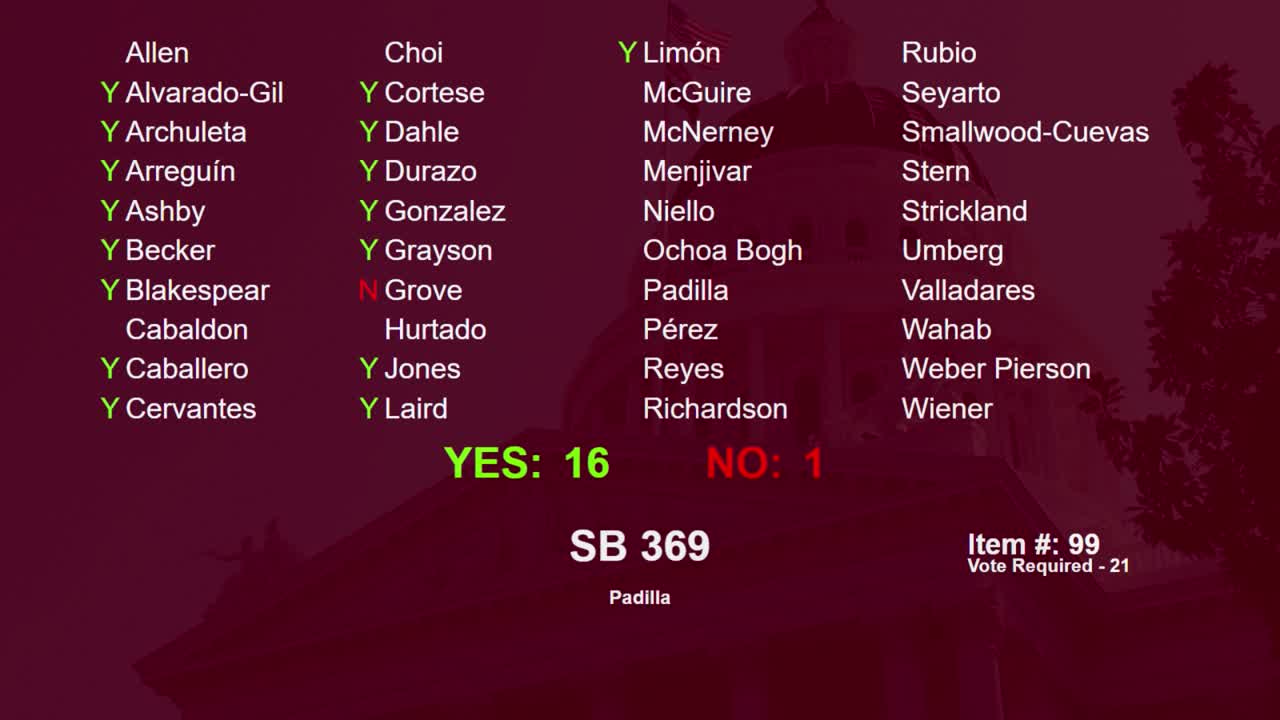 5MIN
Senate Floor
 9MIN
Senate Standing Committee on Judiciary
 10MIN