SB 821: Criminal procedure: arraignment.
- Session Year: 2025-2026
- House: Senate
- Latest Version Date: 2025-04-02
Current Status:
Failed
(2026-02-02: Returned to Secretary of Senate pursuant to Joint Rule 56.)
Introduced
In Committee
Awaiting First Chamber Vote
Passed First Chamber
In Committee
Awaiting Second Chamber Vote
Passed Second Chamber
Enacted
Existing law requires a person arrested without a warrant to be taken before the nearest magistrate in the county in which the offense is triable without delay. Existing law also authorizes a peace officer to release the arrested person from custody instead of taking them before a magistrate under certain specified circumstances, including if the person was arrested for intoxication only. Existing law requires the court, during the in-custody appearance of a person charged with a misdemeanor, to determine whether there is probable cause to believe that a public offense has been committed.
This bill would require the court to promptly, but no later than 48 hours after a warrantless arrest, review the basis for the arrest and make an initial determination whether probable cause exists that an offense has been committed and that the arrested person committed it if the defendant remains in custody, as specified. The bill would require that if the court makes an initial finding of no probable cause, the court to order the person to be released immediately. immediately and provide notice to both the arrested person and the person having custody of the arrested person.
Existing law similarly requires a juvenile that has been arrested to be released with 48 hours, excluding judicial holidays, unless a petition has been filed to make the minor a ward of the court or charges have been filed charging the minor as an adult.
This bill would remove the judicial holidays exemption and the petition exemption and would instead require the court to promptly, but no later than 48 hours after a juvenile is taken into custody custody, make a determination whether an offense has been committed and whether the juvenile in custody committed it, as specified. The bill would require that if the court makes an initial finding of no probable cause, the court to order the juvenile to be released immediately. immediately and provide notice to the juvenile, the person or entity having custody of the juvenile, and the public defender or indigent defense provider.
Existing law requires any decision to detain a juvenile who is in custody under the belief that the juvenile has committed a misdemeanor, as specified, for more than 24 hours to be subject to written review and approval by a probation officer, as specified.This bill would expand the above-described requirement for the written review and approval by the probation officer to all crimes for which the juvenile is in custody for more than 24 hours.By imposing a higher level of service on prosecutors, public defenders, police, jails, and courthouses, this bill would impose a state-mandated local program.The California Constitution requires the state to reimburse local agencies and school districts for certain costs mandated by the state. Statutory provisions establish procedures for making that reimbursement.This bill would provide that, if the Commission on State Mandates determines that the bill contains costs mandated by the state, reimbursement for those costs shall be made pursuant to the statutory provisions noted above.Existing law requires a person arrested without a warrant to be taken before the nearest magistrate in the county in which the offense is triable without delay. Existing law also authorizes a peace officer to release the arrested person from custody instead of taking them before a magistrate under certain specified circumstances, including if the person was arrested for intoxication only. Existing law requires the court, during the in-custody appearance of a person charged with a misdemeanor, to determine whether there is probable cause to believe that a public offense has been committed.
This bill would require the court to promptly, but no later than 48 hours after a warrantless arrest, review the basis for the arrest and make an initial determination whether probable cause exists that an offense has been committed and that the arrested person committed it if the defendant remains in custody, as specified. The bill would require that if the court makes an initial finding of no probable cause, the court to order the person to be released immediately.
Existing law similarly requires a juvenile that has been arrested to be released with 48 hours, excluding judicial holidays, unless a petition has been filed to make the minor a ward of the court or charges have been filed charging the minor as an adult.
This bill would remove the judicial holidays exemption and the petition exemption and would instead require the court to promptly, but no later than 48 hours after a juvenile is taken into custody make a determination whether an offense has been committed and whether the juvenile in custody committed it, as specified. The bill would require that if the court makes an initial finding of no probable cause, the court to order the juvenile to be released immediately.
Existing law requires any decision to detain a juvenile who is in custody under the belief that the juvenile has committed a misdemeanor, as specified, for more than 24 hours to be subject to written review and approval by a probation officer, as specified.
This bill would expand the above-described requirement for the written review and approval by the probation officer to all crimes for which the juvenile is in custody for more than 24 hours.
By imposing a higher level of service on prosecutors, public defenders, police, jails, and courthouses, this bill would impose a state-mandated local program.
The California Constitution requires the state to reimburse local agencies and school districts for certain costs mandated by the state. Statutory provisions establish procedures for making that reimbursement.
This bill would provide that, if the Commission on State Mandates determines that the bill contains costs mandated by the state, reimbursement for those costs shall be made pursuant to the statutory provisions noted above.
The Legislature finds and declares all of the following:
(a)According to the Committee on Revision of the Penal Codes 2022 Annual Report, despite a United States Supreme Court case arising from the County of Riverside more than 30 years ago, California has not codified a core requirement of the Fourth Amendment to the United States Constitution that every arrest must shall be promptly reviewed by a neutral judge. In juvenile cases, current law allows three to seven days to pass before a judicial review of the arrest.
(b)It is the intent of the Legislature to codify the holding in County of Riverside v. McLaughlin (1991) 500 U.S. 44 that every warrantless arrest be reviewed by a judicial officer for probable cause promptly after arrest, that probable cause determinations made after 48 hours requires the government to demonstrate the existence of a bona fide emergency or other extraordinary circumstance, and that matters such as intervening weekends or the need for consolidating pretrial proceedings are not extraordinary circumstances. circumstance.
(c)It is the intent of the Legislature to abrogate the holding of Alfredo A. v. Superior Court (1994) 6 Cal.4th 1212 that a probable cause determination for juveniles may occur more than 48 hours after arrest.
SEC. 2.Section 849 of the Penal Code is amended to read:849.(a)(1)When an arrest is made without a warrant by a peace officer or private person, the person arrested, if not otherwise released, shall, without unnecessary delay, be taken before the nearest or most accessible magistrate in the county in which the offense is triable, and a complaint stating the charge against the arrested person shall be laid before the magistrate.
(2)Promptly after any warrantless arrest for which the defendant remains in custody, but no later than 48 hours after the arrest, the court shall review the basis for the arrest and make an initial determination whether probable cause exists that an offense has been committed and that the arrested person committed it.
(3)If a probable cause determination has not been made within 48 hours, the prosecution shall demonstrate the existence of a bona fide emergency or other extraordinary circumstance.
(4)The initial probable cause determination described in paragraph (2) may be based on sworn statements from the arresting officer, officer or a police report, may be conducted in chambers or remotely by the court, and need not be an adversarial proceeding. The determination may also occur at a proceeding described in paragraph (1) or at an arraignment proceeding.
(5)If the court makes an initial finding of no probable cause pursuant to paragraph (2), the court shall order the person to be released immediately, and shall immediately convey the order to both the person having custody of the arrested person. person and to the arrested person.
(6)(A)The court shall make a record of the initial determination of probable cause in the court file.
(B)The record shall include, but is not limited to, the initial determination of whether the arrest was supported by probable cause, the time and date of the arrest, the time of the initial determination of probable cause, and any materials relied on by the court in making the determination.
(7)An initial determination of probable cause pursuant to this subdivision shall not be binding on the court in a preliminary hearing or any other future evidentiary proceeding to determine the existence of probable cause.
(b)A peace officer may release from custody, instead of taking the person before a magistrate, a person arrested without a warrant in the following circumstances:
(1)The officer is satisfied that there are insufficient grounds for making a criminal complaint against the person arrested.
(2)The person arrested was arrested for intoxication only, and no further proceedings are desirable.
(3)The person was arrested only for being under the influence of a controlled substance or drug and the person is delivered to a facility or hospital for treatment and no further proceedings are desirable.
(4)The person was arrested for driving under the influence of alcohol or drugs and the person is delivered to a hospital for medical treatment that prohibits immediate delivery before a magistrate.
(5)The person was arrested and subsequently delivered to a hospital or other urgent care facility, including, but not limited to, a facility for the treatment of co-occurring substance use disorders, for mental health evaluation and treatment, and no further proceedings are desirable.
(6)The person was arrested and subsequently delivered or referred to a public health or social service organization that provides services, including, but not limited to, housing, medical care, treatment for alcohol or substance use disorders, psychological counseling, or employment training and education, the organization agrees to accept the delivery or referral, and no further proceedings are desirable.
(c)The record of arrest of a person released pursuant to paragraph (1), (3), (5), or (6) of subdivision (b) shall include a record of release. Thereafter, the arrest shall not be deemed an arrest, but a detention only.
SEC. 3.Section 631 of the Welfare and Institutions Code is amended to read:631.(a)(1)(A)When a minor is taken into custody by a peace officer or probation officer, except when the minor willfully misrepresents themself as 18 or more years of age, the minor shall be released within 48 hours after having been taken into custody unless the court determines that probable cause exists pursuant to paragraph (2).(2)Promptly, but no later than 48 hours after a minor is taken into custody, the court shall make a determination whether an offense has been committed and whether the minor in custody committed it.(3)If a probable cause determination has not been made within 48 hours, the prosecution shall demonstrate the existence of a bona fide emergency or other extraordinary circumstance.(4)The initial probable cause determination described in paragraph (2) may be based on sworn statements from the arresting officer, may be conducted in chambers or remotely by the court, and does not need to be an adversarial proceeding. The determination may also occur at a detention hearing described in Section 632 if that hearing occurs within 48 hours after the arrest.(5)If the court makes an initial finding of no probable cause pursuant to paragraph (2), the court shall order the person to be released immediately, and shall immediately convey the order to the person having custody of the arrested person.(6)(A)The court shall make a record of the initial determination of probable cause in the court file.(B)The record shall include, but is not limited to, the initial determination of whether the arrest was supported by probable cause, the time of the arrest, the time of the initial determination of probable cause, and any materials relied on by the court in making the determination.(7)An initial determination of probable cause made pursuant to this subdivision shall not be binding on the court in any future evidentiary proceeding to determine the existence of probable cause.(b)(1)Except when the minor represents themself as 18 or more years of age, whenever a minor is taken into custody by a peace officer or probation officer without a warrant on the belief that the minor has committed a misdemeanor that does not involve violence, the threat of violence, or possession or use of a weapon, and if the minor is not currently on probation or parole, the minor shall be released within 48 hours after having been taken into custody, excluding nonjudicial days, unless a petition has been filed to declare the minor to be a ward of the court and the minor has been ordered detained by a judge or referee of the juvenile court pursuant to Section 635.(2)(A)In all cases involving the detention of a minor pursuant to this section, any decision to detain the minor more than 24 hours shall be subject to written review and approval by a probation officer who is a supervisor as soon as possible after it is known that the minor will be detained more than 24 hours.(B)If the initial decision to detain the minor more than 24 hours is made by a probation officer who is a supervisor, the decision shall not be subject to review and approval.(c)If a minor who has been held in custody for more than 24 hours by the probation officer is subsequently released and no petition is filed, the probation officer shall prepare a written explanation of why the minor was held in custody for more than 24 hours. The written explanation shall be prepared within 72 hours after the minor is released from custody and filed in the record of the case. A copy of the written explanation shall be sent to the parents, guardian, or other person having care or custody of the minor.SEC. 4. If the Commission on State Mandates determines that this act contains costs mandated by the state, reimbursement to local agencies and school districts for those costs shall be made pursuant to Part 7 (commencing with Section 17500) of Division 4 of Title 2 of the Government Code.SEC. 3.Section 631.2 is added to the Welfare and Institutions Code, to read:631.2.(a)Promptly after any warrantless arrest for which a minor remains in custody, but no later than 48 hours after the arrest, the court shall review the basis for the arrest and make an initial determination whether probable cause exists that an offense has been committed and whether the minor in custody committed it. Notwithstanding Section 246, this determination may be made by a magistrate.
(b)If a probable cause determination has not been made within 48 hours, the prosecution shall demonstrate the existence of a bona fide emergency or other extraordinary circumstance.
(c)The initial probable cause determination described in this section may be based on sworn statements from the arresting officer or a police report, may be conducted in chambers or remotely by the court, and does not need to be an adversarial proceeding. The determination may also occur at a detention hearing described in Section 632 if that hearing occurs within 48 hours of the arrest.
(d)If the court makes an initial finding of no probable cause pursuant to this section, the court shall order the minor to be released immediately, and shall immediately convey the order to the person or entity having custody of the minor, the minor, and the public defender or indigent defense provider specified in subdivision (c) of Section 627.
(e)(1)The court shall make a record of the initial determination of probable cause in the court file.
(2)The record shall include, but not be limited to, each of the following:
(A)The initial determination of whether the arrest was supported by probable cause.
(B)The time and date of the arrest.
(C)The time and date of the initial determination of probable cause.
(D)The materials relied on by the court in making the probable cause determination.
(f)An initial determination of probable cause pursuant to this subdivision is not binding on the court in a preliminary hearing or any other future evidentiary proceeding to determine the existence of probable cause, including whether a prima facie showing has been made pursuant to subdivision (c) of Section 635.
The Legislature finds and declares all of the following:
(a)According to the Committee on Revision of the Penal Codes 2022 Annual Report, despite a United States Supreme Court case arising from the County of Riverside more than 30 years ago, California has not codified a core requirement of the Fourth Amendment to the United States Constitution that every arrest must be promptly reviewed by a neutral judge. In juvenile cases, current law allows three to seven days to pass before a judicial review of the arrest.
(b)It is the intent of the Legislature to codify the holding in County of Riverside v. McLaughlin (1991) 500 U.S. 44 that every warrantless arrest be reviewed by a judicial officer for probable cause promptly after arrest, that probable cause determinations made after 48 hours requires the government to demonstrate the existence of a bona fide emergency or other extraordinary circumstance, and that matters such as intervening weekends or the need for consolidating pretrial proceedings are not extraordinary circumstances.
(c)It is the intent of the Legislature to abrogate the holding of Alfredo A. v. Superior Court (1994) 6 Cal.4th 1212 that a probable cause determination for juveniles may occur more than 48 hours after arrest.
SEC. 2.Section 849 of the Penal Code is amended to read:849.(a)(1)When an arrest is made without a warrant by a peace officer or private person, the person arrested, if not otherwise released, shall, without unnecessary delay, be taken before the nearest or most accessible magistrate in the county in which the offense is triable, and a complaint stating the charge against the arrested person shall be laid before the magistrate.
(2)Promptly after any warrantless arrest for which the defendant remains in custody, but no later than 48 hours after the arrest, the court shall review the basis for the arrest and make an initial determination whether probable cause exists that an offense has been committed and that the arrested person committed it.
(3)If a probable cause determination has not been made within 48 hours, the prosecution shall demonstrate the existence of a bona fide emergency or other extraordinary circumstance.
(4)The initial probable cause determination described in paragraph (2) may be based on sworn statements from the arresting officer, may be conducted in chambers or remotely by the court, and need not be an adversarial proceeding. The determination may also occur at a proceeding described in paragraph (1) or at an arraignment proceeding.
(5)If the court makes an initial finding of no probable cause pursuant to paragraph (2), the court shall order the person to be released immediately, and shall immediately convey the order to the person having custody of the arrested person.
(6)(A)The court shall make a record of the initial determination of probable cause in the court file.
(B)The record shall include, but is not limited to, the initial determination of whether the arrest was supported by probable cause, the time of the arrest, the time of the initial determination of probable cause, and any materials relied on by the court in making the determination.
(7)An initial determination of probable cause pursuant to this subdivision shall not be binding on the court in a preliminary hearing or any other future evidentiary proceeding to determine the existence of probable cause.
(b)A peace officer may release from custody, instead of taking the person before a magistrate, a person arrested without a warrant in the following circumstances:
(1)The officer is satisfied that there are insufficient grounds for making a criminal complaint against the person arrested.
(2)The person arrested was arrested for intoxication only, and no further proceedings are desirable.
(3)The person was arrested only for being under the influence of a controlled substance or drug and the person is delivered to a facility or hospital for treatment and no further proceedings are desirable.
(4)The person was arrested for driving under the influence of alcohol or drugs and the person is delivered to a hospital for medical treatment that prohibits immediate delivery before a magistrate.
(5)The person was arrested and subsequently delivered to a hospital or other urgent care facility, including, but not limited to, a facility for the treatment of co-occurring substance use disorders, for mental health evaluation and treatment, and no further proceedings are desirable.
(6)The person was arrested and subsequently delivered or referred to a public health or social service organization that provides services services, including, but not limited to, housing, medical care, treatment for alcohol or substance use disorders, psychological counseling, or employment training and education, the organization agrees to accept the delivery or referral, and no further proceedings are desirable.(c)The record of arrest of a person released pursuant to paragraph (1), (3), (5), or (6) of subdivision (b) shall include a record of release. Thereafter, the arrest shall not be deemed an arrest, but a detention only.
SEC. 3.Section 631 of the Welfare and Institutions Code is amended to read:631.(a)Except as provided in subdivision (b), whenever (1)(A)When a minor is taken into custody by a peace officer or probation officer, except when the minor willfully misrepresents himself or herself themself as 18 or more years of age, the minor shall be released within 48 hours after having been taken into custody, excluding nonjudicial days, unless within that period of time a petition to declare the minor a ward has been filed pursuant to this chapter or a criminal complaint against the minor has been filed in a court of competent jurisdiction. custody unless the court determines that probable cause exists pursuant to paragraph (2).
(2)Promptly, but no later than 48 hours after a minor is taken into custody, the court shall make a determination whether an offense has been committed and whether the minor in custody committed it.
(3)If a probable cause determination has not been made within 48 hours, the prosecution shall demonstrate the existence of a bona fide emergency or other extraordinary circumstance.
(4)The initial probable cause determination described in paragraph (2) may be based on sworn statements from the arresting officer, may be conducted in chambers or remotely by the court, and does not need to be an adversarial proceeding. The determination may also occur at a detention hearing described in Section 632 if that hearing occurs within 48 hours after the arrest.
(5)If the court makes an initial finding of no probable cause pursuant to paragraph (2), the court shall order the person to be released immediately, and shall immediately convey the order to the person having custody of the arrested person.
(6)(A)The court shall make a record of the initial determination of probable cause in the court file.
(B)The record shall include, but is not limited to, the initial determination of whether the arrest was supported by probable cause, the time of the arrest, the time of the initial determination of probable cause, and any materials relied on by the court in making the determination.
(7)An initial determination of probable cause made pursuant to this subdivision shall not be binding on the court in any future evidentiary proceeding to determine the existence of probable cause.
(b)(1)Except when the minor represents himself or herself themself as 18 or more years of age, whenever a minor is taken into custody by a peace officer or probation officer without a warrant on the belief that the minor has committed a misdemeanor that does not involve violence, the threat of violence, or possession or use of a weapon, and if the minor is not currently on probation or parole, the minor shall be released within 48 hours after having been taken into custody, excluding nonjudicial days, unless a petition has been filed to declare the minor to be a ward of the court and the minor has been ordered detained by a judge or referee of the juvenile court pursuant to Section 635. In
(2)(A)In all cases involving the detention of a minor pursuant to this subdivision, section, any decision to detain the minor more than 24 hours shall be subject to written review and approval by a probation officer who is a supervisor as soon as possible after it is known that the minor will be detained more than 24 hours. However, if the hours.
(B)If the initial decision to detain the minor more than 24 hours is made by a probation officer who is a supervisor, the decision shall not be subject to review and approval.
(c)Whenever If a minor who has been held in custody for more than 24 hours by the probation officer is subsequently released and no petition is filed, the probation officer shall prepare a written explanation of why the minor was held in custody for more than 24 hours. The written explanation shall be prepared within 72 hours after the minor is released from custody and filed in the record of the case. A copy of the written explanation shall be sent to the parents, guardian, or other person having care or custody of the minor.
SEC. 4.If the Commission on State Mandates determines that this act contains costs mandated by the state, reimbursement to local agencies and school districts for those costs shall be made pursuant to Part 7 (commencing with Section 17500) of Division 4 of Title 2 of the Government Code.
|
Date
|
Status
|
|---|---|
| Feb 2, 2026 | Returned to Secretary of Senate pursuant to Joint Rule 56. |
| May 23, 2025 | May 23 hearing: Held in committee and under submission. |
| May 16, 2025 | Set for hearing May 23. |
| Apr 21, 2025 | April 21 hearing: Placed on APPR. suspense file. |
| Apr 10, 2025 | Set for hearing April 21. |
| Apr 8, 2025 | From committee: Do pass and re-refer to Com. on APPR. (Ayes 5. Noes 0. Page 709.) (April 8). Re-referred to Com. on APPR. |
| Apr 2, 2025 | From committee with author's amendments. Read second time and amended. Re-referred to Com. on PUB. S. |
| Mar 27, 2025 | Set for hearing April 8. |
| Mar 12, 2025 | Referred to Com. on PUB. S. |
| Feb 24, 2025 | Read first time. |
| Feb 24, 2025 | From printer. May be acted upon on or after March 24. |
| Feb 21, 2025 | Introduced. To Com. on RLS. for assignment. To print. |
|
Date
|
Description
|
Location
|
Votes
|
|
|---|---|---|---|---|
| Apr 21, 2025 | Placed on suspense file | Senate Standing Committee on Appropriations |
Passed |
|
| Apr 8, 2025 | Do pass, but first be re-referred to the Committee on [Appropriations] | Senate Standing Committee on Public Safety |
Passed |
This list shows positions taken on this bill by organizations on the date displayed, which is linked to the original source.
Positions by individuals are not included.
|
Organization
|
Position
|
Date
|
|---|---|---|
| Aclu California Action | ** Support | |
| All of Us or None Los Angeles | ** Support | |
| Be Smooth, Inc. | ** Support | |
| California Alliance for Youth and Community Justice | ** Support | |
| California District Attorneys Association | ** Against | |
| California Public Defenders Association | ** Support | |
| Communities United for Restorative Youth Justice | ** Support | |
| Community Interventions | ** Support | |
| Courage California | ** Support | |
| Drug Policy Alliance | ** Support | |
| Ella Baker Center For Human Rights | ** Support | |
| Fair Chance Project | ** Support | |
| Fresno County Public Defender's Office | ** Support | |
| Initiate Justice | ** Support | |
| Justice2jobs Coalition | ** Support | |
| LA Defensa | ** Support | |
| Legal Services for Prisoners with Children | ** Support | |
| National Institute for Criminal Justice Reform | ** Support | |
| Pacific Juvenile Defender Center | ** Support | |
| Peace and Justice Law Center | ** Support | |
| Rubicon Programs | ** Support | |
| San Diego County District Attorneys Office | ** Against | |
| San Francisco Public Defenders Office | ** Support | |
| The W. Haywood Burns Institute | ** Support | |
| Vera Institute Of Justice | ** Support | |
| Youth Forward | ** Support |
SENATE COMMITTEE ON APPROPRIATIONS
Senator Anna Caballero, Chair
2025 - 2026 Regular Session
SB 821 (Arreguín) - Criminal procedure: arraignment
Version: April 2, 2025 | Policy Vote: PUB. S. 5 - 0 |
Urgency: No | Mandate: No |
Hearing Date: April 21, 2025 | Consultant: Liah Burnley |
Bill Summary:
SB 821 requires courts to have a probable cause hearing within 48 hours after a warrantless arrest.
Fiscal Impact:
- Trial Courts: Unknown, potentially significant cost to the state funded trial court system (Trial Court Trust Fund, General Fund) to hold probable cause hearings within 48 hours of arrest, as required by this bill. The fiscal impact of this bill to the courts will depend on many unknown factors, including the numbers of people arrested and the factors unique to each case. An eight-hour court day costs approximately $10,500 in staff in workload. If court days exceed 10, costs to the trial courts could reach hundreds of thousands of dollars. In 2023–24, over 4.8 million cases were filed statewide in the superior courts, including 179,821 felony cases and 451,647 misdemeanor cases. While the courts are not funded on a workload basis, an increase in workload could result in delayed court services and would put pressure on the General Fund to fund additional staff and resources and to increase the amount appropriated to backfill for trial court operations. The Governor’s 2025-26 budget proposes a $40 million ongoing increase in discretionary funding from the General Fund to help pay for increased trial court operation costs beginning in 2025-26. (See Staff Comments).
- Local Costs: Unknown, potential costs savings (local funds, General Fund) in the millions of dollars annually to counties in reduced incarceration costs. According to data from the Board of State and Community Corrections, more than 70% of the average daily population of all county jail inmates are unsentenced. This bill may result in fewer people being held pretrial. It costs approximately $77,252 per year to house an inmate in county jail, depending on the county. It is unclear how many people will actually spend less time incarcerated as a result of this bill. DOJ’s Crime in California reports in 2023, 10.4% of arrests were rejected by prosecutors for “lack of sufficient evidence” – more than 22,000 arrests. If this bill results in 500 people serving on average one month less because of timely probable cause determinations, the annual cost savings would be in the millions. California county jails are increasingly overcrowded – particularly since the Realignment Act in 2011. Jail overcrowding since 2011 has resulted in court-mandated population caps and increased rates of inmate violence and death. Overcrowding has also resulted in significant state funding for additional jail construction. Thus, overcrowding in county jails creates cost pressure on the General Fund because the state has historically granted new funding to counties to offset overcrowding after the 2011 Realignment Act.
Background:
In its 2022 Annual Report, the California Committee on Revision of the Penal Code recommended that California ensure that all arrested people have their first appearance in court no more than 48 hours after arrest, without exception, and that the state codify case law requiring prompt judicial review of probable cause for warrantless arrests.[1]
The Fourth Amendment requires that a person arrested without a warrant receive a “prompt” probable cause determination from an impartial magistrate. Probable cause is the standard used to determine whether an officer can justifiably arrest an individual.[2]
In County of Riverside v. McLaughlin (1991) 500 U.S. 44, the U.S. Supreme Court defined “prompt” for purposes of a probable cause determination. The case involved a class action lawsuit against Riverside County in California. The county had a policy of combining its probable cause determinations with its arraignments, which had to take place within two days of arrest, excluding weekends and holidays. The Supreme Court held that a jurisdiction that provides a judicial probable cause determination will generally comply with the promptness requirement. “Prompt” means a person in custody pursuant to a warrantless arrest must be given a probable cause determination without unreasonable delay, and in any case, within 48 hours, unless there was an emergency or other extraordinary circumstance. Notably, the court said that intervening weekends do not qualify as an extraordinary circumstance. Even though the case is more than three decades old, California’s Penal Code has not been updated to address the United States Supreme Court case of County of Riverside v. McLaughlin (1991).
The California Supreme Court has held that the 48-hour time limit does not apply to juveniles, and instead juvenile detainees are only entitled to judicial probable cause determination within 72 hours of arrest. (Alfredo A. v. Superior Court 6 Cal.4th 1212, 1216.) California Supreme Court has since recognized that “One important difference between juvenile delinquency and adult criminal proceedings is the speed with which juvenile proceedings must begin and progress. (Citation.) Much must be completed in a narrow timeframe.” (In re Greg F. (2012) 55 Cal.4t 393, 403, citation omitted.) Research on statewide juvenile court procedures conducted in 2015 found that while some counties reviewed warrantless arrests of juveniles within 48 hours or arrest, the majority of counties did not. A 2022 survey of adult court public defenders about probable cause determinations indicated significant variation in county practices, with many responses indicating that the 48-hour rule was not adhered to or that courts did not make a record of the determinations.[3]
Empirical research suggests that almost any period of pretrial detention harms the incarcerated person. Even a day or two in pretrial detention can destabilize a person’s life for years to come, contributing to its counterproductive influence on safety and justice.[4] As Justice Scalia dissented in County of Riverside v. McLaughlin, “…it is an "unreasonable seizure" within the meaning of the Fourth Amendment for the police, having arrested a suspect without a warrant, to delay a determination of probable cause for the arrest … beyond 24 hours.[5] As Justice Scalia explained, with any further delay:
…the presumptively innocent may be left in jail. Hereafter a law-abiding citizen wrongfully arrested may be compelled to await the grace of a Dickensian bureaucratic machine, as it churns its cycle for up to two days -- never once given the opportunity to show a judge that there is absolutely no reason to hold him, that a mistake has been made. In my view, this is the image of a system of justice that has lost its ancient sense of priority, a system that few Americans would recognize as our own.[6]
Recent events underscore the importance of a prompt system of justice. The current presidential administration’s immigration actions—such as deporting people who have not been convicted of any crime[7], without due process or a hearing[8], in open defiance of court orders,[9] and even threatening to deport U.S. citizens[10],—make it clear: this state must protect constitutional rights at the local level, including prompt probable cause hearings. This is especially pressing where sheriffs have committed to cooperate with ICE,[11] putting local jails at risk of becoming de facto arms of a federal immigration enforcement apparatus that treats the Constitution like a suggestion. Ensuring that people do not languishing in custody without a fast probable cause hearing is not just a legal box to check—it is a fundamental safeguard against jails turning into black holes where immigrants disappear. If the federal government insists on playing fast and loose with due process, then this state must make sure everyone arrested without a warrant is promptly brought before a judge to review the basis of their arrest.
Proposed Law:
This bill does all of the following:
- States that promptly after a warrantless arrest, but no more than 48 hours after, a court must review the basis for the arrest to determine whether probable cause exists that an offense was committed and the arrestee had committed it.
- States that if a probable cause determination has not been made within 48 hours, the prosecution must demonstrate the existence of a bona fide emergency or other extraordinary circumstance.
- Provides that a probable cause determination for a warrantless arrest may be based on sworn statements from the arresting officer or a police report and may be conducted in chambers, remotely, or in conjunction with an arraignment.
- Requires, upon a court finding there was no probable cause to warrant the arrest, the court to immediately order the person’s release and to convey the order to the custodial officer and to the person arrested.
- Requires a court to make a record of the initial probable cause determination and to place it in the court file. The record must include: the initial determination of whether the arrest was supported by probable cause, the date and time of arrest, the time that the determination was made, and any material relied on by the court in making the determination.
- States that a warrantless arrest probable cause determination shall not bind a court in a preliminary hearing or any other future evidentiary proceeding to determine the existence of probable cause.
- Implements the same rules noted above for adults, to juvenile arrests.
Related Legislation:
- AB 61 (Bryan), of the 2023-2024 Legislative Session, was substantially similar to this bill. AB 61 died on the Assembly inactive file.
- AB 1636 (Bonta), of the 2019-2020 Legislative Session, would have required the court, at the time a defendant appears for arraignment on a felony complaint, to make a determination as to whether there is probable cause for each felony charged in the complaint. AB 1636 was held in the Assembly Appropriations Committee.
- AB 2013 (Jones-Sawyer), Chapter 689, Statutes of 2016, established a three year pilot program in three counties, requiring the judge to make a finding of probable cause that a crime has been committed when an out of custody defendant is facing a misdemeanor charge, upon request by the defendant.
- AB 696 (Jones-Sawyer), of the 2015-2016 Legislative Session, would have required the judge to make a finding of probable cause that a crime has been committed when an out of custody defendant is facing a misdemeanor charge. AB 696 was vetoed by Governor Brown.
Staff Comments: The Judicial Council indicates that it is continuing to work with the author’s office and sponsors on potential amendment language to clarify from where the probable cause determination can be made, including a judicial officer’s home when they are the on-call magistrate overnight. If this clarity is provided, the Judicial Council has no fiscal concerns with the bill as it will largely be codifying existing practice for adult probable cause determinations. There may be minor impact to court operations for the juvenile requirements which shrink the current requirement of 72 hours down to 48 hours and may require an additional juvenile magistrate to be on-call overnight for warrantless arrests. The council also identifies a minor and absorbable impact on court operations to ensure a court record of the determination is included in the court file as it is not clear if there is a court file for all of these determinations that are occurring prior to a complaint being filed with the clerk of the court and the creation of the official court record.
-- END --
California Committee on Revision of Penal Code. Annual Report and Recommendations. (Dec. 2022) < https://clrc.ca.gov/CRPC/Pub/Reports/CRPC_AR2022.pdf > at pp. 60-62.
↑Gerstein v. Pugh (1975) 420 U.S 103
↑California Committee on Revision of Penal Code. Annual Report and Recommendations. (Dec. 2022) < https://clrc.ca.gov/CRPC/Pub/Reports/CRPC_AR2022.pdf > at pp. 60-62. ↑
https://www.prisonpolicy.org/blog/2024/08/06/short_jail_stays/ ↑
County of Riverside v. McLaughlin (1991) 500 U.S. 44, at 70 (Justice Scalia, Dissenting) ↑
Ibid. ↑
Vega, Cecilia U.S. sent 238 migrants to Salvadoran mega-prison; documents indicate most have no apparent criminal records. (April 6, 2025). https://www.cbsnews.com/news/what-records-show-about-migrants-sent-to-salvadoran-prison-60-minutes-transcript/ ↑
The White House, Invocation of the Alien Enemies Act Regarding the Invasion of the United States by Tren De Aragua. (March 15, 2025) https://www.whitehouse.gov/presidential-actions/2025/03/invocation-of-the-alien-enemies-act-regarding-the-invasion-of-the-united-states-by-tren-de-aragua/; Trump v. J.G.G. 604 U. S. ____ (2025) (Justice Sotomayor, Dissenting) https://www.supremecourt.gov/opinions/24pdf/24a931_2c83.pdf ↑
J.G.G., et al., v. DONALD J. TRUMP, et al., (April 16, 20205) USDC for the District of Columbia, Civil Action No. 25-766 (JEB) https://ecf.dcd.uscourts.gov/cgi-bin/show_public_doc?2025cv0766-81 ↑
Reuters, Trump calls for deporting some citizens to El Salvador, testing US law (April 15, 2025). https://www.reuters.com/world/americas/trump-wants-deport-some-us-citizens-el-salvador-2025-04-14/; NPR, 'Homegrowns are next': Trump hopes to deport and jail U.S. citizens abroad (April 16, 2025). https://www.npr.org/2025/04/16/nx-s1-5366178/trump-deport-jail-u-s-citizens-homegrowns-el-salvador ↑
CalMatters, We asked all 58 California sheriffs about immigration enforcement under Trump. Here’s what they said. (Jan. 20, 2025) https://calmatters.org/politics/2025/01/california-sheriffs-immigration-ice-tracker/; Spectrum News, California sheriff to work with ICE, but other state authorities say legally they can't. (April 1, 2025) https://spectrumnews1.com/ca/southern-california/public-safety/2025/04/01/ice-state-law-amador-sheriff-immigration-enforcement; Statement from Sheriff Barnes regarding Federal Immigration Enforcement (Jan. 27, 2025) https://ocsheriff.gov/news/statement-sheriff-barnes-regarding-federal-immigration-enforcement; Report of the Implementation of the California Values Act (March 2019) [finding that sheriff’s detain people in jails for immigration enforcement purposes; provide space to ICE in
Jail facilities for their exclusive use; and perform the activities of immigration detention officers and
patrol the border.] https://www.advancingjustice-alc.org/wp-content/uploads/2019/03/SB54-Report_FINAL.pdf ↑
SENATE COMMITTEE ON PUBLIC SAFETY
Senator Jesse Arreguín, Chair
2025 - 2026 Regular
Bill No: SB 821 Hearing Date: April 8, 2025
Author: | Arreguín | ||
Version: | February 21, 2025 | ||
Urgency: | No | Fiscal: | Yes |
Consultant: | SU | ||
Subject: Criminal procedure: arraignment
HISTORY
Source: Smart Justice
Prior Legislation: AB 61 (Bryan), ordered to Assembly inactive file, 2024
AB 1636 (Bonta), held in Assembly Appropriations, 2019
AB 2013 (Jones-Sawyer), Ch. 689, Stats. of 2016
AB 696 (Jones-Sawyer), vetoed by Governor, 2015
Support: ACLU California Action; All of Us or None Los Angeles; Be Smooth, Inc.; California Alliance for Youth and Community Justice; California Public Defenders Association; Communities United for Restorative Youth Justice; Community Interventions; Courage California; Drug Policy Alliance; Ella Baker Center for Human Rights; Fair Chance Project; Fresno County Public Defender’s Office; Initiate Justice; Justice2Jobs Coalition; La Defensa; Legal Services for Prisoners with Children; National Institute for Criminal Justice Reform; Pacific Juvenile Defender Center; Peace and Justice Law Center; Rubicon Programs; San Francisco Public Defender’s Office; The W. Haywood Burns Institute; Vera Institute of Justice; Youth Forward
Opposition: California District Attorneys Association; San Diego County District Attorney’s Office
PURPOSE
The purpose of this bill is to ensure that all arrested people have a probable cause determination no more than 48 hours after arrest.
Existing law provides that the presiding judge of the superior court in a county must designate one judge to be reasonably available on call when court is not in session, for purposes of custody discharges, issuance of search warrants, and other appropriate matters. (Pen. Code, § 810.)
Existing law allows a peace officer to arrest a person pursuant to a warrant, or without a warrant whenever any of the following circumstances occur:
- The officer has probable cause to believe that the person to be arrested has committed a public offense in the officer’s presence;
- The person arrested has committed a felony, although not in the officer’s presence;
- The officer has probable cause to believe that the person to be arrested has committed a felony, whether or not a felony, in fact, has been committed. (Pen. Code, § 836, subd. (a).)
Existing law states that when an arrest is made without a warrant and the person arrested is kept in custody, they must be taken before a magistrate without unnecessary delay, and a complaint stating the charge must be laid before the magistrate. (Pen. Code, § 849, subd. (a).)
Existing law allows a peace officer to release a person from custody, instead of taking the arrested person before a magistrate, in specified circumstances. (Pen. Code, § 849, subd. (a).)
This bill states that promptly after a warrantless arrest, but no more than 48 hours after, a court must review the basis for the arrest to determine whether probable cause exists that an offense was committed and the arrestee had committed it.
This bill states that if a probable cause determination has not been made within 48 hours, the prosecution must demonstrate the existence of a bona fide emergency or other extraordinary circumstance.
This bill provides that a probable cause determination for a warrantless arrest may be based on sworn statements from the arresting officer or a police report and may be conducted in chambers, remotely, or in conjunction with an arraignment.
This bill requires, upon a court finding there was no probable cause to warrant the arrest, the court to immediately order the person’s release and to convey the order to the custodial officer and to the person arrested.
This bill requires a court to make a record of the initial probable cause determination and to place it in the court file. The record must include: the initial determination of whether the arrest was supported by probable cause, the date and time of arrest, the time that the determination was made, and any material relied on by the court in making the determination.
This bill states that a warrantless arrest probable cause determination shall not bind a court in a preliminary hearing or any other future evidentiary proceeding to determine the existence of probable cause.
Existing law states that a peace officer may take a minor into temporary custody without a warrant if, among other things, the peace officer has reasonable suspicion to believe the minor committed a certain offense. (Welf. & Inst. Code, § 625.)
Existing law requires a peace officer to take a minor to the probation officer without unnecessary delay and prepare a concise probable cause statement to deliver to the probation officer if there is
no lesser restrictive alternative that is compatible with the best interests of the minor and the community. (Welf. & Inst. Code, § 626, subd. (d).)
Existing law requires the probation officer taking custody of the minor to immediately investigate the circumstances of the minor and facts surrounding their custody, and immediately release the minor to their family unless one or more of the following can be demonstrated in court:
- Continued detention is an urgent necessity for the protection of the minor or reasonable necessity for the protection of a person or their property.
- The minor is likely to flee the jurisdiction of the court.
- The minor has violated a juvenile court order. (Welf. & Inst. Code, § 628, subd. (a).)
Existing law states that a minor taken into custody must be released within 48 hours, excluding non-judicial days unless a petition to declare the minor a ward or a criminal complaint has been filed. (Welf. & Inst. Code, § 631, subd. (a).)
This bill implements the same rules noted above for adults, to juvenile arrests.
This bill contains legislative findings and declarations.
COMMENTS
- Need for This Bill
According to the author:
SB 821 updates California’s Penal Code to include a long-standing requirement of the Fourth Amendment to the United State Constitution. This requirement — that a judge must promptly review warrantless arrests — protects innocent people who are wrongfully arrested and ensures essential judicial oversight of other arrests by reviewing the reason for the arrest. Even though this requirement arose from a Riverside County case in 1994, California’s Penal Code does not incorporate these reviews.
SB 821 closely tracks what is required by the Fourth Amendment: it requires probable cause review to occur promptly but no later than 48 hours after arrest, unless there is a bona fide emergency or other rare extraordinary circumstance. This bill also specifies procedural requirements of these reviews, including what must be in the court file, that the review can occur without a hearing, and, if a court determines someone was arrested without probable cause, the court’s finding must be immediately conveyed to the person who has custody of the arrested person.
This bill also extends these protections to minors who are arrested without a warrant. Though the California Supreme Court determined in 1994 that minors can be held longer than adults without a judge reviewing the arrest, this court decision is inconsistent with California’s values as it allows minors who have been improperly arrested to be separated from their family and held in jail for 3 days under current law before a judge can intervene.
- Effects of Pretrial Detentions
Pretrial detention is known to have negative effects. It can affect, employment, schooling, housing, familial relationships, and childcare to name a few. This is especially true for people living close to the margins. Studies on pretrial detention have found that even a small number of days in custody can have many negative effects ranging from housing instability to increasing the likelihood that a person will be found guilty. (L. Digard & E. Swavola, Vera Institute of Justice, Justice Denied: the Harmful and Lasting Effects of Pretrial Detention (April 2019) < https://www.vera.org/publications/for-the-record-justice-denied-pretrial-detention>, p. 4 [as of March 30, 2025].)
According to some researchers who examined pretrial detentions and recidivism rates in the context of bail, there are three major takeaways about the effect of pretrial detentions:
First, being held in detention pretrial beyond one or two days increases a person’s chances of being arrested and charged again pretrial (for those eventually released before case disposition) and post-disposition. Second, all things considered, the longer one’s stint in detention, the greater the odds of new penal contact. And third, the effects of pretrial detention on future penal system involvement are especially pronounced for low-risk defendants, individuals who likely would not have had further criminal legal system involvement had they not been held in detention. Thus, a growing body of research indicates that pretrial detention is creating ‘recidivators’ out of individuals who might not otherwise (re)offend.
(Sandra Smith PH.D. Pretrial Detention, Pretrial Release, & Public Safety. (Jul. 2022) <https://www.hks.harvard.edu/publications/pretrial-detention-pretrial-release-public-safety> [as of Mar. 30, 2025] at p. 6, footnotes omitted.)
Because the empirical research suggests that almost any period of pretrial detention harms the incarcerated person, in its 2022 Annual Report, the California Committee on Revision of the Penal Code recommended that California ensure that all arrested people have their first appearance in court no more than 48 hours after arrest, without exception, and that the State codify caselaw requiring prompt judicial review of probable cause for warrantless arrests. (California Committee on Revision of Penal Code. Annual Report and Recommendations. (Dec. 2022) < https://clrc.ca.gov/CRPC/Pub/Reports/CRPC_AR2022.pdf > [as of Mar. 30, 2025] at pp. 60-62.)
This bill implements the recommendation regarding the prompt judicial review of probable cause for warrantless arrests.
- Probable Cause Requirements for Warrantless Arrests
In Gerstein v. Pugh (1975) 420 U.S 103, the U.S. Supreme Court held that the Fourth Amendment requires that a person arrested without a warrant receive a “prompt” probable cause determination from an impartial magistrate. Probable cause is the standard used to determine whether an officer can justifiably arrest an individual. (Id. at p. 112.) It has been defined as, “facts and circumstances ‘sufficient to warrant a prudent man in believing that the [suspect] had committed or was committing an offense.’ ” (Id. at p. 111.) Review by a magistrate for probable cause is necessary because a magistrate is neutral and detached whereas an officer is often engaged in the competitive enterprise of apprehending criminals. (Id. at pp. 112-113.)
In In re Walters (1975) 15 Cal.3d 738, the California Supreme Court held that Gerstein applied to misdemeanors as well as felonies.
Subsequently, in County of Riverside v. McLaughlin (1991) 500 U.S. 44, the U.S. Supreme Court defined “prompt” for purposes of a probable cause determination. The case involved a class action lawsuit against Riverside County in California. (Id. at p. 47.) The county had a policy of combining its probable cause determinations with its arraignments, which had to take place within two days of arrest, excluding weekends and holidays. (Ibid.) The Supreme Court held that a jurisdiction that provides a judicial probable cause determination will generally comply with the promptness requirement. (Id. at p. 63.) “Prompt” means a person in custody pursuant to a warrantless arrest must be given a probable cause determination without unreasonable delay, and in any case, within 48 hours, unless there was an emergency or other extraordinary circumstance. Notably, the court said that intervening weekends do not qualify as an extraordinary circumstance. (Ibid.)
This bill codifies the holding in McLaughlin and require that a probable cause determination be made by a judge or magistrate within 48 hours. The bill does not specify whether this is inclusive of weekends and holidays. Based on the holding in McLaughlin, supra, 500 U.S. 44, presumably they should not be included.
Additionally, this bill provides that if a probable cause determination has not been made within that timeframe, the prosecution must show there is a bona fide emergency or extraordinary circumstance. The bill specifies that the probable cause determination can be made based on sworn statements from the arresting officer or based on a police report. The bill provides that when the court makes an initial finding that there was no probable cause for arrest, the court must order that the person be immediately released and must provide a copy of the order not only to the custodial officer, but also to the arrestee. This bill requires the court to make a record of its determination, as specified. Finally, the bill specifies that this finding is not binding on the court in future evidentiary proceedings, including at the preliminary hearing.
4. Juveniles
The California Supreme Court has held that the 48 hour time limit does not apply to juveniles, and instead juvenile detainees are only entitled to judicial probable cause determination within 72 hours of arrest. (Alfredo A. v. Superior Court (hereafter Alfredo) 6 Cal.4th 1212, 1216.) The Alfredo court noted juvenile proceedings are fundamentally different from adult criminal proceedings and contained an inherent need for informality and flexibility. (Id. at p. 1215.) The Court noted that “the determination whether to detain a minor following a warrantless arrest for criminal activity is a complex one, requiring consideration of various factors personal to the minor and his family situation,” which are not implicated when making a probable cause determination with an arrested adult. (Id. at p. 1222.) The Alfredo court noted, “[t]he state as a ‘parens patrie interest in preserving and promoting the welfare of the child,’” that juveniles are always in some form of custody, and when the legal guardian’s custody fails, the government must exercise custody itself or appoint someone to do so. (Id. at pp. 1225, 1228.) The Court concluded that the need for flexibility in juvenile proceedings meant that McLaughlin’s 48 hour rule did not apply in the juvenile context and a probable cause determination within 72 hours of arrest was constitutional. (Id. at pp. 1231-1232.)
One of the dissenting opinions opined that whatever differences can be justified in some areas for adults and juveniles under the Fourth Amendment is not justified here. (Alfredo, supra,6 Cal.4th at p. 1243.) The lack of legitimate interest in detaining individuals who have been arrested without probable cause for extended periods “applies to all individuals--whether or not they have attained the age of majority. When probable cause is lacking, detention is unsupported as a matter of law. That proposition does not depend on how old the detainee is. The presence of youth does not make up for the absence of probable cause.” (Ibid, emphasis in original.) The dissent also found it significant that the informality and flexibility inherent in juvenile proceedings are meant to make the proceedings more expeditious than criminal actions, not less. (at p. 1255.)
Consistent with this dissenting opinion, the California Supreme Court has since recognized that “One important difference between juvenile delinquency and adult criminal proceedings is the speed with which juvenile proceedings must begin and progress. (Citation.) Much must be completed in a narrow timeframe.” (In re Greg F. (2012) 55 Cal.4t 393, 403, citation omitted.) For example:
“If the minor is detained, law enforcement must deliver the minor ‘without unnecessary delay’ to the probation officer in an appropriate county (citations) and provide the probation officer with incident reports. (citations.) The probation officer must “immediately investigate the circumstances of the minor and the facts surrounding his or her being taken into custody’ and determine if continued detention is necessary. (citations.)” (Ibid., citations omitted and emphasis added.)
This bill would codify the holding in McLaughlin for juveniles and abrogate the opinion in Alfredo, thereby requiring a probable cause determination within 48 hours of arrest. This is consistent with the recognition that juvenile proceedings should be handled expeditiously. If prolonged detention negatively impacts arrested adults, such negative impacts are even more pronounced for juveniles. Arguably, that is why police officers must “notify” a minor's parents or caregivers about any arrest and where the minor is being housed. (Welf. & Inst. Code, § 627, subd. (a).)
- Argument in Support
According to Smart Justice California:
Even though the case is more than three decades old, California’s Penal Code has not been updated to address the United States Supreme Court case of County of Riverside v. McLaughlin (1991). This case requires a neutral judge to review for probable cause every arrest made without a warrant. Such reviews must occur promptly, but in no event longer than 48 hours after arrest without additional time for weekends or holidays. This important requirement helps protect innocent people who never should have been arrested and is an essential safeguard against blatantly illegal arrests or mistakes by law enforcement.
With regard to adults, SB 821 simply codifies existing practice as mandated by the U.S. Constitution, consistent with the McLaughlin case. SB 821 maintains current practice, explicitly stating that these probable cause reviews to be conducted remotely, do not require an adversarial process, and can be made on the basis of sworn statements or police reports.
SB 821 applies the same principles now used in adult court to youth detained by police. The potential problems with warrantless arrests are even worse in juvenile cases, where current law under a California Supreme Court case allows 72 hours to pass without a review of a minor’s arrest.
SB 821 will ensure that a judge promptly reviews every arrest for probable cause and updates California law so that minors and adults are treated the same. It also includes important procedural requirements, including notice to and immediate release of the arrested person if a judge concludes they should not have been arrested and specifies what a judge must include in a court file to memorialize the probable cause review.
- Argument in Opposition
According to the San Diego County District Attorney’s Office:
If the intent is to require probable cause hearings at the arraignment, this bill would place huge pressures on the criminal justice system to accommodate these rigid requirements. Law enforcement would face providing unprecedented obstacles to both solving criminal cases and delivering justice to communities that need it the most. Imposing these requirements at the arraignment does not consider that many crime victims may not be available to appear at hearings and, therefore, risk not having their input heard by the judge. It would be unfair to our already over-burdened adult and juvenile courts to impose a rigid 48-hour rule arraignments on holidays and weekends.
However, the sponsor of the bill indicated that there is no intent to require a probable cause hearing at the arraignment. The statutory language in the bill does not expressly state that a probable cause determination will occur at the time of arraignment. The title of SB 821 as “Criminal Procedure Arraignment” was an apparent drafting error. SB 821 amends Penal Code Section 849. Section 849 subdivision (a)(1) requires the arrestee to be brought before a magistrate at the time the complaint is filed by the prosecutor. Subdivision (a)(1) describes an arraignment. Thus, by codifying the probable cause determination in Penal Code section (a)(2) through (a)(7), SB 821 appears to require that they occur at the time of arraignment.
If the intent of SB 821 is simply to codify the deadlines for a probable cause determination after a warrantless arrest for adult and juvenile offenders, SB 821 seeks to impose significant procedural changes on the juvenile court system that has been complying with federal and state constitutional law for decades.
SB 821 would require a judge to review the basis for an arrest to determine whether probable cause exists that an offense was committed and that the arrestee had committed it. If a probable cause determination has not been made within 48 hours, the prosecution must demonstrate the existence of a bona fide emergency or other extraordinary circumstances.
SB 821 would impose a strict 48-hour rule in juvenile court, overruling existing California Supreme Court precedent that has expressly recognized that juvenile proceedings are “fundamentally different” from adult criminal proceedings, requiring that a “balance” be struck between the “informality” and “flexibility” that must of necessity inhere in juvenile proceedings, and the further requirement that those proceedings comport with the juvenile's constitutional rights. In Alfredo A. v. Superior Court (1994) 6 Cal. 4th 1212, 1231-1232, the California Supreme Court held:
[W]e therefore conclude that the United States Supreme Court's adoption of the strict 48– hour rule (citations omitted) was neither foreseen nor intended by that court to be rigidly operable in juvenile postarrest detention proceedings. Given the fundamental differences between juvenile and adult detention proceedings recognized in a long line of that court's decisions, we will not infer otherwise absent an express and definitive ruling from the high court to the contrary. As has been shown, our Legislature, in its wisdom, has enacted a comprehensive statutory scheme governing postarrest juvenile detention that is designed to implement specific policies and procedures deemed to be in the juvenile detainees' best interests while balancing their fundamental constitutional rights against the well-recognized need for “informality” and “flexibility” in juvenile criminal justice systems. (citations omitted.) Our juvenile courts, of course, are duty-bound to comply with both constitutional and statutory requirements. Having examined the integrated components of California's juvenile detention statutes, we conclude that the Constitution, as interpreted by the United States Supreme Court's pertinent decisions reviewed herein, requires no more than that juvenile arrestees be afforded a judicial determination of “probable cause” for any postarrest detention extending beyond the 72 hours immediately following a warrantless arrest.
Thus, the California Supreme Court has expressly acknowledged that the existing juvenile statutory scheme governing juvenile detention, wisely designed by the Legislature, provides the appropriate balance between the juvenile’s best interests and their fundamental constitutional rights. The California Supreme Court rejected the notion that a strict 48-hour rule was appropriate for juvenile court. By imposing the same statutory detention timeline required for adult offenders, the carefully crafted juvenile detention scheme is carelessly abandoned solely to achieve uniformity between the two very different systems.
-- END –
SENATE COMMITTEE ON PUBLIC SAFETY
Senator Jesse Arreguín, Chair
2025 - 2026 Regular
Bill No: SB 821 Hearing Date: April 8, 2025
Author: | Arreguín | ||
Version: | February 21, 2025 | ||
Urgency: | No | Fiscal: | Yes |
Consultant: | SU | ||
Subject: Criminal procedure: arraignment
HISTORY
Source: Smart Justice
Prior Legislation: AB 61 (Bryan), ordered to Assembly inactive file, 2024
AB 1636 (Bonta), held in Assembly Appropriations, 2019
AB 2013 (Jones-Sawyer), Ch. 689, Stats. of 2016
AB 696 (Jones-Sawyer), vetoed by Governor, 2015
Support: ACLU California Action; All of Us or None Los Angeles; Be Smooth, Inc.; California Alliance for Youth and Community Justice; California Public Defenders Association; Communities United for Restorative Youth Justice; Community Interventions; Courage California; Drug Policy Alliance; Ella Baker Center for Human Rights; Fair Chance Project; Fresno County Public Defender’s Office; Initiate Justice; Justice2Jobs Coalition; La Defensa; Legal Services for Prisoners with Children; National Institute for Criminal Justice Reform; Pacific Juvenile Defender Center; Peace and Justice Law Center; Rubicon Programs; San Francisco Public Defender’s Office; The W. Haywood Burns Institute; Vera Institute of Justice; Youth Forward
Opposition: California District Attorneys Association; San Diego County District Attorney’s Office
PURPOSE
The purpose of this bill is to ensure that all arrested people have a probable cause determination no more than 48 hours after arrest.
Existing law provides that the presiding judge of the superior court in a county must designate one judge to be reasonably available on call when court is not in session, for purposes of custody discharges, issuance of search warrants, and other appropriate matters. (Pen. Code, § 810.)
Existing law allows a peace officer to arrest a person pursuant to a warrant, or without a warrant whenever any of the following circumstances occur:
- The officer has probable cause to believe that the person to be arrested has committed a public offense in the officer’s presence;
- The person arrested has committed a felony, although not in the officer’s presence;
- The officer has probable cause to believe that the person to be arrested has committed a felony, whether or not a felony, in fact, has been committed. (Pen. Code, § 836, subd. (a).)
Existing law states that when an arrest is made without a warrant and the person arrested is kept in custody, they must be taken before a magistrate without unnecessary delay, and a complaint stating the charge must be laid before the magistrate. (Pen. Code, § 849, subd. (a).)
Existing law allows a peace officer to release a person from custody, instead of taking the arrested person before a magistrate, in specified circumstances. (Pen. Code, § 849, subd. (a).)
This bill states that promptly after a warrantless arrest, but no more than 48 hours after, a court must review the basis for the arrest to determine whether probable cause exists that an offense was committed and the arrestee had committed it.
This bill states that if a probable cause determination has not been made within 48 hours, the prosecution must demonstrate the existence of a bona fide emergency or other extraordinary circumstance.
This bill provides that a probable cause determination for a warrantless arrest may be based on sworn statements from the arresting officer or a police report and may be conducted in chambers, remotely, or in conjunction with an arraignment.
This bill requires, upon a court finding there was no probable cause to warrant the arrest, the court to immediately order the person’s release and to convey the order to the custodial officer and to the person arrested.
This bill requires a court to make a record of the initial probable cause determination and to place it in the court file. The record must include: the initial determination of whether the arrest was supported by probable cause, the date and time of arrest, the time that the determination was made, and any material relied on by the court in making the determination.
This bill states that a warrantless arrest probable cause determination shall not bind a court in a preliminary hearing or any other future evidentiary proceeding to determine the existence of probable cause.
Existing law states that a peace officer may take a minor into temporary custody without a warrant if, among other things, the peace officer has reasonable suspicion to believe the minor committed a certain offense. (Welf. & Inst. Code, § 625.)
Existing law requires a peace officer to take a minor to the probation officer without unnecessary delay and prepare a concise probable cause statement to deliver to the probation officer if there is
no lesser restrictive alternative that is compatible with the best interests of the minor and the community. (Welf. & Inst. Code, § 626, subd. (d).)
Existing law requires the probation officer taking custody of the minor to immediately investigate the circumstances of the minor and facts surrounding their custody, and immediately release the minor to their family unless one or more of the following can be demonstrated in court:
- Continued detention is an urgent necessity for the protection of the minor or reasonable necessity for the protection of a person or their property.
- The minor is likely to flee the jurisdiction of the court.
- The minor has violated a juvenile court order. (Welf. & Inst. Code, § 628, subd. (a).)
Existing law states that a minor taken into custody must be released within 48 hours, excluding non-judicial days unless a petition to declare the minor a ward or a criminal complaint has been filed. (Welf. & Inst. Code, § 631, subd. (a).)
This bill implements the same rules noted above for adults, to juvenile arrests.
This bill contains legislative findings and declarations.
COMMENTS
- Need for This Bill
According to the author:
SB 821 updates California’s Penal Code to include a long-standing requirement of the Fourth Amendment to the United State Constitution. This requirement — that a judge must promptly review warrantless arrests — protects innocent people who are wrongfully arrested and ensures essential judicial oversight of other arrests by reviewing the reason for the arrest. Even though this requirement arose from a Riverside County case in 1994, California’s Penal Code does not incorporate these reviews.
SB 821 closely tracks what is required by the Fourth Amendment: it requires probable cause review to occur promptly but no later than 48 hours after arrest, unless there is a bona fide emergency or other rare extraordinary circumstance. This bill also specifies procedural requirements of these reviews, including what must be in the court file, that the review can occur without a hearing, and, if a court determines someone was arrested without probable cause, the court’s finding must be immediately conveyed to the person who has custody of the arrested person.
This bill also extends these protections to minors who are arrested without a warrant. Though the California Supreme Court determined in 1994 that minors can be held longer than adults without a judge reviewing the arrest, this court decision is inconsistent with California’s values as it allows minors who have been improperly arrested to be separated from their family and held in jail for 3 days under current law before a judge can intervene.
- Effects of Pretrial Detentions
Pretrial detention is known to have negative effects. It can affect, employment, schooling, housing, familial relationships, and childcare to name a few. This is especially true for people living close to the margins. Studies on pretrial detention have found that even a small number of days in custody can have many negative effects ranging from housing instability to increasing the likelihood that a person will be found guilty. (L. Digard & E. Swavola, Vera Institute of Justice, Justice Denied: the Harmful and Lasting Effects of Pretrial Detention (April 2019) < https://www.vera.org/publications/for-the-record-justice-denied-pretrial-detention>, p. 4 [as of March 30, 2025].)
According to some researchers who examined pretrial detentions and recidivism rates in the context of bail, there are three major takeaways about the effect of pretrial detentions:
First, being held in detention pretrial beyond one or two days increases a person’s chances of being arrested and charged again pretrial (for those eventually released before case disposition) and post-disposition. Second, all things considered, the longer one’s stint in detention, the greater the odds of new penal contact. And third, the effects of pretrial detention on future penal system involvement are especially pronounced for low-risk defendants, individuals who likely would not have had further criminal legal system involvement had they not been held in detention. Thus, a growing body of research indicates that pretrial detention is creating ‘recidivators’ out of individuals who might not otherwise (re)offend.
(Sandra Smith PH.D. Pretrial Detention, Pretrial Release, & Public Safety. (Jul. 2022) <https://www.hks.harvard.edu/publications/pretrial-detention-pretrial-release-public-safety> [as of Mar. 30, 2025] at p. 6, footnotes omitted.)
Because the empirical research suggests that almost any period of pretrial detention harms the incarcerated person, in its 2022 Annual Report, the California Committee on Revision of the Penal Code recommended that California ensure that all arrested people have their first appearance in court no more than 48 hours after arrest, without exception, and that the State codify caselaw requiring prompt judicial review of probable cause for warrantless arrests. (California Committee on Revision of Penal Code. Annual Report and Recommendations. (Dec. 2022) < https://clrc.ca.gov/CRPC/Pub/Reports/CRPC_AR2022.pdf > [as of Mar. 30, 2025] at pp. 60-62.)
This bill implements the recommendation regarding the prompt judicial review of probable cause for warrantless arrests.
- Probable Cause Requirements for Warrantless Arrests
In Gerstein v. Pugh (1975) 420 U.S 103, the U.S. Supreme Court held that the Fourth Amendment requires that a person arrested without a warrant receive a “prompt” probable cause determination from an impartial magistrate. Probable cause is the standard used to determine whether an officer can justifiably arrest an individual. (Id. at p. 112.) It has been defined as, “facts and circumstances ‘sufficient to warrant a prudent man in believing that the [suspect] had committed or was committing an offense.’ ” (Id. at p. 111.) Review by a magistrate for probable cause is necessary because a magistrate is neutral and detached whereas an officer is often engaged in the competitive enterprise of apprehending criminals. (Id. at pp. 112-113.)
In In re Walters (1975) 15 Cal.3d 738, the California Supreme Court held that Gerstein applied to misdemeanors as well as felonies.
Subsequently, in County of Riverside v. McLaughlin (1991) 500 U.S. 44, the U.S. Supreme Court defined “prompt” for purposes of a probable cause determination. The case involved a class action lawsuit against Riverside County in California. (Id. at p. 47.) The county had a policy of combining its probable cause determinations with its arraignments, which had to take place within two days of arrest, excluding weekends and holidays. (Ibid.) The Supreme Court held that a jurisdiction that provides a judicial probable cause determination will generally comply with the promptness requirement. (Id. at p. 63.) “Prompt” means a person in custody pursuant to a warrantless arrest must be given a probable cause determination without unreasonable delay, and in any case, within 48 hours, unless there was an emergency or other extraordinary circumstance. Notably, the court said that intervening weekends do not qualify as an extraordinary circumstance. (Ibid.)
This bill codifies the holding in McLaughlin and require that a probable cause determination be made by a judge or magistrate within 48 hours. The bill does not specify whether this is inclusive of weekends and holidays. Based on the holding in McLaughlin, supra, 500 U.S. 44, presumably they should not be included.
Additionally, this bill provides that if a probable cause determination has not been made within that timeframe, the prosecution must show there is a bona fide emergency or extraordinary circumstance. The bill specifies that the probable cause determination can be made based on sworn statements from the arresting officer or based on a police report. The bill provides that when the court makes an initial finding that there was no probable cause for arrest, the court must order that the person be immediately released and must provide a copy of the order not only to the custodial officer, but also to the arrestee. This bill requires the court to make a record of its determination, as specified. Finally, the bill specifies that this finding is not binding on the court in future evidentiary proceedings, including at the preliminary hearing.
4. Juveniles
The California Supreme Court has held that the 48 hour time limit does not apply to juveniles, and instead juvenile detainees are only entitled to judicial probable cause determination within 72 hours of arrest. (Alfredo A. v. Superior Court (hereafter Alfredo) 6 Cal.4th 1212, 1216.) The Alfredo court noted juvenile proceedings are fundamentally different from adult criminal proceedings and contained an inherent need for informality and flexibility. (Id. at p. 1215.) The Court noted that “the determination whether to detain a minor following a warrantless arrest for criminal activity is a complex one, requiring consideration of various factors personal to the minor and his family situation,” which are not implicated when making a probable cause determination with an arrested adult. (Id. at p. 1222.) The Alfredo court noted, “[t]he state as a ‘parens patrie interest in preserving and promoting the welfare of the child,’” that juveniles are always in some form of custody, and when the legal guardian’s custody fails, the government must exercise custody itself or appoint someone to do so. (Id. at pp. 1225, 1228.) The Court concluded that the need for flexibility in juvenile proceedings meant that McLaughlin’s 48 hour rule did not apply in the juvenile context and a probable cause determination within 72 hours of arrest was constitutional. (Id. at pp. 1231-1232.)
One of the dissenting opinions opined that whatever differences can be justified in some areas for adults and juveniles under the Fourth Amendment is not justified here. (Alfredo, supra,6 Cal.4th at p. 1243.) The lack of legitimate interest in detaining individuals who have been arrested without probable cause for extended periods “applies to all individuals--whether or not they have attained the age of majority. When probable cause is lacking, detention is unsupported as a matter of law. That proposition does not depend on how old the detainee is. The presence of youth does not make up for the absence of probable cause.” (Ibid, emphasis in original.) The dissent also found it significant that the informality and flexibility inherent in juvenile proceedings are meant to make the proceedings more expeditious than criminal actions, not less. (at p. 1255.)
Consistent with this dissenting opinion, the California Supreme Court has since recognized that “One important difference between juvenile delinquency and adult criminal proceedings is the speed with which juvenile proceedings must begin and progress. (Citation.) Much must be completed in a narrow timeframe.” (In re Greg F. (2012) 55 Cal.4t 393, 403, citation omitted.) For example:
“If the minor is detained, law enforcement must deliver the minor ‘without unnecessary delay’ to the probation officer in an appropriate county (citations) and provide the probation officer with incident reports. (citations.) The probation officer must “immediately investigate the circumstances of the minor and the facts surrounding his or her being taken into custody’ and determine if continued detention is necessary. (citations.)” (Ibid., citations omitted and emphasis added.)
This bill would codify the holding in McLaughlin for juveniles and abrogate the opinion in Alfredo, thereby requiring a probable cause determination within 48 hours of arrest. This is consistent with the recognition that juvenile proceedings should be handled expeditiously. If prolonged detention negatively impacts arrested adults, such negative impacts are even more pronounced for juveniles. Arguably, that is why police officers must “notify” a minor's parents or caregivers about any arrest and where the minor is being housed. (Welf. & Inst. Code, § 627, subd. (a).)
- Argument in Support
According to Smart Justice California:
Even though the case is more than three decades old, California’s Penal Code has not been updated to address the United States Supreme Court case of County of Riverside v. McLaughlin (1991). This case requires a neutral judge to review for probable cause every arrest made without a warrant. Such reviews must occur promptly, but in no event longer than 48 hours after arrest without additional time for weekends or holidays. This important requirement helps protect innocent people who never should have been arrested and is an essential safeguard against blatantly illegal arrests or mistakes by law enforcement.
With regard to adults, SB 821 simply codifies existing practice as mandated by the U.S. Constitution, consistent with the McLaughlin case. SB 821 maintains current practice, explicitly stating that these probable cause reviews to be conducted remotely, do not require an adversarial process, and can be made on the basis of sworn statements or police reports.
SB 821 applies the same principles now used in adult court to youth detained by police. The potential problems with warrantless arrests are even worse in juvenile cases, where current law under a California Supreme Court case allows 72 hours to pass without a review of a minor’s arrest.
SB 821 will ensure that a judge promptly reviews every arrest for probable cause and updates California law so that minors and adults are treated the same. It also includes important procedural requirements, including notice to and immediate release of the arrested person if a judge concludes they should not have been arrested and specifies what a judge must include in a court file to memorialize the probable cause review.
- Argument in Opposition
According to the San Diego County District Attorney’s Office:
Respectfully, this bill would inadvertently put huge pressure on a majority of the people involved in the judicial process in order to accommodate rigid requirements. Law enforcement would face never-before-seen impediments to both solving criminal cases and providing justice to communities that need it the most. SB 821 does not consider that many crime victims may not be available to appear at hearings and, therefore, risk not having their accounts heard by the judge. It is unfair to our already over-burdened adult and juvenile courts to keep courtrooms open 365 days a year.
This sweeping legislation requires that a person must be taken before a judge without unnecessary delay and, at the most, within 48 hours of their arrest. It states a judge must review the basis for the arrest to determine whether probable cause exists, that an offense was committed and that the arrestee had committed it. If a probable cause determination has not been made within 48 hours, the prosecution must demonstrate the existence of a bona fide emergency or other extraordinary circumstances. Similarly, prior legislative proposals have previously been either vetoed or moved to the inactive file due to the enormous costs associated with such a profound alteration in the statewide criminal justice system….
In 2023, my Office opposed AB 61, authored by Assemblymember Bryan, which bears a resemblance to SB 821. The Assembly Bill “requires that a person must be taken before a judge without unnecessary delay, and, at the most, within 48 hours of their arrest.” The current 48-hour arraignment rule in Penal Code Section 825 has exceptions for weekends and judicial holidays. It contains a specific provision that permits an arraignment to be held on the next judicial day if the 48-hour period expires when the court is not in session. Neither AB 61 nor SB 821 contain any such provision. Routine low-level felonies and misdemeanors would require judges, court reporters, security personnel, public defenders, prosecutors, and court reporters to be available every hour of every day to meet the current standards required by the bill language.
The Office of the San Diego County District Attorney is the second largest in the state and is currently implementing numerous new reforms. We’ve allocated specified resources to conduct reviews of all petitions under the new Racial Justice Act and the countless cases affected by the changes in the Felony Murder Rule statutes, including the latest expansion to include attempted murder and manslaughter cases. If SB 821 becomes law, it will take at least one year to ensure staff, resources, and operational guidelines are in place to accommodate the added caseload. There are no existing guidelines or a delayed implementation clause to ensure counties can administer the proposal’s provisions.
For decades, California has consistently complied with timelines for arraignments that meet constitutional requirements. We understand the importance of making a timely probable cause determination; however, the current language of SB 821 will likely cause more problems than it solves. Currently, it would be difficult to identify the counties that are already complying with a probable cause determination within 48 hours of arrest. SB 821’s attempt to mandate that our criminal court system be open 365 days a year at a tremendous cost to the state of California is not the answer. We should heed the cost concerns expressed by Governor Brown when he vetoed a much less costly version of this bill and study the impact of this change rather than mandating a more expansive and expensive version that our court system does not appear equipped to implement.
-- END –
Discussed in Hearing
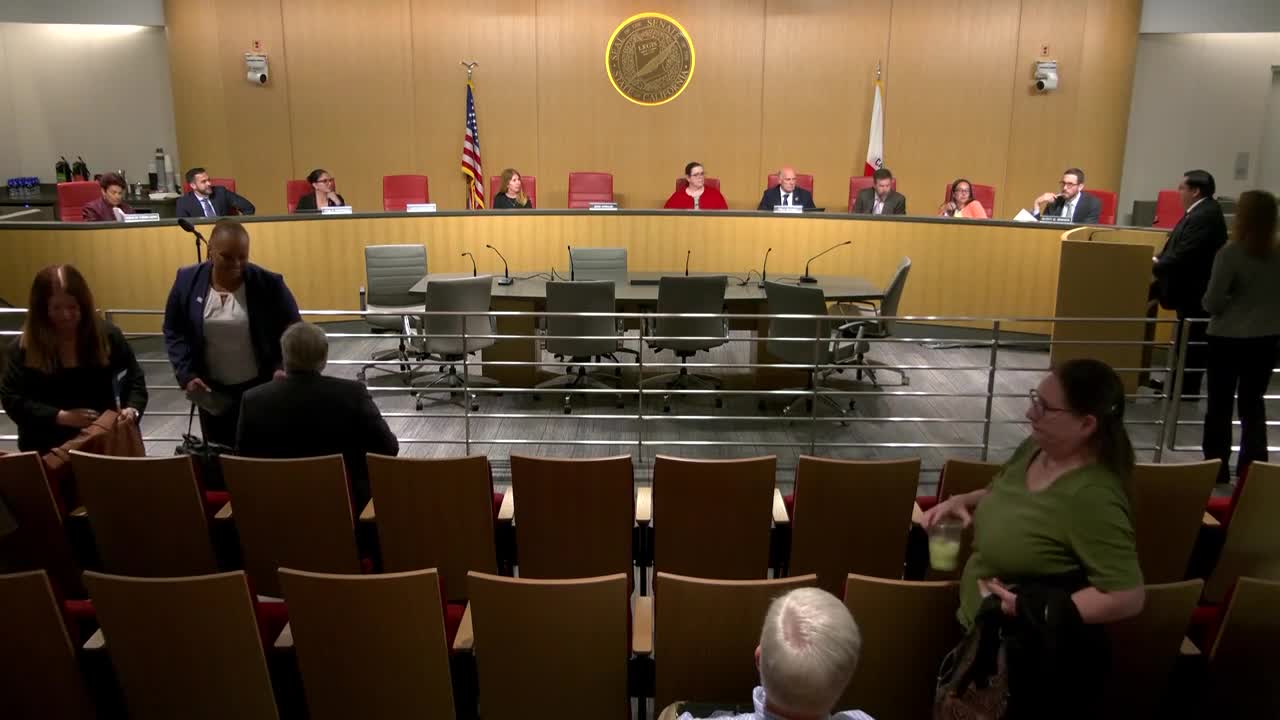 10MIN
Senate Standing Committee on Public Safety
Bill Author
Bill Co-Author(s):