SB 1059: Postsecondary education: Title 38 awards.
- Session Year: 2015-2016
- House: Senate
- Latest Version Date: 2016-09-21
Title 38 of the United States Code provides educational awards for eligible active duty members and veterans of the Armed Forces of the United States. Existing law requires an institution headquartered or operating in California desiring to enroll students eligible for federal Title 38 awards in accredited courses to make application for approval of these courses to the California State Approving Agency for Veterans Education, commonly known as CSAAVE, and authorizes CSAAVE to approve the application of the school when the school and its accredited courses satisfy the specified criteria and any additional reasonable criteria established by CSAAVE.
This bill would include as a qualifying institution for federal Title 38 awards, an institution that has been accredited by the Committee of Bar Examiners, if the institution complies with specified disclosure and compliance requirements.
Title 38 of the United States Code provides educational awards for eligible active duty members and veterans of the Armed Forces of the United States. Existing law requires an institution headquartered or operating in California desiring to enroll students eligible for federal Title 38 awards in accredited courses to make application for approval of these courses to the California State Approving Agency for Veterans Education, commonly known as CSAAVE, and authorizes CSAAVE to approve the application of the school when the school and its accredited courses satisfy the specified criteria and any additional reasonable criteria established by CSAAVE.
This bill would include as a qualifying institution for federal Title 38 awards, an institution that has been accredited by the Committee of Bar Examiners. Examiners, if the institution complies with specified disclosure and compliance requirements.
Title 38 of the United States Code provides educational awards for eligible active duty members and veterans of the Armed Forces of the United States. Existing law requires an institution headquartered or operating in California desiring to enroll students eligible for federal Title 38 awards in accredited courses to make application for approval of these courses to the California State Approving Agency for Veterans Education, commonly known as CSAAVE, and authorizes CSAAVE to approve the application of the school when the school and its accredited courses satisfy the specified criteria and any additional reasonable criteria established by CSAAVE.
This bill would include as a qualifying institution for federal Title 38 awards, an institution that has been accredited by the Committee of Bar Examiners.
The Legislature finds and declares the following:
(a)Sections 21.4253 and 21.4254 of Title 38 of the Code of Federal Regulations require a postsecondary educational institution headquartered or operating in California desiring to enroll veterans or persons eligible for Title 38 awards in accredited and nonaccredited institutions and programs to make application for approval of these courses to the California State Approving Agency for Veterans Education, commonly known as CSAAVE, as the state approving agency legally designated pursuant to Section 3671 of Subchapter I of Chapter 36 of Title 38 of the United States Code.
(b)Sections 21.4253 and 21.4254 authorize CSAAVE to approve the application of the accredited and nonaccredited institutions when the school and its accredited and nonaccredited courses satisfy the criteria provided in Sections 21.4253 and 21.4254 and additional reasonable criteria established by CSAAVE.
(c)It is reasonable pursuant to Sections 21.4253 and 21.4254 for CSAAVE to require a postsecondary educational institution, public or private, to obtain accreditation for its degree programs, to comply with all federal and state laws and regulations, and to comply with any additional reasonable criteria established by CSAAVE. It is reasonable pursuant to Sections 21.4253 and 21.4254 for CSAAVE to require a private postsecondary institution to be issued an approval to operate from the Bureau for Private Postsecondary Education.
SEC. 2.Section 67102 of the Education Code is amended to read:67102.As used in this chapter, the following terms have the following meanings:
(a)An academic year is July 1 to June 30, inclusive. The starting date of a session shall determine the academic year in which it is included.
(b)CSAAVE is the California State Approving Agency for Veterans Education.
(c)(1)Qualifying institution means a degree-granting institution that complies with paragraphs (2), (3), and (4), or a nondegree-granting institution that complies with paragraphs (2) and (4).
(2)(A)The institution shall provide information on where to access California license examination passage rates for the most recent available year from graduates of its undergraduate programs leading to employment for which passage of a California licensing examination is required, if that data is electronically available through the Internet Web site of a California licensing or regulatory agency. For purposes of this paragraph, provide may exclusively include placement of an Internet Web site address labeled as an access point for the data on the passage rates of recent program graduates on the Internet Web site where enrollment information is also located, on an Internet Web site that provides centralized admissions information for postsecondary educational systems with multiple campuses, or on applications for enrollment or other program information distributed to prospective students.
(B)The institution shall be responsible for certifying to CSAAVE compliance with the requirements of subparagraph (A).
(3)(A)A degree-granting institution shall provide evidence of accreditation of the institution and of all degree programs to CSAAVE. The accrediting agency shall be recognized by the United States Department of Education. An unaccredited degree-granting institution participating in the Title 38 award program on January 1, 2015, shall satisfy both of the following to remain eligible to receive Title 38 awards:
(i)The institution shall obtain and provide evidence to CSAAVE of its candidacy or preaccreditation status, with an accrediting agency recognized by the United States Department of Education, by January 1, 2016, for the institution to be eligible for Title 38 awards for the academic year of 201516 or 201617, or both.
(ii)The institution shall obtain and provide evidence to CSAAVE of accreditation from the accrediting agency with which it had candidacy or preaccreditation status by January 1, 2017, for the institution to be eligible for Title 38 awards for the academic year of 201718, and each academic year thereafter.(B)If an unaccredited degree-granting institution participating in the Title 38 award program fails to satisfy the accreditation requirements provided in clause (i) of subparagraph (A), a veteran enrolled in a degree program offered by the institution prior to January 1, 2016, shall remain eligible for Title 38 awards through his or her completion of that degree program. If an unaccredited degree-granting institution participating in the Title 38 award program fails to satisfy the accreditation requirements provided in clause (ii) of subparagraph (A), a veteran enrolled in a degree program offered by the institution prior to January 1, 2017, shall remain eligible for Title 38 awards through his or her completion of that degree program.
(C)An unaccredited degree-granting institution that does not satisfy the accreditation requirements provided in clause (i) of subparagraph (A), shall not enroll any new Title 38 eligible students to any of its degree programs after January 1, 2016. An unaccredited degree granting institution that does not satisfy the accreditation requirements provided in clause (ii) of subparagraph (A), shall not enroll any new Title 38 students to any of its degree programs after January 1, 2017, without first providing these prospective students with the following written disclosure:
If you choose to attend this institution, you will not be eligible to receive a Title 38 award because this institution did not satisfy one or more of the accreditation requirements to receive Title 38 awards.
(D)An institution that obtains and provides evidence to CSAAVE of accreditation from the Committee of Bar Examiners pursuant to Sections 6046.7 and 6060.6 of the Business and Professions Code does not have to comply with subparagraphs (A), (B), and (C), if the institution complies with both of the following:
(i)(I)The institution provides disclosures to applicants of the school of the institutions admissions data, tuition, fees, financial aid, conditional scholarships, refund policies, average class size of each required course, number of clinical offerings, number of full-time and part-time faculty, technically trained librarians, administrators, enrollment data, bar passage data, and employment outcomes for graduates.
(II)For purposes of this clause, CSAAVE may develop a standardized information report template or use a standardized information report template developed by the State Bar.
(III)For purposes of this clause, the following terms have the following meanings:
(ia)Admissions data means information from the most recently enrolled fall semester class including the total number of applications, the total number of accepted students, and the 75th, 50th, and 25th percentile scores for the undergraduate grade point averages and law school admission test scores of admitted students.
(ib)Bar passage data means the most current cumulative bar pass rates defined and reported by the examining committee of the State Bar.
(ic)Conditional scholarship means any financial aid award, the retention of which is dependent upon the student maintaining a minimum grade point average or class standing other than that ordinarily required to remain in good academic standing.
(id)Employment outcomes for graduates means the results of a survey by the law school, taken three years after graduation, that breaks down the employment rate of graduates in each of the first three years after graduation, including the rate of employment of graduates in jobs where a juris doctor degree is required by the employer and the rate of employment of graduates in jobs where a juris doctor degree is an advantage in employment.
(ie)Enrollment data means information about the number of students who are admitted to the school per class per year for the past three years, the number of students who transfer to and from the school per class per year for the past three years, and the number of students who do not continue to attend the school each year for the past three years on either a voluntary or involuntary basis.
(ii)The institution is in compliance with all applicable CSAAVE rules and regulations and is in good standing with the Committee of Bar Examiners.
(4)The institution shall be one of the following to be eligible for Title 38 awards:
(A)A campus of the California Community Colleges, the California State University, or the University of California.
(B)An independent institution of higher education, as defined in subdivision (b) of Section 66010.
(C)(i)For purposes of the 201516 award year, a private postsecondary educational institution, as defined in Section 94858.
(ii)For purposes of the 201617 award year, and every award year thereafter, a private postsecondary educational institution, as defined in Section 94858, that has an approval to operate from the Bureau for Private Postsecondary Education, is subject to the regulatory oversight and enforcement of student protections provided by the bureau, and has its approval to operate certified by CSAAVE.
(D)An institution described in subdivision (i) of Section 94874 that satisfies all of the requirements provided in Section 94947.
(E)An institution that is accredited by the Committee of Bar Examiners pursuant to Sections 6046.7 and 6060.7 of the Business and Professions Code.
The Legislature finds and declares the following:
(a)Sections 21.4253 and 21.4254 of Title 38 of the Code of Federal Regulations require a postsecondary educational institution headquartered or operating in California desiring to enroll veterans or persons eligible for Title 38 awards in accredited and nonaccredited institutions and programs to make application for approval of these courses to the California State Approving Agency for Veterans Education, commonly known as CSAAVE, as the state approving agency legally designated pursuant to Section 3671 of Subchapter I of Chapter 36 of Title 38 of the United States Code.
(b)Sections 21.4253 and 21.4254 authorize CSAAVE to approve the application of the accredited and nonaccredited institutions when the school and its accredited and nonaccredited courses satisfy the criteria provided in Sections 21.4253 and 21.4254 and additional reasonable criteria established by CSAAVE.
(c)It is reasonable pursuant to Sections 21.4253 and 21.4254 for CSAAVE to require a postsecondary educational institution, public or private, to obtain accreditation for its degree programs, to comply with all federal and state laws and regulations, and to comply with any additional reasonable criteria established by CSAAVE. It is reasonable pursuant to Sections 21.4253 and 21.4254 for CSAAVE to require a private postsecondary institution to be issued an approval to operate from the Bureau for Private Postsecondary Education.
SEC. 2.Section 67102 of the Education Code is amended to read:67102.As used in this chapter, the following terms have the following meanings:
(a)An academic year is July 1 to June 30, inclusive. The starting date of a session shall determine the academic year in which it is included.
(b)CSAAVE is the California State Approving Agency for Veterans Education.
(c)(1)Qualifying institution means a degree-granting institution that complies with paragraphs (2), (3), and (4), or a nondegree-granting institution that complies with paragraphs (2) and (4).
(2)(A)The institution shall provide information on where to access California license examination passage rates for the most recent available year from graduates of its undergraduate programs leading to employment for which passage of a California licensing examination is required, if that data is electronically available through the Internet Web site of a California licensing or regulatory agency. For purposes of this paragraph, provide may exclusively include placement of an Internet Web site address labeled as an access point for the data on the passage rates of recent program graduates on the Internet Web site where enrollment information is also located, on an Internet Web site that provides centralized admissions information for postsecondary educational systems with multiple campuses, or on applications for enrollment or other program information distributed to prospective students.
(B)The institution shall be responsible for certifying to CSAAVE compliance with the requirements of subparagraph (A).
(3)(A)A degree-granting institution shall provide evidence of accreditation of the institution and of all degree programs to CSAAVE. The accrediting agency shall be recognized by the United States Department of Education. An unaccredited degree-granting institution participating in the Title 38 award program on January 1, 2015, shall satisfy both of the following to remain eligible to receive Title 38 awards:
(i)The institution shall obtain and provide evidence to CSAAVE of its candidacy or preaccreditation status, with an accrediting agency recognized by the United States Department of Education, by January 1, 2016, for the institution to be eligible for Title 38 awards for the academic year of 201516 or 201617, or both.
(ii)The institution shall obtain and provide evidence to CSAAVE of accreditation from the accrediting agency with which it had candidacy or preaccreditation status by January 1, 2017, for the institution to be eligible for Title 38 awards for the academic year of 201718, and each academic year thereafter.(B)If an unaccredited degree-granting institution participating in the Title 38 award program fails to satisfy the accreditation requirements provided in clause (i) of subparagraph (A), a veteran enrolled in a degree program offered by the institution prior to January 1, 2016, shall remain eligible for Title 38 awards through his or her completion of that degree program. If an unaccredited degree-granting institution participating in the Title 38 award program fails to satisfy the accreditation requirements provided in clause (ii) of subparagraph (A), a veteran enrolled in a degree program offered by the institution prior to January 1, 2017, shall remain eligible for Title 38 awards through his or her completion of that degree program.
(C)An unaccredited degree-granting institution that does not satisfy the accreditation requirements provided in clause (i) of subparagraph (A), shall not enroll any new Title 38 eligible students to any of its degree programs after January 1, 2016. An unaccredited degree granting institution that does not satisfy the accreditation requirements provided in clause (ii) of subparagraph (A), shall not enroll any new Title 38 students to any of its degree programs after January 1, 2017, without first providing these prospective students with the following written disclosure:
If you choose to attend this institution, you will not be eligible to receive a Title 38 award because this institution did not satisfy one or more of the accreditation requirements to receive Title 38 awards.
(D)An institution that obtains and provides evidence to CSAAVE of accreditation from the Committee of Bar Examiners pursuant to Sections 6046.7 and 6060.6 of the Business and Professions Code does not have to comply with subparagraphs (A), (B), and (C), if the institution complies with both of the following:
(i)(I)The institution provides disclosures to applicants of the school who are eligible for federal Title 38 awards of the institutions tuition costs, admissions data, tuition, fees, financial aid, conditional scholarships, refund policies, average class sizes, size of each required course, number of clinical offerings, number of faculty, attrition rates, full-time and part-time faculty, technically trained librarians, administrators, enrollment data, bar passage data, and employment outcomes of for graduates.
(II)For purposes of this clause, CSAAVE may develop a standardized information report template or use a standardized information report template developed by the State Bar.
(III)For purposes of this clause, the following terms have the following meanings:
(ia)Admissions data means information from the most recently enrolled fall semester class including the total number of applications, the total number of accepted students, and the 75th, 50th, and 25th percentile scores for the undergraduate grade point averages and law school admission test scores of admitted students.
(ib)Bar passage data means the most current cumulative bar pass rates defined and reported by the examining committee of the State Bar.
(ic)Conditional scholarship means any financial aid award, the retention of which is dependent upon the student maintaining a minimum grade point average or class standing other than that ordinarily required to remain in good academic standing.
(id)Employment outcomes for graduates means the results of a survey by the law school, taken three years after graduation, that breaks down the employment rate of graduates in each of the first three years after graduation, including the rate of employment of graduates in jobs where a Juris Doctor degree is required by the employer and the rate of employment of graduates in jobs where a Juris Doctor degree is an advantage in employment.
(ie)Enrollment data means information about the number of students who are admitted to the school per class per year for the past three years, the number of students who transfer to and from the school per class per year for the past three years, and the number of students who do not continue to attend the school each year for the past three years on either a voluntary or involuntary basis.
(ii)The institution is in compliance with all applicable CSAAVE rules and regulations and is in good standing with the Committee of Bar Examiners.
(4)The institution shall be one of the following to be eligible for Title 38 awards:
(A)A campus of the California Community Colleges, the California State University, or the University of California.
(B)An independent institution of higher education, as defined in subdivision (b) of Section 66010.
(C)(i)For purposes of the 201516 award year, a private postsecondary educational institution, as defined in Section 94858.
(ii)For purposes of the 201617 award year, and every award year thereafter, a private postsecondary educational institution, as defined in Section 94858, that has an approval to operate from the Bureau for Private Postsecondary Education, is subject to the regulatory oversight and enforcement of student protections provided by the bureau, and has its approval to operate certified by CSAAVE.
(D)An institution described in subdivision (i) of Section 94874 that satisfies all of the requirements provided in Section 94947.
(E)An institution that is accredited by the Committee of Bar Examiners pursuant to Sections 6046.7 and 6060.7 of the Business and Professions Code.
Amended DatePage 1.The Legislature finds and declares the following:
(a)Sections 21.4253 and 21.4254 of Title 38 of the Code of Federal Regulations require a postsecondary educational institution headquartered or operating in California desiring to enroll veterans or persons eligible for Title 38 awards in accredited and nonaccredited institutions and programs to make application for approval of these courses to the California State Approving Agency for Veterans Education, commonly known as CSAAVE, as the state approving agency legally designated pursuant to Section 3671 of Subchapter I of Chapter 36 of Title 38 of the United States Code.
(b)Sections 21.4253 and 21.4254 authorize CSAAVE to approve the application of the accredited and nonaccredited institutions when the school and its accredited and nonaccredited courses satisfy the criteria provided in Sections 21.4253 and 21.4254 and additional reasonable criteria established by CSAAVE.
(c)It is reasonable pursuant to Sections 21.4253 and 21.4254 for CSAAVE to require a postsecondary educational institution, public or private, to obtain accreditation for its degree programs, to comply with all federal and state laws and regulations, and to comply with any additional reasonable criteria established by CSAAVE. It is reasonable pursuant to Sections 21.4253 and 21.4254 for CSAAVE to require a private postsecondary institution to be issued an approval to operate from the Bureau for Private Postsecondary Education.
SEC. 2.Section 67102 of the Education Code is amended to read:67102.As used in this chapter, the following terms have the following meanings:
(a)An academic year is July 1 to June 30, inclusive. The starting date of a session shall determine the academic year in which it is included.
(b)CSAAVE is the California State Approving Agency for Veterans Education.
(c)(1)Qualifying institution means a degree-granting institution that complies with paragraphs (2), (3), and (4), or a nondegree-granting institution that complies with paragraphs (2) and (4).
(2)(A)The institution shall provide information on where to access California license examination passage rates for the most recent available year from graduates of its undergraduate programs leading to employment for which passage of a California licensing examination is required, if that data is electronically available through the Internet Web site of a California licensing or regulatory agency. For purposes of this paragraph, provide may exclusively include placement of an Internet Web site address labeled as an access point for the data on the passage rates of recent program graduates on the Internet Web site where enrollment information is also located, on an Internet Web site that provides centralized admissions information for postsecondary educational systems with multiple campuses, or on applications for enrollment or other program information distributed to prospective students.
(B)The institution shall be responsible for certifying to CSAAVE compliance with the requirements of subparagraph (A).
(3)(A)A degree-granting institution shall provide evidence of accreditation of the institution and of all degree programs to CSAAVE. The accrediting agency shall be recognized by the United States Department of Education. An unaccredited degree-granting institution participating in the Title 38 award program on January 1, 2015, shall satisfy both of the following to remain eligible to receive Title 38 awards:
(i)The institution shall obtain and provide evidence to CSAAVE of its candidacy or preaccreditation status, with an accrediting agency recognized by the United States Department of Education, by January 1, 2016, for the institution to be eligible for Title 38 awards for the academic year of 201516, 201516 or 201617, or both.
(ii)The institution shall obtain and provide evidence to CSAAVE of accreditation from the accrediting agency with which it had candidacy or preaccreditation status by January 1, 2017, for the institution to be eligible for Title 38 awards for the academic year of 201718, and each academic year thereafter.
(B)If an unaccredited degree-granting institution participating in the Title 38 award program fails to satisfy the accreditation requirements provided in clause (i) of subparagraph (A), a veteran enrolled in a degree program offered by the institution prior to January 1, 2016, shall remain eligible for Title 38 awards through his or her completion of that degree program. If an unaccredited degree-granting institution participating in the Title 38 award program fails to satisfy the accreditation requirements provided in clause (ii) of subparagraph (A), a veteran enrolled in a degree program offered by the institution prior to January 1, 2017, shall remain eligible for Title 38 awards through his or her completion of that degree program.
(C)An unaccredited degree-granting institution that does not satisfy the accreditation requirements provided in clause (i) of subparagraph (A), shall not enroll any new Title 38 eligible students to any of its degree programs after January 1, 2016. An unaccredited degree granting institution that does not satisfy the accreditation requirements provided in clause (ii) of subparagraph (A), shall not enroll any new Title 38 students to any of its degree programs after January 1, 2017, without first providing these prospective students with the following written disclosure:
If you choose to attend this institution, you will not be eligible to receive a Title 38 award because this institution did not satisfy one or more of the accreditation requirements to receive Title 38 awards.
(D)An institution that obtains and provides evidence to CSAAVE of accreditation from the Committee of Bar Examiners pursuant to Sections 6046.7 and 6060.6 of the Business and Professions Code does not have to comply with subparagraphs (A), (B), and (C). (C), if the institution complies with both of the following:
(i)The institution provides disclosures to applicants of the school who are eligible for federal Title 38 awards of the institutions tuition costs, refund policies, class sizes, number of faculty, attrition rates, bar passage data, and employment outcomes of graduates.
(ii)The institution is in compliance with all applicable CSAAVE rules and regulations and is in good standing with the Committee of Bar Examiners.
(4)The institution shall be one of the following to be eligible for Title 38 awards:
(A)A campus of the California Community Colleges, the California State University, or the University of California.
(B)An independent institution of higher education, as defined in subdivision (b) of Section 66010.
(C)(i)For purposes of the 201516 award year, a private postsecondary educational institution, as defined in Section 94858.
(ii)For purposes of the 201617 award year, and every award year thereafter, a private postsecondary educational institution, as defined in Section 94858, that has an approval to operate from the Bureau for Private Postsecondary Education, is subject to the regulatory oversight and enforcement of student protections provided by the bureau, and has its approval to operate certified by CSAAVE.
(D)An institution described in subdivision (i) of Section 94874 that satisfies all of the requirements provided in Section 94947.
(E)An institution that is accredited by the Committee of Bar Examiners pursuant to Sections 6046.7 and 6060.7 of the Business and Professions Code.
The Legislature finds and declares the following:
(a)Section Sections 21.4253 and 21.4254 of Title 38 of the Code of Federal Regulations requires require a postsecondary educational institution headquartered or operating in California desiring to enroll veterans or persons eligible for Title 38 awards in accredited and nonaccredited institutions and programs to make application for approval of these courses to the California State Approving Agency for Veterans Education, commonly known as CSAAVE, as the state approving agency legally designated pursuant to Section 3671 of Subchapter I of Chapter 36 of Title 38 of the United States Code.
(b)Section Sections 21.4253 authorizes and 21.4254 authorize CSAAVE to approve the application of the accredited and nonaccredited institutions when the school and its accredited and nonaccredited courses satisfy the criteria provided in Section Sections 21.4253 and 21.4254 and additional reasonable criteria established by CSAAVE.
(c)It is reasonable pursuant to Section Sections 21.4253 and 21.4254 for CSAAVE to require a postsecondary educational institution, public or private, to obtain accreditation for its degree programs, to comply with all federal and state laws and regulations, and to comply with any additional reasonable criteria established by CSAAVE. It is reasonable pursuant to Section Sections 21.4253 and 21.4254 for CSAAVE to require a private postsecondary institution to be issued an approval to operate from the Bureau for Private Postsecondary Education.
SEC. 2.Section 67102 of the Education Code is amended to read:67102.As used in this chapter, the following terms have the following meanings:
(a)An academic year is July 1 to June 30, inclusive. The starting date of a session shall determine the academic year in which it is included.
(b)CSAAVE is the California State Approving Agency for Veterans Education.
(c)(1)Qualifying institution means a degree-granting institution that complies with paragraphs (2), (3), and (4), or a nondegree-granting institution that complies with paragraphs (2) and (4).
(2)(A)The institution shall provide information on where to access California license examination passage rates for the most recent available year from graduates of its undergraduate programs leading to employment for which passage of a California licensing examination is required, if that data is electronically available through the Internet Web site of a California licensing or regulatory agency. For purposes of this paragraph, provide may exclusively include placement of an Internet Web site address labeled as an access point for the data on the passage rates of recent program graduates on the Internet Web site where enrollment information is also located, on an Internet Web site that provides centralized admissions information for postsecondary educational systems with multiple campuses, or on applications for enrollment or other program information distributed to prospective students.
(B)The institution shall be responsible for certifying to CSAAVE compliance with the requirements of subparagraph (A).
(3)(A)A degree-granting institution shall provide evidence of accreditation of the institution and of all degree programs to CSAAVE. The accrediting agency shall be recognized by the United States Department of Education. An unaccredited degree-granting institution participating in the Title 38 award program on January 1, 2015, shall satisfy both of the following to remain eligible to receive Title 38 awards:
(i)The institution shall obtain and provide evidence to CSAAVE of its candidacy or preaccreditation status, with an accrediting agency recognized by the United States Department of Education, by January 1, 2016, for the institution to be eligible for Title 38 awards for the academic year of 201516, or 201617, or both.
(ii)The institution shall obtain and provide evidence to CSAAVE of accreditation from the accrediting agency with which it had candidacy or preaccreditation status by January 1, 2017, for the institution to be eligible for Title 38 awards for the academic year of 201718, and each academic year thereafter.(B)If an unaccredited degree-granting institution participating in the Title 38 award program fails to satisfy the accreditation requirements provided in clause (i) of subparagraph (A), a veteran enrolled in a degree program offered by the institution prior to January 1, 2016, shall remain eligible for Title 38 awards through his or her completion of that degree program. If an unaccredited degree-granting institution participating in the Title 38 award program fails to satisfy the accreditation requirements provided in clause (ii) of subparagraph (A), a veteran enrolled in a degree program offered by the institution prior to January 1, 2017, shall remain eligible for Title 38 awards through his or her completion of that degree program.
(C)An unaccredited degree-granting institution that does not satisfy the accreditation requirements provided in clause (i) of subparagraph (A), shall not enroll any new Title 38 eligible students to any of its degree programs after January 1, 2016. An unaccredited degree granting institution that does not satisfy the accreditation requirements provided in clause (ii) of subparagraph (A), shall not enroll any new Title 38 students to any of its degree programs after January 1, 2017, without first providing these prospective students with the following written disclosure:
If you choose to attend this institution, you will not be eligible to receive a Title 38 award because this institution did not satisfy one or more of the accreditation requirements to receive Title 38 awards.
(D)An institution that obtains and provides evidence to CSAAVE of accreditation from the Committee of Bar Examiners pursuant to Sections 6046.7 and 6060.6 of the Business and Professions Code does not have to comply with subparagraphs (A), (B), and (C).
(4)The institution shall be one of the following to be eligible for Title 38 awards:
(A)A campus of the California Community Colleges, the California State University, or the University of California.
(B)An independent institution of higher education, as defined in subdivision (b) of Section 66010.
(C)(i)For purposes of the 201516 award year, a private postsecondary educational institution, as defined in Section 94858.
(ii)For purposes of the 201617 award year, and every award year thereafter, a private postsecondary educational institution, as defined in Section 94858, that has an approval to operate from the Bureau for Private Postsecondary Education, is subject to the regulatory oversight and enforcement of student protections provided by the bureau, and has its approval to operate certified by CSAAVE.
(D)(i)An institution described in subdivision (i) of Section 94874 that satisfies all of the requirements provided in Section 94947.
(ii)This subparagraph shall become operative only if Senate Bill 1247 of the 201314 Regular Session is enacted and adds Section 94947 to this code.
(E)An institution that is accredited by the Committee of Bar Examiners pursuant to Sections 6046.7 and 6060.7 of the Business and Professions Code.
|
Date
|
Status
|
|---|---|
| Aug 31, 2016 | Enrolled and presented to the Governor at 3 p.m. |
| Aug 25, 2016 | Assembly amendments concurred in. (Ayes 39. Noes 0. Page 5430.) Ordered to engrossing and enrolling. |
| Aug 25, 2016 | Assembly amendments concurred in. (Ayes 39. Noes 0.) Ordered to engrossing and enrolling. |
| Aug 23, 2016 | Ordered to special consent calendar. |
| Aug 19, 2016 | In Senate. Concurrence in Assembly amendments pending. |
| Aug 18, 2016 | Read third time. Passed. (Ayes 79. Noes 0. Page 5891.) Ordered to the Senate. |
| Aug 18, 2016 | Read third time. Passed. Ordered to the Senate. |
| Aug 4, 2016 | Read second time. Ordered to third reading. |
| Aug 3, 2016 | From committee: Do pass. (Ayes 20. Noes 0.) (August 3). |
| Jun 29, 2016 | From committee: Do pass and re-refer to Com. on APPR. (Ayes 7. Noes 0.) (June 28). Re-referred to Com. on APPR. |
| Jun 21, 2016 | (Corrected June 21). |
| Jun 21, 2016 | Read second time and amended. Re-referred to Com. on V.A. |
| Jun 20, 2016 | From committee: Do pass as amended and re-refer to Com. on V.A. (Ayes 13. Noes 0.) (June 14). |
| Jun 16, 2016 | From committee: Do pass as amended and re-refer to Com. on V.A. (Ayes 13. Noes 0.) (June 14). |
| May 16, 2016 | Referred to Coms. on HIGHER ED. and V.A. |
| May 10, 2016 | In Assembly. Read first time. Held at Desk. |
| May 9, 2016 | Read third time. Passed. (Ayes 36. Noes 0. Page 3805.) Ordered to the Assembly. |
| May 9, 2016 | Read third time. Passed. (Ayes 36. Noes 0.) Ordered to the Assembly. |
| May 3, 2016 | Read second time. Ordered to third reading. |
| May 2, 2016 | From committee: Be ordered to second reading pursuant to Senate Rule 28.8. |
| Apr 22, 2016 | Set for hearing May 2. |
| Apr 18, 2016 | From committee with author's amendments. Read second time and amended. Re-referred to Com. on APPR. |
| Apr 13, 2016 | From committee: Do pass and re-refer to Com. on APPR. (Ayes 4. Noes 0. Page 3523.) (April 12). Re-referred to Com. on APPR. |
| Apr 13, 2016 | From committee: Do pass and re-refer to Com. on APPR. (Ayes 4. Noes 0.) (April 12). Re-referred to Com. on APPR. |
| Apr 8, 2016 | Set for hearing April 12. |
| Apr 7, 2016 | Re-referred to Com. on V.A. |
| Apr 5, 2016 | From committee: Do pass and re-refer to Com. on RLS. (Ayes 9. Noes 0. Page 3377.) (April 4). Re-referred to Com. on RLS. |
| Mar 11, 2016 | Set for hearing April 4. |
| Feb 25, 2016 | Referred to Coms. on B., P. & E.D. and RLS. |
| Feb 17, 2016 | From printer. May be acted upon on or after March 18. |
| Feb 16, 2016 | Introduced. Read first time. To Com. on RLS. for assignment. To print. |
|
Date
|
Description
|
Location
|
Votes
|
|
|---|---|---|---|---|
| Aug 25, 2016 | Special Consent SB1059 Monning | Senate Floor |
Passed |
|
| Aug 18, 2016 | SB 1059 Monning Senate Third Reading By IRWIN | Assembly Floor |
Passed |
|
| Aug 3, 2016 | Do pass. | Assembly Standing Committee on Appropriations |
Passed |
|
| Jun 28, 2016 | Do pass and be re-referred to the Committee on [Appropriations] | Assembly Standing Committee on Veterans Affairs |
Passed |
|
| Jun 14, 2016 | Do pass as amended and be re-referred to the Committee on [Veterans Affairs] | Assembly Standing Committee on Higher Education |
Passed |
|
| May 9, 2016 | Senate 3rd Reading SB1059 Monning | Senate Floor |
Passed |
|
| Apr 12, 2016 | Do pass, but first be re-referred to the Committee on [Appropriations] | Senate Standing Committee on Veterans Affairs |
Passed |
|
| Apr 4, 2016 | Do pass, but first be re-referred to the Committee on [Rules] | Senate Standing Committee on Business, Professions and Economic Development |
Passed |
This list shows positions taken on this bill by organizations on the date displayed, which is linked to the original source.
Positions by individuals are not included.
Office of Senate Floor Analyses (916) 651-1520 Fax: (916) 327-4478 | SB 1059 |
UNFINISHED BUSINESS
Bill No: SB 1059
Amended: 6/21/16
SENATE BUS., PROF. & ECON. DEV. COMMITTEE: 9-0, 4/4/16
AYES: Hill, Bates, Berryhill, Block, Galgiani, Hernandez, Jackson, Mendoza, Wieckowski
SENATE VETERAN AFFAIRS COMMITTEE: 4-0, 4/12/16
AYES: Nielsen, Hueso, Allen, Roth
NO VOTE RECORDED: Nguyen
SENATE APPROPRIATIONS COMMITTEE: Senate Rule 28.8
SENATE FLOOR: 36-0, 5/9/16
AYES: Allen, Anderson, Berryhill, Block, Cannella, De León, Fuller, Galgiani, Glazer, Hall, Hancock, Hernandez, Hertzberg, Hill, Hueso, Huff, Jackson, Lara, Leno, Leyva, Liu, McGuire, Mendoza, Mitchell, Monning, Moorlach, Morrell, Nguyen, Nielsen, Pan, Pavley, Roth, Stone, Vidak, Wieckowski, Wolk
NO VOTE RECORDED: Bates, Beall, Gaines, Runner
ASSEMBLY FLOOR: 79-0, 8/18/16 - See last page for vote
SUBJECT: Postsecondary education: Title 38 awards
SOURCE: Association of California Accredited Law Schools
DIGEST: This bill authorizes an institution that obtains and provides evidence to the California State Approving Agency for Veteran's Education (CSAAVE) that it has been "accredited" by the Committee of Bar Examiners (CBE), to receive approval from CSAAVE for participation in Title 38 veteran's education benefits, provided the institution provides disclosures to applicants of the school who are eligible for federal Title 38 awards of the institution's tuition costs, refund policies, class sizes, number of faculty, attrition rates, bar passage data, and employment outcomes of graduates; and, is in compliance with all applicable CSAAVE rules and regulations and is in good standing with the CBE.
Assembly Amendments require the disclosure provided to school applicants eligible for federal Title 38 awards to be provided to all prospective students. The amendments also included conforming changes to ensure that the data reported under this bill is consistent with requirements proposed under SB 1281 (Block).
Existing law:
- Establishes the Title 38 Funding Program (Title 38 Program) under the administration of the California State Approving Agency for Veterans Education (CSAAVE) and requires CSAAVE to approve qualifying institutions desiring to enroll veterans or persons eligible for Title 38 awards.
- Authorizes the Board of Trustees of the State Bar of California (Board) to establish an examining committee (Committee of Bar Examiners, CBE) to examine all applicants for admission to practice law, administer the requirements for admission to practice law and certify to the Supreme Court for admission to the bar those applicants who fulfill the requirements.
(Business and Professions Code (BPC § 6046) - Requires the CBE to adopt rules for the regulation and oversight of unaccredited law schools that are required to be authorized to operate as a business in California and to have an administrative office in California, including correspondence schools, that are not State Bar accredited or American Bar Association (ABA) accredited with the goal of ensuring consumer protection and a legal education at an affordable cost. (BPC § 6046.7)
- Provides that the CBE is responsible for the approval, regulation, and oversight of degree-granting law schools that exclusively offer bachelor’s, master’s, or doctorate degrees in law, such as a J.D. (BPC § 6060.7)
- Exempts law schools that are ABA accredited and State Bar accredited from the California Private Postsecondary Education Act (Act) and oversight by the Bureau for Private Postsecondary Education (BPPE). (EDC § 94874 (g))
This bill authorizes an institution that obtains and provides evidence to the CSAAVE that it has been "accredited" by the CBE, to receive approval from CSAAVE for participation in Title 38 veteran's education benefits, provided the institution provides disclosures to applicants of the school who are eligible for federal Title 38 awards of the institution's tuition costs, refund policies, class sizes, number of faculty, attrition rates, bar passage data, and employment outcomes of graduates; and, is in compliance with all applicable CSAAVE rules and regulations and is in good standing with the CBE.
Background
This bill is sponsored by the Association of California Accredited Law Schools. The Author states that law schools accredited by the CBE schools have been eligible to serve veteran students for over four decades, until an oversight in legislation in 2014 which rendered the schools ineligible to receive Title 38 benefits. According to the Author, the ABA’s stringent facility and faculty requirements for accreditation are often cost-prohibitive for these smaller, regionally based law schools and notes that as a result, these schools are subsequently forced to seek accreditation through either private accrediting bodies or the State Bar. The Author is concerned that without a correction to the law, working veterans and veterans with families will be restricted from attending a law school in their region.
Title 38. The GI Bill, signed in 1944 by President Franklin D. Roosevelt gave “servicemen and women the opportunity of resuming their education or technical training after discharge, or of taking a refresher or retrainer course, not only without tuition charge up to $500 per school year, but with the right to receive a monthly living allowance while pursuing their studies.” Educational benefits are currently available both to active duty personnel and veterans through two key programs: the Tuition Assistance program administered and run by the Department of Defense (DOD) and the Post-9/11 Veterans Educational Assistance Act administered by the Department of Veterans Affairs (VA). The former Bureau for Private Postsecondary and Vocational Education (BPPVE) used to serve as the approval agency for California institutions attended by veterans using Title 38 monies under a contract with the VA. When BPPVE expired, these duties were transferred to the California Department of Veterans Affairs (Cal-Vets) which now provides oversight of postsecondary education programs through CSAAVE. In its role as the approval agency, the primary function of CSAAVE is to review, evaluate and approve quality educational and training programs for veteran's benefits. CSAAVE is intended to approve colleges and universities, vocational schools, business schools, professional schools, and licensing and certification training and tests, all of which must lead to an educational, professional or vocational objective.
Stemming from concerns about the experience of veterans at private for-profit institutions and multiple reports and hearings highlighting false and predatory advertising to veterans, and the potential lack of accountability for the millions of dollars administered by DOD and VA that are spent at private postsecondary education institutions in California if schools are not regulated, the Legislature took steps in 2014 to increase accountability and program quality of institutions receiving Title 38 monies. AB 2099 (Frazier, Chapter 676, Statutes of 2014) stipulated new Title 38 veterans funding eligibility standards for postsecondary institutions in California. All institutions now must provide license examination passage rates to students, and institutions that offer degrees must have institutional and programmatic accreditation in order to receive Title 38 monies. The bill also provided that, in order for a postsecondary institution to be determined eligible to accept Title 38 monies, determined by CSAAVE, the postsecondary institution, whether it offers degrees or not, must either be a public school, a nonprofit school, approved by the Bureau or be regionally accredited.
Law Schools Approval by the State Bar. Most law schools in California are approved by the ABA, which also deems them State Bar accredited. The State Bar also “accredits” 20 law schools that are neither ABA accredited nor accredited by an accrediting agency recognized by USDE pursuant to rules adopted by the CBE and approved by the Board of the State Bar. The role of the State Bar in accrediting law schools goes back some 80 years when the Board first evaluated the program of legal education at “fixed-facility” law schools in the state at that time.
Evaluating Institutional and Program Quality. Accreditation is a voluntary, non-governmental peer review process used to determine academic quality. Under federal law, USDE establishes the general standards for accreditation agencies and is required to publish a list of recognized accrediting agencies that are deemed reliable authorities on the quality of education provided by their accredited institutions. While accredited and unaccredited education and training programs are currently allowed to operate in California, only accredited institutions are authorized to participate in federal and state financial aid programs. Degrees earned from institutions that are not accredited additionally may limit a student’s career options and opportunities to receive reciprocity from other state licensing boards.
Accreditation is the accepted standard for educational degrees. Accrediting bodies, as pointed out in a 2013 report issued by the Legislative Analyst’s Office, are good at assessing the quality of educational programs and gathering knowledgeable subject matter experts to assess content, rigor, currency, and delivery of educational programs. They have also been good at keeping up with emerging trends in education and incorporating them into their reviews. While the accrediting process is not perfect, as highlighted by the unlawful activities of institutions accredited by some accrediting agencies, and does not focus on fair business practices that can impact a student’s success, accreditation is designed to provide a baseline measure of the quality of a particularly educational program.
FISCAL EFFECT: Appropriation: No Fiscal Com.: Yes Local: No
According to the Assembly Committee on Appropriations analysis dated August 3, 2016, this bill will result in minor fiscal impact to CSAAVE.
Association of California Accredited Law Schools (source)
American GI Forum
AMVETS - Department of California
California Association of County Veteran Service Officers
VFW - Department of California
Lincoln Law School of Sacramento
Monterey College of Law
Cal Northern School of Law
Trinity Law School
Leon Panetta, Chairman of the Panetta Institute
Monterey County Business Council
Santa Cruz County Supervisor Ryan Coonerty
OPPOSITION: (Verified 8/18/16)
None received
ARGUMENTS IN SUPPORT: Supporters believe that this bill will fix the unintended consequences of AB 2099 and note, that in order to become accredited, schools that this bill would assist must establish that their paramount objective is to provide a sound legal education. Supporters believe that State Bar accreditation provides an assurance that schools our veterans attend receive a beneficial and cost effective legal education. Supporters write that State Bar accredited schools must maintain a sound program of legal education and adhere to carefully drawn rules that regulate all aspects of the institution. Supporters note that working men and women, many of whom are veterans, are able to realize their aspirations because of these programs located in areas unserved by other law schools and that are affordable and offer day and night programs.
ASSEMBLY FLOOR: 79-0, 8/18/16
AYES: Achadjian, Alejo, Travis Allen, Arambula, Atkins, Baker, Bigelow, Bloom, Bonilla, Bonta, Brough, Brown, Burke, Calderon, Campos, Chang, Chau, Chávez, Chiu, Chu, Cooley, Cooper, Dababneh, Dahle, Daly, Dodd, Eggman, Frazier, Beth Gaines, Gallagher, Cristina Garcia, Eduardo Garcia, Gatto, Gipson, Gomez, Gonzalez, Gordon, Gray, Grove, Hadley, Harper, Holden, Irwin, Jones, Jones-Sawyer, Kim, Lackey, Levine, Linder, Lopez, Low, Maienschein, Mathis, Mayes, McCarty, Medina, Melendez, Mullin, Nazarian, Obernolte, O'Donnell, Olsen, Patterson, Quirk, Ridley-Thomas, Rodriguez, Salas, Santiago, Steinorth, Mark Stone, Thurmond, Ting, Wagner, Waldron, Weber, Wilk, Williams, Wood, Rendon
NO VOTE RECORDED: Roger Hernández
Prepared by: Sarah Mason / B., P. & E.D. / (916) 651-4104
8/19/16 19:21:38
**** END ****
SENATE THIRD READING
STR Bill Id:SB 1059
Author:(Monning)
As Amended Ver:June 21, 2016
Majority vote
SENATE VOTE: 36-0
Committee | Votes | Ayes | Noes |
Higher Education | 13-0 | Medina, Baker, Bloom, Chávez, Irwin, Jones-Sawyer, Levine, Linder, Low, Olsen, Santiago, Weber, Williams | |
Veterans Affairs | 7-0 | Irwin, Achadjian, Arambula, Daly, Frazier, Mathis, Salas | |
Appropriations | 20-0 | Gonzalez, Bigelow, Bloom, Bonilla, Bonta, Calderon, Chang, Daly, Eggman, Gallagher, Eduardo Garcia, Holden, Jones, Obernolte, Quirk, Santiago, Wagner, Weber, Wood, Chau |
SUMMARY: Would authorize unaccredited law schools, as specified, to participate in federal veteran's education benefits. Specifically, this bill:
- Would authorize an institution, which obtains and provides evidence to the California State Approving Agency for Veteran's Education (CSAAVE) of accreditation from the Committee of Bar Examiners (CBE), to receive approval from CSAAVE for participation in Title 38 veteran's education benefits, provided the institution does both of the following:
- Provides disclosures to applicants of the school of the institution's admissions data, tuition, fees, financial aid, conditional scholarships, refund policies, average class size of each required course, number of clinical offerings, number of full-time and part-time faculty, technically trained librarians, administrators, enrollment data, bar passage data, and employment outcomes for graduates, as defined.
- Is in compliance with all applicable CSAAVE rules and regulations and is in good standing with the CBE.
EXISTING LAW:
- Requires the CBE of the State Bar of California to be responsible for the approval, regulation, and oversight of degree-granting law schools, as specified; and provides, among other outlined requirements, a person that is authorized to practice law in California to complete an educational component, which can be met through any of the following (Business and Professions Code 6060 et. seq.):
- Receipt of a juris doctor degree or a bachelor of laws degree by a law school accredited by the CBE or by the American Bar Association (ABA).
- Studied law diligently and in good faith for at least four years in any of the following manners:
- In a law school that is authorized or approved to confer professional degrees and requires classroom attendance of its students for a minimum of 270 hours a year.
- In a law office in this state and under the personal supervision of a member of the State Bar of California who is, and for at least the last five years continuously has been, engaged in the active practice of law. It is the duty of the supervising attorney to render any periodic reports to the examining committee as the committee may require.
- In the chambers and under the personal supervision of a judge of a court of record of this state. It is the duty of the supervising judge to render any periodic reports to the examining committee as the committee may require.
- By instruction in law from a correspondence law school authorized or approved to confer professional degrees by this state, which requires 864 hours of preparation and study per year for four years.
- By any combination of the aforementioned methods.
- Requires CSAAVE, a federally funded agency that operates under an annual reimbursement contract with the United States Veteran's Affairs (VA), to review, evaluate and approve educational and training programs for veteran's benefits. Among other requirements for approval by CSAAVE, California law requires an institution which grants academic degrees to be accredited by an accrediting agency recognized by the United States Department of Education (USDE). (Education Code Sections 67100, 67101, and 67102).
FISCAL EFFECT: According to the Assembly Appropriations Committee, minor fiscal impact to CSAAVE.
COMMENTS: Background. In response to concerns that unscrupulous for-profit colleges were targeting veteran students in order to access federal Title 38 education benefits, and leaving students with high debt levels and low-value degrees or certificates, the Legislature enacted AB 2099 (Frazier), Chapter 676, Statutes of 2014.
AB 2099 required colleges approved by CSAAVE to 1) be accredited by an accrediting agency recognized by the USDE, if the institution grants academic degrees; 2) disclose information regarding licensure examination passage rates to prospective students, if applicable; and, 3) to be approved by the Bureau for Private Postsecondary Education (thereby making their students eligible for a series of consumer protections, including disclosures, complaint resolution, and access to a tuition recovery fund) if the institution is a for-profit college.
Purpose of this bill. According to the author, most law schools in California are approved by the ABA, which is a USDE-recognized accrediting agency. Due to the cost-prohibitive nature of ABA's approval requirements, 19 law schools in California, both non-profit and for-profit, have instead opted to become accredited by the CBE. According to the author, CBE-accredited law schools tend to attract a different student population, including older, working students, students with families, or those seeking a second career and require part-time night courses in order to achieve a juris doctorate. The author notes, as further outlined below, CBE-accreditation provides for review and oversight of quality standards. CBE, however, is not recognized by the USDE, and therefore CBE-accredited institutions do not met the CSAAVE accreditation requirements established in AB 2099. This bill would authorize CBE-accredited law schools to be approved by CSAAVE for purposes of Title 38 veterans' education benefits.
CBE requirements and reporting. CBE-accreditation of law schools is governed by Division 2, Accredited Law School Rules, of Title 4, the Admissions and Educational Standards. These Standards and their implementing Guidelines provide for the governance, administration, curriculum requirements, and academic and admission policies with which a school must comply. Additionally, the CBE reports data regarding bar examination outcomes, including by institution. According to CBE, for the July 2015 bar examination, the most recent term for which data is available, pass-rate for CBE-accredited institutions was 13.4%, compared to 59.8% for institutions approved by the ABA.
Analysis Prepared by: Laura Metune / HIGHER ED. / (916) 319-3960 FN: 0003778
Date of Hearing: August 3, 2016
ASSEMBLY COMMITTEE ON APPROPRIATIONS
Lorena Gonzalez, Chair
SBPCA Bill Id:SB 1059
Author:(Monning) – As Amended Ver:June 21, 2016
Policy Committee: | Higher Education | Vote: | 13 - 0 |
Veterans Affairs | 7 - 0 |
Urgency: No State Mandated Local Program: No Reimbursable: No
SUMMARY:
This bill authorizes an institution, which obtains and provides evidence to the California State Approving Agency for Veteran's Education (CSAAVE) of accreditation from the Committee of Bar Examiners (CBE), to receive approval from CSAAVE for participation in Title 38 veteran's education benefits, provided the institution does both of the following:
- Provides disclosures to applicants of the school who are eligible for federal Title 38 awards of the institution's tuition costs, refund policies, class sizes, number of faculty, attrition rates, bar passage data, and employment outcomes of graduates; and,
- Is in compliance with all applicable CSAAVE rules and regulations and is in good standing with the CBE.
FISCAL EFFECT:
Minor fiscal impact to CSAAVE.
COMMENTS:
- Background. The California Department of Veterans Affairs (CalVet) provides support to veterans living in California by ensuring that veterans and their families receive the state and federal benefits and services to which they are entitled. The CSAAVE operates under contract with the U.S. Department of Veteran Affairs. Under the authority of federal law, Title 38 US Code, the CSAAVE has the authority to approve or disapprove veterans' education and training programs, prevent abuses, and promote quality veterans' education by evaluating and monitoring education and training programs.
In response to concerns that unscrupulous for-profit colleges were targeting veteran students in order to access federal Title 38 education benefits, and leaving students with high debt levels and low-value degrees or certificates, AB 2099 (Frazier), Chapter 676, Statutes of 2014, requires colleges approved by CSAAVE to: 1) be accredited by an accrediting agency recognized by the USDE, if the institution grants academic degrees; 2) disclose information regarding licensure examination passage rates to prospective students, where applicable; and, 3) be approved by the Bureau for Private Postsecondary Education (thereby making their students eligible for a series of consumer protections, including disclosures, complaint resolution, and access to a tuition recovery fund) if the institution is a for-profit college.
- Purpose. According to the author, most law schools in California are approved by the American Bar Association (ABA), which is a USDE-recognized accrediting agency. Due to the cost-prohibitive nature of ABA's approval requirements, 19 law schools in California, both non-profit and for-profit, have instead opted to become accredited by the CBE. According to the author, CBE-accredited law schools tend to attract a different student population, including older, working students, students with families, or those seeking a second career and require part-time night courses in order to achieve a juris doctorate. CBE is not recognized by the USDE, and therefore CBE-accredited institutions do not meet the CSAAVE accreditation requirements established in AB 2099. This bill would authorize CBE-accredited law schools to be approved by CSAAVE for purposes of Title 38 veterans' education benefits.
Analysis Prepared by: Chuck Nicol / APPR. / (916) 319-2081
Date of Hearing: June 28, 2016
ASSEMBLY COMMITTEE ON VETERANS AFFAIRS
Jacqui Irwin, Chair
SBPCA Bill Id:SB 1059
Author:(Monning) – As Amended Ver:June 21, 2016
SENATE VOTE: 36-0
SUBJECT: Postsecondary education: Title 38 awards
SUMMARY: Authorizes unaccredited law schools, as specified, to participate in federal veteran's education benefits. Specifically, this bill:
- Authorizes an institution that obtains and provides evidence to the California State Approving Agency for Veteran's Education (CSAAVE) that it has been "accredited" by the Committee of Bar Examiners, to receive approval from CSAAVE for participation in Title 38 veteran's education benefits, provided the institution does both of the following:
- Provides disclosures to applicants of the school who are eligible for federal Title 38 awards of the institution's tuition costs, refund policies, class sizes, number of faculty, attrition rates, bar passage data, and employment outcomes of graduates; and,
- Is in compliance with all applicable CSAAVE rules and regulations and is in good standing with the Committee of Bar Examiners.
EXISTING LAW:
- Requires the Committee of Bar Examiners (CBE) of the State Bar of California to be responsible for the approval, regulation, and oversight of degree-granting law schools, as specified; and provides, among other outlined requirements, a person that is authorized to practice law in California to complete an educational component, which can be met through any of the following (Business and Professions Code 6060 et. seq.):
- Receipt of a juris doctor degree or a bachelor of laws degree by a law school accredited by the CBE or by the American Bar Association (ABA).
- Studied law diligently and in good faith for at least four years in any of the following manners:
- In a law school that is authorized or approved to confer professional degrees and requires classroom attendance of its students for a minimum of 270 hours a year.
- In a law office in this state and under the personal supervision of a member of the State Bar of California who is, and for at least the last five years continuously has been, engaged in the active practice of law. It is the duty of the supervising attorney to render any periodic reports to the examining committee as the committee may require.
- In the chambers and under the personal supervision of a judge of a court of record of this state. It is the duty of the supervising judge to render any periodic reports to the examining committee as the committee may require.
- By instruction in law from a correspondence law school authorized or approved to confer professional degrees by this state, which requires 864 hours of preparation and study per year for four years.
- By any combination of the aforementioned methods.
- Requires CSAAVE, a federally funded agency that operates under an annual reimbursement contract with the United States Veteran's Affairs (VA), to review, evaluate and approve educational and training programs for veteran's benefits. Among other requirements for approval by CSAAVE, California law requires an institution which grants academic degrees to be accredited by an accrediting agency recognized by the U.S. Department of Education (USDE). (Education Code Sections 67100, 67101, 67102).
FISCAL EFFECT: Negligible fiscal impact according to the Senate Rule 28.8.
COMMENTS: This bill is double-referred and was heard by the Assembly Higher Education Committee on prior to its hearing in this Committee.
While a portion of that analysis is restated below, reading the complete bill analysis by the Higher Education Committee is recommended for its expert and thorough discussion of the accreditation and other issues presented by this bill in context with higher education practices and models.
According to the Higher Education Committee:
Background. In response to concerns that unscrupulous for-profit colleges were targeting veteran students in order to access federal Title 38 education benefits, and leaving students with high debt levels and low-value degrees or certificates, the Legislature enacted AB 2099 (Frazier), Chapter 676, Statutes of 2014.
AB 2099 required colleges approved by CSAAVE to (1) be accredited by an accrediting agency recognized by the USDE, if the institution grants academic degrees; (2) disclose information regarding licensure examination passage rates to prospective students, if applicable; and, (3) to be approved by the Bureau for Private Postsecondary Education (thereby making their students eligible for a series of consumer protections, including disclosures, complaint resolution, and access to a tuition recovery fund) if the institution is a for-profit college.
Purpose of this bill. According to the author, most law schools in California are approved by the ABA, which is a USDE-recognized accrediting agency. Due to the cost-prohibitive nature of ABA's approval requirements, 19 law schools in California, both non-profit and for-profit, have instead opted to become accredited by the CBE. According to the author, CBE-accredited law schools tend to attract a different student population, including older, working students, students with families, or those seeking a second career and require part-time night courses in order to achieve a juris doctorate. The author notes, as further outlined below, CBE-accreditation provides for review and oversight of quality standards. CBE, however, is not recognized by the USDE, and therefore CBE-accredited institutions do not met the CSAAVE accreditation requirements established in AB 2099. This bill would authorize CBE-accredited law schools to be approved by CSAAVE for purposes of Title 38 veterans' education benefits.
As noted above, though veteran students are typically a small minority at these schools, they have allegedly been the subject of disproportionate recruitment by the schools and unscrupulous practices rooted in financial gain for the schools. The general policy trend has been to increase oversight and protection of all students attending for-profit schools and particularly for veteran students. As the gatekeeper of veterans’ education benefits in California, CalVet as the CSAAVE has been a national leader in this arena.
This committee has had more than one hearing focused in whole or in part on Title 38 benefits, for-profit schools, and accreditation. One challenging issue, among many, has been how to evaluate the quality of education provided by the schools and educate student consumers. The primary touchstone has been to rely on accreditation by an academic accrediting body coupled with disclosure to students of the outcomes, cost, etc. of educational programs.
However, in California and elsewhere, colleges have closed overnight without notice to students while maintaining current accreditation and students have been unable to obtain credit for their educational progress at another school, leaving them with an unfinished degree program. There has been and continues to be serious criticism aimed at some academic accreditation bodies pertinent to the for-profit school industry. Just this month, as reported by the “Inside Higher Ed” online industry publication:
The U.S. Department of Education has recommended the termination of a controversial accreditor, which could threaten access to federal financial aid for 243 institutions -- many of them for-profits -- that enroll more than 800,000 students.
The department’s extraordinary recommendation to eliminate the Accrediting Council for Independent Colleges and Schools, a large national accreditor that was the gatekeeper for $4.76 billion in federal aid spending last year, follows widespread criticism of ACICS’s oversight of Corinthian Colleges.
The National Advisory Committee on Institutional Quality and Integrity (NACIQI) soon will pass its decision back to the U.S. Department of Education, which last week recommended shutting down ACICS and will have 90 days to decide the accreditor's fate. An appeal by the accreditor and lawsuits could follow.
Most law schools in California are accredited by the ABA which is recognized as an approved accrediting body for Title 38 purposes. This bill is not about those schools, however, it is worthy of note that Inside Higher Ed also reported:
Most notably, the panel on Wednesday rebuked the American Bar Association, in part for its lack of attention to student achievement.
The ABA accredits law schools, some of them freestanding institutions. NACIQI, after three contentious votes, recommended that the department suspend the association's ability to accredit new members for a year. The panel said the ABA had failed to implement its student achievement standards and probationary sanctions, while also falling short on its audit process and analysis of graduates' debt levels.
The non-American Bar Association accredited law schools impacted by this bill are accredited instead by the Committee of Bar Examiners which is not recognized as an approved accrediting body for Title 38 purposes.
As discussed above, there is a great deal of attention at both the state and federal level focused on the efficacy and reliability of accreditation, and the practices of the for-profit education industry. This bill is an attempt to strike a reasonable balance between an absolute requirement that all Title 38 eligible California law schools be accredited, the accrediting practices of the CBE and the degree to which they are equivalent to those of the ABA, the burden on schools of seeking ABA accreditation, the risk to students in terms of academic progress, potential loss of GI bill benefits, and other considerations. The current language of the bill does not require ABA accreditation, but does mandate enhanced reporting and disclosure of performance metrics to the public as well as enhanced regulatory oversight by CSAAVE.
REGISTERED SUPPORT / OPPOSITION:
Support
Alton & Allen, Inc.
American G.I. Forum of California
AMVETS-Department of California
Association of California Accredited Law Schools
California Association of County Veterans Service Officers
California State University, Monterey Bay
Cal Northern School of Law
City of Seaside, California – Office of the Mayor
Hartnell Community College District
Law Office of Michael Sampson
Lincoln Law School of Sacramento
Monterey College of Law
Monterey County Business Council
Panetta Institute for Public Policy
Trinity Law School
Veterans Tranisition Center of Monterey County
VFW-Department of California
13 Individuals
Opposition
None on File.
Analysis Prepared by: John Spangler / V.A. / (916) 319-3550
Date of Hearing: June 14, 2016
ASSEMBLY COMMITTEE ON HIGHER EDUCATION
Jose Medina, Chair
SBPCA Bill Id:SB 1059
Author:(Monning) – As Amended Ver:April 18, 2016
[Note: This bill is double referred to the Assembly Veterans' Affairs Committee and will be heard as it relates to issues under its jurisdiction.]
SENATE VOTE: 36-0
SUBJECT: Postsecondary education: Title 38 awards
SUMMARY: Would authorize unaccredited law schools, as specified, to participate in federal veteran's education benefits. Specifically, this bill:
- Would authorize an institution that obtains and provides evidence to the California State Approving Agency for Veteran's Education (CSAAVE) that it has been "accredited" by the Committee of Bar Examiners, to receive approval from CSAAVE for participation in Title 38 veteran's education benefits, provided the institution does both of the following:
- Provides disclosures to applicants of the school who are eligible for federal Title 38 awards of the institution's tuition costs, refund policies, class sizes, number of faculty, attrition rates, bar passage data, and employment outcomes of graduates; and,
- Is in compliance with all applicable CSAAVE rules and regulations and is in good standing with the Committee of Bar Examiners.
EXISTING LAW:
- Requires the Committee of Bar Examiners (CBE) of the State Bar of California to be responsible for the approval, regulation, and oversight of degree-granting law schools, as specified; and provides, among other outlined requirements, a person that is authorized to practice law in California to complete an educational component, which can be met through any of the following (Business and Professions Code 6060 et. seq.):
- Receipt of a juris doctor degree or a bachelor of laws degree by a law school accredited by the CBE or by the American Bar Association (ABA).
- Studied law diligently and in good faith for at least four years in any of the following manners:
- In a law school that is authorized or approved to confer professional degrees and requires classroom attendance of its students for a minimum of 270 hours a year.
- In a law office in this state and under the personal supervision of a member of the State Bar of California who is, and for at least the last five years continuously has been, engaged in the active practice of law. It is the duty of the supervising attorney to render any periodic reports to the examining committee as the committee may require.
- In the chambers and under the personal supervision of a judge of a court of record of this state. It is the duty of the supervising judge to render any periodic reports to the examining committee as the committee may require.
- By instruction in law from a correspondence law school authorized or approved to confer professional degrees by this state, which requires 864 hours of preparation and study per year for four years.
- By any combination of the aforementioned methods.
- Requires CSAAVE, a federally funded agency that operates under an annual reimbursement contract with the United States Veteran's Affairs (VA), to review, evaluate and approve educational and training programs for veteran's benefits. Among other requirements for approval by CSAAVE, California law requires an institution which grants academic degrees to be accredited by an accrediting agency recognized by the U.S. Department of Education (USDE). (Education Code Sections 67100, 67101, 67102).
FISCAL EFFECT: Unknown. Negligible fiscal impact according to the Senate Rule 28.8.
COMMENTS: Background. In response to concerns that unscrupulous for-profit colleges were targeting veteran students in order to access federal Title 38 education benefits, and leaving students with high debt levels and low-value degrees or certificates, the Legislature enacted AB 2099 (Frazier), Chapter 676, Statutes of 2014.
AB 2099 required colleges approved by CSAAVE to (1) be accredited by an accrediting agency recognized by the USDE, if the institution grants academic degrees; (2) disclose information regarding licensure examination passage rates to prospective students, if applicable; and, (3) to be approved by the Bureau for Private Postsecondary Education (thereby making their students eligible for a series of consumer protections, including disclosures, complaint resolution, and access to a tuition recovery fund) if the institution is a for-profit college.
Purpose of this bill. According to the author, most law schools in California are approved by the ABA, which is a USDE-recognized accrediting agency. Due to the cost-prohibitive nature of ABA's approval requirements, 19 law schools in California, both non-profit and for-profit, have instead opted to become accredited by the CBE. According to the author, CBE-accredited law schools tend to attract a different student population, including older, working students, students with families, or those seeking a second career and require part-time night courses in order to achieve a juris doctorate. The author notes, as further outlined below, CBE-accreditation provides for review and oversight of quality standards. CBE, however, is not recognized by the USDE, and therefore CBE-accredited institutions do not met the CSAAVE accreditation requirements established in AB 2099. This bill would authorize CBE-accredited law schools to be approved by CSAAVE for purposes of Title 38 veterans' education benefits.
CBE accreditation requirements. CBE-accreditation of law schools is governed by Division 2, Accredited Law School Rules, of Title 4, the Admissions and Educational Standards. These Standards and their implementing Guidelines provide for the governance, administration, curriculum requirements, and academic and admission policies with which a school must comply. The Standards and Guidelines include all of the following provisions and requirements:
- Acknowledgement that CBE does not intervene in disputes between a student and law school. However, CBE retains complaints about a law school and considers those complaints in assessing the law school's compliance with the rules.
- The ability of CBE to provide information publicly, upon written request (Rule 4.108 outlines that certain portions of applications, summaries of inspection reports and portions of annual reports may be made available upon written request).
- Application requirements and procedures, including an inspection visit for every applicant for accreditation in order to verify the information submitted by the school. The team inspecting the institution must provide an inspection report.
- Standards governing CBE-accredited law schools covering institutional integrity, governance, deans and faculty, educational and scholastic standards, admissions, libraries, financial resources, and records.
- Institutions are required to exceed a minimum cumulative bar pass rate (MPR), which is currently set at 40%. According to information on the CBE website, two institutions do not meet the MPR: Southern California Institute of Law has an MPR of 25.32, and Pacific Coast University School of Law has a pass rate of 28.20.
- An annual compliance report is required. Institutions are also subject to periodic inspection and are required to submit a self-study prior to a periodic inspection.
- Rules also require notification to CBE of a major change, which includes various changes in the academic program, change of location, ownership, name, from a for-profit to non-profit, or other change as outlined.
- Noncompliance actions by CBE can include termination of accreditation; schools are provided a hearing and appeal process prior to accreditation termination.
Bar rates by law school type. The following table represents the pass rates for the general bar examination, by law school type, for the July 2015 bar examination.
First-Timers | Repeaters | All Takers | |||||||
Took | Pass | Pass Rate | Took | Pass | Pass Rate | Took | Pass | Pass Rate | |
ABA-Approved | 3535 | 2411 | 68.2% | 823 | 194 | 23.6% | 4358 | 2605 | 59.8% |
CBE-Accredited | 335 | 71 | 21.2% | 469 | 37 | 7.9% | 804 | 108 | 13.4% |
CBE-Unaccredited | 73 | 16 | 21.9% | 207 | 15 | 7.2% | 280 | 31 | 11.0% |
Disclosure requirements. This bill would require, for purposes of CSAAVE-approval, CBE-accredited law schools to provide specified disclosures to applicants of the school who are eligible for federal Title 38 awards. Committee staff recommends this provision be amended to require this disclosure be provided to all prospective students. Specified disclosures contained in this bill include tuition, refund policies, class sizes, number of faculty, attrition rates, bar passage data, and employment outcomes of graduates. However, language in the bill does not specify how this data would be calculated. Committee staff understands the author's intent is that data would be reported consistent with the reporting requirements contained in SB 1281 (Block), currently pending in the Assembly Judiciary Committee, which would amend the Business and Professions Code to require disclosure from all non-ABA approved law schools. Committee staff recommends incorporating and/or cross referencing those reporting definitions and requirements in the Education Code section amended by this bill.
REGISTERED SUPPORT / OPPOSITION:
Support
Alton & Allen, Inc.
American G.I. Forum of California
AMVETS-Department of California
Association of California Accredited Law Schools
California Association of County Veterans Service Officers
California State University, Monterey Bay
Cal Northern School of Law
City of Seaside, California – Office of the Mayor
Hartnell Community College District
Law Office of Michael Sampson
Lincoln Law School of Sacramento
Monterey College of Law
Monterey County Business Council
Panetta Institute for Public Policy
Trinity Law School
Veterans Tranisition Center of Monterey County
VFW-Department of California
13 Individuals
Opposition
None on File
Analysis Prepared by: Laura Metune / HIGHER ED. / (916) 319-3960
Office of Senate Floor Analyses (916) 651-1520 Fax: (916) 327-4478 | SB |
THIRD READING
Bill No: SB 1059
:
SENATE BUS, PROF. & ECON. DEV. COMMITTEE: 9-0, 4/4/16
AYES: Hill, Bates, Berryhill, Block, Galgiani, Hernandez, Jackson, Mendoza, Wieckowski
SENATE VETERANS AFFAIRS COMMITTEE: 4-0, 4/12/16
AYES: Nielsen, Hueso, Allen, Roth
NO VOTE RECORDED: Nguyen
SENATE APPROPRIATIONS COMMITTEE: Senate Rule 28.8
SOURCE: Association of California Accredited Law Schools
DIGEST: This bill exempts law schools accredited by the State Bar of California Committee on Bar Examiners from requirements that they be accredited by an accrediting agency recognized by the United States Department of Education in order to receive Title 38 veteran benefits if the institution complies with specified disclosure and compliance requirements.
Existing law:
- Establishes the Title 38 Funding Program (Title 38 Program) under the administration of the California State Approving Agency for Veterans Education (CSAAVE) and requires CSAAVE to approve qualifying institutions desiring to enroll veterans or persons eligible for Title 38 awards.
- Authorizes the Board of Trustees of the State Bar of California (Board) to establish an examining committee (Committee of Bar Examiners, CBE) to examine all applicants for admission to practice law, administer the requirements for admission to practice law and certify to the Supreme Court for admission to the bar those applicants who fulfill the requirements.
(Business and Professions Code (BPC § 6046) - Requires the CBE to adopt rules for the regulation and oversight of unaccredited law schools that are required to be authorized to operate as a business in California and to have an administrative office in California, including correspondence schools, that are not State Bar accredited or ABA accredited with the goal of ensuring consumer protection and a legal education at an affordable cost. (BPC § 6046.7)
- Provides that the CBE is responsible for the approval, regulation, and oversight of degree-granting law schools that exclusively offer bachelor’s, master’s, or doctorate degrees in law, such as a J.D. (BPC § 6060.7)
- Exempts law schools that are ABA accredited and State Bar accredited from the California Private Postsecondary Education Act (Act) and oversight by the Bureau for Private Postsecondary Education (BPPE). (EDC § 94874 (g))
This bill exempts law schools accredited by the State Bar of California Committee on Bar Examiners from requirements that they be accredited by an accrediting agency recognized by the United States Department of Education in order to receive Title 38 veteran benefits if the institution complies with specified disclosure and compliance requirements.
Background
This bill is sponsored by the Association of California Accredited Law Schools. The Author states that law schools accredited by the CBE schools have been eligible to serve veteran students for over four decades, until an oversight in legislation in 2014 which rendered the schools ineligible to receive Title 38 benefits. According to the Author, the ABA’s stringent facility and faculty requirements for accreditation are often cost-prohibitive for these smaller, regionally based law schools and notes that as a result, these schools are subsequently forced to seek accreditation through either private accrediting bodies or the State Bar. The Author is concerned that without a correction to the law, working veterans and veterans with families will be restricted from attending a law school in their region.
Title 38. The GI Bill, signed in 1944 by President Franklin D. Roosevelt gave “servicemen and women the opportunity of resuming their education or technical training after discharge, or of taking a refresher or retrainer course, not only without tuition charge up to $500 per school year, but with the right to receive a monthly living allowance while pursuing their studies.” Educational benefits are currently available both to active duty personnel and veterans through two key programs: the Tuition Assistance program administered and run by the Department of Defense (DOD) and the Post-9/11 Veterans Educational Assistance Act administered by the Department of Veterans Affairs (VA). The former Bureau for Private Postsecondary and Vocational Education (BPPVE) used to serve as the approval agency for California institutions attended by veterans using Title 38 monies under a contract with the VA. When BPPVE expired, these duties were transferred to the California Department of Veterans Affairs (Cal-Vets) which now provides oversight of postsecondary education programs through CSAAVE. In its role as the approval agency, the primary function of CSAAVE is to review, evaluate and approve quality educational and training programs for veteran's benefits. CSAAVE is intended to approve colleges and universities, vocational schools, business schools, professional schools, and licensing and certification training and tests, all of which must lead to an educational, professional or vocational objective.
Stemming from concerns about the experience of veterans at private for-profit institutions and multiple reports and hearings highlighting false and predatory advertising to veterans, and the potential lack of accountability for the millions of dollars administered by DOD and VA that are spent at private postsecondary education institutions in California if schools are not regulated, the Legislature took steps in 2014 to increase accountability and program quality of institutions receiving Title 38 monies. AB 2099 (Frazier, Chapter 676, Statutes of 2014) stipulated new Title 38 veterans funding eligibility standards for postsecondary institutions in California. All institutions now must provide license examination passage rates to students, and institutions that offer degrees must have institutional and programmatic accreditation in order to receive Title 38 monies. The bill also provided that, in order for a postsecondary institution to be determined eligible to accept Title 38 monies, determined by CSAAVE, the postsecondary institution, whether it offers degrees or not, must either be a public school, a nonprofit school, approved by the Bureau or be regionally accredited.
Law Schools Approval by the State Bar. Most law schools in California are approved by the ABA, which also deems them State Bar accredited. The State Bar also “accredits” 20 law schools that are neither ABA accredited nor accredited by an accrediting agency recognized by USDE pursuant to rules adopted by the CBE and approved by the Board of the State Bar. The role of the State Bar in accrediting law schools goes back some 80 years when the Board first evaluated the program of legal education at “fixed-facility” law schools in the state at that time.
Evaluating Institutional and Program Quality. Accreditation is a voluntary, non-governmental peer review process used to determine academic quality. Under federal law, USDE establishes the general standards for accreditation agencies and is required to publish a list of recognized accrediting agencies that are deemed reliable authorities on the quality of education provided by their accredited institutions. While accredited and unaccredited education and training programs are currently allowed to operate in California, only accredited institutions are authorized to participate in federal and state financial aid programs. Degrees earned from institutions that are not accredited additionally may limit a student’s career options and opportunities to receive reciprocity from other state licensing boards.
Accreditation is the accepted standard for educational degrees. Accrediting bodies, as pointed out in a 2013 report issued by the Legislative Analyst’s Office, are good at assessing the quality of educational programs and gathering knowledgeable subject matter experts to assess content, rigor, currency, and delivery of educational programs. They have also been good at keeping up with emerging trends in education and incorporating them into their reviews. While the accrediting process is not perfect, as highlighted by the unlawful activities of institutions accredited by some accrediting agencies, and does not focus on fair business practices that can impact a student’s success, accreditation is designed to provide a baseline measure of the quality of a particularly educational program.
FISCAL EFFECT: Appropriation: Fiscal Com.: Local:
Association of California-Accredited Law Schools (source)
Cal Northern School of Law
Monterey College of Law
Hartnell Community College District
Lincoln Law School of Sacramento
Monterey County Business Council
Trinity Law School
Numerous individuals
None received
ARGUMENTS IN SUPPORT: Supporters believe that this bill will fix the unintended consequences of AB 2099 and note, that in order to become accredited, schools that this bill would assist must establish that their paramount objective is to provide a sound legal education. Supporters believe that State Bar accreditation provides an assurance that schools our veterans attend receive a beneficial and cost effective legal education. Supporters write that State Bar accredited schools must maintain a sound program of legal education and adhere to carefully drawn rules that regulate all aspects of the institution. Supporters note that working men and women, many of whom are veterans, are able to realize their aspirations because of these programs located in areas unserved by other law schools and that are affordable and offer day and night programs.
5/4/16 14:58:01
**** END ****
SENATE COMMITTEE ON
Senator Jim Nielsen, Chair
2015 - 2016 Regular
Bill No: Hearing Date: 4/12/16
Author: | Monning | ||
Version: |
| ||
Urgency: | Fiscal: | ||
Consultant: | |||
Subject:
DESCRIPTION
Summary:
Exempts law schools accredited by the State Bar of California Committee on Bar Examiners from requirements that they be accredited by an accrediting agency recognized by the United States Department of Education in order to receive Title 38 veterans benefits.
Existing law:
- Establishes the Title 38 Funding Program (Title 38 Program) under the administration of the California State Approving Agency for Veterans Education (CSAAVE) and requires CSAAVE to approve qualifying institutions desiring to enroll veterans or persons eligible for Title 38 awards. In order to be a qualifying institution, requires an institution offering degrees to comply with the following requirements:
- Provide information (including via a website link) on where to access California license examination passage rates for the most recent available year from graduates of its undergraduate programs leading to employment for which passage of a California licensing examination is required, if that data is electronically available through the website of a California licensing or regulatory agency.
- Provide evidence of accreditation by an accrediting agency recognized by the United States Department of Education (USDE) of the institution and of all degree programs. For unaccredited degree-granting institutions participating in the Title 38 Program as of January 1, 2015, obtain and provide evidence to CSAAVE of its candidacy or pre-accreditation status, with an accrediting agency recognized by USDE by January 1, 2016 in order to maintain eligibility for the program and obtain and provide evidence to CSAAVE of accreditation from the accrediting agency with which it had candidacy or pre-accreditation status by January 1, 2017 in order to maintain eligibility.
- Authorizes the Board of Trustees of the State Bar of California (Board) to establish an examining committee (Committee of Bar Examiners, CBE) to examine all applicants for admission to practice law, administer the requirements for admission
to practice law and certify to the Supreme Court for admission to the bar those applicants who fulfill the requirements. - Provides that subject to the approval of the Board, the CBE may adopt such reasonable rules and regulations as may be necessary or advisable for the purposes of making effective the qualifications for admission to the practice of law in California.
- In order to be certified to the Supreme Court for admission and a license to practice law, requires a person, who has not been admitted to practice law in a sister state, United States jurisdiction, possession, territory, or dependency or in a foreign country to, among other requirements:
- Before beginning the study of law, complete at least two years of college work, attained in apparent intellectual ability the equivalent of at least two years of college work by taking any examinations in subject matters and achieving the scores as are prescribed by the CBE.
- Register with CBE as law student within 90 days after beginning the study of law.
- Have been conferred a juris doctor (J.D.) degree or a bachelor of laws degree by a State Bar-accredited law school or American Bar Association (ABA) accredited law school – or – studied law diligently and in good faith for at least four years in a law school that is authorized or approved to confer professional degrees and requires classroom attendance of its students for a minimum of 270 hours a year or demonstrates education, experience and qualifications based on a legal education in a foreign state or country or studied law in a law office in California and under the personal supervision of a member of the State Bar who is, and for at least the last five years continuously has been, engaged in the active practice of law or studied law in the chambers and under the personal supervision of a judge of a court of record of this state or studied law at a correspondence law school authorized or approved to confer professional degrees by this state, which requires 864 hours of preparation and study per year for four years or any combination of these methods.
- Requires the CBE to adopt rules for the regulation and oversight of unaccredited law schools that are required to be authorized to operate as a business in California and to have an administrative office in California, including correspondence schools, that are not State Bar-accredited or ABA accredited with the goal of ensuring consumer protection and a legal education at an affordable cost.
- Provides that the CBE is responsible for the approval, regulation, and oversight of degree-granting law schools that exclusively offer bachelors, masters, or doctorate degrees in law, such as a J.D.
- Requires a law school that is not State Bar-accredited to provide students with a disclosure statement signed by the student containing all of the following information:
- The school is not accredited. However, in addition, if the school has been approved by other agencies, that fact may be so stated.
- Where the school has not been in operation for 10 years, the assets and liabilities of the school unless the school has had prior affiliation with another school that has been in operation more than 10 years, has been under the control of another school that has been in operation more than 10 years, or has been a successor to a school in operation more than 10 years.
- The number and percentage of students who have taken and who have passed the first-year law student’s examination (Baby Bar) and the final bar examination in the previous five years, or since the establishment of the school, whichever time is less, which shall include only those students who have been certified by the school to take the examinations.
- The number of legal volumes in the library.
- The educational background, qualifications, and experience of the faculty, and whether or not the faculty members and administrators (e.g., the dean) are members of the California State Bar.
- The ratio of faculty to students for the previous five years or since the establishment of the school, whichever time is less.
- Whether or not the school has applied for accreditation, and, if so, the date of application and whether or not that application has been withdrawn, is currently pending, or has been finally denied.
- That the education provided by the school may not satisfy the requirements of other states for the practice of law.
- Exempts law schools that are ABA accredited and State Bar-accredited from the California Private Postsecondary Education Act (Act) and oversight by the Bureau for Private Postsecondary Education (BPPE).
- Requires unaccredited degree-granting institutions currently approved by BPPE to submit an accreditation plan to the Bureau by July 1, 2015, to obtain pre-accreditation by July 1, 2017, to obtain accreditation by July 1, 2020, and to comply with various student disclosure and visiting committee review requirements.
- Prohibits an institution approved by BPPE from offering an associate, baccalaureate, master’s, or doctoral degree without disclosing to prospective students prior to enrollment whether the institution or the degree program is unaccredited and any known limitation of the degree, including, but not limited to, whether a graduate of the degree program will be eligible to sit for the applicable licensure exam in California and other states, a statement that reads: “A degree program that is unaccredited or a degree from an unaccredited institution is not recognized for some employment positions, including, but not limited to, positions with the State of California.” And that a student enrolled in an unaccredited institution is not eligible for federal financial aid programs.
This bill:
Exempts law schools that are State Bar-accredited from having to receive accreditation by an accrediting agency recognized by USDE in order to participate in the Title 38 Program.
BACKGROUND
Title 38
The GI Bill, signed in 1944 by President Franklin D. Roosevelt gave “servicemen and women the opportunity of resuming their education or technical training after discharge, or of taking a refresher or retrainer course, not only without tuition charge up to $500 per school year, but with the right to receive a monthly living allowance while pursuing their studies.” Educational benefits are currently available both to active duty personnel and veterans through two key programs: the Tuition Assistance program administered and run by the Department of Defense (DOD) and the Post-9/11 Veterans Educational Assistance Act administered by the Department of Veterans Affairs (USDVA). According to the National Center for Education Statistics, in FY 2011, 923,836 U.S. service members received over $10 billion in assistance from educational benefit programs administered by the USDVA, with 88,420 of them living in California.
CSAAVE
The former Bureau for Private Postsecondary and Vocational Education (BPPVE) used to serve as the approval agency for California institutions attended by veterans using Title 38 monies under a contract with the USDVA. When BPPVE expired, these duties were transferred to the California Department of Veterans Affairs (CalVet) which now provides oversight of postsecondary education programs through its subsidiary CSAAVE. CSAAVE is federally funded and operates under an annual reimbursement contract with the USDVA. In its role as the approval agency, the primary function of CSAAVE is to review, evaluate and approve quality educational and training programs for veteran's benefits. CSAAVE is intended to approve colleges and universities, vocational schools, business schools, professional schools, and licensing and certification training and tests, all of which must lead to an educational, professional or vocational objective.
Recent Concerns and Scrutiny
Stemming from concerns about the experience of veterans at private for-profit institutions and multiple reports and hearings highlighting false and predatory advertising to veterans and the potential lack of accountability for the millions of dollars administered by the USDVA and Department of Defense (DOD) spent at private postsecondary education institutions in California if schools are not regulated, the Legislature took steps in 2014 to increase accountability and program quality of institutions receiving Title 38 monies. AB 2099 (Frazier, Chapter 676, Statutes of 2014) stipulated new Title 38 veterans funding eligibility standards for postsecondary institutions in California. All institutions now must provide license examination passage rates to students, and institutions that offer degrees must have institutional and programmatic accreditation in order to receive Title 38 monies. The bill also provided that, in order for a postsecondary institution to be determined eligible to accept Title 38 monies, determined by CSAAVE, the postsecondary institution, whether it offers degrees or not, must either be a public school, a nonprofit school, approved by the Bureau or be regionally accredited. SB 1247 (Lieu, Chapter 840, Statutes of 2014) prohibited an institution, beginning January 1, 2016, from claiming an exemption from the California Private Postsecondary Education Act and Bureau oversight if the institution is approved to participate in the Title 38 Program.
Law School Approval by the State Bar
Most law schools in California are approved by the ABA, which also deems them State Bar-accredited. The State Bar also “accredits” 20 law schools that are neither ABA accredited nor accredited by an accrediting agency recognized by USDE pursuant to rules adopted by the CBE and approved by the Board of the State Bar. The role of the State Bar in accrediting law schools goes back some 80 years when the Board first evaluated the program of legal education at “fixed-facility” law schools in the state at that time. Legislation in 1937, known as the Act Governing Admission to Practice, subsequently established the educational requirements for admission to the Bar which included graduation from a law school accredited by the CBE that required substantially the full-time of its students for three years, graduation from a law school accredited by the CBE that required only a portion of full-time students or studying law diligently and in good faith for at least four years. The Legislation also created the requirement that students, who did not attend a CBE accredited law school, had to pass a preliminary examination as determined by the CBE during the course of their law studies.
The State Bar enacted rules to implement the new authorities for the CBE, relying primarily on cumulative Bar passage rate of a specified percent to determine eligibility for State Bar accreditation. However, CBE also retained the option to grant accreditation, and could continue a law school's accreditation, even if the school did not meet the standard (60 percent was the last rate before CBE began relying on ABA passage rate requirements), if a law school could demonstrate that it was maintaining substantially the same standards of instruction, facilities for study, admission requirements, and curriculum as were maintained by CBE accredited law schools that met the CBE’s cumulative Bar examination pass rate standard. CBE further attempted to enhance its accreditation standards beyond just reliance on cumulative Bar passage rate to include quantitative standards (that an accredited law school maintain a certain minimum number of books in its law library, employ a minimum of 3 full-time instructors, and admit no more than 10 percent of its student body as students who did not have at least two years of college education), but was met with opposition from State Bar-accredited law schools. CBE’s final rules then required a CBE accredited law school to have an adequate library, have an adequately trained faculty devoting sufficient time to teaching and consultation with students to ensure adequate personal acquaintance and influence with the students and special students could constitute up to one-third of its enrollment.
Concerns about the quality of the legal education being offered by California's unaccredited and correspondence law schools resulted in the adoption of a Supreme Court Rule (former Rule 957), which required unaccredited and correspondence law schools to register with CBE, comply with specified requirements, and file specified reports. Continuing concerns about the quality of education at unaccredited and correspondence law schools led to further study of this issue and a report recommending that only CBE and ABA school graduates be allowed to qualify to take the Bar examination, however the recommendation was never formally pursued in terms of statutory or CBE rules. The State Bar further found in the mid-1980s that some ABA-approved law schools and many CBE accredited law schools faced declining Bar examination pass rates, declining numbers of applicants for admission as well as serious financial problems. These State Bar-accredited law schools were exempt from any other regulation and oversight in California.
When the Private Postsecondary and Vocational Education Reform Act of 1989 (Former Act) took effect, only ABA approved law schools and State Bar law schools that were also WASC accredited were authorized to continue an exemption from state regulation. Beginning January 1, 1990, most State Bar-accredited law schools were subject to concurrent regulation by the California Council for Private Postsecondary and Vocational Education (Council) and the CBE. The Council promulgated regulations applicable to all private postsecondary institutions, including private law schools. The CBE and Council then worked together, given the role CBE had in accrediting law schools, to ensure that CBE focused on curriculum approval and content while the Council focused on student protections and fair business practices. State Bar-accredited law schools were then specifically exempted from oversight under the BPPVE in 1997 in the Education Code through language that mirrors current BPC § 6060.7 referenced above. When the Former Act and BPPVE expired, BPC § 6060.7 took effect and subsequently § 6046.7 gave CBE the express authority, on and after January 1, 2008, to regulate and oversee unaccredited law schools, including correspondence law schools, that are neither ABA or State Bar-accredited.
The current rules governing State Bar accreditation of law schools, which took effect in 2009, are contained in Division 2, Accredited Law School Rules of Title 4, of the Admissions and Educational Standards and provide the guidelines for the governance, administration, curriculum requirements, academic and admission policies a school must abide by. They include:
- Acknowledgement that CBE does not intervene in student-school disputes.
- The ability of CBE to provide information publicly, upon written request (Rule 4.108 outlines that certain portions of applications, summaries of inspection reports and portions of annual reports may be made available upon written request).
- Application requirements, including an inspection visit.
- Annual compliance report requirements.
- Self-study prior to a periodic inspection.
- Notification to CBE of a major change.
- Actions taken for noncompliance and action for termination of accreditation.
COMMENT
Committee Comments:
This bill was approved by Senate Business, Professions and Economic Development (9-0) on 4/4/2016. The BP&ED committee analysis commented:
“Law schools have come under scrutiny throughout the nation for high costs resulting in large amounts of student debt and low Bar passage rates. A 2015 Los Angeles Times investigation found that nearly 9 out of 10 students attending unaccredited law schools drop out and that many are unable to pass the Baby Bar, let alone complete the program to sit for the Bar examination. These schools are not subject to Bar passage requirements, nor are they required to meet program quality, student disclosure, or student protection standards, but have been eligible to enroll students utilizing Title 38 benefits.
“While the State Bar accreditation process may align with other standards used for verification of law school program quality and integrity, such as those by the ABA, the issue of student protections at law schools remains, as well as the ability of the State Bar to provide quality oversight of schools. The Author may wish to outline further criteria demonstrating program quality to define law schools eligible for continued participation in the Title 38 Program and may wish to include a sunset date on these schools’ continued eligibility in order to allow the Legislature to further review the performance and level of quality oversight of these institutions receiving veterans financial aid benefits.”
The author’s office has stated that the BP&D Committee suggestions were not a condition for approval, but that the author intends to adopt all or some of the suggestions. The author’s office further indicates that it is likely that the author will offer simple amendments at the 4/12/2016 Senate Veterans Affairs Committee hearing, but that the amending language has not been worked out in time to be addressed in this analysis.
POSITIONS
Sponsor: Association of California Accredited Law Schools
Support:
Association of California-Accredited Law Schools
Cal Northern School of Law
Hartnell Community College District
Lincoln Law School of Sacramento
Monterey County Business Council
Trinity Law School
Numerous individuals, including:
- Hon. Leon Panetta, Chair, Panetta Institute/Former U.S. Secretary of Defense
- Hon. Ryan Coonerty, Supervisor, County of Santa Cruz
- Hon. Ralph Rubio, Mayor, City of Seaside
- Karen D. Kadushin, Dean Emeritus, Monterey College of Law
- William T. Bare, Colonel, USAF (ret.), Director, Monterey Veterans Transition Center
Oppose: None received
-- END --
SENATE COMMITTEE ON
BUSINESS, PROFESSIONS AND ECONOMIC DEVELOPMENT
Senator Jerry Hill, Chair
2015 - 2016 Regular
Bill No: Hearing Date: April 4, 2016
Author: | |||
Version: | February 16, 2016 | ||
Urgency: | No | Fiscal: | Yes |
Consultant: | Sarah Mason | ||
Subject:
SUMMARY: Exempts law schools accredited by the State Bar of California Committee on Bar Examiners from requirements that they be accredited by an accrediting agency recognized by the United States Department of Education in order to receive Title 38 veterans benefits.
Existing law:
- Establishes the Title 38 Funding Program (Title 38 Program) under the administration of the California State Approving Agency for Veterans Education (CSAAVE) and requires CSAAVE to approve qualifying institutions desiring to enroll veterans or persons eligible for Title 38 awards. In order to be a qualifying institution, requires an institution offering degrees to comply with the following requirements:
- Provide information (including via a website link) on where to access California license examination passage rates for the most recent available year from graduates of its undergraduate programs leading to employment for which passage of a California licensing examination is required, if that data is electronically available through the website of a California licensing or regulatory agency.
- Provide evidence of accreditation by an accrediting agency recognized by the United States Department of Education (USDE) of the institution and of all degree programs. For unaccredited degree granting institutions participating in the Title 38 Program as of January 1, 2015, obtain and provide evidence to CSAAVE of its candidacy or preaccreditation status, with an accrediting agency recognized by USDE by January 1, 2016 in order to maintain eligibility for the program and obtain and provide evidence to CSAAVE of accreditation from the accrediting agency with which it had candidacy or preaccreditation status by January 1, 2017 in order to maintain eligibility. (Education Code (EDC) §§ 67100, 67101, 67102)
- Authorizes the Board of Trustees of the State Bar of California (Board) to establish an examining committee (Committee of Bar Examiners, CBE) to examine all applicants for admission to practice law, administer the requirements for admission
to practice law and certify to the Supreme Court for admission to the bar those applicants who fulfill the requirements. (Business and Professions Code (BPC § 6046) - Provides that subject to the approval of the Board, the CBE may adopt such reasonable rules and regulations as may be necessary or advisable for the purposes of making effective the qualifications for admission to the practice of law in California. (BPC § 6047)
- In order to be to be certified to the Supreme Court for admission and a license to practice law, requires a person, who has not been admitted to practice law in a sister state, United States jurisdiction, possession, territory, or dependency or in a foreign country to, among other requirements: (BPC § 6060)
- Before beginning the study of law, complete at least two years of college work, attained in apparent intellectual ability the equivalent of at least two years of college work by taking any examinations in subject matters and achieving the scores as are prescribed by the CBE.
- Register with the CBE as a law student within 90 days after beginning the study of law.
- Have been conferred a juris doctor (J.D.) degree or a bachelor of laws degree by a State Bar accredited law school or American Bar Association (ABA) accredited law school or studied law diligently and in good faith for at least four years in a law school that is authorized or approved to confer professional degrees and requires classroom attendance of its students for a minimum of 270 hours a year or demonstrates education, experience and qualifications based on a legal education in a foreign state or country or studied law in a law office in California and under the personal supervision of a member of the State Bar who is, and for at least the last five years continuously has been, engaged in the active practice of law or studied law in the chambers and under the personal supervision of a judge of a court of record of this state or studied law at a correspondence law school authorized or approved to confer professional degrees by this state, which requires 864 hours of preparation and study per year for four years or any combination of these methods.
- Requires the CBE to adopt rules for the regulation and oversight of unaccredited law schools that are required to be authorized to operate as a business in California and to have an administrative office in California, including correspondence schools, that are not State Bar accredited or ABA accredited with the goal of ensuring consumer protection and a legal education at an affordable cost. (BPC § 6046.7)
- Provides that the CBE is responsible for the approval, regulation, and oversight of degree-granting law schools that exclusively offer bachelor’s, master’s, or doctorate degrees in law, such as a J.D. (BPC § 6060.7)
- Requires a law school that is not State Bar accredited to provide students with a disclosure statement signed by the student containing all of the following information:
- The school is not accredited. However, in addition, if the school has been approved by other agencies, that fact may be so stated.
- Where the school has not been in operation for 10 years, the assets and liabilities of the school unless the school has had prior affiliation with another school that has been in operation more than 10 years, has been under the control of another school that has been in operation more than 10 years, or has been a successor to a school in operation more than 10 years.
- The number and percentage of students who have taken and who have passed the first-year law student’s examination (Baby Bar) and the final bar examination in the previous five years, or since the establishment of the school, whichever time is less, which shall include only those students who have been certified by the school to take the examinations.
- The number of legal volumes in the library.
- The educational background, qualifications, and experience of the faculty, and whether or not the faculty members and administrators (e.g., the dean) are members of the California State Bar.
- The ratio of faculty to students for the previous five years or since the establishment of the school, whichever time is less.
- Whether or not the school has applied for accreditation, and, if so, the date of application and whether or not that application has been withdrawn, is currently pending, or has been finally denied.
- That the education provided by the school may not satisfy the requirements of other states for the practice of law. (BPC § 6061)
- Exempts law schools that are ABA accredited and State Bar accredited from the California Private Postsecondary Education Act (Act) and oversight by the Bureau for Private Postsecondary Education (BPPE). (EDC § 94874 (g))
- Requires unaccredited degree granting institutions currently approved by BPPE to submit an accreditation plan to the Bureau by July 1, 2015, to obtain preaccreditation by July 1, 2017, to obtain accreditation by July 1, 2020, and to comply with various student disclosure and visiting committee review requirements. (EDC § 94885.1)
- Prohibits an institution approved by BPPE from offering an associate, baccalaureate, master’s, or doctoral degree without disclosing to prospective students prior to enrollment whether the institution or the degree program is unaccredited and any known limitation of the degree, including, but not limited to, whether a graduate of the degree program will be eligible to sit for the applicable licensure exam in California and other states, a statement that reads: “A degree program that is unaccredited or a degree from an unaccredited institution is not recognized for some employment positions, including, but not limited to, positions with the State of California.” And that a student enrolled in an unaccredited institution is not eligible for federal financial aid programs. (EDC § 94897 (p))
This bill: Exempts law schools that are State Bar accredited from having to receive accreditation by an accrediting agency recognized by USDE in order to participate in the Title 38 Program.
FISCAL EFFECT:
Unknown. This bill is keyed “fiscal” by Legislative Counsel.
COMMENTS:
- Purpose. This bill is sponsored by the Association of California Accredited Law Schools. According to the Author, SB 1059 will reestablish the ability of California law schools that are State Bar accredited to receive GI Benefits from veteran students seeking a legal education. The Author states that these schools have been eligible to serve veteran students for over four decades, until an oversight in legislation in 2014 which rendered the schools ineligible to receive Title 38 benefits. The Author states that the pool of 19 schools which are not ABA accredited tend to serve a student population made up of older, working students with families. According to the Author, the ABA’s stringent facility and faculty requirements for accreditation are often cost-prohibitive for these smaller, regionally based law schools and notes that as a result, these schools are subsequently forced to seek accreditation through either private accrediting bodies or the State Bar. The Author is concerned that without a correction to the law, working veterans and veterans with families will be restricted from attending a law school in their region. The Author cites the example of Monterey College of Law, and its branch in San Luis Obispo, as the only options for veterans who want to pursue a legal education on the Central Coast and would not be able to without the necessary amendment to current law contained in this bill. According to the Author, the Monterey area has a huge veteran population due the number of military installations in the county, and veterans seeking a local and less-expensive option for a legal education will be forced to uproot their lives and families, and move to an area where a more expensive ABA accredited institution or one accredited by a USDE recognized accrediting agency that can accept their Title 38 benefits. The Author also notes the experience of veterans attending Northern School of Law based in Chico which is one of the only law schools in the area from Sacramento to the Oregon border that can accommodate the population of students balancing legal studies with work and other aspects of their life. The Author notes that veterans who live in Northern California would almost certainly be forced to move to receive a legal education, if this school lost its Title 38 eligibility.
- Title 38. The GI Bill, signed in 1944 by President Franklin D. Roosevelt gave “servicemen and women the opportunity of resuming their education or technical training after discharge, or of taking a refresher or retrainer course, not only without tuition charge up to $500 per school year, but with the right to receive a monthly living allowance while pursuing their studies.” Educational benefits are currently available both to active duty personnel and veterans through two key programs: the Tuition Assistance program administered and run by the Department of Defense (DOD) and the Post-9/11 Veterans Educational Assistance Act administered by the Department of Veterans Affairs (VA). According to data from the National Center for Education Statistics during FY 2011, 923,836 U.S. service members received over $10 billion in assistance from educational benefit programs administered by the VA, with 88.420, or 9.6 percent, living in California.
The former Bureau for Private Postsecondary and Vocational Education (BPPVE) used to serve as the approval agency for California institutions attended by veterans using Title 38 monies under a contract with the VA. When BPPVE expired, these duties were transferred to the California Department of Veterans Affairs (Cal-Vets) which now provides oversight of postsecondary education programs through CSAAVE. CSAAVE is federally funded and operates under an annual reimbursement contract with the VA. In its role as the approval agency, the primary function of CSAAVE is to review, evaluate and approve quality educational and training programs for veteran's benefits. CSAAVE is intended to approve colleges and universities, vocational schools, business schools, professional schools, and licensing and certification training and tests, all of which must lead to an educational, professional or vocational objective.
Stemming from concerns about the experience of veterans at private for-profit institutions and multiple reports and hearings highlighting false and predatory advertising to veterans and the potential lack of accountability for the millions of dollars administered by the federal Veterans Administration (VA) and Department of Defense (DOD) spent at private postsecondary education institutions in California if schools are not regulated, the Legislature took steps in 2014 to increase accountability and program quality of institutions receiving Title 38 monies. AB 2099 (Frazier, Chapter 676, Statutes of 2014) stipulated new Title 38 veterans funding eligibility standards for postsecondary institutions in California. All institutions now must provide license examination passage rates to students, and institutions that offer degrees must have institutional and programmatic accreditation in order to receive Title 38 monies. The bill also provided that, in order for a postsecondary institution to be determined eligible to accept Title 38 monies, determined by CSAAVE, the postsecondary institution, whether it offers degrees or not, must either be a public school, a nonprofit school, approved by the Bureau or be regionally accredited. SB 1247 (Lieu, Chapter 840, Statutes of 2014) prohibited an institution, beginning January 1, 2016, from claiming an exemption from the California Private Postsecondary Education Act and Bureau oversight if the institution is approved to participate in the Title 38 Program.
- Law School Approval by the State Bar. Most law schools in California are approved by the ABA, which also deems them State Bar accredited. The State Bar also “accredits” 20 law schools that are neither ABA accredited nor accredited by an accrediting agency recognized by USDE pursuant to rules adopted by the CBE and approved by the Board of the State Bar. The role of the State Bar in accrediting law schools goes back some 80 years when the Board first evaluated the program of legal education at “fixed-facility” law schools in the state at that time. Legislation in 1937, known as the Act Governing Admission to Practice, subsequently established the educational requirements for admission to the Bar which included graduation from a law school accredited by the CBE that required substantially the full-time of its students for three years, graduation from a law school accredited by the CBE that required only a portion of full-time students or studying law diligently and in good faith for at least four years. The Legislation also created the requirement that students who did not attend a CBE accredited law school, had to pass a preliminary examination as determined by the CBE during the course of their law studies.
The State Bar enacted rules to implement the new authorities for the CBE, relying primarily on cumulative Bar passage rate of a specified percent to determine eligibility for State Bar accreditation. However, CBE also retained the option to grant accreditation, and could continue a law school's accreditation, even if the school did not meet the standard (60 percent was the last rate before CBE began relying on ABA passage rate requirements), if a law school could demonstrate that it was maintaining substantially the same standards of instruction, facilities for study, admission requirements, and curriculum as were maintained by CBE accredited law schools that met the CBE’s cumulative Bar examination pass rate standard. CBE further attempted to enhance its accreditation standards beyond just reliance on cumulative Bar passage rate to include quantitative standards (that an accredited law school maintain a certain minimum number of books in its law library, employ a minimum of 3 full-time instructors, and admit no more than 10 percent of its student body as students who did not have at least two years of college education), but was met with opposition from State Bar accredited law schools. CBE’s final rules then required a CBE accredited law school to have an adequate library, have an adequately trained faculty devoting sufficient time to teaching and consultation with students to ensure adequate personal acquaintance and influence with the students and special students could constitute up to one-third of its enrollment.
Concerns about the quality of the legal education being offered by California's unaccredited and correspondence law schools resulted in the adoption of a Supreme Court Rule (former Rule 957), which required unaccredited and correspondence law schools to register with CBE, comply with specified requirements, and file specified reports. Continuing concerns about the quality of education at unaccredited and correspondence law schools led to further study of this issue and a report recommending that only CBE and ABA school graduates be allowed to qualify to take the Bar examination, however the recommendation was never formally pursued in terms of statutory or CBE rules. The State Bar further found in the mid 1980s that some ABA-approved law schools and many CBE accredited law schools faced declining Bar examination pass rates, declining numbers of applicants for admission as well as serious financial problems. These State Bar accredited law schools were exempt from any other regulation and oversight in California.
When the Private Postsecondary and Vocational Education Reform Act of 1989 (Former Act) took effect, only ABA approved law schools and State Bar law schools that were also WASC accredited were authorized to continue an exemption from state regulation. Beginning January 1, 1990, most State Bar accredited law schools were subject to concurrent regulation by the California Council for Private Postsecondary and Vocational Education (Council) and the CBE. The Council promulgated regulations applicable to all private postsecondary institutions, including private law schools. The CBE and Council then worked together, given the role CBE had in accrediting law schools, to ensure that CBE focused on curriculum approval and content while the Council focused on student protections and fair business practices. State Bar accredited law schools were then specifically exempted from oversight under the BPPVE in 1997 in the Education Code through language that mirrors current BPC § 6060.7 referenced above. When the Former Act and BPPVE expired, BPC § 6060.7 took effect and subsequently § 6046.7 gave CBE the express authority, on and after January 1, 2008, to regulate and oversee unaccredited law schools, including correspondence law schools, that are neither ABA or State Bar accredited.
The current rules governing State Bar accreditation of law schools, which took effect in 2009, are contained in Division 2, Accredited Law School Rules of Title 4, of the Admissions and Educational Standards and provide the guidelines for the governance, administration, curriculum requirements, academic and admission policies a school must abide by. They include:
- Acknowledgement that CBE does not intervene in disputes between a student and law school.
- The ability of CBE to provide information publicly, upon written request (Rule 4.108 outlines that certain portions of applications, summaries of inspection reports and portions of annual reports may be made available upon written request).
- Application requirements, including an inspection visit.
- Annual compliance report requirements.
- Self-study prior to a periodic inspection.
- Notification to CBE of a major change.
- Actions taken for noncompliance and action for termination of accreditation.
- Evaluating Institutional and Program Quality. Accreditation is a voluntary, non-governmental peer review process used to determine academic quality. Under federal law, USDE establishes the general standards for accreditation agencies and is required to publish a list of recognized accrediting agencies that are deemed reliable authorities on the quality of education provided by their accredited institutions. While accredited and unaccredited education and training programs are currently allowed to operate in California, only accredited institutions are authorized to participate in federal and state financial aid programs. Degrees earned from institutions that are not accredited additionally may limit a student’s career options and opportunities to receive reciprocity from other state licensing boards.
There are two different types of accreditation, regional and national. Each of the six USDE-recognized regional accrediting agencies oversees public and the vast majority of non-profit private (independent) postsecondary educational institutions in the region it serves. California's regional accrediting agency is the Western Association of Schools and Colleges (WASC). National accreditation is not based on geography, but more focused to evaluate specific types of schools and colleges. For example, the Accrediting Commission of Career Schools and Colleges examines career-focused programs. The Distance Education and Training Council accredits colleges that offer distance education. The idea behind national accreditation is to allow nontraditional colleges (trade schools, religious schools, certain online schools) to be compared against similarly designed institutions. Different standards and categories are measured, depending on the type of school in question.
Accreditation is the accepted standard for educational degrees. Accrediting bodies, as pointed out in a 2013 report issued by the Legislative Analyst’s Office, are good at assessing the quality of educational programs and gathering knowledgeable subject matter experts to assess content, rigor, currency, and delivery of educational programs. They have also been good at keeping up with emerging trends in education and incorporating them into their reviews. While the accrediting process is not perfect, as highlighted by the unlawful activities of institutions accredited by some accrediting agencies, and does not focus on fair business practices that can impact a student’s success, accreditation is designed to provide a baseline measure of the quality of a particularly educational program.
To ensure protections for students attending educational and training programs in California, the Act provides that if an institution offers an educational program in a profession, occupation, trade, or career field that requires licensure in California, the institution must have educational program approval from the appropriate state licensing agency for any student who completes that program to sit for any required licensure exam. The law is intended to deal with the issue of students completing an educational program specifically designed to prepare them for certain occupations that in reality may not meet any requirements for education required for licensure.
In many instances, the BPPE approves institutions that may also be subject to program approval by other regulatory entities. The Board of Barbering and Cosmetology (BBC) for example, approves curriculum, facilities, equipment and textbooks for schools offering training programs for eventual licensees, but schools must also be approved by BPPE, as BBC has no statutory authority or experience to uphold student protections like disclosures and fair business practices. The California Massage Therapy Council (CAMTC), which provides for voluntary certification of massage therapists in California, now requires applicants to have completed education at a school that is recognized by another state agency (most rely on BPPE) and is also approved by the CAMTC. While some boards and agencies are required to review the curriculum, and sometimes even the actual institutions offering programs, others require only BPPE approval in order to meet educational requirements to sit for licensure, certification or registration. The Bureau approves institutions that offer degrees or programs intended to lead to licensure or recognition where that regulatory agency has no formal role in providing institutional or programmatic approval. For example, the Board of Vocational Nursing and Psychiatric Technicians (BVNPT) staff grants approval to vocational nursing and psychiatric technician programs but does not have oversight of institutions offering these programs in terms of an ability to approve or disapprove a certain institution. The Board of Behavioral Sciences (BBS) accepts graduates with degrees from BPPE-approved institutions and programs to sit for licensure in some of the BBS’ licensing categories. BBS does not require institutional accreditation by a USDE approved accrediting agency, nor does BBS have approval for the institutions and programs training its eventual licensees. The Board of Psychology also accepts graduates with degrees from BPPE-approved institutions to sit for licensure but has no approval over the schools and does not rely on an institutional accrediting agency to measure institutional quality. The Board of Registered Nursing (BRN), on the other hand, has complete authority to regulate nursing schools in California, following years of extremely comprehensive standards BRN required for nursing schools, like the administration and organization of a program, faculty qualifications, faculty responsibilities, curriculum, clinical facilities and assurances of a procedure for resolving student grievances. However, some schools may offer a nursing program approved by BRN but that same school may also offer training programs in other professions, for which BPPE approval of that institution would still be required.
ABA accredited and State Bar accredited law schools are specifically exempt from having to be approved by BPPE. Students attending law schools in California are not subject to any of the student protections under the Act and any recourse provided by the Act and Bureau oversight.
- Related Legislation This Year. SB 1281 (Block) requires law schools that are not ABA approved to publicly disclose on its website, with a link on its home page under “Admissions” information the institution, including, among other items, outcomes for graduates and bar passage data. Requires the information to be complete, accurate and not misleading. (Status: The bill is currently pending in the Senate Committee on Judiciary.)
AB 1835 (Holden) exempts institutions that grant doctoral degrees in psychoanalysis from the provisions of the Act requiring unaccredited degree granting institutions to be accredited if all of the institution’s students hold master’s or doctoral degrees before enrollment in the institution and the institution has obtained accreditation from, or has submitted a self-study application to, the Accreditation Council for Psychoanalytic Education on or before July 1, 2017. (Status: The bill is currently pending in the Assembly Committee on Higher Education.)
AB 1996 (Gordon) exempts a nonprofit institution that is accredited by WASC, does not award degrees or diplomas, and is paid from state or federal student financial aid programs for fewer than 20 percent of its students who receive vocational training from the Act. (Status: The bill is currently pending in the Assembly Committee on Higher Education.)
- Prior Related Legislation. SB 1247 (Lieu, Chapter 840, Statutes of 2014) prohibited an institution, beginning January 1, 2016, from claiming an exemption from the California Private Postsecondary Education Act and Bureau oversight if the institution is approved to participate in the Title 38 Program.
AB 2099 (Frazier, Chapter 676, Statutes of 2014) stipulated new Title 38 veterans funding eligibility standards for postsecondary institutions in California. All institutions now must provide license examination passage rates to students, and institutions that offer degrees must have institutional and programmatic accreditation in order to receive Title 38 monies. The bill also provided that, in order for a postsecondary institution to be determined eligible to accept Title 38 monies, determined by CSAAVE, the postsecondary institution, whether it offers degrees or not, must either be a public school, a nonprofit school, approved by the Bureau or be regionally accredited.
SB 1568 (Dunn, Chapter 534, Statutes of 2006) transferred regulation and oversight of unaccredited law schools and correspondence law schools from the BPPVE to the State Bar CBE. The bill also required correspondence law schools to be required to disclose their faculty-to-student ratio and their Baby Bar and general bar exam passage rates to prospective students in the same manner required of unaccredited schools.
- Arguments in Support. The Association of California Accredited Law Schools (CALS), comprised of the State Bar accredited law schools, writes that this bill will cure the injustice and apparent unintended consequences of AB 2099 and notes that in order to become accredited, the schools must establish that their paramount objective is to provide a sound legal education. CALS notes that it certainly understands the need to monitor schools our veterans attend to ensure the education they are receiving is beneficial and cost effective and states that accreditation by the State Bar provides that assurance. According to CALS, its schools must maintain a sound program of legal education and adhere to carefully drawn rules that regulate all aspects of the institution. CALS states that working men and women, many of whom are veterans, are able to realize their aspirations because of these programs located in areas unserved by other law schools and that are affordable and offer day and night programs.
Cal Northern School of Law supports this bill and cites its 5-year cumulative bar passage rate of 82 percent, one of the highest pass rates out of all the State Bar accredited schools, noting that through its graduates’ success, the school has demonstrated that a small school with dedicated faculty and motivated students can provide a quality legal education at a fraction of the cost of larger law programs and provide a benefit to the surrounding communities the school serves. Cal Northern School of Law believes that by not correcting the requirements in AB 2099, veterans are subject to harm by preventing them from using benefits to receive a quality legal education at a reasonable cost.
According to Lincoln Law School of Sacramento, AB 2099 prevents veterans wishing to use their Title 38 benefits from attending the school and that since 2005, 30 students receiving Title 38 benefits have been enrolled, with seven of the nine who have graduated also passing the Bar, for a 77.7 percent passage rate. Lincoln Law School adds that its graduates have excelled in the legal field and that veterans attending the school are able to use their benefits there to further education and become successful members of the Bar.
The Monterey Business Council supports this bill and states that it is crucial California veterans and their dependents continue to be eligible to use GI Bill education benefits to attend law schools accredited by the State Bar. The Monterey Business Council states that without SB 1059, for the first time in four decades, California veterans who live and work along the Central Coast wishing to pursue a graduate education in law will be forced to quit their jobs, move their families, and relocate out of the region in order to utilize the educational benefits they have earned. - Suggested Enhancements and Efforts. Law schools have come under scrutiny throughout the nation for high costs resulting in large amounts of student debt and low Bar passage rates. A 2015 Los Angeles Times investigation found that nearly
9 out of 10 students attending unaccredited law schools drop out and that many are unable to pass the Baby Bar, let alone complete the program to sit for the Bar examination. These schools are not subject to Bar passage requirements, nor are required to meet program quality, student disclosure or student protection standards but have been eligible to enroll students utilizing Title 38 benefits.
While the State Bar accreditation process may align with other standards used for verification of law school program quality and integrity, such as those by the ABA, the issue of student protections at law schools remains, as well as the ability of the State Bar to provide quality oversight of schools. The Author may wish to outline further criteria demonstrating program quality to define law schools eligible for continued participation in the Title 38 Program and may wish to include a sunset date on these schools’ continued eligibility in order to allow the Legislature to further review the performance and level of quality oversight of these institutions receiving veterans financial aid benefits.
The Committee may also wish to further evaluate the role for appropriate oversight of law schools that are not accredited by ABA or the State Bar, including whether students attending unaccredited law schools are deserving of protections and prevention from unlawful business practices within the Act.
NOTE:
Double-referral to Senate Committee on Rules, second.
SUPPORT AND OPPOSITION:
Support:
Association of California Accredited Law Schools
Cal Northern School of Law
City of Seaside Mayor Ralph Rubio
Leon Panetta, Panetta Institute for Public Policy
Lincoln Law School of Sacramento
Monterey Business Council
Santa Cruz County Supervisor Ryan Coonerty
Trinity Law School
Numerous individuals
Opposition: None on file as of March 30, 2016.
-- END --
Discussed in Hearing
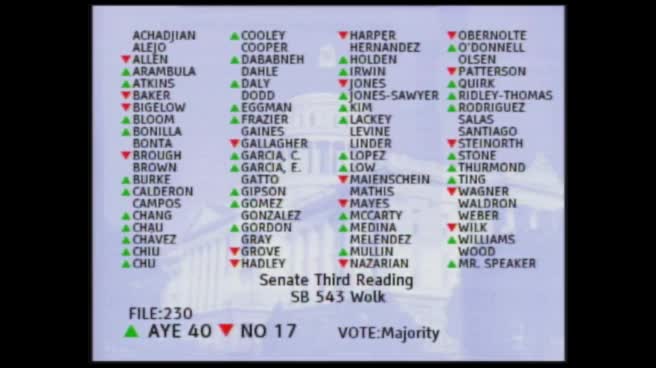 1MIN
Assembly Floor
 3MIN
Assembly Standing Committee on Appropriations
 7MIN
Assembly Standing Committee on Veterans Affairs
 1MIN
Senate Floor
 8MIN
Senate Standing Committee on Veterans Affairs
 9MIN
Senate Standing Committee on Business, Professions and Economic Development
Bill Author

Bill Co-Author(s):