SB 86: California Alternative Energy and Advanced Transportation Financing Authority Act: sales and use tax exclusion.
- Session Year: 2025-2026
- House: Senate
- Latest Version Date: 2025-10-01
Current Status:
Passed
(2025-10-01: Chaptered by Secretary of State. Chapter 211, Statutes of 2025.)
Introduced
In Committee
Awaiting First Chamber Vote
Passed First Chamber
In Committee
Awaiting Second Chamber Vote
Passed Second Chamber
Enacted
Existing sales and use tax laws impose taxes on retailers measured by the gross receipts from the sale of tangible personal property sold at retail in this state, or on the storage, use, or other consumption in this state of tangible personal property purchased from a retailer for storage, use, or other consumption in this state. The California Alternative Energy and Advanced Transportation Financing Authority Act establishes the California Alternative Energy and Advanced Transportation Financing Authority. The act authorizes, until January 1, 2026, the authority to provide financial assistance to a participating party by authorizing exclusions from sales and use tax for certain projects, including those that promote California-based manufacturing, California-based jobs, advanced manufacturing, the reduction of greenhouse gases, or a reduction in air and water pollution or energy consumption. The Sales and Use Tax Law, for the purposes of the taxes imposed pursuant to that law, until January 1, 2026, excludes the lease or transfer of title of tangible personal property constituting one of those projects to any contractor for use in the performance of a construction contract for a participating party that will use that property as an integral part of the approved project.
This bill would extend to January 1, 2028, the authorization to provide financial assistance in the form of a sales and use tax exclusion for projects approved by the authority. The bill would add electrical generation facilities using nuclear fusion technology to the types of projects qualifying for this sales and use tax exclusion. The bill would, on and after January 1, 2026, for an applicant that, together with its parent corporation and subsidiaries, employs 500 or more employees, prohibit the authority from approving a project unless the applicant certifies that the applicant and its subcontractors will comply with certain labor requirements. The bill would make other conforming changes.
This bill would take effect immediately as a tax levy.
Existing sales and use tax laws impose taxes on retailers measured by the gross receipts from the sale of tangible personal property sold at retail in this state, or on the storage, use, or other consumption in this state of tangible personal property purchased from a retailer for storage, use, or other consumption in this state. The California Alternative Energy and Advanced Transportation Financing Authority Act establishes the California Alternative Energy and Advanced Transportation Financing Authority. The act authorizes, until January 1, 2026, the authority to provide financial assistance to a participating party by authorizing exclusions from sales and use tax for certain projects, including those that promote California-based manufacturing, California-based jobs, advanced manufacturing, the reduction of greenhouse gases, or a reduction in air and water pollution or energy consumption. The Sales and Use Tax Law, for the purposes of the taxes imposed pursuant to that law, until January 1, 2026, excludes the lease or transfer of title of tangible personal property constituting one of those projects to any contractor for use in the performance of a construction contract for a participating party that will use that property as an integral part of the approved project.
This bill would extend to January 1, 2028, the authorization to provide financial assistance in the form of a sales and use tax exclusion for projects approved by the authority. The bill would add electrical generation facilities using nuclear fusion technology to the types of projects qualifying for this sales and use tax exclusion. The bill would, on and after January 1, 2026, for an applicant that, together with its parent corporation and subsidiaries, employs 500 or more employees, prohibit the authority from approving a project unless the applicant certifies that the applicant and its subcontractors will comply with certain labor requirements. The bill would make other conforming changes.
This bill would take effect immediately as a tax levy.
Existing sales and use tax laws impose taxes on retailers measured by the gross receipts from the sale of tangible personal property sold at retail in this state, or on the storage, use, or other consumption in this state of tangible personal property purchased from a retailer for storage, use, or other consumption in this state. The California Alternative Energy and Advanced Transportation Financing Authority Act establishes the California Alternative Energy and Advanced Transportation Financing Authority. The act authorizes, until January 1, 2026, the authority to provide financial assistance to a participating party by authorizing exclusions from sales and use tax for certain projects, including those that promote California-based manufacturing, California-based jobs, advanced manufacturing, the reduction of greenhouse gases, or a reduction in air and water pollution or energy consumption. The Sales and Use Tax Law, for the purposes of the taxes imposed pursuant to that law, until January 1, 2026, excludes the lease or transfer of title of tangible personal property constituting one of those projects to any contractor for use in the performance of a construction contract for a participating party that will use that property as an integral part of the approved project.
This bill would extend to January 1, 2028, the authorization to provide financial assistance in the form of a sales and use tax exclusion for projects approved by the authority. The bill would add electrical generation facilities using nuclear fusion technology to the types of projects qualifying for this sales and use tax exclusion. The bill would, on and after January 1, 2026, for an applicant that, together with its parent corporation and subsidiaries, employs 500 or more employees, prohibit the authority from approving a project unless the applicant certifies that the applicant and its subcontractors will comply with certain labor requirements. The bill would make other conforming changes.
This bill would take effect immediately as a tax levy.
Existing sales and use tax laws impose taxes on retailers measured by the gross receipts from the sale of tangible personal property sold at retail in this state, or on the storage, use, or other consumption in this state of tangible personal property purchased from a retailer for storage, use, or other consumption in this state. The California Alternative Energy and Advanced Transportation Financing Authority Act establishes the California Alternative Energy and Advanced Transportation Financing Authority. The act authorizes, until January 1, 2026, the authority to provide financial assistance to a participating party by authorizing exclusions from sales and use tax for certain projects, including those that promote California-based manufacturing, California-based jobs, advanced manufacturing, the reduction of greenhouse gases, or a reduction in air and water pollution or energy consumption. The Sales and Use Tax Law, for the purposes of the taxes imposed pursuant to that law, until January 1, 2026, excludes the lease or transfer of title of tangible personal property constituting one of those projects to any contractor for use in the performance of a construction contract for a participating party that will use that property as an integral part of the approved project.
This bill would extend to January 1, 2031, 2028, the authorization to provide financial assistance in the form of a sales and use tax exclusion for projects approved by the authority. The bill would add electrical generation facilities using nuclear fusion technology to the types of projects qualifying for this sales and use tax exclusion. The bill would make other conforming changes.
This bill would take effect immediately as a tax levy.
Existing sales and use tax laws impose taxes on retailers measured by the gross receipts from the sale of tangible personal property sold at retail in this state, or on the storage, use, or other consumption in this state of tangible personal property purchased from a retailer for storage, use, or other consumption in this state. The California Alternative Energy and Advanced Transportation Financing Authority Act establishes the California Alternative Energy and Advanced Transportation Financing Authority. The act authorizes, until January 1, 2026, the authority to provide financial assistance to a participating party by authorizing exclusions from sales and use tax for certain projects, including those that promote California-based manufacturing, California-based jobs, advanced manufacturing, reduction of greenhouse gases, or reduction in air and water pollution or energy consumption. The act prohibits the sales and use tax exclusions from cumulatively exceeding $100,000,000 for each calendar year, except as provided. The Sales and Use Tax Law, for the purposes of the taxes imposed pursuant to that law, until January 1, 2026, excludes the lease or transfer of title of tangible personal property constituting one of those projects to any contractor for use in the performance of a construction contract for a participating party that will use that property as an integral part of the approved project.
This bill would extend to January 1, 2031, the authorization to provide financial assistance in the form of a sales and use tax exclusion for projects approved by the authority. The bill would increase the maximum cumulative amount of the sales and use tax exclusions authorized under these provisions to $200,000,000 per calendar year. The bill would add electrical generation facilities using nuclear fusion technology to the types of projects qualifying for this sales and use tax exclusion. The bill would make other conforming changes.
This bill would take effect immediately as a tax levy.
Existing sales and use tax laws impose taxes on retailers measured by the gross receipts from the sale of tangible personal property sold at retail in this state, or on the storage, use, or other consumption in this state of tangible personal property purchased from a retailer for storage, use, or other consumption in this state. The California Alternative Energy and Advanced Transportation Financing Authority Act establishes the California Alternative Energy and Advanced Transportation Financing Authority. The act authorizes, until January 1, 2026, the authority to provide financial assistance to a participating party by authorizing exclusions from sales and use tax for certain projects, including those that promote California-based manufacturing, California-based jobs, advanced manufacturing, reduction of greenhouse gases, or reduction in air and water pollution or energy consumption. The act prohibits the sales and use tax exclusions from cumulatively exceeding $100,000,000 for each calendar year, except as provided. The Sales and Use Tax Law, for the purposes of the taxes imposed pursuant to that law, until January 1, 2026, excludes the lease or transfer of title of tangible personal property constituting one of those projects to any contractor for use in the performance of a construction contract for a participating party that will use that property as an integral part of the approved project.
This bill would extend indefinitely to January 1, 2031, the authorization to provide financial assistance in the form of a sales and use tax exclusion for projects approved by the authority. The bill would increase the maximum cumulative amount of the sales and use tax exclusions authorized under these provisions to $300,000,000 $200,000,000 per calendar year. The bill would add electrical generation facilities using nuclear fusion technology to the types of projects qualifying for this sales and use tax exclusion. The bill would make other conforming changes.
This bill would take effect immediately as a tax levy.
Existing sales and use tax laws impose taxes on retailers measured by the gross receipts from the sale of tangible personal property sold at retail in this state, or on the storage, use, or other consumption in this state of tangible personal property purchased from a retailer for storage, use, or other consumption in this state. The California Alternative Energy and Advanced Transportation Financing Authority Act establishes the California Alternative Energy and Advanced Transportation Financing Authority. The act authorizes, until January 1, 2026, the authority to provide financial assistance to a participating party by authorizing exclusions from sales and use tax for certain projects, including those that promote California-based manufacturing, California-based jobs, advanced manufacturing, reduction of greenhouse gases, or reduction in air and water pollution or energy consumption. The act prohibits the sales and use tax exclusions from cumulatively exceeding $100,000,000 for each calendar year, except as provided. The Sales and Use Tax Law, for the purposes of the taxes imposed pursuant to that law, until January 1, 2026, excludes the lease or transfer of title of tangible personal property constituting one of those projects to any contractor for use in the performance of a construction contract for a participating party that will use that property as an integral part of the approved project.
This bill would extend indefinitely the authorization to provide financial assistance in the form of a sales and use tax exclusion for projects approved by the authority. The bill would increase the maximum cumulative amount of the sales and use tax exclusions authorized under these provisions to $300,000,000 per calendar year. The bill would add electrical generation facilities using nuclear fusion technology to the types of projects qualifying for this sales and use tax exclusion. The bill would make other conforming changes.
This bill would take effect immediately as a tax levy.
(a)As used in this division, unless the context otherwise requires:
(1)(A)Advanced manufacturing means manufacturing processes that improve existing or create entirely new materials, products, and processes through the use of science, engineering, or information technologies, high-precision tools and methods, a high-performance workforce, and innovative business or organizational models utilizing any of the following technology areas:
(i)Microelectronics and nanoelectronics, including semiconductors.
(ii)Advanced materials.
(iii)Integrated computational materials engineering.
(iv)Nanotechnology.
(v)Additive manufacturing.
(vi)Industrial biotechnology.
(B)Advanced manufacturing includes any of the following:
(i)Systems that result from substantive advancement, whether incremental or breakthrough, beyond the current industry standard, in the production of materials and products. These advancements include improvements in manufacturing processes and systems that are often referred to as smart or intelligent manufacturing systems, which integrate computational predictability and operational efficiency.
(ii)(I)Sustainable manufacturing systems and manufacturing technologies that minimize the use of resources while maintaining or improving cost and performance.
(II)Sustainable manufacturing systems and manufacturing technologies do not include those required to be undertaken pursuant to state or federal law or regulations, air district rules or regulations, memoranda of understanding with a governmental entity, or legally binding agreements or documents. The State Air Resources Board shall advise the authority to ensure that the requirements of this clause are met.
(2)(A)Advanced transportation technologies means emerging commercially competitive transportation-related technologies identified by the authority as capable of creating long-term, high-value-added jobs for Californians while enhancing the states commitment to energy conservation, pollution and greenhouse gas emissions reduction, and transportation efficiency.
(B)Advanced transportation technologies does not include those projects required to be undertaken pursuant to state or federal law or regulations, air district rules or regulations, memoranda of understanding with a governmental entity, or legally binding agreements or documents. The State Air Resources Board shall advise the authority regarding projects that are excluded pursuant to this subparagraph.
(3)(A)Alternative sources means devices or technologies used for a renewable electrical generation facility, as defined in paragraph (1) of subdivision (a) of Section 25741, devices or technologies used for an electrical generation facility that uses nuclear fusion technology, a combined heat and power system, as defined in Section 2840.2 of the Public Utilities Code, distributed generation and energy storage technologies eligible under the self-generation incentive program pursuant to Section 379.6 of the Public Utilities Code, as determined by the Public Utilities Commission, or a facility designed for the production of renewable fuels, the efficient use of which reduces the use of fossil or nuclear fuels, and energy efficiency devices or technologies that reduce the need for new electric generation and reduce emissions of toxic and criteria pollutants and greenhouse gases.
(B)Alternative sources does not include a hydroelectric facility that does not meet state laws pertaining to the control, appropriation, use, and distribution of water, including, but not limited to, the obtaining of applicable licenses and permits.
(4)Authority means the California Alternative Energy and Advanced Transportation Financing Authority established pursuant to Section 26004, and any board, commission, department, or officer succeeding to the functions of the authority, or to which the powers conferred upon the authority by this division shall be given.
(5)Cost as applied to a project or portion of the project financed under this division means all or part of the cost of construction and acquisition of all lands, structures, real or personal property or an interest in the real or personal property, rights, rights-of-way, franchises, easements, and interests acquired or used for a project; the cost of demolishing or removing any buildings or structures on land so acquired, including the cost of acquiring any lands to which those buildings or structures may be moved; the cost of all machinery, equipment, and furnishings, financing charges, interest prior to, during, and for a period after, completion of construction as determined by the authority; provisions for working capital; reserves for principal and interest and for extensions, enlargements, additions, replacements, renovations, and improvements; the cost of architectural, engineering, financial, accounting, auditing and legal services, plans, specifications, estimates, administrative expenses, and other expenses necessary or incidental to determining the feasibility of constructing any project or incidental to the construction, acquisition, or financing of a project.
(6)Financial assistance includes, but is not limited to, loans, loan loss reserves, interest rate reductions, proceeds of bonds issued by the authority, bond insurance, loan guarantees or other credit enhancements or liquidity facilities, contributions of money, or a combination thereof, as determined by, and approved by the resolution of, the board.
(7)(A)Participating party means a person, federal or state agency, department, board, authority, or commission, state or community college, or university, or a city or county, regional agency, public district, school district, or other political entity engaged in the business or operations in the state, whether organized for profit or not for profit, that applies for financial assistance from the authority for the purpose of implementing a project.
(B)(i)For purposes of Section 6010.8 of the Revenue and Taxation Code, participating party means an entity specified in subparagraph (A) that seeks financial assistance pursuant to Section 26011.8.
(ii)For purposes of Section 6010.8 of the Revenue and Taxation Code, an entity located outside of the state, including an entity located overseas, is considered to be a participating party and is eligible to apply for financial assistance pursuant to Section 26011.8 if the participating party commits to, and demonstrates that, the party will be opening a manufacturing facility in the state.
(iii)It is the intent of the Legislature by adding clause (ii) to clarify existing law and ensure that an out-of-state entity or overseas entity is eligible to apply for financial assistance pursuant to Section 26011.8.
(8)(A)Project means a land, building, improvement to the land or building, rehabilitation, work, property, or structure, real or personal, stationary or mobile, including, but not limited to, machinery and equipment utilized in the state, whether or not in existence or under construction, that utilizes, or is designed to utilize, an alternative source, or that is utilized for the design, technology transfer, manufacture, production, assembly, distribution, or service of advanced transportation technologies or alternative source components.
(B)Project, for purposes of Section 26011.8 and Section 6010.8 of the Revenue and Taxation Code, is defined in Section 26011.8.
(9)Revenue means all rents, receipts, purchase payments, loan repayments, and all other income or receipts derived by the authority from a project, or the sale, lease, or other disposition of alternative source or advanced transportation technology facilities, or the making of loans to finance alternative source or advanced transportation technology facilities, and any income or revenue derived from the investment of money in any fund or account of the authority.
(b)This section shall remain in effect only until January 1, 2028, and as of that date is repealed.
SEC. 2.Section 26003 of the Public Resources Code, as amended by Section 4 of Chapter 690 of the Statutes of 2019, is amended to read:26003.(a)As used in this division, unless the context otherwise requires:
(1)(A) Advanced transportation technologies means emerging commercially competitive transportation-related technologies identified by the authority as capable of creating long-term, high-value-added jobs for Californians while enhancing the states commitment to energy conservation, pollution and greenhouse gas emissions reduction, and transportation efficiency.
(B)Advanced transportation technologies does not include those projects required to be undertaken pursuant to state or federal law or regulations, air district rules or regulations, memoranda of understanding with a governmental entity, or legally binding agreements or documents. The State Air Resources Board shall advise the authority regarding projects that are excluded pursuant to this subparagraph.
(2)(A)Alternative sources means devices or technologies used for a renewable electrical generation facility, as defined in paragraph (1) of subdivision (a) of Section 25741, a combined heat and power system, as defined in Section 2840.2 of the Public Utilities Code, distributed generation and energy storage technologies eligible under the self-generation incentive program pursuant to Section 379.6 of the Public Utilities Code, as determined by the Public Utilities Commission, or a facility designed for the production of renewable fuels, the efficient use of which reduces the use of fossil or nuclear fuels, and energy efficiency devices or technologies that reduce the need for new electric generation and reduce emissions of toxic and criteria pollutants and greenhouse gases.
(B)Alternative sources does not include a hydroelectric facility that does not meet state laws pertaining to the control, appropriation, use, and distribution of water, including, but not limited to, the obtaining of applicable licenses and permits.
(3)Authority means the California Alternative Energy and Advanced Transportation Financing Authority established pursuant to Section 26004, and any board, commission, department, or officer succeeding to the functions of the authority, or to which the powers conferred upon the authority by this division shall be given.
(4)Cost as applied to a project or portion of the project financed under this division means all or part of the cost of construction and acquisition of all lands, structures, real or personal property or an interest in the real or personal property, rights, rights-of-way, franchises, easements, and interests acquired or used for a project; the cost of demolishing or removing any buildings or structures on land so acquired, including the cost of acquiring any lands to which those buildings or structures may be moved; the cost of all machinery, equipment, and furnishings, financing charges, interest prior to, during, and for a period after, completion of construction as determined by the authority; provisions for working capital; reserves for principal and interest and for extensions, enlargements, additions, replacements, renovations, and improvements; the cost of architectural, engineering, financial, accounting, auditing and legal services, plans, specifications, estimates, administrative expenses, and other expenses necessary or incidental to determining the feasibility of constructing any project or incidental to the construction, acquisition, or financing of a project.
(5)Financial assistance includes, but is not limited to, loans, loan loss reserves, interest rate reductions, proceeds of bonds issued by the authority, bond insurance, loan guarantees or other credit enhancements or liquidity facilities, contributions of money, or a combination thereof, as determined by, and approved by the resolution of, the board.
(6)(A)Participating party means a person, federal or state agency, department, board, authority, or commission, state or community college, or university, or a city or county, regional agency, public district, school district, or other political entity engaged in the business or operations in the state, whether organized for profit or not for profit, that applies for financial assistance from the authority for the purpose of implementing a project.
(B)(i)For purposes of Section 6010.8 of the Revenue and Taxation Code, participating party means an entity specified in subparagraph (A) that seeks financial assistance pursuant to Section 26011.8.
(ii)For purposes of Section 6010.8 of the Revenue and Taxation Code, an entity located outside of the state, including an entity located overseas, is considered to be a participating party and is eligible to apply for financial assistance pursuant to Section 26011.8 if the participating party commits to, and demonstrates that, the party will be opening a manufacturing facility in the state.
(iii)It is the intent of the Legislature by adding clause (ii) to clarify existing law and ensure that an out-of-state entity or overseas entity is eligible to apply for financial assistance pursuant to Section 26011.8.
(7)(A)Project means a land, building, improvement to the land or building, rehabilitation, work, property, or structure, real or personal, stationary or mobile, including, but not limited to, machinery and equipment utilized in the state, whether or not in existence or under construction, that utilizes, or is designed to utilize, an alternative source, or that is utilized for the design, technology transfer, manufacture, production, assembly, distribution, or service of advanced transportation technologies or alternative source components.
(B)Project, for purposes of Section 26011.8 and Section 6010.8 of the Revenue and Taxation Code, is defined in Section 26011.8.
(8)Revenue means all rents, receipts, purchase payments, loan repayments, and all other income or receipts derived by the authority from a project, or the sale, lease, or other disposition of alternative source or advanced transportation technology facilities, or the making of loans to finance alternative source or advanced transportation technology facilities, and any income or revenue derived from the investment of money in any fund or account of the authority.
(b)This section shall become operative on January 1, 2028.
SEC. 3.Section 26011.8 of the Public Resources Code, as amended by Section 21 of Chapter 251 of the Statutes of 2022, is amended to read:26011.8.(a)The purpose of this section is to promote the creation of California-based manufacturing, high-quality California-based jobs, advanced manufacturing, the reduction of greenhouse gases, or reductions in air and water pollution or energy consumption, and to ensure that California communities and workers benefit from projects receiving financial assistance pursuant to this section. In furtherance of this purpose, the authority may approve a project for financial assistance in the form of the sales and use tax exclusion established in Section 6010.8 of the Revenue and Taxation Code.
(b)For purposes of this section, the following terms have the following meanings:
(1)Project means tangible personal property if at least 50 percent of its use is either to process recycled feedstock that is intended to be reused in the production of another product or using recycled feedstock in the production of another product or soil amendment, or tangible personal property that is used in the state for the design, manufacture, production, or assembly of advanced manufacturing, advanced transportation technologies, or alternative source products, components, or systems, as defined in Section 26003. Project does not include tangible personal property that processes or uses recycled feedstock in a manner that would constitute disposal as defined in subdivision (b) of Section 40192.
(2)Recycled feedstock means materials that would otherwise be destined for disposal, having completed their intended end use and product lifecycle.
(3)Soil amendments may include compost, as defined in Section 14525 of the Food and Agricultural Code, fertilizing material, as defined in Section 14533 of the Food and Agricultural Code, gypsum or phosphatic sulfate gypsum, as those terms are defined in Section 14537 of the Food and Agricultural Code, or a substance distributed for the purpose of promoting plant growth or improving the quality of crops by conditioning soils through physical means.
(c)The authority shall publish notice of the availability of project applications and deadlines for submission of project applications to the authority.
(d)The authority shall evaluate a project application based on all of the following criteria:
(1)The extent to which the project develops manufacturing facilities, or purchases equipment for manufacturing facilities, located in California.
(2)The extent to which the anticipated benefit to the state from the project equals or exceeds the projected benefit to the participating party from the sales and use tax exclusion.
(3)The extent to which the project will create new, or result in the loss of, permanent, full-time jobs in California, including the average and minimum wage for each classification of full-time employees proposed to be hired or not retained.
(4)To the extent feasible, the extent to which the project, or the product produced by the project, results in a reduction of greenhouse gases, a reduction in air or water pollution, an increase in energy efficiency, or a reduction in energy consumption, beyond what is required by federal or state law or regulation.
(5)The extent of unemployment in the area in which the project is proposed to be located.
(6)Any other factors the authority deems appropriate in accordance with this section.
(e)On or after January 1, 2026, for an applicant that, together with its parent corporation and subsidiaries, employs 500 or more employees, the authority shall not approve a project for financial assistance pursuant to this section unless the applicant certifies, in a manner designated by the authority, that the applicant and its contractors will do all of the following:
(1)Provide comparatively good wage and benefits to the employees of the applicant or its subcontractors, relative to the industrial sector of the applicant or its subcontractors, occupation, and labor market of those employees.
(2)Invest in employee training, growth, and development, such as through comprehensive workforce training programs or apprenticeship programs.
(3)Adopt mechanisms to include worker voice and agency in the workplace.
(f)At a duly noticed public hearing, the authority shall approve, by resolution, project applications for financial assistance.
(g)Without regard to the actual date of any transaction between a participating party and the authority, any project approved by the authority by resolution for the sales and use tax exclusion pursuant to Section 6010.8 of the Revenue and Taxation Code before March 24, 2010, shall not be subject to this section.
(h)(1)Except as provided in paragraph (2), the exclusions granted pursuant to Section 6010.8 of the Revenue and Taxation Code for projects approved by the authority pursuant to this section shall not exceed one hundred million dollars ($100,000,000) for each calendar year.
(2)For the 2022, 2023, and 2024 calendar years, the exclusions granted pursuant to Section 6010.8 of the Revenue and Taxation Code for projects approved by the authority pursuant to this section shall not exceed one hundred fifteen million dollars ($115,000,000), of which fifteen million dollars ($15,000,000) shall be made available only to projects that manufacture, refine, extract, process, or recover lithium. In evaluating applications for projects that manufacture, refine, extract, process, or recover lithium, the authority, in addition to the criteria in subdivision (d), may consider other factors, including, but not limited to, the grantees willingness to relocate projects into California from a state that has enacted a law that does any of the following:
(A)Has the effect of voiding or repealing existing state protections against discrimination on the basis of sexual orientation, gender identity, or gender expression.
(B)Authorizes or requires discrimination against same-sex couples or their families or on the basis of sexual orientation, gender identity, or gender expression.
(C)Creates an exemption to antidiscrimination laws in order to permit discrimination against same-sex couples or their families or on the basis of sexual orientation, gender identity, or gender expression.
(D)Has the effect of denying or interfering with a womans right to choose to bear a child or to choose and obtain an abortion, as provided by Article 2.5 (commencing with Section 123460) of Chapter 2 of Part 2 of Division 106 of the Health and Safety Code.
(i)The authority shall study the efficacy and cost benefit of the sales and use tax exclusion as it relates to advanced manufacturing projects. The study shall include the number of jobs created, the costs of each job, and the annual salary of each job. The study shall also consider a dynamic analysis of the economic output to the state that would occur without the sales and use tax exclusion.
(j)This section shall remain in effect only until January 1, 2028, and as of that date is repealed.
SEC. 4.Section 26011.8 of the Public Resources Code, as added by Section 6 of Chapter 690 of the Statutes of 2019, is amended to read:26011.8.(a)The sale or purchase of tangible personal property of a project approved pursuant to this section, as it reads on December 31, 2027, before January 1, 2028, shall continue to be excluded from sales and use taxes pursuant to Section 6010.8 of the Revenue and Taxation Code for the period of time set forth in the authoritys resolution approving the project pursuant to this section.
(b)For purposes of this section, the following terms have the following meanings:
(1)Project means tangible personal property if at least 50 percent of its use is either to process recycled feedstock that is intended to be reused in the production of another product or using recycled feedstock in the production of another product or soil amendment, or tangible personal property that is used in the state for the design, manufacture, production, or assembly of advanced manufacturing, advanced transportation technologies, or alternative source products, components, or systems, as defined in Section 26003. Project does not include tangible personal property that processes or uses recycled feedstock in a manner that would constitute disposal as defined in subdivision (b) of Section 40192.
(2)Recycled feedstock means materials that would otherwise be destined for disposal, having completed their intended end use and product lifecycle.
(3)Soil amendments may include compost, as defined in Section 14525 of the Food and Agricultural Code, fertilizing material, as defined in Section 14533 of the Food and Agricultural Code, gypsum or phosphatic sulfate gypsum, as those terms are defined in Section 14537 of the Food and Agricultural Code, or a substance distributed for the purpose of promoting plant growth or improving the quality of crops by conditioning soils through physical means.
(c)The exclusions granted pursuant to Section 6010.8 of the Revenue and Taxation Code for projects approved by the authority pursuant to this section, as it reads on December 31, 2027, before January 1, 2028, shall not exceed one hundred million dollars ($100,000,000) for each calendar year.
(d)This section shall become operative on January 1, 2028.
SEC. 5.Section 26025 of the Public Resources Code is amended to read:26025.(a)The authority is hereby authorized to provide for the issuance of bonds of the authority for the purpose of refunding, directly or indirectly, any bonds, notes, or other evidence of indebtedness of the authority or any public agency then outstanding, including the payment of any redemption premium thereon and any interest accrued or to accrue to the earliest or subsequent date of redemption, purchase, or maturity of such bonds, and, if deemed advisable by the authority, for the additional purpose of paying all or any part of the cost of constructing and acquiring additions, improvements, extensions, or enlargements of a project or any portion thereof.
(b)The proceeds of any such bonds issued for the purpose of refunding outstanding bonds, notes, or other securities may, in the discretion of the authority, be applied to the purchase or retirement at maturity or redemption of such outstanding bonds either on their earliest or any subsequent redemption date or upon the purchase or retirement at the maturity thereof and may, pending such application, be placed in escrow to be applied to such purchase or retirement at maturity or redemption on such date as may be determined by the authority.
(c)Pending such use, any such escrowed proceeds may be invested and reinvested by the Treasurer or any trustee in instruments as may be specified in the resolution or indenture governing the bonds to be refunded, maturing at such time or times as shall be appropriate to ensure the prompt payment, as to principal, interest, and redemption premium, if any, of the outstanding bonds to be so refunded. The interest, income, and profits, if any, earned or realized on any such investment may also be applied to the payment of the outstanding bonds to be so refunded. After the terms of the escrow have been fully satisfied and carried out, any balance of such proceeds and interest, income, and profits, if any, earned or realized on the investments thereof may be returned to the authority for use by it in any lawful manner.
(d)All such bonds shall be subject to the provisions of this division in the same manner and to the same extent as other bonds issued pursuant to this division. Prior to refunding bonds or evidence of indebtedness not originally issued by the authority, the authority shall make findings that the project being refinanced qualifies as a project as defined in subparagraph (A) of paragraph (8) of subdivision (a) of Section 26003 until December 31, 2027, and as of January 1, 2028, as defined in subparagraph (A) of paragraph (7) of subdivision (a) of Section 26003.
SEC. 6.Section 6010.8 of the Revenue and Taxation Code, as amended by Section 14 of Chapter 690 of the Statutes of 2019, is amended to read:6010.8.(a)(1)Sale and purchase do not include any lease or transfer of title of tangible personal property constituting any project to any participating party.
(2)On and after September 21, 2018, sale and purchase do not include any lease or transfer of title of tangible personal property constituting any project to any contractor for use in the performance of a construction contract for the participating party that will use that property as an integral part of the approved project.
(b)As used in this section, project has the meaning specified in subparagraph (B) of paragraph (8) of subdivision (a) of Section 26003 of the Public Resources Code and participating party has the meaning specified in subparagraph (B) of paragraph (7) of subdivision (a) of Section 26003 of the Public Resources Code.
(c)This section shall remain in effect only until January 1, 2028, and as of that date is repealed.
SEC. 7.Section 6010.8 of the Revenue and Taxation Code, as amended by Section 15 of Chapter 690 of the Statutes of 2019, is amended to read:6010.8.(a)Sale and purchase do not include any lease or transfer of title of tangible personal property constituting any project to any participating party. As used in this section, project has the meaning specified in subparagraph (B) of paragraph (7) of subdivision (a) of Section 26003 of the Public Resources Code and participating party has the meaning specified in subparagraph (B) of paragraph (6) of subdivision (a) of Section 26003 of the Public Resources Code.
(b)This section shall become operative on January 1, 2028.
SEC. 8.(a)For purposes of Section 41 of the Revenue and Taxation Code, with respect to the sales and use tax exclusion provided pursuant to Section 26011.8 of the Public Resources Code and Section 6010.8 of the Revenue and Taxation Code, as amended by Sections 3 and 6, respectively, of this act, the Legislature finds and declares that the specific goals, purposes, and objectives of the sales and use tax exclusion are as follows:
(1)Creation of California-based jobs.
(2)Reduction in emissions of greenhouse gases, air and water pollution, and energy consumption.
(b)To measure whether the sales and use tax exclusion has achieved those goals, purposes, and objectives, the California Alternative Energy and Advanced Transportation Financing Authority, on or before January 31, 2027, shall prepare and submit, in accordance with Section 9795 of the Government Code, a report to the Legislature on both of the following:
(1)The net effects of the sales and use tax exclusion on jobs and economic output.
(2)The net environmental effects of the sales and use tax exclusion.
(c)This section is repealed on January 1, 2028.
SEC. 9.This act provides for a tax levy within the meaning of Article IV of the California Constitution and shall go into immediate effect.
(a)As used in this division, unless the context otherwise requires:
(1)(A)Advanced manufacturing means manufacturing processes that improve existing or create entirely new materials, products, and processes through the use of science, engineering, or information technologies, high-precision tools and methods, a high-performance workforce, and innovative business or organizational models utilizing any of the following technology areas:
(i)Microelectronics and nanoelectronics, including semiconductors.
(ii)Advanced materials.
(iii)Integrated computational materials engineering.
(iv)Nanotechnology.
(v)Additive manufacturing.
(vi)Industrial biotechnology.
(B)Advanced manufacturing includes any of the following:
(i)Systems that result from substantive advancement, whether incremental or breakthrough, beyond the current industry standard, in the production of materials and products. These advancements include improvements in manufacturing processes and systems that are often referred to as smart or intelligent manufacturing systems, which integrate computational predictability and operational efficiency.
(ii)(I)Sustainable manufacturing systems and manufacturing technologies that minimize the use of resources while maintaining or improving cost and performance.
(II)Sustainable manufacturing systems and manufacturing technologies do not include those required to be undertaken pursuant to state or federal law or regulations, air district rules or regulations, memoranda of understanding with a governmental entity, or legally binding agreements or documents. The State Air Resources Board shall advise the authority to ensure that the requirements of this clause are met.
(2)(A)Advanced transportation technologies means emerging commercially competitive transportation-related technologies identified by the authority as capable of creating long-term, high-value-added jobs for Californians while enhancing the states commitment to energy conservation, pollution and greenhouse gas emissions reduction, and transportation efficiency.
(B)Advanced transportation technologies does not include those projects required to be undertaken pursuant to state or federal law or regulations, air district rules or regulations, memoranda of understanding with a governmental entity, or legally binding agreements or documents. The State Air Resources Board shall advise the authority regarding projects that are excluded pursuant to this subparagraph.
(3)(A)Alternative sources means devices or technologies used for a renewable electrical generation facility, as defined in paragraph (1) of subdivision (a) of Section 25741, devices or technologies used for an electrical generation facility that uses nuclear fusion technology, a combined heat and power system, as defined in Section 2840.2 of the Public Utilities Code, distributed generation and energy storage technologies eligible under the self-generation incentive program pursuant to Section 379.6 of the Public Utilities Code, as determined by the Public Utilities Commission, or a facility designed for the production of renewable fuels, the efficient use of which reduces the use of fossil or nuclear fuels, and energy efficiency devices or technologies that reduce the need for new electric generation and reduce emissions of toxic and criteria pollutants and greenhouse gases.
(B)Alternative sources does not include a hydroelectric facility that does not meet state laws pertaining to the control, appropriation, use, and distribution of water, including, but not limited to, the obtaining of applicable licenses and permits.
(4)Authority means the California Alternative Energy and Advanced Transportation Financing Authority established pursuant to Section 26004, and any board, commission, department, or officer succeeding to the functions of the authority, or to which the powers conferred upon the authority by this division shall be given.
(5)Cost as applied to a project or portion of the project financed under this division means all or part of the cost of construction and acquisition of all lands, structures, real or personal property or an interest in the real or personal property, rights, rights-of-way, franchises, easements, and interests acquired or used for a project; the cost of demolishing or removing any buildings or structures on land so acquired, including the cost of acquiring any lands to which those buildings or structures may be moved; the cost of all machinery, equipment, and furnishings, financing charges, interest prior to, during, and for a period after, completion of construction as determined by the authority; provisions for working capital; reserves for principal and interest and for extensions, enlargements, additions, replacements, renovations, and improvements; the cost of architectural, engineering, financial, accounting, auditing and legal services, plans, specifications, estimates, administrative expenses, and other expenses necessary or incidental to determining the feasibility of constructing any project or incidental to the construction, acquisition, or financing of a project.
(6)Financial assistance includes, but is not limited to, loans, loan loss reserves, interest rate reductions, proceeds of bonds issued by the authority, bond insurance, loan guarantees or other credit enhancements or liquidity facilities, contributions of money, or a combination thereof, as determined by, and approved by the resolution of, the board.
(7)(A)Participating party means a person, federal or state agency, department, board, authority, or commission, state or community college, or university, or a city or county, regional agency, public district, school district, or other political entity engaged in the business or operations in the state, whether organized for profit or not for profit, that applies for financial assistance from the authority for the purpose of implementing a project.
(B)(i)For purposes of Section 6010.8 of the Revenue and Taxation Code, participating party means an entity specified in subparagraph (A) that seeks financial assistance pursuant to Section 26011.8.
(ii)For purposes of Section 6010.8 of the Revenue and Taxation Code, an entity located outside of the state, including an entity located overseas, is considered to be a participating party and is eligible to apply for financial assistance pursuant to Section 26011.8 if the participating party commits to, and demonstrates that, the party will be opening a manufacturing facility in the state.
(iii)It is the intent of the Legislature by adding clause (ii) to clarify existing law and ensure that an out-of-state entity or overseas entity is eligible to apply for financial assistance pursuant to Section 26011.8.
(8)(A)Project means a land, building, improvement to the land or building, rehabilitation, work, property, or structure, real or personal, stationary or mobile, including, but not limited to, machinery and equipment utilized in the state, whether or not in existence or under construction, that utilizes, or is designed to utilize, an alternative source, or that is utilized for the design, technology transfer, manufacture, production, assembly, distribution, or service of advanced transportation technologies or alternative source components.
(B)Project, for purposes of Section 26011.8 and Section 6010.8 of the Revenue and Taxation Code, is defined in Section 26011.8.
(9)Revenue means all rents, receipts, purchase payments, loan repayments, and all other income or receipts derived by the authority from a project, or the sale, lease, or other disposition of alternative source or advanced transportation technology facilities, or the making of loans to finance alternative source or advanced transportation technology facilities, and any income or revenue derived from the investment of money in any fund or account of the authority.
(b)This section shall remain in effect only until January 1, 2028, and as of that date is repealed.
SEC. 2.Section 26003 of the Public Resources Code, as amended by Section 4 of Chapter 690 of the Statutes of 2019, is amended to read:26003.(a)As used in this division, unless the context otherwise requires:
(1)(A) Advanced transportation technologies means emerging commercially competitive transportation-related technologies identified by the authority as capable of creating long-term, high-value-added jobs for Californians while enhancing the states commitment to energy conservation, pollution and greenhouse gas emissions reduction, and transportation efficiency.
(B)Advanced transportation technologies does not include those projects required to be undertaken pursuant to state or federal law or regulations, air district rules or regulations, memoranda of understanding with a governmental entity, or legally binding agreements or documents. The State Air Resources Board shall advise the authority regarding projects that are excluded pursuant to this subparagraph.
(2)(A)Alternative sources means devices or technologies used for a renewable electrical generation facility, as defined in paragraph (1) of subdivision (a) of Section 25741, a combined heat and power system, as defined in Section 2840.2 of the Public Utilities Code, distributed generation and energy storage technologies eligible under the self-generation incentive program pursuant to Section 379.6 of the Public Utilities Code, as determined by the Public Utilities Commission, or a facility designed for the production of renewable fuels, the efficient use of which reduces the use of fossil or nuclear fuels, and energy efficiency devices or technologies that reduce the need for new electric generation and reduce emissions of toxic and criteria pollutants and greenhouse gases.
(B)Alternative sources does not include a hydroelectric facility that does not meet state laws pertaining to the control, appropriation, use, and distribution of water, including, but not limited to, the obtaining of applicable licenses and permits.
(3)Authority means the California Alternative Energy and Advanced Transportation Financing Authority established pursuant to Section 26004, and any board, commission, department, or officer succeeding to the functions of the authority, or to which the powers conferred upon the authority by this division shall be given.
(4)Cost as applied to a project or portion of the project financed under this division means all or part of the cost of construction and acquisition of all lands, structures, real or personal property or an interest in the real or personal property, rights, rights-of-way, franchises, easements, and interests acquired or used for a project; the cost of demolishing or removing any buildings or structures on land so acquired, including the cost of acquiring any lands to which those buildings or structures may be moved; the cost of all machinery, equipment, and furnishings, financing charges, interest prior to, during, and for a period after, completion of construction as determined by the authority; provisions for working capital; reserves for principal and interest and for extensions, enlargements, additions, replacements, renovations, and improvements; the cost of architectural, engineering, financial, accounting, auditing and legal services, plans, specifications, estimates, administrative expenses, and other expenses necessary or incidental to determining the feasibility of constructing any project or incidental to the construction, acquisition, or financing of a project.
(5)Financial assistance includes, but is not limited to, loans, loan loss reserves, interest rate reductions, proceeds of bonds issued by the authority, bond insurance, loan guarantees or other credit enhancements or liquidity facilities, contributions of money, or a combination thereof, as determined by, and approved by the resolution of, the board.
(6)(A)Participating party means a person, federal or state agency, department, board, authority, or commission, state or community college, or university, or a city or county, regional agency, public district, school district, or other political entity engaged in the business or operations in the state, whether organized for profit or not for profit, that applies for financial assistance from the authority for the purpose of implementing a project.
(B)(i)For purposes of Section 6010.8 of the Revenue and Taxation Code, participating party means an entity specified in subparagraph (A) that seeks financial assistance pursuant to Section 26011.8.
(ii)For purposes of Section 6010.8 of the Revenue and Taxation Code, an entity located outside of the state, including an entity located overseas, is considered to be a participating party and is eligible to apply for financial assistance pursuant to Section 26011.8 if the participating party commits to, and demonstrates that, the party will be opening a manufacturing facility in the state.
(iii)It is the intent of the Legislature by adding clause (ii) to clarify existing law and ensure that an out-of-state entity or overseas entity is eligible to apply for financial assistance pursuant to Section 26011.8.
(7)(A)Project means a land, building, improvement to the land or building, rehabilitation, work, property, or structure, real or personal, stationary or mobile, including, but not limited to, machinery and equipment utilized in the state, whether or not in existence or under construction, that utilizes, or is designed to utilize, an alternative source, or that is utilized for the design, technology transfer, manufacture, production, assembly, distribution, or service of advanced transportation technologies or alternative source components.
(B)Project, for purposes of Section 26011.8 and Section 6010.8 of the Revenue and Taxation Code, is defined in Section 26011.8.
(8)Revenue means all rents, receipts, purchase payments, loan repayments, and all other income or receipts derived by the authority from a project, or the sale, lease, or other disposition of alternative source or advanced transportation technology facilities, or the making of loans to finance alternative source or advanced transportation technology facilities, and any income or revenue derived from the investment of money in any fund or account of the authority.
(b)This section shall become operative on January 1, 2028.
SEC. 3.Section 26011.8 of the Public Resources Code, as amended by Section 21 of Chapter 251 of the Statutes of 2022, is amended to read:26011.8.(a)The purpose of this section is to promote the creation of California-based manufacturing, high-quality California-based jobs, advanced manufacturing, the reduction of greenhouse gases, or reductions in air and water pollution or energy consumption, and to ensure that California communities and workers benefit from projects receiving financial assistance pursuant to this section. In furtherance of this purpose, the authority may approve a project for financial assistance in the form of the sales and use tax exclusion established in Section 6010.8 of the Revenue and Taxation Code.
(b)For purposes of this section, the following terms have the following meanings:
(1)Project means tangible personal property if at least 50 percent of its use is either to process recycled feedstock that is intended to be reused in the production of another product or using recycled feedstock in the production of another product or soil amendment, or tangible personal property that is used in the state for the design, manufacture, production, or assembly of advanced manufacturing, advanced transportation technologies, or alternative source products, components, or systems, as defined in Section 26003. Project does not include tangible personal property that processes or uses recycled feedstock in a manner that would constitute disposal as defined in subdivision (b) of Section 40192.
(2)Recycled feedstock means materials that would otherwise be destined for disposal, having completed their intended end use and product lifecycle.
(3)Soil amendments may include compost, as defined in Section 14525 of the Food and Agricultural Code, fertilizing material, as defined in Section 14533 of the Food and Agricultural Code, gypsum or phosphatic sulfate gypsum, as those terms are defined in Section 14537 of the Food and Agricultural Code, or a substance distributed for the purpose of promoting plant growth or improving the quality of crops by conditioning soils through physical means.
(c)The authority shall publish notice of the availability of project applications and deadlines for submission of project applications to the authority.
(d)The authority shall evaluate a project application based on all of the following criteria:
(1)The extent to which the project develops manufacturing facilities, or purchases equipment for manufacturing facilities, located in California.
(2)The extent to which the anticipated benefit to the state from the project equals or exceeds the projected benefit to the participating party from the sales and use tax exclusion.
(3)The extent to which the project will create new, or result in the loss of, permanent, full-time jobs in California, including the average and minimum wage for each classification of full-time employees proposed to be hired or not retained.
(4)To the extent feasible, the extent to which the project, or the product produced by the project, results in a reduction of greenhouse gases, a reduction in air or water pollution, an increase in energy efficiency, or a reduction in energy consumption, beyond what is required by federal or state law or regulation.
(5)The extent of unemployment in the area in which the project is proposed to be located.
(6)Any other factors the authority deems appropriate in accordance with this section.
(e)On or after January 1, 2026, for an applicant that, together with its parent corporation and subsidiaries, employs 500 or more employees, the authority shall not approve a project for financial assistance pursuant to this section unless the applicant certifies, in a manner designated by the authority, that the applicant and its contractors will do all of the following:
(1)Provide comparatively good wage and benefits to the employees of the applicant or its subcontractors, relative to the industrial sector of the applicant or its subcontractors, occupation, and labor market of those employees.
(2)Invest in employee training, growth, and development, such as through comprehensive workforce training programs or apprenticeship programs.
(3)Adopt mechanisms to include worker voice and agency in the workplace.
(f)At a duly noticed public hearing, the authority shall approve, by resolution, project applications for financial assistance.
(g)Without regard to the actual date of any transaction between a participating party and the authority, any project approved by the authority by resolution for the sales and use tax exclusion pursuant to Section 6010.8 of the Revenue and Taxation Code before March 24, 2010, shall not be subject to this section.
(h)(1)Except as provided in paragraph (2), the exclusions granted pursuant to Section 6010.8 of the Revenue and Taxation Code for projects approved by the authority pursuant to this section shall not exceed one hundred million dollars ($100,000,000) for each calendar year.
(2)For the 2022, 2023, and 2024 calendar years, the exclusions granted pursuant to Section 6010.8 of the Revenue and Taxation Code for projects approved by the authority pursuant to this section shall not exceed one hundred fifteen million dollars ($115,000,000), of which fifteen million dollars ($15,000,000) shall be made available only to projects that manufacture, refine, extract, process, or recover lithium. In evaluating applications for projects that manufacture, refine, extract, process, or recover lithium, the authority, in addition to the criteria in subdivision (d), may consider other factors, including, but not limited to, the grantees willingness to relocate projects into California from a state that has enacted a law that does any of the following:
(A)Has the effect of voiding or repealing existing state protections against discrimination on the basis of sexual orientation, gender identity, or gender expression.
(B)Authorizes or requires discrimination against same-sex couples or their families or on the basis of sexual orientation, gender identity, or gender expression.
(C)Creates an exemption to antidiscrimination laws in order to permit discrimination against same-sex couples or their families or on the basis of sexual orientation, gender identity, or gender expression.
(D)Has the effect of denying or interfering with a womans right to choose to bear a child or to choose and obtain an abortion, as provided by Article 2.5 (commencing with Section 123460) of Chapter 2 of Part 2 of Division 106 of the Health and Safety Code.
(i)The authority shall study the efficacy and cost benefit of the sales and use tax exclusion as it relates to advanced manufacturing projects. The study shall include the number of jobs created, the costs of each job, and the annual salary of each job. The study shall also consider a dynamic analysis of the economic output to the state that would occur without the sales and use tax exclusion.
(j)This section shall remain in effect only until January 1, 2028, and as of that date is repealed.
SEC. 4.Section 26011.8 of the Public Resources Code, as added by Section 6 of Chapter 690 of the Statutes of 2019, is amended to read:26011.8.(a)The sale or purchase of tangible personal property of a project approved pursuant to this section, as it reads on December 31, 2027, before January 1, 2028, shall continue to be excluded from sales and use taxes pursuant to Section 6010.8 of the Revenue and Taxation Code for the period of time set forth in the authoritys resolution approving the project pursuant to this section.
(b)For purposes of this section, the following terms have the following meanings:
(1)Project means tangible personal property if at least 50 percent of its use is either to process recycled feedstock that is intended to be reused in the production of another product or using recycled feedstock in the production of another product or soil amendment, or tangible personal property that is used in the state for the design, manufacture, production, or assembly of advanced manufacturing, advanced transportation technologies, or alternative source products, components, or systems, as defined in Section 26003. Project does not include tangible personal property that processes or uses recycled feedstock in a manner that would constitute disposal as defined in subdivision (b) of Section 40192.
(2)Recycled feedstock means materials that would otherwise be destined for disposal, having completed their intended end use and product lifecycle.
(3)Soil amendments may include compost, as defined in Section 14525 of the Food and Agricultural Code, fertilizing material, as defined in Section 14533 of the Food and Agricultural Code, gypsum or phosphatic sulfate gypsum, as those terms are defined in Section 14537 of the Food and Agricultural Code, or a substance distributed for the purpose of promoting plant growth or improving the quality of crops by conditioning soils through physical means.
(c)The exclusions granted pursuant to Section 6010.8 of the Revenue and Taxation Code for projects approved by the authority pursuant to this section, as it reads on December 31, 2027, before January 1, 2028, shall not exceed one hundred million dollars ($100,000,000) for each calendar year.
(d)This section shall become operative on January 1, 2028.
SEC. 5.Section 26025 of the Public Resources Code is amended to read:26025.(a)The authority is hereby authorized to provide for the issuance of bonds of the authority for the purpose of refunding, directly or indirectly, any bonds, notes, or other evidence of indebtedness of the authority or any public agency then outstanding, including the payment of any redemption premium thereon and any interest accrued or to accrue to the earliest or subsequent date of redemption, purchase, or maturity of such bonds, and, if deemed advisable by the authority, for the additional purpose of paying all or any part of the cost of constructing and acquiring additions, improvements, extensions, or enlargements of a project or any portion thereof.
(b)The proceeds of any such bonds issued for the purpose of refunding outstanding bonds, notes, or other securities may, in the discretion of the authority, be applied to the purchase or retirement at maturity or redemption of such outstanding bonds either on their earliest or any subsequent redemption date or upon the purchase or retirement at the maturity thereof and may, pending such application, be placed in escrow to be applied to such purchase or retirement at maturity or redemption on such date as may be determined by the authority.
(c)Pending such use, any such escrowed proceeds may be invested and reinvested by the Treasurer or any trustee in instruments as may be specified in the resolution or indenture governing the bonds to be refunded, maturing at such time or times as shall be appropriate to ensure the prompt payment, as to principal, interest, and redemption premium, if any, of the outstanding bonds to be so refunded. The interest, income, and profits, if any, earned or realized on any such investment may also be applied to the payment of the outstanding bonds to be so refunded. After the terms of the escrow have been fully satisfied and carried out, any balance of such proceeds and interest, income, and profits, if any, earned or realized on the investments thereof may be returned to the authority for use by it in any lawful manner.
(d)All such bonds shall be subject to the provisions of this division in the same manner and to the same extent as other bonds issued pursuant to this division. Prior to refunding bonds or evidence of indebtedness not originally issued by the authority, the authority shall make findings that the project being refinanced qualifies as a project as defined in subparagraph (A) of paragraph (8) of subdivision (a) of Section 26003 until December 31, 2027, and as of January 1, 2028, as defined in subparagraph (A) of paragraph (7) of subdivision (a) of Section 26003.
SEC. 6.Section 6010.8 of the Revenue and Taxation Code, as amended by Section 14 of Chapter 690 of the Statutes of 2019, is amended to read:6010.8.(a)(1)Sale and purchase do not include any lease or transfer of title of tangible personal property constituting any project to any participating party.
(2)On and after September 21, 2018, sale and purchase do not include any lease or transfer of title of tangible personal property constituting any project to any contractor for use in the performance of a construction contract for the participating party that will use that property as an integral part of the approved project.
(b)As used in this section, project has the meaning specified in subparagraph (B) of paragraph (8) of subdivision (a) of Section 26003 of the Public Resources Code and participating party has the meaning specified in subparagraph (B) of paragraph (7) of subdivision (a) of Section 26003 of the Public Resources Code.
(c)This section shall remain in effect only until January 1, 2028, and as of that date is repealed.
SEC. 7.Section 6010.8 of the Revenue and Taxation Code, as amended by Section 15 of Chapter 690 of the Statutes of 2019, is amended to read:6010.8.(a)Sale and purchase do not include any lease or transfer of title of tangible personal property constituting any project to any participating party. As used in this section, project has the meaning specified in subparagraph (B) of paragraph (7) of subdivision (a) of Section 26003 of the Public Resources Code and participating party has the meaning specified in subparagraph (B) of paragraph (6) of subdivision (a) of Section 26003 of the Public Resources Code.
(b)This section shall become operative on January 1, 2028.
SEC. 8.(a)For purposes of Section 41 of the Revenue and Taxation Code, with respect to the sales and use tax exclusion provided pursuant to Section 26011.8 of the Public Resources Code and Section 6010.8 of the Revenue and Taxation Code, as amended by Sections 3 and 6, respectively, of this act, the Legislature finds and declares that the specific goals, purposes, and objectives of the sales and use tax exclusion are as follows:
(1)Creation of California-based jobs.
(2)Reduction in emissions of greenhouse gases, air and water pollution, and energy consumption.
(b)To measure whether the sales and use tax exclusion has achieved those goals, purposes, and objectives, the California Alternative Energy and Advanced Transportation Financing Authority, on or before January 31, 2027, shall prepare and submit, in accordance with Section 9795 of the Government Code, a report to the Legislature on both of the following:
(1)The net effects of the sales and use tax exclusion on jobs and economic output.
(2)The net environmental effects of the sales and use tax exclusion.
(c)This section is repealed on January 1, 2028.
SEC. 9.This act provides for a tax levy within the meaning of Article IV of the California Constitution and shall go into immediate effect.
(a)As used in this division, unless the context otherwise requires:
(1)(A)Advanced manufacturing means manufacturing processes that improve existing or create entirely new materials, products, and processes through the use of science, engineering, or information technologies, high-precision tools and methods, a high-performance workforce, and innovative business or organizational models utilizing any of the following technology areas:
(i)Microelectronics and nanoelectronics, including semiconductors.
(ii)Advanced materials.
(iii)Integrated computational materials engineering.
(iv)Nanotechnology.
(v)Additive manufacturing.
(vi)Industrial biotechnology.
(B)Advanced manufacturing includes any of the following:
(i)Systems that result from substantive advancement, whether incremental or breakthrough, beyond the current industry standard, in the production of materials and products. These advancements include improvements in manufacturing processes and systems that are often referred to as smart or intelligent manufacturing systems, which integrate computational predictability and operational efficiency.
(ii)(I)Sustainable manufacturing systems and manufacturing technologies that minimize the use of resources while maintaining or improving cost and performance.
(II)Sustainable manufacturing systems and manufacturing technologies do not include those required to be undertaken pursuant to state or federal law or regulations, air district rules or regulations, memoranda of understanding with a governmental entity, or legally binding agreements or documents. The State Air Resources Board shall advise the authority to ensure that the requirements of this clause are met.
(2)(A)Advanced transportation technologies means emerging commercially competitive transportation-related technologies identified by the authority as capable of creating long-term, high-value-added jobs for Californians while enhancing the states commitment to energy conservation, pollution and greenhouse gas emissions reduction, and transportation efficiency.
(B)Advanced transportation technologies does not include those projects required to be undertaken pursuant to state or federal law or regulations, air district rules or regulations, memoranda of understanding with a governmental entity, or legally binding agreements or documents. The State Air Resources Board shall advise the authority regarding projects that are excluded pursuant to this subparagraph.
(3)(A)Alternative sources means devices or technologies used for a renewable electrical generation facility, as defined in paragraph (1) of subdivision (a) of Section 25741, devices or technologies used for an electrical generation facility that uses nuclear fusion technology, a combined heat and power system, as defined in Section 2840.2 of the Public Utilities Code, distributed generation and energy storage technologies eligible under the self-generation incentive program pursuant to Section 379.6 of the Public Utilities Code, as determined by the Public Utilities Commission, or a facility designed for the production of renewable fuels, the efficient use of which reduces the use of fossil or nuclear fuels, and energy efficiency devices or technologies that reduce the need for new electric generation and reduce emissions of toxic and criteria pollutants and greenhouse gases.
(B)Alternative sources does not include a hydroelectric facility that does not meet state laws pertaining to the control, appropriation, use, and distribution of water, including, but not limited to, the obtaining of applicable licenses and permits.
(4)Authority means the California Alternative Energy and Advanced Transportation Financing Authority established pursuant to Section 26004, and any board, commission, department, or officer succeeding to the functions of the authority, or to which the powers conferred upon the authority by this division shall be given.
(5)Cost as applied to a project or portion of the project financed under this division means all or part of the cost of construction and acquisition of all lands, structures, real or personal property or an interest in the real or personal property, rights, rights-of-way, franchises, easements, and interests acquired or used for a project; the cost of demolishing or removing any buildings or structures on land so acquired, including the cost of acquiring any lands to which those buildings or structures may be moved; the cost of all machinery, equipment, and furnishings, financing charges, interest prior to, during, and for a period after, completion of construction as determined by the authority; provisions for working capital; reserves for principal and interest and for extensions, enlargements, additions, replacements, renovations, and improvements; the cost of architectural, engineering, financial, accounting, auditing and legal services, plans, specifications, estimates, administrative expenses, and other expenses necessary or incidental to determining the feasibility of constructing any project or incidental to the construction, acquisition, or financing of a project.
(6)Financial assistance includes, but is not limited to, loans, loan loss reserves, interest rate reductions, proceeds of bonds issued by the authority, bond insurance, loan guarantees or other credit enhancements or liquidity facilities, contributions of money, or a combination thereof, as determined by, and approved by the resolution of, the board.
(7)(A)Participating party means a person, federal or state agency, department, board, authority, or commission, state or community college, or university, or a city or county, regional agency, public district, school district, or other political entity engaged in the business or operations in the state, whether organized for profit or not for profit, that applies for financial assistance from the authority for the purpose of implementing a project.
(B)(i)For purposes of Section 6010.8 of the Revenue and Taxation Code, participating party means an entity specified in subparagraph (A) that seeks financial assistance pursuant to Section 26011.8.
(ii)For purposes of Section 6010.8 of the Revenue and Taxation Code, an entity located outside of the state, including an entity located overseas, is considered to be a participating party and is eligible to apply for financial assistance pursuant to Section 26011.8 if the participating party commits to, and demonstrates that, the party will be opening a manufacturing facility in the state.
(iii)It is the intent of the Legislature by adding clause (ii) to clarify existing law and ensure that an out-of-state entity or overseas entity is eligible to apply for financial assistance pursuant to Section 26011.8.
(8)(A)Project means a land, building, improvement to the land or building, rehabilitation, work, property, or structure, real or personal, stationary or mobile, including, but not limited to, machinery and equipment utilized in the state, whether or not in existence or under construction, that utilizes, or is designed to utilize, an alternative source, or that is utilized for the design, technology transfer, manufacture, production, assembly, distribution, or service of advanced transportation technologies or alternative source components.
(B)Project, for purposes of Section 26011.8 and Section 6010.8 of the Revenue and Taxation Code, is defined in Section 26011.8.
(9)Revenue means all rents, receipts, purchase payments, loan repayments, and all other income or receipts derived by the authority from a project, or the sale, lease, or other disposition of alternative source or advanced transportation technology facilities, or the making of loans to finance alternative source or advanced transportation technology facilities, and any income or revenue derived from the investment of money in any fund or account of the authority.
(b)This section shall remain in effect only until January 1, 2028, and as of that date is repealed.
SEC. 2.Section 26003 of the Public Resources Code, as amended by Section 4 of Chapter 690 of the Statutes of 2019, is amended to read:26003.(a)As used in this division, unless the context otherwise requires:
(1)(A) Advanced transportation technologies means emerging commercially competitive transportation-related technologies identified by the authority as capable of creating long-term, high-value-added jobs for Californians while enhancing the states commitment to energy conservation, pollution and greenhouse gas emissions reduction, and transportation efficiency.
(B)Advanced transportation technologies does not include those projects required to be undertaken pursuant to state or federal law or regulations, air district rules or regulations, memoranda of understanding with a governmental entity, or legally binding agreements or documents. The State Air Resources Board shall advise the authority regarding projects that are excluded pursuant to this subparagraph.
(2)(A)Alternative sources means devices or technologies used for a renewable electrical generation facility, as defined in paragraph (1) of subdivision (a) of Section 25741, a combined heat and power system, as defined in Section 2840.2 of the Public Utilities Code, distributed generation and energy storage technologies eligible under the self-generation incentive program pursuant to Section 379.6 of the Public Utilities Code, as determined by the Public Utilities Commission, or a facility designed for the production of renewable fuels, the efficient use of which reduces the use of fossil or nuclear fuels, and energy efficiency devices or technologies that reduce the need for new electric generation and reduce emissions of toxic and criteria pollutants and greenhouse gases.
(B)Alternative sources does not include a hydroelectric facility that does not meet state laws pertaining to the control, appropriation, use, and distribution of water, including, but not limited to, the obtaining of applicable licenses and permits.
(3)Authority means the California Alternative Energy and Advanced Transportation Financing Authority established pursuant to Section 26004, and any board, commission, department, or officer succeeding to the functions of the authority, or to which the powers conferred upon the authority by this division shall be given.
(4)Cost as applied to a project or portion of the project financed under this division means all or part of the cost of construction and acquisition of all lands, structures, real or personal property or an interest in the real or personal property, rights, rights-of-way, franchises, easements, and interests acquired or used for a project; the cost of demolishing or removing any buildings or structures on land so acquired, including the cost of acquiring any lands to which those buildings or structures may be moved; the cost of all machinery, equipment, and furnishings, financing charges, interest prior to, during, and for a period after, completion of construction as determined by the authority; provisions for working capital; reserves for principal and interest and for extensions, enlargements, additions, replacements, renovations, and improvements; the cost of architectural, engineering, financial, accounting, auditing and legal services, plans, specifications, estimates, administrative expenses, and other expenses necessary or incidental to determining the feasibility of constructing any project or incidental to the construction, acquisition, or financing of a project.
(5)Financial assistance includes, but is not limited to, loans, loan loss reserves, interest rate reductions, proceeds of bonds issued by the authority, bond insurance, loan guarantees or other credit enhancements or liquidity facilities, contributions of money, or a combination thereof, as determined by, and approved by the resolution of, the board.
(6)(A)Participating party means a person, federal or state agency, department, board, authority, or commission, state or community college, or university, or a city or county, regional agency, public district, school district, or other political entity engaged in the business or operations in the state, whether organized for profit or not for profit, that applies for financial assistance from the authority for the purpose of implementing a project.
(B)(i)For purposes of Section 6010.8 of the Revenue and Taxation Code, participating party means an entity specified in subparagraph (A) that seeks financial assistance pursuant to Section 26011.8.
(ii)For purposes of Section 6010.8 of the Revenue and Taxation Code, an entity located outside of the state, including an entity located overseas, is considered to be a participating party and is eligible to apply for financial assistance pursuant to Section 26011.8 if the participating party commits to, and demonstrates that, the party will be opening a manufacturing facility in the state.
(iii)It is the intent of the Legislature by adding clause (ii) to clarify existing law and ensure that an out-of-state entity or overseas entity is eligible to apply for financial assistance pursuant to Section 26011.8.
(7)(A)Project means a land, building, improvement to the land or building, rehabilitation, work, property, or structure, real or personal, stationary or mobile, including, but not limited to, machinery and equipment utilized in the state, whether or not in existence or under construction, that utilizes, or is designed to utilize, an alternative source, or that is utilized for the design, technology transfer, manufacture, production, assembly, distribution, or service of advanced transportation technologies or alternative source components.
(B)Project, for purposes of Section 26011.8 and Section 6010.8 of the Revenue and Taxation Code, is defined in Section 26011.8.
(8)Revenue means all rents, receipts, purchase payments, loan repayments, and all other income or receipts derived by the authority from a project, or the sale, lease, or other disposition of alternative source or advanced transportation technology facilities, or the making of loans to finance alternative source or advanced transportation technology facilities, and any income or revenue derived from the investment of money in any fund or account of the authority.
(b)This section shall become operative on January 1, 2028.
SEC. 3.Section 26011.8 of the Public Resources Code, as amended by Section 21 of Chapter 251 of the Statutes of 2022, is amended to read:26011.8.(a)The purpose of this section is to promote the creation of California-based manufacturing, high-quality California-based jobs, advanced manufacturing, the reduction of greenhouse gases, or reductions in air and water pollution or energy consumption. consumption, and to ensure that California communities and workers benefit from projects receiving financial assistance pursuant to this section. In furtherance of this purpose, the authority may approve a project for financial assistance in the form of the sales and use tax exclusion established in Section 6010.8 of the Revenue and Taxation Code.
(b)For purposes of this section, the following terms have the following meanings:
(1)Project means tangible personal property if at least 50 percent of its use is either to process recycled feedstock that is intended to be reused in the production of another product or using recycled feedstock in the production of another product or soil amendment, or tangible personal property that is used in the state for the design, manufacture, production, or assembly of advanced manufacturing, advanced transportation technologies, or alternative source products, components, or systems, as defined in Section 26003. Project does not include tangible personal property that processes or uses recycled feedstock in a manner that would constitute disposal as defined in subdivision (b) of Section 40192.
(2)Recycled feedstock means materials that would otherwise be destined for disposal, having completed their intended end use and product lifecycle.
(3)Soil amendments may include compost, as defined in Section 14525 of the Food and Agricultural Code, fertilizing material, as defined in Section 14533 of the Food and Agricultural Code, gypsum or phosphatic sulfate gypsum, as those terms are defined in Section 14537 of the Food and Agricultural Code, or a substance distributed for the purpose of promoting plant growth or improving the quality of crops by conditioning soils through physical means.
(c)The authority shall publish notice of the availability of project applications and deadlines for submission of project applications to the authority.
(d)The authority shall evaluate a project application based on all of the following criteria:
(1)The extent to which the project develops manufacturing facilities, or purchases equipment for manufacturing facilities, located in California.
(2)The extent to which the anticipated benefit to the state from the project equals or exceeds the projected benefit to the participating party from the sales and use tax exclusion.
(3)The extent to which the project will create new, or result in the loss of, permanent, full-time jobs in California, including the average and minimum wage for each classification of full-time employees proposed to be hired or not retained.
(4)To the extent feasible, the extent to which the project, or the product produced by the project, results in a reduction of greenhouse gases, a reduction in air or water pollution, an increase in energy efficiency, or a reduction in energy consumption, beyond what is required by federal or state law or regulation.
(5)The extent of unemployment in the area in which the project is proposed to be located.
(6)Any other factors the authority deems appropriate in accordance with this section.
(e)On or after January 1, 2026, for an applicant that, together with its parent corporation and subsidiaries, employs 500 or more employees, the authority shall not approve a project for financial assistance pursuant to this section unless the applicant certifies, in a manner designated by the authority, that the applicant and its contractors will do all of the following:
(1)Provide comparatively good wage and benefits to the employees of the applicant or its subcontractors, relative to the industrial sector of the applicant or its subcontractors, occupation, and labor market of those employees.
(2)Invest in employee training, growth, and development, such as through comprehensive workforce training programs or apprenticeship programs.
(3)Adopt mechanisms to include worker voice and agency in the workplace.
(e)(f)At a duly noticed public hearing, the authority shall approve, by resolution, project applications for financial assistance.
(f)(g)Without regard to the actual date of any transaction between a participating party and the authority, any project approved by the authority by resolution for the sales and use tax exclusion pursuant to Section 6010.8 of the Revenue and Taxation Code before March 24, 2010, shall not be subject to this section.
(g)(h)(1)Except as provided in paragraph (2), the exclusions granted pursuant to Section 6010.8 of the Revenue and Taxation Code for projects approved by the authority pursuant to this section shall not exceed one hundred million dollars ($100,000,000) for each calendar year.
(2)For the 2022, 2023, and 2024 calendar years, the exclusions granted pursuant to Section 6010.8 of the Revenue and Taxation Code for projects approved by the authority pursuant to this section shall not exceed one hundred fifteen million dollars ($115,000,000), of which fifteen million dollars ($15,000,000) shall be made available only to projects that manufacture, refine, extract, process, or recover lithium. In evaluating applications for projects that manufacture, refine, extract, process, or recover lithium, the authority, in addition to the criteria in subdivision (d), may consider other factors, including, but not limited to, the grantees willingness to relocate projects into California from a state that has enacted a law that does any of the following:
(A)Has the effect of voiding or repealing existing state protections against discrimination on the basis of sexual orientation, gender identity, or gender expression.
(B)Authorizes or requires discrimination against same-sex couples or their families or on the basis of sexual orientation, gender identity, or gender expression.
(C)Creates an exemption to antidiscrimination laws in order to permit discrimination against same-sex couples or their families or on the basis of sexual orientation, gender identity, or gender expression.
(D)Has the effect of denying or interfering with a womans right to choose to bear a child or to choose and obtain an abortion, as provided by Article 2.5 (commencing with Section 123460) of Chapter 2 of Part 2 of Division 106 of the Health and Safety Code.
(h)(i)The authority shall study the efficacy and cost benefit of the sales and use tax exemption exclusion as it relates to advanced manufacturing projects. The study shall include the number of jobs created, the costs of each job, and the annual salary of each job. The study shall also consider a dynamic analysis of the economic output to the state that would occur without the sales and use tax exemption. exclusion.
(i)(j)This section shall remain in effect only until January 1, 2028, and as of that date is repealed.
SEC. 4.Section 26011.8 of the Public Resources Code, as added by Section 6 of Chapter 690 of the Statutes of 2019, is amended to read:26011.8.(a)The sale or purchase of tangible personal property of a project approved pursuant to this section, as it reads on December 31, 2027, before January 1, 2028, shall continue to be excluded from sales and use taxes pursuant to Section 6010.8 of the Revenue and Taxation Code for the period of time set forth in the authoritys resolution approving the project pursuant to this section.
(b)For purposes of this section, the following terms have the following meanings:
(1)Project means tangible personal property if at least 50 percent of its use is either to process recycled feedstock that is intended to be reused in the production of another product or using recycled feedstock in the production of another product or soil amendment, or tangible personal property that is used in the state for the design, manufacture, production, or assembly of advanced manufacturing, advanced transportation technologies, or alternative source products, components, or systems, as defined in Section 26003. Project does not include tangible personal property that processes or uses recycled feedstock in a manner that would constitute disposal as defined in subdivision (b) of Section 40192.
(2)Recycled feedstock means materials that would otherwise be destined for disposal, having completed their intended end use and product lifecycle.
(3)Soil amendments may include compost, as defined in Section 14525 of the Food and Agricultural Code, fertilizing material, as defined in Section 14533 of the Food and Agricultural Code, gypsum or phosphatic sulfate gypsum, as those terms are defined in Section 14537 of the Food and Agricultural Code, or a substance distributed for the purpose of promoting plant growth or improving the quality of crops by conditioning soils through physical means.
(c)The exclusions granted pursuant to Section 6010.8 of the Revenue and Taxation Code for projects approved by the authority pursuant to this section, as it reads on December 31, 2027, before January 1, 2028, shall not exceed one hundred million dollars ($100,000,000) for each calendar year.
(d)This section shall become operative on January 1, 2028.
SEC. 5.Section 26025 of the Public Resources Code is amended to read:26025.(a)The authority is hereby authorized to provide for the issuance of bonds of the authority for the purpose of refunding, directly or indirectly, any bonds, notes, or other evidence of indebtedness of the authority or any public agency then outstanding, including the payment of any redemption premium thereon and any interest accrued or to accrue to the earliest or subsequent date of redemption, purchase, or maturity of such bonds, and, if deemed advisable by the authority, for the additional purpose of paying all or any part of the cost of constructing and acquiring additions, improvements, extensions, or enlargements of a project or any portion thereof.
(b)The proceeds of any such bonds issued for the purpose of refunding outstanding bonds, notes, or other securities may, in the discretion of the authority, be applied to the purchase or retirement at maturity or redemption of such outstanding bonds either on their earliest or any subsequent redemption date or upon the purchase or retirement at the maturity thereof and may, pending such application, be placed in escrow to be applied to such purchase or retirement at maturity or redemption on such date as may be determined by the authority.
(c)Pending such use, any such escrowed proceeds may be invested and reinvested by the Treasurer or any trustee in instruments as may be specified in the resolution or indenture governing the bonds to be refunded, maturing at such time or times as shall be appropriate to ensure the prompt payment, as to principal, interest, and redemption premium, if any, of the outstanding bonds to be so refunded. The interest, income, and profits, if any, earned or realized on any such investment may also be applied to the payment of the outstanding bonds to be so refunded. After the terms of the escrow have been fully satisfied and carried out, any balance of such proceeds and interest, income, and profits, if any, earned or realized on the investments thereof may be returned to the authority for use by it in any lawful manner.
(d)All such bonds shall be subject to the provisions of this division in the same manner and to the same extent as other bonds issued pursuant to this division. Prior to refunding bonds or evidence of indebtedness not originally issued by the authority, the authority shall make findings that the project being refinanced qualifies as a project as defined in subparagraph (A) of paragraph (8) of subdivision (a) of Section 26003 until December 31, 2027, and as of January 1, 2028, as defined in subparagraph (A) of paragraph (7) of subdivision (a) of Section 26003.
SEC. 6.Section 6010.8 of the Revenue and Taxation Code, as amended by Section 14 of Chapter 690 of the Statutes of 2019, is amended to read:6010.8.(a)(1)Sale and purchase do not include any lease or transfer of title of tangible personal property constituting any project to any participating party.
(2)On and after September 21, 2018, sale and purchase do not include any lease or transfer of title of tangible personal property constituting any project to any contractor for use in the performance of a construction contract for the participating party that will use that property as an integral part of the approved project.
(b)As used in this section, project has the meaning specified in subparagraph (B) of paragraph (8) of subdivision (a) of Section 26003 of the Public Resources Code and participating party has the meaning specified in subparagraph (B) of paragraph (7) of subdivision (a) of Section 26003 of the Public Resources Code.
(c)This section shall remain in effect only until January 1, 2028, and as of that date is repealed.
SEC. 7.Section 6010.8 of the Revenue and Taxation Code, as amended by Section 15 of Chapter 690 of the Statutes of 2019, is amended to read:6010.8.(a)Sale and purchase do not include any lease or transfer of title of tangible personal property constituting any project to any participating party. As used in this section, project has the meaning specified in subparagraph (B) of paragraph (7) of subdivision (a) of Section 26003 of the Public Resources Code and participating party has the meaning specified in subparagraph (B) of paragraph (6) of subdivision (a) of Section 26003 of the Public Resources Code.
(b)This section shall become operative on January 1, 2028.
SEC. 8.(a)For purposes of Section 41 of the Revenue and Taxation Code, with respect to the extension of the sales and use tax exemption exclusion provided pursuant to Section 26011.8 of the Public Resources Code and Section 6010.8 of the Revenue and Taxation Code, as amended by Sections 3 and 6, respectively, of this act, the Legislature finds and declares that the specific goals, purposes, and objectives of the extension sales and use tax exclusion are as follows:
(1)Creation of California-based jobs.
(2)Reduction in emissions of greenhouse gases, air and water pollution, and energy consumption.
(b)To measure whether the extension sales and use tax exclusion has achieved those goals, purposes, and objectives, the California Alternative Energy and Advanced Transportation Financing Authority, on or before January 31, 2027, shall prepare and submit, in accordance with Section 9795 of the Government Code, a report to the Legislature on both of the following:
(1)The net effects of the extension sales and use tax exclusion on jobs and economic output.
(2)The net environmental effects of the extension. sales and use tax exclusion.
(c)This section is repealed on January 1, 2028.
SEC. 9.This act provides for a tax levy within the meaning of Article IV of the California Constitution and shall go into immediate effect.
(a)As used in this division, unless the context otherwise requires:
(1)(A)Advanced manufacturing means manufacturing processes that improve existing or create entirely new materials, products, and processes through the use of science, engineering, or information technologies, high-precision tools and methods, a high-performance workforce, and innovative business or organizational models utilizing any of the following technology areas:
(i)Microelectronics and nanoelectronics, including semiconductors.
(ii)Advanced materials.
(iii)Integrated computational materials engineering.
(iv)Nanotechnology.
(v)Additive manufacturing.
(vi)Industrial biotechnology.
(B)Advanced manufacturing includes any of the following:
(i)Systems that result from substantive advancement, whether incremental or breakthrough, beyond the current industry standard, in the production of materials and products. These advancements include improvements in manufacturing processes and systems that are often referred to as smart or intelligent manufacturing systems, which integrate computational predictability and operational efficiency.
(ii)(I)Sustainable manufacturing systems and manufacturing technologies that minimize the use of resources while maintaining or improving cost and performance.
(II)Sustainable manufacturing systems and manufacturing technologies do not include those required to be undertaken pursuant to state or federal law or regulations, air district rules or regulations, memoranda of understanding with a governmental entity, or legally binding agreements or documents. The State Air Resources Board shall advise the authority to ensure that the requirements of this clause are met.
(2)(A)Advanced transportation technologies means emerging commercially competitive transportation-related technologies identified by the authority as capable of creating long-term, high-value-added jobs for Californians while enhancing the states commitment to energy conservation, pollution and greenhouse gas emissions reduction, and transportation efficiency.
(B)Advanced transportation technologies does not include those projects required to be undertaken pursuant to state or federal law or regulations, air district rules or regulations, memoranda of understanding with a governmental entity, or legally binding agreements or documents. The State Air Resources Board shall advise the authority regarding projects that are excluded pursuant to this paragraph. subparagraph.
(3)(A)Alternative sources means devices or technologies used for a renewable electrical generation facility, as defined in paragraph (1) of subdivision (a) of Section 25741, devices or technologies used for an electrical generation facility that uses nuclear fusion technology, a combined heat and power system, as defined in Section 2840.2 of the Public Utilities Code, distributed generation and energy storage technologies eligible under the self-generation incentive program pursuant to Section 379.6 of the Public Utilities Code, as determined by the Public Utilities Commission, or a facility designed for the production of renewable fuels, the efficient use of which reduces the use of fossil or nuclear fuels, and energy efficiency devices or technologies that reduce the need for new electric generation and reduce emissions of toxic and criteria pollutants and greenhouse gases.
(B)Alternative sources does not include a hydroelectric facility that does not meet state laws pertaining to the control, appropriation, use, and distribution of water, including, but not limited to, the obtaining of applicable licenses and permits.
(4)Authority means the California Alternative Energy and Advanced Transportation Financing Authority established pursuant to Section 26004, and any board, commission, department, or officer succeeding to the functions of the authority, or to which the powers conferred upon the authority by this division shall be given.
(5)Cost as applied to a project or portion of the project financed under this division means all or part of the cost of construction and acquisition of all lands, structures, real or personal property or an interest in the real or personal property, rights, rights-of-way, franchises, easements, and interests acquired or used for a project; the cost of demolishing or removing any buildings or structures on land so acquired, including the cost of acquiring any lands to which those buildings or structures may be moved; the cost of all machinery, equipment, and furnishings, financing charges, interest prior to, during, and for a period after, completion of construction as determined by the authority; provisions for working capital; reserves for principal and interest and for extensions, enlargements, additions, replacements, renovations, and improvements; the cost of architectural, engineering, financial, accounting, auditing and legal services, plans, specifications, estimates, administrative expenses, and other expenses necessary or incidental to determining the feasibility of constructing any project or incidental to the construction, acquisition, or financing of a project.
(6)Financial assistance includes, but is not limited to, loans, loan loss reserves, interest rate reductions, proceeds of bonds issued by the authority, bond insurance, loan guarantees or other credit enhancements or liquidity facilities, contributions of money, or a combination thereof, as determined by, and approved by the resolution of, the board.
(7)(A)Participating party means a person, federal or state agency, department, board, authority, or commission, state or community college, or university, or a city or county, regional agency, public district, school district, or other political entity engaged in the business or operations in the state, whether organized for profit or not for profit, that applies for financial assistance from the authority for the purpose of implementing a project.
(B)(i)For purposes of Section 6010.8 of the Revenue and Taxation Code, participating party means an entity specified in paragraph (1) subparagraph (A) that seeks financial assistance pursuant to Section 26011.8.
(ii)For purposes of Section 6010.8 of the Revenue and Taxation Code, an entity located outside of the state, including an entity located overseas, is considered to be a participating party and is eligible to apply for financial assistance pursuant to Section 26011.8 if the participating party commits to, and demonstrates that, the party will be opening a manufacturing facility in the state.
(iii)It is the intent of the Legislature by adding clause (ii) to clarify existing law and ensure that an out-of-state entity or overseas entity is eligible to apply for financial assistance pursuant to Section 26011.8.
(8)(A)Project means a land, building, improvement to the land or building, rehabilitation, work, property, or structure, real or personal, stationary or mobile, including, but not limited to, machinery and equipment utilized in the state, whether or not in existence or under construction, that utilizes, or is designed to utilize, an alternative source, or that is utilized for the design, technology transfer, manufacture, production, assembly, distribution, or service of advanced transportation technologies or alternative source components.
(B)Project, for purposes of Section 26011.8 and Section 6010.8 of the Revenue and Taxation Code, is defined in Section 26011.8.
(9)Revenue means all rents, receipts, purchase payments, loan repayments, and all other income or receipts derived by the authority from a project, or the sale, lease, or other disposition of alternative source or advanced transportation technology facilities, or the making of loans to finance alternative source or advanced transportation technology facilities, and any income or revenue derived from the investment of money in any fund or account of the authority.
(b)This section shall remain in effect only until January 1, 2031, 2028, and as of that date is repealed.
SEC. 2.Section 26003 of the Public Resources Code, as amended by Section 4 of Chapter 690 of the Statutes of 2019, is amended to read:26003.(a)As used in this division, unless the context otherwise requires:
(1)(A) Advanced transportation technologies means emerging commercially competitive transportation-related technologies identified by the authority as capable of creating long-term, high-value-added jobs for Californians while enhancing the states commitment to energy conservation, pollution and greenhouse gas emissions reduction, and transportation efficiency.
(B)Advanced transportation technologies does not include those projects required to be undertaken pursuant to state or federal law or regulations, air district rules or regulations, memoranda of understanding with a governmental entity, or legally binding agreements or documents. The State Air Resources Board shall advise the authority regarding projects that are excluded pursuant to this subparagraph.
(2)(A)Alternative sources means devices or technologies used for a renewable electrical generation facility, as defined in paragraph (1) of subdivision (a) of Section 25741, a combined heat and power system, as defined in Section 2840.2 of the Public Utilities Code, distributed generation and energy storage technologies eligible under the self-generation incentive program pursuant to Section 379.6 of the Public Utilities Code, as determined by the Public Utilities Commission, or a facility designed for the production of renewable fuels, the efficient use of which reduces the use of fossil or nuclear fuels, and energy efficiency devices or technologies that reduce the need for new electric generation and reduce emissions of toxic and criteria pollutants and greenhouse gases.
(B)Alternative sources does not include a hydroelectric facility that does not meet state laws pertaining to the control, appropriation, use, and distribution of water, including, but not limited to, the obtaining of applicable licenses and permits.
(3)Authority means the California Alternative Energy and Advanced Transportation Financing Authority established pursuant to Section 26004, and any board, commission, department, or officer succeeding to the functions of the authority, or to which the powers conferred upon the authority by this division shall be given.
(4)Cost as applied to a project or portion of the project financed under this division means all or part of the cost of construction and acquisition of all lands, structures, real or personal property or an interest in the real or personal property, rights, rights-of-way, franchises, easements, and interests acquired or used for a project; the cost of demolishing or removing any buildings or structures on land so acquired, including the cost of acquiring any lands to which those buildings or structures may be moved; the cost of all machinery, equipment, and furnishings, financing charges, interest prior to, during, and for a period after, completion of construction as determined by the authority; provisions for working capital; reserves for principal and interest and for extensions, enlargements, additions, replacements, renovations, and improvements; the cost of architectural, engineering, financial, accounting, auditing and legal services, plans, specifications, estimates, administrative expenses, and other expenses necessary or incidental to determining the feasibility of constructing any project or incidental to the construction, acquisition, or financing of a project.
(5)Financial assistance includes, but is not limited to, loans, loan loss reserves, interest rate reductions, proceeds of bonds issued by the authority, bond insurance, loan guarantees or other credit enhancements or liquidity facilities, contributions of money, or a combination thereof, as determined by, and approved by the resolution of, the board.
(6)(A)Participating party means a person, federal or state agency, department, board, authority, or commission, state or community college, or university, or a city or county, regional agency, public district, school district, or other political entity engaged in the business or operations in the state, whether organized for profit or not for profit, that applies for financial assistance from the authority for the purpose of implementing a project.
(B)(i)For purposes of Section 6010.8 of the Revenue and Taxation Code, participating party means an entity specified in subparagraph (A) that seeks financial assistance pursuant to Section 26011.8.
(ii)For purposes of Section 6010.8 of the Revenue and Taxation Code, an entity located outside of the state, including an entity located overseas, is considered to be a participating party and is eligible to apply for financial assistance pursuant to Section 26011.8 if the participating party commits to, and demonstrates that, the party will be opening a manufacturing facility in the state.
(iii)It is the intent of the Legislature by adding clause (ii) to clarify existing law and ensure that an out-of-state entity or overseas entity is eligible to apply for financial assistance pursuant to Section 26011.8.
(7)(A)Project means a land, building, improvement to the land or building, rehabilitation, work, property, or structure, real or personal, stationary or mobile, including, but not limited to, machinery and equipment utilized in the state, whether or not in existence or under construction, that utilizes, or is designed to utilize, an alternative source, or that is utilized for the design, technology transfer, manufacture, production, assembly, distribution, or service of advanced transportation technologies or alternative source components.
(B)Project, for purposes of Section 26011.8 and Section 6010.8 of the Revenue and Taxation Code, is defined in Section 26011.8.
(8)Revenue means all rents, receipts, purchase payments, loan repayments, and all other income or receipts derived by the authority from a project, or the sale, lease, or other disposition of alternative source or advanced transportation technology facilities, or the making of loans to finance alternative source or advanced transportation technology facilities, and any income or revenue derived from the investment of money in any fund or account of the authority.
(b)This section shall become operative on January 1, 2031. 2028.
SEC. 3.Section 26011.8 of the Public Resources Code, as amended by Section 21 of Chapter 251 of the Statutes of 2022, is amended to read:26011.8.(a)The purpose of this section is to promote the creation of California-based manufacturing, California-based jobs, advanced manufacturing, the reduction of greenhouse gases, or reductions in air and water pollution or energy consumption. In furtherance of this purpose, the authority may approve a project for financial assistance in the form of the sales and use tax exclusion established in Section 6010.8 of the Revenue and Taxation Code.
(b)For purposes of this section, the following terms have the following meanings:
(1)Project means tangible personal property if at least 50 percent of its use is either to process recycled feedstock that is intended to be reused in the production of another product or using recycled feedstock in the production of another product or soil amendment, or tangible personal property that is used in the state for the design, manufacture, production, or assembly of advanced manufacturing, advanced transportation technologies, or alternative source products, components, or systems, as defined in Section 26003. Project does not include tangible personal property that processes or uses recycled feedstock in a manner that would constitute disposal as defined in subdivision (b) of Section 40192.
(2)Recycled feedstock means materials that would otherwise be destined for disposal, having completed their intended end use and product lifecycle.
(3)Soil amendments may include compost, as defined in Section 14525 of the Food and Agricultural Code, fertilizing material, as defined in Section 14533 of the Food and Agricultural Code, gypsum or phosphatic sulfate gypsum, as those terms are defined in Section 14537 of the Food and Agricultural Code, or a substance distributed for the purpose of promoting plant growth or improving the quality of crops by conditioning soils through physical means.
(c)The authority shall publish notice of the availability of project applications and deadlines for submission of project applications to the authority.
(d)The authority shall evaluate a project application based on all of the following criteria:
(1)The extent to which the project develops manufacturing facilities, or purchases equipment for manufacturing facilities, located in California.
(2)The extent to which the anticipated benefit to the state from the project equals or exceeds the projected benefit to the participating party from the sales and use tax exclusion.
(3)The extent to which the project will create new, or result in the loss of, permanent, full-time jobs in California, including the average and minimum wage for each classification of full-time employees proposed to be hired or not retained.
(4)To the extent feasible, the extent to which the project, or the product produced by the project, results in a reduction of greenhouse gases, a reduction in air or water pollution, an increase in energy efficiency, or a reduction in energy consumption, beyond what is required by federal or state law or regulation.
(5)The extent of unemployment in the area in which the project is proposed to be located.
(6)Any other factors the authority deems appropriate in accordance with this section.
(e)At a duly noticed public hearing, the authority shall approve, by resolution, project applications for financial assistance.
(f)Without regard to the actual date of any transaction between a participating party and the authority, any project approved by the authority by resolution for the sales and use tax exclusion pursuant to Section 6010.8 of the Revenue and Taxation Code before March 24, 2010, shall not be subject to this section.
(g)(1)Except as provided in paragraph (2), the exclusions granted pursuant to Section 6010.8 of the Revenue and Taxation Code for projects approved by the authority pursuant to this section shall not exceed one hundred million dollars ($100,000,000) for each calendar year.
(2)For the 2022, 2023, and 2024 calendar years, the exclusions granted pursuant to Section 6010.8 of the Revenue and Taxation Code for projects approved by the authority pursuant to this section shall not exceed one hundred fifteen million dollars ($115,000,000), of which fifteen million dollars ($15,000,000) shall be made available only to projects that manufacture, refine, extract, process, or recover lithium. In evaluating applications for projects that manufacture, refine, extract, process, or recover lithium, the authority, in addition to the criteria in subdivision (d), may consider other factors, including, but not limited to, the grantees willingness to relocate projects into California from a state that has enacted a law that does any of the following:
(A)Has the effect of voiding or repealing existing state protections against discrimination on the basis of sexual orientation, gender identity, or gender expression.
(B)Authorizes or requires discrimination against same-sex couples or their families or on the basis of sexual orientation, gender identity, or gender expression.
(C)Creates an exemption to antidiscrimination laws in order to permit discrimination against same-sex couples or their families or on the basis of sexual orientation, gender identity, or gender expression.
(D)Has the effect of denying or interfering with a womans right to choose to bear a child or to choose and obtain an abortion, as provided by Article 2.5 (commencing with Section 123460) of Chapter 2 of Part 2 of Division 106 of the Health and Safety Code.
(h)The authority shall study the efficacy and cost benefit of the sales and use tax exemption as it relates to advanced manufacturing projects. The study shall include the number of jobs created, the costs of each job, and the annual salary of each job. The study shall also consider a dynamic analysis of the economic output to the state that would occur without the sales and use tax exemption.
(i)This section shall remain in effect only until January 1, 2031, 2028, and as of that date is repealed.
SEC. 4.Section 26011.8 of the Public Resources Code, as added by Section 6 of Chapter 690 of the Statutes of 2019, is amended to read:26011.8.(a)The sale or purchase of tangible personal property of a project approved pursuant to this section, as it reads on December 31, 2030, 2027, before January 1, 2031, 2028, shall continue to be excluded from sales and use taxes pursuant to Section 6010.8 of the Revenue and Taxation Code for the period of time set forth in the authoritys resolution approving the project pursuant to this section.
(b)For purposes of this section, the following terms have the following meanings:
(1)Project means tangible personal property if at least 50 percent of its use is either to process recycled feedstock that is intended to be reused in the production of another product or using recycled feedstock in the production of another product or soil amendment, or tangible personal property that is used in the state for the design, manufacture, production, or assembly of advanced manufacturing, advanced transportation technologies, or alternative source products, components, or systems, as defined in Section 26003. Project does not include tangible personal property that processes or uses recycled feedstock in a manner that would constitute disposal as defined in subdivision (b) of Section 40192.
(2)Recycled feedstock means materials that would otherwise be destined for disposal, having completed their intended end use and product lifecycle.
(3)Soil amendments may include compost, as defined in Section 14525 of the Food and Agricultural Code, fertilizing material, as defined in Section 14533 of the Food and Agricultural Code, gypsum or phosphatic sulfate gypsum, as those terms are defined in Section 14537 of the Food and Agricultural Code, or a substance distributed for the purpose of promoting plant growth or improving the quality of crops by conditioning soils through physical means.
(c)The exclusions granted pursuant to Section 6010.8 of the Revenue and Taxation Code for projects approved by the authority pursuant to this section, as it reads on December 31, 2030, 2027, before January 1, 2031, 2028, shall not exceed one hundred million dollars ($100,000,000) for each calendar year.
(d)This section shall become operative on January 1, 2031. 2028.
SEC. 5.Section 26025 of the Public Resources Code is amended to read:26025.(a)The authority is hereby authorized to provide for the issuance of bonds of the authority for the purpose of refunding, directly or indirectly, any bonds, notes, or other evidence of indebtedness of the authority or any public agency then outstanding, including the payment of any redemption premium thereon and any interest accrued or to accrue to the earliest or subsequent date of redemption, purchase, or maturity of such bonds, and, if deemed advisable by the authority, for the additional purpose of paying all or any part of the cost of constructing and acquiring additions, improvements, extensions, or enlargements of a project or any portion thereof.
(b)The proceeds of any such bonds issued for the purpose of refunding outstanding bonds, notes, or other securities may, in the discretion of the authority, be applied to the purchase or retirement at maturity or redemption of such outstanding bonds either on their earliest or any subsequent redemption date or upon the purchase or retirement at the maturity thereof and may, pending such application, be placed in escrow to be applied to such purchase or retirement at maturity or redemption on such date as may be determined by the authority.
(c)Pending such use, any such escrowed proceeds may be invested and reinvested by the Treasurer or any trustee in instruments as may be specified in the resolution or indenture governing the bonds to be refunded, maturing at such time or times as shall be appropriate to ensure the prompt payment, as to principal, interest, and redemption premium, if any, of the outstanding bonds to be so refunded. The interest, income, and profits, if any, earned or realized on any such investment may also be applied to the payment of the outstanding bonds to be so refunded. After the terms of the escrow have been fully satisfied and carried out, any balance of such proceeds and interest, income, and profits, if any, earned or realized on the investments thereof may be returned to the authority for use by it in any lawful manner.
(d)All such bonds shall be subject to the provisions of this division in the same manner and to the same extent as other bonds issued pursuant to this division. Prior to refunding bonds or evidence of indebtedness not originally issued by the authority, the authority shall make findings that the project being refinanced qualifies as a project as defined in subparagraph (A) of paragraph (8) of subdivision (a) of Section 26003 until December 31, 2030, 2027, and as of January 1, 2031, 2028, as defined in subparagraph (A) of paragraph (7) of subdivision (a) of Section 26003.
SEC. 6.Section 6010.8 of the Revenue and Taxation Code, as amended by Section 14 of Chapter 690 of the Statutes of 2019, is amended to read:6010.8.(a)(1)Sale and purchase do not include any lease or transfer of title of tangible personal property constituting any project to any participating party.
(2)On and after September 21, 2018, sale and purchase do not include any lease or transfer of title of tangible personal property constituting any project to any contractor for use in the performance of a construction contract for the participating party that will use that property as an integral part of the approved project.
(b)As used in this section, project has the meaning specified in subparagraph (B) of paragraph (8) of subdivision (a) of Section 26003 of the Public Resources Code and participating party has the meaning specified in subparagraph (B) of paragraph (7) of subdivision (a) of Section 26003 of the Public Resources Code.
(c)This section shall remain in effect only until January 1, 2031, 2028, and as of that date is repealed.
SEC. 7.Section 6010.8 of the Revenue and Taxation Code, as amended by Section 15 of Chapter 690 of the Statutes of 2019, is amended to read:6010.8.(a)Sale and purchase do not include any lease or transfer of title of tangible personal property constituting any project to any participating party. As used in this section, project has the meaning specified in subparagraph (B) of paragraph (7) of subdivision (a) of Section 26003 of the Public Resources Code and participating party has the meaning specified in subparagraph (B) of paragraph (6) of subdivision (a) of Section 26003 of the Public Resources Code.
(b)This section shall become operative on January 1, 2031. 2028.
SEC. 8.(a)For purposes of Section 41 of the Revenue and Taxation Code, with respect to the extension of the sales and use tax exemption provided pursuant to Section 26011.8 of the Public Resources Code and Section 6010.8 of the Revenue and Taxation Code, as amended by Sections 3 and 6, respectively, of this act, the Legislature finds and declares that the specific goals, purposes, and objectives of the extension are as follows:
(1)Creation of California-based jobs.
(2)Reduction in emissions of greenhouse gases, air and water pollution, and energy consumption.
(b)To measure whether the extension has achieved those goals, purposes, and objectives, the California Alternative Energy and Advanced Transportation Financing Authority, on or before January 31, 2027, shall prepare and submit, in accordance with Section 9795 of the Government Code, a report to the Legislature on both of the following:
(1)The net effects of the extension on jobs and economic output.
(2)The net environmental effects of the extension.
(c)Pursuant to Section 10231.5 of the Government Code, this This section is repealed on January 1, 2031. 2028.
SEC. 9.This act provides for a tax levy within the meaning of Article IV of the California Constitution and shall go into immediate effect.
(a)As used in this division, unless the context otherwise requires:
(1)(A)Advanced manufacturing means manufacturing processes that improve existing or create entirely new materials, products, and processes through the use of science, engineering, or information technologies, high-precision tools and methods, a high-performance workforce, and innovative business or organizational models utilizing any of the following technology areas:
(i)Microelectronics and nanoelectronics, including semiconductors.
(ii)Advanced materials.
(iii)Integrated computational materials engineering.
(iv)Nanotechnology.
(v)Additive manufacturing.
(vi)Industrial biotechnology.
(B)Advanced manufacturing includes any of the following:
(i)Systems that result from substantive advancement, whether incremental or breakthrough, beyond the current industry standard, in the production of materials and products. These advancements include improvements in manufacturing processes and systems that are often referred to as smart or intelligent manufacturing systems, which integrate computational predictability and operational efficiency.
(ii)(I)Sustainable manufacturing systems and manufacturing technologies that minimize the use of resources while maintaining or improving cost and performance.
(II)Sustainable manufacturing systems and manufacturing technologies do not include those required to be undertaken pursuant to state or federal law or regulations, air district rules or regulations, memoranda of understanding with a governmental entity, or legally binding agreements or documents. The State Air Resources Board shall advise the authority to ensure that the requirements of this clause are met.
(2)(A)Advanced transportation technologies means emerging commercially competitive transportation-related technologies identified by the authority as capable of creating long-term, high-value-added jobs for Californians while enhancing the states commitment to energy conservation, pollution and greenhouse gas emissions reduction, and transportation efficiency.
(B)Advanced transportation technologies does not include those projects required to be undertaken pursuant to state or federal law or regulations, air district rules or regulations, memoranda of understanding with a governmental entity, or legally binding agreements or documents. The State Air Resources Board shall advise the authority regarding projects that are excluded pursuant to this paragraph.
(3)(A)Alternative sources means devices or technologies used for a renewable electrical generation facility, as defined in paragraph (1) of subdivision (a) of Section 25741, devices or technologies used for an electrical generation facility that uses nuclear fusion technology, a combined heat and power system, as defined in Section 2840.2 of the Public Utilities Code, distributed generation and energy storage technologies eligible under the self-generation incentive program pursuant to Section 379.6 of the Public Utilities Code, as determined by the Public Utilities Commission, or a facility designed for the production of renewable fuels, the efficient use of which reduces the use of fossil or nuclear fuels, and energy efficiency devices or technologies that reduce the need for new electric generation and reduce emissions of toxic and criteria pollutants and greenhouse gases.
(B)Alternative sources does not include a hydroelectric facility that does not meet state laws pertaining to the control, appropriation, use, and distribution of water, including, but not limited to, the obtaining of applicable licenses and permits.
(4)Authority means the California Alternative Energy and Advanced Transportation Financing Authority established pursuant to Section 26004, and any board, commission, department, or officer succeeding to the functions of the authority, or to which the powers conferred upon the authority by this division shall be given.
(5)Cost as applied to a project or portion of the project financed under this division means all or part of the cost of construction and acquisition of all lands, structures, real or personal property or an interest in the real or personal property, rights, rights-of-way, franchises, easements, and interests acquired or used for a project; the cost of demolishing or removing any buildings or structures on land so acquired, including the cost of acquiring any lands to which those buildings or structures may be moved; the cost of all machinery, equipment, and furnishings, financing charges, interest prior to, during, and for a period after, completion of construction as determined by the authority; provisions for working capital; reserves for principal and interest and for extensions, enlargements, additions, replacements, renovations, and improvements; the cost of architectural, engineering, financial, accounting, auditing and legal services, plans, specifications, estimates, administrative expenses, and other expenses necessary or incidental to determining the feasibility of constructing any project or incidental to the construction, acquisition, or financing of a project.
(6)Financial assistance includes, but is not limited to, loans, loan loss reserves, interest rate reductions, proceeds of bonds issued by the authority, bond insurance, loan guarantees or other credit enhancements or liquidity facilities, contributions of money, or a combination thereof, as determined by, and approved by the resolution of, the board.
(7)(A)Participating party means a person, federal or state agency, department, board, authority, or commission, state or community college, or university, or a city or county, regional agency, public district, school district, or other political entity engaged in the business or operations in the state, whether organized for profit or not for profit, that applies for financial assistance from the authority for the purpose of implementing a project.
(B)(i)For purposes of Section 6010.8 of the Revenue and Taxation Code, participating party means an entity specified in paragraph (1) that seeks financial assistance pursuant to Section 26011.8.
(ii)For purposes of Section 6010.8 of the Revenue and Taxation Code, an entity located outside of the state, including an entity located overseas, is considered to be a participating party and is eligible to apply for financial assistance pursuant to Section 26011.8 if the participating party commits to, and demonstrates that, the party will be opening a manufacturing facility in the state.
(iii)It is the intent of the Legislature by adding clause (ii) to clarify existing law and ensure that an out-of-state entity or overseas entity is eligible to apply for financial assistance pursuant to Section 26011.8.
(8)(A)Project means a land, building, improvement to the land or building, rehabilitation, work, property, or structure, real or personal, stationary or mobile, including, but not limited to, machinery and equipment utilized in the state, whether or not in existence or under construction, that utilizes, or is designed to utilize, an alternative source, or that is utilized for the design, technology transfer, manufacture, production, assembly, distribution, or service of advanced transportation technologies or alternative source components.
(B)Project, for purposes of Section 26011.8 and Section 6010.8 of the Revenue and Taxation Code, is defined in Section 26011.8.
(9)Revenue means all rents, receipts, purchase payments, loan repayments, and all other income or receipts derived by the authority from a project, or the sale, lease, or other disposition of alternative source or advanced transportation technology facilities, or the making of loans to finance alternative source or advanced transportation technology facilities, and any income or revenue derived from the investment of money in any fund or account of the authority.
(b)This section shall remain in effect only until January 1, 2031, and as of that date is repealed.
SEC. 2.Section 26003 of the Public Resources Code, as amended by Section 4 of Chapter 690 of the Statutes of 2019, is amended to read:26003.(a)As used in this division, unless the context otherwise requires:
(1)(A) Advanced transportation technologies means emerging commercially competitive transportation-related technologies identified by the authority as capable of creating long-term, high-value-added jobs for Californians while enhancing the states commitment to energy conservation, pollution and greenhouse gas emissions reduction, and transportation efficiency.
(B)Advanced transportation technologies does not include those projects required to be undertaken pursuant to state or federal law or regulations, air district rules or regulations, memoranda of understanding with a governmental entity, or legally binding agreements or documents. The State Air Resources Board shall advise the authority regarding projects that are excluded pursuant to this subparagraph.
(2)(A)Alternative sources means devices or technologies used for a renewable electrical generation facility, as defined in paragraph (1) of subdivision (a) of Section 25741, a combined heat and power system, as defined in Section 2840.2 of the Public Utilities Code, distributed generation and energy storage technologies eligible under the self-generation incentive program pursuant to Section 379.6 of the Public Utilities Code, as determined by the Public Utilities Commission, or a facility designed for the production of renewable fuels, the efficient use of which reduces the use of fossil or nuclear fuels, and energy efficiency devices or technologies that reduce the need for new electric generation and reduce emissions of toxic and criteria pollutants and greenhouse gases.
(B)Alternative sources does not include a hydroelectric facility that does not meet state laws pertaining to the control, appropriation, use, and distribution of water, including, but not limited to, the obtaining of applicable licenses and permits.
(3)Authority means the California Alternative Energy and Advanced Transportation Financing Authority established pursuant to Section 26004, and any board, commission, department, or officer succeeding to the functions of the authority, or to which the powers conferred upon the authority by this division shall be given.
(4)Cost as applied to a project or portion of the project financed under this division means all or part of the cost of construction and acquisition of all lands, structures, real or personal property or an interest in the real or personal property, rights, rights-of-way, franchises, easements, and interests acquired or used for a project; the cost of demolishing or removing any buildings or structures on land so acquired, including the cost of acquiring any lands to which those buildings or structures may be moved; the cost of all machinery, equipment, and furnishings, financing charges, interest prior to, during, and for a period after, completion of construction as determined by the authority; provisions for working capital; reserves for principal and interest and for extensions, enlargements, additions, replacements, renovations, and improvements; the cost of architectural, engineering, financial, accounting, auditing and legal services, plans, specifications, estimates, administrative expenses, and other expenses necessary or incidental to determining the feasibility of constructing any project or incidental to the construction, acquisition, or financing of a project.
(5)Financial assistance includes, but is not limited to, loans, loan loss reserves, interest rate reductions, proceeds of bonds issued by the authority, bond insurance, loan guarantees or other credit enhancements or liquidity facilities, contributions of money, or a combination thereof, as determined by, and approved by the resolution of, the board.
(6)(A)Participating party means a person, federal or state agency, department, board, authority, or commission, state or community college, or university, or a city or county, regional agency, public district, school district, or other political entity engaged in the business or operations in the state, whether organized for profit or not for profit, that applies for financial assistance from the authority for the purpose of implementing a project.
(B)(i)For purposes of Section 6010.8 of the Revenue and Taxation Code, participating party means an entity specified in subparagraph (A) that seeks financial assistance pursuant to Section 26011.8.
(ii)For purposes of Section 6010.8 of the Revenue and Taxation Code, an entity located outside of the state, including an entity located overseas, is considered to be a participating party and is eligible to apply for financial assistance pursuant to Section 26011.8 if the participating party commits to, and demonstrates that, the party will be opening a manufacturing facility in the state.
(iii)It is the intent of the Legislature by adding clause (ii) to clarify existing law and ensure that an out-of-state entity or overseas entity is eligible to apply for financial assistance pursuant to Section 26011.8.
(7)(A)Project means a land, building, improvement to the land or building, rehabilitation, work, property, or structure, real or personal, stationary or mobile, including, but not limited to, machinery and equipment utilized in the state, whether or not in existence or under construction, that utilizes, or is designed to utilize, an alternative source, or that is utilized for the design, technology transfer, manufacture, production, assembly, distribution, or service of advanced transportation technologies or alternative source components.
(B)Project, for purposes of Section 26011.8 and Section 6010.8 of the Revenue and Taxation Code, is defined in Section 26011.8.
(8)Revenue means all rents, receipts, purchase payments, loan repayments, and all other income or receipts derived by the authority from a project, or the sale, lease, or other disposition of alternative source or advanced transportation technology facilities, or the making of loans to finance alternative source or advanced transportation technology facilities, and any income or revenue derived from the investment of money in any fund or account of the authority.
(b)This section shall become operative on January 1, 2031.
SEC. 3.Section 26011.8 of the Public Resources Code, as amended by Section 21 of Chapter 251 of the Statutes of 2022, is amended to read:26011.8.(a)The purpose of this section is to promote the creation of California-based manufacturing, California-based jobs, advanced manufacturing, the reduction of greenhouse gases, or reductions in air and water pollution or energy consumption. In furtherance of this purpose, the authority may approve a project for financial assistance in the form of the sales and use tax exclusion established in Section 6010.8 of the Revenue and Taxation Code.
(b)For purposes of this section, the following terms have the following meanings:
(1)Project means tangible personal property if at least 50 percent of its use is either to process recycled feedstock that is intended to be reused in the production of another product or using recycled feedstock in the production of another product or soil amendment, or tangible personal property that is used in the state for the design, manufacture, production, or assembly of advanced manufacturing, advanced transportation technologies, or alternative source products, components, or systems, as defined in Section 26003. Project does not include tangible personal property that processes or uses recycled feedstock in a manner that would constitute disposal as defined in subdivision (b) of Section 40192.
(2)Recycled feedstock means materials that would otherwise be destined for disposal, having completed their intended end use and product lifecycle.
(3)Soil amendments may include compost, as defined in Section 14525 of the Food and Agricultural Code, fertilizing material, as defined in Section 14533 of the Food and Agricultural Code, gypsum or phosphatic sulfate gypsum, as those terms are defined in Section 14537 of the Food and Agricultural Code, or a substance distributed for the purpose of promoting plant growth or improving the quality of crops by conditioning soils through physical means.
(c)The authority shall publish notice of the availability of project applications and deadlines for submission of project applications to the authority.
(d)The authority shall evaluate a project application based on all of the following criteria:
(1)The extent to which the project develops manufacturing facilities, or purchases equipment for manufacturing facilities, located in California.
(2)The extent to which the anticipated benefit to the state from the project equals or exceeds the projected benefit to the participating party from the sales and use tax exclusion.
(3)The extent to which the project will create new, or result in the loss of, permanent, full-time jobs in California, including the average and minimum wage for each classification of full-time employees proposed to be hired or not retained.
(4)To the extent feasible, the extent to which the project, or the product produced by the project, results in a reduction of greenhouse gases, a reduction in air or water pollution, an increase in energy efficiency, or a reduction in energy consumption, beyond what is required by federal or state law or regulation.
(5)The extent of unemployment in the area in which the project is proposed to be located.
(6)Any other factors the authority deems appropriate in accordance with this section.
(e)At a duly noticed public hearing, the authority shall approve, by resolution, project applications for financial assistance.
(f)Without regard to the actual date of any transaction between a participating party and the authority, any project approved by the authority by resolution for the sales and use tax exclusion pursuant to Section 6010.8 of the Revenue and Taxation Code before March 24, 2010, shall not be subject to this section.
(g)(1)Beginning with the 2025 calendar year, Except as provided in paragraph (2), the exclusions granted pursuant to Section 6010.8 of the Revenue and Taxation Code for projects approved by the authority pursuant to this section shall not exceed two hundred million dollars ($200,000,000) one hundred million dollars ($100,000,000) for each calendar year.
(2)For the 2022, 2023, and 2024 calendar years, the exclusions granted pursuant to Section 6010.8 of the Revenue and Taxation Code for projects approved by the authority pursuant to this section shall not exceed one hundred fifteen million dollars ($115,000,000), of which fifteen million dollars ($15,000,000) shall be made available only to projects that manufacture, refine, extract, process, or recover lithium. In evaluating applications for projects that manufacture, refine, extract, process, or recover lithium, the authority, in addition to the criteria in subdivision (d), may consider other factors, including, but not limited to, the grantees willingness to relocate projects into California from a state that has enacted a law that does any of the following:
(A)Has the effect of voiding or repealing existing state protections against discrimination on the basis of sexual orientation, gender identity, or gender expression.
(B)Authorizes or requires discrimination against same-sex couples or their families or on the basis of sexual orientation, gender identity, or gender expression.
(C)Creates an exemption to antidiscrimination laws in order to permit discrimination against same-sex couples or their families or on the basis of sexual orientation, gender identity, or gender expression.
(D)Has the effect of denying or interfering with a womans right to choose to bear a child or to choose and obtain an abortion, as provided by Article 2.5 (commencing with Section 123460) of Chapter 2 of Part 2 of Division 106 of the Health and Safety Code.
(h)The authority shall study the efficacy and cost benefit of the sales and use tax exemption as it relates to advanced manufacturing projects. The study shall include the number of jobs created, the costs of each job, and the annual salary of each job. The study shall also consider a dynamic analysis of the economic output to the state that would occur without the sales and use tax exemption.
(i)This section shall remain in effect only until January 1, 2031, and as of that date is repealed.
SEC. 4.Section 26011.8 of the Public Resources Code, as added by Section 6 of Chapter 690 of the Statutes of 2019, is amended to read:26011.8.(a)The sale or purchase of tangible personal property of a project approved pursuant to this section section, as it reads on December 31, 2030, before January 1, 2026, 2031, shall continue to be excluded from sales and use taxes pursuant to Section 6010.8 of the Revenue and Taxation Code for the period of time set forth in the authoritys resolution approving the project pursuant to this section.
(b)For purposes of this section, the following terms have the following meanings:
(1)Project means tangible personal property if at least 50 percent of its use is either to process recycled feedstock that is intended to be reused in the production of another product or using recycled feedstock in the production of another product or soil amendment, or tangible personal property that is used in the state for the design, manufacture, production, or assembly of advanced manufacturing, advanced transportation technologies, or alternative source products, components, or systems, as defined in Section 26003. Project does not include tangible personal property that processes or uses recycled feedstock in a manner that would constitute disposal as defined in subdivision (b) of Section 40192.
(2)Recycled feedstock means materials that would otherwise be destined for disposal, having completed their intended end use and product lifecycle.
(3)Soil amendments may include compost, as defined in Section 14525 of the Food and Agricultural Code, fertilizing material, as defined in Section 14533 of the Food and Agricultural Code, gypsum or phosphatic sulfate gypsum, as those terms are defined in Section 14537 of the Food and Agricultural Code, or a substance distributed for the purpose of promoting plant growth or improving the quality of crops by conditioning soils through physical means.
(c)The exclusions granted pursuant to Section 6010.8 of the Revenue and Taxation Code for projects approved by the authority pursuant to this section prior to January 1, 2026, section, as it reads on December 31, 2030, before January 1, 2031, shall not exceed one hundred million dollars ($100,000,000) for each calendar year.
(d)This section shall become operative on January 1, 2031.
SEC. 5.Section 26025 of the Public Resources Code is amended to read:26025.(a)The authority is hereby authorized to provide for the issuance of bonds of the authority for the purpose of refunding, directly or indirectly, any bonds, notes, or other evidence of indebtedness of the authority or any public agency then outstanding, including the payment of any redemption premium thereon and any interest accrued or to accrue to the earliest or subsequent date of redemption, purchase, or maturity of such bonds, and, if deemed advisable by the authority, for the additional purpose of paying all or any part of the cost of constructing and acquiring additions, improvements, extensions, or enlargements of a project or any portion thereof.
(b)The proceeds of any such bonds issued for the purpose of refunding outstanding bonds, notes, or other securities may, in the discretion of the authority, be applied to the purchase or retirement at maturity or redemption of such outstanding bonds either on their earliest or any subsequent redemption date or upon the purchase or retirement at the maturity thereof and may, pending such application, be placed in escrow to be applied to such purchase or retirement at maturity or redemption on such date as may be determined by the authority.
(c)Pending such use, any such escrowed proceeds may be invested and reinvested by the State Treasurer or any trustee in instruments as may be specified in the resolution or indenture governing the bonds to be refunded, maturing at such time or times as shall be appropriate to ensure the prompt payment, as to principal, interest, and redemption premium, if any, of the outstanding bonds to be so refunded. The interest, income, and profits, if any, earned or realized on any such investment may also be applied to the payment of the outstanding bonds to be so refunded. After the terms of the escrow have been fully satisfied and carried out, any balance of such proceeds and interest, income, and profits, if any, earned or realized on the investments thereof may be returned to the authority for use by it in any lawful manner.
(d)All such bonds shall be subject to the provisions of this division in the same manner and to the same extent as other bonds issued pursuant to this division. Prior to refunding bonds or evidence of indebtedness not originally issued by the authority, the authority shall make findings that the project being refinanced qualifies as a project as defined in subparagraph (A) of paragraph (8) of subdivision (a) of Section 26003 until December 31, 2030, and as of January 1, 2031, as defined in subparagraph (A) of paragraph (7) of subdivision (a) of Section 26003.
SEC. 6.Section 6010.8 of the Revenue and Taxation Code, as amended by Section 14 of Chapter 690 of the Statutes of 2019, is amended to read:6010.8.(a)(1)Sale and purchase do not include any lease or transfer of title of tangible personal property constituting any project to any participating party.
(2)On and after September 21, 2018, sale and purchase do not include any lease or transfer of title of tangible personal property constituting any project to any contractor for use in the performance of a construction contract for the participating party that will use that property as an integral part of the approved project.
(b)As used in this section, project has the meaning specified in subparagraph (B) of paragraph (8) of subdivision (a) of Section 26003 of the Public Resources Code and participating party has the meaning specified in subparagraph (B) of paragraph (7) of subdivision (a) of Section 26003 of the Public Resources Code.
(c)This section shall remain in effect only until January 1, 2031, and as of that date is repealed.
SEC. 7.Section 6010.8 of the Revenue and Taxation Code, as amended by Section 15 of Chapter 690 of the Statutes of 2019, is amended to read:6010.8.(a)Sale and purchase do not include any lease or transfer of title of tangible personal property constituting any project to any participating party. As used in this section, project has the meaning specified in subparagraph (B) of paragraph (7) of subdivision (a) of Section 26003 of the Public Resources Code and participating party has the meaning specified in subparagraph (B) of paragraph (6) of subdivision (a) of Section 26003 of the Public Resources Code.
(b)This section shall become operative on January 1, 2031.
SEC. 8.(a)For purposes of Section 41 of the Revenue and Taxation Code, with respect to the extension of the sales and use tax exemption provided pursuant to Section 26011.8 of the Public Resources Code and Section 6010.8 of the Revenue and Taxation Code, as amended by Sections 3 and 6, respectively, of this act, the Legislature finds and declares that the specific goals, purposes, and objectives of the extension are as follows:
(1)Creation of California-based jobs.
(2)Reduction in emissions of greenhouse gases, air and water pollution, and energy consumption.
(b)To measure whether the extension has achieved those goals, purposes, and objectives, the California Alternative Energy and Advanced Transportation Financing Authority, on or before January 31, 2027, shall prepare and submit, in accordance with Section 9795 of the Government Code, a report to the Legislature on both of the following:
(1)The net effects of the extension on jobs and economic output.
(2)The net environmental effects of the extension.
(c)Pursuant to Section 10231.5 of the Government Code, this section is repealed on January 1, 2031.
SEC. 9.This act provides for a tax levy within the meaning of Article IV of the California Constitution and shall go into immediate effect.
(a)As used in this division, unless the context otherwise requires:
(a)(1)(1)(A)Advanced manufacturing means manufacturing processes that improve existing or create entirely new materials, products, and processes through the use of science, engineering, or information technologies, high-precision tools and methods, a high-performance workforce, and innovative business or organizational models utilizing any of the following technology areas:
(A)(i)Microelectronics and nanoelectronics, including semiconductors.
(B)(ii)Advanced materials.
(C)(iii)Integrated computational materials engineering.
(D)(iv)Nanotechnology.
(E)(v)Additive manufacturing.
(F)(vi)Industrial biotechnology.
(2)(B)Advanced manufacturing includes any of the following:
(A)(i)Systems that result from substantive advancement, whether incremental or breakthrough, beyond the current industry standard, in the production of materials and products. These advancements include improvements in manufacturing processes and systems that are often referred to as smart or intelligent manufacturing systems, which integrate computational predictability and operational efficiency.
(B)(i)(ii)(I)Sustainable manufacturing systems and manufacturing technologies that minimize the use of resources while maintaining or improving cost and performance.
(ii)(II)Sustainable manufacturing systems and manufacturing technologies do not include those required to be undertaken pursuant to state or federal law or regulations, air district rules or regulations, memoranda of understanding with a governmental entity, or legally binding agreements or documents. The State Air Resources Board shall advise the authority to ensure that the requirements of this clause are met.
(b)(1)(2)(A)Advanced transportation technologies means emerging commercially competitive transportation-related technologies identified by the authority as capable of creating long-term, high-value-added jobs for Californians while enhancing the states commitment to energy conservation, pollution and greenhouse gas emissions reduction, and transportation efficiency.
(2)(B)Advanced transportation technologies does not include those projects required to be undertaken pursuant to state or federal law or regulations, air district rules or regulations, memoranda of understanding with a governmental entity, or legally binding agreements or documents. The State Air Resources Board shall advise the authority regarding projects that are excluded pursuant to this paragraph.
(c)(1)(3)(A)Alternative sources means devices or technologies used for a renewable electrical generation facility, as defined in paragraph (1) of subdivision (a) of Section 25741, devices or technologies used for an electrical generation facility that uses nuclear fusion technology, a combined heat and power system, as defined in Section 2840.2 of the Public Utilities Code, distributed generation and energy storage technologies eligible under the self-generation incentive program pursuant to Section 379.6 of the Public Utilities Code, as determined by the Public Utilities Commission, or a facility designed for the production of renewable fuels, the efficient use of which reduces the use of fossil or nuclear fuels, and energy efficiency devices or technologies that reduce the need for new electric generation and reduce emissions of toxic and criteria pollutants and greenhouse gases.
(2)(B)Alternative sources does not include a hydroelectric facility that does not meet state laws pertaining to the control, appropriation, use, and distribution of water, including, but not limited to, the obtaining of applicable licenses and permits.
(d)(4)Authority means the California Alternative Energy and Advanced Transportation Financing Authority established pursuant to Section 26004, and any board, commission, department, or officer succeeding to the functions of the authority, or to which the powers conferred upon the authority by this division shall be given.
(e)(5)Cost as applied to a project or portion of the project financed under this division means all or part of the cost of construction and acquisition of all lands, structures, real or personal property or an interest in the real or personal property, rights, rights-of-way, franchises, easements, and interests acquired or used for a project; the cost of demolishing or removing any buildings or structures on land so acquired, including the cost of acquiring any lands to which those buildings or structures may be moved; the cost of all machinery, equipment, and furnishings, financing charges, interest prior to, during, and for a period after, completion of construction as determined by the authority; provisions for working capital; reserves for principal and interest and for extensions, enlargements, additions, replacements, renovations, and improvements; the cost of architectural, engineering, financial, accounting, auditing and legal services, plans, specifications, estimates, administrative expenses, and other expenses necessary or incidental to determining the feasibility of constructing any project or incidental to the construction, acquisition, or financing of a project.
(f)(6)Financial assistance includes, but is not limited to, loans, loan loss reserves, interest rate reductions, proceeds of bonds issued by the authority, bond insurance, loan guarantees or other credit enhancements or liquidity facilities, contributions of money, or a combination thereof, as determined by, and approved by the resolution of, the board.
(g)(1)(7)(A)Participating party means a person, federal or state agency, department, board, authority, or commission, state or community college, or university, or a city or county, regional agency, public district, school district, or other political entity engaged in the business or operations in the state, whether organized for profit or not for profit, that applies for financial assistance from the authority for the purpose of implementing a project.
(2)(A)(B)(i)For purposes of Section 6010.8 of the Revenue and Taxation Code, participating party means an entity specified in paragraph (1) that seeks financial assistance pursuant to Section 26011.8.
(B)(ii)For purposes of Section 6010.8 of the Revenue and Taxation Code, an entity located outside of the state, including an entity located overseas, is considered to be a participating party and is eligible to apply for financial assistance pursuant to Section 26011.8 if the participating party commits to, and demonstrates that, the party will be opening a manufacturing facility in the state.
(C)(iii)It is the intent of the Legislature by adding subparagraph (B) clause (ii) to clarify existing law and ensure that an out-of-state entity or overseas entity is eligible to apply for financial assistance pursuant to Section 26011.8.
(h)(1)(8)(A)Project means a land, building, improvement to the land or building, rehabilitation, work, property, or structure, real or personal, stationary or mobile, including, but not limited to, machinery and equipment utilized in the state, whether or not in existence or under construction, that utilizes, or is designed to utilize, an alternative source, or that is utilized for the design, technology transfer, manufacture, production, assembly, distribution, or service of advanced transportation technologies or alternative source components.
(2)(B)Project, for purposes of Section 26011.8 and Section 6010.8 of the Revenue and Taxation Code, is defined in Section 26011.8.
(i)(9)Revenue means all rents, receipts, purchase payments, loan repayments, and all other income or receipts derived by the authority from a project, or the sale, lease, or other disposition of alternative source or advanced transportation technology facilities, or the making of loans to finance alternative source or advanced transportation technology facilities, and any income or revenue derived from the investment of money in any fund or account of the authority.
(b)This section shall remain in effect only until January 1, 2031, and as of that date is repealed.
SEC. 2.Section 26003 of the Public Resources Code, as amended by Section 4 of Chapter 690 of the Statutes of 2019, is repealed.SEC. 2.Section 26003 of the Public Resources Code, as amended by Section 4 of Chapter 690 of the Statutes of 2019, is amended to read:26003.(a)As used in this division, unless the context otherwise requires:
(1)(A) Advanced transportation technologies means emerging commercially competitive transportation-related technologies identified by the authority as capable of creating long-term, high-value-added jobs for Californians while enhancing the states commitment to energy conservation, pollution and greenhouse gas emissions reduction, and transportation efficiency.
(B)Advanced transportation technologies does not include those projects required to be undertaken pursuant to state or federal law or regulations, air district rules or regulations, memoranda of understanding with a governmental entity, or legally binding agreements or documents. The State Air Resources Board shall advise the authority regarding projects that are excluded pursuant to this subparagraph.
(2)(A)Alternative sources means devices or technologies used for a renewable electrical generation facility, as defined in paragraph (1) of subdivision (a) of Section 25741, a combined heat and power system, as defined in Section 2840.2 of the Public Utilities Code, distributed generation and energy storage technologies eligible under the self-generation incentive program pursuant to Section 379.6 of the Public Utilities Code, as determined by the Public Utilities Commission, or a facility designed for the production of renewable fuels, the efficient use of which reduces the use of fossil or nuclear fuels, and energy efficiency devices or technologies that reduce the need for new electric generation and reduce emissions of toxic and criteria pollutants and greenhouse gases.
(B)Alternative sources does not include a hydroelectric facility that does not meet state laws pertaining to the control, appropriation, use, and distribution of water, including, but not limited to, the obtaining of applicable licenses and permits.
(3)Authority means the California Alternative Energy and Advanced Transportation Financing Authority established pursuant to Section 26004, and any board, commission, department, or officer succeeding to the functions of the authority, or to which the powers conferred upon the authority by this division shall be given.
(4)Cost as applied to a project or portion of the project financed under this division means all or part of the cost of construction and acquisition of all lands, structures, real or personal property or an interest in the real or personal property, rights, rights-of-way, franchises, easements, and interests acquired or used for a project; the cost of demolishing or removing any buildings or structures on land so acquired, including the cost of acquiring any lands to which those buildings or structures may be moved; the cost of all machinery, equipment, and furnishings, financing charges, interest prior to, during, and for a period after, completion of construction as determined by the authority; provisions for working capital; reserves for principal and interest and for extensions, enlargements, additions, replacements, renovations, and improvements; the cost of architectural, engineering, financial, accounting, auditing and legal services, plans, specifications, estimates, administrative expenses, and other expenses necessary or incidental to determining the feasibility of constructing any project or incidental to the construction, acquisition, or financing of a project.
(5)Financial assistance includes, but is not limited to, loans, loan loss reserves, interest rate reductions, proceeds of bonds issued by the authority, bond insurance, loan guarantees or other credit enhancements or liquidity facilities, contributions of money, or a combination thereof, as determined by, and approved by the resolution of, the board.
(6)(A)Participating party means a person, federal or state agency, department, board, authority, or commission, state or community college, or university, or a city or county, regional agency, public district, school district, or other political entity engaged in the business or operations in the state, whether organized for profit or not for profit, that applies for financial assistance from the authority for the purpose of implementing a project.
(B)(i)For purposes of Section 6010.8 of the Revenue and Taxation Code, participating party means an entity specified in subparagraph (A) that seeks financial assistance pursuant to Section 26011.8.
(ii)For purposes of Section 6010.8 of the Revenue and Taxation Code, an entity located outside of the state, including an entity located overseas, is considered to be a participating party and is eligible to apply for financial assistance pursuant to Section 26011.8 if the participating party commits to, and demonstrates that, the party will be opening a manufacturing facility in the state.
(iii)It is the intent of the Legislature by adding clause (ii) to clarify existing law and ensure that an out-of-state entity or overseas entity is eligible to apply for financial assistance pursuant to Section 26011.8.
(7)(A)Project means a land, building, improvement to the land or building, rehabilitation, work, property, or structure, real or personal, stationary or mobile, including, but not limited to, machinery and equipment utilized in the state, whether or not in existence or under construction, that utilizes, or is designed to utilize, an alternative source, or that is utilized for the design, technology transfer, manufacture, production, assembly, distribution, or service of advanced transportation technologies or alternative source components.
(B)Project, for purposes of Section 26011.8 and Section 6010.8 of the Revenue and Taxation Code, is defined in Section 26011.8.
(8)Revenue means all rents, receipts, purchase payments, loan repayments, and all other income or receipts derived by the authority from a project, or the sale, lease, or other disposition of alternative source or advanced transportation technology facilities, or the making of loans to finance alternative source or advanced transportation technology facilities, and any income or revenue derived from the investment of money in any fund or account of the authority.
(b)This section shall become operative on January 1, 2026. 2031.
SEC. 3.Section 26011.8 of the Public Resources Code, as amended by Section 21 of Chapter 251 of the Statutes of 2022, is amended to read:26011.8.(a)The purpose of this section is to promote the creation of California-based manufacturing, California-based jobs, advanced manufacturing, the reduction of greenhouse gases, or reductions in air and water pollution or energy consumption. In furtherance of this purpose, the authority may approve a project for financial assistance in the form of the sales and use tax exclusion established in Section 6010.8 of the Revenue and Taxation Code.
(b)For purposes of this section, the following terms have the following meanings:
(1)Project means tangible personal property if at least 50 percent of its use is either to process recycled feedstock that is intended to be reused in the production of another product or using recycled feedstock in the production of another product or soil amendment, or tangible personal property that is used in the state for the design, manufacture, production, or assembly of advanced manufacturing, advanced transportation technologies, or alternative source products, components, or systems, as defined in Section 26003. Project does not include tangible personal property that processes or uses recycled feedstock in a manner that would constitute disposal as defined in subdivision (b) of Section 40192.
(2)Recycled feedstock means materials that would otherwise be destined for disposal, having completed their intended end use and product lifecycle.
(3)Soil amendments may include compost, as defined in Section 14525 of the Food and Agricultural Code, fertilizing material, as defined in Section 14533 of the Food and Agricultural Code, gypsum or phosphatic sulfate gypsum, as those terms are defined in Section 14537 of the Food and Agricultural Code, or a substance distributed for the purpose of promoting plant growth or improving the quality of crops by conditioning soils through physical means.
(c)The authority shall publish notice of the availability of project applications and deadlines for submission of project applications to the authority.
(d)The authority shall evaluate a project application based on all of the following criteria:
(1)The extent to which the project develops manufacturing facilities, or purchases equipment for manufacturing facilities, located in California.
(2)The extent to which the anticipated benefit to the state from the project equals or exceeds the projected benefit to the participating party from the sales and use tax exclusion.
(3)The extent to which the project will create new, or result in the loss of, permanent, full-time jobs in California, including the average and minimum wage for each classification of full-time employees proposed to be hired or not retained.
(4)To the extent feasible, the extent to which the project, or the product produced by the project, results in a reduction of greenhouse gases, a reduction in air or water pollution, an increase in energy efficiency, or a reduction in energy consumption, beyond what is required by federal or state law or regulation.
(5)The extent of unemployment in the area in which the project is proposed to be located.
(6)Any other factors the authority deems appropriate in accordance with this section.
(e)At a duly noticed public hearing, the authority shall approve, by resolution, project applications for financial assistance.
(f)Without regard to the actual date of any transaction between a participating party and the authority, any project approved by the authority by resolution for the sales and use tax exclusion pursuant to Section 6010.8 of the Revenue and Taxation Code before March 24, 2010, shall not be subject to this section.
(g)(1)Beginning with the 2025 calendar year, the exclusions granted pursuant to Section 6010.8 of the Revenue and Taxation Code for projects approved by the authority pursuant to this section shall not exceed three hundred million dollars ($300,000,000) two hundred million dollars ($200,000,000) for each calendar year.
(2)For the 2022, 2023, and 2024 calendar years, the exclusions granted pursuant to Section 6010.8 of the Revenue and Taxation Code for projects approved by the authority pursuant to this section shall not exceed one hundred fifteen million dollars ($115,000,000), of which fifteen million dollars ($15,000,000) shall be made available only to projects that manufacture, refine, extract, process, or recover lithium. In evaluating applications for projects that manufacture, refine, extract, process, or recover lithium, the authority, in addition to the criteria in subdivision (d), may consider other factors, including, but not limited to, the grantees willingness to relocate projects into California from a state that has enacted a law that does any of the following:
(A)Has the effect of voiding or repealing existing state protections against discrimination on the basis of sexual orientation, gender identity, or gender expression.
(B)Authorizes or requires discrimination against same-sex couples or their families or on the basis of sexual orientation, gender identity, or gender expression.
(C)Creates an exemption to antidiscrimination laws in order to permit discrimination against same-sex couples or their families or on the basis of sexual orientation, gender identity, or gender expression.
(D)Has the effect of denying or interfering with a womans right to choose to bear a child or to choose and obtain an abortion, as provided by Article 2.5 (commencing with Section 123460) of Chapter 2 of Part 2 of Division 106 of the Health and Safety Code.
(h)The authority shall study the efficacy and cost benefit of the sales and use tax exemption as it relates to advanced manufacturing projects. The study shall include the number of jobs created, the costs of each job, and the annual salary of each job. The study shall also consider a dynamic analysis of the economic output to the state that would occur without the sales and use tax exemption.
(i)This section shall remain in effect only until January 1, 2031, and as of that date is repealed.
SEC. 4.Section 26011.8 of the Public Resources Code, as added by Section 6 of Chapter 690 of the Statutes of 2019, is repealed.SEC. 4.Section 26011.8 of the Public Resources Code, as added by Section 6 of Chapter 690 of the Statutes of 2019, is amended to read:26011.8.(a)The sale or purchase of tangible personal property of a project approved pursuant to this section before January 1, 2026, shall continue to be excluded from sales and use taxes pursuant to Section 6010.8 of the Revenue and Taxation Code for the period of time set forth in the authoritys resolution approving the project pursuant to this section.
(b)For purposes of this section, the following terms have the following meanings:
(1)Project means tangible personal property if at least 50 percent of its use is either to process recycled feedstock that is intended to be reused in the production of another product or using recycled feedstock in the production of another product or soil amendment, or tangible personal property that is used in the state for the design, manufacture, production, or assembly of advanced manufacturing, advanced transportation technologies, or alternative source products, components, or systems, as defined in Section 26003. Project does not include tangible personal property that processes or uses recycled feedstock in a manner that would constitute disposal as defined in subdivision (b) of Section 40192.
(2)Recycled feedstock means materials that would otherwise be destined for disposal, having completed their intended end use and product lifecycle.
(3)Soil amendments may include compost, as defined in Section 14525 of the Food and Agricultural Code, fertilizing material, as defined in Section 14533 of the Food and Agricultural Code, gypsum or phosphatic sulfate gypsum, as those terms are defined in Section 14537 of the Food and Agricultural Code, or a substance distributed for the purpose of promoting plant growth or improving the quality of crops by conditioning soils through physical means.
(c)The exclusions granted pursuant to Section 6010.8 of the Revenue and Taxation Code for projects approved by the authority pursuant to this section prior to January 1, 2026, shall not exceed one hundred million dollars ($100,000,000) for each calendar year.
(d)This section shall become operative on January 1, 2026. 2031.
SEC. 5.Section 26025 of the Public Resources Code is amended to read:26025.(a)The authority is hereby authorized to provide for the issuance of bonds of the authority for the purpose of refunding, directly or indirectly, any bonds, notes, or other evidence of indebtedness of the authority or any public agency then outstanding, including the payment of any redemption premium thereon and any interest accrued or to accrue to the earliest or subsequent date of redemption, purchase, or maturity of such bonds, and, if deemed advisable by the authority, for the additional purpose of paying all or any part of the cost of constructing and acquiring additions, improvements, extensions, or enlargements of a project or any portion thereof.
(b)The proceeds of any such bonds issued for the purpose of refunding outstanding bonds, notes, or other securities may, in the discretion of the authority, be applied to the purchase or retirement at maturity or redemption of such outstanding bonds either on their earliest or any subsequent redemption date or upon the purchase or retirement at the maturity thereof and may, pending such application, be placed in escrow to be applied to such purchase or retirement at maturity or redemption on such date as may be determined by the authority.
(c)Pending such use, any such escrowed proceeds may be invested and reinvested by the State Treasurer or any trustee in instruments as may be specified in the resolution or indenture governing the bonds to be refunded, maturing at such time or times as shall be appropriate to ensure the prompt payment, as to principal, interest, and redemption premium, if any, of the outstanding bonds to be so refunded. The interest, income, and profits, if any, earned or realized on any such investment may also be applied to the payment of the outstanding bonds to be so refunded. After the terms of the escrow have been fully satisfied and carried out, any balance of such proceeds and interest, income, and profits, if any, earned or realized on the investments thereof may be returned to the authority for use by it in any lawful manner.
(d)All such bonds shall be subject to the provisions of this division in the same manner and to the same extent as other bonds issued pursuant to this division. Prior to refunding bonds or evidence of indebtedness not originally issued by the authority, the authority shall make findings that the project being refinanced qualifies as a project as defined in as defined in paragraph (1) of subdivision (h) subparagraph (A) of paragraph (8) of subdivision (a) of Section 26003 until December 31, 2030, and as of January 1, 2031, as defined in subparagraph (A) of paragraph (7) of subdivision (a) of Section 26003.
SEC. 6.Section 6010.8 of the Revenue and Taxation Code, as amended by Section 14 of Chapter 690 of the Statutes of 2019, is amended to read:6010.8.(a)(1)Sale and purchase do not include any lease or transfer of title of tangible personal property constituting any project to any participating party.
(2)On and after September 21, 2018, sale and purchase do not include any lease or transfer of title of tangible personal property constituting any project to any contractor for use in the performance of a construction contract for the participating party that will use that property as an integral part of the approved project.
(b)As used in this section, project has the meaning specified in paragraph (2) of subdivision (h) subparagraph (B) of paragraph (8) of subdivision (a) of Section 26003 of the Public Resources Code and participating party has the meaning specified in paragraph (2) of subdivision (g) subparagraph (B) of paragraph (7) of subdivision (a) of Section 26003 of the Public Resources Code.
SEC. 7.Section 6010.8 of the Revenue and Taxation Code, as amended by Section 15 of Chapter 690 of the Statutes of 2019, is repealed.SEC. 7.Section 6010.8 of the Revenue and Taxation Code, as amended by Section 15 of Chapter 690 of the Statutes of 2019, is amended to read:6010.8.(a)Sale and purchase do not include any lease or transfer of title of tangible personal property constituting any project to any participating party. As used in this section, project has the meaning specified in subparagraph (B) of paragraph (7) of subdivision (a) of Section 26003 of the Public Resources Code and participating party has the meaning specified in subparagraph (B) of paragraph (6) of subdivision (a) of Section 26003 of the Public Resources Code.
(b)This section shall become operative on January 1, 2026. 2031.
SEC. 8.(a)For purposes of Section 41 of the Revenue and Taxation Code, with respect to the extension of the sales and use tax exemption provided pursuant to Section 26011.8 of the Public Resources Code and Section 6010.8 of the Revenue and Taxation Code, as amended by Sections 3 and 6, respectively, of this act, the Legislature finds and declares that the specific goals, purposes, and objectives of the extension are as follows:
(1)Creation of California-based jobs.
(2)Reduction in emissions of greenhouse gases, air and water pollution, and energy consumption.
(b)To measure whether the extension has achieved those goals, purposes, and objectives, the California Alternative Energy and Advanced Transportation Financing Authority, on or before January 31, 2027, shall prepare and submit, in accordance with Section 9795 of the Government Code, a report to the Legislature on both of the following:
(1)The net effects of the extension on jobs and economic output.
(2)The net environmental effects of the extension.
(c)Pursuant to Section 10231.5 of the Government Code, this section is repealed on January 1, 2031.
SEC. 9.This act provides for a tax levy within the meaning of Article IV of the California Constitution and shall go into immediate effect.
(a)As used in this division, unless the context otherwise requires:
(1)( A)(a)(1)Advanced manufacturing means manufacturing processes that improve existing or create entirely new materials, products, and processes through the use of science, engineering, or information technologies, high-precision tools and methods, a high-performance workforce, and innovative business or organizational models utilizing any of the following technology areas:
(i)(A)Microelectronics and nanoelectronics, including semiconductors.
(ii)(B)Advanced materials.
(iii)(C)Integrated computational materials engineering.
(iv)(D)Nanotechnology.
(v)(E)Additive manufacturing.
(vi)(F)Industrial biotechnology.
(B)(2)Advanced manufacturing includes any of the following:
(i)(A)Systems that result from substantive advancement, whether incremental or breakthrough, beyond the current industry standard, in the production of materials and products. These advancements include improvements in manufacturing processes and systems that are often referred to as smart or intelligent manufacturing systems, which integrate computational predictability and operational efficiency.
(ii)( I)(B)(i)Sustainable manufacturing systems and manufacturing technologies that minimize the use of resources while maintaining or improving cost and performance.
(II)(ii)Sustainable manufacturing systems and manufacturing technologies do not include those required to be undertaken pursuant to state or federal law or regulations, air district rules or regulations, memoranda of understanding with a governmental entity, or legally binding agreements or documents. The State Air Resources Board shall advise the authority to ensure that the requirements of this clause are met.
(2)( A)(b)(1)Advanced transportation technologies means emerging commercially competitive transportation-related technologies identified by the authority as capable of creating long-term, high-value-added jobs for Californians while enhancing the states commitment to energy conservation, pollution and greenhouse gas emissions reduction, and transportation efficiency.
(B)(2)Advanced transportation technologies does not include those projects required to be undertaken pursuant to state or federal law or regulations, air district rules or regulations, memoranda of understanding with a governmental entity, or legally binding agreements or documents. The State Air Resources Board shall advise the authority regarding projects that are excluded pursuant to this subparagraph. paragraph.
(3)( A)(c)(1)Alternative sources means devices or technologies used for a renewable electrical generation facility, as defined in paragraph (1) of subdivision (a) of Section 25741, devices or technologies used for an electrical generation facility that uses nuclear fusion technology, a combined heat and power system, as defined in Section 2840.2 of the Public Utilities Code, distributed generation and energy storage technologies eligible under the self-generation incentive program pursuant to Section 379.6 of the Public Utilities Code, as determined by the Public Utilities Commission, or a facility designed for the production of renewable fuels, the efficient use of which reduces the use of fossil or nuclear fuels, and energy efficiency devices or technologies that reduce the need for new electric generation and reduce emissions of toxic and criteria pollutants and greenhouse gases.
(B)(2)Alternative sources does not include a hydroelectric facility that does not meet state laws pertaining to the control, appropriation, use, and distribution of water, including, but not limited to, the obtaining of applicable licenses and permits.
(4)(d)Authority means the California Alternative Energy and Advanced Transportation Financing Authority established pursuant to Section 26004, and any board, commission, department, or officer succeeding to the functions of the authority, or to which the powers conferred upon the authority by this division shall be given.
(5)(e)Cost as applied to a project or portion of the project financed under this division means all or part of the cost of construction and acquisition of all lands, structures, real or personal property or an interest in the real or personal property, rights, rights-of-way, franchises, easements, and interests acquired or used for a project; the cost of demolishing or removing any buildings or structures on land so acquired, including the cost of acquiring any lands to which those buildings or structures may be moved; the cost of all machinery, equipment, and furnishings, financing charges, interest prior to, during, and for a period after, completion of construction as determined by the authority; provisions for working capital; reserves for principal and interest and for extensions, enlargements, additions, replacements, renovations, and improvements; the cost of architectural, engineering, financial, accounting, auditing and legal services, plans, specifications, estimates, administrative expenses, and other expenses necessary or incidental to determining the feasibility of constructing any project or incidental to the construction, acquisition, or financing of a project.
(6)(f)Financial assistance includes, but is not limited to, loans, loan loss reserves, interest rate reductions, proceeds of bonds issued by the authority, bond insurance, loan guarantees or other credit enhancements or liquidity facilities, contributions of money, or a combination thereof, as determined by, and approved by the resolution of, the board.
(7)( A)(g)(1)Participating party means a person, federal or state agency, department, board, authority, or commission, state or community college, or university, or a city or county, regional agency, public district, school district, or other political entity engaged in the business or operations in the state, whether organized for profit or not for profit, that applies for financial assistance from the authority for the purpose of implementing a project.
(B)( i)(2)(A)For purposes of Section 6010.8 of the Revenue and Taxation Code, participating party means an entity specified in subparagraph (A) paragraph (1) that seeks financial assistance pursuant to Section 26011.8.
(ii)(B)For purposes of Section 6010.8 of the Revenue and Taxation Code, an entity located outside of the state, including an entity located overseas, is considered to be a participating party and is eligible to apply for financial assistance pursuant to Section 26011.8 if the participating party commits to, and demonstrates that, the party will be opening a manufacturing facility in the state.
(iii)(C)It is the intent of the Legislature by adding clause (ii) subparagraph (B) to clarify existing law and ensure that an out-of-state entity or overseas entity is eligible to apply for financial assistance pursuant to Section 26011.8.
(8)( A)(h)(1)Project means a land, building, improvement to the land or building, rehabilitation, work, property, or structure, real or personal, stationary or mobile, including, but not limited to, machinery and equipment utilized in the state, whether or not in existence or under construction, that utilizes, or is designed to utilize, an alternative source, or that is utilized for the design, technology transfer, manufacture, production, assembly, distribution, or service of advanced transportation technologies or alternative source components.
(B)(2)Project, for purposes of Section 26011.8 and Section 6010.8 of the Revenue and Taxation Code, is defined in Section 26011.8.
(9)(i)Revenue means all rents, receipts, purchase payments, loan repayments, and all other income or receipts derived by the authority from a project, or the sale, lease, or other disposition of alternative source or advanced transportation technology facilities, or the making of loans to finance alternative source or advanced transportation technology facilities, and any income or revenue derived from the investment of money in any fund or account of the authority.
(b)This section shall remain in effect only until January 1, 2026, and as of that date is repealed, unless a later enacted statute, that is enacted before January 1, 2026, deletes or extends that date.SEC. 2.Section 26003 of the Public Resources Code, as amended by Section 4 of Chapter 690 of the Statutes of 2019, is repealed.26003.(a)As used in this division, unless the context otherwise requires:(1)(A) Advanced transportation technologies means emerging commercially competitive transportation-related technologies identified by the authority as capable of creating long-term, high-value-added jobs for Californians while enhancing the states commitment to energy conservation, pollution and greenhouse gas emissions reduction, and transportation efficiency.(B)Advanced transportation technologies does not include those projects required to be undertaken pursuant to state or federal law or regulations, air district rules or regulations, memoranda of understanding with a governmental entity, or legally binding agreements or documents. The State Air Resources Board shall advise the authority regarding projects that are excluded pursuant to this subparagraph.(2)(A)Alternative sources means devices or technologies used for a renewable electrical generation facility, as defined in paragraph (1) of subdivision (a) of Section 25741, a combined heat and power system, as defined in Section 2840.2 of the Public Utilities Code, distributed generation and energy storage technologies eligible under the self-generation incentive program pursuant to Section 379.6 of the Public Utilities Code, as determined by the Public Utilities Commission, or a facility designed for the production of renewable fuels, the efficient use of which reduces the use of fossil or nuclear fuels, and energy efficiency devices or technologies that reduce the need for new electric generation and reduce emissions of toxic and criteria pollutants and greenhouse gases.(B)Alternative sources does not include a hydroelectric facility that does not meet state laws pertaining to the control, appropriation, use, and distribution of water, including, but not limited to, the obtaining of applicable licenses and permits.(3)Authority means the California Alternative Energy and Advanced Transportation Financing Authority established pursuant to Section 26004, and any board, commission, department, or officer succeeding to the functions of the authority, or to which the powers conferred upon the authority by this division shall be given.(4)Cost as applied to a project or portion of the project financed under this division means all or part of the cost of construction and acquisition of all lands, structures, real or personal property or an interest in the real or personal property, rights, rights-of-way, franchises, easements, and interests acquired or used for a project; the cost of demolishing or removing any buildings or structures on land so acquired, including the cost of acquiring any lands to which those buildings or structures may be moved; the cost of all machinery, equipment, and furnishings, financing charges, interest prior to, during, and for a period after, completion of construction as determined by the authority; provisions for working capital; reserves for principal and interest and for extensions, enlargements, additions, replacements, renovations, and improvements; the cost of architectural, engineering, financial, accounting, auditing and legal services, plans, specifications, estimates, administrative expenses, and other expenses necessary or incidental to determining the feasibility of constructing any project or incidental to the construction, acquisition, or financing of a project.(5)Financial assistance includes, but is not limited to, loans, loan loss reserves, interest rate reductions, proceeds of bonds issued by the authority, bond insurance, loan guarantees or other credit enhancements or liquidity facilities, contributions of money, or a combination thereof, as determined by, and approved by the resolution of, the board.(6)(A)Participating party means a person, federal or state agency, department, board, authority, or commission, state or community college, or university, or a city or county, regional agency, public district, school district, or other political entity engaged in the business or operations in the state, whether organized for profit or not for profit, that applies for financial assistance from the authority for the purpose of implementing a project.(B)(i)For purposes of Section 6010.8 of the Revenue and Taxation Code, participating party means an entity specified in subparagraph (A) that seeks financial assistance pursuant to Section 26011.8.(ii)For purposes of Section 6010.8 of the Revenue and Taxation Code, an entity located outside of the state, including an entity located overseas, is considered to be a participating party and is eligible to apply for financial assistance pursuant to Section 26011.8 if the participating party commits to, and demonstrates that, the party will be opening a manufacturing facility in the state.(iii)It is the intent of the Legislature by adding clause (ii) to clarify existing law and ensure that an out-of-state entity or overseas entity is eligible to apply for financial assistance pursuant to Section 26011.8.(7)(A)Project means a land, building, improvement to the land or building, rehabilitation, work, property, or structure, real or personal, stationary or mobile, including, but not limited to, machinery and equipment utilized in the state, whether or not in existence or under construction, that utilizes, or is designed to utilize, an alternative source, or that is utilized for the design, technology transfer, manufacture, production, assembly, distribution, or service of advanced transportation technologies or alternative source components.(B)Project, for purposes of Section 26011.8 and Section 6010.8 of the Revenue and Taxation Code, is defined in Section 26011.8.(8)Revenue means all rents, receipts, purchase payments, loan repayments, and all other income or receipts derived by the authority from a project, or the sale, lease, or other disposition of alternative source or advanced transportation technology facilities, or the making of loans to finance alternative source or advanced transportation technology facilities, and any income or revenue derived from the investment of money in any fund or account of the authority.(b)This section shall become operative on January 1, 2026.SEC. 3.Section 26011.8 of the Public Resources Code, as amended by Section 21 of Chapter 251 of the Statutes of 2022, is amended to read:26011.8.(a)The purpose of this section is to promote the creation of California-based manufacturing, California-based jobs, advanced manufacturing, the reduction of greenhouse gases, or reductions in air and water pollution or energy consumption. In furtherance of this purpose, the authority may approve a project for financial assistance in the form of the sales and use tax exclusion established in Section 6010.8 of the Revenue and Taxation Code.
(b)For purposes of this section, the following terms have the following meanings:
(1)Project means tangible personal property if at least 50 percent of its use is either to process recycled feedstock that is intended to be reused in the production of another product or using recycled feedstock in the production of another product or soil amendment, or tangible personal property that is used in the state for the design, manufacture, production, or assembly of advanced manufacturing, advanced transportation technologies, or alternative source products, components, or systems, as defined in Section 26003. Project does not include tangible personal property that processes or uses recycled feedstock in a manner that would constitute disposal as defined in subdivision (b) of Section 40192.
(2)Recycled feedstock means materials that would otherwise be destined for disposal, having completed their intended end use and product lifecycle.
(3)Soil amendments may include compost, as defined in Section 14525 of the Food and Agricultural Code, fertilizing material, as defined in Section 14533 of the Food and Agricultural Code, gypsum or phosphatic sulfate gypsum, as those terms are defined in Section 14537 of the Food and Agricultural Code, or a substance distributed for the purpose of promoting plant growth or improving the quality of crops by conditioning soils through physical means.
(c)The authority shall publish notice of the availability of project applications and deadlines for submission of project applications to the authority.
(d)The authority shall evaluate a project application based on all of the following criteria:
(1)The extent to which the project develops manufacturing facilities, or purchases equipment for manufacturing facilities, located in California.
(2)The extent to which the anticipated benefit to the state from the project equals or exceeds the projected benefit to the participating party from the sales and use tax exclusion.
(3)The extent to which the project will create new, or result in the loss of, permanent, full-time jobs in California, including the average and minimum wage for each classification of full-time employees proposed to be hired or not retained.
(4)To the extent feasible, the extent to which the project, or the product produced by the project, results in a reduction of greenhouse gases, a reduction in air or water pollution, an increase in energy efficiency, or a reduction in energy consumption, beyond what is required by federal or state law or regulation.
(5)The extent of unemployment in the area in which the project is proposed to be located.
(6)Any other factors the authority deems appropriate in accordance with this section.
(e)At a duly noticed public hearing, the authority shall approve, by resolution, project applications for financial assistance.
(f)Notwithstanding subdivision (j), and without Without regard to the actual date of any transaction between a participating party and the authority, any project approved by the authority by resolution for the sales and use tax exclusion pursuant to Section 6010.8 of the Revenue and Taxation Code before March 24, 2010, shall not be subject to this section.
(g)The Legislative Analysts Office shall report to the Joint Legislative Budget Committee on the effectiveness of this program, on or before January 1, 2019, by evaluating factors, including, but not limited to, the following:(1)The number of jobs created by the program in California.(2)The number of businesses that have remained in California or relocated to California as a result of this program.(3)The amount of state and local revenue and economic activity generated by the program.(4)The types of advanced manufacturing, as defined in paragraph (1) of subdivision (a) of Section 26003, utilized.(5)The amount of reduction in greenhouse gases, air pollution, water pollution, or energy consumption.(h)(g)(1)Except as provided in paragraph (2), Beginning with the 2025 calendar year, the exclusions granted pursuant to Section 6010.8 of the Revenue and Taxation Code for projects approved by the authority pursuant to this section shall not exceed one hundred million dollars ($100,000,000) three hundred million dollars ($300,000,000) for each calendar year.
(2)For the 2022, 2023, and 2024 calendar years, the exclusions granted pursuant to Section 6010.8 of the Revenue and Taxation Code for projects approved by the authority pursuant to this section shall not exceed one hundred fifteen million dollars ($115,000,000), of which fifteen million dollars ($15,000,000) shall be made available only to projects that manufacture, refine, extract, process, or recover lithium. In evaluating applications for projects that manufacture, refine, extract, process, or recover lithium, the authority, in addition to the criteria in subdivision (d), may consider other factors, including, but not limited to, the grantees willingness to relocate projects into California from a state that has enacted a law that does any of the following:
(A)Has the effect of voiding or repealing existing state protections against discrimination on the basis of sexual orientation, gender identity, or gender expression.
(B)Authorizes or requires discrimination against same-sex couples or their families or on the basis of sexual orientation, gender identity, or gender expression.
(C)Creates an exemption to antidiscrimination laws in order to permit discrimination against same-sex couples or their families or on the basis of sexual orientation, gender identity, or gender expression.
(D)Has the effect of denying or interfering with a womans right to choose to bear a child or to choose and obtain an abortion, as provided by Article 2.5 (commencing with Section 123460) of Chapter 2 of Part 2 of Division 106 of the Health and Safety Code.
(i)( 1)(h)The authority shall study the efficacy and cost benefit of the sales and use tax exemption as it relates to advanced manufacturing projects. The study shall include the number of jobs created, the costs of each job, and the annual salary of each job. The study shall also consider a dynamic analysis of the economic output to the state that would occur without the sales and use tax exemption. Before January 1, 2017, the authority shall submit to the Legislature, consistent with Section 9795 of the Government Code, the result of the study.
(2)Before January 1, 2015, the authority shall, consistent with Section 9795 of the Government Code, submit to the Legislature an interim report on the efficacy of the program conducted pursuant to this section. The study shall include recommendations on program changes that would increase the programs efficacy in creating permanent and temporary jobs, and whether eligibility for the program should be narrowed or extended to other manufacturing types. The authority may work with the Legislative Analysts Office in preparing the report and its recommendations.(j)This section shall remain in effect only until January 1, 2026, and as of that date is repealed, unless a later enacted statute, that becomes operative on or before January 1, 2026, deletes or extends that date. The sale or purchase of tangible personal property of a project approved before January 1, 2026, shall continue to be excluded from sales and use taxes pursuant to Section 6010.8 of the Revenue and Taxation Code for the period of time set forth in the authoritys resolution approving the project pursuant to this section.SEC. 4.Section 26011.8 of the Public Resources Code, as added by Section 6 of Chapter 690 of the Statutes of 2019, is repealed.26011.8.(a)The sale or purchase of tangible personal property of a project approved pursuant to this section before January 1, 2026, shall continue to be excluded from sales and use taxes pursuant to Section 6010.8 of the Revenue and Taxation Code for the period of time set forth in the authoritys resolution approving the project pursuant to this section.(b)For purposes of this section, the following terms have the following meanings:(1)Project means tangible personal property if at least 50 percent of its use is either to process recycled feedstock that is intended to be reused in the production of another product or using recycled feedstock in the production of another product or soil amendment, or tangible personal property that is used in the state for the design, manufacture, production, or assembly of advanced manufacturing, advanced transportation technologies, or alternative source products, components, or systems, as defined in Section 26003. Project does not include tangible personal property that processes or uses recycled feedstock in a manner that would constitute disposal as defined in subdivision (b) of Section 40192.(2)Recycled feedstock means materials that would otherwise be destined for disposal, having completed their intended end use and product lifecycle.(3)Soil amendments may include compost, as defined in Section 14525 of the Food and Agricultural Code, fertilizing material, as defined in Section 14533 of the Food and Agricultural Code, gypsum or phosphatic sulfate gypsum, as those terms are defined in Section 14537 of the Food and Agricultural Code, or a substance distributed for the purpose of promoting plant growth or improving the quality of crops by conditioning soils through physical means.(c)The exclusions granted pursuant to Section 6010.8 of the Revenue and Taxation Code for projects approved by the authority pursuant to this section prior to January 1, 2026, shall not exceed one hundred million dollars ($100,000,000) for each calendar year.(d)This section shall become operative on January 1, 2026.SEC. 5.Section 26025 of the Public Resources Code is amended to read:26025.(a)The authority is hereby authorized to provide for the issuance of bonds of the authority for the purpose of refunding, directly or indirectly, any bonds, notes, or other evidence of indebtedness of the authority or any public agency then outstanding, including the payment of any redemption premium thereon and any interest accrued or to accrue to the earliest or subsequent date of redemption, purchase, or maturity of such bonds, and, if deemed advisable by the authority, for the additional purpose of paying all or any part of the cost of constructing and acquiring additions, improvements, extensions, or enlargements of a project or any portion thereof.
(b)The proceeds of any such bonds issued for the purpose of refunding outstanding bonds, notes, or other securities may, in the discretion of the authority, be applied to the purchase or retirement at maturity or redemption of such outstanding bonds either on their earliest or any subsequent redemption date or upon the purchase or retirement at the maturity thereof and may, pending such application, be placed in escrow to be applied to such purchase or retirement at maturity or redemption on such date as may be determined by the authority.
(c)Pending such use, any such escrowed proceeds may be invested and reinvested by the State Treasurer or any trustee in instruments as may be specified in the resolution or indenture governing the bonds to be refunded, maturing at such time or times as shall be appropriate to ensure the prompt payment, as to principal, interest, and redemption premium, if any, of the outstanding bonds to be so refunded. The interest, income, and profits, if any, earned or realized on any such investment may also be applied to the payment of the outstanding bonds to be so refunded. After the terms of the escrow have been fully satisfied and carried out, any balance of such proceeds and interest, income, and profits, if any, earned or realized on the investments thereof may be returned to the authority for use by it in any lawful manner.
(d)All such bonds shall be subject to the provisions of this division in the same manner and to the same extent as other bonds issued pursuant to this division. Prior to refunding bonds or evidence of indebtedness not originally issued by the authority, the authority shall make findings that the project being refinanced qualifies as a project as defined in subparagraph (A) of paragraph (8) of subdivision (a) of Section 26003 until June 30, 2016, and as of July 1, 2016, as defined in subparagraph (A) of paragraph (7) (1) of subdivision (a) (h) of Section 26003.
SEC. 6.Section 6010.8 of the Revenue and Taxation Code, as amended by Section 14 of Chapter 690 of the Statutes of 2019, is amended to read:6010.8.(a)(1)Sale and purchase do not include any lease or transfer of title of tangible personal property constituting any project to any participating party.
(2)On and after September 21, 2018, sale and purchase do not include any lease or transfer of title of tangible personal property constituting any project to any contractor for use in the performance of a construction contract for the participating party that will use that property as an integral part of the approved project.
(b)As used in this section, project has the meaning specified in subparagraph (B) of paragraph (8) (2) of subdivision (a) (h) of Section 26003 of the Public Resources Code and participating party has the meaning specified in subparagraph (B) of paragraph (7) (2) of subdivision (a) (g) of Section 26003 of the Public Resources Code.
(c)This section shall remain in effect only until January 1, 2026, and as of that date is repealed, unless a later enacted statute, that is enacted before January 1, 2026, deletes or extends that date.SEC. 7.Section 6010.8 of the Revenue and Taxation Code, as amended by Section 15 of Chapter 690 of the Statutes of 2019, is repealed.6010.8.(a)Sale and purchase do not include any lease or transfer of title of tangible personal property constituting any project to any participating party. As used in this section, project has the meaning specified in subparagraph (B) of paragraph (7) of subdivision (a) of Section 26003 of the Public Resources Code and participating party has the meaning specified in subparagraph (B) of paragraph (6) of subdivision (a) of Section 26003 of the Public Resources Code.(b)This section shall become operative on January 1, 2026.SEC. 8.(a)For purposes of Section 41 of the Revenue and Taxation Code, with respect to the extension of the sales and use tax exemption provided pursuant to Section 26011.8 of the Public Resources Code and Section 6010.8 of the Revenue and Taxation Code, as amended by Sections 3 and 6, respectively, of this act, the Legislature finds and declares that the specific goals, purposes, and objectives of the extension are as follows:
(1)Creation of California-based jobs.
(2)Reduction in emissions of greenhouse gases, air and water pollution, and energy consumption.
(b)To measure whether the extension has achieved those goals, purposes, and objectives, the California Alternative Energy and Advanced Transportation Financing Authority, on or before January 31, 2027, shall prepare and submit, in accordance with Section 9795 of the Government Code, a report to the Legislature on both of the following:
(1)The net effects of the extension on jobs and economic output.
(2)The net environmental effects of the extension.
(c)Pursuant to Section 10231.5 of the Government Code, this section is repealed on January 1, 2031.
SEC. 9.This act provides for a tax levy within the meaning of Article IV of the California Constitution and shall go into immediate effect.
|
Date
|
Status
|
|---|---|
| Oct 1, 2025 | Chaptered by Secretary of State. Chapter 211, Statutes of 2025. |
| Oct 1, 2025 | Approved by the Governor. |
| Sep 16, 2025 | Enrolled and presented to the Governor at 3 p.m. |
| Sep 9, 2025 | Assembly amendments concurred in. (Ayes 40. Noes 0. Page 2710.) Ordered to engrossing and enrolling. |
| Sep 8, 2025 | In Senate. Concurrence in Assembly amendments pending. |
| Sep 8, 2025 | Read third time. Passed. (Ayes 76. Noes 0. Page 3003.) Ordered to the Senate. |
| Sep 3, 2025 | Read third time and amended. |
| Sep 3, 2025 | Read second time. Ordered to third reading. |
| Sep 3, 2025 | Ordered to third reading. |
| Sep 2, 2025 | Read second time and amended. Ordered to second reading. |
| Aug 29, 2025 | From committee: Do pass as amended. (Ayes 11. Noes 0.) (August 29). |
| Aug 20, 2025 | August 20 set for first hearing. Placed on APPR. suspense file. |
| Jul 16, 2025 | Read second time and amended. Re-referred to Com. on APPR. |
| Jul 15, 2025 | July 14 set for first hearing. Placed on REV. & TAX. suspense file. |
| Jul 15, 2025 | From committee: Do pass as amended and re-refer to Com. on APPR. (Ayes 7. Noes 0.) (July 14). |
| Jul 8, 2025 | From committee: Do pass and re-refer to Com. on REV. & TAX. (Ayes 16. Noes 0.) (July 7). Re-referred to Com. on REV. & TAX. |
| Jun 19, 2025 | Re-referred to Coms. on TRANS. and REV. & TAX. pursuant to Assembly Rule 96. |
| Jun 16, 2025 | Referred to Coms. on REV. & TAX. and TRANS. |
| Jun 5, 2025 | In Assembly. Read first time. Held at Desk. |
| Jun 4, 2025 | Read third time. Passed. (Ayes 39. Noes 0. Page 1521.) Ordered to the Assembly. |
| Jun 2, 2025 | Ordered to special consent calendar. |
| May 27, 2025 | Read second time. Ordered to third reading. |
| May 23, 2025 | Read second time and amended. Ordered to second reading. |
| May 23, 2025 | From committee: Do pass as amended. (Ayes 6. Noes 0. Page 1191.) (May 23). |
| May 16, 2025 | Set for hearing May 23. |
| Apr 7, 2025 | April 7 hearing: Placed on APPR. suspense file. |
| Mar 28, 2025 | Set for hearing April 7. |
| Mar 26, 2025 | From committee: Do pass and re-refer to Com. on APPR. (Ayes 5. Noes 0. Page 568.) (March 26). Re-referred to Com. on APPR. |
| Mar 18, 2025 | Set for hearing March 26. |
| Jan 29, 2025 | Referred to Com. on REV. & TAX. |
| Jan 22, 2025 | From printer. May be acted upon on or after February 21. |
| Jan 21, 2025 | Introduced. Read first time. To Com. on RLS. for assignment. To print. |
|
Date
|
Description
|
Location
|
Votes
|
|
|---|---|---|---|---|
| Sep 9, 2025 | Unfinished Business SB86 McNerney et al. Concurrence | Senate Floor |
Passed |
|
| Sep 8, 2025 | SB 86 McNerney Senate Third Reading By Wilson | Assembly Floor |
Passed |
|
| Aug 29, 2025 | Do pass as amended. | Assembly Standing Committee on Appropriations |
Passed |
|
| Jul 14, 2025 | Do pass as amended and be re-referred to the Committee on [Appropriations] | Assembly Standing Committee on Revenue and Taxation |
Passed |
|
| Jul 7, 2025 | Do pass and be re-referred to the Committee on [Revenue and Taxation] | Assembly Standing Committee on Transportation |
Passed |
|
| Jun 4, 2025 | Special Consent SB86 McNerney et al. | Senate Floor |
Passed |
|
| May 23, 2025 | Do pass as amended | Senate Standing Committee on Appropriations |
Passed |
|
| Apr 7, 2025 | Placed on suspense file | Senate Standing Committee on Appropriations |
Passed |
|
| Mar 26, 2025 | Do pass, but first be re-referred to the Committee on [Appropriations] | Senate Standing Committee on Revenue and Taxation |
Passed |
This list shows positions taken on this bill by organizations on the date displayed, which is linked to the original source.
Positions by individuals are not included.
|
Organization
|
Position
|
Date
|
|---|---|---|
| Aerospace and Defense Alliance of California | ** Support | |
| American Council of Engineering Companies, California | ** Support | |
| ANAERGIA SERVICES, LLC | ** Support | |
| Best Express Foods, Inc. | ** Support | |
| Bioenergy Association of California | ** Support | |
| CalAsian Chamber of Commerce | ** Support | |
| California Bioenergy LLC | ** Support | |
| California Business Properties Association | ** Support | |
| California Business Roundtable | ** Support | |
| California Chamber Of Commerce | ** Support | |
| California Compost Coalition | ** Support | |
| California Life Sciences Association | ** Support | |
| California Manufacturers & Technology Association | ** Support | |
| Californians Against Waste | ** Support | |
| California Retailers Association | ** Support | |
| California State Association Of Counties | ** Against | |
| California State Association Of Electrical Workers | ** Support | |
| California State Pipe Trades Council | ** Support | |
| California State Treasurer Fiona Ma | ** Support | |
| California Teachers Association | ** Against | |
| Calpine Corporation | ** Support | |
| certain labor trades | ** Support | |
| City Of Livermore | ** Support | |
| coalition of business groups | ** Support | |
| Commercial Real Estate Development Association, NAIOP of California | ** Support | |
| Danaher Diagnostics | ** Support | |
| East Bay Leadership Council | ** Support | |
| Energy Source | ** Support | |
| Energysource Minerals, Llc | ** Support | |
| General Atomics - Energy Group | ** Support | |
| Hat Creek Bioenergy, LLC | ** Support | |
| Heirloom Carbon | ** Support | |
| HERRERA & COMPANY | ** Support | |
| Joby Aero, INC. | ** Support | |
| League Of California Cities | ** Against | |
| Lieutenant Governor Eleni Kounalakis | ** Support | |
| Los Angeles County Business Federation | ** Support | |
| Los Angeles County Sanitation Districts | ** Support | |
| Mainspring Energy | ** Support | |
| Mariposa Bioenergy, LLC | ** Support | |
| Niagara Bottling, LLC | ** Support | |
| Oceantic Network | ** Support | |
| QuantumScape Battery, Inc. | ** Support | |
| Raven SR, Inc. | ** Support | |
| Sacramento Asian Chamber of Commerce | ** Support | |
| San Joaquin Valley Manufacturing Alliance | ** Support | |
| Sparkz, INC. | ** Support | |
| Sustainable Rossmoor | ** Support | |
| United Autoworkers, UAW Region 6 | ** Support | |
| WateReuse California | ** Support | |
| West Biofuels, LLC | ** Support | |
| Western States Council Sheet Metal Workers | ** Support | |
| WE THINK GLOBAL, INC. | ** Support | |
| Yosemite Clean Energy | ** Support |
SENATE RULES COMMITTEE Office of Senate Floor Analyses (916) 651-1520 Fax: (916) 327-4478 | SB 86 |
UNFINISHED BUSINESS
Bill No: SB 86
Author: McNerney (D), et al.
Amended: 9/3/25
Vote: 21- Urgency
SENATE REVENUE AND TAXATION COMMITTEE: 5-0, 3/26/25
AYES: McNerney, Valladares, Ashby, Grayson, Umberg
SENATE APPROPRIATIONS COMMITTEE: 6-0, 5/23/25
AYES: Caballero, Seyarto, Cabaldon, Grayson, Richardson, Wahab
NO VOTE RECORDED: Dahle
SENATE FLOOR: 39-0, 6/4/25
AYES: Allen, Alvarado-Gil, Archuleta, Arreguín, Ashby, Becker, Blakespear, Cabaldon, Caballero, Cervantes, Choi, Cortese, Dahle, Durazo, Gonzalez, Grayson, Grove, Hurtado, Jones, Laird, Limón, McGuire, McNerney, Menjivar, Niello, Ochoa Bogh, Padilla, Pérez, Richardson, Rubio, Seyarto, Smallwood-Cuevas, Stern, Strickland, Umberg, Valladares, Wahab, Weber Pierson, Wiener
NO VOTE RECORDED: Reyes
ASSEMBLY FLOOR: 76-0, 9/8/25 - See last page for vote
SUBJECT: California Alternative Energy and Advanced Transportation Financing Authority Act: sales and use tax exclusion
SOURCE: State Treasurer Fiona Ma
DIGEST:
This bill extends the current January 1, 2026, sunset date for the California Alternative Energy and Advanced Transportation Authority’s sales and use tax exclusion program to January 1, 2028, adds fusion energy as an eligible alternative source, and modifies the stated purpose of the program.
Assembly Amendments of 9/3/25
(1) delete the measure’s expansion of the program’s allocation limit from $100 million to $200 million annually, (2) reduce the duration of the bill’s extension of the program from five years to two years (January 1, 2031 to January 1, 2028), (3) add as a purpose of the program ensuring that California communities and workers benefit from projects receiving financial assistance from the program, (4) preclude the authority from approving an application from an applicant with more than 500 employees unless the applicant makes a certification with specified contents, and (5) make conforming changes.
ANALYSIS:
Existing law:
- Imposes the sales tax on every retailer “engaged in business in this state” that sells tangible personal property, and requires them to register with the California Department of Tax and Fee Administration (CDTFA), as well as remit taxes collected from purchasers to CDTFA.
- Applies the sales tax whenever a retail sale occurs, which is generally any sale other than one for resale in the regular course of business.
- Provides that unless the purchaser pays the sales tax to the retailer, they are liable for the use tax, which is imposed on any person consuming tangible personal property in the state, and requires the purchaser to remit use tax to CDTFA.
- Sets the state sales and use tax rate at 7.25% of the sales price of the property sold or used, of which 3.9375% flows to the state General Fund.
- Allows cities, counties, and specified special districts to increase the sales and use tax, also known as district or transactions and use taxes, up to a 2% countywide cap, with several exceptions.
- Exempts some items from the state and local sales and use tax, while others are exempt from the state sales tax, but not the local share.
- Authorizes a state General Fund-only sales and use tax exemption for purchases of equipment used in manufacturing and research and development effective July 1, 2014, and ending July 1, 2022 (AB 93, (Committee on Budget, Chapter 69, Statutes of 2013; and SB 90, Galgiani, Chapter 70, Statutes of 2013). This exemption was expanded to include electric power generation and extended until January 1, 2030 (AB 398, Garcia, Chapter 135, Statutes of 2018), among other changes. This partial sales and use tax exemption:
- Applies when taxpayers within specific North American Industrial Classification System codes purchase qualified tangible personal property: to use in any stage of the manufacturing, processing, refining, fabricating, or recycling of tangible personal property; to use in research and development; to maintain, repair, measure, or test any qualified property subject to the exemption; and, to generate, produce, or store and distribute electric power.
- Limits the exemption when purchasing equipment for use by a contractor.
- Requires purchasers to provide an exemption certificate at purchase for the exemption to apply.
- States that the exemption does not apply if the purchaser converts the equipment from an exempt use or removes it from the state within one year from the date of purchase.
- Caps the exemption at $200 million per taxpayer for any qualified personal property purchased during any calendar year.
- Applies when taxpayers within specific North American Industrial Classification System codes purchase qualified tangible personal property: to use in any stage of the manufacturing, processing, refining, fabricating, or recycling of tangible personal property; to use in research and development; to maintain, repair, measure, or test any qualified property subject to the exemption; and, to generate, produce, or store and distribute electric power.
- Establishes the California Alternative Energy and Advanced Transportation Authority (CAEATFA) in the Office of State Treasurer, which provides financing through conduit or revenue bonds, loan guarantees, and loan loss reserves.
- Creates CAEATFA’s board, composed of the State Treasurer, State Controller, Director of Finance, Chairperson of the Energy Commission, and President of the Public Utilities Commission.
- Excludes CAEATFA’s purchases of tangible personal property from both the state and local shares of the sales and use tax.
- Directs CAEATFA to administer up to $100 million annually in state and local sales and use tax exclusions subject to an application and evaluation process, and board approval, for:
- Manufacturers of alternative source technology used for renewable electricity generation or advanced transportation, to sunset on January 1, 2021 (SB 71, Padilla, Chapter 10, Statutes of 2010). Defines “alternative source” to include devices or technologies used for a renewable electrical generation facility, a combined heat and power system, distributed generation and energy storage technologies eligible under the self-generation incentive program, or a facility designed for the production of renewable fuels, (the efficient use of which reduces the use of fossil or nuclear fuels), and energy efficiency devices or technologies that reduce the need for new electric generation and reduce emissions of toxic and criteria pollutants and greenhouse gases;
- Advanced manufacturing until January 1, 2016, (SB 1128, Padilla, Chapter 677, Statutes of 2012), which was extended to January 1, 2021 (AB 1269, Dababneh, Chapter 788, Statutes of 2015); and
- Property where at least 50% of its use is to process recycled feedstock intended to be reused in the production of another project, or using recycled feedstock in the production of another product or soil amendment, until January 1, 2021 (AB 199, Eggman, Chapter 768, Statutes of 2015).
- Extends CAEATFA’s authority to allocate sales and use tax exclusions under each of the above categories until January 1, 2026 (AB 1583, Eggman, Chapter 690, Statutes of 2019), increased the allocation ceiling to $115 million for the 2022, 2023, and 2024 calendar years, and set aside $15 million for projects that manufacture, refine, extract, process, or recover lithium (AB 209, Committee on Budget, Chapter 251, Statutes of 2022).
- Allows CAEATFA to allocate exemptions to successful applicants; however, CAEATFA can only allocate exemptions to projects that produce such that the benefit to the state exceeds the benefit to the applicant.
- Sets forth the following criteria for CAEATFA to evaluate applications to determine whether the benefit to the state will exceed the benefit to the applicant:
- The extent to which the project will create new, or result in the loss of, permanent, full-time jobs in California, including the average and minimum wage for each classification of full-time employees proposed to be hired or not retained.
- To the extent feasible, the extent to which the project, or the product produced by the project, results in a reduction of greenhouse gases, a reduction in air or water pollution, an increase in energy efficiency, or a reduction in energy consumption, beyond what is required by federal or state law or regulation.
- The extent of unemployment in the area in which the project is proposed to be located.
- Any other factors CAEATFA deems appropriate.
This bill:
- Extends the current January 1, 2026, sunset date for the California Alternative Energy and Advanced Transportation Authority’s sales and use tax exclusion program to January 1, 2028.
- Adds fusion energy as an eligible alternative source.
- Modifies the purpose of the program to:
- Specify that it promotes high-quality jobs.
- Ensure that California communities and workers benefit from projects receiving financial assistance under the program.
- Precludes the authority from approving an application from an applicant that has more than 500 employees (together with its parent corporation and subsidiaries) unless the applicant certifies that it and its contractors will:
- Provide comparatively good wage and benefits to the employees of the applicant or its subcontractors, relative to the industrial sector of the applicant or its subcontractors, occupation, and labor market of those employees.
- Invest in employee training, growth, and development, such as through comprehensive workforce training programs or apprenticeship programs.
- Adopt mechanisms to include worker voice and agency in the workplace.
- Makes technical and conforming changes.
- Makes legislative findings and declarations to comply with Section 41 of the Revenue and Taxation Code, specifically to:
- Set as its goal, purpose, and objective the creation of California-based jobs; and reduction in greenhouse gasses, air and water pollution, and energy consumption.
- Direct CAEATFA to report to the Legislature on or before January 31, 2027, on the number and dollar value of exclusions under the program.
Background
Under the CAEATFA Sales and Use Tax Exclusion program, successful applicants must pass the “net benefits test,” based on statutory direction for CAEATFA to evaluate “the extent to which the anticipated benefit to the state from the project equals or exceeds the projected benefit to the participating party from the sales and use tax exclusion.” To implement this direction, CAEATFA contracted with Blue Sky Consulting, which constructed a model that assesses an application’s environmental and economic benefits against the foregone revenue from the sales and use tax exclusion. The net benefits test assumes that the applicant purchases more equipment because of the exclusion than they otherwise would have, and assesses whether the incremental economic activity, tax revenue, and environmental effects resulting from the exclusion exceed its foregone revenue. Only applications that pass the test advance to the CAEATFA board for consideration, and CAEATFA publishes each application in detail before its meetings. The CAEATFA Board must then approve all applications in public meetings held monthly.
Since the program began in 2010, CAEATFA’s board has approved 354 projects worth $1.3 billion in exclusions through December 2024. Since 2015, the program has approved at least 21 projects annually and 282 projects in total. Advanced Manufacturing and Alternative Source projects each account for roughly 40% of the total approved amount during this period. Advanced Transportation and Recycled Resource Extraction projects account for the remaining 20%.
While some projects have received large Sales and Use Tax Exclusion awards in excess of $10 million, awards are typically smaller. 22% received less than $500,000, while 20% received between $500,000 and $1 million. Three percent exceeded $20 million: six projects received between $20 and $30 million, two received between $30 and $40 million, and one received between $40 and $50 million. The largest recipient is Tesla Motors; the company has received eight awards for $205.7 million in exclusions since 2011, but none since March 2020. In recent years, no award has exceeded $20 million.
Comment
The Legislative Analyst’s Office (LAO) published “Evaluation of Sales Tax Exemption for Certain Manufacturers” in December 2018, which recommends that the Legislature allow CAEATFA’s program to expire. LAO grounds its recommendation on the program’s overlap with the state’s general exemption, and adds that the program’s application process is not worthwhile because it is narrow and hard to use. However, LAO notes that if streamlined, the program could be transferred to CDTFA. LAO also recommended rejecting Governor Newsom’s proposal as part of his 2021-22 Budget on similar grounds, and added that any expansion or addition would predominantly result in revenue losses for local governments.
On the other hand, according to a report by Blue Sky Consulting presented to the CAEATFA Board on February 15, 2025, the program’s net benefits test ensures that allocated exclusions flow only to those projects that deliver measurable value. The report concludes:
“An analysis of actual program performance from 2015 to 2021 indicates that the Sales and Use Tax Exclusion (STE) Program has successfully driven investment in California’s manufacturing sector while generating positive fiscal and environmental returns. The reviewed projects, representing over half of all approved during this period, claimed $255 million in STE but collectively yielded $373 million in fiscal benefits and $26 million in environmental benefits, generating a net benefit of $144 million.”
FISCAL EFFECT: Appropriation: No Fiscal Com.: Yes Local: No
According to the Assembly Appropriations Committee:
- Annual General Fund (GF) revenue loss of $100 million through 2030. Although sales and use tax (SUT) revenues are comprised of both a GF and local share, existing law requires the state to reimburse counties and cities for revenue losses caused by the enactment of a SUT exemption. By decreasing SUT revenue, this bill also likely decreases Proposition 98 GF spending by approximately 40% of the GF revenue loss (the exact amount depends on the specific amount of the annual Proposition 98 guarantee).
- GF cost pressures in the tens of millions of dollars to increase CAEATFA program appropriations to accommodate the new types of projects eligible for the exclusion. CAEATFA notes that the program is already oversubscribed. In 2023, CAEATFA received applications for approximately $252 million in SUT exclusions. Prior to amendments adopted by the Assembly Revenue and Taxation Committee, this bill would have increased the annual cap on the total amount of SUT exclusions administered through the program from $100 million to $200 million.
- Absorbable costs to CAEATFA to continue administering the program and provide the specified report. CAEATFA notes the program is supported by application and annual fees.
- Absorbable costs to the Department of Tax and Fee Administration to notify taxpayers, update published information, and answer inquiries about the continued exclusion.
SUPPORT: (Verified 9/9/25)
California State Treasurer Fiona Ma (Source)
Lieutenant Governor Eleni Kounalakis
Aerospace and Defense Alliance of California
American Council of Engineering Companies, California
Anaergia Services, LLC
Best Express Foods, Inc.
Bioenergy Association of California
CalAsian Chamber of Commerce
California Bioenergy, LLC
California Business Properties Association
California Business Roundtable
California Chamber of Commerce
California Compost Coalition
California Life Sciences Association
California Manufacturers & Technology Association
California Retailers Association
California State Association of Electrical Workers
California State Pipe Trades Council
Californians Against Waste
Calpine Corporation
City of Livermore
Commercial Real Estate Development Association, NAIOP of California
Danaher Diagnostics
East Bay Leadership Council
Energy Source Minerals, LLC
General Atomics - Energy Group
Hat Creek Bioenergy, LLC
Heirloom Carbon
Herrera & Company
Joby Aero, Inc.
Los Angeles County Business Federation
Los Angeles County Sanitation Districts
Mainspring Energy
Mariposa Bioenergy, LLC
Niagara Bottling, LLC
Oceantic Network
QuantumScape Battery, Inc.
Raven SR, Inc.
Sacramento Asian Chamber of Commerce
San Joaquin Valley Manufacturing Alliance
Sparkz, Inc.
Sustainable Rossmoor
United Autoworkers, UAW Region 6
WateReuse California
We Think Global, Inc.
West Biofuels, LLC
Western States Council Sheet Metal Workers
Yosemite Clean Energy
OPPOSITION: (Verified 9/9/25)
California Teachers Association
ARGUMENTS IN SUPPORT: According to the author, “California is the cradle of the US Clean Energy Economy. State goals of getting to 100% clean energy by 2045, along with state incentives for clean tech development, have spurred a clean tech industry worth several billion dollars in the state. This industry provides good paying jobs to Californians while helping keep CA the 5th largest economy in the world. The California Alternative Energy and Advanced Transportation Financing Authority’s (CAEATFA) Sales and Use Tax Exclusion (STE) Program has played a vital role in helping California make progress towards our climate goals, protect our environment, create green jobs, and stimulate the economy. The program provides tax credits to clean energy companies in the state that do work relating to renewable energy sources, energy efficiency, advanced transportation and manufacturing technologies to reduce air pollution, and that promote economic development and jobs. Unfortunately, this successful program is scheduled to expire in less than a year. SB 86 will extend and expand CAEATFA’s STE program and ensure that California continues to incentivize green projects, while also boosting the state’s clean energy sector. Plus, the bill will help California become a national leader in fusion energy, a potential game-changing clean technology.”
ARGUMENTS IN OPPOSITION: According to the California Teachers Association (CTA), “According to the Department of Finance, the state provided over $91.5 billion in General Fund expenditures in 2024-25 (including income, sales and use, corporation, and other taxes). This number continues to grow each year. This revenue would have otherwise gone to the General Fund, of which approximately 39% would have gone toward Proposition 98 for K-14 education. Due to existing tax expenditures, approximately $35 billion is redirected away from schools and community colleges each year. While we understand that this bill is well intentioned, CTA does not support this approach, as it would reduce overall funding for education. CTA believes that Proposition 98 should be protected from reductions through the creation of new or expanding tax expenditures.”
ASSEMBLY FLOOR: 76-0, 9/8/25
AYES: Addis, Aguiar-Curry, Ahrens, Alanis, Alvarez, Arambula, Ávila Farías, Bains, Bauer-Kahan, Bennett, Berman, Boerner, Bonta, Bryan, Calderon, Caloza, Carrillo, Castillo, Chen, Connolly, Davies, DeMaio, Dixon, Elhawary, Ellis, Flora, Fong, Gabriel, Gallagher, Garcia, Gipson, Jeff Gonzalez, Mark González, Hadwick, Haney, Harabedian, Hart, Hoover, Irwin, Jackson, Johnson, Kalra, Krell, Lackey, Lowenthal, Macedo, Ortega, Pacheco, Papan, Patel, Patterson, Pellerin, Petrie-Norris, Quirk-Silva, Ramos, Ransom, Celeste Rodriguez, Michelle Rodriguez, Rogers, Blanca Rubio, Sanchez, Schiavo, Schultz, Sharp-Collins, Solache, Soria, Stefani, Ta, Tangipa, Valencia, Wallis, Ward, Wicks, Wilson, Zbur, Rivas
NO VOTE RECORDED: Lee, McKinnor, Muratsuchi, Nguyen
Prepared by: Colin Grinnell / REV. & TAX. / (916) 651-4117
9/9/25 10:55:00
**** END ****
SENATE RULES COMMITTEE Office of Senate Floor Analyses (916) 651-1520 Fax: (916) 327-4478 | SB 86 |
UNFINISHED BUSINESS
Bill No: SB 86
Author: McNerney (D), et al.
Amended: 9/3/25 in Assembly
Vote: 21- Urgency
SENATE REVENUE AND TAXATION COMMITTEE: 5-0, 3/26/25
AYES: McNerney, Valladares, Ashby, Grayson, Umberg
SENATE APPROPRIATIONS COMMITTEE: 6-0, 5/23/25
AYES: Caballero, Seyarto, Cabaldon, Grayson, Richardson, Wahab
NO VOTE RECORDED: Dahle
SENATE FLOOR: 39-0, 6/4/25
AYES: Allen, Alvarado-Gil, Archuleta, Arreguín, Ashby, Becker, Blakespear, Cabaldon, Caballero, Cervantes, Choi, Cortese, Dahle, Durazo, Gonzalez, Grayson, Grove, Hurtado, Jones, Laird, Limón, McGuire, McNerney, Menjivar, Niello, Ochoa Bogh, Padilla, Pérez, Richardson, Rubio, Seyarto, Smallwood-Cuevas, Stern, Strickland, Umberg, Valladares, Wahab, Weber Pierson, Wiener
NO VOTE RECORDED: Reyes
ASSEMBLY FLOOR: 76-0, 9/8/25 - See last page for vote
SUBJECT: California Alternative Energy and Advanced Transportation Financing Authority Act: sales and use tax exclusion
SOURCE: State Treasurer Fiona Ma
DIGEST:
This bill extends the current January 1, 2026, sunset date for the California Alternative Energy and Advanced Transportation Authority’s sales and use tax exclusion program to January 1, 2028, adds fusion energy as an eligible alternative source, and modifies the stated purpose of the program.
Assembly Amendments of 9/3/25
(1) delete the measure’s expansion of the program’s allocation limit from $100 million to $200 million annually, (2) reduce the duration of the bill’s extension of the program from five years to two years (January 1, 2031 to January 1, 2028), (3) add as a purpose of the program ensuring that California communities and workers benefit from projects receiving financial assistance from the program, (4) preclude the authority from approving an application from an applicant with more than 500 employees unless the applicant makes a certification with specified contents, and (5) make conforming changes.
ANALYSIS:
Existing law:
- Imposes the sales tax on every retailer “engaged in business in this state” that sells tangible personal property, and requires them to register with the California Department of Tax and Fee Administration (CDTFA), as well as remit taxes collected from purchasers to CDTFA.
- Applies the sales tax whenever a retail sale occurs, which is generally any sale other than one for resale in the regular course of business.
- Provides that unless the purchaser pays the sales tax to the retailer, they are liable for the use tax, which is imposed on any person consuming tangible personal property in the state, and requires the purchaser to remit use tax to CDTFA.
- Sets the state sales and use tax rate at 7.25% of the sales price of the property sold or used, of which 3.9375% flows to the state General Fund.
- Allows cities, counties, and specified special districts to increase the sales and use tax, also known as district or transactions and use taxes, up to a 2% countywide cap, with several exceptions.
- Exempts some items from the state and local sales and use tax, while others are exempt from the state sales tax, but not the local share.
- Authorizes a state General Fund-only sales and use tax exemption for purchases of equipment used in manufacturing and research and development effective July 1, 2014, and ending July 1, 2022 (AB 93, (Committee on Budget, Chapter 69, Statutes of 2013; and SB 90, Galgiani, Chapter 70, Statutes of 2013). This exemption was expanded to include electric power generation and extended until January 1, 2030 (AB 398, Garcia, Chapter 135, Statutes of 2018), among other changes. This partial sales and use tax exemption:
- Applies when taxpayers within specific North American Industrial Classification System codes purchase qualified tangible personal property: to use in any stage of the manufacturing, processing, refining, fabricating, or recycling of tangible personal property; to use in research and development; to maintain, repair, measure, or test any qualified property subject to the exemption; and, to generate, produce, or store and distribute electric power.
- Limits the exemption when purchasing equipment for use by a contractor.
- Requires purchasers to provide an exemption certificate at purchase for the exemption to apply.
- States that the exemption does not apply if the purchaser converts the equipment from an exempt use or removes it from the state within one year from the date of purchase.
- Caps the exemption at $200 million per taxpayer for any qualified personal property purchased during any calendar year.
- Applies when taxpayers within specific North American Industrial Classification System codes purchase qualified tangible personal property: to use in any stage of the manufacturing, processing, refining, fabricating, or recycling of tangible personal property; to use in research and development; to maintain, repair, measure, or test any qualified property subject to the exemption; and, to generate, produce, or store and distribute electric power.
- Establishes the California Alternative Energy and Advanced Transportation Authority (CAEATFA) in the Office of State Treasurer, which provides financing through conduit or revenue bonds, loan guarantees, and loan loss reserves.
- Creates CAEATFA’s board, composed of the State Treasurer, State Controller, Director of Finance, Chairperson of the Energy Commission, and President of the Public Utilities Commission.
- Excludes CAEATFA’s purchases of tangible personal property from both the state and local shares of the sales and use tax.
- Directs CAEATFA to administer up to $100 million annually in state and local sales and use tax exclusions subject to an application and evaluation process, and board approval, for:
- Manufacturers of alternative source technology used for renewable electricity generation or advanced transportation, to sunset on January 1, 2021 (SB 71, Padilla, Chapter 10, Statutes of 2010). Defines “alternative source” to include devices or technologies used for a renewable electrical generation facility, a combined heat and power system, distributed generation and energy storage technologies eligible under the self-generation incentive program, or a facility designed for the production of renewable fuels, (the efficient use of which reduces the use of fossil or nuclear fuels), and energy efficiency devices or technologies that reduce the need for new electric generation and reduce emissions of toxic and criteria pollutants and greenhouse gases;
- Advanced manufacturing until January 1, 2016, (SB 1128, Padilla, Chapter 677, Statutes of 2012), which was extended to January 1, 2021 (AB 1269, Dababneh, Chapter 788, Statutes of 2015); and
- Property where at least 50% of its use is to process recycled feedstock intended to be reused in the production of another project, or using recycled feedstock in the production of another product or soil amendment, until January 1, 2021 (AB 199, Eggman, Chapter 768, Statutes of 2015).
- Extends CAEATFA’s authority to allocate sales and use tax exclusions under each of the above categories until January 1, 2026 (AB 1583, Eggman, Chapter 690, Statutes of 2019), increased the allocation ceiling to $115 million for the 2022, 2023, and 2024 calendar years, and set aside $15 million for projects that manufacture, refine, extract, process, or recover lithium (AB 209, Committee on Budget, Chapter 251, Statutes of 2022).
- Allows CAEATFA to allocate exemptions to successful applicants; however, CAEATFA can only allocate exemptions to projects that produce such that the benefit to the state exceeds the benefit to the applicant.
- Sets forth the following criteria for CAEATFA to evaluate applications to determine whether the benefit to the state will exceed the benefit to the applicant:
- The extent to which the project will create new, or result in the loss of, permanent, full-time jobs in California, including the average and minimum wage for each classification of full-time employees proposed to be hired or not retained.
- To the extent feasible, the extent to which the project, or the product produced by the project, results in a reduction of greenhouse gases, a reduction in air or water pollution, an increase in energy efficiency, or a reduction in energy consumption, beyond what is required by federal or state law or regulation.
- The extent of unemployment in the area in which the project is proposed to be located.
- Any other factors CAEATFA deems appropriate.
This bill:
- Extends the current January 1, 2026, sunset date for the California Alternative Energy and Advanced Transportation Authority’s sales and use tax exclusion program to January 1, 2028.
- Adds fusion energy as an eligible alternative source.
- Modifies the purpose of the program to:
- Specify that it promotes high-quality jobs.
- Ensure that California communities and workers benefit from projects receiving financial assistance under the program.
- Precludes the authority from approving an application from an applicant that has more than 500 employees (together with its parent corporation and subsidiaries) unless the applicant certifies that it and its contractors will:
- Provide comparatively good wage and benefits to the employees of the applicant or its subcontractors, relative to the industrial sector of the applicant or its subcontractors, occupation, and labor market of those employees.
- Invest in employee training, growth, and development, such as through comprehensive workforce training programs or apprenticeship programs.
- Adopt mechanisms to include worker voice and agency in the workplace.
- Makes technical and conforming changes.
- Makes legislative findings and declarations to comply with Section 41 of the Revenue and Taxation Code, specifically to:
- Set as its goal, purpose, and objective the creation of California-based jobs; and reduction in greenhouse gasses, air and water pollution, and energy consumption.
- Direct CAEATFA to report to the Legislature on or before January 31, 2027, on the number and dollar value of exclusions under the program.
Background
Under the CAEATFA Sales and Use Tax Exclusion program, successful applicants must pass the “net benefits test,” based on statutory direction for CAEATFA to evaluate “the extent to which the anticipated benefit to the state from the project equals or exceeds the projected benefit to the participating party from the sales and use tax exclusion.” To implement this direction, CAEATFA contracted with Blue Sky Consulting, which constructed a model that assesses an application’s environmental and economic benefits against the foregone revenue from the sales and use tax exclusion. The net benefits test assumes that the applicant purchases more equipment because of the exclusion than they otherwise would have, and assesses whether the incremental economic activity, tax revenue, and environmental effects resulting from the exclusion exceed its foregone revenue. Only applications that pass the test advance to the CAEATFA board for consideration, and CAEATFA publishes each application in detail before its meetings. The CAEATFA Board must then approve all applications in public meetings held monthly.
Since the program began in 2010, CAEATFA’s board has approved 354 projects worth $1.3 billion in exclusions through December 2024. Since 2015, the program has approved at least 21 projects annually and 282 projects in total. Advanced Manufacturing and Alternative Source projects each account for roughly 40% of the total approved amount during this period. Advanced Transportation and Recycled Resource Extraction projects account for the remaining 20%.
While some projects have received large Sales and Use Tax Exclusion awards in excess of $10 million, awards are typically smaller. 22% received less than $500,000, while 20% received between $500,000 and $1 million. Three percent exceeded $20 million: six projects received between $20 and $30 million, two received between $30 and $40 million, and one received between $40 and $50 million. The largest recipient is Tesla Motors; the company has received eight awards for $205.7 million in exclusions since 2011, but none since March 2020. In recent years, no award has exceeded $20 million.
Comment
The Legislative Analyst’s Office (LAO) published “Evaluation of Sales Tax Exemption for Certain Manufacturers” in December 2018, which recommends that the Legislature allow CAEATFA’s program to expire. LAO grounds its recommendation on the program’s overlap with the state’s general exemption, and adds that the program’s application process is not worthwhile because it is narrow and hard to use. However, LAO notes that if streamlined, the program could be transferred to CDTFA. LAO also recommended rejecting Governor Newsom’s proposal as part of his 2021-22 Budget on similar grounds, and added that any expansion or addition would predominantly result in revenue losses for local governments.
On the other hand, according to a report by Blue Sky Consulting presented to the CAEATFA Board on February 15, 2025, the program’s net benefits test ensures that allocated exclusions flow only to those projects that deliver measurable value. The report concludes:
“An analysis of actual program performance from 2015 to 2021 indicates that the Sales and Use Tax Exclusion (STE) Program has successfully driven investment in California’s manufacturing sector while generating positive fiscal and environmental returns. The reviewed projects, representing over half of all approved during this period, claimed $255 million in STE but collectively yielded $373 million in fiscal benefits and $26 million in environmental benefits, generating a net benefit of $144 million.”
FISCAL EFFECT: Appropriation: No Fiscal Com.: Yes Local: No
According to the Assembly Appropriations Committee:
- Annual General Fund (GF) revenue loss of $100 million through 2030. Although sales and use tax (SUT) revenues are comprised of both a GF and local share, existing law requires the state to reimburse counties and cities for revenue losses caused by the enactment of a SUT exemption. By decreasing SUT revenue, this bill also likely decreases Proposition 98 GF spending by approximately 40% of the GF revenue loss (the exact amount depends on the specific amount of the annual Proposition 98 guarantee).
- GF cost pressures in the tens of millions of dollars to increase CAEATFA program appropriations to accommodate the new types of projects eligible for the exclusion. CAEATFA notes that the program is already oversubscribed. In 2023, CAEATFA received applications for approximately $252 million in SUT exclusions. Prior to amendments adopted by the Assembly Revenue and Taxation Committee, this bill would have increased the annual cap on the total amount of SUT exclusions administered through the program from $100 million to $200 million.
- Absorbable costs to CAEATFA to continue administering the program and provide the specified report. CAEATFA notes the program is supported by application and annual fees.
- Absorbable costs to the Department of Tax and Fee Administration to notify taxpayers, update published information, and answer inquiries about the continued exclusion.
SUPPORT: (Verified 9/5/25)
California State Treasurer Fiona Ma (Source)
Aerospace and Defense Alliance of California
American Council of Engineering Companies, California
Anaergia Services, LLC
Best Express Foods, Inc.
Bioenergy Association of California
CalAsian Chamber of Commerce
California Bioenergy, LLC
California Business Properties Association
California Business Roundtable
California Chamber of Commerce
California Compost Coalition
California Life Sciences Association
California Manufacturers & Technology Association
California Retailers Association
California State Association of Electrical Workers
California State Pipe Trades Council
Californians Against Waste
Calpine Corporation
City of Livermore
Commercial Real Estate Development Association, NAIOP of California
Danaher Diagnostics
East Bay Leadership Council
Energy Source Minerals, LLC
General Atomics - Energy Group
Hat Creek Bioenergy, LLC
Heirloom Carbon
Herrera & Company
Joby Aero, Inc.
Los Angeles County Business Federation
Los Angeles County Sanitation Districts
Mainspring Energy
Mariposa Bioenergy, LLC
Niagara Bottling, LLC
Oceantic Network
QuantumScape Battery, Inc.
Raven SR, Inc.
Sacramento Asian Chamber of Commerce
San Joaquin Valley Manufacturing Alliance
Sparkz, Inc.
Sustainable Rossmoor
United Autoworkers, UAW Region 6
WateReuse California
We Think Global, Inc.
West Biofuels, LLC
Western States Council Sheet Metal Workers
Yosemite Clean Energy
OPPOSITION: (Verified 9/5/25)
California Teachers Association
ARGUMENTS IN SUPPORT: According to the author, “California is the cradle of the US Clean Energy Economy. State goals of getting to 100% clean energy by 2045, along with state incentives for clean tech development, have spurred a clean tech industry worth several billion dollars in the state. This industry provides good paying jobs to Californians while helping keep CA the 5th largest economy in the world. The California Alternative Energy and Advanced Transportation Financing Authority’s (CAEATFA) Sales and Use Tax Exclusion (STE) Program has played a vital role in helping California make progress towards our climate goals, protect our environment, create green jobs, and stimulate the economy. The program provides tax credits to clean energy companies in the state that do work relating to renewable energy sources, energy efficiency, advanced transportation and manufacturing technologies to reduce air pollution, and that promote economic development and jobs. Unfortunately, this successful program is scheduled to expire in less than a year. SB 86 will extend and expand CAEATFA’s STE program and ensure that California continues to incentivize green projects, while also boosting the state’s clean energy sector. Plus, the bill will help California become a national leader in fusion energy, a potential game-changing clean technology.”
ARGUMENTS IN OPPOSITION: According to the California Teachers Association (CTA), “According to the Department of Finance, the state provided over $91.5 billion in General Fund expenditures in 2024-25 (including income, sales and use, corporation, and other taxes). This number continues to grow each year. This revenue would have otherwise gone to the General Fund, of which approximately 39% would have gone toward Proposition 98 for K-14 education. Due to existing tax expenditures, approximately $35 billion is redirected away from schools and community colleges each year. While we understand that this bill is well intentioned, CTA does not support this approach, as it would reduce overall funding for education. CTA believes that Proposition 98 should be protected from reductions through the creation of new or expanding tax expenditures.”
ASSEMBLY FLOOR: 76-0, 9/8/25
AYES: Addis, Aguiar-Curry, Ahrens, Alanis, Alvarez, Arambula, Ávila Farías, Bains, Bauer-Kahan, Bennett, Berman, Boerner, Bonta, Bryan, Calderon, Caloza, Carrillo, Castillo, Chen, Connolly, Davies, DeMaio, Dixon, Elhawary, Ellis, Flora, Fong, Gabriel, Gallagher, Garcia, Gipson, Jeff Gonzalez, Mark González, Hadwick, Haney, Harabedian, Hart, Hoover, Irwin, Jackson, Johnson, Kalra, Krell, Lackey, Lowenthal, Macedo, Ortega, Pacheco, Papan, Patel, Patterson, Pellerin, Petrie-Norris, Quirk-Silva, Ramos, Ransom, Celeste Rodriguez, Michelle Rodriguez, Rogers, Blanca Rubio, Sanchez, Schiavo, Schultz, Sharp-Collins, Solache, Soria, Stefani, Ta, Tangipa, Valencia, Wallis, Ward, Wicks, Wilson, Zbur, Rivas
NO VOTE RECORDED: Lee, McKinnor, Muratsuchi, Nguyen
Prepared by: Colin Grinnell / REV. & TAX. / (916) 651-4117
9/8/25 19:46:37
**** END ****
SENATE THIRD READING
STR Bill Id:SB 86
Author:(McNerney)
As Amended Ver:September 02, 2025
Majority vote
SUMMARY
Extends the authority of the California Alternative Energy and Advanced Transportation Financing Authority (CAEATFA) to provide financial assistance in the form of a sales and use tax (SUT) exclusion for qualifying projects to January 1, 2028.
Major Provisions
- Extends the SUT exclusion to January 1, 2028.
- Adds electrical generation facilities using nuclear fusion technology to the types of projects qualifying for this SUT exclusion.
- Makes other conforming changes.
- Provides that, for purposes of Revenue and Taxation Code Section 41, the Legislature finds and declares that the specific goals, purposes, and objectives of the SUT exclusion are as follows:
- Creation of California-based jobs; and,
- Reduction in emissions of greenhouse gases, air and water pollution, and energy consumption.
- Provides that, to measure whether the extension of the SUT exclusion has achieved these goals, purposes, and objectives, the CAEATFA, on or before January 31, 2027, shall prepare and submit a report to the Legislature on both of the following:
- The net effects of the extension on jobs and economic output; and,
- The net environmental effects of the extension.
- Takes immediate effect as a tax levy.
COMMENTS
- The Legislative Analyst's Office evaluation: In December 2018, the Legislative Analyst's Office (LAO) released a detailed evaluation of the CAEATFA sales tax exclusion. Among other things, this report noted:
- "Program likely increases participants' equipment purchases: [The LAO estimates] that the current program increases participants' equipment purchases in California by roughly 5% to 9%. The exemption also likely increases participants' output and employment in the state, though by a smaller amount than the increase in equipment purchases."
- "Overall economic effects highly uncertain: The economic effects of the CAEATFA exemption extend well beyond the direct effects described above. Available data and methods cannot support credible, precise estimates of the net effects of the program on jobs or economic output. Depending on the alternative uses of the foregone sales tax revenue, the net economic effects of the program could be positive or negative."
- "Some environmental benefits likely, but overall effects limited: The CAEATFA exemption likely produces some environmental benefits. However, several factors limit the overall net environmental effects of the program. For example, much of the increase in California-based output likely is offset by reductions in other states or countries. As a result, the net increase in global production of "green" goods – a key factor determining environmental benefits – likely is much smaller than the increase in production within California."
- "Allocation process unnecessarily complex: To use the CAEATFA exemption, equipment purchasers must fill out extensive applications, wait for board approval, and submit periodic reports to CAEATFA. These requirements make participation more costly, likely reducing the effectiveness of the exemption. In addition, most of the information provided by applicants is not useful for allocating the exemption. These requirements have, however, led to greater transparency than the state typically provides regarding the use of tax expenditures."
The LAO report also noted that the state currently administers two overlapping SUT exemption programs – namely, the one administered by the authority, and the partial exemption for manufacturing and research and development activities.[1] The LAO noted that the partial manufacturing exemption is broader than the CAEATFA exemption and easier for businesses to use. As such, the LAO recommended allowing the CAEATFA exclusion to expire. Specifically, the report noted:
We do not see a need for the state to administer both the CAEATFA exemption and the partial exemption. Of the two programs, the CAEATFA exemption is narrower and harder for businesses to use. Consequently, we recommend that the Legislature allow the CAEATFA exemption to expire as scheduled under current law. To the extent that some CAEATFA participants would not be eligible for the partial exemption, the Legislature could expand the partial exemption to include them.
Alternatively, the LAO recommended transferring the administration of the program from the authority to the California Department of Tax and Fee Administration (CDTFA), which administers the vast majority of SUT exemptions.
- Should manufacturing purchases be fully exempt? Most experts who have studied state SUT regimes would argue that, in an ideal world, it makes little sense to subject most business-to-business purchases to sales tax. This contention is predicated on the fact that taxing such business inputs often leads to tax pyramiding. Tax pyramiding, in turn, occurs when the same good is taxed multiple times during the production process. Imagine, for example, a manufacturing firm that purchases taxed materials to fabricate an item that is again subject to SUT upon its final sale to a consumer. California's existing SUT exemption programs at least partially addresses this problem for qualifying purchases.
It should be noted, however, that most tax experts would also argue that the current SUT base is far too narrow. By only imposing SUT on sales of TPP, California's current consumption tax fails to capture a wide range of consumer services and digital purchases.
According to the Author
- The author has provided the following statement in support of this bill:
California is the cradle of the US Clean Energy Economy. State goals of getting to 100% clean energy by 2045, along with state incentives for clean tech development, have spurred a clean tech industry worth several billion dollars in the state. This industry provides good paying jobs to Californians while helping keep CA the 5th largest economy in the world. The California Alternative Energy and Advanced Transportation Financing Authority's (CAEATFA) Sales and Use Tax Exclusion (STE) Program has played a vital role in helping California make progress towards our climate goals, protect our environment, create green jobs, and stimulate the economy. The program provides tax credits to clean energy companies in the state that do work relating to renewable energy sources, energy efficiency, advanced transportation and manufacturing technologies to reduce air pollution, and that promote economic development and jobs. Unfortunately, this successful program is scheduled to expire in less than a year. SB 86 will extend and expand CAEATFA's STE program and ensure that California continues to incentivize green projects, while also boosting the state's clean energy sector. Plus, the bill will help California become a national leader in fusion energy, a potential game-changing clean technology.
Arguments in Support
This bill is supported by We Think Global, Inc., which notes the following:
The CAEATFA helps California achieve its climate goals by providing financial incentives to innovative manufacturers in the alternative energy and advanced transportation sectors. These companies are vital to the state's economy, generating numerous high-paying, permanent jobs. Eligible manufacturers, like WTG, can apply to CAEATFA for an STE award, which, if approved, exempts the purchase of qualified property for the project from state and local sales and use tax. Unfortunately, this successful program is scheduled to expire in less than a year.
SB 86 will extend and broaden the scope of the CAEATFA program, reinforcing California's commitment to supporting environmentally friendly projects and fostering the growth of its clean energy industry while creating and sustaining high road jobs. Furthermore, this legislation positions California as a frontrunner in fusion energy development, an emerging technology with the potential to revolutionize clean energy production.
Arguments in Opposition
This bill is opposed by the California Teachers Association, which notes the following:
According to the Department of Finance, the state provided over $91.5 billion in General Fund tax expenditures in 2024-25 (including income, sales and use, corporate and other taxes). This number continues to grow each year. This revenue would have otherwise gone to the General Fund, of which approximately 39% would have gone toward
Proposition 98 for K-14 education. Due to existing tax expenditures, approximately $35 billion is redirected away from schools and community colleges each year.
While we understand this bill is well intended, CTA does not support this approach, as it would reduce overall funding for education. CTA believes Proposition 98 should be protected from reductions through the creation of new or expanding existing tax expenditures.
FISCAL COMMENTS
According to the Assembly Committee on Appropriations:
- Annual General Fund (GF) revenue loss of $100 million through 2027. Although SUT revenues are comprised of both a GF and local share, existing law requires the state to reimburse counties and cities for revenue losses caused by the enactment of a SUT exemption. By decreasing SUT revenue, this bill also likely decreases Proposition 98 GF spending by approximately 40% of the GF revenue loss (the exact amount depends on the specific amount of the annual Proposition 98 guarantee).
- GF cost pressures in the tens of millions of dollars to increase CAEATFA program appropriations to accommodate the new types of projects eligible for the exclusion. CAEATFA notes that the program is already oversubscribed. In 2023, CAEATFA received applications for approximately $252 million in SUT exclusions. Prior to amendments adopted by the Assembly Revenue and Taxation Committee, this bill would have increased the annual cap on the total amount of SUT exclusions administered through the program from $100 million to $200 million.
- Absorbable costs to CAEATFA to continue administering the program and provide the specified report. CAEATFA notes the program is supported by application and annual fees.
- Absorbable costs to the CDTFA to notify taxpayers, update published information, and answer inquiries about the continued exclusion.
VOTES
SENATE FLOOR: 39-0-1
YES: Allen, Alvarado-Gil, Archuleta, Arreguín, Ashby, Becker, Blakespear, Cabaldon, Caballero, Cervantes, Choi, Cortese, Dahle, Durazo, Gonzalez, Grayson, Grove, Hurtado, Jones, Laird, Limón, McGuire, McNerney, Menjivar, Niello, Ochoa Bogh, Padilla, Pérez, Richardson, Rubio, Seyarto, Smallwood-Cuevas, Stern, Strickland, Umberg, Valladares, Wahab, Weber Pierson, Wiener
ABS, ABST OR NV: Reyes
ASM TRANSPORTATION: 16-0-0
YES: Wilson, Davies, Ahrens, Bennett, Caloza, Carrillo, Hart, Hoover, Jackson, Lackey, Lowenthal, Macedo, Papan, Ransom, Rogers, Ward
ASM REVENUE AND TAXATION: 7-0-0
YES: Gipson, Ta, Bains, Carrillo, DeMaio, McKinnor, Quirk-Silva
ASM APPROPRIATIONS: 11-0-4
YES: Wicks, Arambula, Calderon, Caloza, Elhawary, Fong, Mark González, Ahrens, Pacheco, Pellerin, Solache
ABS, ABST OR NV: Sanchez, Dixon, Ta, Tangipa
UPDATED
VERSION: September 02, 2025
CONSULTANT: M. David Ruff / REV. & TAX. / (916) 319-2098 FN: 0001477
Until July 1, 2030, existing law provides a partial SUT exemption for a qualified person's purchase of qualified TPP to be primarily used in manufacturing; research and development; or electric power generation, distribution, or storage. The exemption only applies to the GF components of the statewide SUT rate (3.9375%) and is generally limited to $200 million of TPP purchases by a qualified person in each calendar year. ↑
SENATE THIRD READING
STR Bill Id:SB 86
Author:(McNerney)
As Amended Ver:September 3, 2025
Majority vote. Tax levy
SUMMARY
Extends the authority of the California Alternative Energy and Advanced Transportation Financing Authority (CAEATFA) to provide financial assistance in the form of a sales and use tax (SUT) exclusion for qualifying projects to January 1, 2028.
Major Provisions
- Extends the SUT exclusion to January 1, 2028.
- Adds electrical generation facilities using nuclear fusion technology to the types of projects qualifying for this SUT exclusion.
- Provides that, on or after January 1, 2026, for an applicant that, together with its parent corporation and subsidiaries, employs 500 or more employees, the authority shall not approve a project for financial assistance unless the applicant certifies that the applicant and its contractors will do all of the following:
- Provide comparatively good wage and benefits to the employees of the applicant or its subcontractors, relative to the industrial sector of the applicant or its subcontractors, occupation, and labor market of those employees;
- Invest in employee training, growth, and development, such as through comprehensive workforce training programs or apprenticeship programs; and,
- Adopt mechanisms to include worker voice and agency in the workplace.
- Makes other conforming changes.
- Provides that, for purposes of Revenue and Taxation Code Section 41, the Legislature finds and declares that the specific goals, purposes, and objectives of the SUT exclusion are as follows:
- Creation of California-based jobs; and,
- Reduction in emissions of greenhouse gases, air and water pollution, and energy consumption.
- Provides that, to measure whether the SUT exclusion has achieved these goals, purposes, and objectives, the CAEATFA, on or before January 31, 2027, shall prepare and submit a report to the Legislature on both of the following:
- The net effects of the SUT exclusion on jobs and economic output; and,
- The net environmental effects of the SUT exclusion.
- Takes immediate effect as a tax levy.
COMMENTS
The Legislative Analyst's Office evaluation: In December 2018, the Legislative Analyst's Office (LAO) released a detailed evaluation of the CAEATFA sales tax exclusion. Among other things, this report noted:
- "Program likely increases participants' equipment purchases: [The LAO estimates] that the current program increases participants' equipment purchases in California by roughly 5 percent to 9 percent. The exemption also likely increases participants' output and employment in the state, though by a smaller amount than the increase in equipment purchases."
- "Overall economic effects highly uncertain: The economic effects of the CAEATFA exemption extend well beyond the direct effects described above. Available data and methods cannot support credible, precise estimates of the net effects of the program on jobs or economic output. Depending on the alternative uses of the foregone sales tax revenue, the net economic effects of the program could be positive or negative."
- "Some environmental benefits likely, but overall effects limited: The CAEATFA exemption likely produces some environmental benefits. However, several factors limit the overall net environmental effects of the program. For example, much of the increase in California-based output likely is offset by reductions in other states or countries. As a result, the net increase in global production of "green" goods – a key factor determining environmental benefits – likely is much smaller than the increase in production within California."
- "Allocation process unnecessarily complex: To use the CAEATFA exemption, equipment purchasers must fill out extensive applications, wait for board approval, and submit periodic reports to CAEATFA. These requirements make participation more costly, likely reducing the effectiveness of the exemption. In addition, most of the information provided by applicants is not useful for allocating the exemption. These requirements have, however, led to greater transparency than the state typically provides regarding the use of tax expenditures."
The LAO report also noted that the state currently administers two overlapping SUT exemption programs – namely, the one administered by the authority, and the partial exemption for manufacturing and research and development activities.[1] The LAO noted that the partial manufacturing exemption is broader than the CAEATFA exemption and easier for businesses to use. As such, the LAO recommended allowing the CAEATFA exclusion to expire. Specifically, the report noted:
We do not see a need for the state to administer both the CAEATFA exemption and the partial exemption. Of the two programs, the CAEATFA exemption is narrower and harder for businesses to use. Consequently, we recommend that the Legislature allow the CAEATFA exemption to expire as scheduled under current law. To the extent that some CAEATFA participants would not be eligible for the partial exemption, the Legislature could expand the partial exemption to include them.
Alternatively, the LAO recommended transferring the administration of the program from the authority to the California Department of Tax and Fee Administration (CDTFA), which administers the vast majority of SUT exemptions.
According to the Author
The author has provided the following statement in support of this bill:
California is the cradle of the US Clean Energy Economy. State goals of getting to 100% clean energy by 2045, along with state incentives for clean tech development, have spurred a clean tech industry worth several billion dollars in the state. This industry provides good paying jobs to Californians while helping keep CA the 5th largest economy in the world. The California Alternative Energy and Advanced Transportation Financing Authority's (CAEATFA) Sales and Use Tax Exclusion (STE) Program has played a vital role in helping California make progress towards our climate goals, protect our environment, create green jobs, and stimulate the economy. The program provides tax credits to clean energy companies in the state that do work relating to renewable energy sources, energy efficiency, advanced transportation and manufacturing technologies to reduce air pollution, and that promote economic development and jobs. Unfortunately, this successful program is scheduled to expire in less than a year. SB 86 will extend and expand CAEATFA's STE program and ensure that California continues to incentivize green projects, while also boosting the state's clean energy sector. Plus, the bill will help California become a national leader in fusion energy, a potential game-changing clean technology.
Arguments in Support
This bill is supported by We Think Global, Inc., which notes the following:
The CAEATFA helps California achieve its climate goals by providing financial incentives to innovative manufacturers in the alternative energy and advanced transportation sectors. These companies are vital to the state's economy, generating numerous high-paying, permanent jobs. Eligible manufacturers, like WTG, can apply to CAEATFA for an STE award, which, if approved, exempts the purchase of qualified property for the project from state and local sales and use tax. Unfortunately, this successful program is scheduled to expire in less than a year.
SB 86 will extend and broaden the scope of the CAEATFA program, reinforcing California's commitment to supporting environmentally friendly projects and fostering the growth of its clean energy industry while creating and sustaining high road jobs. Furthermore, this legislation positions California as a frontrunner in fusion energy development, an emerging technology with the potential to revolutionize clean energy production.
Arguments in Opposition
This bill is opposed by the California Teachers Association, which notes the following:
According to the Department of Finance, the state provided over $91.5 billion in General Fund tax expenditures in 2024-25 (including income, sales and use, corporate and other taxes). This number continues to grow each year. This revenue would have otherwise gone to the General Fund, of which approximately 39% would have gone toward
Proposition 98 for K-14 education. Due to existing tax expenditures, approximately $35 billion is redirected away from schools and community colleges each year.
While we understand this bill is well intended, CTA does not support this approach, as it would reduce overall funding for education. CTA believes Proposition 98 should be protected from reductions through the creation of new or expanding existing tax expenditures.
FISCAL COMMENTS
According to the Assembly Committee on Appropriations:
- Annual General Fund (GF) revenue loss of $100 million through 2027. Although SUT revenues are comprised of both a GF and local share, existing law requires the state to reimburse counties and cities for revenue losses caused by the enactment of a SUT exemption. By decreasing SUT revenue, this bill also likely decreases Proposition 98 GF spending by approximately 40% of the GF revenue loss (the exact amount depends on the specific amount of the annual Proposition 98 guarantee).
- GF cost pressures in the tens of millions of dollars to increase CAEATFA program appropriations to accommodate the new types of projects eligible for the exclusion. CAEATFA notes that the program is already oversubscribed. In 2023, CAEATFA received applications for approximately $252 million in SUT exclusions. Prior to amendments adopted by the Assembly Revenue and Taxation Committee, this bill would have increased the annual cap on the total amount of SUT exclusions administered through the program from $100 million to $200 million.
- Absorbable costs to CAEATFA to continue administering the program and provide the specified report. CAEATFA notes the program is supported by application and annual fees.
- Absorbable costs to the CDTFA to notify taxpayers, update published information, and answer inquiries about the continued exclusion.
VOTES
SENATE FLOOR: 39-0-1
YES: Allen, Alvarado-Gil, Archuleta, Arreguín, Ashby, Becker, Blakespear, Cabaldon, Caballero, Cervantes, Choi, Cortese, Dahle, Durazo, Gonzalez, Grayson, Grove, Hurtado, Jones, Laird, Limón, McGuire, McNerney, Menjivar, Niello, Ochoa Bogh, Padilla, Pérez, Richardson, Rubio, Seyarto, Smallwood-Cuevas, Stern, Strickland, Umberg, Valladares, Wahab, Weber Pierson, Wiener
ABS, ABST OR NV: Reyes
ASM TRANSPORTATION: 16-0-0
YES: Wilson, Davies, Ahrens, Bennett, Caloza, Carrillo, Hart, Hoover, Jackson, Lackey, Lowenthal, Macedo, Papan, Ransom, Rogers, Ward
ASM REVENUE AND TAXATION: 7-0-0
YES: Gipson, Ta, Bains, Carrillo, DeMaio, McKinnor, Quirk-Silva
ASM APPROPRIATIONS: 11-0-4
YES: Wicks, Arambula, Calderon, Caloza, Elhawary, Fong, Mark González, Ahrens, Pacheco, Pellerin, Solache
ABS, ABST OR NV: Sanchez, Dixon, Ta, Tangipa
UPDATED
VERSION: September 3, 2025
CONSULTANT: M. David Ruff / REV. & TAX. / (916) 319-2098 FN: 0001609
Until July 1, 2030, existing law provides a partial SUT exemption for a qualified person's purchase of qualified TPP to be primarily used in manufacturing; research and development; or electric power generation, distribution, or storage. The exemption only applies to the GF components of the statewide SUT rate (3.9375%) and is generally limited to $200 million of TPP purchases by a qualified person in each calendar year. ↑
Date of Hearing: August 20, 2025
ASSEMBLY COMMITTEE ON APPROPRIATIONS
Buffy Wicks, Chair
SBPCA Bill Id:SB 86
Author:(McNerney) – As Amended Ver:July 16, 2025
Policy Committee: | Transportation | Vote: | 16 - 0 |
Revenue and Taxation | 7 - 0 | ||
|
|
Urgency: No State Mandated Local Program: No Reimbursable: No
SUMMARY:
This bill extends the exclusion under the Sales and Use Tax (SUT) Law for certain manufacturing and clean energy projects administered by the California Alternative Energy and Advanced Transportation Financing Authority (CAEATFA) and expands the types of projects eligible for the exclusion.
Specifically, this bill:
- Extends, for another five years, until January 1, 2031, the SUT exclusion administered by CAEATFA and allows a device or technology used for an electrical generation facility that uses nuclear fusion technology to qualify for the exclusion.
- Declares the goals of extending the SUT exclusion and requires CAEATFA to submit a report to the Legislature with related performance data by January 31, 2027.
FISCAL EFFECT:
- Annual General Fund (GF) revenue loss of $100 million through 2030. Although SUT revenues are comprised of both a GF and local share, existing law requires the state to reimburse counties and cities for revenue losses caused by the enactment of a SUT exemption. By decreasing SUT revenue, this bill also likely decreases Proposition 98 GF spending by approximately 40% of the GF revenue loss (the exact amount depends on the specific amount of the annual Proposition 98 guarantee).
- GF cost pressures in the tens of millions of dollars to increase CAEATFA program appropriations to accommodate the new types of projects eligible for the exclusion. CAEATFA notes that the program is already oversubscribed. In 2023, CAEATFA received applications for approximately $252 million in SUT exclusions. Prior to amendments adopted by the Assembly Revenue and Taxation Committee, this bill would have increased the annual cap on the total amount of SUT exclusions administered through the program from $100 million to $200 million.
- Absorbable costs to CAEATFA to continue administering the program and provide the specified report. CAEATFA notes the program is supported by application and annual fees.
- Absorbable costs to the Department of Tax and Fee Administration to notify taxpayers, update published information, and answer inquiries about the continued exclusion.
COMMENTS:
- Purpose. According to the author:
[CAEATFA’s] Sales and Use Tax Exclusion (STE) Program has played a vital role in helping California make progress towards our climate goals, protect our environment, create green jobs, and stimulate the economy…Unfortunately, this successful program is scheduled to expire in less than a year. SB 86 will extend and expand CAEATFA’s STE program and ensure that California continues to incentivize green projects, while also boosting the state’s clean energy sector.
- Background. Erosion of the SUT Base. Despite being the state’s third largest source of GF revenues, the past several decades have seen a dramatic reduction in the state’s reliance on SUT and a corresponding increase in reliance on personal income tax (PIT) revenues. California’s economy has seen dramatic growth in the service and information sectors, resulting in a significant erosion of the SUT base that further shrinks with any additional SUT exclusion. The SUT is also widely criticized as a regressive tax that disproportionately impacts lower-income individuals. However, the shrinking SUT base compounds fiscal pressure to maintain or even increase California’s relatively high SUT rate.
CAEATFA SUT Exclusion. As part of its duties to promote the creation of California-based manufacturing, California-based jobs, advanced manufacturing, the reduction of greenhouse gases, and reductions in air and water pollution or energy consumption, CAEATFA administers a full (state and local portion) SUT exclusion program for related projects. CAEATFA must evaluate project applications based on a variety of criteria, including the extent to which the project’s benefit to the state equals or exceeds the benefit of the exclusion to the applicant. Aggregate SUT exclusions for approved projects may not exceed $100 million per calendar year. This bill extends the exclusion’s sunset date from January 1, 2026, to January 1, 2031, and expands the program to allow certain nuclear fusion technologies to qualify for the exclusion.
LAO Report Recommended Program Expiration. In December 2018, the LAO released a detailed evaluation of the CAEATFA SUT exclusion, which noted, in summary: (a) the program likely increases participants’ equipment purchases, (b) the program’s overall economic effects are highly uncertain, (c) some environmental benefits are likely, but overall effects are limited, and (d) the allocation process is unnecessarily complex.
The LAO report also noted that the state currently administers two overlapping SUT exemption programs. In addition to the CAEATFA program, existing law also allows, until July 1, 2030, a manufacturing and research and development (MR&D) partial SUT exemption on tangible personal property (TPP) primarily used in MR&D or electric power generation, distribution, or storage. The partial exemption applies only to the GF portion of the statewide SUT rate (3.9375%) and is generally limited to $200 million of TPP purchases by a qualified taxpayer in each calendar year. The LAO opined:
We do not see a need for the state to administer both the CAEATFA exemption and the partial exemption. Of the two programs, the CAEATFA exemption is narrower and harder for businesses to use. Consequently, we recommend that the Legislature allow the CAEATFA exemption to expire as scheduled under current law. To the extent that some CAEATFA participants would not be eligible for the partial exemption, the Legislature could expand the partial exemption to include them.
Alternatively, the LAO recommended transferring CAEATFA program administration to CDTFA, as CDTFA administers the vast majority of SUT exemptions.
- Support and Opposition. This bill is sponsored by State Treasurer Fiona Ma, who serves as CAEATFA chair and argues, “Allowing the sunset to expire would jeopardize the retention and creation of thousands of jobs and future economic growth throughout California.” This bill is also supported by a coalition of business groups led by the California Manufacturers and Technology Association and certain labor trades.
This bill is opposed by the California Teachers Association, which acknowledges the intent of the bill, but “does not support this approach, as it would reduce overall funding for education…Proposition 98 should be protected from reductions through the creation of new or expanding existing tax expenditures.”
- Related Legislation. SB 587 (Grayson) allows a credit under the PIT Law and Corporation Tax Law equal to the amount of SUT paid on purchases partially exempt under the MR&D partial SUT exemption. SB 587 is pending hearing by this committee.
- Prior Legislation. AB 2400 (Luz Rivas), of the 2023-24 Legislative Session, was similar to this bill, except AB 2400 did not propose to expand the program to nuclear fusion technologies. AB 2400 was held on this committee’s suspense file.
Analysis Prepared by: Irene Ho / APPR. / (916) 319-2081
Date of Hearing: July 14, 2025
ASSEMBLY COMMITTEE ON REVENUE AND TAXATION
Mike Gipson, Chair
SBPCA Bill Id:SB 86
Author:(McNerney) – As Amended Ver:May 23, 2025
Majority vote. Tax levy. Fiscal committee.
SENATE VOTE: 39-0
SUBJECT: California Alternative Energy and Advanced Transportation Financing Authority Act: sales and use tax exclusion
SUMMARY: Extends the authority of the California Alternative Energy and Advanced Transportation Financing Authority (CAEATFA) to provide financial assistance in the form of a sales and use tax (SUT) exclusion for qualifying projects to January 1, 2031. Specifically, this bill:
- Extends the SUT exclusion to January 1, 2031.
- Increases the maximum cumulative amount of the SUT exclusions authorized under the CAEATFA program to $200 million per calendar year.
- Adds electrical generation facilities using nuclear fusion technology to the types of projects qualifying for this SUT exclusion beginning with the 2025 calendar year.
- Makes other conforming changes.
- Provides that, for purposes of Revenue and Taxation Code (R&TC) Section 41, the Legislature finds and declares that the specific goals, purposes, and objectives of the SUT exclusion are as follows:
- Creation of California-based jobs; and,
- Reduction in emissions of greenhouse gases, air and water pollution, and energy consumption.
- Provides that, to measure whether the extension of the SUT exclusion has achieved these goals, purposes, and objectives, the CAEATFA, on or before January 31, 2027, shall prepare and submit a report to the Legislature on both of the following:
- The net effects of the extension on jobs and economic output; and,
- The net environmental effects of the extension.
- Takes immediate effect as a tax levy.
EXISTING LAW:
- Imposes, under the SUT Law, a tax on retailers measured by the gross receipts from the sale of tangible personal property (TPP) sold at retail in this state, or on the storage, use, or other consumption in this state of TPP purchased from a retailer for storage, use, or other consumption in this state. (R&TC Section 6001 et seq.)
- Establishes the CAEATFA. (Public Resources Code (PRC) Section 26000 et seq.)
- Authorizes, until January 1, 2026, the CAEATFA to provide financial assistance to a participating party in the form of specified SUT exclusions for projects, including those that promote:
- California-based manufacturing;
- California-based jobs;
- Advanced manufacturing;
- Reduction of greenhouse gases; or,
- Reduction in air and water pollution or energy consumption. (PRC Section 26011.8.)
- Provides a SUT exclusion, until January 1, 2026, for the lease or transfer of title of TPP constituting a project to any contractor for use in the performance of a construction contract for a participating party that will use that property as an integral part of the approved project. (R&TC Section 6010.8.)
- Prohibits the CAEATFA SUT exclusions from exceeding $100 million for each calendar year, except as provided. (PRC Section 26011.8.)
- Provides a separate partial SUT exemption, administered by the California Department of Tax and Fee Administration (CDTFA), for qualified TPP purchased for use by a qualified person to be used primarily:
- In any stage of the manufacturing, processing, refining, fabricating, or recycling of TPP;
- In research and development;
- To maintain, repair, measure, or test any qualified TPP described above; and,
- In the generation or production, or storage and distribution, of electric power.
- In any stage of the manufacturing, processing, refining, fabricating, or recycling of TPP;
The partial exemption also applies to qualified TPP purchased for use by a contractor to perform a construction contract for a qualified person that will use that property as an integral part of the following:
- The manufacturing, processing, refining, fabricating, or recycling process;
- The generation or production, or storage and distribution, of electric power; or,
- As a research or storage facility for use in connection with those processes. (R&TC Section 6377.1.)
- The manufacturing, processing, refining, fabricating, or recycling process;
- Requires any bill that authorizes a tax expenditure to contain all of the following:
- Specific goals, purposes, and objectives that the tax expenditure will achieve;
- Detailed performance indicators for the Legislature to use when measuring whether the tax expenditure meets the goals, purposes, and objectives stated in the bill; and,
- Specified data collection requirements to enable the Legislature to determine whether the tax expenditure is meeting, failing to meet, or exceeding those specific goals, purposes, and objectives. (R&TC Section 41.)
- Specific goals, purposes, and objectives that the tax expenditure will achieve;
FISCAL EFFECT: According to the CDTFA, this bill would result in an estimated state and local SUT revenue loss of an additional $150 million in fiscal year (FY) 2025-26 and $200 million per year in FY 2026-27 and beyond.
COMMENTS:
- The author has provided the following statement in support of this bill:
California is the cradle of the US Clean Energy Economy. State goals of getting to 100% clean energy by 2045, along with state incentives for clean tech development, have spurred a clean tech industry worth several billion dollars in the state. This industry provides good paying jobs to Californians while helping keep CA the 5th largest economy in the world. The California Alternative Energy and Advanced Transportation Financing Authority's (CAEATFA) Sales and Use Tax Exclusion (STE) Program has played a vital role in helping California make progress towards our climate goals, protect our environment, create green jobs, and stimulate the economy. The program provides tax credits to clean energy companies in the state that do work relating to renewable energy sources, energy efficiency, advanced transportation and manufacturing technologies to reduce air pollution, and that promote economic development and jobs. Unfortunately, this successful program is scheduled to expire in less than a year. SB 86 will extend and expand CAEATFA's STE program and ensure that California continues to incentivize green projects, while also boosting the state's clean energy sector. Plus, the bill will help California become a national leader in fusion energy, a potential game-changing clean technology.
- This bill is sponsored by California State Treasurer Fiona Ma, who notes the following:
SB 71 (Padilla, 2010) established the sales and use tax exclusion incentive program within CAEATFA for manufacturers of green technologies, identifying a nexus between California's economic and environmental goals. Since its inception, over 136,864 jobs have been created or retained with the support of the CAEATFA Program.
Over 354 manufacturers located in over 39 counties throughout the state have been approved under the program, helping to spur investment totaling over $2.6 billion in fiscal benefits and $495 million in environmental benefits related to the purchase of manufacturing equipment across diverse industries, from biofuels and zero-emission vehicle infrastructure to food production, biopharmaceuticals, and aerospace. Those projects are evaluated based on whether there is a net benefit to the state – that the economic and environmental benefits outweigh the foregone sales and use tax – and are projected to create a net benefit of $1.8 billion to our communities and regional economies. In addition, the Program considers projects' location in high unemployment areas, workforce development partnerships, and regional industry clusters under its evaluation process.
- This bill is supported by We Think Global, Inc., which notes the following:
The CAEATFA helps California achieve its climate goals by providing financial incentives to innovative manufacturers in the alternative energy and advanced transportation sectors. These companies are vital to the state's economy, generating numerous high-paying, permanent jobs. Eligible manufacturers, like WTG, can apply to CAEATFA for an STE award, which, if approved, exempts the purchase of qualified property for the project from state and local sales and use tax. Unfortunately, this successful program is scheduled to expire in less than a year.
SB 86 will extend and broaden the scope of the CAEATFA program, reinforcing California's commitment to supporting environmentally friendly projects and fostering the growth of its clean energy industry while creating and sustaining high road jobs. Furthermore, this legislation positions California as a frontrunner in fusion energy development, an emerging technology with the potential to revolutionize clean energy production.
- This bill is opposed by the California Teachers Association, which notes the following:
According to the Department of Finance, the state provided over $91.5 billion in General Fund tax expenditures in 2024-25 (including income, sales and use, corporate and other taxes). This number continues to grow each year. This revenue would have otherwise gone to the General Fund, of which approximately 39 percent would have gone toward
Proposition 98 for K-14 education. Due to existing tax expenditures, approximately $35 billion is redirected away from schools and community colleges each year.
While we understand this bill is well intended, CTA does not support this approach, as it would reduce overall funding for education. CTA believes Proposition 98 should be protected from reductions through the creation of new or expanding existing tax expenditures.
- Committee Staff Comments:
- California's eroding SUT base: The SUT represents the state's third largest source of General Fund (GF) revenues. Nevertheless, the past several decades have seen a dramatic reduction in the state's reliance on the SUT and a corresponding increase in its reliance on personal income tax revenues. In FY 2025-26, SUT revenues are estimated to comprise only 16.2% of the state's GF revenues, down from nearly 60% in FY 1950-51.
The SUT Law was enacted in a very different era. In the 1930s, California's economy was largely dominated by manufacturing, and residents mostly bought and sold tangible goods. Thus, in establishing the base for a new consumption tax, it made sense to impose the tax on sales of TPP, defined as personal property that may be "seen, weighed, measured, felt, or touched." Over the past 80 years, however, California's economy has seen dramatic growth in the service and information sectors, resulting in a significant erosion of the SUT base. For example, the Commission on the 21st Century Economy noted that spending on taxable goods represented 34.6% of personal income in 2008, down from 55.4% in 1980. As a result, tax experts and economists from across the political spectrum argue that California should expand its SUT base.
It could be argued that, while well intentioned, additional SUT exemptions and exclusions further erode an already shrinking SUT base. This, in turn, increases fiscal pressures to maintain or even increase California's relatively high SUT rate. High rates arguably promote non-compliance and encourage out-of-state purchases, placing California retailers at a competitive disadvantage. High rates also risk impacting consumer decision-making, which runs counter to widely accepted principles of sound tax policy.
- Overview of the CAEATFA exclusion program: The CAEATFA, or the "authority", is a governmental body comprised of the following five individuals:
- The Director of Finance;
- The Chairperson of the State Energy Resources Conservation and Development Commission;
- The President of the Public Utilities Commission;
- The State Controller; and,
- The State Treasurer, who serves as the chairperson of the authority. (PRC Section 26004.)
- The Director of Finance;
- Overview of the CAEATFA exclusion program: The CAEATFA, or the "authority", is a governmental body comprised of the following five individuals:
Among other things, the authority is charged with promoting the creation of California-based manufacturing, California-based jobs, advanced manufacturing, the reduction of greenhouse gases, and reductions in air and water pollution or energy consumption. (PRC Section 26011.8.) To further these purposes, the authority may approve a project, as defined, for financial assistance in the form of the SUT exclusion established in R&TC Section 6010.8. The authority must evaluate project applications based on all of the following criteria:
- The extent to which the project develops manufacturing facilities, or purchases equipment for manufacturing facilities, located in California;
- The extent to which the anticipated benefit to the state from the project equals or exceeds the projected benefit to the participating party from the SUT exclusion;
- The extent to which the project will create new, or result in the loss of, permanent, full-time jobs in California, including the average and minimum wage for each classification of full-time employees proposed to be hired or not retained;
- To the extent feasible, the extent to which the project, or the product produced by the project, results in a reduction of greenhouse gases, a reduction in air or water pollution, an increase in energy efficiency, or a reduction in energy consumption, beyond what is required by federal or state law or regulation;
- The extent of unemployment in the area in which the project is proposed to be located; and,
- Any other factors the authority deems appropriate in accordance with the law.
- The extent to which the project develops manufacturing facilities, or purchases equipment for manufacturing facilities, located in California;
Except for a $15 million augmentation for lithium projects in calendar years 2022, 2023, and 2024, the SUT exclusions granted for approved projects may not exceed $100 million per calendar year.
- The Legislative Analyst's Office weighs in: In December 2018, the Legislative Analyst's Office (LAO) released a detailed evaluation of the CAEATFA sales tax exclusion. Among other things, this report noted:
- "Program likely increases participants' equipment purchases: [The LAO estimates] that the current program increases participants' equipment purchases in California by roughly 5 percent to 9 percent. The exemption also likely increases participants' output and employment in the state, though by a smaller amount than the increase in equipment purchases."
- "Overall economic effects highly uncertain: The economic effects of the CAEATFA exemption extend well beyond the direct effects described above. Available data and methods cannot support credible, precise estimates of the net effects of the program on jobs or economic output. Depending on the alternative uses of the foregone sales tax revenue, the net economic effects of the program could be positive or negative."
- "Some environmental benefits likely, but overall effects limited: The CAEATFA exemption likely produces some environmental benefits. However, several factors limit the overall net environmental effects of the program. For example, much of the increase in California-based output likely is offset by reductions in other states or countries. As a result, the net increase in global production of "green" goods – a key factor determining environmental benefits – likely is much smaller than the increase in production within California."
- "Allocation process unnecessarily complex: To use the CAEATFA exemption, equipment purchasers must fill out extensive applications, wait for board approval, and submit periodic reports to CAEATFA. These requirements make participation more costly, likely reducing the effectiveness of the exemption. In addition, most of the information provided by applicants is not useful for allocating the exemption. These requirements have, however, led to greater transparency than the state typically provides regarding the use of tax expenditures."
- "Program likely increases participants' equipment purchases: [The LAO estimates] that the current program increases participants' equipment purchases in California by roughly 5 percent to 9 percent. The exemption also likely increases participants' output and employment in the state, though by a smaller amount than the increase in equipment purchases."
- The Legislative Analyst's Office weighs in: In December 2018, the Legislative Analyst's Office (LAO) released a detailed evaluation of the CAEATFA sales tax exclusion. Among other things, this report noted:
The LAO report also noted that the state currently administers two overlapping SUT exemption programs – namely, the one administered by the authority, and the partial exemption for manufacturing and research and development activities.[1] The LAO noted that the partial manufacturing exemption is broader than the CAEATFA exemption and easier for businesses to use. As such, the LAO recommended allowing the CAEATFA exclusion to expire. Specifically, the report noted:
We do not see a need for the state to administer both the CAEATFA exemption and the partial exemption. Of the two programs, the CAEATFA exemption is narrower and harder for businesses to use. Consequently, we recommend that the Legislature allow the CAEATFA exemption to expire as scheduled under current law. To the extent that some CAEATFA participants would not be eligible for the partial exemption, the Legislature could expand the partial exemption to include them.
Alternatively, the LAO recommended transferring the administration of the program from the authority to the CDTFA, which administers the vast majority of SUT exemptions.
- Should manufacturing purchases be fully exempt? Most experts who have studied state SUT regimes would argue that, in an ideal world, it makes little sense to subject most business-to-business purchases to sales tax. This contention is predicated on the fact that taxing such business inputs often leads to tax pyramiding. Tax pyramiding, in turn, occurs when the same good is taxed multiple times during the production process. Imagine, for example, a manufacturing firm that purchases taxed materials to fabricate an item that is again subject to SUT upon its final sale to a consumer. California's existing SUT exemption programs at least partially addresses this problem for qualifying purchases.
It should be noted, however, that most tax experts would also argue that the current SUT base is far too narrow. By only imposing SUT on sales of TPP, California's current consumption tax fails to capture a wide range of consumer services and digital purchases.
- Policy on tax expenditures: Both R&TC Section 41 and Committee policy require any tax expenditure bill to outline specific goals, purposes, and objectives that the tax expenditure will achieve, along with detailed performance indicators for the Legislature to use when measuring whether the tax expenditure meets those stated goals, purposes, and objectives. A tax expenditure bill will not be eligible for a Committee vote unless it has complied with these requirements. This bill includes language complying with R&TC Section 41.
In addition to the R&TC Section 41 requirements, this Committee's policy also requires that all tax expenditure proposals contain an appropriate sunset provision to be eligible for a vote. According to this policy, an "appropriate sunset provision" means five years, except in the case of a tax expenditure measure providing relief to California veterans, in which case "appropriate sunset provision" means 10 years. This bill includes a five-year sunset date in compliance with Committee policy.
- Double referral: This bill was double referred with the Assembly Committee on Transportation, and passed out of that Committee by a vote of 16 to 0 on July 7, 2025. For additional discussion of this bill's provisions, please refer to the analysis prepared by the Assembly Committee on Transportation.
- Technical amendment: Committee staff suggests adoption of the following technical amendment to this bill: On Page 14, in Line 37, insert "(c) This section shall remain in effect only until January 1, 2031, and as of that date is repealed."
- Prior legislation:
- AB 2400 (Luz Rivas), of the 2023-24 Legislative Session, would have extended the authority of the CAEATFA to provide financial assistance in the form of a SUT exclusion for qualifying projects to January 1, 2031. AB 2400 was held on the Suspense File of the Assembly Committee on Appropriations.
- AB 209 (Committee on Budget), Chapter 251, Statutes of 2022, authorized the authority, for the 2022, 2023, and 2024 calendar years, to provide an additional $15 million of SUT exclusions for projects that manufacture, refine, extract, process, or recover lithium.
- AB 1583 (Eggman), Chapter 690, Statutes of 2019, extended the authorization to provide financial assistance in the form of a SUT exclusion for qualifying projects to January 1, 2026, and extended the SUT exclusion to January 1, 2026.
- AB 1547 (Quirk-Silva), Chapter 645, Statutes of 2018, expanded the SUT exclusion to include the lease or transfer of TPP, constituting any project, to any contractor for use in the performance of a construction contract that will use the property as an integral part of the approved project.
- AB 199 (Eggman), Chapter 768, Statutes of 2015, expanded projects eligible for the SUT exclusion to include projects that process or utilize recycled feedstock, as specified.
- AB 1269 (Dababneh), Chapter 788, Statutes of 2015, extended the authorization to grant financial assistance to projects that promote the use of advanced manufacturing to January 1, 2021.
- AB 1422 (Committee on Jobs, Economic Development, and the Economy), Chapter 540, Statutes of 2013, redefined "project" to include, without limitation, machinery and equipment utilized in the state and, for purposes of the SUT exclusion, redefined "project" to mean TPP that is utilized in the state for the design, manufacture, production, or assembly of advanced manufacturing, advanced transportation technologies, or alternative source products, components, or systems.
REGISTERED SUPPORT / OPPOSITION:
Support
California State Treasurer Fiona Ma (Sponsor)
Aerospace and Defense Alliance of California
American Council of Engineering Companies California
CalAsian Chamber of Commerce
California Business Properties Association
California Business Roundtable
California Compost Coalition
California Manufacturers & Technology Association
California Retailers Association
California State Association of Electrical Workers
California State Pipe Trades Council
Californians Against Waste
Calpine Corporation
City of Livermore
Commercial Real Estate Development Association, NAIOP of California
Heirloom Carbon
Los Angeles County Sanitation Districts
Sustainable Rossmoor
WateReuse California
Western States Council of Sheet Metal Workers
We Think Global, Inc.
Opposition
California Teachers Association
Analysis Prepared by: M. David Ruff / REV. & TAX. / (916) 319-2098
Until July 1, 2030, existing law provides a partial SUT exemption for a qualified person's purchase of qualified TPP to be primarily used in manufacturing; research and development; or electric power generation, distribution, or storage. The exemption only applies to the GF components of the statewide SUT rate (3.9375%) and is generally limited to $200 million of TPP purchases by a qualified person in each calendar year. ↑
SENATE RULES COMMITTEE Office of Senate Floor Analyses (916) 651-1520 Fax: (916) 327-4478 | SB 86 |
THIRD READING
Bill No: SB 86
Author: McNerney (D), et al.
Introduced: 5/23/25
Vote: 21
SENATE REVENUE AND TAXATION COMMITTEE: 5-0, 3/26/25
AYES: McNerney, Valladares, Ashby, Grayson, Umberg
SENATE APPROPRIATIONS COMMITTEE: 6-0, 5/23/25
AYES: Caballero, Seyarto, Cabaldon, Grayson, Richardson, Wahab
NO VOTE RECORDED: Dahle
SUBJECT: California Alternative Energy and Advanced Transportation Financing Authority Act: sales and use tax exclusion
SOURCE: State Treasurer Fiona Ma
DIGEST:
This bill (1) extends the current January 1, 2026, sunset date for the California Alternative Energy and Advanced Transportation Authority’s sales and use tax exclusion program to January 1, 2031, (2) expands its allocation limit from $100 million to $200 million annually, and (3) adds fusion energy as an eligible alternative source.
ANALYSIS:
Existing law:
- Imposes the sales tax on every retailer “engaged in business in this state” that sells tangible personal property, and requires them to register with the California Department of Tax and Fee Administration (CDTFA), as well as remit taxes collected from purchasers to CDTFA.
- Applies the sales tax whenever a retail sale occurs, which is generally any sale other than one for resale in the regular course of business.
- Provides that unless the purchaser pays the sales tax to the retailer, they are liable for the use tax, which is imposed on any person consuming tangible personal property in the state, and requires the purchaser to remit use tax to CDTFA.
- Sets the state sales and use tax rate at 7.25% of the sales price of the property sold or used, of which 3.9375% flows to the state General Fund.
- Allows cities, counties, and specified special districts to increase the sales and use tax, also known as district or transactions and use taxes, up to a 2% countywide cap, with several exceptions.
- Exempts some items from the state and local sales and use tax, while others are exempt from the state sales tax, but not the local share.
- Authorizes a state General Fund-only sales and use tax exemption for purchases of equipment used in manufacturing and research and development effective July 1, 2014, and ending July 1, 2022 (AB 93, (Committee on Budget, Chapter 69, Statutes of 2013) and SB 90, (Galgiani, Chapter 70, Statutes of 2013)). This exemption was expanded to include electric power generation and extended until January 1, 2030 (AB 398, (Garcia, Chapter 135, Statutes of 2018)), among other changes. This partial sales and use tax exemption:
- Applies when taxpayers within specific North American Industrial Classification System codes purchase qualified tangible personal property: to use in any stage of the manufacturing, processing, refining, fabricating, or recycling of tangible personal property; to use in research and development; to maintain, repair, measure, or test any qualified property subject to the exemption; and, to generate, produce, or store and distribute electric power.
- Limits the exemption when purchasing equipment for use by a contractor.
- Requires purchasers to provide an exemption certificate at purchase for the exemption to apply.
- States that the exemption does not apply if the purchaser converts the equipment from an exempt use or removes it from the state within one year from the date of purchase.
- Caps the exemption at $200 million per taxpayer for any qualified personal property purchased during any calendar year.
- Applies when taxpayers within specific North American Industrial Classification System codes purchase qualified tangible personal property: to use in any stage of the manufacturing, processing, refining, fabricating, or recycling of tangible personal property; to use in research and development; to maintain, repair, measure, or test any qualified property subject to the exemption; and, to generate, produce, or store and distribute electric power.
- Establishes the California Alternative Energy and Advanced Transportation Authority (CAEATFA) in the Office of State Treasurer, which provides financing through conduit or revenue bonds, loan guarantees, and loan loss reserves.
- Creates CAEATFA’s board, composed of the State Treasurer, State Controller, Director of Finance, Chairperson of the Energy Commission, and President of the Public Utilities Commission.
- Excludes CAEATFA’s purchases of tangible personal property from both the state and local shares of the sales and use tax.
- Directs CAEATFA to administer up to $100 million annually in state and local sales and use tax exclusions subject to an application and evaluation process, and board approval, for:
- Manufacturers of alternative source technology used for renewable electricity generation or advanced transportation, which sunsets on January 1, 2021 (SB 71, Padilla, Chapter 10, Statutes of 2010). Defines “alternative source” to include devices or technologies used for a renewable electrical generation facility, a combined heat and power system, distributed generation and energy storage technologies eligible under the self-generation incentive program, or a facility designed for the production of renewable fuels, the efficient use of which reduces the use of fossil or nuclear fuels, and energy efficiency devices or technologies that reduce the need for new electric generation and reduce emissions of toxic and criteria pollutants and greenhouse gases;
- Advanced manufacturing until January 1, 2016, (SB 1128, Padilla, Chapter 677, Statutes of 2012), which was extended to January 1, 2021 (AB 1269, Dababneh, Chapter 788, Statutes of 2015); and
- Property where at least 50% of its use is to process recycled feedstock intended to be reused in the production of another project, or using recycled feedstock in the production of another product or soil amendment, until January 1, 2021 (AB 199, Eggman, Chapter 768, Statutes of 2015).
- Extends CAEATFA’s authority to allocate sales and use tax exclusions under each of the above categories until January 1, 2026, increased the allocation ceiling to $115 million for the 2022, 2023, and 2024 calendar years, and set aside $15 million set aside for projects that manufacture, refine, extract, process, or recover lithium (AB 209, Committee on Budget). Chapter 251, Statutes of 2022).
- Allows CAEATFA to allocate exemptions to successful applicants; however, CAEATFA can only allocate exemptions to projects that produce where the benefit to the state exceeds the benefit to the applicant.
- Sets forth the following criteria for CAEATFA to evaluate applications to determine whether the benefit to the state will exceed the benefit to the applicant:
- The extent to which the project will create new, or result in the loss of, permanent, full-time jobs in California, including the average and minimum wage for each classification of full-time employees proposed to be hired or not retained.
- To the extent feasible, the extent to which the project, or the product produced by the project, results in a reduction of greenhouse gases, a reduction in air or water pollution, an increase in energy efficiency, or a reduction in energy consumption, beyond what is required by federal or state law or regulation.
- The extent of unemployment in the area in which the project is proposed to be located.
- Any other factors CAEATFA deems appropriate.
This bill:
- Extends the current January 1, 2026, sunset date for the California Alternative Energy and Advanced Transportation Authority’s sales and use tax exclusion program to January 1, 2031.
- Expands its allocation limit from $100 million to $200 million annually.
- Adds fusion energy as an eligible alternative source.
- Makes technical and conforming changes.
- Makes legislative findings and declarations to comply with Section 41 of the Revenue and Taxation Code, specifically to direct directs CAEATFA to report to the Legislature on or before January 1, 2027, on the number and dollar value of exclusions under the program.
Background
Under the CAEATFA Sales and Use Tax Exclusion program, successful applicants must pass the “net benefits test,” based on statutory direction for CAEATFA to evaluate “the extent to which the anticipated benefit to the state from the project equals or exceeds the projected benefit to the participating party from the sales and use tax exclusion.” To implement this direction, CAEATFA contracted with Blue Sky Consulting, which constructed a model that assesses an application’s environmental and economic benefits against the foregone revenue from the sales and use tax exclusion. The net benefits test assumes that the applicant purchases more equipment because of the exclusion than they otherwise would have, and assesses whether the incremental economic activity, tax revenue, and environmental effects resulting from the exclusion exceed its foregone revenue. Only applications that pass the test advance to the CAEATFA board for consideration, and CAEATFA publishes each application in detail before its meetings. The CAEATFA Board must then approve all applications in public meetings held monthly.
Since the program began in 2010, CAEATFA’s board has approved 354 projects worth $1.3 billion in exclusions through December 2024. Since 2015, the program has approved at least 21 projects annually and 282 projects in total. Advanced Manufacturing and Alternative Source projects each account for roughly 40% of the total approved amount during this period. Advanced Transportation and Recycled Resource Extraction projects account for the remaining 20%.
While some projects have received large Sales and Use Tax Exclusion (STE) awards in excess of $10 million, awards are typically smaller. 22% received less than $500,000, while 20% received between $500,000 and $1 million. Three percent exceed $20 million: six projects received between $20 and $30 million, two received between $30 and $40 million, and one received between $40 and $50 million. The largest recipient is Tesla Motors; the company has received eight awards for $205.7 million in exclusions since 2011, but none since March 2020. In recent years, no award has exceeded $20 million.
Comment
The Legislative Analyst’s Office (LAO) published “Evaluation of Sales Tax Exemption for Certain Manufacturers” in December 2018, which recommends that the Legislature allow CAEATFA’s program to expire. LAO grounds its recommendation on the program’s overlap with the state’s general exemption, and adds that the program’s application process is not worthwhile because it is narrow and hard to use. However, LAO notes that if streamlined, the program could be transferred to CDTFA. LAO also recommended rejecting Governor Newsom’s proposal as part of his 2021-22 Budget on similar grounds, and added that any expansion or addition would predominantly result in revenue losses for local governments.
On the other hand, according to a report by Blue Sky Consulting presented to the CAEATFA Board on February 15, 2025, the program’s net benefits test ensures that allocated exclusions flow only to those projects that deliver measurable value. The report concludes:
“An analysis of actual program performance from 2015 to 2021 indicates that the Sales and Use Tax Exclusion (STE) Program has successfully driven investment in California’s manufacturing sector while generating positive fiscal and environmental returns. The reviewed projects, representing over half of all approved during this period, claimed $255 million in STE but collectively yielded $373 million in fiscal benefits and $26 million in environmental benefits, generating a net benefit of $144 million.”
FISCAL EFFECT: Appropriation: No Fiscal Com.: Yes Local: No
According to the Senate Appropriations Committee:
- The California Department of Tax and Fee Administration (CDTFA) has yet to update its revenue estimate for this amended version of the bill.
- Previously, CDTFA estimated that raising the annual allocation limit to from $100 million to $300 million, and eliminating the sunset, would result in state and local sales and use tax (SUT) revenue losses of $100 million in 2024-25, $250 million in 2025-26, and $300 million annually thereafter relative to current law. Of these amounts, the General Fund revenue loss would be $46 million in 2024-25, $113 million in 2025-26 and $136 million annually thereafter. The remainders would represent a reduction in local SUT revenue. However, under the Constitution, the General Fund is required to offset a portion of the reduced local sales and use tax revenue. Specifically, the General Fund would have to backfill the 2011 Local Revenue Fund by up to $36 million annually.
- The current amended version of a $200 million allocation limit would lower the revenue losses cited above. The exact magnitude is unknown, and again has yet to be determined by CDTFA, but the state and local SUT revenue loss would likely reach $200 million ($91 million General Fund) annually by the end of the amended bill’s five-year sunset extension window. The 2011 Local Revenue Fund backfill amount would likely be roughly $24 million annually.
- CDTFA assumes that CAEATFA will reach the maximum allocation limit annually. However, the department notes that, to the extent that applicants whose project qualified for a CAEATFA exclusion would have claimed the state General-Fund only exemption for manufacturing and research and development equipment, its estimates of revenue loss may be overstated.
- Finally, CAEATFA would incur costs in the hundreds of thousands of dollars annually to review and process additional applications, ensure compliance, and report program information to the Legislature. These costs would generally be offset by application fees.
SUPPORT: (Verified 5/24/25)
California State Treasurer Fiona Ma (source)
Aerospace and Defense Alliance of California
American Council of Engineering Companies, California
Bioenergy Association of California
CalAsian Chamber of Commerce
California Business Properties Association
California Business Roundtable
California Chamber of Commerce
California Compost Coalition
California Life Sciences Association
California Manufacturers & Technology Association
California Retailers Association
California State Association of Electrical Workers
California State Pipe Trades Council
Californians Against Waste
Calpine Corporation
Commercial Real Estate Development Association, NAIOP of California
East Bay Leadership Council
Energy Source
General Atomics - Energy Group
Heirloom Carbon
Herrera & Company
Joby Aero, Inc.
Los Angeles County Business Federation
Los Angeles County Sanitation Districts
Mainspring Energy
Oceantic Network
Raven SR, Inc.
San Joaquin Valley Manufacturing Alliance
Sparkz, Inc.
Western States Council Sheet Metal Workers
Yosemite Clean Energy
OPPOSITION: (Verified 5/24/25)
California State Association of Counties
California Teachers Association
League of California Cities
ARGUMENTS IN SUPPORT: According to the author, “California is the cradle of the US Clean Energy Economy. State goals of getting to 100% clean energy by 2045, along with state incentives for clean tech development, have spurred a clean tech industry worth several billion dollars in the state. This industry provides good paying jobs to Californians while helping keep CA the 5th largest economy in the world. The California Alternative Energy and Advanced Transportation Financing Authority’s (CAEATFA) Sales and Use Tax Exclusion (STE) Program has played a vital role in helping California make progress towards our climate goals, protect our environment, create green jobs, and stimulate the economy. The program provides tax credits to clean energy companies in the state that do work relating to renewable energy sources, energy efficiency, advanced transportation and manufacturing technologies to reduce air pollution, and that promote economic development and jobs. Unfortunately, this successful program is scheduled to expire in less than a year. SB 86 will extend and expand CAEATFA’s STE program and ensure that California continues to incentivize green projects, while also boosting the state’s clean energy sector. Plus, the bill will help California become a national leader in fusion energy, a potential game-changing clean technology.”
ARGUMENTS IN OPPOSITION: According to the California State Association of Counties and the League of California Cities, “Since SB 86 proposes to continue a program that waives state and local sales taxes, we have concerns because over half of the revenue losses will affect local programs when the affected cities and counties have no role in that decision. In December 2018, the Legislative Analyst’s Office (LAO) issued a report on the CAEATFA sales tax exemption program. One of the issues the LAO identifies is that since the original enactment of the CAEATFA program in SB 71 of 2009, the Legislature has enacted a broad partial manufacturer’s sales tax exemption extended through 2030 (that provides a deduction of only the 3.9375 percent portion of the sales tax that only affects the state General Fund). The LAO also identifies that if the CAEATFA program is not extended, many investments would still qualify for the existing manufacturer’s exemption. While it can be argued that local communities benefit from the investments that companies make when they purchase equipment through the CAEATFA program, there is no nexus in the program between the community benefitting and the communities impacted by the local sales tax losses. In other words, one community may benefit from new investments, but inequity occurs when the sales tax losses are incurred by other communities that receive no such benefit.”
Prepared by: Colin Grinnell / REV. & TAX. / (916) 651-4117
5/27/25 11:29:55
**** END ****
SENATE COMMITTEE ON APPROPRIATIONS
Senator Anna Caballero, Chair
2025 - 2026 Regular Session
SB 86 (McNerney) - California Alternative Energy and Advanced Transportation Financing Authority Act: sales and use tax exclusion
Version: January 21, 2025 | Policy Vote: REV. & TAX. 5 - 0 |
Urgency: No | Mandate: No |
Hearing Date: May 23, 2025 | Consultant: Robert Ingenito |
Bill Summary:
SB 86 would (1) repeal the current January 1, 2026 sunset date for the California Alternative Energy and Advanced Transportation Authority’s (CAEATFA‘s) sales and use tax exclusion program, (2) increase its annual allocation limit from $100 million to $300 million, and (3) add fusion energy as an eligible alternative source.
*********** ANALYSIS ADDENDUM – SUSPENSE FILE ***********
The following information is revised to reflect amendments
adopted by the committee on May 23, 2025
Fiscal Impact:
The California Department of Tax and Fee Administration (CDTFA) has yet to update its revenue estimate for this amended version of the bill.
Previously, CDTFA estimated that raising the annual allocation limit to from $100 million to $300 million, and eliminating the sunset, would result in state and local sales and use tax (SUT) revenue losses of $100 million in 2024-25, $250 million in 2025-26, and $300 million annually thereafter relative to current law. Of these amounts, the General Fund revenue loss would be $46 million in 2024-25, $113 million in 2025-26 and $136 million annually thereafter. The remainders would represent a reduction in local SUT revenue. However, under the Constitution, the General Fund is required to offset a portion of the reduced local sales and use tax revenue. Specifically, the General Fund would have to backfill the 2011 Local Revenue Fund by up to $36 million annually.
The current amended version of a $200 million allocation limit would lower the revenue losses cited above. The exact magnitude is unknown, and again has yet to be determined by CDTFA, but the state and local SUT revenue loss would likely reach $200 million ($91 million General Fund) annually by the end of the amended bill’s five-year sunset extension window. The 2011 Local Revenue Fund backfill amount would likely be roughly $24 million annually.
CDTFA assumes that CAEATFA will reach the maximum allocation limit annually. However, the department notes that, to the extent that applicants whose project qualified for a CAEATFA exclusion would have claimed the state General-Fund only exemption for manufacturing and research and development equipment, its estimates of revenue loss may be overstated.
Finally, CAEATFA would incur costs in the hundreds of thousands of dollars annually to review and process additional applications, ensure compliance, and report program information to the Legislature. These costs would generally be offset by application fees.
Committee Amendments:
Reduce annual allocation limit increase to $200 million and add a 5-year sunset.
-- END --
SENATE COMMITTEE ON APPROPRIATIONS
Senator Anna Caballero, Chair
2025 - 2026 Regular Session
SB 86 (McNerney) - California Alternative Energy and Advanced Transportation Financing Authority Act: sales and use tax exclusion
Version: January 21, 2025 | Policy Vote: REV. & TAX. 5 - 0 |
Urgency: No | Mandate: No |
Hearing Date: April 7, 2025 | Consultant: Robert Ingenito |
Bill Summary:
SB 86 would (1) repeal the current January 1, 2026 sunset date for the California Alternative Energy and Advanced Transportation Authority’s (CAEATFA‘s) sales and use tax exclusion program, (2) increase its annual allocation limit from $100 million to $300 million, and (3) add fusion energy as an eligible alternative source.
Fiscal Impact:
The California Department of Tax and Fee Administration (CDTFA) estimates that this bill would result in state and local sales and use tax (SUT) revenue losses of $100 million in 2024-25, $250 million in 2025-26, and $300 million annually thereafter.
Of these amounts, the General Fund revenue loss would be $46 million in 2024-25, $113 million in 2025-26 and $136 million annually thereafter. The remainders would represent a reduction in local sales and use tax revenue. However, under the Constitution, the General Fund is required to offset a portion of the reduced local sales and use tax revenue. Specifically, the General Fund would have to backfill the 2011 Local Revenue Fund by up to $36 million annually (See Staff Comments).
CDTFA assumes the CAEATFA will reach the maximum allocation limit annually. However, the department notes that, to the extent that applicants whose project qualified for a CAEATFA exclusion would have claimed the state General-Fund only exemption for manufacturing and research and development equipment, its estimates of revenue loss may be overstated.
Finally, CAEATFA would incur costs in the hundreds of thousands of dollars annually to review and process additional applications, ensure compliance, and report program information to the Legislature. These costs would generally be offset by application fees.
Background:
Except where a specific exemption or exclusion is provided, current law imposes SUT on all retailers for the privilege of selling tangible personal property (TPP) at retail in California, or on the storage, use, or other consumption in this state of TPP purchased from a retailer. Unless purchasers pay the sales tax to the retailer, they are liable for the use tax, which the law imposes on any person consuming tangible personal property in the state. The use tax is the same rate as the sales tax.
After CDTFA collects SUT revenue ($78 billion in 2021-22), it allocates the money to various state and local funds. Roughly half—collected from an approximately 3.9 percent rate—goes to the General Fund and can be spent on any state program, such as education, health care, and criminal justice. Another 1.25 percent, known as the Bradley-Burns rate, goes to cities and counties for general purposes. Three sales tax funds have uniform state rates and support specified programs—a 1.0625 percent rate for 2011 realignment (county-administered criminal justice, mental health, and social service programs); a 0.5 percent rate for 1991 realignment (county-administered health and social services programs); and a 0.5 percent rate for city and county public safety programs pursuant to Proposition 172 (1993). Additionally, some local governments levy optional local rates—known as Transactions and Use Taxes (TUTs)—and a small portion of these funds are used for general purposes. As of December 31, 2024, the average statewide SUT rate was 8.71 percent.
Under current law, many items, such as prescription drugs, food, and poultry litter, are fully exempted from the SUT. Other items are exempted only from the state sales tax, but not the local share, such as farm equipment and machinery, diesel fuel used for farming and food processing, teleproduction and postproduction equipment, timber harvesting equipment and machinery, and racehorse breeding stock.
In 2013, the Legislature reformed the State’s economic development policies by eliminating enterprise zones and other geographically-targeted economic development areas, instead allowing three new tax benefits. One of those benefits was a state-only (3.9375 percent) SUT exemption on purchases of manufacturing equipment made by taxpayers within specific North American Industrial Classification System codes, capped at $200 million annually per taxpayer, effective July 1, 2014, and ending July 1, 2022. In 2017, the Legislature expanded and extended this exemption, as part of an agreement to extend the Global Warming Solutions Act (AB 398, E. Garcia, 2018).
CAEATFA financing tools includes a SUT exemption for facilities that use alternative energy sources and technologies or engage in advanced manufacturing. When the Legislature created the Authority in 1980, it provided that its purchases of TPP were excluded from both the state and local shares of the SUT, meaning that the SUT did not apply at all to its purchases. However, CAEATFA was basically inactive until 2008, at which time it used its sales tax exclusion authority to purchase $26 million in equipment on behalf of Tesla Motors, and convey it to them SUT-free. Subsequently, the Legislature directed CAEATFA to administer a SUT exclusion program for manufacturers of alternative source technology used for renewable electricity generation or advanced transportation until January 1, 2021 (SB 71, Padilla, 2010). The Legislature subsequently extended and expanded the program, such that it currently runs through January 1, 2026.
The CAEATFA Board approves all applications in public meetings held monthly. Under current law, the Authority can allocate exemptions up to $100 million annually to successful applicants; however, it can only allocate exemptions to projects where it finds that the benefit to the State exceeds the benefit to the applicant. CAEATFA has awarded the full amount under the $100 million cap each year since 2015, largely due to both growing the number of projects assisted, as well as a few large projects. In recent years, as the Legislature has increased the categories of projects eligible for SUT exclusions, and awareness of the program has grown, CAEATFA has experienced an increase in applications: $161 million in 2020, $170 million in 2021, $314 million in 2022, $262 million in 2023, and $149 in 2024.million last year.
Proposed Law:
This bill would do the following:
- Repeal the current January 1, 2026, sunset date for CAEATFA’s SUT exclusion program
- Expand the amount of exclusions CAEATFA can allocate from $100 million to $300 million annually.
- Add devices or technologies used for an electrical generation facility that uses fusion technology into the definition of “alternative source” for purposes of the program.
Related Legislation:
- SB 58 (Padilla) would provide a partial SUT exemption on gross receipts from the sale, storage, use, installation, assembly, repair, maintenance, or other consumption of data center equipment, or for the benefit of a certified data center facility. The bill is currently pending in the Senate Committee on Revenue and Taxation.
- AB 209 (Committee on Budget, Chapter 251, Statutes of 2022), among other things, authorized CAEATFA to provide an additional $15 million of SUT exclusions for projects that manufacture, refine, extract, process, or recover lithium for calendar years 2022-24, and removed the annual limit increase enacted by AB 2887 (2022).
- AB 2887 (Garcia, Chapter 248, Statutes of 2022) increased the CAEATFA SUT exclusion’s annual limit from $100 million to $150 million.
- AB 1583 (Eggman, Chapter 690, Statutes of 2019) extended the sunset date for the CAEATFA sales and use tax exclusion from January 1, 2021, until January 1, 2026.
Staff Comments:
As noted above, Proposition 30 (2012) protects the 2011 Local Revenue Fund by requiring any sales tax exemption that affects it to be backfilled by the General Fund. CDTFA estimates the backfill amounts resulting from this bill would be $12 million in 2024-25, $30 in 2025-26, and $36 million annually thereafter.
CDTFA’s revenue estimates can be considered upper bounds. The actual annual revenue loss could be lower, a result of (1) timing differences between when project applications are approved and when their sales tax exclusions occur, and (2) the fact that some projects approved for an exclusion may not move forward.
-- END --
SENATE COMMITTEE ON REVENUE AND TAXATION
Senator Jerry McNerney, Chair
2025 - 2026 Regular
Bill No: | SB 86 | Hearing Date: | 3/26/25 |
Author: | McNerney | Tax Levy: | Yes |
Version: | 1/21/25 | Fiscal: | Yes |
Consultant: | Grinnell | ||
California Alternative Energy and Advanced Transportation Financing Authority Act: sales and use tax exclusion
Repeals the current January 1, 2026, sunset date for the California Alternative Energy and Advanced Transportation Authority’s sales and use tax exclusion program, expands its allocation limit from $100 million to $300 million annually, and adds fusion energy as an eligible alternative source.
Background
Sales and Use Tax. State law imposes the sales tax on every retailer “engaged in business in this state” that sells tangible personal property, requires them to register with the California Department of Fee & Tax Administration (CDTFA), and remit taxes collected from purchasers to CDTFA. Sales tax applies whenever a retail sale occurs, which is generally any sale other than one for resale in the regular course of business. The current rate is 7.25% as shown in the table below. Additionally, cities, counties, and specified special districts may increase the sales and use tax, also known as district or transactions-and-use taxes.
Rate | Jurisdiction | Purpose/Authority | |
|---|---|---|---|
3.9375% | State (General Fund) | State general purposes | |
1.0625% |
| Local governments to fund local public safety services | |
0.50% | State (1991 Realignment) | Local governments to fund health and welfare programs | |
0.50% | State (Proposition 172 - 1993) | Local governments to fund public safety services | |
1.25% | Local (City/County) 1.00% City and County | City and county general operations. Dedicated to county transportation purposes | |
7.25% | Total Statewide Rate |
Unless the purchaser pays the sales tax to the retailer, he or she is liable for the use tax, which the law imposes on any person consuming tangible personal property in the state. The use tax is the same rate as the sales tax, and like the sales tax, must be remitted on or before the last day of the month following the quarterly period in which the person made the purchase.
Tax exemptions. Many items are fully exempted from the sales and use tax in California (prescription drugs, food, poultry litter), while others are exempted from the state sales tax, but not from the incremental rates that generate revenue for local governments, such as farm equipment and machinery, diesel fuel used for farming and food processing, teleproduction and postproduction equipment, timber harvesting equipment and machinery, and racehorse breeding stock. The California Constitution requires the state to backfill the 2011 Realignment fund for revenue losses resulting from its actions, including sales and use tax exemptions (Article XIII, Section 36).
State Sales and Use Tax Exemption for Manufacturing Equipment. In 2013, the Legislature enacted AB 93 (Committee on Budget) and SB 90 (Committee on Budget and Fiscal Review), measures which enacted a state-only (3.9375%) sales and use tax exemption on purchases of manufacturing equipment made by taxpayers within specific North American Industrial Classification System codes, capped at $200 million annually per taxpayer, effective July 1, 2014, and ending July 1, 2022. In 2017, the Legislature expanded and extended this exemption until July 1, 2030, as part of an agreement to extend the Global Warming Solutions Act (AB 398, E. Garcia, 2018).
CAEATFA. Housed in the office of the State Treasurer, the California Alternative Energy and Advanced Transportation Financing Authority (CAEATFA) provides financing through conduit or revenue bonds, loan guarantees, loan loss reserves, and a sales and use tax exemption for facilities that use alternative energy sources and technologies or engage in advanced manufacturing. CAEATFA’s board, composed of the Treasurer, Controller, Director of Finance, Chair of the Energy Commission, and President of the Public Utilities Commission, decides which projects to assist.
When the Legislature created CAEATFA in 1980, it provided that its purchases of tangible personal property were excluded from both the state and local shares of the sales and use tax, meaning that the sales and use tax did not apply at all to its purchases (AB 2324, Hayes, 1980). However, CAEATFA was mostly inactive until 2008, when then Governor Arnold Schwarzenegger and State Treasurer Bill Lockyer announced that CAEATFA would use its sales tax exclusion authority to purchase $26 million in equipment on behalf of Tesla Motors, and convey it to them sales and use tax-free. Subsequently, the Legislature directed CAEATFA to administer a sales and use tax exclusion program for manufacturers of alternative source technology used for renewable electricity generation or advanced transportation under a statutory framework until January 1, 2021 (SB 71, Padilla, 2010). The Legislature subsequently extended the program to:
- Advanced manufacturing, until July 1, 2016 (SB 1128, Padilla, 2012), which the Legislature subsequently extended until January 1, 2021 (AB 1269, Dababneh, 2015); and
- Property where at least 50% of its use is to process recycled feedstock intended to be reused in the production of another project, or using recycled feedstock in the production of another product or soil amendment, until January 1, 2021 (AB 199, Eggman, 2015).
In 2019, the Legislature extended the CAEATFA sales and use tax exclusion program until January 1, 2026 (AB 176, Cervantes). In 2022, the Legislature again extended the program until January 1, 2026 (AB 209, Committee on Budget).
The CAEATFA Board approves all applications in public meetings held monthly. After the Board approves an application, the applicant must enter into a regulatory agreement with CAEATFA within 30 days of Board approval and pay a $15,000 fee. Applicants then purchase exempt equipment using a certificate issued by CDTFA. Applicants must purchase at least 15% of the equipment proposed in their application within 18 months, and complete purchases within three years, although CAEATFA can extend either period. Applicants then must report specified information on both a semi-annual and annual basis.
Since the program began in 2010, CAEATFA’s board has approved 354 projects worth $1.3 billion in exclusions through December 2024. Since 2015, the program has approved at least 21 projects annually and 282 projects in total. Advanced Manufacturing and Alternative Source projects each account for roughly 40% of the total approved amount during this period. Advanced Transportation and Recycled Resource Extraction projects account for the remaining 20%.
While some projects have received large STE awards in excess of $10 million, awards are typically smaller. 22% received less than $500,000, while 20% received between $500,000 and $1 million. Three percent exceed $20 million: six projects received between $20 and $30 million, two received between $30 and $40 million, and one received between $40 and $50 million. The largest recipient is Tesla Motors; the company has received eight awards for $205.7 million in exclusions since 2011, but none since March 2020. In recent years, no award has exceeded $20 million.
Before AB 209, CAEATFA could allocate exemptions up to $100 million annually to successful applicants under all three programs; AB 209 increased the ceiling to $115 million for the 2022, 2023, and 2024 calendar years, with $15 million set aside for projects that manufacture, refine, extract, process, or recover lithium. The set-aside for lithium-based applications matched CAEATFA’s November 2021 notice identifying a list of Emerging Strategic Industries to include lithium compounds, geothermal steam, and lithium batteries. On January 1, 2025, CAEATFA added manufacturers of batteries for electric vehicles and energy storage, semiconductor component manufacturers, and nanotechnology research and development firms to this list. The designation means that applications for projects within the industry earn bonus points in the allocation process.
Since the inception of the sales and use tax program, CAEATFA can only allocate exemptions to projects where it finds that the benefit to the state exceeds the benefit to the applicant. That is, the extent to which the project develops, or purchases equipment for, manufacturing facilities located in California. State law sets forth the following criteria for CAEATFA to evaluate applications:
- The extent to which the project develops manufacturing facilities, or purchases equipment for manufacturing facilities, located in California.
- The extent to which the project's anticipated benefit to the state equals or exceeds the projected benefit to the participating party from the sales and use tax exclusion.
- The extent to which the project will create new, or result in the loss of, permanent, full-time jobs in California, including the average and minimum wage for each classification of full-time employees proposed to be hired or not retained.
- To the extent feasible, the extent to which the project, or the product produced by the project, results in a reduction of greenhouse gases, a reduction in air or water pollution, an increase in energy efficiency, or a reduction in energy consumption, beyond what is required by federal or state law or regulation.
- The extent of unemployment in the area in which the project is proposed to be located.
- Any other factors the authority deems appropriate.
With the program due to sunset on January 1, 2026, and demand for exclusion exceeding the cap, State Treasurer Fiona Ma wants to extend the program and expand the authorization amount, as well as make eligible for the program devices or technologies used for an electrical generation facility that uses fusion technology.
Proposed Law
Senate Bill 86 repeals the current January 1, 2026, sunset date for CAEATFA’s sales and use tax exclusion program and expands the amount of exclusions CAEATFA can allocate from $100 million to $300 million annually. The measure adds devices or technologies used for an electrical generation facility that uses fusion technology into the definition of “alternative source” for purposes of the program.
SB 86 also makes technical and conforming changes, including repealing obsolete study requirements, and other sections of law set to become operative when the current program sunsets. The measure also makes legislative findings and declarations to comply with Section 41 of the Revenue and Taxation Code.
State Revenue Impact
CDTFA estimates that SB 86 results in state and local sales and use tax revenue losses of $100 million in 2024-25, $250 million in 2025-26, and $300 million in 2026-27 and beyond. However, CDTFA adds that this amount may be overstated to the extent that applicants whose project qualified for a CAEATFA exclusion would have claimed the state General-Fund only exemption for manufacturing and research and development equipment.
Comments
1. Purpose of the bill. According to the author, “California is the cradle of the US Clean Energy Economy. State goals of getting to 100% clean energy by 2045, along with state incentives for clean tech development, have spurred a clean tech industry worth several billion dollars in the state. This industry provides good paying jobs to Californians while helping keep CA the 5th largest economy in the world. The California Alternative Energy and Advanced Transportation Financing Authority’s (CAEATFA) Sales and Use Tax Exclusion (STE) Program has played a vital role in helping California make progress towards our climate goals, protect our environment, create green jobs, and stimulate the economy. The program provides tax credits to clean energy companies in the state that do work relating to renewable energy sources, energy efficiency, advanced transportation and manufacturing technologies to reduce air pollution, and that promote economic development and jobs. Unfortunately, this successful program is scheduled to expire in less than a year. SB 86 will extend and expand CAEATFA’s STE program and ensure that California continues to incentivize green projects, while also boosting the state’s clean energy sector. Plus, the bill will help California become a national leader in fusion energy, a potential game-changing clean technology.”
2. Assessing performance. Tax benefits directed at specific industries do two things. First, they reward behavior that would have occurred anyway. Some manufacturers will make their products in the state; in these instances, the state receives no marginal benefit and provides a windfall benefit to these firms at the cost of public services. Second, the benefit generates additional employment, wage payments, and economic activity resulting from manufacturing specified devices and products but for the credit; the incentive will lower production costs at the margin in amounts necessary for producers to make the product, and do so in California. A successful tax credit results in more economic activity at the margin than its windfall benefit, but no tax credit has yet conclusively demonstrated that its benefits outweigh its costs. Because of the requirements initially set forth in SB 71, CAEATFA’s sales and use tax exclusion program can make a stronger case than most: CAEATFA can only allocate exemptions to projects where it finds that the net benefit to the state exceeds the benefit to the applicant (see Comment #5). According to a report by Blue Sky Consulting presented to the CAEATFA Board on February 15, 2025,[1] the program’s net benefits test ensures that allocated exclusions flow only to those projects that deliver measurable value. The report concludes:
“An analysis of actual program performance from 2015 to 2021 indicates that the Sales and Use Tax Exclusion (STE) Program has successfully driven investment in California’s manufacturing sector while generating positive fiscal and environmental returns. The reviewed projects, representing over half of all approved during this period, claimed $255 million in STE but collectively yielded $373 million in fiscal benefits and $26 million in environmental benefits, generating a net benefit of $144 million.”
3. On the other hand. The Legislative Analyst’s Office (LAO) published “Evaluation of Sales Tax Exemption for Certain Manufacturers” in December 2018, which recommends that the Legislature allow CAEATFA’s program to expire. LAO grounds its recommendation on the program’s overlap with the state’s general exemption, and adds that the program’s application process is not worthwhile because it is narrow and hard to use. However, LAO notes that if streamlined, the program could be transferred to CDTFA. LAO also recommended rejecting Governor Newsom’s proposal as part of his 2021-22 Budget on similar grounds, and added that any expansion or addition would predominantly result in revenue losses for local governments.
4. Revenue loss. Because the state General Fund-only sales and use tax exemption could be claimed by almost all of CAEATFA’s applicants, it is likely that almost all of any foregone revenue resulting from extending the program and increasing the authorization amount accrue to local agencies; reauthorizing CAEATFA’s program allows the same manufacturers that would qualify under SB 93 and AB 90 an exemption against local shares too. Additionally, it’s unclear whether the revenue foregone is sales tax, which would be allocated to the jurisdiction where the equipment is purchased or shipped from, or use tax, which would flow to the countywide pool in the county where the equipment is used; thus it is hard to tell which local agencies are affected.
5. Something different. Several of the state’s tax expenditures for business activity allow any individual or business to qualify for the tax benefit by incurring specific costs, such as research and development or hiring specific individuals. Others direct a state agency, such as the California Film Commission or the California Competes Tax Credit Committee, to accept applications from taxpayers seeking the benefit, and to allocate it according to criteria set in statute. CAEATFA follows the latter model, but with one important difference: to receive the tax benefit, the applicant must pass the “net benefits test,” based on statutory direction for CAEATFA to evaluate “the extent to which the anticipated benefit to the state from the project equals or exceeds the projected benefit to the participating party from the sales and use tax exclusion.” To implement this direction, CAEATFA contracted with Blue Sky Consulting, which constructed a model that assesses an application’s environmental and economic benefits against the foregone revenue from the sales and use tax exclusion. The net benefits test assumes that the applicant purchases more equipment because of the exclusion than they otherwise would have, and assesses whether the incremental economic activity, tax revenue, and environmental effects resulting from the exclusion exceed its foregone revenue. Only applications that pass the test advance to the CAEATFA board for consideration, and CAEATFA publishes each application in detail before its meetings.
6. The future is now. In recent years, as the Legislature has increased the categories of projects eligible for exclusions, and awareness of the program has grown, CAEATFA has experienced an increase in applications: $161 million in 2020, $170 million in 2021, $314 million in 2022, $262 million in 2023, and $149 million last year. SB 86 responds to the increase by increasing the current authorization three times from $100 million to $300 million. Increasing the authorization amount would strengthen the incentive effect of the program, but could result in less sales and use tax revenue to the extent that gains resulting from the projects don’t offset losses. Additionally, should SB 86 be enacted, it would increase the ceiling up to $300 million, effective in the 2025 calendar year, meaning CAEATFA would have authority to allocate an additional $200 million after the bill's effective date but before the end of the calendar year. However, CAEATFA can carry over any unused allocation from past years to future years in case they can’t allocate the full amount this year.
7. Fusion. When atoms are fused, they create an intense heat that can be used to generate electricity. According to General Atomics, California hosts two of the nation’s largest fusion research centers, and supports 20,000 jobs in the eight fusion companies headquartered here. Last year, the Legislature defined fusion energy when adding it to the state’s Integrated Energy Policy Report (AB 1172, Calderon). SB 86 expands the definition of “alternative source” to include fusion energy, which currently applies to firms engaged in dairy biogas production, biomass, geothermal brine and steam production, ethanol, and biocarbon pellets, among others. Under SB 86, fusion energy projects would have pass the same net benefits test as any other application.
8. Section 41. Section 41 of the Revenue and Taxation Code requires any bill enacting a new tax expenditure to contain, among other things, specific goals, purposes, and objectives that the tax expenditure will achieve, detailed performance indicators, along with data collection and reporting requirements (SB 1335, Leno, 2014). SB 86 states as its goal, purpose, and objective to further incentivize California-based manufacturing, California-based jobs, advanced manufacturing, reduction of greenhouse gases, or reduction in air and water pollution, or energy consumption. The measure then directs CAEATFA to annually report on the number and dollar value of exclusions under the program.
Support and Opposition
(3/21/25)
Support: California State Treasurer Fiona Ma (Sponsor)
Aerospace and Defense Alliance of California
American Council of Engineering Companies, California
CalAsian Chamber of Commerce
California Business Properties Association
California Business Roundtable
California Chamber of Commerce
California Manufacturers & Technology Association
California Retailers Association
California State Association of Electrical Workers
California State Pipe Trades Council
Calpine Corporation
Commercial Real Estate Development Association, NAIOP of California
East Bay Leadership Council
Energy Source
General Atomics - Energy Group
Heirloom Carbon
Herrera & Company
Joby Aero, INC.
Los Angeles County Business Federation (BIZFED)
Los Angeles County Sanitation Districts
Oceantic Network
San Joaquin Valley Manufacturing Alliance
Sparkz, INC.
Western States Council Sheet Metal Workers
Opposition: None received.
-- END --
Blue Sky Consulting Group, “the CAEATFA Sales and Use Tax Exclusion Program: Assessment of Program Performance to Date,” February 14, 2025: https://www.treasurer.ca.gov/caeatfa/meeting/2025/0218/4b.pdf ↑
Discussed in Hearing
 2MIN
Senate Floor
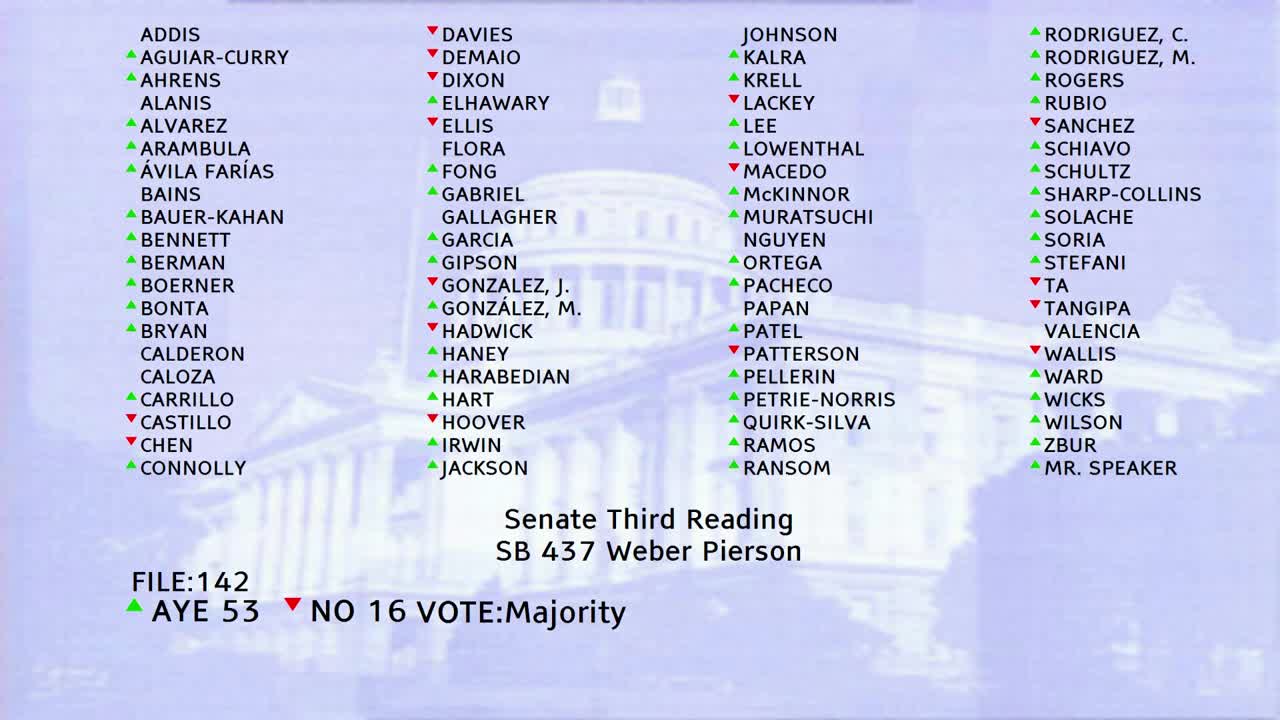 1MIN
Assembly Floor
 9MIN
Assembly Standing Committee on Revenue and Taxation
 13MIN
Assembly Standing Committee on Transportation
 16SEC
Senate Standing Committee on Appropriations
 15MIN
Senate Standing Committee on Revenue and Taxation
Bill Author