SB 1062: Elephants: prohibited treatment.
- Session Year: 2015-2016
- House: Senate
- Latest Version Date: 2016-08-29
Existing law makes it a misdemeanor for any owner or manager of an elephant to engage in abusive behavior toward the elephant, which includes disciplining an elephant by specified methods.
Existing law prohibits the importation, transportation, possession, or live release of specified wild animals, including all species of the order Proboscidea (elephants) into this state, except under a revocable, nontransferable permit, known as a restricted species permit, issued by the Department of Fish and Wildlife, in cooperation with the Department of Food and Agriculture, and only if certain requirements are met. Existing law requires the Fish and Game Commission to revoke a permit under certain circumstances and, in cooperation with the Department of Food and Agriculture, to adopt regulations for the notification of the revocation, termination, or denial of permits, and related appeals. Existing law authorizes specified entities, including the Department of Fish and Wildlife, to enforce these provisions. Under existing law, a violation of these provisions is a crime and is subject to specified civil penalties.
This bill would, beginning January 1, 2018, prohibit any person who houses, possesses, or is in direct contact with an elephant from using, or authorizing or allowing an employee, agent, or contractor to use, a bullhook, ankus, baseball bat, axe handle, pitchfork, or other device designed to inflict pain for the purpose of training or controlling the behavior of an elephant. A person who violates these provisions would not be subject to criminal penalty but would be subject to civil penalties and the restricted species permit for the elephant would be subject to immediate suspension or revocation by the Department of Fish and Wildlife. The bill would authorize a person whose permit is suspended or revoked to appeal the suspension or revocation to the commission by filing a written request for an appeal within 30 days of the suspension or revocation.
Existing law makes it a misdemeanor for any owner or manager of an elephant to engage in abusive behavior toward the elephant, which includes disciplining an elephant by specified methods.
Existing law prohibits the importation, transportation, possession, or live release of specified wild animals, including all species of the order Proboscidea (elephants) into this state, except under a revocable, nontransferable permit, known as a restricted species permit, issued by the Department of Fish and Wildlife, in cooperation with the Department of Food and Agriculture, and only if certain requirements are met. Existing law requires the Fish and Game Commission to revoke a permit under certain circumstances and, in the cooperation of the Department of Food and Agriculture, to adopt regulations for the notification of the revocation, termination, or denial of permits, and related appeals. Existing law authorizes specified entities, including the Department of Fish and Wildlife, to enforce these provisions. Under existing law, a violation of these provisions is a crime and is subject to specified civil penalties.
This bill would, beginning January 1, 2018, prohibit any person who houses, possesses, or is in direct contact with an elephant from using, or authorizing or allowing an employee, agent, or contractor to use, a bullhook, ankus, baseball bat, axe handle, pitchfork, or other device designed to inflict pain for the purpose of training or controlling the behavior of an elephant. A person who violates these provisions would not be subject to criminal penalty but would be subject to civil penalties and the restricted species permit for the elephant would be subject to immediate suspension or revocation of his or her restricted species permit by the Department of Fish and Wildlife. The bill would authorize a person whose permit is suspended or revoked to appeal the suspension or revocation to the commission by filing a written request for an appeal within 30 days of the suspension or revocation.
Existing law makes it a misdemeanor for any owner or manager of an elephant to engage in abusive behavior toward the elephant, which includes disciplining an elephant by specified methods.
Existing law prohibits the importation, transportation, possession, or live release of specified wild animals, including all species of the order Proboscidea (elephants) into this state, except under a revocable, nontransferable permit permit, known as a restricted species permit, issued by the Department of Fish and Wildlife, in cooperation with the Department of Food and Agriculture, and only if certain requirements are met. Existing law requires the Fish and Game Commission to revoke a permit under certain circumstances and, in the cooperation of the Department of Food and Agriculture, to adopt regulations for the notification of the revocation, termination, or denial of permits, and related appeals. Existing law authorizes specified entities, including the department, Department of Fish and Wildlife, to enforce these provisions. Under existing law, a violation of these provisions is a crime and is subject to specified civil penalties.
This bill would, beginning January 1, 2018, prohibit any person who houses, possesses, or is in direct contact with an elephant from using, or permitting authorizing or allowing an employee, agent, or contractor to use, a bullhook, ankus, baseball bat, axe handle, pitchfork, or other device designed to inflict pain for the purpose of training or controlling the behavior of an elephant. A person who violates these provisions would not be subject to criminal penalty but would be subject to civil penalties and immediate suspension or revocation of the above-described permit. his or her restricted species permit by the Department of Fish and Wildlife. The bill would authorize a person whose permit is suspended or revoked to appeal the suspension or revocation to the commission by filing a written request for an appeal within 30 days of the suspension or revocation.
Existing law makes it a misdemeanor for any owner or manager of an elephant to engage in abusive behavior toward the elephant, which includes disciplining an elephant by specified methods.
Existing law prohibits the importation, transportation, possession, or live release of specified wild animals, including all species of the order Proboscidea (elephants) into this state, except under a revocable, nontransferable permit issued by the Department of Fish and Wildlife, in cooperation with the Department of Food and Agriculture, and only if certain requirements are met. Existing law authorizes specified entities, including the department, to enforce these provisions. Under existing law, a violation of these provisions is a crime and is subject to specified civil penalties.
This bill would, beginning January 1, 2018, prohibit any person who houses, possesses, or is in direct contact with an elephant from using, or permitting an employee, agent, or contractor to use, a bullhook, ankus, baseball bat, axe handle, pitchfork, or other device designed to inflict pain for the purpose of training or controlling the behavior of an elephant. A person who violates these provisions would not be subject to criminal penalty but would be subject to civil penalties and revocation of the above-described permit.
(a)(1)Any person who houses, possesses, manages, or is in direct contact with an elephant shall not do either of the following:
(A)Use a bullhook, ankus, baseball bat, axe handle, pitchfork, or other device designed to inflict pain for the purpose of training or controlling the behavior of an elephant.
(B)Authorize or allow an employee, agent, or contractor to use a bullhook, ankus, baseball bat, axe handle, pitchfork, or other device designed to inflict pain for the purpose of training or controlling the behavior of an elephant.
(2)Use prohibited by this subdivision includes brandishing, exhibiting, or displaying the devices in the presence of an elephant.
(b)Any person who violates this section is subject to the civil penalty set forth in Section 2125 for each violation, and the restricted species permit for the elephant is subject to immediate suspension or revocation by the department. A person whose restricted species permit is suspended or revoked pursuant to this section may appeal the suspension or revocation to the commission by filing a written request for an appeal with the commission within 30 days of the suspension or revocation. A person who violates this section is not subject to the criminal penalties set forth in this code.
(c)The provisions of this section are in addition to, and not in lieu of, any other laws protecting animal welfare. This section shall not be construed to limit any state law or rules protecting the welfare of animals or to prevent a local governing body from adopting and enforcing its own animal welfare laws and regulations.
(d)This section shall become operative on January 1, 2018.
(a)(1)Any person who houses, possesses, manages, or is in direct contact with an elephant shall not do either of the following:
(A)Use a bullhook, ankus, baseball bat, axe handle, pitchfork, or other device designed to inflict pain for the purpose of training or controlling the behavior of an elephant.
(B)Authorize or allow an employee, agent, or contractor to use a bullhook, ankus, baseball bat, axe handle, pitchfork, or other device designed to inflict pain for the purpose of training or controlling the behavior of an elephant.
(2)Use prohibited by this subdivision includes brandishing, exhibiting, or displaying the devices in the presence of an elephant.
(b)Any person who violates this section is subject to the civil penalty set forth in Section 2125 for each violation, and the restricted species permit for the elephant is subject to immediate suspension or revocation of his or her restricted species permit by the department. A person whose restricted species permit is suspended or revoked pursuant to this section may appeal the suspension or revocation to the commission by filing a written request for an appeal with the commission within 30 days of the suspension or revocation. A person who violates this section is not subject to the criminal penalties set forth in this code.
(c)The provisions of this section are in addition to, and not in lieu of, any other laws protecting animal welfare. This section shall not be construed to limit any state law or rules protecting the welfare of animals or to prevent a local governing body from adopting and enforcing its own animal welfare laws and regulations.
(d)This section shall become operative on January 1, 2018.
(a)(1)Any person who houses, possesses, manages, or is in direct contact with an elephant shall not do either of the following:
(A)Use a bullhook, ankus, baseball bat, axe handle, pitchfork, or other device designed to inflict pain for the purpose of training or controlling the behavior of an elephant.
(B)Permit Authorize or allow an employee, agent, or contractor to use a bullhook, ankus, baseball bat, axe handle, pitchfork, or other device designed to inflict pain for the purpose of training or controlling the behavior of an elephant.
(2)Use prohibited by this subdivision includes brandishing, exhibiting, or displaying the devices in the presence of an elephant.
(b)Any person who violates this section is subject to a the civil penalty of not less than five hundred dollars ($500) nor more than ten thousand dollars ($10,000) set forth in Section 2125 for each violation, and is subject to permit revocation under this chapter. immediate suspension or revocation of his or her restricted species permit by the department. A person whose restricted species permit is suspended or revoked pursuant to this section may appeal the suspension or revocation to the commission by filing a written request for an appeal with the commission within 30 days of the suspension or revocation. A person who violates this section is not subject to the criminal penalty provided for in subdivision (a) of Section 2125. penalties set forth in this code.
(c)The provisions of this section are in addition to, and not in lieu of, any other laws protecting animal welfare. This section shall not be construed to limit any state law or rules protecting the welfare of animals or to prevent a local governing body from adopting and enforcing its own animal welfare laws and regulations.
(d)This section shall become operative on January 1, 2018.
(a)(1)Any person who houses, possesses, manages, or is in direct contact with an elephant shall not do either of the following:
(A)Use a bullhook, ankus, baseball bat, axe handle, pitchfork, or other device designed to inflict pain for the purpose of training or controlling the behavior of an elephant.
(B)Permit an employee, agent, or contractor to use a bullhook, ankus, baseball bat, axe handle, pitchfork, or other device designed to inflict pain for the purpose of training or controlling the behavior of an elephant.
(2)Use prohibited by this subdivision includes brandishing, exhibiting, or displaying the devices in the presence of an elephant.
(b)Any person who violates this section is subject to a civil penalty of not less than five hundred dollars ($500) nor more than ten thousand dollars ($10,000) for each violation, and is subject to permit revocation under this chapter. A person who violates this section is not subject to the criminal penalty provided for in subdivision (a) of Section 2125.
(c)The provisions of this section are in addition to, and not in lieu of, any other laws protecting animal welfare. This section shall not be construed to limit any state law or rules protecting the welfare of animals or to prevent a local governing body from adopting and enforcing its own animal welfare laws and regulations.
(d)This section shall become operative on January 1, 2018.
|
Date
|
Status
|
|---|---|
| Aug 29, 2016 | Chaptered by Secretary of State. Chapter 234, Statutes of 2016. |
| Aug 29, 2016 | Approved by the Governor. |
| Aug 16, 2016 | Enrolled and presented to the Governor at 11:30 a.m. |
| Aug 11, 2016 | Assembly amendments concurred in. (Ayes 27. Noes 10. Page 4864.) Ordered to engrossing and enrolling. |
| Aug 11, 2016 | Assembly amendments concurred in. (Ayes 26. Noes 10.) Ordered to engrossing and enrolling. |
| Aug 4, 2016 | Read third time. Passed. (Ayes 65. Noes 7. Page 5712.) Ordered to the Senate. |
| Aug 4, 2016 | Read third time. Passed. Ordered to the Senate. |
| Aug 4, 2016 | In Senate. Concurrence in Assembly amendments pending. |
| Jun 30, 2016 | Read second time. Ordered to third reading. |
| Jun 29, 2016 | From committee: Do pass. (Ayes 16. Noes 2.) (June 29). |
| Jun 21, 2016 | From committee: Do pass and re-refer to Com. on APPR. (Ayes 4. Noes 2.) (June 21). Re-referred to Com. on APPR. |
| Jun 15, 2016 | Read second time and amended. Re-referred to Com. on A.,E.,S.,T., & I.M. |
| Jun 14, 2016 | From committee: Do pass as amended and re-refer to Com. on A.,E.,S.,T., & I.M. (Ayes 12. Noes 2.) (June 14). |
| Jun 13, 2016 | Assembly Rule 56 suspended. |
| May 26, 2016 | From committee with author's amendments. Read second time and amended. Re-referred to Com. on W., P., & W. |
| May 12, 2016 | Referred to Com. on W., P., & W. |
| Apr 18, 2016 | Read third time. Passed. (Ayes 29. Noes 9. Page 3576.) Ordered to the Assembly. |
| Apr 18, 2016 | In Assembly. Read first time. Held at Desk. |
| Apr 18, 2016 | Read third time. Passed. (Ayes 29. Noes 9.) Ordered to the Assembly. |
| Apr 12, 2016 | Read second time. Ordered to third reading. |
| Apr 11, 2016 | From committee: Be ordered to second reading pursuant to Senate Rule 28.8. |
| Apr 1, 2016 | Set for hearing April 11. |
| Mar 29, 2016 | From committee: Do pass and re-refer to Com. on APPR. (Ayes 7. Noes 2. Page 3312.) (March 29). Re-referred to Com. on APPR. |
| Mar 29, 2016 | From committee: Do pass and re-refer to Com. on APPR. (Ayes 7. Noes 2.) (March 29). Re-referred to Com. on APPR. |
| Mar 10, 2016 | Set for hearing March 29. |
| Feb 25, 2016 | Referred to Com. on N.R. & W. |
| Feb 17, 2016 | From printer. May be acted upon on or after March 18. |
| Feb 16, 2016 | Introduced. Read first time. To Com. on RLS. for assignment. To print. |
|
Date
|
Description
|
Location
|
Votes
|
|
|---|---|---|---|---|
| Aug 11, 2016 | Unfinished Business SB1062 Lara Concurrence | Senate Floor |
Passed |
|
| Aug 4, 2016 | SB 1062 Lara Senate Third Reading By BONTA | Assembly Floor |
Passed |
|
| Jun 29, 2016 | Do pass. | Assembly Standing Committee on Appropriations |
Passed |
|
| Jun 21, 2016 | Do pass and be re-referred to the Committee on [Appropriations] | Assembly Standing Committee on Arts, Entertainment, Sports, Tourism, and Internet Media |
Passed |
|
| Jun 14, 2016 | Do pass as amended and be re-referred to the Committee on [Arts, Entertainment, Sports, Tourism, and Internet Media] | Assembly Standing Committee on Water, Parks, and Wildlife |
Passed |
|
| Apr 18, 2016 | Senate 3rd Reading SB1062 Lara | Senate Floor |
Passed |
|
| Mar 29, 2016 | Do pass, but first be re-referred to the Committee on [Appropriations] | Senate Standing Committee on Natural Resources and Water |
Passed |
This list shows positions taken on this bill by organizations on the date displayed, which is linked to the original source.
Positions by individuals are not included.
Office of Senate Floor Analyses (916) 651-1520 Fax: (916) 327-4478 | SB |
UNFINISHED BUSINESS
Bill No: SB 1062
:
SENATE NATURAL RES. & WATER COMMITTEE: 7-2, 3/29/16
AYES: Pavley, Allen, Hertzberg, Hueso, Jackson, Monning, Wolk
NOES: Stone, Vidak
SENATE APPROPRIATIONS COMMITTEE: Senate Rule 28.8
SENATE FLOOR: 29-9, 4/18/16
AYES: Allen, Bates, Beall, Block, Cannella, De León, Galgiani, Glazer, Hall, Hancock, Hernandez, Hertzberg, Hill, Hueso, Jackson, Lara, Leno, Leyva, Liu, McGuire, Mendoza, Mitchell, Monning, Nguyen, Pan, Pavley, Roth, Wieckowski, Wolk
NOES: Anderson, Fuller, Gaines, Huff, Moorlach, Morrell, Nielsen, Stone, Vidak
NO VOTE RECORDED: Berryhill, Runner
ASSEMBLY FLOOR: 65-7, 8/4/16 - See last page for vote
SOURCE: Humane Society of the United States
DIGEST: This bill prohibits, beginning January 1, 2018, the use of a bullhook and other devices designed to inflict pain to train or control an elephant.
Assembly Amendments add a provision for appealing a permit revocation and make other technical changes.
Existing law:
- Prohibits the importation, transportation, possession, or release of specified wild animals, including elephants, in California except under a restricted species permit issued by the Department of Fish and Wildlife (DFW), in cooperation with the Department of Food and Agriculture. Authorizes the Fish and Game Commission (FGC) to adopt regulations governing the importation, possession, transportation, keeping, and confinement of wild animals, including elephants. Makes a violation of these requirements subject to a civil penalty of not less than $500 and not more than $10,000 per violation. Also makes a violation a misdemeanor, punishable by up to six months imprisonment in a county jail, or a fine of up to $1,000.
- Makes it a misdemeanor for any owner or manager of an elephant to engage in abusive behavior towards the elephant, including disciplining an elephant by any of the following methods:
- Deprivation of food, water or rest.
- Use of electricity.
- Physical punishment resulting in damage, scarring, or breaking of skin.
- Insertion of any instrument into any bodily orifice.
- Use of martingales (head immobilizing straps).
- Use of block and tackle.
- Makes it unlawful to purchase, sell, offer for sale, possess with intent to sell, or import with intent to sell, elephant ivory or rhinoceros horn, or to possess, sell, offer for sale, trade, or distribute a shark fin in this state. Makes it unlawful to import into this state for commercial purposes, or possess with intent to sell, the dead body, or any part or product thereof, of a polar bear, leopard, ocelot, tiger, cheetah, jaguar, sable antelope, wolf, zebra, whale, cobra, python, sea turtle, colobus monkey, kangaroo, vicuna, sea otter, free-roaming feral horse, dolphin, porpoise, Spanish lynx, or elephant.
This bill:
- Prohibits any person who houses, possesses, manages, or is in direct contact with an elephant, from using, or authorizing or allowing an employee, agent or contractor to use, a bullhook, ankus, baseball bat, axe handle, pitchfork, or other device designed to inflict pain for the purpose of training or controlling an elephant. Use includes brandishing, exhibiting, or displaying the devices in the presence of an elephant.
- Makes any person who violates this prohibition subject to a civil penalty of not less than $500 and not more than $10,000 per violation, and immediate suspension or revocation of a restricted species permit.
- Authorizes a person to appeal a restricted species permit suspension or revocation to the FGC.
- Clarifies that a person who violates the prohibition is not subject to criminal penalties under the Fish and Game Code.
- Provides that the prohibition in this bill is in addition to and not in lieu of other existing animal welfare laws, including any state or local laws.
Background
This bill prohibits the use of bullhooks and other devices designed to inflict pain for the purpose of training or controlling the behavior of an elephant. According to the author, bullhooks are used by a dwindling number of elephant handlers to train, punish and control elephants. The author and sponsors describe a bullhook as a device that resembles a fireplace poker, with a sharp metal hook and spiked tip, and a plastic or wood handle. According to the author, this bill codifies industry standards for elephant management by prohibiting the use of bullhooks, bats, and pitchforks to discipline an elephant. The cities of Los Angeles and Oakland have prohibited use of the bullhook, and San Francisco has banned performances using elephants and other performing wild animals. In 2014, the Association of Zoos and Aquariums (AZA) adopted a policy prohibiting keepers from sharing unrestricted space with elephants. Protected contact, a new elephant management method based on positive reinforcement instead of punishment, was developed and is viewed by supporters as a viable and more humane alternative. The California Association of Zoos and Aquariums, in support of this bill, notes that all zoos accredited by the AZA in California are now using protected contact and operant conditioning training, making use of the bullhook obsolete. Today, no county fair in California offers elephant rides, and the Ringling Brothers circus has also ended all use of elephants for circus performances in California, effective May 2016.
This bill follows last year's SB 716 (Lara, 2015), which proposed to criminalize the use of bullhooks. SB 716 was vetoed by the Governor, along with several other bills, because the bills created new crimes. This bill responds to the veto by proposing to make the use of bullhooks subject to civil penalties, and grounds for revocation of a restricted species permit, instead of creating a new crime. Restricted species permits are issued and enforced by the DFW, and are required for possession and handling of elephants and other wild animals in California.
FISCAL EFFECT: Appropriation: Fiscal Com.: Local:
According to the Assembly Appropriations Committee, costs are minor.
Humane Society of the United States (source)
Lieutenant Governor Gavin Newsom
Active Environments
Alaska Zoo
American Society for the Prevention of Cruelty to Animals
Animal Legal Defense Fund
Best Friends Animal Society
Born Free USA
California Association of Zoos and Aquariums
California Travel Association
Center for Animal Protection and Education
City of Oakland
Compassion Works
International Connection Africa
Detroit Zoological Society
Earth Island Institute
East Bay Regional Park District
East Bay Zoological Society (Oakland Zoo)
Elephant Aid International
Elephant Sanctuary of Tennessee
Global Sanctuary for Elephants
Humane Society Veterinary Medical Association
Humane Society Wildlife Land Trust
In Defense of Animals
LionsTigers & Bears
Liuna Locals 777 & 792
March for Elephants
Marin Humane Society
Performing Animal Welfare Society
San Diego Humane Society
San Francisco SPCA
Santa Clara County Activists for Animals
Sierra Club California
Sierra Wildlife Coalition
State Humane Association of California
American Association of Zoo Veterinarians
American Humane Association
Animals All Around
Asian Elephant Support California Fairs Alliance
California Responsible Pet Owners Coalition
Circus Fans Association of America
Circus World Museum Foundation, Inc.
Elephant Managers Association
Feld Entertainment, Inc.
Have Trunk Will Travel
International Elephant Foundation
Lake County Fair
Livingston Exotics LLC
Los Angeles Foundation for the Circus Arts
Monterey Zoo Pacific Animal Productions
P.M. Productions
Entertainment QE Productions
Ringling Bros.
Center for Elephant Conservation
The Shrine Circus, Pittsburgh
The Syria Shrine Circus
Traveling Paws LLC
Western Fairs Association's Ag Council
Wild Wonders, Inc.
Wildlife Safari Zoological Association of America
ARGUMENTS IN SUPPORT: Supporters emphasize that bullhooks have historically been used by elephant handlers to train, punish and control elephants, and have been used to inflict pain and evoke fear in order to forcefully achieve desired behaviors. The presence of the bullhook even when not in active use is a threat of punishment for elephants that have been trained by this method. Supporters assert there have been numerous documented incidents of elephants being wounded or scarred by abusive use of bullhooks. In addition to the inhumane treatment of elephants, performances that use elephants threaten public safety by bringing people into dangerously close proximity to elephants. Supporters believe use of bullhooks promotes aggression and will not prevent an elephant from rampaging, or protect the public when such an incident occurs. Supporters note that since 1990 there have been 16 human deaths and 135 injuries in the United States attributed to elephants, primarily in circus-related accidents.
In summary, supporters assert the bullhook is an outdated and inhumane tool that unnecessarily subjects elephants to fear and pain, and puts keepers and veterinarians at serious risk of injury and death. They assert that the protected contact method of elephant training and management is a superior method of managing elephants, eliminates the need for bullhooks, and is now the industry preferred standard. This method relies on positive reinforcement training and a protected barrier, enables keepers to provide high quality elephant husbandry and veterinary care, and is based on cooperation and respect rather than domination and control. The protected contact method is now required for all facilities certified by the AZA.
ARGUMENTS IN OPPOSITION: Opponents of this bill, which include members of the circus and entertainment community, as well a number of veterinarians and researchers, assert that the bullhook or guide is an important tool that facilitates the ability of elephant handlers to provide veterinary care and conduct elephant research. They prefer the term guide to describe the tool rather than bullhook, and assert that it is not harmful or abusive when used correctly. They emphasize that the guide is the only husbandry tool effective for managing elephants in a free contact environment where elephants are not confined exclusively to their enclosures. Opponents also assert that the use of bullhooks helps those who use them to provide more superior care than can be provided to those managed without them. They are concerned that taking away the ability to use bullhooks or guides will adversely affect their ability to provide elephants with required care. Some opponents assert the bullhook is comparable to the use of a harness and reins for horses, or collars and leads for dogs. Because the bullhook or guide is useful in providing veterinary care, opponents assert that the State of California by removing its use would be removing an essential safety and welfare tool for handling a large and potentially dangerous animal.
Some opponents are also concerned that this bill will negatively impact the ability of the entertainment industry to use elephants in performances, fairs and festivals, and for people in the animal industries to maintain their livelihoods. Others believe it will hamper research and conservation efforts that are beneficial to elephants.
ASSEMBLY FLOOR: 65-7, 8/4/16
AYES: Achadjian, Arambula, Atkins, Baker, Bigelow, Bloom, Bonilla, Bonta, Brough, Brown, Burke, Calderon, Campos, Chang, Chau, Chiu, Chu, Cooper, Dababneh, Daly, Dodd, Eggman, Gallagher, Cristina Garcia, Eduardo Garcia, Gatto, Gipson, Gomez, Gonzalez, Gordon, Gray, Grove, Hadley, Holden, Irwin, Jones-Sawyer, Kim, Lackey, Levine, Linder, Lopez, Low, Maienschein, Mayes, McCarty, Mullin, Nazarian, O'Donnell, Olsen, Quirk, Ridley-Thomas, Rodriguez, Salas, Santiago, Steinorth, Mark Stone, Thurmond, Ting, Wagner, Waldron, Weber, Wilk, Williams, Wood, Rendon
NOES: Beth Gaines, Harper, Jones, Mathis, Medina, Melendez, Obernolte
NO VOTE RECORDED: Alejo, Travis Allen, Chávez, Cooley, Dahle, Frazier, Roger Hernández, Patterson
8/5/16 11:05:59
**** END ****
SENATE THIRD READING
STR Bill Id:
Author:(Lara)
As Amended Ver:
Majority vote
SENATE VOTE: 29-9
Committee | Votes | Ayes | Noes |
Water | 12-2 | Levine, Gallagher, Bigelow, Dodd, Eggman, Cristina Garcia, Eduardo Garcia, Gomez, Lopez, Olsen, Salas, Williams | Harper, Medina |
Arts | 4-2 | Hadley, Levine, Low, Nazarian | Obernolte, Medina |
Appropriations | 16-2 | Gonzalez, Bigelow, Bloom, Bonta, Calderon, Chang, Daly, Eggman, Gallagher, Roger Hernández, Holden, Quirk, Santiago, Wagner, Weber, Wood | Jones, Obernolte |
SUMMARY: Prohibits, beginning January 1, 2018, the use of a bullhook and other devices designed to inflict pain to train or control an elephant. Specifically, this bill:
- Prohibits any person who houses, possesses, manages, or is in direct contact with an elephant, from using, or authorizing or allowing an employee, agent or contractor to use, a bullhook, ankus, baseball bat, axe handle, pitchfork, or other device designed to inflict pain for the purpose of training or controlling an elephant. Use includes brandishing, exhibiting, or displaying the devices in the presence of an elephant.
- Makes any person who violates this prohibition subject to a civil penalty of not less than $500 and not more than $10,000 per violation, and immediate suspension or revocation of a restricted species permit.
- Authorizes a person to appeal a restricted species permit suspension or revocation to the Fish and Game Commission (FGC).
- Clarifies that a person who violates the prohibition is not subject to criminal penalties under the Fish and Game Code.
- Provides that the prohibition in this bill is in addition to and not in lieu of other existing animal welfare laws, including any state or local laws.
EXISTING LAW:
- Prohibits the importation, transportation, possession, or release of specified wild animals, including elephants, in California except under a restricted species permit issued by the Department of Fish and Wildlife (DFW), in cooperation with the Department of Food and Agriculture. Authorizes the FGC to adopt regulations governing the importation, possession, transportation, keeping, and confinement of wild animals, including elephants. Makes a violation of these requirements subject to a civil penalty of not less than $500 and not more than $10,000 per violation. Also makes a violation a misdemeanor, punishable by up to six months imprisonment in a county jail, or a fine of up to $1,000.
- Makes it a misdemeanor for any owner or manager of an elephant to engage in abusive behavior towards the elephant, including disciplining an elephant by any of the following methods:
- Deprivation of food, water or rest.
- Use of electricity.
- Physical punishment resulting in damage, scarring, or breaking of skin.
- Insertion of any instrument into any bodily orifice.
- Use of martingales (head immobilizing straps).
- Use of block and tackle.
- Makes it unlawful to purchase, sell, offer for sale, possess with intent to sell, or import with intent to sell, elephant ivory or rhinoceros horn, or to possess, sell, offer for sale, trade, or distribute a shark fin in this state. Makes it unlawful to import into this state for commercial purposes, or possess with intent to sell, the dead body, or any part or product thereof, of a polar bear, leopard, ocelot, tiger, cheetah, jaguar, sable antelope, wolf, zebra, whale, cobra, python, sea turtle, colobus monkey, kangaroo, vicuna, sea otter, free-roaming feral horse, dolphin, porpoise, Spanish lynx, or elephant.
FISCAL EFFECT: According to the Assembly Appropriations Committee, minor state costs.
COMMENTS: This bill prohibits the use of bullhooks and other devices designed to inflict pain for the purpose of training or controlling the behavior of an elephant. According to the author, bullhooks are used by a dwindling number of elephant handlers to train, punish and control elephants. The author and sponsors describe a bullhook as a device that resembles a fireplace poker, with a sharp metal hook and spiked tip, and a plastic or wood handle. According to the author, this bill codifies industry standards for elephant management by prohibiting the use of bullhooks, bats, and pitchforks to discipline an elephant. The cities of Los Angeles and Oakland have prohibited use of the bullhook, and San Francisco has banned performances using elephants and other performing wild animals. In 2014 the Association of Zoos and Aquariums (AZA) adopted a policy prohibiting keepers from sharing unrestricted space with elephants. Protected contact, a new elephant management method based on positive reinforcement instead of punishment, was developed and is viewed by supporters as a viable and more humane alternative. The California Association of Zoos and Aquariums, in support of this bill, notes that all zoos accredited by the AZA in California are now using protected contact and operant conditioning training, making use of the bullhook obsolete. Today no county fair in California offers elephant rides, and the Ringling Brothers circus has also ended all use of elephants for circus performances in California, effective May 2016.
This bill follows last year's SB 716 (Lara) of 2015, which proposed to criminalize the use of bullhooks. SB 716 was vetoed by the Governor, along with several other bills, because the bills created new crimes. This bill responds to the veto by proposing to make the use of bullhooks subject to civil penalties, and grounds for revocation of a restricted species permit, instead of creating a new crime. Restricted species permits are issued and enforced by the DFW, and are required for possession and handling of elephants and other wild animals in California.
Supporters emphasize that bullhooks have historically been used by elephant handlers to train, punish and control elephants, and have been used to inflict pain and evoke fear in order to forcefully achieve desired behaviors. The presence of the bullhook even when not in active use is a threat of punishment for elephants that have been trained by this method. Supporters assert there have been numerous documented incidents of elephants being wounded or scarred by abusive use of bullhooks. In addition to the inhumane treatment of elephants, performances that use elephants threaten public safety by bringing people into dangerously close proximity to elephants. Supporters believe use of bullhooks promotes aggression and will not prevent an elephant from rampaging, or protect the public when such an incident occurs. Supporters note that since 1990 there have been 16 human deaths and 135 injuries in the United States attributed to elephants, primarily in circus-related accidents.
In summary, supporters assert the bullhook is an outdated and inhumane tool that unnecessarily subjects elephants to fear and pain, and puts keepers and veterinarians at serious risk of injury and death. They assert that the protected contact method of elephant training and management is a superior method of managing elephants, eliminates the need for bullhooks, and is now the industry preferred standard. This method relies on positive reinforcement training and a protected barrier, enables keepers to provide high quality elephant husbandry and veterinary care, and is based on cooperation and respect rather than domination and control. The protected contact method is now required for all facilities certified by the AZA.
Opponents of this bill, which include members of the circus and entertainment community, as well a number of veterinarians and researchers, assert that the bullhook or guide is an important tool that facilitates the ability of elephant handlers to provide veterinary care and conduct elephant research. They prefer the term guide to describe the tool rather than bullhook, and assert that it is not harmful or abusive when used correctly. They emphasize that the guide is the only husbandry tool effective for managing elephants in a free contact environment where elephants are not confined exclusively to their enclosures. Opponents also assert that the use of bullhooks helps those who use them to provide more superior care than can be provided to those managed without them. They are concerned that taking away the ability to use bullhooks or guides will adversely affect their ability to provide elephants with required care. Some opponents assert the bullhook is comparable to the use of a harness and reins for horses, or collars and leads for dogs. Because the bullhook or guide is useful in providing veterinary care, opponents assert the state of California by removing its use would be removing an essential safety and welfare tool for handling a large and potentially dangerous animal.
Some opponents are also concerned that this bill will negatively impact the ability of the entertainment industry to use elephants in performances, fairs and festivals, and for people in the animal industries to maintain their livelihoods. Others believe it will hamper research and conservation efforts that are beneficial to elephants.
Analysis Prepared by: Diane Colborn / W., P., & W. / (916) 319-2096 FN: 0003584
Date of Hearing: June 29, 2016
ASSEMBLY COMMITTEE ON APPROPRIATIONS
Lorena Gonzalez, Chair
SBPCA Bill Id:SB 1062
Author:(Lara) – As Amended Ver:June 15, 2016
Policy Committee: | Water, Parks and Wildlife | Vote: | 12 - 2 |
Arts, Entertainment, Sports, Tourism, and Internet Media | 4 - 2 |
Urgency: No State Mandated Local Program: No Reimbursable: No
SUMMARY:
This bill prohibits the use of a bullhook and other specified devices designed to inflict pain to train or control an elephant, beginning January 1, 2018. Use includes the brandishing, exhibiting or displaying the devices in the presence of the elephant.
Violators of these provisions are subject to civil penalties of between $500 and $10,000 per violation, and the immediate suspension or revocation of a user’s restricted species permit.
FISCAL EFFECT:
Minor state costs.
COMMENTS:
- Purpose According to the author, Los Angeles and Oakland have prohibited use of the bullhook, and San Francisco has banned performances using elephants and other performing wild animals. The author contends it is time for the state to follow suit and prohibit this inhumane practice.
This bill prohibits and establishes civil penalties for the use of bullhooks and other devices designed to inflict pain to train or control the behavior of an elephant.
Restricted species permits are issued and enforced by the Department of Fish and Wildlife (DFW) and are required for the possession and handling of elephants and other wild animals in California. This bill requires DFW to immediately revoke restricted species permits from anyone who violates this provision.
- Background. All zoos and major sanctuaries in California have ceased use of the bullhook and other guide tools. There are two remaining commercial organizations - which have nine elephants between them - that have direct contact with elephants and claim they need to use guide tools in order to provide their services. The first is Have Trunk Will Travel, who provides elephants for work in films, television, commercials, traditional Indian weddings, as well as offering elephant rides at fairs and theme parks. The second affected business is the Monterey Zoo, which offers a safari style bed and breakfast experience, public meet and greets with exotic animals and educational experience and research facilities all inside an expansive property outside of Salinas, California.
- Previous Legislation. This bill follows up on last year's SB 716 (Lara), which would have addressed the issue by criminalizing the use of bullhooks. SB 716 was vetoed by the Governor, along with several other bills, because the bills created new crimes. This bill responds to the veto by proposing to make the use of bullhooks subject to civil penalties, and grounds for revocation of a restricted species permit instead of creating a new crime.
Analysis Prepared by: Jennifer Galehouse / APPR. / (916) 319-2081
Date of Hearing: June 21, 2016
ASSEMBLY COMMITTEE ON ARTS, ENTERTAINMENT, SPORTS, TOURISM, AND INTERNET MEDIA
Kansen Chu, Chair
SBPCA Bill Id:SB 1062
Author:(Lara) – As Amended Ver:June 15, 2016
SENATE VOTE: 29-9
SUBJECT: Elephants: prohibited treatment.
SUMMARY: Prohibits, beginning January 1, 2018, the use of a bullhook and other devices designed to inflict pain to train or control an elephant. Specifically, this bill:
- Prohibits any person who houses, possesses, manages, or is in direct contact with an elephant, from using, or authorizing or allowing an employee, agent or contractor to use, a bullhook, ankus, baseball bat, axe handle, pitchfork, or other device designed to inflict pain for the purpose of training or controlling an elephant. Use includes brandishing, exhibiting, or displaying the devices in the presence of an elephant.
- Makes any person who violates this prohibition subject to a civil penalty of not less than $500 and not more than $10,000 per violation, and immediate suspension or revocation of a restricted species permit.
- Authorizes a person to appeal a restricted species permit suspension or revocation to the Fish and Game Commission (FGC).
- Clarifies that a person who violates the prohibition is not subject to criminal penalties under the Fish and Game Code.
- Provides that the prohibition in this bill is in addition to and not in lieu of other existing animal welfare laws, including any state or local laws.
EXISTING LAW:
- Prohibits the importation, transportation, possession, or release of specified wild animals, including elephants, in California except under a restricted species permit issued by the Department of Fish and Wildlife (DFW), in cooperation with the Department of Food and Agriculture.
- Authorizes the FGC to adopt regulations governing the importation, possession, transportation, keeping, and confinement of wild animals, including elephants.
- Makes a violation of these requirements subject to a civil penalty of not less than $500 and not more than $10,000 per violation. Also makes a violation a misdemeanor, punishable by up to six months imprisonment in a county jail, or a fine of up to $1,000.
- Declares that it is a misdemeanor for any owner or manager of an elephant to engage in abusive behavior toward the elephant, including the discipline of the elephant by any of the following methods:
- Deprivation of food, water, or rest. (Pen. Code, § 596.5, subd. (a).)
- Use of electricity. (Pen. Code, § 596.5, subd. (b).)
- Physical punishment resulting in damage, scarring, or breakage of skin. (Pen. Code, § 596.5, subd. (c).)
- Insertion of any instrument into any bodily orifice. (Pen. Code, § 596.5, subd. (d).)
- Use of martingales. (Pen. Code, § 596.5, subd. (e).)
- Use of block and tackle. (Pen. Code, § 596.5, subd. (f).)
- Deprivation of food, water, or rest. (Pen. Code, § 596.5, subd. (a).)
- Provides that the actions of a person who maliciously and intentionally maims, mutilates, tortures, or wounds a living animal, or maliciously and intentionally kills an animal as a criminal offense. (Pen. Code, § 597.)
- Specifies when a person overdrives, overloads, drives when overloaded, overworks, tortures, torments, deprives of necessary sustenance, drink, or shelter, cruelly beats, mutilates, or cruelly kills any animal, or causes or procures any animal to be so overdriven, overloaded, driven when overloaded, overworked, tortured, tormented, deprived of necessary sustenance, drink, shelter, or to be cruelly beaten, mutilated, or cruelly killed; and whoever, having the charge or custody of any animal, either as owner or otherwise, subjects any animal to needless suffering, or inflicts unnecessary cruelty upon the animal, or in any manner abuses any animal, or fails to provide the animal with proper food, drink, or shelter or protection from the weather, or who drives, rides, or otherwise uses the animal when unfit for labor as a criminal offense. (Pen. Code, § 597, subd. (b).)
- Requires punishment as a felony by imprisonment pursuant to subdivision (h) of Section 1170, or by a fine of not more than twenty thousand dollars ($20,000), or by both that fine and imprisonment, or alternatively, as a misdemeanor by imprisonment in a county jail for not more than one year, or by a fine of not more than twenty thousand dollars ($20,000), or by both that fine and imprisonment for violations of Penal Code section 597 (animal cruelty). (Pen. Code, § 597, subd. (d).)
- Requires that if a defendant is granted probation for a conviction of animal cruelty, the court shall order the defendant to pay for, and successfully complete, counseling, as determined by the court, designed to evaluate and treat behavior or conduct disorders. If the court finds that the defendant is financially unable to pay for that counseling, the court may develop a sliding fee schedule based upon the defendant's ability to pay. The counseling shall be in addition to any other terms and conditions of probation, including any term of imprisonment and any fine. If the court does not order custody as a condition of probation for a conviction under this section, the court shall specify on the court record the reason or reasons for not ordering custody. This does not apply to cases involving police dogs or horses as described in Section 600. (Pen. Code, § 597, subd. (h).)
FISCAL EFFECT: This bill passed out of the Senate Appropriations Committee, pursuant to Rule 28.8.
COMMENTS:
- Author's statement in support of legislation: According to the author, "SB 1062 simply codifies industry standards for elephant management by prohibiting the use of bullhooks, bats, and pitchforks to discipline an elephant. A bullhook is typically embedded into most sensitive areas of an elephant, which involves areas around the ears, mouth, and back of the legs. The use of this instrument also puts handlers at severe risk, should an elephant decide to rebel against the trainer. Los Angeles and Oakland have prohibited use of the bullhook, and San Francisco has banned the performance of elephants, among other performing animals. Supported by the California Association of Zoos and Aquariums, it is time for the State to follow suit and prohibit this inhumane practice."
- Background:
- Existing state and federal law prohibits animal abuse, and provides specific protections for elephants. As mentioned in the "Existing Law" section above, California law makes abuse of an animal a crime punishable under the Penal Code. Further specific protections exist for elephants, including (Pen. Code, § 596.5, subd. (a).) which provides, "It shall be a misdemeanor for any owner or manager of an elephant to engage in abusive behavior toward the elephant, . . .” Id. The statute goes on to list specific conduct which is included under “abusive behavior,” but does not limit the definition of abusive behavior towards an elephant in any way. A “bull hook” or “guide” used by an owner or manager to engage in abusive behavior toward the elephant is already a crime under existing law. Enforcement of these laws is done at the local level by the local Animal Control Officer and local law enforcement.
In addition, federal law provides, under the Animal Welfare Act (AWA), that zoos, circuses, transporters, roadside menageries and exhibitors of elephants must be licensed and participate in record-keeping and marking requirements. Additional protections exist governing their care, handling, and transport. The AWA gives power to the Secretary of Agriculture and the United States Department of Agriculture, whose power is further delegated to the Animal Plant and Health Inspection Service (APHIS) to administer and enforce the AWA's requirements. APHIS enforces the Act through conducting inspections and instituting rules and regulations for facilities. APHIS is required to conduct yearly inspections and investigate facilities whenever a complaint is filed.
Unlike California law, the AWA does not prohibit any particular instruments in the handling of elephants or other warm blooded animals.
- Two models for handling elephants: protected contact and free contact. Without use of "guide" free contact will be ended. There are two models for elephant trainers and caretakers to interact with elephants: “protective contact” and “free contact.” In the protective contact model, the trainer or caretaker only interacts with elephants through a barrier or fence. In free contact the trainer/caretaker shares a physical space with the elephant. According to some experts, the bullhook/guide is necessary for free contact training or management. Without use of the “bull hook” or “guide,” free contact is not a viable model for interacting with elephants. In order to have a live performance involving an elephant, for instance, free contact is necessary. A live performance with elephants typically occurs in a circus, but can also include use of elephants in films, events like county fairs, or attractions such as theme parks and safari experience parks.
It should be noted that while California zoos accredited by the Association of Zoos and Aquariums (AZA), along with many other facilities housing elephants no longer use bullhooks, the American Veterinary Medicine Association (AVMA) policy does not prohibit the use of guides/bullhooks, and many facilities nationwide have contacted the committee to state that they incorporate guides into their protected contact protocol.
AVMA policy prohibits the use of guides in a manner which inflicts harm on an elephant, but allows use of the guide as a husbandry tool for elephant management. “The AVMA condemns the use of guides to puncture, lacerate, strike or inflict harm upon an elephant. Elephant guides are husbandry tools that consist of a shaft capped by one straight and one curved end. The ends are blunt and tapered, and are used to touch parts of the elephant's body as a cue to elicit specific actions or behaviors, with the handler exerting very little pressure. The ends should contact, but should not tear or penetrate the skin.” (Elephant Guides and Tethers, AVMA.) www.avma.org/KB/Policies/Pages/Elephant-Guides-and-Tethers.aspx
“Guides and tethers are used for training elephants in some elephant management systems, and appropriate training is important for facilitating veterinary care. However, guides and tethers should only be used in a manner consistent with the promotion of optimum welfare of the elephant. Personnel using these devices should be trained adequately, as well as introduced to alternative management systems.” (Elephant Guides and Tethers, AVMA.) www.avma.org/KB/Policies/Pages/Elephant-Guides-and-Tethers.aspx
- Elephants in the California entertainment and tourism industries: Impacted entities are two businesses which work with the film and entertainment industry and provide public interaction directly with elephants. As mentioned above, all zoos and major sanctuaries in California have moved to protected contact and have ceased use of the guide tool. There are two remaining commercial organizations - which have 9 elephants between them - that have direct contact with elephants as their business model. Both claim they need to use guide tools in order to provide their services. The first is Have Trunk Will Travel, who provides elephants for work in films, television, commercials, traditional Indian weddings, as well as offering elephant rides at fairs and theme parks. They are the exclusive providers of elephants to the film industry and have worked on projects such as George of the Jungle and Water for Elephants. Their research and development of elephant handling and medical care techniques are recognized nationwide.
The second affected business is the Monterey Zoo, which offers a safari style bed and breakfast experience, public meet and greets with exotic animals and educational experience and research facilities all inside an expansive property outside of Salinas California. There are over 100 exotic animals onsite, with five elephants among them. Education, public interaction with exotic animals and research are all supported through a related non-profit as well as the proceeds from their ranch. The facility's animals are also stars of stage and screen, with their lions and bears, parrots, squirrels, yaks and more appearing in numerous television shows, commercials and films. The Monterey Zoo is currently undergoing a $10 million dollar renovation and expansion of their facility.
- Arguments in support:
- Use of the "guide" or "bull hook" is de facto abuse. According to information provided by the author, a “bullhook is a steel-pointed rod resembling a fireplace poker that is used to prod, hook, and strike elephants in order to dominate and control them during training, performing, and handling. The sharp tip and hook are applied with varying degrees of pressure to sensitive spots on an elephant’s body, causing the elephant to recoil from the source of pain. The handle is used as a club, inflicting substantial pain by striking areas where little tissue separates skin and bone. . . . Elephant calves are forcibly separated from their mothers (females elephants naturally remain with their mothers for life) and taught to associate the bullhook with pain and fear. While the elephant is typically restrained, handlers repeatedly administer sharp jabs and hooks with the bullhook, and strike sensitive parts of their bodies with the handle or metal hook. Thereafter, the elephant responds to the bullhook out of fear of pain (moving away from the device) and will be expected to perform a behavior on cue or suffer the painful consequences. . . ."
b) The professional community of elephant handlers is moving away from direct human contact with elephants, and thus the instrument should be banned from use as outmoded.
The East Bay Zoological Society, which owns the Oakland Zoo, supports this bill, explaining in part that it has used the management style called “Protected Contact” described in Comment 2 above since 1991. "The elephants and staff do not share the same physical space, and the elephants also have a choice of whether or not to participate in training sessions. This management style ensures not only the safety and care of our elephants, but also our staff." According to the Humane Society of the United States, “California zoos accredited by the Association of Zoos and Aquariums (AZA) no longer use bullhooks, nor does the Performing Animal Welfare Society’s sanctuary which is home to numerous rescued elephants. The AZA now also urges all its member zoos to switch to a safer and more humane elephant training system that does not utilize the bullhook.”
- Arguments in opposition:
- The "guide" is a humane and irreplaceable aspect of elephant handling in direct contact with humans, which many vets and zoo keepers still need to use, in addition to use with performing animals. According to the Elephant Managers Association (EMA), who oppose this measure, "All animal species are vastly different in their husbandry needs and each species requires specialized equipment to ensure proper care. Tools such as the elephant guide (or bullhooks) are safe and productive components of elephant care and training. Elephant tools are not intended to injure or harm the animal and are proven and humane husbandry tools that are widely utilized by knowledgeable and experienced elephant care professionals in a variety of settings. They also add an increased degree of safety for the trainer, the animal, and the public."
Additionally, they add, "The American Veterinary Medical Association (AVMA) has gone on record supporting the use of professional tools, including the guide, to manage elephants." They relay a concern with reliance solely upon protected contact, which depends upon the animal's choice to cooperate, especially with baby elephants that are not yet conditioned to approach their medical treatment area, which is when elephants don't feel well; they won't come into medical pens for treatment. Sadly, this has resulted in more than one baby elephant's death from a treatable condition, an EMA representative asserts.
- Existing law is sufficiently protective of elephants. Numerous letters to the committee contain similar language and content to the effect of the following: In addition to state laws against animal abuse, and specific laws protecting elephants, there are existing federal regulations that strictly govern elephant care under the Animal Welfare Act, that are overseen and revised frequently by the U.S. Department of Agriculture, animal and Plant Health Inspection Service (USDA/APHIS). USDA/APHIS utilizes trained veterinary professionals who are instructed specifically in animal/elephant care and welfare to conduct regular inspections of all license exhibitors of elephants (and other animals)."
5) Committee comment and suggested amendment. According to the author, sponsors and supporters of this measure, the goal of SB 1062 is to ensure that elephants are not mistreated. Indeed, it is the uniform view of both supporters and opponents of SB 1062 that elephants should not be subject to any form of abuse, nor subjected to cruel or harmful treatment. Toward this shared goal, both the Penal Code and Fish and Game Code already provide express prohibition in the law against such conduct.
Where there is a conflict of opinion is the differing view of experts in animal husbandry, regulators and veterinarians as to the need for and proper use of the elephant guide, also known as a bullhook or aunk. Given the existing protection in the law against abuse of this tool, and the sometimes mortal consequences asserted by veterinarians and experts in elephant care if the tool is abolished, including; mothers accidently crushing their newborn baby elephants, inability to provide medication to baby elephants untrained in protected contact and adult elephants too sick to cooperate with their handlers in protected contact, and current unavailability of alternative means to allow safe direct contact with the public as required by federal regulations, the committee suggests an alternative to the absolute ban proposed in the current language of the bill.
Suggested amendment. The committee suggests that the bill be amended to add the additional language in a manner that would violate Penal Code section 596.5, so that the bill would prohibit using or authorizing or allowing an employee, agent or contractor to use, a bullhook, ankus, baseball bat, axe handle, pitchfork, or other device designed to inflict pain for the purpose of training or controlling an elephant (including brandishing, exhibiting, or displaying the devices in the presence of an elephant) in a manner that would violate Penal Code section 596.5.
As mention under Existing Law above, PC 596.5 generally prohibits any and all abusive behavior toward elephants and expressly prohibits (a) Deprivation of food, water, or rest, (b) Use of electricity, (c) Physical punishment resulting in damage, scarring, or breakage of skin, (d) Insertion of any instrument into any bodily orifice, (e) Use of martingales, (f) Use of block and tackle (emphasis added).
The impact of this amendment would be to allow the continued use of the guide or bullhook, but only in a safe way which could not be abusive or cause any harm to the elephant. The burden of proof threshold would be the civil standard of preponderance of the evidence, rather than the more stringent criminal standard of beyond a reasonable doubt. Any violator would be subject to loss of their permits and license to maintain their elephants.
SHOULD NOT THE BILL BE AMENDED TO PROHIBIT ELEPHANT ABUSE CONSISTANT WITH PROVISIONS IN THE PENAL CODE?
6) Prior related legislation.
a) SB 716 (Lara) of 2015, was a substantially similar measure to SB 1062 currently under consideration, which would have prohibited use of bullhooks for managing elephants but placed the prohibition in the Penal Code, making a violation of the law a crime. SB 716 along with 8 other bills was vetoed by the Governor.
The veto message stated:
"Each of these bills creates a new crime – usually by finding a novel way to characterize and criminalize conduct that is already proscribed. This multiplication and particularization of criminal behavior creates increasing complexity without commensurate benefit. Over the last several decades, California's criminal code has grown to more than 5,000 separate provisions, covering almost every conceivable form of human behavior. During the same period, our jail and prison populations have exploded. Before we keep going down this road, I think we should pause and reflect on how our system of criminal justice could be made more human, more just and more cost-effective."
In response to the Governor's concerns, the author moved the language banning the use of bullhook and other implements contained in SB 716 from the Penal Code to the Fish and Game Code when drafting SB 1062, and expressly excludes the criminal penalties under the Fish and Game Code from its provisions.
b) AB 777 (L. Levine) of 2007, among other things, would have prohibited use of any implement or device on an elephant that may reasonably result in harm to the elephant, including the elephant’s skin. AB 3027 failed passage in the Assembly.
c) AB 3027 (L. Levine) of 2006, among other things, would have prohibited use of a bullhook or similar device. AB 3027 was held in the Assembly Appropriations Committee.
REGISTERED SUPPORT / OPPOSITION:
Support
The Humane Society of the United States (sponsor)
Active Environments
Alaska Zoo
American Society for the Prevention of Cruelty to Animals (ASPCA)
Animal Legal Defense Fund
Best Friends Animal Society
Born Free USA
California Association of Zoos and Aquariums
California Travel Association
Center for Animal Protection and Education
City of Oakland
Compassion Works International
Connection Africa
Detroit Zoological Society
Earth Island Institute
East Bay Regional Park District
East Bay Zoological Society (Oakland Zoo)
Elephant Aid International
Elephant Sanctuary of Tennessee
Global Sanctuary for Elephants
Humane Society Veterinary Medical Association
Humane Society Wildlife Land Trust
In Defense of Animals
Lieutenant Governor Gavin Newsom
Lions, Tigers & Bears
Liuna Locals 777 & 792
March for Elephants
Marin Humane Society
Performing Animal Welfare Society
San Diego Humane Society
San Francisco SPCA
Santa Clara County Activists for Animals
Sierra Club California
Sierra Wildlife Coalition
State Humane Association of California
Numerous individuals, including veterinarians.
Opposition
American Association of Zoo Veterinarians
American Humane Association
Animals All Around
Asian Elephant Support
California Fairs Alliance
California Responsible Pet Owners Coalition
Circus Fans Association of America
Circus World Museum Foundation, Inc.
Elephant Managers Association
Feld Entertainment, Inc.
Have Trunk Will Travel
International Elephant Foundation
Lake County Fair
Livingston Exotics LLC
Los Angeles Foundation for the Circus Arts
Monterey Zoo
Pacific Animal Productions
P.M. Productions Entertainment
QE Productions
Ringling Bros. Center for Elephant Conservation
The Shrine Circus, Pittsburgh
The Syria Shrine Circus
Traveling Paws LLC
Western Fair Association's Ag Council
Wild Wonders, Inc.
Wildlife Safari
Zoological Association of America
Numerous individuals, including veterinarians.
Analysis Prepared by: Dana Mitchell / A.,E.,S.,T., & I.M. / (916) 319-3450
Date of Hearing: June 14, 2016
ASSEMBLY COMMITTEE ON WATER, PARKS, AND WILDLIFE
Marc Levine, Chair
SBPCA Bill Id:SB 1062
Author:(Lara) – As Amended Ver:May 26, 2016
SENATE VOTE: 29-9
SUBJECT: Elephants: prohibited treatment
SUMMARY: Prohibits, beginning January 1, 2018, the use of a bullhook and other devices designed to inflict pain to train or control an elephant. Specifically, this bill:
- Prohibits any person who houses, possesses, manages, or is in direct contact with an elephant, from using, or authorizing or allowing an employee, agent or contractor to use, a bullhook, ankus, baseball bat, axe handle, pitchfork, or other device designed to inflict pain for the purpose of training or controlling an elephant. Use includes brandishing, exhibiting, or displaying the devices in the presence of an elephant.
- Makes any person who violates this prohibition subject to a civil penalty of not less than $500 and not more than $10,000 per violation, and immediate suspension or revocation of a restricted species permit.
- Authorizes a person to appeal a restricted species permit suspension or revocation to the Fish and Game Commission (FGC).
- Clarifies that a person who violates the prohibition is not subject to criminal penalties under the Fish and Game Code.
- Provides that the prohibition in this bill is in addition to and not in lieu of other existing animal welfare laws, including any state or local laws.
EXISTING LAW:
- Prohibits the importation, transportation, possession, or release of specified wild animals, including elephants, in California except under a restricted species permit issued by the Department of Fish and Wildlife (DFW), in cooperation with the Department of Food and Agriculture. Authorizes the FGC to adopt regulations governing the importation, possession, transportation, keeping, and confinement of wild animals, including elephants. Makes a violation of these requirements subject to a civil penalty of not less than $500 and not more than $10,000 per violation. Also makes a violation a misdemeanor, punishable by up to six months imprisonment in a county jail, or a fine of up to $1,000.
- Makes it a misdemeanor for any owner or manager of an elephant to engage in abusive behavior towards the elephant, including disciplining an elephant by any of the following methods:
- Deprivation of food, water or rest.
- Use of electricity.
- Physical punishment resulting in damage, scarring, or breaking of skin.
- Insertion of any instrument into any bodily orifice.
- Use of martingales (head immobilizing straps).
- Use of block and tackle.
- Makes it unlawful to purchase, sell, offer for sale, possess with intent to sell, or import with intent to sell, elephant ivory or rhinoceros horn, or to possess, sell, offer for sale, trade, or distribute a shark fin in this state. Makes it unlawful to import into this state for commercial purposes, or possess with intent to sell, the dead body, or any part or product thereof, of a polar bear, leopard, ocelot, tiger, cheetah, jaguar, sable antelope, wolf, zebra, whale, cobra, python, sea turtle, colobus monkey, kangaroo, vicuna, sea otter, free-roaming feral horse, dolphin, porpoise, Spanish lynx, or elephant.
FISCAL EFFECT: According to the Senate Appropriations Committee, pursuant to Rule 28.8, negligible if any state costs.
COMMENTS: This bill would prohibit the use of bullhooks and other devices designed to inflict pain for the purpose of training or controlling the behavior of an elephant. According to the author and supporters of this bill, bullhooks are used by a dwindling number of elephant handlers to train, punish and control elephants. The author and sponsors describe a bullhook as a device that resembles a fireplace poker, with a sharp metal hook and spiked tip, and a handle that is typically plastic or wood.
- Author’s Statement: This bill simply codifies industry standards for elephant management by prohibiting the use of bullhooks, bats, and pitchforks to discipline an elephant. A bullhook is typically embedded into the most sensitive areas of an elephant, which involves areas around the ears, mouth, and back of the legs. The use of this instrument also puts handlers at severe risk, should an elephant decide to rebel against the trainer. Los Angeles and Oakland have prohibited use of the bullhook, and San Francisco has banned performances using elephants and other performing wild animals. It is time for the state to follow suit and prohibit this inhumane practice.
- Background: This bill follows up on last year's SB 716 (Lara), which would have addressed the issue by criminalizing the use of bullhooks. SB 716 was vetoed by the Governor, along with several other bills, because the bills created new crimes. This bill responds to the veto by proposing to make the use of bullhooks subject to civil penalties, and grounds for revocation of a restricted species permit instead of creating a new crime. Restricted species permits are issued and enforced by the DFW, and are required for possession and handling of elephants and other wild animals in California.
The author and supporters of this bill emphasize that the bullhook is an outdated tool. They point out that zoos accredited by the Association of Zoos and Aquariums (AZA) and the Performing Animal Welfare Society sanctuary now use a method called protected contact, which relies on positive reinforcement, making use of the bullhook obsolete. The author and sponsors believe this is now the industry standard. According to these groups, bullhooks are based on negative reinforcement, and are used by elephant handlers to prod, hook, strike and hit elephants on their sensitive skin areas in order to inflict pain during training, performing, and handling. Elephants who have been trained with bullhooks later may comply out of fear just upon seeing the tool.
However, opponents of this bill, which include members of the circus and entertainment community, as well a number of veterinarians and researchers, assert that the bullhook is an important tool that facilitates the ability of elephant handlers to provide veterinary care and conduct elephant research. They prefer the term "guide" to describe the tool rather than bullhook, and assert that it is not harmful or abusive when used correctly.
The committee received a letter opposing the use of bullhooks signed by more than75 professionals, including veterinarians, scientific researchers, former elephant keepers and others. The letter emphasized the following arguments: 1) That the bullhook is an outdated and inhumane tool that unnecessarily subjects elephants to fear and pain, and puts keepers and veterinarians at serious risk of injury and death; and 2) That the protected contact method of elephant training and management is a superior method of managing elephants, eliminates the need for bullhooks, and is now the industry preferred standard. This method relies on positive reinforcement training and a protected barrier, enables keepers to provide high quality elephant husbandry and veterinary care, and is based on cooperation and respect rather than domination and control. The protected contact method is now required for all facilities certified by the AZA.
The committee received a separate letter supporting the use of bullhooks (guides) signed by more than75 professionals, including veterinarians, scientific researchers, elephant keepers and others. The letter emphasized the following arguments: 1) That the "guide" is the only husbandry tool effective for managing elephants in a free contact environment where elephants are not confined exclusively to their enclosures; 2) That this bill is unnecessary as the few remaining venues using the bullhook are regulated by the USDA and the Animal Welfare Act; and 3) That the bullhook is not used on sensitive areas, and when used correctly is not abusive. They also emphasize that important scientific research on elephants is performed with the aid of the bullhook for management and care.
- Double-referral: This bill is double-referred to the Assembly Arts, Entertainment, Sports, Tourism, and Internet Media Committee, which is scheduled to hear this bill next after this committee.
- Prior and Related Legislation: SB 716 (Lara) of 2015 prohibited use of bullhooks for managing elephants but placed the prohibition in the Penal Code, making a violation of the law a crime. SB 716 along with 8 other bills was vetoed by the Governor. The veto message stated:
"Each of these bills creates a new crime – usually by finding a novel way to characterize and criminalize conduct that is already proscribed. This multiplication and particularization of criminal behavior creates increasing complexity without commensurate benefit.
Over the last several decades, California's criminal code has grown to more than 5,000 separate provisions, covering almost every conceivable form of human behavior. During the same period, our jail and prison populations have exploded.
Before we keep going down this road, I think we should pause and reflect on how our system of criminal justice could be made more human, more just and more cost-effective."
AB 777 (L. Levine) of 2007, among other things, would have prohibited use of any implement or device on an elephant that may reasonably result in harm to the elephant, including the elephant’s skin. AB 3027 failed passage in the Assembly.
AB 3027 (L. Levine) of 2006, among other things, would have prohibited use of a bullhook or similar device. AB 3027 was held in the Assembly Appropriations Committee.
AB 96 (Atkins), Chapter 475. Statutes of 2015, made it unlawful to purchase, sell or import elephant ivory or rhinoceros horn.
- Suggested Technical Amendment: A technical committee amendment is proposed that would amend lines 15-19 on page 2 to read as follows:
(b) Any person who violates this section is subject to the civil penalty set forth in Section 2125 for each violation, and the restricted species permit is subject to immediate suspension or revocation of his or her restricted species permit by the department.
- Support Arguments: Supporters emphasize that bullhooks have historically been used by elephant handlers to train, punish and control elephants. They have been used to inflict pain and evoke fear in order to forcefully achieve desired behaviors. The presence of the hook even when not in active use is a threat of painful punishment for elephants that have been trained by this method. There have been numerous documented incidents of elephants being wounded or scarred by abusive use of bullhooks. In addition to the inhumane treatment of elephants, performances that use elephants threaten public safety by bringing people into dangerously close proximity to elephants. Use of bullhooks promotes aggression and will not prevent an elephant from rampaging, or protect the public when such an incident occurs. Supporters note that since 1990 there have been 16 human deaths and 135 injuries in the United States attributed to elephants, primarily in circus-related accidents.
The Humane Society of the United States is only aware of two California-based businesses that still use bullhooks, neither of which is accredited by the AZA or the Global Federation of Animal Sanctuaries. In 2014 the AZA adopted a policy prohibiting keepers from sharing unrestricted space with elephants. Protected Contact, a progressive elephant management method based on positive reinforcement instead of punishment is a viable and more humane alternative. The California Association of Zoos and Aquariums, in support, notes that all zoos accredited by the AZA in California are using Protective Contact and operant conditioning training. Today no county fair in California offers elephant rides run by operators who use bullhooks, and the Ringling Brothers circus has also ended all use of elephants for circus performances in California, effective May 2016.
- Opposition Arguments: Opponents assert that the use of bullhooks is not abusive and helps those who use them to provide more superior care than can be provided to those managed without them. They are concerned that taking away their ability to use bullhooks will adversely affect their ability to provide elephants with required care. The American Association of Zoo Veterinarians asserts that the bullhook should be referred to as an elephant "guide" and claims it is commonly used to aid in communication by gentle touch or visual cues to direct the elephant, and that when used properly it should not inflict pain or punishment. Some opponents assert the bullhook is comparable to the use of a harness and reins for horses, or collars and leads for dogs. Because it is useful in providing veterinary care, the state of California by removing its use would be removing an essential safety and welfare tool for handling a large and potentially dangerous animal.
Some opponents are also concerned that this bill will negatively impact the ability of the entertainment industry to use elephants in performances, fairs and festivals, and for people in the animal industries to maintain their livelihoods. Others believe it will hamper research and conservation efforts that are beneficial to elephants.
Opposition Amendments: The Western Fair Associations opposes this bill unless amended to add a grandfather clause that would allow the two organizations that still use bullhooks in California to continue using the bullhook for management of the nine elephants under their care. They assert that, unless amended, this bill would prevent the nine elephants at the two facilities from continuing to interact safely with people other than their keepers. The nine elephants are all over the age of 30 and have been managed with free contact their entire lives. As such, they are accustomed to interacting with the public and their handlers. The amendment would also require an additional annual inspection of the facilities.
The author has declined the amendment, and maintains that the delayed effective date in this bill will give operators time to transition to new means of managing elephants. The Performing Animal Welfare Society (PAWS) asserts that all elephants can make the transition from bullhook-based training to a protected contact management system. This positive reinforcement-based method uses a long handled pole with a soft tip to cue behaviors. The elephants are trained to move toward the target and the behavior is reinforced with rewards and praise. PAWS indicates that they have successfully retrained elephants who were trained from birth with bullhooks to respond favorably to the protected contact system of care. They also reference a study published in Zoo Biology (Wilson, et al., 2015) that was conducted at Zoo Atlanta as the zoo transitioned from bullhook-based management to protected contact. The authors' found that the transition was associated with improved elephant welfare.
REGISTERED SUPPORT / OPPOSITION:
Support
The Humane Society of the United States (sponsor)
American Society for the Prevention of Cruelty to Animals (ASPCA)
Animal Legal Defense Fund
Best Friends Animal Society
Born Free USA
California Association of Zoos and Aquariums
California Travel Association
Center for Animal Protection and Education
City of Oakland
Compassion Works International
Connection Africa
Detroit Zoological Society
Earth Island Institute
East Bay Zoological Society (Oakland Zoo)
Elephant Aid International
Elephant Sanctuary of Tennessee
Global Sanctuary for Elephants
Humane Society Veterinary Medical Association
Humane Society Wildlife Land Trust
In Defense of Animals
Lieutenant Governor Gavin Newsom
Lions, Tigers & Bears
Liuna Locals 777 & 792
March for Elephants
Marin Humane Society
Performing Animal Welfare Society
San Diego Humane Society
San Francisco SPCA
Santa Clara County Activists for Animals
Sierra Club California
Sierra Wildlife Coalition
State Humane Association of California
Numerous individuals, including veterinarians.
Opposition
American Association of Zoo Veterinarians
Animals All Around
Asian Elephant Support
California Fairs Alliance
California Responsible Pet Owners Coalition
Circus Fans Association of America
Feld Entertainment, Inc.
Have Trunk Will Travel
International Elephant Foundation
Livingston Exotics LLC
Los Angeles Foundation for the Circus Arts
Pacific Animal Productions
QE Productions
The Shrine Circus, Pittsburgh
Traveling Paws LLC
Western Fair Association's Ag Council
Wild Wonders, Inc.
Wildlife Safari
Zoological Association of America
Numerous individuals, including veterinarians.
Analysis Prepared by: Diane Colborn / W., P., & W. / (916) 319-2096
Office of Senate Floor Analyses (916) 651-1520 Fax: (916) 327-4478 | SB |
THIRD READING
Bill No: SB 1062
:
SENATE NATURAL RES. & WATER COMMITTEE: 7-2, 3/29/16
AYES: Pavley, Allen, Hertzberg, Hueso, Jackson, Monning, Wolk
NOES: Stone, Vidak
SENATE APPROPRIATIONS COMMITTEE: Senate Rule 28.8
DIGEST: This bill prohibits any person who houses, possesses, or is in direct contact with an elephant from using, or permitting an employee or contractor from using a bullhook, ankus, baseball bat, axe handle, pitchfork or other device designed to inflict pain for the purpose of training or controlling the behavior of an elephant. (Bullhook and ankus refer to the same tool.) This bill does not impose criminal penalties but violators will be subject to civil penalties and possible revocation of an importation or possession permit from the Department of Fish and Wildlife (DFW). The civil penalties provision imposes a minimum penalty of $500 and a maximum penalty of $10,000.
Existing law:
- Establishes a misdemeanor for cruelty to elephants (Section 596.5 of the Penal Code). The prohibition extends to all of the following methods:
- Deprivation of food, water, or rest.
- Use of electricity.
- Physical punishment resulting in damage, scarring, or breakage of skin.
- Insertion of any instrument into any bodily orifice.
- Use of martingales.
- Use of block and tackle.
- Allows those with specific permits from the DFW to import, transport or possess wild animals including elephants (Section 2118 of the Fish and Game Code). Violations of the section or any permit conditions are subject to both civil and criminal penalties.
This bill imposes civil penalties and possible revocation of permits from the DFW for the use of a bullhook to train or control the behavior of an elephant. The civil penalties provision imposes a minimum penalty of $500 and a maximum penalty of $10,000.
Comments
In vetoing several bills last year that imposed criminal penalties, including SB 716 (Lara) that created a criminal offense for use of a bullhook to train elephants, the Governor objected to the creation of a new criminal statute. SB 1062 does not create a new criminal statute.
FISCAL EFFECT: Appropriation: Fiscal Com.: Local:
Lieutenant Governor Gavin Newsom
American Society for the Prevention of Cruelty to Animals
Animal Legal Defense Fund
Best Friends Animal Society
California Association of Zoos and Aquariums
Center for Animal Protection & Education
City of Oakland
Compassion Works International
Connection Africa
Defense of Animals
Detroit Zoological Society
Earth Island Institute
East Bay Zoological Society (Oakland Zoo)
Elephant Aid International
Elephant Sanctuary in Tennessee
Global Sanctuary for Elephants
Humane Society Wildlife Land Trust
In Defense of Animals
Lions Tigers & Bears
Laborers’ International Union of North America Locals 777 & 792
March for Elephants
Marin Humane Society
Oakland Zoo
Performing Animal Welfare Society
San Diego Humane Society
San Francisco SPCA
Santa Clara County Activists for Animals
Sierra Club California
State Humane Association of California
The Elephant Sanctuary
The Humane Society of the United States
1013 Individuals
OPPOSITION: (Verified 4/11/16)
American Association of Zoo Veterinarians
American Humane Association
California Fair Network
California Fairs Alliance
Circus Fans Association of America
Feld Entertainment
International Elephant Foundation
Have Trunk Will Travel
Livingston Exotics
Pacific Animal Productions
QE Productions
The Los Angeles Foundation for the Circus Arts
Western Fairs Association’s Ag Council
Wild Wonders
Zoological Association of America
75 Individuals
ARGUMENTS IN SUPPORT: According to the author, existing law does not address the most common cruel and inhumane training devices used on elephants, namely bullhooks.
Many supporters have pointed out that zoos accredited by the Association of Zoos and Aquariums (AZA) and the Performing Animal Welfare Society (PAWS) sanctuary use positive reinforcement and have moved away from what they consider the cruel and outdated use of training devices that resemble large fireplace pokers. The author and supporters believe this is now the industry standard.
According to PAWS, which operates a care facility in San Andreas for animals rescued from the entertainment industry, bullhooks are intentionally used and designed to inflict pain as part of an elephant’s training. PAWS states that “trainers are actually required to hook, jab, or hit elephants who miss a cue, move too slowly, or display unwanted behaviors. This association between pain and fear of the bullhook is reinforced throughout an elephant’s life—behind closed doors and out of view of law enforcement. Without that association, the bullhook is useless.”
Moreover, supporters assert that the positive reinforcement system used at PAWS, and in all California zoos accredited by the AZA, relies on positive reinforcement training and use of a protective barrier between keeper and elephant. To cue behaviors, keepers utilize a “target,” which is a long-‐handled pole with a soft tip. In contrast to the bullhook, the elephant moves toward the “target,” and the behavior is reinforced with a food reward and gentle words of praise. “Using this method, trainers are able to provide necessary husbandry and veterinary care, including specialized and more intensive care for our older elephants.”
The supporters also point out that in California, no county fair offers elephant rides run by operators who use bullhooks, and that the Ringling Bros. and Barnum & Bailey Circus has announced a phase-out this year of its elephant acts.
The Humane Society of the United States is aware of only two California-based businesses that still use bullhooks, neither of which is accredited by the AZA or the Global Federation of Animal Sanctuaries. It also objects to the notion that the public display of elephants that are required to perform unnatural tricks does not engender respect or appreciation for wildlife. Instead, it reinforces a message that exploitation and mistreatment is acceptable entertainment.
As for public safety, the author also points out that there have been at least 16 deaths and 135 injuries in the U.S. that have been attributed to elephants, primarily in circus-related accidents. The implication is that these accidents were caused in part when an elephant rebelled against a trainer resulting in injury to circus employees or the public.
ARGUMENTS IN OPPOSITION: Much of the opposition comes from the entertainment or circus community, although some veterinarians are also opposed. As an example, Dr. James and Dr. Linda Peddie, from Ventura, have a very different view of bullhooks than the supporters of the bill. They consider the bullhook an appropriate and effective implement that “mirrors natural interaction among elephants” who frequently touch each other. Their view is that the bullhook is akin to the pull on an elephant by another elephant’s trunk. They also contend that the bullhook, when properly used, is not used in sensitive areas and never for purposes of abuse. They believe that a bullhook is necessary on occasion for the treatment of medical conditions in elephants.
Others in the opposition say that the bullhook is analogous to reins on a horse, or leashes for dogs.
The Circus Fans Association of America and some others in opposition argue that because elephants are increasingly rare in the wild, that domesticated and trained elephants enhance the survival chances of the species.
The Los Angeles Foundation for the Circus Arts says its shows often occur in disadvantaged communities and offer glimpses of wildlife that would not otherwise occur.
4/13/16 15:37:02
**** END ****
SENATE COMMITTEE ON NATURAL RESOURCES AND WATER
Senator Fran Pavley, Chair
2015 - 2016 Regular
Bill No: SB 1062 Hearing Date: March 29, 2016
Author: | |||
Version: |
| ||
Urgency: | Fiscal: | ||
Consultant: | |||
Subject: Elephants: prohibited treatment
BACKGROUND AND EXISTING LAW
1. Existing law, section 596.5 of the Penal Code, establishes a misdemeanor for cruelty to elephants. The prohibition extends to all of the following methods:
(a) Deprivation of food, water, or rest.
(b) Use of electricity.
(c) Physical punishment resulting in damage, scarring, or breakage of skin.
(d) Insertion of any instrument into any bodily orifice.
(e) Use of martingales.
(f) Use of block and tackle.
2. Existing law, section 2118 of the Fish and Game Code, also allows those with specific permits from the Department of Fish and Wildlife to import, transport or possess wild animals including elephants. Violations of the section or any permit conditions are subject to both civil and criminal penalties.
PROPOSED LAW
This bill would prohibit any person who houses, possesses, or is in direct contact with an elephant from using, or permitting an employee or contractor from using a bullhook, ankus, baseball bat, axe handle, pitchfork or other device designed to inflict pain for the purpose of training or controlling the behavior of an elephant. (Bullhook and ankus refer to the same tool.) The provision would not impose criminal penalties but violators would be subject to civil penalties and revocation of the permit described earlier. The civil penalties provision imposes a minimum penalty of $500 and a maximum penalty of $10,000.
ARGUMENTS IN SUPPORT
According to the author, existing law does not address the most common cruel and inhumane training devices used on elephants, namely bullhooks.
Many supporters have pointed out that zoos accredited by the Association of Zoos and Aquariums (AZA) and the Performing Animal Welfare Society sanctuary use positive reinforcement and have moved away from what they consider the cruel and outdated use of training devices that resemble large fireplace pokers. The author and supporters believe this is now the industry standard.
According to PAWS, the Performing Animal Welfare Society that operates a care facility in San Andreas for animals rescued from the entertainment industry, bullhooks are intentionally used and designed to inflict pain as part of an elephant’s training. PAWS states that “trainers are actually required to hook, jab, or hit elephants who miss a cue, move too slowly, or display unwanted behaviors. This association between pain and fear of the bullhook is reinforced throughout an elephant’s life—behind closed doors and out of view of law enforcement. Without that association, the bullhook is useless.”
Moreover, supporters assert that the positive reinforcement system used at PAWS, and in all California zoos accredited by the Association of Zoos and Aquariums, relies on positive reinforcement training and use of a protective barrier between keeper and elephant. To cue behaviors, keepers utilize a “target,” which is a long-‐handled pole with a soft tip. In contrast to the bullhook, the elephant moves toward the “target,” and the behavior is reinforced with a food reward and gentle words of praise. Using this method, trainers are able to provide necessary husbandry and veterinary care, including specialized and more intensive care for our older elephants.”
The supporters also point out that in California, no county fair offers elephant rides run by operators who use bull hooks, and that the Ringling Bros. and Barnum and Baily Circus has announced a phase-out this year of its elephant acts.
The Humane Society of the United States is aware of only two California-based businesses that still use bullhooks, neither of which is accredited by the AZA or the Global Federation of Animal Sanctuaries (GFAS).
It also objects to the notion that the public display of elephants that are required to perform unnatural tricks does not engender respect or appreciation for wildlife. Instead, it reinforces a message that exploitation and mistreatment is acceptable entertainment.
As for public safety, the author also points out that there have been at least 16 deaths and 135 injuries in the U.S. that have been attributed to elephants, primarily in circus-related accidents. The implication is that these accidents were caused in part when an elephant rebelled against a trainer resulting in injury to circus employees or the public.
ARGUMENTS IN OPPOSITION
Much of the opposition comes from the entertainment or circus community, although some veterinarians are also opposed. As an example, Dr. James and Dr. Linda Peddie, from Ventura, have a very different view of bullhooks than the supporters of the bill. They consider the bullhook an appropriate and effective implement that “mirrors natural interaction among elephants” who frequently touch each other. Their view is that the bullhook is akin to the pull on an elephant by another elephant’s trunk. They also contend that the bullhook, when properly used, is not used in sensitive areas and never for purposes of abuse. They believe that a bullhook is necessary on occasion for the treatment of medical conditions in elephants.
Others in the opposition say that the bullhook is analogous to reins on a horse, or leashes for dogs.
The Circus Fans Association of America and some others in opposition argue that because elephants are increasingly rare in the wild, that domesticated and trained elephants enhance the survival chances of the species.
The Los Angeles Foundation for the Circus Arts says its shows often occur in disadvantaged communities and offer glimpses of wildlife that would not otherwise occur.
COMMENTS
- In vetoing SB 716 (Lara) last year, Governor Brown objected to creating another criminal statute. This bill is drafted not to be a criminal statute. It is very clear that a person who violates the provisions of this bill is not subject to criminal penalties, but instead would be subject to civil penalties and revocation of any permits it might have from the Department of Fish and Wildlife regarding elephants.
- Although not recommended as an amendment, presuming the bill moves forward, the author may want to consider modifying or eliminating the mandatory minimum penalty provision in order to provide more discretion with the civil penalties, especially for relatively minor or technical violations.
SUPPORT
American Society for the Prevention of Cruelty to Animals
Animal Legal Defense Fund
Best Friends Animal Society
California Association of Zoos and Aquariums
Center for Animal Protection & Education
City of Oakland
Compassion Works International
Connection Africa
Defense of Animals
Detroit Zoological Society
Earth Island Institute
East Bay Zoological Society (Oakland Zoo)
Elephant Aid International
Gavin Newsom, Lieutenant Governor
Global Sanctuary for Elephants
Humane Society Wildlife Land Trust
Lions Tigers & Bears
Laborers’ International Union of North America Locals 777 & 792
March for Elephants
Marin Humane Society
Performing Animal Welfare Society
San Diego Humane Society
San Francisco SPCA
Santa Clara County Activists for Animals
Sierra Club California
The Elephant Sanctuary
The Humane Society of the United States
1013 Individuals
OPPOSITION
American Association of Zoo Veterinarians
California Fair Network
California Fairs Alliance
Circus Fans Association of America
International Elephant Foundation
Have Trunk Will Travel
Pacific Animal Productions
QE Productions
The Los Angeles Foundation for the Circus Arts
Western Fairs Association’s Ag Council
Wild Wonders
75 Individuals
-- END --
Discussed in Hearing
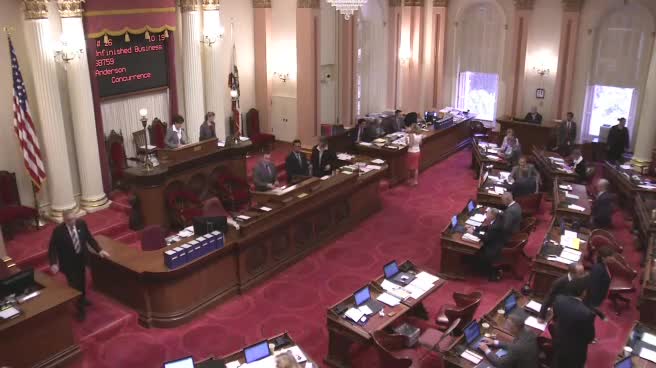 2MIN
Senate Floor
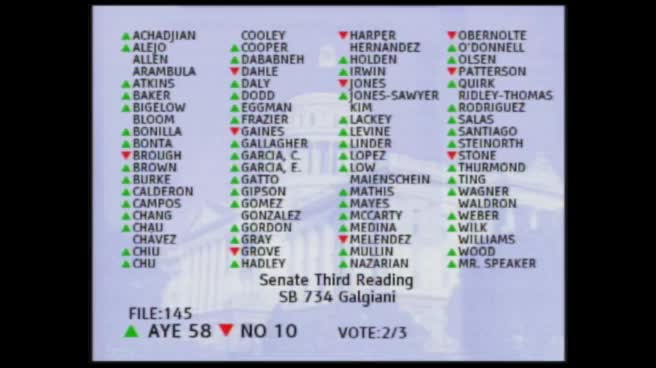 2MIN
Assembly Floor
 3MIN
Assembly Standing Committee on Appropriations
 28MIN
Assembly Standing Committee on Water, Parks, and Wildlife
 7MIN
Senate Floor
 41MIN
Senate Standing Committee on Natural Resources and Water
Bill Author

Bill Co-Author(s):