SB 884: Elections in 2026 through 2029.
- Session Year: 2025-2026
- House: Senate
- Latest Version Date: 2026-09-19
Current Status:
Passed
(2026-09-19: Chaptered by Secretary of State. Chapter 340, Statutes of 2026.)
Introduced
In Committee
Awaiting First Chamber Vote
Passed First Chamber
In Committee
Awaiting Second Chamber Vote
Passed Second Chamber
Enacted
Existing law generally requires county elections officials to divide the county into precincts and designate a polling place for each precinct. As an alternative, a county elections official may conduct any election using vote centers instead of polling places. Existing law requires counties to provide ballot dropoff locations that are open beginning at least 28 days before the election. Under existing law, a vote by mail ballot is timely cast if it is postmarked on or before election day and received in the mail by the voters elections official no later than 7 days after election day. Existing law prohibits and makes it a misdemeanor to engage in specified electioneering activities within 100 feet of a polling place, elections officials office, satellite location, or an outdoor site at which a voter may cast or drop off a ballot.
This bill, for any regular or special election, beginning with the November 3, 2026, statewide general election, held in 2026 through 2029, inclusive, or proclaimed in 2029, would do the following: (1) require all ballot dropoff locations to be open beginning at least 30 days before the election; (2) prohibit law enforcement officers from making arrests within 200 feet of a polling place on election day, except for a crime related to disrupting the operation of the polling place or a crime against a person or property; (3) authorize a county board of supervisors to extend the prohibition on electioneering activities to up to 200 feet of the specified voting locations; (4) require law enforcement officers to notify the Secretary of State and Attorney General of a suspected, planned, or actual violation of the prohibitions on arrests or electioneering activities near polling places; (5) authorize the state and local governments to place reasonable restrictions on polling places located on their property; and (6) authorize a county elections official to extend the time for closing the polls at any polling place if the county elections official determines that voting at the polling place was disrupted as a result of a violation of the prohibitions on arrests or electioneering activities near polling places.
By increasing the duties of county elections officials, and by expanding the scope of an existing crime, this bill would impose a state-mandated local program.
The California Constitution requires the state to reimburse local agencies and school districts for certain costs mandated by the state. Statutory provisions establish procedures for making that reimbursement.
This bill would provide that with regard to certain mandates no reimbursement is required by this act for a specified reason.
With regard to any other mandates, this bill would provide that, if the Commission on State Mandates determines that the bill contains costs so mandated by the state, reimbursement for those costs shall be made pursuant to the statutory provisions noted above.
This bill would declare that it is to take effect immediately as an urgency statute.
Existing law generally requires county elections officials to divide the county into precincts and designate a polling place for each precinct. As an alternative, a county elections official may conduct any election using vote centers instead of polling places. Existing law requires counties to provide ballot dropoff locations that are open beginning at least 28 days before the election. Under existing law, a vote by mail ballot is timely cast if it is postmarked on or before election day and received in the mail by the voters elections official no later than 7 days after election day. Existing law prohibits and makes it a misdemeanor to engage in specified electioneering activities within 100 feet of a polling place, elections officials office, satellite location, or an outdoor site at which a voter may cast or drop off a ballot.
This bill, for any regular or special election, beginning with the November 3, 2026, statewide general election, held in 2026 through 2029, inclusive, or proclaimed in 2029, would do the following: (1) require all ballot dropoff locations to be open beginning at least 30 days before the election; (2) prohibit law enforcement officers from making arrests within 200 feet of a polling place on election day, except for a crime related to disrupting the operation of the polling place or a crime against a person or property; (4) (3) authorize a county board of supervisors to extend the prohibition on electioneering activities to up to 200 feet of the specified voting locations; (5) (4) require law enforcement officers to notify the Secretary of State and Attorney General of a suspected, planned, or actual violation of the prohibitions on arrests or electioneering activities near polling places; (6) (5) authorize the state and local governments to place reasonable restrictions on polling places located on their property; and (7) (6) authorize a county elections official to extend the time for closing the polls at any polling place if the county elections official determines that voting at the polling place was disrupted as a result of a violation of the prohibitions on arrests or electioneering activities near polling places.
By increasing the duties of county elections officials, and by expanding the scope of an existing crime, this bill would impose a state-mandated local program.
The California Constitution requires the state to reimburse local agencies and school districts for certain costs mandated by the state. Statutory provisions establish procedures for making that reimbursement.
This bill would provide that with regard to certain mandates no reimbursement is required by this act for a specified reason.
With regard to any other mandates, this bill would provide that, if the Commission on State Mandates determines that the bill contains costs so mandated by the state, reimbursement for those costs shall be made pursuant to the statutory provisions noted above.
This bill would declare that it is to take effect immediately as an urgency statute.
Existing law generally requires county elections officials to divide the county into precincts and designate a polling place for each precinct. As an alternative, a county elections official may conduct any election using vote centers instead of polling places. Existing law requires counties to provide ballot dropoff locations that are open beginning at least 28 days before the election. Under existing law, a vote by mail ballot is timely cast if it is postmarked on or before election day and received in the mail by the voters elections official no later than 7 days after election day. Existing law prohibits and makes it a misdemeanor to engage in specified electioneering activities within 100 feet of a polling place, elections officials office, satellite location, or an outdoor site at which a voter may cast or drop off a ballot.
This bill, for any regular or special election, beginning with the November 3, 2026, statewide general election, held in 2026 through 2029, inclusive, or proclaimed in 2029, would do the following: (1) require all ballot dropoff locations to be open beginning at least 30 days before the election; (2) prohibit law enforcement officers from making arrests within 200 feet of a polling place on election day, except for a crime related to disrupting the operation of the polling place or a crime against a person or property; (4) authorize a county board of supervisors to extend the prohibition on electioneering activities to up to 200 feet of the specified voting locations; (5) require law enforcement officers to notify the Secretary of State and Attorney General of a suspected, planned, or actual violation of the prohibitions on arrests or electioneering activities near polling places; (6) authorize the state and local governments to place reasonable restrictions on polling places located on their property; and (7) authorize a county elections official to extend the time for closing the polls at any polling place if the county elections official determines that voting at the polling place was disrupted as a result of a violation of the prohibitions on arrests or electioneering activities near polling places.
By increasing the duties of county elections officials, and by expanding the scope of an existing crime, this bill would impose a state-mandated local program.
The California Constitution requires the state to reimburse local agencies and school districts for certain costs mandated by the state. Statutory provisions establish procedures for making that reimbursement.
This bill would provide that with regard to certain mandates no reimbursement is required by this act for a specified reason.
With regard to any other mandates, this bill would provide that, if the Commission on State Mandates determines that the bill contains costs so mandated by the state, reimbursement for those costs shall be made pursuant to the statutory provisions noted above.
This bill would declare that it is to take effect immediately as an urgency statute.
Existing law generally requires county elections officials to divide the county into precincts and designate a polling place for each precinct. As an alternative, a county elections official may conduct any election using vote centers instead of polling places. Existing law requires counties that conduct elections using vote centers to provide at least 2 ballot dropoff locations within the jurisdiction where the election is held or at least 1 ballot dropoff location for every 15,000 registered voters, whichever results in more ballot dropoff locations. Existing law requires other counties to provide at least 2 ballot dropoff locations within the jurisdiction or at least 1 ballot dropoff location for every 30,000 registered voters. Ballot counties to provide ballot dropoff locations must be that are open beginning at least 28 days before the election. Under existing law, a vote by mail ballot is timely cast if it is postmarked on or before election day and received in the mail by the voters elections official no later than 7 days after election day. Existing law prohibits and makes it a misdemeanor to engage in specified electioneering activities within 100 feet of a polling place, elections officials office, satellite location, or an outdoor site at which a voter may cast or drop off a ballot.
This bill, for any regular or special election, beginning with the November 3, 2026, statewide general election, held in 2026 through 2029, inclusive, or proclaimed in 2029, would do the following: (1) require all counties to provide at least 2 ballot dropoff locations or at least 1 ballot dropoff location for every 11,250 registered voters, and require that these ballot dropoff locations to be open beginning at least 30 days before the election; (2) deem vote by mail ballots timely cast if they are received by the elections official up to 10 days after election day; (3) prohibit law enforcement officers from making arrests within 200 feet of a polling place on election day, except for a crime related to disrupting the operation of the polling place or a crime against a person or property; (4) authorize a county board of supervisors to extend the prohibition on electioneering activities to up to 200 feet of the specified voting locations; (5) require law enforcement officers to notify the Secretary of State and Attorney General of a suspected, planned, or actual violation of the prohibitions on arrests or electioneering activities near polling places; (6) authorize the state and local governments to place reasonable restrictions on polling places located on their property; and (7) authorize a county elections official to extend the time for closing the polls at any polling place if the county elections official determines that voting at the polling place was disrupted as a result of a violation of the prohibitions on arrests or electioneering activities near polling places.
By increasing the duties of county elections officials, and by expanding the scope of an existing crime, this bill would impose a state-mandated local program.
The California Constitution requires the state to reimburse local agencies and school districts for certain costs mandated by the state. Statutory provisions establish procedures for making that reimbursement.
This bill would provide that with regard to certain mandates no reimbursement is required by this act for a specified reason.
With regard to any other mandates, this bill would provide that, if the Commission on State Mandates determines that the bill contains costs so mandated by the state, reimbursement for those costs shall be made pursuant to the statutory provisions noted above.
This bill would declare that it is to take effect immediately as an urgency statute.
Existing law generally requires county elections officials to divide the county into precincts and designate a polling place for each precinct. As an alternative, a county elections official may conduct any election using vote centers instead of polling places. Existing law requires counties that conduct elections using vote centers to provide at least 2 ballot dropoff locations within the jurisdiction where the election is held or at least 1 ballot dropoff location for every 15,000 registered voters, whichever results in more ballot dropoff locations. Existing law requires other counties to provide at least 2 ballot dropoff locations within the jurisdiction or at least 1 ballot dropoff location for every 30,000 registered voters. Ballot dropoff locations must be open beginning at least 28 days before the election. Under existing law, a vote by mail ballot is timely cast if it is postmarked on or before election day and received in the mail by the voters elections official no later than 7 days after election day. Existing law prohibits and makes it a misdemeanor to engage in specified electioneering activities within 100 feet of a polling place, elections officials office, satellite location, or an outdoor site at which a voter may cast or drop off a ballot.
This bill, for any regular or special election, beginning with the November 3, 2026, statewide general election, held in 2026 through 2029, inclusive, or proclaimed in 2029, would do the following: (1) require all counties to provide at least 2 ballot dropoff locations or at least 1 ballot dropoff location for every 11,250 registered voters, and require that these ballot dropoff locations be open beginning at least 30 days before the election; (2) deem vote by mail ballots timely cast if they are received by the elections official up to 10 days after election day; (3) prohibit federal, state, or local law enforcement officers from making arrests within 200 feet of a polling place on election day, except for a crime related to disrupting the operation of the polling place or a crime against a person or property; (4) authorize a county board of supervisors to extend the prohibition on electioneering activities to up to 200 feet of the specified voting locations; and (5) require law enforcement officers to notify the Secretary of State and Attorney General of a suspected, planned, or actual violation of the prohibitions on arrests or electioneering activities near polling places; (6) authorize the state and local governments to place reasonable restrictions on polling places located on their property; and (7) authorize a county elections official to extend the time for closing the polls at any polling place if the county elections official determines that voting at the polling place was disrupted as a result of a violation of the prohibitions on enforcement of federal immigration laws or electioneering. arrests or electioneering activities near polling places.
By increasing the duties of county elections officials, and by expanding the scope of an existing crime, this bill would impose a state-mandated local program.
The California Constitution requires the state to reimburse local agencies and school districts for certain costs mandated by the state. Statutory provisions establish procedures for making that reimbursement.
This bill would provide that with regard to certain mandates no reimbursement is required by this act for a specified reason.
With regard to any other mandates, this bill would provide that, if the Commission on State Mandates determines that the bill contains costs so mandated by the state, reimbursement for those costs shall be made pursuant to the statutory provisions noted above.
This bill would declare that it is to take effect immediately as an urgency statute.
Existing law generally requires county elections officials to divide the county into precincts and designate a polling place for each precinct. As an alternative, a county elections official may conduct any election using vote centers instead of polling places. Existing law requires counties that conduct elections using vote centers to provide at least 2 ballot dropoff locations within the jurisdiction where the election is held or at least 1 ballot dropoff location for every 15,000 registered voters, whichever results in more ballot dropoff locations. Existing law requires other counties to provide at least 2 ballot dropoff locations within the jurisdiction or at least 1 ballot dropoff location for every 30,000 registered voters. Ballot dropoff locations must be open beginning at least 28 days before the election. Under existing law, a vote by mail ballot is timely cast if it is postmarked on or before election day and received in the mail by the voters elections official no later than 7 days after election day. Existing law prohibits and makes it a misdemeanor to engage in specified electioneering activities within 100 feet of a polling place, elections officials office, satellite location, or an outdoor site at which a voter may cast or drop off a ballot.
This bill, for any regular or special election, beginning with the November 3, 2026, statewide general election, held in 2026 through 2029, inclusive, or proclaimed in 2029, would do the following: (1) require all counties to provide at least 2 ballot dropoff locations or at least 1 ballot dropoff location for every 11,250 registered voters, and require that these ballot dropoff locations be open beginning at least 30 days before the election; (2) deem vote by mail ballots timely cast if they are received by the elections official up to 10 days after election day; (3) prohibit federal, state, or local law enforcement officers from making arrests within 200 feet of a polling place on election day, except for a crime related to disrupting the operation of the polling place, a violent felony, a serious felony, or larceny; (4) place or a crime against a person or property; (4) authorize a county board of supervisors to extend the prohibition on electioneering activities to within up to 200 feet of the specified voting locations; and (5) authorize a county elections official to extend the time for closing the polls at any polling place if the county elections official determines that voting at the polling place was disrupted as a result of a violation of the prohibitions on enforcement of federal immigration laws or electioneering.
By increasing the duties of county elections officials, and by expanding the scope of an existing crime, this bill would impose a state-mandated local program.
The California Constitution requires the state to reimburse local agencies and school districts for certain costs mandated by the state. Statutory provisions establish procedures for making that reimbursement.
This bill would provide that with regard to certain mandates no reimbursement is required by this act for a specified reason.
With regard to any other mandates, this bill would provide that, if the Commission on State Mandates determines that the bill contains costs so mandated by the state, reimbursement for those costs shall be made pursuant to the statutory provisions noted above.
This bill would declare that it is to take effect immediately as an urgency statute.
Existing law generally requires county elections officials to divide the county into precincts and designate a polling place for each precinct. As an alternative, a county elections official may conduct any election using vote centers instead of polling places. Existing law requires counties that conduct elections using vote centers to provide at least 2 ballot dropoff locations within the jurisdiction where the election is held or at least 1 ballot dropoff location for every 15,000 registered voters, whichever results in more ballot dropoff locations. Existing law requires other counties to provide at least 2 ballot dropoff locations within the jurisdiction or at least 1 ballot dropoff location for every 30,000 registered voters. Ballot dropoff locations must be open beginning at least 28 days before the election. Under existing law, a vote by mail ballot is timely cast if it is postmarked on or before election day and received in the mail by the voters elections official no later than 7 days after election day. Existing law prohibits and makes it a misdemeanor to engage in specified electioneering activities within 100 feet of a polling place, elections officials office, satellite location, or an outdoor site at which a voter may cast or drop off a ballot.
This bill, for elections in 2026 through 2028, except for the June 2026 statewide primary, for any regular or special election, beginning with the November 3, 2026, statewide general election, held in 2026 through 2029, inclusive, or proclaimed in 2029, would do the following: (1) require all counties to provide at least 2 ballot dropoff locations or at least 1 ballot dropoff location for every 11,250 registered voters, and require that these ballot dropoff locations be open beginning at least 30 days before the election; (2) deem vote by mail ballots timely cast if they are received by the elections official up to 10 days after election day; (3) prohibit federal, state, or local law enforcement officers from making arrests within 200 feet of a polling place on election day, except for a crime related to disrupting the operation of the polling place; place, a violent felony, a serious felony, or larceny; (4) extend the prohibition on electioneering activities to within 200 feet of the specified voting locations; and (5) authorize a county elections official to extend the time for closing the polls at any polling place if the county elections official determines that voting at the polling place was disrupted as a result of a violation of the prohibitions on enforcement of federal immigration laws or electioneering.
By increasing the duties of county elections officials, and by expanding the scope of an existing crime, this bill would impose a state-mandated local program.
The California Constitution requires the state to reimburse local agencies and school districts for certain costs mandated by the state. Statutory provisions establish procedures for making that reimbursement.
This bill would provide that with regard to certain mandates no reimbursement is required by this act for a specified reason.
With regard to any other mandates, this bill would provide that, if the Commission on State Mandates determines that the bill contains costs so mandated by the state, reimbursement for those costs shall be made pursuant to the statutory provisions noted above.
This bill would declare that it is to take effect immediately as an urgency statute.
Existing law generally requires county elections officials to divide the county into precincts and designate a polling place for each precinct. As an alternative, a county elections official may conduct any election using vote centers instead of polling places. In an election using vote centers, the elections official is required to, among other things, provide at least 1 vote center for every 50,000 registered voters from the 10th day preceding the election to the 4th day preceding the election. Existing law requires counties that conduct elections using vote centers to provide at least 2 ballot dropoff locations within the jurisdiction where the election is held or at least 1 ballot dropoff location for every 15,000 registered voters, whichever results in more ballot dropoff locations. Existing law requires other counties to provide at least 2 ballot dropoff locations within the jurisdiction or at least 1 ballot dropoff location for every 30,000 registered voters. Ballot dropoff locations must be open beginning at least 28 days before the election. Under existing law, a vote by mail ballot is timely cast if it is postmarked on or before election day and received in the mail by the voters elections official no later than 7 days after election day. Existing law prohibits and makes it a misdemeanor to engage in specified electioneering activities within 100 feet of a polling place, elections officials office, satellite location, or an outdoor site at which a voter may cast or drop off a ballot.
This bill, for elections in 2026 through 2028, except for the June 2026 statewide primary, would do the following: (1) require counties that conduct elections using vote centers to provide vote centers starting on the 20th day preceding the election; (2) require counties that conduct elections using vote centers to provide at least 2 ballot dropoff locations or at least 1 ballot dropoff location for every 7,500 registered voters, (1) require other all counties to provide at least 2 ballot dropoff locations or at least 1 ballot dropoff location for every 15,000 11,250 registered voters, and require that these ballot dropoff locations be open beginning at least 30 days before the election; (3) (2) deem vote by mail ballots timely cast if they are received by the elections official up to 10 days after election day; (4) (3) prohibit federal, state, or local law enforcement officers from making arrests within 200 feet of a polling place on election day, except for a crime related to disrupting the operation of the polling place; (5) (4) extend the prohibition on electioneering activities to within 200 feet of the specified voting locations; and (6) (5) authorize a county elections official to extend the time for closing the polls at any polling place if the county elections official determines that voting at the polling place was disrupted as a result of a violation of the prohibitions on enforcement of federal immigration laws or electioneering.
By increasing the duties of county elections officials, and by expanding the scope of an existing crime, this bill would impose a state-mandated local program.
The California Constitution requires the state to reimburse local agencies and school districts for certain costs mandated by the state. Statutory provisions establish procedures for making that reimbursement.
This bill would provide that with regard to certain mandates no reimbursement is required by this act for a specified reason.
With regard to any other mandates, this bill would provide that, if the Commission on State Mandates determines that the bill contains costs so mandated by the state, reimbursement for those costs shall be made pursuant to the statutory provisions noted above.
This bill would declare that it is to take effect immediately as an urgency statute.
Existing law generally requires county elections officials to divide the county into precincts and designate a polling place for each precinct. As an alternative, a county elections official may conduct any election as an all-mailed ballot election, in which case using vote centers instead of polling places. In an election using vote centers, the elections official is required to, among other things, provide at least 1 vote center for every 50,000 registered voters from the 10th day preceding the election to the 4th day preceding the election. Existing law requires counties that conduct all-mailed ballot elections using vote centers to provide at least 2 ballot dropoff locations within the jurisdiction where the election is held or at least 1 ballot dropoff location for every 15,000 registered voters, whichever results in more ballot dropoff locations. Existing law requires other counties to provide at least 2 ballot dropoff locations within the jurisdiction or at least 1 ballot dropoff location for every 30,000 registered voters. Ballot dropoff locations must be open beginning at least 28 days before the election. Under existing law, a vote by mail ballot is timely cast if it is postmarked on or before election day and received in the mail by the voters elections official no later than 7 days after election day. Existing law prohibits and makes it a misdemeanor to engage in specified electioneering activities within 100 feet of a polling place, elections officials office, satellite location, or an outdoor site at which a voter may cast or drop off a ballot.
This bill, for elections in 2026 through 2028, except for the June 2026 statewide primary, would do the following: (1) require counties that conduct all-mailed ballot elections using vote centers to provide vote centers starting on the 20th day preceding the election; (2) require counties that conduct all-mailed ballot elections using vote centers to provide at least 2 ballot dropoff locations or at least 1 ballot dropoff location for every 7,500 registered voters, require other counties to provide at least 2 ballot dropoff locations or at least 1 ballot dropoff location for every 15,000 registered voters, and require that these ballot dropoff locations be open beginning at least 30 days before the election; (3) deem vote by mail ballots timely cast if they are received by the elections official up to 10 days after election day; (4) prohibit the enforcement of federal immigration laws while within 200 feet of specified voting locations; federal, state, or local law enforcement officers from making arrests within 200 feet of a polling place on election day, except for a crime related to disrupting the operation of the polling place; (5) extend the prohibition on electioneering activities to within 200 feet of the specified voting locations; and (6) authorize a county elections official to extend the time for closing the polls at any polling place if the county elections official determines that voting at the polling place was disrupted as a result of a violation of the prohibitions on enforcement of federal immigration laws or electioneering.
By increasing the duties of county elections officials, and by expanding the scope of an existing crime, this bill would impose a state-mandated local program.
The California Constitution requires the state to reimburse local agencies and school districts for certain costs mandated by the state. Statutory provisions establish procedures for making that reimbursement.
This bill would provide that with regard to certain mandates no reimbursement is required by this act for a specified reason.
With regard to any other mandates, this bill would provide that, if the Commission on State Mandates determines that the bill contains costs so mandated by the state, reimbursement for those costs shall be made pursuant to the statutory provisions noted above.
This bill would declare that it is to take effect immediately as an urgency statute.
Existing law generally requires county elections officials to divide the county into precincts and designate a polling place for each precinct. As an alternative, a county elections official may conduct any election as an all-mailed ballot election, in which case the elections official is required to, among other things, provide at least 1 vote center for every 50,000 registered voters from the 10th day preceding the election to the 4th day preceding the election. Existing law requires counties that conduct all-mailed ballot elections to provide at least 2 ballot dropoff locations within the jurisdiction where the election is held or at least 1 ballot dropoff location for every 15,000 registered voters, whichever results in more ballot dropoff locations. Existing law requires other counties to provide at least 2 ballot dropoff locations within the jurisdiction or at least 1 ballot dropoff location for every 30,000 registered voters. Ballot dropoff locations must be open beginning at least 28 days before the election. Under existing law, a vote by mail ballot is timely cast if it is postmarked on or before election day and received in the mail by the voters elections official no later than 7 days after election day. Existing law prohibits and makes it a misdemeanor to engage in specified electioneering activities within 100 feet of a polling place, elections officials office, satellite location, or an outdoor site at which a voter may cast or drop off a ballot.
This bill, for elections in 2026 through 2028, except for the June 2026 statewide primary, would do the following: (1) require counties that conduct all-mailed ballot elections to provide vote centers starting on the 20th day preceding the election; (2) require counties that conduct all-mailed ballot elections to provide at least 2 ballot dropoff locations or at least 1 ballot dropoff location for every 7,500 registered voters, require other counties to provide at least 2 ballot dropoff locations or at least 1 ballot dropoff location for every 15,000 registered voters, and require that these ballot dropoff locations be open beginning at least 30 days before the election; (3) deem vote by mail ballots timely cast if they are received by the elections official up to 10 days after election day; (4) prohibit the enforcement of federal immigration laws while within 200 feet of specified voting locations; (5) extend the prohibition on electioneering activities to within 200 feet of the specified voting locations; and (6) authorize a county elections official to extend the time for closing the polls at any polling place if the county elections official determines that voting at the polling place was disrupted as a result of a violation of the prohibitions on enforcement of federal immigration laws or electioneering.
By increasing the duties of county elections officials, and by expanding the scope of an existing crime, this bill would impose a state-mandated local program.
The California Constitution requires the state to reimburse local agencies and school districts for certain costs mandated by the state. Statutory provisions establish procedures for making that reimbursement.
This bill would provide that with regard to certain mandates no reimbursement is required by this act for a specified reason.
With regard to any other mandates, this bill would provide that, if the Commission on State Mandates determines that the bill contains costs so mandated by the state, reimbursement for those costs shall be made pursuant to the statutory provisions noted above.
Existing law establishes various requirements and limitations on civil actions, civil procedure, the courts, and related matters, as specified.This bill would express the intent of the Legislature to enact legislation relating to civil procedure.Existing law establishes various requirements and limitations on civil actions, civil procedure, the courts, and related matters, as specified.
This bill would express the intent of the Legislature to enact legislation relating to civil procedure.
(a)This act shall be known, and may be cited, as the Protect Our Polls Act.
(b)The Legislature finds and declares all of the following:
(1)Free, fair, and secure elections are fundamental to democracy, and all eligible voters must be able to cast a ballot without fear of intimidation, interference, or disruption.
(2)Certain crimes have less exigent circumstances than others and the value of arresting and detaining those accused is outweighed by the harm it creates in sensitive areas like polling places.
(3)Existing law prohibits electioneering within 100 feet of polling places to protect voters from undue influence and intimidation while exercising their right to vote.
(4)Recent actions to weaponize law enforcement authority for political purposes, such as Sheriff Chad Biancos seizure of ballots in Riverside County, have given rise to unprecedented concerns about law enforcement interference in the 2026 general election.
(5)Government officials and political allies have publicly discussed deploying law enforcement officers near polling places, creating serious concerns about voter intimidation and unlawful interference with the right to vote.
(6)During the November 2025 special election, the United States Department of Justice deployed personnel to monitor polling sites in five California counties, including Fresno, Kern, Los Angeles, Orange, and Riverside, demonstrating that these threats are not merely hypothetical.
(7)Proposed legislation such as the SAVE Act and executive actions targeting vote by mail ballots reflect broader efforts to disenfranchise voters, suppress turnout among minority communities, and undermine Californias constitutional authority to administer its own elections.
(8)Recent changes to United States Postal Service postmark practices have increased the risk that timely mailed ballots may be rejected because of postal delays outside the voters control, threatening ballot access for eligible voters across the state.
(9)California must act to preserve the integrity of its elections by protecting polling places from intimidation, ensuring access to vote by mail ballots, and maintaining safe and secure access to the ballot box for every eligible voter.
SEC. 2.Chapter 5 (commencing with Section 400) is added to Division 0.5 of the Elections Code, to read:5.Elections in 2026 through 2029400.This chapter applies to any regular or special election, beginning with the November 3, 2026, statewide general election, held in 2026 through 2029, inclusive, or proclaimed in 2029.
401.All vote by mail ballot drop-off locations shall be open at least during regular business hours beginning not less than 30 days before the day of the election and continuing through and including the day of the election.
402.County election officials are encouraged to use public buildings for polling places.
403.A law enforcement officer shall not arrest any person within 200 feet of a polling place on election day during the time in which the polling place is open, except for a crime related to disrupting the operation of the polling place, a crime against a person, or a crime against property. This section does not provide legal amnesty for any crime committed within the buffer zone on election day.
404.(a)Notwithstanding any other law, the prohibition on electioneering in subdivision (a) of Section 319.5 may be expanded by a county board of supervisors to up to 200 feet of either of the following:
(1)The entrance to a building that contains a polling place, an elections officials office, or a satellite location.
(2)An outdoor site, including a curbside voting area, at which a voter may cast or drop off a ballot.
(b)A violation of this section is punishable as a misdemeanor as provided in Section 18370 or 18371.
(c)If a county board of supervisors expands the area in which electioneering is prohibited pursuant to subdivision (a), the approved distance shall be uniform at every location described in paragraphs (1) and (2) of subdivision (a) within the county.
(d)A county board of supervisors shall notify the Secretary of State if the board expands the area in which electioneering is prohibited pursuant to subdivision (a).
405.(a)A law enforcement officer shall abide by Sections 403 and 404 and subdivision (a) of Section 18370.
(b)A law enforcement officer shall notify the Secretary of State and Attorney General of a suspected, planned, or actual violation of Section 403 or 404 or subdivision (a) of Section 18370.
406.To implement the requirements of this chapter, the state may place reasonable restrictions on a polling place located on state property, and a local government may place reasonable restrictions on a polling place located on local government property.
407.(a)Notwithstanding Section 14212, Section 4005, or any other law, on election day a county elections official may extend the time for closing the polls at any polling place if the county elections official determines, in consultation with the county counsel, in the officials discretion, that voting at the polling place was disrupted as a result of a violation of Section 403 or 404 or subdivision (a) of Section 18370.
(b)If the time for closing the polls is extended pursuant to subdivision (a), all votes cast during the time that the closing of the polls is extended shall be by provisional ballot. Any provisional ballots cast pursuant to this subdivision shall be separated and held apart from other provisional ballots cast by voters prior to the time the closing of the polls was extended.
408.The provisions of this chapter are severable. If any provision of this chapter or its application is held invalid, that invalidity shall not affect other provisions or applications that can be given effect without the invalid provision or application.
409.This chapter shall remain in effect only until January 1, 2031, and as of that date is repealed.
SEC. 3.No reimbursement is required by this act pursuant to Section 6 of Article XIIIB of the California Constitution for certain costs that may be incurred by a local agency or school district because, in that regard, this act creates a new crime or infraction, eliminates a crime or infraction, or changes the penalty for a crime or infraction, within the meaning of Section 17556 of the Government Code, or changes the definition of a crime within the meaning of Section 6 of Article XIIIB of the California Constitution.
However, if the Commission on State Mandates determines that this act contains other costs mandated by the state, reimbursement to local agencies and school districts for those costs shall be made pursuant to Part 7 (commencing with Section 17500) of Division 4 of Title 2 of the Government Code.
SEC. 4.This act is an urgency statute necessary for the immediate preservation of the public peace, health, or safety within the meaning of Article IV of the California Constitution and shall go into immediate effect. The facts constituting the necessity are:
To ensure eligible voters may vote safely and securely at the November 3, 2026, statewide general election, it is necessary for this act to take effect immediately.
(a)This act shall be known, and may be cited, as the Protect Our Polls Act.
(b)The Legislature finds and declares all of the following:
(1)Free, fair, and secure elections are fundamental to democracy, and all eligible voters must be able to cast a ballot without fear of intimidation, interference, or disruption.
(2)Certain crimes have less exigent circumstances than others and the value of arresting and detaining those accused is outweighed by the harm it creates in sensitive areas like polling places.
(3)Existing law prohibits electioneering within 100 feet of polling places to protect voters from undue influence and intimidation while exercising their right to vote.
(4)Recent actions to weaponize law enforcement authority for political purposes, such as Sheriff Chad Biancos seizure of ballots in Riverside County, have given rise to unprecedented concerns about law enforcement interference in the 2026 general election.
(5)Government officials and political allies have publicly discussed deploying law enforcement officers near polling places, creating serious concerns about voter intimidation and unlawful interference with the right to vote.
(6)During the November 2025 special election, the United States Department of Justice deployed personnel to monitor polling sites in five California counties, including Fresno, Kern, Los Angeles, Orange, and Riverside, demonstrating that these threats are not merely hypothetical.
(7)Proposed legislation such as the SAVE Act and executive actions targeting vote by mail ballots reflect broader efforts to disenfranchise voters, suppress turnout among minority communities, and undermine Californias constitutional authority to administer its own elections.
(8)Recent changes to United States Postal Service postmark practices have increased the risk that timely mailed ballots may be rejected because of postal delays outside the voters control, threatening ballot access for eligible voters across the state.
(9)California must act to preserve the integrity of its elections by protecting polling places from intimidation, ensuring access to vote by mail ballots, and maintaining safe and secure access to the ballot box for every eligible voter.
(c)The Governor is encouraged to use law enforcement to enforce this act.SEC. 2.Chapter 5 (commencing with Section 400) is added to Division 0.5 of the Elections Code, to read:5.Elections in 2026 through 2029400.This chapter applies to any regular or special election, beginning with the November 3, 2026, statewide general election, held in 2026 through 2029, inclusive, or proclaimed in 2029.
401.All vote by mail ballot drop-off locations shall be open at least during regular business hours beginning not less than 30 days before the day of the election and continuing through and including the day of the election.
402.County election officials are encouraged to use public buildings for polling places.
403.A law enforcement officer shall not arrest any person within 200 feet of a polling place on election day during the time in which the polling place is open, except for a crime related to disrupting the operation of the polling place, a crime against a person, or a crime against property. This section does not provide legal amnesty for any crime committed within the buffer zone on election day.
404.(a)Notwithstanding any other law, the prohibition on electioneering in subdivision (a) of Section 319.5 may be expanded by a county board of supervisors to up to 200 feet of either of the following:
(1)The entrance to a building that contains a polling place, an elections officials office, or a satellite location.
(2)An outdoor site, including a curbside voting area, at which a voter may cast or drop off a ballot.
(b)A violation of this section is punishable as a misdemeanor as provided in Section 18370 or 18371.
(c)If a county board of supervisors expands the area in which electioneering is prohibited pursuant to subdivision (a), the approved distance shall be uniform at every location described in paragraphs (1) and (2) of subdivision (a) within the county.
405.(a)A law enforcement officer shall abide by and enforce Sections 403 and 404 and subdivision (a) of Section 18370.
(b)A law enforcement officer shall notify the Secretary of State and Attorney General of a suspected, planned, or actual violation of Section 403 or 404 or subdivision (a) of Section 18370.
406.To enforce implement the requirements of this chapter, the state may place reasonable restrictions on a polling place located on state property, and a local government may place reasonable restrictions on a polling place located on local government property.
407.(a)Notwithstanding Section 14212, Section 4005, or any other law, on election day a county elections official may extend the time for closing the polls at any polling place if the county elections official determines, in consultation with the county counsel, in the officials discretion, that voting at the polling place was disrupted as a result of a violation of Section 403 or 404. 404 or subdivision (a) of Section 18370.
(b)If the time for closing the polls is extended pursuant to subdivision (a), all votes cast during the time that the closing of the polls is extended shall be by provisional ballot. Any provisional ballots cast pursuant to this subdivision shall be separated and held apart from other provisional ballots cast by voters prior to the time the closing of the polls was extended.
408.The provisions of this chapter are severable. If any provision of this chapter or its application is held invalid, that invalidity shall not affect other provisions or applications that can be given effect without the invalid provision or application.
409.This chapter shall remain in effect only until January 1, 2031, and as of that date is repealed.
SEC. 3.No reimbursement is required by this act pursuant to Section 6 of Article XIIIB of the California Constitution for certain costs that may be incurred by a local agency or school district because, in that regard, this act creates a new crime or infraction, eliminates a crime or infraction, or changes the penalty for a crime or infraction, within the meaning of Section 17556 of the Government Code, or changes the definition of a crime within the meaning of Section 6 of Article XIIIB of the California Constitution.
However, if the Commission on State Mandates determines that this act contains other costs mandated by the state, reimbursement to local agencies and school districts for those costs shall be made pursuant to Part 7 (commencing with Section 17500) of Division 4 of Title 2 of the Government Code.
SEC. 4.This act is an urgency statute necessary for the immediate preservation of the public peace, health, or safety within the meaning of Article IV of the California Constitution and shall go into immediate effect. The facts constituting the necessity are:
To ensure eligible voters may vote safely and securely at the November 3, 2026, statewide general election, it is necessary for this act to take effect immediately.
(a)This act shall be known, and may be cited, as the Protect Our Polls Act.
(b)The Legislature finds and declares all of the following:
(1)Free, fair, and secure elections are fundamental to democracy, and all eligible voters must be able to cast a ballot without fear of intimidation, interference, or disruption.
(2)Certain crimes have less exigent circumstances than others and the value of arresting and detaining those accused is outweighed by the harm it creates in sensitive areas like polling places.
(3)Existing law prohibits electioneering within 100 feet of polling places to protect voters from undue influence and intimidation while exercising their right to vote.
(4)Recent actions to weaponize law enforcement authority for political purposes, such as Sheriff Chad Biancos seizure of ballots in Riverside County, have given rise to unprecedented concerns about law enforcement interference in the 2026 general election.
(5)Government officials and political allies have publicly discussed deploying law enforcement officers near polling places, creating serious concerns about voter intimidation and unlawful interference with the right to vote.
(6)During the November 2025 special election, the United States Department of Justice deployed personnel to monitor polling sites in five California counties, including Fresno, Kern, Los Angeles, Orange, and Riverside, demonstrating that these threats are not merely hypothetical.
(7)Proposed legislation such as the SAVE Act and executive actions targeting vote-by-mail vote by mail ballots reflect broader efforts to disenfranchise voters, suppress turnout among minority communities, and undermine Californias constitutional authority to administer its own elections.
(8)Recent changes to United States Postal Service postmark practices have increased the risk that timely mailed ballots may be rejected because of postal delays outside the voters control, threatening ballot access for eligible voters across the state.
(9)California must act to preserve the integrity of its elections by protecting polling places from intimidation, ensuring access to vote-by-mail vote by mail ballots, and maintaining safe and secure access to the ballot box for every eligible voter.
(c)The Governor is encouraged to use law enforcement to enforce this act.
SEC. 2.Chapter 5 (commencing with Section 400) is added to Division 0.5 of the Elections Code, to read:5.Elections in 2026 through 2029400.This chapter applies to any regular or special election, beginning with the November 3, 2026, statewide general election, held in 2026 through 2029, inclusive, or proclaimed in 2029.
401.(a)(1)Notwithstanding Section 3025.5, Section 4005, or any other law, a county shall provide at least two vote by mail ballot drop-off locations within the county or at least one vote by mail ballot drop-off location for every 11,250 registered voters, whichever results in more vote by mail ballot drop-off locations.(2)Notwithstanding paragraph (1), a county with fewer than 11,250 registered voters shall provide at least one vote by mail ballot drop-off location.(b)401.All vote by mail ballot drop-off locations shall be open at least during regular business hours beginning not less than 30 days before the day of the election and continuing through and including the day of the election.
402.County election officials are encouraged to use public buildings for polling places.
403.Notwithstanding Section 3020, Section 4103, or any other law, a vote by mail ballot is timely cast if it is received by the voters elections official via the United States Postal Service or a bona fide private mail delivery company no later than 10 days after election day and either of the following is satisfied:(a)The ballot is postmarked on or before election day or is time stamped or date stamped by a bona fide private mail delivery company on or before election day, or it is otherwise indicated by the United States Postal Service or a bona fide private mail delivery company that the ballot was mailed on or before election day.(b)If the ballot has no postmark, a postmark with no date, or an illegible postmark, and no other information is available from the United States Postal Service or the bona fide private mail delivery company to indicate the date on which the ballot was mailed, the vote by mail ballot identification envelope is date stamped by the elections official upon receipt of the vote by mail ballot from the United States Postal Service or a bona fide private mail delivery company, and is signed and dated pursuant to Section 3011 on or before election day.404.403.A law enforcement officer shall not arrest any person within 200 feet of a polling place on election day during the time in which the polling place is open, except for a crime related to disrupting the operation of the polling place, a crime against a person, or a crime against property. This section does not provide legal amnesty for any crime committed within the buffer zone on election day.
405.404.(a)Notwithstanding any other law, the prohibition on electioneering in subdivision (a) of Section 319.5 may be expanded by a county board of supervisors to up to 200 feet of either of the following:
(1)The entrance to a building that contains a polling place, an elections officials office, or a satellite location.
(2)An outdoor site, including a curbside voting area, at which a voter may cast or drop off a ballot.
(b)A violation of this section is punishable as a misdemeanor as provided in Section 18370 or 18371.
(c)If a county board of supervisors expands the area in which electioneering is prohibited pursuant to subdivision (a), the approved distance shall be uniform at every location described in paragraphs (1) and (2) of subdivision (a) within the county.
406.405.(a)A law enforcement officer shall abide by and enforce Sections 404 and 405 403 and 404 and subdivision (a) of Section 18370.
(b)A law enforcement officer shall notify the Secretary of State and Attorney General of a suspected, planned, or actual violation of Section 404 or 405 403 or 404 or subdivision (a) of Section 18370.
407.406.To enforce the requirements of this chapter, the state may place reasonable restrictions on a polling place located on state property, and a local government may place reasonable restrictions on a polling place located on local government property.
408.407.(a)Notwithstanding Section 14212, Section 4005, or any other law, on election day a county elections official may extend the time for closing the polls at any polling place if the county elections official determines, in consultation with the county counsel, in the officials discretion, that voting at the polling place was disrupted as a result of a violation of Section 404 or 405. 403 or 404.
(b)If the time for closing the polls is extended pursuant to subdivision (a), all votes cast during the time that the closing of the polls is extended shall be by provisional ballot. Any provisional ballots cast pursuant to this subdivision shall be separated and held apart from other provisional ballots cast by voters prior to the time the closing of the polls was extended.
409.408.The provisions of this chapter are severable. If any provision of this chapter or its application is held invalid, that invalidity shall not affect other provisions or applications that can be given effect without the invalid provision or application.
410.409.This chapter shall remain in effect only until January 1, 2030, 2031, and as of that date is repealed.
SEC. 3.No reimbursement is required by this act pursuant to Section 6 of Article XIIIB of the California Constitution for certain costs that may be incurred by a local agency or school district because, in that regard, this act creates a new crime or infraction, eliminates a crime or infraction, or changes the penalty for a crime or infraction, within the meaning of Section 17556 of the Government Code, or changes the definition of a crime within the meaning of Section 6 of Article XIIIB of the California Constitution.
However, if the Commission on State Mandates determines that this act contains other costs mandated by the state, reimbursement to local agencies and school districts for those costs shall be made pursuant to Part 7 (commencing with Section 17500) of Division 4 of Title 2 of the Government Code.
SEC. 4.This act is an urgency statute necessary for the immediate preservation of the public peace, health, or safety within the meaning of Article IV of the California Constitution and shall go into immediate effect. The facts constituting the necessity are:
To ensure eligible voters may vote safely and securely at the November 3, 2026, statewide general election, it is necessary for this act to take effect immediately.
(a)This act shall be known, and may be cited, as the Protect Our Polls Act.
(b)The Legislature finds and declares all of the following:
(1)Free, fair, and secure elections are fundamental to democracy, and all eligible voters must be able to cast a ballot without fear of intimidation, interference, or disruption.
(2)Certain crimes have less exigent circumstances than others and the value of arresting and detaining those accused is outweighed by the harm it creates in sensitive areas like polling places.
(2)(3)Existing law prohibits electioneering within 100 feet of polling places to protect voters from undue influence and intimidation while exercising their right to vote.
(3)(4)Recent actions to weaponize law enforcement authority for political purposes, such as Sheriff Chad Biancos attempted seizure of ballots in Riverside County and the federal governments weaponization of federal law enforcement and the National Guard, County, have given rise to unprecedented concerns about law enforcement interference in the 2026 general election.
(4)(5)Federal Government officials and political allies have publicly discussed deploying immigration enforcement officers and military personnel law enforcement officers near polling places, creating serious concerns about voter intimidation and unlawful interference with the right to vote.
(5)(6)During the November 2025 special election, the United States Department of Justice deployed personnel to monitor polling sites in five California counties, including Fresno, Kern, Los Angeles, Orange, and Riverside, demonstrating that these threats are not merely hypothetical.
(6)(7)Federal actions, including proposed Proposed legislation such as the SAVE Act and executive actions targeting vote-by-mail ballots, ballots reflect broader efforts to disenfranchise voters, suppress turnout among minority communities, and undermine Californias constitutional authority to administer its own elections.
(7)(8)Recent changes to United States Postal Service postmark practices have increased the risk that timely mailed ballots may be rejected because of postal delays outside the voters control, threatening ballot access for eligible voters across the state.
(8)(9)California must act to preserve the integrity of its elections by protecting polling places from intimidation, ensuring access to vote-by-mail ballots, and maintaining safe and secure access to the ballot box for every eligible voter.
(c)The Governor is encouraged to use law enforcement to enforce this act.
SEC. 2.Chapter 5 (commencing with Section 400) is added to Division 0.5 of the Elections Code, to read:5.Elections in 2026 through 2029400.This chapter applies to any regular or special election, beginning with the November 3, 2026, statewide general election, held in 2026 through 2029, inclusive, or proclaimed in 2029.
401.(a)(1)Notwithstanding Section 3025.5, Section 4005, or any other law, a county shall provide at least two vote by mail ballot drop-off locations within the county or at least one vote by mail ballot drop-off location for every 11,250 registered voters, whichever results in more vote by mail ballot drop-off locations.
(2)Notwithstanding paragraph (1), a county with fewer than 11,250 registered voters shall provide at least one vote by mail ballot drop-off location.
(b)All vote by mail ballot drop-off locations shall be open at least during regular business hours beginning not less than 30 days before the day of the election and continuing through and including the day of the election.
402.County election officials are encouraged to use public buildings for polling places.
403.Notwithstanding Section 3020, Section 4103, or any other law, a vote by mail ballot is timely cast if it is received by the voters elections official via the United States Postal Service or a bona fide private mail delivery company no later than 10 days after election day and either of the following is satisfied:
(a)The ballot is postmarked on or before election day or is time stamped or date stamped by a bona fide private mail delivery company on or before election day, or it is otherwise indicated by the United States Postal Service or a bona fide private mail delivery company that the ballot was mailed on or before election day.
(b)If the ballot has no postmark, a postmark with no date, or an illegible postmark, and no other information is available from the United States Postal Service or the bona fide private mail delivery company to indicate the date on which the ballot was mailed, the vote by mail ballot identification envelope is date stamped by the elections official upon receipt of the vote by mail ballot from the United States Postal Service or a bona fide private mail delivery company, and is signed and dated pursuant to Section 3011 on or before election day.
404.A federal, state, or local law enforcement officer shall not arrest any person within 200 feet of a polling place on election day during the time in which the polling place is open, except for a crime related to disrupting the operation of the polling place, a crime against a person, or a crime against property. This section does not provide legal amnesty for any crime committed within the buffer zone on election day.
405.(a)Notwithstanding any other law, the prohibition on electioneering in subdivision (a) of Section 319.5 may be expanded by a county board of supervisors to up to 200 feet of either of the following:
(1)The entrance to a building that contains a polling place, an elections officials office, or a satellite location.
(2)An outdoor site, including a curbside voting area, at which a voter may cast or drop off a ballot.
(b)A violation of this section is punishable as a misdemeanor as provided in Section 18370 or 18371.
(c)If a county board of supervisors expands the area in which electioneering is prohibited pursuant to subdivision (a), the approved distance shall be uniform at every location described in paragraphs (1) and (2) of subdivision (a) within the county.
406.(a)A law enforcement officer shall abide by and enforce Sections 404 and 405 and subdivision (a) of Section 18370.
(b)A law enforcement officer shall notify the Secretary of State and Attorney General of a suspected, planned, or actual violation of Section 404 or 405 or subdivision (a) of Section 18370.
407.To enforce the requirements of this chapter, the state may place reasonable restrictions on a polling place located on state property, and a local government may place reasonable restrictions on a polling place located on local government property.
406.408.(a)Notwithstanding Section 14212, Section 4005, or any other law, on election day a county elections official may extend the time for closing the polls at any polling place if the county elections official determines, in the officials discretion, that voting at the polling place was disrupted as a result of a violation of Section 404 or 405.
(b)If the time for closing the polls is extended pursuant to subdivision (a), all votes cast during the time that the closing of the polls is extended shall be by provisional ballot. Any provisional ballots cast pursuant to this subdivision shall be separated and held apart from other provisional ballots cast by voters prior to the time the closing of the polls was extended.
407.409.The provisions of this chapter are severable. If any provision of this chapter or its application is held invalid, that invalidity shall not affect other provisions or applications that can be given effect without the invalid provision or application.
408.410.This chapter shall remain in effect only until January 1, 2030, and as of that date is repealed.
SEC. 3.No reimbursement is required by this act pursuant to Section 6 of Article XIIIB of the California Constitution for certain costs that may be incurred by a local agency or school district because, in that regard, this act creates a new crime or infraction, eliminates a crime or infraction, or changes the penalty for a crime or infraction, within the meaning of Section 17556 of the Government Code, or changes the definition of a crime within the meaning of Section 6 of Article XIIIB of the California Constitution.
However, if the Commission on State Mandates determines that this act contains other costs mandated by the state, reimbursement to local agencies and school districts for those costs shall be made pursuant to Part 7 (commencing with Section 17500) of Division 4 of Title 2 of the Government Code.
SEC. 4.This act is an urgency statute necessary for the immediate preservation of the public peace, health, or safety within the meaning of Article IV of the California Constitution and shall go into immediate effect. The facts constituting the necessity are:
To ensure eligible voters may vote safely and securely at the November 3, 2026, statewide general election, it is necessary for this act to take effect immediately.
(a)This act shall be known, and may be cited, as the Protect Our Polls Act.
(b)The Legislature finds and declares all of the following:
(1)Free, fair, and secure elections are fundamental to democracy, and all eligible voters must be able to cast a ballot without fear of intimidation, interference, or disruption.
(2)Existing law prohibits electioneering within 100 feet of polling places to protect voters from undue influence and intimidation while exercising their right to vote.
(3)Recent actions to weaponize law enforcement authority for political purposes, such as Sheriff Chad Biancos attempted seizure of ballots in Riverside County and the federal governments weaponization of federal law enforcement and the National Guard, have given rise to unprecedented concerns about law enforcement interference in the 2026 general election.
(4)Federal officials and political allies have publicly discussed deploying immigration enforcement officers and military personnel near polling places, creating serious concerns about voter intimidation and unlawful interference with the right to vote.
(5)During the November 2025 special election, the United States Department of Justice deployed personnel to monitor polling sites in five California counties, including Fresno, Kern, Los Angeles, Orange, and Riverside, demonstrating that these threats are not merely hypothetical.
(6)Federal actions, including proposed legislation such as the SAVE Act and executive actions targeting vote-by-mail ballots, reflect broader efforts to disenfranchise voters, suppress turnout among minority communities, and undermine Californias constitutional authority to administer its own elections.
(7)Recent changes to United States Postal Service postmark practices have increased the risk that timely mailed ballots may be rejected because of postal delays outside the voters control, threatening ballot access for eligible voters across the state.
(8)California must act to preserve the integrity of its elections by protecting polling places from intimidation, ensuring access to vote-by-mail ballots, and maintaining safe and secure access to the ballot box for every eligible voter.
SECTION 1.SEC. 2.Chapter 5 (commencing with Section 400) is added to Division 0.5 of the Elections Code, to read:5.Elections in 2026, 2027, and 2028 2026 through 2029400.This chapter applies to any regular or special election, beginning with the November 3, 2026, statewide general election, held in 2026 through 2029, inclusive, or proclaimed in 2029.
401.(a)(1)Notwithstanding Section 3025.5, Section 4005, or any other law, a county shall provide at least two vote by mail ballot drop-off locations within the county or at least one vote by mail ballot drop-off location for every 11,250 registered voters, whichever results in more vote by mail ballot drop-off locations.
(2)Notwithstanding paragraph (1), a county with fewer than 11,250 registered voters shall provide at least one vote by mail ballot drop-off location.
(b)All vote by mail ballot drop-off locations shall be open at least during regular business hours beginning not less than 30 days before the day of the election and continuing through and including the day of the election.
402.County election officials are encouraged to use public buildings for polling places.
403.Notwithstanding Section 3020, Section 4103, or any other law, a vote by mail ballot is timely cast if it is received by the voters elections official via the United States Postal Service or a bona fide private mail delivery company no later than 10 days after election day and either of the following is satisfied:
(a)The ballot is postmarked on or before election day or is time stamped or date stamped by a bona fide private mail delivery company on or before election day, or it is otherwise indicated by the United States Postal Service or a bona fide private mail delivery company that the ballot was mailed on or before election day.
(b)If the ballot has no postmark, a postmark with no date, or an illegible postmark, and no other information is available from the United States Postal Service or the bona fide private mail delivery company to indicate the date on which the ballot was mailed, the vote by mail ballot identification envelope is date stamped by the elections official upon receipt of the vote by mail ballot from the United States Postal Service or a bona fide private mail delivery company, and is signed and dated pursuant to Section 3011 on or before election day.
404.A federal, state, or local law enforcement officer shall not arrest any person within 200 feet of a polling place on election day during the time in which the polling place is open, except for a crime related to disrupting the operation of the polling place, a violent felony as defined in Section 667.5 of the Penal Code, a serious felony as defined in Section 1192.7 of the Penal Code, or larceny. crime against a person, or a crime against property. This section does not provide legal amnesty for any crime committed within the buffer zone on election day.
405.(a)Notwithstanding any other law, electioneering, as defined the prohibition on electioneering in subdivision (a) of Section 319.5, is prohibited within 319.5 may be expanded by a county board of supervisors to up to 200 feet of either of the following:
(1)The entrance to a building that contains a polling place, an elections officials office, or a satellite location.
(2)An outdoor site, including a curbside voting area, at which a voter may cast or drop off a ballot.
(b)A violation of this section is punishable as a misdemeanor as provided in Section 18370 or 18371.
(c)If a county board of supervisors expands the area in which electioneering is prohibited pursuant to subdivision (a), the approved distance shall be uniform at every location described in paragraphs (1) and (2) of subdivision (a) within the county.
406.(a)Notwithstanding Section 14212, Section 4005, or any other law, on election day a county elections official may extend the time for closing the polls at any polling place if the county elections official determines, in the officials discretion, that voting at the polling place was disrupted as a result of a violation of Section 404 or 405.
(b)If the time for closing the polls is extended pursuant to subdivision (a), all votes cast during the time that the closing of the polls is extended shall be by provisional ballot. Any provisional ballots cast pursuant to this subdivision shall be separated and held apart from other provisional ballots cast by voters prior to the time the closing of the polls was extended.
407.The provisions of this chapter are severable. If any provision of this chapter or its application is held invalid, that invalidity shall not affect other provisions or applications that can be given effect without the invalid provision or application.
408.This chapter shall remain in effect only until January 1, 2030, and as of that date is repealed.
SEC. 2.SEC. 3.No reimbursement is required by this act pursuant to Section 6 of Article XIIIB of the California Constitution for certain costs that may be incurred by a local agency or school district because, in that regard, this act creates a new crime or infraction, eliminates a crime or infraction, or changes the penalty for a crime or infraction, within the meaning of Section 17556 of the Government Code, or changes the definition of a crime within the meaning of Section 6 of Article XIIIB of the California Constitution.
However, if the Commission on State Mandates determines that this act contains other costs mandated by the state, reimbursement to local agencies and school districts for those costs shall be made pursuant to Part 7 (commencing with Section 17500) of Division 4 of Title 2 of the Government Code.
SEC. 3.SEC. 4.This act is an urgency statute necessary for the immediate preservation of the public peace, health, or safety within the meaning of Article IV of the California Constitution and shall go into immediate effect. The facts constituting the necessity are:
To ensure eligible voters may vote safely and securely at the November 3, 2026, statewide general election, it is necessary for this act to take effect immediately.
This chapter applies to any election held in 2026, 2027, or 2028, including a special election, but not including the June 2, 2026, statewide direct primary election. regular or special election, beginning with the November 3, 2026, statewide general election, held in 2026 through 2029, inclusive, or proclaimed in 2029.
401.(a)(1)Notwithstanding Section 3025.5, Section 4005, or any other law, a county shall provide at least two vote by mail ballot drop-off locations within the county or at least one vote by mail ballot drop-off location for every 11,250 registered voters, whichever results in more vote by mail ballot drop-off locations.
(2)Notwithstanding paragraph (1), a county with fewer than 11,250 registered voters shall provide at least one vote by mail ballot drop-off location.
(b)All vote by mail ballot drop-off locations shall be open at least during regular business hours beginning not less than 30 days before the day of the election and continuing through and including the day of the election.
402.County election officials are encouraged to use public buildings for polling places.
403.Notwithstanding Section 3020, Section 4103, or any other law, a vote by mail ballot is timely cast if it is received by the voters elections official via the United States Postal Service or a bona fide private mail delivery company no later than 10 days after election day and either of the following is satisfied:
(a)The ballot is postmarked on or before election day or is time stamped or date stamped by a bona fide private mail delivery company on or before election day, or it is otherwise indicated by the United States Postal Service or a bona fide private mail delivery company that the ballot was mailed on or before election day.
(b)If the ballot has no postmark, a postmark with no date, or an illegible postmark, and no other information is available from the United States Postal Service or the bona fide private mail delivery company to indicate the date on which the ballot was mailed, the vote by mail ballot identification envelope is date stamped by the elections official upon receipt of the vote by mail ballot from the United States Postal Service or a bona fide private mail delivery company, and is signed and dated pursuant to Section 3011 on or before election day.
404.A federal, state, or local law enforcement officer shall not arrest any person within 200 feet of a polling place on election day, except for a crime related to disrupting the operation of the polling place.404.A federal, state, or local law enforcement officer shall not arrest any person within 200 feet of a polling place on election day during the time in which the polling place is open, except for a crime related to disrupting the operation of the polling place, a violent felony as defined in Section 667.5 of the Penal Code, a serious felony as defined in Section 1192.7 of the Penal Code, or larceny. This section does not provide legal amnesty for any crime committed within the buffer zone on election day.
405.(a)Notwithstanding any other law, electioneering, as defined in subdivision (a) of Section 3019.5, 319.5, is prohibited within 200 feet of either of the following:
(1)The entrance to a building that contains a polling place, an elections officials office, or a satellite location.
(2)An outdoor site, including a curbside voting area, at which a voter may cast or drop off a ballot.
(b)A violation of this section is punishable as a misdemeanor as provided in Section 18370 or 18371.
406.(a)Notwithstanding Section 14212, Section 4005, or any other law, on election day a county elections official may extend the time for closing the polls at any polling place if the county elections official determines, in the officials discretion, that voting at the polling place was disrupted as a result of a violation of Section 404 or Section 405.
(b)If the time for closing the polls is extended pursuant to subdivision (a), all votes cast during the time that the closing of the polls is extended shall be by provisional ballot. Any provisional ballots cast pursuant to this subdivision shall be separated and held apart from other provisional ballots cast by voters prior to the time the closing of the polls was extended.
407.The provisions of this chapter are severable. If any provision of this chapter or its application is held invalid, that invalidity shall not affect other provisions or applications that can be given effect without the invalid provision or application.
408.This chapter shall remain in effect only until January 1, 2030, and as of that date is repealed.
SEC. 2.No reimbursement is required by this act pursuant to Section 6 of Article XIIIB of the California Constitution for certain costs that may be incurred by a local agency or school district because, in that regard, this act creates a new crime or infraction, eliminates a crime or infraction, or changes the penalty for a crime or infraction, within the meaning of Section 17556 of the Government Code, or changes the definition of a crime within the meaning of Section 6 of Article XIIIB of the California Constitution.
However, if the Commission on State Mandates determines that this act contains other costs mandated by the state, reimbursement to local agencies and school districts for those costs shall be made pursuant to Part 7 (commencing with Section 17500) of Division 4 of Title 2 of the Government Code.
SEC. 3.This act is an urgency statute necessary for the immediate preservation of the public peace, health, or safety within the meaning of Article IV of the California Constitution and shall go into immediate effect. The facts constituting the necessity are:
To ensure eligible voters may vote safely and securely at the November 3, 2026, statewide general election, it is necessary for this act to take effect immediately.
This chapter applies to any election held in 2026, 2027, or 2028, including a special election, but not including the June 2, 2026, statewide direct primary election.
401.(a)(1)Notwithstanding any other law, a county that conducts elections pursuant to Section 4005 shall provide at least one vote center for every 50,000 registered voters beginning 20 days before the day of the election and continuing daily up to and including the fourth day before the election.(2)Notwithstanding paragraph (1), a county with fewer than 50,000 registered voters shall provide a minimum of two vote centers within the county.(b)(1)(A)401.(a)(1)Notwithstanding Section 3025.5, Section 4005, or any other law, a county that conducts elections pursuant to Section 4005 shall provide at least two vote by mail ballot drop-off locations within the county or at least one vote by mail ballot drop-off location for every 7,500 11,250 registered voters, whichever results in more vote by mail ballot drop-off locations.
(B)(2)Notwithstanding subparagraph (A), paragraph (1), a county with fewer than 7,500 11,250 registered voters shall provide at least one vote by mail ballot drop-off location.
(2)(A)Notwithstanding Section 3025.5, Section 4005, or any other law, a county that does not conduct elections pursuant to Section 4005 shall provide at least two vote by mail ballot drop-off locations within the county or at least one vote by mail ballot drop-off location for every 15,000 registered voters, whichever results in more vote by mail ballot drop-off locations.(B)Notwithstanding subparagraph (A), a county with fewer than 15,000 registered voters shall provide at least one vote by mail ballot drop-off location.(3)(b)All vote by mail ballot drop-off locations shall be open at least during regular business hours beginning not less than 30 days before the day of the election and continuing through and including the day of the election.
402.County election officials are encouraged to use public buildings for polling places.
403.Notwithstanding Section 3020, Section 4103, or any other law, a vote by mail ballot is timely cast if it is received by the voters elections official via the United States Postal Service or a bona fide private mail delivery company no later than 10 days after election day and either of the following is satisfied:
(a)The ballot is postmarked on or before election day or is time stamped or date stamped by a bona fide private mail delivery company on or before election day, or it is otherwise indicated by the United States Postal Service or a bona fide private mail delivery company that the ballot was mailed on or before election day.
(b)If the ballot has no postmark, a postmark with no date, or an illegible postmark, and no other information is available from the United States Postal Service or the bona fide private mail delivery company to indicate the date on which the ballot was mailed, the vote by mail ballot identification envelope is date stamped by the elections official upon receipt of the vote by mail ballot from the United States Postal Service or a bona fide private mail delivery company, and is signed and dated pursuant to Section 3011 on or before election day.
404.A federal, state, or local law enforcement officer shall not arrest any person within 200 feet of a polling place on election day, except for a crime related to disrupting the operation of the polling place.
405.(a)Notwithstanding any other law, electioneering, as defined in subdivision (a) of Section 3019.5, is prohibited within 200 feet of either of the following:
(1)The entrance to a building that contains a polling place, an elections officials office, or a satellite location.
(2)An outdoor site, including a curbside voting area, at which a voter may cast or drop off a ballot.
(b)A violation of this section is punishable as a misdemeanor as provided in Section 18370 or 18371.
406.(a)Notwithstanding Section 14212, Section 4005, or any other law, on election day a county elections official may extend the time for closing the polls at any polling place if the county elections official determines, in the officials discretion, that voting at the polling place was disrupted as a result of a violation of Section 404 or Section 405.
(b)If the time for closing the polls is extended pursuant to subdivision (a), all votes cast during the time that the closing of the polls is extended shall be by provisional ballot. Any provisional ballots cast pursuant to this subdivision shall be separated and held apart from other provisional ballots cast by voters prior to the time the closing of the polls was extended.
407.The provisions of this chapter are severable. If any provision of this chapter or its application is held invalid, that invalidity shall not affect other provisions or applications that can be given effect without the invalid provision or application.
408.This chapter shall remain in effect only until January 1, 2030, and as of that date is repealed.
SEC. 2.No reimbursement is required by this act pursuant to Section 6 of Article XIIIB of the California Constitution for certain costs that may be incurred by a local agency or school district because, in that regard, this act creates a new crime or infraction, eliminates a crime or infraction, or changes the penalty for a crime or infraction, within the meaning of Section 17556 of the Government Code, or changes the definition of a crime within the meaning of Section 6 of Article XIIIB of the California Constitution.
However, if the Commission on State Mandates determines that this act contains other costs mandated by the state, reimbursement to local agencies and school districts for those costs shall be made pursuant to Part 7 (commencing with Section 17500) of Division 4 of Title 2 of the Government Code.
SEC. 3.This act is an urgency statute necessary for the immediate preservation of the public peace, health, or safety within the meaning of Article IV of the California Constitution and shall go into immediate effect. The facts constituting the necessity are:
To ensure eligible voters may vote safely and securely at the November 3, 2026, statewide general election, it is necessary for this act to take effect immediately.
This chapter applies to any election held in 2026, 2027, or 2028, including a special election, but not including the June 2, 2026, statewide direct primary election.
401.(a)(1)Notwithstanding any other law, a county that conducts elections pursuant to Section 4005 shall provide at least one vote center for every 50,000 registered voters beginning 20 days before the day of the election and continuing daily up to and including the fourth day before the election.
(2)Notwithstanding paragraph (1), a county with fewer than 50,000 registered voters shall provide a minimum of two vote centers within the county.
(b)(1)(A)Notwithstanding Section 3025.5, Section 4005, or any other law, a county that conducts elections pursuant to Section 4005 shall provide at least two vote by mail ballot drop-off locations within the county or at least one vote by mail ballot drop-off location for every 7,500 registered voters, whichever results in more vote by mail ballot drop-off locations.
(B)Notwithstanding subparagraph (A), a county with fewer than 7,500 registered voters shall provide at least one vote by mail ballot drop-off location.
(2)(A)Notwithstanding Section 3025.5, Section 4005, or any other law, a county that does not conduct elections pursuant to Section 4005 shall provide at least two vote by mail ballot drop-off locations within the county or at least one vote by mail ballot drop-off location for every 15,000 registered voters, whichever results in more vote by mail ballot drop-off locations.
(B)Notwithstanding subparagraph (A), a county with fewer than 15,000 registered voters shall provide at least one vote by mail ballot drop-off location.
(3)All vote by mail ballot drop-off locations shall be open at least during regular business hours beginning not less than 30 days before the day of the election and continuing through and including the day of the election.
402.County election officials are encouraged to use public buildings for polling places.
403.Notwithstanding Section 3020, Section 4103, or any other law, a vote by mail ballot is timely cast if it is received by the voters elections official via the United States Postal Service or a bona fide private mail delivery company no later than 10 days after election day and either of the following is satisfied:
(a)The ballot is postmarked on or before election day or is time stamped or date stamped by a bona fide private mail delivery company on or before election day, or it is otherwise indicated by the United States Postal Service or a bona fide private mail delivery company that the ballot was mailed on or before election day.
(b)If the ballot has no postmark, a postmark with no date, or an illegible postmark, and no other information is available from the United States Postal Service or the bona fide private mail delivery company to indicate the date on which the ballot was mailed, the vote by mail ballot identification envelope is date stamped by the elections official upon receipt of the vote by mail ballot from the United States Postal Service or a bona fide private mail delivery company, and is signed and dated pursuant to Section 3011 on or before election day.
404.A person shall not perform any act for the purpose of, or in furtherance of, the enforcement of federal immigration laws while within 200 feet of any polling place, county elections office, or location at which ballots are being counted, canvassed, audited, certified, or recounted. A violation of this section is enforceable pursuant to Section 18582.404.A federal, state, or local law enforcement officer shall not arrest any person within 200 feet of a polling place on election day, except for a crime related to disrupting the operation of the polling place.
405.(a)Notwithstanding any other law, electioneering, as defined in subdivision (a) of Section 3019.5, is prohibited within 200 feet of either of the following:
(1)The entrance to a building that contains a polling place, an elections officials office, or a satellite location.
(2)An outdoor site, including a curbside voting area, at which a voter may cast or drop off a ballot.
(b)A violation of this section is punishable as a misdemeanor as provided in Section 18370 or 18371.
406.(a)Notwithstanding Section 14212, Section 4005, or any other law, on election day a county elections official may extend the time for closing the polls at any polling place if the county elections official determines, in the officials discretion, that voting at the polling place was disrupted as a result of a violation of Section 404 or Section 405.
(b)If the time for closing the polls is extended pursuant to subdivision (a), all votes cast during the time that the closing of the polls is extended shall be by provisional ballot. Any provisional ballots cast pursuant to this subdivision shall be separated and held apart from other provisional ballots cast by voters prior to the time the closing of the polls was extended.
407.The provisions of this chapter are severable. If any provision of this chapter or its application is held invalid, that invalidity shall not affect other provisions or applications that can be given effect without the invalid provision or application.
407.408.This chapter shall remain in effect only until January 1, 2030, and as of that date is repealed.
SEC. 2.No reimbursement is required by this act pursuant to Section 6 of Article XIIIB of the California Constitution for certain costs that may be incurred by a local agency or school district because, in that regard, this act creates a new crime or infraction, eliminates a crime or infraction, or changes the penalty for a crime or infraction, within the meaning of Section 17556 of the Government Code, or changes the definition of a crime within the meaning of Section 6 of Article XIIIB of the California Constitution.
However, if the Commission on State Mandates determines that this act contains other costs mandated by the state, reimbursement to local agencies and school districts for those costs shall be made pursuant to Part 7 (commencing with Section 17500) of Division 4 of Title 2 of the Government Code.
SEC. 3.This act is an urgency statute necessary for the immediate preservation of the public peace, health, or safety within the meaning of Article IV of the California Constitution and shall go into immediate effect. The facts constituting the necessity are:
To ensure eligible voters may vote safely and securely at the November 3, 2026, statewide general election, it is necessary for this act to take effect immediately.
This chapter applies to any election held in 2026, 2027, or 2028, including a special election, but not including the June 2, 2026, statewide direct primary election.
401.(a)(1)Notwithstanding any other law, a county that conducts elections pursuant to Section 4005 shall provide at least one vote center for every 50,000 registered voters beginning 20 days before the day of the election and continuing daily up to and including the fourth day before the election.
(2)Notwithstanding paragraph (1), a county with fewer than 50,000 registered voters shall provide a minimum of two vote centers within the county.
(b)(1)(A)Notwithstanding Section 3025.5, Section 4005, or any other law, a county that conducts elections pursuant to Section 4005 shall provide at least two vote by mail ballot drop-off locations within the county or at least one vote by mail ballot drop-off location for every 7,500 registered voters, whichever results in more vote by mail ballot drop-off locations.
(B)Notwithstanding subparagraph (A), a county with fewer than 7,500 registered voters shall provide at least one vote by mail ballot drop-off location.
(2)(A)Notwithstanding Section 3025.5, Section 4005, or any other law, a county that does not conduct elections pursuant to Section 4005 shall provide at least two vote by mail ballot drop-off locations within the county or at least one vote by mail ballot drop-off location for every 15,000 registered voters, whichever results in more vote by mail ballot drop-off locations.
(B)Notwithstanding subparagraph (A), a county with fewer than 15,000 registered voters shall provide at least one vote by mail ballot drop-off location.
(3)All vote by mail ballot drop-off locations shall be open at least during regular business hours beginning not less than 30 days before the day of the election and continuing through and including the day of the election.
402.County election officials are encouraged to use public buildings for polling places.
403.Notwithstanding Section 3020, Section 4103, or any other law, a vote by mail ballot is timely cast if it is received by the voters elections official via the United States Postal Service or a bona fide private mail delivery company no later than 10 days after election day and either of the following is satisfied:
(a)The ballot is postmarked on or before election day or is time stamped or date stamped by a bona fide private mail delivery company on or before election day, or it is otherwise indicated by the United States Postal Service or a bona fide private mail delivery company that the ballot was mailed on or before election day.
(b)If the ballot has no postmark, a postmark with no date, or an illegible postmark, and no other information is available from the United States Postal Service or the bona fide private mail delivery company to indicate the date on which the ballot was mailed, the vote by mail ballot identification envelope is date stamped by the elections official upon receipt of the vote by mail ballot from the United States Postal Service or a bona fide private mail delivery company, and is signed and dated pursuant to Section 3011 on or before election day.
404.A person shall not perform any act for the purpose of, or in furtherance of, the enforcement of federal immigration laws while within 200 feet of any polling place, county elections office, or location at which ballots are being counted, canvassed, audited, certified, or recounted. A violation of this section is enforceable pursuant to Section 18582.
405.(a)Notwithstanding any other law, electioneering, as defined in subdivision (a) of Section 3019.5, is prohibited within 200 feet of either of the following:
(1)The entrance to a building that contains a polling place, an elections officials office, or a satellite location.
(2)An outdoor site, including a curbside voting area, at which a voter may cast or drop off a ballot.
(b)A violation of this section is punishable as a misdemeanor as provided in Section 18370 or 18371.
406.(a)Notwithstanding Section 14212, Section 4005, or any other law, on election day a county elections official may extend the time for closing the polls at any polling place if the county elections official determines, in the officials discretion, that voting at the polling place was disrupted as a result of a violation of Section 404 or Section 405.
(b)If the time for closing the polls is extended pursuant to subdivision (a), all votes cast during the time that the closing of the polls is extended shall be by provisional ballot. Any provisional ballots cast pursuant to this subdivision shall be separated and held apart from other provisional ballots cast by voters prior to the time the closing of the polls was extended.
407.This chapter shall remain in effect only until January 1, 2030, and as of that date is repealed.
SEC. 2.No reimbursement is required by this act pursuant to Section 6 of Article XIIIB of the California Constitution for certain costs that may be incurred by a local agency or school district because, in that regard, this act creates a new crime or infraction, eliminates a crime or infraction, or changes the penalty for a crime or infraction, within the meaning of Section 17556 of the Government Code, or changes the definition of a crime within the meaning of Section 6 of Article XIIIB of the California Constitution.
However, if the Commission on State Mandates determines that this act contains other costs mandated by the state, reimbursement to local agencies and school districts for those costs shall be made pursuant to Part 7 (commencing with Section 17500) of Division 4 of Title 2 of the Government Code.
SECTION 1.It is the intent of the Legislature to enact legislation relating to civil procedure.It is the intent of the Legislature to enact legislation relating to civil procedure.
|
Date
|
Status
|
|---|---|
| Sep 19, 2026 | Chaptered by Secretary of State. Chapter 340, Statutes of 2026. |
| Sep 19, 2026 | Approved by the Governor. |
| Sep 9, 2026 | Enrolled and presented to the Governor at 2 p.m. |
| Aug 31, 2026 | Unanimous consent granted to take up without reference to file. |
| Aug 31, 2026 | In Senate. Concurrence in Assembly amendments pending. |
| Aug 31, 2026 | Assembly amendments concurred in. (Ayes 30. Noes 10.) Ordered to engrossing and enrolling. |
| Aug 31, 2026 | Read third time. Urgency clause adopted. Passed. (Ayes 57. Noes 18. Page 7031.) Ordered to the Senate. |
| Aug 31, 2026 | Read third time. Urgency clause adopted. Passed. Ordered to the Senate. |
| Aug 21, 2026 | Assembly Rule 69(b)(1) suspended. (Ayes 55. Noes 17. Page 6296.) |
| Aug 21, 2026 | Ordered to third reading. |
| Aug 21, 2026 | Read third time and amended. |
| Aug 21, 2026 | Assembly Rule 69(b)(1) suspended. |
| Aug 17, 2026 | Read second time. Ordered to third reading. |
| Aug 13, 2026 | Read second time and amended. Ordered to second reading. |
| Aug 13, 2026 | From committee: Do pass as amended. (Ayes 11. Noes 4.) (August 13). |
| Aug 13, 2026 | Assembly Rule 63 suspended. |
| Aug 5, 2026 | August 5 set for first hearing. Placed on suspense file. |
| Jul 2, 2026 | Read second time and amended. Re-referred to Com. on APPR. |
| Jul 1, 2026 | From committee: Do pass as amended and re-refer to Com. on APPR. (Ayes 6. Noes 2.) (July 1). |
| Jun 30, 2026 | From committee: Do pass and re-refer to Com. on ELECTIONS. (Ayes 7. Noes 1.) (June 30). Re-referred to Com. on ELECTIONS. |
| Jun 22, 2026 | Assembly Rule 56 suspended. |
| Jun 18, 2026 | Referred to Coms. on PUB. S. and ELECTIONS. |
| Jun 18, 2026 | Pursuant to Assembly Rule 51. |
| Jun 18, 2026 | Re-referred to Coms. on PUB. S. and ELECTIONS pursuant to Assembly Rule 51. |
| May 20, 2026 | In Assembly. Read first time. Held at Desk. |
| May 19, 2026 | Read third time. Urgency clause adopted. Passed. (Ayes 30. Noes 9. Page 4351.) Ordered to the Assembly. |
| May 19, 2026 | Read third time. Urgency clause adopted. Passed. (Ayes 30. Noes 9.) Ordered to the Assembly. |
| May 18, 2026 | Read second time. Ordered to third reading. |
| May 14, 2026 | From committee: Do pass as amended. (Ayes 5. Noes 2. Page 4255.) (May 14). |
| May 14, 2026 | Read second time and amended. Ordered to second reading. |
| May 14, 2026 | From committee: Do pass as amended. (Ayes 5. Noes 2.) (May 14). |
| May 8, 2026 | Set for hearing May 14. |
| May 4, 2026 | May 4 hearing: Placed on APPR. suspense file. |
| Apr 28, 2026 | From committee with author's amendments. Read second time and amended. Re-referred to Com. on APPR. |
| Apr 24, 2026 | Set for hearing May 4. |
| Apr 22, 2026 | From committee: Do pass and re-refer to Com. on APPR. (Ayes 11. Noes 0. Page 3976.) (April 21). Re-referred to Com. on APPR. |
| Apr 22, 2026 | From committee: Do pass and re-refer to Com. on APPR. (Ayes 11. Noes 0.) (April 21). Re-referred to Com. on APPR. |
| Apr 21, 2026 | From committee: Do pass and re-refer to Com. on JUD. (Ayes 4. Noes 1. Page 3971.) (April 21). Re-referred to Com. on JUD. |
| Apr 21, 2026 | From committee: Do pass and re-refer to Com. on JUD. (Ayes 4. Noes 1.) (April 21). Re-referred to Com. on JUD. |
| Apr 15, 2026 | From committee with author's amendments. Read second time and amended. Re-referred to Com. on E. & C.A. |
| Apr 10, 2026 | Set for hearing April 21 in JUD. pending receipt. |
| Apr 9, 2026 | Set for hearing April 21. |
| Apr 7, 2026 | April 7 set for first hearing canceled at the request of author. |
| Mar 26, 2026 | From committee with author's amendments. Read second time and amended. Re-referred to Com. on E. & C.A. |
| Mar 19, 2026 | From committee with author's amendments. Read second time and amended. Re-referred to Com. on E. & C.A. |
| Mar 16, 2026 | Set for hearing April 7. |
| Mar 4, 2026 | Re-referred to Coms. on E. & C.A. and JUD. |
| Feb 19, 2026 | From committee with author's amendments. Read second time and amended. Re-referred to Com. on RLS. |
| Feb 11, 2026 | Referred to Com. on RLS. |
| Jan 14, 2026 | From printer. May be acted upon on or after February 13. |
| Jan 13, 2026 | Introduced. Read first time. To Com. on RLS. for assignment. To print. |
|
Date
|
Description
|
Location
|
Votes
|
|
|---|---|---|---|---|
| Aug 31, 2026 | W/O REF. TO FILE SB884 Umberg Urgency Clause | Senate Floor |
Passed |
|
| Aug 31, 2026 | SB 884 Umberg Third Reading Urgency By Valencia | Assembly Floor |
Passed |
|
| Aug 13, 2026 | Do pass as amended. | Assembly Standing Committee on Appropriations |
Passed |
|
| Jul 1, 2026 | Do pass as amended and be re-referred to the Committee on [Appropriations] | Assembly Standing Committee on Elections |
Passed |
|
| Jun 30, 2026 | Do pass and be re-referred to the Committee on [Elections] | Assembly Standing Committee on Public Safety |
Passed |
|
| May 19, 2026 | Senate 3rd Reading SB884 Umberg et al. Urgency Clause | Senate Floor |
Passed |
|
| May 14, 2026 | Do pass as amended | Senate Standing Committee on Appropriations |
Passed |
|
| May 4, 2026 | Placed on suspense file | Senate Standing Committee on Appropriations |
Passed |
|
| Apr 21, 2026 | Do pass, but first be re-referred to the Committee on [Appropriations] | Senate Standing Committee on Judiciary |
Passed |
|
| Apr 21, 2026 | Do pass, but first be re-referred to the Committee on [Judiciary] | Senate Standing Committee on Elections and Constitutional Amendments |
Passed |
This list shows positions taken on this bill by organizations on the date displayed, which is linked to the original source.
Positions by individuals are not included.
|
Organization
|
Position
|
Date
|
|---|---|---|
| Black American Political Association of California (BAPAC) Sacramento Chapter | ** Support | |
| California Association Clerks and Election Officials (prior version) | ** Against | |
| California Association Of Clerks & Election Officials | ** Against | |
| California Association Of Highway Patrolmen | ** Against | |
| California Community Foundation | ** Support | |
| California Community Foundation (prior version) | ** Support | |
| California Federation of Labor Unions, Afl-cio | ** Support | |
| California Police Chiefs Association | ** Against | |
| California Police Chiefs Association | ** Against | |
| California Public Defenders Association | ** Support | |
| California School Employees Association, AFL-CIO | ** Support | |
| California State Sheriffs' Association | ** Against | |
| California State Treasurer | ** Support | |
| California State Treasurer Fiona Ma | ** Support | |
| California State Treasurer Fiona Ma, CPA | ** Support | |
| California State Treasurer (prior version) | ** Support | |
| County of Santa Barbara | ** Support | |
| County of Santa Barbara | ** Support | |
| Disability Rights California | ** Support | |
| Disability Rights California (DRC) | ** Support | |
| Indivisible Ca Statestrong | ** Support | |
| Latino Community Foundation | ** Support | |
| Latino Community Foundation (prior version) | ** Support | |
| League Of Women Voters Of California | ** Support | |
| No ICE in Marin Coalition | ** Support | |
| No ICE Marin Coalition | ** Support | |
| No ICE Marin Coalition | ** Support | |
| One individual | ** Support | |
| Peace Officers’ Research Association of California | ** Against | |
| Several individuals | ** Against | |
| Unidosus | ** Support |
SENATE RULES COMMITTEE Office of Senate Floor Analyses (916) 651-4171 | SB 884 |
UNFINISHED BUSINESS
Bill No: SB 884
Author: Umberg (D) and Cervantes (D), et al.
Amended: 8/21/26
Vote: 27 - Urgency
SENATE JUDICIARY COMMITTEE: 11-0, 4/21/26
AYES: Umberg, Allen, Ashby, Caballero, Durazo, Laird, Reyes, Stern, Wahab, Weber Pierson, Wiener
NO VOTE RECORDED: Niello, Valladares
SENATE ELECTIONS & C.A. COMMITTEE: 4-1, 4/21/26
AYES: Wiener, Allen, Cervantes, Umberg
NOES: Choi
SENATE APPROPRIATIONS COMMITTEE: 5-2, 5/14/26
AYES: Cervantes, Cabaldon, Grayson, Richardson, Wahab
NOES: Seyarto, Dahle
SENATE FLOOR: 30-9, 5/19/26
AYES: Allen, Archuleta, Arreguín, Ashby, Becker, Blakespear, Cabaldon, Caballero, Cervantes, Cortese, Durazo, Gonzalez, Grayson, Hurtado, Laird, Limón, McGuire, McNerney, Menjivar, Padilla, Pérez, Reyes, Richardson, Rubio, Smallwood-Cuevas, Stern, Umberg, Wahab, Weber Pierson, Wiener
NOES: Alvarado-Gil, Choi, Dahle, Grove, Jones, Ochoa Bogh, Seyarto, Strickland, Valladares
NO VOTE RECORDED: Niello
ASSEMBLY FLOOR: 57-18, 8/31/26 - See last page for vote
SUBJECT: Elections in 2026 through 2029
SOURCE: Author
DIGEST:
This bill extends the time vote by mail (VBM) drop off locations are open and modifies the type and range of prohibited activities near a polling location for elections held or proclaimed in 2026, 2027, 2028, and 2029.
Assembly Amendments
remove the requirement for additional VBM ballot drop off locations, remove the extended VBM ballot receipt deadline, and remove the encouragement for the Governor to use law enforcement to enforce the provisions of this bill. The amendments also extend the sunset date to January 1, 2031, and make technical changes.
ANALYSIS:
Existing law:
- Requires every active registered voter to receive a VBM ballot for any election. Election officials must begin mailing VBM ballots no later than 29 days before Election Day.
- Requires counties using the vote center model, pursuant to the Voter’s Choice Act (VCA), to provide at least two VBM ballot drop-off locations or one VBM ballot drop-off location for every 15,000 registered voters, whichever results in more locations. For counties using the polling place or all-mail election models, at least two VBM ballot drop-off locations or one VBM ballot drop-off location for every 30,000 registered voters, whichever results in more locations, must be provided. All VBM ballot drop-off locations must be open 28 days prior to and through Election Day.
- Prohibits a person, any time a voter may be casting a ballot, within the 100 feet to the entrance to a building that contains a polling location, an election official’s office, a satellite location, or an outdoor site where a voter may cast or drop off a ballot from doing any of the following:
- Circulating an initiative, referendum, recall, or nomination petition or any other petition.
- Soliciting a vote or speaking to a voter on the subject of marking the voter’s ballot.
- Placing a sign relating to voters’ qualifications or speaking to a voter on the subject of the voter’s qualifications, except as provided in existing law.
- Displaying a candidate’s name, likeness, or logo.
- Displaying a ballot measure’s number, title, subject, or logo.
- Wearing or using buttons, hats, pencils, pens, shirts, signs, or stickers containing electioneering information.
- Disseminating audible electioneering information.
- Obstructing access to, loitering near, or disseminating visible or audible electioneering information at VBM ballot drop boxes.
- Prohibits a candidate or representative of a candidate, and a proponent, opponent, or representative of a proponent or opponent, of an initiative, referendum, or recall measure, or of a charter amendment, from soliciting the vote of a VBM voter, or from doing any electioneering, while in the residence or in the immediate presence of the voter, and during the time the person knows the VBM voter is voting.
- Provides that any person in violation of 3) or 4) is guilty of a misdemeanor.
- Requires the polls to remain open if voters are in the polling location or are in line at the door, but have not been able to cast their vote. If the time for closing the polls is extended pursuant to a court order, all votes cast during the time that the polling location is extended must be by provisional ballot. Any provisional ballots cast must be separated and held apart from other provisional ballots cast by voters prior to the time the closing of the polls was extended.
This bill:
- Provides, for any regular or special election, beginning with the November 3, 2026, statewide general election through elections held or proclaimed in 2029, the following:
- All VBM ballot drop-off locations must be open, at a minimum, during regular business hours beginning not less than 30 days before and through Election Day.
- A prohibition for law enforcement officers from arresting any person within 200 feet of a polling location on Election Day, except for crimes related to disrupting the operation of the polling location, a crime against a person, or a crime against property. This prohibition does not provide legal amnesty for any crime committed within this zone on Election Day.
- The option to extend the electioneering prohibition from 100 feet to 200 feet from either the entrance of a building that contains a polling place, an elections official’s office, or a satellite location or any outdoor site at which a voter may cast or drop off a ballot, if approved by the county’s Board of Supervisors. The approved distance must be uniform at every voting location within the county.
- A requirement for a law enforcement officer to notify the Secretary of State (SOS) and Attorney General (AG) of any suspected, planned, or actual violation of b), c), or electioneering.
- A county elections official may extend the time for closing of a polling location if the county elections official determines that voting was disrupted as a result of a violation of b), c), or electioneering. All votes cast during any extension of polling place hours must be by provisional ballots.
- The option for the state or local government to place reasonable restrictions on a polling location on their government property.
- Provides the provisions of this bill remain in effect until January 1, 2031.
- Contains findings, declarations, a severability clause, and an urgency clause to take effect immediately.
Background
Vote by Mail Drop-off Locations. For the November 5, 2024, presidential general election, counties conducted elections using one of three models: vote centers, polling places, or all-mail. Each election model provides a different set of services for voters. For VBM ballots drop-off locations, counties using the vote center model needed to provide at least two VBM ballot drop-off locations or one VBM ballot drop-off location for every 15,000 registered voters, whichever resulted in more locations. For counties using the polling place or all-mail model, at least two VBM ballot drop-off locations or one VBM ballot drop-off location for every 30,000 registered voters, whichever resulted in more locations. All VBM ballot drop-off locations needed to be open 28 days prior to and through Election Day.
Electioneering. The earliest reference to a 100-foot electioneering prohibition dates back to at least 1891 where the Political Code stated, “No officer of election, nor any person, shall do any electioneering on election day within one hundred feet of any polling place.”
More recently, SB 35 (Umberg and McGuire, Chapter 318, Statutes of 2021), among other provisions, modified the distance prohibiting electioneering and other prescribed political activities to within the 100 feet from the entrance of a building that contains a polling location, an elections official’s office, a satellite location, or from an outdoor voting area where a voter may cast their ballot or drop off a ballot. Prior to the bill, the electioneering prohibition zone extended from the voting room instead of the building.
Interference in California’s Elections. SB 73 (Cervantes, Chapter 10, Statutes of 2026), which took effect on May 27, 2026, restricts law enforcement agencies and officers from interfering or engaging in specific conduct related to elections. Among the provisions of the measure, the bill required the AG to provide guidance for county election officials and managers of election sites regarding how to respond to requests for access by law enforcement agencies for election-related materials and locations. The bill also prohibited a peace officer from interfering in any manner with the administration of any election in this state, including the seizure of specified voter data and voting technology, unless certain conditions are met. SB 1418 (Cervantes) of 2026 makes it a crime to take specified election materials or voting technology from the custody of election officials and requires the preservation of election materials and voting technology if an election contest or criminal proceeding is ongoing.
AB 1664 (Jackson) of 2026 requires a local agency, political subdivision, or elections official to provide notice to the SOS and the AG immediately, but no later than one calendar day, after becoming aware of any warrant, subpoena, or active law enforcement investigation pertaining to the search, seizure, or retention of any election records or certified voting technology.
SB 851 (Cervantes, Chapter 238, Statutes of 2025), among other provisions, expanded the prohibition for a person in possession of a firearm or any uniformed peace officer, private guard, or security personnel or any person who is wearing a uniform of a peace officer, guard, or security personnel, to be stationed in the immediate vicinity of, or posted at, a polling location to include an officer or agent of a federal law enforcement agency, unless certain conditions are met. The author sought to “ensure that federal agents are treated the same way as state and local law enforcement so that it is a crime to hire or arrange for law enforcement to be posted at or near a voting location or county registrar’s office without authorization.”
Comments
Author’s Statement. California has both the constitutional right and responsibility to run our own safe and secure elections, and the state intends to do exactly that. In the interest of protecting this fundamental right and ensuring voters feel safe participating in our democracy, no law enforcement presence, including state or local, should be permitted near voting areas unless necessary to address a crime against person or property. This bill will protect our voters, defend local control, and uphold our democracy regardless of whether the federal government chooses to respect those principles.
Related/Prior Legislation
SB 73 (Cervantes, Chapter 10, Statutes of 2026) restricts law enforcement agencies and officers from interfering or engaging in specific conduct related to elections, prohibits a person who is observing the processing of VBM ballots from challenging whether signatures compare, and makes other changes related to the oversight of elections.
SB 1418 (Cervantes) of 2026 makes it a crime to take specified election materials or voting technology from the custody of elections officials and requires the preservation of election materials and voting technology if an election contest or criminal proceeding is ongoing.
AB 1664 (Jackson) of 2026 requires a local agency, political subdivision, or elections official to provide notice to the SOS and the AG immediately, but no later than one calendar day, after becoming aware of any warrant, subpoena, or active law enforcement investigation pertaining to the search, seizure, or retention of any election records or certified voting technology.
SB 851 (Cervantes, Chapter 238, Statutes of 2025), among other provisions, expanded the prohibition for a person in possession of a firearm or any uniformed peace officer, private guard, or security personnel or any person who is wearing a uniform of a peace officer, guard, or security personnel, to be stationed in the immediate vicinity of, or posted at, a polling location to include an officer or agent of a federal law enforcement agency, unless certain conditions are met.
SB 35 (Umberg and McGuire, Chapter 318, Statutes of 2021), among other provisions, modified the distance prohibiting electioneering and other prescribed political activities to within the 100 feet from the entrance of a building that contains a polling location, an elections official’s office, a satellite location, or from an outdoor voting area where a voter may cast their ballot or drop off a ballot.
FISCAL EFFECT: Appropriation: No Fiscal Com.: Yes Local: Yes
According to the Assembly Committee on Appropriations:
- By requiring a county elections official to open all ballot drop-off locations two days earlier, this bill likely creates a state-mandated local program. Per county costs will depend on when the elections official actually begins mailing ballots to voters and the impact on schedule changes to retrieve ballots from drop-off locations, with one larger county estimating costs of approximately $11,000 per election. Thus, this bill may result in costs in excess of $150,000 across the state’s 58 counties.
Additionally, by requiring a law enforcement officer to provide specified notices to the SOS and AG, this bill likely creates a state-mandated local program. If the Commission on State Mandates determines the provisions of this bill creates a new program or impose a higher level of service for which the state must reimburse local costs, the local agency may seek reimbursement from the state (General Fund (GF)).
- Cost pressures of an unknown amount to state and local law enforcement to the extent this bill’s provisions stating the “Governor is encouraged to use law enforcement to enforce this act” and requiring a law enforcement officer to enforce the prohibition on arrests and electioneering activities, with a violation of the latter being a misdemeanor, result in law enforcement reprioritizing resources on criminal enforcement of the misdemeanor. Additional misdemeanor prosecutions would also create ongoing cost pressures to the courts for adjudication and counties for incarceration (Trial Court Trust Fund, GF, local funds).
- Absorbable costs to the SOS to provide additional guidance and respond to inquiries to help the public understand varying county electioneering distance requirements. The SOS notes that allowing counties to establish different electioneering perimeters of up to 200 feet may result in inconsistent rules throughout the state, increasing the potential for confusion among voters, candidates, campaign staff, elections officials, and law enforcement agencies. Thus, the SOS recommends establishing a statewide uniform electioneering distance to promote clearer and consistent election administration.
- Minor and absorbable costs to the SOS and AG to receive notices from law enforcement.
SUPPORT: (Verified 8/30/26)
California State Treasurer Fiona Ma, CPA
California Community Foundation
California Federation of Labor Unions, AFL-CIO
California School Employees Association, AFL-CIO
Disability Rights California
Latino Community Foundation
League of Women Voters of California
No ICE in Marin Coalition
UnidosUS
One individual
OPPOSITION: (Verified 8/30/26)
California Association of Highway Patrolmen
Peace Officers’ Research Association of California
ASSEMBLY FLOOR: 57-18, 8/31/26
AYES: Addis, Aguiar-Curry, Alvarez, Arambula, Ávila Farías, Bains, Bauer-Kahan, Bennett, Berman, Boerner, Bonta, Bryan, Calderon, Caloza, Carrillo, Connolly, Elhawary, Fong, Gabriel, Garcia, Gipson, Mark González, Haney, Harabedian, Hart, Irwin, Jackson, Kalra, Lee, Lowenthal, McKinnor, Muratsuchi, Nguyen, Ortega, Pacheco, Papan, Patel, Pellerin, Petrie-Norris, Quirk-Silva, Ramos, Ransom, Celeste Rodriguez, Rogers, Blanca Rubio, Schiavo, Schultz, Sharp-Collins, Solache, Soria, Stefani, Valencia, Ward, Wicks, Wilson, Zbur, Rivas
NOES: Alanis, Castillo, Chen, Davies, DeMaio, Dixon, Ellis, Flora, Jeff Gonzalez, Hadwick, Hoover, Johnson, Lackey, Macedo, Patterson, Sanchez, Ta, Tangipa
NO VOTE RECORDED: Ahrens, Krell, Michelle Rodriguez, Wallis
Prepared by: Scott Matsumoto / E. & C.A. / (916) 651-4106
9/22/26 11:51:57
**** END ****
SENATE RULES COMMITTEE Office of Senate Floor Analyses (916) 651-4171 | SB 884 |
UNFINISHED BUSINESS
Bill No: SB 884
Author: Umberg (D) and Cervantes (D), et al.
Amended: 8/21/26
Vote: 27 - Urgency
SENATE JUDICIARY COMMITTEE: 11-0, 4/21/26
AYES: Umberg, Allen, Ashby, Caballero, Durazo, Laird, Reyes, Stern, Wahab, Weber Pierson, Wiener
NO VOTE RECORDED: Niello, Valladares
SENATE ELECTIONS & C.A. COMMITTEE: 4-1, 4/21/26
AYES: Wiener, Allen, Cervantes, Umberg
NOES: Choi
SENATE APPROPRIATIONS COMMITTEE: 5-2, 5/14/26
AYES: Cervantes, Cabaldon, Grayson, Richardson, Wahab
NOES: Seyarto, Dahle
SENATE FLOOR: 30-9, 5/19/26
AYES: Allen, Archuleta, Arreguín, Ashby, Becker, Blakespear, Cabaldon, Caballero, Cervantes, Cortese, Durazo, Gonzalez, Grayson, Hurtado, Laird, Limón, McGuire, McNerney, Menjivar, Padilla, Pérez, Reyes, Richardson, Rubio, Smallwood-Cuevas, Stern, Umberg, Wahab, Weber Pierson, Wiener
NOES: Alvarado-Gil, Choi, Dahle, Grove, Jones, Ochoa Bogh, Seyarto, Strickland, Valladares
NO VOTE RECORDED: Niello
ASSEMBLY FLOOR: Passed, 8/31/26
SUBJECT: Elections in 2026 through 2029
SOURCE: Author
DIGEST:
This bill extends the time vote by mail (VBM) drop off locations are open and modifies the type and range of prohibited activities near a polling location for elections held or proclaimed in 2026, 2027, 2028, and 2029.
Assembly Amendments
remove the requirement for additional VBM ballot drop off locations, remove the extended VBM ballot receipt deadline, and remove the encouragement for the Governor to use law enforcement to enforce the provisions of this bill. The amendments also extend the sunset date to January 1, 2031, and make technical changes.
ANALYSIS:
Existing law:
- Requires every active registered voter to receive a VBM ballot for any election. Election officials must begin mailing VBM ballots no later than 29 days before Election Day.
- Requires counties using the vote center model, pursuant to the Voter’s Choice Act (VCA), to provide at least two VBM ballot drop-off locations or one VBM ballot drop-off location for every 15,000 registered voters, whichever results in more locations. For counties using the polling place or all-mail election models, at least two VBM ballot drop-off locations or one VBM ballot drop-off location for every 30,000 registered voters, whichever results in more locations, must be provided. All VBM ballot drop-off locations must be open 28 days prior to and through Election Day.
- Prohibits a person, any time a voter may be casting a ballot, within the 100 feet to the entrance to a building that contains a polling location, an election official’s office, a satellite location, or an outdoor site where a voter may cast or drop off a ballot from doing any of the following:
- Circulating an initiative, referendum, recall, or nomination petition or any other petition.
- Soliciting a vote or speaking to a voter on the subject of marking the voter’s ballot.
- Placing a sign relating to voters’ qualifications or speaking to a voter on the subject of the voter’s qualifications, except as provided in existing law.
- Displaying a candidate’s name, likeness, or logo.
- Displaying a ballot measure’s number, title, subject, or logo.
- Wearing or using buttons, hats, pencils, pens, shirts, signs, or stickers containing electioneering information.
- Disseminating audible electioneering information.
- Obstructing access to, loitering near, or disseminating visible or audible electioneering information at VBM ballot drop boxes.
- Prohibits a candidate or representative of a candidate, and a proponent, opponent, or representative of a proponent or opponent, of an initiative, referendum, or recall measure, or of a charter amendment, from soliciting the vote of a VBM voter, or from doing any electioneering, while in the residence or in the immediate presence of the voter, and during the time the person knows the VBM voter is voting.
- Provides that any person in violation of 3) or 4) is guilty of a misdemeanor.
- Requires the polls to remain open if voters are in the polling location or are in line at the door, but have not been able to cast their vote. If the time for closing the polls is extended pursuant to a court order, all votes cast during the time that the polling location is extended must be by provisional ballot. Any provisional ballots cast must be separated and held apart from other provisional ballots cast by voters prior to the time the closing of the polls was extended.
This bill:
- Provides, for any regular or special election, beginning with the November 3, 2026, statewide general election through elections held or proclaimed in 2029, the following:
- All VBM ballot drop-off locations must be open, at a minimum, during regular business hours beginning not less than 30 days before and through Election Day.
- A prohibition for law enforcement officers from arresting any person within 200 feet of a polling location on Election Day, except for crimes related to disrupting the operation of the polling location, a crime against a person, or a crime against property. This prohibition does not provide legal amnesty for any crime committed within this zone on Election Day.
- The option to extend the electioneering prohibition from 100 feet to 200 feet from either the entrance of a building that contains a polling place, an elections official’s office, or a satellite location or any outdoor site at which a voter may cast or drop off a ballot, if approved by the county’s Board of Supervisors. The approved distance must be uniform at every voting location within the county.
- A requirement for a law enforcement officer to notify the Secretary of State (SOS) and Attorney General (AG) of any suspected, planned, or actual violation of b), c), or electioneering.
- A county elections official may extend the time for closing of a polling location if the county elections official determines that voting was disrupted as a result of a violation of b), c), or electioneering. All votes cast during any extension of polling place hours must be by provisional ballots.
- The option for the state or local government to place reasonable restrictions on a polling location on their government property.
- Provides the provisions of this bill remain in effect until January 1, 2031.
- Contains findings, declarations, a severability clause, and an urgency clause to take effect immediately.
Background
Vote by Mail Drop-off Locations. For the November 5, 2024, presidential general election, counties conducted elections using one of three models: vote centers, polling places, or all-mail. Each election model provides a different set of services for voters. For VBM ballots drop-off locations, counties using the vote center model needed to provide at least two VBM ballot drop-off locations or one VBM ballot drop-off location for every 15,000 registered voters, whichever resulted in more locations. For counties using the polling place or all-mail model, at least two VBM ballot drop-off locations or one VBM ballot drop-off location for every 30,000 registered voters, whichever resulted in more locations. All VBM ballot drop-off locations needed to be open 28 days prior to and through Election Day.
Electioneering. The earliest reference to a 100-foot electioneering prohibition dates back to at least 1891 where the Political Code stated, “No officer of election, nor any person, shall do any electioneering on election day within one hundred feet of any polling place.”
More recently, SB 35 (Umberg and McGuire, Chapter 318, Statutes of 2021), among other provisions, modified the distance prohibiting electioneering and other prescribed political activities to within the 100 feet from the entrance of a building that contains a polling location, an elections official’s office, a satellite location, or from an outdoor voting area where a voter may cast their ballot or drop off a ballot. Prior to the bill, the electioneering prohibition zone extended from the voting room instead of the building.
Interference in California’s Elections. SB 73 (Cervantes, Chapter 10, Statutes of 2026), which took effect on May 27, 2026, restricts law enforcement agencies and officers from interfering or engaging in specific conduct related to elections. Among the provisions of the measure, the bill required the AG to provide guidance for county election officials and managers of election sites regarding how to respond to requests for access by law enforcement agencies for election-related materials and locations. The bill also prohibited a peace officer from interfering in any manner with the administration of any election in this state, including the seizure of specified voter data and voting technology, unless certain conditions are met. SB 1418 (Cervantes) of 2026 makes it a crime to take specified election materials or voting technology from the custody of election officials and requires the preservation of election materials and voting technology if an election contest or criminal proceeding is ongoing.
AB 1664 (Jackson) of 2026 requires a local agency, political subdivision, or elections official to provide notice to the SOS and the AG immediately, but no later than one calendar day, after becoming aware of any warrant, subpoena, or active law enforcement investigation pertaining to the search, seizure, or retention of any election records or certified voting technology.
SB 851 (Cervantes, Chapter 238, Statutes of 2025), among other provisions, expanded the prohibition for a person in possession of a firearm or any uniformed peace officer, private guard, or security personnel or any person who is wearing a uniform of a peace officer, guard, or security personnel, to be stationed in the immediate vicinity of, or posted at, a polling location to include an officer or agent of a federal law enforcement agency, unless certain conditions are met. The author sought to “ensure that federal agents are treated the same way as state and local law enforcement so that it is a crime to hire or arrange for law enforcement to be posted at or near a voting location or county registrar’s office without authorization.”
Comments
Author’s Statement. California has both the constitutional right and responsibility to run our own safe and secure elections, and the state intends to do exactly that. In the interest of protecting this fundamental right and ensuring voters feel safe participating in our democracy, no law enforcement presence, including state or local, should be permitted near voting areas unless necessary to address a crime against person or property. This bill will protect our voters, defend local control, and uphold our democracy regardless of whether the federal government chooses to respect those principles.
Related/Prior Legislation
SB 73 (Cervantes, Chapter 10, Statutes of 2026) restricts law enforcement agencies and officers from interfering or engaging in specific conduct related to elections, prohibits a person who is observing the processing of VBM ballots from challenging whether signatures compare, and makes other changes related to the oversight of elections.
SB 1418 (Cervantes) of 2026 makes it a crime to take specified election materials or voting technology from the custody of elections officials and requires the preservation of election materials and voting technology if an election contest or criminal proceeding is ongoing.
AB 1664 (Jackson) of 2026 requires a local agency, political subdivision, or elections official to provide notice to the SOS and the AG immediately, but no later than one calendar day, after becoming aware of any warrant, subpoena, or active law enforcement investigation pertaining to the search, seizure, or retention of any election records or certified voting technology.
SB 851 (Cervantes, Chapter 238, Statutes of 2025), among other provisions, expanded the prohibition for a person in possession of a firearm or any uniformed peace officer, private guard, or security personnel or any person who is wearing a uniform of a peace officer, guard, or security personnel, to be stationed in the immediate vicinity of, or posted at, a polling location to include an officer or agent of a federal law enforcement agency, unless certain conditions are met.
SB 35 (Umberg and McGuire, Chapter 318, Statutes of 2021), among other provisions, modified the distance prohibiting electioneering and other prescribed political activities to within the 100 feet from the entrance of a building that contains a polling location, an elections official’s office, a satellite location, or from an outdoor voting area where a voter may cast their ballot or drop off a ballot.
FISCAL EFFECT: Appropriation: No Fiscal Com.: Yes Local: Yes
According to the Assembly Committee on Appropriations:
- By requiring a county elections official to open all ballot drop-off locations two days earlier, this bill likely creates a state-mandated local program. Per county costs will depend on when the elections official actually begins mailing ballots to voters and the impact on schedule changes to retrieve ballots from drop-off locations, with one larger county estimating costs of approximately $11,000 per election. Thus, this bill may result in costs in excess of $150,000 across the state’s 58 counties.
Additionally, by requiring a law enforcement officer to provide specified notices to the SOS and AG, this bill likely creates a state-mandated local program. If the Commission on State Mandates determines the provisions of this bill creates a new program or impose a higher level of service for which the state must reimburse local costs, the local agency may seek reimbursement from the state (General Fund (GF)).
- Cost pressures of an unknown amount to state and local law enforcement to the extent this bill’s provisions stating the “Governor is encouraged to use law enforcement to enforce this act” and requiring a law enforcement officer to enforce the prohibition on arrests and electioneering activities, with a violation of the latter being a misdemeanor, result in law enforcement reprioritizing resources on criminal enforcement of the misdemeanor. Additional misdemeanor prosecutions would also create ongoing cost pressures to the courts for adjudication and counties for incarceration (Trial Court Trust Fund, GF, local funds).
- Absorbable costs to the SOS to provide additional guidance and respond to inquiries to help the public understand varying county electioneering distance requirements. The SOS notes that allowing counties to establish different electioneering perimeters of up to 200 feet may result in inconsistent rules throughout the state, increasing the potential for confusion among voters, candidates, campaign staff, elections officials, and law enforcement agencies. Thus, the SOS recommends establishing a statewide uniform electioneering distance to promote clearer and consistent election administration.
- Minor and absorbable costs to the SOS and AG to receive notices from law enforcement.
SUPPORT: (Verified 8/30/26)
California State Treasurer Fiona Ma, CPA
California Community Foundation
California Federation of Labor Unions, AFL-CIO
California School Employees Association, AFL-CIO
Disability Rights California
Latino Community Foundation
League of Women Voters of California
No ICE in Marin Coalition
UnidosUS
One individual
OPPOSITION: (Verified 8/30/26)
California Association of Highway Patrolmen
Peace Officers’ Research Association of California
Prepared by: Scott Matsumoto / E. & C.A. / (916) 651-4106
8/31/26 20:05:29
**** END ****
SENATE THIRD READING
STR Bill Id:SB 884
Author:(Umberg and Cervantes)
As Amended Ver:August 21, 2026
2/3 vote. Urgency
SUMMARY
Modifies election procedures for an election held on November 3, 2026, as well as subsequent elections held through 2029.
Major Provisions
- Provides that the following provisions apply to any regular or special election held in 2026, beginning with the November 3, 2026, statewide general election, through 2029, or for any election proclaimed in 2029:
- Requires ballot drop-off locations to be open two days earlier than under existing law (beginning at least 30 days, instead of 28 days, before the election).
- Prohibits a law enforcement officer from making an arrest within 200 feet of an open polling place on election day, unless the crime relates to disrupting the operation of the polling place or is against a person or property.
- Authorizes a county board of supervisors to expand the existing prohibition on electioneering activities within 100 feet of a voting location to a perimeter of up to 200 feet, and provides that a violation of the expanded perimeter is also a misdemeanor. Requires a county board of supervisors to notify the Secretary of State (SOS) if the board expands the area in which electioneering is prohibited.
- Requires a law enforcement officer to: (a) abide by the prohibition on arrests and electioneering activities at applicable voting locations, and (b) notify the SOS and Attorney General (AG) of a suspected, planned, or actual violation.
- Encourages county election officials to use public buildings for polling places and allows state and local governments to place reasonable restrictions on polling places located on government property to implement these provisions.
- Authorizes a county elections official to extend polling place hours if the official determines in consultation with county counsel that voting at the polling place was disrupted due to a violation of the prohibition on arrests and electioneering activities, with extended-hours votes cast by provisional ballot.
- Contains a sunset date of January 1, 2031.
- Contains a severability clause and an urgency clause, allowing this bill to take effect immediately upon enactment. Specifies that the need for the urgency clause is so that the bill will apply to the November 3, 2026, statewide general election.
COMMENTS
In an effort to address potential federal inference in California′s elections, SB 851 (Cervantes), Chapter 238, Statutes of 2025, expanded an existing crime and made it illegal to hire or arrange for an officer or agent of a federal law enforcement agency, or any person acting on behalf of a federal law enforcement agency, to be stationed in the immediate vicinity of, or posted at a polling place without authorization of the appropriate elections official or written authorization by a federal court. Additionally, SB 73 (Cervantes), Chapter 10, Statutes of 2026, builds on the foundation established by Senate Bill 851 and prohibits a peace officer (a term that does not include federal law enforcement) from interfering with the administration of an election and allows the SOS or AG to override a county′s decision to authorize a peace officer, private guard, or security personnel to be stationed at a voting location.
This bill prohibits a law enforcement officer from arresting a person within 200 feet of a polling place on Election Day, except for a crime related to disrupting the polling place or against a person or property.
SB 35 (Umberg and McGuire), Chapter 318, Statutes of 2021, modified the distance where electioneering and other prescribed political activities are prohibited to within 100 feet from the entrance of a building that contains a polling location, an elections official′s office, a satellite location, or from an outdoor voting area where a voter may cast their ballot or drop off a ballot, among other provisions. This bill authorizes a county board of supervisors to expand that zone in which electioneering is prohibited from 100 feet to 200 feet. This extension may be confusing and challenging to enforce for elections officials and law enforcement as they would need to communicate, mark and monitor different electioneering distances from past elections.
Please see the policy committee analysis for a full discussion of this bill.
According to the Author
"We know that the President Trump′s allies seek to suppress voter turnout, especially among minority communities, by deploying Immigration and Customs Enforcement (ICE) and military forces on election day. California has both the constitutional right and responsibility to run our own safe and secure elections, and we intend to do exactly that. These threats serve as a reminder that voting is a fundamental right that must be protected from intimidation and interference. In the interest of protecting this fundamental right and ensuring voters feel safe participating in our democracy, no law enforcement presence, including state or local, should be permitted near voting areas unless necessary to address a crime against persons or property. Given the expected federal interference with California′s elections, SB 884 would also increase options to avoid physical polls by extending vote center service hours… SB 884 will protect our voters, defend local control, and uphold our democracy regardless of whether the federal government chooses to respect those principles."
Arguments in Support
In support of a prior version of this bill, Disability Rights California (DRC), wrote, ″DRC…supports the expansion of the electioneering buffer zone to 200 feet, especially around curbside voting areas. The bill has been amended to now make the expansion from 100 feet to 200 feet merely optional at the discretion of a county board of supervisors. While a standard expansion is preferrable this still provides county elections officials with additional flexibility when selecting and ensuring the accessibility of voting locations.
″Based on DRC′s poll monitoring work, electioneering and other disruptive activity can still occur uncomfortably close to voters using curbside voting under the current 100-foot buffer. Voters with disabilities who rely on curbside voting may be particularly vulnerable to intimidation or interference at these locations. Expanding the buffer zone will provide a more meaningful protective space and help ensure that voters with disabilities can cast their ballots free from pressure or harassment.″
Arguments in Opposition
In opposition to a prior version of this bill, the Peace Officers′ Research Association of California (PORAC), wrote, ″PORAC opposes SB 884 because it unnecessarily restricts law enforcement operations near polling places and limits officer discretion. The bill prohibits peace officers from making arrests within 200 feet of a polling place on election day, except under limited circumstances, regardless of the facts confronting officers in the field.
″The bill also requires officers to report suspected, planned, or actual violations of the polling place restrictions to the Secretary of State and Attorney General, creating additional administrative burdens and uncertainty regarding compliance. Additionally, the measure could place California peace officers in the difficult position of evaluating and responding to the actions of federal law enforcement personnel operating near polling places, creating unnecessary conflict and confusion between state and federal authorities."
FISCAL COMMENTS
According to the Assembly Appropriations Committee:
- By requiring a county elections official to open all ballot drop-off locations two days earlier, this bill likely creates a state-mandated local program. Per county costs will depend on when the elections official actually begins mailing ballots to voters and the impact on schedule changes to retrieve ballots from drop-off locations, with one larger county estimating costs of approximately $11,000 per election. Thus, this bill may result in costs in excess of $150,000 across the state′s 58 counties.
Additionally, by requiring a law enforcement officer to provide specified notices to the SOS and AG, this bill likely creates a state-mandated local program. If the Commission on State Mandates determines the provisions of this bill create a new program or impose a higher level of service for which the state must reimburse local costs, the local agency may seek reimbursement from the state (General Fund (GF)).
- Absorbable costs to the SOS to provide additional guidance and respond to inquiries to help the public understand varying county electioneering distance requirements. The SOS notes that allowing counties to establish different electioneering perimeters of up to 200 feet may result in inconsistent rules throughout the state, increasing the potential for confusion among voters, candidates, campaign staff, elections officials, and law enforcement agencies. Thus, the SOS recommends establishing a statewide uniform electioneering distance to promote more clear and consistent election administration.
- Minor and absorbable costs to the SOS and AG to receive notices from law enforcement.
VOTES
SENATE FLOOR: 30-9-1
YES: Allen, Archuleta, Arreguín, Ashby, Becker, Blakespear, Cabaldon, Caballero, Cervantes, Cortese, Durazo, Gonzalez, Grayson, Hurtado, Laird, Limón, McGuire, McNerney, Menjivar, Padilla, Pérez, Reyes, Richardson, Rubio, Smallwood-Cuevas, Stern, Umberg, Wahab, Weber Pierson, Wiener
NO: Alvarado-Gil, Choi, Dahle, Grove, Jones, Ochoa Bogh, Seyarto, Strickland, Valladares
ABS, ABST OR NV: Niello
ASM PUBLIC SAFETY: 7-1-1
YES: Schultz, Mark González, Haney, Harabedian, Nguyen, Ramos, Sharp-Collins
NO: Lackey
ABS, ABST OR NV: Alanis
ASM ELECTIONS: 6-2-0
YES: Pellerin, Bennett, Berman, Elhawary, Solache, Stefani
NO: Johnson, Ellis
ASM APPROPRIATIONS: 11-4-0
YES: Wicks, Arambula, Calderon, Caloza, Fong, Mark González, Krell, Pacheco, Pellerin, Sharp-Collins, Solache
NO: Hoover, Dixon, Ta, Tangipa
UPDATED
VERSION: August 21, 2026
CONSULTANT: Nichole Becker / ELECTIONS / (916) 319-2094 FN: 0003969
SENATE THIRD READING
STR Bill Id:SB 884
Author:(Umberg and Cervantes)
As Amended Ver: August 13, 2026
2/3 vote. Urgency
SUMMARY
Modifies election procedures for an election held on November 3, 2026, as well as subsequent elections held through 2029.
Major Provisions
- Provides that the following provisions apply to any regular or special election held in 2026, beginning with the November 3, 2026, statewide general election, through 2029, or for any election proclaimed in 2029:
- Requires ballot drop-off locations to be open two days earlier than under existing law (beginning at least 30 days, instead of 28 days, before the election).
- Prohibits a law enforcement officer from making an arrest within 200 feet of an open polling place on election day, unless the crime relates to disrupting the operation of the polling place or is against a person or property.
- Authorizes a county board of supervisors to expand the existing prohibition on electioneering activities within 100 feet of a voting location to a perimeter of up to 200 feet, and provides that a violation of the expanded perimeter is also a misdemeanor.
- Requires a law enforcement officer to: (a) abide by the prohibition on arrests and electioneering activities at applicable voting locations, and (b) notify the Secretary of State (SOS) and Attorney General (AG) of a suspected, planned, or actual violation.
- Encourages county election officials to use public buildings for polling places and allows state and local governments to place reasonable restrictions on polling places located on government property to implement these provisions.
- Authorizes a county elections official to extend polling place hours if the official determines in consultation with county counsel that voting at the polling place was disrupted due to a violation of the prohibition on arrests and electioneering activities, with extended-hours votes cast by provisional ballot.
- Contains a sunset date of January 1, 2031.
- Contains a severability clause.
COMMENTS
In an effort to address potential federal inference in California′s elections, SB 851 (Cervantes), Chapter 238, Statutes of 2025, expanded an existing crime and made it illegal to hire or arrange for an officer or agent of a federal law enforcement agency, or any person acting on behalf of a federal law enforcement agency, to be stationed in the immediate vicinity of, or posted at a polling place without authorization of the appropriate elections official or written authorization by a federal court. Additionally, SB 73 (Cervantes), Chapter 10, Statutes of 2026, builds on the foundation established by Senate Bill 851 and prohibits a peace officer (a term that does not include federal law enforcement) from interfering with the administration of an election and allows the SOS or AG to override a county′s decision to authorize a peace officer, private guard, or security personnel to be stationed at a voting location.
This bill prohibits a law enforcement officer from arresting a person within 200 feet of a polling place on Election Day, except for a crime related to disrupting the polling place or against a person or property.
SB 35 (Umberg and McGuire), Chapter 318, Statutes of 2021, modified the distance where electioneering and other prescribed political activities are prohibited to within 100 feet from the entrance of a building that contains a polling location, an elections official′s office, a satellite location, or from an outdoor voting area where a voter may cast their ballot or drop off a ballot, among other provisions. This bill authorizes a county board of supervisors to expand that zone in which electioneering is prohibited from 100 feet to 200 feet. This extension may be confusing and challenging to enforce for elections officials and law enforcement as they would need to communicate, mark and monitor different electioneering distances from past elections.
Please see the policy committee analysis for a full discussion of this bill.
According to the Author
″We know that the President Trump′s allies seek to suppress voter turnout, especially among minority communities, by deploying ICE and military forces on election day. California has both the constitutional right and responsibility to run our own safe and secure elections, and we intend to do exactly that. These threats serve as a reminder that voting is a fundamental right that must be protected from intimidation and interference. In the interest of protecting this fundamental right and ensuring voters feel safe participating in our democracy, no law enforcement presence, including state or local, should be permitted near voting areas unless necessary to address a crime against persons or property. Given the expected federal interference with California′s elections, SB 884 would also increase options to avoid physical polls by extending vote center service hours… SB 884 will protect our voters, defend local control, and uphold our democracy regardless of whether the federal government chooses to respect those principles.″
Arguments in Support
In support of a prior version of this bill, Disability Rights California (DRC), wrote, ″DRC…supports the expansion of the electioneering buffer zone to 200 feet, especially around curbside voting areas. The bill has been amended to now make the expansion from 100 feet to 200 feet merely optional at the discretion of a county board of supervisors. While a standard expansion is preferrable this still provides county elections officials with additional flexibility when selecting and ensuring the accessibility of voting locations.
″Based on DRC′s poll monitoring work, electioneering and other disruptive activity can still occur uncomfortably close to voters using curbside voting under the current 100 foot buffer. Voters with disabilities who rely on curbside voting may be particularly vulnerable to intimidation or interference at these locations. Expanding the buffer zone will provide a more meaningful protective space and help ensure that voters with disabilities can cast their ballots free from pressure or harassment.″
Arguments in Opposition
In opposition to a prior version of this bill, the Peace Officers′ Research Association of California (PORAC), wrote: ″PORAC opposes SB 884 because it unnecessarily restricts law enforcement operations near polling places and limits officer discretion. The bill prohibits peace officers from making arrests within 200 feet of a polling place on election day, except under limited circumstances, regardless of the facts confronting officers in the field.
″The bill also requires officers to report suspected, planned, or actual violations of the polling place restrictions to the Secretary of State and Attorney General, creating additional administrative burdens and uncertainty regarding compliance. Additionally, the measure could place California peace officers in the difficult position of evaluating and responding to the actions of federal law enforcement personnel operating near polling places, creating unnecessary conflict and confusion between state and federal authorities.″
FISCAL COMMENTS
According to the Assembly Appropriations Committee:
- By requiring a county elections official to open all ballot drop-off locations two days earlier, this bill likely creates a state-mandated local program. Per county costs will depend on when the elections official actually begins mailing ballots to voters and the impact on schedule changes to retrieve ballots from drop-off locations, with one larger county estimating costs of approximately $11,000 per election. Thus, this bill may result in costs in excess of $150,000 across the state′s 58 counties.
Additionally, by requiring a law enforcement officer to provide specified notices to the SOS and AG, this bill likely creates a state-mandated local program. If the Commission on State Mandates determines the provisions of this bill create a new program or impose a higher level of service for which the state must reimburse local costs, the local agency may seek reimbursement from the state (General Fund (GF)).
- Absorbable costs to the SOS to provide additional guidance and respond to inquiries to help the public understand varying county electioneering distance requirements. The SOS notes that allowing counties to establish different electioneering perimeters of up to 200 feet may result in inconsistent rules throughout the state, increasing the potential for confusion among voters, candidates, campaign staff, elections officials, and law enforcement agencies. Thus, the SOS recommends establishing a statewide uniform electioneering distance to promote more clear and consistent election administration.
- Minor and absorbable costs to the SOS and AG to receive notices from law enforcement.
VOTES
SENATE FLOOR: 30-9-1
YES: Allen, Archuleta, Arreguín, Ashby, Becker, Blakespear, Cabaldon, Caballero, Cervantes, Cortese, Durazo, Gonzalez, Grayson, Hurtado, Laird, Limón, McGuire, McNerney, Menjivar, Padilla, Pérez, Reyes, Richardson, Rubio, Smallwood-Cuevas, Stern, Umberg, Wahab, Weber Pierson, Wiener
NO: Alvarado-Gil, Choi, Dahle, Grove, Jones, Ochoa Bogh, Seyarto, Strickland, Valladares
ABS, ABST OR NV: Niello
ASM PUBLIC SAFETY: 7-1-1
YES: Schultz, Mark González, Haney, Harabedian, Nguyen, Ramos, Sharp-Collins
NO: Lackey
ABS, ABST OR NV: Alanis
ASM ELECTIONS: 6-2-0
YES: Pellerin, Bennett, Berman, Elhawary, Solache, Stefani
NO: Johnson, Ellis
ASM APPROPRIATIONS: 11-4-0
YES: Wicks, Arambula, Calderon, Caloza, Fong, Mark González, Krell, Pacheco, Pellerin, Sharp-Collins, Solache
NO: Hoover, Dixon, Ta, Tangipa
UPDATED
VERSION: July 2, 2026
CONSULTANT: Nichole Becker / ELECTIONS / (916) 319-2094 FN: 0003656
Date of Hearing: August 5, 2026
ASSEMBLY COMMITTEE ON APPROPRIATIONS
Buffy Wicks, Chair
SBPCA Bill Id:SB 884
Author:(Umberg) – As Amended Ver:July 2, 2026
Policy Committee: | Public Safety | Vote: | 7 - 1 |
Elections | 6 - 2 | ||
|
|
Urgency: Yes State Mandated Local Program: Yes Reimbursable: Yes
SUMMARY:
This bill modifies election procedures for an election held on November 3, 2026, as well as subsequent elections held through 2029.
Specifically, this bill, for a regular or special election held in 2026, beginning with the November 3, 2026, statewide general election, through 2029, inclusive, or proclaimed in 2029:
- Extends, by two days earlier, the period a ballot drop-off location must be open (to at least 30 days, instead of 28 days, before the election).
- Prohibits a law enforcement officer from making an arrest within 200 feet of an open polling place on election day, unless the crime relates to disrupting the operation of the polling place or is against a person or property.
- Authorizes a county board of supervisors to expand the existing prohibition on electioneering activities within 100 feet of a voting location to a perimeter of up to 200 feet, and provides that a violation of the expanded perimeter is also a misdemeanor.
- Requires a law enforcement officer to: (a) abide by and enforce the prohibition on arrests and electioneering activities at applicable voting locations, and (b) notify the Secretary of State (SOS) and Attorney General (AG) of a suspected, planned, or actual violation.
- Encourages county election officials to use public buildings for polling places and allows state and local governments to place reasonable restrictions on polling places located on government property to enforce these provisions.
- Authorizes a county elections official to extend polling place hours if the official determines in consultation with county counsel that voting at the polling place was disrupted due to a violation of the prohibition on arrests and electioneering activities, with extended-hours votes cast by provisional ballot.
FISCAL EFFECT:
- By requiring a county elections official to open all ballot drop-off locations two days earlier, this bill likely creates a state-mandated local program. Per county costs will depend on when the elections official actually begins mailing ballots to voters and the impact on schedule changes to retrieve ballots from drop-off locations, with one larger county estimating costs of approximately $11,000 per election. Thus, this bill may result in costs in excess of $150,000 across the state’s 58 counties.
Additionally, by requiring a law enforcement officer to provide specified notices to the SOS and AG, this bill likely creates a state-mandated local program. If the Commission on State Mandates determines the provisions of this bill create a new program or impose a higher level of service for which the state must reimburse local costs, the local agency may seek reimbursement from the state (General Fund (GF)).
- Cost pressures of an unknown amount to state and local law enforcement to the extent this bill’s provisions stating the “Governor is encouraged to use law enforcement to enforce this act” and requiring a law enforcement officer to enforce the prohibition on arrests and electioneering activities, with a violation of the latter being a misdemeanor, result in law enforcement reprioritizing resources on criminal enforcement of the misdemeanor. Additional misdemeanor prosecutions would also create ongoing cost pressures to the courts for adjudication and counties for incarceration (Trial Court Trust Fund, GF, local funds).
- Absorbable costs to the SOS to provide additional guidance and respond to inquiries to help the public understand varying county electioneering distance requirements. The SOS notes that allowing counties to establish different electioneering perimeters of up to 200 feet may result in inconsistent rules throughout the state, increasing the potential for confusion among voters, candidates, campaign staff, elections officials, and law enforcement agencies. Thus, the SOS recommends establishing a statewide uniform electioneering distance to promote more clear and consistent election administration.
- Minor and absorbable costs to the SOS and AG to receive notices from law enforcement.
COMMENTS:
- Purpose. According to the author:
Our state is facing serious threats from the Trump administration, and we will not treat them as idle or theoretical. We know that the President Trump’s allies seek to suppress voter turnout, especially among minority communities, by deploying ICE and military forces on election day. California has both the constitutional right and responsibility to run our own safe and secure elections, and we intend to do exactly that.
- Background. Law Enforcement Interference. In an effort to address potential federal interference in California’s elections, SB 851 (Cervantes), Chapter 238, Statutes of 2025, expanded an existing crime making it illegal to hire or arrange for a federal law enforcement officer to be stationed in the immediate vicinity of a polling place without authorization from the appropriate elections official or a federal court. Additionally, SB 73 (Cervantes), Chapter 10, Statutes of 2026, was enacted as an urgency measure to prohibit a peace officer (not inclusive of federal law enforcement) from interfering with the administration of an election and allow the SOS or AG to override a county’s decision to authorize a peace officer, private guard, or security personnel to be stationed at a voting location.
This bill prohibits a law enforcement officer from arresting a person within 200 feet of a polling place on election day, except for a crime related to disrupting the polling place or against a person or property. The prohibition applies to an officer of any jurisdiction, including the federal government. As noted in the Assembly Public Safety Committee’s analysis of this bill:
Because the bill applies to all law enforcement, and does not single out federal officers, this bill does not facially discriminate against the federal government. A challenge to this law, therefore, would likely turn on whether this restriction ‘affects incidentally the mode of carrying out federal employment or rather seeks to control federal functions.’”
To the extent this bill is challenged in court, defense costs would be borne by the Department of Justice.
Electioneering. Existing law provides a 100-foot buffer zone around voting locations and prohibits a person from engaging in campaign-related activities within the perimeter, a violation of which is a misdemeanor. This bill allows a county to expand the buffer zone to up to 200 feet, a violation of which would also be a misdemeanor. As noted in the Assembly Elections Committee’s analysis of this bill, “This extension may be confusing and challenging to enforce for elections officials and law enforcement as they would need to communicate, mark and monitor different electioneering distances from past elections.” This bill also allows a county elections official to extend polling place hours if a violation of the prohibition on arrests and electioneering activities disrupts voting.
- Support and Opposition. This bill is supported by community and social justice groups, labor organizations, and the League of Women Voters of California, which argue this bill “is a direct response to federal overreach and the misuse of law enforcement authority – real and escalating threats to California’s elections.”
This bill is opposed by law enforcement associations, with the Peace Officers’ Research Association of California arguing “public safety decisions should be guided by the circumstances of each incident, not arbitrary geographic restrictions that may hinder law enforcement’s ability to respond to criminal activity and protect voters, election workers, and the public.”
Analysis Prepared by: Irene Ho / APPR. / (916) 319-2081
Date of Hearing: June 30, 2026
Counsel: Mary Kennedy
ASSEMBLY COMMITTEE ON PUBLIC SAFETY
Nick Schultz, Chair
SBPCA Bill Id:SB 884
Author:(Umberg) – As Amended Ver:May 14, 2026
SUMMARY: For elections through 2029, this bill makes a number of changes regarding mail-in ballots and activities near a polling place, including limiting the ability of law enforcement to make arrests during voting hours. Specifically, this bill:
- Provides that a law enforcement officer shall not arrest any person within 200 feet of a polling place on election day during the time in which the polling place is open, except for a crime related to disrupting the operation of the polling place, a crime against a person, or a crime against property.
- Provides that the bill’s provisions do not provide legal amnesty for any crime committed within the buffer zone on election day.
- Provides that the prohibition on electioneering may be expanded by a county board of supervisors to up to 200 feet of either of the following:
- The entrance to a building that contains a polling place, an elections official’s office, or a satellite location; or,
- An outdoor site, including a curbside voting area, at which a voter may cast or drop off a ballot.
- Provides that a law enforcement officer shall abide by and enforce the provisions relating to buffer zones and should notify the Secretary of State and Attorney General of a suspected, planned, or actual violation of the provisions.
- States that a violation of the extended buffer zone would be punishable as a misdemeanor.
- Provides that on election day, a county official may extend the time for closing polls at any polling place if the county elections official determines, in the official’s discretion that the voting at the polling place was disrupted as a result of a violation of the prohibition against arrests in or electioneering in this bill. If the time is extended, all votes cast during that time shall be by provisional ballot and held apart from other provisional ballots.
- Provides that a county shall provide at least two vote-by-mail ballot drop-off locations within the county or at least one vote-by-mail (VBM) ballot drop-off location for every 11,250 registered voters, whichever results in more VBM ballot drop-off locations.
- Provides that a county with fewer than 11,250 registered voters shall provide at least one VBM ballot drop-off location.
- Requires VBM ballot drop-off locations to be open at least during regular business hours beginning not less than 30 days before the election and continuing through the day of the election.
- Provides that a VBM ballot is timely cast if it is received by the voter’s elections official via the US Postal Service or a Bonafide mail delivery company no later than 10 days after the election if either of the following is satisfied:
- The ballot is postmarked on or before the election day or is time stamped by a bona fide private mail delivery company on or before the election day; or,
- The ballot has no postmark, a postmark with no date, or an illegible postmark, and no other information from the US Postal Service or the mail company, the vote by mail ballot envelope is date stamped upon receipt and is signed and dated on or before election day.
- Provides that on election day, a county official may extend the time for closing polls at any polling place if the county elections official determines, in the official’s discretion that the voting at the polling place was disrupted as a result of a violation of the prohibition against arrests in or electioneering in this bill.
- Contains the following findings and declarations:
- Free, fair, and secure elections are fundamental to democracy, and all eligible voters must be able to cast a ballot without fear of intimidation, interference, or disruption.
- Certain crimes have less exigent circumstances than others and the value of arresting and detaining those accused is outweighed by the harm it creates in sensitive areas like polling places.
- Existing law prohibiting within 100 feet of polling places to protect voters from undue influence and intimidation while exercising their right to vote.
- Recent actions to weaponize law enforcement authority for political purposes, such as Sheriff Chad Bianco’s seizure of ballots in Riverside County, have given rise to unprecedented concerns about law enforcement interference in the 2026 general election.
- Government officials and political allies have publicly discussed deploying law enforcement officers near polling places, creating serious concerns about voter intimidation and unlawful interference with the right to vote.
- During the November 2025 special election, the United States Department of Justice deployed personnel to monitor polling sites in five California counties, including Fresno, Kern, Los Angeles, Orange, and Riverside, demonstrating that these threats are not merely hypothetical.
- Proposed legislation such as the SAVE Act and executive actions targeting vote-by-mail ballots may be rejected because of postal delays outside the voter’s control, threatening ballot access for eligible voters across the state.
- California must act to preserve the integrity of its elections by protecting polling places from intimidation, ensuring access to vote-by-mail ballots, and maintaining safe and secure access to the ballot box for every eligible voter.
- Provides that county election officials are encouraged to use public buildings for polling places.
- Provides, in the uncodified provisions, that the Governor is encouraged to use law enforcement to enforce this act.
- States that its provisions are severable.
- Contains an urgency clause.
EXISTING LAW:
- Establishes procedures and requirements for conducting elections by mail. (Elec. Code, div. 4, §§ 4000 et seq.)
- Establishes the minimum number of VBM drop-off locations a county must provide in connection with an election, including at least one ballot drop-off location for every 15,000 voters. (Elec. Code, § 4005.)
- Provides that a VBM ballot is timely cast if it is received by the voter’s elections official via the United States Postal Service or a bona fide private mail delivery company no later than seven days after election day, and the ballot is either postmarked as mailed on or before election day or the date is stamped “received” by the elections official with a date on or before election day. (Elec. Code, § 4103.)
- Defines “electioneering” as the visible display or audible dissemination of information that advocates for or against any candidate or measure on the ballot, including, but not limited to, the following:
- A display of a candidate's name, likeness, or logo.
- A display of a ballot measure's number, title, subject, or logo.
- Buttons, hats, pencils, pens, shirts, signs, or stickers containing electioneering information
- Dissemination of audible electioneering information.
- Obstructing access to, loitering near, or disseminating visible or audible electioneering information at vote by mail ballot drop boxes. (Elec. Code, § 319.5(a).)
- Provides that the activities described in (4) are prohibited within 100 feet of either of the following:
- The entrance to a building that contains a polling place, an elections official’s office, or a satellite location.
- An outdoor site, including a curbside voting area, at which a voter may cast or drop off a ballot. (Elec. Code, § 319.5(a).)
- The entrance to a building that contains a polling place, an elections official’s office, or a satellite location.
- Makes it a misdemeanor for any person, on election day or at any time a voter may be casting a ballot to within 100 feet of a polling place, a satellite location or an election official’s office do any of the following:
- Circulate an initiative, referendum, recall, or nomination petition or any other petition.
- Solicit a vote or speak to a voter on the subject of marking his or her ballot.
- Place a sign relating to voters’ qualifications or speak to a voter on the subject of his or qualifications.
- Do any electioneering as defined in Elections Code Section 319.5. (Elec. Code, §18370)
- Circulate an initiative, referendum, recall, or nomination petition or any other petition.
FISCAL EFFECT: Unknown
COMMENTS:
- Sponsor: Author-sponsored
- Author’s statement: According to the author, “Our state is facing serious threats from the Trump administration, and we will not treat them as idle or theoretical. We know that the President Trump’s allies seek to suppress voter turnout, especially among minority communities, by deploying ICE and military forces on election day. California has both the constitutional right and responsibility to run our own safe and secure elections, and we intend to do exactly that. These threats serve as a reminder that voting is a fundamental right that must be protected from intimidation and interference. In the interest of protecting this fundamental right and ensuring voters feel safe participating in our democracy, no law enforcement presence, including state or local, should be permitted near voting areas unless necessary to address a crime against persons or property. Given the expected federal interference with California’s elections, SB 884 would also increase options to avoid physical polls by extending vote center service hours, increase the number of ballot drop boxes, and allow drop boxes to open earlier. SB 884 will protect our voters, defend local control, and uphold our democracy regardless of whether the federal government chooses to respect those principles.”
- Background on the state’s current VBM and electioneering laws: As explained by the Senate Elections and Constitutional Amendments Committee’s analysis of this bill:
For the November 5, 2024, presidential general election, counties conducted elections using one of three models: vote centers, polling places, or all-mail. Each election model provides a different set of services for voters. For VBM ballots drop-off locations, counties using the vote center model needed to provide at least two VBM ballot drop-off locations or one VBM ballot drop-off location for every 15,000 registered voters, whichever resulted in more locations. For counties using the polling place or all-mail model, at least two VBM ballot drop-off locations or one VBM ballot drop-off location for every 30,000 registered voters, whichever resulted in more locations. All VBM ballot drop-off locations needed to be open 28 days prior to and through Election Day.
According to data from the Secretary of State’s office, 29 counties used the vote center model, 25 counties used the polling place model, and four counties used the all-mail model. In total, there were 1,968 VBM ballot drop-off locations throughout California…
A number of VBM ballots are rejected at every election for various reasons. A rejected ballot is a ballot not counted because of a missing signature, a noncomparing signature, the ballot was missing from the envelope, multiple ballots were returned in one envelope, the ballot was not received on time, the voter already voted, or there is a missing or incorrect address on the envelope. A ballot can also be rejected if a voter did not provide their driver’s license number, identification card number, or last four digits of their social security number when registering to vote and did not provide a form of identification when voting for the first time. For the 2024 presidential general election, 33,016 ballots of the 122,480 total number of rejected ballots were rejected because the VBM ballot was not received on time…
The earliest reference to a 100-foot electioneering prohibition dates back to at least 1891 where the Political Code stated, “No officer of election, nor any person, shall do any electioneering on election day within one hundred feet of any polling place.” The Political Code (which later became the Elections Code) from 1891 also stated, “No person shall solicit a vote or speak to a voter on the subject of marking his ticket within one hundred feet of the polling place.” It should be noted that where the 100-foot prohibition is measured from has changed over time, but the actual number, 100 feet, has remained generally the same with some exceptions
- Temporary changes to election laws: This bill makes a number of changes to law relating to elections for special and general elections being held between November 3, 2026, statewide election through any election held in 2029 or proclaimed in 2029.
- Counties authority to expand electioneering buffer zone and the accompanying misdemeanor: Existing law provides for a 100 foot buffer zone around polling places and prohibits anyone from doing campaign related activities within that zone. Such activities can result in a misdemeanor. Where the 100 feet starts is usually well marked for those entering the polling places.
This bill would allow a county to expand that electioneering prohibition to 200 feet. This wider area would also be a misdemeanor if the prohibited activities occurred within that zone.
- Prohibition on arrests within 200 feet: This bill provides that a law enforcement officer shall not arrest any person within 200 feet of a polling place on election day when the polls are open, except for a crime related to disrupting the polling place, a crime against a person, or a crime against property. The bill explicitly states that this prohibition does not grant immunity to a person who commits a crime within that 200 feet.
- Buffer zone and arrest prohibition may not be the same
As noted in comment 4, this bill allows a county to expand the buffer zone from 100 to 200 feet but does not require it. Thus, if the buffer zone is not expanded, the area marked will be at 100 not 200 feet and an officer could make an arrest outside the 100 feet but within the 200 feet for an outstanding warrant not related to elections or any of the concerns behind this bill but the officer would be in violation of this provision. The author may wish to consider amending the new Section 404 created by this bill to refer to the electioneering prohibition zone in the county instead of 200 feet.
- Doctrine of Intergovernmental Immunity
The United States “Constitution established a system of ‘dual sovereignty.’ (Schirmer v. Edwards (5th Cir. 1993 2 F. 3d 11; Printz v. U.S. (1997) 521 U.S. 898, 919.) The Constitution’s Supremacy Clause provides that the Constitution and federal laws are the supreme law of the land. U.S. Const., art. VI, cl. 2. Section 8 of Article I of the United States Constitution enumerates Congress’s specific powers, and the Tenth Amendment states that “powers not delegated to the Constitution, nor prohibited by it to the States, are reserved to the States respectively, or to the people.” “This separation of the two spheres is one of the Constitution’s structural protections of liberty…a healthy balance of power between the States and the Federal Government will reduce the risk of tyranny and abuse from either front.” ( Printz at 521 U.S. at p. 921 (internal quotation marks omitted).)
The interplay between Congress’ enumerated powers and the states’ retained powers makes the question of whether a state law conflicts with, and is therefore preempted by, a federal law, a complex one. A state law will be deemed preempted if it directly contradicts a federal law, but also if the state law stands as an obstacle to Congress’s purpose or objectives. (see Gade v. National Solid Waste Management Association (1992) 505 U.S. 88, 98.) Additionally, the intergovernmental immunity doctrine of the Supremacy Clause prohibits state laws from discriminating against the federal government or burdening it in some way. (see North Dakota v. U.S. (1990) 495 U.S. 425, 436-438.) There is, however, a presumption against a finding that a state law is preempted: when determining whether a state law is preempted, “courts should assume that the historic police powers of the states are not superseded unless that was the clear and manifest purpose of Congress.” (Arizona v. U.S. (2012) 567 U.S. 387, 400)
On November 17, 2025, in the case of United States v. California (C.D.Cal. 2026) 819 F.Supp. 3d 1109, the Trump Administration filed a lawsuit in federal court seeking to enjoin the State of California from enforcing SB 627 (Wiener), Chapter 125, Statutes of 2025 and SB 805 (Pérez), Chapter 126, Statutes of 2025. The complaint alleged that provisions of these bills that apply to federal law enforcement agencies violate the Supremacy Clause of the United States Constitution – and in particular, the intergovernmental immunity doctrine – by impermissibly regulating the federal government. (United States v. California, supra, 819 F.Supp.3d at p. 7). Alternatively, the complaint alleged that SB 627 (Wiener), Chapter 125, Statutes of 2025 violated the Supremacy Clause by discriminating against the federal government. (Ibid.) The Trump Administration did not challenge SB 805 (Perez) as discriminating against the federal government, since the provisions of that bill apply equally to local, state, and federal law enforcement officers. (Id. at p. 35, fn. 9).
Regarding the discrimination-based intergovernmental immunity claim against SB 627, the United States District Court granted the Trump Administration’s motion for a preliminary injunction as to the enforcement of SB 627’s facial covering prohibition against federal law enforcement officers. The court cited that the federal government was likely to succeed on its claim that this provision unlawfully discriminates against the federal government in violation of the intergovernmental immunity doctrine. (Id. at p. 41). The court reasoned that because SB 627’s facial covering prohibition applied to local, out-of-state, and federal law enforcement officers, but not to state law enforcement officers, it therefore “treats federal law enforcement officers differently than similarly situated state law enforcement officers.” (Ibid.) The court stated that while the challenged provisions of SB 627 did not interfere with federal functions, there is no de minimis exception to a discriminatory burden, and the intergovernmental immunity doctrine prohibits any discriminatory burden. (Id. at p. 38.) Notably, the decision includes a footnote that “counsel for the United States acknowledged that the No Secret Police Act would not be unlawfully discriminatory if it was amended to apply to all law enforcement officers.” (Id. at p. 54, fn. 15.)
This bill prohibits any law enforcement officer—federal, state, or local—from arresting any individual within 200 feet of a polling place, except for arrests for specified crimes. Because the bill applies to all law enforcement, and does not single out federal officers, this bill does not facially discriminate against the federal government. A challenge to this law, therefore, would likely turn on whether this restriction “affects incidentally the mode of carrying out federal employment or rather seeks to control federal functions.”
- The United States Supreme Court’s pending VBM case: The United States Supreme Court is in the process of deciding whether federal law prohibits a state from accepting ballots that are postmarked on election day but received on a later date. In Republican National Committee v. Wetzel, ( 120 F.4th 200, cert. granted sub nom. Watson v. Republican National Committee (2025) 146 S.Ct. 355.) the United States Court of Appeals for the Fifth Circuit held that federal law fixing elections on a specific date preempts a Mississippi state law allowing ballots postmarked on election day, but received later, to be counted.( Id. at pp. 203-204.) The opinion relies on the Fifth Circuit’s distinction between the “selection” and “election” of candidates; the judges on the panel believed that “it makes no sense to say the electorate as a whole has made an election and finally chosen a winner before all voters’ selections are received,” and therefore, all votes must be received by the end of election day.( Id. at p. 207.) The panel did not extend their logic to tallying votes; in their construction, “the result is fixed when all of the ballots are received and the proverbial ballot box is closed,” but “while election officials are still receiving ballots, the election is ongoing” because “the outcome is not yet fixed.” (Ibid)
The State of Mississippi petitioned for a writ of certiorari in the Supreme Court. The petition argues that the Fifth Circuit erred because “[a]s a matter of plain meaning, an ‘election’ is the conclusive choice of an officer. Voters make that choice by casting—marking and submitting—their ballots by election day. The election has then occurred, even if election officials do not receive all ballots that day.” (Petition for a Writ of Certiorari, Watson v. Republican National Committee, United States Supreme Court Case No. 24-1260, p. 1)
The Supreme Court granted the petition. The Court heard oral argument in the case on March 23, 2026. If the Court holds that federal law setting election day as the first Tuesday in November preempts state laws allowing ballots postmarked by election day but received on a later date, that opinion will invalidate both California’s current law regarding ballots received after election day and the provisions of this bill allowing a ballot to be counted if it is postmarked by election day and received up to days later. As many have noted, a Supreme Court decision changing the election laws in at least 18 states and territories within half a year of a major federal election could create chaos in those states, as secretaries of state struggle to comply with the Court’s new rules in time for the election. (see VanSickle, Supreme Court Appears Poised to Reject Late-Arriving Mail-In Ballots Law (Mar. 23, 2026; updated Mar. 24, 2026) New York Times, https://www.nytimes.com/2026/03/23/us/supreme-court-mail-in-ballots.html.)
- Argument in Support: According to the League of Women Voters of California, “SB 884 builds on and complements SB 73 (Cervantes), which the LWVC supported, and the Governor signed into law on May 27, 2026. SB 73 restricts law enforcement access to certified voting technology, rosters, and voter lists, strengthens ballot custody protections, and prohibits law enforcement from interfering with election administration. SB 884 protects the polling place, the drop-off location, and the path the ballot travels through the mail. Together, the two bills form a coordinated response to the threats facing California’s elections.
“SB 884 is a direct response to federal overreach and the misuse of law enforcement authority – real and escalating threats to California’s elections. Under our constitutional system, states play the principal role in administering elections, subject to Congress's authority over federal elections.2 California has built a comprehensive framework to ensure that voters can cast their ballots free from intimidation and interference. SB 884 strengthens that framework precisely where it is most exposed: in the physical environment of the polling place and the path the ballot travels through the mail.”
- Argument in Opposition: According to the California State Sheriffs’ Association,” The limitation on arrests proposed by this bill is worthy of opposition because it impedes local peace officers from enforcing state and local law. SB 884 creates an arbitrary buffer zone that, when polls are open, effectively becomes a safe haven where suspects cannot be arrested for various crimes like driving under the influence, indecent exposure, disorderly conduct, or even drug sales, if only for a few hours on a few days per year.
“More problematic though is what this bill appears to truly accomplish, which is to put state and local peace officers in the untenable position of having to stop federal agents from carrying out their duties and attempting to use a new state law to shield state and local officers from obstructing federal affairs. The Legislature ought not direct California public servants to attempt to impede federal employees from enforcing federal law and doing so sets the stage for a constitutional collision with California peace officers squarely facing the consequences.”
- Related legislation
- SB 73 (Cervantes), Chapter 10, Statutes of 2026, makes it an alternate-felony misdemeanor (wobbler) for a peace officer to establish the qualification of voters at an election, impose a rule for conducting any election, or interfere with the administration of any election, as specified, and expands the crime of specified uniformed persons being stationed at a polling place to include non-uniformed persons.
- SB 91 (Cervantes) reduces the time period in which a county conducting an all-mailed ballot election must provide vote centers for in-person voting, from 10 days before the day of the election to 5 days. SB 91 is currently pending a hearing in Assembly Elections Committee.
- SB 1418 (Cervantes) expands the provision that prohibits the destruction of any document that must be preserved after an election and any certified voting technology. SB 1418 is set to be heard in the Assembly Public Safety Committee.
- Prior Legislation
- SB 851 (Cervantes), Chapter 238, Statutes of 2025, made a number of changes to California’s election laws to prevent interference in elections.
- SB 406 (Choi), of the 2025-2026 Legislative Session, would have required vote-by-mail ballots to be returned to the applicable elections official no later than the close of the polls on election day, except where otherwise required by federal law, to be counted as timely. SB 406 died in the Senate Elections and Constitutional Amendments Committee.
- SB 335 (Strickland), of the 2025-2026 Legislative Session, would have repealed the provisions requiring a county elections official to mail a ballot to every registered voter in the county, instead authorizing a voter to request a vote-by-mail ballot for any election, as specified. SB 335 failed passage in the Senate Elections and Constitutional Amendments Committee.
- AB 930 (Ward), Chapter 282, Statutes of 2025, extended the time in which a vote-by-mail ballot that is postmarked on election day must be counted as timely when received by the county elections official, from three days after election day to seven days after the election.
- AB 2624 (Berman), Chapter 533, Statutes of 2024, prohibited a person from intimidating, threatening, or coercing, or attempting to intimidate, threaten, or coerce, any other person for engaging in specified election-related activities, as specified.
- SB 35 (Umberg), Chapter 318, Statutes of 2021, among other things, expanded the categories of conduct that constitute “electioneering” for purposes of the prohibition on electioneering within 100 feet of specified voting locations.
- AB 37 (Berman), Chapter 312, Statutes of 2021, required county elections officials to mail a ballot to every active registered voter for all elections, and makes changes to VBM processes, procedures, and requirements, including requiring at least two vote-by-mail drop-off locations within the jurisdiction or at least one drop-off location per 30,000 registered voters within the jurisdiction.
REGISTERED SUPPORT / OPPOSITION:
Support
Black American Political Association of California (BAPAC) Sacramento Chapter
California Community Foundation
California Federation of Labor Unions, Afl-cio
California Public Defenders Association
California School Employees Association
California State Treasurer
County of Santa Barbara
Disability Rights California
Indivisible CA Statestrong
Latino Community Foundation
League of Women Voters of California
No Ice Marin Coalition
Unidosus
Opposition
California Association of Clerks & Election Officials
California Police Chiefs Association
California State Sheriffs' Association
Analysis Prepared by: Mary Kennedy / PUB. S. / (916) 319-3744
Date of Hearing: July 1, 2026
ASSEMBLY COMMITTEE ON ELECTIONS
Gail Pellerin, Chair
SBPCA Bill Id:SB 884
Author:(Umberg and Cervantes) – As Amended Ver:May 14, 2026
AS PROPOSED TO BE AMENDED
SENATE VOTE: 30-9
SUBJECT: Elections in 2026 through 2029.
SUMMARY: Extends the deadline for a vote by mail (VBM) ballot to be received in order to be counted, prohibits certain activities near a polling location and allows elections officials to extend voting hours where those prohibited activities interfere with voting for elections conducted in 2026 through 2029, as specified. Specifically, this bill:
- Provides that the following provisions apply to any regular or special election held in 2026, beginning with the November 3, 2026, statewide general election, through 2029, or for any election proclaimed in 2029:
- Encourages county elections officials to use public buildings for polling places.
- Provides that a VBM ballot is timely cast if it is received by the voter’s elections official via the United States Postal Service (USPS) or a bona fide private mail delivery company no later than 10 days after Election Day, and either of the following is satisfied:
- The ballot is postmarked on or before Election Day or is time stamped or date stamped by a bona fide private mail delivery company on or before election day, or it is otherwise indicated by the USPS or a bona fide private mail delivery company that the ballot was mailed on or before Election Day.
- If the ballot has no postmark, a postmark with no date, or an illegible postmark, and no other information is available from the USPS or the bona fide private mail delivery company to indicate the date on which the ballot was mailed, the VBM ballot identification envelope is date stamped by the elections official upon receipt of the VBM ballot from the USPS or a bona fide private mail delivery company, and is signed and dated on or before Election Day.
- The ballot is postmarked on or before Election Day or is time stamped or date stamped by a bona fide private mail delivery company on or before election day, or it is otherwise indicated by the USPS or a bona fide private mail delivery company that the ballot was mailed on or before Election Day.
- Prohibits a law enforcement officer from arresting any person within 200 feet of a polling place on Election Day during the time in which the polling place is open, except for a crime related to disrupting the operation of the polling place, a crime against a person, or a crime against property. Provides that this section does not provide legal amnesty for any crime committed within the buffer zone on Election Day.
- Authorizes a county board of supervisors to expand the distance from a voting location where electioneering is prohibited from 100 feet up to 200 feet of either of the following:
- The entrance to a building that contains a polling place, an elections official’s office, or a satellite location.
- An outdoor site, including a curbside voting area, at which a voter may cast or drop off a ballot.
- The entrance to a building that contains a polling place, an elections official’s office, or a satellite location.
- Requires, if a county board of supervisors expands the area in which electioneering is prohibited, the approved distance to be uniform at every location described in d) above within the county. Provides that a violation of these provisions is punishable as a misdemeanor.
- Requires a law enforcement officer to abide by and enforce c), d), and e) above, and existing law prohibiting electioneering activities, and to notify the Secretary of State (SOS) and Attorney General (AG) of a suspected, planned, or actual violation.
- Permits the state to place reasonable restrictions on a polling place located on state property, and permits a local government to place reasonable restrictions on a polling place located on local government property, in order to enforce the requirements of this bill.
- Allows a county elections official to extend the time for closing the polls at any polling place on Election Day if the official determines that voting at the polling place was disrupted as a result of a violation of c), d) or e) above.
- Requires all votes cast during a time that the closing of the polls was extended to be by provisional ballot. Requires any provisional ballots cast to be separated and held apart from other provisional ballots cast by voters prior to the time the closing of the polls was extended.
- Encourages county elections officials to use public buildings for polling places.
- Contains a sunset date of January 1, 2030.
- Contains a severability clause.
- Contains an urgency clause, allowing this bill to take effect immediately upon enactment. Specifies that the need for the urgency clause is to ensure eligible voters may vote safely and securely at the November 3, 2026, statewide general election.
EXISTING LAW:
- Requires an elections official to mail a ballot to every active registered voter for every election in which the voter is eligible to participate. Requires the elections official to begin mailing VBM ballots not later than 29 days before the election, as specified. (Elections Code §§3000.5, 3001, 3010)
- Provides a VBM ballot is timely cast if it is received by the voter’s elections official by mail no later than seven days after Election Day and is postmarked or time/date stamped on or before Election Day. (Elections Code §§3020, 4103)
- Defines “electioneering” to mean the visible display or audible dissemination of information that advocates for or against any candidate or measure on the ballot within the 100 feet of the entrance to a building that contains a polling place, an elections official’s office, or a satellite location, or an outdoor site, including a curbside voting area, at which a voter may cast or drop off a ballot. Provides that the prohibited electioneering information or activity includes, but is not limited to, any of the following:
- A display of a candidate’s name, likeness, or logo.
- A display of a ballot measure’s number, title, subject, or logo.
- Buttons, hats, pencils, pens, shirts, signs, or stickers containing electioneering information.
- Dissemination of audible electioneering information.
- Obstructing access to, loitering near, or disseminating visible or audible electioneering information at VBM ballot drop boxes. (Elections Code §319.5)
- A display of a candidate’s name, likeness, or logo.
- Makes it a misdemeanor for a person to do any of the following within 100 feet to the entrance to a building that contains a polling location, an election official’s office, a satellite location, or an outdoor site where a voter may cast or drop off a ballot, at any time a voter may be casting a ballot:
- Circulate an initiative, referendum, recall, or nomination petition or any other petition.
- Solicit a vote or speak to a voter on the subject of marking the voter’s ballot.
- Place a sign relating to voters’ qualifications or speak to a voter on the subject of the voter’s qualifications, except as provided in existing law.
- Display a candidate’s name, likeness, or logo.
- Display a ballot measure’s number, title, subject, or logo.
- Wear or use buttons, hats, pencils, pens, shirts, signs, or stickers containing electioneering information.
- Disseminate audible electioneering information.
- Obstruct access to, loiter near, or disseminate visible or audible electioneering information at VBM ballot drop boxes. (Elections Code §18370)
- Circulate an initiative, referendum, recall, or nomination petition or any other petition.
- Requires the polls to be open at 7 am of the day of any election, and to be kept open until 8 pm of the same day. Provides that if a voter is in the polling location or line at a polling location on or before 8pm, the voter must be allowed to vote and the polls kept open a sufficient time to enable a voter to vote. Prohibits anyone who arrives at the polling place after the time provided for closing the polls from being entitled to vote, even though the polls are open when the voter arrives. (Elections Code §§2300(a)(3), 4005, 14212, 14401, 14402)
- Requires, if the time for closing the polls is extended pursuant to a court order, that all votes cast during the time that the closing of the polls is extended be by provisional ballot. Requires any provisional ballots cast during the time that the closing of the polls was extended to be separated and held apart from other provisional ballots cast by voters prior to the time the closing of the polls was extended. (Elections Code §14402.5)
FISCAL EFFECT: Unknown
COMMENTS:
- Author’s Amendments and Double Referral: This bill is double-referred to the Assembly Committee on Public Safety and is scheduled to be heard in that committee on June 30, 2026. It will be heard in this committee on July 1 contingent upon this committee’s receipt of the bill from the Public Safety Committee.
The author has proposed amendments to delete provisions of the bill that would have increased the number of VBM ballot drop-off locations required to be provided. Specifically, the amendment is as follows:
On page 4, strike our lines 32 to 39, inclusive:
(a) (1) Notwithstanding Section 3025.5, Section 4005, or any other law, a county shall provide at least two vote by mail ballot drop-off locations within the county or at least one vote by mail ballot drop-off location for every 11,250 registered voters, whichever results in more vote by mail ballot drop-off locations.
(2) Notwithstanding paragraph (1), a county with fewer than 11,250 registered voters shall provide at least one vote by mail ballot drop-off location.
This analysis reflects those proposed author’s amendments.
- Purpose of the Bill: According to the author:
Our state is facing serious threats from the Trump administration, and we will not treat them as idle or theoretical. We know that the President Trump’s allies seek to suppress voter turnout, especially among minority communities, by deploying ICE and military forces on election day. California has both the constitutional right and responsibility to run our own safe and secure elections, and we intend to do exactly that. These threats serve as a reminder that voting is a fundamental right that must be protected from intimidation and interference. In the interest of protecting this fundamental right and ensuring voters feel safe participating in our democracy, no law enforcement presence, including state or local, should be permitted near voting areas unless necessary to address a crime against persons or property. Given the expected federal interference with California’s elections, SB 884 would also increase options to avoid physical polls by extending vote center service hours… SB 884 will protect our voters, defend local control, and uphold our democracy regardless of whether the federal government chooses to respect those principles.
- Threats of Federal Interference in Elections: Although federal law prohibits federal troops or law enforcement from interfering with voting, multiple media reports indicate that allies of the Trump administration have floated the possibility of deploying immigration agents or other federal personnel to polling locations this fall. In response, the White House and a senior Department of Homeland Security official have stated that there are no plans to send United States (US) Immigration and Customs Enforcement agents to polling sites.
Despite these denials, the mere possibility of federal agents being stationed at or near polling places has heightened concerns about voter intimidation. Some dismiss these concerns by arguing that only citizens are eligible to vote. However, this reasoning overlooks the reality that the visible presence of immigration or other federal law enforcement officers can deter even eligible voters. This concern is amplified by documented cases of large numbers of US citizens being stopped by immigration authorities, and smaller numbers being detained notwithstanding their citizenship.
In an effort to address potential federal inference in California’s elections, last year, SB 851 (Cervantes), Chapter 238, Statutes of 2025, was signed into law. SB 851 expanded an existing crime and made it illegal to hire or arrange for an officer or agent of a federal law enforcement agency, or any person acting on behalf of a federal law enforcement agency, to be stationed in the immediate vicinity of, or posted at a polling place without authorization of the appropriate elections official or written authorization by a federal court.
In May, Governor Newsom signed SB 73 (Cervantes), Chapter 10, Statutes of 2026, which builds on the foundation established by Senate Bill 851 and strengthens California's safeguards against election interference. SB 73 prohibits a peace officer (a term that does not include federal law enforcement) from interfering with the administration of an election and the discharge of duties of election personnel, except as necessary to respond to urgent threats to public health and safety, and allows the SOS or the AG to override a county's decision to authorize uniformed peace or law enforcement officers, private guards, or security personnel to be stationed at a voting location or county elections office. Additionally, SB 73 permits the AG, the SOS, or a county elections official to bring a civil action to enforce these provisions and requires the court to expedite an action that is brought during the period beginning 30 days before the election and ending with the completion of the election canvass.
- VBM Ballot Receipt Deadline: In every election, a small share of VBM ballots (approximately 1-1.5% of ballots received) are rejected and not counted due to a variety of reasons, including arriving late and signature issues. This bill extends the deadline by which a VBM ballot may be received by mail and still be counted from seven days to 10 days after Election Day, provided that the ballot was mailed by Election Day.
According to data from the SOS’s website, a ballot is categorized as “not received on time” if the ballot was not received by the VBM deadline or if the ballot postmark was after Election Day. The SOS’s VBM ballot rejection reports state the following number of late VBM ballots for recent statewide elections:
- March 2024 statewide primary election: Of the 108,982 of VBM ballots rejected, 75,858 arrived late.
- November 2024 statewide general election: Of the 122,480 VBM ballots rejected, 33,016 arrived late.
- November 2025 statewide special election: Of the 159,999 VBM ballots rejected, 72,473 arrived late.
At the time of writing this analysis, VBM ballot rejection data for the June 2026 statewide primary election was not available.
The available data from the SOS does not break out the number of VBM ballots that were rejected because they were received more than seven days after Election Day from the number of ballots that were rejected because they were postmarked after Election Day. Without more data about the number of ballots that are arriving between the 8th and 10th day after an election but that are postmarked on or before Election Day, it is uncertain whether extending the VBM ballot receipt deadline will have a meaningful effect.
Furthermore, the 10-day VBM ballot receipt deadline that this bill proposes would be a temporary policy that only applies to elections conducted this fall through 2029. Such a temporary change may lead to voter confusion in future elections if the ballot receipt deadline reverts to seven days after the election when this bill sunsets.
- Electioneering: SB 35 (Umberg and McGuire), Chapter 318, Statutes of 2021, modified the distance where electioneering and other prescribed political activities are prohibited to within 100 feet from the entrance of a building that contains a polling location, an elections official’s office, a satellite location, or from an outdoor voting area where a voter may cast their ballot or drop off a ballot, among other provisions. Prior to that bill, the electioneering prohibition zone extended from the voting room instead of the building.
This bill authorizes a county board of supervisors to expand electioneering from 100 feet up to 200 feet. This extension may be confusing and challenging to enforce for elections officials and law enforcement as they would need to communicate, mark and monitor different electioneering distances from past elections. - Extending Voting Hours and Suggested Amendment: Under existing law, a court may extend the time that the polls are open. This bill additionally authorizes an elections official to extend the time that polls are open without court involvement if voting is disrupted. To ensure this new authorization is not abused or politicized, the committee may wish to consider requiring an elections official to consult with their county counsel when deciding whether to extend the time that polls are open.
- Pending Litigation Related to VBM Ballot Receipt Deadlines: In March, the US Supreme Court heard oral argument in Watson v. Republican National Committee, (Docket No. 24-1260), a case challenging a Mississippi law that allows VBM ballots that are received by mail after Election Day to be counted if those ballots were mailed by Election Day. Currently, 16 states (including California) and Washington D.C. accept and count mail ballots received after Election Day provided those ballots have been postmarked on or before Election Day, and about half of states count ballots from military and overseas voters that are received after Election Day if they are postmarked by Election Day. The ruling in this case could have significant implications for election administration if the court decides that only ballots received by the elections official on or before Election Day may be counted. At the time of the preparation of this analysis, the Supreme Court had not yet issued its decision in that case, though it is expected to do so this week.
- United States Postal Service: Last year, the USPS implemented significant changes affecting service on a nationwide basis. Last October, ahead of the 2025 statewide special election, the AG and SOS held a press conference to bring awareness to the USPS mail service changes and inform voters in some rural areas— or areas away from key mail processing sites — that a ballot dropped in the US mail on Election Day might be postmarked after Election Day. The press release stated that under the USPS’s new process, mail dropped off at post offices and mail collection boxes more than 50 miles from a USPS regional hub likely will not receive a postmark that reflects the day that the item was mailed. As a result, ballots mailed on or before Election Day may receive a postmark after Election Day, thereby prohibiting those ballots from being counted. The press release advised voters to drop off their ballot at a ballot drop-off box or a voting location, go to any post office and ask at the counter for the envelope to be manually postmarked, or get the ballot in the mail at least a few days before Election Day. The press release linked to a map showing the location of California’s six regional mail processing facilities— West Sacramento, Richmond, Santa Clarita, Los Angeles, Bell Gardens, and San Diego— and underscored that mail-in ballots in communities more than 50 miles from each of these facilities may not be postmarked the day they are mailed.
According to news articles, the USPS recommended that domestic voters mail their ballot at least one week before the deadline when a ballot should be received by an elections office and emphasized that the USPS has never guaranteed same-day postmarking.
- Technical Amendment: This bill requires any regular or special election held in 2026 through 2029, or proclaimed in 2029, to follow the procedures outlined in this bill. However, this bill also contains a sunset date of January 1, 2030, and an election that is proclaimed in 2029 may not be held until sometime after that date. Committee staff recommends a technical amendment to adjust the sunset date to January 1, 2031, to address these conflicting provisions.
On page 6, in lines 35-36, strike out “January 1, 2030” and insert “January 1, 2031.”
- Arguments in Support: In support of this bill, California Federation of Labor Unions, AFL-CIO, writes:
[Growing] concerns about possible election interference and voter intimidation in state elections threaten to undermine voter confidence and suppress turnout, particularly in immigrant and minority communities. SB 884 builds on existing protections by expanding the buffer zone around polling places and ballot processing sites to prohibit both electioneering and federal immigration enforcement within 200 feet of those locations. The bill also increases voter access by expanding vote center hours… These reforms provide counties with needed flexibility and help to ensure that every eligible vote is counted.
SB 884 is a necessary step to preserve California’s commitment to free, fair, and secure elections by ensuring that voters can cast their ballots without fear or intimidation.
- Arguments in Opposition: In opposition to this bill, the California Police Chiefs Association, writes:
[SB 884] creates significant operational and legal concerns by placing local law enforcement agencies in the middle of conflicts involving federal law enforcement operations and by unnecessarily restricting officers' ability to respond to legitimate public safety threats.
Sections 404 and 406 create dangerous conflicts for local law enforcement:
As drafted, the bill would prohibit many law enforcement actions within 200 feet of a polling location while simultaneously requiring local law enforcement agencies to respond to alleged violations of those restrictions and notify the Attorney General when those alleged violations involve federal officers or agents. This framework places local officers in an untenable position…
Section 404 also unnecessarily restricts police discretion: The bill prohibits arrests within 200 feet of a polling location except under narrow circumstances. While well-intentioned, this restriction fails to recognize that officers routinely
respond to evolving public safety situations requiring immediate action.
Officers may encounter individuals with outstanding felony warrants, persons violating court orders, armed suspects, intoxicated individuals creating escalating disturbances, or other circumstances where delaying enforcement could jeopardize public safety. Under SB 884, officers may be forced to hesitate while attempting to determine whether an arrest fits within one of the bill's limited statutory exceptions. It will also potentially delay actions until a crime has
actually been committed, even if a growing threat is present by an individual’s actions…
Existing law already protects voters: California law already contains extensive protections against voter intimidation, electioneering, and interference with voting. Local law enforcement agencies routinely work with election officials to ensure polling places remain safe while respecting the rights of every voter.
SB 884 goes far beyond protecting voters. Instead, it creates operational confusion, exposes local agencies to legal uncertainty, and unnecessarily places municipal police departments in the middle of disputes involving federal law enforcement operations that are beyond the proper role of local agencies.
- Related Legislation: AB 1664 (Jackson), which is pending in the Senate Public Safety Committee, requires local agencies and elections officials to notify the SOS and AG within one business day of becoming aware of any warrant, subpoena, or active law enforcement investigation pertaining to election records or voting systems. AB 1664 passed out of this committee on a 6-2 vote.
REGISTERED SUPPORT / OPPOSITION:
Support
California Community Foundation (prior version)
California Federation of Labor Unions, AFL-CIO
California School Employees Association (prior version)
California State Treasurer (prior version)
County of Santa Barbara
Disability Rights California (prior version)
Latino Community Foundation (prior version)
League of Women Voters of California
No ICE Marin Coalition
Unidosus (prior version)
Opposition
California Association Clerks and Election Officials (prior version)
California Police Chiefs Association
Analysis Prepared by: Nichole Becker / ELECTIONS / (916) 319-2094
SENATE RULES COMMITTEE Office of Senate Floor Analyses (916) 651-4171 | SB 884 |
THIRD READING
Bill No: SB 884
Author: Umberg (D) and Cervantes (D), et al.
Amended: 5/14/26
Vote: 27 - Urgency
SENATE JUDICIARY COMMITTEE: 11-0, 4/21/26
AYES: Umberg, Allen, Ashby, Caballero, Durazo, Laird, Reyes, Stern, Wahab, Weber Pierson, Wiener
NO VOTE RECORDED: Niello, Valladares
SENATE ELECTIONS & C.A. COMMITTEE: 4-1, 4/21/26
AYES: Wiener, Allen, Cervantes, Umberg
NOES: Choi
SENATE APPROPRIATIONS COMMITTEE: 5-2, 5/14/26
AYES: Cervantes, Cabaldon, Grayson, Richardson, Wahab
NOES: Seyarto, Dahle
SUBJECT: Elections in 2026 through 2029
SOURCE: Author
DIGEST:
This bill makes changes to vote by mail (VBM) drop off locations, the deadline for when VBM ballots must be received, and prohibited activities near a polling location for elections in 2026, 2027, 2028, and 2029.
ANALYSIS:
Existing law:
- Requires every active registered voter to receive a VBM ballot for any election.
- Requires election officials to begin mailing VBM ballots no later than 29 days before Election Day.
- Provides a VBM ballot is timely cast if it is received by the voter’s elections official by mail no later than seven days after Election Day and is postmarked or time/date stamped on or before Election Day. If the ballot has no postmark, a postmark with no date, or an illegible postmark, and no other information is available from the USPS or the bona fide private mail delivery company to indicate the date on which the ballot was mailed, the VBM ballot identification envelope is date stamped by the elections official upon receipt, and is signed and dated pursuant to a specified existing law on or before Election Day.
- Requires counties using the vote center model, pursuant to the Voter’s Choice Act (VCA), to provide at least two VBM ballot drop-off locations or one VBM ballot drop-off location for every 15,000 registered voters, whichever results in more locations. For counties using the polling place or all-mail election models, at least two VBM ballot drop-off locations or one VBM ballot drop-off location for every 30,000 registered voters, whichever results in more locations, must be provided. All VBM ballot drop-off locations must be open 28 days prior to and through Election Day.
- Prohibits a person, any time a voter may be casting a ballot, within the 100 feet to the entrance to a building that contains a polling location, an election official’s office, a satellite location, or an outdoor site where a voter may cast or drop off a ballot from doing any of the following:
- Circulating an initiative, referendum, recall, or nomination petition or any other petition.
- Soliciting a vote or speaking to a voter on the subject of marking the voter’s ballot.
- Placing a sign relating to voters’ qualifications or speaking to a voter on the subject of the voter’s qualifications, except as provided in existing law.
- Displaying a candidate’s name, likeness, or logo.
- Displaying a ballot measure’s number, title, subject, or logo.
- Wearing or using buttons, hats, pencils, pens, shirts, signs, or stickers containing electioneering information.
- Disseminating audible electioneering information.
- Obstructing access to, loitering near, or disseminating visible or audible electioneering information at VBM ballot drop boxes.
- Prohibits a candidate or representative of a candidate, and a proponent, opponent, or representative of a proponent or opponent, of an initiative, referendum, or recall measure, or of a charter amendment, from soliciting the vote of a VBM voter, or from doing any electioneering, while in the residence or in the immediate presence of the voter, and during the time the person knows the VBM voter is voting.
- Provides that any person in violation of 5) or 6) is guilty of a misdemeanor.
- Requires the polls to remain open if voters are in the polling location or are in line at the door, but have not been able to cast their vote. If the time for closing the polls is extended pursuant to a court order, all votes cast during the time that the polling location is extended must be by provisional ballot. Any provisional ballots cast must be separated and held apart from other provisional ballots cast by voters prior to the time the closing of the polls was extended.
This bill:
- Provides, for any regular or special election, beginning with the November 3, 2026, statewide general election through elections held or proclaimed in 2029, the following:
- At least two VBM ballot drop-off locations within the county or at least one VBM ballot drop-off location for every 11,250 registered voters, whichever results in more VBM ballot drop-off locations. A county with fewer than 11,250 registered voters must provide at least one VBM ballot drop-off location.
- All VBM ballot drop-off locations must be open, at a minimum, during regular business hours beginning not less than 30 days before Election Day and through Election Day.
- A VBM ballot is timely cast if it is received by the voter’s elections official via USPS or a bona fide private mail delivery company no later than 10 days after Election Day if the ballot is postmarked or time/date stamped on or before Election Day. If the ballot has no postmark, a postmark with no date, or an illegible postmark, and no other information is available from the USPS or the bona fide private mail delivery company to indicate the date on which the ballot was mailed, the VBM ballot identification envelope is date stamped by the elections official upon receipt, and is signed and dated pursuant to a specified existing law on or before Election Day.
- A prohibition for law enforcement officers from arresting any person within 200 feet of a polling location on Election Day, except for crimes related to disrupting the operation of the polling location, a crime against a person, or a crime against property. This prohibition does not provide legal amnesty for any crime committed within this zone on Election Day.
- The option to extend the electioneering prohibition from 100 feet to 200 feet from either the entrance of a building that contains a polling place, an elections official’s office, or a satellite location or any outdoor site at which a voter may cast or drop off a ballot if approved by the county’s Board of Supervisors. The approved distance must be uniform at every voting location in the county.
- A requirement by a law enforcement officer to notify the Secretary of State and Attorney General of any suspected, planned, or actual violation of d) and e).
- A county elections official may extend the time for closing of a polling location if the county elections official determines that voting was disrupted as a result of d) or e). All votes cast during any extension of polling place hours must be by provisional ballots.
- The option for the state or local government to place reasonable restrictions on a polling location on their government property.
- Encourages the Governor to use law enforcement to enforce the provisions of this bill.
- Provides the provisions of this bill remain in effect until January 1, 2030.
- Contains findings and declarations.
- Contains an urgency clause to take effect immediately.
Background
Vote by Mail Drop-off Locations. For the November 5, 2024, presidential general election, counties conducted elections using one of three models: vote centers, polling places, or all-mail. Each election model provides a different set of services for voters. For VBM ballots drop-off locations, counties using the vote center model needed to provide at least two VBM ballot drop-off locations or one VBM ballot drop-off location for every 15,000 registered voters, whichever resulted in more locations. For counties using the polling place or all-mail model, at least two VBM ballot drop-off locations or one VBM ballot drop-off location for every 30,000 registered voters, whichever resulted in more locations. All VBM ballot drop-off locations needed to be open 28 days prior to and through Election Day.
According to data from the Secretary of State’s office, for the presidential general election in November 2024, 29 counties used the vote center model, 25 counties used the polling place model, and four counties used the all-mail model. In total, there were 1,968 VBM ballot drop-off locations throughout California.
This bill would modify the minimum threshold used for determining the number of VBM ballot drop-off locations to at least two VBM ballot drop-off locations within the county or at least one VBM ballot drop-off location for every 11,250 registered voters, whichever results in more VBM ballot drop-off locations. This would result in an increase in the number of VBM ballot drop-off locations throughout the state.
Vote By Mail Statistics. Californians have increasingly relied on VBM ballots to cast a vote. According to the Secretary of State’s office, the 1962 general election saw 2.63% of California voters vote by mail. For the 2024 presidential general election, 80.76% of California voters voted by mail. For the 2025 statewide special election, 88.89% of California voters voted by mail.
Vote By Mail Ballot Rejections. A number of VBM ballots are rejected at every election for various reasons. A rejected ballot is a ballot not counted because of a missing signature, a non-comparing signature, the ballot was missing from the envelope, multiple ballots were returned in one envelope, the ballot was not received on time, the voter already voted, or there is a missing or incorrect address on the envelope. A ballot can also be rejected if a voter did not provide their driver’s license number, identification card number, or last four digits of their social security number when registering to vote and did not provide a form of identification when voting for the first time. For the 2024 presidential general election, 33,016 ballots of the 122,480 rejected ballots were rejected because the VBM ballot was not received on time. For the 2025 statewide special election, 72,473 ballots of the 159,999 rejected ballots were rejected because the VBM ballot was not received on time.
Electioneering. The earliest reference to a 100-foot electioneering prohibition dates back to at least 1891 where the Political Code stated, “No officer of election, nor any person, shall do any electioneering on election day within one hundred feet of any polling place.” Since 1891, the 100-foot prohibition is measured from has changed over time, but the actual number, 100 feet, has remained generally the same with some exceptions.
More recently, SB 35 (Umberg and McGuire, Chapter 318, Statutes of 2021), among other provisions, modified the distance prohibiting electioneering and other prescribed political activities to within the 100 feet from the entrance of a building that contains a polling location, an elections official’s office, a satellite location, or from an outdoor voting area where a voter may cast their ballot or drop off a ballot. Prior to the bill, the electioneering prohibition zone extended from the voting room instead of the building.
Interference in California’s Elections. In 2025, SB 851 (Cervantes, Chapter 238, Statutes of 2025) sought to address potential interference in California’s elections. Among the provisions of the bill, it expanded the prohibition for a person in possession of a firearm or any uniformed peace officer, private guard, or security personnel or any person who is wearing a uniform of a peace officer, guard, or security personnel, to be stationed in the immediate vicinity of, or posted at, a polling location to include an officer or agent of a federal law enforcement agency, unless certain conditions are met. The author sought to “ensure that federal agents are treated the same way as state and local law enforcement so that it is a crime to hire or arrange for law enforcement to be posted at or near a voting location or county registrar’s office without authorization.”
Comments
- Author’s Statement. California has both the constitutional right and responsibility to run our own safe and secure elections, and the state intends to do exactly that. In the interest of protecting this fundamental right and ensuring voters feel safe participating in our democracy, no law enforcement presence, including state or local, should be permitted near voting areas unless necessary to address a crime against person or property. This bill will protect our voters, defend local control, and uphold our democracy regardless of whether the federal government chooses to respect those principles.
- Election Administration. If chaptered, this bill would take effect immediately. Election officials will have a limited amount of time and resources to purchase new equipment (i.e., VBM ballot drop-off boxes), secure locations for this new equipment, and find election workers to collect ballots at these additional VBM ballot drop-off locations. In order to implement many of the provisions of this bill, it will require an extensive amount of time and coordination. Following an election, including after this bill sunsets in 2030, election officials will need to ensure the security and maintenance of fixed VBM ballot drop-off boxes and have the necessary storage space for nonfixed VBM ballot drop-off boxes.
- Postmarks and Delivery. This bill extends the VBM ballot receipt deadline from seven to 10 days after Election Day, if it was postmarked by Election Day. If the author intends for this to address potential postmarking delays with the USPS, extending the deadline to receive VBM ballots will not solve the postmark issue. The central issue is the act of timely postmarking a VBM ballot and not necessarily on the delivery of a VBM ballot to an elections official.
Related/Prior Legislation
SB 73 (Cervantes) of 2026 restricts law enforcement agencies and officers from engaging in specified conduct related to elections, prohibits a person who is observing the processing of VBM ballots from challenging whether signatures compare, and makes other changes related to the oversight of elections.
AB 1664 (Jackson) of 2026 requires local agencies and elections officials to notify the SOS and AG within one business day of becoming aware of any warrant, subpoena, or active law enforcement investigation pertaining to election records or voting systems.
AB 2230 (Ávila Farías) of 2026, among other provisions, expands the crime of a uniformed peace officer, private guard, or security personnel being stationed in the immediate vicinity of a polling place without written authorization to include an officer or agent of a federal law enforcement agency.
SB 851 (Cervantes, Chapter 238, Statutes of 2025), among other provisions, expanded the prohibition for a person in possession of a firearm or any uniformed peace officer, private guard, or security personnel or any person who is wearing a uniform of a peace officer, guard, or security personnel, to be stationed in the immediate vicinity of, or posted at, a polling location to include an officer or agent of a federal law enforcement agency, unless certain conditions are met.
AB 5 (Berman, Chapter 250, Statutes of 2025) required county election officials to report vote totals for all ballots, except specified types of ballots that require special processing, by the 13th day after the election. These exceptions included ballots needing to be duplicated, VBM ballots forwarded from a county to county of origin, VBM ballots with an issue with the voter’s signature, provisional ballots, ballots cast by a person who votes through conditional voter registration, and ballots received by an elections official after the fourth day following Election Day.
SB 35 (Umberg and McGuire, Chapter 318, Statutes of 2021) among other provisions, modified the distance prohibiting electioneering and other prescribed political activities to within the 100 feet from the entrance of a building that contains a polling location, an elections official’s office, a satellite location, or from an outdoor voting area where a voter may cast their ballot or drop off a ballot.
FISCAL EFFECT: Appropriation: No Fiscal Com.: Yes Local: Yes
According to the Senate Committee on Appropriations:
- By increasing the duties of local elections officials, this bill creates a state-mandated local program. To the extent the Commission on State Mandates determines that the provisions of this bill create a new program or impose a higher level of service on local agencies, local agencies could claim reimbursement of those costs. The magnitude is unknown, but at a minimum could reach the low millions of dollars per election cycle. (General Fund).
SUPPORT: (Verified 5/14/26)
California State Treasurer Fiona Ma, CPA
California Federation of Labor Unions, AFL-CIO
California School Employees Association, AFL-CIO
Disability Rights California
Latino Community Foundation
UnidosUS
One individual
OPPOSITION: (Verified 5/14/26)
California Association of Clerks and Election Officials
Nine individuals
Prepared by: Scott Matsumoto / E. & C.A. / (916) 651-4106
5/16/26 12:19:40
**** END ****
SENATE COMMITTEE ON
Senator Sabrina Cervantes, Chair
2025 - 2026 Regular Session
SB 884 (Umberg) - Elections in 2026 through 2029
Version: | Policy Vote: |
Urgency: | Mandate: |
Hearing Date: | Consultant: |
Bill Summary:
SB 884 would make changes to vote by mail (VBM) drop off locations, the deadline for when VBM ballots must be received, and activities allowed up to 200 feet of a polling location for elections in 2026 through 2029.
*********** ANALYSIS ADDENDUM – SUSPENSE FILE ***********
The following information is revised to reflect amendments
adopted by the committee on May 14, 2026
Fiscal Impact:
- By increasing the duties of local elections officials, this bill creates a state-mandated local program. To the extent the Commission on State Mandates determines that the provisions of this bill create a new program or impose a higher level of service on local agencies, local agencies could claim reimbursement of those costs. The magnitude is unknown, but at a minimum could reach the low millions of dollars per election cycle. (General Fund).
Author Amendments:
In addition to specified changes to the bill’s Findings and Declarations, the amendments, among other things, would do the following:
- Require law enforcement officers to notify the Secretary of State and Attorney General of a suspected, planned, or actual violation of the prohibitions on arrests or electioneering activities near polling places.
- Authorize the state and local governments to place reasonable restrictions on polling places located on their property, as provided.
-- END --
SENATE COMMITTEE ON
Senator Sabrina Cervantes, Chair
2025 - 2026 Regular Session
SB 884 (Umberg) - Elections in 2026 through 2029
Version: | Policy Vote: |
Urgency: | Mandate: |
Hearing Date: | Consultant: |
Bill Summary:
SB 884 would make changes to vote by mail (VBM) drop off locations, the deadline for when VBM ballots must be received, and activities allowed up to 200 feet of a polling location for elections in 2026 through 2029.
Fiscal Impact:
- By increasing the duties of local elections officials, this bill creates a state-mandated local program. To the extent the Commission on State Mandates determines that the provisions of this bill create a new program or impose a higher level of service on local agencies, local agencies could claim reimbursement of those costs. The magnitude is unknown, but at a minimum could reach the low millions of dollars per election cycle. (General Fund).
- The Secretary of State (SOS) indicates that the bill would not have a fiscal impact.
Background:
November 2024 General Election, counties conducted elections using one of three models: vote centers, polling places, or all-mail. Each election model provides a different set of services for voters. For VBM ballots drop-off locations, counties using the vote center model needed to provide at least two VBM ballot drop-off locations or one VBM ballot drop-off location for every 15,000 registered voters, whichever resulted in more locations. For counties using the polling place or all-mail model, at least two VBM ballot drop-off locations or one VBM ballot drop-off location for every 30,000 registered voters, whichever resulted in more locations. All VBM ballot drop-off locations needed to be open 28 days prior to and through Election Day. SOS data indicate that 29 counties used the vote center model, 25 counties used the polling place model, and four counties used the all-mail model. In total, there were 1,968 VBM ballot drop-off locations throughout California.
California voters have increasingly relied on VBM ballots to cast a vote. SOS data indicate that, for the 1962 general election 2.6 percent of the state’s voters did so by mail. That percentage rose to 81 percent for the 2024 General Election, and 89 percent for the statewide special election in 2025. This increase reflects many factors, including (1) legislation expanding access to VBM ballots, (2) paid postage on return envelopes, and (3) additional elected offices resulting in longer, sometimes more complicated, and time-consuming ballots.
A rejected ballot is a ballot not counted because of (1) a missing signature, (2) a noncomparing signature, (3) the ballot was missing from the envelope, (4) multiple ballots were returned in one envelope, (5) the ballot was not received on time, (6) the voter already voted, or (7) there is a missing or incorrect address on the envelope. Some VBM ballots are rejected at every election for various reasons. A ballot can also be rejected if a voter did not provide their driver’s license number, identification card number, or last four digits of their social security number when registering to vote and did not provide a form of identification when voting for the first time. For the 2024 presidential general election, 33,016 ballots of the 122,480 total number of rejected ballots were rejected because the VBM ballot was not received on time.
The earliest reference to a 100-foot electioneering prohibition dates back to at least 1891 where the Political Code stated, “No officer of election, nor any person, shall do any electioneering on election day within one hundred feet of any polling place.” The Political Code (which later became the Elections Code) from 1891 also stated, “No person shall solicit a vote or speak to a voter on the subject of marking his ticket within one hundred feet of the polling place.” It should be noted that where the 100-foot prohibition is measured from has changed over time, but the actual number, 100 feet, has remained generally the same with some exceptions.
SB 35 (2021) among other provisions, modified the distance prohibiting electioneering and other prescribed political activities to within the 100 feet from the entrance of a building that contains a polling location, an elections official’s office, a satellite location, or from an outdoor voting area where a voter may cast their ballot or drop off a ballot. Prior to the bill, the electioneering prohibition zone extended from the voting room instead of the building.
Proposed Law:
This bill, for any regular or special election, beginning with the November 3, 2026, statewide General Election, held in 2026 through 2029, would do the following:
- Require all counties to provide at least 2 ballot dropoff locations or at least 1 ballot dropoff location for every 11,250 registered voters and require that these ballot dropoff locations be open beginning at least 30 days before the election.
- Deem vote by mail ballots timely cast if they are received by the elections official up to 10 days after election day.
- Prohibit federal, state, or local law enforcement officers from making arrests within 200 feet of a polling place on election day, except for a crime related to disrupting the operation of the polling place or a crime against a person or property.
- Authorize a county board of supervisors to extend the prohibition on electioneering activities to up to 200 feet of the specified voting locations
- Authorize a county elections official to extend the time for closing the polls at any polling place if the county elections official determines that voting at the polling place was disrupted as a result of a violation of the prohibitions on enforcement of federal immigration laws or electioneering.
Related Legislation:
- AB 5 (Berman, Chapter 250, Statutes of 2025) required county election officials to report vote totals for all ballots, except specified types of ballots that require special processing, by the 13th day after the election. These exceptions included ballots needing to be duplicated, VBM ballots forwarded from a county to county of origin, VBM ballots with an issue with the voter’s signature, provisional ballots, ballots cast by a person who votes through conditional voter registration, and ballots received by an elections official after the fourth day following Election Day. The elections official may also file a notice of extension with the Secretary of State and include the reason for the extension.
- SB 851 (Cervantes, Chapter 238, Statutes of 2025) among other provisions, expanded the prohibition for a person in possession of a firearm or any uniformed peace officer, private guard, or security personnel or any person who is wearing a uniform of a peace officer, guard, or security personnel, to be stationed in the immediate vicinity of, or posted at, a polling location to include an officer or agent of a federal law enforcement agency, unless certain conditions are met.
- SB 35 (Umberg, Chapter 318, Statutes of 2021) among other provisions, modified the distance prohibiting electioneering and other prescribed political activities to within the 100 feet from the entrance of a building that contains a polling location, an elections official’s office, a satellite location, or from an outdoor voting area where a voter may cast their ballot or drop off a ballot.
Staff Comments: This bill would modify the minimum threshold used for determining the number of VBM ballot drop-off locations to at least two VBM ballot drop-off locations within the county or at least one VBM ballot drop-off location for every 11,250 registered voters, whichever results in more VBM ballot drop-off locations. This would result in an increase in the number of VBM ballot drop-off locations throughout the State.
Any local government costs resulting from the bill’s expanding the scope of an existing crime are not state-reimbursable.
-- END --
Senator Thomas Umberg, Chair
2025-2026 Regular Session
Bill No: SB 884 (Author:Umberg)
Version: April 15, 2026
Hearing Date: April 21, 2026
Fiscal: Yes
Urgency: Yes
Consultant: AWM
SUBJECT
Elections in 2026, 2027, and 2028
DIGEST
This bill makes changes to laws relating to the vote by mail (VBM) process and restricts activities allowed within 200 feet of a polling location for elections from November 3, 2026, through 2029.
EXECUTIVE SUMMARY
Current law sets forth how a county elections official must conduct an election, including requirements for how many VBM ballot drop-off locations a county must provide, and when a VBM ballot received after election day may be counted. Current law also prohibits electioneering activity, as defined, within 100 feet of a polling place, election official’s office, or curbside voting area. These measures are in place to ensure the integrity of California’s elections and to protect the right to vote.
According to the author, California’s ability to conduct its elections is under threat. The author and supporters are concerned that the Trump Administration will take steps to interfere with California’s elections, including the 2026 midterm election and the 2028 presidential election, through policies to hamper voting by mail and through the possible deployment of law enforcement or Immigration and Customs Enforcement (ICE) to the polls. This bill, therefore, makes a number of changes to protect Californians’ right to vote, including modifying VBM requirements and extending the anti-electioneering buffer zone to 200 feet.
This bill is sponsored by the author and is supported the California Federation of Labor Unions, AFL-CIO; the California School Employees Association, AFL-CIO; California State Treasurer Fiona Ma; Disability Rights California; and UnidosUS. The Committee has not received timely opposition to this bill. The Senate Elections and Constitutional Amendments Committee is hearing this bill on the same date that this Committee is scheduled to hear this bill.
PROPOSED CHANGES TO THE LAW
Existing constitutional law:
- Provides that the United States Constitution, the laws of the United States, and all treaties made under the authority of the United States are the supreme law of the land. (U.S. Const., art. VI, cl. 2.)
- Provides that Congress shall make no law abridging the freedom of speech, or the right of the people to peaceably assemble, and to petition the government for redress of grievances. (U.S. Const., 1st amend. (the First Amendment) & 14th amends.; see Gitlow v. People of State of New York (1925) 268 U.S. 652, 666 (First Amendment guarantees apply to the states through the due process clause of the Fourteenth Amendment).)
- Provides that every person may freely speak, write, and publish their sentiments on all subjects, and that a law may not restrain or abridge liberty of speech. (Cal. Const., art. I, § 2 (Section 2).)
Existing law:
- Establishes procedures and requirements for conducting elections by mail. (Elec. Code, div. 4, §§ 4000 et seq.)
- Establishes the minimum number of VBM drop-off locations a county must provide in connection with an election, including at least one ballot drop-off location for every 15,000 voters. (Elec. Code, § 4005.)
- Provides that a VBM ballot is timely cast if it is received by the voter’s elections official via the United States Postal Service or a bona fide private mail delivery company no later than seven days after election day, and the ballot is either postmarked as mailed on or before election day or the date is stamped “received” by the elections official with a date on or before election day. (Elec. Code, § 4103.)
- Defines “electioneering” as the visible display or audible dissemination of information that advocates for or against any candidate or measure on the ballot, including, but not limited to, the following:
- A display of a candidate's name, likeness, or logo.
- A display of a ballot measure's number, title, subject, or logo.
- Buttons, hats, pencils, pens, shirts, signs, or stickers containing electioneering information.
- Dissemination of audible electioneering information.
- Obstructing access to, loitering near, or disseminating visible or audible electioneering information at vote by mail ballot drop boxes. (Elec. Code, § 319.5(a).)
- Provides that the activities described in 4) are prohibited within 100 feet of either of the following:
- The entrance to a building that contains a polling place, an elections official’s office, or a satellite location.
- An outdoor site, including a curbside voting area, at which a voter may cast or drop off a ballot.
This bill:
- Provides that its provisions apply to any regular or special election, beginning with the November 3, 2026, statewide general election, held in 2026 through 2029, inclusive, or proclaimed in 2029.
- Provides, notwithstanding any other law, that a county shall provide at least two VBM drop-off locations within the county or at least one VBM drop-off location for every 11,250 registered voters, whichever results in more VBM drop-off locations.
- A county with fewer than 11,250 shall provide at least one VBM drop-off location.
- All VBM drop-off locations shall be open at least during regular business hours beginning not less than 30 days before the day of the election and continuing through and including the day of the election
- Encourages county election officials to use public buildings for polling places.
- Provides, notwithstanding any other law, that a VBM ballot is timely cast if it is received by the voter’s elections official via the United States Postal Service (USPS) or a bona fide private mail delivery company no later than 10 days after election day and if either of the following is satisfied:
- The ballot is postmarked on or before election day or is time-stamped or date-stamped by a bona fide private mail delivery company on or before election day, or is otherwise indicated by the USPS or delivery company that the ballot was mailed on or before election day.
- If the ballot has no postmark, a postmark with no date, or an illegible postmark, and no other information is available from the USPS or delivery company to indicate the date on which the ballot was mailed, the VBM identification envelope is date-stamped by the elections official upon receipt of the VBM ballot from the USPS or delivery company, and is signed and dated on or before election day.
- Provides that a federal, state, or local law enforcement officer shall not arrest any person within 200 feet of a polling place on election day during the time in which the polling place is open, except for a crime related to disrupting the operation of the polling place, a violent or serious felony, as defined, or larceny; and provides that this provision does not provide legal amnesty for any crime within the buffer zone on election day.
- Provides, notwithstanding any other law, that electioneering, as defined, is prohibited within 200 feet of either of the following:
- The entrance to a building that contains a polling place, an election official’s office, or a satellite location.
- An outdoor site, including a curbside voting area, at which a voter may cast or drop off a ballot.
- Provides that a violation of 6) is punishable as a misdemeanor, as specified.
- Provides, notwithstanding any other law, that on election day a county elections official may extend the time for closing the polls at any polling place if the county elections official determines, in their discretion, that voting at the polling place was disrupted as a result of a violation of 5) or 6).
- Provides, if the time for closing the polls is extended pursuant to 8), that all votes cast during the time that the closing of the polls is extended shall be by provisional ballot, and any such ballots shall be separated and held apart from other provisional ballots cast by voters prior to the time the closing of the polls was extended.
- Includes a severability clause.
- Provides that the provisions of the bill will be repealed on January 1, 2030.
- Includes an urgency clause.
COMMENTS
- Author’s comment
According to the author:
Our state is facing serious threats from the Trump administration, and we will not treat them as idle or theoretical. We know that the President Trump’s allies seek to suppress voter turnout, especially among minority communities, by deploying ICE and military forces on election day. California has both the constitutional right and responsibility to run our own safe and secure elections, and we intend to do exactly that. These threats serve as a reminder that voting is a fundamental right that must be protected from intimidation and interference. In the interest of protecting this fundamental right and ensuring voters feel safe participating in our democracy, no law enforcement presence, including state or local, should be permitted near voting areas unless necessary to address an imminent threat of bodily harm. Given the expected federal interference with California’s elections, SB 884 would also increase options to avoid physical polls by extending vote center service hours, increase the number of ballot drop boxes, and allow drop boxes to open earlier. SB 884 will protect our voters, defend local control, and uphold our democracy regardless of whether the federal government chooses to respect those principles.
2. Background on the state’s current VBM and electioneering laws
As explained by the Senate Elections and Constitutional Amendments Committee’s analysis of this bill:
For the November 5, 2024, presidential general election, counties conducted elections using one of three models: vote centers, polling places, or all-mail. Each election model provides a different set of services for voters. For VBM ballots drop-off locations, counties using the vote center model needed to provide at least two VBM ballot drop-off locations or one VBM ballot drop-off location for every 15,000 registered voters, whichever resulted in more locations. For counties using the polling place or all-mail model, at least two VBM ballot drop-off locations or one VBM ballot drop-off location for every 30,000 registered voters, whichever resulted in more locations. All VBM ballot drop-off locations needed to be open 28 days prior to and through Election Day.
According to data from the Secretary of State’s office, 29 counties used the vote center model, 25 counties used the polling place model, and four counties used the all-mail model. In total, there were 1,968 VBM ballot drop-off locations throughout California…
A number of VBM ballots are rejected at every election for various reasons. A rejected ballot is a ballot not counted because of a missing signature, a noncomparing signature, the ballot was missing from the envelope, multiple ballots were returned in one envelope, the ballot was not received on time, the voter already voted, or there is a missing or incorrect address on the envelope. A ballot can also be rejected if a voter did not provide their driver’s license number, identification card number, or last four digits of their social security number when registering to vote and did not provide a form of identification when voting for the first time. For the 2024 presidential general election, 33,016 ballots of the 122,480 total number of rejected ballots were rejected because the VBM ballot was not received on time…
The earliest reference to a 100-foot electioneering prohibition dates back to at least 1891 where the Political Code stated, “No officer of election, nor any person, shall do any electioneering on election day within one hundred feet of any polling place.” The Political Code (which later became the Elections Code) from 1891 also stated, “No person shall solicit a vote or speak to a voter on the subject of marking his ticket within one hundred feet of the polling place.” It should be noted that where the 100-foot prohibition is measured from has changed over time, but the actual number, 100 feet, has remained generally the same with some exceptions.
3. This bill modifies VBM laws and laws restricting activities around a polling place for elections through 2029
This bill is a response to the possibility that President Trump will interfere in nationwide elections with the goal of suppressing the vote.[1] In the 2025 election, the Trump administration publicized their intent to send Department of Justice observers to polling places in the state.[2] The author is concerned that, with control of Congress on the line, the Trump administration might take even more extreme measures, including sending ICE to polling places to intimidate voters.
To protect the integrity of California’s elections, this bill increases the required number of VBM drop boxes each county must have and extends the timeframe in which a timely mailed VBM ballot can still be counted when received by the elections official. The bill also extends California’s current 100-foot electioneering buffer zone to a 200-foot buffer zone, and additionally prohibits any federal, state, or local law enforcement from arresting any person within the same 200-foot buffer zone, except for arrests for specified crimes. Additionally, the bill allows an elections official to extend the hours of a polling place if the polling place’s operations were disrupted due to a violation of the buffer zone requirements, and requires any votes cast during the extended hours to be completed on provisional ballots and separated in the event of a court challenge.
The Senate Elections and Constitutional Amendments Committee is considering this bill from an elections policy perspective. This Committee’s jurisdiction extends to the constitutional issues presented by the bill, discussed below.
4. Constitutional questions
- The United States Supreme Court’s pending vote by mail case
The United States Supreme Court is in the process of deciding whether federal law prohibits a state from accepting ballots that are postmarked on election day but received on a later date. In Republican National Committee v. Wetzel,[3] the United States Court of Appeals for the Fifth Circuit held that federal law fixing elections on a specific date preempts a Mississippi state law allowing ballots postmarked on election day, but received later, to be counted.[4] The opinion relies on the Fifth Circuit’s distinction between the “selection” and “election” of candidates; the judges on the panel believed that “it makes no sense to say the electorate as a whole has made an election and finally chosen a winner before all voters’ selections are received,” and therefore, all votes must be received by the end of election day.[5] The panel did not extend their logic to tallying votes; in their construction, “the result is fixed when all of the ballots are received and the proverbial ballot box is closed,” but “while election officials are still receiving ballots, the election is ongoing” because “the outcome is not yet fixed.”[6]
The State of Mississippi petitioned for a writ of certiorari in the Supreme Court. The petition argues that the Fifth Circuit erred because “[a]s a matter of plain meaning, an ‘election’ is the conclusive choice of an officer. Voters make that choice by casting—marking and submitting—their ballots by election day. The election has then occurred, even if election officials do not receive all ballots that day.”[7]
The Supreme Court granted the petition.[8] The Court heard oral argument in the case on March 23, 2026.[9] Some who listened to the oral argument believed that a majority of justices seemed inclined to agree with the Fifth Circuit and are likely to hold that federal law preempts state laws that allow timely postmarked ballots received after election day to be counted.[10] Others, like elections law expert Rick Hasen, thought the case could come out either way.[11] The Court is expected to issue its opinion in the case by the end of June of this year.
If the Court holds that federal law setting election day as the first Tuesday in November[12] preempts state laws allowing ballots postmarked by election day but received on a later date, that opinion will invalidate both California’s current law regarding ballots received after election day[13] and the provisions of this bill allowing a ballot to be counted if it is postmarked by election day and received up to 10 days later. As many have noted, a Supreme Court decision changing the election laws in at least 18 states and territories within half a year of a major federal election could create chaos in those states, as secretaries of state struggle to comply with the Court’s new rules in time for the election.[14]
- The First Amendment as applied to electioneering laws
Laws prohibiting electioneering conduct—posting signs, wearing clothes featuring a candidate, talking to potential voters—within a set distance of a polling place are restrictions on speech. On top of that, anti-electioneering laws are content-based restrictions, because they single out specific types of speech to prohibit. A state “must show that its regulation is necessary to serve a compelling state interest and that it is narrowly drawn to achieve that end” to prevent such a law from being invalidated under the First Amendment.[15]
Electioneering laws, however, also implicate other important government interests, creating tension between “the accommodation of the right to engage in political discourse [and] the right to vote—a right at the heart of our democracy.”[16] In Burson v. Freeman, four justices on the United States Supreme Court agreed that Tennessee had a “compelling interest” in protecting its citizens’ ability to vote freely and maintaining the integrity of elections, and that Tennessee’s 100-foot buffer zone for electioneering was sufficiently narrowly tailored to protect that interest.[17] A fifth justice disagreed with the plurality’s reasoning but agreed that Tennessee’s law should be upheld as a reasonable, viewpoint-neutral regulation of a nonpublic forum.[18] Burson thus stands for the proposition that a state can enact electioneering-free zones of 100 feet around a polling place.[19]
The Supreme Court has yet to rule on how far a state may extend a buffer zone without running afoul of the First Amendment. Following Burson, 300-foot buffer zones have had mixed success in the Courts of Appeals.[20] The Sixth Circuit invalidated a 500-foot buffer zone in Kentucky,[21] but the Fifth Circuit approved of a 600-foot buffer zone in Louisiana, which was enacted in response to persistent voter intimidation and harassment when the buffer zone was only 300 feet.[22] The key question in all of these cases was whether the state could articulate a policy reason for the buffer zone in question.
Here, a 200-foot buffer zone appears well within distances approved by the federal courts. Going forward, the author may wish to include additional findings and declarations in the bill relating to the need for the extended buffer zone, to solidify the record in the event of a challenge to the bill.
- Doctrine of intergovernmental immunity
The United States “Constitution established a system of ‘dual sovereignty.’ ”[23] The Constitution’s Supremacy Clause provides that the Constitution and federal laws are the supreme law of the land.[24] Section 8 of Article I of the United States Constitution enumerates Congress’s specific powers,[25] and the Tenth Amendment states that “powers not delegated to the Constitution, nor prohibited by it to the States, are reserved to the States respectively, or to the people.”[26] “This separation of the two spheres is one of the Constitution’s structural protections of liberty…a healthy balance of power between the States and the Federal Government will reduce the risk of tyranny and abuse from either front.”[27]
The interplay between Congress’s enumerated powers and the states’ retained powers makes the question of whether a state law conflicts with, and is therefore preempted by, a federal law a complex one. A state law will be deemed preempted if it directly contradicts a federal law, but also if the state law stands as an obstacle to Congress’s purpose or objectives.[28] Additionally, the intergovernmental immunity doctrine of the Supremacy Clause prohibits state laws from discriminating against the federal government or burdening it in some way.[29] There is, however, a presumption against a finding that a state law is preempted: when determining whether a state law is preempted, “courts should assume that the historic police powers of the states are not superseded unless that was the clear and manifest purpose of Congress.”[30]
This bill prohibits any law enforcement officer—federal, state, or local—from arresting any individual within 200 feet of a polling place, except for arrests for specified crimes. Because the bill applies to all law enforcement, and does not single out federal officers, this bill does not facially discriminate against the federal government. A challenge to this law, therefore, would likely turn on whether this restriction “affects incidentally the mode of carrying out federal employment or rather seeks to control federal functions.”[31]
SUPPORT
California Federation of Labor Unions, AFL-CIO
California School Employees Association, AFL-CIO
California State Treasurer Fiona Ma
Disability Rights California
UnidosUS
OPPOSITION
None received
RELATED LEGISLATION
Pending legislation:
SB 1164 (Cervantes, 2026) repeals and replaces the CVRA to, among other things, prohibit a political subdivision or state agency from implementing, imposing, or enforcing any election policy or practice, as defined, that results in, is likely to result in, or is intended to result in, voter suppression, as defined. SB 1164 is pending before the Senate Elections and Constitutional Amendments Committee.
SB 91 (Cervantes, 2025) reduces the time period in which a county conducting an all-mailed ballot election must provide vote centers for in-person voting, from 10 days before the day of the election to 5 days. SB 91 is pending before the Assembly Elections Committee.
SB 73 (Cervantes, 2025) prohibits an elections official from permitting a federal government agency or its employees to inspect a voting system machine or device, unless authorized by a federal court order. SB 73 is pending in the Assembly.
Prior legislation:
SB 851 (Cervantes, Ch. 238, Stats. 2025) made a number of changes to California’s election laws to prevent interference in elections.
SB 406 (Choi, 2025) would have required vote-by-mail ballots to be returned to the applicable elections official no later than the close of the polls on election day, except where otherwise required by federal law, to be counted as timely. SB 406 died in the Senate Elections and Constitutional Amendments Committee.
SB 335 (Strickland, 2025) would have repealed the provisions requiring a county elections official to mail a ballot to every registered voter in the county, instead authorizing a voter to request a vote-by-mail ballot for any election, as specified. SB 335 failed passage in the Senate Elections and Constitutional Amendments Committee.
AB 930 (Ward, Ch. 282, Stats. 2025) extended the time in which a vote-by-mail ballot that is postmarked on election day must be counted as timely when received by the county elections official, from three days after election day to seven days after the election.
AB 2624 (Berman, Ch. 533, Stats. 2024) prohibited a person from intimidating, threatening, or coercing, or attempting to intimidate, threaten, or coerce, any other person for engaging in specified election-related activities, as specified.
SB 35 (Umberg, Ch. 318, Stats. 2021) among other things, expanded the categories of conduct that constitute “electioneering” for purposes of the prohibition on electioneering within 100 feet of specified voting locations.
AB 37 (Berman, Ch. 312, Stats. 2021) required county elections officials to mail a ballot to every active registered voter for all elections, and makes changes to vote by mail (VBM) processes, procedures, and requirements, including requiring at least two vote-by-mail drop-off locations within the jurisdiction or at least one drop-off location per 30,000 registered voters within the jurisdiction.
**************
E.g., Parks, How could Trump interfere in the midterms? Here’s what voting officials are watching (Nov. 21, 2025) NPR, https://www.npr.org/2025/11/21/nx-s1-5599934/2026-trump-midterm-election-ballots-voting-national-guard. All links in this analysis are current as of April 20, 2026. ↑
E.g., Russell, Trump’s DOJ will monitor 5 California polling sites at state GOP request (Oct. 24, 2026) Sacramento Bee, https://www.sacbee.com/news/politics-government/capitol-alert/article312632919.html. ↑
120 F.4th 200, cert. granted sub nom. Watson v. Republican National Committee (2025) 146 S.Ct. 355. ↑
Id. at pp. 203-204. ↑
Id. at p. 207. ↑
Ibid. ↑
Petition for a Writ of Certiorari, Watson v. Republican National Committee, United States Supreme Court Case No. 24-1260, p. 1. ↑
Watson v. Republican National Committee (2025) 146 S.Ct. 355. ↑
See Docket, Watson v. Republican National Committee, United States Supreme Court Case No. 24-1260. ↑
E.g., Sherman, Supreme Court sounds skeptical of late-arriving ballots, a Trump target (Mar. 23, 2026) AP News, https://apnews.com/article/supreme-court-trump-elections-mailed-ballots-a516e60209e68642f4d74947fa06017f. ↑
Hasen, Blog Post: Supreme Court Likely to Divide Closely in Watson over Whether States May Count Ballots Received after Election Day in Federal Elections; Key Justices Don’t Tip Hands (Mar. 23, 2026) Election Law Blog, https://electionlawblog.org/?p=155013. Hasen himself thought the Fifth Circuit’s opinion was “bonkers” and it should have been an easy reversal for the Court. (Ibid.) ↑
See 2 U.S.C. § 7. ↑
Elec. Code, § 4103 (allowing a ballot to be counted if it is postmarked by election day and received no later than seven days after election day, as specified). ↑
E.g., VanSickle, Supreme Court Appears Poised to Reject Late-Arriving Mail-In Ballots Law (Mar. 23, 2026; updated Mar. 24, 2026) New York Times, https://www.nytimes.com/2026/03/23/us/supreme-court-mail-in-ballots.html. At oral argument, Justice Kavanaugh asked Paul Clement, arguing for the petitioner, whether a ruling on this issue would create problems for voters and elections administrators, but Clement did not agree there was a concern. (Hasen, Blog Post: Supreme Court Likely to Divide Closely in Watson over Whether States May Count Ballots Received after Election Day in Federal Elections, supra.) ↑
Perry Educ. Ass’n v. Perry Local Educators Ass’n (1983) 460 U.S. 37, 45. ↑
Burson v. Freeman (1992) 504 U.S. 191, 198 (lead opn. of Blackmun, J.). ↑
Id. at pp. 199, 208 (lead opn. of Blackmun, J.). ↑
See id. at p. 214 (conc. opn. of Scalia, J.). ↑
See, e.g., Minnesota Voters Alliance v. Mansky (2018) 585 U.S.1, 13-14 (Burson “upheld Tennessee’s determination, supported by overwhelming consensus among States and ‘common sense’ that a campaign-free zone outside the polls was ‘necessary’ to secure the advantages of the secret ballot and protect the right to vote.”). ↑
Compare Frank v. Lee (10th Cir. 2023) 84 F.4th 1119 (approving Wyoming’s 300-foot election day buffer zone because the statute had been in place almost 50 years and the state offered a justification consistent with Burson) with Russell v. Lundergan-Grimes (6th Cir. 2015) 784 F.3d 1037 (holding Kentucky did not present a persuasive argument justifying its 300-foot buffer zone). The Ninth Circuit invalidated a Washington law establishing a 300-foot buffer zone in 1988, prior to Burson, so it is questionable whether their decision serves as meaningful precedent. (See Daily Herald Co. v. Munro (9th Cir. 1988) 838 F.3d 380). ↑
Anderson v. Spear (6th Cir. 2004) 356 F.3d 651. ↑
Schirmer v. Edwards (5th Cir. 1993). ↑
Printz v. U.S. (1997) 521 U.S. 898, 919. ↑
U.S. Const., art. VI, cl. 2. ↑
Id., art. I, § 8. ↑
Id., 10th amend. “Residual state sovereignty was also implicit, of course, in the Constitution’s conferral upon Congress of not all governmental powers, but only discrete, enumerated ones…which implication was rendered express by the Tenth Amendment[].” (Printz, supra, 521 U.S. at p. 919.) ↑
Printz, supra, 521 U.S. at p. 921 (internal quotation marks omitted). ↑
E.g., Gade v. National Solid Waste Management Ass’n (1992) 505 U.S. 88, 98. ↑
E.g., North Dakota v. U.S. (1990) 495 U.S. 425, 436-438. ↑
Arizona v. U.S. (2012) 567 U.S. 387, 400 ↑
United States v. California (C.D. Cal., Feb. 9, 2026) —F.Supp.3d—, 2026 WL 363346 (cleaned up). ↑
SENATE COMMITTEE ON
ELECTIONS AND CONSTITUTIONAL AMENDMENTS
Senator Scott Wiener, Chair
2025 - 2026 Regular
Bill No: Hearing Date: 4/21/26
Author: | |||
Version: |
| ||
Urgency: | Fiscal: | ||
Consultant: | |||
Subject:
DIGEST
This bill makes changes to vote by mail (VBM) drop off locations, the deadline for when VBM ballots must be received, and activities allowed within 200 feet of a polling location for elections in 2026, 2027, 2028, and 2029.
ANALYSIS
Existing law:
- Requires every active registered voter to receive a VBM ballot for any election.
- Requires election officials to begin mailing VBM ballots no later than 29 days before Election Day.
- Provides a VBM ballot is timely cast if it is received by the voter’s elections official by mail no later than seven days after Election Day and is postmarked or time/date stamped on or before Election Day.
- Requires counties using the vote center model, pursuant to the Voter’s Choice Act (VCA), to provide at least two VBM ballot drop-off locations or one VBM ballot drop-off location for every 15,000 registered voters, whichever results in more locations. For counties using the polling place or all-mail model, at least two VBM ballot drop-off locations or one VBM ballot drop-off location for every 30,000 registered voters, whichever results in more locations must be provided. All VBM ballot drop-off locations must be open 28 days prior to and through Election Day.
- Requires counties using the polling place or all-mail model, to provide at least two VBM ballot drop-off locations or one VBM ballot drop-off location for every 30,000 registered voters, whichever results in more locations. All VBM ballot drop-off locations needed to be open 28 days prior to and through Election Day.
- Prohibits a person, any time a voter may be casting a ballot, within the 100 feet to the entrance to a building that contains a polling location, an election official’s office, a satellite location, or an outdoor site where a voter may cast or drop off a ballot from doing any of the following:
- Circulating an initiative, referendum, recall, or nomination petition or any other petition.
- Soliciting a vote or speak to a voter on the subject of marking the voter’s ballot.
- Placing a sign relating to voters’ qualifications or speaking to a voter on the subject of the voter’s qualifications, except as provided in existing law.
- Displaying a candidate’s name, likeness, or logo.
- Displaying a ballot measure’s number, title, subject, or logo.
- Wearing or using buttons, hats, pencils, pens, shirts, signs, or stickers containing electioneering information.
- Disseminating audible electioneering information.
- Obstructing access to, loitering near, or disseminating visible or audible electioneering information at VBM ballot drop boxes.
- Prohibits a candidate or representative of a candidate, and a proponent, opponent, or representative of a proponent or opponent, of an initiative, referendum, or recall measure, or of a charter amendment, from soliciting the vote of a VBM voter, or from doing any electioneering, while in the residence or in the immediate presence of the voter, and during the time the person knows the VBM voter is voting.
- Provides that any person in violation of 6) or 7) is guilty of a misdemeanor.
- Requires the polls to remain open if voters are in the polling location or are in line at the door, but have not been able to cast their vote. If the time for closing the polls is extended pursuant to a court order, all votes cast during the time that the polling location is extended must be by provisional ballot. Any provisional ballots cast must be separated and held apart from other provisional ballots cast by voters prior to the time the closing of the polls was extended.
This bill:
- Provides, for any regular or special election, beginning with the November 3, 2026, statewide general election and through elections held or proclaimed in 2029, the following:
- At least two VBM ballot drop-off locations within the county or at least one VBM ballot drop-off location for every 11,250 registered voters, whichever results in more VBM ballot drop-off locations. A county with fewer than 11,250 registered voters must provide at least one VBM ballot drop-off location.
- All VBM ballot drop-off locations must be open, at a minimum, during regular business hours beginning not less than 30 days before Election Day and continuing through and including Election Day.
- A VBM ballot is timely cast if it is received by the voter’s elections official via USPS or a bona fide private mail delivery company no later than 10 days after Election Day if either the ballot is postmarked or timestamped on or before Election Day or, if postmarking information is not available, the ballot is date stamped by the elections official on or before Election Day.
- A prohibition for federal, state, or local law enforcement officers from arresting any person within 200 feet of a polling location on Election Day, except for crimes related to disrupting the operation of the polling location, a violent or serious felony specified in the Penal Code, or larceny.
- An extension of the electioneering prohibition from 100 feet to 200 feet from either the entrance of a building that contains a polling place, an elections official’s office, or a satellite location or any outdoor site at which a voter may cast or drop off a ballot.
- A county elections official may extend the time for closing of a polling location if the county elections official determines that voting was disrupted as a result of d) or e). All votes cast during any extension of polling place hours must be by provisional ballots.
- Provides the provisions of this bill remain in effect until January 1, 2030.
- Contains an urgency clause to take effect immediately.
BACKGROUND
Vote by Mail Drop-off Locations. For the November 5, 2024, presidential general election, counties conducted elections using one of three models: vote centers, polling places, or all-mail. Each election model provides a different set of services for voters. For VBM ballots drop-off locations, counties using the vote center model needed to provide at least two VBM ballot drop-off locations or one VBM ballot drop-off location for every 15,000 registered voters, whichever resulted in more locations. For counties using the polling place or all-mail model, at least two VBM ballot drop-off locations or one VBM ballot drop-off location for every 30,000 registered voters, whichever resulted in more locations. All VBM ballot drop-off locations needed to be open 28 days prior to and through Election Day.
According to data from the Secretary of State’s office, 29 counties used the vote center model, 25 counties used the polling place model, and four counties used the all-mail model. In total, there were 1,968 VBM ballot drop-off locations throughout California.
This bill would modify the minimum threshold used for determining the number of VBM ballot drop-off locations to at least two VBM ballot drop-off locations within the county or at least one VBM ballot drop-off location for every 11,250 registered voters, whichever results in more VBM ballot drop-off locations. This would result in an increase in the number of VBM ballot drop-off locations throughout the state.
Vote By Mail Statistics. Californians have increasingly relied on VBM ballots to cast a vote. According to the Secretary of State’s office, the 1962 general election saw 2.63% of California voters vote by mail. For the 2024 presidential general election, 80.76% of California voters voted by mail. For the 2025 statewide special election, 88.89% of California voters voted by mail.
Vote By Mail Ballot Rejections. A number of VBM ballots are rejected at every election for various reasons. A rejected ballot is a ballot not counted because of a missing signature, a noncomparing signature, the ballot was missing from the envelope, multiple ballots were returned in one envelope, the ballot was not received on time, the voter already voted, or there is a missing or incorrect address on the envelope. A ballot can also be rejected if a voter did not provide their driver’s license number, identification card number, or last four digits of their social security number when registering to vote and did not provide a form of identification when voting for the first time. For the 2024 presidential general election, 33,016 ballots of the 122,480 total number of rejected ballots were rejected because the VBM ballot was not received on time.
Electioneering. The earliest reference to a 100-foot electioneering prohibition dates back to at least 1891 where the Political Code stated, “No officer of election, nor any person, shall do any electioneering on election day within one hundred feet of any polling place.” The Political Code (which later became the Elections Code) from 1891 also stated, “No person shall solicit a vote or speak to a voter on the subject of marking his ticket within one hundred feet of the polling place.” It should be noted that where the 100-foot prohibition is measured from has changed over time, but the actual number, 100 feet, has remained generally the same with some exceptions.
SB 35 (Umberg and McGuire), Chapter 318, Statutes of 2021, among other provisions, modified the distance prohibiting electioneering and other prescribed political activities to within the 100 feet from the entrance of a building that contains a polling location, an elections official’s office, a satellite location, or from an outdoor voting area where a voter may cast their ballot or drop off a ballot. Prior to the bill, the electioneering prohibition zone extended from the voting room instead of the building.
Federal Interference in California’s Elections. In 2025, SB 851 (Cervantes), Chapter 238, Statutes of 2025, sought to address potential federal inference in California’s elections. Among the provisions of the bill, it expanded the prohibition for a person in possession of a firearm or any uniformed peace officer, private guard, or security personnel or any person who is wearing a uniform of a peace officer, guard, or security personnel, to be stationed in the immediate vicinity of, or posted at, a polling location to include an officer or agent of a federal law enforcement agency, unless certain conditions are met. The author sought to “ensure that federal agents are treated the same way as state and local law enforcement so that it is a crime to hire or arrange for law enforcement to be posted at or near a voting location or county registrar’s office without authorization.”
COMMENTS
- Author’s Statement. California has both the constitutional right and responsibility to run our own safe and secure elections, and the state intends to do exactly that. In the interest of protecting this fundamental right and ensuring voters feel safe participating in our democracy, no law enforcement presence, including state or local, should be permitted near voting areas unless necessary to address an imminent threat of bodily harm. This bill will protect our voters, defend local control, and uphold our democracy regardless of whether the federal government chooses to respect those principles.
- Election Administration. If chaptered, this bill would take effect immediately. Election officials will have a limited amount of time and resources to purchase new equipment (i.e., VBM ballot drop-off boxes), secure locations for this new equipment as well as securing new early voting sites, and find election workers to collect ballots at these additional VBM ballot drop-off locations. In order to implement many of the provisions of this bill, it will require an extensive amount of time and coordination. Following an election, including after this bill sunsets in 2030, election officials will need to ensure the security and maintenance of fixed VBM ballot drop-off boxes and have the necessary storage space for nonfixed VBM ballot drop-off boxes.
- Postmarks and Delivery. This bill extends the VBM ballot receipt deadline from seven to 10 days after Election Day, if it was postmarked by Election Day. If the author intends for this to address potential postmarking delays with the USPS, extending the deadline to receive VBM ballots will not solve the postmark issue. The central issue is the act of timely postmarking a VBM ballot and not necessarily on the delivery of a VBM ballot to an elections official.
- Crimes within 200 Feet of a Polling Place. This bill prohibits a federal, state, or local law enforcement officer from arresting any person within 200 feet of a polling place on Election Day, except for a crime related to disrupting the operation of the polling place, a violent or serious felony, or larceny. In other words, if a crime occurs near a polling place and does not disrupt with election administration on Election Day nor is one of the specified violent or serious felonies in the Penal Code, the person committing a crime is not arrested. The distance from a polling place is also not linear and is more like a sphere that travels in any direction, such as in the building next to the polling location.
The committee should consider whether this provision should be narrowed, if the actual distance should remain to be 200 feet from a polling place, if it should be only on Election Day, and if it should apply to the entrance of the building of a polling location or an outdoor site similar to electioneering prohibitions. The committee should also consider an approach that covers all, or almost all crimes, instead of specifically listing specific crimes where a person could be arrested within 200 feet of a polling place.
- Electioneering Distance. Under existing law, electioneering cannot occur within 100 feet of a polling location. This bill extends this perimeter to 200 feet. Similar to the previous comment, the 200-foot zone travels in every direction and may make it difficult to enforce in densely-populated areas with a polling location. The committee should consider the necessity of the 200-foot electioneering zone and how prohibited activities within the perimeter would be enforced. The committee could also consider various alternatives, such as making the extension from 100 to 200 feet permissive and at the discretion of the elections official but, if extended, uniform throughout the jurisdiction.
- Argument in Support. In a letter supporting this bill, the California Federation of Labor Unions, AFL-CIO, states, in part, the following:
…growing concerns about possible election interference and voter intimidation in state elections threaten to undermine voter confidence and suppress turnout, particularly in immigrant and minority communities. SB 884 builds on existing protections by expanding the buffer zone around polling places and ballot processing sites to prohibit both electioneering and federal immigration enforcement within 200 feet of those locations…These reforms provide counties with needed flexibility and help to ensure that every eligible vote is counted.
SB 884 is a necessary step to preserve California’s commitment to free, fair, and secure elections by ensuring that voters can cast their ballots without fear or intimidation.
- Argument in Opposition. In a letter opposing this bill, the California Association of Clerks and Election Officials notes the increase in the number of VBM ballot drop-off locations “introduces further financial and administrative burdens, particularly in jurisdictions already challenged by staffing shortages, long routes for servicing drop boxes, or limited secure public facilities.”
Other provisions in the bill also “raise significant concerns related to safety, clarity, and practical administration” and is as follows:
Expanding the electioneering boundary from 100 to 200 feet invites confusion and potential conflict while leaving unclear which entity would be responsible for enforcement. A 200-foot boundary will, in most cases, extend past the boundary of the property where a vote center is sited; requiring negotiation with surrounding property owners to post signs. The provisions restricting law-enforcement presence near voting locations may unintentionally compromise the ability of law enforcement to respond swiftly and appropriately to safety risks that would interfere with voting. Additionally, placing responsibility on county elections officials to make real-time judgments on extending polling hours during disruptions introduces uncertainty and risk for voters and election workers alike.
- Double Referral. If approved by this committee, this bill will be referred to the Committee on Judiciary for further consideration.
RELATED/PRIOR LEGISLATION
AB 5 (Berman), Chapter 250, Statutes of 2025, required county election officials to report vote totals for all ballots, except specified types of ballots that require special processing, by the 13th day after the election. These exceptions included ballots needing to be duplicated, VBM ballots forwarded from a county to county of origin, VBM ballots with an issue with the voter’s signature, provisional ballots, ballots cast by a person who votes through conditional voter registration, and ballots received by an elections official after the fourth day following Election Day. The elections official may also file a notice of extension with the Secretary of State and include the reason for the extension.
SB 851 (Cervantes), Chapter 238, Statutes of 2025, among other provisions, expanded the prohibition for a person in possession of a firearm or any uniformed peace officer, private guard, or security personnel or any person who is wearing a uniform of a peace officer, guard, or security personnel, to be stationed in the immediate vicinity of, or posted at, a polling location to include an officer or agent of a federal law enforcement agency, unless certain conditions are met.
SB 35 (Umberg and McGuire), Chapter 318, Statutes of 2021, among other provisions, modified the distance prohibiting electioneering and other prescribed political activities to within the 100 feet from the entrance of a building that contains a polling location, an elections official’s office, a satellite location, or from an outdoor voting area where a voter may cast their ballot or drop off a ballot.
POSITIONS
Sponsor: Author
Support: Fiona Ma, CPA, California State Treasurer
California Federation of Labor Unions, AFL-CIO
California School Employees Association, AFL-CIO
Disability Rights California
Latino Community Foundation
UnidosUS
1 individual
Oppose: California Association of Clerks and Election Officials
9 individuals
-- END --
SENATE COMMITTEE ON
ELECTIONS AND CONSTITUTIONAL AMENDMENTS
Senator Scott Wiener, Chair
2025 - 2026 Regular
Bill No: Hearing Date: 4/7/26
Author: | |||
Version: |
| ||
Urgency: | Fiscal: | ||
Consultant: | |||
Subject:
DIGEST
This bill makes changes for vote by mail (VBM) drop off locations, the deadline for when VBM ballots must be received, and activities within 200 feet of a polling location for most elections in 2026, 2027, and 2028.
ANALYSIS
Existing law:
- Requires every active registered voter to receive a VBM ballot for any election.
- Requires election officials to begin mailing VBM ballots no later than 29 days before Election Day.
- Provides a VBM ballot is timely cast if it is received by the voter’s elections official by mail no later than seven days after Election Day and is postmarked or time/date stamped on or before Election Day.
- Requires counties conducting their elections using the Voter’s Choice Act (VCA) to provide at least two VBM ballot drop-off locations or one VBM ballot drop-off location for every 15,000 registered voters, whichever results in more locations. All VBM ballot drop-off locations must be open, at a minimum, at least during regular business hours beginning not less than 28 days before and through Election Day.
- Requires counties that do not conduct their elections pursuant to the VCA to provide at least two VBM ballot drop-off locations or one VBM ballot drop-off location for every 30,000 registered voters, whichever results in more locations. At least one VBM ballot drop-off location is requires in jurisdictions with fewer than 30,000 registered voters. All VBM ballot drop-off locations must be open, at a minimum, during regular business hours beginning not less than 28 days before and through Election Day.
- Prohibits a person, any time a voter may be casting a ballot, within the 100 feet to the entrance to a building that contains a polling location, an election official’s office, a satellite location, or an outdoor site where a voter may cast or drop off a ballot from doing any of the following:
- Circulate an initiative, referendum, recall, or nomination petition or any other petition.
- Solicit a vote or speak to a voter on the subject of marking the voter’s ballot.
- Place a sign relating to voters’ qualifications or speak to a voter on the subject of the voter’s qualifications except as provided in existing law.
- Display a candidate’s name, likeness, or logo.
- Display a ballot measure’s number, title, subject, or logo.
- Wear or use buttons, hats, pencils, pens, shirts, signs, or stickers containing electioneering information.
- Disseminate audible electioneering information.
- Obstruct access to, loiter near, or disseminate visible or audible electioneering information at VBM ballot drop boxes.
- Prohibits a candidate or representative of a candidate, and a proponent, opponent, or representative of a proponent or opponent, of an initiative, referendum, or recall measure, or of a charter amendment, from soliciting the vote of a VBM voter, or from doing any electioneering, while in the residence or in the immediate presence of the voter, and during the time the person knows the VBM voter is voting.
- Provides that any person in violation of 6) and 7) is guilty of a misdemeanor.
- Requires the polls to remain open if there are voters in the polling location, or in line at the door, who have not been able to cast their vote. If the time for closing the polls is extended pursuant to a court order, all votes cast during the time that the polling location is extended must be by provisional ballot. Any provisional ballots cast must be separated and held apart from other provisional ballots cast by voters prior to the time the closing of the polls was extended.
This bill:
- Provides for any election in 2026, 2027, or 2028, except for the June 2, 2026, statewide primary election, the following:
- At least two VBM ballot drop-off locations within the county or at least one VBM drop-off location for every 11,250 registered voters, whichever results in more VBM drop-off locations. A county with fewer than 11,250 registered voters must provide at least one VBM drop-off location.
- All VBM drop-off locations must be open, at a minimum, during regular business hours beginning not less than 30 days before Election Day and continuing through and including Election Day.
- A VBM ballot is timely cast if it is received by the voter’s elections official via USPS or a bona fide private mail delivery company no later than 10 days after Election Day if either the ballot is postmarked or timestamped on or before Election Day or, if postmarking information is not available, the ballot is date stamped by the elections official on or before Election Day.
- A prohibition for federal, state, or local law enforcement officers from arresting any person within 200 feet of a polling location on Election Day, except for crimes related to disrupting the operation of the polling location.
- An extension of the electioneering prohibition from 100 feet to 200 feet from either the entrance of a building that contains a polling place, an elections official’s office, or a satellite location or any outdoor site at which a voter may cast or drop off a ballot.
- The allowance of a county elections official to extend the time for closing of a polling location if the county elections official determines that voting was disrupted by the enforcement of federal immigration laws or electioneering. All votes cast during any extension of polling place hours must be by provisional ballots.
- Provides the provisions of this bill remain in effect until January 1, 2030.
- Contains an urgency clause to take effect immediately.
BACKGROUND
Vote by Mail Drop-off Locations. For the November 5, 2024, presidential general election, counties conducted elections using one of three models: vote centers, polling places, or all-mail. Each election model provides a different set of services for voters. For VBM ballots drop-off locations, counties using the vote center model needed to provide at least two VBM ballot drop-off locations or one VBM ballot drop-off location for every 15,000 registered voters, whichever results in more locations. For counties using the polling place or all-mail model, at least two VBM ballot drop-off locations or one VBM ballot drop-off location for every 30,000 registered voters, whichever results in more locations. All VBM ballot drop-off locations needed to be open 28 days prior to and through Election Day.
According to data from the Secretary of State’s office, 29 counties used the vote center model, 25 counties used the polling place model, and four counties used the all-mail model. In total, there were 1,968 VBM drop-off locations throughout California.
This bill would modify the minimum threshold used for determining the number of VBM drop-off locations to at least two VBM ballot drop-off locations within the county or at least one VBM drop-off location for every 11,250 registered voters, whichever results in more VBM drop-off locations. This would result in an increase in the number of VBM ballot drop-off locations throughout the state.
Vote By Mail Statistics. Californians have increasingly relied on VBM ballots to cast a vote. According to the Secretary of State’s office, the 1962 general election saw 2.63% of California voters vote by mail. For the 2024 presidential general election, 80.76% of California voters voted by mail. For the 2025 statewide special election, 88.89% of California voters voted by mail.
Vote By Mail Ballot Rejections. A number of VBM ballots are rejected at every election for various reasons. A rejected ballot is a ballot not counted because of a missing signature, a noncomparing signature, the ballot was missing from the envelope, multiple ballots were returned in one envelope, the ballot was not received on time, the voter already voted, or there is a missing or incorrect address on the envelope. A ballot can also be rejected if a voter did not provide their driver’s license number, identification card number, or last four digits of their social security number when registering to vote and did not provide a form of identification when voting for the first time. For the 2024 presidential general election, 33,016 ballots of the 122,480 total number of rejected ballots were rejected because the VBM ballot was not received on time.
Electioneering. The earliest reference to a 100-foot electioneering prohibition dates back to at least 1891 where the Political Code stated, “No officer of election, nor any person, shall do any electioneering on election day within one hundred feet of any polling place.” The Political Code (which later became the Elections Code) from 1891 also stated, “No person shall solicit a vote or speak to a voter on the subject of marking his ticket within one hundred feet of the polling place.” It should be noted that where the 100-foot prohibition is measured from has changed over time, but the actual number, 100 feet, has remained generally the same with some exceptions.
SB 35 (Umberg and McGuire), Chapter 318, Statutes of 2021, among other provisions, modified the distance prohibiting electioneering and other prescribed political activities to within the 100 feet from the entrance of a building that contains a polling location, an elections official’s office, a satellite location, or from an outdoor voting area where a voter may cast their ballot or drop off a ballot. Prior to the bill, the electioneering prohibition zone extended from the room instead of the building.
Federal Interference in California’s Elections. In 2025, SB 851 (Cervantes), Chapter 238, Statutes of 2025, sought to address potential federal inference in California’s elections. Among the provisions of the bill, it expanded the prohibition for a person in possession of a firearm or any uniformed peace officer, private guard, or security personnel or any person who is wearing a uniform of a peace officer, guard, or security personnel, to be stationed in the immediate vicinity of, or posted at, a polling location to include an officer or agent of a federal law enforcement agency, unless certain conditions are met. The author sought to “ensure that federal agents are treated the same way as state and local law enforcement so that it is a crime to hire or arrange for law enforcement to be posted at or near a voting location or county registrar’s office without authorization.”
COMMENTS
- Author’s Statement. California has both the constitutional right and responsibility to run our own safe and secure elections, and the state intend to do exactly that. In the interest of protecting this fundamental right and ensuring voters feel safe participating in our democracy, no law enforcement presence, including state or local, should be permitted near voting areas unless necessary to address an imminent threat of bodily harm. This bill will protect our voters, defend local control, and uphold our democracy regardless of whether the federal government chooses to respect those principles.
- Election Administration. If chaptered, this bill would take effect immediately. Election officials will have a limited amount of time and resources to purchase new equipment (i.e. VBM ballot drop-off boxes), secure locations for this new equipment as well as securing new early voting sites, and find election workers to collect ballots at these additional VBM drop-off locations. In order to implement many of the provisions of this bill, it will require an extensive amount of time and coordination. Following an election, including after this bill sunsets in 2030, election officials will need to ensure the security and maintenance of fixed VBM ballot drop-off boxes and have the necessary storage space for nonfixed VBM ballot drop-off boxes.
- Postmarks and Delivery. This bill extends the VBM ballot receipt deadline from seven to 10 days after Election Day if it was postmarked by Election Day. If this modification is resulting from the potential postmarking delays with the United States Postal Service, extending the deadline to receive VBM ballots will not solve the postmark issue. The central issue is the act of timely postmarking a VBM ballot and not necessarily on the delivery of a VBM ballot to an elections official.
- Crimes within 200 Feet of a Polling Place. This bill prohibits a federal, state, or local law enforcement officer from arresting any person within 200 feet of a polling place on Election Day, except for a crime related to disrupting the operation of the polling place. In other words, if a crime occurs near a polling place and does not disrupt with election administration on Election Day, the person committing the crime is not arrested. The distance from a polling place is also not linear and is more like a sphere that travels in any direction. If a polling location is located in a densely populated area and a crime is committed within the 200 foot zone, such as in the building next to the polling location, the person committing the crime would not be arrested.
The committee should consider whether this provision should be narrowed, if the actual distance should remain to be 200 feet from a polling place, if it should be only on Election Day, and if it should apply to the entrance of the building of a polling location or an outdoor site similar to electioneering prohibitions.
- Any Election…Starting When – Suggested Amendment. This bill applies to any election held in 2026, 2027, and 2028, except for the June 2, 2026, statewide primary election. This includes any local election held during this time period. For example, according to the Secretary of State’s website, there is a local special election scheduled in Marin County for August 25, 2026, and potentially the conclusion of a special election for Congressional District 1 on August 4, 2026. These contests would be conducted using the ratios and parameters established by this bill. The committee recommends that the bill be amended to commence with the November 3, 2026, statewide election.
- Not 2029? This bill provides for elections in 2026, 2027, and 2028. The measure also has a sunset date of January 1, 2030. The author should consider whether the provisions of this bill should apply to elections held in 2028, declared and/or held in 2029, or if the sunset date should be moved back to January 1, 2029.
- Minor Amendment. The electioneering provisions reference Elections Code 3019.5, which focuses on a VBM ballot tracking system. The bill should be amended to reference Elections Code 319.5.
- Argument in Support. In a letter supporting this bill, the California Federation of Labor Unions, AFL-CIO, states, in part, the following:
…growing concerns about possible election interference and voter intimidation in state elections threaten to undermine voter confidence and suppress turnout, particularly in immigrant and minority communities. SB 884 builds on existing protections by expanding the buffer zone around polling places and ballot processing sites to prohibit both electioneering and federal immigration enforcement within 200 feet of those locations…These reforms provide counties with needed flexibility and help to ensure that every eligible vote is counted.
SB 884 is a necessary step to preserve California’s commitment to free, fair, and secure elections by ensuring that voters can cast their ballots without fear or intimidation.
- Argument in Opposition. In a letter opposing this bill, the California Association of Clerks and Election Officials notes the increase in the number of VBM ballot drop-off locations “introduces further financial and administrative burdens, particularly in jurisdictions already challenged by staffing shortages, long routes for servicing drop boxes, or limited secure public facilities.”
Other provisions in the bill also “raise significant concerns related to safety, clarity, and practical administration” and is as follows:
Expanding the electioneering boundary from 100 to 200 feet invites confusion and potential conflict while leaving unclear which entity would be responsible for enforcement. A 200-foot boundary will, in most cases, extend past the boundary of the property where a vote center is sited; requiring negotiation with surrounding property owners to post signs. The provisions restricting law-enforcement presence near voting locations may unintentionally compromise the ability of law enforcement to respond swiftly and appropriately to safety risks that would interfere with voting. Additionally, placing responsibility on county elections officials to make real-time judgments on extending polling hours during disruptions introduces uncertainty and risk for voters and election workers alike.
- Double Referral. If approved by this committee, this bill will be referred to the Committee on Judiciary for further consideration.
RELATED/PRIOR LEGISLATION
AB 5 (Berman), Chapter 250, Statutes of 2025, required county election officials to report vote totals for all ballots, except specified types of ballots that require special processing, by the 13th day after the election. These exceptions included ballots needing to be duplicated, VBM ballots forwarded from a county to county of origin, VBM ballots with an issue with the voter’s signature, provisional ballots, ballots cast by a person who votes through conditional voter registration, and ballots received by an elections official after the fourth day following Election Day. The elections official may also file a notice of extension with the Secretary of State and include the reason for the extension.
SB 851 (Cervantes), Chapter 238, Statutes of 2025, among other provisions, expanded the prohibition for a person in possession of a firearm or any uniformed peace officer, private guard, or security personnel or any person who is wearing a uniform of a peace officer, guard, or security personnel, to be stationed in the immediate vicinity of, or posted at, a polling location to include an officer or agent of a federal law enforcement agency, unless certain conditions are met.
SB 35 (Umberg and McGuire), Chapter 318, Statutes of 2021, among other provisions, modified the distance prohibiting electioneering and other prescribed political activities to within the 100 feet from the entrance of a building that contains a polling location, an elections official’s office, a satellite location, or from an outdoor voting area where a voter may cast their ballot or drop off a ballot.
POSITIONS
Sponsor: Author
Support: California Federation of Labor Unions, AFL-CIO
California School Employees Association, AFL-CIO
Disability Rights California
Latino Community Foundation
UnidosUS
Oppose: California Association of Clerks and Election Officials
-- END --
Discussed in Hearing
 4MIN
Senate Floor
 9MIN
Assembly Standing Committee on Elections
 8MIN
Assembly Standing Committee on Public Safety
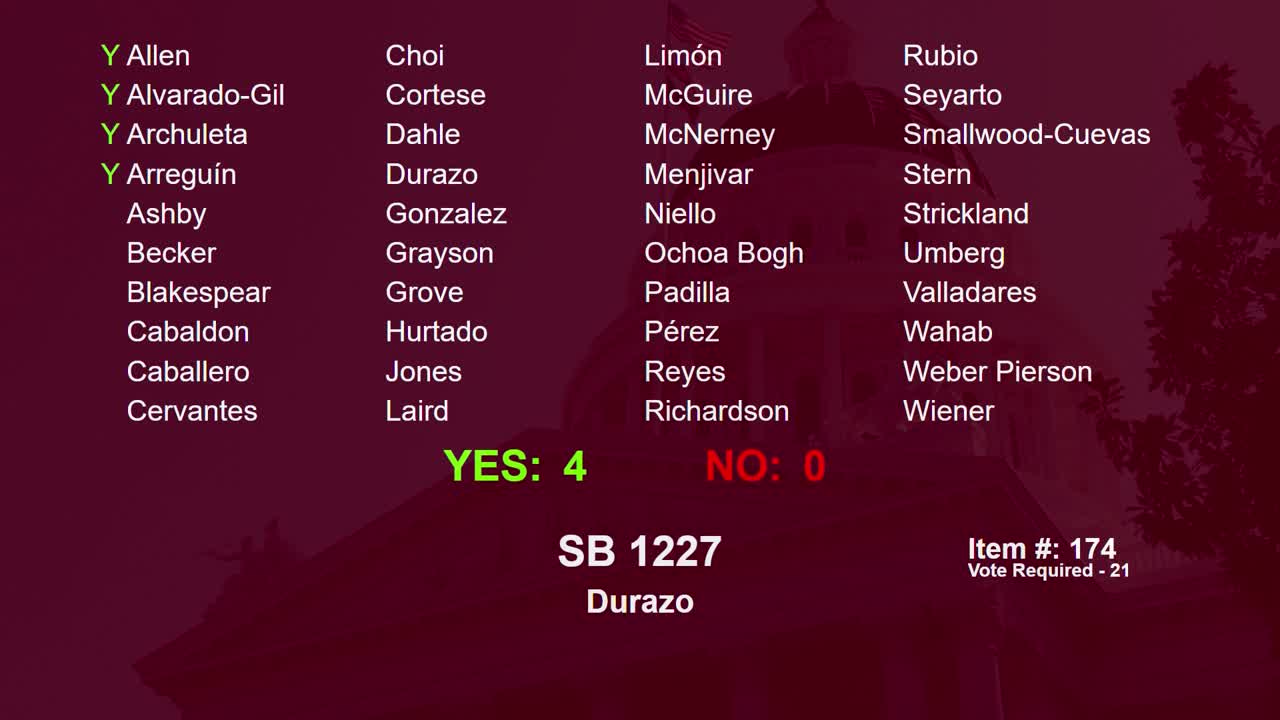 5MIN
Senate Floor
 18MIN
Senate Standing Committee on Elections and Constitutional Amendments
 4MIN
Senate Standing Committee on Judiciary


Bill Co-Author(s):