SB 887: California Environmental Quality Act: environmental leadership development projects: data centers: geothermal powerplant projects.
- Session Year: 2025-2026
- House: Senate
- Latest Version Date: 2026-09-21
Current Status:
Passed
(2026-09-21: Chaptered by Secretary of State. Chapter 439, Statutes of 2026.)
Introduced
In Committee
Awaiting First Chamber Vote
Passed First Chamber
In Committee
Awaiting Second Chamber Vote
Passed Second Chamber
Enacted
(1)The California Environmental Quality Act (CEQA) requires a lead agency, as defined, to prepare, or cause to be prepared, and certify the completion of, an environmental impact report on a project that it proposes to carry out or approve that may have a significant effect on the environment or to adopt a negative declaration if it finds that the project will not have that effect. CEQA also requires a lead agency to prepare a mitigated negative declaration for a project that may have a significant effect on the environment if revisions in the project would avoid or mitigate that effect and there is no substantial evidence that the project, as revised, would have a significant effect on the environment.
CEQA requires the Office of Land Use and Climate Innovation to prepare and develop proposed guidelines for the implementation of CEQA by public agencies and requires the Secretary of the Natural Resources Agency to certify and adopt the guidelines. CEQA requires the guidelines to include a list of classes of projects that have been determined not to have a significant effect on the environment and that are exempt from CEQA, commonly known as categorical exemptions.
This bill would define data center for the purposes of CEQA and prohibit the application of categorical exemption to a project for the development and operation of a data center, as specified. By increasing the duties of a lead agency in relation to the environmental review of a data center project, the bill would impose a state-mandated local program.
(2)The Jobs and Economic Improvement Through Environmental Leadership Act of 2021 authorizes the Governor, until January 1, 2032, to certify environmental leadership development projects that meet specified requirements for certain streamlining benefits related to CEQA. The act, among other things, requires a lead agency to prepare the record of proceedings for an environmental leadership development project concurrent with the administrative process and to provide a specified notice within 10 days of the Governor certifying the project. The act specifies the process for the quantification and mitigation of impacts from emissions of greenhouse gases of certain environmental leadership projects, as provided. The act is repealed by its own terms on January 1, 2034.
This bill would authorize the Governor to certify a data center project that is certified by the lead agency to meet specified conditions as an environmental leadership development project. The bill would require the Office of Land Use and Climate Innovation, in consultation with the State Energy Resources Conservation and Development Commission and other state agencies, as necessary, to develop uniform statewide standards for satisfying those conditions for data center projects, as specified. The bill would also authorize the Governor to certify a geothermal powerplant that is certified by the lead agency to meet certain criteria as an environmental leadership development project. The bill would require the quantification and mitigation of impacts for emissions of greenhouse gases of a data center project and a geothermal powerplant project to be determined in the same manner as for those certain environmental leadership projects. By increasing the duties of a lead agency, the bill would impose a state-mandated local program.
(3)The California Constitution requires the state to reimburse local agencies and school districts for certain costs mandated by the state. Statutory provisions establish procedures for making that reimbursement.
This bill would provide that no reimbursement is required by this act for a specified reason.
(1)The California Environmental Quality Act (CEQA) requires a lead agency, as defined, to prepare, or cause to be prepared, and certify the completion of, an environmental impact report on a project that it proposes to carry out or approve that may have a significant effect on the environment or to adopt a negative declaration if it finds that the project will not have that effect. CEQA also requires a lead agency to prepare a mitigated negative declaration for a project that may have a significant effect on the environment if revisions in the project would avoid or mitigate that effect and there is no substantial evidence that the project, as revised, would have a significant effect on the environment.
CEQA requires the Office of Land Use and Climate Innovation to prepare and propose guidelines for the implementation of CEQA by public agencies and requires the Secretary of the Natural Resources Agency to certify and adopt the guidelines. CEQA requires the guidelines to include a list of classes of projects that have been determined not to have a significant effect on the environment and that are exempt from CEQA, commonly known as categorical exemptions.
This bill would define data center for the purposes of CEQA and prohibit the application of categorical exemption to a project for the development and operation of a data center, as specified. By increasing the duties of a lead agency in relation to the environmental review of a data center project, this bill would impose a state-mandated local program.
(2)The Jobs and Economic Improvement Through Environmental Leadership Act of 2021 authorizes the Governor, until January 1, 2032, to certify environmental leadership development projects that meet specified requirements for certain streamlining benefits related to CEQA. The act, among other things, requires a lead agency to prepare the record of proceedings for an environmental leadership development project concurrent with the administrative process and to provide a specified notice within 10 days of the Governor certifying the project. The act specifies the process for the quantification and mitigation of impacts from emissions of greenhouse gases of certain environmental leadership projects, as provided. The act is repealed by its own terms on January 1, 2034.
This bill would authorize the Governor to certify a data center project that is certified by the lead agency to meet specified conditions as an environmental leadership development project. The bill would require the Office of Land Use and Climate Innovation, in consultation with the State Energy Resources Conservation and Development Commission and other state agencies, as necessary, to develop uniform statewide standards for satisfying those conditions for data centers, as specified. The bill would also authorize the Governor to certify a geothermal powerplant that meets is certified by the lead agency to meet certain criteria as an environmental leadership development project. The bill would require the quantification and mitigation of impacts for emissions of greenhouse gases of a data center project and geothermal powerplant projects to be determined in the same manner as for those certain environmental leadership projects. By increasing the duties of a lead agency, the bill would impose a state-mandated local program.
(3)The California Constitution requires the state to reimburse local agencies and school districts for certain costs mandated by the state. Statutory provisions establish procedures for making that reimbursement.
This bill would provide that no reimbursement is required by this act for a specified reason.
(1)The California Environmental Quality Act (CEQA) requires a lead agency, as defined, to prepare, or cause to be prepared, and certify the completion of, an environmental impact report on a project that it proposes to carry out or approve that may have a significant effect on the environment or to adopt a negative declaration if it finds that the project will not have that effect. CEQA also requires a lead agency to prepare a mitigated negative declaration for a project that may have a significant effect on the environment if revisions in the project would avoid or mitigate that effect and there is no substantial evidence that the project, as revised, would have a significant effect on the environment.
CEQA requires the Office of Land Use and Climate Innovation to prepare and propose guidelines for the implementation of CEQA by public agencies and requires the Secretary of the Natural Resources Agency to certify and adopt the guidelines. CEQA requires the guidelines to include a list of classes of projects that have been determined not to have a significant effect on the environment and that are exempt from CEQA, commonly known as categorical exemptions.
This bill would define data center for the purposes of CEQA and prohibit the application of categorical exemption to a project for the development and operation of a data center, as specified. By increasing the duties of a lead agency in relation to the environmental review of a data center project, this bill would impose a state-mandated local program.
(2)The Jobs and Economic Improvement Through Environmental Leadership Act of 2021 authorizes the Governor, until January 1, 2032, to certify environmental leadership development projects that meet specified requirements for certain streamlining benefits related to CEQA. The act, among other things, requires a lead agency to prepare the record of proceedings for an environmental leadership development project concurrent with the administrative process and to provide a specified notice within 10 days of the Governor certifying the project. The act specifies the process for the quantification and mitigation of impacts from emissions of greenhouse gases of certain environmental leadership projects, as provided. The act is repealed by its own terms on January 1, 2034.
This bill would authorize the Governor to certify a data center project that is certified by the lead agency to meet specified conditions as an environmental leadership development project. The bill would require the Office of Land Use and Climate Innovation, in consultation with the State Energy Resources Conservation and Development Commission and other state agencies, as necessary, to develop uniform statewide standards for satisfying those conditions for data centers, require regular compliance reporting by operators of data centers for those conditions, and initiate enforcement proceedings in the event of noncompliance with those conditions, as appropriate. The bill would also authorize the Governor to certify a geothermal powerplant that meets certain criteria as an environmental leadership development project. The bill would require the quantification and mitigation of impacts for emissions of greenhouse gases of a data center project in the same manner as those certain environmental leadership projects. as specified. The bill would also authorize the Governor to certify a geothermal powerplant that meets certain criteria as an environmental leadership development project. The bill would require the quantification and mitigation of impacts for emissions of greenhouse gases of a data center project and geothermal powerplant projects to be determined in the same manner as for those certain environmental leadership projects. By increasing the duties of a lead agency, the bill would impose a state-mandated local program.
(3)The California Constitution requires the state to reimburse local agencies and school districts for certain costs mandated by the state. Statutory provisions establish procedures for making that reimbursement.
This bill would provide that no reimbursement is required by this act for a specified reason.
(1)The California Environmental Quality Act (CEQA) requires a lead agency, as defined, to prepare, or cause to be prepared, and certify the completion of, an environmental impact report on a project that it proposes to carry out or approve that may have a significant effect on the environment or to adopt a negative declaration if it finds that the project will not have that effect. CEQA also requires a lead agency to prepare a mitigated negative declaration for a project that may have a significant effect on the environment if revisions in the project would avoid or mitigate that effect and there is no substantial evidence that the project, as revised, would have a significant effect on the environment.
CEQA requires the Office of Land Use and Climate Innovation to prepare and propose guidelines for the implementation of CEQA by public agencies and requires the Secretary of the Natural Resources Agency to certify and adopt the guidelines. CEQA requires the guidelines to include a list of classes of projects that have been determined not to have a significant effect on the environment and that are exempt from CEQA, commonly known as categorical exemptions.
This bill would define data center for the purposes of CEQA and prohibit the application of categorical exemption to a project for the development and operation of a data center, as defined. center, as specified. By increasing the duties of a lead agency in relation to the environmental review of a data center project, this bill would impose a state-mandated local program.
(2)The Jobs and Economic Improvement Through Environmental Leadership Act of 2021 authorizes the Governor, until January 1, 2032, to certify environmental leadership development projects that meet specified requirements for certain streamlining benefits related to CEQA. The act, among other things, requires a lead agency to prepare the record of proceedings for an environmental leadership development project concurrent with the administrative process and to provide a specified notice within 10 days of the Governor certifying the project. The act specifies the quantification and mitigation of impacts from emissions of greenhouse gases of certain environmental leadership projects, as provided. The act is repealed by its own terms on January 1, 2034.
This bill would authorize the Governor to certify a data center project that is certified by the lead agency to meet specified conditions as an environmental leadership development project. The bill would require the State Energy Resources Conservation and Development Commission to develop uniform statewide standards for those conditions for data centers, require regular compliance reporting by operators of data centers for those conditions, and initiate enforcement proceedings in the event of noncompliance with those conditions, as appropriate. The bill would also authorize the Governor to certify a geothermal powerplant that meets certain criteria as an environmental leadership development project. The bill would require the quantification and mitigation of impacts for emissions of greenhouse gases of a data center project in the same manner as those certain environmental leadership projects. By increasing the duties of a lead agency, the bill would impose a state-mandated local program.
(3)The California Constitution requires the state to reimburse local agencies and school districts for certain costs mandated by the state. Statutory provisions establish procedures for making that reimbursement.
This bill would provide that no reimbursement is required by this act for a specified reason.
(1)The California Environmental Quality Act (CEQA) requires a lead agency, as defined, to prepare, or cause to be prepared, and certify the completion of, an environmental impact report on a project that it proposes to carry out or approve that may have a significant effect on the environment or to adopt a negative declaration if it finds that the project will not have that effect. CEQA also requires a lead agency to prepare a mitigated negative declaration for a project that may have a significant effect on the environment if revisions in the project would avoid or mitigate that effect and there is no substantial evidence that the project, as revised, would have a significant effect on the environment.
CEQA requires the Office of Land Use and Climate Innovation to prepare and propose guidelines for the implementation of CEQA by public agencies and requires the Secretary of the Natural Resources Agency to certify and adopt the guidelines. CEQA requires the guidelines to include a list of classes of projects that have been determined not to have a significant effect on the environment and that are exempt from CEQA, commonly known as categorical exemptions.
This bill would prohibit the application of categorical exemption to a project for the development and operation of a data center, as defined. By increasing the duties of a lead agency in relation to the environmental review of a data center project, this bill would impose a state-mandated local program.
(2)The Jobs and Economic Improvement Through Environmental Leadership Act of 2021 authorizes the Governor, until January 1, 2032, to certify environmental leadership development projects that meet specified requirements for certain streamlining benefits related to CEQA. The act, among other things, requires a lead agency to prepare the record of proceedings for an environmental leadership development project concurrent with the administrative process and to provide a specified notice within 10 days of the Governor certifying the project. The act specifies the quantification and mitigation of impacts from emissions of greenhouse gases of certain environmental leadership projects, as provided. The act is repealed by its own terms on January 1, 2034.
This bill would authorize the Governor to certify a data center project that is certified by the lead agency to meet specified conditions as an environmental leadership development project. The bill would require the State Energy Resources Conservation and Development Commission to develop uniform statewide standards for those conditions for data centers, require regular compliance reporting by operators of data centers for those conditions, and initiate enforcement proceedings in the event of noncompliance with those conditions, as appropriate. The bill would also authorize the Governor to certify a geothermal powerplant meeting certain criteria that meets certain criteria as an environmental leadership development project. The bill would require the quantification and mitigation of impacts for emissions of greenhouse gases of a data center project in the same manner as those certain environmental leadership projects. By increasing the duties of a lead agency, the bill would impose a state-mandated local program.
(3)The California Constitution requires the state to reimburse local agencies and school districts for certain costs mandated by the state. Statutory provisions establish procedures for making that reimbursement.
This bill would provide that no reimbursement is required by this act for a specified reason.
(1)The California Environmental Quality Act (CEQA) requires a lead agency, as defined, to prepare, or cause to be prepared, and certify the completion of, an environmental impact report on a project that it proposes to carry out or approve that may have a significant effect on the environment or to adopt a negative declaration if it finds that the project will not have that effect. CEQA also requires a lead agency to prepare a mitigated negative declaration for a project that may have a significant effect on the environment if revisions in the project would avoid or mitigate that effect and there is no substantial evidence that the project, as revised, would have a significant effect on the environment.
CEQA requires the Office of Land Use and Climate Innovation to prepare and propose guidelines for the implementation of CEQA by public agencies and requires the Secretary of the Natural Resources Agency to certify and adopt the guidelines. CEQA requires the guidelines to include a list of classes of projects that have been determined not to have a significant effect on the environment and that are exempt from CEQA, commonly known as categorical exemptions.
This bill would prohibit the application of categorical exemption to a project for the development and operation of a data center, as defined. By increasing the duties of a lead agency in relation to the environmental review of a data center project, this bill would impose a state-mandated local program.
(2)The Jobs and Economic Improvement Through Environmental Leadership Act of 2021 authorizes the Governor, until January 1, 2032, to certify environmental leadership development projects that meet specified requirements for certain streamlining benefits related to CEQA. The act, among other things, requires a lead agency to prepare the record of proceedings for an environmental leadership development project concurrent with the administrative process and to provide a specified notice within 10 days of the Governor certifying the project. The act specifies the quantification and mitigation of impacts from emissions of greenhouse gases of certain environmental leadership projects, as provided. The act is repealed by its own terms on January 1, 2034.
This bill would authorize the Governor to certify a data center project that is certified by the lead agency to meet specified conditions as an environmental leadership development project. The bill would require the State Energy Resources Conservation and Development Commission to develop uniform statewide standards for those conditions for data centers, require regular compliance reporting by operators of data centers for those conditions, and initiate enforcement proceedings in the event of noncompliance with those conditions, as appropriate. The bill would also authorize the Governor to certify a clean renewable energy powerplant project using any source of thermal energy that does not burn, use, or rely on fossil fuels geothermal powerplant meeting certain criteria as an environmental leadership development project. The bill would require the quantification and mitigation of impacts for emissions of greenhouse gases of a data center project in the same manner as those certain environmental leadership projects. By increasing the duties of a lead agency, the bill would impose a state-mandated local program.
(3)The California Constitution requires the state to reimburse local agencies and school districts for certain costs mandated by the state. Statutory provisions establish procedures for making that reimbursement.
This bill would provide that no reimbursement is required by this act for a specified reason.
(1)The California Environmental Quality Act (CEQA) requires a lead agency, as defined, to prepare, or cause to be prepared, and certify the completion of, an environmental impact report on a project that it proposes to carry out or approve that may have a significant effect on the environment or to adopt a negative declaration if it finds that the project will not have that effect. CEQA also requires a lead agency to prepare a mitigated negative declaration for a project that may have a significant effect on the environment if revisions in the project would avoid or mitigate that effect and there is no substantial evidence that the project, as revised, would have a significant effect on the environment. CEQA exempts ministerial projects from its requirements. CEQA also exempts from its requirements a project that consists exclusively of a facility for advanced manufacturing, as specified.
CEQA requires the Office of Land Use and Climate Innovation to prepare and propose guidelines for the implementation of CEQA by public agencies and requires the Secretary of the Natural Resources Agency to certify and adopt the guidelines. CEQA requires the guidelines to include a list of classes of projects that have been determined not to have a significant effect on the environment and that are exempt from CEQA, commonly known as categorical exemptions.
This bill would specify that projects proposed to be carried out or approved by a public agency for the development and operation of a data center, as defined, are not ministerial projects exempt from CEQA. Because the bill would require the public agency to comply with CEQA for those data center projects that would otherwise be exempt from CEQA as ministerial projects, the bill would impose a state-mandated local program.This bill would specify that the CEQA exemption for an advanced manufacturing facility does not apply to a data center, as defined.This bill would prohibit the application of categorical exemption to a project for the development and operation of a data center, as defined. By increasing the duties of a lead agency in relation to the environmental review of a data center project, this bill would impose a state-mandated local program.
(2)The Jobs and Economic Improvement Through Environmental Leadership Act of 2021 authorizes the Governor, until January 1, 2032, to certify environmental leadership development projects that meet specified requirements for certain streamlining benefits related to CEQA. The act, among other things, requires a lead agency to prepare the record of proceedings for an environmental leadership development project concurrent with the administrative process and to provide a specified notice within 10 days of the Governor certifying the project. The act is repealed by its own terms on January 1, 2034.
This bill would extend the application of the act to a data center, as defined, authorize the Governor to certify a data center project that is certified by the lead agency to meet specified conditions. conditions as an environmental leadership development project. The bill would require the State Energy Resources Conservation and Development Commission to develop uniform statewide standards for those conditions for data centers, require regular compliance reporting by operators of data centers for those conditions, and initiate enforcement proceedings in the event of noncompliance with those conditions, as appropriate. The bill would also authorize the Governor to certify a clean renewable energy powerplant project using any source of thermal energy that does not burn, use, or rely on fossil fuels as an environmental leadership development project. By increasing the duties of a lead agency, the bill would impose a state-mandated local program.
(3)The California Constitution requires the state to reimburse local agencies and school districts for certain costs mandated by the state. Statutory provisions establish procedures for making that reimbursement.
This bill would provide that no reimbursement is required by this act for a specified reason.
(1)The California Environmental Quality Act (CEQA) requires a lead agency, as defined, to prepare, or cause to be prepared, and certify the completion of, an environmental impact report on a project that it proposes to carry out or approve that may have a significant effect on the environment or to adopt a negative declaration if it finds that the project will not have that effect. CEQA also requires a lead agency to prepare a mitigated negative declaration for a project that may have a significant effect on the environment if revisions in the project would avoid or mitigate that effect and there is no substantial evidence that the project, as revised, would have a significant effect on the environment. CEQA exempts ministerial projects from its requirements. CEQA also exempts from its requirements a project that consists exclusively of a facility for advanced manufacturing, as specified.
This bill would specify that projects proposed to be carried out or approved by a public agency for the development and operation of a data center, as defined, are not ministerial projects exempt from CEQA. Because the bill would require the public agency to comply with CEQA for those data center projects that would otherwise be exempt from CEQA as ministerial projects, the bill would impose a state-mandated local program.
This bill would specify that the CEQA exemption for an advanced manufacturing facility does not apply to a data center, as defined.
(2)The Jobs and Economic Improvement Through Environmental Leadership Act of 2021 authorizes the Governor, until January 1, 2032, to certify environmental leadership development projects that meet specified requirements for certain streamlining benefits related to CEQA. The act, among other things, requires a lead agency to prepare the record of proceedings for an environmental leadership development project concurrent with the administrative process and to provide a specified notice within 10 days of the Governor certifying the project. The act is repealed by its own terms on January 1, 2034.
This bill would extend the application of the act to a data center, as defined, that is certified by the lead agency to meet specified conditions. By increasing the duties of a lead agency, the bill would impose a state-mandated local program.
(3)The California Constitution requires the state to reimburse local agencies and school districts for certain costs mandated by the state. Statutory provisions establish procedures for making that reimbursement.
This bill would provide that no reimbursement is required by this act for a specified reason.
The Legislature finds and declares all of the following:
(a)California drives worldwide technological innovation, and that innovation is an important component of the states economy.
(b)California supports technological innovation with a world-class university system that provides a highly skilled workforce, and research and development tax incentives and other tools to facilitate the development and expansion of the states technology economy.
(c)The quickly evolving development of artificial intelligence requires data centers that currently require extremely large loads of electricity and water. While that expanded energy demand can help support the larger electrical grid and ordinary ratepayers, if managed incorrectly, it could pose a serious threat to Californias climate goals and, more importantly, can result in significant cost shifts to ordinary ratepayers and risks of costly stranded assets if projects do not meet projected energy estimates.
(d)Ordinary ratepayers in many states are already experiencing significant rate increases for both energy and water as utilities race to build out the necessary infrastructure and meet the energy and water demands of an exploding number of data centers across the country.
(e)According to recent research, data centers have significantly increased electrical and water demand in California between 2019 and 2023 and that explosive growth is expected to increase through the rest of the decade.
(f)As the nations technology, innovation, and environmental leader, it is critical that the Legislature develop standards to encourage continued technology development while protecting California residents from shouldering the cost of data center development and ensuring that development does not come at the cost of Californians clean energy.
SEC. 2.Section 21061.6 is added to the Public Resources Code, to read:21061.6.(a)Data center means a facility, or part of a facility, that houses computing infrastructure, including graphics and central processing units, servers, storage devices, networking equipment, and associated power and cooling systems, for the primary purpose of processing, storing, or distributing electronic data.
(b)For purposes of subdivision (a), facility means physical property, a plant, a building, a structure, or stationary equipment, located on one or more contiguous or adjacent properties in actual physical contact or separated solely by a public roadway or public right-of-way and under common ownership or common control.
SEC. 3.Section 21080.08 is added to the Public Resources Code, to read:21080.08.Notwithstanding any other law, this division shall apply to the issuance of entitlements related to the development and operation of a data center.
SEC. 4.Section 21084 of the Public Resources Code is amended to read:21084.(a)The guidelines prepared and adopted pursuant to Section 21083 shall include a list of classes of projects that have been determined not to have a significant effect on the environment and that shall be exempt from this division. In adopting the guidelines, the Secretary of the Natural Resources Agency shall make a finding that the listed classes of projects referred to in this section do not have a significant effect on the environment.
(b)A projects greenhouse gas emissions shall not, in and of themselves, be deemed to cause an exemption adopted pursuant to subdivision (a) to be inapplicable if the project complies with all applicable regulations or requirements adopted to implement statewide, regional, or local plans consistent with Section 15183.5 of Title 14 of the California Code of Regulations.
(c)A project that may result in damage to scenic resources, including, but not limited to, trees, historic buildings, rock outcroppings, or similar resources, within a highway designated as an official state scenic highway, pursuant to Article 2.5 (commencing with Section 260) of Chapter 2 of Division 1 of the Streets and Highways Code, shall not be exempted from this division pursuant to subdivision (a). This subdivision does not apply to improvements as mitigation for a project for which a negative declaration has been approved or an environmental impact report has been certified.
(d)A project located on a site that is included on any list compiled pursuant to Section 65962.5 of the Government Code shall not be exempted from this division pursuant to subdivision (a).
(e)A project that may cause a substantial adverse change in the significance of a historical resource, as specified in Section 21084.1, shall not be exempted from this division pursuant to subdivision (a).
(f)(1)A project proposed to be carried out or approved by a public agency in furtherance of the development and operation of a data center shall not be exempted from this division pursuant to subdivision (a).
(2)For purposes of this subdivision, data center does not include any of the following:
(A)A publicly funded research facility.
(B)A public safety facility.
(C)A publicly funded national security facility.
(D)A publicly owned facility.
(E)Other utility facilities, including, but not limited to, an asset of a facilities-based telecommunications service provider.
(F)A research facility operated by an independent institution of higher education, as defined by Section 66010 of the Education Code.
SEC. 5.Section 21180 of the Public Resources Code is amended to read:21180.For purposes of this chapter, the following definitions apply:
(a)Applicant means a public or private entity or its affiliates, or a person or entity that undertakes a public works project, that proposes a project and its successors, heirs, and assignees.
(b)Environmental leadership development project, leadership project, or project means a project as described in Section 21065 that is one of the following:
(1)A residential, retail, commercial, sports, cultural, entertainment, or recreational use project that is certified as Leadership in Energy and Environmental Design (LEED) gold or better by the United States Green Building Council and, where applicable, that achieves a 15-percent greater standard for transportation efficiency than for comparable projects. These projects must be located on an infill site. For a project that is within a metropolitan planning organization for which a sustainable communities strategy or alternative planning strategy is in effect, the infill project shall be consistent with the general use designation, density, building intensity, and applicable policies specified for the project area in either a sustainable communities strategy or an alternative planning strategy, for which the State Air Resources Board has accepted a metropolitan planning organizations determination, under subparagraph (H) of paragraph (2) of subdivision (b) of Section 65080 of the Government Code, that the sustainable communities strategy or the alternative planning strategy would, if implemented, achieve the greenhouse gas emission reduction targets.
(2)A clean renewable energy project that generates electricity exclusively through wind or solar, but not including waste incineration or conversion.
(3)A clean energy manufacturing project that manufactures products, equipment, or components used for renewable energy generation, energy efficiency, or for the production of clean alternative fuel vehicles.
(4)(A)A housing development project that meets all of the following conditions:
(i)The housing development project is located on an infill site.
(ii)For a housing development project that is located within a metropolitan planning organization for which a sustainable communities strategy or alternative planning strategy is in effect, the project is consistent with the general use designation, density, building intensity, and applicable policies specified for the project area in either a sustainable communities strategy or an alternative planning strategy, for which the State Air Resources Board has accepted a metropolitan planning organizations determination, under subparagraph (H) of paragraph (2) of subdivision (b) of Section 65080 of the Government Code, that the sustainable communities strategy or the alternative planning strategy would, if implemented, achieve the greenhouse gas emission reduction targets.
(iii)Notwithstanding paragraph (1) of subdivision (a) of Section 21183, the housing development project will result in a minimum investment of fifteen million dollars ($15,000,000) in California upon completion of construction.
(iv)(I)Except as provided in subclause (II), at least 15 percent of the housing development project is dedicated as housing that is affordable to lower income households, as defined in Section 50079.5 of the Health and Safety Code. Upon completion of a housing development project that is qualified under this paragraph and is certified by the Governor, the lead agency or applicant of the project shall notify the Office of Planning and Research of the number of housing units and affordable housing units established by the project.
(II)Notwithstanding subclause (I), if a local agency has adopted an inclusionary zoning ordinance that establishes a minimum percentage for affordable housing within the jurisdiction in which the housing development project is located that is higher than 15 percent, the percentage specified in the inclusionary zoning ordinance shall be the threshold for affordable housing.
(v)(I)Except for use as a residential hotel, as defined in Section 50519 of the Health and Safety Code, no part of the housing development project shall be used for a rental unit for a term shorter than 30 days, or designated for hotel, motel, bed and breakfast inn, or other transient lodging use.
(II)No part of the housing development project shall be used for manufacturing or industrial uses.
(B)For purposes of this paragraph, housing development project means a project for any of the following:
(i)Residential units only.
(ii)Mixed-use developments consisting of residential and nonresidential uses with at least two-thirds of the square footage designated for residential use.
(iii)Transitional housing or supportive housing.
(5)(A)A data center project certified by the lead agency to meet all of the following conditions:
(i)The applicant pays in advance the full cost of interconnection to prevent cost shifts to other ratepayers, as determined by the Public Utilities Commission or a local publicly owned utility.
(ii)Does not increase fossil fuel consumption within the state.
(iii)Includes zero-carbon energy storage with at least four hours of capacity at 100 percent of forecasted peak demand for the facility.
(iv)Uses onsite zero-carbon energy storage to provide demand response services to the electrical grid.
(v)Relies on zero-carbon generation located behind the meter to the maximum extent feasible.
(vi)The applicant has entered into an enforceable commitment with the loading service entity or a local publicly owned utility to fully pay all electrical grid investments, including costs of new generating capacity, to serve the data center. The commitment shall detail a process for an early termination fee in the event the data center ceases operations and costs have not been fully recovered.
(vii)Uses recycled water and water-efficient technology or waterless cooling systems.
(viii)Will rely on 100 percent zero-carbon electricity resources to serve hourly energy needs within five years of initial operations, of which 75 percent shall be newly developed.
(ix)Will meet the requirements of subdivision (c) of Section 21189.82.
(x)Enters into one or more legally binding and enforceable community benefits agreement with community-based organizations, such as workforce development and training organizations, labor unions, community foundations, local governmental entities, or California Native American tribes. In developing the community benefits agreement, the project applicant shall engage with nearby affected communities to identify community benefits that are priorities of the affected community. The community benefits agreement shall include an enforceable agreement that benefits the residents of nearby and affected communities and may include mitigation measures for environmental impacts.
(xi)Meets the requirements of Sections 25545.3, 25545.3.3, and 25545.3.5.
(B)For data center projects that are certified by the Governor pursuant to this chapter, the Office of Land Use and Climate Innovation shall, in consultation with the State Energy Resources Conservation and Development Commission and other state agencies, as necessary, develop uniform statewide standards for satisfying the conditions specified in subparagraph (A), as part of the guidelines developed pursuant to subdivision (c) of Section 21184.
(6)A geothermal powerplant certified by the lead agency to meet both of the following conditions:
(A)Meets the criteria for an eligible renewable energy resource specified in subparagraph (A) of paragraph (1) of subdivision (d) of Section 21189.81.
(B)Meets the requirements of Sections 25545.3, 25545.3.3, and 25545.3.5.
(c)Infill site has the same meaning as set forth in Section 21061.3.
(d)Transportation efficiency means the number of vehicle trips by employees, visitors, or customers of the residential, retail, commercial, sports, cultural, entertainment, or recreational use project divided by the total number of employees, visitors, and customers.
SEC. 6.Section 21183.6 of the Public Resources Code is amended to read:21183.6.(a)The quantification and mitigation of the impacts of a project described in paragraph (1), (2), (3), (5), or (6) of subdivision (b) of Section 21180 from the emissions of greenhouse gases shall be as follows:
(1)The environmental baseline for greenhouse gas emissions shall be established based upon the physical environmental conditions in the vicinity of the project site at the time the application is submitted in a manner consistent with Section 15125 of Title 14 of the California Code of Regulations as those regulations existed on January 1, 2021.
(2)The mitigation of the impacts resulting from the emissions of greenhouse gases shall be achieved in accordance with the following priority:
(A)Direct emissions reductions from the project that also reduce emissions of criteria air pollutants or toxic air contaminants through implementation of project features, project design, or other measures, including, but not limited to, energy efficiency, installation of renewable energy electricity generation, and reductions in vehicle miles traveled.
(B)If all of the project impacts cannot be feasibly and fully mitigated by direct emissions reductions as described in subparagraph (A), the remaining unmitigated impacts shall be mitigated by direct emissions reductions that also reduce emissions of criteria air pollutants or toxic air contaminants within the same air pollution control district or air quality management district in which the project is located.
(C)If all of the project impacts cannot be feasibly and fully mitigated by direct emissions reductions as described in subparagraph (A) or (B), the remaining unmitigated impacts shall be mitigated through the use of offsets that originate within the same air pollution control district or air quality management district in which the project is located. The offsets shall be undertaken in a manner consistent with Division 25.5 (commencing with Section 38500) of the Health and Safety Code, including, but not limited to, the requirement that the offsets be real, permanent, quantifiable, verifiable, and enforceable, and shall be undertaken from sources in the community in which the project is located or in adjacent communities.
(D)If all of the project impacts cannot be feasibly and fully mitigated by the measures described in subparagraph (A), (B), or (C), the remaining unmitigated impacts shall be mitigated through the use of offsets that originate from sources that provide a specific, quantifiable, and direct environmental and public health benefit to the region in which the project is located.
(b)It is the intent of the Legislature, in enacting this section, to maximize the environmental and public health benefits from measures to mitigate the project impacts resulting from the emissions of greenhouse gases to those people that are impacted most by the project.
SEC. 7.No reimbursement is required by this act pursuant to Section 6 of Article XIIIB of the California Constitution because a local agency or school district has the authority to levy service charges, fees, or assessments sufficient to pay for the program or level of service mandated by this act, within the meaning of Section 17556 of the Government Code.
The Legislature finds and declares all of the following:
(a)California drives worldwide technological innovation, and that innovation is an important component of the states economy.
(b)California supports technological innovation with a world-class university system that provides a highly skilled workforce, and research and development tax incentives and other tools to facilitate the development and expansion of the states technology economy.
(c)The quickly evolving development of artificial intelligence requires data centers that currently require extremely large loads of electricity and water. While that expanded energy demand can help support the larger electrical grid and ordinary ratepayers, if managed incorrectly, it could pose a serious threat to Californias climate goals and, more importantly, can result in significant cost shifts to ordinary ratepayers and risks of costly stranded assets if projects do not meet projected energy estimates.
(d)Ordinary ratepayers in many states are already experiencing significant rate increases for both energy and water as utilities race to build out the necessary infrastructure and meet the energy and water demands of an exploding number of data centers across the country.
(e)According to recent research, data centers have significantly increased electrical and water demand in California between 2019 and 2023 and that explosive growth is expected to increase through the rest of the decade.
(f)As the nations technology, innovation, and environmental leader, it is critical that the Legislature develop standards to encourage continued technology development while protecting California residents from shouldering the cost of data center development and ensuring that development does not come at the cost of Californians clean energy.
SEC. 2.Section 21061.6 is added to the Public Resources Code, to read:21061.6.(a)Data center means a facility, or part of a facility, that houses computing infrastructure, including graphics and central processing units, servers, storage devices, networking equipment, and associated power and cooling systems, for the primary purpose of processing, storing, or distributing electronic data.
(b)For purposes of subdivision (a), facility means physical property, a plant, a building, a structure, or stationary equipment, located on one or more contiguous or adjacent properties in actual physical contact or separated solely by a public roadway or public right-of-way and under common ownership or common control.
SEC. 3.Section 21080.08 is added to the Public Resources Code, to read:21080.08.Notwithstanding any other law, this division shall apply to the issuance of entitlements related to the development and operation of a data center.
SEC. 4.Section 21084 of the Public Resources Code is amended to read:21084.(a)The guidelines prepared and adopted pursuant to Section 21083 shall include a list of classes of projects that have been determined not to have a significant effect on the environment and that shall be exempt from this division. In adopting the guidelines, the Secretary of the Natural Resources Agency shall make a finding that the listed classes of projects referred to in this section do not have a significant effect on the environment.
(b)A projects greenhouse gas emissions shall not, in and of themselves, be deemed to cause an exemption adopted pursuant to subdivision (a) to be inapplicable if the project complies with all applicable regulations or requirements adopted to implement statewide, regional, or local plans consistent with Section 15183.5 of Title 14 of the California Code of Regulations.
(c)A project that may result in damage to scenic resources, including, but not limited to, trees, historic buildings, rock outcroppings, or similar resources, within a highway designated as an official state scenic highway, pursuant to Article 2.5 (commencing with Section 260) of Chapter 2 of Division 1 of the Streets and Highways Code, shall not be exempted from this division pursuant to subdivision (a). This subdivision does not apply to improvements as mitigation for a project for which a negative declaration has been approved or an environmental impact report has been certified.
(d)A project located on a site that is included on any list compiled pursuant to Section 65962.5 of the Government Code shall not be exempted from this division pursuant to subdivision (a).
(e)A project that may cause a substantial adverse change in the significance of a historical resource, as specified in Section 21084.1, shall not be exempted from this division pursuant to subdivision (a).
(f)(1)A project proposed to be carried out or approved by a public agency in furtherance of the development and operation of a data center shall not be exempted from this division pursuant to subdivision (a).
(2)For purposes of this subdivision, data center does not include any of the following:
(A)A publicly funded research facility.
(B)A public safety facility.
(C)A publicly funded national security facility.
(D)A publicly owned facility.
(E)Other utility facilities, including, but not limited to, an asset of a facilities-based telecommunications service provider.
(F)A research facility operated by an independent institution of higher education, as defined by Section 66010 of the Education Code.
SEC. 5.Section 21180 of the Public Resources Code is amended to read:21180.For purposes of this chapter, the following definitions apply:
(a)Applicant means a public or private entity or its affiliates, or a person or entity that undertakes a public works project, that proposes a project and its successors, heirs, and assignees.
(b)Environmental leadership development project, leadership project, or project means a project as described in Section 21065 that is one of the following:
(1)A residential, retail, commercial, sports, cultural, entertainment, or recreational use project that is certified as Leadership in Energy and Environmental Design (LEED) gold or better by the United States Green Building Council and, where applicable, that achieves a 15-percent greater standard for transportation efficiency than for comparable projects. These projects must be located on an infill site. For a project that is within a metropolitan planning organization for which a sustainable communities strategy or alternative planning strategy is in effect, the infill project shall be consistent with the general use designation, density, building intensity, and applicable policies specified for the project area in either a sustainable communities strategy or an alternative planning strategy, for which the State Air Resources Board has accepted a metropolitan planning organizations determination, under subparagraph (H) of paragraph (2) of subdivision (b) of Section 65080 of the Government Code, that the sustainable communities strategy or the alternative planning strategy would, if implemented, achieve the greenhouse gas emission reduction targets.
(2)A clean renewable energy project that generates electricity exclusively through wind or solar, but not including waste incineration or conversion.
(3)A clean energy manufacturing project that manufactures products, equipment, or components used for renewable energy generation, energy efficiency, or for the production of clean alternative fuel vehicles.
(4)(A)A housing development project that meets all of the following conditions:
(i)The housing development project is located on an infill site.
(ii)For a housing development project that is located within a metropolitan planning organization for which a sustainable communities strategy or alternative planning strategy is in effect, the project is consistent with the general use designation, density, building intensity, and applicable policies specified for the project area in either a sustainable communities strategy or an alternative planning strategy, for which the State Air Resources Board has accepted a metropolitan planning organizations determination, under subparagraph (H) of paragraph (2) of subdivision (b) of Section 65080 of the Government Code, that the sustainable communities strategy or the alternative planning strategy would, if implemented, achieve the greenhouse gas emission reduction targets.
(iii)Notwithstanding paragraph (1) of subdivision (a) of Section 21183, the housing development project will result in a minimum investment of fifteen million dollars ($15,000,000) in California upon completion of construction.
(iv)(I)Except as provided in subclause (II), at least 15 percent of the housing development project is dedicated as housing that is affordable to lower income households, as defined in Section 50079.5 of the Health and Safety Code. Upon completion of a housing development project that is qualified under this paragraph and is certified by the Governor, the lead agency or applicant of the project shall notify the Office of Planning and Research of the number of housing units and affordable housing units established by the project.
(II)Notwithstanding subclause (I), if a local agency has adopted an inclusionary zoning ordinance that establishes a minimum percentage for affordable housing within the jurisdiction in which the housing development project is located that is higher than 15 percent, the percentage specified in the inclusionary zoning ordinance shall be the threshold for affordable housing.
(v)(I)Except for use as a residential hotel, as defined in Section 50519 of the Health and Safety Code, no part of the housing development project shall be used for a rental unit for a term shorter than 30 days, or designated for hotel, motel, bed and breakfast inn, or other transient lodging use.
(II)No part of the housing development project shall be used for manufacturing or industrial uses.
(B)For purposes of this paragraph, housing development project means a project for any of the following:
(i)Residential units only.
(ii)Mixed-use developments consisting of residential and nonresidential uses with at least two-thirds of the square footage designated for residential use.
(iii)Transitional housing or supportive housing.
(5)(A)A data center project certified by the lead agency to meet all of the following conditions:
(i)The applicant pays in advance the full cost of interconnection to prevent cost shifts to other ratepayers, as determined by the Public Utilities Commission or a local publicly owned utility.
(ii)Does not increase fossil fuel consumption within the state.
(iii)Includes zero-carbon energy storage with at least four hours of capacity at 100 percent of forecasted peak demand for the facility.
(iv)Uses onsite zero-carbon energy storage to provide demand response services to the electrical grid.
(v)Relies on zero-carbon generation located behind the meter to the maximum extent feasible.
(vi)The applicant has entered into an enforceable commitment with the loading service entity or a local publicly owned utility to fully pay all electrical grid investments, including costs of new generating capacity, to serve the data center. The commitment shall detail a process for an early termination fee in the event the data center ceases operations and costs have not been fully recovered.
(vii)Uses recycled water and water-efficient technology or waterless cooling systems.
(viii)Will rely on 100 percent zero-carbon electricity resources to serve hourly energy needs within five years of initial operations, of which 75 percent shall be newly developed.
(ix)Will meet the requirements of subdivision (c) of Section 21189.82.
(x)Enters into one or more legally binding and enforceable community benefits agreement with community-based organizations, such as workforce development and training organizations, labor unions, community foundations, local governmental entities, or California Native American tribes. In developing the community benefits agreement, the project applicant shall engage with nearby affected communities to identify community benefits that are priorities of the affected community. The community benefits agreement shall include an enforceable agreement that benefits the residents of nearby and affected communities and may include mitigation measures for environmental impacts.
(xi)Meets the requirements of Sections 25545.3, 25545.3.3, and 25545.3.5.
(B)For data center projects that are certified by the Governor pursuant to this chapter, the Office of Land Use and Climate Innovation shall, in consultation with the State Energy Resources Conservation and Development Commission and other state agencies, as necessary, develop uniform statewide standards for satisfying the conditions specified in subparagraph (A), as part of the guidelines developed pursuant to subdivision (c) of Section 21184.
(6)(A)A geothermal powerplant certified by the lead agency to meet both of the following conditions:
(i)(A)Meets the criteria for an eligible renewable energy resource specified in subparagraph (A) of paragraph (1) of subdivision (d) of Section 21189.81.
(ii)(B)Meets the requirements of Sections 25545.3, 25545.3.3, and 25545.3.5.
(B)A project certified pursuant to this paragraph may include a collocated critical minerals extraction facility using the same geothermal brine resources, which extracts lithium or other critical minerals, as defined by the U.S. Geological Survey pursuant to Section 7002 of the Energy Act of 2020 (30 U.S.C. Sec. 1606).(c)Infill site has the same meaning as set forth in Section 21061.3.
(d)Transportation efficiency means the number of vehicle trips by employees, visitors, or customers of the residential, retail, commercial, sports, cultural, entertainment, or recreational use project divided by the total number of employees, visitors, and customers.
SEC. 6.Section 21183.6 of the Public Resources Code is amended to read:21183.6.(a)The quantification and mitigation of the impacts of a project described in paragraph (1), (2), (3), (5), or (6) of subdivision (b) of Section 21180 from the emissions of greenhouse gases shall be as follows:
(1)The environmental baseline for greenhouse gas emissions shall be established based upon the physical environmental conditions in the vicinity of the project site at the time the application is submitted in a manner consistent with Section 15125 of Title 14 of the California Code of Regulations as those regulations existed on January 1, 2021.
(2)The mitigation of the impacts resulting from the emissions of greenhouse gases shall be achieved in accordance with the following priority:
(A)Direct emissions reductions from the project that also reduce emissions of criteria air pollutants or toxic air contaminants through implementation of project features, project design, or other measures, including, but not limited to, energy efficiency, installation of renewable energy electricity generation, and reductions in vehicle miles traveled.
(B)If all of the project impacts cannot be feasibly and fully mitigated by direct emissions reductions as described in subparagraph (A), the remaining unmitigated impacts shall be mitigated by direct emissions reductions that also reduce emissions of criteria air pollutants or toxic air contaminants within the same air pollution control district or air quality management district in which the project is located.
(C)If all of the project impacts cannot be feasibly and fully mitigated by direct emissions reductions as described in subparagraph (A) or (B), the remaining unmitigated impacts shall be mitigated through the use of offsets that originate within the same air pollution control district or air quality management district in which the project is located. The offsets shall be undertaken in a manner consistent with Division 25.5 (commencing with Section 38500) of the Health and Safety Code, including, but not limited to, the requirement that the offsets be real, permanent, quantifiable, verifiable, and enforceable, and shall be undertaken from sources in the community in which the project is located or in adjacent communities.
(D)If all of the project impacts cannot be feasibly and fully mitigated by the measures described in subparagraph (A), (B), or (C), the remaining unmitigated impacts shall be mitigated through the use of offsets that originate from sources that provide a specific, quantifiable, and direct environmental and public health benefit to the region in which the project is located.
(b)It is the intent of the Legislature, in enacting this section, to maximize the environmental and public health benefits from measures to mitigate the project impacts resulting from the emissions of greenhouse gases to those people that are impacted most by the project.
SEC. 7.No reimbursement is required by this act pursuant to Section 6 of Article XIIIB of the California Constitution because a local agency or school district has the authority to levy service charges, fees, or assessments sufficient to pay for the program or level of service mandated by this act, within the meaning of Section 17556 of the Government Code.
The Legislature finds and declares all of the following:
(a)California drives worldwide technological innovation, and that innovation is an important component of the states economy.
(b)California supports technological innovation with a world-class university system that provides a highly skilled workforce, and research and development tax incentives and other tools to facilitate the development and expansion of the states technology economy.
(c)The quickly evolving development of artificial intelligence requires data centers that currently require extremely large loads of electricity and water. While that expanded energy demand can help support the larger electrical grid and ordinary ratepayers, if managed incorrectly, it could pose a serious threat to Californias climate goals and, more importantly, can result in significant cost shifts to ordinary ratepayers and risks of costly stranded assets if projects do not meet projected energy estimates.
(d)Ordinary ratepayers in many states are already experiencing significant rate increases for both energy and water as utilities race to build out the necessary infrastructure and meet the energy and water demands of an exploding number of data centers across the country.
(e)According to recent research, data centers have significantly increased electrical and water demand in California between 2019 and 2023 and that explosive growth is expected to increase through the rest of the decade.
(f)As the nations technology, innovation, and environmental leader, it is critical that the Legislature develop standards to encourage continued technology development while protecting California residents from shouldering the cost of data center development and ensuring that development does not come at the cost of Californians clean energy.
SEC. 2.Section 21061.6 is added to the Public Resources Code, to read:21061.6.(a)Data center means a facility, or part of a facility, that houses computing infrastructure, including graphics and central processing units, servers, storage devices, networking equipment, and associated power and cooling systems, for the primary purpose of processing, storing, or distributing electronic data.
(b)For purposes of subdivision (a), facility means physical property, a plant, a building, a structure, or stationary equipment, located on one or more contiguous or adjacent properties in actual physical contact or separated solely by a public roadway or public right-of-way and under common ownership or common control.
SEC. 3.Section 21080.06 is added to the Public Resources Code, to read:21080.06.SEC. 3.Section 21080.08 is added to the Public Resources Code, to read:21080.08.Notwithstanding any other law, this division shall apply to the issuance of entitlements related to the development and operation of a data center.
SEC. 4.Section 21084 of the Public Resources Code is amended to read:21084.(a)The guidelines prepared and adopted pursuant to Section 21083 shall include a list of classes of projects that have been determined not to have a significant effect on the environment and that shall be exempt from this division. In adopting the guidelines, the Secretary of the Natural Resources Agency shall make a finding that the listed classes of projects referred to in this section do not have a significant effect on the environment.
(b)A projects greenhouse gas emissions shall not, in and of themselves, be deemed to cause an exemption adopted pursuant to subdivision (a) to be inapplicable if the project complies with all applicable regulations or requirements adopted to implement statewide, regional, or local plans consistent with Section 15183.5 of Title 14 of the California Code of Regulations.
(c)A project that may result in damage to scenic resources, including, but not limited to, trees, historic buildings, rock outcroppings, or similar resources, within a highway designated as an official state scenic highway, pursuant to Article 2.5 (commencing with Section 260) of Chapter 2 of Division 1 of the Streets and Highways Code, shall not be exempted from this division pursuant to subdivision (a). This subdivision does not apply to improvements as mitigation for a project for which a negative declaration has been approved or an environmental impact report has been certified.
(d)A project located on a site that is included on any list compiled pursuant to Section 65962.5 of the Government Code shall not be exempted from this division pursuant to subdivision (a).
(e)A project that may cause a substantial adverse change in the significance of a historical resource, as specified in Section 21084.1, shall not be exempted from this division pursuant to subdivision (a).
(f)(1)A project proposed to be carried out or approved by a public agency in furtherance of the development and operation of a data center shall not be exempted from this division pursuant to subdivision (a).
(2)For purposes of this subdivision, data center does not include any of the following:
(A)A publicly funded research facility.
(B)A public safety facility.
(C)A publicly funded national security facility.
(D)A publicly owned facility.
(E)Other utility facilities, including, but not limited to, an asset of a facilities-based telecommunications service provider.
(F)A research facility operated by an independent institution of higher education, as defined by Section 66010 of the Education Code.
SEC. 5.Section 21180 of the Public Resources Code is amended to read:21180.For purposes of this chapter, the following definitions apply:
(a)Applicant means a public or private entity or its affiliates, or a person or entity that undertakes a public works project, that proposes a project and its successors, heirs, and assignees.
(b)Environmental leadership development project, leadership project, or project means a project as described in Section 21065 that is one of the following:
(1)A residential, retail, commercial, sports, cultural, entertainment, or recreational use project that is certified as Leadership in Energy and Environmental Design (LEED) gold or better by the United States Green Building Council and, where applicable, that achieves a 15-percent greater standard for transportation efficiency than for comparable projects. These projects must be located on an infill site. For a project that is within a metropolitan planning organization for which a sustainable communities strategy or alternative planning strategy is in effect, the infill project shall be consistent with the general use designation, density, building intensity, and applicable policies specified for the project area in either a sustainable communities strategy or an alternative planning strategy, for which the State Air Resources Board has accepted a metropolitan planning organizations determination, under subparagraph (H) of paragraph (2) of subdivision (b) of Section 65080 of the Government Code, that the sustainable communities strategy or the alternative planning strategy would, if implemented, achieve the greenhouse gas emission reduction targets.
(2)A clean renewable energy project that generates electricity exclusively through wind or solar, but not including waste incineration or conversion.
(3)A clean energy manufacturing project that manufactures products, equipment, or components used for renewable energy generation, energy efficiency, or for the production of clean alternative fuel vehicles.
(4)(A)A housing development project that meets all of the following conditions:
(i)The housing development project is located on an infill site.
(ii)For a housing development project that is located within a metropolitan planning organization for which a sustainable communities strategy or alternative planning strategy is in effect, the project is consistent with the general use designation, density, building intensity, and applicable policies specified for the project area in either a sustainable communities strategy or an alternative planning strategy, for which the State Air Resources Board has accepted a metropolitan planning organizations determination, under subparagraph (H) of paragraph (2) of subdivision (b) of Section 65080 of the Government Code, that the sustainable communities strategy or the alternative planning strategy would, if implemented, achieve the greenhouse gas emission reduction targets.
(iii)Notwithstanding paragraph (1) of subdivision (a) of Section 21183, the housing development project will result in a minimum investment of fifteen million dollars ($15,000,000) in California upon completion of construction.
(iv)(I)Except as provided in subclause (II), at least 15 percent of the housing development project is dedicated as housing that is affordable to lower income households, as defined in Section 50079.5 of the Health and Safety Code. Upon completion of a housing development project that is qualified under this paragraph and is certified by the Governor, the lead agency or applicant of the project shall notify the Office of Planning and Research of the number of housing units and affordable housing units established by the project.
(II)Notwithstanding subclause (I), if a local agency has adopted an inclusionary zoning ordinance that establishes a minimum percentage for affordable housing within the jurisdiction in which the housing development project is located that is higher than 15 percent, the percentage specified in the inclusionary zoning ordinance shall be the threshold for affordable housing.
(v)(I)Except for use as a residential hotel, as defined in Section 50519 of the Health and Safety Code, no part of the housing development project shall be used for a rental unit for a term shorter than 30 days, or designated for hotel, motel, bed and breakfast inn, or other transient lodging use.
(II)No part of the housing development project shall be used for manufacturing or industrial uses.
(B)For purposes of this paragraph, housing development project means a project for any of the following:
(i)Residential units only.
(ii)Mixed-use developments consisting of residential and nonresidential uses with at least two-thirds of the square footage designated for residential use.
(iii)Transitional housing or supportive housing.
(5)(A)A data center project certified by the lead agency to meet all of the following conditions:
(i)The applicant pays in advance the full cost of interconnection to prevent cost shifts to other ratepayers, as determined by the Public Utilities Commission or a local publicly owned utility.
(ii)Does not increase fossil fuel consumption within the state.
(iii)Includes zero-carbon energy storage with at least four hours of capacity at 100 percent of forecasted peak demand for the facility.
(iv)Uses onsite zero-carbon energy storage to provide demand response services to the electrical grid.
(v)Relies on zero-carbon generation located behind the meter to the maximum extent feasible.
(vi)The applicant has entered into an enforceable commitment with the loading service entity or a local publicly owned utility to fully pay all electrical grid investments, including costs of new generating capacity, to serve the data center. The commitment shall detail a process for an early termination fee in the event the data center ceases operations and costs have not been fully recovered.
(vii)Uses recycled water and water-efficient technology or waterless cooling systems.
(viii)Will rely on 100 percent zero-carbon electricity resources to serve hourly energy needs within five years of initial operations, of which 75 percent shall be newly developed.
(ix)Will meet the requirements of subdivision (c) of Section 21189.82.
(x)Enters into one or more legally binding and enforceable community benefits agreement with community-based organizations, such as workforce development and training organizations, labor unions, community foundations, local governmental entities, or California Native American tribes. In developing the community benefits agreement, the project applicant shall engage with nearby affected communities to identify community benefits that are priorities of the affected community. The community benefits agreement shall include an enforceable agreement that benefits the residents of nearby and affected communities and may include mitigation measures for environmental impacts.
(xi)Meets the requirements of Sections 25545.3, 25545.3.3, and 25545.3.5.
(B)For data center projects that are certified by the Governor pursuant to this chapter, the Office of Land Use and Climate Innovation shall, in consultation with the State Energy Resources Conservation and Development Commission shall and other state agencies, as necessary, develop uniform statewide standards for satisfying the conditions specified in subparagraph (A), require regular compliance reporting by the operators of the data centers, and initiate enforcement proceedings in the event of noncompliance with those standards, as appropriate, that may result in the imposition of administrative civil penalties. as part of the guidelines developed pursuant to subdivision (c) of Section 21184.
(6)(A)A geothermal powerplant certified by the lead agency to meet both of the following conditions:
(A)(i)Meets the criteria for an eligible renewable energy resource specified in subparagraph (A) of paragraph (1) of subdivision (d) of Section 21189.81.
(B)(ii)Meets the requirements of Sections 25545.3, 25545.3.3, and 25545.3.5.
(B)A project certified pursuant to this paragraph may include a collocated critical minerals extraction facility using the same geothermal brine resources, which extracts lithium or other critical minerals, as defined by the U.S. Geological Survey pursuant to Section 7002 of the Energy Act of 2020 (30 U.S.C. Sec. 1606).
(c)Infill site has the same meaning as set forth in Section 21061.3.
(d)Transportation efficiency means the number of vehicle trips by employees, visitors, or customers of the residential, retail, commercial, sports, cultural, entertainment, or recreational use project divided by the total number of employees, visitors, and customers.
SEC. 6.Section 21183.6 of the Public Resources Code is amended to read:21183.6.(a)The quantification and mitigation of the impacts of a project described in paragraph (1), (2), (3), or (5) (5), or (6) of subdivision (b) of Section 21180 from the emissions of greenhouse gases shall be as follows:
(1)The environmental baseline for greenhouse gas emissions shall be established based upon the physical environmental conditions in the vicinity of the project site at the time the application is submitted in a manner consistent with Section 15125 of Title 14 of the California Code of Regulations as those regulations existed on January 1, 2021.
(2)The mitigation of the impacts resulting from the emissions of greenhouse gases shall be achieved in accordance with the following priority:
(A)Direct emissions reductions from the project that also reduce emissions of criteria air pollutants or toxic air contaminants through implementation of project features, project design, or other measures, including, but not limited to, energy efficiency, installation of renewable energy electricity generation, and reductions in vehicle miles traveled.
(B)If all of the project impacts cannot be feasibly and fully mitigated by direct emissions reductions as described in subparagraph (A), the remaining unmitigated impacts shall be mitigated by direct emissions reductions that also reduce emissions of criteria air pollutants or toxic air contaminants within the same air pollution control district or air quality management district in which the project is located.
(C)If all of the project impacts cannot be feasibly and fully mitigated by direct emissions reductions as described in subparagraph (A) or (B), the remaining unmitigated impacts shall be mitigated through the use of offsets that originate within the same air pollution control district or air quality management district in which the project is located. The offsets shall be undertaken in a manner consistent with Division 25.5 (commencing with Section 38500) of the Health and Safety Code, including, but not limited to, the requirement that the offsets be real, permanent, quantifiable, verifiable, and enforceable, and shall be undertaken from sources in the community in which the project is located or in adjacent communities.
(D)If all of the project impacts cannot be feasibly and fully mitigated by the measures described in subparagraph (A), (B), or (C), the remaining unmitigated impacts shall be mitigated through the use of offsets that originate from sources that provide a specific, quantifiable, and direct environmental and public health benefit to the region in which the project is located.
(b)It is the intent of the Legislature, in enacting this section, to maximize the environmental and public health benefits from measures to mitigate the project impacts resulting from the emissions of greenhouse gases to those people that are impacted most by the project.
SEC. 7.No reimbursement is required by this act pursuant to Section 6 of Article XIIIB of the California Constitution because a local agency or school district has the authority to levy service charges, fees, or assessments sufficient to pay for the program or level of service mandated by this act, within the meaning of Section 17556 of the Government Code.
The Legislature finds and declares all of the following:
(a)California drives worldwide technological innovation, and that innovation is an important component of the states economy, which is the fifth largest economy in the world. economy.
(b)California supports technological innovation with a world-class university system that provides a highly skilled workforce, and research and development tax incentives and other tools to facilitate the development and expansion of the states technology economy.
(c)California is the home of the third largest number of data centers in the country behind Virginia and Texas.(d)(c)The quickly evolving development of artificial intelligence requires large-format data centers that currently require extremely large loads of electricity and water. While that expanded energy demand can help support the larger electrical grid and ordinary ratepayers, if managed incorrectly, it could pose a serious threat to Californias climate goals and, more importantly, can result in significant cost shifts to ordinary ratepayers and risks of costly stranded assets if projects do not meet projected energy estimates.
(e)(d)Ordinary ratepayers in many states are already experiencing significant rate increases for both energy and water as utilities race to build out the necessary infrastructure and meet the energy and water demands of an exploding number of data centers across the country.
(f)(e)According to recent research, data centers have significantly increased electrical and water demand in California between 2019 and 2023 and that explosive growth is expected to increase through the rest of the decade.
(g)On the current trajectory, demand for electricity and water could rise over 350 percent in just five years between 2023 and 2028, creating significant cost pressures on electricity and access to clean water across the state of California.(h)(f)As the nations technology, innovation, and environmental leader, it is critical that the Legislature develop standards to encourage continued technology development while protecting California residents from shouldering the cost of data center development and ensuring that development does not come at the cost of Californians clean air and water. energy.
SEC. 2.Section 21061.6 is added to the Public Resources Code, to read:21061.6.(a)Data center means a facility, or part of a facility, that houses computing infrastructure, including graphics and central processing units, servers, storage devices, networking equipment, and associated power and cooling systems, for the primary purpose of processing, storing, or distributing electronic data.
(b)For purposes of subdivision (a), facility means physical property, a plant, a building, a structure, or stationary equipment, located on one or more contiguous or adjacent properties in actual physical contact or separated solely by a public roadway or public right-of-way and under common ownership or common control.
SEC. 2.SEC. 3.Section 21080.06 is added to the Public Resources Code, to read:21080.06.Notwithstanding any other law, this division shall apply to the issuance of entitlements related to the development and operation of a data center as defined in Section 21084. center.
SEC. 3.SEC. 4.Section 21084 of the Public Resources Code is amended to read:21084.(a)The guidelines prepared and adopted pursuant to Section 21083 shall include a list of classes of projects that have been determined not to have a significant effect on the environment and that shall be exempt from this division. In adopting the guidelines, the Secretary of the Natural Resources Agency shall make a finding that the listed classes of projects referred to in this section do not have a significant effect on the environment.
(b)A projects greenhouse gas emissions shall not, in and of themselves, be deemed to cause an exemption adopted pursuant to subdivision (a) to be inapplicable if the project complies with all applicable regulations or requirements adopted to implement statewide, regional, or local plans consistent with Section 15183.5 of Title 14 of the California Code of Regulations.
(c)A project that may result in damage to scenic resources, including, but not limited to, trees, historic buildings, rock outcroppings, or similar resources, within a highway designated as an official state scenic highway, pursuant to Article 2.5 (commencing with Section 260) of Chapter 2 of Division 1 of the Streets and Highways Code, shall not be exempted from this division pursuant to subdivision (a). This subdivision does not apply to improvements as mitigation for a project for which a negative declaration has been approved or an environmental impact report has been certified.
(d)A project located on a site that is included on any list compiled pursuant to Section 65962.5 of the Government Code shall not be exempted from this division pursuant to subdivision (a).
(e)A project that may cause a substantial adverse change in the significance of a historical resource, as specified in Section 21084.1, shall not be exempted from this division pursuant to subdivision (a).
(f)(1)A project proposed to be carried out or approved by a public agency in furtherance of the development and operation of a data center shall not be exempted from this division pursuant to subdivision (a).
(2)For purposes of this subdivision, data center means a large-scale energy consumer that requires uninterruptible electricity to serve a facility housing servers and related equipment and software for the processing, storage, and distribution of data. Data center does not include any of the following:(A)A publicly funded research facility.(B)A public safety facility.(C)A national security facility.(D)A publicly owned facility.(E)Other utility facilities, including, but not limited to, an asset of a facilities-based telecommunications provider.(3)For purposes of paragraph (2), facility means physical property, a plant, a building, a structure, a source, or stationary equipment, located on one or more contiguous or adjacent properties in actual physical contact or separated solely by a public roadway or public right-of-way and under common ownership or common control.(2)For purposes of this subdivision, data center does not include any of the following:
(A)A publicly funded research facility.
(B)A public safety facility.
(C)A national security facility.
(D)A publicly owned facility.
(E)Other utility facilities, including, but not limited to, an asset of a facilities-based telecommunications service provider.
SEC. 4.SEC. 5.Section 21180 of the Public Resources Code is amended to read:21180.For purposes of this chapter, the following definitions apply:
(a)Applicant means a public or private entity or its affiliates, or a person or entity that undertakes a public works project, that proposes a project and its successors, heirs, and assignees.
(b)Environmental leadership development project, leadership project, or project means a project as described in Section 21065 that is one of the following:
(1)A residential, retail, commercial, sports, cultural, entertainment, or recreational use project that is certified as Leadership in Energy and Environmental Design (LEED) gold or better by the United States Green Building Council and, where applicable, that achieves a 15-percent greater standard for transportation efficiency than for comparable projects. These projects must be located on an infill site. For a project that is within a metropolitan planning organization for which a sustainable communities strategy or alternative planning strategy is in effect, the infill project shall be consistent with the general use designation, density, building intensity, and applicable policies specified for the project area in either a sustainable communities strategy or an alternative planning strategy, for which the State Air Resources Board has accepted a metropolitan planning organizations determination, under subparagraph (H) of paragraph (2) of subdivision (b) of Section 65080 of the Government Code, that the sustainable communities strategy or the alternative planning strategy would, if implemented, achieve the greenhouse gas emission reduction targets.
(2)A clean renewable energy project that generates electricity exclusively through wind or solar, but not including waste incineration or conversion.
(3)A clean energy manufacturing project that manufactures products, equipment, or components used for renewable energy generation, energy efficiency, or for the production of clean alternative fuel vehicles.
(4)(A)A housing development project that meets all of the following conditions:
(i)The housing development project is located on an infill site.
(ii)For a housing development project that is located within a metropolitan planning organization for which a sustainable communities strategy or alternative planning strategy is in effect, the project is consistent with the general use designation, density, building intensity, and applicable policies specified for the project area in either a sustainable communities strategy or an alternative planning strategy, for which the State Air Resources Board has accepted a metropolitan planning organizations determination, under subparagraph (H) of paragraph (2) of subdivision (b) of Section 65080 of the Government Code, that the sustainable communities strategy or the alternative planning strategy would, if implemented, achieve the greenhouse gas emission reduction targets.
(iii)Notwithstanding paragraph (1) of subdivision (a) of Section 21183, the housing development project will result in a minimum investment of fifteen million dollars ($15,000,000) in California upon completion of construction.
(iv)(I)Except as provided in subclause (II), at least 15 percent of the housing development project is dedicated as housing that is affordable to lower income households, as defined in Section 50079.5 of the Health and Safety Code. Upon completion of a housing development project that is qualified under this paragraph and is certified by the Governor, the lead agency or applicant of the project shall notify the Office of Planning and Research of the number of housing units and affordable housing units established by the project.
(II)Notwithstanding subclause (I), if a local agency has adopted an inclusionary zoning ordinance that establishes a minimum percentage for affordable housing within the jurisdiction in which the housing development project is located that is higher than 15 percent, the percentage specified in the inclusionary zoning ordinance shall be the threshold for affordable housing.
(v)(I)Except for use as a residential hotel, as defined in Section 50519 of the Health and Safety Code, no part of the housing development project shall be used for a rental unit for a term shorter than 30 days, or designated for hotel, motel, bed and breakfast inn, or other transient lodging use.
(II)No part of the housing development project shall be used for manufacturing or industrial uses.
(B)For purposes of this paragraph, housing development project means a project for any of the following:
(i)Residential units only.
(ii)Mixed-use developments consisting of residential and nonresidential uses with at least two-thirds of the square footage designated for residential use.
(iii)Transitional housing or supportive housing.
(5)(A)A data center project certified by the lead agency to meet all of the following conditions:
(i)Pays The applicant pays in advance the full cost of interconnection to prevent cost shifts to other ratepayers. ratepayers, as determined by the Public Utilities Commission or a local publicly owned utility.
(ii)Does not increase fossil fuel consumption within the state.
(iii)Includes zero-carbon energy storage with at least four hours of capacity at 100 percent of forecasted peak demand for the facility.
(iv)Uses onsite zero-carbon energy storage to provide demand response services to the electrical grid.
(v)Relies on zero-carbon generation located behind the meter to the maximum extent feasible.
(vi)Recovers fully from the data center operator The applicant has entered into an enforceable commitment with the loading service entity or a local publicly owned utility to fully pay all electrical grid investments, including costs of new generating capacity, to serve the data center center. The commitment shall detail a process for an early termination fee in the event the data center ceases operations. operations and costs have not been fully recovered.
(vii)Uses recycled water and water-efficient technology or waterless cooling systems.
(viii)Will rely on 100 percent zero-carbon electricity resources to serve hourly energy needs within five years of initial operations, of which 75 percent shall be newly developed.
(ix)Will meet the requirements of subdivision (c) of Section 21189.82.
(x)Enters into one or more legally binding and enforceable community benefits agreement with community-based organizations, such as workforce development and training organizations, labor unions, community foundations, local governmental entities, or California Native American tribes. In developing the community benefits agreement, the project applicant shall engage with nearby affected communities to identify community benefits that are priorities of the affected community. The community benefits agreement shall include an enforceable agreement that benefits the residents of nearby and affected communities and may include mitigation measures for environmental impacts.
(xi)Meets the requirements of Sections 25545.3, 25545.3.3, and 25545.3.5.
(B)For data center projects that are certified by the Governor pursuant to this chapter, the State Energy Resources Conservation and Development Commission shall develop uniform statewide standards for conditions specified in subparagraph (A), require regular compliance reporting by the operators of the data centers, and initiate enforcement proceedings in the event of noncompliance with those standards, as appropriate, that may result in the imposition of administrative civil penalties.
(C)For purposes of this paragraph, data center means a commercial facility primarily used to house computer servers and associated equipment for processing, storing, or transmitting data.(6)A geothermal powerplant certified by the lead agency to meet both of the following conditions:
(A)Meets the criteria for an eligible renewable energy resource specified in subparagraph (A) of paragraph (1) of subdivision (d) of Section 21189.81.
(B)Meets the requirements of Sections 25545.3, 25545.3.3, and 25545.3.5.
(c)Infill site has the same meaning as set forth in Section 21061.3.
(d)Transportation efficiency means the number of vehicle trips by employees, visitors, or customers of the residential, retail, commercial, sports, cultural, entertainment, or recreational use project divided by the total number of employees, visitors, and customers.
SEC. 5.SEC. 6.Section 21183.6 of the Public Resources Code is amended to read:21183.6.(a)The quantification and mitigation of the impacts of a project described in paragraph (1), (2), (3), or (5) of subdivision (b) of Section 21180 from the emissions of greenhouse gases shall be as follows:
(1)The environmental baseline for greenhouse gas emissions shall be established based upon the physical environmental conditions in the vicinity of the project site at the time the application is submitted in a manner consistent with Section 15125 of Title 14 of the California Code of Regulations as those regulations existed on January 1, 2021.
(2)The mitigation of the impacts resulting from the emissions of greenhouse gases shall be achieved in accordance with the following priority:
(A)Direct emissions reductions from the project that also reduce emissions of criteria air pollutants or toxic air contaminants through implementation of project features, project design, or other measures, including, but not limited to, energy efficiency, installation of renewable energy electricity generation, and reductions in vehicle miles traveled.
(B)If all of the project impacts cannot be feasibly and fully mitigated by direct emissions reductions as described in subparagraph (A), the remaining unmitigated impacts shall be mitigated by direct emissions reductions that also reduce emissions of criteria air pollutants or toxic air contaminants within the same air pollution control district or air quality management district in which the project is located.
(C)If all of the project impacts cannot be feasibly and fully mitigated by direct emissions reductions as described in subparagraph (A) or (B), the remaining unmitigated impacts shall be mitigated through the use of offsets that originate within the same air pollution control district or air quality management district in which the project is located. The offsets shall be undertaken in a manner consistent with Division 25.5 (commencing with Section 38500) of the Health and Safety Code, including, but not limited to, the requirement that the offsets be real, permanent, quantifiable, verifiable, and enforceable, and shall be undertaken from sources in the community in which the project is located or in adjacent communities.
(D)If all of the project impacts cannot be feasibly and fully mitigated by the measures described in subparagraph (A), (B), or (C), the remaining unmitigated impacts shall be mitigated through the use of offsets that originate from sources that provide a specific, quantifiable, and direct environmental and public health benefit to the region in which the project is located.
(b)It is the intent of the Legislature, in enacting this section, to maximize the environmental and public health benefits from measures to mitigate the project impacts resulting from the emissions of greenhouse gases to those people that are impacted most by the project.
SEC. 6.SEC. 7.No reimbursement is required by this act pursuant to Section 6 of Article XIIIB of the California Constitution because a local agency or school district has the authority to levy service charges, fees, or assessments sufficient to pay for the program or level of service mandated by this act, within the meaning of Section 17556 of the Government Code.
The Legislature finds and declares all of the following:
(a)California drives worldwide technological innovation, and that innovation is an important component of the states economy, which is the fifth largest economy in the world.
(b)California supports technological innovation with a world-class university system that provides a highly skilled workforce, and research and development tax incentives and other tools to facilitate the development and expansion of the states technology economy.
(c)California is the home of the third largest number of data centers in the country behind Virginia and Texas.
(d)The quickly evolving development of artificial intelligence requires large-format data centers that currently require extremely large loads of electricity and water. While that expanded energy demand can help support the larger electrical grid and ordinary ratepayers, if managed incorrectly, it could pose a serious threat to Californias climate goals and, more importantly, can result in significant cost shifts to ordinary ratepayers and risks of costly stranded assets if projects do not meet projected energy estimates.
(e)Ordinary ratepayers in many states are already experiencing significant rate increases for both energy and water as utilities race to build out the necessary infrastructure and meet the energy and water demands of an exploding number of data centers across the country.
(f)According to recent research, data centers have significantly increased electrical and water demand in California between 2019 and 2023 and that explosive growth is expected to increase through the rest of the decade.
(g)On the current trajectory, demand for electricity and water could rise over 350 percent in just five years between 2023 and 2028, creating significant cost pressures on electricity and access to clean water across the state of California.
(h)As the nations technology, innovation, and environmental leader, it is critical that the Legislature develop standards to encourage continued technology development while protecting California residents from shouldering the cost of data center development and ensuring that development does not come at the cost of Californians clean air and water.
SEC. 2.Section 21080.06 is added to the Public Resources Code, to read:21080.06.Notwithstanding any other law, this division shall apply to the issuance of entitlements related to the development and operation of a data center as defined in Section 21084.
SEC. 3.Section 21084 of the Public Resources Code is amended to read:21084.(a)The guidelines prepared and adopted pursuant to Section 21083 shall include a list of classes of projects that have been determined not to have a significant effect on the environment and that shall be exempt from this division. In adopting the guidelines, the Secretary of the Natural Resources Agency shall make a finding that the listed classes of projects referred to in this section do not have a significant effect on the environment.
(b)A projects greenhouse gas emissions shall not, in and of themselves, be deemed to cause an exemption adopted pursuant to subdivision (a) to be inapplicable if the project complies with all applicable regulations or requirements adopted to implement statewide, regional, or local plans consistent with Section 15183.5 of Title 14 of the California Code of Regulations.
(c)A project that may result in damage to scenic resources, including, but not limited to, trees, historic buildings, rock outcroppings, or similar resources, within a highway designated as an official state scenic highway, pursuant to Article 2.5 (commencing with Section 260) of Chapter 2 of Division 1 of the Streets and Highways Code, shall not be exempted from this division pursuant to subdivision (a). This subdivision does not apply to improvements as mitigation for a project for which a negative declaration has been approved or an environmental impact report has been certified.
(d)A project located on a site that is included on any list compiled pursuant to Section 65962.5 of the Government Code shall not be exempted from this division pursuant to subdivision (a).
(e)A project that may cause a substantial adverse change in the significance of a historical resource, as specified in Section 21084.1, shall not be exempted from this division pursuant to subdivision (a).
(f)(1)A project proposed to be carried out or approved by a public agency in furtherance of the development and operation of a data center shall not be exempted from this division pursuant to subdivision (a).
(2)For purposes of this subdivision, data center means a large-scale energy consumer that requires uninterruptible electricity to serve a facility housing servers and related equipment and software for the processing, storage, and distribution of data. Data center does not include any of the following:
(A)A publicly funded research facility.
(B)A public safety facility.
(C)A national security facility.
(D)A publicly owned facility.
(E)Other utility facilities, including, but not limited to, an asset of a facilities-based telecommunications provider.
(3)For purposes of paragraph (2), facility means physical property, a plant, a building, a structure, a source, or stationary equipment, located on one or more contiguous or adjacent properties in actual physical contact or separated solely by a public roadway or public right-of-way and under common ownership or common control.
SEC. 4.Section 21180 of the Public Resources Code is amended to read:21180.For purposes of this chapter, the following definitions apply:
(a)Applicant means a public or private entity or its affiliates, or a person or entity that undertakes a public works project, that proposes a project and its successors, heirs, and assignees.
(b)Environmental leadership development project, leadership project, or project means a project as described in Section 21065 that is one of the following:
(1)A residential, retail, commercial, sports, cultural, entertainment, or recreational use project that is certified as Leadership in Energy and Environmental Design (LEED) gold or better by the United States Green Building Council and, where applicable, that achieves a 15-percent greater standard for transportation efficiency than for comparable projects. These projects must be located on an infill site. For a project that is within a metropolitan planning organization for which a sustainable communities strategy or alternative planning strategy is in effect, the infill project shall be consistent with the general use designation, density, building intensity, and applicable policies specified for the project area in either a sustainable communities strategy or an alternative planning strategy, for which the State Air Resources Board has accepted a metropolitan planning organizations determination, under subparagraph (H) of paragraph (2) of subdivision (b) of Section 65080 of the Government Code, that the sustainable communities strategy or the alternative planning strategy would, if implemented, achieve the greenhouse gas emission reduction targets.
(2)A clean renewable energy project that generates electricity exclusively through wind or solar, but not including waste incineration or conversion.
(3)A clean energy manufacturing project that manufactures products, equipment, or components used for renewable energy generation, energy efficiency, or for the production of clean alternative fuel vehicles.
(4)(A)A housing development project that meets all of the following conditions:
(i)The housing development project is located on an infill site.
(ii)For a housing development project that is located within a metropolitan planning organization for which a sustainable communities strategy or alternative planning strategy is in effect, the project is consistent with the general use designation, density, building intensity, and applicable policies specified for the project area in either a sustainable communities strategy or an alternative planning strategy, for which the State Air Resources Board has accepted a metropolitan planning organizations determination, under subparagraph (H) of paragraph (2) of subdivision (b) of Section 65080 of the Government Code, that the sustainable communities strategy or the alternative planning strategy would, if implemented, achieve the greenhouse gas emission reduction targets.
(iii)Notwithstanding paragraph (1) of subdivision (a) of Section 21183, the housing development project will result in a minimum investment of fifteen million dollars ($15,000,000) in California upon completion of construction.
(iv)(I)Except as provided in subclause (II), at least 15 percent of the housing development project is dedicated as housing that is affordable to lower income households, as defined in Section 50079.5 of the Health and Safety Code. Upon completion of a housing development project that is qualified under this paragraph and is certified by the Governor, the lead agency or applicant of the project shall notify the Office of Planning and Research of the number of housing units and affordable housing units established by the project.
(II)Notwithstanding subclause (I), if a local agency has adopted an inclusionary zoning ordinance that establishes a minimum percentage for affordable housing within the jurisdiction in which the housing development project is located that is higher than 15 percent, the percentage specified in the inclusionary zoning ordinance shall be the threshold for affordable housing.
(v)(I)Except for use as a residential hotel, as defined in Section 50519 of the Health and Safety Code, no part of the housing development project shall be used for a rental unit for a term shorter than 30 days, or designated for hotel, motel, bed and breakfast inn, or other transient lodging use.
(II)No part of the housing development project shall be used for manufacturing or industrial uses.
(B)For purposes of this paragraph, housing development project means a project for any of the following:
(i)Residential units only.
(ii)Mixed-use developments consisting of residential and nonresidential uses with at least two-thirds of the square footage designated for residential use.
(iii)Transitional housing or supportive housing.
(5)(A)A data center project certified by the lead agency to meet all of the following conditions:
(i)Pays the full cost of interconnection to prevent cost shifts to other ratepayers.
(ii)Does not increase fossil fuel consumption within the state.
(iii)Includes zero-carbon energy storage with at least four hours of capacity at 100 percent of forecasted peak demand for the facility.
(iv)Uses onsite zero-carbon energy storage to provide demand response services to the electrical grid.
(v)Relies on zero-carbon generation located behind the meter to the maximum extent feasible.
(vi)Recovers fully from the data center operator all electrical grid investments, including costs of new generating capacity, to serve the data center in the event the data center ceases operations.
(vii)Uses recycled water and water-efficient technology or waterless cooling systems.
(viii)Will rely on 100 percent zero-carbon electricity resources to serve hourly energy needs within five years of initial operations, of which 75 percent shall be newly developed.
(ix)Will meet the requirements of subdivision (c) of Section 21189.82.
(x)Enters into one or more legally binding and enforceable community benefits agreement with community-based organizations, such as workforce development and training organizations, labor unions, community foundations, local governmental entities, or California Native American tribes. In developing the community benefits agreement, the project applicant shall engage with nearby affected communities to identify community benefits that are priorities of the affected community. The community benefits agreement shall include an enforceable agreement that benefits the residents of nearby and affected communities and may include mitigation measures for environmental impacts.
(xi)Meets the requirements of Sections 25545.3, 25545.3.3, and 25545.3.5.
(B)For data center projects that are certified by the Governor pursuant to this chapter, the State Energy Resources Conservation and Development Commission shall develop uniform statewide standards for conditions specified in subparagraph (A), require regular compliance reporting by the operators of the data centers, and initiate enforcement proceedings in the event of noncompliance with those standards, as appropriate, that may result in the imposition of administrative civil penalties.
(C)For purposes of this paragraph, data center means a commercial facility primarily used to house computer servers and associated equipment for processing, storing, or transmitting data that require at least 50 megawatts of peak demand. data.
(6)A geothermal powerplant certified by the lead agency to meet both of the following conditions:
(A)Meets the criteria for an eligible renewable energy resource specified in subparagraph (A) of paragraph (1) of subdivision (d) of Section 21189.81.
(B)Meets the requirements of Sections 25545.3, 25545.3.3, and 25545.3.5.
(c)Infill site has the same meaning as set forth in Section 21061.3.
(d)Transportation efficiency means the number of vehicle trips by employees, visitors, or customers of the residential, retail, commercial, sports, cultural, entertainment, or recreational use project divided by the total number of employees, visitors, and customers.
SEC. 5.Section 21183.6 of the Public Resources Code is amended to read:21183.6.(a)The quantification and mitigation of the impacts of a project described in paragraph (1), (2), (3), or (5) of subdivision (b) of Section 21180 from the emissions of greenhouse gases shall be as follows:
(1)The environmental baseline for greenhouse gas emissions shall be established based upon the physical environmental conditions in the vicinity of the project site at the time the application is submitted in a manner consistent with Section 15125 of Title 14 of the California Code of Regulations as those regulations existed on January 1, 2021.
(2)The mitigation of the impacts resulting from the emissions of greenhouse gases shall be achieved in accordance with the following priority:
(A)Direct emissions reductions from the project that also reduce emissions of criteria air pollutants or toxic air contaminants through implementation of project features, project design, or other measures, including, but not limited to, energy efficiency, installation of renewable energy electricity generation, and reductions in vehicle miles traveled.
(B)If all of the project impacts cannot be feasibly and fully mitigated by direct emissions reductions as described in subparagraph (A), the remaining unmitigated impacts shall be mitigated by direct emissions reductions that also reduce emissions of criteria air pollutants or toxic air contaminants within the same air pollution control district or air quality management district in which the project is located.
(C)If all of the project impacts cannot be feasibly and fully mitigated by direct emissions reductions as described in subparagraph (A) or (B), the remaining unmitigated impacts shall be mitigated through the use of offsets that originate within the same air pollution control district or air quality management district in which the project is located. The offsets shall be undertaken in a manner consistent with Division 25.5 (commencing with Section 38500) of the Health and Safety Code, including, but not limited to, the requirement that the offsets be real, permanent, quantifiable, verifiable, and enforceable, and shall be undertaken from sources in the community in which the project is located or in adjacent communities.
(D)If all of the project impacts cannot be feasibly and fully mitigated by the measures described in subparagraph (A), (B), or (C), the remaining unmitigated impacts shall be mitigated through the use of offsets that originate from sources that provide a specific, quantifiable, and direct environmental and public health benefit to the region in which the project is located.
(b)It is the intent of the Legislature, in enacting this section, to maximize the environmental and public health benefits from measures to mitigate the project impacts resulting from the emissions of greenhouse gases to those people that are impacted most by the project.
SEC. 6.No reimbursement is required by this act pursuant to Section 6 of Article XIIIB of the California Constitution because a local agency or school district has the authority to levy service charges, fees, or assessments sufficient to pay for the program or level of service mandated by this act, within the meaning of Section 17556 of the Government Code.
The Legislature finds and declares all of the following:
(a)California drives worldwide technological innovation, and that innovation is an important component of the states economy, which is the fifth largest economy in the world.
(b)California supports technological innovation with a world-class university system that provides a highly skilled workforce, and research and development tax incentives and other tools to facilitate the development and expansion of the states technology economy.
(c)California is the home of the third largest number of data centers in the country behind Virginia and Texas.
(d)The quickly evolving development of artificial intelligence requires large-format data centers that currently require extremely large loads of electricity and water. While that expanded energy demand can help support the larger electrical grid and ordinary ratepayers, if managed incorrectly, it could pose a serious threat to Californias climate goals and, more importantly, can result in significant cost shifts to ordinary ratepayers and risks of costly stranded assets if projects do not meet projected energy estimates.
(e)Ordinary ratepayers in many states are already experiencing significant rate increases for both energy and water as utilities race to build out the necessary infrastructure and meet the energy and water demands of an exploding number of data centers across the country.
(f)According to recent research, data centers have significantly increased electrical and water demand in California between 2019 and 2023 and that explosive growth is expected to increase through the rest of the decade.
(g)On the current trajectory, demand for electricity and water could rise over 350 percent in just five years between 2023 and 2028, creating significant cost pressures on electricity and access to clean water across the state of California.
(h)As the nations technology, innovation, and environmental leader, it is critical that the Legislature develop standards to encourage continued technology development while protecting California residents from shouldering the cost of data center development and ensuring that development does not come at the cost of Californians clean air and water.
SEC. 2.Section 21080.06 is added to the Public Resources Code, to read:21080.06.Notwithstanding any other law, this division shall apply to a project for the issuance of entitlements related to the development and operation of a data center as defined in Section 21084.
SEC. 3.Section 21084 of the Public Resources Code is amended to read:21084.(a)The guidelines prepared and adopted pursuant to Section 21083 shall include a list of classes of projects that have been determined not to have a significant effect on the environment and that shall be exempt from this division. In adopting the guidelines, the Secretary of the Natural Resources Agency shall make a finding that the listed classes of projects referred to in this section do not have a significant effect on the environment.
(b)A projects greenhouse gas emissions shall not, in and of themselves, be deemed to cause an exemption adopted pursuant to subdivision (a) to be inapplicable if the project complies with all applicable regulations or requirements adopted to implement statewide, regional, or local plans consistent with Section 15183.5 of Title 14 of the California Code of Regulations.
(c)A project that may result in damage to scenic resources, including, but not limited to, trees, historic buildings, rock outcroppings, or similar resources, within a highway designated as an official state scenic highway, pursuant to Article 2.5 (commencing with Section 260) of Chapter 2 of Division 1 of the Streets and Highways Code, shall not be exempted from this division pursuant to subdivision (a). This subdivision does not apply to improvements as mitigation for a project for which a negative declaration has been approved or an environmental impact report has been certified.
(d)A project located on a site that is included on any list compiled pursuant to Section 65962.5 of the Government Code shall not be exempted from this division pursuant to subdivision (a).
(e)A project that may cause a substantial adverse change in the significance of a historical resource, as specified in Section 21084.1, shall not be exempted from this division pursuant to subdivision (a).
(f)(1)A project proposed to be carried out or approved by a public agency in furtherance of the development and operation of a data center shall not be exempted from this division pursuant to subdivision (a).
(2)For purposes of this subdivision, data center means a large-scale energy consumer that requires uninterruptible electricity to serve a facility housing servers and related equipment and software for the processing, storage, and distribution of data.
SEC. 4.Section 21180 of the Public Resources Code is amended to read:21180.For purposes of this chapter, the following definitions apply:
(a)Applicant means a public or private entity or its affiliates, or a person or entity that undertakes a public works project, that proposes a project and its successors, heirs, and assignees.
(b)Environmental leadership development project, leadership project, or project means a project as described in Section 21065 that is one of the following:
(1)A residential, retail, commercial, sports, cultural, entertainment, or recreational use project that is certified as Leadership in Energy and Environmental Design (LEED) gold or better by the United States Green Building Council and, where applicable, that achieves a 15-percent greater standard for transportation efficiency than for comparable projects. These projects must be located on an infill site. For a project that is within a metropolitan planning organization for which a sustainable communities strategy or alternative planning strategy is in effect, the infill project shall be consistent with the general use designation, density, building intensity, and applicable policies specified for the project area in either a sustainable communities strategy or an alternative planning strategy, for which the State Air Resources Board has accepted a metropolitan planning organizations determination, under subparagraph (H) of paragraph (2) of subdivision (b) of Section 65080 of the Government Code, that the sustainable communities strategy or the alternative planning strategy would, if implemented, achieve the greenhouse gas emission reduction targets.
(2)A clean renewable energy project that generates electricity exclusively through wind or solar, but not including waste incineration or conversion.
(3)A clean energy manufacturing project that manufactures products, equipment, or components used for renewable energy generation, energy efficiency, or for the production of clean alternative fuel vehicles.
(4)(A)A housing development project that meets all of the following conditions:
(i)The housing development project is located on an infill site.
(ii)For a housing development project that is located within a metropolitan planning organization for which a sustainable communities strategy or alternative planning strategy is in effect, the project is consistent with the general use designation, density, building intensity, and applicable policies specified for the project area in either a sustainable communities strategy or an alternative planning strategy, for which the State Air Resources Board has accepted a metropolitan planning organizations determination, under subparagraph (H) of paragraph (2) of subdivision (b) of Section 65080 of the Government Code, that the sustainable communities strategy or the alternative planning strategy would, if implemented, achieve the greenhouse gas emission reduction targets.
(iii)Notwithstanding paragraph (1) of subdivision (a) of Section 21183, the housing development project will result in a minimum investment of fifteen million dollars ($15,000,000) in California upon completion of construction.
(iv)(I)Except as provided in subclause (II), at least 15 percent of the housing development project is dedicated as housing that is affordable to lower income households, as defined in Section 50079.5 of the Health and Safety Code. Upon completion of a housing development project that is qualified under this paragraph and is certified by the Governor, the lead agency or applicant of the project shall notify the Office of Planning and Research of the number of housing units and affordable housing units established by the project.
(II)Notwithstanding subclause (I), if a local agency has adopted an inclusionary zoning ordinance that establishes a minimum percentage for affordable housing within the jurisdiction in which the housing development project is located that is higher than 15 percent, the percentage specified in the inclusionary zoning ordinance shall be the threshold for affordable housing.
(v)(I)Except for use as a residential hotel, as defined in Section 50519 of the Health and Safety Code, no part of the housing development project shall be used for a rental unit for a term shorter than 30 days, or designated for hotel, motel, bed and breakfast inn, or other transient lodging use.
(II)No part of the housing development project shall be used for manufacturing or industrial uses.
(B)For purposes of this paragraph, housing development project means a project for any of the following:
(i)Residential units only.
(ii)Mixed-use developments consisting of residential and nonresidential uses with at least two-thirds of the square footage designated for residential use.
(iii)Transitional housing or supportive housing.
(5)(A)A data center project certified by the lead agency to meet all of the following conditions:
(i)Pays the full cost of interconnection to prevent cost shifts to other ratepayers.
(ii)Does not increase fossil fuel consumption within the state.
(iii)Includes zero-carbon energy storage with at least four hours of capacity at 100 percent of forecasted peak demand for the facility.
(iv)Uses onsite zero-carbon energy storage to provide demand response services to the electrical grid.
(v)Relies on zero-carbon generation located behind the meter to the maximum extent feasible.
(vi)Recovers fully from the data center operator all electrical grid investments, including costs of new generating capacity, to serve the data center in the event the data center ceases operations.
(vii)Uses recycled water and water-efficient technology or waterless cooling systems.
(viii)Will rely on 100 percent zero-carbon electricity resources to serve hourly energy needs within five years of initial operations, of which 75 percent shall be newly developed.
(ix)Will meet the requirements of subdivision (c) of Section 21189.82.
(x)Enters into one or more legally binding and enforceable community benefits agreement with community based community-based organizations, such as workforce development and training organizations, labor unions, community foundations, local governmental entities, or California Native American tribes. In developing the community benefits agreement, the project applicant shall engage with nearby affected communities to identify community benefits that are priorities of the affected community. The community benefits agreement shall include an enforceable scope of work agreement that benefits the residents of nearby and affected communities and may include mitigation measures for environmental impacts.
(xi)Meets the requirements of Sections 25545.3.3 25545.3, 25545.3.3, and 25545.3.5.
(B)For data center projects that are certified by the Governor pursuant to this chapter, the State Energy Resources Conservation and Development Commission shall develop uniform statewide standards for conditions specified in subparagraph (A), require regular compliance reporting by the operators of the data centers, and initiate enforcement proceedings in the event of noncompliance with those standards, as appropriate, that may result in the imposition of administrative civil penalties.
(C)For purposes of this paragraph, data center means a commercial facility primarily used to house computer servers and associated equipment for processing, storing, or transmitting data that require at least 50 megawatts of peak demand.
(6)A geothermal powerplant meeting certified by the lead agency to meet both of the following conditions:
(A)Meets the criteria for an eligible renewable energy resources resource specified in subparagraph (A) of paragraph (1) of subdivision (d) of Section 21189.81.
(B)Meets the requirements of Sections 25545.3, 25545.3.3, and 25545.3.5.
(c)Infill site has the same meaning as set forth in Section 21061.3.
(d)Transportation efficiency means the number of vehicle trips by employees, visitors, or customers of the residential, retail, commercial, sports, cultural, entertainment, or recreational use project divided by the total number of employees, visitors, and customers.
SEC. 5.Section 21183.6 of the Public Resources Code is amended to read:21183.6.(a)The quantification and mitigation of the impacts of a project described in paragraph (1), (2), (3), or (5) of subdivision (b) of Section 21180 from the emissions of greenhouse gases shall be as follows:
(1)The environmental baseline for greenhouse gas emissions shall be established based upon the physical environmental conditions in the vicinity of the project site at the time the application is submitted in a manner consistent with Section 15125 of Title 14 of the California Code of Regulations as those regulations existed on January 1, 2021.
(2)The mitigation of the impacts resulting from the emissions of greenhouse gases shall be achieved in accordance with the following priority:
(A)Direct emissions reductions from the project that also reduce emissions of criteria air pollutants or toxic air contaminants through implementation of project features, project design, or other measures, including, but not limited to, energy efficiency, installation of renewable energy electricity generation, and reductions in vehicle miles traveled.
(B)If all of the project impacts cannot be feasibly and fully mitigated by direct emissions reductions as described in subparagraph (A), the remaining unmitigated impacts shall be mitigated by direct emissions reductions that also reduce emissions of criteria air pollutants or toxic air contaminants within the same air pollution control district or air quality management district in which the project is located.
(C)If all of the project impacts cannot be feasibly and fully mitigated by direct emissions reductions as described in subparagraph (A) or (B), the remaining unmitigated impacts shall be mitigated through the use of offsets that originate within the same air pollution control district or air quality management district in which the project is located. The offsets shall be undertaken in a manner consistent with Division 25.5 (commencing with Section 38500) of the Health and Safety Code, including, but not limited to, the requirement that the offsets be real, permanent, quantifiable, verifiable, and enforceable, and shall be undertaken from sources in the community in which the project is located or in adjacent communities.
(D)If all of the project impacts cannot be feasibly and fully mitigated by the measures described in subparagraph (A), (B), or (C), the remaining unmitigated impacts shall be mitigated through the use of offsets that originate from sources that provide a specific, quantifiable, and direct environmental and public health benefit to the region in which the project is located.
(b)It is the intent of the Legislature, in enacting this section, to maximize the environmental and public health benefits from measures to mitigate the project impacts resulting from the emissions of greenhouse gases to those people that are impacted most by the project.
SEC. 6.No reimbursement is required by this act pursuant to Section 6 of Article XIIIB of the California Constitution because a local agency or school district has the authority to levy service charges, fees, or assessments sufficient to pay for the program or level of service mandated by this act, within the meaning of Section 17556 of the Government Code.
The Legislature finds and declares all of the following:
(a)California drives worldwide technological innovation, and that innovation is an important component of the states economy, which is the fifth largest economy in the world.
(b)California supports technological innovation with a world-class university system that provides a highly skilled workforce, and research and development tax incentives and other tools to facilitate the development and expansion of the states technology economy.
(c)California is the home of the third largest number of data centers in the country behind Virginia and Texas.
(d)The quickly evolving development of artificial intelligence requires large-format data centers that currently require extremely large loads of electricity and water. While that expanded energy demand can help support the larger electrical grid and ordinary ratepayers, if managed incorrectly, it could pose a serious threat to Californias climate goals and, more importantly, can result in significant cost shifts to ordinary ratepayers and risks of costly stranded assets if projects do not meet projected energy estimates.
(e)Ordinary ratepayers in many states are already experiencing significant rate increases for both energy and water as utilities race to build out the necessary infrastructure and meet the energy and water demands of an exploding number of data centers across the country.
(f)According to recent research, data centers have significantly increased electrical and water demand in California between 2019 and 2023 and that explosive growth is expected to increase through the rest of the decade.
(g)On the current trajectory, demand for electricity and water could rise over 350 percent in just five years between 2023 and 2028, creating significant cost pressures on electricity and access to clean water across the state of California.
(h)As the nations technology, innovation, and environmental leader, it is critical that the Legislature develop standards to encourage continued technology development while protecting California residents from shouldering the cost of data center development and ensuring that development does not come at the cost of Californians clean air and water.
SEC. 2.Section 21080.06 is added to the Public Resources Code, to read:21080.06.Notwithstanding any other law, this division shall apply to a project for the development and operation of a data center as defined in Section 21084.
SEC. 2.SEC. 3.Section 21084 of the Public Resources Code is amended to read:21084.(a)The guidelines prepared and adopted pursuant to Section 21083 shall include a list of classes of projects that have been determined not to have a significant effect on the environment and that shall be exempt from this division. In adopting the guidelines, the Secretary of the Natural Resources Agency shall make a finding that the listed classes of projects referred to in this section do not have a significant effect on the environment.
(b)A projects greenhouse gas emissions shall not, in and of themselves, be deemed to cause an exemption adopted pursuant to subdivision (a) to be inapplicable if the project complies with all applicable regulations or requirements adopted to implement statewide, regional, or local plans consistent with Section 15183.5 of Title 14 of the California Code of Regulations.
(c)A project that may result in damage to scenic resources, including, but not limited to, trees, historic buildings, rock outcroppings, or similar resources, within a highway designated as an official state scenic highway, pursuant to Article 2.5 (commencing with Section 260) of Chapter 2 of Division 1 of the Streets and Highways Code, shall not be exempted from this division pursuant to subdivision (a). This subdivision does not apply to improvements as mitigation for a project for which a negative declaration has been approved or an environmental impact report has been certified.
(d)A project located on a site that is included on any list compiled pursuant to Section 65962.5 of the Government Code shall not be exempted from this division pursuant to subdivision (a).
(e)A project that may cause a substantial adverse change in the significance of a historical resource, as specified in Section 21084.1, shall not be exempted from this division pursuant to subdivision (a).
(f)(1)A project proposed to be carried out or approved by a public agency in furtherance of the development and operation of a data center shall not be exempted from this division pursuant to subdivision (a).
(2)For purposes of this subdivision, data center means a large-scale energy consumer that requires uninterruptible electricity to serve a facility housing servers and related equipment and software for the processing, storage, and distribution of data.
SEC. 3.SEC. 4.Section 21180 of the Public Resources Code is amended to read:21180.For purposes of this chapter, the following definitions apply:
(a)Applicant means a public or private entity or its affiliates, or a person or entity that undertakes a public works project, that proposes a project and its successors, heirs, and assignees.
(b)Environmental leadership development project, leadership project, or project means a project as described in Section 21065 that is one of the following:
(1)A residential, retail, commercial, sports, cultural, entertainment, or recreational use project that is certified as Leadership in Energy and Environmental Design (LEED) gold or better by the United States Green Building Council and, where applicable, that achieves a 15-percent greater standard for transportation efficiency than for comparable projects. These projects must be located on an infill site. For a project that is within a metropolitan planning organization for which a sustainable communities strategy or alternative planning strategy is in effect, the infill project shall be consistent with the general use designation, density, building intensity, and applicable policies specified for the project area in either a sustainable communities strategy or an alternative planning strategy, for which the State Air Resources Board has accepted a metropolitan planning organizations determination, under subparagraph (H) of paragraph (2) of subdivision (b) of Section 65080 of the Government Code, that the sustainable communities strategy or the alternative planning strategy would, if implemented, achieve the greenhouse gas emission reduction targets.
(2)A clean renewable energy project that generates electricity exclusively through wind or solar, but not including waste incineration or conversion.
(3)A clean energy manufacturing project that manufactures products, equipment, or components used for renewable energy generation, energy efficiency, or for the production of clean alternative fuel vehicles.
(4)(A)A housing development project that meets all of the following conditions:
(i)The housing development project is located on an infill site.
(ii)For a housing development project that is located within a metropolitan planning organization for which a sustainable communities strategy or alternative planning strategy is in effect, the project is consistent with the general use designation, density, building intensity, and applicable policies specified for the project area in either a sustainable communities strategy or an alternative planning strategy, for which the State Air Resources Board has accepted a metropolitan planning organizations determination, under subparagraph (H) of paragraph (2) of subdivision (b) of Section 65080 of the Government Code, that the sustainable communities strategy or the alternative planning strategy would, if implemented, achieve the greenhouse gas emission reduction targets.
(iii)Notwithstanding paragraph (1) of subdivision (a) of Section 21183, the housing development project will result in a minimum investment of fifteen million dollars ($15,000,000) in California upon completion of construction.
(iv)(I)Except as provided in subclause (II), at least 15 percent of the housing development project is dedicated as housing that is affordable to lower income households, as defined in Section 50079.5 of the Health and Safety Code. Upon completion of a housing development project that is qualified under this paragraph and is certified by the Governor, the lead agency or applicant of the project shall notify the Office of Planning and Research of the number of housing units and affordable housing units established by the project.
(II)Notwithstanding subclause (I), if a local agency has adopted an inclusionary zoning ordinance that establishes a minimum percentage for affordable housing within the jurisdiction in which the housing development project is located that is higher than 15 percent, the percentage specified in the inclusionary zoning ordinance shall be the threshold for affordable housing.
(v)(I)Except for use as a residential hotel, as defined in Section 50519 of the Health and Safety Code, no part of the housing development project shall be used for a rental unit for a term shorter than 30 days, or designated for hotel, motel, bed and breakfast inn, or other transient lodging use.
(II)No part of the housing development project shall be used for manufacturing or industrial uses.
(B)For purposes of this paragraph, housing development project means a project for any of the following:
(i)Residential units only.
(ii)Mixed-use developments consisting of residential and nonresidential uses with at least two-thirds of the square footage designated for residential use.
(iii)Transitional housing or supportive housing.
(5)(A)A data center project certified by the lead agency to meet all of the following conditions:
(i)Pays the full cost of interconnection to prevent cost shifts to other ratepayers.
(ii)Does not increase fossil fuel consumption within the state.
(iii)Includes zero-carbon energy storage with at least four hours of capacity at 100 percent of forecasted peak demand for the facility.
(iv)Uses onsite zero-carbon energy storage to provide demand response services to the electrical grid.
(v)Relies on zero-carbon generation located behind the meter to the maximum extent feasible.
(vi)Recovers fully from the data center operator all electrical grid investments, including costs of new generating capacity, to serve the data center in the event the data center ceases operations.
(vii)Uses recycled water and water-efficient technology or waterless cooling systems.
(viii)Will rely on 100 percent zero-carbon electricity resources to serve hourly energy needs within five years of initial operations, of which 75 percent shall be newly developed.
(ix)Contains a community benefits program.(ix)Will meet the requirements of subdivision (c) of Section 21189.82.
(x)Enters into one or more legally binding and enforceable community benefits agreement with community based organizations, such as workforce development and training organizations, labor unions, community foundations, local governmental entities, or California Native American tribes. In developing the community benefits agreement, the project applicant shall engage with nearby affected communities to identify community benefits that are priorities of the affected community. The community benefits agreement shall include an enforceable scope of work that benefits the residents of nearby and affected communities and may include mitigation measures for environmental impacts.
(x)(xi)Meets the requirements of Sections 25545.3.3 and 25545.3.5.
(B)For data center projects that are certified by the Governor pursuant to this chapter, the State Energy Resources Conservation and Development Commission shall develop uniform statewide standards for conditions specified in subparagraph (A), require regular compliance reporting by the operators of the data centers, and initiate enforcement proceedings in the event of noncompliance with those standards, as appropriate, that may result in the imposition of administrative civil penalties.
(C)For purposes of this paragraph, data center means a commercial facility primarily used to house computer servers and associated equipment for processing, storing, or transmitting data that require at least 50 megawatts of peak demand.
(6)A clean renewable energy powerplant project using any source of thermal energy, not including a powerplant that burns, uses, or relies on fossil fuels.(6)A geothermal powerplant meeting the criteria for an eligible renewable energy resources specified in subparagraph (A) of paragraph (1) of subdivision (d) of Section 21189.81.
(c)Infill site has the same meaning as set forth in Section 21061.3.
(d)Transportation efficiency means the number of vehicle trips by employees, visitors, or customers of the residential, retail, commercial, sports, cultural, entertainment, or recreational use project divided by the total number of employees, visitors, and customers.
SEC. 5.Section 21183.6 of the Public Resources Code is amended to read:21183.6.(a)The quantification and mitigation of the impacts of a project described in paragraph (1), (2), or (3) (3), or (5) of subdivision (b) of Section 21180 from the emissions of greenhouse gases shall be as follows:
(1)The environmental baseline for greenhouse gas emissions shall be established based upon the physical environmental conditions in the vicinity of the project site at the time the application is submitted in a manner consistent with Section 15125 of Title 14 of the California Code of Regulations as those regulations existed on January 1, 2021.
(2)The mitigation of the impacts resulting from the emissions of greenhouse gases shall be achieved in accordance with the following priority:
(A)Direct emissions reductions from the project that also reduce emissions of criteria air pollutants or toxic air contaminants through implementation of project features, project design, or other measures, including, but not limited to, energy efficiency, installation of renewable energy electricity generation, and reductions in vehicle miles traveled.
(B)If all of the project impacts cannot be feasibly and fully mitigated by direct emissions reductions as described in subparagraph (A), the remaining unmitigated impacts shall be mitigated by direct emissions reductions that also reduce emissions of criteria air pollutants or toxic air contaminants within the same air pollution control district or air quality management district in which the project is located.
(C)If all of the project impacts cannot be feasibly and fully mitigated by direct emissions reductions as described in subparagraph (A) or (B), the remaining unmitigated impacts shall be mitigated through the use of offsets that originate within the same air pollution control district or air quality management district in which the project is located. The offsets shall be undertaken in a manner consistent with Division 25.5 (commencing with Section 38500) of the Health and Safety Code, including, but not limited to, the requirement that the offsets be real, permanent, quantifiable, verifiable, and enforceable, and shall be undertaken from sources in the community in which the project is located or in adjacent communities.
(D)If all of the project impacts cannot be feasibly and fully mitigated by the measures described in subparagraph (A), (B), or (C), the remaining unmitigated impacts shall be mitigated through the use of offsets that originate from sources that provide a specific, quantifiable, and direct environmental and public health benefit to the region in which the project is located.
(b)It is the intent of the Legislature, in enacting this section, to maximize the environmental and public health benefits from measures to mitigate the project impacts resulting from the emissions of greenhouse gases to those people that are impacted most by the project.
SEC. 4.SEC. 6.No reimbursement is required by this act pursuant to Section 6 of Article XIIIB of the California Constitution because a local agency or school district has the authority to levy service charges, fees, or assessments sufficient to pay for the program or level of service mandated by this act, within the meaning of Section 17556 of the Government Code.
The Legislature finds and declares all of the following:
(a)California drives worldwide technological innovation, and that innovation is an important component of the states economy, which is the fifth largest economy in the world.
(b)California supports technological innovation with a world-class university system that provides a highly skilled workforce, and research and development tax incentives and other tools to facilitate the development and expansion of the states technology economy.
(c)California is the home of the third largest number of data centers in the country behind Virginia and Texas.
(d)The quickly evolving development of artificial intelligence requires large-format data centers that currently require extremely large loads of electricity and water. While that expanded energy demand can help support the larger electrical grid and ordinary ratepayers, if managed incorrectly, it could pose a serious threat to Californias climate goals and, more importantly, can result in significant cost shifts to ordinary ratepayers and risks of costly stranded assets if projects do not meet projected energy estimates.
(e)Ordinary ratepayers in many states are already experiencing significant rate increases for both energy and water as utilities race to build out the necessary infrastructure and meet the energy and water demands of an exploding number of data centers across the country.
(f)According to recent research, data centers have significantly increased electrical and water demand in California between 2019 and 2023 and that explosive growth is expected to increase through the rest of the decade.
(g)On the current trajectory, demand for electricity and water could rise over 350 percent in just five years between 2023 and 2028, creating significant cost pressures on electricity and access to clean water across the state of California.
(h)As the nations technology, innovation, and environmental leader, it is critical that the Legislature develop standards to encourage continued technology development while protecting California residents from shouldering the cost of data center development and ensuring that development does not come at the cost of Californians clean air and water.
SEC. 2.Section 21080 of the Public Resources Code is amended to read:21080.(a)Except as otherwise provided in this division, this division shall apply to discretionary projects proposed to be carried out or approved by public agencies, including, but not limited to, the enactment and amendment of zoning ordinances, the issuance of zoning variances, the issuance of conditional use permits, and the approval of tentative subdivision maps unless the project is exempt from this division.(b)This division does not apply to any of the following activities:(1)(A)Ministerial projects proposed to be carried out or approved by public agencies.(B)Subparagraph(A) does not apply to a project proposed to be carried out or approved by a public agency for the development and operation of a data center. For purposes of this paragraph, data center means a large-scale energy consumer that requires uninterruptible electricity to serve a facility housing servers and related data center equipment and software for the processing, storage, and distribution of data.(2)Emergency repairs to public service facilities necessary to maintain service.(3)Projects undertaken, carried out, or approved by a public agency to maintain, repair, restore, demolish, or replace property or facilities damaged or destroyed as a result of a disaster in a disaster-stricken area in which a state of emergency has been proclaimed by the Governor pursuant to Chapter 7 (commencing with Section 8550) of Division 1 of Title 2 of the Government Code.(4)Specific actions necessary to prevent or mitigate an emergency.(5)Projects that a public agency rejects or disapproves.(6)Actions undertaken by a public agency relating to any thermal powerplant site or facility, including the expenditure, obligation, or encumbrance of funds by a public agency for planning, engineering, or design purposes, or for the conditional sale or purchase of equipment, fuel, water (except groundwater), steam, or power for a thermal powerplant, if the powerplant site and related facility will be the subject of an environmental impact report, negative declaration, or other document, prepared pursuant to a regulatory program certified pursuant to Section 21080.5, which will be prepared by the State Energy Resources Conservation and Development Commission, by the Public Utilities Commission, or by the city or county in which the powerplant and related facility would be located if the environmental impact report, negative declaration, or document includes the environmental impact, if any, of the action described in this paragraph.(7)(A)Activities or approvals for the bidding, hosting or staging of, and funding of, an Olympic Games and a Paralympic Games under the authority of the International Olympic Committee or the International Paralympic Committee, except for the construction of facilities necessary for the Olympic Games or Paralympic Games.(B)Notwithstanding subparagraph (A), the division does not apply to the construction of temporary facilities for the 2028 Olympic Games and Paralympic Games. For purposes of this subparagraph, temporary facility means a facility that will be completely removed and the area restored to a clean and safe condition within six months after the end of the 2028 Olympic Games and Paralympic Games.(C)Any confirmed changes to the locations of the competition venues of the 2028 Olympic Games and Paralympic Games venue plan, pursuant to the host city contract and games agreement with the City of Los Angeles, shall be noticed publicly on the organizing committees official internet website and shall be noticed in a newspaper or other medium of general circulation in the local jurisdiction notifying the public of the change in location of the venue.(D)This paragraph does not limit any other applicable statute or regulation governing impacts from temporary facilities to, among others, sensitive wildlife habitats, including, but not limited to, riparian lands, wetlands, bays, estuaries, marshes, and habitats for endangered, rare, and threatened species.(8)The establishment, modification, structuring, restructuring, or approval of rates, tolls, fares, or other charges by public agencies that the public agency finds are for the purpose of: (A) meeting operating expenses, including employee wage rates and fringe benefits; (B) purchasing or leasing supplies, equipment, or materials; (C) meeting financial reserve needs and requirements; (D) obtaining funds for capital projects necessary to maintain service within existing service areas; or (E) obtaining funds necessary to maintain those intracity transfers as are authorized by city charter. The public agency shall incorporate written findings in the record of any proceeding in which an exemption under this paragraph is claimed setting forth with specificity the basis for the claim of exemption.(9)All classes of projects designated pursuant to Section 21084.(10)A project for the institution or increase of passenger or commuter services on rail or highway rights-of-way already in use, including modernization of existing stations and parking facilities. For purposes of this paragraph, highway has the same meaning as defined in Section 360 of the Vehicle Code.(11)A project for the institution or increase of passenger or commuter service on high-occupancy vehicle lanes already in use, including the modernization of existing stations and parking facilities.(12)Facility extensions not to exceed four miles in length that are required for the transfer of passengers from or to exclusive public mass transit guideway or busway public transit services.(13)A project for the development of a regional transportation improvement program, the state transportation improvement program, or a congestion management program prepared pursuant to Section 65089 of the Government Code.(14)A project or portion of a project located in another state that will be subject to environmental impact review pursuant to the National Environmental Policy Act of 1969 (42 U.S.C. Sec. 4321 et seq.) or similar state laws of that state. Any emissions or discharges that would have a significant effect on the environment in this state are subject to this division.(15)Projects undertaken by a local agency to implement a rule or regulation imposed by a state agency, board, or commission under a certified regulatory program pursuant to Section 21080.5. Any site-specific effect of the project that was not analyzed as a significant effect on the environment in the plan or other written documentation required by Section 21080.5 is subject to this division.(16)Approval by the Department of Pesticide Regulation of a pesticide emergency exemption pursuant to Section 136p of Title 7 of the United States Code.(c)If a lead agency determines that a proposed project, not otherwise exempt from this division, would not have a significant effect on the environment, the lead agency shall adopt a negative declaration to that effect. The negative declaration shall be prepared for the proposed project in either of the following circumstances:(1)There is no substantial evidence, in light of the whole record before the lead agency, that the project may have a significant effect on the environment.(2)An initial study identifies potentially significant effects on the environment, but: (A) revisions in the project plans or proposals made by, or agreed to by, the applicant before the proposed negative declaration and initial study are released for public review would avoid the effects or mitigate the effects to a point where clearly no significant effect on the environment would occur; and (B) there is no substantial evidence, in light of the whole record before the lead agency, that the project, as revised, may have a significant effect on the environment.(d)If there is substantial evidence, in light of the whole record before the lead agency, that the project may have a significant effect on the environment, an environmental impact report shall be prepared.(e)(1)For purposes of this section and this division, substantial evidence includes fact, a reasonable assumption predicated upon fact, or expert opinion supported by fact.(2)Substantial evidence is not argument, speculation, unsubstantiated opinion or narrative, evidence that is clearly inaccurate or erroneous, or evidence of social or economic impacts that do not contribute to, or are not caused by, physical impacts on the environment.(f)As a result of the public review process for a mitigated negative declaration, including administrative decisions and public hearings, the lead agency may conclude that certain mitigation measures identified pursuant to paragraph (2) of subdivision (c) are infeasible or otherwise undesirable. In those circumstances, the lead agency, before approving the project, may delete those mitigation measures and substitute for them other mitigation measures that the lead agency finds, after holding a public hearing on the matter, are equivalent or more effective in mitigating significant effects on the environment to a less than significant level and that do not cause any potentially significant effect on the environment. If those new mitigation measures are made conditions of project approval or are otherwise made part of the project approval, the deletion of the former measures and the substitution of the new mitigation measures shall not constitute an action or circumstance requiring recirculation of the mitigated negative declaration.(g)This section does not preclude a project applicant or any other person from challenging, in an administrative or judicial proceeding, the legality of a condition of project approval imposed by the lead agency. If, however, any condition of project approval set aside by either an administrative body or court was necessary to avoid or lessen the likelihood of the occurrence of a significant effect on the environment, the lead agencys approval of the negative declaration and project shall be invalid and a new environmental review process shall be conducted before the project can be reapproved, unless the lead agency substitutes a new condition that the lead agency finds, after holding a public hearing on the matter, is equivalent to, or more effective in, lessening or avoiding significant effects on the environment and that does not cause any potentially significant effect on the environment.SEC. 3.Section 21080.69 of the Public Resources Code is amended to read:21080.69.(a)Except as provided in subdivision (b), this division does not apply to any of the following projects:(1)A project that consists exclusively of a day care center, as defined in Section 1596.76 of the Health and Safety Code, that is not located in a residential area.(2)A project that consists exclusively of a rural health clinic, as defined by Section 1396(d)(l)(1) of Title 42 of the United States Code, or a federally qualified health center, as defined by Section 1396(d)(l)(2) of Title 42 of the United States Code, if the facility is less than 50,000 square feet in total space.(3)A project that consists exclusively of a nonprofit food bank or food pantry, defined as a nonprofit organization that is exempt from federal income taxation under Section 501(c)(3) of the Internal Revenue Code of 1986, as amended (26 U.S.C. Sec. 501(c)(3)), that solicits, stores, and distributes sufficient food to their defined service area, if the project is located on a site that is zoned exclusively for industrial uses.(4)(A)A project that consists exclusively of a facility for advanced manufacturing, if the project is located on a site zoned exclusively for industrial uses.(B)For purposes of subparagraph (A), advanced manufacturing has the same meaning as defined in Section 26003, except it does not include a data center, as defined in subparagraph (B) of paragraph (1) of subdivision (b) of Section 21080.(b)This section does not apply to a project located on natural and protected lands, as defined pursuant to Section 21067.5.SEC. 2.Section 21084 of the Public Resources Code is amended to read:21084.(a)The guidelines prepared and adopted pursuant to Section 21083 shall include a list of classes of projects that have been determined not to have a significant effect on the environment and that shall be exempt from this division. In adopting the guidelines, the Secretary of the Natural Resources Agency shall make a finding that the listed classes of projects referred to in this section do not have a significant effect on the environment.
(b)A projects greenhouse gas emissions shall not, in and of themselves, be deemed to cause an exemption adopted pursuant to subdivision (a) to be inapplicable if the project complies with all applicable regulations or requirements adopted to implement statewide, regional, or local plans consistent with Section 15183.5 of Title 14 of the California Code of Regulations.
(c)A project that may result in damage to scenic resources, including, but not limited to, trees, historic buildings, rock outcroppings, or similar resources, within a highway designated as an official state scenic highway, pursuant to Article 2.5 (commencing with Section 260) of Chapter 2 of Division 1 of the Streets and Highways Code, shall not be exempted from this division pursuant to subdivision (a). This subdivision does not apply to improvements as mitigation for a project for which a negative declaration has been approved or an environmental impact report has been certified.
(d)A project located on a site that is included on any list compiled pursuant to Section 65962.5 of the Government Code shall not be exempted from this division pursuant to subdivision (a).
(e)A project that may cause a substantial adverse change in the significance of a historical resource, as specified in Section 21084.1, shall not be exempted from this division pursuant to subdivision (a).
(f)(1)A project proposed to be carried out or approved by a public agency in furtherance of the development and operation of a data center shall not be exempted from this division pursuant to subdivision (a).
(2)For purposes of this subdivision, data center means a large-scale energy consumer that requires uninterruptible electricity to serve a facility housing servers and related equipment and software for the processing, storage, and distribution of data.
SEC. 4.SEC. 3.Section 21180 of the Public Resources Code is amended to read:21180.For purposes of this chapter, the following definitions apply:
(a)Applicant means a public or private entity or its affiliates, or a person or entity that undertakes a public works project, that proposes a project and its successors, heirs, and assignees.
(b)Environmental leadership development project, leadership project, or project means a project as described in Section 21065 that is one of the following:
(1)A residential, retail, commercial, sports, cultural, entertainment, or recreational use project that is certified as Leadership in Energy and Environmental Design (LEED) gold or better by the United States Green Building Council and, where applicable, that achieves a 15-percent greater standard for transportation efficiency than for comparable projects. These projects must be located on an infill site. For a project that is within a metropolitan planning organization for which a sustainable communities strategy or alternative planning strategy is in effect, the infill project shall be consistent with the general use designation, density, building intensity, and applicable policies specified for the project area in either a sustainable communities strategy or an alternative planning strategy, for which the State Air Resources Board has accepted a metropolitan planning organizations determination, under subparagraph (H) of paragraph (2) of subdivision (b) of Section 65080 of the Government Code, that the sustainable communities strategy or the alternative planning strategy would, if implemented, achieve the greenhouse gas emission reduction targets.
(2)A clean renewable energy project that generates electricity exclusively through wind or solar, but not including waste incineration or conversion.
(3)A clean energy manufacturing project that manufactures products, equipment, or components used for renewable energy generation, energy efficiency, or for the production of clean alternative fuel vehicles.
(4)(A)A housing development project that meets all of the following conditions:
(i)The housing development project is located on an infill site.
(ii)For a housing development project that is located within a metropolitan planning organization for which a sustainable communities strategy or alternative planning strategy is in effect, the project is consistent with the general use designation, density, building intensity, and applicable policies specified for the project area in either a sustainable communities strategy or an alternative planning strategy, for which the State Air Resources Board has accepted a metropolitan planning organizations determination, under subparagraph (H) of paragraph (2) of subdivision (b) of Section 65080 of the Government Code, that the sustainable communities strategy or the alternative planning strategy would, if implemented, achieve the greenhouse gas emission reduction targets.
(iii)Notwithstanding paragraph (1) of subdivision (a) of Section 21183, the housing development project will result in a minimum investment of fifteen million dollars ($15,000,000) in California upon completion of construction.
(iv)(I)Except as provided in subclause (II), at least 15 percent of the housing development project is dedicated as housing that is affordable to lower income households, as defined in Section 50079.5 of the Health and Safety Code. Upon completion of a housing development project that is qualified under this paragraph and is certified by the Governor, the lead agency or applicant of the project shall notify the Office of Planning and Research of the number of housing units and affordable housing units established by the project.
(II)Notwithstanding subclause (I), if a local agency has adopted an inclusionary zoning ordinance that establishes a minimum percentage for affordable housing within the jurisdiction in which the housing development project is located that is higher than 15 percent, the percentage specified in the inclusionary zoning ordinance shall be the threshold for affordable housing.
(v)(I)Except for use as a residential hotel, as defined in Section 50519 of the Health and Safety Code, no part of the housing development project shall be used for a rental unit for a term shorter than 30 days, or designated for hotel, motel, bed and breakfast inn, or other transient lodging use.
(II)No part of the housing development project shall be used for manufacturing or industrial uses.
(B)For purposes of this paragraph, housing development project means a project for any of the following:
(i)Residential units only.
(ii)Mixed-use developments consisting of residential and nonresidential uses with at least two-thirds of the square footage designated for residential use.
(iii)Transitional housing or supportive housing.
(5)(A)A data center project certified by the lead agency to meet all of the following conditions:
(i)Pays the full cost of interconnection to prevent cost shifts to other ratepayers.
(ii)Does not increase fossil fuel consumption within the state.
(iii)Includes zero-carbon energy storage with at least four hours of capacity at 100 percent of forecasted peak demand for the facility.
(iv)Uses onsite zero-carbon energy storage to provide demand response services to the electrical grid.
(v)Relies on zero-carbon generation located behind the meter to the maximum extent feasible.
(vi)Recovers fully from the data center operator all electrical grid investments, including costs of new generating capacity, to serve the data center in the event the data center ceases operations.
(vii)Uses recycled water and water-efficient technology or waterless cooling systems.
(viii)Will rely on 100 percent zero-carbon electricity resources to serve hourly energy needs within five years of initial operations, of which 75 percent shall be newly developed.
(ix)Contains a community benefits program.
(x)Contains a project labor agreement and prevailing wage requirement, consistent with Section 21183.5.(x)Meets the requirements of Sections 25545.3.3 and 25545.3.5.
(B)For data center projects that are certified by the Governor pursuant to this chapter, the State Energy Resources Conservation and Development Commission shall develop uniform statewide standards for conditions specified in subparagraph (A), require regular compliance reporting by the operators of the data centers, and initiate enforcement proceedings in the event of noncompliance with those standards, as appropriate, that may result in the imposition of administrative civil penalties.
(B)(C)For purposes of this paragraph, data center means a commercial facility primarily used to house computer servers and associated equipment for processing, storing, or transmitting data that require at least 50 megawatts of peak demand and consume 1,000,000 gallons of water per day. demand.
(6)A clean renewable energy powerplant project using any source of thermal energy, not including a powerplant that burns, uses, or relies on fossil fuels.
(c)Infill site has the same meaning as set forth in Section 21061.3.
(d)Transportation efficiency means the number of vehicle trips by employees, visitors, or customers of the residential, retail, commercial, sports, cultural, entertainment, or recreational use project divided by the total number of employees, visitors, and customers.
SEC. 5.The amendment of Section 21080.69 of the Public Resources Code made by this act does not constitute a change in, but is declaratory of, existing law.SEC. 6.SEC. 4.No reimbursement is required by this act pursuant to Section 6 of Article XIIIB of the California Constitution because a local agency or school district has the authority to levy service charges, fees, or assessments sufficient to pay for the program or level of service mandated by this act, within the meaning of Section 17556 of the Government Code.
The Legislature finds and declares all of the following:
(a)California drives worldwide technological innovation, and that innovation is an important component of the states economy, which is the fifth largest economy in the world.
(b)California supports technological innovation with a world-class university system that provides a highly skilled workforce, and research and development tax incentives and other tools to facilitate the development and expansion of the states technology economy.
(c)California is the home of the third largest number of data centers in the country behind Virginia and Texas.
(d)The quickly evolving development of artificial intelligence requires large-format data centers that currently require extremely large loads of electricity and water. While that expanded energy demand can help support the larger electrical grid and ordinary ratepayers, if managed incorrectly, it could pose a serious threat to Californias climate goals and, more importantly, can result in significant cost shifts to ordinary ratepayers and risks of costly stranded assets if projects do not meet projected energy estimates.
(e)Ordinary ratepayers in many states are already experiencing significant rate increases for both energy and water as utilities race to build out the necessary infrastructure and meet the energy and water demands of an exploding number of data centers across the country.
(f)According to recent research, data centers have significantly increased electrical and water demand in California between 2019 and 2023 and that explosive growth is expected to increase through the rest of the decade.
(g)On the current trajectory, demand for electricity and water could rise over 350 percent in just five years between 2023 and 2028, creating significant cost pressures on electricity and access to clean water across the state of California.
(h)As the nations technology, innovation, and environmental leader, it is critical that the Legislature develop standards to encourage continued technology development while protecting California residents from shouldering the cost of data center development and ensuring that development does not come at the cost of Californians clean air and water.
SEC. 2.Section 21080 of the Public Resources Code is amended to read:21080.(a)Except as otherwise provided in this division, this division shall apply to discretionary projects proposed to be carried out or approved by public agencies, including, but not limited to, the enactment and amendment of zoning ordinances, the issuance of zoning variances, the issuance of conditional use permits, and the approval of tentative subdivision maps unless the project is exempt from this division.
(b)This division does not apply to any of the following activities:
(1)(A)Ministerial projects proposed to be carried out or approved by public agencies.
(B)Subparagraph(A) does not apply to a project proposed to be carried out or approved by a public agency for the development and operation of a data center. For purposes of this paragraph, data center means a large-scale energy consumer that requires uninterruptible electricity to serve a facility housing servers and related data center equipment and software for the processing, storage, and distribution of data.
(2)Emergency repairs to public service facilities necessary to maintain service.
(3)Projects undertaken, carried out, or approved by a public agency to maintain, repair, restore, demolish, or replace property or facilities damaged or destroyed as a result of a disaster in a disaster-stricken area in which a state of emergency has been proclaimed by the Governor pursuant to Chapter 7 (commencing with Section 8550) of Division 1 of Title 2 of the Government Code.
(4)Specific actions necessary to prevent or mitigate an emergency.
(5)Projects that a public agency rejects or disapproves.
(6)Actions undertaken by a public agency relating to any thermal powerplant site or facility, including the expenditure, obligation, or encumbrance of funds by a public agency for planning, engineering, or design purposes, or for the conditional sale or purchase of equipment, fuel, water (except groundwater), steam, or power for a thermal powerplant, if the powerplant site and related facility will be the subject of an environmental impact report, negative declaration, or other document, prepared pursuant to a regulatory program certified pursuant to Section 21080.5, which will be prepared by the State Energy Resources Conservation and Development Commission, by the Public Utilities Commission, or by the city or county in which the powerplant and related facility would be located if the environmental impact report, negative declaration, or document includes the environmental impact, if any, of the action described in this paragraph.
(7)(A)Activities or approvals for the bidding, hosting or staging of, and funding of, an Olympic Games and a Paralympic Games under the authority of the International Olympic Committee or the International Paralympic Committee, except for the construction of facilities necessary for the Olympic Games or Paralympic Games.
(B)Notwithstanding subparagraph (A), the division does not apply to the construction of temporary facilities for the 2028 Olympic Games and Paralympic Games. For purposes of this subparagraph, temporary facility means a facility that will be completely removed and the area restored to a clean and safe condition within six months after the end of the 2028 Olympic Games and Paralympic Games.
(C)Any confirmed changes to the locations of the competition venues of the 2028 Olympic Games and Paralympic Games venue plan, pursuant to the host city contract and games agreement with the City of Los Angeles, shall be noticed publicly on the organizing committees official internet website and shall be noticed in a newspaper or other medium of general circulation in the local jurisdiction notifying the public of the change in location of the venue.
(D)This paragraph does not limit any other applicable statute or regulation governing impacts from temporary facilities to, among others, sensitive wildlife habitats, including, but not limited to, riparian lands, wetlands, bays, estuaries, marshes, and habitats for endangered, rare, and threatened species.
(8)The establishment, modification, structuring, restructuring, or approval of rates, tolls, fares, or other charges by public agencies that the public agency finds are for the purpose of: (A) meeting operating expenses, including employee wage rates and fringe benefits; (B) purchasing or leasing supplies, equipment, or materials; (C) meeting financial reserve needs and requirements; (D) obtaining funds for capital projects necessary to maintain service within existing service areas; or (E) obtaining funds necessary to maintain those intracity transfers as are authorized by city charter. The public agency shall incorporate written findings in the record of any proceeding in which an exemption under this paragraph is claimed setting forth with specificity the basis for the claim of exemption.
(9)All classes of projects designated pursuant to Section 21084.
(10)A project for the institution or increase of passenger or commuter services on rail or highway rights-of-way already in use, including modernization of existing stations and parking facilities. For purposes of this paragraph, highway has the same meaning as defined in Section 360 of the Vehicle Code.
(11)A project for the institution or increase of passenger or commuter service on high-occupancy vehicle lanes already in use, including the modernization of existing stations and parking facilities.
(12)Facility extensions not to exceed four miles in length that are required for the transfer of passengers from or to exclusive public mass transit guideway or busway public transit services.
(13)A project for the development of a regional transportation improvement program, the state transportation improvement program, or a congestion management program prepared pursuant to Section 65089 of the Government Code.
(14)A project or portion of a project located in another state that will be subject to environmental impact review pursuant to the National Environmental Policy Act of 1969 (42 U.S.C. Sec. 4321 et seq.) or similar state laws of that state. Any emissions or discharges that would have a significant effect on the environment in this state are subject to this division.
(15)Projects undertaken by a local agency to implement a rule or regulation imposed by a state agency, board, or commission under a certified regulatory program pursuant to Section 21080.5. Any site-specific effect of the project that was not analyzed as a significant effect on the environment in the plan or other written documentation required by Section 21080.5 is subject to this division.
(16)Approval by the Department of Pesticide Regulation of a pesticide emergency exemption pursuant to Section 136p of Title 7 of the United States Code.
(c)If a lead agency determines that a proposed project, not otherwise exempt from this division, would not have a significant effect on the environment, the lead agency shall adopt a negative declaration to that effect. The negative declaration shall be prepared for the proposed project in either of the following circumstances:
(1)There is no substantial evidence, in light of the whole record before the lead agency, that the project may have a significant effect on the environment.
(2)An initial study identifies potentially significant effects on the environment, but: (A) revisions in the project plans or proposals made by, or agreed to by, the applicant before the proposed negative declaration and initial study are released for public review would avoid the effects or mitigate the effects to a point where clearly no significant effect on the environment would occur; and (B) there is no substantial evidence, in light of the whole record before the lead agency, that the project, as revised, may have a significant effect on the environment.
(d)If there is substantial evidence, in light of the whole record before the lead agency, that the project may have a significant effect on the environment, an environmental impact report shall be prepared.
(e)(1)For purposes of this section and this division, substantial evidence includes fact, a reasonable assumption predicated upon fact, or expert opinion supported by fact.
(2)Substantial evidence is not argument, speculation, unsubstantiated opinion or narrative, evidence that is clearly inaccurate or erroneous, or evidence of social or economic impacts that do not contribute to, or are not caused by, physical impacts on the environment.
(f)As a result of the public review process for a mitigated negative declaration, including administrative decisions and public hearings, the lead agency may conclude that certain mitigation measures identified pursuant to paragraph (2) of subdivision (c) are infeasible or otherwise undesirable. In those circumstances, the lead agency, before approving the project, may delete those mitigation measures and substitute for them other mitigation measures that the lead agency finds, after holding a public hearing on the matter, are equivalent or more effective in mitigating significant effects on the environment to a less than significant level and that do not cause any potentially significant effect on the environment. If those new mitigation measures are made conditions of project approval or are otherwise made part of the project approval, the deletion of the former measures and the substitution of the new mitigation measures shall not constitute an action or circumstance requiring recirculation of the mitigated negative declaration.
(g)This section does not preclude a project applicant or any other person from challenging, in an administrative or judicial proceeding, the legality of a condition of project approval imposed by the lead agency. If, however, any condition of project approval set aside by either an administrative body or court was necessary to avoid or lessen the likelihood of the occurrence of a significant effect on the environment, the lead agencys approval of the negative declaration and project shall be invalid and a new environmental review process shall be conducted before the project can be reapproved, unless the lead agency substitutes a new condition that the lead agency finds, after holding a public hearing on the matter, is equivalent to, or more effective in, lessening or avoiding significant effects on the environment and that does not cause any potentially significant effect on the environment.
SEC. 3.Section 21080.69 of the Public Resources Code is amended to read:21080.69.(a)Except as provided in subdivision (b), this division does not apply to any of the following projects:
(1)A project that consists exclusively of a day care center, as defined in Section 1596.76 of the Health and Safety Code, that is not located in a residential area.
(2)A project that consists exclusively of a rural health clinic, as defined by Section 1396(d)(l)(1) of Title 42 of the United States Code, or a federally qualified health center, as defined by Section 1396(d)(l)(2) of Title 42 of the United States Code, if the facility is less than 50,000 square feet in total space.
(3)A project that consists exclusively of a nonprofit food bank or food pantry, defined as a nonprofit organization that is exempt from federal income taxation under Section 501(c)(3) of the Internal Revenue Code of 1986, as amended (26 U.S.C. Sec. 501(c)(3)), that solicits, stores, and distributes sufficient food to their defined service area, if the project is located on a site that is zoned exclusively for industrial uses.
(4)(A)A project that consists exclusively of a facility for advanced manufacturing, as defined in Section 26003, manufacturing, if the project is located on a site zoned exclusively for industrial uses.
(B)For purposes of subparagraph (A), advanced manufacturing has the same meaning as defined in Section 26003, except it does not include a data center, as defined in subparagraph (B) of paragraph (1) of subdivision (b) of Section 21080.
(b)This section does not apply to a project located on natural and protected lands, as defined pursuant to Section 21067.5.
SEC. 4.Section 21180 of the Public Resources Code is amended to read:21180.For purposes of this chapter, the following definitions apply:
(a)Applicant means a public or private entity or its affiliates, or a person or entity that undertakes a public works project, that proposes a project and its successors, heirs, and assignees.
(b)Environmental leadership development project, leadership project, or project means a project as described in Section 21065 that is one of the following:
(1)A residential, retail, commercial, sports, cultural, entertainment, or recreational use project that is certified as Leadership in Energy and Environmental Design (LEED) gold or better by the United States Green Building Council and, where applicable, that achieves a 15-percent greater standard for transportation efficiency than for comparable projects. These projects must be located on an infill site. For a project that is within a metropolitan planning organization for which a sustainable communities strategy or alternative planning strategy is in effect, the infill project shall be consistent with the general use designation, density, building intensity, and applicable policies specified for the project area in either a sustainable communities strategy or an alternative planning strategy, for which the State Air Resources Board has accepted a metropolitan planning organizations determination, under subparagraph (H) of paragraph (2) of subdivision (b) of Section 65080 of the Government Code, that the sustainable communities strategy or the alternative planning strategy would, if implemented, achieve the greenhouse gas emission reduction targets.
(2)A clean renewable energy project that generates electricity exclusively through wind or solar, but not including waste incineration or conversion.
(3)A clean energy manufacturing project that manufactures products, equipment, or components used for renewable energy generation, energy efficiency, or for the production of clean alternative fuel vehicles.
(4)(A)A housing development project that meets all of the following conditions:
(i)The housing development project is located on an infill site.
(ii)For a housing development project that is located within a metropolitan planning organization for which a sustainable communities strategy or alternative planning strategy is in effect, the project is consistent with the general use designation, density, building intensity, and applicable policies specified for the project area in either a sustainable communities strategy or an alternative planning strategy, for which the State Air Resources Board has accepted a metropolitan planning organizations determination, under subparagraph (H) of paragraph (2) of subdivision (b) of Section 65080 of the Government Code, that the sustainable communities strategy or the alternative planning strategy would, if implemented, achieve the greenhouse gas emission reduction targets.
(iii)Notwithstanding paragraph (1) of subdivision (a) of Section 21183, the housing development project will result in a minimum investment of fifteen million dollars ($15,000,000) in California upon completion of construction.
(iv)(I)Except as provided in subclause (II), at least 15 percent of the housing development project is dedicated as housing that is affordable to lower income households, as defined in Section 50079.5 of the Health and Safety Code. Upon completion of a housing development project that is qualified under this paragraph and is certified by the Governor, the lead agency or applicant of the project shall notify the Office of Planning and Research of the number of housing units and affordable housing units established by the project.
(II)Notwithstanding subclause (I), if a local agency has adopted an inclusionary zoning ordinance that establishes a minimum percentage for affordable housing within the jurisdiction in which the housing development project is located that is higher than 15 percent, the percentage specified in the inclusionary zoning ordinance shall be the threshold for affordable housing.
(v)(I)Except for use as a residential hotel, as defined in Section 50519 of the Health and Safety Code, no part of the housing development project shall be used for a rental unit for a term shorter than 30 days, or designated for hotel, motel, bed and breakfast inn, or other transient lodging use.
(II)No part of the housing development project shall be used for manufacturing or industrial uses.
(B)For purposes of this paragraph, housing development project means a project for any of the following:
(i)Residential units only.
(ii)Mixed-use developments consisting of residential and nonresidential uses with at least two-thirds of the square footage designated for residential use.
(iii)Transitional housing or supportive housing.
(5)(A)A data center project certified by the lead agency to meet all of the following conditions:
(i)Pays the full cost of interconnection to prevent cost shifts to other ratepayers.
(ii)Does not increase fossil fuel consumption within the state.
(iii)Includes zero-carbon energy storage with at least four hours of capacity at 100 percent of forecasted peak demand for the facility.
(iv)Uses onsite zero-carbon energy storage to provide demand response services to the electrical grid.
(v)Relies on zero-carbon generation located behind the meter to the maximum extent feasible.
(vi)Recovers fully from the data center operator all electrical grid investments, including costs of new generating capacity, to serve the data center in the event the data center ceases operations.
(vii)Uses recycled water and water-efficient technology or waterless cooling systems.
(viii)Will rely on 100 percent zero-carbon electricity resources to serve hourly energy needs within five years of initial operations, of which 75 percent shall be newly developed.
(ix)Contains a community benefits program.
(x)Contains a project labor agreement and prevailing wage requirement, consistent with Section 21183.5.
(B)For purposes of this paragraph, data center means a commercial facility primarily used to house computer servers and associated equipment for processing, storing, or transmitting data that require at least 50 megawatts of peak demand and consume 1,000,000 gallons of water per day.
(c)Infill site has the same meaning as set forth in Section 21061.3.
(d)Transportation efficiency means the number of vehicle trips by employees, visitors, or customers of the residential, retail, commercial, sports, cultural, entertainment, or recreational use project divided by the total number of employees, visitors, and customers.
SEC. 5.The amendment of Section 21080.69 of the Public Resources Code made by this act does not constitute a change in, but is declaratory of, existing law.
SEC. 6.No reimbursement is required by this act pursuant to Section 6 of Article XIIIB of the California Constitution because a local agency or school district has the authority to levy service charges, fees, or assessments sufficient to pay for the program or level of service mandated by this act, within the meaning of Section 17556 of the Government Code.
|
Date
|
Status
|
|---|---|
| Sep 21, 2026 | Chaptered by Secretary of State. Chapter 439, Statutes of 2026. |
| Sep 21, 2026 | Approved by the Governor. |
| Sep 9, 2026 | Enrolled and presented to the Governor at 2 p.m. |
| Aug 31, 2026 | Assembly amendments concurred in. (Ayes 29. Noes 8.) Ordered to engrossing and enrolling. |
| Aug 31, 2026 | In Senate. Concurrence in Assembly amendments pending. |
| Aug 31, 2026 | Read third time. Passed. (Ayes 59. Noes 11. Page 6977.) Ordered to the Senate. |
| Aug 31, 2026 | Read third time. Passed. Ordered to the Senate. |
| Aug 27, 2026 | Joint Rule 61(b)(16) suspended. (Ayes 58. Noes 1. Page 6727.) |
| Aug 27, 2026 | Ordered to third reading. |
| Aug 27, 2026 | Read third time and amended. |
| Aug 27, 2026 | Joint Rule 61(b)(16) suspended. |
| Aug 21, 2026 | Assembly Rule 69(b)(1) suspended. (Ayes 55. Noes 17. Page 6296.) |
| Aug 21, 2026 | Ordered to third reading. |
| Aug 21, 2026 | Read third time and amended. |
| Aug 21, 2026 | Assembly Rule 69(b)(1) suspended. |
| Aug 13, 2026 | Read second time. Ordered to third reading. |
| Aug 13, 2026 | From committee: Do pass. (Ayes 11. Noes 4.) (August 13). |
| Aug 13, 2026 | Assembly Rule 63 suspended. |
| Aug 5, 2026 | August 5 set for first hearing. Placed on suspense file. |
| Jun 29, 2026 | Read second time and amended. Re-referred to Com. on APPR. |
| Jun 25, 2026 | From committee: Do pass as amended and re-refer to Com. on APPR. (Ayes 14. Noes 1.) (June 24). |
| Jun 23, 2026 | From committee: Do pass and re-refer to Com. on U. & E. (Ayes 10. Noes 3.) (June 22). Re-referred to Com. on U. & E. |
| Jun 15, 2026 | Assembly Rule 56 suspended. |
| Jun 1, 2026 | Referred to Coms. on NAT. RES. and U. & E. |
| May 26, 2026 | In Assembly. Read first time. Held at Desk. |
| May 26, 2026 | Read third time. Passed. (Ayes 29. Noes 9. Page 4451.) Ordered to the Assembly. |
| May 26, 2026 | Read third time. Passed. (Ayes 29. Noes 9.) Ordered to the Assembly. |
| May 19, 2026 | Read second time. Ordered to third reading. |
| May 18, 2026 | From committee: Do pass as amended. (Ayes 5. Noes 2. Page 4256.) (May 14). |
| May 18, 2026 | Read second time and amended. Ordered to second reading. |
| May 18, 2026 | From committee: Do pass as amended. (Ayes 5. Noes 2.) (May 14). |
| May 8, 2026 | Set for hearing May 14. |
| May 4, 2026 | May 4 hearing: Placed on APPR. suspense file. |
| Apr 24, 2026 | Set for hearing May 4. |
| Apr 22, 2026 | From committee: Do pass and re-refer to Com. on APPR. (Ayes 13. Noes 3. Page 3973.) (April 21). Re-referred to Com. on APPR. |
| Apr 22, 2026 | From committee: Do pass and re-refer to Com. on APPR. (Ayes 13. Noes 3.) (April 21). Re-referred to Com. on APPR. |
| Apr 16, 2026 | Set for hearing April 21. |
| Apr 9, 2026 | From committee with author's amendments. Read second time and amended. Re-referred to Com. on E., U & C. |
| Mar 19, 2026 | Read second time and amended. Re-referred to Com. on E., U & C. |
| Mar 18, 2026 | From committee: Do pass as amended and re-refer to Com. on E., U & C. (Ayes 4. Noes 1. Page 3600.) (March 18). |
| Mar 18, 2026 | From committee: Do pass as amended and re-refer to Com. on E., U & C. (Ayes 4. Noes 1.) (March 18). |
| Mar 9, 2026 | From committee with author's amendments. Read second time and amended. Re-referred to Com. on E.Q. |
| Feb 25, 2026 | Set for hearing March 18. |
| Feb 11, 2026 | Referred to Coms. on E.Q. and E., U & C. |
| Jan 14, 2026 | From printer. May be acted upon on or after February 13. |
| Jan 13, 2026 | Introduced. Read first time. To Com. on RLS. for assignment. To print. |
|
Date
|
Description
|
Location
|
Votes
|
|
|---|---|---|---|---|
| Aug 31, 2026 | Unfinished Business SB887 Padilla et al. Concurrence | Senate Floor |
Passed |
|
| Aug 31, 2026 | SB 887 Padilla Senate Third Reading By Connolly | Assembly Floor |
Passed |
|
| Aug 13, 2026 | Do pass. | Assembly Standing Committee on Appropriations |
Passed |
|
| Jun 24, 2026 | Do pass as amended and be re-referred to the Committee on [Appropriations] | Assembly Standing Committee on Utilities and Energy |
Passed |
|
| Jun 22, 2026 | Do pass and be re-referred to the Committee on [Utilities and Energy] | Assembly Standing Committee on Natural Resources |
Passed |
|
| May 26, 2026 | Senate 3rd Reading SB887 Padilla et al. | Senate Floor |
Passed |
|
| May 14, 2026 | Do pass as amended | Senate Standing Committee on Appropriations |
Passed |
|
| May 4, 2026 | Placed on suspense file | Senate Standing Committee on Appropriations |
Passed |
|
| Apr 21, 2026 | Do pass, but first be re-referred to the Committee on [Appropriations] | Senate Standing Committee on Energy, Utilities and Communications |
Passed |
|
| Mar 18, 2026 | Do pass as amended, but first amend, and re-refer to the Committee on [Energy, Utilities and Communications] | Senate Standing Committee on Environmental Quality |
Passed |
This list shows positions taken on this bill by organizations on the date displayed, which is linked to the original source.
Positions by individuals are not included.
|
Organization
|
Position
|
Date
|
|---|---|---|
| 350 Humboldt | ** Support | |
| 350 Sacramento | ** Support | |
| Associated General Contractors, California Chapters | ** Against | |
| Audobon California | ** Support | |
| Bay Area Council | ** Against | |
| brawley chamber of commerce | ** Support | |
| BUENA PARK; CITY OF | ** Support | |
| Building Owners and Managers Association of California | ** Against | |
| Cal Asian Chamber of Commerce | ** Against | |
| CalAsian Chamber of Commerce | ** Against | |
| CalBroadband | ** Against | |
| California African American Chamber Of Commerce | ** Against | |
| California Business Properties Association | ** Against | |
| California Chamber Of Commerce | ** Against | |
| California Hispanic Chamber Of Commerce | ** Against | |
| California Hispanic Chambers Of Commerce | ** Against | |
| California Manufacturers & Technology Association | ** Against | |
| California Nurses Association | ** Support | |
| California State Association Of Electrical Workers | ** Support | |
| Ceres | ** Support | |
| City of Buena Park | ** Support | |
| City of Imperial | ** Support | |
| City of Monterey Park | ** Support | |
| Climate Action California | ** Support | |
| Climate Reality Project, Los Angeles Chapter | ** Support | |
| Climate Reality Project San Fernando Valley Chapter | ** Support | |
| Comité de Acción del Valle | ** Support | |
| Comité De Acción Del Valle INC | ** Support | |
| Data Center Coalition | ** Against | |
| Heber Public Utility District | ** Support | |
| IBEW Local Union 569 | ** Support | |
| Imperial; City of | ** Support | |
| Imperial Valley Equity & Justice Coalition | ** Support | |
| Kuhn Hay | ** Support | |
| Leadership Counsel for Justice and Accountability | ** Against | |
| Los Amigos De LA Comunidad, INC. | ** Support | |
| Monterey Park | ** Support | |
| Monterey Park; City of | ** Support | |
| Naiop California | ** Against | |
| National Audubon Society | ** Support | |
| NET-ZERO CALIFORNIA | ** Support | |
| Oppose Unless Amended | ** Against | |
| Restore the Delta, if amended | ** Support | |
| SAN DIEGO; COUNTY OF | ** Support | |
| Silicon Valley Leadership Group | ** Against | |
| Sustainable Rossmoor | ** Support | |
| Techca | ** Against | |
| Technet | ** Against | |
| Texel Energy Storage, if amended | ** Support | |
| The Brawley Chamber of Commerce | ** Support | |
| The Utility Reform Network | ** Support | |
| Victoria Homes | ** Support | |
| Western Electrical Contractors Association | ** Against |
SENATE RULES COMMITTEE Office of Senate Floor Analyses (916) 651-4171 | SB 887 |
UNFINISHED BUSINESS
Bill No: SB 887
Author: Padilla (D), et al.
Amended: 8/27/26
Vote: 21
SENATE ENVIRONMENTAL QUALITY COMMITTEE: 4-1, 3/18/26
AYES: Blakespear, Allen, Hurtado, Menjivar
NOES: Valladares
NO VOTE RECORDED: Dahle, Gonzalez
SENATE ENERGY, U. & C. COMMITTEE: 13-3, 4/21/26
AYES: Allen, Archuleta, Arreguín, Becker, Caballero, Gonzalez, Hurtado, McNerney, Reyes, Richardson, Rubio, Stern, Wahab
NOES: Ochoa Bogh, Grove, Strickland
NO VOTE RECORDED: Dahle
SENATE APPROPRIATIONS COMMITTEE: 5-2, 5/14/26
AYES: Cervantes, Cabaldon, Grayson, Richardson, Wahab
NOES: Seyarto, Dahle
SENATE FLOOR: 29-9, 5/26/26
AYES: Allen, Archuleta, Arreguín, Ashby, Becker, Blakespear, Cabaldon, Caballero, Cervantes, Cortese, Durazo, Grayson, Hurtado, Laird, Limón, McGuire, McNerney, Menjivar, Padilla, Pérez, Reyes, Richardson, Rubio, Smallwood-Cuevas, Stern, Umberg, Wahab, Weber Pierson, Wiener
NOES: Alvarado-Gil, Choi, Grove, Jones, Niello, Ochoa Bogh, Seyarto, Strickland, Valladares
NO VOTE RECORDED: Dahle, Gonzalez
ASSEMBLY FLOOR: 59-11, 8/31/26 - See last page for vote
SUBJECT: California Environmental Quality Act: environmental leadership development projects: data centers: geothermal powerplant projects
SOURCE: Author
DIGEST:
This bill provides that the California Environmental Quality Act (CEQA) applies to data center projects, as defined. This bill adds data center projects meeting specified conditions and geothermal projects, to existing judicial streamlining provisions for Environmental Leadership Development Projects (ELDPs).
Assembly Amendments
make changes to the definition of ‘data center’, and strike the requirement for data center operators to comply with regular reporting requirements to be eligible for ELDP, among other changes.
ANALYSIS:
Existing law:
- Establishes CEQA, which requires lead agencies with the principal responsibility for carrying out or approving a project to prepare a negative declaration (ND), mitigated negative declaration (MND), or environmental impact report (EIR) for the project, unless the project is exempt from CEQA. (Public Resources Code (PRC) §21000 et seq.). If a project may have a significant effect on the environment, the lead agency must prepare a draft EIR. (CEQA Guidelines §15064(a)(1), (f)(1))
- Defines "ministerial" projects to mean a governmental decision involving little or no personal judgment by the public official as to the wisdom or manner of carrying out the project, involving only the use of fixed standards or objective measurements. A building permit is ministerial if the ordinance requiring the permit limits the public official to determining whether the zoning allows the structure to be built in the requested location, the structure would meet the strength requirements in the Uniform Building Code, and the applicant has paid the fee. (CEQA Guidelines §15369)
- Establishes over 135 CEQA exemptions in the public resources code, water code, government code and other statutes, and includes 33 categorical CEQA exemptions in the California Code of Regulations. (CEQA guidelines §15260- 15285)
- Specifies that ministerial projects are not subject to CEQA.
- Established the Jobs and Economic Improvement Through Environmental Leadership Act of 2011 (AB 900, Buchanan, Chapter 354, Statutes of 2011), which established accelerated CEQA administrative and judicial review procedures for an "environmental leadership" project. The Act was later extended and modified in 2021 to include infrastructure projects for clean
energy, transportation, and water (SB 7, Atkins, Chapter 19, Statutes of 2021). (PRC §21178 et seq.)
This bill:
- Defines ″data center″ as a facility, or part of a facility, that houses computing infrastructure, including graphics and central processing units, servers, storage devices, networking equipment, and associated power and cooling systems, for the primary purpose of processing, storing, or distributing electronic data.
- Requires, notwithstanding any other law, that CEQA applies to the issuance of entitlements related to the development and operation of a data center.
- Prohibits a categorical exemption for a project proposed to be carried out or approved by a public agency in furtherance of the development and operation of a data center.
- Provides that a data center project is an ELDP if it is certified by the lead agency to meet all the following conditions:
- The applicant pays the full cost of interconnection to prevent cost shifts to other ratepayers.
- Does not increase fossil fuel consumption within the state.
- Includes zero-carbon energy storage with at least four hours of capacity at 100% of forecasted peak demand for the facility.
- Uses onsite zero-carbon energy storage to provide demand response services to the electrical grid.
- Relies on zero-carbon generation located behind the meter to the maximum extent feasible.
- The applicant commits to fully pay all electrical grid investments, including costs of new generating capacity, to serve the data center.
- Uses recycled water and water-efficient technology or waterless cooling systems.
- Will rely on 100% zero-carbon electricity resources to serve hourly energy needs within five years of initial operations, of which 75% shall be newly developed.
- Will meet specified requirements regarding avoidance and mitigation of impacts in a disadvantaged community.
- Enters into one or more legally binding and enforceable community benefits agreement with community-based organizations.
- Meets specified requirements regarding construction labor per AB 205 (Budget Committee), Chapter 61, Statutes of 2022.
- Requires the Office of Land Use and Climate Innovation (LCI), in consultation with the California Energy Commission (CEC) and other state agencies, to develop uniform statewide standards for these conditions, as part of the CEQA Guidelines.
- Provides that a geothermal powerplant is an ELDP if it is certified by the lead agency to meet both of the following conditions:
- Meets the criteria for an eligible renewable energy resource, excluding resources that combust biomass fuels.
- Meets specified requirements regarding construction labor per AB 205.
- Makes related findings.
Background
A, B, C’s of CEQA. CEQA is an environmental planning law designed to (a) make government agencies and the public aware of the environmental impacts of a proposed project, (b) ensure the public can take part in the review process, and (c) identify and implement measures to mitigate or eliminate any negative impact the project may have on the environment. CEQA is enforced by civil lawsuits that can challenge any project’s environmental review, and it is the only state environmental law that allows civil suits. Under CEQA, projects (unless they have a specific exemption) must undergo environmental analysis.
Environmental Leadership Development Programs. While only a small number of projects are challenged under CEQA (e.g. 1.05% of projects that went through CEQA in 2022-2023 were challenged[1]), very environmentally impactful and controversial projects are more likely to face a lawsuit. The Legislature has developed streamlining measures to speed CEQA lawsuits against specified, often large-scale and high-profile, projects through the courts.
In current law, this CEQA streamlining entails both judicial and administrative streamlining. Judicial streamlining requires that a CEQA lawsuit be heard in 270 days, including all appeals, as feasible. Administrative streamlining requires projects to prepare the administrative record, the comprehensive document at the heart of a CEQA case, at the same time as the environmental review documents are prepared. Preparing these documents concurrently, instead of sequentially, saves time if there is a lawsuit. These streamlining measures shorten what is potentially the lengthiest portion of the CEQA process—litigation—while retaining the full environmental review and public engagement offered under CEQA.
Environmental impacts of data centers. Data centers house the equipment used to process, store, and transmit digital information. Data centers have experienced explosive growth in recent years primarily in response to the AI boom. In early 2014, U.S. data center construction ran at an annualized rate of roughly $1.6 billion. By July 2025, that number reached about $41.0 billion, more than 25 times the 2014 level. According to Statista, an online statistics and market data platform that collates market data, the global Data Center market is projected to reach US $527.46 billion in 2025, with revenue growing to US $739.05 billion by 2030, and the United States contributing the largest share at US $171.90 billion. Explosive growth in data centers has significant implications for the environment, as data centers consume huge amounts of energy and water resources, which can result in environmental impacts.
Energy use: According to a U.S. Department of Energy publication[2] produced by Lawrence Berkeley National Laboratory, data centers consumed about 4.4% of total U.S. electricity in 2023. Data centers are expected to consume approximately 6.7 to 12% of total U.S. electricity by 2028. Data centers that serve AI customers are particularly large electricity consumers within the data center sector. Five of the anticipated facilities serving OpenAI could collectively use more electricity than 3 million households.[3]
Depending on the source of all that energy, data centers could have an impact on air pollution and greenhouse gas emissions. Data centers can also lead to localized air pollution from backup power sources at the facilities. One study examining local air pollution from data centers in Texas found that generator testing alone can emit around 12 metric tons of NOₓ annually per large data center[4].
Water use: Data centers consume water directly, using it for cooling, and also use water indirectly as part of their energy generation. It is not entirely clear how much water consumption happens on site since estimates vary by facility type and size; however, the on site consumption estimates range from about 18,000 gallons per day for smaller wholesale and retail data centers to approximately 300,000 gallons per day for a mid-sized data center, and around 550,000 gallons per day for a hyperscale data center.[5]
Water use by data centers can strain local and regional water supplies and adversely impact ecosystems. One study estimated that about one-fifth of U.S. data centers used water from water-stressed watersheds in 2021.[6] A Bloomberg study estimated that two-thirds of the data centers built since 2022 are located in areas of high water stress.[7]
Researchers at UC Riverside estimate that statewide on-site data center water consumption in California will balloon from 351 million gallons in 2019 to between 1.12 and 1.75 billion gallons by 2028.[8]
Comments
- Purpose of Bill. According to the author, “Data centers are getting built at an extreme rate without adequate guardrails, creating air quality, water supply, and energy supply challenges for local communities across the country. Imperial county, which has one of the highest unemployment rates in the state, is currently evaluating multiple proposed hyperscale projects that could transform the region. This could bring substantial economic development to the region, but if done incorrectly, could offset the benefits and have disastrous impacts on public health and energy costs. This measure incentivizes good neighbor data center development for projects that support California’s grid and the communities in which they are built.”
- Data centers permitting in the balance. California has the third most data centers of any state in the country, (after Texas and Virginia). As more data centers are planned in California, it is important to consider the benefits and risks of continued data center growth for Californians. SB 887 strikes a balance by requiring that data centers undergo the environmental planning and transparency of CEQA, while at the same time offering shortened litigation timelines (and certainty to data center developers that their projects will not get tied up in lengthy lawsuits).
This approach ensures that important environmental review is being retained, while also providing benefits (and thus promoting) data centers that have environmental and labor protections that developers might otherwise not consider.
- Ministerial grading: data center workaround? The legality of a ministerial (meaning non-discretionary and thus not a project subject to CEQA) approval of a data center is currently under review in the courts: the City of Imperial, California, is suing Imperial County, alleging the improper application of a ministerial approval for a grading project that would lead to a large data center.
According to local news source summary of the case[9]: “…in early September, Imperial County determined that a large (950,000-square-foot, or roughly six times the size of an average Costco[10]) data center project, located on industrially zoned land, was permitted ministerially under the county’s zoning code. In early November, the county approved a ministerial grading permit and issued a notice determining the project was exempt from CEQA.”
(In its notice of exemption, the county states that “the ministerial process applies only to grading activity, not the entire data center project.")
In early December, the city of Imperial filed a lawsuit against the county and the project developer, asserting that the project required a rezoning and a conditional use permit (CUP), and therefore could not qualify for a CEQA exemption.
“After reviewing the county’s zoning code, the county and the developer notified the city of their intent to file a motion for judgment on the pleadings (in effect, to dismiss the complaint), on the grounds that neither a rezoning nor a CUP was required. The city agreed to amend its complaint, per the release, but the court found (on Feb 10th) that the amended complaint was legally insufficient, effectively concluding that the project does not require a rezoning or a CUP... The court granted the city leave to amend one final time.”
This situation has brought into question whether or not data centers could, under any conditions, be considered ministerial and thus exempt from CEQA. To address this concern SB-887 specifies that data centers are required to be subject to CEQA.
- Data centers to the front. Requiring data centers to meet high environmental and labor criteria to get a priority pass through the courts in the case of a lawsuit offers an incentive to data centers to ‘do the right thing’ and meet the high environmental and labor standards set in the program. However, allowing data centers to be eligible for CEQA streamlining means that they are competing for yet another finite resource: court capacity.
Currently, ELDP projects, while expedited, are not moved through the courts (including all appeals) in 270 days. Requiring that data centers be given priority for expedited, 270-day (as feasible) judicial review means that some other ELDP project, including major clean energy, water, or transportation projects, will move slower through the queue.
When the Legislature made clean energy, water, and transportation projects eligible for CEQA judicial streamlining, it also appropriated one million dollars to the judicial council for judicial officer training for implementation of the above provisions.
FISCAL EFFECT: Appropriation: No Fiscal Com.: Yes Local: Yes
1) CEC estimates ongoing annual costs of approximately $1.8 million for eight positions to develop the required statewide standards, develop reporting requirements for ongoing compliance, and conduct enforcement and seek administrative civil penalties.
2) The Governor’s Office of Land Use and Climate Innovation (LCI) estimates General Fund costs of about $513,000 annually for two years for two limited-term air pollution specialists to facilitate the inclusion of data centers into the ELDP judicial streamlining program.
3) By establishing criteria by which a data center project may qualify for CEQA streamlining as an ELDP, this bill creates potential cost pressures (Trial Court Trust Fund, General Fund) of an unknown amount to the courts to process and hear CEQA challenges to eligible data center ELDPs on an expedited timeline. The state budget provides annual General Fund backfills to the Trial Court Trust Fund to offset revenue reductions, totaling approximately $117.3 million in 2025-26.
SUPPORT: (Verified 8/28/26)
Audobon California
Buena Park; City of
California Nurses Association
City of Buena Park
Comité De Acción Del Valle INC
Heber Public Utility District
IBEW Local Union 569
Imperial Valley Equity & Justice Coalition
Kuhn Hay
Los Amigos De LA Comunidad, INC.
Monterey Park; City of
National Audubon Society
Net-zero California
San Diego; County of
Sustainable Rossmoor
The Brawley Chamber of Commerce
The Utility Reform Network
Victoria Homes
OPPOSITION: (Verified 8/28/26)
Bay Area Council
Cal Asian Chamber of Commerce
California African American Chamber of Commerce
California Chamber of Commerce
California Hispanic Chamber of Commerce
Data Center Coalition
Silicon Valley Leadership Group
Techca
Technet
Building Owners and Managers Association of California
Calasian Chamber of Commerce
Calbroadband
California Business Properties Association
California Hispanic Chambers of Commerce
California Manufacturers & Technology Association
Leadership Counsel for Justice and Accountability
Naiop California
Silicon Valley Leadership Group
Western Electrical Contractors Association
ASSEMBLY FLOOR: 59-11, 8/31/26
AYES: Addis, Aguiar-Curry, Ahrens, Alvarez, Arambula, Ávila Farías, Bains, Bennett, Berman, Boerner, Bonta, Bryan, Calderon, Caloza, Carrillo, Connolly, Davies, Elhawary, Fong, Gabriel, Garcia, Jeff Gonzalez, Mark González, Haney, Harabedian, Hart, Irwin, Jackson, Kalra, Krell, Lee, Lowenthal, McKinnor, Muratsuchi, Nguyen, Ortega, Pacheco, Papan, Patel, Pellerin, Petrie-Norris, Quirk-Silva, Ramos, Ransom, Celeste Rodriguez, Rogers, Blanca Rubio, Sanchez, Schiavo, Schultz, Sharp-Collins, Solache, Soria, Stefani, Ward, Wicks, Wilson, Zbur, Rivas
NOES: Chen, DeMaio, Dixon, Ellis, Flora, Hadwick, Johnson, Lackey, Macedo, Ta, Tangipa
NO VOTE RECORDED: Alanis, Bauer-Kahan, Castillo, Gipson, Hoover, Patterson, Michelle Rodriguez, Valencia, Wallis
Prepared by: Brynn Cook / E.Q. / (916) 651-4108
9/22/26 12:12:07
**** END ****
CEQA for the Future Protecting Land, People, & Climate. Smith-Heimer and Hitchcock, Dec 2025. ↑
Shehabi, A., Smith, S., Sartor, D., Brown, R., Herrlin, M., Koomey, J., ... & Lintner, W. (2016). United states data center energy usage report. ↑
https://www.nytimes.com/interactive/2025/03/16/technology/ai-data-centers.html ↑
Eslami, E. (2025). Air Quality and Greenhouse Gas Emissions Assessment of Data Centers in Texas: Quantifying Impacts and Environmental Tradeoffs. arXiv preprint arXiv:2509.21312. ↑
CENTER, REGULATING DATA. "WATER USE in California." Policy (2026). ↑
Siddik, M. A. B., Shehabi, A., & Marston, L. (2021). The environmental footprint of data centers in the United States. Environmental Research Letters, 16(6), 064017. ↑
AI Is Draining Water From Areas That Need It Most ↑
Depending on the growth scenario. Liu et al., supra note 38. ↑
https://www.thedesertreview.com/news/city-of-imperial-s-data-center-lawsuit-hits-setback-as-court-rejects-amended-complaint/article_4cf8bf2f-5b51-42d9-9dd4-12cda6d6f71e.html ↑
https://www.sfgate.com/california/article/california-data-centers-21331191.php ↑
SENATE RULES COMMITTEE Office of Senate Floor Analyses (916) 651-4171 | SB 887 |
UNFINISHED BUSINESS
Bill No: SB 887
Author: Padilla (D), et al.
Amended: 8/27/26
Vote: 21
SENATE ENVIRONMENTAL QUALITY COMMITTEE: 4-1, 3/18/26
AYES: Blakespear, Allen, Hurtado, Menjivar
NOES: Valladares
NO VOTE RECORDED: Dahle, Gonzalez
SENATE ENERGY, U. & C. COMMITTEE: 13-3, 4/21/26
AYES: Allen, Archuleta, Arreguín, Becker, Caballero, Gonzalez, Hurtado, McNerney, Reyes, Richardson, Rubio, Stern, Wahab
NOES: Ochoa Bogh, Grove, Strickland
NO VOTE RECORDED: Dahle
SENATE APPROPRIATIONS COMMITTEE: 5-2, 5/14/26
AYES: Cervantes, Cabaldon, Grayson, Richardson, Wahab
NOES: Seyarto, Dahle
SENATE FLOOR: 29-9, 5/26/26
AYES: Allen, Archuleta, Arreguín, Ashby, Becker, Blakespear, Cabaldon, Caballero, Cervantes, Cortese, Durazo, Grayson, Hurtado, Laird, Limón, McGuire, McNerney, Menjivar, Padilla, Pérez, Reyes, Richardson, Rubio, Smallwood-Cuevas, Stern, Umberg, Wahab, Weber Pierson, Wiener
NOES: Alvarado-Gil, Choi, Grove, Jones, Niello, Ochoa Bogh, Seyarto, Strickland, Valladares
NO VOTE RECORDED: Dahle, Gonzalez
ASSEMBLY FLOOR: Passed, 8/31/26
SUBJECT: California Environmental Quality Act: environmental leadership development projects: data centers: geothermal powerplant projects
SOURCE: Author
DIGEST:
This bill provides that the California Environmental Quality Act (CEQA) applies to data center projects, as defined. This bill adds data center projects meeting specified conditions and geothermal projects, to existing judicial streamlining provisions for Environmental Leadership Development Projects (ELDPs).
Assembly Amendments
make changes to the definition of ‘data center’, and strike the requirement for data center operators to comply with regular reporting requirements to be eligible for ELDP, among other changes.
ANALYSIS:
Existing law:
- Establishes CEQA, which requires lead agencies with the principal responsibility for carrying out or approving a project to prepare a negative declaration (ND), mitigated negative declaration (MND), or environmental impact report (EIR) for the project, unless the project is exempt from CEQA. (Public Resources Code (PRC) §21000 et seq.). If a project may have a significant effect on the environment, the lead agency must prepare a draft EIR. (CEQA Guidelines §15064(a)(1), (f)(1))
- Defines "ministerial" projects to mean a governmental decision involving little or no personal judgment by the public official as to the wisdom or manner of carrying out the project, involving only the use of fixed standards or objective measurements. A building permit is ministerial if the ordinance requiring the permit limits the public official to determining whether the zoning allows the structure to be built in the requested location, the structure would meet the strength requirements in the Uniform Building Code, and the applicant has paid the fee. (CEQA Guidelines §15369)
- Establishes over 135 CEQA exemptions in the public resources code, water code, government code and other statutes, and includes 33 categorical CEQA exemptions in the California Code of Regulations. (CEQA guidelines §15260- 15285)
- Specifies that ministerial projects are not subject to CEQA.
- Established the Jobs and Economic Improvement Through Environmental Leadership Act of 2011 (AB 900, Buchanan, Chapter 354, Statutes of 2011), which established accelerated CEQA administrative and judicial review procedures for an "environmental leadership" project. The Act was later extended and modified in 2021 to include infrastructure projects for clean
energy, transportation, and water (SB 7, Atkins, Chapter 19, Statutes of 2021). (PRC §21178 et seq.)
This bill:
- Defines ″data center″ as a facility, or part of a facility, that houses computing infrastructure, including graphics and central processing units, servers, storage devices, networking equipment, and associated power and cooling systems, for the primary purpose of processing, storing, or distributing electronic data.
- Requires, notwithstanding any other law, that CEQA applies to the issuance of entitlements related to the development and operation of a data center.
- Prohibits a categorical exemption for a project proposed to be carried out or approved by a public agency in furtherance of the development and operation of a data center.
- Provides that a data center project is an ELDP if it is certified by the lead agency to meet all the following conditions:
- The applicant pays the full cost of interconnection to prevent cost shifts to other ratepayers.
- Does not increase fossil fuel consumption within the state.
- Includes zero-carbon energy storage with at least four hours of capacity at 100% of forecasted peak demand for the facility.
- Uses onsite zero-carbon energy storage to provide demand response services to the electrical grid.
- Relies on zero-carbon generation located behind the meter to the maximum extent feasible.
- The applicant commits to fully pay all electrical grid investments, including costs of new generating capacity, to serve the data center.
- Uses recycled water and water-efficient technology or waterless cooling systems.
- Will rely on 100% zero-carbon electricity resources to serve hourly energy needs within five years of initial operations, of which 75% shall be newly developed.
- Will meet specified requirements regarding avoidance and mitigation of impacts in a disadvantaged community.
- Enters into one or more legally binding and enforceable community benefits agreement with community-based organizations.
- Meets specified requirements regarding construction labor per AB 205 (Budget Committee), Chapter 61, Statutes of 2022.
- Requires the Office of Land Use and Climate Innovation (LCI), in consultation with the California Energy Commission (CEC) and other state agencies, to develop uniform statewide standards for these conditions, as part of the CEQA Guidelines.
- Provides that a geothermal powerplant is an ELDP if it is certified by the lead agency to meet both of the following conditions:
- Meets the criteria for an eligible renewable energy resource, excluding resources that combust biomass fuels.
- Meets specified requirements regarding construction labor per AB 205.
- Makes related findings.
Background
A, B, C’s of CEQA. CEQA is an environmental planning law designed to (a) make government agencies and the public aware of the environmental impacts of a proposed project, (b) ensure the public can take part in the review process, and (c) identify and implement measures to mitigate or eliminate any negative impact the project may have on the environment. CEQA is enforced by civil lawsuits that can challenge any project’s environmental review, and it is the only state environmental law that allows civil suits. Under CEQA, projects (unless they have a specific exemption) must undergo environmental analysis.
Environmental Leadership Development Programs. While only a small number of projects are challenged under CEQA (e.g. 1.05% of projects that went through CEQA in 2022-2023 were challenged[1]), very environmentally impactful and controversial projects are more likely to face a lawsuit. The Legislature has developed streamlining measures to speed CEQA lawsuits against specified, often large-scale and high-profile, projects through the courts.
In current law, this CEQA streamlining entails both judicial and administrative streamlining. Judicial streamlining requires that a CEQA lawsuit be heard in 270 days, including all appeals, as feasible. Administrative streamlining requires projects to prepare the administrative record, the comprehensive document at the heart of a CEQA case, at the same time as the environmental review documents are prepared. Preparing these documents concurrently, instead of sequentially, saves time if there is a lawsuit. These streamlining measures shorten what is potentially the lengthiest portion of the CEQA process—litigation—while retaining the full environmental review and public engagement offered under CEQA.
Environmental impacts of data centers. Data centers house the equipment used to process, store, and transmit digital information. Data centers have experienced explosive growth in recent years primarily in response to the AI boom. In early 2014, U.S. data center construction ran at an annualized rate of roughly $1.6 billion. By July 2025, that number reached about $41.0 billion, more than 25 times the 2014 level. According to Statista, an online statistics and market data platform that collates market data, the global Data Center market is projected to reach US $527.46 billion in 2025, with revenue growing to US $739.05 billion by 2030, and the United States contributing the largest share at US $171.90 billion. Explosive growth in data centers has significant implications for the environment, as data centers consume huge amounts of energy and water resources, which can result in environmental impacts.
Energy use: According to a U.S. Department of Energy publication[2] produced by Lawrence Berkeley National Laboratory, data centers consumed about 4.4% of total U.S. electricity in 2023. Data centers are expected to consume approximately 6.7 to 12% of total U.S. electricity by 2028. Data centers that serve AI customers are particularly large electricity consumers within the data center sector. Five of the anticipated facilities serving OpenAI could collectively use more electricity than 3 million households.[3]
Depending on the source of all that energy, data centers could have an impact on air pollution and greenhouse gas emissions. Data centers can also lead to localized air pollution from backup power sources at the facilities. One study examining local air pollution from data centers in Texas found that generator testing alone can emit around 12 metric tons of NOₓ annually per large data center[4].
Water use: Data centers consume water directly, using it for cooling, and also use water indirectly as part of their energy generation. It is not entirely clear how much water consumption happens on site since estimates vary by facility type and size; however, the on site consumption estimates range from about 18,000 gallons per day for smaller wholesale and retail data centers to approximately 300,000 gallons per day for a mid-sized data center, and around 550,000 gallons per day for a hyperscale data center.[5]
Water use by data centers can strain local and regional water supplies and adversely impact ecosystems. One study estimated that about one-fifth of U.S. data centers used water from water-stressed watersheds in 2021.[6] A Bloomberg study estimated that two-thirds of the data centers built since 2022 are located in areas of high water stress.[7]
Researchers at UC Riverside estimate that statewide on-site data center water consumption in California will balloon from 351 million gallons in 2019 to between 1.12 and 1.75 billion gallons by 2028.[8]
Comments
- Purpose of Bill. According to the author, “Data centers are getting built at an extreme rate without adequate guardrails, creating air quality, water supply, and energy supply challenges for local communities across the country. Imperial county, which has one of the highest unemployment rates in the state, is currently evaluating multiple proposed hyperscale projects that could transform the region. This could bring substantial economic development to the region, but if done incorrectly, could offset the benefits and have disastrous impacts on public health and energy costs. This measure incentivizes good neighbor data center development for projects that support California’s grid and the communities in which they are built.”
- Data centers permitting in the balance. California has the third most data centers of any state in the country, (after Texas and Virginia). As more data centers are planned in California, it is important to consider the benefits and risks of continued data center growth for Californians. SB 887 strikes a balance by requiring that data centers undergo the environmental planning and transparency of CEQA, while at the same time offering shortened litigation timelines (and certainty to data center developers that their projects will not get tied up in lengthy lawsuits).
This approach ensures that important environmental review is being retained, while also providing benefits (and thus promoting) data centers that have environmental and labor protections that developers might otherwise not consider.
- Ministerial grading: data center workaround? The legality of a ministerial (meaning non-discretionary and thus not a project subject to CEQA) approval of a data center is currently under review in the courts: the City of Imperial, California, is suing Imperial County, alleging the improper application of a ministerial approval for a grading project that would lead to a large data center.
According to local news source summary of the case[9]: “…in early September, Imperial County determined that a large (950,000-square-foot, or roughly six times the size of an average Costco[10]) data center project, located on industrially zoned land, was permitted ministerially under the county’s zoning code. In early November, the county approved a ministerial grading permit and issued a notice determining the project was exempt from CEQA.”
(In its notice of exemption, the county states that “the ministerial process applies only to grading activity, not the entire data center project.")
In early December, the city of Imperial filed a lawsuit against the county and the project developer, asserting that the project required a rezoning and a conditional use permit (CUP), and therefore could not qualify for a CEQA exemption.
“After reviewing the county’s zoning code, the county and the developer notified the city of their intent to file a motion for judgment on the pleadings (in effect, to dismiss the complaint), on the grounds that neither a rezoning nor a CUP was required. The city agreed to amend its complaint, per the release, but the court found (on Feb 10th) that the amended complaint was legally insufficient, effectively concluding that the project does not require a rezoning or a CUP... The court granted the city leave to amend one final time.”
This situation has brought into question whether or not data centers could, under any conditions, be considered ministerial and thus exempt from CEQA. To address this concern SB-887 specifies that data centers are required to be subject to CEQA.
- Data centers to the front. Requiring data centers to meet high environmental and labor criteria to get a priority pass through the courts in the case of a lawsuit offers an incentive to data centers to ‘do the right thing’ and meet the high environmental and labor standards set in the program. However, allowing data centers to be eligible for CEQA streamlining means that they are competing for yet another finite resource: court capacity.
Currently, ELDP projects, while expedited, are not moved through the courts (including all appeals) in 270 days. Requiring that data centers be given priority for expedited, 270-day (as feasible) judicial review means that some other ELDP project, including major clean energy, water, or transportation projects, will move slower through the queue.
When the Legislature made clean energy, water, and transportation projects eligible for CEQA judicial streamlining, it also appropriated one million dollars to the judicial council for judicial officer training for implementation of the above provisions.
FISCAL EFFECT: Appropriation: No Fiscal Com.: Yes Local: Yes
1) CEC estimates ongoing annual costs of approximately $1.8 million for eight positions to develop the required statewide standards, develop reporting requirements for ongoing compliance, and conduct enforcement and seek administrative civil penalties.
2) The Governor’s Office of Land Use and Climate Innovation (LCI) estimates General Fund costs of about $513,000 annually for two years for two limited-term air pollution specialists to facilitate the inclusion of data centers into the ELDP judicial streamlining program.
3) By establishing criteria by which a data center project may qualify for CEQA streamlining as an ELDP, this bill creates potential cost pressures (Trial Court Trust Fund, General Fund) of an unknown amount to the courts to process and hear CEQA challenges to eligible data center ELDPs on an expedited timeline. The state budget provides annual General Fund backfills to the Trial Court Trust Fund to offset revenue reductions, totaling approximately $117.3 million in 2025-26.
SUPPORT: (Verified 8/28/26)
Audobon California
Buena Park; City of
California Nurses Association
City of Buena Park
Comité De Acción Del Valle INC
Heber Public Utility District
IBEW Local Union 569
Imperial Valley Equity & Justice Coalition
Kuhn Hay
Los Amigos De LA Comunidad, INC.
Monterey Park; City of
National Audubon Society
Net-zero California
San Diego; County of
Sustainable Rossmoor
The Brawley Chamber of Commerce
The Utility Reform Network (TURN)
Victoria Homes
OPPOSITION: (Verified 8/28/26)
Bay Area Council
Cal Asian Chamber of Commerce
California African American Chamber of Commerce
California Chamber of Commerce
California Hispanic Chamber of Commerce
Data Center Coalition
Silicon Valley Leadership Group
Techca
Technet
Building Owners and Managers Association of California
Calasian Chamber of Commerce
Calbroadband
California Business Properties Association
California Hispanic Chambers of Commerce (CHCC)
California Manufacturers & Technology Association (CMTA)
Leadership Counsel for Justice and Accountability
Naiop California
Silicon Valley Leadership Group (SVLG)
Western Electrical Contractors Association
Prepared by: Brynn Cook / E.Q. / (916) 651-4108
8/31/26 12:14:18
**** END ****
CEQA for the Future Protecting Land, People, & Climate. Smith-Heimer and Hitchcock, Dec 2025. ↑
Shehabi, A., Smith, S., Sartor, D., Brown, R., Herrlin, M., Koomey, J., ... & Lintner, W. (2016). United states data center energy usage report. ↑
https://www.nytimes.com/interactive/2025/03/16/technology/ai-data-centers.html ↑
Eslami, E. (2025). Air Quality and Greenhouse Gas Emissions Assessment of Data Centers in Texas: Quantifying Impacts and Environmental Tradeoffs. arXiv preprint arXiv:2509.21312. ↑
CENTER, REGULATING DATA. "WATER USE in California." Policy (2026). ↑
Siddik, M. A. B., Shehabi, A., & Marston, L. (2021). The environmental footprint of data centers in the United States. Environmental Research Letters, 16(6), 064017. ↑
AI Is Draining Water From Areas That Need It Most ↑
Depending on the growth scenario. Liu et al., supra note 38. ↑
https://www.thedesertreview.com/news/city-of-imperial-s-data-center-lawsuit-hits-setback-as-court-rejects-amended-complaint/article_4cf8bf2f-5b51-42d9-9dd4-12cda6d6f71e.html ↑
https://www.sfgate.com/california/article/california-data-centers-21331191.php ↑
SENATE THIRD READING
STR Bill Id:SB 887
Author:(Padilla)
As Amended Ver:August 27, 2026
Majority vote
SUMMARY
Provides that the California Environmental Quality Act (CEQA) applies to data center projects, as defined. Adds data center projects meeting specified conditions and geothermal projects to existing judicial streamlining provisions for Environmental Leadership Development Projects (ELDPs).
Major Provisions
- Defines "data center" as a facility, or part of a facility, that houses computing infrastructure, including graphics and central processing units, servers, storage devices, networking equipment, and associated power and cooling systems, for the primary purpose of processing, storing, or distributing electronic data.
- Requires, notwithstanding any other law, that CEQA applies to the issuance of entitlements related to the development and operation of a data center.
- Prohibits a categorical exemption for a project proposed to be carried out or approved by a public agency in furtherance of the development and operation of a data center.
- Provides that a data center project is an ELDP if it is certified by the lead agency to meet all the following conditions:
- The applicant pays the full cost of interconnection to prevent cost shifts to other ratepayers.
- Does not increase fossil fuel consumption within the state.
- Includes zero-carbon energy storage with at least four hours of capacity at 100% of forecasted peak demand for the facility.
- Uses onsite zero-carbon energy storage to provide demand response services to the electrical grid.
- Relies on zero-carbon generation located behind the meter to the maximum extent feasible.
- The applicant commits to fully pay all electrical grid investments, including costs of new generating capacity, to serve the data center.
- Uses recycled water and water-efficient technology or waterless cooling systems.
- Will rely on 100% zero-carbon electricity resources to serve hourly energy needs within five years of initial operations, of which 75% shall be newly developed.
- Will meet specified requirements regarding avoidance and mitigation of impacts in a disadvantaged community.
- Enters into one or more legally binding and enforceable community benefits agreement with community-based organizations.
- Meets specified requirements regarding construction labor per AB 205 (Budget Committee), Chapter 61, Statutes of 2022.
- Requires the Office of Land Use and Climate Innovation (LCI), in consultation with the California Energy Commission (CEC) and other state agencies, to develop uniform statewide standards for these conditions, as part of the CEQA Guidelines.
- Provides that a geothermal powerplant is an ELDP if it is certified by the lead agency to meet both of the following conditions:
- Meets the criteria for an eligible renewable energy resource, excluding resources that combust biomass fuels.
- Meets specified requirements regarding construction labor per AB 205.
- Provides that data centers and geothermal projects must meet existing ELDP requirements for mitigation of greenhouse gas emissions.
- Makes related findings.
COMMENTS
Data centers house the equipment used to process, store, and transmit digital information. Explosive growth in data centers has significant implications for the environment, as data centers consume huge amounts of energy and water resources, which can result in environmental impacts.
According to a U.S. Department of Energy publication produced by Lawrence Berkeley National Laboratory, data centers consumed about 4.4% of total U.S. electricity in 2023. Data centers are expected to consume approximately 6.7 to 12% of total U.S. electricity by 2028. Data centers that serve AI customers are particularly large electricity consumers within the data center sector.
Depending on the source of all that energy, data centers could have an impact on air pollution and greenhouse gas emissions. Data centers can also lead to localized air pollution from backup power sources at the facilities.
Data centers consume water directly, using it for cooling, and also use water indirectly as part of their energy generation. Water use by data centers can strain local and regional water supplies and adversely impact ecosystems. Researchers at UC Riverside estimate that statewide on-site data center water consumption in California will balloon from 351 million gallons in 2019 to between 1.12 and 1.75 billion gallons by 2028.
While there is not an explicit CEQA exemption for data centers, and it seems unlikely that a class of projects with the scale and potential impacts of data centers would ever qualify for a categorical exemption, the application of CEQA to data center projects has been called into question by at least two recent developments.
First, last year's passage of the CEQA exemption for advanced manufacturing projects, with its vague definitions, has given rise to as yet untested claims that a data center project could qualify as advanced manufacturing.
Second, Imperial County has taken steps toward facilitating a large data center project adjacent to the City of Imperial, including a grading permit and parcel consolidation, via ministerial approval. In this case, the City has sued the County, alleging improper application of ministerial approval and asserting that the project requires rezoning and a conditional use permit, and therefore could not qualify for a CEQA exemption.
According to the Author
Data centers are being built at breakneck speed without adequate guardrails, creating air quality, water supply, and energy supply challenges for local communities across the country. Imperial county, which has one of the highest unemployment rates in the state, is currently evaluating multiple proposed hyperscale projects that could transform the region. This could bring substantial economic development to the region, but if done incorrectly, could have disastrous impacts on public health and energy costs. This measure incentivizes good neighbor data center development for projects that support California's grid and the communities in which they are built.
Arguments in Support
According to The Utility Reform Network (TURN), the elements of SB 887 represent aggressive but achievable benchmarks for superior environmental performance by data center projects that justifies expedited CEQA review. TURN believes that this approach incentivizes data center developers to prioritize a minimized environmental footprint, world-class clean energy leadership, and meaningful commitments to benefit the communities in which they are located.
Arguments in Opposition
According to the Data Center Coalition, SB 887 mischaracterizes data centers as a threat rather than an asset and by establishing a more stringent regulatory environment that is not equitably applied to other industries will put future growth and investment by the data center industry at risk. By shifting existing regulatory approaches and proposing unattainable standards in exchange for streamlined processes, this bill will effectively halt data center development in California.
FISCAL COMMENTS
According to the Assembly Appropriations Committee:
- CEC estimates ongoing annual costs of approximately $1.8 million for eight positions to develop the required statewide standards, develop reporting requirements for ongoing compliance, and conduct enforcement and seek administrative civil penalties. CEC notes there is no fund source identified in the bill, and that the Energy Resource Program Account – the primary account supporting CEC's operations – faces an ongoing structural deficit and, therefore, may not be able to support implementation of this bill.
- LCI estimates General Fund costs of about $513,000 annually for two years for two limited-term air pollution specialists to facilitate the inclusion of data centers into the ELDP judicial streamlining program, which would include developing guidelines and processes, processing applications, conducting public engagement and informational sessions, developing communications materials, and providing technical assistance.
- By establishing criteria by which a data center project may qualify for CEQA streamlining as an ELDP, this bill creates potential cost pressures (Trial Court Trust Fund, General Fund) of an unknown amount to the courts to process and hear CEQA challenges to eligible data center ELDPs on an expedited timeline. Expedited cases generally create costs and staffing pressures on the courts, as each review typically requires a judicial officer, research attorneys, a dedicated courtroom, and staff. Actual costs will depend on the number of cases filed and the amount of court time needed to resolve each case. It generally costs approximately $1,000 to operate a courtroom for one hour. Although courts are not funded on the basis of workload, increased pressure on the Trial Court Trust Fund may create a demand for increased funding for courts from the General Fund. The state budget provides annual General Fund backfills to the Trial Court Trust Fund to offset revenue reductions, totaling approximately $117.3 million in 2025-26.
Under the existing ELDP CEQA judicial streamlining program, project applicants typically pay specific court costs and fees to cover the expedited review process. For example, for a clean renewable energy project that generates electricity exclusively through wind or solar, an applicant pays $180,000 and $215,000 for trial court and court of appeal costs, respectively. It is not clear to the committee if eligible data center project applicants will be subject to a similar filing fee to ensure the courts have the resources needed to timely adjudicate complicated CEQA cases.
As discussed in the Assembly Utilities and Energy Committee's analysis of this bill, geothermal powerplants are already eligible for expedited judicial and administrative review under CEQA under previously passed measures. Therefore, the committee assumes the provision in the bill providing that a geothermal powerplant is an ELDP if it meets certain conditions duplicates existing law and likely does not create new cost pressures for the courts.
- The California Public Utilities Commission (CPUC) anticipates any costs would be minor and absorbable.
VOTES
SENATE FLOOR: 29-9-2
YES: Allen, Archuleta, Arreguín, Ashby, Becker, Blakespear, Cabaldon, Caballero, Cervantes, Cortese, Durazo, Grayson, Hurtado, Laird, Limón, McGuire, McNerney, Menjivar, Padilla, Pérez, Reyes, Richardson, Rubio, Smallwood-Cuevas, Stern, Umberg, Wahab, Weber Pierson, Wiener
NO: Alvarado-Gil, Choi, Grove, Jones, Niello, Ochoa Bogh, Seyarto, Strickland, Valladares
ABS, ABST OR NV: Dahle, Gonzalez
ASM NATURAL RESOURCES: 10-3-1
YES: Bryan, Connolly, Garcia, Haney, Kalra, Muratsuchi, Pellerin, Schultz, Wicks, Zbur
NO: Ellis, Hoover, Macedo
ABS, ABST OR NV: Alanis
ASM UTILITIES AND ENERGY: 14-1-3
YES: Petrie-Norris, Patterson, Boerner, Calderon, Mark González, Harabedian, Hart, Irwin, Kalra, Papan, Rogers, Schiavo, Schultz, Zbur
NO: Ta
ABS, ABST OR NV: Chen, Davies, Wallis
ASM APPROPRIATIONS: 11-4-0
YES: Wicks, Arambula, Calderon, Caloza, Fong, Mark González, Krell, Pacheco, Pellerin, Sharp-Collins, Solache
NO: Hoover, Dixon, Ta, Tangipa
UPDATED
VERSION: August 27, 2026
CONSULTANT: Lawrence Lingbloom / NAT. RES. / FN: 0004371
SENATE THIRD READING
STR Bill Id:SB 887
Author:(Padilla)
As Amended Ver:August 21, 2026
Majority vote
SUMMARY
Provides that the California Environmental Quality Act (CEQA) applies to data center projects, as defined. Adds data center projects meeting specified conditions and geothermal projects, including collocated minerals extraction facilities, to existing judicial streamlining provisions for Environmental Leadership Development Projects (ELDPs).
Major Provisions
- Defines ″data center″ as a facility, or part of a facility, that houses computing infrastructure, including graphics and central processing units, servers, storage devices, networking equipment, and associated power and cooling systems, for the primary purpose of processing, storing, or distributing electronic data.
- Requires, notwithstanding any other law, that CEQA applies to the issuance of entitlements related to the development and operation of a data center.
- Prohibits a categorical exemption for a project proposed to be carried out or approved by a public agency in furtherance of the development and operation of a data center.
- Provides that a data center project is an ELDP if it is certified by the lead agency to meet all the following conditions:
- The applicant pays the full cost of interconnection to prevent cost shifts to other ratepayers.
- Does not increase fossil fuel consumption within the state.
- Includes zero-carbon energy storage with at least four hours of capacity at 100% of forecasted peak demand for the facility.
- Uses onsite zero-carbon energy storage to provide demand response services to the electrical grid.
- Relies on zero-carbon generation located behind the meter to the maximum extent feasible.
- The applicant commits to fully pay all electrical grid investments, including costs of new generating capacity, to serve the data center.
- Uses recycled water and water-efficient technology or waterless cooling systems.
- Will rely on 100% zero-carbon electricity resources to serve hourly energy needs within five years of initial operations, of which 75% shall be newly developed.
- Will meet specified requirements regarding avoidance and mitigation of impacts in a disadvantaged community.
- Enters into one or more legally binding and enforceable community benefits agreement with community-based organizations.
- Meets specified requirements regarding construction labor per AB 205 (Budget Committee), Chapter 61, Statutes of 2022.
- Requires the Office of Land Use and Climate Innovation (LCI), in consultation with the California Energy Commission (CEC) and other state agencies, to develop uniform statewide standards for these conditions, as part of the CEQA Guidelines.
- Provides that a geothermal powerplant is an ELDP if it is certified by the lead agency to meet both of the following conditions:
- Meets the criteria for an eligible renewable energy resource, excluding resources that combust biomass fuels.
- Meets specified requirements regarding construction labor per AB 205.
Permits a geothermal project to include a collocated critical minerals (e.g., lithium) extraction facility using the same geothermal brine.
- Provides that data centers and geothermal projects must meet existing ELDP requirements for mitigation of greenhouse gas emissions.
- Makes related findings.
COMMENTS
Data centers house the equipment used to process, store, and transmit digital information. Explosive growth in data centers has significant implications for the environment, as data centers consume huge amounts of energy and water resources, which can result in environmental impacts.
According to a U.S. Department of Energy publication produced by Lawrence Berkeley National Laboratory, data centers consumed about 4.4% of total U.S. electricity in 2023. Data centers are expected to consume approximately 6.7 to 12% of total U.S. electricity by 2028. Data centers that serve AI customers are particularly large electricity consumers within the data center sector.
Depending on the source of all that energy, data centers could have an impact on air pollution and greenhouse gas emissions. Data centers can also lead to localized air pollution from backup power sources at the facilities.
Data centers consume water directly, using it for cooling, and also use water indirectly as part of their energy generation. Water use by data centers can strain local and regional water supplies and adversely impact ecosystems. Researchers at UC Riverside estimate that statewide on-site data center water consumption in California will balloon from 351 million gallons in 2019 to between 1.12 and 1.75 billion gallons by 2028.
While there is not an explicit CEQA exemption for data centers, and it seems unlikely that a class of projects with the scale and potential impacts of data centers would ever qualify for a categorical exemption, the application of CEQA to data center projects has been called into question by at least two recent developments.
First, last year’s passage of the CEQA exemption for advanced manufacturing projects, with its vague definitions, has given rise to as yet untested claims that a data center project could qualify as advanced manufacturing.
Second, Imperial County has taken steps toward facilitating a large data center project adjacent to the City of Imperial, including a grading permit and parcel consolidation, via ministerial approval. In this case, the City has sued the County, alleging improper application of ministerial approval and asserting that the project requires rezoning and a conditional use permit, and therefore could not qualify for a CEQA exemption.
According to the Author
Data centers are being built at breakneck speed without adequate guardrails, creating air quality, water supply, and energy supply challenges for local communities across the country. Imperial county, which has one of the highest unemployment rates in the state, is currently evaluating multiple proposed hyperscale projects that could transform the region. This could bring substantial economic development to the region, but if done incorrectly, could have disastrous impacts on public health and energy costs. This measure incentivizes good neighbor data center development for projects that support California’s grid and the communities in which they are built.
Arguments in Support
According to The Utility Reform Network (TURN), the elements of SB 887 represent aggressive but achievable benchmarks for superior environmental performance by data center projects that justifies expedited CEQA review. TURN believes that this approach incentivizes data center developers to prioritize a minimized environmental footprint, world-class clean energy leadership, and meaningful commitments to benefit the communities in which they are located.
Arguments in Opposition
According to the Data Center Coalition, SB 887 mischaracterizes data centers as a threat rather than an asset and by establishing a more stringent regulatory environment that is not equitably applied to other industries will put future growth and investment by the data center industry at risk. By shifting existing regulatory approaches and proposing unattainable standards in exchange for streamlined processes, this bill will effectively halt data center development in California.
FISCAL COMMENTS
According to the Assembly Appropriations Committee:
- CEC estimates ongoing annual costs of approximately $1.8 million for eight positions to develop the required statewide standards, develop reporting requirements for ongoing compliance, and conduct enforcement and seek administrative civil penalties. CEC notes there is no fund source identified in the bill, and that the Energy Resource Program Account – the primary account supporting CEC’s operations – faces an ongoing structural deficit and, therefore, may not be able to support implementation of this bill.
- LCI estimates General Fund costs of about $513,000 annually for two years for two limited-term air pollution specialists to facilitate the inclusion of data centers into the ELDP judicial streamlining program, which would include developing guidelines and processes, processing applications, conducting public engagement and informational sessions, developing communications materials, and providing technical assistance.
- By establishing criteria by which a data center project may qualify for CEQA streamlining as an ELDP, this bill creates potential cost pressures (Trial Court Trust Fund, General Fund) of an unknown amount to the courts to process and hear CEQA challenges to eligible data center ELDPs on an expedited timeline. Expedited cases generally create costs and staffing pressures on the courts, as each review typically requires a judicial officer, research attorneys, a dedicated courtroom, and staff. Actual costs will depend on the number of cases filed and the amount of court time needed to resolve each case. It generally costs approximately $1,000 to operate a courtroom for one hour. Although courts are not funded on the basis of workload, increased pressure on the Trial Court Trust Fund may create a demand for increased funding for courts from the General Fund. The state budget provides annual General Fund backfills to the Trial Court Trust Fund to offset revenue reductions, totaling approximately $117.3 million in 2025-26.
Under the existing ELDP CEQA judicial streamlining program, project applicants typically pay specific court costs and fees to cover the expedited review process. For example, for a clean renewable energy project that generates electricity exclusively through wind or solar, an applicant pays $180,000 and $215,000 for trial court and court of appeal costs, respectively. It is not clear to the committee if eligible data center project applicants will be subject to a similar filing fee to ensure the courts have the resources needed to timely adjudicate complicated CEQA cases.
As discussed in the Assembly Utilities and Energy Committee’s analysis of this bill, geothermal powerplants are already eligible for expedited judicial and administrative review under CEQA under previously passed measures. Therefore, the committee assumes the provision in the bill providing that a geothermal powerplant is an ELDP if it meets certain conditions duplicates existing law and likely does not create new cost pressures for the courts.
- The California Public Utilities Commission (CPUC) anticipates any costs would be minor and absorbable.
VOTES
SENATE FLOOR: 29-9-2
YES: Allen, Archuleta, Arreguín, Ashby, Becker, Blakespear, Cabaldon, Caballero, Cervantes, Cortese, Durazo, Grayson, Hurtado, Laird, Limón, McGuire, McNerney, Menjivar, Padilla, Pérez, Reyes, Richardson, Rubio, Smallwood-Cuevas, Stern, Umberg, Wahab, Weber Pierson, Wiener
NO: Alvarado-Gil, Choi, Grove, Jones, Niello, Ochoa Bogh, Seyarto, Strickland, Valladares
ABS, ABST OR NV: Dahle, Gonzalez
ASM NATURAL RESOURCES: 10-3-1
YES: Bryan, Connolly, Garcia, Haney, Kalra, Muratsuchi, Pellerin, Schultz, Wicks, Zbur
NO: Ellis, Hoover, Macedo
ABS, ABST OR NV: Alanis
ASM UTILITIES AND ENERGY: 14-1-3
YES: Petrie-Norris, Patterson, Boerner, Calderon, Mark González, Harabedian, Hart, Irwin, Kalra, Papan, Rogers, Schiavo, Schultz, Zbur
NO: Ta
ABS, ABST OR NV: Chen, Davies, Wallis
ASM APPROPRIATIONS: 11-4-0
YES: Wicks, Arambula, Calderon, Caloza, Fong, Mark González, Krell, Pacheco, Pellerin, Sharp-Collins, Solache
NO: Hoover, Dixon, Ta, Tangipa
UPDATED
VERSION: August 21, 2026
CONSULTANT: Lawrence Lingbloom / NAT. RES. / (916) 319-2092 FN: 0003983
SENATE THIRD READING
STR Bill Id:SB 887
Author:(Padilla)
As Amended Ver:June 29, 2026
Majority vote
SUMMARY
Provides that the California Environmental Quality Act (CEQA) applies to data center projects, as defined. Adds data center projects meeting specified conditions and geothermal projects to existing judicial streamlining provisions for Environmental Leadership Development Projects (ELDPs).
Major Provisions
- Defines "data center" as a facility, or part of a facility, that houses computing infrastructure, including graphics and central processing units, servers, storage devices, networking equipment, and associated power and cooling systems, for the primary purpose of processing, storing, or distributing electronic data.
- Requires, notwithstanding any other law, that CEQA applies to the issuance of entitlements related to the development and operation of a data center.
- Prohibits a categorical exemption for a project proposed to be carried out or approved by a public agency in furtherance of the development and operation of a data center.
- Provides that a data center project is an ELDP if it is certified by the lead agency to meet all the following conditions:
- The applicant pays the full cost of interconnection to prevent cost shifts to other ratepayers.
- Does not increase fossil fuel consumption within the state.
- Includes zero-carbon energy storage with at least four hours of capacity at 100% of forecasted peak demand for the facility.
- Uses onsite zero-carbon energy storage to provide demand response services to the electrical grid.
- Relies on zero-carbon generation located behind the meter to the maximum extent feasible.
- The applicant commits to fully pay all electrical grid investments, including costs of new generating capacity, to serve the data center.
- Uses recycled water and water-efficient technology or waterless cooling systems.
- Will rely on 100% zero-carbon electricity resources to serve hourly energy needs within five years of initial operations, of which 75% shall be newly developed.
- Will meet specified requirements regarding avoidance and mitigation of impacts in a disadvantaged community.
- Enters into one or more legally binding and enforceable community benefits agreement with community-based organizations.
- Meets specified requirements regarding construction labor per AB 205 (Budget Committee), Chapter 61, Statutes of 2022.
- Requires the California Energy Commission (CEC) to develop uniform statewide standards for these conditions, require regular compliance reporting by the operators of the data centers, and initiate enforcement proceedings in the event of noncompliance with those standards, as appropriate, that may result in the imposition of administrative civil penalties..
- Provides that a geothermal powerplant is an ELDP if it is certified by the lead agency to meet both of the following conditions:
- Meets the criteria for an eligible renewable energy resource, excluding resources that combust biomass fuels.
- Meets specified requirements regarding construction labor.
- Makes related findings.
COMMENTS
Data centers house the equipment used to process, store, and transmit digital information. Explosive growth in data centers has significant implications for the environment, as data centers consume huge amounts of energy and water resources, which can result in environmental impacts.
According to a U.S. Department of Energy publication produced by Lawrence Berkeley National Laboratory, data centers consumed about 4.4% of total U.S. electricity in 2023. Data centers are expected to consume approximately 6.7 to 12% of total U.S. electricity by 2028. Data centers that serve AI customers are particularly large electricity consumers within the data center sector.
Depending on the source of all that energy, data centers could have an impact on air pollution and greenhouse gas emissions. Data centers can also lead to localized air pollution from backup power sources at the facilities.
Data centers consume water directly, using it for cooling, and also use water indirectly as part of their energy generation. Water use by data centers can strain local and regional water supplies and adversely impact ecosystems. Researchers at UC Riverside estimate that statewide on-site data center water consumption in California will balloon from 351 million gallons in 2019 to between 1.12 and 1.75 billion gallons by 2028.
While there is not an explicit CEQA exemption for data centers, and it seems unlikely that a class of projects with the scale and potential impacts of data centers would ever qualify for a categorical exemption, the application of CEQA to data center projects has been called into question by at least two recent developments.
First, last year's passage of the CEQA exemption for advanced manufacturing projects, with its vague definitions, has given rise to, as yet, untested claims that a data center project could qualify as advanced manufacturing.
Second, Imperial County has taken steps toward facilitating a large data center project adjacent to the City of Imperial, including a grading permit and parcel consolidation, via ministerial approval. In this case, the City has sued the County, alleging improper application of ministerial approval and asserting that the project requires rezoning and a conditional use permit, and therefore could not qualify for a CEQA exemption.
According to the Author
Data centers are being built at breakneck speed without adequate guardrails, creating air quality, water supply, and energy supply challenges for local communities across the country. Imperial county, which has one of the highest unemployment rates in the state, is currently evaluating multiple proposed hyperscale projects that could transform the region. This could bring substantial economic development to the region, but if done incorrectly, could have disastrous impacts on public health and energy costs. This measure incentivizes good neighbor data center development for projects that support California's grid and the communities in which they are built.
Arguments in Support
According to The Utility Reform Network (TURN), the elements of SB 887 represent aggressive but achievable benchmarks for superior environmental performance by data center projects that justifies expedited CEQA review. TURN believes that this approach incentivizes data center developers to prioritize a minimized environmental footprint, world-class clean energy leadership, and meaningful commitments to benefit the communities in which they are located.
Arguments in Opposition
According to the Data Center Coalition, SB 887 mischaracterizes data centers as a threat rather than an asset and by establishing a more stringent regulatory environment that is not equitably applied to other industries will put future growth and investment by the data center industry at risk. By shifting existing regulatory approaches and proposing unattainable standards in exchange for streamlined processes, this bill will effectively halt data center development in California.
FISCAL COMMENTS
According to the Assembly Appropriations Committee:
- CEC estimates ongoing annual costs of approximately $1.8 million for eight positions to develop the required statewide standards, develop reporting requirements for ongoing compliance, and conduct enforcement and seek administrative civil penalties. CEC notes there is no fund source identified in the bill, and that the Energy Resource Program Account – the primary account supporting CEC's operations – faces an ongoing structural deficit and, therefore, may not be able to support implementation of this bill.
- The Governor's Office of Land Use and Climate Innovation (LCI) estimates General Fund costs of about $513,000 annually for two years for two limited-term air pollution specialists to facilitate the inclusion of data centers into the ELDP judicial streamlining program, which would include developing guidelines and processes, processing applications, conducting public engagement and informational sessions, developing communications materials, and providing technical assistance.
- By establishing criteria by which a data center project may qualify for CEQA streamlining as an ELDP, this bill creates potential cost pressures (Trial Court Trust Fund, General Fund) of an unknown amount to the courts to process and hear CEQA challenges to eligible data center ELDPs on an expedited timeline. Expedited cases generally create costs and staffing pressures on the courts, as each review typically requires a judicial officer, research attorneys, a dedicated courtroom, and staff. Actual costs will depend on the number of cases filed and the amount of court time needed to resolve each case. It generally costs approximately $1,000 to operate a courtroom for one hour. Although courts are not funded on the basis of workload, increased pressure on the Trial Court Trust Fund may create a demand for increased funding for courts from the General Fund. The state budget provides annual General Fund backfills to the Trial Court Trust Fund to offset revenue reductions, totaling approximately $117.3 million in 2025-26.
Under the existing ELDP CEQA judicial streamlining program, project applicants typically pay specific court costs and fees to cover the expedited review process. For example, for a clean renewable energy project that generates electricity exclusively through wind or solar, an applicant pays $180,000 and $215,000 for trial court and court of appeal costs, respectively. It is not clear to the committee if eligible data center project applicants will be subject to a similar filing fee to ensure the courts have the resources needed to timely adjudicate complicated CEQA cases.
As discussed in the Assembly Utilities and Energy Committee's analysis of this bill, geothermal powerplants are already eligible for expedited judicial and administrative review under CEQA under previously passed measures. Therefore, the committee assumes the provision in the bill providing that a geothermal powerplant is an ELDP if it meets certain conditions duplicates existing law and likely does not create new cost pressures for the courts.
- The California Public Utilities Commission (CPUC) anticipates any costs would be minor and absorbable.
VOTES
SENATE FLOOR: 29-9-2
YES: Allen, Archuleta, Arreguín, Ashby, Becker, Blakespear, Cabaldon, Caballero, Cervantes, Cortese, Durazo, Grayson, Hurtado, Laird, Limón, McGuire, McNerney, Menjivar, Padilla, Pérez, Reyes, Richardson, Rubio, Smallwood-Cuevas, Stern, Umberg, Wahab, Weber Pierson, Wiener
NO: Alvarado-Gil, Choi, Grove, Jones, Niello, Ochoa Bogh, Seyarto, Strickland, Valladares
ABS, ABST OR NV: Dahle, Gonzalez
ASM NATURAL RESOURCES: 10-3-1
YES: Bryan, Connolly, Garcia, Haney, Kalra, Muratsuchi, Pellerin, Schultz, Wicks, Zbur
NO: Ellis, Hoover, Macedo
ABS, ABST OR NV: Alanis
ASM UTILITIES AND ENERGY: 14-1-3
YES: Petrie-Norris, Patterson, Boerner, Calderon, Mark González, Harabedian, Hart, Irwin, Kalra, Papan, Rogers, Schiavo, Schultz, Zbur
NO: Ta
ABS, ABST OR NV: Chen, Davies, Wallis
ASM APPROPRIATIONS: 11-4-0
YES: Wicks, Arambula, Calderon, Caloza, Fong, Mark González, Krell, Pacheco, Pellerin, Sharp-Collins, Solache
NO: Hoover, Dixon, Ta, Tangipa
UPDATED
VERSION: June 29, 2026
CONSULTANT: Lawrence Lingbloom / NAT. RES. /(916) 319-2092 FN: 0003501
Date of Hearing: August 5, 2026
ASSEMBLY COMMITTEE ON APPROPRIATIONS
Buffy Wicks, Chair
SBPCA Bill Id:SB 887
Author:(Padilla) – As Amended Ver:June 29, 2026
Policy Committee: | Natural Resources | Vote: | 10 - 3 |
Utilities and Energy | 14 - 1 | ||
|
|
Urgency: No State Mandated Local Program: Yes Reimbursable: No
SUMMARY:
This bill prohibits the application of a categorical exemption under the California Environmental Quality Act (CEQA) to the development and operation of a data center and establishes criteria by which a data center project may qualify for CEQA streamlining as an “environmental leadership development project” (ELDP).
More specifically, this bill, among other things:
- Defines “data center” for purposes of CEQA and excludes from this definition a publicly funded research facility, a public safety facility, a national security facility, a publicly owned facility, and other utility facilities, as specified.
- Provides, notwithstanding any other law, that CEQA applies to the issuance of entitlements related to the development and operation of a data center.
- Prohibits a categorical exemption under CEQA for a project proposed to be carried out or approved by a public agency in furtherance of the development and operation of a data center.
- Provides that a data center project is an ELDP if it is certified by the lead agency to meet numerous specified conditions related to clean energy, energy storage, water efficiency, community benefits, labor standards, and ensuring that the project's electrical infrastructure and interconnection costs are borne by the project applicant rather than other ratepayers.
- Requires the California Energy Commission (CEC), for a data center project certified as an ELDP by the Governor, to develop uniform statewide standards for the aforementioned conditions, require regular compliance reporting by the data center operator, and initiate enforcement proceedings in the event of noncompliance with those standards, as appropriate, that may result in the imposition of administrative civil penalties.
- Provides that a geothermal powerplant is an ELDP if it is certified by the lead agency to meet the criteria for an eligible renewable energy resource, as specified, and if it meets specified labor standards.
FISCAL EFFECT:
1) CEC estimates ongoing annual costs of approximately $1.8 million for eight positions to develop the required statewide standards, develop reporting requirements for ongoing compliance, and conduct enforcement and seek administrative civil penalties. CEC notes there is no fund source identified in the bill, and that the Energy Resource Program Account – the primary account supporting CEC’s operations – faces an ongoing structural deficit and, therefore, may not be able to support implementation of this bill.
2) The Governor’s Office of Land Use and Climate Innovation (LCI) – which provides technical assistance related to CEQA to state and local government agencies and develops technical advisories on selected CEQA topics – estimates General Fund costs of about $513,000 annually for two years for two limited-term air pollution specialists to facilitate the inclusion of data centers into the ELDP judicial streamlining program, which would include developing guidelines and processes, processing applications, conducting public engagement and informational sessions, developing communications materials, and providing technical assistance.
3) By establishing criteria by which a data center project may qualify for CEQA streamlining as an ELDP, this bill creates potential cost pressures (Trial Court Trust Fund, General Fund) of an unknown amount to the courts to process and hear CEQA challenges to eligible data center ELDPs on an expedited timeline. Expedited cases generally create costs and staffing pressures on the courts, as each review typically requires a judicial officer, research attorneys, a dedicated courtroom, and staff. Actual costs will depend on the number of cases filed and the amount of court time needed to resolve each case. It generally costs approximately $1,000 to operate a courtroom for one hour. Although courts are not funded on the basis of workload, increased pressure on the Trial Court Trust Fund may create a demand for increased funding for courts from the General Fund. The state budget provides annual General Fund backfills to the Trial Court Trust Fund to offset revenue reductions, totaling approximately $117.3 million in 2025-26.
Under the existing ELDP CEQA judicial streamlining program, project applicants typically pay specific court costs and fees to cover the expedited review process. For example, for a clean renewable energy project that generates electricity exclusively through wind or solar, an applicant pays $180,000 and $215,000 for trial court and court of appeal costs, respectively. It is not clear to the committee if eligible data center project applicants will be subject to a similar filing fee to ensure the courts have the resources needed to timely adjudicate complicated CEQA cases.
As discussed in the Assembly Utilities and Energy Committee’s analysis of this bill, geothermal powerplants are already eligible for expedited judicial and administrative review under CEQA under previously passed measures. Therefore, the committee assumes the provision in the bill providing that a geothermal powerplant is an ELDP if it meets certain conditions duplicates existing law and likely does not create new cost pressures for the courts.
4) CPUC anticipates any costs would be minor and absorbable.
COMMENTS:
1) Purpose. According to the author:
Data centers are being built at breakneck speed without adequate guardrails, creating air quality, water supply, and energy supply challenges for local communities across the country. Imperial county, which has one of the highest unemployment rates in the state, is currently evaluating multiple proposed hyperscale projects that could transform the region. This could bring substantial economic development to the region, but if done incorrectly, could have disastrous impacts on public health and energy costs. This measure incentivizes good neighbor data center development for projects that support California’s grid and the communities in which they are built.
2) Background. Data Centers. Data centers house the equipment used to process, store, and transmit digital information. Data centers, which have experienced explosive growth in recent years primarily in response to the artificial intelligence boom, oftentimes have significant implications for the environment as they may consume huge amounts of energy and water.
ELDP. CEQA generally requires state and local government agencies to identify and disclose the potential environmental impacts of proposed projects, consider alternatives and feasible mitigation measures, and, where feasible, reduce or avoid significant environmental impacts. Current law authorizes the Governor to certify certain qualifying projects that meet stringent labor and environmental standards and other statutory requirements as ELDPs – making CEQA litigation challenging those projects eligible for expedited judicial review in both trial and appellate courts. This bill makes data centers ineligible for a categorical exemption under CEQA but establishes criteria by which a data center may qualify for CEQA streamlining as an ELDP.
In June, Imperial County imposed a 45-day moratorium on new data centers following public backlash and litigation over a proposed $10 billion, 950,000-square-foot facility that would become the state’s largest data center. The City of Imperial, writing in support of this bill, argues that “by affirming that data centers are subject to CEQA review yet offering an expedited pathway for projects that meet higher environmental performance standards, the bill encourages responsible development without sacrificing public health or environmental protections.”
Among others in opposition, Bay Area Council (BAC) argues this bill “may lead to restricted access or curtailment protocols specifically targeting data centers, which would undermine the operational stability necessary for California’s tech ecosystem.” Mandating full CEQA review for data centers that might otherwise receive ministerial treatment, BAC argues, will “extend project timelines and increase uncertainty in the permitting process. Longer review cycles in a context where efficient deployment of critical digital infrastructure is tied to broader economic outcomes creates additional obstacles to building in California.”
Analysis Prepared by: Nikita Koraddi / APPR. / (916) 319-2081
Date of Hearing: June 24, 2026
ASSEMBLY COMMITTEE ON UTILITIES AND ENERGY
Cottie Petrie-Norris, Chair
SBPCA Bill Id:SB 887
Author:(Padilla) – As Amended Ver:May 18, 2026
SENATE VOTE: 29-9
SUBJECT: California Environmental Quality Act: environmental leadership development projects: data centers: clean energy powerplant projects
SUMMARY: Prohibits data centers from receiving a categorical exemption from California Environmental Quality Act (CEQA) requirements but establishes criteria by which a data center construction project can qualify for permit streamlining under CEQA as an “environmental leadership development project.” This bill also clarifies that a geothermal powerplant that meets certain requirements is eligible for designation as an environmental leadership development project. Specifically, this bill:
- Makes a number of findings and declarations regarding data center growth and demand.
- Defines data centers as large-scale energy consumers that require uninterruptible electricity to serve a facility housing servers and related equipment and software for the processing, storage, and distribution of data. Clarifies that this definition does not include any of the following facilities:
- A publicly funded research facility
- A public safety facility
- A national security facility
- A publicly owned facility
- Other utility facilities, including, but not limited to, an asset of a facilities-based telecommunications provider.
- Clarifies that data centers that meet the following criteria may be certified as an “environmental leadership development project:”
- Pay the full cost of interconnection to prevent cost shifts to other ratepayers.
- Does not increase fossil fuel consumption within the state.
- Includes zero-carbon energy storage with at least four hours of capacity at 100% of forecasted peak demand for the facility.
- Uses onsite zero-carbon energy storage to provide demand response services to the electrical grid.
- Relies on zero-carbon generation located behind the meter to the maximum extent feasible.
- Recovers fully from the data center operator all electrical grid investments, including costs of new generating capacity, to serve the data center in the event the data center ceases operations.
- Uses recycled water and water-efficient technology or waterless cooling systems.
- Will rely on 100% zero-carbon electricity resources to serve hourly energy needs within five years of initial operations, of which 75% shall be newly developed.
- Will meet the requirements for considerations of disadvantaged communities, as defined.
- Enters into one or more legally binding and enforceable community benefits agreements with community-based organizations, such as workforce development and training organizations, labor unions, community foundations, local governmental entities, or California Native American tribes. In developing the community benefits agreement, the project applicant shall engage with nearby affected communities to identify community benefits that are priorities of the affected community. The community benefits agreement shall include an enforceable agreement that benefits the residents of nearby and affected communities and may include mitigation measures for environmental impacts.
- Meets the specified labor requirements for covered projects.
- Requires the California Energy Commission (CEC) to develop uniform statewide standards for the conditions specified in #3, to require regular compliance reporting by the operations of the data centers, and to initiate enforcement proceedings in the event of noncompliance.
- Allows geothermal power plants that meet the following criteria to be certified as an “environmental leadership development project:”
- Meets the criteria for an eligible renewable energy resource, as defined.
- Meets the specified labor requirements for covered projects.
EXISTING LAW:
- Defines projects that constitute an “environmental leadership development project” for the purposes of obtaining certain CEQA streamlining benefits. Existing law expressly includes certain housing developments, clean energy manufacturing projects, renewable solar or wind energy projects that do not use waste incineration or conversion, and certain infill development projects in the definition of environmental leadership development projects. (Public Resources Code § 21180)
- Establishes criteria for energy infrastructure projects that qualify for certain CEQA streamlining benefits. Existing law specifies that these projects include facilities that meet the definition of a renewable energy resource in the Renewables Portfolio Standard (RPS) program, which includes geothermal energy. (Public Resources Code § 21189.81)
- Provides the CEC with exclusive authority to certify all thermal power facilities in the state, regardless of whether a facility is a new thermal power site or an addition to an existing site. A certificate provided by the CEC for a power facility serves in lieu of any permit, certificate, or similar authorization required by any local, regional, state, or federal agency to the extent permitted by federal law. (Public Resources Code § 25500)
- Designates the CEC as the lead review agency under CEQA for projects subject to the CEC’s powerplant siting review authority. Any other public agency making a decision related to the CEQA review of a powerplant that is subject to the CEC’s authority must use the CEC’s certification review as the environmental impact report for that decision. (Public Resources Code § 25519)
- Establishes an opt-in permitting process at the CEC for certain non-fossil fueled power generation facilities, which includes geothermal energy. Existing law specifies certain criteria a facility must meet in order to qualify for this opt-in certification. These criteria include, but are not limited to, meeting certain labor standards for the construction of the facility seeking certification. (Public Resource Code § 25545 et. seq.)
- Defines a renewable electrical generation facility as a facility that meets certain criteria and uses the following to generate electricity: biomass, solar thermal, photovoltaic, wind, geothermal, fuel cells or linear generators using fuels, small hydroelectric generation of 30 MW or less, digester gas, municipal solid waste conversion, landfill gas, ocean wave, ocean thermal, or tidal current. (Public Resources Code § 25741)
FISCAL EFFECT: According to the Senate Appropriations Committee, the CEC estimates ongoing costs of $1.5 million annually and the Governor’s Office of Land Use and Climate Innovation estimates one-time costs of about $1 million spread over two years.
BACKGROUND:
Data center growth and energy demand – The growth of data centers has led to concerns about the potential impact these facilities may have on the supply, reliability, and affordability of energy resources. While data center load growth in California has been more gradual than rapid expansion experienced in states like Virginia, the state is still home to the 3rd most data centers in the U.S.[1]
The expansion of data centers has introduced a fast-growing and geographically concentrated source of electricity demand in California.[2] Data centers are characterized by high, sometimes continuous (24/7) loads with often relatively limited demand flexibility, placing sustained pressure on transmission and distribution infrastructure. Recent analyses by the CEC indicate that data center electricity consumption is increasing, with projections suggesting significant growth in demand over the next decade.[3] This growth may require large-scale infrastructure upgrades. In the 2024-2025 Draft Transmission Plan, the California Independent System Operator (CAISO) identified billions of dollars in transmission upgrades needed over the next decade to serve anticipated load growth,[4] in part driven by new data centers. Particularly, the clustering of data centers in specific regions (like the Bay Area[5]) can strain local transmission capacity and necessitate costly upgrades for new service lines.
Data center environmental impacts – While there is potential for substantial growth in energy demand from data centers, there is still a lot of ambiguity in exactly how this load growth will materialize and what the environmental impacts of this growth will be. Most tech companies and data center operators don’t volunteer their energy and water usage information. This lack of transparency makes it difficult to understand or predict the full impact of energy demand and related environmental impacts. In a recent and extreme example, a proposed data center in Imperial County (discussed more below) recently filed a lawsuit against the Imperial Irrigation District for rejecting its request for access to 260 million gallons of water annually, roughly equal to the annual needs of 7,300 Imperial County residents.[6] In addition to energy and water demand, another main concern with data center growth is the current reliance on diesel backup generators. For example, since 2011, 17 of the 36 Small Power Plant Exemptions (SPPE) [7] granted by the CEC have been for backup generating facilities serving data centers. Only 1 of the 17 was not for diesel generator systems.[8] The reliance on backup generators for data centers has led to increases in emissions[9] and growing concerns about broader health impacts from these facilities.
Data center opposition – As data centers continue to expand in California and across the U.S., opposition has been on the rise. Indeed, recent reporting highlights that local agencies and the affected communities have real concerns about the impacts data centers pose on local resources and their communities.[10], [11] According to a recent Gallup Poll, about 70% of those surveyed would oppose local construction of an AI data center, with 50% of those in opposition also mentioning that this concern was based, in part, on the effect on resources in their community.[12] Net-Zero, one of the sponsors of this bill, in partnership with FM3 Research, recently published a survey of 850 interviewees that found similar results in California, with 70% of those surveyed opposing the construction of data centers in their communities.[13]
This opposition is starting to take the form of local action against data centers. In the City of Monterey Park, voters recently approved a measure that created a permanent citywide ban on data centers, the first city in the U.S. to do so.[14] In San Jose, Council members recently voted to have the city manager come up with uniform guidelines for data centers to help mitigate environmental impacts, provide a process for community engagement, and support cleaner infrastructure.[15] In an area already home to a significant number of data centers, this seems like a clear response to increased public concern. In an area poised for future data center development, the City of Imperial is suing Imperial County over a proposed data center, alleging the improper application of a ministerial approval for a grading project that would lead to an extremely large data center.[16] This process is still playing out in litigation, and recently the Sierra Club filed a lawsuit challenging the Imperial County Supervisors’ decision to allow parcels of land to be joined together for the data center project.[17] On June 16, the Imperial County Board of Supervisors voted to freeze approval for all data center projects for 45 days, temporarily halting any further development of the litigated data center.[18] Without a clear state-wide strategy to address environmental and cost concerns associated with data centers, it is likely that a localized approach will continue to develop and may result in a piecemeal approach to this growing industry.
COMMENTS:
- Author’s Statement. According to the author, “Data centers are being built at breakneck speed without adequate guardrails, creating air quality, water supply, and energy supply challenges for local communities across the country. Imperial county, which has one of the highest unemployment rates in the state, is currently evaluating multiple proposed hyperscale projects that could transform the region. This could bring substantial economic development to the region, but if done incorrectly, could have disastrous impacts on public health and energy costs. This measure incentivizes good neighbor data center development for projects that support California’s grid and the communities in which they are built.”
- Purpose of the bill. The goal of this bill is twofold. First, clarify that data centers, as defined, are not eligible for a CEQA categorical exemption. Second, establish a “gold standard” for data centers looking to be determined as an “environmental leadership development project” (ELDP) and receive permit streamlining under CEQA. To achieve the designation of an ELDP, data centers must meet a number of criteria, most of which are centered around clean energy targets. For example, this includes a requirement for data centers to rely on 100% zero-carbon electricity resources to serve hourly needs within five years of initial operation. Others relate more to the costs associated with data centers, such as requirements to pay the full cost of interconnection and recovery of grid investments. While not a mandate for any data center to follow these criteria, the bill attempts to send a signal on expectations to the data center industry.
While many of the criteria in the bill are largely a reflection of California’s clean energy goals (focused on promoting zero-carbon energy storage and generation), it is unclear how likely it will be for any data center to meet these requirements. Many hyperscalers[19] have continued to uphold corporate sustainability commitments, but as AI-related computing continues to surge, there have also been indications that those commitments are wavering.[20] It is also unclear how much of an incentive the ELDP designation will be for these corporations that are likely well-resourced to handle the CEQA process. Therefore, it remains to be seen if the desire to permit and build quickly will be enough of an incentive for data center operators to seek out the ELDP designation and meet the rigorous criteria established in the bill. Certainly, the emphasis on speed-to-power amongst the data center developers seems to indicate some willingness.
- Data center definitions. The bill uses two different definitions for data centers. The lack of consistent definitions in this bill may cause confusion and inconsistencies with how the requirements of the bill are implemented. Therefore, for consistency across the statute, the committee recommends creating a data center definition within the CEQA definitions section of the Public Resources Code that can apply uniformly to this bill and be situated with other CEQA-related definitions. Additionally, the committee recommends adding more detailed language to the definition of a data center regarding specific equipment characteristics.
- Who is exempt? Data centers come in many shapes and sizes and are vital to many aspects of daily life. For example, enterprise data centers are company owned and operated for proprietary digital operations (such as for banks, healthcare, governments, etc.). Other data center facilities, such as the previously mentioned hyperscalers, are large-scale operations that deliver rapid computing power and cloud-based storage to support AI and other data-intensive applications. To address the different types and applications of data centers, the bill makes exemptions for the types of facilities that this statute should not apply to, exempting entities such as publicly funded research facilities and national security facilities. However, these definitions may pose loopholes or unintentionally leave desired groups out. For example, the increased reliance of AI on matters of national security may allow hyperscale facilities to fall under the exemption of national security facilities, as currently written. In a recent example, the U.S. Department of Justice halted an air pollution lawsuit against a data center in Mississippi, citing that the data center was playing a crucial role in the ongoing Iran war.[21]
Individuals representing private universities in the state have also raised concerns that their status as a private institution may unintentionally prohibit them from the exemption detailed for publicly funded research facilities. Additionally, telecommunication, cable, and internet service providers have also raised concerns that the current language does not adequately exempt data centers associated with their services. Altogether, this highlights the challenges of appropriately including in statute exemptions for an industry as expansive and pervasive in daily life as data centers. The author may wish to revisit and refine this list of exempted facilities to ensure it is an accurate reflection of the desired groups.
- Consistent standards. The author of this bill has another data center-focused bill before the committee, requiring the California Public Utilities Commission (CPUC) to establish a tariff for data centers to pay for their interconnection, transmission, distribution, and generation services (SB 886, Padilla). One of the main provisions of this bill is a requirement for data centers to prefund a contract related to generation costs and be assigned the cost responsibility for all transmission facility upgrades triggered by the facility’s interconnection. Therefore, the committee recommends establishing parity between the two bills as it relates to prefunding the costs of interconnection and associated grid investments. Specifically, the committee recommends that for Section 21180 subdivision (5)(A)(i) the data center prefunds the cost of interconnection, as determined by the CPUC or publicly-owned utility (POU). Additionally, for subdivision (5)(A)(vi), the committee recommends adding details regarding an enforceable commitment and early termination fees.
- Geothermal CEQA streamlining. In 2023, SB 149 (Caballero, Chapter 60, Statutes of 2023) established that “energy infrastructure projects” would be eligible for expedited judicial and administrative review under CEQA, including geothermal projects.[22] Judicial streamlining requires that a CEQA lawsuit be heard in 270 days, including all appeals, as feasible, and also requires that the administrative record — the comprehensive document at the heart of a CEQA case — be prepared concurrently with the environmental review documents rather than sequentially, saving time if litigation follows. Projects certified as ELDPs also receive judicial CEQA streamlining. Additionally, AB 205 (Budget Committee, Chapter 61, Statues of 2022) authorizes geothermal facilities (and other energy projects) to opt-in to a CEC process for expedited CEQA review. This includes a 270-day review and consolidated permitting with the CEC instead of local, state, and federal permits, as allowed. Therefore, the provisions of this bill that allow geothermal powerplants to qualify as ELDPs by meeting certain labor requirements is repetitive. Geothermal powerplants are already eligible for streamlined CEQA review under previously passed measures. The author may wish to consider removing this language.
- Zero-carbon. As previously mentioned, it is unclear if there would be any appetite for data center facilities to meet the ELDP requirements of this bill. As pointed out in opposition to the bill, the requirements put forth for data centers to achieve this designation are above any other requirement of an industrial electricity customer, requiring the data center to use 100% zero-carbon resources within five years of operation and requiring 75% of those resources to be newly developed. And are pushing well-ahead of the state’s clean energy goals, at least until 2045. Therefore, it may be challenging for data centers to achieve these requirements. Data centers would need specific generation requirements with the load serving entity to ensure the services provided would meet these requirements, likely achieved via a bespoke contract. Additionally, there is ambiguity in what resources qualify as a “zero-carbon” post-2030 in SB 100 statutes,[23] making planning for this uncertain. However, for an industry that is rapidly growing and already seeking expensive firm resources such as nuclear,[24] these requirements may be achievable for a facility willing to pay the associated costs.
It should also be noted that there are some inconsistencies and even potential loopholes in the language regarding fossil fuel emissions that the author may wish to revisit. One of the requirements for the ELDP designation is to not increase fossil fuel consumption within the state. But another requirement, as discussed above, is for these facilities to rely on 100% zero-carbon resources, within five years of initial operations. What resources the facility would rely on in those first five years remains unclear, but might still meet the bill’s requirements if relying on out-of-state fossil fuel resources. It is also unclear if requiring data centers to rely on zero-carbon resources behind-the-meter to the maximum extent feasible unintentionally opens the possibility to use resources behind-the-meter that are not zero-carbon if the former requirement has been met. For example, a data center operating in a limited physical space could argue an inability to use solar due to space constraints and rely on diesel generators instead, therefore, using zero-carbon resources to the maximum extent feasible.
- Additional clarifying amends. The committee recommends editing the findings and declarations of the bill, specifically, removing statements subject to change.
- Double Referred. This bill was heard in the Assembly Committee on Natural Resources on June 22nd, 2026.
- Related Legislation.
AB 1577 (Bauer-Kahan) requires data centers to report monthly energy usage and efficiency information to the California Energy Commission (CEC). The CEC must integrate this data into the 2029 Integrated Energy Policy Report (IEPR) and annually publish the data in an anonymized and aggregated format for the public. Additionally, data centers must submit similar energy and efficiency information to local agencies when requesting authorization to construct or operate a data center. Status: Set for hearing in the Senate Energy, Utilities, and Communications Committee on June 24th.
AB 2383 (Zbur) requires the CPUC to establish a retail electricity classification for large energy use facilities, defined as facilities connected under a retail transmission tariff and broadly meet the definition of a data center. Additionally, electrical corporations must submit to the CPUC for approval a tariff that covers the provisions of transmission, distribution, and generation, as applicable for large energy use facilities. Load serving entities providing generation service must all meet the same tariff requirements. Status: Set for hearing in the Senate Energy, Utilities, and Communications Committee on June 30th.
AB 2469 (Papan) prohibits a local agency from approving construction of a new, or expansion of an existing, data center unless an applicant for a data center project provides the local agency with detailed information regarding the data center′s water use and meets other requirements related to workforce and infrastructure for the data center. Status: Set for hearing in the Senate Natural Resources and Water Committee on June 23rd.
AB 2619 (Papan) requires data center developers to provide information on water use to water suppliers and local governments prior to being issued a business license and upon renewal of a business license, and requires urban water suppliers to consider data center demand in water shortage planning. Status: Set for hearing in the Senate Natural Resources and Water Committee on June 23rd.
SB 886 (Padilla) requires the CPUC to establish an electrical corporation tariff that addresses costs associated with interconnection, transmission and distribution, and generation services for data center customers that interconnect at the transmission level and have peak electricity demands of at least 25 MW. Status: Set for hearing in this committee on June 24th.
SB 978 (Pérez) requires the CPUC to establish a special rate structure for data centers taking transmission level electrical service with an estimated peak demand of at least 75 megawatts, as specified. This bill requires a contractor who enters a contract to perform work on a data center facility to abide by specified public works requirements and use a skilled and trained workforce. Status: Held in the Senate Appropriations Committee.
SB 1168 (McNerney) requires the CPUC to assess opportunities for rate structures to address specified rate impacts associated with data centers, including paying a reasonable share of costs associated with transmission and distribution needs, paying for a proportionate share of load increases and procurement needs, and alleviating cost pressures on residential ratepayers. Status: Set for hearing in this committee on June 24th.
- Prior Legislation.
AB 222 (Bauer-Kahan, 2025) required the CEC to collect and analyze data center energy consumption trends and include those findings in the 2027 IEPR. This bill also required the CPUC to determine if data center loads resulted in cost shifts to other customers and to submit an assessment to the Legislature. Status: Held in the Senate Appropriations Committee.
AB 93 (Papan, 2025) required a data center operator to provide its estimated or actual water use to its water supplier as a condition of obtaining or renewing a business license issued by a city or county. Status: Vetoed
SB 57 (Padilla) authorizes the CPUC to assess the extent to which utility costs associated with new loads from data centers result in cost shifts to other utility customers and generate a report to the Legislature by January 1, 2027. This assessment may include costs associated with growing load demand, consideration of stranded asset costs, and mechanisms to prevent or mitigate cost shifts to ratepayers. Status: Chapter 647, Statutes of 2025.
SB 149 (Caballero) makes a broad swath of energy, transportation, water, and semiconductor projects eligible for expedited judicial review under CEQA. Projects must meet certain environmental and labor criteria to be eligible for certification. The streamlining certification ends January 1, 2033. Status: Chapter 60, Statutes of 2023
REGISTERED SUPPORT / OPPOSITION:
Support
350 Humboldt
350 Sacramento
Audobon California
California State Association of Electrical Workers
Climate Action California
Climate Reality Project San Fernando Valley Chapter
Climate Reality Project, Los Angeles Chapter
Imperial; City of
Net-zero California
Oppose
Associated General Contractors, California Chapters
Bay Area Council
California Chamber of Commerce
Oppose Unless Amended
CalAsian Chamber of Commerce
California African American Chamber of Commerce
California Hispanic Chambers of Commerce (CHCC)
California Manufacturers & Technology Association (CMTA)
Data Center Coalition
Silicon Valley Leadership Group (SVLG)
Techca
Technet
Analysis Prepared by: Alexa Cohill-Milanick / U. & E. / (916) 319-2083
Pew Research Center, April 2026, https://www.pewresearch.org/short-reads/2026/04/13/most-new-data-centers-in-the-us-are-coming-to-rural-areas/?utm_source=newsletter&utm_medium=email&utm_campaign=sendto_localnewslettertest&stream=top#_ga=2.72310295.585440314.1781736234-1579009186.1781736234 ↑
Smith, Sarah et al. "United States Data Center Energy Usage Report: 2025 Update." June 2026, Lawrence Berkeley National Laboratory, Berkeley, California. https://escholarship.org/uc/item/33m6w3x0 ↑
Slide 8-9: Data Center Demand Growth, from CEC 2025 IEPR Forecast, https://www.energy.ca.gov/sites/default/files/2026-01/2026-01-05_DAWG_Mtg_Slides-Combined_ada.pdf ↑
2024-2025 Transmission Plan, CAISO ↑
Slide 20: Data Center Projection Pipeline, from PG&E 2024 Investor Update, https://s21.q4cdn.com/673114418/files/doc_events/2024/06/1/2024-Investor-Update-Presentation_Final.pdf ↑
Suzuki, K, KPBS, Imperial Valley data center developer files lawsuit seeking access to Colorado River water, June 15, 2026, https://www.kpbs.org/news/environment/2026/06/15/imperial-valley-data-center-developer-files-lawsuit-seeking-access-to-colorado-river-water ↑
For facilities between 50-100 MW ↑
https://www.energy.ca.gov/programs-and-topics/topics/power-plants/power-plant-compliance-and-siting ↑
Kollar, A. & Grady, C., The relationship between data centers and the climate is a systems challenge: a spatial analysis of United States data centers, Environ. Res. Commun., 2025, https://iopscience.iop.org/article/10.1088/2515-7620/ae193a ↑
Wang, Rage against the machine: a California community rallied against a datacenter – and won, the Guardian, February 2026, https://www.theguardian.com/us-news/2026/feb/07/california-monterey-park-stop-datacenter-construction ↑
Data Center Watch: 125% Surge in Data Center Opposition, https://www.datacenterwatch.org/q22025 ↑
Jones, J., Gallup, Americans Oppose AI Data Centers in Their Area, May 13, 2026, https://news.gallup.com/poll/709772/americans-oppose-data-centers-area.aspx?utm_medium=email&utm_campaign=WhatMatters&utm_source=31&utm_source=ActiveCampaign&utm_medium=email&utm_content=The%20city%20that%20said%20no%20to%20data%20centers&utm_campaign=WhatMatters ↑
Net Zero California, June 16, 2026, https://www.netzerocalifornia.org/blog/new-poll-70-of-california-voters-oppose-data-centers ↑
La, Lynn, CalMatters, The city that said no to data centers, June 17, 2026, https://calmatters.org/newsletter/data-center-monterey-park-ban/ ↑
Chu, J. San Jose Spotlight, San Jose moves to create data center standards amid community concerns ↑
Black, L. SFGATE, California community panics as $15 billion in data centers planned, February 5, 2026, https://www.sfgate.com/california/article/california-data-centers-21331191.php ↑
Suzuki, K, KPBS, Sierra Club sues Imperial County over approval of massive data center complex, May 27, 2026, https://www.kpbs.org/news/environment/2026/05/27/sierra-club-sues-imperial-county-over-approval-of-massive-data-center-complex ↑
Suzuki, K., KPBS, After months of public pressure, Imperial County passes temporary moratorium on data centers, June 17, 2026, https://www.kpbs.org/news/politics/2026/06/17/after-months-of-public-pressure-imperial-county-passes-temporary-moratorium-on-data-centers ↑
Large-scale operators that deliver rapid computing power and cloud-based storage to support AI and other data-intensive applications. Examples include Amazon Web Services (AWS), Microsoft Azure, and Google Cloud. ↑
Marsh, A. & Ford, B. Microsoft in Talks to Ax Energy Pledge Amid Data Center Boom, May 6, 2026, https://news.bloomberglaw.com/esg/microsoft-in-talks-to-ax-energy-pledge-amid-data-center-boom-1 ↑
Daly, M., & Condon, B., In boost to Musk, Justice Department seeks to dismiss air pollution lawsuit against xAI data center. June 16, 2026, https://apnews.com/article/musk-xai-data-center-memphis-pollution-naacp-0e981ca0508d7e4144662392d9d66ab2 ↑
SB 149 (Caballero, 2023) defines “energy infrastructure projects” as an “eligible renewable energy resource” as defined in Section 399.12 of the Public Utilities Code 399.12, which defines these resources as electrical generating facility that meets the definition of a “renewable electrical generation facility” in Section 25741 of the Public Resources Code, which includes geothermal. ↑
Public Utilities Code § 454.53 ↑
US EIA, “Data center owners turn to nuclear as potential electricity source,” Today in Energy, October 1, 2024;
https://www.eia.gov/todayinenergy/detail.php?id=63304 ↑
Date of Hearing: June 22, 2026
ASSEMBLY COMMITTEE ON NATURAL RESOURCES
Isaac G. Bryan, Chair
SBPCA Bill Id:SB 887
Author:(Padilla) – As Amended Ver:May 18, 2026
SENATE VOTE: 29-9
SUBJECT: California Environmental Quality Act: environmental leadership development projects: data centers: clean energy powerplant projects
SUMMARY: Provides that the California Environmental Quality Act (CEQA) applies to data center projects, as defined. Adds data center projects meeting specified conditions and geothermal projects to existing judicial streamlining provisions for Environmental Leadership Development Projects (ELDPs).
EXISTING LAW:
- CEQA requires lead agencies with the principal responsibility for carrying out or approving a proposed project to prepare a negative declaration, mitigated negative declaration, or environmental impact report (EIR) for this action, unless the project is exempt from CEQA (CEQA includes various statutory exemptions, as well as categorical exemptions in the CEQA guidelines). (Public Resources Code (PRC) 21000 et seq.)
- CEQA applies to discretionary projects proposed to be carried out or approved by public agencies, including the enactment and amendment of zoning ordinances, the issuance of zoning variances, the issuance of conditional use permits, and the approval of tentative subdivision maps, unless the project is exempt from CEQA. CEQA does not apply to ministerial projects proposed to be carried out or approved by public agencies. (PRC 21080)
- Requires the CEQA guidelines to include a list of classes of projects that have been determined not to have a significant effect on the environment and that shall be exempt from CEQA (i.e., “categorical exemptions”). The categorical exemptions are subject to exceptions to ensure eligible projects do not have a significant effect on the environment, including when cumulative impacts of successive projects of the same type in the same place may result in significant effect or there is a reasonable possibility that the project will have a significant effect due to unusual circumstances. (PRC 21084)
- Establishes procedures for expedited administrative and judicial review (i.e., limiting public comments, requiring preparation of the record concurrently with the administrative process, and requiring the courts to resolve lawsuits challenging CEQA or other approvals within 270 days from the date the certified record is filed with the court, to the extent feasible) for ELDPs certified by the Governor and meeting specified conditions, including Leadership in Energy and Environmental Design (LEED) certified infill site projects, housing projects, clean renewable energy projects, and clean energy manufacturing projects. (PRC 21178 et seq.)
- SB 149 (Caballero), Chapter 60, Statutes of 2023, establishes procedures for expedited administrative review (i.e., concurrent preparation) and judicial review (i.e., requiring the courts to resolve lawsuits within 270 days, to the extent feasible) for four categories of public and private infrastructure projects, including geothermal projects. (PRC 21189.80 et seq.)
- AB 205 (Budget Committee), Chapter 61, Statutes of 2022, authorizes additional facilities not subject to the California Energy Commission (CEC) thermal powerplant licensing process to opt-in to a CEC process for expedited CEQA review, in lieu of review by the appropriate local lead agency. Geothermal projects are eligible for these opt-in permitting procedures. (PRC 25545 et seq.)
THIS BILL:
- Requires, notwithstanding any other law, that CEQA applies to the issuance of entitlements related to the development and operation of a data center.
- Prohibits a categorical exemption for a project proposed to be carried out or approved by a public agency in furtherance of the development and operation of a data center.
- Defines, for purposes of these provisions, “data center” as a large-scale energy consumer that requires uninterruptible electricity to serve a facility housing servers and related equipment and software for the processing, storage, and distribution of data, excluding any of the following:
- A publicly funded research facility.
- A public safety facility.
- A national security facility.
- A publicly owned facility.
- Other utility facilities, including, but not limited to, an asset of a facilities-based telecommunications provider.
- Provides that a data center project is an ELDP if it is certified by the lead agency to meet all the following conditions:
- Pays the full cost of interconnection to prevent cost shifts to other ratepayers.
- Does not increase fossil fuel consumption within the state.
- Includes zero-carbon energy storage with at least four hours of capacity at 100% of forecasted peak demand for the facility.
- Uses onsite zero-carbon energy storage to provide demand response services to the electrical grid.
- Relies on zero-carbon generation located behind the meter to the maximum extent feasible.
- Recovers fully from the data center operator all electrical grid investments, including costs of new generating capacity, to serve the data center in the event the data center ceases operations.
- Uses recycled water and water-efficient technology or waterless cooling systems.
- Will rely on 100 percent zero-carbon electricity resources to serve hourly energy needs within five years of initial operations, of which 75 percent shall be newly developed.
- Will meet specified requirements regarding avoidance and mitigation of impacts in a disadvantaged community.
- Enters into one or more legally binding and enforceable community benefits agreement with community-based organizations.
- Meets specified requirements regarding construction labor per AB 205.
- Requires the CEC to develop uniform statewide standards for these conditions, require regular compliance reporting by the operators of the data centers, and initiate enforcement proceedings in the event of noncompliance with those standards, as appropriate, that may result in the imposition of administrative civil penalties.
- Defines, for purposes of these ELDP provisions, “data center” as a commercial facility primarily used to house computer servers and associated equipment for processing, storing, or transmitting data.
- Provides that a geothermal powerplant is an ELDP if it is certified by the lead agency to meet both of the following conditions:
- Meets the criteria for an eligible renewable energy resource, excluding resources that combust biomass fuels.
- Meets specified requirements regarding construction labor per AB 205.
- Makes related findings.
FISCAL EFFECT: According to the Senate Appropriations Committee:
- The CEC estimates ongoing costs of approximately $1.5 million annually (Energy Resources Program Account (ERPA) or General Fund) for seven positions to implement the requirements of this bill. The CEC notes that there is no funding source identified in the bill, and that, because of the ongoing structural deficit within ERPA, it may not be an appropriate fund source to support the implementation of this bill.
- The Governor’s Office of Land Use and Climate Innovation (LCI) estimates one-time costs of about $1 million spread over two years (General Fund) to facilitate the inclusion of data centers and geothermal powerplants into the judicial streamlining program.
- The California Public Utilities Commission (CPUC) anticipates any costs would be minor and absorbable.
- To the extent the Attorney General successfully brings civil action against reporting entities in violation of the provisions of this bill, potential increases in state revenues of an unknown amount due to the collection of civil penalties.
COMMENTS:
- Background. Data centers house the equipment used to process, store, and transmit digital information. Explosive growth in data centers has significant implications for the environment, as data centers consume huge amounts of energy and water resources, which can result in environmental impacts.
According to a U.S. Department of Energy publication produced by Lawrence Berkeley National Laboratory, data centers consumed about 4.4% of total U.S. electricity in 2023. Data centers are expected to consume approximately 6.7 to 12% of total U.S. electricity by 2028. Data centers that serve AI customers are particularly large electricity consumers within the data center sector.
Depending on the source of all that energy, data centers could have an impact on air pollution and greenhouse gas emissions. Data centers can also lead to localized air pollution from backup power sources at the facilities.
Data centers consume water directly, using it for cooling, and also use water indirectly as part of their energy generation. Water use by data centers can strain local and regional water supplies and adversely impact ecosystems. Researchers at UC Riverside estimate that statewide on-site data center water consumption in California will balloon from 351 million gallons in 2019 to between 1.12 and 1.75 billion gallons by 2028.
While there is not an explicit CEQA exemption for data centers, and it seems unlikely that a class of projects with the scale and potential impacts of data centers would ever qualify for a categorical exemption, the application of CEQA to data center projects has been called into question by at least two recent developments.
First, last year’s passage of the CEQA exemption for advanced manufacturing projects, with its vague definitions, has given rise to as yet untested claims that a data center project could qualify as advanced manufacturing.
Second, Imperial County has taken steps toward facilitating a large data center project adjacent to the City of Imperial, including a grading permit and parcel consolidation, via ministerial approval. In this case, the City has sued the County, alleging improper application of ministerial approval and asserting that the project requires rezoning and a conditional use permit, and therefore could not qualify for a CEQA exemption.
- Author’s statement:
Data centers are being built at breakneck speed without adequate guardrails, creating air quality, water supply, and energy supply challenges for local communities across the country. Imperial county, which has one of the highest unemployment rates in the state, is currently evaluating multiple proposed hyperscale projects that could transform the region. This could bring substantial economic development to the region, but if done incorrectly, could have disastrous impacts on public health and energy costs. This measure incentivizes good neighbor data center development for projects that support California’s grid and the communities in which they are built.
- Double referral. This bill has been double-referred to the Utilities and Energy Committee.
REGISTERED SUPPORT / OPPOSITION:
Support
350 Humboldt
350 Sacramento
Audubon California
Ceres
City of Imperial
Climate Action California
Climate Reality Project, San Fernando Valley Chapter
Climate Reality Project, Los Angeles Chapter
Net-Zero California
The Utility Reform Network (TURN)
Opposition
Associated General Contractors, California Chapters
Bay Area Council
California Chamber of Commerce
CalAsian Chamber of Commerce
California African American Chamber of Commerce
California Hispanic Chambers of Commerce
California Manufacturers & Technology Association
Data Center Coalition
Silicon Valley Leadership Group
TechCA
TechNet
Analysis Prepared by: Lawrence Lingbloom / NAT. RES. /
SENATE RULES COMMITTEE Office of Senate Floor Analyses (916) 651-4171 | SB 887 |
THIRD READING
Bill No: SB 887
Author: Padilla (D), et al.
Amended: 5/18/26
Vote: 21
SENATE ENVIRONMENTAL QUALITY COMMITTEE: 4-1, 3/18/26
AYES: Blakespear, Allen, Hurtado, Menjivar
NOES: Valladares
NO VOTE RECORDED: Dahle, Gonzalez
SENATE ENERGY, U. & C. COMMITTEE: 13-3, 4/21/26
AYES: Allen, Archuleta, Arreguín, Becker, Caballero, Gonzalez, Hurtado, McNerney, Reyes, Richardson, Rubio, Stern, Wahab
NOES: Ochoa Bogh, Grove, Strickland
NO VOTE RECORDED: Dahle
SENATE APPROPRIATIONS COMMITTEE: 5-2, 5/14/26
AYES: Cervantes, Cabaldon, Grayson, Richardson, Wahab
NOES: Seyarto, Dahle
SUBJECT: California Environmental Quality Act: environmental leadership development projects: data centers: clean energy powerplant projects
SOURCE: Author
DIGEST:
This bill specifies that data centers, as defined, are subject to review under the California Environmental Quality Act (CEQA), and makes data centers meeting specified criteria eligible for CEQA streamlining under the environmental leadership development program (ELDP).
ANALYSIS:
Existing law:
- Establishes CEQA, which requires lead agencies with the principal responsibility for carrying out or approving a project to prepare a negative declaration (ND), mitigated negative declaration (MND), or environmental impact report (EIR) for the project, unless the project is exempt from CEQA. (Public Resources Code (PRC) §21000 et seq.). If a project may have a significant effect on the environment, the lead agency must prepare a draft EIR. (CEQA Guidelines §15064(a)(1), (f)(1))
- Defines a "project" as a "whole action" subject to a public agency's discretionary funding or approval that has the potential to either (1) cause a direct physical change in the environment or (2) cause a reasonably foreseeable indirect physical change in the environment. "Projects" include discretionary activity by a public agency, a private activity that receives any public funding, or activities that involve the public agency's issuance of a discretionary approval and is not statutorily or categorically exempt from CEQA. (PRC § 21065.)
- Defines "ministerial" projects to mean a governmental decision involving little or no personal judgment by the public official as to the wisdom or manner of carrying out the project, involving only the use of fixed standards or objective measurements. A building permit is ministerial if the ordinance requiring the permit limits the public official to determining whether the zoning allows the structure to be built in the requested location, the structure would meet the strength requirements in the Uniform Building Code, and the applicant has paid the fee. (CEQA Guidelines §15369)
- Establishes over 135 CEQA exemptions in the public resources code, water code, government code and other statutes, and includes 33 categorical CEQA exemptions in the California Code of Regulations. (CEQA guidelines §15260- 15285)
- Specifies that ministerial projects are not subject to CEQA.
- Established the Jobs and Economic Improvement Through Environmental Leadership Act of 2011 (AB 900, Buchanan, Chapter 354, Statutes of 2011), which established accelerated CEQA administrative and judicial review procedures for an "environmental leadership" project. The Act was later extended and modified in 2021 to include infrastructure projects for clean
energy, transportation, and water (SB 7, Atkins, Chapter 19, Statutes of 2021). (PRC §21178 et seq.)
This bill:
- Specifies that a public agency decision on the development and operation of data centers is not eligible for categorical exemptions.
- Defines “data center” to mean a large-scale energy consumer that requires uninterruptible electricity to serve a facility housing servers and related data center equipment and software for the processing, storage, and distribution of data, excluding publicly funded research facilities, public safety facilities, national security facilities, publicly owned facilities, and other utility facilities, including, but not limited to, an asset of a facilities-based telecommunications provider.
- Adds data centers to the list of projects eligible as ELDP projects that get CEQA judicial streamlining. Data centers must meet the labor and environmental provisions of the existing program and the following conditions related to water and energy consumption, specifically :
- Pays the full cost of interconnection to prevent cost shifts to other ratepayers;
- Does not increase fossil fuel consumption within the state;
- Includes zero-carbon energy storage with at least four hours of capacity at 100 percent of forecasted peak demand for the facility;
- Uses onsite zero-carbon energy storage to provide demand response services to the electrical grid;
- Relies on zero-carbon generation located behind the meter to the maximum extent feasible;
- Recovers fully from the data center operator all electrical grid investments, including costs of new generating capacity, to serve the data center in the event the data center ceases operations;
- Uses recycled water and water-efficient technology or waterless cooling systems;
- Will rely on 100% zero-carbon electricity resources to serve hourly energy needs within five years of initial operations, of which 75% shall be newly developed;
- Contains a community benefits program; and
- Contains a project labor agreement and prevailing wage requirement.
- Specifies that the California Energy Commission shall develop uniform statewide standards for the criteria in (2) above, require regular compliance reporting by operators of the data centers, and initiate enforcement in the case of noncompliance.
- Defines “data center” to mean a commercial facility primarily used to house computer servers and associated equipment for processing, storing, or transmitting data.
- Adds a ‘clean renewable energy powerplant’ project using any source of thermal energy except fossil fuels to the list of ELDP eligible projects.
Background
- A, B, C’s of CEQA. CEQA is an environmental planning law designed to (a) make government agencies and the public aware of the environmental impacts of a proposed project, (b) ensure the public can take part in the review process, and (c) identify and implement measures to mitigate or eliminate any negative impact the project may have on the environment.
CEQA is enforced by civil lawsuits that can challenge any project’s environmental review, and it is the only state environmental law that allows civil suits. Under CEQA, projects (unless they have a specific exemption) must undergo environmental analysis.
This process starts with an initial study which determines what level of further environmental review is needed for a given project. If a project has no significant effects on the environment, or if those effects can be fully mitigated, the project can move forward with a negative declaration (ND) or mitigated negative declaration (MND). If the initial study finds the project has potential significant effects on the environment, then a full EIR is conducted. An EIR provides a thorough environmental review of a proposed project, analyzing the significant direct and indirect environmental impacts of a proposed project. The EIR also includes proposed mitigation measures for any significant effects that it identifies and considers alternatives to the proposed project.
- Environmental Leadership Development Programs. While only a small number of projects are challenged under CEQA (e.g. 1.05% of projects that went through CEQA in 2022-2023 were challenged[1]), very environmentally impactful and controversial projects are more likely to face a lawsuit. The Legislature has developed streamlining measures to speed CEQA lawsuits against specified, often large-scale and high-profile, projects through the courts.
In current law, this CEQA streamlining entails both judicial and administrative streamlining. Judicial streamlining requires that a CEQA lawsuit be heard in 270 days, including all appeals, as feasible. Administrative streamlining requires projects to prepare the administrative record, the comprehensive document at the heart of a CEQA case, at the same time as the environmental review documents are prepared. Preparing these documents concurrently, instead of sequentially, saves time if there is a lawsuit. These streamlining measures shorten what is potentially the lengthiest portion of the CEQA process—litigation—while retaining the full environmental review and public engagement offered under CEQA.
In 2011, the Legislature passed the first CEQA streamlining certification program with the Jobs and Economic Improvement Through Environmental Leadership Act (Leadership Act), which created CEQA streamlining for residential, retail, commercial, sports, and recreational use projects that were certified as Environmental Leadership Development Projects (ELDP) by the Governor (AB 900, Buchanan, Chapter 354, Statutes of 2011). The ELDP program was further extended and modified in 2021 with (SB 7, Atkins, Chapter 19, Statutes of 2021).
In 2023, The Legislature expanded these same streamlining provisions for certain energy, transportation, and water infrastructure projects (SB 149, Caballero, Chapter 60, Statutes of 2023).
The specific criteria that projects must meet to be eligible for CEQA streamlining varies by project and process, but all are intended to ensure that projects meet high environmental and labor standards. In current law, environmental criteria for streamlining includes requirements such as achieving Leadership in Energy and Environmental Design (LEED) Gold certification and being greenhouse gas neutral. SB 149 (Caballero, Chapter 60, Statutes of 2023) also includes a specific equity provision which requires that projects both minimize significant environmental impacts in disadvantaged communities and take mitigation measures that directly benefit the affected community. In offering CEQA streamlining for projects that meet these high standards, California has been able to promote projects that align with the State’s environmental, climate, and labor goals.
- Environmental impacts of data centers. Data centers house the equipment used to process, store, and transmit digital information. Data centers have experienced explosive growth in recent years primarily in response to the AI boom. In early 2014, U.S. data center construction ran at an annualized rate of roughly $1.6 billion. By July 2025, that number reached about $41.0 billion, more than 25 times the 2014 level. According to Statista, an online statistics and market data platform that collates market data, the global Data Center market is projected to reach US $527.46 billion in 2025, with revenue growing to US $739.05 billion by 2030, and the United States contributing the largest share at US $171.90 billion.
Explosive growth in data centers has significant implications for the environment, as data centers consume huge amounts of energy and water resources, which can result in environmental impacts.
Energy use: According to a U.S. Department of Energy publication[2] produced by Lawrence Berkeley National Laboratory, data centers consumed about 4.4% of total U.S. electricity in 2023. Data centers are expected to consume approximately 6.7 to 12% of total U.S. electricity by 2028. Data centers that serve AI customers are particularly large electricity consumers within the data center sector. Five of the anticipated facilities serving OpenAI could collectively use more electricity than 3 million households.[3]
Depending on the source of all that energy, data centers could have an impact on air pollution and greenhouse gas emissions. Data centers can also lead to localized air pollution from backup power sources at the facilities. One study examining local air pollution from data centers in Texas found that generator testing alone can emit around 12 metric tons of NOₓ annually per large data center[4].
Water use: Data centers consume water directly, using it for cooling, and also use water indirectly as part of their energy generation. It is not entirely clear how much water consumption happens on site since estimates vary by facility type and size; however, the on site consumption estimates range from about 18,000 gallons per day for smaller wholesale and retail data centers to approximately 300,000 gallons per day for a mid-sized data center, and around 550,000 gallons per day for a hyperscale data center.[5]
Water use by data centers can strain local and regional water supplies and adversely impact ecosystems. One study estimated that about one-fifth of U.S. data centers used water from water-stressed watersheds in 2021.[6] A Bloomberg study estimated that two-thirds of the data centers built since 2022 are located in areas of high water stress.[7]
Researchers at UC Riverside estimate that statewide on-site data center water consumption in California will balloon from 351 million gallons in 2019 to between 1.12 and 1.75 billion gallons by 2028.[8]
Comments
- Purpose of Bill. According to the author, “Data centers are getting built at an extreme rate without adequate guardrails, creating air quality, water supply, and energy supply challenges for local communities across the country. Imperial county, which has one of the highest unemployment rates in the state, is currently evaluating multiple proposed hyperscale projects that could transform the region. This could bring substantial economic development to the region, but if done incorrectly, could offset the benefits and have disastrous impacts on public health and energy costs. This measure incentivizes good neighbor data center development for projects that support California’s grid and the communities in which they are built.”
- Data centers permitting in the balance. California has the third most data centers of any state in the country, (after Texas and Virginia). As more data centers are planned in California, it is important to consider the benefits and risks of continued data center growth for Californians. SB 887 strikes a balance by requiring that data centers undergo the environmental planning and transparency of CEQA, while at the same time offering shortened litigation timelines (and certainty to data center developers that their projects will not get tied up in lengthy lawsuits).
This approach ensures that important environmental review is being retained, while also providing benefits (and thus promoting) data centers that have environmental and labor protections that developers might otherwise not consider.
- Ministerial grading: data center workaround? The legality of a ministerial (meaning non-discretionary and thus not a project subject to CEQA) approval of a data center is currently under review in the courts: the City of Imperial, California, is suing Imperial County, alleging the improper application of a ministerial approval for a grading project that would lead to a large data center.
According to local news source summary of the case[9]: “…in early September, Imperial County determined that a large (950,000-square-foot, or roughly six times the size of an average Costco[10]) data center project, located on industrially zoned land, was permitted ministerially under the county’s zoning code. In early November, the county approved a ministerial grading permit and issued a notice determining the project was exempt from CEQA.”
(In its notice of exemption, the county states that “the ministerial process applies only to grading activity, not the entire data center project.")
In early December, the city of Imperial filed a lawsuit against the county and the project developer, asserting that the project required a rezoning and a conditional use permit (CUP), and therefore could not qualify for a CEQA exemption.
“After reviewing the county’s zoning code, the county and the developer notified the city of their intent to file a motion for judgment on the pleadings (in effect, to dismiss the complaint), on the grounds that neither a rezoning nor a CUP was required. The city agreed to amend its complaint, per the release, but the court found (on Feb 10th) that the amended complaint was legally insufficient, effectively concluding that the project does not require a rezoning or a CUP... The court granted the city leave to amend one final time.”
This situation has brough into question whether or not data centers could, under any conditions, be considered ministerial and thus exempt from CEQA. To address this concern SB-887 specifies that data centers are required to be subject to CEQA.
- Data centers to the front. Requiring data centers to meet high environmental and labor criteria to get a priority pass through the courts in the case of a lawsuit offers an incentive to data centers to ‘do the right thing’ and meet the high environmental and labor standards set in the program. However, allowing data centers to be eligible for CEQA streamlining means that they are competing for yet another finite resource: court capacity.
Currently, ELDP projects, while expedited, are not moved through the courts (including all appeals) in 270 days. Requiring that data centers be given priority for expedited, 270-day (as feasible) judicial review means that some other ELDP project, including major clean energy, water, or transportation projects, will move slower through the queue.
When the Legislature made clean energy, water, and transportation projects eligible for CEQA judicial streamlining, it also appropriated one million dollars to the judicial council for judicial officer training for implementation of the above provisions.
Another approach to ensure that adding new projects to the existing ELDP program does not edge out existing project types is to create a separate, slightly longer expediated judicial review requirement. For example, a “environmental leadership media campus projects” for a Fox studio project (AB 1365, Bryan, Chapter 255, Statutes of 2024) and an ‘environmental leadership transit projects’ for a gondola project at a stadium in Los Angeles (SB 44, Allen, Chapter 633, Statutes of 2021), were offered a slightly slower 365 expedited judicial review if they met ‘leadership’ criteria. Creating a slightly longer but still prioritized time window for judicial review can both provide the project with an expedited judicial review while also retaining top-tier priority for large-scale clean energy, water, and transportation projects.
Related/Prior Legislation
SB 886 (2026, Padilla) would require the commission, on or before July 1, 2027, to establish or modify an electrical corporation tariff for the interconnection of the participating customer facilities and the transmission, distribution, and generation services to participating customers, as specified.
SB 149 (Caballero, Chapter 60, Statutes of 2023) makes a broad swath of energy, transportation, water, and semiconductor projects eligible for expedited judicial review under CEQA. Projects must meet certain environmental and labor criteria to be eligible for certification. The streamlining certification ends January 1, 2033.
FISCAL EFFECT: Appropriation: No Fiscal Com.: Yes Local: Yes
According to the Senate Appropriations Committee:
- The California Energy Commission (CEC) estimates ongoing costs of approximately $1.5 million annually (Energy Resources Program Account [ERPA] or General Fund) for seven positions to implement the requirements of this bill. The CEC notes that there is no funding source identified in the bill, and that, because of the ongoing structural deficit within ERPA, it may not be an appropriate fund source to support the implementation of this bill.
- The Governor’s Office of Land Use and Climate Innovation (LCI) estimates one-time costs of about $1 million spread over two years (General Fund) to facilitate the inclusion of data centers and geothermal powerplants into the judicial streamlining program.
- The California Public Utilities Commission (CPUC) anticipates any costs would be minor and absorbable.
- To the extent the Attorney General successfully brings civil action against reporting entities in violation of the provisions of this bill, potential increases in state revenues of an unknown amount due to the collection of civil penalties.
SUPPORT: (Verified 5/14/26)
Audobon California
Buena Park; City of
California Nurses Association
City of Buena Park
Comité De Acción Del Valle INC
Heber Public Utility District
IBEW Local Union 569
Imperial Valley Equity & Justice Coalition
Kuhn Hay
Los Amigos De LA Comunidad, INC.
Monterey Park; City of
National Audubon Society
Net-zero California
Sustainable Rossmoor
The Brawley Chamber of Commerce
The Utility Reform Network
Victoria Homes
OPPOSITION: (Verified 5/14/26)
Bay Area Council
Cal Asian Chamber of Commerce
California African American Chamber of Commerce
California Chamber of Commerce
California Hispanic Chamber of Commerce
Data Center Coalition
Silicon Valley Leadership Group
Techca
Technet
Building Owners and Managers Association of California
Calasian Chamber of Commerce
Calbroadband
California Business Properties Association
California Hispanic Chambers of Commerce
California Manufacturers & Technology Association
Naiop California
Silicon Valley Leadership Group
Prepared by: Brynn Cook / E.Q. / (916) 651-4108
5/19/26 12:43:41
**** END ****
CEQA for the Future Protecting Land, People, & Climate. Smith-Heimer and Hitchcock, Dec 2025. ↑
Shehabi, A., Smith, S., Sartor, D., Brown, R., Herrlin, M., Koomey, J., ... & Lintner, W. (2016). United states data center energy usage report. ↑
https://www.nytimes.com/interactive/2025/03/16/technology/ai-data-centers.html ↑
Eslami, E. (2025). Air Quality and Greenhouse Gas Emissions Assessment of Data Centers in Texas: Quantifying Impacts and Environmental Tradeoffs. arXiv preprint arXiv:2509.21312. ↑
CENTER, REGULATING DATA. "WATER USE in California." Policy (2026). ↑
Siddik, M. A. B., Shehabi, A., & Marston, L. (2021). The environmental footprint of data centers in the United States. Environmental Research Letters, 16(6), 064017. ↑
AI Is Draining Water From Areas That Need It Most ↑
Depending on the growth scenario. Liu et al., supra note 38. ↑
https://www.thedesertreview.com/news/city-of-imperial-s-data-center-lawsuit-hits-setback-as-court-rejects-amended-complaint/article_4cf8bf2f-5b51-42d9-9dd4-12cda6d6f71e.html ↑
https://www.sfgate.com/california/article/california-data-centers-21331191.php ↑
SENATE RULES COMMITTEE Office of Senate Floor Analyses (916) 651-4171 | SB 887 |
THIRD READING
Bill No: SB 887
Author: Padilla (D), et al.
Amended: 5/14/26
Vote: 21
SENATE ENVIRONMENTAL QUALITY COMMITTEE: 4-1, 3/18/26
AYES: Blakespear, Allen, Hurtado, Menjivar
NOES: Valladares
NO VOTE RECORDED: Dahle, Gonzalez
SENATE ENERGY, U. & C. COMMITTEE: 13-3, 4/21/26
AYES: Allen, Archuleta, Arreguín, Becker, Caballero, Gonzalez, Hurtado, McNerney, Reyes, Richardson, Rubio, Stern, Wahab
NOES: Ochoa Bogh, Grove, Strickland
NO VOTE RECORDED: Dahle
SENATE APPROPRIATIONS COMMITTEE: 5-2, 5/14/26
AYES: Cervantes, Cabaldon, Grayson, Richardson, Wahab
NOES: Seyarto, Dahle
SUBJECT: California Environmental Quality Act: environmental leadership development projects: data centers: clean energy powerplant projects
SOURCE: Author
DIGEST:
This bill specifies that data centers, as defined, are subject to review under the California Environmental Quality Act (CEQA), and makes data centers meeting specified criteria eligible for CEQA streamlining under the environmental leadership development program (ELDP).
ANALYSIS:
Existing law:
- Establishes CEQA, which requires lead agencies with the principal responsibility for carrying out or approving a project to prepare a negative declaration (ND), mitigated negative declaration (MND), or environmental impact report (EIR) for the project, unless the project is exempt from CEQA. (Public Resources Code (PRC) §21000 et seq.). If a project may have a significant effect on the environment, the lead agency must prepare a draft EIR. (CEQA Guidelines §15064(a)(1), (f)(1))
- Defines a "project" as a "whole action" subject to a public agency's discretionary funding or approval that has the potential to either (1) cause a direct physical change in the environment or (2) cause a reasonably foreseeable indirect physical change in the environment. "Projects" include discretionary activity by a public agency, a private activity that receives any public funding, or activities that involve the public agency's issuance of a discretionary approval and is not statutorily or categorically exempt from CEQA. (PRC § 21065.)
- Defines "ministerial" projects to mean a governmental decision involving little or no personal judgment by the public official as to the wisdom or manner of carrying out the project, involving only the use of fixed standards or objective measurements. A building permit is ministerial if the ordinance requiring the permit limits the public official to determining whether the zoning allows the structure to be built in the requested location, the structure would meet the strength requirements in the Uniform Building Code, and the applicant has paid the fee. (CEQA Guidelines §15369)
- Establishes over 135 CEQA exemptions in the public resources code, water code, government code and other statutes, and includes 33 categorical CEQA exemptions in the California Code of Regulations. (CEQA guidelines §15260- 15285)
- Specifies that ministerial projects are not subject to CEQA.
- Established the Jobs and Economic Improvement Through Environmental Leadership Act of 2011 (AB 900, Buchanan, Chapter 354, Statutes of 2011), which established accelerated CEQA administrative and judicial review procedures for an "environmental leadership" project. The Act was later extended and modified in 2021 to include infrastructure projects for clean
energy, transportation, and water (SB 7, Atkins, Chapter 19, Statutes of 2021). (PRC §21178 et seq.)
This bill:
- Specifies that a public agency decision on the development and operation of data centers is not eligible for categorical exemptions.
- Defines “data center” to mean a large-scale energy consumer that requires uninterruptible electricity to serve a facility housing servers and related data center equipment and software for the processing, storage, and distribution of data, excluding publicly funded research facilities, public safety facilities, national security facilities, publicly owned facilities, and other utility facilities, including, but not limited to, an asset of a facilities-based telecommunications provider.
- Adds data centers to the list of projects eligible as ELDP projects that get CEQA judicial streamlining. Data centers must meet the labor and environmental provisions of the existing program and the following conditions related to water and energy consumption, specifically :
- Pays the full cost of interconnection to prevent cost shifts to other ratepayers;
- Does not increase fossil fuel consumption within the state;
- Includes zero-carbon energy storage with at least four hours of capacity at 100 percent of forecasted peak demand for the facility;
- Uses onsite zero-carbon energy storage to provide demand response services to the electrical grid;
- Relies on zero-carbon generation located behind the meter to the maximum extent feasible;
- Recovers fully from the data center operator all electrical grid investments, including costs of new generating capacity, to serve the data center in the event the data center ceases operations;
- Uses recycled water and water-efficient technology or waterless cooling systems;
- Will rely on 100% zero-carbon electricity resources to serve hourly energy needs within five years of initial operations, of which 75% shall be newly developed;
- Contains a community benefits program; and
- Contains a project labor agreement and prevailing wage requirement.
- Specifies that the California Energy Commission shall develop uniform statewide standards for the criteria in (2) above, require regular compliance reporting by operators of the data centers, and initiate enforcement in the case of noncompliance.
- Defines “data center” to mean a commercial facility primarily used to house computer servers and associated equipment for processing, storing, or transmitting data.
- Adds a ‘clean renewable energy powerplant’ project using any source of thermal energy except fossil fuels to the list of ELDP eligible projects.
Background
- A, B, C’s of CEQA. CEQA is an environmental planning law designed to (a) make government agencies and the public aware of the environmental impacts of a proposed project, (b) ensure the public can take part in the review process, and (c) identify and implement measures to mitigate or eliminate any negative impact the project may have on the environment.
CEQA is enforced by civil lawsuits that can challenge any project’s environmental review, and it is the only state environmental law that allows civil suits. Under CEQA, projects (unless they have a specific exemption) must undergo environmental analysis.
This process starts with an initial study which determines what level of further environmental review is needed for a given project. If a project has no significant effects on the environment, or if those effects can be fully mitigated, the project can move forward with a negative declaration (ND) or mitigated negative declaration (MND). If the initial study finds the project has potential significant effects on the environment, then a full EIR is conducted. An EIR provides a thorough environmental review of a proposed project, analyzing the significant direct and indirect environmental impacts of a proposed project. The EIR also includes proposed mitigation measures for any significant effects that it identifies and considers alternatives to the proposed project.
- Environmental Leadership Development Programs. While only a small number of projects are challenged under CEQA (e.g. 1.05% of projects that went through CEQA in 2022-2023 were challenged[1]), very environmentally impactful and controversial projects are more likely to face a lawsuit. The Legislature has developed streamlining measures to speed CEQA lawsuits against specified, often large-scale and high-profile, projects through the courts.
In current law, this CEQA streamlining entails both judicial and administrative streamlining. Judicial streamlining requires that a CEQA lawsuit be heard in 270 days, including all appeals, as feasible. Administrative streamlining requires projects to prepare the administrative record, the comprehensive document at the heart of a CEQA case, at the same time as the environmental review documents are prepared. Preparing these documents concurrently, instead of sequentially, saves time if there is a lawsuit. These streamlining measures shorten what is potentially the lengthiest portion of the CEQA process—litigation—while retaining the full environmental review and public engagement offered under CEQA.
In 2011, the Legislature passed the first CEQA streamlining certification program with the Jobs and Economic Improvement Through Environmental Leadership Act (Leadership Act), which created CEQA streamlining for residential, retail, commercial, sports, and recreational use projects that were certified as Environmental Leadership Development Projects (ELDP) by the Governor (AB 900, Buchanan, Chapter 354, Statutes of 2011). The ELDP program was further extended and modified in 2021 with (SB 7, Atkins, Chapter 19, Statutes of 2021).
In 2023, The Legislature expanded these same streamlining provisions for certain energy, transportation, and water infrastructure projects (SB 149, Caballero, Chapter 60, Statutes of 2023).
The specific criteria that projects must meet to be eligible for CEQA streamlining varies by project and process, but all are intended to ensure that projects meet high environmental and labor standards. In current law, environmental criteria for streamlining includes requirements such as achieving Leadership in Energy and Environmental Design (LEED) Gold certification and being greenhouse gas neutral. SB 149 (Caballero, Chapter 60, Statutes of 2023) also includes a specific equity provision which requires that projects both minimize significant environmental impacts in disadvantaged communities and take mitigation measures that directly benefit the affected community. In offering CEQA streamlining for projects that meet these high standards, California has been able to promote projects that align with the State’s environmental, climate, and labor goals.
- Environmental impacts of data centers. Data centers house the equipment used to process, store, and transmit digital information. Data centers have experienced explosive growth in recent years primarily in response to the AI boom. In early 2014, U.S. data center construction ran at an annualized rate of roughly $1.6 billion. By July 2025, that number reached about $41.0 billion, more than 25 times the 2014 level. According to Statista, an online statistics and market data platform that collates market data, the global Data Center market is projected to reach US $527.46 billion in 2025, with revenue growing to US $739.05 billion by 2030, and the United States contributing the largest share at US $171.90 billion.
Explosive growth in data centers has significant implications for the environment, as data centers consume huge amounts of energy and water resources, which can result in environmental impacts.
Energy use: According to a U.S. Department of Energy publication[2] produced by Lawrence Berkeley National Laboratory, data centers consumed about 4.4% of total U.S. electricity in 2023. Data centers are expected to consume approximately 6.7 to 12% of total U.S. electricity by 2028. Data centers that serve AI customers are particularly large electricity consumers within the data center sector. Five of the anticipated facilities serving OpenAI could collectively use more electricity than 3 million households.[3]
Depending on the source of all that energy, data centers could have an impact on air pollution and greenhouse gas emissions. Data centers can also lead to localized air pollution from backup power sources at the facilities. One study examining local air pollution from data centers in Texas found that generator testing alone can emit around 12 metric tons of NOₓ annually per large data center[4].
Water use: Data centers consume water directly, using it for cooling, and also use water indirectly as part of their energy generation. It is not entirely clear how much water consumption happens on site since estimates vary by facility type and size; however, the on site consumption estimates range from about 18,000 gallons per day for smaller wholesale and retail data centers to approximately 300,000 gallons per day for a mid-sized data center, and around 550,000 gallons per day for a hyperscale data center.[5]
Water use by data centers can strain local and regional water supplies and adversely impact ecosystems. One study estimated that about one-fifth of U.S. data centers used water from water-stressed watersheds in 2021.[6] A Bloomberg study estimated that two-thirds of the data centers built since 2022 are located in areas of high water stress.[7]
Researchers at UC Riverside estimate that statewide on-site data center water consumption in California will balloon from 351 million gallons in 2019 to between 1.12 and 1.75 billion gallons by 2028.[8]
Comments
- Purpose of Bill. According to the author, “Data centers are getting built at an extreme rate without adequate guardrails, creating air quality, water supply, and energy supply challenges for local communities across the country. Imperial county, which has one of the highest unemployment rates in the state, is currently evaluating multiple proposed hyperscale projects that could transform the region. This could bring substantial economic development to the region, but if done incorrectly, could offset the benefits and have disastrous impacts on public health and energy costs. This measure incentivizes good neighbor data center development for projects that support California’s grid and the communities in which they are built.”
- Data centers permitting in the balance. California has the third most data centers of any state in the country, (after Texas and Virginia). As more data centers are planned in California, it is important to consider the benefits and risks of continued data center growth for Californians. SB 887 strikes a balance by requiring that data centers undergo the environmental planning and transparency of CEQA, while at the same time offering shortened litigation timelines (and certainty to data center developers that their projects will not get tied up in lengthy lawsuits).
This approach ensures that important environmental review is being retained, while also providing benefits (and thus promoting) data centers that have environmental and labor protections that developers might otherwise not consider.
- Ministerial grading: data center workaround? The legality of a ministerial (meaning non-discretionary and thus not a project subject to CEQA) approval of a data center is currently under review in the courts: the City of Imperial, California, is suing Imperial County, alleging the improper application of a ministerial approval for a grading project that would lead to a large data center.
According to local news source summary of the case[9]: “…in early September, Imperial County determined that a large (950,000-square-foot, or roughly six times the size of an average Costco[10]) data center project, located on industrially zoned land, was permitted ministerially under the county’s zoning code. In early November, the county approved a ministerial grading permit and issued a notice determining the project was exempt from CEQA.”
(In its notice of exemption, the county states that “the ministerial process applies only to grading activity, not the entire data center project.")
In early December, the city of Imperial filed a lawsuit against the county and the project developer, asserting that the project required a rezoning and a conditional use permit (CUP), and therefore could not qualify for a CEQA exemption.
“After reviewing the county’s zoning code, the county and the developer notified the city of their intent to file a motion for judgment on the pleadings (in effect, to dismiss the complaint), on the grounds that neither a rezoning nor a CUP was required. The city agreed to amend its complaint, per the release, but the court found (on Feb 10th) that the amended complaint was legally insufficient, effectively concluding that the project does not require a rezoning or a CUP... The court granted the city leave to amend one final time.”
This situation has brough into question whether or not data centers could, under any conditions, be considered ministerial and thus exempt from CEQA. To address this concern SB-887 specifies that data centers are required to be subject to CEQA.
- Data centers to the front. Requiring data centers to meet high environmental and labor criteria to get a priority pass through the courts in the case of a lawsuit offers an incentive to data centers to ‘do the right thing’ and meet the high environmental and labor standards set in the program. However, allowing data centers to be eligible for CEQA streamlining means that they are competing for yet another finite resource: court capacity.
Currently, ELDP projects, while expedited, are not moved through the courts (including all appeals) in 270 days. Requiring that data centers be given priority for expedited, 270-day (as feasible) judicial review means that some other ELDP project, including major clean energy, water, or transportation projects, will move slower through the queue.
When the Legislature made clean energy, water, and transportation projects eligible for CEQA judicial streamlining, it also appropriated one million dollars to the judicial council for judicial officer training for implementation of the above provisions.
Another approach to ensure that adding new projects to the existing ELDP program does not edge out existing project types is to create a separate, slightly longer expediated judicial review requirement. For example, a “environmental leadership media campus projects” for a Fox studio project (AB 1365, Bryan, Chapter 255, Statutes of 2024) and an ‘environmental leadership transit projects’ for a gondola project at a stadium in Los Angeles (SB 44, Allen, Chapter 633, Statutes of 2021), were offered a slightly slower 365 expedited judicial review if they met ‘leadership’ criteria. Creating a slightly longer but still prioritized time window for judicial review can both provide the project with an expedited judicial review while also retaining top-tier priority for large-scale clean energy, water, and transportation projects.
Related/Prior Legislation
SB 886 (2026, Padilla) would require the commission, on or before July 1, 2027, to establish or modify an electrical corporation tariff for the interconnection of the participating customer facilities and the transmission, distribution, and generation services to participating customers, as specified.
SB 149 (Caballero, Chapter 60, Statutes of 2023) makes a broad swath of energy, transportation, water, and semiconductor projects eligible for expedited judicial review under CEQA. Projects must meet certain environmental and labor criteria to be eligible for certification. The streamlining certification ends January 1, 2033.
FISCAL EFFECT: Appropriation: No Fiscal Com.: Yes Local: Yes
According to the Senate Appropriations Committee:
- The California Energy Commission (CEC) estimates ongoing costs of approximately $1.5 million annually (Energy Resources Program Account [ERPA] or General Fund) for seven positions to implement the requirements of this bill. The CEC notes that there is no funding source identified in the bill, and that, because of the ongoing structural deficit within ERPA, it may not be an appropriate fund source to support the implementation of this bill.
- The Governor’s Office of Land Use and Climate Innovation (LCI) estimates one-time costs of about $1 million spread over two years (General Fund) to facilitate the inclusion of data centers and geothermal powerplants into the judicial streamlining program.
- The California Public Utilities Commission (CPUC) anticipates any costs would be minor and absorbable.
- To the extent the Attorney General successfully brings civil action against reporting entities in violation of the provisions of this bill, potential increases in state revenues of an unknown amount due to the collection of civil penalties.
SUPPORT: (Verified 5/14/26)
Audobon California
Buena Park; City of
California Nurses Association
City of Buena Park
Comité De Acción Del Valle INC
Heber Public Utility District
IBEW Local Union 569
Imperial Valley Equity & Justice Coalition
Kuhn Hay
Los Amigos De LA Comunidad, INC.
Monterey Park; City of
National Audubon Society
Net-zero California
Sustainable Rossmoor
The Brawley Chamber of Commerce
The Utility Reform Network
Victoria Homes
OPPOSITION: (Verified 5/14/26)
Bay Area Council
Cal Asian Chamber of Commerce
California African American Chamber of Commerce
California Chamber of Commerce
California Hispanic Chamber of Commerce
Data Center Coalition
Silicon Valley Leadership Group
Techca
Technet
Building Owners and Managers Association of California
Calasian Chamber of Commerce
Calbroadband
California Business Properties Association
California Hispanic Chambers of Commerce
California Manufacturers & Technology Association
Naiop California
Silicon Valley Leadership Group
Prepared by: Brynn Cook / E.Q. / (916) 651-4108
5/18/26 15:03:42
**** END ****
CEQA for the Future Protecting Land, People, & Climate. Smith-Heimer and Hitchcock, Dec 2025. ↑
Shehabi, A., Smith, S., Sartor, D., Brown, R., Herrlin, M., Koomey, J., ... & Lintner, W. (2016). United states data center energy usage report. ↑
https://www.nytimes.com/interactive/2025/03/16/technology/ai-data-centers.html ↑
Eslami, E. (2025). Air Quality and Greenhouse Gas Emissions Assessment of Data Centers in Texas: Quantifying Impacts and Environmental Tradeoffs. arXiv preprint arXiv:2509.21312. ↑
CENTER, REGULATING DATA. "WATER USE in California." Policy (2026). ↑
Siddik, M. A. B., Shehabi, A., & Marston, L. (2021). The environmental footprint of data centers in the United States. Environmental Research Letters, 16(6), 064017. ↑
AI Is Draining Water From Areas That Need It Most ↑
Depending on the growth scenario. Liu et al., supra note 38. ↑
https://www.thedesertreview.com/news/city-of-imperial-s-data-center-lawsuit-hits-setback-as-court-rejects-amended-complaint/article_4cf8bf2f-5b51-42d9-9dd4-12cda6d6f71e.html ↑
https://www.sfgate.com/california/article/california-data-centers-21331191.php ↑
SENATE COMMITTEE ON
Senator Sabrina Cervantes, Chair
2025 - 2026 Regular Session
SB 887 (Padilla) - California Environmental Quality Act: environmental leadership development projects: data centers: clean energy powerplant projects
Version: | Policy Vote: |
Urgency: | Mandate: |
Hearing Date: | Consultant: |
Bill Summary:
This bill would establish criteria by which a data center construction project can qualify for permit streamlining under the California Environmental Quality Act (CEQA) as an environmental leadership develop project (ELDP). It would also prohibit data centers from receiving a categorical exemption from CEQA, and clarify that geothermal powerplants meeting certain requirements are eligible to be ELDPs.
*********** ANALYSIS ADDENDUM – SUSPENSE FILE ***********
The following information is revised to reflect amendments
adopted by the committee on May 14, 2026
Fiscal Impact:
- The California Energy Commission (CEC) estimates ongoing costs of approximately $1.5 million annually (Energy Resources Program Account [ERPA] or General Fund) for seven positions to implement the requirements of this bill. The CEC notes that there is no funding source identified in the bill, and that, because of the ongoing structural deficit within ERPA, it may not be an appropriate fund source to support the implementation of this bill.
- The Governor’s Office of Land Use and Climate Innovation (LCI) estimates one-time costs of about $1 million spread over two years (General Fund) to facilitate the inclusion of data centers and geothermal powerplants into the judicial streamlining program.
- The California Public Utilities Commission (CPUC) anticipates any costs would be minor and absorbable.
- To the extent the Attorney General successfully brings civil action against reporting entities in violation of the provisions of this bill, potential increases in state revenues of an unknown amount due to the collection of civil penalties.
Committee Amendments:
These amendments would clarify the meaning of a “data center” for purposes pertaining to CEQA exemptions.
1. Specify that a “data center” does not include a publicly funded research facility, public safety facility, national security facility, publicly owned facility, and other utility facility, including, but not limited to, an asset of a facilities-based telecommunications provider.
2. Remove the 50 MW provision from the definition of a data center that can seek designation of an environmental leadership development project.
-- END --
SENATE COMMITTEE ON
Senator Sabrina Cervantes, Chair
2025 - 2026 Regular Session
SB 887 (Padilla) - California Environmental Quality Act: environmental leadership development projects: data centers: clean energy powerplant projects
Version: | Policy Vote: |
Urgency: | Mandate: |
Hearing Date: | Consultant: |
Bill Summary:
This bill would establish criteria by which a data center construction project can qualify for permit streamlining under the California Environmental Quality Act (CEQA) as an “environmental leadership project.” It would prohibit data centers from receiving a categorical exemption from CEQA requirements. This bill would also clarify that a geothermal powerplant that meets certain requirements is eligible for designation as environmental leadership project.
Fiscal Impact:
- The California Energy Commission (CEC) estimates ongoing costs of approximately $1.5 million annually (Energy Resources Program Account [ERPA] or General Fund) for seven positions to implement the requirements of this bill. The CEC notes that there is no funding source identified in the bill, and that, because of the ongoing structural deficit within ERPA, it may not be an appropriate fund source to support the implementation of this bill.
- The Governor’s Office of Land Use and Climate Innovation (LCI) estimates one-time costs of about $1 million spread over two years (General Fund) to facilitate the inclusion of data centers and geothermal powerplants into the judicial streamlining program.
- The California Public Utilities Commission (CPUC) anticipates any costs would be minor and absorbable.
- To the extent the Attorney General successfully brings civil action against reporting entities in violation of the provisions of this bill, potential increases in state revenues of an unknown amount due to the collection of civil penalties.
Background:
Data centers’ impact on energy resources. The growth of data centers has led to concerns about the potential impact these facilities may have on the supply, reliability, and affordability of energy resources. Data center load growth in California has been more gradual than the rapid expansion experienced in states like Virigina. However, California’s energy regulators have issued assessments indicating that data center load growth will continue to be a major driver of peak electricity consumption. In forecasts focusing on near term demand, the CEC has shown that the California Independent System Operator (CAISO) balancing authority may experience a 1.8 gigawatt (GW) load growth from data centers by 2030. By 2045, data centers are expected to increase peak electricity demand by 4.7 GW.
Data centers’ backup power can trigger CEC powerplant siting requirements. In addition to the grid-level resources needed to serve data centers’ energy demands, data centers also generally rely on a continuous power supply that necessitates extensive on-site backup power facilities. These backup power generators generally use diesel fuel, with a small number of facilities using natural gas generators for back-up power. Below 50 MW, these back-up power systems can be permitted at the local level; however, existing law specifies that thermal generation facilities with capacities of 50 MW or more are subject to the CEC’s powerplant certification authority. The CEC’s powerplant certification process is a functional equivalent of CEQA, and provides thermal power generation facilities’ with a single lead agency for conducting environmental reviews required for powerplant siting.
Under existing law, the CEC may exempt a thermal generation facility between 50 and 100 MW from this process if the CEC finds that the facility’s construction and operations will have no substantial adverse impact on the environment or energy resources. This exemption process is known as the Small Powerplant Exemption (SPPE) process. Many data centers currently construct backup power facilities up to the 100 MW threshold to retain the ability to get a SPPE exemption from the CEC’s full powerplant certification process. Once a facility obtains a SPPE from the CEC, remaining permitting processes return to local jurisdictions.
Proposed Law:
This bill would:
- Define a “data center” as a large-scale energy consumer that requires uninterruptible electricity to serve a facility housing servers and related equipment and software for the processing, storage, and distribution of data.
- Prohibit a local agency from using a categorical exemption for a local agency’s CEQA decisions regarding the development and operation of a data center.
- Expand the definition of an “environmental leadership development project” to expressly include geothermal powerplants that meet existing CEQA streamlining criteria and comply with skilled and trained workforce labor requirements applied to opt-in non-fossil permitting at the CEC.
- Establish criteria for a data center with at least 50 MW of capacity to qualify as an environmental leadership development project. This bill would specify that a data center must do all the following to receive designation as an environmental leadership development project:
- Pays the full cost of interconnection to prevent cost shifts to other ratepayers.
- Does not increase fossil fuel consumption within the state.
- Includes zero-carbon energy storage with at least four hours of capacity at 100% of forecasted peak demand for the facility.
- Uses onsite zero-carbon energy storage to provide demand response services to the electrical grid.
- Relies on zero-carbon generation located behind the meter to the maximum extent feasible.
- Recovers fully from the data center operator all electrical grid investments, including costs of new generating capacity, to serve the data center in the event the data center ceases operations.
- Uses recycled water and water-efficient technology or waterless cooling systems.
- Will rely on 100% zero-carbon electricity resources to serve hourly energy needs within five years of initial operations, of which 75% shall be newly developed.
- Will avoid or minimize significant environmental impacts on a disadvantaged community, as specified.
- Enters into one or more legally binding and enforceable community benefits agreement with community-based organizations, such as workforce development and training organizations, labor unions, community foundations, local governmental entities, or California Native American tribes. This bill requires a data center to take certain community engagement steps to develop this agreement and requires the agreement to include an enforceable mechanism to benefit residents of nearby and affected communities, as specified.
- Meets certain wage and labor requirements required for opt-in permitting of non-fossil powerplants and energy storage facilities.
- Require the CEC to develop and enforce statewide standards for data centers’ designation as environmental leadership development projects. This bill would require the CEC to set regular reporting requirements for data centers that obtain designation as environmental leadership development projects and assess civil penalties on data centers that violate the CEC’s standards for CEQA streamlining.
Related Legislation:
SB 886 (Padilla) of 2026, would require the CPUC to establish a special rate structure for data centers, including a specified electrical corporation tariff for data centers with at least 20 MW of load that interconnect at the transmission level.
SB 978 (Pérez) of 2026, would require the CPUC to create a special rate structure for data centers with capacities of at least 75 MW to prevent cost shifts to other customers. The bill would also establish labor requirements for the construction of facilities subject to the bill. The bill would expand existing CPUC reporting requirements about large loads to include a specified assessment about increased load impacts to renewable procurement goals.
SB 57 (Padilla, Chapter 647, Statutes of 2025) authorized the CPUC to assess the extent to which electrical corporation costs for new loads from data centers result in cost shifts to other electrical corporation customers. The bill also required the CPUC to publish and submit a report regarding its assessment to the relevant legislative policy committees by January 1, 2027.
AB 222 (Bauer-Kahan) of 2025, would have required the CPUC to assess the extent to which electrical corporation costs for serving data centers result in cost shifts to other customers. The bill also required the CEC to establish a process for data centers to submit specified energy efficiency data to the CEC, and it required the CEC to assess data centers’ energy consumption. The bill was held on Suspense by this committee.
SB 1298 (Cortese) of 2024, would have increased the amount of thermal generation a data center could use as backup power from 100 MW to 150 MW without triggering the CEC’s power plant siting process. The bill would have also created conditions for data centers to use this exemption. This bill died in the Assembly.
-- END --
SENATE COMMITTEE ON ENERGY, UTILITIES AND COMMUNICATIONS
Senator Benjamin Allen, Chair
2025 - 2026 Regular
Bill No: Hearing Date: 4/21/2026
Author: | |||
Version: | Amended | ||
Urgency: | Fiscal: | ||
Consultant: | |||
SUBJECT:
DIGEST: This bill establishes criteria by which a data center construction project can qualify for permit streamlining under the California Environmental Quality Act (CEQA) as an “environmental leadership project.” This bill prohibits data centers from receiving a categorical exemption from CEQA requirements. This bill also clarifies that a geothermal powerplant that meets certain requirements is eligible for designation as environmental leadership project.
ANALYSIS:
Existing law:
- Establishes the California Energy Commission (CEC), consisting of five members appointed by the Governor, and specifies the duties of the CEC. Every two years, the Governor must designate a chair and vice chair from the CEC’s membership. The CEC must appoint a public adviser every three years to carry out certain public engagement duties. (Public Resources Code §25200 et. seq.)
- Defines a “thermal powerplant” as any stationary or floating electrical generating facility with a generating capacity of 50 megawatts (MW) or more using any source of thermal energy. Thermal powerplants include facilities related to the powerplant; however, they do not include facilities related to a geothermal development or production facility. Existing law also exempts certain renewable energy generation facilities from the definition of a thermal powerplant, including wind, hydroelectric, and solar photovoltaic facilities. (Public Resources Code §25120)
- Provides the CEC with exclusive authority to certify all power facilities in the state, regardless of whether a facility is a new power site or an addition to an existing site. A certificate provided by the CEC for a power facility serves in lieu of any permit, certificate, or similar authorization required by any local, regional, state, or federal agency to the extent permitted by federal law. (Public Resources Code §25500)
- Designates the CEC as the lead review agency under CEQA for projects subject to the CEC’s powerplant siting review authority. Any other public agency making a decision related to the CEQA review of a powerplant that is subject to the CEC’s authority must use the CEC’s certification review as the environmental impact report for that decision. (Public Resources Code §25519)
- Allows the CEC to exempt from its certification process certain thermal powerplants with a generating capacity up to 100 MW and modifications to existing facilities that do not add capacity in excess of 100 MW. The CEC may provide an exemption as long as the CEC finds that no substantial adverse impact on the environment or energy resources will result from the construction or operation of the proposed facility or from the modifications. (Public Resources Code §25541)
- Provides an expedited judicial review of CEC decisions for powerplant and transmission applications for certification. These decisions are subject to judicial review by the California Supreme Court. All other courts within the state are prohibited from hearing or determining any issue regarding CEC powerplant and transmission applications which could have been determined in a CEC proceeding and all other courts may not delay or stop construction of a powerplant except to enforce a CEC decision regarding the construction. (Public Resources Code §25531)
- Establishes an opt-in permitting process at the CEC for certain non-fossil fueled power generation facilities. Existing law specifies certain criteria a facility must meet in order to qualify for this opt-in certification. These criteria include, but are not limited to, meeting certain labor standards for the construction of the facility seeking certification. Existing law specifies requirements regarding the use of a prevailing wage and skilled and trained workforce for opt-in permitting eligibility. (Public Resource Code §25545 et. seq.)
- Authorizes the California Public Utilities Commission (CPUC) to assess the extent to which electrical corporation costs for new loads from data centers result in cost shifts to other electrical corporation customers. Existing law specifies that this assessment must be published by January 1, 2027, and it must include the following:
- An analysis of potential electrical corporation costs associated with utility procurement for data center electricity consumption.
- An analysis of potential electrical corporation costs associated with new transmission and distribution assets to serve new data centers or expansions of existing data centers, as specified.
- Identification of opportunities to address any substantial cost shifts. (Public Utilities Code §913.22)
- Defines projects that constitute an “environmental leadership development project” for the purposes of obtaining certain CEQA streamlining benefits. Existing law expressly includes certain housing developments, clean energy manufacturing projects, renewable solar or wind energy projects that do not use waste incineration or conversion, and certain infill development projects in the definition of environmental leadership development projects. (Public Resources Code §21180)
- Establishes criteria for energy infrastructure projects that qualify for certain CEQA streamlining benefits. Existing law specifies that these projects include facilities that meet the definition of a renewable energy resource in the Renewables Portfolio Standard (RPS) program. Existing law excludes resources that combust biomass from the definition of a renewable energy resource eligible for this CEQA streamlining. (Public Resources Code §21189.81)
- Defines a renewable electrical generation facility as a facility that meets certain criteria and uses the following to generate electricity: biomass, solar thermal, photovoltaic, wind, geothermal, fuel cells or linear generators using fuels described in this paragraph that otherwise meet the requirements of this subdivision, small hydroelectric generation of 30 MW or less, digester gas, municipal solid waste conversion, landfill gas, ocean wave, ocean thermal, or tidal current. (Public Resources Code § 25741)
This bill:
- Defines a “data center” as a large-scale energy consumer that requires uninterruptible electricity to serve a facility housing servers and related equipment and software for the processing, storage, and distribution of data.
- Prohibits a local agency from using a categorical exemption for a local agency’s CEQA decisions regarding the development and operation of a data center.
- Expands the definition of an “environmental leadership development project” to expressly include geothermal powerplants that meet existing CEQA streamlining criteria and comply with skilled and trained workforce labor requirements applied to opt-in non-fossil permitting at the CEC.
- Establishes criteria for a data center with at least 50 MW of capacity to qualify as an environmental leadership development project. This bill specifies that a data center must do all the following to receive designation as an environmental leadership development project:
- Pays the full cost of interconnection to prevent cost shifts to other ratepayers.
- Does not increase fossil fuel consumption within the state.
- Includes zero-carbon energy storage with at least four hours of capacity at 100% of forecasted peak demand for the facility.
- Uses onsite zero-carbon energy storage to provide demand response services to the electrical grid.
- Relies on zero-carbon generation located behind the meter to the maximum extent feasible.
- Recovers fully from the data center operator all electrical grid investments, including costs of new generating capacity, to serve the data center in the event the data center ceases operations.
- Uses recycled water and water-efficient technology or waterless cooling systems.
- Will rely on 100% zero-carbon electricity resources to serve hourly energy needs within five years of initial operations, of which 75% shall be newly developed.
- Will avoid or minimize significant environmental impacts on a disadvantaged community, as specified.
- Enters into one or more legally binding and enforceable community benefits agreement with community-based organizations, such as workforce development and training organizations, labor unions, community foundations, local governmental entities, or California Native American tribes. This bill requires a data center to take certain community engagement steps to develop this agreement and requires the agreement to include an enforceable mechanism to benefit residents of nearby and affected communities, as specified.
- Meets certain wage and labor requirements required for opt-in permitting of non-fossil powerplants and energy storage facilities.
- Requires the CEC to develop and enforce statewide standards for data centers’ designation as environmental leadership development projects. This bill requires the CEC to set regular reporting requirements for data centers that obtain designation as environmental leadership development projects and assess civil penalties on data centers that violate the CEC’s standards for CEQA streamlining.
Background
Data centers’ impact on energy resources. The growth of data centers has led to concerns about the potential impact these facilities may have on the supply, reliability, and affordability of energy resources. Data center load growth in California has been more gradual than the rapid expansion experienced in states like Virigina. However, California’s energy regulators have issued assessments indicating that data center load growth will continue to be a major driver of peak electricity consumption. In forecasts focusing on near term demand, the CEC has shown that the California Independent System Operator (CAISO) balancing authority may experience a 1.8 gigawatt (GW) load growth from data centers by 2030. By 2045, data centers are expected to increase peak electricity demand by 4.7 GW.
Data centers’ backup power can trigger CEC powerplant siting requirements. This bill largely pertains to the authority of lead agencies permitting the construction and expansion of data centers. This bill prohibits lead agencies from applying categorical exemptions to CEQA decisions an agency may make regarding any data center project. This bill also establishes criteria for CEQA streamlining for data centers with more than 50 MW of capacity that meet certain criteria. In addition to the grid-level resources needed to serve data centers’ energy demands, data centers also generally rely on a continuous power supply that necessitates extensive on-site backup power facilities. These backup power generators generally use diesel fuel, with a small number of facilities using natural gas generators for back-up power. Below 50 MW, these back-up power systems can be permitted at the local level; however, existing law specifies that thermal generation facilities with capacities of 50 MW or more are subject to the CEC’s powerplant certification authority. The CEC’s powerplant certification process is a functional equivalent of CEQA, and provides thermal power generation facilities’ with a single lead agency for conducting environmental reviews required for powerplant siting.
Under existing law, the CEC may exempt a thermal generation facility between 50 and 100 MW from this process if the CEC finds that the facility’s construction and operations will have no substantial adverse impact on the environment or energy resources. This exemption process is known as the Small Powerplant Exemption (SPPE) process Many data centers currently construct backup power facilities up to the 100 MW threshold to retain the ability to get a SPPE exemption from the CEC’s full powerplant certification process. Once a facility obtains a SPPE from the CEC, remaining permitting processes return to local jurisdictions.
This bill establishes criteria by which a data center with at least 50 MW of capacity can obtain designation as an environmental leadership development project, which provides certain CEQA streamlining benefits. However, these benefits do not impact statutes governing the CEC’s authority to permit thermal generation over 50 MW. While this bill does not expressly prohibit a data center with thermal back-up power from qualifying for designation as an environmental leadership development project, it is unclear how a facility relying on diesel or natural gas for backup power would meet all the criteria included in this bill. For example, a new data center project or expansion to a data center that necessitates more diesel or natural gas backup power installation would necessarily increase fossil fuel consumption in California. This increased consumption would disqualify the facility from designation as an environmental leadership development project under this bill.
Bill requires the CEC to adopt and enforce standards applied to data centers seeking CEQA streamlining. Data centers that comply with this bill’s criteria for designation as environmental leadership development projects are less likely to be subject to CEC’s existing CEQA review for powerplants; however, this bill would increase state-level oversight of data centers seeking judicial streamlining for CEQA. This bill does not require CEC to set similar standards for other data centers that do not develop projects seeking CEQA streamlining. As a result, it is unclear if this bill effectively incentivizes data centers to develop projects that would meet the CEQA streamlining criteria in this bill.
Bill’s geothermal provisions largely re-state existing law. This bill expressly clarifies that geothermal powerplants that meet existing CEQA streamlining criteria are eligible for designation as environmental leadership development projects. It is not clear that it is necessary to re-state the eligibility of these facilities for CEQA streamlining.
Dual referral. This bill passed out of the Senate Environmental Quality Committee on March 18, 2026 with a vote of 4-1.
Prior/Related Legislation
SB 886 (Padilla) of 2026, requires the CPUC to establish a special rate structure for data centers, including a specified electrical corporation tariff for data centers with at least 20 MW of load that interconnect at the transmission level. The bill is pending in the Senate Appropriations Committee.
SB 978 (Pérez) of 2026, requires the CPUC to create a special rate structure for data centers with capacities of at least 75 MW to prevent cost shifts to other customers. The bill would also establish labor requirements for the construction of facilities subject to the bill. The bill would expand existing CPUC reporting requirements about large loads to include a specified assessment about increased load impacts to renewable procurement goals. The bill is pending in the Senate Appropriations Committee.
SB 57 (Padilla, Chapter 647, Statutes of 2025) authorized the CPUC to assess the extent to which electrical corporation costs for new loads from data centers result in cost shifts to other electrical corporation customers. The bill also required the CPUC to publish and submit a report regarding its assessment to the relevant legislative policy committees by January 1, 2027.
AB 222 (Bauer-Kahan) of 2025, would have required the CPUC to assess the extent to which electrical corporation costs for serving data centers result in cost shifts to other customers. The bill also required the CEC to establish a process for data centers to submit specified energy efficiency data to the CEC, and it required the CEC to assess data centers’ energy consumption. The bill was held by the Senate Appropriations Committee.
SB 1298 (Cortese) of 2024, would have increased the amount of thermal generation a data center could use as backup power from 100 MW to 150 MW without triggering the CEC’s power plant siting process. The bill would have also created conditions for data centers to use this exemption. The bill died in the Assembly.
FISCAL EFFECT: Appropriation: Fiscal Com.: Local:
SUPPORT:
Net-Zero California (Co-Sponsor)
The Utility Reform Network (Co-Sponsor)
Audobon California
Brawley Chamber of Commerce
California Nurses Association
City of Buena Park
City of Monterey Park
Comité de Acción del Valle
Heber Public Utility District
International Brotherhood of Electrical Workers, Local Union 569
Imperial Valley Equity & Justice Coalition
Kuhn Hay
Los Amigos de la Comunidad
Restore the Delta, if amended
Sustainable Rossmoor
Texel Energy Storage, if amended
Victoria Homes
OPPOSITION, unless amended:
Bay Area Council
Building Owners and Managers Association of California
CalAsian Chamber of Commerce
CalBroadband
California African American Chamber of Commerce
California Business Properties Association
California Hispanic Chambers of Commerce
California Manufacturers & Technology Association
Data Center Coalition
NAIOP California
Silicon Valley Leadership Group
TechCA
TechNet
ARGUMENTS IN SUPPORT: According to the author:
Data centers are being built at an extreme rate without adequate guardrails, creating air quality, water supply, and energy supply challenges for local communities across the country. Imperial county, which has one of the highest unemployment rates in the state, is currently evaluating multiple proposed hyperscale projects that could transform the region. This could bring substantial economic development to the region, but if done incorrectly, could have disastrous impacts on public health and energy costs. This measure incentivizes good neighbor data center development for projects that support California’s grid and the communities in which they are built.
ARGUMENTS IN OPPOSITION: Opponents argue that this bill unreasonably targets data center construction, to the exclusion of other types of facilities with environmental impacts. Opponents also argue that the bill would slow data center construction and associated economic development by limiting a CEQA lead agency’s ability to use a ministerial process for environmental reviews. In opposition, a coalition of technology, business, and manufacturing organizations, including the Data Center Coalition, states:
SB 887 specifically targets data centers by stripping them of ministerial status under the California Environmental Quality Act (CEQA). Ministerial projects, those that meet objective, pre-established zoning and building codes, are essential for predictable economic development. By forcing even small scale or code-compliant data centers into the discretionary CEQA process, this bill introduces years of risk and potential delays for these critical infrastructure facilities. The bill declares that data centers are no longer considered "advanced manufacturing" for the purposes of CEQA exemptions. This is a significant step backward. Modern data centers are high-tech industrial hubs that utilize sophisticated liquid cooling, advanced power electronics, and AI-driven energy management. To exclude them from the same protections afforded to other high-tech facilities is logically inconsistent and penalizes the very infrastructure required for California to remain a global leader in innovation.
-- END --
SENATE COMMITTEE ON ENVIRONMENTAL QUALITY
Senator Blakespear, Chair
2025 - 2026 Regular
Bill No: SB 887
Author: | Padilla | ||
Version: | 3/9/2026 | Hearing Date: | 3/18/2026 |
Urgency: | No | Fiscal: | Yes |
Consultant: | Brynn Cook | ||
SUBJECT: California Environmental Quality Act: environmental leadership development projects: data centers: clean energy powerplant projects
DIGEST: This bill specifies that development and operation of a data center is not eligible for a California Environmental Quality Act (CEQA) categorical exemption, and authorizes data centers meeting specified criteria to be eligible for the “environmental leadership development” program which provides CEQA judicial streamlining, among other changes.
ANALYSIS:
Existing law:
- Establishes CEQA, which requires lead agencies with the principal responsibility for carrying out or approving a project to prepare a negative declaration (ND), mitigated negative declaration (MND), or environmental impact report (EIR) for the project, unless the project is exempt from CEQA. (Public Resources Code (PRC) §21000 et seq.). If a project may have a significant effect on the environment, the lead agency must prepare a draft EIR. (CEQA Guidelines §15064(a)(1), (f)(1))
- Defines a "project" as a "whole action" subject to a public agency's discretionary funding or approval that has the potential to either (1) cause a direct physical change in the environment or (2) cause a reasonably foreseeable indirect physical change in the environment. "Projects" include discretionary activity by a public agency, a private activity that receives any public funding, or activities that involve the public agency's issuance of a discretionary approval and is not statutorily or categorically exempt from CEQA. (PRC § 21065.)
- Defines "ministerial" projects to mean a governmental decision involving little or no personal judgment by the public official as to the wisdom or manner of carrying out the project, involving only the use of fixed standards or objective measurements. A building permit is ministerial if the ordinance requiring the permit limits the public official to determining whether the zoning allows the structure to be built in the requested location, the structure would meet the strength requirements in the Uniform Building Code, and the applicant has paid the fee. (CEQA Guidelines §15369)
- Establishes over 135 CEQA exemptions in the public resources code, water code, government code and other statutes, and includes 33 categorical CEQA exemptions in the California Code of Regulations. (CEQA guidelines §15260- 15285)
- Specifies that ministerial projects are not subject to CEQA.
- Established the Jobs and Economic Improvement Through Environmental Leadership Act of 2011 (AB 900, Buchanan, Chapter 354, Statutes of 2011), which established accelerated CEQA administrative and judicial review procedures for an "environmental leadership" project. The Act was later extended and modified in 2021 to include infrastructure projects for clean energy, transportation, and water (SB 7, Atkins, Chapter 19, Statutes of 2021). (PRC §21178 et seq.)
This bill:
- Specifies that a public agency decision on the development and operation of data centers is not eligible for categorical exemptions.
- Defines “data center” to mean a large-scale energy consumer that requires uninterruptible electricity to serve a facility housing servers and related data center equipment and software for the processing, storage, and distribution of data.
- Adds data centers to the list of projects eligible as ELDP projects that get CEQA judicial streamlining. Data centers must meet the labor and environmental provisions of the existing program and the following conditions related to water and energy consumption, specifically :
- Pays the full cost of interconnection to prevent cost shifts to other ratepayers;
- Does not increase fossil fuel consumption within the state;
- Includes zero-carbon energy storage with at least four hours of capacity at 100 percent of forecasted peak demand for the facility;
- Uses onsite zero-carbon energy storage to provide demand response services to the electrical grid;
- Relies on zero-carbon generation located behind the meter to the maximum extent feasible;
- Recovers fully from the data center operator all electrical grid investments, including costs of new generating capacity, to serve the data center in the event the data center ceases operations;
- Uses recycled water and water-efficient technology or waterless cooling systems;
- Will rely on 100% zero-carbon electricity resources to serve hourly energy needs within five years of initial operations, of which 75% shall be newly developed;
- Contains a community benefits program; and
- Contains a project labor agreement and prevailing wage requirement.
- Specifies that the California Energy Commission shall develop uniform statewide standards for the criteria in (2) above, require regular compliance reporting by operators of the data centers, and initiate enforcement in the case of noncompliance.
- Defines “data center” to mean a commercial facility primarily used to house computer servers and associated equipment for processing, storing, or transmitting data that requires at least 50 megawatts of peak demand.
- Adds a ‘clean renewable energy powerplant’ project using any source of thermal energy except fossil fuels to the list of ELDP eligible projects.
Background
- A, B, C’s of CEQA. CEQA is an environmental planning law designed to (a) make government agencies and the public aware of the environmental impacts of a proposed project, (b) ensure the public can take part in the review process, and (c) identify and implement measures to mitigate or eliminate any negative impact the project may have on the environment.
CEQA is enforced by civil lawsuits that can challenge any project’s environmental review, and it is the only state environmental law that allows civil suits. Under CEQA, projects (unless they have a specific exemption) must undergo environmental analysis.
This process starts with an initial study which determines what level of further environmental review is needed for a given project. If a project has no significant effects on the environment, or if those effects can be fully mitigated, the project can move forward with a negative declaration (ND) or mitigated negative declaration (MND). If the initial study finds the project has potential significant effects on the environment, then a full EIR is conducted. An EIR provides a thorough environmental review of a proposed project, analyzing the significant direct and indirect environmental impacts of a proposed project. The EIR also includes proposed mitigation measures for any significant effects that it identifies and considers alternatives to the proposed project.
- Environmental Leadership Development Programs. While only a small number of projects are challenged under CEQA (e.g. 1.05% of projects that went through CEQA in 2022-2023 were challenged[1]), very environmentally impactful and controversial projects are more likely to face a lawsuit. The Legislature has developed streamlining measures to speed CEQA lawsuits against specified, often large-scale and high-profile, projects through the courts.
In current law, this CEQA streamlining entails both judicial and administrative streamlining. Judicial streamlining requires that a CEQA lawsuit be heard in 270 days, including all appeals, as feasible. Administrative streamlining requires projects to prepare the administrative record, the comprehensive document at the heart of a CEQA case, at the same time as the environmental review documents are prepared. Preparing these documents concurrently, instead of sequentially, saves time if there is a lawsuit. These streamlining measures shorten what is potentially the lengthiest portion of the CEQA process—litigation—while retaining the full environmental review and public engagement offered under CEQA.
In 2011, the Legislature passed the first CEQA streamlining certification program with the Jobs and Economic Improvement Through Environmental Leadership Act (Leadership Act), which created CEQA streamlining for residential, retail, commercial, sports, and recreational use projects that were certified as Environmental Leadership Development Projects (ELDP) by the Governor (AB 900, Buchanan, Chapter 354, Statutes of 2011). The ELDP program was further extended and modified in 2021 with (SB 7, Atkins, Chapter 19, Statutes of 2021).
In 2023, The Legislature expanded these same streamlining provisions for certain energy, transportation, and water infrastructure projects (SB 149, Caballero, Chapter 60, Statutes of 2023).
The specific criteria that projects must meet to be eligible for CEQA streamlining varies by project and process, but all are intended to ensure that projects meet high environmental and labor standards. In current law, environmental criteria for streamlining includes requirements such as achieving Leadership in Energy and Environmental Design (LEED) Gold certification and being greenhouse gas neutral. SB 149 (Caballero, Chapter 60, Statutes of 2023) also includes a specific equity provision which requires that projects both minimize significant environmental impacts in disadvantaged communities and take mitigation measures that directly benefit the affected community. In offering CEQA streamlining for projects that meet these high standards, California has been able to promote projects that align with the State’s environmental, climate, and labor goals.
- Environmental impacts of data centers. Data centers house the equipment used to process, store, and transmit digital information. Data centers have experienced explosive growth in recent years primarily in response to the AI boom. In early 2014, U.S. data center construction ran at an annualized rate of roughly $1.6 billion. By July 2025, that number reached about $41.0 billion, more than 25 times the 2014 level. According to Statista, an online statistics and market data platform that collates market data, the global Data Center market is projected to reach US $527.46 billion in 2025, with revenue growing to US $739.05 billion by 2030, and the United States contributing the largest share at US $171.90 billion.
Explosive growth in data centers has significant implications for the environment, as data centers consume huge amounts of energy and water resources, which can result in environmental impacts.
Energy use: According to a U.S. Department of Energy publication[2] produced by Lawrence Berkeley National Laboratory, data centers consumed about 4.4% of total U.S. electricity in 2023. Data centers are expected to consume approximately 6.7 to 12% of total U.S. electricity by 2028. Data centers that serve AI customers are particularly large electricity consumers within the data center sector. Five of the anticipated facilities serving OpenAI could collectively use more electricity than 3 million households.[3]
Depending on the source of all that energy, data centers could have an impact on air pollution and greenhouse gas emissions. Data centers can also lead to localized air pollution from backup power sources at the facilities. One study examining local air pollution from data centers in Texas found that generator testing alone can emit around 12 metric tons of NOₓ annually per large data center[4].
Water use: Data centers consume water directly, using it for cooling, and also use water indirectly as part of their energy generation. It is not entirely clear how much water consumption happens on site since estimates vary by facility type and size; however, the on site consumption estimates range from about 18,000 gallons per day for smaller wholesale and retail data centers to approximately 300,000 gallons per day for a mid-sized data center, and around 550,000 gallons per day for a hyperscale data center.[5]
Water use by data centers can strain local and regional water supplies and adversely impact ecosystems. One study estimated that about one-fifth of U.S. data centers used water from water-stressed watersheds in 2021.[6] A Bloomberg study estimated that two-thirds of the data centers built since 2022 are located in areas of high water stress.[7]
Researchers at UC Riverside estimate that statewide on-site data center water consumption in California will balloon from 351 million gallons in 2019 to between 1.12 and 1.75 billion gallons by 2028.[8]
Comments
- Purpose of Bill. According to the author, “Data centers are getting built at an extreme rate without adequate guardrails, creating air quality, water supply, and energy supply challenges for local communities across the country. Imperial county, which has one of the highest unemployment rates in the state, is currently evaluating multiple proposed hyperscale projects that could transform the region. This could bring substantial economic development to the region, but if done incorrectly, could offset the benefits and have disastrous impacts on public health and energy costs. This measure incentivizes good neighbor data center development for projects that support California’s grid and the communities in which they are built.”
- Data centers in the balance. California has the third most data centers of any state in the country, (after Texas and Virginia). As more data centers are planned in California, it is important to consider the benefits and risks of continued data center growth for Californians. SB 887 strikes a balance by requiring that data centers undergo the environmental planning and transparency of CEQA, while at the same time offering shortened litigation timelines (and certainty to data center developers that their projects will not get tied up in lengthy lawsuits).
This approach ensures that important environmental review is being retained, while also providing benefits (and thus promoting) data centers that have environmental and labor protections that developers might otherwise not consider.
- Ministerial grading: data center workaround? The legality of a ministerial (meaning non-discretionary and thus not a project subject to CEQA) approval of a data center is currently under review in the courts: the City of Imperial, California, is suing Imperial County, alleging the improper application of a ministerial approval for a grading project that would lead to a large data center.
According to local news source summary of the case[9]: “…in early September, Imperial County determined that a large (950,000-square-foot, or roughly six times the size of an average Costco[10]) data center project, located on industrially zoned land, was permitted ministerially under the county’s zoning code. In early November, the county approved a ministerial grading permit and issued a notice determining the project was exempt from CEQA.”
(In its notice of exemption, the county states that “the ministerial process applies only to grading activity, not the entire data center project.")
In early December, the city of Imperial filed a lawsuit against the county and the project developer, asserting that the project required a rezoning and a conditional use permit (CUP), and therefore could not qualify for a CEQA exemption.
“After reviewing the county’s zoning code, the county and the developer notified the city of their intent to file a motion for judgment on the pleadings (in effect, to dismiss the complaint), on the grounds that neither a rezoning nor a CUP was required. The city agreed to amend its complaint, per the release, but the court found (on Feb 10th) that the amended complaint was legally insufficient, effectively concluding that the project does not require a rezoning or a CUP... The court granted the city leave to amend one final time.”
This situation has brough into question whether or not data centers could, under any conditions, be considered ministerial and thus exempt from CEQA.
- …But does SB 887 address this?
SB 887 does not specifically weigh in on whether data centers should be considered ministerial or not. Instead, it specifies that data centers cannot be eligible for categorical exemptions. Given that data centers have significant impacts on energy and water use, they are unlikely candidates for categorical exemptions, which are developed for projects that are presumed to have no significant environmental effects. In contrast, statutory exemptions created by the Legislature, which are for projects regardless of whether or not the project has significant impacts. SB 887 does not weigh in on whether or not data centers are ministerial or whether or not projects could skip CEQA by using a statutory exemption.
To ensure that data centers are subject to CEQA review, the author and committee may wish to strike the existing specification that projects are not eligible for categorical exemptions and instead simply specify that data centers are subject to CEQA review.
- Tremors for SB 887. SB 887 grants ELDP eligibility to any “clean renewable energy powerplant” so long as it doesn’t rely on combustion and fossil fuels. According to the author’s office, the intent of this provision is simply to ensure that geothermal powerplants, which could be used to power data centers, are eligible for the ELDP streamlining.
The author and committee may wish to amend the bill to strike the existing provision for clean renewable energy power plants and instead specify that data centers eligible for ELDP may use geothermal power.
- Go local: mitigating GHG and other impacts locally in ELDP. SB 887 adds data centers to the list of projects that are eligible to be certified by the Governor as ELDP ‘leadership projects’ and receive CEQA judicial and administrative streamlining in exchange for meeting high environmental and labor standards.
Residential, retail, commercial, sports, cultural entertainments, and recreational projects, clean renewable energy projects and manufacturing, and housing ELDP projects are all required to prioritize mitigation of GHGs locally, prioritizing direct emissions reduction before local mitigation measures, and prioritizing local mitigation measures over offsets.
ELDP requires that certain infrastructure projects in disadvantaged communities, including clean transportation, energy, and water, must mitigate significant environmental impacts associated with those projects in the community where the project is located (or mitigation must directly benefit the community).
SB 887 does not include these provisions that focus on local impacts. SB 887 does however create an opportunity for community engagement and negotiation by requiring that projects enter into a community benefits agreement (CBA) to be eligible for ELDP certification. CBAs can be developed with community groups, labor, local agencies, or other affected stakeholders, and can include provisions requiring mitigation or investment in local projects. The effectiveness of CBAs to deliver specific outcomes depends on how much clarity there is at the outset on who is at the table in developing a CBA, what agreements are allowable, and how the CBA will be enforced.
The author and committee may wish to include more details on the CBA, specifying that the agreement will be between community, environmental, and labor groups, that there will be a process of local engagement to determine what actions are included in the CBA, and that the terms of the CBA may include environmental mitigation and direct investments in the community.
To address other concerns on the local impacts of data centers, the author and committee may wish to add the requirements for local mitigation of impacts in disadvantaged communities and prioritizing mitigating GHG emissions locally that are applied to other ELDP projects and apply them to data centers.
- Data centers to the front. Requiring data centers to meet high environmental and labor criteria to get a priority pass through the courts in the case of a lawsuit offers an incentive to data centers to ‘do the right thing’ and meet the high environmental and labor standards set in the program. However, allowing data centers to be eligible for CEQA streamlining means that they are competing for yet another finite resource: court capacity.
Currently, ELDP projects, while expedited, are not moved through the courts (including all appeals) in 270 days. Requiring that data centers be given priority for expedited, 270-day (as feasible) judicial review means that some other ELDP project, including major clean energy, water, or transportation projects, will move slower through the queue.
When the Legislature made clean energy, water, and transportation projects eligible for CEQA judicial streamlining, it also appropriated one million dollars to the judicial council for judicial officer training for implementation of the above provisions.
Another approach to ensure that adding new projects to the existing ELDP program does not edge out existing project types is to create a separate, slightly longer expediated judicial review requirement. For example, a “environmental leadership media campus projects” for a Fox studio project (AB 1365, Bryan, Chapter 255, Statutes of 2024) and an ‘environmental leadership transit projects’ for a gondola project at a stadium in Los Angeles (SB 44, Allen, Chapter 633, Statutes of 2021), were offered a slightly slower 365 expedited judicial review if they met ‘leadership’ criteria. Creating a slightly longer but still prioritized time window for judicial review can both provide the project with an expedited judicial review while also retaining top-tier priority for large-scale clean energy, water, and transportation projects.
As the bill moves through the legislative process, the author may wish to consider whether extending the timeline for judicial review for data centers or including budgetary supports to the courts to implement SB 887 could protected judicial timelines for existing ELDP-eligible projects including major transmission, clean energy, water, and transportation projects.
- Committee amendments. Staff recommends the committee adopt the bolded amendments contained in comments 4, 5, and 6.
DOUBLE REFERRAL:
If this measure is approved by the Senate Environmental Quality Committee, the do pass motion must include the action to re-refer the bill to the Senate Energy and Utilities Committee.
Related/Prior Legislation
SB 886 (2026, Padilla) would require the commission, on or before July 1, 2027, to establish or modify an electrical corporation tariff for the interconnection of the participating customer facilities and the transmission, distribution, and generation services to participating customers, as specified. Currently in the Senate Energy, Utilities, and Communications committee.
SB 149 (Caballero, Chapter 60, Statutes of 2023) makes a broad swath of energy, transportation, water, and semiconductor projects eligible for expedited judicial review under CEQA. Projects must meet certain environmental and labor criteria to be eligible for certification. The streamlining certification ends January 1, 2033.
SOURCE:
Author
SUPPORT:
California Nurses Association
City of Buena Park
Comité De Acción Del Valle INC
IBEW Local Union 569
Kuhn Hay
Los Amigos De LA Comunidad, INC.
Monterey Park; City of
Net-zero California
Sustainable Rossmoor
The Brawley Chamber of Commerce
The Utility Reform Network (TURN)
Victoria Homes
OPPOSITION:
Bay Area Council
Cal Asian Chamber of Commerce
California African American Chamber of Commerce
California Hispanic Chamber of Commerce
Data Center Coalition
Silicon Valley Leadership Group
Techca
Technet
-- END --
CEQA for the Future Protecting Land, People, & Climate. Smith-Heimer and Hitchcock, Dec 2025. ↑
Shehabi, A., Smith, S., Sartor, D., Brown, R., Herrlin, M., Koomey, J., ... & Lintner, W. (2016). United states data center energy usage report. ↑
https://www.nytimes.com/interactive/2025/03/16/technology/ai-data-centers.html ↑
Eslami, E. (2025). Air Quality and Greenhouse Gas Emissions Assessment of Data Centers in Texas: Quantifying Impacts and Environmental Tradeoffs. arXiv preprint arXiv:2509.21312. ↑
CENTER, REGULATING DATA. "WATER USE in California." Policy (2026). ↑
Siddik, M. A. B., Shehabi, A., & Marston, L. (2021). The environmental footprint of data centers in the United States. Environmental Research Letters, 16(6), 064017. ↑
AI Is Draining Water From Areas That Need It Most ↑
Depending on the growth scenario. Liu et al., supra note 38. ↑
https://www.thedesertreview.com/news/city-of-imperial-s-data-center-lawsuit-hits-setback-as-court-rejects-amended-complaint/article_4cf8bf2f-5b51-42d9-9dd4-12cda6d6f71e.html ↑
https://www.sfgate.com/california/article/california-data-centers-21331191.php ↑
Discussed in Hearing
 2MIN
Senate Floor
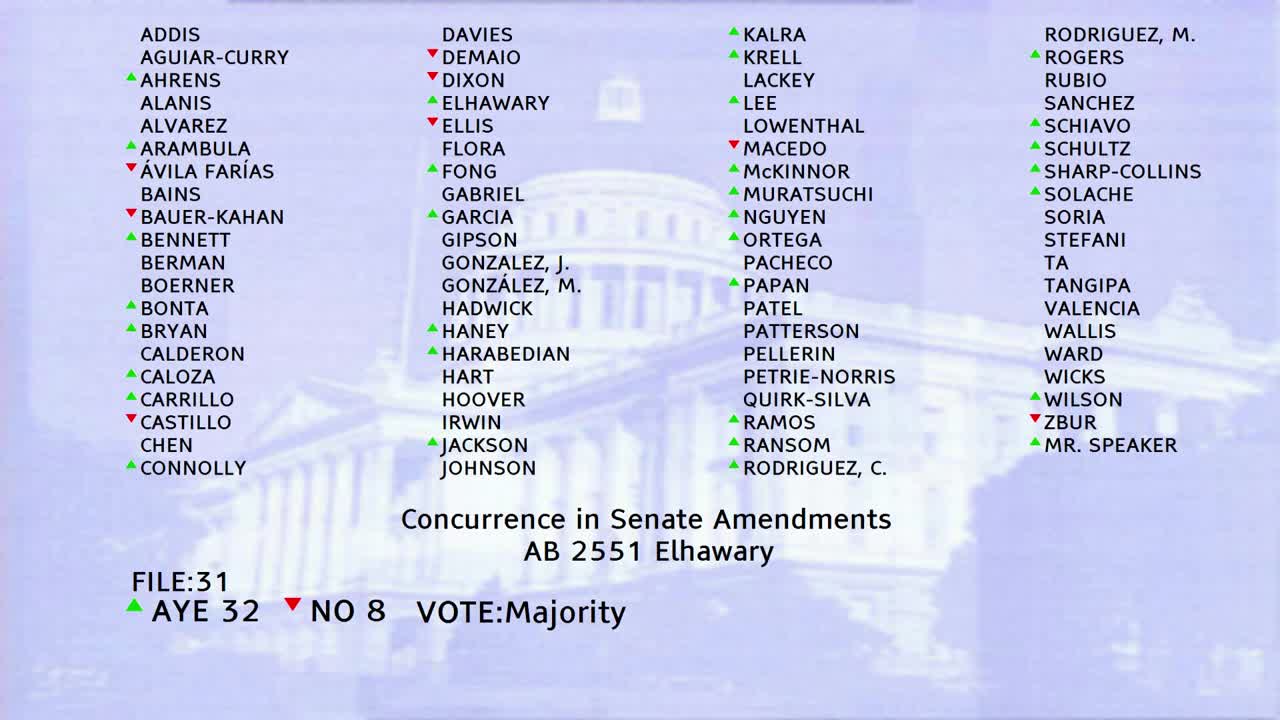 2MIN
Assembly Floor
 17MIN
Assembly Standing Committee on Utilities and Energy
 24MIN
Assembly Standing Committee on Natural Resources
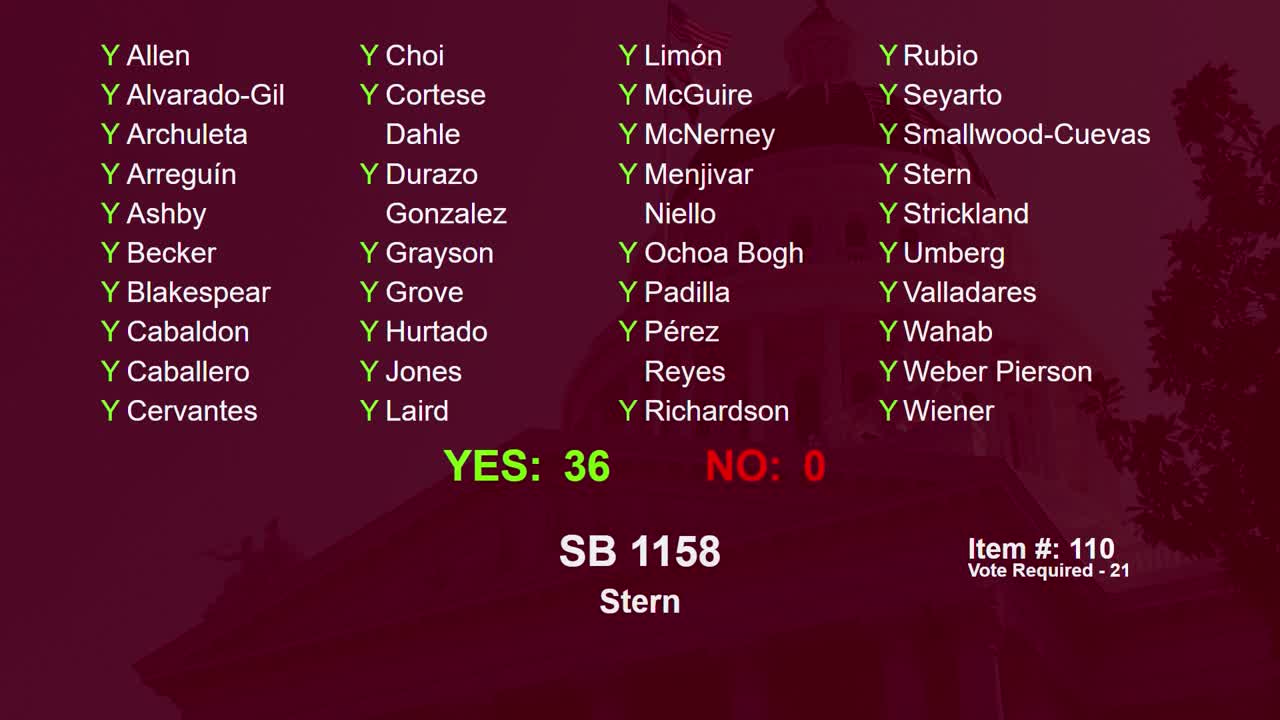 3MIN
Senate Floor
 25MIN
Senate Standing Committee on Energy, Utilities and Communications
 26MIN
Senate Standing Committee on Environmental Quality
Bill Author

Bill Co-Author(s):




