SB 891: Missing and Murdered Indigenous Persons Justice Program.
- Session Year: 2025-2026
- House: Senate
- Latest Version Date: 2026-08-31
Current Status:
In Progress
(2026-09-27: In Senate. Consideration of Governor's veto pending.)
Introduced
In Committee
Awaiting First Chamber Vote
Passed First Chamber
In Committee
Awaiting Second Chamber Vote
Passed Second Chamber
Enacted
Existing law establishes the Department of Justice, and makes the department responsible, in part, for overseeing statewide criminal justice programs.
Existing law requires the Department of Justice to provide technical assistance to local law enforcement agencies and tribal governments relating to, among other things, providing guidance for law enforcement education and training on policing and criminal investigations on Indian lands, providing guidance on improving crime reporting, crime statistics, criminal procedures, and investigative tools, and facilitating and supporting improved communication between local law enforcement agencies and tribal governments.
This bill would establish a Missing and Murdered Indigenous Persons Justice Program within and under the discretion of the Department of Justice. The bill would impose specified responsibilities on the program, including facilitating collaboration and acting as a liaison between tribal victims families, tribal governments, and federal, tribal, state, and out-of-state law enforcement agencies, where appropriate, regarding active and inactive cases involving missing and murdered indigenous persons in California, including cases involving human trafficking. The bill, beginning July 1, 2030, and until January 1, 2033, would require the program to submit an annual report to both houses of the Legislature containing, among other things, aggregated data on the number of, and facts about, cases involving missing and murdered indigenous persons in California.
Existing law establishes the Department of Justice, and makes the department responsible, in part, for overseeing statewide criminal justice programs.
Existing law requires the Department of Justice to provide technical assistance to local law enforcement agencies and tribal governments relating to, among other things, providing guidance for law enforcement education and training on policing and criminal investigations on Indian lands, providing guidance on improving crime reporting, crime statistics, criminal procedures, and investigative tools, and facilitating and supporting improved communication between local law enforcement agencies and tribal governments.
This bill would establish a Missing and Murdered Indigenous Persons Justice Program within and under the discretion of the Department of Justice. The bill would impose specified responsibilities on the program, including facilitating collaboration and acting as a liaison between tribal victims families, tribal governments, and federal, tribal, state, and out-of-state law enforcement agencies, where appropriate, regarding active and inactive cases involving missing and murdered indigenous persons in California, including cases involving human trafficking. The bill, beginning July 1, 2030, and until January 1, 2029, 2033, would require the program to submit an annual report to both houses of the Legislature containing, among other things, data on the number of, and facts about, cases involving missing and murdered indigenous persons in California.
Existing law establishes the Department of Justice, and makes the department responsible, in part, for overseeing statewide criminal justice programs.
Existing law requires the Department of Justice to provide technical assistance to local law enforcement agencies and tribal governments relating to, among other things, providing guidance for law enforcement education and training on policing and criminal investigations on Indian lands, providing guidance on improving crime reporting, crime statistics, criminal procedures, and investigative tools, and facilitating and supporting improved communication between local law enforcement agencies and tribal governments.
This bill would establish a Missing and Murdered Indigenous Persons Justice Program within and under the discretion of the Department of Justice. The bill would impose specified responsibilities on the program, including facilitating collaboration and acting as a liaison between tribal victims families, tribal governments, and federal, tribal, state, and out-of-state law enforcement agencies, where appropriate, regarding active and inactive cases involving missing and murdered indigenous persons in California, including cases involving human trafficking. The bill, until January 1, 2029, would require the program to submit an annual report to both houses of the Legislature containing, among other things, data on the number of, and facts about, cases involving missing and murdered indigenous persons in California.
The Missing and Murdered Indigenous Persons Justice Program is hereby established within and under the discretion of the Department of Justice. The program shall have all of the following responsibilities:
(a)Facilitate collaboration and act as a liaison between tribal victims families, tribal governments, and federal, tribal, state, and out-of-state law enforcement agencies, where appropriate, regarding active and inactive cases involving missing and murdered indigenous persons in California, including cases involving human trafficking.
(b)Provide technical assistance to law enforcement agencies already engaged in investigating cases involving missing and murdered indigenous persons in California, including cases of human trafficking.
(c)(1)Beginning July 1, 2030, publish aggregated data on the number of, and facts about, cases involving missing and murdered indigenous persons in California, where appropriate.
(2)Publications of facts about cases pursuant to paragraph (1) shall include all of the following information, as applicable, about the missing or murdered indigenous person:
(A)General demographic information, including the age, gender, race, and ethnicity of the person.
(B)Any tribal affiliation.
(C)Any history in the foster care system.
(d)(1)Beginning July 1, 2030, submit an annual report to both houses of the Legislature containing all of the following:
(A)The cases the department acted as a liaison pursuant to subdivision (a) and provided technical assistance to law enforcement pursuant to subdivision (b).
(B)The information published pursuant to subdivision (c).
(C)An analysis of all appropriate data, and any recommendations to assist or improve upon necessary collaboration and coordination between local, state, and tribal governments in addressing missing and murdered indigenous persons in California.
(2)(A)The requirement for submitting a report imposed pursuant to this subdivision shall be inoperative on and after January 1, 2033, pursuant to Section 10231.5.
(B)The report to be submitted pursuant to this subdivision shall be submitted in compliance with Section 9795.
The Missing and Murdered Indigenous Persons Justice Program is hereby established within and under the discretion of the Department of Justice. The program shall have all of the following responsibilities:
(a)Facilitate collaboration and act as a liaison between tribal victims families, tribal governments, and federal, tribal, state, and out-of-state law enforcement agencies, where appropriate, regarding active and inactive cases involving missing and murdered indigenous persons in California, including cases involving human trafficking.
(b)Provide technical assistance to law enforcement agencies already engaged in investigating cases involving missing and murdered indigenous persons in California, including cases of human trafficking.
(c)(1)Publish Beginning July 1, 2030, publish data on the number of, and facts about, cases involving missing and murdered indigenous persons in California, where appropriate.
(2)Publications of facts about cases pursuant to paragraph (1) shall include all of the following information, as applicable, about the missing or murdered indigenous person:
(A)General demographic information, including the age, gender, race, and ethnicity of the person.
(B)Any tribal affiliation.
(C)Any history in the foster care system.
(d)(1)Submit Beginning July 1, 2030, submit an annual report to both houses of the Legislature containing all of the following:
(A)The cases the department acted as a liaison pursuant to subdivision (a) and provided technical assistance to law enforcement pursuant to subdivision (b).
(B)The information published pursuant to subdivision (c).
(C)An analysis of all appropriate data, and any recommendations to assist or improve upon necessary collaboration and coordination between local, state, and tribal governments in addressing missing and murdered indigenous persons in California.
(2)(A)The requirement for submitting a report imposed pursuant to this subdivision shall be inoperative on and after January 1, 2029, 2033, pursuant to Section 10231.5.
(B)The report to be submitted pursuant to this subdivision shall be submitted in compliance with Section 9795.
The Missing and Murdered Indigenous Persons Justice Program is hereby established within and under the discretion of the Department of Justice. The program shall have all of the following responsibilities:
(a)Facilitate collaboration and act as a liaison between tribal victims families, tribal governments, and federal, tribal, state, and out-of-state law enforcement agencies, where appropriate, regarding active and inactive cases involving missing and murdered indigenous persons in California, including cases involving human trafficking.
(b)Provide technical assistance to law enforcement agencies already engaged in investigating cases involving missing and murdered indigenous persons in California, including cases of human trafficking.
(c)(1)Publish data on the number of, and facts about, cases involving missing and murdered indigenous persons in California, where appropriate.
(2)Publications of facts about cases pursuant to paragraph (1) shall include all of the following information, as applicable, about the missing or murdered indigenous person:
(A)General demographic information, including the age, gender, race, and ethnicity of the person.
(B)Any tribal affiliation.
(C)Any history in the foster care system.
(d)(1)Submit an annual report to both houses of the Legislature containing all of the following:
(A)The cases the department acted as a liaison pursuant to subdivision (a) and provided technical assistance to law enforcement pursuant to subdivision (b).
(B)The information published pursuant to subdivision (c).
(C)An analysis of all appropriate data, and any recommendations to assist or improve upon necessary collaboration and coordination between local, state, and tribal governments in addressing missing and murdered indigenous persons in California.
(2)(A)The requirement for submitting a report imposed pursuant to this subdivision shall be inoperative on and after January 1, 2029, pursuant to Section 10231.5.
(B)The report to be submitted pursuant to this subdivision shall be submitted in compliance with Section 9795.
The Missing and Murdered Indigenous Persons Justice Program is established within and under the discretion of the Department of Justice. The program shall have all of the following responsibilities:
(a)Facilitate collaboration and act as a liaison between tribal victims families, tribal governments, and federal, tribal, state, and out-of-state law enforcement agencies, where appropriate, regarding active and inactive cases involving missing and murdered indigenous persons in California, including cases involving human trafficking.
(b)Provide technical assistance to law enforcement agencies already engaged in investigating cases involving missing and murdered indigenous persons in California, including cases of human trafficking.
(c)Publish data on the number of, and facts about, cases involving missing and murdered indigenous persons in California, where appropriate.
(d)(1)Submit an annual report to both houses of the Legislature containing all of the following:
(A)The cases the department acted as a liaison pursuant to subdivision (a) and provided technical assistance to law enforcement pursuant to subdivision (b).
(B)The information published pursuant to subdivision (c).
(C)An analysis of all appropriate data, and any recommendations to assist or improve upon necessary collaboration and coordination between local, state, and tribal governments in addressing missing and murdered indigenous persons in California.
(2)(A)The requirement for submitting a report imposed pursuant to this subdivision shall be inoperative on and after January 1, 2029, pursuant to Section 10231.5.
(B)The report to be submitted pursuant to this subdivision shall be submitted in compliance with Section 9795.
|
Date
|
Status
|
|---|---|
| Sep 27, 2026 | In Senate. Consideration of Governor's veto pending. |
| Sep 27, 2026 | Vetoed by the Governor. |
| Sep 4, 2026 | Enrolled and presented to the Governor at 2 p.m. |
| Aug 28, 2026 | Assembly amendments concurred in. (Ayes 40. Noes 0. Page 6076.) Ordered to engrossing and enrolling. |
| Aug 28, 2026 | Assembly amendments concurred in. (Ayes 39. Noes 0.) Ordered to engrossing and enrolling. |
| Aug 27, 2026 | Ordered to special consent calendar. |
| Aug 25, 2026 | In Senate. Concurrence in Assembly amendments pending. |
| Aug 25, 2026 | Read third time. Passed. (Ayes 78. Noes 0. Page 6469.) Ordered to the Senate. |
| Aug 25, 2026 | Read third time. Passed. Ordered to the Senate. |
| Aug 19, 2026 | Ordered to third reading. |
| Aug 19, 2026 | Read third time and amended. |
| Aug 17, 2026 | Read second time. Ordered to third reading. |
| Aug 13, 2026 | Read second time and amended. Ordered to second reading. |
| Aug 13, 2026 | From committee: Do pass as amended. (Ayes 11. Noes 0.) (August 13). |
| Aug 13, 2026 | Assembly Rule 63 suspended. |
| Aug 5, 2026 | August 5 set for first hearing. Placed on suspense file. |
| Jun 9, 2026 | From committee: Do pass and re-refer to Com. on APPR. with recommendation: To consent calendar. (Ayes 9. Noes 0.) (June 9). Re-referred to Com. on APPR. |
| May 26, 2026 | Referred to Com. on PUB. S. |
| May 20, 2026 | In Assembly. Read first time. Held at Desk. |
| May 19, 2026 | Read third time. Passed. (Ayes 39. Noes 0. Page 4356.) Ordered to the Assembly. |
| May 19, 2026 | Read third time. Passed. (Ayes 39. Noes 0.) Ordered to the Assembly. |
| May 18, 2026 | Read second time. Ordered to third reading. |
| May 14, 2026 | From committee: Do pass as amended. (Ayes 7. Noes 0. Page 4256.) (May 14). |
| May 14, 2026 | Read second time and amended. Ordered to second reading. |
| May 14, 2026 | From committee: Do pass as amended. (Ayes 7. Noes 0.) (May 14). |
| May 8, 2026 | Set for hearing May 14. |
| Apr 13, 2026 | April 13 hearing: Placed on APPR. suspense file. |
| Apr 13, 2026 | Set for hearing April 13. |
| Apr 10, 2026 | Set for hearing April 13. |
| Mar 17, 2026 | From committee: Do pass and re-refer to Com. on APPR. with recommendation: To consent calendar. (Ayes 6. Noes 0. Page 3589.) (March 17). Re-referred to Com. on APPR. |
| Mar 17, 2026 | From committee: Do pass and re-refer to Com. on APPR. with recommendation: To consent calendar. (Ayes 6. Noes 0.) (March 17). Re-referred to Com. on APPR. |
| Mar 3, 2026 | Set for hearing March 17. |
| Feb 11, 2026 | Referred to Com. on PUB. S. |
| Jan 15, 2026 | From printer. May be acted upon on or after February 14. |
| Jan 14, 2026 | Introduced. Read first time. To Com. on RLS. for assignment. To print. |
|
Date
|
Description
|
Location
|
Votes
|
|
|---|---|---|---|---|
| Aug 28, 2026 | Special Consent SB891 Cervantes et al. | Senate Floor |
Passed |
|
| Aug 25, 2026 | SB 891 Cervantes Senate Third Reading By Ramos | Assembly Floor |
Passed |
|
| Aug 13, 2026 | Do pass as amended. | Assembly Standing Committee on Appropriations |
Passed |
|
| Jun 9, 2026 | Do pass and be re-referred to the Committee on [Appropriations] with recommendation: To Consent Calendar | Assembly Standing Committee on Public Safety |
Passed |
|
| May 19, 2026 | Senate 3rd Reading SB891 Cervantes et al. | Senate Floor |
Passed |
|
| May 14, 2026 | Do pass as amended | Senate Standing Committee on Appropriations |
Passed |
|
| Apr 13, 2026 | Placed on suspense file | Senate Standing Committee on Appropriations |
Passed |
|
| Mar 17, 2026 | Do pass, but first be re-referred to the Committee on [Appropriations] with the recommendation: To Consent Calendar | Senate Standing Committee on Public Safety |
Passed |
This list shows positions taken on this bill by organizations on the date displayed, which is linked to the original source.
Positions by individuals are not included.
|
Organization
|
Position
|
Date
|
|---|---|---|
| Arcadia Police Officers' Association | ** Support | |
| Brea Police Association | ** Support | |
| Burbank Police Officers' Association | ** Support | |
| California Association of School Police Chiefs | ** Support | |
| California Coalition of School Safety Professionals | ** Support | |
| California Commission on the Status of Women and Girls | ** Support | |
| California Narcotic Officers' Association | ** Support | |
| California Partnership To End Domestic Violence | ** Support | |
| California Reserve Peace Officers Association | ** Support | |
| California Tribal Business Alliance | ** Support | |
| Claremont Police Officers' Association | ** Support | |
| Corona Police Officers Association | ** Support | |
| Culver City Police Officers' Association | ** Support | |
| Ella Baker Center For Human Rights | ** Support | |
| Fullerton Police Officers' Association | ** Support | |
| Habematolel Pomo Of Upper Lake | ** Support | |
| Los Angeles County District Attorney'S Office | ** Support | |
| Los Angeles School Police Management Association | ** Support | |
| los angeles school police officers association | ** Support | |
| Murrieta Police Officers' Association | ** Support | |
| Newport Beach Police Association | ** Support | |
| Palos Verdes Police Officers' Association | ** Support | |
| Placer County Deputy Sheriffs' Association | ** Support | |
| Pomona Police Officers' Association | ** Support | |
| Riverside Police Officers' Association | ** Support | |
| Riverside Sheriffs' Association | ** Support | |
| Santa Ynez Band Of Chumash Indians | ** Support | |
| Scotts Valley Band of Pomo Indians | ** Support | |
| So'oh-shinálí Sister Project | ** Support | |
| So’oh-Shinálí Sister Project | ** Support | |
| Strong Hearted Native Women’s Coalition | ** Support | |
| Wilton Rancheria | ** Support | |
| Yocha Dehe Wintun Nation | ** Support | |
| Yurok Tribe | ** Support |
SENATE RULES COMMITTEE Office of Senate Floor Analyses (916) 651-4171 | SB 891 |
VETO
Bill No: SB 891
Author: Cervantes (D), et al.
Enrolled: 8/31/26
Vote: 27
SENATE PUBLIC SAFETY COMMITTEE: 6-0, 3/17/26
AYES: Arreguín, Seyarto, Caballero, Pérez, Reyes, Wiener
SENATE APPROPRIATIONS COMMITTEE: 7-0, 5/14/26
AYES: Cervantes, Seyarto, Cabaldon, Dahle, Grayson, Richardson, Wahab
SENATE FLOOR: 39-0, 5/19/26
AYES: Allen, Alvarado-Gil, Archuleta, Arreguín, Ashby, Becker, Blakespear, Cabaldon, Caballero, Cervantes, Choi, Cortese, Dahle, Durazo, Gonzalez, Grayson, Grove, Hurtado, Jones, Laird, Limón, McGuire, McNerney, Menjivar, Ochoa Bogh, Padilla, Pérez, Reyes, Richardson, Rubio, Seyarto, Smallwood-Cuevas, Stern, Strickland, Umberg, Valladares, Wahab, Weber Pierson, Wiener
NO VOTE RECORDED: Niello
SENATE FLOOR: 40-0, 8/28/26
AYES: Allen, Alvarado-Gil, Archuleta, Arreguín, Ashby, Becker, Blakespear, Cabaldon, Caballero, Cervantes, Choi, Cortese, Dahle, Durazo, Gonzalez, Grayson, Grove, Hurtado, Jones, Laird, Limón, McGuire, McNerney, Menjivar, Niello, Ochoa Bogh, Padilla, Pérez, Reyes, Richardson, Rubio, Seyarto, Smallwood-Cuevas, Stern, Strickland, Umberg, Valladares, Wahab, Weber Pierson, Wiener
ASSEMBLY FLOOR: 78-0, 8/25/26 - See last page for vote
SUBJECT: Missing and Murdered Indigenous Persons Justice Program
SOURCE: Yurok Tribe
DIGEST:
This bill establishes the Missing and Murdered Indigenous Persons Justice Program within the Department of Justice (DOJ) which would facilitate collaboration between parties in cases of missing and murdered indigenous people.
ANALYSIS:
Existing federal law:
- Defines “Indian country” as: all land within the limits of any Indian reservation under the jurisdiction of the U.S. Government, notwithstanding the issuance of any patent, and, including rights-of-way running through the reservation; all dependent Indian communities within the borders of the U.S. whether within the original or subsequently acquired territory thereof, and whether within or without the limits of a state, and all Indian allotments, the Indian titles to which have not been extinguished, including rights-of-way running through the same. (Title 18 United States Code (U.S.C.) § 1151.)
- Provides concurrent California and Tribal jurisdiction over criminal offenses committed by or against Indians in the areas of Indian country, as specified.
- Provides that the Indian Country affected within California includes all Indian Country within the state. (18 U.S.C. § 1162.)
Existing law:
- Provides that murder is the unlawful killing of a human being, or a fetus, with malice aforethought. (Penal (Pen.) Code, § 187, subd. (a).)
- Requires the Attorney General to establish and maintain the Violent Crime Information Center to assist in the identification and the apprehension of persons responsible for specific violent crimes and for the disappearance and exploitation of persons, particularly children and at-risk adults. (Pen. Code, § 14200, subd. (a).)
- Requires all local police and sheriffs’ departments to accept any report, by any party, including any telephonic report, of a missing person, including runaways, without delay and to give priority to the handling of these reports over the handling of reports relating to crimes involving property. (Pen. Code, § 14211, subd. (a).)
- Requires the local police or sheriff’s department, in cases of reports involving missing persons, including, but not limited to, runaways, to immediately take the report and make an assessment of reasonable steps to be taken to locate the person by using the required report forms, checklists, and guidelines. (Pen. Code, § 14211, subd. (c).)
- Establishes the “feather alert,” a notification system designed to issue and coordinate alerts with respect to endangered indigenous people, specifically indigenous women or indigenous people, who are reported missing. (Government (Gov.) Code, § 8594.13, subd. (a).)
- Provides that a law enforcement agency or Tribe of California may directly request the California Highway Patrol activate a Feather Alert. Specifies that a law enforcement agency may request that a Feather Alert be activated if that agency determines a Feather Alert would be an effective tool in the investigation of missing and murdered indigenous persons, including young women or girls. Requires the law enforcement agency to consider the following factors to make that determination:
- The missing person is an indigenous woman or an indigenous person.
- The investigating law enforcement agency has utilized available local and tribal resources.
- The law enforcement agency determines that the person is missing.
- The law enforcement agency or tribe believes that the person is in danger and is missing under circumstances that indicate that: the missing person’s physical safety may be endangered; the missing person may be subject to trafficking; or the missing person suffers from a mental or physical disability, or a substance use disorder.
- There is information available that, if disseminated to the public, could assist in the safe recovery of the missing person. (Gov. Code, § 8594.13, subds. (c), (e).)
- Establishes the Rural Indian Crime Prevention Program within the Office of Emergency Services. Provides that the purpose of the program is to provide financial and technical assistance for local law enforcement. Requires the program to target the relationship between law enforcement and Native American communities to encourage and to strengthen cooperative efforts and to implement crime suppression and prevention programs. (Pen. Code, § 13847, subd. (a).)
This bill:
- Establishes the Missing and Murdered Indigenous Persons Justice Program (MMIPJP) within and under the discretion of the DOJ. Provides that the program has all the following responsibilities:
- Facilitate collaboration and act as a liaison between tribal victims’ families, tribal governments, and federal, tribal, state, and out-of-state law enforcement agencies, where appropriate, regarding active and inactive cases involving missing and murdered indigenous persons in California, including cases involving human trafficking.
- Provide technical assistance to law enforcement agencies already engaged in investigating cases involving missing and murdered indigenous persons in California, including cases of human trafficking.
- Publish data, beginning July 1, 2030, on the number of, and facts about, cases involving missing and murdered indigenous persons in California, where appropriate.
- Requires the DOJ to submit an annual report, beginning July 1, 2030 until January 1, 2033, to both houses of the Legislature containing all of the following:
- The cases the department acted as a liaison and provided technical assistance to law enforcement.
- The information published on the number of, and facts about, cases involving missing and murdered indigenous persons.
- An analysis of all appropriate data, and any recommendations to assist or improve upon necessary collaboration and coordination between local, state, and tribal governments in addressing missing and murdered indigenous persons in California.
Background
In 2018, the Urban Indian Health Institute (UIHI) published a report after conducting a study “aimed at assessing the number and dynamics of cases of missing and murdered American Indian and Alaska Native women and girls in cities across the United States.” (UIHI, Missing and Murdered Indigenous Women & Girls: A snapshot of date from 71 urban cities in the United States, p.2 available at <https://www.uihi.org/wp-content/uploads/2018/11/Missing-and-Murdered-Indigenous-Women-and-Girls-Report.pdf .) In its report, UIHI cited a National Crime Information Center statistic that there were 5,712 reports of missing American Indian and Alaska Native women and girls made in 2016 although the U.S. Department of Justice’s federal missing persons database only had 116 cases. (Ibid.) That discrepancy as well as the lack of research on rates of violence among American Indian and Alaska Native women living in urban areas—where nearly three quarters of the Indigenous population lives—led UIHI to conduct its study. (Ibid.)
In describing its methodology to collect data on cases of missing and murdered Indigenous women and girls, the UIHI stated:
As demonstrated by the findings of this study, reasons for the lack of quality data include underreporting, racial misclassification, poor relationships between law enforcement and American Indian and Alaska Native communities, poor record-keeping protocols, institutional racism in the media, and a lack of substantive relationships between journalists and American Indian and Alaska Native communities. In an effort to collect as much case data as possible and to be able to compare the five data sources used, UIHI collected data from Freedom of Information Act (FOIA) requests to law enforcement agencies, state and national missing persons databases, searches of local and regional news media online archives, public social media posts, and direct contact with family and community members who volunteered information on missing or murdered loved ones. (Id. at p. 4.)
The report concluded:
UIHI discovered a striking level of inconsistency between community, law enforcement, and media understandings of the magnitude of this violence. If this report demonstrates one powerful conclusion, it is that if we rely solely on law enforcement or media for an awareness or understanding of the issue, we will have a deeply inaccurate picture of the realities, minimizing the extent to which our urban American Indian and Alaska Native sisters experience this violence. This inaccurate picture limits our ability to address this issue at policy, programing, and advocacy levels. (Id. at p. 20.)
This bill seeks to address some of the issues outlined in the report. Specifically, this bill would establish the Missing and Murdered Indigenous Persons Justice Program within DOJ, to facilitate and act as a liaison between parties in cases regarding missing and murdered indigenous people, as well as to collect data from various sources. This bill also requires the DOJ to publish an annual report of its findings beginning in 2030 and until 2033.
FISCAL EFFECT: Appropriation: No Fiscal Com.: Yes Local: No
According to the Assembly Appropriations Committee:
Costs of up to $3 million annually (General Fund) to DOJ to establish and operate the MMIPJP. DOJ reports the department cannot absorb these costs within existing budgeted resources and that implementation is dependent upon an appropriation. DOJ’s estimate spans five divisions and approximately 14 positions, including research and data staff in the California Justice Statistics Center to collect, analyze, and publish MMIP data; a crime analyst in the Missing and Unidentified Persons Section; two special agent supervisors in the Division of Law Enforcement to act as liaisons with tribal governments and law enforcement agencies, plus associated vehicle costs; a dedicated victim advocate in the Victim Services Unit; and analyst and clerical staff in the Office of Native American Affairs to coordinate the program, conduct outreach, and draft the annual report. In addition, DOJ will face one-time IT costs of about $578,000 to reprogram DOJ’s missing persons database and the statewide crime reporting system so DOJ can capture and publish the tribal affiliation and foster care information the bill requires. DOJ’s current estimate is somewhat higher than the department’s estimate on the substantially similar SB 4 (Cervantes), of this legislative session, held on the suspense file in this committee, on which DOJ anticipated costs beginning at $1.4 million and rising to approximately $2.3 million ongoing for nine positions. The increase appears attributable to requiring additional positions, particularly in the California Justice Statistics Center, and the one-time IT modifications tied to the new publication requirements. DOJ reports that its Research Services Branch would absorb related homicide and missing persons statistical workload through June 30, 2029, using limited-term resources provided in connection with SB 108 (Budget Act of 2024), but anticipates needing permanent funding for two research positions beginning July 1, 2029, when that funding expires.
SUPPORT: (Verified 10/1/26)
Yurok Tribe (source)
California Commission on the Status of Women and Girls
California Partnership to End Domestic Violence
California Tribal Business Alliance
Ella Baker Center for Human Rights
Habematolel Pomo of Upper Lake
Scotts Valley Band of Pomo Indians
So’oh-Shinálí Sister Project
Strong Hearted Native Women’s Coalition
Wilton Rancheria
Yocha Dehe Wintun Nation
OPPOSITION: (Verified 10/1/26)
None received
GOVERNOR'S VETO MESSAGE:
This bill would establish the Missing and Murdered Indigenous Persons (MMIP) Justice Program within the Department of Justice to fund and support law enforcement agencies l investigatory activities.
The MMIP crisis is a worldwide issue, recognized in several nations across the globe. As the state with the largest American Indian and Alaska Native population, exceeding 700,000 people, California has taken multiple actions to respond to this urgent public safety and human rights crisis. I have signed numerous bills, including legislation creating the "Feather Alert," a statewide emergency notification system for missing Indigenous people, and, in the 2022 Budget Act, established the MMIP Grant Program to provide California tribal nations with funding to investigate, track, and prevent cases involving missing and murdered Indigenous individuals.
Since its inception, the state has allocated tens of millions of dollars to the MMIP Grant Program and, in this year's budget, we made that funding permanent with a $15 million ongoing allocation. This historic investment reflects the need for sustained action — and California's continued commitment — to confront the disproportionate violence affecting Native communities. While well intentioned, this bill disregards those efforts and creates a new, unfunded program that is duplicative of the work already underway
I am confident that with ongoing resources, California will continue to work closely with tribes across the state to develop strategies to support tribal work and investigations to solve and prevent MMIP cases, therefore making this bill unnecessary.
For these reasons, I cannot sign this bill.
ASSEMBLY FLOOR: 78-0, 8/25/26
AYES: Addis, Aguiar-Curry, Ahrens, Alanis, Alvarez, Arambula, Ávila Farías, Bains, Bauer-Kahan, Bennett, Berman, Boerner, Bonta, Bryan, Calderon, Caloza, Carrillo, Castillo, Chen, Connolly, Davies, DeMaio, Dixon, Elhawary, Ellis, Flora, Fong, Gabriel, Garcia, Gipson, Jeff Gonzalez, Mark González, Hadwick, Haney, Harabedian, Hart, Hoover, Irwin, Jackson, Johnson, Kalra, Krell, Lackey, Lee, Lowenthal, Macedo, Muratsuchi, Nguyen, Ortega, Pacheco, Papan, Patel, Patterson, Pellerin, Petrie-Norris, Quirk-Silva, Ramos, Ransom, Celeste Rodriguez, Michelle Rodriguez, Rogers, Blanca Rubio, Sanchez, Schiavo, Schultz, Sharp-Collins, Solache, Soria, Stefani, Ta, Tangipa, Valencia, Wallis, Ward, Wicks, Wilson, Zbur, Rivas
NO VOTE RECORDED: McKinnor
Prepared by: Stephanie Jordan / PUB. S. /916-651-4118
10/5/26 10:54:36
**** END ****
SENATE RULES COMMITTEE Office of Senate Floor Analyses (916) 651-4171 | SB 891 |
UNFINISHED BUSINESS
Bill No: SB 891
Author: Cervantes (D), et al.
Amended: 8/19/26
Vote: 21
SENATE PUBLIC SAFETY COMMITTEE: 6-0, 3/17/26
AYES: Arreguín, Seyarto, Caballero, Pérez, Reyes, Wiener
SENATE APPROPRIATIONS COMMITTEE: 7-0, 5/14/26
AYES: Cervantes, Seyarto, Cabaldon, Dahle, Grayson, Richardson, Wahab
SENATE FLOOR: 39-0, 5/19/26
AYES: Allen, Alvarado-Gil, Archuleta, Arreguín, Ashby, Becker, Blakespear, Cabaldon, Caballero, Cervantes, Choi, Cortese, Dahle, Durazo, Gonzalez, Grayson, Grove, Hurtado, Jones, Laird, Limón, McGuire, McNerney, Menjivar, Ochoa Bogh, Padilla, Pérez, Reyes, Richardson, Rubio, Seyarto, Smallwood-Cuevas, Stern, Strickland, Umberg, Valladares, Wahab, Weber Pierson, Wiener
NO VOTE RECORDED: Niello
ASSEMBLY FLOOR: 78-0, 8/25/26 - See last page for vote
SUBJECT: Missing and Murdered Indigenous Persons Justice Program
SOURCE: Yurok Tribe
DIGEST:
This bill establishes The Missing and Murdered Indigenous Persons Justice Program within the Department of Justice (DOJ) which facilitates collaboration between parties in cases of missing and murdered indigenous people.
Assembly Amendments
delay the requirement for DOJ to publish specified aggregated data until July 1, 2030, and limit the annual report to publication between 2030 and 2033.
ANALYSIS:
Existing federal law:
- Defines “Indian country” as: all land within the limits of any Indian reservation under the jurisdiction of the U.S. Government, notwithstanding the issuance of any patent, and, including rights-of-way running through the reservation; all dependent Indian communities within the borders of the U.S. whether within the original or subsequently acquired territory thereof, and whether within or without the limits of a state, and all Indian allotments, the Indian titles to which have not been extinguished, including rights-of-way running through the same. (Title 18 United States Code (U.S.C.) § 1151.)
- Provides concurrent California and Tribal jurisdiction over criminal offenses committed by or against Indians in the areas of Indian country, as specified.
- Provides that the Indian Country affected within California includes all Indian Country within the state. (18 U.S.C. § 1162.)
Existing law:
- Provides that murder is the unlawful killing of a human being, or a fetus, with malice aforethought. (Penal (Pen.) Code, § 187, subd. (a).)
- Requires the Attorney General to establish and maintain the Violent Crime Information Center to assist in the identification and the apprehension of persons responsible for specific violent crimes and for the disappearance and exploitation of persons, particularly children and at-risk adults. (Pen. Code, § 14200, subd. (a).)
- Requires all local police and sheriffs’ departments to accept any report, by any party, including any telephonic report, of a missing person, including runaways, without delay and to give priority to the handling of these reports over the handling of reports relating to crimes involving property. (Pen. Code, § 14211, subd. (a).)
- Requires the local police or sheriff’s department, in cases of reports involving missing persons, including, but not limited to, runaways, to immediately take the report and make an assessment of reasonable steps to be taken to locate the person by using the required report forms, checklists, and guidelines. (Pen. Code, § 14211, subd. (c).)
- Establishes the “feather alert,” a notification system designed to issue and coordinate alerts with respect to endangered indigenous people, specifically indigenous women or indigenous people, who are reported missing. (Government (Gov.) Code, § 8594.13, subd. (a).)
- Provides that a law enforcement agency or Tribe of California may directly request the California Highway Patrol activate a Feather Alert. Specifies that a law enforcement agency may request that a Feather Alert be activated if that agency determines a Feather Alert would be an effective tool in the investigation of missing and murdered indigenous persons, including young women or girls. Requires the law enforcement agency to consider the following factors to make that determination:
- The missing person is an indigenous woman or an indigenous person.
- The investigating law enforcement agency has utilized available local and tribal resources.
- The law enforcement agency determines that the person is missing.
- The law enforcement agency or tribe believes that the person is in danger and is missing under circumstances that indicate that: the missing person’s physical safety may be endangered; the missing person may be subject to trafficking; or the missing person suffers from a mental or physical disability, or a substance use disorder.
- There is information available that, if disseminated to the public, could assist in the safe recovery of the missing person. (Gov. Code, § 8594.13, subds. (c), (e).)
- Establishes the Rural Indian Crime Prevention Program within the Office of Emergency Services. Provides that the purpose of the program is to provide financial and technical assistance for local law enforcement. Requires the program to target the relationship between law enforcement and Native American communities to encourage and to strengthen cooperative efforts and to implement crime suppression and prevention programs. (Pen. Code, § 13847, subd. (a).)
This bill:
- Establishes the Missing and Murdered Indigenous Persons Justice Program (MMIPJP) within and under the discretion of the DOJ. Provides that the program has all the following responsibilities:
- Facilitate collaboration and act as a liaison between tribal victims’ families, tribal governments, and federal, tribal, state, and out-of-state law enforcement agencies, where appropriate, regarding active and inactive cases involving missing and murdered indigenous persons in California, including cases involving human trafficking.
- Provide technical assistance to law enforcement agencies already engaged in investigating cases involving missing and murdered indigenous persons in California, including cases of human trafficking.
- Publish data, beginning July 1, 2030, on the number of, and facts about, cases involving missing and murdered indigenous persons in California, where appropriate.
- Requires the DOJ to submit an annual report, beginning July 1, 2030 until January 1, 2033, to both houses of the Legislature containing all of the following:
- The cases the department acted as a liaison and provided technical assistance to law enforcement.
- The information published on the number of, and facts about, cases involving missing and murdered indigenous persons.
- An analysis of all appropriate data, and any recommendations to assist or improve upon necessary collaboration and coordination between local, state, and tribal governments in addressing missing and murdered indigenous persons in California.
Background
In 2018, the Urban Indian Health Institute (UIHI) published a report after conducting a study “aimed at assessing the number and dynamics of cases of missing and murdered American Indian and Alaska Native women and girls in cities across the United States.” (UIHI, Missing and Murdered Indigenous Women & Girls: A snapshot of date from 71 urban cities in the United States, p.2 available at <https://www.uihi.org/wp-content/uploads/2018/11/Missing-and-Murdered-Indigenous-Women-and-Girls-Report.pdf .) In its report, UIHI cited a National Crime Information Center statistic that there were 5,712 reports of missing American Indian and Alaska Native women and girls made in 2016 although the U.S. Department of Justice’s federal missing persons database only had 116 cases. (Ibid.) That discrepancy as well as the lack of research on rates of violence among American Indian and Alaska Native women living in urban areas—where nearly three quarters of the Indigenous population lives—led UIHI to conduct its study. (Ibid.)
In describing its methodology to collect data on cases of missing and murdered Indigenous women and girls, the UIHI stated:
As demonstrated by the findings of this study, reasons for the lack of quality data include underreporting, racial misclassification, poor relationships between law enforcement and American Indian and Alaska Native communities, poor record-keeping protocols, institutional racism in the media, and a lack of substantive relationships between journalists and American Indian and Alaska Native communities. In an effort to collect as much case data as possible and to be able to compare the five data sources used, UIHI collected data from Freedom of Information Act (FOIA) requests to law enforcement agencies, state and national missing persons databases, searches of local and regional news media online archives, public social media posts, and direct contact with family and community members who volunteered information on missing or murdered loved ones. (Id. at p. 4.)
The report concluded:
UIHI discovered a striking level of inconsistency between community, law enforcement, and media understandings of the magnitude of this violence. If this report demonstrates one powerful conclusion, it is that if we rely solely on law enforcement or media for an awareness or understanding of the issue, we will have a deeply inaccurate picture of the realities, minimizing the extent to which our urban American Indian and Alaska Native sisters experience this violence. This inaccurate picture limits our ability to address this issue at policy, programing, and advocacy levels. (Id. at p. 20.)
This bill seeks to address some of the issues outlined in the report. Specifically, this bill establishes the Missing and Murdered Indigenous Persons Justice Program within DOJ, to facilitate and act as a liaison between parties in cases regarding missing and murdered indigenous people, as well as to collect data from various sources. This bill also requires the DOJ to publish an annual report of its findings beginning in 2030 and until 2033.
FISCAL EFFECT: Appropriation: No Fiscal Com.: Yes Local: No
According to the Assembly Appropriations Committee:
Costs of up to $3 million annually (General Fund) to DOJ to establish and operate the MMIPJP. DOJ reports the department cannot absorb these costs within existing budgeted resources and that implementation is dependent upon an appropriation. DOJ’s estimate spans five divisions and approximately 14 positions, including research and data staff in the California Justice Statistics Center to collect, analyze, and publish MMIP data; a crime analyst in the Missing and Unidentified Persons Section; two special agent supervisors in the Division of Law Enforcement to act as liaisons with tribal governments and law enforcement agencies, plus associated vehicle costs; a dedicated victim advocate in the Victim Services Unit; and analyst and clerical staff in the Office of Native American Affairs to coordinate the program, conduct outreach, and draft the annual report. In addition, DOJ will face one-time IT costs of about $578,000 to reprogram DOJ’s missing persons database and the statewide crime reporting system so DOJ can capture and publish the tribal affiliation and foster care information the bill requires. DOJ’s current estimate is somewhat higher than the department’s estimate on the substantially similar SB 4 (Cervantes), of this legislative session, held on the suspense file in this committee, on which DOJ anticipated costs beginning at $1.4 million and rising to approximately $2.3 million ongoing for nine positions. The increase appears attributable to requiring additional positions, particularly in the California Justice Statistics Center, and the one-time IT modifications tied to the new publication requirements. DOJ reports that its Research Services Branch would absorb related homicide and missing persons statistical workload through June 30, 2029, using limited-term resources provided in connection with SB 108 (Budget Act of 2024), but anticipates needing permanent funding for two research positions beginning July 1, 2029, when that funding expires.
SUPPORT: (Verified 8/25/26)
Yurok Tribe (source)
California Commission on the Status of Women and Girls
California Partnership to End Domestic Violence
California Tribal Business Alliance
Ella Baker Center for Human Rights
Habematolel Pomo of Upper Lake
Scotts Valley Band of Pomo Indians
So'oh-Shinálí Sister Project
Strong Hearted Native Women’s Coalition
Wilton Rancheria
Yocha Dehe Wintun Nation
OPPOSITION: (Verified 8/25/26)
None received
ASSEMBLY FLOOR: 78-0, 8/25/26
AYES: Addis, Aguiar-Curry, Ahrens, Alanis, Alvarez, Arambula, Ávila Farías, Bains, Bauer-Kahan, Bennett, Berman, Boerner, Bonta, Bryan, Calderon, Caloza, Carrillo, Castillo, Chen, Connolly, Davies, DeMaio, Dixon, Elhawary, Ellis, Flora, Fong, Gabriel, Garcia, Gipson, Jeff Gonzalez, Mark González, Hadwick, Haney, Harabedian, Hart, Hoover, Irwin, Jackson, Johnson, Kalra, Krell, Lackey, Lee, Lowenthal, Macedo, Muratsuchi, Nguyen, Ortega, Pacheco, Papan, Patel, Patterson, Pellerin, Petrie-Norris, Quirk-Silva, Ramos, Ransom, Celeste Rodriguez, Michelle Rodriguez, Rogers, Blanca Rubio, Sanchez, Schiavo, Schultz, Sharp-Collins, Solache, Soria, Stefani, Ta, Tangipa, Valencia, Wallis, Ward, Wicks, Wilson, Zbur, Rivas
NO VOTE RECORDED: McKinnor
Prepared by: Stephanie Jordan / PUB. S. /
9/22/26 12:39:02
**** END ****
SENATE RULES COMMITTEE Office of Senate Floor Analyses (916) 651-4171 | SB 891 |
UNFINISHED BUSINESS
Bill No: SB 891
Author: Cervantes (D), et al.
Amended: 8/19/26
Vote: 21
SENATE PUBLIC SAFETY COMMITTEE: 6-0, 3/17/26
AYES: Arreguín, Seyarto, Caballero, Pérez, Reyes, Wiener
SENATE APPROPRIATIONS COMMITTEE: 7-0, 5/14/26
AYES: Cervantes, Seyarto, Cabaldon, Dahle, Grayson, Richardson, Wahab
SENATE FLOOR: 39-0, 5/19/26
AYES: Allen, Alvarado-Gil, Archuleta, Arreguín, Ashby, Becker, Blakespear, Cabaldon, Caballero, Cervantes, Choi, Cortese, Dahle, Durazo, Gonzalez, Grayson, Grove, Hurtado, Jones, Laird, Limón, McGuire, McNerney, Menjivar, Ochoa Bogh, Padilla, Pérez, Reyes, Richardson, Rubio, Seyarto, Smallwood-Cuevas, Stern, Strickland, Umberg, Valladares, Wahab, Weber Pierson, Wiener
NO VOTE RECORDED: Niello
ASSEMBLY FLOOR: Passed, 8/25/26
SUBJECT: Missing and Murdered Indigenous Persons Justice Program
SOURCE: Yurok Tribe
DIGEST:
This bill establishes The Missing and Murdered Indigenous Persons Justice Program within the Department of Justice (DOJ) which facilitates collaboration between parties in cases of missing and murdered indigenous people.
Assembly Amendments
delay the requirement for DOJ to publish specified aggregated data until July 1, 2030, and limit the annual report to publication between 2030 and 2033.
ANALYSIS:
Existing federal law:
- Defines “Indian country” as: all land within the limits of any Indian reservation under the jurisdiction of the U.S. Government, notwithstanding the issuance of any patent, and, including rights-of-way running through the reservation; all dependent Indian communities within the borders of the U.S. whether within the original or subsequently acquired territory thereof, and whether within or without the limits of a state, and all Indian allotments, the Indian titles to which have not been extinguished, including rights-of-way running through the same. (Title 18 United States Code (U.S.C.) § 1151.)
- Provides concurrent California and Tribal jurisdiction over criminal offenses committed by or against Indians in the areas of Indian country, as specified.
- Provides that the Indian Country affected within California includes all Indian Country within the state. (18 U.S.C. § 1162.)
Existing law:
- Provides that murder is the unlawful killing of a human being, or a fetus, with malice aforethought. (Penal (Pen.) Code, § 187, subd. (a).)
- Requires the Attorney General to establish and maintain the Violent Crime Information Center to assist in the identification and the apprehension of persons responsible for specific violent crimes and for the disappearance and exploitation of persons, particularly children and at-risk adults. (Pen. Code, § 14200, subd. (a).)
- Requires all local police and sheriffs’ departments to accept any report, by any party, including any telephonic report, of a missing person, including runaways, without delay and to give priority to the handling of these reports over the handling of reports relating to crimes involving property. (Pen. Code, § 14211, subd. (a).)
- Requires the local police or sheriff’s department, in cases of reports involving missing persons, including, but not limited to, runaways, to immediately take the report and make an assessment of reasonable steps to be taken to locate the person by using the required report forms, checklists, and guidelines. (Pen. Code, § 14211, subd. (c).)
- Establishes the “feather alert,” a notification system designed to issue and coordinate alerts with respect to endangered indigenous people, specifically indigenous women or indigenous people, who are reported missing. (Government (Gov.) Code, § 8594.13, subd. (a).)
- Provides that a law enforcement agency or Tribe of California may directly request the California Highway Patrol activate a Feather Alert. Specifies that a law enforcement agency may request that a Feather Alert be activated if that agency determines a Feather Alert would be an effective tool in the investigation of missing and murdered indigenous persons, including young women or girls. Requires the law enforcement agency to consider the following factors to make that determination:
- The missing person is an indigenous woman or an indigenous person.
- The investigating law enforcement agency has utilized available local and tribal resources.
- The law enforcement agency determines that the person is missing.
- The law enforcement agency or tribe believes that the person is in danger and is missing under circumstances that indicate that: the missing person’s physical safety may be endangered; the missing person may be subject to trafficking; or the missing person suffers from a mental or physical disability, or a substance use disorder.
- There is information available that, if disseminated to the public, could assist in the safe recovery of the missing person. (Gov. Code, § 8594.13, subds. (c), (e).)
- Establishes the Rural Indian Crime Prevention Program within the Office of Emergency Services. Provides that the purpose of the program is to provide financial and technical assistance for local law enforcement. Requires the program to target the relationship between law enforcement and Native American communities to encourage and to strengthen cooperative efforts and to implement crime suppression and prevention programs. (Pen. Code, § 13847, subd. (a).)
This bill:
- Establishes the Missing and Murdered Indigenous Persons Justice Program (MMIPJP) within and under the discretion of the DOJ. Provides that the program has all the following responsibilities:
- Facilitate collaboration and act as a liaison between tribal victims’ families, tribal governments, and federal, tribal, state, and out-of-state law enforcement agencies, where appropriate, regarding active and inactive cases involving missing and murdered indigenous persons in California, including cases involving human trafficking.
- Provide technical assistance to law enforcement agencies already engaged in investigating cases involving missing and murdered indigenous persons in California, including cases of human trafficking.
- Publish data, beginning July 1, 2030, on the number of, and facts about, cases involving missing and murdered indigenous persons in California, where appropriate.
- Requires the DOJ to submit an annual report, beginning July 1, 2030 until January 1, 2033, to both houses of the Legislature containing all of the following:
- The cases the department acted as a liaison and provided technical assistance to law enforcement.
- The information published on the number of, and facts about, cases involving missing and murdered indigenous persons.
- An analysis of all appropriate data, and any recommendations to assist or improve upon necessary collaboration and coordination between local, state, and tribal governments in addressing missing and murdered indigenous persons in California.
Background
In 2018, the Urban Indian Health Institute (UIHI) published a report after conducting a study “aimed at assessing the number and dynamics of cases of missing and murdered American Indian and Alaska Native women and girls in cities across the United States.” (UIHI, Missing and Murdered Indigenous Women & Girls: A snapshot of date from 71 urban cities in the United States, p.2 available at <https://www.uihi.org/wp-content/uploads/2018/11/Missing-and-Murdered-Indigenous-Women-and-Girls-Report.pdf .) In its report, UIHI cited a National Crime Information Center statistic that there were 5,712 reports of missing American Indian and Alaska Native women and girls made in 2016 although the U.S. Department of Justice’s federal missing persons database only had 116 cases. (Ibid.) That discrepancy as well as the lack of research on rates of violence among American Indian and Alaska Native women living in urban areas—where nearly three quarters of the Indigenous population lives—led UIHI to conduct its study. (Ibid.)
In describing its methodology to collect data on cases of missing and murdered Indigenous women and girls, the UIHI stated:
As demonstrated by the findings of this study, reasons for the lack of quality data include underreporting, racial misclassification, poor relationships between law enforcement and American Indian and Alaska Native communities, poor record-keeping protocols, institutional racism in the media, and a lack of substantive relationships between journalists and American Indian and Alaska Native communities. In an effort to collect as much case data as possible and to be able to compare the five data sources used, UIHI collected data from Freedom of Information Act (FOIA) requests to law enforcement agencies, state and national missing persons databases, searches of local and regional news media online archives, public social media posts, and direct contact with family and community members who volunteered information on missing or murdered loved ones. (Id. at p. 4.)
The report concluded:
UIHI discovered a striking level of inconsistency between community, law enforcement, and media understandings of the magnitude of this violence. If this report demonstrates one powerful conclusion, it is that if we rely solely on law enforcement or media for an awareness or understanding of the issue, we will have a deeply inaccurate picture of the realities, minimizing the extent to which our urban American Indian and Alaska Native sisters experience this violence. This inaccurate picture limits our ability to address this issue at policy, programing, and advocacy levels. (Id. at p. 20.)
This bill seeks to address some of the issues outlined in the report. Specifically, this bill establishes the Missing and Murdered Indigenous Persons Justice Program within DOJ, to facilitate and act as a liaison between parties in cases regarding missing and murdered indigenous people, as well as to collect data from various sources. This bill also requires the DOJ to publish an annual report of its findings beginning in 2030 and until 2033.
FISCAL EFFECT: Appropriation: No Fiscal Com.: Yes Local: No
According to the Assembly Appropriations Committee:
Costs of up to $3 million annually (General Fund) to DOJ to establish and operate the MMIPJP. DOJ reports the department cannot absorb these costs within existing budgeted resources and that implementation is dependent upon an appropriation. DOJ’s estimate spans five divisions and approximately 14 positions, including research and data staff in the California Justice Statistics Center to collect, analyze, and publish MMIP data; a crime analyst in the Missing and Unidentified Persons Section; two special agent supervisors in the Division of Law Enforcement to act as liaisons with tribal governments and law enforcement agencies, plus associated vehicle costs; a dedicated victim advocate in the Victim Services Unit; and analyst and clerical staff in the Office of Native American Affairs to coordinate the program, conduct outreach, and draft the annual report. In addition, DOJ will face one-time IT costs of about $578,000 to reprogram DOJ’s missing persons database and the statewide crime reporting system so DOJ can capture and publish the tribal affiliation and foster care information the bill requires. DOJ’s current estimate is somewhat higher than the department’s estimate on the substantially similar SB 4 (Cervantes), of this legislative session, held on the suspense file in this committee, on which DOJ anticipated costs beginning at $1.4 million and rising to approximately $2.3 million ongoing for nine positions. The increase appears attributable to requiring additional positions, particularly in the California Justice Statistics Center, and the one-time IT modifications tied to the new publication requirements. DOJ reports that its Research Services Branch would absorb related homicide and missing persons statistical workload through June 30, 2029, using limited-term resources provided in connection with SB 108 (Budget Act of 2024), but anticipates needing permanent funding for two research positions beginning July 1, 2029, when that funding expires.
SUPPORT: (Verified 8/25/26)
Yurok Tribe (source)
California Commission on the Status of Women and Girls
California Partnership to End Domestic Violence
California Tribal Business Alliance
Ella Baker Center for Human Rights
Habematolel Pomo of Upper Lake
Scotts Valley Band of Pomo Indians
So'oh-Shinálí Sister Project
Strong Hearted Native Women’s Coalition
Wilton Rancheria
Yocha Dehe Wintun Nation
OPPOSITION: (Verified 8/25/26)
None received
Prepared by: Stephanie Jordan / PUB. S. /
8/26/26 11:18:43
**** END ****
SENATE RULES COMMITTEE Office of Senate Floor Analyses (916) 651-4171 | SB 891 |
UNFINISHED BUSINESS
Bill No: SB 891
Author: Cervantes (D), et al.
Amended: 8/13/26
Vote: 21
SENATE PUBLIC SAFETY COMMITTEE: 6-0, 3/17/26
AYES: Arreguín, Seyarto, Caballero, Pérez, Reyes, Wiener
SENATE APPROPRIATIONS COMMITTEE: 7-0, 5/14/26
AYES: Cervantes, Seyarto, Cabaldon, Dahle, Grayson, Richardson, Wahab
SENATE FLOOR: 39-0, 5/19/26
AYES: Allen, Alvarado-Gil, Archuleta, Arreguín, Ashby, Becker, Blakespear, Cabaldon, Caballero, Cervantes, Choi, Cortese, Dahle, Durazo, Gonzalez, Grayson, Grove, Hurtado, Jones, Laird, Limón, McGuire, McNerney, Menjivar, Ochoa Bogh, Padilla, Pérez, Reyes, Richardson, Rubio, Seyarto, Smallwood-Cuevas, Stern, Strickland, Umberg, Valladares, Wahab, Weber Pierson, Wiener
NO VOTE RECORDED: Niello
ASSEMBLY FLOOR: Passed, 8/25/26
SUBJECT: Missing and Murdered Indigenous Persons Justice Program
SOURCE: Yurok Tribe
DIGEST:
This bill establishes The Missing and Murdered Indigenous Persons Justice Program within the Department of Justice (DOJ) which facilitates collaboration between parties in cases of missing and murdered indigenous people.
Assembly Amendments
delay the requirement for DOJ to publish specified aggregated data until July 1, 2030, and limit the annual report to publication between 2030 and 2033.
ANALYSIS:
Existing federal law:
- Defines “Indian country” as: all land within the limits of any Indian reservation under the jurisdiction of the U.S. Government, notwithstanding the issuance of any patent, and, including rights-of-way running through the reservation; all dependent Indian communities within the borders of the U.S. whether within the original or subsequently acquired territory thereof, and whether within or without the limits of a state, and all Indian allotments, the Indian titles to which have not been extinguished, including rights-of-way running through the same. (Title 18 United States Code (U.S.C.) § 1151.)
- Provides concurrent California and Tribal jurisdiction over criminal offenses committed by or against Indians in the areas of Indian country, as specified.
- Provides that the Indian Country affected within California includes all Indian Country within the state. (18 U.S.C. § 1162.)
Existing law:
- Provides that murder is the unlawful killing of a human being, or a fetus, with malice aforethought. (Penal (Pen.) Code, § 187, subd. (a).)
- Requires the Attorney General to establish and maintain the Violent Crime Information Center to assist in the identification and the apprehension of persons responsible for specific violent crimes and for the disappearance and exploitation of persons, particularly children and at-risk adults. (Pen. Code, § 14200, subd. (a).)
- Requires all local police and sheriffs’ departments to accept any report, by any party, including any telephonic report, of a missing person, including runaways, without delay and to give priority to the handling of these reports over the handling of reports relating to crimes involving property. (Pen. Code, § 14211, subd. (a).)
- Requires the local police or sheriff’s department, in cases of reports involving missing persons, including, but not limited to, runaways, to immediately take the report and make an assessment of reasonable steps to be taken to locate the person by using the required report forms, checklists, and guidelines. (Pen. Code, § 14211, subd. (c).)
- Establishes the “feather alert,” a notification system designed to issue and coordinate alerts with respect to endangered indigenous people, specifically indigenous women or indigenous people, who are reported missing. (Government (Gov.) Code, § 8594.13, subd. (a).)
- Provides that a law enforcement agency or Tribe of California may directly request the California Highway Patrol activate a Feather Alert. Specifies that a law enforcement agency may request that a Feather Alert be activated if that agency determines a Feather Alert would be an effective tool in the investigation of missing and murdered indigenous persons, including young women or girls. Requires the law enforcement agency to consider the following factors to make that determination:
- The missing person is an indigenous woman or an indigenous person.
- The investigating law enforcement agency has utilized available local and tribal resources.
- The law enforcement agency determines that the person is missing.
- The law enforcement agency or tribe believes that the person is in danger and is missing under circumstances that indicate that: the missing person’s physical safety may be endangered; the missing person may be subject to trafficking; or the missing person suffers from a mental or physical disability, or a substance use disorder.
- There is information available that, if disseminated to the public, could assist in the safe recovery of the missing person. (Gov. Code, § 8594.13, subds. (c), (e).)
- Establishes the Rural Indian Crime Prevention Program within the Office of Emergency Services. Provides that the purpose of the program is to provide financial and technical assistance for local law enforcement. Requires the program to target the relationship between law enforcement and Native American communities to encourage and to strengthen cooperative efforts and to implement crime suppression and prevention programs. (Pen. Code, § 13847, subd. (a).)
This bill:
- Establishes the Missing and Murdered Indigenous Persons Justice Program (MMIPJP) within and under the discretion of the DOJ. Provides that the program has all the following responsibilities:
- Facilitate collaboration and act as a liaison between tribal victims’ families, tribal governments, and federal, tribal, state, and out-of-state law enforcement agencies, where appropriate, regarding active and inactive cases involving missing and murdered indigenous persons in California, including cases involving human trafficking.
- Provide technical assistance to law enforcement agencies already engaged in investigating cases involving missing and murdered indigenous persons in California, including cases of human trafficking.
- Publish data, beginning July 1, 2030, on the number of, and facts about, cases involving missing and murdered indigenous persons in California, where appropriate.
- Requires the DOJ to submit an annual report, beginning July 1, 2030 until January 1, 2033, to both houses of the Legislature containing all of the following:
- The cases the department acted as a liaison and provided technical assistance to law enforcement.
- The information published on the number of, and facts about, cases involving missing and murdered indigenous persons.
- An analysis of all appropriate data, and any recommendations to assist or improve upon necessary collaboration and coordination between local, state, and tribal governments in addressing missing and murdered indigenous persons in California.
Background
In 2018, the Urban Indian Health Institute (UIHI) published a report after conducting a study “aimed at assessing the number and dynamics of cases of missing and murdered American Indian and Alaska Native women and girls in cities across the United States.” (UIHI, Missing and Murdered Indigenous Women & Girls: A snapshot of date from 71 urban cities in the United States, p.2 available at <https://www.uihi.org/wp-content/uploads/2018/11/Missing-and-Murdered-Indigenous-Women-and-Girls-Report.pdf .) In its report, UIHI cited a National Crime Information Center statistic that there were 5,712 reports of missing American Indian and Alaska Native women and girls made in 2016 although the U.S. Department of Justice’s federal missing persons database only had 116 cases. (Ibid.) That discrepancy as well as the lack of research on rates of violence among American Indian and Alaska Native women living in urban areas—where nearly three quarters of the Indigenous population lives—led UIHI to conduct its study. (Ibid.)
In describing its methodology to collect data on cases of missing and murdered Indigenous women and girls, the UIHI stated:
As demonstrated by the findings of this study, reasons for the lack of quality data include underreporting, racial misclassification, poor relationships between law enforcement and American Indian and Alaska Native communities, poor record-keeping protocols, institutional racism in the media, and a lack of substantive relationships between journalists and American Indian and Alaska Native communities. In an effort to collect as much case data as possible and to be able to compare the five data sources used, UIHI collected data from Freedom of Information Act (FOIA) requests to law enforcement agencies, state and national missing persons databases, searches of local and regional news media online archives, public social media posts, and direct contact with family and community members who volunteered information on missing or murdered loved ones. (Id. at p. 4.)
The report concluded:
UIHI discovered a striking level of inconsistency between community, law enforcement, and media understandings of the magnitude of this violence. If this report demonstrates one powerful conclusion, it is that if we rely solely on law enforcement or media for an awareness or understanding of the issue, we will have a deeply inaccurate picture of the realities, minimizing the extent to which our urban American Indian and Alaska Native sisters experience this violence. This inaccurate picture limits our ability to address this issue at policy, programing, and advocacy levels. (Id. at p. 20.)
This bill seeks to address some of the issues outlined in the report. Specifically, this bill establishes the Missing and Murdered Indigenous Persons Justice Program within DOJ, to facilitate and act as a liaison between parties in cases regarding missing and murdered indigenous people, as well as to collect data from various sources. This bill also requires the DOJ to publish an annual report of its findings beginning in 2030 and until 2033.
FISCAL EFFECT: Appropriation: No Fiscal Com.: Yes Local: No
According to the Assembly Appropriations Committee:
Costs of up to $3 million annually (General Fund) to DOJ to establish and operate the MMIPJP. DOJ reports the department cannot absorb these costs within existing budgeted resources and that implementation is dependent upon an appropriation. DOJ’s estimate spans five divisions and approximately 14 positions, including research and data staff in the California Justice Statistics Center to collect, analyze, and publish MMIP data; a crime analyst in the Missing and Unidentified Persons Section; two special agent supervisors in the Division of Law Enforcement to act as liaisons with tribal governments and law enforcement agencies, plus associated vehicle costs; a dedicated victim advocate in the Victim Services Unit; and analyst and clerical staff in the Office of Native American Affairs to coordinate the program, conduct outreach, and draft the annual report. In addition, DOJ will face one-time IT costs of about $578,000 to reprogram DOJ’s missing persons database and the statewide crime reporting system so DOJ can capture and publish the tribal affiliation and foster care information the bill requires. DOJ’s current estimate is somewhat higher than the department’s estimate on the substantially similar SB 4 (Cervantes), of this legislative session, held on the suspense file in this committee, on which DOJ anticipated costs beginning at $1.4 million and rising to approximately $2.3 million ongoing for nine positions. The increase appears attributable to requiring additional positions, particularly in the California Justice Statistics Center, and the one-time IT modifications tied to the new publication requirements. DOJ reports that its Research Services Branch would absorb related homicide and missing persons statistical workload through June 30, 2029, using limited-term resources provided in connection with SB 108 (Budget Act of 2024), but anticipates needing permanent funding for two research positions beginning July 1, 2029, when that funding expires.
SUPPORT: (Verified 8/25/26)
Yurok Tribe (source)
California Commission on the Status of Women and Girls
California Partnership to End Domestic Violence
California Tribal Business Alliance
Ella Baker Center for Human Rights
Habematolel Pomo of Upper Lake
Scotts Valley Band of Pomo Indians
So'oh-Shinálí Sister Project
Strong Hearted Native Women’s Coalition
Wilton Rancheria
Yocha Dehe Wintun Nation
OPPOSITION: (Verified 8/25/26)
None received
Prepared by: Stephanie Jordan / PUB. S. /
8/25/26 13:35:34
**** END ****
SENATE THIRD READING
STR Bill Id:SB 891
Author:(Cervantes)
As Amended Ver:August 19, 2026
Majority vote
SUMMARY
Establishes a Missing and Murdered Indigenous Persons Justice Program (MMIPJP) within the Department of Justice (DOJ) that would impose certain responsibilities, including facilitating collaboration and acting as a liaison between tribal entities and federal, tribal, state, and out-of-state law enforcement agencies.
Major Provisions
- Establishes MMIPJP and states the program shall have all of the following responsibilities:
- Facilitate collaboration and act as a liaison between tribal victims′ families, tribal governments, and federal, tribal, state, and out-of-state law enforcement agencies, where appropriate, regarding active and inactive cases involving missing and murdered indigenous persons in California, including cases involving human trafficking;
- Provide technical assistance to law enforcement agencies already engaged in investigating cases involving missing and murdered indigenous persons in California, including cases of human trafficking; and,
- Publish aggregated data on the number of, and facts about, cases involving missing and murdered indigenous persons in California, where appropriate, and beginning on January 1, 2030.
- Publications of facts as required above shall include all of the following information, as applicable, about the missing or murdered indigenous person:
- General demographic information, including the age, gender, race, and ethnicity of the person;
- Any tribal affiliation; and,
- Any history in the foster care system.
- Requires submission of an annual report, beginning July 1, 2030, to both houses of the Legislature containing all of the following:
- The cases DOJ acted as a liaison and provided technical assistance to law enforcement, as defined;
- The information published on cases involving missing and murdered indigenous persons in California, as defined; and,
- An analysis of all appropriate data, and any recommendations to assist or improve upon necessary collaboration and coordination between local, state, and tribal governments in addressing missing and murdered indigenous persons in California.
- Provides that the requirement for submitting a report is inoperative on and after January 1, 2033.
COMMENTS
Background: In 2018, UIHI published a report ″aimed at assessing the number and dynamics of cases of missing and murdered American Indian and Alaska Native women and girls in cities across the United States.″ In its report, UIHI cited National Crime Information Center data that noted 5,712 reports of missing American Indian and Alaska Native women and girls made in 2016, although the United States Department of Justice′s (U.S. DOJ) federal missing persons database only had 116 cases. That discrepancy as well as the lack of research on rates of violence among American Indian and Alaska Native women living in urban areas—where nearly three quarters of the Indigenous population lives—led UIHI to conduct its study.
In describing its methodology to collect data on cases of missing and murdered Indigenous women and girls, the UIHI stated:
As demonstrated by the findings of this study, reasons for the lack of quality data include underreporting, racial misclassification, poor relationships between law enforcement and American Indian and Alaska Native communities, poor record-keeping protocols, institutional racism in the media, and a lack of substantive relationships between journalists and American Indian and Alaska Native communities. In an effort to collect as much case data as possible and to be able to compare the five data sources used, UIHI collected data from Freedom of Information Act (FOIA) requests to law enforcement agencies, state and national missing persons databases, searches of local and regional news media online archives, public social media posts, and direct contact with family and community members who volunteered information on missing or murdered loved ones.
The report concluded:
UIHI discovered a striking level of inconsistency between community, law enforcement, and media understandings of the magnitude of this violence. If this report demonstrates one powerful conclusion, it is that if we rely solely on law enforcement or media for an awareness or understanding of the issue, we will have a deeply inaccurate picture of the realities, minimizing the extent to which our urban American Indian and Alaska Native sisters experience this violence. This inaccurate picture limits our ability to address this issue at policy, programing, and advocacy levels.
SB 891 seeks to address some of the issues outlined in the report.
According to the Author
″It is an unfortunate truth that across the United States, including in California, there is an ongoing crisis of persistent violence levied committed against Indigenous people, especially women and girls. The Sovereign Bodies Institute (SBI) began tracking the number of murdered and missing Indigenous people (MMIP) in California in 2015 and found that there are approximately 18 new MMIP cases documented per year. Cases were documented in 42 of California′s 58 counties. According to SBI, 91 percent of murdered and missing Indigenous children in Southern California are girls, and the lack of thematic issues among these cases suggests these girls are targeted because they are both Indigenous and girls.″
″Senate Bill 891, a reintroduction of my Senate Bill 4 from 2025 and Assembly Bill 2279 from 2024, will continue this effort by establishing the Missing and Murdered Indigenous Persons Justice Program within the Department of Justice. The Program would be empowered to facilitate collaboration and act as a liaison between tribal victims′ families; tribal governments; and state, federal, and out-of-state law enforcement agencies. The Program would also provide technical advice to law enforcement agencies investigating MMIP cases in California when appropriate. Finally, to further improve transparency regarding the ongoing MMIP crisis, the Program would be required to publish data on the number of MMIP cases and facts about those cases, as well as submit an annual report to the Legislature. This bill will help provide a coordinated state response to MMIP cases, as well as shine a light on a crisis affecting our Indigenous communities that has not received nearly the attention it deserves.″
Arguments in Support
According to the Yurok Tribe, ″We wish to express our strong support and sponsorship for your Senate Bill 891. This important bill will establish a Missing and Murdered Indigenous Persons Justice Program within the Department of Justice. This bill is a necessary and overdue step toward addressing the persistent crisis of violence against Indigenous people and ensuring justice for missing and murdered Indigenous persons.
″Indigenous communities across California continue to face disproportionately high rates of violence. More than four in five American Indian and Alaska Native women have experienced violence in their lifetime, and California ranks fifth in the nation for MMIP cases. Systemic failures—ranging from chronic underfunding to gaps in jurisdictional coordination—have left too many cases unresolved and too many families without answers.
″Currently, California has the largest Native American population in the country with nearly 109 federally recognized tribes. Specifically, California is home to over 700,000 Native American and Alaska Native people. Unfortunately, among the states, California also ranks fifth in terms of the number of cases of missing and murdered Indigenous people (MMIP).
″SB 891 provides a critical framework for addressing these challenges. By creating a dedicated MMIP Justice Program, this bill will improve coordination between tribal, state, and federal law enforcement agencies; enhance data collection and case tracking; and serve as a crucial resource for victims′ families. The Program would also assist in investigating MMIP cases in California when appropriate, including human trafficking cases. Finally, to further improve transparency regarding the ongoing MMIP crisis, the Program would be required to publish data on the number of MMIP cases and facts about those cases, as well as submit an annual report to the Legislature.
″SB 891 will help provide a coordinated state response to MMIP cases, as well as shine a light on a crisis affecting our Indigenous communities that has not received nearly the attention it deserves. For this reason, we stand in strong support and sponsorship of your Senate Bill 891. We thank you for working to further address the ongoing MMIP crisis affecting Indigenous communities across California.″
Arguments in Opposition
None submitted.
FISCAL COMMENTS
According to the Assembly Appropriations Committee, ″Costs of up to $3 million annually (General Fund) to DOJ to establish and operate the MMIPJP. DOJ reports the department cannot absorb these costs within existing budgeted resources and that implementation is dependent upon an appropriation. DOJ′s estimate spans five divisions and approximately 14 positions, including research and data staff in the California Justice Statistics Center to collect, analyze, and publish MMIP data; a crime analyst in the Missing and Unidentified Persons Section; two special agent supervisors in the Division of Law Enforcement to act as liaisons with tribal governments and law enforcement agencies, plus associated vehicle costs; a dedicated victim advocate in the Victim Services Unit; and analyst and clerical staff in the Office of Native American Affairs to coordinate the program, conduct outreach, and draft the annual report. In addition, DOJ will face one-time IT costs of about $578,000 to reprogram DOJ′s missing persons database and the statewide crime reporting system so DOJ can capture and publish the tribal affiliation and foster care information the bill requires. DOJ′s current estimate is somewhat higher than the department′s estimate on the substantially similar SB 4 (Cervantes), of this legislative session, held on the suspense file in this committee, on which DOJ anticipated costs beginning at $1.4 million and rising to approximately $2.3 million ongoing for nine positions. The increase appears attributable to requiring additional positions, particularly in the California Justice Statistics Center, and the one-time IT modifications tied to the new publication requirements. DOJ reports that its Research Services Branch would absorb related homicide and missing persons statistical workload through June 30, 2029, using limited-term resources provided in connection with SB 108 (Budget Act of 2024), but anticipates needing permanent funding for two research positions beginning July 1, 2029, when that funding expires.″
VOTES
SENATE FLOOR: 39-0-1
YES: Allen, Alvarado-Gil, Archuleta, Arreguín, Ashby, Becker, Blakespear, Cabaldon, Caballero, Cervantes, Choi, Cortese, Dahle, Durazo, Gonzalez, Grayson, Grove, Hurtado, Jones, Laird, Limón, McGuire, McNerney, Menjivar, Ochoa Bogh, Padilla, Pérez, Reyes, Richardson, Rubio, Seyarto, Smallwood-Cuevas, Stern, Strickland, Umberg, Valladares, Wahab, Weber Pierson, Wiener
ABS, ABST OR NV: Niello
ASM PUBLIC SAFETY: 9-0-0
YES: Schultz, Alanis, Hart, Haney, Harabedian, Lackey, Nguyen, Ramos, Sharp-Collins
ASM APPROPRIATIONS: 11-0-4
YES: Wicks, Arambula, Calderon, Caloza, Fong, Mark González, Krell, Pacheco, Pellerin, Sharp-Collins, Solache
ABS, ABST OR NV: Hoover, Dixon, Ta, Tangipa
UPDATED
VERSION: August 19, 2026
CONSULTANT: Dustin Weber / PUB. S. / (916) 319-3744 FN: 0003856
SENATE THIRD READING
STR Bill Id:SB 891
Author:(Cervantes)
As Amended Ver:August 13, 2026
Majority vote
SUMMARY
Establishes a Missing and Murdered Indigenous Persons Justice Program (MMIPJP) within the Department of Justice (DOJ) that would impose certain responsibilities, including facilitating collaboration and acting as a liaison between tribal entities and federal, tribal, state, and out-of-state law enforcement agencies.
Major Provisions
- Establishes MMIPJP and states the program shall have all of the following responsibilities:
- Facilitate collaboration and act as a liaison between tribal victims′ families, tribal governments, and federal, tribal, state, and out-of-state law enforcement agencies, where appropriate, regarding active and inactive cases involving missing and murdered indigenous persons in California, including cases involving human trafficking;
- Provide technical assistance to law enforcement agencies already engaged in investigating cases involving missing and murdered indigenous persons in California, including cases of human trafficking; and,
- Publish data on the number of, and facts about, cases involving missing and murdered indigenous persons in California, where appropriate, and beginning on January 1, 2030.
- Publications of facts as required above shall include all of the following information, as applicable, about the missing or murdered indigenous person:
- General demographic information, including the age, gender, race, and ethnicity of the person;
- Any tribal affiliation; and,
- Any history in the foster care system.
- Requires submission of an annual report, beginning July 1, 2030, to both houses of the Legislature containing all of the following:
- The cases DOJ acted as a liaison and provided technical assistance to law enforcement, as defined;
- The information published on cases involving missing and murdered indigenous persons in California, as defined; and,
- An analysis of all appropriate data, and any recommendations to assist or improve upon necessary collaboration and coordination between local, state, and tribal governments in addressing missing and murdered indigenous persons in California.
- Provides that the requirement for submitting a report is inoperative on and after January 1, 2033.
COMMENTS
Background: In 2018, UIHI published a report ″aimed at assessing the number and dynamics of cases of missing and murdered American Indian and Alaska Native women and girls in cities across the United States.″ In its report, UIHI cited National Crime Information Center data that noted 5,712 reports of missing American Indian and Alaska Native women and girls made in 2016, although the United States Department of Justice′s (U.S. DOJ) federal missing persons database only had 116 cases. That discrepancy as well as the lack of research on rates of violence among American Indian and Alaska Native women living in urban areas—where nearly three quarters of the Indigenous population lives—led UIHI to conduct its study.
In describing its methodology to collect data on cases of missing and murdered Indigenous women and girls, the UIHI stated:
As demonstrated by the findings of this study, reasons for the lack of quality data include underreporting, racial misclassification, poor relationships between law enforcement and American Indian and Alaska Native communities, poor record-keeping protocols, institutional racism in the media, and a lack of substantive relationships between journalists and American Indian and Alaska Native communities. In an effort to collect as much case data as possible and to be able to compare the five data sources used, UIHI collected data from Freedom of Information Act (FOIA) requests to law enforcement agencies, state and national missing persons databases, searches of local and regional news media online archives, public social media posts, and direct contact with family and community members who volunteered information on missing or murdered loved ones.
The report concluded:
UIHI discovered a striking level of inconsistency between community, law enforcement, and media understandings of the magnitude of this violence. If this report demonstrates one powerful conclusion, it is that if we rely solely on law enforcement or media for an awareness or understanding of the issue, we will have a deeply inaccurate picture of the realities, minimizing the extent to which our urban American Indian and Alaska Native sisters experience this violence. This inaccurate picture limits our ability to address this issue at policy, programing, and advocacy levels.
SB 891 seeks to address some of the issues outlined in the report.
According to the Author
″It is an unfortunate truth that across the United States, including in California, there is an ongoing crisis of persistent violence levied committed against Indigenous people, especially women and girls. The Sovereign Bodies Institute (SBI) began tracking the number of murdered and missing Indigenous people (MMIP) in California in 2015 and found that there are approximately 18 new MMIP cases documented per year. Cases were documented in 42 of California′s 58 counties. According to SBI, 91 percent of murdered and missing Indigenous children in Southern California are girls, and the lack of thematic issues among these cases suggests these girls are targeted because they are both Indigenous and girls.″
″Senate Bill 891, a reintroduction of my Senate Bill 4 from 2025 and Assembly Bill 2279 from 2024, will continue this effort by establishing the Missing and Murdered Indigenous Persons Justice Program within the Department of Justice. The Program would be empowered to facilitate collaboration and act as a liaison between tribal victims′ families; tribal governments; and state, federal, and out-of-state law enforcement agencies. The Program would also provide technical advice to law enforcement agencies investigating MMIP cases in California when appropriate. Finally, to further improve transparency regarding the ongoing MMIP crisis, the Program would be required to publish data on the number of MMIP cases and facts about those cases, as well as submit an annual report to the Legislature. This bill will help provide a coordinated state response to MMIP cases, as well as shine a light on a crisis affecting our Indigenous communities that has not received nearly the attention it deserves.″
Arguments in Support
According to the Yurok Tribe, ″We wish to express our strong support and sponsorship for your Senate Bill 891. This important bill will establish a Missing and Murdered Indigenous Persons Justice Program within the Department of Justice. This bill is a necessary and overdue step toward addressing the persistent crisis of violence against Indigenous people and ensuring justice for missing and murdered Indigenous persons.
″Indigenous communities across California continue to face disproportionately high rates of violence. More than four in five American Indian and Alaska Native women have experienced violence in their lifetime, and California ranks fifth in the nation for MMIP cases. Systemic failures—ranging from chronic underfunding to gaps in jurisdictional coordination—have left too many cases unresolved and too many families without answers.
″Currently, California has the largest Native American population in the country with nearly 109 federally recognized tribes. Specifically, California is home to over 700,000 Native American and Alaska Native people. Unfortunately, among the states, California also ranks fifth in terms of the number of cases of missing and murdered Indigenous people (MMIP).
″SB 891 provides a critical framework for addressing these challenges. By creating a dedicated MMIP Justice Program, this bill will improve coordination between tribal, state, and federal law enforcement agencies; enhance data collection and case tracking; and serve as a crucial resource for victims′ families. The Program would also assist in investigating MMIP cases in California when appropriate, including human trafficking cases. Finally, to further improve transparency regarding the ongoing MMIP crisis, the Program would be required to publish data on the number of MMIP cases and facts about those cases, as well as submit an annual report to the Legislature.
″SB 891 will help provide a coordinated state response to MMIP cases, as well as shine a light on a crisis affecting our Indigenous communities that has not received nearly the attention it deserves. For this reason, we stand in strong support and sponsorship of your Senate Bill 891. We thank you for working to further address the ongoing MMIP crisis affecting Indigenous communities across California.″
Arguments in Opposition
None submitted.
FISCAL COMMENTS
According to the Assembly Appropriations Committee, ″Costs of up to $3 million annually (General Fund) to DOJ to establish and operate the MMIPJP. DOJ reports the department cannot absorb these costs within existing budgeted resources and that implementation is dependent upon an appropriation. DOJ′s estimate spans five divisions and approximately 14 positions, including research and data staff in the California Justice Statistics Center to collect, analyze, and publish MMIP data; a crime analyst in the Missing and Unidentified Persons Section; two special agent supervisors in the Division of Law Enforcement to act as liaisons with tribal governments and law enforcement agencies, plus associated vehicle costs; a dedicated victim advocate in the Victim Services Unit; and analyst and clerical staff in the Office of Native American Affairs to coordinate the program, conduct outreach, and draft the annual report. In addition, DOJ will face one-time IT costs of about $578,000 to reprogram DOJ′s missing persons database and the statewide crime reporting system so DOJ can capture and publish the tribal affiliation and foster care information the bill requires. DOJ′s current estimate is somewhat higher than the department′s estimate on the substantially similar SB 4 (Cervantes), of this legislative session, held on the suspense file in this committee, on which DOJ anticipated costs beginning at $1.4 million and rising to approximately $2.3 million ongoing for nine positions. The increase appears attributable to requiring additional positions, particularly in the California Justice Statistics Center, and the one-time IT modifications tied to the new publication requirements. DOJ reports that its Research Services Branch would absorb related homicide and missing persons statistical workload through June 30, 2029, using limited-term resources provided in connection with SB 108 (Budget Act of 2024), but anticipates needing permanent funding for two research positions beginning July 1, 2029, when that funding expires.″
VOTES
SENATE FLOOR: 39-0-1
YES: Allen, Alvarado-Gil, Archuleta, Arreguín, Ashby, Becker, Blakespear, Cabaldon, Caballero, Cervantes, Choi, Cortese, Dahle, Durazo, Gonzalez, Grayson, Grove, Hurtado, Jones, Laird, Limón, McGuire, McNerney, Menjivar, Ochoa Bogh, Padilla, Pérez, Reyes, Richardson, Rubio, Seyarto, Smallwood-Cuevas, Stern, Strickland, Umberg, Valladares, Wahab, Weber Pierson, Wiener
ABS, ABST OR NV: Niello
ASM PUBLIC SAFETY: 9-0-0
YES: Schultz, Alanis, Hart, Haney, Harabedian, Lackey, Nguyen, Ramos, Sharp-Collins
ASM APPROPRIATIONS: 11-0-4
YES: Wicks, Arambula, Calderon, Caloza, Fong, Mark González, Krell, Pacheco, Pellerin, Sharp-Collins, Solache
ABS, ABST OR NV: Hoover, Dixon, Ta, Tangipa
UPDATED
VERSION: August 13, 2026
CONSULTANT: Dustin Weber / PUB. S. / (916) 319-3744 FN: 0003555
Date of Hearing: August 5, 2026
ASSEMBLY COMMITTEE ON APPROPRIATIONS
Buffy Wicks, Chair
SBPCA Bill Id:SB 891
Author:(Cervantes) – As Amended Ver:May 14, 2026
Policy Committee: | Public Safety | Vote: | 9 - 0 |
|
| ||
|
|
Urgency: No State Mandated Local Program: No Reimbursable: No
SUMMARY:
This bill establishes the Missing and Murdered Indigenous Persons Justice Program (MMIPJP) within, and under the discretion of, the Department of Justice (DOJ).
Specifically, this bill tasks the MMIPJP with the followingd:
- Facilitating collaboration and acting as a liaison between tribal victims' families, tribal governments, and federal, tribal, state, and out-of-state law enforcement agencies regarding active and inactive cases involving missing and murdered indigenous people in California, including human trafficking cases.
- Providing technical assistance to law enforcement agencies already engaged in investigating cases involving missing and murdered indigenous people in California.
- Publishing data on the number of, and facts about, cases involving missing and murdered indigenous people in California, where appropriate.
- Submitting, annually until January 1, 2029, a report to the Legislature regarding its fulfillment of the above duties, as specified.
FISCAL EFFECT:
Costs of up to $3 million annually (General Fund) to DOJ to establish and operate the MMIPJP. DOJ reports the department cannot absorb these costs within existing budgeted resources and that implementation is dependent upon an appropriation. DOJ’s estimate spans five divisions and approximately 14 positions, including research and data staff in the California Justice Statistics Center to collect, analyze, and publish MMIP data; a crime analyst in the Missing and Unidentified Persons Section; two special agent supervisors in the Division of Law Enforcement to act as liaisons with tribal governments and law enforcement agencies, plus associated vehicle costs; a dedicated victim advocate in the Victim Services Unit; and analyst and clerical staff in the Office of Native American Affairs to coordinate the program, conduct outreach, and draft the annual report. In addition, DOJ will face one-time IT costs of about $578,000 to reprogram DOJ’s missing persons database and the statewide crime reporting system so DOJ can capture and publish the tribal affiliation and foster care information the bill requires. DOJ’s current estimate is somewhat higher than the department’s estimate on the substantially similar SB 4 (Cervantes), of this legislative session, held on the suspense file in this committee, on which DOJ anticipated costs beginning at $1.4 million and rising to approximately $2.3 million ongoing for nine positions. The increase appears attributable to requiring additional positions, particularly in the California Justice Statistics Center, and the one-time IT modifications tied to the new publication requirements. DOJ reports that its Research Services Branch would absorb related homicide and missing persons statistical workload through June 30, 2029, using limited-term resources provided in connection with SB 108 (Budget Act of 2024), but anticipates needing permanent funding for two research positions beginning July 1, 2029, when that funding expires.
COMMENTS:
- Purpose. According to the author:
It is an unfortunate truth that across the United States, including in California, there is an ongoing crisis of persistent violence committed against Indigenous people, especially women and girls. … This bill will help provide a coordinated state response to MMIP cases, as well as shine a light on a crisis affecting our Indigenous communities that has not received nearly the attention it deserves.
- Background. According to the Sovereign Bodies Institute, which began tracking MMIP cases in California in 2015, approximately 18 new cases are documented per year across 42 of the state’s 58 counties, and according to the bill’s sponsor, the Yurok Tribe, California has the largest Native American population in the country and ranks fifth in the nation in MMIP cases. A 2018 Urban Indian Health Institute report found striking inconsistencies among community, law enforcement, and media understandings of the scale of this violence, attributable to underreporting, racial misclassification, poor record-keeping, and strained relationships between law enforcement and Native communities.
Existing efforts address portions of the problem. At the federal level, Savanna’s Act directs the U.S. Department of Justice to develop law enforcement protocols, training, and data reporting for cases involving missing or murdered Native Americans. At the state level, AB 3099 (Ramos), Chapter 170, Statutes of 2020, requires DOJ to provide technical assistance to local law enforcement and tribal governments on policing and criminal investigations on Indian lands, and AB 1314 (Ramos), Chapter 476, Statutes of 2022, established the Feather Alert. The Budget Act of 2022 also established the MMIP Grant Program, administered by the Board of State and Community Corrections (BSCC), which awards competitive grants to federally recognized tribes to identify, publicize, and investigate and solve MMIP cases; BSCC awarded $12.93 million in the program’s third cohort in July 2025, bringing total MMIP grant funding to over $35 million statewide.
This bill is substantially similar to SB 4 (Cervantes), of this legislative session, which was held on this committee’s suspense file, and AB 2279 (Cervantes), 2023-24 Legislative Session, which the Governor vetoed, citing duplication with the MMIP Grant Program and its creation of a new, unfunded grant program outside the budget. Unlike AB 2279, this bill does not create a grant program. This bill establishes a permanent coordination program within DOJ to act as a liaison between tribal victims’ families, tribal governments, and law enforcement agencies on active and inactive MMIP cases, provide technical assistance to agencies investigating those cases, publish case data, and report annually to the Legislature through January 1, 2029.
Analysis Prepared by: Shiran Zohar / APPR. / (916) 319-2081
Date of Hearing: June 9, 2026
Counsel: Dustin Weber
ASSEMBLY COMMITTEE ON PUBLIC SAFETY
Nick Schultz, Chair
SBPCA Bill Id:SB 891
Author:(Cervantes) – As Amended Ver:May 14, 2026
SUMMARY: Establishes a Missing and Murdered Indigenous Persons Justice Program (MMIPJP) within the Department of Justice (DOJ) that would impose certain responsibilities, including facilitating collaboration and acting as a liaison between tribal entities and federal, tribal, state, and out-of-state law enforcement agencies. Specifically, this bill:
- Establishes MMIPJP and states the program shall have all of the following responsibilities:
- Facilitate collaboration and act as a liaison between tribal victims’ families, tribal governments, and federal, tribal, state, and out-of-state law enforcement agencies, where appropriate, regarding active and inactive cases involving missing and murdered indigenous persons in California, including cases involving human trafficking;
- Provide technical assistance to law enforcement agencies already engaged in investigating cases involving missing and murdered indigenous persons in California, including cases of human trafficking; and,
- Publish data on the number of, and facts about, cases involving missing and murdered indigenous persons in California, where appropriate.
- Publications of facts as required above shall include all of the following information, as applicable, about the missing or murdered indigenous person:
- General demographic information, including the age, gender, race, and ethnicity of the person;
- Any tribal affiliation; and,
- Any history in the foster care system.
- Requires submission of an annual report to both houses of the Legislature containing all of the following:
- The cases DOJ acted as a liaison and provided technical assistance to law enforcement, as defined;
- The information published on cases involving missing and murdered indigenous persons in California, as defined; and,
- An analysis of all appropriate data, and any recommendations to assist or improve upon necessary collaboration and coordination between local, state, and tribal governments in addressing missing and murdered indigenous persons in California.
- Provides that the requirement for submitting a report is inoperative on and after January 1, 2029.
EXISTING FEDERAL LAW:
- Provides concurrent California and Tribal jurisdiction over criminal offenses committed by or against Indians in the areas of Indian country, as specified. Provides that the Indian Country affected within California includes all Indian Country within the state. (18 U.S.C. § 1162.)
- Defines “Indian country” as:
- All land within the limits of any Indian reservation under the jurisdiction of the U.S. Government, notwithstanding the issuance of any patent, and including rights-of-way running through the reservation.
- All dependent Indian communities within the borders of the U.S. whether within the original or subsequently acquired territory thereof, and whether within or without the limits of a state.
- All Indian allotments, the Indian titles to which have not been extinguished, including rights-of-way running through the same. (18 U.S.C. § 1151.)
EXISTING LAW:
- Requires the Attorney General to establish and maintain the Violent Crime Information Center to assist in the identification and the apprehension of persons responsible for specific violent crimes and for the disappearance and exploitation of persons, particularly children and at-risk adults. (Pen. Code, § 14200, subd. (a).)
- Requires all local police and sheriffs’ departments to accept any report, by any party, including any telephonic report, of a missing person, including runaways, without delay and to give priority to the handling of these reports over the handling of reports relating to crimes involving property. (Pen. Code, § 14211, subd. (a).)
- Requires the local police or sheriff’s department, in cases of reports involving missing persons, including, but not limited to, runaways, to immediately take the report and make an assessment of reasonable steps to be taken to locate the person by using the required report forms, checklists, and guidelines. (Pen. Code, § 14211, subd. (c).)
- Establishes the “feather alert,” a notification system designed to issue and coordinate alerts with respect to endangered indigenous people, specifically indigenous women or indigenous people, who are reported missing. (Gov. Code, § 8594.13, subd. (a).)
- Provides that a law enforcement agency or Tribe of California may directly request the California Highway Patrol (CHP) to activate a Feather Alert. (Gov. Code, § 8594.13, subd. (c)(1).)
- Specifies that a law enforcement agency may request that a Feather Alert be activated if that agency determines a Feather Alert would be an effective tool in the investigation of missing and murdered indigenous persons, including young women or girls. (Gov. Code, § 8594.13, subd. (e).)
- Requires the law enforcement agency to consider the following factors to make a Feather Alert determination:
- The missing person is an indigenous woman or an indigenous person.
- The investigating law enforcement agency has utilized available local and tribal resources.
- The law enforcement agency determines that the person is missing.
- The law enforcement agency or tribe believes that the person is in danger and is missing under circumstances that indicate that the missing person’s physical safety may be endangered; the missing person may be subject to trafficking; or the missing person suffers from a mental or physical disability, or a substance use disorder.
- There is information available that, if disseminated to the public, could assist in the safe recovery of the missing person. (Gov. Code, § 8594.13, subd. (e).)
- Establishes the Rural Indian Crime Prevention Program within the Office of Emergency Services, the purpose of which is to provide financial and technical assistance for local law enforcement. (Pen. Code, § 13847, subd. (a).)
- Requires the program to target the relationship between law enforcement and Native American communities to encourage and to strengthen cooperative efforts and to implement crime suppression and prevention programs. (Pen. Code, § 13847, subd. (a).)
- Provides that murder is the unlawful killing of a human being, or a fetus, with malice aforethought. (Pen. Code, § 187, subd. (a).)
FISCAL EFFECT: Unknown
COMMENTS:
- Sponsor: Yurok Tribe.
- Author's Statement: According to the author, “It is an unfortunate truth that across the United States, including in California, there is an ongoing crisis of persistent violence levied committed against Indigenous people, especially women and girls. The Sovereign Bodies Institute (SBI) began tracking the number of murdered and missing Indigenous people (MMIP) in California in 2015 and found that there are approximately 18 new MMIP cases documented per year. Cases were documented in 42 of California’s 58 counties. According to SBI, 91 percent of murdered and missing Indigenous children in Southern California are girls, and the lack of thematic issues among these cases suggests these girls are targeted because they are both Indigenous and girls.”
“Senate Bill 891, a reintroduction of my Senate Bill 4 from 2025 and Assembly Bill 2279 from 2024, will continue this effort by establishing the Missing and Murdered Indigenous Persons Justice Program within the Department of Justice. The Program would be empowered to facilitate collaboration and act as a liaison between tribal victims’ families; tribal governments; and state, federal, and out-of-state law enforcement agencies. The Program would also provide technical advice to law enforcement agencies investigating MMIP cases in California when appropriate. Finally, to further improve transparency regarding the ongoing MMIP crisis, the Program would be required to publish data on the number of MMIP cases and facts about those cases, as well as submit an annual report to the Legislature. This bill will help provide a coordinated state response to MMIP cases, as well as shine a light on a crisis affecting our Indigenous communities that has not received nearly the attention it deserves.”
- Effect of the Bill: This bill would establish the Missing and Murdered Indigenous Persons Justice Program “within and under the discretion” of DOJ. Assuming a fully operational program, this bill would also include additional responsibilities for DOJ to facilitate collaboration with law enforcement agencies and tribal entities regarding active and inactive cases of missing and murdered indigenous persons in California, provide technical assistance to law enforcement agencies already investigating cases of missing and murdered indigenous persons in California, publish data about missing and murdered indigenous persons in California, and submit an annual report to both houses of the California legislature.
While the goals of SB 1208 appear to align with some of the gaps in justice for missing and murdered indigenous persons detailed in the Urban Indian Health Institute (UIHI) report (see below), due to the existence of state and federal programs already in this space there could be some risk of creating duplicative remedial efforts.
- Background: In 2018, UIHI published a report “aimed at assessing the number and dynamics of cases of missing and murdered American Indian and Alaska Native women and girls in cities across the United States.”[1] In its report, UIHI cited National Crime Information Center data that noted 5,712 reports of missing American Indian and Alaska Native women and girls made in 2016, although the United States Department of Justice’s (U.S. DOJ) federal missing persons database only had 116 cases.[2] That discrepancy as well as the lack of research on rates of violence among American Indian and Alaska Native women living in urban areas—where nearly three quarters of the Indigenous population lives—led UIHI to conduct its study.[3]
In describing its methodology to collect data on cases of missing and murdered Indigenous women and girls, the UIHI stated:
As demonstrated by the findings of this study, reasons for the lack of quality data include underreporting, racial misclassification, poor relationships between law enforcement and American Indian and Alaska Native communities, poor record-keeping protocols, institutional racism in the media, and a lack of substantive relationships between journalists and American Indian and Alaska Native communities. In an effort to collect as much case data as possible and to be able to compare the five data sources used, UIHI collected data from Freedom of Information Act (FOIA) requests to law enforcement agencies, state and national missing persons databases, searches of local and regional news media online archives, public social media posts, and direct contact with family and community members who volunteered information on missing or murdered loved ones.[4]
The report concluded:
UIHI discovered a striking level of inconsistency between community, law enforcement, and media understandings of the magnitude of this violence. If this report demonstrates one powerful conclusion, it is that if we rely solely on law enforcement or media for an awareness or understanding of the issue, we will have a deeply inaccurate picture of the realities, minimizing the extent to which our urban American Indian and Alaska Native sisters experience this violence. This inaccurate picture limits our ability to address this issue at policy, programing, and advocacy levels.[5]
SB 1208 seeks to address some of the issues outlined in the report.
- Existing Efforts to Address Missing and Murdered Indigenous Persons: At the federal level, Public Law 116-165, known as “Savanna’s Law,” was enacted to direct the U.S. DOJ to review, revise, and develop law enforcement and justice protocols to address missing or murdered Native Americans. (25 U.S.C. § 5701 et seq.)
Savanna’s Law requires the U.S. DOJ to 1) provide training to law enforcement agencies on how to record tribal enrollment for victims in federal databases, 2) develop and implement a strategy to educate the public on the National Missing and Unidentified Persons System, 3) conduct specific outreach to tribes, tribal organizations, and urban Indian organizations regarding the ability to publicly enter information through the National Missing and Unidentified Persons System or other non-law enforcement sensitive portal, 4) develop regionally appropriate guidelines for response to cases of missing or murdered Native Americans, 5) provide training and technical assistance to tribes and law enforcement agencies for implementation of the developed guidelines, and 6) report statistics on missing or murdered Native Americans. (Ibid.)
Tribes may submit their own guidelines to U.S. DOJ that respond to cases of missing or murdered Native Americans. (Ibid.) Additionally, the law authorizes U.S. DOJ to provide grants for the purposes of developing and implementing policies and protocols for law enforcement regarding cases of missing or murdered Native Americans and annually reporting data relating to missing or murdered Native Americans. (Ibid.)
At the state level, the Missing and Murdered Indigenous Persons Grant Program provides funding through competitive grants to federally recognized tribes “to support efforts to identify, collect case-level data, publicize, and investigate and solve cases involving missing and murdered indigenous people.[6] Grants should focus on activities including, but not limited to, developing culturally based prevention strategies, strengthening responses to human trafficking, and improving cooperation and communication on jurisdictional issues between state, local, federal, and tribal law enforcement in order to investigate and solve cases involving missing and murdered indigenous people.”[7]
SB 1208 is substantially similar to other bills, including AB 2279 (Cervantes) of the 2023-2024 Legislative Session and SB 4 (Cervantes) of the 2025-2026 Legislative Session. AB 2279 was vetoed. SB 4 was held in the Assembly Appropriations Committee. In addition to the requirements of this bill, AB 2279 would have required the program to provide grants to local and tribal law enforcement agencies to support investigatory activities.
In his AB 2279 veto message, Governor Newsom wrote:
I appreciate the author’s commitment to addressing the ongoing MMIP crisis. My administration continues to prioritize policies that increase collaboration between law enforcement and tribal communities to bring justice to those impacted. In partnership with the Legislature, we increased funding in this year’s budget for the MMIP Grant Program, which has awarded millions of dollars to support tribes’ efforts to identify, publicize, investigate, and solve MMIP cases.
This measure is duplicative of those efforts and creates a new, unfunded grant program not included in the 2024 Budget Act. In partnership with the Legislature this year, my Administration has enacted a balanced budget that avoids deep program cuts to vital services and protected investments in education, health care, climate, public safety, housing, and social service programs that millions of Californians rely on. It is important to remain disciplined when considering bills with significant fiscal implications that are not included in the budget, such as this measure.[8]
The Cohort 3 cycle for this grant program is expected to commence on August 1, 2025, with funding in the amount of $12.9 million dollars to be distributed throughout the cycle.[9] With federal and state programs already in place, it is not clear to what extent this bill will provide additional, useful resources to further aid the problem of under-resourced cases involving missing and murdered indigenous persons. Given the Governor’s previous veto message, and the limited modifications to this bill relative to earlier iterations, SB 891 also may fail to be signed into law.
- Argument in Support: According to the Yurok Tribe, “We wish to express our strong support and sponsorship for your Senate Bill 891. This important bill will establish a Missing and Murdered Indigenous Persons Justice Program within the Department of Justice. This bill is a necessary and overdue step toward addressing the persistent crisis of violence against Indigenous people and ensuring justice for missing and murdered Indigenous persons.
“Indigenous communities across California continue to face disproportionately high rates of violence. More than four in five American Indian and Alaska Native women have experienced violence in their lifetime, and California ranks fifth in the nation for MMIP cases. Systemic failures—ranging from chronic underfunding to gaps in jurisdictional coordination—have left too many cases unresolved and too many families without answers.
“Currently, California has the largest Native American population in the country with nearly 109 federally recognized tribes. Specifically, California is home to over 700,000 Native American and Alaska Native people. Unfortunately, among the states, California also ranks fifth in terms of the number of cases of missing and murdered Indigenous people (MMIP).
“SB 891 provides a critical framework for addressing these challenges. By creating a dedicated MMIP Justice Program, this bill will improve coordination between tribal, state, and federal law enforcement agencies; enhance data collection and case tracking; and serve as a crucial resource for victims' families. The Program would also assist in investigating MMIP cases in California when appropriate, including human trafficking cases. Finally, to further improve transparency regarding the ongoing MMIP crisis, the Program would be required to publish data on the number of MMIP cases and facts about those cases, as well as submit an annual report to the Legislature.
“SB 891 will help provide a coordinated state response to MMIP cases, as well as shine a light on a crisis affecting our Indigenous communities that has not received nearly the attention it deserves. For this reason, we stand in strong support and sponsorship of your Senate Bill 891. We thank you for working to further address the ongoing MMIP crisis affecting Indigenous communities across California.”
- Argument in Opposition: None submitted.
- Prior Legislation:
- AB 977 (Ramos), Chapter 131, Statues of 2025, would require, as part of the California Native American Graves Protection and Repatriation Act of 2001, the California State University, in consultation with tribes, to identify California State University-owned land for the burial of Native American human remains and designate three burial sites statewide.
- AB 1321 (Castillo), of the 2025-2026 Legislative Session, would have required the Attorney General to establish, in consultation with specified groups, agencies, and organizations, an electronic database and support system, as specified, for the public to report and search for missing children. AB 1321 died in the Assembly Public Safety Committee.
- SB 4 (Cervantes), of the 2025-2026 Legislative Session, was substantially similar to this bill. SB 4 was held on suspense in the Assembly Appropriations Committee.
- AB 2279 (Cervantes), of the 2023-2024 Legislative Session, was substantially similar to this bill. The Governor vetoed AB 2279.
- AB 2944 (Waldron), of the 2023-2024 Legislative Session, would have authorized the Governor to appoint a Red Ribbon Panel to address the murdered or missing indigenous persons crisis, consisting of specified members. AB 2944 was held in suspense in the Assembly Appropriations Committee.
- AB 1314 (Ramos), Chapter 476, Statutes of 2022, authorizes a law enforcement agency to request CHP to activate a “Feather Alert,” as defined, if specified criteria are satisfied with respect to an endangered indigenous person who has been reported missing under unexplained or suspicious circumstances.
- AB 3099 (Ramos), Chapter 170, Statutes of 2020, requires DOJ to provide technical assistance to local law enforcement agencies, as specified, and tribal governments with Indian lands, relating to tribal issues, including providing guidance for law enforcement education and training on policing and criminal investigations on Indian lands, and facilitating and supporting improved communication between local law enforcement agencies and tribal governments.
- AB 977 (Ramos), Chapter 131, Statues of 2025, would require, as part of the California Native American Graves Protection and Repatriation Act of 2001, the California State University, in consultation with tribes, to identify California State University-owned land for the burial of Native American human remains and designate three burial sites statewide.
REGISTERED SUPPORT / OPPOSITION:
Support
Yurok Tribe (Sponsor)
Arcadia Police Officers' Association
Brea Police Association
Burbank Police Officers' Association
CA Commission on the Status of Women and Girls
California Association of School Police Chiefs
California Coalition of School Safety Professionals
California Narcotic Officers' Association
California Partnership to End Domestic Violence
California Reserve Peace Officers Association
California Tribal Business Alliance
Claremont Police Officers Association
Corona Police Officers Association
Culver City Police Officers' Association
Ella Baker Center for Human Rights
Fullerton Police Officers' Association
Habematolel Pomo of Upper Lake
Los Angeles County District Attorney's Office
Los Angeles School Police Management Association
Los Angeles School Police Officers Association
Murrieta Police Officers' Association
Newport Beach Police Association
Palos Verdes Police Officers Association
Placer County Deputy Sheriffs' Association
Pomona Police Officers' Association
Riverside Police Officers Association
Riverside Sheriffs' Association
Santa Ynez Band of Chumash Indians
Scotts Valley Band of Pomo Indians
Yocha Dehe Wintun Nation
Opposition
None submitted.
Analysis Prepared by: Dustin Weber / PUB. S. / (916) 319-3744
Urban Indian Health Institute, Missing and Murdered Indigenous Women & Girls: A snapshot of date from 71 urban cities in the United States (2018) p. 2 <https://www.uihi.org/wp-content/uploads/2018/11/Missing-and-Murdered-Indigenous-Women-and-Girls-Report.pdf> [as of May 26, 2026]. ↑
Ibid. ↑
Ibid. ↑
Id. at p. 4. ↑
Id. at p. 20 ↑
Board of State and Community Corrections, Missing and Murdered Indigenous People Grant <https://www.bscc.ca.gov/missing-and-murdered-indigenous-people-grant-program/> [as of May 26, 2026]. ↑
Ibid. ↑
Governor’s veto message to Assem. on Assem. Bill No. 2279 (Sep. 28, 2024) <https://www.gov.ca.gov/wp-content/uploads/2024/09/AB-2279-Veto-Message.pdf> [as of May 26, 2026]. ↑
Ibid. ↑
SENATE RULES COMMITTEE Office of Senate Floor Analyses (916) 651-4171 | SB 891 |
THIRD READING
Bill No: SB 891
Author: Cervantes (D)
Introduced: 1/14/26
Vote: 21
SENATE PUBLIC SAFETY COMMITTEE: 6-0, 3/17/26
AYES: Arreguín, Seyarto, Caballero, Pérez, Reyes, Wiener
SENATE APPROPRIATIONS COMMITTEE: 7-0, 5/14/26
AYES: Cervantes, Seyarto, Cabaldon, Dahle, Grayson, Richardson, Wahab
SUBJECT: Missing and Murdered Indigenous Persons Justice Program
SOURCE: Yurok Tribe
DIGEST:
This bill establishes The Missing and Murdered Indigenous Persons Justice Program within the Department of Justice (DOJ) which would facilitate collaboration between parties in cases of missing and murdered indigenous people.
ANALYSIS:
Existing federal law:
- Defines “Indian country” as: all land within the limits of any Indian reservation under the jurisdiction of the U.S. Government, notwithstanding the issuance of any patent, and, including rights-of-way running through the reservation; all dependent Indian communities within the borders of the U.S. whether within the original or subsequently acquired territory thereof, and whether within or without the limits of a state, and all Indian allotments, the Indian titles to which have not been extinguished, including rights-of-way running through the same. (Title 18 United States Code (U.S.C.) § 1151.)
- Provides concurrent California and Tribal jurisdiction over criminal offenses committed by or against Indians in the areas of Indian country, as specified.
- Provides that the Indian Country affected within California includes all Indian Country within the state. (18 U.S.C. § 1162.)
Existing law:
- Provides that murder is the unlawful killing of a human being, or a fetus, with malice aforethought. (Penal (Pen.) Code, § 187, subd. (a).)
- Requires the Attorney General to establish and maintain the Violent Crime Information Center to assist in the identification and the apprehension of persons responsible for specific violent crimes and for the disappearance and exploitation of persons, particularly children and at-risk adults. (Pen. Code, § 14200, subd. (a).)
- Requires all local police and sheriffs’ departments to accept any report, by any party, including any telephonic report, of a missing person, including runaways, without delay and to give priority to the handling of these reports over the handling of reports relating to crimes involving property. (Pen. Code, § 14211, subd. (a).)
- Requires the local police or sheriff’s department, in cases of reports involving missing persons, including, but not limited to, runaways, to immediately take the report and make an assessment of reasonable steps to be taken to locate the person by using the required report forms, checklists, and guidelines. (Pen. Code, § 14211, subd. (c).)
- Establishes the “feather alert,” a notification system designed to issue and coordinate alerts with respect to endangered indigenous people, specifically indigenous women or indigenous people, who are reported missing. (Government (Gov.) Code, § 8594.13, subd. (a).)
- Provides that a law enforcement agency or Tribe of California may directly request the California Highway Patrol activate a Feather Alert. Specifies that a law enforcement agency may request that a Feather Alert be activated if that agency determines a Feather Alert would be an effective tool in the investigation of missing and murdered indigenous persons, including young women or girls. Requires the law enforcement agency to consider the following factors to make that determination:
- The missing person is an indigenous woman or an indigenous person.
- The investigating law enforcement agency has utilized available local and tribal resources.
- The law enforcement agency determines that the person is missing.
- The law enforcement agency or tribe believes that the person is in danger and is missing under circumstances that indicate that: the missing person’s physical safety may be endangered; the missing person may be subject to trafficking; or the missing person suffers from a mental or physical disability, or a substance use disorder.
- There is information available that, if disseminated to the public, could assist in the safe recovery of the missing person. (Gov. Code, § 8594.13, subds. (c), (e).)
- Establishes the Rural Indian Crime Prevention Program within the Office of Emergency Services. Provides that the purpose of the program is to provide financial and technical assistance for local law enforcement. Requires the program to target the relationship between law enforcement and Native American communities to encourage and to strengthen cooperative efforts and to implement crime suppression and prevention programs. (Pen. Code, § 13847, subd. (a).)
This bill:
- Establishes the Missing and Murdered Indigenous Persons Justice Program (MMIPJP) within and under the discretion of the DOJ. Provides that the program has all the following responsibilities:
- Facilitate collaboration and act as a liaison between tribal victims’ families, tribal governments, and federal, tribal, state, and out-of-state law enforcement agencies, where appropriate, regarding active and inactive cases involving missing and murdered indigenous persons in California, including cases involving human trafficking.
- Provide technical assistance to law enforcement agencies already engaged in investigating cases involving missing and murdered indigenous persons in California, including cases of human trafficking.
- Publish data on the number of, and facts about, cases involving missing and murdered indigenous persons in California, where appropriate.
- Requires the DOJ to submit an annual report, until January 1, 2029, to both houses of the Legislature containing all of the following:
- The cases the department acted as a liaison and provided technical assistance to law enforcement.
- The information published on the number of, and facts about, cases involving missing and murdered indigenous persons.
- An analysis of all appropriate data, and any recommendations to assist or improve upon necessary collaboration and coordination between local, state, and tribal governments in addressing missing and murdered indigenous persons in California.
Background
In 2018, the Urban Indian Health Institute (UIHI) published a report after conducting a study “aimed at assessing the number and dynamics of cases of missing and murdered American Indian and Alaska Native women and girls in cities across the United States.” (UIHI, Missing and Murdered Indigenous Women & Girls: A snapshot of date from 71 urban cities in the United States, p.2 available at <https://www.uihi.org/wp-content/uploads/2018/11/Missing-and-Murdered-Indigenous-Women-and-Girls-Report.pdf .) In its report, UIHI cited a National Crime Information Center statistic that there were 5,712 reports of missing American Indian and Alaska Native women and girls made in 2016 although the U.S. Department of Justice’s federal missing persons database only had 116 cases. (Ibid.) That discrepancy as well as the lack of research on rates of violence among American Indian and Alaska Native women living in urban areas—where nearly three quarters of the Indigenous population lives—led UIHI to conduct its study. (Ibid.)
In describing its methodology to collect data on cases of missing and murdered Indigenous women and girls, the UIHI stated:
As demonstrated by the findings of this study, reasons for the lack of quality data include underreporting, racial misclassification, poor relationships between law enforcement and American Indian and Alaska Native communities, poor record-keeping protocols, institutional racism in the media, and a lack of substantive relationships between journalists and American Indian and Alaska Native communities. In an effort to collect as much case data as possible and to be able to compare the five data sources used, UIHI collected data from Freedom of Information Act (FOIA) requests to law enforcement agencies, state and national missing persons databases, searches of local and regional news media online archives, public social media posts, and direct contact with family and community members who volunteered information on missing or murdered loved ones. (Id. at p. 4.)
The report concluded:
UIHI discovered a striking level of inconsistency between community, law enforcement, and media understandings of the magnitude of this violence. If this report demonstrates one powerful conclusion, it is that if we rely solely on law enforcement or media for an awareness or understanding of the issue, we will have a deeply inaccurate picture of the realities, minimizing the extent to which our urban American Indian and Alaska Native sisters experience this violence. This inaccurate picture limits our ability to address this issue at policy, programing, and advocacy levels. (Id. at p. 20.)
This bill seeks to address some of the issues outlined in the report. Specifically, this bill would establish the Missing and Murdered Indigenous Persons Justice Program within DOJ, to facilitate and act as a liaison between parties in cases regarding missing and murdered indigenous people, as well as to collect data from various sources. This bill would also require the DOJ to publish an annual report of its findings beginning in 2029.
FISCAL EFFECT: Appropriation: No Fiscal Com.: Yes Local: No
According to the Senate Appropriations Committee:
Costs to the DOJ in the low millions of dollars annually. DOJ estimates costs of $1.4 million in Fiscal Year 2026-27, and $1.9 million in FY 2027-28 for nine full-time positions in its Division of Law Enforcement, Victims Services Unit, Directorate Division, and Special Prosecutions Section, plus Information Technology software costs and consulting services for the annual report through December 31, 2028.
DOJ anticipates costs of $2.3 million in Fiscal Year 2030-31 and ongoing thereafter to maintain the above-described staffing levels for the MMIPJP and add two full time positions to the DOJ Research Services Branch.
SUPPORT: (Verified 5/14/26)
Yurok Tribe (source)
California Commission on the Status of Women and Girls
California Partnership to End Domestic Violence
California Tribal Business Alliance
Ella Baker Center for Human Rights
Habematolel Pomo of Upper Lake
Scotts Valley Band of Pomo Indians
Yocha Dehe Wintun Nation
OPPOSITION: (Verified 5/14/26)
None received
Prepared by: Stephanie Jordan / PUB. S. /
5/18/26 15:03:42
**** END ****
SENATE COMMITTEE ON
Senator Sabrina Cervantes, Chair
2025 - 2026 Regular Session
SB 891 (Cervantes) - Missing and Murdered Indigenous Persons Justice Program
Version: | Policy Vote: |
Urgency: | Mandate: |
Hearing Date: | Consultant: |
Bill Summary:
SB 891
creates the Missing and Murdered Indigenous Persons Justice
Program (MMIPJP) within the Department of Justice (DOJ) to improve collaboration
amongst law enforcement agencies in cases of missing and murdered indigenous
people.
*********** ANALYSIS ADDENDUM – SUSPENSE FILE ***********
The following information is revised to reflect amendments
adopted by the committee on May 14, 2026
Fiscal Impact:
Costs to the DOJ in the low millions of dollars annually. DOJ estimates costs of $1.4 million in Fiscal Year 2026-27, and $1.9 million in FY 2027-28 for nine full-time positions in its Division of Law Enforcement, Victims Services Unit, Directorate Division, and Special Prosecutions Section, plus Information Technology software costs and consulting services for the annual report through December 31, 2028.
DOJ anticipates costs of $2.3 million in Fiscal Year 2030-31 and ongoing thereafter to maintain the above described staffing levels for the MMIPJP and add two full time positions to the DOJ Research Services Branch.
Author Amendments:
Amend to add coauthors and language clarifying the phrase “facts about.”
-- END --
SENATE COMMITTEE ON
Senator Sabrina Cervantes, Chair
2025 - 2026 Regular Session
SB 891 (Cervantes) - Missing and Murdered Indigenous Persons Justice Program
Version: | Policy Vote: |
Urgency: | Mandate: |
Hearing Date: April 13, 2026 | Consultant: |
Bill Summary: SB 891
creates the Missing and Murdered Indigenous Persons Justice
Program (MMIPJP) within the Department of Justice (DOJ) to improve collaboration
amongst law enforcement agencies in cases of missing and murdered indigenous
people.
Fiscal Impact:
Costs to the DOJ in the low millions of dollars annually. DOJ estimates costs of $1.4 million in Fiscal Year 2026-27, and $1.9 million in FY 2027-28 for nine full-time positions in its Division of Law Enforcement, Victims Services Unit, Directorate Division, and Special Prosecutions Section, plus Information Technology software costs and consulting services for the annual report through December 31, 2028.
DOJ anticipates costs of $2.3 million in Fiscal Year 2030-31 and ongoing thereafter to maintain the above described staffing levels for the MMIPJP and add two full time positions to the DOJ Research Services Branch.
Background:
According to the author, “It is an unfortunate truth that across the United States, including California, there is an ongoing crisis of persistent violence committed against Indigenous people, especially women and girls.” The Sovereign Bodies Institute has tracked approximately 18 new cases of missing and murdered Indigenous people (MMIP) per year in California since 2015. A 2018 Urban Indian Health Institute report highlighted inconsistencies in how these cases are understood by communities, law enforcement, and the media.
Existing law requires the Attorney General to establish and maintain the Violent Crime Information Center to assist in the identification and the apprehension of persons responsible for specific violent crimes and for the disappearance and exploitation of persons, particularly children and dependent adults. Existing law requires the Attorney General to establish within the center and to maintain an online automated computer system designed to effect an immediate law enforcement response to reports of missing persons, and requires the center to make information authorized for dissemination that is contained in law enforcement reports regarding missing or unidentified persons accessible to the National Missing and Unidentified Persons System.
Existing law establishes the Rural Indian Crime Prevention Program, a program of financial and technical assistance for local law enforcement, within the Office of Emergency Services, to target the relationship between law enforcement and Indigenous communities to encourage and strengthen cooperative efforts and to implement crime suppression and prevention programs.
Proposed Law:
This bill establishes the MMIPJP within the DOJ to:
- Facilitate collaboration and act as a liaison between tribal victims’ families, tribal governments, and federal, tribal, state and out-of-state law enforcement agencies regarding active and inactive MMOP cases, including human trafficking cases;
- Provide technical assistance to law enforcement agencies investigating MMIP cases; and,
- Publish data on MMIP cases, as specified.
This bill requires DOJ to submit an annual report, until January 1, 2029. After that date, the report shall be submitted pursuant to the Reports to the Legislature statute (Government Code 9795).
Related Legislation:
This bill is nearly identical (date adjustment) to SB 4 (Cervantes) 2025 which was held in Assembly Appropriations and under submission.
AB 2279 (Cervantes), vetoed in 2024, was substantially similar to SB 4 (Cervantes) 2025. AB 2279 would have required the program to provide grants to local and tribal law enforcement agencies to support investigatory activities. In his veto message of AB 2279, Governor Newsom wrote:
I am returning Assembly Bill 2279 without my signature.
This bill would establish the Missing and Murdered Indigenous Persons (MMIP) Justice Program within the Department of Justice to fund and support law enforcement agencies' investigatory activities.
I appreciate the author's commitment to addressing the ongoing MMIP crisis. My administration continues to prioritize policies that increase collaboration between law enforcement and tribal communities to bring justice to those impacted. In partnership with the Legislature, we increased funding in this year's budget for the MMIP Grant Program, which has awarded millions of dollars to support tribes' efforts to identify, publicize, investigate, and solve MMIP cases.
This measure is duplicative of those efforts and creates a new, unfunded grant program not included in the 2024 Budget Act. In partnership with the Legislature this year, my Administration has enacted a balanced budget that avoids deep program cuts to vital services and protected investments in education, health care, climate, public safety, housing, and social service programs that millions of Californians rely on. It is important to remain disciplined when considering bills with significant fiscal implications that are not included in the budget, such as this measure.
For these reasons, I cannot sign this bill.
AB 2944 (Waldron) 2024 would have authorized the Governor to appoint a Red Ribbon Panel to address the MMIP crisis, consisting of specified members. The bill would require the panel to produce and submit, by January 1, 2026, a study with recommendations to address the MMIP crisis to tribes, California’s federal elected officials, the Legislature, counties, cities, and federal, tribal, state, county, and local law enforcement agencies. This bill was held under submission in Assembly Appropriations.
Staff Comments:
The 2024 Budget Act provided a one-time appropriation of $13.2 million for the MMIP. The original appropriation for that grant program in the 2022 Budget Act was $12 million one-time General Fund to be spent over three years in 2022-23, 2023-24, and 2024-25. The 2023 Budget Act included $12 million one-time General Fund for the Board of State and Community Correction’s (BSCC) program. In summary for BSCC:
- 2022-23 = $4 million
- 2023-24 = $16 million
- 2024-25 = $17.3 million
-- END --
SENATE COMMITTEE ON PUBLIC SAFETY
Senator Jesse Arreguín, Chair
2025 - 2026 Regular
Bill No: SB 891 Hearing Date: March 17, 2026
Author: | Cervantes | ||
Version: | January 14, 2026 | ||
Urgency: | No | Fiscal: | Yes |
Consultant: | SJ | ||
Subject: Missing and Murdered Indigenous Persons Justice Program
HISTORY
Source: Yurok Tribe
Prior Legislation: SB 4 (Cervantes), held in Assembly Appropriations, 2025
AB 2279 (Cervantes), vetoed in 2024
AB 1314 (Ramos), Ch. 476, Stats. of 2022
AB 3099 (Ramos), Ch. 170, Stats. of 2020
Support: Ella Baker Center for Human Rights; Habematolel Pomo of Upper Lake
Opposition: None known
PURPOSE
The purpose of this bill is to establish The Missing and Murdered Indigenous Persons Justice Program within the Department of Justice (DOJ) which would facilitate collaboration between parties in cases of missing and murdered indigenous people.
Existing federal law defines “Indian country” as: all land within the limits of any Indian reservation under the jurisdiction of the U.S. Government, notwithstanding the issuance of any patent, and, including rights-of-way running through the reservation; all dependent Indian communities within the borders of the U.S. whether within the original or subsequently acquired territory thereof, and whether within or without the limits of a state, and all Indian allotments, the Indian titles to which have not been extinguished, including rights-of-way running through the same. (18 U.S.C. § 1151.)
Existing federal law provides concurrent California and Tribal jurisdiction over criminal offenses committed by or against Indians in the areas of Indian country, as specified. Provides that the Indian Country affected within California includes all Indian Country within the state. (18 U.S.C. § 1162.)
Existing law provides that murder is the unlawful killing of a human being, or a fetus, with malice aforethought. (Pen. Code, § 187, subd. (a).)
Existing law requires the Attorney General to establish and maintain the Violent Crime Information Center to assist in the identification and the apprehension of persons responsible for specific violent crimes and for the disappearance and exploitation of persons, particularly children and at-risk adults. (Pen. Code, § 14200, subd. (a).)
Existing law requires all local police and sheriffs’ departments to accept any report, by any party, including any telephonic report, of a missing person, including runaways, without delay and to give priority to the handling of these reports over the handling of reports relating to crimes involving property. (Pen. Code, § 14211, subd. (a).)
Existing law requires the local police or sheriff’s department, in cases of reports involving missing persons, including, but not limited to, runaways, to immediately take the report and make an assessment of reasonable steps to be taken to locate the person by using the required report forms, checklists, and guidelines. (Pen. Code, § 14211, subd. (c).)
Existing law establishes the “feather alert,” a notification system designed to issue and coordinate alerts with respect to endangered indigenous people, specifically indigenous women or indigenous people, who are reported missing. (Gov. Code, § 8594.13, subd. (a).)
Existing law provides that a law enforcement agency or Tribe of California may directly request the California Highway Patrol activate a Feather Alert. Specifies that a law enforcement agency may request that a Feather Alert be activated if that agency determines a Feather Alert would be an effective tool in the investigation of missing and murdered indigenous persons, including young women or girls. Requires the law enforcement agency to consider the following factors to make that determination:
- The missing person is an indigenous woman or an indigenous person.
- The investigating law enforcement agency has utilized available local and tribal resources.
- The law enforcement agency determines that the person is missing.
- The law enforcement agency or tribe believes that the person is in danger and is missing under circumstances that indicate that: the missing person’s physical safety may be endangered; the missing person may be subject to trafficking; or the missing person suffers from a mental or physical disability, or a substance use disorder.
- There is information available that, if disseminated to the public, could assist in the safe recovery of the missing person. (Gov. Code, § 8594.13, subds. (c), (e).)
Existing law establishes the Rural Indian Crime Prevention Program within the Office of Emergency Services. Provides that the purpose of the program is to provide financial and technical assistance for local law enforcement. Requires the program to target the relationship between law enforcement and Native American communities to encourage and to strengthen cooperative efforts and to implement crime suppression and prevention programs. (Pen. Code, § 13847, subd. (a).)
This bill establishes the Missing and Murdered Indigenous Persons Justice Program (MMIPJP) within and under the discretion of the DOJ. Provides that the program has all the following responsibilities:
- Facilitate collaboration and act as a liaison between tribal victims’ families, tribal governments, and federal, tribal, state, and out-of-state law enforcement agencies, where appropriate, regarding active and inactive cases involving missing and murdered indigenous persons in California, including cases involving human trafficking.
- Provide technical assistance to law enforcement agencies already engaged in investigating cases involving missing and murdered indigenous persons in California, including cases of human trafficking.
- Publish data on the number of, and facts about, cases involving missing and murdered indigenous persons in California, where appropriate.
This bill requires the DOJ to submit an annual report, until January 1, 2029, to both houses of the Legislature containing all of the following:
- The cases the department acted as a liaison and provided technical assistance to law enforcement.
- The information published on the number of, and facts about, cases involving missing and murdered indigenous persons.
- An analysis of all appropriate data, and any recommendations to assist or improve upon necessary collaboration and coordination between local, state, and tribal governments in addressing missing and murdered indigenous persons in California.
COMMENTS
- Need For This Bill
According to the author:
It is an unfortunate truth that across the United States, including in California, there is an ongoing crisis of persistent violence levied committed against Indigenous people, especially women and girls. The Sovereign Bodies Institute (SBI) began tracking the number of murdered and missing Indigenous people (MMIP) in California in 2015 and found that there are approximately 18 new MMIP cases documented per year. Cases were documented in 42 of California’s 58 counties. According to SBI, 91 percent of murdered and missing Indigenous children in Southern California are girls, and the lack of thematic issues among these cases suggests these girls are targeted because they are both Indigenous and girls.
Senate Bill 891, a reintroduction of my Senate Bill 4 from 2025 and Assembly Bill 2279 from 2024, will continue this effort by establishing the Missing and Murdered Indigenous Persons Justice Program within the Department of Justice. The Program would be empowered to facilitate collaboration and act as a liaison between tribal victims’ families; tribal governments; and state, federal, and out-of-state law enforcement agencies. The Program would also provide technical advice to law enforcement agencies investigating MMIP cases in California when appropriate. Finally, to further improve transparency regarding the ongoing MMIP crisis, the Program would be required to publish data on the number of MMIP cases and facts about those cases, as well as submit an annual report to the Legislature. This bill will help provide a coordinated state response to MMIP cases, as well as shine a light on a crisis affecting our Indigenous communities that has not received nearly the attention it deserves.
- Murdered or Missing Indigenous Persons (MMIP)
In 2018, the Urban Indian Health Institute (UIHI) published a report after conducting a study “aimed at assessing the number and dynamics of cases of missing and murdered American Indian and Alaska Native women and girls in cities across the United States.” (UIHI, Missing and Murdered Indigenous Women & Girls: A snapshot of date from 71 urban cities in the United States, p.2 available at <https://www.uihi.org/wp-content/uploads/2018/11/Missing-and-Murdered-Indigenous-Women-and-Girls-Report.pdf>.) In its report, UIHI cited a National Crime Information Center statistic that there were 5,712 reports of missing American Indian and Alaska Native women and girls made in 2016 although the U.S. Department of Justice’s federal missing persons database only had 116 cases. (Ibid.) That discrepancy as well as the lack of research on rates of violence among American Indian and Alaska Native women living in urban areas—where nearly three quarters of the Indigenous population lives—led UIHI to conduct its study. (Ibid.)
In describing its methodology to collect data on cases of missing and murdered Indigenous women and girls, the UIHI stated:
As demonstrated by the findings of this study, reasons for the lack of quality data include underreporting, racial misclassification, poor relationships between law enforcement and American Indian and Alaska Native communities, poor record-keeping protocols, institutional racism in the media, and a lack of substantive relationships between journalists and American Indian and Alaska Native communities. In an effort to collect as much case data as possible and to be able to compare the five data sources used, UIHI collected data from Freedom of Information Act (FOIA) requests to law enforcement agencies, state and national missing persons databases, searches of local and regional news media online archives, public social media posts, and direct contact with family and community members who volunteered information on missing or murdered loved ones. (Id. at p. 4.)
The report concluded:
UIHI discovered a striking level of inconsistency between community, law enforcement, and media understandings of the magnitude of this violence. If this report demonstrates one powerful conclusion, it is that if we rely solely on law enforcement or media for an awareness or understanding of the issue, we will have a deeply inaccurate picture of the realities, minimizing the extent to which our urban American Indian and Alaska Native sisters experience this violence. This inaccurate picture limits our ability to address this issue at policy, programing, and advocacy levels. (Id. at p. 20.)
This bill seeks to address some of the issues outlined in the report. Specifically, this bill would establish the Missing and Murdered Indigenous Persons Justice Program within DOJ, to facilitate and act as a liaison between parties in cases regarding missing and murdered indigenous people, as well as to collect data from various sources. This bill would also require the DOJ to publish an annual report of its findings beginning in 2029.
- Prior Legislation
This bill is a reintroduction of SB 4 (Cervantes) which was passed by this Committee last year and held by the Assembly Appropriations Committee. This bill is substantially similar to AB 2279 of the 2023-2024 legislative session which was vetoed. In addition to the requirements in this bill, AB 2279 would have required the program to provide grants to local and tribal law enforcement agencies to support investigatory activities.
In his veto message of AB 2279, Governor Newsom wrote:
I appreciate the author’s commitment to addressing the ongoing MMIP crisis. My administration continues to prioritize policies that increase collaboration between law enforcement and tribal communities to bring justice to those impacted. In partnership with the Legislature, we increased funding in this year’s budget for the MMIP Grant Program, which has awarded millions of dollars to support tribes’ efforts to identify, publicize, investigate, and solve MMIP cases.
This measure is duplicative of those efforts and creates a new, unfunded grant program not included in the 2024 Budget Act. In partnership with the Legislature this year, my Administration has enacted a balanced budget that avoids deep program cuts to vital services and protected investments in education, health care, climate, public safety, housing, and social service programs that millions of Californians rely on. It is important to remain disciplined when considering bills with significant fiscal implications that are not included in the budget, such as this measure.
As noted in Governor Newsom’s veto message, the 2024-25 budget provided “$13.2 million one-time General Fund in 2024-25 for the Missing and Murdered Indigenous Persons Grant Program to provide grants to federally recognized Indian tribes in California to support efforts to identify, publicize, investigate, and solve cases involving missing and murdered indigenous people.” (Governor Newsom, California State Budget 2024-25, p. 78 available at <https://ebudget.ca.gov/2024-25/pdf/Enacted/BudgetSummary/FullBudgetSummary.pdf>.) The Budget additionally appropriated “$5 million one-time General Fund, available for five years, for the DOJ to provide technical assistance to local and tribal law enforcement agencies in their efforts to identify and investigate missing and murdered indigenous individuals and to provide grants to local law enforcement agencies to support these investigatory activities.” (Ibid.)
- Argument in Support
The Ella Baker Center for Human Rights writes:
Currently, California has the largest Native American population in the country with nearly 109 federally recognized tribes. Specifically, California is home to over 700,000 Native American and Alaska Native people. Unfortunately, among the states, California also ranks fifth in terms of the number of cases of missing and murdered Indigenous people (MMIP).
The Sovereign Bodies Institute (SBI) began tracking the number of murdered and missing Indigenous people (MMIP) in California in 2015 and found that there are approximately 18 new MMIP cases documented per year. Cases were documented in 42 of California’s 58 counties. According to SBI, 91 percent of murdered and missing Indigenous children in Southern California are girls, and the lack of any thematic issues among these cases suggests that these girls are targeted because they are both Indigenous and girls. Of all the MMIP cases that SBI documented in California, only 21 percent involved a response by the criminal justice system.
For known MMIP cases in Southern California, there is no documentation of a single conviction. In 2019, the Urban Indian Health Institute reported that 95 percent of MMIP cases go without being covered by either national or international media. Senate Bill 891 will help provide a state response to the ongoing MMIP crisis by establishing a Missing and Murdered Indigenous Persons Justice Program within the Department of Justice. The Program would be empowered to facilitate collaboration between victims’ families; tribal governments; and state, federal, and out-of-state law enforcement agencies. The Program would also assist in investigating MMIP cases in California when appropriate, including human trafficking cases. Finally, to further improve transparency regarding the ongoing MMIP crisis, the Program would be required to publish data on the number of MMIP cases and facts about those cases, as well as submit an annual report to the Legislature.
SB 891 will help provide a coordinated state response to MMIP cases, as well as shine a light on a crisis affecting our Indigenous communities that has not received nearly the attention it deserves.
-- END --
Discussed in Hearing
View Older Hearings
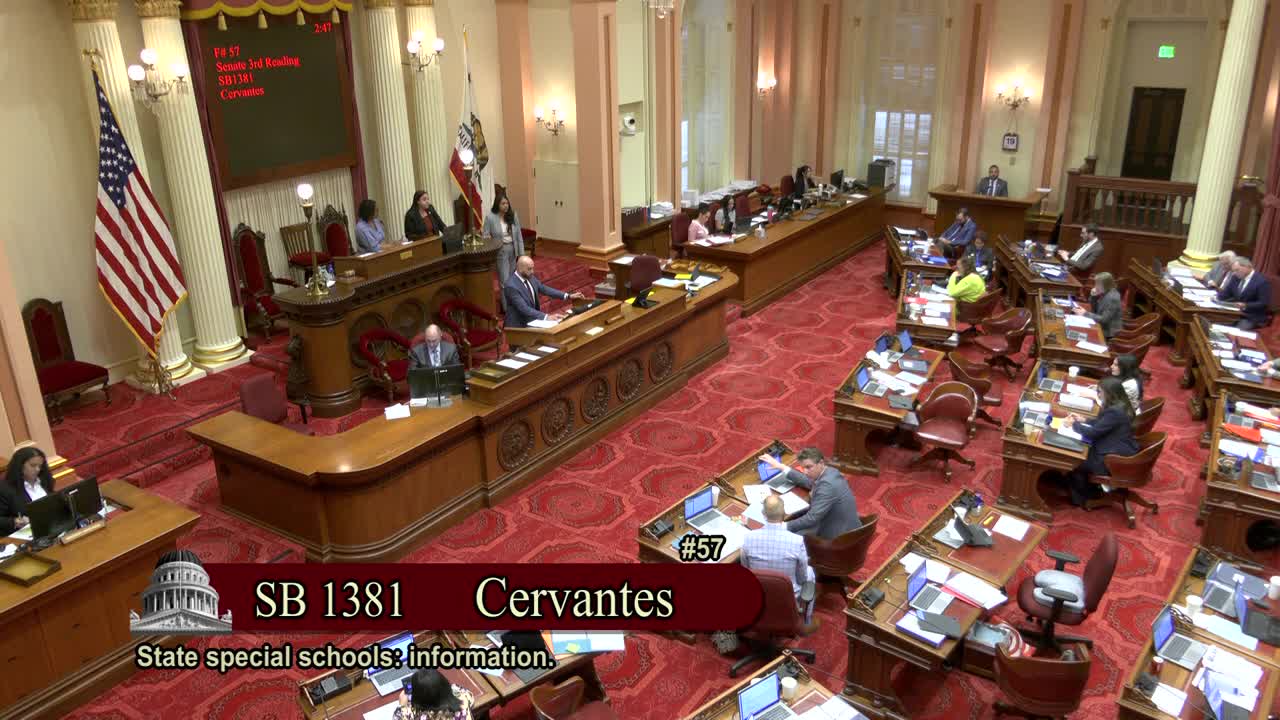
Bill Author