SB 904: Recovery from a state of emergency.
- Session Year: 2025-2026
- House: Senate
- Latest Version Date: 2026-09-29
Current Status:
Passed
(2026-09-29: Chaptered by Secretary of State. Chapter 771, Statutes of 2026.)
Introduced
In Committee
Awaiting First Chamber Vote
Passed First Chamber
In Committee
Awaiting Second Chamber Vote
Passed Second Chamber
Enacted
Existing law, the California Emergency Services Act, authorizes the Governor to proclaim a state of emergency when specified conditions of disaster or extreme peril to the safety of persons and property exist, and authorizes the Governor to exercise certain powers in response to that emergency, including, but not limited to, suspending specified statutes, ordinances, orders, regulations, or rules.
This bill would impose specific duties on the Department of Housing and Community Development if the Office of Emergency Services makes a written determination, within 10 days after the date that the Governor declared a state of emergency relating to a wildfire, that the wildfire caused substantial structural damage requiring significant rebuilding efforts, as defined. The bill would require the department, under this condition, to consult with other specified state entities and local governments to identify state permitting requirements and local procedures that could be suspended or revised to support recovery and rebuilding efforts as a result of the wildfire, as specified. The bill would require the department to prepare and submit initial and periodic reports to the Governor and Legislature with the information and recommendations.
This bill, on or before July 1, 2028, would require the Department of Housing and Community Development, in consultation with other specified state entities, to convene a workgroup to review and provide a report to the Governor and the Legislature with recommendations regarding any provision of the California Building Standards Code that should be suspended for specified types of projects to facilitate rapid, safe, disaster-resilient, and cost-effective rebuilding and recovery guidance for any future state of emergency. The bill would require the workgroup to review and update the report to the Governor and Legislature after the release of every update to the California Building Standards Code.
This bill, starting January 1, 2028, would require, upon the Governors declaration of a state of emergency relating to a wildfire, every state agency or political subdivision, as defined, involved in postdisaster response, debris removal, reconstruction, housing, or land-use permitting to accept electronic submission of any application, form, plan set, appeal, or request for state agency or political subdivision action related to recovery efforts for that state of emergency, as provided. By imposing new duties on local agencies, the bill would impose a state-mandated local program.
The California Constitution requires the state to reimburse local agencies and school districts for certain costs mandated by the state. Statutory provisions establish procedures for making that reimbursement.
This bill would provide that, if the Commission on State Mandates determines that the bill contains costs mandated by the state, reimbursement for those costs shall be made pursuant to the statutory provisions noted above.
Existing law, the California Emergency Services Act, authorizes the Governor to proclaim a state of emergency when specified conditions of disaster or extreme peril to the safety of persons and property exist, and authorizes the Governor to exercise certain powers in response to that emergency, including, but not limited to, suspending specified statutes, ordinances, orders, regulations, or rules.
This bill would impose specific duties on the Department of Housing and Community Development if the Office of Emergency Services makes a written determination, within 10 days after the date that the Governor declared a state of emergency relating to a wildfire, that the wildfire caused substantial structural damage requiring significant rebuilding efforts, as defined. The bill would require the department, under this condition, to consult with other specified state entities and local governments to identify state permitting requirements, provisions in the California Building Standards Code, requirements and local procedures that could be suspended or revised to support recovery and rebuilding efforts as a result of the wildfire, as specified. The bill would require the department to prepare and submit initial and periodic reports to the Governor and Legislature with the information and recommendations.
This bill, on or before July 1, 2028, would require the Department of Housing and Community Development, in consultation with other specified state entities, to convene a workgroup to review and provide a report to the Governor and the Legislature with recommendations regarding any provision of the California Building Standards Code that should be suspended for specified types of projects to facilitate rapid, safe, disaster-resilient, and cost-effective rebuilding and recovery guidance for any future state of emergency. The bill would require the workgroup to review and update the report to the Governor and Legislature after the release of every update to the California Building Standards Code.
This bill, starting January 1, 2028, would require, upon the Governors declaration of a state of emergency relating to a wildfire, every state agency or political subdivision, as defined, involved in postdisaster response, debris removal, reconstruction, housing, or land-use permitting to accept electronic submission of any application, form, plan set, appeal, or request for state agency or political subdivision action related to recovery efforts for that state of emergency, as provided. By imposing new duties on local agencies, the bill would impose a state-mandated local program.
The California Constitution requires the state to reimburse local agencies and school districts for certain costs mandated by the state. Statutory provisions establish procedures for making that reimbursement.
This bill would provide that, if the Commission on State Mandates determines that the bill contains costs mandated by the state, reimbursement for those costs shall be made pursuant to the statutory provisions noted above.
Existing law, the California Emergency Services Act, authorizes the Governor to proclaim a state of emergency when specified conditions of disaster or extreme peril to the safety of persons and property exist, and authorizes the Governor to exercise certain powers in response to that emergency, including, but not limited to, suspending specified statutes, ordinances, orders, regulations, or rules.
This bill would impose specific duties on the Department of Housing and Community Development if the Office of Emergency Services makes a written determination, within 10 days after the date that the Governor declared a state of emergency relating to a wildfire, that the wildfire caused substantial structural damage requiring significant rebuilding efforts, as defined. The bill would require the department, under this condition, to consult with other specified state entities and local governments to identify state permitting requirements, provisions in the California Building Standards Code, and local procedures that could be suspended or revised to support recovery and rebuilding efforts as a result of the wildfire, as specified. The bill would require the department to prepare and submit initial and periodic reports to the Governor and Legislature with the information and recommendations.
This bill, except as provided, starting January 1, 2028, would require, upon the Governors declaration of a state of emergency relating to a wildfire, every state agency or political subdivision, as defined, involved in postdisaster response, debris removal, reconstruction, housing, or land-use permitting to accept electronic submission of any application, form, plan set, appeal, or request for state agency or political subdivision action related to recovery efforts for that state of emergency, as provided. By imposing new duties on local agencies, the bill would impose a state-mandated local program.
The California Constitution requires the state to reimburse local agencies and school districts for certain costs mandated by the state. Statutory provisions establish procedures for making that reimbursement.
This bill would provide that, if the Commission on State Mandates determines that the bill contains costs mandated by the state, reimbursement for those costs shall be made pursuant to the statutory provisions noted above.
Existing law, the California Emergency Services Act, authorizes the Governor to proclaim a state of emergency when specified conditions of disaster or extreme peril to the safety of persons and property exist, and authorizes the Governor to exercise certain powers in response to that emergency, including, but not limited to, suspending specified statutes, ordinances, orders, regulations, or rules.
This bill would impose specific duties on the Department of Housing and Community Development if the Office of Emergency Services makes a written determination, within 10 days after the date that the Governor declared a state of emergency relating to a wildfire, that the wildfire caused substantial structural damage requiring significant rebuilding efforts, as defined. The bill would require the department, under this condition, to consult with other specified state entities and local governments to identify state permitting requirements, provisions in the California Building Standards Code, and local procedures that could be suspended or revised to support recovery and rebuilding efforts as a result of the wildfire, as specified. The bill would require the department to prepare and submit initial and periodic reports to the Governor and Legislature with the information and recommendations.
This bill, except as provided, would require, upon the Governors declaration of a state of emergency relating to a wildfire, every state agency or political subdivision, as defined, involved in postdisaster response, debris removal, reconstruction, housing, or land-use permitting to accept electronic submission of any application, form, plan set, appeal, or request for state agency or political subdivision action related to recovery efforts for that state of emergency, as provided. By imposing new duties on local agencies, the bill would impose a state-mandated local program.
The California Constitution requires the state to reimburse local agencies and school districts for certain costs mandated by the state. Statutory provisions establish procedures for making that reimbursement.
This bill would provide that, if the Commission on State Mandates determines that the bill contains costs mandated by the state, reimbursement for those costs shall be made pursuant to the statutory provisions noted above.
Existing law, the California Emergency Services Act, authorizes the Governor to proclaim a state of emergency when specified conditions of disaster or extreme peril to the safety of persons and property exist, and authorizes the Governor to exercise certain powers in response to that emergency, including, but not limited to, suspending specified statutes, ordinances, orders, regulations, or rules.
This bill would require the Department of Housing and Community Development, in consultation with other specified state agencies, within 30 days of a state of emergency declared by the Governor relating to a wildfire, to provide a report to the Governor and the Legislature identifying state permitting requirements that may unduly impede efforts to rebuild properties or facilities destroyed as a result of the wildfire that should be considered for suspension. The bill would also require the department, in consultation with other specified state agencies, within 60 days of a state of emergency relating to a wildfire, to review and provide a report to the Governor and the Legislature with recommendations regarding any provision of the California Building Standards Code that should be suspended for specified projects in order to facilitate rapid, safe, and cost-effective rebuilding and recovery. The bill would further require the department, upon the declaration of a state of emergency relating to a wildfire, to coordinate with local governments to identify and recommend procedures to establish rapid permitting and approval processes to expedite the reconstruction or replacement of residential properties destroyed or damaged by the wildfire, and would require the department, within 60 days of the state of emergency, to submit a report to the Governor and the Legislature with those recommendations.This bill would impose specific duties on the Department of Housing and Community Development if the Office of Emergency Services makes a written determination, within 10 days after the date that the Governor declared a state of emergency relating to a wildfire, that the wildfire caused substantial structural damage requiring significant rebuilding efforts, as defined. The bill would require the department, under this condition, to consult with other specified state entities and local governments to identify state permitting requirements, provisions in the California Building Standards Code, and local procedures that could be suspended or revised to support recovery and rebuilding efforts as a result of the wildfire, as specified. The bill would require the department to prepare and submit initial and periodic reports to the Governor and Legislature with the information and recommendations.
This bill, except as provided, would require, upon the Governors declaration of a state of emergency relating to a wildfire, every state agency or political subdivision, as defined, involved in postdisaster response, debris removal, reconstruction, housing, or land-use permitting to accept electronic submission of any application, form, plan set, appeal, or request for state agency or political subdivision action related to recovery efforts for that state of emergency, as provided. By imposing new duties on local agencies, the bill would impose a state-mandated local program.
The California Constitution requires the state to reimburse local agencies and school districts for certain costs mandated by the state. Statutory provisions establish procedures for making that reimbursement.
This bill would provide that, if the Commission on State Mandates determines that the bill contains costs mandated by the state, reimbursement for those costs shall be made pursuant to the statutory provisions noted above.
Existing law, the California Emergency Services Act, authorizes the Governor to proclaim a state of emergency when specified conditions of disaster or extreme peril to the safety of persons and property exist, and authorizes the Governor to exercise certain powers in response to that emergency, including, but not limited to, suspending specified statutes, ordinances, orders, regulations, or rules.
This bill would require the Department of Housing and Community Development, in consultation with other specified state agencies, within 30 days of a state of emergency declared by the Governor relating to a wildfire, to provide a report to the Governor and the Legislature identifying state permitting requirements that may unduly impede efforts to rebuild properties or facilities destroyed as a result of the state of emergency wildfire that should be considered for suspension. The bill would also require the department, in consultation with other specified state agencies, within 60 days of a state of emergency relating to a wildfire, to review and provide a report to the Governor and the Legislature with recommendations regarding any provision of the California Building Standards Code that should be suspended for specified projects in order to facilitate rapid, safe, and cost-effective rebuilding and recovery. The bill would further require the department, upon the declaration of a state of emergency relating to a wildfire, to coordinate with local governments to identify and recommend procedures to establish rapid permitting and approval processes to expedite the reconstruction or replacement of residential properties destroyed or damaged by the state of emergency, wildfire, and would require the department, within 60 days of the state of emergency, to submit a report to the Governor and the Legislature with those recommendations.
This bill, except as provided, would require, upon the Governors declaration of a state of emergency relating to a wildfire, every state agency and local agency or political subdivision, as defined, involved in postdisaster response, debris removal, reconstruction, housing, or land-use permitting to accept electronic submission of any application, form, plan set, appeal, or request for agency state agency or political subdivision action related to recovery efforts for that state of emergency, as provided. By imposing new duties on local agencies, the bill would impose a state-mandated local program.
The California Constitution requires the state to reimburse local agencies and school districts for certain costs mandated by the state. Statutory provisions establish procedures for making that reimbursement.
This bill would provide that, if the Commission on State Mandates determines that the bill contains costs mandated by the state, reimbursement for those costs shall be made pursuant to the statutory provisions noted above.
Existing law, the California Emergency Services Act, authorizes the Governor to proclaim a state of emergency when specified conditions of disaster or extreme peril to the safety of persons and property exist, and authorizes the Governor to exercise certain powers in response to that emergency, including, but not limited to, suspending specified statutes, ordinances, orders, regulations, or rules.
This bill would require the Department of Housing and Community Development, in consultation with other specified state agencies, within 30 days of a state of emergency declared by the Governor relating to a wildfire, to provide a report to the Governor and the Legislature identifying state permitting requirements that may unduly impede efforts to rebuild properties or facilities destroyed as a result of the state of emergency that should be considered for suspension. The bill would also require the department, in consultation with other specified state agencies, within 60 days of a state of emergency relating to a wildfire, to review and provide a report to the Governor and the Legislature with recommendations regarding any provision of the California Building Standards Code that should be suspended for specified projects in order to facilitate rapid, safe, and cost-effective rebuilding and recovery. The bill would further require the department, upon the declaration of a state of emergency relating to a wildfire, to coordinate with local governments to identify and recommend procedures to establish rapid permitting and approval processes to expedite the reconstruction or replacement of residential properties destroyed or damaged by the state of emergency, and would require the department, within 60 days of the state of emergency, to submit a report to the Governor and the Legislature with those recommendations.
This bill, except as provided, would require, upon the Governors declaration of a state of emergency relating to a wildfire, every state agency and local agency involved in postdisaster response, debris removal, reconstruction, housing, or land-use permitting to accept electronic submission of any application, form, plan set, appeal, or request for agency action related to recovery efforts for that state of emergency, as provided. By imposing new duties on local agencies, the bill would impose a state-mandated local program.
The California Constitution requires the state to reimburse local agencies and school districts for certain costs mandated by the state. Statutory provisions establish procedures for making that reimbursement.
This bill would provide that, if the Commission on State Mandates determines that the bill contains costs mandated by the state, reimbursement for those costs shall be made pursuant to the statutory provisions noted above.
(a)(1)This section shall only apply if the Office of Emergency Services makes a written determination, within 10 days after the date that the Governor declared a state of emergency relating to a wildfire, that the wildfire caused substantial structural damage requiring significant rebuilding efforts. The office may make the written determination based on an estimation of the data and preliminary damage assessments available at the time of the determination.
(2)For purposes of this subdivision, substantial structural damage requiring significant rebuilding efforts means the destruction of 25 or more residential or commercial structures.
(3)Nothing in this section shall include building standards adopted by the State Fire Marshal that relate to panic safety and fire safety as standards to be considered for suspension.
(b)(1)The Department of Housing and Community Development, in consultation with the Office of Land Use and Climate Innovation, the Office of Emergency Services, and the Department of General Services, shall, within 30 days of a written determination made pursuant to subdivision (a), provide a report to the Governor and the Legislature identifying state permitting requirements that may unduly impede efforts to rebuild properties or facilities destroyed as a result of the wildfire that should be considered for suspension, and shall update that report every 60 days, as appropriate, and as recovery and rebuilding efforts proceed, to identify any additional permitting requirements that are posing barriers to rebuilding and that should be considered for suspension.
(2)The Department of Housing and Community Development shall coordinate with local governments to identify and recommend procedures, including, but not limited to, exploring the use of preapproved plans and waivers of certain permitting requirements, to establish rapid permitting and approval processes to expedite the reconstruction or replacement of residential properties destroyed or damaged by the wildfire. The recommended procedures shall have the ultimate goal of issuing all necessary permits and approvals within 30 days of submission.
(3)The Department of Housing and Community Development shall, within 60 days of a written determination made pursuant to subdivision (a), provide a report to the Governor and the Legislature identifying recommended updates to local government procedures that achieve the goals described in paragraph (2), and shall update the report every 60 days, as appropriate, to identify any additional permitting and approval requirements that are barriers to recovery and rebuilding efforts that should be removed.
(c)(1)The Department of Housing and Community Development may incorporate by reference any report prepared by a governmental entity, in whole or in part, into a report the department prepares pursuant to this section.
(2)The Department of Housing and Community Development shall submit a report to the Legislature in compliance with Section 9795 of the Government Code.
SEC. 2.Section 8608.3 is added to the Government Code, to read:8608.3.(a)On or before than July 1, 2028, the Department of Housing and Community Development, in consultation with the Department of General Services, the Office of the State Fire Marshal, and the State Energy Resources Conservation and Development Commission, shall convene a workgroup to review and provide a report to the Governor and the Legislature with recommendations regarding any provision of the California Building Standards Code (Title 24 of the California Code of Regulations) that should be suspended for the projects described in subdivision (b) to facilitate rapid, safe, disaster-resilient, and cost-effective rebuilding and recovery guidance for any future state of emergency.
(b)Subdivision (a) applies to projects to repair, restore, demolish, or replace substantial structural damage requiring significant rebuilding efforts, as described in Section 8608.2, caused as a result of a state of emergency and are situated in substantially the same location as, and do not exceed 110 percent of the footprint and height of, the residential or commercial structures that were legally established and existed immediately before the state of emergency.
(c)After the release of every update to the California Building Standards Code, the workgroup shall review and update, as necessary, the report required by subdivision (a).
(d)Nothing in this section shall include building standards adopted by the State Fire Marshal that relate to panic safety and fire safety as standards to be considered for suspension.
(e)Every report submitted to the Legislature pursuant to this section shall be in compliance with Section 9795.
SEC. 3.Section 8608.4 is added to the Government Code, to read:8608.4.(a)Notwithstanding any other law, and except as provided in subdivisions (c) and (g), upon the Governors declaration of a state of emergency relating to a wildfire, every state agency or political subdivision, as those terms are defined in Section 8557, involved in postdisaster response, debris removal, reconstruction, housing, or land-use permitting shall accept electronic submission of any application, form, plan set, appeal, or request for state agency or political subdivision action related to recovery efforts for that state of emergency.
(b)The electronic submission system may include any of the following features:
(1)Allow submission through a web-based application portal.
(2)Allow email submission of a document in PDF or other standard digital format.
(3)Allow electronic signatures, which shall be deemed valid under the Uniform Electronic Transactions Act (Title 2.5 (commencing with Section 1633.1) of Part 2 of Division 3 of the Civil Code).
(4)Allow submission of digital plan sets or drawings at any scale accepted by the state agency or political subdivision for paper plans.
(c)A state agency or political subdivision shall not require physical, in-person filing of an application unless the state agency or political subdivision determines, in writing, that electronic submission is not technically feasible for that specific application type. A state agency or political subdivision that makes a written determination pursuant to this subdivision shall publicly post that written determination within 48 hours of making the determination.
(d)A state agency or political subdivision shall not reject an application or other document solely because it was submitted electronically.
(e)Within 30 days of the declaration of a state of emergency for a wildfire, every affected state agency or political subdivision shall publish on its internet website all of the following:
(1)Information regarding the electronic filing method that may be used to submit documents to the state agency or political subdivision relating to disaster recovery efforts, including the email address to submit documents, a link to the web-based application portal, or both.
(2)Information regarding required file formats.
(3)Contact information for electronic filing support.
(f)This section does not prohibit a state agency or political subdivision from also accepting paper submissions.
(g)This section shall not apply to any of the following:
(1)A county with a population of less than 100,000.
(2)A city within a county that meets the requirements of paragraph (1).
(3)A city with a population of less than 50,000.
(h)This section shall become operative on January 1, 2028.
SEC. 4.If the Commission on State Mandates determines that this act contains costs mandated by the state, reimbursement to local agencies and school districts for those costs shall be made pursuant to Part 7 (commencing with Section 17500) of Division 4 of Title 2 of the Government Code.
(a)(1)This section shall only apply if the Office of Emergency Services makes a written determination, within 10 days after the date that the Governor declared a state of emergency relating to a wildfire, that the wildfire caused substantial structural damage requiring significant rebuilding efforts. The office may make the written determination based on an estimation of the data and preliminary damage assessments available at the time of the determination.
(2)For purposes of this subdivision, substantial structural damage requiring significant rebuilding efforts means the destruction of 25 or more residential or commercial structures.
(3)Nothing in this section shall include building standards adopted by the State Fire Marshal that relate to panic safety and fire safety as standards to be considered for suspension.
(b)(1)The Department of Housing and Community Development, in consultation with the Office of Land Use and Climate Innovation, the Office of Emergency Services, and the Department of General Services, shall, within 30 days of a written determination made pursuant to subdivision (a), provide a report to the Governor and the Legislature identifying state permitting requirements that may unduly impede efforts to rebuild properties or facilities destroyed as a result of the wildfire that should be considered for suspension, and shall update that report every 60 days, as appropriate, and as recovery and rebuilding efforts proceed, to identify any additional permitting requirements that are posing barriers to rebuilding and that should be considered for suspension.
(c)(1)The Department of Housing and Community Development, in consultation with the Department of General Services, the Office of the State Fire Marshal, and the State Energy Resources Conservation and Development Commission, shall, within 60 days of a written determination made pursuant to subdivision (a), review and provide a report to the Governor and the Legislature with recommendations regarding any provision of the California Building Standards Code (Title 24 of the California Code of Regulations) that should be suspended for the projects described in paragraph (2) in order to facilitate rapid, safe, wildfire-resilient, and cost-effective rebuilding and recovery.(2)Paragraph (1) applies to projects to repair, restore, demolish, or replace properties or facilities substantially damaged or destroyed as a result of the wildfire that are in substantially the same location as, and do not exceed 110 percent of the footprint and height of, the properties and facilities that were legally established and existed immediately before the state of emergency.(d)Upon the Governors declaration of a state of emergency relating to a wildfire, the Department(2)The Department of Housing and Community Development shall coordinate with local governments to identify and recommend procedures, including, but not limited to, exploring the use of preapproved plans and waivers of certain permitting requirements, to establish rapid permitting and approval processes to expedite the reconstruction or replacement of residential properties destroyed or damaged by the wildfire. The recommended procedures shall have the ultimate goal of issuing all necessary permits and approvals within 30 days of submission. The
(3)The Department of Housing and Community Development shall, within 60 days of a written determination made pursuant to subdivision (a), provide a report to the Governor and the Legislature identifying recommended updates to local government procedures that achieve the goals described in this subdivision, paragraph (2), and shall update the report every 60 days, as appropriate, to identify any additional permitting and approval requirements that are barriers to recovery and rebuilding efforts that should be removed.
(e)(c)(1)The Department of Housing and Community Development may incorporate by reference any report prepared by a governmental entity, in whole or in part, into a report the department prepares pursuant to this section.
(2)The Department of Housing and Community Development shall submit a report to the Legislature in compliance with Section 9795 of the Government Code.
SEC. 2.Section 8608.3 is added to the Government Code, to read:8608.3.(a)On or before than July 1, 2028, the Department of Housing and Community Development, in consultation with the Department of General Services, the Office of the State Fire Marshal, and the State Energy Resources Conservation and Development Commission, shall convene a workgroup to review and provide a report to the Governor and the Legislature with recommendations regarding any provision of the California Building Standards Code (Title 24 of the California Code of Regulations) that should be suspended for the projects described in subdivision (b) to facilitate rapid, safe, disaster-resilient, and cost-effective rebuilding and recovery guidance for any future state of emergency.
(b)Subdivision (a) applies to projects to repair, restore, demolish, or replace substantial structural damage requiring significant rebuilding efforts, as described in Section 8608.2, caused as a result of a state of emergency and are situated in substantially the same location as, and do not exceed 110 percent of the footprint and height of, the residential or commercial structures that were legally established and existed immediately before the state of emergency.
(c)After the release of every update to the California Building Standards Code, the workgroup shall review and update, as necessary, the report required by subdivision (a).
(d)Nothing in this section shall include building standards adopted by the State Fire Marshal that relate to panic safety and fire safety as standards to be considered for suspension.
(e)Every report submitted to the Legislature pursuant to this section shall be in compliance with Section 9795.
SEC. 2.Section 8608.3 is added to the Government Code, to read:8608.3.SEC. 3.Section 8608.4 is added to the Government Code, to read:8608.4.(a)Notwithstanding any other law, and except as provided in subdivisions (c) and (g), upon the Governors declaration of a state of emergency relating to a wildfire, every state agency or political subdivision, as those terms are defined in Section 8557, involved in postdisaster response, debris removal, reconstruction, housing, or land-use permitting shall accept electronic submission of any application, form, plan set, appeal, or request for state agency or political subdivision action related to recovery efforts for that state of emergency.
(b)The electronic submission system may include any of the following features:
(1)Allow submission through a web-based application portal.
(2)Allow email submission of a document in PDF or other standard digital format.
(3)Allow electronic signatures, which shall be deemed valid under the Uniform Electronic Transactions Act (Title 2.5 (commencing with Section 1633.1) of Part 2 of Division 3 of the Civil Code).
(4)Allow submission of digital plan sets or drawings at any scale accepted by the state agency or political subdivision for paper plans.
(c)A state agency or political subdivision shall not require physical, in-person filing of an application unless the state agency or political subdivision determines, in writing, that electronic submission is not technically feasible for that specific application type. A state agency or political subdivision that makes a written determination pursuant to this subdivision shall publicly post that written determination within 48 hours of making the determination.
(d)A state agency or political subdivision shall not reject an application or other document solely because it was submitted electronically.
(e)Within 30 days of the declaration of a state of emergency for a wildfire, every affected state agency or political subdivision shall publish on its internet website all of the following:
(1)Information regarding the electronic filing method that may be used to submit documents to the state agency or political subdivision relating to disaster recovery efforts, including the email address to submit documents, a link to the web-based application portal, or both.
(2)Information regarding required file formats.
(3)Contact information for electronic filing support.
(f)This section does not prohibit a state agency or political subdivision from also accepting paper submissions.
(g)This section shall not apply to any of the following:
(1)A county with a population of less than 100,000.
(2)A city within a county that meets the requirements of paragraph (1).
(3)A city with a population of less than 50,000.
(h)This section shall become operative on January 1, 2028.
SEC. 3.SEC. 4.If the Commission on State Mandates determines that this act contains costs mandated by the state, reimbursement to local agencies and school districts for those costs shall be made pursuant to Part 7 (commencing with Section 17500) of Division 4 of Title 2 of the Government Code.
(a)(1)This section shall only apply if the Office of Emergency Services makes a written determination, within 10 days after the date that the Governor declared a state of emergency relating to a wildfire, that the wildfire caused substantial structural damage requiring significant rebuilding efforts. The office may make the written determination based on an estimation of the data and preliminary damage assessments available at the time of the determination.
(2)For purposes of this subdivision, substantial structural damage requiring significant rebuilding efforts means the destruction of 25 or more residential or commercial structures.
(b)The Department of Housing and Community Development, in consultation with the Office of Land Use and Climate Innovation, the Office of Emergency Services, and the Department of General Services, shall, within 30 days of a written determination made pursuant to subdivision (a), provide a report to the Governor and the Legislature identifying state permitting requirements that may unduly impede efforts to rebuild properties or facilities destroyed as a result of the wildfire that should be considered for suspension, and shall update that report every 60 days, as appropriate, and as recovery and rebuilding efforts proceed, to identify any additional permitting requirements that are posing barriers to rebuilding and that should be considered for suspension.
(c)(1)The Department of Housing and Community Development, in consultation with the Department of General Services, the Office of the State Fire Marshal, and the State Energy Resources Conservation and Development Commission, shall, within 60 days of a written determination made pursuant to subdivision (a), review and provide a report to the Governor and the Legislature with recommendations regarding any provision of the California Building Standards Code (Title 24 of the California Code of Regulations) that should be suspended for the projects described in paragraph (2) in order to facilitate rapid, safe, wildfire-resilient, and cost-effective rebuilding and recovery.
(2)Paragraph (1) applies to projects to repair, restore, demolish, or replace properties or facilities substantially damaged or destroyed as a result of the wildfire that are in substantially the same location as, and do not exceed 110 percent of the footprint and height of, the properties and facilities that were legally established and existed immediately before the state of emergency.
(d)Upon the Governors declaration of a state of emergency relating to a wildfire, the Department of Housing and Community Development shall coordinate with local governments to identify and recommend procedures, including, but not limited to, exploring the use of preapproved plans and waivers of certain permitting requirements, to establish rapid permitting and approval processes to expedite the reconstruction or replacement of residential properties destroyed or damaged by the wildfire. The recommended procedures shall have the ultimate goal of issuing all necessary permits and approvals within 30 days of submission. The Department of Housing and Community Development shall, within 60 days of a written determination made pursuant to subdivision (a), provide a report to the Governor and the Legislature identifying recommended updates to local government procedures that achieve the goals described in this subdivision, and shall update the report every 60 days, as appropriate, to identify any additional permitting and approval requirements that are barriers to recovery and rebuilding efforts that should be removed.
(e)(1)The Department of Housing and Community Development may incorporate by reference any report prepared by a governmental entity, in whole or in part, into a report the department prepares pursuant to this section.
(2)The Department of Housing and Community Development shall submit a report to the Legislature in compliance with Section 9795 of the Government Code.
SEC. 2.Section 8608.3 is added to the Government Code, to read:8608.3.(a)Notwithstanding any other law, and except as provided in subdivisions (c) and (g), upon the Governors declaration of a state of emergency relating to a wildfire, every state agency or political subdivision, as those terms are defined in Section 8557, involved in postdisaster response, debris removal, reconstruction, housing, or land-use permitting shall accept electronic submission of any application, form, plan set, appeal, or request for state agency or political subdivision action related to recovery efforts for that state of emergency.
(b)The electronic submission system may include any of the following features:
(1)Allow submission through a web-based application portal.
(2)Allow email submission of a document in PDF or other standard digital format.
(3)Allow electronic signatures, which shall be deemed valid under the Uniform Electronic Transactions Act (Title 2.5 (commencing with Section 1633.1) of Part 2 of Division 3 of the Civil Code).
(4)Allow submission of digital plan sets or drawings at any scale accepted by the state agency or political subdivision for paper plans.
(c)A state agency or political subdivision shall not require physical, in-person filing of an application unless the state agency or political subdivision determines, in writing, that electronic submission is not technically feasible for that specific application type. A state agency or political subdivision that makes a written determination pursuant to this subdivision shall publicly post that written determination within 48 hours of making the determination.
(d)A state agency or political subdivision shall not reject an application or other document solely because it was submitted electronically.
(e)Within 30 days of the declaration of a state of emergency for a wildfire, every affected state agency or political subdivision shall publish on its internet website all of the following:
(1)Information regarding the electronic filing method that may be used to submit documents to the state agency or political subdivision relating to disaster recovery efforts, including the email address to submit documents, a link to the web-based application portal, or both.
(2)Information regarding required file formats.
(3)Contact information for electronic filing support.
(f)This section does not prohibit a state agency or political subdivision from also accepting paper submissions.
(g)This section shall not apply to a any of the following:
(1)A county with a population of less than 100,000 or any 100,000.
(2)A city within that county. a county that meets the requirements of paragraph (1).
(3)A city with a population of less than 50,000.
(h)This section shall become operative on January 1, 2028.
SEC. 3.If the Commission on State Mandates determines that this act contains costs mandated by the state, reimbursement to local agencies and school districts for those costs shall be made pursuant to Part 7 (commencing with Section 17500) of Division 4 of Title 2 of the Government Code.
(a)(1)This section shall only apply if the Office of Emergency Services makes a written determination, within 10 days after the date that the Governor declared a state of emergency relating to a wildfire, that the wildfire caused substantial structural damage requiring significant rebuilding efforts. The office may make the written determination based on an estimation of the data and preliminary damage assessments available at the time of the determination.
(2)For purposes of this subdivision, substantial structural damage requiring significant rebuilding efforts means the destruction of 25 or more residential or commercial structures.
(b)The Department of Housing and Community Development, in consultation with the Office of Land Use and Climate Innovation, the Office of Emergency Services, and the Department of General Services, shall, within 30 days of a written determination made pursuant to subdivision (a), provide a report to the Governor and the Legislature identifying state permitting requirements that may unduly impede efforts to rebuild properties or facilities destroyed as a result of the wildfire that should be considered for suspension, and shall update that report every 60 days, as appropriate, and as recovery and rebuilding efforts proceed, to identify any additional permitting requirements that are posing barriers to rebuilding and that should be considered for suspension.
(c)(1)The Department of Housing and Community Development, in consultation with the Department of General Services, the Office of the State Fire Marshal, and the State Energy Resources Conservation and Development Commission, shall, within 60 days of a written determination made pursuant to subdivision (a), review and provide a report to the Governor and the Legislature with recommendations regarding any provision of the California Building Standards Code (Title 24 of the California Code of Regulations) that should be suspended for the projects described in paragraph (2) in order to facilitate rapid, safe, wildfire-resilient, and cost-effective rebuilding and recovery.
(2)Paragraph (1) applies to projects to repair, restore, demolish, or replace properties or facilities substantially damaged or destroyed as a result of the wildfire that are in substantially the same location as, and do not exceed 110 percent of the footprint and height of, the properties and facilities that were legally established and existed immediately before the state of emergency.
(d)Upon the Governors declaration of a state of emergency relating to a wildfire, the Department of Housing and Community Development shall coordinate with local governments to identify and recommend procedures, including, but not limited to, exploring the use of preapproved plans and waivers of certain permitting requirements, to establish rapid permitting and approval processes to expedite the reconstruction or replacement of residential properties destroyed or damaged by the wildfire. The recommended procedures shall have the ultimate goal of issuing all necessary permits and approvals within 30 days of submission. The Department of Housing and Community Development shall, within 60 days of a written determination made pursuant to subdivision (a), provide a report to the Governor and the Legislature identifying recommended updates to local government procedures that achieve the goals described in this subdivision, and shall update the report every 60 days, as appropriate, to identify any additional permitting and approval requirements that are barriers to recovery and rebuilding efforts that should be removed.
(e)(1)The Department of Housing and Community Development may incorporate by reference any report prepared by a governmental entity, in whole or in part, into a report the department prepares pursuant to this section.
(2)The Department of Housing and Community Development shall submit a report to the Legislature in compliance with Section 9795 of the Government Code.
SEC. 2.Section 8608.3 is added to the Government Code, to read:8608.3.(a)Notwithstanding any other law, and except as provided in subdivisions (c) and (g), upon the Governors declaration of a state of emergency relating to a wildfire, every state agency or political subdivision, as those terms are defined in Section 8557, involved in postdisaster response, debris removal, reconstruction, housing, or land-use permitting shall accept electronic submission of any application, form, plan set, appeal, or request for state agency or political subdivision action related to recovery efforts for that state of emergency.
(b)The electronic submission system may include any of the following features:
(1)Allow submission through a web-based application portal.
(2)Allow email submission of a document in PDF or other standard digital format.
(3)Allow electronic signatures, which shall be deemed valid under the Uniform Electronic Transactions Act (Title 2.5 (commencing with Section 1633.1) of Part 2 of Division 3 of the Civil Code).
(4)Allow submission of digital plan sets or drawings at any scale accepted by the state agency or political subdivision for paper plans.
(c)A state agency or political subdivision shall not require physical, in-person filing of an application unless the state agency or political subdivision determines, in writing, that electronic submission is not technically feasible for that specific application type. A state agency or political subdivision that makes a written determination pursuant to this subdivision shall publicly post that written determination within 48 hours of making the determination.
(d)A state agency or political subdivision shall not reject an application or other document solely because it was submitted electronically.
(e)Within 30 days of the declaration of a state of emergency for a wildfire, every affected state agency or political subdivision shall publish on its internet website all of the following:
(1)Information regarding the electronic filing method that may be used to submit documents to the state agency or political subdivision relating to disaster recovery efforts, including the email address to submit documents, a link to the web-based application portal, or both.
(2)Information regarding required file formats.
(3)Contact information for electronic filing support.
(f)This section does not prohibit a state agency or political subdivision from also accepting paper submissions.
(g)This section shall not apply to a county with a population of less than 100,000 or any city within that county.
SEC. 3.If the Commission on State Mandates determines that this act contains costs mandated by the state, reimbursement to local agencies and school districts for those costs shall be made pursuant to Part 7 (commencing with Section 17500) of Division 4 of Title 2 of the Government Code.
(a)(1)This section shall only apply if the Office of Emergency Services makes a written determination, within 10 days after the date that the Governor declared a state of emergency relating to a wildfire, that the wildfire caused substantial structural damage requiring significant rebuilding efforts. The office may make the written determination based on an estimation of the data and preliminary damage assessments available at the time of the determination.
(2)For purposes of this subdivision, substantial structural damage requiring significant rebuilding efforts means the destruction of 25 or more residential or commercial structures.
(a)(b)The Department of Housing and Community Development, in consultation with the Office of Land Use and Climate Innovation, the Office of Emergency Services, and the Department of General Services, shall, within 30 days of a state of emergency declared by the Governor relating to a wildfire, written determination made pursuant to subdivision (a), provide a report to the Governor and the Legislature identifying state permitting requirements that may unduly impede efforts to rebuild properties or facilities destroyed as a result of the wildfire that should be considered for suspension, and shall update that report every 60 days, as appropriate, and as recovery and rebuilding efforts proceed, to identify any additional permitting requirements that are posing barriers to rebuilding and that should be considered for suspension.
(b)(c)(1)The Department of Housing and Community Development, in consultation with the Department of General Services, the Office of the State Fire Marshal, and the State Energy Resources Conservation and Development Commission, shall, within 60 days of a state of emergency declared by the Governor relating to a wildfire, written determination made pursuant to subdivision (a), review and provide a report to the Governor and the Legislature with recommendations regarding any provision of the California Building Standards Code (Title 24 of the California Code of Regulations) that should be suspended for the projects described in paragraph (2) in order to facilitate rapid, safe, and cost-effective rebuilding and recovery.
(2)Paragraph (1) applies to projects to repair, restore, demolish, or replace properties or facilities substantially damaged or destroyed as a result of the wildfire that are in substantially the same location as, and do not exceed 110 percent of the footprint and height of, the properties and facilities that were legally established and existed immediately before the state of emergency.
(c)(d)Upon the Governors declaration of a state of emergency relating to a wildfire, the Department of Housing and Community Development shall coordinate with local governments to identify and recommend procedures, including, but not limited to, exploring the use of preapproved plans and waivers of certain permitting requirements, to establish rapid permitting and approval processes to expedite the reconstruction or replacement of residential properties destroyed or damaged by the wildfire. The recommended procedures shall have the ultimate goal of issuing all necessary permits and approvals within 30 days of submission. The Department of Housing and Community Development shall, within 60 days of the declaration of the state of emergency, a written determination made pursuant to subdivision (a), provide a report to the Governor and the Legislature identifying recommended updates to local government procedures that achieve the goals described in this subdivision, and shall update the report every 60 days, as appropriate, to identify any additional permitting and approval requirements that are barriers to recovery and rebuilding efforts that should be removed.
(d)A report submitted to the Legislature pursuant to this section shall be submitted in compliance with Section 9795 of the Government Code.(e)(1)The Department of Housing and Community Development may incorporate by reference any report prepared by a governmental entity, in whole or in part, into a report the department prepares pursuant to this section.
(2)The Department of Housing and Community Development shall submit a report to the Legislature in compliance with Section 9795 of the Government Code.
SEC. 2.Section 8608.3 is added to the Government Code, to read:8608.3.(a)Notwithstanding any other law, and except as provided in subdivisions (c) and (g), upon the Governors declaration of a state of emergency relating to a wildfire, every state agency or political subdivision, as those terms are defined in Section 8557, involved in postdisaster response, debris removal, reconstruction, housing, or land-use permitting shall accept electronic submission of any application, form, plan set, appeal, or request for state agency or political subdivision action related to recovery efforts for that state of emergency.
(b)The electronic submission system may include any of the following features:
(1)Allow submission through a web-based application portal.
(2)Allow email submission of a document in PDF or other standard digital format.
(3)Allow electronic signatures, which shall be deemed valid under the Uniform Electronic Transactions Act (Title 2.5 (commencing with Section 1633.1) of Part 2 of Division 3 of the Civil Code).
(4)Allow submission of digital plan sets or drawings at any scale accepted by the state agency or political subdivision for paper plans.
(c)A state agency or political subdivision shall not require physical, in-person filing of an application unless the state agency or political subdivision determines, in writing, that electronic submission is not technically feasible for that specific application type. A state agency or political subdivision that makes a written determination pursuant to this subdivision shall publicly post that written determination within 48 hours of making the determination.
(d)A state agency or political subdivision shall not reject an application or other document solely because it was submitted electronically.
(e)Within 30 days of the declaration of a state of emergency for a wildfire, every affected state agency or political subdivision shall publish on its internet website all of the following:
(1)Information regarding the electronic filing method that may be used to submit documents to the state agency or political subdivision relating to disaster recovery efforts, including the email address to submit documents, a link to the web-based application portal, or both.
(2)Information regarding required file formats.
(3)Contact information for electronic filing support.
(f)This section does not prohibit a state agency or political subdivision from also accepting paper submissions.
(g)This section shall not apply to a county with a population of less than 100,000 or any city within that county.
SEC. 3.If the Commission on State Mandates determines that this act contains costs mandated by the state, reimbursement to local agencies and school districts for those costs shall be made pursuant to Part 7 (commencing with Section 17500) of Division 4 of Title 2 of the Government Code.
(a)The Department of Housing and Community Development, in consultation with the Office of Land Use and Climate Innovation, the Office of Emergency Services, and the Department of General Services, shall, within 30 days of a state of emergency declared by the Governor relating to a wildfire, provide a report to the Governor and the Legislature identifying state permitting requirements that may unduly impede efforts to rebuild properties or facilities destroyed as a result of the state of emergency wildfire that should be considered for suspension, and shall update that report every 60 days, as appropriate, and as recovery and rebuilding efforts proceed, to identify any additional permitting requirements that are posing barriers to rebuilding and that should be considered for suspension.
(b)(1)The Department of Housing and Community Development, in consultation with the Department of General Services, the Office of the State Fire Marshal, and the State Energy Resources Conservation and Development Commission, shall, within 60 days of a state of emergency declared by the Governor relating to a wildfire, review and provide a report to the Governor and the Legislature with recommendations regarding any provision of the California Building Standards Code (Title 24 of the California Code of Regulations) that should be suspended for the projects described in paragraph (2) in order to facilitate rapid, safe, and cost-effective rebuilding and recovery.
(2)Paragraph (1) applies to projects to repair, restore, demolish, or replace properties or facilities substantially damaged or destroyed as a result of the state of emergency wildfire that are in substantially the same location as, and do not exceed 110 percent of the footprint and height of, the properties and facilities that were legally established and existed immediately before the state of emergency.
(c)Upon the Governors declaration of a state of emergency relating to a wildfire, the Department of Housing and Community Development shall coordinate with local governments to identify and recommend procedures, including, but not limited to, exploring the use of preapproved plans and waivers of certain permitting requirements, to establish rapid permitting and approval processes to expedite the reconstruction or replacement of residential properties destroyed or damaged by the state of emergency. wildfire. The recommended procedures shall have the ultimate goal of issuing all necessary permits and approvals within 30 days of submission. The Department of Housing and Community Development shall, within 60 days of the declaration of the state of emergency, provide a report to the Governor and the Legislature identifying recommended updates to local government procedures that achieve the goals described in this subdivision, and shall update the report every 60 days, as appropriate, to identify any additional permitting and approval requirements that are barriers to recovery and rebuilding efforts that should be removed.
(d)A report submitted to the Legislature pursuant to this section shall be submitted in compliance with Section 9795 of the Government Code.
SEC. 2.Section 8608.3 is added to the Government Code, to read:8608.3.(a)Notwithstanding any other law, and except as provided in subdivision (c), subdivisions (c) and (g), upon the Governors declaration of a state of emergency relating to a wildfire, every state agency and local agency or political subdivision, as those terms are defined in Section 8557, involved in postdisaster response, debris removal, reconstruction, housing, or land-use permitting shall accept electronic submission of any application, form, plan set, appeal, or request for agency state agency or political subdivision action related to recovery efforts for that state of emergency.
(b)The electronic submission system may include any of the following features:
(1)Allow submission through a web-based application portal.
(2)Allow email submission of a document in PDF or other standard digital format.
(3)Allow electronic signatures, which shall be deemed valid under the Uniform Electronic Transactions Act (Title 2.5 (commencing with Section 1633.1) of Part 2 of Division 3 of the Civil Code).
(4)Allow submission of digital plan sets or drawings at any scale accepted by the agency state agency or political subdivision for paper plans.
(c)An agency A state agency or political subdivision shall not require physical, in-person filing of an application unless the agency state agency or political subdivision determines, in writing, that electronic submission is not technically feasible for that specific application type. An agency A state agency or political subdivision that makes a written determination pursuant to this subdivision shall publicly post that written determination within 48 hours of making the determination.
(d)An agency A state agency or political subdivision shall not reject an application or other document solely because it was submitted electronically.
(e)Within 30 days of the declaration of a state of emergency for a wildfire, every affected agency state agency or political subdivision shall publish on its internet website all of the following:
(1)Information regarding the electronic filing method that may be used to submit documents to the agency state agency or political subdivision relating to disaster recovery efforts, including the email address to submit documents, a link to the web-based application portal, or both.
(2)Information regarding required file formats.
(3)Contact information for electronic filing support.
(f)This section does not prohibit an agency a state agency or political subdivision from also accepting paper submissions.
(g)This section shall not apply to a county with a population of less than 100,000 or any city within that county.
SEC. 3.If the Commission on State Mandates determines that this act contains costs mandated by the state, reimbursement to local agencies and school districts for those costs shall be made pursuant to Part 7 (commencing with Section 17500) of Division 4 of Title 2 of the Government Code.
(a)The Department of Housing and Community Development, in consultation with the Office of Land Use and Climate Innovation, the Office of Emergency Services, and the Department of General Services, shall, within 30 days of a state of emergency declared by the Governor relating to a wildfire, provide a report to the Governor and the Legislature identifying state permitting requirements that may unduly impede efforts to rebuild properties or facilities destroyed as a result of the state of emergency that should be considered for suspension, and shall update that report every 60 days, as appropriate, and as recovery and rebuilding efforts proceed, to identify any additional permitting requirements that are posing barriers to rebuilding and that should be considered for suspension.
(b)(1)The Department of Housing and Community Development, in consultation with the Department of General Services, the Office of the State Fire Marshal, and the State Energy Resources Conservation and Development Commission, shall, within 60 days of a state of emergency declared by the Governor relating to a wildfire, review and provide a report to the Governor and the Legislature with recommendations regarding any provision of the California Building Standards Code (Title 24 of the California Code of Regulations) that should be suspended for the projects described in paragraph (2) in order to facilitate rapid, safe, and cost-effective rebuilding and recovery.
(2)Paragraph (1) applies to projects to repair, restore, demolish, or replace properties or facilities substantially damaged or destroyed as a result of the state of emergency that are in substantially the same location as, and do not exceed 110 percent of the footprint and height of, the properties and facilities that were legally established and existed immediately before the state of emergency.
(c)Upon the Governors declaration of a state of emergency relating to a wildfire, the Department of Housing and Community Development shall coordinate with local governments to identify and recommend procedures, including, but not limited to, exploring the use of preapproved plans and waivers of certain permitting requirements, to establish rapid permitting and approval processes to expedite the reconstruction or replacement of residential properties destroyed or damaged by the state of emergency. The recommended procedures shall have the ultimate goal of issuing all necessary permits and approvals within 30 days of submission. The Department of Housing and Community Development shall, within 60 days of the declaration of the state of emergency, provide a report to the Governor and the Legislature identifying recommended updates to local government procedures that achieve the goals described in this subdivision, and shall update the report every 60 days, as appropriate, to identify any additional permitting and approval requirements that are barriers to recovery and rebuilding efforts that should be removed.
(d)A report submitted to the Legislature pursuant to this section shall be submitted in compliance with Section 9795 of the Government Code.
SEC. 2.Section 8608.3 is added to the Government Code, to read:8608.3.(a)Notwithstanding any other law, and except as provided in subdivision (c), upon the Governors declaration of a state of emergency relating to a wildfire, every state agency and local agency involved in postdisaster response, debris removal, reconstruction, housing, or land-use permitting shall accept electronic submission of any application, form, plan set, appeal, or request for agency action related to recovery efforts for that state of emergency.
(b)The electronic submission system may include any of the following features:
(1)Allow submission through a web-based application portal.
(2)Allow email submission of a document in PDF or other standard digital format.
(3)Allow electronic signatures, which shall be deemed valid under the Uniform Electronic Transactions Act (Title 2.5 (commencing with Section 1633.1) of Part 2 of Division 3 of the Civil Code).
(4)Allow submission of digital plan sets or drawings at any scale accepted by the agency for paper plans.
(c)An agency shall not require physical, in-person filing of an application unless the agency determines, in writing, that electronic submission is not technically feasible for that specific application type. An agency that makes a written determination pursuant to this subdivision shall publicly post that written determination within 48 hours of making the determination.
(d)An agency shall not reject an application or other document solely because it was submitted electronically.
(e)Within 30 days of the declaration of a state of emergency for a wildfire, every affected agency shall publish on its internet website all of the following:
(1)Information regarding the electronic filing method that may be used to submit documents to the agency relating to disaster recovery efforts, including the email address to submit documents, a link to the web-based application portal, or both.
(2)Information regarding required file formats.
(3)Contact information for electronic filing support.
(f)This section does not prohibit an agency from also accepting paper submissions.
SEC. 3.If the Commission on State Mandates determines that this act contains costs mandated by the state, reimbursement to local agencies and school districts for those costs shall be made pursuant to Part 7 (commencing with Section 17500) of Division 4 of Title 2 of the Government Code.
|
Date
|
Status
|
|---|---|
| Sep 29, 2026 | Chaptered by Secretary of State. Chapter 771, Statutes of 2026. |
| Sep 29, 2026 | Approved by the Governor. |
| Aug 30, 2026 | Enrolled and presented to the Governor at 6 p.m. |
| Aug 25, 2026 | Assembly amendments concurred in. (Ayes 40. Noes 0. Page 5793.) Ordered to engrossing and enrolling. |
| Aug 25, 2026 | Assembly amendments concurred in. (Ayes 40. Noes 0.) Ordered to engrossing and enrolling. |
| Aug 25, 2026 | Assembly amendments concurred in. (Ayes 39. Noes 0.) Ordered to engrossing and enrolling. |
| Aug 24, 2026 | In Senate. Concurrence in Assembly amendments pending. |
| Aug 24, 2026 | Read third time. Passed. (Ayes 71. Noes 1. Page 6389.) Ordered to the Senate. |
| Aug 24, 2026 | Read third time. Passed. Ordered to the Senate. |
| Aug 13, 2026 | Read second time. Ordered to third reading. |
| Aug 13, 2026 | From committee: Do pass. (Ayes 15. Noes 0.) (August 13). |
| Aug 13, 2026 | Assembly Rule 63 suspended. |
| Aug 5, 2026 | August 5 set for first hearing. Placed on suspense file. |
| Jul 1, 2026 | Read second time and amended. Re-referred to Com. on APPR. |
| Jun 30, 2026 | From committee: Do pass as amended and re-refer to Com. on APPR. (Ayes 6. Noes 0.) (June 29). |
| Jun 17, 2026 | From committee with author's amendments. Read second time and amended. Re-referred to Com. on E.M. |
| Jun 10, 2026 | From committee: Do pass and re-refer to Com. on E.M. (Ayes 11. Noes 1.) (June 10). Re-referred to Com. on E.M. |
| May 27, 2026 | From committee with author's amendments. Read second time and amended. Re-referred to Com. on H. & C.D. |
| May 26, 2026 | Referred to Coms. on H. & C.D. and E.M. |
| May 19, 2026 | In Assembly. Read first time. Held at Desk. |
| May 18, 2026 | Read third time. Passed. (Ayes 38. Noes 0. Page 4312.) Ordered to the Assembly. |
| May 18, 2026 | Read third time. Passed. (Ayes 37. Noes 0.) Ordered to the Assembly. |
| May 14, 2026 | From committee: Do pass. (Ayes 6. Noes 1. Page 4256.) (May 14). |
| May 14, 2026 | Read second time. Ordered to third reading. |
| May 14, 2026 | From committee: Do pass. (Ayes 6. Noes 1.) (May 14). |
| May 8, 2026 | Set for hearing May 14. |
| Apr 27, 2026 | April 27 hearing: Placed on APPR. suspense file. |
| Apr 17, 2026 | Set for hearing April 27. |
| Apr 15, 2026 | From committee: Do pass and re-refer to Com. on APPR. (Ayes 9. Noes 0. Page 3864.) (April 14). Re-referred to Com. on APPR. |
| Apr 15, 2026 | From committee: Do pass and re-refer to Com. on APPR. (Ayes 9. Noes 0.) (April 14). Re-referred to Com. on APPR. |
| Apr 8, 2026 | Set for hearing April 14. |
| Apr 6, 2026 | From committee with author's amendments. Read second time and amended. Re-referred to Com. on E.M. |
| Mar 18, 2026 | From committee: Do pass and re-refer to Com. on E.M. (Ayes 9. Noes 0. Page 3589.) (March 17). Re-referred to Com. on E.M. |
| Mar 18, 2026 | From committee: Do pass and re-refer to Com. on E.M. (Ayes 9. Noes 0.) (March 17). Re-referred to Com. on E.M. |
| Mar 9, 2026 | From committee with author's amendments. Read second time and amended. Re-referred to Com. on HOUSING. |
| Mar 3, 2026 | Set for hearing March 17. |
| Feb 18, 2026 | Referred to Coms. on HOUSING and E.M. |
| Jan 22, 2026 | From printer. May be acted upon on or after February 21. |
| Jan 21, 2026 | Introduced. Read first time. To Com. on RLS. for assignment. To print. |
|
Date
|
Description
|
Location
|
Votes
|
|
|---|---|---|---|---|
| Aug 25, 2026 | Unfinished Business SB904 Seyarto et al. Concurrence | Senate Floor |
Passed |
|
| Aug 24, 2026 | SB 904 Seyarto Senate Third Reading By Lackey | Assembly Floor |
Passed |
|
| Aug 13, 2026 | Do pass. | Assembly Standing Committee on Appropriations |
Passed |
|
| Jun 29, 2026 | Do pass as amended and be re-referred to the Committee on [Appropriations] | Assembly Standing Committee on Emergency Management |
Passed |
|
| Jun 10, 2026 | Do pass and be re-referred to the Committee on [Emergency Management] | Assembly Standing Committee on Housing and Community Development |
Passed |
|
| May 18, 2026 | Senate 3rd Reading SB904 Seyarto et al. | Senate Floor |
Passed |
|
| May 14, 2026 | Do pass | Senate Standing Committee on Appropriations |
Passed |
|
| Apr 27, 2026 | Placed on suspense file | Senate Standing Committee on Appropriations |
Passed |
|
| Apr 14, 2026 | Do pass, but first be re-referred to the Committee on [Appropriations] | Senate Standing Committee on Emergency Management |
Passed |
|
| Mar 17, 2026 | Do pass, but first be re-referred to the Committee on [Emergency Management] | Senate Standing Committee on Housing |
Passed |
This list shows positions taken on this bill by organizations on the date displayed, which is linked to the original source.
Positions by individuals are not included.
|
Organization
|
Position
|
Date
|
|---|---|---|
| American Council of Engineering Companies of California | ** Support | |
| California Apartment Association | ** Support | |
| California Hispanic Chamber Of Commerce | ** Support | |
| Climate Action California | ** Against | |
| Southwest California Legislative Council | ** Support |
SENATE RULES COMMITTEE Office of Senate Floor Analyses (916) 651-4171 | SB 904 |
UNFINISHED BUSINESS
Bill No: SB 904
Author: Seyarto (R), et al.
Amended: 7/1/26
Vote: 21
SENATE HOUSING COMMITTEE: 9-0, 3/17/26
AYES: Arreguín, Seyarto, Ashby, Caballero, Durazo, Gonzalez, Grayson, Ochoa Bogh, Padilla
NO VOTE RECORDED: Cabaldon
SENATE EMERGENCY MGT. COMMITTEE: 9-0, 4/14/26
AYES: Stern, Seyarto, Allen, Ashby, Blakespear, Dahle, Grayson, Pérez, Rubio
SENATE APPROPRIATIONS COMMITTEE: 6-1, 5/14/26
AYES: Cervantes, Seyarto, Dahle, Grayson, Richardson, Wahab
NOES: Cabaldon
SENATE FLOOR: 38-0, 5/18/26
AYES: Allen, Alvarado-Gil, Archuleta, Arreguín, Ashby, Becker, Blakespear, Cabaldon, Caballero, Cervantes, Choi, Cortese, Dahle, Durazo, Gonzalez, Grayson, Grove, Hurtado, Jones, Laird, Limón, McGuire, McNerney, Menjivar, Ochoa Bogh, Pérez, Reyes, Richardson, Rubio, Seyarto, Smallwood-Cuevas, Stern, Strickland, Umberg, Valladares, Wahab, Weber Pierson, Wiener
NO VOTE RECORDED: Niello, Padilla
ASSEMBLY FLOOR: 71-1, 8/24/26 - See last page for vote
SUBJECT: Recovery from a state of emergency
SOURCE: Author
DIGEST:
This bill requires the Department of Housing and Community Development (HCD), in consultation with other state agencies, to provide reports to the Governor and Legislature that identify existing state permitting requirements that may unduly impede efforts to rebuild after a wildfire and recommend provisions of the California Building Standards Code for possible suspension, with exceptions, in order to facilitate rapid rebuilding and recovery, following a declared state of emergency related to a wildfire, as specified.
Assembly Amendments
- Prohibits the reports and recommendations from including building standards adopted by the State Fire Marshal that relate to panic safety and fire safety as standards to be considered for suspension.
- Removes the requirement that the HCD led workgroup issue a report upon each written determination from Cal OES following a state of emergency declaration, to instead require the workgroup’s formation and completion of a single report by July 1, 2028 that is reviewed and updated as necessary after every update to the California Building Standards Code (every 3 years).
ANALYSIS:
Existing law:
- Authorizes, via the California Emergency Services Act (CESA), the Governor to declare a state of emergency and local officials and local governments to declare a local emergency, when specified conditions of disaster or extreme peril to the safety of persons and property exist.
- Establishes the California Environmental Quality Act (CEQA), which requires public agencies with the principal responsibility for carrying out or approving a proposed project to prepare a negative declaration, mitigated negative declaration, or an environmental impact report (EIR), unless the project is exempt from CEQA.
- Provides that CEQA is not applicable to projects that repair, restore, demolish, or replace property or facilities damaged or destroyed as a result of a disaster for which a state of emergency has been declared pursuant to the CESA.
This bill:
- Defines "substantial structural damage requiring significant rebuilding efforts" to mean the destruction of 25 or more residential or commercial structures.
- Provides that the requirements in 3), 4), and 5) below shall only apply if the Office of Emergency Services (CalOES) makes a written determination, within 10 days after the date that the Governor declared a state of emergency relating to a wildfire, that a wildfire caused substantial structural damage requiring significant rebuilding efforts. Permits CalOES to make the written determination based on an estimation of the data and preliminary damage assessments available at the time of the determination.
- Requires HCD, in consultation with the Office of Land Use and Climate Innovation (LCI), CalOES, and the Department of General Services (DGS), to provide a report, within 30 days of a written determination made in 2) above, to the Governor and the Legislature identifying state permitting requirements that may unduly impede efforts to rebuild properties or facilities destroyed as a result of the wildfire that should be considered for suspension.
- Requires the report in 3) to be updated every 60 days, as appropriate, and as recovery and rebuilding efforts proceed, to identify any additional permitting requirements that are posing barriers to rebuilding and that should be considered for suspension.
- Requires HCD to coordinate with local governments to identify and recommend procedures, including, but not limited to, exploring the use of preapproved plans and waivers of certain permitting requirements, to establish rapid permitting and approval processes to expedite the reconstruction or replacement of residential properties destroyed or damaged by a wildfire.
- Requires the recommended procedures in 4) to have the ultimate goal of issuing all necessary permits and approvals within 30 days of submission.
- Requires HCD to provide a report to the Governor and the Legislature, within 60 days of a written determination made in 2) above, identifying recommended updates to local government procedures that achieve the goals described in 4) above.
- Requires HCD to update the report in 5) above every 60 days, as appropriate, to identify any additional permitting and approval requirements that are barriers to recovery and rebuilding efforts that should be removed.
- Requires HCD, on or before July 1, 2028, in consultation with DGS, the Office of the State Fire Marshal, and the State Energy Resources Conservation and Development Commission (California Energy Commission) to convene a workgroup to review and provide a report to the Governor and Legislature with recommendations regarding any provision of the California Building Standards Code that should be suspended to facilitate rapid, safe, disaster-resilient, and cost-effective rebuilding and recovery guidance for any future state of emergency, as specified.
- Provides that nothing in 2) through 6) above shall include building standards adopted by the State Fire Marshal that relate to panic safety and fire safety as standards to be considered for suspension.
- Requires, upon the Governor's declaration of a state of emergency relating to a wildfire, every state agency or political subdivision involved in post-disaster response, debris removal, reconstruction, housing, or land-use to accept electronic submission of any application, form, plan set, appeal, or request for state agency or political subdivision action related to recovery efforts for that state of emergency, with exceptions.
- Prohibits a state agency or political subdivision from requiring physical, in-person filing of an application unless the state agency or political subdivision determines, in writing, that electronic submission is not technically feasible for that specific application type.
- Prohibits a state agency or political subdivision from rejecting an application or other document solely because it was submitted electronically.
- Requires every affected state agency or political subdivision to publish, within 30 days of the declaration of a state of emergency for a wildfire, specified information on its website, including information regarding the electronic filing method that may be used to submit documents relating to disaster recovery efforts.
- Provides that the electronic submission requirements in 8) through 11) above shall not apply to a county with a population of less than 100,000 or any city within that county.
Background
Eaton and Palisades fires. California continues to experience the impacts of climate change with disasters of increasing scale and frequency destroying whole communities at an unprecedented scale. In the first month of 2025, major wildfires burned more than 50,000 acres. According to the final incident reports issued by CALFIRE, the Eaton and Palisades fires alone destroyed more than 16,250 structures including homes, small businesses, schools, and places of worship in Los Angeles County[1]. In 2025, a total of 8,036 wildfires burned a combined 525,223 acres. These fires led to 31 fatalities.[2]
Emergency Declarations. The CESA grants expansive authority for the governor to waive or suspend statutes and regulations that hinder efforts to mitigate the impacts of a declared emergency. Additionally, CEQA and the Coastal Act include provisions that exempt projects to rebuild structures damaged by emergencies from environmental review and permitting requirements embedded within those statutes.
Following the outbreak of the Eaton and Palisades Fires Governor Newsom proclaimed a state of emergency to exist in Los Angeles and Ventura Counties due to fire and windstorm conditions and subsequently issued a series of executive orders in response to the wildfires. The initial orders contained provisions pertinent to rebuilding residential structures, these provisions are contained in EO-N-45[3] and EO N-9-25.[4] These orders were further modified by EO N-20-25[5] and subsequent orders.
Comments:
- Author’s Statement. “In January of 2025, the Palisades Fire and other Los Angeles County wildfires destroyed thousands of homes and upended entire neighborhoods. Executive Order N-4-25 responded with decisive coordination by suspending duplicative barriers, aligning state and local agencies and setting a clear goal of issuing necessary permits withing 30 days so families could begin rebuilding. SB 904 ensures that this level of urgency is not dependent on a single executive order and strengthens interagency collaboration, so recover does not stall in bureaucracy. Californians who lose their homes deserve clarity, speed and commitment from their government in its response to all wildfire disasters.”
- EO-N-4-25. Governor Newsom issued 25 executive orders related to the Los Angeles County Fires and Windstorm Event.[6] The third order, EO N-4-25, issued days after the outbreak of the wildfire, contained seven unique directives focused on rebuilding in areas impacted by the wildfire. This bill seeks to codify aspects of two of the directives included in EO N-4-25. Specifically, this bill seeks to codify paragraphs five and six of the order, which read as follows:
5. HCD in consultation with DGS, the Office of the State Fire Marshal, and the California Energy Commission, shall, within 60 days review and provide a report to me with recommendations regarding any provision of the Building Standards Code, Title 24 of the California Code of Regulations, that should be suspended for projects… [that repair, restore, demolish, or replace property or facilities substantially damaged or destroyed as a result of this emergency, and that are in substantially the same location as, and do not exceed 110% of the footprint and height of properties and facilities that were legally established and existed before this emergency] in order to facilitate rapid, safe, and cost effective rebuilding and recovery.
6. HCD shall coordinate with local government to identify and recommend procedures, including but not limited to exploring the use of pre-approved plans and waivers of certain permitting requirements, to establish rapid permitting and approval processes to expedite the reconstruction or replacement of residential properties destroyed or damaged by fire. The recommended procedures shall have the ultimate goal of issuing all necessary permits and approvals within 30 days. HCD shall, within 60 days, provide a report to me identifying recommended updates to local government procedures that achieve these goals, and shall update that report every 60 days, as appropriate, to identify any additional permitting and approval requirements that are barriers to recovery and rebuilding efforts that should be removed.
- Digital Permitting. This bill will also require state and local agencies involved in post-disaster response, debris removal, reconstruction, housing, or land-use permitting to accept electronic submission for any type of request for agency action related to recovery from a declared state of emergency related to a wildfire. This bill’s digital permitting provisions will extend to any state and local approval necessary to rebuild housing following a wildfire.
- Rural Exemption. Wildfire emergencies, while destructive, do not always result in damage to a significant number of structures. The Eaton and Palisades Fires are responsible for less than 10% of the total area burned in 2025, but they account from 98.5% of all structures destroyed in 2025 wildfires. The other 8,034 wildfires in 2025 only destroyed a combined 261 structures.
Wildfires in more rural areas while destructive to land, often result in less property damage than wildfires in more urban areas. Additionally, rural jurisdictions with smaller populations face smaller permitting volumes than more urban areas, making the outlay for establishing a digital permitting system a cost that must be borne by few applicants. In recognition of this, the bill exempts counties, and local agencies located within counties with a population of less than 100,000 from the digital permitting requirements. This will exempt 22 counties with a combined population of 866,000, representing 2.2% of the state’s total population from the digital permitting requirements of this bill.[7]
FISCAL EFFECT: Appropriation: No Fiscal Com.: Yes Local: Yes
According to the Assembly Appropriations Committee:
- HCD estimates ongoing General Fund (GF) costs in the low millions of dollars annually for eight to 11 positions across program, technical, and management classifications to support policy and construction standards analysis, IT support, interagency coordination, stakeholder engagement, and report development. Actual ongoing costs will depend on final staffing levels, the scope of reporting, and the frequency of wildfire emergencies, which will drive workload variability.
HCD also estimates one-time GF costs, likely in the low hundreds of thousands of dollars, to make necessary IT improvements to expand electronic application capabilities within existing systems.
- Estimated costs to the CEC in the low hundreds of thousands of dollars annually (Energy Resources Program Account) for additional staffing to review the Energy Code, make recommendations on standards to suspend, coordinate with HCD, and update the CEC website to provide guidance and the ability to submit forms electronically.
- OES estimates minor and absorbable GF costs, including any costs to make written determinations that a Governor-declared wildfire disaster caused substantial structural damage requiring significant rebuilding efforts.
- LCI, OES, DGS, and the SFM anticipate absorbable GF costs to consult with HCD on specified reports to the Governor and Legislature.
- Costs to affected local agencies of an unknown, but potentially significant amount related to the requirement to accept electronic submissions of recovery-related documentation. These costs are potentially state-reimbursable, subject to a determination by the Commission on State Mandates.
SUPPORT: (Verified 8/24/2026)
American Council of Engineering Companies of California
California Apartment Association
California Hispanic Chamber of Commerce
Southwest California Legislative Council
OPPOSITION: (Verified 8/24/2026)
Climate Action California
ASSEMBLY FLOOR: 71-1, 8/24/26
AYES: Aguiar-Curry, Ahrens, Alanis, Alvarez, Arambula, Ávila Farías, Bains, Bauer-Kahan, Bennett, Berman, Bonta, Bryan, Calderon, Caloza, Carrillo, Castillo, Chen, Davies, DeMaio, Dixon, Elhawary, Ellis, Flora, Fong, Gabriel, Garcia, Gipson, Jeff Gonzalez, Mark González, Hadwick, Haney, Harabedian, Hart, Hoover, Irwin, Johnson, Kalra, Krell, Lackey, Lowenthal, Macedo, Muratsuchi, Nguyen, Ortega, Pacheco, Papan, Patel, Patterson, Pellerin, Petrie-Norris, Quirk-Silva, Ramos, Ransom, Celeste Rodriguez, Michelle Rodriguez, Blanca Rubio, Sanchez, Schiavo, Schultz, Sharp-Collins, Solache, Soria, Stefani, Ta, Tangipa, Valencia, Wallis, Wicks, Wilson, Zbur, Rivas
NOES: Ward
NO VOTE RECORDED: Addis, Boerner, Connolly, Jackson, Lee, McKinnor, Rogers
Prepared by: Hank Brady / HOUSING / (916) 651-4124
8/24/26 17:52:31
**** END ****
CALFIRE, "Incident Update Eaton Fire," January 27, 2025, accessed March 9, 2026, https://www.fire.ca.gov/incidents/2025/1/7/eaton-fire/updates/262ba0be-593a-463c-94b1-a15d1e7f2a1e; CALFIRE, "Incident Update Palisades Fire," February 10, 2025, accessed March 9, 2026, https://www.fire.ca.gov/incidents/2025/1/7/palisades-fire/updates/fc673f28-0d66-402b-9ebe-2380a9bf3c26. ↑
CAL FIRE, "2025 Fire Season Incident Archive," accessed March 9, 2026, https://www.fire.ca.gov/incidents/2025. ↑
Gavin Newsom, Executive Order N-4-25, January 12, 2025, https://www.gov.ca.gov/wp-content/uploads/2025/01/EO-N-4-25-Rebuilding-Final-signed.pdf. ↑
Governor Gavin Newsom, Executive Order N-9-25, January 16, 2025, https://www.gov.ca.gov/wp-content/uploads/2025/01/EO-Temp-Housing_1.16.25-GGN-Signed-_Final-for-Print.pdf ↑
Governor Gavin Newsom, Executive Order N-20-25, February 13, 2025, https://www.gov.ca.gov/wp-content/uploads/2025/02/State-Permitting-and-Housing-Laws-EO_Final_GGN-Signed.pdf ↑
California Governor's Office of Emergency Services, "Open State of Emergency Proclamations," Legal Affairs, accessed March 9, 2026, https://www.caloes.ca.gov/office-of-the-director/policy-administration/legal-affairs/emergency-proclamations/. ↑
California Department of Finance, "E-4 Population Estimates for Cities, Counties, and the State 2021–2025 with 2020 Census Benchmark," 2025, accessed March 9, 2026, https://dof.ca.gov/media/docs/forecasting/Demographics/estimates/e-4-population-estimates-for-cities-counties-and-the-state-2021-2025-with-2020-census-benchmark/E-4_2025_InternetVersion.xlsx. ↑
SENATE THIRD READING
STR Bill Id:SB 904
Author:(Seyarto)
As Amended Ver:July 1, 2026
Majority vote
SUMMARY
Requires the Department of Housing and Community Development (HCD), in consultation with other state agencies, to provide reports to the Governor and Legislature that identify existing state permitting requirements that may unduly impede efforts to rebuild after a wildfire and recommend provisions of the California Building Standards Code for possible suspension, with exceptions, in order to facilitate rapid rebuilding and recovery, following a declared state of emergency related to a wildfire, as specified.
Major Provisions
- Defines "substantial structural damage requiring significant rebuilding efforts" to mean the destruction of 25 or more residential or commercial structures.
- Provides that the requirements in 3), 4), and 5) below shall only apply if the Office of Emergency Services (CalOES) makes a written determination, within 10 days after the date that the Governor declared a state of emergency relating to a wildfire, that a wildfire caused substantial structural damage requiring significant rebuilding efforts. Permits CalOES to make the written determination based on an estimation of the data and preliminary damage assessments available at the time of the determination.
- Requires HCD, in consultation with the Office of Land Use and Climate Innovation (LCI), CalOES, and the Department of General Services (DGS), to provide a report, within 30 days of a written determination made in 2) above, to the Governor and the Legislature identifying state permitting requirements that may unduly impede efforts to rebuild properties or facilities destroyed as a result of the wildfire that should be considered for suspension.
- Requires the report in 3) to be updated every 60 days, as appropriate, and as recovery and rebuilding efforts proceed, to identify any additional permitting requirements that are posing barriers to rebuilding and that should be considered for suspension.
- Requires HCD to coordinate with local governments to identify and recommend procedures, including, but not limited to, exploring the use of preapproved plans and waivers of certain permitting requirements, to establish rapid permitting and approval processes to expedite the reconstruction or replacement of residential properties destroyed or damaged by a wildfire.
- Requires the recommended procedures in 4) to have the ultimate goal of issuing all necessary permits and approvals within 30 days of submission.
- Requires HCD to provide a report to the Governor and the Legislature, within 60 days of a written determination made in 2) above, identifying recommended updates to local government procedures that achieve the goals described in 4) above.
- Requires HCD to update the report in 5) above every 60 days, as appropriate, to identify any additional permitting and approval requirements that are barriers to recovery and rebuilding efforts that should be removed.
- Requires HCD, on or before July 1, 2028, in consultation with DGS, the Office of the State Fire Marshal, and the State Energy Resources Conservation and Development Commission (California Energy Commission) to convene a workgroup to review and provide a report to the Governor and Legislature with recommendations regarding any provision of the California Building Standards Code that should be suspended to facilitate rapid, safe, disaster-resilient, and cost-effective rebuilding and recovery guidance for any future state of emergency, as specified.
- Provides that nothing in 2) through 6) above shall include building standards adopted by the State Fire Marshal that relate to panic safety and fire safety as standards to be considered for suspension.
- Requires, upon the Governor's declaration of a state of emergency relating to a wildfire, every state agency or political subdivision involved in post-disaster response, debris removal, reconstruction, housing, or land-use to accept electronic submission of any application, form, plan set, appeal, or request for state agency or political subdivision action related to recovery efforts for that state of emergency, with exceptions.
- Prohibits a state agency or political subdivision from requiring physical, in-person filing of an application unless the state agency or political subdivision determines, in writing, that electronic submission is not technically feasible for that specific application type.
- Prohibits a state agency or political subdivision from rejecting an application or other document solely because it was submitted electronically.
- Requires every affected state agency or political subdivision to publish, within 30 days of the declaration of a state of emergency for a wildfire, specified information on its website, including information regarding the electronic filing method that may be used to submit documents relating to disaster recovery efforts.
- Provides that the electronic submission requirements in 8) through 11) above shall not apply to a county with a population of less than 100,000 or any city within that county.
COMMENTS
Eaton and Palisades fires: Climate change continues to pose significant risks to California, including more extreme heat events, larger wildfires, prolonged droughts, flooding, and other climate-related impacts. In early January 2025, extremely dry conditions and high winds in Los Angeles resulted in two of the most destructive wildfires in state history. The Palisades fire, which started on January 7th, burned a total of 23,448 acres and damaged or destroyed almost 8,000 structures in the Pacific Palisades and Topanga State Park area of west Los Angeles.[1] The Eaton fire also started on January 7th. It consumed 14,021 acres and damaged or destroyed more than 10,000 structures, including significant portions of the city of Altadena.[2] An estimated 9,592 single family homes and condominiums, 678 apartment units, 2,210 duplex and bungalow courts, and 373 mobilehomes were either heavily damaged or destroyed.
Numerous Directives and Mandates Leading to Standards Freeze: In response to concerns regarding the rapid pace of modifications to building standards, the deadly Los Angeles fires of January 2025, and a need to find methods to stem increases in housing construction costs, the Legislature and Governor enacted several significant changes to building standards in the 2025 housing budget trailer bill, AB 130 (Committee on Budget), Chapter 22. The most significant change is a freeze to any new building standards or changes to existing building standards affecting residential units at both the state and local level until 2031, with limited exceptions.
This bill: During the outbreak of the Eaton and Palisades fires, and in the ensuing damage that followed, Governor Newsom proclaimed a state of emergency in Los Angeles and Ventura counties. The Governor issued 25 executive orders related to the fires to aid recovery, protect survivors, expedite wildfire safety regulations, and facilitate wildfire prevention projects. This bill codifies provisions of one of the executive orders, Executive Order N-4-25. Three directives in Executive Order N-4-25 are substantially similar to the reporting requirements in this bill. The reporting requirements of the executive order codified in this bill will take effect automatically whenever a future state of emergency related to a wildfire is declared by the Governor and if CalOES makes the specified written determination of substantial structural damage requiring significant rebuilding efforts. This bill, however, differs from Executive Order N-4-25 in that the recommendations regarding suspending any provision of the California Building Standards Code should be in order to facilitate not only rapid, safe, and cost-effective rebuilding and recovery, but disaster-resilient rebuilding and recovery, too. This bill does not automatically suspend any provision of the California Building Standards Code nor any state or local permitting requirements. This bill also specifies that building standards adopted by the State Fire Marshal that relate to panic safety and fire safety shall not be considered for suspension.
According to the Author
"In January 2025, the Palisades Fire and other Los Angeles County wildfires destroyed thousands of homes and upended entire neighborhoods. Executive Order N-4-25 responded with decisive coordination by suspending duplicative barriers, aligning state and local agencies, and setting a clear goal of issuing necessary permits within 30 days so families could begin rebuilding. SB-904 ensures that this level of urgency is not dependent on a single executive order and strengthens interagency collaboration, so recovery does not stall in bureaucracy. Californians who lose their homes deserve clarity, speed, and commitment from their government in its response to all wildfire disasters."
Arguments in Support
According to the California Apartment Association, "SB 904 would codify many of the reporting requirements issued in Governor Newsom's Executive Orders following the Eaton and Palisades fires in January 2025. This means whenever a future wildfire state of emergency is declared by a Governor, the Department of Housing and Community Development will automatically submit a report to the Governor and the Legislature identifying state permitting requirements that may impede efforts to rebuild properties or facilities destroyed by a wildfire that should be considered for suspension following a wildfire state of emergency. This process would speed up our state's recovery efforts in the future."
Arguments in Opposition
According to the Climate Action California's Building Decarbonization team, "Building standards in California are developed and revised with extensive stakeholder input. As a result, California's Building Code serves as a bulwark against shoddy construction methods that have plagued homeowners in many other states. In states with less stringent building codes, homeowners have found themselves without recourse when faced with extensive problems with their new homes that are not built to a robust standard. While rebuilding after wildfires and other disasters must absolutely be prioritized, we believe that rolling back provisions that result in expensive repairs or higher energy costs later is not the way forward."
FISCAL COMMENTS
According to the Assembly Committee on Appropriations:
- HCD estimates ongoing General Fund (GF) costs in the low millions of dollars annually for eight to 11 positions across program, technical, and management classifications to support policy and construction standards analysis, IT support, interagency coordination, stakeholder engagement, and report development. Actual ongoing costs will depend on final staffing levels, the scope of reporting, and the frequency of wildfire emergencies, which will drive workload variability.
HCD also estimates one-time GF costs, likely in the low hundreds of thousands of dollars, to make necessary IT improvements to expand electronic application capabilities within existing systems.
- Estimated costs to the CEC in the low hundreds of thousands of dollars annually (Energy Resources Program Account) for additional staffing to review the Energy Code, make recommendations on standards to suspend, coordinate with HCD, and update the CEC website to provide guidance and the ability to submit forms electronically.
- OES estimates minor and absorbable GF costs, including any costs to make written determinations that a Governor-declared wildfire disaster caused substantial structural damage requiring significant rebuilding efforts.
- LCI, OES, DGS, and the SFM anticipate absorbable GF costs to consult with HCD on specified reports to the Governor and Legislature.
- Costs to affected local agencies of an unknown, but potentially significant amount related to the requirement to accept electronic submissions of recovery-related documentation. These costs are potentially state-reimbursable, subject to a determination by the Commission on State Mandates.
VOTES
SENATE FLOOR: 38-0-2
YES: Allen, Alvarado-Gil, Archuleta, Arreguín, Ashby, Becker, Blakespear, Cabaldon, Caballero, Cervantes, Choi, Cortese, Dahle, Durazo, Gonzalez, Grayson, Grove, Hurtado, Jones, Laird, Limón, McGuire, McNerney, Menjivar, Ochoa Bogh, Pérez, Reyes, Richardson, Rubio, Seyarto, Smallwood-Cuevas, Stern, Strickland, Umberg, Valladares, Wahab, Weber Pierson, Wiener
ABS, ABST OR NV: Niello, Padilla
ASM HOUSING AND COMMUNITY DEVELOPMENT: 11-1-0
YES: Haney, Patterson, Ávila Farías, Caloza, Kalra, Lee, Quirk-Silva, Ta, Tangipa, Wicks, Wilson
NO: Ward
ASM EMERGENCY MANAGEMENT: 6-0-1
YES: Ransom, Hadwick, Arambula, Bennett, Calderon, DeMaio
ABS, ABST OR NV: Bains
ASM APPROPRIATIONS: 15-0-0
YES: Wicks, Hoover, Arambula, Calderon, Caloza, Dixon, Fong, Mark González, Krell, Pacheco, Pellerin, Sharp-Collins, Solache, Ta, Tangipa
UPDATED
VERSION: July 1, 2026
CONSULTANT: Juan Reyes / H. & C.D. / (916) 319-2085 FN: 0003596
Date of Hearing: August 5, 2026
ASSEMBLY COMMITTEE ON APPROPRIATIONS
Buffy Wicks, Chair
SBPCA Bill Id:SB 904
Author:(Seyarto) – As Amended Ver:July 1, 2026
Policy Committee: | Housing and Community Development | Vote: | 11 - 1 |
Emergency Management | 6 - 0 | ||
|
|
Urgency: No State Mandated Local Program: Yes Reimbursable: Yes
SUMMARY:
This bill requires the Department of Housing and Community Development (HCD), following a declared state of emergency related to a wildfire, to provide reports to the Governor and Legislature identifying state permitting requirements, local procedures, and building codes that could be suspended or revised to support recovery and rebuilding efforts.
Among its major provisions, this bill:
- If the Office of Emergency Services (OES), within 10 days after the date the Governor declares a state of emergency relating to a wildfire, makes a written determination that the wildfire caused substantial structural damage requiring significant rebuilding efforts, defined as the “destruction of 25 or more residential or commercial structures,” requires HCD to:
- Provide a report to the Governor and the Legislature within 30 days of the written determination and in consultation with the Office of Land Use and Climate Innovation (LCI), OES, and the Department of General Services (DGS), identifying state permitting requirements that may unduly impede rebuilding efforts and should be considered for suspension, and to update the report every 60 days as appropriate.
- Coordinate with local governments to recommend procedures to establish rapid permitting and approval processes to expedite the reconstruction or replacement of residential properties, with the goal of issuing all necessary permits and approvals within 30 days of submission.
- Provide a report to the Governor and the Legislature within 60 days of the written determination identifying recommended updates to local government procedures that achieve the goals identified in item b, above, and to update the report every 60 days.
- Requires, by July 1, 2028, HCD, in consultation with DGS, the State Fire Marshal (SFM), and the California Energy Commission (CEC), to convene a workgroup to provide the Governor and Legislature recommendations regarding California Building Standards Code provisions that should be suspended to facilitate rebuilding and recovery guidance for any future state of emergency, and exempts from this consideration SFM standards relating to panic safety and fire safety.
- Beginning January 1, 2028, requires each state and local agency involved in post-wildfire response and recovery to accept electronic submissions of recovery-related documentation and to post on its website information regarding accepted filing methods, required file formats and filing support. Small cities and counties are exempt from this requirement.
FISCAL EFFECT:
- HCD estimates ongoing General Fund (GF) costs in the low millions of dollars annually for eight to 11 positions across program, technical, and management classifications to support policy and construction standards analysis, IT support, interagency coordination, stakeholder engagement, and report development. Actual ongoing costs will depend on final staffing levels, the scope of reporting, and the frequency of wildfire emergencies, which will drive workload variability.
HCD also estimates one-time GF costs, likely in the low hundreds of thousands of dollars, to make necessary IT improvements to expand electronic application capabilities within existing systems.
- Estimated costs to the CEC in the low hundreds of thousands of dollars annually (Energy Resources Program Account) for additional staffing to review the Energy Code, make recommendations on standards to suspend, coordinate with HCD, and update the CEC website to provide guidance and the ability to submit forms electronically.
- OES estimates minor and absorbable GF costs, including any costs to make written determinations that a Governor-declared wildfire disaster caused substantial structural damage requiring significant rebuilding efforts.
- LCI, OES, DGS, and the SFM anticipate absorbable GF costs to consult with HCD on specified reports to the Governor and Legislature.
- Costs to affected local agencies of an unknown, but potentially significant amount related to the requirement to accept electronic submissions of recovery-related documentation. These costs are potentially state-reimbursable, subject to a determination by the Commission on State Mandates.
COMMENTS:
- Purpose. According to the author:
In January 2025, the Palisades Fire and other Los Angeles County wildfires destroyed thousands of homes and upended entire neighborhoods. Executive Order N-4-25 responded with decisive coordination by suspending duplicative barriers, aligning state and local agencies, and setting a clear goal of issuing necessary permits within 30 days so families could begin rebuilding. [This bill] ensures that this level of urgency is not dependent on a single executive order and strengthens interagency collaboration, so recovery does not stall in bureaucracy.
- Background. In January 2025, Los Angeles County experienced two of the most destructive wildfires in state history. The Palisades fire burned a total of 23,448 acres and damaged or destroyed almost 8,000 structures in the Pacific Palisades and Topanga State Park area of west Los Angeles. The Eaton fire consumed 14,021 acres and damaged or destroyed more than 10,000 structures, including significant portions of the city of Altadena. An estimated 9,592 single family homes and condominiums, 678 apartment units, 2,210 duplex and bungalow courts, and 373 mobilehomes were either heavily damaged or destroyed.
During and following the outbreak of the Eaton and Palisades fires, Governor Newsom proclaimed a state of emergency in Los Angeles and Ventura counties. Following the proclamation, Governor Newsom issued 25 executive orders (EOs) to aid recovery, protect survivors, expedite wildfire safety regulations, and facilitate wildfire prevention projects. The third order, EO N-4-25, issued January 12, 2025, exempted work to rebuild devastated areas from environmental review and provided other directives aimed at rebuilding in impacted areas.
This bill codifies two of these directives by asking HCD, upon a declared state of emergency resulting in substantial structural damage, to coordinate with state and local agencies to identify permitting requirements and approval processes that may be waived or suspended to facilitate rebuilding and recovery efforts. This bill also codifies a variation of a third directive, which asked HCD to coordinate with state agencies to recommend provisions of building codes and regulations that should be suspended for certain projects to aid in recovery efforts. Rather than having this task occur upon a declared state of emergency, this bill instead requires HCD to convene a working group to provide a report with these recommendations to the Governor and the Legislature by July 1, 2028, and to update the report as needed for ongoing use.
Finally, to further facilitate rapid recovery and rebuilding following a wildfire, but not resulting from an EO, this bill also requires state and local agencies involved in post-disaster response, debris removal, reconstruction, housing, or land-use permitting, starting January 1, 2028, to accept electronic submission of any applications, forms, or other documents related to recovery efforts for that state of emergency.
Analysis Prepared by: Jennifer Swenson / APPR. / (916) 319-2081
Date of Hearing: June 29, 2026
ASSEMBLY COMMITTEE ON EMERGENCY MANAGEMENT
Rhodesia Ransom, Chair
SBPCA Bill Id:SB 904
Author:(Seyarto) – As Amended Ver:June 17, 2026
SENATE VOTE: 38-0
SUBJECT: Recovery from wildfires
SUMMARY: This bill requires the Department of Housing and Community Development (HCD), in consultation with other state agencies, following specified wildfire state of emergencies, to make various reports related to permitting requirements and building codes that could hinder or improve rebuilding efforts; and require state and local agencies involved in post-wildfire response and recovery to, starting in 2028, accept electronic submissions of recovery-related documentation, as specified.
Specifically, this bill:
- Defines “substantial structural damage requiring significant rebuilding efforts” to mean the destruction of 25 or more residential or commercial structures.
- Requires the following if the Office of Emergency Services (CalOES) makes a written determination, within 10 days after the date that the Governor declared a state of emergency relating to a wildfire, that a wildfire caused substantial structural damage requiring significant rebuilding efforts:
- HCD, in consultation with the Office of Land Use and Climate Innovation (LCI), CalOES, and the Department of General Services (DGS) to, within 30 days,:
- provide a report to the Governor and the Legislature identifying state permitting requirements that may unduly impede efforts to rebuild properties or facilities destroyed as a result of the wildfire that should be considered for suspension, and
- to update that report every 60 days, as appropriate, and as recovery and rebuilding efforts proceed, to identify any additional permitting requirements that are posing barriers to rebuilding and that should be considered for suspension.
- HCD, in consultation with DGS, the Office of the State Fire Marshal (OFSM), and the State Energy Resources Conservation and Development Commission (Energy Commission), within 60 days, to review and provide a report to the Governor and the Legislature with recommendations regarding any provision of the California Building Standards Code that should be suspended in order to facilitate rapid, safe, wildfire-resilient, and cost-effective rebuilding and recovery for projects to repair, restore, demolish, or replace properties or facilities substantially damaged or destroyed as a result of the wildfire that are in substantially the same location as, and do not exceed 110 percent of the footprint and height of, the original site as specified.
- HCD, upon the Governor’s declaration of a state of emergency relating to a wildfire, to coordinate with local governments to identify and recommend procedures that:
- include, but are not limited to, exploring the use of preapproved plans and waivers of certain permitting requirements, to establish rapid permitting and approval processes to expedite the reconstruction or replacement of residential properties destroyed or damaged by a wildfire
- have the ultimate goal of issuing all necessary permits and approvals within 30 days of submission.
- HCD to, within 60 days, provide a report to the Governor and the Legislature, identifying recommended updates to local government procedures that achieve the goals described in (c) above and update the report every 60 days, as specified.
- HCD, in consultation with the Office of Land Use and Climate Innovation (LCI), CalOES, and the Department of General Services (DGS) to, within 30 days,:
- Permits CalOES to make the written determination that necessitates the above actions and reports based on an estimation of the data and preliminary damage assessments available at the time of the determination.
- Specifies what HCD may incorporate by reference into any of the required reports and how the reports must be submitted to the Legislature, as specified.
- Requires, starting January 1, 2028, every state agency or political subdivision, upon the Governor’s declaration of a state of emergency relating to a wildfire, involved in post-disaster response, debris removal, reconstruction, housing, or land-use to accept electronic submission of any application, form, plan set, appeal, or request for state agency or political subdivision action related to recovery efforts for that state of emergency, with exceptions as specified.
- Authorizes the electronic submission to include the following features:
- Allow submission through a web-based application portal;
- Allow email submission of a document in PDF or other standard digital format;
- Allow electronic signatures, which shall be deemed valid under the Uniform Electronic Transactions Act; and
- Allow submission of digital plan sets or drawings at any scale accepted by the state agency or political subdivision for paper plans.
- Prohibits a state agency or political subdivision from requiring physical, in-person filing of an application unless the state agency or political subdivision determines, in writing, that electronic submission is not technically feasible for that specific application type.
- Prohibits a state agency or political subdivision from rejecting an application or other document solely because it was submitted electronically.
- Requires every affected state agency or political subdivision to publish on its website, within 30 days of the declaration of a state of emergency for a wildfire, all of the following:
- Information regarding the electronic filing method that may be used to submit documents to the state agency or political subdivision relating to disaster recovery efforts, including the email address to submit documents, a link to the web-based application portal, or both;
- Information regarding required file formats; and
- Contact information for electronic filing support.
- Provides that this bill does not prohibit a state agency or political subdivision from also accepting paper submissions.
- Provides that the electronic submission requirements above shall not apply to:
- a county with a population of less than 100,000 or any city within that county; or
- A city with a population of less than 50,000
EXISTING LAW:
- Establishes the California Emergency Services Act (CESA) to ensure that preparations within the state will be adequate to deal with the effects of natural, manmade, or war-caused emergencies that result in conditions of disaster or in extreme peril to life, property, and the resources of the state, and generally to protect the health and safety and preserve the lives and property of the people of the state. [Government Code (GOV) 8550 et seq.]
- Includes the following definitions within CESA:
- “State agency” means any department, division, independent establishment, or agency of the executive branch of the state government. (GOV 8557(a))
- “Political subdivision” includes any city, city and county, county, district, or other local governmental agency or public agency authorized by law. (GOV 8557(b))
- Authorizes the Governor to make, amend, and rescind orders and regulations necessary to carry out the provisions of CESA, and provides that any orders and regulations issued during a state of emergency shall take effect immediately. (GOV 8567)
- Authorizes the Governor, during a state of emergency, to suspend any regulatory statute, or statute prescribing the procedure for conduct of state business, or the orders, rules, or regulations of any state agency, where the Governor determines and declares that strict compliance with any statute, order, rule, or regulation would prevent, hinder, or delay the mitigation of the effects of the emergency. (GOV 8571)
- Establishes CalOES, within the office of the Governor, and makes CalOES responsible for the state’s emergency and disaster response services for natural, technological, or man-made disasters and emergencies, including the responsibility for activities necessary to prevent, respond to, recover from, and mitigate the effects of emergencies and disasters to people and property. (GOV 8585)
FISCAL EFFECT: According to the Senate Committee on Appropriations:
HCD estimates ongoing costs in the low millions of dollars annually for 6.0 – 10.0 PY of staff resources across program, technical, and management classifications to support policy and construction standards analysis, IT support, interagency coordination, stakeholder engagement, and report development. Actual ongoing costs will depend on final staffing levels, the scope of reporting, and the frequency of wildfire emergencies, which will drive workload variability. HCD would also incur one-time costs, likely in the low hundreds of thousands of dollars, to make necessary IT improvements to expand electronic application capabilities within existing systems. (General Fund)
The California Energy Commission (CEC) indicates that the workload associated with this bill would require at least 1.0 PY of additional staff, at a cost of approximately $214,000 annually, to be positioned on short notice and at unknown frequencies. Required activities include reviewing the Energy Code, making recommendations on standards to suspend, coordinating with HCD, and updating the CEC website to provide guidance and the ability to submit forms electronically. (Energy Resources Program Account)
OES estimates impacts from this bill would be absorbable by existing staff, including any costs to make written determinations that a Governor declared wildfire disaster caused substantial structural damage requiring significant rebuilding efforts. The Office of Land Use and Innovation (LCI), OES, the Department of General Services (DGS), and the State Fire Marshal (SFM) all report that any costs to consult with HCD on specified reports to the Governor and Legislature following a determination by OES would be absorbable. (General Fund)
Unknown, potentially significant state-mandated local costs related to the requirements that every political subdivision involved in post-disaster response, debris removal, reconstruction, housing, or land-use permitting must accept electronic submissions of any applications, forms, plans, and other documents related to recovery efforts. Staff notes that the bill excludes counties with a population of less than 100,000 and any city within those counties from this requirement. These costs could be state-reimbursable, subject to a determination by the Commission on State Mandates, should an affected local agency file a successful claim. (General Fund)
COMMENTS:
Author Statement: “In January 2025, the Palisades Fire and other Los Angeles County wildfires destroyed thousands of homes and upended entire neighborhoods. Executive Order N-4-25 responded with decisive coordination by suspending duplicative barriers, aligning state and local agencies, and setting a clear goal of issuing necessary permits within 30 days so families could begin rebuilding. SB-904 ensures that this level of urgency is not dependent on a single executive order and strengthens interagency collaboration, so recovery does not stall in bureaucracy. Californians who lose their homes deserve clarity, speed, and commitment from their government in its response to all wildfire disasters.”
California Emergency Services Act: The California Emergency Services Act (CESA) was enacted in 1970, and established OES within the Governor’s Office. Under the CESA, OES is charged with coordinating statewide emergency preparedness; post emergency recovery and mitigation efforts; and the development, review, approval, and integration of emergency plans.
The CESA gives the Governor authority to proclaim a state of emergency in an area affected or likely to be affected when: a) conditions of disaster or extreme peril exist; b) the Governor is requested to do so upon request from a designated local government official; or c) the Governor finds that local authority is inadequate to cope with the emergency. Local governments may also issue local emergency proclamations, which is a prerequisite for requesting the Governor’s Proclamation of a State of Emergency.
State of Emergency: The CESA defines a “state of emergency” as the duly proclaimed existence of conditions of disaster or of extreme peril to the safety of persons and property within the state caused by conditions such as air pollution, fire, flood, storm, epidemic, riot, drought, cyberterrorism, sudden and severe energy shortage, plant or animal infestation or disease, the Governor’s warning of an earthquake or volcanic prediction, or an earthquake, or other conditions, other than conditions resulting from a labor controversy or conditions causing a “state of war emergency,” which, by reason of their magnitude, are or are likely to be beyond the control of the services, personnel, equipment, and facilities of any single county, city and county, or city and require the combined forces of a mutual aid region or regions to combat, or with respect to regulated energy utilities, a sudden and severe energy shortage requires extraordinary measures beyond the authority vested in the California Public Utilities Commission (CPUC).
Governor has expansive powers under the CESA: The CESA gives the Governor broad powers to declare emergencies, make related executive orders, and allocate funds to support related activities. CESA authorizes the Governor to make, amend, and rescind executive orders and regulations related to a proclaimed state of emergency or state of war emergency. The orders and regulations have the force and effect of law while active.
Additionally, the Governor is authorized to suspend any regulatory statute, or statute prescribing the procedure for conduct of state business, or the orders, rules, or regulations of any state agency, where the Governor determines and declares that strict compliance with any statute, order, rule, or regulation would prevent, hinder, or delay the mitigation of the effects of the emergency.
The Administration, through the Department of Finance (DOF) can allocate funds from the Disaster-Response Emergency Operations Account (DREOA) to state departments for emergency costs with modest requirements to notify the legislature. CESA allows the Governor to spend any available funds to respond to an emergency, redirect special funds, direct state departments to spend funds appropriated for specific purposes, and use state department personnel, property, equipment, and appropriations to respond to an emergency.
Wildfires: Wildfires are a severe and growing threat to lives, property, and infrastructure in California. The confluence of a changing climate, urbanization, and constraints on forest management increases the urgency to address this threat. According to data from CAL FIRE, 18 of California’s 20 most destructive fires have occurred in the past decade. Collectively, these fires have resulted in 231 deaths and the loss of 66, 810 structures (homes, outbuildings, and commercial properties).
While fewer wildfires threatened California in 2023 due to the increased number of weather events and atmospheric rivers, the vegetative growth from the significant rainfall contributed to devastating wildfires in 2024 and 2025. In 2024, the Park Fire became the fourth-largest fire in California’s history. Despite aggressive initial attack suppression efforts, the fire rapidly expanded, ultimately consuming 429,603 acres across Butte and Tehama counties. The Park Fire led to the destruction of 713 structures and damage to 57 others, prompting widespread evacuations and the temporary closure of Lassen Volcanic National Park.
In 2025, Los Angeles County experienced two of the most destructive wildfires in history (discussed below).
2025 Los Angeles Fires: In January 2025, Los Angeles County experienced the second and third most destructive fires in California history: the Palisades Fire and Eaton Fire. The University of California, Los Angeles (UCLA) estimated the fires’ total property and capital losses could range between $76 billion and $131 billion, with insured losses estimated up to $45 billion.[1] At its height, the fires placed an estimated 331,335 people on an evacuation advisory, with nearly 192,000 residents facing mandatory evacuation and roughly 140,000 subject to warnings. The Eaton Fire resulted in 9,413 buildings being destroyed, 1,074 structures damaged, and 19 confirmed civilian fatalities. The Palisades Fire resulted in 6,833 structures destroyed, 973 structures damaged, and 12 confirmed civilian fatalities. The blazes burned a combined 37,728 acres and leveled entire communities in the Pacific Palisades and Altadena neighborhoods of LA County.
As firefighters were battling the largest conflagrations, additional fires broke out in the Los Angeles area. Crews were able to stop the forward spread and contain the blazes. These fires included the Lidia, Archer, Woodley, Sunset, Kenneth, Hurst, and Auto fires, which burned close to 2,400 acres between them. Two weeks after the initial fires, the Hughes Fire began near Castaic Lake in northern Los Angeles County on January 22 and grew to over 10,000 acres. Firefighters fully contained the fire on January 30 after covering 10,425 acres.
EO-N-4-25: Following Governor Newsom’s State of Emergency proclamation, he issued a 25 executive orders (EO) to aid recovery, protect survivors, expedite wildfire safety regulations, and facilitate wildfire prevention projects. The third order, EO N-4-25[2], issued January 12, 2025, exempted work to rebuild devastated areas from environmental review and provided other directives aimed at rebuilding in impacted areas. Section 1 of this bill seeks to codify three of these directives:
4. The Department of Housing and Community Development (HCD), the Office of Land Use and Climate Innovation, the Office of Emergency Services, and the Department of General Services (DGS) shall, within 30 days, provide a report to me identifying other state permitting requirements that may unduly impede efforts to rebuild properties or facilities destroyed as a result of this emergency that should be considered for suspension, and shall update that report every 60 days, as appropriate and as recovery and rebuilding efforts proceed, to identify any additional permitting requirements that are posing barriers to rebuilding and that should be considered for suspension.
5. HCD, in consultation with DGS, the Office of the State Fire Marshal, and the California Energy Commission, shall, within 60 days, review and provide a report to me with recommendations regarding any provision of the Building Standards Code, Title 24 of the California Code of Regulations, that should be suspended for projects… [that repair, restore, demolish, or replace property or facilities substantially damaged or destroyed as a result of this emergency, and that are in substantially the same location as, and do not exceed 110% of the footprint and height of properties and facilities that were legally established and existed before this emergency] in order to facilitate rapid, safe, and cost effective rebuilding and recovery.
6. HCD shall coordinate with local governments to identify and recommend procedures, including but not limited to exploring the use of pre-approved plans and waivers of certain permitting requirements, to establish rapid permitting and approval processes to expedite the reconstruction or replacement of residential properties destroyed or damaged by fire. The recommended procedures shall have the ultimate goal of issuing all necessary permits and approvals within 30 days. HCD shall, within 60 days, provide a report to me identifying recommended updates to local government procedures that achieve these goals, and shall update that report every 60 days, as appropriate, to identify any additional permitting and approval requirements that are barriers to recovery and rebuilding efforts that should be removed.
In its current form, this bill differs from EO N-4-25 in its codification of paragraph 5. This bill adds that the recommendations for suspending any provision of the Building Standards Code should also be in order to facilitate wildfire-resilient rebuilding and recovery. This bill does not automatically suspend any provision of the California Building Standards Code nor any state or local permitting requirements.
Building Standards: The California Building Standards Law establishes the process for adopting state building standards by the California Building Standards Commission (CBSC). Statewide building standards are intended to provide uniformity in building across the state. The California Building Standards Commission’s (CBSC) duties include the following: receiving proposed building standards from state agencies for consideration in each triennial and intervening building code adoption cycle; reviewing and approving building standards submitted by state agencies; adopting building standards for state buildings where no other state agency is authorized by law; and publishing the approved building standards in the California Building Standards Code (California Code of Regulations, Title 24).
Updates and changes to building standards are adopted on two timelines: through the triennial code adoption cycle which occurs every three years, and through the intervening code adoption cycle which provides an update to codes 18 months after the publication of the triennial codes. Regulatory activities for each cycle begin over two years before the effective date of the codes.
Arguments in Support: The California Apartment Association writes, “SB 904 would codify many of the reporting requirements issued in Governor Newsom’s Executive Orders following the Eaton and Palisades fires in January 2025. This means whenever a future wildfire state of emergency is declared by a Governor, the Department of Housing and Community Development will automatically submit a report to the Governor and the Legislature identifying state permitting requirements that may impede efforts to rebuild properties or facilities destroyed by a wildfire that should be considered for suspension following a wildfire state of emergency. This process would speed up our state’s recovery efforts in the future.”
Arguments in Opposition: Climate Action California’s Building Decarbonization team writes “Building standards in California are developed and revised with extensive stakeholder input. As a result, California’s Building Code serves as a bulwark against shoddy construction methods that have plagued homeowners in many other states. In states with less stringent building codes, homeowners have found themselves without recourse when faced with extensive problems with their new homes that are not built to a robust standard. While rebuilding after wildfires and other disasters must absolutely be prioritized, we believe that rolling back provisions that result in expensive repairs or higher energy costs later is not the way forward.”
Double-Referred: This bill was first referred to the Assembly Housing and Community Development Committee, where it passed with an 11-1-0 vote.
Committee Amendments:
The major provisions of Committee amendments do the following:
- Prohibits the reports and recommendations from including building standards adopted by the State Fire Marshal that relate to panic safety and fire safety as standards to be considered for suspension.
- Removes the requirement that the workgroup and associated report in Sec. 1. (c) is activated upon each written determination from Cal OES following a state of emergency declaration, to instead require the workgroup’s formation and completion of a single report by July 1, 2028 that is reviewed and updated as necessary after every update to the California Building Standards Code (every 3 years).
Formal Committee Amendments are as follows:
Amendment 1
In the title, in line 1, strike out “8608.2 and 8608.3” and insert:
8608.2, 8608.3, and 8608.4
Amendment 2
On page 3, between lines 3 and 4, insert:
(3) Nothing in this section shall include
Amendment 3
On page 3, in line 4, after “(b)” insert:
(1)
Amendment 4
On page 3, strike out lines 17 to 34, inclusive, in line 35, strike out “relating to a wildfire, the Department” and insert:
(2) The Department
Amendment 5
On page 4, in line 3, strike out “The” and insert:
(3) The
Amendment 6
On page 4, in line 8, strike out “this subdivision,” and insert:
paragraph (2),
Amendment 7
On page 4, in line 12, strike out “(e)” and insert:
(c)
Amendment 8
On page 4, between lines 18 and 19, insert:
SEC. 2. Section 8608.3 is added to the Government Code, to read:
8608.3. (a) On or before than July 1, 2028, the Department of Housing and Community Development, in consultation with the Department of General Services, the Office of the State Fire Marshal, and the State Energy Resources Conservation and Development Commission, shall convene a workgroup to review and provide a report to the Governor and the Legislature with recommendations regarding any provision of the California Building Standards Code (Title 24 of the California Code of Regulations) that should be suspended for the projects described in subdivision (b) to facilitate rapid, safe, disaster-resilient, and cost-effective rebuilding and recovery guidance for any future state of emergency.
(b) Subdivision (a) applies to projects to repair, restore, demolish, or replace substantial structural damage requiring significant rebuilding efforts, as described in Section 8608.2, caused as a result of a state of emergency and are situated in substantially the same location as, and do not exceed 110 percent of the footprint and height of, the residential or commercial structures that were legally established and existed immediately before the state of emergency.
(c) After the release of every update to the California Building Standards Code, the workgroup shall review and update, as necessary, the report required by subdivision (a).
(d) Nothing in this section shall include building standards adopted by the State Fire Marshal that relate to panic safety and fire safety as standards to be considered for suspension.
(e) Every report submitted to the Legislature pursuant to this section shall be in compliance with Section 9795.
Amendment 9
On page 4, strike out lines 19 and 20, in line 21, strike out “8608.3.” and insert:
SEC. 3. Section 8608.4 is added to the Government Code, to read:
8608.4.
Amendment 10
On page 5, in line 33, strike out “SEC. 3.” and insert:
SEC. 4.
REGISTERED SUPPORT / OPPOSITION:
Support
American Council of Engineering Companies of California
California Apartment Association
California Hispanic Chamber of Commerce
Southwest California Legislative Council
Opposition
Climate Action California
Analysis Prepared by: Ryan Fleming / E.M. / (916) 319-3802
Economic Impact of the Los Angeles Wildfires, https://www.anderson.ucla.edu/about/centers/ucla-anderson-forecast/economic-impact-los-angeles-wildfires ↑
EO-N-4-25, https://www.gov.ca.gov/wp-content/uploads/2025/01/EO-N-4-25-Rebuilding-Final-signed.pdf ↑
Date of Hearing: June 10, 2026
ASSEMBLY COMMITTEE ON HOUSING AND COMMUNITY DEVELOPMENT
Matt Haney, Chair
SBPCA Bill Id:SB 904
Author:(Seyarto) – As Amended Ver:May 27, 2026
SENATE VOTE: 38-0
SUBJECT: Recovery from wildfires
SUMMARY: Requires the Department of Housing and Community Development (HCD), in consultation with other state agencies, to provide reports to the Governor and Legislature that identify existing state permitting requirements that may unduly impede efforts to rebuild after a wildfire and recommend provisions of the California Building Standards Code for possible suspension in order to facilitate rapid rebuilding and recovery, following a declared state of emergency related to a wildfire, as specified. Specifically, this bill:
- Defines “substantial structural damage requiring significant rebuilding efforts” to mean the destruction of 25 or more residential or commercial structures.
- Provides that the reporting requirements in 3), 5), and 6) below shall only apply if the Office of Emergency Services (CalOES) makes a written determination, within 10 days after the date that the Governor declared a state of emergency relating to a wildfire, that a wildfire caused substantial structural damage requiring significant rebuilding efforts. Permits CalOES to make the written determination based on an estimation of the data and preliminary damage assessments available at the time of the determination.
- Requires HCD, in consultation with the Office of Land Use and Climate Innovation (LCI), CalOES, and the Department of General Services (DGS), to provide a report, within 30 days of a written determination made in 2) above, to the Governor and the Legislature identifying state permitting requirements that may unduly impede efforts to rebuild properties or facilities destroyed as a result of the wildfire that should be considered for suspension.
- Requires the report in 3) to be updated every 60 days, as appropriate, and as recovery and rebuilding efforts proceed, to identify any additional permitting requirements that are posing barriers to rebuilding and that should be considered for suspension.
- Requires HCD, in consultation with DGS, the Office of the State Fire Marshal, and the State Energy Resources Conservation and Development Commission (Energy Commission), to provide a report to the Governor and the Legislature, within 60 days of a written determination made in 2) above, with recommendations regarding any provisions of the California Building Standards Code that should be considered for suspension in order to facilitate rapid, safe, wildfire-resilient, and cost-effective rebuilding and recovery.
- Requires HCD, upon the Governor’s declaration of a state of emergency relating to a wildfire, to coordinate with local governments to identify and recommend procedures, including, but not limited to, exploring the use of preapproved plans and waivers of certain permitting requirements, to establish rapid permitting and approval processes to expedite the reconstruction or replacement of residential properties destroyed or damaged by a wildfire.
- Requires the recommended procedures in 6) to have the ultimate goal of issuing all necessary permits and approvals within 30 days of submission.
- Requires HCD to provide a report to the Governor and the Legislature, within 60 days of a written determination made in 2) above, identifying recommended updates to local government procedures that achieve the goals described in 6) and 7).
- Specifies the manner in which reports required by this bill must be submitted to the Legislature.
- Requires every state agency or political subdivision, upon the Governor’s declaration of a state of emergency relating to a wildfire, involved in post-disaster response, debris removal, reconstruction, housing, or land-use to accept electronic submission of any application, form, plan set, appeal, or request for state agency or political subdivision action related to recovery efforts for that state of emergency, with exceptions.
- Authorizes the electronic submission in 10) above to include any of the following features:
- Allow submission through a web-based application portal;
- Allow email submission of a document in PDF or other standard digital format;
- Allow electronic signatures, which shall be deemed valid under the Uniform Electronic Transactions Act; and
- Allow submission of digital plan sets or drawings at any scale accepted by the state agency or political subdivision for paper plans.
- Prohibits a state agency or political subdivision from requiring physical, in-person filing of an application unless the state agency or political subdivision determines, in writing, that electronic submission is not technically feasible for that specific application type.
- Prohibits a state agency or political subdivision from rejecting an application or other document solely because it was submitted electronically.
- Requires every affected state agency or political subdivision to publish, within 30 days of the declaration of a state of emergency for a wildfire, all of the following on its website:
- Information regarding the electronic filing method that may be used to submit documents to the state agency or political subdivision relating to disaster recovery efforts, including the email address to submit documents, a link to the web-based application portal, or both;
- Information regarding required file formats; and
- Contact information for electronic filing support.
- Provides that this bill does not prohibit a state agency or political subdivision from also accepting paper submissions.
- Provides that the electronic submission requirements above shall not apply to a county with a population of less than 100,000 or any city within that county.
EXISTING LAW:
- Establishes the California Emergency Services Act (CESA) to ensure that preparations within the state will be adequate to deal with the effects of natural, manmade, or war-caused emergencies that result in conditions of disaster or in extreme peril to life, property, and the resources of the state, and generally to protect the health and safety and preserve the lies and property of the people of the state. [Government Code (GOV) 8550 et seq.]
- Includes the following definitions within CESA:
- “State agency” means any department, division, independent establishment, or agency of the executive branch of the state government. (GOV 8557(a))
- “Political subdivision” includes any city, city and county, county, district, or other local governmental agency or public agency authorized by law. (GOV 8557(b))
- Authorizes the Governor to make, amend, and rescind orders and regulations necessary to carry out the provisions of CESA, and provides that any orders and regulations issued during a state of emergency shall take effect immediately. (GOV 8567)
- Authorizes the Governor, during a state of emergency, to suspend any regulatory statute, or statute prescribing the procedure for conduct of state business, or the orders, rules, or regulations of any state agency, where the Governor determines and declares that strict compliance with any statute, order, rule, or regulation would prevent, hinder, or delay the mitigation of the effects of the emergency. (GOV 8571)
- Establishes CalOES, within the office of the Governor, and makes CalOES responsible for the state’s emergency and disaster response services for natural, technological, or man-made disasters and emergencies, including the responsibility for activities necessary to prevent, respond to, recover from, and mitigate the effects of emergencies and disasters to people and property. (GOV 8585)
FISCAL EFFECT: Unknown.
COMMENTS:
Author’s statement: According to the author, “In January 2025, the Palisades Fire and other Los Angeles County wildfires destroyed thousands of homes and upended entire neighborhoods. Executive Order N-4-25 responded with decisive coordination by suspending duplicative barriers, aligning state and local agencies, and setting a clear goal of issuing necessary permits within 30 days so families could begin rebuilding. SB-904 ensures that this level of urgency is not dependent on a single executive order and strengthens interagency collaboration, so recovery does not stall in bureaucracy. Californians who lose their homes deserve clarity, speed, and commitment from their government in its response to all wildfire disasters.”
CESA: CESA grants the Governor broad authority to make, amend, or rescind orders and regulations during a state of emergency that temporarily suspend any state, county, city, or special district statute, ordinance, regulation, or rule as necessary to mitigate the impacts of the declared emergency. The orders and regulations issued by the Governor have the force and effect of law.
Eaton and Palisades fires: Climate change continues to pose significant risks to California, including more extreme heat events, larger wildfires, prolonged droughts, flooding, and other climate-related impacts. In early January 2025, extremely dry conditions and high winds in Los Angeles resulted in two of the most destructive wildfires in state history. The Palisades fire, which started on January 7th, burned a total of 23,448 acres and damaged or destroyed almost 8,000 structures in the Pacific Palisades and Topanga State Park area of west Los Angeles.[1] The Eaton fire also started on January 7th. It consumed 14,021 acres and damaged or destroyed more than 10,000 structures, including significant portions of the city of Altadena.[2] An estimated 9,592 single family homes and condominiums, 678 apartment units, 2,210 duplex and bungalow courts, and 373 mobilehomes were either heavily damaged or destroyed.
Building Standards: The California Building Standards Law establishes the process for adopting state building standards by the Commission. Statewide building standards are intended to provide uniformity in building across the state. The California Building Standards Commission’s (CBSC) duties include the following: receiving proposed building standards from state agencies for consideration in each triennial and intervening building code adoption cycle; reviewing and approving building standards submitted by state agencies; adopting building standards for state buildings where no other state agency is authorized by law; and publishing the approved building standards in the California Building Standards Code (California Code of Regulations, Title 24).
Most building standards currently in use in California are developed and vetted at the national level every three years by technical organizations, academics, and trade associations that develop consensus standards, which are then incorporated into the International Building Code (IBC), the national model code used by most U.S. jurisdictions. At the state level, agencies with authority over specified occupancies then review the IBC and amend as necessary for California’s specific needs. There are approximately 20 state agencies that develop building standards and propose them for adoption to the CBSC.
After the proposal of building standards by state agencies, the proposals undergo a public vetting process. A code advisory committee composed of experts in a particular scope of code reviews the proposed standards, followed by public review. The proposing agency considers feedback and may then amend the standards and re-submit them to the CBSC for consideration. CBSC reviews and adopts the standards and files them with the Secretary of State for codification and publishing, and there is a 180-day period during which local agencies file modifications and changes to the state codes (though they are not limited to this window). The new codes then take effect January 1 of the subsequent year following publication.
Updates and changes to building standards are adopted on two timelines: through the triennial code adoption cycle which occurs every three years, and through the intervening code adoption cycle which provides an update to codes 18 months after the publication of the triennial codes. Regulatory activities for each cycle begin over two years before the effective date of the codes.
HCD is responsible for the standards for residential buildings, hotels and motels. The California Building Code and California Residential Code govern general standards for multifamily and single-family residential construction. The Office of the State Fire Marshal is responsible for adopting building standards focused on fire and panic safety for residential occupancies. Within the codes, there are certain requirements that are mandatory for all newly constructed dwellings or buildings, and certain provisions that are optional or voluntary – meaning the requirements must be followed only if an entity chooses to construct certain items or systems.
As a matter of practice, the Legislature typically offers guidelines or directs agencies to consider certain standards, rather than requires the adoption of specific standards, in order to provide flexibility and allow for subject matter experts to determine appropriateness and weigh the many considerations that must be evaluated when recommending new or modified building standards.
Local Amendments to State Codes: Local governments are provided wide latitude to make changes and modifications to the state baseline codes – so long as they exceed or are more protective than the state baseline, not a reduction – and for codes affecting residential buildings (excluding energy “reach codes” which follow a different process), neither the CBSC nor statute requires the local modifications to include any cost determinations or economic impact analysis. Local governments simply have to include a finding in their filing with the CBSC that the modifications are “reasonably necessary because of local climatic, geological, or topographical conditions” (Health and Safety Code (HSC) 17958.7) or environmental conditions for green building standards. CBSC does not currently have the authority to review these findings for validity, merits, or the justification of reasonableness, nor do the local amendments have to follow the APA or more rigorous state review criteria requiring state building standards to “not [be] unreasonable, arbitrary, unfair, or capricious, in whole or in part” (HSC 18930(a)(4)) or have a “cost to the public [that is] reasonable, based on the overall benefit to be derived from the building standards” (HSC 18930(a)(5)).
Numerous Directives and Mandates Leading to Standards Freeze: The Legislature and Governor have enacted multiple additional directives to research and propose new building standards in recent years, including for rainwater catchment, electric vehicle charging, water efficiency and reuse, adaptive reuse projects, and beyond. Some of the most impactful mandates in recent years have also come from outside stakeholders or the adopting agencies themselves (rather than the Legislature), like solar panel mandates and fire sprinkler requirements. There are several legitimate and important concerns that are addressed by these and many other elements of building standards for housing. However, the framework for proposing and adopting new standards leaves agencies in silos regarding the volume or costs of new proposals that counterpart agencies are also simultaneously developing. Cost analyses are performed on each individual modification or for each respective chapter, not on the accumulation of the entirety of changes in each intervening or triennial cycle across all agencies. Holistic review is therefore difficult and while individual standards may increase costs by what appears a reasonable amount, from a different lens, the cost of the totality of all cumulative changes may be less reasonable.
In response to concerns regarding the rapid pace of modifications to building standards, the deadly Los Angeles fires of January 2025, and a need to find methods to stem increases in housing construction costs, the Legislature and Governor enacted several significant changes to building standards in the 2025 housing budget trailer bill, AB 130 (Committee on Budget), Chapter 22. The most significant change is a freeze to any new building standards or changes to existing building standards affecting residential units at both the state and local level until 2031, with limited exceptions.
AB 130 (Committee on Budget) also curtailed the practice of incorporating significant new building standards into the codes via the intervening code cycle (instead only technical or emergency changes may be made in this manner), and allowed phased residential developments utilizing model home designs to continue using approved building permits until those designs substantially change or for a period of 10 years, rather than at each new code cycle.
This bill: During the outbreak of the Eaton and Palisades fires, and in the ensuing damage that followed, Governor Newsom proclaimed a state of emergency in Los Angeles and Ventura counties. The Governor issued 25 executive orders related to the fires to aid recovery, protect survivors, expedite wildfire safety regulations, and facilitate wildfire prevention projects. This bill codifies provisions of one of the executive orders, Executive Order N-4-25. Three directives in Executive Order N-4-25 are substantially similar to the reporting requirements in this bill. The reporting requirements of the executive order codified in this bill will take effect automatically whenever a future state of emergency related to a wildfire is declared by the Governor and if CalOES makes the specified written determination of substantial structural damage requiring significant rebuilding efforts. This bill, however, differs from Executive Order N-4-25 in that the recommendations regarding suspending any provision of the California Building Standards Code should be in order to facilitate not only rapid, safe, and cost-effective rebuilding and recovery, but wildfire-resilient rebuilding and recovery, too. This bill does not automatically suspend any provision of the California Building Standards Code nor any state or local permitting requirements.
This bill also requires state agencies and political subdivisions involved in post-disaster response, debris removal, reconstruction, housing, or land-use permitting to accept electronic submission of any application, form, plan set, appeal, or request for state agency or political subdivision action related to recovery efforts for that state of emergency. Counties with a population of less than 100,000, or any city within that county, are exempt from the electronic submission requirements of this bill. This bill prohibits state agencies and political subdivisions from requiring physical, in-person filing unless a state agency or political subdivision determines, in writing, that the electronic submission is not technically feasible for that specific application type.
Arguments in support: The California Apartment Association writes in a support position: “SB 904 would codify many of the reporting requirements issued in Governor Newsom’s Executive Orders following the Eaton and Palisades fires in January 2025. This means whenever a future wildfire state of emergency is declared by a Governor, the Department of Housing and Community Development will automatically submit a report to the Governor and the Legislature identifying state permitting requirements that may impede efforts to rebuild properties or facilities destroyed by a wildfire that should be considered for suspension following a wildfire state of emergency. This process would speed up our state’s recovery efforts in the future.”
Arguments in opposition: Climate Action California’s Building Decarbonization team writes in an opposed position: “Building standards in California are developed and revised with extensive stakeholder input. As a result, California’s Building Code serves as a bulwark against shoddy construction methods that have plagued homeowners in many other states. In states with less stringent building codes, homeowners have found themselves without recourse when faced with extensive problems with their new homes that are not built to a robust standard. While rebuilding after wildfires and other disasters must absolutely be prioritized, we believe that rolling back provisions that result in expensive repairs or higher energy costs later is not the way forward.”
Double-Referred: This bill was also referred to the Assembly Emergency Management Committee, where it will be heard should it pass out of this Committee.
REGISTERED SUPPORT / OPPOSITION:
Support
California Apartment Association
Opposition
Climate Action California
Analysis Prepared by: Juan Reyes / H. & C.D. / (916) 319-2085
SENATE RULES COMMITTEE Office of Senate Floor Analyses (916) 651-4171 | SB 904 |
THIRD READING
Bill No: SB 904
Author: Seyarto (R), et al.
Amended: 4/6/26
Vote: 21
SENATE HOUSING COMMITTEE: 9-0, 3/17/26
AYES: Arreguín, Seyarto, Ashby, Caballero, Durazo, Gonzalez, Grayson, Ochoa Bogh, Padilla
NO VOTE RECORDED: Cabaldon
SENATE EMERGENCY MGT. COMMITTEE: 9-0, 4/14/26
AYES: Stern, Seyarto, Allen, Ashby, Blakespear, Dahle, Grayson, Pérez, Rubio
SENATE APPROPRIATIONS COMMITTEE: 6-1, 5/14/26
AYES: Cervantes, Seyarto, Dahle, Grayson, Richardson, Wahab
NOES: Cabaldon
SUBJECT: California Emergency Services Act: disaster recovery: wildfires
SOURCE: Author
DIGEST:
This bill directs specified state agencies, including the California Office of Emergency Services (Cal OES), to consult and take specified reporting actions following a wildfire state of emergency (SOE) declared by the Governor if certain conditions are met, and requires state and local agencies involved in post-wildfire response and recovery to accept electronic submissions of recovery-related documentation as specified.
ANALYSIS:
Existing law:
- Authorizes, via the California Emergency Services Act (CESA), the Governor to declare a state of emergency and local officials and local governments to declare a local emergency, when specified conditions of disaster or extreme peril to the safety of persons and property exist.
- Establishes the California Environmental Quality Act (CEQA), which requires public agencies with the principal responsibility for carrying out or approving a proposed project to prepare a negative declaration, mitigated negative declaration, or an environmental impact report (EIR), unless the project is exempt from CEQA.
- Provides that CEQA is not applicable to projects that repair, restore, demolish, or replace property or facilities damaged or destroyed as a result of a disaster for which a state of emergency has been declared pursuant to the CESA.
This bill:
- Provides that the reporting actions required by this bill shall only be applied if Cal OES makes a written determination, within 10 days after the Governor declares a wildfire SOE, that the wildfire caused substantial structural damage requiring significant rebuilding efforts, as defined, or as otherwise determined by Cal OES based on available data estimates and preliminary damage assessments.
- Requires the Department of Housing and Community Development (HCD), in consultation with the Office of Land Use and Climate Innovation, Cal OES, and the Department of General Services (DGS), to provide a report to the Governor and the Legislature identifying state permitting requirements that may impede efforts to rebuild properties or facilities destroyed by a wildfire that should be considered for suspension following a wildfire SOE.
- Directs HCD to provide the initial report within 30 days of the Governor’s declaration, and updates to the report every 60 days, as appropriate, while the recovery and rebuilding efforts proceed, as specified.
- Requires HCD, in consultation with DGS, the State Fire Marshal (SFM), and the California Energy Commission (CEC), to consult and report recommended changes to the California Building Standards Code that should be suspended for projects to repair, restore, demolish, or replace properties or facilities damaged or destroyed as a result of the wildfire. The report must be provided to the Governor and Legislature within 60 days, as specified.
- Requires HCD to coordinate with local governments following a wildfire SOE to identify and recommend procedures designed to achieve the goal of issuing all necessary permits and approvals for the reconstruction or replacement of residential properties within 30 days.
- Directs HCD to provide a report to the Governor and the Legislature regarding the information in 5) above within 60 days and updates to the report every 60 days as appropriate.
- Permits HCD to incorporate by reference any prior report, in whole or in part, to satisfy the reporting requirements of this bill.
- Requires state and local agencies involved in post-disaster response, debris removal, reconstruction, housing, or land-use permitting to accept electronic submissions of any type of request for agency action associated with recovery efforts related to a wildfire SOE.
- Provides that an electronic submission system may include any of the following features:
- Submissions allowed through a web-based application portal.
- Email submissions of a document in a PDF or other standard digital format.
- Electronic signatures.
- Digital plan sets or drawings at any scale accepted for paper plans.
- Prohibits state and local agencies from requiring physical in-person filing of an application unless the agency posts a written determination that electronic submission is not technically feasible for that specific application type.
- Prohibits a state or local agency from rejecting an application or document solely because it was submitted electronically.
- Requires state and local agencies to post the following information on their website within 30 days of a wildfire SOE declaration:
- Information regarding electronic filing methods for applications related to disaster recovery efforts that are accepted by the agency.
- Information regarding required file formats.
- Contact information for electronic filing support.
- Provides that nothing in this bill prohibits state and local agencies from also accepting paper submissions.
- Exempts counties with a population of less than 100,000, or any city located within that county from the requirements to accept electronic submissions.
Background
Eaton and Palisades fires. California continues to experience the impacts of climate change with disasters of increasing scale and frequency destroying whole communities at an unprecedented scale. In the first month of 2025, major wildfires burned more than 50,000 acres. According to the final incident reports issued by CALFIRE, the Eaton and Palisades fires alone destroyed more than 16,250 structures including homes, small businesses, schools, and places of worship in Los Angeles County[1]. In 2025, a total of 8,036 wildfires burned a combined 525,223 acres. These fires led to 31 fatalities.[2]
Emergency Declarations. The CESA grants expansive authority for the governor to waive or suspend statutes and regulations that hinder efforts to mitigate the impacts of a declared emergency. Additionally, CEQA and the Coastal Act include provisions that exempt projects to rebuild structures damaged by emergencies from environmental review and permitting requirements embedded within those statutes.
Following the outbreak of the Eaton and Palisades Fires Governor Newsom proclaimed a state of emergency to exist in Los Angeles and Ventura Counties due to fire and windstorm conditions and subsequently issued a series of executive orders in response to the wildfires. The initial orders contained provisions pertinent to rebuilding residential structures, these provisions are contained in EO-N-45[3] and EO N-9-25.[4] These orders were further modified by EO N-20-25[5] and subsequent orders.
Comments:
- Author’s Statement. “In January of 2025, the Palisades Fire and other Los Angeles County wildfires destroyed thousands of homes and upended entire neighborhoods. Executive Order N-4-25 responded with decisive coordination by suspending duplicative barriers, aligning state and local agencies and setting a clear goal of issuing necessary permits withing 30 days so families could begin rebuilding. SB 904 ensures that this level of urgency is not dependent on a single executive order and strengthens interagency collaboration, so recover does not stall in bureaucracy. Californians who lose their homes deserve clarity, speed and commitment from their government in its response to all wildfire disasters.”
- EO-N-4-25. Governor Newsom issued 25 executive orders related to the Los Angeles County Fires and Windstorm Event.[6] The third order, EO N-4-25, issued days after the outbreak of the wildfire, contained seven unique directives focused on rebuilding in areas impacted by the wildfire. This bill seeks to codify two of the directives included in EO N-4-25. Specifically, this bill seeks to codify paragraphs five and six of the order, which read as follows:
5. HCD in consultation with DGS, the Office of the State Fire Marshal, and the California Energy Commission, shall, within 60 days review and provide a report to me with recommendations regarding any provision of the Building Standards Code, Title 24 of the California Code of Regulations, that should be suspended for projects… [that repair, restore, demolish, or replace property or facilities substantially damaged or destroyed as a result of this emergency, and that are in substantially the same location as, and do not exceed 110% of the footprint and height of properties and facilities that were legally established and existed before this emergency] in order to facilitate rapid, safe, and cost effective rebuilding and recovery.
6. HCD shall coordinate with local government to identify and recommend procedures, including but not limited to exploring the use of pre-approved plans and waivers of certain permitting requirements, to establish rapid permitting and approval processes to expedite the reconstruction or replacement of residential properties destroyed or damaged by fire. The recommended procedures shall have the ultimate goal of issuing all necessary permits and approvals within 30 days. HCD shall, within 60 days, provide a report to me identifying recommended updates to local government procedures that achieve these goals, and shall update that report every 60 days, as appropriate, to identify any additional permitting and approval requirements that are barriers to recovery and rebuilding efforts that should be removed.
These provisions of EO-N-4-25 are recreated in the first section of this bill and take effect if OES makes a finding that the wildfire caused substantial damage following an SOE declaration.
- Digital Permitting. This bill will also require state and local agencies involved in post-disaster response, debris removal, reconstruction, housing, or land-use permitting to accept electronic submission for any type of request for agency action related to recovery from a declared state of emergency related to a wildfire. This bill’s digital permitting provisions will extend to any state and local approval necessary to rebuild housing following a wildfire.
- Rural Exemption. Wildfire emergencies, while destructive, do not always result in damage to a significant number of structures. The Eaton and Palisades Fires are responsible for less than 10% of the total area burned in 2025, but they account from 98.5% of all structures destroyed in 2025 wildfires. The other 8,034 wildfires in 2025 only destroyed a combined 261 structures.
Wildfires in more rural areas while destructive to land, often result in less property damage that wildfires in more urban areas. Additionally, rural jurisdictions with smaller populations face smaller permitting volumes than more urban areas, making the outlay for establishing a digital permitting system an unnecessary cost that must be borne by few applicants. In recognition of this, the bill exempts counties, and local agencies located within counties with a population of less than 100,000 from the digital permitting requirements. This will exempt 22 counties with a combined population of 866,000, representing 2.2% of the state’s total population from the digital permitting requirements of this bill.[7]
FISCAL EFFECT: Appropriation: No Fiscal Com.: Yes Local: Yes
According to the Senate Appropriations Committee:
- HCD estimates ongoing costs in the low millions of dollars annually for 6.0 – 10.0 PY of staff resources across program, technical, and management classifications to support policy and construction standards analysis, IT support, interagency coordination, stakeholder engagement, and report development. Actual ongoing costs will depend on final staffing levels, the scope of reporting, and the frequency of wildfire emergencies, which will drive workload variability. HCD would also incur one-time costs, likely in the low hundreds of thousands of dollars, to make necessary IT improvements to expand electronic application capabilities within existing systems. (General Fund)
- The California Energy Commission (CEC) indicates that the workload associated with this bill would require at least 1.0 PY of additional staff, at a cost of approximately $214,000 annually, to be positioned on short notice and at unknown frequencies. Required activities include reviewing the Energy Code, making recommendations on standards to suspend, coordinating with HCD, and updating the CEC website to provide guidance and the ability to submit forms electronically. (Energy Resources Program Account)
- OES estimates impacts from this bill would be absorbable by existing staff, including any costs to make written determinations that a Governor declared wildfire disaster caused substantial structural damage requiring significant rebuilding efforts. The Office of Land Use and Innovation (LCI), OES, the Department of General Services (DGS), and the SFM all report that any costs to consult with HCD on specified reports to the Governor and Legislature following a determination by OES would be absorbable. (General Fund)
- Unknown, potentially significant state-mandated local costs related to the requirements that every political subdivision involved in post-disaster response, debris removal, reconstruction, housing, or land-use permitting must accept electronic submissions of any applications, forms, plans, and other documents related to recovery efforts. Staff notes that the bill excludes counties with a population of less than 100,000 and any city within those counties from this requirement. These costs could be state-reimbursable, subject to a determination by the Commission on State Mandates, should an affected local agency file a successful claim. (General Fund)
SUPPORT: (Verified 5/14/26)
American Council of Engineering Companies of California
California Apartment Association
California Hispanic Chamber of Commerce
Southwest California Legislative Council
OPPOSITION: (Verified 5/14/26)
Climate Action California
Prepared by: Hank Brady / HOUSING / (916) 651-4124
5/16/26 9:45:21
**** END ****
CALFIRE, "Incident Update Eaton Fire," January 27, 2025, accessed March 9, 2026, https://www.fire.ca.gov/incidents/2025/1/7/eaton-fire/updates/262ba0be-593a-463c-94b1-a15d1e7f2a1e; CALFIRE, "Incident Update Palisades Fire," February 10, 2025, accessed March 9, 2026, https://www.fire.ca.gov/incidents/2025/1/7/palisades-fire/updates/fc673f28-0d66-402b-9ebe-2380a9bf3c26. ↑
CAL FIRE, "2025 Fire Season Incident Archive," accessed March 9, 2026, https://www.fire.ca.gov/incidents/2025. ↑
Gavin Newsom, Executive Order N-4-25, January 12, 2025, https://www.gov.ca.gov/wp-content/uploads/2025/01/EO-N-4-25-Rebuilding-Final-signed.pdf. ↑
Governor Gavin Newsom, Executive Order N-9-25, January 16, 2025, https://www.gov.ca.gov/wp-content/uploads/2025/01/EO-Temp-Housing_1.16.25-GGN-Signed-_Final-for-Print.pdf ↑
Governor Gavin Newsom, Executive Order N-20-25, February 13, 2025, https://www.gov.ca.gov/wp-content/uploads/2025/02/State-Permitting-and-Housing-Laws-EO_Final_GGN-Signed.pdf ↑
California Governor's Office of Emergency Services, "Open State of Emergency Proclamations," Legal Affairs, accessed March 9, 2026, https://www.caloes.ca.gov/office-of-the-director/policy-administration/legal-affairs/emergency-proclamations/. ↑
California Department of Finance, "E-4 Population Estimates for Cities, Counties, and the State 2021–2025 with 2020 Census Benchmark," 2025, accessed March 9, 2026, https://dof.ca.gov/media/docs/forecasting/Demographics/estimates/e-4-population-estimates-for-cities-counties-and-the-state-2021-2025-with-2020-census-benchmark/E-4_2025_InternetVersion.xlsx. ↑
SENATE COMMITTEE ON
Senator Sabrina Cervantes, Chair
2025 - 2026 Regular Session
SB 904 (Seyarto) - Recovery from wildfires
Version: | Policy Vote: |
Urgency: | Mandate: |
Hearing Date: | Consultant: |
Bill Summary:
SB 904 would require the Department of Housing and Community Development (HCD), if the Office of Emergency Services (OES) makes a written determination that a declared wildfire disaster caused substantial structural damage, to coordinate with specified state entities and local governments and report specified recommendations and strategies to the Governor and Legislature to facilitate rebuilding efforts. The bill would also require state and local agencies involved in post-wildfire response and recovery to accept electronic submissions of applications, forms, and other documents related to disaster recovery, as specified.
Fiscal Impact:
- HCD estimates ongoing costs in the low millions of dollars annually for 6.0 – 10.0 PY of staff resources across program, technical, and management classifications to support policy and construction standards analysis, IT support, interagency coordination, stakeholder engagement, and report development. Actual ongoing costs will depend on final staffing levels, the scope of reporting, and the frequency of wildfire emergencies, which will drive workload variability. HCD would also incur one-time costs, likely in the low hundreds of thousands of dollars, to make necessary IT improvements to expand electronic application capabilities within existing systems. (General Fund)
- The California Energy Commission (CEC) indicates that the workload associated with this bill would require at least 1.0 PY of additional staff, at a cost of approximately $214,000 annually, to be positioned on short notice and at unknown frequencies. Required activities include reviewing the Energy Code, making recommendations on standards to suspend, coordinating with HCD, and updating the CEC website to provide guidance and the ability to submit forms electronically. (Energy Resources Program Account)
- OES estimates impacts from this bill would be absorbable by existing staff, including any costs to make written determinations that a Governor declared wildfire disaster caused substantial structural damage requiring significant rebuilding efforts. The Office of Land Use and Innovation (LCI), OES, the Department of General Services (DGS), and the State Fire Marshal (SFM) all report that any costs to consult with HCD on specified reports to the Governor and Legislature following a determination by OES would be absorbable. (General Fund)
- Unknown, potentially significant state-mandated local costs related to the requirements that every political subdivision involved in post-disaster response, debris removal, reconstruction, housing, or land-use permitting must accept electronic submissions of any applications, forms, plans, and other documents related to recovery efforts. Staff notes that the bill excludes counties with a population of less than 100,000 and any city within those counties from this requirement. These costs could be state-reimbursable, subject to a determination by the Commission on State Mandates, should an affected local agency file a successful claim. (General Fund)
Background:
Existing law, the California Emergency Services Act (CESA), authorizes the Governor to declare a state of emergency in an area affected, or likely to be affected, when specified conditions of disaster or extreme peril to the safety of persons and property exist, and either when requested to do so by a local governing authority, or the Governor finds the local authority is inadequate to cope with the emergency. The CESA grants the Governor broad authority to make, amend, or rescind orders and regulations during a state of emergency that temporarily suspend any state, county, city, or special district statute, ordinance, regulation, or rule as necessary to mitigate the impacts of the declared emergency. The orders and regulations shall have the force and effect of law.
Following the outbreak of the Eaton and Palisades fires in January of 2025, and the devastating damage that followed, Governor Newsom proclaimed a state of emergency for Los Angeles and Ventura Counties, and subsequently issued a number of Executive Orders (Eos) to aid recovery, protect survivors, expedite wildfire safety regulations, and facilitate wildfire prevention projects. OES indicates that a total of 25 Eos were issued in response to these wildfire disasters. The initial orders, including EO N-45 and EO N-4-25, contained provisions pertinent to rebuilding residential structures. These orders were further modified by EO N-20-25.
The third order issued following the declaration of the state of emergency, EO N-4-25, was issued on January 12, 2025. This EO exempted work to rebuild devastated areas from environmental review and provided other directives aimed at rebuilding in impacted areas. Specifically, paragraphs five and six read as follows:
5. HCD in consultation with DGS, the Office of the State Fire Marshal, and the California Energy Commission, shall, within 60 days review and provide a report to me with recommendations regarding any provision of the Building Standards Code, Title 24 of the California Code of Regulations, that should be suspended for projects… [that repair, restore, demolish, or replace property or facilities substantially damaged or destroyed as a result of this emergency, and that are in substantially the same location as, and do not exceed 110% of the footprint and height of properties and facilities that were legally established and existed before this emergency] in order to facilitate rapid, safe, and cost effective rebuilding and recovery.
6. HCD shall coordinate with local government to identify and recommend procedures, including but not limited to exploring the use of pre-approved plans and waivers of certain permitting requirements, to establish rapid permitting and approval processes to expedite the reconstruction or replacement of residential properties destroyed or damaged by fire. The recommended procedures shall have the ultimate goal of issuing all necessary permits and approvals within 30 days. HCD shall, within 60 days, provide a report to me identifying recommended updates to local government procedures that achieve these goals, and shall update that report every 60 days, as appropriate, to identify any additional permitting and approval requirements that are barriers to recovery and rebuilding efforts that should be removed.
Proposed Law:
SB 904 would require HCD to coordinate with specified state entities and local governments and report recommendations and strategies to the Governor and Legislature to facilitate rebuilding efforts. Specifically, this bill would:
- Specify that this provision would only apply if OES makes a written determination, within 10 days of the Governor declaring a wildfire state of emergency, that the wildfire caused substantial structural damage requiring significant rebuilding efforts.
- Require HCD, in consultation with LCI, OES, and DGS, within 30 days of the OES written determination, provide a report to the Governor and Legislature identifying state permitting requirements that may unduly impede rebuilding efforts that should be considered for suspension. HCD must update that report every 60 days, as appropriate, to identify any additional requirements that should be considered for suspension.
- Require HCD, in consultation with DGS, the SFM, and CEC, within 60 days of the OES written determination, to recommend changes to the California Building Standards Code that should be suspended for projects to repair, restore, demolish, or replace properties or facilities damaged or destroyed by the wildfire, as specified.
- Require HCD to coordinate with local governments to identify and recommend procedures to establish rapid permitting and approval processes to expedite the reconstruction or replacement of damaged or destroyed residential properties, with the goal of issuing all permits and approvals within 30 days. HCD must report this information to the Governor and Legislature within 60 days of the OES written determination, and update the report every 60 days, as appropriate.
- Authorize HCD to incorporate by reference any report prepared by a government entity, in whole or in part, into any of the reports required by this bill.
The bill would also require state and local agencies involved in post-wildfire response and recovery to accept electronic submissions of applications, forms, and other documents related to disaster recovery. Specifically, this bill would:
- Require every state agency or political subdivision that is involved in post-disaster response, debris removal, reconstruction, housing, or land-use permitting, upon the Governor’s declaration of a wildfire state of emergency, to accept electronic submission of any application, form, plan set, appeal, or request for agency action related to recovery efforts for that state of emergency.
- Authorize the electronic submission system to include any of the following features:
- Allow submission through a web-based application portal.
- Allow email submission of a document in PDF or other standard digital format.
- Allow electronic signatures, a specified.
- Allow submission of digital plan sets or drawings at any scale accepted by the state or local agency for paper plans.
- Prohibit a state or local agency from requiring physical, in-person filing of an application unless it posts a written determination that electronic submission is not technically feasible for that specific application type, as specified.
- Prohibit a state or local agency from rejecting an application or other document solely because it was submitted electronically.
- Require every affected state and local agency to publish all of the following on its website within 30 days of the declaration of a wildfire state of emergency:
- Information regarding electronic filing methods for applications related to disaster recovery efforts that are accepted by the agency.
- Information regarding required file formats.
- Contact information for electronic filing support.
- Specify that nothing in the bill prohibits a state or local agency from also accepting paper submissions.
- Exempts counties with a population of less than 100,000, or any city located within that county from the requirements to accept electronic submissions.
Related Legislation:
SB 625 (Wahab), Chap. 92/ 2025, created a streamlined ministerial approval process for rebuilding residential structures damaged in a disaster and limited the types of restrictions HOAs can place on proposals to redevelop housing following a disaster.
AB 430 (Gallagher), Chap. 745/2019, created a streamlined ministerial approval process for specified types of housing developments in cities impacted by the Camp Fire, specifically the cities of Biggs, Corning, Gridley, Live Oak, Orland, Oroville, Willows, and Yuba City.
Staff Comments:
Several of the reporting requirements in this bill are substantially similar to paragraphs five and six of EO N-4-25, which was issued following the Governor’s declaration of a state of emergency related to the Eaton and Palisades fires in January of 2025. Codifying these aspects of the EO will ensure that these provisions take effect automatically whenever a future wildfire state of emergency is declared and OES issues a written determination that the wildfire caused substantial structural damage requiring significant rebuilding efforts.
-- END --
SENATE COMMITTEE ON EMERGENCY MANAGEMENT
Senator Henry Stern
Chair
2025 - 2026 Regular
Bill No: Hearing Date: 4/14/2026
Author: | |||
Version: | Amended | ||
Urgency: | Fiscal: | ||
Consultant: | |||
SUBJECT:
SUMMARY: Directs specified state agencies, including the California Office of Emergency Services (Cal OES), to consult and take specified reporting actions following a wildfire state of emergency (SOE) declared by the Governor if certain conditions are met, and requires state and local agencies involved in post-wildfire response and recovery to accept electronic submissions of recovery-related documentation as specified.
ANALYSIS:
Existing law:
- Empowers the Governor under the California Emergency Services Act (ESA) to proclaim a SOE in an area affected, or likely to be affected, when specified conditions of disaster or extreme peril to the safety of persons and property exist, and either when requested to do so by a local governing authority or the Governor finds that local authority is inadequate to cope with the emergency.
- Designates Cal OES as the lead state agency responsible for state emergency response to natural, technological, or man-made disasters, as specified.
- Establishes the Office of the State Fire Marshal (SFM), within the Department of Forestry and Fire Protection (CALFIRE), to, among other responsibilities, develop, adopt, and enforce fire and life safety building standards.
This bill:
- Provides that the reporting actions required by this bill shall only be applied if Cal OES makes a written determination, within 10 days after the Governor declares a wildfire SOE, that the wildfire caused substantial structural damage requiring significant rebuilding efforts, as defined, or as otherwise determined by Cal OES based on available data estimates and preliminary damage assessments.
- Requires the Department of Housing and Community Development (HCD), in consultation with the Office of Land Use and Climate Innovation, Cal OES, and the Department of General Services (DGS), to provide a report to the Governor and the Legislature identifying state permitting requirements that may impede efforts to rebuild properties or facilities destroyed by a wildfire that should be considered for suspension following a wildfire SOE.
- Directs HCD to provide the initial report within 30 days of the Governor’s declaration, and updates to the report every 60 days, as appropriate, while the recovery and rebuilding efforts proceed, as specified.
- Requires HCD, in consultation with DGS, the SFM, and the California Energy Commission (CEC), to consult and report recommended changes to the California Building Standards Code that should be suspended for projects to repair, restore, demolish, or replace properties or facilities damaged or destroyed as a result of the wildfire. The report must be provided to the Governor and Legislature within 60 days, as specified.
- Requires HCD to coordinate with local governments following a wildfire SOE to identify and recommend procedures designed to achieve the goal of issuing all necessary permits and approvals for the reconstruction or replacement of residential properties within 30 days.
- Directs HCD to provide a report to the Governor and the Legislature regarding the information in 5) above within 60 days and updates to the report every 60 days as appropriate.
- Permits HCD to incorporate by reference any prior report, in whole or in part, to satisfy the reporting requirements of this bill.
- Requires state and local agencies involved in post-disaster response, debris removal, reconstruction, housing, or land-use permitting to accept electronic submissions of any type of request for agency action associated with recovery efforts related to a wildfire SOE.
- Provides that an electronic submission system may include any of the following features:
- Submissions allowed through a web-based application portal.
- Email submissions of a document in a PDF or other standard digital format.
- Electronic signatures.
- Digital plan sets or drawings at any scale accepted for paper plans.
- Prohibits state and local agencies from requiring physical in-person filing of an application unless the agency posts a written determination that electronic submission is not technically feasible for that specific application type.
- Prohibits a state or local agency from rejecting an application or document solely because it was submitted electronically.
- Requires state and local agencies to post the following information on their website within 30 days of a wildfire SOE declaration:
- Information regarding electronic filing methods for applications related to disaster recovery efforts that are accepted by the agency.
- Information regarding required file formats.
- Contact information for electronic filing support.
- Provides that nothing in this bill prohibits state and local agencies from also accepting paper submissions.
- Exempts counties with a population of less than 100,000, or any city located within that county from the requirements to accept electronic submissions.
ANALYSIS:
Background
Author’s statement. According to the author, “In January 2025, the Palisades Fire and other Los Angeles County wildfires destroyed thousands of homes and upended entire neighborhoods. Executive Order (EO) N-4-25 responded with decisive coordination by suspending duplicative barriers, aligning state and local agencies, and setting a clear goal of issuing necessary permits within 30 days so families could begin rebuilding. SB-904 ensures that this level of urgency is not dependent on a single executive order and strengthens interagency collaboration, so recovery does not stall in bureaucracy. Californians who lose their homes deserve clarity, speed, and commitment from their government in its response to all wildfire disasters.”
Emergency declaration authority. The ESA grants the governor broad authority to make, amend, or rescind orders and regulations during a SOE that temporarily suspend any state, county, city, or special district statute, ordinance, regulation, or rule as necessary to mitigate the impacts of the declared emergency. The orders and regulations shall have the force and effect of law.
EO-N-4-25. Following the outbreak of the Eaton and Palisades fires in January 2025, and the devastating damage that followed, Governor Newsom proclaimed a SOE for Los Angeles and Ventura Counties and subsequently issued a number of EOs to aid recovery, protect survivors, expedite wildfire safety regulations, and facilitate wildfire prevention projects. Information from Cal OES indicates the Governor issued a total of 25 EOs related to the fires.
The third order, EO N-4-25, issued January 12, 2025, exempted work to rebuild devastated areas from environmental review and provided other directives aimed at rebuilding in impacted areas. This bill seeks to codify two of these directives, which read as follows:
5. HCD in consultation with DGS, the SFM, and the CEC, shall, within 60 days, review and provide a report to me with recommendations regarding any provision of the Building Standards Code, Title 24 of the California Code of Regulations, that should be suspended for projects… [that repair, restore, demolish, or replace property or facilities substantially damaged or destroyed as a result of this emergency, and that are in substantially the same location as, and do not exceed 110% of the footprint and height of properties and facilities that were legally established and existed before this emergency] in order to facilitate rapid, safe, and cost effective rebuilding and recovery.
6. HCD shall coordinate with local government to identify and recommend procedures, including but not limited to exploring the use of pre-approved plans and waivers of certain permitting requirements, to establish rapid permitting and approval processes to expedite the reconstruction or replacement of residential properties destroyed or damaged by fire. The recommended procedures shall have the ultimate goal of issuing all necessary permits and approvals within 30 days. HCD shall, within 60 days, provide a report to me identifying recommended updates to local government procedures that achieve these goals, and shall update that report every 60 days, as appropriate, to identify any additional permitting and approval requirements that are barriers to recovery and rebuilding efforts that should be removed.
These provisions of the EO are substantially similar to the reporting requirements in this bill. The portions of Governor Newsom’s order as codified in this bill will take effect automatically whenever a future wildfire SOE is declared, if Cal OES makes the required written determination.
Electronic permitting. This bill also requires state and local agencies involved in post-disaster response, debris removal, reconstruction, housing, or land-use permitting to accept electronic submission for any type of request for agency action related to recovery from a declared wildfire SOE. These provisions will apply to any state and local approval necessary to rebuild housing following a wildfire SOE. Given that rural jurisdictions with smaller populations face lower permitting volumes than more urban areas, the bill exempts counties with a population of less than 100,000, and cities within those counties, from the digital permitting requirements.
Prior Legislation
AB 1227 (Ellis) of 2025 would have required, among other things, the California Natural Resources Agency and the California Environmental Protection Agency to report to the Legislature on the implementation of Governor Newsom’s March 1, 2025, SOE proclamation related to fast-tracking wildfire prevention and fuel reduction projects. (Held in the Senate Appropriations Committee)
FISCAL EFFECT: Appropriation: Fiscal Com.: Local:
SUPPORT:
American Council of Engineering Companies of California
California Hispanic Chambers of Commerce
Southwest California Legislative Council
OPPOSITION:
None on file
ARGUMENTS IN SUPPORT: In support of this bill, the Southwest California Legislative Council writes that, “SB 904 ensures that when a wildfire emergency is declared, the state acts with urgency to identify permitting barriers, recommend building code suspensions to enable rapid reconstruction, and coordinate with local agencies on streamlined permitting processes. This bill cuts through bureaucratic obstacles precisely when speed and efficiency matter most to affected residents and businesses.”
DUAL REFERRAL: Senate Housing Committee and Senate Emergency Management Committee
SENATE COMMITTEE ON HOUSING
Senator Jesse Arreguín, Chair
2025 - 2026 Regular
Bill No: SB 904 Hearing Date: 3/17/2026
Author: | Seyarto | ||
Version: | 3/9/2026 Amended | ||
Urgency: | No | Fiscal: | Yes |
Consultant: | Hank Brady | ||
SUBJECT: California Emergency Services Act: disaster recovery: wildfires.
DIGEST: This bill requires state agencies to report strategies to expedite rebuilding efforts for areas destroyed in a wildfire emergency declared by the Governor within 30-60 days, and requires state and local agencies involved in rebuilding following a wildfire to accept applications related to disaster recovery and housing construction electronically.
ANALYSIS:
Existing law:
- The California Emergency Services Act (CESA) authorizes the Governor to declare a state of emergency and local officials and local governments to declare a local emergency, when specified conditions of disaster or extreme peril to the safety of persons and property exist.
- Establishes the California Environmental Quality Act (CEQA), which requires public agencies with the principal responsibility for carrying out or approving a proposed project to prepare a negative declaration, mitigated negative declaration, or an environmental impact report (EIR), unless the project is exempt from CEQA.
- Provides that CEQA is not applicable to projects that repair, restore, demolish, or replace property or facilities damaged or destroyed as a result of a disaster for which a state of emergency has been declared pursuant to the CESA.
This bill:
- Requires state agencies involved in responding to a wildfire to take specific actions following a state of emergency declared by the governor related to a wildfire. Specifically:
- Requires The Department of Housing and Community Development (HCD), the Office of Land Use and Climate Innovation (GO-LUCI), the Office of Emergency Services (OES), and the Department of General Services (DGS) to provide a report to the Governor and the Legislature identifying state permitting requirements that may impede efforts to rebuild properties or facilities destroyed by a wildfire that could be suspended. The initial report is required within 30 days of the Governor’s declaration, and updates to the report are required every 60 days, as appropriate, while the recover and rebuilding efforts proceed.
- Requires HCD in consultation with DGS, the Office of the State Fire Marshall (OFSM), and the California Energy Commission (CEC), to recommend changes to the California Building Standards Code (CBSC) that should be suspended for projects to repair, restore, demolish, or replace properties or facilities damaged or destroyed by the wildfire, as specified.
- Requires HCD to coordinate with local governments to identify and recommend procedures designed to achieve the goal of issuing all necessary permits and approvals for the reconstruction or replacement of residential properties within 30 days. The initial report is required within 60 days and updates to the report are required every 60 days as appropriate.
- Requires state and local agencies involved in post-disaster response, debris removal, reconstruction, housing, or land-use permitting to accept electronic submissions of any type of request for agency action associated with recovery efforts related to a state of emergency related to a wildfire.
- Provides that an electronic submission system may include any of the following features:
- Submissions allowed through a web-based application portal.
- Email submissions of a document in a PDF or other standard digital format.
- Electronic signatures.
- Digital plan sets or drawings at any scale accepted for paper plans.
- Prohibits state and local agencies from requiring physical in-person filing of an application unless the agency posts a written determination that electronic submission is not technically feasible for that specific application type.
- Prohibits a state or local agency from rejecting an application or document solely because it was submitted electronically.
- Requires state and local agencies to post the following information on their website within 30 days of a declaration of a state of emergency for a wildfire:
- Information regarding electronic filing methods for applications related to disaster recovery efforts that are accepted by the agency.
- Information regarding required file formats.
- Contact information for electronic filing support.
- Provides that nothing in the bill prohibits state and local agencies from also accepting paper submissions.
- Provides that an electronic submission system may include any of the following features:
- Exempts counties with a population of less than 100,000, or any city located within that county from the requirements to accept electronic submissions.
Background
Eaton and Palisades fires. California continues to experience the impacts of climate change with disasters of increasing scale and frequency destroying whole communities at an unprecedented scale. In the first month of 2025, major wildfires burned more than 50,000 acres. According to the final incident reports issued by CALFIRE, the Eaton and Palisades fires alone destroyed more than 16,250 structures including homes, small businesses, schools, and places of worship in Los Angeles County[1]. In 2025, a total of 8,036 wildfires burned a combined 525,223 acres. These fires led to 31 fatalities.[2]
Emergency Declarations. The CESA grants expansive authority for the governor to waive or suspend statutes and regulations that hinder efforts to mitigate the impacts of a declared emergency. Additionally, CEQA and the Coastal Act include provisions that exempt projects to rebuild structures damaged by emergencies from environmental review and permitting requirements embedded within those statutes.
Following the outbreak of the Eaton and Palisades Fires Governor Newsom proclaimed a state of emergency to exist in Los Angeles and Ventura Counties due to fire and windstorm conditions and subsequently issued a series of executive orders in response to the wildfires. The initial orders contained provisions pertinent to rebuilding residential structures, these provisions are contained in EO-N-45[3] and EO N-9-25.[4] These orders were further modified by EO N-20-25[5] and subsequent orders.
Comments:
- Author’s Statement. “In January of 2025, the Palisades Fire and other Los Angeles County wildfires destroyed thousands of homes and upended entire neighborhoods. Executive Order N-4-25 responded with decisive coordination by suspending duplicative barriers, aligning state and local agencies and setting a clear goal of issuing necessary permits withing 30 days so families could begin rebuilding. SB 904 ensures that this level of urgency is not dependent on a single executive order and strengthens interagency collaboration, so recover does not stall in bureaucracy. Californians who lose their homes deserve clarity, speed and commitment from their government in its response to all wildfire disasters.”
- EO-N-4-25. Governor Newsom issued 25 executive orders related to the Los Angeles County Fires and Windstorm Event.[6] The third order, EO N-4-25, issued days after the outbreak of the wildfire, contained seven unique directives focused on rebuilding in areas impacted by the wildfire. This bill seeks to codify two of the directives included in EO N-4-25. Specifically, this bill seeks to codify paragraphs five and six of the order, which read as follows:
5. HCD in consultation with DGS, the Office of the State Fire Marshal, and the California Energy Commission, shall, within 60 days review and provide a report to me with recommendations regarding any provision of the Building Standards Code, Title 24 of the California Code of Regulations, that should be suspended for projects… [that repair, restore, demolish, or replace property or facilities substantially damaged or destroyed as a result of this emergency, and that are in substantially the same location as, and do not exceed 110% of the footprint and height of properties and facilities that were legally established and existed before this emergency] in order to facilitate rapid, safe, and cost effective rebuilding and recovery.
6. HCD shall coordinate with local government to identify and recommend procedures, including but not limited to exploring the use of pre-approved plans and waivers of certain permitting requirements, to establish rapid permitting and approval processes to expedite the reconstruction or replacement of residential properties destroyed or damaged by fire. The recommended procedures shall have the ultimate goal of issuing all necessary permits and approvals within 30 days. HCD shall, within 60 days, provide a report to me identifying recommended updates to local government procedures that achieve these goals, and shall update that report every 60 days, as appropriate, to identify any additional permitting and approval requirements that are barriers to recovery and rebuilding efforts that should be removed.
These provisions of EO-N-4-25 are recreated in the first section of this bill. Codifying this aspect of Governor’s Newsom’s order will make these provisions take effect automatically whenever a future state of emergency related to a wildfire is declared.
- Digital Permitting. This bill will also require state and local agencies involved in post-disaster response, debris removal, reconstruction, housing, or land-use permitting to accept electronic submission for any type of request for agency action related to recovery from a declared state of emergency related to a wildfire. This bill’s digital permitting provisions will extend to any state and local approval necessary to rebuild housing following a wildfire.
- Rural Exemption. Wildfire emergencies, while destructive, do not always result in damage to a significant number of structures. The Eaton and Palisades Fires are responsible for less than 10% of the total area burned in 2025, but they account from 98.5% of all structures destroyed in 2025 wildfires. The other 8,034 wildfires in 2025 only destroyed a combined 261 structures.
Wildfires in more rural areas while destructive to land, often result in less property damage that wildfires in more urban areas. Additionally, rural jurisdictions with smaller populations face smaller permitting volumes than more urban areas, making the outlay for establishing a digital permitting system an unnecessary cost that must be borne by few applicants. In recognition of this, the bill exempts counties, and local agencies located within counties with a population of less than 100,000 from the digital permitting requirements. This will exempt 22 counties with a combined population of 866,000, representing 2.2% of the state’s total population from the digital permitting requirements of this bill.[7]
- Double-referral. This bill was also referred to the Emergency Management Committee.
Related/Prior Legislation:
SB 625 (Wahab. Chapter 92, Statutes of 2025) — created a streamlined ministerial approval process for rebuilding residential structures damaged in a disaster and limited the types of restrictions HOAs can place on proposals to redevelop housing following a disaster.
AB 430 (Gallagher Chapter 745, Statutes of 2019) — created a streamlined ministerial approval process for specified types of housing developments in cities impacted by the Camp Fire, specifically the cities of Biggs, Corning, Gridley, Live Oak, Orland, Oroville, Willows, and Yuba City.
FISCAL EFFECT: Appropriation: Fiscal Com.: Local:
POSITIONS: (Communicated to the committee before noon on Wednesday, March 11, 2026.)
SUPPORT:
American Council of Engineering Companies of California
Southwest California Legislative Council
OPPOSITION:
None on file.
-- END --
CALFIRE, "Incident Update Eaton Fire," January 27, 2025, accessed March 9, 2026, https://www.fire.ca.gov/incidents/2025/1/7/eaton-fire/updates/262ba0be-593a-463c-94b1-a15d1e7f2a1e; CALFIRE, "Incident Update Palisades Fire," February 10, 2025, accessed March 9, 2026, https://www.fire.ca.gov/incidents/2025/1/7/palisades-fire/updates/fc673f28-0d66-402b-9ebe-2380a9bf3c26. ↑
CAL FIRE, "2025 Fire Season Incident Archive," accessed March 9, 2026, https://www.fire.ca.gov/incidents/2025. ↑
Gavin Newsom, Executive Order N-4-25, January 12, 2025, https://www.gov.ca.gov/wp-content/uploads/2025/01/EO-N-4-25-Rebuilding-Final-signed.pdf. ↑
Governor Gavin Newsom, Executive Order N-9-25, January 16, 2025, https://www.gov.ca.gov/wp-content/uploads/2025/01/EO-Temp-Housing_1.16.25-GGN-Signed-_Final-for-Print.pdf ↑
Governor Gavin Newsom, Executive Order N-20-25, February 13, 2025, https://www.gov.ca.gov/wp-content/uploads/2025/02/State-Permitting-and-Housing-Laws-EO_Final_GGN-Signed.pdf ↑
California Governor's Office of Emergency Services, "Open State of Emergency Proclamations," Legal Affairs, accessed March 9, 2026, https://www.caloes.ca.gov/office-of-the-director/policy-administration/legal-affairs/emergency-proclamations/. ↑
California Department of Finance, "E-4 Population Estimates for Cities, Counties, and the State 2021–2025 with 2020 Census Benchmark," 2025, accessed March 9, 2026, https://dof.ca.gov/media/docs/forecasting/Demographics/estimates/e-4-population-estimates-for-cities-counties-and-the-state-2021-2025-with-2020-census-benchmark/E-4_2025_InternetVersion.xlsx. ↑
Discussed in Hearing
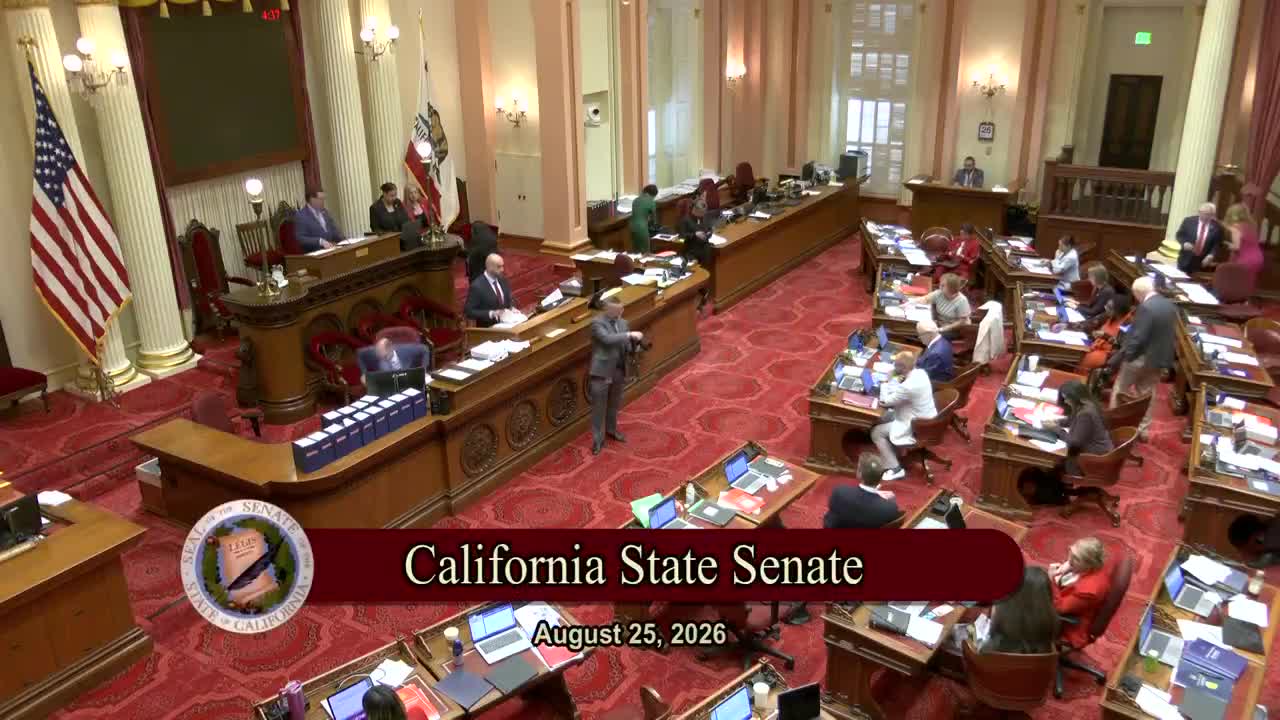 57SEC
Senate Floor
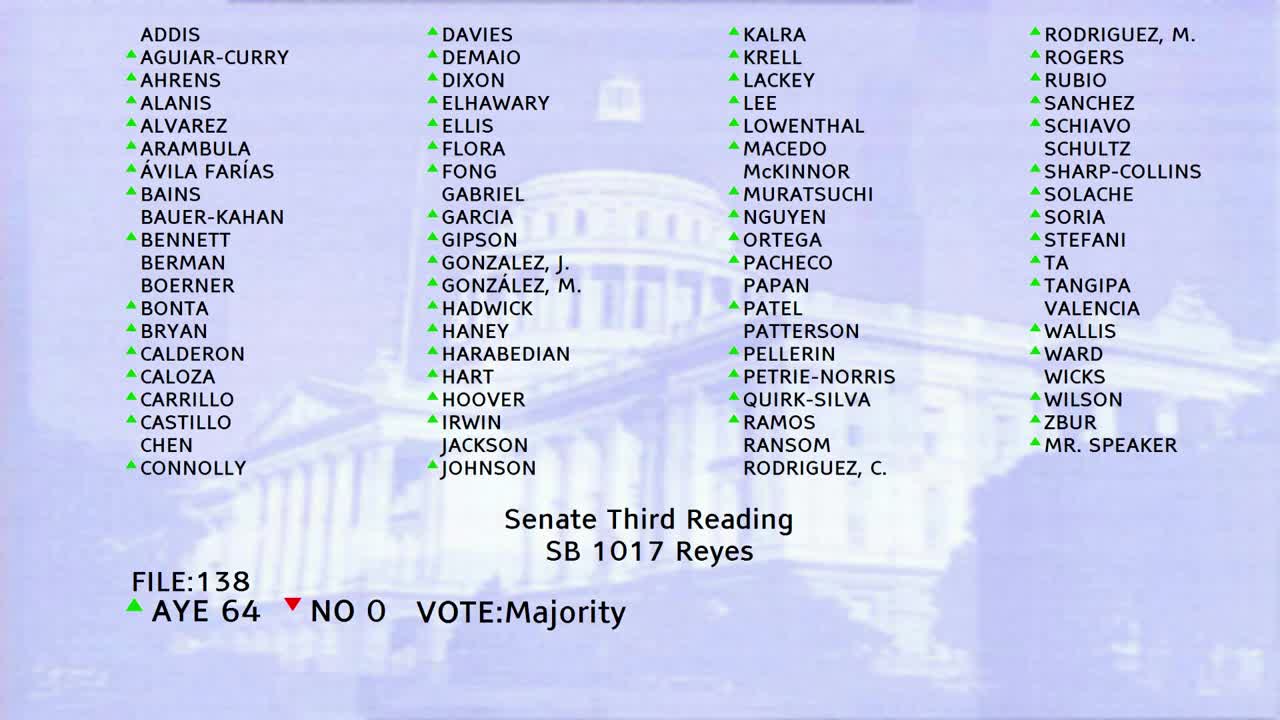 1MIN
Assembly Floor
 2MIN
Assembly Standing Committee on Emergency Management
 16MIN
Assembly Standing Committee on Housing and Community Development
 1MIN
Senate Floor
 4MIN
Senate Standing Committee on Emergency Management
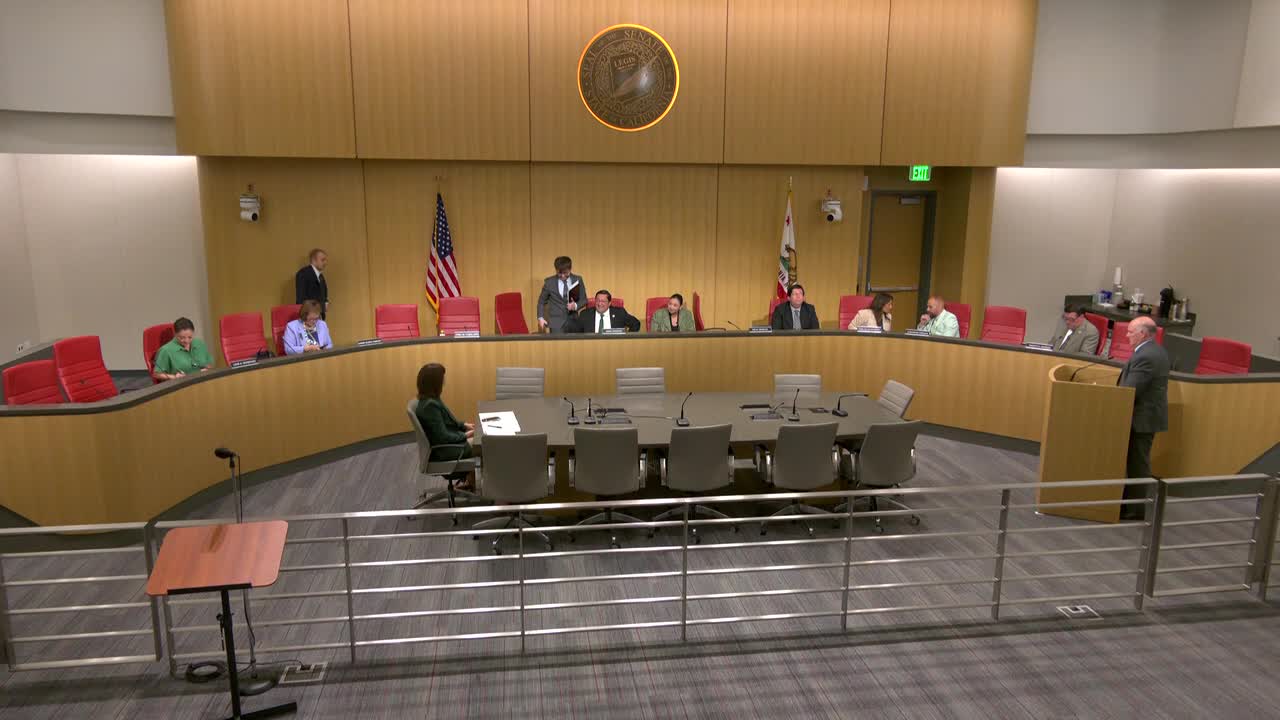 22MIN