SB 93: Weapons: robotic devices.
- Session Year: 2025-2026
- House: Senate
- Latest Version Date: 2025-04-03
Current Status:
Failed
(2026-02-02: Returned to Secretary of Senate pursuant to Joint Rule 56.)
Introduced
In Committee
Awaiting First Chamber Vote
Passed First Chamber
In Committee
Awaiting Second Chamber Vote
Passed Second Chamber
Enacted
Existing law makes it a crime to possess a destructive device. Existing law makes it a felony to possess material with the intent to make a destructive device or explosive without obtaining a permit to do so.
This bill would prohibit a person from operating a robotic device, as defined, equipped or mounted with a weapon, as defined. The bill would make a violation an infraction punishable by a fine of at least $100 but not more than $2,000. The bill would exclude specified persons, including a government official acting within the scope of their employment and a person acting within the scope of their employment by an organization that is researching, developing, testing, or manufacturing the robotic device for government use. use, if the person can demonstrate that they are researching, developing, testing, or manufacturing the robotic device for that purpose. By creating a new infraction, the bill would impose a state-mandated local program.
The California Constitution requires the state to reimburse local agencies and school districts for certain costs mandated by the state. Statutory provisions establish procedures for making that reimbursement.
This bill would provide that no reimbursement is required by this act for a specified reason.
Existing law makes it a crime to possess a destructive device. Existing law makes it a felony to possess material with the intent to make a destructive device or explosive without obtaining a permit to do so.
This bill would state the intent of the Legislature to enact legislation to regulate robotic devices equipped with weapons.This bill would prohibit a person from operating a robotic device, as defined, equipped or mounted with a weapon, as defined. The bill would make a violation an infraction punishable by a fine of at least $100 but not more than $2,000. The bill would exclude specified persons, including a government official acting within the scope of their employment and a person acting within the scope of their employment by an organization that is researching, developing, testing, or manufacturing the robotic device for government use. By creating a new infraction, the bill would impose a state-mandated local program.
The California Constitution requires the state to reimburse local agencies and school districts for certain costs mandated by the state. Statutory provisions establish procedures for making that reimbursement.
This bill would provide that no reimbursement is required by this act for a specified reason.
Existing law makes it a crime to possess a destructive device. Existing law makes it a felony to possess material with the intent to make a destructive device or explosive without obtaining a permit to do so.
This bill would state the intent of the Legislature to enact legislation to regulate robotic devices equipped with weapons.
(a)For the purposes of this section, the following terms have the following meanings:
(1)Robot competition means an event or instruction organized and supervised by an educational institution, summer camp, sports league, television or film entertainment company, or similar organization, and as to which reasonable safety precautions have been taken to protect participants, event staff, and spectators.
(2)Robotic device means a mechanical device capable of locomotion, navigation, flight, or movement and that operates at a distance from its operator or supervisor based on commands or in response to sensor data, or a combination of those, including mobile robots, unmanned ground vehicles, and unmanned aircraft.
(3)Weapon means a firearm or other deadly weapon, or a device specifically designed to threaten or cause death, incapacitation, or great bodily injury to a person, including, but not limited to, stun guns, firearms, machineguns, chemical agents or irritants, kinetic impact projectiles, weaponized lasers, flamethrowers, and explosive devices. cause incapacitation, including, but not limited to, a stun gun, a chemical agent, or a kinetic energy projectile.
(b)It shall be unlawful for a person to operate a robotic device equipped or mounted with a weapon.
(c)A violation of this section is an infraction punishable by a fine of at least one hundred dollars ($100) but not more than two thousand dollars ($2,000).
(d)This section shall not apply to any of the following:
(1)A person acting within the scope of that persons employment by an organization that is researching, developing, testing, or manufacturing the robotic device for government use. use, and who can demonstrate that they are researching, developing, testing, or manufacturing the robotic device for that purpose.
(2)(A)A person operating a nonautonomous robotic device designed and built specifically for the purpose of participating in a robot competition and equipped with weapons typically used for that purpose.
(B)This paragraph does not allow the equipping or mounting of any firearm to a robotic device.
(3)A person engaged in the operation of a blank-firing weapon and the weapons respective attachments, when that person is authorized or permitted to acquire and possess these weapons or attachments for use solely as props for a motion picture, television, or digital video production or entertainment event.
(4)A person operating a robotic device when engaged in academic research concerning the robotic device at an institution of higher learning located in California, and as to which reasonable safety precautions have been taken to protect the institutions students, faculty, staff, and visitors.
(5)A member, agent, officer, or employee of a federal, state, or local agency who is acting within the scope of that membership, agency, office, or employment.
(e)This section does not in any way sanction, authorize, prohibit, or regulate the procurement or operation of a robotic device by any governmental entity.
SEC. 2.No reimbursement is required by this act pursuant to Section 6 of Article XIIIB of the California Constitution because the only costs that may be incurred by a local agency or school district will be incurred because this act creates a new crime or infraction, eliminates a crime or infraction, or changes the penalty for a crime or infraction, within the meaning of Section 17556 of the Government Code, or changes the definition of a crime within the meaning of Section 6 of Article XIIIB of the California Constitution.
(a)For the purposes of this section, the following terms have the following meanings:
(1)Robot competition means an event or instruction organized and supervised by an educational institution, summer camp, sports league, television or film entertainment company, or similar organization, and as to which reasonable safety precautions have been taken to protect participants, event staff, and spectators.
(2)Robotic device means a mechanical device capable of locomotion, navigation, flight, or movement and that operates at a distance from its operator or supervisor based on commands or in response to sensor data, or a combination of those, including mobile robots, unmanned ground vehicles, and unmanned aircraft.
(3)Weapon means a device specifically designed to threaten or cause death, incapacitation, or great bodily injury to a person, including, but not limited to, stun guns, firearms, machineguns, chemical agents or irritants, kinetic impact projectiles, weaponized lasers, flamethrowers, and explosive devices.
(b)It shall be unlawful for a person to operate a robotic device equipped or mounted with a weapon.
(c)A violation of this section is an infraction punishable by a fine of at least one hundred dollars ($100) but not more than two thousand dollars ($2,000).
(d)This section shall not apply to any of the following:
(1)A person acting within the scope of that persons employment by an organization that is researching, developing, testing, or manufacturing the robotic device for government use.
(2)(A)A person operating a nonautonomous robotic device designed and built specifically for the purpose of participating in a robot competition and equipped with weapons typically used for that purpose.
(B)This paragraph does not allow the equipping or mounting of any firearm to a robotic device.
(3)A person engaged in the operation of a blank-firing weapon and the weapons respective attachments, when that person is authorized or permitted to acquire and possess these weapons or attachments for use solely as props for a motion picture, television, or digital video production or entertainment event.
(4)A person operating a robotic device when engaged in academic research concerning the robotic device at an institution of higher learning located in California, and as to which reasonable safety precautions have been taken to protect the institutions students, faculty, staff, and visitors.
(5)A member, agent, officer, or employee of a federal, state, or local agency who is acting within the scope of that membership, agency, office, or employment.
(e)This section does not in any way sanction, authorize, prohibit, or regulate the procurement or operation of a robotic device by any governmental entity.
SEC. 2.No reimbursement is required by this act pursuant to Section 6 of Article XIIIB of the California Constitution because the only costs that may be incurred by a local agency or school district will be incurred because this act creates a new crime or infraction, eliminates a crime or infraction, or changes the penalty for a crime or infraction, within the meaning of Section 17556 of the Government Code, or changes the definition of a crime within the meaning of Section 6 of Article XIIIB of the California Constitution.
SECTION 1.It is the intent of the Legislature to enact legislation to regulate robotic devices equipped with weapons.It is the intent of the Legislature to enact legislation to regulate robotic devices equipped with weapons.
|
Date
|
Status
|
|---|---|
| Feb 2, 2026 | Returned to Secretary of Senate pursuant to Joint Rule 56. |
| May 23, 2025 | May 23 hearing: Held in committee and under submission. |
| May 16, 2025 | Set for hearing May 23. |
| Apr 21, 2025 | April 21 hearing: Placed on APPR. suspense file. |
| Apr 8, 2025 | Set for hearing April 21. |
| Apr 3, 2025 | Read second time and amended. Re-referred to Com. on APPR. |
| Apr 2, 2025 | From committee: Do pass as amended and re-refer to Com. on APPR. (Ayes 6. Noes 0. Page 610.) (April 1). |
| Mar 18, 2025 | Set for hearing April 1. |
| Mar 5, 2025 | Re-referred to Com. on PUB. S. |
| Feb 25, 2025 | From committee with author's amendments. Read second time and amended. Re-referred to Com. on RLS. |
| Jan 29, 2025 | Referred to Com. on RLS. |
| Jan 23, 2025 | From printer. May be acted upon on or after February 22. |
| Jan 22, 2025 | Introduced. Read first time. To Com. on RLS. for assignment. To print. |
|
Date
|
Description
|
Location
|
Votes
|
|
|---|---|---|---|---|
| Apr 21, 2025 | Placed on suspense file | Senate Standing Committee on Appropriations |
Passed |
|
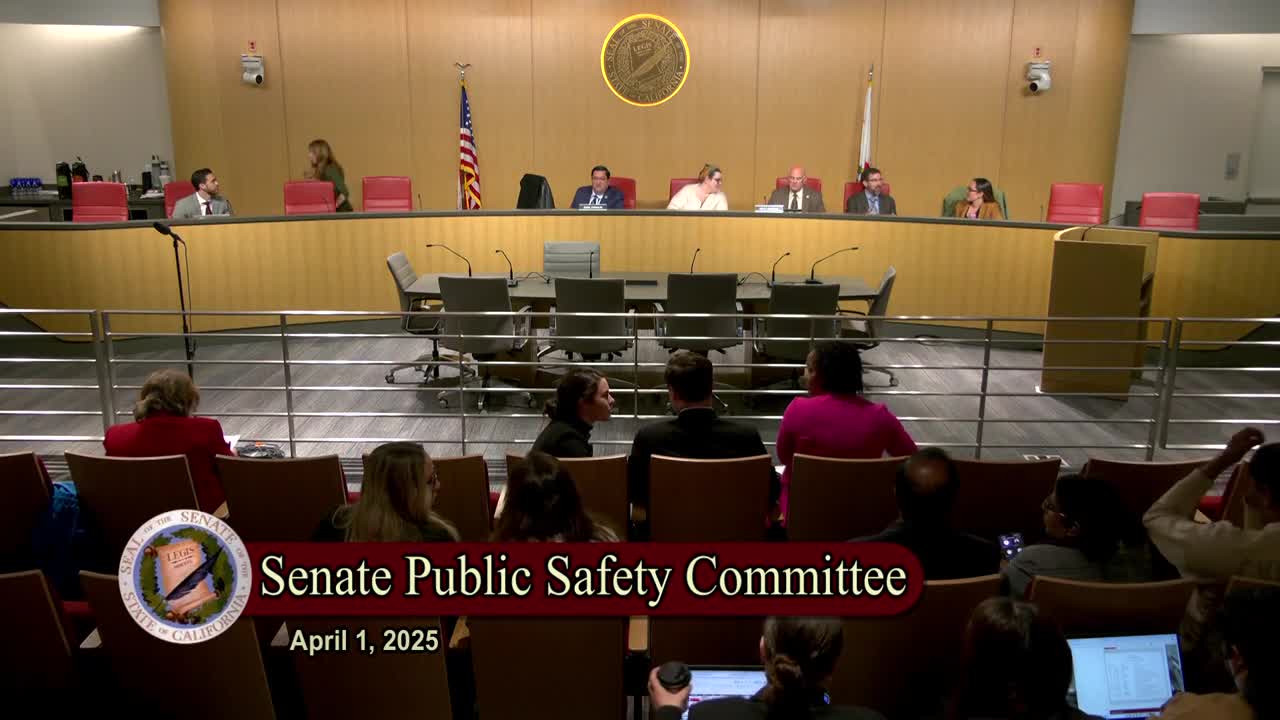
| Apr 1, 2025 | Do pass as amended, but first amend, and re-refer to the Committee on [Appropriations] | Senate Standing Committee on Public Safety |
Passed |
This list shows positions taken on this bill by organizations on the date displayed, which is linked to the original source.
Positions by individuals are not included.
|
Organization
|
Position
|
Date
|
|---|---|---|
| Aclu California Action | ** Against | |
| California Chapter of Association of Uncrewed Vehicle Systems International | ** Support | |
| Californians United for a Responsible Budget | ** Against | |
| Drone Deploy | ** Support | |
| Felony Murder Elimination Project | ** Against | |
| Initiate Justice Action | ** Against | |
| Justice2jobs Coalition | ** Against | |
| LA Defensa | ** Against | |
| Oakland Privacy | ** Against | |
| San Francisco Public Defender | ** Against | |
| western center on law and poverty | ** Against |
SENATE COMMITTEE ON
Senator Anna Caballero, Chair
2025 - 2026 Regular Session
SB 93 (Weber Pierson) - Weapons: robotic devices
Version: | Policy Vote: |
Urgency: | Mandate: |
Hearing Date: | Consultant: |
Bill Summary:
SB 93 makes it unlawful to operate a robotic device, as defined, equipped with a weapon, as specified.
Fiscal Impact:
Cost pressures to the state funded trial court system (Trial Court Trust Fund, General Fund) to process and adjudicate new infractions charged under this bill. It is unclear how many infractions would actually be issued as a result of this bill. The fiscal impact of this bill to the courts will depend on many unknown factors, including the numbers of people charged with an offense and the factors unique to each case. An eight-hour court day costs approximately $10,500 in staff in workload. According to statistical data from Judicial Council, in 2024, 77,850 nontraffic infractions were filed in the trail courts. Costs to the trial courts could reach hundreds of thousands of dollars due to the increased workload. The Governor’s 2025-26 budget proposes a $40 million ongoing increase in discretionary funding from the General Fund to help pay for increased trial court operation costs beginning in 2025-26. Although courts are not funded on the basis of workload, increased pressure on the Trial Court Trust Fund may create a need for increased funding for courts from the General Fund to fund additional staff and resources and to increase the amount appropriated to backfill for trial court operations. If funding is not provided for the new workload created by this bill, it may result in delays and prioritization of court cases.
Background:
In 2022, after a video of a rifle bolted to the back of a ‘robodog’ went viral, the sponsor of this bill, Boston Dynamics, joined several other robotics companies in issuing an open letter in which the companies pledged not to weaponized their general purpose robots, with notable exceptions for military uses.[1]
Proposed Law:
This bill makes it unlawful for a person to operate a robotic device equipped or mounted with a weapon. A violation is an infraction punishable by a fine of at least $100 and not more than $2,000[2]. This prohibition does not apply to any of the following:
- For researching, developing, testing, or manufacturing the robotic device for government use, as specified;
- For participating in a robot competition, as defined, and equipped with weapons typically used for that purpose, as specified;
- For use solely as props for a motion picture, television, or digital video production or entertainment event, as specified;
- For academic research concerning the robotic device at an institution of higher learning located in California, as specified; and,
- For use by a member, agent, officer, or employee of a federal, state, or local agency, as specified.
This bill also states that these provisions do not in any way sanction, authorize, prohibit, or regulate the procurement or operation of a robotic device by any governmental entity.
This bill defines the following:
- “Robot competition” as “an event or instruction organized and supervised by an educational institution, summer camp, sports league, television or film entertainment company, or similar organization, and as to which reasonable safety precautions have been taken to protect participants, event staff, and spectators”;
- “Robotic device” as a “mechanical device capable of locomotion, navigation, flight, or movement and that operates at a distance from its operator or supervisor based on commands or in response to sensor data, or a combination of those, including mobile robots, unmanned ground vehicles, and unmanned aircraft”; and,
- “Weapon” as a “firearm or other deadly weapon, or a device specifically designed to cause incapacitation, including, but not limited to, a stun gun, a chemical agent, or a kinetic energy projectile.”
Related Legislation:
AB 79 (Weber, 2023), which was substantially similar to this bill, would have prohibited a person from knowingly manufacturing, modifying, selling, transferring, or operating a weaponized drone or robot, punishable by a fine between $1,000 and $5,000 dollars. The bill was referred to Assembly Public Safety Committee, amended several times, and set for hearing several times, but each hearing was cancelled at the request of the Author.
AB 2681 (Weber Pierson, 2024), which was substantially similar to this bill, would have prohibited the manufacture, modification, sale or transfer of weaponized robots, and included exemptions for certain defense contractors and for robotics developers that operate weaponized robotic devices for the purpose of developing technology that can detect, prevent or mitigate the unauthorized weaponization of a robot. AB 2681 also included a much narrower exemption for the use of weaponized robots by law enforcement, limiting law enforcement use of weaponized robots to explosive disposal and property destruction in cases where there is an imminent, deadly threat to human life. AB 2681 was vetoed. In his veto message, the Governor wrote the following:
I support the author's intent to prohibit the weaponization of an emerging technology and place common sense restrictions on potentially dangerous devices. However, this bill would also prohibit beneficial law enforcement use of such devices. For example, when confronted with armed and barricaded suspects, law enforcement agencies sometimes use remotely operated robots to deploy less-lethal force to drive these suspects into the open or protect officers from dangerous suspects.
Staff Comments: This bill contains several exclusions, including federal, state and local government officers and their agents (i.e., their contractors) and specifies that it does not prohibit or regulate the procurement or operation of a robotic device by a government agency. Opponents of this bill contend that while “SB 93 purports to ban some uses and manufacture of such weaponized robots, its explicit and generous carve out for all public uses of such a dangerous technology can only be read as an imprimatur of approval for governments throughout the state to acquire them.” They further oppose “the spending of already scarce public funds on militarization of police forces when many cities are already facing significant budget deficits.”
-- END --
“General Purpose Robots Should Not Be Weaponized.” Boston Dynamics. Available at: https://bostondynamics.com/news/general-purpose-robots-should-not-be-weaponized/ ↑
As described in detail in the policy committee analysis of this bill, these are base figures subject to statutorily imposed penalty assessments. Current penalty assessments total roughly 310% of the initial fine. A $100 fine, for instance, will actually cost an individual $410; a fine of $2,000 will actually cost the individual roughly $8,200. ↑
SENATE COMMITTEE ON PUBLIC SAFETY
Senator Jesse Arreguín, Chair
2025 - 2026 Regular
Bill No: SB 93 Hearing Date: April 1, 2025
Author: | Weber Pierson | ||
Version: | February 25, 2025 | ||
Urgency: | No | Fiscal: | Yes |
Consultant: | AB | ||
Subject: Weapons: robotic devices
HISTORY
Source: Boston Dynamics
Prior Legislation: AB 2681 (Weber Pierson), vetoed by the Governor, 2024
AB 79 (Weber), not heard in Assembly Public Safety, 2023
AB 48 (Gonzalez), Ch. 404, Stats. of 2021
AB 392 (S. Weber), Ch. 170, Stats. of 2019
SB 807 (Gaines) Ch. 834, Stats. of 2016
Support: California Chapter of Association of Uncrewed Vehicle Systems International; Drone Deploy
Opposition: ACLU California Action; Californians United for a Responsible Budget; Felony Murder Elimination Project; Initiate Justice Action; Justice2Jobs Coalition; LA Defensa; Oakland Privacy; San Francisco Public Defender; Western Center on Law and Poverty
PURPOSE
The purpose of this bill is to prohibit a person from operating a robotic device equipped or mounted with a weapon, except as specified.
Existing law defines “weaponized aircraft, vessels, or vehicles of any kind” as “military equipment” requiring the approval a local governing body before law enforcement may seek, use, or acquire such equipment. (Gov. Code, §§ 7070, subd. (c)(6), & 7071, subd. (a)(1).)
Existing law provides that a person who knowingly and intentionally operates an unmanned aircraft system on or above the grounds of a state prison, a jail, or a juvenile hall, camp, or ranch is guilty of an infraction, punishable by a fine of $500. (Pen. Code, § 4577, subd. (a).)
Existing law makes it a misdemeanor to use an unmanned aircraft system to look through a hole or opening into the interior of specified areas in which the occupant has a reasonable expectation of privacy with the intent to invade the privacy of a person inside. (Pen. Code, § 647, subd. (j)(1).)
Existing law provides that it is unlawful for any person to operate an unmanned aircraft system in pest control unless the pilot operating the unmanned aircraft system holds a valid manned pest control aircraft pilot’s certificate or a valid unmanned pest control aircraft pilot’s certificate issued by the director and is certified or otherwise authorized by the Federal Aviation Administration to operate an unmanned aircraft system approved by the Federal Aviation Administration to conduct pest control. (Food & Agr. Code, § 11901, subd. (b).)
Existing law provides that the possession or knowing transport of a machine gun, except as specified, is a felony punishable by imprisonment in county jail for 16 months, 2 years, or 3 years, by a fine of up to $10,000, or by both fine and imprisonment. (Pen. Code, § 32625, subd. (a).)
Existing law provides that intentionally converting a firearm into a machine gun, or selling or knowingly manufacturing a machine gun, is a felony punishable by imprisonment in county jail for 4, 6, or 8 years. (Pen. Code, § 32625, subd. (b).)
Existing law provides that possession of a destructive device is punishable by up to one year in county jail, by up to three years in state prison, by a fine of up to $10,000, or both fine and imprisonment. (Pen. Code, § 18710, subd. (b).)
Existing law provides that a person who recklessly or maliciously possesses a destructive device or explosive in a public place or designated private places is guilty of a felony punishable by imprisonment in county jail for 2, 4, or 6 years. (Pen. Code, § 18715.)
Existing law provides that selling or knowingly transporting a destructive device is a felony punishable by imprisonment in county jail for 2, 3, or 4 years. (Pen. Code, § 18730.)
Existing law provides that a person who possesses, explodes, ignites, or attempts to explode or ignite any destructive device or any explosive with intent to injure, intimidate, or terrify any person, or with intent to wrongfully injure or destroy any property, is guilty of a felony punishable by imprisonment in county jail for a period of 3, 5, or 7 years. (Pen. Code, § 18740.)
Existing law defines “destructive device” to include, among other things, a bomb, grenade or explosive missile; a weapon of a caliber greater than 0.60 caliber which fires fixed ammunition, other than a shotgun, as specified; a rocket or rocket-propelled projectile, as specified; and a breakable container that a flammable liquid with a flashpoint of 150 degrees Fahrenheit or less with a wick capable of being ignited. (Pen. Code, § 16460, subd. (a).)
Existing law defines “machine gun” as a weapon that shoots, is designed to shoot, or can readily be restored to shoot, automatically more than one shot, without manual reloading, by a single function of a trigger; the frame or receiver of any weapon, any part designed and intended solely and exclusively, or combination of parts designed and intended, for use in converting a weapon into a machinegun, and any combination of parts from which a machinegun can be assembled if those parts are in the possession or under the control of a person; or any weapon deemed by the federal Bureau of Alcohol, Tobacco, Firearms and Explosives as readily convertible to a machinegun, as specified. (Pen. Code, § 16880.)
This bill sets forth the following definitions for terms used therein:
- “Robot competition” means an event or instruction organized and supervised by an educational institution, summer camp, sports league, television or film entertainment company, or similar organization, and as to which reasonable safety precautions have been taken to protect participants, event staff, and spectators.
- “Robotic device” means a mechanical device capable of locomotion, navigation, flight, or movement and that operates at a distance from its operator or supervisor based on commands or in response to sensor data, or a combination of those, including mobile robots, unmanned ground vehicles, and unmanned aircraft.
- “Weapon” means a device specifically designed to threaten or cause death, incapacitation, or great bodily injury to a person, including, but not limited to, stun guns, firearms, machineguns, chemical agents or irritants, kinetic impact projectiles, weaponized lasers, flamethrowers, and explosive devices.
This bill provides that it is unlawful for a person to operate a robotic device equipped or mounted with a weapon, a violation of which is an infraction punishable by a fine of at least $100 but not more than $2,000.
This bill exempts the following from the prohibition above:
- A person acting within the scope of that person’s employment by an organization that is researching, developing, testing, or manufacturing the robotic device for government use.
- A person operating a non-autonomous robotic device designed and built specifically for the purpose of participating in a robot competition and equipped with weapons typically used for that purpose. This paragraph does not allow the equipping or mounting of a firearm to a robotic device.
- A person engaged in the operation of a blank-firing weapon and the weapon’s respective attachments, when that person is authorized or permitted to acquire and possess these weapons or attachments for use solely as props for a motion picture, television, or digital video production or entertainment event.
- A person operating a robotic device when engaged in academic research concerning the robotic device at an institution of higher learning located in California, and as to which reasonable safety precautions have been taken to protect the institution’s students, faculty, staff, and visitors.
- A member, agent, officer, or employee of a federal, state, or local agency who is acting within the scope of that membership, agency, office, or employment.
This bill specifies that it does not in any way sanction, authorize, prohibit, or regulate the procurement or operation of a robotic device by a governmental entity.
COMMENTS
- Need for This Bill
According to the Author:
SB 93 is a common-sense public safety measure placing guardrails around the use of weaponized robots. This measure will prohibit a person from operating a robotic device equipped or mounted with a weapon. In the past several years, cheap robotics and drones have proliferated, as has the dangerous misuse and weaponization of these technologies. This is damaging and antithetical to the goals of many robotics companies focused on assistance and support of many industries. As robotics technology advances and the industry expands, the prohibition in SB 93 will protect the public and bring stability and predictability to this innovative emerging market in our state. It is time for California to lead the nation in protecting the safety of our communities.
- The Use of Armed Robots
The advancement of robotics technology over the past several decades has seen a contemporaneous growth in the use of armed robots, primarily in official law enforcement and military contexts that pose high risk to human actors. For instance, the 21st Century has seen the rise of “unmanned aerial vehicles,” or UAVs, which, in a military setting, can operate with various levels of autonomy at long ranges and are used for intelligence gathering, reconnaissance, target acquisition, and striking targets with a range of different ordinance types. The expansion of United States military involvement in the Middle East beginning in the early 2000s saw an increase in drone strikes on enemy targets across the region, and public debates back in this country about the collateral damage they caused, which continue today.[1] More recently, military conflicts (such as those in Ukraine and the Middle East) have involved the use of smaller, more nimble short-range drones equipped with explosives and intended for one-time use.[2]
Additionally, law enforcement use of unmanned drones and robots – both armed and unarmed – has received increasing attention in recent years. Currently, law enforcement in California are not prohibited from using weaponized robots or drones, although existing law requires police agencies to seek approval before acquiring such devices. Specifically, existing law requires a law enforcement agency to get approval from the local governing body (the city council or board of supervisors, for instance) with jurisdiction over the agency prior to using military equipment, which includes “unmanned, remotely piloted, powered aerial and ground vehicles” and “weaponized aircraft, vessels, or vehicles of any kind.” The law also mandates that the public must have an opportunity to comment on the propriety of law enforcement’s acquisition or use of weaponized robotic devices.[3]
The decision to adopt weaponized robotic devices has been hotly debated on multiple occasions in California. In late 2022, the San Francisco County Board of Supervisors approved a measure that would have allowed the San Francisco Police Department (SFPD) to deploy weaponized robots capable of using deadly force, but reversed its decision just days later after significant public backlash.[4] Public outcry in Oakland halted a similar effort after the police department initially requested the authority to use robots armed with shotguns under certain circumstances.[5] And in Los Angeles, the City Council postponed a vote on whether to authorize the Los Angeles Police Department to accept the donation of robot for 60 days over concerns about privacy and surveillance, and despite assurances from both the LAPD and the robot manufacture that there were no plans to furnish the robot with weapons.[6]
Despite objections to their use, law enforcement officials argue that armed robotic devices can help ensure the safety of both the public and officers in highly dangerous situations. For instance, in Dallas, after an ambush attack on police left five officers dead, police outfitted a bomb squad robot with an explosive device to kill the suspect who had barricaded himself in a parking garage. According to the Dallas Police Chief, “We saw no other option [after negotiations failed] but to use our bomb robot and place a device on its extension for it to detonate where the suspect was… Other options would have exposed our officers to grave danger.”[7] The San Francisco Police Chief noted that police had not yet had to use a robot to kill a civilian, and that police hoped to avoid such use. “But,” he added, “we need the option to be able to save lives” if there is an imminent threat to the lives of police officers or civilians.[8]
Many experts caution that opening the door for the use of armed robots or drones by law enforcement, even in limited circumstances, carries significant risks. One stated, “[H]orror stories, or worst examples, can and have opened the door for much more use of that power beyond the most horrific situation… Historically, when we grant police power or discretion or advanced technologies, they tend to be used in many more situations.” Another cited uncertainty about potential errors in robotics and automotive technology, citing problems self-driving vehicles.[9]
In 2022, after a video of a rifle bolted to the back of a ‘robodog’ went viral, the sponsor of this bill, Boston Dynamics, joined several other robotics companies in issuing an open letter in which the companies pledged not to weaponized their general purpose robots, with notable exceptions for military uses.[10] According to the Author, “as robots have become increasingly accessible to the public, there are recent examples of people mounting dangerous weapons to them, often with the goal of creating a sensational, viral social media video. The misuse of weaponized remote controlled or autonomous robots is unethical, poses a serious public safety threat, and damages the public’s acceptance of these beneficial technologies in society.”
- This Bill Creates an Infraction for Operating Robotic Devices Equipped with A Weapon
In an attempt to address the issue identified above, the Author proposes this measure to prohibit a person from operating a robotic device equipped or mounted with a weapon, defined as a device specifically designed to threaten or cause death, incapacitation, or great bodily injury to a person. The bill defines “robotic device” as a mechanical device capable of locomotion, navigation, flight, or movement and that operates at a distance from its operator or supervisor based on commands or in response to sensor data, or a combination of those, including mobile robots, unmanned ground vehicles, and unmanned aircraft. The bill specifies that a violation of this prohibition is an infraction punishable by a fine of between $100 and $2,000.
The bill also includes several exemptions to its central prohibition, including the following individuals: a person acting within the scope of that person’s employment by an organization that is researching, developing, testing, or manufacturing the robotic device for government use, a person operating a robotic device for the purpose of participating in a robot competition, as specified, a person using a robot armed with a blank-firing weapon in the context of motion picture, television or other entertainment event, a person operating a robotic device when engaged in academic research at an institution of higher learning in California, and a member, agent, officer or employee of a federal, state or local government agency acting within the scope of their official duties.
- Prior Legislation and Governor’s Veto
AB 79 (Weber, 2023), which was substantially similar to this bill, would have prohibited a person from knowingly manufacturing, modifying, selling, transferring, or operating a weaponized drone or robot, punishable by a fine of between $1,000 and $5,000 dollars. The bill was referred to Assembly Public Safety Committee, amended several times, and set for hearing several times, but each hearing was cancelled at the request of the Author.
This bill is also substantially similar to AB 2681 (Weber Pierson), which was introduced last year, passed through the Legislature, but ultimately vetoed by the Governor. In contrast to this bill, AB 2681 prohibited the manufacture, modification, sale or transfer of weaponized robots, and included exemptions for certain defense contractors and for robotics developers that operate weaponized robotic devices for the purpose of developing technology that can detect, prevent or mitigate the unauthorized weaponization of a robot. AB 2681 also included a much narrower exemption for the use of weaponized robots by law enforcement, limiting law enforcement use of weaponized robots to explosive disposal and property destruction in cases where there is an imminent, deadly threat to human life. In his veto message, the Governor wrote the following:
I support the author's intent to prohibit the weaponization of an emerging technology and place common sense restrictions on potentially dangerous devices. However, this bill would also prohibit beneficial law enforcement use of such devices. For example, when confronted with armed and barricaded suspects, law enforcement agencies sometimes use remotely operated robots to deploy less-lethal force to drive these suspects into the open or protect officers from dangerous suspects.
Likely in response to the Governor’s veto, the government use exemption in this bill is much broader than that in AB 2681, and imposes no limitation on the procurement or use of weaponized robots by government actors.
- Policy Considerations
Some of the bill’s provisions raise policy questions that the Author and Committee may wish to consider.
Penalty Assessments
Existing law provides that the default fine for an infraction is $250, unless a higher penalty is prescribed.[11] This bill provides that any person who violates its prohibition against the operation of weaponized robots shall be required to pay a fine of at least $100 but no more than $2,000. However, the amount spelled out in statute as a fine for violating a criminal offense are base figures, as these amounts are subject to statutorily-imposed penalty assessments, such as fees and surcharges. Though most base fines have not been increased since 2006, the penalty assessments attached to the fines have increased approximately 40% since 2006, thus increasing the total that a person actually pays. Current penalty assessments total roughly 310% of the initial fine, so a fine of $100 for a first offense, for instance, will actually cost an individual $410.[12] Taken together with additional fines and assessments, and assuming the defendant received the maximum fine under the proposed bill, the total owed by a person convicted of this crime would be roughly $8,200.
Although it is unlikely that the maximum fine amount would be imposed for a first offense, given the range of potential fines, the Author and Committee may wish to consider whether these fines are appropriate, especially in light of the fact that individuals charged with an infraction do not have the right to an attorney or a jury trial under existing law. One option may be creating a tiered penalty schedule, with increasing fines imposed as the number of violations increases. Such an approach might also include a potential misdemeanor for a second or third offense, giving the accused the benefit of the right to counsel and a jury trial.
Scope of Prohibition and Exemptions
As mentioned above, whereas an earlier attempt to enact this policy, AB 2681, included prohibitions on the manufacture, modification, sale, transfer and operation of weaponized robots, this bill solely prohibits the operation of such devices. The removal of this additional conduct from the bill’s prohibition gives rise to a scenario in which an individual could manufacture or repair weaponized robots from their home and sell or transfer them without restriction. The Author cites the creation of “sensational, viral social media videos” featuring weaponized robots as an impetus for the bill. However, under the bill’s provisions, an individual could film the production of such robots, and even film advertisements for their sale, without repercussion, as liability for the infraction only attaches when one “operates” the device. The Author may wish to consider whether the bill’s proscriptive language truly achieves its intended effect.
In addition, AB 2681 provided an exemption for “defense industrial companies” with respect to weaponized robotic devices developed within the scope of an existing government contract or for the purpose of obtaining such a contract. This bill removes the exemption for “defense industrial companies” and instead exempts “a person acting within the scope of that person’s employment by an organization that is researching, developing, testing, or manufacturing the robotic device for government use.” This exemption risks being so broad as to completely swallow the bill’s central prohibition. Take the hypothetical individual referenced in the preceding paragraph who is manufacturing and selling weaponized robots from their home: if this person is caught operating such a robot, they could, for instance, simply claim that they are self-employed and testing the weaponized robot for the purpose of marketing it to police departments. The Author and Committee may wish to consider amending the bill to include some specificity regarding what constitutes “employment” and an “organization” for the purpose of qualifying for this exemption.
Definition of “Weapon”
As mentioned above, this bill defines “weapon” as “a device specifically designed to threaten or cause death, incapacitation, or great bodily injury to a person, including, but not limited to, stun guns, firearms, machineguns, chemical agents or irritants, kinetic impact projectiles, weaponized lasers, flamethrowers, and explosive devices.” In California case law, the term “deadly weapon” is well-established, and includes ‘any object, instrument, or weapon that is used in such a manner as to be capable of producing and likely to produce, death or great bodily injury.”[13] Rather than use terminology for which courts may ultimately have to create a novel definition, the Author may wish to include language used in the case law definition of “deadly weapon,” and attach any verbiage regarding non-lethal weapons thereto.
- Argument in Support
According to Boston Dynamics, the bill’s sponsor:
Our company, founded by an MIT professor and his students over 30 years ago, is at the forefront of an industry in which advanced mobile robots will become more common in both industrial and public spaces. We are the leading provider of walking robots to innovative companies and organizations in California, such as the NASA Jet Propulsion Laboratory in Pasadena. In 2022, we and other leading robot industry organizations published an open letter pledging not to weaponize our advanced-mobility general-purpose robots, and to not support others doing so.
Mounting weapons to robots that are remotely or autonomously operated, widely available to the public, and capable of navigating within locations where people live and work, raises new risks of harm and serious ethical issues. The development and use of such weaponized robots will also harm public trust in the technology in ways that damage the tremendous benefits they will bring to society. Recognizing that our commitment alone is not enough to fully address these risks, we call upon policymakers to work with us to promote safe use of these robots and to prohibit their misuse. SB 93 fulfills the crucial vision for ethical and safe robots in society, and for these reasons, Boston Dynamics is pleased to support SB 93.
- Argument in Opposition
According to ACLU California Action:
We strongly oppose the use of weaponized police robots, for several reasons. First, weaponized robotic devices exacerbate the epidemic of unjustifiable police use of force in this country. Robot systems allow police to harm and maim remotely and, as a result, with dangerous detachment from the real-world human consequences of violence. These dynamics, combined with the low cost and ease by which robots can be sent into neighborhoods, makes deadly violence inevitable and increase the chances that such force will be used without justification. Put more bluntly, if police in California use weapon-toting robots, more Californians will die at the hands of the police and their killer robots.
Second, we oppose the spending of already scarce public funds on militarization of police forces when many cities are already facing significant budget deficits. Rather than authorizing the expenditure of millions in taxpayer dollars on arming officers to the brim and pushing police to view themselves as “at war” with communities, we have consistently advocated for sensible reinvestment of these precious dollars into life affirming supportive services that are known to greatly reduce police violence and improve public safety, like housing support, employment opportunities, and other forms of community development.
Finally, beyond the violence that these devices would unleash in California, weaponized police robots also threaten other civil liberties. If SB 93 were to become law, we should expect robotic devices equipped with not only weapons, but also invasive cameras and sensors that monitor and scrutinize Californians going to work, attending school, and engaging in protected activism. Police robots invite violations of constitutional rights of speech and privacy, all while facilitating—not reducing— dangerous interactions between vulnerable individuals and police. For example, police robots patrolling a peaceful protest would surely chill speech, not to mention the privacy concerns associated with the level of constant surveillance these robots would engage in. Although SB 93 purports to ban some uses and manufacture of such weaponized robots, its explicit and generous carve out for all public uses of such a dangerous technology can only be read as an imprimatur of approval for governments throughout the state to acquire them.
-- END –
“Hidden Pentagon Records Reveal Patterns of Failure in Deadly Airstrikes.” New York Times. 18 December 2021. Hidden Pentagon Records Reveal Patterns of Failure in Deadly Airstrikes - The New York Times (nytimes.com) ↑
“Drone that killed U.S. troops in Jordan likely went undetected.” The Washington Post. 6 February, 2024. Drone in Jordan attack that killed U.S. troops likely went undetected - The Washington Post; “How the Drone War in Ukraine is Transforming Conflict.” Council on Foreign Relations. 16 January 2024. How the Drone War in Ukraine Is Transforming Conflict | Council on Foreign Relations (cfr.org) ↑
Gov. Code, § 7071, subd. (a),(c); Gov. Code, § 7070, subd. (c)(1) & (6) . ↑
“San Francisco supervisors bar police robots from using deadly force for now.” The Associated Press 6 Dec 2022. https://www.npr.org/2022/12/06/1141129944/san-francisco-deadly-robots-police ↑
“Oakland Police Department says it’s no longer considering armed robots.” KRON (Oct. 19, 2022) <https://www.kron4.com/news/oakland-police-department-says-its-no-longer-considering-armed-robots/ ↑
“City Council delays vote on LAPD robot dog for 2 months.” The Los Angeles Times. 7 March 2023. https://www.latimes.com/california/story/2023-03-07/la-city-council-tables-police-robot-dog-vote-2-months ↑
“Dallas sniper attack: 5 officers killed, suspect identified.” CNN.com. 9 July 2016. https://www.cnn.com/2016/07/08/us/philando-castile-alton-sterling-protests ↑
“San Francisco supervisors vote to allow police to use robots to kill people.” CNN.com. 30 Nov 2023. https://www.cnn.com/2022/11/30/us/san-francisco-police-remote-control-robots/index.html ↑
“See Spot spy? A new generation of police robots faces backlash.” The Los Angeles Times. 21 Dec 2022. https://www.latimes.com/california/story/2022-12-21/lapd-testing-robot-dog-amid-debate-over-arming-police-robots; “Will Lethal-Force Police Robots Come to More Cities?” Pittsburgh Tribune-Review 20 December 2022 https://www.govtech.com/public-safety/will-lethal-force-police-robots-come-to-more-cities ↑
“General Purpose Robots Should Not Be Weaponized.” General Purpose Robots Should Not Be Weaponized | Boston Dynamics ↑
Penal Code §19.8 ↑
Until the budget year 2002-2003, there was 170% in penalty assessments applied to every fine; the current penalty assessments are approximately 310% plus a flat fee of $79. (See Penal Code § 1464; Penal Code § 1465.7; Penal Code § 1465.8 Government Code § 70373; Government Code § 7600.5; Government Code § 76000 et seq; Government Code §76000.10 Government Code § 76104.6; Government Code §76104,7) ↑
People v. Aguilar (1997) 16 Cal.4th 1023, 1028-1029. See also People v. Brown (2012) 210 Cal.App.4th 1; Cal. Crim 875. ↑
Discussed in Hearing
 25MIN
Senate Standing Committee on Public Safety
Bill Author

Bill Co-Author(s):