SB 931: Dolly Parton Day.
- Session Year: 2025-2026
- House: Senate
- Latest Version Date: 2026-09-20
Current Status:
Passed
(2026-09-20: Chaptered by Secretary of State. Chapter 355, Statutes of 2026.)
Introduced
In Committee
Awaiting First Chamber Vote
Passed First Chamber
In Committee
Awaiting Second Chamber Vote
Passed Second Chamber
Enacted
Existing law requires the Governor to proclaim various days as days of remembrance or recognition.
This bill would require the Governor to annually proclaim September 25 as Dolly Parton Day.
This bill would declare that it is to take effect immediately as an urgency statute.
Existing law requires the Governor to proclaim various days as days of remembrance or recognition.
This bill would require the Governor to annually proclaim September 25 as Dolly Parton Day.
This bill would declare that it is to take effect immediately as an urgency statute.
Existing law requires the Governor to proclaim various days as days of remembrance or recognition.
This bill would require the Governor to annually proclaim September 25 as Dolly Parton Day.
This bill would declare that it is to take effect immediately as an urgency statute.
Existing law requires the Governor to proclaim various days as days of remembrance or recognition.
This bill would require the Governor to annually proclaim September 25 as Dolly Parton Day.
This bill would declare that it is to take effect immediately as an urgency statute.
Existing law vests the Public Utilities Commission with regulatory jurisdiction over public utilities, including electrical corporations. Existing law requires the commission to approve full funding for the Community Impacts Mitigation Program set forth in a settlement between the Pacific Gas and Electric Company and various entities, including public entities in the County of San Luis Obispo, to mitigate the impacts caused by the decommissioning of the Diablo Canyon nuclear powerplant proposed by the Pacific Gas and Electric Company. Pursuant to existing law, the commission issued a decision authorizing the recovery of the costs of the Community Impacts Mitigation Program through the nuclear decommissioning nonbypassable charge. Existing law requires the commission to direct and authorize the extended operation of the Diablo Canyon nuclear powerplant until October 31, 2030. Existing law requires the commission to authorize the Pacific Gas and Electric Company, as the operator of the Diablo Canyon nuclear powerplant, to recover in rates a volumetric payment of a specified amount for each megawatthour of electricity generated by the nuclear powerplant during the period of extended operations, as provided, and requires the Pacific Gas and Electric Company to submit to the commission for its review, on an annual basis, the amount collected, how those moneys were spent, and a plan for prioritizing the use of those moneys in the next year, as provided. This bill would require the plans described above covering the 202627 and 202728 fiscal years to include funding for the Essential Services Mitigation Fund established by the Community Impacts Mitigation Program for the extended operation of the Diablo Canyon nuclear powerplant, as provided. The bill would require that purpose to be prioritized for funding in the plans and would require that purpose to be fully funded before funding other authorized uses. The bill would require the funding be provided in 2 equal annual installments of $8,333,333 to the Essential Service Mitigation Fund in the 202627 and 202728 fiscal years, with the final payment made before October 31, 2028. The bill would require the County of San Luis Obispo to distribute that funding within 30 days of receipt of each deposit, as provided. By imposing requirements on the county to distribute those moneys, this bill would impose a state-mandated local program.Under existing law, a violation of an order, decision, rule, direction, demand, or requirement of the commission is a crime.Because a violation of a commission action implementing the bills requirements would be a crime, this bill would impose a state-mandated local program.This bill would make legislative findings and declarations as to the necessity of a special statute for the Diablo Canyon nuclear powerplant.The California Constitution requires the state to reimburse local agencies and school districts for certain costs mandated by the state. Statutory provisions establish procedures for making that reimbursement.This bill would provide that with regard to certain mandates no reimbursement is required by this act for a specified reason.With regard to any other mandates, this bill would provide that, if the Commission on State Mandates determines that the bill contains costs so mandated by the state, reimbursement for those costs shall be made pursuant to the statutory provisions noted above.This bill would declare that it is to take effect immediately as an urgency statute.Existing law vests the Public Utilities Commission with regulatory jurisdiction over public utilities, including electrical corporations. Existing law requires the commission to approve full funding for the Community Impacts Mitigation Program set forth in a settlement between the Pacific Gas and Electric Company and various entities, including public entities in the County of San Luis Obispo, to mitigate the impacts caused by the decommissioning of the Diablo Canyon nuclear powerplant proposed by the Pacific Gas and Electric Company. Pursuant to existing law, the commission issued a decision authorizing the recovery of the costs of the Community Impacts Mitigation Program through the nuclear decommissioning nonbypassable charge. Existing law requires the commission to direct and authorize the extended operation of the Diablo Canyon nuclear powerplant until October 31, 2030. Existing law requires the commission to authorize the Pacific Gas and Electric Company, as the operator of the Diablo Canyon nuclear powerplant, to recover in rates a volumetric payment of a specified amount for each megawatthour of electricity generated by the nuclear powerplant during the period of extended operations, as provided, and requires the Pacific Gas and Electric Company to submit to the commission for its review, on an annual basis, the amount collected, how those moneys were spent, and a plan for prioritizing the use of those moneys in the next year, as provided.
This bill would require the plans described above covering the 202627 and 202728 fiscal years to include funding for the Essential Services Mitigation Fund established by the Community Impacts Mitigation Program for the extended operation of the Diablo Canyon nuclear powerplant, as provided. The bill would require that purpose to be prioritized for funding in the plans and would require that purpose to be fully funded before funding other authorized uses. The bill would require the funding be provided in 2 equal annual installments of $8,333,333 to the Essential Service Mitigation Fund in the 202627 and 202728 fiscal years, with the final payment made before October 31, 2028. The bill would require the County of San Luis Obispo to distribute that funding within 30 days of receipt of each deposit, as provided. By imposing requirements on the county to distribute those moneys, this bill would impose a state-mandated local program.
Under existing law, a violation of an order, decision, rule, direction, demand, or requirement of the commission is a crime.
Because a violation of a commission action implementing the bills requirements would be a crime, this bill would impose a state-mandated local program.
This bill would make legislative findings and declarations as to the necessity of a special statute for the Diablo Canyon nuclear powerplant.
The California Constitution requires the state to reimburse local agencies and school districts for certain costs mandated by the state. Statutory provisions establish procedures for making that reimbursement.
This bill would provide that with regard to certain mandates no reimbursement is required by this act for a specified reason.
With regard to any other mandates, this bill would provide that, if the Commission on State Mandates determines that the bill contains costs so mandated by the state, reimbursement for those costs shall be made pursuant to the statutory provisions noted above.
This bill would declare that it is to take effect immediately as an urgency statute.
Existing law vests the Public Utilities Commission with regulatory jurisdiction over public utilities, including electrical corporations. Existing law requires the commission to approve full funding for the Community Impacts Mitigation Program set forth in a settlement between the Pacific Gas and Electric Company and various entities, including public entities in the County of San Luis Obispo, to mitigate the impacts caused by the decommissioning of the Diablo Canyon nuclear powerplant proposed by the Pacific Gas and Electric Company. Pursuant to existing law, the commission issued a decision authorizing the recovery of the costs of the Community Impacts Mitigation Program through the nuclear decommissioning nonbypassable charge. Existing law requires the commission to direct and authorize the extended operation of the Diablo Canyon nuclear powerplant until October 31, 2030. Existing law requires the commission to authorize the Pacific Gas and Electric Company, as the operator of the Diablo Canyon nuclear powerplant, to recover in rates a volumetric payment of a specified amount for each megawatthour of electricity generated by the nuclear powerplant during the period of extended operations, as provided, and requires the Pacific Gas and Electric Company to submit to the commission for its review, on an annual basis, the amount collected, how those moneys were spent, and a plan for prioritizing the use of those moneys in the next year, as provided.
This bill would require the commission to approve the funding of plans described above covering the 202627 and 202728 fiscal years to include funding for the Essential Service Services Mitigation Fund established by the Community Impacts Mitigation Program for the extended operation of the Diablo Canyon nuclear powerplant, as provided. The bill would require that purpose to be prioritized for funding in the plans and would require that purpose to be fully funded before funding other authorized uses. The bill would require the funding be provided in 5 2 equal annual installments of $8,333,333 to the Essential Service Mitigation Fund starting in the 202627 and 202728 fiscal year 202627 and ending in fiscal year 203031, years, with the final payment made before October 31, 2030. 2028. The bill would require the County of San Luis Obispo to distribute the annual installments deposited into the Essential Service Mitigation Fund that funding within 30 days of receipt of each deposit, as provided. By imposing requirements on the county to distribute those moneys, this bill would impose a state-mandated local program.
Under existing law, a violation of an order, decision, rule, direction, demand, or requirement of the commission is a crime.
Because a violation of a commission action implementing the bills requirements would be a crime, this bill would impose a state-mandated local program.
This bill would make legislative findings and declarations as to the necessity of a special statute for the Diablo Canyon nuclear powerplant.
The California Constitution requires the state to reimburse local agencies and school districts for certain costs mandated by the state. Statutory provisions establish procedures for making that reimbursement.
This bill would provide that with regard to certain mandates no reimbursement is required by this act for a specified reason.
With regard to any other mandates, this bill would provide that, if the Commission on State Mandates determines that the bill contains costs so mandated by the state, reimbursement for those costs shall be made pursuant to the statutory provisions noted above.
This bill would declare that it is to take effect immediately as an urgency statute.
Existing law vests the Public Utilities Commission with regulatory jurisdiction over public utilities, including electrical corporations. Existing law requires the commission to approve full funding for the Community Impacts Mitigation Program set forth in a settlement between the Pacific Gas and Electric Company and various entities, including public entities in the County of San Luis Obispo, to mitigate the impacts caused by the decommissioning of the Diablo Canyon nuclear powerplant proposed by the Pacific Gas and Electric Company. Pursuant to existing law, the commission issued a decision authorizing the recovery of the costs of the Community Impacts Mitigation Program through the nuclear decommissioning nonbypassable charge. Existing law requires the commission to direct and authorize the extended operation of the Diablo Canyon nuclear powerplant until October 31, 2030.
This bill would require the commission to approve the continued funding of the Essential Service Mitigation Fund established by the Community Impacts Mitigation Program for the extended operation of the Diablo Canyon nuclear powerplant, as provided. The bill would require the funding be provided in 5 payments beginning equal annual installments of $8,333,333 to the Essential Service Mitigation Fund starting in fiscal year 202627 and ending in fiscal year 203031, with the final payment made before October 31, 2030. The bill would require the County of San Luis Obispo to distribute the annual installments deposited into the Essential Service Mitigation Fund within 30 days of receipt of each deposit, as provided. By imposing requirements on the county to distribute those moneys, this bill would impose a state-mandated local program.
Under existing law, a violation of an order, decision, rule, direction, demand, or requirement of the commission is a crime.
Because a violation of a commission action implementing the bills requirements would be a crime, this bill would impose a state-mandated local program.
This bill would make legislative findings and declarations as to the necessity of a special statute for the Diablo Canyon nuclear powerplant.
The California Constitution requires the state to reimburse local agencies and school districts for certain costs mandated by the state. Statutory provisions establish procedures for making that reimbursement.This bill would provide that no reimbursement is required by this act for a specified reason.The California Constitution requires the state to reimburse local agencies and school districts for certain costs mandated by the state. Statutory provisions establish procedures for making that reimbursement.
This bill would provide that with regard to certain mandates no reimbursement is required by this act for a specified reason.
With regard to any other mandates, this bill would provide that, if the Commission on State Mandates determines that the bill contains costs so mandated by the state, reimbursement for those costs shall be made pursuant to the statutory provisions noted above.
This bill would declare that it is to take effect immediately as an urgency statute.
Existing law vests the Public Utilities Commission with regulatory jurisdiction over public utilities, including electrical corporations. Existing law requires the commission to approve full funding for the Community Impacts Mitigation Program set forth in a settlement between the Pacific Gas and Electric Company and various entities, including public entities in the County of San Luis Obispo, to mitigate the impacts caused by the decommissioning of the Diablo Canyon nuclear powerplant proposed by the Pacific Gas and Electric Company. Pursuant to existing law, the commission issued a decision authorizing the recovery of the costs of the Community Impacts Mitigation Program through the nuclear decommissioning nonbypassable charge. Existing law requires the commission to direct and authorize the extended operation of the Diablo Canyon nuclear powerplant until October 31, 2030.
This bill would require the commission to ensure approve the continued full funding of the Community Impacts Mitigation Program for the extended operation of the Diablo Canyon nuclear powerplant, as provided. The bill would require the funding be provided in 5 payments beginning in fiscal year 202627 and ending in fiscal year 203031, with the final payment made before October 31, 2030.
Under existing law, a violation of an order, decision, rule, direction, demand, or requirement of the commission is a crime.
Because a violation of a commission action implementing the bills requirements would be a crime, this bill would impose a state-mandated local program.
This bill would make legislative findings and declarations as to the necessity of a special statute for the Diablo Canyon nuclear powerplant.
The California Constitution requires the state to reimburse local agencies and school districts for certain costs mandated by the state. Statutory provisions establish procedures for making that reimbursement.
This bill would provide that no reimbursement is required by this act for a specified reason.
This bill would declare that it is to take effect immediately as an urgency statute.
Existing law vests the Public Utilities Commission with regulatory jurisdiction over public utilities, including electrical corporations. Existing law requires the commission to approve full funding for the Community Impacts Mitigation Program set forth in a settlement between the Pacific Gas and Electric Company and various entities, including public entities in the County of San Luis Obispo, to mitigate the impacts caused by the decommissioning of the Diablo Canyon nuclear powerplant proposed by the Pacific Gas and Electric Company. Pursuant to existing law, the commission issued a decision authorizing the recovery of the costs of the Community Impacts Mitigation Program through the nuclear decommissioning nonbypassable charge. Existing law requires the commission to direct and authorize the extended operation of the Diablo Canyon nuclear powerplant until October 31, 2030.
This bill would require the commission to ensure the continued full funding of the Community Impacts Mitigation Program for the extended operation of the Diablo Canyon nuclear powerplant, as provided.
Under existing law, a violation of an order, decision, rule, direction, demand, or requirement of the commission is a crime.
Because a violation of a commission action implementing the bills requirements would be a crime, this bill would impose a state-mandated local program.
This bill would make legislative findings and declarations as to the necessity of a special statute for the Diablo Canyon nuclear powerplant.
The California Constitution requires the state to reimburse local agencies and school districts for certain costs mandated by the state. Statutory provisions establish procedures for making that reimbursement.
This bill would provide that no reimbursement is required by this act for a specified reason.
This bill would declare that it is to take effect immediately as an urgency statute.
Existing law prohibits a person from using or possessing a flamethrowing device without a valid flamethrowing device permit, as issued by the State Fire Marshal.This bill would make nonsubstantive changes to the above-described provision.Existing law prohibits a person from using or possessing a flamethrowing device without a valid flamethrowing device permit, as issued by the State Fire Marshal.
This bill would make nonsubstantive changes to the above-described provision.
The Legislature hereby finds and declares all of the following:
(a)International philanthropist, musician, and icon Dolly Parton dedicated her life to uplifting communities, promoting early literacy, and fostering a love of reading, learning, and music worldwide.
(b)Dolly Parton lived a life of strong personal faith and displayed her beliefs through love, forgiveness, and compassion for others. She approached life with optimism, responsibility, and a humbleness that inspired millions of people.
(c)Beyond Dolly Partons legendary creative career, she was a fierce advocate for equality and a beloved ally to the LGBTQ+ community, exemplifying a lifelong dedication to human dignity, acceptance, and inclusion for all people.
(d)Dolly Parton also had a deep connection to the African American community. She earned an estimated $10,000,000 from Whitney Houstons legendary 1992 cover song, I Will Always Love You, but chose to invest that wealth directly back into a historically black neighborhood in the City of Nashville, Tennessee.
(e)In 1995, Dolly Parton established the Dolly Partons Imagination Library, which initially gifted books to children in the County of Sevier, Tennessee, where Dolly grew up. The program quickly expanded to provide books to children around the world. Since its inception, Dolly Partons Imagination Library has mailed millions of free books directly to children from birth to five years of age, regardless of family income.
(f)Recognizing the transformative impact of early literacy, the California State Legislature enacted landmark bipartisan legislation, Senate Bill 1183 of the 202122 Regular Session, jointly authored by Senator Shannon Grove, then-President pro Tempore of the Senate Toni G. Atkins, and others, to partner with the Dollywood Foundation to establish the Statewide Imagination Library Program in California.
(g)Through the joint leadership of Senator Shannon Grove and then-President pro Tempore of the Senate Toni G. Atkins, and in conjunction with state budget investments securing over $68,000,000 in funding, California expanded the Statewide Imagination Library Program across all 58 counties. That historic effort also made California the first state in the nation to offer a fully bilingual English-Spanish book selection, opening access to the program to approximately 2,400,000 young children statewide.
(h)It is fitting and proper for the State of California to recognize Dolly Partons profound contributions to global literacy, humanitarianism, and the children of California by officially designating September 25 as Dolly Parton Day.
SEC. 2.Section 6736 is added to the Government Code, to read:6736.The Governor shall annually proclaim September 25 as Dolly Parton Day.
SEC. 3.This act is an urgency statute necessary for the immediate preservation of the public peace, health, or safety within the meaning of Article IV of the California Constitution and shall go into immediate effect. The facts constituting the necessity are:
In order to provide timely recognition of the extraordinary humanitarian contributions and early childhood literacy legacy of Dolly Parton following her recent passing, and to ensure that the State of California may observe Dolly Parton Day on September 25 without delay, it is necessary for this act to take effect immediately.
The Legislature hereby finds and declares all of the following:
(a)International philanthropist, musician, and icon Dolly Parton dedicated her life to uplifting communities, promoting early literacy, and fostering a love of reading, learning, and music worldwide.
(b)Dolly Parton lived a life of strong personal faith and displayed her beliefs through love, forgiveness, and compassion for others. She approached life with optimism, responsibility, and a humbleness that inspired millions of people.
(b)(c)Beyond Dolly Partons legendary creative career, she was a fierce advocate for equality and a beloved ally to the LGBTQ+ community, exemplifying a lifelong dedication to human dignity, acceptance, and inclusion for all people.
(d)Dolly Parton also had a deep connection to the African American community. She earned an estimated $10,000,000 from Whitney Houstons legendary 1992 cover song, I Will Always Love You, but chose to invest that wealth directly back into a historically black neighborhood in the City of Nashville, Tennessee.
(c)(e)In 1995, Dolly Parton established the Dolly Partons Imagination Library, which initially gifted books to children in the County of Sevier, Tennessee, where Dolly grew up. The program quickly expanded to provide books to children around the world. Since its inception, Dolly Partons Imagination Library has mailed millions of free books directly to children from birth to five years of age, regardless of family income.
(d)(f)Recognizing the transformative impact of early literacy, the California State Legislature enacted landmark bipartisan legislation, Senate Bill 1183 of the 202122 Regular Session, jointly authored by Senator Shannon Grove, then-President pro Tempore of the Senate Toni G. Atkins, and others, to partner with the Dollywood Foundation to establish the Statewide Imagination Library Program in California.
(e)(g)Through the joint leadership of Senator Shannon Grove and then-President pro Tempore of the Senate Toni G. Atkins, and in conjunction with state budget investments securing over $68,000,000 in funding, California expanded the Statewide Imagination Library Program across all 58 counties. That historic effort also made California the first state in the nation to offer a fully bilingual English-Spanish book selection, opening access to the program to approximately 2,400,000 young children statewide.
(f)(h)It is fitting and proper for the State of California to recognize Dolly Partons profound contributions to global literacy, humanitarianism, and the children of California by officially designating September 25 as Dolly Parton Day.
SEC. 2.Section 6736 is added to the Government Code, to read:6736.The Governor shall annually proclaim September 25 as Dolly Parton Day.
SEC. 3.This act is an urgency statute necessary for the immediate preservation of the public peace, health, or safety within the meaning of Article IV of the California Constitution and shall go into immediate effect. The facts constituting the necessity are:
In order to provide timely recognition of the extraordinary humanitarian contributions and early childhood literacy legacy of Dolly Parton following her recent passing, and to ensure that the State of California may observe Dolly Parton Day on September 25 without delay, it is necessary for this act to take effect immediately.
REVISIONS: HeadingLine 10.The Legislature hereby finds and declares all of the following:
(a)International philanthropist, musician, and icon Dolly Parton dedicated her life to uplifting communities, promoting early literacy, and fostering a love of reading, learning, and music worldwide.
(b)Beyond Dolly Partons legendary creative career, she was a fierce advocate for equality and a beloved ally to the LGBTQ+ community, exemplifying a lifelong dedication to human dignity, acceptance, and inclusion for all people.
(c)In 1995, Dolly Parton established the Dolly Partons Imagination Library, which initially gifted books to children in the County of Sevier, Tennessee, where Dolly grew up. The program quickly expanded to provide books to children around the world. Since its inception, Dolly Partons Imagination Library has mailed millions of free books directly to children from birth to five years of age, regardless of family income.
(d)Recognizing the transformative impact of early literacy, the California State Legislature enacted landmark bipartisan legislation, Senate Bill 1183 of the 202122 Regular Session, jointly authored by Senator Shannon Grove, then-President pro Tempore of the Senate Toni G. Atkins, and others, to partner with the Dollywood Foundation to establish the Statewide Imagination Library Program in California.
(e)Through the joint leadership of Senator Shannon Grove and then-President pro Tempore of the Senate Toni G. Atkins, and in conjunction with state budget investments securing over $68,000,000 in funding, California expanded the Statewide Imagination Library Program across all 58 counties. That historic effort also made California the first state in the nation to offer a fully bilingual English-Spanish book selection, opening access to the program to approximately 2,400,000 young children statewide.
(f)It is fitting and proper for the State of California to recognize Dolly Partons profound contributions to global literacy, humanitarianism, and the children of California by officially designating September 25 as Dolly Parton Day.
SEC. 2.Section 6736 is added to the Government Code, to read:6736.The Governor shall annually proclaim September 25 as Dolly Parton Day.
SEC. 3.This act is an urgency statute necessary for the immediate preservation of the public peace, health, or safety within the meaning of Article IV of the California Constitution and shall go into immediate effect. The facts constituting the necessity are:
In order to provide timely recognition of the extraordinary humanitarian contributions and early childhood literacy legacy of Dolly Parton following her recent passing, and to ensure that the State of California may observe Dolly Parton Day on September 25 without delay, it is necessary for this act to take effect immediately.
SECTION 1.The Legislature finds and declares all of the following:(a)The Diablo Canyon nuclear powerplant is a twounit nuclear generating facility located in the County of San Luis Obispo that provides a significant share of Californias zero-carbon electricity supply and 8.5 percent of Californias total electricity generation.(b)In Senate Bill 846 (Chapter 239 of the Statutes of 2022), the Legislature found that preserving the continued operations of the Diablo Canyon nuclear powerplant for an additional five years beyond 2025 may be necessary to improve statewide energy system reliability and to reduce the emissions of greenhouse gases while additional renewable energy and zero-carbon resources come online, until those new renewable energy and zero-carbon resources are adequate to meet demand.(c)The Legislature found in Senate Bill 846 that accordingly, it is the policy of the Legislature that seeking to extend the Diablo Canyon nuclear powerplants operations for a renewed license term is prudent, cost effective, and in the best interests of all California electricity customers.(d)The Legislature found in Senate Bill 846 that the continued operation of the Diablo Canyon nuclear powerplant is in all respects for the welfare and the benefit of the people of the state, to protect public peace, health, and safety, and constitutes an essential governmental purpose.(e)In 2018, the Legislature enacted Senate Bill 1090 (Chapter 561 of the Statutes of 2018) directing the Public Utilities Commission to authorize rate recovery for a Community Impacts Mitigation Program.(f)In passing Senate Bill 1090, the Legislature intended to extend ratepayer funding for the Community Impacts Mitigation Program as an ongoing operating expense of the Diablo Canyon nuclear powerplant through the end of its service life, which at the time, was scheduled for full decommissioning by the end of 2025.(g)The Essential Services Mitigation Fund established by the Community Impacts Mitigation Program and approved in commission Decision 18-11-024 (November 29, 2018), Decision Implementing Senate Bill 1090 and Modifying Decision 18-01-022, is an eligible critical public purpose priority pursuant to subparagraphs (D) and (E) of paragraph (1) of subdivision (s) of Section 712.8 of the Public Utilities Code.SEC. 2.Section 712.8 of the Public Utilities Code is amended to read:712.8.(a)For purposes of this section, all of the following definitions apply:(1)Current expiration dates has the same meaning as defined in Section 25548.1 of the Public Resources Code.(2)Diablo Canyon powerplant operations has the same meaning as defined in Section 25548.1 of the Public Resources Code.(3)Load-serving entity has the same meaning as defined in Section 380.(4)Operator has the same meaning as defined in Section 25548.1 of the Public Resources Code.(b)(1)Ordering paragraphs (1) and (14) of commission Decision 18-01-022 (January 11, 2018) Decision Approving Retirement of Diablo Canyon Nuclear Power Plant, are hereby invalidated.(2)The commission shall reopen commission Application 16-08-006 and take other actions as are necessary to implement this section.(c)(1)(A)Notwithstanding any other law, within 120 days of September 2, 2022, the commission shall direct and authorize the operator of the Diablo Canyon Units 1 and 2 to take all actions that would be necessary to operate the powerplant beyond the current expiration dates, so as to preserve the option of extended operations, until the following retirement dates, conditional upon continued authorization to operate by the United States Nuclear Regulatory Commission:(i)For Unit 1, October 31, 2029.(ii)For Unit 2, October 31, 2030.(B)If the loan provided for by Chapter 6.3 (commencing with Section 25548) of Division 15 of the Public Resources Code is terminated under that chapter, the commission shall modify its order under this paragraph and direct an earlier retirement date.(C)Actions taken by the operator pursuant to the commissions actions under this paragraph, including in preparation for extended operations, shall not be funded by ratepayers of any load-serving entities, but may be funded by the loan provided for by Chapter 6.3 (commencing with Section 25548) of Division 15 of the Public Resources Code or other nonratepayer funds available to the operator. The commission shall not allow the recovery from ratepayers of costs incurred by the operator to prepare for, seek, or receive any extended license to operate by the United States Nuclear Regulatory Commission.(2)(A)No later than December 31, 2023, and notwithstanding the 180-day time limitation in subdivision (a) of Section 25548.2 of the Public Resources Code, the commission shall direct and authorize extended operations at the Diablo Canyon powerplant until the new retirement dates specified in subparagraph (A) of paragraph (1).(B)The commission shall review the reports and recommendations of the Independent Safety Committee for Diablo Canyon described in Section 712.1. If the Independent Safety Committee for Diablo Canyons reports or recommendations cause the commission to determine, in its discretion, that the costs of any upgrades necessary to address seismic safety or issues of deferred maintenance that may have arisen due to the expectation of the plant closing sooner are too high to justify incurring, or if the United States Nuclear Regulatory Commissions conditions of license renewal require expenditures that are too high to justify incurring, the commission may issue an order that reestablishes the current expiration dates as the retirement date, or that establishes new retirement dates that are earlier than provided in subparagraph (A) of paragraph (1), to the extent allowable under federal law, and shall provide sufficient time for orderly shutdown and authorize recovery of any outstanding uncollected costs and fees.(C)If the loan provided for by Chapter 6.3 (commencing with Section 25548) of Division 15 of the Public Resources Code is terminated under that chapter, the commission may issue an order that reestablishes the current expiration dates as the retirement date, or that establishes new retirement dates that are earlier than provided in subparagraph (A) of paragraph (1), and shall provide sufficient time for orderly shutdown and authorize recovery of any outstanding uncollected costs and fees.(D)If the commission determines that new renewable energy and zero-carbon resources that are adequate to substitute for the Diablo Canyon powerplant and that meet the states planning standards for energy reliability have already been constructed and interconnected by the time of its decision, the commission may issue an order that reestablishes the current expiration dates as the retirement date, or that establishes new retirement dates that are earlier than provided in subparagraph (A) of paragraph (1), and shall provide sufficient time for orderly shutdown and authorize recovery of any outstanding uncollected costs and fees.(E)Any retirement date established under this paragraph shall be conditioned upon continued authorization to operate by the United States Nuclear Regulatory Commission. If the United States Nuclear Regulatory Commission does not extend the current expiration dates or renews the licenses for Diablo Canyon Units 1 or 2 for a period shorter than the extended operations authorized by the commission, the commission shall modify any orders issued under this paragraph to direct a retirement date that is the same as the United States Nuclear Regulatory Commission license expiration date.(3)The commission shall do all things necessary and appropriate to implement this section, including, but not limited to, allocating financial responsibility for the extended operations of the Diablo Canyon powerplant to customers of all load-serving entities and ensuring completion of funding of the community impacts mitigation settlement described in Section 712.7. The commission shall not require any funds already disbursed or committed under the community impacts mitigation settlement described in Section 712.7 to be returned because of extended operations of the Diablo Canyon powerplant.(4)Except as authorized by this section, customers of load-serving entities shall have no other financial responsibility for the costs of the extended operations of the Diablo Canyon powerplant. In no event shall load-serving entities other than the operator and their customers have any liability for the operations of the Diablo Canyon powerplant.(5)Consistent with Section 25548.4 of the Public Resources Code, the commission shall collaborate with the Department of Water Resources to oversee the operators actions that are funded by the loan provided for by Chapter 6.3 (commencing with Section 25548) of Division 15 of the Public Resources Code.(d)The commission shall not increase cost recovery from ratepayers for operations and maintenance expenses incurred by the operator during the period from August 1, 2022, to November 2, 2024, for Diablo Canyon Unit 1 and from August 1, 2022, to August 26, 2025, for Diablo Canyon Unit 2, above the amounts approved in the most recent general rate case for the operator pursuant to commission proceeding A.21-06-021 (June 30, 2021) Application of Pacific Gas and Electric Company for Authority, Among Other Things, to Increase Rates and Charges for Electric and Gas Service Effective on January 1, 2023.(e)The commission shall order the operator to track all costs associated with continued and extended operations of Diablo Canyon Units 1 and 2. The commission shall authorize the operator to establish accounts as necessary to track all costs incurred under paragraph (1) of subdivision (c), all costs incurred under the loan provided for by Chapter 6.3 (commencing with Section 25548) of Division 15 of the Public Resources Code, all costs to be borne only by the operators ratepayers, all costs to be borne by ratepayers of all load-serving entities, consistent with this section, and any other costs as determined by the commission. Among these accounts shall be a Diablo Canyon Extended Operations liquidated damages balancing account, described in subdivisions (g) and (i).(f)(1)Notwithstanding any approval of extended operations, the commission shall continue to authorize the operator to recover in rates all of the reasonable costs incurred to prepare for the retirement of Diablo Canyon Units 1 and 2, including any reasonable additional costs associated with decommissioning planning resulting from the license renewal applications or license renewals. The reasonable costs incurred to prepare for the retirement of Diablo Canyon Power Plant Units 1 and 2 shall be recovered on a fully nonbypassable basis from customers of all load-serving entities subject to the commissions jurisdiction in the operators service territory, as determined by the commission, except that the reasonable additional costs associated with decommissioning planning resulting from the license renewal applications or license renewals shall be recovered on a fully nonbypassable basis from customers of all load-serving entities subject to the commissions jurisdiction in the state.(2)The commission shall continue to fund the employee retention program approved in Decision 18-11-024 (December 2, 2018) Decision Implementing Senate Bill 1090 and Modifying Decision 18-01-022, as modified to incorporate 2024, 2025, and additional years of extended operations, on an ongoing basis until the end of operations of both units with program costs tracked under subdivision (e) and fully recovered in rates. Any additional funding for the employee retention program beyond what was already approved in commission Decision 18-11-024 shall be submitted by the operator in an application for review by the commission.(3)The commission shall determine the amount or allocation that the customers of all load-serving entities subject to the commissions jurisdiction shall contribute towards the reasonable additional costs of decommissioning planning resulting from the license renewal applications or license renewals and shall authorize the operator to recover in rates those costs through a nonbypassable charge applicable to the customers of all load-serving entities subject to the commissions jurisdiction in the state as set forth in paragraph (1) of subdivision (l).(4)The commission shall authorize the operator to recover in rates all of the reasonable costs incurred to prepare for, respond to, provide information to, or otherwise participate in or engage the independent peer review panel under Section 712.(5)In lieu of a rate-based return on investment and in acknowledgment of the greater risk of outages in an older plant that the operator could be held liable for, the commission shall authorize the operator to recover in rates a volumetric payment equal to six dollars and fifty cents ($6.50), in 2022 dollars, for each megawatthour generated by the Diablo Canyon powerplant during the period of extended operations beyond the current expiration dates, to be borne by customers of all load-serving entities, and an additional volumetric payment equal to six dollars and fifty cents ($6.50), in 2022 dollars, to be borne by customers in the service territory of the operator. The amount of the operating risk payment shall be adjusted annually by the commission using commission-approved escalation methodologies and adjustment factors.(6)(A)In lieu of a rate-based return on investment and in acknowledgment of the greater risk of outages in an older plant that the operator could be held liable for, the commission shall authorize the operator to recover in rates a fixed payment of fifty million dollars ($50,000,000), in 2022 dollars, for each unit for each year of extended operations, subject to adjustment in subparagraphs (B) to (D), inclusive. The amount of the fixed payment shall be adjusted annually by the commission using commission-approved escalation methodologies and adjustment factors.(B)In the first year of extended operations for each unit, the operator shall continue to receive the full fixed payment during periods in which a unit is out of service due to an unplanned outage for nine months or less, and shall receive 50 percent of the payment for months in excess of nine months that a unit is down.(C)In the second year of extended operations, the operator shall continue to receive the fixed payment during periods in which a unit is out of service due to an unplanned outage for eight months or less, and shall receive 50 percent of the payment for months in excess of eight months that a unit is down.(D)In each subsequent year of extended operations, the period in which the full fixed payment is received during periods when a unit is out of service due to an unplanned outage shall decline by one additional month.(g)The commission shall authorize and fund as part of the charge under paragraph (1) of subdivision (l), the Diablo Canyon Extended Operations liquidated damages balancing account in the amount of twelve million five hundred thousand dollars ($12,500,000) each month for each unit until the liquidated damages balancing account has a balance of three hundred million dollars ($300,000,000).(h)(1)The commission shall authorize the operator to recover all reasonable costs and expenses necessary to operate Diablo Canyon Units 1 and 2 beyond the current expiration dates, including those in subdivisions (f) and (g), net of market revenues for those operations and any production tax credits of the operator, on a forecast basis in a new proceeding structured similarly to its annual Energy Resource Recovery Account forecast proceeding with a subsequent true-up to actual costs and market revenues for the prior calendar year via an expedited Tier 3 advice letter process, provided that there shall be no further review of the reasonableness of costs incurred if actual costs are below 115 percent of the forecasted costs. All costs shall be recovered as an operating expense and shall not be eligible for inclusion in the operators rate base.(2)As the result of any significant one-time capital expenditures during the extended operation period, the commission may authorize, and the operator may propose, cost recovery of these expenditures as operating expenses amortized over more than one year for the purpose of reducing rate volatility, at an amortization interest rate determined by the commission. The commission shall allow cost recovery if the costs and expenses are just and reasonable. Those costs and expenses are just and reasonable if the operators conduct is consistent with the actions that a reasonable utility would have undertaken in good faith under similar circumstances, at the relevant point in time and with information that the operator should have known at the relevant point in time.(3)If, as a result of the annual true-up for extended operations in paragraph (1), the commission determines that market revenues for the prior year exceeded the annual costs and expenses, including those in subdivisions (f) and (g), the commission shall direct that any available surplus revenues in an account created under subdivision (e) be credited solely to customers in the operators service territory. For customers outside the operators service territory, market revenues may be credited up to, but not to exceed, their respective annual costs and expenses. If excess funds remain in an account created under subdivision (e) as a result of market revenues exceeding costs and expenses in the final year of the extended operating period, after truing up the final operating years market revenues against costs and expenses, the remaining funds shall be the sole source of loan repayment per the requirements provided under Chapter 6.3 (commencing with Section 25548) of Division 15 of the Public Resources Code, except that any federal funds received as described in paragraph (1) of subdivision (c) of Section 25548.3 of the Public Resources Code shall also be used to repay the loan. Ratepayer funds shall not otherwise be used in any manner to repay the loan provided for under Chapter 6.3 (commencing with Section 25548) of Division 15 of the Public Resources Code.(i)(1)During any unplanned outage periods, the commission shall authorize the operator to recover reasonable replacement power costs, if incurred, associated with Diablo Canyon powerplant operations. If the commission finds that replacement power costs incurred when a unit is out of service due to an unplanned outage are the result of a failure of the operator to meet the reasonable manager standard, then the commission shall authorize payment of the replacement power costs from the Diablo Canyon Extended Operations liquidated damages balancing account described in subdivision (g).(2)After commencing payments from the Diablo Canyon Extended Operations liquidated damages balancing account under the conditions described in paragraph (1), the commission shall authorize the replenishment of the Diablo Canyon Extended Operations liquidated damages balancing account in the amount of twelve million five hundred thousand dollars ($12,500,000) for each unit for each month up to a maximum account balance of three hundred million dollars ($300,000,000).(j)If the commission finds that the operator is requesting recovery of costs that were previously authorized by the commission or other state or federal agency or paid to the operator for cost recovery, the commission may fine the operator an amount up to three times the amount of the penalty provided in Section 2107 for each violation.(k)If at any point during the license renewal process or extended operations period the operator believes that, as a result of an unplanned outage, an emergent operating risk, or a new compliance requirement, the cost of performing upgrades needed to continue operations of one or both units exceed the benefits to ratepayers of the continued operation of doing so, the operator shall promptly notify the commission. The commission shall promptly review and determine whether expending funds to continue operations is reasonable, will remain beneficial to ratepayers, and is in the public interest or direct the operator to cease operations. The operator shall take all actions necessary to safely operate or maintain the Diablo Canyon powerplant pending the commission determination.(l)(1)Any costs the commission authorizes the operator to recover in rates under this section shall be recovered on a fully nonbypassable basis from customers of all load-serving entities subject to the commissionss jurisdiction, as determined by the commission, except as otherwise provided in this section. The recovery of these nonbypassable costs by the load-serving entities shall be based on each customers gross consumption of electricity regardless of a customers net metering status or purchase of electric energy and service from an electric service provider, community choice aggregator, or other third-party source of electric energy or electricity service.(2)The commission shall establish mechanisms, including authorizing balancing and memorandum accounts and, as needed, agreements with, or orders with respect to, electrical corporations, community choice aggregators, and electric service providers, to ensure that the revenues received to pay a charge or cost payable pursuant to this section are recovered in rates from those entities and promptly remitted to the entity entitled to those revenues.(m)This section does not alter the recovery of costs, including those previously approved by the commission, to operate Diablo Canyon Units 1 and 2 until the current expiration dates.(n)The commission shall halt disbursements from the Diablo Canyon Nuclear Decommissioning Non-Qualified Trust, excluding refunds to ratepayers.(o)The commission, in consultation with the relevant federal and state agencies and appropriate California Native American tribes, shall, in a new or existing proceeding, determine the disposition of the Diablo Canyon powerplant real property and its surrounding real properties owned by the applicable public utility or any legally related, affiliated, or associated companies, in a manner that best serves the interests of the local community, ratepayers, California Native America tribes, and the state. It is the intent of the Legislature that the existing efforts to transfer lands owned by the operator and Eureka Energy shall not be impeded by the extension of the Diablo Canyon powerplant.(p)Except as otherwise provided in this section, this section does not alter or limit any proceeding of the commission relating to the decommissioning of the Diablo Canyon powerplant.(q)The Legislature finds and declares that the purpose of the extension of the Diablo Canyon powerplant operations is to protect the state against significant uncertainty in future demand resulting from the states greenhouse gas reduction efforts involving electrification of transportation and building energy end uses and regional climate-related weather phenomenon, and to address the risk that currently ordered procurement will be insufficient to meet this supply or that there may be delays in bringing the ordered resources online on schedule. Consequently, the continued operation of Diablo Canyon Units 1 and 2 beyond their current expiration dates shall not be factored into the analyses used by the commission or by load-serving entities not subject to the commissions jurisdiction when determining future generation and transmission needs to ensure electrical grid reliability and to meet the states greenhouse gas emissions reduction goals. To the extent the commission decides to allocate any benefits or attributes from extended operations of the Diablo Canyon powerplant, the commission may consider the higher cost to customers in the operators service area.(r)Any sale, mortgage, transfer of operational control, or any other encumbrance of disposition of the Diablo Canyon powerplant shall continue to be subject to Article 6 (commencing with Section 851).(s)(1)The operator shall submit to the commission for its review, on an annual basis, the amount of compensation earned under paragraph (5) of subdivision (f), how it was spent, and a plan for prioritizing the uses of such compensation the next year. Such compensation shall not be paid out to shareholders. Such compensation, to the extent it is not needed for Diablo Canyon, shall be spent to accelerate, or increase spending on, the following critical public purpose priorities:(A)Accelerating customer and generator interconnections.(B)Accelerating actions needed to bring renewable and zero-carbon energy online and modernize the electrical grid.(C)Accelerating building decarbonization.(D)Workforce and customer safety.(E)Communications and education.(F)Increasing resiliency and reducing operational and system risk.(2)(A)Plans submitted pursuant to paragraph (1) covering the 202627 and 20272028 fiscal years shall include funding in those fiscal years to continue the Essential Services Mitigation Fund established by the Community Impacts Mitigation Program approved in commission Decision 18-11-024 (November 29, 2018), Decision Implementing Senate Bill 1090 and Modifying Decision 18-01-022, in the amount authorized by Advice Letter 5461-E-A, as specified in subparagraph (B). This purpose shall be prioritized for funding in the plan and shall be fully funded for those two fiscal years before funding the priorities specified in paragraph (1).(B)(i)The funding shall be provided for in two equal annual installments of eight million three hundred thirty-three thousand three hundred thirty-three dollars ($8,333,333) to the Essential Services Mitigation Fund, starting in the 202627 fiscal year and continuing through the 202728 fiscal year, with the final payment made before October 31, 2028. The funding for the Essential Services Mitigation Fund shall not be extended beyond the time period specified in this paragraph unless the Legislature enacts future legislation that explicitly extends funding for that fund.(ii)The County of San Luis Obispo shall distribute funding provided pursuant to clause (i) within 30 days of receipt of each annual deposit to unitary tax recipients that previously received allocations from the county from disbursements of the Essential Services Mitigation Fund. The funding shall be distributed on a weighted basis consistent with the relative shares reflected in the distribution methodology as approved in commission Decision 18-11-024, as applied using the unitary factors effective for the most recent fiscal year upon receipt of the annual deposit.(3)The operator shall not earn a rate of return for any of the expenditures described in paragraph (1) so that no profit shall be realized by the operators shareholders. Neither the operator nor any of its affiliates or holding company may increase existing public earning per share guidance as a result of compensation provided under this section. The commission shall ensure no double recovery in rates.(t)The commission shall verify at the conclusion of extended operations that the operators sole compensation during the period of extended operations is limited to and in accordance with paragraphs (5) and (6) of subdivision (f) and shall be in lieu of a rate-based return on investment in the Diablo Canyon powerplant. Any excess funds remaining in an account created under subdivision (e) as a result of market revenues exceeding costs and expenses across the extended operating period, after truing up the final operating years market revenues against costs and expenses, following loan repayment under paragraph (3) of subdivision (h), shall not be paid out to shareholders. Instead, such excess funds shall be returned in full to customers in a manner to be determined by the commission, except that any funds remaining in the Diablo Canyon Extended Operations liquidated damages balancing account specified in subdivisions (g) and (i), shall be returned to customers in the operators service territory in a manner to be determined by the commission.(u)The efforts to transfer lands owned by the operator and Eureka Energy, including North Ranch, Parcel P, South Ranch, and Wild Cherry Canyon, shall not be impeded by the extension of the operation of the Diablo Canyon powerplant.(v)In the event of a final determination by the United States Department of Energy that the Diablo Canyon powerplant is not eligible for the Civil Nuclear Credit Program established by Section 18753 of Title 42 of the United States Code, subdivisions (d) to (m), inclusive, and subdivisions (p), (q), (s), and (t) shall cease to be operative, and the commission shall instead undertake ordinary ratemaking with respect to the Diablo Canyon powerplant.SEC. 3.The Legislature finds and declares that a special statute is necessary and that a general statute cannot be made applicable within the meaning of Section 16 of Article IV of the California Constitution because of the unique circumstances related to the Diablo Canyon nuclear powerplant.SEC. 4.No reimbursement is required by this act pursuant to Section 6 of Article XIIIB of the California Constitution for certain costs that may be incurred by a local agency or school district because, in that regard, this act creates a new crime or infraction, eliminates a crime or infraction, or changes the penalty for a crime or infraction, within the meaning of Section 17556 of the Government Code, or changes the definition of a crime within the meaning of Section 6 of Article XIIIB of the California Constitution.However, if the Commission on State Mandates determines that this act contains other costs mandated by the state, reimbursement to local agencies and school districts for those costs shall be made pursuant to Part 7 (commencing with Section 17500) of Division 4 of Title 2 of the Government Code.SEC. 5.This act is an urgency statute necessary for the immediate preservation of the public peace, health, or safety within the meaning of Article IV of the California Constitution and shall go into immediate effect. The facts constituting the necessity are:The Diablo Canyon nuclear powerplant is currently in extended operation while the Community Impacts Mitigation Program funding ended at the end of 2025.The Legislature finds and declares all of the following:
(a)The Diablo Canyon nuclear powerplant is a twounit nuclear generating facility located in the County of San Luis Obispo that provides a significant share of Californias zero-carbon electricity supply and 8.5 percent of Californias total electricity generation.
(b)In Senate Bill 846 (Chapter 239 of the Statutes of 2022), the Legislature found that preserving the continued operations of the Diablo Canyon nuclear powerplant for an additional five years beyond 2025 may be necessary to improve statewide energy system reliability and to reduce the emissions of greenhouse gases while additional renewable energy and zero-carbon resources come online, until those new renewable energy and zero-carbon resources are adequate to meet demand.
(c)The Legislature found in Senate Bill 846 that accordingly, it is the policy of the Legislature that seeking to extend the Diablo Canyon nuclear powerplants operations for a renewed license term is prudent, cost effective, and in the best interests of all California electricity customers.
(d)The Legislature found in Senate Bill 846 that the continued operation of the Diablo Canyon nuclear powerplant is in all respects for the welfare and the benefit of the people of the state, to protect public peace, health, and safety, and constitutes an essential governmental purpose.
(e)In 2018, the Legislature enacted Senate Bill 1090 (Chapter 561 of the Statutes of 2018) directing the Public Utilities Commission to authorize rate recovery for a Community Impacts Mitigation Program.
(f)In passing Senate Bill 1090, the Legislature intended to extend ratepayer funding for the Community Impacts Mitigation Program as an ongoing operating expense of the Diablo Canyon nuclear powerplant through the end of its service life, which at the time, was scheduled for full decommissioning by the end of 2025.
(g)The Essential Services Mitigation Fund established by the Community Impacts Mitigation Program and approved in commission Decision 18-11-024 (November 29, 2018), Decision Implementing Senate Bill 1090 and Modifying Decision 18-01-022, is an eligible critical public purpose priority pursuant to subparagraphs (D) and (E) of paragraph (1) of subdivision (s) of Section 712.8 of the Public Utilities Code.
SEC. 2.Section 712.8 of the Public Utilities Code is amended to read:712.8.(a)For purposes of this section, all of the following definitions apply:
(1)Current expiration dates has the same meaning as defined in Section 25548.1 of the Public Resources Code.
(2)Diablo Canyon powerplant operations has the same meaning as defined in Section 25548.1 of the Public Resources Code.
(3)Load-serving entity has the same meaning as defined in Section 380.
(4)Operator has the same meaning as defined in Section 25548.1 of the Public Resources Code.
(b)(1)Ordering paragraphs (1) and (14) of commission Decision 18-01-022 (January 11, 2018) Decision Approving Retirement of Diablo Canyon Nuclear Power Plant, are hereby invalidated.
(2)The commission shall reopen commission Application 16-08-006 and take other actions as are necessary to implement this section.
(c)(1)(A)Notwithstanding any other law, within 120 days of September 2, 2022, the commission shall direct and authorize the operator of the Diablo Canyon Units 1 and 2 to take all actions that would be necessary to operate the powerplant beyond the current expiration dates, so as to preserve the option of extended operations, until the following retirement dates, conditional upon continued authorization to operate by the United States Nuclear Regulatory Commission:
(i)For Unit 1, October 31, 2029.
(ii)For Unit 2, October 31, 2030.
(B)If the loan provided for by Chapter 6.3 (commencing with Section 25548) of Division 15 of the Public Resources Code is terminated under that chapter, the commission shall modify its order under this paragraph and direct an earlier retirement date.
(C)Actions taken by the operator pursuant to the commissions actions under this paragraph, including in preparation for extended operations, shall not be funded by ratepayers of any load-serving entities, but may be funded by the loan provided for by Chapter 6.3 (commencing with Section 25548) of Division 15 of the Public Resources Code or other nonratepayer funds available to the operator. The commission shall not allow the recovery from ratepayers of costs incurred by the operator to prepare for, seek, or receive any extended license to operate by the United States Nuclear Regulatory Commission.
(2)(A)No later than December 31, 2023, and notwithstanding the 180-day time limitation in subdivision (a) of Section 25548.2 of the Public Resources Code, the commission shall direct and authorize extended operations at the Diablo Canyon powerplant until the new retirement dates specified in subparagraph (A) of paragraph (1).
(B)The commission shall review the reports and recommendations of the Independent Safety Committee for Diablo Canyon described in Section 712.1. If the Independent Safety Committee for Diablo Canyons reports or recommendations cause the commission to determine, in its discretion, that the costs of any upgrades necessary to address seismic safety or issues of deferred maintenance that may have arisen due to the expectation of the plant closing sooner are too high to justify incurring, or if the United States Nuclear Regulatory Commissions conditions of license renewal require expenditures that are too high to justify incurring, the commission may issue an order that reestablishes the current expiration dates as the retirement date, or that establishes new retirement dates that are earlier than provided in subparagraph (A) of paragraph (1), to the extent allowable under federal law, and shall provide sufficient time for orderly shutdown and authorize recovery of any outstanding uncollected costs and fees.
(C)If the loan provided for by Chapter 6.3 (commencing with Section 25548) of Division 15 of the Public Resources Code is terminated under that chapter, the commission may issue an order that reestablishes the current expiration dates as the retirement date, or that establishes new retirement dates that are earlier than provided in subparagraph (A) of paragraph (1), and shall provide sufficient time for orderly shutdown and authorize recovery of any outstanding uncollected costs and fees.
(D)If the commission determines that new renewable energy and zero-carbon resources that are adequate to substitute for the Diablo Canyon powerplant and that meet the states planning standards for energy reliability have already been constructed and interconnected by the time of its decision, the commission may issue an order that reestablishes the current expiration dates as the retirement date, or that establishes new retirement dates that are earlier than provided in subparagraph (A) of paragraph (1), and shall provide sufficient time for orderly shutdown and authorize recovery of any outstanding uncollected costs and fees.
(E)Any retirement date established under this paragraph shall be conditioned upon continued authorization to operate by the United States Nuclear Regulatory Commission. If the United States Nuclear Regulatory Commission does not extend the current expiration dates or renews the licenses for Diablo Canyon Units 1 or 2 for a period shorter than the extended operations authorized by the commission, the commission shall modify any orders issued under this paragraph to direct a retirement date that is the same as the United States Nuclear Regulatory Commission license expiration date.
(3)The commission shall do all things necessary and appropriate to implement this section, including, but not limited to, allocating financial responsibility for the extended operations of the Diablo Canyon powerplant to customers of all load-serving entities and ensuring completion of funding of the community impacts mitigation settlement described in Section 712.7. The commission shall not require any funds already disbursed or committed under the community impacts mitigation settlement described in Section 712.7 to be returned because of extended operations of the Diablo Canyon powerplant.
(4)Except as authorized by this section, customers of load-serving entities shall have no other financial responsibility for the costs of the extended operations of the Diablo Canyon powerplant. In no event shall load-serving entities other than the operator and their customers have any liability for the operations of the Diablo Canyon powerplant.
(5)Consistent with Section 25548.4 of the Public Resources Code, the commission shall collaborate with the Department of Water Resources to oversee the operators actions that are funded by the loan provided for by Chapter 6.3 (commencing with Section 25548) of Division 15 of the Public Resources Code.
(d)The commission shall not increase cost recovery from ratepayers for operations and maintenance expenses incurred by the operator during the period from August 1, 2022, to November 2, 2024, for Diablo Canyon Unit 1 and from August 1, 2022, to August 26, 2025, for Diablo Canyon Unit 2, above the amounts approved in the most recent general rate case for the operator pursuant to commission proceeding A.21-06-021 (June 30, 2021) Application of Pacific Gas and Electric Company for Authority, Among Other Things, to Increase Rates and Charges for Electric and Gas Service Effective on January 1, 2023.
(e)The commission shall order the operator to track all costs associated with continued and extended operations of Diablo Canyon Units 1 and 2. The commission shall authorize the operator to establish accounts as necessary to track all costs incurred under paragraph (1) of subdivision (c), all costs incurred under the loan provided for by Chapter 6.3 (commencing with Section 25548) of Division 15 of the Public Resources Code, all costs to be borne only by the operators ratepayers, all costs to be borne by ratepayers of all load-serving entities, consistent with this section, and any other costs as determined by the commission. Among these accounts shall be a Diablo Canyon Extended Operations liquidated damages balancing account, described in subdivisions (g) and (i).
(f)(1)Notwithstanding any approval of extended operations, the commission shall continue to authorize the operator to recover in rates all of the reasonable costs incurred to prepare for the retirement of Diablo Canyon Units 1 and 2, including any reasonable additional costs associated with decommissioning planning resulting from the license renewal applications or license renewals. The reasonable costs incurred to prepare for the retirement of Diablo Canyon Power Plant Units 1 and 2 shall be recovered on a fully nonbypassable basis from customers of all load-serving entities subject to the commissions jurisdiction in the operators service territory, as determined by the commission, except that the reasonable additional costs associated with decommissioning planning resulting from the license renewal applications or license renewals shall be recovered on a fully nonbypassable basis from customers of all load-serving entities subject to the commissions jurisdiction in the state.
(2)The commission shall continue to fund the employee retention program approved in Decision 18-11-024 (December 2, 2018) Decision Implementing Senate Bill 1090 and Modifying Decision 18-01-022, as modified to incorporate 2024, 2025, and additional years of extended operations, on an ongoing basis until the end of operations of both units with program costs tracked under subdivision (e) and fully recovered in rates. Any additional funding for the employee retention program beyond what was already approved in commission Decision 18-11-024 shall be submitted by the operator in an application for review by the commission.
(3)The commission shall determine the amount or allocation that the customers of all load-serving entities subject to the commissions jurisdiction shall contribute towards the reasonable additional costs of decommissioning planning resulting from the license renewal applications or license renewals and shall authorize the operator to recover in rates those costs through a nonbypassable charge applicable to the customers of all load-serving entities subject to the commissions jurisdiction in the state as set forth in paragraph (1) of subdivision (l).
(4)The commission shall authorize the operator to recover in rates all of the reasonable costs incurred to prepare for, respond to, provide information to, or otherwise participate in or engage the independent peer review panel under Section 712.
(5)In lieu of a rate-based return on investment and in acknowledgment of the greater risk of outages in an older plant that the operator could be held liable for, the commission shall authorize the operator to recover in rates a volumetric payment equal to six dollars and fifty cents ($6.50), in 2022 dollars, for each megawatthour generated by the Diablo Canyon powerplant during the period of extended operations beyond the current expiration dates, to be borne by customers of all load-serving entities, and an additional volumetric payment equal to six dollars and fifty cents ($6.50), in 2022 dollars, to be borne by customers in the service territory of the operator. The amount of the operating risk payment shall be adjusted annually by the commission using commission-approved escalation methodologies and adjustment factors.
(6)(A)In lieu of a rate-based return on investment and in acknowledgment of the greater risk of outages in an older plant that the operator could be held liable for, the commission shall authorize the operator to recover in rates a fixed payment of fifty million dollars ($50,000,000), in 2022 dollars, for each unit for each year of extended operations, subject to adjustment in subparagraphs (B) to (D), inclusive. The amount of the fixed payment shall be adjusted annually by the commission using commission-approved escalation methodologies and adjustment factors.
(B)In the first year of extended operations for each unit, the operator shall continue to receive the full fixed payment during periods in which a unit is out of service due to an unplanned outage for nine months or less, and shall receive 50 percent of the payment for months in excess of nine months that a unit is down.
(C)In the second year of extended operations, the operator shall continue to receive the fixed payment during periods in which a unit is out of service due to an unplanned outage for eight months or less, and shall receive 50 percent of the payment for months in excess of eight months that a unit is down.
(D)In each subsequent year of extended operations, the period in which the full fixed payment is received during periods when a unit is out of service due to an unplanned outage shall decline by one additional month.
(g)The commission shall authorize and fund as part of the charge under paragraph (1) of subdivision (l), the Diablo Canyon Extended Operations liquidated damages balancing account in the amount of twelve million five hundred thousand dollars ($12,500,000) each month for each unit until the liquidated damages balancing account has a balance of three hundred million dollars ($300,000,000).
(h)(1)The commission shall authorize the operator to recover all reasonable costs and expenses necessary to operate Diablo Canyon Units 1 and 2 beyond the current expiration dates, including those in subdivisions (f) and (g), net of market revenues for those operations and any production tax credits of the operator, on a forecast basis in a new proceeding structured similarly to its annual Energy Resource Recovery Account forecast proceeding with a subsequent true-up to actual costs and market revenues for the prior calendar year via an expedited Tier 3 advice letter process, provided that there shall be no further review of the reasonableness of costs incurred if actual costs are below 115 percent of the forecasted costs. All costs shall be recovered as an operating expense and shall not be eligible for inclusion in the operators rate base.
(2)As the result of any significant one-time capital expenditures during the extended operation period, the commission may authorize, and the operator may propose, cost recovery of these expenditures as operating expenses amortized over more than one year for the purpose of reducing rate volatility, at an amortization interest rate determined by the commission. The commission shall allow cost recovery if the costs and expenses are just and reasonable. Those costs and expenses are just and reasonable if the operators conduct is consistent with the actions that a reasonable utility would have undertaken in good faith under similar circumstances, at the relevant point in time and with information that the operator should have known at the relevant point in time.
(3)If, as a result of the annual true-up for extended operations in paragraph (1), the commission determines that market revenues for the prior year exceeded the annual costs and expenses, including those in subdivisions (f) and (g), the commission shall direct that any available surplus revenues in an account created under subdivision (e) be credited solely to customers in the operators service territory. For customers outside the operators service territory, market revenues may be credited up to, but not to exceed, their respective annual costs and expenses. If excess funds remain in an account created under subdivision (e) as a result of market revenues exceeding costs and expenses in the final year of the extended operating period, after truing up the final operating years market revenues against costs and expenses, the remaining funds shall be the sole source of loan repayment per the requirements provided under Chapter 6.3 (commencing with Section 25548) of Division 15 of the Public Resources Code, except that any federal funds received as described in paragraph (1) of subdivision (c) of Section 25548.3 of the Public Resources Code shall also be used to repay the loan. Ratepayer funds shall not otherwise be used in any manner to repay the loan provided for under Chapter 6.3 (commencing with Section 25548) of Division 15 of the Public Resources Code.
(i)(1)During any unplanned outage periods, the commission shall authorize the operator to recover reasonable replacement power costs, if incurred, associated with Diablo Canyon powerplant operations. If the commission finds that replacement power costs incurred when a unit is out of service due to an unplanned outage are the result of a failure of the operator to meet the reasonable manager standard, then the commission shall authorize payment of the replacement power costs from the Diablo Canyon Extended Operations liquidated damages balancing account described in subdivision (g).
(2)After commencing payments from the Diablo Canyon Extended Operations liquidated damages balancing account under the conditions described in paragraph (1), the commission shall authorize the replenishment of the Diablo Canyon Extended Operations liquidated damages balancing account in the amount of twelve million five hundred thousand dollars ($12,500,000) for each unit for each month up to a maximum account balance of three hundred million dollars ($300,000,000).
(j)If the commission finds that the operator is requesting recovery of costs that were previously authorized by the commission or other state or federal agency or paid to the operator for cost recovery, the commission may fine the operator an amount up to three times the amount of the penalty provided in Section 2107 for each violation.
(k)If at any point during the license renewal process or extended operations period the operator believes that, as a result of an unplanned outage, an emergent operating risk, or a new compliance requirement, the cost of performing upgrades needed to continue operations of one or both units exceed the benefits to ratepayers of the continued operation of doing so, the operator shall promptly notify the commission. The commission shall promptly review and determine whether expending funds to continue operations is reasonable, will remain beneficial to ratepayers, and is in the public interest or direct the operator to cease operations. The operator shall take all actions necessary to safely operate or maintain the Diablo Canyon powerplant pending the commission determination.
(l)(1)Any costs the commission authorizes the operator to recover in rates under this section shall be recovered on a fully nonbypassable basis from customers of all load-serving entities subject to the commissionss jurisdiction, as determined by the commission, except as otherwise provided in this section. The recovery of these nonbypassable costs by the load-serving entities shall be based on each customers gross consumption of electricity regardless of a customers net metering status or purchase of electric energy and service from an electric service provider, community choice aggregator, or other third-party source of electric energy or electricity service.
(2)The commission shall establish mechanisms, including authorizing balancing and memorandum accounts and, as needed, agreements with, or orders with respect to, electrical corporations, community choice aggregators, and electric service providers, to ensure that the revenues received to pay a charge or cost payable pursuant to this section are recovered in rates from those entities and promptly remitted to the entity entitled to those revenues.
(m)This section does not alter the recovery of costs, including those previously approved by the commission, to operate Diablo Canyon Units 1 and 2 until the current expiration dates.
(n)The commission shall halt disbursements from the Diablo Canyon Nuclear Decommissioning Non-Qualified Trust, excluding refunds to ratepayers.
(o)The commission, in consultation with the relevant federal and state agencies and appropriate California Native American tribes, shall, in a new or existing proceeding, determine the disposition of the Diablo Canyon powerplant real property and its surrounding real properties owned by the applicable public utility or any legally related, affiliated, or associated companies, in a manner that best serves the interests of the local community, ratepayers, California Native America tribes, and the state. It is the intent of the Legislature that the existing efforts to transfer lands owned by the operator and Eureka Energy shall not be impeded by the extension of the Diablo Canyon powerplant.
(p)Except as otherwise provided in this section, this section does not alter or limit any proceeding of the commission relating to the decommissioning of the Diablo Canyon powerplant.
(q)The Legislature finds and declares that the purpose of the extension of the Diablo Canyon powerplant operations is to protect the state against significant uncertainty in future demand resulting from the states greenhouse gas reduction efforts involving electrification of transportation and building energy end uses and regional climate-related weather phenomenon, and to address the risk that currently ordered procurement will be insufficient to meet this supply or that there may be delays in bringing the ordered resources online on schedule. Consequently, the continued operation of Diablo Canyon Units 1 and 2 beyond their current expiration dates shall not be factored into the analyses used by the commission or by load-serving entities not subject to the commissions jurisdiction when determining future generation and transmission needs to ensure electrical grid reliability and to meet the states greenhouse gas emissions reduction goals. To the extent the commission decides to allocate any benefits or attributes from extended operations of the Diablo Canyon powerplant, the commission may consider the higher cost to customers in the operators service area.
(r)Any sale, mortgage, transfer of operational control, or any other encumbrance of disposition of the Diablo Canyon powerplant shall continue to be subject to Article 6 (commencing with Section 851).
(s)(1)The operator shall submit to the commission for its review, on an annual basis, the amount of compensation earned under paragraph (5) of subdivision (f), how it was spent, and a plan for prioritizing the uses of such compensation the next year. Such compensation shall not be paid out to shareholders. Such compensation, to the extent it is not needed for Diablo Canyon, shall be spent to accelerate, or increase spending on, the following critical public purpose priorities:
(A)Accelerating customer and generator interconnections.
(B)Accelerating actions needed to bring renewable and zero-carbon energy online and modernize the electrical grid.
(C)Accelerating building decarbonization.
(D)Workforce and customer safety.
(E)Communications and education.
(F)Increasing resiliency and reducing operational and system risk.
(2)(A)Plans submitted pursuant to paragraph (1) covering the 202627 and 20272028 fiscal years shall include funding in those fiscal years to continue the Essential Services Mitigation Fund established by the Community Impacts Mitigation Program approved in commission Decision 18-11-024 (November 29, 2018), Decision Implementing Senate Bill 1090 and Modifying Decision 18-01-022, in the amount authorized by Advice Letter 5461-E-A, as specified in subparagraph (B). This purpose shall be prioritized for funding in the plan and shall be fully funded for those two fiscal years before funding the priorities specified in paragraph (1).
(B)(i)The funding shall be provided for in two equal annual installments of eight million three hundred thirty-three thousand three hundred thirty-three dollars ($8,333,333) to the Essential Services Mitigation Fund, starting in the 202627 fiscal year and continuing through the 202728 fiscal year, with the final payment made before October 31, 2028. The funding for the Essential Services Mitigation Fund shall not be extended beyond the time period specified in this paragraph unless the Legislature enacts future legislation that explicitly extends funding for that fund.
(ii)The County of San Luis Obispo shall distribute funding provided pursuant to clause (i) within 30 days of receipt of each annual deposit to those entities unitary tax recipients that previously received allocations from the county from disbursements of the Essential Services Mitigation Fund. The funding shall be distributed on a weighted basis consistent with the relative shares reflected in the distribution methodology as approved in commission Decision 18-11-024, as applied using the unitary factors effective for the most recent fiscal year upon receipt of the annual deposit.
(3)The operator shall not earn a rate of return for any of the expenditures described in paragraph (1) so that no profit shall be realized by the operators shareholders. Neither the operator nor any of its affiliates or holding company may increase existing public earning per share guidance as a result of compensation provided under this section. The commission shall ensure no double recovery in rates.
(t)The commission shall verify at the conclusion of extended operations that the operators sole compensation during the period of extended operations is limited to and in accordance with paragraphs (5) and (6) of subdivision (f) and shall be in lieu of a rate-based return on investment in the Diablo Canyon powerplant. Any excess funds remaining in an account created under subdivision (e) as a result of market revenues exceeding costs and expenses across the extended operating period, after truing up the final operating years market revenues against costs and expenses, following loan repayment under paragraph (3) of subdivision (h), shall not be paid out to shareholders. Instead, such excess funds shall be returned in full to customers in a manner to be determined by the commission, except that any funds remaining in the Diablo Canyon Extended Operations liquidated damages balancing account specified in subdivisions (g) and (i), shall be returned to customers in the operators service territory in a manner to be determined by the commission.
(u)The efforts to transfer lands owned by the operator and Eureka Energy, including North Ranch, Parcel P, South Ranch, and Wild Cherry Canyon, shall not be impeded by the extension of the operation of the Diablo Canyon powerplant.
(v)In the event of a final determination by the United States Department of Energy that the Diablo Canyon powerplant is not eligible for the Civil Nuclear Credit Program established by Section 18753 of Title 42 of the United States Code, subdivisions (d) to (m), inclusive, and subdivisions (p), (q), (s), and (t) shall cease to be operative, and the commission shall instead undertake ordinary ratemaking with respect to the Diablo Canyon powerplant.
SEC. 3.The Legislature finds and declares that a special statute is necessary and that a general statute cannot be made applicable within the meaning of Section 16 of Article IV of the California Constitution because of the unique circumstances related to the Diablo Canyon nuclear powerplant.
SEC. 4.No reimbursement is required by this act pursuant to Section 6 of Article XIIIB of the California Constitution for certain costs that may be incurred by a local agency or school district because, in that regard, this act creates a new crime or infraction, eliminates a crime or infraction, or changes the penalty for a crime or infraction, within the meaning of Section 17556 of the Government Code, or changes the definition of a crime within the meaning of Section 6 of Article XIIIB of the California Constitution.
However, if the Commission on State Mandates determines that this act contains other costs mandated by the state, reimbursement to local agencies and school districts for those costs shall be made pursuant to Part 7 (commencing with Section 17500) of Division 4 of Title 2 of the Government Code.
SEC. 5.This act is an urgency statute necessary for the immediate preservation of the public peace, health, or safety within the meaning of Article IV of the California Constitution and shall go into immediate effect. The facts constituting the necessity are:
The Diablo Canyon nuclear powerplant is currently in extended operation while the Community Impacts Mitigation Program funding ended at the end of 2025.
The Legislature finds and declares all of the following:
(a)The Diablo Canyon nuclear powerplant is a twounit nuclear generating facility located in the County of San Luis Obispo that provides a significant share of Californias zero-carbon electricity supply and 8.5 percent of Californias total electricity generation.
(b)In Senate Bill 846 (Chapter 239 of the Statutes of 2022), the Legislature found that preserving the continued operations of the Diablo Canyon nuclear powerplant for an additional five years beyond 2025 may be necessary to improve statewide energy system reliability and to reduce the emissions of greenhouse gases while additional renewable energy and zero-carbon resources come online, until those new renewable energy and zero-carbon resources are adequate to meet demand.
(c)The Legislature found in Senate Bill 846 that accordingly, it is the policy of the Legislature that seeking to extend the Diablo Canyon nuclear powerplants operations for a renewed license term is prudent, cost effective, and in the best interests of all California electricity customers.
(d)The Legislature found in Senate Bill 846 that the continued operation of the Diablo Canyon nuclear powerplant is in all respects for the welfare and the benefit of the people of the state, to protect public peace, health, and safety, and constitutes an essential governmental purpose.
(e)In 2018, the Legislature enacted Senate Bill 1090 (Chapter 561 of the Statutes of 2018) directing the Public Utilities Commission to authorize rate recovery for a Community Impacts Mitigation Program.
(f)In passing Senate Bill 1090, the Legislature intended to extend ratepayer funding for the Community Impacts Mitigation Program as an ongoing operating expense of the Diablo Canyon nuclear powerplant through the end of its service life, which at the time, was scheduled for full decommissioning by the end of 2025.
(g)When the Legislature enacted Senate Bill 846 in 2022, authorizing the Public Utilities Commission to allow for the continued operation of Diablo Canyon nuclear powerplant through 2030, it neglected to clarify whether Community Impacts Mitigation Program funding should likewise continue if the commission authorized a later decommissioning date for the Diablo Canyon nuclear powerplant.(h)The Legislature declares that support shall continue through the period of extended operations authorized by Senate Bill 846.(g)The Essential Services Mitigation Fund established by the Community Impacts Mitigation Program and approved in commission Decision 18-11-024 (November 29, 2018), Decision Implementing Senate Bill 1090 and Modifying Decision 18-01-022, is an eligible critical public purpose priority pursuant to subparagraphs (D) and (E) of paragraph (1) of subdivision (s) of Section 712.8 of the Public Utilities Code.
SEC. 2.Section 712.7 of the Public Utilities Code is amended to read:712.7.(a)The commission shall approve all of the following:(1)The full funding for the community impact mitigation settlement proposed in Application 16-08-006.(2)The full funding for the employee retention program proposed in Application 16-08-006.(3)(A)Funding for the Essential Service Mitigation Fund established by the Community Impacts Mitigation Program approved in commission Decision 18-11-024 (November 29, 2018), Decision Implementing Senate Bill 1090 and Modifying Decision 18-01-022, in the amount authorized by Advice Letter 5461-E-A, during the period of extended operations prescribed in Section 712.8. The funding shall be recovered in rates in the same manner prescribed by paragraph (1) of subdivision (l) of Section 712.8.(B)Funding shall be provided for in five equal annual installments of eight million three hundred thirty-three thousand three hundred thirty-three dollars ($8,333,333) to the Essential Service Mitigation Fund established by the Community Impacts Mitigation Program, starting in fiscal year 202627 and continuing through fiscal year 203031, with the final payment made before October 31, 2030, the last day of operations of Unit 2 of the Diablo Canyon nuclear powerplant. The funding for the Essential Service Mitigation Fund shall not be extended beyond the time period specified in this subparagraph unless the Legislature enacts future legislation that explicitly extends funding for that fund.(C)The County of San Luis Obispo shall distribute amounts deposited pursuant to subparagraph (B) within 30 days of receipt of each annual deposit to those entities that previously received allocations from the county from disbursements of the Essential Services Mitigation Fund established by the Community Impacts Mitigation Program approved in commission Decision 18-11-024. Amounts shall be distributed on a weighted basis consistent with the relative shares reflected in the distribution methodology as approved in commission Decision 18-11-024, as applied using the unitary factors effective for the most recent fiscal year upon receipt of the annual deposit.(b)The commission shall ensure that integrated resource plans are designed to avoid any increase in emissions of greenhouse gases as a result of the retirement of the Diablo Canyon Units 1 and 2 powerplant.(c)The commission shall establish an expedited advice letter process for the approval and implementation pursuant to subdivision (a) of the community impact mitigation settlement and the employee retention program.SEC. 2.Section 712.8 of the Public Utilities Code is amended to read:712.8.(a)For purposes of this section, all of the following definitions apply:
(1)Current expiration dates has the same meaning as defined in Section 25548.1 of the Public Resources Code.
(2)Diablo Canyon powerplant operations has the same meaning as defined in Section 25548.1 of the Public Resources Code.
(3)Load-serving entity has the same meaning as defined in Section 380.
(4)Operator has the same meaning as defined in Section 25548.1 of the Public Resources Code.
(b)(1)Ordering paragraphs (1) and (14) of commission Decision 18-01-022 (January 11, 2018) Decision Approving Retirement of Diablo Canyon Nuclear Power Plant, are hereby invalidated.
(2)The commission shall reopen commission Application 16-08-006 and take other actions as are necessary to implement this section.
(c)(1)(A)Notwithstanding any other law, within 120 days of September 2, 2022, the commission shall direct and authorize the operator of the Diablo Canyon Units 1 and 2 to take all actions that would be necessary to operate the powerplant beyond the current expiration dates, so as to preserve the option of extended operations, until the following retirement dates, conditional upon continued authorization to operate by the United States Nuclear Regulatory Commission:
(i)For Unit 1, October 31, 2029.
(ii)For Unit 2, October 31, 2030.
(B)If the loan provided for by Chapter 6.3 (commencing with Section 25548) of Division 15 of the Public Resources Code is terminated under that chapter, the commission shall modify its order under this paragraph and direct an earlier retirement date.
(C)Actions taken by the operator pursuant to the commissions actions under this paragraph, including in preparation for extended operations, shall not be funded by ratepayers of any load-serving entities, but may be funded by the loan provided for by Chapter 6.3 (commencing with Section 25548) of Division 15 of the Public Resources Code or other nonratepayer funds available to the operator. The commission shall not allow the recovery from ratepayers of costs incurred by the operator to prepare for, seek, or receive any extended license to operate by the United States Nuclear Regulatory Commission.
(2)(A)No later than December 31, 2023, and notwithstanding the 180-day time limitation in subdivision (a) of Section 25548.2 of the Public Resources Code, the commission shall direct and authorize extended operations at the Diablo Canyon powerplant until the new retirement dates specified in subparagraph (A) of paragraph (1).
(B)The commission shall review the reports and recommendations of the Independent Safety Committee for Diablo Canyon described in Section 712.1. If the Independent Safety Committee for Diablo Canyons reports or recommendations cause the commission to determine, in its discretion, that the costs of any upgrades necessary to address seismic safety or issues of deferred maintenance that may have arisen due to the expectation of the plant closing sooner are too high to justify incurring, or if the United States Nuclear Regulatory Commissions conditions of license renewal require expenditures that are too high to justify incurring, the commission may issue an order that reestablishes the current expiration dates as the retirement date, or that establishes new retirement dates that are earlier than provided in subparagraph (A) of paragraph (1), to the extent allowable under federal law, and shall provide sufficient time for orderly shutdown and authorize recovery of any outstanding uncollected costs and fees.
(C)If the loan provided for by Chapter 6.3 (commencing with Section 25548) of Division 15 of the Public Resources Code is terminated under that chapter, the commission may issue an order that reestablishes the current expiration dates as the retirement date, or that establishes new retirement dates that are earlier than provided in subparagraph (A) of paragraph (1), and shall provide sufficient time for orderly shutdown and authorize recovery of any outstanding uncollected costs and fees.
(D)If the commission determines that new renewable energy and zero-carbon resources that are adequate to substitute for the Diablo Canyon powerplant and that meet the states planning standards for energy reliability have already been constructed and interconnected by the time of its decision, the commission may issue an order that reestablishes the current expiration dates as the retirement date, or that establishes new retirement dates that are earlier than provided in subparagraph (A) of paragraph (1), and shall provide sufficient time for orderly shutdown and authorize recovery of any outstanding uncollected costs and fees.
(E)Any retirement date established under this paragraph shall be conditioned upon continued authorization to operate by the United States Nuclear Regulatory Commission. If the United States Nuclear Regulatory Commission does not extend the current expiration dates or renews the licenses for Diablo Canyon Units 1 or 2 for a period shorter than the extended operations authorized by the commission, the commission shall modify any orders issued under this paragraph to direct a retirement date that is the same as the United States Nuclear Regulatory Commission license expiration date.
(3)The commission shall do all things necessary and appropriate to implement this section, including, but not limited to, allocating financial responsibility for the extended operations of the Diablo Canyon powerplant to customers of all load-serving entities and ensuring completion of funding of the community impacts mitigation settlement described in Section 712.7. The commission shall not require any funds already disbursed or committed under the community impacts mitigation settlement described in Section 712.7 to be returned because of extended operations of the Diablo Canyon powerplant.
(4)Except as authorized by this section, customers of load-serving entities shall have no other financial responsibility for the costs of the extended operations of the Diablo Canyon powerplant. In no event shall load-serving entities other than the operator and their customers have any liability for the operations of the Diablo Canyon powerplant.
(5)Consistent with Section 25548.4 of the Public Resources Code, the commission shall collaborate with the Department of Water Resources to oversee the operators actions that are funded by the loan provided for by Chapter 6.3 (commencing with Section 25548) of Division 15 of the Public Resources Code.
(d)The commission shall not increase cost recovery from ratepayers for operations and maintenance expenses incurred by the operator during the period from August 1, 2022, to November 2, 2024, for Diablo Canyon Unit 1 and from August 1, 2022, to August 26, 2025, for Diablo Canyon Unit 2, above the amounts approved in the most recent general rate case for the operator pursuant to commission proceeding A.21-06-021 (June 30, 2021) Application of Pacific Gas and Electric Company for Authority, Among Other Things, to Increase Rates and Charges for Electric and Gas Service Effective on January 1, 2023.
(e)The commission shall order the operator to track all costs associated with continued and extended operations of Diablo Canyon Units 1 and 2. The commission shall authorize the operator to establish accounts as necessary to track all costs incurred under paragraph (1) of subdivision (c), all costs incurred under the loan provided for by Chapter 6.3 (commencing with Section 25548) of Division 15 of the Public Resources Code, all costs to be borne only by the operators ratepayers, all costs to be borne by ratepayers of all load-serving entities, consistent with this section, and any other costs as determined by the commission. Among these accounts shall be a Diablo Canyon Extended Operations liquidated damages balancing account, described in subdivisions (g) and (i).
(f)(1)Notwithstanding any approval of extended operations, the commission shall continue to authorize the operator to recover in rates all of the reasonable costs incurred to prepare for the retirement of Diablo Canyon Units 1 and 2, including any reasonable additional costs associated with decommissioning planning resulting from the license renewal applications or license renewals. The reasonable costs incurred to prepare for the retirement of Diablo Canyon Power Plant Units 1 and 2 shall be recovered on a fully nonbypassable basis from customers of all load-serving entities subject to the commissions jurisdiction in the operators service territory, as determined by the commission, except that the reasonable additional costs associated with decommissioning planning resulting from the license renewal applications or license renewals shall be recovered on a fully nonbypassable basis from customers of all load-serving entities subject to the commissions jurisdiction in the state.
(2)The commission shall continue to fund the employee retention program approved in Decision 18-11-024 (December 2, 2018) Decision Implementing Senate Bill 1090 and Modifying Decision 18-01-022, as modified to incorporate 2024, 2025, and additional years of extended operations, on an ongoing basis until the end of operations of both units with program costs tracked under subdivision (e) and fully recovered in rates. Any additional funding for the employee retention program beyond what was already approved in commission Decision 18-11-024 shall be submitted by the operator in an application for review by the commission.
(3)The commission shall determine the amount or allocation that the customers of all load-serving entities subject to the commissions jurisdiction shall contribute towards the reasonable additional costs of decommissioning planning resulting from the license renewal applications or license renewals and shall authorize the operator to recover in rates those costs through a nonbypassable charge applicable to the customers of all load-serving entities subject to the commissions jurisdiction in the state as set forth in paragraph (1) of subdivision (l).
(4)The commission shall authorize the operator to recover in rates all of the reasonable costs incurred to prepare for, respond to, provide information to, or otherwise participate in or engage the independent peer review panel under Section 712.
(5)In lieu of a rate-based return on investment and in acknowledgment of the greater risk of outages in an older plant that the operator could be held liable for, the commission shall authorize the operator to recover in rates a volumetric payment equal to six dollars and fifty cents ($6.50), in 2022 dollars, for each megawatthour generated by the Diablo Canyon powerplant during the period of extended operations beyond the current expiration dates, to be borne by customers of all load-serving entities, and an additional volumetric payment equal to six dollars and fifty cents ($6.50), in 2022 dollars, to be borne by customers in the service territory of the operator. The amount of the operating risk payment shall be adjusted annually by the commission using commission-approved escalation methodologies and adjustment factors.
(6)(A)In lieu of a rate-based return on investment and in acknowledgment of the greater risk of outages in an older plant that the operator could be held liable for, the commission shall authorize the operator to recover in rates a fixed payment of fifty million dollars ($50,000,000), in 2022 dollars, for each unit for each year of extended operations, subject to adjustment in subparagraphs (B) to (D), inclusive. The amount of the fixed payment shall be adjusted annually by the commission using commission-approved escalation methodologies and adjustment factors.
(B)In the first year of extended operations for each unit, the operator shall continue to receive the full fixed payment during periods in which a unit is out of service due to an unplanned outage for nine months or less, and shall receive 50 percent of the payment for months in excess of nine months that a unit is down.
(C)In the second year of extended operations, the operator shall continue to receive the fixed payment during periods in which a unit is out of service due to an unplanned outage for eight months or less, and shall receive 50 percent of the payment for months in excess of eight months that a unit is down.
(D)In each subsequent year of extended operations, the period in which the full fixed payment is received during periods when a unit is out of service due to an unplanned outage shall decline by one additional month.
(g)The commission shall authorize and fund as part of the charge under paragraph (1) of subdivision (l), the Diablo Canyon Extended Operations liquidated damages balancing account in the amount of twelve million five hundred thousand dollars ($12,500,000) each month for each unit until the liquidated damages balancing account has a balance of three hundred million dollars ($300,000,000).
(h)(1)The commission shall authorize the operator to recover all reasonable costs and expenses necessary to operate Diablo Canyon Units 1 and 2 beyond the current expiration dates, including those in subdivisions (f) and (g), net of market revenues for those operations and any production tax credits of the operator, on a forecast basis in a new proceeding structured similarly to its annual Energy Resource Recovery Account forecast proceeding with a subsequent true-up to actual costs and market revenues for the prior calendar year via an expedited Tier 3 advice letter process, provided that there shall be no further review of the reasonableness of costs incurred if actual costs are below 115 percent of the forecasted costs. All costs shall be recovered as an operating expense and shall not be eligible for inclusion in the operators rate base.
(2)As the result of any significant one-time capital expenditures during the extended operation period, the commission may authorize, and the operator may propose, cost recovery of these expenditures as operating expenses amortized over more than one year for the purpose of reducing rate volatility, at an amortization interest rate determined by the commission. The commission shall allow cost recovery if the costs and expenses are just and reasonable. Those costs and expenses are just and reasonable if the operators conduct is consistent with the actions that a reasonable utility would have undertaken in good faith under similar circumstances, at the relevant point in time and with information that the operator should have known at the relevant point in time.
(3)If, as a result of the annual true-up for extended operations in paragraph (1), the commission determines that market revenues for the prior year exceeded the annual costs and expenses, including those in subdivisions (f) and (g), the commission shall direct that any available surplus revenues in an account created under subdivision (e) be credited solely to customers in the operators service territory. For customers outside the operators service territory, market revenues may be credited up to, but not to exceed, their respective annual costs and expenses. If excess funds remain in an account created under subdivision (e) as a result of market revenues exceeding costs and expenses in the final year of the extended operating period, after truing up the final operating years market revenues against costs and expenses, the remaining funds shall be the sole source of loan repayment per the requirements provided under Chapter 6.3 (commencing with Section 25548) of Division 15 of the Public Resources Code, except that any federal funds received as described in paragraph (1) of subdivision (c) of Section 25548.3 of the Public Resources Code shall also be used to repay the loan. Ratepayer funds shall not otherwise be used in any manner to repay the loan provided for under Chapter 6.3 (commencing with Section 25548) of Division 15 of the Public Resources Code.
(i)(1)During any unplanned outage periods, the commission shall authorize the operator to recover reasonable replacement power costs, if incurred, associated with Diablo Canyon powerplant operations. If the commission finds that replacement power costs incurred when a unit is out of service due to an unplanned outage are the result of a failure of the operator to meet the reasonable manager standard, then the commission shall authorize payment of the replacement power costs from the Diablo Canyon Extended Operations liquidated damages balancing account described in subdivision (g).
(2)After commencing payments from the Diablo Canyon Extended Operations liquidated damages balancing account under the conditions described in paragraph (1), the commission shall authorize the replenishment of the Diablo Canyon Extended Operations liquidated damages balancing account in the amount of twelve million five hundred thousand dollars ($12,500,000) for each unit for each month up to a maximum account balance of three hundred million dollars ($300,000,000).
(j)If the commission finds that the operator is requesting recovery of costs that were previously authorized by the commission or other state or federal agency or paid to the operator for cost recovery, the commission may fine the operator an amount up to three times the amount of the penalty provided in Section 2107 for each violation.
(k)If at any point during the license renewal process or extended operations period the operator believes that, as a result of an unplanned outage, an emergent operating risk, or a new compliance requirement, the cost of performing upgrades needed to continue operations of one or both units exceed the benefits to ratepayers of the continued operation of doing so, the operator shall promptly notify the commission. The commission shall promptly review and determine whether expending funds to continue operations is reasonable, will remain beneficial to ratepayers, and is in the public interest or direct the operator to cease operations. The operator shall take all actions necessary to safely operate or maintain the Diablo Canyon powerplant pending the commission determination.
(l)(1)Any costs the commission authorizes the operator to recover in rates under this section shall be recovered on a fully nonbypassable basis from customers of all load-serving entities subject to the commissionss jurisdiction, as determined by the commission, except as otherwise provided in this section. The recovery of these nonbypassable costs by the load-serving entities shall be based on each customers gross consumption of electricity regardless of a customers net metering status or purchase of electric energy and service from an electric service provider, community choice aggregator, or other third-party source of electric energy or electricity service.
(2)The commission shall establish mechanisms, including authorizing balancing and memorandum accounts and, as needed, agreements with, or orders with respect to, electrical corporations, community choice aggregators, and electric service providers, to ensure that the revenues received to pay a charge or cost payable pursuant to this section are recovered in rates from those entities and promptly remitted to the entity entitled to those revenues.
(m)This section does not alter the recovery of costs, including those previously approved by the commission, to operate Diablo Canyon Units 1 and 2 until the current expiration dates.
(n)The commission shall halt disbursements from the Diablo Canyon Nuclear Decommissioning Non-Qualified Trust, excluding refunds to ratepayers.
(o)The commission, in consultation with the relevant federal and state agencies and appropriate California Native American tribes, shall, in a new or existing proceeding, determine the disposition of the Diablo Canyon powerplant real property and its surrounding real properties owned by the applicable public utility or any legally related, affiliated, or associated companies, in a manner that best serves the interests of the local community, ratepayers, California Native America tribes, and the state. It is the intent of the Legislature that the existing efforts to transfer lands owned by the operator and Eureka Energy shall not be impeded by the extension of the Diablo Canyon powerplant.
(p)Except as otherwise provided in this section, this section does not alter or limit any proceeding of the commission relating to the decommissioning of the Diablo Canyon powerplant.
(q)The Legislature finds and declares that the purpose of the extension of the Diablo Canyon powerplant operations is to protect the state against significant uncertainty in future demand resulting from the states greenhouse gas reduction efforts involving electrification of transportation and building energy end uses and regional climate-related weather phenomenon, and to address the risk that currently ordered procurement will be insufficient to meet this supply or that there may be delays in bringing the ordered resources online on schedule. Consequently, the continued operation of Diablo Canyon Units 1 and 2 beyond their current expiration dates shall not be factored into the analyses used by the commission or by load-serving entities not subject to the commissions jurisdiction when determining future generation and transmission needs to ensure electrical grid reliability and to meet the states greenhouse gas emissions reduction goals. To the extent the commission decides to allocate any benefits or attributes from extended operations of the Diablo Canyon powerplant, the commission may consider the higher cost to customers in the operators service area.
(r)Any sale, mortgage, transfer of operational control, or any other encumbrance of disposition of the Diablo Canyon powerplant shall continue to be subject to Article 6 (commencing with Section 851).
(s)(1)The operator shall submit to the commission for its review, on an annual basis basis, the amount of compensation earned under paragraph (5) of subdivision (f), how it was spent, and a plan for prioritizing the uses of such compensation the next year. Such compensation shall not be paid out to shareholders. Such compensation, to the extent it is not needed for Diablo Canyon, shall be spent to accelerate, or increase spending on, the following critical public purpose priorities:
(A)Accelerating customer and generator interconnections.
(B)Accelerating actions needed to bring renewable and zero-carbon energy online and modernize the electrical grid.
(C)Accelerating building decarbonization.
(D)Workforce and customer safety.
(E)Communications and education.
(F)Increasing resiliency and reducing operational and system risk.
(2)(A)Plans submitted pursuant to paragraph (1) covering the 202627 and 20272028 fiscal years shall include funding in those fiscal years to continue the Essential Services Mitigation Fund established by the Community Impacts Mitigation Program approved in commission Decision 18-11-024 (November 29, 2018), Decision Implementing Senate Bill 1090 and Modifying Decision 18-01-022, in the amount authorized by Advice Letter 5461-E-A, as specified in subparagraph (B). This purpose shall be prioritized for funding in the plan and shall be fully funded for those two fiscal years before funding the priorities specified in paragraph (1).
(B)(i)The funding shall be provided for in two equal annual installments of eight million three hundred thirty-three thousand three hundred thirty-three dollars ($8,333,333) to the Essential Services Mitigation Fund, starting in the 202627 fiscal year and continuing through the 202728 fiscal year, with the final payment made before October 31, 2028. The funding for the Essential Services Mitigation Fund shall not be extended beyond the time period specified in this paragraph unless the Legislature enacts future legislation that explicitly extends funding for that fund.
(ii)The County of San Luis Obispo shall distribute funding provided pursuant to clause (i) within 30 days of receipt of each annual deposit to those entities that previously received allocations from the county from disbursements of the Essential Services Mitigation Fund. The funding shall be distributed on a weighted basis consistent with the relative shares reflected in the distribution methodology as approved in commission Decision 18-11-024, as applied using the unitary factors effective for the most recent fiscal year upon receipt of the annual deposit.
(2)(3)The operator shall not earn a rate of return for any of the expenditures described in paragraph (1) so that no profit shall be realized by the operators shareholders. Neither the operator nor any of its affiliates or holding company may increase existing public earning per share guidance as a result of compensation provided under this section. The commission shall ensure no double recovery in rates.
(t)The commission shall verify at the conclusion of extended operations that the operators sole compensation during the period of extended operations is limited to and in accordance with paragraphs (5) and (6) of subdivision (f) and shall be in lieu of a rate-based return on investment in the Diablo Canyon powerplant. Any excess funds remaining in an account created under subdivision (e) as a result of market revenues exceeding costs and expenses across the extended operating period, after truing up the final operating years market revenues against costs and expenses, following loan repayment under paragraph (3) of subdivision (h), shall not be paid out to shareholders. Instead, such excess funds shall be returned in full to customers in a manner to be determined by the commission, except that any funds remaining in the Diablo Canyon Extended Operations liquidated damages balancing account specified in subdivisions (g) and (i), shall be returned to customers in the operators service territory in a manner to be determined by the commission.
(u)The efforts to transfer lands owned by the operator and Eureka Energy, including North Ranch, Parcel P, South Ranch, and Wild Cherry Canyon, shall not be impeded by the extension of the operation of the Diablo Canyon powerplant.
(v)In the event of a final determination by the United States Department of Energy that the Diablo Canyon powerplant is not eligible for the Civil Nuclear Credit Program established by Section 18753 of Title 42 of the United States Code, subdivisions (d) to (m), inclusive, and subdivisions (p), (q), (s), and (t) shall cease to be operative, and the commission shall instead undertake ordinary ratemaking with respect to the Diablo Canyon powerplant.
SEC. 3.The Legislature finds and declares that a special statute is necessary and that a general statute cannot be made applicable within the meaning of Section 16 of Article IV of the California Constitution because of the unique circumstances related to the Diablo Canyon nuclear powerplant.
SEC. 4.No reimbursement is required by this act pursuant to Section 6 of Article XIIIB of the California Constitution for certain costs that may be incurred by a local agency or school district because, in that regard, this act creates a new crime or infraction, eliminates a crime or infraction, or changes the penalty for a crime or infraction, within the meaning of Section 17556 of the Government Code, or changes the definition of a crime within the meaning of Section 6 of Article XIIIB of the California Constitution.
However, if the Commission on State Mandates determines that this act contains other costs mandated by the state, reimbursement to local agencies and school districts for those costs shall be made pursuant to Part 7 (commencing with Section 17500) of Division 4 of Title 2 of the Government Code.
SEC. 5.This act is an urgency statute necessary for the immediate preservation of the public peace, health, or safety within the meaning of Article IV of the California Constitution and shall go into immediate effect. The facts constituting the necessity are:
The Diablo Canyon nuclear powerplant is currently in extended operation while the Community Impacts Mitigation Program funding ended at the end of 2025.
The Legislature finds and declares all of the following:
(a)The Diablo Canyon nuclear powerplant is a twounit nuclear generating facility located in the County of San Luis Obispo that provides a significant share of Californias zero-carbon electricity supply and 8.5 percent of Californias total electricity generation.
(b)In Senate Bill 846 (Chapter 239 of the Statutes of 2022), the Legislature found that preserving the continued operations of the Diablo Canyon nuclear powerplant for an additional five years beyond 2025 may be necessary to improve statewide energy system reliability and to reduce the emissions of greenhouse gases while additional renewable energy and zero-carbon resources come online, until those new renewable energy and zero-carbon resources are adequate to meet demand.
(c)The Legislature found in Senate Bill 846 that accordingly, it is the policy of the Legislature that seeking to extend the Diablo Canyon nuclear powerplants operations for a renewed license term is prudent, cost effective, and in the best interests of all California electricity customers.
(d)The Legislature found in Senate Bill 846 that the continued operation of the Diablo Canyon nuclear powerplant is in all respects for the welfare and the benefit of the people of the state, to protect public peace, health, and safety, and constitutes an essential governmental purpose.
(e)In 2018, the Legislature enacted Senate Bill 1090 (Chapter 561 of the Statutes of 2018) directing the Public Utilities Commission to authorize rate recovery for a Community Impacts Mitigation Program.
(f)In passing Senate Bill 1090, the Legislature intended to extend ratepayer funding for the Community Impacts Mitigation Program as an ongoing operating expense of the Diablo Canyon nuclear powerplant through the end of its service life, which at the time, was scheduled for full decommissioning by the end of 2025.
(g)When the Legislature enacted Senate Bill 846 in 2022, authorizing the Public Utilities Commission to allow for the continued operation of Diablo Canyon nuclear powerplant through 2030, it neglected to clarify whether Community Impacts Mitigation Program funding should likewise continue if the commission authorized a later decommissioning date for the Diablo Canyon nuclear powerplant.
(h)The Legislature declares that support shall continue through the period of extended operations authorized by Senate Bill 846.
SEC. 2.Section 712.7 of the Public Utilities Code is amended to read:712.7.(a)The commission shall approve all of the following:
(1)The full funding for the community impact mitigation settlement proposed in Application 16-08-006.
(2)The full funding for the employee retention program proposed in Application 16-08-006.
(3)(A)Funding for the Essential Service Mitigation Fund established by the Community Impacts Mitigation Program approved in commission Decision 18-11-024 (November 29, 2018), Decision Implementing Senate Bill 1090 and Modifying Decision 18-01-022, in the amount authorized by Advice Letter 5461-E-A, during the period of extended operations prescribed in Section 712.8. The funding shall be recovered in rates in the same manner prescribed by paragraph (1) of subdivision (l) of Section 712.8.
(B)The full funding Funding shall be provided for in five payments, equal annual installments of eight million three hundred thirty-three thousand three hundred thirty-three dollars ($8,333,333) to the Essential Service Mitigation Fund established by the Community Impacts Mitigation Program, starting in fiscal year 202627 and continuing through fiscal year 203031, with the final payment made before October 31, 2030, the last day of operations of Unit 2 of the Diablo Canyon nuclear powerplant. The funding for the Community Impacts Mitigation Program Essential Service Mitigation Fund shall not be extended beyond the time period specified in this subparagraph unless the Legislature enacts future legislation that explicitly extends funding for that program. fund.
(C)The County of San Luis Obispo shall distribute amounts deposited pursuant to subparagraph (B) within 30 days of receipt of each annual deposit to those entities that previously received allocations from the county from disbursements of the Essential Services Mitigation Fund established by the Community Impacts Mitigation Program approved in commission Decision 18-11-024. Amounts shall be distributed on a weighted basis consistent with the relative shares reflected in the distribution methodology as approved in commission Decision 18-11-024, as applied using the unitary factors effective for the most recent fiscal year upon receipt of the annual deposit.
(b)The commission shall ensure that integrated resource plans are designed to avoid any increase in emissions of greenhouse gases as a result of the retirement of the Diablo Canyon Units 1 and 2 powerplant.
(c)The commission shall establish an expedited advice letter process for the approval and implementation pursuant to subdivision (a) of the community impact mitigation settlement and the employee retention program.
SEC. 3.The Legislature finds and declares that a special statute is necessary and that a general statute cannot be made applicable within the meaning of Section 16 of Article IV of the California Constitution because of the unique circumstances related to the Diablo Canyon nuclear powerplant.
SEC. 4.No reimbursement is required by this act pursuant to Section 6 of Article XIIIB of the California Constitution because the only costs that may be incurred by a local agency or school district will be incurred because this act creates a new crime or infraction, eliminates a crime or infraction, or changes the penalty for a crime or infraction, within the meaning of Section 17556 of the Government Code, or changes the definition of a crime within the meaning of Section 6 of Article XIIIB of the California Constitution.SEC. 4.No reimbursement is required by this act pursuant to Section 6 of Article XIIIB of the California Constitution for certain costs that may be incurred by a local agency or school district because, in that regard, this act creates a new crime or infraction, eliminates a crime or infraction, or changes the penalty for a crime or infraction, within the meaning of Section 17556 of the Government Code, or changes the definition of a crime within the meaning of Section 6 of Article XIIIB of the California Constitution.
However, if the Commission on State Mandates determines that this act contains other costs mandated by the state, reimbursement to local agencies and school districts for those costs shall be made pursuant to Part 7 (commencing with Section 17500) of Division 4 of Title 2 of the Government Code.
SEC. 5.This act is an urgency statute necessary for the immediate preservation of the public peace, health, or safety within the meaning of Article IV of the California Constitution and shall go into immediate effect. The facts constituting the necessity are:
The Diablo Canyon nuclear powerplant is currently in extended operation while the Community Impacts Mitigation Program funding ended at the end of 2025.
The Legislature finds and declares all of the following:
(a)The Diablo Canyon nuclear powerplant is a twounit nuclear generating facility located in the County of San Luis Obispo that provides a significant share of Californias zero-carbon electricity supply and 8.5 percent of Californias total electricity generation.
(b)In Senate Bill 846 (Chapter 239 of the Statutes of 2022), the Legislature found that preserving the continued operations of the Diablo Canyon nuclear powerplant for an additional five years beyond 2025 may be necessary to improve statewide energy system reliability and to reduce the emissions of greenhouse gases while additional renewable energy and zero-carbon resources come online, until those new renewable energy and zero-carbon resources are adequate to meet demand.
(c)The Legislature found in Senate Bill 846 that accordingly, it is the policy of the Legislature that seeking to extend the Diablo Canyon nuclear powerplants operations for a renewed license term is prudent, cost effective, and in the best interests of all California electricity customers.
(d)The Legislature found in Senate Bill 846 that the continued operation of the Diablo Canyon nuclear powerplant is in all respects for the welfare and the benefit of the people of the state, to protect public peace, health, and safety, and constitutes an essential governmental purpose.
(e)In 2018, the Legislature enacted Senate Bill 1090 (Chapter 561 of the Statutes of 2018) directing the Public Utilities Commission to authorize rate recovery for a Community Impacts Mitigation Program.
(f)In passing Senate Bill 1090, the Legislature intended to extend ratepayer funding for the Community Impacts Mitigation Program as an ongoing operating expense of the Diablo Canyon nuclear powerplant through the end of its service life, which at the time, was scheduled for full decommissioning by the end of 2025.
(g)When the Legislature enacted Senate Bill 846 in 2022, authorizing the Public Utilities Commission to allow for the continued operation of Diablo Canyon nuclear powerplant through 2030, it neglected to clarify whether Community Impacts Mitigation Program funding should likewise continue if the commission authorized a later decommissioning date for the Diablo Canyon nuclear powerplant.
(h)The Legislature declares that support shall continue through the period of extended operations authorized by Senate Bill 846.
SEC. 2.Section 712.7 of the Public Utilities Code is amended to read:712.7.(a)The commission shall approve both all of the following:
(1)The full funding for the Community Impacts Mitigation Program approved in commission Decision 19-11-024 (December 7, 2018), Decision Implementing Senate Bill 1090 and Modifying Decision 18-01-022 (January 11, 2018), in the amount authorized by Advice Letter 5461-E-A, during the period of extended operations prescribed in Section 712.8. The funding shall be recovered in rates in the same manner prescribed by paragraph (1) of subdivision (l) of Section 712.8. community impact mitigation settlement proposed in Application 16-08-006.
(2)The full funding for the employee retention program proposed in Application 16-08-006.
(3)(A)Funding for the Community Impacts Mitigation Program approved in commission Decision 18-11-024 (November 29, 2018), Decision Implementing Senate Bill 1090 and Modifying Decision 18-01-022, in the amount authorized by Advice Letter 5461-E-A, during the period of extended operations prescribed in Section 712.8. The funding shall be recovered in rates in the same manner prescribed by paragraph (1) of subdivision (l) of Section 712.8.
(B)The full funding shall be provided for in five payments, starting in fiscal year 202627 and continuing through fiscal year 203031, with the final payment made before October 31, 2030, the last day of operations of Unit 2 of the Diablo Canyon nuclear powerplant. The funding for the Community Impacts Mitigation Program shall not be extended beyond the time period specified in this subparagraph unless the Legislature enacts future legislation that explicitly extends funding for that program.
(b)The commission shall ensure that integrated resource plans are designed to avoid any increase in emissions of greenhouse gases as a result of the retirement of the Diablo Canyon Units 1 and 2 powerplant.
(c)The commission shall establish an expedited advice letter process for the approval and implementation pursuant to subdivision (a) of the community impact mitigation settlement and the employee retention program.
SEC. 3.The Legislature finds and declares that a special statute is necessary and that a general statute cannot be made applicable within the meaning of Section 16 of Article IV of the California Constitution because of the unique circumstances related to the Diablo Canyon nuclear powerplant.
SEC. 4.No reimbursement is required by this act pursuant to Section 6 of Article XIIIB of the California Constitution because the only costs that may be incurred by a local agency or school district will be incurred because this act creates a new crime or infraction, eliminates a crime or infraction, or changes the penalty for a crime or infraction, within the meaning of Section 17556 of the Government Code, or changes the definition of a crime within the meaning of Section 6 of Article XIIIB of the California Constitution.
SEC. 5.This act is an urgency statute necessary for the immediate preservation of the public peace, health, or safety within the meaning of Article IV of the California Constitution and shall go into immediate effect. The facts constituting the necessity are:
The Diablo Canyon nuclear powerplant is currently in extended operation while the Community Impacts Mitigation Program funding ended at the end of 2025.
The Legislature finds and declares all of the following:
(a)The Diablo Canyon nuclear powerplant is a twounit nuclear generating facility located in County of San Luis Obispo that provides a significant share of Californias zero-carbon electricity supply and 8.5 percent of Californias total electricity generation.
(b)In Senate Bill 846 (Chapter 239 of the Statutes of 2022), the Legislature found that preserving the continued operations of the Diablo Canyon nuclear powerplant for an additional five years beyond 2025 may be necessary to improve statewide energy system reliability and to reduce the emissions of greenhouse gases while additional renewable energy and zero-carbon resources come online, until those new renewable energy and zero-carbon resources are adequate to meet demand.
(c)The Legislature found in Senate Bill 846 that accordingly, it is the policy of the Legislature that seeking to extend the Diablo Canyon nuclear powerplants operations for a renewed license term is prudent, cost effective, and in the best interests of all California electricity customers.
(d)The Legislature found in Senate Bill 846 that the continued operation of the Diablo Canyon nuclear powerplant is in all respects for the welfare and the benefit of the people of the state, to protect public peace, health, and safety, and constitutes an essential governmental purpose.
(e)In 2018, the Legislature enacted Senate Bill 1090 (Chapter 561 of the Statutes of 2018) directing the Public Utilities Commission to authorize rate recovery for a Community Impacts Mitigation Program.
(f)In passing Senate Bill 1090, the Legislature intended to extend ratepayer funding for the Community Impacts Mitigation Program as an ongoing operating expense of the Diablo Canyon nuclear powerplant through the end of its service life, which at the time, was scheduled for full decommissioning by the end of 2025.
(g)When the Legislature enacted Senate Bill 846 in 2022, authorizing the Public Utilities Commission to allow for the continued operation of Diablo Canyon nuclear powerplant through 2030, it neglected to clarify whether Community Impacts Mitigation Program funding should likewise continue if the commission authorized a later decommissioning date for the Diablo Canyon nuclear powerplant.
(h)The Legislature declares that support shall continue through the period of extended operations authorized by Senate Bill 846.
SEC. 2.Section 712.7 of the Public Utilities Code is amended to read:712.7.(a)The commission shall approve both of the following:
(1)The full funding for the community impact mitigation settlement proposed in Application 16-08-006. Community Impacts Mitigation Program approved in commission Decision 19-11-024 (December 7, 2018), Decision Implementing Senate Bill 1090 and Modifying Decision 18-01-022 (January 11, 2018), in the amount authorized by Advice Letter 5461-E-A, during the period of extended operations prescribed in Section 712.8. The funding shall be recovered in rates in the same manner prescribed by paragraph (1) of subdivision (l) of Section 712.8.
(2)The full funding for the employee retention program proposed in Application 16-08-006.
(b)The commission shall ensure that integrated resource plans are designed to avoid any increase in emissions of greenhouse gases as a result of the retirement of the Diablo Canyon Units 1 and 2 powerplant.
(c)The commission shall establish an expedited advice letter process for the approval and implementation pursuant to subdivision (a) of the community impact mitigation settlement and the employee retention program.
SEC. 3.The Legislature finds and declares that a special statute is necessary and that a general statute cannot be made applicable within the meaning of Section 16 of Article IV of the California Constitution because of the unique circumstances related to the Diablo Canyon nuclear powerplant.
SEC. 4.No reimbursement is required by this act pursuant to Section 6 of Article XIIIB of the California Constitution because the only costs that may be incurred by a local agency or school district will be incurred because this act creates a new crime or infraction, eliminates a crime or infraction, or changes the penalty for a crime or infraction, within the meaning of Section 17556 of the Government Code, or changes the definition of a crime within the meaning of Section 6 of Article XIIIB of the California Constitution.
SEC. 5.This act is an urgency statute necessary for the immediate preservation of the public peace, health, or safety within the meaning of Article IV of the California Constitution and shall go into immediate effect. The facts constituting the necessity are:
The Diablo Canyon nuclear powerplant is currently in extended operation while the Community Impacts Mitigation Program funding ended at the end of 2025.
SECTION 1.Section 12755 of the Health and Safety Code is amended to read:12755.A person shall not use or possess a flamethrowing device without a valid flamethrowing device permit issued by the State Fire Marshal pursuant to this part.No A person shall not use or possess a flamethrowing device without a valid flamethrowing device permit issued by the State Fire Marshal pursuant to this part.
|
Date
|
Status
|
|---|---|
| Sep 20, 2026 | Chaptered by Secretary of State. Chapter 355, Statutes of 2026. |
| Sep 20, 2026 | Approved by the Governor. |
| Sep 9, 2026 | Enrolled and presented to the Governor at 2 p.m. |
| Sep 1, 2026 | Assembly amendments concurred in. (Ayes 39. Noes 0.) Ordered to engrossing and enrolling. |
| Sep 1, 2026 | Unanimous consent granted to take up without reference to file. |
| Sep 1, 2026 | In Senate. Concurrence in Assembly amendments pending. |
| Sep 1, 2026 | Read third time. Urgency clause adopted. Passed. (Ayes 73. Noes 0. Page 7076.) Ordered to the Senate. |
| Sep 1, 2026 | Read third time. Urgency clause adopted. Passed. Ordered to the Senate. |
| Aug 30, 2026 | Read second time. Ordered to third reading. |
| Aug 30, 2026 | From committee: Do pass. (Ayes 22. Noes 0.) (August 30). |
| Aug 30, 2026 | Coauthors revised. |
| Aug 30, 2026 | Joint Rule 62(a) suspended. |
| Aug 30, 2026 | Re-referred to Com. on G.O. pursuant to Assembly Rule 77.2. |
| Aug 28, 2026 | Joint Rule 61(b)(16) suspended. (Ayes 57. Noes 1. Page 6819.) |
| Aug 28, 2026 | Ordered to third reading. |
| Aug 28, 2026 | Read third time and amended. |
| Aug 28, 2026 | Joint Rule 61(b)(16) suspended. |
| Aug 10, 2026 | Ordered to third reading. |
| Aug 10, 2026 | Read third time and amended. |
| Aug 6, 2026 | Read second time. Ordered to third reading. |
| Aug 5, 2026 | From committee: Do pass. (Ayes 10. Noes 3.) (August 5). |
| Jun 29, 2026 | Read second time and amended. Re-referred to Com. on APPR. |
| Jun 25, 2026 | From committee: Do pass as amended and re-refer to Com. on APPR. (Ayes 13. Noes 1.) (June 24). |
| Jun 10, 2026 | June 10 hearing postponed by committee. |
| May 26, 2026 | Referred to Com. on U. & E. |
| May 20, 2026 | In Assembly. Read first time. Held at Desk. |
| May 19, 2026 | Read third time. Urgency clause adopted. Passed. (Ayes 29. Noes 10. Page 4364.) Ordered to the Assembly. |
| May 19, 2026 | Read third time. Urgency clause adopted. Passed. (Ayes 29. Noes 10.) Ordered to the Assembly. |
| May 18, 2026 | Read second time. Ordered to third reading. |
| May 14, 2026 | From committee: Do pass as amended. (Ayes 5. Noes 2. Page 4257.) (May 14). |
| May 14, 2026 | Read second time and amended. Ordered to second reading. |
| May 14, 2026 | From committee: Do pass as amended. (Ayes 5. Noes 2.) (May 14). |
| May 12, 2026 | Set for hearing May 14. |
| May 11, 2026 | May 11 hearing: Placed on APPR. suspense file. |
| May 4, 2026 | Set for hearing May 11. |
| Apr 29, 2026 | Read second time and amended. Re-referred to Com. on APPR. |
| Apr 28, 2026 | From committee: Do pass as amended and re-refer to Com. on APPR. (Ayes 13. Noes 3. Page 3973.) (April 21). |
| Apr 28, 2026 | From committee: Do pass as amended and re-refer to Com. on APPR. (Ayes 13. Noes 3.) (April 21). |
| Apr 16, 2026 | Set for hearing April 21. |
| Apr 8, 2026 | Re-referred to Com. on E., U & C. |
| Mar 25, 2026 | From committee with author's amendments. Read second time and amended. Re-referred to Com. on RLS. |
| Feb 11, 2026 | Referred to Com. on RLS. |
| Jan 30, 2026 | From printer. May be acted upon on or after March 1. |
| Jan 29, 2026 | Introduced. Read first time. To Com. on RLS. for assignment. To print. |
|
Date
|
Description
|
Location
|
Votes
|
|
|---|---|---|---|---|
| Sep 1, 2026 | SB 931 Grove Third Reading Urgency By Krell | Assembly Floor |
Passed |
|
| Sep 1, 2026 | W/O REF. TO FILE SB931 Grove Urgency Clause | Senate Floor |
Passed |
|
| Aug 30, 2026 | Do pass. | Assembly Standing Committee on Governmental Organization |
Passed |
|
| Aug 5, 2026 | Do pass. | Assembly Standing Committee on Appropriations |
Passed |
|
| Jun 24, 2026 | Do pass as amended and be re-referred to the Committee on [Appropriations] | Assembly Standing Committee on Utilities and Energy |
Passed |
|
| May 19, 2026 | Senate 3rd Reading SB931 Laird et al. Urgency Clause | Senate Floor |
Passed |
|
| May 14, 2026 | Do pass as amended | Senate Standing Committee on Appropriations |
Passed |
|
| May 11, 2026 | Placed on suspense file | Senate Standing Committee on Appropriations |
Passed |
|
| Apr 21, 2026 | Do pass as amended, but first amend, and re-refer to the Committee on [Appropriations] | Senate Standing Committee on Energy, Utilities and Communications |
Passed |
This list shows positions taken on this bill by organizations on the date displayed, which is linked to the original source.
Positions by individuals are not included.
|
Organization
|
Position
|
Date
|
|---|---|---|
| Californians For Green Nuclear Power, Inc. | ** Support | |
| City of San Luis Obispo | ** Support | |
| Dolly Parton Foundation? | ** Support | |
| Fission Transition | ** Against | |
| Fission Transition INC. | ** Against | |
| Native Nuclear | ** Support | |
| Port San Luis Harbor District | ** Support | |
| Sally J. Lieber, Chair, California State Board of Equalization | ** Support | |
| San Luis Coastal Parent Information Network | ** Support | |
| San Luis Coastal Parent Information Network (SLC-PIN) | ** Support | |
| San Luis Coastal Unified School District | ** Support | |
| San Luis Obispo County | ** Support | |
| Service Employees International Union (SEIU) California | ** Support | |
| SLO County | ** Support | |
| The Utility Reform Network (TURN) | ** Against | |
| Two individuals | ** Support |
SENATE RULES COMMITTEE Office of Senate Floor Analyses (916) 651-4171 | SB 931 |
UNFINISHED BUSINESS
Bill No: SB 931
Author: Grove (R) and Laird (D), et al.
Amended: 8/28/26
SENATE ENERGY, U. & C. COMMITTEE: 13-3, 4/21/26
AYES: Allen, Archuleta, Arreguín, Becker, Caballero, Gonzalez, Hurtado, McNerney, Reyes, Richardson, Rubio, Stern, Wahab
NOES: Ochoa Bogh, Grove, Strickland
NO VOTE RECORDED: Dahle
SENATE APPROPRIATIONS COMMITTEE: 7-0, 5/11/26
AYES: Cervantes, Seyarto, Cabaldon, Dahle, Grayson, Richardson, Wahab
SENATE APPROPRIATIONS COMMITTEE: 5-2, 5/14/26
AYES: Cervantes, Cabaldon, Grayson, Richardson, Wahab
NOES: Seyarto, Dahle
SENATE FLOOR: 29-10, 5/19/26
AYES: Allen, Archuleta, Arreguín, Ashby, Becker, Blakespear, Cabaldon, Caballero, Cervantes, Cortese, Durazo, Gonzalez, Grayson, Hurtado, Laird, Limón, McGuire, McNerney, Padilla, Pérez, Reyes, Richardson, Rubio, Smallwood-Cuevas, Stern, Umberg, Wahab, Weber Pierson, Wiener
NOES: Alvarado-Gil, Choi, Dahle, Grove, Jones, Menjivar, Ochoa Bogh, Seyarto, Strickland, Valladares
NO VOTE RECORDED: Niello
ASSEMBLY FLOOR: Passed, 9/1/26
SUBJECT: Dolly Parton Day
SOURCE: Author
DIGEST:
This bill requires the Governor to annually proclaim September 25 as Dolly Parton Day.
Assembly Amendments
remove the previous contents of the bill and, instead, require the Governor to annually proclaim September 25 as Dolly Parton Day.
ANALYSIS: Existing law requires the Governor to proclaim various days as days of remembrance or recognition, as specified.
This bill:
- Requires the Governor to annually proclaim September 25 as Dolly Parton Day.
- Includes an urgency clause to go into effect immediately.
Background
Author’s Statement. According to the author’s office, “SB 931 designates September 25th as Dolly Parton Day in California to honor a true American treasure whose faith, music, generosity, and unmistakable spirit touched generations around the world. Dolly was a great unifier with a remarkable ability to bring people together across all walks of life. I was incredibly honored to work alongside former Senate President pro Tem Toni Atkins to bring Dolly’s Imagination Library statewide in California, helping put books directly into the hands of children across our state and inspiring a lifelong love of reading. Throughout her life, Dolly gave so much of herself to others—from supporting children’s hospitals and medical research to scholarships and literacy programs, she never stopped helping those in need. Most importantly, Dolly was a woman of deep faith who openly shared her love of Jesus, and while we mourn her passing, she leaves behind an extraordinary legacy of faith, generosity, music, and joy that will continue to inspire generations to come."
Dolly Parton. Dolly Rebecca Parton Dean (neé Parton; January 19,1946 – August 25, 2026) was a singularly unique individual in American History. Born in Eastern Tennessee, Parton was one of 12 children raised in a one-room cabin. From that humble beginning, Dolly would go on to become a world-wide icon, beloved by millions. Her many successful projects included such songs as “9 to 5,” “Jolene,” and “I Will Always Love You.”
Parton’s influence, however, cannot be measured by record sales or awards alone. Much of her most lasting work occurred outside the entertainment industry. In 1988, she established the Dollywood Foundation, initially focused on improving educational outcomes for children in her home community. Her early efforts included a program that encouraged students to remain in school by providing financial incentives for completing high school. The foundation later expanded its work to include scholarships, disaster relief, health care, and other charitable endeavors. Following the 2016 wildfires in Tennessee’s Great Smoky Mountains, Parton established the My People Fund, ultimately providing approximately $9 million in assistance to about 900 families who had lost their homes.
While Dolly Parton will forever be associated with the Smoky Mountains of Tennessee, her connection to California was substantial and extended for nearly five decades. Parton began spending significant time in California in the late 1970s as she expanded her career beyond country music and into film and television. Her first major film role came in 9 to 5, released in 1980, and her growing presence in Los Angeles eventually led her to establish a permanent home in the state. Parton later described Los Angeles as a place where she spent so much time working that having a home there simply made sense.
Parton’s relationship with California, however, was about more than Hollywood. While Los Angeles provided a base for her entertainment career, she frequently sought out quieter and more rural parts of the state. Over the years, she lived in or owned property in West Hollywood, Hemet, Idyllwild, and Solvang. In the early 1980s, Parton spent an extended period in the Hemet area, where she was able to retreat from the demands of her career, write music, read, and enjoy a measure of privacy. She and her husband, Carl Dean, later owned a cabin in Idyllwild, which remained in the family until it was sold in 2024, with the proceeds benefiting Ronald McDonald House Charities of Southern California.
Parton also maintained a longstanding relationship with California’s Central Coast. For nearly 40 years, she was a regular guest at the Madonna Inn in San Luis Obispo, a destination that, with its elaborate décor and unapologetic commitment to pink, could hardly have been better suited to Parton’s particular aesthetic. She reportedly visited the hotel beginning in the 1980s, often staying in different themed rooms and dining at the hotel’s “Gold Rush Steak House.” Her preferred booth has since been renamed “Dolly’s Booth” in her honor. One of the more unexpected connections to California may be Dolly Parton’s 1920s farmhouse in Solvang in Santa Barbara County. The home reportedly reminded her of her grandmother’s childhood home.
Parton’s California legacy will undoubtedly prove to be more significant than where she lived or vacationed. Her greatest continuing connection to the state can be viewed through the Dolly Parton’s Imagination Library. Established in 1995, the program provides a free book each month to enrolled children from birth through age five. The program expanded statewide in California in 2023 following legislation establishing the California Imagination Library, making Parton’s early-literacy initiative available to children throughout the state. Since its creation, the Imagination Library has distributed more than 300 million books worldwide, including nearly 3 million books to California children.
Related/Prior Legislation
AB 1841 (Ramos, 2026) entitles state employees to a holiday on the fourth Friday in September, known as “Native American Day,” as specified. (Pending on the Senate Floor)
AB 2017 (Haney, 2026) adds Eid al-Fitr and Eid al-Adha to the list of state holidays, as specified. (Pending in Engrossing and Enrolling)
AB 2294 (Ta, 2026) designates Sylvia Mendez Day as a state holiday, as specified. (Pending in Engrossing and Enrolling)
AB 2455 (Haney, Chapter 49, Statutes of 2026) requires the Governor to annually proclaim May 17 as Bruce Lee Day, and designates and sets apart that date each year as having special significance, as specified.
AB 2156 (Rivas, Chapter 7, Statutes of 2026) designates March 31 as Farmworkers Day and requires the Governor to annually proclaim March 31, as Farmworkers Day.
AB 268 (Kalra, Chapter 358, Statutes of 2025) added Diwali to the list of state holidays, and authorizes public schools and state employees to take certain type of leave in recognition of Diwali, as specified.
FISCAL EFFECT: Appropriation: No Fiscal Com.: No Local: No
SUPPORT: (Verified 8/31/26)
None received
OPPOSITION: (Verified 8/31/26)
Prepared by: Brian Duke / G.O. / (916) 651-1530
9/1/26 9:26:51
**** END ****
Date of Hearing: August 30, 2026
ASSEMBLY COMMITTEE ON GOVERNMENTAL ORGANIZATION
Blanca Rubio, Chair
SBPCA Bill Id:SB 931
Author:(Grove and Laird) – As Amended Ver:August 27, 2026
SENATE VOTE: Not Relevant
SUBJECT: Dolly Parton Day
SUMMARY: This bill would require the Governor to annually proclaim September 25 as Dolly Parton Day. Specifically, this bill:
1) Requires the Governor to annually proclaim September 25 as Dolly Parton Day.
2) States the Legislature hereby finds and declares the following:
- International philanthropist, musician, and icon Dolly Parton dedicated her life to uplifting communities, promoting early literacy, and fostering a love of reading, learning, and music worldwide.
- Dolly Parton lived a life of strong personal faith and displayed her beliefs through love, forgiveness, and compassion for others. She approached life with optimism, responsibility, and a humbleness that inspired millions of people.
- Beyond Dolly Parton’s legendary creative career, she was a fierce advocate for equality and a beloved ally to the LGBTQ+ community, exemplifying a lifelong dedication to human dignity, acceptance, and inclusion for all people.
- Dolly Parton also had a deep connection to the African American community. She earned an estimated $10,000,000 from Whitney Houston’s legendary 1992 cover song, “I Will Always Love You,” but chose to invest that wealth directly back into a historically black neighborhood in the City of Nashville, Tennessee.
- In 1995, Dolly Parton established the Dolly Parton’s Imagination Library, which initially gifted books to children in the County of Sevier, Tennessee, where Dolly grew up. The program quickly expanded to provide books to children around the world. Since its inception, Dolly Parton’s Imagination Library has mailed millions of free books directly to children from birth to five years of age, regardless of family income.
- Recognizing the transformative impact of early literacy, the California State Legislature enacted landmark bipartisan legislation, Senate Bill 1183 of the 2021–22 Regular Session, jointly authored by Senator Shannon Grove, then-President pro Tempore of the Senate Toni G. Atkins, and others, to partner with the Dollywood Foundation to establish the Statewide Imagination Library Program in California.
- Through the joint leadership of Senator Shannon Grove and then-President pro Tempore of the Senate Toni G. Atkins, and in conjunction with state budget investments securing over $68,000,000 in funding, California expanded the Statewide Imagination Library Program across all 58 counties. That historic effort also made California the first state in the nation to offer a fully bilingual English-Spanish book selection, opening access to the program to approximately 2,400,000 young children statewide.
- It is fitting and proper for the State of California to recognize Dolly Parton’s profound contributions to global literacy, humanitarianism, and the children of California by officially designating September 25 as Dolly Parton Day.
3) Contains an urgency clause.
EXISTING LAW:
1) Existing law requires the Governor to proclaim various days as days of remembrance or recognition.
FISCAL EFFECT: Unknown.
COMMENTS:
Background.
According to information provided by the author’s office, the purpose of SB 931 is to officially establish September 25th annually as "Dolly Parton Day" in California. The bill pays tribute to the late entertainer, global icon, and philanthropist following her recent passing, honoring her extraordinary contributions to early childhood literacy, music, and humanitarianism. Establishing September 25 as a date inspired by her iconic anthem, “9 to 5,” provides a dedicated opportunity each year to celebrate her humanitarian work, raise public awareness of early childhood literacy initiatives, and encourage families across California to enroll in the free book-gifting program. |
While California successfully partnered with the Dollywood Foundation through landmark bipartisan legislation (SB 1183, co-authored by Senator Shannon Grove and then-Senate President pro Tem Toni Atkins) to establish the Statewide Imagination Library Program, there is currently no official statewide day dedicated to honoring Dolly Parton’s legacy and her profound impact on early literacy. |
Purpose of the bill. According to the authors of this measure, “SB 931 designates September 25th as Dolly Parton Day in California to honor a true American treasure whose faith, music, generosity, and unmistakable spirit touched generations around the world. Dolly was a great unifier with a remarkable ability to bring people together across all walks of life. I was incredibly honored to work alongside former Senate President pro Tem Toni Atkins to bring Dolly’s Imagination Library statewide in California, helping put books directly into the hands of children across our state and inspiring a lifelong love of reading. Throughout her life, Dolly gave so much of herself to others—from supporting children’s hospitals and medical research to scholarships and literacy programs, she never stopped helping those in need. Most importantly, Dolly was a woman of deep faith who openly shared her love of Jesus, and while we mourn her passing, she leaves behind an extraordinary legacy of faith, generosity, music, and joy that will continue to inspire generations to come."
A little more background on a true American icon. Dolly Parton (1946–2026) was an American singer-songwriter, entrepreneur, and philanthropist whose career spanned more than five decades. Born the fourth of twelve children in Sevier County, Tennessee, she grew up in a low-income Appalachian community, an experience that shaped her longstanding commitment to educational access, child welfare, and economic mobility.
Her music career stands among the most commercially successful and culturally influential in American history. She wrote more than 3,000 songs, including “Jolene,” “Coat of Many Colors,” “I Will Always Love You,” “Here You Come Again,” and “9 to 5.” With over 100 million records sold worldwide, she ranks among the best-selling music artists of all time. Her music frequently explored themes of poverty, family resilience, and rural identity, drawing on her own experiences to give voice to the challenges and aspirations of working-class Appalachian communities.
She received numerous awards and honors throughout her career. Among her many achievements are thirteen Academy of Country Music Awards, ten Grammy Awards, and nine Country Music Association Awards. She was inducted into the Nashville Songwriters Hall of Fame, the Country Music Hall of Fame, and the Songwriters Hall of Fame. In 2011, the Recording Academy honored her with a Lifetime Achievement Award.
Parton starred in popular films such as 9 to 5 (1980) and The Best Little Whorehouse in Texas (1982), both of which earned her Golden Globe nominations. Her performance in the 1989 film Steel Magnolias also received major critical recognition. She produced and starred in the Netflix film Christmas on the Square (2020), for which she won a Primetime Emmy Award. On Broadway, she wrote the music and lyrics for the musical 9 to 5 (2009), earning a Tony Award nomination for Best Original Score. Her life and career will be depicted in Dolly: A True Original Musical, which is heading to Broadway later this year.
She was inducted into the Country Music Hall of Fame in 2000 and the Rock and Roll Hall of Fame in 2001. Her numerous honors also include the Library of Congress Living Legend Medal (2004), the National Medal of Arts (2005), Kennedy Center Honors (2006), and the Recording Academy’s Lifetime Achievement Award (2011).
Her extensive philanthropic work produced monumental impacts. Her Imagination Library, launched in 1995, provides free books to children from birth to age five and now operates in all 50 states and several countries. The program has distributed more than 200 million books. Several states have enacted legislation or entered public‑private partnerships to expand Imagination Library statewide, citing improvements in kindergarten readiness and early reading benchmarks.
She also engaged in public health and emergency response efforts, most notably contributing $1 million to Vanderbilt University Medical Center for COVID‑19 vaccine research in 2020.
Her business ventures—including Dollywood, Dollywood’s DreamMore Resort, and related hospitality enterprises—created thousands of jobs in eastern Tennessee. These operations have contributed to regional tourism, workforce training, and infrastructure demands. Her companies implemented employer‑funded education programs that align with state workforce development priorities, including tuition support for employees pursuing higher education.
Dolly Parton passed away on August 25, 2026, at the age of 80, prompting a worldwide outpouring of recognition for her enduring contributions to society and the lasting impact of her legacy.
REGISTERED SUPPORT / OPPOSITION:
Support
None on file
Opposition
None on file
Analysis Prepared by: Eric Johnson / G.O. / (916) 319-2531
SENATE THIRD READING
STR Bill Id:SB 931
Author:(Grove and Laird)
As Amended Ver:August 28, 2026
2/3 vote. Urgency
SUMMARY
This bill would require the Governor to annually proclaim September 25 as Dolly Parton Day.
Major Provisions
1) Requires the Governor to annually proclaim September 25 as Dolly Parton Day.
2) States the Legislature hereby finds and declares the following:
- International philanthropist, musician, and icon Dolly Parton dedicated her life to uplifting communities, promoting early literacy, and fostering a love of reading, learning, and music worldwide.
- Dolly Parton lived a life of strong personal faith and displayed her beliefs through love, forgiveness, and compassion for others. She approached life with optimism, responsibility, and a humbleness that inspired millions of people.
- Beyond Dolly Parton's legendary creative career, she was a fierce advocate for equality and a beloved ally to the LGBTQ+ community, exemplifying a lifelong dedication to human dignity, acceptance, and inclusion for all people.
- Dolly Parton also had a deep connection to the African American community. She earned an estimated $10,000,000 from Whitney Houston's legendary 1992 cover song, "I Will Always Love You," but chose to invest that wealth directly back into a historically black neighborhood in the City of Nashville, Tennessee.
- In 1995, Dolly Parton established the Dolly Parton's Imagination Library, which initially gifted books to children in the County of Sevier, Tennessee, where Dolly grew up. The program quickly expanded to provide books to children around the world. Since its inception, Dolly Parton's Imagination Library has mailed millions of free books directly to children from birth to five years of age, regardless of family income.
- Recognizing the transformative impact of early literacy, the California State Legislature enacted landmark bipartisan legislation, Senate Bill 1183 of the 2021–22 Regular Session, jointly authored by Senator Shannon Grove, then-President pro Tempore of the Senate Toni G. Atkins, and others, to partner with the Dollywood Foundation to establish the Statewide Imagination Library Program in California.
- Through the joint leadership of Senator Shannon Grove and then-President pro Tempore of the Senate Toni G. Atkins, and in conjunction with state budget investments securing over $68,000,000 in funding, California expanded the Statewide Imagination Library Program across all 58 counties. That historic effort also made California the first state in the nation to offer a fully bilingual English-Spanish book selection, opening access to the program to approximately 2,400,000 young children statewide.
- It is fitting and proper for the State of California to recognize Dolly Parton's profound contributions to global literacy, humanitarianism, and the children of California by officially designating September 25 as Dolly Parton Day.
3) Contains an urgency clause.
COMMENTS
According to information provided by the author's office, the purpose of SB 931 is to officially establish September 25th annually as "Dolly Parton Day" in California. The bill pays tribute to the late entertainer, global icon, and philanthropist following her recent passing, honoring her extraordinary contributions to early childhood literacy, music, and humanitarianism.
Establishing September 25 as a date inspired by her iconic anthem, "9 to 5," provides a dedicated opportunity each year to celebrate her humanitarian work, raise public awareness of early childhood literacy initiatives, and encourage families across California to enroll in the free book-gifting program.
While California successfully partnered with the Dollywood Foundation through landmark bipartisan legislation (SB 1183, co-authored by Senator Shannon Grove and then-Senate President pro Tem Toni Atkins) to establish the Statewide Imagination Library Program, there is currently no official statewide day dedicated to honoring Dolly Parton's legacy and her profound impact on early literacy.
Background on a true American icon. Dolly Parton (1946–2026) was an American singer-songwriter, entrepreneur, and philanthropist whose career spanned more than five decades. Born the fourth of twelve children in Sevier County, Tennessee, she grew up in a low-income Appalachian community, an experience that shaped her longstanding commitment to educational access, child welfare, and economic mobility.
Her music career stands among the most commercially successful and culturally influential in American history. She wrote more than 3,000 songs, including "Jolene," "Coat of Many Colors," "I Will Always Love You," "Here You Come Again," and "9 to 5." With over 100 million records sold worldwide, she ranks among the best-selling music artists of all time. Her music frequently explored themes of poverty, family resilience, and rural identity, drawing on her own experiences to give voice to the challenges and aspirations of working-class Appalachian communities.
She received numerous awards and honors throughout her career. Among her many achievements are thirteen Academy of Country Music Awards, ten Grammy Awards, and nine Country Music Association Awards. She was inducted into the Nashville Songwriters Hall of Fame, the Country Music Hall of Fame, and the Songwriters Hall of Fame. In 2011, the Recording Academy honored her with a Lifetime Achievement Award.
Parton starred in popular films such as 9 to 5 (1980) and The Best Little Whorehouse in Texas (1982), both of which earned her Golden Globe nominations. Her performance in the 1989 film Steel Magnolias also received major critical recognition. She produced and starred in the Netflix film Christmas on the Square (2020), for which she won a Primetime Emmy Award. On Broadway, she wrote the music and lyrics for the musical 9 to 5 (2009), earning a Tony Award nomination for Best Original Score. Her life and career will be depicted in Dolly: A True Original Musical, which is heading to Broadway later this year.
She was inducted into the Country Music Hall of Fame in 2000 and the Rock and Roll Hall of Fame in 2001. Her numerous honors also include the Library of Congress Living Legend Medal (2004), the National Medal of Arts (2005), Kennedy Center Honors (2006), and the Recording Academy's Lifetime Achievement Award (2011).
Her extensive philanthropic work produced monumental impacts. Her Imagination Library, launched in 1995, provides free books to children from birth to age five and now operates in all 50 states and several countries. The program has distributed more than 200 million books. Several states have enacted legislation or entered public‑private partnerships to expand Imagination Library statewide, citing improvements in kindergarten readiness and early reading benchmarks.
She also engaged in public health and emergency response efforts, most notably contributing $1 million to Vanderbilt University Medical Center for COVID‑19 vaccine research in 2020.
Her business ventures—including Dollywood, Dollywood's DreamMore Resort, and related hospitality enterprises—created thousands of jobs in eastern Tennessee. These operations have contributed to regional tourism, workforce training, and infrastructure demands. Her companies implemented employer‑funded education programs that align with state workforce development priorities, including tuition support for employees pursuing higher education.
Dolly Parton passed away on August 25, 2026, at the age of 80, prompting a worldwide outpouring of recognition for her enduring contributions to society and the lasting impact of her legacy.
According to the Author
According to the authors of this measure, "SB 931 designates September 25th as Dolly Parton Day in California to honor a true American treasure whose faith, music, generosity, and unmistakable spirit touched generations around the world. Dolly was a great unifier with a remarkable ability to bring people together across all walks of life. I was incredibly honored to work alongside former Senate President pro Tem Toni Atkins to bring Dolly's Imagination Library statewide in California, helping put books directly into the hands of children across our state and inspiring a lifelong love of reading. Throughout her life, Dolly gave so much of herself to others—from supporting children's hospitals and medical research to scholarships and literacy programs, she never stopped helping those in need. Most importantly, Dolly was a woman of deep faith who openly shared her love of Jesus, and while we mourn her passing, she leaves behind an extraordinary legacy of faith, generosity, music, and joy that will continue to inspire generations to come."
Arguments in Support
None on file.
Arguments in Opposition
None on file.
FISCAL COMMENTS
This bill is keyed non-fiscal by Legislative Counsel.
VOTES
SENATE FLOOR: Vote not relevant.
YES:
NO:
ABS, ABST OR NV:
ASM UTILITIES AND ENERGY: Vote not relevant
YES:
NO:
ABS, ABST OR NV:
ASM APPROPRIATIONS: Vote not relevant
YES:
NO:
ABS, ABST OR NV:
ASM GOVERNMENTAL ORGANIZATION: 22-0-0
YES: Blanca Rubio, Davies, Alvarez, Berman, Bryan, Carrillo, Chen, Dixon, Fong, Gabriel, Gipson, Macedo, McKinnor, Nguyen, Pacheco, Ramos, Michelle Rodriguez, Solache, Soria, Ta, Valencia, Wallis
UPDATED
VERSION: August 28, 2026
CONSULTANT: Eric Johnson / G.O. / (916) 319-2531 FN: 0004521
SENATE THIRD READING
STR Bill Id:SB 931
Author:(Laird)
As Amended Ver:August 10, 2026
2/3 vote. Urgency
SUMMARY
Requires the operator of the Diablo Canyon nuclear power plant (DCPP) – Pacific Gas and Electric Company (PG&E) – to fund essential community services in the County of San Luis Obispo (SLO County) in fiscal years 2026-27 and 2027-28 through two equal installments of $8.3 million of previously authorized ratepayer funds, to be distributed by SLO County as specified.
Major Provisions
- Requires PG&E to include funding for the Essential Services Mitigation Fund (ESMF), previously approved by the California Public Utilities Commission (CPUC) to cover local impacts of DCPP decommissioning, in PG&E's planned expenditures of a volumetric performance fee (VPF) for fiscal years 2026-27 and 2027-28.
- Requires PG&E to provide the funding described above in two equal annual installments of $8,333,333 to the ESMF, starting in the 2026–27 fiscal year and continuing through the 2027–28 fiscal year, with the final payment made before October 31, 2028.
- Prohibits funding for the ESMF described above from being extended beyond the 2027-28 fiscal year unless the Legislature enacts future legislation that explicitly extends funding for the ESMF.
- Directs SLO County to distribute the funding within 30 days of receipt of each annual deposit to unitary tax recipients (i.e., SLO County and the San Luis Coastal Unified School District) that previously received allocations from SLO County from disbursements of the ESMF, as specified.
COMMENTS
DCPP is the state's only operating nuclear power plant. First opened in 1985, DCPP is a two-unit facility on the coast of SLO County. With a capacity of 2,240 megawatts, the plant typically produces about 9% of California's electric supply. DCPP 's original operating licenses, issued by the United States Nuclear Regulatory Commission (NRC), allowed it to operate until November 2024 for Unit 1 and August 2025 for Unit 2. Anticipating expiration of the operating license, PG&E, labor organizations, and environmental groups announced a joint proposal to close DCPP by 2025 and proposed over $1 billion in ratepayer funds to pay for replacement power (renewables, energy efficiency, and storage) and employee retention and retraining. The joint settlement also proposed to fund mitigation of harms to the community resulting from closure, such as loss of local tax revenue. This mitigation plan is known as the Community Mitigation Impact Program (CIMP).
In 2017, the CPUC approved retirement of DCPP, as proposed in the joint settlement, but rejected the elements of the settlement seeking to pay for the CIMP, stating that such use of ratepayer funds is not legally allowed, absent authorization by the Legislature. Subsequently, the Legislature passed SB 1090 (Monning), Chapter 561, Statutes of 2018, which, among other things, directed the CPUC to approve full funding of the CIMP as proposed by the joint settlement.
In response to SB 1090, the CPUC authorized ratepayer funding to pay for the CIMP, as follows:
- Economic Development Fund: $10 million—(a) $3.84 million for SLO County for economic development ($1.7 million), housing revolving funds ($1 million), infrastructure ($948,000), City of Grover Beach ($192,000) and regional economic funds ($400,000); and (b) $5.76 million to all incorporated cities in the county, excluding Grover Beach.
- Essential Services Mitigation Fund: $75 million—(a) $27.9 million for SLO County for general fund mitigation ($12.1 million), housing ($5.4 million), safety ($4.5 million), infrastructure ($4.1 million) and economic development ($1.9 million); and (b) $47 million for the San Luis Coastal Unified School District ($36.8 million) and the San Luis Coastal Education Foundation, an educational foundation of the school district's choice ($10 million).
Power shortfalls earlier in this decade led the state to reconsider its commitment to shutter DCPP. The Legislature passed SB 846 (Dodd), Chapter 239, Statutes of 2022, to authorize PG&E to operate Diablo Canyon Unit 1 until 2029 and Unit 2 until 2030. Since then, the CPUC has issued various decisions to allow PG&E to continue to operate DCPP. However, neither SB 846 nor the CPUC's subsequent decisions authorized additional ratepayer funding of the CIMP.
However, SB 846 does require the CPUC to authorize PG&E to recover in rates a volumetric payment equal to $6.50 (2022 dollars) for each megawatt-hour generated by the DCPP during the period of extended operations (2024-2030). This is known as the Volumetric Performance Fee (VPF). Statute also requires the VPF to be borne by customers of all load-serving entities, with an additional $6.50 (2022 dollars) to be borne by PG&E customers; and specifies that this amount shall be adjusted annually. PG&E must annually submit to the CPUC for review an expenditure plan for the VPF. In 2026 alone, PG&E forecasts collecting approximately $263 million in VPF revenues: $190.8 million from PG&E customers, $59.7 million from Southern California Edison customers, and $12.9 million from San Diego Gas & Electric customers. This bill would make explicit that the VPF be used to fund (with $8.3 million annually) the Essential Services Mitigation portion of the CIMP, only for SLO County and the School District, for fiscal years 2026-27 and 2027-28.
According to the Author
According to the author, "Senate Bill 931 extends the Essential Services Mitigation Fund through the end of 2028. When the state extended operations at the Diablo Canyon Power Plant through 2030, it did not extend the community funding program established to offset local impacts. Communities in San Luis Obispo County have relied on community funding for decades to support essential public services, including fire protection, public safety response, and local schools until Diablo Canyon's planned closure. SB 931 ensures that communities surrounding Diablo Canyon are not left carrying the financial burden of supporting critical public services tied to the plant's continued operation."
Arguments in Support
This bill is supported by a coalition of local SLO County organizations, including SLO County and the San Luis Coastal Unified School District, as well as Service Employees International Union (SEIU) California. The school district notes in their letter of support that the opportunity provided by the bill is "not simply a funding issue," but rather "a question of fairness, partnership, and accountability." The district goes on to note, "if our community is expected to continue supporting a facility [DCPP] that serves California as a whole, then California must also recognize and support the local public services that sustain the community."
Arguments in Opposition
The Utility Reform Network (TURN) had opposed the bill. However, TURN removed its opposition in response to recent amendments that require PG&E to pay for the $8.3 million from the VPF, rather than from a new charge on ratepayers as this bill had previously required.
FISCAL COMMENTS
According to the Assembly Committee on Appropriations, this bill will result in no new state costs.
VOTES
SENATE FLOOR: 29-10-1
YES: Allen, Archuleta, Arreguín, Ashby, Becker, Blakespear, Cabaldon, Caballero, Cervantes, Cortese, Durazo, Gonzalez, Grayson, Hurtado, Laird, Limón, McGuire, McNerney, Padilla, Pérez, Reyes, Richardson, Rubio, Smallwood-Cuevas, Stern, Umberg, Wahab, Weber Pierson, Wiener
NO: Alvarado-Gil, Choi, Dahle, Grove, Jones, Menjivar, Ochoa Bogh, Seyarto, Strickland, Valladares
ABS, ABST OR NV: Niello
ASM UTILITIES AND ENERGY: 13-1-4
YES: Petrie-Norris, Patterson, Calderon, Mark González, Harabedian, Hart, Irwin, Kalra, Papan, Rogers, Schiavo, Schultz, Zbur
NO: Ta
ABS, ABST OR NV: Boerner, Chen, Davies, Wallis
ASM APPROPRIATIONS: 10-3-2
YES: Wicks, Arambula, Calderon, Caloza, Fong, Mark González, Krell, Pacheco, Pellerin, Solache
NO: Dixon, Ta, Tangipa
ABS, ABST OR NV: Hoover, Sharp-Collins
UPDATED
VERSION: August 10, 2026
CONSULTANT: Laura Shybut / U. & E. / (916) 319-2083 FN: 0003417
SENATE THIRD READING
STR Bill Id:SB 931
Author:(Laird)
As Amended Ver:June 29, 2026
2/3 vote. Urgency
SUMMARY
Requires the operator of the Diablo Canyon nuclear power plant (DCPP) – Pacific Gas and Electric Company (PG&E) – to fund essential community services in the County of San Luis Obispo (SLO County) in fiscal years 2026-27 and 2027-28 through two equal installments of $8.3 million of previously authorized ratepayer funds, to be distributed by SLO County as specified.
Major Provisions
- Requires PG&E to include funding for the Essential Services Mitigation Fund (ESMF), previously approved by the California Public Utilities Commission (CPUC) to cover local impacts of DCPP decommissioning, in PG&E's planned expenditures of a volumetric performance fee (VPF) for fiscal years 2026-27 and 2027-28.
- Requires PG&E to provide the funding described above in two equal annual installments of $8,333,333 to the ESMF, starting in the 2026–27 fiscal year and continuing through the 2027–28 fiscal year, with the final payment made before October 31, 2028.
- Prohibits funding for the ESMF described above from being extended beyond the 2027-28 fiscal year unless the Legislature enacts future legislation that explicitly extends funding for the ESMF.
- Directs SLO County to distribute the funding within 30 days of receipt of each annual deposit to those entities that previously received allocations from SLO County from disbursements of the ESMF, as specified.
COMMENTS
DCPP is the state's only operating nuclear power plant. First opened in 1985, DCPP is a two-unit facility on the coast of SLO County. With a capacity of 2,240 megawatts, the plant typically produces about 9% of California's electric supply. DCPP's original operating licenses, issued by the United States Nuclear Regulatory Commission (NRC), allowed it to operate until November 2024 for Unit 1 and August 2025 for Unit 2. Anticipating expiration of the operating license, PG&E, labor organizations, and environmental groups announced a joint proposal to close DCPP by 2025 and proposed over $1 billion in ratepayer funds to pay for replacement power (renewables, energy efficiency, and storage) and employee retention and retraining. The joint settlement also proposed to fund mitigation of harms to the community resulting from closure, such as loss of local tax revenue. This mitigation plan is known as the Community Mitigation Impact Program (CIMP).
In 2017, the CPUC approved retirement of DCPP, as proposed in the joint settlement, but rejected the elements of the settlement seeking to pay for the CIMP, stating that such use of ratepayer funds is not legally allowed, absent authorization by the Legislature. Subsequently, the Legislature passed SB 1098 (Monning, Chapter 561, Statutes of 2018), which, among other things, directed the CPUC to approve full funding of the CIMP as proposed by the joint settlement.
In response to SB 1098, the CPUC authorized ratepayer funding to pay for the CIMP, as follows:
- Economic Development Fund: $10 million—(a) $3.84 million for SLO County for economic development ($1.7 million), housing revolving funds ($1 million), infrastructure ($948,000), City of Grover Beach ($192,000) and regional economic funds ($400,000); and (b) $5.76 million to all incorporated cities in the county, excluding Grover Beach.
- Essential Services Mitigation Fund: $75 million—(a) $27.9 million for SLO County for general fund mitigation ($12.1 million), housing ($5.4 million), safety ($4.5 million), infrastructure ($4.1 million) and economic development ($1.9 million); and (b) $47 million for the San Luis Coastal Unified School District ($36.8 million) and the San Luis Coastal Education Foundation, an educational foundation of the school district’s choice ($10 million).
Power shortfalls earlier in this decade led the state to reconsider its commitment to shutter DCPP. The Legislature passed SB 846 (Dodd, Chapter 239, Statutes of 2022), to authorize PG&E to operate Diablo Canyon Unit 1 until 2029 and Unit 2 until 2030. Since then, the CPUC has issued various decisions to allow PG&E to continue to operate DCPP. However, neither SB 846 nor the CPUC’s subsequent decisions authorized additional ratepayer funding of the CIMP.
However, SB 846 does require the CPUC to authorize PG&E to recover in rates a volumetric payment equal to $6.50 (2022 dollars) for each megawatthour generated by the DCPP during the period of extended operations (2024-2030). This is known as the Volumetric Performance Fee (VPF). Statute also requires the VPF to be borne by customers of all load-serving entities, with an additional $6.50 (2022 dollars) to be borne by PG&E customers; and specifies that this amount shall be adjusted annually. PG&E must annually submit to the CPUC for review an expenditure plan for the VPF. In 2026 alone, PG&E forecasts collecting approximately $263 million in VPF revenues: $190.8 million from PG&E customers, $59.7 million from Southern California Edison customers, and $12.9 million from San Diego Gas & Electric customers. This bill would make explicit that the VPF be used to fund (with $8.3 million annually) the Essential Services Mitigation portion of the CIMP for fiscal years 2026-27 and 2027-28.
According to the Author
According to the author, "Senate Bill 931 extends the Essential Services Mitigation Fund through the end of 2028. When the state extended operations at the Diablo Canyon Power Plant through 2030, it did not extend the community funding program established to offset local impacts. Communities in San Luis Obispo County have relied on community funding for decades to support essential public services, including fire protection, public safety response, and local schools until Diablo Canyon's planned closure. SB 931 ensures that communities surrounding Diablo Canyon are not left carrying the financial burden of supporting critical public services tied to the plant's continued operation."
Arguments in Support
This bill is supported by a coalition of local SLO County organizations, including SLO County and the San Luis Coastal Unified School District, as well as SEIU California. The school district notes in their letter of support that the opportunity provided by the bill is "not simply a funding issue," but rather "a question of fairness, partnership, and accountability." The district goes on to note, "if our community is expected to continue supporting a facility [DCPP] that serves California as a whole, then California must also recognize and support the local public services that sustain the community."
Arguments in Opposition
The Utility Reform Network (TURN) had opposed the bill. However, TURN removed its opposition in response to recent amendments that require PG&E to pay for the $8.3 million from the VPF, rather than from a new charge on ratepayers as this bill had previously required.
FISCAL COMMENTS
According to the Assembly Committee on Appropriations, this bill will result in no new state costs.
VOTES
SENATE FLOOR: 29-10-1
YES: Allen, Archuleta, Arreguín, Ashby, Becker, Blakespear, Cabaldon, Caballero, Cervantes, Cortese, Durazo, Gonzalez, Grayson, Hurtado, Laird, Limón, McGuire, McNerney, Padilla, Pérez, Reyes, Richardson, Rubio, Smallwood-Cuevas, Stern, Umberg, Wahab, Weber Pierson, Wiener
NO: Alvarado-Gil, Choi, Dahle, Grove, Jones, Menjivar, Ochoa Bogh, Seyarto, Strickland, Valladares
ABS, ABST OR NV: Niello
ASM UTILITIES AND ENERGY: 13-1-4
YES: Petrie-Norris, Patterson, Calderon, Mark González, Harabedian, Hart, Irwin, Kalra, Papan, Rogers, Schiavo, Schultz, Zbur
NO: Ta
ABS, ABST OR NV: Boerner, Chen, Davies, Wallis
ASM APPROPRIATIONS: 10-3-2
YES: Wicks, Arambula, Calderon, Caloza, Fong, Mark González, Krell, Pacheco, Pellerin, Solache
NO: Dixon, Ta, Tangipa
ABS, ABST OR NV: Hoover, Sharp-Collins
UPDATED
VERSION: June 29, 2026
CONSULTANT: Laura Shybut / U. & E. / (916) 319-2083 FN: 0003377
Date of Hearing: August 5, 2026
ASSEMBLY COMMITTEE ON APPROPRIATIONS
Buffy Wicks, Chair
SBPCA Bill Id:SB 931
Author:(Laird) – As Amended Ver:June 29, 2026
Policy Committee: | Utilities and Energy | Vote: | 13 - 1 |
|
| ||
|
|
Urgency: Yes State Mandated Local Program: Yes Reimbursable: No
SUMMARY:
This bill requires the operator of the Diablo Canyon nuclear power plant (Diablo Canyon PP)—meaning Pacific Gas and Electric (PG&E)—to plan to fund critical public purpose priorities in the County of San Luis Obispo (SLO County) in fiscal years 2026-27 and 2027-28 through two equal installments of $8.3 million of previously authorized ratepayer funds, to be distributed by SLO County as specified.
Specifically, this bill:
- Requires the plan covering fiscal years 2026-27 and 2027-28 that PG&E, per existing law, must submit annually to the California Public Utilities (CPUC) regarding expenditure of funds PG&E collects in “volumetric” (meaning per-kilowatt-hour) payments from the ratepayers of all load-serving entities—such as electrical utilities—in the state during the period of extended operations of Diablo Canyon PP to include funding in those two fiscal years to continue the Essential Services Mitigation Fund (ESMF) established by the Community Impacts Mitigation Program previously approved by the CPUC.
- Requires PG&E to provide the funding described above in two equal annual installments of $8,333,333 to the ESMF, starting in the 2026–27 fiscal year and continuing through the 2027–28 fiscal year, with the final payment made before October 31, 2028.
- Prohibits funding for the ESMF described above from being extended beyond the 2027-28 fiscal year unless the Legislature enacts future legislation that explicitly extends funding for the ESMF.
- Directs SLO County to distribute the funding within 30 days of receipt of each annual deposit to those entities that previously received allocations from SLO County from disbursements of the ESMF, as specified.
- Declares that the state is not required to reimburse local costs created by this bill that are incurred because the bill creates a new crime or infraction, eliminates a crime or infraction, or changes the penalty for a crime or infraction, or changes the definition of a crime, but additionally declares the state shall reimburse other local costs if the Commission on State Mandates determines the bill contains other costs mandated by the state.
FISCAL EFFECT:
No new state costs, as the bill directs PG&E to use funds that prior legislation authorized PG&E to collect from ratepayers.
COMMENTS:
Diablo Canyon PP is the state’s only operating nuclear power plant. First opened in 1985, Diablo Canyon PP is a two-unit facility on the coast of SLO County. With a capacity of 2,240 megawatts, the plant typically produces about 9% of California’s electric supply.
Diablo Canyon PP 's original operating licenses, issued by the United States Nuclear Regulatory Commission (NRC), allowed it to operate until November 2024 for Unit 1 and August 2025 for Unit 2. Anticipating expiration of the operating license, PG&E, labor organizations and environmental groups announced a joint proposal to close Diablo Canyon PP by 2025 and proposed over $1 billion in ratepayer funds to pay for replacement power (renewables, energy efficiency and storage), employee retention and retraining. The joint settlement also proposed to fund mitigation of harms to the community resulting from closure, such as loss of local tax revenue. This mitigation plan is known as the community mitigation impact settlement.
In 2017, the CPUC approved retirement of Diablo Canyon PP, as proposed in the joint agreement, but rejected elements to pay for the community mitigation impact settlement, stating that such use of ratepayer funds is not legally allowed, absent authorization by the Legislature.
Subsequently, the Legislature passed SB 1098 (Monning), Chapter 561, Statutes of 2018, which, among other things, directed the CPUC to approve full funding of the community impact mitigation settlement as proposed by the joint agreement.
In response to SB 1098, the CPUC authorized ratepayer funding to pay for the Community Impacts Mitigation Program, as follows:
- Economic Development Fund: $10 million—(a) $3.84 million for SLO County for economic development ($1.7 million), housing revolving funds ($1 million), infrastructure ($948,000), City of Grover Beach ($192,000) and regional economic funds ($400,000); and (b) $5.76 million to all incorporated cities in the county, excluding Grover Beach.
- Essential Services Mitigation Fund: $75 million—(a) $27.9 million for SLO County for general fund mitigation ($12.1 million), housing ($5.4 million), safety ($4.5 million), infrastructure ($4.1 million) and economic development ($1.9 million); and (b) $47 million for the San Luis Coastal Unified School District ($36.8 million) and the San Luis Coastal Unified School District for an educational foundation of the school district’s choice ($10 million).
Power shortfalls earlier in this decade led the state to reconsider its commitment to shutter Diablo Canyon PP. The Legislature passed SB 846 (Dodd), Chapter 239, Statutes of 2022, to authorize PG&E to operate Diablo Canyon Unit 1 until 2029 and Unit 2 until 2030. Since then, the CPUC has issued various decisions to allow PG&E to continue to operate Diablo Canyon. However, neither SB 846 nor the CPUC’s subsequent decisions authorized additional ratepayer funding of the Community Impacts Mitigation Program.
The author intends this bill to ensure monies continue to fund the Community Impacts Mitigation Program. According to the author:
When the state extended operations at the Diablo Canyon Power Plant through 2030, it did not extend the community funding program established to offset local impacts. Communities in San Luis Obispo County have relied on community funding for decades to support essential public services, including fire protection, public safety response, and local schools until Diablo Canyon’s planned closure. SB 931 ensures that communities surrounding Diablo Canyon are not left carrying the financial burden of supporting critical public services tied to the plant’s continued operation.
The Utility Reform Network (TURN) had opposed the bill; however, TURN removed its opposition in response to amendments by the prior committee that requires PG&E pay for the $8.3 million annual community mitigation funding from fee revenue PG&E was authorized to collect from ratepayers by SB 846, rather than from a new charge on ratepayers as this bill had previously required.
Analysis Prepared by: Jay Dickenson / APPR. / (916) 319-2081
Date of Hearing: June 24, 2026
ASSEMBLY COMMITTEE ON UTILITIES AND ENERGY
Cottie Petrie-Norris, Chair
SBPCA Bill Id:SB 931
Author:(Laird) – As Amended Ver:May 14, 2026
SENATE VOTE: 29-10
SUBJECT: Diablo Canyon nuclear powerplant: Community Impacts Mitigation Program
SUMMARY: Provides ratepayer funding from electric utility customers of all load-serving entities across the state for the Essential Services Mitigation Fund to offset unitary tax collections in San Luis Obispo County that fund governmental services. Specifically, this bill:
- Requires the California Public Utilities Commission (CPUC) to ensure the continued full funding of the Essential Service Mitigation Fund by the CIMP for the extended operation of the Diablo Canyon Nuclear Power Plant (DCPP), as provided.
- Requires the funding be provided in five equal payments of $8,333,333 to the Essential Service Mitigation Fund starting in fiscal year 2026–27 and ending in fiscal year 2030–31, with the final payment made before October 31, 2030.
- Requires the County of San Luis Obispo to distribute the annual installments deposited into the Essential Service Mitigation Fund within 30 days of receipt of each deposit, as provided.
- Declares that the statute is to take effect immediately as an urgency statute due to the DCPP currently in extended operation while the Community Impacts Mitigation Program (CIMP) funding, of which the Essential Services Mitigation Fund is a part, ended at the end of 2025.
- Makes legislative findings and declarations as to the necessity of a special statute for the DCPP.
EXISTING LAW:
- Establishes and vests the CPUC with regulatory jurisdiction over public utilities, including electrical corporations. (Article 12 of the California Constitution)
- Authorizes the CPUC to fix rates, establish rules, examine records, issue subpoenas, administer oaths, take testimony, punish for contempt, and prescribe a uniform system of accounts for all public utilities, including electrical and gas corporations, subject to its jurisdiction. (Article 12, § 6 of the California Constitution)
- Requires that all charges demanded or received by any public utility for any product, commodity, or service be just and reasonable, and that every unjust or unreasonable charge is unlawful. (Public Utilities Code § 451)
- Authorizes the collection of funds, on a nonbypassable basis, required for site restoration when an electrical corporation’s nuclear powerplant is removed from service. (Public Utilities Code § 379)
- Requires the CPUC to approve full funding for the CIMP set forth in a settlement between the Pacific Gas and Electric Company (PG&E) and various entities, including public entities in the County of San Luis Obispo, to mitigate the impacts caused by the decommissioning of the DCPP proposed by PG&E. Pursuant to existing law, the CPUC issued a decision authorizing the recovery of the costs of the CIMP through the nuclear decommissioning nonbypassable charge. (Public Utilities Code § 712.7)
- Requires the CPUC to direct and authorize the extended operation of the DCPP until October 31, 2030. (Public Utilities Code § 712.8)
- Requires the CPUC to authorize PG&E to recover in rates a volumetric payment equal to $6.50 (2022 dollars) for each megawatthour generated by the DCPP during the period of extended operations beyond the current expiration dates. This is known as the Volumetric Performance Fee (VPF). Requires the VPF to be borne by customers of all load-serving entities, with an additional $6.50 (2022 dollars) to be borne by PG&E customers. This amount shall be adjusted annually. (Public Utilities Code § 712.8 (f)(5))
- Specifies PG&E must annually submit to the CPUC for review an expenditure plan for the VPF, and prohibits shareholders from being paid by the VPF or earning a rate of return on any VPF expenditures. Additionally specifies the VPF shall be spent to accelerate or increase spending on critical public purpose priorities, to the extent it is not needed for DCPP. These priorities include: customer and generator interconnections; bringing renewable and zero-carbon energy online; building decarbonization; workforce and customer safety; communications and education; and increasing resiliency and reducing operational and system risk. (Public Utilities Code § 712.8 (s))
FISCAL EFFECT: According to the Senate Appropriations Committee, this bill will result in unknown, possibly hundreds of thousands of dollars annually for the CPUC to implement. As well as unknown costs to the state as an electric utility ratepayer due to the millions of dollars of additional costs to electric ratepayers this bill would levy.
BACKGROUND:
Diablo Canyon Nuclear Powerplant – PG&E’s DCPP is California’s only operational nuclear plant. PG&E has operated DCPP, a two-unit, 2,240 megawatt (MW) nuclear power plant since 1985. The facility sits on approximately 900 acres adjacent to the Pacific Ocean between Avila Beach and Montaña de Oro State Park in San Luis Obispo County. The plant produces approximately 10% of California’s energy generation and about 20% of PG&E’s overall electricity. The DCPP is a major contributor to the economy of San Luis Obispo County and northern Santa Barbara County. According to San Luis Obispo County, PG&E is both the largest taxpayer and largest private employer in the county. DCPP employs roughly 1,500 employees who help operate the facility. DCPP historically generates millions in property tax revenue, which mainly benefits local schools. A study, commissioned by PG&E, of the economic benefits of DCPP concluded that operation of DCPP in 2011 contributed, directly and indirectly, over $900 million to the local economy, including many of the region’s high-paying, year-round jobs.
In April 2026, DCPP was issued an extended license to operate by the federal Nuclear Regulatory Commission (NRC) for 20 years, extending Unit 1 to 2044 and Unit 2 to 2045.[1] California statute currently caps operations at 2029 for Unit 1 and 2030 for Unit 2. It would take an act of the Legislature to extend it. In addition to these requirements, DCPP is subject to lease requirements from the State Lands Commission, due to the location of the DCPP on state tideland, and additional state permitting.
The Decommissioning Years (2016-2022) – Ten years prior to DCPP receiving a 20-year license extension from NRC, in June 2016, PG&E announced a Joint Proposal alongside labor and environmental groups committing to close Diablo Canyon by 2025 (technically, in 2024 for Unit 1 and 2025 for Unit 2) in favor of increased investment in renewables, energy efficiency, and storage.[2] The proposal, later expanded to include San Luis Obispo County and local municipalities, sought over $1 billion in ratepayer funds to cover replacement power, employee retention, retraining, and $85 million in community impact mitigation.
In the fall of 2017, the CPUC voted to approve the retirement of DCPP, including approval for some of the elements of the Joint Proposal. Specifically, the CPUC approved $222.6 million in rate recovery for costs associated with the employee retention ($211.3 million) and retraining ($11.3 million). The CPUC also approved $18.6 million for license renewal activities. However, the CPUC denied elements of the Joint Proposal, including $85 million for the CIMP stating that the use of ratepayer funds for those activities is not legally allowable. In denying the CIMP, the CPUC stated that it could not legally authorize the use of ratepayer funds for non-utility-related activities, such as funding schools. Instead, the CPUC stated that the parties would need authorization from the Legislature to use ratepayer funds for these purposes or, alternatively, PG&E shareholders could also fund these efforts. The CPUC decision also commented on the lack of fairness for a significant portion of the CIMP distribution, especially the $10 million to the school district for a foundation of their choice. The CPUC decision stated that the “amount and allocation of payments appear to have more to do with PG&E’s litigation needs than the economic needs of the community.”
The Legislature stepped in with SB 1090 (Monning, Chapter 561, Statutes of 2018) to direct the CPUC to fund the denied elements with ratepayer dollars, with proponents arguing that San Luis Obispo County residents had long borne the risks of the plant and deserved compensation. Together, the Joint Proposal and the subsequent regulatory and legislative process formalized PG&E's path toward decommissioning.
The Community Impacts Mitigation Program (CIMP) – The following summarizes the CIMP funding collected from electric utility customers and its allocation to local governments, schools, and the San Luis Coastal Education Foundation as approved with SB 1090 to help San Luis Obispo County adjust to the loss of tax collection from the pending closure of DCPP:
- $10 million – Economic Development Fund
- $3.84 million – San Luis Obispo County sole use
- $1.7 million – Economic Development
- $1.0 million – Housing revolving funds
- $948,000 – Infrastructure
- $192,000 – City of Grover Beach
- $400,000 – Regional Economic Funds
- $5.76 million – Coalition of Cities (all incorporated cities in the county excluding Grover Beach)
- $75 million – Essential Services Mitigation Fund
- $27.9 million – San Luis Obispo County total
- $12.1 million – General Fund Mitigation
- $5.4 million – Housing
- $4.5 million – Safety
- $4.1 million – Infrastructure
- $1.9 million – Economic Development
- $47.1 million – 70+ governmental entities including cities and school district
- $36.8 million to the San Luis Coastal Unified School District (per the settlement agreement submitted to the CPUC)
- $10 million to the San Luis Coastal Unified School District for an educational foundation of their choice (per the settlement agreement submitted to the CPUC). Provided to San Luis Coastal Education Foundation, a nonprofit (per news reports, the funding was used to establish an endowment).
SB 846 (Dodd, Chapter 239, Statutes of 2022) and the Extension Years (2025-2030) – In September 2022, Governor Newsom signed SB 846 (Dodd, Chapter 239, Statutes of 2022) halting the decommissioning 2 years prior to closure and authorizing a 5-year extension of DCPP’s operating life to 2029 for Unit 1 and 2030 for Unit 2. The legislation was driven in part by grid reliability concerns raised by the state energy agencies, who warned that the state could face electricity shortfalls during extreme heat events as it transitioned to greater reliance on renewables. SB 846 authorized a state General Fund loan to PG&E (initially $600 million but with the intent to fund up to $1.4 billion) and directed the utility to apply for federal funding through the U.S. Department of Energy's Civil Nuclear Credit Program. The federal government subsequently awarded up to $1.1 billion to support the extension.[3] The bill framed the extension as a temporary bridge measure to reduce fossil fuel dependence while additional renewable capacity comes online.
Beyond authorizing the extension and state loan, SB 846 also invalidated the CPUC's 2018 decommissioning decision and directed the CPUC to reopen PG&E's retirement application in order to implement the extension. SB 846 explicitly authorized ratepayer funding for operations during the extension period (2025–2030), structured through a combination of volumetric charges, a $100 million annual fixed management fee, and a $300 million replacement power reserve fund — while prohibiting those charges from being used to repay the General Fund loan or generate shareholder profit. The bill exempted DCPP from California Environmental Quality Act review and categorized the site as an “existing facility;” waived the State Water Board's once-through-cooling requirements; expedited state agency review of extension-related permits to 180 days; and codified the Independent Safety Committee for Diablo Canyon. It also excluded DCPP from future integrated resource planning and from counting toward the state's SB 100 (De León, Chapter 312, Statutes of 2018) clean energy goals, required PG&E to conduct a seismic assessment and deferred maintenance study, directed the CPUC to determine future disposition of DCPP property in consultation with tribes and local communities, and included a promissory $1 billion in future General Fund dollars for a Clean Energy Reliability Investment Plan to accelerate renewable deployment as a longer-term replacement for DCPP. Absent from SB 846 was any extension of the CIMP.
Since 2022, the CPUC has issued a series of decisions implementing SB 846, including authorizing the extension terms and providing continued employee retention funding. PG&E submitted its NRC license renewal application in November 2023,[4] and the Central Coast Regional Water Quality Control Board issued the final required state permits in February 2026,[5] clearing the path for NRC action. As noted above, the NRC subsequently renewed the operating licenses for Unit 1 through 2044 and Unit 2 through 2045, 15 years beyond what the Legislature authorized. However, under SB 846, state law caps operations at 2030 regardless of the federal license term, meaning any further extension would require separate legislative authorization.
COMMENTS:
- Author’s Statement. According to the author, “Senate Bill 931 extends the Essential Services Mitigation Fund through the end of 2030. When the state extended operations at the Diablo Canyon Power Plant through 2030, it did not extend the community funding program established to offset local impacts. Communities in San Luis Obispo County have relied on community funding for decades to support essential public services, including fire protection, public safety response, and local schools until Diablo Canyon’s planned closure. SB 931 ensures that communities surrounding Diablo Canyon are not left carrying the financial burden of supporting critical public services tied to the plant’s continued operation.”
- Purpose of Bill. This bill would require electric ratepayers to fund over $40 million in five annual payments of $8,333,333 for the Essential Service Mitigation Fund, beginning in fiscal year 2026–27 and concluding with a final payment before October 31, 2030. San Luis Obispo County would be required to allocate the funding according to specified factors, including past allocation history and weighted unitary factors.
Supporters of the bill contend that when SB 846 (Dodd, Chapter 239, Statutes of 2022) extended DCPP operations through 2030, the CIMP funding that had offset local impacts was not correspondingly extended. Local governments in the region have relied on CIMP funding to support essential public services — including fire protection, public safety, and schools — and supporters argue the funding should continue through the plant's extension period.
- Reconsidering Ratepayers Covering More of the Cost. This bill requires ratepayers across the entire state to fund local government services in San Luis Obispo County, at about $40 million over five years. While the CIMP was not extended during the DCPP extension period, it is not as if the plant has generated zero revenue for the county during this time. According to the state Board of Equalization, the county and its cities have continued to receive unitary tax revenue from DCPP operations, though collections have declined over time as the plant's assessed value has depreciated and decommissioning approaches. (Down to about $1 billion in 2025 from about $2.5 billion in unitary tax collections in 2018.)
This bill is at least the third time San Luis Obispo County has sought ratepayer funding to offset actual or anticipated changes to DCPP-related tax revenues. Prior to SB 1090, in the late 1990s, the county and San Luis Coastal Unified School District sought protection against potential property tax declines following electric market restructuring under AB 1890 (Brulte, Chapter 854, Statutes of 1996). At that time, the CPUC expressed reluctance to require ratepayers to fund local government services – activities it viewed as appropriately supported by taxpayers, not utility customers – and concluded that legislative authorization would be required for any such action. The Legislature subsequently authorized $10 million in ratepayer funds through Chapter 282, Statutes of 1997.[6]
The question before the Legislature now is the same one raised during consideration of SB 1090 (Monning, Chapter 561, Statutes of 2018): whether electric ratepayers – including customers of all load-serving entities statewide – should bear the cost of local government services in San Luis Obispo County. The original CIMP was designed to help local governments adjust to the loss of unitary tax revenue upon DCPP's closure. However, SB 846 extended plant operations for five years without extending the CIMP, prior to which time (2023-2024) local governments and schools continued receiving both unitary tax collections and the ratepayer-funded CIMP simultaneously, even though the plant was no longer decommissioning.
- Need for Amendments – the VPF. The CIMP was authorized in the context of plant closure, not continued operation. With unitary taxes still flowing, albeit modestly, and SB 846 having provided substantial financial incentives to PG&E for the extension, the Utility Reform Network has suggested that any additional community support should be drawn from those SB 846 incentive funds rather than from a new charge on electric utility customers as proposed by this bill. Further complicating the rationale for this bill, DCPP's operation beyond 2030 is not guaranteed. Any extension past the current statutory deadline would require additional legislative action, and that outcome remains uncertain. Requiring ratepayers statewide to fund a community mitigation program premised on decommissioning impacts, when decommissioning has been repeatedly deferred and may be deferred again, raises legitimate questions about whether this is an appropriate use of ratepayer funds.
As noted above, SB 846 (Dodd, Chapter 239, Statutes of 2022) requires the CPUC to authorize PG&E to recover in rates a volumetric payment equal to $6.50 (2022 dollars) for each megawatthour generated by the DCPP during the period of extended operations (2024-2030). This is known as the Volumetric Performance Fee (VPF). Statute also requires the VPF to be borne by customers of all load-serving entities, with an additional $6.50 (2022 dollars) to be borne by PG&E customers; and specifies that this amount shall be adjusted annually.[7] PG&E must annually submit to the CPUC for review an expenditure plan for the VPF. PG&E is prohibited from spending VPF monies on shareholders or from earning a rate of return on any VPF expenditures. Additionally, statute specifies VPF spending as limited to projects that accelerate or increase spending on critical public purpose priorities, to the extent the VPF is not needed for DCPP. These priorities include customer and generator interconnections; bringing renewable and zero-carbon energy online; building decarbonization; workforce and customer safety; communications and education; and increasing resiliency and reducing operational and system risk.[8]
In 2026 alone, PG&E forecasts collecting approximately $263 million in VPF revenues: $190.8 million from PG&E customers, $59.7 million from Southern California Edison customers, and $12.9 million from San Diego Gas & Electric customers.[9] The CPUC approved a spending framework for the VPF in June 2025[10] following a contentious proceeding in which consumer advocates argued the funds amounted to an inadequately supervised slush fund.[11] Notably, the statute’s six permitted spending categories are broad enough to potentially encompass community impact mitigation, and the CPUC retains authority to shape how PG&E's annual VPF spending plans are structured. With hundreds of millions of dollars flowing annually through the VPF – funds already being collected from ratepayers statewide for the express purpose of supporting Diablo Canyon’s continued operation and associated public benefits – there is a more appropriate and already-authorized vehicle for directing community mitigation funding than imposing a new, separate charge on electric utility customers.
The committee therefore recommends striking the current funding structure in the bill and instead requiring PG&E to include the $8.3 million annual community mitigation funding as part of their application to the CPUC for spending the volumetric performance fee (VPF) authorized under SB 846. The committee recommends this requirement be only for two annual payments, not the full five in the current bill, totaling approximately $16.6 million from the VPF.
- Prior Legislation.
SB 846 (Dodd) authorized the extension of operating DCPP beyond the expiration dates (of 2024 for Unit 1 and 2025 for Unit 2), to up to five additional years (no later than 2029 and 2030, respectively), under specified conditions. The bill also authorizes a loan of $1.4 billion from the state general fund to PG&E, the operator of DCPP, to facilitate the extension of the plant. The bill also explicitly authorized collections from electric ratepayers (both customers of PG&E and those of other electricity providers) for ongoing costs. Status: Chapter 239, Statutes of 2022.
SB 1090 (Monning) required the CPUC to approve collection of ratepayer funds for previously denied elements of a PG&E application related to the retirement of the DCPP. Specifically, the bill required ratepayers to fund an augmentation to an employee retention program and funds for the local school district, cities, and county. Status: Chapter 561, Statutes of 2018.
REGISTERED SUPPORT / OPPOSITION:
Support
County of San Luis Obispo
San Luis Coastal Parent Information Network (SLC-PIN)
San Luis Coastal Unified School District
SEIU California
Oppose
Fission Transition INC.
Oppose Unless Amended
The Utility Reform Network (TURN)
Analysis Prepared by: Laura Shybut / U. & E. / (916) 319-2083
PG&E Press, “U.S. Nuclear Regulatory Commission Approves License Renewal Application for Extended Operations of Diablo Canyon,” April 2, 2026; https://investor.pgecorp.com/news-events/press-releases/press-release-details/2026/U-S--Nuclear-Regulatory-Commission-Approves-License-Renewal-Application-for-Extended-Operations-of-Diablo-Canyon/default.aspx ↑
Application 16-08-006 ↑
https://www.gov.ca.gov/2022/11/21/governor-newsom-statement-on-federal-funding-for-diablo-canyon-extension/ ↑
https://www.federalregister.gov/documents/2026/03/11/2026-04777/pacific-gas-and-electric-company-diablo-canyon-nuclear-power-plant-units-1-and-2-exemption ↑
https://www.waterboards.ca.gov/press_room/press_releases/2026/pr20260226-diablo-canyon-permit-adoption.html ↑
Pg. 41, CPUC Decision Approving Retirement of Diablo Canyon Nuclear Power Plant, A.16-08-006; https://docs.cpuc.ca.gov/PublishedDocs/Published/G000/M205/K093/205093359.PDF ↑
Public Utilities Code § 712.8 (f)(5) ↑
Public Utilities Code § 712.8 (s) ↑
Lines 8 & 9 on Table, Pg. 14, Pacific Gas and Electric Company, Application (A.) 25-03-015, Diablo Canyon Power Plant Extended Operations 2026 Forecast and Cost Recovery Application, filed March 28, 2025. https://docs.cpuc.ca.gov/PublishedDocs/Efile/G000/M560/K829/560829330.PDF ↑
D. 25-06-002 (June 12, 2025), R. 23-01-007, Implementing Senate Bill 846 Concerning Potential Extension of Diablo Canyon Power Plant Operations; https://docs.cpuc.ca.gov/PublishedDocs/Published/G000/M570/K516/570516954.PDF ↑
Malena Carollo, “PG&E collects a fee to support California’s last nuclear plant. Is it a slush fund?” CalMatters, June 12, 2025, https://calmatters.org/economy/2025/06/pge-diablo-canyon-fee/ ↑
SENATE RULES COMMITTEE Office of Senate Floor Analyses (916) 651-4171 | SB 931 |
THIRD READING
Bill No: SB 931
Author: Laird (D), et al.
Amended: 5/14/26
Vote: 27 - Urgency
SENATE ENERGY, U. & C. COMMITTEE: 13-3, 4/21/26
AYES: Allen, Archuleta, Arreguín, Becker, Caballero, Gonzalez, Hurtado, McNerney, Reyes, Richardson, Rubio, Stern, Wahab
NOES: Ochoa Bogh, Grove, Strickland
NO VOTE RECORDED: Dahle
SENATE APPROPRIATIONS COMMITTEE: 5-2, 5/14/26
AYES: Cervantes, Cabaldon, Grayson, Richardson, Wahab
NOES: Seyarto, Dahle
SUBJECT: Diablo Canyon nuclear powerplant: Community Impacts Mitigation Program
SOURCE: Author
DIGEST:
This bill extends funding for the Essential Services Mitigation Fund within the Community Impacts Mitigation Program (CIMP), to offset unitary tax collections in San Luis Obispo County, that fund governmental services by authorizing the collection from electric utility customers of all load-serving entities.
ANALYSIS:
Existing law:
- Establishes and vests the California Public Utilities Commission (CPUC) with regulatory jurisdiction over public utilities, including electrical corporations. (Article 12 of the California Constitution)
- Authorizes the CPUC to fix rates, establish rules, examine records, issue subpoenas, administer oaths, take testimony, punish for contempt, and prescribe a uniform system of accounts for all public utilities, including electrical and gas corporations, subject to its jurisdiction. (Article 12, §6 of the California Constitution)
- Requires that all charges demanded or received by any public utility for any product, commodity or service be just and reasonable, and that every unjust or unreasonable charge is unlawful. (Public Utilities Code §451)
- Authorizes the collection of funds, on a nonbypassable basis, required for site restoration when an electrical corporation’s nuclear powerplant is removed from service. (Public Utilities Code §379)
- Requires the CPUC to approve full funding for the CIMP set forth in a settlement between the Pacific Gas and Electric Company (PG&E) and various entities, including public entities in the County of San Luis Obispo, to mitigate the impacts caused by the decommissioning of the Diablo Canyon nuclear powerplant (DCPP) proposed by the PG&E. Pursuant to existing law, the CPUC issued a decision authorizing the recovery of the costs of the CIMP through the nuclear decommissioning nonbypassable charge. (Public Utilities Code §712.7)
- Requires the CPUC to direct and authorize the extended operation of the DCPP until October 31, 2030. (Public Utilities Code §712.8)
This bill:
- Makes legislative findings and declarations as to the necessity of a special statute for the DCPP.
- Requires the CPUC to ensure the continued full funding of the Essential Service Mitigation Fund by the CIMP for the extended operation of the DCPP, as provided.
- Requires the funding be provided in five payments beginning equal annual installments of $8,333,333 to the Essential Service Mitigation Fund starting in fiscal year 2026–27 and ending in fiscal year 2030–31, with the final payment made before October 31, 2030.
- Requires the County of San Luis Obispo to distribute the annual installments deposited into the Essential Service Mitigation Fund within 30 days of receipt of each deposit, as provided.
- Declares that it is to take effect immediately as an urgency statute due to the DCPP currently in extended operation while the CIMP funding ended at the end of 2025.
Background
Diablo Canyon Nuclear Powerplant. PG&E’s DCPP is California’s only remaining nuclear plant operating. The facility sits on approximately 900 acres adjacent to the Pacific Ocean between Avila Beach and Montaña de Oro State Park. The plant produces approximately 10% of California’s energy generation and about 20% of PG&E’s overall electricity. The DCPP is a major contributor to the economy of San Luis Obispo County and northern Santa Barbara County. According to San Luis Obispo County, PG&E is both the largest taxpayer and largest private employer in the county. DCPP employs roughly 1,500 employees who help operate the facility. DCPP itself generates millions in property tax revenue, which mainly benefits local schools. A study, commissioned by PG&E, of the economic benefits of DCPP concluded that operation of DCPP in 2011 contributed, directly and indirectly, over $900 million to the local economy, including many of the region’s high-paying, year-round jobs. DCPP was recently issued an extended license to operate by the federal Nuclear Regulatory Commission (NRC). In addition to NRC licensing, DCPP is subject to lease requirements from the State Lands Commission, due to the location of the DCPP on state tideland, and additional state permitting.
Joint Proposal announced. On June 28, 2016, the State Lands Commission voted to approve a lease extension for the plant to 2025. A week prior to the vote, PG&E announced a Joint Proposal with labor and environmental organizations that would result in the closure of the plant by 2025 and “increase investment in energy efficiency, renewables and storage beyond current state mandates.” The original parties of the Joint Proposal were the International Brotherhood of Electrical Workers Local 1245, Coalition of California Utility Employees, Friends of the Earth, Natural Resources Defense Council, Environment California, and Alliance for Nuclear Responsibility.
CPUC Application 16-08-006. In August 2016, PG&E filed an application with the CPUC submitting the Joint Proposal to review and request for approval of the replacement power provisions, the employee retention program and other elements. The application sought over $1 billion in utility ratepayer funds to pay for the costs associated with the proposal. In November 2016, PG&E agreed to expand the Joint Proposal and secured the support of the County of San Luis Obispo, the Coalition of Cities (Arroyo Grande, Atascadero, Morro Bay, Paso Robles, Pismo Beach and San Luis Obispo) and the San Luis Coastal Unified School District. The expanded proposal included $85 million in support for the San Luis Obispo County community, compared to the $50 million in the original proposal.
CPUC Decision. In the fall of 2017, the CPUC voted to approve the retirement of DCPP, including approval for some of the elements of the Joint Proposal. Specifically, the CPUC approved $222.6 million in rate recovery for costs associated with the employee retention ($211.3 million) and retraining ($11.3 million). The CPUC also approved $18.6 million for license renewal activities. However, the CPUC denied elements of the Joint Proposal, including the denying the $85 million for the CIMP stating that the use of ratepayer funds for those activities is not legally allowable. In denying the CIMP, the CPUC stated that it could not legally authorize the use of ratepayer funds for non-utility-related activities, such as funding schools. Instead, the CPUC stated that the parties would need authorization from the Legislature to use ratepayer funds for these purposes or, alternatively, PG&E shareholders could also fund these efforts. The CPUC decision also commented on the lack of fairness for a significant portion of the CIMP distribution, especially the $10 million to the school district for a foundation of their choice. The CPUC decision stated that the “amount and allocation of payments appear to have more to do with PG&E’s litigation needs than the economic needs of the community.”
SB 1090 (Monning, Chapter 561, Statutes of 2018). SB 1090 proposed to have the Legislature direct the CPUC to require the use of ratepayer funds for activities, or portion of activities, the CPUC had already denied (an additional 10% augmentation to the already-approved 15% annual employee retention bonuses) and CIMP that the CPUC acknowledged they could not authorize since these activities were not utility-related. The proponents of the Joint Proposal argued that DCPP has benefitted all PG&E ratepayers and that the risks associated with DCPP have been borne by San Luis Obispo County residents who will continue to live with the risks posed by the plant, even once the plant is decommissioned. They argue that the elements of the Joint Proposal that were not approved by the CPUC are necessary to ensure the continued safe operation of the plant and that the costs would be minimal to individual ratepayers.
The following summarizes the funding collected from electric utility customers and its allocation to local governments, schools, and the San Luis Coastal Education Foundation as approved with SB 1090 to help San Luis Obispo County adjust to the loss of tax collection from the pending closure of DCPP:
- $10 million – Economic Development Fund
- $3.84 million – San Luis Obispo County sole use
- $1.7 million – Economic Development
- $1.0 million – Housing revolving funds
- $948,000 – Infrastructure
- $192,000 – City of Grover Beach
- $400,000 – Regional Economic Funds
- $5.76 million – Coalition of Cities (all incorporated cities in the county excluding Grover Beach)
- $75 million – Essential Services Mitigation Fund
- $27.9 million – San Luis Obispo County total
- $12.1 million – General Fund Mitigation
- $5.4 million – Housing
- $4.5 million – Safety
- $4.1 million – Infrastructure
- $1.9 million – Economic Development
- $47.1 million – 70+ governmental entities including cities and school district
- $36.8 million to the San Luis Coastal Unified School District (per the settlement agreement submitted to the CPUC)
- $10 million to the San Luis Coastal Unified School District for an educational foundation of their choice (per the settlement agreement submitted to the CPUC). Provided to San Luis Coastal Education Foundation, a nonprofit (per news reports the funding was used to establish an endowment).
Comments
Bill seeks continued electric ratepayer funding for local government services. This bill would require electric ratepayers to fund over $40 million in five annual payments of $8,333,333 for the Essential Service Mitigation Fund starting in fiscal year 2026–27 and ending in fiscal year 2030–31, with the final payment made before October 31, 2030. The bill requires San Luis Obispo County to allocate the funding based on specified factors, including past allocation and weighted basis using unitary factors.
Need for this bill. The supporters of this bill contend it is necessary to continue to extend the CIMP funding through the end of 2030, the scheduled retirement date for Unit 2 at DCPP. They argue that when the state extended operations of DCPP through 2030 by SB 846 (Dodd, Chapter 239, Statutes of 2022), the funding to the community to offset local impacts was inadvertently not extended. They claim this funding is necessary as these local governments have relied on the community funding to support essential public services, including fire protection, public safety response, and local schools.
Unitary tax collections have continued with continued operations of DCPP. According to the Board of Equalization (BOE), the San Luis Obispo County and the cities in the county have continued to benefit from unitary tax collection with the continued operation of the DCPP, even beyond the 2025 intended date of closure of the plant. They note that the age of the plant (given its value has depreciated) and its pending decommissioning has affected the value of the collections. The BOE provided the below graph to illustrate the decline, but continued unitary tax collection for the DCPP operations, the main source of unitary taxes for San Luis Obispo County.
Back at it! Déjà vu. This is at least the third time San Luis Obispo County has sought funding from electric ratepayers to fund anticipated or perceived changes to tax collections. In the late 1990s, the County of San Luis Obispo and the San Luis Coastal Unified School District sought protection against the risk that DCPP-related property taxes would decrease precipitously in response to electric market restructuring, namely the passage of AB 1890 (Brulte, Chapter 854, Statutes of 1996), and jeopardize the ability of the County to provide basic public and educational services. At the time, the CPUC expressed a reluctance to require ratepayers to pay for the cost of local government services that are typically paid for by taxpayers, no matter how beneficial those services may be. The CPUC stated that authorization from the Legislature would be necessary for any such action, since CPUC did not have the authority to use ratepayer funds for non-utility-related activities. Subsequently the Legislature passed into law Chapter 382, Statutes of 1997, a budget bill which authorized $10 million from ratepayers to fund a community mitigation fund to benefit the county and school district.
Should ratepayers shoulder these costs? As it was when SB 1090 was considered by the Legislature, the question for the Legislature is whether the costs of the activities proposed in this bill, however laudable, should be shouldered by electric utility ratepayers. The original CIMP was intended to provide local governments with a ramp to adjust (read: ween from) to the changes to the unitary tax collection once DCPP is fully decommissioned. Of course, SB 846 authorized its extended operations for an additional five years without an extension of the CIMP and also not a pause or refund to ratepayers from the costs from CIMP, as such these local governments, schools (and a foundation of the school’s choice) continued to benefit from the unitary tax collection and the ratepayer funded CIMP. However, the supporters of this bill contend such a ramp is still necessary as the plant continues to operate. They believe the current tax collection is woefully under collected and therefore continued electric ratepayer contributions are merited. The Utility Reform Network suggests a portion of the incentive funding provided to PG&E to extend the operations of DCPP by SB 846 should be used, rather than an additional collection from electric utility customers (including those of community choice aggregators and other utilities). The Legislature authorized SB 1090 to support the closure of DCPP and the resulting loss of unitary tax collection, these were not authorized collections to continue the operation of DCPP.
Caution! Deputies at the Office of Legislative Council have cautioned that this bill as proposed may run afoul of Section 24 of Article XIII of the Constitution which prohibits the Legislature from imposing taxes for local purposes.
Prior/Related Legislation
SB 846 (Dodd, Chapter 239, Statutes of 2022) authorized the extension of operating DCPP beyond the expiration dates (of 2024 for Unit 1 and 2025 for Unit 2), to up to five additional years (no later than 2029 and 2030, respectively), under specified conditions. The bill also authorizes a loan of $1.4 billion from the state general fund to PG&E, the operator of DCPP, to facilitate the extension of the plant. The bill also explicitly authorized collections from electric ratepayers (both customers of PG&E and those of other electricity providers) for ongoing costs.
SB 1090 (Monning, Chapter 561, Statutes of 2018) required the CPUC to approve collection of ratepayer funds for previously denied elements of a PG&E application related to the retirement of the DCPP. Specifically, the bill required ratepayers to fund an augmentation to an employee retention program and funds for the local school district, cities and county.
FISCAL EFFECT: Appropriation: No Fiscal Com.: Yes Local: Yes
According to the Senate Appropriations Committee:
- Unknown, potentially significant costs, possibly in the hundreds of thousands of dollars annually until the Diablo Canyon nuclear powerplant is closed in 2030 (ratepayer funds), for the California Public Utilities Commission (CPUC) to extend the Community Impacts Mitigation Program and provide oversight of funds collected by the Load Serving Entities (LSEs).
- Unknown costs to the state as an electric utility ratepayer through the end of 2030 (various funds) due to continued collections from ratepayers statewide to cover the costs of activities authorized by this bill. The Community Impacts Mitigation Program cost about $9 million per year through 2025. Extending the program through 2030 pursuant to this bill could easily require an additional collection in the tens of millions of dollars from electricity customers. The State of California, as one such customer, could incur costs as a result. The state is an electric utility ratepayer, purchasing roughly one percent of the state’s electricity. The fiscal impact this bill would have on ratepayers is unknown, but could be significant.
SUPPORT: (Verified 5/14/26)
Sally J. Lieber, Chair, California State Board of Equalization
Californians for Green Nuclear Power, Inc.
City of San Luis Obispo
County of San Luis Obispo
Native Nuclear
Port San Luis Harbor District
San Luis Coastal Parent Information Network
Two Individuals
OPPOSITION: (Verified 5/14/26)
Fission Transition
The Utility Reform Network
ARGUMENTS IN SUPPORT: According to the County of San Luis Obispo:
SB 931 addresses a gap in SB 846 (Chapter 239 of the Statutes of 2022), which extended operations of the Diablo Canyon Power Plant through 2030 but did not explicitly extend the Community Impacts Mitigation Program originally required under SB 1090 (Chapter 561 of the Statutes of 2018). As a result, mitigation funding expired at the end of 2025, despite continued plant operations and impacts to the host community. SB 931 appropriately corrects this misalignment by ensuring the continued full funding of the Community Impacts Mitigation Program for the duration of the extended operations period. This restores consistency with the original legislative intent that mitigation funding remain in place through the facility’s operating life.
ARGUMENTS IN OPPOSITION: According to The Utility Reform Network:
The CIMP program was authorized in SB 1090 (Monning, 2018) after being rejected by the California Public Utilities Commission (CPUC) in Decision 18-01-022.1 The CIMP provides ratepayer funds to San Luis Obispo County and was designed to supplement reductions in property taxes attributable to the declining book value of the Diablo Canyon Power Plant (DCPP) as it neared its planned retirement in 2025. The cost of CIMP was $9.375 million per year through 2025. Extending this subsidy pursuant to SB 931 would raise customer rates by $46.9 million through 2030. …Ratepayers are already overpaying for DCPP and should not be forced to bear additional rate hikes to cover the costs of subsidies to local governments. Since SB 931 would change the terms of SB 846 by extending CIMP, an offsetting change should be made to hold ratepayers harmless from the incremental costs.
Prepared by: Nidia Bautista / E., U. & C. / (916) 651-4107
5/18/26 15:05:40
**** END ****
SENATE COMMITTEE ON
Senator Sabrina Cervantes, Chair
2025 - 2026 Regular Session
SB 931 (Laird) - Diablo Canyon nuclear powerplant: Community Impacts Mitigation Program
Version: | Policy Vote: |
Urgency: | Mandate: |
Hearing Date: | Consultant: |
Bill Summary:
This bill would extend funding for the Community Impacts Mitigation Program, to offset unitary tax collections in San Luis Obispo County, by authorizing the collection from all electric utility ratepayers statewide.
*********** ANALYSIS ADDENDUM – SUSPENSE FILE ***********
The following information is revised to reflect amendments
adopted by the committee on May 14, 2026
Fiscal Impact:
- Unknown, potentially significant costs, possibly in the hundreds of thousands of dollars annually until the Diablo Canyon nuclear powerplant is closed in 2030 (ratepayer funds), for the California Public Utilities Commission (CPUC) to extend the Community Impacts Mitigation Program and provide oversight of funds collected by the Load Serving Entities (LSEs).
- Unknown costs to the state as an electric utility ratepayer through the end of 2030 (various funds) due to continued collections from ratepayers statewide to cover the costs of activities authorized by this bill. The Community Impacts Mitigation Program cost about $9 million per year through 2025. Extending the program through 2030 pursuant to this bill could easily require an additional collection in the tens of millions of dollars from electricity customers. The State of California, as one such customer, could incur costs as a result. The state is an electric utility ratepayer, purchasing roughly one percent of the state’s electricity. The fiscal impact this bill would have on ratepayers is unknown, but could be significant.
Author Amendments:
Author amendments would specify that funding would be provided to the Essential Service Mitigation Fund established by the Community Impacts Mitigation Program, and would require that the County of San Luis Obispo distribute the monies deposited into this fund within 30 days of receipt to those entities that previously received allocations from the county from disbursements approved in CPUC Decision 18-11-024. These amendments would provide that amounts shall be distributed on a weighted basis consistent with the relative shares reflected in the distribution methodology as approved in that decision.
-- END --
SENATE COMMITTEE ON
Senator Sabrina Cervantes, Chair
2025 - 2026 Regular Session
SB 931 (Laird) - Diablo Canyon nuclear powerplant: Community Impacts Mitigation Program
Version: | Policy Vote: |
Urgency: | Mandate: |
Hearing Date: | Consultant: |
Bill Summary:
This bill would extend funding for the Community Impacts Mitigation Program, to offset unitary tax collections in San Luis Obispo County, by authorizing the collection from all electric utility ratepayers statewide.
Fiscal Impact:
- Unknown, potentially significant costs, possibly in the hundreds of thousands of dollars annually until the Diablo Canyon nuclear powerplant is closed in 2030 (ratepayer funds), for the California Public Utilities Commission (CPUC) to extend the Community Impacts Mitigation Program and provide oversight of funds collected by the Load Serving Entities (LSEs).
- Unknown costs to the state as an electric utility ratepayer through the end of 2030 (various funds) due to continued collections from ratepayers statewide as authorized by this bill. The State of California is an electricity customer, purchasing roughly one percent of the state’s electricity. As such, the state incurs costs when rates go up or are higher than they otherwise would be.
Background:
Existing law requires the CPUC to approve full funding for the Community Impacts Mitigation Program set forth in a settlement between the Pacific Gas and Electric Company (PG&E) and various entities, including public entities in the County of San Luis Obispo, to mitigate the impacts caused by the decommissioning of the Diablo Canyon nuclear powerplant (DCPP) proposed by PG&E. Pursuant to existing law, the CPUC issued a decision authorizing the recovery of the costs of the Community Impacts Mitigation Program through the nuclear decommissioning nonbypassable charge. (Public Utilities Code §712.7)
DCPP is California’s only remaining operating nuclear plant, and it produces approximately 10% of California’s energy generation and about 20% of PG&E’s overall electricity. DCPP is a major contributor to the economy of San Luis Obispo County and northern Santa Barbara County. According to San Luis Obispo County, PG&E is both the largest taxpayer and largest private employer in the county.
In the late 1990s, the County of San Luis Obispo and the San Luis Coastal Unified School District sought protection against the risk that DCPP-related property taxes would decrease precipitously in response to electric market restructuring, namely AB 1890 (Brulte, Chapter 854, Statutes of 1996), and jeopardize the ability of the County to provide basic public and educational services. At the time, the CPUC expressed a reluctance to require ratepayers to pay for the cost of local government services that are typically paid for by taxpayers, no matter how beneficial those services may be. The CPUC stated that authorization from the Legislature would be necessary for any such action, since CPUC did not have the authority to use ratepayer funds for non-utility-related activities. Subsequently the Legislature passed into law Chapter 382, Statutes of 1997, a budget bill which authorized $10 million from ratepayers to fund a community mitigation fund to benefit the county and school district.
In 2016, PG&E announced a Joint Proposal with labor and environmental organizations that would result in the closure of DCPP by 2025 and “increase investment in energy efficiency, renewables and storage beyond current state mandates.” PG&E subsequently filed an application with the CPUC to review and request approval for this proposal, including for $1 billion in ratepayer funds to cover the associated costs. The CPUC voted to approve the retirement of DCPP, but denied the $85 million proposed for the Community Impacts Mitigation Program, which was intended to provide local governments with a ramp to adjust to the changes to the unitary tax collection once DCPP fully decommissioned. The CPUC stated it could not legally authorize the use of ratepayer funds for non-utility-related activities and that, instead, the parties would need authorization from the Legislature to use ratepayer funds for these purposes or, alternatively, PG&E shareholders could fund these efforts.
After being rejected by the CPUC, the Community Impacts Mitigation Program was authorized in SB 1090 (Monning, 2018). Intended to offset impacts of DCPP’s declining book value as the plant approached retirement in 2025, the Community Impacts Mitigation Program supplemented property taxes with ratepayer funds in San Luis Obispo County. When the state extended operations of DCPP through 2030 by SB 846 (Dodd, Chapter 239, Statutes of 2022), this funding to the community to offset local impacts was not extended.
According to the Board of Equalization (BOE), the San Luis Obispo County and the cities in the county have continued to benefit from unitary tax collection with the continued operation of the DCPP. They note that the age of the plant and its pending decommissioning have affected the value of the collections.
Proposed Law:
This bill would require the CPUC to approve continued funding of the Community Impacts Mitigation Program, to offset unitary tax collections in San Luis Obispo County, by authorizing collections from electric utility ratepayers statewide. Specifically, it would require the CPUC to approve all of the following:
- The full funding for the community impact mitigation settlement proposed in Application 16-08-006.
- The full funding for the employee retention program proposed in Application 16-08-006.
- Funding for the Community Impacts Mitigation Program approved in commission Decision 18-11-024 (November 29, 2018), Decision Implementing Senate Bill 1090 and Modifying Decision 18-01-022, in the amount authorized by Advice Letter 5461-E-A, during the period of extended operations as prescribed.
- Provide that the funding shall be recovered in rates as specified.
This bill would also:
- Require that the full funding be provided for in five payments, starting in fiscal year 2026–27 and continuing through fiscal year 2030–31, with the final payment made before October 31, 2030, the last day of operations of Unit 2 of DCPP.
- Require that the funding for the Community Impacts Mitigation Program not be extended beyond the time period specified in this bill unless the Legislature enacts future legislation explicitly extending funding for that program.
- Require the CPUC to ensure that integrated resource plans are designed to avoid any increase in emissions of greenhouse gases as a result of the retirement of DCPP.
- Require the CPUC to establish an expedited advice letter process for the approval and implementation of the community impact mitigation settlement and the employee retention program.
Related Legislation:
SB 846 (Dodd, Chapter 239, Statutes of 2022) authorized the extension of operating DCPP beyond the expiration dates (of 2024 for Unit 1 and 2025 for Unit 2), to up to five additional years (no later than 2029 and 2030, respectively), under specified conditions. The bill also authorizes a loan of $1.4 billion from the state to PG&E, the operator of DCPP, to facilitate the extension of the plant. The bill appropriated $600 million and required future Legislative action for the remaining appropriation of the $1.4 billion. The bill also explicitly authorized collections from electric ratepayers (both customers of PG&E and those of other electricity providers) for ongoing costs.
SB 1090 (Monning, Chapter 561, Statutes of 2018) required the CPUC to approve collection of ratepayer funds for previously denied elements of a PG&E application related to the retirement of the DCPP. Specifically, the bill required ratepayers to fund an augmentation to an employee retention program and funds for the local school district, cities and county. This bill also required the CPUC to ensure that integrated resource plans avoid any increase in emissions of greenhouse gases as a result of the retirement of the nuclear power plant.
SB 968 (Monning, Chapter 674, Statutes of 2016) required an assessment of the regional economic effect that would result from closure of the DCPP.
AB 361 (Achadjian, Chapter 399, Statutes of 2015) extended the sunset date for the Nuclear Planning Assessment Special Account from July 1, 2019, to August 26, 2025, to continue funding emergency service programs and planning activities for DCPP in San Luis Obispo County.
Staff Comments:
The Community Impacts Mitigation Program cost about $9 million per year through 2025. Extending the program through 2030 pursuant to this bill could easily require an additional collection in the tens of millions of dollars from electricity customers. The State of California, as one such customer, could incur costs as a result. The impact to ratepayers is unknown, but could be significant. The committee may wish to consider whether or not costs for the activities proposed in this bill, however laudable, should be shouldered by ratepayers statewide, including those of community choice aggregators and utilities other than PG&E.
-- END --
SENATE COMMITTEE ON ENERGY, UTILITIES AND COMMUNICATIONS
Senator Benjamin Allen, Chair
2025 - 2026 Regular
Bill No: Hearing Date: 4/21/2026
Author: | |||
Version: | Amended | ||
Urgency: | Fiscal: | ||
Consultant: | |||
SUBJECT:
DIGEST: This bill extends funding for the Community Impacts Mitigation Program, to offset unitary tax collections in San Luis Obispo County, by authorizing the collection from customers of all load-serving entities.
ANALYSIS:
Existing law:
- Establishes and vests the California Public Utilities Commission (CPUC) with regulatory jurisdiction over public utilities, including electrical corporations. (Article 12 of the California Constitution)
- Authorizes the CPUC to fix rates, establish rules, examine records, issue subpoenas, administer oaths, take testimony, punish for contempt, and prescribe a uniform system of accounts for all public utilities, including electrical and gas corporations, subject to its jurisdiction. (Article 12, §6 of the California Constitution)
- Requires that all charges demanded or received by any public utility for any product, commodity or service be just and reasonable, and that every unjust or unreasonable charge is unlawful. (Public Utilities Code §451)
- Authorizes the collection of funds, on a nonbypassable basis, required for site restoration when an electrical corporation’s nuclear powerplant is removed from service. (Public Utilities Code §379)
- Requires the CPUC to approve full funding for the Community Impacts Mitigation Program (CIMP) set forth in a settlement between the Pacific Gas and Electric Company (PG&E) and various entities, including public entities in the County of San Luis Obispo, to mitigate the impacts caused by the decommissioning of the Diablo Canyon nuclear powerplant (DCPP) proposed by the PG&E. Pursuant to existing law, the CPUC issued a decision authorizing the recovery of the costs of the CIMP through the nuclear decommissioning nonbypassable charge. (Public Utilities Code §712.7)
- Requires the CPUC to direct and authorize the extended operation of the DCPP until October 31, 2030. (Public Utilities Code §712.8)
This bill:
- Requires the CPUC to ensure the continued full funding of the CIMP for the extended operation of the DCPP, as provided.
- Makes legislative findings and declarations as to the necessity of a special statute for the DCPP.
- Declares that it is to take effect immediately as an urgency statute due to the DCPP currently in extended operation while the CIMP funding ended at the end of 2025.
Background
Diablo Canyon Nuclear Powerplant. PG&E’s DCPP is California’s only remaining operating nuclear plant. The facility sits on approximately 900 acres adjacent to the Pacific Ocean between Avila Beach and Montaña de Oro State Park. The plant produces approximately 10% of California’s energy generation and about 20% of PG&E’s overall electricity. The DCPP is a major contributor to the economy of San Luis Obispo County and northern Santa Barbara County. According to San Luis Obispo County, PG&E is both the largest taxpayer and largest private employer in the county. DCPP employs roughly 1,500 employees who help operate the facility. DCPP itself generates millions in property tax revenue, which mainly benefits local schools. A study, commissioned by PG&E, of the economic benefits of DCPP concluded that operation of DCPP in 2011 contributed, directly and indirectly, over $900 million to the local economy, including many of the regions high-paying, year-round jobs. DCPP was recently issued an extended license to operate by the federal Nuclear Regulatory Commission (NRC). In addition to NRC licensing, DCPP is subject to lease requirements from the State Lands Commission, due to the location of the DCPP on state tideland, and additional state permitting.
Joint Proposal announced. On June 28, 2016, the State Lands Commission voted to approve a lease extension for the plant to 2025. A week prior to the vote, PG&E announced a Joint Proposal with labor and environmental organizations that would result in the closure of the plant by 2025 and “increase investment in energy efficiency, renewables and storage beyond current state mandates.” The original parties of the Joint Proposal were the International Brotherhood of Electrical Workers Local 1245, Coalition of California Utility Employees, Friends of the Earth, Natural Resources Defense Council, Environment California, and Alliance for Nuclear Responsibility.
CPUC Application 16-08-006. In August 2016, PG&E filed an application with the CPUC submitting the Joint Proposal to review and request for approval of the replacement power provisions, the employee retention program and other elements. The application sought over $1 billion in ratepayer funds to pay for the costs associated with the proposal. In November 2016, PG&E agreed to expand the Joint Proposal and secured the support of the County of San Luis Obispo, the Coalition of Cities (Arroyo Grande, Atascadero, Morro Bay, Paso Robles, Pismo Beach and San Luis Obispo) and the San Luis Coastal Unified School District. The expanded proposal included $85 million in support for the San Luis Obispo County community, compared to the $50 million in the original proposal.
CPUC Decision. In the fall of 2017, the CPUC voted to approve the retirement of DCPP, including approval for some of the elements of the Joint Proposal. Specifically, the CPUC approved $222.6 million in rate recovery for costs associated with the employee retention ($211.3 million) and retraining ($11.3 million). The CPUC also approved $18.6 million for license renewal activities. However, the CPUC denied elements of the Joint Proposal, including the denying the $85 million for the CIMP stating that the use of ratepayer funds for those activities is not legally allowable. In denying the CIMP, the CPUC stated that it could not legally authorize the use of ratepayer funds for non-utility-related activities, such as funding schools. Instead, the CPUC stated that the parties would need authorization from the Legislature to use ratepayer funds for these purposes or, alternatively, PG&E shareholders could also fund these efforts. The CPUC decision also commented on the lack of fairness for a significant portion of the CIMP distribution, especially the $10 million to the school district. The CPUC decision stated that the “amount and allocation of payments appear to have more to do with PG&E’s litigation needs than the economic needs of the community.”
SB 1090 (Monning, Chapter 561, Statutes of 2018). SB 1090 proposed to have the Legislature direct the CPUC to require the use of ratepayer funds for activities, or portion of activities, the CPUC had already denied (an additional 10% augmentation to the already-approved 15% annual employee retention bonuses) and CIMP that the CPUC acknowledged they could not authorize since these activities were not utility-related. The proponents of the Joint Proposal argued that DCPP has benefitted all PG&E ratepayers and that the risks associated with DCPP have been borne by San Luis Obispo County residents who will continue to live with the risks posed by the plant, even once the plant is decommissioned. They argue that the elements of the Joint Proposal that were not approved by the CPUC are necessary to ensure the continued safe operation of the plant and that the costs would be minimal to individual ratepayers.
Comments
Need for this bill. The supporters of this bill contend it is necessary to extend the CIMP funding through the end of the 2030, the scheduled retirement date for Unit 2 at DCPP. They argue that when the state extended operations of DCPP through 2030 by SB 846 (Dodd, Chapter 239, Statutes of 2022), the funding to the community to offset local impacts was inadvertently not extended. They claim this funding is necessary as these local governments have relied on the community funding to support essential public services, including fire protection, public safety response, and local schools.
The author states:
SB 931 is a district bill that maintains an important source of funding built off the cost sharing agreements in SB 846 (Dodd, 2022) and paid for by all that benefit from the energy reliability provided by Diablo Canyon. When the state extended the plant’s operations, it’s only fair that we also extend the funding commitments made to support those communities.
Tax collections. According to the Board of Equalization (BOE), the San Luis Obispo County and the cities in the county have continued to benefit from unitary tax collection with the continued operation of the DCPP. They note that the age of the plant and its pending decommissioning have affected the value of the collections. The BOE provided the below graph to illustrate the decline and continued unitary tax collection for the DCPP operations, the main source of unitary taxes for San Luis Obispo County.
Should ratepayers shoulder these costs? As it was when SB 1090 (Monning, Chapter 561, Statutes of 2018) was being considered by the Legislature, the question for the Legislature is whether the costs of the activities proposed in this bill, however laudable, should be shouldered by electric utility ratepayers. The original CIMP was intended to provide local governments with a ramp to adjust to the changes to the unitary tax collection once DCPP fully decommissioned. Of course, SB 846 authorized its extended operations for an additional five years without an extension of the CIMP. The supporters of this bill contend such a ramp is still necessary as the plant continues to operate. They believe the current tax collection is woefully under collected and therefore a continued CIMP is merited. In the late 1990s, the County of San Luis Obispo and the San Luis Coastal Unified School District sought protection against the risk that DCPP-related property taxes would decrease precipitously in response to electric market restructuring, namely AB 1890 (Brulte, Chapter 854, Statutes of 1996), and jeopardize the ability of the County to provide basic public and educational services. At the time, the CPUC expressed a reluctance to require ratepayers to pay for the cost of local government services that are typically paid for by taxpayers, no matter how beneficial those services may be. The CPUC stated that authorization from the Legislature would be necessary for any such action, since CPUC did not have the authority to use ratepayer funds for non-utility-related activities. Subsequently the Legislature passed into law Chapter 382, Statutes of 1997, a budget bill which authorized $10 million from ratepayers to fund a community mitigation fund to benefit the county and school district.
The Utility Reform Network suggests a portion of the incentive funding provided to PG&E to extend the operations of DCPP by SB 846 should be used, rather than an additional collection from electric utility customers (including those of community choice aggregators and other utilities).
Need for amendments. The author and committee may wish to amend this bill to specify the dates by when the extension of the collection for the CIMP is authorized, authorize an annual distribution that reflects annual changes to the allocation formula, and make additional technical clarifying amendments.
Prior/Related Legislation
SB 846 (Dodd, Chapter 239, Statutes of 2022) authorized the extension of operating DCPP beyond the expiration dates (of 2024 for Unit 1 and 2025 for Unit 2), to up to five additional years (no later than 2029 and 2030, respectively), under specified conditions. The bill also authorizes a loan of $1.4 billion from the state to PG&E, the operator of DCPP, to facilitate the extension of the plant. The bill appropriated $600 million and required future Legislative action for the remaining appropriation of the $1.4 billion. The bill also explicitly authorized collections from electric ratepayers (both customers of PG&E and those of other electricity providers) for ongoing costs.
SB 1090 (Monning, Chapter 561, Statutes of 2018) required the CPUC to approve collection of ratepayer funds for previously denied elements of a PG&E application related to the retirement of the DCPP. Specifically, the bill required ratepayers to fund an augmentation to an employee retention program and funds for the local school district, cities and county. This bill also required the CPUC to ensure that integrated resource plans avoid any increase in emissions of greenhouse gases as a result of the retirement of the nuclear power plant.
SB 968 (Monning, Chapter 674, Statutes of 2016) required an assessment of the regional economic effect that would result from closure of the DCPP.
AB 361 (Achadjian, Chapter 399, Statutes of 2015) extended the sunset date for the Nuclear Planning Assessment Special Account from July 1, 2019, to August 26, 2025, to continue funding emergency service programs and planning activities for DCPP in San Luis Obispo County.
FISCAL EFFECT: Appropriation: Fiscal Com.: Local:
SUPPORT:
City of San Luis Obispo
County of San Luis Obispo
Port San Luis Harbor District
San Luis Coastal Parent Information Network
OPPOSITION:
The Utility Reform Network
ARGUMENTS IN SUPPORT: According to the County of San Luis Obispo:
SB 931 addresses a gap in SB 846 (Chapter 239 of the Statutes of 2022), which extended operations of the Diablo Canyon Power Plant through 2030 but did not explicitly extend the Community Impacts Mitigation Program originally required under SB 1090 (Chapter 561 of the Statutes of 2018). As a result, mitigation funding expired at the end of 2025, despite continued plant operations and impacts to the host community. SB 931 appropriately corrects this misalignment by ensuring the continued full funding of the Community Impacts Mitigation Program for the duration of the extended operations period. This restores consistency with the original legislative intent that mitigation funding remain in place through the facility’s operating life.
ARGUMENTS IN OPPOSITION: According to the The Utility Reform Network:
The CIMP program was authorized in SB 1090 (Monning, 2018) after being rejected by the California Public Utilities Commission (CPUC) in Decision 18-01-022.1 The CIMP provides ratepayer funds to San Luis Obispo County and was designed to supplement reductions in property taxes attributable to the declining book value of the Diablo Canyon Power Plant (DCPP) as it neared its planned retirement in 2025. The cost of CIMP was $9.375 million per year through 2025. Extending this subsidy pursuant to SB 931 would raise customer rates by $46.9 million through 2030. …Ratepayers are already overpaying for DCPP and should not be forced to bear additional rate hikes to cover the costs of subsidies to local governments. Since SB 931 would change the terms of SB 846 by extending CIMP, an offsetting change should be made to hold ratepayers harmless from the incremental costs.
-- END --
Discussed in Hearing
 24MIN
Senate Floor
 16MIN
Assembly Floor
 5MIN
Assembly Standing Committee on Governmental Organization
 5MIN
Assembly Standing Committee on Business and Professions
 3MIN
Assembly Standing Committee on Appropriations
 6MIN
Assembly Standing Committee on Utilities and Energy
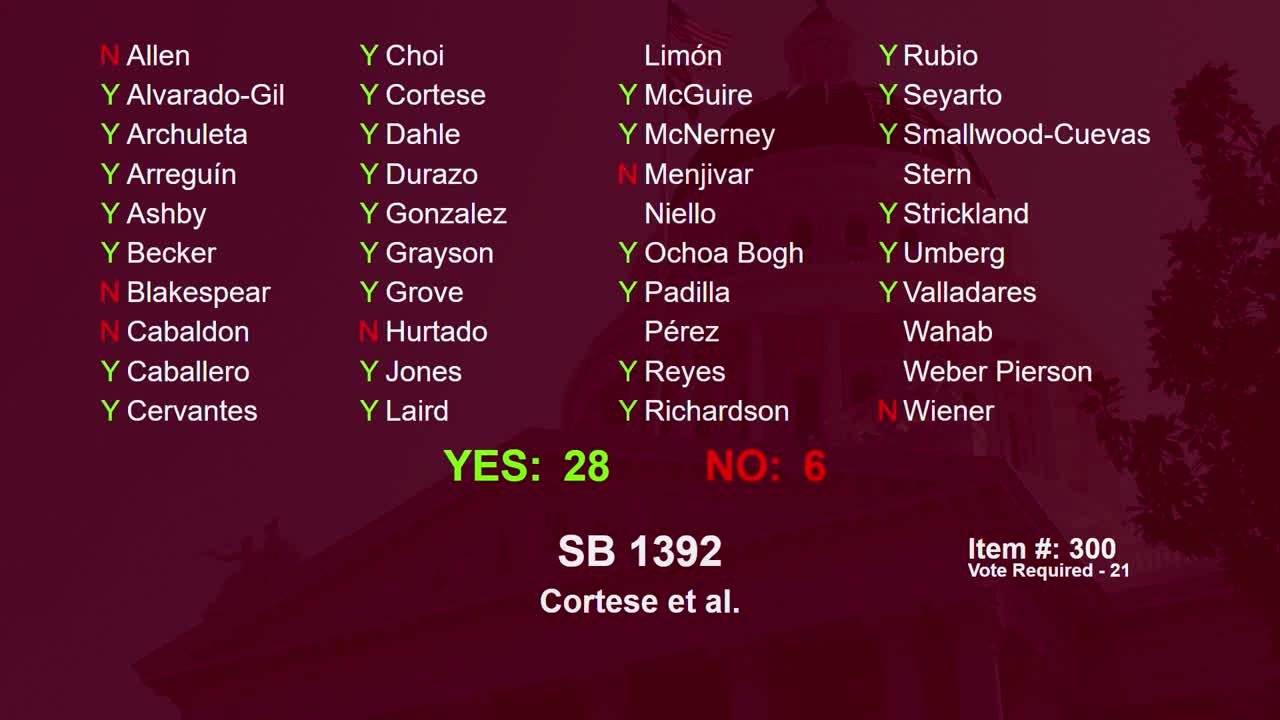 6MIN
Senate Floor
 18MIN
Senate Standing Committee on Energy, Utilities and Communications
Bill Co-Author(s):