SB 936: Nitrous oxide: sales.
- Session Year: 2025-2026
- House: Senate
- Latest Version Date: 2026-09-18
Current Status:
Passed
(2026-09-18: Chaptered by Secretary of State. Chapter 317, Statutes of 2026.)
Introduced
In Committee
Awaiting First Chamber Vote
Passed First Chamber
In Committee
Awaiting Second Chamber Vote
Passed Second Chamber
Enacted
Existing law makes it a misdemeanor to possess nitrous oxide with the intent of inhaling it for specified purposes, including to cause intoxication. Existing law also makes it a misdemeanor to sell nitrous oxide to any person under 18 years of age. Existing law makes it a misdemeanor to dispense nitrous oxide to a person and knowing that the person will use it for specified prohibited purposes, if that person then causes death or great bodily injury to themselves or another person.
Under existing law, the Cigarette and Tobacco Products Licensing Act of 2003, the California Department of Tax and Fee Administration (CDTFA) administers and enforces a statewide program to license manufacturers, importers, distributors, wholesalers, and retailers of cigarettes and tobacco products. Existing law specifically requires a retailer, distributor, or wholesaler, as defined, to hold a license from the CDTFA to engage in the sale of cigarettes or tobacco products. Existing law subjects these licenses to suspension or revocation for violations of existing law. Existing law imposes specified noticing and posting requirements for retailer licenses that are revoked. A violation of these provisions is a misdemeanor.
This bill would, except as specifically exempted, prohibit the sale and distribution of a nitrous oxide container that is capable of holding more than 8 grams of nitrous oxide or from which an individual may directly inhale nitrous oxide. The bill would also prohibit the sale and distribution of a nitrous oxide that has, or is marketed as having, the taste or smell of any food. The bill would prohibit knowingly selling or distributing a device that allows an individual to inhale nitrous oxide from the container or hold nitrous oxide for the purposes of inhalation. The bill would punish a violation of these provisions as an infraction, as specified. The bill would also authorize a court to suspend a business license if the business has a prior conviction for violating these prohibitions, and to revoke a license to sell tobacco products if the business has 2 prior convictions for violating these prohibitions. The bill would make any person, distributor, or business found to have violated these prohibitions liable for all reasonable costs incurred by a public agency in the investigation, inspection, seizure, storage, transportation, handling, venting, abatement, disposal, or destruction of nitrous oxide products, nitrous oxide containers, inhalation devices, or related materials involved in the violation, as specified.
This bill would prohibit a person that is engaged in the business of selling cigarettes or tobacco products in this state from possessing, storing, owning, or selling nitrous oxide, in violation of the criminal provisions outlined above, at any site where cigarettes and tobacco products are stored or sold. The bill would authorize the CDTFA to seize nitrous oxide products, as prescribed. The bill would subject a violator to civil penalties in amounts depending on the aggregate retail value of the seized nitrous oxide and the number of violations within 5 years of the first violation. The bill would require the deposit of collected civil penalties in the Cigarette and Tobacco Products Compliance Fund. The bill would also subject a violator who commits a 2nd violation to license suspension and who commits a 3rd violation to license revocation, as prescribed.
This bill would establish procedures for the CDTFA to follow for a court-ordered revocation. The bill would require the CDTFA to assess a $250 civil penalty for each revoked license and to deposit collected civil penalties into the fund, to be made available to the department, upon appropriation by the Legislature, for purposes of administering the bill. The bill would authorize a licensee to apply for a new license at the previously revoked location 6 months after the date of revocation and would authorize the CDTFA, at its discretion, to issue a new license. The bill would apply these noticing and posting requirements to a retailer subject to a court-ordered revocation pursuant to the bill.
The California Constitution provides for the establishment of the State Board of Equalization, which, before July 1, 2017, had primary responsibility for most of the states duties, powers, and responsibilities regarding the administration of taxes and fees. Existing law, on July 1, 2017, transferred to the CDTFA various duties, powers, and responsibilities of the State Board of Equalization, including administration of the Cigarette and Tobacco Products Licensing Act of 2003, as specified.
This bill would change references in the provisions of the Cigarette and Tobacco Products Licensing Act of 2003 amended by this bill from the State Board of Equalization to the California Department of Tax and Fee Administration to reflect the transfer of the boards duties, powers, and responsibilities to the CDTFA.
Because this bill would create new crimes, it would impose a state-mandated local program.
The California Constitution requires the state to reimburse local agencies and school districts for certain costs mandated by the state. Statutory provisions establish procedures for making that reimbursement.
This bill would provide that no reimbursement is required by this act for a specified reason.
Existing law makes it a misdemeanor to possess nitrous oxide with the intent of inhaling it for specified purposes, including to cause intoxication. Existing law also makes it a misdemeanor to sell nitrous oxide to any person under 18 years of age. Existing law makes it a misdemeanor to dispense nitrous oxide to a person and knowing that the person will use it for specified prohibited purposes, if that person then causes death or great bodily injury to themselves or another person.
ExistingUnder existing law, the Cigarette and Tobacco Products Licensing Act of 2003, the California Department of Tax and Fee Administration (CDTFA) administers and enforces a statewide program to license manufacturers, importers, distributors, wholesalers, and retailers of cigarettes and tobacco products. Existing law specifically requires a retailer, distributor, or wholesaler, as defined, to hold a license from the California Department of Tax and Fee Administration CDTFA to engage in the sale of cigarettes or tobacco products. Existing law subjects these licenses to suspension or revocation for violations of existing law. Existing law imposes specified noticing and posting requirements for retailer licenses that are revoked. A violation of these provisions is a misdemeanor.
This bill would, except as specifically exempted, prohibit the sale and distribution of a nitrous oxide container that is capable of holding more than 8 grams of nitrous oxide or from which an individual may directly inhale nitrous oxide. The bill would also prohibit the sale and distribution of a nitrous oxide that has, or is marketed as having, the taste or smell of any food. The bill would prohibit knowingly selling or distributing a device that allows an individual to inhale nitrous oxide from the container or hold nitrous oxide for the purposes of inhalation. The bill would punish a violation of these provisions as an infraction, as specified. The bill would also authorize a court to suspend the business license, including a license to sell tobacco products, a business license if the business has a prior conviction for violating these prohibitions. prohibitions, and to revoke a license to sell tobacco products if the business has 2 prior convictions for violating these prohibitions. The bill would make any person, distributor, or business found to have violated these prohibitions liable for all reasonable costs incurred by a public agency in the investigation, inspection, seizure, storage, transportation, handling, venting, abatement, disposal, or destruction of nitrous oxide products, nitrous oxide containers, inhalation devices, or related materials involved in the violation, as specified.
This bill would prohibit a person that is engaged in the business of selling cigarettes or tobacco products in this state from possessing, storing, owning or selling nitrous oxide, in violation of the criminal provisions outlined above, at any site where cigarettes and tobacco products are stored or sold. The bill would authorize the CDTFA to seize nitrous oxide products, as prescribed. The bill would subject a violator to civil penalties in amounts depending on the aggregate retail value of the seized nitrous oxide and the number of violations within 5 years of the first violation. The bill would require the deposit of collected civil penalties in the Cigarette and Tobacco Products Compliance Fund. The bill would also subject a violator who commits a 2nd violation to license suspension and who commits a 3rd violation to license revocation, as prescribed.
This bill would establish procedures for the CDTFA to follow for a court-ordered revocation. The bill would require the CDTFA to assess a $250 civil penalty for each revoked license and to deposit collected civil penalties into the fund, to be made available to the department, upon appropriation by the Legislature, for purposes of administering the bill. The bill would authorize a licensee to apply for a new license at the previously revoked location 6 months after the date of revocation and would authorize the CDTFA, at its discretion, to issue a new license. The bill would apply these noticing and posting requirements to a retailer subject to a court-ordered revocation pursuant to the bill.
The California Constitution provides for the establishment of the State Board of Equalization, which, before July 1, 2017, had primary responsibility for most of the states duties, powers, and responsibilities regarding the administration of taxes and fees. Existing law, on July 1, 2017, transferred to the CDTFA various duties, powers, and responsibilities of the State Board of Equalization, including administration of the Cigarette and Tobacco Products Licensing Act of 2003, as specified.
This bill would change references in the provisions of the Cigarette and Tobacco Products Licensing Act of 2003 amended by this bill from the State Board of Equalization to the California Department of Tax and Fee Administration to reflect the transfer of the boards duties, powers, and responsibilities to the CDTFA.
Because this bill would create new crimes, it would impose a state-mandated local program.
The California Constitution requires the state to reimburse local agencies and school districts for certain costs mandated by the state. Statutory provisions establish procedures for making that reimbursement.
This bill would provide that no reimbursement is required by this act for a specified reason.
Existing law makes it a misdemeanor to possess nitrous oxide with the intent of inhaling it for specified purposes, including to cause intoxication. Existing law also makes it a misdemeanor to sell nitrous oxide to any person under 18 years of age. Existing law makes it a misdemeanor to dispense nitrous oxide to a person and knowing that the person will use it for specified prohibited purposes, if that person then causes death or great bodily injury to themselves or another person.
Existing law, the Cigarette and Tobacco Products Licensing Act of 2003, requires a retailer, as defined, to hold a license from the California Department of Tax and Fee Administration to engage in the sale of cigarettes or tobacco products.
This bill would, except as specifically exempted, prohibit the sale and distribution of a nitrous oxide container that is capable of holding more than 8 grams of nitrous oxide or from which an individual may directly inhale nitrous oxide. The bill would also prohibit the sale and distribution of a nitrous oxide that has, or is marketed as having, the taste or smell of any food. The bill would prohibit knowingly selling or distributing a device that allows an individual to inhale nitrous oxide from the container or hold nitrous oxide for the purposes of inhalation. The bill would punish a violation of these provisions as an infraction, as specified. The bill would also authorize a court to suspend the business license, including a license to sell tobacco products, if the business has a prior conviction for violating these prohibitions.
Because this bill would create new crimes, it would impose a state-mandated local program.
The California Constitution requires the state to reimburse local agencies and school districts for certain costs mandated by the state. Statutory provisions establish procedures for making that reimbursement.
This bill would provide that no reimbursement is required by this act for a specified reason.
Existing law makes it a misdemeanor to possess nitrous oxide with the intent of inhaling it for specified purposes, including to cause intoxication. Existing law also makes it a misdemeanor to sell nitrous oxide to any person under 18 years of age. Existing law makes it a misdemeanor to dispense nitrous oxide to a person and knowing that the person will use it for specified prohibited purposes, if that person then causes death or great bodily injury to themselves or another person.
Existing law, the Cigarette and Tobacco Products Licensing Act of 2003, requires a retailer, as defined, to hold a license from the California Department of Tax and Fee Administration to engage in the sale of cigarettes or tobacco products. Existing law, the Medicinal and Adult-Use Cannabis Regulation and Safety Act (MAUCRSA), among other things, consolidates the licensure and regulation of commercial medicinal and adult-use cannabis activities, including retail commercial cannabis activity.
This bill would, except as specifically exempted, prohibit the sale and distribution of a nitrous oxide container that is capable of holding more than 8 grams of nitrous oxide or from which an individual may directly inhale nitrous oxide. The bill would also prohibit the sale and distribution of a nitrous oxide that has, or is marketed as having, the taste or smell of any food. The bill would prohibit knowingly selling or distributing a device that allows an individual to inhale nitrous oxide from the container or hold nitrous oxide for the purposes of inhalation. The bill would punish a violation of these provisions as an infraction, as specified. The bill would also authorize a court to suspend the business license, including a license to sell tobacco products or cannabis, products, if the business has a prior conviction for violating these prohibitions.
Because this bill would create new crimes, it would impose a state-mandated local program.
The California Constitution requires the state to reimburse local agencies and school districts for certain costs mandated by the state. Statutory provisions establish procedures for making that reimbursement.
This bill would provide that no reimbursement is required by this act for a specified reason.
Existing law makes it a misdemeanor to possess nitrous oxide with the intent of inhaling it for specified purposes, including to cause intoxication. Existing law also makes it a misdemeanor to sell nitrous oxide to any person under 18 years of age. Existing law makes it a misdemeanor to dispense nitrous oxide to a person and knowing that the person will use it for specified prohibited purposes, if that person then causes death or great bodily injury to themselves or another person.
Existing law, the Cigarette and Tobacco Products Licensing Act of 2003, requires a retailer, as defined, to hold a license from the California Department of Tax and Fee Administration to engage in the sale of cigarettes or tobacco products. Existing law, the Medicinal and Adult-Use Cannabis Regulation and Safety Act (MAUCRSA), among other things, consolidates the licensure and regulation of commercial medicinal and adult-use cannabis activities, including retail commercial cannabis activity.
This bill would, except as specifically exempted, prohibit the sale and distribution of a nitrous oxide container that is capable of holding more than 8 grams of nitrous oxide or from which an individual may directly inhale nitrous oxide. The bill would also prohibit the sale and distribution of a nitrous oxide that has, or is marketed as having, the taste or smell of any food. The bill would prohibit knowingly selling or distributing a device that allows an individual to inhale nitrous oxide from the container or hold nitrous oxide for the purposes of inhalation. The bill would punish a violation of these provisions as an infraction, as specified. The bill would also authorize a court to suspend the business license, including a license to sell tobacco products or cannabis, if the business has a prior conviction for violating these prohibitions.
Because this bill would create new crimes, it would impose a state-mandated local program.
The California Constitution requires the state to reimburse local agencies and school districts for certain costs mandated by the state. Statutory provisions establish procedures for making that reimbursement.
This bill would provide that no reimbursement is required by this act for a specified reason.
Existing law makes it a misdemeanor to possess nitrous oxide with the intent of inhaling it for specified purposes, including to cause intoxication. Existing law also makes it a misdemeanor to sell nitrous oxide to any person under 18 years of age. Existing law makes it a misdemeanor to dispense nitrous oxide to a person and knowing that the person will use it for specified prohibited purposes, if that person then causes death or great bodily injury to themselves or another person.
Existing law, the Cigarette and Tobacco Products Licensing Act of 2003, requires a retailer, as defined, to hold a license from the California Department of Tax and Fee Administration to engage in the sale of cigarettes or tobacco products. Existing law, the Medicinal and Adult-Use Cannabis Regulation and Safety Act, the Medicinal and Adult-Use Cannabis Regulation and Safety Act (MAUCRSA), among other things, consolidates the licensure and regulation of commercial medicinal and adult-use cannabis activities, including retail commercial cannabis activity.
This bill would, except as specifically exempted, prohibit the sale and distribution of a nitrous oxide container that is capable of holding more than 8 grams of nitrous oxide or from which an individual may directly inhale nitrous oxide. The bill would also prohibit the sale and distribution of a nitrous oxide that has, or is marketed as having, the taste or smell of any food. The bill would prohibit the sale and distribution of knowingly selling or distributing a device that allows an individual to inhale nitrous oxide from the container or hold nitrous oxide for the purposes of inhalation. The bill would punish a violation of these provisions as an infraction, as specified. The bill would also authorize a court to suspend the business license, including a license to sell tobacco products or cannabis, if the business has a prior conviction for violating these prohibitions.
Because this bill would create new crimes, it would impose a state-mandated local program.
The California Constitution requires the state to reimburse local agencies and school districts for certain costs mandated by the state. Statutory provisions establish procedures for making that reimbursement.
This bill would provide that no reimbursement is required by this act for a specified reason.
Existing law makes it a misdemeanor to possess nitrous oxide with the intent of inhaling it for specified purposes, including to cause intoxication. Existing law also makes it a misdemeanor to sell nitrous oxide to any person under 18 years of age. Existing law makes it a misdemeanor to dispense nitrous oxide to a person and knowing that the person will use it for specified prohibited purposes, if that person then causes death or great bodily injury to themselves or another person.
Existing law, the Cigarette and Tobacco Products Licensing Act of 2003, requires a retailer, as defined, to hold a license from the California Department of Tax and Fee Administration to engage in the sale of cigarettes or tobacco products. Existing law, the Medicinal and Adult-Use Cannabis Regulation and Safety Act, the Medicinal and Adult-Use Cannabis Regulation and Safety Act (MAUCRSA), among other things, consolidates the licensure and regulation of commercial medicinal and adult-use cannabis activities, including retail commercial cannabis activity.
This bill would, except as specifically exempted, prohibit the sale and distribution of a nitrous oxide container that is capable of holding more than 8 grams of nitrous oxide or from which an individual may directly inhale nitrous oxide. The bill would also prohibit the sale and distribution of a nitrous oxide that has, or is marketed as having, the taste or smell of any food. The bill would prohibit the sale and distribution of a device that allows an individual to inhale nitrous oxide from the container or hold nitrous oxide for the purposes of inhalation. The bill would punish a violation of these provisions as an infraction, as specified. The bill would also authorize a court to suspend the business license, including a license to sell tobacco products or cannabis, if the business has a prior conviction for violating these prohibitions.
Because this bill would create new crimes, it would impose a state-mandated local program.
The California Constitution requires the state to reimburse local agencies and school districts for certain costs mandated by the state. Statutory provisions establish procedures for making that reimbursement.
This bill would provide that no reimbursement is required by this act for a specified reason.
(a)The department shall issue a license to a retailer upon receipt of a completed application and payment of the fees prescribed in Section 22973, unless any of the following apply:
(1)The retailer, or if the retailer is not an individual, any person controlling the retailer, has previously been issued a license that is either of the following:
(A)Suspended or revoked by the department for violation of any of the provisions of this division.
(B)Revoked by the department pursuant to a court order issued under subdivision (f) of Section 119408 of the Health and Safety Code.
(2)The application is for a license or renewal of a license for a retail location that is the same retail location as that of a retailer whose license was revoked or is subject to revocation proceedings for violation of any of the provisions of this division, unless:
(A)It has been more than five years since a previous license for the retail location was revoked.
(B)The person applying for the license provides the department with documentation demonstrating that the applicant has acquired or is acquiring the premises or business in an arms length transaction. For purposes of this section, an arms length transaction is defined as a sale in good faith and for valuable consideration that reflects the fair market value in the open market between two informed and willing parties, neither under any compulsion to participate in the transaction. A sale between relatives, related companies or partners, or a sale for the primary purpose of avoiding the effect of the violations of this division that occurred at the retail location, is presumed not to be made at arms length.
(3)The retailer, or if the retailer is not an individual, any person controlling the retailer, has been convicted of a felony pursuant to Section 30473 or 30480 of the Revenue and Taxation Code.
(4)The retailer does not possess all required permits or licenses required under the Revenue and Taxation Code.
(b)(1)Any retailer who is denied a license may petition for a redetermination of the departments denial of the license within 30 days after service upon that retailer of the notice of the denial of the license. If a petition for redetermination is not filed within the 30-day period, the determination of denial becomes final at the expiration of the 30-day period.
(2)Every petition for redetermination shall be in writing and shall state the specific grounds upon which the petition is founded. The petition may be amended to state additional grounds at any time before the date on which the department issues its order or decision upon the petition for redetermination.
(3)If the petition for redetermination is filed within the 30-day period, the department shall reconsider the determination of the denial and, if the retailer has requested it in the petition, shall grant the retailer an oral hearing and shall give the retailer at least 10 days notice of the time and place of the hearing. The department may continue the hearing from time to time as may be necessary.
(4)The order or decision of the department upon a petition for redetermination becomes final 30 days after mailing of notice thereof.
SEC. 2.Section 22977.2 of the Business and Professions Code is amended to read:22977.2.(a)The department shall issue a license to a distributor or a wholesaler upon receipt of a completed application and payment of the fee prescribed in Section 22977.1, unless any of the following apply:
(1)The distributor or the wholesaler, or if the distributor or the wholesaler is not an individual, any person controlling the distributor or the wholesaler, has previously been issued a license that is one of the following:
(A)Suspended or revoked by the department for violation of any of the provisions of this division.
(B)Revoked by the department pursuant to a court order issued under subdivision (f) of Section 119408 of the Health and Safety Code.
(2)The application is for a license or renewal of a license for a distributor or a wholesaler, whose license is revoked or revocation is pending, unless:
(A)It has been more than five years since a distributors or a wholesalers previous license was revoked.
(B)The person applying for the license provides the department with documentation demonstrating that the applicant has acquired or is acquiring the business in an arms length transaction. For purposes of this section, an arms length transaction is defined as a sale in good faith and for valuable consideration that reflects the fair market value in the open market between two informed and willing parties, neither under any compulsion to participate in the transaction. A sale of the business between relatives, related companies or partners, or a sale for the primary purpose of avoiding the effect of the violations of state tobacco control laws that were committed by the distributor or wholesaler is presumed not to be made at arms length.
(3)The distributor or the wholesaler, or if the distributor or the wholesaler is not an individual, any person controlling the distributor or the wholesaler has been convicted of a felony pursuant to Section 30473 or 30480 of the Revenue and Taxation Code.
(b)(1)Any distributor or any wholesaler who is denied a license may petition for a redetermination of the departments denial of the license within 30 days after service upon that distributor or that wholesaler of the notice of the denial of the license. If a petition for redetermination is not filed within the 30-day period, the determination of denial becomes final at the expiration of the 30-day period.
(2)Every petition for redetermination shall be in writing and shall state the specific grounds upon which the petition is founded. The petition may be amended to state additional grounds at any time before the date on which the department issues its order or decision upon the petition for redetermination.
(3)If the petition for redetermination is filed within the 30-day period, the department shall reconsider the determination of the denial and, if the distributor or the wholesaler has requested it in the petition, shall grant the distributor or wholesaler an oral hearing and shall give the distributor or the wholesaler at least 10 days notice of the time and place of the hearing. The department may continue the hearing from time to time as may be necessary.
(4)The order or decision of the department upon a petition for redetermination becomes final 30 days after mailing of notice thereof.
SEC. 3.Section 22980.3 of the Business and Professions Code is amended to read:22980.3.(a)Except as provided in subdivision (l), a license issued pursuant to this division shall be subject to suspension or revocation for violations of this division or the Revenue and Taxation Code as provided in this section.
(1)In addition to any applicable fines or penalties for a violation, upon first conviction of a violation, a licensee shall receive a written notice from the department detailing the suspension and revocation provisions of this division. At its discretion, the department may also suspend a license for up to 30 days.
(2)In addition to any applicable fines or penalties for a violation, upon a second conviction of a violation within four years of a previous violation, the license shall be revoked.
(b)The date of the occurrence of a violation shall be used to calculate the duration between subsequent violations. A violation shall be noted in the license record at the department only after judicial conviction or final adjudication of a violation.
(c)Upon updating a record for a violation triggering a suspension, the department shall serve the licensee with a notice of suspension and shall order the licensee to cease the sale, gifting, or displaying for sale of cigarettes or tobacco products for the period of the suspension. The notice of suspension shall inform the licensee of the effective dates of the suspension.
(d)Continued sales or gifting of cigarettes or tobacco products after the effective date of the suspension shall constitute a violation of this division and result in the revocation of a license.
(e)Upon completion of a suspension period, a license shall be reinstated by the department upon certification that all outstanding debts of that retailer or wholesaler that are owed to a wholesaler or distributor for the purchase of cigarettes and tobacco products are paid.
(f)Upon updating a record for a violation triggering a revocation, the department shall serve the licensee with a notice of revocation and shall order the licensee to cease the sale, gifting, or displaying for sale of cigarettes or tobacco products on and after the effective date of the revocation. The notice of revocation shall inform the licensee of the effective date of the revocation.
(g)After a revocation, a previously licensed applicant may apply for a new license after six months. The department, at its discretion, may issue a new license.
(h)Upon updating a license record for a violation, suspension, or revocation to a license of a person or entity that owns or controls more than one location, the department shall send notice in writing of the violations, suspensions, or revocations within 15 days of the departments action to the address included in the application and listed on the license for receipt of correspondence or notices from the department.
(i)Upon suspension or revocation of a license pursuant to this section, the department shall notify all licensed distributors and wholesalers by email within 48 hours of the suspension or revocation of that license. All licensed distributors and wholesalers shall provide the department and shall update, as necessary, an email address that the department can use for purposes of making the notifications required by this subdivision.
(j)Violations by a licensee at one location may not be accumulated against other locations of that same licensee. Violations accumulated against a prior owner at a licensed location may not be accumulated against a new owner at the same licensed location.
(k)For purposes of this section, a violation includes violations of the Revenue and Taxation Code relating to cigarettes and tobacco products, and violations of this division. Only one violation per discrete action shall be counted toward a suspension or revocation of a license.
(l)A license revoked by the department pursuant to a court order issued under subdivision (f) of Section 119408 of the Health and Safety Code is subject to the procedures provided in Section 22980.8.
SEC. 4.Section 22980.5 of the Business and Professions Code is amended to read:22980.5.(a)A retailer whose license has been suspended or revoked by order of the department shall conspicuously post a notice at both of the following locations:
(1)Each public entrance to the retail location. The notice shall directly face any person who enters the retail location and shall not be obstructed from view or placed at a height of less than four feet or greater than nine feet from the floor.
(2)Each cash register and other point of retail sale. The notice shall be posted to be readily viewable by a person standing at or approaching the cash register or other point of retail sale. The notice shall directly face the purchaser and shall not be obstructed from view or placed at a height of less than four feet or greater than nine feet from the floor.
(b)The notices described in this section shall be in the size and form prescribed by the department. The notice shall be provided by the department and may be reproduced in the same size and form to comply with subdivision (a).
(c)A retailer whose license was suspended shall post the notice at the retail location that was the subject of the suspension for the duration of the suspension.
(d)A retailer whose license was revoked shall post the notice at the retail location that was the subject of the revocation for a 30-day period from the effective date of the revocation.
(e)Every retailer who fails to post the notices as required by this section, who alters the notice provided by the department, or who removes the notice before the posting period required in subdivision (c) or (d), as appropriate, expires, shall be subject, notwithstanding Section 22981, to a civil penalty of one thousand dollars ($1,000) for each offense.
(f)A retailer whose license has been revoked by the department pursuant to a court order issued under subdivision (f) of Section 119408 of the Health and Safety Code is subject to this section.
SEC. 5.Section 22980.7 is added to the Business and Professions Code, to read:22980.7.(a)(1)A person that is engaged in the business of selling cigarettes or tobacco products in this state shall not possess, store, own, or sell nitrous oxide, in violation of Section 119408 of the Health and Safety Code, at any site where cigarettes and tobacco products are stored or sold.
(2)A person who violates this subdivision is subject to civil penalties and suspension or revocation of their license pursuant to subdivision (c).
(b)Upon discovery by the department that any person possesses, stores, owns, or has made a sale of nitrous oxide in violation of this section, the department may seize those products at the persons location. Any nitrous oxide seized by the department pursuant to this subdivision shall be deemed forfeited and the department shall comply with the procedures set forth in Sections 30436 to 30449, inclusive, of the Revenue and Taxation Code.
(c)(1)(A)A first violation of subdivision (a) involving the seizure of nitrous oxide shall be punishable as follows:
(i)If the aggregate retail value of the seized nitrous oxide is less than two hundred dollars ($200), a civil penalty of one thousand dollars ($1,000) shall be imposed.
(ii)If the aggregate retail value of the seized nitrous oxide is two hundred dollars ($200) or more, a civil penalty of two thousand dollars ($2,000) shall be imposed.
(B)A second violation of subdivision (a) within five years of the first violation involving a seizure of nitrous oxide shall be punishable as follows:
(i)If the aggregate retail value of the seized nitrous oxide is less than two hundred dollars ($200), a civil penalty of two thousand dollars ($2,000) shall be imposed, and shall also result in a five-day suspension of the license.
(ii)If the aggregate retail value of the seized nitrous oxide is two hundred dollars ($200) or more, a civil penalty of five thousand dollars ($5,000) shall be imposed, and shall also result in a 10-day suspension of the license.
(C)A third violation of subdivision (a) within five years of the first violation involving a seizure of nitrous oxide shall be punishable as follows:
(i)If the aggregate retail value of the seized nitrous oxide is less than two hundred dollars ($200), a civil penalty of five thousand dollars ($5,000) shall be imposed, and shall also result in revocation of the license.
(ii)If the aggregate retail value of the seized nitrous oxide is two hundred dollars ($200) or more, a civil penalty of ten thousand dollars ($10,000) shall be imposed, and shall also result in revocation of the license.
(2)The department shall determine to the best of its ability the retail value based on any information within the departments possession or that may come into its possession of the nitrous oxide.
(3)The department shall issue the civil penalty in accordance with the procedures applicable to the civil penalty authorized under Section 22974.7.
(4)The department shall revoke or suspend the license of a person who violates subdivision (a) in accordance with the procedures set forth in Section 22980.3.
(d)Civil penalties collected pursuant to this section shall be deposited into the Cigarette and Tobacco Products Compliance Fund created pursuant to Section 22990.
SEC. 6.Section 22980.8 is added to the Business and Professions Code, to read:22980.8.(a)Upon receiving notification by a court of its order issued pursuant to subdivision (f) of Section 119408 of the Health and Safety Code, the department shall revoke the license.
(b)When a license is revoked pursuant to this section, the department shall provide the licensee with no fewer than 10 days written notice of a pending revocation pursuant to this section and an opportunity to appeal the revocation only to correct a mistake or clerical error. The department shall not accept or consider an appeal of revocation under this section if the appeal is founded upon the grounds of whether the licensee, or any employee or agent of the licensee, violated Section 119408 of the Health and Safety Code for which a revocation order is issued by a court pursuant to subdivision (f) of that section. This subdivision shall not be construed to prevent the department from modifying its action on its own to correct a mistake or clerical error.
(c)For each license revoked pursuant to subdivision (a), the department shall assess a civil penalty of two hundred fifty dollars ($250) against the licensee subject to the revocation. Moneys derived from the civil penalty collected shall be deposited into the Cigarette and Tobacco Products Compliance Fund and shall be made available to the department, upon appropriation by the Legislature, for the purposes of administering this section.
(d)Upon updating a license record for a court-ordered revocation, the department shall serve the licensee with a notice of revocation and shall order the licensee to cease the sale, gifting, or displaying for sale of cigarettes or tobacco products at the indicated location on and after the effective date of the revocation. The notice of revocation shall inform the licensee of the effective date of the revocation.
(e)After a license has been revoked pursuant to subdivision (a), that licensee may apply for a new license at the previously revoked location six months after the date of revocation. The department, at its discretion, may issue a new license.
(f)Upon updating a license record for a revocation of a license of a person or entity that owns or controls more than one location, the department shall send notice in writing of the revocation within 15 days of the departments action to the address included in the application and listed on the license for receipt of correspondence or notices from the department.
(g)Upon revocation of a license pursuant to this section, the department shall notify all licensed distributors and wholesalers by email within 48 hours of the revocation of that license. All licensed distributors and wholesalers shall provide the department with and shall update, as necessary, an email address that the department can use for purposes of making the notifications required by this subdivision.
SEC. 7.Chapter 10 (commencing with Section 119408) is added to Part 15 of Division 104 of the Health and Safety Code, to read:10.Nitrous Oxide119408.(a)Except as provided in this section, it is unlawful for any person to sell, offer to sell, or distribute a nitrous oxide container that is capable of holding more than eight grams of nitrous oxide.
(b)Except as provided in this section, it is unlawful for any person to sell, offer to sell, or distribute a nitrous oxide container from which an individual may directly inhale nitrous oxide.
(c)It is unlawful to sell, offer to sell, or distribute nitrous oxide that has, or is marketed as having, the taste or smell of any food, including, but not limited to, any fruit, candy, dessert, alcoholic beverage, herb, or spice, that is distinguishable by an ordinary consumer either prior to or during consumption or use of the product.
(d)It is unlawful to sell, offer to sell, or distribute a device that a person knows, or reasonably should know, allows an individual to inhale nitrous oxide from the nitrous oxide container or to hold nitrous oxide released from the nitrous oxide container for purposes of inhalation.
(e)A violation of this section is punishable as an infraction punishable by a fine of not more than five hundred dollars ($500) for the first offense, one thousand dollars ($1,000) for a second offense, or two thousand dollars ($2,000) for a third and subsequent offense.
(f)(1)In addition to the penalties described in subdivision (e), a court may issue either or both of the following orders:
(A)The suspension of a business license issued by the state, a city, a county, or a city and county, for a period of up to one year, of a business that knowingly violates this section following a prior conviction for a violation of this section.
(B)The revocation of a license issued pursuant to the Cigarette and Tobacco Products Licensing Act of 2003 (Division 8.6 (commencing with Section 22970) of the Business and Professions Code) of a business that knowingly violates this section following two prior convictions for violations of this section.
(2)(A)The court shall provide a copy of any suspension order to the appropriate regulating agency.
(B)If a revocation order is issued by a court for a license issued pursuant to the Cigarette and Tobacco Products Licensing Act of 2003, the court shall notify the California Department of Tax and Fee Administration and include in that notice information concerning the person that holds the license, the type of license to be revoked, and the location for which the court has ordered the revocation.
(3)For purposes of this subdivision, a business license does not include any license issued pursuant to the Cigarette and Tobacco Products Licensing Act of 2003 or a permit issued pursuant to Section 6067 of the Revenue and Taxation Code.
(g)Subdivision (a) does not apply to nitrous oxide or a nitrous oxide container that meets any of the following:
(1)Has been denatured or otherwise rendered unfit for human consumption or use.
(2)Is intended and marketed for use by a manufacturer as part of a manufacturing process or industrial operation.
(3)Is specifically designed and marketed for use in a vehicle to enhance the performance of the vehicle.
(4)Is sold to a licensed medical, veterinary, or dental practitioner to be administered or prescribed as part of the care or treatment of a disease, condition, or injury.
(5)Contains less than nine grams of nitrous oxide as a propellant in food or to be used in food preparation for restaurant, food service, or houseware products.
(6)Is sold by a wholesaler for any purpose listed in this subdivision.
(h)This section does not apply to commercially manufactured, sealed finished food products intended for retail sale as food that contain nitrous oxide solely as a propellant for dispensing the food product.
(i)For the purposes of this section, the following terms have the following meanings:
(1)Distributor means a person who sells a product to a retailer in violation of this section, or accepts an order for a product from a retailer in violation of this section.
(2)Nitrous oxide container means a device, canister, tank, or receptacle either exclusively containing nitrous oxide or exclusively containing a chemical compound mixed with nitrous oxide.
(3)Nitrous oxide has the same meaning as in Section 381c of the Penal Code.
(j)For purposes of this section, a reference to a sale, offer to sell, distribution, advertisement, or provision of a product or service includes conduct that occurs in person, through the internet, or through any other electronic or digital means.
(k)This section does not limit the authority of a city, county, or city and county to adopt or enforce a local ordinance that further restricts the sale, furnishing, offering, or distribution of nitrous oxide.
(l)(1)Any person, distributor, or business found to have violated this section shall be liable for all reasonable costs incurred by a public agency in the investigation, inspection, seizure, storage, transportation, handling, venting, abatement, disposal, or destruction of nitrous oxide products, nitrous oxide containers, inhalation devices, or related materials involved in the violation.
(2)In any action brought to enforce this section, the court may order recovery of reasonable enforcement costs incurred by the enforcing agency.
(3)Funds recovered pursuant to this section shall be payable to the enforcing agency and shall be used to offset costs associated with enforcement of this section.
SEC. 8.No reimbursement is required by this act pursuant to Section 6 of Article XIIIB of the California Constitution because the only costs that may be incurred by a local agency or school district will be incurred because this act creates a new crime or infraction, eliminates a crime or infraction, or changes the penalty for a crime or infraction, within the meaning of Section 17556 of the Government Code, or changes the definition of a crime within the meaning of Section 6 of Article XIIIB of the California Constitution.
(a)The board department shall issue a license to a retailer upon receipt of a completed application and payment of the fees prescribed in Section 22973, unless any of the following apply:
(1)The retailer, or if the retailer is not an individual, any person controlling the retailer, has previously been issued a license that is suspended either of the following:
(A)Suspended or revoked by the board department for violation of any of the provisions of this division.
(B)Revoked by the department pursuant to a court order issued under subdivision (f) of Section 119408 of the Health and Safety Code.
(2)The application is for a license or renewal of a license for a retail location that is the same retail location as that of a retailer whose license was revoked or is subject to revocation proceedings for violation of any of the provisions of this division, unless:
(A)It has been more than five years since a previous license for the retail location was revoked.
(B)The person applying for the license provides the board department with documentation demonstrating that the applicant has acquired or is acquiring the premises or business in an arms length transaction. For purposes of this section, an arms length transaction is defined as a sale in good faith and for valuable consideration that reflects the fair market value in the open market between two informed and willing parties, neither under any compulsion to participate in the transaction. A sale between relatives, related companies or partners, or a sale for the primary purpose of avoiding the effect of the violations of this division that occurred at the retail location, is presumed not to be made at arms length.
(3)The retailer, or if the retailer is not an individual, any person controlling the retailer, has been convicted of a felony pursuant to Section 30473 or 30480 of the Revenue and Taxation Code.
(4)The retailer does not possess all required permits or licenses required under the Revenue and Taxation Code.
(b)(1)Any retailer who is denied a license may petition for a redetermination of the boards departments denial of the license within 30 days after service upon that retailer of the notice of the denial of the license. If a petition for redetermination is not filed within the 30-day period, the determination of denial becomes final at the expiration of the 30-day period.
(2)Every petition for redetermination shall be in writing and shall state the specific grounds upon which the petition is founded. The petition may be amended to state additional grounds at anytime prior to any time before the date on which the board department issues its order or decision upon the petition for redetermination.
(3)If the petition for redetermination is filed within the 30-day period, the board department shall reconsider the determination of the denial and, if the retailer has so requested it in the petition, shall grant the retailer an oral hearing and shall give the retailer at least 10 days notice of the time and place of the hearing. The board department may continue the hearing from time to time as may be necessary.
(4)The order or decision of the board department upon a petition for redetermination becomes final 30 days after mailing of notice thereof.
SEC. 2.Section 22977.2 of the Business and Professions Code is amended to read:22977.2.(a)The board department shall issue a license to a distributor or a wholesaler upon receipt of a completed application and payment of the fee prescribed in Section 22977.1, unless any of the following apply:
(1)The distributor or the wholesaler, or if the distributor or the wholesaler is not an individual, any person controlling the distributor or the wholesaler, has previously been issued a license that is suspended one of the following:
(A)Suspended or revoked by the board department for violation of any of the provisions of this division.
(B)Revoked by the department pursuant to a court order issued under subdivision (f) of Section 119408 of the Health and Safety Code.
(2)The application is for a license or renewal of a license for a distributor or a wholesaler, whose license is revoked or revocation is pending, unless:
(A)It has been more than five years since a distributors or a wholesalers previous license was revoked.
(B)The person applying for the license provides the board department with documentation demonstrating that the applicant has acquired or is acquiring the business in an arms length transaction. For purposes of this section, an arms length transaction is defined as a sale in good faith and for valuable consideration that reflects the fair market value in the open market between two informed and willing parties, neither under any compulsion to participate in the transaction. A sale of the business between relatives, related companies or partners, or a sale for the primary purpose of avoiding the effect of the violations of state tobacco control laws that were committed by the distributor or wholesaler is presumed not to be made at arms length.
(3)The distributor or the wholesaler, or if the distributor or the wholesaler is not an individual, any person controlling the distributor or the wholesaler has been convicted of a felony pursuant to Section 30473 or 30480 of the Revenue and Taxation Code.
(b)(1)Any distributor or any wholesaler who is denied a license may petition for a redetermination of the boards departments denial of the license within 30 days after service upon that distributor or that wholesaler of the notice of the denial of the license. If a petition for redetermination is not filed within the 30-day period, the determination of denial becomes final at the expiration of the 30-day period.
(2)Every petition for redetermination shall be in writing and shall state the specific grounds upon which the petition is founded. The petition may be amended to state additional grounds at anytime prior to any time before the date on which the board department issues its order or decision upon the petition for redetermination.
(3)If the petition for redetermination is filed within the 30-day period, the board department shall reconsider the determination of the denial and, if the distributor or the wholesaler has so requested it in the petition, shall grant the distributor or wholesaler an oral hearing and shall give the distributor or the wholesaler at least 10 days notice of the time and place of the hearing. The board department may continue the hearing from time to time as may be necessary.
(4)The order or decision of the board department upon a petition for redetermination becomes final 30 days after mailing of notice thereof.
SEC. 3.Section 22980.3 of the Business and Professions Code is amended to read:22980.3.(a)Licenses Except as provided in subdivision (l), a license issued pursuant to this division shall be subject to suspension or revocation for violations of this division or the Revenue and Taxation Code as provided in this section.
(1)In addition to any applicable fines or penalties for a violation, upon first conviction of a violation, a licensee shall receive a written notice from the board department detailing the suspension and revocation provisions of this division. At its discretion, the board department may also suspend a license for up to 30 days.
(2)In addition to any applicable fines or penalties for a violation, upon a second conviction of a violation within four years of a previous violation, the license shall be revoked.
(b)The date of the occurrence of a violation shall be used to calculate the duration between subsequent violations. A violation shall be noted in the license record at the board department only after judicial conviction or final adjudication of a violation.
(c)Upon updating a record for a violation triggering a suspension, the board department shall serve the licensee with a notice of suspension and shall order the licensee to cease the sale, gifting, or displaying for sale of cigarettes or tobacco products for the period of the suspension. The notice of suspension shall inform the licensee of the effective dates of the suspension.
(d)Continued sales or gifting of cigarettes or tobacco products after the effective date of the suspension shall constitute a violation of this division and result in the revocation of a license.
(e)Upon completion of a suspension period, a license shall be reinstated by the board department upon certification that all outstanding debts of that retailer or wholesaler that are owed to a wholesaler or distributor for the purchase of cigarettes and tobacco products are paid.
(f)Upon updating a record for a violation triggering a revocation, the board department shall serve the licensee with a notice of revocation and shall order the licensee to cease the sale, gifting, or displaying for sale of cigarettes or tobacco products on and after the effective date of the revocation. The notice of revocation shall inform the licensee of the effective date of the revocation.
(g)After a revocation, a previously licensed applicant may apply for a new license after six months. The board may, department, at its discretion, may issue a new license.
(h)Upon updating a license record for a violation, suspension, or revocation to a license of a person or entity that owns or controls more than one location, the board department shall send notice in writing of the violations, suspensions, or revocations within 15 days of the boards departments action to the address included in the application and listed on the license for receipt of correspondence or notices from the board. department.
(i)Upon suspension or revocation of a license pursuant to this section, the board department shall notify all licensed distributors and wholesalers by electronic mail email within 48 hours of the suspension or revocation of that license. All licensed distributors and wholesalers shall provide the board department and shall update, as necessary, an electronic mail email address that the board department can use for purposes of making the notifications required by this subdivision.
(j)Violations by a licensee at one location may not be accumulated against other locations of that same licensee. Violations accumulated against a prior owner at a licensed location may not be accumulated against a new owner at the same licensed location.
(k)For purposes of this section, a violation includes violations of the Revenue and Taxation Code relating to cigarettes and tobacco products, and violations of this division. Only one violation per discrete action shall be counted toward a suspension or revocation of a license.
(l)A license revoked by the department pursuant to a court order issued under subdivision (f) of Section 119408 of the Health and Safety Code is subject to the procedures provided in Section 22980.8.
SEC. 4.Section 22980.5 of the Business and Professions Code is amended to read:22980.5.(a)A retailer whose license has been suspended or revoked by order of the board department shall conspicuously post a notice at both of the following locations:
(1)Each public entrance to the retail location. The notice shall directly face any person who enters the retail location and shall not be obstructed from view or placed at a height of less than four feet or greater than nine feet from the floor.
(2)Each cash register and other point of retail sale. The notice shall be posted so as to be readily viewable by a person standing at or approaching the cash register or other point of retail sale. The notice shall directly face the purchaser and shall not be obstructed from view or placed at a height of less than four feet or greater than nine feet from the floor.
(b)The notices described in this section shall be in the size and form prescribed by the board. department. The notice shall be provided by the board department and may be reproduced in the same size and form in order to comply with subdivision (a).
(c)A retailer whose license was suspended shall post the notice at the retail location that was the subject of the suspension for the duration of the suspension.
(d)A retailer whose license was revoked shall post the notice at the retail location that was the subject of the revocation for a 30-day period from the effective date of the revocation.
(e)Every retailer who fails to post the notices as required by this section, who alters the notice provided by the board, department, or who removes the notice before the posting period required in subdivision (c) or (d), as appropriate, expires, shall be subject, notwithstanding Section 22981, to a civil penalty of one thousand dollars ($1,000) for each offense.
(f)A retailer whose license has been revoked by the department pursuant to a court order issued under subdivision (f) of Section 119408 of the Health and Safety Code is subject to this section.
SEC. 5.Section 22980.7 is added to the Business and Professions Code, to read:22980.7.(a)(1)A person that is engaged in the business of selling cigarettes or tobacco products in this state shall not possess, store, own, or sell nitrous oxide, in violation of Section 119408 of the Health and Safety Code, at any site where cigarettes and tobacco products are stored or sold.
(2)A person who violates this subdivision is subject to civil penalties and suspension or revocation of their license pursuant to subdivision (c).
(b)Upon discovery by the department that any person possesses, stores, owns, or has made a sale of nitrous oxide in violation of this section, the department may seize those products at the persons location. Any nitrous oxide seized by the department pursuant to this subdivision shall be deemed forfeited and the department shall comply with the procedures set forth in Sections 30436 to 30449, inclusive, of the Revenue and Taxation Code.
(c)(1)(A)A first violation of subdivision (a) involving the seizure of nitrous oxide shall be punishable as follows:
(i)If the aggregate retail value of the seized nitrous oxide is less than two hundred dollars ($200), a civil penalty of one thousand dollars ($1,000) shall be imposed.
(ii)If the aggregate retail value of the seized nitrous oxide is two hundred dollars ($200) or more, a civil penalty of two thousand dollars ($2,000) shall be imposed.
(B)A second violation of subdivision (a) within five years of the first violation involving a seizure of nitrous oxide shall be punishable as follows:
(i)If the aggregate retail value of the seized nitrous oxide is less than two hundred dollars ($200), a civil penalty of two thousand dollars ($2,000) shall be imposed, and shall also result in a five-day suspension of the license.
(ii)If the aggregate retail value of the seized nitrous oxide is two hundred dollars ($200) or more, a civil penalty of five thousand dollars ($5,000) shall be imposed, and shall also result in a 10-day suspension of the license.
(C)A third violation of subdivision (a) within five years of the first violation involving a seizure of nitrous oxide shall be punishable as follows:
(i)If the aggregate retail value of the seized nitrous oxide is less than two hundred dollars ($200), a civil penalty of five thousand dollars ($5,000) shall be imposed, and shall also result in revocation of the license.
(ii)If the aggregate retail value of the seized nitrous oxide is two hundred dollars ($200) or more, a civil penalty of ten thousand dollars ($10,000) shall be imposed, and shall also result in revocation of the license.
(2)The department shall determine to the best of its ability the retail value based on any information within the departments possession or that may come into its possession of the nitrous oxide.
(3)The department shall issue the civil penalty in accordance with the procedures applicable to the civil penalty authorized under Section 22974.7.
(4)The department shall revoke or suspend the license of a person who violates subdivision (a) in accordance with the procedures set forth in Section 22980.3.
(d)Civil penalties collected pursuant to this section shall be deposited into the Cigarette and Tobacco Products Compliance Fund created pursuant to Section 22990.
SEC. 6.Section 22980.8 is added to the Business and Professions Code, to read:22980.8.(a)Upon receiving notification by a court of its order issued pursuant to subdivision (f) of Section 119408 of the Health and Safety Code, the department shall revoke the license.
(b)When a license is revoked pursuant to this section, the department shall provide the licensee with no fewer than 10 days written notice of a pending revocation pursuant to this section and an opportunity to appeal the revocation only to correct a mistake or clerical error. The department shall not accept or consider an appeal of revocation under this section if the appeal is founded upon the grounds of whether the licensee, or any employee or agent of the licensee, violated Section 119408 of the Health and Safety Code for which a revocation order is issued by a court pursuant to subdivision (f) of that section. This subdivision shall not be construed to prevent the department from modifying its action on its own to correct a mistake or clerical error.
(c)For each license revoked pursuant to subdivision (a), the department shall assess a civil penalty of two hundred fifty dollars ($250) against the licensee subject to the revocation. Moneys derived from the civil penalty collected shall be deposited into the Cigarette and Tobacco Products Compliance Fund and shall be made available to the department, upon appropriation by the Legislature, for the purposes of administering this section.
(d)Upon updating a license record for a court-ordered revocation, the department shall serve the licensee with a notice of revocation and shall order the licensee to cease the sale, gifting, or displaying for sale of cigarettes or tobacco products at the indicated location on and after the effective date of the revocation. The notice of revocation shall inform the licensee of the effective date of the revocation.
(e)After a license has been revoked pursuant to subdivision (a), that licensee may apply for a new license at the previously revoked location six months after the date of revocation. The department, at its discretion, may issue a new license.
(f)Upon updating a license record for a revocation of a license of a person or entity that owns or controls more than one location, the department shall send notice in writing of the revocation within 15 days of the departments action to the address included in the application and listed on the license for receipt of correspondence or notices from the department.
(g)Upon revocation of a license pursuant to this section, the department shall notify all licensed distributors and wholesalers by email within 48 hours of the revocation of that license. All licensed distributors and wholesalers shall provide the department with and shall update, as necessary, an email address that the department can use for purposes of making the notifications required by this subdivision.
SECTION 1.SEC. 7.Chapter 10 (commencing with Section 119408) is added to Part 15 of Division 104 of the Health and Safety Code, to read:10.Nitrous Oxide119408.(a)Except as provided in this section, it is unlawful for any person to sell, offer to sell, or distribute a nitrous oxide container that is capable of holding more than eight grams of nitrous oxide.
(b)Except as provided in this section, it is unlawful for any person to sell, offer to sell, or distribute a nitrous oxide container from which an individual may directly inhale nitrous oxide.
(c)It is unlawful to sell, offer to sell, or distribute nitrous oxide that has, or is marketed as having, the taste or smell of any food, including, but not limited to, any fruit, candy, dessert, alcoholic beverage, herb, or spice, that is distinguishable by an ordinary consumer either prior to or during consumption or use of the product.
(d)It is unlawful to sell, offer to sell, or distribute a device that a person knows, or reasonably should know, allows an individual to inhale nitrous oxide from the nitrous oxide container or to hold nitrous oxide released from the nitrous oxide container for purposes of inhalation.
(e)A violation of this section is punishable as an infraction punishable by a fine of not more than five hundred dollars ($500) for the first offense, one thousand dollars ($1,000) for a second offense, or two thousand dollars ($2,000) for a third and subsequent offense.
(f)(1)In addition to the penalties described in subdivision (e), a court may issue either or both of the following orders:
(A)The suspension of a business license issued by the state, a city, a county, or a city and county, for a period of up to one year, of a business that knowingly violates this section following a prior conviction for a violation of this section.
(B)The suspension revocation of a license issued pursuant to the Cigarette and Tobacco Products Licensing Act of 2003 (Division 8.6 (commencing with Section 22970) of the Business and Professions Code) or a sellers permit issued by the California Department of Tax and Fee Administration pursuant to Section 6067 of the Revenue and Taxation Code, for a period of up to one year, of a business that knowingly violates this section following a prior conviction for a violation two prior convictions for violations of this section.
(2)(A)The court shall provide a copy of any suspension order to the appropriate regulating agency.
(B)If a revocation order is issued by a court for a license issued pursuant to the Cigarette and Tobacco Products Licensing Act of 2003, the court shall notify the California Department of Tax and Fee Administration and include in that notice information concerning the person that holds the license, the type of license to be revoked, and the location for which the court has ordered the revocation.
(3)For purposes of this subdivision, a business license does not include any license issued pursuant to the Cigarette and Tobacco Products Licensing Act of 2003 or a permit issued pursuant to Section 6067 of the Revenue and Taxation Code.
(g)This section Subdivision (a) does not apply to nitrous oxide or a nitrous oxide container that meets any of the following:
(1)Has been denatured or otherwise rendered unfit for human consumption or use.
(2)Is intended and marketed for use by a manufacturer as part of a manufacturing process or industrial operation.
(3)Is specifically designed and marketed for use in a vehicle to enhance the performance of the vehicle.
(4)Is sold to a licensed medical, veterinary, or dental practitioner to be administered or prescribed as part of the care or treatment of a disease, condition, or injury.
(5)Contains less than nine grams of nitrous oxide as a propellant in food or to be used in food preparation for restaurant, food service, or houseware products.
(6)Is sold by a wholesaler for any purpose listed in this subdivision.
(h)This section does not apply to commercially manufactured, sealed finished food products intended for retail sale as food that contain nitrous oxide solely as a propellant for dispensing the food product.
(h)(i)For the purposes of this section, the following terms have the following meanings:
(1)Distributor means a person who sells a product to a retailer in violation of this section, or accepts an order for a product from a retailer in violation of this section.
(2)Nitrous oxide container means a device, canister, tank, or receptacle either exclusively containing nitrous oxide or exclusively containing a chemical compound mixed with nitrous oxide.
(3)Nitrous oxide has the same meaning as in Section 381c of the Penal Code.
(i)(j)For purposes of this section, a reference to a sale, offer to sell, distribution, advertisement, or provision of a product or service includes conduct that occurs in person, through the internet, or through any other electronic or digital means.
(j)(k)This section does not limit the authority of a city, county, or city and county to adopt or enforce a local ordinance that further restricts the sale, furnishing, offering, or distribution of nitrous oxide.
(l)(1)Any person, distributor, or business found to have violated this section shall be liable for all reasonable costs incurred by a public agency in the investigation, inspection, seizure, storage, transportation, handling, venting, abatement, disposal, or destruction of nitrous oxide products, nitrous oxide containers, inhalation devices, or related materials involved in the violation.
(2)In any action brought to enforce this section, the court may order recovery of reasonable enforcement costs incurred by the enforcing agency.
(3)Funds recovered pursuant to this section shall be payable to the enforcing agency and shall be used to offset costs associated with enforcement of this section.
SEC. 2.SEC. 8.No reimbursement is required by this act pursuant to Section 6 of Article XIIIB of the California Constitution because the only costs that may be incurred by a local agency or school district will be incurred because this act creates a new crime or infraction, eliminates a crime or infraction, or changes the penalty for a crime or infraction, within the meaning of Section 17556 of the Government Code, or changes the definition of a crime within the meaning of Section 6 of Article XIIIB of the California Constitution.
(a)Except as provided in this section, it is unlawful for any person to sell, furnish, offer, distribute, or give away offer to sell, or distribute a nitrous oxide container that is capable of holding more than eight grams of nitrous oxide.
(b)Except as provided in this section, it is unlawful for any person to sell, furnish, offer, distribute, or give away offer to sell, or distribute a nitrous oxide container from which an individual may directly inhale nitrous oxide.
(c)It is unlawful to sell sell, offer to sell, or distribute nitrous oxide that has, or is marketed as having, the taste or smell of any food, including, but not limited to, any fruit, candy, dessert, alcoholic beverage, herb, or spice, that is distinguishable by an ordinary consumer either prior to or during consumption or use of the product.
(d)It is unlawful to sell, offer, distribute, or otherwise provide offer to sell, or distribute a device that a person knows, or reasonably should know, allows an individual to inhale nitrous oxide from the nitrous oxide container or to hold nitrous oxide released from the nitrous oxide container for purposes of inhalation.
(e)A violation of this section is punishable as an infraction punishable by a fine of not more than five hundred dollars ($500) for the first offense, one thousand dollars ($1,000) for a second offense, or two thousand dollars ($2,000) for a third and subsequent offense.
(f)(1)In addition to the penalties described in subdivision (e), a court may issue either or both of the following orders:
(A)The suspension of a business license issued by the state, a city, a county, or a city and county, for a period of up to one year, of a business that knowingly violates this section following a prior conviction for a violation of this section.
(B)The suspension of a license issued pursuant to the Cigarette and Tobacco Products Licensing Act of 2003 (Division 8.6 (commencing with Section 22970) of the Business and Professions Code) or a sellers permit issued by the California Department of Tax and Fee Administration pursuant to Section 6067 of the Revenue and Taxation Code, for a period of up to one year, of a business that knowingly violates this section following a prior conviction for a violation of this section.
(2)The court shall provide a copy of any suspension order to the appropriate regulating agency.
(g)This section does not apply to nitrous oxide or a nitrous oxide container that meets any of the following:
(1)Has been denatured or otherwise rendered unfit for human consumption or use.
(2)Is intended and marketed for use by a manufacturer as part of a manufacturing process or industrial operation.
(3)Is specifically designed and marketed for use in a vehicle to enhance the performance of the vehicle.
(4)Is sold to a licensed medical, veterinary, or dental practitioner to be administered or prescribed as part of the care or treatment of a disease, condition, or injury.
(5)Contains less than nine grams of nitrous oxide as a propellant in food or to be used in food preparation for restaurant, food service, or houseware products.
(6)Is sold by a wholesaler for any purpose listed in this subdivision.
(h)For the purposes of this section, the following terms have the following meanings:
(1)Distributor means a person who sells a product to a retailer in violation of this section, or accepts an order for a product from a retailer in violation of this section.
(2)Nitrous oxide container means a device, canister, tank, or receptacle either exclusively containing nitrous oxide or exclusively containing a chemical compound mixed with nitrous oxide.
(3)Nitrous oxide has the same meaning as in Section 381c of the Penal Code.
(i)For purposes of this section, a reference to a sale, offer to sell, distribution, advertisement, or provision of a product or service includes conduct that occurs in person, through the internet, or through any other electronic or digital means.
(j)This section does not limit the authority of a city, county, or city and county to adopt or enforce a local ordinance that further restricts the sale, furnishing, offering, or distribution of nitrous oxide.
SEC. 2.No reimbursement is required by this act pursuant to Section 6 of Article XIIIB of the California Constitution because the only costs that may be incurred by a local agency or school district will be incurred because this act creates a new crime or infraction, eliminates a crime or infraction, or changes the penalty for a crime or infraction, within the meaning of Section 17556 of the Government Code, or changes the definition of a crime within the meaning of Section 6 of Article XIIIB of the California Constitution.
(a)Except as provided in this section, it is unlawful for any person to sell, furnish, offer, distribute, or give away a nitrous oxide container that is capable of holding more than eight grams of nitrous oxide.
(b)Except as provided in this section, it is unlawful for any person to sell, furnish, offer, distribute, or give away a nitrous oxide container from which an individual may directly inhale nitrous oxide.
(c)It is unlawful to sell or distribute nitrous oxide that has, or is marketed as having, the taste or smell of any food, including, but not limited to, any fruit, candy, dessert, alcoholic beverage, herb, or spice, that is distinguishable by an ordinary consumer either prior to or during consumption or use of the product.
(d)It is unlawful to sell, offer, distribute, or otherwise provide a device that a person knows, or reasonably should know, allows an individual to inhale nitrous oxide from the nitrous oxide container or to hold nitrous oxide released from the nitrous oxide container for purposes of inhalation.
(e)A violation of this section is punishable as an infraction punishable by a fine of not more than five hundred dollars ($500) for the first offense, one thousand dollars ($1,000) for a second offense, or two thousand dollars ($2,000) for a third and subsequent offense.
(f)(1)In addition to the penalties described in subdivision (e), a court may issue either or both of the following orders:
(A)The suspension of a business license issued by the state, a city, a county, or a city and county, for a period of up to one year, of a business that knowingly violates this section following a prior conviction for a violation of this section.
(B)The suspension of a license issued pursuant to the Cigarette and Tobacco Products Licensing Act of 2003 (Division 8.6 (commencing with Section 22970) of the Business and Professions Code) or the Medicinal and Adult-Use Cannabis Regulation and Safety Act (Division 10 (commencing with Section 26000) of the Business and Professions Code), or a sellers permit issued by the California Department of Tax and Fee Administration pursuant to Section 6067 of the Revenue and Taxation Code, for a period of up to one year, of a business that knowingly violates this section following a prior conviction for a violation of this section.
(2)The court shall provide a copy of any suspension order to the appropriate regulating agency.
(g)This section does not apply to nitrous oxide or a nitrous oxide container that meets any of the following:
(1)Has been denatured or otherwise rendered unfit for human consumption or use.
(2)Is intended and marketed for use by a manufacturer as part of a manufacturing process or industrial operation.
(3)Is specifically designed and marketed for use in a vehicle to enhance the performance of the vehicle.
(4)Is sold to a licensed medical, veterinary, or dental practitioner to be administered or prescribed as part of the care or treatment of a disease, condition, or injury.
(5)Contains less than nine grams of nitrous oxide as a propellant in food or to be used in food preparation for restaurant, food service, or houseware products.
(6)Is sold by a wholesaler for any purpose listed in this subdivision.
(h)For the purposes of this section, the following terms have the following meanings:
(1)Distributor means a person who sells a product to a retailer in violation of this section, or accepts an order for a product from a retailer in violation of this section.
(2)Nitrous oxide container means a device, canister, tank, or receptacle either exclusively containing nitrous oxide or exclusively containing a chemical compound mixed with nitrous oxide.
(3)Nitrous oxide has the same meaning as in Section 381c of the Penal Code.
(i)For purposes of this section, a reference to a sale, offer to sell, distribution, advertisement, or provision of a product or service includes conduct that occurs in person, through the internet, or through any other electronic or digital means.
(j)This section does not limit the authority of a city, county, or city and county to adopt or enforce a local ordinance that further restricts the sale, furnishing, offering, or distribution of nitrous oxide.
SEC. 2.No reimbursement is required by this act pursuant to Section 6 of Article XIIIB of the California Constitution because the only costs that may be incurred by a local agency or school district will be incurred because this act creates a new crime or infraction, eliminates a crime or infraction, or changes the penalty for a crime or infraction, within the meaning of Section 17556 of the Government Code, or changes the definition of a crime within the meaning of Section 6 of Article XIIIB of the California Constitution.
REVISIONS: HeadingLine 3.(a)Except as provided in this section, it is unlawful for any person to sell, furnish, offer, distribute, or give away a nitrous oxide container that is capable of holding more than eight grams of nitrous oxide.
(b)Except as provided in this section, it is unlawful for any person to sell, furnish, offer, distribute, or give away a nitrous oxide container from which an individual may directly inhale nitrous oxide.
(c)It is unlawful to sell or distribute nitrous oxide that has, or is marketed as having, the taste or smell of any food, including, but not limited to, any fruit, candy, dessert, alcoholic beverage, herb, or spice, that is distinguishable by an ordinary consumer either prior to or during consumption or use of the product.
(d)It is unlawful to sell, offer, distribute, or otherwise provide a device that a person knows, or reasonably should know, allows an individual to inhale nitrous oxide from the nitrous oxide container or to hold nitrous oxide released from the nitrous oxide container for purposes of inhalation.
(e)A violation of this section is punishable as an infraction punishable by a fine of not more than five hundred dollars ($500) for the first offense, one thousand dollars ($1,000) for a second offense, or two thousand dollars ($2,000) for a third and subsequent offense.
(f)(1)In addition to the penalties described in subdivision (e), a court may issue either or both of the following orders:
(A)The suspension of a business license issued by the state, a city, a county, or a city and county, for a period of up to one year, of a business that knowingly violates this section following a prior conviction for a violation of this section.
(B)The suspension of a license issued pursuant to the Cigarette and Tobacco Products Licensing Act of 2003 (Division 8.6 (commencing with Section 22970) of the Business and Professions Code) or the Medicinal and Adult-Use Cannabis Regulation and Safety Act (Division 10 (commencing with Section 26000) of the Business and Professions Code), or a sellers permit issued by the California Department of Tax and Fee Administration pursuant to Section 6067 of the Revenue and Taxation Code, for a period of up to one year, of a business that knowingly violates this section following a prior conviction for a violation of this section.
(2)The court shall provide a copy of any suspension order to the appropriate regulating agency.
(g)This section does not apply to nitrous oxide or a nitrous oxide container that meets any of the following:
(1)Has been denatured or otherwise rendered unfit for human consumption or use.
(2)Is intended and marketed for use by a manufacturer as part of a manufacturing process or industrial operation.
(3)Is specifically designed and marketed for use in a vehicle to enhance the performance of the vehicle.
(4)Is sold to a licensed medical, veterinary, or dental practitioner to be administered or prescribed as part of the care or treatment of a disease, condition, or injury.
(5)Contains less than nine grams of nitrous oxide as a propellant in food or to be used in food preparation for restaurant, food service, or houseware products.
(6)Is sold by a wholesaler for any purpose listed in this subdivision.
(h)For the purposes of this section, the following terms have the following meanings:
(1)Distributor means a person who sells a product to a retailer in violation of this section, or accepts an order for a product from a retailer in violation of this section.
(1)(2)Nitrous oxide container means a device, canister, tank, or receptacle either exclusively containing nitrous oxide or exclusively containing a chemical compound mixed with nitrous oxide.
(2)(3)Nitrous oxide has the same meaning as in Section 381c of the Penal Code.
(3)Distributor means a person who sells a product to a retailer in violation of this section, or accepts an order for a product from a retailer in violation of this section.(i)For purposes of this section, a reference to a sale, offer to sell, distribution, advertisement, or provision of a product or service includes conduct that occurs in person, through the internet, or through any other electronic or digital means.
(j)This section does not limit the authority of a city, county, or city and county to adopt or enforce a local ordinance that further restricts the sale, furnishing, offering, or distribution of nitrous oxide.
SEC. 2.No reimbursement is required by this act pursuant to Section 6 of Article XIIIB of the California Constitution because the only costs that may be incurred by a local agency or school district will be incurred because this act creates a new crime or infraction, eliminates a crime or infraction, or changes the penalty for a crime or infraction, within the meaning of Section 17556 of the Government Code, or changes the definition of a crime within the meaning of Section 6 of Article XIIIB of the California Constitution.
(a)Except as provided in this section, it is unlawful for any person to sell, furnish, offer, distribute, or give away a nitrous oxide container that is capable of holding more than eight grams of nitrous oxide.
(b)Except as provided in this section, it is unlawful for any person to sell, furnish, offer, distribute, or give away a nitrous oxide container from which an individual may directly inhale nitrous oxide.
(c)It is unlawful to sell or distribute nitrous oxide that has, or is marketed as having, the taste or smell of any food, including, but not limited to, any fruit, candy, dessert, alcoholic beverage, herb, or spice, that is distinguishable by an ordinary consumer either prior to or during consumption or use of the product.
(d)It is unlawful to sell, offer, distribute, or otherwise provide a device that a person knows, or reasonably should know, allows an individual to inhale nitrous oxide from the nitrous oxide container or to hold nitrous oxide released from the nitrous oxide container for purposes of inhalation.
(e)A violation of this section is punishable as an infraction punishable by a fine of not more than five hundred dollars ($500) for the first offense, one thousand dollars ($1,000) for a second offense, or two thousand dollars ($2,000) for a third and subsequent offense.
(f)(1)In addition to the penalties described in subdivision (e), a court may issue either or both of the following orders:
(A)The suspension of a business license issued by the state, a city, a county, or a city and county, for a period of up to one year, of a business that knowingly violates this section following a prior conviction for a violation of this section.
(B)The suspension of a license issued pursuant to the Cigarette and Tobacco Products Licensing Act of 2003 (Division 8.6 (commencing with Section 22970) of the Business and Professions Code) or the Medicinal and Adult-Use Cannabis Regulation and Safety Act (Division 10 (commencing with Section 26000) of the Business and Professions Code), or a sellers permit issued by the California Department of Tax and Fee Administration pursuant to Section 6067 of the Revenue and Taxation Code, for a period of up to one year, of a business that knowingly violates this section following a prior conviction for a violation of this section.
(2)The court shall provide a copy of any suspension order to the appropriate regulating agency.
(g)This section does not apply to nitrous oxide or a nitrous oxide container that meets any of the following:
(1)Has been denatured or otherwise rendered unfit for human consumption or use.
(2)Is intended and marketed for use by a manufacturer as part of a manufacturing process or industrial operation.
(3)Is specifically designed and marketed for use in a vehicle to enhance the performance of the vehicle.
(4)Is sold to a licensed medical, veterinary, or dental practitioner to be administered or prescribed as part of the care or treatment of a disease, condition, or injury.
(5)Contains less than nine grams of nitrous oxide as a propellant in food or to be used in food preparation for restaurant, food service, or houseware products.
(6)Is sold by a wholesaler for any purpose listed in this subdivision.
(h)For the purposes of this section, the following terms have the following meanings:
(1)Nitrous oxide container means a device, canister, tank, or receptacle either exclusively containing nitrous oxide or exclusively containing a chemical compound mixed with nitrous oxide.
(2)Nitrous oxide has the same meaning as in Section 381c of the Penal Code.
(3)Distributor means a person who sells a product to a retailer in violation of this section, or accepts an order for a product from a retailer in violation of this section.
(i)For purposes of this section, a reference to a sale, offer to sell, distribution, advertisement, or provision of a product or service includes conduct that occurs in person, through the internet, or through any other electronic or digital means.
(j)This section does not limit the authority of a city, county, or city and county to adopt or enforce a local ordinance that further restricts the sale, furnishing, offering, or distribution of nitrous oxide.
SEC. 2.No reimbursement is required by this act pursuant to Section 6 of Article XIIIB of the California Constitution because the only costs that may be incurred by a local agency or school district will be incurred because this act creates a new crime or infraction, eliminates a crime or infraction, or changes the penalty for a crime or infraction, within the meaning of Section 17556 of the Government Code, or changes the definition of a crime within the meaning of Section 6 of Article XIIIB of the California Constitution.
(a) Except as provided in this section, it is unlawful for any person to sell, furnish, offer, distribute, or give away a nitrous oxide container that is capable of holding more than eight grams of nitrous oxide.
(b)Except as provided in this section, it is unlawful for any person to sell, furnish, offer, distribute, or give away a nitrous oxide container which an individual may directly inhale nitrous oxide.
(c)It is unlawful to sell or distribute nitrous oxide that has, or is marketed as having, the taste or smell of any food, including, but not limited to, any fruit, candy, dessert, alcoholic beverage, herb, or spice, that is distinguishable by an ordinary consumer either prior to or during consumption or use of the product.
(d)It is unlawful to sell, offer, distribute, or otherwise provide a device that allows an individual to inhale nitrous oxide from the nitrous oxide container or to hold nitrous oxide released from the nitrous oxide container for purposes of inhalation.
(e)A violation of this section is punishable as an infraction punishable by a fine of not more than five hundred dollars ($500) for the first offense, one thousand dollars ($1,000) for a second offense, or two thousand dollars ($2,000) for a third and subsequent offense.
(f)(1)In addition to the penalty described in subdivision (e), a court may issue either of the following orders:
(A)The suspension of any business license, for a period of up to one year, of a business that knowingly violates this section following a prior conviction for a violation of this section.
(B)The suspension of a license issued pursuant to the Cigarette and Tobacco Products Licensing Act of 2003 (Division 8.6 (commencing with Section 22970) of the Business and Professions Code) or the Medicinal and Adult-Use Cannabis Regulation and Safety Act (Division 10 (commencing with Section 26000) of the Business and Professions Code), or any business license, for a period of up to one year, of a business that knowingly violates this section following a prior conviction for a violation of this section.
(2)The court shall provide a copy of any suspension order to the appropriate regulating agency.
(g)This section does not apply to nitrous oxide or a nitrous oxide container that meets any of the following:
(1)Has been denatured or otherwise rendered unfit for human consumption for use.
(2)Is intended and marketed for use by a manufacturer as part of a manufacturing process or industrial operation.
(3)Is specifically designed and marketed for use in a vehicle to enhance the performance of the vehicle.
(4)Is sold to a licensed medical or dental practitioner to be administered or prescribed as part of the care or treatment of a disease, condition, or injury.
(5)Contains less than nine grams of nitrous oxide as a propellant in food or to be used in food preparation for restaurant, food service, or houseware products.
(6)Is sold by a wholesaler for any purpose listed in this subdivision.
(h)For the purposes of this section the following terms have the following meanings:
(1)Nitrous oxide container means a device, canister, tank, or receptacle either exclusively containing nitrous oxide or exclusively containing a chemical compound mixed with nitrous oxide.
(2)Nitrous oxide has the same meaning as in Section 381c.
SEC. 2.No reimbursement is required by this act pursuant to Section 6 of Article XIIIB of the California Constitution because the only costs that may be incurred by a local agency or school district will be incurred because this act creates a new crime or infraction, eliminates a crime or infraction, or changes the penalty for a crime or infraction, within the meaning of Section 17556 of the Government Code, or changes the definition of a crime within the meaning of Section 6 of Article XIIIB of the California Constitution.
|
Date
|
Status
|
|---|---|
| Sep 18, 2026 | Chaptered by Secretary of State. Chapter 317, Statutes of 2026. |
| Sep 18, 2026 | Approved by the Governor. |
| Sep 2, 2026 | Enrolled and presented to the Governor at 3 p.m. |
| Aug 27, 2026 | Assembly amendments concurred in. (Ayes 40. Noes 0. Page 5986.) Ordered to engrossing and enrolling. |
| Aug 27, 2026 | Assembly amendments concurred in. (Ayes 39. Noes 0.) Ordered to engrossing and enrolling. |
| Aug 26, 2026 | Ordered to special consent calendar. |
| Aug 24, 2026 | In Senate. Concurrence in Assembly amendments pending. |
| Aug 24, 2026 | Read third time. Passed. (Ayes 78. Noes 0. Page 6390.) Ordered to the Senate. |
| Aug 24, 2026 | Read third time. Passed. Ordered to the Senate. |
| Aug 17, 2026 | Ordered to third reading. |
| Aug 17, 2026 | Read third time and amended. |
| Aug 13, 2026 | Read second time. Ordered to third reading. |
| Aug 13, 2026 | From committee: Do pass. (Ayes 15. Noes 0.) (August 13). |
| Aug 13, 2026 | Assembly Rule 63 suspended. |
| Aug 5, 2026 | August 5 set for first hearing. Placed on suspense file. |
| Jul 2, 2026 | Read second time and amended. Re-referred to Com. on APPR. |
| Jul 1, 2026 | From committee: Do pass as amended and re-refer to Com. on APPR. (Ayes 9. Noes 0.) (June 30). |
| Jun 23, 2026 | June 23 hearing postponed by committee. |
| Jun 16, 2026 | Coauthors revised. |
| Jun 16, 2026 | From committee: Do pass and re-refer to Com. on PUB. S. (Ayes 17. Noes 0.) (June 16). Re-referred to Com. on PUB. S. |
| Jun 8, 2026 | Referred to Coms. on B. & P. and PUB. S. |
| May 22, 2026 | In Assembly. Read first time. Held at Desk. |
| May 22, 2026 | Read third time. Passed. (Ayes 33. Noes 0. Page 4417.) Ordered to the Assembly. |
| May 22, 2026 | Read third time. Passed. (Ayes 33. Noes 0.) Ordered to the Assembly. |
| May 20, 2026 | Ordered to special consent calendar. |
| May 19, 2026 | Read second time. Ordered to third reading. |
| May 18, 2026 | Ordered to second reading. |
| May 18, 2026 | Read third time and amended. |
| May 14, 2026 | From committee: Do pass. (Ayes 7. Noes 0. Page 4258.) (May 14). |
| May 14, 2026 | Read second time. Ordered to third reading. |
| May 14, 2026 | From committee: Do pass. (Ayes 7. Noes 0.) (May 14). |
| May 8, 2026 | Set for hearing May 14. |
| May 4, 2026 | May 4 hearing: Placed on APPR. suspense file. |
| Apr 28, 2026 | From committee with author's amendments. Read second time and amended. Re-referred to Com. on APPR. |
| Apr 24, 2026 | Set for hearing May 4. |
| Apr 21, 2026 | April 27 hearing postponed by committee. |
| Apr 17, 2026 | Set for hearing April 27. |
| Apr 13, 2026 | From committee: Do pass and re-refer to Com. on APPR. (Ayes 11. Noes 0. Page 3840.) (April 13). Re-referred to Com. on APPR. |
| Apr 13, 2026 | From committee: Do pass and re-refer to Com. on APPR. (Ayes 11. Noes 0.) (April 13). Re-referred to Com. on APPR. |
| Apr 8, 2026 | Set for hearing April 13. |
| Apr 8, 2026 | From committee with author's amendments. Read second time and amended. Re-referred to Com. on B. P. & E.D. |
| Mar 17, 2026 | From committee: Do pass and re-refer to Com. on B. P. & E.D. (Ayes 6. Noes 0. Page 3589.) (March 17). Re-referred to Com. on B. P. & E.D. |
| Mar 17, 2026 | From committee: Do pass and re-refer to Com. on B. P. & E.D. (Ayes 6. Noes 0.) (March 17). Re-referred to Com. on B. P. & E.D. |
| Mar 3, 2026 | Set for hearing March 17. |
| Feb 11, 2026 | Referred to Coms. on PUB. S. and B. P. & E.D. |
| Jan 30, 2026 | From printer. May be acted upon on or after March 1. |
| Jan 29, 2026 | Introduced. Read first time. To Com. on RLS. for assignment. To print. |
|
Date
|
Description
|
Location
|
Votes
|
|
|---|---|---|---|---|
| Aug 27, 2026 | Special Consent SB936 Blakespear et al. | Senate Floor |
Passed |
|
| Aug 24, 2026 | SB 936 Blakespear Senate Third Reading By Davies | Assembly Floor |
Passed |
|
| Aug 13, 2026 | Do pass. | Assembly Standing Committee on Appropriations |
Passed |
|
| Jun 30, 2026 | Do pass as amended and be re-referred to the Committee on [Appropriations] | Assembly Standing Committee on Public Safety |
Passed |
|
| Jun 16, 2026 | Do pass and be re-referred to the Committee on [Public Safety] | Assembly Standing Committee on Business and Professions |
Passed |
|
| May 22, 2026 | Special Consent SB936 Blakespear et al. | Senate Floor |
Passed |
|
| May 14, 2026 | Do pass | Senate Standing Committee on Appropriations |
Passed |
|
| May 4, 2026 | Placed on suspense file | Senate Standing Committee on Appropriations |
Passed |
|
| Apr 13, 2026 | Do pass, but first be re-referred to the Committee on [Appropriations] | Senate Standing Committee on Business, Professions and Economic Development |
Passed |
|
| Mar 17, 2026 | Do pass, but first be re-referred to the Committee on [Business, Professions and Economic Development] | Senate Standing Committee on Public Safety |
Passed |
This list shows positions taken on this bill by organizations on the date displayed, which is linked to the original source.
Positions by individuals are not included.
|
Organization
|
Position
|
Date
|
|---|---|---|
| Aclu California Action | ** Against | |
| american nurses association - california | ** Support | |
| American Nurses Association/California | ** Support | |
| Arcadia Police Officers' Association | ** Support | |
| Brea Police Association | ** Support | |
| Burbank Police Officers' Association | ** Support | |
| California Association of Alcohol and Drug Program Executives | ** Support | |
| California Association of School Police Chiefs | ** Support | |
| California Behavioral Health Planning Council | ** Support | |
| California Cannabis Operators Association | ** Support | |
| California Coalition for Women Prisoners | ** Against | |
| California CUPA Forum | ** Support | |
| California District Attorneys Association | ** Support | |
| California Medical Association | ** Support | |
| California Narcotic Officers’ Association | ** Support | |
| Californians Against Waste | ** Support | |
| Californians United for a Responsible Budget | ** Against | |
| California Nurses for Environmental Health & Justice | ** Support | |
| California Product Stewardship Council | ** Support | |
| California Reserve Peace Officers Association | ** Support | |
| city of carlsbad | ** Support | |
| city of escondido | ** Support | |
| City Of Laguna Nigel | ** Support | |
| city of laguna niguel | ** Support | |
| City of Los Alamitos | ** Support | |
| City of San Jose | ** Support | |
| City of San Juan Capistrano | ** Support | |
| City of Sunnyvale | ** Support | |
| City of Vacaville | ** Support | |
| city of ventura | ** Support | |
| Claremont Police Officers' Association | ** Support | |
| cleanearth4kids.org | ** Support | |
| Corona Police Officers Association | ** Support | |
| COSTA MESA; CITY OF | ** Support | |
| County of Humboldt | ** Support | |
| County of Mendocino | ** Support | |
| County of Orange (co-source) | ** Support | |
| County of Orange (co-sponsor) | ** Support | |
| County of Santa Barbara | ** Support | |
| County of Santa Clara | ** Support | |
| Culver City Police Officers' Association | ** Support | |
| Del Norte Solid Waste Management Authority | ** Support | |
| Dental Board of California | ** Support | |
| Douglas County Environmental Services | ** Support | |
| Elders Climate Action (ECA) Northern CA Chapter | ** Support | |
| Elders Climate Action (ECA) Southern CA Chapter | ** Support | |
| Elders Climate Action Northern California Chapter | ** Support | |
| Elders Climate Action Southern California Chapter | ** Support | |
| Facts Families Advocating for Chemical and Toxics Safety | ** Support | |
| Fullerton Police Officers' Association | ** Support | |
| Good Farmers Great Neighbors | ** Support | |
| Health Officers Association Of California | ** Support | |
| League Of California Cities | ** Support | |
| Long Beach; City of | ** Support | |
| Los Angeles County District Attorney'S Office | ** Support | |
| Los Angeles County Sanitation Districts | ** Support | |
| Los Angeles School Police Management Association | ** Support | |
| los angeles school police officers association | ** Support | |
| Merced County Regional Waste Management Authority | ** Support | |
| Mojave Desert and Mountain Recycling Authority | ** Support | |
| Murrieta Police Officers' Association | ** Support | |
| National Stewardship Action Council (co-source) | ** Support | |
| National Stewardship Action Council (co-sponsor) | ** Support | |
| Nevada County Climate Action Now | ** Support | |
| Newport Beach Police Association | ** Support | |
| NUG, INC. | ** Support | |
| Orange County Fire Authority | ** Support | |
| Palos Verdes Police Officers Association | ** Support | |
| Placer County Deputy Sheriffs' Association | ** Support | |
| Pomona Police Officers' Association | ** Support | |
| Recology | ** Support | |
| ReGen Monterey | ** Support | |
| Republic Services | ** Support | |
| Resource Recovery Coalition Of California | ** Support | |
| Rethinkwaste | ** Support | |
| Rethink Waste | ** Support | |
| Riverside County Sheriff’s Office | ** Support | |
| RIVERSIDE POLICE OFFICERS ASSOCIATION | ** Support | |
| Riverside Sheriffs' Association | ** Support | |
| Rural Counties of California (co-source) | ** Support | |
| Russian Hill Neighbors, San Francisco | ** Support | |
| Sacramento County District Attorney | ** Support | |
| San Diego County District Attorney’s Office (co-source) | ** Support | |
| San Diego County District Attorney’s Office (co-sponsor) | ** Support | |
| San Diego County Sheriff's Office | ** Support | |
| San Diego District Attorney Summer Stephan | ** Support | |
| San Dieguito Alliance for Drug-Free Youth | ** Support | |
| san francisco marin medical society | ** Support | |
| San Francisco Public Defender | ** Against | |
| Sanitation Districts of Los Angeles County | ** Support | |
| San Luis Obispo County Integrated Waste Management Authority | ** Support | |
| Santa Clara County Recycling and Waste Reduction Commission | ** Support | |
| Solid Waste Association Of North America California Chapters | ** Support | |
| South San Francisco Scavenger Company | ** Support | |
| StopWaste | ** Support | |
| Sunnyvale; City of | ** Support | |
| Swana California Chapters Legislative Task Force | ** Support | |
| Tehama County Solid Waste Management Agency | ** Support | |
| The Last Plastic Straw | ** Support | |
| Town of Apple Valley | ** Support | |
| Urban Counties of California | ** Support | |
| Ventura; City of | ** Support | |
| Western Placer Waste Management Authority | ** Support | |
| Wilton Rancheria | ** Support | |
| zero waste marin | ** Support | |
| Zero Waste Marin Joint Powers Authority | ** Support | |
| Zero Waste Sonoma | ** Support |
SENATE RULES COMMITTEE Office of Senate Floor Analyses (916) 651-4171 | SB 936 |
UNFINISHED BUSINESS
Bill No: SB 936
Author: Blakespear (D) and Umberg (D), et al.
Amended: 8/17/26
Vote: 21
SENATE PUBLIC SAFETY COMMITTEE: 6-0, 3/17/26
AYES: Arreguín, Seyarto, Caballero, Pérez, Reyes, Wiener
SENATE BUS., PROF. & ECON. DEV. COMMITTEE: 11-0, 4/13/26
AYES: Wahab, Choi, Archuleta, Arreguín, Caballero, Grayson, Menjivar, Niello, Smallwood-Cuevas, Strickland, Umberg
SENATE APPROPRIATIONS COMMITTEE: 7-0, 5/14/26
AYES: Cervantes, Seyarto, Cabaldon, Dahle, Grayson, Richardson, Wahab
SENATE FLOOR: 33-0, 5/22/26
AYES: Archuleta, Arreguín, Ashby, Blakespear, Cabaldon, Caballero, Cervantes, Choi, Cortese, Dahle, Durazo, Gonzalez, Grayson, Grove, Jones, Laird, Limón, McGuire, McNerney, Menjivar, Ochoa Bogh, Pérez, Reyes, Richardson, Rubio, Seyarto, Smallwood-Cuevas, Strickland, Umberg, Valladares, Wahab, Weber Pierson, Wiener
NO VOTE RECORDED: Allen, Alvarado-Gil, Becker, Hurtado, Niello, Padilla, Stern
ASSEMBLY FLOOR: Passed, 8/24/26
SUBJECT: Nitrous oxide: sales
SOURCE: County of Orange; National Stewardship Action Council; Rural Counties of California; San Diego County District Attorney’s Office
DIGEST:
This bill creates four new infractions related to the sale or distribution of nitrous oxide, including making it unlawful to sell, offer to sell, or distribute a nitrous oxide container that is capable of holding more than eight grams of nitrous oxide or a nitrous oxide container from which an individual may directly inhale nitrous oxide, except as specified.
Assembly Amendments prohibit a person who is engaged in the business of selling cigarettes or tobacco products from possessing, storing, owning, or selling nitrous oxide in violation of the criminal provisions in this bill at any site where cigarettes and tobacco products are stored or sold; subject a violator to civil penalties in amounts depending on the aggregate retail value of the seized nitrous oxide and the number of violations within five years of the first violation; and establish procedures for the California Department of Tax and Fee Administration to follow for a court-ordered tobacco retailer license revocation.
ANALYSIS:
Existing law:
- Defines “nitrous oxide” to mean any of the following substances: N2O, dinitrogen monoxide, dinitrogen oxide, nitrogen oxide, or laughing gas. (Penal (Pen.) Code § 381c, subdivision (subd.) (a).)
- Makes it a misdemeanor to sell, furnish, administer, distribute, give away, or offer to sell, furnish, administer, distribute, or give away a device, canister, tank, or receptacle containing nitrous oxide to a person under 18 years of age. (Pen. Code § 381c, subd. (b).)
- Makes it a misdemeanor to dispense or distribute nitrous oxide to a person if the dispenser or distributor of the nitrous oxide knows or should know that the person is going to use the nitrous oxide for the purpose of intoxication, and that person proximately causes great bodily injury or death to himself, herself, or another person. (Pen. Code § 381d.)
- Requires that a person who dispenses or distributes nitrous oxide record each transaction in a written or electronic document. (Pen. Code § 381e.)
- Provides that the person dispensing or distributing the nitrous oxide require the purchaser to sign the document recording the transaction, provide a complete residential address, and present valid government-issued photo identification. Existing law also requires that the person dispensing or distributing the nitrous oxide sign and date the document and retain the document at the person’s business address for one year from the date of the transaction for inspection. (Pen. Code § 381e.)
- Requires that the document signed by the purchaser include all of the following:
- That inhalation of nitrous oxide outside of a clinical setting may have dangerous health effects.
- That it is a violation of state law to possess nitrous oxide with the intent to breathe, inhale, or ingest it for the purpose of intoxication.
- That it is a violation of state law to knowingly distribute or dispense nitrous oxide to a person who intends to breathe, inhale, or ingest it for the purpose of intoxication. (Pen. Code § 381e.)
This bill:
- Makes it unlawful for any person to sell, offer to sell, or distribute a nitrous oxide container that is capable of holding more than eight grams of nitrous oxide, except as provided.
- Makes it unlawful for any person to sell, offer to sell, or distribute a nitrous oxide container which an individual may directly inhale nitrous oxide, except as provided.
- Makes it unlawful to sell or distribute nitrous oxide that has, or is marketed as having, the taste or smell of any food, including, but not limited to, any fruit, candy, dessert, alcoholic beverage, herb, or spice, that is distinguishable by an ordinary consumer either prior to or during consumption or use of the product.
- Makes it unlawful to sell, offer to sell, or distribute a device that allows an individual to inhale nitrous oxide from the nitrous oxide container or to hold nitrous oxide released from the nitrous oxide container for purposes of inhalation.
- Provides that a violation of the above provisions is punishable as an infraction. Specifies that the penalties are a fine of not more than $500 for the first offense, $1,000 for a second offense, or $2,000 for a third and subsequent offense.
- Authorizes a court to issue either of the following orders:
- The suspension of a business license issued by the state, a city, a county, or a city and county, for a period of up to one year, of a business that knowingly violates the provisions of this bill following a prior conviction.
- The revocation of a license issued pursuant to the Cigarette and Tobacco Products Licensing Act of 2003, of a business that knowingly violates any of the above provisions following two prior convictions.
- Requires the court to provide a copy of any suspension order to the appropriate regulating agency.
- Specifies that its provisions do not apply to nitrous oxide or a nitrous oxide container that meets any of the following:
- Has been denatured or otherwise rendered unfit for human consumption for use.
- Is intended and marketed for use by a manufacturer as part of a manufacturing process or industrial operation.
- Is specifically designed and marketed for use in a vehicle to enhance the performance of the vehicle.
- Is sold to a licensed medical or dental practitioner to be administered or prescribed as part of the care or treatment of a disease, condition, or injury.
- Contains less than nine grams of nitrous oxide as a propellant in food or to be used in food preparation for restaurant, food service, or houseware products.
- Is sold by a wholesaler for any of the above listed purposes.
- Provides the following definitions:
- “Distributor” means a person who sells a product to a retailer in violation of the provisions of this bill, or accepts an order for a product from a retailer in violation of the provisions of this bill.
- “Nitrous oxide container” means “a device, canister, tank, or receptacle either exclusively containing nitrous oxide or exclusively containing a chemical compound mixed with nitrous oxide.”
- “Nitrous oxide” has the same meaning as it does in existing law.
- Provides that a reference to a sale, offer to sell, distribution, advertisement, or provision of a product or service includes conduct that occurs in person, through the internet, or through any other electronic or digital means.
- Specifies that the provisions of this bill do not limit the authority of a city, county, or city and county to adopt or enforce a local ordinance that further restricts the sale, furnishing, offering, or distribution of nitrous oxide.
Background
Nitrous oxide is a colorless, odorless to sweet-smelling gas used to manage pain and anxiety in dentistry as well as other clinical settings. (American Dental Association, Nitrous Oxide <https://www.ada.org/resources/ada-library/oral-health-topics/nitrous-oxide .) In addition, it is used in food preparation and as an oxidizer in model rockets and motor vehicle racing.
Nitrous oxide is also misused as a recreational drug and produces short-lived euphoric and hallucinogenic effects. It is consumed in the form of whippets—balloons filled with the gas via small, pressurized canisters designed to be used in whipped cream dispensers. Nitrous oxide has become increasingly popular, particularly among teens and young adults, due to its low cost and availability online and in grocery and convenience stores, gas stations, and shops that sell vapes and other tobacco-related products. (Centers for Disease and Control, Notes from the Field: Recreational Nitrous Oxide Misuse—Michigan, 2019-2023 (Apr. 10, 2025) <https://www.cdc.gov/mmwr/volumes/74/wr/mm7412a3.htm .) Short-term side effects include slurred speech, dizziness, and headaches. (American Addiction Centers, Nitrous Oxide (Whippet) Abuse, Side Effects, & Treatment (Dec. 31. 2024) <https://americanaddictioncenters.org/inhalant-abuse/nitrous-oxide-whippets .) Although nitrous oxide use is often perceived by those using it as safe or harmless, repeated use can cause severe neurologic, cardiovascular, and psychiatric effects, including hallucinations, delusions, organ damage, nerve damage, seizures, coma, and death. (Id.)
In addition to the harmful physical effects that nitrous oxide misuse can have on users, the discarded canisters containing nitrous oxide have presented challenges for waste management and recycling companies.
This bill creates four new infractions related to the sale or distribution of nitrous oxide. A first violation carries a fine of not more than $500, a second violation carries a fine of not more than $1000, and a third or subsequent offense carries a fine of not more than $2,000. A court would also be authorized to suspend business licenses for any business that knowingly violates the infractions that this bill creates. Specifically, this bill makes it unlawful to do any of the following:
- Sell, furnish, offer, distribute, or give away a nitrous oxide container that is capable of holding more than eight grams of nitrous oxide.
- Sell, furnish, offer, distribute, or give away a nitrous oxide container which an individual may directly inhale nitrous oxide.
- Sell or distribute nitrous oxide that has, or is marketed as having, the taste or smell of any food, including, but not limited to, any fruit, candy, dessert, alcoholic beverage, herb, or spice, that is distinguishable by an ordinary consumer either prior to or during consumption or use of the product.
- Sell, offer, distribute, or otherwise provide a device that allows an individual to inhale nitrous oxide from the nitrous oxide container or to hold nitrous oxide released from the nitrous oxide container for purposes of inhalation.
This bill explicitly exempts nitrous oxide or a nitrous oxide container that meets any of the following:
- Has been denatured or otherwise rendered unfit for human consumption for use.
- Is intended and marketed for use by a manufacturer as part of a manufacturing process or industrial operation.
- Is specifically designed and marketed for use in a vehicle to enhance the performance of the vehicle.
- Is sold to a licensed medical or dental practitioner to be administered or prescribed as part of the care or treatment of a disease, condition, or injury.
- Contains less than nine grams of nitrous oxide as a propellant in food or to be used in food preparation for restaurant, food service, or houseware products.
- Is sold by a wholesaler for any of the above listed purposes.
FISCAL EFFECT: Appropriation: No Fiscal Com.: Yes Local: Yes
According to the Assembly Appropriations Committee:
CDTFA estimates costs of $258,000 in 2026-27 and $288,000 in 2027-28 and ongoing for administration related to license or permit suspensions, performing inspections to ensure compliance with the court-ordered suspension provisions, issuing civil or criminal citations for violations of the suspension provisions, seizing cigarettes and tobacco products for violations of the suspension provisions, and revoking the suspended license for violations during suspension (Cigarette and Tobacco Products Compliance Fund).
Cost pressures of an unknown amount to the courts to adjudicate any additional filings. Actual costs will depend on the number of cases filed and the amount of court time needed to resolve each case. It generally costs approximately $1,000 to operate a courtroom for one hour. Although courts are not funded based on workload, an increase in workload could result in delayed court services and pressure on the Trial Court Trust Fund, which put pressure for increased funding from the General Fund.
No costs to the Department of Justice.
SUPPORT: (Verified 8/18/26)
County of Orange (co-source)
National Stewardship Action Council (co-source)
Rural Counties of California (co-source)
San Diego County District Attorney’s Office (co-source)
California Association of Alcohol and Drug Program Executives
California Cannabis Operators Association
California District Attorneys Association
California Medical Association
California Narcotic Officers’ Association
California Product Stewardship Council
Californians Against Waste
City of Carlsbad
City of Escondido
City of Laguna Niguel
City of Los Alamitos
City of San Juan Capistrano
City of San Jose
City of Sunnyvale
City of Vacaville
Cleanearth4kids.org
County of Mendocino
County of Santa Barbara
County of Santa Clara
Del Norte Solid Waste Management Authority
Dental Board of California
Facts Families Advocating for Chemical and Toxics Safety
Good Farmers Great Neighbors
League of California Cities
Los Angeles County Sanitation Districts
Merced County Regional Waste Management Authority
Nug, Inc.
Orange County Fire Authority
Recology
Republic Services
Resource Recovery Coalition of California
Rethink Waste
Riverside County Sheriff’s Office
Sacramento County District Attorney
San Dieguito Alliance for Drug-Free Youth
Santa Clara County Recycling and Waste Reduction Commission
StopWaste
Swana California Chapters Legislative Task Force
The Last Plastic Straw
Urban Counties of California
Western Placer Waste Management Authority
Zero Waste Marin
Zero Waste Marin Joint Powers Authority
Zero Waste Sonoma
Individual
OPPOSITION: (Verified 8/18/26)
ACLU California Action
Californians United for a Responsible Budget
San Francisco Public Defender
Prepared by: Stephanie Jordan / PUB. S. /
8/24/26 16:53:59
**** END ****
SENATE THIRD READING
STR Bill Id:SB 936
Author:(Blakespear and Umberg)
As Amended Ver:August 17, 2026
Majority vote
SUMMARY
Prohibits the sale of specified nitrous oxide products associated with a greater likelihood of being inappropriately used for direct inhalation of nitrous oxide by the purchaser and establishes penalties for the unlawful sale of those nitrous oxide containers.
Major Provisions
- Provides that it is unlawful for any person to sell, offer to sell, or distribute any of the following:
- A nitrous oxide container capable of holding more than eight grams of nitrous oxide.
- A nitrous oxide container from which an individual may directly inhale nitrous oxide.
- Nitrous oxide that has, or is marketed as having, the taste or smell of any food, including any fruit, candy, dessert, alcoholic beverage, herb, or spice, that is distinguishable by an ordinary consumer either prior to or during consumption or use of the product.
- Any device that a person knows, or reasonably should know, allows an individual to inhale nitrous oxide from the nitrous oxide container or to hold nitrous oxide released from the nitrous oxide container for purposes of inhalation.
- Exempts from the above prohibitions nitrous oxide or a nitrous oxide container that meets any of the following:
- Has been denatured or otherwise rendered unfit for human consumption or use.
- Is intended and marketed for use by a manufacturer as part of a manufacturing process or industrial operation.
- Is specifically designed and marketed for use in a vehicle to enhance the performance of the vehicle.
- Is sold to a licensed medical, veterinary, or dental practitioner to be administered or prescribed as part of the care or treatment of a disease, condition, or injury.
- Contains less than nine grams of nitrous oxide as a propellant in food or to be used in food preparation for restaurant, food service, or houseware products.
- Is sold by a wholesaler for any purpose listed in this subdivision.
- Exempts commercially manufactured, sealed finished food products intended for retail sale as food that contain nitrous oxide solely as a propellant for dispensing the food product.
- Defines ″nitrous oxide container″ means a device, canister, tank, or receptacle either exclusively containing nitrous oxide or exclusively containing a chemical compound mixed with nitrous oxide.
- Expressly provides that sales conducted in person, through the internet, or through any other electronic or digital means are included in the above prohibitions.
- Provides that a violation of the above prohibitions are punishable as an infraction punishable by a fine of not more than $500 for the first offense, $1,000 for a second offense, or $2,000 for a third and subsequent offense.
- Authorizes a court to suspend the business license or license to engage in the sale of cigarettes or tobacco products of a business that violates the above prohibitions.
- Requires the California Department of Tax and Fee Administration (CDTFA) to deny an application to an applicant, or suspend or revoke a license to a retailer, who violates the bill′s prohibitions, as provided.
- Authorizes the CDTFA to seize unlawful nitrous oxide products from a retailer.
- Clarifies that the bill does not limit the authority of a city, county, or city and county to adopt or enforce a local ordinance that further restricts the sale, furnishing, offering, or distribution of nitrous oxide.
- Provides that any person, distributor, or business found to have violated the bill′s prohibitions shall be liable for all reasonable costs incurred by a public agency in the investigation, inspection, seizure, storage, transportation, handling, venting, abatement, disposal, or destruction of nitrous oxide products, nitrous oxide containers, inhalation devices, or related materials involved in the violation.
COMMENTS
Nitrous oxide, or dinitrogen monoxide, is a gaseous chemical compound. Often referred to as ″laughing gas,″ nitrous oxide has long been used as a form of anesthesia in surgical and dental procedures. It is also commonly used in motor racing as a rapid-burning fuel for internal combustion engines (referred to in that setting as ″NOS.″) Nitrous oxide has been approved by the World Health Organization′s Expert Committee on Food Additives as a propellant for food since 1985. The gas is used in aerosol containers to deliver culinary substances through a spray that turns into a foam upon being propelled, such as with cooking sprays and whipped cream. Nitrous oxide works particularly well for this purpose because of its interaction with food ingredients and its effectiveness for turning liquids into foamy sprays.
While most consumers interact with nitrous oxide through its use in consumer products already containing the substance intended to be sprayed, pure nitrous oxide may be purchased separately in bulbs or canisters for purposes of recharging dispensers that can then be loaded with home-made whipped products. A popular brand of whipped cream chargers is marketed as ″Whip-It!″ and can be easily purchased at kitchen supply stores and online retailers. These containers are associated with the inappropriate use of nitrous oxide as a recreational drug, commonly referred to as ″whippets.″
The inhalation of nitrous oxide in order to get high is also sometimes called ″hippy crack,″ ″nitro,″ ″laughing gas,″ ″the epiphany drug,″ ″nangs,″ or ″chargers.″ Typically, the user will inflate a balloon with a charging canister and then inhale it, with the gas operating as a dissociative hallucinogen, producing a sense of euphoria. Recreational use of nitrous oxide is not a new phenomenon; affluent members of English society were known to have so-called ″laughing gas parties″ hosted by chemist Humphry Davy, who is credited with originally discovering the compound.
There are serious health risks associated with the recreational use of nitrous oxide, which can result in serious injury or dangerous activity. Existing law makes it a misdemeanor to possess nitrous oxide with the intent to use it for the purposes of getting high. Additionally, it is a crime to sell, furnish, administer, distribute, give away, or offer nitrous oxide canisters to a person who is under 18 years of age, or to anyone the seller knows intends to use the canisters to get high. Current law also requires a person who dispenses or distributes nitrous oxide to record each transaction in a document signed by both the seller and the buyer, which must inform the buyer that recreational use of nitrous oxide is both a crime and dangerous.
Beyond these legal restrictions, nitrous oxide canisters are legal to purchase and sell for legitimate reasons and are not federally regulated as a controlled substance. It has been contended that while many stores sell nitrous oxide for its intended use—to dispense whipped cream through an aerosol device—it is very unlikely that a consumer who purchases the product from a shop primarily selling cigarettes or tobacco products intends to use the canisters for any purpose other than getting high. However, it has also been noted that nitrous oxide can be purchased from myriad other retailers that are arguably less regulated, including online retailers that do not necessarily engage in age verification or other protections against abuse.
Existing law makes it a crime to engage in certain unlawful conduct relating to the sale of nitrous oxide. First, it is a misdemeanor to sell, furnish, administer, distribute, or give away a device, canister, tank, or receptacle either exclusively containing nitrous oxide or exclusively containing a chemical compound mixed with nitrous oxide, to a person under 18 years of age. The defendant can raise a defense that they honestly and reasonably believed that the minor involved in the offense was at least 18 years of age. Beginning in 2010, the court is required to order the suspension of the business license, for a period of up to one year, of a person who knowingly violates this misdemeanor after having been previously convicted of a violation of the same crime.
Additional provisions of law make it a misdemeanor for a retailer to dispense or distribute nitrous oxide to a person who the retailer knows or should know is going to use the nitrous oxide in violation of the law, and that person proximately causes great bodily injury or death to themselves or another person. Retailers are also required to record each transaction involving the dispensing or distribution of nitrous oxide and to make specified disclosures to purchasers, and a violation of required confidentiality relating to information obtained from purchasers is also punishable as a misdemeanor. Unlike the prohibition on sales of nitrous oxide to minors, repeated violations of these additional restrictions and requirements are not subject to mandatory suspension of a business license.
This bill would establish additional restrictions on the sale of nitrous oxide and nitrous oxide containers. Nitrous oxide containers capable of containing more than eight grams, having the taste or smell of food, or allowing for an individual to inhale nitrous oxide would all be prohibited. The bill would further prohibit the sale of a device that a person knows, or reasonably should know, allows an individual to inhale nitrous oxide from the nitrous oxide container or to hold nitrous oxide released from the nitrous oxide container for purposes of inhalation.
Specific penalties for violations of these prohibitions would additionally be established by this bill. The bill would provide that the sale of a prohibited nitrous oxide product is punishable as an infraction punishable by a fine of not more than $500 for the first offense, $1,000 for a second offense, or $2,000 for a third and subsequent offense. A court would be further authorized to suspend the business license of a business that knowingly violates the bill′s prohibitions, as well as a license issued pursuant to the Cigarette and Tobacco Products Licensing Act of 2003.
According to the Author
″SB 936 would prohibit the public sale of nitrous oxide canisters larger than 8 grams, while preserving access for legitimate medical, dental, culinary, and automotive uses. These canisters are increasingly used recreationally by youth and pose serious public safety risks, including impaired driving. SB 936 targets misuse by limiting retail sales to intended purposes, particularly addressing flavored, youth-oriented products marketed for inhalation. SB 936 also does not create new possession crimes or further criminalize Californians who consume nitrous, it simply reduces access for non-legitimate uses. The bill builds on actions already taken in Nebraska, Louisiana, and several California counties, including Humboldt, Orange, San Mateo, and Santa Cruz, to curb the retail sale of nitrous oxide.″
Arguments in Support
The Rural County Representatives of California, the National Stewardship Action Council, the California Product Stewardship Council, Republic Services, RethinkWaste, Recology, Californians Against Waste, the Resource Recovery Coalition of California, Western Placer Waste Management Authority, Tehama County Solid Waste Management Agency, Del Norte Solid Waste Management Authority, the Sanitation Districts of Los Angeles County, Solid Waste Association of North America California Chapters, StopWaste, and Zero Waste Marin write jointly in support of this bill in a coalition letter. The coalition writes: ″Senate Bill 936 bans the sale of nitrous oxide, which is widely used as an illicit recreational inhalant. Aside from serious and sobering public health and safety impacts associated with its illicit use as a party drug, large nitrous oxide cylinders are a growing and expensive waste management problem. … Local governments and the solid waste industry have no control over what products are introduced into the marketplace and for which we will ultimately be responsible for management and disposal. By banning the sale of large nitrous oxide containers, SB 936 will significantly reduce cost pressures and management challenges for local solid waste programs and their operators.″
Arguments in Opposition
The American Civil Liberties Union California Action (ACLU) writes in opposition to this bill: ″SB 936 raises concerns as it extends criminal liability to individuals, including those with no relation to a retailer, for the wrongs committed by a business.″ ACLU opposes this bill unless amended ″to directly regulate businesses. For example, California′s approach to regulating flavored tobacco products imposes civil fines and retail license consequences for businesses that fail to comply with the regulatory framework. The proper avenue for the intent of SB 936 is direct regulation of retailers, not criminalization of individuals. For these reasons, ACLU California Action respectfully opposes SB 936, unless it is amended to directly regulate businesses instead of criminalizing individuals.″
FISCAL COMMENTS
According to the Assembly Committee on Appropriations, the California Department of Tax and Fee Administration (CDTFA) estimates costs of $258,000 in 2026-27 and $288,000 in 2027-28 and ongoing for administration related to license or permit suspensions, performing inspections to ensure compliance with the court-ordered suspension provisions, issuing civil or criminal citations for violations of the suspension provisions, seizing cigarettes and tobacco products for violations of the suspension provisions, and revoking the suspended license for violations during suspension; cost pressures of an unknown amount to the courts to adjudicate any additional filings, with actual costs depending on the number of cases filed and the amount of court time needed to resolve each case; no costs to the Department of Justice.
VOTES
SENATE FLOOR: 33-0-7
YES: Archuleta, Arreguín, Ashby, Blakespear, Cabaldon, Caballero, Cervantes, Choi, Cortese, Dahle, Durazo, Gonzalez, Grayson, Grove, Jones, Laird, Limón, McGuire, McNerney, Menjivar, Ochoa Bogh, Pérez, Reyes, Richardson, Rubio, Seyarto, Smallwood-Cuevas, Strickland, Umberg, Valladares, Wahab, Weber Pierson, Wiener
ABS, ABST OR NV: Allen, Alvarado-Gil, Becker, Hurtado, Niello, Padilla, Stern
ASM BUSINESS AND PROFESSIONS: 17-0-2
YES: Berman, Addis, Ahrens, Alanis, Bauer-Kahan, Caloza, Elhawary, Ellis, Haney, Hart, Irwin, Jackson, Dixon, Lowenthal, Macedo, Nguyen, Pellerin
ABS, ABST OR NV: Bains, Chen
ASM PUBLIC SAFETY: 9-0-0
YES: Schultz, Alanis, Mark González, Haney, Harabedian, Lackey, Nguyen, Ramos, Sharp-Collins
ASM APPROPRIATIONS: 15-0-0
YES: Wicks, Hoover, Arambula, Calderon, Caloza, Dixon, Fong, Mark González, Krell, Pacheco, Pellerin, Sharp-Collins, Solache, Ta, Tangipa
UPDATED
VERSION: August 17, 2026
CONSULTANT: Robert Sumner / B. & P. / (916) 319-3301 FN: 0003725
SENATE THIRD READING
STR Bill Id:SB 936
Author:(Blakespear and Umberg)
As Amended Ver:July 2, 2026
Majority vote
SUMMARY
Prohibits the sale of specified nitrous oxide products associated with a greater likelihood of being inappropriately used for direct inhalation of nitrous oxide by the purchaser and establishes penalties for the unlawful sale of those nitrous oxide containers.
Major Provisions
- Provides that it is unlawful for any person to sell, offer to sell, or distribute any of the following:
- A nitrous oxide container capable of holding more than eight grams of nitrous oxide.
- A nitrous oxide container from which an individual may directly inhale nitrous oxide.
- Nitrous oxide that has, or is marketed as having, the taste or smell of any food, including any fruit, candy, dessert, alcoholic beverage, herb, or spice, that is distinguishable by an ordinary consumer either prior to or during consumption or use of the product.
- Any device that a person knows, or reasonably should know, allows an individual to inhale nitrous oxide from the nitrous oxide container or to hold nitrous oxide released from the nitrous oxide container for purposes of inhalation.
- Exempts from the above prohibitions nitrous oxide or a nitrous oxide container that meets any of the following:
- Has been denatured or otherwise rendered unfit for human consumption or use.
- Is intended and marketed for use by a manufacturer as part of a manufacturing process or industrial operation.
- Is specifically designed and marketed for use in a vehicle to enhance the performance of the vehicle.
- Is sold to a licensed medical, veterinary, or dental practitioner to be administered or prescribed as part of the care or treatment of a disease, condition, or injury.
- Contains less than nine grams of nitrous oxide as a propellant in food or to be used in food preparation for restaurant, food service, or houseware products.
- Is sold by a wholesaler for any purpose listed in this subdivision.
- Defines "nitrous oxide container" means a device, canister, tank, or receptacle either exclusively containing nitrous oxide or exclusively containing a chemical compound mixed with nitrous oxide.
- Expressly provides that sales conducted in person, through the internet, or through any other electronic or digital means are included in the above prohibitions.
- Provides that a violation of the above prohibitions are punishable as an infraction punishable by a fine of not more than $500 for the first offense, $1,000 for a second offense, or $2,000 for a third and subsequent offense.
- Authorizes a court to suspend the business license or license to engage in the sale of cigarettes or tobacco products of a business that violates the above prohibitions.
- Clarifies that the bill does not limit the authority of a city, county, or city and county to adopt or enforce a local ordinance that further restricts the sale, furnishing, offering, or distribution of nitrous oxide.
COMMENTS
Nitrous oxide, or dinitrogen monoxide, is a gaseous chemical compound. Often referred to as "laughing gas," nitrous oxide has long been used as a form of anesthesia in surgical and dental procedures. It is also commonly used in motor racing as a rapid-burning fuel for internal combustion engines (referred to in that setting as "NOS.") Nitrous oxide has been approved by the World Health Organization's Expert Committee on Food Additives as a propellant for food since 1985. The gas is used in aerosol containers to deliver culinary substances through a spray that turns into a foam upon being propelled, such as with cooking sprays and whipped cream. Nitrous oxide works particularly well for this purpose because of its interaction with food ingredients and its effectiveness for turning liquids into foamy sprays.
While most consumers interact with nitrous oxide through its use in consumer products already containing the substance intended to be sprayed, pure nitrous oxide may be purchased separately in bulbs or canisters for purposes of recharging dispensers that can then be loaded with home-made whipped products. A popular brand of whipped cream chargers is marketed as "Whip-It!" and can be easily purchased at kitchen supply stores and online retailers. These containers are associated with the inappropriate use of nitrous oxide as a recreational drug, commonly referred to as "whippets."
The inhalation of nitrous oxide in order to get high is also sometimes called "hippy crack," "nitro," "laughing gas," "the epiphany drug," "nangs," or "chargers." Typically, the user will inflate a balloon with a charging canister and then inhale it, with the gas operating as a dissociative hallucinogen, producing a sense of euphoria. Recreational use of nitrous oxide is not a new phenomenon; affluent members of English society were known to have so-called "laughing gas parties" hosted by chemist Humphry Davy, who is credited with originally discovering the compound.
There are serious health risks associated with the recreational use of nitrous oxide, which can result in serious injury or dangerous activity. Existing law makes it a misdemeanor to possess nitrous oxide with the intent to use it for the purposes of getting high. Additionally, it is a crime to sell, furnish, administer, distribute, give away, or offer nitrous oxide canisters to a person who is under 18 years of age, or to anyone the seller knows intends to use the canisters to get high. Current law also requires a person who dispenses or distributes nitrous oxide to record each transaction in a document signed by both the seller and the buyer, which must inform the buyer that recreational use of nitrous oxide is both a crime and dangerous.
Beyond these legal restrictions, nitrous oxide canisters are legal to purchase and sell for legitimate reasons and are not federally regulated as a controlled substance. It has been contended that while many stores sell nitrous oxide for its intended use—to dispense whipped cream through an aerosol device—it is very unlikely that a consumer who purchases the product from a shop primarily selling cigarettes or tobacco products intends to use the canisters for any purpose other than getting high. However, it has also been noted that nitrous oxide can be purchased from myriad other retailers that are arguably less regulated, including online retailers that do not necessarily engage in age verification or other protections against abuse.
Existing law makes it a crime to engage in certain unlawful conduct relating to the sale of nitrous oxide. First, it is a misdemeanor to sell, furnish, administer, distribute, or give away a device, canister, tank, or receptacle either exclusively containing nitrous oxide or exclusively containing a chemical compound mixed with nitrous oxide, to a person under 18 years of age. The defendant can raise a defense that they honestly and reasonably believed that the minor involved in the offense was at least 18 years of age. Beginning in 2010, the court is required to order the suspension of the business license, for a period of up to one year, of a person who knowingly violates this misdemeanor after having been previously convicted of a violation of the same crime.
Additional provisions of law make it a misdemeanor for a retailer to dispense or distribute nitrous oxide to a person who the retailer knows or should know is going to use the nitrous oxide in violation of the law, and that person proximately causes great bodily injury or death to themselves or another person. Retailers are also required to record each transaction involving the dispensing or distribution of nitrous oxide and to make specified disclosures to purchasers, and a violation of required confidentiality relating to information obtained from purchasers is also punishable as a misdemeanor. Unlike the prohibition on sales of nitrous oxide to minors, repeated violations of these additional restrictions and requirements are not subject to mandatory suspension of a business license.
This bill would establish additional restrictions on the sale of nitrous oxide and nitrous oxide containers. Nitrous oxide containers capable of containing more than eight grams, having the taste or smell of food, or allowing for an individual to inhale nitrous oxide would all be prohibited. The bill would further prohibit the sale of a device that a person knows, or reasonably should know, allows an individual to inhale nitrous oxide from the nitrous oxide container or to hold nitrous oxide released from the nitrous oxide container for purposes of inhalation.
Specific penalties for violations of these prohibitions would additionally be established by this bill. The bill would provide that the sale of a prohibited nitrous oxide product is punishable as an infraction punishable by a fine of not more than $500 for the first offense, $1,000 for a second offense, or $2,000 for a third and subsequent offense. A court would be further authorized to suspend the business license of a business that knowingly violates the bill's prohibitions, as well as a license issued pursuant to the Cigarette and Tobacco Products Licensing Act of 2003.
According to the Author
"SB 936 would prohibit the public sale of nitrous oxide canisters larger than eight grams, while preserving access for legitimate medical, dental, culinary, and automotive uses. These canisters are increasingly used recreationally by youth and pose serious public safety risks, including impaired driving. SB 936 targets misuse by limiting retail sales to intended purposes, particularly addressing flavored, youth-oriented products marketed for inhalation. SB 936 also does not create new possession crimes or further criminalize Californians who consume nitrous, it simply reduces access for non-legitimate uses. The bill builds on actions already taken in Nebraska, Louisiana, and several California counties, including Humboldt, Orange, San Mateo, and Santa Cruz, to curb the retail sale of nitrous oxide."
Arguments in Support
The Rural County Representatives of California, the National Stewardship Action Council, the California Product Stewardship Council, Republic Services, RethinkWaste, Recology, Californians Against Waste, the Resource Recovery Coalition of California, Western Placer Waste Management Authority, Tehama County Solid Waste Management Agency, Del Norte Solid Waste Management Authority, the Sanitation Districts of Los Angeles County, Solid Waste Association of North America California Chapters, StopWaste, and Zero Waste Marin write jointly in support of this bill in a coalition letter. The coalition writes: "Senate Bill 936 bans the sale of nitrous oxide, which is widely used as an illicit recreational inhalant. Aside from serious and sobering public health and safety impacts associated with its illicit use as a party drug, large nitrous oxide cylinders are a growing and expensive waste management problem. … Local governments and the solid waste industry have no control over what products are introduced into the marketplace and for which we will ultimately be responsible for management and disposal. By banning the sale of large nitrous oxide containers, SB 936 will significantly reduce cost pressures and management challenges for local solid waste programs and their operators."
Arguments in Opposition
The American Civil Liberties Union California Action (ACLU) writes in opposition to this bill: "SB 936 raises concerns as it extends criminal liability to individuals, including those with no relation to a retailer, for the wrongs committed by a business." ACLU opposes this bill unless amended "to directly regulate businesses. For example, California's approach to regulating flavored tobacco products imposes civil fines and retail license consequences for businesses that fail to comply with the regulatory framework. The proper avenue for the intent of SB 936 is direct regulation of retailers, not criminalization of individuals. For these reasons, ACLU California Action respectfully opposes SB 936, unless it is amended to directly regulate businesses instead of criminalizing individuals."
FISCAL COMMENTS
According to the Assembly Committee on Appropriations, the California Department of Tax and Fee Administration (CDTFA) estimates costs of $258,000 in 2026-27 and $288,000 in 2027-28 and ongoing for administration related to license or permit suspensions, performing inspections to ensure compliance with the court-ordered suspension provisions, issuing civil or criminal citations for violations of the suspension provisions, seizing cigarettes and tobacco products for violations of the suspension provisions, and revoking the suspended license for violations during suspension; cost pressures of an unknown amount to the courts to adjudicate any additional filings, with actual costs depending on the number of cases filed and the amount of court time needed to resolve each case; no costs to the Department of Justice.
VOTES
SENATE FLOOR: 33-0-7
YES: Archuleta, Arreguín, Ashby, Blakespear, Cabaldon, Caballero, Cervantes, Choi, Cortese, Dahle, Durazo, Gonzalez, Grayson, Grove, Jones, Laird, Limón, McGuire, McNerney, Menjivar, Ochoa Bogh, Pérez, Reyes, Richardson, Rubio, Seyarto, Smallwood-Cuevas, Strickland, Umberg, Valladares, Wahab, Weber Pierson, Wiener
ABS, ABST OR NV: Allen, Alvarado-Gil, Becker, Hurtado, Niello, Padilla, Stern
ASM BUSINESS AND PROFESSIONS: 17-0-2
YES: Berman, Addis, Ahrens, Alanis, Bauer-Kahan, Caloza, Elhawary, Ellis, Haney, Hart, Irwin, Jackson, Dixon, Lowenthal, Macedo, Nguyen, Pellerin
ABS, ABST OR NV: Bains, Chen
ASM PUBLIC SAFETY: 9-0-0
YES: Schultz, Alanis, Mark González, Haney, Harabedian, Lackey, Nguyen, Ramos, Sharp-Collins
ASM APPROPRIATIONS: 15-0-0
YES: Wicks, Hoover, Arambula, Calderon, Caloza, Dixon, Fong, Mark González, Krell, Pacheco, Pellerin, Sharp-Collins, Solache, Ta, Tangipa
UPDATED
VERSION: July 2, 2026
CONSULTANT: Robert Sumner / B. & P. / (916) 319-3301 FN: 0003546
Date of Hearing: August 5, 2026
ASSEMBLY COMMITTEE ON APPROPRIATIONS
Buffy Wicks, Chair
SBPCA Bill Id:SB 936
Author:(Blakespear) – As Amended Ver:July 2, 2026
Policy Committee: | Business and Professions | Vote: | 17 - 0 |
Public Safety | 9 - 0 | ||
|
|
Urgency: No State Mandated Local Program: Yes Reimbursable: No
SUMMARY:
This bill restricts the sale of nitrous oxide and provides for enforcement of the restrictions, including fines and the suspension of a business or tobacco license.
Specifically, this bill:
- Prohibits the sale, offer for sale, or distribution of nitrous oxide in a container that has a capacity of more than eight grams or from which a person can directly inhale nitrous oxide.
- Prohibits the sale, offer for sale, or distribution of nitrous oxide that has, or is marketed as having, the taste or smell of any food, as specified.
- Prohibits a person from knowingly selling, offering for sale, or distributing a device that allows an individual to inhale nitrous oxide from the nitrous oxide container or to hold nitrous oxide released from the nitrous oxide container for purposes of inhalation.
- Provides that a violation of the above provisions is an infraction punishable by fines of up to $500 for the first offense, up to $1,000 for a second offense, or $2,000 for a third and subsequent offense.
- Authorizes a court, if a business knowingly violates any of the above prohibitions following a prior conviction for such a violation, to additionally order the suspension, for up to one year, of one or both of the following:
- A business license issued by the state or a local government.
- A California Cigarette and Tobacco Products Retailer's License or a seller’s permit issued by the California Department of Tax and Fee Administration (CDTFA).
- Exempts nitrous oxide or nitrous oxide containers that meet specified conditions.
FISCAL EFFECT:
CDTFA estimates costs of $258,000 in 2026-27 and $288,000 in 2027-28 and ongoing for administration related to license or permit suspensions, performing inspections to ensure compliance with the court-ordered suspension provisions, issuing civil or criminal citations for violations of the suspension provisions, seizing cigarettes and tobacco products for violations of the suspension provisions, and revoking the suspended license for violations during suspension (Cigarette and Tobacco Products Compliance Fund).
Cost pressures of an unknown amount to the courts to adjudicate any additional filings. Actual costs will depend on the number of cases filed and the amount of court time needed to resolve each case. It generally costs approximately $1,000 to operate a courtroom for one hour. Although courts are not funded based on workload, an increase in workload could result in delayed court services and pressure on the Trial Court Trust Fund, which put pressure for increased funding from the General Fund.
No costs to the Department of Justice.
COMMENTS:
- Purpose. This bill is co-sponsored by Rural County Representatives of California; the National Stewardship Action Council; the County of Orange; and San Diego District Attorney Summer Stephan. According to the author:
[This bill] would prohibit the public sale of nitrous oxide canisters larger than 8 grams, while preserving access for legitimate medical, dental, culinary, and automotive uses. These canisters are increasingly used recreationally by youth and pose serious public safety risks, including impaired driving. [This bill] targets misuse by limiting retail sales to intended purposes, particularly addressing flavored, youth-oriented products marketed for inhalation. [This bill] also does not create new possession crimes or further criminalize Californians who consume nitrous, it simply reduces access for non-legitimate uses. The bill builds on actions already taken in Nebraska, Louisiana, and several California counties, including Humboldt, Orange, San Mateo, and Santa Cruz, to curb the retail sale of nitrous oxide.
- Background. Nitrous oxide, also known as “laughing gas,” has long been used for anesthesia in surgical and dental procedures. Nitrous oxide is also used in aerosol containers to deliver culinary substances such as cooking oil sprays and whipped cream, and in racing as a rapid-burning fuel for internal combustion engines. Nitrous oxide is also used as a recreational drug, producing short-lived euphoric and hallucinogenic effects. It is typically consumed in the form of “whippets”—balloons filled with the gas from small, pressurized canisters designed to be used in whipped cream dispensers. Although nitrous oxide use is often perceived by those using it as safe or harmless, repeated use can cause severe neurologic, cardiovascular, and psychiatric effects, including hallucinations, delusions, organ damage, nerve damage, seizures, coma, and death.
In addition, discarded nitrous oxide canisters present challenges for waste management and recycling companies. - Oppose Unless Amended. The American Civil Liberties Union (ACLU) California Action opposes this bill because “it extends criminal liability to individuals, including those with no relation to a retailer, for the wrongs committed by a business” and requests the bill be amended to directly regulate businesses, as with the state’s approach to flavored tobacco products, which “imposes civil fines and retail license consequences for businesses that fail to comply with the regulatory framework.” Similarly, California Coalition for Women Prisoners and Californians United for a Responsible Budget also oppose the bill unless amended, for similar reasons.
- Related Legislation. SB 1314 (Menjivar) prohibits new retailers of cigarettes and tobacco products from being located within 600 feet of a school or day care center and prohibits retailers of cigarettes and tobacco from selling nitrous oxide and related paraphernalia, among other provisions. SB 1314 is pending in this committee.
SB 758 (Umberg) prohibits a retailer, except a grocery store or general retail merchandise store with a grocery section, from selling nitrous oxide and authorizes a city or county, or city and county, to impose restrictions on the retail sale of nitrous oxide, as specified. SB 758 is pending in this committee.
Analysis Prepared by: Allegra Kim / APPR. / (916) 319-2081
Date of Hearing: June 30, 2026
Chief Counsel: Andrew Ironside
ASSEMBLY COMMITTEE ON PUBLIC SAFETY
Nick Schultz, Chair
SBPCA Bill Id:SB 936
Author:(Blakespear) – As Amended Ver:May 18, 2026
As Proposed to be Amended in Committee
SUMMARY: Creates four new infractions related to the sale, offers to sell, or distribution of nitrous oxide. Specifically, this bill:
- Makes it unlawful for any person to sell, offer to sell, or distribute a nitrous oxide container that is capable of holding more than eight grams of nitrous oxide, except as provided.
- Makes it unlawful for any person to sell, offer to sell, or distribute a nitrous oxide container which an individual may directly inhale nitrous oxide, except as provided.
- Makes it unlawful to sell, offer to sell, or distribute nitrous oxide that has, or is marketed as having, the taste or smell of any food, including, but not limited to, any fruit, candy, dessert, alcoholic beverage, herb, or spice, that is distinguishable by an ordinary consumer either prior to or during consumption or use of the product.
- Makes it unlawful to sell, offer to sell, or distribute a device that allows an individual to inhale nitrous oxide from the nitrous oxide container or to hold nitrous oxide released from the nitrous oxide container for purposes of inhalation.
- Provides that a violation of the above provisions is punishable as an infraction. Specifies that the penalties are a fine of not more than $500 for the first offense, $1,000 for a second offense, or $2,000 for a third and subsequent offense.
- Authorizes a court to issue either of the following orders:
- The suspension of any business license, for a period of up to one year, of a business that knowingly violates any of the above provisions following a prior conviction.
- The suspension of a license issued pursuant to the Cigarette and Tobacco Products Licensing Act of 2003 or the Medicinal and Adult-Use Cannabis Regulation and Safety Act, or any business license, for a period of up to one year, of a business that knowingly violates any of the above provisions following a prior conviction.
- The suspension of any business license, for a period of up to one year, of a business that knowingly violates any of the above provisions following a prior conviction.
- Requires the court to provide a copy of any suspension order to the appropriate regulating agency.
- Specifies that its provisions do not apply to nitrous oxide or a nitrous oxide container that meets any of the following:
- Has been denatured or otherwise rendered unfit for human consumption for use.
- Is intended and marketed for use by a manufacturer as part of a manufacturing process or industrial operation.
- Is specifically designed and marketed for use in a vehicle to enhance the performance of the vehicle.
- Is sold to a licensed medical or dental practitioner to be administered or prescribed as part of the care or treatment of a disease, condition, or injury.
- Contains less than nine grams of nitrous oxide as a propellant in food or to be used in food preparation for restaurant, food service, or houseware products.
- Is sold by a wholesaler for any of the above listed purposes.
- Has been denatured or otherwise rendered unfit for human consumption for use.
- Defines “nitrous oxide container” as “a device, canister, tank, or receptacle either exclusively containing nitrous oxide or exclusively containing a chemical compound mixed with nitrous oxide.”
- Provides that “nitrous oxide” has the same meaning as it does in existing law.
EXISTING LAW:
- Defines “nitrous oxide” to mean any of the following substances: N2O, dinitrogen monoxide, dinitrogen oxide, nitrogen oxide, or laughing gas. (Pen. Code, § 381c, subd. (a).)
- Provides that any person that possesses nitrous oxide or any substance containing nitrous oxide with the intent to breathe, inhale, ingest for the purposes of causing a condition of intoxication, elation, euphoria, dizziness, stupefaction, or dulling of the senses, or for the purposes of, in any manner, changing, distorting, or disturbing the audio, visual, or mental processes, or who knowingly with the intent to do so, is under the influence of nitrous oxide is a guilty of a misdemeanor punishable by imprisonment in a county jail by a term not to exceed six months, by a fine not to exceed $1,000, or by both imprisonment and a fine. (Pen. Code, § 381b.)
- States that every person who sells, furnishes, administers, distributes, or gives away, or offers to sell, furnish, distribute, or give away a device, canister, tank, or receptacle either exclusively containing nitrous oxide, or exclusively containing a chemical compound containing nitrous oxide to a person under 18 years of age is guilty of a misdemeanor punishable by imprisonment in a county jail by a term not to exceed six months, by a fine not to exceed $1,000, or by both imprisonment and a fine. The court shall consider ordering community service as a condition of probation. (Pen. Code, § 381c, subd. (b).)
- Provides that it is a defense to the crime of selling nitrous to a minor if the defendant honestly and reasonably believed that the minor involved in the offense was at least 18 years of age. The defendant bears the burden of establishing this defense by a preponderance of the evidence. (Pen. Code, § 381c, subd. (c)(1) & (2).)
- Makes it a misdemeanor punishable by a term of imprisonment not to exceed six months, by a fine not to exceed $1,000, or both, for any person to dispense or distribute nitrous oxide to a person knowing or having reason to believe that the nitrous oxide will be ingested or inhaled by the person for the purposes of causing intoxication, euphoria, dizziness, or stupefaction and that person proximately cause great bodily injury or death to himself, herself, or any other person. (Pen. Code, § 381d.)
- Requires a person that distributes or dispenses nitrous to record each transaction involving nitrous oxide in a physical written document. The person dispensing or distribution the nitrous oxide shall require the purchaser to sign the document and provide a residential address and present a valid government issued photo identification card. The person dispensing or distributing the nitrous oxide shall sign and date the document and retain the document at the business address for one year from the date of the transaction, and shall make transaction records available during normal business hours for inspection and copying by officers and employees of the California State Board of Pharmacy, or of other law enforcement agencies of this state or of the United States upon presentation of a duly authorized search warrant. (Pen. Code, § 381e, subd. (a).)
- Requires that the document used to record each nitrous oxide transaction shall inform the purchaser of all of the following:
- The inhalation of nitrous oxide may be hazardous to your health;
- That it is a violation of state law to possess nitrous oxide or any substance containing nitrous oxide with the intent to breathe, inhale, or ingest it for the purpose of intoxication;
- That it is a violation of state law to knowingly distribute or dispense nitrous oxide or any substance containing nitrous oxide, to a person who intends to breathe, ingest, or inhale it for the purpose of intoxication.
- States that these requirements shall not apply to any person that administers nitrous oxide for the purpose of providing medical or dental care if administered by a medical or dental provider licensed by this state or at the direction or under the supervision of a practitioner licensed in this state; and,
- Provides that these requirements shall not apply to the sale of nitrous oxide contained in food products for use as a propellant. (Pen. Code, § 381e, subd. (b).)
- The inhalation of nitrous oxide may be hazardous to your health;
- Requires, commencing June 30, 2004, a retailer have in place and maintain a license to engage in the sale of cigarettes or tobacco products. A retailer that owns or controls more than one retail location shall obtain a separate license for each retail location, but may submit a single application for those licenses. (Bus. & Prof. § 22972, subd. (a).)
FISCAL EFFECT: Unknown.
COMMENTS:
- Sponsors: Rural County Representatives of California, National Stewardship Action Council, County of Orange, and San Diego County District Attorney.
- Author's Statement: According to the author, “SB 936 would prohibit the public sale of nitrous oxide canisters larger than 8 grams, while preserving access for legitimate medical, dental, culinary, and automotive uses. These canisters are increasingly used recreationally by youth and pose serious public safety risks, including impaired driving. SB 936 targets misuse by limiting retail sales to intended purposes, particularly addressing flavored, youth-oriented products marketed for inhalation. SB 936 also does not create new possession crimes or further criminalize Californians who consume nitrous, it simply reduces access for non-legitimate uses. The bill builds on actions already taken in Nebraska, Louisiana, and several California counties, including Humboldt, Orange, San Mateo, and Santa Cruz, to curb the retail sale of nitrous oxide.”
- Nitrous Oxide: Nitrous oxide is a colorless, odorless to sweet-smelling gas used to manage pain and anxiety in dentistry as well as other clinical settings.[1] In addition, it is used in food preparation and as an oxidizer in model rockets and motor vehicle racing.
Nitrous oxide is also misused as a recreational drug and produces short-lived euphoric and hallucinogenic effects. It is consumed in the form of whippets—balloons filled with the gas via small, pressurized canisters designed to be used in whipped cream dispensers. Nitrous oxide has become increasingly popular, particularly among teens and young adults, due to its low cost and availability online and in grocery and convenience stores, gas stations, and shops that sell vapes and other tobacco-related products.[2] Short-term side effects include slurred speech, dizziness, and headaches.[3] Although nitrous oxide use is often perceived by those using it as safe or harmless, repeated use can cause severe neurologic, cardiovascular, and psychiatric effects, including hallucinations, delusions, organ damage, nerve damage, seizures, coma, and death.[4]
In addition to the harmful physical effects that nitrous oxide misuse can have on users, the discarded canisters containing nitrous oxide have presented challenges for waste management and recycling companies. - Prohibition on Sale of Nitrous Oxide: Existing law prohibits possessing nitrous oxide with the intent inhaling the gas for the purpose of causing a condition of intoxication, or who knowingly and with the intent to use nitrous oxide illegally and is under the influence of nitrous oxide or any material containing nitrous oxide is guilty of a misdemeanor. (Pen. Code, § 381b.) Penal Code section 381c prohibits any person from selling or furnishing any device, canister, tank, or receptacle either exclusively containing nitrous oxide or exclusively containing a chemical compound mixed with nitrous oxide, to a person under 18 years of age, any person who does so is guilty of a misdemeanor. (Pen. Code, § 381c, subd. (a).) This section is expressly aimed at businesses that sell nitrous to young people knowing they would use it for an illegal purpose. Penal Code section 381d criminalizes sale of nitrous to a person that suffers death or bodily injury. Both 381c and 381d are misdemeanors punishable by up to six months in the county jail, by fine, or both.
When a person sells or furnishes nitrous oxide where the seller knows or reasonably should know, a person under the age of 18 would use it for an illegal purpose, the court is required to order the suspension of the business license, for a period of up to one year, if the person who knowingly sold or furnished nitrous to a person under the age of 18 after having been previously convicted of this offense, unless the owner of the business license can demonstrate a good faith attempt to prevent illegal sales or deliveries by the owner’s employees. (Pen. Code, 381c, subd. (e).) - Effect of the bill: This bill creates four new infractions related to the sale or distribution of nitrous oxide. A first violation carries a fine of not more than $500, a second violation carries a fine of not more than $1000, and a third or subsequent offense carries a fine of not more than $2,000. A court would also be authorized to suspend business licenses for any business that knowingly violates the infractions that this bill creates. Specifically, this bill makes it unlawful to sell, offer to sell, or distribute a nitrous oxide container that is capable of holding more than eight grams of nitrous oxide; a nitrous oxide container which an individual may directly inhale nitrous oxide; nitrous oxide that has, or is marketed as having, the taste or smell of any food, including, but not limited to, any fruit, candy, dessert, alcoholic beverage, herb, or spice, that is distinguishable by an ordinary consumer either prior to or during consumption or use of the product; or, a device that allows an individual to inhale nitrous oxide from the nitrous oxide container or to hold nitrous oxide released from the nitrous oxide container for purposes of inhalation.
This bill explicitly exempts nitrous oxide or a nitrous oxide container that has been denatured or otherwise rendered unfit for human consumption for use; is intended and marketed for use by a manufacturer as part of a manufacturing process or industrial operation; is specifically designed and marketed for use in a vehicle to enhance the performance of the vehicle; is sold to a licensed medical or dental practitioner to be administered or prescribed as part of the care or treatment of a disease, condition, or injury; contains less than nine grams of nitrous oxide as a propellant in food or to be used in food preparation for restaurant, food service, or houseware products; or is sold by a wholesaler for any of the above listed purposes.
- Argument in Support: According to Rural County Representatives of California, “Senate Bill 936 bans the sale of nitrous oxide, which is widely used as an illicit recreational inhalant. The illicit use of nitrous oxide as a party drug causes serious and sobering public health and safety consequences. Proper management and disposal of large nitrous oxide cylinders is a growing and expensive waste management problem for local governments. Importantly, SB 936 preserves access to nitrous oxide for legitimate purposes by exempting sales for food preparation, manufacturing, automotive, medical, veterinary, and dentistry purposes.
“When used as a recreational inhalant, nitrous oxide has been linked to serious health problems, including dizziness, nausea and vomiting, memory loss, low blood pressure, impaired functioning and judgement, irregular heartbeats, severe asphyxia, and neurological damage. Nitrous oxide misuse was responsible for a fatal collision in Orange County that killed three and seriously injured four children. Another nitrous oxide-related crash in Northern California killed the impaired driver, two occupants of another vehicle, and left a young mother who was a passenger in the car unable to walk or talk.
“California has long prohibited the use or sale of nitrous oxide for recreational purposes, but those laws have had little impact on a rapidly increasing problem. The Food and Drug Administration warned the public about the risks of recreational nitrous oxide use in June of 2025 and several cities and counties in California have since banned the sale of nitrous oxide.
“Unfortunately, existing law provides neither the tools nor the consequences to adequately address the problem. SB 936 builds upon the models adopted by local governments in Orange County, Humboldt County, Nebraska, and Louisiana and imposes serious consequences for those who illegally sell nitrous oxide.
“Local agencies are responsible for the collection, processing, recycling and disposal of solid waste, including the operation of local household hazardous waste (HHW) collection programs. Waste nitrous oxide cylinders must be managed by local governments as HHW, where the cost for disposal (roughly $70-$120/container) far exceeds the initial consumer purchase price ($40-$70/container). These costs are not sustainable.
“Local governments have no control over what products are introduced into the marketplace and for which we will ultimately be responsible for management and disposal. By banning the sale of large nitrous oxide containers, SB 936 will significantly reduce cost pressures and management challenges for local solid waste programs and their operators.
“In short, SB 936 will better protect children and young adults from the dangers of illicit nitrous oxide use while reducing local government solid waste management costs and challenges.” - Argument in Opposition: According to Californians United for a Responsible Budget, “It is unnecessary and counterproductive to regulate Nitrous Oxide products through the criminal legal system. Instead, any concerns about their availability on the market should be addressed through regulations grounded in public health, consumer protection, and evidence-based oversight.
“In addition to fundamental opposition to criminalizing substances, SB 936 raises concerns as it is overly broad. Proposed Penal Code Section 381f(d) would make it a crime to “sell, offer, distribute or otherwise provide a device that allows an individual … to hold nitrous oxide released from a nitrous oxide container for purposes of inhalation.” This broad language risks treating household items that may “hold” nitrous oxide gas, such as Ziploc bags, as illegal drug paraphernalia. The Legislature should not create such broad criminal liability.
“Instead of creating new drug crimes, we strongly urge your Office to amend the bill out of the Penal Code and to directly regulate businesses. For example, California’s approach to regulating flavored tobacco products imposes civil fines and retail license consequences for businesses that fail to comply with the regulatory framework. The proper avenue for the intent of SB 936 is direct regulation of retailers, not criminalization of individuals. 1
“In so far as SB 936 is aimed at addressing drug addiction, we urge the Office to explore effective public health solutions rather than expanding criminalization. The criminal punishment structure for controlling drugs and preventing harm has failed – opioids, stimulants and other substances are more widely available and cheaper than ever before. Despite the War on Drugs, the death rates have climbed decade after decade. It is well past time for a rational, public health approach to take the lead on preventing drug-related harms.” - Related Legislation: SB 758 (Umberg) would prohibit a retailer from selling nitrous oxide at a retail location. SB 758 will be heard today in this committee.
- Prior Legislation:
- AB 1107 (Flora), of the 2023-2024 Legislative Session, would have mandated a court to suspend a business license for up to one year of any business or person that knowingly fails to record any nitrous oxide sale, as specified. AB 1107 was held in suspense in the Assembly Appropriations Committee.
- SB 193 (Nielsen), of the 2019-2020 Legislative Session, would have created a new misdemeanor for any retailer of tobacco or tobacco-related products from selling or offering to sell nitrous oxide; and would have required a court to suspend the business license, for a period of up to one year, for any business owner or employee who knowingly violates the prohibition against selling nitrous oxide after having been previously convicted of a violation, unless the owner of the business license can demonstrate a good-faith attempt to prevent violations by the owner or the owner’s employees. SB 193 was held in suspense in the Assembly Appropriations Committee.
- SB 631 (Nielsen), of the 2017-2018 Legislative Session, would have prohibited any retailer of tobacco or tobacco-related products, as defined, from selling, offering, or exposing for sale nitrous oxide. The hearing on SB 631 in the Assembly Judiciary Committee was canceled at the request of the author.
- AB 1735 (Hall), Chapter 458, Statutes of 2014, makes it a misdemeanor for any person to dispense or distribute nitrous oxide to a person, if it is known or should have been known that the nitrous will be ingested or inhaled by the person for the purposes of causing intoxication, and that person proximately cause great bodily injury or death to himself/herself, or any other person.
- AB 1015 (Torklason), Chapter 266, Statutes of 2009, makes it a misdemeanor for a person to sell or furnish to a person under the age of 18 years a canister or device containing nitrous oxide or a chemical compound mixed with nitrous oxide.
- AB 1107 (Flora), of the 2023-2024 Legislative Session, would have mandated a court to suspend a business license for up to one year of any business or person that knowingly fails to record any nitrous oxide sale, as specified. AB 1107 was held in suspense in the Assembly Appropriations Committee.
REGISTERED SUPPORT / OPPOSITION:
Support
National Stewardship Action Council (Sponsor)
Rural County Representatives of California (RCRC) (Sponsor)
San Diego County District Attorney's Office (Co-Sponsor)
American Nurses Association - California
American Nurses Association/California
Arcadia Police Officers' Association
Brea Police Association
Burbank Police Officers' Association
California Association of Alcohol and Drug Program Executives
California Association of School Police Chiefs
California Behavioral Health Planning Council
California Cannabis Operators Association (CACOA)
California Cupa Forum
California District Attorneys Association
California Medical Association (CMA)
California Narcotic Officers' Association
California Nurses for Environmental Health & Justice
California Product Stewardship Council
California Reserve Peace Officers Association
Californians Against Waste
City of Carlsbad
City of Escondido
City of Laguna Niguel
City of Los Alamitos
City of San Jose
City of San Juan Capistrano
City of Vacaville
City of Ventura
Claremont Police Officers Association
Cleanearth4kids.org
Corona Police Officers Association
Costa Mesa; City of
County of Humboldt
County of Mendocino
County of Santa Barbara
County of Santa Clara
Culver City Police Officers' Association
Del Norte Solid Waste Management Authority
Dental Board of California
Douglas County Environmental Services
Elders Climate Action (ECA) Northern CA Chapter
Elders Climate Action (ECA) Southern CA Chapter
Elders Climate Action Northern California Chapter
Elders Climate Action Southern California Chapter
Facts Families Advocating for Chemical and Toxics Safety
Fullerton Police Officers' Association
Good Farmers Great Neighbors
Health Officers Association of California
League of California Cities
Long Beach; City of
Los Angeles County District Attorney's Office
Los Angeles County Sanitation Districts
Los Angeles School Police Management Association
Los Angeles School Police Officers Association
Merced County Regional Waste Management Authority
Mojave Desert and Mountain Recycling Authority
Murrieta Police Officers' Association
Nevada County Climate Action Now
Newport Beach Police Association
Nug, INC.
Orange; County of
Palos Verdes Police Officers Association
Placer County Deputy Sheriffs' Association
Pomona Police Officers' Association
Recology
Regen Monterey
Republic Services
Resource Recovery Coalition of California
Rethink Waste
Riverside County Sheriff's Office
Riverside Police Officers Association
Riverside Sheriffs' Association
Russian Hill Neighbors, San Francisco
Sacramento County District Attorney
San Diego County Sheriff's Office
San Francisco Marin Medical Society
San Luis Obispo County Integrated Waste Management Authority
Santa Clara County Recycling and Waste Reduction Commission
South San Francisco Scavenger Company
Stopwaste
Sunnyvale; City of
Swana California Chapters Legislative Task Force
Tehama County Solid Waste Management Agency
The Last Plastic Straw
Town of Apple Valley
Urban Counties of California (UCC)
Ventura; City of
Western Placer Waste Management Authority (WPWMA)
Wilton Rancheria
Zero Waste Marin
Zero Waste Marin Joint Powers Authority
Zero Waste Sonoma
Opposition
ACLU California Action
California Coalition for Women Prisoners
Californians United for a Responsible Budget
San Francisco Public Defender
Analysis Prepared by: Andrew Ironside / PUB. S. / (916) 319-3744
American Dental Association, Nitrous Oxide <https://www.ada.org/resources/ada-library/oral-health-topics/nitrous-oxide> [as of June 19, 2026]. ↑
Centers for Disease and Control, Notes from the Field: Recreational Nitrous Oxide Misuse—Michigan, 2019-2023 (Apr. 10, 2025) <https://www.cdc.gov/mmwr/volumes/74/wr/mm7412a3.htm> [as of June 19, 2026]. ↑
(American Addiction Centers, Nitrous Oxide (Whippet) Abuse, Side Effects, & Treatment (Dec. 31. 2024) <https://americanaddictioncenters.org/inhalant-abuse/nitrous-oxide-whippets> [as of June 19, 2026]. ↑
Ibid. ↑
Date of Hearing: June 16, 2026
ASSEMBLY COMMITTEE ON BUSINESS AND PROFESSIONS
Marc Berman, Chair
SBPCA Bill Id:SB 936
Author:(Blakespear) – As Amended Ver:May 18, 2026
NOTE: This bill is double referred and if passed by this Committee will be re-referred to the Assembly Committee on Public Safety.
SENATE VOTE: 33-0
SUBJECT: Nitrous oxide: sales
SUMMARY: Prohibits the sale of specified nitrous oxide products associated with a greater likelihood of being inappropriately used for direct inhalation of nitrous oxide by the purchaser and establishes penalties for the unlawful sale of those nitrous oxide containers.
EXISTING LAW:
- Establishes the California Department of Tax and Fee Administration (CDTFA) within the Government Operations Agency. (Government Code §§ 15570 et seq.)
- Enacts the Cigarette and Tobacco Products Licensing Act of 2003 to provide for the licensing of manufacturers, importers, distributors, wholesalers, and retailers of cigarettes and tobacco products. (Business and Professions Code (BPC) §§ 22970 et seq.)
- Provides for specified application requirements for a retailer to obtain a license to engage in the sale of cigarettes or tobacco products and specifies causes for denial of a license, including the conviction of specified felonies. (BPC § 22973.1)
- Specifies causes for suspension or revocation of a retailer’s license to engage in the sale of cigarettes or tobacco products by the CDTFA, including violations of laws relevant to the scope of the license. (BPC § 22980.3)
- Provides that any person who possesses nitrous oxide with the intent to breathe, inhale, ingest for the purposes of causing intoxication, elation, euphoria, dizziness, stupefaction, or dulling of the senses, or for the purposes of changing, distorting, or disturbing the audio, visual, or mental processes, or who is intentionally under the influence of nitrous oxide, is guilty of a misdemeanor punishable by imprisonment in county jail for up to six months, by a fine not to exceed $1,000, or by both imprisonment and a fine. (Penal Code (PEN) § 381b)
- Defines “nitrous oxide” as N2O, dinitrogen monoxide, dinitrogen oxide, nitrogen oxide, or laughing gas; states that every person who sells, furnishes, administers, distributes, or gives away, or offers to sell, furnish, distribute, or give away a device, canister, tank, or receptacle either exclusively containing nitrous oxide, or exclusively containing a chemical compound containing nitrous oxide to a person under 18 years of age is guilty of a misdemeanor punishable by imprisonment in a county jail for up to six months, by a fine not to exceed $1,000, or by both imprisonment and a fine; requires the court to consider ordering community service as a condition of probation. (PEN § 381c)
- Makes it a misdemeanor punishable by imprisonment in a county jail for up to six months, by a fine not to exceed $1,000, or both, for any person to dispense or distribute nitrous oxide to a person knowing or having reason to believe that the nitrous oxide will be ingested or inhaled by the person for the purposes of causing intoxication, euphoria, dizziness, or stupefaction, and that person proximately cause great bodily injury or death to themselves or any other person. (PEN § 381d)
- Requires a person who distributes or dispenses nitrous to record each transaction involving nitrous oxide in a physical written document, which both that person and the purchaser must sign, and which that person must make available during normal business hours to members of law enforcement or to the California State Board of Pharmacy. (PEN § 381e(a))
- Specifies that the following the document used to record each transaction shall inform the purchaser of all of the following:
- The inhalation of nitrous oxide may be hazardous to your health;
- That it is a violation of state law to possess nitrous oxide or any substance containing nitrous oxide with the intent to breathe, inhale, or ingest it for the purpose of intoxication;
- That it is a violation of state law to knowingly distribute or dispense nitrous oxide or any substance containing nitrous oxide, to a person who intends to breathe, ingest, or inhale it for the purpose of intoxication.
- The inhalation of nitrous oxide may be hazardous to your health;
(PEN § 381e(b))
- Exempts from these requirements any person who administers nitrous oxide for the purpose of providing medical or dental care, if administered by a licensed medical or dental provider or at the direction or under the supervision of a licensed practitioner. (PEN § 381e(c))
- Exempts from these requirements the sale of nitrous oxide contained in food products for use as a propellant. (PEN § 381e(d))
- Exempts from these requirements the sale of nitrous oxide by a wholesaler licensed by the California State Board of Pharmacy or a specified manufacturer. (PEN § 381e(e))
THIS BILL:
- Provides that it is unlawful for any person to sell, furnish, offer, distribute, or give away any of the following:
- A nitrous oxide container capable of holding more than eight grams of nitrous oxide.
- A nitrous oxide container from which an individual may directly inhale nitrous oxide.
- Nitrous oxide that has, or is marketed as having, the taste or smell of any food, including any fruit, candy, dessert, alcoholic beverage, herb, or spice, that is distinguishable by an ordinary consumer either prior to or during consumption or use of the product.
- Any device that a person knows, or reasonably should know, allows an individual to inhale nitrous oxide from the nitrous oxide container or to hold nitrous oxide released from the nitrous oxide container for purposes of inhalation.
- Exempts from the above prohibitions nitrous oxide or a nitrous oxide container that meets any of the following:
- Has been denatured or otherwise rendered unfit for human consumption or use.
- Is intended and marketed for use by a manufacturer as part of a manufacturing process or industrial operation.
- Is specifically designed and marketed for use in a vehicle to enhance the performance of the vehicle.
- Is sold to a licensed medical, veterinary, or dental practitioner to be administered or prescribed as part of the care or treatment of a disease, condition, or injury.
- Contains less than nine grams of nitrous oxide as a propellant in food or to be used in food preparation for restaurant, food service, or houseware products.
- Is sold by a wholesaler for any purpose listed in this subdivision.
- Defines “nitrous oxide container” means a device, canister, tank, or receptacle either exclusively containing nitrous oxide or exclusively containing a chemical compound mixed with nitrous oxide.
- Expressly provides that sales conducted in person, through the internet, or through any other electronic or digital means are included in the above prohibitions.
- Provides that a violation of the above prohibitions are punishable as an infraction punishable by a fine of not more than $500 for the first offense, $1,000 for a second offense, or $2,000 for a third and subsequent offense.
- Authorizes a court to suspend the business license or license to engage in the sale of cigarettes or tobacco products of a business that violates the above prohibitions.
- Clarifies that the bill does not limit the authority of a city, county, or city and county to adopt or enforce a local ordinance that further restricts the sale, furnishing, offering, or distribution of nitrous oxide.
FISCAL EFFECT: According to the Senate Committee on Appropriations, the CDTFA estimates this bill would result in potentially significant state costs of up to $250,000 annually for administrative workload related to license and permit suspensions, inspections, and issuing violation citations, among other activities, along with the potential loss of some fee revenue, as well as potential loss of sales and use tax revenue, depending upon the number of licenses that would be suspended as result of the provisions of the bill; additional unknown, potentially significant costs to the trial court system to adjudicate the newly created criminal penalties.
COMMENTS:
Purpose. This bill is co-sponsored by Rural County Representatives of California; the National Stewardship Action Council; the County of Orange; and San Diego District Attorney Summer Stephan. According to the author:
SB 936 would prohibit the public sale of nitrous oxide canisters larger than 8 grams, while preserving access for legitimate medical, dental, culinary, and automotive uses. These canisters are increasingly used recreationally by youth and pose serious public safety risks, including impaired driving. SB 936 targets misuse by limiting retail sales to intended purposes, particularly addressing flavored, youth-oriented products marketed for inhalation. SB 936 also does not create new possession crimes or further criminalize Californians who consume nitrous, it simply reduces access for non-legitimate uses. The bill builds on actions already taken in Nebraska, Louisiana, and several California counties, including Humboldt, Orange, San Mateo, and Santa Cruz, to curb the retail sale of nitrous oxide.
Background. Nitrous oxide, or dinitrogen monoxide, is a gaseous chemical compound. Often referred to as “laughing gas,” nitrous oxide has long been used as a form of anesthesia in surgical and dental procedures. It is also commonly used in motor racing as a rapid-burning fuel for internal combustion engines (referred to in that setting as “NOS.”) Nitrous oxide has been approved by the World Health Organization’s Expert Committee on Food Additives as a propellant for food since 1985. The gas is used in aerosol containers to deliver culinary substances through a spray that turns into a foam upon being propelled, such as with cooking sprays and whipped cream. Nitrous oxide works particularly well for this purpose because of its interaction with food ingredients and its effectiveness for turning liquids into foamy sprays.
While most consumers interact with nitrous oxide through its use in consumer products already containing the substance intended to be sprayed, pure nitrous oxide may be purchased separately in bulbs or canisters for purposes of recharging dispensers that can then be loaded with home-made whipped products. A popular brand of whipped cream chargers is marketed as “Whip-It!” and can be easily purchased at kitchen supply stores and online retailers. These containers are associated with the inappropriate use of nitrous oxide as a recreational drug, commonly referred to as “whippets.”
The inhalation of nitrous oxide in order to get high is also sometimes called “hippy crack,” “nitro,” “laughing gas,” “the epiphany drug,” “nangs,” or “chargers.” Typically, the user will inflate a balloon with a charging canister and then inhale it, with the gas operating as a dissociative hallucinogen, producing a sense of euphoria. Recreational use of nitrous oxide is not a new phenomenon; affluent members of English society were known to have so-called “laughing gas parties” hosted by chemist Humphry Davy, who is credited with originally discovering the compound.
There are serious health risks associated with the recreational use of nitrous oxide, which can result in serious injury or dangerous activity. Existing law makes it a misdemeanor to possess nitrous oxide with the intent to use it for the purposes of getting high. Additionally, it is a crime to sell, furnish, administer, distribute, give away, or offer nitrous oxide canisters to a person who is under 18 years of age, or to anyone the seller knows intends to use the canisters to get high. Current law also requires a person who dispenses or distributes nitrous oxide to record each transaction in a document signed by both the seller and the buyer, which must inform the buyer that recreational use of nitrous oxide is both a crime and dangerous.
Beyond these legal restrictions, nitrous oxide canisters are legal to purchase and sell for legitimate reasons and are not federally regulated as a controlled substance. It has been contended that while many stores sell nitrous oxide for its intended use—to dispense whipped cream through an aerosol device—it is very unlikely that a consumer who purchases the product from a shop primarily selling cigarettes or tobacco products intends to use the canisters for any purpose other than getting high. However, it has also been noted that nitrous oxide can be purchased from myriad other retailers that are arguably less regulated, including online retailers that do not necessarily engage in age verification or other protections against abuse.
Existing law makes it a crime to engage in certain unlawful conduct relating to the sale of nitrous oxide. First, it is a misdemeanor to sell, furnish, administer, distribute, or give away a device, canister, tank, or receptacle either exclusively containing nitrous oxide or exclusively containing a chemical compound mixed with nitrous oxide, to a person under 18 years of age. The defendant can raise a defense that they honestly and reasonably believed that the minor involved in the offense was at least 18 years of age. Beginning in 2010, the court is required to order the suspension of the business license, for a period of up to one year, of a person who knowingly violates this misdemeanor after having been previously convicted of a violation of the same crime.
Additional provisions of law make it a misdemeanor for a retailer to dispense or distribute nitrous oxide to a person who the retailer knows or should know is going to use the nitrous oxide in violation of the law, and that person proximately causes great bodily injury or death to themselves or another person. Retailers are also required to record each transaction involving the dispensing or distribution of nitrous oxide and to make specified disclosures to purchasers, and a violation of required confidentiality relating to information obtained from purchasers is also punishable as a misdemeanor. Unlike the prohibition on sales of nitrous oxide to minors, repeated violations of these additional restrictions and requirements are not subject to mandatory suspension of a business license.
This bill would establish additional restrictions on the sale of nitrous oxide and nitrous oxide containers. Nitrous oxide containers capable of containing more than eight grams, having the taste or smell of food, or allowing for an individual to inhale nitrous oxide would all be prohibited. The bill would further prohibit the sale of a device that a person knows, or reasonably should know, allows an individual to inhale nitrous oxide from the nitrous oxide container or to hold nitrous oxide released from the nitrous oxide container for purposes of inhalation.
Specific penalties for violations of these prohibitions would additionally be established by this bill. The bill would provide that the sale of a prohibited nitrous oxide product is punishable as an infraction punishable by a fine of not more than $500 for the first offense, $1,000 for a second offense, or $2,000 for a third and subsequent offense. A court would be further authorized to suspend the business license of a business that knowingly violates the bill’s prohibitions, as well as a license issued pursuant to the Cigarette and Tobacco Products Licensing Act of 2003.
Current Related Legislation. SB 1314 (Menjivar) would make it a misdemeanor for a person to possess nitrous oxide with the intent to get high, sell nitrous oxide to a minor, or dispense or distribute nitrous oxide knowing it will be ingested or inhaled to get high in an instance that results in serious harm or death. This bill is pending in the Assembly Committee on Health.
SB 758 (Umberg) would prohibit the sale of nitrous oxide by tobacco retailers. This bill is pending referral in the Assembly.
Prior Related Legislation. AB 1107 (Flora) of 2025 would have authorized the CDTFA to deny, suspend, or revoke a license for a retailer to sell cigarettes or tobacco products if the retailer has been convicted of violating laws criminalizing the unlawful sale of nitrous oxide, and required the court to order the suspension of the business license, for a period of up to one year, for a retailer that repeatedly violates those laws. This bill died on suspense in the Assembly Committee on Appropriations.
SB 193 (Nielsen) of 2019 would have criminalized the sale of nitrous oxide by a tobacco retailer and requires the court to order the suspension of the retailer’s business license if convicted. This bill died on suspense in the Assembly Committee on Appropriations.
SB 631 (Nielsen) of 2017 would have prohibited a retailer of tobacco products or tobacco-related products from selling or offering to sell nitrous oxide, and made a violation punishable by a civil penalty not to exceed $2,500. This bill died in Assembly Committee on Judiciary.
AB 1735 (Hall), Chapter 458, Statutes of 2014 made it a misdemeanor for any person to dispense or distribute nitrous oxide to a person knowing or having reason to believe that the nitrous oxide will be ingested or inhaled by the person for the purposes of causing intoxication, and that person proximately cause great bodily injury or death to themselves or any other person.
AB 1015 (Torlakson), Chapter 266, Statures of 2009 made it a misdemeanor to sell or furnish to a person under 18 years of age a canister or device containing nitrous oxide, or a chemical compound mixed with nitrous oxide.
ARGUMENTS IN SUPPORT:
The Rural County Representatives of California, the National Stewardship Action Council, the California Product Stewardship Council, Republic Services, RethinkWaste, Recology, Californians Against Waste, the Resource Recovery Coalition of California, Western Placer Waste Management Authority, Tehama County Solid Waste Management Agency, Del Norte Solid Waste Management Authority, the Sanitation Districts of Los Angeles County, Solid Waste Association of North America California Chapters, StopWaste, and Zero Waste Marin write jointly in support of this bill in a coalition letter. The coalition writes: “Senate Bill 936 bans the sale of nitrous oxide, which is widely used as an illicit recreational inhalant. Aside from serious and sobering public health and safety impacts associated with its illicit use as a party drug, large nitrous oxide cylinders are a growing and expensive waste management problem. … Local governments and the solid waste industry have no control over what products are introduced into the marketplace and for which we will ultimately be responsible for management and disposal. By banning the sale of large nitrous oxide containers, SB 936 will significantly reduce cost pressures and management challenges for local solid waste programs and their operators.”
ARGUMENTS IN OPPOSITION:
The American Civil Liberties Union California Action (ACLU) writes in opposition to this bill: “SB 936 raises concerns as it extends criminal liability to individuals, including those with no relation to a retailer, for the wrongs committed by a business.” ACLU opposes this bill unless amended “to directly regulate businesses. For example, California’s approach to regulating flavored tobacco products imposes civil fines and retail license consequences for businesses that fail to comply with the regulatory framework. The proper avenue for the intent of SB 936 is direct regulation of retailers, not criminalization of individuals. For these reasons, ACLU California Action respectfully opposes SB 936, unless it is amended to directly regulate businesses instead of criminalizing individuals.”
REGISTERED SUPPORT:
County of Orange (Co-Sponsor)
National Stewardship Action Council (Co-Sponsor)
Rural County Representatives of California (Co-Sponsor)
San Diego County District Attorney’s Office (Co-Sponsor)
California Behavioral Health Planning Council
California Cannabis Operators Association
California CUPA Forum
California Medical Association
California Narcotic Officers’ Association
California Nurses for Environmental Health & Justice
California Product Stewardship Council
Californians Against Waste
City of Carlsbad
City of Ventura
County of Santa Barbara
County of Santa Clara
Del Norte Solid Waste Management Authority
Dental Board of California
Good Farmers Great Neighbors
Health Officers Association of California
League of California Cities
Los Angeles County Sanitation Districts
Recology
Republic Services
Resource Recovery Coalition of California
RethinkWaste
San Francisco Marin Medical Society
StopWaste
SWANA California Chapters Legislative Task Force
Tehama County Solid Waste Management Agency
Urban Counties of California
Western Placer Waste Management Authority
Zero Waste Marin
REGISTERED OPPOSITION:
ACLU California Action
Analysis Prepared by: Robert Sumner / B. & P. / (916) 319-3301
SENATE RULES COMMITTEE Office of Senate Floor Analyses (916) 651-4171 | SB 936 |
THIRD READING
Bill No: SB 936
Author: Blakespear (D) and Umberg (D), et al.
Amended: 5/18/26
Vote: 21
SENATE PUBLIC SAFETY COMMITTEE: 6-0, 3/17/26
AYES: Arreguín, Seyarto, Caballero, Pérez, Reyes, Wiener
SENATE BUS., PROF. & ECON. DEV. COMMITTEE: 11-0, 4/13/26
AYES: Wahab, Choi, Archuleta, Arreguín, Caballero, Grayson, Menjivar, Niello, Smallwood-Cuevas, Strickland, Umberg
SENATE APPROPRIATIONS COMMITTEE: 7-0, 5/14/26
AYES: Cervantes, Seyarto, Cabaldon, Dahle, Grayson, Richardson, Wahab
SUBJECT: Nitrous oxide: sales
National Stewardship Action Council
Rural Counties of California
San Diego County District Attorney’s Office
DIGEST:
This bill creates four new infractions related to the sale or distribution of nitrous oxide, including making it unlawful to sell, furnish, offer, distribute, or give away a nitrous oxide container that is capable of holding more than eight grams of nitrous oxide or a nitrous oxide container from which an individual may directly inhale nitrous oxide, except as specified.
Senate Floor Amendments of 5/18/26 strike language authorizing a court to suspend a license issued pursuant to the Medicinal and Adult-Use Cannabis Regulation and Safety Act for a violation of one the infractions created by the bill.
ANALYSIS:
Existing law:
- Defines “nitrous oxide” to mean any of the following substances: N2O, dinitrogen monoxide, dinitrogen oxide, nitrogen oxide, or laughing gas. (Penal (Pen.) Code § 381c, subdivision (subd.) (a).)
- Makes it a misdemeanor to sell, furnish, administer, distribute, give away, or offer to sell, furnish, administer, distribute, or give away a device, canister, tank, or receptacle containing nitrous oxide to a person under 18 years of age. (Pen. Code § 381c, subd. (b).)
- Makes it a misdemeanor to dispense or distribute nitrous oxide to a person if the dispenser or distributor of the nitrous oxide knows or should know that the person is going to use the nitrous oxide for the purpose of intoxication, and that person proximately causes great bodily injury or death to himself, herself, or another person. (Pen. Code § 381d.)
- Requires that a person who dispenses or distributes nitrous oxide record each transaction in a written or electronic document. (Pen. Code § 381e.)
- Provides that the person dispensing or distributing the nitrous oxide require the purchaser to sign the document recording the transaction, provide a complete residential address, and present valid government-issued photo identification. Existing law also requires that the person dispensing or distributing the nitrous oxide sign and date the document and retain the document at the person’s business address for one year from the date of the transaction for inspection. (Pen. Code § 381e.)
- Requires that the document signed by the purchaser include all of the following:
- That inhalation of nitrous oxide outside of a clinical setting may have dangerous health effects.
- That it is a violation of state law to possess nitrous oxide with the intent to breathe, inhale, or ingest it for the purpose of intoxication.
- That it is a violation of state law to knowingly distribute or dispense nitrous oxide to a person who intends to breathe, inhale, or ingest it for the purpose of intoxication. (Pen. Code § 381e.)
This bill:
- Makes it unlawful for any person to sell, furnish, offer, distribute, or give away a nitrous oxide container that is capable of holding more than eight grams of nitrous oxide, except as provided.
- Makes it unlawful for any person to sell, furnish, offer, distribute, or give away a nitrous oxide container which an individual may directly inhale nitrous oxide, except as provided.
- Makes it unlawful to sell or distribute nitrous oxide that has, or is marketed as having, the taste or smell of any food, including, but not limited to, any fruit, candy, dessert, alcoholic beverage, herb, or spice, that is distinguishable by an ordinary consumer either prior to or during consumption or use of the product.
- Makes it unlawful to sell, offer, distribute, or otherwise provide a device that allows an individual to inhale nitrous oxide from the nitrous oxide container or to hold nitrous oxide released from the nitrous oxide container for purposes of inhalation.
- Provides that a violation of the above provisions is punishable as an infraction. Specifies that the penalties are a fine of not more than $500 for the first offense, $1,000 for a second offense, or $2,000 for a third and subsequent offense.
- Authorizes a court to issue either of the following orders:
- The suspension of a business license issued by the state, a city, a county, or a city and county, for a period of up to one year, of a business that knowingly violates the provisions of this bill following a prior conviction.
- The suspension of a license issued pursuant to the Cigarette and Tobacco Products Licensing Act of 2003 or the Medicinal and Adult-Use Cannabis Regulation and Safety Act, or a seller’s permit issued by the California Department of Tax and Fee Administration for a period of up to one year, of a business that knowingly violates any of the above provisions following a prior conviction.
- Requires the court to provide a copy of any suspension order to the appropriate regulating agency.
- Specifies that its provisions do not apply to nitrous oxide or a nitrous oxide container that meets any of the following:
- Has been denatured or otherwise rendered unfit for human consumption for use.
- Is intended and marketed for use by a manufacturer as part of a manufacturing process or industrial operation.
- Is specifically designed and marketed for use in a vehicle to enhance the performance of the vehicle.
- Is sold to a licensed medical or dental practitioner to be administered or prescribed as part of the care or treatment of a disease, condition, or injury.
- Contains less than nine grams of nitrous oxide as a propellant in food or to be used in food preparation for restaurant, food service, or houseware products.
- Is sold by a wholesaler for any of the above listed purposes.
- Provides the following definitions:
- “Distributor” means a person who sells a product to a retailer in violation of the provisions of this bill, or accepts an order for a product from a retailer in violation of the provisions of this bill.
- “Nitrous oxide container” means “a device, canister, tank, or receptacle either exclusively containing nitrous oxide or exclusively containing a chemical compound mixed with nitrous oxide.”
- “Nitrous oxide” has the same meaning as it does in existing law.
- Provides that a reference to a sale, offer to sell, distribution, advertisement, or provision of a product or service includes conduct that occurs in person, through the internet, or through any other electronic or digital means.
- Specifies that the provisions of this bill do not limit the authority of a city, county, or city and county to adopt or enforce a local ordinance that further restricts the sale, furnishing, offering, or distribution of nitrous oxide.
Background
Nitrous oxide is a colorless, odorless to sweet-smelling gas used to manage pain and anxiety in dentistry as well as other clinical settings. (American Dental Association, Nitrous Oxide <https://www.ada.org/resources/ada-library/oral-health-topics/nitrous-oxide .) In addition, it is used in food preparation and as an oxidizer in model rockets and motor vehicle racing.
Nitrous oxide is also misused as a recreational drug and produces short-lived euphoric and hallucinogenic effects. It is consumed in the form of whippets—balloons filled with the gas via small, pressurized canisters designed to be used in whipped cream dispensers. Nitrous oxide has become increasingly popular, particularly among teens and young adults, due to its low cost and availability online and in grocery and convenience stores, gas stations, and shops that sell vapes and other tobacco-related products. (Centers for Disease and Control, Notes from the Field: Recreational Nitrous Oxide Misuse—Michigan, 2019-2023 (Apr. 10, 2025) <https://www.cdc.gov/mmwr/volumes/74/wr/mm7412a3.htm .) Short-term side effects include slurred speech, dizziness, and headaches. (American Addiction Centers, Nitrous Oxide (Whippet) Abuse, Side Effects, & Treatment (Dec. 31. 2024) <https://americanaddictioncenters.org/inhalant-abuse/nitrous-oxide-whippets .) Although nitrous oxide use is often perceived by those using it as safe or harmless, repeated use can cause severe neurologic, cardiovascular, and psychiatric effects, including hallucinations, delusions, organ damage, nerve damage, seizures, coma, and death. (Id.)
In addition to the harmful physical effects that nitrous oxide misuse can have on users, the discarded canisters containing nitrous oxide have presented challenges for waste management and recycling companies.
This bill creates four new infractions related to the sale or distribution of nitrous oxide. A first violation carries a fine of not more than $500, a second violation carries a fine of not more than $1000, and a third or subsequent offense carries a fine of not more than $2,000. A court would also be authorized to suspend business licenses for any business that knowingly violates the infractions that this bill creates. Specifically, this bill makes it unlawful to do any of the following:
- Sell, furnish, offer, distribute, or give away a nitrous oxide container that is capable of holding more than eight grams of nitrous oxide.
- Sell, furnish, offer, distribute, or give away a nitrous oxide container which an individual may directly inhale nitrous oxide.
- Sell or distribute nitrous oxide that has, or is marketed as having, the taste or smell of any food, including, but not limited to, any fruit, candy, dessert, alcoholic beverage, herb, or spice, that is distinguishable by an ordinary consumer either prior to or during consumption or use of the product.
- Sell, offer, distribute, or otherwise provide a device that allows an individual to inhale nitrous oxide from the nitrous oxide container or to hold nitrous oxide released from the nitrous oxide container for purposes of inhalation.
This bill explicitly exempts nitrous oxide or a nitrous oxide container that meets any of the following:
- Has been denatured or otherwise rendered unfit for human consumption for use.
- Is intended and marketed for use by a manufacturer as part of a manufacturing process or industrial operation.
- Is specifically designed and marketed for use in a vehicle to enhance the performance of the vehicle.
- Is sold to a licensed medical or dental practitioner to be administered or prescribed as part of the care or treatment of a disease, condition, or injury.
- Contains less than nine grams of nitrous oxide as a propellant in food or to be used in food preparation for restaurant, food service, or houseware products.
- Is sold by a wholesaler for any of the above listed purposes.
FISCAL EFFECT: Appropriation: No Fiscal Com.: Yes Local: Yes
According to the Senate Appropriations Committee:
The Department of Tax and Fee Administration (CDTFA) estimates this bill would result in potentially significant state costs of up to $250,000 annually for administrative workload related to license and permit suspensions, inspections, and issuing violation citations, among other activities. CDTFA indicates the bill could result in some loss of fee revenue (Cigarette and Tobacco Products Compliance Fund), as well as potential loss of sales and use tax revenue, depending upon the number of licenses that would be suspended as result of the provisions of the bill.
Any loss of sales and use tax revenue would depend on compliance with the prohibition. If sellers comply, then sales of nitrous oxide as specified in the bill will be discontinued, resulting in a loss of sales and use tax revenue that would have been collected (General Fund).
Unknown, potentially significant costs to the trial court system to adjudicate the newly created criminal penalties in this bill. The fiscal impact of this bill on the courts will depend on the number of people charged with an offense and the factors unique to each case. An hour of court time is estimated at $1,300 based on the hourly rate of court personnel including at minimum the judge, clerk, bailiff, court reporter, jury administrator, administrative staff, and jury per-diems. While the courts are not funded on a workload basis, an increase in workload could result in delayed court services and would put pressure on the General Fund to fund additional staff and resources and to increase the amount appropriated to backfill for trial court operations (Trial Court Trust Fund, General Fund).
The Department of Cannabis Control indicated minor costs.
SUPPORT: (Verified 5/18/26)
County of Orange (co-source)
National Stewardship Action Council (co-source)
Rural Counties of California (co-source)
San Diego County District Attorney’s Office (co-source)
California Association of Alcohol and Drug Program Executives
California Cannabis Operators Association
California District Attorneys Association
California Medical Association
California Narcotic Officers’ Association
California Product Stewardship Council
Californians Against Waste
City of Escondido
City of Laguna Niguel
City of Los Alamitos
City of San Jose
Cleanearth4kids.org
County of Mendocino
County of Santa Barbara
County of Santa Clara
Del Norte Solid Waste Management Authority
Facts Families Advocating for Chemical and Toxics Safety
Good Farmers Great Neighbors
League of California Cities
Los Angeles County Sanitation Districts
Merced County Regional Waste Management Authority
Nug, Inc.
Recology
Republic Services
Resource Recovery Coalition of California
Rethink Waste
Riverside County Sheriff’s Office
Sacramento County District Attorney
San Dieguito Alliance for Drug-Free Youth
Santa Clara County Recycling and Waste Reduction Commission
StopWaste
Swana California Chapters Legislative Task Force
The Last Plastic Straw
Urban Counties of California
Western Placer Waste Management Authority
Zero Waste Marin
Zero Waste Marin Joint Powers Authority
Zero Waste Sonoma
Individual
OPPOSITION: (Verified 5/18/26)
ACLU California Action
Californians United for a Responsible Budget
San Francisco Public Defender
Prepared by: Stephanie Jordan / PUB. S. /
5/19/26 17:12:27
**** END ****
SENATE RULES COMMITTEE Office of Senate Floor Analyses (916) 651-4171 | SB 936 |
THIRD READING
Bill No: SB 936
Author: Blakespear (D) and Umberg (D), et al.
Amended: 4/28/26
Vote: 21
SENATE PUBLIC SAFETY COMMITTEE: 6-0, 3/17/26
AYES: Arreguín, Seyarto, Caballero, Pérez, Reyes, Wiener
SENATE BUS., PROF. & ECON. DEV. COMMITTEE: 11-0, 4/13/26
AYES: Wahab, Choi, Archuleta, Arreguín, Caballero, Grayson, Menjivar, Niello, Smallwood-Cuevas, Strickland, Umberg
SENATE APPROPRIATIONS COMMITTEE: 7-0, 5/14/26
AYES: Cervantes, Seyarto, Cabaldon, Dahle, Grayson, Richardson, Wahab
SUBJECT: Nitrous oxide: sales
SOURCE: Rural Counties of California; County of Orange; National Stewardship Action Council; San Diego County District Attorney’s Office
DIGEST:
This bill creates four new infractions related to the sale or distribution of nitrous oxide, including making it unlawful to sell, furnish, offer, distribute, or give away a nitrous oxide container that is capable of holding more than eight grams of nitrous oxide or a nitrous oxide container from which an individual may directly inhale nitrous oxide, except as specified.
ANALYSIS:
Existing law:
- Defines “nitrous oxide” to mean any of the following substances: N2O, dinitrogen monoxide, dinitrogen oxide, nitrogen oxide, or laughing gas. (Penal (Pen.) Code § 381c, subdivision (subd.) (a).)
- Makes it a misdemeanor to sell, furnish, administer, distribute, give away, or offer to sell, furnish, administer, distribute, or give away a device, canister, tank, or receptacle containing nitrous oxide to a person under 18 years of age. (Pen. Code § 381c, subd. (b).)
- Makes it a misdemeanor to dispense or distribute nitrous oxide to a person if the dispenser or distributor of the nitrous oxide knows or should know that the person is going to use the nitrous oxide for the purpose of intoxication, and that person proximately causes great bodily injury or death to himself, herself, or another person. (Pen. Code § 381d.)
- Requires that a person who dispenses or distributes nitrous oxide record each transaction in a written or electronic document. (Pen. Code § 381e.)
- Provides that the person dispensing or distributing the nitrous oxide require the purchaser to sign the document recording the transaction, provide a complete residential address, and present valid government-issued photo identification. Existing law also requires that the person dispensing or distributing the nitrous oxide sign and date the document and retain the document at the person’s business address for one year from the date of the transaction for inspection. (Pen. Code § 381e.)
- Requires that the document signed by the purchaser include all of the following:
- That inhalation of nitrous oxide outside of a clinical setting may have dangerous health effects.
- That it is a violation of state law to possess nitrous oxide with the intent to breathe, inhale, or ingest it for the purpose of intoxication.
- That it is a violation of state law to knowingly distribute or dispense nitrous oxide to a person who intends to breathe, inhale, or ingest it for the purpose of intoxication. (Pen. Code § 381e.)
This bill:
- Makes it unlawful for any person to sell, furnish, offer, distribute, or give away a nitrous oxide container that is capable of holding more than eight grams of nitrous oxide, except as provided.
- Makes it unlawful for any person to sell, furnish, offer, distribute, or give away a nitrous oxide container which an individual may directly inhale nitrous oxide, except as provided.
- Makes it unlawful to sell or distribute nitrous oxide that has, or is marketed as having, the taste or smell of any food, including, but not limited to, any fruit, candy, dessert, alcoholic beverage, herb, or spice, that is distinguishable by an ordinary consumer either prior to or during consumption or use of the product.
- Makes it unlawful to sell, offer, distribute, or otherwise provide a device that allows an individual to inhale nitrous oxide from the nitrous oxide container or to hold nitrous oxide released from the nitrous oxide container for purposes of inhalation.
- Provides that a violation of the above provisions is punishable as an infraction. Specifies that the penalties are a fine of not more than $500 for the first offense, $1,000 for a second offense, or $2,000 for a third and subsequent offense.
- Authorizes a court to issue either of the following orders:
- The suspension of a business license issued by the state, a city, a county, or a city and county, for a period of up to one year, of a business that knowingly violates the provisions of this bill following a prior conviction.
- The suspension of a license issued pursuant to the Cigarette and Tobacco Products Licensing Act of 2003 or the Medicinal and Adult-Use Cannabis Regulation and Safety Act, or a seller’s permit issued by the California Department of Tax and Fee Administration for a period of up to one year, of a business that knowingly violates any of the above provisions following a prior conviction.
- Requires the court to provide a copy of any suspension order to the appropriate regulating agency.
- Specifies that its provisions do not apply to nitrous oxide or a nitrous oxide container that meets any of the following:
- Has been denatured or otherwise rendered unfit for human consumption for use.
- Is intended and marketed for use by a manufacturer as part of a manufacturing process or industrial operation.
- Is specifically designed and marketed for use in a vehicle to enhance the performance of the vehicle.
- Is sold to a licensed medical or dental practitioner to be administered or prescribed as part of the care or treatment of a disease, condition, or injury.
- Contains less than nine grams of nitrous oxide as a propellant in food or to be used in food preparation for restaurant, food service, or houseware products.
- Is sold by a wholesaler for any of the above listed purposes.
- Provides the following definitions:
- “Distributor” means a person who sells a product to a retailer in violation of the provisions of this bill, or accepts an order for a product from a retailer in violation of the provisions of this bill.
- “Nitrous oxide container” means “a device, canister, tank, or receptacle either exclusively containing nitrous oxide or exclusively containing a chemical compound mixed with nitrous oxide.”
- “Nitrous oxide” has the same meaning as it does in existing law.
- Provides that a reference to a sale, offer to sell, distribution, advertisement, or provision of a product or service includes conduct that occurs in person, through the internet, or through any other electronic or digital means.
- Specifies that the provisions of this bill do not limit the authority of a city, county, or city and county to adopt or enforce a local ordinance that further restricts the sale, furnishing, offering, or distribution of nitrous oxide.
Background
Nitrous oxide is a colorless, odorless to sweet-smelling gas used to manage pain and anxiety in dentistry as well as other clinical settings. (American Dental Association, Nitrous Oxide <https://www.ada.org/resources/ada-library/oral-health-topics/nitrous-oxide .) In addition, it is used in food preparation and as an oxidizer in model rockets and motor vehicle racing.
Nitrous oxide is also misused as a recreational drug and produces short-lived euphoric and hallucinogenic effects. It is consumed in the form of whippets—balloons filled with the gas via small, pressurized canisters designed to be used in whipped cream dispensers. Nitrous oxide has become increasingly popular, particularly among teens and young adults, due to its low cost and availability online and in grocery and convenience stores, gas stations, and shops that sell vapes and other tobacco-related products. (Centers for Disease and Control, Notes from the Field: Recreational Nitrous Oxide Misuse—Michigan, 2019-2023 (Apr. 10, 2025) <https://www.cdc.gov/mmwr/volumes/74/wr/mm7412a3.htm .) Short-term side effects include slurred speech, dizziness, and headaches. (American Addiction Centers, Nitrous Oxide (Whippet) Abuse, Side Effects, & Treatment (Dec. 31. 2024) <https://americanaddictioncenters.org/inhalant-abuse/nitrous-oxide-whippets .) Although nitrous oxide use is often perceived by those using it as safe or harmless, repeated use can cause severe neurologic, cardiovascular, and psychiatric effects, including hallucinations, delusions, organ damage, nerve damage, seizures, coma, and death. (Id.)
In addition to the harmful physical effects that nitrous oxide misuse can have on users, the discarded canisters containing nitrous oxide have presented challenges for waste management and recycling companies.
This bill creates four new infractions related to the sale or distribution of nitrous oxide. A first violation carries a fine of not more than $500, a second violation carries a fine of not more than $1000, and a third or subsequent offense carries a fine of not more than $2,000. A court would also be authorized to suspend business licenses for any business that knowingly violates the infractions that this bill creates. Specifically, this bill makes it unlawful to do any of the following:
- Sell, furnish, offer, distribute, or give away a nitrous oxide container that is capable of holding more than eight grams of nitrous oxide.
- Sell, furnish, offer, distribute, or give away a nitrous oxide container which an individual may directly inhale nitrous oxide.
- Sell or distribute nitrous oxide that has, or is marketed as having, the taste or smell of any food, including, but not limited to, any fruit, candy, dessert, alcoholic beverage, herb, or spice, that is distinguishable by an ordinary consumer either prior to or during consumption or use of the product.
- Sell, offer, distribute, or otherwise provide a device that allows an individual to inhale nitrous oxide from the nitrous oxide container or to hold nitrous oxide released from the nitrous oxide container for purposes of inhalation.
This bill explicitly exempts nitrous oxide or a nitrous oxide container that meets any of the following:
- Has been denatured or otherwise rendered unfit for human consumption for use.
- Is intended and marketed for use by a manufacturer as part of a manufacturing process or industrial operation.
- Is specifically designed and marketed for use in a vehicle to enhance the performance of the vehicle.
- Is sold to a licensed medical or dental practitioner to be administered or prescribed as part of the care or treatment of a disease, condition, or injury.
- Contains less than nine grams of nitrous oxide as a propellant in food or to be used in food preparation for restaurant, food service, or houseware products.
- Is sold by a wholesaler for any of the above listed purposes.
FISCAL EFFECT: Appropriation: No Fiscal Com.: Yes Local: Yes
According to the Senate Appropriations Committee:
The Department of Tax and Fee Administration (CDTFA) estimates this bill would result in potentially significant state costs of up to $250,000 annually for administrative workload related to license and permit suspensions, inspections, and issuing violation citations, among other activities. CDTFA indicates the bill could result in some loss of fee revenue (Cigarette and Tobacco Products Compliance Fund), as well as potential loss of sales and use tax revenue, depending upon the number of licenses that would be suspended as result of the provisions of the bill.
Any loss of sales and use tax revenue would depend on compliance with the prohibition. If sellers comply, then sales of nitrous oxide as specified in the bill will be discontinued, resulting in a loss of sales and use tax revenue that would have been collected (General Fund).
Unknown, potentially significant costs to the trial court system to adjudicate the newly created criminal penalties in this bill. The fiscal impact of this bill on the courts will depend on the number of people charged with an offense and the factors unique to each case. An hour of court time is estimated at $1,300 based on the hourly rate of court personnel including at minimum the judge, clerk, bailiff, court reporter, jury administrator, administrative staff, and jury per-diems. While the courts are not funded on a workload basis, an increase in workload could result in delayed court services and would put pressure on the General Fund to fund additional staff and resources and to increase the amount appropriated to backfill for trial court operations (Trial Court Trust Fund, General Fund).
The Department of Cannabis Control indicated minor costs.
SUPPORT: (Verified 5/14/26)
Rural Counties of California (co-source)
National Stewardship Action Council (co-source)
County of Orange (co-source)
San Diego County District Attorney (co-source)
California Association of Alcohol and Drug Program Executives
California Cannabis Operators Association
California District Attorneys Association
California Medical Association
California Narcotic Officers' Association
California Product Stewardship Council
Californians Against Waste
City of Escondido
City of Laguna Niguel
City of Los Alamitos
City of San Jose
Cleanearth4kids.org
County of Mendocino
County of Santa Barbara
County of Santa Clara
Del Norte Solid Waste Management Authority
Facts Families Advocating for Chemical and Toxics Safety
Good Farmers Great Neighbors
League of California Cities
Los Angeles County Sanitation Districts
Merced County Regional Waste Management Authority
Nug, Inc.
Recology
Republic Services
Resource Recovery Coalition of California
Rethink Waste
Rethinkwaste
Riverside County Sheriff's Office
Sacramento County District Attorney
San Dieguito Alliance for Drug-Free Youth
Santa Clara County Recycling and Waste Reduction Commission
StopWaste
Swana California Chapters Legislative Task Force
The Last Plastic Straw
Urban Counties of California
Western Placer Waste Management Authority
Zero Waste Marin
Zero Waste Marin Joint Powers Authority
Zero Waste Sonoma
Individual
OPPOSITION: (Verified 5/14/26)
ACLU California Action
Californians United for a Responsible Budget
San Francisco Public Defender
Prepared by: Stephanie Jordan / PUB. S. /
5/14/26 16:29:38
**** END ****
SENATE COMMITTEE ON
Senator Sabrina Cervantes, Chair
2025 - 2026 Regular Session
SB 936 (Blakespear) - Nitrous oxide: sales
Version: | Policy Vote: |
Urgency: | Mandate: |
Hearing Date: | Consultant: |
Bill Summary:
SB 936 would prohibit the sale and distribution of a nitrous oxide container that can hold more than eight grams of nitrous oxide or from which a person may directly inhale nitrous oxide.
Fiscal Impact:
This bill would authorize a court to suspend the business license, including a license to sell tobacco products or cannabis, if the business has a prior conviction for violating these provisions. The Department of Tax and Fee Administration (CDTFA) estimates this bill would result in potentially significant state costs of up to $250,000 annually for administrative workload related to license and permit suspensions, inspections, and issuing violation citations, among other activities. CDTFA indicates the bill could result in some loss of fee revenue (Cigarette and Tobacco Products Compliance Fund), as well as potential loss of sales and use tax revenue, depending upon the number of licenses that would be suspended as result of the provisions of the bill.
Any loss of sales and use tax revenue would depend on compliance with the prohibition. If sellers comply, then sales of nitrous oxide as specified in the bill will be discontinued, resulting in a loss of sales and use tax revenue that would have been collected (General Fund).
Unknown, potentially significant costs to the trial court system to adjudicate the newly created criminal penalties in this bill. The fiscal impact of this bill on the courts will depend on the number of people charged with an offense and the factors unique to each case. An hour of court time is estimated at $1,300 based on the hourly rate of court personnel including at minimum the judge, clerk, bailiff, court reporter, jury administrator, administrative staff, and jury per-diems. While the courts are not funded on a workload basis, an increase in workload could result in delayed court services and would put pressure on the General Fund to fund additional staff and resources and to increase the amount appropriated to backfill for trial court operations (Trial Court Trust Fund, General Fund).
The Department of Cannabis Control indicated minor costs.
Background:
Nitrous oxide is often referred to as “laughing gas”. Nitrous oxide is a colorless and odorless gas. It has several uses, including managing pain and anxiety in dentistry and medicine and used in veterinary medicine for diagnostic and surgical procedures. It is relatively easy to administer and has the intended effect quickly.
It is also used in food preparation, and as an oxidizer in model rockets and motor vehicle racing. Nitrous oxide is used as a food aerosol in the preparation of food, including whipped cream. In the motor vehicle field, it is used in engines to help engines go faster. Using nitrous oxide as intended is not considered dangerous, but when used as an “inhalant” for the purpose of “getting high” the product is no longer considered safe. The Food and Drug Administration (FDA) approves the use of nitrous oxide for medical purposes and for food additives.
In addition to health risks, there are reports of environmental hazards when dispensed nitrous oxide cannisters are improperly disposed of or dumped, requiring cleanup by local governments or others.
The Penal Code specifies existing prohibitions on the acquisition or distribution of nitrous oxide for improper use. Currently, it is a misdemeanor for any person to possess nitrous oxide with the intent to breathe, inhale, or ingest for purposes of getting high, be under the influence of, or sell it to anyone under 18 years of age. It is a misdemeanor for a person to possess nitrous oxide or any substance containing nitrous oxide with the intent of intoxication
Proposed Law:
This bill maintains the current misdemeanor penalties for nitrous oxide distribution or sales for non-food, health, or manufacturing purposes, but adds new infractions related to recreational sales of the product. Specifically, this bill makes it unlawful to sell, furnish or distribute a nitrous oxide cannister that can hold more than eight grams of nitrous oxide (which is typically the size used in food grade cannisters for products like whipped cream) and to sell, furnish, or distribute a nitrous oxide container cannister from which an individual may directly inhale nitrous oxide. This bill bans any flavoring of nitrous oxide with no exemptions for medical or culinary use.
Related Legislation:
SB 758 (Umberg) would prohibit retailers (excluding a grocery store or a general retail merchandise store with a grocery department) from selling nitrous oxide at a retail location. SB 758 was held as the Assembly Desk (12/27/26).
Staff Comments:
It is difficult to accurately determine CDTFA’s actual annual administrative costs because the primary driver of those costs is repeat violations of the nitrous oxide sales prohibition, for which a court orders the suspension of the cigarette and tobacco products (CTP) license and/or seller's permit. The number of second convictions for violations is unknown. Additionally, it is unknown if the court will issue a suspension order for a CTP license or a seller's permit upon a second conviction.
Infractions are considered minor offenses and do not carry jail time. Infractions can incur fines and the person charged has no right to a jury trial or a court appointed attorney. This bill proposes a fine of not more than $500 for the first offense, $1,000 for a second offense or $2,000 for a third and subsequent offense.
SENATE COMMITTEE ON
BUSINESS, PROFESSIONS AND ECONOMIC DEVELOPMENT
Senator Dr. Aisha Wahab, Chair
2025 - 2026 Regular
Bill No: Hearing Date: April 13, 2026
Author: | and Umberg | ||
Version: |
| ||
Urgency: | Fiscal: | ||
Consultant: | |||
Subject:
SUMMARY:
Makes it unlawful to sell, furnish, offer, distribute, or give away a nitrous oxide container that is capable of holding more than eight grams of nitrous oxide or a nitrous oxide container from which an individual may directly inhale nitrous oxide, except as specified; prohibits selling or distributing nitrous oxide that is marketed as having the taste or smell of any food or providing a device that a person knows would allow a person to inhale nitrous oxide from a nitrous oxide container, as specified. Creates new infractions, punishable by a fine, related to the sale or distribution of a nitrous oxide cannister and permits a court in addition to levying a fine to suspend a business license for up to one year of a cannabis licensee holder, a tobacco retailer, or any business, as specified. Provide exemptions from the prohibitions on sale or distribution of nitrous oxide cannisters with defined uses.
NOTE: This bill was heard in the Senate Committee on Public Safety on March 17, 2026, and passed on a 6-0 vote.
Existing law:
- Establishes the Cigarette and Tobacco Products and Licensing Act of 2003 (Act). (Business and Professions Code (BPC) § 22970 et seq.)
- Requires a retailer to have in place and maintain a license issued by the California Department of Tax and Fee Administration (CDTFA) to engage in the sale of cigarettes or tobacco products and further requires a retailer that owns or controls more than one retail location to obtain a separate license for each location, as specified. (BPC § 22972(a))
- Requires the CDTFA upon request, to provide to the State Department of Public Health, the office of the Attorney General, a law enforcement agency, a local lead agency, and any agency authorized to enforce or administer state or local tobacco control laws to access to the CDTFA’s database of licensed retailers within the jurisdiction of that agency, local agency, lead agency or law enforcement agency for purposes of enforcing tobacco control laws and adhere to all state laws pertaining to the protection of personal information and individual privacy. (BPC § 22973.2)
- Authorizes the CDTFA to seize flavored tobacco products or tobacco product flavor enhancers at the retail location if a retailer or any of the tobacco retailer’s agents or employees sell or offer to sell a flavored tobacco product, as specified. (BPC § 22974.2)
- States that in addition to any other civil or criminal penalty provided by law, upon a finding that a retailer has violated any provision of the Act, the CDTFA may take the following actions:
- In the case of the first offence, the CDTFA may revoke or suspend the license or licenses of the retailer, as specified;
- In the case of a second or any subsequent offense, in addition to the action authorized under (a) above, the CSTFA may impose a civil penalty in an amount not to exceed the greater of either of the following:
- Five times the retail value of the seized cigarettes or tobacco products; or,
- Five thousand dollars ($5,000) (BPC § 22974.7)
- Five times the retail value of the seized cigarettes or tobacco products; or,
- Prohibits a tobacco retailer or any of the tobacco retailer’s agents or employees from selling, offering for sale, or possessing with the intent to sell or offer for sale a flavored tobacco product or a tobacco product flavor enhancer, as specified. (Health and Safety Code (HSC) § 104559.5(b))
- Defines “tobacco product” to mean any of the following:
- A product containing, made, or derived from tobacco or nicotine that is intended for human consumption, whether smoked, heated, chewed, absorbed, dissolved, inhaled, snorted, sniffed, or ingested by any other means, including, but not limited to, cigarettes, cigars, little cigars, chewing tobacco, pipe tobacco, or snuff.
- An electronic device that delivers nicotine or other vaporized liquids to the person inhaling from the device, including, but not limited to, an electronic cigarette, cigar, pipe, or hookah.
- Any component, part, or accessory of a tobacco product, whether or not sold separately, but does not include a product that has been approved by the United States Food and Drug Administration for sale as a tobacco cessation product or for other therapeutic purposes, as specified. (BPC § 22950.5)
- States that any person who possesses nitrous oxide or any substance containing nitrous oxide, with the intent to breathe, inhale, or ingest for purposes of intoxication is guilty of a misdemeanor except that the prohibition does not apply to any person who is under the influence of nitrous oxide or any material containing nitrous oxide pursuant to the administration for medical, surgical, or dental care by a person licensed to administer such an agent. (Penal Code (PC) § 381b)
- Specifies that any person who offers to, or who sells, furnishes, administers, distributes, or gives away a device, canister, tank or receptacle containing nitrous oxide to a person under 18 years of age is guilty of a misdemeanor. (PC § 381c(b))
- Makes it a misdemeanor to dispense or distribute nitrous oxide to a person if the person who dispenses or distributes the nitrous oxide knows or should know that the recipient is going to use the nitrous oxide for the purpose of intoxication, and that person who dispenses or distributes the nitrous oxide proximately causes great bodily injury or death to himself, herself, or another person. (PC § 381d)
- Requires any person who dispenses or distributes nitrous oxide to record each transaction involving the dispensing or distribution of nitrous oxide in a written or electronic document and further specifies that the person dispensing or distributing the nitrous oxide must require the purchaser to sign the document and provide a complete residential address and present a valid government-issued photo identification. The person dispensing or distributing the nitrous oxide must sign and date the document and retain it at the person’s business address for one year from the date of the transaction.
- Requires the documentation related to the dispensing or distribution of nitrous oxide in 11) above to be available during normal business hours for inspection and copying, upon presentation of a duly authorized search warrant, by officers or employees of the California State Board of Pharmacy or of other law enforcement agencies of this state or the United States.
- Provides the following exemptions from the documentation requirements:
- any person who administers nitrous oxide for the purpose of providing medical or dental care, if administered by a licensed medical or dental provider or at the direction or under the supervision of a licensed practitioner. (PEN § 381e(c))
- the sale of nitrous oxide contained in food products for use as a propellant. (PEN § 381e(d))
- the sale of nitrous oxide by a wholesaler licensed by the California State Board of Pharmacy or a specified manufacturer. (PEN § 381e(e))
- Enacts the Medicinal and Adult-Use Cannabis Regulation and Safety Act (MAUCRSA) to provide for a comprehensive regulatory framework for the cultivation, distribution, transport, storage, manufacturing, processing, and sale of medicinal and adult-use cannabis. (BPC §§ 26000 et seq.)
- Establishes the Department of Cannabis Control (DCC) within the Business, Consumer Services, and Housing Agency for purposes of administering and enforcing MAUCRSA. (BPC § 26010)
This bill:
- Makes it unlawful for a person to sell, furnish, offer, or give away a nitrous oxide container that is capable of holding more than eight grams of nitrous oxide, except as provided.
- Makes it unlawful for any person to sell, furnish, offer, distribute, or give away a nitrous oxide container from which an individual may directly inhale nitrous oxide, except as provided.
- Makes it unlawful to sell or distribute nitrous oxide that has, or is marked as having, the taste or smell of any food, including, but not limited to, any fruit, candy, dessert, alcoholic beverage, herb, or spice that is distinguishable by an ordinary consumer either prior to or during consumption or use of the product.
- Makes it unlawful to sell, offer, distribute, or otherwise provide a device that allows an individual to inhale nitrous oxide from the nitrous oxide container or to hold nitrous oxide released from the nitrous oxide container for purposes of inhalation.
- States that a violation of 1-4) above is punishable as an infraction by a fine of not more than $500 for a first offense, $1,000 for a second offense and $2,000 for a third and subsequent offense.
- Authorizes a court, in addition to issuing a fine, to either:
- Suspend any business license issued by the state, a city, a county, or a city and county, for a period of up to one year of a business that knowingly violates the prohibitions of this bill; or,
- Suspend a retail tobacco retail license, a cannabis license, or a seller’s permit for a period of up to one year of a business that knowingly violates the prohibitions of this bill, following a prior conviction for a violation of the provisions of this bill.
- Requires the court to provide a copy of any suspension order to the appropriate regulating agency.
- States that the prohibitions in this bill do not apply to nitrous oxide or a nitrous oxide container that meets any of the following:
- Has been denatured or otherwise unfit for human consumption use;
- Is intended and marketed for use by a manufacturer as part of a manufacturing process or industrial operation;
- Is specifically designed and marketed for use in a vehicle to enhance the performance of the vehicle;
- Is sold to a licensed medical, veterinary, or dental practitioner to be administered or prescribed as part of the care of a disease, condition, or injury;
- Contains less than nine grams of nitrous oxide as a propellant in food or to be used in food preparation for restaurants, food service, or houseware products; or,
- Is sold by a wholesaler for any of the purposes specified in a-e) above.
- Defines the following for purposes of this bill:
- “nitrous oxide container” to mean a device, cannister, tank, or receptacle either exclusively containing nitrous oxide or exclusively containing a chemical compound mixed with nitrous oxide.
- “distributor” to mean a person who sells a product to a retailer in violation of this bill or accepts an order for a product from a retailer in violation of the prohibitions in this bill.
- Clarifies that for purposes of the prohibition on sales of a nitrous oxide container as specified in this bill, a reference to a sale, offer to sell, distribution, advertisement, or provision of a product or service includes conduct that occurs in person, through the internet, or through any other electronic or digital means.
- States that the provisions of this bill do not limit the authority of a city, county, or city and county from adopting or enforcing a local ordinance that further restricts the sale, furnishing, offering, or distribution of nitrous oxide.
FISCAL EFFECT:
Unknown. This bill is keyed fiscal by Legislative Counsel.
COMMENTS:
- Purpose. This bill makes it unlawful to sell, distribute, or otherwise give away a nitrous oxide container that can hold more than eight grams of nitrous oxide, unless the container is for limited, specified purposes including food, medical, and automotive/manufacturing.
The Rural County Representatives of California, National Stewardship Action Council, Orange County, and the San Diego County District Attorney are the sponsors of this bill. According to the Author, “SB 936 would prohibit the sale of nitrous oxide canisters larger than 8 grams, except for legitimate medical, dental, culinary, and automotive uses. Commonly known as “whippets,” these canisters are increasingly used by youth as a recreational drug, but they pose serious health risks for users and can impair driving. SB 936 addresses this growing public health problem by limiting retail sales to intended purposes. The bill follows similar prohibitions already enacted in Nebraska and Louisiana and several California counties, including Humboldt, Orange, San Mateo, and Santa Cruz.”
- Background.
Nitrous Oxide. Nitrous oxide is often referred to as “laughing gas”. Nitrous oxide is a colorless and odorless gas. It has several uses, including managing pain and anxiety in dentistry and medicine and used in veterinary medicine for diagnostic and surgical procedures. According to information from WebMD, in medical and dental procedures it is used as a sedative to help relieve anxiety prior to procedures. It is reported to be relatively easy to administer (no needles necessary) and has the intended effect quickly.
It is also used in food preparation, and as an oxidizer in model rockets and motor vehicle racing. Nitrous oxide is used as a food aerosol in the preparation of food, including whipped cream. In the motor vehicle field, it is used in engines to help engines go faster. Using nitrous oxide as intended is not considered dangerous, but when used as an “inhalant” for the purpose of “getting high” the product is no longer considered safe. The Food and Drug Administration (FDA) approves the use of nitrous oxide for medical purposes and for food additives.
Unfortunately, nitrous oxide is also being misused as an illicit agent for purposes of “getting high”. Last year in 2025, the FDA released a consumer notice advising consumers not to inhale nitrous oxide products due to the “potential for severe adverse effects if used for recreational/non-food purposes.” According to the FDA notice, adverse health events from inhaling nitrous oxide for its unintended use can result in a range of symptoms and serious health problems ranging from blood clots, loss of consciousness, numbness, paralysis, and psychiatric disturbances to name a few. Habitual use of the product can lead to prolonged neurological effects even once stopping use. The FDA notice lists certain name brands of some nitrous oxide products including, but not limited to, “Breaking Bad”, “Cosmic Gas”, “MassGass”, “Whip-it!”, “FastGas”, and “Euro Gas” to name a few. It notes that products are sold across the retail landscape, including online retailers and at smoke/vape shops and gas stations. According to information available at posinoncontrol.org, “breathing an inhalant is breathing poison.” Short term effects include dizziness, nausea, or even passing out. Long term effects include nerve or kidney damage, addiction or psychological damage to name a few.
In addition to health risks, there are reports of environmental hazards when dispensed nitrous oxide cannisters are improperly disposed of or dumped, requiring cleanup by local governments or others.
The Penal Code specifies existing prohibitions on the acquisition or distribution of nitrous oxide for improper use. Currently, it is a misdemeanor for any person to possess nitrous oxide with the intent to breathe, inhale, or ingest for purposes of getting high, be under the influence of, or sell it to anyone under 18 years of age. It is a misdemeanor for a person to possess nitrous oxide or any substance containing nitrous oxide with the intent of intoxication.
Individuals who dispense or distribute nitrous oxide are required to obtain a signed document from the purchaser that includes a complete residential address and the purchaser is required to present a valid government-issued identification. The dispensing person must also sign and date the transaction record and retain it at the business address for one year. The purchaser must receive documentation informing the purchaser of the following: 1) the inhalation of nitrous oxide outside of a clinical setting may have dangerous health effects. 2) It is a violation of state law to possess nitrous oxide or any substance containing nitrous oxide, with the intent to breathe, inhale, or ingest it for the purpose of intoxication. 3) It is a violation of state law to knowingly distribute or dispense nitrous oxide or any substance containing nitrous oxide, to a person who intends to breathe, inhale, or ingest it for the purpose of intoxication.
This bill maintains the current misdemeanor penalties for nitrous oxide distribution or sales for non-food, health, or manufacturing purposes, but adds new infractions related to recreational sales of the product. Specifically, this bill makes it unlawful to sell, furnish or distribute a nitrous oxide cannister that can hold more than eight grams of nitrous oxide (which is typically the size used in food grade cannisters for products like whipped cream) and to sell, furnish, or distribute a nitrous oxide container cannister from which an individual may directly inhale nitrous oxide. This bill bans any flavoring of nitrous oxide with no exemptions for medical or culinary use. Instead of any misdemeanor penalty, this bill includes fines and the potential for a business license suspension.
This bill provides exemptions to the prohibitions for the following:
- Has been denatured or otherwise rendered unfit for human consumption for use.
- Is intended and marketed for use by a manufacturer as part of a manufacturing process or industrial operation.
- Is specifically designed and marketed to enhance vehicle performance.
- Is sold to a licensed medical, veterinary or dental practitioner as part of the care or treatment of a disease, condition, or injury.
- Contains less than nine grams of nitrous oxide as a propellant in food or to be used in food preparation for restaurants, food service, or houseware products.
- Is sold by a wholesaler for any of the above-mentioned purposes.
This bill does not prescribe jailtime for violations but instead establishes infractions related to the sale or distribution of nitrous oxide. A first violation carries a fine of not more than $500, a second violation carries a fine of not more than $1000, and a third or subsequent offense carries a fine of not more than $2,000.
In addition to the penalties, this bill authorizes a court to suspend the business license for any business including a tobacco retailer licensed issued by the California Department of Tax and Fee Administration (CDTFA) and a cannabis license issued by the Department of Cannabis Control (DCC).
Under the California Cigarette and Tobacco Products Licensing Act of 2003, any business in California that sells cigarette and tobacco products is required to obtain a cigarette and tobacco retailer license (in addition to any local permit) issued by the CDTFA. A cannabis retailer must have a license issued by the DCC. Current law under the provisions of the Medicinal and Adult-Use Cannabis Regulation and Safety Act (MAUCRSA) specifically prohibit tobacco or alcohol products from being sold at a retail location, however, cannabis retailers are permitted to sell pre-packaged, non-cannabis infused, non-alcoholic beverages.
While consistent in the efforts to remove nitrous oxide products from tobacco retailers, this bill takes a slightly different approach in that it prohibits certain tobacco and tobacco-product retailers from selling a nitrous oxide container. This bill also prohibits sellers from including a device that provides a mechanism to inhale the nitrous oxide directly from the container.
Local Jurisdictions and Other State Prohibitions. A multitude of local jurisdictions have passed varying ordinances to help prohibit the use of nitrous oxide for purposes other than intended including the cities of Eureka, Stanton, Costa Mesa, and Santa Ana and the counties of Santa Cruz, Humboldt, San Mateo and Orange to name a few. In addition, a handful of states have established misdemeanors for selling and/or obtaining nitrous oxide outside of medical, food preparation, and auto/manufacturing uses including Washington, Louisiana, Alabama, and Michigan. This bill specifies that local governments are not prohibited from adopting local ordinances that further restrict the sale, furnishing, offering, or distribution of nitrous oxide. This is to ensure that local governments can adopt ordinances with greater restrictions related to the sale and distribution of nitrous oxide.
- Related Legislation. SB 1314 (Menjivar of 2026) would, among other provisions, prohibit a smoke shop, as defined, from possessing, storing, owning, or selling nitrous oxide or products derived from nitrous oxide or paraphernalia related to the consumption of nitrous oxide, as specified. (Status: This bill is currently pending in Senate Health Committee)
AB 2076 (Lowenthal of 2026) prohibits an online retailer from selling nitrous oxide to any customer located in California and establishes a civil penalty of not more than $1.5 million for a violation. (Status: This bill is currently pending in the Assembly Committee on Appropriations)
SB 758 (Umberg of 2025) prohibits a tobacco retailer, as defined, from selling nitrous oxide at a retail location. (Status: This bill is pending in the Assembly)
AB 1107 (Flora of 2025) would have empowered the CDTFA to deny, suspend, or revoke a license for a retailer to sell cigarettes or tobacco products if the retailer has been convicted of violating laws criminalizing the unlawful sale of nitrous oxide, and requires the court to order the suspension of the business license, for a period of up to one year, for a retailer that repeatedly violates those laws. (Status: This bill died in the Assembly Committee on Appropriations)
AB 957 (Ortega of 2025) would prohibit a pharmacy from selling cigarettes or tobacco products. (Status: This bill is pending reconsideration in this Committee)
SB 193 (Nielsen of 2019) would have criminalized the sale of nitrous oxide by a tobacco retailer and requires the court to order the suspension of the retailer’s business license if convicted. (Status: This bill died in the Assembly Committee on Appropriations.)
SB 631 (Nielsen of 2017) would have prohibited a retailer of tobacco products or tobacco-related products from selling or offering to sell nitrous oxide and made a violation punishable by a civil penalty not to exceed $2,500. (Status: This bill died in Assembly Committee on Judiciary.)
AB 1735 (Hall, Chapter 458, Statutes of 2014) makes it a misdemeanor for any person to dispense or distribute nitrous oxide to a person knowing or having reason to believe that the nitrous oxide will be ingested or inhaled by the person for the purposes of causing intoxication, and that person proximately cause great bodily injury or death to themselves or any other person.
AB 1015 (Torlakson, Chapter 266, Statures of 2009) makes it a misdemeanor to sell or furnish to a person under 18 years of age a canister or device containing nitrous oxide, or a chemical compound mixed with nitrous oxide.
- Arguments in Support. The Orange County Board of Supervisors, writes in support and notes, “Addressing substance abuse remains a top priority for Orange County. In February 2025, the Orange County Board of Supervisors approved an ordinance banning the sale or distribution of nitrous oxide for recreational use. According to recent data, fatal nitrous oxide poisonings increased by more than 500% from 2010 to 2023. Despite statewide limits, nitrous oxide remains widely sold in smoke shops, gas stations, and online for illegitimate uses. In August 2025, the Orange County Health Care Agency issued a special report on nitrous oxide assessing its use, highlighting challenges with collecting accurate data, and examining the negative effects of nitrous oxide misuse. Banning the unsanctioned sale of nitrous oxide will help address the growing negative public health impacts identified by our public health practitioners.”
The California District Attorneys Association, the Sacramento District Attorney’s office, write in support and note, “This bill represents a practical and targeted approach to addressing a growing public health and safety concern. By reducing the availability of large-capacity nitrous oxide containers and restricting misleading marketing practices, SB 936 will help deter recreational abuse and protect vulnerable consumers, particularly youth.”
The Rural County Representatives of California, National Stewardship Action Council, California Product Stewardship Council, Zero Waste Marin, Republic Services, Californians Against Waste, Resource Recovery Coalition of California, Sanitation Districts of Los Angeles County, Western Placer Waste Management Authority, Del Norte SWMA, Zero Waste Sonoma, CleanEarth4Kids.org, Families Advocating for Chemical and Toxics Safety, City of Escondido, Merced County Regional Waste Management Authority, Zero Waste Marin, The Last Plastic Straw, Santa Clara County Recycling and Waste Reduction Commission, Regen Monterey, Douglas County Environmental Services (Nebraska) and Recology, write in support and note, “Local governments and the solid waste industry have no control over what products are introduced into the marketplace and for which we will ultimately be responsible for management and disposal. By banning the sale of large nitrous oxide containers, SB 936 will significantly reduce cost pressures and management challenges for local solid waste programs and their operators.”
The Rural County Representatives of California, the League of California Cities, the Urban Counties of California, and the County of Santa Barbara write in support and note, “California has long prohibited the use or sale of nitrous oxide for recreational purposes, but those laws have had little impact on a rapidly increasing problem. The Food and Drug Administration warned the public about the risks of recreational nitrous oxide use in June of 2025 and several cities and counties in California have since banned the sale of nitrous oxide. Unfortunately, existing law provides neither the tools nor the consequences to adequately address the problem. SB 936 builds upon the models adopted by local governments in Orange County, Humboldt County, Nebraska, and Louisiana and imposes serious consequences for those who illegally sell nitrous oxide.”
Wilton Rancheria writes in support and notes, “By reducing access to large nitrous oxide containers commonly used for recreational inhalation, SB 936 will help protect public health, reduce environmental harm, and ease waste management burdens on communities.”
The Riverside County Sheriff’s Office writes in support and notes, “Although further policy discussions may be warranted in the future, SB 936 represents a strong and meaningful first step toward addressing a growing public safety and public health concern. By limiting the availability of products most frequently associated with recreational misuse, this legislation will help protect our communities and reduce the risks associated with nitrous oxide abuse.”
Good Farmers Great Neighbors and NUG Dispensaries writes in support and note, “SB 936 directly addresses another element of the illicit market by restricting the recreational sale of nitrous oxide across brick-and-mortar and online platforms. The State has a public health interest to reduce the proliferation of unregulated intoxicants in loosely regulated retail markets. This measure may also deflate the competitive advantage currently celebrated by unregulated operators that sell intoxicating substances without complying with the strict standards imposed on licensed cannabis businesses. Cannabis licensed retailers are required to verify age, sell products that have undergone laboratory testing, participate in state track-and-trace systems, and comply with state and local taxation and licensing requirements.”
Mendocino County Board of Supervisors writes in support and notes, “Senate Bill 936 complements a growing number of local ordinances and laws in other states that ban the sale of nitrous oxide, which is widely used as an illicit recreational inhalant with serious and sobering consequences in communities across the state. In particular, SB 936 bans all sales of flavored nitrous oxide and the sale of non-flavored nitrous oxide in containers larger than 8 grams, which is the size typically used to charge whipped cream cylinders. SB 936 preserves access to nitrous oxide for legitimate purposes by exempting sales for manufacturing, automotive, medical, and dentistry purposes.”
The City of Costa Mesa writes in support and notes, “Banning the sale of large nitrous oxide containers will preserve legitimate access for food preparation,
manufacturing, automotive, medical, and dental uses.”
The City of Ventura writes in support, “In short, SB 936 will better protect children and young adults from the dangers of illicit nitrous oxide use while reducing local government solid waste management costs and challenges.”
The California Narcotic Officers’ Association writes in support and notes, “To address these concerns, the retail sale of nitrous oxide has been banned in the states of Nebraska and Louisiana as well as the California counties of Orange, San Mateo, Humboldt, and Santa Cruz. In addition, it has been banned in numerous cities including Santa Ana, Costa Mesa, and Newport Beach, with many more cities planning to take action in the weeks and months ahead. CNOA has supported many of these local efforts and is pleased to offer its strong support for SB 936.”
The California Cannabis Operators Association writes in support and notes, “SB 936 helps reinforce a consistent principle in California’s consumer protection framework: intoxicating products should not be freely available in youth-accessible retail environments without appropriate safeguards, accountability, and oversight.”
- Arguments in Opposition. The ACLU is opposed unless amended and notes, “In addition to fundamental opposition to criminalizing substances, SB 936 raises concerns as it is overly broad. Proposed Penal Code Section 381f(d) would make it a crime to “sell, offer, distribute or otherwise provide a device that allows an individual … to hold nitrous oxide released from a nitrous oxide container for purposes of inhalation.” This broad language risks treating household items that may “hold” nitrous oxide gas, such as Ziploc bags, as illegal drug paraphernalia. The Legislature should not create such broad criminal liability.
“Instead of creating new drug crimes, we strongly urge your Office to amend the bill out of the Penal Code and to directly regulate businesses…The proper avenue for the intent of SB 936 is direct regulation of retailers, not criminalization of individuals.”
The San Francisco Public Defenders Office is opposed unless amended and notes, “Instead of creating new drug crimes, we strongly urge your Office to amend the bill out of the Penal Code and to directly regulate businesses…The proper avenue for the intent of SB 936 is direct regulation of retailers, not criminalization of individuals.
“In so far as SB 936 is aimed at addressing drug addition, we urge the Office to explore effective public health solutions rather than expanding criminalization. The criminal punishment structure for controlling drugs and preventing harm has failed – opioids, stimulants and other substances are more widely available and cheaper than ever before. Despite the War on Drugs, the death rates have climbed decade after decade. It is well past time for a rational, public health approach to take the lead on preventing drug-related harms.”
- Policy Consideration. Pursuant to current law, (BPC § 26012), except as specified in MAUCRSA, the DCC has the sole authority to create, issue, deny, renew, discipline, condition, suspend, or revoke licenses for commercial cannabis activity. This bill would authorize a court, outside of the DCC’s enforcement processes, to suspend the license of a cannabis license holder issued by the DCC for up to one year if they violate the prohibition on selling a nitrous oxide container. The DCC, as the lead regulatory entity over cannabis licensing and regulation in this state, already has broad enforcement authority to take an action against a licensee who violates the provisions of MAUCRSA. The DCC can suspend, revoke, place on probation, or otherwise discipline a licensee; the duration of which could be longer than the one year prescribed by this bill. BPC § 26054 already provides existing prohibitions under MAUCRSA which limit a cannabis licensee from selling alcoholic beverages or any tobacco product at any premise licensed by the DCC. Would it be more practical to add nitrous oxide containers to the list of prohibited items that a cannabis licensee is restricted from selling; thereby, ensuring that a violation would result in a license discipline by the DCC instead of the courts for a consistent enforcement process and avoid duplication?
SUPPORT AND OPPOSITION:
Support:
County of Orange (co-sponsor)
National Stewardship Action Council (co-sponsor)
Rural County Representatives of California (co-sponsor)
San Diego County District Attorney’s Office (co-sponsor)
American Nurses Association California
California Association of Alcohol and Drug Program Executives, INC.
California Cannabis Operators Association
California District Attorneys Association
California Narcotic Officers' Association
California Product Stewardship Council
Californians Against Waste
City of Costa Mesa
City of Escondido
City of Laguna Nigel
City of San Jose
City of Ventura
Cleanearth4kids.org
County of Mendocino
County of Santa Barbara
County of Santa Clara
Del Norte Solid Waste Management Authority
Douglas County Environmental Services
Facts Families Advocating for Chemical and Toxics Safety
Good Farmers Great Neighbors
League of California Cities
Los Angeles County Sanitation Districts
Merced County Regional Waste Management Authority
Nevada County Climate Action Now
Nug, INC.
Recology
Regen Monterey
Republic Services
Resource Recovery Coalition of California
Rethink Waste
Riverside County Sheriff's Office
Sacramento County District Attorney
San Luis Obispo County Integrated Waste Management Authority
Santa Clara County Recycling and Waste Reduction Commission
South San Francisco Scavenger Company
Stopwaste
Swana California Chapters Legislative Task Force
The Last Plastic Straw
Town of Apple Valley
Urban Counties of California
Western Placer Waste Management Authority
Wilton Rancheria
Zero Waste Marin
Zero Waste Sonoma
Opposition:
ACLU California Action
Californians United for Responsible Budget
San Francisco Public Defender’s Office
-- END --
SENATE COMMITTEE ON PUBLIC SAFETY
Senator Jesse Arreguín, Chair
2025 - 2026 Regular
Bill No: SB 936 Hearing Date: March 17, 2026
Author: | Blakespear | ||
Version: | January 29, 2026 | ||
Urgency: | No | Fiscal: | Yes |
Consultant: | SJ | ||
Subject: Nitrous oxide: sales
HISTORY
Source: Rural Counties of California
National Stewardship Action Council
County of Orange
San Diego County District Attorney
Prior Legislation: SB 193 (Nielsen), held in Assembly Appropriations, 2019
SB 631 (Nielsen), not set for hearing Assembly Judiciary, 2017
AB 1735 (Hall), Ch. 458, Stats. of 2014
AB 1015 (Torlakson), Ch. 266, Stats. of 2009
Support: California Cannabis Operators Association; California District Attorneys Association; California Narcotic Officers’ Association; California Product Stewardship Council; Californians Against Waste; City of Escondido; CleanEarth4Kids; County of Mendocino; County of Santa Barbara; County of Santa Clara; Del Norte Solid Waste Management Authority; League of California Cities; Los Angeles County Sanitation Districts; Merced County Regional Waste Management Authority; Recology; Republic Services; Resource Recovery Coalition of California; Riverside County Sheriff’s Office; The Last Plastic Straw; Urban Counties of California; Western Placer Waste Management Authority; Zero Waste Marin; Zero Waste Sonoma
Opposition: Californians United for a Responsible Budget; (unless amended) ACLU California Action; San Francisco Public Defender
PURPOSE
The purpose of this bill is to create four new infractions related to the sale or distribution of nitrous oxide, including making it unlawful to sell, furnish, offer, distribute, or give away a nitrous oxide container that is capable of holding more than eight grams of nitrous oxide or a nitrous oxide container from which an individual may directly inhale nitrous oxide, except as specified.
Existing law defines “nitrous oxide” to mean any of the following substances: N2O, dinitrogen monoxide, dinitrogen oxide, nitrogen oxide, or laughing gas. (Pen. Code, § 381c, subd. (a).)
Existing law makes it a misdemeanor to sell, furnish, administer, distribute, give away, or offer to sell, furnish, administer, distribute, or give away a device, canister, tank, or receptacle containing nitrous oxide to a person under 18 years of age. (Pen. Code, § 381c, subd. (b).)
Existing law makes it a misdemeanor to dispense or distribute nitrous oxide to a person if the dispenser or distributor of the nitrous oxide knows or should know that the person is going to use the nitrous oxide for the purpose of intoxication, and that person proximately causes great bodily injury or death to himself, herself, or another person. (Pen. Code, § 381d.)
Existing law requires that a person who dispenses or distributes nitrous oxide record each transaction in a written or electronic document. (Pen. Code, § 381e.)
Existing law provides that the person dispensing or distributing the nitrous oxide require the purchaser to sign the document recording the transaction, provide a complete residential address, and present valid government-issued photo identification. Existing law also requires that the person dispensing or distributing the nitrous oxide sign and date the document and retain the document at the person’s business address for one year from the date of the transaction for inspection. (Pen. Code, § 381e.)
Existing law requires that the document signed by the purchaser include all of the following:
- That inhalation of nitrous oxide outside of a clinical setting may have dangerous health effects.
- That it is a violation of state law to possess nitrous oxide with the intent to breathe, inhale, or ingest it for the purpose of intoxication.
- That it is a violation of state law to knowingly distribute or dispense nitrous oxide to a person who intends to breathe, inhale, or ingest it for the purpose of intoxication.
(Pen. Code, § 381e.)
This bill makes it unlawful for any person to sell, furnish, offer, distribute, or give away a nitrous oxide container that is capable of holding more than eight grams of nitrous oxide, except as provided.
This bill makes it unlawful for any person to sell, furnish, offer, distribute, or give away a nitrous oxide container which an individual may directly inhale nitrous oxide, except as provided.
This bill makes it unlawful to sell or distribute nitrous oxide that has, or is marketed as having, the taste or smell of any food, including, but not limited to, any fruit, candy, dessert, alcoholic beverage, herb, or spice, that is distinguishable by an ordinary consumer either prior to or during consumption or use of the product.
This bill makes it unlawful to sell, offer, distribute, or otherwise provide a device that allows an individual to inhale nitrous oxide from the nitrous oxide container or to hold nitrous oxide released from the nitrous oxide container for purposes of inhalation.
This bill provides that a violation of the above provisions is punishable as an infraction. Specifies that the penalties are a fine of not more than $500 for the first offense, $1,000 for a second offense, or $2,000 for a third and subsequent offense.
This bill authorizes a court to issue either of the following orders:
- The suspension of any business license, for a period of up to one year, of a business that knowingly violates any of the above provisions following a prior conviction.
- The suspension of a license issued pursuant to the Cigarette and Tobacco Products Licensing Act of 2003 or the Medicinal and Adult-Use Cannabis Regulation and Safety Act, or any business license, for a period of up to one year, of a business that knowingly violates any of the above provisions following a prior conviction.
This bill requires the court to provide a copy of any suspension order to the appropriate regulating agency.
This bill specifies that its provisions do not apply to nitrous oxide or a nitrous oxide container that meets any of the following:
- Has been denatured or otherwise rendered unfit for human consumption for use.
- Is intended and marketed for use by a manufacturer as part of a manufacturing process or industrial operation.
- Is specifically designed and marketed for use in a vehicle to enhance the performance of the vehicle.
- Is sold to a licensed medical or dental practitioner to be administered or prescribed as part of the care or treatment of a disease, condition, or injury.
- Contains less than nine grams of nitrous oxide as a propellant in food or to be used in food preparation for restaurant, food service, or houseware products.
- Is sold by a wholesaler for any of the above listed purposes.
This bill defines “nitrous oxide container” as “a device, canister, tank, or receptacle either exclusively containing nitrous oxide or exclusively containing a chemical compound mixed with nitrous oxide.”
This bill provides that “nitrous oxide” has the same meaning as it does in existing law.
COMMENTS
- Need For This Bill
According to the author:
SB 936 would prohibit the sale of nitrous oxide canisters larger than 8 grams, except for legitimate medical, dental, culinary, and automotive uses. Commonly known as “whippets,” these canisters are increasingly used by youth as a recreational drug, but they pose serious health risks for users and can impair driving. SB 936 addresses this growing public health problem by limiting retail sales to intended purposes. The bill follows similar prohibitions already enacted in Nebraska and Louisiana and several California counties, including Humboldt, Orange, San Mateo, and Santa Cruz.
- Nitrous Oxide
Nitrous oxide is a colorless, odorless to sweet-smelling gas used to manage pain and anxiety in dentistry as well as other clinical settings. (American Dental Association, Nitrous Oxide <https://www.ada.org/resources/ada-library/oral-health-topics/nitrous-oxide>.) In addition, it is used in food preparation and as an oxidizer in model rockets and motor vehicle racing.
Nitrous oxide is also misused as a recreational drug and produces short-lived euphoric and hallucinogenic effects. It is consumed in the form of whippets—balloons filled with the gas via small, pressurized canisters designed to be used in whipped cream dispensers. Nitrous oxide has become increasingly popular, particularly among teens and young adults, due to its low cost and availability online and in grocery and convenience stores, gas stations, and shops that sell vapes and other tobacco-related products. (Centers for Disease and Control, Notes from the Field: Recreational Nitrous Oxide Misuse—Michigan, 2019-2023 (Apr. 10, 2025) <https://www.cdc.gov/mmwr/volumes/74/wr/mm7412a3.htm>.) Short-term side effects include slurred speech, dizziness, and headaches. (American Addiction Centers, Nitrous Oxide (Whippet) Abuse, Side Effects, & Treatment (Dec. 31. 2024) <https://americanaddictioncenters.org/inhalant-abuse/nitrous-oxide-whippets>.) Although nitrous oxide use is often perceived by those using it as safe or harmless, repeated use can cause severe neurologic, cardiovascular, and psychiatric effects, including hallucinations, delusions, organ damage, nerve damage, seizures, coma, and death. (Id.)
In addition to the harmful physical effects that nitrous oxide misuse can have on users, the discarded canisters containing nitrous oxide have presented challenges for waste management and recycling companies.
- Related Legislation
In January of this year, this Committee passed SB 758 (Umberg) which limits retail sales of nitrous oxide to a grocery store or general retail merchandise store with a grocery department. SB 758 is intended to prohibit nitrous oxide sales in smoke shops, convenience stores, and other retail outlets that arguably have no legitimate reason to sell the product, and whose sales of nitrous oxide are believed to contribute to nitrous oxide misuse.
- Effect of This Bill
This bill creates four new infractions related to the sale or distribution of nitrous oxide. A first violation carries a fine of not more than $500, a second violation carries a fine of not more than $1000, and a third or subsequent offense carries a fine of not more than $2,000. A court would also be authorized to suspend business licenses for any business that knowingly violates the infractions that this bill creates. Specifically, this bill makes it unlawful to do any of the following:
- Sell, furnish, offer, distribute, or give away a nitrous oxide container that is capable of holding more than eight grams of nitrous oxide.
- Sell, furnish, offer, distribute, or give away a nitrous oxide container which an individual may directly inhale nitrous oxide.
- Sell or distribute nitrous oxide that has, or is marketed as having, the taste or smell of any food, including, but not limited to, any fruit, candy, dessert, alcoholic beverage, herb, or spice, that is distinguishable by an ordinary consumer either prior to or during consumption or use of the product.
- Sell, offer, distribute, or otherwise provide a device that allows an individual to inhale nitrous oxide from the nitrous oxide container or to hold nitrous oxide released from the nitrous oxide container for purposes of inhalation.
This bill explicitly exempts nitrous oxide or a nitrous oxide container that meets any of the following:
- Has been denatured or otherwise rendered unfit for human consumption for use.
- Is intended and marketed for use by a manufacturer as part of a manufacturing process or industrial operation.
- Is specifically designed and marketed for use in a vehicle to enhance the performance of the vehicle.
- Is sold to a licensed medical or dental practitioner to be administered or prescribed as part of the care or treatment of a disease, condition, or injury.
- Contains less than nine grams of nitrous oxide as a propellant in food or to be used in food preparation for restaurant, food service, or houseware products.
- Is sold by a wholesaler for any of the above listed purposes.
- Argument in Support
A coalition of organizations, including the Rural Counties of California and the National Stewardship Council, two of the bill’s co-sponsors, writes:
Senate Bill 936 bans the sale of nitrous oxide, which is widely used as an illicit recreational inhalant. Aside from serious and sobering public health and safety impacts associated with its illicit use as a party drug, large nitrous oxide cylinders are a growing and expensive waste management problem.
Local agencies are responsible for the collection, processing, recycling and disposal of solid waste, including the operation of local household hazardous waste (HHW) collection programs. Local agencies often contract with solid waste enterprises to provide these services. These programs typically offer residents free drop-off of HHW; however, the cost to manage some of the waste streams is significant and puts serious financial pressure on both the programs and local governments that operate them. While some consumers properly dispose of nitrous oxide cylinders at the local HHW collection facility, others are found in recycling carts because residents believe their metal content makes them recyclable. These must be diverted to the local HHW facilities and managed as HHW. The cost for local governments to manage nitrous oxide cylinders exceeds the initial purchase price that consumers pay at the point of sale. While large whippets can be purchased for $40-$70 each, they typically cost local agencies $70-$120 each to manage. These costs are not sustainable.
Local governments and the solid waste industry have no control over what products are introduced into the marketplace and for which we will ultimately be responsible for management and disposal. By banning the sale of large nitrous oxide containers, SB 936 will significantly reduce cost pressures and management challenges for local solid waste programs and their operators.
- Argument in Opposition
According to Californians United for a Responsible Budget:
It is unnecessary and counterproductive to regulate Nitrous Oxide products through the criminal legal system. Instead, any concerns about their availability on the market should be addressed through regulations grounded in public health, consumer protection, and evidence-based oversight.
In addition to fundamental opposition to criminalizing substances, SB 936 raises concerns as it is overly broad. Proposed Penal Code Section 381f(d) would make it a crime to “sell, offer, distribute or otherwise provide a device that allows an individual … to hold nitrous oxide released from a nitrous oxide container for purposes of inhalation.” This broad language risks treating household items that may “hold” nitrous oxide gas, such as Ziploc bags, as illegal drug paraphernalia. The Legislature should not create such broad criminal liability.
Instead of creating new drug crimes, we strongly urge your Office to amend the bill out of the Penal Code and to directly regulate businesses. For example, California’s approach to regulating flavored tobacco products imposes civil fines and retail license consequences for businesses that fail to comply with the regulatory framework. The proper avenue for the intent of SB 936 is direct regulation of retailers, not criminalization of individuals.
In so far as SB 936 is aimed at addressing drug addiction, we urge the Office to explore effective public health solutions rather than expanding criminalization. The criminal punishment structure for controlling drugs and preventing harm has failed – opioids, stimulants and other substances are more widely available and cheaper than ever before. Despite the War on Drugs, the death rates have climbed decade after decade. It is well past time for a rational, public health approach to take the lead on preventing drug-related harms.
-- END --
Discussed in Hearing
 1MIN
Assembly Floor
 14MIN
Assembly Standing Committee on Public Safety
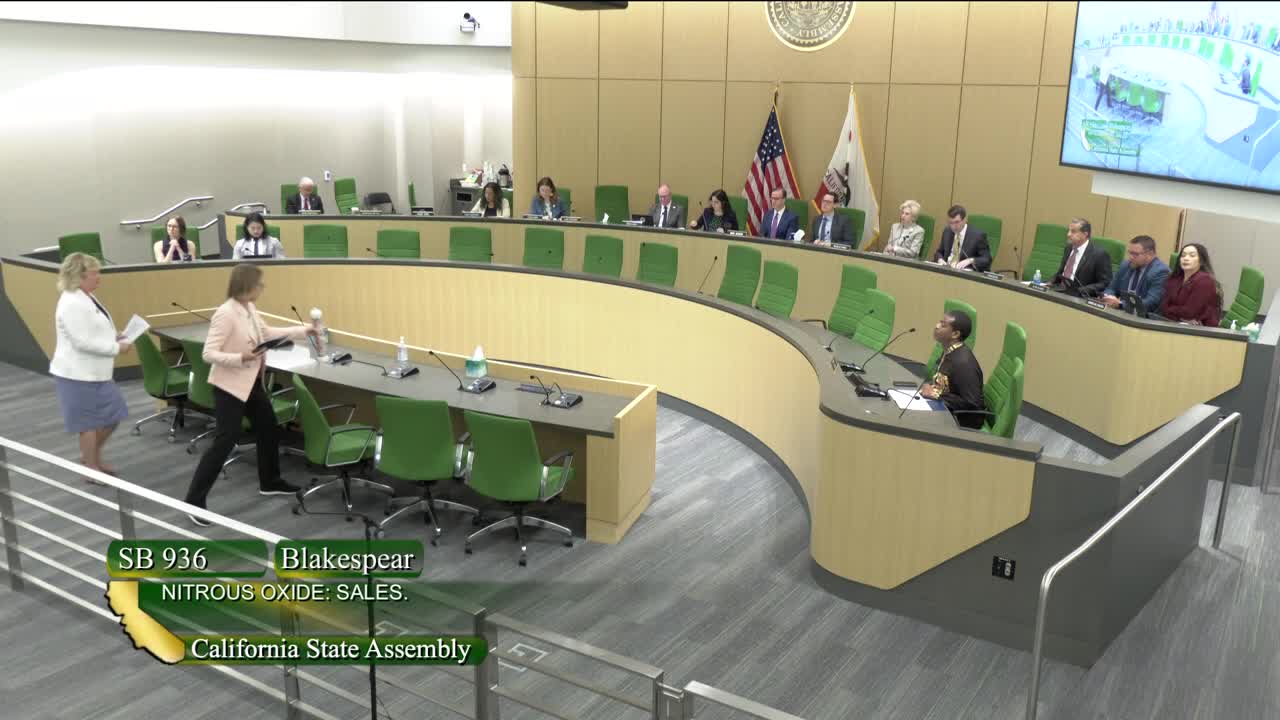 14MIN
Assembly Standing Committee on Business and Professions
 15MIN
Senate Standing Committee on Business, Professions and Economic Development
 19MIN