SB 937: Law enforcement: flash-bang grenades and explosive breaching charges.
- Session Year: 2025-2026
- House: Senate
- Latest Version Date: 2026-09-29
Current Status:
Passed
(2026-09-29: Chaptered by Secretary of State. Chapter 754, Statutes of 2026.)
Introduced
In Committee
Awaiting First Chamber Vote
Passed First Chamber
In Committee
Awaiting Second Chamber Vote
Passed Second Chamber
Enacted
Existing law prohibits the use of kinetic energy projectiles or chemical agents by any law enforcement agency to disperse any assembly, protest, or demonstration, except in compliance with specified standards. Existing law requires kinetic energy projectiles and chemical agents only to be deployed by a peace officer that has received proper training for crowd control, as specified, or to bring an objectively dangerous and unlawful situation safely and effectively under control and only in accordance with certain requirements, including that de-escalation techniques have been attempted and have failed, kinetic energy projectiles are not aimed at the head, neck, or any other vital organs, and, if the chemical agent to be deployed is tear gas, only a commanding officer at the scene of the assembly, protest, or demonstration may authorize the use of tear gas.
This bill would expand the above prohibition and exception to include flash-bang grenades, as defined. The bill would define law enforcement agency as any department or agency of the state or any local government, special district, or other political subdivision thereof, that employs any peace officer, as defined, or any federal law enforcement agency. The bill would prohibit the use of flash-bang grenades by any law enforcement agency for the purposes of immigration enforcement, except as specified. The bill would also only allow a commanding officer at the scene to authorize the use of flash-bang grenades.
Existing law requires each law enforcement agency to publish specified use of force incidents to the Department of Justice and requires the Department of Justice to publish those reports, as specified.
This bill would additionally require law enforcement agencies to report the use of flash-bang grenades. By imposing new duties on local law enforcement agencies, this bill would impose a state-mandated local program.
Existing law prohibits the possession of any destructive device and makes a violation of this prohibition punishable as a misdemeanor or felony. Existing law exempts specified peace officers from this prohibition.
This bill would prohibit a peace officer, as defined, from using an explosive breaching charge, as defined, for the purpose of immigration enforcement, except as specified.
The California Constitution requires the state to reimburse local agencies and school districts for certain costs mandated by the state. Statutory provisions establish procedures for making that reimbursement.
This bill would provide that, if the Commission on State Mandates determines that the bill contains costs mandated by the state, reimbursement for those costs shall be made pursuant to the statutory provisions noted above.
The bill would declare the severability of its provisions.
Existing law prohibits the use of kinetic energy projectiles or chemical agents by any law enforcement agency to disperse any assembly, protest, or demonstration, except in compliance with specified standards. Existing law requires kinetic energy projectiles and chemical agents only to be deployed by a peace officer that has received proper training for crowd control, as specified, or to bring an objectively dangerous and unlawful situation safely and effectively under control and only in accordance with certain requirements, including that de-escalation techniques have been attempted and have failed, kinetic energy projectiles are not aimed at the head, neck, or any other vital organs, and, if the chemical agent to be deployed is tear gas, only a commanding officer at the scene of the assembly, protest, or demonstration may authorize the use of tear gas.
This bill would expand the above prohibition and exception to include flash-bang grenades, as defined. The bill would define law enforcement agency as any department or agency of the state or any local government, special district, or other political subdivision thereof, that employs any peace officer, as defined, or any federal law enforcement agency. The bill would prohibit the use of flash-bang grenades for crowd control within 300 feet of a school zone, park, or any other area where children are visibly present, except as specified, and by any law enforcement agency for the purposes of immigration enforcement, except as specified. The bill would also only allow a commanding officer at the scene to authorize the use of flash-bang grenades.
Existing law requires each law enforcement agency to publish specified use of force incidents to the Department of Justice and requires the Department of Justice to publish those reports, as specified.
This bill would additionally require law enforcement agencies to report the use of flash-bang grenades. By imposing new duties on local law enforcement agencies, this bill would impose a state-mandated local program.
Existing law prohibits the possession of any destructive device and makes a violation of this prohibition punishable as a misdemeanor or felony. Existing law exempts specified peace officers from this prohibition.
This bill would prohibit a peace officer, as defined, from using an explosive breaching charge, as defined, for the purpose of immigration enforcement, except as specified.
The California Constitution requires the state to reimburse local agencies and school districts for certain costs mandated by the state. Statutory provisions establish procedures for making that reimbursement.
This bill would provide that, if the Commission on State Mandates determines that the bill contains costs mandated by the state, reimbursement for those costs shall be made pursuant to the statutory provisions noted above.
The bill would declare the severability of its provisions.
Existing law prohibits the use of kinetic energy projectiles or chemical agents by any law enforcement agency to disperse any assembly, protest, or demonstration, except in compliance with specified standards. Existing law requires kinetic energy projectiles and chemical agents only to be deployed by a peace officer that has received proper training for crowd control, as specified, or to bring an objectively dangerous and unlawful situation safely and effectively under control and only in accordance with certain requirements, including that de-escalation techniques have been attempted and have failed, kinetic energy projectiles and chemical agents are not aimed at the head, neck, or any other vital organs, and, if the chemical agent to be deployed is tear gas, only a commanding officer at the scene of the assembly, protest, or demonstration may authorize the use of tear gas.
This bill would expand the above prohibition and exception to include flash-bang grenades, as defined. The bill would define law enforcement agency as any department or agency of the state or any local government, special district, or other political subdivision thereof, that employs any peace officer, as defined, or any federal law enforcement agency. The bill would prohibit the use of flash-bang grenades for crowd control within 300 feet of a school zone, park, or any other area where children are visibly present present, except as specified, and by any law enforcement agency for the purposes of immigration enforcement, except as specified. The bill would also only allow a commanding officer at the scene to authorize the use of flash-bang grenades.
Existing law requires each law enforcement agency to publish specified use of force incidents to the Department of Justice and requires the Department of Justice to publish those reports, as specified.
This bill would additionally require law enforcement agencies to report the use of flash-bang grenades. By imposing new duties on local law enforcement agencies, this bill would impose a state-mandated local program.
Existing law prohibits the possession of any destructive device and makes a violation of this prohibition punishable as a misdemeanor or felony. Existing law exempts specified peace officers from this prohibition.
This bill would prohibit a peace officer, as defined, from using an explosive breaching charge, as defined, for the purpose of immigration enforcement, except as specified.
The California Constitution requires the state to reimburse local agencies and school districts for certain costs mandated by the state. Statutory provisions establish procedures for making that reimbursement.
This bill would provide that, if the Commission on State Mandates determines that the bill contains costs mandated by the state, reimbursement for those costs shall be made pursuant to the statutory provisions noted above.
The bill would declare the severability of its provisions.
Existing law prohibits the use of kinetic energy projectiles or chemical agents by any law enforcement agency to disperse any assembly, protest, or demonstration, except in compliance with specified standards. Existing law requires kinetic energy projectiles and chemical agents only to be deployed by a peace officer that has received proper training for crowd control, as specified, or to bring an objectively dangerous and unlawful situation safely and effectively under control and only in accordance with certain requirements, including that de-escalation techniques have been attempted and have failed, kinetic energy projectiles and chemical agents are not aimed at the head, neck, or any other vital organs, and, if the chemical agent to be deployed is tear gas, only a commanding officer at the scene of the assembly, protest, or demonstration may authorize the use of tear gas.
This bill would expand the above prohibition and exception to include flash-bang grenades, as defined. The bill would define law enforcement agency as any department or agency of the state or any local government, special district, or other political subdivision thereof, that employs any peace officer, as defined, or any federal law enforcement agency. The bill would prohibit the use of flash-bang grenades for crowd control within 300 feet of a school grounds, parks, or other areas zone, park, or any other area where children are visibly present at time of use and by any law enforcement agency for the purposes of immigration enforcement. enforcement, except as specified. The bill would also only allow a commanding officer at the scene to authorize the use of flash-bang grenades.
Existing law requires each law enforcement agency to publish specified use of force incidents to the Department of Justice and requires the Department of Justice to publish those reports, as specified.
This bill would additionally require law enforcement agencies to report the use of flash-bang grenades. By imposing new duties on local law enforcement agencies, this bill would impose a state-mandated local program.
Existing law prohibits the possession of any destructive device and makes a violation of this prohibition punishable as a misdemeanor or felony. Existing law exempts specified peace officers from this prohibition.
This bill would prohibit a peace officer, as defined, from using an explosive breaching charge, as defined, for the purpose of immigration enforcement. enforcement, except as specified.
The California Constitution requires the state to reimburse local agencies and school districts for certain costs mandated by the state. Statutory provisions establish procedures for making that reimbursement.
This bill would provide that, if the Commission on State Mandates determines that the bill contains costs mandated by the state, reimbursement for those costs shall be made pursuant to the statutory provisions noted above.
The bill would declare the severability of its provisions.
Existing law prohibits the use of kinetic energy projectiles or chemical agents by any law enforcement agency to disperse any assembly, protest, or demonstration, except in compliance with specified standards. Existing law requires kinetic energy projectiles and chemical agents only to be deployed by a peace officer that has received proper training for crowd control, as specified, or to bring an objectively dangerous and unlawful situation safely and effectively under control and only in accordance with certain requirements, including that de-escalation techniques have been attempted and have failed, kinetic energy projectiles and chemical agents are not aimed at the head, neck, or any other vital organs, and, if the chemical agent to be deployed is tear gas, only a commanding officer at the scene of the assembly, protest, or demonstration may authorize the use of tear gas.
This bill would expand the above prohibition and exception to include flash-bang grenades, as defined. The bill would define law enforcement agency as any department or agency of the state or any local government, special district, or other political subdivision thereof, that employs any peace officer, as defined, or any federal law enforcement agency. The bill would prohibit the use of flash-bang grenades near within 300 feet of school grounds, parks, or other areas where children are visibly present present at time of use and by any law enforcement agency for the purposes of immigration enforcement. The bill would also only allow a commanding officer at the scene to authorize the use of flash-bang grenades.
Existing law requires each law enforcement agency to publish specified use of force incidents to the Department of Justice and requires the Department of Justice to publish those reports, as specified.
This bill would additionally require law enforcement agencies to report the use of flash-bang grenades. By imposing new duties on local law enforcement agencies, this bill would impose a state-mandated local program.
Existing law prohibits the possession of any destructive device and makes a violation of this prohibition punishable as a misdemeanor or felony. Existing law exempts specified peace officers from this prohibition.
This bill would prohibit a peace officer, as defined, from using an explosive breaching charge, as defined, for the purpose of immigration enforcement.
The California Constitution requires the state to reimburse local agencies and school districts for certain costs mandated by the state. Statutory provisions establish procedures for making that reimbursement.
This bill would provide that, if the Commission on State Mandates determines that the bill contains costs mandated by the state, reimbursement for those costs shall be made pursuant to the statutory provisions noted above.
The bill would declare the severability of its provisions.
Existing law prohibits the use of kinetic energy projectiles or chemical agents by any law enforcement agency to disperse any assembly, protest, or demonstration, except in compliance with specified standards. Existing law requires kinetic energy projectiles and chemical agents only to be deployed by a peace officer that has received proper training for crowd control, as specified, or to bring an objectively dangerous and unlawful situation safely and effectively under control and only in accordance with certain requirements, including that de-escalation techniques have been attempted and have failed, kinetic energy projectiles and chemical agents are not aimed at the head, neck, or any other vital organs, and, if the chemical agent to be deployed is tear gas, only a commanding officer at the scene of the assembly, protest, or demonstration may authorize the use of tear gas.
This bill would prohibit the use of flashbang grenades, as defined, by any peace officer to disperse any assembly, protest, or demonstration, except in compliance with specified standards. expand the above prohibition and exception to include flash-bang grenades, as defined. The bill would define peace officer as any officer of a local, state, or federal law enforcement agency, or any person acting on behalf of a local, state, or federal law enforcement agency. law enforcement agency as any department or agency of the state or any local government, special district, or other political subdivision thereof, that employs any peace officer, as defined, or any federal law enforcement agency. The bill would prohibit the use of flashbang flash-bang grenades near school grounds, parks, or other areas where children may be are visibly present and by any peace officer law enforcement agency for the purposes of immigration enforcement. The bill would also only allow a commanding officer at the scene to authorize the use of flash-bang grenades.
Existing law requires each law enforcement agency to publish specified use of force incidents to the Department of Justice and requires the Department of Justice to publish those reports, as specified.
This bill would additionally require law enforcement agencies to report the use of flashbang flash-bang grenades. By imposing new duties on local law enforcement agencies, this bill would impose a state-mandated local program.
Existing law prohibits the possession of any destructive device and makes a violation of this prohibition punishable as a misdemeanor or felony. Existing law exempts specified peace officers from this prohibition.
This bill would prohibit a peace officer, defined above, as defined, from using an explosive breaching charge, as defined, for the purpose of immigration enforcement.
The California Constitution requires the state to reimburse local agencies and school districts for certain costs mandated by the state. Statutory provisions establish procedures for making that reimbursement.
This bill would provide that, if the Commission on State Mandates determines that the bill contains costs mandated by the state, reimbursement for those costs shall be made pursuant to the statutory provisions noted above.
The bill would declare the severability of its provisions.
Existing law prohibits the use of kinetic energy projectiles or chemical agents by any law enforcement agency to disperse any assembly, protest, or demonstration, except in compliance with specified standards.
This bill would prohibit the use of flashbang grenades, as defined, by any peace officer to disperse any assembly, protest, or demonstration, except in compliance with specified standards. The bill would define peace officer as any officer of a local, state, or federal law enforcement agency, or any person acting on behalf of a local, state, or federal law enforcement agency. The bill would prohibit the use of flashbang grenades near school grounds, parks, or other areas where children may be present and by any peace officer for the purposes of immigration enforcement.
Existing law requires each law enforcement agency to publish specified use of force incidents to the Department of Justice and requires the Department of Justice to publish those reports, as specified.
This bill would additionally require law enforcement agencies to report the use of flashbang grenades. By imposing new duties on local law enforcement agencies, this bill would impose a state-mandated local program.
Existing law prohibits the possession of any destructive device and makes a violation of this prohibition punishable as a misdemeanor or felony. Existing law exempts specified peace officers from this prohibition.
This bill would prohibit a peace officer, defined above, from using an explosive breaching charge, as defined, for the purpose of immigration enforcement.
The California Constitution requires the state to reimburse local agencies and school districts for certain costs mandated by the state. Statutory provisions establish procedures for making that reimbursement.
This bill would provide that, if the Commission on State Mandates determines that the bill contains costs mandated by the state, reimbursement for those costs shall be made pursuant to the statutory provisions noted above.
The bill would declare the severability of its provisions.
(a)Except as otherwise provided in subdivision (b), kinetic energy projectiles, flash-bang grenades, and chemical agents shall not be used by any law enforcement agency to disperse any assembly, protest, or demonstration.
(b)(1)Kinetic energy projectiles, flash-bang grenades, and chemical agents shall only be deployed for crowd control by a peace officer that has received training on their proper use certified by the Commission on Peace Officer Standards and Training, or training for crowd control or special weapons and tactics certified by an equivalent entity or training facility, if the use is objectively reasonable to defend against a threat to life or serious bodily injury to any individual, including any peace officer, or to bring an objectively dangerous and unlawful situation safely and effectively under control, and only in accordance with all of the following requirements:
(A)De-escalation techniques or other alternatives to force have been attempted, when objectively reasonable, and have failed.
(B)Repeated, audible announcements are made announcing the intent to use kinetic energy projectiles, flash-bang grenades, and chemical agents and the type to be used, when objectively reasonable to do so. The announcements shall be made from various locations, if necessary, and delivered in multiple languages, if appropriate.
(C)Persons are given an objectively reasonable opportunity to disperse and leave the scene.
(D)An objectively reasonable effort has been made to identify persons engaged in violent acts and those who are not, and kinetic energy projectiles, flash-bang grenades, or chemical agents are targeted toward those individuals engaged in violent acts. Projectiles shall not be aimed indiscriminately into a crowd or group of persons.
(E)Kinetic energy projectiles, flash-bang grenades, and chemical agents are used only with the frequency, intensity, and in a manner that is proportional to the threat and objectively reasonable.
(F)Officers shall minimize the possible incidental impact of their use of kinetic energy projectiles, flash-bang grenades, and chemical agents on bystanders, medical personnel, journalists, or other unintended targets.
(G)An objectively reasonable effort has been made to extract individuals in distress.
(H)Medical assistance is promptly provided, if properly trained personnel are present, or procured, for injured persons, when it is reasonable and safe to do so.
(I)Kinetic energy projectiles and flash-bang grenades shall not be aimed at the head, neck, or any other vital organs.
(J)Kinetic energy projectiles, flash-bang grenades, or chemical agents shall not be used by any law enforcement agency solely due to any of the following:
(i)A violation of an imposed curfew.
(ii)A verbal threat.
(iii)Noncompliance with a law enforcement directive.
(K)Only a commanding officer at the scene of the assembly, protest, or demonstration may authorize the use of tear gas or flash-bang grenades.
(2)Paragraph (1) shall not be construed to relieve a peace officer of any required training on the use of kinetic energy projectiles, flash-bang grenades, and chemical agents in any other circumstance outside of crowd control.
(c)Flash-bang grenades shall not be used by any law enforcement agency for the purposes of immigration enforcement, unless done as part of a joint law enforcement task force, as defined in subdivision (g) of Section 7284.4 of the Government Code, or in compliance with subdivision (b) or (c) of Section 7284.6 of the Government Code.
(d)This section does not prevent a law enforcement agency from adopting more stringent policies.
(e)For the purposes of this section, the following terms have the following meanings:
(1)Chemical agents means any chemical that can rapidly produce sensory irritation or disabling physical effects in humans, which disappear within a short time following termination of exposure. For purposes of this section, the term includes, but is not limited to, chloroacetophenone tear gas, commonly known as CN tear gas; 2-chlorobenzalmalononitrile gas, commonly known as CS gas; and items commonly referred to as pepper balls, pepper spray, or oleoresin capsicum.
(2)Flash-bang grenades means any less-than-lethal explosive or pyrotechnic devices that are deployed by hand or as projectiles and that produce a bright flash and loud noise intended to temporarily stun, distract, effect an arrest, or disperse a gathering of people. Flash-bang grenades include, but are not limited to, explosive or pyrotechnic devices that also emit chemical agents, kinetic energy projectiles, or shrapnel, or that are commonly referred to as blast balls, sting balls, stinger grenades, noise flash diversionary devices, concussion grenades, or stun grenades.
(3)Kinetic energy projectiles means any type of device designed as less lethal, to be launched from any device as a projectile that may cause bodily injury through the transfer of kinetic energy and blunt force trauma. For purposes of this section, the term includes, but is not limited to, items commonly referred to as rubber bullets, plastic bullets, beanbag rounds, and foam tipped plastic rounds.
(4)Law enforcement agency means any of the following:
(A)Any department or agency of the state or any local government, special district, or other political subdivision thereof, that employs any peace officer, as described in Chapter 4.5 (commencing with Section 830) of Title 3 of Part 2 of the Penal Code.
(B)Any federal law enforcement agency.
(f)This section does not apply within any county detention facility or any correctional facility of the Department of Corrections and Rehabilitation.
SEC. 2.Section 13652.1 of the Penal Code is amended to read:13652.1.(a)Each law enforcement agency shall, within 60 days of each incident, publish a summary on its internet website of all instances in which a peace officer employed by that agency uses a kinetic energy projectile, flash-bang grenade, or chemical agent, as those terms are defined in Section 13652, for crowd control. However, an agency may extend that period for another 30 days if they demonstrate just cause, but in no case longer than 90 days from the time of the incident.
(b)For each incident reported under subdivision (a), the summary shall be limited to that information known to the agency at the time of the report and shall include only the following:
(1)A description of the assembly, protest, demonstration, or incident, including the approximate crowd size and the number of officers involved.
(2)The type of kinetic energy projectile, flash-bang grenade, or chemical agent deployed.
(3)The number of rounds, flash-bang grenades, or quantity of chemical agent dispersed, as applicable.
(4)The number of documented injuries as a result of the kinetic energy projectile, flash-bang grenade, or chemical agent deployment.
(5)The justification for using the kinetic energy projectile, flash-bang grenade, or chemical agent, including any de-escalation tactics or protocols and other measures that were taken at the time of the event to de-escalate tensions and avoid the necessity of using the kinetic energy projectile, flash-bang grenade, or chemical agent.
(c)The Department of Justice shall post on its internet website a compiled list linking each law enforcement agencys reports posted pursuant to subdivision (a).
SEC. 3.Section 13652.2 is added to the Penal Code, to read:13652.2.(a)Peace officers shall not utilize explosive breaching charges for the purpose of immigration enforcement, unless done as part of a joint law enforcement task force, as defined in subdivision (g) of Section 7284.4 of the Government Code, or in compliance with subdivision (b) or (c) of Section 7284.6 of the Government Code.
(b)For the purposes of this section, the following terms have the following meanings:
(1)Explosive breaching charges means less lethal explosive charges that are deployed by hand to effectuate the forced opening of closed or locked points of entry often through the destruction of doors, locks, hinges, windows, and frame materials. These charges include, but are not limited to, detonating cords, sheet explosives, shaped charges, blasting caps, and detonators.
(2)Peace officer means an officer of a local, state, or federal law enforcement agency, or a person acting on behalf of a local, state, or federal law enforcement agency.
SEC. 4.The provisions of this act are severable. If any provision of this act or its application is held invalid, that invalidity shall not affect other provisions or applications that can be given effect without the invalid provision or application.
SEC. 5.If the Commission on State Mandates determines that this act contains costs mandated by the state, reimbursement to local agencies and school districts for those costs shall be made pursuant to Part 7 (commencing with Section 17500) of Division 4 of Title 2 of the Government Code.
(a)Except as otherwise provided in subdivision (b), kinetic energy projectiles, flash-bang grenades, and chemical agents shall not be used by any law enforcement agency to disperse any assembly, protest, or demonstration.
(b)(1)Kinetic energy projectiles, flash-bang grenades, and chemical agents shall only be deployed for crowd control by a peace officer that has received training on their proper use certified by the Commission on Peace Officer Standards and Training, or training for crowd control or special weapons and tactics certified by an equivalent entity or training facility, if the use is objectively reasonable to defend against a threat to life or serious bodily injury to any individual, including any peace officer, or to bring an objectively dangerous and unlawful situation safely and effectively under control, and only in accordance with all of the following requirements:
(A)De-escalation techniques or other alternatives to force have been attempted, when objectively reasonable, and have failed.
(B)Repeated, audible announcements are made announcing the intent to use kinetic energy projectiles, flash-bang grenades, and chemical agents and the type to be used, when objectively reasonable to do so. The announcements shall be made from various locations, if necessary, and delivered in multiple languages, if appropriate.
(C)Persons are given an objectively reasonable opportunity to disperse and leave the scene.
(D)An objectively reasonable effort has been made to identify persons engaged in violent acts and those who are not, and kinetic energy projectiles, flash-bang grenades, or chemical agents are targeted toward those individuals engaged in violent acts. Projectiles shall not be aimed indiscriminately into a crowd or group of persons.
(E)Kinetic energy projectiles, flash-bang grenades, and chemical agents are used only with the frequency, intensity, and in a manner that is proportional to the threat and objectively reasonable.
(F)Officers shall minimize the possible incidental impact of their use of kinetic energy projectiles, flash-bang grenades, and chemical agents on bystanders, medical personnel, journalists, or other unintended targets.
(G)An objectively reasonable effort has been made to extract individuals in distress.
(H)Medical assistance is promptly provided, if properly trained personnel are present, or procured, for injured persons, when it is reasonable and safe to do so.
(I)Kinetic energy projectiles and flash-bang grenades shall not be aimed at the head, neck, or any other vital organs.
(J)Kinetic energy projectiles, flash-bang grenades, or chemical agents shall not be used by any law enforcement agency solely due to any of the following:
(i)A violation of an imposed curfew.
(ii)A verbal threat.
(iii)Noncompliance with a law enforcement directive.
(K)Only a commanding officer at the scene of the assembly, protest, or demonstration may authorize the use of tear gas or flash-bang grenades.
(L)Flash-bang grenades shall not be deployed for crowd control within 300 feet of the following areas if children are visibly present, unless the officer can articulate specific facts establishing that their use is objectively reasonable to defend against a threat to life or serious bodily injury to any individual or to bring an objectively dangerous and unlawful situation safely and effectively under control and the use of reasonably available alternative tactics does not appear feasible:(i)A school zone. For purposes of this section, school zone means an area in, or on the grounds of, a public or private school providing instruction in kindergarten or grades 1 to 12, inclusive.(ii)A park.(iii)Any other area where children are visibly present. For purposes of this section, child means a person under 18 years of age.(2)Paragraph (1) shall not be construed to relieve a peace officer of any required training on the use of kinetic energy projectiles, flash-bang grenades, and chemical agents in any other circumstance outside of crowd control.
(c)Flash-bang grenades shall not be used by any law enforcement agency for the purposes of immigration enforcement, unless done as part of a joint law enforcement task force, as defined in subdivision (g) of Section 7284.4 of the Government Code, or in compliance with subdivision (b) or (c) of Section 7284.6 of the Government Code.
(d)This section does not prevent a law enforcement agency from adopting more stringent policies.
(e)For the purposes of this section, the following terms have the following meanings:
(1)Chemical agents means any chemical that can rapidly produce sensory irritation or disabling physical effects in humans, which disappear within a short time following termination of exposure. For purposes of this section, the term includes, but is not limited to, chloroacetophenone tear gas, commonly known as CN tear gas; 2-chlorobenzalmalononitrile gas, commonly known as CS gas; and items commonly referred to as pepper balls, pepper spray, or oleoresin capsicum.
(2)Flash-bang grenades means any less-than-lethal explosive or pyrotechnic devices that are deployed by hand or as projectiles and that produce a bright flash and loud noise intended to temporarily stun, distract, effect an arrest, or disperse a gathering of people. Flash-bang grenades include, but are not limited to, explosive or pyrotechnic devices that also emit chemical agents, kinetic energy projectiles, or shrapnel, or that are commonly referred to as blast balls, sting balls, stinger grenades, noise flash diversionary devices, concussion grenades, or stun grenades.
(3)Kinetic energy projectiles means any type of device designed as less lethal, to be launched from any device as a projectile that may cause bodily injury through the transfer of kinetic energy and blunt force trauma. For purposes of this section, the term includes, but is not limited to, items commonly referred to as rubber bullets, plastic bullets, beanbag rounds, and foam tipped plastic rounds.
(4)Law enforcement agency means any of the following:
(A)Any department or agency of the state or any local government, special district, or other political subdivision thereof, that employs any peace officer, as described in Chapter 4.5 (commencing with Section 830) of Title 3 of Part 2 of the Penal Code.
(B)Any federal law enforcement agency.
(f)This section does not apply within any county detention facility or any correctional facility of the Department of Corrections and Rehabilitation.
SEC. 2.Section 13652.1 of the Penal Code is amended to read:13652.1.(a)Each law enforcement agency shall, within 60 days of each incident, publish a summary on its internet website of all instances in which a peace officer employed by that agency uses a kinetic energy projectile, flash-bang grenade, or chemical agent, as those terms are defined in Section 13652, for crowd control. However, an agency may extend that period for another 30 days if they demonstrate just cause, but in no case longer than 90 days from the time of the incident.
(b)For each incident reported under subdivision (a), the summary shall be limited to that information known to the agency at the time of the report and shall include only the following:
(1)A description of the assembly, protest, demonstration, or incident, including the approximate crowd size and the number of officers involved.
(2)The type of kinetic energy projectile, flash-bang grenade, or chemical agent deployed.
(3)The number of rounds, flash-bang grenades, or quantity of chemical agent dispersed, as applicable.
(4)The number of documented injuries as a result of the kinetic energy projectile, flash-bang grenade, or chemical agent deployment.
(5)The justification for using the kinetic energy projectile, flash-bang grenade, or chemical agent, including any de-escalation tactics or protocols and other measures that were taken at the time of the event to de-escalate tensions and avoid the necessity of using the kinetic energy projectile, flash-bang grenade, or chemical agent.
(c)The Department of Justice shall post on its internet website a compiled list linking each law enforcement agencys reports posted pursuant to subdivision (a).
SEC. 3.Section 13652.2 is added to the Penal Code, to read:13652.2.(a)Peace officers shall not utilize explosive breaching charges for the purpose of immigration enforcement, unless done as part of a joint law enforcement task force, as defined in subdivision (g) of Section 7284.4 of the Government Code, or in compliance with subdivision (b) or (c) of Section 7284.6 of the Government Code.
(b)For the purposes of this section, the following terms have the following meanings:
(1)Explosive breaching charges means less lethal explosive charges that are deployed by hand to effectuate the forced opening of closed or locked points of entry often through the destruction of doors, locks, hinges, windows, and frame materials. These charges include, but are not limited to, detonating cords, sheet explosives, shaped charges, blasting caps, and detonators.
(2)Peace officer means an officer of a local, state, or federal law enforcement agency, or a person acting on behalf of a local, state, or federal law enforcement agency.
SEC. 4.The provisions of this act are severable. If any provision of this act or its application is held invalid, that invalidity shall not affect other provisions or applications that can be given effect without the invalid provision or application.
SEC. 5.If the Commission on State Mandates determines that this act contains costs mandated by the state, reimbursement to local agencies and school districts for those costs shall be made pursuant to Part 7 (commencing with Section 17500) of Division 4 of Title 2 of the Government Code.
(a)Except as otherwise provided in subdivision (b), kinetic energy projectiles, flash-bang grenades, and chemical agents shall not be used by any law enforcement agency to disperse any assembly, protest, or demonstration.
(b)(1)Kinetic energy projectiles, flash-bang grenades, and chemical agents shall only be deployed for crowd control by a peace officer that has received training on their proper use certified by the Commission on Peace Officer Standards and Training, or training for crowd control or special weapons and tactics certified by an equivalent entity or training facility, if the use is objectively reasonable to defend against a threat to life or serious bodily injury to any individual, including any peace officer, or to bring an objectively dangerous and unlawful situation safely and effectively under control, and only in accordance with all of the following requirements:
(1)(A)De-escalation techniques or other alternatives to force have been attempted, when objectively reasonable, and have failed.
(2)(B)Repeated, audible announcements are made announcing the intent to use kinetic energy projectiles projectiles, flash-bang grenades, and chemical agents and the type to be used, when objectively reasonable to do so. The announcements shall be made from various locations, if necessary, and delivered in multiple languages, if appropriate.
(3)(C)Persons are given an objectively reasonable opportunity to disperse and leave the scene.
(4)(D)An objectively reasonable effort has been made to identify persons engaged in violent acts and those who are not, and kinetic energy projectiles, flash-bang grenades, or chemical agents are targeted toward those individuals engaged in violent acts. Projectiles shall not be aimed indiscriminately into a crowd or group of persons.
(5)(E)Kinetic energy projectiles, flash-bang grenades, and chemical agents are used only with the frequency, intensity, and in a manner that is proportional to the threat and objectively reasonable.
(6)(F)Officers shall minimize the possible incidental impact of their use of kinetic energy projectiles, flash-bang grenades, and chemical agents on bystanders, medical personnel, journalists, or other unintended targets.
(7)(G)An objectively reasonable effort has been made to extract individuals in distress.
(8)(H)Medical assistance is promptly provided, if properly trained personnel are present, or procured, for injured persons, when it is reasonable and safe to do so.
(9)(I)Kinetic energy projectiles and flash-bang grenades shall not be aimed at the head, neck, or any other vital organs.
(10)(J)Kinetic energy projectiles, flash-bang grenades, or chemical agents shall not be used by any law enforcement agency solely due to any of the following:
(A)(i)A violation of an imposed curfew.
(B)(ii)A verbal threat.
(C)(iii)Noncompliance with a law enforcement directive.
(11)(K)Only a commanding officer at the scene of the assembly, protest, or demonstration may authorize the use of tear gas or flash-bang grenades.
(12)(L)Flash-bang grenades shall not be deployed for crowd control within 300 feet of the following areas if children are visibly present, unless the officer can articulate specific facts establishing that their use is objectively reasonable to defend against a threat to life or serious bodily injury to any individual: individual or to bring an objectively dangerous and unlawful situation safely and effectively under control and the use of reasonably available alternative tactics does not appear feasible:
(A)(i)A school zone. For purposes of this section, school zone means an area in, or on the grounds of, a public or private school providing instruction in kindergarten or grades 1 to 12, inclusive.
(B)(ii)A park.
(C)(iii)Any other area where children are visibly present. For purposes of this section, child means a person under 18 years of age.
(2)Paragraph (1) shall not be construed to relieve a peace officer of any required training on the use of kinetic energy projectiles, flash-bang grenades, and chemical agents in any other circumstance outside of crowd control.
(c)Flash-bang grenades shall not be used by any law enforcement agency for the purposes of immigration enforcement, unless done as part of a joint law enforcement task force, as defined in subdivision (g) of Section 7284.4 of the Government Code, or in compliance with subdivision (b) or (c) of Section 7284.6 of the Government Code.
(d)This section does not prevent a law enforcement agency from adopting more stringent policies.
(e)For the purposes of this section, the following terms have the following meanings:
(1)Chemical agents means any chemical that can rapidly produce sensory irritation or disabling physical effects in humans, which disappear within a short time following termination of exposure. For purposes of this section, the term includes, but is not limited to, chloroacetophenone tear gas, commonly known as CN tear gas; 2-chlorobenzalmalononitrile gas, commonly known as CS gas; and items commonly referred to as pepper balls, pepper spray, or oleoresin capsicum.
(2)Flash-bang grenades means any less-than-lethal explosive or pyrotechnic devices that are deployed by hand or as projectiles and that produce a bright flash and loud noise intended to temporarily stun, distract, effect an arrest, or disperse a gathering of people. Flash-bang grenades include, but are not limited to, explosive or pyrotechnic devices that also emit chemical agents, kinetic energy projectiles, or shrapnel, or that are commonly referred to as blast balls, sting balls, stinger grenades, noise flash diversionary devices, concussion grenades, or stun grenades.
(3)Kinetic energy projectiles means any type of device designed as less lethal, to be launched from any device as a projectile that may cause bodily injury through the transfer of kinetic energy and blunt force trauma. For purposes of this section, the term includes, but is not limited to, items commonly referred to as rubber bullets, plastic bullets, beanbag rounds, and foam tipped plastic rounds.
(4)Law enforcement agency means any of the following:
(A)Any department or agency of the state or any local government, special district, or other political subdivision thereof, that employs any peace officer, as described in Chapter 4.5 (commencing with Section 830) of Title 3 of Part 2 of the Penal Code.
(B)Any federal law enforcement agency.
(f)This section does not apply within any county detention facility or any correctional facility of the Department of Corrections and Rehabilitation.
SEC. 2.Section 13652.1 of the Penal Code is amended to read:13652.1.(a)Each law enforcement agency shall, within 60 days of each incident, publish a summary on its internet website of all instances in which a peace officer employed by that agency uses a kinetic energy projectile, flash-bang grenade, or chemical agent, as those terms are defined in Section 13652, for crowd control. However, an agency may extend that period for another 30 days if they demonstrate just cause, but in no case longer than 90 days from the time of the incident.
(b)For each incident reported under subdivision (a), the summary shall be limited to that information known to the agency at the time of the report and shall include only the following:
(1)A description of the assembly, protest, demonstration, or incident, including the approximate crowd size and the number of officers involved.
(2)The type of kinetic energy projectile, flash-bang grenade, or chemical agent deployed.
(3)The number of rounds, flash-bang grenades, or quantity of chemical agent dispersed, as applicable.
(4)The number of documented injuries as a result of the kinetic energy projectile, flash-bang grenade, or chemical agent deployment.
(5)The justification for using the kinetic energy projectile, flash-bang grenade, or chemical agent, including any de-escalation tactics or protocols and other measures that were taken at the time of the event to de-escalate tensions and avoid the necessity of using the kinetic energy projectile, flash-bang grenade, or chemical agent.
(c)The Department of Justice shall post on its internet website a compiled list linking each law enforcement agencys reports posted pursuant to subdivision (a).
SEC. 3.Section 13652.2 is added to the Penal Code, to read:13652.2.(a)Peace officers shall not utilize explosive breaching charges for the purpose of immigration enforcement, unless done as part of a joint law enforcement task force, as defined in subdivision (g) of Section 7284.4 of the Government Code, or in compliance with subdivision (b) or (c) of Section 7284.6 of the Government Code.
(b)For the purposes of this section, the following terms have the following meanings:
(1)Explosive breaching charges means less lethal explosive charges that are deployed by hand to effectuate the forced opening of closed or locked points of entry often through the destruction of doors, locks, hinges, windows, and frame materials. These charges include, but are not limited to, detonating cords, sheet explosives, shaped charges, blasting caps, and detonators.
(2)Peace officer means an officer of a local, state, or federal law enforcement agency, or a person acting on behalf of a local, state, or federal law enforcement agency.
SEC. 4.The provisions of this act are severable. If any provision of this act or its application is held invalid, that invalidity shall not affect other provisions or applications that can be given effect without the invalid provision or application.
SEC. 5.If the Commission on State Mandates determines that this act contains costs mandated by the state, reimbursement to local agencies and school districts for those costs shall be made pursuant to Part 7 (commencing with Section 17500) of Division 4 of Title 2 of the Government Code.
(a)Except as otherwise provided in subdivision (b), kinetic energy projectiles, flash-bang grenades, and chemical agents shall not be used by any law enforcement agency to disperse any assembly, protest, or demonstration.
(b)Kinetic energy projectiles, flash-bang grenades, and chemical agents shall only be deployed by a peace officer that has received training on their proper use certified by the Commission on Peace Officer Standards and Training, or training for crowd control or special weapons and tactics certified by an equivalent entity or training facility, if the use is objectively reasonable to defend against a threat to life or serious bodily injury to any individual, including any peace officer, or to bring an objectively dangerous and unlawful situation safely and effectively under control, and only in accordance with all of the following requirements:
(1)De-escalation techniques or other alternatives to force have been attempted, when objectively reasonable, and have failed.
(2)Repeated, audible announcements are made announcing the intent to use kinetic energy projectiles and chemical agents and the type to be used, when objectively reasonable to do so. The announcements shall be made from various locations, if necessary, and delivered in multiple languages, if appropriate.
(3)Persons are given an objectively reasonable opportunity to disperse and leave the scene.
(4)An objectively reasonable effort has been made to identify persons engaged in violent acts and those who are not, and kinetic energy projectiles, flash-bang grenades, or chemical agents are targeted toward those individuals engaged in violent acts. Projectiles shall not be aimed indiscriminately into a crowd or group of persons.
(5)Kinetic energy projectiles, flash-bang grenades, and chemical agents are used only with the frequency, intensity, and in a manner that is proportional to the threat and objectively reasonable.
(6)Officers shall minimize the possible incidental impact of their use of kinetic energy projectiles, flash-bang grenades, and chemical agents on bystanders, medical personnel, journalists, or other unintended targets.
(7)An objectively reasonable effort has been made to extract individuals in distress.
(8)Medical assistance is promptly provided, if properly trained personnel are present, or procured, for injured persons, when it is reasonable and safe to do so.
(9)Kinetic energy projectiles and flash-bang grenades shall not be aimed at the head, neck, or any other vital organs.
(10)Kinetic energy projectiles, flash-bang grenades, or chemical agents shall not be used by any law enforcement agency solely due to any of the following:
(A)A violation of an imposed curfew.
(B)A verbal threat.
(C)Noncompliance with a law enforcement directive.
(11)Only a commanding officer at the scene of the assembly, protest, or demonstration may authorize the use of tear gas or flash-bang grenades.
(12)Flash-bang grenades shall not be deployed for crowd control within 300 feet of school grounds, parks, or other areas where children are present at time of use. the following areas if children are visibly present, unless the use is objectively reasonable to defend against a threat to life or serious bodily injury to any individual:
(A)A school zone. For purposes of this section, school zone means an area in, or on the grounds of, a public or private school providing instruction in kindergarten or grades 1 to 12, inclusive.
(B)A park.
(C)Any other area where children are visibly present. For purposes of this section, child means a person under 18 years of age.
(c)Flash-bang grenades shall not be used by any law enforcement agency for the purposes of immigration enforcement. enforcement, unless done as part of a joint law enforcement task force, as defined in subdivision (g) of Section 7284.4 of the Government Code, or in compliance with subdivision (b) or (c) of Section 7284.6 of the Government Code.
(d)This section does not prevent a law enforcement agency from adopting more stringent policies.
(e)For the purposes of this section, the following terms have the following meanings:
(1)Chemical agents means any chemical that can rapidly produce sensory irritation or disabling physical effects in humans, which disappear within a short time following termination of exposure. For purposes of this section, the term includes, but is not limited to, chloroacetophenone tear gas, commonly known as CN tear gas; 2-chlorobenzalmalononitrile gas, commonly known as CS gas; and items commonly referred to as pepper balls, pepper spray, or oleoresin capsicum.
(2)Flash-bang grenades means any less-than-lethal explosive or pyrotechnic devices that are deployed by hand or as projectiles and that produce a bright flash and loud noise intended to temporarily stun, distract, effect an arrest, or disperse a gathering of people. Flash-bang grenades include, but are not limited to, explosive or pyrotechnic devices that also emit chemical agents, kinetic energy projectiles, or shrapnel, or that are commonly referred to as blast balls, sting balls, stinger grenades, noise flash diversionary devices, concussion grenades, or stun grenades.
(3)Kinetic energy projectiles means any type of device designed as less lethal, to be launched from any device as a projectile that may cause bodily injury through the transfer of kinetic energy and blunt force trauma. For purposes of this section, the term includes, but is not limited to, items commonly referred to as rubber bullets, plastic bullets, beanbag rounds, and foam tipped plastic rounds.
(4)Law enforcement agency means any of the following:
(A)Any department or agency of the state or any local government, special district, or other political subdivision thereof, that employs any peace officer, as described in Chapter 4.5 (commencing with Section 830) of Title 3 of Part 2 of the Penal Code.
(B)Any federal law enforcement agency.
(f)This section does not apply within any county detention facility or any correctional facility of the Department of Corrections and Rehabilitation.
SEC. 2.Section 13652.1 of the Penal Code is amended to read:13652.1.(a)Each law enforcement agency shall, within 60 days of each incident, publish a summary on its internet website of all instances in which a peace officer employed by that agency uses a kinetic energy projectile, flash-bang grenade, or chemical agent, as those terms are defined in Section 13652, for crowd control. However, an agency may extend that period for another 30 days if they demonstrate just cause, but in no case longer than 90 days from the time of the incident.
(b)For each incident reported under subdivision (a), the summary shall be limited to that information known to the agency at the time of the report and shall include only the following:
(1)A description of the assembly, protest, demonstration, or incident, including the approximate crowd size and the number of officers involved.
(2)The type of kinetic energy projectile, flash-bang grenade, or chemical agent deployed.
(3)The number of rounds, flash-bang grenades, or quantity of chemical agent dispersed, as applicable.
(4)The number of documented injuries as a result of the kinetic energy projectile, flash-bang grenade, or chemical agent deployment.
(5)The justification for using the kinetic energy projectile, flash-bang grenade, or chemical agent, including any de-escalation tactics or protocols and other measures that were taken at the time of the event to de-escalate tensions and avoid the necessity of using the kinetic energy projectile, flash-bang grenade, or chemical agent.
(c)The Department of Justice shall post on its internet website a compiled list linking each law enforcement agencys reports posted pursuant to subdivision (a).
SEC. 3.Section 13652.2 is added to the Penal Code, to read:13652.2.(a)Peace officers shall not utilize explosive breaching charges for the purpose of immigration enforcement. enforcement, unless done as part of a joint law enforcement task force, as defined in subdivision (g) of Section 7284.4 of the Government Code, or in compliance with subdivision (b) or (c) of Section 7284.6 of the Government Code.
(b)For the purposes of this section, the following terms have the following meanings:
(1)Explosive breaching charges means less lethal explosive charges that are deployed by hand to effectuate the forced opening of closed or locked points of entry often through the destruction of doors, locks, hinges, windows, and frame materials. These charges include, but are not limited to, detonating cords, sheet explosives, shaped charges, blasting caps, and detonators.
(2)Peace officer means an officer of a local, state, or federal law enforcement agency, or a person acting on behalf of a local, state, or federal law enforcement agency.
SEC. 4.The provisions of this act are severable. If any provision of this act or its application is held invalid, that invalidity shall not affect other provisions or applications that can be given effect without the invalid provision or application.
SEC. 5.If the Commission on State Mandates determines that this act contains costs mandated by the state, reimbursement to local agencies and school districts for those costs shall be made pursuant to Part 7 (commencing with Section 17500) of Division 4 of Title 2 of the Government Code.
(a)Except as otherwise provided in subdivision (b), kinetic energy projectiles, flash-bang grenades, and chemical agents shall not be used by any law enforcement agency to disperse any assembly, protest, or demonstration.
(b)Kinetic energy projectiles, flash-bang grenades, and chemical agents shall only be deployed by a peace officer that has received training on their proper use certified by the Commission on Peace Officer Standards and Training Training, or training for crowd control or special weapons and tactics certified by an equivalent entity or training facility, if the use is objectively reasonable to defend against a threat to life or serious bodily injury to any individual, including any peace officer, or to bring an objectively dangerous and unlawful situation safely and effectively under control, and only in accordance with all of the following requirements:
(1)De-escalation techniques or other alternatives to force have been attempted, when objectively reasonable, and have failed.
(2)Repeated, audible announcements are made announcing the intent to use kinetic energy projectiles and chemical agents and the type to be used, when objectively reasonable to do so. The announcements shall be made from various locations, if necessary, and delivered in multiple languages, if appropriate.
(3)Persons are given an objectively reasonable opportunity to disperse and leave the scene.
(4)An objectively reasonable effort has been made to identify persons engaged in violent acts and those who are not, and kinetic energy projectiles, flash-bang grenades, or chemical agents are targeted toward those individuals engaged in violent acts. Projectiles shall not be aimed indiscriminately into a crowd or group of persons.
(5)Kinetic energy projectiles, flash-bang grenades, and chemical agents are used only with the frequency, intensity, and in a manner that is proportional to the threat and objectively reasonable.
(6)Officers shall minimize the possible incidental impact of their use of kinetic energy projectiles, flash-bang grenades, and chemical agents on bystanders, medical personnel, journalists, or other unintended targets.
(7)An objectively reasonable effort has been made to extract individuals in distress.
(8)Medical assistance is promptly provided, if properly trained personnel are present, or procured, for injured persons, when it is reasonable and safe to do so.
(9)Kinetic energy projectiles and flash-bang grenades shall not be aimed at the head, neck, or any other vital organs.
(10)Kinetic energy projectiles, flash-bang grenades, or chemical agents shall not be used by any law enforcement agency solely due to any of the following:
(A)A violation of an imposed curfew.
(B)A verbal threat.
(C)Noncompliance with a law enforcement directive.
(11)Only a commanding officer at the scene of the assembly, protest, or demonstration may authorize the use of tear gas or flash-bang grenades.
(12)Flash-bang grenades shall not be deployed near within 300 feet of school grounds, parks, or other areas where children are visibly present. present at time of use.
(c)Flash-bang grenades shall not be used by any law enforcement agency for the purposes of immigration enforcement.
(d)This section does not prevent a law enforcement agency from adopting more stringent policies.
(e)For the purposes of this section, the following terms have the following meanings:
(1)Chemical agents means any chemical that can rapidly produce sensory irritation or disabling physical effects in humans, which disappear within a short time following termination of exposure. For purposes of this section, the term includes, but is not limited to, chloroacetophenone tear gas, commonly known as CN tear gas; 2-chlorobenzalmalononitrile gas, commonly known as CS gas; and items commonly referred to as pepper balls, pepper spray, or oleoresin capsicum.
(2)Flash-bang grenades means any less-than-lethal explosive or pyrotechnic devices that are deployed by hand or as projectiles and that produce a bright flash and loud noise intended to temporarily stun, distract, effect an arrest, or disperse a gathering of people. Flash-bang grenades include, but are not limited to, explosive or pyrotechnic devices that also emit chemical agents, kinetic energy projectiles, or shrapnel, or that are commonly referred to as blast balls, sting balls, stinger grenades, noise flash diversionary devices, concussion grenades, or stun grenades.
(3)Kinetic energy projectiles means any type of device designed as less lethal, to be launched from any device as a projectile that may cause bodily injury through the transfer of kinetic energy and blunt force trauma. For purposes of this section, the term includes, but is not limited to, items commonly referred to as rubber bullets, plastic bullets, beanbag rounds, and foam tipped plastic rounds.
(4)Law enforcement agency means any of the following:
(A)Any department or agency of the state or any local government, special district, or other political subdivision thereof, that employs any peace officer, as described in Chapter 4.5 (commencing with Section 830) of Title 3 of Part 2 of the Penal Code.
(B)Any federal law enforcement agency.
(f)This section does not apply within any county detention facility or any correctional facility of the Department of Corrections and Rehabilitation.
SEC. 2.Section 13652.1 of the Penal Code is amended to read:13652.1.(a)Each law enforcement agency shall, within 60 days of each incident, publish a summary on its internet website of all instances in which a peace officer employed by that agency uses a kinetic energy projectile, flash-bang grenade, or chemical agent, as those terms are defined in Section 13652, for crowd control. However, an agency may extend that period for another 30 days if they demonstrate just cause, but in no case longer than 90 days from the time of the incident.
(b)For each incident reported under subdivision (a), the summary shall be limited to that information known to the agency at the time of the report and shall include only the following:
(1)A description of the assembly, protest, demonstration, or incident, including the approximate crowd size and the number of officers involved.
(2)The type of kinetic energy projectile, flash-bang grenade, or chemical agent deployed.
(3)The number of rounds, flash-bang grenades, or quantity of chemical agent dispersed, as applicable.
(4)The number of documented injuries as a result of the kinetic energy projectile, flash-bang grenade, or chemical agent deployment.
(5)The justification for using the kinetic energy projectile, flash-bang grenade, or chemical agent, including any de-escalation tactics or protocols and other measures that were taken at the time of the event to de-escalate tensions and avoid the necessity of using the kinetic energy projectile, flash-bang grenade, or chemical agent.
(c)The Department of Justice shall post on its internet website a compiled list linking each law enforcement agencys reports posted pursuant to subdivision (a).
SEC. 3.Section 13652.2 is added to the Penal Code, to read:13652.2.(a)Peace officers shall not utilize explosive breaching charges for the purpose of immigration enforcement.
(b)For the purposes of this section, the following terms have the following meanings:
(1)Explosive breaching charges means less lethal explosive charges that are deployed by hand to effectuate the forced opening of closed or locked points of entry often through the destruction of doors, locks, hinges, windows, and frame materials. These charges include, but are not limited to, detonating cords, sheet explosives, shaped charges, blasting caps, and detonators.
(2)Peace officer means an officer of a local, state, or federal law enforcement agency, or a person acting on behalf of a local, state, or federal law enforcement agency.
SEC. 4.The provisions of this act are severable. If any provision of this act or its application is held invalid, that invalidity shall not affect other provisions or applications that can be given effect without the invalid provision or application.
SEC. 5.If the Commission on State Mandates determines that this act contains costs mandated by the state, reimbursement to local agencies and school districts for those costs shall be made pursuant to Part 7 (commencing with Section 17500) of Division 4 of Title 2 of the Government Code.
(a)Except as otherwise provided in subdivision (b), kinetic energy projectiles projectiles, flash-bang grenades, and chemical agents shall not be used by any law enforcement agency to disperse any assembly, protest, or demonstration.
(b)Kinetic energy projectiles projectiles, flash-bang grenades, and chemical agents shall only be deployed by a peace officer that has received training on their proper use by the Commission on Peace Officer Standards and Training for crowd control if the use is objectively reasonable to defend against a threat to life or serious bodily injury to any individual, including any peace officer, or to bring an objectively dangerous and unlawful situation safely and effectively under control, and only in accordance with all of the following requirements:
(1)De-escalation techniques or other alternatives to force have been attempted, when objectively reasonable, and have failed.
(2)Repeated, audible announcements are made announcing the intent to use kinetic energy projectiles and chemical agents and the type to be used, when objectively reasonable to do so. The announcements shall be made from various locations, if necessary, and delivered in multiple languages, if appropriate.
(3)Persons are given an objectively reasonable opportunity to disperse and leave the scene.
(4)An objectively reasonable effort has been made to identify persons engaged in violent acts and those who are not, and kinetic energy projectiles projectiles, flash-bang grenades, or chemical agents are targeted toward those individuals engaged in violent acts. Projectiles shall not be aimed indiscriminately into a crowd or group of persons.
(5)Kinetic energy projectiles projectiles, flash-bang grenades, and chemical agents are used only with the frequency, intensity, and in a manner that is proportional to the threat and objectively reasonable.
(6)Officers shall minimize the possible incidental impact of their use of kinetic energy projectiles projectiles, flash-bang grenades, and chemical agents on bystanders, medical personnel, journalists, or other unintended targets.
(7)An objectively reasonable effort has been made to extract individuals in distress.
(8)Medical assistance is promptly provided, if properly trained personnel are present, or procured, for injured persons, when it is reasonable and safe to do so.
(9)Kinetic energy projectiles and flash-bang grenades shall not be aimed at the head, neck, or any other vital organs.
(10)Kinetic energy projectiles projectiles, flash-bang grenades, or chemical agents shall not be used by any law enforcement agency solely due to any of the following:
(A)A violation of an imposed curfew.
(B)A verbal threat.
(C)Noncompliance with a law enforcement directive.
(11)If the chemical agent to be deployed is tear gas, only Only a commanding officer at the scene of the assembly, protest, or demonstration may authorize the use of tear gas. gas or flash-bang grenades.
(12)Flash-bang grenades shall not be deployed near school grounds, parks, or other areas where children are visibly present.
(c)Flash-bang grenades shall not be used by any law enforcement agency for the purposes of immigration enforcement.
(c)(d)This section does not prevent a law enforcement agency from adopting more stringent policies.
(d)(e)For the purposes of this section, the following terms have the following meanings:
(1)Chemical agents means any chemical that can rapidly produce sensory irritation or disabling physical effects in humans, which disappear within a short time following termination of exposure. For purposes of this section, the term includes, but is not limited to, chloroacetophenone tear gas, commonly known as CN tear gas; 2-chlorobenzalmalononitrile gas, commonly known as CS gas; and items commonly referred to as pepper balls, pepper spray, or oleoresin capsicum.
(2)Flash-bang grenades means any less-than-lethal explosive or pyrotechnic devices that are deployed by hand or as projectiles and that produce a bright flash and loud noise intended to temporarily stun, distract, effect an arrest, or disperse a gathering of people. Flash-bang grenades include, but are not limited to, explosive or pyrotechnic devices that also emit chemical agents, kinetic energy projectiles, or shrapnel, or that are commonly referred to as blast balls, sting balls, stinger grenades, noise flash diversionary devices, concussion grenades, or stun grenades.
(1)(3)Kinetic energy projectiles means any type of device designed as less lethal, to be launched from any device as a projectile that may cause bodily injury through the transfer of kinetic energy and blunt force trauma. For purposes of this section, the term includes, but is not limited to, items commonly referred to as rubber bullets, plastic bullets, beanbag rounds, and foam tipped plastic rounds.
(2)Chemical agents means any chemical that can rapidly produce sensory irritation or disabling physical effects in humans, which disappear within a short time following termination of exposure. For purposes of this section, the term includes, but is not limited to, chloroacetophenone tear gas, commonly known as CN tear gas; 2-chlorobenzalmalononitrile gas, commonly known as CS gas; and items commonly referred to as pepper balls, pepper spray, or oleoresin capsicum.(4)Law enforcement agency means any of the following:
(A)Any department or agency of the state or any local government, special district, or other political subdivision thereof, that employs any peace officer, as described in Chapter 4.5 (commencing with Section 830) of Title 3 of Part 2 of the Penal Code.
(B)Any federal law enforcement agency.
(e)(f)This section does not apply within any county detention facility or any correctional facility of the Department of Corrections and Rehabilitation.
SECTION 1.Section 13652.05 is added to the Penal Code, to read:13652.05.(a)Except as otherwise provided in subdivision (b), flashbang grenades shall not be used by any peace officer to disperse any assembly, protest, or demonstration.(b)Flashbang grenades shall only be deployed by a peace officer that has received training on their proper use by the Commission on Peace Officer Standards and Training for crowd control if the use is objectively reasonable to defend against a threat to life or serious bodily injury to any individual, including any peace officer, or to bring an objectively dangerous and unlawful situation safely and effectively under control, and only in accordance with all of the following requirements:(1)De-escalation techniques or other alternatives to force have been attempted, when objectively reasonable, and have failed.(2)Repeated, audible announcements are made announcing the intent to use flashbang grenades when objectively reasonable to do so. The announcements shall be made from various locations, if necessary, and delivered in multiple languages, if appropriate.(3)Persons are given an objectively reasonable opportunity to disperse and leave the scene.(4)An objectively reasonable effort has been made to identify persons engaged in violent acts and those who are not, and flashbang grenades are targeted toward those individuals engaged in violent acts. Flashbang grenades shall not be aimed indiscriminately into a crowd or group of persons.(5)Flashbang grenades are used only with the frequency, intensity, and in a manner that is proportional to the threat and objectively reasonable.(6)Officers shall minimize the possible incidental impact of their use of flashbang grenades on bystanders, medical personnel, journalists, or other unintended targets.(7)An objectively reasonable effort has been made to extract individuals in distress.(8)Medical assistance is promptly provided, if properly trained personnel are present, or procured, for injured persons, when it is reasonable and safe to do so.(9)Flashbang grenades shall not be aimed at the head, neck, or any other vital organs.(10)Flashbang grenades shall not be deployed near school grounds, parks, or other areas where children may be present.(11)Flashbang grenades shall not be used by any law enforcement agency solely due to any of the following:(A)A violation of an imposed curfew.(B)A verbal threat.(C)Noncompliance with a law enforcement directive.(12)Only a commanding officer at the scene of the assembly, protest, or demonstration may authorize the use of flashbang grenades.(c)Flashbang grenades shall not be used by any peace officer for the purposes of immigration enforcement.(d)This section does not prevent a law enforcement agency from adopting more stringent policies.(e)For the purposes of this section, the following terms have the following meanings:(1)Flashbang grenades, also known as noise flash diversionary devices, distraction devices, concussion grenades, or stun grenades, are less lethal explosive devices that are deployed by hand or projected and that produce a blinding flash of light and a sudden, loud noise intended to temporarily stun, distract, effect an arrest, clear an area, or disperse people, and are commonly used during breaching actions.(2)Peace officer means an officer of a local, state, or federal law enforcement agency, or a person acting on behalf of a local, state, or federal law enforcement agency.(f)The provisions of this section are severable. If a provision of this section or its application is held invalid, that invalidity shall not affect other provisions or applications that can be given effect without the invalid provision or application.SEC. 2.Section 13652.1 of the Penal Code is amended to read:13652.1.(a)Each law enforcement agency shall, within 60 days of each incident, publish a summary on its internet website of all instances in which a peace officer employed by that agency uses a kinetic energy projectile, flashbang flash-bang grenade, or chemical agent, as those terms are defined in Sections 13652 and 13652.05, Section 13652, for crowd control. However, an agency may extend that period for another 30 days if they demonstrate just cause, but in no case longer than 90 days from the time of the incident.
(b)For each incident reported under subdivision (a), the summary shall be limited to that information known to the agency at the time of the report and shall include only the following:
(1)A description of the assembly, protest, demonstration, or incident, including the approximate crowd size and the number of officers involved.
(2)The type of kinetic energy projectile, flashbang flash-bang grenade, or chemical agent deployed.
(3)The number of rounds, flashbang flash-bang grenades, or quantity of chemical agent dispersed, as applicable.
(4)The number of documented injuries as a result of the kinetic energy projectile, flashbang flash-bang grenade, or chemical agent deployment.
(5)The justification for using the kinetic energy projectile, flashbang flash-bang grenade, or chemical agent, including any de-escalation tactics or protocols and other measures that were taken at the time of the event to de-escalate tensions and avoid the necessity of using the kinetic energy projectile, flashbang flash-bang grenade, or chemical agent.
(c)The Department of Justice shall post on its internet website a compiled list linking each law enforcement agencys reports posted pursuant to subdivision (a).
SEC. 3.Section 13652.2 is added to the Penal Code, to read:13652.2.(a)Peace officers shall not utilize explosive breaching charges for the purpose of immigration enforcement.
(b)For the purposes of this section, the following terms have the following meanings:
(1)Explosive breaching charges means less lethal explosive charges that are deployed by hand to effectuate the forced opening of closed or locked points of entry often through the destruction of doors, locks, hinges, windows, and frame materials. These charges include, but are not limited to, detonating cords, sheet explosives, shaped charges, blasting caps, and detonators.
(2)Peace officer means an officer of a local, state, or federal law enforcement agency, or a person acting on behalf of a local, state, or federal law enforcement agency.
SEC. 4.The provisions of this act are severable. If any provision of this act or its application is held invalid, that invalidity shall not affect other provisions or applications that can be given effect without the invalid provision or application.
SEC. 5.If the Commission on State Mandates determines that this act contains costs mandated by the state, reimbursement to local agencies and school districts for those costs shall be made pursuant to Part 7 (commencing with Section 17500) of Division 4 of Title 2 of the Government Code.
(a)Except as otherwise provided in subdivision (b), flashbang grenades shall not be used by any peace officer to disperse any assembly, protest, or demonstration.
(b)Flashbang grenades shall only be deployed by a peace officer that has received training on their proper use by the Commission on Peace Officer Standards and Training for crowd control if the use is objectively reasonable to defend against a threat to life or serious bodily injury to any individual, including any peace officer, or to bring an objectively dangerous and unlawful situation safely and effectively under control, and only in accordance with all of the following requirements:
(1)De-escalation techniques or other alternatives to force have been attempted, when objectively reasonable, and have failed.
(2)Repeated, audible announcements are made announcing the intent to use flashbang grenades when objectively reasonable to do so. The announcements shall be made from various locations, if necessary, and delivered in multiple languages, if appropriate.
(3)Persons are given an objectively reasonable opportunity to disperse and leave the scene.
(4)An objectively reasonable effort has been made to identify persons engaged in violent acts and those who are not, and flashbang grenades are targeted toward those individuals engaged in violent acts. Flashbang grenades shall not be aimed indiscriminately into a crowd or group of persons.
(5)Flashbang grenades are used only with the frequency, intensity, and in a manner that is proportional to the threat and objectively reasonable.
(6)Officers shall minimize the possible incidental impact of their use of flashbang grenades on bystanders, medical personnel, journalists, or other unintended targets.
(7)An objectively reasonable effort has been made to extract individuals in distress.
(8)Medical assistance is promptly provided, if properly trained personnel are present, or procured, for injured persons, when it is reasonable and safe to do so.
(9)Flashbang grenades shall not be aimed at the head, neck, or any other vital organs.
(10)Flashbang grenades shall not be deployed near school grounds, parks, or other areas where children may be present.
(11)Flashbang grenades shall not be used by any law enforcement agency solely due to any of the following:
(A)A violation of an imposed curfew.
(B)A verbal threat.
(C)Noncompliance with a law enforcement directive.
(12)Only a commanding officer at the scene of the assembly, protest, or demonstration may authorize the use of flashbang grenades.
(c)Flashbang grenades shall not be used by any peace officer for the purposes of immigration enforcement.
(d)This section does not prevent a law enforcement agency from adopting more stringent policies.
(e)For the purposes of this section, the following terms have the following meanings:
(1)Flashbang grenades, also known as noise flash diversionary devices, distraction devices, concussion grenades, or stun grenades, are less lethal explosive devices that are deployed by hand or projected and that produce a blinding flash of light and a sudden, loud noise intended to temporarily stun, distract, effect an arrest, clear an area, or disperse people, and are commonly used during breaching actions.
(2)Peace officer means an officer of a local, state, or federal law enforcement agency, or a person acting on behalf of a local, state, or federal law enforcement agency.
(f)The provisions of this section are severable. If a provision of this section or its application is held invalid, that invalidity shall not affect other provisions or applications that can be given effect without the invalid provision or application.
SEC. 2.Section 13652.1 of the Penal Code is amended to read:13652.1.(a)Each law enforcement agency shall, within 60 days of each incident, publish a summary on its internet website of all instances in which a peace officer employed by that agency uses a kinetic energy projectile projectile, flashbang grenade, or chemical agent, as those terms are defined in Section 13652, Sections 13652 and 13652.05, for crowd control. However, an agency may extend that period for another 30 days if they demonstrate just cause, but in no case longer than 90 days from the time of the incident.
(b)For each incident reported under subdivision (a), the summary shall be limited to that information known to the agency at the time of the report and shall include only the following:
(1)A description of the assembly, protest, demonstration, or incident, including the approximate crowd size and the number of officers involved.
(2)The type of kinetic energy projectile projectile, flashbang grenade, or chemical agent deployed.
(3)The number of rounds rounds, flashbang grenades, or quantity of chemical agent dispersed, as applicable.
(4)The number of documented injuries as a result of the kinetic energy projectile projectile, flashbang grenade, or chemical agent deployment.
(5)The justification for using the kinetic energy projectile projectile, flashbang grenade, or chemical agent, including any de-escalation tactics or protocols and other measures that were taken at the time of the event to de-escalate tensions and avoid the necessity of using the kinetic energy projectile projectile, flashbang grenade, or chemical agent.
(c)The Department of Justice shall post on its internet website a compiled list linking each law enforcement agencys reports posted pursuant to subdivision (a).
SEC. 3.Section 13652.2 is added to the Penal Code, to read:13652.2.(a)Peace officers shall not utilize explosive breaching charges for the purpose of immigration enforcement.
(b)For the purposes of this section, the following terms have the following meanings:
(1)Explosive breaching charges means less lethal explosive charges that are deployed by hand to effectuate the forced opening of closed or locked points of entry often through the destruction of doors, locks, hinges, windows, and frame materials. These charges include, but are not limited to, detonating cords, sheet explosives, shaped charges, blasting caps, and detonators.
(2)Peace officer means an officer of a local, state, or federal law enforcement agency, or a person acting on behalf of a local, state, or federal law enforcement agency.
SEC. 4.The provisions of this act are severable. If any provision of this act or its application is held invalid, that invalidity shall not affect other provisions or applications that can be given effect without the invalid provision or application.
SEC. 5.If the Commission on State Mandates determines that this act contains costs mandated by the state, reimbursement to local agencies and school districts for those costs shall be made pursuant to Part 7 (commencing with Section 17500) of Division 4 of Title 2 of the Government Code.
|
Date
|
Status
|
|---|---|
| Sep 29, 2026 | Chaptered by Secretary of State. Chapter 754, Statutes of 2026. |
| Sep 29, 2026 | Approved by the Governor. |
| Aug 31, 2026 | Enrolled and presented to the Governor at 6 p.m. |
| Aug 26, 2026 | Assembly amendments concurred in. (Ayes 29. Noes 11. Page 5855.) Ordered to engrossing and enrolling. |
| Aug 26, 2026 | Assembly amendments concurred in. (Ayes 29. Noes 11.) Ordered to engrossing and enrolling. |
| Aug 25, 2026 | In Senate. Concurrence in Assembly amendments pending. |
| Aug 25, 2026 | Read third time. Passed. (Ayes 57. Noes 18. Page 6496.) Ordered to the Senate. |
| Aug 25, 2026 | Read third time. Passed. Ordered to the Senate. |
| Aug 20, 2026 | Ordered to third reading. |
| Aug 20, 2026 | Read third time and amended. |
| Aug 17, 2026 | Read second time. Ordered to third reading. |
| Aug 13, 2026 | Read second time and amended. Ordered to second reading. |
| Aug 13, 2026 | From committee: Do pass as amended. (Ayes 11. Noes 4.) (August 13). |
| Aug 13, 2026 | Assembly Rule 63 suspended. |
| Aug 5, 2026 | August 5 set for first hearing. Placed on suspense file. |
| Jun 24, 2026 | From committee: Do pass and re-refer to Com. on APPR. (Ayes 7. Noes 2.) (June 23). Re-referred to Com. on APPR. |
| Jun 16, 2026 | From committee with author's amendments. Read second time and amended. Re-referred to Com. on PUB. S. |
| Jun 4, 2026 | Referred to Com. on PUB. S. |
| May 27, 2026 | In Assembly. Read first time. Held at Desk. |
| May 27, 2026 | Read third time. Passed. (Ayes 29. Noes 9. Page 4485.) Ordered to the Assembly. |
| May 27, 2026 | Read third time. Passed. (Ayes 29. Noes 9.) Ordered to the Assembly. |
| May 18, 2026 | Read second time. Ordered to third reading. |
| May 14, 2026 | From committee: Do pass as amended. (Ayes 5. Noes 2. Page 4258.) (May 14). |
| May 14, 2026 | Read second time and amended. Ordered to second reading. |
| May 14, 2026 | From committee: Do pass as amended. (Ayes 5. Noes 2.) (May 14). |
| May 8, 2026 | Set for hearing May 14. |
| Apr 13, 2026 | April 13 hearing: Placed on APPR. suspense file. |
| Apr 13, 2026 | Set for hearing April 13. |
| Apr 10, 2026 | Set for hearing April 13. |
| Mar 24, 2026 | From committee: Do pass and re-refer to Com. on APPR. (Ayes 5. Noes 1. Page 3660.) (March 24). Re-referred to Com. on APPR. |
| Mar 24, 2026 | From committee: Do pass and re-refer to Com. on APPR. (Ayes 5. Noes 1.) (March 24). Re-referred to Com. on APPR. |
| Mar 10, 2026 | Set for hearing March 24. |
| Mar 10, 2026 | From committee with author's amendments. Read second time and amended. Re-referred to Com. on PUB. S. |
| Feb 11, 2026 | Referred to Com. on PUB. S. |
| Jan 30, 2026 | From printer. May be acted upon on or after March 1. |
| Jan 29, 2026 | Introduced. Read first time. To Com. on RLS. for assignment. To print. |
|
Date
|
Description
|
Location
|
Votes
|
|
|---|---|---|---|---|
| Aug 26, 2026 | Unfinished Business SB937 Gonzalez et al. Concurrence | Senate Floor |
Passed |
|
| Aug 25, 2026 | SB 937 Gonzalez Senate Third Reading By Mark González | Assembly Floor |
Passed |
|
| Aug 13, 2026 | Do pass as amended. | Assembly Standing Committee on Appropriations |
Passed |
|
| Jun 23, 2026 | Do pass and be re-referred to the Committee on [Appropriations] | Assembly Standing Committee on Public Safety |
Passed |
|
| May 27, 2026 | Senate 3rd Reading SB937 Gonzalez | Senate Floor |
Passed |
|
| May 14, 2026 | Do pass as amended | Senate Standing Committee on Appropriations |
Passed |
|
| Apr 13, 2026 | Placed on suspense file | Senate Standing Committee on Appropriations |
Passed |
|
| Mar 24, 2026 | Do pass, but first be re-referred to the Committee on [Appropriations] | Senate Standing Committee on Public Safety |
Passed |
This list shows positions taken on this bill by organizations on the date displayed, which is linked to the original source.
Positions by individuals are not included.
|
Organization
|
Position
|
Date
|
|---|---|---|
| Aclu California Action | ** Support | |
| All of US or None (HQ) | ** Support | |
| American Friends Service Committee | ** Support | |
| Association For Los Angeles Deputy Sheriffs | ** Against | |
| Berkeley Friends Meeting | ** Support | |
| California Association Of Highway Patrolmen | ** Against | |
| California Community Foundation | ** Support | |
| California Immigrant Policy Center | ** Support | |
| California Narcotic Officers' Association | ** Against | |
| California Peace Officers' Associaiton | ** Against | |
| california peace officers' association | ** Against | |
| California Police Chiefs Association | ** Against | |
| California Public Defenders Association | ** Support | |
| California State Sheriffs' Association | ** Against | |
| California State Sheriffs’ Association | ** Against | |
| Coalition for Humane Immigrant Rights (CHIRLA) | ** Support | |
| Coalition for Humane Immigrant Rights of Los Angeles | ** Support | |
| Courage California | ** Support | |
| Ella Baker Center For Human Rights | ** Support | |
| Felony Murder Elimination Project | ** Support | |
| Initiate Justice | ** Support | |
| latino equality alliance | ** Support | |
| Lawyers Committee for Civil Rights of the San Francisco Bay Area | ** Support | |
| League Of Women Voters Of California | ** Support | |
| Legal Services for Prisoners with Children | ** Support | |
| Los Angeles County Professional Peace Officers Association | ** Against | |
| Los Angeles Police Protective League | ** Against | |
| Oakland Privacy | ** Support | |
| Peace Officers Research Association of California (PORAC) | ** Against | |
| Policing Project At NYU Law School | ** Support | |
| Public Counsel | ** Support | |
| Riverside County Sheriff's Office | ** Against | |
| Riverside County Sheriffs’ Office | ** Against | |
| Rubicon Programs | ** Support | |
| San Francisco Public Defender | ** Support | |
| Sister Warriors Freedom Coalition | ** Support | |
| western center on law and poverty | ** Support | |
| western center on law & poverty | ** Support |
SENATE RULES COMMITTEE Office of Senate Floor Analyses (916) 651-4171 | SB 937 |
UNFINISHED BUSINESS
Bill No: SB 937
Author: Gonzalez (D), et al.
Amended: 8/13/26
Vote: 21
SENATE PUBLIC SAFETY COMMITTEE: 5-1, 3/24/26
AYES: Arreguín, Caballero, Cortese, Pérez, Wiener
NOES: Seyarto
SENATE APPROPRIATIONS COMMITTEE: 5-2, 5/14/26
AYES: Cervantes, Cabaldon, Grayson, Richardson, Wahab
NOES: Seyarto, Dahle
SENATE FLOOR: 29-9, 5/27/26
AYES: Allen, Archuleta, Arreguín, Ashby, Becker, Blakespear, Cabaldon, Caballero, Cervantes, Cortese, Durazo, Gonzalez, Grayson, Hurtado, Laird, Limón, McGuire, McNerney, Menjivar, Pérez, Reyes, Richardson, Rubio, Smallwood-Cuevas, Stern, Umberg, Wahab, Weber Pierson, Wiener
NOES: Alvarado-Gil, Choi, Grove, Jones, Niello, Ochoa Bogh, Seyarto, Strickland, Valladares
NO VOTE RECORDED: Dahle, Padilla
ASSEMBLY FLOOR: Passed, 8/25/26
SUBJECT: Law enforcement: flash-bang grenades and explosive breaching charges
SOURCE: Author
DIGEST:
This bill prohibits law enforcement officers from using flash-bang grenades to disperse an assembly, protest or demonstration, except as specified, and prohibits the use of flash-bang grenades and explosive breaching charges for the purpose of immigration enforcement, except as specified.
Assembly Amendments
remove the prohibition against the deployment of flash-bang grenades in specified areas where children are visibly present, and permit the use of flash-bangs and explosive breaching charges for purposes of immigration enforcement if done as art of a joint law enforcement task force, as specified.
ANALYSIS:
Existing law:
- Declares the intent of the Legislature that the authority to use physical force, conferred on peace officers by existing law, is a serious responsibility that shall be exercised judiciously and with respect for human rights and dignity and for the sanctity of every human life, and that every person has a right to be free from excessive use of force by officers acting under color of law. (Penal (Pen.) Code, § 835a, subd. (a)(1).)
- Includes a legislative finding and declaration that the decision by a peace officer to use force shall be evaluated carefully and thoroughly, in a manner that reflects the gravity of that authority and the serious consequences of the use of force by peace officers, in order to ensure that officers use force consistent with law and agency policies. (Pen. Code, § 835a, subd. (a)(3).)
- Authorizes a peace officer who has reasonable cause to believe that a person to be arrested has committed a public offense to use objectively reasonable force to effect the arrest, to prevent escape, or to overcome resistance. (Pen. Code, § 835a, subd. (b).)
- Permits a peace officer who is authorized to make an arrest and who has stated their intention to do so, to use all necessary means to effect the arrest if the person to be arrested either flees or forcibly resists. (Pen. Code, § 843.)
- Requires each law enforcement agency to maintain a policy that provides a minimum standard on the use of force which must include several specified elements. (Government (Gov.) Code, § 7286, subd. (b).)
- Prohibits a law enforcement agency from authorizing the use of a carotid restraint, as defined, by any peace officer employed by that agency. (Gov. Code, § 7286.5, subd. (a).)
- Prohibits a law enforcement agency from authorizing techniques or transport methods that involve a substantial risk of positional asphyxia. (Gov. Code, §7286.5, subd. (b).)
- Prohibits, generally, law enforcement agencies from using kinetic energy projectiles and chemical agents, as defined, to disperse any assembly, protest or demonstration. (Pen. Code, § 13652, subd. (a).)
- Provides that kinetic energy projectiles and chemical agents shall only be deployed by a peace officer that has received training on their proper use by the Commission on Peace Officer Standards and Training (POST) for crowd control if the use is objectively reasonable to defend against a threat to life or serious bodily injury to any individual, including any peace officer, or to bring an objectively dangerous and unlawful situation safely and effectively under control, and only in accordance with all of the following requirements:
- De-escalation techniques or other alternatives to force have been attempted, when objectively reasonable, and have failed.
- Repeated, audible announcements are made announcing the intent to use kinetic energy projectiles and chemical agents and the type to be used, when objectively reasonable to do so. The announcements shall be made from various locations, if necessary, and delivered in multiple languages, if appropriate.
- Persons are given an objectively reasonable opportunity to disperse and leave the scene.
- An objectively reasonable effort has been made to identify persons engaged in violent acts and those who are not, and kinetic energy projectiles or chemical agents are targeted toward those individuals engaged in violent acts. Projectiles shall not be aimed indiscriminately into a crowd or group of persons.
- Kinetic energy projectiles and chemical agents are used only with the frequency, intensity, and in a manner that is proportional to the threat and objectively reasonable.
- Officers shall minimize the possible incidental impact of their use of kinetic energy projectiles and chemical agents on bystanders, medical personnel, journalists, or other unintended targets.
- An objectively reasonable effort has been made to extract individuals in distress.
- Medical assistance is promptly provided, if properly trained personnel are present, or procured, for injured persons, when it is reasonable and safe to do so.
- Kinetic energy projectiles shall not be aimed at the head, neck, or any other vital organs.
- Kinetic energy projectiles or chemical agents shall not be used by any law enforcement agency solely due to a violation of imposed curfew, a verbal threat, or noncompliance with a law enforcement directive.
- If the chemical agent to be deployed is tear gas, only a commanding officer at the scene of the assembly, protest, or demonstration may authorize the use of tear gas. (Pen. Code, § 13652, subd. (b).)
- Requires each law enforcement agency, within 60 days of each incident, to publish a summary on its internet website of all instances in which a peace officer employed by that agency uses a kinetic energy projectile or chemical agent for crowd control. Provides that an agency may extend that period for 30 days if they demonstrate just cause, but in no case longer than 90 days from the time of the incident. (Pen. Code, § 13652.1, subd. (a).)
- Specifies the information that must be included in the incident summary published by law enforcement agencies, and requires the Department of Justice (DOJ) to post on its internet website a compiled list linking each law enforcement agency’s reports. (Pen. Code, § 13652.1, subd. (b), (c).)
- Defines “destructive device” as including any bomb, grenade, explosive missile or similar device or any launching device therefor, among other applicable devices, weapons and ammunition types. (Pen. Code, § 16460, subd. (a)(2).)
- Makes it a crime for any person, firm or corporation from possessing any destructive device within this state, except as specified. (Pen. Code, § 18710.)
- Establishes other various crimes relating to the possession, use and transfer of destructive devices. (Pen. Code, §§ 18715-18780.)
- Exempts on-duty peace officers acting within the scope and course of their employment from the above restrictions related to destructive devices. (Pen. Code, § 18800.)
This bill:
- Prohibits the use of flash-bang grenades by any law enforcement agency for the purposes of dispersing any assembly, protest, or demonstration, and requires that flash-bangs only be deployed for crowd control by a peace officer that has received training on their proper use by the Commission on Peace Officer Standards and Training (POST) for crowd control or special weapons and tactics certified by an equivalent entity or training facility, if the use is objectively reasonable to defend against a threat to life or serious bodily injury to any individual, including any peace officer, or to bring an objectively dangerous and unlawful situation safely and effectively under control, and only in accordance with all of the following requirements:
- De-escalation techniques or other alternatives to force have been attempted, when objectively reasonable, and have failed.
- Repeated, audible announcements are made announcing the intent to use kinetic energy projectiles, flash bang grenades, and chemical agents and the type to be used, when objectively reasonable to do so. The announcements shall be made from various locations, if necessary, and delivered in multiple languages, if appropriate.
- Persons are given an objectively reasonable opportunity to disperse and leave the scene.
- An objectively reasonable effort has been made to identify persons engaged in violent acts and those who are not, and flash-bang grenades are targeted toward those individuals engaged in violent acts. Projectiles shall not be aimed indiscriminately into a crowd or group of persons.
- Flash-bang grenades are used only with the frequency, intensity, and in a manner that is proportional to the threat and objectively reasonable.
- Officers shall minimize the possible incidental impact of their use of flash-bang grenades on bystanders, medical personnel, journalists, or other unintended targets.
- An objectively reasonable effort has been made to extract individuals in distress.
- Medical assistance is promptly provided, if properly trained personnel are present, or procured, for injured persons, when it is reasonable and safe to do so.
- Flash-bang grenades shall not be aimed at the head, neck, or any other vital organs.
- Flash-bang grenades shall not be used by any law enforcement agency solely due to any of the following:
- A violation of an imposed curfew.
- A verbal threat.
- Noncompliance with a law enforcement directive.
- Only a commanding officer at the scene of the assembly, protest or demonstration may authorize the use of flash-bang grenades.
- Specifies that (1) above does not relieve a peace officer of any required training on the use of kinetic energy projectiles, flash-bang grenades, and chemical agents in any other circumstance outside of crowd control.
- Provides that flash-bang grenades shall not be used by any law enforcement agency for the purposes of immigration enforcement, unless done as part of a joint law enforcement task force pursuant to the California Values Act
- Defines ″flash-bang grenades″ as any less-than-lethal explosive or pyrotechnic devices that are deployed by hand or as projectiles and that produce a bright flash and loud noise intended to temporarily stun, distract, effect an arrest, or disperse a gathering of people. Flash-bang grenades include, but are not limited to, explosive or pyrotechnic devices that also emit chemical agents, kinetic energy projectiles, or shrapnel, or that are commonly referred to as blast balls, sting balls, stinger grenades, noise flash diversionary devices, concussion grenades, or stun grenades.
- Defines ″law enforcement agency″ as any of the following:
- Any department or agency of the state or any local government, special district, or other political subdivision thereof, that employs any peace officer, as defined.
- Any federal law enforcement agency
- Expands existing prohibitions against the use of kinetic energy projectiles and chemical agents to federal law enforcement agencies.
- Requires each law enforcement agency, within 60 days of each incident, to publish a summary on its internet website of all instances in which a peace officer employed by that agency uses a flash-bang grenade for crowd control, and authorizes an agency to extend that period for 30 days if they demonstrate just cause, but in no case longer than 90 days from the time of the incident.
- Specifies that for each incident reported, the summary is limited to that information known to the agency at the time of the report and includes specified details.
- Prohibits any peace officer of a local, state, or federal law enforcement agency, or a person acting on behalf of such an agency, from using explosive breaching charges for the purpose of immigration enforcement unless done as part of a joint law enforcement task force under the California Values Act.
- Defines ″explosive breaching charge″ as less lethal explosive charges that are deployed by hand to effectuate the forced opening of closed or locked points of entry often through the destruction of doors, locks, hinges, windows, and frame materials. Specifies that these charges include, but are not limited to, detonating cords, sheet explosives, shaped charges, blasting caps, and detonators.
- Defines peace officer, for the purposes of the prohibition against the use of breaching charges for immigration enforcement, as an officer of a local, state, or federal law enforcement agency, or a person acting on behalf of a local, state, or federal law enforcement agency.
- Includes a severability clause.
FISCAL EFFECT: Appropriation: No Fiscal Com.: Yes Local: Yes
According to the Assembly Appropriations Committee:
Minor and absorbable costs to the Commission on Peace Officer Standards and Training (POST) to update its crowd control guidelines (Peace Officers’ Training Fund). POST reports the bill would not require new training, as the tools and tactics at issue are deployed by SWAT officers who already undergo extensive certification, and the relevant material is covered at a basic level in the academy.
Costs of an unknown amount, likely in excess of $150,000 statewide to state and local law enforcement agencies to publish the incident summaries this bill requires (General Fund, special funds, local funds). Notably, while the reporting obligation is incremental, the obligation attaches to more than 500 local law enforcement entities, and the aggregate cost may be reimbursable, pursuant to a determination of the Commission on State Mandate.
Minor and absorbable costs to DOJ to add flash-bang grenade reports to the compiled list DOJ already maintains for existing crowd control munitions (General Fund).
SUPPORT: (Verified 8/25/26)
ACLU California Action
All of US or None (HQ)
American Friends Service Committee
Berkeley Friends Meeting
California Community Foundation
California Public Defenders Association
Courage California
Ella Baker Center for Human Rights
Felony Murder Elimination Project
Initiate Justice
Lawyers Committee for Civil Rights of the San Francisco Bay Area
League of Women Voters of California
Legal Services for Prisoners with Children
Oakland Privacy
Policing Project at NYU Law School
Rubicon Programs
San Francisco Public Defender
Sister Warriors Freedom Coalition
OPPOSITION: (Verified 8/25/26)
Association for Los Angeles Deputy Sheriffs
California Association of Highway Patrolmen
California Narcotic Officers' Association
California State Sheriffs' Association
Los Angeles County Professional Peace Officers Association
Los Angeles Police Protective League
Riverside County Sheriff's Office
Prepared by: Alex Barnett / PUB. S. /916-651-4118
SENATE THIRD READING
STR Bill Id:SB 937
Author:(Gonzalez)
As Amended Ver:August 20, 2026
Majority vote
SUMMARY
Prohibits law enforcement officers from using flash-bang grenades to disperse any assembly, protest, or demonstration, except as specified.
Major Provisions
- Prohibits the use of flash-bang grenades by any law enforcement agency for the purposes of dispersing any assembly, protest, or demonstration, and requires that flash-bangs only be deployed for crowd control by a peace officer that has received training on their proper use by the Commission on Peace Officer Standards and Training (POST) for crowd control or special weapons and tactics certified by an equivalent entity or training facility, if the use is objectively reasonable to defend against a threat to life or serious bodily injury to any individual, including any peace officer, or to bring an objectively dangerous and unlawful situation safely and effectively under control, and only in accordance with all of the following requirements:
- De-escalation techniques or other alternatives to force have been attempted, when objectively reasonable, and have failed.
- Repeated, audible announcements are made announcing the intent to use kinetic energy projectiles, flash bang grenades, and chemical agents and the type to be used, when objectively reasonable to do so. The announcements shall be made from various locations, if necessary, and delivered in multiple languages, if appropriate.
- Persons are given an objectively reasonable opportunity to disperse and leave the scene.
- An objectively reasonable effort has been made to identify persons engaged in violent acts and those who are not, and flash-bang grenades are targeted toward those individuals engaged in violent acts. Projectiles shall not be aimed indiscriminately into a crowd or group of persons.
- Flash-bang grenades are used only with the frequency, intensity, and in a manner that is proportional to the threat and objectively reasonable.
- Officers shall minimize the possible incidental impact of their use of flash-bang grenades on bystanders, medical personnel, journalists, or other unintended targets.
- An objectively reasonable effort has been made to extract individuals in distress.
- Medical assistance is promptly provided, if properly trained personnel are present, or procured, for injured persons, when it is reasonable and safe to do so.
- Flash-bang grenades shall not be aimed at the head, neck, or any other vital organs.
- Flash-bang grenades shall not be used by any law enforcement agency solely due to any of the following:
- A violation of an imposed curfew.
- A verbal threat.
- Noncompliance with a law enforcement directive.
- Only a commanding officer at the scene of the assembly, protest or demonstration may authorize the use of flash-bang grenades.
- Provides that the above does not relieve a peace officer of any required training on the use of kinetic energy projectiles, flash-bang grenades, and chemical agents in any other circumstance outside of crowd control.
- Provides that flash-bang grenades shall not be used by any law enforcement agency for the purposes of immigration enforcement, unless done as part of a joint law enforcement task force.
- Defines ″flash-bang grenades″ as any less-than-lethal explosive or pyrotechnic devices that are deployed by hand or as projectiles and that produce a bright flash and loud noise intended to temporarily stun, distract, effect an arrest, or disperse a gathering of people. Flash-bang grenades include, but are not limited to, explosive or pyrotechnic devices that also emit chemical agents, kinetic energy projectiles, or shrapnel, or that are commonly referred to as blast balls, sting balls, stinger grenades, noise flash diversionary devices, concussion grenades, or stun grenades.
- Defines ″law enforcement agency″ as any of the following:
- Any department or agency of the state or any local government, special district, or other political subdivision thereof, that employs any peace officer, as defined.
- Any federal law enforcement agency
- Expands existing prohibitions against the use of kinetic energy projectiles and chemical agents to federal law enforcement agencies.
- Requires each law enforcement agency, within 60 days of each incident, to publish a summary on its internet website of all instances in which a peace officer employed by that agency uses a flash-bang grenade for crowd control. Authorizes an agency to extend that period for 30 days if they demonstrate just cause, but in no case longer than 90 days from the time of the incident.
- Specifies that for each incident reported, the summary is limited to that information known to the agency at the time of the report and includes only the following:
- A description of the assembly, protest, demonstration, or incident, including the approximate crowd size and the number of officers involved.
- The type of flash-bang grenade deployed.
- The number of flash-bang grenades deployed, as applicable.
- The number of documented injuries as a result of the flash-bang grenade deployment.
- The justification for using the flash-bang grenade, including any de-escalation tactics or protocols and other measures that were taken at the time of the event to de-escalate tensions and avoid the necessity of using the flash-bang.
- Requires the Department of Justice (DOJ) to post on its internet website a compiled list linking each law enforcement agency′s reports posted pursuant to the reporting requirement.
- Prohibits any peace officer of a local, state, or federal law enforcement agency, or a person acting on behalf of such an agency, from using explosive breaching charges for the purpose of immigration enforcement unless done as part of a joint law enforcement task force.
- Defines ″explosive breaching charge″ as less lethal explosive charges that are deployed by hand to effectuate the forced opening of closed or locked points of entry often through the destruction of doors, locks, hinges, windows, and frame materials. Specifies that these charges include, but are not limited to, detonating cords, sheet explosives, shaped charges, blasting caps, and detonators.
- Defines peace officer, for the purposes of the prohibition of use for immigration enforcement, as an officer of a local, state, or federal law enforcement agency, or a person acting on behalf of a local, state, or federal law enforcement agency.
- Includes a severability clause.
COMMENTS
According to the Author
″Californians across the state have a constitutionally protected right to protest. This right has been consistently under threat in recent years, as the equipment law enforcement uses for crowd control has become increasingly militarized and dangerous. Flash-bang grenades, which emit blinding flashes of light, create overpressure, and produce extremely loud bangs, have grown in popularity as a tool of crowd control and immigration enforcement actions. Though supposedly non-lethal, flash-bangs can cause temporary blindness, deafness, and fire shrapnel or pellets that can seriously injure both users and the public, especially without proper training. A lack of regulation, transparency, and training also extends to explosive breaching devices, often used by law enforcement to blow open doors and windows, and posing similar safety risks.″
″The Legislature has already taken steps to curtail other dangerous crowd control devices, such as tear gas, rubber bullets, and beanbag rounds. SB 937 extends these existing restrictions and training requirements to flash-bang grenades, and it bars use of explosive breaching devices for immigration enforcement. This measure is vital to ensuring the safety of both citizens exercising their right to protest and law enforcement agents in the field.″
Arguments in Support
According to the Ella Baker Center for Human Rights, ″In June 2025, protests against the current federal administration were organized across the country, drawing over 5,000 attendees in Los Angeles alone. Though these protests started peacefully, excessive misuse of crowd control equipment contributed to injuries of both attendees and law enforcement. Flash-bang grenades, also known as stun grenades, have recently grown in popularity as crowd control devices during large-scale protests. Flash-bangs emit a loud bang and a blinding flash of light when deployed and can also throw shrapnel or rubber balls. Though classified as ′less lethal′, these grenades pose safety risks to both the user and protestors. Eardrum rupture, lung injuries, fractures, and hemorrhaging are just a few of the reported injuries caused by flash-bangs.
″Last June, a man attending a protest in Los Angeles was hit by flash-bang shrapnel while observing, resulting in the loss of a finger. Premature deployment of flash-bangs can also seriously injure users– in 2024, an officer in New York suffered extensive injuries to his hand after a flash-bang detonated while he was holding it.
″Explosive breaching charges, or high-velocity explosive devices, are used by law enforcement to rapidly break open a door or window, usually during a raid. Use of these devices can cause serious injuries for all involved parties, ranging from hearing loss and burns to long-term traumatic brain injuries. In June 2025, federal immigration agents in Huntington Park endangered a mother and her two children when they used an explosive breaching charge to blow the windows off a home while they were inside. The suspect in question was not present and posed no imminent threat to the officers.
″California currently restricts the use of some military weaponry that is commonly used for crowd control, including tear gas and kinetic energy projectiles (KEPs) like rubber bullets and beanbag rounds, and requires proper training for their use, but has no training requirement or restrictions on the circumstances under which flash-bangs or explosive breaching devices can be used by law enforcement. Lack of proper training and reporting on the use of these devices undermines the safety of police officers and public trust of law enforcement.
″SB 937 adds flash-bang grenades to the existing restrictions on other less-lethal crowd control devices and prohibits their use, alongside explosive breaching devices, for the purposes of immigration enforcement. The bill also requires any user of a flash-bang to receive training from the Commission on Peace Officer Standards and Training before use. This measure is vital to maintaining both the safety of citizens exercising their right to protest and that of police officers in the field.″
Arguments in Opposition
According to the California Peace Officers′ Association, ″SB 937 establishes a categorical ban on the use of flashbang devices in areas where children may be present, regardless of the nature or severity of the threat. This blanket prohibition fails to account for the realities faced by law enforcement officers responding to violent, rapidly evolving situations.
″Flashbang devices are a carefully controlled tool designed to disorient and distract, often allowing officers to de-escalate situations and take individuals into custody without resorting to lethal force. By removing this option entirely—even in life-threatening circumstances—SB 937 may inadvertently increase the likelihood of more severe uses of force, placing both officers and the public at greater risk.
″SB 937 also includes provisions related to immigration enforcement, despite the existence of a well-established statutory framework governing these issues. Senate Bill 54 (De Leon) Chapter 495, Statutes of 2017, already provides clear and comprehensive guidance regarding local law enforcement′s role in immigration matters.
″The additional restrictions proposed in SB 937 are duplicative and risk creating confusion, inconsistency, and potential conflict with existing law. Rather than enhancing protections, these provisions may complicate compliance and divert attention from established policies that agencies have successfully implemented statewide.
″Perhaps most concerning, SB 937 imposes sweeping, categorical restrictions without allowing for the exercise of professional judgment based on the totality of the circumstances. Law enforcement officers are routinely required to make split-second decisions in high-risk environments where lives are at stake.
″Policies governing use of force must be grounded in objective reasonableness and allow for necessary discretion. By substituting inflexible prohibitions for this well-established standard, SB 937 undermines officers′ ability to respond appropriately to dynamic and dangerous situations, potentially leading to worse outcomes for all involved.
″The California Peace Officers′ Association strongly supports policies that enhance safety, accountability, and public trust. However, SB 937, as drafted, removes critical tools, duplicates existing law, and restricts the reasonable discretion officers need to protect lives.″
FISCAL COMMENTS
According to the Assembly Appropriations Committee:
- Minor and absorbable costs to the Commission on Peace Officer Standards and Training (POST) to update its crowd control guidelines (Peace Officers′ Training Fund). POST reports the bill would not require new training, as the tools and tactics at issue are deployed by SWAT officers who already undergo extensive certification, and the relevant material is covered at a basic level in the academy.
- Costs of an unknown amount, likely in excess of $150,000 statewide to state and local law enforcement agencies to publish the incident summaries this bill requires (General Fund, special funds, local funds). Notably, while the reporting obligation is incremental, the obligation attaches to more than 500 local law enforcement entities, and the aggregate cost may be reimbursable, pursuant to a determination of the Commission on State Mandate.
- Minor and absorbable costs to DOJ to add flash-bang grenade reports to the compiled list DOJ already maintains for existing crowd control munitions (General Fund).
VOTES
SENATE FLOOR: 29-9-2
YES: Allen, Archuleta, Arreguín, Ashby, Becker, Blakespear, Cabaldon, Caballero, Cervantes, Cortese, Durazo, Gonzalez, Grayson, Hurtado, Laird, Limón, McGuire, McNerney, Menjivar, Pérez, Reyes, Richardson, Rubio, Smallwood-Cuevas, Stern, Umberg, Wahab, Weber Pierson, Wiener
NO: Alvarado-Gil, Choi, Grove, Jones, Niello, Ochoa Bogh, Seyarto, Strickland, Valladares
ABS, ABST OR NV: Dahle, Padilla
ASM PUBLIC SAFETY: 7-2-0
YES: Schultz, Mark González, Haney, Harabedian, Nguyen, Ramos, Sharp-Collins
NO: Alanis, Lackey
ASM APPROPRIATIONS: 11-4-0
YES: Wicks, Arambula, Calderon, Caloza, Fong, Mark González, Krell, Pacheco, Pellerin, Sharp-Collins, Solache
NO: Hoover, Dixon, Ta, Tangipa
UPDATED
VERSION: August 20, 2026
CONSULTANT: Andrew Ironside / PUB. S. / (916) 319-3744 FN: 0003888
SENATE THIRD READING
STR Bill Id:SB 937
Author:(Gonzalez)
As Amended Ver:August 13, 2026
Majority vote
SUMMARY
Prohibits law enforcement officers from using flash-bang grenades to disperse any assembly, protest, or demonstration, except as specified.
Major Provisions
- Prohibits the use of flash-bang grenades by any law enforcement agency for the purposes of dispersing any assembly, protest, or demonstration, and requires that flash-bangs only be deployed for crowd control by a peace officer that has received training on their proper use by the Commission on Peace Officer Standards and Training (POST) for crowd control or special weapons and tactics certified by an equivalent entity or training facility, if the use is objectively reasonable to defend against a threat to life or serious bodily injury to any individual, including any peace officer, or to bring an objectively dangerous and unlawful situation safely and effectively under control, and only in accordance with all of the following requirements:
- De-escalation techniques or other alternatives to force have been attempted, when objectively reasonable, and have failed.
- Repeated, audible announcements are made announcing the intent to use kinetic energy projectiles, flash bang grenateds, and chemical agents and the type to be used, when objectively reasonable to do so. The announcements shall be made from various locations, if necessary, and delivered in multiple languages, if appropriate.
- Persons are given an objectively reasonable opportunity to disperse and leave the scene.
- An objectively reasonable effort has been made to identify persons engaged in violent acts and those who are not, and flash-bang grenades are targeted toward those individuals engaged in violent acts. Projectiles shall not be aimed indiscriminately into a crowd or group of persons.
- Flash-bang grenades are used only with the frequency, intensity, and in a manner that is proportional to the threat and objectively reasonable.
- Officers shall minimize the possible incidental impact of their use of flash-bang grenades on bystanders, medical personnel, journalists, or other unintended targets.
- An objectively reasonable effort has been made to extract individuals in distress.
- Medical assistance is promptly provided, if properly trained personnel are present, or procured, for injured persons, when it is reasonable and safe to do so.
- Flash-bang grenades shall not be aimed at the head, neck, or any other vital organs.
- Flash-bang grenades shall not be used by any law enforcement agency solely due to any of the following:
- A violation of an imposed curfew.
- A verbal threat.
- Noncompliance with a law enforcement directive.
- Only a commanding officer at the scene of the assembly, protest or demonstration may authorize the use of flash-bang grenades.
- Flash-bang grenades shall not be deployed for crowd control within 300 feet of the following areas if children are visibly present, unless the officer can articulate specific facts establishing that their use is objectively reasonable to defend against a threat to life or serious bodily injury to any individual or to bring an objectively dangerous and unlawful situation safely and effectively under control and the use of reasonably available alternative tactics does not appear feasible:
- A school zone. For purposes of this section, ″school zone″ means an area in, or on the grounds of a public or private school providing instruction in kindergarten or grades 1-12, inclusive.
- A park.
- Any other area where children are visibly present. For purposes of this section, ″child″ means a person under 18 years of age.
- The above does not relieve a peace officer of any required training on the use of kinetic energy projectiles, flash-bang grenades, and chemical agents in any other circumstance outside of crowd control.
- Flash-bang grenades shall not be used by any law enforcement agency for the purposes of immigration enforcement, unless done as part of a joint law enforcement task force.
- Defines ″flash-bang grenades″ as any less-than-lethal explosive or pyrotechnic devices that are deployed by hand or as projectiles and that produce a bright flash and loud noise intended to temporarily stun, distract, effect an arrest, or disperse a gathering of people. Flash-bang grenades include, but are not limited to, explosive or pyrotechnic devices that also emit chemical agents, kinetic energy projectiles, or shrapnel, or that are commonly referred to as blast balls, sting balls, stinger grenades, noise flash diversionary devices, concussion grenades, or stun grenades.
- Defines ″law enforcement agency″ as any of the following:
- Any department or agency of the state or any local government, special district, or other political subdivision thereof, that employs any peace officer, as defined.
- Any federal law enforcement agency
- Expands existing prohibitions against the use of kinetic energy projectiles and chemical agents to federal law enforcement agencies.
- Requires each law enforcement agency, within 60 days of each incident, to publish a summary on its internet website of all instances in which a peace officer employed by that agency uses a flash-bang grenade for crowd control. Authorizes an agency to extend that period for 30 days if they demonstrate just cause, but in no case longer than 90 days from the time of the incident.
- Specifies that for each incident reported, the summary is limited to that information known to the agency at the time of the report and includes only the following:
- A description of the assembly, protest, demonstration, or incident, including the approximate crowd size and the number of officers involved.
- The type of flash-bang grenade deployed.
- The number of flash-bang grenades deployed, as applicable.
- The number of documented injuries as a result of the flash-bang grenade deployment.
- The justification for using the flash-bang grenade, including any de-escalation tactics or protocols and other measures that were taken at the time of the event to de-escalate tensions and avoid the necessity of using the flash-bang.
- Requires the DOJ to post on its internet website a compiled list linking each law enforcement agency′s reports posted pursuant to the reporting requirement.
- Prohibits any peace officer of a local, state, or federal law enforcement agency, or a person acting on behalf of such an agency, from using explosive breaching charges for the purpose of immigration enforcement unless done as part of a joint law enforcement task force.
- Defines ″explosive breaching charge″ as less lethal explosive charges that are deployed by hand to effectuate the forced opening of closed or locked points of entry often through the destruction of doors, locks, hinges, windows, and frame materials. Specifies that these charges include, but are not limited to, detonating cords, sheet explosives, shaped charges, blasting caps, and detonators.
- Defines peace officer, for the purposes of the prohibition of use for immigration enforcement, as an officer of a local, state, or federal law enforcement agency, or a person acting on behalf of a local, state, or federal law enforcement agency.
- Includes a severability clause.
COMMENTS
According to the Author
″Californians across the state have a constitutionally protected right to protest. This right has been consistently under threat in recent years, as the equipment law enforcement uses for crowd control has become increasingly militarized and dangerous. Flash-bang grenades, which emit blinding flashes of light, create overpressure, and produce extremely loud bangs, have grown in popularity as a tool of crowd control and immigration enforcement actions. Though supposedly non-lethal, flash-bangs can cause temporary blindness, deafness, and fire shrapnel or pellets that can seriously injure both users and the public, especially without proper training. A lack of regulation, transparency, and training also extends to explosive breaching devices, often used by law enforcement to blow open doors and windows, and posing similar safety risks.″
″The Legislature has already taken steps to curtail other dangerous crowd control devices, such as tear gas, rubber bullets, and beanbag rounds. SB 937 extends these existing restrictions and training requirements to flash-bang grenades, and it bars use of explosive breaching devices for immigration enforcement. This measure is vital to ensuring the safety of both citizens exercising their right to protest and law enforcement agents in the field.″
Arguments in Support
According to the Ella Baker Center for Human Rights, ″In June 2025, protests against the current federal administration were organized across the country, drawing over 5,000 attendees in Los Angeles alone. Though these protests started peacefully, excessive misuse of crowd control equipment contributed to injuries of both attendees and law enforcement. Flash-bang grenades, also known as stun grenades, have recently grown in popularity as crowd control devices during large-scale protests. Flash-bangs emit a loud bang and a blinding flash of light when deployed and can also throw shrapnel or rubber balls. Though classified as ′less lethal′, these grenades pose safety risks to both the user and protestors. Eardrum rupture, lung injuries, fractures, and hemorrhaging are just a few of the reported injuries caused by flash-bangs.
″Last June, a man attending a protest in Los Angeles was hit by flash-bang shrapnel while observing, resulting in the loss of a finger. Premature deployment of flash-bangs can also seriously injure users– in 2024, an officer in New York suffered extensive injuries to his hand after a flash-bang detonated while he was holding it.
″Explosive breaching charges, or high-velocity explosive devices, are used by law enforcement to rapidly break open a door or window, usually during a raid. Use of these devices can cause serious injuries for all involved parties, ranging from hearing loss and burns to long-term traumatic brain injuries. In June 2025, federal immigration agents in Huntington Park endangered a mother and her two children when they used an explosive breaching charge to blow the windows off a home while they were inside. The suspect in question was not present and posed no imminent threat to the officers.
″California currently restricts the use of some military weaponry that is commonly used for crowd control, including tear gas and kinetic energy projectiles (KEPs) like rubber bullets and beanbag rounds, and requires proper training for their use, but has no training requirement or restrictions on the circumstances under which flash-bangs or explosive breaching devices can be used by law enforcement. Lack of proper training and reporting on the use of these devices undermines the safety of police officers and public trust of law enforcement.
″SB 937 adds flash-bang grenades to the existing restrictions on other less-lethal crowd control devices and prohibits their use, alongside explosive breaching devices, for the purposes of immigration enforcement. The bill also requires any user of a flash-bang to receive training from the Commission on Peace Officer Standards and Training before use. This measure is vital to maintaining both the safety of citizens exercising their right to protest and that of police officers in the field.″
Arguments in Opposition
According to the California Peace Officers′ Association, ″SB 937 establishes a categorical ban on the use of flashbang devices in areas where children may be present, regardless of the nature or severity of the threat. This blanket prohibition fails to account for the realities faced by law enforcement officers responding to violent, rapidly evolving situations.
″Flashbang devices are a carefully controlled tool designed to disorient and distract, often allowing officers to de-escalate situations and take individuals into custody without resorting to lethal force. By removing this option entirely—even in life-threatening circumstances—SB 937 may inadvertently increase the likelihood of more severe uses of force, placing both officers and the public at greater risk.
″SB 937 also includes provisions related to immigration enforcement, despite the existence of a well-established statutory framework governing these issues. Senate Bill 54 (2017) already provides clear and comprehensive guidance regarding local law enforcement′s role in immigration matters.
″The additional restrictions proposed in SB 937 are duplicative and risk creating confusion, inconsistency, and potential conflict with existing law. Rather than enhancing protections, these provisions may complicate compliance and divert attention from established policies that agencies have successfully implemented statewide.
″Perhaps most concerning, SB 937 imposes sweeping, categorical restrictions without allowing for the exercise of professional judgment based on the totality of the circumstances. Law enforcement officers are routinely required to make split-second decisions in high-risk environments where lives are at stake.
″Policies governing use of force must be grounded in objective reasonableness and allow for necessary discretion. By substituting inflexible prohibitions for this well-established standard, SB 937 undermines officers′ ability to respond appropriately to dynamic and dangerous situations, potentially leading to worse outcomes for all involved.
″The California Peace Officers′ Association strongly supports policies that enhance safety, accountability, and public trust. However, SB 937, as drafted, removes critical tools, duplicates existing law, and restricts the reasonable discretion officers need to protect lives.″
FISCAL COMMENTS
According to the Assembly Appropriations Committee:
- Minor and absorbable costs to the Commission on Peace Officer Standards and Training (POST) to update its crowd control guidelines (Peace Officers′ Training Fund). POST reports the bill would not require new training, as the tools and tactics at issue are deployed by SWAT officers who already undergo extensive certification, and the relevant material is covered at a basic level in the academy.
- Costs of an unknown amount, likely in excess of $150,000 statewide to state and local law enforcement agencies to publish the incident summaries this bill requires (General Fund, special funds, local funds). Notably, while the reporting obligation is incremental, the obligation attaches to more than 500 local law enforcement entities, and the aggregate cost may be reimbursable, pursuant to a determination of the Commission on State Mandate.
- Minor and absorbable costs to DOJ to add flash-bang grenade reports to the compiled list DOJ already maintains for existing crowd control munitions (General Fund).
VOTES
SENATE FLOOR: 29-9-2
YES: Allen, Archuleta, Arreguín, Ashby, Becker, Blakespear, Cabaldon, Caballero, Cervantes, Cortese, Durazo, Gonzalez, Grayson, Hurtado, Laird, Limón, McGuire, McNerney, Menjivar, Pérez, Reyes, Richardson, Rubio, Smallwood-Cuevas, Stern, Umberg, Wahab, Weber Pierson, Wiener
NO: Alvarado-Gil, Choi, Grove, Jones, Niello, Ochoa Bogh, Seyarto, Strickland, Valladares
ABS, ABST OR NV: Dahle, Padilla
ASM PUBLIC SAFETY: 7-2-0
YES: Schultz, Mark González, Haney, Harabedian, Nguyen, Ramos, Sharp-Collins
NO: Alanis, Lackey
ASM APPROPRIATIONS: 11-4-0
YES: Wicks, Arambula, Calderon, Caloza, Fong, Mark González, Krell, Pacheco, Pellerin, Sharp-Collins, Solache
NO: Hoover, Dixon, Ta, Tangipa
UPDATED
VERSION: August 13, 2026
CONSULTANT: Andrew Ironside / PUB. S. / (916) 319-3744 FN: 0003601
Date of Hearing: August 5, 2026
ASSEMBLY COMMITTEE ON APPROPRIATIONS
Buffy Wicks, Chair
SBPCA Bill Id:SB 937
Author:(Gonzalez) – As Amended Ver:June 16, 2026
Policy Committee: | Public Safety | Vote: | 7 - 2 |
|
| ||
|
|
Urgency: No State Mandated Local Program: Yes Reimbursable: Yes
SUMMARY:
This bill adds flash-bang grenades to the existing restrictions on the use of kinetic energy projectiles and chemical agents for crowd control, extends those restrictions to federal law enforcement agencies, and prohibits the use of flash-bang grenades and explosive breaching charges for immigration enforcement except as part of a joint law enforcement task force.
Specifically, this bill:
- Prohibits a law enforcement agency from using flash-bang grenades to disperse an assembly, protest, or demonstration, and permits deployment only by a trained peace officer under specified conditions.
- Extends the prohibitions on kinetic energy projectiles, chemical agents, and flash-bang grenades to federal law enforcement agencies.
- Requires each law enforcement agency, within 60 days of each incident, to publish on its internet website a summary of each instance in which an officer uses a flash-bang grenade for crowd control.
- Requires the Department of Justice (DOJ) to post a compiled list linking each agency’s reports.
- Prohibits a peace officer from using flash-bang grenades or explosive breaching charges for immigration enforcement except as part of a joint law enforcement task force.
FISCAL EFFECT:
- Minor and absorbable costs to the Commission on Peace Officer Standards and Training (POST) to update its crowd control guidelines (Peace Officers’ Training Fund). POST reports the bill would not require new training, as the tools and tactics at issue are deployed by SWAT officers who already undergo extensive certification, and the relevant material is covered at a basic level in the academy.
- Costs of an unknown amount, likely in excess of $150,000 statewide to state and local law enforcement agencies to publish the incident summaries this bill requires (General Fund, special funds, local funds). Notably, while the reporting obligation is incremental, the obligation attaches to more than 500 local law enforcement entities, and the aggregate cost may be reimbursable, pursuant to a determination of the Commission on State Mandate.
- Minor and absorbable costs to DOJ to add flash-bang grenade reports to the compiled list DOJ already maintains for existing crowd control munitions (General Fund).
COMMENTS:
- Purpose. According to the author:
SB 937 extends these existing restrictions and training requirements to flash-bang grenades, and it bars use of explosive breaching devices for immigration enforcement. This measure is vital to ensuring the safety of both citizens exercising their right to protest and law enforcement agents in the field.
- Background. Existing law generally prohibits law enforcement agencies from using kinetic energy projectiles and chemical agents to disperse an assembly, protest, or demonstration, and permits their deployment only by trained officers under specified conditions (AB 48 (Gonzalez), Chapter 404, Statutes of 2021). This bill folds flash-bang grenades into that framework, applies the framework to federal law enforcement agencies, and prohibits the use of flash-bang grenades and explosive breaching charges for immigration enforcement outside a joint task force. The bill’s regulation of federal officers raises questions under the Supremacy Clause and the intergovernmental immunity doctrine that are addressed in the policy committee analysis. To the extent the bill is challenged in court, any defense costs would be borne by the Department of Justice.
- Support and Opposition. The bill is sponsored by the California Community Foundation, and supported by ACLU California Action, the California Public Defenders Association, immigrant rights organizations, and civil rights groups, which argue flash-bang grenades and explosive breaching charges carry serious injury risks and that existing law restricts comparable munitions but not these devices. The bill is opposed by law enforcement associations, including the California Peace Officers Association and the California State Sheriffs Association, which argue the categorical restrictions remove a tool that can de-escalate dangerous situations without lethal force, duplicate existing immigration-related law, and displace officers’ professional judgment in rapidly evolving circumstances.
- Prior Legislation. AB 48 (Gonzalez), Chapter 404, Statutes 2021 enacted the kinetic energy projectile and chemical agent restrictions this bill builds on.
Analysis Prepared by: Shiran Zohar / APPR. / (916) 319-2081
Date of Hearing: June 23, 2026
Counsel: Mary Kennedy
ASSEMBLY COMMITTEE ON PUBLIC SAFETY
Nick Schultz, Chair
SBPCA Bill Id:SB 937
Author:(Gonzalez) – As Amended Ver:June 16, 2026
SUMMARY: Prohibits law enforcement officers from using flash-bang grenades to disperse any assembly, protest, or demonstration, except as specified. Specifically, this bill:
- Prohibits the use of flash-bang grenades by any law enforcement agency for the purposes of dispersing any assembly, protest, or demonstration, and requires that flash-bangs only be deployed by a peace officer that has received training on their proper use by the Commission on Peace Officer Standards and Training (POST) for crowd control or special weapons and tactics certified by an equivalent entity or training facility, if the use is objectively reasonable to defend against a threat to life or serious bodily injury to any individual, including any peace officer, or to bring an objectively dangerous and unlawful situation safely and effectively under control, and only in accordance with all of the following requirements:
- De-escalation techniques or other alternatives to force have been attempted, when objectively reasonable, and have failed.
- Repeated, audible announcements are made announcing the intent to use kinetic energy projectiles and chemical agents and the type to be used, when objectively reasonable to do so. The announcements shall be made from various locations, if necessary, and delivered in multiple languages, if appropriate.
- Persons are given an objectively reasonable opportunity to disperse and leave the scene.
- An objectively reasonable effort has been made to identify persons engaged in violent acts and those who are not, and flash-bang grenades are targeted toward those individuals engaged in violent acts. Projectiles shall not be aimed indiscriminately into a crowd or group of persons.
- Flash-bang grenades are used only with the frequency, intensity, and in a manner that is proportional to the threat and objectively reasonable.
- Officers shall minimize the possible incidental impact of their use of flash-bang grenades on bystanders, medical personnel, journalists, or other unintended targets.
- An objectively reasonable effort has been made to extract individuals in distress.
- Medical assistance is promptly provided, if properly trained personnel are present, or procured, for injured persons, when it is reasonable and safe to do so.
- Flash-bang grenades shall not be aimed at the head, neck, or any other vital organs.
- Flash-bang grenades shall not be used by any law enforcement agency solely due to any of the following:
- A violation of an imposed curfew.
- A verbal threat.
- Noncompliance with a law enforcement directive.
- Only a commanding officer at the scene of the assembly, protest or demonstration may authorize the use of flash-bang grenades.
- Flash-bang grenades shall not be deployed for crowd control within 300 feet of the following areas if children are visibly present, unless the use is objectively reasonable to defend against a threat to life or serious bodily injury to any individual:
- A school zone. For purposes of this section, “school zone” means an area in, or on the grounds of a public or private school providing instruction in kindergarten or grades 1-12, inclusive.
- A park.
- Any other area where children are visibly present. For purposes of this section, “child” means a person under 18 years of age.
- Flash-bang grenades shall not be used by any law enforcement agency for the purposes of immigration enforcement, unless done as part of a joint law enforcement task force.
- Defines “flash-bang grenades” as any less-than-lethal explosive or pyrotechnic devices that are deployed by hand or as projectiles and that produce a bright flash and loud noise intended to temporarily stun, distract, effect an arrest, or disperse a gathering of people. Flash-bang grenades include, but are not limited to, explosive or pyrotechnic devices that also emit chemical agents, kinetic energy projectiles, or shrapnel, or that are commonly referred to as blast balls, sting balls, stinger grenades, noise flash diversionary devices, concussion grenades, or stun grenades.
- Defines “law enforcement agency” as any of the following:
- Any department or agency of the state or any local government, special district, or other political subdivision thereof, that employs any peace officer, as defined.
- Any federal law enforcement agency
- Expands existing prohibitions against the use of kinetic energy projectiles and chemical agents to federal law enforcement agencies.
- Requires each law enforcement agency, within 60 days of each incident, to publish a summary on its internet website of all instances in which a peace officer employed by that agency uses a flash-bang grenade for crowd control. Authorizes an agency to extend that period for 30 days if they demonstrate just cause, but in no case longer than 90 days from the time of the incident.
- Specifies that for each incident reported, the summary is limited to that information known to the agency at the time of the report and includes only the following:
- A description of the assembly, protest, demonstration, or incident, including the approximate crowd size and the number of officers involved.
- The type of flash-bang grenade deployed.
- The number of flash-bang grenades deployed, as applicable.
- The number of documented injuries as a result of the flash-bang grenade deployment.
- The justification for using the flash-bang grenade, including any de-escalation tactics or protocols and other measures that were taken at the time of the event to de-escalate tensions and avoid the necessity of using the flash-bang.
- Requires the DOJ to post on its internet website a compiled list linking each law enforcement agency’s reports posted pursuant to the reporting requirement.
- Prohibits any peace officer of a local, state, or federal law enforcement agency, or a person acting on behalf of such an agency, from using explosive breaching charges for the purpose of immigration enforcement unless done as part of a joint law enforcement task force.
- Defines “explosive breaching charge” as less lethal explosive charges that are deployed by hand to effectuate the forced opening of closed or locked points of entry often through the destruction of doors, locks, hinges, windows, and frame materials. Specifies that these charges include, but are not limited to, detonating cords, sheet explosives, shaped charges, blasting caps, and detonators.
- Defines peace officer, for the purposes of the prohibition of use for immigration enforcement, as an officer of a local, state, or federal law enforcement agency, or a person acting on behalf of a local, state, or federal law enforcement agency.
- Includes a severability clause.
EXISTING LAW:
- Declares the intent of the Legislature that the authority to use physical force, conferred on peace officers by existing law, is a serious responsibility that shall be exercised judiciously and with respect for human rights and dignity and for the sanctity of every human life, and that every person has a right to be free from excessive use of force by officers acting under color of law. (Pen. Code, § 835a, subd. (a)(1).)
- Includes a legislative finding and declaration that the decision by a peace officer to use force shall be evaluated carefully and thoroughly, in a manner that reflects the gravity of that authority and the serious consequences of the use of force by peace officers, in order to ensure that officers use force consistent with law and agency policies. (Pen. Code, § 835a, subd. (a)(3).)
- Authorizes a peace officer who has reasonable cause to believe that a person to be arrested has committed a public offense to use objectively reasonable force to effect the arrest, to prevent escape, or to overcome resistance. (Pen. Code, § 835a, subd. (b).)
- Permits a peace officer who is authorized to make an arrest and who has stated their intention to do so, to use all necessary means to effect the arrest if the person to be arrested either flees or forcibly resists. (Pen. Code, § 843.)
- Requires each law enforcement agency to maintain a policy that provides a minimum standard on the use of force which, among other elements, must include all of the following:
- A requirement that officers utilize de-escalation techniques, crisis intervention tactics, and other alternatives to force when feasible.
- A requirement that an officer may only use a level of force that they reasonably believe is proportional to the seriousness of the suspected offense or the reasonably perceived level of actual or threatened resistance.
- A requirement that officers immediately report potential excessive force to a superior officer when present and observing another officer using force that the officer believes to be beyond that which is necessary, as determined by an objectively reasonable officer under the circumstances based upon the totality of information actually known to the officer.
- A requirement that officers promptly provide, if properly trained, or otherwise promptly procure medical assistance for persons injured in a use of force incident, when reasonable and safe to do so.
- Standards and requirements relating to demonstrated knowledge and understanding of the law enforcement agency’s use of force policy by officers, investigators, and supervisors.
- Training and guidelines regarding vulnerable populations, including, but not limited to, children, elderly persons, people who are pregnant, and people with physical, mental, and developmental disabilities. (Gov. Code, § 7286, subd. (b).)
- Prohibits a law enforcement agency from authorizing the use of a carotid restraint, as defined, by any peace officer employed by that agency. (Gov. Code, § 7286.5, subd. (a).)
- Prohibits a law enforcement agency from authorizing techniques or transport methods that involve a substantial risk of positional asphyxia. (Gov. Code, §7286.5, subd. (b).)
- Generally prohibits law enforcement agencies from using kinetic energy projectiles and chemical agents, as defined, to disperse any assembly, protest or demonstration. (Pen. Code, § 13652, subd. (a).)
- Provides that kinetic energy projectiles and chemical agents shall only be deployed by a peace officer that has received training on their proper use by POST for crowd control if the use is objectively reasonable to defend against a threat to life or serious bodily injury to any individual, including any peace officer, or to bring an objectively dangerous and unlawful situation safely and effectively under control, and only in accordance with all of the following requirements:
- De-escalation techniques or other alternatives to force have been attempted, when objectively reasonable, and have failed.
- Repeated, audible announcements are made announcing the intent to use kinetic energy projectiles and chemical agents and the type to be used, when objectively reasonable to do so. The announcements shall be made from various locations, if necessary, and delivered in multiple languages, if appropriate.
- Persons are given an objectively reasonable opportunity to disperse and leave the scene.
- An objectively reasonable effort has been made to identify persons engaged in violent acts and those who are not, and kinetic energy projectiles or chemical agents are targeted toward those individuals engaged in violent acts. Projectiles shall not be aimed indiscriminately into a crowd or group of persons.
- Kinetic energy projectiles and chemical agents are used only with the frequency, intensity, and in a manner that is proportional to the threat and objectively reasonable.
- Officers shall minimize the possible incidental impact of their use of kinetic energy projectiles and chemical agents on bystanders, medical personnel, journalists, or other unintended targets.
- An objectively reasonable effort has been made to extract individuals in distress.
- Medical assistance is promptly provided, if properly trained personnel are present, or procured, for injured persons, when it is reasonable and safe to do so.
- Kinetic energy projectiles shall not be aimed at the head, neck, or any other vital organs.
- Kinetic energy projectiles or chemical agents shall not be used by any law enforcement agency solely due to any of the following:
- A violation of an imposed curfew.
- A verbal threat.
- Noncompliance with a law enforcement directive.
- If the chemical agent to be deployed is tear gas, only a commanding officer at the scene of the assembly, protest, or demonstration may authorize the use of tear gas. (Pen. Code, § 13652, subd. (b).)
- Requires each law enforcement agency, within 60 days of each incident, to publish a summary on its internet website of all instances in which a peace officer employed by that agency uses a kinetic energy projectile or chemical agent for crowd control. Provides that an agency may extend that period for 30 days if they demonstrate just cause, but in no case longer than 90 days from the time of the incident. (Pen. Code, § 13652.1, subd. (a).)
- Specifies the information that must be included in the incident summary published by law enforcement agencies, and requires the Department of Justice (DOJ) to post on its internet website a compiled list linking each law enforcement agency’s reports. (Pen. Code, § 13652.1, subd. (b), (c).)
- Defines “destructive device” as including any bomb, grenade, explosive missile or similar device or any launching device therefor, among other applicable devices, weapons and ammunition types. (Pen. Code, § 16460, subd. (a)(2).)
- Makes it a crime for any person, firm or corporation from possessing any destructive device within this state, except as specified. (Pen. Code, § 18710.)
- Establishes other various crimes relating to the possession, use and transfer of destructive devices. (Pen. Code, §§ 18715-18780.)
- Exempts on-duty peace officers acting within the scope and course of their employment from the above restrictions related to destructive devices. (Pen. Code, § 18800.)
FISCAL EFFECT: Unknown
COMMENTS:
- Sponsor: California Community Foundation
- Author Statement: According to the author: “Californians across the state have a constitutionally protected right to protest. This right has been consistently under threat in recent years, as the equipment law enforcement uses for crowd control has become increasingly militarized and dangerous. Flash-bang grenades, which emit blinding flashes of light, create overpressure, and produce extremely loud bangs, have grown in popularity as a tool of crowd control and immigration enforcement actions. Though supposedly non-lethal, flash-bangs can cause temporary blindness, deafness, and fire shrapnel or pellets that can seriously injure both users and the public, especially without proper training. A lack of regulation, transparency, and training also extends to explosive breaching devices, often used by law enforcement to blow open doors and windows, and posing similar safety risks.”
“The Legislature has already taken steps to curtail other dangerous crowd control devices, such as tear gas, rubber bullets, and beanbag rounds. SB 937 extends these existing restrictions and training requirements to flash-bang grenades, and it bars use of explosive breaching devices for immigration enforcement. This measure is vital to ensuring the safety of both citizens exercising their right to protest and law enforcement agents in the field.” - Recent uses of “Less than Lethal” Munitions for Crowd Control: Law enforcement officers utilize a range of “less lethal” munitions in order to compel compliance, disperse gatherings, or incapacitate individuals during crowd control incidents. These weapons and devices include several broad categories, including kinetic energy projectiles (such as rubber bullets or beanbag rounds), chemical agents or irritants (such as pepper spray and tear gas) and other disorientation or incapacitation devices, including everything from long-range acoustic devices, water cannons, and flash-bang grenades. Although dubbed “less lethal,” these weapons are capable of causing serious injury and even death in rare cases, especially when they are used at close range or against vulnerable individuals. Flash-bang grenades, the subject of this bill, have been found to carry unique and significant risks. According to a recent report published jointly by a trio of human rights organizations:
Disorientation devices, also known as “flashbangs” or stun grenades, create a loud explosion and, in some instances, a bright flash of light. They are made of both metal and plastic parts that may fragment during the explosion and therefore carry risks of blast injuries to targeted individuals and bystanders. Explosions that occur close to people have led to amputation, fractures, burns and death. Additionally, the ability to precisely place these thrown devices is questionable, especially when used in protest settings. There are frequent news reports and anecdotal evidence of injuries and deaths from these weapons, including reports of injuries to military, corrections, and other law enforcement officials while handling these devices.[1]
Recent incidents involving the use of flash-bang grenades by law enforcement – primarily in the context of large-scale protests against federal immigration enforcement efforts – have brought these risks to the forefront of public discourse. In early June 2025, Immigration and Customs Enforcement (ICE) work raids at several restaurants in San Diego ended with federal agents using flash-bang grenades against residents protesting the operations in an attempt to disperse the crowd. (“ICE agents with assault rifles toss flash-bangs in trendy San Diego neighborhood. Community fights back.” Los Angeles Times. 2 June 2025. ICE agents with assault rifles toss flash-bangs in San Diego neighborhood. City officials outraged - Los Angeles Times) These events were the subject of recent litigation between a group of protestors, journalists and legal observers and the federal agencies that deployed crowd control munitions against them. The judge in that case ultimately enjoined the defendant federal agencies from using crowd control weapons – including kinetic impact projectiles, chemical irritants and flash-bang grenades – against members of the press, legal observers, and protestors who are not themselves posing a threat of imminent harm to ta law enforcement officer or another person. (L.A. Press Club v. Noem (2025) 799 F.Supp.3d 1036.) The same month, during the “No Kings” protests in downtown Los Angeles, a protestor lost two fingers after a flash-bang grenade deployed by Los Angeles County Sheriff’s Office deputies detonated next to him, blowing off one finger and requiring another to be amputated later.[2] According to the author, events such as these are the reason for the introduction of this bill.
- Existing Law Regarding Use of Force and Less Lethal Munitions for Crowd Control: In 1989, the U.S. Supreme Court set the standard for reasonable use of force in law enforcement. The general rule for how much force a law enforcement officer can use in response to a given situation is determined by a reasonableness test, requiring the careful balancing of the force against the countervailing government interest at stake. (Graham v. Connor (1989) 490 U.S. 386, 396. The central question is whether the amount and type of force applied was reasonably necessary in light of the police need to prevent the subject from engaging in whatever conduct it was that they were engaging in at the time the force was used. Three important factors to that test are: 1) the severity of the crime at issue; 2) whether the suspect poses an immediate threat to the safety of the officers or others; and 3) whether the person is actively resisting arrest or attempting to evade arrest by flight. With specific regard to “flash-bangs” the Ninth Circuit held in Boyd v. Benton County (2004) 374 F.3d 773 that:
There are likely circumstances in which a risk to officers’ safety would make the use of a flash-bang device appropriate. And we recognize that less-than-lethal alternatives are intended to avoid unnecessary fatalities. Nonetheless, given the inherently dangerous nature of the flash-bang device, it cannot be a reasonable use of force under the Fourth Amendment to throw it “blind” into a room occupied by innocent bystanders absent a strong governmental interest, careful consideration of alternatives and appropriate measures to reduce the risk of injury.
In 2019, California refined its use of force statutes in order to provide clearer guidance to law enforcement and the public, specifically regarding the when the use of deadly force is appropriate. Namely, AB 392 (Weber), Chapter 170, Statutes of 2019, specified the circumstances in which deadly force is and is not appropriate, and SB 230 (Caballero), Chapter 285, Statutes of 2019, required law enforcement agencies to update their training and policies with specific requirements regarding use of force, including a requirement that an officer may only use a level of force that they reasonably believe is proportional to the seriousness of the suspected offense or the reasonably perceived level of actual or threatened resistance. (Gov. Code, § 7286, subd. (b).)
A couple of years later, in the wake of the nationwide protests sparked by the murder of George Floyd in Minneapolis, the Legislature passed additional legislation aimed at limiting how law enforcement may deploy certain tactics. One such measure was AB 48 (Gonzalez), Chapter 404, Statutes of 2021, enacting Penal Code section 13652, which generally prohibited law enforcement agencies from using kinetic energy projectiles and chemical agents to disperse any assembly, protest or demonstration.
- Expanding prohibition to flash-bang grenades: Flash-bang grenades are less than lethal explosive or pyrotechnic devices that are deployed by hand or as projectiles that produce a bright flash and loud noise intended to temporarily stun, distract, effect and arrest, or disperse a gather of people. This bill incorporates flash-bang grenades into the existing framework for the prohibition on use of non-lethal munitions to disperse any assembly, protest, or demonstration. and expands its applicability to include federal law enforcement agencies. The bill expands when any of the non-lethal munitions may be used to include not only when an officer has been trained by POST in crowd control but also if they had training in special weapons or tactics certified by an entity equivalent to POST.
In addition to the crowd control prohibition in general, this bill provides specifically that they should not be used within 300 feet of a school zone, park, or other areas where children under 18 are visibly present unless the use is objectively reasonable to defend against a threat to life or serious bodily injury of any individual. The standard of reasonable to defend against a threat to life or serious bodily injury of any individual is the same standard as lethal force, so is it appropriate that the standard be the same for lethal and non-lethal force in circumstances where children are present?
The use of flash-bang grenades shall also be included in the published summaries on the use of non-lethal force.
- Prohibition on using flash-bang grenades or explosive breaching charges for immigration enforcement: This bill also prohibits peace officers from using flash bang grenades or explosive breaching charges for the purpose of immigration enforcement unless done as part of a joint law enforcement task force authorized under the Government Code. Explosive breaching charges are less than lethal charges that are used to effectuate the forced entry into locked doors, windows, etc.
- Inclusion of Federal Officers: This bill includes federal officers in the definition of peace officers in both provisions of this bill.
The regulation of federal agencies and officers raises issues the Supremacy Clause of the U.S. Constitution. State laws that conflict with federal laws or attempt to regulate the federal government may be invalided for several reasons. The Supremacy Clause of the U.S. Constitution provides that federal law “shall be the supreme Law of the Land; and the Judges in every State shall be bound thereby, any Thing in the Constitution or Laws of any State to the Contrary notwithstanding.” (U.S. Const., Art. VI, Cl 2.) The doctrine of intergovernmental immunity is derived from the Supremacy Clause of the Constitution, and demands that “the activities of the Federal Government are free from regulation by any state.”(United States v. California (9th Cir. 2019) 921 F.3d 865, 879.) This makes a state regulation invalid if it “regulates the United States directly or discriminates against the Federal Government or those with whom it deals.” “A state or local law discriminates against the federal government if it treats someone else better than it treats the government.” (N.D. v. United States (1990) 495 U.S. 423, 435 and Boeing Co. v. Movassaghi (9th Cir. 2014) 768 F.3d 832, 839) However, it is well settled that generally applicable state laws can apply to federal entities. (United States ex rel. Drury v. Lewis, 200 U.S. 1, 7-8 (1906); Johnson v. Maryland, 254 U.S. 51, 56 (1920).)
A related doctrine is conflict preemption, whereby state laws that conflict with federal law are preempted, which “includes cases where compliance with both federal and state regulations is a physical impossibility, and those instances where the challenged state law stands as an obstacle to the accomplishment and execution of the full purposes and objectives of Congress.” (U.S. v. California, (2019) 921 F.3d 865 at pp. 878-879; Arizona v. United States, 567 U.S. 387, 399 (2012).) For example, in United States v. California (2019) 921 F.3d 865, the Ninth Circuit Court of Appeals upheld the provisions of the California Values Act relating to law enforcement cooperation with ICE. The court of appeals had “no doubt that SB 54 makes the jobs of federal immigration authorities more difficult.” (Id. at 886) However, the court concluded that “this frustration does not constitute obstacle preemption,” because federal law “does not require any particular action on the part of California or its political subdivisions.” The court reasoned that “even if SB 54 obstructs federal immigration enforcement, the United States’ position that such obstruction is unlawful runs directly afoul of the Tenth Amendment and the anticommandeering rule,” and that “California has the right, pursuant to the anticommandeering rule, to refrain from assisting with federal efforts.” (Id. at 888-891) The court concluded that SB 54 does not violate the United States’ intergovernmental immunity for similar reasons.
The provisions of this bill seeking to regulate federal agencies and their agents will undoubtedly be subject legal challenge under the doctrines of intergovernmental immunity and conflict preemption. Though the outcome of such a claim is unclear and dependent on several factors, a recent decision from the U.S. District Court for the Central District of California, which assessed the constitutionality of SB 627 (Wiener), Chapter 125, Statutes of 2025, and SB 805 (Perez), Ch apter 126, Statutes of 2025, provides some useful guidance. (The United States of America v. State of California et al (2026) Case No. 2:25-cv-10999-CAS-AJRx.) SB 627 prohibited local and federal law enforcement officers from wearing certain facial coverings in the performance of their duties, and SB 805 required local, state, and federal officers to visibly display identification, including a name or badge number and their agency, when performing their duties. The court ultimately concluded, analyzing the statues under the intergovernmental immunity doctrine, that:
[SB 805] does not violate the Supremacy Clause by directly regulating the federal government. Further, because it does not treat federal officers differently from state officers, [SB 805] does not discriminate against the federal government. […] With regard to SB 627 […] the United States has failed to demonstrate that the facial covering prohibition directly regulates the federal government. The Court finds that federal officers can perform their federal functions without wearing masks. However, because [SB 627] as presently enacted does not apply equally to all law enforcement officers in the state, it unlawfully discriminates against federal officers. Because such discrimination violates the Supremacy Clause, the Court is constrained to enjoin the facial covering prohibition.(Id. 19-20)
Given the court’s reasoning in this case, the success of a Supremacy Clause challenge to this bill may turn on whether the less lethal munitions in question are so essential to federal law enforcement as to interfere with or control federal law enforcement functions. If they are as or less essential to such functions as the masking and identification practices at issue in U.S v. State of California were, because the bill does not appear to discriminate against federal law enforcement (i.e., applies equally to local, state, and federal law enforcement), it is possible that the bill would survive a Supremacy Clause challenge.
- Argument in Support: According to the Ella Baker Center for Human Rights, “In June 2025, protests against the current federal administration were organized across the country, drawing over 5,000 attendees in Los Angeles alone. Though these protests started peacefully, excessive misuse of crowd control equipment contributed to injuries of both attendees and law enforcement. Flash-bang grenades, also known as stun grenades, have recently grown in popularity as crowd control devices during large-scale protests. Flash-bangs emit a loud bang and a blinding flash of light when deployed and can also throw shrapnel or rubber balls. Though classified as ‘less lethal’, these grenades pose safety risks to both the user and protestors. Eardrum rupture, lung injuries, fractures, and hemorrhaging are just a few of the reported injuries caused by flash-bangs.
“Last June, a man attending a protest in Los Angeles was hit by flash-bang shrapnel while observing, resulting in the loss of a finger. Premature deployment of flash-bangs can also seriously injure users– in 2024, an officer in New York suffered extensive injuries to his hand after a flash-bang detonated while he was holding it.
“Explosive breaching charges, or high-velocity explosive devices, are used by law enforcement to rapidly break open a door or window, usually during a raid. Use of these devices can cause serious injuries for all involved parties, ranging from hearing loss and burns to long-term traumatic brain injuries. In June 2025, federal immigration agents in Huntington Park endangered a mother and her two children when they used an explosive breaching charge to blow the windows off a home while they were inside. The suspect in question was not present and posed no imminent threat to the officers.
“California currently restricts the use of some military weaponry that is commonly used for crowd control, including tear gas and kinetic energy projectiles (KEPs) like rubber bullets and beanbag rounds, and requires proper training for their use, but has no training requirement or restrictions on the circumstances under which flash-bangs or explosive breaching devices can be used by law enforcement. Lack of proper training and reporting on the use of these devices undermines the safety of police officers and public trust of law enforcement.
“SB 937 adds flash-bang grenades to the existing restrictions on other less-lethal crowd control devices and prohibits their use, alongside explosive breaching devices, for the purposes of immigration enforcement. The bill also requires any user of a flash-bang to receive training from the Commission on Peace Officer Standards and Training before use. This measure is vital to maintaining both the safety of citizens exercising their right to protest and that of police officers in the field.”
- Argument in Opposition: According to the California Peace Officers’ Association, “SB 937 establishes a categorical ban on the use of flashbang devices in areas where children may be present, regardless of the nature or severity of the threat. This blanket prohibition fails to account for the realities faced by law enforcement officers responding to violent, rapidly evolving situations.
“Flashbang devices are a carefully controlled tool designed to disorient and distract, often allowing officers to de-escalate situations and take individuals into custody without resorting to lethal force. By removing this option entirely—even in life-threatening circumstances—SB 937 may inadvertently increase the likelihood of more severe uses of force, placing both officers and the public at greater risk.
“SB 937 also includes provisions related to immigration enforcement, despite the existence of a well-established statutory framework governing these issues. Senate Bill 54 (2017) already provides clear and comprehensive guidance regarding local law enforcement’s role in immigration matters.
“The additional restrictions proposed in SB 937 are duplicative and risk creating confusion, inconsistency, and potential conflict with existing law. Rather than enhancing protections, these provisions may complicate compliance and divert attention from established policies that agencies have successfully implemented statewide.
“Perhaps most concerning, SB 937 imposes sweeping, categorical restrictions without allowing for the exercise of professional judgment based on the totality of the circumstances. Law enforcement officers are routinely required to make split-second decisions in high-risk environments where lives are at stake.
“Policies governing use of force must be grounded in objective reasonableness and allow for necessary discretion. By substituting inflexible prohibitions for this well-established standard, SB 937 undermines officers’ ability to respond appropriately to dynamic and dangerous situations, potentially leading to worse outcomes for all involved.
“The California Peace Officers’ Association strongly supports policies that enhance safety, accountability, and public trust. However, SB 937, as drafted, removes critical tools, duplicates existing law, and restricts the reasonable discretion officers need to protect lives.”
- Prior Legislation:
- SB 627 (Wiener), Chapter 125, Statutes of 2025, made it a crime for law enforcement to wear facial cover in gin performance in their duties. SB 627 is currently being litigated.
- AB 400 (Pacheco), of the 2025-2026 Legislative Session, would have required POST to study the use of canines by law enforcement. AB 400 was vetoed by the Governor.
- AB 490 (Gipson), Chapter 407, Statutes of 2021, prohibits law enforcement from authorizing techniques or transport methods that involve a substantial risk of positional asphyxia.
- AB 48 (Gonzalez), Chapter 404, Statutes of 2021, prohibited the use of kinetic energy projectiles and chemical agents by law enforcement to disperse any assembly, protest, or demonstration except as specified.
- AB 1196 (Gipson), Chapter 324, Statutes of 2020, prohibited a law enforcement agency from authorizing the use of a carotid restraint or a choke hold.
- AB 392 (Weber), Chapter 170, Statutes of 2019, specified the circumstances in which deadly force by law enforcement is and is not appropriate.
- SB 230 (Caballero), Chapter 285, Statutes of 2019, required law enforcement agencies to update their training and policies with specific requirements regarding use of force, including a requirement that an officer may only use a level of force that they reasonably believe is proportional to the seriousness of the suspected offense or the reasonably perceived level of actual or threatened resistance.
REGISTERED SUPPORT / OPPOSITION:
Support
ACLU California Action
All of US or None (HQ)
American Friends Service Committee
Berkeley Friends Meeting
California Community Foundation
California Immigrant Policy Center
California Public Defenders Association
Coalition for Humane Immigrant Rights (CHIRLA)
Coalition for Humane Immigrant Rights of Los Angeles
Courage California
Ella Baker Center for Human Right
Ella Baker Center for Human Rights
Felony Murder Elimination Project
Initiate Justice
Latino Equality Alliance
Lawyers Committee for Civil Rights of the San Francisco Bay Area
League of Women Voters of California
Legal Services for Prisoners With Children
Oakland Privacy
Policing Project At Nyu Law School
Public Counsel
Rubicon Programs
San Francisco Public Defender
Sister Warriors Freedom Coalition
Western Center on Law & Poverty
Western Center on Law and Poverty
Oppose
Association for Los Angeles Deputy Sheriffs
Association for Los Angeles Deputy Sheriffs (ALADS)
California Association of Highway Patrolmen
California Narcotic Officers' Association
California Peace Officers' Associaiton
California Police Chiefs Association
California State Sheriffs' Association
Los Angeles County Professional Peace Officers Association
Los Angeles Police Protective League
Peace Officers Research Association of California (PORAC)
Analysis Prepared by: Mary Kennedy / PUB. S. / (916) 319-3744
“Lethal In Disguise 2: How Crowd-Control Weapons Impact Health and Human Rights.” Published by the International Network of Civil Liberties Organizations and Physicians for Human Rights in collaboration with the Omega Research Foundation. March 2023, p.13. REPORT-Lethal-in-Disguise-2-PHR-INCLO-March-2023.pdf. ↑
“Law enforcement violating rules on less-lethal weapons in ICE protests, critics say.” Los Angeles Times. 11 July 2025. Less-lethal weapons cause physical, psychological harm, critics say - Los Angeles Times. ↑
SENATE RULES COMMITTEE Office of Senate Floor Analyses (916) 651-4171 | SB 937 |
THIRD READING
Bill No: SB 937
Author: Gonzalez (D)
Amended: 5/14/26
Vote: 21
SENATE PUBLIC SAFETY COMMITTEE: 5-1, 3/24/26
AYES: Arreguín, Caballero, Cortese, Pérez, Wiener
NOES: Seyarto
SENATE APPROPRIATIONS COMMITTEE: 5-2, 5/14/26
AYES: Cervantes, Cabaldon, Grayson, Richardson, Wahab
NOES: Seyarto, Dahle
SUBJECT: Law enforcement: flash-bang grenades and explosive breaching charges
SOURCE: Author
DIGEST:
This bill prohibits law enforcement officers from using flash-bang grenades to disperse an assembly, protest or demonstration, except as specified, and prohibits the use of flash-bang grenades and explosive breaching charges for the purpose of immigration enforcement.
ANALYSIS:
Existing law:
- Declares the intent of the Legislature that the authority to use physical force, conferred on peace officers by existing law, is a serious responsibility that shall be exercised judiciously and with respect for human rights and dignity and for the sanctity of every human life, and that every person has a right to be free from excessive use of force by officers acting under color of law. (Penal (Pen.) Code, § 835a, subdivision (subd.) (a)(1).)
- Includes a legislative finding and declaration that the decision by a peace officer to use force shall be evaluated carefully and thoroughly, in a manner that reflects the gravity of that authority and the serious consequences of the use of force by peace officers, in order to ensure that officers use force consistent with law and agency policies. (Pen. Code, § 835a, subd. (a)(3).)
- Authorizes a peace officer who has reasonable cause to believe that a person to be arrested has committed a public offense to use objectively reasonable force to effect the arrest, to prevent escape, or to overcome resistance. (Pen. Code, § 835a, subd. (b).)
- Permits a peace officer who is authorized to make an arrest and who has stated their intention to do so, to use all necessary means to effect the arrest if the person to be arrested either flees or forcibly resists. (Pen. Code, § 843.)
- Requires each law enforcement agency to maintain a policy that provides a minimum standard on the use of force which must include several specified elements. (Government (Gov.) Code, § 7286, subd. (b).)
- Prohibits a law enforcement agency from authorizing the use of a carotid restraint, as defined, by any peace officer employed by that agency. (Gov. Code, § 7286.5, subd. (a).)
- Prohibits a law enforcement agency from authorizing techniques or transport methods that involve a substantial risk of positional asphyxia. (Gov. Code, §7286.5, subd. (b).)
- Generally prohibits law enforcement agencies from using kinetic energy projectiles and chemical agents, as defined, to disperse any assembly, protest or demonstration. (Pen. Code, § 13652, subd. (a).)
- Provides that kinetic energy projectiles and chemical agents shall only be deployed by a peace officer that has received training on their proper use by the Commission on Peace Officer Standards and Training (POST) for crowd control if the use is objectively reasonable to defend against a threat to life or serious bodily injury to any individual, including any peace officer, or to bring an objectively dangerous and unlawful situation safely and effectively under control, and only in accordance with all of the following requirements:
- De-escalation techniques or other alternatives to force have been attempted, when objectively reasonable, and have failed.
- Repeated, audible announcements are made announcing the intent to use kinetic energy projectiles and chemical agents and the type to be used, when objectively reasonable to do so. The announcements shall be made from various locations, if necessary, and delivered in multiple languages, if appropriate.
- Persons are given an objectively reasonable opportunity to disperse and leave the scene.
- An objectively reasonable effort has been made to identify persons engaged in violent acts and those who are not, and kinetic energy projectiles or chemical agents are targeted toward those individuals engaged in violent acts. Projectiles shall not be aimed indiscriminately into a crowd or group of persons.
- Kinetic energy projectiles and chemical agents are used only with the frequency, intensity, and in a manner that is proportional to the threat and objectively reasonable.
- Officers shall minimize the possible incidental impact of their use of kinetic energy projectiles and chemical agents on bystanders, medical personnel, journalists, or other unintended targets.
- An objectively reasonable effort has been made to extract individuals in distress.
- Medical assistance is promptly provided, if properly trained personnel are present, or procured, for injured persons, when it is reasonable and safe to do so.
- Kinetic energy projectiles shall not be aimed at the head, neck, or any other vital organs.
- Kinetic energy projectiles or chemical agents shall not be used by any law enforcement agency solely due to a violation of imposed curfew, a verbal threat, or noncompliance with a law enforcement directive.
- If the chemical agent to be deployed is tear gas, only a commanding officer at the scene of the assembly, protest, or demonstration may authorize the use of tear gas. (Pen. Code, § 13652, subd. (b).)
- Requires each law enforcement agency, within 60 days of each incident, to publish a summary on its internet website of all instances in which a peace officer employed by that agency uses a kinetic energy projectile or chemical agent for crowd control. Provides that an agency may extend that period for 30 days if they demonstrate just cause, but in no case longer than 90 days from the time of the incident. (Pen. Code, § 13652.1, subd. (a).)
- Specifies the information that must be included in the incident summary published by law enforcement agencies, and requires the Department of Justice (DOJ) to post on its internet website a compiled list linking each law enforcement agency’s reports. (Pen. Code, § 13652.1, subd. (b), (c).)
- Defines “destructive device” as including any bomb, grenade, explosive missile or similar device or any launching device therefor, among other applicable devices, weapons and ammunition types. (Pen. Code, § 16460, subd. (a)(2).)
- Makes it a crime for any person, firm or corporation from possessing any destructive device within this state, except as specified. (Pen. Code, § 18710.)
- Establishes other various crimes relating to the possession, use and transfer of destructive devices. (Pen. Code, §§ 18715-18780.)
- Exempts on-duty peace officers acting within the scope and course of their employment from the above restrictions related to destructive devices. (Pen. Code, § 18800.)
This bill:
- Prohibits the use of flash-bang grenades by any law enforcement agency for the purposes of dispersing any assembly, protest, or demonstration, and requires that flash-bangs only be deployed by a peace officer that has received training on their proper use certified by POST, or training for crowd control or special weapons and tactics certified by an equivalent entity or training facility, if the use is objectively reasonable to defend against a threat to life or serious bodily injury to any individual, including any peace officer, or to bring an objectively dangerous and unlawful situation safely and effectively under control, and only in accordance with all of the requirements listed in number (9) in the preceding section.
- Additionally prohibits the use of flash-bang grenades within 300 feet school grounds, parks or other areas where children are visibly present at the time of use and specifies that they shall not be used for the purposes of immigration enforcement.
- Extends existing prohibitions against the use of kinetic energy projectiles and chemical agents to federal law enforcement agencies.
- Requires each law enforcement agency, within 60 days of each incident, to publish a summary on its internet website of all instances in which a peace officer employed by that agency uses a flash-bang grenade for crowd control. Authorizes an agency to extend that period for 30 days if they demonstrate just cause, but in no case longer than 90 days from the time of the incident.
- Specifies that for each incident reported, the summary is limited to that information known to the agency at the time of the report and includes only the following:
- A description of the assembly, protest, demonstration, or incident, including the approximate crowd size and the number of officers involved.
- The type of flash-bang grenade deployed.
- The number of flash-bang grenades deployed, as applicable.
- The number of documented injuries as a result of the flash-bang grenade deployment.
- The justification for using the flash-bang grenade, including any de-escalation tactics or protocols and other measures that were taken at the time of the event to de-escalate tensions and avoid the necessity of using the flash-bang.
- Requires the DOJ to post on its internet website a compiled list linking each law enforcement agency’s reports posted pursuant to the reporting requirement.
- Prohibits any peace officer of a local, state, or federal law enforcement agency, or a person acting on behalf of such an agency, from using explosive breaching charges for the purpose of immigration enforcement.
- Defines “flash-bang grenade” as any less-than-lethal explosive or pyrotechnic devices that are deployed by hand or as projectiles and that produce a bright flash and loud noise intended to temporarily stun, distract, effect an arrest, or disperse a gathering of people. Specifies that flash-bang grenades include, but are not limited to, explosive or pyrotechnic devices that also emit chemical agents, kinetic energy projectiles, or shrapnel, or that are commonly referred to as blast balls, sting balls, stinger grenades, noise flash diversionary devices, concussion grenades, or stun grenades.
- Defines “explosive breaching charge” as less lethal explosive charges that are deployed by hand to effectuate the forced opening of closed or locked points of entry often through the destruction of doors, locks, hinges, windows, and frame materials. Specifies that these charges include, but are not limited to, detonating cords, sheet explosives, shaped charges, blasting caps, and detonators.
Comments
In 2019, California refined its use of force statutes in order to provide clearer guidance to law enforcement and the public, specifically regarding the when the use of deadly force is appropriate. Namely, AB 392 (Weber, Chapter 170, Statutes of 2019), specified the circumstances in which deadly force is and is not appropriate, and SB 230 (Caballero, Chapter 285, Statutes of 2019), required law enforcement agencies to update their training and policies with specific requirements regarding use of force, including a requirement that an officer may only use a level of force that they reasonably believe is proportional to the seriousness of the suspected offense or the reasonably perceived level of actual or threatened resistance.
A couple of years later, in the wake of the nationwide protests sparked by the murder of George Floyd in Minneapolis, the Legislature passed another raft of legislation aimed at limiting how law enforcement may deploy certain tactics. One such measure was AB 48 (Gonzalez, Chapter 404, Statutes of 2021), enacting Penal Code section 13652, which generally prohibited law enforcement agencies from using kinetic energy projectiles and chemical agents to disperse any assembly, protest or demonstration. However, that bill allowed for the deployment of those less lethal munitions in limited circumstances, namely where the peace officer has received training on proper use by POST, if the use is objectively reasonable to defend against a threat to life or serious bodily injury to any individual or to bring an objectively dangerous and unlawful situation safely under control, and if other enumerated conditions aimed at mitigating unintended consequences are met. AB 48 also included a requirement that law enforcement agencies, within 60 days of an incident in which kinetic energy projectiles or chemical agents are used, publish a summary of the incident on its website.
This bill consists of two distinct components: the first incorporates flash-bang grenades into the AB 48 framework and expands its applicability to include federal law enforcement agencies, and the second prohibits peace officers from using explosive breaching charges for the purpose of immigration enforcement. Regarding the first component, the bill defines the term “flash-bang grenade” and treats them similarly to kinetic energy projectiles and chemical agents, prohibiting law enforcement from using them to disperse an assembly, protest, or demonstration unless the aforementioned conditions aimed at mitigating unintended consequences are met. In addition to imposing these existing requirements on the use of flash-bangs, this bill prohibits flash-bang grenades from being deployed within 300 feet of school grounds, parks, or other areas where children are visibly present at the time the grenades are used.
The second piece of the bill prohibits peace officers from utilizing explosive breaching charges for the purpose of immigration enforcement, where “explosive breaching charges” are defined as less lethal explosive charges that are deployed by hand to effectuate the forced opening of closed or locked points of entry often through the destruction of doors, locks, hinges, windows, and frame materials. This provision defines peace officer as an officer of a local, state or federal law enforcement agency, or a person acting on behalf of such an agency.
FISCAL EFFECT: Appropriation: No Fiscal Com.: Yes Local: Yes
According to the Senate Appropriations Committee:
Costs to each state and local law enforcement agency to adopt the required policy regarding the use flash-bang grenades (local funds, special funds, General Fund). There are approximately 600 law enforcement agencies in the state. Training costs will vary from minor to significant depending on the size of the agency and staff resources with aggregate statewide costs in the low hundreds of thousands of dollars one time.
To the extent there are prosecutions for misdemeanor violations of the unauthorized the use of flash-band grenades by law enforcement officers, there will be related cost pressure to the courts (Trial Court Trust Fund) to adjudicate the criminal charges and costs to the counties to incarcerate persons who are convicted. These actual cost pressures and costs would depend on the number of prosecutions and convictions.
Cost pressures (Trial Court Trust Fund, General Fund) to the courts to adjudicate civil actions for which defendants may not assert privileges or immunities as a result of this bill. Actual costs will depend on the number of actions and the amount of court time required by each action. It generally costs $8,000 to operate a courtroom for one day. Although courts are not funded on the basis of workload, increased pressure on the Trial Court Trust Fund may create a demand for increased funding for courts from the General Fund.
SUPPORT: (Verified 5/14/26)
ACLU California Action
All of US or None (HQ)
American Friends Service Committee
Berkeley Friends Meeting
California Community Foundation
California Public Defenders Association
Courage California
Ella Baker Center for Human Rights
Felony Murder Elimination Project
Initiate Justice
Lawyers Committee for Civil Rights of the San Francisco Bay Area
Legal Services for Prisoners with Children
Oakland Privacy
Policing Project at NYU Law School
Rubicon Programs
San Francisco Public Defender
Sister Warriors Freedom Coalition
OPPOSITION: (Verified 5/14/26)
Association for Los Angeles Deputy Sheriffs
California Association of Highway Patrolmen
California Narcotic Officers' Association
California Police Chiefs Association
California State Sheriffs' Association
Los Angeles County Professional Peace Officers Association
Los Angeles Police Protective League
Peace Officers Research Association of California
Riverside County Sheriff's Office
Prepared by: Alex Barnett / PUB. S. /
5/18/26 15:05:42
**** END ****
SENATE COMMITTEE ON
Senator Sabrina Cervantes, Chair
2025 - 2026 Regular Session
SB 937 (Gonzalez) - Law enforcement: flash-bang grenades and explosive breaching charges
Version: | Policy Vote: |
Urgency: | Mandate: |
Hearing Date: | Consultant: |
Bill Summary:
SB 937 would restrict the uses of flash-bang grenades by law enforcement agencies as specified. This bill would prohibit law enforcement officers from using explosive breaching charges for the purpose of immigration enforcement.
Existing law prohibits the use of kinetic energy projectiles or chemical agents by any law enforcement agency to disperse any assembly, protest, or demonstration, except in compliance with specified standards. Existing law requires kinetic energy projectiles and chemical agents only to be deployed by a peace officer that has received proper training for crowd control, as specified, including that only a commanding officer at the scene of the assembly, protest, or demonstration may authorize the use of tear gas. This bill would expand the above prohibition and exception to include flash-bang grenades, as defined.
This bill would define law enforcement agency as any department or agency of the state or any local government, special district, or other political subdivision thereof, that employs any peace officer, as defined, or any federal law enforcement agency.
*********** ANALYSIS ADDENDUM – SUSPENSE FILE ***********
The following information is revised to reflect amendments
adopted by the committee on May 14, 2026
Fiscal Impact:
Costs to each state and local law enforcement agency to adopt the required policy regarding the use flash-bang grenades (local funds, special funds, General Fund). There are approximately 600 law enforcement agencies in the state. Training costs will vary from minor to significant depending on the size of the agency and staff resources with aggregate statewide costs in the low hundreds of thousands of dollars one time.
To the extent there are prosecutions for misdemeanor violations of the unauthorized the use of flash-band grenades by law enforcement officers, there will be related cost pressure to the courts (Trial Court Trust Fund) to adjudicate the criminal charges and costs to the counties to incarcerate persons who are convicted. These actual cost pressures and costs would depend on the number of prosecutions and convictions.
Cost pressures (Trial Court Trust Fund, General Fund) to the courts to adjudicate civil actions for which defendants may not assert privileges or immunities as a result of this bill. Actual costs will depend on the number of actions and the amount of court time required by each action. It generally costs $8,000 to operate a courtroom for one day. Although courts are not funded on the basis of workload, increased pressure on the Trial Court Trust Fund may create a demand for increased funding for courts from the General Fund. The FY 2025-26 state budget provided $82 million ongoing General Fund support to the Trial Court Trust Fund for court operations. The proposed FY 2026-07 budget would provide $70 million General Fund support.
Author Amendments:
Amend to (1) clarify the proximity from sensitive areas that flashbangs are prohibited from being deployed, and (2) specify training from an equivalent to POST for law enforcement officers who do not receive POST training.
-- END --
SENATE COMMITTEE ON
Senator Sabrina Cervantes, Chair
2025 - 2026 Regular Session
SB 937 (Gonzalez) - Law enforcement: flash-bang grenades and explosive breaching charges
Version: | Policy Vote: |
Urgency: | Mandate: |
Hearing Date: April 13, 2026 | Consultant: |
Bill Summary:
SB 937 would restrict the uses of flash-bang grenades by law enforcement agencies as specified. This bill would prohibit law enforcement officers from using explosive breaching charges for the purpose of immigration enforcement.
Existing law prohibits the use of kinetic energy projectiles or chemical agents by any law enforcement agency to disperse any assembly, protest, or demonstration, except in compliance with specified standards. Existing law requires kinetic energy projectiles and chemical agents only to be deployed by a peace officer that has received proper training for crowd control, as specified, including that only a commanding officer at the scene of the assembly, protest, or demonstration may authorize the use of tear gas. This bill would expand the above prohibition and exception to include flash-bang grenades, as defined.
This bill would define law enforcement agency as any department or agency of the state or any local government, special district, or other political subdivision thereof, that employs any peace officer, as defined, or any federal law enforcement agency.
Fiscal Impact:
Costs to each state and local law enforcement agency to adopt the required policy regarding the use flash-bang grenades (local funds, special funds, General Fund). There are approximately 600 law enforcement agencies in the state. Training costs will vary from minor to significant depending on the size of the agency and staff resources with aggregate statewide costs in the low hundreds of thousands of dollars one time.
To the extent there are prosecutions for misdemeanor violations of the unauthorized the use of flash-band grenades by law enforcement officers, there will be related cost pressure to the courts (Trial Court Trust Fund) to adjudicate the criminal charges and costs to the counties to incarcerate persons who are convicted. These actual cost pressures and costs would depend on the number of prosecutions and convictions.
Cost pressures (Trial Court Trust Fund, General Fund) to the courts to adjudicate civil actions for which defendants may not assert privileges or immunities as a result of this bill. Actual costs will depend on the number of actions and the amount of court time required by each action. It generally costs $8,000 to operate a courtroom for one day. Although courts are not funded on the basis of workload, increased pressure on the Trial Court Trust Fund may create a demand for increased funding for courts from the General Fund. The FY 2025-26 state budget provided $82 million ongoing General Fund support to the Trial Court Trust Fund for court operations. The proposed FY 2026-07 budget would provide $70 million General Fund support.
Background:
Existing law provides that the use of kinetic energy projectiles and chemical agents shall only be deployed by a peace officer that has received training on their proper use by the Commission on Peace Officer Standards and Training for crowd control under specified conditions set forth in Penal Code Section 13652. This bill would add flash-bang grenades to the training requirements.
Proposed Law:
This bill defines flash-bang grenades to mean any less-than-lethal explosive or pyrotechnic devices that are deployed by hand or as projectiles and that produce a bright flash and loud noise intended to temporarily stun, distract, effect an arrest, or disperse a gathering of people. Flash-bang grenades include, but are not limited to, explosive or pyrotechnic devices that also emit chemical agents, kinetic energy projectiles, or shrapnel, or that are commonly referred to as blast balls, sting balls, stinger grenades, noise flash diversionary devices, concussion grenades, or stun grenades (PCS 13652 (e) (2).
This bill defines explosive breaching charges to mean less lethal explosive charges that are deployed by hand to effectuate the forced opening of closed or locked points of entry often through the destruction of doors, locks, hinges, windows, and frame materials. These charges include, but are not limited to, detonating cords, sheet explosives, shaped charges, blasting caps, and detonators (PCS 13652.2).
Staff Comments:
In 2019, California refined its use of force statutes in order to provide clearer guidance to law enforcement and the public, specifically regarding the use of deadly force is appropriate. AB 392 (Weber), Chapter 170/ 2019, specified the circumstances in which deadly force is and is not appropriate, and SB 230 (Caballero), Chapter 285/ 2019, required law enforcement agencies to update their training and policies with specific requirements regarding use of force.
AB 48 (Gonzalez), Chapter 404S2021, enacted PCS 13652, which generally prohibited law enforcement agencies from using kinetic energy projectiles and chemical agents to disperse any assembly, protest or demonstration. However, that bill allowed for the deployment of those less lethal munitions in limited circumstances, namely where the peace officer has received training on proper use by POST, if the use is objectively reasonable to defend against a threat to life or serious bodily injury to any individual or to bring an objectively dangerous and unlawful situation safely under control, and if other enumerated conditions aimed at mitigating unintended consequences are met. AB 48 also included a requirement that law enforcement agencies, within 60 days of an incident in which kinetic energy projectiles or chemical agents are used, publish a summary of the incident on its website.
The fiscal impact of this bill on DOJ is not considered significant. However, there are numerous bills this session with a similar fiscal impact. Should the aggregate of these bills chapter, DOJ may submit a budget change proposal for additional resources to process the increased workload,
SENATE COMMITTEE ON PUBLIC SAFETY
Senator Jesse Arreguín, Chair
2025 - 2026 Regular
Bill No: SB 937 Hearing Date: March 24, 2026
Author: | Gonzalez | ||
Version: | March 10, 2026 | ||
Urgency: | No | Fiscal: | Yes |
Consultant: | AB | ||
Subject: Law enforcement: flash-bang grenades and explosive breaching charges
HISTORY
Source: Author
Prior Legislation: SB 627 (Wiener), Ch. 125, Stats. of 2025
AB 400 (Pacheco), vetoed by the Governor, 2025
AB 490 (Gipson), Ch. 407, Stats. of 2021
AB 48 (Gonzalez), Ch. 404, Stats. of 2021
AB 1196 (Gipson), Ch. 324, Stats. of 2020
AB 392 (Weber), Ch. 170, Stats. of 2019
SB 230 (Caballero), Ch. 285, Stats. of 2019
Support: ACLU California Action; California Community Foundation; California Public Defenders Association; Courage California; Felony Murder Elimination Project;
Initiate Justice; Oakland Privacy; Policing Project at NYU Law School; San Francisco Public Defender; Sister Warriors Freedom
Opposition: California Association of Highway Patrolmen; California Narcotic Officers’ Association; California State Sheriffs’ Association; Peace Officers Research Association of California; Riverside County Sheriffs’ Office
PURPOSE
The purpose of this bill is to prohibit law enforcement officers from using flash-bang grenades to disperse any assembly, protest or demonstration, except as specified, to require law enforcement agencies to publish a summary of instances of the use of flash-bang grenades to their internet websites for public viewing, as specified, and to prohibit the use of flash-bangs and breaching charges for the purpose of immigration enforcement.
Existing law declares the intent of the Legislature that the authority to use physical force, conferred on peace officers by existing law, is a serious responsibility that shall be exercised judiciously and with respect for human rights and dignity and for the sanctity of every human life, and that every person has a right to be free from excessive use of force by officers acting under color of law. (Pen. Code, § 835a, subd. (a)(1).)
Existing law includes a legislative finding and declaration that the decision by a peace officer to use force shall be evaluated carefully and thoroughly, in a manner that reflects the gravity of that authority and the serious consequences of the use of force by peace officers, in order to ensure that officers use force consistent with law and agency policies. (Pen. Code, § 835a, subd. (a)(3).)
Existing law authorizes a peace officer who has reasonable cause to believe that a person to be arrested has committed a public offense to use objectively reasonable force to effect the arrest, to prevent escape, or to overcome resistance. (Pen. Code, § 835a, subd. (b).)
Existing law permits a peace officer who is authorized to make an arrest and who has stated their intention to do so, to use all necessary means to effect the arrest if the person to be arrested either flees or forcibly resists. (Pen. Code, § 843.)
Existing law requires each law enforcement agency to maintain a policy that provides a minimum standard on the use of force which, among other elements, must include all of the following:
- A requirement that officers utilize de-escalation techniques, crisis intervention tactics, and other alternatives to force when feasible.
- A requirement that an officer may only use a level of force that they reasonably believe is proportional to the seriousness of the suspected offense or the reasonably perceived level of actual or threatened resistance.
- A requirement that officers immediately report potential excessive force to a superior officer when present and observing another officer using force that the officer believes to be beyond that which is necessary, as determined by an objectively reasonable officer under the circumstances based upon the totality of information actually known to the officer.
- A requirement that officers promptly provide, if properly trained, or otherwise promptly procure medical assistance for persons injured in a use of force incident, when reasonable and safe to do so.
- Training standards and requirements relating to demonstrated knowledge and understanding of the law enforcement agency’s use of force policy by officers, investigators, and supervisors.
- Training and guidelines regarding vulnerable populations, including, but not limited to, children, elderly persons, people who are pregnant, and people with physical, mental, and developmental disabilities. (Gov. Code, § 7286, subd. (b).)
Existing law prohibits a law enforcement agency from authorizing the use of a carotid restraint, as defined, by any peace officer employed by that agency. (Gov. Code, § 7286.5, subd. (a).)
Existing law prohibits a law enforcement agency from authorizing techniques or transport methods that involve a substantial risk of positional asphyxia. (Gov. Code, §7286.5, subd. (b).)
Existing law generally prohibits law enforcement agencies from using kinetic energy projectiles and chemical agents, as defined, to disperse any assembly, protest or demonstration. (Pen. Code, § 13652, subd. (a).)
Existing law provides that kinetic energy projectiles and chemical agents shall only be deployed by a peace officer that has received training on their proper use by the Commission on Peace Officer Standards and Training (POST) for crowd control if the use is objectively reasonable to defend against a threat to life or serious bodily injury to any individual, including any peace officer, or to bring an objectively dangerous and unlawful situation safely and effectively under control, and only in accordance with all of the following requirements:
- De-escalation techniques or other alternatives to force have been attempted, when objectively reasonable, and have failed.
- Repeated, audible announcements are made announcing the intent to use kinetic energy projectiles and chemical agents and the type to be used, when objectively reasonable to do so. The announcements shall be made from various locations, if necessary, and delivered in multiple languages, if appropriate.
- Persons are given an objectively reasonable opportunity to disperse and leave the scene.
- An objectively reasonable effort has been made to identify persons engaged in violent acts and those who are not, and kinetic energy projectiles or chemical agents are targeted toward those individuals engaged in violent acts. Projectiles shall not be aimed indiscriminately into a crowd or group of persons.
- Kinetic energy projectiles and chemical agents are used only with the frequency, intensity, and in a manner that is proportional to the threat and objectively reasonable.
- Officers shall minimize the possible incidental impact of their use of kinetic energy projectiles and chemical agents on bystanders, medical personnel, journalists, or other unintended targets.
- An objectively reasonable effort has been made to extract individuals in distress.
- Medical assistance is promptly provided, if properly trained personnel are present, or procured, for injured persons, when it is reasonable and safe to do so.
- Kinetic energy projectiles shall not be aimed at the head, neck, or any other vital organs.
- Kinetic energy projectiles or chemical agents shall not be used by any law enforcement agency solely due to any of the following:
- A violation of an imposed curfew.
- A verbal threat.
- Noncompliance with a law enforcement directive.
- If the chemical agent to be deployed is tear gas, only a commanding officer at the scene of the assembly, protest, or demonstration may authorize the use of tear gas. (Pen. Code, § 13652, subd. (b).)
Existing law requires each law enforcement agency, within 60 days of each incident, to publish a summary on its internet website of all instances in which a peace officer employed by that agency uses a kinetic energy projectile or chemical agent for crowd control. Provides that an agency may extend that period for 30 days if they demonstrate just cause, but in no case longer than 90 days from the time of the incident. (Pen. Code, § 13652.1, subd. (a).)
Existing law specifies the information that must be included in the incident summary published by law enforcement agencies, and requires the Department of Justice (DOJ) to post on its internet website a compiled list linking each law enforcement agency’s reports. (Pen. Code, § 13652.1, subd. (b), (c).)
Existing law defines “destructive device” as including any bomb, grenade, explosive missile or similar device or any launching device therefor, among other applicable devices, weapons and ammunition types. (Pen. Code, § 16460, subd. (a)(2).)
Existing law makes it a crime for any person, firm or corporation from possessing any destructive device within this state, except as specified. (Pen. Code, § 18710.)
Existing law establishes other various crimes relating to the possession, use and transfer of destructive devices. (Pen. Code, §§ 18715-18780.)
Existing law exempts on-duty peace officers acting within the scope and course of their employment from the above restrictions related to destructive devices. (Pen. Code, § 18800.)
This bill prohibits the use of flash-bang grenades by any law enforcement agency for the purposes of dispersing any assembly, protest, or demonstration, and requires that flash-bangs only be deployed by a peace officer that has received training on their proper use by POST for crowd control if the use is objectively reasonable to defend against a threat to life or serious bodily injury to any individual, including any peace officer, or to bring an objectively dangerous and unlawful situation safely and effectively under control, and only in accordance with all of the following requirements:
- De-escalation techniques or other alternatives to force have been attempted, when objectively reasonable, and have failed.
- Repeated, audible announcements are made announcing the intent to use kinetic energy projectiles and chemical agents and the type to be used, when objectively reasonable to do so. The announcements shall be made from various locations, if necessary, and delivered in multiple languages, if appropriate.
- Persons are given an objectively reasonable opportunity to disperse and leave the scene.
- An objectively reasonable effort has been made to identify persons engaged in violent acts and those who are not, and flash-bang grenades are targeted toward those individuals engaged in violent acts. Projectiles shall not be aimed indiscriminately into a crowd or group of persons.
- Flash-bang grenades are used only with the frequency, intensity, and in a manner that is proportional to the threat and objectively reasonable.
- Officers shall minimize the possible incidental impact of their use of flash-bang grenades on bystanders, medical personnel, journalists, or other unintended targets.
- An objectively reasonable effort has been made to extract individuals in distress.
- Medical assistance is promptly provided, if properly trained personnel are present, or procured, for injured persons, when it is reasonable and safe to do so.
- Flash-bang grenades shall not be aimed at the head, neck, or any other vital organs.
- Flash-bang grenades shall not be used by any law enforcement agency solely due to any of the following:
- A violation of an imposed curfew.
- A verbal threat.
- Noncompliance with a law enforcement directive.
- Only a commanding officer at the scene of the assembly, protest or demonstration may authorize the use of flash-bang grenades.
- Flash-bang grenades shall not be deployed near school grounds, parks, or other areas where children are visibly present.
- Flash-bang grenades shall not be used by any law enforcement agency for the purposes of immigration enforcement.
This bill defines “law enforcement agency” as any of the following:
- Any department or agency of the state or any local government, special district, or other political subdivision thereof, that employs any peace officer, as defined.
- Any federal law enforcement agency
This bill expands existing prohibitions against the use of kinetic energy projectiles and chemical agents to federal law enforcement agencies.
This bill requires each law enforcement agency, within 60 days of each incident, to publish a summary on its internet website of all instances in which a peace officer employed by that agency uses a flash-bang grenade for crowd control. Authorizes an agency to extend that period for 30 days if they demonstrate just cause, but in no case longer than 90 days from the time of the incident.
This bill specifies that for each incident reported, the summary is limited to that information known to the agency at the time of the report and includes only the following:
- A description of the assembly, protest, demonstration, or incident, including the approximate crowd size and the number of officers involved.
- The type of flash-bang grenade deployed.
- The number of flash-bang grenades deployed, as applicable.
- The number of documented injuries as a result of the flash-bang grenade deployment.
- The justification for using the flash-bang grenade, including any de-escalation tactics or protocols and other measures that were taken at the time of the event to de-escalate tensions and avoid the necessity of using the flash-bang.
This bill requires the DOJ to post on its internet website a compiled list linking each law enforcement agency’s reports posted pursuant to the reporting requirement.
This bill prohibits any peace officer of a local, state, or federal law enforcement agency, or a person acting on behalf of such an agency, from using explosive breaching charges for the purpose of immigration enforcement.
This bill defines “flash-bang grenade” as any less-than-lethal explosive or pyrotechnic devices that are deployed by hand or as projectiles and that produce a bright flash and loud noise intended to temporarily stun, distract, effect an arrest, or disperse a gathering of people. Specifies that flash-bang grenades include, but are not limited to, explosive or pyrotechnic devices that also emit chemical agents, kinetic energy projectiles, or shrapnel, or that are commonly referred to as blast balls, sting balls, stinger grenades, noise flash diversionary devices, concussion grenades, or stun grenades.
This bill defines “explosive breaching charge” as less lethal explosive charges that are deployed by hand to effectuate the forced opening of closed or locked points of entry often through the destruction of doors, locks, hinges, windows, and frame materials. Specifies that these charges include, but are not limited to, detonating cords, sheet explosives, shaped charges, blasting caps, and detonators.
This bill includes a severability clause.
COMMENTS
- Need for This Bill
According to the author:
Californians across the state have a constitutionally protected right to protest. This right has been consistently under threat in recent years, as the equipment law enforcement uses for crowd control has become increasingly militarized and dangerous. Flash-bang grenades, which emit blinding flashes of light, create overpressure, and produce extremely loud bangs, have grown in popularity as a form of crowd control and immigration enforcement actions. Though supposedly non-lethal, flashbangs can cause temporary blindness, deafness, and fire shrapnel or pellets that can seriously injure both users and the public, especially without proper training. A lack of regulation, transparency, and training also extends to explosive breaching devices, often used by law enforcement to blow open doors and windows, and posing similar safety risks.
The Legislature has already taken steps to curtail the use of other dangerous non-lethal devices, such as tear gas and kinetic energy projectiles, like rubber bullets and beanbag rounds. SB 937 builds upon these existing restrictions and training requirements and applies them to flash-bang grenades. The bill also prevents the use of explosive breaching devices for immigration enforcement purposes. This bill is vital to ensuring the safety of both citizens exercising their right to protest and law enforcement.
- Recent Uses of “Less Lethal” Munitions for Crowd Control in California
Law enforcement officers utilize a range of “less lethal” munitions in order to compel compliance, disperse gatherings, or incapacitate individuals during crowd control incidents. These weapons and devices include several broad categories, including kinetic energy projectiles (such as rubber bullets or beanbag rounds), chemical agents or irritants (such as pepper spray and tear gas) and other disorientation or incapacitation devices, including everything from long-range acoustic devices, water cannons, and flash-bang grenades. Although dubbed “less lethal,” these weapons are capable of causing serious injury and even death in rare cases, especially when they are used at close range or against vulnerable individuals. Flash-bang grenades, the subject of this bill, have been found to carry unique and significant risks. According to a recent report published jointly by a trio of human rights organizations:
Disorientation devices, also known as “flashbangs” or stun grenades, create a loud explosion and, in some instances, a bright flash of light. They are made of both metal and plastic parts that may fragment during the explosion and therefore carry risks of blast injuries to targeted individuals and bystanders. Explosions that occur close to people have led to amputation, fractures, burns and death. Additionally, the ability to precisely place these thrown devices is questionable, especially when used in protest settings. There are frequent news reports and anecdotal evidence of injuries and deaths from these weapons, including reports of injuries to military, corrections, and other law enforcement officials while handling these devices.[1]
Recent incidents involving the use of flash-bang grenades by law enforcement – primarily in the context of large-scale protests against federal immigration enforcement efforts – have brought these risks to the forefront of public discourse. In early June 2025, Immigration and Customs Enforcement (ICE) work raids at several restaurants in San Diego ended with federal agents using flash-bang grenades against residents protesting the operations in an attempt to disperse the crowd.[2] These events were the subject of recent litigation between a group of protestors, journalists and legal observers and the federal agencies that deployed crowd control munitions against them.[3] The judge in that case ultimately enjoined the defendant federal agencies from using crowd control weapons – including kinetic impact projectiles, chemical irritants and flash-bang grenades – against members of the press, legal observers, and protestors who are not themselves posing a threat of imminent harm to ta law enforcement officer or another person.[4] The same month, during the “No Kings” protests in downtown Los Angeles, a protestor lost two fingers after a flash-bang grenade deployed by Los Angeles County Sheriff’s Office deputies detonated next to him, blowing off one finger and requiring another to be amputated later.[5] According to the author, these events heavily contributed to the introduction of this bill.
- Existing Law Regarding Use of Force and Less Lethal Munitions for Crowd Control
In 1989, the U.S. Supreme Court set the standard for reasonable use of force in law enforcement. The general rule for how much force a law enforcement officer can use in response to a given situation is determined by a reasonableness test, requiring the careful balancing of the force against the countervailing government interest at stake.[6] The central question of this legal inquiry is whether the amount and type of force applied was reasonably necessary in light of the police need to prevent the subject from engaging in whatever conduct it was that they were engaging in at the time the force was used. Three important factors to that test are: 1) the severity of the crime at issue; 2) whether the suspect poses an immediate threat to the safety of the officers or others; and 3) whether the person is actively resisting arrest or attempting to evade arrest by flight. With specific regard to “flash-bangs” the Ninth Circuit held in Boyd v. Benton County (2004) 374 F.3d 773 that:
There are likely circumstances in which a risk to officers’ safety would make the use of a flash-bang device appropriate. And we recognize that less-than-lethal alternatives are intended to avoid unnecessary fatalities. Nonetheless, given the inherently dangerous nature of the flash-bang device, it cannot be a reasonable use of force under the Fourth Amendment to throw it “blind” into a room occupied by innocent bystanders absent a strong governmental interest, careful consideration of alternatives and appropriate measures to reduce the risk of injury.
In 2019, California refined its use of force statutes in order to provide clearer guidance to law enforcement and the public, specifically regarding the when the use of deadly force is appropriate. Namely, AB 392 (Weber), Chapter 170, Statutes of 2019, specified the circumstances in which deadly force is and is not appropriate, and SB 230 (Caballero), Chapter 285, Statutes of 2019, required law enforcement agencies to update their training and policies with specific requirements regarding use of force, including a requirement that an officer may only use a level of force that they reasonably believe is proportional to the seriousness of the suspected offense or the reasonably perceived level of actual or threatened resistance.[7]
A couple of years later, in the wake of the nationwide protests sparked by the murder of George Floyd in Minneapolis, the Legislature passed another raft of legislation aimed at limiting how law enforcement may deploy certain tactics. One such measure was AB 48 (Gonzalez), Chapter 404, Statutes of 2021, enacting Penal Code section 13652, which generally prohibited law enforcement agencies from using kinetic energy projectiles and chemical agents to disperse any assembly, protest or demonstration. However, that bill allowed for the deployment of those less lethal munitions in limited circumstances, namely where the peace officer has received training on proper use by POST, if the use is objectively reasonable to defend against a threat to life or serious bodily injury to any individual or to bring an objectively dangerous and unlawful situation safely under control, and if other enumerated conditions aimed at mitigating unintended consequences are met.[8] AB 48 also included a requirement that law enforcement agencies, within 60 days of an incident in which kinetic energy projectiles or chemical agents are used, publish a summary of the incident on its website.[9]
- Effect of This Bill
This bill consists of two distinct components: the first incorporates flash-bang grenades into the AB 48 framework and expands its applicability to include federal law enforcement agencies, and the second prohibits peace officers from using explosive breaching charges for the purpose of immigration enforcement. Regarding the first component, the bill defines the term “flash-bang grenade” and treats them similarly to kinetic energy projectiles and chemical agents, prohibiting law enforcement from using them to disperse an assembly, protest, or demonstration unless the aforementioned conditions aimed at mitigating unintended consequences are met. In addition to imposing these existing requirements on the use of flash-bangs, this bill prohibits flash-bang grenades from being deployed “near school grounds, parks, or other areas where children are visibly present.” This language may be too vague to give law enforcement officers adequate guidance regarding when deployment of a flash-bang grenade is permissible. In urban areas especially, schools and parks are often integrated into residential and commercial areas where protests might take place. The author and Committee may wish to amend this language to include a specific distance from schools, parks, and other areas where children are visible within which deploying flash-bangs is prohibited.
This component of the bill also includes flash-bang grenades in the reporting requirement enacted by AB 48, requiring law enforcement agencies, within 60 days of each incident, to publish a summary on its website of all instances in which a peace officer used a flash-bang grenade for crowd control. Although this requirement and the general prohibition against the use of less lethal munitions for crowd control are part of the same regulatory scheme, the latter provision defines “law enforcement agency” while the former does not, raising the question of whether the intent of the bill is to include federal agencies in this reporting requirement. The Author and Committee may wish to clarify this.
The second piece of the bill prohibits peace officers from utilizing explosive breaching charges for the purpose of immigration enforcement, where “explosive breaching charges” are defined as less lethal explosive charges that are deployed by hand to effectuate the forced opening of closed or locked points of entry often through the destruction of doors, locks, hinges, windows, and frame materials. This provision defines peace officer as an officer of a local, state or federal law enforcement agency, or a person acting on behalf of such an agency.
- Constitutional Considerations
Both of this bill’s major provisions – the less lethal munition requirements and the breaching charge restriction – explicitly apply to federal law enforcement agencies, and in the case of breaching charges, to a person acting on behalf of a federal law enforcement agency. As discussed below, the regulation of federal agencies and officers is constitutionally questionable, specifically with regard to the Supremacy Clause of the U.S. Constitution.
State laws that conflict with federal laws or attempt to regulate the federal government may be invalided for several reasons. The Supremacy Clause of the U.S. Constitution provides that federal law “shall be the supreme Law of the Land; and the Judges in every State shall be bound thereby, any Thing in the Constitution or Laws of any State to the Contrary notwithstanding.”[10] The doctrine of intergovernmental immunity is derived from the Supremacy Clause of the Constitution, and demands that “the activities of the Federal Government are free from regulation by any state.”[11] This makes a state regulation invalid if it “regulates the United States directly or discriminates against the Federal Government or those with whom it deals.”[12] “A state or local law discriminates against the federal government if it treats someone else better than it treats the government.”[13] However, it is well settled that generally applicable state laws can apply to federal entities.[14]
A related doctrine is conflict preemption, whereby state laws that conflict with federal law are preempted, which “includes cases where compliance with both federal and state regulations is a physical impossibility, and those instances where the challenged state law stands as an obstacle to the accomplishment and execution of the full purposes and objectives of Congress.”[15] For example, in United States v. California (2019) 921 F.3d 865, the Ninth Circuit Court of Appeals upheld the provisions of the California Values Act relating to law enforcement cooperation with ICE. The court of appeals had “no doubt that SB 54 makes the jobs of federal immigration authorities more difficult.”[16] But the court concluded that “this frustration does not constitute obstacle preemption,” because federal law “does not require any particular action on the part of California or its political subdivisions.” The court reasoned that “even if SB 54 obstructs federal immigration enforcement, the United States’ position that such obstruction is unlawful runs directly afoul of the Tenth Amendment and the anticommandeering rule,” and that “California has the right, pursuant to the anticommandeering rule, to refrain from assisting with federal efforts.”[17] The court concluded that SB 54 does not violate the United States’ intergovernmental immunity for similar reasons.
The provisions of this bill seeking to regulate federal agencies and their agents will undoubtedly be subject legal challenge under the doctrines of intergovernmental immunity and conflict preemption. Though the outcome of such a claim is unclear and dependent on several factors, a recent decision from the U.S. District Court for the Central District of California, which assessed the constitutionality of SB 627 (Wiener), Chapter 125, Statutes of 2025, and SB 805 (Perez), Ch apter 126, Statutes of 2025, provides some useful guidance.[18] SB 627 prohibited local and federal law enforcement officers from wearing certain facial coverings in the performance of their duties, and SB 805 required local, state, and federal officers to visibly display identification, including a name or badge number and their agency, when performing their duties. The court ultimately concluded, analyzing the statues under the intergovernmental immunity doctrine, that:
[SB 805] does not violate the Supremacy Clause by directly regulating the federal government. Further, because it does not treat federal officers differently from state officers, [SB 805] does not discriminate against the federal government. […] With regard to SB 627 […] the United States has failed to demonstrate that the facial covering prohibition directly regulates the federal government. The Court finds that federal officers can perform their federal functions without wearing masks. However, because [SB 627] as presently enacted does not apply equally to all law enforcement officers in the state, it unlawfully discriminates against federal officers. Because such discrimination violates the Supremacy Clause, the Court is constrained to enjoin the facial covering prohibition.[19]
Given the court’s reasoning in this case, the success of a Supremacy Clause challenge to this bill may turn on whether the less lethal munitions in question are so essential to federal law enforcement as to interfere with or control federal law enforcement functions. If they are as or less essential to such functions as the masking and identification practices at issue in U.S v. State of California were, because the bill does not appear to discriminate against federal law enforcement (i.e., applies equally to local, state, and federal law enforcement), it is very possible that the bill would survive a Supremacy Clause challenge.
- Argument in Support
According to the Policing Project at New York University School of Law:
The right to engage in peaceful demonstration is a cornerstone of American democracy. While police can facilitate peaceful demonstrations, they can also fail to strike the right balance. This happens when police approach demonstrations as a threat to public safety, rather than as an expression of constitutionally protected rights, resulting in negative outcomes for protestors and for police. Indeed, police use of dangerous or aggressive tactics and weaponry is itself a public safety issue, and can escalate situations unnecessarily.
The Policing Project has worked with law enforcement leaders to provide clear guidance on how to protect public safety and democratic freedoms. Any agency’s ability to successfully facilitate a demonstration, and if necessary help de-escalate any situations that move beyond peaceful protest, will depend in large part on the relationship it has with the public before the event. Put simply, if an agency has not earned the public’s trust with its everyday policing, it will struggle to de-escalate situations during a protest. This means that officers and agencies must adhere to clear, well-communicated standards, including those proposed in SB 937.
SB 937 would add flash-bang grenades to an existing list of military-grade weapons that California restricts and regulates the use of during First Amendment activities. This addition would improve public safety and trust by recognizing the serious danger that comes from this weaponry. Flash-bang grenades (also known as blast-balls, sting balls, stun grenades, concussion grenades, M84, noise flash diversionary devices, or stinger grenades) are military-grade explosive pyrotechnic devices meant to disperse and disorient enemy combatants.3 They produce a subsonic deflagration4, a form of combustion. The visual emission is a light bright enough to cause flash blindness. The auditory emission is a bang loud enough to cause deafness, tinnitus, and inner ear disturbances. […]
Current state law restricts the use of some less-lethal military weaponry for crowd-control, including chemical weapons like tear gas and kinetic energy projectiles (KEPs) like rubber bullets and beanbag rounds.7 Existing law also requires training, announcing intent to use the weaponry, and reporting.8 SB 937 would update the law to include flash-bangs. Because of the high danger that comes with flash-bangs, this bill is a simple and logical extension of current state practices to similar weaponry, bringing the state further in line with the model protocols the Policing Project has outlined regarding use of force during protests and demonstrations.9 Proper protocol and training for dangerous devices would improve public safety and trust.
- Argument in Opposition
According to the California Police Chiefs Association:
SB 937 establishes an absolute prohibition on the use of flashbang devices near schools, parks, and other areas where children may be present, regardless of the nature or severity of the threat. While we fully support heightened caution in these sensitive locations, an outright ban fails to account for real-world scenarios where violent suspects, armed individuals, or hostage situations may unfold in or near these environments. Flashbang devices are often used as a critical de-escalation and distraction tool designed to prevent the need for lethal force. Removing this option entirely—even in life-threatening situations—limits officers’ ability to resolve incidents safely and may lead to worse outcomes.
Additionally, SB 937 includes provisions related to immigration enforcement, despite the fact that California law already comprehensively governs local law enforcement’s role in this area. Senate Bill 54 (2017) established clear limitations and guidance regarding cooperation with federal immigration authorities. That framework has been in place for years and continues to guide law enforcement agencies statewide. The additional restrictions proposed in SB 937 are therefore duplicative and risk creating confusion and conflict with existing law, without providing meaningful additional protections.
More broadly, the bill applies sweeping restrictions without sufficient flexibility for officers to exercise professional judgment based on the totality of the circumstances. Law enforcement officers are required to make split-second decisions in high-risk environments, and policies governing use of force must allow for reasonable discretion when lives are at stake. By imposing categorical prohibitions rather than standards based on objective reasonableness, SB 937 undermines the very goal of ensuring safe and effective outcomes.
-- END --
“Lethal In Disguise 2: How Crowd-Control Weapons Impact Health and Human Rights.” Published by the International Network of Civil Liberties Organizations and Physicians for Human Rights in collaboration with the Omega Research Foundation. March 2023, p.13. REPORT-Lethal-in-Disguise-2-PHR-INCLO-March-2023.pdf; for more on flash-bangs and other disorientation devices, see pp. 88-97 of this report. ↑
“ICE agents with assault rifles toss flash-bangs in trendy San Diego neighborhood. Community fights back.” Los Angeles Times. 2 June 2025. ICE agents with assault rifles toss flash-bangs in San Diego neighborhood. City officials outraged - Los Angeles Times ↑
L.A. Press Club v. Noem (2025) 799 F.Supp.3d 1036. ↑
Id. at 1073-1074. ↑
“Law enforcement violating rules on less-lethal weapons in ICE protests, critics say.” Los Angeles Times. 11 July 2025. Less-lethal weapons cause physical, psychological harm, critics say - Los Angeles Times. ↑
Graham v. Connor (1989) 490 U.S. 386, 396. ↑
Gov. Code, § 7286, subd. (b). ↑
Pen. Code, § 13652. For the full list of these conditions see p.3 of this analysis. ↑
Pen. Code, § 13652.1. ↑
U.S. Const., Art. VI, Cl 2. ↑
United States v. California (9th Cir. 2019) 921 F.3d 865, 879. ↑
N.D. v. United States (1990) 495 U.S. 423, 435; Boeing Co. v. Movassaghi (9th Cir. 2014) 768 F.3d 832, 839 ↑
Boeing, supra, 768 F.3d at p. 842, quoting United States v. City of Arcata (9th Cir. 2010) 629 F.3d 986, 991. ↑
See United States ex rel. Drury v. Lewis, 200 U.S. 1, 7-8 (1906); Johnson v. Maryland, 254 U.S. 51, 56 (1920). ↑
U.S. v. California, supra, F.3d at pp. 878-879; Arizona v. United States, 567 U.S. 387, 399 (2012). ↑
Id. at 886. ↑
Id. at 888-891. ↑
The United States of America v. State of California et al (2026) Case No. 2:25-cv-10999-CAS-AJRx. gov.uscourts.cacd.995805.63.0_29.pdf ↑
Id. at 29-30. ↑
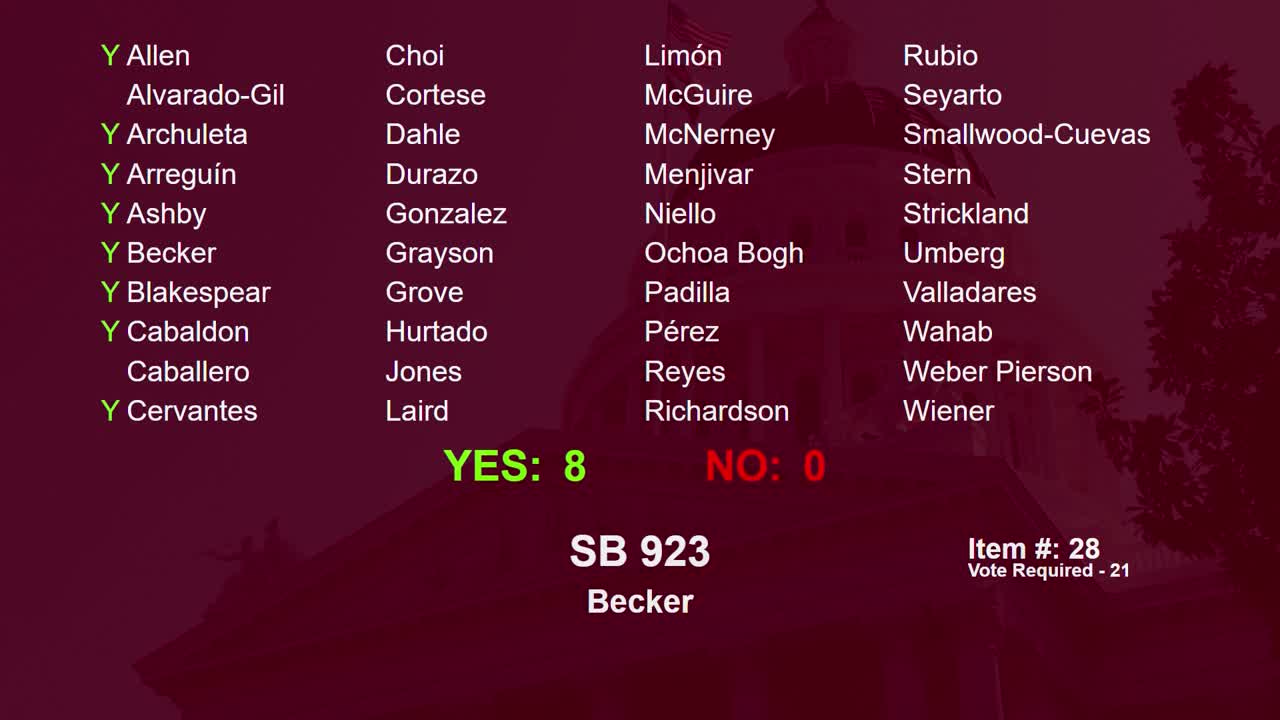
Bill Author

Bill Co-Author(s):
