SB 952: State Water Project: renewable energy resources and zero-carbon resources.
- Session Year: 2025-2026
- House: Senate
- Latest Version Date: 2026-08-31
Current Status:
Passed
(2026-08-31: Chaptered by Secretary of State. Chapter 175, Statutes of 2026.)
Introduced
In Committee
Awaiting First Chamber Vote
Passed First Chamber
In Committee
Awaiting Second Chamber Vote
Passed Second Chamber
Enacted
Under existing law, it is the policy of the state that eligible renewable energy resources and zero-carbon resources supply 90% of all retail sales of electricity to California end-use customers by December 31, 2035, 95% of all retail sales of electricity to California end-use customers by December 31, 2040, 100% of all retail sales of electricity to California end-use customers by December 31, 2045, and 100% of electricity procured to serve all state agencies by December 31, 2035, as specified. Existing law requires the Department of Water Resources to procure eligible renewable energy resources and zero-carbon resources to satisfy those state agency obligations imposed on the State Water Resources Development System, commonly known as the State Water Project, pursuant to that policy. Existing law authorizes the department to defer, until no later than December 31, 2040, procuring zero-carbon electricity resource quantities equal to the amount of electricity provided under an existing contract to procure fossil generation entered into before January 1, 2010, if the department determines that the full achievement of the state agency obligations imposed on the State Water Project would require the early termination of the existing contract and that early termination of the existing contract would result in significant uneconomic costs. Existing law requires the department, in conducting procurement, to consider specified factors and requires that all resources procured be used first to meet the departments own electricity needs.
This bill would require the department, in conducting that procurement, to also consider portfolio diversity, resource type, location, and hours of typical peak operation. The bill would expand the scope of the departments authorization to defer the procurement of those resource quantities to apply to an existing contract to procure fossil generation entered into before January 1, 2011, rather than January 1, 2010. The bill would authorize, on and after January 1, 2036, excess procurement of eligible renewable energy resources and zero-carbon resources, as defined, in one year to be applied to any subsequent years obligation, as provided.
Under existing law, it is the policy of the state that eligible renewable energy resources and zero-carbon resources supply 90% of all retail sales of electricity to California end-use customers by December 31, 2035, 95% of all retail sales of electricity to California end-use customers by December 31, 2040, 100% of all retail sales of electricity to California end-use customers by December 31, 2045, and 100% of electricity procured to serve all state agencies by December 31, 2035, as specified. Existing law requires the Department of Water Resources to procure eligible renewable energy resources and zero-carbon resources to satisfy those state agency obligations imposed on the State Water Resources Development System, commonly known as the State Water Project, pursuant to that policy. Existing law authorizes the department to defer, until no later than December 31, 2040, procuring zero-carbon electricity resource quantities equal to the amount of electricity provided under an existing contract to procure fossil generation entered into before January 1, 2010, if the department determines that the full achievement of the state agency obligations imposed on the State Water Project would require the early termination of the existing contract and that early termination of the existing contract would result in significant uneconomic costs. Existing law requires the department, in conducting procurement, to consider specified factors and requires that all resources procured be used first to meet the departments own electricity needs.
This bill would require the department, in conducting that procurement, to also consider portfolio diversity, resource type, location, and hours of typical peak operation. The bill would expand the scope of the departments authorization to defer the procurement of those resource quantities to apply to an existing contract to procure fossil generation entered into before January 1, 2011, rather than January 1, 2010. The bill would authorize, on and after January 1, 2036, excess procurement, as defined, procurement of eligible renewable energy resources and zero-carbon resources resources, as defined, in one year to be applied to any subsequent years obligation, as provided.
Under existing law, it is the policy of the state that eligible renewable energy resources and zero-carbon resources supply 90% of all retail sales of electricity to California end-use customers by December 31, 2035, 95% of all retail sales of electricity to California end-use customers by December 31, 2040, 100% of all retail sales of electricity to California end-use customers by December 31, 2045, and 100% of electricity procured to serve all state agencies by December 31, 2035, as specified. Existing law requires the Department of Water Resources to procure eligible renewable energy resources and zero-carbon resources to satisfy those state agency obligations imposed on the State Water Resources Development System, commonly known as the State Water Project, pursuant to that policy. Existing law authorizes the department to defer, until no later than December 31, 2040, procuring zero-carbon electricity resource quantities equal to the amount of electricity provided under an existing contract to procure fossil generation entered into before January 1, 2010, if the department determines that the full achievement of the state agency obligations imposed on the State Water Project would require the early termination of the existing contract and that early termination of the existing contract would result in significant uneconomic costs. Existing law requires the department, in conducting procurement, to consider specified factors and requires that all resources procured be used first to meet the departments own electricity needs.
This bill would require the department, in conducting that procurement, to consider portfolio diversity, resource type, location, and hours of typical peak operation. The bill would expand the scope of the departments authorization to defer the procurement of those resource quantities to apply to an existing contract to procure fossil generation entered into before January 1, 2011, rather than January 1, 2010. The bill would authorize, on and after January 1, 2036, excess procurement, as defined, of eligible renewable energy resources and zero-carbon resources in one year to be applied to any subsequent years obligation, as provided.
Under existing law, it is the policy of the state that eligible renewable energy resources and zero-carbon resources supply 90% of all retail sales of electricity to California end-use customers by December 31, 2035, 95% of all retail sales of electricity to California end-use customers by December 31, 2040, 100% of all retail sales of electricity to California end-use customers by December 31, 2045, and 100% of electricity procured to serve all state agencies by December 31, 2035, as specified. Existing law requires the Department of Water Resources to procure eligible renewable energy resources and zero-carbon resources to satisfy those obligations imposed on the State Water Resources Development System, commonly known as the State Water Project, pursuant to that policy. Existing law requires the department, in conducting procurement, to consider specified factors and requires that all resources procured be used first to meet the departments own electricity needs.
This bill would require the department, in conducting procurement, to consider portfolio diversity, resource type, location, and hours of typical peak operation. The bill would authorize, on and after January 1, 2036, excess procurement, as defined, of eligible renewable energy resources and zero-carbon resources in one year to be applied to any subsequent years obligation, as provided.
Existing law provides for the administration and control of state lands, including the leasing and sale of public lands, as provided. Existing law authorizes certain impounded funds to be invested and reinvested by the Director of Finance in bonds or other obligations of the United States, as provided.This bill would make nonsubstantive changes to that provision to, among other things, use gender-neutral language.Existing law provides for the administration and control of state lands, including the leasing and sale of public lands, as provided. Existing law authorizes certain impounded funds to be invested and reinvested by the Director of Finance in bonds or other obligations of the United States, as provided.
This bill would make nonsubstantive changes to that provision to, among other things, use gender-neutral language.
(a)(1)The department shall procure eligible renewable energy resources and zero-carbon resources to satisfy the state agency obligations imposed on the State Water Resources Development System, commonly known as the State Water Project, pursuant to subdivision (a) of Section 454.53 of the Public Utilities Code.
(2)If the department determines that the full achievement of the state agency obligations imposed on the State Water Resources Development System would require the early termination of an existing contract to procure fossil generation entered before January 1, 2011, and that early termination would result in significant uneconomic costs, the department may defer procuring zero-carbon electricity resource quantities equal to the amount of electricity provided under the existing contract until no later than December 31, 2040.
(3)In the event that extraordinary circumstances, catastrophic events, considerable supply chain disruptions and equipment shortages, or threats of significant economic harm render full achievement of the obligations imposed on the State Water Resources Development System pursuant to subdivision (a) of Section 454.53 of the Public Utilities Code infeasible, the Governor may adjust the applicable deadline for the departments compliance to the earliest feasible date, but that date shall be no later than December 31, 2040.
(b)The department may satisfy all or a portion of the obligation on the State Water Resources Development System pursuant to subdivision (a) of Section 454.53 of the Public Utilities Code by installing or connecting zero-carbon resources or eligible renewable energy resources behind the meter on State Water Resources Development System property or properties to service its load.
(c)All resources procured pursuant to subdivision (a) after February 1, 2022, shall satisfy both of the following criteria:
(1)The eligible renewable energy resources and zero-carbon resources shall either be newly developed as a result of contracting by the department or constitute incremental production from existing resources and reach initial commercial operations on or after January 1, 2023. This requirement may be satisfied if the resource is newly developed by a local publicly owned electric utility with the expectation that the output would be sold to the department in support of the State Water Resources Development System.
(2)The eligible renewable energy resources and zero-carbon resources shall be located within California or have a first point of interconnection to a California balancing authority.
(d)In conducting procurement pursuant to subdivision (a), the department shall consider all of the following:
(1)Procurement commitments that may yield maximum long-term employment, stimulate new economic activity, generate local and state tax revenues, and assist with the development of new industries.
(2)Attributes, including resource adequacy, flexibility, and integration value, the ability to provide firm clean electricity, and local air quality benefits.
(3)The results of integrated resource planning modeling conducted by the Public Utilities Commission pursuant to Section 454.52 of the Public Utilities Code.
(4)Portfolio diversity, resource type, location, and hours of typical peak operation.
(e)The department shall consider doing all of the following to reduce the costs of any procurement made pursuant to this section:
(1)Coordinate with the California Infrastructure and Economic Development Bank to make low-cost financing assistance available to new projects included in any procurement commitments.
(2)Coordinate with other state agencies to identify incentives from existing programs for new projects included in any procurement commitments.
(3)(A)If reasonably expected to provide incremental benefits, secure an ownership stake or royalties for any project or economic activity resulting from a contractual commitment.
(B)(i)Incremental benefits of ownership may include the election by the department of payment of applicable credits pursuant to the federal Inflation Reduction Act of 2022 (Public Law 117-169). If the department elects for direct payment of those applicable credits, those payments shall be deposited directly into the California Water Resources Development Bond Account created pursuant to Section 12935.5.
(ii)Within 10 days of any payments being deposited into the California Water Resources Development Bond Account, as described in clause (i), the department shall provide written notice to the Joint Legislative Budget Committee, who shall provide a copy of the notice to the relevant policy committees. The notice shall include the source, purpose, timeliness, and other relevant information as determined by the department.
(f)(1)All resources procured pursuant to this section shall be used first to meet the departments own electricity needs. On and after January 1, 2036, excess procurement of eligible renewable energy resources and zero-carbon resources in one year may be applied to any subsequent years obligation imposed pursuant to subdivision (a) of Section 454.53 of the Public Utilities Code. A renewable energy credit, as defined in Section 399.12 of the Public Utilities Code, associated with the electricity used to satisfy the obligations of the department and the State Water Resources Development System under this section shall be retired and shall not be transferred or resold.
(2)For purposes of this subdivision, excess procurement of eligible renewable energy resources and zero-carbon resources means procurement of eligible renewable energy resources and zero-carbon resources in one year that exceed 100 percent of the annual electrical load served in the same year for the department and State Water Resources Development System and for which all environmental and renewable attributes associated with the procurement are retired and not transferred or resold.
(g)The department shall enter into an agreement to procure energy from a new energy generation facility only if the seller requires its contractors to use a multicraft project labor agreement, as defined in paragraph (1) of subdivision (b) of Section 2500 of the Public Contract Code, for construction of the facility. Those project labor agreements shall conform to the industry standard agreements recently used for other similar private projects, including side letters for high-voltage transmission and related work.
(a)(1)The department shall procure eligible renewable energy resources and zero-carbon resources to satisfy the state agency obligations imposed on the State Water Resources Development System, commonly known as the State Water Project, pursuant to subdivision (a) of Section 454.53 of the Public Utilities Code.
(2)If the department determines that the full achievement of the state agency obligations imposed on the State Water Resources Development System would require the early termination of an existing contract to procure fossil generation entered before January 1, 2011, and that early termination would result in significant uneconomic costs, the department may defer procuring zero-carbon electricity resource quantities equal to the amount of electricity provided under the existing contract until no later than December 31, 2040.
(3)In the event that extraordinary circumstances, catastrophic events, considerable supply chain disruptions and equipment shortages, or threats of significant economic harm render full achievement of the obligations imposed on the State Water Resources Development System pursuant to subdivision (a) of Section 454.53 of the Public Utilities Code infeasible, the Governor may adjust the applicable deadline for the departments compliance to the earliest feasible date, but that date shall be no later than December 31, 2040.
(b)The department may satisfy all or a portion of the obligation on the State Water Resources Development System pursuant to subdivision (a) of Section 454.53 of the Public Utilities Code by installing or connecting zero-carbon resources or eligible renewable energy resources behind the meter on State Water Resources Development System property or properties to service its load.
(c)All resources procured pursuant to subdivision (a) after February 1, 2022, shall satisfy both of the following criteria:
(1)The eligible renewable energy resources and zero-carbon resources shall either be newly developed as a result of contracting by the department or constitute incremental production from existing resources and reach initial commercial operations on or after January 1, 2023. This requirement may be satisfied if the resource is newly developed by a local publicly owned electric utility with the expectation that the output would be sold to the department in support of the State Water Resources Development System.
(2)The eligible renewable energy resources and zero-carbon resources shall be located within California or have a first point of interconnection to a California balancing authority.
(d)In conducting procurement pursuant to subdivision (a), the department shall consider all of the following:
(1)Procurement commitments that may yield maximum long-term employment, stimulate new economic activity, generate local and state tax revenues, and assist with the development of new industries.
(2)Attributes, including resource adequacy, flexibility, and integration value, the ability to provide firm clean electricity, and local air quality benefits.
(3)The results of integrated resource planning modeling conducted by the Public Utilities Commission pursuant to Section 454.52 of the Public Utilities Code.
(4)Portfolio diversity, resource type, location, and hours of typical peak operation.
(e)The department shall consider doing all of the following to reduce the costs of any procurement made pursuant to this section:
(1)Coordinate with the California Infrastructure and Economic Development Bank to make low-cost financing assistance available to new projects included in any procurement commitments.
(2)Coordinate with other state agencies to identify incentives from existing programs for new projects included in any procurement commitments.
(3)(A)If reasonably expected to provide incremental benefits, secure an ownership stake or royalties for any project or economic activity resulting from a contractual commitment.
(B)(i)Incremental benefits of ownership may include the election by the department of payment of applicable credits pursuant to the federal Inflation Reduction Act of 2022 (Public Law 117-169). If the department elects for direct payment of those applicable credits, those payments shall be deposited directly into the California Water Resources Development Bond Account created pursuant to Section 12935.5.
(ii)Within 10 days of any payments being deposited in into the California Water Resources Development Bond Account, as described in clause (i), the department shall provide written notice to the Joint Legislative Budget Committee, who shall provide a copy of the notice to the relevant policy committees. The notice shall include the source, purpose, timeliness, and other relevant information as determined by the department.
(f)(1)All resources procured pursuant to this section shall be used first to meet the departments own electricity needs. On and after January 1, 2036, excess procurement of eligible renewable energy resources and zero-carbon resources in one year may be applied to any subsequent years obligation imposed pursuant to subdivision (a) of Section 454.53 of the Public Utilities Code. A renewable energy credit, as defined in Section 399.12 of the Public Utilities Code, associated with the electricity used to satisfy the obligations of the department and the State Water Resources Development System under this section shall be retired and shall not be transferred or resold.
(2)For purposes of this subdivision, excess procurement of eligible renewable energy resources and zero-carbon resources means procurement of eligible renewable energy resources and zero-carbon resources in one year that exceed 100 percent of the annual retail sales electrical load served in the same year for the department and State Water Resources Development System and for which all environmental and renewable attributes associated with the procurement are retired and not transferred or resold.
(g)The department shall enter into an agreement to procure energy from a new energy generation facility only if the seller requires its contractors to use a multicraft project labor agreement, as defined in paragraph (1) of subdivision (b) of Section 2500 of the Public Contract Code, for construction of the facility. Those project labor agreements shall conform to the industry standard agreements recently used for other similar private projects, including side letters for high-voltage transmission and related work.
(a)(1)The department shall procure eligible renewable energy resources and zero-carbon resources to satisfy the state agency obligations imposed on the State Water Resources Development System, commonly known as the State Water Project, pursuant to subdivision (a) of Section 454.53 of the Public Utilities Code.
(2)If the department determines that the full achievement of the state agency obligations imposed on the State Water Resources Development System would require the early termination of an existing contract to procure fossil generation entered before January 1, 2010, 2011, and that early termination would result in significant uneconomic costs, the department may defer procuring zero-carbon electricity resource quantities equal to the amount of electricity provided under the existing contract until no later than December 31, 2040.
(3)In the event that extraordinary circumstances, catastrophic events, considerable supply chain disruptions and equipment shortages, or threats of significant economic harm render full achievement of the obligations imposed on the State Water Resources Development System pursuant to subdivision (a) of Section 454.53 of the Public Utilities Code infeasible, the Governor may adjust the applicable deadline for the departments compliance to the earliest feasible date, but that date shall be no later than December 31, 2040.
(b)The department may satisfy all or a portion of the obligation on the State Water Resources Development System pursuant to subdivision (a) of Section 454.53 of the Public Utilities Code by installing or connecting zero-carbon resources or eligible renewable energy resources behind the meter on State Water Resources Development System property or properties to service its load.
(c)All resources procured pursuant to subdivision (a) after February 1, 2022, shall satisfy both of the following criteria:
(1)The eligible renewable energy resources and zero-carbon resources shall either be newly developed as a result of contracting by the department or constitute incremental production from existing resources and reach initial commercial operations on or after January 1, 2023. This requirement may be satisfied if the resource is newly developed by a local publicly owned electric utility with the expectation that the output would be sold to the department in support of the State Water Resources Development System.
(2)The eligible renewable energy resources and zero-carbon resources shall be located within California or have a first point of interconnection to a California balancing authority.
(d)In conducting procurement pursuant to subdivision (a), the department shall consider all of the following:
(1)Procurement commitments that may yield maximum long-term employment, stimulate new economic activity, generate local and state tax revenues, and assist with the development of new industries.
(2)Attributes, including resource adequacy, flexibility, and integration value, the ability to provide firm clean electricity, and local air quality benefits.
(3)The results of integrated resource planning modeling conducted by the Public Utilities Commission pursuant to Section 454.52 of the Public Utilities Code.
(4)Portfolio diversity, resource type, location, and hours of typical peak operation.
(e)The department shall consider doing all of the following to reduce the costs of any procurement made pursuant to this section:
(1)Coordinate with the California Infrastructure and Economic Development Bank to make low-cost financing assistance available to new projects included in any procurement commitments.
(2)Coordinate with other state agencies to identify incentives from existing programs for new projects included in any procurement commitments.
(3)(A)If reasonably expected to provide incremental benefits, secure an ownership stake or royalties for any project or economic activity resulting from a contractual commitment.
(B)(i)Incremental benefits of ownership may include the election by the department of payment of applicable credits pursuant to the federal Inflation Reduction Act of 2022 (Public Law 117-169). If the department elects for direct payment of those applicable credits, those payments shall be deposited directly into the California Water Resources Development Bond Account created pursuant to Section 12935.5.
(ii)Within 10 days of any payments being deposited in the California Water Resources Development Bond Account, described in clause (i), the department shall provide written notice to the Joint Legislative Budget Committee, who shall provide a copy of the notice to the relevant policy committees. The notice shall include the source, purpose, timeliness, and other relevant information as determined by the department.
(f)(1)All resources procured pursuant to this section shall be used first to meet the departments own electricity needs. On and after January 1, 2036, excess procurement of eligible renewable energy resources and zero-carbon resources in one year may be applied to any subsequent years obligation imposed pursuant to subdivision (a) of Section 454.53 of the Public Utilities Code. A renewable energy credit, as defined in Section 399.12 of the Public Utilities Code, associated with the electricity used to satisfy the obligations of the department and the State Water Resources Development System under this section shall be retired and shall not be transferred or resold.
(2)For purposes of this subdivision, excess procurement of eligible renewable energy resources and zero-carbon resources means procurement of eligible renewable energy resources and zero-carbon resources in one year that exceed 100 percent of the annual retail sales in the same year for the department and State Water Resources Development System and for which all environmental and renewable attributes associated with the procurement are retired and not transferred or resold.
(g)The department shall enter into an agreement to procure energy from a new energy generation facility only if the seller requires its contractors to use a multicraft project labor agreement, as defined in paragraph (1) of subdivision (b) of Section 2500 of the Public Contract Code, for construction of the facility. Those project labor agreements shall conform to the industry standard agreements recently used for other similar private projects, including side letters for high-voltage transmission and related work.
(a)(1)The department shall procure eligible renewable energy resources and zero-carbon resources to satisfy the state agency obligations imposed on the State Water Resources Development System, commonly known as the State Water Project, pursuant to subdivision (a) of Section 454.53 of the Public Utilities Code.
(2)If the department determines that the full achievement of the state agency obligations imposed on the State Water Resources Development System would require the early termination of an existing contract to procure fossil generation entered before January 1, 2010, and that early termination would result in significant uneconomic costs, the department may defer procuring zero-carbon electricity resource quantities equal to the amount of electricity provided under the existing contract until no later than December 31, 2040.
(3)In the event that extraordinary circumstances, catastrophic events, considerable supply chain disruptions and equipment shortages, or threats of significant economic harm render full achievement of the obligations imposed on the State Water Resources Development System pursuant to subdivision (a) of Section 454.53 of the Public Utilities Code infeasible, the Governor may adjust the applicable deadline for the departments compliance to the earliest feasible date, but that date shall be no later than December 31, 2040.
(b)The department may satisfy all or a portion of the obligation on the State Water Resources Development System pursuant to subdivision (a) of Section 454.53 of the Public Utilities Code by installing or connecting zero-carbon resources or eligible renewable energy resources behind the meter on State Water Resources Development System property or properties to service its load.
(c)All resources procured pursuant to subdivision (a) after February 1, 2022, shall satisfy both of the following criteria:
(1)The eligible renewable energy resources and zero-carbon resources shall either be newly developed as a result of contracting by the department or constitute incremental production from existing resources and reach initial commercial operations on or after January 1, 2023. This requirement may be satisfied if the resource is newly developed by a local publicly owned electric utility with the expectation that the output would be sold to the department in support of the State Water Resources Development System.
(2)The eligible renewable energy resources and zero-carbon resources shall be located within California or have a first point of interconnection to a California balancing authority.
(d)In conducting procurement pursuant to subdivision (a), the department shall consider all of the following:
(1)Procurement commitments that may yield maximum long-term employment, stimulate new economic activity, generate local and state tax revenues, and assist with the development of new industries.
(2)Attributes, including resource adequacy, flexibility, and integration value, the ability to provide firm clean electricity, and local air quality benefits.
(3)The results of integrated resource planning modeling conducted by the Public Utilities Commission pursuant to Section 454.52 of the Public Utilities Code.
(4)Portfolio diversity, resource type, location, and hours of typical peak operation.
(e)The department shall consider doing all of the following to reduce the costs of any procurement made pursuant to this section:
(1)Coordinate with the California Infrastructure and Economic Development Bank to make low-cost financing assistance available to new projects included in any procurement commitments.
(2)Coordinate with other state agencies to identify incentives from existing programs for new projects included in any procurement commitments.
(3)(A)If reasonably expected to provide incremental benefits, secure an ownership stake or royalties for any project or economic activity resulting from a contractual commitment.
(B)(i)Incremental benefits of ownership may include the election by the department of payment of applicable credits pursuant to the federal Inflation Reduction Act of 2022 (Public Law 117-169). If the department elects for direct payment of those applicable credits, those payments shall be deposited directly into the California Water Resources Development Bond Account created pursuant to Section 12935.5.
(ii)Within 10 days of any payments being deposited in the California Water Resources Development Bond Account, described in clause (i), the department shall provide written notice to the Joint Legislative Budget Committee, who shall provide a copy of the notice to the relevant policy committees. The notice shall include the source, purpose, timeliness, and other relevant information as determined by the department.
(f)(1)All resources procured pursuant to this section shall be used first to meet the departments own electricity needs. On and after January 1, 2036, excess procurement of eligible renewable energy resources and zero-carbon resources in one year may be applied to any subsequent years obligation imposed pursuant to subdivision (a) of Section 454.53 of the Public Utilities Code. A renewable energy credit, as defined in Section 399.12 of the Public Utilities Code, associated with the electricity used to satisfy the obligations of the department and the State Water Resources Development System under this section shall be retired and shall not be transferred or resold.
(2)For purposes of this subdivision, excess procurement of eligible renewable energy resources and zero-carbon resources means procurement of eligible renewable energy resources and zero-carbon resources in one year that exceed 100 percent of the annual retail sales in the same year for the department and State Water Resources Development System and for which all environmental and renewable attributes associated with the procurement are retired and not transferred or resold.
(g)The department shall enter into an agreement to procure energy from a new energy generation facility only if the seller requires its contractors to use a multicraft project labor agreement, as defined in paragraph (1) of subdivision (b) of Section 2500 of the Public Contract Code, for construction of the facility. Those project labor agreements shall conform to the industry standard agreements recently used for other similar private projects, including side letters for high-voltage transmission and related work.
SECTION 1.Section 6301.6 of the Public Resources Code is amended to read:6301.6.(a)If any funds are impounded pursuant to Section 6301.5 under the custody and control of the State of California, those impounded funds may be invested and reinvested by the Director of Finance in bonds or other obligations of the United States. Those securities may be sold or exchanged by the Director of Finance if, in the Director of Finances opinion, that sale or exchange is in the best interests of the state, and shall be sold by the Director of Finance whenever, and to the extent, necessary to effect any required transfer or other disposition of the impounded funds.(b)Securities purchased or otherwise acquired under the authority of this section shall be deposited and held in the custody and safekeeping of the State Treasurer, in the name of the account in the fund from which the investments were made.(c)Interest earned or other increment derived from investments made pursuant to this section shall, on order of the State Controller, be deposited in the fund from which the investments were made to the credit of the account covering the impounded funds, in augmentation of such impounded funds.(a)If any funds are impounded pursuant to Section 6301.5 under the custody and control of the State of California, such those impounded funds may be invested and reinvested by the Director of Finance in bonds or other obligations of the United States. Such Those securities may be sold or exchanged by the Director of Finance if, in his the Director of Finances opinion, such that sale or exchange is in the best interests of the State, state, and shall be sold by him the Director of Finance whenever, and to the extent, necessary to effect any required transfer or other disposition of the impounded funds.
Securities(b)Securities purchased or otherwise acquired under the authority of this section shall be deposited and held in the custody and safekeeping of the State Treasurer, in the name of the account in the fund from which the investments were made.
Interest(c)Interest earned or other increment derived from investments made pursuant to this section shall, on order of the State Controller, be deposited in the fund from which the investments were made to the credit of the account covering the impounded funds, in augmentation of such impounded funds.
|
Date
|
Status
|
|---|---|
| Aug 31, 2026 | Chaptered by Secretary of State. Chapter 175, Statutes of 2026. |
| Aug 31, 2026 | Approved by the Governor. |
| Aug 21, 2026 | Enrolled and presented to the Governor at 3 p.m. |
| Aug 17, 2026 | Assembly amendments concurred in. (Ayes 40. Noes 0. Page 5486.) Ordered to engrossing and enrolling. |
| Aug 17, 2026 | Assembly amendments concurred in. (Ayes 40. Noes 0.) Ordered to engrossing and enrolling. |
| Aug 13, 2026 | In Senate. Concurrence in Assembly amendments pending. |
| Aug 13, 2026 | Read third time. Passed. (Ayes 71. Noes 1. Page 6151.) Ordered to the Senate. |
| Aug 13, 2026 | Read third time. Passed. Ordered to the Senate. |
| Aug 10, 2026 | Read second time. Ordered to third reading. |
| Aug 6, 2026 | Read second time and amended. Ordered to second reading. |
| Aug 5, 2026 | From committee: Do pass as amended. (Ayes 15. Noes 0.) (August 5). |
| Jun 11, 2026 | From committee: Do pass and re-refer to Com. on APPR. with recommendation: To consent calendar. (Ayes 18. Noes 0.) (June 10). Re-referred to Com. on APPR. |
| Jun 1, 2026 | Referred to Com. on U. & E. |
| May 26, 2026 | In Assembly. Read first time. Held at Desk. |
| May 26, 2026 | Read third time. Passed. (Ayes 36. Noes 0. Page 4452.) Ordered to the Assembly. |
| May 26, 2026 | Read third time. Passed. (Ayes 36. Noes 0.) Ordered to the Assembly. |
| May 19, 2026 | Read second time. Ordered to third reading. |
| May 18, 2026 | Ordered to second reading. |
| May 18, 2026 | Read third time and amended. |
| Apr 28, 2026 | Read second time. Ordered to third reading. |
| Apr 27, 2026 | From committee: Be ordered to second reading pursuant to Senate Rule 28.8. |
| Apr 17, 2026 | Set for hearing April 27. |
| Apr 14, 2026 | From committee: Do pass and re-refer to Com. on APPR. (Ayes 17. Noes 0. Page 3841.) (April 13). Re-referred to Com. on APPR. |
| Apr 14, 2026 | From committee: Do pass and re-refer to Com. on APPR. (Ayes 17. Noes 0.) (April 13). Re-referred to Com. on APPR. |
| Apr 2, 2026 | Set for hearing April 13. |
| Mar 25, 2026 | Re-referred to Com. on E., U & C. |
| Mar 17, 2026 | From committee with author's amendments. Read second time and amended. Re-referred to Com. on RLS. |
| Feb 11, 2026 | Referred to Com. on RLS. |
| Feb 3, 2026 | From printer. May be acted upon on or after March 5. |
| Feb 2, 2026 | Introduced. Read first time. To Com. on RLS. for assignment. To print. |
|
Date
|
Description
|
Location
|
Votes
|
|
|---|---|---|---|---|
| Aug 17, 2026 | Unfinished Business SB952 Laird Concurrence | Senate Floor |
Passed |
|
| Aug 13, 2026 | SB 952 Laird Senate Third Reading By Papan | Assembly Floor |
Passed |
|
| Aug 5, 2026 | Do pass as amended. | Assembly Standing Committee on Appropriations |
Passed |
|
| Jun 10, 2026 | Do pass and be re-referred to the Committee on [Appropriations] with recommendation: To Consent Calendar | Assembly Standing Committee on Utilities and Energy |
Passed |
|
| May 26, 2026 | Senate 3rd Reading SB952 Laird | Senate Floor |
Passed |
|
| Apr 13, 2026 | Do pass, but first be re-referred to the Committee on [Appropriations] | Senate Standing Committee on Energy, Utilities and Communications |
Passed |
This list shows positions taken on this bill by organizations on the date displayed, which is linked to the original source.
Positions by individuals are not included.
|
Organization
|
Position
|
Date
|
|---|---|---|
| Alameda County Zone 7 Water Agency | ** Support | |
| Association Of California Water Agencies | ** Support | |
| California Municipal Utilities Association | ** Support | |
| Central Coast Water Authority | ** Support | |
| Crestline-Lake Arrowhead Water Agency | ** Support | |
| Kern County Water Agency | ** Support | |
| Metropolitan Water District Of Southern California | ** Support | |
| Napa County Flood Control And Water Conservation District | ** Support | |
| Palmdale Water District | ** Support | |
| San Gorgonio Pass Water Agency | ** Support | |
| Solano County Water Agency | ** Support | |
| State Water Contractors | ** Support | |
| Western Electrical Contractors Association | ** Support |
SENATE RULES COMMITTEE Office of Senate Floor Analyses (916) 651-4171 | SB 952 |
UNFINISHED BUSINESS
Bill No: SB 952
Author: Laird (D)
Amended: 8/6/26
Vote: 21
SENATE ENERGY, U. & C. COMMITTEE: 17-0, 4/13/26
AYES: Allen, Ochoa Bogh, Archuleta, Arreguín, Becker, Caballero, Dahle, Gonzalez, Grove, Hurtado, McNerney, Reyes, Richardson, Rubio, Stern, Strickland, Wahab
SENATE APPROPRIATIONS COMMITTEE: Senate Rule 28.8
SENATE FLOOR: 36-0, 5/26/26
AYES: Allen, Alvarado-Gil, Archuleta, Arreguín, Ashby, Blakespear, Cabaldon, Caballero, Cervantes, Choi, Cortese, Durazo, Grayson, Grove, Hurtado, Jones, Laird, Limón, McGuire, McNerney, Menjivar, Niello, Ochoa Bogh, Padilla, Pérez, Reyes, Richardson, Rubio, Seyarto, Smallwood-Cuevas, Strickland, Umberg, Valladares, Wahab, Weber Pierson, Wiener
NO VOTE RECORDED: Becker, Dahle, Gonzalez, Stern
ASSEMBLY FLOOR: 71-1, 8/13/26 - See last page for vote
SUBJECT: State Water Project: renewable energy resources and zero-carbon resources
SOURCE: State Water Contractors
DIGEST:
This bill authorizes the State Water Project (SWP), beginning on January 1, 2036, to apply excess procurement of eligible renewable energy resources and zero-carbon resources in one year to any subsequent year’s obligation to serve 100% of its load with renewable and zero-carbon energy resources.
Assembly Amendments
are mainly clarifying and minor, including replacing the reference of “retail sales” with “electrical load served.”
ANALYSIS:
Existing law:
- Establishes it is the policy of the state that eligible renewable energy resources and zero-carbon resources supply 90% of all retail sales of electricity to California end-use customers by December 31, 2035, 95% of all retail sales of electricity to California end-use customers by December 31, 2040, 100% of all retail sales of electricity to California end-use customers by December 31, 2045, and 100% of electricity procured to serve all state agencies by December 31, 2035, including the SWP. (Public Utilities Code §454.53)
- Requires the Department of Water Resources (DWR) to procure eligible renewable energy resources and zero-carbon resources to satisfy those obligations imposed on the State Water Resources Development System, commonly known as the SWP, pursuant to that policy. Requires DWR, in conducting procurement, to consider specified factors and requires that all resources procured be used first to meet the DWR’s own electricity needs. (Water Code §80400 (a)(1))
- Authorizes the DWR to defer, until no later than December 31, 2040, procuring zero-carbon electricity resource quantities equal to the amount of electricity provided under an existing contract to procure fossil generation entered into before January 1, 2010, if the DWR determines that the full achievement of the state agency obligations imposed on the SWP would require the early termination of the existing contract and that early termination of the existing contract would result in significant uneconomic costs. (Water Code §80400 (a)(2))
This bill:
- Defines “excess procurement of eligible renewable energy resources and zero-carbon resources” to mean procurement of eligible renewable energy resources and zero-carbon resources in one year that exceed 100% of the annual electrical load served in the same year for the DWR and SWP and for which all environmental and renewable attributes associated with the procurement are retired and not transferred or resold.
- Requires the DWR, in conducting procurement, to also consider portfolio diversity, resource type, location, and hours of typical peak operation.
- Authorizes, on and after January 1, 2036, excess procurement of eligible renewable energy resources and zero-carbon resources, as defined, in one year to be applied to any subsequent year’s obligation to meet the policy of the state that the SWP meet 100% of electricity procured by December 31, 2035, with eligible renewable energy and zero-carbon energy resources.
- Changes the date by when a contract to procure fossil generation is entered into by DWR from January 1, 2010, to January 1, 2011, that can be the basis for authorizing the DWR to defer the zero-carbon and renewable energy goals from December 31, 2035, to December 31, 2040.
Background
SB 100 (De León, Chapter 312, Statutes of 2018). SB 100 established the 100 Percent Clean Energy Act of 2017 which increases the Renewables Portfolio Standard (RPS) requirement from 50% by 2030 to 60% and created the policy of planning to meet all of the state's retail electricity supply with a mix of RPS-eligible and zero-carbon resources by December 31, 2045, for a total of 100% clean energy. SB 100 also required the California Air Resources Board, California Energy Commission, and California Public Utilities Commission to issue a joint report by January 1, 2021, and at least every four years, that describes technologies, forecasts, affordability, and system and local reliability. The report is required to include an evaluation of costs and benefits to customer rate impacts, as well as barriers to achieving the SB 100 policy. The first Joint Agency report was issued in January 2021 and identified the SWP as the largest consumer of electricity in the state (representing roughly 2% of the state’s electric load).
SB 1020 (Laird, Chapter 361, Statutes of 2022) clean energy targets. SB 1020 revised state policy to include interim targets to reach SB 100 goals, specifically to provide that eligible renewable energy resources and zero-carbon resources supply 90% of all retail sales of electricity to California end-use customers by December 31, 2035, and 95% of all retail sales of electricity to California end-use customers by December 31, 2040. SB 1020 also required each state agency, including the SWP, to ensure that zero-carbon resources and eligible renewable energy resources supply 100% of electricity procured to serve their agency by December 31, 2035. SB 1020 also applied the interim targets to the SWP.
State Water Project (SWP). The SWP, operated by the DWR, is both a major producer and consumer of electricity. As the largest single consumer of electricity in California, the SWP pump load ranges from six million megawatt hours (MWh) to 9.5 million MWh depending on the type of water year ( whether dry, average, or wet). The electricity is used to operate the SWP pumping plants, which are needed to deliver water throughout the state. According to their website: DWR has been proactively responding to the evolving power market by reducing reliance on fossil fuel energy resources, assisting in maintaining grid reliability, and controlling energy costs for water customers, with 50% of the SWP’s power provided by its own emission-free hydroelectric generation. The SWP has a power portfolio consisting of 65% carbon-free resources, increasing to 75% by 2030 and 100% by 2045. With the passage of SB 1020, the goal has been adjusted to achieve 100% carbon-free resources by 2035. DWR is adding solar to the system to achieve these goals. SB 1020 required the SWP to enter into new energy procurement contracts to meet the procurement goals. The bill required the renewable energy and zero-carbon resources fulfill the SWP energy use to meet the goals, and secondarily, be available to help other state agencies meet their procurement requirements.
Based on information on DWR’s website, the SWP has the following clean energy projects contracted:
- Active solar contracts in operation total 175.5 megawatts (MW) of capacity and 487 gigawatt-hours (GWh) of energy:
- DWR-SWP has secured Power Purchase Agreements for multiple solar projects. These projects provide renewable energy while helping to reduce GHG emissions. Some examples include:
- RE Camelot Solar Project (45 MW) in operation since late 2014 in Kern County produces approximately 124,000 MWh of energy annually.
- Solverde 1 Solar Facility (85 MW) in operation since late 2016 near Lancaster produces approximately 230,000 MWh of energy each year.
- Pearblossom Solar Facility (9.5 MW), which is adjacent to the Pearblossom Pumping Plant and in operation since late 2016, produces approximately 28,000 MWh of energy annually.
- Sanborn Solar Project (36 MW) in operation since late 2022 in Kern County produces approximately 105,000 MWh of energy annually.
- Pastoria Solar Energy Project (100 MW) in Kern County, which became operational this year and produces approximately 280,000 MWh of energy annually.
- Kyan Solar, LLC (100 MW) in Kern County, which will be operational in 2027 and produce approximately 281,000 MWh of energy annually.
- DWR-SWP has secured Power Purchase Agreements for multiple solar projects. These projects provide renewable energy while helping to reduce GHG emissions. Some examples include:
- Active hydropower project contracts in operation total 168 MW of capacity and 436 GWhs of energy:
- DWR-SWP has long-standing hydropower agreements to ensure Clean Energy. Some examples include:
- Pine Flat Hydropower Facility (165 MW) in operation since early 1984 in Fresno County produces approximately 431,000 MWh of energy annually.
- Hoover Hydropower Facility (2,080 MW) in operation since 1934 in southeast Nevada, where DWR-SWP purchases three MW of capacity, contributes approximately 5,000 MWh of energy annually.
- Pine Flat U4 Hydropower Facility (4.5 MW) in Fresno County, which will be operational in late 2027 and produce approximately 9,800 MWh annually.
- DWR-SWP has long-standing hydropower agreements to ensure Clean Energy. Some examples include:
Comments
Need for this bill. According to the author:
Senate Bill 952 lowers costs to the State Water Project (SWP) by providing the Department of Water Resources (DWR) procurement flexibility when meeting the state’s clean energy goals. These savings directly benefit the public water agencies contracted with DWR, ultimately reducing the costs to SWP ratepayers. The SWP is a water storage and delivery system that provides water to 27 million Californians across the state. To meet the state’s energy goals, SWP operations must be fully powered by eligible renewable resources or zero-carbon resources by 2035, as established by SB 1020 which I authored in 2022. SB 952 allows DWR to apply excess renewable energy procurement toward future years, and account for additional factors such as portfolio diversity and resource type.
SB 1020 implementation costs. In requiring the SWP to procure eligible renewable energy and zero-carbon resources to meet the SB 100 goals, DWR estimated increased costs to operate the water conveyance system. DWR estimated costs of up to $3.3 billion (water ratepayer or other funds) for the SWP to purchase 100% zero carbon electricity by 2035. Of that amount, DWR estimates costs of $2.6 billion to acquire new renewable and zero-carbon resource supplies, $100 million to exit existing carbon contracts early, and $600 million in new Transmission Access Charges. SB 1020 also provided some flexibility to defer the deadline to no later than December 31, 2040 in two cases: (1) authorizing the Governor to adjust the December 31, 2035, deadline, in the event of unexpected and extraordinary circumstances; and (2) authorizes DWR to defer procuring zero-carbon resource quantities equal to the amount of electricity if it determines that full achievement of the obligations would require early termination of an existing contract to procure fossil generation entered before January 1, 2010 and the early termination would result in significant uneconomic costs. Nonetheless, concerns about increased costs have lingered for the State Water Contractors who purchase water from DWR.
Bill attempts to provide flexibility given the SWP’s variable energy load. As noted by the author, the SWP has a highly variable energy use – demonstrated in the graphic below – due to varying hydrology. This can make planning for energy needs more reactive than proactive. This bill attempts to provide additional flexibility by allowing excess procurement after 2035 to be banked to meet a future year’s compliance obligation. The supporters contend this will help reduce some of the additional costs from complying with SB 1020’s requirements. The bill requires that for any excess procurement that is banked and used in a future year’s obligation, the corresponding RPS renewable energy credit is retired, consistent with SB 1020 requirements and ensuring elimination of any double-counting of the same eligible renewable energy resource.

Regarding the date change for the existing fossil fuel-based electricity generation contract. The author and DWR contend a date change is needed in Water Code §80400 (a)(2) to account for the existing contract by DWR for a third of the energy from the Lodi Energy Center. The author’s office says the date in the statutes was intended to reflect this specific energy contract as part of the requirements imposed on the SWP in SB 1020 (Laird, Chapter 361, Statutes of 2022). They say the ability of the SWP to defer the zero-carbon and renewable energy goals to 2040 based on the economic costs of a contract for fossil fuel resources was always intended to reflect the contract for energy from Lodi Energy Center. They explain that the date was inaccurate in SB 1020 as the contract (power sales agreement) between DWR and Northern California Power Agency (NCPA) who owns Lodi Energy Center, a 296 MW natural gas-fired combined cycle power plant located in Lodi that began operation in November 2012, was executed in May 2010. As a result, the date in SB 1020 should have reflected a later date than January 1, 2010. Staff at the DWR confirm the need for the date change and share documents with the policy committee regarding various dates in relation to the specific contract that fall after January 1, 2010. These documents include signature documents for the sales agreement with dates ranging from May 18, 2010, to as late as August 1, 2010. In this regard, changing the date to January 1, 2011, in the statute seems to better account for the actual date of the energy contract between DWR and NCPA for energy from the Lodi Energy Center for the SWP. DWR staff also share there are no other energy contracts that may be affected by the language in these amendments.
Related/Prior Legislation
SB 1020 (Laird, Chapter 361, Statutes of 2022) established interim targets to reach SB 100 clean energy goals and required state agencies to purchase 100% zero carbon electricity by December 31, 2035, to serve their load, including obligations on SWP.
SB 100 (De León, Chapter 312, Statutes of 2018) established the 100 Percent Clean Energy Act of 2017 which increases the RPS requirement from 50% by 2030 to 60% and created the policy of planning to meet all of the state's retail electricity supply with a mix of RPS-eligible and zero-carbon resources by December 31, 2045, for a total of 100% clean energy.
FISCAL EFFECT: Appropriation: No Fiscal Com.: Yes Local: No
According to the Assembly Appropriations Committee, there are no direct state costs.
SUPPORT: (Verified 8/13/26)
State Water Contractors (Source)
Association of California Water Agencies
Western Electrical Contractors Association
OPPOSITION: (Verified 8/13/26)
None received
ARGUMENTS IN SUPPORT: According to the State Water Contractors:
The SWP has one of the most dynamic energy needs of any large utility in the state, with those needs ranging on average, 6,500,000 MWh to 9,000,000 MWh power portfolio is dependent on hydrology and thus difficult to plan for in the near and long term. SB 952 would clarify generation attributes DWR may consider for procurement and create certainty for DWR by allowing excess energy procured in low water years be applied to years when SWP energy needs are high. Providing greater certainty into how DWR can achieve this goal will reduce costs to water ratepayers while ensuring achievability.
ASSEMBLY FLOOR: 71-1, 8/13/26
AYES: Addis, Aguiar-Curry, Ahrens, Alanis, Arambula, Ávila Farías, Bains, Bauer-Kahan, Bennett, Boerner, Bryan, Calderon, Caloza, Carrillo, Chen, Connolly, Davies, Dixon, Elhawary, Ellis, Flora, Fong, Gabriel, Garcia, Gipson, Jeff Gonzalez, Mark González, Hadwick, Haney, Harabedian, Hart, Hoover, Irwin, Jackson, Johnson, Kalra, Krell, Lackey, Lee, Lowenthal, Macedo, McKinnor, Muratsuchi, Nguyen, Ortega, Pacheco, Papan, Patel, Patterson, Quirk-Silva, Ramos, Ransom, Celeste Rodriguez, Michelle Rodriguez, Rogers, Blanca Rubio, Sanchez, Schiavo, Sharp-Collins, Solache, Soria, Stefani, Ta, Tangipa, Valencia, Wallis, Ward, Wicks, Wilson, Zbur, Rivas
NOES: DeMaio
NO VOTE RECORDED: Alvarez, Berman, Bonta, Castillo, Pellerin, Petrie-Norris, Schultz
Prepared by: Nidia Bautista / E., U. & C. / (916) 651-4107
8/17/26 11:55:05
**** END ****
SENATE THIRD READING
STR Bill Id:SB 952
Author:(Laird)
As Amended Ver:August 06, 2026
Majority vote
SUMMARY
Modifies existing law that requires the Department of Water Resources (DWR) to procure eligible renewable energy resources and zero-carbon resources (eligible resources) needed to power the State Water Project (SWP).
Major Provisions
- Modifies existing law to allow DWR to defer procurement of zero-carbon electricity resources until no later than December 31, 2040, if procurement would require the early termination of an existing fossil generation contract, by changing the contract eligibility date from January 1, 2010, to January 1, 2011.
- Authorizes excess procurement of eligible renewable energy resources and zero-carbon resources on and after January 1, 2036, to be applied toward any subsequent year's obligation.
- Requires DWR, when procuring eligible renewable energy resources and zero-carbon resources for the SWP, to consider portfolio diversity, resource type, location, and hours of typical peak operation.
COMMENTS
SB 100 (De León), Chapter 312, Statutes of 2018 established California's goal of 100% renewable and zero-carbon electricity by 2045. Subsequently, SB 1020 (Laird), Chapter 361, Statutes of 2022 established interim clean electricity targets, required the SWP to use renewable and zero-carbon electricity by December 31, 2035, and authorized DWR to defer procurement of certain zero-carbon resources until December 31, 2040, under specified conditions.
The SWP, operated by the DWR, is the nation's largest state-owned water and power system, serving 29 public water agencies that provide water to approximately 27 million Californians and 750,000 acres of farmland. It is also the largest single consumer of electricity in the state. Although it generates hydroelectric power, it consumes more electricity than it produces and relies on procured electricity to meet its operational needs. Its electricity demand also varies with hydrologic conditions and water operations, making long-term procurement planning more challenging.
The SWP's energy use fluctuates substantially depending on hydrologic conditions and water operations, ranging from approximately 4,000 to over 10,000 gigawatt-hours annually. Therefore, DWR can face challenges when forecasting electricity needs and planning procurement. This bill addresses this issue by allowing excess procurement of eligible renewable energy and zero-carbon resources to be applied toward a future year's compliance obligation. Supporters argue this approach reflects the SWP's unique operating characteristics, helps avoid unnecessary procurement costs, and maintains the project's clean energy obligations. According to the author, all SWP operating and procurement costs, averaging over $1.3 billion annually, are borne by the 29 public water agencies regardless of annual water deliveries. To the extent the bill reduces unnecessary compliance costs, those savings could be passed on to the agencies and their customers.
In addition, current law allows DWR to defer certain clean energy procurement obligations when early termination of an existing fossil generation contract would result in significant uneconomic costs. SB 952 would extend that authority to contracts entered into before January 1, 2011, instead of January 1, 2010. According to the author, this change would allow DWR's 2010 contract for energy from the Lodi Energy Center to remain eligible for the deferral, avoiding the cost of replacing the resource before the contract expires while allowing DWR to continue purchasing energy under the contract through 2040.
According to the Author
According to the author, ″Senate Bill 952 lowers costs to the State Water Project (SWP) by providing the Department of Water Resources (DWR) procurement flexibility when meeting the state's clean energy goals. These savings directly benefit the public water agencies contracted with DWR, ultimately reducing the costs to SWP ratepayers. The State Water Project is a water storage and delivery system that provides water to 27 million Californians across the state. To meet the state's energy goals, SWP operations must be fully powered by eligible renewable resources or zero-carbon resources by 2035, as established by SB 1020, which I authored in 2022. SB 952 allows DWR to apply excess renewable energy procurement toward future years. The bill also accounts for additional factors such as portfolio diversity and resource type and makes a technical change to maintain the intent of the provision.″
Arguments in Support
Supporters of SB 952, including the State Water Contractors, the Association of California Water Agencies, the California Municipal Utilities Association, and other water agencies, argue that the SWP's energy needs vary significantly from year to year based on hydrologic conditions, making long-term procurement more challenging than for traditional utilities. Therefore, they contend that this bill would provide more certainty by allowing excess energy procured in low-water years to be applied to future years when the SWP's energy needs are higher, which could help reduce costs for the approximately 27 million customers served by the SWP.
Arguments in Opposition
None on file.
FISCAL COMMENTS
According to the Assembly Appropriations Committee, the bill is expected to have negligible costs.
VOTES
SENATE FLOOR: 36-0-4
YES: Allen, Alvarado-Gil, Archuleta, Arreguín, Ashby, Blakespear, Cabaldon, Caballero, Cervantes, Choi, Cortese, Durazo, Grayson, Grove, Hurtado, Jones, Laird, Limón, McGuire, McNerney, Menjivar, Niello, Ochoa Bogh, Padilla, Pérez, Reyes, Richardson, Rubio, Seyarto, Smallwood-Cuevas, Strickland, Umberg, Valladares, Wahab, Weber Pierson, Wiener
ABS, ABST OR NV: Becker, Dahle, Gonzalez, Stern
ASM UTILITIES AND ENERGY: 18-0-0
YES: Petrie-Norris, Patterson, Boerner, Calderon, Chen, Davies, Mark González, Harabedian, Hart, Irwin, Kalra, Papan, Rogers, Schiavo, Schultz, Ta, Wallis, Zbur
ASM APPROPRIATIONS: 15-0-0
YES: Wicks, Hoover, Arambula, Calderon, Caloza, Dixon, Fong, Mark González, Krell, Pacheco, Pellerin, Sharp-Collins, Solache, Ta, Tangipa
UPDATED
VERSION: August 06, 2026
CONSULTANT: Lina V. Malova / U. & E. / (916) 319-2083 FN: 0003378
Date of Hearing: August 5, 2026
ASSEMBLY COMMITTEE ON APPROPRIATIONS
Buffy Wicks, Chair
SBPCA Bill Id:SB 952
Author:(Laird) – As Amended Ver:May 18, 2026
Policy Committee: | Utilities and Energy | Vote: | 18 - 0 |
|
| ||
|
|
Urgency: No State Mandated Local Program: No Reimbursable: No
SUMMARY:
This bill modifies existing law that requires the Department of Water Resources (DWR) to procure eligible renewable energy resources and zero-carbon resources (eligible resources) needed to power the State Water Project (SWP).
Specifically, this bill:
- Authorizes DWR, starting January 1, 2036, in regards to procurement of eligible resources needed to power the SWP, to apply excess procurement of eligible renewable energy resources and zero-carbon resources in one year to any subsequent year’s obligation.
- Modifies existing authority that allows DWR to defer procurement of zero-carbon electricity resources until no later than December 31, 2040, if the procurement would require early termination of an existing contract to procure fossil generation so that, under the bill, DWR would need to have entered into such a contract by January 1, 2011, rather than January 1, 2010, as per current law.
- Adds the following to items DWR is to consider when conducting procurement of renewable energy resources and zero-carbon resources: portfolio diversity, resource type, location and hours of typical peak operation.
FISCAL EFFECT:
No direct state costs.
COMMENTS:
The SWP project is the single largest user of electricity in the state. DWR procures substantial quantities of electricity to move water, generally from the north of the state to the south. Existing law requires, by December 31, 2035, 100% of electricity procured to serve state agencies be generated by eligible resources. This requirement applies to DWR’s operation of the SWP, though the law allows DWR to defer, until December 31, 2040, procurement of eligible resource quantities equal to the amount of electricity provided under an existing fossil generation contract entered into before January 1, 2010, if DWR determines that full achievement of the SWP's obligations would require early termination of that contract and that early termination would result in significant uneconomic costs, meaning those costs exceeds benefits.
The cost to run the SWP are considerable—averaging “over $1.3 billion annually,” according to the author. These costs are paid by the public agencies that receive water from the project. Those public agencies, collectively, describe operation of the SWP as subject to “swings in energy use, unlike traditional utilities” and “dependent on hydrology and thus difficult to plan for in the near and long term.” The author, in explaining the need for the bill, notes that the requirement that SWP electricity come from eligible resources will likely increase SWP costs and describes this bill as providing “flexibility to [DWR] to manage costs for the State Water Project, while still upholding the state’s clean energy goals.” The author further explains the need for the bill as ensuring DWR is able to defer renewable energy it procures from the Lodi Energy Center pursuant to a contract DWR signed in 2010.
There is no opposition to this bill.
As written, the bill defines “excess procurement,” in part, as “procurement of eligible renewable energy resources and zero-carbon resources in one year that exceed 100 percent of the annual retail sales in the same year for the department and State Water Resources Development System.” However, DWR, unlike an electric utility, does not sell electricity to retail customers; therefore, it has no retail sales of electricity in any year.
The effect of this definition is, as of January 1, 2036, to preclude DWR from crediting excess procurement of electricity generated by renewable energy resources in one year to any subsequent year, an outcome that would be contrary to the author’s intent. This outcome could be avoided by amending the bill to refer to “electrical load served,” rather than “annual retail sales.” The author has proposed amendments to the committee that make just this change.
Analysis Prepared by: Jay Dickenson / APPR. / (916) 319-2081
Date of Hearing: June 10, 2026
ASSEMBLY COMMITTEE ON UTILITIES AND ENERGY
Cottie Petrie-Norris, Chair
SBPCA Bill Id:SB 952
Author:(Laird) – As Amended Ver:May 18, 2026
SENATE VOTE: 36-0
SUBJECT: State Water Project: renewable energy resources and zero-carbon resources
SUMMARY: Modifies DWR's clean energy procurement requirements for the State Water Project, extends DWR's authority to defer certain obligations associated with existing fossil generation contracts entered into before January 1, 2011, and allows excess clean energy procurement to be credited toward future procurement obligations. Specifically, this bill:
- Requires DWR, when procuring eligible renewable energy resources and zero-carbon resources for the State Water Project, to consider portfolio diversity, resource type, location, and hours of typical peak operation.
- Expands DWR's authority to defer procurement of certain zero-carbon electricity resource quantities to apply to existing contracts to procure fossil generation entered into before January 1, 2011, rather than January 1, 2010.
- Authorizes excess procurement of eligible renewable energy resources and zero-carbon resources on and after January 1, 2036, to be applied toward any subsequent year's obligation.
- Defines "excess procurement of eligible renewable energy resources and zero-carbon resources" as procurement of eligible renewable energy resources and zero-carbon resources that exceeds 100 percent of annual retail sales for the department and State Water Resources Development System in a given year and for which all associated environmental and renewable attributes are retired and not transferred or resold.
EXISTING LAW:
- Establishes it is the policy of the state that eligible renewable energy resources and zero-carbon resources supply 90% of all retail sales of electricity to California end-use customers by December 31, 2035, 95% by December 31, 2040, 100% by December 31, 2045, and 100% of electricity procured to serve all state agencies by December 31, 2035, including the SWP. (Public Utilities Code § 454.53)
- Requires DWR to procure eligible renewable energy resources and zero-carbon resources to satisfy the state agency obligations imposed on the SWP pursuant to that policy. Requires all resources procured to be used first to meet DWR's own electricity needs. (Water Code § 80400(a)(1))
- Authorizes DWR to defer, until no later than December 31, 2040, procuring zero-carbon electricity resource quantities equal to the amount of electricity provided under an existing fossil generation contract entered into before January 1, 2010, if DWR determines that full achievement of the SWP's obligations would require early termination of that contract and that early termination would result in significant uneconomic costs. (Water Code § 80400(a)(2)
- Authorizes the Governor to adjust DWR’s compliance deadline to the earliest feasible date, but no later than December 31, 2040, if extraordinary circumstances, catastrophic events, considerable supply chain disruptions and equipment shortages, or threats of significant economic harm render full achievement of the obligations infeasible. (Water Code § 80400(a)(3))
- Requires DWR, in conducting procurement, to consider procurement commitments that may yield maximum long-term employment, stimulate new economic activity, generate local and state tax revenues, and assist with the development of new industries; resource attributes including resource adequacy, flexibility, integration value, the ability to provide firm clean electricity, and local air quality benefits; and the results of integrated resource planning modeling conducted by the CPUC. (Water Code § 80400(d))
FISCAL EFFECT: Unknown; this bill was not referred to the Senate Appropriations Committee.
BACKGROUND:
Legislative History - SB 100 (De León, Chapter 312, Statutes of 2018) increased California's Renewables Portfolio Standard to 60% by 2030 and established a state policy of supplying 100% of retail electricity sales with eligible renewable energy resources and zero-carbon resources by 2045. SB 100 also required California Energy Resources Board (CARB), the California Energy Commission (CEC), and the California Public Utilities Commission (CPUC) to prepare a joint report beginning in 2021 and every four years thereafter evaluating progress toward the state's clean energy goals, including reliability, affordability, customer rate impacts, and barriers to implementation. The first Joint Agency Report, released in January 2021, identified the SWP as the largest single consumer of electricity in California, accounting for approximately 2% of statewide electricity demand.
SB 1020 (Laird, Chapter 361, Statutes of 2022) built on SB 100 by establishing interim clean electricity targets requiring eligible renewable energy resources and zero-carbon resources to supply 90% of retail electricity sales by 2035, 95% by 2040, and 100% by 2045. The bill also established a policy that electricity procured to serve state agencies, including the SWP, be supplied with eligible renewable energy resources and zero-carbon resources by December 31, 2035. To implement those requirements for the State Water Project (SWP), SB 1020 required DWR to procure eligible renewable energy and zero-carbon resources to meet the SWP's electricity needs. The bill also authorized DWR to defer procurement of certain zero-carbon resource quantities until no later than December 31, 2040, if compliance would require the early termination of an existing fossil generation contract entered into before January 1, 2010, and that early termination would result in significant additional costs.
The State Water Project-The State Water Project (SWP), operated by the Department of Water Resources (DWR), is the nation's largest state-owned water and power system. The SWP delivers water through a network of reservoirs, pumping plants, power facilities, canals, and pipelines to 29 public water agencies serving approximately 27 million Californians and 750,000 acres of farmland. Operating the SWP requires significant amounts of electricity to move water throughout the state, making it the largest single consumer of electricity in California. Although the SWP generates electricity through its hydroelectric facilities, it consumes more electricity than it produces and therefore relies on power procured by DWR to meet its operational needs. Unlike many electricity consumers, the SWP's power demand can vary significantly from year to year depending on hydrologic conditions and water operations. Annual energy consumption can range from approximately 6 million to 9.5 million megawatt-hours, which can make long-term procurement planning more challenging.
COMMENTS:
- Author’s Statement. According to the author, “Senate Bill 952 lowers costs to the State Water Project (SWP) by providing the Department of Water Resources (DWR) procurement flexibility when meeting the state’s clean energy goals. These savings directly benefit the public water agencies contracted with DWR, ultimately reducing the costs to SWP ratepayers. The State Water Project is a water storage and delivery system that provides water to 27 million Californians across the state. To meet the state’s energy goals, SWP operations must be fully powered by eligible renewable resources or zero-carbon resources by 2035, as established by SB 1020, which I authored in 2022. SB 952 allows DWR to apply excess renewable energy procurement toward future years. The bill also accounts for additional factors such as portfolio diversity and resource type and makes a technical change to maintain the intent of the provision.
 Accommodating a Variable Load. The SWP's energy use fluctuates substantially depending on hydrologic conditions and water operations, as shown in Figure 1,[1] ranging from approximately 4,000 to over 10,000 gigawatt-hours annually. This variability makes it difficult for DWR to predict future electricity needs and plan procurement accordingly. SB 952 seeks to address this challenge by allowing excess procurement
of eligible renewable energy resources and zero-carbon resources to be applied toward a future year's compliance obligation. Supporters, including the State Water Contractors, the Association of California Water Agencies, the California Municipal Utilities Association, and other water agencies, assert that this measure recognizes the unique operating characteristics of the SWP and allows DWR to better manage years when energy demand is lower than anticipated. They contend that this approach could help avoid unnecessary procurement costs while maintaining the project's clean energy requirements. All SWP operating and procurement costs, averaging over $1.3 billion annually according to the author, are borne by the 29 public water agencies regardless of how much water is delivered in a given year. To the extent this bill reduces unnecessary compliance costs, those savings could be passed on to the agencies and the customers they serve.
- Existing Contract Deferral. Existing law allows DWR to defer certain clean energy procurement obligations associated with an existing fossil generation contract if early termination of the contract would result in significant uneconomic costs. SB 952 would extend eligibility for this provision to contracts entered into before January 1, 2011, rather than January 1, 2010. According to the author, this change is intended to ensure that DWR's 2010 agreement for energy from the Lodi Energy Center is covered by the deferral provision established under SB 1020. Therefore, DWR could continue purchasing energy under that contract through 2040 and avoid the costs of replacing the resource before the contract terminates, while continuing to comply with the SWP's renewable and zero-carbon procurement requirements.
REGISTERED SUPPORT / OPPOSITION:
Support
Alameda County Zone 7 Water Agency
Association of California Water Agencies
Association of California Water Agencies (ACWA)
California Municipal Utilities Association
Central Coast Water Authority
Crestline-lake Arrowhead Water Agency
Kern County Water Agency
Metropolitan Water District of Southern California
Napa County Flood Control and Water Conservation District
Palmdale Water District
San Gorgonio PASS Water Agency
Solano County Water Agency
State Water Contractors
Opposition
None on file.
Analysis Prepared by: Lina V. Malova / U. & E. / (916) 319-2083
California Department of Water Resources, State Water Project's Summer 2025 Operations Outlook, presented at the California Energy Commission Summer Energy Reliability Workshop, May 2, 2025. ↑
SENATE RULES COMMITTEE Office of Senate Floor Analyses (916) 651-4171 | SB 952 |
THIRD READING
Bill No: SB 952
Author: Laird (D)
Amended: 5/18/26
Vote: 21
SENATE ENERGY, U. & C. COMMITTEE: 17-0, 4/13/26
AYES: Allen, Ochoa Bogh, Archuleta, Arreguín, Becker, Caballero, Dahle, Gonzalez, Grove, Hurtado, McNerney, Reyes, Richardson, Rubio, Stern, Strickland, Wahab
SENATE APPROPRIATIONS COMMITTEE: Senate Rule 28.8
SUBJECT: State Water Project: renewable energy resources and zero-carbon resources
SOURCE: State Water Contractors
DIGEST:
This bill authorizes the State Water Project (SWP), beginning on January 1, 2036, to apply excess procurement of eligible renewable energy resources and zero-carbon resources in one year to any subsequent year’s obligation.
Senate Floor Amendments of 5/18/2026 change the date by when a contract to procure fossil generation is entered into by the Department of Water Resources (DWR) from January 1, 2010, to January 1, 2011, that can be the basis for authorizing the DWR to defer the zero-carbon and renewable energy goals from December 31, 2035, to December 31, 2040 for the SWP.
ANALYSIS:
Existing law:
- Establishes it is the policy of the state that eligible renewable energy resources and zero-carbon resources supply 90% of all retail sales of electricity to California end-use customers by December 31, 2035, 95% of all retail sales of electricity to California end-use customers by December 31, 2040, 100% of all retail sales of electricity to California end-use customers by December 31, 2045, and 100% of electricity procured to serve all state agencies by December 31, 2035, including the SWP. (Public Utilities Code §454.53)
- Requires the DWR to procure eligible renewable energy resources and zero-carbon resources to satisfy those obligations imposed on the State Water Resources Development System, commonly known as the SWP, pursuant to that policy. Requires DWR, in conducting procurement, to consider specified factors and requires that all resources procured be used first to meet the DWR’s own electricity needs. (Water Code §80400 (a)(1))
- Authorizes the DWR to defer, until no later than December 31, 2040, procuring zero-carbon electricity resource quantities equal to the amount of electricity provided under an existing contract to procure fossil generation entered into before January 1, 2010, if the DWR determines that the full achievement of the state agency obligations imposed on the SWP would require the early termination of the existing contract and that early termination of the existing contract would result in significant uneconomic costs. (Water Code §80400 (a)(2))
This bill:
- Defines “excess procurement of eligible renewable energy resources and zero-carbon resources” to mean procurement of eligible renewable energy resources and zero-carbon resources in one year that exceed 100% of the annual retail sales in the same year for the DWR and State Water Resources Development System and for which all environmental and renewable attributes associated with the procurement are retired and not transferred or resold.
- Requires the DWR, in conducting procurement, to consider portfolio diversity, resource type, location, and hours of typical peak operation.
- Authorizes, on and after January 1, 2036, excess procurement, as defined, of eligible renewable energy resources and zero-carbon resources in one year to be applied to any subsequent year’s obligation to meet the policy of the state that the SWP meet 100% of electricity procured by December 31, 2035, with eligible renewable energy and zero-carbon energy resources.
- Change the date by when a contract to procure fossil generation is entered into by DWR from January 1, 2010, to January 1, 2011, that can be the basis for authorizing the DWR to defer the zero-carbon and renewable energy goals from December 31, 2035 to December 31, 2040.
Background
SB 100 (De León, Chapter 312, Statutes of 2018). SB 100 established the 100 Percent Clean Energy Act of 2017 which increases the Renewables Portfolio Standard (RPS) requirement from 50% by 2030 to 60% and created the policy of planning to meet all of the state's retail electricity supply with a mix of RPS-eligible and zero-carbon resources by December 31, 2045, for a total of 100% clean energy. SB 100 also required California Air Resources Board, California Energy Commission, and California Public Utilities Commission to issue a joint report by January 1, 2021, and at least every four years, that describes technologies, forecasts, affordability, and system and local reliability. The report is required to include an evaluation of costs and benefits to customer rate impacts, as well as barriers to achieving the SB 100 policy. The first Joint Agency report was issued in January 2021 and identified the SWP as the largest consumer of electricity in the state (representing roughly 2% of the state’s load).
SB 1020 (Laird, Chapter 361, Statutes of 2022) clean energy goals. SB 1020 revised state policy to include interim targets to reach SB 100 goals, specifically to provide that eligible renewable energy resources and zero-carbon resources supply 90% of all retail sales of electricity to California end-use customers by December 31, 2035, and 95% of all retail sales of electricity to California end-use customers by December 31, 2040. SB 1020 also required each state agency to ensure that zero-carbon resources and eligible renewable energy resources supply 100% of electricity procured to serve their agency by December 31, 2035. SB 1020 applied the interim targets to the SWP.
State Water Project (SWP). The SWP, operated by the DWR, is both a major producer and consumer of electricity. As the largest single consumer of electricity in California, the SWP pump load ranges from six million megawatt hours (MWh) to 9.5 million MWh depending on the type of water year (dry, average, wet). The electricity is used to operate the SWP pumping plants, which are needed to deliver water throughout the state. According to their website: DWR has been proactively responding to the evolving power market by reducing reliance on fossil fuel energy resources, assisting in maintaining grid reliability, and controlling energy costs for water customers, with 50% of the SWP’s power provided by its own emission-free hydroelectric generation. The SWP has a power portfolio consisting of 65% carbon-free resources, increasing to 75% by 2030 and 100% by 2045. With the passage of SB 1020, the goal has been adjusted to achieve 100% carbon-free resources by 2035. DWR is adding solar to the system to achieve these goals. SB 1020 required the SWP to enter into new energy procurement contracts to meet the procurement goals. The bill required the renewable energy and zero-carbon resources fulfill the SWP energy use to meet the goals, and secondarily, be available to help other state agencies meet their procurement requirements.
Based on information on its website, the SWP has the following clean energy projects contracted:
- Solar active contracts in operation total 175.5 megawatts (MW) of capacity and 487 gigawatt-hours (GWh) of energy:
- DWR-SWP has secured Power Purchase Agreements for multiple solar projects. These projects provide renewable energy while helping to reduce GHG emissions. Some examples include:
- RE Camelot Solar Project (45 MW) in operation since late 2014 in Kern County produces approximately 124,000 MWh of energy annually.
- Solverde 1 Solar Facility (85 MW) in operation since late 2016 near Lancaster produces approximately 230,000 MWh of energy each year.
- Pearblossom Solar Facility (9.5 MW), which is adjacent to the Pearblossom Pumping Plant and in operation since late 2016, produces approximately 28,000 MWh of energy annually.
- Sanborn Solar Project (36 MW) in operation since late 2022 in Kern County produces approximately 105,000 MWh of energy annually.
- Pastoria Solar Energy Project (100 MW) in Kern County, which became operational this year and produces approximately 280,000 MWh of energy annually.
- Kyan Solar, LLC (100 MW) in Kern County, which will be operational in 2027 and produce approximately 281,000 MWh of energy annually.
- DWR-SWP has secured Power Purchase Agreements for multiple solar projects. These projects provide renewable energy while helping to reduce GHG emissions. Some examples include:
- Hydropower projects active contracts in operation total 168 MW of capacity and 436 GWhs of energy:
- DWR-SWP has long-standing hydropower agreements to ensure Clean Energy. Some examples include:
- Pine Flat Hydropower Facility (165 MW) in operation since early 1984 in Fresno County produces approximately 431,000 MWh of energy annually.
- Hoover Hydropower Facility (2,080 MW) in operation since 1934 in southeast Nevada, where DWR-SWP purchases three MW of capacity, contributes approximately 5,000 MWh of energy annually.
- Pine Flat U4 Hydropower Facility (4.5 MW) in Fresno County, which will be operational in late 2027 and produce approximately 9,800 MWh annually.
- DWR-SWP has long-standing hydropower agreements to ensure Clean Energy. Some examples include:
Comments
Need for this bill. According to the author:
Senate Bill 952 lowers costs to the State Water Project (SWP) by providing the Department of Water Resources (DWR) procurement flexibility when meeting the state’s clean energy goals. These savings directly benefit the public water agencies contracted with DWR, ultimately reducing the costs to SWP ratepayers. The SWP is a water storage and delivery system that provides water to 27 million Californians across the state. To meet the state’s energy goals, SWP operations must be fully powered by eligible renewable resources or zero-carbon resources by 2035, as established by SB 1020 which I authored in 2022. SB 952 allows DWR to apply excess renewable energy procurement toward future years, and account for additional factors such as portfolio diversity and resource type.
SB 1020 implementation costs. In requiring the SWP to procure eligible renewable energy and zero-carbon resources to meet the SB 100 goals, DWR estimated increased costs to operate the water conveyance system. DWR estimated costs of up to $3.3 billion (water ratepayer or other funds) for the SWP to purchase 100% zero carbon electricity by 2035. Of that amount, DWR estimates costs of $2.6 billion to acquire new renewable and zero-carbon resource supplies, $100 million to exit existing carbon contracts early, and $600 million in new Transmission Access Charges. SB 1020 also provided some flexibility to defer the deadline to no later than December 31, 2040 in two cases: (1) authorizing the Governor to adjust the December 31, 2035, deadline, in the event of unexpected and extraordinary circumstances; and (2) authorizes DWR to defer procuring zero-carbon resource quantities equal to the amount of electricity if it determines that full achievement of the obligations would require early termination of an existing contract to procure fossil generation entered before January 1, 2010 and the early termination would result in significant uneconomic costs. Nonetheless, concerns about increased costs have lingered for the State Water Contractors who purchase water from DWR.
Bill attempts to provide flexibility given the SWP’s variable energy load. As noted by the author, the SWP has a highly variable energy use – demonstrated in the graphic below – due to varying hydrology. This can make planning for energy needs more reactive than proactive. This bill attempts to provide additional flexibility by allowing excess procurement after 2035 to be banked to meet a future year’s compliance obligation. The supporters contend this will help reduce some of the additional costs from complying with SB 1020’s requirements. The bill requires that for any excess procurement that is banked and used in a future year’s obligation, the corresponding RPS renewable energy credit is retired, consistent with SB 1020 requirements and ensuring elimination of any double-counting of the same eligible renewable energy resource.

Regarding date change for existing contract. The author and DWR contend a date change is needed in Water Code §80400 (a)(2) to account for the existing contract by DWR for a third of the energy from the Lodi Energy Center. The author’s office says the date in the statutes was intended to reflect this specific energy contract as part of the requirements imposed on the SWP in SB 1020 (Laird, Chapter 361, Statutes of 2022). They say the ability of the SWP to defer the zero-carbon and renewable energy goals to 2040 based on the economic costs of a contract for fossil fuel resources was always intended to reflect the contract for energy from Lodi Energy Center. They explain that the date was inaccurate in SB 1020 as the contract (power sales agreement) between DWR and Northern California Power Agency (NCPA) who owns Lodi Energy Center, a 296 MW natural gas-fired combined cycle power plant located in Lodi and owned by NCPA that began operation in November 2012, was executed in May 2010. As a result, the date in SB 1020 should have reflected a later date than January 1, 2010. Staff at the DWR confirm the need for the date change and share documents with the policy committee regarding various dates in relation to the specific contract that fall after January 1, 2010. These documents include signature documents for the sales agreement with dates ranging from May 18, 2010, to as late as August 1, 2010. In this regard, changing the date to January 1, 2011, in the statute seems to better account for the actual date of the energy contract for power from the Lodi Energy Center for the SWP. DWR staff also share there are no other energy contracts that may be affected by the language in these amendments.
Related/Prior Legislation
SB 1020 (Laird, Chapter 361, Statutes of 2022) established interim targets to reach SB 100 clean energy goals and required state agencies to purchase 100% zero carbon electricity by December 31, 2035, to serve their load, including obligations on SWP.
SB 100 (De León, Chapter 312, Statutes of 2018) established the 100 Percent Clean Energy Act of 2017 which increases the RPS requirement from 50% by 2030 to 60% and created the policy of planning to meet all of the state's retail electricity supply with a mix of RPS-eligible and zero-carbon resources by December 31, 2045, for a total of 100% clean energy.
FISCAL EFFECT: Appropriation: No Fiscal Com.: Yes Local: No
SUPPORT: (Verified 5/18/26)
State Water Contractors (Source)
Association of California Water Agencies
Western Electrical Contractors Association
OPPOSITION: (Verified 5/18/26)
None received
ARGUMENTS IN SUPPORT: According to the State Water Contractors:
The SWP has one of the most dynamic energy needs of any large utility in the state, with those needs ranging on average, 6,500,000 MWh to 9,000,000 MWh power portfolio is dependent on hydrology and thus difficult to plan for in the near and long term. SB 952 would clarify generation attributes DWR may consider for procurement and create certainty for DWR by allowing excess energy procured in low water years be applied to years when SWP energy needs are high. Providing greater certainty into how DWR can achieve this goal will reduce costs to water ratepayers while ensuring achievability.
Prepared by: Nidia Bautista / E., U. & C. / (916) 651-4107
5/19/26 12:50:22
**** END ****
SENATE RULES COMMITTEE Office of Senate Floor Analyses (916) 651-4171 | SB 952 |
THIRD READING
Bill No: SB 952
Author: Laird (D)
Amended: 3/17/26
Vote: 21
SENATE ENERGY, U. & C. COMMITTEE: 17-0, 4/13/26
AYES: Allen, Ochoa Bogh, Archuleta, Arreguín, Becker, Caballero, Dahle, Gonzalez, Grove, Hurtado, McNerney, Reyes, Richardson, Rubio, Stern, Strickland, Wahab
SENATE APPROPRIATIONS COMMITTEE: Senate Rule 28.8
SUBJECT: State Water Project: renewable energy resources and zero-carbon resources
SOURCE: State Water Contractors
DIGEST:
This bill authorizes the State Water Project (SWP), beginning on January 1, 2036, to apply excess procurement of eligible renewable energy resources and zero-carbon resources in one year to any subsequent year’s obligation.
ANALYSIS:
Existing law:
- Establishes it is the policy of the state that eligible renewable energy resources and zero-carbon resources supply 90% of all retail sales of electricity to California end-use customers by December 31, 2035, 95% of all retail sales of electricity to California end-use customers by December 31, 2040, 100% of all retail sales of electricity to California end-use customers by December 31, 2045, and 100% of electricity procured to serve all state agencies by December 31, 2035, including the SWP. (Public Utilities Code §454.53)
- Requires the Department of Water Resources (DWR) to procure eligible renewable energy resources and zero-carbon resources to satisfy those obligations imposed on the State Water Resources Development System, commonly known as the SWP, pursuant to that policy. Requires DWR, in conducting procurement, to consider specified factors and requires that all resources procured be used first to meet the DWR’s own electricity needs. (Water Code §80400)
- Designates the California Air Resources Board (CARB), via the California Global Warming Solutions Act of 2006, as the state agency responsible for monitoring and regulating sources emitting greenhouse gases (GHGs). Requires CARB to prepare and approve a scoping plan for achieving reductions in GHG emissions and to update the scoping plan at least once every five years. Requires CARB to conduct a series of public workshops to give interested parties an opportunity to comment on the plan. (Health and Safety Code §38561)
This bill:
- Defines “excess procurement of eligible renewable energy resources and zero-carbon resources” to mean procurement of eligible renewable energy resources and zero-carbon resources in one year that exceed 100% of the annual retail sales in the same year for the DWR and State Water Resources Development System and for which all environmental and renewable attributes associated with the procurement are retired and not transferred or resold.
- Requires the DWR, in conducting procurement, to consider portfolio diversity, resource type, location, and hours of typical peak operation.
- Authorizes, on and after January 1, 2036, excess procurement, as defined, of eligible renewable energy resources and zero-carbon resources in one year to be applied to any subsequent year’s obligation to meet the policy of the state that the SWP meet 100% of electricity procured by December 31, 2035, with eligible renewable energy and zero-carbon energy resources.
Background
SB 100 (De León, Chapter 312, Statutes of 2018). SB 100 established the 100 Percent Clean Energy Act of 2017 which increases the Renewables Portfolio Standard (RPS) requirement from 50% by 2030 to 60% and created the policy of planning to meet all of the state's retail electricity supply with a mix of RPS-eligible and zero-carbon resources by December 31, 2045, for a total of 100% clean energy. SB 100 also required CARB, California Energy Commission (CEC), and California Public Utilities Commission (CPUC) to issue a joint report by January 1, 2021, and at least every four years, that describes technologies, forecasts, affordability, and system and local reliability. The report is required to include an evaluation of costs and benefits to customer rate impacts, as well as barriers to achieving the SB 100 policy. The first Joint Agency report was issued in January 2021 and identified the SWP as the largest consumer of electricity in the state (representing roughly 2% of the state’s load).
SB 1020 (Laird, Chapter 361, Statutes of 2022) clean energy goals. SB 1020 revised state policy to include interim targets to reach SB 100 goals, specifically to provide that eligible renewable energy resources and zero-carbon resources supply 90% of all retail sales of electricity to California end-use customers by December 31, 2035, and 95% of all retail sales of electricity to California end-use customers by December 31, 2040. SB 1020 also required each state agency to ensure that zero-carbon resources and eligible renewable energy resources supply 100% of electricity procured to serve their agency by December 31, 2035. SB 1020 applied the interim targets to the SWP.
State Water Project (SWP). The SWP, operated by the DWR, is both a major producer and consumer of electricity. As the largest single consumer of electricity in California, the SWP pump load ranges from six million megawatt hours (MWh) to 9.5 million MWh depending on the type of water year (dry, average, wet). The electricity is used to operate the SWP pumping plants, which are needed to deliver water throughout the state. According to their website: DWR has been proactively responding to the evolving power market by reducing reliance on fossil fuel energy resources, assisting in maintaining grid reliability, and controlling energy costs for water customers, with 50% of the SWP’s power provided by its own emission-free hydroelectric generation. The SWP has a power portfolio consisting of 65% carbon-free resources, increasing to 75% by 2030 and 100% by 2045. With the passage of SB 1020, the goal has been adjusted to achieve 100% carbon-free resources by 2035. DWR is adding solar to the system to achieve these goals. SB 1020 required the SWP to enter into new energy procurement contracts to meet the procurement goals. The bill required the renewable energy and zero-carbon resources fulfill the SWP energy use to meet the goals, and secondarily, be available to help other state agencies meet their procurement requirements.
Based on information on its website, the SWP has the following clean energy projects contracted:
- Solar active contracts in operation total 175.5 megawatts (MW) of capacity and 487 gigawatt-hours (GWh) of energy:
- DWR-SWP has secured Power Purchase Agreements for multiple solar projects. These projects provide renewable energy while helping to reduce GHG emissions. Some examples include:
- RE Camelot Solar Project (45 MW) in operation since late 2014 in Kern County produces approximately 124,000 MWh of energy annually.
- Solverde 1 Solar Facility (85 MW) in operation since late 2016 near Lancaster produces approximately 230,000 MWh of energy each year.
- Pearblossom Solar Facility (9.5 MW), which is adjacent to the Pearblossom Pumping Plant and in operation since late 2016, produces approximately 28,000 MWh of energy annually.
- Sanborn Solar Project (36 MW) in operation since late 2022 in Kern County produces approximately 105,000 MWh of energy annually.
- Pastoria Solar Energy Project (100 MW) in Kern County, which became operational this year and produces approximately 280,000 MWh of energy annually.
- Kyan Solar, LLC (100 MW) in Kern County, which will be operational in 2027 and produce approximately 281,000 MWh of energy annually.
- DWR-SWP has secured Power Purchase Agreements for multiple solar projects. These projects provide renewable energy while helping to reduce GHG emissions. Some examples include:
- Hydropower projects active contracts in operation total 168 MW of capacity and 436 GWhs of energy:
- DWR-SWP has long-standing hydropower agreements to ensure Clean Energy. Some examples include:
- Pine Flat Hydropower Facility (165 MW) in operation since early 1984 in Fresno County produces approximately 431,000 MWh of energy annually.
- Hoover Hydropower Facility (2,080 MW) in operation since 1934 in southeast Nevada, where DWR-SWP purchases three MW of capacity, contributes approximately 5,000 MWh of energy annually.
- Pine Flat U4 Hydropower Facility (4.5 MW) in Fresno County, which will be operational in late 2027 and produce approximately 9,800 MWh annually.
- DWR-SWP has long-standing hydropower agreements to ensure Clean Energy. Some examples include:
Comments
Need for this bill. According to the author:
Senate Bill 952 lowers costs to the State Water Project (SWP) by providing the Department of Water Resources (DWR) procurement flexibility when meeting the state’s clean energy goals. These savings directly benefit the public water agencies contracted with DWR, ultimately reducing the costs to SWP ratepayers. The SWP is a water storage and delivery system that provides water to 27 million Californians across the state. To meet the state’s energy goals, SWP operations must be fully powered by eligible renewable resources or zero-carbon resources by 2035, as established by SB 1020 which I authored in 2022. SB 952 allows DWR to apply excess renewable energy procurement toward future years, and account for additional factors such as portfolio diversity and resource type.
SB 1020 implementation costs. In requiring the SWP to procure eligible renewable energy and zero-carbon resources to meet the SB 100 goals, DWR estimated increased costs to operate the water conveyance system. DWR estimated costs of up to $3.3 billion (water ratepayer or other funds) for the SWP to purchase 100% zero carbon electricity by 2035. Of that amount, DWR estimates costs of $2.6 billion to acquire new renewable and zero-carbon resource supplies, $100 million to exit existing carbon contracts early, and $600 million in new Transmission Access Charges. SB 1020 also provided some flexibility to defer the deadline to no later than December 31, 2040 in two cases: (1) authorizing the Governor to adjust the December 31, 2035, deadline, in the event of unexpected and extraordinary circumstances; and (2) authorizes DWR to defer procuring zero-carbon resource quantities equal to the amount of electricity if it determines that full achievement of the obligations would require early termination of an existing contract to procure fossil generation entered before January 1, 2010 and the early termination would result in significant uneconomic costs. Nonetheless, concerns about increased costs have lingered for the State Water Contractors who purchase water from DWR.
Bill attempts to provide flexibility given the SWP’s variable energy load. As noted by the author, the SWP has a highly variable energy use – demonstrated in the graphic below – due to varying hydrology. This can make planning for energy needs more reactive than proactive. This bill attempts to provide additional flexibility by allowing excess procurement after 2035 to be banked to meet a future year’s compliance obligation. The supporters contend this will help reduce some of the additional costs from complying with SB 1020’s requirements. The bill requires that for any excess procurement that is banked and used in a future year’s obligation, the corresponding RPS renewable energy credit is retired, consistent with SB 1020 requirements and ensuring elimination of any double-counting of the same eligible renewable energy resource.
Related/Prior Legislation
SB 1020 (Laird, Chapter 361, Statutes of 2022) established interim targets to reach SB 100 clean energy goals and required state agencies to purchase 100% zero carbon electricity by December 31, 2035, to serve their load, including obligations on SWP.
SB 100 (De León, Chapter 312, Statutes of 2018) established the 100 Percent Clean Energy Act of 2017 which increases the RPS requirement from 50% by 2030 to 60% and created the policy of planning to meet all of the state's retail electricity supply with a mix of RPS-eligible and zero-carbon resources by December 31, 2045, for a total of 100% clean energy.
FISCAL EFFECT: Appropriation: No Fiscal Com.: Yes Local: No
SUPPORT: (Verified 4/27/26)
State Water Contractors (Source)
Association of California Water Agencies
Western Electrical Contractors Association
OPPOSITION: (Verified 4/27/26)
None received
ARGUMENTS IN SUPPORT: According to the State Water Contractors:
The SWP has one of the most dynamic energy needs of any large utility in the state, with those needs ranging on average, 6,500,000 MWh to 9,000,000 MWh power portfolio is dependent on hydrology and thus difficult to plan for in the near and long term. SB 952 would clarify generation attributes DWR may consider for procurement and create certainty for DWR by allowing excess energy procured in low water years be applied to years when SWP energy needs are high. Providing greater certainty into how DWR can achieve this goal will reduce costs to water ratepayers while ensuring achievability.
Prepared by: Nidia Bautista / E., U. & C. / (916) 651-4107
4/28/26 16:33:33
**** END ****
SENATE COMMITTEE ON ENERGY, UTILITIES AND COMMUNICATIONS
Senator Benjamin Allen, Chair
2025 - 2026 Regular
Bill No: Hearing Date: 4/13/2026
Author: | |||
Version: | Amended | ||
Urgency: | Fiscal: | ||
Consultant: | |||
SUBJECT:
DIGEST: This bill authorizes the State Water Project (SWP), beginning on January 1, 2036, to apply excess procurement of eligible renewable energy resources and zero-carbon resources in one year to any subsequent year’s obligation.
ANALYSIS:
Existing law:
- Establishes it is the policy of the state that eligible renewable energy resources and zero-carbon resources supply 90% of all retail sales of electricity to California end-use customers by December 31, 2035, 95% of all retail sales of electricity to California end-use customers by December 31, 2040, 100% of all retail sales of electricity to California end-use customers by December 31, 2045, and 100% of electricity procured to serve all state agencies by December 31, 2035, including the SWP. (Public Utilities Code §454.53)
- Requires the Department of Water Resources (DWR) to procure eligible renewable energy resources and zero-carbon resources to satisfy those obligations imposed on the State Water Resources Development System, commonly known as the SWP, pursuant to that policy. Requires DWR, in conducting procurement, to consider specified factors and requires that all resources procured be used first to meet the department’s own electricity needs. (Water Code §80400)
- Designates the California Air Resources Board (CARB), via the California Global Warming Solutions Act of 2006, as the state agency responsible for monitoring and regulating sources emitting greenhouse gases (GHGs). Requires CARB to prepare and approve a scoping plan for achieving reductions in GHG emissions and to update the scoping plan at least once every five years. Requires CARB to conduct a series of public workshops to give interested parties an opportunity to comment on the plan. (Health and Safety Code §38561)
This bill:
- Requires the DWR, in conducting procurement, to consider portfolio diversity, resource type, location, and hours of typical peak operation.
- Authorizes, on and after January 1, 2036, excess procurement, as defined, of eligible renewable energy resources and zero-carbon resources in one year to be applied to any subsequent year’s obligation.
Background
SB 100 (De León, Chapter 312, Statutes of 2018). SB 100 established the 100 Percent Clean Energy Act of 2017 which increases the Renewables Portfolio Standard (RPS) requirement from 50% by 2030 to 60%, and created the policy of planning to meet all of the state's retail electricity supply with a mix of RPS-eligible and zero-carbon resources by December 31, 2045, for a total of 100% clean energy. SB 100 also required CARB, California Energy Commission (CEC), and California Public Utilities Commission (CPUC) to issue a joint report by January 1, 2021, and at least every four years, that describes technologies, forecasts, affordability, and system and local reliability. The report is required to include an evaluation of costs and benefits to customer rate impacts, as well as, barriers to achieving the SB 100 policy. The first Joint Agency report was issued January 2021 and identified the SWP as the largest consumer of electricity in the state (representing roughly 2% of the state’s load).
SB 1020 (Laird, Chapter 361, Statutes of 2022) clean energy goals. SB 1020 revised state policy to include interim targets to reach SB 100 goals, specifically to provide that eligible renewable energy resources and zero-carbon resources supply 90% of all retail sales of electricity to California end-use customers by December 31, 2035, and 95% of all retail sales of electricity to California end-use customers by December 31, 2040. SB 1020 also required each state agency to ensure that zero-carbon resources and eligible renewable energy resources supply 100% of electricity procured to serve their agency by December 31, 2035. SB 1020 applied the interim targets to the SWP.
State Water Project. The SWP, operated by the DWR, is both a major producer and consumer of electricity. As the largest single consumer of electricity in California, the SWP pump load ranges from six million megawatt hours (MWh) to 9.5 million MWh depending on the type of water year (dry, average, wet). The electricity is used to operate the SWP pumping plants, which are needed to deliver the water throughout the state. According to their website: DWR has been proactively responding to the evolving power market by reducing reliance on fossil fuel energy resources, assisting in maintaining grid reliability, and controlling energy costs for water customers, with 50% of the SWP’s power provided by its own emission-free hydroelectric generation. The SWP has a power portfolio consisting of 65% carbon-free resources, increasing to 75% by 2030 and 100% by 2045. DWR is adding solar to the system to achieve these goals. SB 1020 requires the SWP to enter into new energy procurement contracts to meet the SB 100 goals, including the proposed interim targets. The bill required the renewable energy and zero-carbon resources fulfill the SWP energy use to meet the goals, and secondarily, be available to help other state agencies meet their procurement requirements.
Based on information on its website, the SWP has the following Clean Energy projects contracted:
- Solar Active contracts in operation total 175.5 megawatts (MW) of capacity and 487 gigawatt-hours (GWh) of energy:
- DWR-SWP has secured Power Purchase Agreements (PPAs) for multiple solar projects. These projects provide renewable energy while helping to reduce GHG emissions. Some examples include:
- RE Camelot Solar Project (45 MW) in operation since late 2014 in Kern County produces approximately 124,000 MWh of energy annually.
- Solverde 1 Solar Facility (85 MW) in operation since late 2016 near Lancaster produces approximately 230,000 MWh of energy each year.
- Pearblossom Solar Facility (9.5 MW), which is adjacent to the Pearblossom Pumping Plant and in operation since late 2016, produces approximately 28,000 MWh of energy annually.
- Sanborn Solar Project (36 MW) in operation since late 2022 in Kern County produces approximately 105,000 MWh of energy annually.
- Pastoria Solar Energy Project (100 MW) in Kern County, which will be operational in early 2026 and produce approximately 280,000 MWh of energy annually.
- Kyan Solar, LLC (100 MW) in Kern County, which will be operational in 2027 and produce approximately 281,000 MWh of energy annually.
- DWR-SWP has secured Power Purchase Agreements (PPAs) for multiple solar projects. These projects provide renewable energy while helping to reduce GHG emissions. Some examples include:
- Hydropower Projects active contracts in operation total 168 MW of capacity and 436 GWhs of energy:
- DWR-SWP has long-standing hydropower agreements to ensure Clean Energy. Some examples include:
- Pine Flat Hydropower Facility (165 MW) in operation since early 1984 in Fresno County produces approximately 431,000 MWh of energy annually.
- Hoover Hydropower Facility (2,080 MW) in operation since 1934 in southeast Nevada, where DWR-SWP purchases 3 MW of capacity, contributes approximately 5,000 MWh of energy annually.
- Pine Flat U4 Hydropower Facility (4.5 MW) in Fresno County, which will be operational in late 2027 and produce approximately 9,800 MWh annually.
- DWR-SWP has long-standing hydropower agreements to ensure Clean Energy. Some examples include:
Comments
Need for this bill. According to the author:
Senate Bill 952 lowers costs to the State Water Project (SWP) by providing the Department of Water Resources (DWR) procurement flexibility when meeting the state’s clean energy goals. These savings directly benefit the public water agencies contracted with DWR, ultimately reducing the costs to SWP ratepayers. The State Water Project is a water storage and delivery system that provides water to 27 million Californians across the state. To meet the state’s energy goals, SWP operations must be fully powered by eligible renewable resources or zero-carbon resources by 2035, as established by SB 1020 which I authored in 2022. SB 952 allows DWR to apply excess renewable energy procurement toward future years, and account for additional factors such as portfolio diversity and resource type.
SB 1020 implementation costs. In requiring the SWP to procure eligible renewable energy and zero-carbon resources to meet the SB 100 goals, DWR estimated increased costs for the system. DWR estimated costs of up to $3.3 billion (ratepayer or other funds) for the SWP to purchase 100% zero carbon electricity by 2030. Of that amount, DWR estimates costs of $2.6 billion to acquire new renewable and zero-carbon resource supplies, $100 million to exit existing carbon contracts early, and $600 million in new Transmission Access Charges. While this bill also provided some flexibility by authorizing the Governor to adjust the applicable deadline, 2035, in the event of unexpected and extraordinary circumstances (but no later than December 1, 2040), concerns about increased costs have lingered for the State Water Contractors. As noted by the author, the SWP has a highly variable energy use – demonstrated in the graphic below - due to varying hydrology. This can make planning for energy needs more reactive than proactive. This bill attempts to provide additional flexibility by allowing excess procurement after 2035 to be banked to meet a future year’s compliance obligation. The supporters contend this will help reduce some of the additional costs from complying with SB 1020’s requirements.
Prior/Related Legislation
SB 1020 (Laird, Chapter 361, Statutes of 2022) established interim targets to reach SB 100 clean energy goals and required state agencies to purchase 100% zero carbon electricity by 2035 to serve their load, including obligations on SWP.
SB 100 (De León, Chapter 312, Statutes of 2018) established the 100 Percent Clean Energy Act of 2017 which increases the RPS requirement from 50% by 2030 to 60% and created the policy of planning to meet all of the state's retail electricity supply with a mix of RPS-eligible and zero-carbon resources by December 31, 2045, for a total of 100% clean energy.
FISCAL EFFECT: Appropriation: Fiscal Com.: Local:
SUPPORT:
State Water Contractors (Sponsor)
OPPOSITION:
None received
ARGUMENTS IN SUPPORT: According to the State Water Contractors:
The SWP has one of the most dynamic energy needs of any large utility in the state, with those needs ranging on average, 6,500,000 MWh to 9,000,000 MWh power portfolio is dependent on hydrology and thus difficult to plan for in the near and long term. SB 952 would clarify generation attributes DWR may consider for procurement and create certainty for DWR by allowing excess energy procured in low water years be applied to years when SWP energy needs are high. Providing greater certainty into how DWR can achieve this goal will reduce costs to water ratepayers while ensuring achievability.
-- END --
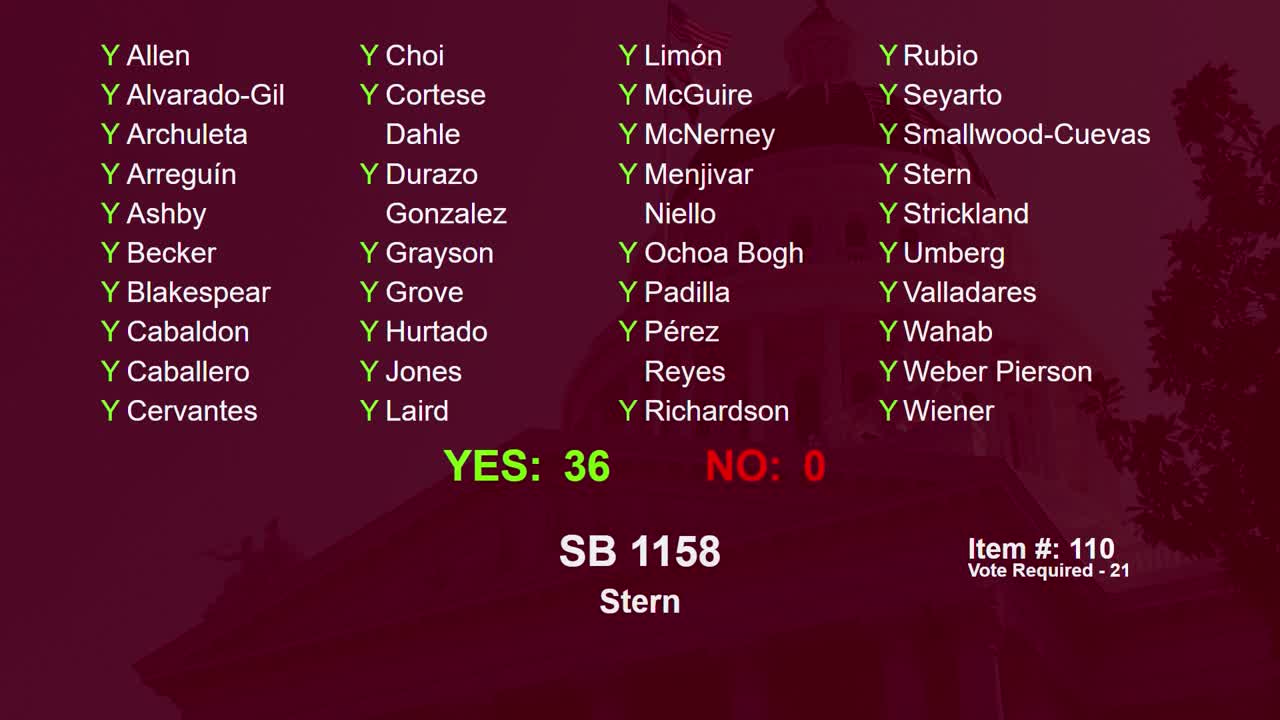
Bill Author

Bill Co-Author(s):