SB 957: Civil detention facilities.
- Session Year: 2025-2026
- House: Senate
- Latest Version Date: 2026-09-29
Current Status:
Passed
(2026-09-29: Chaptered by Secretary of State. Chapter 756, Statutes of 2026.)
Introduced
In Committee
Awaiting First Chamber Vote
Passed First Chamber
In Committee
Awaiting Second Chamber Vote
Passed Second Chamber
Enacted
Existing law requires the operator of a private detention facility, as defined, to comply with, and adhere to, the detention standards of care and confinement agreed upon in the facilitys contract for operations, as specified. Existing law requires a private detention facility operator to comply with, and adhere to, all local and state public health orders and occupational safety and health regulations.
This bill, the Protecting Vulnerable Immigrant Detainees Model Act, would require the Attorney General, on or before December 31, 2027, to submit to the Legislature a report including a proposed oversight plan for private civil detention facilities that protects the health, safety, and welfare of persons detained in those facilities, as specified. The bill would require the Governor to direct the appropriate state entity to cooperate with the Attorney General for the purposes of developing the oversight plan, as specified.
The bill would make related findings and declarations.
Existing constitutional provisions require that a statute that limits the right of access to the meetings of public bodies or the writings of public officials and agencies be adopted with findings demonstrating the interest protected by the limitation and the need for protecting that interest.
This bill would make legislative findings to that effect.
Existing law requires the operator of a private detention facility, as defined, to comply with, and adhere to, the detention standards of care and confinement agreed upon in the facilitys contract for operations, as specified. Existing law requires a private detention facility operator to comply with, and adhere to, all local and state public health orders and occupational safety and health regulations.
This bill, the Protecting Vulnerable Immigrant Detainees Model Act, would require the Attorney General, on or before December 31, 2027, to submit to the Legislature a proposed oversight plan for private civil detention facilities that protects the health, safety, and welfare of persons detained in those facilities, as specified. The bill would require the Governor to direct the appropriate state entity to cooperate with the Attorney General for the purposes of developing the oversight plan, as specified.
The bill would make related findings and declarations.
Existing constitutional provisions require that a statute that limits the right of access to the meetings of public bodies or the writings of public officials and agencies be adopted with findings demonstrating the interest protected by the limitation and the need for protecting that interest.
This bill would make legislative findings to that effect.
Existing law generally regulates social media platforms, including, among other laws, the Protecting Our Kids from Social Media Addiction Act that prohibits an operator of an addictive internet-based service or application, including a social media platform, from providing an addictive feed, as defined, to a minor user, except as prescribed. Existing law, the California Consumer Privacy Act of 2018, grants consumers various rights with respect to personal information, as defined, that is collected by a business, as defined. Existing law, the California Values Act, generally prohibits California law enforcement agencies from using their moneys or personnel for immigration enforcement purposes, except as specified.Existing federal law authorizes specified federal officers to require, among other things, the attendance and testimony of witnesses before immigration officers and the production of books, papers, and documents relating to, among other things, the privilege of any person to enter, reenter, reside in, or pass through the United States.This bill would require a social media company, as defined, to promptly notify an individual whose personal information is requested by an administrative subpoena issued as described above, except as specified. The bill would require the social media company to provide the individual whose personal information is requested in an administrative subpoena with at least 30 days to respond to or challenge the administrative subpoena before responding to the administrative subpoena. The bill would also require a social media platform, before responding to an administrative subpoena, to determine if the administrative subpoena is invalid for any of specified reasons, including that the information requested by the subpoena is too indefinite or broad, except as specified. This bill would require a social media company that discloses personal information in response to an administrative subpoena to provide notice to the individual whose information was disclosed and would require a social media company that responds to an administrative subpoena to notify the Attorney General of that response, as specified. The bill would prohibit a social media company from responding to an administrative subpoena for personal information while a legal challenge to the subpoena is pending if the social media company has actual knowledge of the challenge. This bill would require the Attorney General to develop a process for a social media company to submit the notice described above, as specified. The bill would exempt notices submitted as described above from the California Public Records Act. The bill would authorize the Attorney General, and a person whose information has been shared in violation of the above provisions by a social media company, to bring an action for injunctive or declaratory relief, as specified. The bill would declare its provisions severable.Existing constitutional provisions require that a statute that limits the right of access to the meetings of public bodies or the writings of public officials and agencies be adopted with findings demonstrating the interest protected by the limitation and the need for protecting that interest.This bill would make legislative findings to that effect.Existing law generally regulates social media platforms, including, among other laws, the Protecting Our Kids from Social Media Addiction Act that prohibits an operator of an addictive internet-based service or application, including a social media platform, from providing an addictive feed, as defined, to a minor user, except as prescribed. Existing law, the California Consumer Privacy Act of 2018, grants consumers various rights with respect to personal information, as defined, that is collected by a business, as defined. Existing law, the California Values Act, generally prohibits California law enforcement agencies from using their moneys or personnel for immigration enforcement purposes, except as specified.
Existing federal law authorizes specified federal officers to require, among other things, the attendance and testimony of witnesses before immigration officers and the production of books, papers, and documents relating to, among other things, the privilege of any person to enter, reenter, reside in, or pass through the United States.
This bill would require a social media company, as defined, to promptly notify an individual whose personal information is requested by an administrative subpoena issued as described above. above, except as specified. The bill would require the social media company to provide the individual whose personal information is requested in an administrative subpoena with at least 30 days to respond to or challenge the administrative subpoena before responding to the administrative subpoena. The bill would also require a social media platform, before responding to an administrative subpoena, to determine if the administrative subpoena is invalid for any of specified reasons, including that the information requested by the subpoena is too indefinite or broad. broad, except as specified.
This bill would require a social media company that discloses personal information in response to an administrative subpoena to provide notice to the individual whose information was disclosed and would require a social media company that responds to an administrative subpoena to notify the Attorney General of that response, as specified. The bill would prohibit a social media company from responding to an administrative subpoena for personal information while a legal challenge to the subpoena is pending if the social media company has actual knowledge of the challenge.
This bill would require the Attorney General to develop a process for a social media company to submit the notice described above, as specified. The bill would exempt notices submitted as described above from the California Public Records Act. The bill would authorize the Attorney General, and a person whose information has been shared in violation of the above provisions by a social media company, to bring an action for injunctive or declaratory relief, as specified. The bill would declare its provisions severable.
Existing constitutional provisions require that a statute that limits the right of access to the meetings of public bodies or the writings of public officials and agencies be adopted with findings demonstrating the interest protected by the limitation and the need for protecting that interest.
This bill would make legislative findings to that effect.
Existing law generally regulates social media platforms, including, among other laws, the Protecting Our Kids from Social Media Addiction Act that prohibits an operator of an addictive internet-based service or application, including a social media platform, from providing an addictive feed, as defined, to a minor user, except as prescribed. Existing law, the California Consumer Privacy Act of 2018, grants consumers various rights with respect to personal information, as defined, that is collected by a business, as defined. Existing law, the California Values Act, generally prohibits California law enforcement agencies from using their moneys or personnel for immigration enforcement purposes, except as specified.
Existing federal law authorizes specified federal officers to require, among other things, the attendance and testimony of witnesses before immigration officers and the production of books, papers, and documents relating to, among other things, the privilege of any person to enter, reenter, reside in, or pass through the United States.
This bill would require a social media company, as defined, to promptly notify an individual whose personal information is requested by an administrative subpoena issued as described above. The bill would require the social media company to provide the individual whose personal information is requested in an administrative subpoena with at least 30 days to respond to or challenge the administrative subpoena before responding to the administrative subpoena. The bill would also require a social media platform, before responding to an administrative subpoena, to determine if the administrative subpoena is invalid for any of specified reasons, including that the information requested by the subpoena is too indefinite or broad.
This bill would require a social media company that discloses personal information in response to an administrative subpoena to provide notice to the individual whose information was disclosed and would require a social media company that responds to an administrative subpoena to notify the Attorney General of that response, as specified. The bill would prohibit a social media company from responding to an administrative subpoena for personal information while a legal challenge to the subpoena is pending if the social media company has actual knowledge of the challenge.
This bill would require the Attorney General to develop a process for a social media company to submit the notice described above, as specified. The bill would exempt notices submitted as described above from the California Public Records Act. The bill would authorize the Attorney General, and a person whose information has been shared in violation of the above provisions by a social media company, to bring an action for injunctive or declaratory relief, as specified. The bill would declare its provisions severable.
Existing constitutional provisions require that a statute that limits the right of access to the meetings of public bodies or the writings of public officials and agencies be adopted with findings demonstrating the interest protected by the limitation and the need for protecting that interest.
This bill would make legislative findings to that effect.
Existing law generally regulates social media platforms, including, among other laws, the Protecting Our Kids from Social Media Addiction Act that prohibits an operator of an addictive internet-based service or application, including a social media platform, from providing an addictive feed, as defined, to a minor user, except as prescribed. Existing law, the California Consumer Privacy Act of 2018, grants consumers various rights with respect to personal information, as defined, that is collected by a business, as defined. Existing law, the California Values Act, generally prohibits California law enforcement agencies from using their moneys or personnel for immigration enforcement purposes, except as specified.
Existing federal law authorizes specified federal officers to require by subpoena require, among other things, the attendance and testimony of witnesses before immigration officers and the production of books, papers, and documents relating to, among other things, the privilege of any person to enter, reenter, reside in, or pass through the United States.
This bill would require a social media company, as defined, to promptly notify an individual whose personal information is requested by an administrative subpoena issued as described above. The bill would prohibit require the social media company from to provide the individual whose personal information is requested in an administrative subpoena with at least 30 days to respond to or challenge the administrative subpoena before responding to the administrative subpoena until the individual whose personal information is requested has had sufficient time to respond to or challenge the administrative subpoena, except as specified. subpoena. The bill would also prohibit a social media company from responding to an administrative subpoena requesting the personal information of an individual if the administrative subpoena require a social media platform, before responding to an administrative subpoena, to determine if the administrative subpoena is invalid for one any of specified reasons, including that the information requested by the subpoena is overly broad or compliance would be unduly burdensome. too indefinite or broad.
This bill would require a social media company that discloses personal information in response to an administrative subpoena to provide notice to the individual whose information was disclosed and would require a social media company that responds to an administrative subpoena to notify the Attorney General of that response, as specified. The bill would prohibit a social media company from responding to an administrative subpoena for personal information while a legal challenge to the subpoena is pending if the social media company has actual knowledge of the challenge.
This bill would require the Attorney General to develop a process for a social media company to submit the notice described above, as specified. The bill would exempt notices submitted as described above from the California Public Records Act. The bill would authorize the Attorney General, and a person whose information has been shared in violation of the above provisions by a social media company, to bring an action for injunctive or declaratory relief, as specified. The bill would declare its provisions severable.
Existing constitutional provisions require that a statute that limits the right of access to the meetings of public bodies or the writings of public officials and agencies be adopted with findings demonstrating the interest protected by the limitation and the need for protecting that interest.
This bill would make legislative findings to that effect.
Existing law generally regulates social media platforms, including, among other laws, the Protecting Our Kids from Social Media Addiction Act that prohibits an operator of an addictive internet-based service or application, including a social media platform, from providing an addictive feed, as defined, to a minor user, except as prescribed. Existing law, the California Consumer Privacy Act of 2018, grants consumers various rights with respect to personal information, as defined, that is collected by a business, as defined. Existing law, the California Values Act, generally prohibits California law enforcement agencies from using their moneys or personnel for immigration enforcement purposes, except as specified.
Existing federal law authorizes specified federal officers to require by subpoena the attendance and testimony of witnesses before immigration officers and the production of books, papers, and documents relating to, among other things, the privilege of any person to enter, reenter, reside in, or pass through the United States.
This bill would require a social media company, as defined, to promptly notify an individual whose personal information is requested by an administrative subpoena issued as described above. The bill would prohibit the social media company from responding to the administrative subpoena until the individual whose personal information is requested has had sufficient time to respond to or challenge the administrative subpoena, except as specified. The bill would also prohibit a social media company from responding to an administrative subpoena requesting the personal information of an individual if the administrative subpoena is invalid for one of specified reasons, including that the information requested by the subpoena is overly broad or compliance would be unduly burdensome.
This bill would authorize the Attorney General, and a person whose information has been shared in violation of the above provisions by a social media company, to bring an action for injunctive or declaratory relief, as specified. The bill would declare its provisions severable.
Existing law requires a social media company, as defined, to submit a terms of service report on a semiannual basis to the Attorney General, as prescribed. Existing law requires the terms of service report to include specified information. Existing law, the Consumer Legal Remedies Act, proscribes specified unfair or deceptive trade practices and authorizes a civil action to enforce a violation of those provisions.This bill would require an online dating service, as defined, to adopt a safety policy that meets specified requirements and to report information relating to the policy on an annual basis to the Attorney General, as prescribed. The bill would authorize the Attorney General to bring an action to enforce these provisions and would make violation of these provisions an unfair or deceptive trade practice, as specified.Existing law requires a social media company, as defined, to submit a terms of service report on a semiannual basis to the Attorney General, as prescribed. Existing law requires the terms of service report to include specified information. Existing law, the Consumer Legal Remedies Act, proscribes specified unfair or deceptive trade practices and authorizes a civil action to enforce a violation of those provisions.
This bill would require an online dating service, as defined, to adopt a safety policy that meets specified requirements and to report information relating to the policy on an annual basis to the Attorney General, as prescribed. The bill would authorize the Attorney General to bring an action to enforce these provisions and would make violation of these provisions an unfair or deceptive trade practice, as specified.
The Legislature finds and declares all of the following:
(a)California has a compelling interest in protecting the health, safety, and welfare of individuals residing in civil detention facility environments.
(b)Existing law provides that civil detainees have the same legal rights and responsibilities guaranteed to all other individuals by the United States Constitution and laws and the Constitution and laws of the State of California.
(c)In 2017, pursuant to Assembly Bill 103, the Legislature directed the Attorney General, or their designee, to review and report on the conditions of confinement, how those conditions affect due process, and the standards of care offered to individuals held in civil immigration detention facilities across the state. The Attorney Generals reports shed light on the conditions to which individuals held in privately operated detention facilities are subjected, including recurring substandard conditions and limited access to critical health care.
(d)Multiple state agencies and departments, including the State Department of Public Health, currently oversee, inspect, and fine civil facilities if violations of regulations promulgated by that agency or department are found.
(e)While most civil and correctional facilities across the state have oversight mechanisms to ensure the health, safety, and welfare of individuals held within them, no such oversight currently exists over all privately operated civil detention facilities in the state. As the Ninth Circuit recognized in United States v. California, 921 F.3d 865, 886 (9th Cir. 2019), California possesses the general authority to ensure the health and welfare of inmates and detainees in facilities within its borders. Therefore, California needs a comprehensive oversight mechanism to protect the health, safety, and welfare of those held in all privately operated civil detention facilities across the state that aligns with the oversight mechanisms of similarly situated entities.
153001.(a)(1)The Attorney General, on or before December 31, 2027, shall submit to the Legislature a report including a proposed oversight plan for private civil detention facilities that protects the health, safety, and welfare of persons detained in those facilities.
(2)The Attorney General shall consider applicable federal and state laws and, at a minimum, consider the provision of health care and the conditions of detention in those facilities in developing the oversight plan.
(3)The oversight plan shall propose requirements for private civil detention facilities that are comparable to facilities that are currently under the oversight of state agencies and departments and shall give consideration to how detention facilities operate and the populations they hold in developing those requirements.
(4)The Attorney General may make other recommendations necessary to implement the oversight plan.
(b)The Governor, or the Governors designee, shall direct the appropriate state agency, department, board, or commission to cooperate with the Attorney General for the purposes of developing the oversight plan described in subdivision (a) by doing all of the following:
(1)Designate a senior representative for the state entity described in this subdivision to facilitate the provision of information requested by the Attorney General in the discharge of their duties pursuant to this subdivision.
(2)Provide information requested by the Attorney General within 30 days or a timeframe otherwise agreed upon by the parties.
(3)Review and provide input on the oversight plan described in subdivision (a).
(c)The Attorney General shall keep confidential any information received from a state agency that the state agency considers confidential. The Attorney General shall also withhold from public disclosure information that is otherwise exempt from disclosure under the California Public Records Act (Division 10 (commencing with Section 7920.000) of Title 1 of the Government Code).
(d)(1)The requirement for submitting a report imposed under subdivision (a) is inoperative on January 1, 2031, pursuant to Section 10231.5 of the Government Code.
(2)A report to be submitted pursuant to subdivision (a) shall be submitted in compliance with Section 9795 of the Government Code.
SEC. 2.The Legislature finds and declares that Section 1 of this act, which adds Section 153001 of the Health and Safety Code, imposes a limitation on the publics right of access to the meetings of public bodies or the writings of public officials and agencies within the meaning of Section 3 of Article I of the California Constitution. Pursuant to that constitutional provision, the Legislature makes the following findings to demonstrate the interest protected by this limitation and the need for protecting that interest:
In order to develop a robust oversight plan for private civil detention facilities to ensure the health, safety, and welfare of individuals residing in private civil detention facility environments and protect the health, safety, and welfare of individuals residing in such facilities, it is necessary to allow state agencies freely exchange information and analysis and limit the publics right of access to records exchanged in furtherance of the goals of this act.
The Legislature finds and declares all of the following:
(a)California has a compelling interest in protecting the health, safety, and welfare of individuals residing in civil detention facility environments.
(b)Existing law provides that civil detainees have the same legal rights and responsibilities guaranteed to all other individuals by the United States Constitution and laws and the Constitution and laws of the State of California.
(c)In 2017, pursuant to Assembly Bill 103, the Legislature directed the Attorney General, or their designee, to review and report on the conditions of confinement, how those conditions affect due process, and the standards of care offered to individuals held in civil immigration detention facilities across the state. The Attorney Generals reports shed light on the conditions to which individuals held in privately operated detention facilities are subjected, including recurring substandard conditions and limited access to critical health care.
(d)Multiple state agencies and departments, including the State Department of Public Health, currently oversee, inspect, and fine civil facilities if violations of regulations promulgated by that agency or department are found.
(e)While other most civil and correctional facilities across the state have oversight mechanisms to ensure the health, safety, and welfare of individuals held within them, no such oversight currently exists over all privately operated civil detention facilities in the state. As the Ninth Circuit recognized in United States v. California, 921 F.3d 865, 886 (9th Cir. 2019), California possesses the general authority to ensure the health and welfare of inmates and detainees in facilities within its borders. Therefore, California needs a comprehensive oversight mechanism to protect the health, safety, and welfare of those held in all privately operated civil detention facilities across the state that aligns with the oversight mechanisms of similarly situated entities.
153001.(a)(1)The Attorney General, on or before December 31, 2027, shall submit to the Legislature a report including a proposed oversight plan for private civil detention facilities that protects the health, safety, and welfare of persons detained in those facilities.
(2)The Attorney General shall consider applicable federal and state laws and, at a minimum, consider the provision of health care and the conditions of detention in those facilities in developing the oversight plan.
(3)The oversight plan shall propose requirements for private civil detention facilities that are comparable to facilities that are currently under the oversight of state agencies and departments and shall give consideration to how detention facilities operate and the populations they hold in developing those requirements.
(4)The Attorney General may make other recommendations necessary to implement the oversight plan.
(b)The Governor, or the Governors designee, shall direct the appropriate state agency, department, board, or commission to cooperate with the Attorney General for the purposes of developing the oversight plan described in subdivision (a) by doing all of the following:
(1)Designate a senior representative for the state entity described in this subdivision to facilitate the provision of information requested by the Attorney General in the discharge of their duties pursuant to this subdivision.
(2)Provide information requested by the Attorney General within 30 days or a timeframe otherwise agreed upon by the parties.
(3)Review and provide input on the oversight plan described in subdivision (a).
(c)The Attorney General shall keep confidential any information received from a state agency that the state agency considers confidential. The Attorney General shall also withhold from public disclosure information that is otherwise exempt from disclosure under the California Public Records Act (Division 10 (commencing with Section 7920.000) of Title 1 of the Government Code).
(d)(1)The requirement for submitting a report imposed under subdivision (a) is inoperative on January 1, 2031, pursuant to Section 10231.5 of the Government Code.
(2)A report to be submitted pursuant to subdivision (a) shall be submitted in compliance with Section 9795 of the Government Code.
SEC. 2.The Legislature finds and declares that Section 1 of this act, which adds Section 153001 of the Health and Safety Code, imposes a limitation on the publics right of access to the meetings of public bodies or the writings of public officials and agencies within the meaning of Section 3 of Article I of the California Constitution. Pursuant to that constitutional provision, the Legislature makes the following findings to demonstrate the interest protected by this limitation and the need for protecting that interest:
In order to develop a robust oversight plan for private civil detention facilities to ensure the health, safety, and welfare of individuals residing in private civil detention facility environments and protect the health, safety, and welfare of individuals residing in such facilities, it is necessary to allow state agencies freely exchange information and analysis and limit the publics right of access to records exchanged in furtherance of the goals of this act.
The Legislature finds and declares all of the following:
(a)California has a compelling interest in protecting the health, safety, and welfare of individuals residing in civil detention facility environments.
(b)Existing law provides that civil detainees have the same legal rights and responsibilities guaranteed to all other individuals by the United States Constitution and laws and the Constitution and laws of the State of California.
(c)In 2017, pursuant to Assembly Bill 103, the Legislature directed the Attorney General, or their designee, to review and report on the conditions of confinement, how those conditions affect due process, and the standards of care offered to individuals held in civil immigration detention facilities across the state. The Attorney Generals reports shed light on the conditions to which individuals held in privately operated detention facilities are subjected, including recurring substandard conditions and limited access to critical health care.
(d)Multiple state agencies and departments, including the State Department of Public Health, currently oversee, inspect, and fine civil facilities if violations of regulations promulgated by that agency or department are found.
(e)While other civil and correctional facilities across the state have oversight mechanisms to ensure the health, safety, and welfare of individuals held within them, no such oversight currently exists over all privately operated civil detention facilities in the state. As the Ninth Circuit recognized in United States v. California, 921 F.3d 865, 886 (9th Cir. 2019), California possesses the general authority to ensure the health and welfare of inmates and detainees in facilities within its borders. Therefore, California needs a comprehensive oversight mechanism to protect the health, safety, and welfare of those held in all privately operated civil detention facilities across the state that aligns with the oversight mechanisms of similarly situated entities.
153001.(a)(1)The Attorney General, on or before December 31, 2027, shall submit to the Legislature a proposed oversight plan for private civil detention facilities that protects the health, safety, and welfare of persons detained in those facilities.
(2)The Attorney General shall consider applicable federal and state laws and, at a minimum, consider the provision of health care and the conditions of detention in those facilities in developing the oversight plan.
(3)The oversight plan shall propose requirements for civil detention facilities that are comparable to facilities that are currently under the oversight of state agencies and departments and shall give consideration to how detention facilities operate and the populations they hold in developing those requirements.
(4)The Attorney General may make other recommendations necessary to implement the oversight plan.
(b)The Governor, or the Governors designee, shall direct the appropriate state agency, department, board, or commission to cooperate with the Attorney General for the purposes of developing the oversight plan described in subdivision (a) by doing all of the following:
(1)Designate a senior representative for the state entity described in this subdivision to facilitate the provision of information requested by the Attorney General in the discharge of their duties pursuant to this subdivision.
(2)Provide information requested by the Attorney General within 30 days or a timeframe otherwise agreed upon by the parties.
(3)Review and provide input on the oversight plan described in subdivision (a).
(c)The Attorney General shall keep confidential any information received from a state agency that the state agency considers confidential. The Attorney General shall also withhold from public disclosure information that is otherwise exempt from disclosure under the California Public Records Act (Division 10 (commencing with Section 7920.000) of Title 1 of the Government Code).
(d)(1)The requirement for submitting a report imposed under subdivision (a) is inoperative on January 1, 2031, pursuant to Section 10231.5 of the Government Code.
(2)A report to be submitted pursuant to subdivision (a) shall be submitted in compliance with Section 9795 of the Government Code.
SEC. 2.The Legislature finds and declares that Section 1 of this act, which adds Section 153001 of the Health and Safety Code, imposes a limitation on the publics right of access to the meetings of public bodies or the writings of public officials and agencies within the meaning of Section 3 of Article I of the California Constitution. Pursuant to that constitutional provision, the Legislature makes the following findings to demonstrate the interest protected by this limitation and the need for protecting that interest:
In order to develop a robust oversight plan for private civil detention facilities to ensure the health, safety, and welfare of individuals residing in private civil detention facility environments and protect the health, safety, and welfare of individuals residing in such facilities, it is necessary to allow state agencies freely exchange information and analysis and limit the publics right of access to records exchanged in furtherance of the goals of this act.
SECTION 1.Chapter 31.7 (commencing with Section 22946.5) is added to Division 8 of the Business and Professions Code, to read:31.7.Stopping Harmful Information Exploitation and Lawless Data Sharing Act22946.5.(a)This chapter shall be known, and may be cited, as the Stopping Harmful Information Exploitation and Lawless Data Sharing Act.(b)For purposes of this chapter, the following definitions shall apply:(1)Administrative subpoena means a subpoena issued pursuant to either of the following:(A)Subparagraph (A) of paragraph (1) of subsection (a) of Section 1509 of Title 19 of the United States Code, as that section read on January 1, 2026. (B)Subparagraph (A) of paragraph (4) of subsection (d) of Section 1225 of Title 8 of the United States Code, as that section read on January 1, 2026.(2)Individual means a natural person who is a California resident.(3)Maintain includes maintain, acquire, use, or disclose.(4)Personal information means any information that is maintained by a social media company that is reasonably capable of identifying or describing an individual, including, but not limited to, the individuals name, social security number, physical description, address, telephone number, IP address, online browsing history, location information, social media information, education, financial matters, and medical or employment history. Personal information does not include any record that is required by law or regulation for the entry of merchandise pursuant to subparagraph (A) of paragraph (1) of subsection (a) of Section 1509 of Title 19 of the United States Code, as that section read on January 1, 2026.(5)Social media company means a social media company, as defined in Section 22675.(c)(1)(A)A social media company shall promptly notify an individual whose personal information is requested by an administrative subpoena.(B)Prior to disclosing personal information in response to an administrative subpoena requesting the personal information of an individual, a social media company shall provide the individual whose personal information is requested with at least 30 days to respond to or challenge the administrative subpoena.(C)If a social media company discloses personal information in response to an administrative subpoena, the social media company shall provide notice to the individual whose personal information was disclosed of both of the following:(i)That the information was disclosed pursuant to an administrative subpoena.(ii)A description of the information that was disclosed.(D)This paragraph shall not apply if compliance would violate a court order prohibiting disclosure of the request.(2)Notwithstanding any other law, prior to disclosing any personal information in response to an administrative subpoena requesting the personal information of an individual, a social media company shall determine if the administrative subpoena is invalid for any of the following reasons:(A)The information requested by the administrative subpoena is not related to any purpose lawfully authorized pursuant to subparagraph (A) of paragraph (4) of subsection (d) of Section 1225 of Title 8 of the United States Code, as that section read on January 1, 2026, or pursuant to subparagraph (A) of paragraph (1) of subsection (a) of Section 1509 of Title 19 of the United States Code, as that section read on January 1, 2026, as applicable.(B)The administrative subpoena is procedurally improper.(C)The information requested by the administrative subpoena is irrelevant or immaterial to the purpose described in subparagraph (A).(D)The information requested by the administrative subpoena is too indefinite or broad.(3)This subdivision shall not apply with respect to an administrative subpoena issued pursuant to subparagraph (A) of paragraph (1) of subsection (a) of Section 1509 of Title 19 of the United States Code, as that section read on January 1, 2026, if the social media company has a good faith belief that an emergency involving child exploitation or human smuggling or trafficking requires disclosure of the information requested by the administrative subpoena without delay.(d)(1)If a social media company responds to an administrative subpoena for personal information, it shall notify the Attorney General within five business days of the response. The notice shall also inform the Attorney General of whether the user whose personal information was requested has been notified by the social media company pursuant to subdivision (c).(2)The Attorney General shall develop a process for a social media company to submit the notice described in paragraph (1), including specifications for what information the social media company must provide and in what format.(e)A social media company shall not respond to an administrative subpoena for personal information while a legal challenge to the subpoena is pending if the social media company has actual knowledge of the challenge.(f)(1)The Attorney General may bring an action for injunctive or declaratory relief against any social media company who violates this chapter.(2)An individual whose information has been shared in response to an administrative subpoena by a social media company in violation of this chapter may also bring a civil action against the social media company for injunctive or declaratory relief.(g)Nothing in this chapter shall be construed to prohibit a social media company from responding to an order issued by a court pursuant to subparagraph (B) of paragraph (4) of subsection (d) of Section 1225 of Title 8 of the United States Code, as that section read on January 1, 2026, or any other law.(h)Information submitted to the Attorney General pursuant to subdivision (d) shall not be considered a public record and shall not be disclosed pursuant to a request under the California Public Records Act (Division 10 (commencing with Section 7920.000) of Title 1 of the Government Code).SEC. 2.The provisions of this act are severable. If any provision of this act or its application is held invalid, that invalidity shall not affect other provisions or applications that can be given effect without the invalid provision or application.SEC. 3.The Legislature finds and declares that Section 1 of this act, which adds Chapter 31.7 (commencing with Section 22946.5) to Division 8 of the Business and Professions Code, imposes a limitation on the publics right of access to the meetings of public bodies or the writings of public officials and agencies within the meaning of Section 3 of Article I of the California Constitution. Pursuant to that constitutional provision, the Legislature makes the following findings to demonstrate the interest protected by this limitation and the need for protecting that interest:In order to protect sensitive personal information, it is necessary that this act limit the publics right of access to that information.(a)This chapter shall be known, and may be cited, as the Stopping Harmful Information Exploitation and Lawless Data Sharing Act.
(b)For purposes of this chapter, the following definitions shall apply:
(1)Administrative subpoena means a subpoena issued pursuant to either of the following:
(A)Subparagraph (A) of paragraph (1) of subsection (a) of Section 1509 of Title 19 of the United States Code, as that section read on January 1, 2026.
(B)Subparagraph (A) of paragraph (4) of subsection (d) of Section 1225 of Title 8 of the United States Code, as that section read on January 1, 2026.
(2)Individual means a natural person who is a California resident.
(3)Maintain includes maintain, acquire, use, or disclose.
(4)Personal information means any information that is maintained by a social media company that is reasonably capable of identifying or describing an individual, including, but not limited to, the individuals name, social security number, physical description, address, telephone number, IP address, online browsing history, location information, social media information, education, financial matters, and medical or employment history. Personal information does not include any record that is required by law or regulation for the entry of merchandise pursuant to subparagraph (A) of paragraph (1) of subsection (a) of Section 1509 of Title 19 of the United States Code, as that section read on January 1, 2026.
(5)Social media company means a social media company, as defined in Section 22675.
(c)(1)(A)A social media company shall promptly notify an individual whose personal information is requested by an administrative subpoena.
(2)(B)Prior to disclosing personal information in response to an administrative subpoena requesting the personal information of an individual, a social media company shall provide the individual whose personal information is requested with at least 30 days to respond to or challenge the administrative subpoena.
(3)(C)If a social media company discloses personal information in response to an administrative subpoena, the social media company shall provide notice to the individual whose personal information was disclosed of all both of the following:
(A) The reason the individuals personal information was disclosed.(B) The basis for determining that the administrative subpoena was valid.(i)That the information was disclosed pursuant to an administrative subpoena.
(C)(ii)A description of the information that was disclosed.
(D)This paragraph shall not apply if compliance would violate a court order prohibiting disclosure of the request.
(d)(2)Notwithstanding any other law, prior to disclosing any personal information in response to an administrative subpoena requesting the personal information of an individual, a social media company shall determine if the administrative subpoena is invalid for any of the following reasons:
(1)(A)The information requested by the administrative subpoena is not related to any purpose lawfully authorized pursuant to subparagraph (A) of paragraph (4) of subsection (d) of Section 1225 of Title 8 of the United States Code, as that section read on January 1, 2026, or pursuant to subparagraph (A) of paragraph (1) of subsection (a) of Section 1509 of Title 19 of the United States Code, as that section read on January 1, 2026, as applicable.
(2)(B)The administrative subpoena is procedurally improper.
(3)(C)The information requested by the administrative subpoena is irrelevant or immaterial to the purpose described in paragraph (1). subparagraph (A).
(4)(D)The information requested by the administrative subpoena is too indefinite or broad.
(3)This subdivision shall not apply with respect to an administrative subpoena issued pursuant to subparagraph (A) of paragraph (1) of subsection (a) of Section 1509 of Title 19 of the United States Code, as that section read on January 1, 2026, if the social media company has a good faith belief that an emergency involving child exploitation or human smuggling or trafficking requires disclosure of the information requested by the administrative subpoena without delay.
(e)(d)(1)If a social media company responds to an administrative subpoena for personal information, it must shall notify the Attorney General within five business days of the response. The notice shall also inform the Attorney General of whether the user whose personal information was requested has been notified by the social media company pursuant to subdivision (c).
(2)The Attorney General shall develop a process for a social media company to submit the notice described in paragraph (1), including specifications for what information the social media company must provide and in what format.
(f)(e)A social media company shall not respond to an administrative subpoena for personal information while a legal challenge to the subpoena is pending if the social media company has actual knowledge of the challenge.
(g)(f)(1)The Attorney General may bring an action for injunctive or declaratory relief against any social media company who violates this chapter.
(2)An individual whose information has been shared in response to an administrative subpoena by a social media company in violation of this chapter may also bring a civil action against the social media company for injunctive or declaratory relief.
(h)(g)Nothing in this chapter shall be construed to prohibit a social media company from responding to an order issued by a court pursuant to subparagraph (B) of paragraph (4) of subsection (d) of Section 1225 of Title 8 of the United States Code, as that section read on January 1, 2026, or any other law.
(i)(h)Information submitted to the Attorney General pursuant to subdivision (e) (d) shall not be considered a public record and shall not be disclosed pursuant to a request under the California Public Records Act (Division 10 (commencing with Section 7920.000) of Title 1 of the Government Code).
SEC. 2.The provisions of this act are severable. If any provision of this act or its application is held invalid, that invalidity shall not affect other provisions or applications that can be given effect without the invalid provision or application.
SEC. 3.The Legislature finds and declares that Section 1 of this act, which adds Chapter 31.7 (commencing with Section 22946.5) to Division 8 of the Business and Professions Code, imposes a limitation on the publics right of access to the meetings of public bodies or the writings of public officials and agencies within the meaning of Section 3 of Article I of the California Constitution. Pursuant to that constitutional provision, the Legislature makes the following findings to demonstrate the interest protected by this limitation and the need for protecting that interest:
In order to protect sensitive personal information, it is necessary that this act limit the publics right of access to that information.
(a)This chapter shall be known, and may be cited, as the Stopping Harmful Information Exploitation and Lawless Data Sharing Act.
(b)For purposes of this chapter, the following definitions shall apply:
(1)Administrative subpoena means a subpoena issued pursuant to either of the following:
(A)Subparagraph (A) of paragraph (1) of subsection (a) of Section 1509 of Title 19 of the United States Code, as that section read on January 1, 2026.
(B)Subparagraph (A) of paragraph (4) of subsection (d) of Section 1225 of Title 8 of the United States Code, as that section read on January 1, 2026.
(2)Individual means a natural person who is a California resident.
(3)Maintain includes maintain, acquire, use, or disclose.
(4)Personal information means any information that is maintained by a social media company that is reasonably capable of identifying or describing an individual, including, but not limited to, the individuals name, social security number, physical description, address, telephone number, IP address, online browsing history, location information, social media information, education, financial matters, and medical or employment history. Personal information does not include any record that is required by law or regulation for the entry of merchandise pursuant to subparagraph (A) of paragraph (1) of subsection (a) of Section 1509 of Title 19 of the United States Code, as that section read on January 1, 2026.
(5)Social media company means a social media company, as defined in Section 22675.
(c)(1)A social media company shall promptly notify an individual whose personal information is requested by an administrative subpoena.
(2)Prior to disclosing personal information in response to an administrative subpoena requesting the personal information of an individual, a social media company shall provide the individual whose personal information is requested with at least 30 days to respond to or challenge the administrative subpoena.
(3)If a social media company discloses personal information in response to an administrative subpoena, the social media company shall provide notice to the individual whose personal information was disclosed of all of the following:
(A)The reason the individuals personal information was disclosed.
(B)The basis for determining that the administrative subpoena was valid.
(C)A description of the information that was disclosed.
(d)Notwithstanding any other law, prior to disclosing any personal information in response to an administrative subpoena requesting the personal information of an individual, a social media company shall determine if the administrative subpoena is invalid for any of the following reasons:
(1)The information requested by the administrative subpoena is not related to any purpose lawfully authorized pursuant to subparagraph (A) of paragraph (4) of subsection (d) of Section 1225 of Title 8 of the United States Code, as that section read on January 1, 2026. 2026, or pursuant to subparagraph (A) of paragraph (1) of subsection (a) of Section 1509 of Title 19 of the United States Code, as that section read on January 1, 2026, as applicable.
(2)The administrative subpoena is procedurally improper.
(3)The information requested by the administrative subpoena is irrelevant or immaterial to the purpose described in paragraph (1).
(4)The information requested by the administrative subpoena is too indefinite or broad.
(e)(1)If a social media company responds to an administrative subpoena for personal information, it must notify the Attorney General within five business days of the response.
(2)The Attorney General shall develop a process for a social media company to submit the notice described in paragraph (1), including specifications for what information the social media company must provide and in what format.
(f)A social media company shall not respond to an administrative subpoena for personal information while a legal challenge to the subpoena is pending if the social media company has actual knowledge of the challenge.
(g)(1)The Attorney General may bring an action for injunctive or declaratory relief against any social media company who violates this chapter.
(2)An individual whose information has been shared in response to an administrative subpoena by a social media company in violation of this chapter may also bring a civil action against the social media company for injunctive or declaratory relief.
(h)Nothing in this chapter shall be construed to prohibit a social media company from responding to an order issued by a court pursuant to subparagraph (B) of paragraph (4) of subsection (d) of Section 1225 of Title 8 of the United States Code, as that section read on January 1, 2026, or any other law.
(i)Information submitted to the Attorney General pursuant to subdivision (e) shall not be considered a public record and shall not be disclosed pursuant to a request under the California Public Records Act (Division 10 (commencing with Section 7920.000) of Title 1 of the Government Code).
SEC. 2.The provisions of this act are severable. If any provision of this act or its application is held invalid, that invalidity shall not affect other provisions or applications that can be given effect without the invalid provision or application.
SEC. 3.The Legislature finds and declares that Section 1 of this act, which adds Chapter 31.7 (commencing with Section 22946.5) to Division 8 of the Business and Professions Code, imposes a limitation on the publics right of access to the meetings of public bodies or the writings of public officials and agencies within the meaning of Section 3 of Article I of the California Constitution. Pursuant to that constitutional provision, the Legislature makes the following findings to demonstrate the interest protected by this limitation and the need for protecting that interest:
In order to protect sensitive personal information, it is necessary that this act limit the publics right of access to that information.
(a)This chapter shall be known, and may be cited, as the as the Stopping Harmful Information Exploitation and Lawless Data Sharing Act.
(b)For purposes of this chapter, the following definitions shall apply:
(1)Administrative subpoena means a subpoena issued pursuant to subparagraph either of the following:
(A)Subparagraph (A) of paragraph (1) of subsection (a) of Section 1509 of Title 19 of the United States Code, as that section read on January 1, 2026.
(B)Subparagraph (A) of paragraph (4) of subsection (d) of Section 1225 of Title 8 of the United States Code, as that section read on January 1, 2026.
(2)Individual means a natural person who is a California resident.
(3)Maintain includes maintain, acquire, use, or disclose.
(4)Personal information means any information that is maintained by a social media company that is reasonably capable of identifying or describing an individual, including, but not limited to, the individuals name, social security number, physical description, address, telephone number, IP address, online browsing history, location information, social media information, education, financial matters, and medical or employment history. Personal information does not include any record that is required by law or regulation for the entry of merchandise pursuant to subparagraph (A) of paragraph (1) of subsection (a) of Section 1509 of Title 19 of the United States Code, as that section read on January 1, 2026.
(5)Social media company means a social media company, as defined in Section 22675.
(c)(1)A social media company shall promptly notify an individual whose personal information is requested by an administrative subpoena issued pursuant to subparagraph (A) of paragraph (4) of subsection (d) of Section 1225 of Title 8 of the United States Code, as that section read on January 1, 2026. subpoena.
(2)Except as provided in paragraph (3), Prior to disclosing personal information in response to an administrative subpoena requesting the personal information of an individual, a social media company shall not respond to an administrative subpoena requesting the personal information of an individual until the individual whose personal information is requested has had sufficient time provide the individual whose personal information is requested with at least 30 days to respond to or challenge the administrative subpoena.
(3)A social media company may respond to an administrative subpoena requesting the personal information of an individual if the social media company determines the administrative subpoena is not invalid as described in subdivision (b).(3)If a social media company discloses personal information in response to an administrative subpoena, the social media company shall provide notice to the individual whose personal information was disclosed of all of the following:
(A)The reason the individuals personal information was disclosed.
(B)The basis for determining that the administrative subpoena was valid.
(C)A description of the information that was disclosed.
(d)Notwithstanding any other law, prior to disclosing any personal information in response to an administrative subpoena requesting the personal information of an individual, a social media company shall not respond to an administrative subpoena requesting the personal information of an individual determine if the administrative subpoena is invalid for any of the following reasons:
(1)The information requested by the administrative subpoena is not related to any purpose lawfully authorized pursuant to subparagraph (A) of paragraph (4) of subsection (d) of Section 1225 of Title 8 of the United States Code, as that section read on January 1, 2026.
(2)The administrative subpoena is procedurally improper.
(2)(3)The information requested by the administrative subpoena is irrelevant or immaterial to the purpose described in subparagraph paragraph (1).
(3)(4)The information requested by the administrative subpoena is overly broad or compliance would be unduly burdensome. too indefinite or broad.
(e)(1)If a social media company responds to an administrative subpoena for personal information, it must notify the Attorney General within five business days of the response.
(2)The Attorney General shall develop a process for a social media company to submit the notice described in paragraph (1), including specifications for what information the social media company must provide and in what format.
(f)A social media company shall not respond to an administrative subpoena for personal information while a legal challenge to the subpoena is pending if the social media company has actual knowledge of the challenge.
(e)(g)(1)The Attorney General may bring an action for injunctive or declaratory relief against any social media company who violates this chapter.
(2)An individual whose information has been shared in response to an administrative subpoena by a social media company in violation of this chapter may also bring a civil action against the social media company for injunctive or declaratory relief.
(f)(h)Nothing in this chapter shall be construed to prohibit a social media company from responding to an order issued by a court pursuant to subparagraph (B) of paragraph (4) of subsection (d) of Section 1225 of Title 8 of the United States Code, as that section read on January 1, 2026, or any other law.
(i)Information submitted to the Attorney General pursuant to subdivision (e) shall not be considered a public record and shall not be disclosed pursuant to a request under the California Public Records Act (Division 10 (commencing with Section 7920.000) of Title 1 of the Government Code).
SEC. 2.The provisions of this act are severable. If any provision of this act or its application is held invalid, that invalidity shall not affect other provisions or applications that can be given effect without the invalid provision or application.
SEC. 3.The Legislature finds and declares that Section 1 of this act, which adds Chapter 31.7 (commencing with Section 22946.5) to Division 8 of the Business and Professions Code, imposes a limitation on the publics right of access to the meetings of public bodies or the writings of public officials and agencies within the meaning of Section 3 of Article I of the California Constitution. Pursuant to that constitutional provision, the Legislature makes the following findings to demonstrate the interest protected by this limitation and the need for protecting that interest:
In order to protect sensitive personal information, it is necessary that this act limit the publics right of access to that information.
(a)This chapter shall be known, and may be cited, as the as the Stopping Harmful Information Exploitation and Lawless Data Sharing Act.
(b)For purposes of this chapter, the following definitions shall apply:
(1)Administrative subpoena means a subpoena issued pursuant to subparagraph (A) of paragraph (4) of subsection (d) of Section 1225 of Title 8 of the United States Code, as that section read on January 1, 2026.
(2)Individual means a natural person who is a California resident.
(3)Maintain includes maintain, acquire, use, or disclose.
(4)Personal information means any information that is maintained by a social media company that is reasonably capable of identifying or describing an individual, including, but not limited to, the individuals name, social security number, physical description, address, telephone number, IP address, online browsing history, location information, social media information, education, financial matters, and medical or employment history.
(5)Social media company means a social media company, as defined in Section 22675.
(c)(1)A social media company shall promptly notify an individual whose personal information is requested by an administrative subpoena issued pursuant to subparagraph (A) of paragraph (4) of subsection (d) of Section 1225 of Title 8 of the United States Code, as that section read on January 1, 2026.
(2)Except as provided in paragraph (3), a social media company shall not respond to an administrative subpoena requesting the personal information of an individual until the individual whose personal information is requested has had sufficient time to respond to or challenge the administrative subpoena.
(3)A social media company may respond to an administrative subpoena requesting the personal information of an individual if the social media company determines the administrative subpoena is not invalid as described in subdivision (b).
(d)Notwithstanding any other law, a social media company shall not respond to an administrative subpoena requesting the personal information of an individual if the administrative subpoena is invalid for any of the following reasons:
(1)The information requested by the administrative subpoena is not related to any purpose lawfully authorized pursuant to subparagraph (A) of paragraph (4) of subsection (d) of Section 1225 of Title 8 of the United States Code, as that section read on January 1, 2026.
(2)The information requested by the administrative subpoena is irrelevant to the purpose described in subparagraph (1).
(3)The information requested by the subpoena is overly broad or compliance would be unduly burdensome.
(e)(1)The Attorney General may bring an action for injunctive or declaratory relief against any social media company who violates this chapter.
(2)An individual whose information has been shared in response to an administrative subpoena by a social media company in violation of this chapter may also bring a civil action against the social media company for injunctive or declaratory relief.
(f)Nothing in this chapter shall be construed to prohibit a social media company from responding to an order issued by a court pursuant to subparagraph (B) of paragraph (4) of subsection (d) of Section 1225 of Title 8 of the United States Code, as that section read on January 1, 2026, or any other law.
SEC. 2.The provisions of this act are severable. If any provision of this act or its application is held invalid, that invalidity shall not affect other provisions or applications that can be given effect without the invalid provision or application.
All matter omitted in this version of the bill appears in the bill as introduced in the Senate, February 2, 2026. (JR11)For purposes of this chapter, the following definitions apply:
(a)Member means an individual who signs up or registers with an online dating service.
(b)Member in this state means a member who provides a billing address or ZIP Code in this state when registering with an online dating service.
(c)Misconduct that threatens public or personal safety means an act, threatened act, or attempted act of homicide, unlawful sexual behavior, assault, kidnapping, stalking, harassment, involuntary intoxication, robbery, theft, or any other conduct that threatens the publics or another persons safety.
(d)Online dating service means any person engaged in the business of offering dating, matrimonial, or social referral services that are offered primarily online, including by means of an internet website or mobile application.
(e)Remedial action means suspending the members profile from the service, barring the member from the service, or providing actual notice that it received a report of prohibited content and conduct to other members who have had contact on the service with the member who was the subject of the reports.
(f)Safety policy means an online dating services safety policy required by Section 22691.
22691.(a)An online dating service shall adopt a safety policy that complies with this section.
(b)(1)An online dating service that has a member located in this state on January 1, 2027, shall make the safety policy effective on or before January 1, 2028.
(2)An online dating service that registers its first member in this state after January 1, 2027, shall make the safety policy effective within one year after it registers its first member in this state.
(c)The safety policy shall include all of the following:
(1)A description of prohibited content and conduct used by the online dating service, which shall include misconduct that threatens public or personal safety.
(2)A statement of whether and under what circumstances the online dating service conducts a criminal background screening of members.
(3)A statement whether the online dating service excludes as a member a person who is found to have a criminal conviction and, if so, which types of criminal convictions result in exclusion.
(4)A description of whether and when the online dating service verifies a members identity or that the member is at least 18 years of age.
(5)A description of whether and when the online dating service suspends a members profile from the service as a result of reports of prohibited content and conduct committed by the member received by the online dating service and the circumstances under which the online dating service bars a member from the online dating service as a result of received reports.
(6)A description of whether the online dating service permits a member who was suspended or barred as a result of reports of prohibited content and conduct committed by the member to appeal the adverse action and, if so, the appeal process.
(7)A description of whether and when the online dating service, after receiving a report of prohibited content and conduct committed by a member, provides actual notice that it received the report to other members who have had contact with the members who was the subject of the report and, if so, the types of reported content and conduct that result in providing a notice and the process for providing the notice.
(8)Clear guidelines for reporting to the online dating service prohibited content and conduct committed by a member against another member. The guidelines shall warn members not to submit false reports or report for malicious, biased, or other illegitimate reasons.
(9)A notice that engaging in sexual conduct with another person without that persons consent violates the safety policy, is against the law, and may result in criminal or civil liability.
(10)Information about resources available for members in California who experience sexual assault, domestic violence, or other crimes.
(11)A list of safety measures taken by the online dating service that are reasonably designed to promote safer online and in-person dating experiences for members.
22692.An online dating service shall post a clear and conspicuous link to the services safety policy on the main page of its internet website and on the settings, or similar screen, of its mobile application, if applicable. The text of each link shall expressly inform a member that the link navigates to the online dating services safety policy.
22693.(a)An online dating service shall submit the URL for its safety policy posted on its internet website to the Attorney General within 15 days after enacting its safety policy. If the online dating service updates the URL for its safety policy, it shall submit the updated URL to the Attorney General within seven days of updating the URL.
(b)On or before January 31, 2028, and on or before January 31 of each year thereafter, an online dating service shall submit an annual report to the Attorney General concerning member safety and the online dating services compliance with this chapter. The report shall include the information required by the rules promulgated pursuant to this chapter.
(c)The report required by subdivision (b) is only required to include information about a member located in, or reports made by a member located in, California, if that information is available. If that information is not available, the report shall include information from the entire United States.
(d)The Attorney General shall post on a public page of its internet website a link to each safety policy and annual report submitted pursuant to this chapter.
22694.(a)The Attorney General may bring an action to enforce this chapter.
(b)A court may award any relief it deems appropriate, including a civil penalty not to exceed twenty thousand dollars ($20,000) per violation.
(c)Before commencing an enforcement action under this section against an online dating service that registers its first member in this state after January 1, 2027, the Attorney General shall issue a notice of violation to the online dating service if the Attorney General determines that it is possible for the online dating service to cure the violation. If the online dating service fails to cure the violation within 30 days of receiving the notice of violation, the Attorney General may bring an enforcement action under this section.
22695.The Attorney General may promulgate regulations to carry out this chapter. The rules may include a process for an online dating service to submit to the Attorney General the URL for its safety policy.
22696.(a)This chapter does not alter the scope of the federal Communications Decency Act of 1996 (47 U.S.C. 230).
(b)This section does not limit any rights or remedies of an injured party that are available under California law nor remove any remedies available to an injured person prior to the effective date of this section.
(c)An online dating service is not liable to a barred or suspended member for taking, in good faith, remedial action in accordance with its member agreement against a member for violating the services safety policy.
SEC. 2.Section 1770 of the Civil Code is amended to read:1770.(a)The unfair methods of competition and unfair or deceptive acts or practices listed in this subdivision undertaken by any person in a transaction intended to result or that results in the sale or lease of goods or services to any consumer are unlawful:
(1)Passing off goods or services as those of another.
(2)Misrepresenting the source, sponsorship, approval, or certification of goods or services.
(3)Misrepresenting the affiliation, connection, or association with, or certification by, another.
(4)Using deceptive representations or designations of geographic origin in connection with goods or services.
(5)Representing that goods or services have sponsorship, approval, characteristics, ingredients, uses, benefits, or quantities that they do not have or that a person has a sponsorship, approval, status, affiliation, or connection that the person does not have.
(6)Representing that goods are original or new if they have deteriorated unreasonably or are altered, reconditioned, reclaimed, used, or secondhand.
(7)Representing that goods or services are of a particular standard, quality, or grade, or that goods are of a particular style or model, if they are of another.
(8)Disparaging the goods, services, or business of another by false or misleading representation of fact.
(9)Advertising goods or services with intent not to sell them as advertised.
(10)Advertising goods or services with intent not to supply reasonably expectable demand, unless the advertisement discloses a limitation of quantity.
(11)Advertising furniture without clearly indicating that it is unassembled if that is the case.
(12)Advertising the price of unassembled furniture without clearly indicating the assembled price of that furniture if the same furniture is available assembled from the seller.
(13)Making false or misleading statements of fact concerning reasons for, existence of, or amounts of, price reductions.
(14)Representing that a transaction confers or involves rights, remedies, or obligations that it does not have or involve, or that are prohibited by law.
(15)Representing that a part, replacement, or repair service is needed when it is not.
(16)Representing that the subject of a transaction has been supplied in accordance with a previous representation when it has not.
(17)Representing that the consumer will receive a rebate, discount, or other economic benefit, if the earning of the benefit is contingent on an event to occur subsequent to the consummation of the transaction.
(18)Misrepresenting the authority of a salesperson, representative, or agent to negotiate the final terms of a transaction with a consumer.
(19)Inserting an unconscionable provision in the contract.
(20)Advertising that a product is being offered at a specific price plus a specific percentage of that price unless (A) the total price is set forth in the advertisement, which may include, but is not limited to, shelf tags, displays, and media advertising, in a size larger than any other price in that advertisement, and (B) the specific price plus a specific percentage of that price represents a markup from the sellers costs or from the wholesale price of the product. This subdivision shall not apply to in-store advertising by businesses that are open only to members or cooperative organizations organized pursuant to Division 3 (commencing with Section 12000) of Title 1 of the Corporations Code if more than 50 percent of purchases are made at the specific price set forth in the advertisement.
(21)Selling or leasing goods in violation of Chapter 4 (commencing with Section 1797.8) of Title 1.7.
(22)(A)Disseminating an unsolicited prerecorded message by telephone without an unrecorded, natural voice first informing the person answering the telephone of the name of the caller or the organization being represented, and either the address or the telephone number of the caller, and without obtaining the consent of that person to listen to the prerecorded message.
(B)This subdivision does not apply to a message disseminated to a business associate, customer, or other person having an established relationship with the person or organization making the call, to a call for the purpose of collecting an existing obligation, or to any call generated at the request of the recipient.
(23)(A)The home solicitation, as defined in subdivision (h) of Section 1761, of a consumer who is a senior citizen where a loan or assessment is made encumbering the primary residence of that consumer for purposes of paying for home improvements and where the transaction is part of a pattern or practice in violation of any of the following:
(i)Subsection (h) or (i) of Section 1639 of Title 15 of the United States Code.
(ii)Paragraph (1), (2), or (4) of subdivision (a) of Section 226.34 of Title 12 of the Code of Federal Regulations.
(iii)Section 22684, 22685, 22686, or 22687 of the Financial Code.
(iv)Section 5898.16, 5898.17, 5913, 5922, 5923, 5924, 5925, 5926, or 5940 of the Streets and Highways Code.
(B)A third party shall not be liable under this subdivision unless (i) there was an agency relationship between the party who engaged in home solicitation and the third party, or (ii) the third party had actual knowledge of, or participated in, the unfair or deceptive transaction. A third party who is a holder in due course under a home solicitation transaction shall not be liable under this subdivision.
(24)(A)Charging or receiving an unreasonable fee to prepare, aid, or advise any prospective applicant, applicant, or recipient in the procurement, maintenance, or securing of public social services.
(B)For purposes of this paragraph:
(i)Public social services means those activities and functions of state and local government administered or supervised by the State Department of Health Care Services, the State Department of Public Health, or the State Department of Social Services, and involved in providing aid or services, or both, including health care services, and medical assistance, to those persons who, because of their economic circumstances or social condition, are in need of that aid or those services and may benefit from them.
(ii)Public social services also includes activities and functions administered or supervised by the United States Department of Veterans Affairs or the California Department of Veterans Affairs involved in providing aid or services, or both, to veterans, including pension benefits.
(iii)Unreasonable fee means a fee that is exorbitant and disproportionate to the services performed. Factors to be considered, if appropriate, in determining the reasonableness of a fee, are based on the circumstances existing at the time of the service and shall include, but not be limited to, all of the following:
(I)The time and effort required.
(II)The novelty and difficulty of the services.
(III)The skill required to perform the services.
(IV)The nature and length of the professional relationship.
(V)The experience, reputation, and ability of the person providing the services.
(C)This paragraph shall not apply to attorneys licensed to practice law in California, who are subject to the California Rules of Professional Conduct and to the mandatory fee arbitration provisions of Article 13 (commencing with Section 6200) of Chapter 4 of Division 3 of the Business and Professions Code, when the fees charged or received are for providing representation in administrative agency appeal proceedings or court proceedings for purposes of procuring, maintaining, or securing public social services on behalf of a person or group of persons.
(25)(A)Advertising or promoting any event, presentation, seminar, workshop, or other public gathering regarding veterans benefits or entitlements that does not include the following statement in the same type size and font as the term veteran or any variation of that term:
(i)I am not authorized to file an initial application for Veterans Aid and Attendance benefits on your behalf, or to represent you before the Board of Veterans Appeals within the United States Department of Veterans Affairs in any proceeding on any matter, including an application for those benefits. It would be illegal for me to accept a fee for preparing that application on your behalf. The requirements of this clause do not apply to a person licensed to act as an agent or attorney in proceedings before the Agency of Original Jurisdiction and the Board of Veterans Appeals within the United States Department of Veterans Affairs when that person is offering those services at the advertised event.
(ii)The statement in clause (i) shall also be disseminated, both orally and in writing, at the beginning of any event, presentation, seminar, workshop, or public gathering regarding veterans benefits or entitlements.
(B)Advertising or promoting any event, presentation, seminar, workshop, or other public gathering regarding veterans benefits or entitlements that is not sponsored by, or affiliated with, the United States Department of Veterans Affairs, the California Department of Veterans Affairs, or any other congressionally chartered or recognized organization of honorably discharged members of the Armed Forces of the United States, or any of their auxiliaries that does not include the following statement, in the same type size and font as the term veteran or the variation of that term:
This event is not sponsored by, or affiliated with, the United States Department of Veterans Affairs, the California Department of Veterans Affairs, or any other congressionally chartered or recognized organization of honorably discharged members of the Armed Forces of the United States, or any of their auxiliaries. None of the insurance products promoted at this sales event are endorsed by those organizations, all of which offer free advice to veterans about how to qualify and apply for benefits.
(i)The statement in this subparagraph shall be disseminated, both orally and in writing, at the beginning of any event, presentation, seminar, workshop, or public gathering regarding veterans benefits or entitlements.
(ii)The requirements of this subparagraph shall not apply in a case where the United States Department of Veterans Affairs, the California Department of Veterans Affairs, or other congressionally chartered or recognized organization of honorably discharged members of the Armed Forces of the United States, or any of their auxiliaries have granted written permission to the advertiser or promoter for the use of its name, symbol, or insignia to advertise or promote the event, presentation, seminar, workshop, or other public gathering.
(26)Advertising, offering for sale, or selling a financial product that is illegal under state or federal law, including any cash payment for the assignment to a third party of the consumers right to receive future pension or veterans benefits.
(27)Representing that a product is made in California by using a Made in California label created pursuant to Section 12098.10 of the Government Code, unless the product complies with Section 12098.10 of the Government Code.
(28)(A)Failing to include either of the following in a solicitation by a covered person, or an entity acting on behalf of a covered person, to a consumer for a consumer financial product or service:
(i)The name of the covered person, and, if applicable, the entity acting on behalf of the covered person, and relevant contact information, including a mailing address and telephone number.
(ii)(I)The following disclosure statement in at least 18-point bold type and in the language in which a solicitation described by this paragraph is drafted: THIS IS AN ADVERTISEMENT. YOU ARE NOT REQUIRED TO MAKE ANY PAYMENT OR TAKE ANY OTHER ACTION IN RESPONSE TO THIS OFFER.
(II)(ia)The disclosure statement described in subclause (I) shall appear in at least 16-point bold type on the front of an envelope that contains a solicitation described by this paragraph.
(ib)This subclause applies only to solicitations made by physical mail.
(B)For purposes of this paragraph:
(i)Consumer financial product or service has the same meaning as defined in Section 90005 of the Financial Code.
(ii)(I)Covered person has the same meaning as defined in Section 90005 of the Financial Code.
(II)Covered person does not mean an entity exempt from Division 24 (commencing with Section 90000) of the Financial Code pursuant to Section 90002 of the Financial Code.
(iii)Solicitation means an advertisement or marketing communication through writing or graphics that is directed to, or likely to give the impression of being directed to, an individually identified person, residence, or business location. Solicitation does not include any of the following:
(I)Communication through a mass advertisement, including in a catalog, on a radio or television broadcast, or on a publicly accessible internet website, if that communication is not directed to, or is not likely to give the impression of being directed to, an individually identified person, residence, or business location.
(II)Communication via a telephone, mail, or electronic communication that was initiated by a consumer.
(III)A written credit or insurance solicitation that is subject to the disclosure requirements of subsection (d) of Section 1681m of Title 15 of the United States Code.
(29)(A)Advertising, displaying, or offering a price for a good or service that does not include all mandatory fees or charges other than either of the following:
(i)Taxes or fees imposed by a government on the transaction.
(ii)Postage or carriage charges that will be reasonably and actually incurred to ship the physical good to the consumer.
(B)Compliance by a person providing broadband internet access service on its own or as part of a bundle, as defined in Section 8.1(b) of Title 47 of the Code of Federal Regulations, with the broadband consumer label requirements adopted by the Federal Communications Commission in FCC 22-86 on November 14, 2022, codified in Section 8.1(a) of Title 47 of the Code of Federal Regulations, shall be deemed compliance with this paragraph.
(C)(i)For purposes of this subparagraph, financial entity means an entity that is exempt from Division 24 (commencing with Section 90000) of the Financial Code pursuant to Section 90002 of the Financial Code.
(ii)A financial entity that is required to provide disclosures in compliance with any of the following federal or state acts or regulations with respect to a financial transaction is exempt from this paragraph for purposes of that financial transaction:
(I)The federal Truth in Savings Act, as amended (12 U.S.C. Sec. 4301 et seq.).
(II)The federal Electronic Fund Transfer Act, as amended (15 U.S.C. Sec. 1693 et seq.).
(III)Section 19 of the Federal Reserve Act, as amended (12 U.S.C. Sec. 461 et seq.).
(IV)The federal Truth in Lending Act, as amended (15 U.S.C. Sec. 1601 et seq.).
(V)The federal Real Estate Settlement Procedures Act, as amended (12 U.S.C. Sec. 2601 et seq.).
(VI)The federal Home Ownership and Equity Protection Act (15 U.S.C. Sec. 1639).
(VII)Any regulation adopted pursuant to any of the federal acts in subclauses (I) to (VI), inclusive.
(VIII)The California Financing Law (Division 9 (commencing with Section 22000) of the Financial Code).
(IX)The California Residential Mortgage Lending Act (Division 20 (commencing with Section 50000) of the Financial Code).
(X)The Real Estate Law (Part 1 (commencing with Section 10000) of Division 4 of the Business and Professions Code).
(XI)Any regulation adopted pursuant to any of the state acts in subclauses (VIII) to (X), inclusive.
(D)(i)Subject to clause (ii), this paragraph does not apply to a mandatory fee or charge for individual food or beverage items sold directly to a customer by a restaurant, bar, food concession, grocery store, or grocery delivery service, or by means of a menu or contract for banquet or catering services that fully discloses the terms of service.
(ii)A mandatory fee or charge under clause (i) shall be clearly and conspicuously displayed, with an explanation of its purpose, on any advertisement, menu, or other display that contains the price of the food or beverage item.
(iii)Grocery delivery service means a company owned by, or under contract with, a grocery store or distributor that delivers food, primarily fresh produce, meat, poultry, fish, deli products, dairy products, perishable beverages, baked foods, and prepared foods, from the grocery store or distributor to a consumer.
(iv)The exemption in this subparagraph does not apply to a third-party food delivery platform, as defined in Section 113930.5 of the Health and Safety Code, or any other food delivery platform.
(30)Failing to adopt or publish a safety policy in violation of Chapter 22.9 (commencing with Section 22690) of Division 8 of the Business and Professions Code.
(b)(1)It is an unfair or deceptive act or practice for a mortgage broker or lender, directly or indirectly, to use a home improvement contractor to negotiate the terms of any loan that is secured, whether in whole or in part, by the residence of the borrower and that is used to finance a home improvement contract or any portion of a home improvement contract. For purposes of this subdivision, mortgage broker or lender includes a finance lender licensed pursuant to the California Financing Law (Division 9 (commencing with Section 22000) of the Financial Code), a residential mortgage lender licensed pursuant to the California Residential Mortgage Lending Act (Division 20 (commencing with Section 50000) of the Financial Code), or a real estate broker licensed under the Real Estate Law (Division 4 (commencing with Section 10000) of the Business and Professions Code).
(2)This section shall not be construed to either authorize or prohibit a home improvement contractor from referring a consumer to a mortgage broker or lender by this subdivision. However, a home improvement contractor may refer a consumer to a mortgage lender or broker if that referral does not violate Section 7157 of the Business and Professions Code or any other law. A mortgage lender or broker may purchase an executed home improvement contract if that purchase does not violate Section 7157 of the Business and Professions Code or any other law. Nothing in this paragraph shall have any effect on the application of Chapter 1 (commencing with Section 1801) of Title 2 to a home improvement transaction or the financing of a home improvement transaction.
(c)As of July 1, 2025, any disclosure, advertisement, or notice that is required to be clearly or clearly and conspicuously made must have text that is clear and conspicuous, as defined in subdivision (u) of Section 1791.
(d)This section shall become operative on July 1, 2024.
SEC. 3.The provisions of this act are severable. If any provision of this act or its application is held invalid, that invalidity shall not affect other provisions or applications that can be given effect without the invalid provision or application.
|
Date
|
Status
|
|---|---|
| Sep 29, 2026 | Chaptered by Secretary of State. Chapter 756, Statutes of 2026. |
| Sep 29, 2026 | Approved by the Governor. |
| Sep 8, 2026 | Enrolled and presented to the Governor at 4 p.m. |
| Aug 30, 2026 | Assembly amendments concurred in. (Ayes 30. Noes 10. Page 6152.) Ordered to engrossing and enrolling. |
| Aug 30, 2026 | Assembly amendments concurred in. (Ayes 29. Noes 10.) Ordered to engrossing and enrolling. |
| Aug 30, 2026 | In Senate. Concurrence in Assembly amendments pending. |
| Aug 30, 2026 | Read third time. Passed. (Ayes 60. Noes 15. Page 6858.) Ordered to the Senate. |
| Aug 30, 2026 | Read third time. Passed. Ordered to the Senate. |
| Aug 27, 2026 | Read second time. Ordered to third reading. |
| Aug 27, 2026 | From committee: Do pass. (Ayes 9. Noes 3.) (August 27). |
| Aug 25, 2026 | From committee with author's amendments. Read second time and amended. Re-referred to Com. on APPR. |
| Aug 25, 2026 | Joint Rule 62(a) suspended. |
| Aug 25, 2026 | Re-referred to Com. on APPR. pursuant to Assembly Rule 77.2. |
| Aug 25, 2026 | Action rescinded whereby bill re-referred to Com. on HEALTH on August 24. |
| Aug 25, 2026 | From committee: Do pass and re-refer to Com. on HEALTH. (Ayes 9. Noes 3.) (August 25). Re-referred to Com. on HEALTH. |
| Aug 24, 2026 | Joint Rule 62(a) suspended. |
| Aug 24, 2026 | Re-referred to Coms. on JUD., HEALTH, and APPR. pursuant to Assembly Rule 77.2. |
| Aug 21, 2026 | Assembly Rule 69(b)(1) suspended. (Ayes 55. Noes 17. Page 6296.) |
| Aug 21, 2026 | Ordered to third reading. |
| Aug 21, 2026 | Read third time and amended. |
| Aug 21, 2026 | Assembly Rule 69(b)(1) suspended. |
| Aug 17, 2026 | Read second time. Ordered to third reading. |
| Aug 13, 2026 | Read second time and amended. Ordered to second reading. |
| Aug 13, 2026 | From committee: Do pass as amended. (Ayes 11. Noes 3.) (August 13). |
| Aug 13, 2026 | Assembly Rule 63 suspended. |
| Aug 5, 2026 | August 5 set for first hearing. Placed on suspense file. |
| Jun 23, 2026 | From committee: Do pass and re-refer to Com. on APPR. (Ayes 9. Noes 3.) (June 23). Re-referred to Com. on APPR. |
| Jun 18, 2026 | Read second time and amended. Re-referred to Com. on JUD. |
| Jun 17, 2026 | From committee: Do pass as amended and re-refer to Com. on JUD. (Ayes 11. Noes 2.) (June 16). |
| May 26, 2026 | Referred to Coms. on P. & C.P. and JUD. |
| May 20, 2026 | In Assembly. Read first time. Held at Desk. |
| May 19, 2026 | Read third time. Passed. (Ayes 30. Noes 9. Page 4343.) Ordered to the Assembly. |
| May 19, 2026 | Read third time. Passed. (Ayes 30. Noes 9.) Ordered to the Assembly. |
| May 14, 2026 | From committee: Do pass. (Ayes 5. Noes 2. Page 4259.) (May 14). |
| May 14, 2026 | Read second time. Ordered to third reading. |
| May 14, 2026 | From committee: Do pass. (Ayes 5. Noes 2.) (May 14). |
| May 12, 2026 | Set for hearing May 14. |
| May 11, 2026 | May 11 hearing: Placed on APPR. suspense file. |
| May 4, 2026 | Set for hearing May 11. |
| Apr 27, 2026 | Read second time and amended. Re-referred to Com. on APPR. |
| Apr 23, 2026 | From committee: Do pass as amended and re-refer to Com. on APPR. (Ayes 12. Noes 0. Page 3976.) (April 21). |
| Apr 23, 2026 | From committee: Do pass as amended and re-refer to Com. on APPR. (Ayes 12. Noes 0.) (April 21). |
| Apr 15, 2026 | Set for hearing April 21. |
| Apr 14, 2026 | From committee: Do pass and re-refer to Com. on JUD. (Ayes 7. Noes 1. Page 3843.) (April 13). Re-referred to Com. on JUD. |
| Apr 14, 2026 | From committee: Do pass and re-refer to Com. on JUD. (Ayes 7. Noes 1.) (April 13). Re-referred to Com. on JUD. |
| Apr 13, 2026 | Set for hearing April 13. |
| Mar 26, 2026 | April 6 hearing postponed by committee. |
| Mar 26, 2026 | From committee with author's amendments. Read second time and amended. Re-referred to Com. on P., D.T., & C.P. |
| Mar 10, 2026 | Set for hearing April 6. |
| Feb 18, 2026 | Referred to Coms. on P., D.T., & C.P. and JUD. |
| Feb 3, 2026 | From printer. May be acted upon on or after March 5. |
| Feb 2, 2026 | Introduced. Read first time. To Com. on RLS. for assignment. To print. |
|
Date
|
Description
|
Location
|
Votes
|
|
|---|---|---|---|---|
| Aug 30, 2026 | Unfinished Business SB957 Pérez Concurrence | Senate Floor |
Passed |
|
| Aug 30, 2026 | SB 957 Pérez Senate Third Reading By Ortega | Assembly Floor |
Passed |
|
| Aug 27, 2026 | Do pass. | Assembly Standing Committee on Appropriations |
Passed |
|
| Aug 25, 2026 | Do pass and be re-referred to the Committee on [Health] | Assembly Standing Committee on Judiciary |
Passed |
|
| Aug 13, 2026 | Do pass as amended. | Assembly Standing Committee on Appropriations |
Passed |
|
| Jun 23, 2026 | Do pass and be re-referred to the Committee on [Appropriations] | Assembly Standing Committee on Judiciary |
Passed |
|
| Jun 16, 2026 | Do pass as amended and be re-referred to the Committee on [Judiciary] | Assembly Standing Committee on Privacy and Consumer Protection |
Passed |
|
| May 19, 2026 | Senate 3rd Reading SB957 Pérez | Senate Floor |
Passed |
|
| May 14, 2026 | Do pass | Senate Standing Committee on Appropriations |
Passed |
|
| May 11, 2026 | Placed on suspense file | Senate Standing Committee on Appropriations |
Passed |
|
| Apr 21, 2026 | Do pass as amended, but first amend, and re-refer to the Committee on [Appropriations] | Senate Standing Committee on Judiciary |
Passed |
|
| Apr 13, 2026 | Do pass, but first be re-referred to the Committee on [Judiciary] | Senate Standing Committee on Privacy, Digital Technologies, and Consumer Protection |
Passed |
This list shows positions taken on this bill by organizations on the date displayed, which is linked to the original source.
Positions by individuals are not included.
|
Organization
|
Position
|
Date
|
|---|---|---|
| Aclu California Action | ** Support | |
| Cair California | ** Support | |
| California Community Foundation | ** Support | |
| California Legislative LGBTQ Caucus | ** Support | |
| Coalition for Humane Immigrant Rights (CHIRLA) | ** Support | |
| Coalition for Humane Immigrant Rights Los Angeles (CHIRLA) | ** Support | |
| Electronic Frontier Foundation | ** Support | |
| Oakland Privacy | ** Support | |
| Public Counsel | ** Support | |
| South Asian Network | ** Support | |
| Technet | ** Against | |
| western center on law & poverty | ** Support |
SENATE RULES COMMITTEE Office of Senate Floor Analyses (916) 651-4171 | SB 957 |
UNFINISHED BUSINESS
Bill No: SB 957
Author: Pérez (D)
Amended: 8/25/26
Vote: 21
SENATE PRIV., DIGITAL TECH. & CONS. PROT. COMMITTEE: 7-1, 4/13/26
AYES: Cabaldon, Gonzalez, McNerney, Padilla, Reyes, Umberg, Wiener
NOES: Ochoa Bogh
NO VOTE RECORDED: Jones
SENATE JUDICIARY COMMITTEE: 12-0, 4/21/26
AYES: Umberg, Niello, Allen, Ashby, Caballero, Durazo, Laird, Reyes, Stern, Wahab, Weber Pierson, Wiener
NO VOTE RECORDED: Valladares
SENATE APPROPRIATIONS COMMITTEE: 5-2, 5/14/26
AYES: Cervantes, Cabaldon, Grayson, Richardson, Wahab
NOES: Seyarto, Dahle
SENATE FLOOR: 30-9, 5/19/26
AYES: Allen, Archuleta, Arreguín, Ashby, Becker, Blakespear, Cabaldon, Caballero, Cervantes, Cortese, Durazo, Gonzalez, Grayson, Hurtado, Laird, Limón, McGuire, McNerney, Menjivar, Padilla, Pérez, Reyes, Richardson, Rubio, Smallwood-Cuevas, Stern, Umberg, Wahab, Weber Pierson, Wiener
NOES: Alvarado-Gil, Choi, Dahle, Grove, Jones, Ochoa Bogh, Seyarto, Strickland, Valladares
NO VOTE RECORDED: Niello
ASSEMBLY FLOOR: Passed, 8/30/26
SUBJECT: Civil detention facilities
SOURCE: Coalition for Humane Immigrant Rights
DIGEST:
This bill establishes the Protecting Vulnerable Immigrant Detainees Model Act, which requires the Attorney General to submit a report to the Legislature detailing a proposed oversight plan for private civil detention facilities on or before December 31, 2027.
Assembly Amendments
gutted and amended the bill into its current form.
ANALYSIS:
Existing law:
- Establishes regulations for the health, safety, and welfare of individuals residing in public and private facilities located within the state, as well as minimum standards for those facilities. (E.g., Government (Gov.) Code, § 9506; Health & Safety (Saf.) Code, div. 2, chs. 2, 3, & 3.2; Penal (Pen.) Code, §§ 5058 & 6030.)
- Authorizes various state and local public entities to inspect residential facilities located within the state. (E.g., Gov. Code, § 12532; Health & Saf. Code, §§ 1271, 1278, 101045; Pen. Code, § 6031.1.)
- Authorizes the Attorney General to conduct inspections of county, local, or private locked detention facilities in which noncitizens are being housed or detained for purposes of civil immigration proceedings in California, and requires the Attorney General to report on the results of those inspections. (Gov. Code, § 12532.)
This bill:
- Finds and declares all of the following:
- California has a compelling interest in protecting the health, safety, and welfare of individuals residing in civil detention facility environments.
- Existing law provides that civil detainees have the same legal rights and responsibilities guaranteed to all other individuals by the United States Constitution and laws and the Constitution and laws of the State and California.
- In 2017, pursuant to AB 103 (Assembly Committee on Budget, Chapter 17, Statutes of 2017), the Legislature directed the Attorney General, or their designee, to review and report on the conditions of confinement, how those conditions affect due process, and the standards of care offered to individuals held in civil immigration detention facilities across the state. The Attorney General’s reports shed light on the conditions to which individuals held in privately operated detention facilities are subjected, including recurring substandard conditions and limited access to critical health care.
- Multiple state agencies and departments, including the State Department of Public Health, currently oversee, inspect, and fine civil facilities if violations of regulations promulgated by that agency or department are found.
- While most civil correctional facilities across the state have oversight mechanisms to ensure the health, safety, and welfare of individuals held within them, no such oversight currently exists over all privately operated civil detention facilities in the state. As the Ninth Circuit recognized in United States v. California, 921 F.3d 865, 886 (9th Cir. 2019), “California possesses the general authority to ensure the health and welfare of inmates and detainees in facilities within its borders.” Therefore, California needs a comprehensive oversight mechanism to protect the health, safety, and welfare of those held in all privately operated civil detention facilities across the state that aligns with the oversight mechanisms of similarly situated entities.
- Requires the Attorney General, on or before December 31, 2027, to submit to the Legislature a report including proposed oversight plan for private civil detention facilities that protects the health, safety, and welfare of persons detained in those facilities, subject to the following:
- The Attorney General shall consider applicable federal and state laws and, at a minimum, consider the provision of health care and the conditions of detention in those facilities in developing the oversight plan.
- The oversight plan shall propose requirements for private civil detention facilities that are comparable to facilities that are currently under the oversight of state agencies and departments and shall give consideration to how detention facilities operate and the populations they hold in developing those requirements.
- The Attorney General may make other recommendations necessary to implement the oversight plan.
- Requires the Governor, or the Governor’s designee, to direct the appropriate state agency, department, board, or commission to cooperate with the Attorney General for the purposes of developing the oversight plan described in 2) by doing all of the following:
- Designate a senior representative for the relevant state entity to facilitate the provision of information requested by the Attorney General in the discharge of their duties established by this measure.
- Provide information requested by the Attorney General within 30 days or a timeframe otherwise agreed upon by the parties.
- Review and provide input on the oversight plan described in 2).
- Requires the Attorney General to keep confidential any information received from a state agency pursuant to 3) that the state agency considers confidential, and withhold from public disclosure all information that is otherwise exempt from disclosure under the CPRA.
- Provides that the requirement for submitting a report under 2) becomes inoperative on January 1, 2031.
Comments
Consistent with California’s interest in protecting the health and welfare of persons within its borders, California has a number of statutes regulating facilities that house, confine, or detain individuals where the residents are particularly vulnerable, such as skilled nursing facilities, residential mental health treatment facilities, and detention facilities. The state also has a number of statutes permitting various state and local officials to inspect such facilities to ensure compliance with health and safety standards.
Existing law also permits the California Department of Justice (DOJ) to inspect county, local, or private locked detention facilities in which noncitizens are being housed or detained for purposes of civil immigration proceedings in California.[1] In its most recent report, the DOJ explained the obligations placed on private facilities that contract with the federal government to provide detention space for persons held in connection with civil immigration proceedings:
Immigration detention facilities are supposed to operate in accordance with applicable standards, including standards for the provision of health care services. Such standards include constitutional requirements, federal and state law requirements, federal detention standards, and applicable professional standards. Indeed, the contracts for these facilities include language requiring them to follow applicable federal and state laws.[2]
This year has seen a number of legislative efforts to protect California’s immigrant population, including those in detention facilities throughout the state, including: SB 1399 (Durazo), which eliminates the sunset provision on the statute authorizing the Attorney General to inspect civil immigration detention centers; SB 942 (Caballero), which establishes a civil detainees’ bill of rights; and SB 995 (Perez), which would have established a separate framework for the Department of Public Health to conduct oversight and inspections of involuntary residential facilities throughout the state (SB 995 was held in the Assembly Appropriations Committee).
Rather than establish an additional inspection regime, this bill directs the Attorney General to develop a proposed oversight plan for private civil detention facilities. The plan must include proposed requirements for facilities that are comparable to facilities under the oversight of state agencies and departments, taking into consideration how detention facilities operate and the populations they hold. The bill also requires the Governor, or their designee, to direct the “appropriate” state agency, department, board, or commission, to cooperate with the Attorney General by designated a senior representative to facilitate the transmission of requested information, provide information within 30 days or another agreeable timeframe, and review and provide input on the oversight plan. The Attorney General must submit a report to the Legislature detailing the proposed plan by December 31, 2027.
FISCAL EFFECT: Appropriation: No Fiscal Com.: Yes Local: No
According to the Assembly Appropriations Committee, this bill presents:
- Absorbable costs to the Department of Justice (DOJ).
- Costs of an unknown but likely absorbable amount to the state entity designated by the Governor to cooperate with the AG to develop the oversight plan and report.
SUPPORT: (Verified 8/28/26)
Coalition for Humane Immigrant Rights (CHIRLA) (source)
California Community Foundation
South Asian Network
OPPOSITION: (Verified 8/28/26)
None received
ARGUMENTS IN SUPPORT: According to CHIRLA:
Since 2017, the Attorney General has reviewed and reported on conditions of confinement, due process, and standard of care in civil immigration detention facilities across the state. These reviews have documented serious deficiencies, including inadequate medical and mental health care, insufficient suicide prevention protocols, a lack of transparency regarding use-of-force practices, and impacts to due process rights, including the ability to access legal counsel. In a report released earlier this year, the Attorney General tragically found that there were six deaths of detainees between September 2025 and March 2026.
While the Attorney General existing review and reporting authority provides important transparency into conditions within immigration detention facilities, there is not an established ongoing regulatory structure for inspections, compliance, and enforcement at the state level. Counties have the authority to inspect detention facilities, but it is not being exercised consistently. Developing an appropriate framework for privately operated civil detention facilities requires careful consideration of applicable state and federal law and working with state agencies and departments that oversee comparable facilities.
SB 957 would direct the Attorney General, by December 31, 2027, to develop a statewide oversight plan for privately operated detention facilities, that considers applicable laws, health care, conditions of detention, and facility operations.
Prepared by: Allison Whitt Meredith / JUD. / (916) 651-4113
8/30/26 15:59:35
**** END ****
Gov. Code, § 12532. ↑
DOJ, Immigration Detention Report (Apr. 2025, rev. May 2025) pp. 13-14, available at https://oag.ca.gov/system/files/media/immigration-detention-2025.pdf (link current as of August 28, 2026). ↑
SENATE THIRD READING
STR Bill Id:SB 957
Author:(Pérez)
As Amended Ver:August 25, 2026
Majority vote
SUMMARY
Establishes the Protecting Vulnerable Immigrant Detainees Model Act to require the Attorney General (AG) to submit a report to the Legislature detailing an oversight plan for private civil detention facilities.
Major Provisions
- Makes various findings and declarations relevant to California’s interest in and obligation to protect the health, safety, and welfare of individuals in civil detention facilities in the state.
- Requires the AG to submit a proposed oversight plan for private civil detention facilities that protects the health, safety, and welfare of persons detained in those facilities to the Legislature on or before December 31, 2027.
- Authorizes the AG to make other recommendations necessary to implement the oversight plan.
- Requires the Governor, or their designee, to direct the appropriate state agency, department, board, or commission to cooperate with the AG for the purposes of developing the oversight plan.
COMMENTS
Existing statute provides a patchwork of oversight of the state’s detention facilities. As part of its response to the first Trump Administration, the Legislature approved AB 103 (Committee on Public Safety) Chap. 17, Stats. 2017, which, in part, requires the Attorney General to conduct oversight and reviews of private detention facilities, including “any county, local, or private locked detention facility,” in which noncitizens are being detained for purposes of civil immigration proceedings. (Government Code Section 12532.) More specifically, AB 103 required the AG to include in its review: 1) a review of the conditions of confinement; 2) a review of the standard of care and due process provided to the individuals detained; and 3) a review of the circumstances around their apprehension and transfer to the facility. (Government Code Section 12532(b)(1).) The third prong of this investigation was ultimately struck down by the Ninth Circuit on the grounds that it violated intergovernmental immunity. (United States v. California (2019) 921 F. 3d 865, 884.) The statute also requires the AG to provide a report about the findings of the investigation to the Legislature. (Id. at (b)(2).) This oversight is in addition to the previously existing responsibility for the Board of State and Community Corrections to establish minimum standards for local correctional facilities and inspect local detention facilities at least biennially. (Penal Code Sections 6030, 6031.) Among its numerous astounding findings, the most recent report found that the detention facilities’ consistent failure to meet applicable federal detention standards was “creating worsening conditions to the detriment of detainees’ health and constitutional rights.” (Cal. Department of Justice, 2026 Immigration Detention in California: A Review of Conditions of Confinement (2026), p. 5 available at: https://oag.ca.gov/system/files/media/immigration-detention-2026.pdf?.)
Current law also requires local health officers (LHOs) to investigate health and sanitary conditions in county jails, publicly operated detention facilities, and private work furlough facilities at least annually. (Health and Safety Code Section 101045(a).) LHOs also have the authority under Health and Safety Code Section 101045(b) to investigate health and sanitary conditions in a jail or detention facility when requested by the sheriff, chief of police, local legislative body, or the Board of State and Community Corrections.
This year has seen a wave of new legislative efforts to protect California’s immigrant population, including those in detention facilities throughout the state. To note just a few: SB 1399 (Durazo) would revoke the sunset provision in AB 103, currently set to repeal the statute in July 2027, thereby making the oversight mechanism permanent; SB 942 (Caballero) would establish the civil detainees’ bill of rights, enumerate the rights to which each person subject to civil detention in California is entitled, and make operators liable for any failure to uphold those protections; SB 995 (Perez) would have established a separate framework for the Department of Public Health to conduct oversight and inspections of involuntary residential facilities throughout the state. (SB 995 was held on suspense earlier this month.)
This bill directs the Attorney General to develop a proposed oversight plan for private civil detention facilities. Specifically, the bill requires the plan to include requirements for facilities that are comparable to facilities under the oversight of state agencies and departments, considering how detention facilities operate and the populations they hold. The bill also requires the Governor, or their designee, to direct the “appropriate” state agency, department, board, or commission, to cooperate with the AG by designated a senior representative to facilitate the transmission of requested information, provide information within 30 days or another agreeable timeframe, and review and provide input on the oversight plan. In sum, this bill tasks the AG with developing an oversight framework for private civil detention facilities sufficient to protect the wellbeing of detainees that considers comparable existing frameworks assigned to various, unspecified, state agencies.
According to the Author
Private civil detention facilities, including privately operated immigration facilities, house individuals who depend on these facilities for shelter, food, medical care, and basic safety. Because individuals in these settings cannot freely leave, California has a compelling interest in protecting their health, safety, and welfare.
The California Attorney General’s (AG) review of immigration detention facilities has documented recurring concerns, including inadequate medical and mental healthcare, insufficient suicide prevention protocols, a lack of transparency regarding use-of-force practices, and impacts to due process rights, including the ability to access legal counsel. In a report released earlier this year, the AG tragically found that there were six deaths of detainees between September 2025 and March 2026. These concerns are increasingly urgent as federal immigration enforcement expands, with ICE arresting approximately 582,040 people nationwide over the past year and a half.
Despite these troubling trends, there are plans to expand detention capacity nationwide, making the need for stronger oversight more urgent. While the AG’s existing review and reporting authority provides important transparency into conditions within immigration detention facilities, there is not an established ongoing regulatory structure for inspections, compliance, and enforcement at the state level. Counties have the authority to inspect privately run immigration detention facilities for compliance with health standards, but it is not being exercised consistently.
This bill would direct the AG to work with relevant state agencies and departments to evaluate existing oversight requirements for comparable facilities and develop a proposed oversight plan for privately operated civil detention facilities. The plan would account for applicable state and federal law, healthcare, and conditions of detention, facility operations, and the populations they hold. In doing so, the state will develop a comprehensive state oversight framework that protects the health, safety and welfare of individuals held in these facilities.
Arguments in Support
This bill is sponsored by the Coalition for Humane Immigrant Rights (CHIRLA) and Public Counsel. In support of the measure CHIRLA submits:
California has a compelling interest in protecting the health, safety, and welfare of individuals held in civil detention facilities, including privately operated immigration detention facilities. In 2025, the number of people held in Immigration and Customs Enforcement (ICE) custody nearly doubled from the start of the year, reaching approximately 66,000 and setting a record for the system. At present, California holds 6,400 people daily across all seven centers, a figure expected to increase as some operators expand space at two facilities in Kern County.
Since 2017, the Attorney General has reviewed and reported on conditions of confinement, due process, and standard of care in civil immigration detention facilities across the state. These reviews have documented serious deficiencies, including inadequate medical and mental health care, insufficient suicide prevention protocols, a lack of transparency regarding use-of-force practices, and impacts to due process rights, including the ability to access legal counsel. In a report released earlier this year, the Attorney General tragically found that there were six deaths of detainees between September 2025 and March 2026.
While the Attorney General existing review and reporting authority provides important transparency into conditions within immigration detention facilities, there is not an established ongoing regulatory structure for inspections, compliance, and enforcement at the state level. Counties have the authority to inspect detention facilities, but it is not being exercised consistently. Developing an appropriate framework for privately operated civil detention facilities requires careful consideration of applicable state and federal law and working with state agencies and departments that oversee comparable facilities.
SB 957 would direct the Attorney General, by December 31, 2027, to develop a statewide oversight plan for privately operated detention facilities, that considers applicable laws, health care, conditions of detention, and facility operations.
Arguments in Opposition
None on file
FISCAL COMMENTS
According to the Assembly Appropriations Committee, absorbable costs to the Department of Justice (DOJ). Costs of an unknown but likely absorbable amount to the state entity designated by the Governor to cooperate with the AG to develop the oversight plan and report.
VOTES
SENATE FLOOR: 30-9-1
YES: Allen, Archuleta, Arreguín, Ashby, Becker, Blakespear, Cabaldon, Caballero, Cervantes, Cortese, Durazo, Gonzalez, Grayson, Hurtado, Laird, Limón, McGuire, McNerney, Menjivar, Padilla, Pérez, Reyes, Richardson, Rubio, Smallwood-Cuevas, Stern, Umberg, Wahab, Weber Pierson, Wiener
NO: Alvarado-Gil, Choi, Dahle, Grove, Jones, Ochoa Bogh, Seyarto, Strickland, Valladares
ABS, ABST OR NV: Niello
ASM PRIVACY AND CONSUMER PROTECTION: 11-2-2
YES: Bauer-Kahan, Bryan, Irwin, Lowenthal, McKinnor, Ortega, Pellerin, Petrie-Norris, Ward, Wicks, Wilson
NO: Macedo, DeMaio
ABS, ABST OR NV: Hoover, Patterson
ASM JUDICIARY: 9-3-0
YES: Kalra, Bauer-Kahan, Bryan, Connolly, Harabedian, Pacheco, Papan, Stefani, Zbur
NO: Macedo, Dixon, Sanchez
ASM APPROPRIATIONS: 11-3-1
YES: Wicks, Arambula, Calderon, Caloza, Fong, Mark González, Krell, Pacheco, Pellerin, Sharp-Collins, Solache
NO: Dixon, Ta, Tangipa
ABS, ABST OR NV: Hoover
UPDATED
VERSION: August 21, 2026
CONSULTANT: Cindy Morante / JUD. / (916) 319-2334 FN:
Date of Hearing: August 27, 2026
ASSEMBLY COMMITTEE ON APPROPRIATIONS
Buffy Wicks, Chair
SBPCA Bill Id:SB 957
Author:(Pérez) – As Amended Ver:August 25, 2026
Policy Committee: | Privacy and Consumer Protection | Vote: | vote not relevant |
Judiciary | vote not relevant | ||
Judiciary | 9 - 3 |
Urgency: No State Mandated Local Program: No Reimbursable: No
SUMMARY:
This bill requires the Attorney General (AG), with cooperation from the appropriate state entity as directed by the Governor, develop an oversight plan to protect the health, safety, and welfare of persons detained in private civil detention facilities.
More specifically, this bill:
- Requires the AG, on or before December 31, 2027, submit to the Legislature a report that includes a proposed oversight plan that protects the health, safety, and welfare of persons detained in private civil detention facilities.
- Requires the AG, in developing the oversight plan, consider applicable federal and state laws and, at a minimum, the health care and conditions of detention in private civil detention facilities.
- Requires the oversight plan propose requirements for private civil detention facilities that are comparable to requirements for facilities currently under the oversight of state agencies and departments and to consider the populations private civil detention facilities hold and how such facilities operate.
- Authorizes the AG to make other recommendations necessary to implement the oversight plan.
- Requires the Governor or the Governor’s designee to direct the appropriate state agency, department, board, or commission to cooperate with the AG for the purposes of developing the oversight plan described in item 1, above, as specified.
- Requires the AG keep confidential any information received from a state agency that the state agency considers confidential and withhold from public disclosure information that is otherwise exempt from disclosure under the California Public Records Act.
- Makes the requirement for submitting the report pursuant to item 1, above, inoperative on January 1, 2031.
- Makes findings and declarations regarding (a) the state’s interest in protecting individuals in civil detention facilities, (b) guaranteed rights and responsibilities of civil detainees, (c) previously mandated AG reports on the conditions of civil immigration detention facilities, (d) existing state oversight of civil facilities, (e) the absence of oversight of all privately operated civil detention facilities in the state, and (f) the necessity of the bill’s limitation on the public’s right of access to the meetings of public bodies or the writings of public officials and agencies to allow state agencies to freely exchange information and analysis.
FISCAL EFFECT:
Absorbable costs to the Department of Justice (DOJ).
Costs of an unknown but likely absorbable amount to the state entity designated by the Governor to cooperate with the AG to develop the oversight plan and report.
COMMENTS:
- Purpose. This bill is sponsored by the Coalition for Humane Immigrant Rights Los Angeles (CHIRLA), Public Counsel, and South Asian Network. According to the author:
Private civil detention facilities, including privately operated immigration facilities, house individuals who depend on these facilities for shelter, food, medical care, and basic safety…The [AG’s] review of immigration detention facilities has documented recurring concerns, including inadequate medical and mental healthcare, insufficient suicide prevention protocols, a lack of transparency regarding use-of-force practices, and impacts to due process rights, including the ability to access legal counsel. In a report released earlier this year, the AG found that there were six deaths of detainees between September 2025 and March 2026. These concerns are increasingly urgent as federal immigration enforcement expands, with ICE arresting approximately 582,040 people nationwide over the past year and a half.
While the AG’s existing review and reporting authority provides important transparency into conditions within immigration detention facilities, there is not an established ongoing regulatory structure for inspections, compliance, and enforcement at the state level.
- Background. Immigration Detention Centers. According to reporting in the Los Angeles Times, on October 6, 2025, 64-year-old Masuma Khan appeared for her annual check-in with Immigration and Customs Enforcement (ICE). Instead of completing the routine visit, Ms. Khan, who had lived in the U.S. for 28 years, had no criminal record, and had just recently survived the Eaton fires, was detained by ICE and held at the California City Correctional Facility. Ms. Khan reported that upon her initial detention she was kept in a cold room for a day and denied access to her lawyer and a phone until she signed deportation papers. She was denied access to medications for high blood pressure, asthma, peripheral arterial disease, general anxiety and hyperthyroidism. During her detention, her blood pressure spiked, and she began to experience stroke-like symptoms. After weeks, a federal judge ordered Ms. Khan released.
A recent report from DOJ details many similar stories from the seven private immigration detention centers in California. The report points to six deaths at two facilities that “raise serious concerns about these facilities’ ability to safely detain a growing detainee population and highlight the need for greater accountability and oversight.” The DOJ report identified inadequate mental health care services, with detainees experiencing high rates of depression, anxiety, and post-traumatic stress disorder; increased likelihood of self-harm behavior; and negative changes in self-perception. DOJ also found that problems identified in its 2019 and 2021 reports persisted, and new areas of concern emerged. Key findings include deficient medical recordkeeping at all six facilities, disproportionate use of force against individuals with mental health diagnoses, and failure to conduct mental health reviews required by ICE’s detention standards before imposing discipline or segregation.
Existing Oversight Authority. Existing law requires local health officers (LHOs) to investigate health and sanitary conditions in county jails, publicly operated detention facilities, and private work furlough facilities at least annually. LHOs also have the authority to investigate health and sanitary conditions in a jail or detention facility when requested by the sheriff, chief of police, local legislative body, or the Board of State and Community Corrections.
In response to the first Trump administration, the Legislature approved AB 103 (Committee on Public Safety), Chapter 17, Statutes of 2017, which, among other things, requires the AG to conduct oversight and reviews of private detention facilities in which noncitizens are detained for purposes of civil immigration proceedings. AB 103 required the AG to include in its review: (a) the conditions of confinement, (b) the standard of care and due process provided to the individuals detained, and (c) the circumstances around their apprehension and transfer to the facility; however, this third prong was struck down by the Ninth Circuit Court on the grounds that it violated intergovernmental immunity. The court determined the third prong imposed an unconstitutional burden on the federal government because it was “apparently distinct from any other inspection requirements imposed by California law.” - Questionable Necessity and Implementation Concerns. As noted in the Assembly Judiciary Committee analysis of this bill, “the AG has already engaged in extremely meaningful oversight of the state’s immigration detention facilities” and has been publishing oversight reports on these facilities since 2019. The Judiciary Committee analysis further questions whether the timelines in this bill are achievable, given changes resulting from the upcoming gubernatorial transition.
- Related Legislation. SB 942 (Caballero) establishes the Civil Detainees' Bill of Rights Act of 2026 and grants all persons housed or detained for the purposes of civil immigration proceedings in California on behalf of, or pursuant to a contract with, the federal Office of Refugee Resettlement or the U.S. Immigration and Customs Enforcement, the legal rights and responsibilities guaranteed all other persons by the U.S. Constitution and federal law and the California Constitution and state law, unless specifically limited by federal or state law or regulation. SB 942 is pending concurrence in Assembly amendments on the Senate Floor.
SB 995 (Pérez) authorizes the California Department of Public Health (CDPH) to inspect an involuntary residential facility (IRF) for the purpose of ensuring safe conditions and requires the operator of an IRF to provide access to CDPH for inspection. SB 995 was held on suspense in this committee.
SB 1399 (Durazo) repeals the January 1, 2028, sunset date on statutes requiring the AG to review and report on county, local, or private locked detention facilities in which noncitizens are being housed or detained for purposes of civil immigration proceedings in California. SB 1399 is pending on the Assembly Floor.
- Prior Legislation. SB 1132 (Durazo), Chapter 183, Statutes of 2024, provides that “private detention facilities” are subject to inspection by LHOs.
AB 263 (Arambula), Chapter 294, Statutes of 2021, requires a private detention facility operator to comply with all local and state public health orders and occupational safety and health regulations.
AB 103, (Committee on Public Safety), Chapter 17, Statutes of 2017, as pertinent to this bill, is described above.
Analysis Prepared by: Allegra Kim / APPR. / (916) 319-2081
Date of Hearing: August 25, 2026
ASSEMBLY COMMITTEE ON JUDICIARY
Ash Kalra, Chair
SBPCA Bill Id:SB 957
Author:(Pérez) – As Amended Ver:August 21, 2026
SENATE VOTE: Not relevant
SUBJECT: Civil detention facilities
SYNOPSIS
Since the first Trump Administration, the Legislature has made consistent efforts to protect the health and safety of immigrant detainees in detention centers throughout the State. Despite these efforts, harrowing stories of deplorable conditions endured by people in privately operated detention centers have only continued to grow in number and level of appall. This year, the Legislature is considering a number of measures to further fortify protections of detainees’ rights. This measure aims to provide another such tool by requiring the Attorney General (AG) to develop a proposal for oversight of private civil detention facilities, considering existing oversight frameworks carried out by state agencies, departments, or boards, and to submit that proposal to the Legislature by December 31, 2027.
The author indicates this bill will be sponsored by the Coalition for Humane Immigrants’ Rights Los Angeles (CHIRLA), Public Counsel, and South Asian Network. Should this bill be approved by this Committee, it will be heard next by the Assembly Committee on Health.
SUMMARY: Establishes the Protecting Vulnerable Immigrant Detainees Model Act to require the Attorney General (AG) to submit a report to the Legislature detailing an oversight plan for private civil detention facilities. Specifically, this bill:
- Makes various findings and declarations relevant to California’s interest in and obligation to protect the health, safety, and welfare of individuals in civil detention facilities in the state.
- Requires the Attorney General (AG) to submit a proposed oversight plan for private civil detention facilities that protects the health, safety, and welfare of persons detained in those facilities to the Legislature on or before December 31, 2027.
- Requires the AG to consider applicable federal and state laws and, at a minimum, consider the provision of health care and the conditions of detention in those facilities in developing the oversight plan.
- Requires that the oversight plan include proposed requirements for civil detention facilities that are comparable to facilities that are currently under the oversight of state agencies and departments and to consider how detention facilities operate and the populations they hold in developing those requirements.
- Authorizes the AG to make other recommendations necessary to implement the oversight plan.
- Requires the Governor, or their designee, to direct the appropriate state agency, department, board, or commission to cooperate with the Attorney General for the purposes of developing the oversight plan by doing all of the following:
- Designate a senior representative for the state entity to facilitate the provision of information requested by the Attorney General in the discharge of their duties;
- Provide information requested by the AG within 30 days or a timeframe otherwise agreed upon by the parties;
- Review and provide input on the oversight plan.
- Requires the AG to keep confidential any information received from a state agency that the state agency considers confidential, and requires the AG to withhold from public disclosure information that is otherwise exempt under the California Public Records Act (CPRA).
EXISTING LAW:
- Defines a “detention facility” as a facility in which persons are incarcerated or otherwise involuntarily confined for purposes of execution of a punitive sentence imposed by a court or detention pending a trial hearing or other judicial or administrative proceeding. Defines a “private detention facility” as a detention facility that is operated by a private, nongovernmental, for-profit entity pursuant to a contract or agreement with a governmental entity. Excludes various types of facilities from the definition of detention facility, including a facility providing specified health services, residential care facilities, and facilities used for quarantine. (Government Code Section 7320.)
- Requires, until July 1, 2027, the AG to engage in reviews of county, local, or private locked detention facilities in which noncitizens are being housed or detained for purposes of civil immigration proceedings in California. Requires the review to include conditions of confinement and requires the Department of Justice (DOJ) to provide a written summary of findings regarding the progress of these reviews and any relevant findings. (Government Code Section 12532.)
- Licenses and regulates various types of health facilities by the Department of Public Health (DPH), including general acute care hospitals, acute psychiatric hospitals, and skilled nursing facilities. Requires every health facility for which a license or special permit has been issued by DPH, to be periodically inspected by DPH. (Health and Safety Code Section 1250 et seq.)
- Authorizes county health officers to make investigations of a private detention facility, or other detention facility of the county as they determine necessary. Requires the county health officer to submit a report to the Board of State and Community Corrections, the sheriff or other person in charge of the detention facility and to the board of supervisors. (Health and Safety Code Section 101045 (a).)
- Requires the county health officer or city health officer, whenever requested by the sheriff, the chief of police, local legislative body, or the Board of State and Community Corrections, but not more than twice annually, to investigate health and sanitary conditions in a jail or detention facility as described, and submit a report to each of the officers and agencies authorized to request the investigation and to the Board of State and Community Corrections. (Health and Safety Code Section 101045 (b).)
- Requires the investigating officer to determine if the food, clothing, and bedding is of sufficient quantity and quality that at least shall equal minimum standards and requirements prescribed by the Board of State and Community Corrections for the feeding, clothing, and care of prisoners in local jails and detention facilities, and if the sanitation requirements required under existing law for restaurants have been maintained. (Health and Safety Code Section 101045 (c).)
- Imposes standards for the routine cleaning of articles and surfaces such as furniture, floors, walls, ceilings, supply and exhaust grills and lighting fixtures for each hospital in the state. (California Code of Regulations Section 71631 of Title 22.)
- Provides standards and guidelines for dietetic services for psychiatric health facilities in the state. (California Code of Regulations Section 77077 of Title 22.)
FISCAL EFFECT: As currently in print this bill is keyed fiscal.
COMMENTS: Every single person in detention, whether civil or criminal, is entitled to certain rights and protections while they are held by the state. The Supreme Court has long held that the government violates both the Due Process Clause and the Eighth Amendment when it fails to provide for a detainee’s basic human needs “e.g., food, clothing, shelter, medical care, and reasonable safety.” (DeShaney v. Winnebago County Department of Social Services (1989) 489 U.S. 189, 200.) Additionally, the Ninth Circuit has held that civil detainees may not be housed in punitive conditions, defined as conditions that are intended to punish, or where “it is ‘excessive in relation to [its non-punitive] purpose.’” (Jones v. Blanas (2004) 393 F.3d 918, 932, internal citations omitted.) Detainees’ First Amendment rights are likewise protected. The Religious Freedom Restoration Act (RFRA) and the Religious Land Use and Institutionalized Persons Act (RLUIPA) function in tandem to protect detained individuals’ rights to practice their religion while detained.
Until recently, civil detention was the lesser-known cousin of criminal detention and includes not only civil immigration detention, but also detention in a variety of medical facilities. Since implementation of the Trump administration’s austere immigration policies have skyrocketed the numbers of immigrants in detention across the country, accounts of civil rights violations, as well as horrifying stories of deplorable health and safety conditions, have spread. According to the author:
Private civil detention facilities, including privately operated immigration facilities, house individuals who depend on these facilities for shelter, food, medical care, and basic safety. Because individuals in these settings cannot freely leave, California has a compelling interest in protecting their health, safety, and welfare.
The California Attorney General’s (AG) review of immigration detention facilities has documented recurring concerns, including inadequate medical and mental healthcare, insufficient suicide prevention protocols, a lack of transparency regarding use-of-force practices, and impacts to due process rights, including the ability to access legal counsel. In a report released earlier this year, the AG tragically found that there were six deaths of detainees between September 2025 and March 2026. These concerns are increasingly urgent as federal immigration enforcement expands, with ICE arresting approximately 582,040 people nationwide over the past year and a half.
Despite these troubling trends, there are plans to expand detention capacity nationwide, making the need for stronger oversight more urgent. While the AG’s existing review and reporting authority provides important transparency into conditions within immigration detention facilities, there is not an established ongoing regulatory structure for inspections, compliance, and enforcement at the state level. Counties have the authority to inspect privately run immigration detention facilities for compliance with health standards, but it is not being exercised consistently.
This bill would direct the AG to work with relevant state agencies and departments to evaluate existing oversight requirements for comparable facilities and develop a proposed oversight plan for privately operated civil detention facilities. The plan would account for applicable state and federal law, healthcare, and conditions of detention, facility operations, and the populations they hold. In doing so, the state will develop a comprehensive state oversight framework that protects the health, safety and welfare of individuals held in these facilities.
Current oversight of civil detention facilities in California. Existing statute provides a patchwork of oversight of the state’s detention facilities. As part of its response to the first Trump Administration, the Legislature approved AB 103 (Committee on Public Safety) Chap. 17, Stats. 2017, which, in part, requires the Attorney General to conduct oversight and reviews of private detention facilities, including “any county, local, or private locked detention facility,” in which noncitizens are being detained for purposes of civil immigration proceedings. (Government Code Section 12532.) More specifically, AB 103 required the AG to include in its review: 1) a review of the conditions of confinement; 2) a review of the standard of care and due process provided to the individuals detained; and 3) a review of the circumstances around their apprehension and transfer to the facility. (Government Code Section 12532 (b)(1).) The third prong of this investigation was ultimately struck down by the Ninth Circuit on the grounds that it violated intergovernmental immunity. (United States v. California (2019) 921 F. 3d 865, 884.) The statute also requires the AG to provide a report about the findings of the investigation to the Legislature. (Id. at (b)(2).) This oversight is in addition to the previously existing responsibility for the Board of State and Community Corrections to establish minimum standards for local correctional facilities and inspect local detention facilities at least biennially. (Penal Code Sections 6030, 6031.) Among its numerous astounding findings, the most recent report found that the detention facilities’ consistent failure to meet applicable federal detention standards was “creating worsening conditions to the detriment of detainees’ health and constitutional rights.” (Cal. Department of Justice, 2026 Immigration Detention in California: A Review of Conditions of Confinement (2026), p. 5 available at: https://oag.ca.gov/system/files/media/immigration-detention-2026.pdf?.)
Current law also requires local health officers (LHOs) to investigate health and sanitary conditions in county jails, publicly operated detention facilities, and private work furlough facilities at least annually. (Health and Safety Code Section 101045 (a).) LHOs also have the authority under Health and Safety Code Section 101045 (b) to investigate health and sanitary conditions in a jail or detention facility when requested by the sheriff, chief of police, local legislative body, or the Board of State and Community Corrections.
This year has seen a wave of new legislative efforts to protect California’s immigrant population, including those in detention facilities throughout the state. To note just a few: SB 1399 (Durazo) would revoke the sunset provision in AB 103, currently set to repeal the statute in July 2027, thereby making the oversight mechanism permanent; SB 942 (Caballero) would establish the civil detainees’ bill of rights, enumerate the rights to which each person subject to civil detention in California is entitled, and make operators liable for any failure to uphold those protections; SB 995 (Perez) would have established a separate framework for the Department of Public Health to conduct oversight and inspections of involuntary residential facilities throughout the state. SB 995 was held on suspense earlier this month.
This bill directs the Attorney General to develop a proposed oversight plan for private civil detention facilities. Specifically, the bill requires the plan to include requirements for civil detention facilities that are comparable to facilities under the oversight of state agencies and departments, considering how detention facilities operate and the populations they hold. The bill also requires the Governor, or their designee, to direct the “appropriate” state agency, department, board, or commission, to cooperate with the AG by designated a senior representative to facilitate the transmission of requested information, provide information within 30 days or another agreeable timeframe, and review and provide input on the oversight plan. In sum, this bill tasks the AG with developing an oversight framework for private civil detention facilities sufficient to protect the wellbeing of detainees that considers comparable existing frameworks assigned to various, unspecified, state agencies.
A couple points to consider. There is no doubt that the current state of immigration detention facilities in California is deplorable, and certainly any effort to ensure detainees’ health and safety are protected is commendable. However, it is not entirely clear that the aim of this proposal – namely that the AG develop a proposed plan to conduct oversight of private civil detention facilities in California – necessitates legislation. As evidenced by the regular reports published since 2019, the AG has already engaged in extremely meaningful oversight of the state’s immigration detention facilities. Moreover, there does not appear to be any reason that the AG cannot already conduct the necessary research and collaborate with any state agency of its choosing to develop an oversight plan that considers existing regulatory frameworks. Nevertheless, to the extent such a mandate encourages collaboration, perhaps that suffices as justification. However, to this point, it seems that even with a statutory mandate such collaboration may be challenging to achieve on the timelines contemplated by the bill.
This bill mandates coordination between agencies that may be undergoing significant change in leadership as a result of the upcoming gubernatorial transition at the very moment the bill would go into effect. Therefore, it is possible that, due to nothing more than human nature, the statutory mandate proposed by this bill may fall through the cracks, aided in part by the broad permissions granted to the AG to request seemingly any information from any “appropriate” state agency, department, board, or commission. Recognizing both the importance of the bill’s aim and the corresponding significance of ensuring agencies are able to respond thoroughly and accurately, the author may wish to consider delaying this effort until the new legislative session and the new governor takes office to allow for a meaningful opportunity to collaborate with the new administration.
REGISTERED SUPPORT / OPPOSITION:
Support
None on file
Opposition
None on file
Analysis Prepared by: Manuela Boucher-de la Cadena / JUD. / (916) 319-2334
SENATE THIRD READING
STR Bill Id:SB 957
Author:(Pérez)
As Amended Ver:August 13, 2026
Majority vote
SUMMARY
This bill, the Stopping Harmful Information Exploitation and Lawless Data Sharing (SHIELD) Act, imposes notice, review, and reporting requirements on social media companies that receive federal administrative subpoenas seeking a California resident′s personal information, and creates civil remedies for violations.
Major Provisions
- Requires a social media company to promptly notify an individual whose personal information is requested by an administrative subpoena.
- Before disclosing personal information in response to the subpoena, requires the social media company to:
- Provide the individual at least 30 days to respond or challenge the administrative subpoena.
- Determine whether the administrative subpoena is invalid for specified reasons.
- Refrain from disclosing the information while a legal challenge to the subpoena is pending if the social media company has actual knowledge of the challenge.
- If the social media company discloses the personal information, requires the social media company to:
- Provide notice to the individuals, including a description of the information that was disclosed.
- Provide the Attorney General (AG) notice within five business days of the response, pursuant to process the AG must develop.
- Authorizes the AG and individuals whose information was disclosed in violation of the bill to bring an action for injunctive or declaratory relief against a social media company that violates the bill.
COMMENTS
Background. The Constitution of the United States establishes a system of dual sovereignty between the federal and state governments. While state are prohibited from unduly burdening the federal government,[1] courts are required to "assume that the historic police powers of the states are not superseded unless that was the clear and manifest purpose of Congress."[2] Accordingly, "the mere fact that actions of the federal government are incidentally targeted…does not mean that they are incidentally burdened."[3] Thus, courts have upheld as valid exercises historic police power some of California′s efforts to protect immigrants from an overreaching administration, including the California Values Act SB 54 (De León), Chapter 495, Statutes of 2017,[4] which limited local law enforcement agencies′ sharing of inmate information with federal immigration agencies, and prohibited law enforcement agencies from using their resources for immigration enforcement or from cooperating in immigration enforcement activities.
One particular example of federal overreach has come in the form of immigration-related administrative subpoenas.[5] Recent reports indicate that ICE has been using these for purposes unrelated to immigration enforcement:
The Department of Homeland Security is expanding its efforts to identify Americans who oppose Immigration and Customs Enforcement by sending tech companies legal requests for the names, email addresses, telephone numbers and other identifying data behind social media accounts that track or criticize the agency.
In recent months, Google, Reddit, Discord and Meta, which owns Facebook and Instagram, have received hundreds of administrative subpoenas from the Department of Homeland Security, according to four government officials and tech employees privy to the requests. They spoke on the condition of anonymity because they were not authorized to speak publicly.
Google, Meta and Reddit complied with some of the requests, the government officials said. In the subpoenas, the department asked the companies for identifying details of accounts that do not have a real person′s name attached and that have criticized ICE or pointed to the locations of ICE agents. The New York Times saw two subpoenas that were sent to Meta over the last six months.
The tech companies, which can choose whether or not to provide the information, have said they review government requests before complying. Some of the companies notified the people whom the government had requested data on and gave them 10 to 14 days to fight the subpoena in court.…
"When we receive a subpoena, our review process is designed to protect user privacy while meeting our legal obligations," a Google spokeswoman said in a statement. "We inform users when their accounts have been subpoenaed, unless under legal order not to or in an exceptional circumstance. We review every legal demand and push back against those that are overbroad."…
Unlike arrest warrants, which require a judge′s approval, administrative subpoenas are issued by the Department of Homeland Security. They were only sparingly used in the past, primarily to uncover the people behind social media accounts engaged in serious crimes such as child trafficking, said tech employees familiar with the legal tool. But last year, the department ramped up its use of the subpoenas to unmask anonymous social media accounts.
In September, for example, it sent Meta administrative subpoenas to identify the people behind Instagram accounts that posted about ICE raids in California, according to the A.C.L.U. The subpoenas were challenged in court, and the Department of Homeland Security withdrew the requests for information before a judge could rule.[6]
According to the Author
Californians have the right to know when the federal government seeks access their personal information. Secret data seizures undermine trust, chill free expression and expose vulnerable communities to harm. We must protect people′s privacy and their right to free speech.
At a time of increased immigration enforcement across the country, many communities are living in fear. In response, people have increasingly turned to social media to stay informed and help keep one another safe. These platforms are used to track and crowdsource alerts about enforcement actions, as well as to share opinions, organize protests, and expose the behavior of ICE.
As these online networks have become vital tools for community protection and public accountability, they have also drawn increased scrutiny from the federal government. Administrative subpoenas are increasingly being used recently to obtain information about individuals who operate accounts that post about or criticize ICE. In some cases, social media companies have disclosed sensitive user information without providing prior notice that a subpoena was issued.
People should be able to use social media to stay informed and keep one another safe without worrying that their activity could result in retaliation from the federal government. No one in this state should be intimidated into silence out of fear that their personal information will be secretly shared with federal authorities.
SB 957 would ensure that users are notified when their information is requested and given an opportunity to challenge or respond to the request before it is disclosed. Californians deserve transparency. The SHIELD Act provides a fair and necessary safeguard to ensure that individuals have a real chance to defend their rights in the face of federal overreach.
Arguments in Support
The California Legislative LGBTQ Caucus writes:
For many LGBTQ+ individuals, social media platforms are more than just tools for communication – they are essential spaces for community building, identity exploration, access to affirming resources, and advocacy. Particularly for young people and those living in unsupportive environments, online platforms can serve as critical lifelines. However, these same platforms can also expose LGBTQ+ individuals to heightened risks when sensitive personal data, such as sexual orientation, gender identity, or associations with LGBTQ+ communities, is accessed without adequate safeguards.
Recent reporting and research have highlighted how social media platforms collect and infer deeply sensitive information about users, including data related to gender identity, sexual orientation, and personal beliefs. In the wrong hands, this information can be used to target, harass, or even endanger LGBTQ+ individuals. The increasing use of administrative subpoenas by the federal government without judicial oversight or probable cause raises serious concerns about the potential misuse of personal data, particularly when individuals are engaging in protected speech, advocacy, or community organizing.
These risks are especially acute for LGBTQ+ individuals who are also part of other vulnerable communities, including immigrants, people of color, and youth. The threat of surveillance or data disclosure can have a chilling effect, discouraging individuals from seeking support, participating in advocacy, or expressing their identities online. Without clear safeguards, users may have no knowledge that their personal information has been accessed or shared.
SB 957 provides critical protections by requiring transparency and accountability when government entities seek user data. By ensuring that individuals are notified, given time to respond, and informed about what information has been disclosed, this bill helps safeguard both privacy and First Amendment rights. These protections are essential to maintaining safe digital spaces where LGBTQ+ individuals can connect, organize, and express themselves without fear of unjustified surveillance or retaliation.
Arguments in Opposition
TechNet opposes the bill unless amended, contending that the validity-review standards are undefined and ask companies to make complex legal determinations without clear guidance, that the bill should include exceptions for court-ordered nondisclosure and for emergencies involving imminent harm or child exploitation, and that the reporting requirement and two new causes of action add administrative burden and litigation exposure.
FISCAL COMMENTS
According to the Appropriations Committee:
- Costs of an unknown, but potentially significant amount over this committee′s suspense threshold, to DOJ (General Fund) to develop the process by which social media companies submit the notices required by this bill, implement that process, and enforce compliance. DOJ′s Civil Rights Enforcement Section and Consumer Law Section indicate the magnitude of costs will depend on complexities arising in the development and implementation of the submission process and in the enforcement of violations.
- Court cost pressures of an unknown, but potentially significant amount (Trial Court Trust Fund) resulting from additional civil filings under the two causes of action the bill creates — actions for injunctive or declaratory relief brought by the Attorney General and by individuals whose information was disclosed in violation of the bill. Actual costs will depend on the number of cases filed and the amount of court time needed to resolve each case. It generally costs approximately $1,000 to operate a courtroom for one hour. Although courts are not funded on the basis of workload, increased pressure on the Trial Court Trust Fund may create a demand for increased funding for courts from the General Fund. The state budget provides annual General Fund backfills to the Trial Court Trust Fund to offset revenue reductions, totaling approximately $117.3 million in 2025-26.
VOTES
SENATE FLOOR: 30-9-1
YES: Allen, Archuleta, Arreguín, Ashby, Becker, Blakespear, Cabaldon, Caballero, Cervantes, Cortese, Durazo, Gonzalez, Grayson, Hurtado, Laird, Limón, McGuire, McNerney, Menjivar, Padilla, Pérez, Reyes, Richardson, Rubio, Smallwood-Cuevas, Stern, Umberg, Wahab, Weber Pierson, Wiener
NO: Alvarado-Gil, Choi, Dahle, Grove, Jones, Ochoa Bogh, Seyarto, Strickland, Valladares
ABS, ABST OR NV: Niello
ASM PRIVACY AND CONSUMER PROTECTION: 11-2-2
YES: Bauer-Kahan, Bryan, Irwin, Lowenthal, McKinnor, Ortega, Pellerin, Petrie-Norris, Ward, Wicks, Wilson
NO: Macedo, DeMaio
ABS, ABST OR NV: Hoover, Patterson
ASM JUDICIARY: 9-3-0
YES: Kalra, Bauer-Kahan, Bryan, Connolly, Harabedian, Pacheco, Papan, Stefani, Zbur
NO: Macedo, Dixon, Sanchez
ASM APPROPRIATIONS: 11-3-1
YES: Wicks, Arambula, Calderon, Caloza, Fong, Mark González, Krell, Pacheco, Pellerin, Sharp-Collins, Solache
NO: Dixon, Ta, Tangipa
ABS, ABST OR NV: Hoover
UPDATED
VERSION: August 13, 2026
CONSULTANT: Josh Tosney / P. & C.P. / (916) 319-2200 FN: 0003686
United States v. California (2019) 921 F.3d 865. ↑
Arizona v. U.S. (2012) 567 U.S. 387, 400 ↑
United States v. California, supra, 921 F.3d at p. 880 (upholding AB 450 (Chiu, Ch. 492, Stats. 2017), which prohibited private employers from providing voluntary consent to immigration enforcement agents to enter nonpublic areas of labor or access or review employee documents). ↑
United States v. California (2019) 921 F.3d 865; United States v. California (2020) 141 S. Ct. 124. ↑
As described in the Senate Judiciary Committee's analysis of this bill:
An ″administrative subpoena,″ also known as a ″regulatory subpoena,″ is a request from an agency to produce documents or testimony. Some administrative subpoenas that are self-enforcing, meaning the recipient is legally obligated to comply and can face sanctions for the failure to do so. Other administrative subpoenas are ″non-self-enforcing″ or ″non-self-executing,″ meaning they have no legal force in and of themselves; if a recipient fails to comply, the agency must go to court, defend the legality of the subpoena, and get a court order compelling the documents or testimony. Once a court order is issued, the recipient must comply or face contempt charges; but until then, they have no obligation to respond. The term ″subpoena″ is thus a bit of a misnomer for these requests, since compliance with the initial request is entirely voluntary. ↑
Frenkel & Isaac, Homeland Security Wants Social Media Sites to Expose Anti-ICE Accounts (Feb. 13, 2026) New York Times, https://www.nytimes.com/2026/02/13/technology/dhs-anti-ice-social-media.html (link current as of April 17, 2026.) ↑
Date of Hearing: August 5, 2026
ASSEMBLY COMMITTEE ON APPROPRIATIONS
Buffy Wicks, Chair
SBPCA Bill Id:SB 957
Author:(Pérez) – As Amended Ver:June 18, 2026
Policy Committee: | Privacy and Consumer Protection | Vote: | 11 - 2 |
Judiciary | 9 - 3 | ||
|
|
Urgency: No State Mandated Local Program: No Reimbursable: No
SUMMARY:
This bill, the Stopping Harmful Information Exploitation and Lawless Data Sharing (SHIELD) Act, imposes notice, review, and reporting requirements on social media companies that receive federal administrative subpoenas seeking a California resident’s personal information, and creates civil remedies for violations.
Specifically, this bill:
- Requires a social media company to promptly notify an individual whose personal information is requested by an administrative subpoena, defined as a subpoena issued under specified provisions of the Immigration and Nationality Act or the Tariff Act of 1930.
- Requires a social media company, before disclosing personal information in response to the subpoena, to provide the individual at least 30 days to respond or challenge the subpoena; to determine whether the subpoena is invalid because the request is not lawfully authorized, is procedurally improper, is irrelevant or immaterial, or is too indefinite or broad; and to refrain from disclosing while a legal challenge is pending if the company has actual knowledge of the challenge.
- Requires a social media company that discloses personal information to notify the individual of the reason for the disclosure, the basis for determining the subpoena was valid, and a description of the information disclosed; and to notify the Attorney General within five business days, pursuant to a process the Attorney General must develop and exempts the information submitted to the Attorney General from disclosure under the California Public Records Act.
- Authorizes the Attorney General, and an individual whose information was disclosed in violation of the bill, to bring an action for injunctive or declaratory relief against a social media company.
FISCAL EFFECT:
- Costs of an unknown, but potentially significant amount over this committee’s suspense threshold, to DOJ (General Fund) to develop the process by which social media companies submit the notices required by this bill, implement that process, and enforce compliance. DOJ’s Civil Rights Enforcement Section and Consumer Law Section indicate the magnitude of costs will depend on complexities arising in the development and implementation of the submission process and in the enforcement of violations.
- Court cost pressures of an unknown, but potentially significant amount (Trial Court Trust Fund) resulting from additional civil filings under the two causes of action the bill creates — actions for injunctive or declaratory relief brought by the Attorney General and by individuals whose information was disclosed in violation of the bill. Actual costs will depend on the number of cases filed and the amount of court time needed to resolve each case. It generally costs approximately $1,000 to operate a courtroom for one hour. Although courts are not funded on the basis of workload, increased pressure on the Trial Court Trust Fund may create a demand for increased funding for courts from the General Fund. The state budget provides annual General Fund backfills to the Trial Court Trust Fund to offset revenue reductions, totaling approximately $117.3 million in 2025-26.
COMMENTS:
- Purpose. According to the author, Californians have the right to know when the federal government seeks access to their personal information, and secret data seizures undermine trust, chill free expression, and expose vulnerable communities to harm. The author states that administrative subpoenas have increasingly been used to obtain information about individuals who post about or criticize federal immigration enforcement, sometimes without prior notice to the affected individual, and that the bill ensures users are notified and given an opportunity to challenge a request before their information is disclosed. This bill is sponsored by the California Legislative LGBTQ Caucus.
- Background. An administrative subpoena is a demand for records or testimony issued directly by a government agency, signed by an agency official, without judicial approval, active litigation, or a probable cause finding. Congress has granted administrative subpoena authority across hundreds of federal statutes, and the instruments span most of the regulatory and enforcement landscape, including drug enforcement, Internal Revenue Service summonses, Securities and Exchange Commission and Federal Trade Commission investigative demands, subpoenas in federal health care fraud and child exploitation investigations, and Inspector General subpoenas, among many others. This bill does not regulate that broader universe. The bill’s obligations apply only to administrative subpoenas issued under specified provisions of the Immigration and Nationality Act and the Tariff Act of 1930 — the authorities under which the Department of Homeland Security and its component agencies have, according to the policy committees, sent social media companies hundreds of subpoenas seeking identifying information about accounts that track or criticize immigration enforcement, sometimes with no notice to the affected individual, and with several challenged subpoenas withdrawn before any court ruled.
Administrative subpoenas of this type carry no fixed statutory compliance deadline; the issuing agency sets a return date on the face of the subpoena, commonly a matter of weeks. The return date, however, is not self-enforcing. An administrative subpoena of the kind this bill addresses is non-self-executing: if the recipient does not comply voluntarily, nothing happens automatically, and the issuing agency must petition a federal district court for an order compelling compliance. Only disobedience of that judicial order — not the subpoena itself — exposes the recipient to contempt. In practical terms, until a court acts, the agency’s return date operates as a request, and judicial review enters the process only if the agency chooses to seek enforcement.
The bill’s design works within that structure. A social media company receiving a covered subpoena must promptly notify the affected individual, provide the individual 30 days to respond before any disclosure, assess the subpoena’s validity on enumerated grounds, and report any disclosure to the Attorney General. Because the return date on a covered subpoena will often be shorter than 30 days, the bill’s practical effect is to convert voluntary early compliance into a mandatory pause: the individual gains time to challenge the subpoena or seek the subpoena’s withdrawal, and an agency unwilling to wait must obtain a court order, at which point the bill, by the bill’s own terms, does not prohibit the company from complying. The bill thereby channels contested requests into the judicial review that the administrative subpoena process otherwise bypasses, rather than prohibiting disclosure outright. Because the bill regulates the conduct of social media companies rather than the federal government, and does not prohibit a company from responding to a court order, the policy committee concluded the bill likely does not violate the Supremacy Clause. To the extent this bill is challenged in court, any defense costs would be borne by the Department of Justice.
- Support and Opposition. This bill is sponsored by the California Legislative LGBTQ Caucus and supported by ACLU California Action, the Electronic Frontier Foundation, Oakland Privacy, Public Counsel, and other civil-liberties and privacy organizations, which argue the bill protects privacy and First Amendment activity against federal overreach. TechNet opposes the bill unless amended, contending that the validity-review standards are undefined and ask companies to make complex legal determinations without clear guidance, that the bill should include exceptions for court-ordered nondisclosure and for emergencies involving imminent harm or child exploitation, and that the reporting requirement and two new causes of action add administrative burden and litigation exposure.
Analysis Prepared by: Shiran Zohar / APPR. / (916) 319-2081
Date of Hearing: June 23, 2026
ASSEMBLY COMMITTEE ON JUDICIARY
Ash Kalra, Chair
SBPCA Bill Id:SB 957
Author:(Pérez) – As Amended Ver:June 18, 2026
SENATE VOTE: 30-9
SUBJECT: PRIVACY: SOCIAL MEDIA COMPANIES: ADMINISTRATIVE SUBPOENAS: REMEDIES
SYNOPSIS
The Department of Homeland Security (DHS) has increasingly utilized “administrative subpoenas” as a method for targeting individuals on social media who are critical of the current administration. These administrative subpoenas are sent to social media companies, and request personal information, locations, and identifying details of users. Because these subpoenas go directly to social media companies, individuals may not be aware of their existence, and thus not able to challenge their validity. This bill, Stopping Harmful Information Exploitation and Lawless Data Sharing (SHIELD) Act, would require social media companies to notify users when they have received an administrative subpoena under the Tariff Act of 1930 or the Immigration and Nationality Act. The bill would require that individuals be given 30 days to respond to the request, and that social media companies review the subpoenas for validity. If a social media company discloses a user’s information, they must report that disclosure to the Attorney General. Both the Attorney General and an individual who has had their information disclosed in violation of the bill may seek injunctive and declaratory relief.
This bill is sponsored by the California Legislative LGBTQ Caucus and is supported by the ACLU and privacy rights advocacy groups. The bill is opposed unless amended by TechNet. The bill passed out of the Assembly Committee on Privacy and Consumer Protection by a 11-2 vote.
SUMMARY: Places requirements and restrictions on social media companies with respect to their handling of specified administrative subpoenas. Specifically, this bill:
- Requires a social media company to promptly notify an individual whose personal information is requested by an administrative subpoena.
- Requires a social media company, before disclosing personal information in response to the subpoena, to:
- Provide the individual at least 30 days to respond or challenge the administrative subpoena;
- Determine whether the administrative subpoena is invalid because it is (1) not lawfully authorized pursuant to the Immigration and Nationality Act or Tariff Act provisions described below, (2) procedurally improper, (3) seeking information not relevant to the valid purpose of the subpoena, or (4) seeking information that is too indefinite or broad; and
- Refrain from disclosing the information while a legal challenge to the subpoena is pending if the social media company has actual knowledge of the challenge.
- Requires a social media company, if it discloses personal information in response to a subpoena, to:
- Provide notice to the individuals of (1) the reason for disclosing the information, (2) the basis for determining that the administrative subpoena was valid, and (3) a description of the information that was disclosed; and
- Provide the Attorney General notice within five business days of the response, pursuant to a process the Attorney General must develop. Such information is exempted from the Public Records Act.
- Authorizes the Attorney General and individuals whose information was disclosed in violation of the bill to bring an action for injunctive or declaratory relief against a social media company that violates the bill.
- Defines the following terms:
- “Administrative subpoena” means a subpoena issued pursuant to either of the following:
- Subparagraph (A) of paragraph (1) of subsection (a) of Section 1509 of Title 19 of the United States Code, as that section read on January 1, 2026.
- Subparagraph (A) of paragraph (4) of subsection (d) of Section 1225 of Title 8 of the United States Code, as that section read on January 1, 2026.
- “Individual” means a natural person who is a California resident.
- “Maintain” includes maintain, acquire, use, or disclose.
- “Personal information” means any information that is maintained by a social media company that is reasonably capable of identifying or describing an individual, including, but not limited to, the individual’s name, social security number, physical description, address, telephone number, IP address, online browsing history, location information, social media information, education, financial matters, and medical or employment history. “Personal information” does not include any record that is required by law or regulation for the entry of merchandise pursuant to subparagraph (A) of paragraph (1) of subsection (a) of Section 1509 of Title 19 of the United States Code, as that section read on January 1, 2026.
- “Social media company” means a social media company, as defined in Business and Professions Code Section 22675.
EXISTING LAW:
- Empowers, pursuant to federal law, the Attorney General and any immigration officer to require by subpoena the attendance and testimony of witnesses before an immigration officer and the production of books, papers, and documents relating to the privilege of any person to enter, reenter, reside in, or pass through the United States or concerning any matter which is material and relevant to the enforcement of the Immigration and Nationality Act and the administration of the Immigration and Naturalization Service of the Department of Justice (now the U.S. Citizenship and Immigration Services (USCIS)), and to that end may invoke the aid of any court of the United States. (8 U.S.C. Section 1225 (d)(4)(A).)
- Provides, pursuant to federal law, that any United States district court within the jurisdiction of which investigations or inquiries are being conducted by an immigration officer may, in the event of neglect or refusal to respond to a subpoena issued under 1) or refusal to testify before an immigration office, issue an order requiring such persons to appear before an immigration officer, produce books, papers, and documents if demanded and testify, and any failure to obey such order of the court may be punished by the court as contempt thereof. (U.S.C. Section 1225 (d)(4)(B).)
- Establishes, pursuant to federal law, the Tariff Act of 1930, also known as the Smoot-Hawley Tariff. (19 U.S.C. Section 1202 et seq.)
- Pursuant to 3), authorizes the Secretary of Homeland Security or Customs and Border Patrol (CBP), in any investigation or inquiry conducted for the purpose of ascertaining the correctness of any entry, for determining the liability of any person for duty, fees and taxes due or duties, fees and taxes which may be due the United States, for determining liability for fines and penalties, or for insuring compliance with the laws of the United States administered by the CBP, to do any of the following:
- Examine, or cause to be examined, upon reasonable notice, any record described in the notice with reasonable specificity, which are relevant to that inquiry;
- Summon, upon reasonable notice, a person who imported, exported, transported, or stored merchandise subject to specified trade agreements, or filed a declaration, entry, or drawback claim with the CBP; such a person’s officer or agent; any person having possession, custody, or care of records relating to such activity; or any other person, to appear before the appropriate customs office, to produce any records and give such testimony as may be relevant to the investigation or inquiry; or
- Take, or cause to be taken, such testimony of the person concerned, under oath, as may be relevant to such investigation or inquiry. (19 U.S.C. Section 1509 (a).)
- Provides that a failure to comply with a lawful demand under 4) can result in the following penalties:
- If the failure to comply is the result of a willful failure to maintain, store, or retrieve the demanded information, the person shall be subject to a penalty, for each release of merchandise, not to exceed $100,000, or an amount equal to 75 percent of the appraised value of the merchandise, whichever amount is less;
- If the failure to comply is a result of the negligence of the person in maintaining, storing, or retrieving the demanded information, such person shall be subject to a penalty, for each release of merchandise, not to exceed $100,000, or an amount of 40 percent of the appraised value of the merchandise, whichever amount is less; or
- In addition to the penalties in (a) and (b), if the merchandise in question is related to the eligibility of merchandise for a column 1 special rate of duty under title I, the entry of such merchandise, if unliquidated, shall be liquidated at the applicable column I general rate of duty, or if unliquidated within the 2-year period preceding the date of the demand, shall be reliquidated, notwithstanding specified time limitations. (19 U.S.C. Section 1509 (g).)
- Provides that if a person summoned under 4) does not comply with the summons, the district court, upon application and a noticed hearing, shall have jurisdiction to issue an order requiring such person to comply with the summons; failure to comply may be punished by the court as contempt and the court may assess a monetary penalty, plus additional penalties relating to the right to import goods if the person remains in contempt. (19 U.S.C. Section 1510.)
- Establishes the CCPA, which grants consumers certain rights with regard to their personal information, including enhanced notice, access, and disclosure; the right to restrict the sale or sharing of information; and protection from discrimination for exercising these rights. It places attendant obligations on businesses to respect those rights. (Civil Code Section 1798.100 et seq.)
- Provides a consumer the right, at any time, to request that a business delete any personal information about the consumer which the business has collected from the consumer, except as specified. Businesses must disclose this right to consumers. (Civil Code Section 1798.105.)
- Defines “personal information” within the CCPA as information that identifies, relates to, describes, is reasonably capable of being associated with, or could reasonably be linked, directly or indirectly, with a particular consumer or household; the CCPA provides a nonexclusive series of categories of information deemed to be personal information, including identifiers, biometric information, and geolocation data. (Civil Code Section 1798.140 (v).)
- Defines and provides, within the CCPA, additional protections for sensitive personal information, as defined, that reveals specified personal information about consumers, including immigration status. (Civil Code Section 1798.140 (ae).)
FISCAL EFFECT: As currently in print this bill is keyed fiscal.
COMMENTS: Recent reporting has detailed the Department of Homeland Security’s (DHS) increased targeting of Americans who track or criticize both DHS and Immigration and Customs Enforcement (ICE). (Sheera Frenkel & Mike Isaac, Homeland Security Wants Social Media Sites to Expose Anti-ICE Accounts, N.Y. Times (Feb. 13, 2026) available at: https://www.nytimes.com/2026/02/13/technology/dhs-anti-ice-social-media.html.) Companies such as Google, Meta, Reddit, and Discord have received hundreds of administrative subpoenas from DHS, demanding personal information about users who have criticized ICE on their platforms (Ibid.) The use of these administrative subpoenas can have a chilling effect on speech critical of the current administration. According to the author:
Californians have the right to know when the federal government seeks access their personal information. Secret data seizures undermine trust, chill free expression and expose vulnerable communities to harm. We must protect people’s privacy and their right to free speech.
At a time of increased immigration enforcement across the country, many communities are living in fear. In response, people have increasingly turned to social media to stay informed and help keep one another safe. These platforms are used to track and crowdsource alerts about enforcement actions, as well as to share opinions, organize protests, and expose the behavior of ICE.
As these online networks have become vital tools for community protection and public accountability, they have also drawn increased scrutiny from the federal government. Administrative subpoenas are increasingly being used recently to obtain information about individuals who operate accounts that post about or criticize ICE. In some cases, social media companies have disclosed sensitive user information without providing prior notice that a subpoena was issued.
People should be able to use social media to stay informed and keep one another safe without worrying that their activity could result in retaliation from the federal government. No one in this state should be intimidated into silence out of fear that their personal information will be secretly shared with federal authorities.
SB 957 aims to enhance company transparency and privacy of social media users by requiring that social media companies inform their user when their personal information is being sought by the federal government. By ensuring that users are aware when social media companies have been subpoenaed to share their information, it allows individuals to determine next steps in response to these subpoenas, whether that be to challenge them in court or turn over their information. Additionally, given that these types of administrative subpoenas from DHS have been increasingly used to request information on individuals who criticize or share information about federal officers, this bill also provides additional protections to people’s privacy and freedom of speech.
Use of Administrative Subpoenas. Administrative subpoenas are subpoenas issued without “judicial sign-off, active litigation, or even probable cause.” (Nash, The Immigration Subpoena Power (2025) 125 Columbia L. Rev. 1, 4.) These subpoenas are not self-executing, meaning if the recipient fails to comply, the issuing agency must go to court to request a court order to compel a response to the subpoena. As mentioned above, DHS has been using these administrative subpoenas to target those critical of the federal government’s actions. The targets of these subpoenas are often able to quash them, as detailed below. However, in order to quash, the targeted individual must be aware of the subpoena’s existence.
In September 2025, DHS issued two administrative subpoenas to Meta related to customs investigations, under 19 U.S.C. Section 1509. The subpoenas requested personal information and IP addresses of users who engaged with the “MontCo Community Watch” Instagram and Facebook accounts. These accounts shared information about immigration enforcement activity in Montgomery County, Pennsylvania. The information requested in these subpoenas far exceeded the scope of anything related to a customs investigation. When the ACLU of Pennsylvania challenged these subpoenas, DHS withdrew them. (Doe v. DHS, ACLU Pennsylvania, available at: https://www.aclupa.org/cases/doe_dhs/.)
In October 2025, an individual read an article about an attempt by DHS attorneys to deport an Afghan asylum seeker. (J Doe v. DHS, ACLU Pennsylvania, available at: https://www.aclupa.org/cases/jdoe_dhs/.) Wanting to express concern, the individual contacted the lead DHS attorney, via email. Just hours later, Google received a subpoena from DHS, under 8 U.S.C. Section 1225, that requested the individual’s private information, including about his email account and Google services activity.
In another instance, DHS issued an administrative subpoena, under 19 U.S.C. Section 1509 to Google requesting information and records related to a Gmail account of a user who is a frequent critic of President Trump and DHS on social media. (Doe v. Mullin – Challenging DHS’s Use of Administrative Summonses to Unmask Social Media Critics, ACLU DC, available at: https://www.acludc.org/cases/challenging-dhs-action-to-unmask-social-media-critics/.) DHS has demanded the user’s name, location, and data on online activity. Again, DHS has not provided any basis to connect the requested information to a valid customs investigation.
These are just a few examples of how DHS is using administrative subpoenas to target and intimidate critics. The ACLU of Pennsylvania has submitted a Freedom of Information Act (FOIA) request to obtain more information regarding how and why DHS is using these administrative subpoenas in its investigations. (FOIA Request Regarding DHS “Unmasking” Subpoenas, ACLU Pennsylvania, available at: https://www.aclupa.org/cases/foia-request-regarding-dhs-unmasking-subpoenas/.) At this time, DHS has not responded to the request.
This bill, the Stopping Harmful Information Exploitation and Lawless Data Sharing (SHIELD) Act, aims to alert individuals when an administrative subpoena has been issued to a social media company requesting their information. The bill specifies that administrative subpoenas at issue are those issued under the Tariff Act of 1930 and the Immigration and Nationality Act (19 U.S.C. Section 1509; 8 U.S.C. Section 1225.) These administrative subpoenas are supposed to only be issued if they are within the Acts’ scope. For example, if an administrative subpoena is issued under the Tariff Act, and it is unrelated to issues of customs, then it would presumably be outside the scope of the administrative subpoena and warrant a challenge from the target of the subpoena.
This bill would require a social media company to promptly notify an individual who is the subject of one of these administrative subpoenas. Before responding to the subpoena, and providing any of the requested information, the social media company would need to wait 30 days, allowing the subject individual a chance to respond or challenge the administrative subpoena. In the event a social media company discloses personal information in response to one of these subpoenas, the social media company would need to provide the subject individual with the reason the information was disclosed, the basis for determining the subpoena was valid, and a description of the information disclosed.
Before a social media company responds to the administrative subpoena, it would be required to determine if the subpoena is invalid for any of the following reasons: (1) the subpoena is outside the scope of the Tariff Act or INA; (2) the subpoena is procedurally improper; (3) the information requested is irrelevant or immaterial; (4) the information is too indefinite or broad. Additionally, if a social media company has actual knowledge of a pending legal challenge to the subpoena, it is prohibited from responding. In the event the social media company responds to the subpoena, it must notify the Attorney General within five days of the response, but the bill clarifies that any information submitted to the Attorney General will not be considered a public record and would not be disclosed in a public records request. The bill clarifies that if a court order is issued, pursuant to the INA, a social media company is not prohibited from responding. The bill allows for the Attorney General or an individual whose information has been shared to bring an action for injunctive or declaratory relief against a social media company for a violation of the bill.
The Supremacy Clause of the United States Constitution. Article VI, Clause 2 of the United States Constitution, generally referred to as the Supremacy Clause, provides that the U.S. Constitution and federal law is the supreme law of the United States. In other words, “when federal and state law conflict, federal law prevails and state law is preempted.” (See Murphy v. NCAA (2018) 584 U.S. 453, 471.) Similarly, states are generally forbidden from imposing state legal requirements on the federal government. Because this bill is regulating the actions of a social media company, and not the federal government, there is likely no violation of the Supremacy Clause. Additionally, because the bill is tailored to specific administrative subpoenas, and not court orders, and does not prohibit social media companies from responding to court orders, the bill does not frustrate the purpose of federal law.
Opposition’s Concerns. The opposition argues that social media companies may be caught in the middle between conflicting California and federal law. As discussed above, the bill’s language does not prevent a social media company from responding to a court order. In fact, the bill is specific to the types of administrative subpoenas it applies to. The opposition states that, according to its member companies, about 90 percent of the subpoenas issued by DHS to them are related to child exploitation investigations. The Tariff Act prohibits goods that are produced or manufactured by forced labor to enter the United States. (19 U.S.C. Section 1307.) The opposition proposes removing the reference to the Tariff Act completely from the definition of “administrative subpoena.” Seeing how DHS has utilized the Tariff Act to target individuals, this change appears to frustrate a significant purpose of the bill. The author may consider including language that would exempt administrative subpoenas that specifically focus on forced labor investigations. However, seeing the pattern of use by DHS, one could imagine that including this exemption would then lead to individuals being targeted under the false pretenses of a “forced labor” investigation. Therefore, it may not be prudent to include this carve out.
ARGUMENTS IN SUPPORT: This bill is sponsored by the California Legislative LGBTQ Caucus and supported by civil liberty and privacy advocacy organizations. The California Legislative LGBTQ Caucus write in support:
For many LGBTQ+ individuals, social media platforms are more than just tools for communication – they are essential spaces for community building, identity exploration, access to affirming resources, and advocacy. Particularly for young people and those living in unsupportive environments, online platforms can serve as critical lifelines. However, these same platforms can also expose LGBTQ+ individuals to heightened risks when sensitive personal data, such as sexual orientation, gender identity, or associations with LGBTQ+ communities, is accessed without adequate safeguards.
Recent reporting and research have highlighted how social media platforms collect and infer deeply sensitive information about users, including data related to gender identity, sexual orientation, and personal beliefs. In the wrong hands, this information can be used to target, harass, or even endanger LGBTQ+ individuals. The increasing use of administrative subpoenas by the federal government without judicial oversight or probable cause raises serious concerns about the potential misuse of personal data, particularly when individuals are engaging in protected speech, advocacy, or community organizing.
These risks are especially acute for LGBTQ+ individuals who are also part of other vulnerable communities, including immigrants, people of color, and youth. The threat of surveillance or data disclosure can have a chilling effect, discouraging individuals from seeking support, participating in advocacy, or expressing their identities online. Without clear safeguards, users may have no knowledge that their personal information has been accessed or shared.
SB 957 provides critical protections by requiring transparency and accountability when government entities seek user data. By ensuring that individuals are notified, given time to respond, and informed about what information has been disclosed, this bill helps safeguard both privacy and First Amendment rights. These protections are essential to maintaining safe digital spaces where LGBTQ+ individuals can connect, organize, and express themselves without fear of unjustified surveillance or retaliation.
ACLU California Action write in support:
Over the past year, armed federal agents have appeared in communities around the country to carry out a series of violent and repressive raids. Agents have snatched people from churches, carwashes, and ordinary places of business, spreading fear through families and communities. People’s response to the horror of these raids has been to come together in community and solidarity, recording the actions of those armed agents and speaking out against their abuses.
DHS has responded with threats and intimidation. In June 2025, DHS issued an internal bulletin titled, “Recent Anti-Law Enforcement Tactics Used in Unlawful Civil Arrest.” The bulletin identified use of cameras, “note taking,” “livestreaming” law enforcement officers, and posting videos on social media as examples of “suspicious activity,” “unlawful civil unrest” tactics or “threats.” A month later, then-DHS Secretary Kristi Noem stated that “violence” includes “anything that threatens [DHS agents] and their safety. So it is doxing them. It is videotaping them where they’re at.” DHS later told reporters that “videotaping ICE law enforcement and posting photos and videos of them online is doxing our agents . . . We will prosecute those who illegally harass ICE agents to the fullest extent of the law.”
DHS has responded with the same pattern of threats and intimidation when people monitor the government’s conduct online. In September and October 2025, for example, DHS issued administrative subpoenas to Meta in an attempt to unmask anonymous social media accounts that have been critical of recent DHS actions. Following motions to quash filed by the ACLU, magistrate judges in the Northern District of California ordered Meta not to disclose the information requested by those administrative subpoenas. After being challenged in court, DHS withdrew the subpoenas.
Even though these few subpoenas that were challenged in court were withdrawn, they still caused lasting harm. As one anonymous ACLU client stated in their declaration, “I am haunted by the possibility that the government will find out who I am using this subpoena. I imagine armed agents smashing through the door of my home in the middle of the night. I imagine agents breaking down the door of my family’s home and abducting people I love dearly. I imagine the children in my family seeing people who care for them harmed and taken. I imagine those children being harmed. Those images fill me with dread.”
Later reporting revealed that these abusive administrative subpoenas were only the tip the iceberg. On February 13, 2026, the New York Times reported that social media platforms had “received hundreds of administrative subpoenas from the Department of Homeland Security,” seeking “names, email addresses, telephone numbers and other identifying data behind social media accounts that track or criticize the agency.”
ARGUMENTS IN OPPOSITION: TechNet opposes the bill, unless amended, and writes:
We recognize the importance of user notice and note that many companies already provide notice voluntarily. The bill’s notice provisions need clear boundaries and exceptions for circumstances where notice would be legally prohibited or would create a risk of imminent harm. We are glad the bill now sets a specific 30-day window rather than the undefined “sufficient time,” but several gaps remain:
- Tie the notice duty to a validity and disclosure determination. As written, the bill could be read to require notice even before a company has determined whether a subpoena is valid or decided whether it will actually disclose the requested information. We ask that the duty to notify apply only once the company has determined the subpoena is valid and intends to disclose the information requested.
- Allow a court to set a different response window. We ask that the bill allow a court of competent jurisdiction to order a different time period in place of the 30-day default, recognizing that a single fixed window will not fit every circumstance.
- Narrow what must be disclosed after the fact. The bill currently requires a company to tell the individual the specific “reason” their information was disclosed and the “basis for determining that the administrative subpoena was valid.” Disclosing this level of detail could reveal sensitive investigative information. We ask that the post-disclosure notice instead simply state that the information was disclosed pursuant to an administrative subpoena, along with a description of the information disclosed.
- Add an exception for court-ordered non-disclosure. We ask that the bill make clear that none of the notice requirements apply when a company is subject to a court order prohibiting disclosure of the request, directly addressing the “legally prohibited notice” scenario.
- Add a clear exception for imminent harm and other urgent cases. We ask that the bill allow a company to disclose information without the notice and validity-review steps described above when it has a good faith belief that an emergency involving danger of death or serious physical injury, or a case involving child exploitation, human smuggling, or trafficking, requires disclosure without delay. This directly resolves the “risk of imminent harm” gap, and ensures the bill’s procedural requirements do not stand in the way of urgent, good-faith cooperation with law enforcement in exactly the cases where speed matters most.
[…]
The bill currently asks a company to evaluate four separate, undefined standards before disclosing information — whether the subpoena is related to a lawful purpose, whether it is “procedurally improper,” whether the information requested is “irrelevant or immaterial,” and whether the request is “too indefinite or broad.” None of these additional standards are defined, and a company has no clear way to apply them consistently. Asking a private company to make these kinds of legal judgment calls, with no guidance and potential liability for getting it wrong, is not a workable approach and lacks clear compliance standards.
[…]
The bill authorizes enforcement by both the Attorney General and private individuals without clearly defining the scope of liability or the standards for compliance. This creates uncertainty for regulated entities and increases litigation risk, particularly where companies are required to make complex legal determinations without adequate guidance. The bill, as currently drafted, also requires a company to notify the Attorney General within five business days of responding to any administrative subpoena, directs the Attorney General to create a process for receiving these notifications, exempts that information from public records requests, and creates two new causes of action, one allowing the Attorney General to seek injunctive or declaratory relief, and a second allowing an individual to bring a similar private civil action.
We ask that these provisions be removed. The notice, validity-review, and emergency-exception standards described above already give companies a clear set of obligations to follow. Layering a new mandatory reporting regime and two new causes of action on top of those standards adds administrative burden and litigation exposure without a clear, corresponding benefit to the individuals the bill is designed to protect. We believe the bill’s purpose is better served by a clear, workable set of standards than by an additional enforcement structure built on top of them.
REGISTERED SUPPORT / OPPOSITION:
Support
California Legislative LGBTQ Caucus (sponsor)
ACLU California Action
CAIR California
Electronic Frontier Foundation
Oakland Privacy
Public Counsel
Western Center on Law & Poverty
Oppose Unless Amended
TechNet
Analysis Prepared by: Griff Ryan-Roberts / JUD. / (916) 319-2334
Date of Hearing: June 16, 2026
Fiscal: Yes
ASSEMBLY COMMITTEE ON PRIVACY AND CONSUMER PROTECTION
Rebecca Bauer-Kahan, Chair
SBPCA Bill Id:SB 957
Author:(Pérez) – As Amended Ver:April 27, 2026
PROPOSED AMENDMENT
SENATE VOTE: 30-9
SUBJECT: Privacy: social media companies: administrative subpoenas: remedies
SYNOPSIS
As individuals subjected to the increasingly militant tactics of federal immigration officers have turned to social media to help share information, protect communities, and organize protests, immigration officers have resorted to issuing “administrative subpoenas” – bureaucrat-issued requests for information – to social media companies to track down account holders. These subpoenas often aim to chill the exercise of constitutionally-protected rights and intimidate communities in a manner that is highly unlikely to withstand judicial scrutiny.
This bill, the Stopping Harmful Information Exploitation and Lawless Data Sharing (SHIELD) Act seeks to regulate social media companies’ responses to immigration-related federal administrative subpoenas for personal information. Before responding to such subpoenas, social media companies must: (1) promptly notify individuals whose info was requested, (2) give them 30 days to respond or challenge the subpoena, (3) assess the subpoena’s validity, and (4) refrain from responding if the company has actual knowledge of a pending challenge to the subpoena. After responding, the company must provide notice to the individual of the reason for the disclosure, the basis for determining the subpoena was valid, and a description of the information disclosed. The company must also notify the Attorney General (AG) of the disclosure within 5 days. The AG and individuals whose information was disclosed in violation of the bill may seek injunctive and declaratory relief.
The bill is sponsored by the California Legislative LGBTQ Caucus, and is supported by, among others, ACLU California Action, , Electronic Frontier Foundation, Oakland Privacy, and Public Counsel. The bill has no registered opposition.
A technical amendment is described in Comment #4.
If passed by this Committee, the bill will be re-referred to the Judiciary Committee.
EXISTING LAW:
- Under the Smoot-Hawley Tariff Act (Tariff Act), sets forth procedures for the Secretary of Homeland Security or Customs and Border Patrol (CBP) to examine records relating to the importation of merchandise for purposes of assessing the correctness of entry or liability for duties, fees, or taxes, upon reasonable notice, if the record is required by law or regulation for the entry of merchandise, in which case it must be provided within a reasonable time after demand for its production is made, as specified. (19 USC § 1509(a)(1)(A).) Imposes penalties of the lesser of: 75 percent of the appraised value of merchandise or $100,000 for willful violations, and 40 percent of the appraised value of merchandise or $10,000 for negligent violations. (Id. at (g)(2).)
- In connection with the enforcement of the Immigration and Nationality Act (INA), authorizes the Attorney General of the United States and any immigration officer to require by subpoena the attendance and testimony of witnesses for immigration officers and the production of books, papers, and documents relating to the privilege of any person to enter, reenter, reside in, or pass through the United States or concerning any matter that is material and relevant to the enforcement of immigration laws, as specified. (8 USC § 1225(d)(4)(A).)
- Authorizes federal district courts, in the event of refusal to respond to such a subpoena, to issue an order requiring such persons to appear before an immigration office and produce records; makes failure to obey such orders punishable as contempt of court. (Id. at (B).)
- Defines “social media platform” as a public or semipublic internet-based service or application that has users in California and that meets both of the following criteria:
- A substantial function of the service or application is to connect users to allow users to interact socially with each other within the service or application. A service or application that provides email or direct messaging services is not considered to meet this criterion based on that function alone.
- The service or application allows users to do all the following:
- Construct a public or semipublic profile for purposes of signing into and using the service or application.
- Populate a list of other users with whom an individual shares a social connection within the system.
- Create or post content viewable by other users, including, but not limited to, on message boards, in chat rooms, or through a landing page or main feed that presents the user with content generated by other users. (Bus. & Prof. Code § 22675(f).)
- Defines “personal information” within the California Consumer Privacy Act (CCPA) as information that identifies, relates to, describes, is reasonably capable of being associated with, or could reasonably be linked, directly or indirectly, with a particular consumer or household; the CCPA provides a nonexclusive series of categories of information deemed to be personal information, including identifiers, biometric information, and geolocation data. (Civ. Code, § 1798.140(v).)
THIS BILL:
- Defines:
- “Administrative subpoena” as a subpoena issued pursuant to the Tarriff Act or INA provisions described above.
- “Personal information” as any information that is maintained by a social media company that is reasonably capable of identifying or describing an individual, including, but not limited to, the individual’s name, social security number, physical description, address, telephone number, IP address, online browsing history, location information, social media information, education, financial matters, and medical or employment history. Specifically excludes any record that is required by law or regulation for the entry of merchandise pursuant to the Tariff Act provision described above.
- “Social media company” by incorporating the existing definition described above.
- Requires a social media company to promptly notify an individual whose personal information is requested by an administrative subpoena.
- Before disclosing personal information in response to the subpoena, requires the social media company to:
- Provide the individual at least 30 days to respond or challenge the administrative subpoena.
- Determine whether the administrative subpoena is invalid because it is (1) not lawfully authorized pursuant to the INA provision described above; (2) procedurally improper, (3) seeking information not relevant to the valid purpose of the subpoena; or (4) seeking information that is too indefinite or broad.
- Refrain from disclosing the information while a legal challenge to the subpoena is pending if the social media company has actual knowledge of the challenge.
- If the social media company discloses the personal information, requires the social media company to:
- Provide notice to the individuals of (1) the reason for disclosing the information, (2) the basis for determining that the administrative subpoena was valid, and (3) a description of the information that was disclosed.
- Provide the AG notice within five business days of the response, pursuant to process the AG must develop. Such information is exempted from the Public Records Act.
- Authorizes the AG and individuals whose information were disclosed in violation of the bill to bring an action for injunctive or declaratory relief against a social media company that violates the bill.
COMMENTS:
1) Author’s statement. According to the author:
Californians have the right to know when the federal government seeks access their personal information. Secret data seizures undermine trust, chill free expression and expose vulnerable communities to harm. We must protect people’s privacy and their right to free speech.
At a time of increased immigration enforcement across the country, many communities are living in fear. In response, people have increasingly turned to social media to stay informed and help keep one another safe. These platforms are used to track and crowdsource alerts about enforcement actions, as well as to share opinions, organize protests, and expose the behavior of ICE.
As these online networks have become vital tools for community protection and public accountability, they have also drawn increased scrutiny from the federal government. Administrative subpoenas are increasingly being used recently to obtain information about individuals who operate accounts that post about or criticize ICE. In some cases, social media companies have disclosed sensitive user information without providing prior notice that a subpoena was issued.
People should be able to use social media to stay informed and keep one another safe without worrying that their activity could result in retaliation from the federal government. No one in this state should be intimidated into silence out of fear that their personal information will be secretly shared with federal authorities.
SB 957 would ensure that users are notified when their information is requested and given an opportunity to challenge or respond to the request before it is disclosed. Californians deserve transparency. The SHIELD Act provides a fair and necessary safeguard to ensure that individuals have a real chance to defend their rights in the face of federal overreach.
2) Background. The Constitution of the United States establishes a system of dual sovereignty between the federal and state governments. While state are prohibited from unduly burdening the federal government,[1] courts are required to “assume that the historic police powers of the states are not superseded unless that was the clear and manifest purpose of Congress.”[2] Accordingly, “the mere fact that actions of the federal government are incidentally targeted…does not mean that they are incidentally burdened.”[3] Thus, courts have upheld as valid exercises historic police power some of California’s efforts to protect immigrants from an overreaching administration, including the California Values Act (SB 54, De León, Stats. 2017, Ch. 495),[4] which limited local law enforcement agencies’ sharing of inmate information with federal immigration agencies, and prohibited law enforcement agencies from using their resources for immigration enforcement or from cooperating in immigration enforcement activities.
One particular example of federal overreach has come in the form of immigration-related administrative subpoenas.[5] Recent reports indicate that ICE has been using these for purposes unrelated to immigration enforcement:
The Department of Homeland Security is expanding its efforts to identify Americans who oppose Immigration and Customs Enforcement by sending tech companies legal requests for the names, email addresses, telephone numbers and other identifying data behind social media accounts that track or criticize the agency.
In recent months, Google, Reddit, Discord and Meta, which owns Facebook and Instagram, have received hundreds of administrative subpoenas from the Department of Homeland Security, according to four government officials and tech employees privy to the requests. They spoke on the condition of anonymity because they were not authorized to speak publicly.
Google, Meta and Reddit complied with some of the requests, the government officials said. In the subpoenas, the department asked the companies for identifying details of accounts that do not have a real person’s name attached and that have criticized ICE or pointed to the locations of ICE agents. The New York Times saw two subpoenas that were sent to Meta over the last six months.
The tech companies, which can choose whether or not to provide the information, have said they review government requests before complying. Some of the companies notified the people whom the government had requested data on and gave them 10 to 14 days to fight the subpoena in court.…
“When we receive a subpoena, our review process is designed to protect user privacy while meeting our legal obligations,” a Google spokeswoman said in a statement. “We inform users when their accounts have been subpoenaed, unless under legal order not to or in an exceptional circumstance. We review every legal demand and push back against those that are overbroad.”…
Unlike arrest warrants, which require a judge’s approval, administrative subpoenas are issued by the Department of Homeland Security. They were only sparingly used in the past, primarily to uncover the people behind social media accounts engaged in serious crimes such as child trafficking, said tech employees familiar with the legal tool. But last year, the department ramped up its use of the subpoenas to unmask anonymous social media accounts.
In September, for example, it sent Meta administrative subpoenas to identify the people behind Instagram accounts that posted about ICE raids in California, according to the A.C.L.U. The subpoenas were challenged in court, and the Department of Homeland Security withdrew the requests for information before a judge could rule.[6]
3) What this bill would do. This bill, the Stopping Harmful Information Exploitation and Lawless Data Sharing (SHIELD) Act seeks to regulate social media companies’ responses to immigration-related federal administrative subpoenas for personal information. “Administrative subpoenas” for these purposes are limited to two specific types. First, the INA authorizes administrative subpoenas for any matter relevant to the enforcement of immigration laws. These subpoenas are not self-executing,[7] so a company does not face liability unless a separate court order is obtained. Second, the Tariff Act authorizes the CBP to examine records relating to the correctness of entry or liability for duties, fees, or taxes related to the entry of merchandise. Requests for personal information about social media accountholders seem far afield of the scope of this subpoena authority.
Before responding to such subpoenas, social media companies must: (1) promptly notify individuals whose info was requested, (2) give them 30 days to respond or challenge the subpoena, (3) assess the subpoena’s validity, and (4) refrain from responding if the company has actual knowledge of a pending challenge to the subpoena. After responding, the company must provide notice to the individual of the reason for the disclosure, the basis for determining the subpoena was valid, and a description of the information disclosed. The company must also notify the Attorney General (AG) of the disclosure within 5 days. The AG and individuals whose information was disclosed in violation of the bill may seek injunctive and declaratory relief.
4) Amendment. The author has agreed to amend the bill to clarify that the requirement that a social media company assess the validity of an administrative subpoena expressly includes subpoenas issued pursuant to the Tariff Act. The amendment is as follows:
(1) The information requested by the administrative subpoena is not related to any purpose lawfully authorized pursuant to subparagraph (A) of paragraph (4) of subsection (d) of Section 1225 of Title 8 of the United States Code, as that section read on January 1, 2026, or pursuant to subparagraph (A) of paragraph (1) of subsection (a) of Section 1509 of Title 19 of the United States Code, as that section read on January 1, 2026.
ARGUMENTS IN SUPPORT: ACLU California Action writes in support:
Over the past year, armed federal agents have appeared in communities around the country to carry out a series of violent and repressive raids. Agents have snatched people from churches, carwashes, and ordinary places of business, spreading fear through families and communities. People’s response to the horror of these raids has been to come together in community and solidarity, recording the actions of those armed agents and speaking out against their abuses.
DHS has responded with threats and intimidation. In June 2025, DHS issued an internal bulletin titled, “Recent Anti-Law Enforcement Tactics Used in Unlawful Civil Arrest.” The bulletin identified use of cameras, “note taking,” “livestreaming” law enforcement officers, and posting videos on social media as examples of “suspicious activity,” “unlawful civil unrest” tactics or “threats.” A month later, then-DHS Secretary Kristi Noem stated that “violence” includes “anything that threatens [DHS agents] and their safety. So it is doxing them. It is videotaping them where they’re at.” DHS later told reporters that “videotaping ICE law enforcement and posting photos and videos of them online is doxing our agents . . . We will prosecute those who illegally harass ICE agents to the fullest extent of the law.”
DHS has responded with the same pattern of threats and intimidation when people monitor the government’s conduct online. In September and October 2025, for example, DHS issued administrative subpoenas to Meta in an attempt to unmask anonymous social media accounts that have been critical of recent DHS actions. Following motions to quash filed by the ACLU, magistrate judges in the Northern District of California ordered Meta not to disclose the information requested by those administrative subpoenas. After being challenged in court, DHS withdrew the subpoenas.
Even though these few subpoenas that were challenged in court were withdrawn, they still caused lasting harm. As one anonymous ACLU client stated in their declaration, “I am haunted by the possibility that the government will find out who I am using this subpoena. I imagine armed agents smashing through the door of my home in the middle of the night. I imagine agents breaking down the door of my family’s home and abducting people I love dearly. I imagine the children in my family seeing people who care for them harmed and taken. I imagine those children being harmed. Those images fill me with dread.”
REGISTERED SUPPORT / OPPOSITION:
Support
California Legislative LGBTQ Caucus (Sponsor)
ACLU California Action
Cair California
Electronic Frontier Foundation
Oakland Privacy
Public Counsel
Western Center on Law & Poverty
Opposition
None on file.
Analysis Prepared by: Josh Tosney / P. & C.P. / (916) 319-2200
United States v. California (2019) 921 F.3d 865. ↑
Arizona v. U.S. (2012) 567 U.S. 387, 400 ↑
United States v. California, supra, 921 F.3d at p. 880 (upholding AB 450 (Chiu, Ch. 492, Stats. 2017), which prohibited private employers from providing voluntary consent to immigration enforcement agents to enter nonpublic areas of labor or access or review employee documents). ↑
United States v. California (2019) 921 F.3d 865; United States v. California (2020) 141 S. Ct. 124. ↑
As described in the Senate Judiciary Committee’s analysis of this bill:
An “administrative subpoena,” also known as a “regulatory subpoena,” is a request from an agency to produce documents or testimony. Some administrative subpoenas that are self-enforcing, meaning the recipient is legally obligated to comply and can face sanctions for the failure to do so. Other administrative subpoenas are “non-self-enforcing” or “non-self-executing,” meaning they have no legal force in and of themselves; if a recipient fails to comply, the agency must go to court, defend the legality of the subpoena, and get a court order compelling the documents or testimony. Once a court order is issued, the recipient must comply or face contempt charges; but until then, they have no obligation to respond. The term “subpoena” is thus a bit of a misnomer for these requests, since compliance with the initial request is entirely voluntary. ↑
Frenkel & Isaac, Homeland Security Wants Social Media Sites to Expose Anti-ICE Accounts (Feb. 13, 2026) New York Times, https://www.nytimes.com/2026/02/13/technology/dhs-anti-ice-social-media.html (link current as of April 17, 2026.) ↑
Courts will issue an order to comply with a non-self-executing administrative subpoena issued by a federal agency unless the subpoena exceeds Congress’s grant of authority to the agency to investigate; the agency failed to follow procedural requirements; the evidence is irrelevant or immaterial to the investigation; or the subpoena is too indefinite or broad. (E.g., Golden Valley Elec. Ass’n (9th Cir. 2012) 689 F.3d 1108, 1113.) ↑
SENATE RULES COMMITTEE Office of Senate Floor Analyses (916) 651-4171 | SB 957 |
THIRD READING
Bill No: SB 957
Author: Pérez (D)
Amended: 4/27/26
Vote: 21
SENATE PRIV., DIGITAL TECH. & CONS. PROT. COMMITTEE: 7-1, 4/13/26
AYES: Cabaldon, Gonzalez, McNerney, Padilla, Reyes, Umberg, Wiener
NOES: Ochoa Bogh
NO VOTE RECORDED: Jones
SENATE JUDICIARY COMMITTEE: 12-0, 4/21/26
AYES: Umberg, Niello, Allen, Ashby, Caballero, Durazo, Laird, Reyes, Stern, Wahab, Weber Pierson, Wiener
NO VOTE RECORDED: Valladares
SENATE APPROPRIATIONS COMMITTEE: 5-2, 5/14/26
AYES: Cervantes, Cabaldon, Grayson, Richardson, Wahab
NOES: Seyarto, Dahle
SUBJECT: Privacy: social media companies: administrative subpoenas: remedies
SOURCE: Author
DIGEST:
This bill places requirements and restrictions on social media companies with respect to their handling of administrative subpoenas issued pursuant to specified federal laws.
ANALYSIS:
Existing federal law:
- Empowers the Attorney General and any immigration officer to require by subpoena the attendance and testimony of witnesses before immigration officers and the production of books, papers, and documents relating to the privilege of any person to enter, reenter, reside in, or pass through the United States or concerning any matter which is material and relevant to the enforcement of the Immigration and Nationality Act and the administration of the Immigration and Naturalization Service of the Department of Justice (now the U.S. Citizenship and Immigration Services (USCIS)), and to that end may invoke the aid of any court of the United States. (8 U.S.C. § 1225(d)(4)(A) (hereinafter “Section 1225”).)
- Authorizes the Secretary of Homeland Security or Customs and Border Patrol (CBP), in any investigation or inquiry conducted for the purpose of ascertaining the correctness of any entry, for determining the liability of any person for duty, fees and taxes due or duties, fees and taxes which may be due the United States, for determining liability for fines and penalties, or for insuring compliance with the laws of the United States administered by the CBP, to do any of the following:
- Examine, or cause to be examined, upon reasonable notice, any record described in the notice with reasonable specificity, which are relevant to that inquiry.
- Summon, upon reasonable notice, a person who imported, exported, transported, or stored merchandise subject to specified trade agreements, or filed a declaration, entry, or drawback claim with the CBP; such a person’s officer or agent; any person having possession, custody, or care of records relating to such activity; or any other person, to appear before the appropriate customs office, to produce any records and give such testimony as may be relevant to the investigation or inquiry.
- Take, or cause to be taken, such testimony of the person concerned, under oath, as may be relevant to such investigation or inquiry. (19 U.S.C. § 1509(a). (hereinafter “Section 1509”).)
- Provides that the U.S. Constitution (Const.), and the Laws of the United States, are the supreme law of the land. (U.S. Const., art. VI, cl. 2.)
Existing state law:
- Establishes the California Consumer Privacy Act, which grants consumers certain rights with regard to their personal information, including enhanced notice, access, and disclosure; the right to restrict the sale or sharing of information; and protection from discrimination for exercising these rights. It places attendant obligations on businesses to respect those rights. (Civil (Civ.) Code § 1798.100 et seq.)
- Provides a consumer the right, at any time, to request that a business delete any personal information about the consumer which the business has collected from the consumer, except as specified. Businesses must disclose this right to consumers. (Civ. Code § 1798.105.)
This bill:
- Establishes the “Stopping Harmful Information Exploitation and Lawless Data Sharing Act,” the SHIELD Act.
- Requires a social media company to promptly notify an individual whose personal information is requested by administrative subpoena, as defined.
- Requires a social media company, prior to disclosing personal information in response to an administrative subpoena, to provide the individual whose personal information is requested with at least 30 days to respond to or challenge the administrative subpoena.
- Provides that, if a social media company discloses personal information in response to an administrative subpoena, the social media company shall provide notice to the individual whose personal information was disclosed of all of the following:
- The reason the individual’s personal information was disclosed.
- The basis for determining that the administrative subpoena was valid.
- A description of the information that was disclosed.
- Requires a social media company, prior to disclosing personal information, to determine if the administrative subpoena is invalid for any of the following reasons:
- The information requested by the administrative subpoena is not related to any purpose lawfully authorized pursuant to subparagraph (A) of paragraph (4) of subsection (d) of Section 1225 of Title 8 of the United States Code, as that section read on January 1, 2026.
- The administrative subpoena is procedurally improper.
- The information requested by the administrative subpoena is irrelevant or immaterial to the purpose described.
- The information requested by the administrative subpoena is too indefinite or broad.
- Provides that, if a social media company responds to an administrative subpoena for personal information, it must notify the Attorney General within five business days of the response. The Attorney General must develop a process for a social media company to submit this notice.
- Prohibits a social media company from responding to an administrative subpoena for personal information while a legal challenge to the subpoena is pending if the social media company has actual knowledge of the challenge.
- Defines the relevant terms:
- “Administrative subpoena” means a subpoena issued pursuant to Sections 1225 or 1509.
- “Individual” means a natural person who is a California resident.
- “Maintain” includes maintain, acquire, use, or disclose.
- “Personal information” means any information that is maintained by a social media company that is reasonably capable of identifying or describing an individual, including, but not limited to, the individual’s name, social security number, physical description, address, telephone number, IP address, online browsing history, location information, social media information, education, financial matters, and medical or employment history, except as specified.
- “Social media company” means a social media company, as defined in Section 22675.
- Authorizes the Attorney General to bring an action for injunctive or declaratory relief against any social media company who violates this chapter. An individual whose information has been shared in response to an administrative subpoena by a social media company in violation hereof may also bring such a civil action.
- Makes clear that this does not interfere with the ability of a social media company to respond to a court order issued pursuant to Section 1225 or any other law.
- Includes a severability clause.
Background
Recently, immigration enforcement officials have turned to social media sites as a source for information in their investigations. Reports indicate that this has not been isolated to criminal matters or even civil matters within their statutory authority, but veered into dragnets targeting anyone who tracks or criticizes Immigration and Customs Enforcement (ICE). One main tool used by ICE is administrative subpoenas served on social media companies to gather information on their targets.
This bill seeks to respond to the increased utilization of these tactics by requiring social media platforms to notify individuals before and after, if applicable, the company responds to specified administrative subpoenas. This bill requires social media companies to determine whether the subpoenas are valid and to notify the Attorney General when they respond. Enforcement is delegated to the Attorney General and right of action is provided to individuals whose information is shared in violation of these provisions.
This bill is author-sponsored. It is supported by several organizations, including Oakland Privacy. No timely opposition has been received.
Comment
In addition to the blitzkrieg of immigration enforcement activities, the Department of Homeland Security has feverishly sought to obtain more and more data on Californians. Reports show that one new target has been social media platforms and the focus has not been limited:
The Department of Homeland Security is expanding its efforts to identify Americans who oppose Immigration and Customs Enforcement by sending tech companies legal requests for the names, email addresses, telephone numbers and other identifying data behind social media accounts that track or criticize the agency.
In recent months, Google, Reddit, Discord and Meta, which owns Facebook and Instagram, have received hundreds of administrative subpoenas from the Department of Homeland Security, according to four government officials and tech employees privy to the requests. They spoke on the condition of anonymity because they were not authorized to speak publicly.
Google, Meta and Reddit complied with some of the requests, the government officials said. In the subpoenas, the department asked the companies for identifying details of accounts that do not have a real person’s name attached and that have criticized ICE or pointed to the locations of ICE agents. The New York Times saw two subpoenas that were sent to Meta over the last six months.
The tech companies, which can choose whether or not to provide the information, have said they review government requests before complying. Some of the companies notified the people whom the government had requested data on and gave them 10 to 14 days to fight the subpoena in court.…
“When we receive a subpoena, our review process is designed to protect user privacy while meeting our legal obligations,” a Google spokeswoman said in a statement. “We inform users when their accounts have been subpoenaed, unless under legal order not to or in an exceptional circumstance. We review every legal demand and push back against those that are overbroad.”…
Unlike arrest warrants, which require a judge’s approval, administrative subpoenas are issued by the Department of Homeland Security. They were only sparingly used in the past, primarily to uncover the people behind social media accounts engaged in serious crimes such as child trafficking, said tech employees familiar with the legal tool. But last year, the department ramped up its use of the subpoenas to unmask anonymous social media accounts.
In September, for example, it sent Meta administrative subpoenas to identify the people behind Instagram accounts that posted about ICE raids in California, according to the A.C.L.U. The subpoenas were challenged in court, and the Department of Homeland Security withdrew the requests for information before a judge could rule.[1]
This bill seeks to address the overbroad use of administrative subpoenas served on social media companies by requiring them to take the very actions identified by Google and discussed above. This bill establishes the “Stopping Harmful Information Exploitation and Lawless Data Sharing Act,” the SHIELD Act. It provides that social media companies receiving these administrative subpoenas are required to provide notice to the individuals, to assess the validity of the subpoenas, and to notify the Attorney General when the companies respond. The Attorney General is authorized to bring an action for injunctive or declaratory relief against a platform in violation. In addition, an individual whose information has been shared in violation hereof may also bring a civil action for the same relief.
According to the author:
At a time of increased immigration enforcement across the country, many communities are living in fear. In response, people have increasingly turned to social media to stay informed and help keep one another safe. These platforms are used to track and crowdsource alerts about enforcement actions, as well as to share opinions, organize protests, and expose the behavior of ICE.
As these online networks have become vital tools for community protection and public accountability, they have also drawn increased scrutiny from the federal government. Administrative subpoenas are increasingly being used recently to obtain information about individuals who operate accounts that post about or criticize ICE. In some cases, social media companies have disclosed sensitive user information without providing prior notice that a subpoena was issued.
People should be able to use social media to stay informed and keep one another safe without worrying that their activity could result in retaliation from the federal government. No one in this state should be intimidated into silence out of fear that their personal information will be secretly shared with federal authorities.
SB 957 would ensure that users are notified when their information is requested and given an opportunity to challenge or respond to the request before it is disclosed. Californians deserve transparency. The SHIELD Act provides a fair and necessary safeguard to ensure that individuals have a real chance to defend their rights in the face of federal overreach.
FISCAL EFFECT: Appropriation: No Fiscal Com.: Yes Local: No
According to the Senate Appropriations Committee:
Major costs annually for the AG to establish an information technology based process to receive and track notices.
Unknown, significant cost pressure on the trial courts to the extent there are additional civil filings for unlawful sharing of personal information by social media companies. Although courts are not funded based on workload, increased pressure on the Trial Court Trust Fund may create a demand for increased funding for courts. The proposed FY 2026-07 Governor’s budget would provide $70 million General Fund support (Trial Court Trust Fund, General Fund).
SUPPORT: (Verified 5/14/26)
Electronic Frontier Foundation
Oakland Privacy
Stand With Survivors
OPPOSITION: (Verified 5/14/26)
None received
ARGUMENTS IN SUPPORT: Oakland Privacy writes:
The disclosure requirement in SB 957 allows people to know when a non-judicial information request has been sent to a social media platform about them. Since these are not court proceedings based on any cause, there is no reason for them to be a secret for the subject, who may well have to make preparations. In attempting to ensure that a person’s personal information is sent to an agency before they have a chance to respond or legally challenge the subpoena, the bill asks the social media company to wait, but is not specific enough about how long they should wait. We recommend that the bill describe an interval between the date of notification and the date that a social media company can, if they wish, fulfill the administrative subpoena. Forty-five days seems reasonable.
Prepared by: Christian Kurpiewski / P., D.T., & C.P. / (916) 651-1548
5/16/26 9:57:03
**** END ****
Sheera Frenkel & Mike Isaac, Homeland Security Wants Social Media Sites to Expose Anti-ICE Accounts (February 13, 2026) The New York Times, https://www.nytimes.com/2026/02/13/technology/dhs-anti-ice-social-media.html [as of May 14, 2026]. ↑
SENATE COMMITTEE ON
Senator Sabrina Cervantes, Chair
2025 - 2026 Regular Session
SB 957 (Pérez) - Privacy: social media companies: administrative subpoenas: remedies
Version: | Policy Vote: |
Urgency: | Mandate: |
Hearing Date: | Consultant: |
Bill Summary:
SB 957 would place requirements and restrictions on social media companies with respect to their handling of administrative subpoenas issued pursuant to the Immigration and Nationality Act. The bill would require the Attorney General (AG) to develop a process to receive notices of administrative subpoenas and to bring an action for injunctive or declaratory relief.
Fiscal Impact:
Major costs annually for the AG to establish an information technology based process to receive and track notices.
Unknown, significant cost pressure on the trial courts to the extent there are additional civil filings for unlawful sharing of personal information by social media companies. Although courts are not funded based on workload, increased pressure on the Trial Court Trust Fund may create a demand for increased funding for courts. The proposed FY 2026-07 Governor’s budget would provide $70 million General Fund support (Trial Court Trust Fund, General Fund).
Background:
Federal law authorizes specified federal officers to require the attendance and testimony of witnesses before immigration officers and the production of books, papers, and documents relating to the privilege of any person to enter or reside in the United States.
Proposed Law:
This bill would require a social media company, as defined, to promptly notify an individual whose personal information is requested by an administrative subpoena issued by a federal officer. The bill would require the social media company to provide the individual whose personal information is requested in an administrative subpoena with at least 30 days to respond to or to challenge the administrative subpoena before responding to the administrative subpoena. The bill would also require a social media platform, before responding to an administrative subpoena, to determine if the administrative subpoena is invalid for any of specified reasons, including that the information requested by the subpoena is too indefinite or broad.
This bill would require a social media company that discloses personal information in response to an administrative subpoena to provide notice to the individual whose information was disclosed and would require a social media company that responds to an administrative subpoena to notify the Attorney General of that response, as specified. The bill would prohibit a social media company from responding to an administrative subpoena for personal information while a legal challenge to the subpoena is pending if the social media company has actual knowledge of the challenge.
This bill would require the Attorney General to develop a process for a social media company to submit the notice described above, as specified. The bill would exempt notices submitted as described above from the California Public Records Act.
The bill would authorize the Attorney General, and a person whose information has been shared in violation of the above provisions by a social media company, to bring an action for injunctive or declaratory relief, as specified.
Staff Comments:
This bill authorizes the Attorney General to bring an action for injunctive or declaratory relief against any social media company who violates this chapter. An individual whose information has been shared in response to an administrative subpoena by a social media company in violation hereof may also bring such a civil action.
Senator Thomas Umberg, Chair
2025-2026 Regular Session
Bill No: SB 957 (Author:Pérez)
Version: March 26, 2026
Hearing Date: April 21, 2026
Fiscal: Yes
Urgency: No
Consultant: AWM
SUBJECT
Privacy: social media companies: administrative subpoenas: remedies
DIGEST
This bill places requirements and restrictions on social media companies with respect to their handling of specified administrative subpoenas.
EXECUTIVE SUMMARY
Various state and federal statutes authorize agencies within their respective executive branches to issue “administrative subpoenas” to seek information within the agency’s jurisdiction. Some administrative subpoenas are self-enforcing, meaning the recipient is legally obligated to comply with a served subpoena and can face sanctions for the failure to do so. Others are “non-self-enforcing,” meaning they have no legal force in and of themselves; if a recipient fails to comply, the agency must go to court, defend the legality of the subpoena, and get a court order compelling the documents or testimony. Once a court order is issued, the recipient must comply or face contempt charges; but until then, they have no obligation to respond.
One such agency empowered to issue non-self-enforcing administrative subpoenas is Immigration and Customs Enforcement (ICE). While federal law grants ICE the authority to request information relating to matters governed by the Immigration and Naturalization Act (INA), reports indicate that ICE is using administrative subpoenas to track and locate persons who criticize their behavior—matter not only outside the scope of the INA, but likely a violation of those persons’ First Amendment Rights.
This bill, as the author agreed to amend it in the Senate Privacy, Digital Technologies, and Consumer Protection Committee, seeks to respond to the increased utilization of these tactics by requiring social media platforms to notify an individual when the individual’s personal information is being requested through non-self-enforcing administrative subpoenas issued pursuant to the INA and the Tariff Act of 1930. Social media companies are required to provide sufficient time for the targeted individual to respond to or challenge the subpoena before the company responds. The bill authorizes companies to thereafter respond if they determine the subpoena is not invalid, as provided, but prohibit responses if the subpoena is invalid for specified reasons; if the company decides to respond after determining that a subpoena is invalid, it must notify the Attorney General and give the Attorney General time to determine whether to file an action. Enforcement is delegated to the Attorney General and right of action is provided to individuals whose information is shared in violation of these provisions. The bill does not require a social media company to violate a court order or other binding request. In addition to the amendments agreed to in the prior committee, the author has agreed to amendments to clarify the Attorney General’s obligations under the bill and to ensure that any personal information obtained by the Attorney General remains confidential.
This bill is sponsored by the author and is supported by the Electronic Frontier Foundation. The Committee has not received timely opposition to this bill. The Senate Privacy, Digital Technologies, and Consumer Protection Committee passed this bill with a vote of 7-1. Should the bill pass this Committee, it will then be referred to the Senate Appropriations Committee.
PROPOSED CHANGES TO THE LAW
Existing constitutional law provides that the United States Constitution, the laws of the United States, and all treaties made under the authority of the United States are the supreme law of the land. (U.S. Const., art. VI, cl. 2.)
Existing federal law:
- Empowers the Attorney General and any immigration officer to require by subpoena the attendance and testimony of witnesses before an immigration officer and the production of books, papers, and documents relating to the privilege of any person to enter, reenter, reside in, or pass through the United States or concerning any matter which is material and relevant to the enforcement of the Immigration and Nationality Act and the administration of the Immigration and Naturalization Service of the Department of Justice (now the U.S. Citizenship and Immigration Services (USCIS)), and to that end may invoke the aid of any court of the United States. (8 U.S.C. § 1225(d)(4)(A) (“Section 1225”).)
- Provides that any United States district court within the jurisdiction of which investigations or inquiries are being conducted by an immigration officer may, in the event of neglect or refusal to respond to a subpoena issued under 1) or refusal to testify before an immigration office, issue an order requiring such persons to appear before an immigration officer, produce books, papers, and documents if demanded and testify, and any failure to obey such order of the court may be punished by the court as contempt thereof. (Section 1225(d)(4)(B).)
- Establishes the Tariff Act of 1930, also known as the Smoot-Hawley Tariff. (19 U.S.C. ch. 4, §§ 1202 et seq; see Pub. L. 71-361 (Jun. 17, 1930) 46 Stat. 590.)
- Pursuant to 3), authorizes the Secretary of Homeland Security or Customs and Border Patrol (CBP), in any investigation or inquiry conducted for the purpose of ascertaining the correctness of any entry, for determining the liability of any person for duty, fees and taxes due or duties, fees and taxes which may be due the United States, for determining liability for fines and penalties, or for insuring compliance with the laws of the United States administered by the CBP, to do any of the following:
- Examine, or cause to be examined, upon reasonable notice, any record described in the notice with reasonable specificity, which are relevant to that inquiry.
- Summon, upon reasonable notice, a person who imported, exported, transported, or stored merchandise subject to specified trade agreements, or filed a declaration, entry, or drawback claim with the CBP; such a person’s officer or agent; any person having possession, custody, or care of records relating to such activity; or any other person, to appear before the appropriate customs office, to produce any records and give such testimony as may be relevant to the investigation or inquiry.
- Take, or cause to be taken, such testimony of the person concerned, under oath, as may be relevant to such investigation or inquiry. (19 U.S.C. § 1509(a).)
- Provides that a failure to comply with a lawful demand under 4) can result in the following penalties:
- If the failure to comply is the result of a willful failure to maintain, store, or retrieve the demanded information, the person shall be subject to a penalty, for each release of merchandise, not to exceed $100,000, or an amount equal to 75 percent of the appraised value of the merchandise, whichever amount is less.
- If the failure to comply is a result of the negligence of the person in maintaining, storing, or retrieving the demanded information, such person shall be subject to a penalty, for each release of merchandise, not to exceed $100,000, or an amount of 40 percent of the appraised value of the merchandise, whichever amount is less.
- In addition to the penalties in (a) and (b), if the merchandise in question is related to the eligibility of merchandise for a column 1 special rate of duty under title I, the entry of such merchandise, if unliquidated, shall be liquidated at the applicable column I general rate of duty, or if unliquidated within the 2-year period preceding the date of the demand, shall be reliquidated, notwithstanding specified time limitations. (19 U.S.C. § 1509(g).)
- Provides that if a person summoned under 4) does not comply with the summons, the district court, upon application and a noticed hearing, shall have jurisdiction to issue an order requiring such person to comply with the summons; failure to comply may be punished by the court as contempt and the court may assess a monetary penalty, plus additional penalties relating to the right to import goods if the person remains in contempt. (19 U.S.C. § 1510.)
- Provides that a district court will issue an order to comply with a non-self-executing administrative subpoena issued by a federal agency unless the subpoena exceeds Congress’s grant of authority to the agency to investigate; the agency failed to follow procedural requirements; the evidence is irrelevant or immaterial to the investigation; or the subpoena is too indefinite or broad. (E.g., Golden Valley Elec. Ass’n (9th Cir. 2012 689 F.3d 1108, 1113.)
Existing state law:
- Establishes the CCPA, which grants consumers certain rights with regard to their personal information, including enhanced notice, access, and disclosure; the right to restrict the sale or sharing of information; and protection from discrimination for exercising these rights. It places attendant obligations on businesses to respect those rights. (Civ. Code, div. 3, pt. 4, tit. 1.81.5, §§ 1798.100 et seq.)
- Provides a consumer the right, at any time, to request that a business delete any personal information about the consumer which the business has collected from the consumer, except as specified. Businesses must disclose this right to consumers. (Civ. Code, § 1798.105.)
- Defines “personal information” within the CCPA as information that identifies, relates to, describes, is reasonably capable of being associated with, or could reasonably be linked, directly or indirectly, with a particular consumer or household; the CCPA provides a nonexclusive series of categories of information deemed to be personal information, including identifiers, biometric information, and geolocation data. (Civ. Code, § 1798.140(v).)
- Defines and provides, within the CCPA, additional protections for sensitive personal information, as defined, that reveals specified personal information about consumers, including immigration status. (Civ. Code, § 1798.140(ae).)
This bill, as the author has agreed to amend it:
- Establishes the Stopping Harmful Information Exploitation and Lawless Data Sharing (SHIELD) Act.
- Defines the following terms:
- “Administrative subpoena” means a subpoena issued pursuant to either (1) Section 1225, or (2) subparagraph (a) of paragraph (1) of subsection (a) of Title 19 of the United States Code.
- “Individual” means a person who is a California resident.
- “Maintain” includes maintain, acquire, use, or disclose.
- “Personal information” means any information that is maintained by a social media company that is reasonably capable of identifying or describing an individual, including, but not limited to, the individual’s name, social security number, physical description, address, telephone number, IP address, online browsing history, location information, social media information, education, financial matters, and medical or employment history.
- “Social media company” has the same meaning as in Business and Professions Code section 22675.
- Requires a social media company to promptly notify an individual whose personal information is requested by an administrative subpoena.
- Requires a social media company, prior to disclosure of information in response to an administrative subpoena requesting the personal information of an individual, to provide the individual whose personal information is requested with at least 30 days to respond to or to challenge the administrative subpoena.
- Requires a social media company that discloses personal information in response to an administrative subpoena to provide notice to the individual whose information was disclosed of all of the following:
- The reason the individual’s information was disclosed.
- The basis for determining the administrative subpoena was valid.
- A description of the information that was disclosed.
- Requires a social media company, notwithstanding any other law, prior to disclosing personal information in response to an administrative subpoena requesting the personal information of an individual, to determine if the administrative subpoena is invalid for any of the following reasons:
- The information requested is not related to any purpose lawfully authorized by Section 1225.
- The information is irrelevant to the purpose described in 6)(a).
- The information requested by the subpoena is overly broad or compliance would be unduly burdensome.
- Requires a social media company that knows or reasonably should know, after conducting the analysis in 6) that an administrative subpoena is invalid, to notify the Attorney General before disclosing personal information in response to the administrative subpoena.
- Provides that a social company may disclose information in response to an administrative subpoena requesting the personal information of an individual without notifying the Attorney General if the social media company determines the administrative subpoena is not invalid as described in 6).
- Provides that a social media company shall not respond to an administrative subpoena while a legal challenge to the subpoena is pending, or if the Attorney General requests a delay pending review of the administrative subpoena.
- Permits the Attorney General or a person whose information has been shared in response to an administrative subpoena by a social media company in violation of the SHIELD Act may bring a civil action against the social media company for injunctive or declaratory relief.
- Provides that nothing in the SHIELD Act shall be construed to prohibit a social media company from responding to an order issued by a court pursuant to Section 1225, as it read on January 1, 2026, or any other law.
COMMENTS
- Author’s comment
According to the author:
Californians have the right to know when the federal government seeks access their personal information. Secret data seizures undermine trust, chill free expression and expose vulnerable communities to harm. We must protect people’s privacy and their right to free speech.
At a time of increased immigration enforcement across the country, many communities are living in fear. In response, people have increasingly turned to social media to stay informed and help keep one another safe. These platforms are used to track and crowdsource alerts about enforcement actions, as well as to share opinions, organize protests, and expose the behavior of ICE.
As these online networks have become vital tools for community protection and public accountability, they have also drawn increased scrutiny from the federal government. Administrative subpoenas are increasingly being used recently to obtain information about individuals who operate accounts that post about or criticize ICE. In some cases, social media companies have disclosed sensitive user information without providing prior notice that a subpoena was issued.
People should be able to use social media to stay informed and keep one another safe without worrying that their activity could result in retaliation from the federal government. No one in this state should be intimidated into silence out of fear that their personal information will be secretly shared with federal authorities.
SB 957 would ensure that users are notified when their information is requested and given an opportunity to challenge or respond to the request before it is disclosed. Californians deserve transparency. The SHIELD Act provides a fair and necessary safeguard to ensure that individuals have a real chance to defend their rights in the face of federal overreach.
2. Federalism: the lines between state and federal power
The United States “Constitution established a system of ‘dual sovereignty.’ ”[1] The Constitution’s Supremacy Clause provides that the Constitution and federal laws are the supreme law of the land.[2] Section 8 of Article I of the United States Constitution enumerates Congress’s specific powers,[3] and the Tenth Amendment states that “powers not delegated to the Constitution, nor prohibited by it to the States, are reserved to the States respectively, or to the people.”[4] “This separation of the two spheres is one of the Constitution’s structural protections of liberty…a healthy balance of power between the States and the Federal Government will reduce the risk of tyranny and abuse from either front.”[5]
The interplay between Congress’s enumerated powers and the states’ retained powers makes the question of whether a state law conflicts with, and is therefore preempted by, a federal law a complex one. A state law will be deemed preempted if it directly contradicts a federal law, but also if the state law stands as an obstacle to Congress’s purpose or objectives.[6] Additionally, the intergovernmental immunity doctrine of the Supremacy Clause prohibits state laws from discriminating against the federal government and burdening it in some way.[7] There is, however, a presumption against a finding that a state law is preempted: when determining whether a state law is preempted, “courts should assume that the historic police powers of the states are not superseded unless that was the clear and manifest purpose of Congress.”[8]
3. Background on “administrative subpoenas”
An “administrative subpoena,” also known as a “regulatory subpoena,” is a request from an agency to produce documents or testimony. Some administrative subpoenas that are self-enforcing, meaning the recipient is legally obligated to comply and can face sanctions for the failure to do so. Other administrative subpoenas are “non-self-enforcing” or “non-self-executing,” meaning they have no legal force in and of themselves; if a recipient fails to comply, the agency must go to court, defend the legality of the subpoena, and get a court order compelling the documents or testimony.[9] Once a court order is issued, the recipient must comply or face contempt charges; but until then, they have no obligation to respond.[10] The term “subpoena” is thus a bit of a misnomer for these requests, since compliance with the initial request is entirely voluntary.
One federal agency authorized to propound non-self-executing administrative subpoenas is ICE.[11] Section 1225 authorizes ICE to request documents and information “relating to the privilege of any person to enter, reenter, reside in, or pass through” the U.S. or “any material which is material or relevant to the enforcement of the [Immigration and Nationality Act].”[12] Under the second Trump administration, however, ICE has been using administrative subpoenas broadly, for purposes unrelated to immigration enforcement:
The Department of Homeland Security is expanding its efforts to identify Americans who oppose Immigration and Customs Enforcement by sending tech companies legal requests for the names, email addresses, telephone numbers and other identifying data behind social media accounts that track or criticize the agency.
In recent months, Google, Reddit, Discord and Meta, which owns Facebook and Instagram, have received hundreds of administrative subpoenas from the Department of Homeland Security, according to four government officials and tech employees privy to the requests. They spoke on the condition of anonymity because they were not authorized to speak publicly.
Google, Meta and Reddit complied with some of the requests, the government officials said. In the subpoenas, the department asked the companies for identifying details of accounts that do not have a real person’s name attached and that have criticized ICE or pointed to the locations of ICE agents. The New York Times saw two subpoenas that were sent to Meta over the last six months.
The tech companies, which can choose whether or not to provide the information, have said they review government requests before complying. Some of the companies notified the people whom the government had requested data on and gave them 10 to 14 days to fight the subpoena in court.…
“When we receive a subpoena, our review process is designed to protect user privacy while meeting our legal obligations,” a Google spokeswoman said in a statement. “We inform users when their accounts have been subpoenaed, unless under legal order not to or in an exceptional circumstance. We review every legal demand and push back against those that are overbroad.”…
Unlike arrest warrants, which require a judge’s approval, administrative subpoenas are issued by the Department of Homeland Security. They were only sparingly used in the past, primarily to uncover the people behind social media accounts engaged in serious crimes such as child trafficking, said tech employees familiar with the legal tool. But last year, the department ramped up its use of the subpoenas to unmask anonymous social media accounts.
In September, for example, it sent Meta administrative subpoenas to identify the people behind Instagram accounts that posted about ICE raids in California, according to the A.C.L.U. The subpoenas were challenged in court, and the Department of Homeland Security withdrew the requests for information before a judge could rule.[13]
The subject of such an administrative subpoena could, presumably, challenge the subpoena on the grounds that it both (1) is outside the scope of ICE’s authority under Section 1225, and (2) requests information that seeks to punish and/or chill speech protected by the First Amendment. But the subject can’t challenge the subpoena if they don’t know about it.
4. This bill, as the author has agreed to amend it, establishes procedures a social media company must follow when it receives an administrative subpoena for an individual’s personal data
This bill establishes the “Stopping Harmful Information Exploitation and Lawless Data Sharing Act,” aka the SHIELD Act. The author agreed to a number of amendments in the Senate Privacy, Digital Technologies, and Consumer Protection Committee; those amendments are reflected in this analysis.
As the author agreed to amend it, the SHIELD Act requires a social media company to do the following when it receives an administrative subpoena under Section 1225 or the Tariff Act of 1930[14] requesting an individual’s personal information:
- Promptly notify the individual whose information is sought by the request.
- Provide the individual whose information is sought at least 30 days to respond to or challenge the subpoena before providing information in response to the request.
- If the social media company discloses personal information in response to the request, notify the information whose information was disclosed (1) the reason for the disclosure, (2) the basis for determining the request was valid, and (3) a description of the information disclosed.
- Prior to disclosing information in response to a request, determine if the request is invalid on the basis that (1) the information sought is not related to any lawfully authorized purpose, (2) the information is irrelevant to the stated lawfully authorized purpose, or (3) the information requested is overly broad or compliance would be unduly burdensome.
- If the social media company determines that a request is invalid, as provided, but provides information anyway, notify the attorney general before disclosing the personal information; the social media company may not respond while the Attorney General is reviewing the request.
- If there is a legal challenge to the request, not respond to the request while the legal challenge is pending.
Because the administrative subpoenas covered by the bill are not self-executing, this bill does not require a social media company to disobey any binding federal demand, and the bill clarifies that nothing in the SHIELD Act prohibits a social media company from complying with a valid court order.[15] The bill authorizes the Attorney General or a person whose information has been shared in violation of the SHIELD Act to bring an action for an injunction or declaratory relief against a social media company. The author has agreed to minor amendments to clarify the Attorney General’s role and the social media company’s obligation to inform the Attorney General when it responds to an administrative subpoena for an individual’s records; to conform the list of factors a social media company should consider when determining the validity of an administrative subpoena to the factors established in case law; and to add privacy protections for any personal information provided to the Attorney General by a social media company; these amendments are set forth in Comment 5, below.
The Senate Privacy, Digital Technologies, and Consumer Protection Committee considered this bill from an overall policy standpoint and passed it with a vote of 7-1. For purposes of this Committee’s jurisdiction, the primary questions are the remedy and the latent constitutional questions presented by the bill. The remedies created by the bill are, as noted above, straightforward and limited—the bill creates no action for damages—so the main issue is whether this bill can withstand constitutional muster.
As discussed in Comment 2, above, states generally retain their historic police powers under the Tenth Amendment. While the “Supremacy Clause generally immunizes the Federal Government from state laws that (1) directly regulate, or (2) discriminate against it,”[16] it is not clear that this bill does either. This bill regulates only the conduct of social media companies, and “the mere fact that actions of the federal government are incidentally targeted…does not mean that they are incidentally burdened.”[17] Going forward, the author may wish to work with stakeholders to determine whether additional types of administrative subpoenas, including subpoenas established under state law, should be covered by the bill, to give Californians additional protections against fishing expeditions.
5. Amendments
As noted above in Comment 4, the author has agreed amendments which will be taken by this Committee in addition to the amendments the author agreed to in the Senate Privacy, Digital Technologies, and Consumer Protection Committee. The amendments are as follows, subject to any nonsubstantive changes the Office of Legislative Counsel may make:
- Add, to the definition of “personal information”: “Personal information” does not include any record that is required by law or regulation for the entry of merchandise under subparagraph (A) of paragraph (1) of subdivision (a) of Section 1509 of Title 19 of the United States Code.
- In the list of factors in subdivision (d), add “The administrative subpoena was procedurally improper”; add “or immaterial” after “irrelevant”; and replace “The information requested by the administrative subpoena is overly broad or compliance would be unduly burdensome” with “The administrative subpoena is too indefinite or broad.”
- Eliminate the provisions requiring a social media company to notify the Attorney General only when it responds to an administrative subpoena it deems invalid; and add a requirement that a social media company to notify the Attorney General each time it responds to an administrative subpoena for personal information within five days of its response, and a requirement for the Attorney General to develop a process for a social media to submit that information.
- Specify that a social media company is required to refrain from responding to an administrative subpoena while a challenge is pending only if the social media company has actual knowledge of the challenge.
- Eliminate the provision stating that a social media company shall not respond to an administrative subpoena if the Attorney General requests a delay pending review of the administrative subpoena.
- Provide that information submitted to the Attorney General by a social media company relating to the administrative subpoena for personal information is not a public record and shall not be disclosed under the California Public Records Act, and make findings and declarations relating to the necessity of that exemption.
6. Arguments in support
According to the Electronic Frontier Foundation:
For decades, people have used their social media platforms as a space for personal expression, often engaging in activism, advocacy, and political discussion. Discussions around politics and government have been particularly prominent under the current federal administration, especially regarding the community impacts resulting from increased immigration enforcement activity. These actions have involved enforcement in and near locations, such as churches and schools, once considered sensitive areas, leading to widespread fear and confusion among impacted communities…
In recent months, the federal government has increasingly issued administrative subpoenas to social media companies, requesting the personal information of individuals linked to accounts that have tracked or criticized ICE. These subpoenas do not require judicial approval or probable cause. The rise in requests for sensitive personal data, including names, addresses, phone numbers, and more, has raised significant privacy concerns. Some of these administrative subpoenas have been challenged in court. In one example, the American Civil Liberties Union (ACLU) argued that the federal government was using subpoenas to target individuals whose speech they disagreed with. Although the Department of Homeland Security (DHS) claimed it was investigating threats to its officers, the subpoena at issue was ultimately withdrawn without comment or explanation. In another case, an administrative subpoena was challenged in federal court as a violation of the first amendment, and the court ultimately ruled that subpoenas cannot be used to intimidate individuals who criticize federal agencies.
While some social media companies review requests before complying and notify users when their information has been subpoenaed, this is not required. Companies may turn over user data without any independent review. It is essential that people’s privacy and right to free speech are protected and reinforced. S.B. 957 implements safeguards that enhance user privacy and user data protections. This bill establishes guidelines for social media companies when responding to administrative subpoena requests.
SUPPORT[18]
Electronic Frontier Foundation
OPPOSITION
None received
RELATED LEGISLATION
Pending legislation: AB 1542 (Ward, 2026) prohibits, pursuant to the CCPA, a business, service provider, or contractor from selling or sharing the sensitive personal information of a consumer to a third party. AB 1542 is currently in the Assembly Privacy and Consumer Protection Committee.
Prior legislation:
SB 918 (Umberg, Ch. 985, Stats. 2024) required a social media platform, as defined, with one million or more discrete monthly users, to maintain a law enforcement contact process that, among other things, makes available a staffed hotline for law enforcement personnel for purposes of receiving, and responding to, requests for information; and to comply with a search warrant within 72 hours if the search warrant is provided to the social media platform by a law enforcement agency, the subject of the search warrant is information associated with an account on the social media platform, and that information is controlled by a user of the social media platform.
AB 522 (Kalra, 2023) would have added restrictions on when the head of a department in state government could obtain electronic communication information from a service provider, including a requirement that the department serves notice of the subpoena and a copy of the subpoena on the customer. AB 522 died in the Senate Appropriations Committee.
PRIOR VOTES:
Senate Privacy, Digital Technologies, and Consumer Protection Committee (Ayes 7, Noes 1)
**************
Printz v. U.S. (1997) 521 U.S. 898, 919. ↑
U.S. Const., art. VI, cl. 2. ↑
Id., art. I, § 8. ↑
Id., 10th amend. “Residual state sovereignty was also implicit, of course, in the Constitution’s conferral upon Congress of not all governmental powers, but only discrete, enumerated ones…which implication was rendered express by the Tenth Amendment[].” (Printz, supra, 521 U.S. at p. 919.) ↑
Printz, supra, 521 U.S. at p. 921 (internal quotation marks omitted). ↑
E.g., Gade v. National Solid Waste Management Ass’n (1992) 505 U.S. 88, 98. ↑
E.g., North Dakota v. U.S. (1990) 495 U.S. 425, 436-438. ↑
Arizona v. U.S. (2012) 567 U.S. 387, 400 ↑
See, e.g., 21 U.S.C. § 876 (Attorney General may issue an administrative subpoena in connection with an investigation in connection with controlled substances; in the event the subject does not comply, the Attorney General may seek a court order for compliance). A court reviewing a petition to enforce an administrative subpoena must determine “(1) whether Congress has granted the authority to investigate; (2) whether procedural requirements have been followed; and (3) whether the evidence is relevant and material to the investigation” as well as whether the subpoena satisfies a Fourth Amendment “reasonableness” inquiry. (U.S. v. Golden Valley Elec. Ass’n (9th Cir. 2012 689 F.3d 1108, 1113 (internal quotation marks omitted).) ↑
E.g., Twitter, Inc. v. Paxton (9th Cir. 2022) 56 F.4th 1170, 1176. ↑
See Section 1225. ↑
Ibid. ↑
Frenkel & Isaac, Homeland Security Wants Social Media Sites to Expose Anti-ICE Accounts (Feb. 13, 2026) New York Times, https://www.nytimes.com/2026/02/13/technology/dhs-anti-ice-social-media.html (link current as of April 17, 2026.) ↑
See 19 U.S.C. §§ 1509, 1510. ↑
The CBP’s subpoena authority under the Smoot-Hawley Tariff Act does authorize penalties for noncompliance when the recipient fails to produce records “required by law or regulation for the entry of the merchandise.” (See 19 U.S.C. §§ 1508, 1509(a) & (g).) The amount of the penalty is calculated based off of “the apprised value of the merchandise.” (Id. at § 1509(g).) In the unlikely event that CBP subpoenas a social media company for an individual’s import or export records, and that individual actually stores those records on a social media platform, it does not appear that this bill’s definition of “personal information” extends to such documents; out of an abundance of caution, however, the author has agreed to amend the bill to clarify this point. ↑
Geo Group, Inc. v. Inslee (9th Cir. 2025) 151 F.4th 1107, 1116, rehg. en banc den. (9th Cir. 2026) 166 F.4th 1188 (cleaned up). ↑
United States v. California, supra, 921 F.3d at p. 880 (upholding AB 450 (Chiu, Ch. 492, Stats. 2017), which prohibited private employers from providing voluntary consent to immigration enforcement agents to enter nonpublic areas of labor or access or review employee documents). ↑
The Committee received support for bill before it was gutted and amended to address the current subject matter; that support is irrelevant to the current bill and not reflected here. ↑
SENATE PRIVACY, DIGITAL TECHNOLOGIES, AND CONSUMER PROTECTION COMMITTEE
Senator Christopher Cabaldon, Chair
2025-2026 Regular Session
Bill No: SB 957 (Author:Pérez)
Version: March 26, 2026
Hearing Date: April 13, 2026
Fiscal: Yes
Urgency: No
Consultant: CK
SUBJECT
Privacy: social media companies: administrative subpoenas: remedies
DIGEST
This bill places requirements and restrictions on social media companies with respect to their handling of administrative subpoenas issued pursuant to the Immigration and Nationality Act (INA).
EXECUTIVE SUMMARY
California is home to nearly 11 million immigrants. California’s immigrant residents are important and valuable members of their communities, and help make the state a thriving, diverse, and healthy state. However, every non-citizen has some risk of being subject to immigration enforcement activities or deportation. This risk has serious effects on immigrant families. With a recent increase in immigration enforcement activity, these risks and the ways in which immigration enforcement activity has dramatically escalated and arguably exceeded legal boundaries have become an even greater concern for the state.
Recently, immigration enforcement officials have turned to social media sites as a source for information in their investigations. Reports indicate that this has not been isolated to criminal matters or even civil matters within their statutory authority, but veered into dragnets targeting anyone who tracks or criticizes Immigration and Customs Enforcement (ICE). One main tool used by ICE is administrative subpoenas served on social media companies to gather information on their targets. These are not court-ordered demands, but are issued under the authority of the INA.
This bill seeks to respond to the increased utilization of these tactics by requiring social media platforms to notify an individual when the individual’s personal information is being requested through administrative subpoenas issued pursuant to the INA. The companies are required to provide sufficient time for the targeted individual to respond to or challenge the subpoena before the company responds. The bill authorizes companies to thereafter respond if they determine the subpoena is not invalid, as provided, but prohibit responses if the subpoena is invalid for specified reasons. Enforcement is delegated to the Attorney General and right of action is provided to individuals whose information is shared in violation of these provisions.
This bill is author-sponsored. It is supported by Oakland Privacy. No timely opposition has been received by the Committee. Should the bill pass out of this Committee, it will next be heard by the Senate Judiciary Committee.
PROPOSED CHANGES TO THE LAW
Existing federal law:
- Empowers the Attorney General and any immigration officer to require by subpoena the attendance and testimony of witnesses before immigration officers and the production of books, papers, and documents relating to the privilege of any person to enter, reenter, reside in, or pass through the United States or concerning any matter which is material and relevant to the enforcement of the Immigration and Nationality Act and the administration of the Immigration and Naturalization Service of the Department of Justice (now the U.S. Citizenship and Immigration Services (USCIS)), and to that end may invoke the aid of any court of the United States. (8 U.S.C. § 1225(d)(4)(A) (hereinafter “Section 1225”).)
- Provides that the U.S. Constitution (Const.), and the Laws of the United States, are the supreme law of the land. (U.S. Const., art. VI, cl. 2.)
Existing state law:
- Establishes the CCPA, which grants consumers certain rights with regard to their personal information, including enhanced notice, access, and disclosure; the right to restrict the sale or sharing of information; and protection from discrimination for exercising these rights. It places attendant obligations on businesses to respect those rights. (Civ. Code § 1798.100 et seq.)
- Provides a consumer the right, at any time, to request that a business delete any personal information about the consumer which the business has collected from the consumer, except as specified. Businesses must disclose this right to consumers. (Civ. Code § 1798.105.)
- Defines “personal information” as information that identifies, relates to, describes, is reasonably capable of being associated with, or could reasonably be linked, directly or indirectly, with a particular consumer or household. The CCPA provides a nonexclusive series of categories of information deemed to be personal information, including identifiers, biometric information, and geolocation data. (Civ. Code § 1798.140(v).) The CCPA defines and provides additional protections for sensitive personal information, as defined, that reveals specified personal information about consumers, including immigration status. (Civ. Code § 1798.140(ae).)
This bill:
- Establishes the “Stopping Harmful Information Exploitation and Lawless Data Sharing Act,” the SHIELD Act.
- Requires a social media company to promptly notify an individual whose personal information is requested by an administrative subpoena issued pursuant to Section 1225, as that section read on January 1, 2026.
- Prohibits a social media company from responding to an administrative subpoena requesting the personal information of an individual until the individual whose personal information is requested has had sufficient time to respond to or challenge the administrative subpoena.
- Prohibits, notwithstanding any other law, a social media company from responding to an administrative subpoena requesting the personal information of an individual if the administrative subpoena is invalid for any of the following reasons:
- The information requested by the administrative subpoena is not related to any purpose lawfully authorized pursuant to subparagraph (A) of paragraph (4) of subsection (d) of Section 1225 of Title 8 of the United States Code, as that section read on January 1, 2026.
- The information requested by the administrative subpoena is irrelevant to the purpose described.
- The information requested by the subpoena is overly broad or compliance would be unduly burdensome.
- Provides that, notwithstanding the above, a social media company may respond to an administrative subpoena requesting the personal information of an individual if the social media company determines the administrative subpoena is not invalid for the reasons above.
- Defines the relevant terms:
- “Administrative subpoena” means a subpoena issued pursuant to Section 1225.
- “Individual” means a natural person who is a California resident.
- “Maintain” includes maintain, acquire, use, or disclose.
- “Personal information” means any information that is maintained by a social media company that is reasonably capable of identifying or describing an individual, including, but not limited to, the individual’s name, social security number, physical description, address, telephone number, IP address, online browsing history, location information, social media information, education, financial matters, and medical or employment history.
- “Social media company” means a social media company, as defined in Section 22675.
- Authorizes the Attorney General to bring an action for injunctive or declaratory relief against any social media company who violates this chapter. An individual whose information has been shared in response to an administrative subpoena by a social media company in violation hereof may also bring such a civil action.
- Makes clear that this does not interfere with the ability of a social media company to respond to a court order issued pursuant to Section 1225 or any other law.
- Includes a severability clause.
COMMENTS
- Immigration enforcement and the power of the states
In response to increased immigration enforcement activity under the first Trump administration, the Legislature passed a number of laws related to immigration enforcement. One of the first measures was AB 450 (Chiu, Ch. 492, Stats. 2017), which prohibited an employer from providing voluntary consent to an immigration officer to enter a non-public area of the workplace without being provided a judicial warrant. AB 450 also prohibited an employer from providing immigration officers voluntary consent to access, review, or obtain an employer’s employee records without a subpoena or judicial warrant, except for in the context of a valid request to review I-9 employment eligibility verification forms and related records.
The same year that AB 450 was passed, the Legislature also passed the California Values Act (SB 54, De León, Ch. 495, Stats. 2017). SB 54 limited local law enforcement agencies’ sharing of inmate information with federal immigration agencies, and prohibited law enforcement agencies from using their resources for immigration enforcement or from cooperating in immigration enforcement activities. In addition, SB 54 required the Attorney General to publish various model policies regarding local entities’ involvement or cooperation with immigration enforcement. These model policies included policies for limiting assistance with immigration enforcement at public schools, public libraries, health care facilities, courthouses, and various state agencies, which public schools, health facilities operated by the state, or courthouses were required to implement. The model policies also included policies relating to the operation of databases by state and local law enforcement agencies aimed at limiting the availability of information on the databases for the purpose of immigration enforcement. SB 54 encouraged, but did not require, all state and local law enforcement agencies to adopt the model policies. While SB 54 was challenged in court by the previous Trump administration, the Ninth Circuit upheld it as constitutional under the anti-commandeering doctrine of the Tenth Amendment, and the United States Supreme Court refused to disturb that decision. (United States v. California (2019) 921 F.3d 865; United States v. California (2020) 141 S. Ct. 124.)
Under the United States Constitution, the federal government has exclusive authority over immigration law. (Arizona v. U.S., (2012) 567 U.S. 387, 394.) The intergovernmental immunity doctrine of the Supremacy Clause prohibits state laws from discriminating against the federal government or burdening it in some way. (United States v. California (2019) 921 F.3d 865). Although the Supremacy Clause of the United States forbids states from interfering with or enacting laws that conflict with immigration law, the “anti-commandeering” principle of the Tenth Amendment prohibits the federal government from requiring state officials to enforce federal laws.[1] Moreover, the Tenth Amendment of the United States Constitution provides states with general police powers and all other powers not explicitly delegated to the federal government.
President Trump, since re-entering office, has promised to ramp up immigration enforcement and greatly increase deportations. He has attempted to make due on this promise through various executive actions that have declared a national emergency at the southern border, halted refugee admission, expanded who immigration enforcement officers can prioritize for deportation, expanded expedited removal, increased the hiring of immigration officers, and expanded immigration detention. In addition, the Trump Administration ended long-standing federal policy that limited immigration enforcement activity at “sensitive locations” like schools, places of worship, and courthouses.[2]
- Protecting against indiscriminate data collection
In addition to the above blitzkrieg of immigration enforcement activities, the Department of Homeland Security has feverishly sought to obtain more and more data on Californians. Reports show that one new target has been social media platforms and the focus has not been limited:
The Department of Homeland Security is expanding its efforts to identify Americans who oppose Immigration and Customs Enforcement by sending tech companies legal requests for the names, email addresses, telephone numbers and other identifying data behind social media accounts that track or criticize the agency.
In recent months, Google, Reddit, Discord and Meta, which owns Facebook and Instagram, have received hundreds of administrative subpoenas from the Department of Homeland Security, according to four government officials and tech employees privy to the requests. They spoke on the condition of anonymity because they were not authorized to speak publicly.
Google, Meta and Reddit complied with some of the requests, the government officials said. In the subpoenas, the department asked the companies for identifying details of accounts that do not have a real person’s name attached and that have criticized ICE or pointed to the locations of ICE agents. The New York Times saw two subpoenas that were sent to Meta over the last six months.
The tech companies, which can choose whether or not to provide the information, have said they review government requests before complying. Some of the companies notified the people whom the government had requested data on and gave them 10 to 14 days to fight the subpoena in court.…
“When we receive a subpoena, our review process is designed to protect user privacy while meeting our legal obligations,” a Google spokeswoman said in a statement. “We inform users when their accounts have been subpoenaed, unless under legal order not to or in an exceptional circumstance. We review every legal demand and push back against those that are overbroad.”…
Unlike arrest warrants, which require a judge’s approval, administrative subpoenas are issued by the Department of Homeland Security. They were only sparingly used in the past, primarily to uncover the people behind social media accounts engaged in serious crimes such as child trafficking, said tech employees familiar with the legal tool. But last year, the department ramped up its use of the subpoenas to unmask anonymous social media accounts.
In September, for example, it sent Meta administrative subpoenas to identify the people behind Instagram accounts that posted about ICE raids in California, according to the A.C.L.U. The subpoenas were challenged in court, and the Department of Homeland Security withdrew the requests for information before a judge could rule.[3]
This bill seeks to address the overbroad use of administrative subpoenas served on social media companies by requiring them to take the very actions identified by Google above.
Congress generally grants federal agencies with the power to issue such administrative subpoenas within the confines of their regulatory ambit. These are not judicially approved or ordered demands, but can be enforced in appropriate courts. The INA provides such authority to the U.S. Attorney General and immigration officers in the immigration enforcement context. As stated by a federal court in California:
The federal government exercises broad power over immigration. Arizona v. United States, 567 U.S. 387, 394 (2012); U.S. Const. art. I, § 8, cl. 4 (granting Congress the power to “establish an uniform Rule of Naturalization”). Congress enacted the Immigration and Nationality Act (INA) to regulate the entry, presence, and removal of noncitizens. 8 U.S.C. § 1101 et seq.
The INA authorizes the Attorney General and any immigration officer to issue administrative subpoenas under 8 U.S.C. § 1225(d)(4). The INA provides for judicial enforcement of a subpoena issued under § 1225(d)(4). The Attorney General and immigration officers “may invoke the aid of any court of the United States” in enforcing the subpoenas, and district courts may order enforcement. § 1225(d)(4) (authorizing any district court within the jurisdiction of which investigations are being conducted to issue an order requiring compliance by “persons” with a subpoena in the event of neglect or refusal to respond).
Judicial review of an administrative subpoena is “quite narrow.” United States v. Golden Valley Elec. Ass’n (Golden Valley), 689 F.3d 1108, 1113 (9th Cir. 2012). Judicial enforcement of an administrative subpoena turns on “(1) whether Congress has granted the authority to investigate; (2) whether procedural requirements have been followed; and (3) whether the evidence is relevant and material to the investigation.” Id. (citation omitted); see also McLane Co., Inc. (McLane) v. EEOC, 581 U.S. 72, 77 (2017) (explaining that an administrative subpoena should be enforced unless “too indefinite,” issued for an “illegitimate purpose,” or unduly burdensome); United States v. Morton Salt Co., 338 U.S. 632, 652 (1950) (“Of course a governmental investigation . . . may be of such a sweeping nature and so unrelated to the matter properly under inquiry as to exceed the investigatory power . . . [b]ut it is sufficient if the inquiry is within the authority of the agency, the demand is not too indefinite and the information sought is reasonably relevant.”). As discussed further below, the Ninth Circuit has held that “[e]ven if these factors are shown by an agency, the subpoena will not be enforced if it is too indefinite or broad.” Peters v. United States, 853 F.2d 692, 699 (9th Cir. 1988).[4]
This bill establishes the “Stopping Harmful Information Exploitation and Lawless Data Sharing Act,” the SHIELD Act. It provides that social media accounts receiving these administrative subpoenas are required to provide notice to the individual whose personal information is requested. The platforms are required to provide such individuals with “sufficient time to respond to or challenge the administrative subpoena” before they respond. However, no specific time frame is identified.
The bill provides that, notwithstanding any other law, a social media company is prohibited from responding to such a subpoena if it is invalid for any of the following reasons:
- The information requested by the administrative subpoena is not related to any purpose lawfully authorized pursuant to the INA.
- The information requested by the administrative subpoena is irrelevant to the purpose described.
- The information requested by the subpoena is overly broad or compliance would be unduly burdensome.
The bill authorizes a social media company to respond if it determines that the subpoena is not invalid based on the above reasons. The Attorney General is authorized to bring an action for injunctive or declaratory relief against a platform in violation. In addition, an individual whose information has been shared in violation hereof may also bring a civil action for the same relief.
According to the author:
Californians have the right to know when the federal government seeks access to their personal information. Secret data seizures undermine trust, chill free expression and expose vulnerable communities to harm. We must protect people’s privacy and their right to free speech.
At a time of increased immigration enforcement across the country, many communities are living in fear. In response, people have increasingly turned to social media to stay informed and help keep one another safe. These platforms are used to track and crowdsource alerts about enforcement actions, as well as to share opinions, organize protests, and expose the behavior of ICE.
As these online networks have become vital tools for community protection and public accountability, they have also drawn increased scrutiny from the federal government. Administrative subpoenas are increasingly being used recently to obtain information about individuals who operate accounts that post about or criticize ICE. In some cases, social media companies have disclosed sensitive user information without providing prior notice that a subpoena was issued.
People should be able to use social media to stay informed and keep one another safe without worrying that their activity could result in retaliation from the federal government. No one in this state should be intimidated into silence out of fear that their personal information will be secretly shared with federal authorities.
SB 957 would ensure that users are notified when their information is requested and given an opportunity to challenge or respond to the request before it is disclosed. Californians deserve transparency. The SHIELD Act provides a fair and necessary safeguard to ensure that individuals have a real chance to defend their rights in the face of federal overreach.
While requiring notice to affected individuals and allowing some timeframe for them to challenge these administrative subpoenas seems well within the powers of the state, legal challenge is almost certain for the provisions of the bill that outright prohibit social media platforms from responding to these specific administrative subpoenas based on the platform’s interpretation of federal law and the validity of subpoenas. While the state cannot be forced to enforce federal laws, it also cannot actively prohibit compliance.
Oakland Privacy writes in support:
The disclosure requirement in SB 957 allows people to know when a non-judicial information request has been sent to a social media platform about them. Since these are not court proceedings based on any cause, there is no reason for them to be a secret for the subject, who may well have to make preparations. In attempting to ensure that a person’s personal information is sent to an agency before they have a chance to respond or legally challenge the subpoena, the bill asks the social media company to wait, but is not specific enough about how long they should wait. We recommend that the bill describe an interval between the date of notification and the date that a social media company can, if they wish, fulfill the administrative subpoena. Forty-five days seems reasonable.
SUPPORT
Oakland Privacy
OPPOSITION
None received
RELATED LEGISLATION
AB 1542 (Ward, 2026) prohibits, pursuant to the CCPA, a business, service provider, or contractor from selling or sharing the sensitive personal information of a consumer to a third party. AB 1542 is currently in the Assembly Privacy and Consumer Protection Committee.
SB 54 (De León, Ch. 495, Stats. 2017) See Comment 1.
AB 450 (Chiu, Ch. 492, Stats. 2017) See Comment 1.
AB 4 (Ammiano, Ch. 570, Stats. 2013) limited local law enforcement’s cooperation with Immigration and Customs Enforcement for requests to hold or transfer individuals for immigration enforcement, but for certain circumstances.
**************
See United States v. California (2019) 921 F.3d 865; United States v. California (2020) 141 S. Ct. 124 (upholding California’s SB 54 (De Leon, Ch. 495, Stats. 2017) under the anti-commandeering doctrine). ↑
See Benjamine C. Huffman, Memorandum: Enforcement Actions in or Near Protected Areas, Dept. of Homeland Sec. (Jan. 20, 2025), available at https://www.nafsa.org/regulatory-information/dhs-rescinds-biden-protected-areas-enforcement-policy; James A. Puleo, Memorandum: Enforcement Activities at Schools, Places of Worship, or at funerals or other religious ceremonies, Imm. & Nationality Svcs., HQ 807-P (May 17, 1993); Dept. of Homeland Sec., “Secretary Mayorkas Issues New Guidance for Enforcement Action at Protected Areas,” (Oct. 27, 2021), available at https://www.dhs.gov/archive/news/2021/10/27/secretary-mayorkas-issues-new-guidance-enforcement-action-protected-areas. All internet citations are current as of April 8, 2026. ↑
Sheera Frenkel & Mike Isaac, Homeland Security Wants Social Media Sites to Expose Anti-ICE Accounts (February 13, 2026) The New York Times, https://www.nytimes.com/2026/02/13/technology/dhs-anti-ice-social-media.html. ↑
United States v. Baass (C.D.Cal. 2026) 2026 U.S. Dist. LEXIS 73143, *5-6. ↑
Discussed in Hearing
 1MIN
Assembly Floor
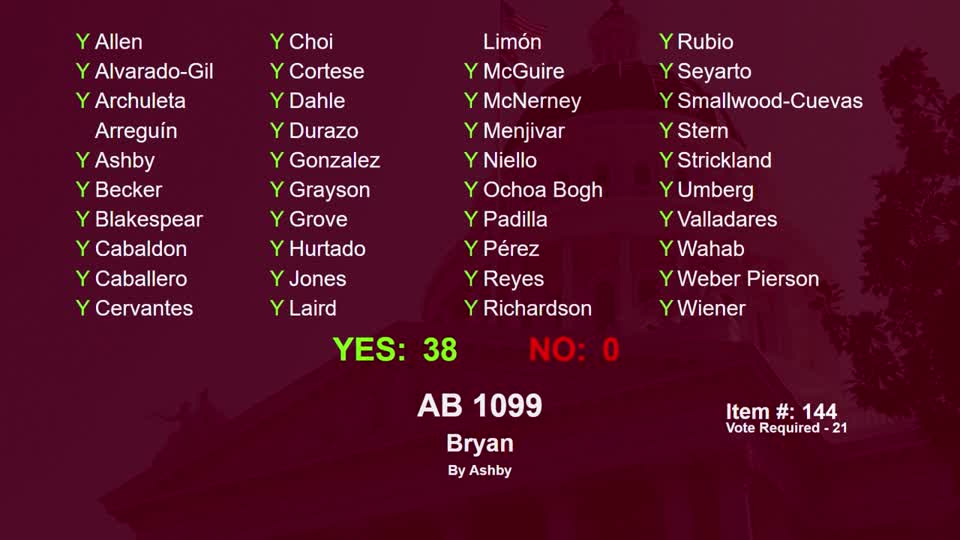 3MIN
Senate Floor
 6MIN
Assembly Standing Committee on Appropriations
 13MIN
Assembly Standing Committee on Judiciary
 10MIN
Assembly Standing Committee on Judiciary
 14MIN
Assembly Standing Committee on Privacy and Consumer Protection
 3MIN
Senate Floor
 9MIN
Senate Standing Committee on Judiciary
Bill Author

Bill Co-Author(s):