SB 958: California Environmental Quality Act: environmental impacts: building height.
- Session Year: 2025-2026
- House: Senate
- Latest Version Date: 2026-09-29
Current Status:
Passed
(2026-09-29: Chaptered by Secretary of State. Chapter 788, Statutes of 2026.)
Introduced
In Committee
Awaiting First Chamber Vote
Passed First Chamber
In Committee
Awaiting Second Chamber Vote
Passed Second Chamber
Enacted
The California Environmental Quality Act (CEQA) requires a lead agency, as defined, to prepare, or cause to be prepared, and certify the completion of an environmental impact report on a project that it proposes to carry out or approve that may have a significant effect on the environment or to adopt a negative declaration if it finds that the project will not have that effect. CEQA also requires a lead agency to prepare a mitigated negative declaration for a project that may have a significant effect on the environment if revisions in the project would avoid or mitigate that effect and there is no substantial evidence that the project, as revised, would have a significant effect on the environment.
This bill would, for purposes of CEQA, prohibit the environmental impacts that are associated with increased building height alone from being considered significant impacts on the environment, if a project meets specified conditions, as provided. Because a lead agency would be required to determine if a project meets the specified conditions, the bill would impose a state-mandated local program.
The California Constitution requires the state to reimburse local agencies and school districts for certain costs mandated by the state. Statutory provisions establish procedures for making that reimbursement.
This bill would provide that no reimbursement is required by this act for a specified reason.
The California Environmental Quality Act (CEQA) requires a lead agency, as defined, to prepare, or cause to be prepared, and certify the completion of an environmental impact report on a project that it proposes to carry out or approve that may have a significant effect on the environment or to adopt a negative declaration if it finds that the project will not have that effect. CEQA also requires a lead agency to prepare a mitigated negative declaration for a project that may have a significant effect on the environment if revisions in the project would avoid or mitigate that effect and there is no substantial evidence that the project, as revised, would have a significant effect on the environment.
CEQA exempts from its requirements various activities and projects.This bill would exempt from the requirements of CEQA a project associated with the Midway Rising Specific Plan in the City of San Diego, including any activity or approval necessary for, or incidental to, development, planning, design, subdivision, financing, leasing, construction, operation, or maintenance, provided that the activity is carried out in substantial conformance with the plan and meets, or is consistent with, specified conditions, including conditions related to sustainability. Because a lead agency would be required to determine whether a project qualifies for this exemption, the bill would impose a state-mandated local program.This bill would make legislative findings and declarations as to the necessity of a special statute for the City of San Diego.This bill would, for purposes of CEQA, prohibit the environmental impacts that are associated with increased building height alone from being considered significant impacts on the environment, if a project meets specified conditions, as provided. Because a lead agency would be required to determine if a project meets the specified conditions, the bill would impose a state-mandated local program.
The California Constitution requires the state to reimburse local agencies and school districts for certain costs mandated by the state. Statutory provisions establish procedures for making that reimbursement.
This bill would provide that no reimbursement is required by this act for a specified reason.
The California Environmental Quality Act (CEQA) requires a lead agency, as defined, to prepare, or cause to be prepared, and certify the completion of an environmental impact report on a project that it proposes to carry out or approve that may have a significant effect on the environment or to adopt a negative declaration if it finds that the project will not have that effect. CEQA also requires a lead agency to prepare a mitigated negative declaration for a project that may have a significant effect on the environment if revisions in the project would avoid or mitigate that effect and there is no substantial evidence that the project, as revised, would have a significant effect on the environment.
CEQA exempts from its requirements various activities and projects.
This bill would exempt from the requirements of CEQA a project associated with the Midway Rising Specific Plan in the City of San Diego, including any activity or approval necessary for, or incidental to, development, planning, design, subdivision, financing, leasing, construction, operation, or maintenance, provided that the activity is carried out in substantial conformance with the plan and meets, or is consistent with, specified conditions, including conditions related to sustainability. Because a lead agency would be required to determine whether a project qualifies for this exemption, the bill would impose a state-mandated local program.
This bill would make legislative findings and declarations as to the necessity of a special statute for the City of San Diego.
The California Constitution requires the state to reimburse local agencies and school districts for certain costs mandated by the state. Statutory provisions establish procedures for making that reimbursement.
This bill would provide that no reimbursement is required by this act for a specified reason.
Existing law provides in the Legislatures findings and declarations that it has provided reforms and incentives to facilitate and expedite the construction of affordable housing, as specified.This bill would express the intent of the Legislature to enact legislation that would address the states severe affordable housing shortfall.Existing law provides in the Legislatures findings and declarations that it has provided reforms and incentives to facilitate and expedite the construction of affordable housing, as specified.
This bill would express the intent of the Legislature to enact legislation that would address the states severe affordable housing shortfall.
For purposes of this division, the environmental impacts of a project that are associated with increased building height alone, including, but not limited to, air circulation, noise and light refraction or reflection, shadow, or the potential to attract wildlife, shall not be considered significant impacts on the environment if the project meets all of the following conditions:
(a)The use and density of the project is otherwise analyzed in a certified environmental impact report.
(b)The project is on a previously graded infill site.
(c)There are no sensitive biological resources physically present on the site.
(d)The project is not an industrial use project.
(e)The project is consistent with local airport land use plans.
SEC. 2.No reimbursement is required by this act pursuant to Section 6 of Article XIIIB of the California Constitution because a local agency or school district has the authority to levy service charges, fees, or assessments sufficient to pay for the program or level of service mandated by this act, within the meaning of Section 17556 of the Government Code.
(a)For purposes of this division, the environmental impacts of a project that are associated with increased building height alone, including, but not limited to, air circulation, noise and light refraction or reflection, shadow, or the potential to attract wildlife, shall not be considered significant impacts on the environment if the project meets all of the following conditions:
(1)(a)The use and density of the project is otherwise analyzed in a certified environmental impact report.
(2)(b)The project is on a previously graded infill site.
(3)(c)There are no sensitive biological resources physically present on the site.
(4)(d)The project is not an industrial use project.
(5)For a project that is proposed to be constructed on a site that is greater than 40 acres that has an estimated construction valuation that exceeds one hundred million dollars ($100,000,000) and that is subject to a project-specific environmental impact report, the project shall create high-wage, highly-skilled jobs that pay prevailing wages and living wages, employ a skilled and trained workforce, and provide construction jobs and permanent jobs for Californians.(b)For purposes of this section, jobs that pay prevailing wages means that construction workers employed in the execution of the project will receive at least the general prevailing rate of per diem wages for the type of work and geographic area, as determined by the Director of Industrial Relations pursuant to Sections 1773 and 1773.9 of the Labor Code.(e)The project is consistent with local airport land use plans.
SEC. 2.No reimbursement is required by this act pursuant to Section 6 of Article XIIIB of the California Constitution because a local agency or school district has the authority to levy service charges, fees, or assessments sufficient to pay for the program or level of service mandated by this act, within the meaning of Section 17556 of the Government Code.
(a)For purposes of this division, the environmental impacts of a project that are associated with increased building height alone, including, but not limited to, air circulation, noise and light refraction or reflection, shadow, or the potential to attract wildlife, shall not be considered significant impacts on the environment if the project meets all of the following conditions:
(1)The use and density of the project is otherwise analyzed in a certified environmental impact report.
(2)The project is on a previously graded infill site.
(3)There are no sensitive biological resources physically present on the site.
(4)The project is not an industrial use project.
(5)For a project that is proposed to be constructed on a site that is greater than 40 acres that has an estimated construction valuation that exceeds one hundred million dollars ($100,000,000) and that is subject to a project-specific environmental impact report, the project shall create high-wage, highly-skilled jobs that pay prevailing wages and living wages, employ a skilled and trained workforce, and provide construction jobs and permanent jobs for Californians.
(b)For purposes of this section, jobs that pay prevailing wages means that construction workers employed in the execution of the project will receive at least the general prevailing rate of per diem wages for the type of work and geographic area, as determined by the Director of Industrial Relations pursuant to Sections 1773 and 1773.9 of the Labor Code.
SEC. 2.No reimbursement is required by this act pursuant to Section 6 of Article XIIIB of the California Constitution because a local agency or school district has the authority to levy service charges, fees, or assessments sufficient to pay for the program or level of service mandated by this act, within the meaning of Section 17556 of the Government Code.
(a)For purposes of this division, the environmental impacts of a project that are associated with increased building height alone, including, but not limited to, air circulation, noise and light refraction or reflection, or the potential to attract wildlife, or geotechnical or hydrological effects, shall not be considered significant impacts on the environment if the project meets all of the following conditions:
(1)The use and density of the project is otherwise analyzed in a certified environmental impact report.
(2)The project is on a previously graded infill site.
(3)There are no sensitive biological resources physically present on the site.
(4)The project is not an industrial use project.
(5)For a project that is proposed to be constructed on a site that is greater than 40 acres that has an estimated construction valuation that exceeds one hundred million dollars ($100,000,000) and that is subject to a project-specific environmental impact report, the project shall create high-wage, highly-skilled jobs that pay prevailing wages and living wages, employ a skilled and trained workforce, and provide construction jobs and permanent jobs for Californians.
(b)For purposes of this section, jobs that pay prevailing wages means that construction workers employed in the execution of the project will receive at least the general prevailing rate of per diem wages for the type of work and geographic area, as determined by the Director of Industrial Relations pursuant to Sections 1773 and 1773.9 of the Labor Code.
SEC. 2.No reimbursement is required by this act pursuant to Section 6 of Article XIIIB of the California Constitution because a local agency or school district has the authority to levy service charges, fees, or assessments sufficient to pay for the program or level of service mandated by this act, within the meaning of Section 17556 of the Government Code.
(a)For purposes of this division, the environmental impacts of a project that are associated with increased building height alone, including, but not limited to, air circulation, noise and light refraction or reflection, the potential to attract wildlife, or geotechnical or hydrological effects, shall not be considered significant impacts on the environment if the project meets all of the following conditions:
(1)The use and density of the project is otherwise analyzed in a certified environmental impact report.
(2)The project is on a previously graded infill site.
(3)There are no sensitive biological resources physically present on the site.
(4)The project is not an industrial use project.
(5)For a project that is proposed to be constructed on a site that is greater than 40 acres that has an estimated construction valuation that exceeds one hundred million dollars ($100,000,000) and that is subject to a project-specific environmental impact report, the project shall create high-wage, highly-skilled jobs that pay prevailing wages and living wages, employ a skilled and trained workforce, and provide construction jobs and permanent jobs for Californians.
(b)For purposes of this section, jobs that pay prevailing wages means that construction workers employed in the execution of the project will receive at least the general prevailing rate of per diem wages for the type of work and geographic area, as determined by the Director of Industrial Relations pursuant to Sections 1773 and 1773.9 of the Labor Code.
SEC. 4.SEC. 2.No reimbursement is required by this act pursuant to Section 6 of Article XIIIB of the California Constitution because a local agency or school district has the authority to levy service charges, fees, or assessments sufficient to pay for the program or level of service mandated by this act, within the meaning of Section 17556 of the Government Code.
The Legislature finds and declares all of the following:
(a)Any project that is included in the Midway Rising Specific Plan in the City of San Diego constitutes housing and related public facilities of statewide importance, that environmental review has already been adequately completed through the citys Subsequent Environmental Impact Report No. PRJ-1106734 (SCH No. 2023120451) for the Midway Rising Specific Plan, and that further review would not materially contribute to disclosure or mitigation of environmental effects.
(b)California continues to confront a persistent and statewide housing shortage and affordability crisis, requiring large-scale, mixed-income, infill projects near transit to add homes at all income levels and reduce displacement pressures.
(c)The Midway Rising redevelopment of the sports arena site, owned by the City of San Diego, in the Midway-Pacific Highway community of the city will transform approximately 49 acres of underutilized land into a complete, walkable neighborhood containing not only those much needed homes, but parks, mobility improvements, neighborhood-serving retail, and a modern entertainment venue that will serve and provide economic benefits to the entire region.
(d)The Midway Rising Specific Plan authorizes approximately 4,254 new homes, of which 2,000 are deed-restricted affordable homes at or below 80 percent of area median income, together with up to 130,000 square feet of commercial uses, approximately 14.5 acres of public parks and open space, and a new 16,000-seat multipurpose entertainment center. This scale makes Midway Rising one of the largest mixed-income housing communities on the west coast and the single largest affordable housing development in Californias history.
(e)The project provides more affordable housing than is required by law. Whereas the City of San Diegos inclusionary requirements would require 425 affordable homes, and due to the use of the Surplus Land Act (Article 8 (commencing with Section 54220) of Chapter 5 of Part 1 of Division 2 of Title 5 of the Government Code), the city would require 1,062 affordable homes, the city and the developer have created a plan to construct 2,000 affordable homes. This represents a 47-percent affordable share, with all the units to build on-site.
(f)The site is uniquely sited and centrally located within the City of San Diego with ready access to job centers and other recreation areas. The project will deliver significant sustainability and climate benefits by concentrating growth in a transit priority area, implementing a multimodal street grid with new bicycle, pedestrian, and transit facilities, and constructing onsite and offsite infrastructure upgrades, including water, sewer, stormwater, and drainage systems, to modern standards. The specific plan aligns with the citys general plan, climate action plan, and the regional plan of the San Diego Association of Governments.
(g)As an infill redevelopment of a long-standing public facility and surrounding surface parking lots, Midway Rising is a vehicle miles traveled-efficient project, especially compared to otherwise new green field development, supports mode shift to transit, walking, and biking, and incorporates stormwater quality and low-impact development features.
(h)The project repurposes an aging area that cannot serve current needs, replacing it with a value-generating community asset, and trades 49 acres mostly made up of a black asphalt surface parking area for a project that embraces sustainable principles. It will contain a mixed-use district anchored by a state-of-the-art 16,000-seat entertainment center and a multiacre central urban park, expanding public access to open space and cultural amenities for City of San Diego residents and visitors.
(i)Midway Rising is projected to generate substantial near-term construction employment and long-term economic benefits, including an estimated $285,000,000 in direct annual economic impact upon full operation, approximately 21,900 temporary construction jobs over the buildout, 3,100 permanent onsite jobs with average wages above the current retail mix, and increased local tax revenues, including approximately $1,400,000 per year to the city and $3,900,000 per year to the county.
(j)The City of San Diego selected the Midway Rising team in accordance with the Surplus Land Act (Article 8 (commencing with Section 54220) of Chapter 5 of Part 1 of Division 2 of Title 5 of the Government Code) and conducted a competitive process and extensive due diligence to ensure the highest public benefits from redevelopment of city-owned land.
(k)The Midway Rising Specific Plan and associated actions, including community plan and general plan amendments, rezoning to residential mixed use, and a development agreement, and a subsequent environmental impact report with a mitigation monitoring and reporting program, shall implement the project in phases while addressing environmental impacts as analyzed in a subsequent environmental impact report with a mitigation monitoring and reporting program.
(l)The project includes substantial investments in public infrastructure and mobility, including extensions and upgrades to roadways, bicycle and pedestrian facilities, and transit and complete street elements that improve safety and access for all users.
(m)The addition of 2,000 income-restricted affordable homes, integrated with market-rate housing in a moderate resource area, advances state fair-housing goals, supports affirmatively furthering fair housing, and helps meet regional housing needs.
(n)By delivering thousands of new homes in proximity to major employment centers, educational institutions, and the regional transit network, Midway Rising will help reduce household transportation costs, increase housing options for working families and seniors, and support statewide climate, housing, and equity goals.
(o)Therefore, it is the intent of the Legislature to recognize the statewide significance of the Midway Rising project in the City of San Diego to support its timely delivery of affordable and market-rate homes, public parks, multimodal infrastructure, and economic development benefits, and to encourage similar high-impact, climate-aligned infill housing projects on underutilized public lands across California.
SEC. 2.Section 21080.75 is added to the Public Resources Code, to read:21080.75.(a)This division does not apply to a project described in this section that is part of the Midway Rising Specific Plan, including any activity or approval necessary for, or incidental to, development, planning, design, subdivision, financing, leasing, construction, operation, or maintenance, provided that the activity is carried out in substantial conformance with the Midway Rising Specific Plan and meets, or is consistent with, all of the following:
(1)The project will create at least 4,250 new residential units, of which no less than 2,000 units will be affordable units.
(2)The project will include commercial uses, a multipurpose entertainment venue, and open public spaces.
(3)The City of San Diego has completed and certified the Subsequent Environmental Impact Report No. PRJ-1106734 (SCH No. 2023120451) for the Midway Rising Specific Plan.
(4)The project shall meet all of the following sustainability requirements:
(A)Provide for development with a transit priority area to reduce greenhouse gas emissions.
(B)Accommodate the planned Metropolitan Transit System bus routes by providing two local bus stops and one rapid route bus stop.
(C)Use 100-percent renewable power for all developments from onsite renewable sources, including solar, and when power from renewable sources is unavailable, power that is sourced from San Diego Community Power.
(D)Install rooftop solar on all residential buildings.
(E)Incorporate green building features that include rainwater capture.
(F)Provide waste diversion plans showing how the entertainment venue, described in paragraph (2), will reduce single-use plastic and styrofoam and increase recycling, compost collection, and adequate waste disposal consistent with standards established in City of San Diego ordinances at the time of permitting.
(G)Include Wi-Fi access to support telecommuting and equitable access to information in all public areas.
(H)Allow for community gardens with potential food production and recovery within public space areas.
(I)Incorporate electric vehicle charging spaces.
(J)Incorporate native and drought-tolerant plants.
(K)Provide a minimum of two trees per 5,000 square feet of lot area, with a minimum of one tree per lot.
(L)Design buildings to be all-electric except for emergency generators and commercial kitchen equipment at eating and drinking establishments.
(M)Use light-emitting diode lighting for all exterior lighting.
(5)The project creates high-wage, highly skilled jobs that pay prevailing wages and living wages, employs a skilled and trained workforce, provides construction jobs and permanent jobs for Californians, and helps to reduce unemployment. It is the intent of the Legislature to provide additional authority allowing for the use of project labor agreements to fulfill the requirements of this paragraph.
(b)This section does not restrict the City of San Diegos exercise of police powers to regulate land use or establish more protective local standards outside the scope of this section.
(c)For purposes of this section, the following definitions apply:
(1)Jobs that pay prevailing wages means that construction workers employed in the execution of the project will receive at least the general prevailing rate of per diem wages for the type of work and geographic area, as determined by the Director of Industrial Relations pursuant to Sections 1773 and 1773.9 of the Labor Code.
(2)Project labor agreement means the same as defined in Section 2500 of the Public Contract Code.
(3)Skilled and trained workforce means the same as defined in Section 2601 of the Public Contract Code.
(d)The provisions of this section are severable. If any provision of this act or its application is held invalid, that invalidity shall not affect other provisions or applications that can be given effect without the invalid provision or application.
SEC. 3.The Legislature finds and declares that a special statute is necessary and that a general statute cannot be made applicable within the meaning of Section 16 of Article IV of the California Constitution because of the unique construction of housing projects in the City of San Diego.
SEC. 4.No reimbursement is required by this act pursuant to Section 6 of Article XIIIB of the California Constitution because a local agency or school district has the authority to levy service charges, fees, or assessments sufficient to pay for the program or level of service mandated by this act, within the meaning of Section 17556 of the Government Code.
SECTION 1.It is the intent of the Legislature to enact legislation that would address the states severe affordable housing shortage.It is the intent of the Legislature to enact legislation that would address the states severe affordable housing shortage.
|
Date
|
Status
|
|---|---|
| Sep 29, 2026 | Chaptered by Secretary of State. Chapter 788, Statutes of 2026. |
| Sep 29, 2026 | Approved by the Governor. |
| Sep 8, 2026 | Enrolled and presented to the Governor at 4 p.m. |
| Aug 30, 2026 | Assembly amendments concurred in. (Ayes 40. Noes 0. Page 6147.) Ordered to engrossing and enrolling. |
| Aug 30, 2026 | Assembly amendments concurred in. (Ayes 39. Noes 0.) Ordered to engrossing and enrolling. |
| Aug 25, 2026 | In Senate. Concurrence in Assembly amendments pending. |
| Aug 25, 2026 | Read third time. Passed. (Ayes 55. Noes 5. Page 6526.) Ordered to the Senate. |
| Aug 25, 2026 | Read third time. Passed. Ordered to the Senate. |
| Aug 19, 2026 | Ordered to third reading. |
| Aug 19, 2026 | Read third time and amended. |
| Aug 10, 2026 | Read second time. Ordered to third reading. |
| Aug 6, 2026 | Read second time and amended. Ordered to second reading. |
| Aug 5, 2026 | From committee: Do pass as amended. (Ayes 15. Noes 0.) (August 5). |
| Jun 30, 2026 | From committee: Do pass and re-refer to Com. on APPR. (Ayes 11. Noes 0.) (June 29). Re-referred to Com. on APPR. |
| Jun 22, 2026 | June 22 set for first hearing canceled at the request of author. |
| Jun 15, 2026 | From committee with author's amendments. Read second time and amended. Re-referred to Com. on NAT. RES. |
| Jun 1, 2026 | Referred to Com. on NAT. RES. |
| May 26, 2026 | In Assembly. Read first time. Held at Desk. |
| May 26, 2026 | Read third time. Passed. (Ayes 37. Noes 0. Page 4443.) Ordered to the Assembly. |
| May 26, 2026 | Read third time. Passed. (Ayes 37. Noes 0.) Ordered to the Assembly. |
| May 12, 2026 | Read second time. Ordered to third reading. |
| May 11, 2026 | From committee: Be ordered to second reading pursuant to Senate Rule 28.8. |
| May 4, 2026 | Set for hearing May 11. |
| Apr 30, 2026 | May 4 hearing postponed by committee. |
| Apr 24, 2026 | Set for hearing May 4. |
| Apr 22, 2026 | From committee: Do pass and re-refer to Com. on APPR. (Ayes 7. Noes 0. Page 4013.) (April 22). Re-referred to Com. on APPR. |
| Apr 22, 2026 | From committee: Do pass and re-refer to Com. on APPR. (Ayes 7. Noes 0.) (April 22). Re-referred to Com. on APPR. |
| Apr 16, 2026 | From committee with author's amendments. Read second time and amended. Re-referred to Com. on L. GOV. |
| Apr 15, 2026 | From committee: Do pass and re-refer to Com. on L. GOV. (Ayes 7. Noes 0. Page 3899.) (April 15). Re-referred to Com. on L. GOV. |
| Apr 15, 2026 | From committee: Do pass and re-refer to Com. on L. GOV. (Ayes 7. Noes 0.) (April 15). Re-referred to Com. on L. GOV. |
| Apr 14, 2026 | Set for hearing April 22 in L. GOV. pending receipt. |
| Apr 9, 2026 | Set for hearing April 15. |
| Apr 8, 2026 | Re-referred to Coms. on E.Q. and L. GOV. |
| Mar 24, 2026 | From committee with author's amendments. Read second time and amended. Re-referred to Com. on RLS. |
| Feb 11, 2026 | Referred to Com. on RLS. |
| Feb 3, 2026 | From printer. May be acted upon on or after March 5. |
| Feb 2, 2026 | Introduced. Read first time. To Com. on RLS. for assignment. To print. |
|
Date
|
Description
|
Location
|
Votes
|
|
|---|---|---|---|---|
| Aug 30, 2026 | Unfinished Business SB958 Weber Pierson Concurrence | Senate Floor |
Passed |
|
| Aug 25, 2026 | SB 958 Weber Pierson Senate Third Reading By Ward | Assembly Floor |
Passed |
|
| Aug 5, 2026 | Do pass as amended. | Assembly Standing Committee on Appropriations |
Passed |
|
| Jun 29, 2026 | Do pass and be re-referred to the Committee on [Appropriations] | Assembly Standing Committee on Natural Resources |
Passed |
|
| May 26, 2026 | Senate 3rd Reading SB958 Weber Pierson | Senate Floor |
Passed |
|
| Apr 22, 2026 | Do pass, but first be re-referred to the Committee on [Appropriations] | Senate Standing Committee on Local Government |
Passed |
|
| Apr 15, 2026 | Do pass, but first be re-referred to the Committee on [Local Government] | Senate Standing Committee on Environmental Quality |
Passed |
This list shows positions taken on this bill by organizations on the date displayed, which is linked to the original source.
Positions by individuals are not included.
|
Organization
|
Position
|
Date
|
|---|---|---|
| 8 Individuals | ** Against | |
| Audubon California | ** Against | |
| Audubon California (unless amended) | ** Against | |
| California Airports Council | ** Against | |
| California Airports Council (unless amended) | ** Against | |
| City Of San Diego | ** Support | |
| Embarcadero Coalition of San Diego | ** Against | |
| Mayor Todd Gloria, City of San Diego | ** Support | |
| Peninsula Community Planning Board | ** Against | |
| San Diego Councilmember Jennifer Campbell | ** Support | |
| San Diego Mayor Todd Gloria (sponsor) | ** Support | |
| San Diego Regional Chamber Of Commerce | ** Support | |
| Western Electrical Contractors Association | ** Against | |
| Western States Regional Council of Carpenters | ** Support |
SENATE RULES COMMITTEE Office of Senate Floor Analyses (916) 651-4171 | SB 958 |
UNFINISHED BUSINESS
Bill No: SB 958
Author: Weber Pierson (D)
Amended: 8/19/26
Vote: 21
SENATE ENVIRONMENTAL QUALITY COMMITTEE: 7-0, 4/15/26
AYES: Blakespear, Valladares, Allen, Dahle, Gonzalez, Hurtado, Menjivar
SENATE LOCAL GOVERNMENT COMMITTEE: 7-0, 4/22/26
AYES: Durazo, Choi, Arreguín, Ashby, Cervantes, Laird, Seyarto
SENATE APPROPRIATIONS COMMITTEE: Senate Rule 28.8
SENATE FLOOR: 37-0, 5/26/26
AYES: Allen, Alvarado-Gil, Archuleta, Arreguín, Ashby, Becker, Blakespear, Cabaldon, Caballero, Cervantes, Choi, Cortese, Durazo, Grayson, Grove, Hurtado, Jones, Laird, Limón, McGuire, McNerney, Menjivar, Ochoa Bogh, Padilla, Pérez, Reyes, Richardson, Rubio, Seyarto, Smallwood-Cuevas, Stern, Strickland, Umberg, Valladares, Wahab, Weber Pierson, Wiener
NO VOTE RECORDED: Dahle, Gonzalez, Niello
ASSEMBLY FLOOR: 55-5, 8/25/26 - See last page for vote
SUBJECT: California Environmental Quality Act: exemption: City of San Diego: Midway Rising Specific Plan
SOURCE: Author
DIGEST:
This bill, for purposes of the California Environmental Quality Act (CEQA), provides that building height is not a significant impact on the environment for specified non-industrial infill projects.
Assembly Amendments strike the specification that building height is not a significant impact under CEQA for projects greater than 40 acres and exceeded one hundred million dollars and the requirement that projects provide jobs that pay prevailing wages.
ANALYSIS:
Existing law:
- Requires under CEQA that a lead agency determines whether a project is exempt from CEQA, or if it must do an initial study to determine if a project will have significant effects on the environment. If a project has no effect on the environment or effects that can be mitigated, the lead agency prepares a negative declaration (ND) or mitigated ND (MND). If the project will have significant impacts, the lead agency prepares an environmental impact report (EIR) to evaluate and propose mitigation measures for any effects on the environment, including impacts or likely impacts to land, air, water, minerals, flora, fauna, ambient noise, and historic or aesthetic significance. (Public Resources Code (PRC) §§21000 et seq.)
- Establishes over 135 statutory CEQA exemptions in the public resources code, water code, government code and other statutes.
- Establishes 33 categorical CEQA exemptions in the California Code of Regulations. (CEQA guidelines §15260- 15285). Categorical exemptions generally do not apply if there are significant environmental effects of the project, and specific exclusions include the site being located in a sensitive environment, on a hazardous waste site, having cumulative impacts over time, significantly adversely impacting a historic resource, or it there are other unusual circumstances that would cause a project to have a reasonable possibility for a significant effect on the environment due to unusual circumstances.
This bill:
- Prohibits the environmental impacts of a project that are associated with increased building height alone, including air circulation, noise and light refraction or reflection, shadow, or the potential to attract wildlife, from being considered significant impacts on the environment if the project meets the following conditions:
- The use and density of the project is otherwise analyzed in a certified Environmental Impact Report (EIR).
- The project is on a previously graded infill site
- There are no sensitive biological resources physically present on the site.
- The project is not an industrial use project.
- The project is consistent with local airport land use plans
Background
- The A, B, C’s of CEQA. CEQA is designed to (a) make government agencies and the public aware of the environmental impacts of a proposed project, (b) ensure the public can take part in the review process, and (c) identify and implement measures to mitigate or eliminate any negative impact the project may have on the environment. CEQA is enforced by civil lawsuits that can challenge any project’s environmental review. Nonprofits, private individuals, public agencies, advocacy groups, and other organizations can all file lawsuits under CEQA: CEQA is the only state environmental protection law that allows for citizen lawsuits. In the case of a CEQA lawsuit, it is ultimately up to the courts to determine if the environmental review was sufficient to meet the requirements of CEQA.
- Environmental Review under CEQA. Under CEQA, projects (unless they have a specific exemption) must undergo environmental analysis. This process starts with an initial study which determines what level of further environmental review is needed for a given project. If a project has no significant effects on the environment, or if those effects can be fully mitigated, the project can move forward with a negative declaration (ND) or mitigated negative declaration (MND). If the initial study finds that the project has potential significant effects on the environment, then a full EIR is conducted. An EIR provides thorough environmental review of a proposed project, analyzing the significant direct and indirect environmental impacts of a proposed project on water quality, transportation, air quality and greenhouse gas emissions, terrestrial and aquatic biological resources, surface and subsurface hydrology, land use and agricultural resources, aesthetics, geology and soils, recreation, public services and utilities such as water supply and wastewater disposal, and cultural resources, among other factors. The EIR also includes proposed mitigation measures for any significant effects that it identifies and considers alternatives to the proposed project.
- Midway Rising. Midway Rising is a proposed development in the City of San Diego that covers 49 acres of City-owned land at the San Diego Sports Arena site in the Midway-Pacific Highway community. The project is envisioned to include a 16,000-seat sports arena, 14 acres of parks and public space, a mixed-use entertainment, arts, and cultural district, and 4,250 housing units (2,000 of which will be affordable at 80% below area median income). The project is intended to replace an older stadium and associated parking lots. When built, Midway Rising will include one of the largest mixed-income and affordable housing projects in California. The project is also expected to generate roughly 21,900 temporary construction jobs and 3,100 permanent positions in entertainment, hospitality, and retail, and is subject to a project labor agreement with the San Diego County Building and Construction Trades Council.
The path to permitting Midway Rising has not been smooth. The project is located within an area of San Diego that is subject to San Diego’s Coastal Height Limit Overlay Zone, which generally limits building heights to 30 feet. In 2018, the City completed a program environmental impact report (PEIR) for the land use plans governing the area to enable development of the project. Because aspects of the project exceeded the 30-foot height limit, the City submitted a ballot measure to voters to raise the height limit for the project area in 2020. The City relied on the PEIR as the environmental analysis for the project. However, the Fourth District Court of Appeals invalidated that ballot measure because the PEIR did not consider potential environmental impacts of removing the height limit. While that appeal was pending, in 2022 the City prepared a supplemental environmental impact report (SEIR) and approved a second ballot measure to remove the height limit from the same area. The Fourth District also invalidated the second ballot measure for similar reasons. The Court noted:
“The 2022 draft SEIR recognized removal of the Coastal Zone height limit was a changed circumstance from the 2018 PEIR. Yet, for almost every category of potential environmental impacts the initial study addressed, it said the PEIR adequately examined potential impacts because the project ‘would be limited to the [Midway Rising] area footprint and land use, density, and zoning analyzed in the 2018 PEIR.’”[1]
The Court went on to identify a litany of impacts that could be related to building height that were not examined in the PEIR. The City of San Diego wants to streamline the CEQA process for the Midway Rising project.
Comments
Purpose of Bill. According to the author, “The Midway Rising Project will transform nearly 50 acres of underused, blighted City-owned land into a vibrant, modern district that directly addresses our region’s housing shortage while delivering lasting economic and community benefits. It will deliver more than 4,000 homes, including 2,000 affordable and income-restricted, a state-of-the-art sports and entertainment venue, and more than 14 acres of parks and open space. SB 958 is a targeted, catalytic solution to move this transformational project forward after years of planning, extensive environmental review, and voter approval through two separate ballot measures. The bill upholds environmental accountability and is explicitly contingent on the certification and adoption of the final Environmental Impact Report already completed by the City of San Diego.
“Once completed, Midway Rising is projected to generate millions in local economic impact, create thousands of permanent jobs, support new businesses, utilize a highly-skilled and trained workforce, and produce long-term economic opportunities and tax revenue for the City and County of San Diego. Proposed to be the largest affordable housing project in the western United States, Midway Rising carries significant statewide importance and promise. At a time when California faces an urgent housing crisis, SB 958 advances a meaningful solution for San Diego and the state.”
‘What is Environmental Impacts’ for 500 points. It is fair to consider that the environmental impacts for building a project 30 feet high could be different from the impacts of building one that is 130 or 165 feet tall. However, the court’s ruling that the SEIR did not adequately consider those environmental effects related to building height include the following considerations:
- How could tall buildings in and around the Midway-Pacific Highway area influence dispersal of predicted emissions or odors?
- Will noise reflected or refracted from taller buildings disturb sensitive species in or adjacent to the Midway-Pacific Highway area?
- Will light from rows of buildings near the San Diego River disturb the lunar cycles of sensitive wildlife?
- Will numerous tall buildings cause increased runoff that will impact sensitive habitats?
- Will changed topography, noise, and light from new building heights fragment and disrupt the recognized wildlife corridor along the San Diego River?
- If man-made structures draw [peregrine falcons] (or others) to the area for nesting, will the project otherwise impact them?
While some queries on the impacts of building height on the environment, including aesthetics, shadow, wind, and reflection, are routinely considered in applicable cases, several of the considerations in this particular ruling are unique to say the least, and as such it’s not clear how Midway Rising’s SEIR would have anticipated and included these specific environmental impacts.
Courts have discretion in evaluating whether or not the lead agency adequately considered the environmental impacts of the project. However, the Legislature has the capability to overturn judicial rulings related to CEQA. Most prominently in recent years was the specification in AB 1307 (Wicks Chapter 160, Statutes of 2023) that for residential projects, the effects of noise generated by project occupants and their guests on human beings is not a significant effect on the environment.
SB 958 uses a similar approach to AB 1307 by course correcting a court ruling on what constitutes environmental impacts under CEQA—and applying it broadly to all future projects.
FISCAL EFFECT: Appropriation: No Fiscal Com.: Yes Local: Yes
None
SUPPORT: (Verified 8/25/26)
Mayor Todd Gloria, City of San Diego
San Diego Councilmember Jennifer Campbell
Western States Regional Council of Carpenters
OPPOSITION: (Verified 8/25/26)
Western Electrical Contractors Association
Peninsula Community Planning Board
ASSEMBLY FLOOR: 55-5, 8/25/26
AYES: Aguiar-Curry, Ahrens, Alanis, Alvarez, Arambula, Ávila Farías, Bains, Bauer-Kahan, Bennett, Bonta, Bryan, Caloza, Carrillo, Chen, Davies, Elhawary, Ellis, Flora, Fong, Gabriel, Gipson, Jeff Gonzalez, Mark González, Hadwick, Haney, Harabedian, Hoover, Jackson, Kalra, Lee, Lowenthal, Macedo, Nguyen, Pacheco, Papan, Patterson, Petrie-Norris, Quirk-Silva, Ransom, Michelle Rodriguez, Blanca Rubio, Schiavo, Schultz, Sharp-Collins, Solache, Soria, Stefani, Ta, Tangipa, Valencia, Wallis, Ward, Wicks, Wilson, Rivas
NOES: Addis, Castillo, DeMaio, Dixon, Pellerin
NO VOTE RECORDED: Berman, Boerner, Calderon, Connolly, Garcia, Hart, Irwin, Johnson, Krell, Lackey, McKinnor, Muratsuchi, Ortega, Patel, Ramos, Celeste Rodriguez, Rogers, Sanchez, Zbur
Prepared by: Brynn Cook / E.Q. / (916) 651-4108
8/26/26 14:50:23
**** END ****
Save Our Access v. City of San Diego, 115 Cal. App. 5th 388 ↑
SENATE THIRD READING
STR Bill Id:SB 958
Author:(Weber Pierson)
As Amended Ver:August 19, 2026
Majority vote
SUMMARY
For purposes of the California Environmental Quality Act (CEQA), provides that building height is not a significant impact on the environment for specified non-industrial infill projects.
Major Provisions
Prohibits the environmental impacts of a project that are associated with increased building height alone, including air circulation, noise and light refraction or reflection, shadow, or the potential to attract wildlife, from being considered significant impacts on the environment if the project meets the following conditions:
- The use and density of the project is otherwise analyzed in a certified Environmental Impact Report (EIR).
- The project is on a previously graded infill site.
- There are no sensitive biological resources physically present on the site.
- The project is not an industrial use project.
- The project is consistent with local airport land use plans.
COMMENTS
This bill is intended to advance the Midway Rising project in the City of San Diego, notwithstanding adverse court decisions, most recently by the Fourth District Court of Appeal in 2025, regarding the City's environmental review.
Midway Rising is a proposed development in the City of San Diego that covers 49 acres of City-owned land at the San Diego Sports Arena site in the Midway-Pacific Highway community (west of I-5 and south of I-8). The project is envisioned to include a 16,000-seat sports arena, 14 acres of parks and public space, a mixed-use entertainment, arts, and cultural district, and 4,250 housing units (2,000 of which will be affordable at 80% below area median income). The project is intended to replace an older stadium and associated parking lots.
The project is located within an area of San Diego that is subject to San Diego's Coastal Height Limit Overlay Zone, which was established by the voters in 1972 and generally limits building heights to 30 feet west of I-5 to protect coastal views. In 2018, the City completed a program environmental impact report (PEIR) for the land use plans governing the area to enable development of the project. Because both the arena and several residential buildings exceeded the 30-foot height limit, the City submitted a ballot measure to voters in 2020 to raise the height limit for the project area. The City relied on the PEIR as the environmental analysis for the project. However, the Fourth District Court of Appeals invalidated that ballot measure because the PEIR did not consider potential environmental impacts of removing the height limit. While that appeal was pending, in 2022 the City prepared a supplemental environmental impact report (SEIR) and approved a second ballot measure to remove the height limit from the same area. The Fourth District also invalidated the second ballot measure for similar reasons. The Court noted:
The 2022 draft SEIR recognized removal of the Coastal Zone height limit was a changed circumstance from the 2018 PEIR. Yet, for almost every category of potential environmental impacts the initial study addressed, it said the PEIR adequately examined potential impacts because the project "would be limited to the [Midway Rising] area footprint and land use, density, and zoning analyzed in the 2018 PEIR."
The Court went on to identify a litany of impacts that could be related to building height that were not examined in the PEIR.
While the most immediate effect of this bill is to clear a path for the City to approve the Midway Rising project, the Fourth District’s findings regarding the City's failure to analyze the environmental impacts of building height have broader implications. Likewise, this bill has a broader effect.
This bill's exemption from consideration of environmental impacts is strictly limited to building height, and only for projects that meet the bill’s other conditions. For example, building design or features that may cause significant impacts independent of increased building height, including light or glare, are not excluded from CEQA review by the bill. Also, the bill suggests that building height alone may be considered a significant impact for any project that does not meet the bill's several conditions.
According to the Author
SB 958 is about providing clarity and certainty within the CEQA process while maintaining strong environmental protections. Recent court decisions have created confusion regarding how environmental impacts associated solely with increased building height should be analyzed, creating uncertainty for housing, mixed-use, and infill projects throughout California. This bill establishes a narrow and thoughtful clarification in state law to ensure that projects are evaluated based on meaningful environmental impacts rather than speculative claims tied only to height itself. As California continues to confront interconnected housing, climate, and affordability challenges, we must support well-planned infill development near jobs, transit, and existing infrastructure while preserving the integrity of CEQA's environmental review process. SB 958 strikes that balance and helps ensure that projects approved through robust public planning processes can move forward with greater predictability and transparency.
Arguments in Support
According to bill sponsor San Diego Mayor Todd Gloria, SB 958 addresses a growing area of legal uncertainty that has significant implications for housing production, infill development, local planning, and voter-approved land use decisions throughout California. By narrowly clarifying how environmental impacts associated solely with increased building height should be analyzed under CEQA when specified conditions are met, this bill will help ensure greater predictability and consistency in the environmental review process while fully preserving CEQA's robust environmental protections.
Arguments in Opposition
The Peninsula Community Planning Board, which provides community planning oversight for the Point Loma area west of Midway Rising, opposes the bill, stating that "(f)uture applicants near airports, military installations, coastal zones, and sensitive viewsheds will invoke SB 958 to avoid meaningful height impact review."
Audubon California states that "urban and migratory birds face high rates of collision with heightened buildings due to disorientation caused by artificial lighting and daytime window strikes" and asks for amendments to require consideration of impacts on birds and wildlife.
FISCAL COMMENTS
According to the Assembly Appropriations Committee, negligible state costs.
VOTES
SENATE FLOOR: 37-0-3
YES: Allen, Alvarado-Gil, Archuleta, Arreguín, Ashby, Becker, Blakespear, Cabaldon, Caballero, Cervantes, Choi, Cortese, Durazo, Grayson, Grove, Hurtado, Jones, Laird, Limón, McGuire, McNerney, Menjivar, Ochoa Bogh, Padilla, Pérez, Reyes, Richardson, Rubio, Seyarto, Smallwood-Cuevas, Stern, Strickland, Umberg, Valladares, Wahab, Weber Pierson, Wiener
ABS, ABST OR NV: Dahle, Gonzalez, Niello
ASM NATURAL RESOURCES: 11-0-3
YES: Bryan, Ellis, Alanis, Garcia, Haney, Hoover, Kalra, Macedo, Schultz, Wicks, Zbur
ABS, ABST OR NV: Connolly, Muratsuchi, Pellerin
ASM APPROPRIATIONS: 15-0-0
YES: Wicks, Hoover, Arambula, Calderon, Caloza, Dixon, Fong, Mark González, Krell, Pacheco, Pellerin, Sharp-Collins, Solache, Ta, Tangipa
UPDATED
VERSION: August 19, 2026
CONSULTANT: Lawrence Lingbloom / NAT. RES. / (916) 319-2092 FN: 0003853
SENATE THIRD READING
STR Bill Id:SB 958
Author:(Weber Pierson)
As Amended Ver:August 06, 2026
Majority vote
SUMMARY
For purposes of the California Environmental Quality Act (CEQA), provides that building height is not a significant impact on the environment for specified non-industrial infill projects.
Major Provisions
Prohibits the environmental impacts of a project that are associated with increased building height alone, including air circulation, noise and light refraction or reflection, shadow, or the potential to attract wildlife, from being considered significant impacts on the environment if the project meets the following conditions:
- The use and density of the project is otherwise analyzed in a certified Environmental Impact Report (EIR).
- The project is on a previously graded infill site.
- There are no sensitive biological resources physically present on the site.
- The project is not an industrial use project.
- Requires a project that is proposed to be constructed on a site that is greater than 40 acres that has an estimated construction valuation that exceeds $100 million and that is subject to a project-specific EIR to create high-wage, highly-skilled jobs that pay prevailing wages and living wages, employ a skilled and trained workforce, and provide construction jobs and permanent jobs for Californians.
- Defines "jobs that pay prevailing wages" as construction workers employed in the execution of the project will receive at least the general prevailing rate of per diem wages for the type of work and geographic area, as determined by the Director of Industrial Relations.
COMMENTS
This bill is intended to advance the Midway Rising project in the City of San Diego, notwithstanding adverse court decisions, most recently by the Fourth District Court of Appeal in 2025, regarding the City's environmental review.
Midway Rising is a proposed development in the City of San Diego that covers 49 acres of City-owned land at the San Diego Sports Arena site in the Midway-Pacific Highway community (west of I-5 and south of I-8). The project is envisioned to include a 16,000-seat sports arena, 14 acres of parks and public space, a mixed-use entertainment, arts, and cultural district, and 4,250 housing units (2,000 of which will be affordable at 80% below area median income). The project is intended to replace an older stadium and associated parking lots.
The project is located within an area of San Diego that is subject to San Diego's Coastal Height Limit Overlay Zone, which was established by the voters in 1972 and generally limits building heights to 30 feet west of I-5 to protect coastal views. In 2018, the City completed a program environmental impact report (PEIR) for the land use plans governing the area to enable development of the project. Because both the arena and several residential buildings exceeded the 30-foot height limit, the City submitted a ballot measure to voters in 2020 to raise the height limit for the project area. The City relied on the PEIR as the environmental analysis for the project. However, the Fourth District Court of Appeals invalidated that ballot measure because the PEIR did not consider potential environmental impacts of removing the height limit. While that appeal was pending, in 2022 the City prepared a supplemental environmental impact report (SEIR) and approved a second ballot measure to remove the height limit from the same area. The Fourth District also invalidated the second ballot measure for similar reasons. The Court noted:
The 2022 draft SEIR recognized removal of the Coastal Zone height limit was a changed circumstance from the 2018 PEIR. Yet, for almost every category of potential environmental impacts the initial study addressed, it said the PEIR adequately examined potential impacts because the project "would be limited to the [Midway Rising] area footprint and land use, density, and zoning analyzed in the 2018 PEIR."
The Court went on to identify a litany of impacts that could be related to building height that were not examined in the PEIR.
While the most immediate effect of this bill is to clear a path for the City to approve the Midway Rising project, the Fourth District's findings regarding the City's failure to analyze the environmental impacts of building height have broader implications. Likewise, this bill has a broader effect.
This bill's exemption from consideration of environmental impacts is strictly limited to building height, and only for projects that meet the bill's other conditions. For example, building design or features that may cause significant impacts independent of increased building height, including light or glare, are not excluded from CEQA review by the bill. Also, the bill suggests that building height alone may be considered a significant impact for any project that does not meet the bill's several conditions.
According to the Author
SB 958 is about providing clarity and certainty within the CEQA process while maintaining strong environmental protections. Recent court decisions have created confusion regarding how environmental impacts associated solely with increased building height should be analyzed, creating uncertainty for housing, mixed-use, and infill projects throughout California. This bill establishes a narrow and thoughtful clarification in state law to ensure that projects are evaluated based on meaningful environmental impacts rather than speculative claims tied only to height itself. As California continues to confront interconnected housing, climate, and affordability challenges, we must support well-planned infill development near jobs, transit, and existing infrastructure while preserving the integrity of CEQA's environmental review process. SB 958 strikes that balance and helps ensure that projects approved through robust public planning processes can move forward with greater predictability and transparency.
Arguments in Support
According to bill sponsor San Diego Mayor Todd Gloria, SB 958 addresses a growing area of legal uncertainty that has significant implications for housing production, infill development, local planning, and voter-approved land use decisions throughout California. By narrowly clarifying how environmental impacts associated solely with increased building height should be analyzed under CEQA when specified conditions are met, this bill will help ensure greater predictability and consistency in the environmental review process while fully preserving CEQA's robust environmental protections.
Arguments in Opposition
The Peninsula Community Planning Board, which provides community planning oversight for the Point Loma area west of Midway Rising, opposes the bill, stating that "(f)uture applicants near airports, military installations, coastal zones, and sensitive viewsheds will invoke SB 958 to avoid meaningful height impact review."
Audubon California states that "urban and migratory birds face high rates of collision with heightened buildings due to disorientation caused by artificial lighting and daytime window strikes" and asks for amendments to require consideration of impacts on birds and wildlife.
The California Airports Council states that "SB 958 may inadvertently limit the consideration of airport land use compatibility and aviation safety concerns associated with increased building height near airports" and asks for amendments to require consistency with local Airport Land Use Compatibility Plans.
FISCAL COMMENTS
According to the Assembly Appropriations Committee, negligible state costs.
VOTES
SENATE FLOOR: 37-0-3
YES: Allen, Alvarado-Gil, Archuleta, Arreguín, Ashby, Becker, Blakespear, Cabaldon, Caballero, Cervantes, Choi, Cortese, Durazo, Grayson, Grove, Hurtado, Jones, Laird, Limón, McGuire, McNerney, Menjivar, Ochoa Bogh, Padilla, Pérez, Reyes, Richardson, Rubio, Seyarto, Smallwood-Cuevas, Stern, Strickland, Umberg, Valladares, Wahab, Weber Pierson, Wiener
ABS, ABST OR NV: Dahle, Gonzalez, Niello
ASM NATURAL RESOURCES: 11-0-3
YES: Bryan, Ellis, Alanis, Garcia, Haney, Hoover, Kalra, Macedo, Schultz, Wicks, Zbur
ABS, ABST OR NV: Connolly, Muratsuchi, Pellerin
ASM APPROPRIATIONS: 15-0-0
YES: Wicks, Hoover, Arambula, Calderon, Caloza, Dixon, Fong, Mark González, Krell, Pacheco, Pellerin, Sharp-Collins, Solache, Ta, Tangipa
UPDATED
VERSION: August 06, 2026
CONSULTANT: Lawrence Lingbloom / NAT. RES. / (916) 319-2092 FN: 0003401
Date of Hearing: August 5, 2026
ASSEMBLY COMMITTEE ON APPROPRIATIONS
Buffy Wicks, Chair
SBPCA Bill Id:SB 958
Author:(Weber Pierson) – As Amended Ver:June 15, 2026
Policy Committee: | Natural Resources | Vote: | 11 - 0 |
|
| ||
|
|
Urgency: No State Mandated Local Program: Yes Reimbursable: No
SUMMARY:
This bill provides, for purposes of the California Environmental Quality Act (CEQA), that building height is not a significant impact on the environment for specified non-industrial infill projects.
Specifically, this bill prohibits the environmental impacts of a project that are associated with increased building height alone, including air circulation, noise and light refraction or reflection, or the potential to attract wildlife, from being considered significant impacts on the environment if the project meets the following conditions: the use and density of the project is otherwise analyzed in a certified environmental impact report (EIR); the project is on a previously graded infill site; there are no sensitive biological resources physically present on the site; the project is not an industrial use project; and for a project proposed to be constructed on a site greater than 40 acres that has an estimated construction valuation that exceeds $100 million and that is subject to a project-specific EIR, the project must create high-wage, highly-skilled jobs that pay prevailing wages (as defined) and living wages, employ a skilled and trained workforce, and provide construction jobs and permanent jobs for Californians.
FISCAL EFFECT:
Negligible state costs.
COMMENTS:
1) Purpose. According to the author:
SB 958 is about providing clarity and certainty within the CEQA process while maintaining strong environmental protections. Recent court decisions have created confusion regarding how environmental impacts associated solely with increased building height should be analyzed, creating uncertainty for housing, mixed-use, and infill projects throughout California. This bill establishes a narrow and thoughtful clarification in state law to ensure that projects are evaluated based on meaningful environmental impacts rather than speculative claims tied only to height itself.
2) Background. This bill is intended to advance the Midway Rising project in the City of San Diego – which is to include a 16,000-seat sports arena, 14 acres of parks and public space, a mixed-use entertainment, arts, and cultural district, and over 4,000 housing units (2,000 of which will be affordable at 80% below area median income).
The project is located within an area of San Diego that is subject to San Diego’s Coastal Height Limit Overlay Zone, which was established by voters in 1972 and generally limits building heights to 30 feet west of I-5 to protect coastal views. In 2018, the city completed a program environmental impact report (PEIR) for the land use plans governing the area to enable development of the project. Because both the arena and several residential buildings exceeded the 30-foot height limit, the city submitted a ballot measure to voters in 2020 to raise the height limit for the project area. The city relied on the PEIR as the environmental analysis for the project. However, the Fourth District Court of Appeals invalidated that ballot measure because the PEIR did not consider potential environmental impacts of removing the height limit.
While that appeal was pending, in 2022, the city prepared a supplemental environmental impact report and approved a second ballot measure to remove the height limit from the same area. The Fourth District also invalidated the second ballot measure for similar reasons and went on to identify a litany of impacts that could be related to building height that were not examined in the PEIR.
3) Support and Opposition. The City of San Diego, the sponsor of this bill, argues the bill addresses a growing area of legal uncertainty “that has significant implications for housing production, infill development, local planning, and voter approved land use decisions throughout California.” By clarifying how environmental impacts associated solely with increased building height should be analyzed under CEQA when specified conditions are met, the city argues “this bill will help ensure greater predictability and consistency in the environmental review process while fully preserving CEQA’s robust environmental protections.”
Writing in opposition, the Peninsula Community Planning Board argues, among other things, that this bill will not apply only to Midway Rising; rather, any project in California “meeting the bill's five generic conditions will be entitled to this exemption. Future applicants near airports, military installations, coastal zones, and sensitive viewsheds will invoke SB 958 to avoid meaningful height impact review.”
Writing in an oppose-unless-amended position, Audubon California argues this bill would have a significant impact on the state’s wildlife populations. The organization argues urban and migratory birds face high rates of collision with heightened buildings due to disorientation caused by artificial lighting and daytime window strikes. Audubon is requesting amendments to the bill that take the impact on birds and wildlife into consideration when discussing building heights.
Writing in an oppose-unless-amended position, the California Airports Council argues this bill “may inadvertently limit the consideration of airport land use compatibility and aviation safety concerns associated with increased building height near airports,” and is requesting an amendment to add the following condition to the bill: “The project is consistent with local Airport Land Use Compatibility Plans.”
4) Proposed Amendments. The committee and the author have agreed to amend the bill to add “shadow” to the list below:
21080.82. (a) For purposes of this division, the environmental impacts of a project that are associated with increased building height alone, including, but not limited to, air circulation, noise and light refraction or reflection, shadow, or the potential to attract wildlife shall not be considered significant impacts on the environment if the project meets all of the following conditions…
Analysis Prepared by: Nikita Koraddi / APPR. / (916) 319-2081
Date of Hearing: June 29, 2026
ASSEMBLY COMMITTEE ON NATURAL RESOURCES
Isaac G. Bryan, Chair
SBPCA Bill Id:SB 958
Author:(Weber Pierson) – As Amended Ver:June 15, 2026
SENATE VOTE: 37-0
SUBJECT: California Environmental Quality Act: environmental impacts: building height
SUMMARY: For purposes of the California Environmental Quality Act (CEQA), provides that building height is not a significant impact on the environment for specified non-industrial infill projects.
EXISTING LAW:
- Requires lead agencies with the principal responsibility for carrying out or approving a proposed project to prepare a negative declaration, mitigated negative declaration, or environmental impact report (EIR) for this action, unless the project is exempt from CEQA. (Public Resources Code (PRC) 21000 et seq.)
- Defines “environment” as the physical conditions that exist within the area which will be affected by a proposed project, including land, air, water, minerals, flora, fauna, noise, or objects of historic or aesthetic significance. (PRC 21060.5)
- Defines “significant effect on the environment” as a substantial, or potentially substantial, adverse change in the environment. (PRC 21068)
THIS BILL prohibits the environmental impacts of a project that are associated with increased building height alone, including air circulation, noise and light refraction or reflection, or the potential to attract wildlife, from being considered significant impacts on the environment if the project meets the following conditions:
- The use and density of the project is otherwise analyzed in a certified EIR.
- The project is on a previously graded infill site.
- There are no sensitive biological resources physically present on the site.
- The project is not an industrial use project.
- Requires a project that is proposed to be constructed on a site that is greater than 40 acres that has an estimated construction valuation that exceeds $100 million and that is subject to a project-specific EIR to create high-wage, highly-skilled jobs that pay prevailing wages and living wages, employ a skilled and trained workforce, and provide construction jobs and permanent jobs for Californians.
- Defines “jobs that pay prevailing wages” as construction workers employed in the execution of the project will receive at least the general prevailing rate of per diem wages for the type of work and geographic area, as determined by the Director of Industrial Relations.
FISCAL EFFECT: According to the Senate Appropriations Committee, pursuant to Senate Rule 28.8, negligible state costs.
COMMENTS:
- Background. This bill is intended to advance the Midway Rising project in the City of San Diego, notwithstanding adverse court decisions, most recently by the Fourth District Court of Appeal in 2025, regarding the City’s environmental review.
Midway Rising is a proposed development in the City of San Diego that covers 49 acres of City-owned land at the San Diego Sports Arena site in the Midway-Pacific Highway community (west of I-5 and south of I-8). The project is envisioned to include a 16,000-seat sports arena, 14 acres of parks and public space, a mixed-use entertainment, arts, and cultural district, and 4,250 housing units (2,000 of which will be affordable at 80% below area median income). The project is intended to replace an older stadium and associated parking lots.
The project is located within an area of San Diego that is subject to San Diego’s Coastal Height Limit Overlay Zone, which was established by the voters in 1972 and generally limits building heights to 30 feet west of I-5 to protect coastal views. In 2018, the City completed a program environmental impact report (PEIR) for the land use plans governing the area to enable development of the project. Because both the arena and several residential buildings exceeded the 30-foot height limit, the City submitted a ballot measure to voters in 2020 to raise the height limit for the project area. The City relied on the PEIR as the environmental analysis for the project. However, the Fourth District Court of Appeals invalidated that ballot measure because the PEIR did not consider potential environmental impacts of removing the height limit. While that appeal was pending, in 2022 the City prepared a supplemental environmental impact report (SEIR) and approved a second ballot measure to remove the height limit from the same area. The Fourth District also invalidated the second ballot measure for similar reasons. The Court noted:
The 2022 draft SEIR recognized removal of the Coastal Zone height limit was a changed circumstance from the 2018 PEIR. Yet, for almost every category of potential environmental impacts the initial study addressed, it said the PEIR adequately examined potential impacts because the project “would be limited to the [Midway Rising] area footprint and land use, density, and zoning analyzed in the 2018 PEIR.”
The Court went on to identify a litany of impacts that could be related to building height that were not examined in the PEIR.
While the most immediate effect of this bill is to clear a path for the City to approve the Midway Rising project, the Fourth District’s findings regarding the City’s failure to analyze the environmental impacts of building height have broader implications. Likewise, this bill has a broader effect.
This bill’s exemption from consideration of environmental impacts is strictly limited to building height, and only for projects that meet the bill’s other conditions. For example, building design or features that may cause significant impacts independent of increased building height, including light or glare, are not excluded from CEQA review by the bill. Also, the bill suggests that building height alone may be considered a significant impact for any project that does not meet the bill’s several conditions.
- Author’s statement:
SB 958 is about providing clarity and certainty within the CEQA process while maintaining strong environmental protections. Recent court decisions have created confusion regarding how environmental impacts associated solely with increased building height should be analyzed, creating uncertainty for housing, mixed-use, and infill projects throughout California. This bill establishes a narrow and thoughtful clarification in state law to ensure that projects are evaluated based on meaningful environmental impacts rather than speculative claims tied only to height itself. As California continues to confront interconnected housing, climate, and affordability challenges, we must support well-planned infill development near jobs, transit, and existing infrastructure while preserving the integrity of CEQA’s environmental review process. SB 958 strikes that balance and helps ensure that projects approved through robust public planning processes can move forward with greater predictability and transparency.
- Opposition concerns. Opposition to this bill comes from Midway Rising project neighbors, bird advocates, and airports.
The Peninsula Community Planning Board, which provides community planning oversight for the Point Loma area west of Midway Rising, opposes the bill outright, stating that “(f)uture applicants near airports, military installations, coastal zones, and sensitive viewsheds will invoke SB 958 to avoid meaningful height impact review.”
Audubon California states that “urban and migratory birds face high rates of collision with heightened buildings due to disorientation caused by artificial lighting and daytime window strikes” and asks for amendments to require consideration of impacts on birds and wildlife.
The California Airports Council states that “SB 958 may inadvertently limit the consideration of airport land use compatibility and aviation safety concerns associated with increased building height near airports” and asks for amendments to require consistency with local Airport Land Use Compatibility Plans.
REGISTERED SUPPORT / OPPOSITION:
Support
San Diego Mayor Todd Gloria (sponsor)
San Diego Regional Chamber of Commerce
Opposition
Audubon California (unless amended)
California Airports Council (unless amended)
Embarcadero Coalition of San Diego
Peninsula Community Planning Board
Analysis Prepared by: Lawrence Lingbloom / NAT. RES. /
Date of Hearing: June 22, 2026
ASSEMBLY COMMITTEE ON NATURAL RESOURCES
Isaac G. Bryan, Chair
SBPCA Bill Id:SB 958
Author:(Weber Pierson) – As Amended Ver:June 15, 2026
SENATE VOTE: 37-0
SUBJECT: California Environmental Quality Act: environmental impacts: building height
SUMMARY: For purposes of the California Environmental Quality Act (CEQA), provides that building height is not a significant impact on the environment for specified non-industrial infill projects.
EXISTING LAW:
- Requires lead agencies with the principal responsibility for carrying out or approving a proposed project to prepare a negative declaration, mitigated negative declaration, or environmental impact report (EIR) for this action, unless the project is exempt from CEQA. (Public Resources Code (PRC) 21000 et seq.)
- Defines "environment" as the physical conditions that exist within the area which will be affected by a proposed project, including land, air, water, minerals, flora, fauna, noise, or objects of historic or aesthetic significance. (PRC 21060.5)
- Defines “significant effect on the environment” as a substantial, or potentially substantial, adverse change in the environment. (PRC 21068)
THIS BILL:
- Prohibits the environmental impacts of a project that are associated with increased building height alone, including air circulation, noise and light refraction or reflection, or the potential to attract wildlife, from being considered significant impacts on the environment if the project meets the following conditions:
- The use and density of the project is otherwise analyzed in a certified EIR.
- The project is on a previously graded infill site.
- There are no sensitive biological resources physically present on the site.
- The project is not an industrial use project.
- Requires a project that is proposed to be constructed on a site that is greater than 40 acres that has an estimated construction valuation that exceeds $100 million and that is subject to a project-specific EIR to create high-wage, highly-skilled jobs that pay prevailing wages and living wages, employ a skilled and trained workforce, and provide construction jobs and permanent jobs for Californians.
- Defines “jobs that pay prevailing wages” as construction workers employed in the execution of the project will receive at least the general prevailing rate of per diem wages for the type of work and geographic area, as determined by the Director of Industrial Relations.
FISCAL EFFECT: According to the Senate Appropriations Committee, pursuant to Senate Rule 28.8, negligible state costs.
COMMENTS:
- Background. This bill is intended to advance the Midway Rising project in the City of San Diego, notwithstanding adverse court decisions, most recently by the Fourth District Court of Appeal in 2025, regarding the City’s environmental review.
Midway Rising is a proposed development in the City of San Diego that covers 49 acres of City-owned land at the San Diego Sports Arena site in the Midway-Pacific Highway community (west of I-5 and south of I-8). The project is envisioned to include a 16,000-seat sports arena, 14 acres of parks and public space, a mixed-use entertainment, arts, and cultural district, and 4,250 housing units (2,000 of which will be affordable at 80% below area median income). The project is intended to replace an older stadium and associated parking lots.
The project is located within an area of San Diego that is subject to San Diego’s Coastal Height Limit Overlay Zone, which was established by the voters in 1972 and generally limits building heights to 30 feet west of I-5 to protect coastal views. In 2018, the City completed a program environmental impact report (PEIR) for the land use plans governing the area to enable development of the project. Because both the arena and several residential buildings exceeded the 30-foot height limit, the City submitted a ballot measure to voters in 2020 to raise the height limit for the project area. The City relied on the PEIR as the environmental analysis for the project. However, the Fourth District Court of Appeals invalidated that ballot measure because the PEIR did not consider potential environmental impacts of removing the height limit. While that appeal was pending, in 2022 the City prepared a supplemental environmental impact report (SEIR) and approved a second ballot measure to remove the height limit from the same area. The Fourth District also invalidated the second ballot measure for similar reasons. The Court noted:
The 2022 draft SEIR recognized removal of the Coastal Zone height limit was a changed circumstance from the 2018 PEIR. Yet, for almost every category of potential environmental impacts the initial study addressed, it said the PEIR adequately examined potential impacts because the project ‘would be limited to the [Midway Rising] area footprint and land use, density, and zoning analyzed in the 2018 PEIR.
The Court went on to identify a litany of impacts that could be related to building height that were not examined in the PEIR.
While the most immediate effect of this bill is to clear a path for the City to approve the Midway Rising project, the Fourth District’s findings regarding the City’s failure to analyze the environmental impacts of building height have broader implications. Likewise, this bill has a broader effect.
This bill’s exemption from consideration of impacts is strictly limited to building height, and only for projects that meet the bill’s other conditions. For example, building design or features that may cause significant impacts independent of increased building height are not excluded from CEQA review by the bill. Also, the bill suggests that building height alone may be considered a significant impact for any project that does not meet the bill’s several conditions.
- Author’s statement:
SB 958 is about providing clarity and certainty within the CEQA process while maintaining strong environmental protections. Recent court decisions have created confusion regarding how environmental impacts associated solely with increased building height should be analyzed, creating uncertainty for housing, mixed-use, and infill projects throughout California. This bill establishes a narrow and thoughtful clarification in state law to ensure that projects are evaluated based on meaningful environmental impacts rather than speculative claims tied only to height itself. As California continues to confront interconnected housing, climate, and affordability challenges, we must support well-planned infill development near jobs, transit, and existing infrastructure while preserving the integrity of CEQA’s environmental review process. SB 958 strikes that balance and helps ensure that projects approved through robust public planning processes can move forward with greater predictability and transparency.
REGISTERED SUPPORT / OPPOSITION:
Support
San Diego Regional Chamber of Commerce
Opposition
Peninsula Community Planning Board
Analysis Prepared by: Lawrence Lingbloom / NAT. RES. /
SENATE RULES COMMITTEE Office of Senate Floor Analyses (916) 651-4171 | SB 958 |
THIRD READING
Bill No: SB 958
Author: Weber Pierson (D)
Amended: 4/16/26
Vote: 21
SENATE ENVIRONMENTAL QUALITY COMMITTEE: 7-0, 4/15/26
AYES: Blakespear, Valladares, Allen, Dahle, Gonzalez, Hurtado, Menjivar
SENATE LOCAL GOVERNMENT COMMITTEE: 7-0, 4/22/26
AYES: Durazo, Choi, Arreguín, Ashby, Cervantes, Laird, Seyarto
SENATE APPROPRIATIONS COMMITTEE: Senate Rule 28.8
SUBJECT: California Environmental Quality Act: environmental impacts: building height
SOURCE: Author
DIGEST:
This bill specifies that environmental impacts that are associated with increased building height alone are not considered significant impacts on the environment under the California Environmental Quality Act (CEQA).
ANALYSIS:
Existing law:
- Requires under CEQA that a lead agency determines whether a project is exempt from CEQA, or if it must do an initial study to determine if a project will have significant effects on the environment. If a project has no effect on the environment or effects that can be mitigated, the lead agency prepares a negative declaration (ND) or mitigated ND (MND). If the project will have significant impacts, the lead agency prepares an environmental impact report (EIR) to evaluate and propose mitigation measures for any effects on the environment, including impacts or likely impacts to land, air, water, minerals, flora, fauna, ambient noise, and historic or aesthetic significance. (Public Resources Code (PRC) §§21000 et seq.)
- Establishes over 135 statutory CEQA exemptions in the public resources code, water code, government code and other statutes.
- Establishes 33 categorical CEQA exemptions in the California Code of Regulations. (CEQA guidelines §15260- 15285). Categorical exemptions generally do not apply if there are significant environmental effects of the project, and specific exclusions include the site being located in a sensitive environment, on a hazardous waste site, having cumulative impacts over time, significantly adversely impacting a historic resource, or it there are other unusual circumstances that would cause a project to have a reasonable possibility for a significant effect on the environment due to unusual circumstances.
This bill states that the environmental impacts of a project that are associated with increased building height alone cannot be considered significant impacts on the environment if the project meets all of the following conditions:
- The use and density of the project is otherwise analyzed in a certified EIR;
- The project is on a previously graded infill site;
- There are no sensitive biological resources physically present on the site;
- The project is not an industrial use; and
- For a project that is proposed to be constructed on a site that is greater than 40 acres that has an estimated construction valuation that exceeds $100 million and that is subject to a project-specific EIR, the project creates high-wage, highly-skilled jobs that pay prevailing wages and living wages, employ a skilled and trained workforce, and provide construction jobs and permanent jobs for Californians.
Background
- The A, B, C’s of CEQA. CEQA is designed to (a) make government agencies and the public aware of the environmental impacts of a proposed project, (b) ensure the public can take part in the review process, and (c) identify and implement measures to mitigate or eliminate any negative impact the project may have on the environment. CEQA is enforced by civil lawsuits that can challenge any project’s environmental review. Nonprofits, private individuals, public agencies, advocacy groups, and other organizations can all file lawsuits under CEQA: CEQA is the only state environmental protection law that allows for citizen lawsuits. In the case of a CEQA lawsuit, it is ultimately up to the courts to determine if the environmental review was sufficient to meet the requirements of CEQA.
- Environmental Review under CEQA. Under CEQA, projects (unless they have a specific exemption) must undergo environmental analysis. This process starts with an initial study which determines what level of further environmental review is needed for a given project. If a project has no significant effects on the environment, or if those effects can be fully mitigated, the project can move forward with a negative declaration (ND) or mitigated negative declaration (MND). If the initial study finds that the project has potential significant effects on the environment, then a full EIR is conducted. An EIR provides thorough environmental review of a proposed project, analyzing the significant direct and indirect environmental impacts of a proposed project on water quality, transportation, air quality and greenhouse gas emissions, terrestrial and aquatic biological resources, surface and subsurface hydrology, land use and agricultural resources, aesthetics, geology and soils, recreation, public services and utilities such as water supply and wastewater disposal, and cultural resources, among other factors. The EIR also includes proposed mitigation measures for any significant effects that it identifies and considers alternatives to the proposed project.
- Midway Rising. Midway Rising is a proposed development in the City of San Diego that covers 49 acres of City-owned land at the San Diego Sports Arena site in the Midway-Pacific Highway community. The project is envisioned to include a 16,000-seat sports arena, 14 acres of parks and public space, a mixed-use entertainment, arts, and cultural district, and 4,250 housing units (2,000 of which will be affordable at 80% below area median income). The project is intended to replace an older stadium and associated parking lots. When built, Midway Rising will include one of the largest mixed-income and affordable housing projects in California. The project is also expected to generate roughly 21,900 temporary construction jobs and 3,100 permanent positions in entertainment, hospitality, and retail, and is subject to a project labor agreement with the San Diego County Building and Construction Trades Council.
The path to permitting Midway Rising has not been smooth. The project is located within an area of San Diego that is subject to San Diego’s Coastal Height Limit Overlay Zone, which generally limits building heights to 30 feet. In 2018, the City completed a program environmental impact report (PEIR) for the land use plans governing the area to enable development of the project. Because aspects of the project exceeded the 30-foot height limit, the City submitted a ballot measure to voters to raise the height limit for the project area in 2020. The City relied on the PEIR as the environmental analysis for the project. However, the Fourth District Court of Appeals invalidated that ballot measure because the PEIR did not consider potential environmental impacts of removing the height limit. While that appeal was pending, in 2022 the City prepared a supplemental environmental impact report (SEIR) and approved a second ballot measure to remove the height limit from the same area. The Fourth District also invalidated the second ballot measure for similar reasons. The Court noted:
“The 2022 draft SEIR recognized removal of the Coastal Zone height limit was a changed circumstance from the 2018 PEIR. Yet, for almost every category of potential environmental impacts the initial study addressed, it said the PEIR adequately examined potential impacts because the project ‘would be limited to the [Midway Rising] area footprint and land use, density, and zoning analyzed in the 2018 PEIR.’”[1]
The Court went on to identify a litany of impacts that could be related to building height that were not examined in the PEIR. The City of San Diego wants to streamline the CEQA process for the Midway Rising project.
Comments
- Purpose of Bill. According to the author, “The Midway Rising Project will transform nearly 50 acres of underused, blighted City-owned land into a vibrant, modern district that directly addresses our region’s housing shortage while delivering lasting economic and community benefits. It will deliver more than 4,000 homes, including 2,000 affordable and income-restricted, a state-of-the-art sports and entertainment venue, and more than 14 acres of parks and open space. SB 958 is a targeted, catalytic solution to move this transformational project forward after years of planning, extensive environmental review, and voter approval through two separate ballot measures. The bill upholds environmental accountability and is explicitly contingent on the certification and adoption of the final Environmental Impact Report already completed by the City of San Diego.
“Once completed, Midway Rising is projected to generate millions in local economic impact, create thousands of permanent jobs, support new businesses, utilize a highly-skilled and trained workforce, and produce long-term economic opportunities and tax revenue for the City and County of San Diego. Proposed to be the largest affordable housing project in the western United States, Midway Rising carries significant statewide importance and promise. At a time when California faces an urgent housing crisis, SB 958 advances a meaningful solution for San Diego and the state.”
- ‘What is Environmental Impacts’ for 500 points. It is fair to consider that the environmental impacts for building a project 30 feet high could be different from the impacts of building one that is 130 or 165 feet tall. However, the court’s ruling that the SEIR did not adequately consider those environmental effects related to building height include the following considerations:
- How could tall buildings in and around the Midway-Pacific Highway area influence dispersal of predicted emissions or odors?
- Will noise reflected or refracted from taller buildings disturb sensitive species in or adjacent to the Midway-Pacific Highway area?
- Will light from rows of buildings near the San Diego River disturb the lunar cycles of sensitive wildlife?
- Will numerous tall buildings cause increased runoff that will impact sensitive habitats?
- Will changed topography, noise, and light from new building heights fragment and disrupt the recognized wildlife corridor along the San Diego River?
- If man-made structures draw [peregrine falcons] (or others) to the area for nesting, will the project otherwise impact them?
While some queries on the impacts of building height on the environment, including aesthetics, shadow, wind, and reflection, are routinely considered in applicable cases, several of the considerations in this particular ruling are unique to say the least, and as such it’s not clear how Midway Rising’s SEIR would have anticipated and included these specific environmental impacts.
Courts have discretion in evaluating whether or not the lead agency adequately considered the environmental impacts of the project. However, the Legislature has the capability to overturn judicial rulings related to CEQA. Most prominently in recent years was the specification in AB 1307 (Wicks Chapter 160, Statutes of 2023) that for residential projects, the effects of noise generated by project occupants and their guests on human beings is not a significant effect on the environment.
SB-958 uses a similar approach to AB 1307 by course correcting a court ruling on what constitutes environmental impacts under CEQA. In practice, this would constrain the scope of further environmental review across California. For midway rising, this would ensure that any future lawsuits on environmental review documents, such as the project specific EIR that is currently being developed by the city of San Diego for midway rising, would not have to consider environmental impacts related to building height alone as specified.
FISCAL EFFECT: Appropriation: No Fiscal Com.: Yes Local: Yes
SUPPORT: (Verified 5/11/26)
Mayor Todd Gloria, City of San Diego
San Diego Councilmember Jennifer Campbell
Western States Regional Council of Carpenters
OPPOSITION: (Verified 5/11/26)
Western Electrical Contractors Association
Prepared by: Brynn Cook / E.Q. / (916) 651-4108
5/13/26 16:27:57
**** END ****
Save Our Access v. City of San Diego, 115 Cal. App. 5th 388 ↑
SENATE COMMITTEE ON LOCAL GOVERNMENT
Senator María Elena Durazo, Chair
2025 - 2026 Regular
Bill No: | SB 958 | Hearing Date: | 4/22/26 |
Author: | Weber Pierson | Fiscal: | Yes |
Version: | 4/16/26 | Consultant: | Favorini-Csorba |
California Environmental Quality Act: environmental impacts: building height
Provides the impacts related to building height for projects meeting specified conditions are not a significant effect on the environment.
Background
The California Constitution allows cities and counties to “make and enforce within its limits, all local, police, sanitary and other ordinances and regulations not in conflict with general laws.” It is from this fundamental power (commonly called the police power) that cities and counties derive their authority to regulate behavior to preserve the health, safety, and welfare of the public—including land use authority.
Every county and city must adopt a general plan with seven mandatory elements: land use, circulation, housing, conservation, open space, noise, and safety. General plans must also either include an eighth element on environmental justice, or incorporate environmental justice concerns throughout the other elements.
The general plan must be “internally consistent,” which means the various elements cannot have conflicting information or assumptions. Additionally, cities’ and counties’ major land use decisions—including zoning ordinances and development permitting—must be consistent with their general plans.
The California Environmental Quality Act. Enacted in 1970, the California Environmental Quality Act (CEQA) requires California’s state and local agencies to evaluate, disclose, and where feasible, mitigate the potential environmental effects of their actions before they approve projects. Statute establishes CEQA’s fundamental purposes to include informing government decision-makers and the public about potential environmental effects, identifying ways to avoid or significantly reduce environmental damage, preventing significant avoidable impacts by adopting feasible mitigation measures or alternatives, and publicly disclosing the rationale for approving projects with unavoidable significant impacts.
CEQA process. Since cities and counties exercise land use authority in their jurisdictions, they are often “lead agencies”—the state or local agency with the principal responsibility for carrying out or approving a project—for purposes of CEQA. CEQA requires a lead agency to first determine whether an action constitutes a “project” under CEQA. A project is a discretionary activity that a public agency proposes to be carried out or approved that could have a foreseeable impact on the physical environment. If an action isn’t a project, or is non-discretionary (ministerial), CEQA does not apply.
Exemptions. Some actions are exempt from CEQA’s requirements because they fall within one of numerous exemptions listed in statute or in the CEQA Guidelines developed by the Office of Planning and Research (recently renamed to the Office of Land Use and Climate Innovation, or “LCI”) that identify classes of projects that do not have a significant effect on the environment (categorical exemptions). A categorical exemption still may not apply to a project if there are “unusual circumstances” or “cumulative impacts” that might cause a significant environmental impact.
Negative declaration. If a project under CEQA isn’t exempt, the lead agency must perform an initial study to determine whether an environmental impact report (EIR) or negative declaration (ND) must be prepared.
If the project will not have a significant effect on the environment, the lead agency can prepare a ND. A lead agency can instead prepare a specific type of ND, known as a “mitigated negative declaration” (MND) for a project when the initial study has identified potentially significant effects on the environment, but:
- The project applicant proposed or agreed to changes to the project that would mitigate the effects to a point where clearly no significant effect on the environment would occur; and
- There is no substantial evidence in light of the whole record before the public agency that the project, as revised, may have a significant effect on the environment.
Environmental Impact Report. If the lead agency can’t prepare an ND or MND, or chooses not to, they must prepare an EIR. As articulated by the California Supreme Court,[1] a lead agency must prepare an EIR whenever substantial evidence in the administrative record supports a “fair argument” that a proposed project “may have a significant effect on the environment,” even if there is other substantial evidence that the project will not have a significant effect.
An EIR provides thorough environmental review of a proposed project, analyzing the significant direct and indirect impacts of a proposed project on a long list of environmental factors, including water quality, transportation, air quality and greenhouse gas emissions, land use, wildfire risk, and many others. The EIR also includes proposed mitigation measures for any significant effects that it identifies. It also requires a consideration of alternatives to the proposed project, and a consideration of cumulative and growth-inducing impacts.
Courts consider the EIR “the ‘heart of CEQA.’ Its purpose is to inform the public and its responsible officials of the environmental consequences of their decisions before they are made. Thus, the EIR ‘protects not only the environment but also informed self-government.’”[2]
EIRs involve very comprehensive analyses of a wide variety of environmental impacts. For example, the City of Los Angeles Planning Department identifies 16 categories of impacts to be examined in an EIR, including: aesthetics; agricultural resources; air quality; biology; cultural resources; geology and soils; greenhouse gas emissions; hazards and hazardous materials; hydrology and water quality; land use and planning; mineral resources; noise; population, housing, and employment; public services and recreation; transportation/circulation; tribal cultural resources; and utilities/service systems.
An EIR that fails to adequately analyze an impact may be ruled invalid by a court, jeopardizing the project for which the EIR was prepared.
Midway Rising. Midway Rising is a proposed development in the City of San Diego that covers 49 acres of City-owned land at the San Diego Sports Arena site in the Midway-Pacific Highway community. The project is envisioned to include a 16,000-seat sports arena, 14 acres of parks and public space, a mixed use entertainment, arts, and cultural district, and 4,250 housing units (2,000 of which will be affordable at 80% below area median income). The project is intended to replace an older stadium and associated parking lots. When built, Midway Rising will include one of the largest mixed-income and affordable housing projects in California. The project is also expected to generate roughly 21,900 temporary construction jobs and 3,100 permanent positions in entertainment, hospitality, and retail, and is subject to a project labor agreement with the San Diego County Building and Construction Trades Council.
The path to permitting Midway Rising has not been smooth. The project is located within an area of San Diego that is subject to San Diego’s Coastal Height Limit Overlay Zone, which generally limits building heights to 30 feet. In 2018, the City completed a program environmental impact report (PEIR) for the land use plans governing the area to enable development of the project. Because aspects of the project exceeded the 30-foot height limit, the City submitted a ballot measure to voters to raise the height limit for the project area in 2020. The City relied on the PEIR as the environmental analysis for the project. However, the Fourth District Court of Appeals invalidated that ballot measure because the PEIR did not consider potential environmental impacts of removing the height limit. While that appeal was pending, in 2022 the City prepared a supplemental environmental impact report (SEIR) and approved a second ballot measure to remove the height limit from the same area. The Fourth District also invalidated the second ballot measure for similar reasons. The Court noted:
“The 2022 draft SEIR recognized removal of the Coastal Zone height limit was a changed circumstance from the 2018 PEIR. Yet, for almost every category of potential environmental impacts the initial study addressed, it said the PEIR adequately examined potential impacts because the project ‘would be limited to the [Midway Rising] area footprint and land use, density, and zoning analyzed in the 2018 PEIR.’”[3]
The Court went on to identify a litany of impacts that could be related to building height that were not examined in the PEIR. The City of San Diego wants to streamline the CEQA process for the Midway Rising project.
Proposed Law
Senate Bill 958 provides that the environmental impacts of a project that are associated with increased building height alone cannot be considered significant impacts on the environment if the project meets all of the following conditions:
- The use and density of the project is otherwise analyzed in a certified EIR;
- The project is on a previously graded infill site;
- There are no sensitive biological resources physically present on the site;
- The project is not an industrial use; and
- For a project that is proposed to be constructed on a site that is greater than 40 acres that has an estimated construction valuation that exceeds $100 million and that is subject to a project-specific EIR, the project creates high-wage, highly-skilled jobs that pay prevailing wages and living wages, employ a skilled and trained workforce, and provide construction jobs and permanent jobs for Californians.
Comments
1. Purpose of the bill. According to the author, “The Midway Rising Project will transform nearly 50 acres of underused, blighted City-owned land into a vibrant, modern district that directly addresses our region’s housing shortage while delivering lasting economic and community benefits. It will deliver more than 4,000 homes, including 2,000 affordable and income-restricted, a state-of-the-art sports and entertainment venue, and more than 14 acres of parks and open space.
“SB 958 moves this transformational project forward after years of planning, extensive environmental review, and voter approval through two separate ballot measures. The bill upholds environmental accountability and requires the certification of the final Environmental Impact Report already completed by the City of San Diego.
“Once completed, Midway Rising is projected to generate millions in local economic impact, create thousands of permanent jobs, support new businesses, utilize a highly-skilled and trained workforce, and produce long-term economic opportunities and tax revenue for the City and County of San Diego.
“Proposed to be the largest affordable housing project in the western United States, Midway Rising carries significant statewide importance and promise. At a time when California faces an urgent housing crisis, SB 958 advances a meaningful solution for San Diego and the state.”
2. Sure, but will it work? The requirements for preparing an EIR are complex and have grown over time. Because of the scope of analysis that must be conducted, an EIR for a project may miss impacts, with the possible outcome of delaying a project approval, as happened in the case of Midway Rising. SB 958 attempts to address the shortcomings of the PEIR for that project by deeming impacts related to building height not a significant effect on the environment, overturning the Court’s decision. However, future approvals related to the project may continue to experience CEQA challenges. SB 958 may not be sufficient to fully insulate the project and allow it to proceed to completion.
3. Mandate. The California Constitution requires the state to reimburse local governments for the costs of new or expanded state mandated local programs. Because SB 958 imposes new duties on local governments, Legislative Counsel says it imposes a new state mandate. SB 958 disclaims the state’s responsibility for providing reimbursement by citing local governments’ authority to charge for the costs of implementing the bill’s provisions.
4. Incoming! The Senate Rules Committee has ordered a double referral of SB 958: first to the Committee on Environmental Quality, which approved the bill at its April 15th hearing on a vote of 7-0, and second to the Committee on Local Government.
Support and Opposition
(4/17/2026)
Support: Mayor Todd Gloria; City of San Diego (Sponsor)
Councilmember Jennifer Campbell; City of San Diego
Opposition: None Submitted
-- END --
SENATE COMMITTEE ON ENVIRONMENTAL QUALITY
Senator Blakespear, Chair
2025 - 2026 Regular
Bill No: SB 958
Author: | Weber Pierson | ||
Version: | 3/24/2026 | Hearing Date: | 4/15/2026 |
Urgency: | No | Fiscal: | Yes |
Consultant: | Brynn Cook | ||
SUBJECT: California Environmental Quality Act: exemption: City of San Diego: Midway Rising Specific Plan
DIGEST: Creates a California Environmental Quality Act (CEQA) exemption for the Midway Rising redevelopment project in the City of San Diego.
ANALYSIS:
Existing law:
- Requires under CEQA that a lead agency determines whether a project is exempt from CEQA, or if it must do an initial study to determine if a project will have significant effects on the environment. If a project has no effect on the environment or effects that can be mitigated, the lead agency prepares a negative declaration (ND) or mitigated ND (MND). If the project will have significant impacts, the lead agency prepares an environmental impact report (EIR) to evaluate and propose mitigation measures for any effects on the environment, including impacts or likely impacts to land, air, water, minerals, flora, fauna, ambient noise, and historic or aesthetic significance. (Public Resources Code (PRC) §§21000 et seq.)
- Establishes over 135 statutory CEQA exemptions in the public resources code, water code, government code and other statutes.
- Establishes 33 categorical CEQA exemptions in the California Code of Regulations. (CEQA guidelines §15260- 15285). Categorical exemptions generally do not apply if there are significant environmental effects of the project, and specific exclusions include the site being located in a sensitive environment, on a hazardous waste site, having cumulative impacts over time, significantly adversely impacting a historic resource, or it there are other unusual circumstances that would cause a project to have a reasonable possibility for a significant effect on the environment due to unusual circumstances.
- Establishes specific CEQA exemptions for infill development and housing development, including:
- A CEQA exemption for housing projects up to 20 acres in size in urban infill areas, so long as they are not located on specific sensitive sites, and are consistent with existing general plan or specific plan if applicable, and meets set density requirements (i.e, at least 5 units per acre for an unincorporated area in a nonmetropolitan county, 10 units per acre in a suburban jurisdiction, and 15 units per acre in a metropolitan jurisdiction).
- Residential projects, employment center projects, and mixed-use development projects, including any subdivision or zoning change, that are (1) within a transit priority area; (2) undertaken to implement and is consistent with a specific plan for which an EIR has been certified; and (3) consistent with the general use designation, density, building intensity, and applicable policies specified for the project area in either a sustainable communities strategy (SCS) or alternative planning strategy (APS) for which the California Air Resources Board (CARB) has accepted a metropolitan planning organization’s determination that the SCS or APS would achieve the greenhouse gas emissions reduction targets (PRC §21155.4), commonly known as the transit-oriented development (TOD) exemption.
- Specifies residential housing projects which meet detailed criteria established to ensure the project does not have significant effects on the environment (PRC §§21159.21 – 21159.124). These exemptions are available to:
- Urban infill housing projects not more than 100 units on a site not more than four acres in size which is within one-half mile of a major transit stop;
- Affordable agricultural housing projects not more than 45 units on a site not more than five acres in size; and
- Urban affordable housing projects not more than 100 units on a site not more than 5 acres in size.
- Establishes a ministerial approval process (ministerial projects are non-discretionary and thus are not subject to CEQA environmental review) for certain multifamily housing projects that are proposed in local jurisdictions that have not met regional housing needs. Requires eligible projects to meet specified standards, including paying prevailing wage to construction workers and use of a skilled and trained workforce for some projects. (Government Code § 65913.4)
- Exempts from CEQA multi-family residential and mixed-use housing projects on infill sites within cities and unincorporated areas that are within the boundaries of an urbanized area or urban cluster. (PRC § 21159.25)
- Creates an exemption (Class 32 categorical exemption) in CEQA for infill development projects that are consistent with a general plan and zoning, are substantially surrounded by urban uses and do not impinge on habitat or result in any significant effects relating to traffic, noise, air quality, or water quality; and can be adequately served by utilities and public services. (CEQA Guidelines §15332)
- Establishes tiered CEQA review. When an EIR has been certified for a General Plan or a Specific Plan, the CEQA analysis of later projects can be limited to those significant effects that “are peculiar to the parcel or to the project” and that either were not addressed as significant effects in the plan’s EIR or that new information shows will be more significant than when the plan’s EIR was certified. (PRC§ 21083.3, CEQA Guidelines § 15183.)
This bill:
- Creates a CEQA exemption for any project that is part of the Midway Rising Specific Plan, meeting specifications for the Midway Rising project, including that the project:
- Will create at least 4,250 new residential units, of which no less than 2,000 units will be affordable units;
- Has completed and certified the Subsequent Environmental Impact Report No. PRJ-1106734 (SCH No. 2023120451) for the Midway Rising Specific Plan;
- Meets certain sustainability requirements, including that the project will use 100% renewable power for all developments from onsite renewable sources, including solar, and when power from renewable sources is unavailable, power that is sourced from San Diego Community Power;
- Specifies that the project will create high-wage, highly skilled jobs that pay prevailing wages and living wages, and employs a skilled and trained workforce.
- Makes related findings and declarations.
Background
- The A, B, C’s of CEQA. CEQA is designed to (a) make government agencies and the public aware of the environmental impacts of a proposed project, (b) ensure the public can take part in the review process, and (c) identify and implement measures to mitigate or eliminate any negative impact the project may have on the environment. CEQA is enforced by civil lawsuits that can challenge any project’s environmental review. Nonprofits, private individuals, public agencies, advocacy groups, and other organizations can all file lawsuits under CEQA: CEQA is the only state environmental protection law that allows for citizen lawsuits. In the case of a CEQA lawsuit, it is ultimately up to the courts to determine if the environmental review was sufficient to meet the requirements of CEQA.
- Environmental Review under CEQA. Under CEQA, projects (unless they have a specific exemption) must undergo environmental analysis. This process starts with an initial study which determines what level of further environmental review is needed for a given project. If a project has no significant effects on the environment, or if those effects can be fully mitigated, the project can move forward with a negative declaration (ND) or mitigated negative declaration (MND). If the initial study finds that the project has potential significant effects on the environment, then a full EIR is conducted. An EIR provides thorough environmental review of a proposed project, analyzing the significant direct and indirect environmental impacts of a proposed project on water quality, transportation, air quality and greenhouse gas emissions, terrestrial and aquatic biological resources, surface and subsurface hydrology, land use and agricultural resources, aesthetics, geology and soils, recreation, public services and utilities such as water supply and wastewater disposal, and cultural resources, among other factors. The EIR also includes proposed mitigation measures for any significant effects that it identifies and considers alternatives to the proposed project.
- CEQA exemptions. A project is exempt from CEQA if it is ministerial (i.e., it does not involve discretionary decisions), or if there is a specific statutory or categorical exemption that applies to the project. Statutory exemptions are created by the Legislature and typically apply even if a project has the potential to significantly affect the environment. In contrast, categorical exemptions, which are listed in the CEQA guidelines, generally do not apply if there are significant environmental impacts associated with the project, including if (1) there is a reasonable possibility of a significant effect on the environment due to unusual circumstances; (2) significant cumulative impacts from projects of the same type will result; or (3) the project will have impacts on a uniquely sensitive environment.
In addition to CEQA exemptions, there are explicit ministerial processes established for housing projects. If a decision to move forward with a project is ministerial, it is not subject to CEQA. Numerous pieces of legislation have developed ministerial processes for housing projects, including SB 35 (Wiener, Chapter 366, Statutes of 2017) which created a ministerial process for certain multifamily affordable housing projects in local jurisdictions that have not met regional housing. SB 35 was most recently modified with the passage of SB 423 (Wiener Chapter 778, Statutes of 2024), which expanded the ministerial process in SB 35 to include more projects in more areas, including applying the ministerial process to some market-rate housing and extending the process to apply to projects in the coastal zone.
- CEQA housing exemptions. There are at least 19 distinct CEQA exemptions for housing projects. These include statutory exemptions for affordable housing projects, farmworkers housing projects, and infill residential development that meet certain criteria. Residential development projects or any zoning changes consistent with a specific plan for which an EIR was certified after January 1, 1980, are also statutorily exempt from CEQA. CEQA guidelines include further categorical exemptions for housing projects, including another exemption for infill projects (Class 2 categorical exemption) and New Construction of a Small Number of Housing Units (Class 3 categorical exemption).
In the last three years, there has been an even more concentrated effort to create statutory exemptions from CEQA for housing projects, and the Legislature has created and expanded numerous CEQA exemptions and ministerial pathways to advance housing. These include:
- AB 130 (Wicks, Chapter 22, Statutes of 2025) establishes a CEQA exemption for housing in infill areas that are up to 20 acres meeting certain criteria.
- AB 2243 (Wicks, Chapter 272, Statutes of 2024) loosens restrictions on housing streamlined under AB 2011, including affordability requirements and limits on building housing near freeways.
- AB 3035 (Pellerin, Chapter 524, Statutes of 2024) expands a CEQA exemption for farmworker housing.
- AB 2553 (Chapter 275, Statutes of 2024) expands the definition of “major transit stop” to enable more housing projects to qualify for CEQA exemptions available for infill sites and transit priority projects.
- AB 1893 (Wicks, Chapter 268, Statutes of 2024) expands the Housing Accountability Act’s streamlining of housing developments by reducing the affordability requirement for builder’s remedy projects from 20% lower income units to 13%. The bill also allows use of the builder’s remedy to avoid locally adopted inclusionary ordinances and to build at lower density near transit and in infill areas.
- AB 3057 (Wilson, Chapter 210, Statutes of 2024) exempts from CEQA the adoption of a city or county ordinance that facilitates junior accessory dwelling units.
- SB 1361 (Blakespear, Chapter 188, Statutes of 2024) provides an exemption from CEQA for local agency contracts for services to people experiencing homelessness.
- SB 1395 (Becker, Chapter 297, Statutes of 2024) provides an exemption from CEQA for local agency actions to facilitate homeless shelters, such as actions to lease land for low barrier navigation centers.
- AB 1449 (Alvarez, Chapter 761, Statutes of 2023) exempts from CEQA affordable housing projects in infill areas. Qualifying projects must consist of multifamily residential uses only, or a mix of multifamily residential and nonresidential uses, with 2/3 of the area designated for residential. All of the residential units must be dedicated to lower income households.
- AB 1307 (Wicks, Chapter 160, Statutes of 2023), provides that EIRs for residential or mixed use housing projects of public higher education institutions are not required to analyze alternatives to the location of the proposed housing site under specified circumstances. The bill further provides that, for residential projects subject to CEQA, the effect of noise generated by project occupants and their guests on human beings is not a significant effect on the environment.
- SB 4 (Chapter 771, Statutes of 2023), allows a housing development project to constitute a “by right” use, and thus not a “project” under CEQA, if the property is owned by a non-profit, independent higher education institution or a religious institution. The development must include affordable housing as specified and be located in a qualifying urban area.
- SB 423 (Wiener Chapter 778, Statutes of 2023) extends SB 35 (2017), which allowed for ministerial approval (exempt from CEQA) of qualifying multifamily housing projects in jurisdictions that have not met regional housing needs. SB 423 makes SB 35 applicable within the coastal zone, extends SB 35 to jurisdictions that lack a compliant housing element, and limits SB 35’s exclusion for areas within very high fire hazard severity zones.
- SB 684 (Caballero, Chapter 783, Statutes of 2023) allows for the ministerial approval (exempt from CEQA) of subdivisions for 10 or fewer housing units, provided the site is no larger than 5 acres, is “substantially surrounded by qualified urban uses,” and is zoned for multifamily residential.
Needless to say, the recent legislation described above from the last three years has created many more opportunities for housing construction to proceed outside of CEQA.
- CEQA and housing litigation. Getting a CEQA exemption fast-tracks projects. The environmental review and analysis of mitigation measures that happens through CEQA is thorough and thus can be time-consuming. However, the real threat of delays related to CEQA comes from potential CEQA lawsuits on a project. Not all CEQA lawsuits address the same type of issues or face the same type of challenges. While it would be possible to sue a lead agency for improperly using a CEQA exemption, the lawsuit would rest solely on whether or not the project met the eligibility criteria for the exemption, as opposed to lawsuits brought against an EIR making the claim that the thorough and detailed environmental review had gaps or erroneous conclusions or other flaws in environmental review documents or process.
However, it should be caveated that overall, it is not very likely that a given housing project will be subject to a lawsuit. One study that examined all cases of CEQA litigation specifically asked what percent of housing, by unit, were subject to CEQA litigation. Considering both housing and mixed use development, the authors determined that about 3.6-4.8% of housing units were challenged by CEQA in 2022, and 4.8% were challenged in 2024.[1]
- Tiered CEQA: General plans, specific plans, community plans. The Planning and Zoning Law requires every county and city to adopt a general plan that sets out planned uses for all of the areas covered by the plans: local governments may adopt more granular specific plans or community plans. A brief description of these plans includes:
- General plans. A general plan must include specified mandatory “elements,” including land use, circulation, conservation, open space, noise, safety, and housing. A general plan provides a long-term vision for the community’s growth, and includes goals, policies, and maps to guide decision making on zoning and particular projects. Cities’ and counties’ major land use decisions—including most zoning ordinances and other aspects of development permitting— must be consistent with their general plans. In this way, the general plan is a blueprint for future development.
- Specific plans. Local agencies may also adopt specific plans that provide for the systematic implementation of a general plan in a particular area. Specific plans are an optional way to provide for the implementation of the general plan for all or a portion of a community. Specific plans are often appropriate for larger infill development opportunities. They allow a community to determine the mix of uses, densities and development standards that are suitable to the site or sites but that may not be applicable to the jurisdiction as a whole.
- Community plans. Community plans address specific geographic areas of a city and build upon the more general citywide policies established in the general plan with policy recommendations that apply to the community and neighborhood level. Community plans provide the level of information and community-specific detail that is needed in order to review and assess proposed public and private development projects. While the community plan addresses community needs, its policies and recommendations must be consistent with the general plan, other community and resource plans, and citywide policies. Community plans also address other aspects of land use planning that are unique to their areas, such as mobility, community facilities, and urban design features and guidelines.
CEQA allows tiering review off these existing documents: a specific project, like a housing development or sports arena project that is already considered in a higher-level planning document (such as a general plan or a community plan), need only consider the aspects of the specific project that “are peculiar to the parcel or to the project” and that either were not addressed as significant effects in the plan’s EIR or that new information shows will be more significant than when the plan’s EIR was certified. (PRC§ 21083.3, CEQA Guidelines § 15183)
- Midway Rising Project. The Midway Rising is a proposed development in the City of San Diego that covers 49 acres of City-owned land at the San Diego Sports Arena site in the Midway-Pacific Highway community. The project includes a 16,000 seat sports arena, 14 acres of parks and public space, a mixed use entertainment, arts, and cultural district, and 4,250 housing units (2,000 of which are affordable at 80% below area median income). The project is intended to replace an older stadium and associated parking lots. When built, Midway Rising will include one of the largest mixed-income and affordable housing projects in the State of California.
Comments
- Purpose of Bill. According to the author, “The Midway Rising Project will transform nearly 50 acres of underused, blighted City-owned land into a vibrant, modern district that directly addresses our region’s housing shortage while delivering lasting economic and community benefits. It will deliver more than 4,000 homes, including 2,000 affordable and income-restricted, a state-of-the-art sports and entertainment venue, and more than 14 acres of parks and open space. SB 958 is a targeted, catalytic solution to move this transformational project forward after years of planning, extensive environmental review, and voter approval through two separate ballot measures. The bill upholds environmental accountability and is explicitly contingent on the certification and adoption of the final Environmental Impact Report already completed by the City of San Diego.
“Once completed, Midway Rising is projected to generate millions in local economic impact, create thousands of permanent jobs, support new businesses, utilize a highly-skilled and trained workforce, and produce long-term economic opportunities and tax revenue for the City and County of San Diego.
Proposed to be the largest affordable housing project in the western United States, Midway Rising carries significant statewide importance and promise. At a time when California faces an urgent housing crisis, SB 958 advances a meaningful solution for San Diego and the state.”
- Midway Rising’s planning problems. The first hurdle facing Midway Rising has been that the proposed projects exceed the height limit restrictions in the area (the project would be 130 feet tall for housing or 165 feet tall for the stadium—but the project is located in an area with a 30-foot height restriction in a Coastal Height Limit Overlay Zone). This height restriction, established by a 1972 voter initiative, was intended to preserve coastal views, community character, and environmental quality. In 2018, the City updated the community plan for the area, assuming the height limit remained in place.
In 2020, the City of San Diego attempted to remove the height limit via a ballot measure. However, the measure, while approved by the voters, was invalidated for failing to comply with CEQA, since the EIR did not analyze the effects of buildings taller than the 30 foot height limit, and the court ruled it was not legal to put the ordinance before the voters without adequately informing them of the environmental impacts associated with taller buildings.
Following the invalidation of the first ballot measure, the City prepared a supplemental environmental impact report (SEIR) for its second City-sponsored ballot measure to exclude the area of the site project from its Coastal Height Limit Overlay Zone, that considered the impacts of the additional 100 feet height of the buildings above the current 30 foot limit.
Save Our Access, a nonprofit organization, challenged both the City’s actions, arguing that the SEIR failed to adequately analyze the environmental impacts of allowing buildings taller than 30 feet, except for visual effects and neighborhood character. The Superior Court of San Diego County denied Save Our Access’s petition for writ of mandate, finding the City’s environmental review was sufficient. However, that ruling was appealed, and the appellate court held that the City’s SEIR was inadequate because it failed to analyze the full range of environmental impacts associated with taller buildings and had relied too much on the 2018 Program EIR that only considered impacts for buildings 30 feet tall.
- ‘What is Environmental Impacts’ for 500 points. It is fair to consider that the environmental impacts for building a project 30 feet high could be different from the impacts of building one that is 130 or 165 feet tall. However, the court’s ruling that the SEIR did not adequately consider those environmental effects related to building height include the following considerations:
- How could tall buildings in and around the Midway-Pacific Highway area influence dispersal of predicted emissions or odors?
- Will noise reflected or refracted from taller buildings disturb sensitive species in or adjacent to the Midway-Pacific Highway area?
- Will light from rows of buildings near the San Diego River disturb the lunar cycles of sensitive wildlife?
- Will numerous tall buildings cause increased runoff that will impact sensitive habitats?
- Will changed topography, noise, and light from new building heights fragment and disrupt the recognized wildlife corridor along the San Diego River?
- If man-made structures draw [peregrine falcons] (or others) to the area for nesting, will the project otherwise impact them?
While some queries on the impacts of building height on the environment, including aesthetics, shadow, wind, and reflection, are routinely considered in applicable cases, several of the considerations in this particular ruling are unique to say the least, and as such it’s not clear how Midway Rising’s SEIR would have anticipated and included these specific environmental impacts.
Courts have discretion in evaluating whether or not the lead agency adequately considered the environmental impacts of the project. However, the Legislature has the capability to overturn judicial rulings related to CEQA. Most prominently in recent years was the specification in AB 1307 (Wicks Chapter 160, Statutes of 2023) that for residential projects, the effects of noise generated by project occupants and their guests on human beings is not a significant effect on the environment. A similar principle may be applied to Midway Rising’s case in SB 958.
The author and committee may wish to remove the current portion of the bill, which creates a CEQA exemption for Midway Rising, and instead specify that the criteria by which Midway Rising’s SEIR was deemed insufficient (for not examining impacts related to the height of the building such as impacts on air circulation, noise refraction, potential to attract peregrine falcons) shall not be considered significant effects on the environment for projects meeting certain, including that the use and density of the project is otherwise analyzed in a certified EIR.
- Committee amendments. Staff recommends the committee adopt the bolded amendments contained in comment 3 above.
DOUBLE REFERRAL:
If this measure is approved by the Senate Environmental Quality Committee, the do pass motion must include the action to re-refer the bill to the Senate Local Government Committee
Related/Prior Legislation
AB 1307 (Chapter 160, Statutes of 2023) specifies that public higher education institutions do not have to consider alternative locations for a project when preparing an EIR for a residential or mixed-use housing projects if certain conditions are met and specifies that noise from residents does not constitute a significant environmental effect under CEQA.
AB 130 (Chapter 22, Statutes of 2025) creates a CEQA exemption for a housing development project (i.e., projects where at least two-thirds of the square footage is residential) that is up to 20 acres and in an infill area and not located on a sensitive site.
SOURCE:
City of San Diego, Mayor Todd Gloria
SUPPORT:
Mayor Todd Gloria, City of San Diego
OPPOSITION:
Western Electrical Contractors Association
8 Individuals
-- END --
Cite! ↑
Discussed in Hearing
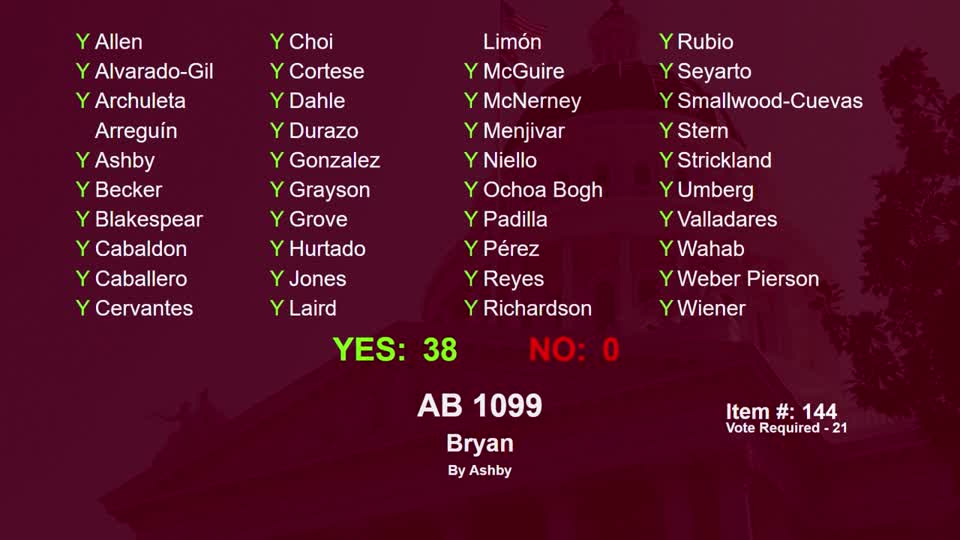 1MIN
Senate Floor
 7MIN
Assembly Floor
 6MIN
Assembly Standing Committee on Natural Resources
 1MIN
Senate Floor
 7MIN
Senate Standing Committee on Local Government
 9MIN
Senate Standing Committee on Environmental Quality
Bill Author

Bill Co-Author(s):