SB 987: California Health Access Fund.
- Session Year: 2025-2026
- House: Senate
- Latest Version Date: 2026-02-05
Current Status:
In Progress
(2026-05-14: May 14 hearing: Held in committee and under submission.)
Introduced
In Committee
Awaiting First Chamber Vote
Passed First Chamber
In Committee
Awaiting Second Chamber Vote
Passed Second Chamber
Enacted
Existing law establishes the Medi-Cal program, which is administered by the State Department of Health Care Services and under which qualified low-income individuals receive health care services. The Medi-Cal program is in part governed by, and funded pursuant to, federal Medicaid program provisions.
Existing federal law, enacted on July 4, 2025, sets forth various changes to different health care programs, including certain requirements for Medicaid eligibility with regard to work or community engagement reporting, redeterminations, and cost sharing, among other factors, for certain Medicaid populations pursuant to a specified implementation timeline.
This bill would create the California Health Access Fund, to be administered by the department. Under the bill, moneys in the fund would include deposits, through any applicable transfers made by the Legislature, equal to the amount of any savings to the state resulting from decreased enrollment in the Medi-Cal program caused by enrollment barriers created by the above-described federal law.
Under the bill, moneys in the fund would, upon appropriation, be used to ensure that California residents losing health care coverage due to the impacts of the federal law or due to any other divestments from the health care system can continue to receive health care services and that health care providers are reimbursed for these services.
(a)The California Health Access Fund is hereby created within the State Treasury. The State Department of Health Care Services shall administer the fund for the purpose described in subdivision (c).
(b)Moneys in the fund shall include deposits, through any applicable transfers made by the Legislature, equal to the amount of any savings to the state resulting from decreased enrollment in the Medi-Cal program caused by enrollment barriers created by H.R. 1 (Public Law 119-21), including, but not limited to, the imposition of work or community engagement requirements and more frequent redeterminations for certain Medi-Cal populations.
(c)Upon appropriation made by the Legislature for this purpose, moneys in the fund shall be used to ensure that California residents losing health care coverage due to the impacts of H.R. 1 (Public Law 119-21), as described in subdivision (b), or due to any other divestments from the health care system, can continue to receive health care services and that health care providers are reimbursed for these services.
|
Date
|
Status
|
|---|---|
| May 14, 2026 | May 14 hearing: Held in committee and under submission. |
| May 8, 2026 | Set for hearing May 14. |
| Apr 13, 2026 | April 13 hearing: Placed on APPR. suspense file. |
| Mar 27, 2026 | Set for hearing April 13. |
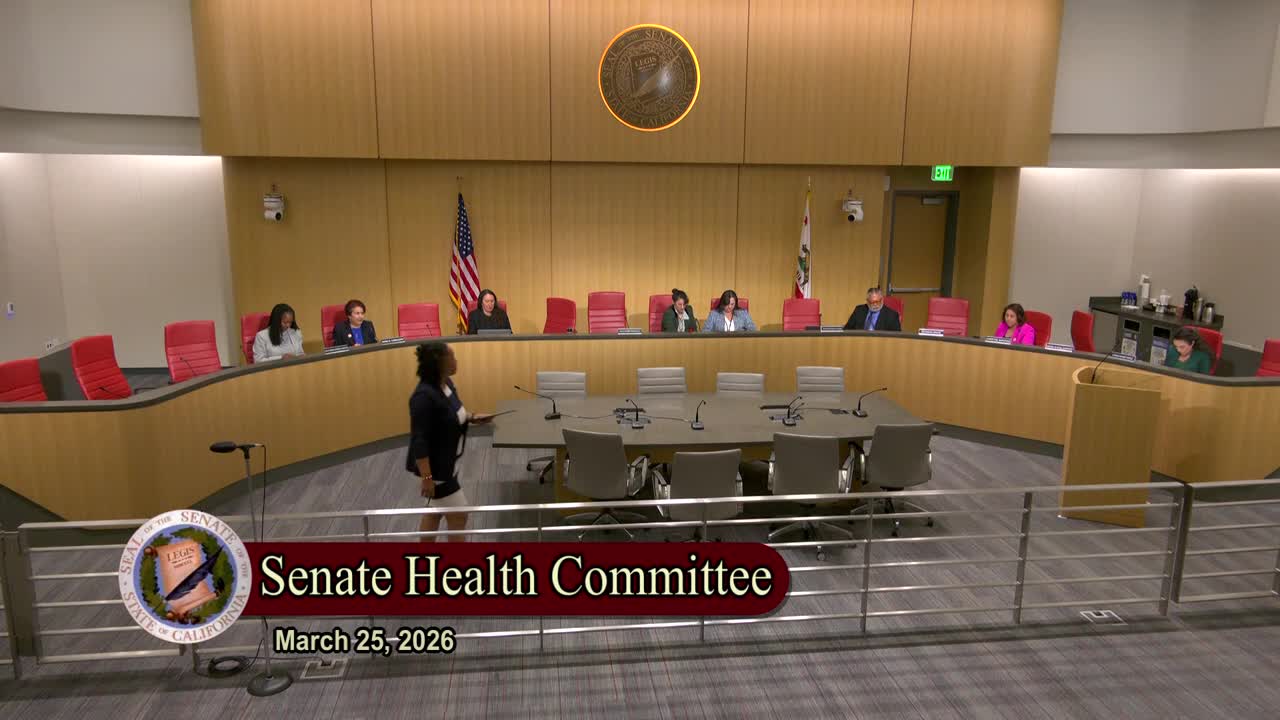
| Mar 26, 2026 | From committee: Do pass and re-refer to Com. on APPR. (Ayes 10. Noes 0. Page 3689.) (March 25). Re-referred to Com. on APPR. |
| Mar 26, 2026 | From committee: Do pass and re-refer to Com. on APPR. (Ayes 10. Noes 0.) (March 25). Re-referred to Com. on APPR. |
| Mar 9, 2026 | Set for hearing March 25. |
| Feb 18, 2026 | Referred to Com. on HEALTH. |
| Feb 9, 2026 | From printer. May be acted upon on or after March 8. |
| Feb 5, 2026 | Introduced. Read first time. To Com. on RLS. for assignment. To print. |
|
Date
|
Description
|
Location
|
Votes
|
|
|---|---|---|---|---|
| Apr 13, 2026 | Placed on suspense file | Senate Standing Committee on Appropriations |
Passed |
|
| Mar 25, 2026 | Do pass, but first be re-referred to the Committee on [Appropriations] | Senate Standing Committee on Health |
Passed |
This list shows positions taken on this bill by organizations on the date displayed, which is linked to the original source.
Positions by individuals are not included.
|
Organization
|
Position
|
Date
|
|---|---|---|
| American College Of Obstetricians And Gynecologists District Ix | ** Support | |
| California Academy Of Family Physicians | ** Support | |
| California Alliance Of Child And Family Services | ** Support | |
| California Chapter of the American College of Emergency Physicians | ** Support | |
| California Chiropractic Association | ** Support | |
| Disability Rights California | ** Support | |
| Indivisible Ca: Statestrong | ** Support | |
| Planned Parenthood Affiliates Of California | ** Support | |
| western center on law and poverty | ** Support |
SENATE COMMITTEE ON
Senator Sabrina Cervantes, Chair
2025 - 2026 Regular Session
SB 987 (Weber Pierson) - California Health Access Fund
Version: | Policy Vote: |
Urgency: | Mandate: |
Hearing Date: | Consultant: |
Bill Summary:
SB 987 would create the California Health Access Fund and require that moneys in the fund be used to ensure that California residents losing health care coverage due to the impacts of H.R. 1 (Public Law No 119-21), or due to any other divestments from the health care system, can continue to receive health care services and that health care providers are reimbursed for these services.
Fiscal Impact:
- Unknown significant ongoing General Fund costs, potentially hundreds of millions to several billions, to provide health care services to individuals losing health coverage (see staff comments below).
- Unknown General Fund costs, potentially low hundreds of thousands to low millions, for the Department of Health Care Services (DHCS) to administer the fund and to establish programs/services designed to serve individuals losing health coverage.
Background:
The Medi-Cal program, administered by DHCS, provides health care services to qualified low-income individuals. The Medi-Cal program is primarily governed by the federal Medicaid program. H.R. 1 made a number of significant changes that restrict eligibility and funding for the federal Medicaid program. Changes include, but are not limited to:
- Work requirements. The new “community engagement requirements” (or “work requirements”) require nondisabled adults between the ages of 19 and 65 who gained coverage through the federal Affordable Care Act (“ACA expansion adults”) to demonstrate 80 hours of work, education, or volunteer activities in order to be eligible for Medicaid coverage, unless they qualify for a limited exemption.
- Semiannual eligibility redeterminations. Under current federal regulation and state law, Medi-Cal eligibility must be redetermined once every 12 months or whenever an individual reports a change in circumstances. H.R. 1 requires instead, an additional eligibility redetermination process every six months for the group of ACA expansion adults.
- Reduced federal funding for previously qualified immigrants. H.R. 1 also ends the availability of federal funding for full-scope Medi-Cal coverage for certain groups of immigrants who are lawfully present, including refugees, asylees, victims of trafficking and others under humanitarian immigration statuses. Only restricted-scope Medi-Cal services (emergency care and pregnancy services) for this population would be eligible for federal funding.
The most recent estimate from DHCS in the Implementation Plan for New Federal Eligibility and Enrollment Changes Under H.R. 1 (released on January 29, 2026) estimates up to 1.8 million would lose Medi-Cal coverage due to work requirements, increased redeterminations, and the normal churn of individuals transitioning from Medi-Cal to Covered California.
Proposed Law:
Specific provisions of the bill would:
- Create the California Health Access Fund within the State Treasury to be administered by DHCS.
- Require that moneys in the fund include deposits, through any applicable transfers made by the Legislature, equal to the amount of any savings to the state resulting from decreased enrollment in the Medi-Cal program caused by enrollment barriers created by H.R. 1, including, but not limited to, the imposition of work or community engagement requirements and more frequent redeterminations for certain Medi-Cal populations.
- Require that upon appropriation made by the Legislature for this purpose, moneys in the fund must be used to ensure that California residents losing health care coverage due to the impacts of H.R. 1, or due to any other divestments from the health care system, can continue to receive health care services and that health care providers are reimbursed for these services.
Related Legislation:
SB 1202 (Weber Pierson) would require DHCS to track and publish data related to the impact of H.R. 1 on Medi-Cal eligibility and enrollment. The bill is currently in this committee.
SB 1252 (Durazo) would require DHCS to take all necessary actions to prevent abrupt loss of health care coverage for individuals, as described, due to federal policy changes, state enrollment freezes, the imposition of premiums, work requirements, or administrative barriers. The bill is currently in the Senate Health Committee.
SB 1422 (Durazo) would delete provisions of existing state law that freeze program enrollment in full-scope Medi-Cal for individuals who do not have satisfactory immigration status. The bill is currently in this committee.
AB 2161 (Bonta) would include provisions related to H.R. 1’s work requirements and eligibility redetermination requirements. The bill is currently in the Assembly Appropriations Committee.
AB 2201 (Boerner) would include provisions related to H.R. 1’s eligibility redetermination requirements. The bill is currently in the Assembly Appropriations Committee.
AB 2208 (Stefani) would include provisions related to eligibility and cost-sharing in response to H.R. 1. The bill is currently in the Assembly Appropriations Committee.
AB 2729 (Bonta) would create the Employer Responsibility for Medi-Cal Trust Fund to fund the costs of administering the Medi-Cal program in a manner necessary to prevent loss of or to restore health care coverage, benefits, or access to care following the passage of H.R. 1 and subsequent state budget actions. The bill is currently in the Assembly Health Committee.
Staff Comments:
The Governor’s budget includes estimates for various impacts due to the implementation of H.R. 1, including but not limited to:
- Savings of $373 million ($102 million General Fund) in 2026-27 and $13.1 billion ($3.6 billion General Fund) by 2029-30 due to individuals losing Medi-Cal coverage from the work and community engagement requirements.
- Savings of $463 million ($74 million General Fund) in 2026-27 and $3 billion ($474 million General Fund) by 2029-30 due to individuals losing Medi-Cal coverage from implementing six-month redeterminations.
- The Governor’s budget proposes to disenroll immigrants in the H.R. 1 impacted categories from full-scope Medi-Cal coverage and instead enroll them in restricted-scope coverage due to the loss of federal funding. If the state were to maintain full-scope coverage for this population using state moneys, DHCS estimates this would result in General Fund costs of $786 million in 2026-27 and $1.1 billion annually thereafter.
The estimates for the loss of Medi-Cal coverage and enrollment due to H.R. 1 provisions and the resulting savings to the state are dependent on many factors, including implementation details, county eligibility system readiness, federal guidance, enrollee outreach/education, etc. There is significant uncertainty regarding the precise impacts and the timing of H.R. 1 impacts on Medi-Cal coverage and enrollment.
The federal Medicaid program provides funding for 50 percent of the costs for most federally-eligible Medi-Cal services (federal financial participation varies based on the specific program or service). If the state were to backfill for losses of Medi-Cal coverage due to the provisions of H.R. 1, it is likely that federal Medicaid funding would be unavailable and the costs for continued health coverage/services would instead be funded primarily from the General Fund.
-- END --
SENATE COMMITTEE ON HEALTH
Senator Dr. Akilah Weber Pierson, Chair
BILL NO: SB 987
AUTHOR: | Weber Pierson | ||
VERSION: | February 5, 2026 | ||
HEARING DATE: | March 25, 2026 | ||
CONSULTANT: | Jen Flory | ||
SUBJECT: California Health Access Fund
SUMMARY:
Creates the California Health Access Fund to redirect any savings to the state resulting from decreased enrollment in the Medi-Cal program caused by the implementation of recently enacted federal enrollment barriers. Requires moneys in the fund to be used to ensure that California residents losing health coverage can continue to receive health care services and that health care providers are reimbursed for these services.
Existing federal law:
- Establishes the Medicaid program to enable each state to furnish medical assistance on behalf of individuals whose income and resources are insufficient to meet the costs of necessary medical services. [42 USC §1396, et seq.]
- Requires Medicaid recipients’ eligibility to be redetermined when the recipient reports a change in circumstances or once every 12 months. [42 C.F.R. §435.916 and §435.919]
- Starting January 1, 2027, as enacted by H.R. 1 (Public Law No. 119-21), requires individuals with incomes below 138% of the federal poverty level who are under age 65, not pregnant, and have no Medicaid-eligible dependents to have their eligibility for Medicaid additionally redetermined every 6 months. [42 USC §1396a]
- Starting January 1, 2027, as enacted by H.R. 1, requires individuals described in 3) above who do not meet a specified exception to demonstrate community engagement through not less than 80 hours of work, community service, or participation in a work program, or at least half-time participation in an educational program, or have a monthly income not less than 80 times the federal minimum wage in a specified month. [42 USC §1396a]
- Authorizes lawfully present immigrants with satisfactory immigration status to receive federal public benefits, including lawful permanent residents who have resided in the U.S. for more than five years, asylees, refugees, parolees, Cuban and Haitian entrants, individuals lawfully residing in the U.S. in accordance with a Compact of Free Association, and immigrants who have been battered or subject to extreme cruelty. [8 USC §1613 and §1641]
- Starting October 1, 2026, as enacted by H.R. 1, limits federal payments to states for individuals who are not citizens or nationals of the U.S., lawful permanent residents, Cuban or Haitian entrants, or individuals lawfully residing in the U.S. in accordance with a Compact of Free Association. [42 USC §1396b]
Existing state law:
- Establishes the Medi-Cal program, which is administered by the Department of Health Care Services (DHCS), and under which qualified low-income individuals receive health care services. [WIC §14000, et seq.]
- Requires a county to perform redeterminations of eligibility for Medi-Cal recipients every 12 months and to promptly redetermine eligibility whenever the county receives information about changes in a recipient’s circumstances that may affect eligibility for Medi-Cal benefits. [WIC §14005.37]
- Establishes eligibility for full-scope Medi-Cal benefits, excluding routine dental services starting July 1, 2026, to individuals over age 19 without satisfactory immigration status who are lawful permanent residents for less than five years or are permanently residing under color or law [WIC §14007.5]
- Establishes Medi-Cal eligibility for individuals without satisfactory immigration status or those individuals included in 3) using state funds and directs DHCS to maximize federal financial participation in implementing this section to the extent allowable. Starting January 1, 2026, froze program enrollment for undocumented individuals over age 19. [WIC §14007.8]
This bill:
- Creates the California Health Access Fund within the State Treasury.
- Requires DHCS to administer the fund, upon appropriation made by the Legislature, to ensure that California residents losing health care coverage due to the impacts of H.R. 1, or due to any other divestments from the health care system, can continue to receive health care services and that health care providers are reimbursed for these services.
- Requires the fund to include deposits, through any applicable transfers made by the Legislature, equal to the amount of any savings to the state resulting from decreased enrollment in the Medi-Cal program caused by enrollment barriers created by H.R. 1, including, but not limited to, the imposition of work or community engagement requirements and more frequent redeterminations for certain Medi-Cal populations.
FISCAL EFFECT:
This bill has not yet been analyzed by a fiscal committee.
COMMENTS:
- Author’s statement. According to the author, last July, President Trump and Congress enacted H.R. 1, a federal reconciliation bill that gutted our Medicaid program to give tax cuts to the wealthy. In addition to drastically impacting how our state can raise money for Medi-Cal, H.R. 1 also created new eligibility barriers that could cut nearly two million people off the Medi-Cal program. These barriers include new work requirements, new renewal requirements, and the loss of federal funding for several groups of immigrants who have not previously been denied federal assistance. While coverage losses reduce state Medi-Cal expenditures on paper, they do not eliminate health care needs. Individuals who lose coverage often delay care, rely on emergency services, or receive uncompensated care from safety-net providers, shifting costs rather than reducing them. Under this bill, the state will redirect any savings realized from the loss of Medi-Cal coverage to a new state fund to help pay the providers who still provide services to these individuals.
- H.R. 1. H.R. 1, a vast budget reconciliation bill, makes a number of changes primarily to lower taxes, increase funding for immigration control and national defense, and restrict access to and funding for SNAP and Medicaid through a series of program changes. Medicaid payments were reduced by defunding family planning providers that provide abortions, prohibiting new or increased provider taxes to fund Medicaid and requiring a gradual reduction of existing provider taxes, capping the rate the state may set for specified services, reducing the federal share of payment for emergency services to adults with unqualified immigration status, and changes in allowable payments under federal waiver programs. More relevant to this bill are a number of changes to the Medicaid eligibility rules which were enacted to reduce the number of people receiving assistance through the Medicaid program.
- Work requirements. The new “community engagement requirements” (or “work requirements”) require nondisabled adults between the ages of 19 and 65 who gained coverage through the Affordable Care Act (“ACA expansion adults”) to demonstrate 80 hours of work, education, or volunteer activities in order to be eligible for Medicaid coverage, unless they qualify for a limited exemption (pregnant or postpartum; incarcerated; parents with dependent children under age 14; disabled veterans; individuals with serious or complex medical conditions, including substance use or disabling mental disorders; and former foster youth; or, live in either an area with a federally declared disaster or with a recognized high unemployment rate). Because the work requirement is calculated based on federal minimum wage, many may be exempt if they earn at least $580 in monthly income. States are required to verify that an individual meets the work requirements twice a year, starting January 1, 2027.
- Semiannual eligibility redeterminations. Under current federal regulation and state law, Medi-Cal eligibility must be redetermined once every 12 months or whenever an individual reports a change in circumstances. H.R. 1 requires an additional eligibility renewal process every six months for the same group of ACA expansion adults that the work requirements apply to, starting January 1, 2027.
- Reduced federal funding for previously qualified immigrants. H.R. 1 also ends the availability of full-scope federal Medicaid funding for groups of immigrants who are lawfully present, including refugees, asylees, victims of trafficking and others under humanitarian immigration statuses, starting October 1, 2026. The state can only continue to provide full-scope Medi-Cal for these populations by paying for the entirety of their care, with the exception of emergency and pregnancy services. Emergency and pregnancy services, while still eligible for federal financial participation, are now reimbursed at a lower rate as well: 50% versus 90% for the ACA expansion adults.
- Impacts of H.R. 1 eligibility barriers. The UC Berkeley Labor Center estimates that 1.87 million adults will lose coverage due to the work requirements, and 270,000 will lose coverage due to the semiannual eligibility redeterminations. The most recent estimate from DHCS in the Implementation Plan for New Federal Eligibility and Enrollment Changes Under H.R. 1 (released on January 29, 2026) estimates up to 1.8 million will lose coverage due to work requirements, increased renewals, and the normal churn of individuals transitioning from Medi-Cal to Covered California. DHCS has also shared that approximately 200,000 immigrants will no longer have satisfactory immigration status due to the H.R. 1 change regarding immigrant eligibility and, according to the current Governor’s budget proposal, will lose full-scope Medi-Cal.
According to a 2021 issue brief, Medicaid Churning and Continuity of Care, by the U.S. Health and Human Services Department, Medicaid “churn” (recipients moving in and out of coverage caused by frequent redeterminations) results in higher administrative costs, less predictable state expenditures, and higher monthly health care costs due to pent-up demand for health care services. People who experience churn are more likely to delay care, receive less preventive care, refill prescriptions less often, and have more emergency department visits.
- Related legislation. SB 1202 (Weber Pierson) requires DHCS to track and publish data including the number of individuals who lose coverage due to eligibility barriers imposed by H.R. 1 and requires DHCS, counties, and plans to conduct outreach to Medi-Cal recipients about the H.R. 1 program changes. SB 1202 is being heard on April 8, 2026 in this committee.
AB 2161 (Bonta) codifies H.R. 1’s work requirements; requires DHCS to implement the work requirements in the least administratively burdensome way to Medi-Cal applicants and recipients as possible; and, prohibits DHCS from applying H.R. 1’s work requirements to state-only Medi-Cal populations. AB 2161 is set for hearing on April 7, 2026 in the Assembly Health Committee.
AB 2201 (Boerner) codifies H.R. 1’s semiannual redetermination requirements and allows more instances where a Medi-Cal recipient may be renewed ex parte, or without requiring a recipient to produce income information such as for individuals with minimal, stable income sources, such as Supplemental Security Income. AB 2201 is set for hearing on April 7, 2026 in the Assembly Health Committee.
AB 2208 (Stefani) codifies H.R. 1’s Medicaid cost-sharing requirements and limits the cost sharing to one cent; requires Medi-Cal systems implementing H.R. 1 changes to be user-tested; and, requires the state to provide three months of retroactive eligibility for Medi-Cal even after H.R. 1 limits federal payments for retroactive eligibility. AB 2208 is set for hearing on April 7, 2026 in the Assembly Health Committee.
- Previous legislation. SB 528 (Weber Pierson of 2025) Would have required DHCS to develop a program, or expand an existing program, to continue providing services or benefits that are otherwise covered under Medi-Cal should federal financial participation for these services or benefits be eliminated, reduced, or otherwise limited, subject to an appropriation by the Legislature. SB 528 was held on the Senate Appropriations Committee suspense file.
- Support. The California Alliance of Child and Family Services writes that the community-based organizations they represent are increasingly asked to absorb the gaps between what Medi-Cal requires and what reimbursement rates actually cover while also navigating growing operational complexity and cash flow demands. Absent state action, savings generated by reduced enrollment may not be directed toward maintaining access to care, supporting providers, or addressing gaps created by federal disinvestment. Planned Parenthood Affiliates of California writes that this bill will help ensure that historical state investments in health care stay in the system and support Californians who lose Medi-Cal and the providers that deliver service to these individuals. Western Center on Law and Poverty states that the services available to people who do lose coverage are insufficient to cover their needs and not all people will be eligible for the available county programs.
- Policy comment. This bill gives broad discretion to DHCS to administer the Health Care Fund. As the level of available funding will be determined in part by how successful DHCS, counties, Medi-Cal plans, and community partners are in assisting Medi-Cal recipients to renew their eligibility, document work or community engagement or qualify for an exception, it is not known at this time how robust the fund will be.
SUPPORT AND OPPOSITION:
Support: American College of Obstetricians and Gynecologists District IX
California Academy of Family Physicians
California Alliance of Child and Family Services
California Chapter of the American College of Emergency Physicians
California Chiropractic Association
Disability Rights California
Indivisible CA: StateStrong
Planned Parenthood Affiliates of California
Western Center on Law and Poverty
Oppose: None received.
-- END --
Bill Author

Bill Co-Author(s):