SB 99: Military protective orders.
- Session Year: 2025-2026
- House: Senate
- Latest Version Date: 2026-09-30
Current Status:
Passed
(2026-09-30: Chaptered by Secretary of State. Chapter 844, Statutes of 2026.)
Introduced
In Committee
Awaiting First Chamber Vote
Passed First Chamber
In Committee
Awaiting Second Chamber Vote
Passed Second Chamber
Enacted
Existing law establishes the Domestic Violence Prevention Act for the purpose of preventing acts of domestic violence, abuse, and sexual abuse and providing for a separation of the persons involved in the domestic violence for a period sufficient to enable those persons to seek a resolution of the causes of the violence. Existing law authorizes a court to issue an ex parte protective order enjoining a party from, among other things, stalking, battering, or disturbing the peace of the other party.
This bill would authorize a court determining whether to issue a protective order to consider evidence submitted to it by either party that a military protective order has been issued against the respondent, as specified.
The bill would additionally require a law enforcement officer who receives information at the scene of a domestic violence incident that a military protective order has been issued to verify the existence of that order. The bill would require a law enforcement officer who determines that a military protective order has been issued against a person involved in the domestic violence incident who violates a provision of a domestic violence protective order to notify the law enforcement agency that entered the military protective order that the restrained party may be in violation of a military protective order. By increasing duties on local law enforcement, this bill would impose a state-mandated local program.
The bill would authorize each law enforcement agency in the state that petitions for or enforces domestic violence protective orders to develop and adopt memoranda of understanding with military law enforcement or other designated representatives of one or more military installations located in whole or in part within the borders of its jurisdiction that govern the investigation and actions related to domestic violence involving service members assigned to units on those installations, as specified.
This bill would incorporate additional changes to Section 6383 of the Family Code proposed by AB 1753 and SB 1395, to be operative only if this bill and either or both of those bills are enacted and this bill is enacted last.
The California Constitution requires the state to reimburse local agencies and school districts for certain costs mandated by the state. Statutory provisions establish procedures for making that reimbursement.
This bill would provide that, if the Commission on State Mandates determines that the bill contains costs mandated by the state, reimbursement for those costs shall be made pursuant to the statutory provisions noted above.
Existing law establishes the Domestic Violence Prevention Act for the purpose of preventing acts of domestic violence, abuse, and sexual abuse and providing for a separation of the persons involved in the domestic violence for a period sufficient to enable those persons to seek a resolution of the causes of the violence. Existing law authorizes a court to issue an ex parte protective order enjoining a party from, among other things, stalking, battering, or disturbing the peace of the other party.
This bill would authorize a court determining whether to issue a protective order to consider whether evidence submitted to it by either party that a military protective order has been issued against the respondent, as specified.
The bill would additionally require a law enforcement officer who receives information at the scene of a domestic violence incident that a military protective order has been issued to verify the existence of that order. The bill would require a law enforcement officer who determines that a military protective order has been issued against a person involved in the domestic violence incident who violates a provision of a domestic violence protective order to notify the law enforcement agency that entered the military protective order that the restrained party may be in violation of a military protective order. By increasing duties on local law enforcement, this bill would impose a state-mandated local program.
The bill would authorize each law enforcement agency in the state that petitions for or enforces domestic violence protective orders to develop and adopt memoranda of understanding with military law enforcement or other designated representatives of one or more military installations located in whole or in part within the borders of its jurisdiction that govern the investigation and actions related to domestic violence involving service members assigned to units on those installations, as specified.
The California Constitution requires the state to reimburse local agencies and school districts for certain costs mandated by the state. Statutory provisions establish procedures for making that reimbursement.
This bill would provide that, if the Commission on State Mandates determines that the bill contains costs mandated by the state, reimbursement for those costs shall be made pursuant to the statutory provisions noted above.
Existing law establishes the Domestic Violence Prevention Act for the purpose of preventing acts of domestic violence, abuse, and sexual abuse and providing for a separation of the persons involved in the domestic violence for a period sufficient to enable those persons to seek a resolution of the causes of the violence. Existing law authorizes a court to issue an ex parte protective order enjoining a party from, among other things, stalking, battering, or disturbing the peace of the other party. Existing law requires the court, before a hearing on the issuance of a domestic violence restraining order, to ensure that a search is or has been conducted to determine, among other things, if the subject of the proposed order has specified prior criminal convictions, an outstanding warrant, or a prior restraining order or violation of a restraining order.
This bill would additionally require the court to determine if the subject of the proposed order has a current military protective order, as specified. The bill would additionally authorize a court determining whether to issue a protective order to consider whether a military protective order has been issued against the respondent, as specified.
The bill would additionally require a law enforcement officer who receives information at the scene of a domestic violence incident that a military protective order has been issued to verify the existence of that order. The bill would require a law enforcement officer who determines that a military protective order has been issued against a person involved in the domestic violence incident who violates a provision of a domestic violence protective order to notify the law enforcement agency that entered the military protective order that the restrained party may be in violation of a military protective order. By increasing duties on local law enforcement, this bill would impose a state-mandated local program.
The bill would authorize each law enforcement agency in the state that petitions for or enforces domestic violence protective orders to develop and adopt memoranda of understanding with military law enforcement or other designated representatives of one or more military installations located in whole or in part within the borders of its jurisdiction that govern the investigation and actions related to domestic violence involving service members assigned to units on those installations, as specified.
The California Constitution requires the state to reimburse local agencies and school districts for certain costs mandated by the state. Statutory provisions establish procedures for making that reimbursement.
This bill would provide that, if the Commission on State Mandates determines that the bill contains costs mandated by the state, reimbursement for those costs shall be made pursuant to the statutory provisions noted above.
Existing law establishes the Domestic Violence Prevention Act for the purpose of preventing acts of domestic violence, abuse, and sexual abuse and providing for a separation of the persons involved in the domestic violence for a period sufficient to enable those persons to seek a resolution of the causes of the violence. Existing law authorizes a court to issue an ex parte protective order enjoining a party from, among other things, stalking, battering, or disturbing the peace of the other party. Existing law requires the court, before a hearing on the issuance of a domestic violence restraining order, to ensure that a search is or has been conducted to determine, among other things, if the subject of the proposed order has specified prior criminal convictions, an outstanding warrant, or a prior restraining order or violation of a restraining order.
This bill would additionally require the court to determine if the subject of the proposed order has a current or prior military protective order or prior violation of a military protective order, as specified. The bill would additionally make military protective orders constitute a prima facie case for granting a temporary restraining order. The bill would additionally authorize a court determining whether to issue a protective order to consider whether a military protective order has been issued against the respondent, as specified.
The bill would additionally require a law enforcement officer who receives information at the scene of a domestic violence incident that a military protective order has been issued to verify the existence of that order. The bill would require a law enforcement officer who determines that a military protective order has been issued against a person involved in the domestic violence incident who violates a provision of a domestic violence protective order who is a member of, or otherwise associated with, the Armed Forces of the United States, to notify the law enforcement agency that entered the military protective order that the officer has probable cause to believe the person has violated the restrained party may be in violation of a military protective order. By increasing duties on local law enforcement, this bill would impose a state-mandated local program.
The bill would authorize each county law enforcement agency in the state that petitions for or enforces domestic violence protective orders to develop and adopt memoranda of understanding with military law enforcement or other designated representatives of one or more military installations located in whole or in part within the borders of its jurisdiction that govern the investigation and actions related to domestic violence involving service members assigned to units on those installations, as specified.
The California Constitution requires the state to reimburse local agencies and school districts for certain costs mandated by the state. Statutory provisions establish procedures for making that reimbursement.
This bill would provide that, if the Commission on State Mandates determines that the bill contains costs mandated by the state, reimbursement for those costs shall be made pursuant to the statutory provisions noted above.
Existing law establishes the Domestic Violence Prevention Act for the purpose of preventing acts of domestic violence, abuse, and sexual abuse and providing for a separation of the persons involved in the domestic violence for a period sufficient to enable those persons to seek a resolution of the causes of the violence. Existing law authorizes a court to issue an ex parte protective order enjoining a party from, among other things, stalking, battering, or disturbing the peace of the other party. Existing law requires the court, before a hearing on the issuance of a domestic violence restraining order, to ensure that a search is or has been conducted to determine, among other things, if the subject of the proposed order has specified prior criminal convictions, an outstanding warrant, or a prior restraining order or violation of a restraining order.
This bill would additionally require the court to determine if the subject of the proposed order has a current or prior military protective order or prior violation of a military protective order, as specified. The bill would additionally make military protective orders constitute a prima facie case for granting a temporary restraining order.
The bill would additionally require a law enforcement officer who receives information at the scene of a domestic violence incident that a military protective order has been issued to verify the existence of that order. The bill would require a law enforcement officer who determines that a military protective order has been issued against a person who violates a provision of a domestic violence protective order who is a member of, or otherwise associated with, the Armed Forces of the United States, to notify the law enforcement agency that entered the military protective order that the officer has probable cause to believe the person has violated the military protective order. By increasing duties on local law enforcement, this bill would impose a state-mandated local program.
The bill would authorize each county law enforcement agency to develop and adopt memoranda of understanding with military law enforcement or other designated representatives of one or more military installations located in whole or in part within the borders of its jurisdiction that govern the investigation and actions related to domestic violence involving service members assigned to units on those installations, as specified.
The California Constitution requires the state to reimburse local agencies and school districts for certain costs mandated by the state. Statutory provisions establish procedures for making that reimbursement.
This bill would provide that, if the Commission on State Mandates determines that the bill contains costs mandated by the state, reimbursement for those costs shall be made pursuant to the statutory provisions noted above.
Existing law, the California Child Day Care Facilities Act, generally requires the State Department of Social Services to license and regulate various types of child daycare facilities, including, among others, daycare centers and family daycare homes. Under existing law, a willful or repeated violation of those provisions is a crime. Existing law exempts from those provisions various entities, including, among others, community care facilities, certain program facilities administered by the Department of Corrections and Rehabilitation, and extended daycare programs operated by public or private schools.This bill would also exempt, from the above-described licensing provisions, a family childcare home administered by a person certified as a family childcare provider by a branch of the United States Armed Forces and that exclusively provides care for children of eligible federal personnel, as defined, and surviving spouses.The bill would impose certain requirements on a military installation certifying a family childcare home in order for the home to qualify for an exemption. The bill would require the military installation to annually file with the department a list of exempt but certified facilities; report to the department all incidents involving physical injury to, or death of, children attending the program; require providers to post a certain notice about the status of the facility; and certify that the facility meets the health and safety requirements set forth in related state regulations, except for obtaining or maintaining a license. The bill would also require each provider to meet certain criteria relating to, among other things, an emergency preparedness plan, inspections, and attendance records.The bill would authorize the department to inspect those exempt family childcare homes to determine compliance with these provisions, and would require the department to develop and establish, by July 1, 2026, a policy for those family childcare homes. The bill would require that the policy address the above-described health and safety requirements and provider criteria, in addition to any procedures or requirements relating to enforcement, reporting, or corrective action, as specified. The bill would require the department to publish the policy on its internet website and to update the policy as necessary.The bill would require prioritization for annual inspections in the case of a facility that is subject to the requirements of the California Child Day Care Facilities Act, whether licensed or exempt from licensure, including, but not limited to, a family childcare home, if the facility is participating in a county quality improvement program through a certain quality rating improvement system, as part of participating in a fee assistance program administered by the United States Department of Defense.Existing law, the California Child Day Care Facilities Act, generally requires the State Department of Social Services to license and regulate various types of child daycare facilities, including, among others, daycare centers and family daycare homes. Under existing law, a willful or repeated violation of those provisions is a crime. Existing law exempts from those provisions various entities, including, among others, community care facilities, certain program facilities administered by the Department of Corrections and Rehabilitation, and extended daycare programs operated by public or private schools.
This bill would also exempt, from the above-described licensing provisions, a family childcare home administered by a person certified as a family childcare provider by a branch of the United States Armed Forces and that exclusively provides care for children of eligible federal personnel, as defined, and surviving spouses.
The bill would impose certain requirements on a military installation certifying a family childcare home in order for the home to qualify for an exemption. The bill would require the military installation to annually file with the department a list of exempt but certified facilities; report to the department all incidents involving physical injury to, or death of, children attending the program; require providers to post a certain notice about the status of the facility; and certify that the facility meets the health and safety requirements set forth in related state regulations, except for obtaining and or maintaining a license. The bill would also require each provider to meet certain criteria relating to, among other things, an emergency preparedness plan, inspections, and attendance records.
The bill would authorize the department to inspect those exempt family childcare homes to determine compliance with these provisions, and would require the department to develop and establish, by July 1, 2026, a policy for those family childcare homes. The bill would require that the policy address the above-described health and safety requirements and provider criteria, in addition to any procedures or requirements relating to enforcement, reporting, or corrective action, as specified. The bill would require the department to publish the policy on its internet website and to update the policy as necessary.
The bill would require prioritization for annual inspections in the case of a facility that is subject to the requirements of the California Child Day Care Facilities Act, whether licensed or exempt from licensure, including, but not limited to, a family childcare home, if the facility is participating in a county quality improvement program through a certain quality rating improvement system, as part of participating in a fee assistance program administered by the United States Department of Defense.
Existing law, the California Child Day Care Facilities Act, generally requires the State Department of Social Services to license and regulate various types of child daycare facilities, including, among others, daycare centers and family daycare homes. Under existing law, a willful or repeated violation of those provisions is a crime. Existing law exempts from those provisions various entities, including, among others, community care facilities, certain program facilities administered by the Department of Corrections and Rehabilitation, and extended daycare programs operated by public or private schools.
This bill would also exempt, from the above-described licensing provisions, a family childcare home administered by a person certified as a family childcare provider by a branch of the United States Armed Forces and that exclusively provides care for children of eligible federal personnel, as defined, and surviving spouses.
The bill would impose certain requirements on a military installation certifying exempt family childcare homes. a family childcare home in order for the home to qualify for an exemption. The bill would require the military installation to annually file with the department a list of exempt but certified facilities; report to the department all incidents involving physical injury to, or death of, children attending the program; require providers to post a certain notice about the status of the facility facility; and certify that the facility meets the health and safety requirements set forth in related state regulations, except for obtaining and maintaining a license. The bill would also require each provider to meet certain criteria relating to, among other things, an emergency preparedness plan, inspections, and attendance records.
The bill would require authorize the department to inspect those exempt family childcare homes to determine compliance with these provisions and provisions, and would require the department to establish, by July 1, 2026, a policy for those family childcare homes.
The bill would require prioritization for annual inspections in the case of a facility that is subject to the requirements of the California Child Day Care Facilities Act, whether licensed or exempt from licensure, including, but not limited to, a family childcare home, if the facility is participating in a county quality improvement program through a certain quality rating improvement system, as part of participating in a fee assistance program administered by the United States Department of Defense.
Existing law, the California Child Day Care Facilities Act, generally requires the State Department of Social Services to license and regulate various types of child daycare facilities, including, among others, daycare centers and family daycare homes. Under existing law, a willful or repeated violation of those provisions is a crime. Existing law exempts from those provisions various entities, including, among others, community care facilities, certain program facilities administered by the Department of Corrections and Rehabilitation, and extended daycare programs operated by public or private schools.
This bill would also exempt, from the above-described licensing provisions, a family childcare home administered by a person certified as a family childcare provider by a branch of the United States Armed Forces and that exclusively provides care for children of eligible federal personnel, as defined, and surviving spouses.
The bill would impose certain requirements on a military installation certifying exempt family childcare homes. The bill would require the military installation to annually file with the department a list of exempt but certified facilities; report to the department all incidents involving physical injury to, or death of, children attending the program; require providers to post a certain notice about the status of the facility and certify that the facility meets the health and safety requirements set forth in related state regulations, except for obtaining and maintaining a license. The bill would also require each provider to meet certain criteria relating to, among other things, an emergency preparedness plan, inspections, and attendance records.
The bill would require the department to inspect those exempt family childcare homes to determine compliance with these provisions and to establish, by July 1, 2026, a policy for those family childcare homes.
The bill would require prioritization for annual inspections in the case of a facility that is subject to the requirements of the California Child Day Care Facilities Act, whether licensed or exempt from licensure, including, but not limited to, a family childcare home, if the facility is participating in a county quality improvement program through a certain quality rating improvement system, as part of participating in a fee assistance program administered by the United States Department of Defense.
(a)In determining whether to issue an order under this Part, the court may consider evidence submitted to it by either party that a military protective order has been issued against the respondent for the same or similar conduct against a person to be protected by the proposed order.
(b)For the purposes of this section, military protective order means a protective order issued by a commanding officer in the Armed Forces of the United States, California National Guard, or the national guard of another state or territory against a person under the officers command.
SEC. 2.Section 6383 of the Family Code is amended to read:6383.(a)A temporary restraining order, emergency protective order, or an order issued after hearing pursuant to this part shall, on request of the petitioner, be served on the respondent, whether or not the respondent has been taken into custody, either by a law enforcement officer, excluding those defined in subdivision (a) of Section 830.5 of the Penal Code, who is present at the scene of reported domestic violence involving the parties to the proceeding or who receives a request from the petitioner to provide service of the order.
(b)(1)The petitioner shall provide the officer with an endorsed copy of the order and a proof of service that the officer shall complete and transmit to the issuing court.
(2)Service shall be provided pursuant to Section 6389 of the Family Code.
(3)Notwithstanding any other law, a fee shall not be charged to the petitioner for service of an order described in subdivision (a).
(4)If a firearm is obtained at the scene of a domestic violence incident or during service as provided in this section, law enforcement shall enter, or cause to be entered, the firearm into the Department of Justice Automated Firearms System pursuant to Section 11108.2 of the Penal Code.
(c)It is a rebuttable presumption that the proof of service was signed on the date of service.
(d)Upon receiving information at the scene of a domestic violence incident that a protective order has been issued under this part, that a military protective order has been issued, or that a person who has been taken into custody is the respondent to that protective order or military protective order, if the protected person cannot produce an endorsed copy of the relevant order, a law enforcement officer shall immediately inquire of the California Restraining and Protective Order System to verify the existence of a protective order or the National Crime Information Center to verify existence of a military protective order.
(e)If the law enforcement officer determines that a protective order has been issued but not served, the officer shall immediately notify the respondent of the terms of the order and where a written copy of the order can be obtained, and the officer shall, at that time, also enforce the order. The law enforcement officers verbal notice of the terms of the order shall constitute service of the order and is sufficient notice for the purposes of this section and for the purposes of Sections 273.6 and 29825 of the Penal Code.
(f)If a report is required under Section 13730 of the Penal Code, or if no report is required, then in the daily incident log, the officer shall provide the name and assignment of the officer notifying the respondent pursuant to subdivision (e) and the case number of the order.
(g)Upon service of the order outside of the court, a law enforcement officer shall advise the respondent to go to the local court to obtain a copy of the order containing the full terms and conditions of the order.
(h)(1)There shall be no civil liability on the part of, and no cause of action for false arrest or false imprisonment against, a peace officer who makes an arrest pursuant to a protective or restraining order that is regular upon its face, if the peace officer, in making the arrest, acts in good faith and has reasonable cause to believe that the person against whom the order is issued has notice of the order and has committed an act in violation of the order.
(2)If there is more than one order issued and one of the orders is an emergency protective order that has precedence in enforcement pursuant to paragraph (1) of subdivision (c) of Section 136.2 of the Penal Code, the peace officer shall enforce the emergency protective order. If there is more than one order issued, none of the orders issued is an emergency protective order that has precedence in enforcement, and one of the orders issued is a no-contact order, as described in Section 6320, the peace officer shall enforce the no-contact order. If there is more than one civil order regarding the same parties and neither an emergency protective order that has precedence in enforcement nor a no-contact order has been issued, the peace officer shall enforce the order that was issued last. If there are both civil and criminal orders regarding the same parties and neither an emergency protective order that has precedence in enforcement nor a no-contact order has been issued, the peace officer shall enforce the criminal order issued last, subject to the provisions of subdivisions (h) and (i) of Section 136.2 of the Penal Code. This section does not exonerate a peace officer from liability for the unreasonable use of force in the enforcement of the order. The immunities afforded by this section shall not affect the availability of any other immunity that may apply, including, but not limited to, Sections 820.2 and 820.4 of the Government Code.
(i)A peace officer listed in Section 18250 of the Penal Code shall take temporary custody of any firearm or other deadly weapon in plain sight or discovered pursuant to a consensual or otherwise lawful search as necessary for the protection of the peace officer or other persons present in any of the following circumstances:
(1)The peace officer is at the scene of a domestic violence incident involving a threat to human life or a physical assault.
(2)The peace officer is serving a protective order issued pursuant to this part.
(3)The peace officer is serving a gun violence restraining order issued pursuant to Division 3.2 (commencing with Section 18100) of Title 2 of Part 6 of the Penal Code.
(j)If a law enforcement officer, pursuant to subdivision (d), determines that a military protective order registered in the National Crime Information Center systems (NCIC) has been issued against a person involved in the domestic violence incident who violates a provision of a protective order issued pursuant to this part or Part 5 (commencing with Section 6400), that officer shall notify the law enforcement agency that entered the military protective order into NCIC that the restrained party may be in violation of a military protective order.
(k)Each law enforcement agency in the state that petitions for or enforces protective orders issued pursuant to this division may develop and adopt memoranda of understanding with military law enforcement or other designated representatives of one or more military installations located in whole or in part within the borders of its jurisdiction that govern the investigation and actions related to domestic violence involving service members assigned to units on those installations. Those memoranda may include, but are not limited to, all of the following:
(1)To whom, how, and when each party would report information about potential violations of military or civilian protective orders.
(2)Each partys role and responsibilities when conducting an investigation and in providing domestic violence prevention or rehabilitative services to a family in response to the results of the investigations, consistent with state and federal law.
(3)Protocols describing what, if any, confidential information may be shared between the parties and for what purposes, in accordance with applicable state and federal law.
(l)For the purposes of this section, military protective order has the same meaning as defined in Section 6310.
SEC. 2.1.Section 6383 of the Family Code is amended to read:6383.(a)A temporary restraining order, emergency protective order, or an order issued after hearing pursuant to this part shall, on request of the petitioner, be served on the respondent, whether or not the respondent has been taken into custody, either by a law enforcement officer, excluding those defined in subdivision (a) of Section 830.5 of the Penal Code, who is present at the scene of reported domestic violence involving the parties to the proceeding or who receives a request from the petitioner to provide service of the order.
(b)(1)The petitioner shall provide the officer with an endorsed copy of the order and a proof of service that the officer shall complete and transmit to the issuing court.
(2)Service shall be provided pursuant to Section 6389 of the Family Code.
(3)Notwithstanding any other law, a fee shall not be charged to the petitioner for service of an order described in subdivision (a).
(4)If a firearm is obtained at the scene of a domestic violence incident or during service as provided in this section, law enforcement shall enter, or cause to be entered, the firearm into the Department of Justice Automated Firearms System pursuant to Section 11108.2 of the Penal Code.
(c)It is a rebuttable presumption that the proof of service was signed on the date of service.
(d)Upon receiving information at the scene of a domestic violence incident that a protective order has been issued under this part, that a military protective order has been issued, or that a person who has been taken into custody is the respondent to that protective order or military protective order, if the protected person cannot produce an endorsed copy of the relevant order, a law enforcement officer shall immediately inquire of the California Restraining and Protective Order System to verify the existence of a protective order or the National Crime Information Center to verify existence of a military protective order.
(e)If the law enforcement officer determines that a protective order has been issued but not served, the officer shall immediately notify the respondent of the terms of the order and where a written copy of the order can be obtained, and the officer shall, at that time, also enforce the order. The law enforcement officers verbal notice of the terms of the order shall constitute service of the order and is sufficient notice for the purposes of this section and for the purposes of Sections 273.6 and 29825 of the Penal Code.
(f)If a report is required under Section 13730 of the Penal Code, or if no report is required, then in the daily incident log, the officer shall provide the name and assignment of the officer notifying the respondent pursuant to subdivision (e) and the case number of the order.
(g)Upon service of the order outside of the court, a law enforcement officer shall advise the respondent to go to the local court to obtain a copy of the order containing the full terms and conditions of the order.
(h)(1)There shall be no civil liability on the part of, and no cause of action for false arrest or false imprisonment against, a peace officer who makes an arrest pursuant to a protective or restraining order that is regular upon its face, if the peace officer, in making the arrest, acts in good faith and has reasonable cause to believe that the person against whom the order is issued has notice of the order and has committed an act in violation of the order.
(2)If there is more than one order issued and one of the orders is an emergency protective order that has precedence in enforcement pursuant to paragraph (1) of subdivision (c) of Section 136.2 of the Penal Code, the peace officer shall enforce the emergency protective order. If there is more than one order issued, none of the orders issued is an emergency protective order that has precedence in enforcement, and one of the orders issued is a no-contact order, as described in Section 6320, the peace officer shall enforce the no-contact order. If there is more than one civil order regarding the same parties and neither an emergency protective order that has precedence in enforcement nor a no-contact order has been issued, the peace officer shall enforce the order that was issued last. If there are both civil and criminal orders regarding the same parties and neither an emergency protective order that has precedence in enforcement nor a no-contact order has been issued, the peace officer shall enforce the criminal order issued last, subject to the provisions of subdivisions (h) and (i) of Section 136.2 of the Penal Code. This section does not exonerate a peace officer from liability for the unreasonable use of force in the enforcement of the order. The immunities afforded by this section shall not affect the availability of any other immunity that may apply, including, but not limited to, Sections 820.2 and 820.4 of the Government Code.
(i)A peace officer listed in Section 18250 of the Penal Code shall take temporary custody of any firearm or other deadly weapon or ammunition in plain sight or discovered pursuant to a consensual or otherwise lawful search as necessary for the protection of the peace officer or other persons present in any of the following circumstances:
(1)The peace officer is at the scene of a domestic violence incident involving a threat to human life or a physical assault.
(2)The peace officer is serving a protective order issued pursuant to this part.
(3)The peace officer is serving a gun violence restraining order issued pursuant to Division 3.2 (commencing with Section 18100) of Title 2 of Part 6 of the Penal Code.
(j)A peace officer required to serve a restraining or protective order under this section shall comply with Article 3 (commencing with Section 26660) of Chapter 2 of Part 3 of Division 2 of Title 3 of the Government Code. For purposes of this subdivision, any reference to marshal or sheriff in that article shall also include a peace officer required to serve a restraining or protective order under this section.
(k)A peace officer required to serve a restraining or protective order under this section may, pursuant to the requirements set forth in Section 6103.2 of the Government Code, submit a billing to the superior court for payment of fees for service of the order. For purposes of this subdivision, any reference to marshal or sheriff in Section 6103.2 of the Government Code shall also include a peace officer required to serve a restraining or protective order under this section.
(l)If a law enforcement officer, pursuant to subdivision (d), determines that a military protective order registered in the National Crime Information Center systems (NCIC) has been issued against a person involved in the domestic violence incident who violates a provision of a protective order issued pursuant to this part or Part 5 (commencing with Section 6400), that officer shall notify the law enforcement agency that entered the military protective order into NCIC that the restrained party may be in violation of a military protective order.
(m)Each law enforcement agency in the state that petitions for or enforces protective orders issued pursuant to this division may develop and adopt memoranda of understanding with military law enforcement or other designated representatives of one or more military installations located in whole or in part within the borders of its jurisdiction that govern the investigation and actions related to domestic violence involving service members assigned to units on those installations. Those memoranda may include, but are not limited to, all of the following:
(1)To whom, how, and when each party would report information about potential violations of military or civilian protective orders.
(2)Each partys role and responsibilities when conducting an investigation and in providing domestic violence prevention or rehabilitative services to a family in response to the results of the investigations, consistent with state and federal law.
(3)Protocols describing what, if any, confidential information may be shared between the parties and for what purposes, in accordance with applicable state and federal law.
(n)For the purposes of this section, military protective order has the same meaning as defined in Section 6310.
SEC. 2.2.Section 6383 of the Family Code is amended to read:6383.(a)A temporary restraining order, emergency protective order, or an order issued after hearing pursuant to this part shall, on request of the petitioner, be served on the respondent, whether or not the respondent has been taken into custody, either by a law enforcement officer, excluding those defined in subdivision (a) of Section 830.5 of the Penal Code, who is present at the scene of reported domestic violence involving the parties to the proceeding or who receives a request from the petitioner to provide service of the order.
(b)(1)The petitioner shall provide the officer with an endorsed copy of the order and a proof of service that the officer shall complete and transmit to the issuing court.
(2)Service shall be provided pursuant to Section 6389 of the Family Code.
(3)Notwithstanding any other law, a fee shall not be charged to the petitioner for service of an order described in subdivision (a).
(4)If a firearm is obtained at the scene of a domestic violence incident or during service as provided in this section, law enforcement shall enter, or cause to be entered, the firearm into the Department of Justice Automated Firearms System pursuant to Section 11108.2 of the Penal Code.
(c)It is a rebuttable presumption that the proof of service was signed on the date of service.
(d)Upon receiving information at the scene of a domestic violence incident that a protective order has been issued under this part, that a military protective order has been issued, or that a person who has been taken into custody is the respondent to that protective order or military protective order, if the protected person cannot produce an endorsed copy of the relevant order, a law enforcement officer shall immediately inquire of the California Restraining and Protective Order System to verify the existence of a protective order or the National Crime Information Center to verify existence of a military protective order.
(e)If the law enforcement officer determines that a protective order has been issued but not served, the officer shall immediately notify the respondent of the terms of the order and where a written copy of the order can be obtained, and the officer shall, at that time, also enforce the order. The law enforcement officers verbal notice of the terms of the order shall constitute service of the order and is sufficient notice for the purposes of this section and for the purposes of Sections 273.6 and 29825 of the Penal Code.
(f)If a report is required under Section 13730 of the Penal Code, or if no report is required, then in the daily incident log, the officer shall provide the name and assignment of the officer notifying the respondent pursuant to subdivision (e) and the case number of the order.
(g)Upon service of the order outside of the court, a law enforcement officer shall advise the respondent to go to the local court to obtain a copy of the order containing the full terms and conditions of the order.
(h)(1)There shall be no civil liability on the part of, and no cause of action for false arrest or false imprisonment against, a peace officer who makes an arrest pursuant to a protective or restraining order that is regular upon its face, if the peace officer, in making the arrest, acts in good faith and has reasonable cause to believe that the person against whom the order is issued has notice of the order and has committed an act in violation of the order.
(2)If there is more than one order issued and one of the orders is an emergency protective order that has precedence in enforcement pursuant to paragraph (1) of subdivision (c) of Section 136.2 of the Penal Code, the peace officer shall enforce the emergency protective order. If there is more than one order issued, none of the orders issued is an emergency protective order that has precedence in enforcement, and one of the orders issued is a no-contact order, as described in Section 6320, the peace officer shall enforce the no-contact order. If there is more than one civil order regarding the same parties and neither an emergency protective order that has precedence in enforcement nor a no-contact order has been issued, the peace officer shall enforce the order that was issued last. If there are both civil and criminal orders regarding the same parties and neither an emergency protective order that has precedence in enforcement nor a no-contact order has been issued, the peace officer shall enforce the criminal order issued last, subject to the provisions of subdivisions (h), (i), and (j) of Section 136.2 of the Penal Code. This section does not exonerate a peace officer from liability for the unreasonable use of force in the enforcement of the order. The immunities afforded by this section shall not affect the availability of any other immunity that may apply, including, but not limited to, Sections 820.2 and 820.4 of the Government Code.
(i)A peace officer listed in Section 18250 of the Penal Code shall take temporary custody of any firearm or other deadly weapon in plain sight or discovered pursuant to a consensual or otherwise lawful search as necessary for the protection of the peace officer or other persons present in any of the following circumstances:
(1)The peace officer is at the scene of a domestic violence incident involving a threat to human life or a physical assault.
(2)The peace officer is serving a protective order issued pursuant to this part.
(3)The peace officer is serving a gun violence restraining order issued pursuant to Division 3.2 (commencing with Section 18100) of Title 2 of Part 6 of the Penal Code.
(j)If a law enforcement officer, pursuant to subdivision (d), determines that a military protective order registered in the National Crime Information Center systems (NCIC) has been issued against a person involved in the domestic violence incident who violates a provision of a protective order issued pursuant to this part or Part 5 (commencing with Section 6400), that officer shall notify the law enforcement agency that entered the military protective order into NCIC that the restrained party may be in violation of a military protective order.
(k)Each law enforcement agency in the state that petitions for or enforces protective orders issued pursuant to this division may develop and adopt memoranda of understanding with military law enforcement or other designated representatives of one or more military installations located in whole or in part within the borders of its jurisdiction that govern the investigation and actions related to domestic violence involving service members assigned to units on those installations. Those memoranda may include, but are not limited to, all of the following:
(1)To whom, how, and when each party would report information about potential violations of military or civilian protective orders.
(2)Each partys role and responsibilities when conducting an investigation and in providing domestic violence prevention or rehabilitative services to a family in response to the results of the investigations, consistent with state and federal law.
(3)Protocols describing what, if any, confidential information may be shared between the parties and for what purposes, in accordance with applicable state and federal law.
(l)For the purposes of this section, military protective order has the same meaning as defined in Section 6310.
SEC. 2.3.Section 6383 of the Family Code is amended to read:6383.(a)A temporary restraining order, emergency protective order, or an order issued after hearing pursuant to this part shall, on request of the petitioner, be served on the respondent, whether or not the respondent has been taken into custody, either by a law enforcement officer, excluding those defined in subdivision (a) of Section 830.5 of the Penal Code, who is present at the scene of reported domestic violence involving the parties to the proceeding or who receives a request from the petitioner to provide service of the order.
(b)(1)The petitioner shall provide the officer with an endorsed copy of the order and a proof of service that the officer shall complete and transmit to the issuing court.
(2)Service shall be provided pursuant to Section 6389 of the Family Code.
(3)Notwithstanding any other law, a fee shall not be charged to the petitioner for service of an order described in subdivision (a).
(4)If a firearm is obtained at the scene of a domestic violence incident or during service as provided in this section, law enforcement shall enter, or cause to be entered, the firearm into the Department of Justice Automated Firearms System pursuant to Section 11108.2 of the Penal Code.
(c)It is a rebuttable presumption that the proof of service was signed on the date of service.
(d)Upon receiving information at the scene of a domestic violence incident that a protective order has been issued under this part, that a military protective order has been issued, or that a person who has been taken into custody is the respondent to that protective order or military protective order, if the protected person cannot produce an endorsed copy of the relevant order, a law enforcement officer shall immediately inquire of the California Restraining and Protective Order System to verify the existence of a protective order or the National Crime Information Center to verify existence of a military protective order.
(e)If the law enforcement officer determines that a protective order has been issued but not served, the officer shall immediately notify the respondent of the terms of the order and where a written copy of the order can be obtained, and the officer shall, at that time, also enforce the order. The law enforcement officers verbal notice of the terms of the order shall constitute service of the order and is sufficient notice for the purposes of this section and for the purposes of Sections 273.6 and 29825 of the Penal Code.
(f)If a report is required under Section 13730 of the Penal Code, or if no report is required, then in the daily incident log, the officer shall provide the name and assignment of the officer notifying the respondent pursuant to subdivision (e) and the case number of the order.
(g)Upon service of the order outside of the court, a law enforcement officer shall advise the respondent to go to the local court to obtain a copy of the order containing the full terms and conditions of the order.
(h)(1)There shall be no civil liability on the part of, and no cause of action for false arrest or false imprisonment against, a peace officer who makes an arrest pursuant to a protective or restraining order that is regular upon its face, if the peace officer, in making the arrest, acts in good faith and has reasonable cause to believe that the person against whom the order is issued has notice of the order and has committed an act in violation of the order.
(2)If there is more than one order issued and one of the orders is an emergency protective order that has precedence in enforcement pursuant to paragraph (1) of subdivision (c) of Section 136.2 of the Penal Code, the peace officer shall enforce the emergency protective order. If there is more than one order issued, none of the orders issued is an emergency protective order that has precedence in enforcement, and one of the orders issued is a no-contact order, as described in Section 6320, the peace officer shall enforce the no-contact order. If there is more than one civil order regarding the same parties and neither an emergency protective order that has precedence in enforcement nor a no-contact order has been issued, the peace officer shall enforce the order that was issued last. If there are both civil and criminal orders regarding the same parties and neither an emergency protective order that has precedence in enforcement nor a no-contact order has been issued, the peace officer shall enforce the criminal order issued last, subject to the provisions of subdivisions (h), (i), and (j) of Section 136.2 of the Penal Code. This section does not exonerate a peace officer from liability for the unreasonable use of force in the enforcement of the order. The immunities afforded by this section shall not affect the availability of any other immunity that may apply, including, but not limited to, Sections 820.2 and 820.4 of the Government Code.
(i)A peace officer listed in Section 18250 of the Penal Code shall take temporary custody of any firearm or other deadly weapon or ammunition in plain sight or discovered pursuant to a consensual or otherwise lawful search as necessary for the protection of the peace officer or other persons present in any of the following circumstances:
(1)The peace officer is at the scene of a domestic violence incident involving a threat to human life or a physical assault.
(2)The peace officer is serving a protective order issued pursuant to this part.
(3)The peace officer is serving a gun violence restraining order issued pursuant to Division 3.2 (commencing with Section 18100) of Title 2 of Part 6 of the Penal Code.
(j)A peace officer required to serve a restraining or protective order under this section shall comply with Article 3 (commencing with Section 26660) of Chapter 2 of Part 3 of Division 2 of Title 3 of the Government Code. For purposes of this subdivision, any reference to marshal or sheriff in that article shall also include a peace officer required to serve a restraining or protective order under this section.
(k)A peace officer required to serve a restraining or protective order under this section may, pursuant to the requirements set forth in Section 6103.2 of the Government Code, submit a billing to the superior court for payment of fees for service of the order. For purposes of this subdivision, any reference to marshal or sheriff in Section 6103.2 of the Government Code shall also include a peace officer required to serve a restraining or protective order under this section.
(l)If a law enforcement officer, pursuant to subdivision (d), determines that a military protective order registered in the National Crime Information Center systems (NCIC) has been issued against a person involved in the domestic violence incident who violates a provision of a protective order issued pursuant to this part or Part 5 (commencing with Section 6400), that officer shall notify the law enforcement agency that entered the military protective order into NCIC that the restrained party may be in violation of a military protective order.
(m)Each law enforcement agency in the state that petitions for or enforces protective orders issued pursuant to this division may develop and adopt memoranda of understanding with military law enforcement or other designated representatives of one or more military installations located in whole or in part within the borders of its jurisdiction that govern the investigation and actions related to domestic violence involving service members assigned to units on those installations. Those memoranda may include, but are not limited to, all of the following:
(1)To whom, how, and when each party would report information about potential violations of military or civilian protective orders.
(2)Each partys role and responsibilities when conducting an investigation and in providing domestic violence prevention or rehabilitative services to a family in response to the results of the investigations, consistent with state and federal law.
(3)Protocols describing what, if any, confidential information may be shared between the parties and for what purposes, in accordance with applicable state and federal law.
(n)For the purposes of this section, military protective order has the same meaning as defined in Section 6310.
SEC. 3.(a)Section 2.1 of this bill incorporates amendments to Section 6383 of the Family Code proposed by both this bill and Assembly Bill 1753. That section of this bill shall only become operative if (1) both bills are enacted and become effective on or before January 1, 2027, (2) each bill amends Section 6383 of the Family Code, (3) Senate Bill 1395 is not enacted or as enacted does not amend that section, and (4) this bill is enacted after Assembly Bill 1753, in which case Sections 2, 2.2, and 2.3 of this bill shall not become operative.
(b)Section 2.2 of this bill incorporates amendments to Section 6383 of the Family Code proposed by both this bill and Senate Bill 1395. That section of this bill shall only become operative if (1) both bills are enacted and become effective on or before January 1, 2027, (2) each bill amends Section 6383 of the Family Code, (3) Assembly Bill 1753 is not enacted or as enacted does not amend that section, and (4) this bill is enacted after Senate Bill 1395 in which case Sections 2, 2.1, and 2.3 of this bill shall not become operative.
(c)Section 2.3 of this bill incorporates amendments to Section 6383 of the Family Code proposed by this bill, Assembly Bill 1753, and Senate Bill 1395. That section of this bill shall only become operative if (1) all three bills are enacted and become effective on or before January 1, 2027, (2) all three bills amend Section 6383 of the Family Code, and (3) this bill is enacted after Assembly Bill 1753 and Senate Bill 1395, in which case Sections 2, 2.1, and 2.2 of this bill shall not become operative.
SEC. 4.If the Commission on State Mandates determines that this act contains costs mandated by the state, reimbursement to local agencies and school districts for those costs shall be made pursuant to Part 7 (commencing with Section 17500) of Division 4 of Title 2 of the Government Code.
(a)In determining whether to issue an order under this Part, the court may consider evidence submitted to it by either party that a military protective order has been issued against the respondent for the same or similar conduct against a person to be protected by the proposed order.
(b)For the purposes of this section, military protective order means a protective order issued by a commanding officer in the Armed Forces of the United States, California National Guard, or the national guard of another state or territory against a person under the officers command.
SEC. 2.Section 6383 of the Family Code is amended to read:6383.(a)A temporary restraining order, emergency protective order, or an order issued after hearing pursuant to this part shall, on request of the petitioner, be served on the respondent, whether or not the respondent has been taken into custody, either by a law enforcement officer, excluding those defined in subdivision (a) of Section 830.5 of the Penal Code, who is present at the scene of reported domestic violence involving the parties to the proceeding or who receives a request from the petitioner to provide service of the order.
(b)(1)The petitioner shall provide the officer with an endorsed copy of the order and a proof of service that the officer shall complete and transmit to the issuing court.
(2)Service shall be provided pursuant to Section 6389 of the Family Code.
(3)Notwithstanding any other law, a fee shall not be charged to the petitioner for service of an order described in subdivision (a).
(4)If a firearm is obtained at the scene of a domestic violence incident or during service as provided in this section, law enforcement shall enter, or cause to be entered, the firearm into the Department of Justice Automated Firearms System pursuant to Section 11108.2 of the Penal Code.
(c)It is a rebuttable presumption that the proof of service was signed on the date of service.
(d)Upon receiving information at the scene of a domestic violence incident that a protective order has been issued under this part, that a military protective order has been issued, or that a person who has been taken into custody is the respondent to that protective order or military protective order, if the protected person cannot produce an endorsed copy of the relevant order, a law enforcement officer shall immediately inquire of the California Restraining and Protective Order System to verify the existence of a protective order or the National Crime Information Center to verify existence of a military protective order.
(e)If the law enforcement officer determines that a protective order has been issued but not served, the officer shall immediately notify the respondent of the terms of the order and where a written copy of the order can be obtained, and the officer shall, at that time, also enforce the order. The law enforcement officers verbal notice of the terms of the order shall constitute service of the order and is sufficient notice for the purposes of this section and for the purposes of Sections 273.6 and 29825 of the Penal Code.
(f)If a report is required under Section 13730 of the Penal Code, or if no report is required, then in the daily incident log, the officer shall provide the name and assignment of the officer notifying the respondent pursuant to subdivision (e) and the case number of the order.
(g)Upon service of the order outside of the court, a law enforcement officer shall advise the respondent to go to the local court to obtain a copy of the order containing the full terms and conditions of the order.
(h)(1)There shall be no civil liability on the part of, and no cause of action for false arrest or false imprisonment against, a peace officer who makes an arrest pursuant to a protective or restraining order that is regular upon its face, if the peace officer, in making the arrest, acts in good faith and has reasonable cause to believe that the person against whom the order is issued has notice of the order and has committed an act in violation of the order.
(2)If there is more than one order issued and one of the orders is an emergency protective order that has precedence in enforcement pursuant to paragraph (1) of subdivision (c) of Section 136.2 of the Penal Code, the peace officer shall enforce the emergency protective order. If there is more than one order issued, none of the orders issued is an emergency protective order that has precedence in enforcement, and one of the orders issued is a no-contact order, as described in Section 6320, the peace officer shall enforce the no-contact order. If there is more than one civil order regarding the same parties and neither an emergency protective order that has precedence in enforcement nor a no-contact order has been issued, the peace officer shall enforce the order that was issued last. If there are both civil and criminal orders regarding the same parties and neither an emergency protective order that has precedence in enforcement nor a no-contact order has been issued, the peace officer shall enforce the criminal order issued last, subject to the provisions of subdivisions (h) and (i) of Section 136.2 of the Penal Code. This section does not exonerate a peace officer from liability for the unreasonable use of force in the enforcement of the order. The immunities afforded by this section shall not affect the availability of any other immunity that may apply, including, but not limited to, Sections 820.2 and 820.4 of the Government Code.
(i)A peace officer listed in Section 18250 of the Penal Code shall take temporary custody of any firearm or other deadly weapon in plain sight or discovered pursuant to a consensual or otherwise lawful search as necessary for the protection of the peace officer or other persons present in any of the following circumstances:
(1)The peace officer is at the scene of a domestic violence incident involving a threat to human life or a physical assault.
(2)The peace officer is serving a protective order issued pursuant to this part.
(3)The peace officer is serving a gun violence restraining order issued pursuant to Division 3.2 (commencing with Section 18100) of Title 2 of Part 6 of the Penal Code.
(j)If a law enforcement officer, pursuant to subdivision (d), determines that a military protective order registered in the National Crime Information Center systems (NCIC) has been issued against a person involved in the domestic violence incident who violates a provision of a protective order issued pursuant to this part or Part 5 (commencing with Section 6400), that officer shall notify the law enforcement agency that entered the military protective order into NCIC that the restrained party may be in violation of a military protective order.
(k)Each law enforcement agency in the state that petitions for or enforces protective orders issued pursuant to this division may develop and adopt memoranda of understanding with military law enforcement or other designated representatives of one or more military installations located in whole or in part within the borders of its jurisdiction that govern the investigation and actions related to domestic violence involving service members assigned to units on those installations. Those memoranda may include, but are not limited to, all of the following:
(1)To whom, how, and when each party would report information about potential violations of military or civilian protective orders.
(2)Each partys role and responsibilities when conducting an investigation and in providing domestic violence prevention or rehabilitative services to a family in response to the results of the investigations, consistent with state and federal law.
(3)Protocols describing what, if any, confidential information may be shared between the parties and for what purposes, in accordance with applicable state and federal law.
(l)For the purposes of this section, military protective order has the same meaning as defined in Section 6310.
SEC. 2.1.Section 6383 of the Family Code is amended to read:6383.(a)A temporary restraining order, emergency protective order, or an order issued after hearing pursuant to this part shall, on request of the petitioner, be served on the respondent, whether or not the respondent has been taken into custody, either by a law enforcement officer, excluding those defined in subdivision (a) of Section 830.5 of the Penal Code, who is present at the scene of reported domestic violence involving the parties to the proceeding or who receives a request from the petitioner to provide service of the order.
(b)(1)The petitioner shall provide the officer with an endorsed copy of the order and a proof of service that the officer shall complete and transmit to the issuing court.
(2)Service shall be provided pursuant to Section 6389 of the Family Code.
(3)Notwithstanding any other law, a fee shall not be charged to the petitioner for service of an order described in subdivision (a).
(4)If a firearm is obtained at the scene of a domestic violence incident or during service as provided in this section, law enforcement shall enter, or cause to be entered, the firearm into the Department of Justice Automated Firearms System pursuant to Section 11108.2 of the Penal Code.
(c)It is a rebuttable presumption that the proof of service was signed on the date of service.
(d)Upon receiving information at the scene of a domestic violence incident that a protective order has been issued under this part, that a military protective order has been issued, or that a person who has been taken into custody is the respondent to that protective order or military protective order, if the protected person cannot produce an endorsed copy of the relevant order, a law enforcement officer shall immediately inquire of the California Restraining and Protective Order System to verify the existence of the order. a protective order or the National Crime Information Center to verify existence of a military protective order.
(e)If the law enforcement officer determines that a protective order has been issued but not served, the officer shall immediately notify the respondent of the terms of the order and where a written copy of the order can be obtained, and the officer shall, at that time, also enforce the order. The law enforcement officers verbal notice of the terms of the order shall constitute service of the order and is sufficient notice for the purposes of this section and for the purposes of Sections 273.6 and 29825 of the Penal Code.
(f)If a report is required under Section 13730 of the Penal Code, or if no report is required, then in the daily incident log, the officer shall provide the name and assignment of the officer notifying the respondent pursuant to subdivision (e) and the case number of the order.
(g)Upon service of the order outside of the court, a law enforcement officer shall advise the respondent to go to the local court to obtain a copy of the order containing the full terms and conditions of the order.
(h)(1)There shall be no civil liability on the part of, and no cause of action for false arrest or false imprisonment against, a peace officer who makes an arrest pursuant to a protective or restraining order that is regular upon its face, if the peace officer, in making the arrest, acts in good faith and has reasonable cause to believe that the person against whom the order is issued has notice of the order and has committed an act in violation of the order.
(2)If there is more than one order issued and one of the orders is an emergency protective order that has precedence in enforcement pursuant to paragraph (1) of subdivision (c) of Section 136.2 of the Penal Code, the peace officer shall enforce the emergency protective order. If there is more than one order issued, none of the orders issued is an emergency protective order that has precedence in enforcement, and one of the orders issued is a no-contact order, as described in Section 6320, the peace officer shall enforce the no-contact order. If there is more than one civil order regarding the same parties and neither an emergency protective order that has precedence in enforcement nor a no-contact order has been issued, the peace officer shall enforce the order that was issued last. If there are both civil and criminal orders regarding the same parties and neither an emergency protective order that has precedence in enforcement nor a no-contact order has been issued, the peace officer shall enforce the criminal order issued last, subject to the provisions of subdivisions (h) and (i) of Section 136.2 of the Penal Code. This section does not exonerate a peace officer from liability for the unreasonable use of force in the enforcement of the order. The immunities afforded by this section shall not affect the availability of any other immunity that may apply, including, but not limited to, Sections 820.2 and 820.4 of the Government Code.
(i)A peace officer listed in Section 18250 of the Penal Code shall take temporary custody of any firearm or other deadly weapon or ammunition in plain sight or discovered pursuant to a consensual or otherwise lawful search as necessary for the protection of the peace officer or other persons present in any of the following circumstances:
(1)The peace officer is at the scene of a domestic violence incident involving a threat to human life or a physical assault.
(2)The peace officer is serving a protective order issued pursuant to this part.
(3)The peace officer is serving a gun violence restraining order issued pursuant to Division 3.2 (commencing with Section 18100) of Title 2 of Part 6 of the Penal Code.
(j)A peace officer required to serve a restraining or protective order under this section shall comply with Article 3 (commencing with Section 26660) of Chapter 2 of Part 3 of Division 2 of Title 3 of the Government Code. For purposes of this subdivision, any reference to marshal or sheriff in that article shall also include a peace officer required to serve a restraining or protective order under this section.
(k)A peace officer required to serve a restraining or protective order under this section may, pursuant to the requirements set forth in Section 6103.2 of the Government Code, submit a billing to the superior court for payment of fees for service of the order. For purposes of this subdivision, any reference to marshal or sheriff in Section 6103.2 of the Government Code shall also include a peace officer required to serve a restraining or protective order under this section.
(l)If a law enforcement officer, pursuant to subdivision (d), determines that a military protective order registered in the National Crime Information Center systems (NCIC) has been issued against a person involved in the domestic violence incident who violates a provision of a protective order issued pursuant to this part or Part 5 (commencing with Section 6400), that officer shall notify the law enforcement agency that entered the military protective order into NCIC that the restrained party may be in violation of a military protective order.
(m)Each law enforcement agency in the state that petitions for or enforces protective orders issued pursuant to this division may develop and adopt memoranda of understanding with military law enforcement or other designated representatives of one or more military installations located in whole or in part within the borders of its jurisdiction that govern the investigation and actions related to domestic violence involving service members assigned to units on those installations. Those memoranda may include, but are not limited to, all of the following:
(1)To whom, how, and when each party would report information about potential violations of military or civilian protective orders.
(2)Each partys role and responsibilities when conducting an investigation and in providing domestic violence prevention or rehabilitative services to a family in response to the results of the investigations, consistent with state and federal law.
(3)Protocols describing what, if any, confidential information may be shared between the parties and for what purposes, in accordance with applicable state and federal law.
(n)For the purposes of this section, military protective order has the same meaning as defined in Section 6310.
SEC. 2.2.Section 6383 of the Family Code is amended to read:6383.(a)A temporary restraining order, emergency protective order, or an order issued after hearing pursuant to this part shall, on request of the petitioner, be served on the respondent, whether or not the respondent has been taken into custody, either by a law enforcement officer, excluding those defined in subdivision (a) of Section 830.5 of the Penal Code, who is present at the scene of reported domestic violence involving the parties to the proceeding or who receives a request from the petitioner to provide service of the order.
(b)(1)The petitioner shall provide the officer with an endorsed copy of the order and a proof of service that the officer shall complete and transmit to the issuing court.
(2)Service shall be provided pursuant to Section 6389 of the Family Code.
(3)Notwithstanding any other law, a fee shall not be charged to the petitioner for service of an order described in subdivision (a).
(4)If a firearm is obtained at the scene of a domestic violence incident or during service as provided in this section, law enforcement shall enter, or cause to be entered, the firearm into the Department of Justice Automated Firearms System pursuant to Section 11108.2 of the Penal Code.
(c)It is a rebuttable presumption that the proof of service was signed on the date of service.
(d)Upon receiving information at the scene of a domestic violence incident that a protective order has been issued under this part, that a military protective order has been issued, or that a person who has been taken into custody is the respondent to that protective order or military protective order, if the protected person cannot produce an endorsed copy of the relevant order, a law enforcement officer shall immediately inquire of the California Restraining and Protective Order System to verify the existence of the a protective order or the National Crime Information Center to verify existence of a military protective order.
(e)If the law enforcement officer determines that a protective order has been issued but not served, the officer shall immediately notify the respondent of the terms of the order and where a written copy of the order can be obtained, and the officer shall, at that time, also enforce the order. The law enforcement officers verbal notice of the terms of the order shall constitute service of the order and is sufficient notice for the purposes of this section and for the purposes of Sections 273.6 and 29825 of the Penal Code.
(f)If a report is required under Section 13730 of the Penal Code, or if no report is required, then in the daily incident log, the officer shall provide the name and assignment of the officer notifying the respondent pursuant to subdivision (e) and the case number of the order.
(g)Upon service of the order outside of the court, a law enforcement officer shall advise the respondent to go to the local court to obtain a copy of the order containing the full terms and conditions of the order.
(h)(1)There shall be no civil liability on the part of, and no cause of action for false arrest or false imprisonment against, a peace officer who makes an arrest pursuant to a protective or restraining order that is regular upon its face, if the peace officer, in making the arrest, acts in good faith and has reasonable cause to believe that the person against whom the order is issued has notice of the order and has committed an act in violation of the order.
(2)If there is more than one order issued and one of the orders is an emergency protective order that has precedence in enforcement pursuant to paragraph (1) of subdivision (c) of Section 136.2 of the Penal Code, the peace officer shall enforce the emergency protective order. If there is more than one order issued, none of the orders issued is an emergency protective order that has precedence in enforcement, and one of the orders issued is a no-contact order, as described in Section 6320, the peace officer shall enforce the no-contact order. If there is more than one civil order regarding the same parties and neither an emergency protective order that has precedence in enforcement nor a no-contact order has been issued, the peace officer shall enforce the order that was issued last. If there are both civil and criminal orders regarding the same parties and neither an emergency protective order that has precedence in enforcement nor a no-contact order has been issued, the peace officer shall enforce the criminal order issued last, subject to the provisions of subdivisions (h) and (i) (h), (i), and (j) of Section 136.2 of the Penal Code. This section does not exonerate a peace officer from liability for the unreasonable use of force in the enforcement of the order. The immunities afforded by this section shall not affect the availability of any other immunity that may apply, including, but not limited to, Sections 820.2 and 820.4 of the Government Code.
(i)A peace officer listed in Section 18250 of the Penal Code shall take temporary custody of any firearm or other deadly weapon in plain sight or discovered pursuant to a consensual or otherwise lawful search as necessary for the protection of the peace officer or other persons present in any of the following circumstances:
(1)The peace officer is at the scene of a domestic violence incident involving a threat to human life or a physical assault.
(2)The peace officer is serving a protective order issued pursuant to this part.
(3)The peace officer is serving a gun violence restraining order issued pursuant to Division 3.2 (commencing with Section 18100) of Title 2 of Part 6 of the Penal Code.
(j)If a law enforcement officer, pursuant to subdivision (d), determines that a military protective order registered in the National Crime Information Center systems (NCIC) has been issued against a person involved in the domestic violence incident who violates a provision of a protective order issued pursuant to this part or Part 5 (commencing with Section 6400), that officer shall notify the law enforcement agency that entered the military protective order into NCIC that the restrained party may be in violation of a military protective order.
(k)Each law enforcement agency in the state that petitions for or enforces protective orders issued pursuant to this division may develop and adopt memoranda of understanding with military law enforcement or other designated representatives of one or more military installations located in whole or in part within the borders of its jurisdiction that govern the investigation and actions related to domestic violence involving service members assigned to units on those installations. Those memoranda may include, but are not limited to, all of the following:
(1)To whom, how, and when each party would report information about potential violations of military or civilian protective orders.
(2)Each partys role and responsibilities when conducting an investigation and in providing domestic violence prevention or rehabilitative services to a family in response to the results of the investigations, consistent with state and federal law.
(3)Protocols describing what, if any, confidential information may be shared between the parties and for what purposes, in accordance with applicable state and federal law.
(l)For the purposes of this section, military protective order has the same meaning as defined in Section 6310.
SEC. 2.3.Section 6383 of the Family Code is amended to read:6383.(a)A temporary restraining order, emergency protective order, or an order issued after hearing pursuant to this part shall, on request of the petitioner, be served on the respondent, whether or not the respondent has been taken into custody, either by a law enforcement officer, excluding those defined in subdivision (a) of Section 830.5 of the Penal Code, who is present at the scene of reported domestic violence involving the parties to the proceeding or who receives a request from the petitioner to provide service of the order.
(b)(1)The petitioner shall provide the officer with an endorsed copy of the order and a proof of service that the officer shall complete and transmit to the issuing court.
(2)Service shall be provided pursuant to Section 6389 of the Family Code.
(3)Notwithstanding any other law, a fee shall not be charged to the petitioner for service of an order described in subdivision (a).
(4)If a firearm is obtained at the scene of a domestic violence incident or during service as provided in this section, law enforcement shall enter, or cause to be entered, the firearm into the Department of Justice Automated Firearms System pursuant to Section 11108.2 of the Penal Code.
(c)It is a rebuttable presumption that the proof of service was signed on the date of service.
(d)Upon receiving information at the scene of a domestic violence incident that a protective order has been issued under this part, that a military protective order has been issued, or that a person who has been taken into custody is the respondent to that protective order or military protective order, if the protected person cannot produce an endorsed copy of the relevant order, a law enforcement officer shall immediately inquire of the California Restraining and Protective Order System to verify the existence of the order. a protective order or the National Crime Information Center to verify existence of a military protective order.
(e)If the law enforcement officer determines that a protective order has been issued but not served, the officer shall immediately notify the respondent of the terms of the order and where a written copy of the order can be obtained, and the officer shall, at that time, also enforce the order. The law enforcement officers verbal notice of the terms of the order shall constitute service of the order and is sufficient notice for the purposes of this section and for the purposes of Sections 273.6 and 29825 of the Penal Code.
(f)If a report is required under Section 13730 of the Penal Code, or if no report is required, then in the daily incident log, the officer shall provide the name and assignment of the officer notifying the respondent pursuant to subdivision (e) and the case number of the order.
(g)Upon service of the order outside of the court, a law enforcement officer shall advise the respondent to go to the local court to obtain a copy of the order containing the full terms and conditions of the order.
(h)(1)There shall be no civil liability on the part of, and no cause of action for false arrest or false imprisonment against, a peace officer who makes an arrest pursuant to a protective or restraining order that is regular upon its face, if the peace officer, in making the arrest, acts in good faith and has reasonable cause to believe that the person against whom the order is issued has notice of the order and has committed an act in violation of the order.
(2)If there is more than one order issued and one of the orders is an emergency protective order that has precedence in enforcement pursuant to paragraph (1) of subdivision (c) of Section 136.2 of the Penal Code, the peace officer shall enforce the emergency protective order. If there is more than one order issued, none of the orders issued is an emergency protective order that has precedence in enforcement, and one of the orders issued is a no-contact order, as described in Section 6320, the peace officer shall enforce the no-contact order. If there is more than one civil order regarding the same parties and neither an emergency protective order that has precedence in enforcement nor a no-contact order has been issued, the peace officer shall enforce the order that was issued last. If there are both civil and criminal orders regarding the same parties and neither an emergency protective order that has precedence in enforcement nor a no-contact order has been issued, the peace officer shall enforce the criminal order issued last, subject to the provisions of subdivisions (h) and (i) (h), (i), and (j) of Section 136.2 of the Penal Code. This section does not exonerate a peace officer from liability for the unreasonable use of force in the enforcement of the order. The immunities afforded by this section shall not affect the availability of any other immunity that may apply, including, but not limited to, Sections 820.2 and 820.4 of the Government Code.
(i)A peace officer listed in Section 18250 of the Penal Code shall take temporary custody of any firearm or other deadly weapon or ammunition in plain sight or discovered pursuant to a consensual or otherwise lawful search as necessary for the protection of the peace officer or other persons present in any of the following circumstances:
(1)The peace officer is at the scene of a domestic violence incident involving a threat to human life or a physical assault.
(2)The peace officer is serving a protective order issued pursuant to this part.
(3)The peace officer is serving a gun violence restraining order issued pursuant to Division 3.2 (commencing with Section 18100) of Title 2 of Part 6 of the Penal Code.
(j)A peace officer required to serve a restraining or protective order under this section shall comply with Article 3 (commencing with Section 26660) of Chapter 2 of Part 3 of Division 2 of Title 3 of the Government Code. For purposes of this subdivision, any reference to marshal or sheriff in that article shall also include a peace officer required to serve a restraining or protective order under this section.
(k)A peace officer required to serve a restraining or protective order under this section may, pursuant to the requirements set forth in Section 6103.2 of the Government Code, submit a billing to the superior court for payment of fees for service of the order. For purposes of this subdivision, any reference to marshal or sheriff in Section 6103.2 of the Government Code shall also include a peace officer required to serve a restraining or protective order under this section.
(l)If a law enforcement officer, pursuant to subdivision (d), determines that a military protective order registered in the National Crime Information Center systems (NCIC) has been issued against a person involved in the domestic violence incident who violates a provision of a protective order issued pursuant to this part or Part 5 (commencing with Section 6400), that officer shall notify the law enforcement agency that entered the military protective order into NCIC that the restrained party may be in violation of a military protective order.
(m)Each law enforcement agency in the state that petitions for or enforces protective orders issued pursuant to this division may develop and adopt memoranda of understanding with military law enforcement or other designated representatives of one or more military installations located in whole or in part within the borders of its jurisdiction that govern the investigation and actions related to domestic violence involving service members assigned to units on those installations. Those memoranda may include, but are not limited to, all of the following:
(1)To whom, how, and when each party would report information about potential violations of military or civilian protective orders.
(2)Each partys role and responsibilities when conducting an investigation and in providing domestic violence prevention or rehabilitative services to a family in response to the results of the investigations, consistent with state and federal law.
(3)Protocols describing what, if any, confidential information may be shared between the parties and for what purposes, in accordance with applicable state and federal law.
(n)For the purposes of this section, military protective order has the same meaning as defined in Section 6310.
SEC. 3.(a)Section 2.1 of this bill incorporates amendments to Section 6383 of the Family Code proposed by both this bill and Assembly Bill 1753. That section of this bill shall only become operative if (1) both bills are enacted and become effective on or before January 1, 2027, (2) each bill amends Section 6383 of the Family Code, (3) Senate Bill 1395 is not enacted or as enacted does not amend that section, and (4) this bill is enacted after Assembly Bill 1753, in which case Sections 2, 2.2, and 2.3 of this bill shall not become operative.
(b)Section 2.2 of this bill incorporates amendments to Section 6383 of the Family Code proposed by both this bill and Senate Bill 1395. That section of this bill shall only become operative if (1) both bills are enacted and become effective on or before January 1, 2027, (2) each bill amends Section 6383 of the Family Code, (3) Assembly Bill 1753 is not enacted or as enacted does not amend that section, and (4) this bill is enacted after Senate Bill 1395 in which case Sections 2, 2.1, and 2.3 of this bill shall not become operative.
(c)Section 2.3 of this bill incorporates amendments to Section 6383 of the Family Code proposed by this bill, Assembly Bill 1753, and Senate Bill 1395. That section of this bill shall only become operative if (1) all three bills are enacted and become effective on or before January 1, 2027, (2) all three bills amend Section 6383 of the Family Code, and (3) this bill is enacted after Assembly Bill 1753 and Senate Bill 1395, in which case Sections 2, 2.1, and 2.2 of this bill shall not become operative.
SEC. 3.SEC. 4.If the Commission on State Mandates determines that this act contains costs mandated by the state, reimbursement to local agencies and school districts for those costs shall be made pursuant to Part 7 (commencing with Section 17500) of Division 4 of Title 2 of the Government Code.
(a)In determining whether to issue an order under this Part, the court may consider whether evidence submitted to it by either party that a military protective order has been issued against the respondent for the same or similar conduct against a person to be protected by the proposed order.
(b)For the purposes of this section, military protective order means a protective order issued by a commanding officer in the Armed Forces of the United States, California National Guard, or the national guard of another state or territory against a person under the officers command.
SEC. 2.Section 6383 of the Family Code is amended to read:6383.(a)A temporary restraining order, emergency protective order, or an order issued after hearing pursuant to this part shall, on request of the petitioner, be served on the respondent, whether or not the respondent has been taken into custody, either by a law enforcement officer, excluding those defined in subdivision (a) of Section 830.5 of the Penal Code, who is present at the scene of reported domestic violence involving the parties to the proceeding or who receives a request from the petitioner to provide service of the order.
(b)(1)The petitioner shall provide the officer with an endorsed copy of the order and a proof of service that the officer shall complete and transmit to the issuing court.
(2)Service shall be provided pursuant to Section 6389 of the Family Code.
(3)Notwithstanding any other law, a fee shall not be charged to the petitioner for service of an order described in subdivision (a).
(4)If a firearm is obtained at the scene of a domestic violence incident or during service as provided in this section, law enforcement shall enter, or cause to be entered, the firearm into the Department of Justice Automated Firearms System pursuant to Section 11108.2 of the Penal Code.
(c)It is a rebuttable presumption that the proof of service was signed on the date of service.
(d)Upon receiving information at the scene of a domestic violence incident that a protective order has been issued under this part, that a military protective order has been issued, or that a person who has been taken into custody is the respondent to that protective order or military protective order, if the protected person cannot produce an endorsed copy of the relevant order, a law enforcement officer shall immediately inquire of the California Restraining and Protective Order System to verify the existence of a protective order or the National Crime Information Center to verify existence of a military protective order.
(e)If the law enforcement officer determines that a protective order has been issued but not served, the officer shall immediately notify the respondent of the terms of the order and where a written copy of the order can be obtained, and the officer shall, at that time, also enforce the order. The law enforcement officers verbal notice of the terms of the order shall constitute service of the order and is sufficient notice for the purposes of this section and for the purposes of Sections 273.6 and 29825 of the Penal Code.
(f)If a report is required under Section 13730 of the Penal Code, or if no report is required, then in the daily incident log, the officer shall provide the name and assignment of the officer notifying the respondent pursuant to subdivision (e) and the case number of the order.
(g)Upon service of the order outside of the court, a law enforcement officer shall advise the respondent to go to the local court to obtain a copy of the order containing the full terms and conditions of the order.
(h)(1)There shall be no civil liability on the part of, and no cause of action for false arrest or false imprisonment against, a peace officer who makes an arrest pursuant to a protective or restraining order that is regular upon its face, if the peace officer, in making the arrest, acts in good faith and has reasonable cause to believe that the person against whom the order is issued has notice of the order and has committed an act in violation of the order.
(2)If there is more than one order issued and one of the orders is an emergency protective order that has precedence in enforcement pursuant to paragraph (1) of subdivision (c) of Section 136.2 of the Penal Code, the peace officer shall enforce the emergency protective order. If there is more than one order issued, none of the orders issued is an emergency protective order that has precedence in enforcement, and one of the orders issued is a no-contact order, as described in Section 6320, the peace officer shall enforce the no-contact order. If there is more than one civil order regarding the same parties and neither an emergency protective order that has precedence in enforcement nor a no-contact order has been issued, the peace officer shall enforce the order that was issued last. If there are both civil and criminal orders regarding the same parties and neither an emergency protective order that has precedence in enforcement nor a no-contact order has been issued, the peace officer shall enforce the criminal order issued last, subject to the provisions of subdivisions (h) and (i) of Section 136.2 of the Penal Code. This section does not exonerate a peace officer from liability for the unreasonable use of force in the enforcement of the order. The immunities afforded by this section shall not affect the availability of any other immunity that may apply, including, but not limited to, Sections 820.2 and 820.4 of the Government Code.
(i)A peace officer listed in Section 18250 of the Penal Code shall take temporary custody of any firearm or other deadly weapon in plain sight or discovered pursuant to a consensual or otherwise lawful search as necessary for the protection of the peace officer or other persons present in any of the following circumstances:
(1)The peace officer is at the scene of a domestic violence incident involving a threat to human life or a physical assault.
(2)The peace officer is serving a protective order issued pursuant to this part.
(3)The peace officer is serving a gun violence restraining order issued pursuant to Division 3.2 (commencing with Section 18100) of Title 2 of Part 6 of the Penal Code.
(j)If a law enforcement officer, pursuant to subdivision (d), determines that a military protective order registered in the National Crime Information Center systems (NCIC) has been issued against a person involved in the domestic violence incident who violates a provision of a protective order issued pursuant to this part or Part 5 (commencing with Section 6400), that officer shall notify the law enforcement agency that entered the military protective order into NCIC that the restrained party may be in violation of a military protective order.
(k)Each law enforcement agency in the state that petitions for or enforces protective orders issued pursuant to this division may develop and adopt memoranda of understanding with military law enforcement or other designated representatives of one or more military installations located in whole or in part within the borders of its jurisdiction that govern the investigation and actions related to domestic violence involving service members assigned to units on those installations. Those memoranda may include, but are not limited to, all of the following:
(1)To whom, how, and when each party would report information about potential violations of military or civilian protective orders.
(2)Each partys role and responsibilities when conducting an investigation and in providing domestic violence prevention or rehabilitative services to a family in response to the results of the investigations, consistent with state and federal law.
(3)Protocols describing what, if any, confidential information may be shared between the parties and for what purposes, in accordance with applicable state and federal law.
(l)For the purposes of this section, military protective order has the same meaning as defined in Section 6326.5. 6310.
SEC. 3.If the Commission on State Mandates determines that this act contains costs mandated by the state, reimbursement to local agencies and school districts for those costs shall be made pursuant to Part 7 (commencing with Section 17500) of Division 4 of Title 2 of the Government Code.
REVISIONS: HeadingLine 2.(a)In determining whether to issue an order under this Part, the court may consider whether a military protective order has been issued against the respondent for the same or similar conduct against a person to be protected by the proposed order.
(b)For the purposes of this section, military protective order means a protective order issued by a commanding officer in the Armed Forces of the United States, California National Guard, or the national guard of another state or territory against a person under the officers command.
SEC. 3.SEC. 2.Section 6383 of the Family Code is amended to read:6383.(a)A temporary restraining order, emergency protective order, or an order issued after hearing pursuant to this part shall, on request of the petitioner, be served on the respondent, whether or not the respondent has been taken into custody, either by a law enforcement officer, excluding those defined in subdivision (a) of Section 830.5 of the Penal Code, who is present at the scene of reported domestic violence involving the parties to the proceeding or who receives a request from the petitioner to provide service of the order.
(b)(1)The petitioner shall provide the officer with an endorsed copy of the order and a proof of service that the officer shall complete and transmit to the issuing court.
(2)Service shall be provided pursuant to Section 6389 of the Family Code.
(3)Notwithstanding any other law, a fee shall not be charged to the petitioner for service of an order described in subdivision (a).
(4)If a firearm is obtained at the scene of a domestic violence incident or during service as provided in this section, law enforcement shall enter, or cause to be entered, the firearm into the Department of Justice Automated Firearms System pursuant to Section 11108.2 of the Penal Code.
(c)It is a rebuttable presumption that the proof of service was signed on the date of service.
(d)Upon receiving information at the scene of a domestic violence incident that a protective order has been issued under this part, that a military protective order has been issued, or that a person who has been taken into custody is the respondent to that protective order or military protective order, if the protected person cannot produce an endorsed copy of the relevant order, a law enforcement officer shall immediately inquire of the California Restraining and Protective Order System to verify the existence of a protective order or the National Crime Information Center to verify existence of a military protective order.
(e)If the law enforcement officer determines that a protective order has been issued but not served, the officer shall immediately notify the respondent of the terms of the order and where a written copy of the order can be obtained, and the officer shall, at that time, also enforce the order. The law enforcement officers verbal notice of the terms of the order shall constitute service of the order and is sufficient notice for the purposes of this section and for the purposes of Sections 273.6 and 29825 of the Penal Code.
(f)If a report is required under Section 13730 of the Penal Code, or if no report is required, then in the daily incident log, the officer shall provide the name and assignment of the officer notifying the respondent pursuant to subdivision (e) and the case number of the order.
(g)Upon service of the order outside of the court, a law enforcement officer shall advise the respondent to go to the local court to obtain a copy of the order containing the full terms and conditions of the order.
(h)(1)There shall be no civil liability on the part of, and no cause of action for false arrest or false imprisonment against, a peace officer who makes an arrest pursuant to a protective or restraining order that is regular upon its face, if the peace officer, in making the arrest, acts in good faith and has reasonable cause to believe that the person against whom the order is issued has notice of the order and has committed an act in violation of the order.
(2)If there is more than one order issued and one of the orders is an emergency protective order that has precedence in enforcement pursuant to paragraph (1) of subdivision (c) of Section 136.2 of the Penal Code, the peace officer shall enforce the emergency protective order. If there is more than one order issued, none of the orders issued is an emergency protective order that has precedence in enforcement, and one of the orders issued is a no-contact order, as described in Section 6320, the peace officer shall enforce the no-contact order. If there is more than one civil order regarding the same parties and neither an emergency protective order that has precedence in enforcement nor a no-contact order has been issued, the peace officer shall enforce the order that was issued last. If there are both civil and criminal orders regarding the same parties and neither an emergency protective order that has precedence in enforcement nor a no-contact order has been issued, the peace officer shall enforce the criminal order issued last, subject to the provisions of subdivisions (h) and (i) of Section 136.2 of the Penal Code. This section does not exonerate a peace officer from liability for the unreasonable use of force in the enforcement of the order. The immunities afforded by this section shall not affect the availability of any other immunity that may apply, including, but not limited to, Sections 820.2 and 820.4 of the Government Code.
(i)A peace officer listed in Section 18250 of the Penal Code shall take temporary custody of any firearm or other deadly weapon in plain sight or discovered pursuant to a consensual or otherwise lawful search as necessary for the protection of the peace officer or other persons present in any of the following circumstances:
(1)The peace officer is at the scene of a domestic violence incident involving a threat to human life or a physical assault.
(2)The peace officer is serving a protective order issued pursuant to this part.
(3)The peace officer is serving a gun violence restraining order issued pursuant to Division 3.2 (commencing with Section 18100) of Title 2 of Part 6 of the Penal Code.
(j)If a law enforcement officer, pursuant to subdivision (d), determines that a military protective order registered in the National Crime Information Center systems (NCIC) has been issued against a person involved in the domestic violence incident who violates a provision of a protective order issued pursuant to this part or Part 5 (commencing with Section 6400), that officer shall notify the law enforcement agency that entered the military protective order into NCIC that the restrained party may be in violation of a military protective order.
(k)Each law enforcement agency in the state that petitions for or enforces protective orders issued pursuant to this division may develop and adopt memoranda of understanding with military law enforcement or other designated representatives of one or more military installations located in whole or in part within the borders of its jurisdiction that govern the investigation and actions related to domestic violence involving service members assigned to units on those installations. Those memoranda may include, but are not limited to, all of the following:
(1)To whom, how, and when each party would report information about potential violations of military or civilian protective orders.
(2)Each partys role and responsibilities when conducting an investigation and in providing domestic violence prevention or rehabilitative services to a family in response to the results of the investigations, consistent with state and federal law.
(3)Protocols describing what, if any, confidential information may be shared between the parties and for what purposes, in accordance with applicable state and federal law.
(l)For the purposes of this section, military protective order has the same meaning as defined in Section 6326.5.
SEC. 4.SEC. 3.If the Commission on State Mandates determines that this act contains costs mandated by the state, reimbursement to local agencies and school districts for those costs shall be made pursuant to Part 7 (commencing with Section 17500) of Division 4 of Title 2 of the Government Code.
(a)(1)Before a hearing on the issuance or denial of an order under this part, the court shall ensure that a search is or has been conducted to determine if the subject of the proposed order has a prior criminal conviction for a violent felony specified in Section 667.5 of the Penal Code or a serious felony specified in Section 1192.7 of the Penal Code; has a misdemeanor conviction involving domestic violence, weapons, or other violence; has an outstanding warrant; is currently on parole or probation; owns or possesses a firearm as reflected in the Department of Justice Automated Firearms System; has a prior restraining order or a violation of a prior restraining order; or has a current or prior military protective order or prior violation of a military protective order as entered into the National Crime Information Center systems. The search shall be conducted of all records and databases readily available and reasonably accessible to the court, including, but not limited to, the following:
(A)The California Sex and Arson Registry (CSAR).
(B)The Supervised Release File.
(C)State summary criminal history information maintained by the Department of Justice pursuant to Section 11105 of the Penal Code.
(D)All Federal Bureau of Investigations nationwide databases, including, but not limited to, the National Crime Information Center.
(E)Locally maintained criminal history records or databases.
(F)The Department of Justice Automated Firearms System.
(2)However, a record or database need not be searched if the information available in that record or database can be obtained as a result of a search conducted in another record or database.
(3)If a court does not have electronic or other access to the Department of Justice Automated Firearms System and if there is no preexisting agreement between the court and a law enforcement agency that the law enforcement agency will conduct a search of the California Law Enforcement Telecommunications System in order to report to the court whether the subject of the proposed order owns or possesses a firearm, upon the request of the court, the sheriff shall access the California Law Enforcement Telecommunications System in order to search the Department of Justice Automated Firearms System for the purpose of determining whether the subject of the order owns or possesses firearms. The sheriff shall report the results of this search to the court.
(b)(1)Before deciding whether to issue an order under this part or when determining appropriate temporary custody and visitation orders, the court shall consider the following information obtained pursuant to a search conducted under subdivision (a): a conviction for a violent felony specified in Section 667.5 of the Penal Code or a serious felony specified in Section 1192.7 of the Penal Code; a misdemeanor conviction involving domestic violence, weapons, or other violence; an outstanding warrant; parole or probation status; a prior restraining order; and a violation of a prior restraining order.
(2)Information obtained as a result of the search that does not involve a conviction described in this subdivision shall not be considered by the court in making a determination regarding the issuance of an order pursuant to this part. That information shall be destroyed and shall not become part of the public file in this or any other civil proceeding.
(c)(1)After issuing its ruling, the court shall advise the parties that they may request the information described in subdivision (b) upon which the court relied. The court shall admonish the party seeking the proposed order that it is unlawful, pursuant to Sections 11142 and 13303 of the Penal Code, to willfully release the information, except as authorized by law.
(2)Upon the request of either party to obtain the information described in subdivision (b) upon which the court relied, the court shall release the information to the parties or, upon either partys request, to the partys attorney in that proceeding.
(3)The party seeking the proposed order may release the information to the partys counsel, court personnel, and court-appointed mediators for the purpose of seeking judicial review of the courts order or for purposes of court proceedings under Section 213.5 of the Welfare and Institutions Code.
(d)Information obtained as a result of the search conducted pursuant to subdivision (a) and relied upon by the court shall be maintained in a confidential case file and shall not become part of the public file in the proceeding or any other civil proceeding. However, the contents of the confidential case file shall be disclosed to the court-appointed mediator assigned to the case or to a child custody evaluator appointed by the court pursuant to Section 3111 of this code or Section 730 of the Evidence Code. All court-appointed mediators and child custody evaluators appointed or contracted by the court pursuant to Section 3111 of this code or Section 730 of the Evidence Code who receive information from the search conducted pursuant to subdivision (a) shall be subject to, and shall comply with, the California Law Enforcement Telecommunications System policies, practices, and procedures adopted pursuant to Section 15160 of the Government Code.
(e)If the results of the search conducted pursuant to subdivision (a) indicate that an outstanding warrant exists against the subject of the order, the court shall order the clerk of the court to immediately notify, by the most effective means available, appropriate law enforcement officials of the issuance and contents of a protective order and of any other information obtained through the search that the court determines is appropriate. The law enforcement officials so notified shall take all actions necessary to execute any outstanding warrants or any other actions, with respect to the restrained person, as appropriate and as soon as practicable.
(f)If the results of the search conducted pursuant to subdivision (a) indicate that the subject of the order owns or possesses a firearm or if the court receives evidence of the subjects possession of a firearm or ammunition, the court shall make a written record as to whether the subject has relinquished the firearm or ammunition and provided proof of the required storage, sale, or relinquishment of the firearm or ammunition. If evidence of compliance with firearms prohibitions is not provided pursuant to subdivision (c) of Section 6389, the court shall order the clerk of the court to immediately notify, by the most effective means available, appropriate law enforcement officials of the issuance and contents of a protective order, information about the firearm or ammunition, and of any other information obtained through the search that the court determines is appropriate. The law enforcement officials so notified shall take all actions necessary to obtain those and any other firearms or ammunition owned, possessed, or controlled by the restrained person and to address any violation of the order with respect to firearms or ammunition as appropriate and as soon as practicable.
(g)If the results of the search conducted pursuant to subdivision (a) indicate that the subject of the order is currently on parole or probation, the court shall order the clerk of the court to immediately notify, by the most effective means available, the appropriate parole or probation officer of the issuance and contents of a protective order issued by the court and of any other information obtained through the search that the court determines is appropriate. That officer shall take all actions necessary to revoke parole or probation, or any other actions, with respect to the restrained person, as appropriate and as soon as practicable.
(h)This section shall not delay the granting of an application for an order that may otherwise be granted without the information resulting from the database search. If the court finds that a protective order under this part should be granted on the basis of the affidavit presented with the petition, the court shall issue the protective order and shall then ensure that a search is conducted pursuant to subdivision (a) before the hearing.
(i)It is the intent of the Legislature that, except with regard to a search whether the subject of a proposed order owns or possesses a firearm, this section shall be implemented in those courts identified by the Judicial Council as having resources currently available for these purposes. This act shall be implemented in other courts to the extent that funds are appropriated for purposes of the act in the annual Budget Act.
(j)For the purposes of this section, military protective order has the same meaning as defined in Section 6326.5.
SEC. 2.Section 6326.5 is added to the Family Code, to read:6326.5.(a)Military protective orders are admissible evidence for an ex parte order and constitute a prima facie case for granting a temporary restraining order.SEC. 2.Section 6310 is added to the Family Code, to read:6310.(a)In determining whether to issue an order under this Part, the court may consider whether a military protective order has been issued against the respondent for the same or similar conduct against a person to be protected by the proposed order.
(b)For the purposes of this section, military protective order means a protective order issued by a commanding officer in the Armed Forces of the United States, California National Guard, or the national guard of another state or territory against a person under the officers command.
SEC. 3.Section 6383 of the Family Code is amended to read:6383.(a)A temporary restraining order, emergency protective order, or an order issued after hearing pursuant to this part shall, on request of the petitioner, be served on the respondent, whether or not the respondent has been taken into custody, either by a law enforcement officer, excluding those defined in subdivision (a) of Section 830.5 of the Penal Code, who is present at the scene of reported domestic violence involving the parties to the proceeding or who receives a request from the petitioner to provide service of the order.
(b)(1)The petitioner shall provide the officer with an endorsed copy of the order and a proof of service that the officer shall complete and transmit to the issuing court.
(2)Service shall be provided pursuant to Section 6389 of the Family Code.
(3)Notwithstanding any other law, a fee shall not be charged to the petitioner for service of an order described in subdivision (a).
(4)If a firearm is obtained at the scene of a domestic violence incident or during service as provided in this section, law enforcement shall enter, or cause to be entered, the firearm into the Department of Justice Automated Firearms System pursuant to Section 11108.2 of the Penal Code.
(c)It is a rebuttable presumption that the proof of service was signed on the date of service.
(d)Upon receiving information at the scene of a domestic violence incident that a protective order has been issued under this part, that a military protective order has been issued, or that a person who has been taken into custody is the respondent to that order, protective order or military protective order, if the protected person cannot produce an endorsed copy of the relevant order, a law enforcement officer shall immediately inquire of the California Restraining and Protective Order System to verify the existence of the a protective order or the National Crime Information Center to verify existence of a military protective order.
(e)If the law enforcement officer determines that a protective order has been issued but not served, the officer shall immediately notify the respondent of the terms of the order and where a written copy of the order can be obtained, and the officer shall, at that time, also enforce the order. The law enforcement officers verbal notice of the terms of the order shall constitute service of the order and is sufficient notice for the purposes of this section and for the purposes of Sections 273.6 and 29825 of the Penal Code.
(f)If a report is required under Section 13730 of the Penal Code, or if no report is required, then in the daily incident log, the officer shall provide the name and assignment of the officer notifying the respondent pursuant to subdivision (e) and the case number of the order.
(g)Upon service of the order outside of the court, a law enforcement officer shall advise the respondent to go to the local court to obtain a copy of the order containing the full terms and conditions of the order.
(h)(1)There shall be no civil liability on the part of, and no cause of action for false arrest or false imprisonment against, a peace officer who makes an arrest pursuant to a protective or restraining order that is regular upon its face, if the peace officer, in making the arrest, acts in good faith and has reasonable cause to believe that the person against whom the order is issued has notice of the order and has committed an act in violation of the order.
(2)If there is more than one order issued and one of the orders is an emergency protective order that has precedence in enforcement pursuant to paragraph (1) of subdivision (c) of Section 136.2 of the Penal Code, the peace officer shall enforce the emergency protective order. If there is more than one order issued, none of the orders issued is an emergency protective order that has precedence in enforcement, and one of the orders issued is a no-contact order, as described in Section 6320, the peace officer shall enforce the no-contact order. If there is more than one civil order regarding the same parties and neither an emergency protective order that has precedence in enforcement nor a no-contact order has been issued, the peace officer shall enforce the order that was issued last. If there are both civil and criminal orders regarding the same parties and neither an emergency protective order that has precedence in enforcement nor a no-contact order has been issued, the peace officer shall enforce the criminal order issued last, subject to the provisions of subdivisions (h) and (i) of Section 136.2 of the Penal Code. This section does not exonerate a peace officer from liability for the unreasonable use of force in the enforcement of the order. The immunities afforded by this section shall not affect the availability of any other immunity that may apply, including, but not limited to, Sections 820.2 and 820.4 of the Government Code.
(i)A peace officer listed in Section 18250 of the Penal Code shall take temporary custody of any firearm or other deadly weapon in plain sight or discovered pursuant to a consensual or otherwise lawful search as necessary for the protection of the peace officer or other persons present in any of the following circumstances:
(1)The peace officer is at the scene of a domestic violence incident involving a threat to human life or a physical assault.
(2)The peace officer is serving a protective order issued pursuant to this part.
(3)The peace officer is serving a gun violence restraining order issued pursuant to Division 3.2 (commencing with Section 18100) of Title 2 of Part 6 of the Penal Code.
(j)If a law enforcement officer officer, pursuant to subdivision (d), determines that a military protective order registered in the National Crime Information Center systems (NCIC), maintained by the Federal Bureau of Investigation, (NCIC) has been issued against a person involved in the domestic violence incident who violates a provision of a protective order issued pursuant to this part or Part 5 (commencing with Section 6400), who is a member of, or otherwise associated with, the Armed Forces of the United States, that officer shall notify the law enforcement agency that entered the military protective order into NCIC that the law enforcement officer has probable cause to believe the person has violated the restrained party may be in violation of a military protective order.
(k)Each county law enforcement agency in the state that petitions for or enforces protective orders issued pursuant to this division may develop and adopt memoranda of understanding with military law enforcement or other designated representatives of one or more military installations located in whole or in part within the borders of its jurisdiction that govern the investigation and actions related to domestic violence involving service members assigned to units on those installations. Those memoranda may include, but are not limited to, all of the following:
(1)To whom, how, and when each party would report information about potential violations of military or civilian protective orders.
(2)Each partys role and responsibilities when conducting an investigation and in providing domestic violence prevention or rehabilitative services to a family in response to the results of the investigations, consistent with state and federal law.
(3)Protocols describing what, if any, confidential information may be shared between the parties and for what purposes, in accordance with applicable state and federal law.
(l)For the purposes of this section, military protective order has the same meaning as defined in Section 6326.5.
SEC. 4.If the Commission on State Mandates determines that this act contains costs mandated by the state, reimbursement to local agencies and school districts for those costs shall be made pursuant to Part 7 (commencing with Section 17500) of Division 4 of Title 2 of the Government Code.
(a)(1)Before a hearing on the issuance or denial of an order under this part, the court shall ensure that a search is or has been conducted to determine if the subject of the proposed order has a prior criminal conviction for a violent felony specified in Section 667.5 of the Penal Code or a serious felony specified in Section 1192.7 of the Penal Code; has a misdemeanor conviction involving domestic violence, weapons, or other violence; has an outstanding warrant; is currently on parole or probation; owns or possesses a firearm as reflected in the Department of Justice Automated Firearms System; or has a prior restraining order or a violation of a prior restraining order. order; or has a current or prior military protective order or prior violation of a military protective order as entered into the National Crime Information Center systems. The search shall be conducted of all records and databases readily available and reasonably accessible to the court, including, but not limited to, the following:
(A)The California Sex and Arson Registry (CSAR).
(B)The Supervised Release File.
(C)State summary criminal history information maintained by the Department of Justice pursuant to Section 11105 of the Penal Code.
(D)The All Federal Bureau of Investigations nationwide database. databases, including, but not limited to, the National Crime Information Center.
(E)Locally maintained criminal history records or databases.
(F)The Department of Justice Automated Firearms System.
(2)However, a record or database need not be searched if the information available in that record or database can be obtained as a result of a search conducted in another record or database.
(3)If a court does not have electronic or other access to the Department of Justice Automated Firearms System and if there is no preexisting agreement between the court and a law enforcement agency that the law enforcement agency will conduct a search of the California Law Enforcement Telecommunications System in order to report to the court whether the subject of the proposed order owns or possesses a firearm, upon the request of the court, the sheriff shall access the California Law Enforcement Telecommunications System in order to search the Department of Justice Automated Firearms System for the purpose of determining whether the subject of the order owns or possesses firearms. The sheriff shall report the results of this search to the court.
(b)(1)Before deciding whether to issue an order under this part or when determining appropriate temporary custody and visitation orders, the court shall consider the following information obtained pursuant to a search conducted under subdivision (a): a conviction for a violent felony specified in Section 667.5 of the Penal Code or a serious felony specified in Section 1192.7 of the Penal Code; a misdemeanor conviction involving domestic violence, weapons, or other violence; an outstanding warrant; parole or probation status; a prior restraining order; and a violation of a prior restraining order.
(2)Information obtained as a result of the search that does not involve a conviction described in this subdivision shall not be considered by the court in making a determination regarding the issuance of an order pursuant to this part. That information shall be destroyed and shall not become part of the public file in this or any other civil proceeding.
(c)(1)After issuing its ruling, the court shall advise the parties that they may request the information described in subdivision (b) upon which the court relied. The court shall admonish the party seeking the proposed order that it is unlawful, pursuant to Sections 11142 and 13303 of the Penal Code, to willfully release the information, except as authorized by law.
(2)Upon the request of either party to obtain the information described in subdivision (b) upon which the court relied, the court shall release the information to the parties or, upon either partys request, to the partys attorney in that proceeding.
(3)The party seeking the proposed order may release the information to the partys counsel, court personnel, and court-appointed mediators for the purpose of seeking judicial review of the courts order or for purposes of court proceedings under Section 213.5 of the Welfare and Institutions Code.
(d)Information obtained as a result of the search conducted pursuant to subdivision (a) and relied upon by the court shall be maintained in a confidential case file and shall not become part of the public file in the proceeding or any other civil proceeding. However, the contents of the confidential case file shall be disclosed to the court-appointed mediator assigned to the case or to a child custody evaluator appointed by the court pursuant to Section 3111 of this code or Section 730 of the Evidence Code. All court-appointed mediators and child custody evaluators appointed or contracted by the court pursuant to Section 3111 of this code or Section 730 of the Evidence Code who receive information from the search conducted pursuant to subdivision (a) shall be subject to, and shall comply with, the California Law Enforcement Telecommunications System policies, practices, and procedures adopted pursuant to Section 15160 of the Government Code.
(e)If the results of the search conducted pursuant to subdivision (a) indicate that an outstanding warrant exists against the subject of the order, the court shall order the clerk of the court to immediately notify, by the most effective means available, appropriate law enforcement officials of the issuance and contents of a protective order and of any other information obtained through the search that the court determines is appropriate. The law enforcement officials so notified shall take all actions necessary to execute any outstanding warrants or any other actions, with respect to the restrained person, as appropriate and as soon as practicable.
(f)If the results of the search conducted pursuant to subdivision (a) indicate that the subject of the order owns or possesses a firearm or if the court receives evidence of the subjects possession of a firearm or ammunition, the court shall make a written record as to whether the subject has relinquished the firearm or ammunition and provided proof of the required storage, sale, or relinquishment of the firearm or ammunition. If evidence of compliance with firearms prohibitions is not provided pursuant to subdivision (c) of Section 6389, the court shall order the clerk of the court to immediately notify, by the most effective means available, appropriate law enforcement officials of the issuance and contents of a protective order, information about the firearm or ammunition, and of any other information obtained through the search that the court determines is appropriate. The law enforcement officials so notified shall take all actions necessary to obtain those and any other firearms or ammunition owned, possessed, or controlled by the restrained person and to address any violation of the order with respect to firearms or ammunition as appropriate and as soon as practicable.
(g)If the results of the search conducted pursuant to subdivision (a) indicate that the subject of the order is currently on parole or probation, the court shall order the clerk of the court to immediately notify, by the most effective means available, the appropriate parole or probation officer of the issuance and contents of a protective order issued by the court and of any other information obtained through the search that the court determines is appropriate. That officer shall take all actions necessary to revoke parole or probation, or any other actions, with respect to the restrained person, as appropriate and as soon as practicable.
(h)This section shall not delay the granting of an application for an order that may otherwise be granted without the information resulting from the database search. If the court finds that a protective order under this part should be granted on the basis of the affidavit presented with the petition, the court shall issue the protective order and shall then ensure that a search is conducted pursuant to subdivision (a) before the hearing.
(i)It is the intent of the Legislature that, except with regard to a search whether the subject of a proposed order owns or possesses a firearm, this section shall be implemented in those courts identified by the Judicial Council as having resources currently available for these purposes. This act shall be implemented in other courts to the extent that funds are appropriated for purposes of the act in the annual Budget Act.
(j)For the purposes of this section, military protective order has the same meaning as defined in Section 6326.5.
SEC. 2.Section 6326.5 is added to the Family Code, to read:6326.5.(a)Military protective orders are admissible evidence for an ex parte order and constitute a prima facie case for granting a temporary restraining order.
(b)For the purposes of this section, military protective order means a protective order issued by a commanding officer in the Armed Forces of the United States, California National Guard, or the national guard of another state or territory against a person under the officers command.
SEC. 3.Section 6383 of the Family Code is amended to read:6383.(a)A temporary restraining order, emergency protective order, or an order issued after hearing pursuant to this part shall, on request of the petitioner, be served on the respondent, whether or not the respondent has been taken into custody, either by a law enforcement officer, excluding those defined in subdivision (a) of Section 830.5 of the Penal Code, who is present at the scene of reported domestic violence involving the parties to the proceeding or who receives a request from the petitioner to provide service of the order.
(b)(1)The petitioner shall provide the officer with an endorsed copy of the order and a proof of service that the officer shall complete and transmit to the issuing court.
(2)Service shall be provided pursuant to Section 6389 of the Family Code.
(3)Notwithstanding any other law, a fee shall not be charged to the petitioner for service of an order described in subdivision (a).
(4)If a firearm is obtained at the scene of a domestic violence incident or during service as provided in this section, law enforcement shall enter, or cause to be entered, the firearm into the Department of Justice Automated Firearms System pursuant to Section 11108.2 of the Penal Code.
(c)It is a rebuttable presumption that the proof of service was signed on the date of service.
(d)Upon receiving information at the scene of a domestic violence incident that a protective order has been issued under this part, that a military protective order has been issued, or that a person who has been taken into custody is the respondent to that order, if the protected person cannot produce an endorsed copy of the order, a law enforcement officer shall immediately inquire of the California Restraining and Protective Order System to verify the existence of the order. order or the National Crime Information Center to verify existence of a military protective order.
(e)If the law enforcement officer determines that a protective order has been issued but not served, the officer shall immediately notify the respondent of the terms of the order and where a written copy of the order can be obtained, and the officer shall, at that time, also enforce the order. The law enforcement officers verbal notice of the terms of the order shall constitute service of the order and is sufficient notice for the purposes of this section and for the purposes of Sections 273.6 and 29825 of the Penal Code.
(f)If a report is required under Section 13730 of the Penal Code, or if no report is required, then in the daily incident log, the officer shall provide the name and assignment of the officer notifying the respondent pursuant to subdivision (e) and the case number of the order.
(g)Upon service of the order outside of the court, a law enforcement officer shall advise the respondent to go to the local court to obtain a copy of the order containing the full terms and conditions of the order.
(h)(1)There shall be no civil liability on the part of, and no cause of action for false arrest or false imprisonment against, a peace officer who makes an arrest pursuant to a protective or restraining order that is regular upon its face, if the peace officer, in making the arrest, acts in good faith and has reasonable cause to believe that the person against whom the order is issued has notice of the order and has committed an act in violation of the order.
(2)If there is more than one order issued and one of the orders is an emergency protective order that has precedence in enforcement pursuant to paragraph (1) of subdivision (c) of Section 136.2 of the Penal Code, the peace officer shall enforce the emergency protective order. If there is more than one order issued, none of the orders issued is an emergency protective order that has precedence in enforcement, and one of the orders issued is a no-contact order, as described in Section 6320, the peace officer shall enforce the no-contact order. If there is more than one civil order regarding the same parties and neither an emergency protective order that has precedence in enforcement nor a no-contact order has been issued, the peace officer shall enforce the order that was issued last. If there are both civil and criminal orders regarding the same parties and neither an emergency protective order that has precedence in enforcement nor a no-contact order has been issued, the peace officer shall enforce the criminal order issued last, subject to the provisions of subdivisions (h) and (i) of Section 136.2 of the Penal Code. This section does not exonerate a peace officer from liability for the unreasonable use of force in the enforcement of the order. The immunities afforded by this section shall not affect the availability of any other immunity that may apply, including, but not limited to, Sections 820.2 and 820.4 of the Government Code.
(i)A peace officer listed in Section 18250 of the Penal Code shall take temporary custody of any firearm or other deadly weapon in plain sight or discovered pursuant to a consensual or otherwise lawful search as necessary for the protection of the peace officer or other persons present in any of the following circumstances:
(1)The peace officer is at the scene of a domestic violence incident involving a threat to human life or a physical assault.
(2)The peace officer is serving a protective order issued pursuant to this part.
(3)The peace officer is serving a gun violence restraining order issued pursuant to Division 3.2 (commencing with Section 18100) of Title 2 of Part 6 of the Penal Code.
(j)If a law enforcement officer determines a military protective order registered in the National Crime Information Center systems (NCIC), maintained by the Federal Bureau of Investigation, has been issued against a person who violates a provision of a protective order issued pursuant to this part or Part 5 (commencing with Section 6400), who is a member of, or otherwise associated with, the Armed Forces of the United States, that officer shall notify the law enforcement agency that entered the military protective order into NCIC that the law enforcement officer has probable cause to believe the person has violated the military protective order.
(k)Each county law enforcement agency may develop and adopt memoranda of understanding with military law enforcement or other designated representatives of one or more military installations located in whole or in part within the borders of its jurisdiction that govern the investigation and actions related to domestic violence involving service members assigned to units on those installations. Those memoranda may include, but are not limited to, all of the following:
(1)To whom, how, and when each party would report information about potential violations of military or civilian protective orders.
(2)Each partys role and responsibilities when conducting an investigation and in providing domestic violence prevention or rehabilitative services to a family in response to the results of the investigations, consistent with state and federal law.
(3)Protocols describing what, if any, confidential information may be shared between the parties and for what purposes, in accordance with applicable state and federal law.
(l)For the purposes of this section, military protective order has the same meaning as defined in Section 6326.5.
SEC. 4.If the Commission on State Mandates determines that this act contains costs mandated by the state, reimbursement to local agencies and school districts for those costs shall be made pursuant to Part 7 (commencing with Section 17500) of Division 4 of Title 2 of the Government Code.
All matter omitted in this version of the bill appears in the bill as amended in the Senate, April 23, 2025. (JR11)This chapter, Chapter 3.5 (commencing with Section 1596.90), and Chapter 3.6 (commencing with Section 1597.30) do not apply to any of the following:
(a)Any health facility, as defined in Section 1250.
(b)Any clinic, as defined in Section 1200.
(c)Any community care facility, as defined in Section 1502.
(d)Any family childcare home providing care for the children of only one family in addition to the operators own children.
(e)Any cooperative arrangement between parents for the care of their children when no payment is involved and the arrangement meets all of the following conditions:
(1)In a cooperative arrangement, parents shall combine their efforts so that each parent, or set of parents, rotates as the responsible caregiver with respect to all of the children in the cooperative.
(2)Any person caring for children shall be a parent, legal guardian, stepparent, grandparent, aunt, uncle, or adult sibling of at least one of the children in the cooperative.
(3)There can be no payment of money or receipt of in-kind income in exchange for the provision of care. This does not prohibit in-kind contributions of snacks, games, toys, blankets for napping, pillows, and other materials parents deem appropriate for their children. It is not the intent of this paragraph to prohibit payment for outside activities, the amount of which may not exceed the actual cost of the activity.
(4)No more than 12 children are receiving care in the same place at the same time.
(f)Any arrangement for the receiving and care of children by a relative.
(g)Any public recreation program. Public recreation program means a program operated by the state, city, county, special district, school district, community college district, chartered city, or chartered city and county that meets any of the following criteria:
(1)The program is operated only during hours other than normal school hours for kindergarten and grades 1 to 12, inclusive, in the public school district where the program is located, or operated only during periods when students in kindergarten and grades 1 to 12, inclusive, are normally not in session in the public school district where the program is located, for either of the following periods:
(A)For under 20 hours per week.
(B)For a total of 14 weeks or less during a 12-month period. This total applies to any 14 weeks within any 12-month period, without regard to whether the weeks are consecutive.
In determining normal school hours or periods when students are normally not in session, the State Department of Social Services shall, when appropriate, consider the normal school hours or periods when students are normally not in session for students attending a year-round school.
(2)The program is provided to children who are over the age of four years and nine months and not yet enrolled in school and the program is operated during either of the following periods:
(A)For under 16 hours per week.
(B)For a total of 12 weeks or less during a 12-month period. This total applies to any 12 weeks within any 12-month period, without regard to whether the weeks are consecutive.
(3)The program is provided to children under the age of four years and nine months with sessions that run 12 hours per week or less and are 12 weeks or less in duration. A program subject to this paragraph may permit children to be enrolled in consecutive sessions throughout the year. However, the program shall not permit children to be enrolled in a combination of sessions that total more than 12 hours per week for each child.
(h)Extended daycare programs operated by public or private schools, including, but not limited to, expanded learning opportunity programs, as specified in subparagraphs (B) and (C) of paragraph (10) of subdivision (b) of Section 46120 of the Education Code.
(i)Any school parenting program or adult education childcare program that satisfies both of the following:
(1)Is operated by a public school district or operated by an individual or organization pursuant to a contract with a public school district.
(2)Is not operated by an organization specified in Section 1596.793.
(j)Any child daycare program that operates only one day per week for no more than four hours on that one day.
(k)Any child daycare program that offers temporary childcare services to parents and that satisfies both of the following:
(1)The services are only provided to parents and guardians who are on the same premises as the site of the child daycare program.
(2)The child daycare program is not operated on the site of a ski facility, shopping mall, department store, or any other similar site identified by the department by regulation.
(l)Any program that provides activities for children of an instructional nature in a classroom-like setting and satisfies both of the following:
(1)Is operated only during periods of the year when students in kindergarten and grades 1 to 12, inclusive, are normally not in session in the public school district where the program is located due to regularly scheduled vacations.
(2)Offers any number of sessions during the period specified in paragraph (1) that when added together do not exceed a total of 30 days when only schoolage children are enrolled in the program or 15 days when children younger than schoolage are enrolled in the program.
(m)A program facility administered by the Department of Corrections and Rehabilitation that (1) houses both women and their children, and (2) is specifically designated for the purpose of providing substance abuse treatment and maintaining and strengthening the family unit pursuant to Chapter 4 (commencing with Section 3410) of Title 2 of Part 3 of the Penal Code, or Chapter 4.8 (commencing with Section 1174) of Title 7 of Part 2 of that code.
(n)Any crisis nursery, as defined in paragraph (17) of subdivision (a) of Section 1502.
(o)(1)Commencing with the adoption of emergency regulations pursuant to paragraph (3), or no later than July 1, 2019, whichever comes first, a California state preschool program operated by a local educational agency under contract with the State Department of Education and that operates in a school building, as defined in Section 17283 of the Education Code, that meets all of the following conditions:
(A)The program is operated in a local educational agency facility that meets the requirements of the Field Act, as specified in Article 3 (commencing with Section 17280) and Article 6 (commencing with Section 17365) of Chapter 3 of Part 10.5 of Division 1 of Title 1 of, and Article 7 (commencing with Section 81130) of Chapter 1 of Part 49 of Division 7 of Title 3 of, the Education Code.
(B)The local educational agency facility is constructed consistent with the California Building Standards Code pursuant to Title 24 of the California Code of Regulations.
(C)The local educational agency facility meets the requirements for kindergarten classrooms in accordance with Chapter 13 (commencing with Section 14000) of Division 1 of Title 5 of the California Code of Regulations.
(D)The program meets all other requirements of California state preschool programs pursuant to Chapter 19 (commencing with Section 17906) of Division 1 of Title 5 of the California Code of Regulations.
(2)A California state preschool program exempt under this subdivision shall be considered licensed under Division 12 (commencing with Section 101151) of Title 22 of the California Code of Regulations for purposes of establishing a rating on an early learning quality rating and improvement system matrix pursuant to Section 8203.1 of the Education Code.
(3)(A)No later than October 1, 2017, the Legislative Analyst shall convene a stakeholder process for the purpose of ensuring state preschools operated by local educational agencies are maintaining all existing necessary health and safety requirements.
(B)The stakeholder process shall identify and make recommendations on any health and safety requirements currently required under Title 22 of the California Code of Regulations, but not included in Title 5 of the California Code of Regulations, the Field Act, Title 24 of the California Code of Regulations, the California Plumbing Code, the Education Code, or this code, including, but not limited to, all of the following:
(i)Adequate outdoor shade structures.
(ii)Access to age and developmentally appropriate bathroom and drinking water facilities.
(iii)Appropriate processes for parent notification and resolution of code and regulation violations.
(C)The stakeholder process participants shall include experts on early childhood education health and safety issues from local educational agency and nonlocal educational agency state preschool program providers, and representatives from the State Department of Education, State Department of Social Services, Department of Finance, and legislative staff.
(D)No later than March 15, 2018, the Legislative Analyst shall report to the appropriate fiscal and policy committees of the Legislature, the Department of Finance, and the State Department of Education on recommendations or observations as a result of the stakeholder process. These recommendations or observations shall consider the fiscal impact on the state. No sooner than 30 days after the report is provided, the State Department of Education shall commence a process to adopt emergency regulations pursuant to Section 11346.1 of the Government Code to satisfy the requirements of this paragraph. The adoption of emergency regulations shall be deemed an emergency and necessary for the immediate preservation of the public peace, health, safety, or general welfare.
(4)For purposes of this subdivision, the following terms have the following meanings:
(A)California state preschool program means any classroom that is funded, in whole or in part, by funds received pursuant to Section 8207 of the Education Code.
(B)Local educational agency means a school district, county office of education, or charter school.
(p)(1)A family childcare home administered by a person certified as a family childcare provider by a branch of the United States Armed Forces and that exclusively provides care for children of eligible federal personnel and surviving spouses.
(2)In order for a family childcare home to qualify for an exemption pursuant to paragraph (1), the military installation certifying the family childcare home shall do all of the following:
(A)Annually file with the State Department of Social Services (department) a list of exempt family childcare homes certified by that military installation.
(B)Report to the department all incidents involving physical injury to, or death of, children attending the program of the family childcare home. Reports of death or serious physical injuries, which include any physical injuries that require an emergency referral to an offsite health care professional or treatment in a hospital, shall be submitted no later than one business day after the death or serious physical injury occurred. All other physical injuries shall be reported annually.
(C)Require providers to post, in a visible location on the premises, a notice that the family childcare home is operating as a program that is certified by a branch of the United States Armed Forces within the United States Department of Defense and that the program meets the health and safety requirements set forth in the regulations for family childcare homes, as described in Chapter 3 (commencing with Section 102351.1) of Division 12 of Title 22 of the California Code of Regulations or its successor, except for the requirements to obtain and or maintain a license.
(D)Certify that all exempt family childcare homes meet the health and safety requirements described in subparagraph (C), except for the requirements to obtain and or maintain a license, and that each provider meets all of the following criteria:
(i)Has at least one staff member trained and certified in first aid and cardiopulmonary resuscitation (CPR) who is onsite at all times when children are attending the program of the family childcare home, and who is present with the children when children are offsite from the family childcare home for purposes of program activities.
(ii)Maintains daily attendance records that document the arrival and departure of all children.
(iii)Has an emergency preparedness plan in place.
(iv)Complies with all applicable laws and regulations governing transportation of children.
(v)Complies with all safe sleep guidelines recommended by the American Academy of Pediatrics.
(vi)Receives an initial safety inspection and regular unannounced inspections by the military installation.
(vii)Complies with all state antidiscrimination laws and regulations for licensed family childcare providers.
(3)The department may inspect family childcare homes that are exempt from licensure pursuant to this subdivision to determine compliance with this subdivision.
(4)(A)By July 1, 2026, the department, in consultation with the branches of the United States Armed Forces certifying family childcare homes operated outside of federal property, shall develop and establish a policy for those exempt family childcare homes that exclusively provide care for children of eligible federal personnel and surviving spouses, in accordance with this subdivision.
(B)The policy described in subparagraph (A) shall address all of the following:
(i)The health and safety requirements described in subparagraph (C) of paragraph (2).
(ii)The criteria described in subparagraph (D) of paragraph (2).
(iii)Any procedures or requirements relating to enforcement, reporting, or corrective action that apply to licensed family childcare homes, or that apply to license-exempt family childcare homes described in subdivision (d), as deemed appropriate by the department for purposes of this subdivision.
(C)The policy described in this paragraph shall exclude any requirement to obtain or maintain a license.
(D)The department shall publish the policy on the departments internet website.
(E)The department shall update the policy as necessary, in consultation with the branches of the United States Armed Forces certifying family childcare homes operated outside of federal property.
(5)For purposes of this subdivision, the following definitions apply:
(A)United States Armed Forces has the same meaning as set forth in Section 101(a)(4) of Title 10 of the United States Code, or its successor.
(B)Eligible has the same meaning as set forth in Section 4(d)(1)-(2) of Instruction Number 6060.02 of the United States Department of Defense, dated August 5, 2014, and as updated on September 1, 2020, or its successor.
SEC. 2.Section 1596.7921 is added to the Health and Safety Code, immediately following Section 1596.792, to read:1596.7921.For purposes of annual inspections, in the case of a facility that is subject to the requirements of this chapter, whether in full or in part, whether licensed or exempt from licensure, including, but not limited to, a family childcare home, if the facility is participating in a county quality improvement program through a quality rating improvement system, as described in Section 8203.1 of the Education Code, as part of participating in a fee assistance program administered by the United States Department of Defense, that facility shall be prioritized for the annual inspections.
This chapter, Chapter 3.5 (commencing with Section 1596.90), and Chapter 3.6 (commencing with Section 1597.30) do not apply to any of the following:
(a)Any health facility, as defined in Section 1250.
(b)Any clinic, as defined in Section 1200.
(c)Any community care facility, as defined in Section 1502.
(d)Any family childcare home providing care for the children of only one family in addition to the operators own children.
(e)Any cooperative arrangement between parents for the care of their children when no payment is involved and the arrangement meets all of the following conditions:
(1)In a cooperative arrangement, parents shall combine their efforts so that each parent, or set of parents, rotates as the responsible caregiver with respect to all of the children in the cooperative.
(2)Any person caring for children shall be a parent, legal guardian, stepparent, grandparent, aunt, uncle, or adult sibling of at least one of the children in the cooperative.
(3)There can be no payment of money or receipt of in-kind income in exchange for the provision of care. This does not prohibit in-kind contributions of snacks, games, toys, blankets for napping, pillows, and other materials parents deem appropriate for their children. It is not the intent of this paragraph to prohibit payment for outside activities, the amount of which may not exceed the actual cost of the activity.
(4)No more than 12 children are receiving care in the same place at the same time.
(f)Any arrangement for the receiving and care of children by a relative.
(g)Any public recreation program. Public recreation program means a program operated by the state, city, county, special district, school district, community college district, chartered city, or chartered city and county that meets any of the following criteria:
(1)The program is operated only during hours other than normal school hours for kindergarten and grades 1 to 12, inclusive, in the public school district where the program is located, or operated only during periods when students in kindergarten and grades 1 to 12, inclusive, are normally not in session in the public school district where the program is located, for either of the following periods:
(A)For under 20 hours per week.
(B)For a total of 14 weeks or less during a 12-month period. This total applies to any 14 weeks within any 12-month period, without regard to whether the weeks are consecutive.
In determining normal school hours or periods when students are normally not in session, the State Department of Social Services shall, when appropriate, consider the normal school hours or periods when students are normally not in session for students attending a year-round school.
(2)The program is provided to children who are over the age of four years and nine months and not yet enrolled in school and the program is operated during either of the following periods:
(A)For under 16 hours per week.
(B)For a total of 12 weeks or less during a 12-month period. This total applies to any 12 weeks within any 12-month period, without regard to whether the weeks are consecutive.
(3)The program is provided to children under the age of four years and nine months with sessions that run 12 hours per week or less and are 12 weeks or less in duration. A program subject to this paragraph may permit children to be enrolled in consecutive sessions throughout the year. However, the program shall not permit children to be enrolled in a combination of sessions that total more than 12 hours per week for each child.
(h)Extended daycare programs operated by public or private schools, including, but not limited to, expanded learning opportunity programs, as specified in subparagraphs (B) and (C) of paragraph (10) of subdivision (b) of Section 46120 of the Education Code.
(i)Any school parenting program or adult education childcare program that satisfies both of the following:
(1)Is operated by a public school district or operated by an individual or organization pursuant to a contract with a public school district.
(2)Is not operated by an organization specified in Section 1596.793.
(j)Any child daycare program that operates only one day per week for no more than four hours on that one day.
(k)Any child daycare program that offers temporary childcare services to parents and that satisfies both of the following:
(1)The services are only provided to parents and guardians who are on the same premises as the site of the child daycare program.
(2)The child daycare program is not operated on the site of a ski facility, shopping mall, department store, or any other similar site identified by the department by regulation.
(l)Any program that provides activities for children of an instructional nature in a classroom-like setting and satisfies both of the following:
(1)Is operated only during periods of the year when students in kindergarten and grades 1 to 12, inclusive, are normally not in session in the public school district where the program is located due to regularly scheduled vacations.
(2)Offers any number of sessions during the period specified in paragraph (1) that when added together do not exceed a total of 30 days when only schoolage children are enrolled in the program or 15 days when children younger than schoolage are enrolled in the program.
(m)A program facility administered by the Department of Corrections and Rehabilitation that (1) houses both women and their children, and (2) is specifically designated for the purpose of providing substance abuse treatment and maintaining and strengthening the family unit pursuant to Chapter 4 (commencing with Section 3410) of Title 2 of Part 3 of the Penal Code, or Chapter 4.8 (commencing with Section 1174) of Title 7 of Part 2 of that code.
(n)Any crisis nursery, as defined in paragraph (17) of subdivision (a) of Section 1502.
(o)(1)Commencing with the adoption of emergency regulations pursuant to paragraph (3), or no later than July 1, 2019, whichever comes first, a California state preschool program operated by a local educational agency under contract with the State Department of Education and that operates in a school building, as defined in Section 17283 of the Education Code, that meets all of the following conditions:
(A)The program is operated in a local educational agency facility that meets the requirements of the Field Act, as specified in Article 3 (commencing with Section 17280) and Article 6 (commencing with Section 17365) of Chapter 3 of Part 10.5 of Division 1 of Title 1 of, and Article 7 (commencing with Section 81130) of Chapter 1 of Part 49 of Division 7 of Title 3 of, the Education Code.
(B)The local educational agency facility is constructed consistent with California Building Standards Code pursuant to Title 24 of the California Code of Regulations.
(C)The local educational agency facility meets the requirements for kindergarten classrooms in accordance with Chapter 13 (commencing with Section 14000) of Division 1 of Title 5 of the California Code of Regulations.
(D)The program meets all other requirements of California state preschool programs pursuant to Chapter 19 (commencing with Section 17906) of Division 1 of Title 5 of the California Code of Regulations.
(2)A California state preschool program exempt under this subdivision shall be considered licensed under Division 12 (commencing with Section 101151) of Title 22 of the California Code of Regulations for purposes of establishing a rating on an early learning quality rating and improvement system matrix pursuant to Section 8203.1 of the Education Code.
(3)(A)No later than October 1, 2017, the Legislative Analyst shall convene a stakeholder process for the purpose of ensuring state preschools operated by local educational agencies are maintaining all existing necessary health and safety requirements.
(B)The stakeholder process shall identify and make recommendations on any health and safety requirements currently required under Title 22 of the California Code of Regulations, but not included in Title 5 of the California Code of Regulations, the Field Act, Title 24 of the California Code of Regulations, the California Plumbing Code, the Education Code, or this code, including, but not limited to, all of the following:
(i)Adequate outdoor shade structures.
(ii)Access to age and developmentally appropriate bathroom and drinking water facilities.
(iii)Appropriate processes for parent notification and resolution of code and regulation violations.
(C)The stakeholder process participants shall include experts on early childhood education health and safety issues from local educational agency and nonlocal educational agency state preschool program providers, and representatives from the State Department of Education, State Department of Social Services, Department of Finance, and legislative staff.
(D)No later than March 15, 2018, the Legislative Analyst shall report to the appropriate fiscal and policy committees of the Legislature, the Department of Finance, and the State Department of Education on recommendations or observations as a result of the stakeholder process. These recommendations or observations shall consider the fiscal impact on the state. No sooner than 30 days after the report is provided, the State Department of Education shall commence a process to adopt emergency regulations pursuant to Section 11346.1 of the Government Code to satisfy the requirements of this paragraph. The adoption of emergency regulations shall be deemed an emergency and necessary for the immediate preservation of the public peace, health, safety, or general welfare.
(4)For purposes of this subdivision, the following terms have the following meanings:
(A)California state preschool program means any classroom that is funded, in whole or in part, by funds received pursuant to Section 8207 of the Education Code.
(B)Local educational agency means a school district, county office of education, or charter school.
(p)(1)A family childcare home administered by a person certified as a family childcare provider by a branch of the United States Armed Forces and that exclusively provides care for children of eligible federal personnel and surviving spouses.
(2)Each military installation certifying exempt family childcare homes In order for a family childcare home to qualify for an exemption pursuant to paragraph (1), the military installation certifying the family childcare home shall do all of the following:
(A)Annually file with the State Department of Social Services (department) a list of exempt family childcare homes certified by that military installation.
(B)Report to the department all incidents involving physical injury to, or death of, children attending the program of the family childcare home. Reports of death or serious physical injuries, which include any physical injuries that require an emergency referral to an offsite health care professional or treatment in a hospital, shall be submitted no later than one business day after the death or serious physical injury occurred. All other physical injuries shall be reported annually.
(C)Require providers to post, in a visible location on the premises, a notice that the family childcare home is operating as a program that is certified by a branch of the United States Armed Forces within the United States Department of Defense and that the program meets the health and safety requirements set forth in the regulations for family childcare homes, as described in Chapter 3 (commencing with Section 102351.1) of Division 12 of Title 22 of the California Code of Regulations or its successor, except for the requirements to obtain and maintain a license.
(D)Certify that all exempt family childcare homes meet the health and safety requirements described in subparagraph (C), except for the requirements to obtain and maintain a license, and that each provider meets all of the following criteria:
(i)Has at least one staff member trained and certified in first aid and cardiopulmonary resuscitation (CPR) who is onsite at all times when children are attending the program of the family childcare home, and who is present with the children when children are offsite from the family childcare home for purposes of program activities.
(ii)Maintains daily attendance records that document the arrival and departure of all children.
(iii)Has an emergency preparedness plan in place.
(iv)Complies with all applicable laws and regulations governing transportation of children.
(v)Complies with all safe sleep guidelines recommended by the American Academy of Pediatrics.
(vi)Receives an initial safety inspection and regular unannounced inspections by the military installation.
(vii)Complies with all state antidiscrimination laws and regulations for licensed family childcare providers.
(3)The department shall may inspect family childcare homes that are exempt from licensure pursuant to this subdivision to determine compliance with this subdivision.
(4)By July 1, 2026, the department, in consultation with the branches of the United States Armed Forces certifying family childcare homes operated outside of federal property, shall establish a policy for those exempt family childcare homes that exclusively provide care for children of eligible federal personnel and surviving spouses, in accordance with this subdivision.
(5)For purposes of this subdivision, the following definitions apply:
(A)United States Armed Forces has the same meaning as set forth in Section 101(a)(4) of Title 10 of the United States Code, or its successor.
(B)Eligible has the same meaning as set forth in Section 4(d)(1)-(2) of Instruction Number 6060.02 of the United States Department of Defense, dated August 5, 2014, and as updated on September 1, 2020, or its successor.
SEC. 2.Section 1596.7921 is added to the Health and Safety Code, immediately following Section 1596.792, to read:1596.7921.For purposes of annual inspections, in the case of a facility that is subject to the requirements of this chapter, whether in full or in part, whether licensed or exempt from licensure, including, but not limited to, a family childcare home, if the facility is participating in a county quality improvement program through a quality rating improvement system, as described in Section 8203.1 of the Education Code, as part of participating in a fee assistance program administered by the United States Department of Defense, that facility shall be prioritized for the annual inspections.
This chapter, Chapter 3.5 (commencing with Section 1596.90), and Chapter 3.6 (commencing with Section 1597.30) do not apply to any of the following:
(a)Any health facility, as defined by in Section 1250.
(b)Any clinic, as defined by Section 1202. in Section 1200.
(c)Any community care facility, as defined by in Section 1502.
(d)Any family childcare home providing care for the children of only one family in addition to the operators own children.
(e)Any cooperative arrangement between parents for the care of their children when no payment is involved and the arrangement meets all of the following conditions:
(1)In a cooperative arrangement, parents shall combine their efforts so that each parent, or set of parents, rotates as the responsible caregiver with respect to all of the children in the cooperative.
(2)Any person caring for children shall be a parent, legal guardian, stepparent, grandparent, aunt, uncle, or adult sibling of at least one of the children in the cooperative.
(3)There can be no payment of money or receipt of in-kind income in exchange for the provision of care. This does not prohibit in-kind contributions of snacks, games, toys, blankets for napping, pillows, and other materials parents deem appropriate for their children. It is not the intent of this paragraph to prohibit payment for outside activities, the amount of which may not exceed the actual cost of the activity.
(4)No more than 12 children are receiving care in the same place at the same time.
(f)Any arrangement for the receiving and care of children by a relative.
(g)Any public recreation program. Public recreation program means a program operated by the state, city, county, special district, school district, community college district, chartered city, or chartered city and county that meets either any of the following criteria:
(1)The program is operated only during hours other than normal school hours for kindergarten and grades 1 to 12, inclusive, in the public school district where the program is located, or operated only during periods when students in kindergarten and grades 1 to 12, inclusive, are normally not in session in the public school district where the program is located, for either of the following periods:
(A)For under 20 hours per week.
(B)For a total of 14 weeks or less during a 12-month period. This total applies to any 14 weeks within any 12-month period, without regard to whether the weeks are consecutive.
In determining normal school hours or periods when students are normally not in session, the State Department of Social Services shall, when appropriate, consider the normal school hours or periods when students are normally not in session for students attending a year-round school.
(2)The program is provided to children who are over the age of four years and nine months and not yet enrolled in school and the program is operated during either of the following periods:
(A)For under 16 hours per week.
(B)For a total of 12 weeks or less during a 12-month period. This total applies to any 12 weeks within any 12-month period, without regard to whether the weeks are consecutive.
(3)The program is provided to children under the age of four years and nine months with sessions that run 12 hours per week or less and are 12 weeks or less in duration. A program subject to this paragraph may permit children to be enrolled in consecutive sessions throughout the year. However, the program shall not permit children to be enrolled in a combination of sessions that total more than 12 hours per week for each child.
(h)Extended daycare programs operated by public or private schools, including, but not limited to, expanded learning opportunity programs, as specified in subparagraphs (B) and (C) of paragraph (9) (10) of subdivision (b) of Section 46120 of the Education Code.
(i)Any school parenting program or adult education childcare program that satisfies both of the following:
(1)Is operated by a public school district or operated by an individual or organization pursuant to a contract with a public school district.
(2)Is not operated by an organization specified in Section 1596.793.
(j)Any child daycare program that operates only one day per week for no more than four hours on that one day.
(k)Any child daycare program that offers temporary childcare services to parents and that satisfies both of the following:
(1)The services are only provided to parents and guardians who are on the same premises as the site of the child daycare program.
(2)The child daycare program is not operated on the site of a ski facility, shopping mall, department store, or any other similar site identified by the department by regulation.
(l)Any program that provides activities for children of an instructional nature in a classroom-like setting and satisfies both of the following:
(1)Is operated only during periods of the year when students in kindergarten and grades 1 to 12, inclusive, are normally not in session in the public school district where the program is located due to regularly scheduled vacations.
(2)Offers any number of sessions during the period specified in paragraph (1) that when added together do not exceed a total of 30 days when only schoolage children are enrolled in the program or 15 days when children younger than schoolage are enrolled in the program.
(m)A program facility administered by the Department of Corrections and Rehabilitation that (1) houses both women and their children, and (2) is specifically designated for the purpose of providing substance abuse treatment and maintaining and strengthening the family unit pursuant to Chapter 4 (commencing with Section 3410) of Title 2 of Part 3 of the Penal Code, or Chapter 4.8 (commencing with Section 1174) of Title 7 of Part 2 of that code.
(n)Any crisis nursery, as defined in paragraph (17) of subdivision (a) of Section 1502.
(o)(1)Commencing with the adoption of emergency regulations pursuant to paragraph (3), or no later than July 1, 2019, whichever comes first, a California state preschool program operated by a local educational agency under contract with the State Department of Education and that operates in a school building, as defined by in Section 17283 of the Education Code, that meets all of the following conditions:
(A)The program is operated in a local educational agency facility that meets the requirements of the Field Act, as specified in Article 3 (commencing with Section 17280) and Article 6 (commencing with Section 17365) of Chapter 3 of Part 10.5 of Division 1 of Title 1 of, and Article 7 (commencing with Section 81130) of Chapter 1 of Part 49 of Division 7 of Title 3 of, the Education Code.
(B)The local educational agency facility is constructed consistent with California Building Standards Code pursuant to Title 24 of the California Code of Regulations.
(C)The local educational agency facility meets the requirements for kindergarten classrooms in accordance with Chapter 13 (commencing with Section 14000) of Division 1 of Title 5 of the California Code of Regulations.
(D)The program meets all other requirements of California state preschool programs pursuant to Chapter 19 (commencing with Section 17906) of Division 1 of Title 5 of the California Code of Regulations.
(2)A California state preschool program exempt under this subdivision shall be considered licensed under Division 12 (commencing with Section 101151) of Title 22 of the California Code of Regulations for purposes of establishing a rating on an early learning quality rating and improvement system matrix pursuant to Section 8203.1 of the Education Code.
(3)(A)No later than October 1, 2017, the Legislative Analyst shall convene a stakeholder process for the purpose of ensuring state preschools operated by local educational agencies are maintaining all existing necessary health and safety requirements.
(B)The stakeholder process shall identify and make recommendations on any health and safety requirements currently required under Title 22 of the California Code of Regulations, but not included in Title 5 of the California Code of Regulations, the Field Act, Title 24 of the California Code of Regulations, the California Plumbing Code, the Education Code, or this code, including, but not limited to, all of the following:
(i)Adequate outdoor shade structures.
(ii)Access to age and developmentally appropriate bathroom and drinking water facilities.
(iii)Appropriate processes for parent notification and resolution of code and regulation violations.
(C)The stakeholder process participants shall include experts on early childhood education health and safety issues from local educational agency and nonlocal educational agency state preschool program providers, and representatives from the State Department of Education, State Department of Social Services, Department of Finance, and legislative staff.
(D)No later than March 15, 2018, the Legislative Analyst shall report to the appropriate fiscal and policy committees of the Legislature, the Department of Finance, and the State Department of Education on recommendations or observations as a result of the stakeholder process. These recommendations or observations shall consider the fiscal impact on the state. No sooner than 30 days after the report is provided, the State Department of Education shall commence a process to adopt emergency regulations pursuant to Section 11346.1 of the Government Code to satisfy the requirements of this paragraph. The adoption of emergency regulations shall be deemed an emergency and necessary for the immediate preservation of the public peace, health, safety, or general welfare.
(4)For purposes of this subdivision, the following terms have the following meanings:
(A)California state preschool program means any classroom that is funded, in whole or in part, by funds received pursuant to Section 8207 of the Education Code.
(B)Local educational agency means a school district, county office of education, or charter school.
(p)(1)A family childcare home administered by a person certified as a family childcare provider by a branch of the United States Armed Forces and that exclusively provides care for children of eligible federal personnel and surviving spouses.
(2)Each military installation certifying exempt family childcare homes shall do all of the following:
(A)Annually file with the State Department of Social Services (department) a list of exempt family childcare homes certified by that military installation.
(B)Report to the department all incidents involving physical injury to, or death of, children attending the program of the family childcare home. Reports of death or serious physical injuries, which include any physical injuries that require an emergency referral to an offsite health care professional or treatment in a hospital, shall be submitted no later than one business day after the death or serious physical injury occurred. All other physical injuries shall be reported annually.
(C)Require providers to post, in a visible location on the premises, a notice that the family childcare home is operating as a program that is certified by a branch of the United States Armed Forces within the United States Department of Defense and that the program meets the health and safety requirements set forth in the regulations for family childcare homes, as described in Chapter 3 (commencing with Section 102351.1) of Division 12 of Title 22 of the California Code of Regulations or its successor, except for the requirements to obtain and maintain a license.
(D)Certify that all exempt family childcare homes meet the health and safety requirements described in subparagraph (C), except for the requirements to obtain and maintain a license, and that each provider meets all of the following criteria:
(i)Has at least one staff member trained and certified in first aid and cardiopulmonary resuscitation (CPR) who is onsite at all times when children are attending the program of the family childcare home, and who is present with the children when children are offsite from the family childcare home for purposes of program activities.
(ii)Maintains daily attendance records that document the arrival and departure of all children.
(iii)Has an emergency preparedness plan in place.
(iv)Complies with all applicable laws and regulations governing transportation of children.
(v)Complies with all safe sleep guidelines recommended by the American Academy of Pediatrics.
(vi)Receives an initial safety inspection and regular unannounced inspections by the military installation.
(3)The department shall inspect family childcare homes that are exempt from licensure pursuant to this subdivision to determine compliance with this subdivision.
(4)By July 1, 2026, the department, in consultation with the branches of the United States Armed Forces certifying family childcare homes operated outside of federal property, shall establish a policy for those exempt family childcare homes that exclusively provide care for children of eligible federal personnel and surviving spouses, in accordance with this subdivision.
(5)For purposes of this subdivision, the following definitions apply:
(A)United States Armed Forces has the same meaning as set forth in Section 101(a)(4) of Title 10 of the United States Code, or its successor.
(B)Eligible has the same meaning as set forth in Section 4(d)(1)-(2) of Instruction Number 6060.02 of the United States Department of Defense, dated August 5, 2014, and as updated on September 1, 2020, or its successor.
SEC. 2.Section 1596.7921 is added to the Health and Safety Code, immediately following Section 1596.792, to read:1596.7921.For purposes of annual inspections, in the case of a facility that is subject to the requirements of this chapter, whether in full or in part, whether licensed or exempt from licensure, including, but not limited to, a family childcare home, if the facility is participating in a county quality improvement program through a quality rating improvement system, as described in Section 8203.1 of the Education Code, as part of participating in a fee assistance program administered by the United States Department of Defense, that facility shall be prioritized for the annual inspections.
|
Date
|
Status
|
|---|---|
| Sep 30, 2026 | Chaptered by Secretary of State. Chapter 844, Statutes of 2026. |
| Sep 30, 2026 | Approved by the Governor. |
| Sep 8, 2026 | Enrolled and presented to the Governor at 4 p.m. |
| Aug 30, 2026 | Assembly amendments concurred in. (Ayes 40. Noes 0. Page 6136.) Ordered to engrossing and enrolling. |
| Aug 30, 2026 | Assembly amendments concurred in. (Ayes 40. Noes 0.) Ordered to engrossing and enrolling. |
| Aug 30, 2026 | Ordered to special consent calendar. |
| Aug 27, 2026 | In Senate. Concurrence in Assembly amendments pending. |
| Aug 27, 2026 | Read third time. Passed. (Ayes 78. Noes 0. Page 6703.) Ordered to the Senate. |
| Aug 27, 2026 | Read third time. Passed. Ordered to the Senate. |
| Aug 20, 2026 | Ordered to third reading. |
| Aug 20, 2026 | Read third time and amended. |
| Aug 6, 2026 | Read second time. Ordered to third reading. |
| Aug 5, 2026 | From committee: Do pass. (Ayes 15. Noes 0.) (August 5). |
| Jun 24, 2026 | From committee: Do pass and re-refer to Com. on APPR. (Ayes 9. Noes 0.) (June 23). Re-referred to Com. on APPR. |
| Jun 9, 2026 | From committee: Do pass and re-refer to Com. on PUB. S. (Ayes 12. Noes 0.) (June 9). Re-referred to Com. on PUB. S. |
| Jun 9, 2026 | Coauthors revised. |
| Jun 4, 2026 | From committee with author's amendments. Read second time and amended. Re-referred to Com. on JUD. |
| May 4, 2026 | Referred to Coms. on JUD. and PUB. S. |
| Jan 27, 2026 | In Assembly. Read first time. Held at Desk. |
| Jan 27, 2026 | Read third time. Passed. (Ayes 40. Noes 0. Page 3308.) Ordered to the Assembly. |
| Jan 26, 2026 | Read second time. Ordered to third reading. |
| Jan 22, 2026 | Read second time and amended. Ordered to second reading. |
| Jan 22, 2026 | From committee: Do pass as amended. (Ayes 7. Noes 0. Page 3268.) (January 22). |
| Jan 21, 2026 | Set for hearing January 22. |
| Jan 20, 2026 | January 20 hearing: Placed on APPR. suspense file. |
| Jan 15, 2026 | Read second time and amended. Re-referred to Com. on APPR. |
| Jan 15, 2026 | Set for hearing January 20. |
| Jan 14, 2026 | From committee: Do pass as amended and re-refer to Com. on APPR. (Ayes 13. Noes 0. Page 3213.) (January 13). |
| Jan 13, 2026 | From committee: Do pass and re-refer to Com. on JUD. (Ayes 5. Noes 0. Page 3214.) (January 13). Re-referred to Com. on JUD. |
| Jan 7, 2026 | Set for hearing January 13 in JUD. pending receipt. |
| Jan 6, 2026 | Set for hearing January 13. |
| Jan 5, 2026 | Re-referred to Coms. on PUB. S. and JUD. |
| Jan 5, 2026 | Re-referred to Com. on RLS. |
| Jan 5, 2026 | Withdrawn from committee. |
| Jan 5, 2026 | From committee with author's amendments. Read second time and amended. Re-referred to Com. on APPR. |
| May 23, 2025 | May 23 hearing: Held in committee and under submission. |
| May 16, 2025 | Set for hearing May 23. |
| May 12, 2025 | May 12 hearing: Placed on APPR. suspense file. |
| May 2, 2025 | Set for hearing May 12. |
| Apr 29, 2025 | From committee: Do pass and re-refer to Com. on APPR. (Ayes 4. Noes 0. Page 918.) (April 28). Re-referred to Com. on APPR. |
| Apr 25, 2025 | Set for hearing April 28. |
| Apr 23, 2025 | Read second time and amended. Re-referred to Com. on M. & V.A. |
| Apr 22, 2025 | From committee: Do pass as amended and re-refer to Com. on M. & V.A. (Ayes 5. Noes 0. Page 811.) (April 21). |
| Apr 4, 2025 | Set for hearing April 21. |
| Apr 1, 2025 | From committee with author's amendments. Read second time and amended. Re-referred to Com. on HUMAN S. |
| Apr 1, 2025 | April 7 hearing postponed by committee. |
| Mar 13, 2025 | Set for hearing April 7. |
| Feb 5, 2025 | Referred to Coms. on HUMAN S. and M. & V.A. |
| Jan 24, 2025 | From printer. May be acted upon on or after February 23. |
| Jan 23, 2025 | Introduced. Read first time. To Com. on RLS. for assignment. To print. |
|
Date
|
Description
|
Location
|
Votes
|
|
|---|---|---|---|---|
| Aug 30, 2026 | Unfinished Business SB99 Blakespear et al. Concurrence | Senate Floor |
Passed |
|
| Aug 27, 2026 | SB 99 Blakespear Senate Third Reading By Stefani | Assembly Floor |
Passed |
|
| Aug 5, 2026 | Do pass. | Assembly Standing Committee on Appropriations |
Passed |
|
| Jun 23, 2026 | Do pass and be re-referred to the Committee on [Appropriations] | Assembly Standing Committee on Public Safety |
Passed |
|
| Jun 9, 2026 | Do pass and be re-referred to the Committee on [Public Safety] | Assembly Standing Committee on Judiciary |
Passed |
|
| Jan 27, 2026 | Senate 3rd Reading SB99 Blakespear | Senate Floor |
Passed |
|
| Jan 22, 2026 | Do pass as amended | Senate Standing Committee on Appropriations |
Passed |
|
| Jan 20, 2026 | Placed on suspense file | Senate Standing Committee on Appropriations |
Passed |
|
| Jan 13, 2026 | Do pass as amended, but first amend, and re-refer to the Committee on [Appropriations] | Senate Standing Committee on Judiciary |
Passed |
|
| Jan 13, 2026 | Do pass, but first be re-referred to the Committee on [Judiciary] | Senate Standing Committee on Public Safety |
Passed |
|
| May 12, 2025 | Placed on suspense file | Senate Standing Committee on Appropriations |
Passed |
|
| Apr 28, 2025 | Do pass, but first be re-referred to the Committee on [Appropriations] | Senate Standing Committee on Military and Veterans Affairs |
Passed |
|
| Apr 21, 2025 | Do pass as amended, but first amend, and re-refer to the Committee on [Military and Veterans Affairs] | Senate Standing Committee on Human Services |
Passed |
This list shows positions taken on this bill by organizations on the date displayed, which is linked to the original source.
Positions by individuals are not included.
|
Organization
|
Position
|
Date
|
|---|---|---|
| Aclu California Action | ** Against | |
| Arcadia Police Officers’ Association | ** Support | |
| Blue Star Families | ** Support | |
| Brea Police Association | ** Support | |
| Burbank Police Officers Association | ** Support | |
| California Association of School Police Chiefs | ** Support | |
| California Coalition of School Safety Professionals | ** Support | |
| California Commission on the Status of Women and Girls | ** Support | |
| California Narcotic Officers’ Association | ** Support | |
| California Reserve Police Officers Association | ** Support | |
| City of San Diego Councilmember Raul Campillo | ** Support | |
| City of San Juan Capistrano | ** Support | |
| Claremont Police Officers’ Association | ** Support | |
| Corona Police Officers’ Association | ** Support | |
| Culver City Police Officers’ Association | ** Support | |
| Encinitas Chamber of Commerce | ** Support | |
| Felony Murder Elimination Project | ** Against | |
| Fullerton Police Officers’ Association | ** Support | |
| Giffords | ** Support | |
| Hilde B Foundation | ** Support | |
| Los Angeles School Police Management Association | ** Support | |
| los angeles school police officers association | ** Support | |
| Los Angeles Schools Police Association | ** Support | |
| Military Services in California | ** Support | |
| Murrieta Police Officers’ Association | ** Support | |
| National University | ** Support | |
| Newport Beach Police Association | ** Support | |
| Novato Police Officers Association | ** Support | |
| Novato Police Officers’ Association | ** Support | |
| Palos Verdes Police Officers’ Association | ** Support | |
| Placer County Deputy Sheriffs’ Association | ** Support | |
| Pomona Police Officers’ Association | ** Support | |
| Regional Defense Partnership For The 21ST Century | ** Support | |
| Riverside Police Officers’ Association | ** Support | |
| Riverside Sheriffs’ Association | ** Support | |
| San Diego County District Attorney's Office | ** Support | |
| San Diego County District Attorney's Offices | ** Support | |
| San Diego for Every Child | ** Support | |
| San Diego Mayor Todd Gloria | ** Support | |
| San Diego Military Advisory Council | ** Support | |
| San Diego Regional Chamber Of Commerce | ** Support | |
| San Francisco Public Defender | ** Against | |
| TOOTRiS | ** Support | |
| U.S. Department of Defense | ** Support | |
| U.S. Department of Defense (source) | ** Support |
SENATE RULES COMMITTEE Office of Senate Floor Analyses (916) 651-4171 | SB 99 |
UNFINISHED BUSINESS
Bill No: SB 99
Author: Blakespear (D), et al.
Amended: 8/20/26
Vote: 21
SENATE HUMAN SERVICES COMMITTEE: 5-0, 4/21/25
AYES: Arreguín, Ochoa Bogh, Becker, Limón, Pérez
SENATE MILITARY & VETERANS COMMITTEE: 4-0, 4/28/25
AYES: Archuleta, McNerney, Menjivar, Umberg
NO VOTE RECORDED: Grove
SENATE PUBLIC SAFETY COMMITTEE: 5-0, 1/13/26
AYES: Arreguín, Seyarto, Caballero, Pérez, Wiener
NO VOTE RECORDED: Gonzalez
SENATE JUDICIARY COMMITTEE: 13-0, 1/13/26
AYES: Umberg, Niello, Allen, Ashby, Caballero, Durazo, Laird, Reyes, Stern, Valladares, Wahab, Weber Pierson, Wiener
SENATE APPROPRIATIONS COMMITTEE: 7-0, 1/22/26
AYES: Caballero, Seyarto, Cabaldon, Dahle, Grayson, Richardson, Wahab
SENATE FLOOR: 40-0, 1/27/26
AYES: Allen, Alvarado-Gil, Archuleta, Arreguín, Ashby, Becker, Blakespear, Cabaldon, Caballero, Cervantes, Choi, Cortese, Dahle, Durazo, Gonzalez, Grayson, Grove, Hurtado, Jones, Laird, Limón, McGuire, McNerney, Menjivar, Niello, Ochoa Bogh, Padilla, Pérez, Reyes, Richardson, Rubio, Seyarto, Smallwood-Cuevas, Stern, Strickland, Umberg, Valladares, Wahab, Weber Pierson, Wiener
ASSEMBLY FLOOR: Passed, 8/27/26
SUBJECT: Military protective orders
SOURCE: U.S. Department of Defense
DIGEST:
This bill (1) authorizes a court, before issuing a protective order under the Domestic Violence Prevention Act (DVPA), to consider evidence that a military protective order (MPO) has been issued against the respondent for the same or similar conduct against a person to be protected by the proposed order; (2) requires a law enforcement officer to verify the existence of an MPO at the scene of a domestic violence incident; (3) requires a law enforcement officer who determines that a person involved in a domestic violence incident and who is in violation of a protective order, and who has had an MPO issued against them, to notify the agency that entered the MPO that the person may be in violation of the MPO; and, (4) authorizes a law enforcement agency in the state that petitions for or enforces protective orders to develop and adopt memoranda of understanding with specified military entities.
Assembly Amendments
clarify that a court may consider evidence that an MPO has been issued against the respondent in determining whether to issue an order under the DVPA and add contingent enactment language to avoid chaptering conflicts.
ANALYSIS:
Existing federal law:
- Requires that an MPO issued by a military commander remain in effect until such time as the military commander terminates the order or issues a replacement order. (10 United States Code (U.S.C.), § 1567)
- Requires, in the event an MPO is issued against a member of the armed forces, that the commander of the unit to which the member is assigned notify the appropriate civilian authorities of the issuance of the order and the individuals involved in the order not later than seven days after the date of the issuance of the order. (10 U.S.C. § 1567a, subd. (a).)
- Requires that specified military commanders must also communicate with appropriate civilian authorities regarding the transfer of an individual against whom an MPO has been issued, and any changes to or termination of that MPO. (10 U.S.C. § 1567a, subds. (b), (c).)
Existing state law:
- Authorizes a court, under the DVPA, to issue and enforce domestic violence restraining orders, including emergency protective orders (EPOs), temporary (or ex parte) restraining orders (TROs), and longer-term or permanent restraining orders (also known as orders after hearing, or, a DVRO). (Family (Fam.) Code, §§ 6200 et seq.)
- Requires, before a hearing on a protective order, that the court ensures a search of specified records and databases is conducted to determine if the subject of the proposed order has a prior criminal conviction, as specified, an outstanding warrant, is currently on parole or probation, or owns or possesses a registered firearm. (Fam. Code, § 6306, subd. (a).)
- Requires the court to consider specified information obtained via the search of those records and databases before deciding whether to issue a protective order under the DVPA. (Fam. Code, § 6306, subd. (b)(1).)
- Requires a protective order issued under the DVPA, whether a TRO, EPO, or an order issued after hearing pursuant to the DVPA, on request of the petitioner, to be served on the respondent by a law enforcement officer who is present at the scene of reported domestic violence involving the parties or who receives a request from the petitioner to provide service of the order. (Fam. Code, § 6383, subd. (a).)
- Requires a law enforcement officer, upon receiving information at the scene of a domestic violence incident that a protective order has been issued under the DVPA, or that a person who has been taken into custody is the respondent to that order, if the protected person cannot produce an endorsed copy of the order, to immediately inquire of the California Restraining and Protective Order System to verify the existence of the order. (Fam. Code, § 6383, subd. (d).)
- Allows individuals with valid out-of-state protection orders to seek enforcement of those orders in California courts without having to reapply for a protective order under California law. (Fam. Code, § 6400 et seq.)
This bill:
- Defines “military protective order” as a protective order issued by a commanding officer in the Armed Forces of the U.S., California National Guard, or the national guard of another state or territory against a person under the officer’s command.
- Authorizes a court, before issuing a protective order, to consider evidence submitted by either party that an MPO has been issued against the respondent for the same or similar conduct against a person to be protected by the proposed order.
- Requires a law enforcement officer, upon receiving information at the scene of a domestic violence incident that an MPO has been issued, to immediately inquire the National Crime Information Center (NCIC) to verify the existence of that MPO.
- Requires a law enforcement officer who determines an MPO has been issued against a person who violates a provision of a protective order issued under the DVPA or the Interstate Enforcement Act, to notify the law enforcement agency that entered the MPO into NCIC that the restrained party may be in violation of an MPO.
- Authorizes each law enforcement agency in the state that petitions for or enforces protective orders to develop and adopt memoranda of understanding (MOU), as specified, with military law enforcement or other designated representatives of one or more military installations located in whole or in part within the borders of its jurisdiction that govern the investigation and actions related to domestic violence involving service members assigned to units on those installations.
- Specifies that these MOU may include, but are not limited to, all of the following:
- To whom, how, and when each party would report information about potential violations of military or civilian protective orders.
- Each party’s role and responsibilities when conducting an investigation and in providing domestic violence prevention or rehabilitative services to a family in response to the results of the investigations, consistent with state and federal law.
- Protocols describing what, if any, confidential information may be shared between the parties and for what purposes, in accordance with applicable state and federal law.
Background
An MPO is a lawful order issued by a commanding officer ordering the respondent, or restrained party, to avoid contact with the petitioner, or protected party. An MPO may be issued to protect a member of the U.S. military from an alleged non-military perpetrator, or to protect a non-military individual from a member of the military, though the order itself may only apply to a member of the Armed Forces. Generally, the non-military parties involved include dependents of a servicemember, such as a spouse, child or other family member who believe they are at risk of harm. MPOs can be issued verbally or in writing, and are indefinite in duration, only subject to modification or termination by the commander who issued the order. (10 U.S.C. § 1567.)
MPOs are not enforceable by civilian law enforcement authorities but federal law does require a commander that issues an MPO to notify the appropriate civilian authorities of the order and the individuals involved not later than 7 days after the issuance of the order. (10 U.S.C., § 1567a, subd. (a).) Further, in the event that the subject of an MPO is transferred to another unit, the commander of the unit from which the subject is transferred must notify the commander of the destination unit, who must also notify the appropriate civilian authorities pursuant to the above requirement. The commander of the unit to which the subject of an MPO is assigned must also notify the appropriate civilian authorities if any change is made to the MPO or if the MPO is terminated. (10 U.S.C., § 1567a, subds. (b), (c).) Violations of MPOs can be charged as violations of orders under Article 90 of the Uniform Code of Military Justice. (Office of the Staff Judge Advocate Legal Assistance Office, Military Protective Orders Fact Sheet (Mar. 2025) < https://mwpa.army/wp-content/uploads/2024/05/Fort-Benning-JAG-FACT-SHEET-March-2022-1.pdf.)
This bill consists of two major components: provisions authorizing a court to consider the existence of an MPO when considering whether to issue a protective order, and a set of provisions facilitating communication between California law enforcement officers who discover the existence of an MPO during the enforcement of protective orders issued under the DVPA and military law enforcement responsible for the subject of the MPO.
Specifically, this bill authorizes a court to consider whether an MPO has been issued against the respondent for the same or similar conduct against a person to be protected by the proposed order. This bill requires a law enforcement officer who is responding to a domestic violence incident and who determines an MPO has been issued against a person who is in violation of a protective order, to notify the agency that entered the MPO that the restrained party may be in violation of an MPO. This bill additionally authorizes each law enforcement agency in the state that petitions for or enforces protective orders to develop and adopt MOUs with military law enforcement or other designated military representatives involved in responding to domestic violence incidents. Finally, this bill specifies that these MOUs may include elements related to how each party would report information about potential violations of protective orders, respective roles in domestic violence investigations, and protocols regarding confidential information.
FISCAL EFFECT: Appropriation: No Fiscal Com.: Yes Local: Yes
According to the Assembly Appropriations Committee, the fiscal effect is:
- Costs of an unknown amount, likely minor on a per-incident basis but potentially moderate in the aggregate, to state and local law enforcement agencies to perform the additional NCIC inquiry at the scene of a domestic violence incident and to notify the entering agency of a potential MPO violation (General Fund, special funds, local funds). The per-incident workload is incremental — a responding officer already queries the California Restraining and Protective Order System — so the aggregate depends on the number of applicable domestic violence incidents. Costs to local agencies are potentially reimbursable based on a determination by the Commission on State Mandates.
- Cost pressures of an unknown amount, likely minor and absorbable, to the trial courts to consider evidence of an MPO submitted by a party when determining whether to issue a protective order (Trial Court Trust Fund, General Fund).
SUPPORT: (Verified 8/21/26)
U.S. Department of Defense (source)
Arcadia Police Officers’ Association
Brea Police Association
Burbank Police Officers Association
California Association of School Police Chiefs
California Coalition of School Safety Professionals
California Narcotic Officers’ Association
California Reserve Police Officers Association
Claremont Police Officers Association
Corona Police Officers Association
Culver City Police Officers’ Association
Fullerton Police Officers Association
Hilde B Foundation
Los Angeles School Police Management Association
Los Angeles Schools Police Association
Murrieta Police Officers Association
Newport Beach Police Association
Novato Police Officers Association
Palos Verdes Police Officers’ Association
Placer County Deputy Sheriffs’ Association
Pomona Police Officers’ Association
Riverside Police Officers’ Association
Riverside Sheriffs’ Association
San Diego Mayor Todd Gloria
OPPOSITION: (Verified 8/21/26)
ACLU California Action
ARGUMENTS IN SUPPORT: According to the U.S Department of Defense:
Interpersonal violence, which includes a continuum of harm from harassment to domestic abuse, directly impacts military readiness. When these harmful behaviors involve military personnel, they often cross between military and civilian jurisdictions. Interpersonal violence extends well beyond an individual victim, as the effects of violence directly impact all our service members, their families, the units to which they are assigned, and our greater national security. Without coordinated communication between authorities, offenses can go unaddressed, leaving victims at risk and undermining a commander’s ability to ensure the welfare of their unit. SB 99 provides two essential solutions to bridge this jurisdictional gap:
•Allows Military Protective Orders (MPOs) as evidence: The bill enables state courts to consider a commander-issued MPO as evidence when a victim seeks a civilian restraining order. Currently, MPOs are not recognized or enforceable off a military installation. Explicitly allowing MPOs to be considered as evidence when a victim is seeking to obtain a civilian temporary restraining order will provide victims of interpersonal violence greater access to state protections, services, and victim advocacy efforts that would not have been available through a standard military protective order that applies only on military property. This change provides judges with a more complete picture of the threat, gives victims faster access to civil protections, and can prevent them from having to relive their trauma in a second proceeding.
• Enhances Information-Sharing: The bill encourages reciprocal information-sharing between civilian and military law enforcement. While commanders are required1 to notify civilian authorities of MPOs, no reciprocal requirement exists for local agencies to notify the military of incidents or protective orders involving service members. SB 99 closes this communication gap, ensuring commanders can take appropriate action to stop abuse, support victims, and maintain unit accountability.
ARGUMENTS IN OPPOSITION: According to ACLU California Action:
Military protective orders are issued with little to no due process for the subject of the order. The decision to impose an MPO is made by a Commanding Officer, not a judge. And this decision may be made without notice to the subject or any opportunity for the subject of the order to present evidence against the claims underlying the MPO. California should not compound the due process concerns with MPOs by allowing the orders to be used in state judicial proceedings.
The threat to due process is made more dire by the fact that SB 99 seeks to allow MPOs to serve as prima facie evidence for ex parte procedures. An ex parte order means the person subjected to the restraining order is not informed of the court proceeding and therefore has no opportunity to contest the allegations. In recognition of the constitutionally sensitive nature of ex parte hearings, the Domestic Violence Protection Act does not currently establish any evidence that may serve as prima facie evidence in an ex parte hearing. It is constitutionally suspect to now codify MPOs as prima facie evidence, despite their clear due process concerns.
Prepared by: Allison Whitt Meredith / JUD. / (916) 651-4113
8/28/26 10:18:31
**** END ****
SENATE RULES COMMITTEE Office of Senate Floor Analyses (916) 651-4171 | SB 99 |
UNFINISHED BUSINESS
Bill No: SB 99
Author: Blakespear (D), et al.
Amended: 8/20/26
Vote: 21
SENATE HUMAN SERVICES COMMITTEE: 5-0, 4/21/25
AYES: Arreguín, Ochoa Bogh, Becker, Limón, Pérez
SENATE MILITARY & VETERANS COMMITTEE: 4-0, 4/28/25
AYES: Archuleta, McNerney, Menjivar, Umberg
NO VOTE RECORDED: Grove
SENATE PUBLIC SAFETY COMMITTEE: 5-0, 1/13/26
AYES: Arreguín, Seyarto, Caballero, Pérez, Wiener
NO VOTE RECORDED: Gonzalez
SENATE JUDICIARY COMMITTEE: 13-0, 1/13/26
AYES: Umberg, Niello, Allen, Ashby, Caballero, Durazo, Laird, Reyes, Stern, Valladares, Wahab, Weber Pierson, Wiener
SENATE APPROPRIATIONS COMMITTEE: 7-0, 1/22/26
AYES: Caballero, Seyarto, Cabaldon, Dahle, Grayson, Richardson, Wahab
SENATE FLOOR: 40-0, 1/27/26
AYES: Allen, Alvarado-Gil, Archuleta, Arreguín, Ashby, Becker, Blakespear, Cabaldon, Caballero, Cervantes, Choi, Cortese, Dahle, Durazo, Gonzalez, Grayson, Grove, Hurtado, Jones, Laird, Limón, McGuire, McNerney, Menjivar, Niello, Ochoa Bogh, Padilla, Pérez, Reyes, Richardson, Rubio, Seyarto, Smallwood-Cuevas, Stern, Strickland, Umberg, Valladares, Wahab, Weber Pierson, Wiener
ASSEMBLY FLOOR: Passed, 8/27/26
SUBJECT: Military protective orders
SOURCE: U.S. Department of Defense
DIGEST:
This bill (1) authorizes a court, before issuing a protective order under the Domestic Violence Prevention Act (DVPA), to consider evidence that a military protective order (MPO) has been issued against the respondent for the same or similar conduct against a person to be protected by the proposed order; (2) requires a law enforcement officer to verify the existence of an MPO at the scene of a domestic violence incident; (3) requires a law enforcement officer who determines that a person involved in a domestic violence incident and who is in violation of a protective order, and who has had an MPO issued against them, to notify the agency that entered the MPO that the person may be in violation of the MPO; and, (4) authorizes a law enforcement agency in the state that petitions for or enforces protective orders to develop and adopt memoranda of understanding with specified military entities.
Assembly Amendments
clarify that a court may consider evidence that an MPO has been issued against the respondent in determining whether to issue an order under the DVPA and add contingent enactment language to avoid chaptering conflicts.
ANALYSIS:
Existing federal law:
- Requires that an MPO issued by a military commander remain in effect until such time as the military commander terminates the order or issues a replacement order. (10 United States Code (U.S.C.), § 1567)
- Requires, in the event an MPO is issued against a member of the armed forces, that the commander of the unit to which the member is assigned notify the appropriate civilian authorities of the issuance of the order and the individuals involved in the order not later than seven days after the date of the issuance of the order. (10 U.S.C. § 1567a, subd. (a).)
- Requires that specified military commanders must also communicate with appropriate civilian authorities regarding the transfer of an individual against whom an MPO has been issued, and any changes to or termination of that MPO. (10 U.S.C. § 1567a, subds. (b), (c).)
Existing state law:
- Authorizes a court, under the DVPA, to issue and enforce domestic violence restraining orders, including emergency protective orders (EPOs), temporary (or ex parte) restraining orders (TROs), and longer-term or permanent restraining orders (also known as orders after hearing, or, a DVRO). (Family (Fam.) Code, §§ 6200 et seq.)
- Requires, before a hearing on a protective order, that the court ensures a search of specified records and databases is conducted to determine if the subject of the proposed order has a prior criminal conviction, as specified, an outstanding warrant, is currently on parole or probation, or owns or possesses a registered firearm. (Fam. Code, § 6306, subd. (a).)
- Requires the court to consider specified information obtained via the search of those records and databases before deciding whether to issue a protective order under the DVPA. (Fam. Code, § 6306, subd. (b)(1).)
- Requires a protective order issued under the DVPA, whether a TRO, EPO, or an order issued after hearing pursuant to the DVPA, on request of the petitioner, to be served on the respondent by a law enforcement officer who is present at the scene of reported domestic violence involving the parties or who receives a request from the petitioner to provide service of the order. (Fam. Code, § 6383, subd. (a).)
- Requires a law enforcement officer, upon receiving information at the scene of a domestic violence incident that a protective order has been issued under the DVPA, or that a person who has been taken into custody is the respondent to that order, if the protected person cannot produce an endorsed copy of the order, to immediately inquire of the California Restraining and Protective Order System to verify the existence of the order. (Fam. Code, § 6383, subd. (d).)
- Allows individuals with valid out-of-state protection orders to seek enforcement of those orders in California courts without having to reapply for a protective order under California law. (Fam. Code, § 6400 et seq.)
This bill:
- Defines “military protective order” as a protective order issued by a commanding officer in the Armed Forces of the U.S., California National Guard, or the national guard of another state or territory against a person under the officer’s command.
- Authorizes a court, before issuing a protective order, to consider evidence submitted by either party that an MPO has been issued against the respondent for the same or similar conduct against a person to be protected by the proposed order.
- Requires a law enforcement officer, upon receiving information at the scene of a domestic violence incident that an MPO has been issued, to immediately inquire the National Crime Information Center (NCIC) to verify the existence of that MPO.
- Requires a law enforcement officer who determines an MPO has been issued against a person who violates a provision of a protective order issued under the DVPA or the Interstate Enforcement Act, to notify the law enforcement agency that entered the MPO into NCIC that the restrained party may be in violation of an MPO.
- Authorizes each law enforcement agency in the state that petitions for or enforces protective orders to develop and adopt memoranda of understanding (MOU), as specified, with military law enforcement or other designated representatives of one or more military installations located in whole or in part within the borders of its jurisdiction that govern the investigation and actions related to domestic violence involving service members assigned to units on those installations.
- Specifies that these MOU may include, but are not limited to, all of the following:
- To whom, how, and when each party would report information about potential violations of military or civilian protective orders.
- Each party’s role and responsibilities when conducting an investigation and in providing domestic violence prevention or rehabilitative services to a family in response to the results of the investigations, consistent with state and federal law.
- Protocols describing what, if any, confidential information may be shared between the parties and for what purposes, in accordance with applicable state and federal law.
Background
An MPO is a lawful order issued by a commanding officer ordering the respondent, or restrained party, to avoid contact with the petitioner, or protected party. An MPO may be issued to protect a member of the U.S. military from an alleged non-military perpetrator, or to protect a non-military individual from a member of the military, though the order itself may only apply to a member of the Armed Forces. Generally, the non-military parties involved include dependents of a servicemember, such as a spouse, child or other family member who believe they are at risk of harm. MPOs can be issued verbally or in writing, and are indefinite in duration, only subject to modification or termination by the commander who issued the order. (10 U.S.C. § 1567.)
MPOs are not enforceable by civilian law enforcement authorities but federal law does require a commander that issues an MPO to notify the appropriate civilian authorities of the order and the individuals involved not later than 7 days after the issuance of the order. (10 U.S.C., § 1567a, subd. (a).) Further, in the event that the subject of an MPO is transferred to another unit, the commander of the unit from which the subject is transferred must notify the commander of the destination unit, who must also notify the appropriate civilian authorities pursuant to the above requirement. The commander of the unit to which the subject of an MPO is assigned must also notify the appropriate civilian authorities if any change is made to the MPO or if the MPO is terminated. (10 U.S.C., § 1567a, subds. (b), (c).) Violations of MPOs can be charged as violations of orders under Article 90 of the Uniform Code of Military Justice. (Office of the Staff Judge Advocate Legal Assistance Office, Military Protective Orders Fact Sheet (Mar. 2025) < https://mwpa.army/wp-content/uploads/2024/05/Fort-Benning-JAG-FACT-SHEET-March-2022-1.pdf.)
This bill consists of two major components: provisions authorizing a court to consider the existence of an MPO when considering whether to issue a protective order, and a set of provisions facilitating communication between California law enforcement officers who discover the existence of an MPO during the enforcement of protective orders issued under the DVPA and military law enforcement responsible for the subject of the MPO.
Specifically, this bill authorizes a court to consider whether an MPO has been issued against the respondent for the same or similar conduct against a person to be protected by the proposed order. This bill requires a law enforcement officer who is responding to a domestic violence incident and who determines an MPO has been issued against a person who is in violation of a protective order, to notify the agency that entered the MPO that the restrained party may be in violation of an MPO. This bill additionally authorizes each law enforcement agency in the state that petitions for or enforces protective orders to develop and adopt MOUs with military law enforcement or other designated military representatives involved in responding to domestic violence incidents. Finally, this bill specifies that these MOUs may include elements related to how each party would report information about potential violations of protective orders, respective roles in domestic violence investigations, and protocols regarding confidential information.
FISCAL EFFECT: Appropriation: No Fiscal Com.: Yes Local: Yes
According to the Assembly Appropriations Committee, the fiscal effect is:
- Costs of an unknown amount, likely minor on a per-incident basis but potentially moderate in the aggregate, to state and local law enforcement agencies to perform the additional NCIC inquiry at the scene of a domestic violence incident and to notify the entering agency of a potential MPO violation (General Fund, special funds, local funds). The per-incident workload is incremental — a responding officer already queries the California Restraining and Protective Order System — so the aggregate depends on the number of applicable domestic violence incidents. Costs to local agencies are potentially reimbursable based on a determination by the Commission on State Mandates.
- Cost pressures of an unknown amount, likely minor and absorbable, to the trial courts to consider evidence of an MPO submitted by a party when determining whether to issue a protective order (Trial Court Trust Fund, General Fund).
SUPPORT: (Verified 8/21/26)
U.S. Department of Defense (source)
Arcadia Police Officers’ Association
Brea Police Association
Burbank Police Officers Association
California Association of School Police Chiefs
California Coalition of School Safety Professionals
California Narcotic Officers’ Association
California Reserve Police Officers Association
Claremont Police Officers Association
Corona Police Officers Association
Culver City Police Officers’ Association
Fullerton Police Officers Association
Hilde B Foundation
Los Angeles School Police Management Association
Los Angeles Schools Police Association
Murrieta Police Officers Association
Newport Beach Police Association
Novato Police Officers Association
Palos Verdes Police Officers’ Association
Placer County Deputy Sheriffs’ Association
Pomona Police Officers’ Association
Riverside Police Officers’ Association
Riverside Sheriffs’ Association
San Diego Mayor Todd Gloria
OPPOSITION: (Verified 8/21/26)
ACLU California Action
San Francisco Public Defender
ARGUMENTS IN SUPPORT: According to the U.S Department of Defense:
Interpersonal violence, which includes a continuum of harm from harassment to domestic abuse, directly impacts military readiness. When these harmful behaviors involve military personnel, they often cross between military and civilian jurisdictions. Interpersonal violence extends well beyond an individual victim, as the effects of violence directly impact all our service members, their families, the units to which they are assigned, and our greater national security. Without coordinated communication between authorities, offenses can go unaddressed, leaving victims at risk and undermining a commander’s ability to ensure the welfare of their unit. SB 99 provides two essential solutions to bridge this jurisdictional gap:
•Allows Military Protective Orders (MPOs) as evidence: The bill enables state courts to consider a commander-issued MPO as evidence when a victim seeks a civilian restraining order. Currently, MPOs are not recognized or enforceable off a military installation. Explicitly allowing MPOs to be considered as evidence when a victim is seeking to obtain a civilian temporary restraining order will provide victims of interpersonal violence greater access to state protections, services, and victim advocacy efforts that would not have been available through a standard military protective order that applies only on military property. This change provides judges with a more complete picture of the threat, gives victims faster access to civil protections, and can prevent them from having to relive their trauma in a second proceeding.
• Enhances Information-Sharing: The bill encourages reciprocal information-sharing between civilian and military law enforcement. While commanders are required1 to notify civilian authorities of MPOs, no reciprocal requirement exists for local agencies to notify the military of incidents or protective orders involving service members. SB 99 closes this communication gap, ensuring commanders can take appropriate action to stop abuse, support victims, and maintain unit accountability.
ARGUMENTS IN OPPOSITION: According to ACLU California Action:
Military protective orders are issued with little to no due process for the subject of the order. The decision to impose an MPO is made by a Commanding Officer, not a judge. And this decision may be made without notice to the subject or any opportunity for the subject of the order to present evidence against the claims underlying the MPO. California should not compound the due process concerns with MPOs by allowing the orders to be used in state judicial proceedings.
The threat to due process is made more dire by the fact that SB 99 seeks to allow MPOs to serve as prima facie evidence for ex parte procedures. An ex parte order means the person subjected to the restraining order is not informed of the court proceeding and therefore has no opportunity to contest the allegations. In recognition of the constitutionally sensitive nature of ex parte hearings, the Domestic Violence Protection Act does not currently establish any evidence that may serve as prima facie evidence in an ex parte hearing. It is constitutionally suspect to now codify MPOs as prima facie evidence, despite their clear due process concerns.
Prepared by: Allison Whitt Meredith / JUD. / (916) 651-4113
8/27/26 14:52:57
**** END ****
SENATE THIRD READING
STR Bill Id:SB 99
Author:(Blakespear)
As Amended Ver:August 20, 2026
Majority vote
SUMMARY
Explicitly authorizes courts to consider evidence submitted by either party of previously issued military protective orders impacting the respondent in a domestic violence restraining order proceeding.
Major Provisions
- Authorizes courts to consider evidence submitted by either party that a military protective order has been issued against the respondent for the same or similar conduct when determining whether to issue a domestic violence restraining order or temporary protective order.
- Makes conforming changes to require a law enforcement officer that receives information at the scene of a domestic violence incident that a military protective order has been issued, or that a person who has been taken into custody is the respondent to that military protective order, to immediately inquire of the National Crime Information Center (NCIC) to verify the existence of a military protective order.
- Requires a law enforcement officer that determines that a military protective order registered with the NCIC systems has been issued against a person involved in the domestic violence incident who violates a provision of a domestic violence protective order to notify the law enforcement agency that entered the military protective order into NCIC that the restrained party may be in violation of a military protective order.
- Authorizes each law enforcement agency in the state that petitions for or enforces domestic violence protective orders to develop and adopt memoranda of understanding with military law enforcement or other designated representatives of one or more military installations located in whole or in part within the borders of its jurisdiction that govern the investigation and actions related to domestic violence involving service members assigned to units on those installations. Specifies examples of what the memoranda may include, such as each party's role and responsibilities when conducting an investigation and in providing domestic violence prevention or rehabilitative services to a family in response to the results of the investigations, and protocols describing what confidential information may be shared between the parties and for what purposes.
- Incorporates chaptering amendments.
COMMENTS
Existing law authorizes courts to issue a wide variety of orders to protect one or more individuals from harm by a restrained party. Restraining orders (also referred to as protective orders) can take the form of civil matters relating to domestic violence, elder abuse, workplace violence, school violence, as well as criminal protective orders including gun violence restraining orders. The Domestic Violence Prevention Act (DVPA) allows people in qualifying "domestic" relationships, such as spouses, parent-child, or cohabitants, to seek a restraining order against another person to protect against harassing or abusive behavior. (Family Code Section 6200 et seq.)
Federal law and correspondent Department of Defense (DoD) regulations require specified actions by the commander of a military installation in response to an act of domestic violence on their installation, including issuance of a military protective order (MPO) to protect any individual who is or may be at risk of domestic violence. MPOs are not subject to the same due process requirements as DVROs and other forms of civil restraining order procedures, such as a noticed hearing before a neutral arbiter, but are instead issued by a commander directly. Additionally, while MPOs remain in effect when either party is away from base, they are not enforceable by civilian law enforcement and as such have inherently limited efficacy.
This bill incorporates MPOs into the DVPA by granting courts determining whether to issue a DVRO or temporary restraining order (TRO) explicit permission to consider an MPO issued against the respondent for the same or similar conduct against a person to be protected by the proposed order. Despite the procedural distinctions between MPOs and civil restraining orders, it is not unreasonable to conclude that an MPO may be instructive or relevant to a petition for a DVRO. Amendments also establish that the court may consider such evidence that is submitted by the parties, clarifying that courts are under no obligation to conduct an independent search for a previous MPO.
According to the Author
Military protective orders (MPOs), analogous to domestic violence restraining orders, are a critical tool for addressing domestic abuse within the military, but their effectiveness is limited. While MPOs apply off base, civilian law enforcement cannot enforce them. This limitation is particularly concerning given the severe shortage of on-base housing. In my district, Camp Pendleton has a waiting list up to 16 months long for on-base housing, forcing many survivors to live off base and leaving them vulnerable to continued abuse.
SB 99 strengthens protections for survivors by bridging the gap between military and civilian systems. It allows courts to consider whether an MPO exists when deciding whether to grant a domestic violence prevention order. SB 99 also improves accountability by requiring law enforcement officers who believe an MPO may have been violated to notify military authorities so appropriate enforcement action can be taken. Finally, the bill authorizes formal information sharing agreements between civilian law enforcement and military police to promote coordinated and effective responses to domestic violence.
SB 99 ensures that domestic violence survivors are not left unprotected simply because their abuse crosses jurisdictional lines. By strengthening coordination and enforcement, this bill closes critical gaps and helps ensure meaningful, continuous protection for military families.
Arguments in Support
This bill is sponsored by the U.S. Department of Defense and the California Commission on the Status of Women and Girls (CCSWG). It is further supported by a number of local law enforcement agencies, including the San Diego County District Attorney's Offices and various local police associations. In support of their measure the California Commission on the Status of Women and Girls submits:
For nearly 60 years, CCSWG has advocated for the rights of women and girls, working to eliminate systemic inequities designed to impact more than 19.6 million residents of the state of California. Our mission encompasses promoting equality and justice through research, policy development, education, outreach, and strategic partnerships.
This bill would address the serious disconnect between military and civilian systems, which can leave survivors of domestic violence without reliable protection. Military issued orders are limited in enforcement, especially off base, so improved coordination and access through the courts are essential. SB 99 would ensure survivors have continuous, enforceable safeguards regardless of jurisdiction.
Arguments in Opposition
This bill is opposed, unless amended, by the ACLU California Action. They submit:
Military protective orders are issued with little to no due process for the subject of the order. The decision to impose an MPO is made by a Commanding Officer, not a judge. And this decision may be made without notice to the subject or any opportunity for the subject of the order to present evidence against the claims underlying the MPO. California should not compound the due process concerns with MPOs by allowing the orders to be used in state judicial proceedings.
We recognize the need to continue finding ways to address domestic violence, but we must do so in balance with protecting due process. ACLU California Action is willing to remove our opposition if Section 1 of the bill is removed.
FISCAL COMMENTS
According to the Assembly Appropriations Committee:
- Costs of an unknown amount, likely minor on a per-incident basis but potentially moderate in the aggregate, to state and local law enforcement agencies to perform the additional NCIC inquiry at the scene of a domestic violence incident and to notify the entering agency of a potential MPO violation (General Fund, special funds, local funds). The per-incident workload is incremental — a responding officer already queries the California Restraining and Protective Order System — so the aggregate depends on the number of applicable domestic violence incidents. Costs to local agencies are potentially reimbursable based on a determination by the Commission on State Mandates.
- Cost pressures of an unknown amount, likely minor and absorbable, to the trial courts to consider evidence of an MPO submitted by a party when determining whether to issue a protective order (Trial Court Trust Fund, General Fund).
VOTES
SENATE FLOOR: 40-0-0
YES: Allen, Alvarado-Gil, Archuleta, Arreguín, Ashby, Becker, Blakespear, Cabaldon, Caballero, Cervantes, Choi, Cortese, Dahle, Durazo, Gonzalez, Grayson, Grove, Hurtado, Jones, Laird, Limón, McGuire, McNerney, Menjivar, Niello, Ochoa Bogh, Padilla, Pérez, Reyes, Richardson, Rubio, Seyarto, Smallwood-Cuevas, Stern, Strickland, Umberg, Valladares, Wahab, Weber Pierson, Wiener
ASM JUDICIARY: 12-0-0
YES: Kalra, Macedo, Bauer-Kahan, Bryan, Connolly, Dixon, Harabedian, Pacheco, Papan, Sanchez, Stefani, Zbur
ASM PUBLIC SAFETY: 9-0-0
YES: Schultz, Alanis, Mark González, Haney, Harabedian, Lackey, Nguyen, Ramos, Sharp-Collins
ASM APPROPRIATIONS: 15-0-0
YES: Wicks, Hoover, Arambula, Calderon, Caloza, Dixon, Fong, Mark González, Krell, Pacheco, Pellerin, Sharp-Collins, Solache, Ta, Tangipa
UPDATED
VERSION: August 20, 2026
CONSULTANT: Manuela Boucher / JUD. / (916) 319-2334 FN: 0003925
SENATE THIRD READING
STR Bill Id:SB 99
Author:(Blakespear)
As Amended Ver:June 4, 2026
Majority vote
SUMMARY
Explicitly authorizes courts to consider evidence submitted by either party of previously issued military protective orders impacting the respondent in a domestic violence restraining order proceeding.
Major Provisions
- Authorizes courts to consider evidence submitted by either party that a military protective order has been issued against the respondent for the same or similar conduct when determining whether to issue a domestic violence restraining order or temporary protective order.
- Defines "military protective order" as a protective order issued by a commanding officer in the Armed Forces of the United States, California National Guard, or the national guard of another state or territory against a person under the officer's command.
- Makes conforming changes to require a law enforcement officer that receives information at the scene of a domestic violence incident that a military protective order has been issued, or that a person who has been taken into custody is the respondent to that military protective order, to immediately inquire of the National Crime Information Center (NCIC) to verify the existence of a military protective order.
- Requires a law enforcement officer that determines that a military protective order registered with the NCIC systems has been issued against a person involved in the domestic violence incident who violates a provision of a domestic violence protective order to notify the law enforcement agency that entered the military protective order into NCIC that the restrained party may be in violation of a military protective order.
- Authorizes each law enforcement agency in the state that petitions for or enforces domestic violence protective orders to develop and adopt memoranda of understanding with military law enforcement or other designated representatives of one or more military installations located in whole or in part within the borders of its jurisdiction that govern the investigation and actions related to domestic violence involving service members assigned to units on those installations. Specifies examples of what the memoranda may include, such as each party's role and responsibilities when conducting an investigation and in providing domestic violence prevention or rehabilitative services to a family in response to the results of the investigations, and protocols describing what confidential information may be shared between the parties and for what purposes.
COMMENTS
Existing law authorizes courts to issue a wide variety of orders to protect one or more individuals from harm by a restrained party. Restraining orders (also referred to as protective orders) can take the form of civil matters relating to domestic violence, elder abuse, workplace violence, school violence, as well as criminal protective orders including gun violence restraining orders. The Domestic Violence Prevention Act (DVPA) allows people in qualifying "domestic" relationships, such as spouses, parent-child, or cohabitants, to seek a restraining order against another person to protect against harassing or abusive behavior. (Family Code Section 6200 et seq.)
Federal law and correspondent Department of Defense (DoD) regulations require specified actions by the commander of a military installation in response to an act of domestic violence on their installation, including issuance of a military protective order (MPO) to protect any individual who is or may be at risk of domestic violence. MPOs are not subject to the same due process requirements as DVROs and other forms of civil restraining order procedures, such as a noticed hearing before a neutral arbiter, but are instead issued by a commander directly. Additionally, while MPOs remain in effect when either party is away from base, they are not enforceable by civilian law enforcement and as such have inherently limited efficacy.
This bill incorporates MPOs into the DVPA by granting courts determining whether to issue a DVRO or temporary restraining order (TRO) explicit permission to consider an MPO issued against the respondent for the same or similar conduct against a person to be protected by the proposed order. Despite the procedural distinctions between MPOs and civil restraining orders, it is not unreasonable to conclude that an MPO may be instructive or relevant to a petition for a DVRO. Amendments also establish that the court may consider such evidence that is submitted by the parties, clarifying that courts are under no obligation to conduct an independent search for a previous MPO.
According to the Author
Military protective orders (MPOs), analogous to domestic violence restraining orders, are a critical tool for addressing domestic abuse within the military, but their effectiveness is limited. While MPOs apply off base, civilian law enforcement cannot enforce them. This limitation is particularly concerning given the severe shortage of on-base housing. In my district, Camp Pendleton has a waiting list up to 16 months long for on-base housing, forcing many survivors to live off base and leaving them vulnerable to continued abuse.
SB 99 strengthens protections for survivors by bridging the gap between military and civilian systems. It allows courts to consider whether an MPO exists when deciding whether to grant a domestic violence prevention order. SB 99 also improves accountability by requiring law enforcement officers who believe an MPO may have been violated to notify military authorities so appropriate enforcement action can be taken. Finally, the bill authorizes formal information sharing agreements between civilian law enforcement and military police to promote coordinated and effective responses to domestic violence.
SB 99 ensures that domestic violence survivors are not left unprotected simply because their abuse crosses jurisdictional lines. By strengthening coordination and enforcement, this bill closes critical gaps and helps ensure meaningful, continuous protection for military families.
Arguments in Support
This bill is sponsored by the U.S. Department of Defense and the California Commission on the Status of Women and Girls (CCSWG). It is further supported by a number of local law enforcement agencies, including the San Diego County District Attorney's Offices and various local police associations. In support of their measure the California Commission on the Status of Women and Girls submits:
For nearly 60 years, CCSWG has advocated for the rights of women and girls, working to eliminate systemic inequities designed to impact more than 19.6 million residents of the state of California. Our mission encompasses promoting equality and justice through research, policy development, education, outreach, and strategic partnerships.
This bill would address the serious disconnect between military and civilian systems, which can leave survivors of domestic violence without reliable protection. Military issued orders are limited in enforcement, especially off base, so improved coordination and access through the courts are essential. SB 99 would ensure survivors have continuous, enforceable safeguards regardless of jurisdiction.
Arguments in Opposition
This bill is opposed, unless amended, by the ACLU California Action. They submit:
Military protective orders are issued with little to no due process for the subject of the order. The decision to impose an MPO is made by a Commanding Officer, not a judge. And this decision may be made without notice to the subject or any opportunity for the subject of the order to present evidence against the claims underlying the MPO. California should not compound the due process concerns with MPOs by allowing the orders to be used in state judicial proceedings.
We recognize the need to continue finding ways to address domestic violence, but we must do so in balance with protecting due process. ACLU California Action is willing to remove our opposition if Section 1 of the bill is removed.
FISCAL COMMENTS
According to the Assembly Appropriations Committee:
- Costs of an unknown amount, likely minor on a per-incident basis but potentially moderate in the aggregate, to state and local law enforcement agencies to perform the additional NCIC inquiry at the scene of a domestic violence incident and to notify the entering agency of a potential MPO violation (General Fund, special funds, local funds). The per-incident workload is incremental — a responding officer already queries the California Restraining and Protective Order System — so the aggregate depends on the number of applicable domestic violence incidents. Costs to local agencies are potentially reimbursable based on a determination by the Commission on State Mandates.
- Cost pressures of an unknown amount, likely minor and absorbable, to the trial courts to consider evidence of an MPO submitted by a party when determining whether to issue a protective order (Trial Court Trust Fund, General Fund).
VOTES
SENATE FLOOR: 40-0-0
YES: Allen, Alvarado-Gil, Archuleta, Arreguín, Ashby, Becker, Blakespear, Cabaldon, Caballero, Cervantes, Choi, Cortese, Dahle, Durazo, Gonzalez, Grayson, Grove, Hurtado, Jones, Laird, Limón, McGuire, McNerney, Menjivar, Niello, Ochoa Bogh, Padilla, Pérez, Reyes, Richardson, Rubio, Seyarto, Smallwood-Cuevas, Stern, Strickland, Umberg, Valladares, Wahab, Weber Pierson, Wiener
ASM JUDICIARY: 12-0-0
YES: Kalra, Macedo, Bauer-Kahan, Bryan, Connolly, Dixon, Harabedian, Pacheco, Papan, Sanchez, Stefani, Zbur
ASM PUBLIC SAFETY: 9-0-0
YES: Schultz, Alanis, Mark González, Haney, Harabedian, Lackey, Nguyen, Ramos, Sharp-Collins
ASM APPROPRIATIONS: 15-0-0
YES: Wicks, Hoover, Arambula, Calderon, Caloza, Dixon, Fong, Mark González, Krell, Pacheco, Pellerin, Sharp-Collins, Solache, Ta, Tangipa
UPDATED
VERSION: June 4, 2026
CONSULTANT: Manuela Boucher-de la Cadena / JUD. / (916) 319-2334 FN: 0003332
Date of Hearing: August 5, 2026
ASSEMBLY COMMITTEE ON APPROPRIATIONS
Buffy Wicks, Chair
SBPCA Bill Id:SB 99
Author:(Blakespear) – As Amended Ver:June 4, 2026
Policy Committee: | Judiciary | Vote: | 12 - 0 |
Public Safety | 9 - 0 | ||
|
|
Urgency: No State Mandated Local Program: Yes Reimbursable: Yes
SUMMARY:
This bill authorizes a court, in deciding whether to issue a domestic violence protective order, to consider evidence submitted by either party that a military protective order (MPO) has been issued against the respondent for the same or similar conduct, and adds law enforcement coordination steps tied to MPOs.
Specifically, this bill requires a law enforcement officer responding to a domestic violence incident to inquire of the National Crime Information Center (NCIC) to verify the existence of an MPO; requires an officer who determines that an NCIC-registered MPO has been issued against a person who violates a protective order to notify the agency that entered the MPO; and authorizes a law enforcement agency to adopt a memorandum of understanding (MOU) with military law enforcement to coordinate investigations involving service members.
FISCAL EFFECT:
- Costs of an unknown amount, likely minor on a per-incident basis but potentially moderate in the aggregate, to state and local law enforcement agencies to perform the additional NCIC inquiry at the scene of a domestic violence incident and to notify the entering agency of a potential MPO violation (General Fund, special funds, local funds). The per-incident workload is incremental — a responding officer already queries the California Restraining and Protective Order System — so the aggregate depends on the number of applicable domestic violence incidents. Costs to local agencies are potentially reimbursable based on a determination by the Commission on State Mandates.
- Cost pressures of an unknown amount, likely minor and absorbable, to the trial courts to consider evidence of an MPO submitted by a party when determining whether to issue a protective order (Trial Court Trust Fund, General Fund).
COMMENTS:
- Purpose. According to the author,
SB 99 ensures that domestic violence survivors are not left unprotected simply because their abuse crosses jurisdictional lines. By strengthening coordination and enforcement, this bill closes critical gaps and helps ensure meaningful, continuous protection for military families.
- Background. An MPO is an order a commanding officer issues directing a service member to avoid contact with a protected person. An MPO is not enforceable by civilian law enforcement off a military installation, though federal law requires the issuing commander to notify civilian authorities of the order within seven days. The Domestic Violence Prevention Act authorizes California courts to issue and enforce domestic violence protective orders. No statute prohibits a court from considering a previously issued MPO, but the author and sponsors contend that some courts hesitate to do so given the different process by which an MPO issues. This bill clarifies that a court may consider MPO evidence a party submits, and adds law enforcement steps to verify and report potential MPO violations.
- Support and Opposition. ACLU California Action opposes the bill unless amended to remove the provision allowing courts to consider MPO evidence, arguing that an MPO is issued by a commanding officer without notice to the subject or an opportunity to be heard, and that California should not import an order issued with limited due process into state judicial proceedings. Proponents respond that the provision is discretionary and merely confirms an authority courts arguably already hold, leaving the weight of any MPO to the court.
Analysis Prepared by: Shiran Zohar / APPR. / (916) 319-2081
Date of Hearing: June 23, 2026
Counsel: Dustin Weber
ASSEMBLY COMMITTEE ON PUBLIC SAFETY
Nick Schultz, Chair
SBPCA Bill Id:SB 99
Author:(Blakespear) – As Amended Ver:June 4, 2026
SUMMARY: Authorizes a court determining whether to issue a protective order to consider whether evidence submitted to it by either party that a military protective order (MPO) has been issued against the respondent, as specified. Specifically, this bill:
- Expands the requirement that, upon receiving information at the scene of a domestic violence incident, a law enforcement officer immediately inquire of the California Restraining and Protective Order System or the National Crime Information Center (NCIC) to include verifying existence of a military protective order.
- Requires a law enforcement officer, if that officer determines that an MPO registered in the NCIC systems has been issued against a person involved in the domestic violence incident who violates a provision of a protective order, to notify the law enforcement agency that entered the MPO into NCIC that the restrained party may be in violation of an MPO.
- Provides that each law enforcement agency in the state that petitions for or enforces protective orders issued, as specified, may develop and adopt memoranda of understanding (MOU) with military law enforcement or other designated representatives of one or more military installations located in whole or in part within the borders of its jurisdiction that govern the investigation and actions related to domestic violence involving service members assigned to units on those installations.
- Provides that the MOUs may include, but are not limited to, all of the following:
- To whom, how, and when each party would report information about potential violations of military or civilian protective orders;
- Each party’s role and responsibilities when conducting an investigation and in providing domestic violence prevention or rehabilitative services to a family in response to the results of the investigations, consistent with state and federal law; and
- Protocols describing what, if any, confidential information may be shared between the parties and for what purposes, in accordance with applicable state and federal law.
- Defines “military protective order” as “a protective order issued by a commanding officer in the Armed Forces of the United States, California National Guard, or the national guard of another state or territory against a person under the officer’s command.”
EXISTING FEDERAL LAW:
- States that an MPO issued by a military commander remain in effect until such time as the military commander terminates the order or issues a replacement order. (10 U.S.C. § 1567)
- Establishes, in the event an MPO is issued against a member of the armed forces, that the commander of the unit to which the member is assigned notify the appropriate civilian authorities of the issuance of the order and the individuals involved in the order not later than seven days after the date of the issuance of the order. (10 U.S.C. § 1567a(a).)
- Requires that specified military commanders must also communicate with appropriate civilian authorities regarding the transfer of an individual against whom an MPO has been issued, and any changes to or termination of that MPO. (10 U.S.C. § 1567a(b), (c).)
EXISTING STATE LAW:
- Authorizes a court, under the Domestic Violence Protection Act (DVPA), to issue and enforce domestic violence restraining orders (DVROs), including emergency protective orders (EPOs), temporary (or ex parte) restraining orders (TROs), and longer-term or permanent restraining orders. (Fam. Code, § 6200 et seq.)
- Requires, before a hearing on a protective order, that the court ensures a search of specified records and databases is conducted to determine if the subject of the proposed order has a prior criminal conviction, as specified, an outstanding warrant, is currently on parole or probation, or owns or possesses a registered firearm. (Fam. Code, § 6306, subd. (a).)
- Specifies that the search required above must be conducted of all records and databases readily available and reasonably accessible to the court, including, but not limited to the following:
- The California Sex and Arson Registry (CSAR);
- The Supervised Release File;
- State summary criminal history information maintained by the DOJ, as specified;
- The Federal Bureau of Investigation’s (FBI) nationwide database; and
- Locally maintained criminal history records or databases. (Fam. Code, § 6306, subd. (a)(1)(A)-(F).)
- Requires the court to consider specified information obtained via the search of those records and databases before deciding whether to issue a protective order under the DVPA. (Fam. Code, § 6306, subd. (b)(1).)
- Prohibits information obtained as a result of the search that does not involve a conviction, as specified, from being considered by the court in making a determination regarding the issuance of a DVRO. Requires that information to be destroyed and prohibits it from becoming part of the public file in this or any other civil proceeding. (Fam. Code, § 6306, subd. (b)(2).)
- Requires the court, after issuing its ruling, to advise the parties that they may request information obtained during the search specified above upon which the court relied, as specified. (Fam. Code, § 6306, subd. (c).)
- States that the information obtained as a result of the search and relied upon by the court to be maintained in a confidential case file and prohibits it from becoming part of the public file in the proceeding or any other civil proceeding, as specified. (Fam. Code, § 6306, subd. (d).)
- Provides that a protective order issued under the DVPA, whether a TRO, EPO, or an order issued after hearing pursuant to the DVPA, on request of the petitioner, to be served on the respondent by a law enforcement officer who is present at the scene of reported domestic violence involving the parties or who receives a request from the petitioner to provide service of the order. (Fam. Code, § 6383, subd. (a).)
- States that a law enforcement officer, upon receiving information at the scene of a domestic violence incident that a protective order has been issued under the DVPA, or that a person who has been taken into custody is the respondent to that order, if the protected person cannot produce an endorsed copy of the order, to immediately inquire of the California Restraining and Protective Order System to verify the existence of the order. (Fam. Code, § 6383, subd. (d).)
- Specifies the order in which protective orders must be enforced by law enforcement if multiple protective orders have been issued, as specified. (Fam. Code, § 6383, subd. (h)(2).)
- Allows individuals with valid out-of-state protection orders to seek enforcement of those orders in California courts without having to reapply for a protective order under California law. (Fam. Code, § 6400 et seq.)
FISCAL EFFECT: Unknown
COMMENTS:
- Sponsors: United States Department of Defense and CA Commission on The Status of Women and Girls
- Author's Statement: According to the author, “Military protective orders (MPOs), analogous to domestic violence restraining orders, are a critical tool for addressing domestic abuse within the military, but their effectiveness is limited. While MPOs apply off base, civilian law enforcement cannot enforce them. This limitation is particularly concerning given the severe shortage of on-base housing. In my district, Camp Pendleton has a waiting list up to 16 months long for on-base housing, forcing many survivors to live off base and leaving them vulnerable to continued abuse.
“SB 99 strengthens protections for survivors by bridging the gap between military and civilian systems. It allows courts to consider whether an MPO exists when deciding whether to grant a domestic violence prevention order. SB 99 also improves accountability by requiring law enforcement officers who believe an MPO may have been violated to notify military authorities so appropriate enforcement action can be taken. Finally, the bill authorizes formal information sharing agreements between civilian law enforcement and military police to promote coordinated and effective responses to domestic violence.
“SB 99 ensures that domestic violence survivors are not left unprotected simply because their abuse crosses jurisdictional lines. By strengthening coordination and enforcement, this bill closes critical gaps and helps ensure meaningful, continuous protection for military families.”
- Effect of the Bill: SB 99 generally would authorize courts determining whether to issue a protective order, where an MPO already has been issued, to consider evidence submitted by either party. This bill also would require law enforcement to verify existence of an MPO at the scene of a domestic violence incident; and, where a determination is made that the restrained person violated a protective order, law enforcement is required to notify the agency that entered the MPO that the restrained person also may have violated the MPO. SB 99 additionally authorizes law enforcement to enter into memoranda of understanding with relevant military authorities to coordinate investigations and actions relating to administration of protective orders.
MPO is defined in this bill as “a protective order issued by a commanding officer in the Armed Forces of the United States, California National Guard, or the national guard of another state or territory against a person under the officer’s command.” Existing California law requires that prior to a hearing on the issuance or denial of a protective order, a court must conduct a background check and consider specified relevant criminal history. (Fam. Code, § 6306.) SB 99 specifies that law enforcement must determine whether the subject of the proposed order involved in a domestic violence incident has a current or prior MPO or a prior violation of an MPO, as entered into the National Crime Information Center (NCIC) system.[1] The NCIC is maintained by the FBI and is the country’s central database for tracking crime-related information.[2] It is available to federal, state, and local law enforcement and other criminal justice agencies and is operational 24 hours a day, 365 days a year.[3] Generally, commanding officers are required to enter MPOs into NCIC.[4]
SB 99 seeks to improve communications between local law enforcement agencies in the state and military law enforcement entities overseeing MPOs. Existing law provides that upon receiving information at the scene of a domestic violence incident that a protective order has been issued, or that a person who has been taken into custody is the respondent to that order, if the protected person cannot produce a copy of the order, the responding officer must query the California Restraining and Protective Order System to verify the existence of the order. (Fam. Code, § 386, subd. (d).) SB 99 would authorize development of memoranda of understanding between law enforcement and military authority to improve coordination and administration of MPOs.
- Military Protective Orders: A military protective order (MPO) is a lawful order issued by a commanding officer ordering the respondent, or restrained party, to avoid contact with the petitioner, or protected party. An MPO may be issued to protect a member of the U.S. military from an alleged non-military perpetrator, or to protect a non-military individual from a member of the military, though the order itself may only apply to a member of the Armed Forces. Generally, the non-military parties involved include dependents of a servicemember, such as a spouse, child or other family member who believe they are at risk of harm. MPOs can be issued verbally or in writing, and are indefinite in duration, only subject to modification or termination by the commander who issued the order. (10 U.S.C. § 1567.)
MPOs are not enforceable by civilian law enforcement authorities but federal law does require a commander that issues an MPO to notify the appropriate civilian authorities of the order and the individuals involved no later than seven days after the issuance of the order. (10 U.S.C. § 1567a(a).) Where the subject of an MPO is transferred to another unit, the commander of the unit from which the subject is transferred must notify the commander of the destination unit, who must also notify the appropriate civilian authorities pursuant to the above requirement. (10 U.S.C. § 1567a(b).) The commander of the unit to which the subject of an MPO is assigned must also notify the appropriate civilian authorities if any change is made to the MPO or if the MPO is terminated. (10 U.S.C. § 1567a(b)-(c).) Violations of MPOs can be charged as violations of orders under Article 90 of the Uniform Code of Military Justice.[5]
- Due Process: Due process concerns have been raised to SB 99. While MPOs undoubtedly raise due process concerns due to the untraditional process for issuing those orders (i.e., via commanding officers and not traditional magistrates or judges), courts have addressed some of these concerns. Not only are MPOs authorized by federal law (10 U.S.C. § 1567a) that are supreme to conflicting state law (U.S. Const., art. VI), the Ninth Circuit Court of Appeals has found that in certain cases a commanding officer “qualifies as a neutral and detached magistrate for the purpose of determining probable cause.” (United States v. Banks (9th Cir. 1976) 539 F.2d 14, 16 [finding an on-base search and arrest warrant valid where the search and arrest were based on violation of civil law and that the probable cause determination was made by a commanding officer who was not involved in the civilian law enforcement investigation].) Probable cause for a warrant and issuance of a protective order undoubtedly differ but both implicate individual constitutional rights. Moreover, if our federal appellate court has determined that commanding officers qualify as neutral, detached magistrates in certain Fourth Amendment contexts, it is conceivable that courts may find them to be neutral, detached magistrates in the context of the Fifth Amendment’s due process protections. This is arguably inconsistent with traditional notions of due process, but as the Third Circuit stated, “judicial review of [a commanding officer’s authority over their post] must necessarily be limited.” (Committee to Free Ft. Dix 38 v. Collins (3d Cir. 1970) 429 F.2d 807, 809.)
Understandably, simply because federal courts seem to have upheld the constitutionality of commanding officers as neutral magistrates on base does not mean California should not jealously guard its particular commitment to due process. There is no current requirement that California accept the veracity of MPOs in its courtrooms and this bill does not establish such a requirement. SB 99 does not require courts to do much of anything with MPO evidence, however, this bill does give courts discretion to “consider evidence submitted to it by either party that a military protective order has been issued against the respondent for the same or similar conduct against a person to be protected by the proposed order.” When faced with an MPO, a judge may opt not to consider the evidence of an MPO. This bill only explicitly allows a court to consider evidence of an MPO—an authority courts arguably already possess—but the bill does not mandate considering evidence of an MPO.
- Argument in Support: According to the bill’s sponsor, the United States Department of Defense, “This bill addresses critical gaps in the response to interpersonal violence in the military, enhancing the safety and readiness of our service members and their families.
“Addressing this important policy in California is of great significance to the Department and Military Services with over 242,000 active-duty, National Guard and reserve military members and over 89,000 spouses of military members stationed and living in the State. Our service members hold a crucial role in protecting the interests of the United States both at home and abroad and ensuring our overall national security. Through development of interpersonal violence policies at the state level facilitating enhanced implementation at local levels, states can help empower victims, deter offenders, and create an environment for military families that ensures their well-being and enhances their resilience and readiness.
“Interpersonal violence, which includes a continuum of harm from harassment to domestic abuse, directly impacts military readiness. When these harmful behaviors involve military personnel, they often cross between military and civilian jurisdictions. Interpersonal violence extends well beyond an individual victim, as the effects of violence directly impact all our service members, their families, the units to which they are assigned, and our greater national security. Without coordinated communication between authorities, offenses can go unaddressed, leaving victims at risk and undermining a commander’s ability to ensure the welfare of their unit. SB 99 provides two essential solutions to bridge this jurisdictional gap:
• Allows Military Protective Orders (MPOs) as evidence: The bill enables state courts to consider a commander-issued MPO as evidence when a victim seeks a civilian restraining order. Currently, MPOs are not recognized or enforceable off a military installation. Explicitly allowing MPOs to be considered as evidence when a victim is seeking to obtain a civilian temporary restraining order will provide victims of interpersonal violence with greater access to state protections, services, and victim advocacy efforts that would not have been available through a standard military protective order that applies only on military property. This change provides judges with a more complete picture of the threat, gives victims faster access to civil protections, and can prevent them from having to relive their trauma in a second proceeding.
• Enhances Information-Sharing: The bill encourages reciprocal information-sharing between civilian and military law enforcement. While commanders are required to notify civilian authorities of MPOs, no reciprocal requirement exists for local agencies to notify the military of incidents or protective orders involving service members1. SB 99 closes this communication gap, ensuring commanders can take appropriate action to stop abuse, support victims, and maintain unit accountability.
“These provisions directly complement federal law2 and the Department's own efforts3, including our Family Advocacy Program4, to prevent and respond to domestic abuse. By strengthening the partnership between California and the military, this legislation will improve the well-being of our service members and their families, thereby enhancing the readiness of our force.”
- Argument in Opposition: According to the American Civil Liberties Union, “While we agree in the importance of protecting survivors of domestic violence, we are deeply concerned about the fact that military protective orders (MPOs) are issued without due process. As such, these orders should not be used as evidence in state judicial processes.
“Military protective orders are issued with little to no due process for the subject of the order. The decision to impose an MPO is made by a Commanding Officer, not a judge. And this decision may be made without notice to the subject or any opportunity for the subject of the order to present evidence against the claims underlying the MPO. California should not compound the due process concerns with MPOs by allowing the orders to be used in state judicial proceedings.
“We recognize the need to continue finding ways to address domestic violence, but we must do so in balance with protecting due process. ACLU California Action is willing to remove our opposition if Section 1 of the bill is removed.”
- Related Legislation:
- AB 1657 (Rogers) would prohibit a court from requiring that notice be provided to the party to be restrained in advance of filing an application for an ex parte restraining order, and would prohibit a court from requiring an explanation or declaration to substantiate a party’s decision not to provide notice in advance of filing. AB 1657 is pending a vote on the Senate floor.
- AB 1753 (Stefani), among other things, would authorize a court to dispense with notice when issuing an ex parte restraining order on a case-by-case basis and would prohibit courts from requiring petitioner showing exceptional circumstances to dispense with notice. AB 1753 is pending hearing in the Senate Public Safety Committee.
- AB 2179 (Patel) would allow any party or witness to a petition for a restraining order to appear remotely at a hearing and would prohibit any fee for appearing remotely. AB 2179 is pending hearing in the Senate Appropriations Committee.
- Prior Legislation:
- AB 451 (Quirk-Silva), Chapter 693, Statutes of 2025, required local LEAs to adopt standard policies and procedures to implement requirements governing service, implementation, and enforcement of protective orders.
- AB 1078 (Berman), Chapter 570, Statutes of 2025, among other things, required the review of the California Restraining and Protective Order System to include information concerning whether the applicant is reasonably likely to be a danger to self, others, or the community at large.
- AB 2822 (Gabriel), Chapter 536, Statutes of 2024, requires a law enforcement officer to make a notation in a domestic violence incident report if they remove a firearm or other deadly weapon.
- SB 899 (Skinner), Chapter 544, Statutes of 2024, required the court, when issuing protective orders, to provide the person with information about how any firearms or ammunition still in their possession to be relinquished.
- AB 818 (Petrie-Norris), Chapter 242, Statutes of 2023, required all peace officers, not just sheriffs and marshals, to serve all types of protective orders for free upon the petitioner’s request.
- AB 36 (Gabriel), of the 2023-2024 Legislative Session, would have provided that any person subject to a civil or criminal protective order issued on or after July 1, 2024, shall not own, possess, purchase, or receive a firearm or ammunition within three years after expiration of the order. AB 36 was held in the Assembly Appropriations Committee.
- SB 538 (Rubio), Chapter 686, Statutes of 2021, authorized remote appearances for GVRO and DVRO petitioners.
- SB 66 (Kuehl), Chapter 572, Statutes of 2001, required the court, prior to a hearing on the issuance or denial of a protective order to ensure that a search of specified records and databases is or has been made to determine if the proposed subject of the order has any specified prior criminal convictions or outstanding warrants, is on parole or probation, or is or was the subject of other protective or restraining orders.
- AB 451 (Quirk-Silva), Chapter 693, Statutes of 2025, required local LEAs to adopt standard policies and procedures to implement requirements governing service, implementation, and enforcement of protective orders.
REGISTERED SUPPORT / OPPOSITION:
Support
CA Commission on the Status of Women and Girls (Co-Sponsor)
Arcadia Police Officers' Association
Brea Police Association
Burbank Police Officers' Association
California Association of School Police Chiefs
California Coalition of School Safety Professionals
California Narcotic Officers' Association
California Reserve Peace Officers Association
Claremont Police Officers Association
Corona Police Officers Association
Culver City Police Officers' Association
Fullerton Police Officers' Association
Giffords
Los Angeles School Police Management Association
Los Angeles School Police Officers Association
Mayor Todd Gloria, City of San Diego
Military Services in California
Murrieta Police Officers' Association
Newport Beach Police Association
Palos Verdes Police Officers Association
Placer County Deputy Sheriffs' Assocation
Pomona Police Officers' Association
Riverside Police Officers Association
Riverside Sheriffs' Association
San Diego County District Attorney's Office
U.s. Department of Defense
Opposition
ACLU California Action
Analysis Prepared by: Dustin Weber / PUB. S. / (916) 319-3744
U.S. MARINE CORPS REQUIREMENT TO ENTER MILITARY PROTECTIVE ORDERS INTO THE FEDERAL BUREAU OF INVESTIGATION NATIONAL CRIME INFORMATION CENTER PROTECTION ORDER FILE AND THE USMC AUTHORIZED CRIMINAL JUSTICE INFORMATION SYSTEM (Apr. 6, 2020) <https://www.marines.mil/News/Messages/Messages-Display/Article/2138712/u-s-marine-corps-requirement-to-enter-military-protective-orders-into-the-feder/> [as of June 12, 2026]. ↑
Ibid. ↑
Ibid. ↑
Ibid. ↑
Office of the Staff Judge Advocate Legal Assistance Office, Military Protective Orders Fact Sheet (Mar. 2025) <https://www.benning.army.mil/MCoE/SJA/content/PDF/20250509%20%20MPO%20FACT%20SHEET.pdf> [as of June 11, 2026]. ↑
Date of Hearing: June 9, 2026
ASSEMBLY COMMITTEE ON JUDICIARY
Ash Kalra, Chair
SBPCA Bill Id:SB 99
Author:(Blakespear) – As Amended Ver:June 4, 2026
SENATE VOTE: 40-0
SUBJECT: MILITARY PROTECTIVE ORDERS
SYNOPSIS
In an effort to protect victims of domestic violence, the Domestic Violence Prevention Act (DVPA) allows people in qualifying “domestic” relationships, such as spouses, parent-child, or cohabitants, to seek a restraining order against another person to protect against harassing or abusive behavior. Federal law and correspondent Department of Defense regulations require specified actions by the commander of a military installation in response to an act of domestic violence on their installation, including issuance of a military protective order (MPO) to protect any individual who is or may be at risk of domestic violence. While there is nothing in existing law prohibiting civil court judges adjudicating a petition for a domestic violence restraining order from considering evidence of a previously issued MPO involving the parties to the domestic violence restraining order petition, the author and sponsors contend that some judges hesitate to do so. In order to clarify potential ambiguity, this bill would explicitly authorize courts reviewing petitions for domestic violence restraining orders (DVROs) to consider previously issued MPOs. The bill also imposes additional notice and database search requirements on law enforcement officers that determine an MPO has been issued in certain domestic violence incidents.
This bill is sponsored by the U.S. Department of Defense and the California Commission on the Status of Women and Girls. It is further supported by a number of local law enforcement agencies, including the San Diego County District Attorney’s Offices and various local police associations. It is opposed, unless amended, by the American Civil Liberties Union (ACLU) California Action, which requests the language allowing courts to consider MPOs be removed from the bill. Should this bill be approved by this Committee it will be referred to the Assembly Committee on Public Safety.
SUMMARY: Explicitly authorizes courts to consider previously issued military protective orders impacting the respondent in a domestic violence restraining order proceeding. Specifically, this bill:
- Authorizes courts to consider evidence submitted to it by either party that a military protective order has been issued against the respondent for the same or similar conduct when determining whether to issue a domestic violence restraining order or temporary protective order.
- Defines “military protective order” as a protective order issued by a commanding officer in the Armed Forces of the United States, California National Guard, or the national guard of another state or territory against a person under the officer’s command.
- Makes conforming changes to require a law enforcement officer that receives information at the scene of a domestic violence incident that a military protective order has been issued, or that a person who has been taken into custody is the respondent to that military protective order, to immediately inquire of the National Crime Information Center (NCIC) to verify the existence of a military protective order.
- Requires a law enforcement officer that determines that a military protective order registered with the NCIC systems has been issued against a person involved in the domestic violence incident who violates a provision of a domestic violence protective order to notify the law enforcement agency that entered the military protective order into NCIC that the restrained party may be in violation of a military protective order.
- Authorizes each law enforcement agency in the state that petitions for or enforces domestic violence protective orders to develop and adopt memoranda of understanding with military law enforcement or other designated representatives of one or more military installations located in whole or in part within the borders of its jurisdiction that govern the investigation and actions related to domestic violence involving service members assigned to units on those installations. Specifies examples of what the memoranda may include, such as each party’s role and responsibilities when conducting an investigation and in providing domestic violence prevention or rehabilitative services to a family in response to the results of the investigations, and protocols describing what confidential information may be shared between the parties and for what purposes.
EXISTING LAW:
- Provides that an MPO issued by a military commander shall remain in effect until such time as the military commander terminates the order or issues a replacement order. (10 U.S.C. Section 1567.)
- Provides that, in the event an MPO is issued against a member of the armed forces, the commander of the unit to which the member is assigned shall do all of the following:
- Not later than seven days after the date of the issuance of the MPO, notify the appropriate civilian authorities of the issuance of the MPO and the individuals involved in the MPO.
- In the event that a member of the armed forces against whom an MPO is issued is transferred, the commander of the unit that issued the MPO shall notify the commander of the new unit of the existence of the MPO and the individuals involved in the MPO, and the commander of the new unit shall, not later than seven days after receiving such notice, provide notice of the order to the appropriate civilian authorities in accordance with 2)(a).
- In the event that an MPO is modified or terminated, the commander of the unit to which the subject of the MPO is assigned shall notify the appropriate authorities of any change made to the MPO covered by 2)(a) and of the termination of the MPO. (10 U.S.C. Section 1567a.)
- Provides that a civilian civil or criminal protective order issued by a state court shall have the same force and effect on a military installation as such order has within the jurisdiction of the court that issued such order. (10 U.S.C. Sections 1561a(a), 2266(5).)
- Establishes the Domestic Violence Prevention Act (DVPA), which sets forth procedural and substantive requirements for the issuance of an ex parte emergency restraining order (ERO), an ex parte temporary restraining order (TRO,) or a longer-term restraining order issued after a hearing (DVRO) to, among other things, enjoin specific acts of abuse or prohibit the abuser from coming within a specified distance of the abused person. (Family Code Section 6200 et seq.)
- Requires, before a hearing on a potential DVRO, that the court ensures a search of specified records and databases is conducted to determine if the subject of the proposed order has a prior criminal conviction, as specified, an outstanding warrant, is currently on parole or probation, or owns or possesses a registered firearm. (Family Code Section 6306 (a).)
- Requires that the search of specified records and databases be conducted of all records and databases readily available and reasonably accessible to the court, including, but not limited to, the California Sex and Arson Registry; the Supervised Release File; state criminal history maintained by the Department of Justice, as specified; the FBI’s nationwide database; and locally maintained criminal history records or databases. (Family Code Section 6306 (a).)
- Requires the court, before deciding whether to issue a DVPO, to consider specified information obtained via the records and database search; however, prohibits specified information that does not involve a conviction being considered or becoming part of the public file. (Family Code Section 6306 (b).)
- Requires a court, after issuing its ruling on a proposed domestic violence protective order (DVPO), to advise the parties that they may request the information obtained during the records and database search and upon which the court relied in its ruling, as specified. (Family Code Section 6306 (c).)
- Requires information obtained in a records and database search and relied upon by the court to be maintained in a confidential case file and prohibits such information from becoming part of the public record in the proceeding or any other civil proceeding, as specified. (Family Code Section 6306 (d).)
- Requires a protective order issued under the DVPA, including a TRO and DVRO, to, on request of the petitioner, be served on the respondent by the law enforcement officer who is present at the scene of a reported domestic violence incident involving the parties or who receives a request from the petitioner to provide service. (Family Code Section 6383 (a).)
- Requires a law enforcement officer that receives information at the scene of a domestic violence incident that a protective order has been issued under the DVPA, or that a person who has been taken into custody is the respondent to that order, if the protected person cannot produce an endorsed copy of the order, to immediately inquire of the California Restraining and Protective Order System (CARPOS) to verify the existence of the order. (Family Code Section 6383 (d).)
- Establishes the Uniform Interstate Enforcement of Domestic Violence Prevention Orders Act (the Interstate Enforcement Act), which generally allows individuals with valid out-of-state protection orders to seek enforcement of those orders in California courts without having to reapply for a protective order under California Law. (Family Code Sections 6400 et seq.)
FISCAL EFFECT: As currently in print this bill is keyed fiscal.
COMMENTS: Existing law authorizes courts to issue a wide variety of orders to protect one or more individuals from harm by a restrained party. Restraining orders (also referred to as protective orders) can take the form of civil matters relating to domestic violence, elder abuse, workplace violence, school violence, as well as criminal protective orders including gun violence restraining orders. The Domestic Violence Prevention Act (DVPA) allows people in qualifying “domestic” relationships, such as spouses, parent-child, or cohabitants, to seek a restraining order against another person to protect against harassing or abusive behavior. (Family Code Section 6200 et seq.)
Federal law and correspondent Department of Defense (DoD) regulations require specified actions by the commander of a military installation in response to an act of domestic violence on their installation, including issuance of a military protective order (MPO) to protect any individual who is or may be at risk of domestic violence. MPOs are not subject to the same due process requirements as DVROs and other forms of civil restraining order procedures, such as a noticed hearing before a neutral arbiter, but are instead issued by a commander directly. Additionally, while MPOs remain in effect when either party is away from base, they are not enforceable by civilian law enforcement and as such have inherently limited efficacy.
According to the author:
Military protective orders (MPOs), analogous to domestic violence restraining orders, are a critical tool for addressing domestic abuse within the military, but their effectiveness is limited. While MPOs apply off base, civilian law enforcement cannot enforce them. This limitation is particularly concerning given the severe shortage of on-base housing. In my district, Camp Pendleton has a waiting list up to 16 months long for on-base housing, forcing many survivors to live off base and leaving them vulnerable to continued abuse.
SB 99 strengthens protections for survivors by bridging the gap between military and civilian systems. It allows courts to consider whether an MPO exists when deciding whether to grant a domestic violence prevention order. SB 99 also improves accountability by requiring law enforcement officers who believe an MPO may have been violated to notify military authorities so appropriate enforcement action can be taken. Finally, the bill authorizes formal information sharing agreements between civilian law enforcement and military police to promote coordinated and effective responses to domestic violence.
SB 99 ensures that domestic violence survivors are not left unprotected simply because their abuse crosses jurisdictional lines. By strengthening coordination and enforcement, this bill closes critical gaps and helps ensure meaningful, continuous protection for military families.
Of particular relevance to this Committee, this bill incorporates MPOs into the DVPA by granting courts determining whether to issue a DVRO or temporary restraining order (TRO) explicit permission to consider an MPO issued against the respondent for the same or similar conduct against a person to be protected by the proposed order. Despite the procedural distinctions between MPOs and civil restraining orders, it is not unreasonable to conclude that an MPO may be instructive or relevant to a petition for a DVRO. Recent amendments also establish that the court may consider such evidence that is submitted by the parties, clarifying that courts are under no obligation to conduct an independent search for a previous MPO.
The American Civil Liberties Union California Action opposes the bill unless amended to remove the language granting the court explicit permission to consider evidence of an MPO. They cite concern that MPO’s “are issued with little to no due process for the subject of the order [and] may be made without notice to the subject or any opportunity for the subject of the order to present evidence against the claims underlying the MPO.”
As originally introduced, this measure included language making MPOs admissible as evidence for an ex parte order and prima facie evidence for a temporary restraining order. At the time, the ACLU also opposed the bill on the same grounds, citing concern that an MPO issued without the same due process protections required of civil courts should not be used as prima facie evidence in civil proceedings. That point appears to have been well taken, as the bill was subsequently amended to remove that language in its entirety. The San Francisco Public Defenders Office, which had opposed the bill for the same reasons, subsequently removed their opposition.
The author then amended in the bill’s current language which, as previously described, only clarifies that courts may consider evidence of an MPO provided by either party. While the ACLU’s point that parties to an MPO receive fewer, if any, due process protections as compared to any other civil restraining order process may be true, it does not necessarily follow that MPOs are wholly inappropriate for consideration in a DVRO proceeding.
It is already the case that courts can consider MPOs when considering a petition for a DVRO, there is no statutory prohibition against such evidence in proceedings under the DVPA. While that fact may raise the question of whether this legislation is necessary, the sponsors and author contend that some courts hesitate to consider MPOs in part because of the different due process standards that apply in military proceedings. The aim of this bill is to clarify potential ambiguity and explicitly authorize courts to consider MPOs. The bill does not dictate how a court should consider the evidence nor does it require a court to give the previous order any particular weight. It is entirely possible that when faced with evidence of an MPO, a judge may very well come to the conclusion that the order is entirely irrelevant to the matter before them or that they also consider the distinct due process standards and thus take the existence of the MPO with a grain of salt. It may be the case that some judges are not as well-versed in DoD regulations, and as such it may be advisable for the author and stakeholders to engage in further conversations with the Judicial Council to ensure that judges are adequately trained on the issue. In any case, to the extent this bill only explicitly allows a court to consider such evidence, an authority courts arguably already possess, the measure seems a balanced approach to ensure there is no question that courts are able to consider relevant facts.
ARGUMENTS IN SUPPORT: This bill is sponsored by the U.S. Department of Defense and the California Commission on the Status of Women and Girls. It is further supported by a number of local law enforcement agencies, including the San Diego County District Attorney’s Offices and various local police associations. In support of their measure the California Commission on the Status of Women and Girls submits:
For nearly 60 years, CCSWG has advocated for the rights of women and girls, working to eliminate systemic inequities designed to impact more than 19.6 million residents of the state of California. Our mission encompasses promoting equality and justice through research, policy development, education, outreach, and strategic partnerships.
This bill would address the serious disconnect between military and civilian systems, which can leave survivors of domestic violence without reliable protection. Military issued orders are limited in enforcement, especially off base, so improved coordination and access through the courts are essential. SB 99 would ensure survivors have continuous, enforceable safeguards regardless of jurisdiction.
ARGUMENTS IN OPPOSITION: This bill is opposed, unless amended, by the ACLU California Action. They submit:
Military protective orders are issued with little to no due process for the subject of the order. The decision to impose an MPO is made by a Commanding Officer, not a judge.1 And this decision may be made without notice to the subject or any opportunity for the subject of the order to present evidence against the claims underlying the MPO.2 California should not compound the due process concerns with MPOs by allowing the orders to be used in state judicial proceedings.
We recognize the need to continue finding ways to address domestic violence, but we must do so in balance with protecting due process. ACLU California Action is willing to remove our opposition if Section 1 of the bill is removed.
REGISTERED SUPPORT / OPPOSITION:
Support
U.S. Department of Defense (co-sponsor)
CA Commission on the Status of Women and Girls (co-sponsor)
Arcadia Police Officers' Association
Brea Police Association
Burbank Police Officers' Association
California Association of School Police Chiefs
California Coalition of School Safety Professionals
California Narcotic Officers' Association
California Reserve Peace Officers Association
Claremont Police Officers Association
Corona Police Officers Association
Culver City Police Officers' Association
Fullerton Police Officers' Association
Los Angeles School Police Management Association
Los Angeles School Police Officers Association
Murrieta Police Officers' Association
Newport Beach Police Association
Palos Verdes Police Officers Association
Placer County Deputy Sheriffs' Association
Pomona Police Officers' Association
Riverside Police Officers Association
Riverside Sheriffs' Association
San Diego County District Attorney's Office
Opposition
ACLU California Action (Oppose unless amended)
Analysis Prepared by: Manuela Boucher-de la Cadena / JUD. / (916) 319-2334
SENATE RULES COMMITTEE Office of Senate Floor Analyses (916) 651-4171 | SB 99 |
THIRD READING
Bill No: SB 99
Author: Blakespear (D)
Amended: 1/22/26
Vote: 21
SENATE HUMAN SERVICES COMMITTEE: 5-0, 4/21/25
AYES: Arreguín, Ochoa Bogh, Becker, Limón, Pérez
SENATE MILITARY & VETERANS COMMITTEE: 4-0, 4/28/25
AYES: Archuleta, McNerney, Menjivar, Umberg
NO VOTE RECORDED: Grove
SENATE PUBLIC SAFETY COMMITTEE: 5-0, 1/13/26
AYES: Arreguín, Seyarto, Caballero, Pérez, Wiener
NO VOTE RECORDED: Gonzalez
SENATE JUDICIARY COMMITTEE: 13-0, 1/13/26
AYES: Umberg, Niello, Allen, Ashby, Caballero, Durazo, Laird, Reyes, Stern, Valladares, Wahab, Weber Pierson, Wiener
SENATE APPROPRIATIONS COMMITTEE: 7-0, 1/22/26
AYES: Caballero, Seyarto, Cabaldon, Dahle, Grayson, Richardson, Wahab
SUBJECT: Military protective orders
SOURCE: U.S. Department of Defense
DIGEST:
This bill (1) authorizes a court, before issuing a protective order under the Domestic Violence Prevention Act (DVPA), to consider whether a military protective order (MPO) has been issued against the respondent for the same or similar conduct against a person to be protected by the proposed order; (2) requires a law enforcement officer to verify the existence of an MPO at the scene of a domestic violence incident; (3) requires a law enforcement officer who determines that a person involved in a domestic violence incident and who is in violation of a protective order, and who has had an MPO issued against them, to notify the agency that entered the MPO that the person may be in violation of the MPO; and, (4) authorizes a law enforcement agency in the state that petitions for or enforces protective orders to develop and adopt memoranda of understanding with specified military entities.
ANALYSIS:
Existing federal law:
- Requires that an MPO issued by a military commander remain in effect until such time as the military commander terminates the order or issues a replacement order. (10 United States Code (U.S.C.), § 1567)
- Requires, in the event an MPO is issued against a member of the armed forces, that the commander of the unit to which the member is assigned notify the appropriate civilian authorities of the issuance of the order and the individuals involved in the order not later than seven days after the date of the issuance of the order. (10 U.S.C. § 1567a, subd. (a).)
- Requires that specified military commanders must also communicate with appropriate civilian authorities regarding the transfer of an individual against whom an MPO has been issued, and any changes to or termination of that MPO. (10 U.S.C. § 1567a, subds. (b), (c).)
Existing state law:
- Authorizes a court, under the DVPA, to issue and enforce domestic violence restraining orders, including emergency protective orders (EPOs), temporary (or ex parte) restraining orders (TROs), and longer-term or permanent restraining orders (also known as orders after hearing, or, a DVRO). (Family (Fam.) Code, §§ 6200 et seq.)
- Requires, before a hearing on a protective order, that the court ensures a search of specified records and databases is conducted to determine if the subject of the proposed order has a prior criminal conviction, as specified, an outstanding warrant, is currently on parole or probation, or owns or possesses a registered firearm. (Fam. Code, § 6306, subd. (a).)
- Requires the court to consider specified information obtained via the search of those records and databases before deciding whether to issue a protective order under the DVPA. (Fam. Code, § 6306, subd. (b)(1).)
- Requires a protective order issued under the DVPA, whether a TRO, EPO, or an order issued after hearing pursuant to the DVPA, on request of the petitioner, to be served on the respondent by a law enforcement officer who is present at the scene of reported domestic violence involving the parties or who receives a request from the petitioner to provide service of the order. (Fam. Code, § 6383, subd. (a).)
- Requires a law enforcement officer, upon receiving information at the scene of a domestic violence incident that a protective order has been issued under the DVPA, or that a person who has been taken into custody is the respondent to that order, if the protected person cannot produce an endorsed copy of the order, to immediately inquire of the California Restraining and Protective Order System to verify the existence of the order. (Fam. Code, § 6383, subd. (d).)
- Allows individuals with valid out-of-state protection orders to seek enforcement of those orders in California courts without having to reapply for a protective order under California law. (Fam. Code, § 6400 et seq.)
This bill:
- Defines “military protective order” as a protective order issued by a commanding officer in the Armed Forces of the U.S., California National Guard, or the national guard of another state or territory against a person under the officer’s command.
- Authorizes a court, before issuing a protective order, to consider whether an MPO has been issued against the respondent for the same or similar conduct against a person to be protected by the proposed order.
- Requires a law enforcement officer, upon receiving information at the scene of a domestic violence incident that an MPO has been issued, to immediately inquire the National Crime Information Center (NCIC) to verify the existence of that MPO.
- Requires a law enforcement officer who determines an MPO has been issued against a person who violates a provision of a protective order issued under the DVPA or the Interstate Enforcement Act, to notify the law enforcement agency that entered the MPO into NCIC that the restrained party may be in violation of an MPO.
- Authorizes each law enforcement agency in the state that petitions for or enforces protective orders to develop and adopt memoranda of understanding (MOU) with military law enforcement or other designated representatives of one or more military installations located in whole or in part within the borders of its jurisdiction that govern the investigation and actions related to domestic violence involving service members assigned to units on those installations.
- Specifies that these MOU may include, but are not limited to, all of the following:
- To whom, how, and when each party would report information about potential violations of military or civilian protective orders.
- Each party’s role and responsibilities when conducting an investigation and in providing domestic violence prevention or rehabilitative services to a family in response to the results of the investigations, consistent with state and federal law.
- Protocols describing what, if any, confidential information may be shared between the parties and for what purposes, in accordance with applicable state and federal law.
Background
Protective Orders. California’s DVPA seeks to prevent acts of domestic violence, abuse, and sexual abuse, and to provide for a separation of persons involved in domestic violence for a period sufficient to enable them to seek a resolution. The DVPA’s “protective purpose is broad both in its stated intent and its breadth of persons protected” and courts are required to construe it broadly in order to accomplish the statute’s purpose. (Caldwell v. Coppola (1990) 219 Cal.App.3d 859, 863; In re Marriage of Nadkarni (2009) 173 Cal.App.4th 1483, 1498.) The act enables a party to seek a “protective order,” also known as a restraining order, which may be issued to protect a petitioner who presents “reasonable proof of a past act or acts of abuse.” (Fam. Code, §§ 6218, 6300.)
Victims of domestic violence who need immediate protection may seek a TRO, which may be decided ex parte (without notice to the respondent) and generally must be issued or denied the same court day the petition is filed. (Fam. Code, §§ 241, 6320 et seq.) Because the restrained party would not have had the opportunity to defend their interests, ex parte orders are short in duration.
If a noticed hearing is not held within 21 days (or 25 if the court finds good cause), a TRO is no longer enforceable, unless a court grants a continuance. The respondent must be personally served with a copy of the petition, the TRO, if any, and the notice of the hearing on the petition, at least five days before the hearing. (Fam. Code, §§ 242, 243, 245.) After a duly noticed hearing, the court is authorized to extend the original TRO for up to five years, which may then be renewed. (Fam. Code, §§ 6302, 6340, 6345.) The DVPA also allows courts to include a protective order as part of judgments entered in various family law proceedings. (Fam. Code, § 6360.) Family Code section 6306 requires a court, prior to a hearing on the issuance or denial of a protective order, to perform (or ensure the prior performance of) a search of specified records and databases to ascertain the respondent’s criminal history, and to consider qualifying convictions and criminal statuses (e.g., probation or parole) in deciding whether to issue the protective order.
Military Protective Orders. An MPO is a lawful order issued by a commanding officer ordering the respondent, or restrained party, to avoid contact with the petitioner, or protected party. An MPO may be issued to protect a member of the U.S. military from an alleged non-military perpetrator, or to protect a non-military individual from a member of the military, though the order itself may only apply to a member of the Armed Forces. Generally, the non-military parties involved include dependents of a servicemember, such as a spouse, child or other family member who believe they are at risk of harm. MPOs can be issued verbally or in writing, and are indefinite in duration, only subject to modification or termination by the commander who issued the order. (10 U.S.C. § 1567.)
MPOs are not enforceable by civilian law enforcement authorities but federal law does require a commander that issues an MPO to notify the appropriate civilian authorities of the order and the individuals involved not later than 7 days after the issuance of the order. (10 U.S.C., § 1567a, subd. (a).) Further, in the event that the subject of an MPO is transferred to another unit, the commander of the unit from which the subject is transferred must notify the commander of the destination unit, who must also notify the appropriate civilian authorities pursuant to the above requirement. The commander of the unit to which the subject of an MPO is assigned must also notify the appropriate civilian authorities if any change is made to the MPO or if the MPO is terminated. (10 U.S.C., § 1567a, subds. (b), (c).) Violations of MPOs can be charged as violations of orders under Article 90 of the Uniform Code of Military Justice. (Office of the Staff Judge Advocate Legal Assistance Office, Military Protective Orders Fact Sheet (Mar. 2025) <https://www.benning.army.mil/MCoE/SJA/content/PDF/20250509%20%20MPO%20FACT%20SHEET.pdf .)
This bill consists of two major components: provisions authorizing a court to consider the existence of an MPO when considering whether to issue a protective order, and a set of provisions facilitating communication between California law enforcement officers who discover the existence of an MPO during the enforcement of protective orders issued under the DVPA and military law enforcement responsible for the subject of the MPO.
Specifically, this bill authorizes a court to consider whether an MPO has been issued against the respondent for the same or similar conduct against a person to be protected by the proposed order. This bill requires a law enforcement officer who is responding to a domestic violence incident and who determines an MPO has been issued against a person who is in violation of a protective order, to notify the agency that entered the MPO that the restrained party may be in violation of an MPO. This bill additionally authorizes each law enforcement agency in the state that petitions for or enforces protective orders to develop and adopt MOUs with military law enforcement or other designated military representatives involved in responding to domestic violence incidents. Finally, this bill specifies that these MOUs may include elements related to how each party would report information about potential violations of protective orders, respective roles in domestic violence investigations, and protocols regarding confidential information.
FISCAL EFFECT: Appropriation: No Fiscal Com.: Yes Local: Yes
According to the Senate Appropriations Committee:
Unknown, potentially significant costs to state and local law enforcement agencies to conduct the searches required by this bill and to notify the military of potential MPO violations. The California Constitution requires the state to reimburse local agencies for certain costs mandated by the state. Counties may claim reimbursement of those costs if the Commission on State Mandates determines that this bill creates a new program or imposes a higher level of service on local agencies.
SUPPORT: (Verified 1/22/26)
U.S. Department of Defense (source)
OPPOSITION: (Verified 1/22/26)
ACLU California Action
Prepared by: Alex Barnett / PUB. S. /
1/26/26 13:21:59
**** END ****
SENATE COMMITTEE ON
Senator Anna Caballero, Chair
2025 - 2026 Regular Session
SB 99 (Blakespear) - Military protective orders
Version: | Policy Vote: |
Urgency: | Mandate: |
Hearing Date: | Consultant: |
Bill Summary:
SB 99 would establish procedures under the Domestic Violence Prevention Act (DVPA) related to military protective orders (MPO).
*********** ANALYSIS ADDENDUM – SUSPENSE FILE ***********
The following information is revised to reflect amendments
adopted by the committee on January 22, 2026
Fiscal Impact:
Unknown, potentially significant costs to state and local law enforcement agencies to conduct the searches required by this bill and to notify the military of potential MPO violations. The California Constitution requires the state to reimburse local agencies for certain costs mandated by the state. Counties may claim reimbursement of those costs if the Commission on State Mandates determines that this bill creates a new program or imposes a higher level of service on local agencies.
Committee Amendments:
Strike the provision in the bill that requires, before a hearing on the issuance or denial of a protective order, the court to ensure that a search is or has been conducted to determine if the subject of the proposed order has a current MPO as entered into the National Crime Information Center systems.
-- END --
SENATE COMMITTEE ON
Senator Anna Caballero, Chair
2025 - 2026 Regular Session
SB 99 (Blakespear) - Military protective orders
Version: | Policy Vote: |
Urgency: | Mandate: |
Hearing Date: | Consultant: |
Bill Summary:
SB 99 would establish procedures under the Domestic Violence Prevention Act (DVPA) related to military protective orders (MPO).
Fiscal Impact:
- Unknown, potentially significant costs to the state funded trial court system (Trial Court Trust Fund, General Fund) to perform the searches required by this bill. The fiscal impact of this bill to the courts will depend on many unknowns, including the number of protective orders sought. Judicial Council notes that last year, there were almost 80,000 filings that would have required these searches be performed. An eight-hour court day costs approximately $10,500 in staff in workload. If court days exceed 10, costs to the trial courts could reach hundreds of thousands of dollars. While the courts are not funded on a workload basis, an increase in workload could result in delayed court services and would put pressure on the General Fund to fund additional staff and resources and to increase the amount appropriated to backfill for trial court operations. The proposed fiscal year 2026–27 Governor’s Budget Trial Court Operations: $70 million ongoing General Fund to help the trial courts address increases in operational costs (e.g.: salaries and benefits, supplies, equipment, and other services necessary for the courts to operate) and mitigate potential reductions to core program and services. (See Staff Comments)
- Unknown, potentially significant costs to state and local law enforcement agencies to conduct the searches required by this bill and to notify the military of potential MPO violations. The California Constitution requires the state to reimburse local agencies for certain costs mandated by the state. Counties may claim reimbursement of those costs if the Commission on State Mandates determines that this bill creates a new program or imposes a higher level of service on local agencies.
Background:
California’s Domestic Violence Protection Act (DVPA) seeks to prevent acts of domestic violence, abuse, and sexual abuse, and to provide for a separation of persons involved in domestic violence for a period sufficient to enable them to seek a resolution. The DVPA’s “protective purpose is broad both in its stated intent and its breadth of persons protected” and courts are required to construe it broadly in order to accomplish the statute’s purpose. The act enables a party to seek a “protective order,” also known as a restraining order, which may be issued to protect a petitioner who presents “reasonable proof of a past act or acts of abuse.”
Victims of domestic violence who need immediate protection may seek a temporary restraining order (TRO), which may be decided ex parte (without notice to the respondent) and generally must be issued or denied the same court day the petition is filed. Because the restrained party would not have had the opportunity to defend their interests, ex parte orders are short in duration. If a noticed hearing is not held within 21 days (or 25 if the court finds good cause), a TRO is no longer enforceable, unless a court grants a continuance. The respondent must be personally served with a copy of the petition, the TRO, if any, and the notice of the hearing on the petition, at least five days before the hearing. After a duly noticed hearing, the court is authorized to extend the original TRO for up to five years, which may then be renewed. The DVPA also allows courts to include a protective order as part of judgments entered in various family law proceedings.
Family Code Section 6306 requires the court, prior to a hearing on the issuance or denial of a protective order, to perform (or ensure the prior performance of) a search of specified records and databases to ascertain the respondent’s criminal history, and to consider qualifying convictions and criminal statuses (e.g., probation or parole) in deciding whether to issue the protective order. This statute also requires the court to disregard and destroy any non-qualifying search results and ensure that this information is not included in the public file of any civil proceeding.
A MPO is a lawful order issued by a commanding officer ordering the respondent, or restrained party, to avoid contact with the petitioner, or protected party. An MPO may be issued to protect a member of the U.S. military from an alleged non-military perpetrator, or to protect a non-military individual from a member of the military, though the order itself may only apply to a member of the Armed Forces. Generally, the non-military parties involved include dependents of a servicemember, such as a spouse, child or other family member who believe they are at risk of harm. MPOs can be issued verbally or in writing, and are indefinite in duration, only subject to modification or termination by the commander who issued the order.
MPOs are not enforceable by civilian law enforcement authorities but federal law does require a commander that issues an MPO to notify the appropriate civilian authorities of the order and the individuals involved not later than 7 days after the issuance of the order. Further, in the event that the subject of an MPO is transferred to another unit, the commander of the unit from which the subject is transferred must notify the commander of the destination unit, who must also notify the appropriate civilian authorities pursuant to the above requirement. The commander of the unit to which the subject of an MPO is assigned must also notify the appropriate civilian authorities if any change is made to the MPO or if the MPO is terminated. Violations of MPOs can be charged as violations of orders under Article 90 of the Uniform Code of Military Justice.
Proposed Law:
- Requires, before a hearing on the issuance or denial of a protective order, the court to ensure that a search is or has been conducted to determine if the subject of the proposed order has a current MPO as entered into the National Crime Information Center systems.
- Allows the court, in determining whether to issue a protective order, to consider whether a MPO has been issued against the respondent for the same or similar conduct against a person to be protected by the proposed order.
- Requires a law enforcement officer to immediately inquire of the California Restraining and Protective Order System or the National Crime Information Center to verify existence of a MPO upon receiving information at the scene of a domestic violence incident, or if a person who has been taken into custody is the respondent to a MPO, if the protected person cannot produce an endorsed copy of the relevant order.
- Requires, if a law enforcement officer, determines that a MPO registered in the National Crime Information Center systems has been issued against a person involved in the domestic violence incident violates a provision of a protective order to notify the law enforcement agency that entered the MPO into NCIC that the restrained party may be in violation of an MPO.
- Authorizes law enforcement agencies to develop and adopt memoranda of understanding with military law enforcement, as specified. The memoranda may include, but are not limited to, all of the following:
- To whom, how, and when each party would report information about potential violations of military or civilian protective orders;
- Each party’s role and responsibilities when conducting an investigation and in providing domestic violence prevention or rehabilitative services to a family in response to the results of the investigations, consistent with state and federal law; and,
- Protocols describing what, if any, confidential information may be shared between the parties and for what purposes, in accordance with applicable state and federal law.
- To whom, how, and when each party would report information about potential violations of military or civilian protective orders;
Staff Comments:
Currently many courts rely on law enforcement agencies to do the searches. It is uncertain whether courts and or law enforcement have easy access to the database referenced in the bill. In addition, Family Code section 6306 provides:
(i) It is the intent of the Legislature that, except with regard to a search whether the subject of a proposed order owns or possesses a firearm, this section shall be implemented in those courts identified by the Judicial Council as having resources currently available for these purposes. This act shall be implemented in other courts to the extent that funds are appropriated for purposes of the act in the annual Budget Act.
The Judicial Counsel notes that they had not identified any courts as having such resources, and no funding has been provided in the budget. Thus, it is not clear if the court searches required by this bill would be implemented absent funding.
-- END --
SENATE COMMITTEE ON PUBLIC SAFETY
Senator Jesse Arreguín, Chair
2025 - 2026 Regular
Bill No: SB 99 Hearing Date: January 13, 2026
Author: | Blakespear | ||
Version: | January 5, 2026 | ||
Urgency: | No | Fiscal: | Yes |
Consultant: | AB | ||
Subject: Military protective orders
HISTORY
Source: U.S. Department of Defense
Prior Legislation: SB 66 (Kuehl), Ch. 572, Stats. of 2001
Support: Unknown
Opposition: ACLU California Action (unless amended)
PURPOSE
The purpose of this bill is to require the court, before issuing a protective order under the Domestic Violence Prevention Act (DVPA), to determine if the subject of the proposed order has a current or prior military protective order (MPO) or prior violation of an MPO; to require a law enforcement officer to verify the existence of an MPO at the scene of a domestic violence incident, as specified; and, to authorize each county law enforcement agency to develop and adopt memoranda of understanding with specified military entities.
Existing federal law requires that an MPO issued by a military commander remain in effect until such time as the military commander terminates the order or issues a replacement order. (10 U.S.C., § 1567)
Existing federal law requires, in the event an MPO is issued against a member of the armed forces, that the commander of the unit to which the member is assigned notify the appropriate civilian authorities of the issuance of the order and the individuals involved in the order not later than seven days after the date of the issuance of the order. (10 U.S.C. § 1567a, subd. (a).)
Existing federal law requires that specified military commanders must also communicate with appropriate civilian authorities regarding the transfer of an individual against whom an MPO has been issued, and any changes to or termination of that MPO. (10 U.S.C. § 1567a, subds. (b), (c).
Existing law authorizes a court, under the DVPA, to issue and enforce domestic violence restraining orders, including emergency protective orders (EPOs), temporary (or ex parte) restraining orders (TROs), and longer-term or permanent restraining orders (also known as orders after hearing, or for purposes of this analysis, a DVRO). (Fam. Code, §§ 6200 et seq.)
Existing law requires, before a hearing on a protective order, that the court ensures a search of specified records and databases is conducted to determine if the subject of the proposed order has a prior criminal conviction, as specified, an outstanding warrant, is currently on parole or probation, or owns or possesses a registered firearm. (Fam. Code, § 6306, subd. (a).)
Existing law specifies that the search required above must be conducted of all records and databases readily available and reasonably accessible to the court, including, but not limited to the following:
- The California Sex and Arson Registry (CSAR);
- The Supervised Release File;
- State summary criminal history information maintained by the DOJ, as specified;
- The Federal Bureau of Investigation’s (FBI) nationwide database; and
- Locally maintained criminal history records or databases. (Fam. Code, § 6306, subd. (a)(1)(A)-(F).)
Existing law requires the court to consider specified information obtained via the search of those records and databases before deciding whether to issue a protective order under the DVPA. (Fam. Code, § 6306, subd. (b)(1).)
Existing law prohibits information obtained as a result of the search that does not involve a conviction, as specified, from being considered by the court in making a determination regarding the issuance of a DVRO. Requires that information to be destroyed and prohibits it from becoming part of the public file in this or any other civil proceeding. (Fam. Code, § 6306, subd. (b)(2).)
Existing law requires the court, after issuing its ruling, to advise the parties that they may request information obtained during the search specified above upon which the court relied, as specified. (Fam. Code, § 6306, subd. (c).)
Existing law requires information obtained as a result of the search and relied upon by the court to be maintained in a confidential case file and prohibits it from becoming part of the public file in the proceeding or any other civil proceeding, as specified. (Fam. Code, § 6306, subd. (d).)
Existing law requires a protective order issued under the DVPA, whether a TRO, EPO, or an order issued after hearing pursuant to the DVPA, on request of the petitioner, to be served on the respondent by a law enforcement officer who is present at the scene of reported domestic violence involving the parties or who receives a request from the petitioner to provide service of the order. (Fam. Code, § 6383, subd. (a).)
Existing law requires a law enforcement officer, upon receiving information at the scene of a domestic violence incident that a protective order has been issued under the DVPA, or that a person who has been taken into custody is the respondent to that order, if the protected person cannot produce an endorsed copy of the order, to immediately inquire of the California Restraining and Protective Order System to verify the existence of the order. (Fam. Code, § 6383, subd. (d).)
Existing law specifies the order in which protective orders must be enforced by law enforcement if multiple protective orders have been issued, as specified. (Fam. Code, § 6383, subd. (h)(2).)
Existing law, the Uniform Interstate Enforcement of Domestic Violence Protection Orders Act (hereinafter, “Interstate Enforcement Act”), generally allows individuals with valid out-of-state protection orders to seek enforcement of those orders in California courts without having to reapply for a protective order under California law. (Fam. Code, § 6400 et seq.)
This bill provides that before a hearing on the issuance or denial of a protective order under the DVPA, as part of the search of the respondent’s criminal history required under existing law, the court must determine whether the respondent has a current or prior MPO or prior violation of an MPO as entered into the National Crime Information Center (NCIC) systems.
This bill specifies that the databases to be searched includes all of the FBI’s nationwide databases, including, but not limited to, the NCIC.
This bill provides that MPOs are admissible evidence for an ex parte order and constitute a prima facie case for granting a TRO.
This bill defines “military protective order” as a protective order issued by a commanding officer in the Armed Forces of the United States, California National Guard, or the national guard of another state or territory against a person under the officer’s command.
This bill requires a law enforcement officer, upon receiving information at the scene of a domestic violence incident that an MPO has been issued, that a person who has been taken into custody is the respondent to that order, if the protected person cannot produce an endorsed copy of that order, to immediately inquire the NCIC to verify the existence of that MPO.
This bill requires a law enforcement officer who determines an MPO in the NCIC has been issued against a person who violates a provision of a protective order issued under the DVPA or the Interstate Enforcement Act, and who is a member of, or otherwise associated with, the Armed Forces of the United States, to notify the law enforcement agency that entered the MPO into NCIC that the law enforcement officer has probable cause to believe that the person has violated the MPO.
This bill provides that each county law enforcement agency may develop and adopt memoranda of understanding (MOU) with military law enforcement or other designated representatives of one or more military installations located in whole or in part within the borders of its jurisdiction that govern the investigation and actions related to domestic violence involving service members assigned to units on those installations.
This bill specifies that these memoranda of understanding may include, but are not limited to, all of the following:
- To whom, how, and when each party would report information about potential violations of military or civilian protective orders.
- Each party’s role and responsibilities when conducting an investigation and in providing domestic violence prevention or rehabilitative services to a family in response to the results of the investigations, consistent with state and federal law.
- Protocols describing what, if any, confidential information may be shared between the parties and for what purposes, in accordance with applicable state and federal law.
COMMENTS
- Need for This Bill
According to the author:
Military protective orders (MPOs), analogous to domestic violence restraining orders, are a critical tool for addressing domestic abuse within the military, but their effectiveness is limited. While MPOs apply off base, civilian law enforcement cannot enforce them. This limitation is particularly concerning given the severe shortage of on-base housing. In my district, Camp Pendleton has a waiting list up to 16 months long for on-base housing, forcing many survivors to live off base and leaving them vulnerable to continued abuse.
SB 99 strengthens protections for survivors by bridging the gap between military and civilian systems. It allows an MPO to serve as prima facie evidence for a civilian court to grant a temporary restraining order and requires courts to consider whether an MPO exists when deciding whether to grant a domestic violence prevention order. SB 99 also improves accountability by requiring law enforcement officers who have probable cause to believe an MPO has been violated to notify military authorities so appropriate enforcement action can be taken. Finally, the bill authorizes formal information sharing agreements between civilian law enforcement and military police to promote coordinated and effective responses to domestic violence.
SB 99 ensures domestic violence survivors are not left unprotected simply because their abuse crosses jurisdictional lines. By strengthening coordination and enforcement, this bill closes critical gaps and helps ensure meaningful, continuous protection for military families.
- The Domestic Violence Prevention Act and Background Check Requirement
California’s Domestic Violence Protection Act (DVPA) seeks to prevent acts of domestic violence, abuse, and sexual abuse, and to provide for a separation of persons involved in domestic violence for a period sufficient to enable them to seek a resolution. The DVPA’s “protective purpose is broad both in its stated intent and its breadth of persons protected” and courts are required to construe it broadly in order to accomplish the statute’s purpose.[1] The act enables a party to seek a “protective order,” also known as a restraining order, which may be issued to protect a petitioner who presents “reasonable proof of a past act or acts of abuse.”[2]
Victims of domestic violence who need immediate protection may seek a temporary restraining order (TRO), which may be decided ex parte (without notice to the respondent) and generally must be issued or denied the same court day the petition is filed.[3] Because the restrained party would not have had the opportunity to defend their interests, ex parte orders are short in duration.
If a noticed hearing is not held within 21 days (or 25 if the court finds good cause), a TRO is no longer enforceable, unless a court grants a continuance. The respondent must be personally served with a copy of the petition, the TRO, if any, and the notice of the hearing on the petition, at least five days before the hearing.[4] After a duly noticed hearing, the court is authorized to extend the original TRO for up to five years, which may then be renewed.[5] The DVPA also allows courts to include a protective order as part of judgments entered in various family law proceedings.[6]
In 2001, the Legislature passed SB 66, which enacted Family Code Section 6306, a requirement that a court, prior to a hearing on the issuance or denial of a protective order, to perform (or ensure the prior performance of) a search of specified records and databases to ascertain the respondent’s criminal history, and to consider qualifying convictions and criminal statuses (e.g., probation or parole) in deciding whether to issue the protective order.[7] This statute also requires the court to disregard and destroy any non-qualifying search results and ensure that this information is not included in the public file of any civil proceeding.
- Military Protective Orders
A military protective order (MPO) is a lawful order issued by a commanding officer ordering the respondent, or restrained party, to avoid contact with the petitioner, or protected party. An MPO may be issued to protect a member of the U.S. military from an alleged non-military perpetrator, or to protect a non-military individual from a member of the military, though the order itself may only apply to a member of the Armed Forces. Generally, the non-military parties involved include dependents of a servicemember, such as a spouse, child or other family member who believe they are at risk of harm. MPOs can be issued verbally or in writing, and are indefinite in duration, only subject to modification or termination by the commander who issued the order.[8]
MPOs are not enforceable by civilian law enforcement authorities but federal law does require a commander that issues an MPO to notify the appropriate civilian authorities of the order and the individuals involved not later than 7 days after the issuance of the order.[9] Further, in the event that the subject of an MPO is transferred to another unit, the commander of the unit from which the subject is transferred must notify the commander of the destination unit, who must also notify the appropriate civilian authorities pursuant to the above requirement. The commander of the unit to which the subject of an MPO is assigned must also notify the appropriate civilian authorities if any change is made to the MPO or if the MPO is terminated.[10] Violations of MPOs can be charged as violations of orders under Article 90 of the Uniform Code of Military Justice.[11]
- Effect of This Bill
This bill consists of two major components: a set of a provisions incorporating MPOs into the background check and protective order issuance process in Family Code section 6306, and a set of provisions facilitating communication between California law enforcement officials who discover the existence of an MPO during the enforcement of protective orders issued under the DVPA and military law enforcement responsible for the subject of the MPO. Preliminary, it is important to note that the bill defines an MPO as “a protective order issued by a commanding officer in the Armed Forces of the United States, California National Guard, or the national guard of another state or territory against a person under the officer’s command.” As discussed above, existing California law requires that prior to a hearing on the issuance or denial of a protective order under the DVPA, a court must conduct a background check and consider specified relevant criminal history. This bill specifies that a pre-hearing search must also determine whether the subject of the proposed order has a current or prior MPO or a prior violation of an MPO as entered into the NCIC systems.[12] The bill also explicitly requires that courts query the NCIC as part of the pre-hearing criminal history search. Critically, the bill does not require that this MPO information be considered by the court in a manner similar to the other criminal history information gathered during the pre-hearing search. Rather, the bill specifies that MPOs are admissible evidence for an ex parte protective order and constitute a prima facie case for granting a temporary restraining order.
The second group of provisions in this bill seek to improve communications between local law enforcement agencies in the state and military law enforcement entities overseeing MPOs. Existing law provides that upon receiving information at the scene of a domestic violence incident that a protective order has been issued under the DVPA, or that a person who has been taken into custody is the respondent to that order, if the protected person cannot produce a copy of the order, the responding officer must query the California Restraining and Protective Order System to verify the existence of the order.[13] This bill includes MPOs in that provision, requiring responding officers to the verify the existence of an MPO in NCIC if they receive relevant information at the scene of a domestic violence incident regarding that order. Additionally, the bill provides that if the law enforcement officer does verify the existence of an MPO in NCIC, that officer must notify the law enforcement agency that entered the MPO into NCIC that the officer “has probable cause to believe that the person has violated the MPO.” Another provision of the bill authorizes each county law enforcement agency to develop and adopt MOUs with military law enforcement or other relevant military representatives involved in responding to domestic violence incidents. The bill specifies that these MOUs may include elements related to how each party would report information about potential violations of protective orders, respective roles in DV investigations, and protocols regarding confidential information.
Both major components of this bill raise various issues that the author and committee may wish to consider. Chiefly, given the general lack of process guardrails (i.e., reasonable notice and opportunity to be heard) involved in the issuance and extension/termination of MPOs, the bill’s provision deeming such orders admissible evidence for an ex parte order and prima facie evidence for granting a temporary restraining order raises due process concerns. By way of background, federal law provides that any protective order issued by the court of a state, Indian tribe or territory and that meets specified criteria shall be accorded full faith and credit by the court of another state, and enforced by the court and law enforcement personnel of the other state tribe or territory as if it were issued by that state, tribe or territory.[14] The central criterion that an order must satisfy in order to be accorded such full faith and credit is that “reasonable notice and opportunity to be heard is given to the person against whom the order is sought sufficient to protect that person’s right to due process.”[15] Under this federal statute, the only protective orders that meet this requirement and are thus accorded full faith and credit are those issued by a civil or criminal court – MPOs are conspicuously absent from this statute’s definition of “protective order.”[16] The author and committee may wish to consider whether it is appropriate to require California courts to ascribe such considerable evidentiary weight to MPOs given their lack of due process guardrails and that an NCIC search may not yield critical details involved in the decision to issue the MPO.
The bill’s provisions regarding communication between California law enforcement and military law enforcement entities also raises several questions. As described above, the bill requires a law enforcement officer who learns that an MPO has been issued against a person who violates a protective order issued under the DVPA to notify the law enforcement entity that entered the MPO into NCIC. However, it is unclear why a violation of a protective order issued under the DVPA should be a predicate to the notification of the military law enforcement entity overseeing the MPO. That is, if a law enforcement officer at the scene of a domestic violence incident learns of an MPO and is able to confirm the veracity of the MPO in NCIC, shouldn’t that be sufficient reason to notify the appropriate military authorities? In addition, what if it wasn’t a law enforcement agency that entered the MPO into NCIC but the commander who issued the MPO? The author may wish to consider generalizing the language to “the entity that entered the MPO into NCIC.” Finally, the bill states that the California law enforcement officer must notify the relevant authority that they “have probable cause to believe the person has violated the military protective order.” However, the officer’s observations on scene and their confirmation of the existence of an MPO in NCIC may not in fact meet the legal standard of “probable cause.” The author and committee may wish to consider removing the legal standard of probable cause from that provision and simply requiring officers to communicate a potential violation of the order.
- Argument in Support
According to the U.S. Department of Defense, the bill’s sponsor:
This bill addresses critical gaps in the response to interpersonal violence in the military, enhancing the safety and readiness of our service members and their families.
…
Interpersonal violence, which includes a continuum of harm from harassment to domestic abuse, directly impacts military readiness. When these harmful behaviors involve military personnel, they often cross between military and civilian jurisdictions. Interpersonal violence extends well beyond an individual victim, as the effects of violence directly impact all our service members, their families, the units to which they are assigned, and our greater national security. Without coordinated communication between authorities, offenses can go unaddressed, leaving victims at risk and undermining a commander’s ability to ensure the welfare of their unit. SB 99 provides two essential solutions to bridge this jurisdictional gap:
Allows Military Protective Orders (MPOs) as evidence: The bill enables state courts to consider a commander-issued MPO as evidence when a victim seeks a civilian restraining order. Currently, MPOs are not recognized or enforceable off a military installation. Explicitly allowing MPOs to be considered as evidence when a victim is seeking to obtain a civilian temporary restraining order will provide victims of interpersonal violence greater access to state protections, services, and victim advocacy efforts that would not have been available through a standard military protective order that applies only on military property. This change provides judges with a more complete picture of the threat, gives victims faster access to civil protections, and can prevent them from having to relive their trauma in a second proceeding.
Enhances Information-Sharing: The bill encourages reciprocal information-sharing between civilian and military law enforcement. While commanders are required to notify civilian authorities of MPOs, no reciprocal requirement exists for local agencies to notify the military of incidents or protective orders involving service members. SB 99 closes this communication gap, ensuring commanders can take appropriate action to stop abuse, support victims, and maintain unit accountability.
These provisions directly complement federal law and the Department’s own efforts, including our Family Advocacy Program, to prevent and respond to domestic abuse. By strengthening the partnership between California and the military, this legislation will improve the well-being of our service members and their families, thereby enhancing the readiness of our force.
- Argument in Opposition
The ACLU of California writes:
While we agree in the importance of protecting survivors of domestic violence, we are deeply concerned about the fact that military protective orders (MPOs) are issued without due process. As such, these orders should not be used as evidence in state judicial processes. To address these concerns, we ask that Section 1 and 2 of the bill be removed.
Military protective orders are issued with little to no due process for the subject of the order. The decision to impose an MPO is made by a Commanding Officer, not a judge. And this decision may be made without notice to the subject or any opportunity for the subject of the order to present evidence against the claims underlying the MPO. California should not compound the due process concerns with MPOs by allowing the orders to be used in state judicial proceedings.
The threat to due process is made more dire by the fact that SB 99 seeks to allow MPOs to serve as prima facie evidence for ex parte procedures. An ex parte order means the person subjected to the restraining order is not informed of the court proceeding and therefore has no opportunity to contest the allegations. In recognition of the constitutionally sensitive nature of ex parte hearings, the Domestic Violence Protection Act does not currently establish any evidence that may serve as prima facie evidence in an ex parte hearing. It is constitutionally suspect to now codify MPOs as prima facie evidence, despite their clear due process concerns.
We recognize the need to continue finding ways to address domestic violence, but we must do so in balance with protecting due process. ACLU California Action is willing to remove our opposition if Section 1 and 2 of the bill are removed.
-- END --
Caldwell v. Coppola (1990) 219 Cal.App.3d 859, 863; In re Marriage of Nadkarni (2009) 173 Cal.App.4th 1483, 1498 ↑
Fam. Code, §§ 6218, 6300. ↑
Fam. Code, §§ 241, 6320 et seq. ↑
Fam. Code, §§ 242, 243, 245. ↑
Fam. Code, §§ 6302, 6340, 6345. ↑
Fam. Code, § 6360. ↑
Fam. Code, § 6306. ↑
10 U.S.C. § 1567. ↑
10 U.S.C., § 1567a, subd. (a). ↑
10 U.S.C., § 1567a, subds. (b), (c). ↑
Office of the Staff Judge Advocate Legal Assistance Office, Military Protective Orders Fact Sheet (Mar. 2025) <https://www.benning.army.mil/MCoE/SJA/content/PDF/20250509%20%20MPO%20FACT%20SHEET.pdf>) ↑
The NCIC is maintained by the FBI and is the U.S.’s central database for tracking crime-related information. It is available to federal, state, and local law enforcement and other criminal justice agencies and is operational 24 hours a day, 365 days a year. Generally, commanding officers are required to enter MPOs into NCIC. See <https://www.marines.mil/News/Messages/Messages-Display/Article/2138712/u-s-marine-corps-requirement-to-enter-military-protective-orders-into-the-feder/>.) ↑
Fam. Code, § 6383, subd. (d). ↑
18 U.S.C § 2265, subd. (a). ↑
18 U.S.C., §2265, subd. (b)(2). The statute also provides that in the case of ex parte orders, notice and opportunity to be heard must be provided within the time required by state, tribal, or territorial law, and in any event within a reasonable time after the order is issued, sufficient to protect the respondent’s due process rights. ↑
See 18 U.S.C. § 2266(5). ↑
Senator Thomas Umberg, Chair
2025-2026 Regular Session
Bill No: SB 99 (Author:Blakespear)
Version: January 5, 2026
Hearing Date: January 13, 2026
Fiscal: Yes
Urgency: No
Consultant: AWM
SUBJECT
Military Protective Orders
DIGEST
This bill establishes procedures under the Domestic Violence Prevention Act (DVPA) to account for the existence of a military protective order (MPO) issued against a person involved in a domestic violence incident.
EXECUTIVE SUMMARY
The DVPA is California’s civil regime for preventing acts of domestic violence, abuse, and sexual abuse, and for providing for a separation of persons involved in domestic violence for a period sufficient to enable them to seek a resolution. When an incident of domestic violence involving a member of the United States Armed Forces or a state national guard occurs on a military installation, the victim may also obtain an MPO from the commanding officer of the military installation. Unlike the DVPA, the MPO process has no procedural protections for the subject of the order, but MPOs also cannot be enforced by civilian law enforcement. A victim of domestic violence who has an MPO in place, therefore, must also obtain a DVPA order if they believe there is a risk that they will need to rely on civilian law enforcement to keep the perpetrator away.
This bill is intended to help victims of domestic violence by incorporating MPOs into the DVPA. As currently in print, the bill (1) requires a court, before a hearing on a DVPA order, to conduct a search for current and prior MPOs in place against the respondent and expands the list of databases that must be searched; and (2) states that an MPO is admissible evidence for an ex parte order under the DVPA and constitutes prima facie evidence for the issuance of a temporary restraining order. The author has agreed to amendments to limit the court’s search for MPOs to MPOs currently in place, and to permit a court to consider the existence of an MPO when issuing an order under the DVPA.
In addition to the above, this bill adds obligations for law enforcement, requiring them to take steps to ascertain the existence of an MPO when at the scene of a domestic violence incident and permitting counties to enter into memoranda of agreement with local military installations to streamline this process. These provisions are within the jurisdiction of the Senate Public Safety Committee, which is set to hear the bill on the morning of the date this Committee is set to hear the bill.
This bill is sponsored by the United States Department of Defense. This bill is opposed by ACLU California Action, the Felony Murder Elimination Project, and the San Francisco Public Defender’s Office.
PROPOSED CHANGES TO THE LAW
Existing federal law:
- Provides that an MPO issued by a military commander shall remain in effect until such time as the military commander terminates the order or issues a replacement order. (10 U.S.C. § 1567.)
- Provides that, in the event an MPO is issued against a member of the armed forces, the commander of the unit to which the member is assigned shall do all of the following:
- Not later than seven days after the date of the issuance of the MPO, notify the appropriate civilian authorities of the issuance of the MPO and the individuals involved in the MPO.
- In the event that a member of the armed forces against whom an MPO is issued is transferred, the commander of the unit that issued the MPO shall notify the commander of the new unit of the existence of the MPO and the individuals involved in the MPO, and the commander of the new unit shall, not later than seven days after receiving such notice, provide notice of the order to the appropriate civilian authorities in accordance with 2)(a).
- In the event that an MPO is modified or terminated, the commander of the unit to which the subject of the MPO is assigned shall notify the appropriate authorities of any change made to the MPO covered by 2)(a) and of the termination of the MPO. (10 U.S.C. § 1567a.)
- Provides that a civilian civil or criminal protective order issued by a state court shall have the same force and effect on a military installation as such order has within the jurisdiction of the court that issued such order. (10 U.S.C. §§ 1561a(a), 2266(5).)
Existing state law:
- Establishes the DVPA, which sets forth procedural and substantive requirements for the issuance of an ex parte emergency restraining order (ERO), an ex parte temporary restraining order (TRO,) or a longer-term restraining order issued after a hearing (DVRO) to, among other things, enjoin specific acts of abuse or prohibit the abuser from coming within a specified distance of the abused person. (Fam. Code, div. 10, §§ 6200 et seq.)
- Defines “domestic violence” within the DVPA as abuse perpetrated against a spouse or former spouse; a cohabitant or former cohabitant; a person with whom the respondent is having or has had a dating or engagement relationship; a person with whom the respondent has had a child, as specified; a child of a party or a child who is the subject of an action under the Uniform Parentage Act, as specified; or any other person related by consanguinity or affinity within the second degree. (Fam. Code, § 6211.)
- Requires, before a hearing on a potential DVRO, that the court ensures a search of specified records and databases is conducted to determine if the subject of the proposed order has a prior criminal conviction, as specified, an outstanding warrant, is currently on parole or probation, or owns or possesses a registered firearm. (Fam. Code, § 6306(a).)
- Requires that the search in 3) be conducted of all records and databases readily available and reasonably accessible to the court, including, but not limited to, the California Sex and Arson Registry; the Supervised Release File; state criminal history maintained by the Department of Justice, as specified; the FBI’s nationwide database; and locally maintained criminal history records or databases. (Fam. Code, § 6306(a).)
- Requires the court, before deciding whether to issue a DVPO, to consider specified information obtained via the search required in 4); however, specified information that does not involve a conviction shall not be considered and shall not become part of the public file. (Fam. Code, § 6306(b).)
- Provides that, after a court issues its ruling on a proposed DVPO, the court shall advise the parties that they may request the information obtained during the search in 3) and upon which the court relied in its ruling, as specified. (Fam. Code, § 6306(c).)
- Provides that information obtained in a search under 3) and relied upon by the court shall be maintained in a confidential case file and shall not become part of the public record in the proceeding or any other civil proceeding, as specified. (Fam. Code, § 6306(d).)
- Provides that a protective order issued under the DVPA, including a TRO and DVRO, shall, on request of the petitioner, be served on the respondent by the law enforcement officer who is present at the scene of a reported domestic violence incident involving the parties or who receives a request from the petitioner to provide service. (Fam. Code, § 6383(a).)
- Provides that, upon receiving information at the scene of a domestic violence incident that a protective order has been issued under the DVPA, or that a person who has been taken into custody is the respondent to that order, if the protected person cannot produce an endorsed copy of the order, a law enforcement officer must immediately inquire of the California Restraining and Protective Order System (CARPOS) to verify the existence of the order. (Fam. Code, § 6383(d).)
- Specifies the order in which protective orders shall be enforced by law enforcement when multiple protective orders have been issued, as specified. (Fam. Code, § 6383(h)(2).)
- Establishes the Uniform Interstate Enforcement of Domestic Violence Prevention Orders Act (the Interstate Enforcement Act), which generally allows individuals with valid out-of-state protection orders to seek enforcement of those orders in California courts without having to reapply for a protective order under California Law. (Fam. Code, div. 10, pt. 5, §§ 6400 et seq.)
This bill:
- Requires a court, as part of its inquiry into the criminal history of the subject of a proposed DVRO, to ensure that a search has been conducted to determine whether the subject of the proposed order has a current or prior MPO or prior violation of an MPO as entered into the National Crime Information Center systems (NCIC).
- Specifies that the inquiry in 1) must include a search of the NCIC.
- Defines “military protective order” as a protective order issued by a commanding officer in the Armed Forces of the United States, California National Guard, or the national guard of another state or territory against a person under the officer’s command.
- Provides that an MPO is admissible evidence for an ex parte ERO or TRO under the DVPA and constitute a prima facie case for granting a TRO.
- Provides that, when law enforcement at the scene of a domestic violence incident receives information an MPO has been issued against a person involved in the incident, the law enforcement officer must inquire of the NCIC to verify the existence of an MPO.
- Provides that, if a law enforcement officer determines under 5) that an MPO has been issued against a person who has violated a protective order under the DVPA, and that person is a member of, or otherwise associated with, the Armed Forces of the United States, the law enforcement officer shall notify the law enforcement agency that entered the MPO into NCIC that the law enforcement officer has probable cause to believe the person has violated the MPO.
- Permits each county law enforcement agency to develop and adopt memoranda of understanding with military law enforcement or other designated representatives of one or more military installations located in whole or in part within the borders of its jurisdiction that govern the investigation and actions related to domestic violence involving servicemembers assigned to units on those installations; these memoranda may include, but are not limited to, all of the following:
- To whom, how, and when each party would report information about potential violations of military or civilian protective orders.
- Each party’s role and responsibilities when conducting an investigation and in providing domestic violence prevention or rehabilitative services to a family in response to the results of the investigations, consistent with state and federal law.
- Protocols describing what, if any, confidential information may be shared between the parties and for what purposes, in accordance with applicable state law.
COMMENTS
- Author’s comment
According to the author:
Military protective orders (MPOs), analogous to domestic violence restraining orders, are a critical tool for addressing domestic abuse within the military, but their effectiveness is limited. While MPOs apply off base, civilian law enforcement cannot enforce them. This limitation is particularly concerning given the severe shortage of on-base housing. In my district, Camp Pendleton has a waiting list up to 16 months long for on-base housing, forcing many survivors to live off base and leaving them vulnerable to continued abuse.
SB 99 strengthens protections for survivors by bridging the gap between military and civilian systems. It allows an MPO to serve as prima facie evidence for a civilian court to grant a temporary restraining order and requires courts to consider whether an MPO exists when deciding whether to grant a domestic violence prevention order. SB 99 also improves accountability by requiring law enforcement officers who have probable cause to believe an MPO has been violated to notify military authorities so appropriate enforcement action can be taken. Finally, the bill authorizes formal information sharing agreements between civilian law enforcement and military police to promote coordinated and effective responses to domestic violence.
SB 99 ensures that domestic violence survivors are not left unprotected simply because their abuse crosses jurisdictional lines. By strengthening coordination and enforcement, this bill closes critical gaps and helps ensure meaningful, continuous protection for military families.
2. Background on the DVPA
The DVPA seeks to prevent acts of domestic violence, abuse, and sexual abuse, and to provide for a separation of persons involved in domestic violence for a period sufficient to enable them to seek a resolution. The DVPA’s “protective purpose is broad both in its stated intent and its breadth of persons protected” and courts are required to construe it broadly in order to accomplish the statute’s purpose.[1] The DVPA allows a victim of domestic violence to obtain a short-term TRO on an ex parte basis, and a DVPO after a noticed hearing.[2] A DVPO can last for up to five years, and can be extended multiple times or indefinitely by the court so long as the risk of abuse remains.[3] A TRO or a DVPO can enjoin a range of conduct, including attacking, threatening, harassing, telephoning, contacting, and coming within a specified distance of, the protected person.[4]
Prior to the issuance of a DVPO, i.e., a protective order issued after a noticed hearing, the court must conduct (or cause to be conducted) a search of specified federal, state, and local databases to determine whether the subject of the proposed order has been convicted of specified crimes.[5] The statute specifies that a search must be conducted of the FBI’s nationwide database, but does not require a search of the NCIC database.[6]
3. Background on MPOs
Federal law and Department of Defense regulations require the commander of a military installation to take action when an act of domestic violence occurs on that installation.[7] Among those obligations is to issue an MPO that ensures the protection of all persons known to be, or alleged to be, at risk from domestic violence; the commander must consult with the judge advocate to ensure that the MPO is not less restrictive than a protective order that would be issued by a civilian court under comparable circumstances.[8] An MPO may be, but is not always, issued on DD Form 2873, and the commander must enter the MPO into the NCIC database and inform appropriate civilian authorities of the MPO and any changes thereto.[9] An MPO is enforceable whether the subject is on or off the military installation;[10] however, according to the Department of Defense, the sponsor of the bill, an MPO cannot be enforced by civilian law enforcement on or off the installation. An MPO remains in place until the commanding officer modifies, replaces, or terminates the order.[11]
4. The role of MPOs in state law
California law does not currently provide any express recognition of, or requirement to search for, MPOs. While California generally recognizes protective orders issued in other jurisdictions,[12] MPOs are issued without the same due process guarantees that California requires for interjurisdictional recognition. Indeed, it is not clear that MPOs provide any procedural protections; while this may be appropriate for persons in the armed forces, California’s courts are not so unbound.
At the same time, the existence of an MPO seems likely to bear some relevance to whether a protective order under the DVPA is appropriate, and to be relevant when a civilian law enforcement officer appears at a domestic violence incident between the subject of an MPO and a protected party. At least two other states have laws that (1) permit a court to consider the existence of an MPO when issuing a protective order under state law, and (2) require law enforcement, under specified circumstances, to notify military law enforcement if they have reason to believe that a person involved in a domestic violence incident is in violation of an MPO.[13]
5. This bill incorporates MPOs into the DVPA
Relevant to this Committee’s jurisdiction, this bill (1) requires a court, prior to a hearing on a petition for a DVPO, to cause a search to be conducted of the federal NCIC database for a current or prior MPO issued against, or a violation of a current or prior MPO by, the respondent; and (2) provides that an MPO is admissible evidence for an ex parte order and that an MPO constitutes prima facie evidence for a TRO.
The bill’s changes are intended to ensure that courts have complete information regarding a respondent’s history of domestic violence, and to provide additional protections to victims of domestic violence. In light of the concerns about the lack of procedural protections for MPOs, however, the author has agreed to two amendments. First, the scope of the pre-hearing MPO search will be limited to a search for MPOs currently in place. Second, a court will be permitted to consider the existence of a current MPO when granting an order under the DVPA, but the existence of an MPO will not constitute prima facie evidence warranting the issuance of a TRO. This approach is consistent with the approach taken by other states that have incorporated MPOs into their domestic violence prevention statutes. These amendments should provide protections for DVPA petitioners without overly intruding on the rights of respondents. The amendments are set forth in detail in Comment 6, below.
In addition to the above, this bill makes changes to provisions of the DVPA that set forth law enforcement’s obligations to search databases for, and enforce, protective orders, adding obligations relating to MPOs. These provisions are within the jurisdiction of the Senate Public Safety Committee. The Senate Public Safety Committee is hearing the bill on the morning of the same day this Committee is set to hear this bill. The Senate Public Safety Committee’s analysis of SB 99, which is incorporated here by reference, sets forth proposed amendments to the provisions within its jurisdiction.
6. Amendments
As discussed above, the author has agreed to amendments to better protect respondents’ due process rights. The amendments are set forth below, subject to any nonsubstantive changes the Office of Legislative Counsel may make.
Amendment 1
At page 4, delete line 13 after “current” and line 14 through “violation of a”
Amendment 2
At page 7, delete lines 30-32 and insert, in a new section to be determined by the Office of Legislative Counsel, insert:
“(a) In determining whether to issue an order under this Part, the court may consider whether a military protective order has been issued against the respondent for the same or similar conduct against a person to be protected by the proposed order.”
7. Arguments in support
According to the United States Department of Defense:
Interpersonal violence, which includes a continuum of harm from harassment to domestic abuse, directly impacts military readiness. When these harmful behaviors involve military personnel, they often cross between military and civilian jurisdictions. Interpersonal violence extends well beyond an individual victim, as the effects of violence directly impact all our service members, their families, the units to which they are assigned, and our greater national security. Without coordinated communication between authorities, offenses can go unaddressed, leaving victims at risk and undermining a commander’s ability to ensure the welfare of their unit. SB 99 provides two essential solutions to bridge this jurisdictional gap:
•Allows Military Protective Orders (MPOs) as evidence: The bill enables state courts to consider a commander-issued MPO as evidence when a victim seeks a civilian restraining order. Currently, MPOs are not recognized or enforceable off a military installation. Explicitly allowing MPOs to be considered as evidence when a victim is seeking to obtain a civilian temporary restraining order will provide victims of interpersonal violence greater access to state protections, services, and victim advocacy efforts that would not have been available through a standard military protective order that applies only on military property. This change provides judges with a more complete picture of the threat, gives victims faster access to civil protections, and can prevent them from having to relive their trauma in a second proceeding.
•Enhances Information-Sharing: The bill encourages reciprocal information-sharing between civilian and military law enforcement. While commanders are required to notify civilian authorities of MPOs, no reciprocal requirement exists for local agencies to notify the military of incidents or protective orders involving service members. SB 99 closes this communication gap, ensuring commanders can take appropriate action to stop abuse, support victims, and maintain unit accountability.
8. Arguments in opposition
According to the Felony Murder Elimination Project:
Military protective orders are issued with little to no due process for the subject of the order. The decision to impose an MPO is made by a Commanding Officer, not a judge. And this decision may be made without notice to the subject or any opportunity for the subject of the order to present evidence against the claims underlying the MPO. California should not compound the due process concerns with MPOs by allowing the orders to be used in state judicial proceedings.
The threat to due process is made more dire by the fact that SB 99 seeks to allow MPOs to serve as prima facie evidence for ex parte procedures. An ex parte order means the person subjected to the restraining order is not informed of the court proceeding and therefore has no opportunity to contest the allegations. In recognition of the constitutionally sensitive nature of ex parte hearings, the Domestic Violence Protection Act does not currently establish any evidence that may serve as prima facie evidence in an ex parte hearing. It is constitutionally suspect to now codify MPOs as prima facie evidence, despite their clear due process concerns.
SUPPORT
United States Department of Defense (sponsor)
OPPOSITION
ACLU California Action
Felony Murder Elimination Project
San Franciso Public Defender’s Office
RELATED LEGISLATION
Pending legislation: None known.
Prior legislation: None known.
PRIOR VOTES:[14]
Senate Public Safety Committee – vote not yet available
**************
Caldwell v. Coppola (1990) 219 Cal.App.3d 859, 863; In re Marriage of Nadkarni (2009) 173 Cal.App.4th 1483, 1498. ↑
Fam. Code, §§ 6320, 6340. ↑
Id., § 6345. ↑
Id., §§ 6320, 6340. ↑
Id., § 6306. ↑
Ibid. ↑
10 U.S.C. §§ 1567, 1567a; Department of Defense Instruction 6400.06 (effective 12/15/21, as modified 8/29/25). ↑
Department of Defense Instruction 6400.06, supra, § 3.5(c)(5) & (d). ↑
10 U.S.C. § 1567a; Department of Defense Instruction 6400.06, supra, § 3.5(d). ↑
Department of Defense Instruction 6400.06, supra, § 3.5(d). ↑
Ibid. ↑
See Fam. Code, div. 10, pt. 5, §§ 6400 et seq. ↑
Me. Rev. Stats. Ann., §§ 4654(2), 19-4108, Md. Stats. Ann., §§ 3-1504(a), 4-505(a), 4-509(f). ↑
This bill was gutted and amended in January 2026; votes on the prior, unrelated version of this bill are not listed here. ↑
SENATE COMMITTEE ON APPROPRIATIONS
Senator Anna Caballero, Chair
2025 - 2026 Regular Session
SB 99 (Blakespear) - Family childcare homes: United States Armed Forces
Version: April 23, 2025 | Policy Vote: HUMAN S. 5 - 0, M.&V.A. 4 - 0 |
Urgency: No | Mandate: No |
Hearing Date: May 12, 2025 | Consultant: Agnes Lee |
Bill Summary:
SB 99 would exempt from state child care licensure, a family childcare home administered by a person certified as a family childcare provider by a branch of the United States Armed Forces; as specified.
Fiscal Impact:
Unknown ongoing General Fund costs, likely hundreds of thousands, for the California Department of Social Services (CDSS) for state administration to develop and establish the policy under the bill’s requirements.
Background:
Family Child Care Licensing. CDSS is responsible for licensing family child care homes, whereby the care, protection and supervision of children are provided in the licensee’s own home. To become licensed, a licensee applicant is required to have training in preventative health practices, as well as obtain a California criminal record clearance or exemption, fire safety clearance, and specified immunizations. After becoming licensed, a small licensee may provide care for up to eight children, while a large licensee may provide care for up to 14 children, as specified. Licensees must also adhere to regulations regarding personnel requirements and records, reporting requirements, alterations to the home/grounds, staffing ratios, and annual licensing fees, among others. CDSS conducts inspections of all licensed child care facilities every three years.
Current law provides various exemptions from state child care licensure, including but not limited to:
- Family child care homes providing care for the children of only one family in addition to the operator’s own children.
- Cooperative arrangements between parents for the care of their children when no payment is involved and the arrangement meets specified conditions.
- Arrangements for the receiving and care of children by a relative.
United States Department of Defense (DOD) Family Child Care Certification. The DOD administers child development programs, including family child care, which provide home-based child care services for military service members, DOD civilian employees, or eligible employees of a DOD contractor by an individual who is certified as qualified to provide those services. DOD is responsible for establishing a system to monitor family child care homes on a regular basis during all hours of operation. Family child care providers must maintain specified information, including results of family interviews, background checks with suitability determination, inspection results, insurance, training records, and monitoring visit records. The DOD also administers fee assistance programs for eligible families who cannot access military-operated child care due to distance or waitlists.
Proposed Law:
Specific provisions of the bill would:
- Exempt from state child care licensure, a family childcare home administered by a person certified as a family childcare provider by a branch of the United States Armed Forces and that exclusively provides care for children of eligible federal personnel and surviving spouses.
- Impose requirements on the military installation certifying the family childcare home, as specified, in order for a family childcare home to qualify for a state licensing exemption.
- Authorize CDSS to inspect family childcare homes that are exempt from licensure to determine compliance with the bill’s provisions.
- Require CDSS, by July 1, 2026, in consultation with the branches of the United States Armed Forces certifying family childcare homes operated outside of federal property, to develop and establish a policy for those exempt family childcare homes that exclusively provide care for children of eligible federal personnel and surviving spouses, as specified.
- Require that if a child care facility, as specified, is participating in a county quality improvement program through a quality rating improvement system, as described, as part of participating in a fee assistance program administered by the DOD, that facility must be prioritized for annual licensing inspections.
Related Legislation:
SB 1401 (Blakespear, 2024) was similar to this bill. SB 1401 was never heard in the Assembly Human Services Committee.
-- END --
SENATE COMMITTEE ON MILITARY AND VETERANS AFFAIRS
Senator Bob Archuleta, Chair
2025 - 2026 Regular
Bill No: SB 99 Hearing Date: 4/28/25
Author: | Blakespear | ||
Version: | 4/23/25 Amended | ||
Urgency: | No | Fiscal: | Yes |
Consultant: | Jenny Callison | ||
Subject: Family childcare homes: United States Armed Forces
DESCRIPTION
Summary:
Adds a family child care home (FCCH) administered by a person certified as a family child care (FCC) provider by a branch of the United States Armed Forces to the list of facilities that are exempt from state licensure requirements under the California Child Day Care Facilities Act.
Existing law:
- Requires the State Department of Social Services to license and regulate various types of child daycare facilities, including, among others, daycare centers and family daycare homes.
- Exempts from those provisions various entities, including, among others, community care facilities, certain program facilities administered by the Department of Corrections and Rehabilitation, and extended daycare programs operated by public or private schools.
This bill:
- Adds to the list of facilities exempt from the California Child Day Care Facilities Act a FCCH administered by a person certified as a FCC provider by a branch of the United States Armed Forces that exclusively provides care for children of eligible federal personnel and surviving spouses.
- Provides that in order for a FCCH to qualify for an exemption from licensing, a military installation certifying the FCCH shall do all of the following:
- Annually file with the California Department of Social Services (CDSS) a list of exempt FCCHs certified by that military installation.
- Report to CDSS all incidents involving physical injury to, or death of, children attending the program of the FCC home. Requires reports of death or serious physical injuries, which include any physical injuries that require an emergency referral to an offsite health care professional or treatment in a hospital, to be submitted no later than one business day after the death or serious physical injury occurred. Requires all other physical injuries to be reported annually.
- Require providers to post, in a visible location on the premises, a notice that the FCCH is operating as a program that is certified by a branch of the United States Armed Forces within the United States Department of Defense (DOD) and that the program meets the health and safety requirements set forth in the regulations for FCCHs except for the requirements to obtain and maintain a license.
- Certify that all exempt FCCHs meet the health and safety requirements described in (c), except for the requirements to obtain and maintain a license, and that each provider meets all of the following criteria:
- Has at least one staff member trained and certified in first aid and cardiopulmonary resuscitation (CPR) who is onsite at all times when children are attending the program of the FCC home, and who is present with the children when children are offsite from the FCCH for purposes of program activities.
- Maintains daily attendance records that document the arrival and departure of all children.
- Has an emergency preparedness plan in place.
- Complies with all applicable laws and regulations governing transportation of children.
- Complies with all safe sleep guidelines recommended by the American Academy Pediatrics.
- Receives an initial safety inspection and regular unannounced inspections by the military installation.
- Complies with all state antidiscrimination laws and regulations for licensed FCC providers.
- Authorizes CDSS to inspect FCCHs that are exempt from licensure to determine compliance with this bill.
- Requires CDSS, by July 1, 2026, in consultation with the branches of the United States Armed Forces certifying FCCHs cooperate outside of federal property, to develop and establish a policy for those exempt FCCHs that exclusively provide care for children of eligible federal personnel and surviving spouses, in accordance with this bill.
- Requires that the policy address the above-described health and safety requirements and provider criteria, in addition to any procedures or requirements relating to enforcement, reporting, or corrective action, as specified.
- Requires the department to publish the policy on its internet website and to update the policy as necessary.
- Requires, for the purposes of annual inspections, in the case of a day care center, employer-sponsored child care center, or FCC home, whether licensed or exempt from licensure, if the facility is participating in a county quality improvement program through a quality rating improvement system as part of participating in a fee assistance program administered by the United States DOD, that facility to be prioritized for annual inspections.
BACKGROUND
Military families move frequently and change school systems, on average, six to nine times throughout their educational journey. In addition to planned Permanent Changes of Station moves across state lines, military families often must experience additional subsequent relocations from temporary to permanent housing due to limited availability of military or community housing at the time of their arrival. Moreover, military families must also adjust to other significant and unique aspects of military life, such as long and/or frequent deployments of one or more parent.
For military families of children with disabilities, this cycle can be especially overwhelming as the burden to ensure continuity of care tends to fall on the family, at a time when those service members may be dealing with a variety of other military-connected stressors. Delays in implementation of special education support to military children can create a loss of educational opportunity and contribute to critical learning gaps. These losses can be magnified with each military move, greatly impacting child identification, eligibility determinations and receipt of services under the federal Individuals with Disabilities Education Act (IDEA) or Section 504 of the Rehabilitation Act of 1973.
State licensing requirements are often duplicative of those for DOD certification; for example, both require providers to pass stringent background checks. DOD certification and California licensure both require FCC homes to be inspected before child care can be provided. While it takes between two and four weeks for the military to complete the initial fire inspection, it can take the California Department of Fire Protection up to three months. A waiver means more child care options and thus shorter waits.
California’s redundant state licensure requirements are often seen as too burdensome for DOD-certified FCC providers. In fact, this extra burden discourages many from providing FCC care in California, knowing that they will likely be relocated out of state in a few short years.
COMMENT
According to the author: “California, like the rest of the country, faces a severe child care shortage, made worse by the need for care that is affordable, high quality, conveniently located, and aligned with working parents’ schedules. This shortage harms families and weakens the economy, with the U.S. Bureau of Labor Statistics estimating that 100,000 people are unable to work each month due to child care issues. Military families are especially affected as frequent relocations force them to repeatedly search for new child care options.
To support military readiness and family stability, the Department of Defense provides regulated child care, including Family Child Care, which allows providers to care for up to six children in their homes. These DOD-certified providers undergo extensive background checks, safety inspections, and must meet educational and care standards similar to or more rigorous than California’s.
However, the number of certified DOD FCC providers is too low to meet demand, creating long waitlists and pushing families toward more expensive civilian options. Adding military children to the civilian system further strains the limited supply, lengthening wait times for all.
SB 99 responds by proposing that California exempt DOD certified FCC providers from the state’s own licensing process. These providers already meet comparable or stricter safety and care standards. For example, DOD providers are inspected monthly, while California inspects licensed homes only every three years. The state licensing process is often duplicative, time-consuming, and burdensome for providers who relocate often.
Several states, including Colorado, Virginia, and Maryland, already accept DOD certification in lieu of state licensure. SB 99 would add California to this list by allowing DOD-certified FCC providers who exclusively serve eligible federal personnel to operate without a state license.
Importantly, these providers would still be required to meet California’s health and safety standards and anti-discrimination laws, and the Department of Social Services would retain authority to inspect them, including unannounced visits.
SB 99 aims to reduce barriers for military child care providers, improve access to child care for military families in California, and do so without compromising quality or oversight.”
The author amended the bill to address some, but not all, of the concerns addressed in the analysis by Senate Human Services committee.
POSITIONS
Sponsor: Department of Defense
Support: Blue STAR Families
City of San Diego, Councilmember Raul Campillo
City of San Juan Capistrano
Encinitas Chamber of Commerce
Military Services in California
National University
Regional Defense Partnership for the 21st Century
San Diego for Every Child
San Diego Military Advisory Council
San Diego Regional Chamber of Commerce
TOOTRIS
Oppose: None on File.
-- END --
SENATE COMMITTEE ON HUMAN SERVICES
Senator Arreguín, Chair
2025 - 2026 Regular
Bill No: | SB 99 | ||
Author: | Blakespear | ||
Version: | April 1, 2025 | Hearing Date: | April 21, 2025 |
Urgency: | No | Fiscal: | Yes |
Consultant: | Diana Dominguez | ||
Subject: Family childcare homes: United States Armed Forces
SUMMARY
This bill would add a family child care home (FCCH) administered by a person certified as a family child care (FCC) provider by a branch of the United States Armed Forces to the list of facilities that are exempt from state licensure requirements under the California Child Day Care Facilities Act. This bill would require each military installation certifying exempt FCCHs to perform certain actions, including reporting to the California Department of Social Services (CDSS). This bill would authorize CDSS to inspect FCCHs that are exempt from licensure to determine compliance. This bill would require, by July 1, 2026, CDSS to establish a policy for exempt FCCHs, as specified. This bill would additionally require a licensed or license-exempt facility that participates in a county quality improvement program as part of participating in a fee assistance program administered by the United States Department of Defense (DOD) to be prioritized for annual licensing inspections.
ABSTRACT
Existing Law:
Federal Law:
- Defines “armed forces” to mean the Army, Navy, Air Force, Marine Corps, Space Force, and Coast Guard. (10 United States Code [U.S.C.] 101(a)(4))
- Defines “military installation” to mean a base, camp, post, station, yard, center, or other activity under the jurisdiction of the Secretary of a military department or, in the case of an activity in a foreign country, under the operational control of the Secretary of a military department or the Secretary of Defense, without regard to the duration of operational control. (10 U.S.C. 2801(c)(4))
- Defines the following terms for DOD administered child development programs:
- “Family child care (FCC)” means home-based child care services that are provided for Military service members, DOD civilian employees, or eligible employees of a DOD contractor by an individual who is certified by the Secretary of the Military Department or Director of the Defense Agency or DOD Field Activity concerned as qualified to provide those services, and provides those services for 10 hours or more per week per child on a regular basis for compensation.
- “Affiliated FCC” means a home-based child care services that are provided by licensed individuals in homes located off of the installation, who agree to comply with the standards outlined in 32 Code of Federal Regulations (CFR) Part 79.
- “FCC provider” means an individual 18 years of age or older who provides child care for 10 hours or more per week per child on a regular basis in his or her home with the approval and certification of the commanding officer, and has responsibility for planning and carrying out a program that meets the children's needs at their various stages of development and growth.
- “Military approved community based program” means military approved child care available to geographically dispersed eligible families.
- “Eligible employee of a DOD contractor” means an employee of a DOD contractor or subcontractor, or individual under contract or subcontract to DOD, who requires physical access to DOD facilities at least two days out of a work week.
- “Surviving spouse” means a spouse of a Service member who dies on active duty, active duty training, inactive duty training, or within 120 days after release from active duty if the death is due to a service-related disability. (32 CFR 79.3)
- States it is DOD policy to, among other things:
- Certify qualified FCC providers who can support the mission requirements of the installation.
- Facilitate the availability and expansion of quality, affordable, child care off of military installations that meet the standards of this part to ensure that geographically dispersed eligible families have access to legally operating military-approved community-based child care programs. (32 CFR 79.4)
- Requires eligible child development program facilities, excluding FCC, to be accredited by a DOD-approved national accrediting body. States that FCC providers shall be encouraged to seek accreditation from an appropriate national accrediting body. (32 CFR 79.6(c)(4)(iii))
- Establishes a system to monitor FCCHs on a regular basis during all hours of operation. Requires FCC providers to maintain specified information, including results of family interview, background check with suitability determination, inspection results, insurance, training records, and monitoring visit records. (32 CFR 79.6(c)(4)(iv))
- Defines “DOD Components” to mean the Office of the Secretary of Defense, the Military Departments, the Office of the Chairman of the Joint Chiefs of Staff and the Joint Staff, the Combatant Commands, the Office of the Inspector General of the DOD, the Defense Agencies, the DOD Field Activities, and all other organizational entities within the DOD. (32 CFR 79.2)
- Authorizes the DOD Components to subsidize a portion of the cost of child care incurred by eligible active duty and DOD civilian employees. Requires child care programs and providers who offer their services and accept subsidies to comply with the standards outlined in 32 CFR 79 and be approved by the plan administrator or designee prior to issuance of subsidy payments by a DOD Component. (32 CFR 79.6(h)(2))
- Establishes minimum operational standards required for affiliated FCC providers to receive the DOD Certificate to Operate. Minimum operational standards include, but are not limited to, the following:
- The military installation regulates FCC in accordance with DOD Component requirements.
- Unannounced inspections are conducted by program staff following complaints.
- Where applicable, the DOD Component has a process to register and certify homes located off the installation.
- The maximum group size in a home is six children per provider, as specified. (32 CFR 79.6(j)(2)); 32 CFR 79.6 Table 2)
- Establishes operational standards for community-based child care facilities. These standards, in addition to state licensing requirements, may be used to determine eligibility of child care subsidies under conditions designated by the DOD Components. Programs eligible to receive child care subsidies when the Service member is deployed must meet the state licensing requirements and be annually inspected. Operational standards include, but are not limited to, the following:
- The state child care licensing/regulating agency conducts an annual on-site inspection of the facility and program.
- Maximum staff-child ratios, group sizes, and multi-age groupings.
- Background checks for each employee or regular volunteer who is in contact with children.
- Education and training requirements for program director and staff members.
- Health and safety standards. (32 CFR 79.6(j)(3); 32 CFR 79.6 Table 3)
Department of Defense Instruction (DoDI):
- Specifies that eligible patrons for DOD child development programs include:
- Active duty military personnel.
- DOD civilian employees paid from either appropriated funds or non-appropriated funds.
- Reserve Component military personnel on active duty or inactive duty training status.
- Combat related wounded warriors.
- Surviving spouses of Military members who died from a combat related incident.
- Those acting in loco parentis for the dependent child of an otherwise eligible patron.
- Eligible employees of DOD contractors.
- Others authorized on a space available basis.
- In the case of unmarried, legally separated parents with joint custody, or divorced parents with joint custody, children are eligible for child care only when they reside with the Military Service member or eligible civilian sponsor at least 25 percent of the time in a month that the child receives child care through a DOD program. There may be exceptions, as specified. (DoDI 6060.02, dated August 5, 2014, Section 4(d)(1-2))
State Law:
- Establishes the California Child Day Care Facilities Act to:
- Streamline the administration of child care licensing and thereby increase the efficiency and effectiveness of this system.
- Encourage the development of licensing staff with knowledge and understanding of children and child care needs.
- Provide providers of child care with technical assistance about licensing requirements.
- Enhance consumer awareness of licensing requirements and the benefits of licensed child care.
- Recognize that affordable, quality licensed child care is critical to the well-being of parents and children in this state.
- Promote the development and expansion of regulated child care. (HSC 1596.70 et seq.)
- Defines “family daycare home” (FCCH) to mean a facility that regularly provides care, protection, and supervision for 14 or fewer children, in the provider’s own home, for periods of less than 24 hours per day, while the parents or guardians are away, and is either a large family daycare home or a small family daycare home.
- Defines “large family daycare home” to mean a facility that provides care, protection, and supervision for seven to 14 children, inclusive, as specified.
- Defines “small family daycare home” to mean a facility that provides care, protection, and supervision for eight or fewer children, including children under 10 years of age who reside at the home, as specified. (HSC 1596.78)
- Makes the following legislative finding and declarations related to FCCHs:
- The Legislature has a responsibility to ensure the health and safety of children in family homes that provide daycare.
- There is an extreme shortage of regulated family daycare homes in California, and the number has decreased significantly since 2008.
- There continues to be a growing need for child daycare facilities due to the increased number of working parents. Parents need child care so they can work and attend school, and so their children can thrive.
- Many parents prefer child care located in their neighborhoods in family homes.
- There should be a variety of child care settings, including regulated family daycare homes, as suitable choices for parents.
- The licensing program to be operated by the state should be cost effective, streamlined, and simple to administer in order to ensure adequate care for children placed in family daycare homes, while not placing undue burdens on the providers.
- The state should maintain an efficient program of regulating FCCHs that ensures the provision of adequate protection, supervision, and guidance to children in their homes.
- The state has a responsibility to promote the development and expansion of regulated FCCHs to care for children in residential settings. (HSC 1597.30)
- Establishes requirements related to licensure for FCCHs including, but not limited to, the following:
- CDSS processes related to the licensure application form and timeliness of granting or denying an application for licensure;
- CDSS processes related to licensee noncompliance and civil penalties subsequent to noncompliance;
- Information to be reported by applicants for licensure;
- The maximum number of children that may be served, depending on children’s ages;
- Health and safety precautions, including availability of a fire extinguisher and smoke detector, installation of carbon monoxide detectors, and immunizations for enrolled children and employees or volunteers, as specified;
- Unannounced inspections by CDSS;
- Liability insurance, as specified;
- CDSS processes related to documentation of needed repairs or renovations;
- Use of real property. (HSC 1597.30 et seq.)
- Requires, whenever any licensee has reasonable cause to believe that a child in their care has suffered any injury or has been subjected to any act of violence while under the licensee’s care, the licensee to, as soon as possible, report that injury or act of violence to the parent, parents, or guardian of that child.
- Requires a report to be made to CDSS by telephone or fax during normal business hours before the close of the next working day following the occurrence during the operation of a family daycare home of any of the following events:
- Death of any child from any cause.
- Any injury to any child that requires medical treatment.
- Any unusual incident or child absence that threatens the physical or emotional health or safety of the child.
- Additionally requires a written report to be submitted to CDSS within seven days following the occurrence, and requires the report to contain specified information.
- Specifies that failure of a licensee to report any injury of, or act of violence to, a child under the licensee’s care may be grounds for the suspension of their license, but shall not constitute a misdemeanor. (HSC 1597.467)
- Requires a report to be made to CDSS by telephone or fax during normal business hours before the close of the next working day following the occurrence during the operation of a family daycare home of any of the following events:
- Requires every FCCH to be subject to unannounced inspections by CDSS. Requires CDSS to inspect FCCH facilities as often as necessary to ensure the quality of care provided. Requires CDSS to conduct an announced site inspection prior to the initial licensing of the applicant, and conduct an annual unannounced inspection of a FCCH under specific circumstances. Requires CDSS to conduct annual unannounced inspections of no less than 30 percent of facilities not subject to an inspection under the specified circumstances. Requires CDSS to inspect a FCCH at least once every three years. (HSC 1597.55a)
- Provides that, in addition to the suspension, temporary suspension, or revocation of a license, CDSS shall assess an immediate civil penalty of five hundred dollars per violation and one hundred dollars for each day the violation continues after citation for serious violations, as specified, including any violation that CDSS determines resulted in the injury or illness of a child. (HSC 1597.58(c)(1))
- Exempts the following list from licensing requirements set forth in the California Child Day Care Facilities Act:
- Any health facility, as defined by HSC 1250.
- Any clinic, as defined by HSC 1202.
- Any community care facility, as defined by HSC 1502.
- Any FCCH providing care for the children of only one family in addition to the operator’s own children.
- Any cooperative arrangement between parents for the care of their children when no payment is involved and the arrangement meets certain conditions, as specified.
- Any arrangement for the receiving and care of children by a relative.
- Any public recreation program operated by the state, city, county, special district, school district, community college district, chartered city, or chartered city and county that meets certain criteria, as specified.
- Extended daycare programs operated by public or private schools, including, but not limited to, expanded learning opportunity programs, as specified in Education Code 46120(b)(9)(B-C).
- A school parenting program or adult education child care program, as specified.
- Any child daycare program that operates only one day per week for no more than four hours on that one day.
- A child daycare program that offers temporary child care services to parents, as specified.
- A program that provides activities for children of an instructional nature in a classroom-like setting, as specified.
- A program facility administered by the Department of Corrections and Rehabilitation, as specified.
- Any crisis nursery, as defined.
- A California State Preschool Program operated by a local educational agency under contract with the California Department of Education and that operates in a school building, as specified. (HSC 1596.792)
- Defines “Trustline provider”, “license exempt child care provider”, or “provider” to mean a person 18 years of age or older who provides child care, supervision, or any person providing in-home educational or counseling services to a minor, and who is not required to be licensed pursuant to (19) above. Specifies “provider” also means a person who provides care or child care supervision in an ancillary daycare center other than the parent or guardian of the child receiving care. (HSC 1596.60(e))
- Requires the State Superintendent of Public Instruction (Superintendent) to administer a QRIS block grant, pursuant to an appropriation in the annual Budget Act, to be allocated to local consortia for support of local early learning quality rating and improvement systems that increase the number of low-income children in high-quality preschool programs that prepare those children for success in school and in life.
- Defines “early learning quality rating and improvement system” or “QRIS” to mean a locally determined system for continuous quality improvement based on a tiered rating structure with progressively higher quality standards for each tier that provides supports and incentives for programs, teachers, and administrators to reach higher levels of quality, monitors and evaluates the impacts on child outcomes, and disseminates information to parents and the public about program quality.
- Defines “local consortium” as a local or regional entity, administered by a lead agency, that convenes a planning body that designs and implements a QRIS. Requires a local consortium to include specified representatives. (Education Code [EDC] 8203.1(a-b))
This Bill:
- Makes corrections to the definition of “clinic” and “extended daycare programs operated by public or private schools”.
- Adds to the list of facilities exempt from the California Child Day Care Facilities Act a FCCH administered by a person certified as a FCC provider by a branch of the United States Armed Forces that exclusively provides care for children of eligible federal personnel and surviving spouses.
- Provides that in order for a FCCH to qualify for an exemption from licensing, a military installation certifying the FCCH shall do all of the following:
- Annually file with CDSS a list of exempt FCCHs certified by that military installation.
- Report to CDSS all incidents involving physical injury to, or death of, children attending the program of the FCC home. Requires reports of death or serious physical injuries, which include any physical injuries that require an emergency referral to an offsite health care professional or treatment in a hospital, to be submitted no later than one business day after the death or serious physical injury occurred. Requires all other physical injuries to be reported annually.
- Require providers to post, in a visible location on the premises, a notice that the FCCH is operating as a program that is certified by a branch of the United States Armed Forces within the United States DOD and that the program meets the health and safety requirements set forth in the regulations for FCCHs except for the requirements to obtain and maintain a license.
- Certify that all exempt FCCHs meet the health and safety requirements described in (c), except for the requirements to obtain and maintain a license, and that each provider meets all of the following criteria:
- Has at least one staff member trained and certified in first aid and cardiopulmonary resuscitation (CPR) who is onsite at all times when children are attending the program of the FCC home, and who is present with the children when children are offsite from the FCCH for purposes of program activities.
- Maintains daily attendance records that document the arrival and departure of all children.
- Has an emergency preparedness plan in place.
- Complies with all applicable laws and regulations governing transportation of children.
- Complies with all safe sleep guidelines recommended by the American Academy Pediatrics.
- Receives an initial safety inspection and regular unannounced inspections by the military installation.
- Complies with all state antidiscrimination laws and regulations for licensed FCC providers.
- Authorizes CDSS to inspect FCCHs that are exempt from licensure to determine compliance with this bill.
- Requires CDSS, by July 1, 2026, in consultation with the branches of the United States Armed Forces certifying FCCHs cooperate outside of federal property, to establish a policy for those exempt FCCHs that exclusively provide care for children of eligible federal personnel and surviving spouses, in accordance with this bill.
- Requires, for the purposes of annual inspections, in the case of a day care center, employer-sponsored child care center, or FCC home, whether licensed or exempt from licensure, if the facility is participating in a county quality improvement program through a quality rating improvement system as part of participating in a fee assistance program administered by the United States DOD, that facility to be prioritized for annual inspections.
FISCAL IMPACT
This bill has not yet been analyzed by a fiscal committee.
BACKGROUND AND DISCUSSION
Purpose of the Bill:
According to the author, “There is a critical shortage of child care and the struggle to find child care is even greater for military families. Service members and their families typically move every two to four years, which means starting the search (and waitlists) all over again. Many children of military personnel face additional challenges related to parental deployments. This can result in sleep disturbances, toileting issues, feelings of fear and anxiety, and more. They need additional understanding and encouragement from their child care providers and the support of other children who have faced similar hardships. Recognizing that affordable, quality child care is essential for morale, retention, and overall national security, the U.S. military offers several options, including operating and regulating on- and off-base child care services. A popular option is family child care (FCC), where up to six children are watched at the home of a provider. 87% of these providers are military spouses. However, deficits in the number of DOD-certified FCC providers results in long wait lists, leading military families to more expensive civilian options and increasing already long waiting lists for everyone.
“State licensing requirements are often duplicative of those for DOD certification; for example, both require providers to pass stringent background checks. DOD certification and California licensure both require FCC homes to be inspected before child care can be provided. While it takes between two and four weeks for the military to complete the initial fire inspection, it can take the California Department of Fire Protection up to three months. DOD-certified providers are also inspected more frequently (monthly compared to every three years) and have lower adult-to-child ratios than required by the State of California for licensure. Further, DOD-certified providers are likely to have operated in multiple states; collecting the work history information required for state licensure adds additional time. With DOD certification, that information follows the provider across states, meaning providers can reopen much faster after moving. California’s redundant state licensure requirements are often seen as too burdensome for DOD-certified FCC providers. In fact, this extra burden discourages many from providing FCC care in California, knowing that they will likely be relocated out of state in a few short years.
“California law already exempts several types of child care from state licensure, including community care facilities, public recreation programs, and school-operated extended care programs, which are all governed by other areas of law. This bill adds DOD-certified FCC providers as exempt from state licensure because they are already certified by the DOD. While these FCCs will not be required to hold a state license, they still must follow California’s health and safety requirements. Additionally, the Department of Social Services will retain the right to inspect, even without notice, exempt FCCs. Without sacrificing quality or safety, SB 99 will ensure that FCC providers who are already certified by DOD and exclusively serve children of eligible federal personnel can offer critically needed child care services in California without the need for, or delay in getting, a duplicative license.”
Family Child Care Home Licensure
Family child care (FCC), formerly called family daycare, is regularly provided care, protection, and supervision of children in the licensee’s own home, known as a family child care home (FCCH). Families who choose FCC for their child might do so because the FCCH is close to where they live, the provider speaks their home language, they prefer a home-like setting over a child care center, or their child is more comfortable with small class sizes.
The California Child Day Care Facilities Act of 1984 established the Child Care Licensing Program at CDSS. The mission of the Child Care Licensing Program is to ensure the health and safety of children in care and to improve the quality of their care through regulation and consultation. This mission is accomplished through prevention, compliance, and enforcement.
To become licensed, a FCCH licensee applicant is required to have training in preventative health practices, as well as obtain a California criminal record clearance or exemption, fire safety clearance, and specified immunizations. After becoming licensed, a small FCCH licensee may provide care for up to eight children, while a large FCCH licensee may provide care for up to 14 children, depending on the ages of enrolled children. Licensees must also adhere to regulations regarding personnel requirements and records, reporting requirements, alterations to the FCCH or grounds, staffing ratios, and annual licensing fees, among others. The Child Care Licensing Program conducts inspections of all licensed child care facilities every three years.
According to CDSS, the average processing time for a FCCH license application is 90 days, compared to 93 days in the prior fiscal year. For the 84 percent of applicants with a clean criminal record, the background check is automatically processed through Guardian in five to six days. Twelve percent of applicants qualify for the simplified criminal record exemption, which is a manual process and takes about 10 days. Four percent of applicants qualify for the standard criminal record exemption, which is a manual process and takes about 160 days.
Once the application package and corresponding fees are submitted, the application is assigned to a Licensing Program Analyst, who then has 30 days to perform a pre-licensing inspection, assuming all application materials have been submitted correctly. After the inspection has been completed, the facility is deemed to be in compliance with licensing standards, and all application materials have been received, CDSS then has an additional 30 days to grant or deny a license.
The most common reasons for delays for an FCCH application to take longer than others to process are: the need for a criminal record exemption, fire clearances (for large FCCH facilities), missing immunizations, and missing trainings (CPR/First Aid/Preventative Health). There are also factors that impact the timelines for the regional licensing offices, such as an influx of large numbers of applications.
DOD Instructions
The DOD issues instructions, or DoDIs, to issue guidance to branches of the armed forces. Among these are DoDIs specific to the child development programs operated by the U.S. Armed Forces. In addition, each branch issues its own guidance related to child development programs, such as for ongoing professional development and training requirements.
DoDI 6060.02[1] is the most recent DOD instruction for military child development programs. The DoDI differs from California laws and regulations. For example, the DOD FCC Standards of Operation and California Title 22 regulations limit the maximum group size for FCCHs differently:
- The DOD allows three children under the age of two, whereas California allows four infants (under the age of two).
- For mixed age groups, the DOD allows six children per provider, including the provider’s own children under the age of eight, with no more than two children under the age of two. California allows six children, with no more than three infants.
- The DOD allows eight children to be served when all children are school age. California allows up to eight children without an additional adult if at least one child is attending elementary school, a second child is at least six years old, there are no more than two infants, and the licensee notifies parents that up to eight children may be served.
This bill would require, in order for an FCCH to qualify for an exemption from state licensing requirements, a military installation certifying FCCHs to certify that all exempt FCCHs meet health and safety requirements established by Title 22 regulations for FCCHs. This bill would additionally require a military installation to require exempt FCCHs to post a notice that the program meets these health and safety requirements, except the requirement to be licensed.
Military Child Care in California
CDSS does not have a record of the number of DOD-certified FCCHs that exclusively serve eligible military personnel operating within California off of military installations. However, through an informal agreement with Child Care Aware of America, a national child care organization, CDSS is aware of approximately 700 licensed providers serving at least one child receiving military fee assistance (subsidy).
According to the Office of the Deputy Assistant Secretary of Defense, as of August 2024, there are 67,317 children ages zero through 12 of active duty service members and 29,753 children ages zero through 12 of guard and reserve members in California. It is unclear how many families use child care on versus off of military installations.
Facilities and Programs Exempt from Licensure
Existing law exempts 15 types of facilities or programs from CDSS licensure under the California Child Day Care Facilities Act. These include medical facilities, public recreation programs, programs administered by local educational agencies, and certain child care programs. Child care programs exempt from CDSS licensure include:
- Any FCCH providing care for the children of only one family in addition to the operator’s own children (see section on Family, Friend, and Neighbor Care below).
- Any cooperative arrangement between parents for the care of their children when no payment is involved and the arrangement meets specified conditions.
- Any arrangement for the receiving and care of children by a relative.
- Any child daycare program that operates only one day per week for no more than four hours on that one day.
- Any child daycare program that offers temporary childcare services to parents who are on the same premises, and is not operated at a ski facility, shopping mall, department store, or any other similar site, as specified in regulations.
The California State Preschool Program, administered by statewide by the California Department of Education, was formerly required to be licensed. AB 99 (Committee on Budget, Chapter 15, Statutes of 2017), an education trailer bill, made the California State Preschool Program exempt from licensure upon the adoption of emergency regulations or no later than July 1, 2019, whichever comes first.
CDSS does not inspect unlicensed facilities unless a complaint is submitted and the facility does not clearly fall under one of the license exemptions. There is no current mechanism for DOD-certified FCCHs to be unlicensed. This bill would require a military installation certifying FCCHs to annually file with CDSS a list of exempt FCCHs certified by that military installation.
Family, Friend, and Neighbor Care (FFN)
FFN care is care provided by grandparents, aunts, uncles, close relatives, friends, and neighbors in the child or caregiver’s home. FFN care, formally referred to as license-exempt child care, is exempt from state licensure requirements. FFN is the predominant form of child care in California and the United States, especially for infants and toddlers, the age range when child care is most expensive. A report by Early Edge California and the Center for the Study of Child Care Employment estimates that one third to one half of all children under 5 are served through FFN care.[2] In California, families may use a child care subsidy to pay for the cost of FFN care. FFN caregivers paid through subsidy are represented by Child Care Providers United (CCPU).
State law and regulations allow FFN providers to care for relatives or for the children of only one family in addition to the provider’s own children. If an individual wants to provide care to non-relative children from more than one family, they would need to obtain a license. Operating without a license is a misdemeanor and subject to a $200 per day fine.[3]
Although there are no licensing requirements to become a FFN provider, California requires FFN providers to register with TrustLine to be paid with a child care subsidy. TrustLine is the state’s background check program, which checks whether an individual has disqualifying criminal convictions or substantiated child abuse reports in California. Unlike requirements for FCC providers, only the FFN provider must pass a background check, whereas every adult living at the residence of a FCCH must pass a background check.
This bill would add an FCCH administered by a person certified as an FCC provider by a branch of the United States Armed Forces and that exclusively provides care for children of eligible federal personnel and surviving spouses to the list of facilities that are exempt from child care licensure. According to the DOD, it is preferable to seek an exemption for their providers rather than have them provide FFN care, which may not suit military families’ needs.
Licensure Exemptions in Other States
According to the author and sponsor, eight states provide an exemption from state child care licensing requirements. Alaska, Colorado, Connecticut, Maryland, Montana, New Hampshire, New Mexico, and Virginia. Florida law[4] requires a local licensing agency or the state department to instead issue a provisional license or registration if a child care facility operator or owner provides evidence that they have completed, within the previous six months, training pursuant to DoDI 6060.02 and background screening by the DOD, as specified, and received a favorable suitability and fitness determination. Further, the Florida statute provides that a provisional license or registration may not be issued for a period that exceeds six months; however, a provisional license or registration may be renewed for one additional six-month period in special circumstances.
According to the DOD, offering a provisional license to DOD-certified FCC providers, such as established in Florida law, would not relieve duplicative requirements for providers. Issuing a provisional license is no longer recognized by the DOD as a best practice. Instead, the DOD recognizes exemption from state licensing standards and requirements as best practice. [5],[6]
This bill would add a FCCH administered by a person certified as an FCC provider by a branch of the United States Armed Forces and that exclusively provides care for children of eligible federal personnel and surviving spouses as exempt from child care licensure.
Quality Rating and Improvement System (QRIS)
QRIS provides measures and related supports designed to evaluate, communicate about, and improve the quality of early care and education programs, including child care centers and FCCHs. In California, participation in a QRIS is voluntary for early care and education programs. While each QRIS can be tailored to local context, every QRIS generally has the same five key components: a set of program standards, financial incentives for program participation, program supports, monitoring of program quality, and consumer education.[7]
The California State Preschool Program and FFN are early care and education programs that are not required to be licensed by CDSS and cannot be rated by QRIS. However, state preschool and FFN administrators and providers can still attend and participate in QRIS trainings.
Military Child Care in Your Neighborhood
Military Child Care in Your Neighborhood is a DOD and U.S. Coast Guard fee assistance program for eligible families who cannot access military-operated child care due to distance or waitlists. Fee assistance makes quality child care from local community providers more affordable for families by paying a portion of their child care costs.
According to Child Care Aware of America, to be eligible, providers must be state licensed, meet eligibility criteria specified by the DOD and military branches, have a state licensing inspection in the last 12 months free of disqualifying incidents, and get an FBI background check. According to Child Care Aware of America:
“Child care providers and family child care homes wishing to participate in the Fee Assistance Programs must have a valid license issued by their state. The license should cover all ages served at the facility or home. In addition, providers must also present a copy of their state licensing inspection report from within the last 12 months. The inspection report must be free of any disqualifying incidents to participate in the Fee Assistance Programs.”[8]
In October 2019, the military services created Military Child Care in Your Neighborhood-Plus. The “plus” program is available in locations where nationally accredited care is unavailable to military families wishing to participate in the fee assistance program by referring families to community-based child care centers that are quality rated by their state QRIS.[9] The “plus” program currently operates in select states. San Diego County is launching Military Child Care in Your Neighborhood-Plus on April 15, 2025.[10]
This bill would require, for purposes of annual inspections, in the case of a facility that is subject to the requirements of the California Child Day Care Act, whether in full or in part, whether licensed or exempt from licensure, including, but not limited to, an FCCH, if the facility is participating in a county quality improvement program through a QRIS as part of participating in a fee assistance program administered by the DOD, that facility to be prioritized for annual inspections.
Related/Prior Legislation:
SB 1401 (Blakespear, 2024), a predecessor to this bill, would have exempted a FCCH administered by a person certified as a FCC provider by a branch of the U.S. Armed Forces and that exclusively provides care for children of eligible federal personnel and surviving spouses as exempt from child daycare facility licensure and regulation by CDSS. SB 1401 was referred to the Assembly Human Services Committee but never heard.
AB 772 (Jackson, Chapter 933, Statutes of 2024) defined “drop-in child care center” and required a drop-in child care center to obtain a written health assessment completed by the child’s authorized representative if a medical assessment is not available for a child.
AB 2866 (Pellerin, Chapter 745, Statutes of 2024) required a licensed child care facility, either a FCCH or a child daycare center, with a swimming pool on the premises to have at least two safety features specified in the Swimming Pool Safety Act.
AB 2317 (Stephanie Nguyen, Chapter 563, Statutes of 2024) required CDSS, in consultation with the Emergency Medical Services Authority and the California Department of Education, on or before July 1, 2027, to establish an anaphylactic policy with guidelines and procedures recommended for child care personnel to prevent a child from suffering from anaphylaxis. Authorized, starting January 1, 2028, a child care facility to implement the anaphylactic policy. Required, starting January 1, 2026, specified staff to receive training that includes instruction on the prevention and treatment of anaphylaxis.
AB 262 (Holden, Chapter 341, Statutes of 2024) required CDSS, subject to an appropriation, to prepare a report, informed by consultation with a variety of stakeholders, on approaches for children’s camp health and safety regulation and oversight.
SB 114 (Committee on Budget and Fiscal Review, Chapter 48, Statutes of 2023), a budget trailer bill, exempted extended daycare programs operated by public or private schools, including, but not limited to, expanded learning opportunity programs from Title 22 licensing requirements.
AB 99 (Committee on Budget, Chapter 15, Statutes of 2017), a budget trailer bill, exempted State Preschool programs operated by local educational agencies from Title 22 licensing requirements upon adoption of emergency regulations or by June 30, 2019, whichever comes first.
COMMENTS
This bill seeks to reduce child care barriers for military families by removing the requirement for FCCHs administered by a DOD-certified FCC provider to obtain a state license. Removing this requirement could make child care more accessible for military families seeking community-based child care arrangements. Removing the licensing requirement could also expedite the timeline for military spouses to become employed upon relocating to California, as 87 percent of DOD-certified FCC providers are military spouses.
This bill requires DOD-certified exempt FCCHs to comply with certain laws and regulations. This bill would require military installations to certify that exempt FCCHs comply with laws and regulations related to transportation of children and antidiscrimination for licensed FCC providers, and with health and safety requirements in state regulations, but not in state law. The state uses both regulations and statute to establish health and safety policies for FCCHs. When policy is established in statute it is not required to be restated in regulations. This bill does not specify whether license exempt DOD-certified FCCHs would also need to meet health and safety requirements set forth in statute.
Should this bill be implemented, it is unclear what authority the state would retain in cases of noncompliance. For example, failure of a FCCH licensee to report any injury of, or act of violence to, a child under their care may be grounds for the suspension of their license. This bill requires a military installation certifying FCCHs to report to CDSS all incidents involving physical injury to, or death of, children in DOD-certified exempt FCCHs, but does not establish a consequence for failure to report.
The author may wish to consider adding and defining a new term to refer to the DOD-certified FCCHs that are authorized to operate without a license to improve clarity and conciseness. The author may also wish to consider clarifying in Section 2 which facilities must be prioritized for annual inspections. Under current law, CDSS does not routinely inspect unlicensed facilities, and is only required to inspect licensed child care facilities every three years.
Proposed Amendments: The author has agreed to accept amendments in this Committee. The amendments add requirements for what must be included in the policy that CDSS must develop in consultation with the branches of the U.S. Armed Forces for exempt FCCHs that exclusively provide care for children of eligible federal personnel and surviving spouses. These amendments are still being finalized by Legislative Counsel. A draft of the proposed amendments is attached below.
Double Referral: This bill has been double referred. Should this bill pass out of this committee, it will be referred to the Senate Committee on Military and Veterans Affairs.
POSITIONS
Support:
U.S. Department of Defense (Sponsor)
Blue STAR Families
City of San Diego Councilmember Raul Campillo
City of San Juan Capistrano
Encinitas Chamber of Commerce
Military Services in California
National University
Regional Defense Partnership for The 21st Century
San Diego for Every Child
San Diego Military Advisory Council (SDMAC)
San Diego Regional Chamber of Commerce
Oppose:
None
COMMITTEE AMENDMENTS
SECTION 1. Section 1596.792 of the Health and Safety Code is amended to read:
1596.792. This chapter, Chapter 3.5 (commencing with Section 1596.90), and Chapter 3.6 (commencing with Section 1597.30) do not apply to any of the following:
(a) Any health facility, as defined in Section 1250.
(b) Any clinic, as defined in Section 1200.
(c) Any community care facility, as defined in Section 1502.
(d) Any family childcare home providing care for the children of only one family in addition to the operator’s own children.
(e) Any cooperative arrangement between parents for the care of their children when no payment is involved and the arrangement meets all of the following conditions:
(1) In a cooperative arrangement, parents shall combine their efforts so that each parent, or set of parents, rotates as the responsible caregiver with respect to all of the children in the cooperative.
(2) Any person caring for children shall be a parent, legal guardian, stepparent, grandparent, aunt, uncle, or adult sibling of at least one of the children in the cooperative.
(3) There can be no payment of money or receipt of in-kind income in exchange for the provision of care. This does not prohibit in-kind contributions of snacks, games, toys, blankets for napping, pillows, and other materials parents deem appropriate for their children. It is not the intent of this paragraph to prohibit payment for outside activities, the amount of which may not exceed the actual cost of the activity.
(4) No more than 12 children are receiving care in the same place at the same time.
(f) Any arrangement for the receiving and care of children by a relative.
(g) Any public recreation program. “Public recreation program” means a program operated by the state, city, county, special district, school district, community college district, chartered city, or chartered city and county that meets any of the following criteria:
(1) The program is operated only during hours other than normal school hours for kindergarten and grades 1 to 12, inclusive, in the public school district where the program is located, or operated only during periods when students in kindergarten and grades 1 to 12, inclusive, are normally not in session in the public school district where the program is located, for either of the following periods:
(A) For under 20 hours per week.
(B) For a total of 14 weeks or less during a 12-month period. This total applies to any 14 weeks within any 12-month period, without regard to whether the weeks are consecutive.
In determining “normal school hours” or periods when students are “normally not in session,” the State Department of Social Services shall, when appropriate, consider the normal school hours or periods when students are normally not in session for students attending a year-round school.
(2) The program is provided to children who are over the age of four years and nine months and not yet enrolled in school and the program is operated during either of the following periods:
(A) For under 16 hours per week.
(B) For a total of 12 weeks or less during a 12-month period. This total applies to any 12 weeks within any 12-month period, without regard to whether the weeks are consecutive.
(3) The program is provided to children under the age of four years and nine months with sessions that run 12 hours per week or less and are 12 weeks or less in duration. A program subject to this paragraph may permit children to be enrolled in consecutive sessions throughout the year. However, the program shall not permit children to be enrolled in a combination of sessions that total more than 12 hours per week for each child.
(h) Extended daycare programs operated by public or private schools, including, but not limited to, expanded learning opportunity programs, as specified in subparagraphs (B) and (C) of paragraph (10) of subdivision (b) of Section 46120 of the Education Code.
(i) Any school parenting program or adult education childcare program that satisfies both of the following:
(1) Is operated by a public school district or operated by an individual or organization pursuant to a contract with a public school district.
(2) Is not operated by an organization specified in Section 1596.793.
(j) Any child daycare program that operates only one day per week for no more than four hours on that one day.
(k) Any child daycare program that offers temporary childcare services to parents and that satisfies both of the following:
(1) The services are only provided to parents and guardians who are on the same premises as the site of the child daycare program.
(2) The child daycare program is not operated on the site of a ski facility, shopping mall, department store, or any other similar site identified by the department by regulation.
(l) Any program that provides activities for children of an instructional nature in a classroom-like setting and satisfies both of the following:
(1) Is operated only during periods of the year when students in kindergarten and grades 1 to 12, inclusive, are normally not in session in the public school district where the program is located due to regularly scheduled vacations.
(2) Offers any number of sessions during the period specified in paragraph (1) that when added together do not exceed a total of 30 days when only schoolage children are enrolled in the program or 15 days when children younger than schoolage are enrolled in the program.
(m) A program facility administered by the Department of Corrections and Rehabilitation that (1) houses both women and their children, and (2) is specifically designated for the purpose of providing substance abuse treatment and maintaining and strengthening the family unit pursuant to Chapter 4 (commencing with Section 3410) of Title 2 of Part 3 of the Penal Code, or Chapter 4.8 (commencing with Section 1174) of Title 7 of Part 2 of that code.
(n) Any crisis nursery, as defined in paragraph (17) of subdivision (a) of Section 1502.
(o) (1) Commencing with the adoption of emergency regulations pursuant to paragraph (3), or no later than July 1, 2019, whichever comes first, a California state preschool program operated by a local educational agency under contract with the State Department of Education and that operates in a school building, as defined in Section 17283 of the Education Code, that meets all of the following conditions:
(A) The program is operated in a local educational agency facility that meets the requirements of the Field Act, as specified in Article 3 (commencing with Section 17280) and Article 6 (commencing with Section 17365) of Chapter 3 of Part 10.5 of Division 1 of Title 1 of, and Article 7 (commencing with Section 81130) of Chapter 1 of Part 49 of Division 7 of Title 3 of, the Education Code.
(B) The local educational agency facility is constructed consistent with California Building Standards Code pursuant to Title 24 of the California Code of Regulations.
(C) The local educational agency facility meets the requirements for kindergarten classrooms in accordance with Chapter 13 (commencing with Section 14000) of Division 1 of Title 5 of the California Code of Regulations.
(D) The program meets all other requirements of California state preschool programs pursuant to Chapter 19 (commencing with Section 17906) of Division 1 of Title 5 of the California Code of Regulations.
(2) A California state preschool program exempt under this subdivision shall be considered licensed under Division 12 (commencing with Section 101151) of Title 22 of the California Code of Regulations for purposes of establishing a rating on an early learning quality rating and improvement system matrix pursuant to Section 8203.1 of the Education Code.
(3) (A) No later than October 1, 2017, the Legislative Analyst shall convene a stakeholder process for the purpose of ensuring state preschools operated by local educational agencies are maintaining all existing necessary health and safety requirements.
(B) The stakeholder process shall identify and make recommendations on any health and safety requirements currently required under Title 22 of the California Code of Regulations, but not included in Title 5 of the California Code of Regulations, the Field Act, Title 24 of the California Code of Regulations, the California Plumbing Code, the Education Code, or this code, including, but not limited to, all of the following:
(i) Adequate outdoor shade structures.
(ii) Access to age and developmentally appropriate bathroom and drinking water facilities.
(iii) Appropriate processes for parent notification and resolution of code and regulation violations.
(C) The stakeholder process participants shall include experts on early childhood education health and safety issues from local educational agency and nonlocal educational agency state preschool program providers, and representatives from the State Department of Education, State Department of Social Services, Department of Finance, and legislative staff.
(D) No later than March 15, 2018, the Legislative Analyst shall report to the appropriate fiscal and policy committees of the Legislature, the Department of Finance, and the State Department of Education on recommendations or observations as a result of the stakeholder process. These recommendations or observations shall consider the fiscal impact on the state. No sooner than 30 days after the report is provided, the State Department of Education shall commence a process to adopt emergency regulations pursuant to Section 11346.1 of the Government Code to satisfy the requirements of this paragraph. The adoption of emergency regulations shall be deemed an emergency and necessary for the immediate preservation of the public peace, health, safety, or general welfare.
(4) For purposes of this subdivision, the following terms have the following meanings:
(A) “California state preschool program” means any classroom that is funded, in whole or in part, by funds received pursuant to Section 8207 of the Education Code.
(B) “Local educational agency” means a school district, county office of education, or charter school.
(p) (1) A family childcare home administered by a person certified as a family childcare provider by a branch of the United States Armed Forces and that exclusively provides care for children of eligible federal personnel and surviving spouses.
(2) In order for a family childcare home to qualify for an exemption pursuant to paragraph (1), the military installation certifying the family childcare home shall do all of the following:
(A) Annually file with the State Department of Social Services (department) a list of exempt family childcare homes certified by that military installation.
(B) Report to the department all incidents involving physical injury to, or death of, children attending the program of the family childcare home. Reports of death or serious physical injuries, which include any physical injuries that require an emergency referral to an offsite health care professional or treatment in a hospital, shall be submitted no later than one business day after the death or serious physical injury occurred. All other physical injuries shall be reported annually.
(C) Require providers to post, in a visible location on the premises, a notice that the family childcare home is operating as a program that is certified by a branch of the United States Armed Forces within the United States Department of Defense and that the program meets the health and safety requirements set forth in the regulations for family childcare homes, as described in Chapter 3 (commencing with Section 102351.1) of Division 12 of Title 22 of the California Code of Regulations or its successor, except for the requirements to obtain and or maintain a license.
(D) Certify that all exempt family childcare homes meet the health and safety requirements described in subparagraph (C), except for the requirements to obtain and or maintain a license, and that each provider meets all of the following criteria:
(i) Has at least one staff member trained and certified in first aid and cardiopulmonary resuscitation (CPR) who is onsite at all times when children are attending the program of the family childcare home, and who is present with the children when children are offsite from the family childcare home for purposes of program activities.
(ii) Maintains daily attendance records that document the arrival and departure of all children.
(iii) Has an emergency preparedness plan in place.
(iv) Complies with all applicable laws and regulations governing transportation of children.
(v) Complies with all safe sleep guidelines recommended by the American Academy of Pediatrics.
(vi) Receives an initial safety inspection and regular unannounced inspections by the military installation.
(vii) Complies with all state antidiscrimination laws and regulations for licensed family childcare providers.
(3) The department may inspect family childcare homes that are exempt from licensure pursuant to this subdivision to determine compliance with this subdivision.
(4) (A) By July 1, 2026, the department, in consultation with the branches of the United States Armed Forces certifying family childcare homes operated outside of federal property, shall develop and establish a policy for those exempt family childcare homes that exclusively provide care for children of eligible federal personnel and surviving spouses, in accordance with this subdivision.
(B) The policy described in subparagraph (A) shall address all of the following:
(i) The health and safety requirements described in subparagraph (C) of paragraph (2).
(ii) The criteria described in subparagraph (D) of paragraph (2).
(iii) Any procedures or requirements relating to enforcement, reporting, or corrective action that apply to licensed family childcare homes, or that apply to license-exempt family childcare homes described in subdivision (d), as deemed appropriate by the department for purposes of this subdivision.
(C) The policy described in this paragraph shall exclude any requirement to obtain or maintain a license.
(D) The department shall publish the policy on the department’s internet website.
(E) The department shall update the policy as necessary, in consultation with the branches of the United States Armed Forces certifying family childcare homes operated outside of federal property.
(5) For purposes of this subdivision, the following definitions apply:
(A) “United States Armed Forces” has the same meaning as set forth in Section 101(a)(4) of Title 10 of the United States Code, or its successor.
(B) “Eligible” has the same meaning as set forth in Section 4(d)(1)-(2) of Instruction Number 6060.02 of the United States Department of Defense, dated August 5, 2014, and as updated on September 1, 2020, or its successor.
SEC. 2. Section 1596.7921 is added to the Health and Safety Code, immediately following Section 1596.792, to read:
1596.7921. For purposes of annual inspections, in the case of a facility that is subject to the requirements of this chapter, whether in full or in part, whether licensed or exempt from licensure, including, but not limited to, a family childcare home, if the facility is participating in a county quality improvement program through a quality rating improvement system, as described in Section 8203.1 of the Education Code, as part of participating in a fee assistance program administered by the United States Department of Defense, that facility shall be prioritized for the annual inspections.
-- END --
https://www.esd.whs.mil/portals/54/documents/dd/issuances/dodi/606002p.pdf ↑
https://earlyedgecalifornia.org/wp-content/uploads/2024/09/The-Importance-of-FFN-Child-Care-One-Pager_9.10.24.pdf ↑
https://www.cdss.ca.gov/inforesources/child-care-licensing/how-to-become-licensed/do-i-need-a-license ↑
http://www.leg.state.fl.us/statutes/index.cfm?App_mode=Display_Statute&Search_String=&URL=0400-0499/0402/Sections/0402.309.html ↑
https://download.militaryonesource.mil/StatePolicy/pdfs/2024/bestpractices-militaryaccesstoqualityfamilychildcare.pdf ↑
https://download.militaryonesource.mil/StatePolicy/pdfs/2025/best-practices-military-family-access-to-quality-family-child-care.pdf ↑
https://qualitycountsca.net/wp-content/uploads/2021/01/QCC-Policymaker-FAQ.pdf ↑
https://www.childcareaware.org/fee-assistancerespite/feeassistancerespiteproviders/feeassistance/ ↑
https://www.childcareaware.org/fee-assistancerespite/feeassistancerespiteproviders/feeassistance/ ↑
https://www.childcareaware.org/becoming-an-approved-mccyn-plus-provider-in-california-san-diego-county/ ↑
Discussed in Hearing
 1MIN
Assembly Floor
 11MIN
Assembly Standing Committee on Public Safety
 6MIN
Assembly Standing Committee on Judiciary
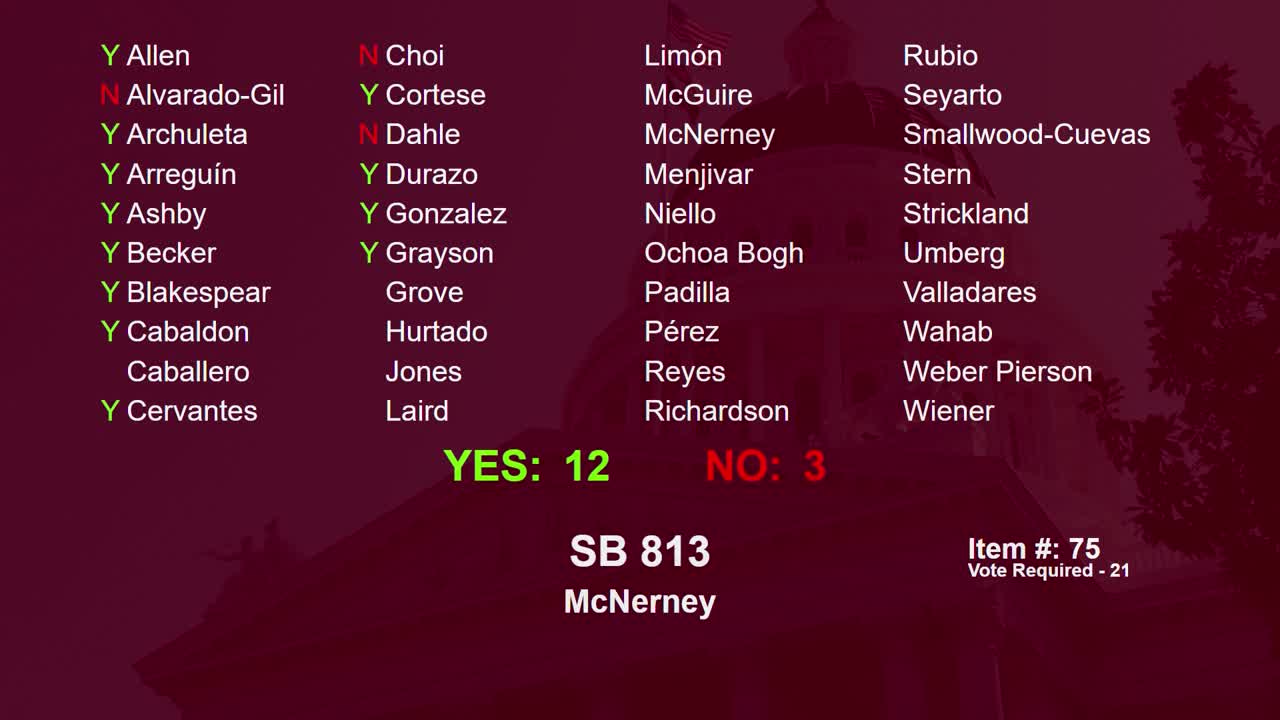 2MIN
Senate Floor
 16MIN
Senate Standing Committee on Public Safety
 18MIN
Senate Standing Committee on Judiciary
 11MIN
Senate Standing Committee on Military and Veterans Affairs
 7MIN
Senate Standing Committee on Human Services
Bill Author

Bill Co-Author(s):