SB 990: Highways: exit information.
- Session Year: 2025-2026
- House: Senate
- Latest Version Date: 2026-09-14
Current Status:
Passed
(2026-09-14: Chaptered by Secretary of State. Chapter 226, Statutes of 2026.)
Introduced
In Committee
Awaiting First Chamber Vote
Passed First Chamber
In Committee
Awaiting Second Chamber Vote
Passed Second Chamber
Enacted
Existing law requires the Department of Transportation to adopt rules and regulations that allow the placement, near exits on freeways in rural areas, of information signs identifying specific roadside businesses. Existing law generally prohibits the placement of a sign within an urban area with a population of 5,000 or more, with certain exceptions.
This bill, until January 1, 2037, would require the department to allow the placement of information signs along southbound State Route 395 just before the State Route 178 eastbound exit and along northbound State Route 395 just before the South China Lake Boulevard northbound exit, as provided.
Existing law requires the Department of Transportation to adopt rules and regulations that allow the placement, near exits on freeways in rural areas, of information signs identifying specific roadside businesses. Existing law generally prohibits the placement of a sign within an urban area with a population of 5,000 or more, with certain exceptions.
This bill, until January 1, 2037, would require the department to allow the placement of information signs along southbound State Route 395 just before the State Route 178 eastbound exit and along northbound State Route 395 just before the South China Lake Boulevard northbound exit. exit, as provided.
Existing law requires the Department of Transportation to adopt rules and regulations that allow the placement, near exits on freeways in rural areas, of information signs identifying specific roadside businesses. Existing law generally prohibits the placement of a sign within an urban area with a population of 5,000 or more, with certain exceptions.
This bill bill, until January 1, 2037, would require the department to allow the placement of information signs along southbound State Route 395 just before the State Route 178 eastbound exit and along northbound State Route 395 just before the South China Lake Boulevard northbound exit.
Existing law requires the Department of Transportation to adopt rules and regulations that allow the placement, near exits on freeways in rural areas, of information signs identifying specific roadside businesses. Existing law generally prohibits the placement of a sign within an urban area with a population of 5,000 or more, with certain exceptions.
This bill would require the department to allow the placement of information signs along northbound southbound State Route 395 just before the State Route 178 eastbound exit and along southbound northbound State Route 395 just before the South China Lake Boulevard northbound exit.
Existing law requires the Department of Transportation to adopt rules and regulations that allow the placement, near exits on freeways in rural areas, of information signs identifying specific roadside businesses. Existing law generally prohibits the placement of a sign within an urban area with a population of 5,000 or more, with certain exceptions.
This bill would require the department to allow the placement of information signs along northbound State Route 395 just before the State Route 178 eastbound exit and along southbound State Route 395 just before the South China Lake Boulevard northbound exit.
(a)The department shall adopt rules and regulations that allow the placement, near exits on freeways located in rural areas, of information signs identifying specific roadside businesses offering fuel, food, lodging, electric vehicle charging facilities, camping services, approved 24-hour pharmacy services, or approved attractions, and that prescribe the standards for those signs.
(b)The department shall provide equal access to all business applicants.
(c)(1)(A)Except as provided in paragraphs (2) and (3), the department shall not approve the placement of a sign within an urban area designated by the United States Bureau of the Census as having a population of 5,000 or more.
(B)The department may not remove an information sign that was placed before January 1, 2003, due solely to population growth in an urban area that results in a population of 5,000 or more but less than 10,000.
(2)(A)Notwithstanding paragraph (1), the department, until January 1, 2021, shall allow the placement of information signs along State Highway Route 65 within, or at exits leading to, the City of Lincoln and along Interstate 80 within, or at exits leading to, the City of Truckee.
(B)The authorization in this paragraph with respect to information signs along Interstate 80 within, or at exits leading to, the City of Truckee, shall apply only to incorporated areas with a population density of less than one person per acre surrounded entirely by land of the Tahoe National Forest.
(C)On or before January 1, 2020, the department shall report to the transportation committees of the Senate and Assembly on the implementation of this paragraph. The report shall describe the implementation and any benefits of, or concerns regarding, that implementation, and shall include recommendations as to whether or not the period of this program should be extended and whether or not the authorization for information signs under this section should be expanded to urban areas having a population of 5,000 or more.
(3)Notwithstanding paragraph (1), until January 1, 2037, the department shall allow the placement of information signs along southbound State Route 395 just before the State Route 178 eastbound exit and along northbound State Route 395 just before the South China Lake Boulevard northbound exit, provided that qualified motorist service businesses are located within 10 miles of the interchange where the information sign is to be displayed.
(d)The information signs authorized in this section may be placed near the freeway exits in addition to, or in lieu of, other highway signs of the department, but not in lieu of on-premises or off-premises highway oriented business signs and directional signs.
(e)The department shall establish and charge a fee to place and maintain information signs in an amount not less than 25 percent above its estimated cost in placing and maintaining the information signs. The department shall annually review the amount of that fee and revise it as necessary. Funds derived from the imposition of the fee, after deduction of the cost to the department for the placement and maintenance of the information signs, shall be available, upon appropriation by the Legislature, for safety roadside rest purposes.
(f)The department shall incorporate the use of an RV-friendly symbol on an information sign placed pursuant to this section for a specific roadside business that meets criteria of the department regarding sufficiency for recreational vehicles with respect to the parking spaces and surfaces, vertical clearance, turning radius, and entrances and exits of the facility. A specific roadside business otherwise qualified for a sign pursuant to this section may qualify for and request an RV-friendly symbol for that sign. The department shall adopt rules and regulations for an RV-friendly symbol consistent with this section as well as the Federal Highway Administrations Interim Approval for Addition of RV-friendly Symbol to Specific Service Signs. The rules and regulations adopted by the department shall include a provision for the roadside business to acknowledge that overnight occupancy is not permitted unless the roadside business is licensed as a special occupancy park as defined in Section 18862.43 of the Health and Safety Code. The department shall establish and charge an additional fee pursuant to subdivision (e) to place and maintain the symbol.
(g)The department shall develop rules and regulations governing signs for approved attractions, which shall include amusement parks, botanical and zoological facilities, business districts and main street communities, education centers, golf courses, historical sites, museums, religious sites, resorts, ski areas, marinas, u-pick farms and orchards, farmers markets, and wineries, viticulture areas, and vineyards.
(a)The department shall adopt rules and regulations that allow the placement, near exits on freeways located in rural areas, of information signs identifying specific roadside businesses offering fuel, food, lodging, electric vehicle charging facilities, camping services, approved 24-hour pharmacy services, or approved attractions, and that prescribe the standards for those signs.
(b)The department shall provide equal access to all business applicants.
(c)(1)(A)Except as provided in paragraphs (2) and (3), the department shall not approve the placement of a sign within an urban area designated by the United States Bureau of the Census as having a population of 5,000 or more.
(B)The department may not remove an information sign that was placed before January 1, 2003, due solely to population growth in an urban area that results in a population of 5,000 or more but less than 10,000.
(2)(A)Notwithstanding paragraph (1), the department, until January 1, 2021, shall allow the placement of information signs along State Highway Route 65 within, or at exits leading to, the City of Lincoln and along Interstate 80 within, or at exits leading to, the City of Truckee.
(B)The authorization in this paragraph with respect to information signs along Interstate 80 within, or at exits leading to, the City of Truckee, shall apply only to incorporated areas with a population density of less than one person per acre surrounded entirely by land of the Tahoe National Forest.
(C)On or before January 1, 2020, the department shall report to the transportation committees of the Senate and Assembly on the implementation of this paragraph. The report shall describe the implementation and any benefits of, or concerns regarding, that implementation, and shall include recommendations as to whether or not the period of this program should be extended and whether or not the authorization for information signs under this section should be expanded to urban areas having a population of 5,000 or more.
(3)Notwithstanding paragraph (1), until January 1, 2037, the department shall allow the placement of information signs along southbound State Route 395 just before the State Route 178 eastbound exit and along northbound State Route 395 just before the South China Lake Boulevard northbound exit. exit, provided that qualified motorist service businesses are located within 10 miles of the interchange where the information sign is to be displayed.
(d)The information signs authorized in this section may be placed near the freeway exits in addition to, or in lieu of, other highway signs of the department, but not in lieu of on-premises or off-premises highway oriented business signs and directional signs.
(e)The department shall establish and charge a fee to place and maintain information signs in an amount not less than 25 percent above its estimated cost in placing and maintaining the information signs. The department shall annually review the amount of that fee and revise it as necessary. Funds derived from the imposition of the fee, after deduction of the cost to the department for the placement and maintenance of the information signs, shall be available, upon appropriation by the Legislature, for safety roadside rest purposes.
(f)The department shall incorporate the use of an RV-friendly symbol on an information sign placed pursuant to this section for a specific roadside business that meets criteria of the department regarding sufficiency for recreational vehicles with respect to the parking spaces and surfaces, vertical clearance, turning radius, and entrances and exits of the facility. A specific roadside business otherwise qualified for a sign pursuant to this section may qualify for and request an RV-friendly symbol for that sign. The department shall adopt rules and regulations for an RV-friendly symbol consistent with this section as well as the Federal Highway Administrations Interim Approval for Addition of RV-friendly Symbol to Specific Service Signs. The rules and regulations adopted by the department shall include a provision for the roadside business to acknowledge that overnight occupancy is not permitted unless the roadside business is licensed as a special occupancy park as defined in Section 18862.43 of the Health and Safety Code. The department shall establish and charge an additional fee pursuant to subdivision (e) to place and maintain the symbol.
(g)The department shall develop rules and regulations governing signs for approved attractions, which shall include amusement parks, botanical and zoological facilities, business districts and main street communities, education centers, golf courses, historical sites, museums, religious sites, resorts, ski areas, marinas, u-pick farms and orchards, farmers markets, and wineries, viticulture areas, and vineyards.
(a)The department shall adopt rules and regulations that allow the placement, near exits on freeways located in rural areas, of information signs identifying specific roadside businesses offering fuel, food, lodging, electric vehicle charging facilities, camping services, approved 24-hour pharmacy services, or approved attractions, and that prescribe the standards for those signs.
(b)The department shall provide equal access to all business applicants.
(c)(1)(A)Except as provided in paragraphs (2) and (3), the department shall not approve the placement of a sign within an urban area designated by the United States Bureau of the Census as having a population of 5,000 or more.
(B)The department may not remove an information sign that was placed before January 1, 2003, due solely to population growth in an urban area that results in a population of 5,000 or more but less than 10,000.
(2)(A)Notwithstanding paragraph (1), the department, until January 1, 2021, shall allow the placement of information signs along State Highway Route 65 within, or at exits leading to, the City of Lincoln and along Interstate 80 within, or at exits leading to, the City of Truckee.
(B)The authorization in this paragraph with respect to information signs along Interstate 80 within, or at exits leading to, the City of Truckee, shall apply only to incorporated areas with a population density of less than one person per acre surrounded entirely by land of the Tahoe National Forest.
(3)Notwithstanding paragraph (1), the department shall allow the placement of information signs along southbound State Route 395 just before the State Route 178 eastbound exit and along northbound State Route 395 just before the South China Lake Boulevard northbound exit.(C)On or before January 1, 2020, the department shall report to the transportation committees of the Senate and Assembly on the implementation of this paragraph. The report shall describe the implementation and any benefits of, or concerns regarding, that implementation, and shall include recommendations as to whether or not the period of this program should be extended and whether or not the authorization for information signs under this section should be expanded to urban areas having a population of 5,000 or more.
(3)Notwithstanding paragraph (1), until January 1, 2037, the department shall allow the placement of information signs along southbound State Route 395 just before the State Route 178 eastbound exit and along northbound State Route 395 just before the South China Lake Boulevard northbound exit.
(d)The information signs authorized in this section may be placed near the freeway exits in addition to, or in lieu of, other highway signs of the department, but not in lieu of on-premises or off-premises highway oriented business signs and directional signs.
(e)The department shall establish and charge a fee to place and maintain information signs in an amount not less than 25 percent above its estimated cost in placing and maintaining the information signs. The department shall annually review the amount of that fee and revise it as necessary. Funds derived from the imposition of the fee, after deduction of the cost to the department for the placement and maintenance of the information signs, shall be available, upon appropriation by the Legislature, for safety roadside rest purposes.
(f)The department shall incorporate the use of an RV-friendly symbol on an information sign placed pursuant to this section for a specific roadside business that meets criteria of the department regarding sufficiency for recreational vehicles with respect to the parking spaces and surfaces, vertical clearance, turning radius, and entrances and exits of the facility. A specific roadside business otherwise qualified for a sign pursuant to this section may qualify for and request an RV-friendly symbol for that sign. The department shall adopt rules and regulations for an RV-friendly symbol consistent with this section as well as the Federal Highway Administrations Interim Approval for Addition of RV-friendly Symbol to Specific Service Signs. The rules and regulations adopted by the department shall include a provision for the roadside business to acknowledge that overnight occupancy is not permitted unless the roadside business is licensed as a special occupancy park as defined in Section 18862.43 of the Health and Safety Code. The department shall establish and charge an additional fee pursuant to subdivision (e) to place and maintain the symbol.
(g)The department shall develop rules and regulations governing signs for approved attractions, which shall include amusement parks, botanical and zoological facilities, business districts and main street communities, education centers, golf courses, historical sites, museums, religious sites, resorts, ski areas, marinas, u-pick farms and orchards, farmers markets, and wineries, viticulture areas, and vineyards.
(a)The department shall adopt rules and regulations that allow the placement, near exits on freeways located in rural areas, of information signs identifying specific roadside businesses offering fuel, food, lodging, electric vehicle charging facilities, camping services, approved 24-hour pharmacy services, or approved attractions, and that prescribe the standards for those signs.
(b)The department shall provide equal access to all business applicants.
(c)(1)(A)Except as provided in paragraphs (2) and (3), the department shall not approve the placement of a sign within an urban area designated by the United States Bureau of the Census as having a population of 5,000 or more.
(B)The department may not remove an information sign that was placed before January 1, 2003, due solely to population growth in an urban area that results in a population of 5,000 or more but less than 10,000.
(2)(A)Notwithstanding paragraph (1), the department, until January 1, 2021, shall allow the placement of information signs along State Highway Route 65 within, or at exits leading to, the City of Lincoln and along Interstate 80 within, or at exits leading to, the City of Truckee.
(B)The authorization in this paragraph with respect to information signs along Interstate 80 within, or at exits leading to, the City of Truckee, shall apply only to incorporated areas with a population density of less than one person per acre surrounded entirely by land of the Tahoe National Forest.
(3)Notwithstanding paragraph (1), the department shall allow the placement of information signs along northbound southbound State Route 395 just before the State Route 178 eastbound exit and along southbound northbound State Route 395 just before the South China Lake Boulevard northbound exit.
(C)On or before January 1, 2020, the department shall report to the transportation committees of the Senate and Assembly on the implementation of this paragraph. The report shall describe the implementation and any benefits of, or concerns regarding, that implementation, and shall include recommendations as to whether or not the period of this program should be extended and whether or not the authorization for information signs under this section should be expanded to urban areas having a population of 5,000 or more.
(d)The information signs authorized in this section may be placed near the freeway exits in addition to, or in lieu of, other highway signs of the department, but not in lieu of on-premises or off-premises highway oriented business signs and directional signs.
(e)The department shall establish and charge a fee to place and maintain information signs in an amount not less than 25 percent above its estimated cost in placing and maintaining the information signs. The department shall annually review the amount of that fee and revise it as necessary. Funds derived from the imposition of the fee, after deduction of the cost to the department for the placement and maintenance of the information signs, shall be available, upon appropriation by the Legislature, for safety roadside rest purposes.
(f)The department shall incorporate the use of an RV-friendly symbol on an information sign placed pursuant to this section for a specific roadside business that meets criteria of the department regarding sufficiency for recreational vehicles with respect to the parking spaces and surfaces, vertical clearance, turning radius, and entrances and exits of the facility. A specific roadside business otherwise qualified for a sign pursuant to this section may qualify for and request an RV-friendly symbol for that sign. The department shall adopt rules and regulations for an RV-friendly symbol consistent with this section as well as the Federal Highway Administrations Interim Approval for Addition of RV-friendly Symbol to Specific Service Signs. The rules and regulations adopted by the department shall include a provision for the roadside business to acknowledge that overnight occupancy is not permitted unless the roadside business is licensed as a special occupancy park as defined in Section 18862.43 of the Health and Safety Code. The department shall establish and charge an additional fee pursuant to subdivision (e) to place and maintain the symbol.
(g)The department shall develop rules and regulations governing signs for approved attractions, which shall include amusement parks, botanical and zoological facilities, business districts and main street communities, education centers, golf courses, historical sites, museums, religious sites, resorts, ski areas, marinas, u-pick farms and orchards, farmers markets, and wineries, viticulture areas, and vineyards.
(a)The department shall adopt rules and regulations that allow the placement, near exits on freeways located in rural areas, of information signs identifying specific roadside businesses offering fuel, food, lodging, electric vehicle charging facilities, camping services, approved 24-hour pharmacy services, or approved attractions, and that prescribe the standards for those signs.
(b)The department shall provide equal access to all business applicants.
(c)(1)(A)Except as provided in paragraph (2), paragraphs (2) and (3), the department shall not approve the placement of a sign within an urban area designated by the United States Bureau of the Census as having a population of 5,000 or more.
(B)The department may not remove an information sign that was placed before January 1, 2003, due solely to population growth in an urban area that results in a population of 5,000 or more but less than 10,000.
(2)(A)Notwithstanding paragraph (1), the department, until January 1, 2021, shall allow the placement of information signs along State Highway Route 65 within, or at exits leading to, the City of Lincoln and along Interstate 80 within, or at exits leading to, the City of Truckee.
(B)The authorization in this paragraph with respect to information signs along Interstate 80 within, or at exits leading to, the City of Truckee, shall apply only to incorporated areas with a population density of less than one person per acre surrounded entirely by land of the Tahoe National Forest.
(3)Notwithstanding paragraph (1), the department shall allow the placement of information signs along northbound State Route 395 just before the State Route 178 eastbound exit and along southbound State Route 395 just before the South China Lake Boulevard northbound exit.
(C)On or before January 1, 2020, the department shall report to the transportation committees of the Senate and Assembly on the implementation of this paragraph. The report shall describe the implementation and any benefits of, or concerns regarding, that implementation, and shall include recommendations as to whether or not the period of this program should be extended and whether or not the authorization for information signs under this section should be expanded to urban areas having a population of 5,000 or more.
(d)The information signs authorized in this section may be placed near the freeway exits in addition to, or in lieu of, other highway signs of the department, but not in lieu of on-premises or off-premises highway oriented business signs and directional signs.
(e)The department shall establish and charge a fee to place and maintain information signs in an amount not less than 25 percent above its estimated cost in placing and maintaining the information signs. The department shall annually review the amount of that fee and revise it as necessary. Funds derived from the imposition of the fee, after deduction of the cost to the department for the placement and maintenance of the information signs, shall be available, upon appropriation by the Legislature, for safety roadside rest purposes.
(f)The department shall incorporate the use of an RV-friendly symbol on an information sign placed pursuant to this section for a specific roadside business that meets criteria of the department regarding sufficiency for recreational vehicles with respect to the parking spaces and surfaces, vertical clearance, turning radius, and entrances and exits of the facility. A specific roadside business otherwise qualified for a sign pursuant to this section may qualify for and request an RV-friendly symbol for that sign. The department shall adopt rules and regulations for an RV-friendly symbol consistent with this section as well as the Federal Highway Administrations Interim Approval for Addition of RV-friendly Symbol to Specific Service Signs. The rules and regulations adopted by the department shall include a provision for the roadside business to acknowledge that overnight occupancy is not permitted unless the roadside business is licensed as a special occupancy park as defined in Section 18862.43 of the Health and Safety Code. The department shall establish and charge an additional fee pursuant to subdivision (e) to place and maintain the symbol.
(g)The department shall develop rules and regulations governing signs for approved attractions, which shall include amusement parks, botanical and zoological facilities, business districts and main street communities, education centers, golf courses, historical sites, museums, religious sites, resorts, ski areas, marinas, u-pick farms and orchards, farmers markets, and wineries, viticulture areas, and vineyards.
|
Date
|
Status
|
|---|---|
| Sep 14, 2026 | Chaptered by Secretary of State. Chapter 226, Statutes of 2026. |
| Sep 14, 2026 | Approved by the Governor. |
| Aug 27, 2026 | Enrolled and presented to the Governor at 4:30 p.m. |
| Aug 24, 2026 | Assembly amendments concurred in. (Ayes 40. Noes 0. Page 5683.) Ordered to engrossing and enrolling. |
| Aug 24, 2026 | Assembly amendments concurred in. (Ayes 40. Noes 0.) Ordered to engrossing and enrolling. |
| Aug 24, 2026 | Assembly amendments concurred in. (Ayes 39. Noes 0.) Ordered to engrossing and enrolling. |
| Aug 19, 2026 | In Senate. Concurrence in Assembly amendments pending. |
| Aug 19, 2026 | Read third time. Passed. (Ayes 77. Noes 0. Page 6263.) Ordered to the Senate. |
| Aug 19, 2026 | Read third time. Passed. Ordered to the Senate. |
| Aug 11, 2026 | Ordered to third reading. |
| Aug 11, 2026 | Read third time and amended. |
| Aug 10, 2026 | Ordered to third reading. |
| Aug 10, 2026 | From consent calendar on motion of Assembly Member Aguiar-Curry. |
| Aug 6, 2026 | Read second time. Ordered to consent calendar. |
| Aug 5, 2026 | From committee: Do pass. Ordered to consent calendar. (Ayes 15. Noes 0.) (August 5). |
| Jun 23, 2026 | From committee: Do pass and re-refer to Com. on APPR. with recommendation: To consent calendar. (Ayes 16. Noes 0.) (June 22). Re-referred to Com. on APPR. |
| May 18, 2026 | Referred to Com. on TRANS. |
| May 4, 2026 | In Assembly. Read first time. Held at Desk. |
| May 4, 2026 | Read third time. Passed. (Ayes 40. Noes 0. Page 4131.) Ordered to the Assembly. |
| May 4, 2026 | Read third time. Passed. (Ayes 40. Noes 0.) Ordered to the Assembly. |
| Apr 21, 2026 | Read second time. Ordered to third reading. |
| Apr 20, 2026 | From committee: Be ordered to second reading pursuant to Senate Rule 28.8. |
| Apr 10, 2026 | Set for hearing April 20. |
| Apr 8, 2026 | From committee: Do pass and re-refer to Com. on APPR. (Ayes 12. Noes 0. Page 3760.) (April 7). Re-referred to Com. on APPR. |
| Apr 8, 2026 | From committee: Do pass and re-refer to Com. on APPR. (Ayes 12. Noes 0.) (April 7). Re-referred to Com. on APPR. |
| Mar 25, 2026 | From committee with author's amendments. Read second time and amended. Re-referred to Com. on TRANS. |
| Mar 17, 2026 | Set for hearing April 7. |
| Mar 9, 2026 | From committee with author's amendments. Read second time and amended. Re-referred to Com. on TRANS. |
| Feb 18, 2026 | Referred to Com. on TRANS. |
| Feb 9, 2026 | From printer. May be acted upon on or after March 8. |
| Feb 5, 2026 | Introduced. Read first time. To Com. on RLS. for assignment. To print. |
|
Date
|
Description
|
Location
|
Votes
|
|
|---|---|---|---|---|
| Aug 24, 2026 | Unfinished Business SB990 Grove Concurrence | Senate Floor |
Passed |
|
| Aug 19, 2026 | SB 990 Grove Senate Third Reading By Ellis | Assembly Floor |
Passed |
|
| Aug 5, 2026 | Do pass. To Consent Calendar. | Assembly Standing Committee on Appropriations |
Passed |
|
| Jun 22, 2026 | Do pass and be re-referred to the Committee on [Appropriations] with recommendation: To Consent Calendar | Assembly Standing Committee on Transportation |
Passed |
|
| May 4, 2026 | Senate 3rd Reading SB990 Grove | Senate Floor |
Passed |
|
| Apr 7, 2026 | Do pass, but first be re-referred to the Committee on [Appropriations] | Senate Standing Committee on Transportation |
Passed |
This list shows positions taken on this bill by organizations on the date displayed, which is linked to the original source.
Positions by individuals are not included.
|
Organization
|
Position
|
Date
|
|---|---|---|
| City of Ridgecrest | ** Support | |
| Ridgecrest Area Convention & Visitors Bureau | ** Support | |
| Ridgecrest Chamber of Commerce | ** Support | |
| Ridgecrest Police Department | ** Support | |
| Travis Endicott | ** Support |
SENATE RULES COMMITTEE Office of Senate Floor Analyses (916) 651-4171 | SB 990 |
UNFINISHED BUSINESS
Bill No: SB 990
Author: Grove (R)
Amended: 8/11/26
Vote: 21
SENATE TRANSPORTATION COMMITTEE: 12-0, 4/7/26
AYES: Cortese, Strickland, Archuleta, Arreguín, Blakespear, Gonzalez, Grayson, Menjivar, Richardson, Seyarto, Valladares, Wiener
NO VOTE RECORDED: Dahle
SENATE APPROPRIATIONS COMMITTEE: Senate Rule 28.8
SENATE FLOOR: 40-0, 5/4/26
AYES: Allen, Alvarado-Gil, Archuleta, Arreguín, Ashby, Becker, Blakespear, Cabaldon, Caballero, Cervantes, Choi, Cortese, Dahle, Durazo, Gonzalez, Grayson, Grove, Hurtado, Jones, Laird, Limón, McGuire, McNerney, Menjivar, Niello, Ochoa Bogh, Padilla, Pérez, Reyes, Richardson, Rubio, Seyarto, Smallwood-Cuevas, Stern, Strickland, Umberg, Valladares, Wahab, Weber Pierson, Wiener
ASSEMBLY FLOOR: 77-0, 8/19/26 - See last page for vote
SUBJECT: Highways: exit information
SOURCE: Author
DIGEST:
This bill allows the California Department of Transportation (Caltrans) to place signs along State Route (SR) 395 near the City of Ridgecrest as part of its Specific Services Sign Program.
Assembly Amendments
specify a business may qualify for the Specific Services Sign Program in Ridgecrest if they are located within 10 miles of the proposed sign’s location.
ANALYSIS:
Existing federal law requires all states to create highway safety programs and adhere to uniform standards promulgated by the United States Department of Transportation (U.S. DOT). (23 United States Code [USC § 402)
Existing state law:
- Provides that Caltrans has full possession and control of the state highway system. (State Highway Code (SHC) § 90)
- Requires Caltrans to adopt rules and regulations for prescribing uniform standards and specifications for all traffic control devices. (Vehicle Code (VEH) § 21400)
- Directs Caltrans to adopt rules and regulations for its Specific Service Sign Program. As part of these rules, Caltrans must:
- Ensure all business applicants have equal access to the program (SHC § 101.7(b)); and,
- Ensure signs are not placed within urban areas designated by the United States Census Bureau as having a population of 5,000 or more. (SHC § 101.7(c))
This bill:
- Authorizes, despite the 5,000 person population limit, the placement of specific service signs at two specified locations of SR 395 near the City of Ridgecrest, until January 1, 2037.
- Provides that a qualified business may be located up to 10 miles from the proposed sign location.
Comments
- Purpose of the bill. According to the author “This bill provides a narrow exception to allow business logo signage along U.S. Route 395 at the China Lake Boulevard exit serving Ridgecrest. Ridgecrest’s essential services are not visible from the highway and are located several miles off the roadway, despite serving motorists traveling a remote 120-mile corridor with limited service options. The bill improves traveler awareness, supports fatigue mitigation on a rural highway, and aligns with prior legislative exceptions granted to similarly situated communities.”
- General Service Sign Program. General services signs are white-on-blue signs and are intended to guide motorists to services that are not readily apparent to the driver. A typical general service sign is rectangular and displays an icon, such as a gas pump to indicate access to a gas station. Other services that can be indicated include, among others, hospitals, food, lodging, and electrical vehicle charging. Notably, general services signs do not indicate the specific name of the business offering the service identified.
- Specific Service Sign Program. In addition to general service signs, California law sets forth the Specific Service Sign Program, designed to direct motorists not familiar with the area to specific services at or near rural freeway interchanges. Unlike general service signs, these signs display the logos of particular businesses located in the vicinity. Under the program, eligible businesses request to have a sign created and must pay for its cost. Caltrans then approves the request and erects the sign, in compliance with the regulations in the Manual of Uniform Traffic Control Devices (MUCTD). The program is explicitly designed to serve rural areas, and by statute is only authorized in areas with a population of less than 5,000.
Specific service signs accommodate up to six logos per type of service, and only four signs may be installed in a single location. Specific service signs are also limited to only displaying gas, electric vehicle (EV) charging, food, lodging, camping, 24-hour pharmacy, or attraction services. Furthermore, each service type must meet specific requirements regarding the exact services offered, total operating hours, and distance to the highway in order to qualify. - The City of Ridgecrest. Ridgecrest is a city with a population of roughly 28,000 located at the eastern edge of Kern County. It is located several miles east of SR 395 and is the largest city along the highway. It also exists in the middle of a large rural area, where services are often few and far between. Ridgecrest itself offers numerous services; however the city is not easily visible from the highway. The City of Ridgecrest has argued that this creates unsafe conditions on the state highway as fatigued motorists push past Ridgecrest, not realizing they can stop in the city.
Due to its population, the city is not currently eligible for the Specific Service Signs Program, however it should be noted that general services signs do currently exist along the highway near exits leading to the city. Caltrans District 9, in which Ridgecrest is located, is also currently working to revitalize the existing general service signs in the area. This bill makes an exception to the population limit for the Specific Service Sign Program for the city of Ridgecrest. This would allow businesses to request, and Caltrans to erect, business logo signs along SR 395 outside the city. - Safety, or economics? Since the inception of the Specific Services Sign program, two specific statutory exceptions to the population limit have been made. These were done for the City of Lincoln (population of roughly 56,000) and the City of Truckee (population of roughly 17,000). In both cases, supporters argued that these signs, which display specific business logos, were necessary to support local businesses. City leaders in Ridgecrest have also made similar arguments, saying their distance from the highway hurts local businesses, and that the addition of specific service signs would help ameliorate this effect.
- Recommendations against expansion. As part of the legislation that created the population exceptions for Lincoln and Truckee, Caltrans was also required to create a report for the Legislature about the implementation of the exception and to make recommendations on further expansion of the Specific Service Sign Program. The report was released in 2019.
In that report, Caltrans recommended that the Specific Services Sign Program not be further expanded. This recommendation was based on a number of considerations. First and foremost, Caltrans expressed concern that visual sign congestion from too many signs could create the conditions for distracted driving and pose a safety risk. Furthermore, Caltrans emphasized that the program is not meant to take the place of traditional business advertising.
FISCAL EFFECT: Appropriation: No Fiscal Com.: Yes Local: No
SUPPORT: (Verified 8/19/26)
City of Ridgecrest
Ridgecrest Area Convention & Visitors Bureau
Ridgecrest Chamber of Commerce
Ridgecrest Police Department
OPPOSITION: (Verified 8/19/26)
ASSEMBLY FLOOR: 77-0 8/19/26
AYES: Addis, Aguiar-Curry, Ahrens, Alanis, Alvarez, Arambula, Ávila Farías, Bains, Bauer-Kahan, Bennett, Berman, Boerner, Bonta, Bryan, Calderon, Caloza, Carrillo, Castillo, Chen, Connolly, Davies, DeMaio, Dixon, Elhawary, Ellis, Flora, Fong, Gabriel, Garcia, Gipson, Jeff Gonzalez, Mark González, Hadwick, Harabedian, Hart, Hoover, Irwin, Jackson, Johnson, Kalra, Krell, Lackey, Lee, Lowenthal, Macedo, McKinnor, Muratsuchi, Nguyen, Ortega, Pacheco, Papan, Patel, Patterson, Pellerin, Petrie-Norris, Quirk-Silva, Ramos, Ransom, Celeste Rodriguez, Michelle Rodriguez, Rogers, Sanchez, Schiavo, Schultz, Sharp-Collins, Solache, Soria, Stefani, Ta, Tangipa, Valencia, Wallis, Ward, Wicks, Wilson, Zbur, Rivas
NO VOTE RECORDED: Haney, Blanca Rubio
Prepared by: Samuel Myers / TRANS. / (916) 651-4121
8/19/26 14:45:18
**** END ****
SENATE THIRD READING
STR Bill Id:SB 990
Author:(Grove)
As Amended Ver:August 11, 2026
Majority vote
SUMMARY
Requires the California Department of Transportation (Caltrans), until January 1, 2037, to allow for the placement of information signs along southbound State Route (SR) 395 near the City of Ridgecrest as part of the state's Business Logo Sign Program (Program) provided that qualified businesses are located within 10 miles of the interchange where the information sign is to be displayed.
Major Provisions
COMMENTS
General vs. specific signs. Nationally, any device that guides, warns, or regulates motorists on public streets or highways must conform to standards promulgated by the U.S. Department of Transportation pursuant to the Manual of Uniform Traffic Control Devices (MUCTD). Each state is required to adopt a state-specific MUCTD "in substantial compliance" with the federal MUCTD. Both the federal and state MUCTD create a General Service Sign Program, which are white-on-blue signs and are intended to guide motorists to services that are not readily apparent to the driver from the freeway. A typical general service sign is rectangular and displays icons indicating a gas pump, hospital, food, lodging or electrical vehicle charging.
This bill pertains to specific signs that include named businesses under the state's Program, which was established in 1978, as authorized by federal law, to aid motorists travelling along Interstate-5. In 1992, the Legislature expanded the Program statewide but limited it to rural areas under 5,000 in population. The Program is designed to direct motorists to specific businesses (offering fuel, Electric Vehicle (EV) charging, food, lodging, camping, attractions) at or near rural freeway interchanges. Unlike general service signs, these signs display the logos of specific businesses, which, depending on the service, must be located no more than 1-10 miles from a sign, and must pay annual fees (e.g., $160-310) that cover the cost of the Program. Business logo signs can accommodate up to six logos and only four signs may be installed in a single location.
Ridgecrest would be the third city to seek exemption. The City of Ridgecrest is located at the eastern edge of Kern County with a population of roughly 28,000. Surrounded by four mountain ranges, including the Sierra Nevada to the west, Ridgecrest is the most isolated city in Kern County and arguably one of the most remote communities in the state. However, with a relatively sizable population, it is well served by gas stations, restaurants and lodging. As such, Ridgecrest appears to function as a service hub for the surrounding region—it may be the last reliable stop for the above services before long gaps (e.g., 120 miles to the south, 60 miles to the north)—in multiple directions despite being located several miles east of SR 395.
Supporters of this bill argue that the above conditions make it difficult for motorists to identify Ridgecrest as a potential stop for services. They assert that this creates unsafe conditions on the state highway as fatigued motorists drive past Ridgecrest not realizing they can stop in the city. Due to its population, the city is not eligible for the Program though general services signs do currently exist along the highway near exits leading to the city.
This bill, until January 1, 2037, makes an exception to the 5,000-population limit for the program by requiring Caltrans to authorize the placement of business logos on information signs at two exits north and south of Ridgecrest. The Legislature has made similar exceptions in two prior cases for the cities of Lincoln and Truckee. For the former, the construction of a bypass discouraged business activity in the city and population growth in the latter led to the removal of previous service signs. For signs installed prior to January 1, 2003, existing law prohibits Caltrans from removing signs until a population exceeds 10,000. Caltrans indicates that when this bill sunsets it would remove any information signs consistent with the MUCTD, which was revised in January to, in part, prohibit the installation of new signs in areas above 5,000 in population. This only refers to those areas that the Legislature has exempted from the statutory population threshold.
The statutory definition of rural may be outdated. The 5,000-population limit in existing law has not been revisited since the Legislature imposed it in 1992. Instead of entertaining multiple exceptions to this limit, the Legislature may wish to adjust this limit or at least give Caltrans greater discretion to install business logos in rural or urban areas if justified, especially for situations like Ridgecrest. In 2000, the Federal Highway Administration revised the federal MUCTD to permit business logo signs in all areas of a state so long as adequate sign spacing can be maintained, the intent of which is to minimize driver distraction or information overload.
However, in a 2020 report to the Legislature reviewing the Lincoln and Truckee business signs, Caltrans stated that it "…does not support expanding the business logo sign program to other urban areas because of the number of signs that could be requested at a single location and their potential effects on driver distraction." It appears that most of the research on sign clutter or driver distraction primarily implicates billboards, particularly electronic ones, and their potentially distracting effect on driving performance and safety.
According to the Author
According to the author, "This bill provides a narrow exception to allow business logo signage along U.S. Route 395 at the China Lake Boulevard exit serving Ridgecrest. Ridgecrest's essential services are not visible from the highway and are located several miles off the roadway, despite serving motorists traveling a remote 120-mile corridor with limited service options. The bill improves traveler awareness, supports fatigue mitigation on a rural highway, and aligns with prior legislative exceptions granted to similarly situated communities.
Ridgecrest exceeds the population threshold and location from the highway as its services are located several miles off U.S. Route 395, making them ineligible despite serving a remote corridor with widely spaced fuel and lodging options."
Arguments in Support
Writing in support, the City of Ridgecrest states that "Ridgecrest is working hard to strengthen and diversify its local economy but continues to face economic health challenges common to rural and high-desert communities. Businesses in Ridgecrest rely heavily on pass-through travelers along California State Route 395, yet many motorists are unaware of the services, restaurants, lodging, retail options, medical facilities, fuel, and other amenities available just minutes off the highway."
Arguments in Opposition
None on file.
FISCAL COMMENTS
According to the Assembly Appropriations Committee, negligible costs to Caltrans.
VOTES
SENATE FLOOR: 40-0-0
YES: Allen, Alvarado-Gil, Archuleta, Arreguín, Ashby, Becker, Blakespear, Cabaldon, Caballero, Cervantes, Choi, Cortese, Dahle, Durazo, Gonzalez, Grayson, Grove, Hurtado, Jones, Laird, Limón, McGuire, McNerney, Menjivar, Niello, Ochoa Bogh, Padilla, Pérez, Reyes, Richardson, Rubio, Seyarto, Smallwood-Cuevas, Stern, Strickland, Umberg, Valladares, Wahab, Weber Pierson, Wiener
ASM TRANSPORTATION: 16-0-0
YES: Wilson, Davies, Ahrens, Ávila Farías, Carrillo, Elhawary, Harabedian, Hart, Hoover, Jackson, Lackey, Macedo, Papan, Ransom, Rogers, Ward
ASM APPROPRIATIONS: 15-0-0
YES: Wicks, Hoover, Arambula, Calderon, Caloza, Dixon, Fong, Mark González, Krell, Pacheco, Pellerin, Sharp-Collins, Solache, Ta, Tangipa
UPDATED
VERSION: August 11, 2026
CONSULTANT: Dan Chia / TRANS. / (916) 319-2093 FN: 0003429
Date of Hearing: August 5, 2026
ASSEMBLY COMMITTEE ON APPROPRIATIONS
Buffy Wicks, Chair
SBPCA Bill Id:SB 990
Author:(Grove) – As Amended Ver:March 25, 2026
Policy Committee: | Transportation | Vote: | 16 - 0 |
|
| ||
|
|
Urgency: No State Mandated Local Program: No Reimbursable: No
SUMMARY:
This bill temporarily allows placement along the highway of signs indicating business-specific services in the City of Ridgecrest in Kern County.
Specifically, this bill directs the Department of Transportation (Caltrans), until January 1, 2037, to allow the placement of information signs along southbound State Route (SR) 395 just before the SR 178 eastbound exit and along northbound SR 395 just before the South China Lake Boulevard northbound exit that identify specific roadside businesses that offer fuel, food, lodging, electric vehicle charging, camping, 24-hour pharmacy services or approved attractions.
FISCAL EFFECT:
Negligible costs to Caltrans.
COMMENTS:
State law requires Caltrans to adopt regulations, consistent with federal law, that allow the placement, near exits on freeways located in rural areas, of information signs identifying specific roadside businesses offering fuel, food, lodging, electric vehicle charging facilities, camping services, approved 24-hour pharmacy services or approved attractions, and that prescribe the standards for those signs. The law generally prohibits Caltrans from approving the placement of such a sign within an urban area with a population of 5,000 or more, though the law provides exemptions for certain highways near the cities of Lincoln and Truckee.
Ridgecrest is a remote city in eastern Kern County. It is one of the last stops for a variety of services for long distances in any direction. However, bill supporters, such as the mayor of Ridgecrest and the local chamber of commerce, describe the city and its many motorist-oriented services as not readily visible from the highway. Yet, because the city’s population exceeds 5,000 residents, state law prohibits the placement on the highway of signs indicating the specific businesses (usually through commercial logos) offering services in Ridgecrest. This bill would temporarily allow the placement of such business-specific signs on the highway near Ridgecrest.
Mayor Travis Endicott writes on behalf of the city in support of the bill:
Businesses in Ridgecrest rely heavily on pass-through travelers along California State Route 395, yet many motorists are unaware of the services, restaurants, lodging, retail options, medical facilities, fuel, and other amenities available just minutes off the highway…SB 990 provides a reasonable and targeted solution by requiring the Department to allow the placement of information signs along southbound State Route 395 just before the State Route 178 eastbound exit and along northbound State Route 395 just before the South China Lake Boulevard northbound exit…SB 990 achieves a thoughtful balance by preserving consistent highway signage standards, enhancing driver safety, advancing national security priorities, and supporting the long-term economic sustainability of Ridgecrest along the highway corridor.
The committee is not aware of opposition to this bill.
Analysis Prepared by: Jay Dickenson / APPR. / (916) 319-2081
Date of Hearing: June 22, 2026
ASSEMBLY COMMITTEE ON TRANSPORTATION
Lori D. Wilson, Chair
SBPCA Bill Id:SB 990
Author:(Grove) – As Amended Ver:March 25, 2026
SENATE VOTE: 40-0
SUBJECT: Highways: exit information
SUMMARY: Requires the California Department of Transportation (Caltrans), until January 1, 2037, to allow for the placement of information signs along southbound State Route (SR) 395 near the City of Ridgecrest as part of the state’s Business Logo Sign Program (Program).
EXISTING LAW:
- Vests Caltrans with possession and control of all state highways and the responsibility for the planning, design, construction, maintenance, and operation of the state highway system (Streets and Highway (SHC) Code §90).
- Directs Caltrans to adopt rules and regulations that allow the placement of information signs near freeway exits located in rural areas identifying specific roadside businesses offering fuel, food, lodging, electric vehicle charging, camping services, pharmacy services, or approved attractions (“business logo signs”), and that prescribe the standards for those signs (SHC §101.7). Specifically, Caltrans must adopt rules that:
- Ensure all business applicants have equal access to the Program.
- Limit business logo signs to areas with a population of less than 5,000 as designated by the United States Census Bureau.
- Prohibits the removal of business logo signs placed before January 1, 2003, due solely to population growth in an urban area that results in a population of 5,000 or more but less than 10,000.
- Authorizes, despite the 5,000 person population limit, the placement of business logo signs along SR 65 within or on exits leading to the City of Lincoln.
- Authorizes, despite the 5,000 person population limit, the placement of business logo signs along Interstate 80 within or on exits leading to the City of Truckee.
- Requires Caltrans to prepare a report for the Senate and Assembly Transportation Committees on the implementation of the two exceptions to the population limit. This report must contain recommendations on whether or not signs should continue to be placed in urban areas with a population of 5,000 or more.
- Ensure all business applicants have equal access to the Program.
FISCAL EFFECT: The Senate Appropriations Committee referred this bill to the Senate floor pursuant to Senate Rule 28.8.
COMMENTS: According to the author, “This bill provides a narrow exception to allow business logo signage along U.S. Route 395 at the China Lake Boulevard exit serving Ridgecrest. Ridgecrest’s essential services are not visible from the highway and are located several miles off the roadway, despite serving motorists traveling a remote 120-mile corridor with limited service options. The bill improves traveler awareness, supports fatigue mitigation on a rural highway, and aligns with prior legislative exceptions granted to similarly situated communities.
Ridgecrest exceeds the population threshold and location from the highway as its services are located several miles off U.S. Route 395, making them ineligible despite serving a remote corridor with widely spaced fuel and lodging options.”
General vs. specific signs. Nationally, any device that guides, warns, or regulates motorists on public streets or highways must conform to standards promulgated by the U.S. Department of Transportation pursuant to the Manual of Uniform Traffic Control Devices (MUCTD). Each state is required to adopt a state-specific MUCTD “in substantial compliance” with the federal MUCTD. Both the federal and state MUCTD create a General Service Sign Program, which are white-on-blue signs and are intended to guide motorists to services that are not readily apparent to the driver from the freeway. A typical general service sign is rectangular and displays icons indicating a gas pump, hospital, food, lodging or electrical vehicle charging.
This bill pertains to specific signs that include named businesses under the state’s Program, which was established in 1978, as authorized by federal law, to aid motorists travelling along Interstate-5. In 1992, the Legislature expanded the Program statewide but limited it to rural areas under 5,000 in population. The Program is designed to direct motorists to specific businesses (offering fuel, EV charging, food, lodging, camping, attractions) at or near rural freeway interchanges. Unlike general service signs, these signs display the logos of specific businesses, which, depending on the service, must be located no more than 1-10 miles from a sign, and must pay annual fees (e.g., $160-310) that cover the cost of the Program. Business logo signs can accommodate up to six logos and only four signs may be installed in a single location.
Ridgecrest would be the third city to seek exemption. The City of Ridgecrest is located at the eastern edge of Kern County with a population of roughly 28,000. Surrounded by four mountain ranges, including the Sierra Nevada to the west, Ridgecrest is the most isolated city in Kern County and arguably one of the most remote communities in the state. However, with a relatively sizable population, it is well served by gas stations, restaurants and lodging. As such, Ridgecrest appears to function as a service hub for the surrounding region—it may be the last reliable stop for the above services before long gaps (e.g., 120 miles to the south, 60 miles to the north)—in multiple directions despite being located several miles east of SR 395.
Supporters of this bill argue that the above conditions make it difficult for motorists to identify Ridgecrest as a potential stop for services. They assert that this creates unsafe conditions on the state highway as fatigued motorists drive past Ridgecrest not realizing they can stop in the city. Due to its population, the city is not eligible for the Program though general services signs do currently exist along the highway near exits leading to the city.
This bill, until January 1, 2037, makes an exception to the 5,000-population limit for the program by requiring Caltrans to authorize the placement of business logos on information signs at two exits north and south of Ridgecrest. The Legislature has made similar exceptions in two prior cases for the cities of Lincoln and Truckee. For the former, the construction of a bypass discouraged business activity in the city and population growth in the latter led to the removal of previous service signs. For signs installed prior to January 1, 2003, existing law prohibits Caltrans from removing signs until a population exceeds 10,000. Caltrans indicates that when this bill sunsets it would remove any information signs consistent with the MUCTD, which was revised in January to, in part, prohibit the installation of new signs in areas above 5,000 in population. This only refers to those areas that the Legislature has exempted from the statutory population threshold.
The statutory definition of rural may be outdated. The 5,000-population limit in existing law has not been revisited since the Legislature imposed it in 1992. Instead of entertaining multiple exceptions to this limit, the Legislature may wish to adjust this limit or at least give Caltrans greater discretion to install business logos in rural or urban areas if justified, especially for situations like Ridgecrest. In 2000, the Federal Highway Administration revised the federal MUCTD to permit business logo signs in all areas of a state so long as adequate sign spacing can be maintained, the intent of which is to minimize driver distraction or information overload.
However, in a 2020 report to the Legislature reviewing the Lincoln and Truckee business signs, Caltrans stated that it “…does not support expanding the business logo sign program to other urban areas because of the number of signs that could be requested at a single location and their potential effects on driver distraction.” It appears that most of the research on sign clutter or driver distraction primarily implicates billboards, particularly electronic ones, and their potentially distracting effect on driving performance and safety.
Writing in support, the City of Ridgecrest states that “Ridgecrest is working hard to strengthen and diversify its local economy but continues to face economic health challenges common to rural and high-desert communities. Businesses in Ridgecrest rely heavily on pass-through travelers along California State Route 395, yet many motorists are unaware of the services, restaurants, lodging, retail options, medical facilities, fuel, and other amenities available just minutes off the highway.”
Previous legislation. AB 1633 (Frazier), Chapter 158, Statutes of 2017) added EV charging facilities to the list of businesses eligible for the business logo sign program.
AB 223 (Dahle), Chapter 166, Statutes of 2015 authorized the placement of business logo signs along Interstate 80 within, or at exits leading to, the City of Truckee.
AB 178 (Gaines), Chapter 131, Statutes of 2013 authorized the placement of business logo signs along SR 65 within, or at exits leading to, the City of Lincoln. The bill also required Caltrans to submit a report to the Legislature by January 1, 2021, on the implementation of the exception and to make recommendations as to whether the exception should be expanded to other urban areas.
AB 1923 (Dickerson), Chapter 576, Statutes of 2002 prohibited the removal of business logo signs placed before January 1, 2003, in any urban area where population growth pushed the population above 5,000 but less than 10,000.
REGISTERED SUPPORT / OPPOSITION:
Support
City of Ridgecrest
Ridgecrest Area Convention & Visitors Bureau
Ridgecrest Chamber of Commerce
Ridgecrest Police Department
Opposition
None received
Analysis Prepared by: Dan Chia / TRANS. / (916) 319-2093
SENATE RULES COMMITTEE Office of Senate Floor Analyses (916) 651-4171 | SB 990 |
THIRD READING
Bill No: SB 990
Author: Grove (R)
Amended: 3/25/26
Vote: 21
SENATE TRANSPORTATION COMMITTEE: 12-0, 4/7/26
AYES: Cortese, Strickland, Archuleta, Arreguín, Blakespear, Gonzalez, Grayson, Menjivar, Richardson, Seyarto, Valladares, Wiener
NO VOTE RECORDED: Dahle
SENATE APPROPRIATIONS COMMITTEE: Senate Rule 28.8
SUBJECT: Highways: exit information
SOURCE: Author
DIGEST:
This bill allows the California Department of Transportation (Caltrans) to place signs along State Route (SR) 395 near the City of Ridgecrest as part of its Specific Services Sign Program.
ANALYSIS:
Existing federal law requires all states to create highway safety programs and adhere to uniform standards promulgated by the United States Department of Transportation (U.S. DOT). (Title 23 United States Code § 402)
Existing state law:
- Provides that Caltrans has full possession and control of the state highway system. (State Highway Code (SHC) § 90)
- Requires Caltrans to adopt rules and regulations for prescribing uniform standards and specifications for all traffic control devices. (Vehicle Code § 21400)
- Directs Caltrans to adopt rules and regulations for its Specific Service Sign Program. As part of these rules, Caltrans must:
- Ensure all business applicants have equal access to the program (SHC § 101.7(b)); and,
- Ensure signs are not placed within urban areas designated by the United States Census Bureau as having a population of 5,000 or more. (SHC § 101.7(c))
This bill authorizes, despite the 5,000 person population limit, the placement of specific service signs at two specified locations of SR 395 near the City of Ridgecrest, until January 1, 2037.
Comments
- Purpose of the bill. According to the author “This bill provides a narrow exception to allow business logo signage along U.S. Route 395 at the China Lake Boulevard exit serving Ridgecrest. Ridgecrest’s essential services are not visible from the highway and are located several miles off the roadway, despite serving motorists traveling a remote 120-mile corridor with limited service options. The bill improves traveler awareness, supports fatigue mitigation on a rural highway, and aligns with prior legislative exceptions granted to similarly situated communities.”
- General Service Sign Program. General services signs are white-on-blue signs and are intended to guide motorists to services that are not readily apparent to the driver. A typical general service sign is rectangular and displays an icon, such as a gas pump to indicate access to a gas station. Other services that can be indicated include, among others, hospitals, food, lodging, and electrical vehicle charging. Notably, general services signs do not indicate the specific name of the business offering the service identified.
- Specific Service Sign Program. In addition to general service signs, California law sets forth the Specific Service Sign Program, designed to direct motorists not familiar with the area to specific services at or near rural freeway interchanges. Unlike general service signs, these signs display the logos of particular businesses located in the vicinity. Under the program, eligible businesses request to have a sign created and must pay for its cost. Caltrans then approves the request and erects the sign, in compliance with the regulations in the Manual of Uniform Traffic Control Devices (MUCTD). The program is explicitly designed to serve rural areas, and by statute is only authorized in areas with a population of less than 5,000.
Specific service signs accommodate up to six logos per type of service, and only four signs may be installed in a single location. Specific service signs are also limited to only displaying gas, electric vehicle (EV) charging, food, lodging, camping, 24-hour pharmacy, or attraction services. Furthermore, each service type must meet specific requirements regarding the exact services offered, total operating hours, and distance to the highway in order to qualify. - The City of Ridgecrest. Ridgecrest is a city with a population of roughly 28,000 located at the eastern edge of Kern County. It is located several miles east of SR 395 and is the largest city along the highway. It also exists in the middle of a large rural area, where services are often few and far between. Ridgecrest itself offers numerous services; however the city is not easily visible from the highway. The City of Ridgecrest has argued that this creates unsafe conditions on the state highway as fatigued motorists push past Ridgecrest, not realizing they can stop in the city.
Due to its population, the city is not currently eligible for the Specific Service Signs Program, however it should be noted that general services signs do currently exist along the highway near exits leading to the city. Caltrans District 9, in which Ridgecrest is located, is also currently working to revitalize the existing general service signs in the area. This bill would make an exception to the population limit for the Specific Service Sign Program for the city of Ridgecrest. This would allow businesses to request, and Caltrans to erect, business logo signs along SR 395 outside the city. - Implementation hurdle. Both MUCTD and the California Code of Regulations (CCR) (specifically 21 CCR 2111) mandate that any businesses participating in the Specific Service Sign Program must be no more than 3 miles from the location of the signs. However, the majority of the business district in Ridgecrest is approximately 6 to 10 miles away from the proposed locations of the signs. Because this rule is stated in regulation, additional regulatory changes beyond the statutory changes made in this bill may be required to permit Caltrans to place specific services signs at the proposed locations. It should be noted that Caltrans has expressed a willingness to provide necessary technical assistance to Ridgecrest as they navigate adding further signage in the future.
- Safety, or economics? Since the inception of the Specific Services Sign program, two specific statutory exceptions to the population limit have been made. These were done for the City of Lincoln (population of roughly 56,000) and the City of Truckee (population of roughly 17,000). In both cases, supporters argued that these signs, which display specific business logos, were necessary to support local businesses. City leaders in Ridgecrest have also made similar arguments, saying their distance from the highway hurts local businesses, and that the addition of specific service signs would help ameliorate this effect.
- Recommendations against expansion. As part of the legislation that created the population exceptions for Lincoln and Truckee, Caltrans was also required to create a report for the Legislature about the implementation of the exception and to make recommendations on further expansion of the Specific Service Sign Program. The report was released in 2019.
In that report, Caltrans recommended that the Specific Services Sign Program not be further expanded. This recommendation was based on a number of considerations. First and foremost, Caltrans expressed concern that visual sign congestion from too many signs could create the conditions for distracted driving and pose a safety risk. Furthermore, Caltrans emphasized that the program is not meant to take the place of traditional business advertising.
FISCAL EFFECT: Appropriation: No Fiscal Com.: Yes Local: No
SUPPORT: (Verified 4/20/26)
City of Ridgecrest
Ridgecrest Area Convention & Visitors Bureau
Ridgecrest Chamber of Commerce
Ridgecrest Police Department
OPPOSITION: (Verified 4/20/26)
None received
Prepared by: Samuel Myers / TRANS. / (916) 651-4879
4/21/26 16:19:37
**** END ****
SENATE COMMITTEE ON TRANSPORTATION
Senator Dave Cortese, Chair
2025 - 2026 Regular
Bill No: Hearing Date: 4/7/2026
Author: | Grove | ||
Version: | 3/25/2026 Amended | ||
Urgency: | No | Fiscal: | Yes |
Consultant: | Samuel Myers | ||
SUBJECT:
DIGEST: This bill would allow the California Department of Transportation (Caltrans) to place signs along State Route (SR) 395 near the City of Ridgecrest as part of its Specific Services Sign Program.
ANALYSIS:
Existing federal law:
- Requires all states to create highway safety programs and adhere to uniform standards promulgated by the United States Department of Transportation (U.S. DOT). (23 USC 402)
Existing state law:
- Provides that Caltrans has full possession and control of the state highway system. (SHC 90)
- Requires Caltrans to adopt rules and regulations for prescribing uniform standards and specifications for all traffic control devices. (VEH 21400)
- Directs Caltrans to adopt rules and regulations for its Specific Service Sign Program. As part of these rules, Caltrans must:
- Ensure all business applicants have equal access to the program (SHC 101.7(b)); and,
- Ensure signs are not placed within urban areas designated by the United States Census Bureau as having a population of 5,000 or more. (SHC 101.7(c))
- Prohibits the removal of specific service signs placed before January 1, 2003, due solely to population growth in an urban area that results in a population of 5,000 or more but less than 10,000. (SHC 101.7(c))
- Authorizes, despite the 5,000 person population limit, the placement of specific service signs along SR 65 within or on exits leading to the City of Lincoln. (SHC 101.7(c))
- Authorizes, despite the 5,000 person population limit, the placement of specific service signs along Interstate 80 within or on exits leading to the City of Truckee. (SHC 101.7(c))
- Requires Caltrans to prepare a report for the Senate and Assembly Transportation Committees on the implementation of the two exceptions to the population limit. This report must contain recommendations on whether or not signs should continue to be placed in urban areas with a population of 5,000 or more. (SHC 101.7(c))
This bill:
- Authorizes, despite the 5,000 person population limit, the placement of specific service signs at two specified locations of SR 395 near the City of Ridgecrest, until January 1, 2037.
COMMENTS:
- Purpose of the bill. According to the author “This bill provides a narrow exception to allow business logo signage along U.S. Route 395 at the China Lake Boulevard exit serving Ridgecrest. Ridgecrest’s essential services are not visible from the highway and are located several miles off the roadway, despite serving motorists traveling a remote 120-mile corridor with limited service options. The bill improves traveler awareness, supports fatigue mitigation on a rural highway, and aligns with prior legislative exceptions granted to similarly situated communities.
“Ridgecrest exceeds the population threshold and location from the highway as its services are located several miles off U.S. Route 395, making them ineligible despite serving a remote corridor with widely spaced fuel and lodging options.” - General Service Sign Program. Across the country, any device that guides, warns, or regulates motorists on public streets or highways must conform to standards promulgated by U.S. DOT under the Manual of Uniform Traffic Control Devices (MUCTD). Each state is required to adopt their own state-wide MUCTD that must be “in substantial compliance” with the federal MUCTD. In California, the state MUCTD is promulgated by Caltrans. Both the federal and state MUCTD set forth a General Service Sign Program.
General services signs are white-on-blue signs and are intended to guide motorists to services that are not readily apparent to the driver. A typical general service sign is rectangular and displays an icon, such as a gas pump to indicate access to a gas station. Other services that can be indicated include, among others, hospitals, food, lodging, and electrical vehicle charging. Notably, general services signs do not indicate the specific name of the business offering the service identified. - Specific Service Sign Program. In addition to general service signs, California law and the California MUCTD set forth the Specific Service Sign Program. Established in 1992, the Specific Service Sign Program is designed to direct motorists not familiar with the area to specific services at or near rural freeway interchanges. Unlike general service signs, these signs display the logos of particular businesses located in the vicinity. Under the program, eligible businesses request to have a sign created and must pay for its cost. Caltrans then approves the request and erects the sign, in compliance with the regulations in the MUCTD.
The program is explicitly designed to serve rural areas, and by statute is only authorized in areas with a population of less than 5,000. Furthermore, according to the California MUCTD, “the use of Specific Service signs should be limited to areas primarily rural in character with adequate space for all signs to be properly accommodated.”
Specific service signs accommodate up to six logos per type of service, and only four signs may be installed in a single location. Specific service signs are also limited to only displaying gas, electric vehicle (EV) charging, food, lodging, camping, 24‑hour pharmacy, or attraction services. Furthermore, each service type must meet specific requirements regarding the exact services offered, total operating hours, and distance to the highway in order to qualify. - The City of Ridgecrest. Ridgecrest is a city with a population of roughly 28,000 located at the eastern edge of Kern County. It is located several miles east of SR 395 and is the largest city along the highway. It also exists in the middle of a large rural area, where services are often few and far between. Ridgecrest itself offers numerous services; however the city is not easily visible from the highway.
Supporters of this bill argue that these conditions make it difficult for motorists to identify Ridgecrest as a potential spot to stop and get services. Notably, concerns have been raised that this creates unsafe conditions on the state highway as fatigued motorists push past Ridgecrest, not realizing they can stop in the city. Due to its population, the city is not currently eligible for the Specific Service Signs Program, however it should be noted that general services signs do currently exist along the highway near exits leading to the city.
SB 990 would make an exception to the population limit for the Specific Service Sign Program for the city of Ridgecrest. This would allow businesses to request, and Caltrans to erect, business logo signs along SR 395 outside the city. Specifically, supporters write that “Ridgecrest is working hard to strengthen and diversify its local economy but continues to face economic health challenges common to rural and high-desert communities. Businesses in Ridgecrest rely heavily on pass-through travelers along California State Route 395, yet many motorists are unaware of the services, restaurants, lodging, retail options, medical facilities, fuel, and other amenities available just minutes off the highway.” - Implementation hurdles. In addition to the population limit, there are other potential hurdles that would inhibit the placing of Special Services signs near the city of Ridgecrest. Most notably, both the MUCTD and the California Code of Regulations (CCR) (specifically 21 CCR 2111) mandate that any businesses participating in the program must be no more than 3 miles from the location of the signs. However, the majority of the business district in Ridgecrest is approximately 6 to 10 miles away from the proposed locations of the signs. Because this rule is stated in regulation, additional regulatory changes beyond the statutory changes made in this bill may be required to permit Caltrans to place specific services signs at the proposed locations.
Two additional hurdles are also potentially present. First, the MUCTD states that specific service signs may not be placed at “freeway-to-freeway” interchanges. It is unclear whether or not the proposed signs at SR 395 and SR 178 interchange would violate this rule. Second, Caltrans currently has a policy that they do not place specific service signs along conventional highways, which SR 395 is classified as. The two previous exemptions to the population limit, near the cities of Truckee and Lincoln, did not have this issue. Thus, Caltrans would have to implement a new policy allowing for the placing of specific services signs on conventional highways in order to meet their obligations under this bill. Such a policy is allowed by the federal MUCTD but has not been done before in California. - Safety, or economics? Since the inception of the Specific Services Sign program, two specific statutory exceptions to the population limit have been made. These were done for the City of Lincoln (population of roughly 56,000) and the City of Truckee (population of roughly 17,000). In both cases, supporters argued that these signs, which display specific business logos, were necessary to support local businesses. In Lincoln this was spurred by the opening of the Lincoln bypass, driving business away from the city. In Truckee this was spurred by the removal of specific services signs in 2008, following a growth in the city’s population. City leaders in Ridgecrest have also made similar arguments, saying their distance from the highway hurts local businesses, and that the addition of specific service signs would help ameliorate this effect.
- Recommendations against expansion. As part of the legislation that created the population exceptions for Lincoln and Truckee, Caltrans was also required to create a report for the Legislature about the implementation of the exception and to make recommendations on further expansion of the Specific Service Sign Program. The report was released in 2019. At the time, Caltrans indicated they had received a request to place one specific service sign outside of Lincoln, and five outside of Truckee.
Based on these metrics, Caltrans recommended that the Specific Services Sign Program not be further expanded. This recommendation was based on a number of considerations. First and foremost, Caltrans expressed concern that visual sign congestion from too many signs could create the conditions for distracted driving and pose a safety risk. Furthermore, Caltrans emphasized that the program is not meant to take the place of traditional business advertising. In response to concerns that the removal of existing specific services signs were potentially harming local businesses, Caltrans at this time also issued a moratorium on the removal of all existing signs.
As noted, SB 990 would itself include an expansion of the Specific Service Sign Program for the city of Ridgecrest. Caltrans has recently indicated that they are willing to work with the city to address their particular concerns and to acknowledge the city’s unique situation. For instance, Caltrans District 9, in which Ridgecrest is located, is currently working to revitalize the existing general service signs in the area. Caltrans has also expressed a willingness to provide necessary technical assistance to Ridgecrest as they navigate adding further signage in the future.
Related/previous Legislation:
AB 1633 (Frazier, Chapter 158, Statutes of 2017) – Added EV charging facilities to the list of businesses eligible for the business logo sign program.
AB 223 (Dahle, Chapter 166, Statutes of 2015) – Allowed for the placement of business logo signs along Interstate 80 within, or at exits leading to, the City of Truckee.
AB 178 (Gaines, Chapter 131, Statutes of 2013) – Allowed for the placement of business logo signs along SR 65 within, or at exits leading to, the City of Lincoln. The bill also required Caltrans to submit a report to the Legislature by January 1, 2021, on the implementation of the exception and to make recommendations as to whether the exception should be expanded to other urban areas.
SB 377 (Aanestad, Chapter 378, Statutes of 2008) – Required Caltrans to adopt rules and regulations governing signs for approved attractions, and added approved 24 hour pharmacies to the list of businesses eligible for the business logo sign program.
AB 1495 (La Malfa, Chapter 119, Statutes of 2007) – Required the department to add an “RV-friendly” symbol to any business logo sign for which the business requests the symbol and meets specified criteria.
AB 1923 (Dickerson, Chapter 576, Statutes of 2002) – Prohibited the removal of business logo signs placed before January 1, 2003, in any urban area where population growth has resulted in a population of more than 5,000 but less than 10,000.
FISCAL EFFECT: Appropriation: Fiscal Com.: Local:
POSITIONS: (Communicated to the committee before noon on Wednesday,
April 1, 2026.)
SUPPORT:
City of Ridgecrest
Ridgecrest Area Convention & Visitors Bureau
Ridgecrest Chamber of Commerce
Ridgecrest Police Department
OPPOSITION:
None received
-- END --
Discussed in Hearing
 56SEC
Senate Floor
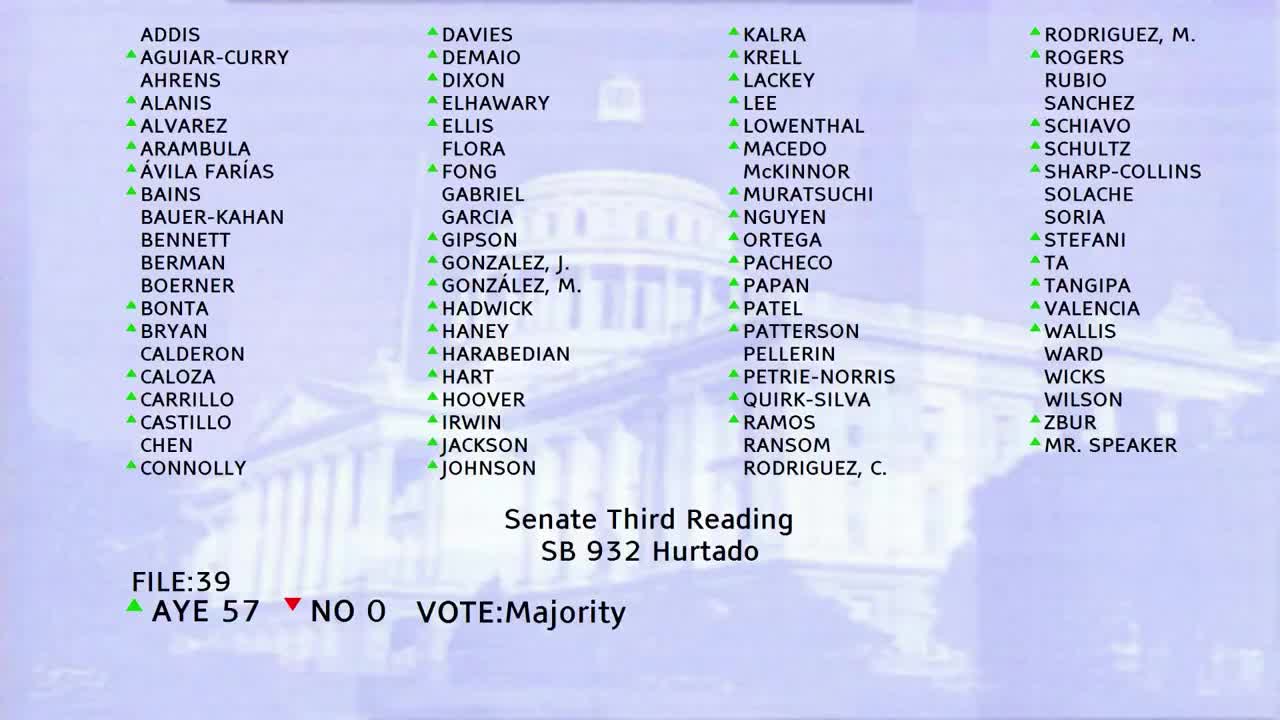 1MIN
Assembly Floor
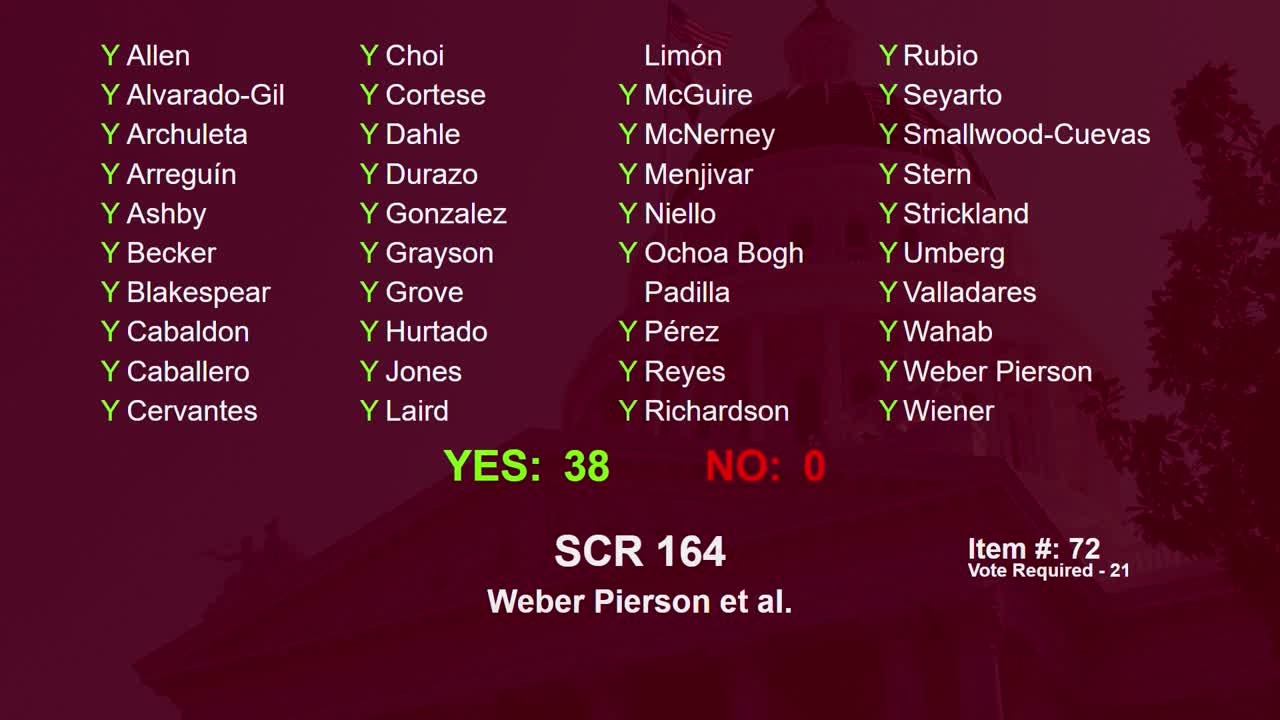 1MIN
Senate Floor
 8MIN
Senate Standing Committee on Transportation
Bill Author

Bill Co-Author(s):