SB 991: Residential care facilities for the elderly: categorization of citations.
- Session Year: 2025-2026
- House: Senate
- Latest Version Date: 2026-09-30
Current Status:
Passed
(2026-09-30: Chaptered by Secretary of State. Chapter 994, Statutes of 2026.)
Introduced
In Committee
Awaiting First Chamber Vote
Passed First Chamber
In Committee
Awaiting Second Chamber Vote
Passed Second Chamber
Enacted
Existing law, the California Residential Care Facilities for the Elderly Act (act), requires the State Department of Social Services to license, inspect, and regulate residential care facilities for the elderly, as defined, and imposes criminal penalties on a person who violates the act or who willfully or repeatedly violates any rule or regulation adopted under the act. Existing law authorizes the department to also impose civil penalties for violations of the act. Existing law gives residents of those facilities specified rights, including, but not limited to, the right to be free from neglect, financial exploitation, involuntary seclusion, and verbal, mental, or physical abuse.
Beginning July 1, 2029, this bill would require the department, when a licensee is cited for a deficiency that constitutes abuse in violation of a residents rights, to categorize the type of abuse. The bill would describe the categories of abuse, including physical abuse and abandonment, among others and would require that the category of abuse be listed on a public-facing database maintained by the department.
Existing law, the California Residential Care Facilities for the Elderly Act (act), requires the State Department of Social Services to license, inspect, and regulate residential care facilities for the elderly, as defined, and imposes criminal penalties on a person who violates the act or who willfully or repeatedly violates any rule or regulation adopted under the act. Existing law authorizes the department to also impose civil penalties for violations of the act. Existing law gives residents of those facilities specified rights, including, but not limited to, the right to be free from neglect, financial exploitation, involuntary seclusion, and verbal, mental, or physical abuse.
Existing law, the Elder Abuse and Dependent Adult Civil Protection Act, establishes various procedures for the reporting, investigation, and prosecution of elder and dependent adult abuse and defines various forms of abuse, such as abandonment, isolation, and financial abuse.Beginning July 1, 2027, 2029, this bill would require the department, when it substantiates a violation of the act when a licensee is cited for a deficiency that constitutes abuse in violation of a residents rights, to categorize the type of abuse using the definitions from the Elder Abuse and Dependent Adult Civil Protection Act. The bill abuse. The bill would describe the categories of abuse, including physical abuse and abandonment, among others and would require that the category of abuse be listed on a public-facing database maintained by the department.
Existing law, the California Residential Care Facilities for the Elderly Act (act), requires the State Department of Social Services to license, inspect, and regulate residential care facilities for the elderly, as defined, and imposes criminal penalties on a person who violates the act or who willfully or repeatedly violates any rule or regulation adopted under the act. Existing law authorizes the department to also to impose civil penalties for violations of the act. Existing law gives residents of those facilities specified rights, including, but not limited to, the right to be free from neglect, financial exploitation, involuntary seclusion, and verbal, mental, or physical abuse.
Existing law, the Elder Abuse and Dependent Adult Civil Protection Act, establishes various procedures for the reporting, investigation, and prosecution of elder and dependent adult abuse and defines various forms of abuse, such as abandonment, isolation, and financial abuse.
ThisBeginning July 1, 2027, this bill would require the department, when it substantiates a violation of the act that constitutes abuse in violation of a residents rights, to categorize the type of abuse using the definitions from the Elder Abuse and Dependent Adult Civil Protection Act. The bill would require that the category of abuse be listed on a public-facing database maintained by the department.
Existing law, the California Residential Care Facilities for the Elderly Act (act), requires the State Department of Social Services to license, inspect, and regulate residential care facilities for the elderly, as defined, and imposes criminal penalties on a person who violates the act or who willfully or repeatedly violates any rule or regulation adopted under the act. Existing law authorizes the department to also to impose civil penalties for violations of the act. Existing law gives residents of those facilities specified rights, including, but not limited to, the right to be free from neglect, financial exploitation, involuntary seclusion, and verbal, mental, or physical abuse.
Existing law, the Elder Abuse and Dependent Adult Civil Protection Act, establishes various procedures for the reporting, investigation, and prosecution of elder and dependent adult abuse and defines various forms of abuse, such as abandonment, isolation, and financial abuse.
This bill would require the department, when it substantiates a violation of the act that constitutes abuse in violation of a residents rights, to categorize the type of abuse using the definitions from the Elder Abuse and Dependent Adult Civil Protection Act. The bill would require that the category of abuse be listed on public-facing database maintained by the department.
(a)When a licensee is cited for a deficiency that constitutes abuse under paragraph (10) of subdivision (a) of Section 1569.269 and related regulations, the department shall categorize the citation according to the specific type of abuse established by the evidence.
(b)For the purposes of subdivision (a), the department shall categorize each citation into one of the following categories that is most applicable or relevant based on the facts and circumstances of the citation.
(1)Physical abuse includes, but is not limited to, assault, battery, assault with a deadly weapon or force likely to produce great bodily injury, unreasonable physical constraint, prolonged or continual deprivation of food or water, or the use of a physical or chemical restraint or psychotropic medication for punishment or any purposes not authorized by the physician and surgeon.
(2)Sexual abuse includes, but is not limited to, sexual battery, rape, rape in concert, incest, sodomy, oral copulation, sexual penetration, or lewd and lascivious acts.
(3)Abandonment includes, but is not limited to, the desertion or willful forsaking of an elder or a dependent adult by anyone having care or custody of that person under circumstances in which a reasonable person would continue to provide care and custody.
(4)Financial exploitation or abuse includes, but is not limited to, taking, secreting, appropriating, obtaining, or retaining real or personal property of an elder or dependent adult for a wrongful use or with intent to defraud, or both, including the use of undue influence in these acts.
(5)Involuntary seclusion or isolation includes, but is not limited to, acts intentionally committed for the purpose of preventing, and that do serve to prevent, an elder or dependent adult from receiving their mail or telephone calls, contact with prospective visitors, including friends, family, or concerned persons, false imprisonment, and physical restraint for the purpose of preventing the elder or dependent adult from meeting with others.
(6)Mental abuse or suffering includes, but is not limited to, fear, agitation, confusion, severe depression, or other forms of serious emotional distress that is brought about by forms of undue influence, punishment, verbal abuse, humiliation, intimidation, threats, harassment, or by deceptive acts performed, or by false or misleading statements made with malicious intent to agitate, confuse, frighten, or cause severe depression or serious emotional distress of the elder or dependent adult.
(7)Neglect includes, but is not limited to, the negligent failure of a person having the care or custody of an elder or a dependent adult to exercise that degree of care that a reasonable person in a like position would exercise, including the failure to assist in personal hygiene or in the provision of food, clothing, or shelter, the failure to provide medical care for physical and mental health needs, the failure to protect from health and safety hazards, and the failure to prevent malnutrition or dehydration.
(c)This section does not do any of the following:
(1)Limit the departments authority to assess civil penalties under Section 1569.49 or any other law.
(2)Require the department to assess a civil penalty where none is otherwise authorized by law.
(3)Alter the elements required to substantiate abuse under existing law.
(d)The department shall ensure that citations categorized pursuant to this section are reflected in any public-facing transparency, licensing, or enforcement databases maintained by the department.
(e)The assignment of a specific abuse category is not subject to appeal. Licensees retain the right to appeal the underlying citation, finding of violation, or associated civil penalty. Any successful appeal that modifies or overturns the underlying determination will automatically be reflected in the assigned abuse category.
(f)This section shall become operative on July 1, 2029.
(a)When the department substantiates a violation in a residential care facility for the elderly a licensee is cited for a deficiency that constitutes abuse under paragraph (10) of subdivision (a) of Section 1569.269, 1569.269 and related regulations, the department shall categorize and cite the violation the citation according to the specific type of abuse established by the evidence.
(b)For purposes of subdivision (a), the department shall categorize and cite violations as one or more of the following, as applicable:(1)Physical abuse, as defined in Section 15610.63 of the Welfare and Institutions Code.(2)Abandonment, as defined in Section 15610.05 of the Welfare and Institutions Code.(3)Abduction, as defined in Section 15610.06 of the Welfare and Institutions Code.(4)Financial abuse, as defined in Section 15610.30 of the Welfare and Institutions Code.(5)Isolation, as defined in Section 15610.43 of the Welfare and Institutions Code.(6)Mental suffering, as defined in Section 15610.53 of the Welfare and Institutions Code.(7)Neglect, as defined in Section 15610.57 of the Welfare and Institutions Code.(8)Undue influence, as defined in Section 15610.70 of the Welfare and Institutions Code.(b)For the purposes of subdivision (a), the department shall categorize each citation into one of the following categories that is most applicable or relevant based on the facts and circumstances of the citation.
(1)Physical abuse includes, but is not limited to, assault, battery, assault with a deadly weapon or force likely to produce great bodily injury, unreasonable physical constraint, prolonged or continual deprivation of food or water, or the use of a physical or chemical restraint or psychotropic medication for punishment or any purposes not authorized by the physician and surgeon.
(2)Sexual abuse includes, but is not limited to, sexual battery, rape, rape in concert, incest, sodomy, oral copulation, sexual penetration, or lewd and lascivious acts.
(3)Abandonment includes, but is not limited to, the desertion or willful forsaking of an elder or a dependent adult by anyone having care or custody of that person under circumstances in which a reasonable person would continue to provide care and custody.
(4)Financial exploitation or abuse includes, but is not limited to, taking, secreting, appropriating, obtaining, or retaining real or personal property of an elder or dependent adult for a wrongful use or with intent to defraud, or both, including the use of undue influence in these acts.
(5)Involuntary seclusion or isolation includes, but is not limited to, acts intentionally committed for the purpose of preventing, and that do serve to prevent, an elder or dependent adult from receiving their mail or telephone calls, contact with prospective visitors, including friends, family, or concerned persons, false imprisonment, and physical restraint for the purpose of preventing the elder or dependent adult from meeting with others.
(6)Mental abuse or suffering includes, but is not limited to, fear, agitation, confusion, severe depression, or other forms of serious emotional distress that is brought about by forms of undue influence, punishment, verbal abuse, humiliation, intimidation, threats, harassment, or by deceptive acts performed, or by false or misleading statements made with malicious intent to agitate, confuse, frighten, or cause severe depression or serious emotional distress of the elder or dependent adult.
(7)Neglect includes, but is not limited to, the negligent failure of a person having the care or custody of an elder or a dependent adult to exercise that degree of care that a reasonable person in a like position would exercise, including the failure to assist in personal hygiene or in the provision of food, clothing, or shelter, the failure to provide medical care for physical and mental health needs, the failure to protect from health and safety hazards, and the failure to prevent malnutrition or dehydration.
(c)This section does not do any of the following:
(1)Limit the departments authority to assess civil penalties under Section 1569.49 or any other law.
(2)Require the department to assess a civil penalty where none is otherwise authorized by law.
(3)Alter the elements required to substantiate abuse under existing law.
(d)The department shall ensure that citations categorized pursuant to this section are reflected in any public-facing transparency, licensing, or enforcement databases maintained by the department.
(e)The assignment of a specific abuse category is not subject to appeal. Licensees retain the right to appeal the underlying citation, finding of violation, or associated civil penalty. Any successful appeal that modifies or overturns the underlying determination will automatically be reflected in the assigned abuse category.
(e)(f)This section shall become operative on July 1, 2027. 2029.
(a)When the department substantiates a violation in a residential care facility for the elderly that constitutes abuse under paragraph (10) of subdivision (a) of Section 1569.269, the department shall categorize and cite the violation according to the specific type of abuse established by the evidence.
(b)For purposes of subdivision (a), the department shall categorize and cite violations as one or more of the following, as applicable:
(1)Physical abuse, as defined in Section 15610.63 of the Welfare and Institutions Code.
(2)Abandonment, as defined in Section 15610.05 of the Welfare and Institutions Code.
(3)Abduction, as defined in Section 15610.06 of the Welfare and Institutions Code.
(4)Financial abuse, as defined in Section 15610.30 of the Welfare and Institutions Code.
(5)Isolation, as defined in Section 15610.43 of the Welfare and Institutions Code.
(6)Mental suffering, as defined in Section 15610.53 of the Welfare and Institutions Code.
(7)Neglect, as defined in Section 15610.57 of the Welfare and Institutions Code.
(8)Undue influence, as defined in Section 15610.70 of the Welfare and Institutions Code.
(c)This section does not do any of the following:
(1)Limit the departments authority to assess civil penalties under Section 1569.49 or any other law.
(2)Require the department to assess a civil penalty where none is otherwise authorized by law.
(3)Alter the elements required to substantiate abuse under existing law.
(d)The department shall ensure that citations categorized pursuant to this section are reflected in any public-facing transparency, licensing, or enforcement databases maintained by the department.
(e)This section shall become operative on July 1, 2027.
(a)When the department substantiates a violation in a residential care facility for the elderly that constitutes abuse under paragraph (1) (10) of subdivision (a) of Section 1569.269, the department shall categorize and cite the violation according to the specific type of abuse established by the evidence.
(b)For purposes of subdivision (a), the department shall categorize and cite violations as one or more of the following, as applicable:
(1)Physical abuse, as defined in Section 15610.63 of the Welfare and Institutions Code.
(2)Abandonment, as defined in Section 15610.05 of the Welfare and Institutions Code.
(3)Abduction, as defined in Section 15610.06 of the Welfare and Institutions Code.
(4)Financial abuse, as defined in Section 15610.30 of the Welfare and Institutions Code.
(5)Isolation, as defined in Section 15610.43 of the Welfare and Institutions Code.
(6)Mental suffering, as defined in Section 15610.53 of the Welfare and Institutions Code.
(7)Neglect, as defined in Section 15610.57 of the Welfare and Institutions Code.
(8)Undue influence, as defined in Section 15610.70 of the Welfare and Institutions Code.
(c)This section does not do any of the following:
(1)Limit the departments authority to assess civil penalties under Section 1569.49 or any other law.
(2)Require the department to assess a civil penalty where none is otherwise authorized by law.
(3)Alter the elements required to substantiate abuse under existing law.
(d)The department shall ensure that citations categorized pursuant to this section are reflected in any public-facing transparency, licensing, or enforcement databases maintained by the department.
(a)When the department substantiates a violation in a residential care facility for the elderly that constitutes abuse under paragraph (1) of subdivision (a) of Section 1569.269, the department shall categorize and cite the violation according to the specific type of abuse established by the evidence.
(b)For purposes of subdivision (a), the department shall categorize and cite violations as one or more of the following, as applicable:
(1)Physical abuse, as defined in Section 15610.63 of the Welfare and Institutions Code.
(2)Abandonment, as defined in Section 15610.05 of the Welfare and Institutions Code.
(3)Abduction, as defined in Section 15610.06 of the Welfare and Institutions Code.
(4)Financial abuse, as defined in Section 15610.30 of the Welfare and Institutions Code.
(5)Isolation, as defined in Section 15610.43 of the Welfare and Institutions Code.
(6)Mental suffering, as defined in Section 15610.53 of the Welfare and Institutions Code.
(7)Neglect, as defined in Section 15610.57 of the Welfare and Institutions Code.
(8)Undue influence, as defined in Section 15610.70 of the Welfare and Institutions Code.
(c)This section does not do any of the following:
(1)Limit the departments authority to assess civil penalties under Section 1569.49 or any other law.
(2)Require the department to assess a civil penalty where none is otherwise authorized by law.
(3)Alter the elements required to substantiate abuse under existing law.
(d)The department shall ensure that citations categorized pursuant to this section are reflected in any public-facing transparency, licensing, or enforcement databases maintained by the department.
|
Date
|
Status
|
|---|---|
| Sep 30, 2026 | Chaptered by Secretary of State. Chapter 994, Statutes of 2026. |
| Sep 30, 2026 | Approved by the Governor. |
| Sep 4, 2026 | Enrolled and presented to the Governor at 2 p.m. |
| Aug 28, 2026 | Assembly amendments concurred in. (Ayes 40. Noes 0. Page 6076.) Ordered to engrossing and enrolling. |
| Aug 28, 2026 | Assembly amendments concurred in. (Ayes 39. Noes 0.) Ordered to engrossing and enrolling. |
| Aug 27, 2026 | Ordered to special consent calendar. |
| Aug 25, 2026 | In Senate. Concurrence in Assembly amendments pending. |
| Aug 25, 2026 | Read third time. Passed. (Ayes 78. Noes 0. Page 6470.) Ordered to the Senate. |
| Aug 25, 2026 | Read third time. Passed. Ordered to the Senate. |
| Aug 17, 2026 | Read second time. Ordered to third reading. |
| Aug 13, 2026 | Read second time and amended. Ordered to second reading. |
| Aug 13, 2026 | From committee: Do pass as amended. (Ayes 11. Noes 0.) (August 13). |
| Aug 13, 2026 | Assembly Rule 63 suspended. |
| Aug 5, 2026 | August 5 set for first hearing. Placed on suspense file. |
| Jul 1, 2026 | From committee: Do pass and re-refer to Com. on APPR. (Ayes 7. Noes 0.) (June 30). Re-referred to Com. on APPR. |
| Jun 24, 2026 | From committee: Do pass and re-refer to Com. on HUM. S. (Ayes 7. Noes 0.) (June 23). Re-referred to Com. on HUM. S. |
| Jun 8, 2026 | Referred to Coms. on AGING & L.T.C and HUM. S. |
| May 20, 2026 | In Assembly. Read first time. Held at Desk. |
| May 19, 2026 | Read third time. Passed. (Ayes 38. Noes 0. Page 4351.) Ordered to the Assembly. |
| May 19, 2026 | Read third time. Passed. (Ayes 38. Noes 0.) Ordered to the Assembly. |
| May 18, 2026 | Read second time. Ordered to third reading. |
| May 14, 2026 | From committee: Do pass as amended. (Ayes 7. Noes 0. Page 4260.) (May 14). |
| May 14, 2026 | Read second time and amended. Ordered to second reading. |
| May 14, 2026 | From committee: Do pass as amended. (Ayes 7. Noes 0.) (May 14). |
| May 8, 2026 | Set for hearing May 14. |
| Apr 20, 2026 | April 20 hearing: Placed on APPR. suspense file. |
| Apr 10, 2026 | Set for hearing April 20. |
| Apr 7, 2026 | From committee: Do pass and re-refer to Com. on APPR. (Ayes 4. Noes 0. Page 3740.) (April 6). Re-referred to Com. on APPR. |
| Apr 7, 2026 | From committee: Do pass and re-refer to Com. on APPR. (Ayes 4. Noes 0.) (April 6). Re-referred to Com. on APPR. |
| Mar 23, 2026 | From committee with author's amendments. Read second time and amended. Re-referred to Com. on HUMAN S. |
| Mar 17, 2026 | Set for hearing April 6. |
| Feb 18, 2026 | Referred to Com. on HUMAN S. |
| Feb 9, 2026 | From printer. May be acted upon on or after March 8. |
| Feb 5, 2026 | Introduced. Read first time. To Com. on RLS. for assignment. To print. |
|
Date
|
Description
|
Location
|
Votes
|
|
|---|---|---|---|---|
| Aug 28, 2026 | Special Consent SB991 Menjivar et al. | Senate Floor |
Passed |
|
| Aug 25, 2026 | SB 991 Menjivar Senate Third Reading By Ahrens | Assembly Floor |
Passed |
|
| Aug 13, 2026 | Do pass as amended. | Assembly Standing Committee on Appropriations |
Passed |
|
| Jun 30, 2026 | Do pass and be re-referred to the Committee on [Appropriations] | Assembly Standing Committee on Human Services |
Passed |
|
| Jun 23, 2026 | Do pass and be re-referred to the Committee on [Human Services] | Assembly Standing Committee on Aging and Long-Term Care |
Passed |
|
| May 19, 2026 | Senate 3rd Reading SB991 Menjivar et al. | Senate Floor |
Passed |
|
| May 14, 2026 | Do pass as amended | Senate Standing Committee on Appropriations |
Passed |
|
| Apr 20, 2026 | Placed on suspense file | Senate Standing Committee on Appropriations |
Passed |
|
| Apr 6, 2026 | Do pass, but first be re-referred to the Committee on [Appropriations] | Senate Standing Committee on Human Services |
Passed |
This list shows positions taken on this bill by organizations on the date displayed, which is linked to the original source.
Positions by individuals are not included.
|
Organization
|
Position
|
Date
|
|---|---|---|
| AARP | ** Support | |
| Alzheimer's Association | ** Support | |
| alzheimer's greater los angeles | ** Support | |
| alzheimer's orange county | ** Support | |
| Alzheimer'S San Diego | ** Support | |
| California Advocates for Nursing Home Reform | ** Support | |
| California Alliance For Retired Americans | ** Support | |
| California Association For Adult Day Services | ** Support | |
| California Association Of Area Agencies On Aging | ** Support | |
| California Coalition on Family Caregiving | ** Support | |
| California Collaborative for Long-term Services and Supports (CCLTSS) | ** Support | |
| California Elder Justice Coalition | ** Support | |
| California Health Advocates | ** Support | |
| California Long-Term Care Ombudsman Association | ** Support | |
| California Long Term Care Ombudsman Association (CLTCOA) | ** Support | |
| California Long Term Care Ombudsman Association (Sponsor) | ** Support | |
| Consumer Attorneys Of California | ** Support | |
| Contra Costa Senior Legal Services | ** Support | |
| Council on Aging, Southern California | ** Support | |
| Council on Aging-southern California Long-term Care Ombudsman Program | ** Support | |
| Council on Aging – Southern California Long-Term Care Ombudsman Program in Riverside County | ** Support | |
| Council on Aging-southern California Long-term Care Ombudsman Program, Riverside County, PSA 21 | ** Support | |
| Disability Action Center | ** Support | |
| Disability Rights California | ** Support | |
| Disability Rights Education and Defense Fund | ** Support | |
| Elder Law & Advocacy | ** Support | |
| El Dorado County Long-Term Care Ombudsman Program | ** Support | |
| Empowered Aging | ** Support | |
| Family Caregiver Alliance | ** Support | |
| Imperial County Long-Term Care Ombudsman Program | ** Support | |
| Integrated Community Collaborative | ** Support | |
| Justice in Aging | ** Support | |
| Kern County Long-Term Care Ombudsman Program | ** Support | |
| Legal Assistance for Seniors | ** Support | |
| Long-Term Care Ombudsman Program | ** Support | |
| Long-term Care Ombudsman Program of Santa Barbara County | ** Support | |
| Long Term Care Ombudsman Services of San Luis Obispo County | ** Support | |
| Long Term Care Services of Ventura Co, Ombudsman | ** Support | |
| Long Term Care Services of Ventura County | ** Support | |
| Office of the State Long-Term Care Ombudsman | ** Support | |
| Ombudsman Services of San Mateo County, Inc. | ** Support | |
| Orange County Ombudsman Program | ** Support | |
| Placer Independent Resource Services | ** Support | |
| Retired Public Employees Association | ** Support | |
| Riverside County, Psa 21 | ** Support | |
| San Francisco Long Term Care Ombudsman Felton Institute | ** Support | |
| Senior Advocacy Services | ** Support | |
| Silicon Valley Independent Living Center | ** Support | |
| Wise and Healthy Aging | ** Support |
SENATE RULES COMMITTEE Office of Senate Floor Analyses (916) 651-4171 | SB 991 |
UNFINISHED BUSINESS
Bill No: SB 991
Author: Menjivar (D), et al.
Amended: 8/13/26
Vote: 21
SENATE HUMAN SERVICES COMMITTEE: 4-0, 4/6/26
AYES: Becker, Laird, Pérez, Weber Pierson
NO VOTE RECORDED: Ochoa Bogh
SENATE APPROPRIATIONS COMMITTEE: 7-0, 5/14/26
AYES: Cervantes, Seyarto, Cabaldon, Dahle, Grayson, Richardson, Wahab
SENATE FLOOR: 38-0, 5/19/26
AYES: Allen, Alvarado-Gil, Archuleta, Arreguín, Ashby, Becker, Blakespear, Cabaldon, Caballero, Cervantes, Choi, Cortese, Dahle, Durazo, Gonzalez, Grayson, Grove, Hurtado, Jones, Laird, Limón, McGuire, McNerney, Menjivar, Padilla, Pérez, Reyes, Richardson, Rubio, Seyarto, Smallwood-Cuevas, Stern, Strickland, Umberg, Valladares, Wahab, Weber Pierson, Wiener
NO VOTE RECORDED: Niello, Ochoa Bogh
ASSEMBLY FLOOR: Passed, 8/25/26
SUBJECT: Residential care facilities for the elderly: categorization of citations
SOURCE: California Long Term Care Ombudsman Association
DIGEST:
This bill requires the California Department of Social Services (CDSS), when a Residential Care for the Elderly (RCFE) licensee is cited for a deficiency that constitutes abuse to categorize the type of abuse. This bill describes the categories of abuse. Requires CDSS to ensure that these categories of abuse are reflected in any public-facing transparency, licensing, or enforcement databases maintained by CDSS.
Assembly Amendments
make technical and clarifying amendments, and delay implementation from July 1, 2027 to July 1, 2029.
ANALYSIS:
Existing law:
- Creates the Elder Abuse and Dependent Adult Civil Protection Act. (Welfare and Institutions Code [WIC] § 15600 et seq.)
- Creates the California RCFE Act. (Health and Safety Code [HSC] §1569 et seq.)
- Defines RCFE as a housing arrangement chosen voluntarily by persons 60 years of age or over, or their authorized representative, where varying levels and intensities of care and supervision, protective supervision, or personal care are provided, based upon their varying needs, as determined in order to be admitted and to remain in the facility. Allows persons under 60 years of age with compatible needs to be admitted or retained if a licensee determines that person is compatible, as defined. (HSC § 1569.2)
- Requires a person, firm, partnership, association, corporation, or state or local public agency to have a current valid license to operate, establish, manage, conduct, or maintain an RCFE. (HSC § 1569.10)
- Requires CDSS to inspect and license RCFEs. (HSC § 1569.11)
- Tasks the administrator of an RCFE with the responsibility to provide or ensure provision of services to residents with appropriate regard for the residents’ physical and mental well-being and needs. (22 California Code of Regulation [CCR] § 87405)
- Establishes the Resident’s Bill of Rights for residents of RCFEs. (HSC § 1569.269)
- Requires every licensed RCFE to provide at least the following basic services:
- Care and supervision.
- Assistance with instrumental activities of daily living in the combinations which meet the needs of residents.
- Helping residents gain access to appropriate supportive services, as defined, in the community.
- Being aware of the residents’ general whereabouts, although the resident may travel independently in the community.
- Monitoring the activities of the residents while they are under supervision of the facility to ensure their general health, safety, and well-being.
- Encouraging the residents to maintain and develop their maximum functional ability through participation in planned activities. (HSC § 1569.312)
This bill:
- Requires CDSS, when a licensee is cited for a deficiency that constitutes abuse, to categorize the citation according to the specific type of abuse established by the evidence.
- Defines for the purposes of categorizing each citation, CDSS to categorize each citation into one of the following categories that is most applicable and relevant based on the facts and circumstances of the citation: physical abuse, sexual abuse, abandonment, financial exploitation, involuntary seclusion, mental abuse or suffering, neglect.
- Makes the provisions of this bill operative July 1, 2029.
Background
Author Statement. According to the author, “Currently, the way that elder and dependent adult abuse, neglect, and exploitation are categorized by CDSS is very broadly as a violation of residents’ rights rather than by the specific type of abuse found to have occurred. Examples could include a facility with rat infestations, residents wandering off without supervision, medications not properly administered, residents with bed sores, or facility staff fraudulently writing a $30,000 check to themselves, and it would all be cited and categorized as a violation of residents' rights (i.e., the “right” to be free from abuse and neglect). This umbrella category obscures how often specific forms of abuse (physical, financial, etc.) occur in RCFEs. This limits the usefulness of the data and doesn’t give us an accurate depiction to inform our approach as a state to this vulnerable population. It also diminishes the experience of victims reporting these incidents and confuses consumers who are seeking information about which facilities have been found to abuse their residents. The need for Elder Abuse accountability is paramount, given that by 2040, the number of adults in institutional group settings is projected to increase by 51% according to a report by the Public Policy Institute of California. SB 991 will ensure that we are promoting consumer transparency and accountability in RCFEs by improving how substantiated reports of abuse and neglect are categorized by CDSS and their public facing licensing and enforcement databases.”
Residential Care Facilities for the Elderly (RCFEs) RCFEs, also known as assisted living facilities, are residential facilities that provide 24-hour nonmedical care and supervision for persons in need of personal services, supervision, or assistance essential for sustaining the activities of daily living or for the protection of the individual who is 60 years of age or older. RCFEs provide housing, housekeeping, supervision, and personal care assistance with activities of daily living to individuals who need that level of care. These are nonmedical facilities that are designed for individuals who are unable to live by themselves, but who do not need 24-hour nursing care. As such, these facilities are not required to have nurses, certified nursing assistants or doctors on staff. RCFEs centrally store and distribute medications for residents to self-administer. Residents of RCFEs may have mental, behavioral, or physical health needs or a developmental disability that results in their inability to live independently. These facilities range in size from small facilities operating out of single-family homes serving a handful of residents to larger buildings that can house over 100 residents.
As of February 2026, there are over 8,000 licensed senior care facilities with a total capacity of over 200,000. RCFEs are licensed and regulated by CDSS’s Community Care Licensing Division (Division). The Division protects the health and safety of persons residing in RCFEs through its regulatory and enforcement programs. In addition to its licensing requirements, the Division conducts regular inspections of facilities to assess compliance with applicable laws and regulations. Violations can result in citations, fines and, in extreme cases, loss of a license to operate a facility.
Continuing Care Retirement Communities (CCRC) CCRCs offer people age 60 and older a full range of long-term care options that include independent living, assisted living, and skilled nursing care. This model allows senior residents to move from independence to high levels of care without leaving the community in which they reside. Typically, this is provided in a campus-like community setting, usually for a resident’s lifetime, and always for at least one year. CCRCs require residents to sign a contract that sets forth the range of services, sometimes at an additional cost, depending on the type of contract, to be provided by the CCRC to the resident. CCRCs offer a broad range of contract options so that they have the flexibility to offer a range of services that meet their residents’ varied needs. Each CCRC offers different options on costs of service, payment methods, services provided, and other elements, including lifestyle choices. All CCRCs must obtain an RCFE license and if they offer skilled nursing services, must hold a Skilled Nursing Facility License issued by the California Department of Public Health.
Complaint Data Available to the Public When looking for a facility for oneself or a family member, a likely concern is how safe the facility is. The state provides public information about violations at facilities, but the specificity of such information varies by type of facility. This occurs even in facilities that are co-located, like RCFEs and Skilled Nursing Facilities in CCRCs.
For example, when researching a specific facility in Sacramento with both a RCFE and SNF, the information available on the public facing state websites varies in accessibility and detail. The California Department of Public Health website shows that the statewide average for complaints/reported incidents is 39 and the facility in question had 117. The website also shows/lists the details of these complaints, including the intake received date, allegation category (e.g., physical environment, quality of care/treatment), allegation subcategory (e.g., facility staffing, facility not clean, employee to resident), investigation findings (if deficiencies are noted or not), and intake type. This provides a clear picture for both residents and potential residents, lawmakers, and advocates to understand the types of allegations being made against the facility as well as what, if any, have been substantiated.
This contrasts with what is available for RCFEs. Looking at the same facility for the same calendar year, the CDSS website shows four complaint investigations. For each investigation it shows the number of allegations unfounded, substantiated, and unsubstantiated; the number of Type A and Type B citations; and dates of visits. Additional information is available on each complaint by clicking the most recent date of visit, which takes you to the complaint investigation report.
Related/Prior Legislation
AB 1911 (Reyes, 2024) would have modified the current procedures for complaints against RCFEs to the CDSS. The bill would have required CDSS to investigate complaints within specified timelines and to provide written notifications to complainants. The bill would have provided a process for a complainant to appeal the outcome of an investigation. AB 1911 was held on the Senate Appropriations suspense file.
AB 1387 (Chu, Chapter 486, Statutes of 2015) streamlined the appeals process for community care facility civil penalty and violation appeals and enhanced the complaint process for residential care facilities for the elderly.
FISCAL EFFECT: Appropriation: No Fiscal Com.: Yes Local: No
According to the Assembly Appropriations Committee: CDSS estimates ongoing General Fund costs of approximately $1.53 million in the first year and $1.31 million annually ongoing for additional staff to meet the requirements of the bill. These positions include one manager and five analysts to oversee and support implementation and to address complaints and implement newly established procedures, including training and technical assistance to licensees, as well as one IT specialist to review and guide security for necessary system changes and one limited-term analyst to ensure implementation integrates into existing planned and current website changes.
SUPPORT: (Verified 8/25/26)
California Long Term Care Ombudsman Association (Sponsor)
AARP
Alzheimer's Association
Alzheimer's Greater Los Angeles
Alzheimer's Orange County
Alzheimer's San Diego
California Advocates for Nursing Home Reform
California Alliance for Retired Americans
California Association for Adult Day Services
California Association of Area Agencies on Aging
California Coalition on Family Caregiving
California Elder Justice Coalition
California Health Advocates
Consumer Attorneys of California
Council on Aging, Southern California
Council on Aging-southern California Long-term Care Ombudsman Program, Riverside County, Psa 21
Disability Action Center
Disability Rights California
Disability Rights Education and Defense Fund
El Dorado County Long-term Care Ombudsman Program
Elder Law & Advocacy
Empowered Aging
Family Caregiver Alliance
Integrated Community Collaborative
Justice in Aging
Kern County Long-term Care Ombudsman Program
Legal Assistance for Seniors
Long Term Care Ombudsman Services of San Luis Obispo County
Long Term Care Services of Ventura Co, Ombudsman
Long-term Care Ombudsman Program
Office of the State Long-term Care Ombudsman
Ombudsman Services of San Mateo County, INC.
Placer Independent Resource Services
Retired Public Employees Association
San Francisco Long Term Care Ombudsman Felton Institute
Senior Advocacy Services
Silicon Valley Independent Living Center
Wise and Healthy Aging
OPPOSITION: (Verified 8/25/26)
None received
Prepared by: Heather Hopkins / HUMAN S. / (916) 651-1524
8/25/26 21:20:33
**** END ****
SENATE THIRD READING
STR Bill Id:SB 991
Author:(Menjivar)
As Amended Ver:August 13, 2026
Majority vote
SUMMARY
This bill requires the California Department of Social Services (CDSS), when a Residential Care for the Elderly (RCFE) licensee is cited for a deficiency that constitutes abuse to categorize the type of abuse. The bill describes the categories of abuse. Requires CDSS to ensure that these categories of abuse are reflected in any public-facing transparency, licensing, or enforcement databases maintained by CDSS.
Major Provisions
- Requires CDSS, when a licensee is cited for a deficiency that constitutes abuse, to categorize the citation according to the specific type of abuse established by the evidence.
- Defines for the purposes of categorizing each citation, CDSS to categorize each citation into one of the following categories that is most applicable and relevant based on the facts and circumstances of the citation:
- Physical abuse,
- Sexual abuse,
- Abandonment,
- Financial exploitation,
- Involuntary seclusion,
- Mental abuse or suffering,
- Neglect.
- Makes the provisions of this bill operative July 1, 2029.
COMMENTS
Aging in California: A recent compiled data report by the Public Policy Institute of California titled ″California′s Aging Population″ states:
By 2040, California′s older adult population (aged 65 and over) is projected to increase by a remarkable 59 percent, from 5.7 million to just over 9 million. This growth stands in stark contrast to the projected changes in other age groups. The working-age population (20–64 years old) is expected to increase only 3 percent, while the population under age 20 is anticipated to decrease by 23 percent. California is projected to have 3.4 million more older adults aged 65 and over, and 1.7 million fewer residents less than 65 years old.
This disproportionate growth in the older population will lead to a significant shift in the state′s age structure. Almost one-quarter of Californians (22%) will be age 65 or older by 2040, a substantial increase from 14 percent in 2020. The old-age dependency ratio (the number of older adults per 100 adults of working ages) is projected to grow from 24 to 38. In other words, there will be 38 older adults for every 100 working adults in the state.
The most dramatic growth is projected among the oldest age groups—or the oldest old. The population aged 80 and over is expected to more than double, increasing by nearly 1.8 million in 2040. This rapid growth in the oldest age groups, driven by both the aging of the baby boomers and increases in longevity, is especially significant because of this group′s relatively high personal care and health care needs.[1]
Life expectancy continues to rise,[2] however during 2019-2021 overall life expectancy for Californians fell from 81.4 years to 78.4 years. For Hispanics, life expectancy declined by nearly 6 years, a difference three times greater than their white counterparts. And the difference between those in California′s highest and lowest income brackets increased by three-and-a-half years to greater than 15 years (11.5 years before the pandemic to more than 15 years in 2021).[3]
It is important to note that the COVID-19 pandemic caused a brief (and traumatic) deviation from the long-term pattern of increases in life expectancy. The latest estimates suggest that life expectancy has resumed its pre-pandemic trend of gradually increasing longevity. The Department of Finance projects moderate increases in life expectancies through 2060. [4]
Residential Care for the Elderly: Sometimes referred to as assisted living facilities, RCFEs are responsible for providing housing, housekeeping, supervision, and personal care assistance with activities of daily living, like hygiene, dressing, eating, and walking, to individuals ages 60 and older. California′s network of RCFEs consists of small homes serving a handful of residents to larger RCFEs that can house over 100 residents in communities across the state. Facilities provide a special combination of housing, personalized supportive services, and 24-hour staff designed to respond to the individual needs of those who require help with activities of daily living. This level of care and supervision is for people who are unable to live by themselves but who do not need 24 hour nursing care. They are considered non-medical facilities and are not required to have nurses, certified nursing assistants or doctors on staff. RCFEs are licensed and overseen by CDSS.
Office of the State Long-Term Care Ombudsman (LTCO): Under the federal OAA, each state is required to operate an Office of the State LTCO, which is charged with identifying, investigating, and resolving complaints that are made by, or on behalf of, residents of long-term care facilities. In California, the Office of the LTCO is housed under CDA. The State LTCO and their local representatives assist residents in long-term care facilities with issues related to day-to-day care, health, safety, and personal preferences, including investigating abuse and violations of residents′ rights or dignity, and other issues regarding quality of care.
The LTCO has oversight responsibility for 35 local Ombudsman programs throughout California. Approximately 240 paid staff and 364 certified volunteers advocate on behalf of residents of LTC facilities. These facilities include 1,189 skilled nursing and intermediate care facilities and 7,798 residential care facilities for the elderly, with a combined count of 322,218 LTC beds.[5]
Current licensing provisions for CDSS: Currently, following an investigation, when CDSS substantiates abuse, violations are categorized simply as resident rights violations (i.e. the right to be free from abuse) rather than identified as abuse, including the specific type of abuse established by the evidence. As a result, public licensing and enforcement databases do not reflect how often or the specific types of particular forms of abuse occur in assisted living facilities in California. This lack of specificity limits transparency for consumers and families, reduces the usefulness of enforcement data for policymakers and regulators, and impedes efforts to identify patterns of harm and prevent future abuse across our state.
According to the Author
″Currently, the way that elder and dependent adult abuse, neglect, and exploitation are categorized by CDSS is very broadly as a violation of residents′ rights rather than by the specific type of abuse found to have occurred. Examples could include a facility with rat infestations, residents wandering off without supervision, medications not properly administered, residents with bed sores, or facility staff fraudulently writing a $30,000 check to themselves, and it would all be cited and categorized as a violation of residents′ rights (i.e., the ″right″ to be free from abuse and neglect). This umbrella category obscures how often specific forms of abuse (physical, financial, etc.) occur in RCFEs. This limits the usefulness of the data and doesn′t give us an accurate depiction to inform our approach as a state to this vulnerable population. It also diminishes the experience of victims reporting these incidents and confuses consumers who are seeking information about which facilities have been found to abuse their residents. The need for Elder Abuse accountability is paramount, given that by 2040, the number of adults in institutional group settings is projected to increase by 51% according to a report by the Public Policy Institute of California. SB 991 will ensure that we are promoting consumer transparency and accountability in RCFEs by improving how substantiated reports of abuse and neglect are categorized by CDSS and their public facing licensing and enforcement databases.″
Arguments in Support
The California Long-term Care Ombudsman Association, the sponsor writes, ″As advocates who regularly work with residents, families, and staff in assisted living facilities, Ombudsmen see firsthand the profound human impact of abuse and neglect in long-term care settings. When abuse is substantiated but ultimately categorized only as a generic resident rights violation, the harm experienced by victims is effectively obscured within state enforcement systems. For residents and families who have endured physical abuse, gross neglect, financial exploitation, or psychological harm, it can be deeply discouraging to see those experiences reduced to a broad and non-specific violation category. Accurate categorization of abuse is therefore not merely a technical issue within regulatory databases. It is also about acknowledging the reality of what victims have experienced and ensuring their concerns are appropriately recognized within the state′s framework for oversight.
This lack of specificity has real consequences for consumer transparency and accountability. Families searching for an assisted living facility for a loved one often rely on publicly available enforcement data to help evaluate safety and quality of care. Policymakers and oversight agencies also rely on enforcement data to identify patterns of harm and target prevention efforts. When substantiated abuse is not categorized according to the definitions already established in statute, it becomes significantly more difficult to determine the true scope and nature of abuse occurring in RCFEs. Without this information, it is harder for advocates, regulators, and the Legislature to evaluate where additional safeguards or elder justice initiatives may be needed to prevent abuse and neglect in the future.″
California Advocates for Nursing Home Reform, writes in further support, ″The need for more accurate and meaningful data around abuse in RCFEs is clear. In Federal Fiscal Year 2024 alone, California′s Long-Term Care Ombudsman Program responded to more than 3,000 complaints involving abuse, neglect, or exploitation in RCFEs. As California′s population continues to age, with the number of older adults living in institutional group quarters projected to increase dramatically over the coming decades, access to reliable information about substantiated abuse will become increasingly important for residents, families, consumer advocates, and state oversight agencies.″
Arguments in Opposition
None.
FISCAL COMMENTS
According to the analysis from the Assembly Committee on Appropriations, ″CDSS estimates ongoing General Fund costs of approximately $1.53 million in the first year and $1.31 million annually ongoing for additional staff to meet the requirements of the bill. These positions include one manager and five analysts to oversee and support implementation and to address complaints and implement newly established procedures, including training and technical assistance to licensees, as well as one IT specialist to review and guide security for necessary system changes and one limited-term analyst to ensure implementation integrates into existing planned and current website changes.″
VOTES
SENATE FLOOR: 38-0-2
YES: Allen, Alvarado-Gil, Archuleta, Arreguín, Ashby, Becker, Blakespear, Cabaldon, Caballero, Cervantes, Choi, Cortese, Dahle, Durazo, Gonzalez, Grayson, Grove, Hurtado, Jones, Laird, Limón, McGuire, McNerney, Menjivar, Padilla, Pérez, Reyes, Richardson, Rubio, Seyarto, Smallwood-Cuevas, Stern, Strickland, Umberg, Valladares, Wahab, Weber Pierson, Wiener
ABS, ABST OR NV: Niello, Ochoa Bogh
ASM AGING AND LONG-TERM CARE: 7-0-0
YES: Ahrens, Ellis, Arambula, Ávila Farías, Jeff Gonzalez, Blanca Rubio, Sharp-Collins
ASM HUMAN SERVICES: 7-0-0
YES: Lee, Tangipa, Calderon, Elhawary, Jackson, Celeste Rodriguez, Sanchez
ASM APPROPRIATIONS: 11-0-4
YES: Wicks, Arambula, Calderon, Caloza, Fong, Mark González, Krell, Pacheco, Pellerin, Sharp-Collins, Solache
ABS, ABST OR NV: Hoover, Dixon, Ta, Tangipa
UPDATED
VERSION: August 13, 2026
CONSULTANT: Elizabeth Fuller / AGING & L.T.C. / (916) 319-3990 FN: 0003535
https://www.ppic.org/publication/californias-aging-population/ ↑
https://longevity.stanford.edu/the-new-map-of-life-initiative/ ↑
https://newsroom.ucla.edu/releases/covid-life-expectancy-drops-by-race-and-income ↑
www.cdc.gov/nchs/data/databriefs/db492.pdf ↑
https://aging.ca.gov/download.ashx?lE0rcNUV0zazVMt5J2GTUg%3d%3d ↑
Date of Hearing: August 5, 2026
ASSEMBLY COMMITTEE ON APPROPRIATIONS
Buffy Wicks, Chair
SBPCA Bill Id:SB 991
Author:(Menjivar) – As Amended Ver:May 14, 2026
Policy Committee: | Aging and Long Term Care | Vote: | 7 - 0 |
Human Services | 7 - 0 | ||
|
|
Urgency: No State Mandated Local Program: No Reimbursable: No
SUMMARY:
This bill requires the California Department of Social Services (CDSS), when it substantiates a violation in a residential care facility for the elderly (RCFE) that constitutes abuse, to categorize and cite the violation and ensure the categorized violations are listed on a public-facing database maintained by CDSS.
Specifically, this bill:
- Beginning July 1, 2027, requires CDSS, when it substantiates a violation in an RCFE that constitutes abuse, as defined in the RCFE residents' bill of rights, to categorize the type of abuse using the definitions from the Elder Abuse and Dependent Adult Civil Protection Act and cite the violation according to the specific type of abuse that has been substantiated.
- Requires CDSS to categorize and cite violations as one or more of the following: physical abuse; abandonment; abduction; financial abuse; isolation; mental suffering; neglect; or undue influence, as those terms are defined in existing law.
- Provides that this categorization of violations does not limit CDSS’s ability to assess civil penalties, does not require CDSS to assess a civil penalty where none is otherwise authorized, and does not require CDSS to alter the elements required to substantiate abuse under existing law.
- Requires CDSS to ensure the categorized citations are reflected in any public-facing transparency, licensing, or enforcement databases maintained by the department.
FISCAL EFFECT:
CDSS estimates ongoing General Fund costs of approximately $1.53 million in the first year and $1.31 million annually ongoing for additional staff to meet the requirements of the bill. These positions include one manager and five analysts to oversee and support implementation and to address complaints and implement newly established procedures, including training and technical assistance to licensees, as well as one IT specialist to review and guide security for necessary system changes and one limited-term analyst to ensure implementation integrates into existing planned and current website changes.
COMMENTS:
- Purpose. According to the author:
Currently, the way that elder and dependent adult abuse, neglect, and exploitation are categorized by CDSS is very broadly as a violation of residents’ rights rather than by the specific type of abuse found to have occurred. This umbrella category obscures how often specific forms of abuse (physical, financial, etc.) occur in RCFEs. This limits the usefulness of the data and doesn’t give us an accurate depiction to inform our approach as a state to this vulnerable population. It also diminishes the experience of victims reporting these incidents and confuses consumers who are seeking information about which facilities have been found to abuse their residents. [This bill] will ensure that we are promoting consumer transparency and accountability in RCFEs by improving how substantiated reports of abuse and neglect are categorized by CDSS and their public facing licensing and enforcement databases.
This bill is sponsored by the California Long-term Care Ombudsman Association and supported by a broad coalition of older adult and aging advocacy organizations. There is no known opposition.
- Background. RCFEs are residential facilities that provide 24-hour nonmedical care and supervision for persons 60 years of age or older. RCFEs provide housing, housekeeping, supervision, and personal care assistance with activities of daily living to individuals who are unable to live by themselves, but who do not need 24-hour nursing care. RCFEs range in size from small facilities operating out of single-family homes to larger buildings that house over 100 residents. Most facilities have six or fewer beds.
RCFE Violations. CDSS licenses RCFEs and conducts regular inspections of the facilities to assess compliance with applicable laws and regulations. Violations can result in citations, fines and, in extreme cases, loss of a license to operate a facility. In addition, anyone may file a complaint about abuse, neglect, poor care, or eviction issues, among other things. CDSS must begin an investigation within 10 working days of receipt of the complaint. Investigation length can vary greatly depending on the severity of the case.
The RCFE Residents’ Bill of Rights is intended to promote dignity, autonomy, safety, and quality of life. The rights range significantly, and violations of these rights can also vary significantly. Following an investigation, when CDSS substantiates abuse in an RCFE, violations are categorized as resident rights violations (i.e. the right to be free from abuse) rather than identified as abuse, including the specific type of abuse established by the evidence. As a result, public licensing and enforcement databases do not reflect how often abuse occurs or the specific types of abuse that occur in RCFEs.
The author and sponsor assert that “violation of residents’ rights” is a catch-all phrase when issuing citations to RCFEs and masks whether a facility, for example, interfered with religious rights, stole possessions, or abused a resident. They further assert the lack of specificity limits transparency for consumers and families, reduces the usefulness of enforcement data for policymakers and regulators, and impedes efforts to identify patterns of harm and prevent future abuse.
This bill requires CDSS to specifically categorize and make publicly available resident rights violations.
Master Plan for Aging (MPA). California’s senior population is growing faster than any other age group. By 2030, over 25% of the population in California will be 60 and older. In January of 2021, the Governor released his MPA, which prioritizes the health and well-being of older Californians and the need for policies that promote healthy aging. This bill advances the goals of the MPA regarding the needs and wellbeing of older Californians.
Analysis Prepared by: Jennifer Swenson / APPR. / (916) 319-2081
Date of Hearing: June 30, 2026
ASSEMBLY COMMITTEE ON HUMAN SERVICES
Alex Lee, Chair
SBPCA Bill Id:SB 991
Author:(Menjivar) – As Amended Ver:May 14, 2026
SENATE VOTE: 38-0
SUBJECT: Residential care facilities for the elderly: categorization of citations
SUMMARY: Requires the California Department of Social Services (CDSS), when a violation is substantiated in a residential care facility for the elderly (RCFE) that constitutes abuse, to further categorize and cite violations in accordance with the type of violation, as specified. Requires CDSS to publish these violations as categorized. Specifically, this bill:
- Requires CDSS, when they substantiate a violation in an RCFE that constitutes abuse, as defined in the Residents' Bill of Rights, to categorize and cite the violation according to the specific type of abuse that has been substantiated.
- Requires CDSS to categorize and cite violations as one or more of the following: physical abuse; abandonment; abduction; financial abuse; isolation; mental suffering; neglect; or, undue influence.
- Provides that this categorization of violations does not limit CDSS’s ability to assess civil penalties.
- Specifies that these provisions do not require CDSS to assess a civil penalty where none is otherwise authorized by law.
- Provides that these provisions do not require CDSS to alter the elements required to substantiate abuse under existing law.
- Requires CDSS to ensure that these categorized citations are reflected in any public-facing transparency, licensing, or enforcement databases maintained by CDSS.
- Delays the implementation until July 1, 2027.
EXISTING LAW:
- Defines an RCFE as a housing arrangement chosen voluntarily by persons 60 years of age or over, or their authorized representative, where varying levels and intensities of care and supervision, protective supervision, or personal care are provided, based upon their varying needs, as determined, in order to be admitted or remain in the facility. Allows persons under 60 years of age with compatible needs to be admitted or retained if a licensee determines that person is compatible, as defined. (Health and Safety Code [HSC] § 1569.2(o))
- Requires a person, firm, partnership, association, or corporation within the state and a state or local public agency to have a current valid license or special permit to operate, establish, manage, conduct, or maintain an RCFE. (HSC § 1569.10)
- Establishes the Resident’s Bill of Rights for residents of RCFEs, which lists 30 rights, including, but not limited to, the following:
- To be encouraged and assisted in exercising their rights as citizens and residents of the facility; and to be free from interference, coercion, discrimination, and retaliation in exercising their rights;
- To care, supervision, and services that meet their individual needs and are delivered by staff that are sufficient in numbers, qualifications, and competency to meet their needs;
- To make choices concerning their daily life in the facility;
- To fully participate in planning their care, including the right to attend and participate in meetings or communications regarding the care and services to be provided, as specified, and to involve persons of their choice in the planning process. The licensee shall provide necessary information and support to ensure that residents direct the process to the maximum extent possible, and are enabled to make informed decisions and choices;
- To be free from neglect, financial exploitation, involuntary seclusion, punishment, humiliation, intimidation, and verbal, mental, physical, or sexual abuse;
- To present grievances and recommend changes in policies, procedures, and services to the staff of the facility, the facility’s management and governing authority, and to any other person without restraint, coercion, discrimination, reprisal, or other retaliatory actions. The licensee shall take prompt actions to respond to residents’ grievances;
- To contact CDSS, the long-term care ombudsman, or both, regarding grievances against the licensee;
- To receive in the admission agreement a comprehensive description of the method for evaluating residents’ service needs and the fee schedule for the items and services provided, and to receive written notice of any rate increases; and,
- To be protected from involuntary transfers, discharges, and evictions in violation of state laws and regulations. (HSC § 1569.269)
- Requires every licensed RCFE to provide at least the following basic services, including, but not limited to:
- Care and supervision, as defined;
- Personal assistance and care as needed by the resident and as indicated in the pre-admission appraisal, with those activities of daily living such as dressing, eating, bathing, and assistance with taking prescribed medications, as specified;
- Regular observation of the resident’s physical and mental condition, as specified; and,
- Arrangements to meet health needs, including arranged transportation, as specified. (HSC § 1569.312; 22 California Code of Regulations § 87464(f))
- Defines “physical abuse” as any of the following:
- Assault, as defined in Penal Code Section 240;
- Battery, as defined in Penal Code Section 242;
- Assault with a deadly weapon or force likely to produce great bodily injury, as defined in Penal Code Section 245;
- Unreasonable physical constraint, or prolonged or continual deprivation of food or water;
- Sexual assault, that means any of the following:
- Sexual battery, as defined in Penal Code Section 243.4;
- Rape, as defined in Penal Code Section 261, or former Penal Code Section 262;
- Rape in concert, as described in Penal Code Section 264.1;
- Incest, as defined in Penal Code Section 285;
- Sodomy, as defined in Penal Code Section 286;
- Oral copulation, as defined in Penal Code Section 287, or former Penal Code Section 288(a);
- Sexual penetration, as defined in Penal Code Section 289;
- Lewd or lascivious acts, as defined in Penal Code Section 288(b)(2);
- Use of physical or chemical restraint or psychotropic medication under any of the following conditions:
- For punishment;
- For a period beyond that for which the medication was ordered pursuant to the instructions of a physician and surgeon licensed in the State of California, who is providing medical care to the elder or dependent adult at the time the instructions are given; and,
- For any purpose not authorized by the physician and surgeon. (Welfare and Institutions Code [WIC] § 15610.63)
- Defines “abandonment” as the desertion or willful forsaking of an elder or a dependent adult by anyone having care or custody of that person under circumstances in which a reasonable person would continue to provide care and custody. (WIC § 15610.05)
- Defines “abduction” as the removal from this state or the restraint from returning to this state, of any elder or dependent adult who does not have the capacity to consent, as well as the removal from this state or the restraint from returning to this state, of any conservatee without the consent of the conservator or the court. (WIC § 15610.06)
- Defines “financial abuse” of an elder or dependent adult as (or as having occurred) when a person or entity does any of the following:
- Takes, secretes, appropriates, obtains, or retains real or personal property of an elder or dependent adult for a wrongful use or with intent to defraud, or both;
- Assists in taking, secreting, appropriating, obtaining, or retaining real or personal property of an elder or dependent adult for a wrongful use or with intent to defraud, or both; or,
- Takes, secretes, appropriates, obtains, or retains, or assists in taking, secreting, appropriating, obtaining, or retaining, real or personal property of an elder or dependent adult by undue influence, as defined. (WIC § 15610.30)
- Provides that a person or entity shall be deemed to have taken, secreted, appropriated, obtained, or retained property for a wrongful use if, among other things, the person or entity takes, secretes, appropriates, obtains, or retains the property and the person or entity knew or should have known that this conduct is likely to be harmful to the elder or dependent adult. (WIC § 15610.30)
- Provides that, for purposes of “financial abuse,” a person or entity takes, secretes, appropriates, obtains, or retains real or personal property when an elder or dependent adult is deprived of any property right, including by means of an agreement, donative transfer, or testamentary bequest, regardless of whether the property is held directly or by a representative of an elder or dependent adult. (WIC § 15610.30)
- Provides that, for purposes of the “financial abuse” section, “representative” means a person or entity that is either of the following:
- A conservator, trustee, or other representative of the estate of an elder or dependent adult; or,
- An attorney-in-fact of an elder or dependent adult who acts within the authority of the power of attorney. (WIC § 15610.30)
- Defines “isolation” as any of the following:
- Acts intentionally committed for the purpose of preventing, and that do serve to prevent, an elder or dependent adult from receiving their mail or telephone calls;
- Telling a caller or prospective visitor that an elder or dependent adult is not present, or does not wish to talk with the caller, or does not wish to meet with the visitor where the statement is false, is contrary to the express wishes of the elder or the dependent adult, whether they are competent or not, and is made for the purpose of preventing the elder or dependent adult from having contact with family, friends, or concerned persons;
- False imprisonment, as defined in Penal Code Section 236; or,
- Physical restraint of an elder or dependent adult, for the purpose of preventing the elder or dependent adult from meeting with visitors. (WIC § 15610.43)
- Provides that activities defined as “isolation” shall be subject to a rebuttable presumption that they do not constitute isolation if they are performed pursuant to the instructions of a physician and surgeon licensed to practice medicine in the state, who is caring for the elder or dependent adult at the time the instructions are given, and who gives the instructions as part of their medical care. (WIC § 15610.43)
- Provides that activities defined as “isolation” shall not constitute isolation if they are performed in response to a reasonably perceived threat of danger to property or physical safety. (WIC § 15610.43)
- Defines “mental suffering” as fear, agitation, confusion, severe depression, or other forms of serious emotional distress that is brought about by forms of intimidating behavior, threats, harassment, or by deceptive acts performed or false or misleading statements made with malicious intent to agitate, confuse, frighten, or cause severe depression or serious emotional distress of the elder or dependent adult. (WIC § 15610.53)
- Defines “neglect” as either of the following:
- The negligent failure of any person having the care or custody of an elder or a dependent adult to exercise that degree of care that a reasonable person in a like position would exercise; or,
- The negligent failure of an elder or dependent adult to exercise that degree of self-care that a reasonable person in a like position would exercise. (WIC § 15610.57)
- Provides that neglect includes, but is not limited to, all of the following:
- Failure to assist in personal hygiene, or in the provision of food, clothing, or shelter;
- Failure to provide medical care for physical and mental health needs; a person shall not be deemed neglected or abused for the sole reason that the person voluntarily relies on treatment by spiritual means through prayer alone in lieu of medical treatment;
- Failure to protect from health and safety hazards;
- Failure to prevent malnutrition or dehydration;
- Substantial inability or failure of an elder or dependent adult to manage their own finances;
- Failure of an elder or dependent adult to satisfy any of the needs, as specified, for themselves as a result of poor cognitive functioning, mental limitation, substance abuse, or chronic poor health; or,
- Neglect includes being homeless if the elder or dependent adult is also unable to meet any of their needs, as specified. (WIC § 15610.57)
- Provides that “undue influence” means excessive persuasion that causes another person to act or refrain from acting by overcoming that person’s free will and results in inequity. In determining whether a result was produced by undue influence, all of the following shall be considered:
- The vulnerability of the victim; evidence of vulnerability may include, but is not limited to, incapacity, illness, disability, injury, age, education, impaired cognitive function, emotional distress, isolation, or dependency, and whether the influencer knew or should have known of the alleged victim’s vulnerability;
- The influencer’s apparent authority; evidence of apparent authority may include, but is not limited to, status as a fiduciary, family member, care provider, health care professional, legal professional, spiritual adviser, expert, or other qualification; and,
- The actions or tactics used by the influencer; evidence of actions or tactics used may include, but is not limited to, all of the following:
- Controlling necessaries of life, medication, the victim’s interactions with others, access to information, or sleep.
- Use of affection, intimidation, or coercion.
- Initiation of changes in personal or property rights, use of haste or secrecy in effecting those changes, effecting changes at inappropriate times and places, and claims of expertise in effecting changes.
- The equity of the result. Evidence of the equity of the result may include, but is not limited to, the economic consequences to the victim, any divergence from the victim’s prior intent or course of conduct or dealing, the relationship of the value conveyed to the value of any services or consideration received, or the appropriateness of the change in light of the length and nature of the relationship. (WIC § 15610.70)
FISCAL EFFECT: According to the Senate Committee on Appropriations, CDSS estimates General Fund costs of $777,000 in 2026-27 and $759,000 ongoing thereafter for state administration.
COMMENTS:
Background: Residential Care Facilities for the Elderly. RCFEs are responsible for providing housing, housekeeping, supervision, 24-hour staffing, and personal care assistance with activities of daily living, such as hygiene, dressing, eating, and walking, to individuals 60 years of age and older. California’s network of RCFEs ranges from small homes serving fewer than six residents to larger RCFEs that can house over 100 residents in communities across the state. This level of care and supervision is for people who are unable to live by themselves, but who do not need 24-hour nursing care. RCFEs are considered non-medical facilities and are not required to have nurses or doctors on staff, but typically bring licensed health care practitioners into the facility to provide care as necessary. Some RCFEs include memory care units for seniors with dementia. CDSS licenses and regulates RCFEs. Current law provides that licensed RCFEs are not subject to controls on rent imposed by any state or local agency or other local government entity. As of June 2024, there were 7,578 licensed RCFEs with a capacity to serve 176,959 residents. The majority of these facilities have six or fewer beds.
Long-term Care Facilities Oversight. In California, long-term care varies by care needs, consumer choice, and availability. Of those choices, facilities are common. Many facilities are even co-located on the same campus as an RCFE or a skilled nursing facility (SNF). Each facility type has a complaint process and a public-facing online page for consumers and others to see how many complaints have been filed, as well as other information about those complaints. These processes and the information on the public-facing online pages are not uniform across different forms of long-term care.
SNFs are health facilities that typically provide higher levels of care to patients whose primary need is for skilled nursing care on an extended basis. As health care facilities, SNFs are licensed and overseen by the California Department of Public Health (CDPH). Any person or organization may file a complaint about abuse, neglect, violations of rights, poor care, lack of staffing, unsafe conditions, mistreatment, improper charges, among other things, to CDPH.
Once a complaint is filed, CDPH must notify the complainant within two working days of receipt of the complaint of the name of the investigator assigned to the case. CDPH must begin an onsite investigation of the complaint within 10 working days of receipt of the complaint, or within 24 hours if the complaint involves a threat of imminent danger, death, or serious bodily harm.
An RCFE’s oversight differs significantly from that of SNFs, in part because it is not a health facility. However, it is important to note that due to policy changes in the last six years, RCFEs are serving more complex, higher-needs residents as a benefit from the Home and Community-Based Services waiver[1]. CDSS investigates complaints against RCFEs. Like SNFs, any person can file a complaint against an RCFE. Complaints can be filed about abuse, neglect, poor care, or eviction issues, among other things. The investigation must begin within 10 working days of receipt of the complaint. Investigation length can vary greatly depending on the severity of the case.
Once a complaint is filed, a Licensing Program Analyst (analyst) at the local regional office investigates the complaint. Findings of the initial investigation are documented on a LIC 856B, C, or D form–depending on whether the complaint was substantiated, unsubstantiated, or unfounded. If the analyst determines a violation of statutes or regulations has occurred, the analyst will issue a citation documenting the requirement that was violated, as well as if it was a Type A, B, or C violation. A Type A violation is a violation resulting in an immediate risk to the persons in care and requires corrections, typically, within 24 hours of the citation. A Type B violation is a violation that results in a potential risk to the persons in care, and corrections are required within a reasonable time.
CDSS also cites abuse violations as falling under the RCFE Residents’ Bill of Rights, which is intended to promote dignity, autonomy, safety, and quality of life. The rights range significantly, and violations of these rights can also vary significantly. These rights include:
- Being treated with dignity, respect, and consideration.
- Receiving care and services that meet the resident's individual needs.
- Living free from abuse, neglect, intimidation, humiliation, retaliation, or exploitation.
- Having reasonable privacy in living accommodations, personal care, medical treatment, visits, communications, telephone calls, internet use, and resident meetings.
- Making personal choices about daily schedules, activities, clothing, meals (when possible), and participation in community life.
- Managing personal finances or choosing someone to do so.
- Keeping personal possessions and having them protected from theft or loss.
- Receiving visitors of the resident's choosing and communicating privately with family, friends, attorneys, physicians, advocates, and others.
- Practicing religion or choosing not to participate in religious activities.
- Organizing and participating in resident and family councils.
- Reviewing personal records and having health and personal information kept confidential, except as permitted by law.
- Presenting grievances and filing complaints without fear of retaliation.
- Being informed of facility policies, fees, and changes affecting care or residency.
- Being encouraged to exercise all civil and legal rights as a citizen.
- Receiving notice before an involuntary transfer or eviction, except in circumstances permitted by law.
In addition to issuing citations for personal rights violations related to abuse, CDSS follows mandatory reporting requirements when abuse is suspected or substantiated, and a completed SOC 341[2] form is submitted to relevant agencies, including law enforcement and the Department of Justice. However, the Author and sponsor of this bill report that “violation of residents’ rights” is a catch-all when they are issuing citations to RCFEs. Meaning, it is unclear if a facility interfered with their religious rights, stole their possessions, or abused a resident.
This bill would require CDSS to categorize resident rights violations.
Long-term Care Facility Transparency. RCFE and SNF consumer data vary significantly. For SNFs, CDPH posts detailed information on each complaint, including the date submitted, the category of the complaint, the sub-category, and whether the complaint was substantiated. A consumer could fairly easily make an educated choice to send a loved one to a facility that meets their needs. However, CDSS posts minimal information on their webpage, making it hard to determine if the facility is an appropriate fit. An RCFE may have a residents’ rights violation, but a consumer can’t tell what transpired. When choosing a facility, a family considers their loved ones’ needs. For example, if a prospective resident is forgetful and not able to manage money well, then a family may not choose a facility that has a residents’ rights violation that were related to financial abuse. But they might choose a facility that has a religious rights violation. Conversely, a prospective resident with strong religious ties might find that important and prefer a facility with a financial abuse violation.
This bill seeks to publicly display a category in which a substantiated residents’ rights violation occurs.
Author’s Statement: According to the Author, “Currently, the way that elder and dependent adult abuse, neglect, and exploitation are categorized by the California Department of Social Services (CDSS) is very broadly as a violation of residents’ rights rather than by the specific type of abuse found to have occurred. Examples could include a facility with rat infestations, residents wandering off without supervision, medications not properly administered, residents with bed sores, or facility staff fraudulently writing a $30,000 check to themselves, and it would all be cited and categorized as a violation of residents' rights (i.e., the “right” to be free from abuse and neglect). This umbrella category obscures how often specific forms of abuse (physical, financial, etc.) occur in RCFEs. This limits the usefulness of the data and doesn’t give us an accurate depiction to inform our approach as a state to this vulnerable population. It also diminishes the experience of victims reporting these incidents and confuses consumers who are seeking information about which facilities have been found to abuse their residents. The need for Elder Abuse accountability is paramount, given that by 2040, the number of adults in institutional group settings is projected to increase by 51% according to a report by the Public Policy Institute of California. [This bill] will ensure that we are promoting consumer transparency and accountability in RCFEs by improving how substantiated reports of abuse and neglect are categorized by CDSS and their public facing licensing and enforcement databases.”
Equity Implications: By 2040, California’s older adult population (65 years of age and over) is projected to increase by a remarkable 59%, from 5.7 million to just over 9 million. This growth stands in stark contrast to the projected changes in other age groups. The working-age population (20-64 years of age) is expected to increase only 3%, while the population under 20 years of age is anticipated to decrease by 23%. California is projected to have 3.4 million more older adults 65 years of age and over, and 1.7 million fewer residents less than 65 years of age. As a result, more people will need long-term care. This bill may help individuals make an educated choice on which long-term care option is best for them.
Double referral: This bill was previously heard in the Assembly Committee on Aging and Long term Care and on June 23, 2026, and was approved on a 7 to 0 vote.
Arguments in Support: According to the sponsors, “California Long-Term Care Ombudsman Association, “[This bill] addresses a significant gap in how substantiated abuse is categorized and publicly reported in California. Existing state law, the Elder Abuse and Dependent Adult Civil Protection Act (Welfare and Institutions Code §15600 et seq.) defines specific forms of abuse: physical abuse, neglect, financial abuse, isolation, abandonment, abduction, mental suffering, and undue influence. These are the same statutory definitions that mandated reporters must consult when determining what type of suspected abuse or neglect must be reported to the appropriate authorities, including CDSS. However, when CDSS substantiates abuse in an RCFE following an investigation, violations are categorized broadly as resident rights violations – the “right” to be free from abuse – rather than identified according to the specific statutory form of abuse established by the evidence. As a result, publicly available licensing and enforcement databases do not clearly reflect how often particular forms of abuse occur in assisted living facilities across California.
As advocates who regularly work with residents, families, and staff in assisted living facilities, Ombudsmen see firsthand the profound human impact of abuse and neglect in long-term care settings. When abuse is substantiated but ultimately categorized only as a generic resident rights violation, the harm experienced by victims is effectively obscured within state enforcement systems. For residents and families who have endured physical abuse, gross neglect, financial exploitation, or psychological harm, it can be deeply discouraging to see those experiences reduced to a broad and non-specific violation category. Accurate categorization of abuse is therefore not merely a technical issue within regulatory databases. It is also about acknowledging the reality of what victims have experienced and ensuring their concerns are appropriately recognized within the state’s framework for oversight.
This lack of specificity has real consequences for consumer transparency and accountability. Families searching for an assisted living facility for a loved one often rely on publicly available enforcement data to help evaluate safety and quality of care. Policymakers and oversight agencies also rely on enforcement data to identify patterns of harm and target prevention efforts. When substantiated abuse is not categorized according to the definitions already established in statute, it becomes significantly more difficult to determine the true scope and nature of abuse occurring in RCFEs. Without this information, it is harder for advocates, regulators, and the Legislature to evaluate where additional safeguards”
Arguments in Opposition: None on file.
RELATED AND PRIOR LEGISLATION:
AB 2171 (Wieckowski), Chapter 702, Statutes of 2014, established a bill of rights for residents of RCFEs.
REGISTERED SUPPORT / OPPOSITION:
Support
California Long Term Care Ombudsman Association (CLTCOA) (Sponsor)
AARP
Alzheimer's Association
Alzheimer's Greater Los Angeles
Alzheimer's Orange County
Alzheimer's San Diego
California Elder Justice Coalition (CEJC)
Contra Costa Senior Legal Services
Justice in Aging
Long Term Care Ombudsman Services of San Luis Obispo County
Long-Term Care Ombudsman Program of Santa Barbara County
Office of the State Long-Term Care Ombudsman
Two private citizens
Opposition
None on file.
Analysis Prepared by: Alexandria Smith / HUM. S. / (916) 319-2089
Date of Hearing: June 23, 2026
ASSEMBLY COMMITTEE ON AGING AND LONG-TERM CARE
Patrick Ahrens, Chair
SBPCA Bill Id:SB 991
Author:(Menjivar) – As Amended Ver:May 14, 2026
SENATE VOTE: 38-0
SUBJECT: Residential care facilities for the elderly (RCFE): categorization of citations
SUMMARY: This bill requires the California Department of Social Services (CDSS), when it substantiates a violation in a RCFE that constitutes abuse, as defined in the residents of residential care facilities bill of rights, to categorize and cite the violation according to the specific type of abuse that has been substantiated. Requires CDSS to ensure that these categorized citations are reflected in any public-facing transparency, licensing, or enforcement databases maintained by CDSS. Specifically, this bill:
- Requires CDSS, when they substantiate a violation in a RCFE that constitutes abuse, as defined in the residents of RCFE bill of rights, to categorize and cite the violation according to the specific type of abuse that has been substantiated.
- Requires CDSS to categorize and cite violations as one or more of the following: physical abuse; abandonment; abduction; financial abuse; isolation; mental suffering; neglect; or undue influence.
- Provides that this categorization of cite violations does not limit CDSS’s ability to assess civil penalties.
- Provides that this section does not require CDSS to assess a civil penalty where none is otherwise authorized by law.
- Provides that this section does not require CDSS to alter the elements required to substantiate abuse under existing law.
- Requires CDSS to ensure that these categorized citations are reflected in any public facing transparency, licensing, or enforcement databases maintained by CDSS.
- Makes the provisions of this bill operative July 1, 2027.
EXISTING LAW:
- Establishes, in federal law, the Older Americans Act (OAA), which promotes the well-being of Americans 60 years old and above through services and programs designed to meet their needs. (42 United States Code (USC.) § 3001, et seq.)
- Establishes, within the OAA, the Office of the Long-Term Care Ombudsman (LTCO) Program and requires states to establish and operate a LTCO Program for the purpose of identifying, investigating, and resolving complaints that may adversely affect the health, safety, welfare, or rights of residents of long-term care facilities. (42 USC § 3058(g))
- Establishes the Office of the State LTCO under the California Department of Aging (CDA), for the purpose of protecting and advocating for the rights and health and safety of long-term care facility residents, and in providing leadership, direction, and support to local LTCO programs. (WIC § 9700 et seq.)
- Defines “long-term care facility,” for purposes of establishing the role of the State LTCO, to mean a nursing facility or SNF, including distinct parts of facilities that are required to comply with licensure requirements for SNFs, or a RCFE. (WIC §9701).
- Establishes the “California Residential Care Facilities for the Elderly (RCFE) Act” to provide for the licensure and regulation of RCFEs as a separate category within the existing licensing structure of CDSS. (HSC §1569 et seq.)
- Defines “care and supervision” to mean the facility assumes responsibility for, or provides or promises to provide in the future, ongoing assistance with activities of daily living without which the resident’s physical health, mental health, safety, or welfare would be endangered. Assistance includes assistance with taking medications, money management, or personal care. Specifies that providing care and supervision requires a facility to be licensed. Specifies that care and supervision includes, but is not limited to, any one or more of the following activities provided by a person or facility to meet the needs of residents:
- Assistance in dressing, grooming, bathing and other personal hygiene;
- Assistance with taking medication, as specified;
- Central storing and distribution of medications, as specified;
- Arrangement of and assistance with medical and dental care. This may include transportation, as specified;
- Maintenance of house rules for the protection of residents;
- Supervision of resident schedules and activities;
- Maintenance and supervision of resident monies or property; and,
- Monitoring food intake or special diets. (HSC §1569.2(c); 22 CCR §87101)
- Defines “RCFE” to mean a housing arrangement chosen voluntarily by individuals ages 60 and older, or their authorized representative, where varying levels and intensities of care and supervision, protective supervision, personal care, or health-related services are provided, based upon their varying needs, as determined in order to be admitted and to remain in the facility. (HSC § 1569.2(p)(1))
- Establishes the Resident’s Bill of Rights for residents of RCFEs, which lists 30 rights, including, but not limited to, the following:
- To be encouraged and assisted in exercising their rights as citizens and residents of the facility; and to be free from interference, coercion, discrimination, and retaliation in exercising their rights.
- To provide care, supervision, and services that meet their individual needs and are delivered by staff that are sufficient in numbers, qualifications, and competency to meet their needs.
- To be free from neglect, financial exploitation, involuntary seclusion, punishment, humiliation, intimidation, and verbal, mental, physical, or sexual abuse.
- To contact CDSS, the LTCO, or both, regarding grievances against the licensee.
- To be protected from involuntary transfers, discharges, and evictions in violation of state laws and regulations. (HSC §1569.269)
- All records and files of the LTCO relating to any complaint or investigation made pursuant to this chapter and the identities of complainants, witnesses, patients, or residents shall remain confidential, unless disclosure is authorized by the patient or resident or his or her conservator of the person or legal representative, required by court order, or release of the information is to a law enforcement agency, public protective service agency, licensing or certification agency in a manner consistent with federal laws and regulations. (WIC § 9725)
- Requires a person, firm, partnership, association, corporation, or state or local public agency to have a current valid license to operate, establish, manage, conduct, or maintain an RCFE. (HSC §1569.10)
- Requires CDSS to inspect and license RCFEs. (HSC §1569.11)
- Establishes the Elder Abuse and Dependent Adult Civil Protection Act
- Requires health practitioners, care custodians, clergy members, and employees of county adult protective services agencies and local law enforcement agencies to report known or suspected cases of abuse of elders and dependent adults and to encourage community members in general to do so.
- Collects information on the numbers of abuse victims, circumstances surrounding the act of abuse, and other data which will aid the state in establishing adequate services to aid all victims of abuse in a timely, compassionate manner.
- Provides for protection under the law for all those persons who report suspected cases of abuse, provided that the report is not made with malicious intent. (WIC §15600 et seq.)
- Tasks the administrator of an RCFE with the responsibility to provide or ensure provision of services to residents with appropriate regard for the residents’ physical and mental well-being and needs. (22 California Code of Regulation [CCR] 87405)
- Requires every licensed RCFE to provide at least the following basic services:
- Care and supervision.
- Assistance with instrumental activities of daily living in the combinations which meet the needs of residents.
- Helping residents gain access to appropriate supportive services, as defined, in the community.
- Being aware of the residents’ general whereabouts, although the resident may travel independently in the community.
- Monitoring the activities of the residents while they are under supervision of the facility to ensure their general health, safety, and well-being.
- Encouraging the residents to maintain and develop their maximum functional ability through participation in planned activities. (HSC §1569.312, 22 CCR §87464(f)))
FISCAL EFFECT: According to the Senate Committtee on Aprropriations, CDSS estimates General Fund costs of $777,000 in 2026-27 and $759,000 ongoing thereafter for state administration.
COMMENTS:
Author’s Statement: “Currently, the way that elder and dependent adult abuse, neglect, and exploitation are categorized by CDSS is very broadly as a violation of residents’ rights rather than by the specific type of abuse found to have occurred. Examples could include a facility with rat infestations, residents wandering off without supervision, medications not properly administered, residents with bed sores, or facility staff fraudulently writing a $30,000 check to themselves, and it would all be cited and categorized as a violation of residents' rights (i.e., the “right” to be free from abuse and neglect). This umbrella category obscures how often specific forms of abuse (physical, financial, etc.) occur in RCFEs. This limits the usefulness of the data and doesn’t give us an accurate depiction to inform our approach as a state to this vulnerable population. It also diminishes the experience of victims reporting these incidents and confuses consumers who are seeking information about which facilities have been found to abuse their residents. The need for Elder Abuse accountability is paramount, given that by 2040, the number of adults in institutional group settings is projected to increase by 51% according to a report by the Public Policy Institute of California. SB 991 will ensure that we are promoting consumer transparency and accountability in RCFEs by improving how substantiated reports of abuse and neglect are categorized by CDSS and their public facing licensing and enforcement databases.”
BACKGROUND
Aging in California: A recent compiled data report by the Public Policy Institute of California titled “California’s Aging Population” states:
By 2040, California’s older adult population (aged 65 and over) is projected to increase by a remarkable 59 percent, from 5.7 million to just over 9 million. This growth stands in stark contrast to the projected changes in other age groups. The working-age population (20–64 years old) is expected to increase only 3 percent, while the population under age 20 is anticipated to decrease by 23 percent. California is projected to have 3.4 million more older adults aged 65 and over, and 1.7 million fewer residents less than 65 years old.
This disproportionate growth in the older population will lead to a significant shift in the state’s age structure. Almost one-quarter of Californians (22%) will be age 65 or older by 2040, a substantial increase from 14 percent in 2020. The old-age dependency ratio (the number of older adults per 100 adults of working ages) is projected to grow from 24 to 38. In other words, there will be 38 older adults for every 100 working adults in the state.
The most dramatic growth is projected among the oldest age groups—or the oldest old. The population aged 80 and over is expected to more than double, increasing by nearly 1.8 million in 2040. This rapid growth in the oldest age groups, driven by both the aging of the baby boomers and increases in longevity, is especially significant because of this group’s relatively high personal care and health care needs.[1]
Life expectancy continues to rise,[2] however during 2019-2021 overall life expectancy for Californians fell from 81.4 years to 78.4 years. For Hispanics, life expectancy declined by nearly 6 years, a difference three times greater than their white counterparts. And the difference between those in California’s highest and lowest income brackets increased by three-and-a-half years to greater than 15 years (11.5 years before the pandemic to more than 15 years in 2021).[3]
It is important to note that the COVID-19 pandemic caused a brief (and traumatic) deviation from the long-term pattern of increases in life expectancy. The latest estimates suggest that life expectancy has resumed its pre-pandemic trend of gradually increasing longevity. The Department of Finance projects moderate increases in life expectancies through 2060. [4]
Residential Care for the Elderly: Sometimes referred to as assisted living facilities, RCFEs are responsible for providing housing, housekeeping, supervision, and personal care assistance with activities of daily living, like hygiene, dressing, eating, and walking, to individuals ages 60 and older. California’s network of RCFEs consists of small homes serving a handful of residents to larger RCFEs that can house over 100 residents in communities across the state. Facilities provide a special combination of housing, personalized supportive services, and 24-hour staff designed to respond to the individual needs of those who require help with activities of daily living. This level of care and supervision is for people who are unable to live by themselves but who do not need 24 hour nursing care. They are considered non-medical facilities and are not required to have nurses, certified nursing assistants or doctors on staff. RCFEs are licensed and overseen by CDSS.
Office of the State Long-Term Care Ombudsman (LTCO): Under the federal OAA, each state is required to operate an Office of the State LTCO, which is charged with identifying, investigating, and resolving complaints that are made by, or on behalf of, residents of long-term care facilities. In California, the Office of the LTCO is housed under CDA. The State LTCO and their local representatives assist residents in long-term care facilities with issues related to day-to-day care, health, safety, and personal preferences, including investigating abuse and violations of residents’ rights or dignity, and other issues regarding quality of care.
The LTCO has oversight responsibility for 35 local Ombudsman programs throughout California. Approximately 240 paid staff and 364 certified volunteers advocate on behalf of residents of LTC facilities. These facilities include 1,189 skilled nursing and intermediate care facilities and 7,798 residential care facilities for the elderly, with a combined count of 322,218 LTC beds.[5]
Current licensing provisions for CDSS: Currently, following an investigation, when CDSS substantiates abuse in a RCFE violations are categorized simply as resident rights violations (i.e. the right to be free from abuse) rather than identified as abuse, including the specific type of abuse established by the evidence. As a result, public licensing and enforcement databases do not reflect how often or the specific types of particular forms of abuse occur in assisted living facilities in California. This lack of specificity limits transparency for consumers and families, reduces the usefulness of enforcement data for policymakers and regulators, and impedes efforts to identify patterns of harm and prevent future abuse across our state.
Master Plan for Aging: In January of 2021, the Governor released his Master Plan for Aging (MPA). The MPA prioritizes the health and well-being of older Californians and the need for policies that promote healthy aging. The MPA serves as a blueprint for state government, local government, the private sector, and philanthropy to prepare the state for the coming demographic changes and continue California’s leadership in aging, disability, and equity.
The work plan laid out in the MPA mid-way through its ten year timeline continues to highlight the urgent needs facing California’s older adults, people with disabilities, their families, caregivers, advocates and the workforce supporting these populations..
The MPA for 2025-26 outlines five bold goals and currently seeks to advance 81 initiatives to build a California for All Ages by 2030. Each initiative features a designated area of focus; to deliver, to analyze and to communicate. It also includes a Data Dashboard on Aging to measure progress.[6]
- Goal One: Housing for All Ages and Stages
- Goal Two: Health Reimagined
- Goal Three: Inclusion and Equity, Not Isolation
- Goal Four: Caregiving That Works
- Goal Five: Affording Aging
Argument in Support: The California Long-term Care Ombudsman Association, the sponsor writes, “As advocates who regularly work with residents, families, and staff in assisted living facilities, Ombudsmen see firsthand the profound human impact of abuse and neglect in long-term care settings. When abuse is substantiated but ultimately categorized only as a generic resident rights violation, the harm experienced by victims is effectively obscured within state enforcement systems. For residents and families who have endured physical abuse, gross neglect, financial exploitation, or psychological harm, it can be deeply discouraging to see those experiences reduced to a broad and non-specific violation category. Accurate categorization of abuse is therefore not merely a technical issue within regulatory databases. It is also about acknowledging the reality of what victims have experienced and ensuring their concerns are appropriately recognized within the state’s framework for oversight.
This lack of specificity has real consequences for consumer transparency and accountability. Families searching for an assisted living facility for a loved one often rely on publicly available enforcement data to help evaluate safety and quality of care. Policymakers and oversight agencies also rely on enforcement data to identify patterns of harm and target prevention efforts. When substantiated abuse is not categorized according to the definitions already established in statute, it becomes significantly more difficult to determine the true scope and nature of abuse occurring in RCFEs. Without this information, it is harder for advocates, regulators, and the Legislature to evaluate where additional safeguards or elder justice initiatives may be needed to prevent abuse and neglect in the future.”
California Advocates for Nursing Home Reform, writes in further support, “The need for more accurate and meaningful data around abuse in RCFEs is clear. In Federal Fiscal Year 2024 alone, California’s Long-Term Care Ombudsman Program responded to more than 3,000 complaints involving abuse, neglect, or exploitation in RCFEs. As California’s population continues to age, with the number of older adults living in institutional group quarters projected to increase dramatically over the coming decades, access to reliable information about substantiated abuse will become increasingly important for residents, families, consumer advocates, and state oversight agencies.”
Argument in Opposition: None.
Dual referral: This bill is dual-referred and upon passage out of the Committee on Aging and Long-Term Care will be rereferred to the Committee on Human Services.
REGISTERED SUPPORT / OPPOSITION:
Support
Alzheimer's Association
Alzheimer's Greater Los Angeles
Alzheimer's Orange County
Alzheimer's San Diego
California Advocates for Nursing Home Reform
California Coalition on Family Caregiving
California Collaborative for Long-term Services and Supports (CCLTSS)
California Elder Justice Coalition (CEJC)
California Long Term Care Ombudsman Association (CLTCOA)
Justice in Aging
Long Term Care Ombudsman Services of San Luis Obispo County
Long-term Care Ombudsman Program of Santa Barbara County
Office of the State Long-term Care Ombudsman
Retired Public Employees Association
Opposition
None.
Analysis Prepared by: Elizabeth Fuller / AGING & L.T.C. / (916) 319-3990
https://www.ppic.org/publication/californias-aging-population/ ↑
https://longevity.stanford.edu/the-new-map-of-life-initiative/ ↑
https://newsroom.ucla.edu/releases/covid-life-expectancy-drops-by-race-and-income ↑
www.cdc.gov/nchs/data/databriefs/db492.pdf ↑
https://aging.ca.gov/download.ashx?lE0rcNUV0zazVMt5J2GTUg%3d%3d ↑
https://mpa.aging.ca.gov/DashBoard/ ↑
SENATE RULES COMMITTEE Office of Senate Floor Analyses (916) 651-4171 | SB 991 |
THIRD READING
Bill No: SB 991
Author: Menjivar (D), et al.
Amended: 5/14/26
Vote: 21
SENATE HUMAN SERVICES COMMITTEE: 4-0, 4/6/26
AYES: Becker, Laird, Pérez, Weber Pierson
NO VOTE RECORDED: Ochoa Bogh
SENATE APPROPRIATIONS COMMITTEE: 7-0, 5/14/26
AYES: Cervantes, Seyarto, Cabaldon, Dahle, Grayson, Richardson, Wahab
SUBJECT: Residential care facilities for the elderly: categorization of citations
SOURCE: California Long Term Care Ombudsman Association
DIGEST:
This bill requires the California Department of Social Services (CDSS), when it substantiates a violation in a residential care facility for the elderly (RCFE) that constitutes abuse, as defined in the residents of residential care facilities bill of rights, to categorize and cite the violation according to the specific type of abuse that has been substantiated. Requires CDSS to ensure that these categorized citations are reflected in any public-facing transparency, licensing, or enforcement databases maintained by CDSS.
ANALYSIS:
Existing Law:
- Creates the Elder Abuse and Dependent Adult Civil Protection Act. (Welfare and Institutions Code [WIC] §15600 et seq.)
- Creates the California RCFE Act. (Health and Safety Code [HSC] §1569 et seq.)
- Defines RCFE as a housing arrangement chosen voluntarily by persons 60 years of age or over, or their authorized representative, where varying levels and intensities of care and supervision, protective supervision, or personal care are provided, based upon their varying needs, as determined in order to be admitted and to remain in the facility. Allows persons under 60 years of age with compatible needs to be admitted or retained if a licensee determines that person is compatible, as defined. (HSC §1569.2)
- Requires a person, firm, partnership, association, corporation, or state or local public agency to have a current valid license to operate, establish, manage, conduct, or maintain an RCFE. (HSC §1569.10)
- Requires CDSS to inspect and license RCFEs. (HSC §1569.11)
- Tasks the administrator of an RCFE with the responsibility to provide or ensure provision of services to residents with appropriate regard for the residents’ physical and mental well-being and needs. (22 California Code of Regulation [CCR] 87405)
- Establishes the Resident’s Bill of Rights for residents of RCFEs, which lists 30 rights, including, but not limited to, the following:
- To be encouraged and assisted in exercising their rights as citizens and residents of the facility; and to be free from interference, coercion, discrimination, and retaliation in exercising their rights.
- To care, supervision, and services that meet their individual needs and are delivered by staff that are sufficient in numbers, qualifications, and competency to meet their needs.
- To be free from neglect, financial exploitation, involuntary seclusion, punishment, humiliation, intimidation, and verbal, mental, physical, or sexual abuse.
- To contact CDSS, the long-term care ombudsman, or both, regarding grievances against the licensee.
- To be protected from involuntary transfers, discharges, and evictions in violation of state laws and regulations. (HSC §1569.269)
- Requires every licensed RCFE to provide at least the following basic services:
- Care and supervision.
- Assistance with instrumental activities of daily living in the combinations which meet the needs of residents.
- Helping residents gain access to appropriate supportive services, as defined, in the community.
- Being aware of the residents’ general whereabouts, although the resident may travel independently in the community.
- Monitoring the activities of the residents while they are under supervision of the facility to ensure their general health, safety, and well-being.
- Encouraging the residents to maintain and develop their maximum functional ability through participation in planned activities. (HSC §1569.312)
This Bill:
- Requires CDSS, when they substantiate a violation in a RCFE that constitutes abuse, as defined in the residents of RCFE bill of rights, to categorize and cite the violation according to the specific type of abuse that has been substantiated.
- Requires CDSS to categorize and cite violations as one or more of the following: physical abuse; abandonment; abduction; financial abuse; isolation; mental suffering; neglect; or undue influence.
- Provides that this categorization of cite violations does not limit CDSS’s ability to assess civil penalties.
- Provides that this section does not require CDSS to assess a civil penalty where none is otherwise authorized by law.
- Provides that this section does not require CDSS to alter the elements required to substantiate abuse under existing law.
- Requires CDSS to ensure that these categorized citations are reflected in any public facing transparency, licensing, or enforcement databases maintained by CDSS.
- Makes the provisions of this bill operative July 1, 2027.
Background
Author’s statement. According to the author, “Currently, the way that elder and dependent adult abuse, neglect, and exploitation are categorized by CDSS is very broadly as a violation of residents’ rights rather than by the specific type of abuse found to have occurred. Examples could include a facility with rat infestations, residents wandering off without supervision, medications not properly administered, residents with bed sores, or facility staff fraudulently writing a $30,000 check to themselves, and it would all be cited and categorized as a violation of residents' rights (i.e., the “right” to be free from abuse and neglect). This umbrella category obscures how often specific forms of abuse (physical, financial, etc.) occur in RCFEs. This limits the usefulness of the data and doesn’t give us an accurate depiction to inform our approach as a state to this vulnerable population. It also diminishes the experience of victims reporting these incidents and confuses consumers who are seeking information about which facilities have been found to abuse their residents. The need for Elder Abuse accountability is paramount, given that by 2040, the number of adults in institutional group settings is projected to increase by 51% according to a report by the Public Policy Institute of California. SB 991 will ensure that we are promoting consumer transparency and accountability in RCFEs by improving how substantiated reports of abuse and neglect are categorized by CDSS and their public facing licensing and enforcement databases.”
Residential Care Facilities for the Elderly (RCFEs) RCFEs, also known as assisted living facilities, are residential facilities that provide 24-hour nonmedical care and supervision for persons in need of personal services, supervision, or assistance essential for sustaining the activities of daily living or for the protection of the individual who is 60 years of age or older. RCFEs provide housing, housekeeping, supervision, and personal care assistance with activities of daily living to individuals who need that level of care. These are nonmedical facilities that are designed for individuals who are unable to live by themselves, but who do not need 24-hour nursing care. As such, these facilities are not required to have nurses, certified nursing assistants or doctors on staff. RCFEs centrally store and distribute medications for residents to self-administer. Residents of RCFEs may have mental, behavioral, or physical health needs or a developmental disability that results in their inability to live independently. These facilities range in size from small facilities operating out of single family homes serving a handful of residents to larger buildings that can house over 100 residents.
As of February 2026, there are over 8,000 licensed senior care facilities with a total capacity of over 200,000. RCFEs are licensed and regulated by CDSS’s Community Care Licensing Division (Division). The Division protects the health and safety of persons residing in RCFEs through its regulatory and enforcement programs. In addition to its licensing requirements, the Division conducts regular inspections of facilities to assess compliance with applicable laws and regulations. Violations can result in citations, fines and, in extreme cases, loss of a license to operate a facility.
Continuing Care Retirement Communities (CCRC) CCRCs offer people age 60 and older a full range of long-term care options that include independent living, assisted living, and skilled nursing care. This model allows senior residents to move from independence to high levels of care without leaving the community in which they reside. Typically, this is provided in a campus-like community setting, usually for a resident’s lifetime, and always for at least one year. CCRCs require residents to sign a contract that sets forth the range of services, sometimes at an additional cost, depending on the type of contract, to be provided by the CCRC to the resident. CCRCs offer a broad range of contract options so that they have the flexibility to offer a range of services that meet their residents’ varied needs. Each CCRC offers different options on costs of service, payment methods, services provided, and other elements, including lifestyle choices. All CCRCs must obtain an RCFE license and if they offer skilled nursing services, must hold a Skilled Nursing Facility License issued by the California Department of Public Health.
Long-Term Care Complaint Process Long-term care can take many forms and is licensed and overseen by various state level agencies. Each facility type has a complaint process and a public-facing online page for consumers and others to see how many complaints have been filed, as well as other information about those complaints. These processes and the information on the public-facing online pages are not uniform across different forms of long-term care.
As health care facilities, Skilled Nursing Facilities are licensed and overseen by the California Department of Public Health. Any person or organization may file a complaint against a Skilled Nursing Facility to the Licensing and Certification Division of the California Department of Public Health. Complaints can be filed about abuse, neglect, violations of rights, poor care, lack of staffing, unsafe conditions, mistreatment, improper charges, among other things.
The Community Care Licensing Division of the CDSS investigates complaints against RCFEs. Like Skilled Nursing Facilities, any person can file a complaint against an RCFE. Complaints can be filed about abuse, neglect, poor care, or eviction issues, among other things. The investigation must begin within 10 working days of receipt of the complaint. Investigation length can vary greatly depending on the severity of the case.
Once a complaint is filed, a Licensing Program Analyst (analyst) at the local Regional Office investigates the complaint. Findings of the initial investigation are documented on a LIC 856B, C, or D form–depending on if the complaint was substantiated, unsubstantiated or unfounded. If the analyst determines a violation of statutes or regulations has occurred, the analyst will issue a citation documenting the requirement that was violated, as well as if it was a Type A violation or a Type B violation. A Type A violation is a violation resulting in an immediate risk to the persons in care and requires corrections within 24 hours of the citation. A Type B violation is a violation that results in a potential risk to the persons in care and corrections are required within a reasonable time.
The Community Care Licensing Division cites violations of abuse as falling under Health and Safety Code Section 1569.269 (RCFE Residents’ Bill of Rights) or California Code of Regulations Title 22 Section 87468.1 (a resident’s right to be free from various forms of abuse). In addition to issuing citations for personal rights violations related to abuse, the Community Care Licensing Division follows mandatory reporting requirements when abuse is suspected or substantiated and a SOC 341 form is completed and submitted to relevant agencies, including law enforcement and the Department of Justice. The SOC 341 form includes the type of abuse broken down into the following categories: physical, sexual, financial, neglect, abandonment, isolation, abduction, psychological/mental and other. This bill seeks to include the specificity of complaints posted on the public CDSS website in a manner similar to the specificity of this form.
Complaint Data Available to the Public When looking for a facility for oneself or a family member, a likely concern is how safe the facility is. The state provides public information about violations at facilities, but the specificity of such information varies by type of facility. This occurs even in facilities that are co-located, like RCFEs and Skilled Nursing Facilities in CCRCs.
For example, when researching a specific facility in Sacramento with both a RCFE and SNF, the information available on the public facing state websites varies in accessibility and detail. The California Department of Public Health website shows that the statewide average for complaints/reported incidents is 39 and the facility in question had 117. The website also shows/lists the details of these complaints, including the intake received date, allegation category (e.g., physical environment, quality of care/treatment), allegation subcategory (e.g., facility staffing, facility not clean, employee to resident), investigation findings (if deficiencies are noted or not), and intake type. This provides a clear picture for both residents and potential residents, lawmakers, and advocates to understand the types of allegations being made against the facility as well as what, if any, have been substantiated.
This contrasts with what is available for RCFEs. Looking at the same facility for the same calendar year, the CDSS website shows four complaint investigations. For each investigation it shows the number of allegations unfounded, substantiated, and unsubstantiated; the number of Type A and Type B citations; and dates of visits. Additional information is available on each complaint by clicking the most recent date of visit, which takes you to the complaint investigation report. This bill seeks to make the information available on the public facing website for RCFEs include more details like those available for Skilled Nursing Facilities.
Related/Prior Legislation:
AB 1911 (Reyes) of 2024 would have modified the current procedures for complaints against RCFEs to the CDSS. The bill would have required CDSS to investigate complaints within specified timelines and to provide written notifications to complainants. The bill would have provided a process for a complainant to appeal the outcome of an investigation. AB 1911 was held on the Senate Appropriations suspense file.
FISCAL EFFECT: Appropriation: No Fiscal Com.: Yes Local: No
According to the Senate Appropriations Committee, Unknown ongoing General Fund costs, likely hundreds of thousands, for CDSS for state administration.
SUPPORT: (5/14/26)
California Long Term Care Ombudsman Association (Sponsor)
AARP
Alzheimer's Association
Alzheimer's Greater Los Angeles
Alzheimer's Orange County
Alzheimer's San Diego
California Advocates for Nursing Home Reform
California Alliance for Retired Americans
California Association for Adult Day Services
California Association of Area Agencies on Aging
California Coalition on Family Caregiving
California Elder Justice Coalition (CEJC)
California Health Advocates
Consumer Attorneys of California
Council on Aging, Southern California
Council on Aging-southern California Long-term Care Ombudsman Program,
Disability Action Center
Disability Rights California
Disability Rights Education and Defense Fund
El Dorado County Long-term Care Ombudsman Program
Elder Law & Advocacy
Empowered Aging
Family Caregiver Alliance (FCA)
Integrated Community Collaborative
Justice in Aging
Kern County Long-term Care Ombudsman Program
Legal Assistance for Seniors
Long Term Care Ombudsman Services of San Luis Obispo County
Long Term Care Services of Ventura Co, Ombudsman
Long-term Care Ombudsman Program
Office of the State Long-term Care Ombudsman
Ombudsman Services of San Mateo County, INC.
Placer Independent Resource Services
Retired Public Employees Association
Riverside County, Psa 21
San Francisco Long Term Care Ombudsman Felton Institute
Senior Advocacy Services
Silicon Valley Independent Living Center
Wise and Healthy Aging
OPPOSITION: (5/14/26)
None received
Prepared by: Heather Hopkins / HUMAN S. / (916) 651-1524
5/18/26 15:16:27
**** END ****
SENATE COMMITTEE ON
Senator Sabrina Cervantes, Chair
2025 - 2026 Regular Session
SB 991 (Menjivar) - Residential care facilities for the elderly: categorization of citations
Version: | Policy Vote: |
Urgency: | Mandate: |
Hearing Date: | Consultant: |
Bill Summary:
SB 991 would require that when the California Department of Social Services (CDSS) substantiates a violation in a residential care facility for the elderly (RCFE) that constitutes abuse, CDSS must categorize and cite the violation, as specified.
*********** ANALYSIS ADDENDUM – SUSPENSE FILE ***********
The following information is revised to reflect amendments
adopted by the committee on May 14, 2026
Fiscal Impact:
Unknown ongoing General Fund costs, likely hundreds of thousands, for CDSS for state administration.
Author Amendments:
Make the operative date July 1, 2027 and add co-authors.
-- END --
SENATE COMMITTEE ON
Senator Sabrina Cervantes, Chair
2025 - 2026 Regular Session
SB 991 (Menjivar) - Residential care facilities for the elderly: categorization of citations
Version: | Policy Vote: |
Urgency: | Mandate: |
Hearing Date: | Consultant: |
Bill Summary:
SB 991 would require that when the California Department of Social Services (CDSS) substantiates a violation in a residential care facility for the elderly (RCFE) that constitutes abuse, CDSS must categorize and cite the violation, as specified.
Fiscal Impact:
The CDSS estimates General Fund costs of $777,000 in 2026-27 and $759,000 ongoing thereafter for state administration.
Background:
RCFEs are residential facilities that provide 24-hour nonmedical care and supervision for persons 60 years of age or older. RCFEs provide housing, housekeeping, supervision, and personal care assistance with activities of daily living to individuals who need that level of care. These are nonmedical facilities that are designed for individuals who are unable to live by themselves, but who do not need 24-hour nursing care. Residents of RCFEs may have mental, behavioral, or physical health needs, or a developmental disability that results in their inability to live independently. These facilities range in size from small facilities operating out of single-family homes to larger buildings that can house over 100 residents.
CDSS licenses RCFEs and conducts regular inspections of the facilities to assess compliance with applicable laws and regulations. Violations can result in citations, fines and, in extreme cases, loss of a license to operate a facility.
Proposed Law:
Specific provisions of the bill would:
- Require that when CDSS substantiates a violation in an RCFE that constitutes abuse, as defined, CDSS must categorize and cite the violation according to the specific type of abuse established by the evidence.
- Require CDSS to categorize and cite the violations as one or more of the following, as applicable and as defined:
- Physical abuse
- Abandonment
- Abduction
- Financial abuse
- Isolation
- Mental suffering
- Neglect
- Undue influence
- Require CDSS to ensure that citations categorized are reflected in any public-facing transparency, licensing, or enforcement databases maintained by the department.
-- END --
SENATE COMMITTEE ON HUMAN SERVICES
Senator Becker, Chair
2025 - 2026 Regular
Bill No: | SB 991 | ||
Author: | Menjivar | ||
Version: | March 23, 2026 | Hearing Date: | April 6, 2026 |
Urgency: | No | Fiscal: | Yes |
Consultant: | Heather Hopkins | ||
Subject: Residential care facilities for the elderly: categorization of citations
SUMMARY
This bill requires the California Department of Social Services (CDSS), when it substantiates a violation in a residential care facility for the elderly (RCFE) that constitutes abuse, as defined in the residents of residential care facilities bill of rights, to categorize and cite the violation according to the specific type of abuse that has been substantiated. Requires CDSS to ensure that these categorized citations are reflected in any public-facing transparency, licensing, or enforcement databases maintained by CDSS.
ABSTRACT
Existing Law:
- Creates the Elder Abuse and Dependent Adult Civil Protection Act. (Welfare and Institutions Code [WIC] 15600 et seq.)
- Creates the California RCFE Act. (Health and Safety Code [HSC] 1569 et seq.)
- Defines RCFE as a housing arrangement chosen voluntarily by persons 60 years of age or over, or their authorized representative, where varying levels and intensities of care and supervision, protective supervision, or personal care are provided, based upon their varying needs, as determined in order to be admitted and to remain in the facility. Allows persons under 60 years of age with compatible needs to be admitted or retained if a licensee determines that person is compatible, as defined. (HSC 1569.2)
- Requires a person, firm, partnership, association, corporation, or state or local public agency to have a current valid license to operate, establish, manage, conduct, or maintain an RCFE. (HSC 1569.10)
- Requires CDSS to inspect and license RCFEs. (HSC 1569.11)
- Tasks the administrator of an RCFE with the responsibility to provide or ensure provision of services to residents with appropriate regard for the residents’ physical and mental well-being and needs. (22 California Code of Regulation [CCR] 87405)
- Establishes the Resident’s Bill of Rights for residents of RCFEs, which lists 30 rights, including, but not limited to, the following:
- To be encouraged and assisted in exercising their rights as citizens and residents of the facility; and to be free from interference, coercion, discrimination, and retaliation in exercising their rights.
- To care, supervision, and services that meet their individual needs and are delivered by staff that are sufficient in numbers, qualifications, and competency to meet their needs.
- To make choices concerning their daily life in the facility.
- To fully participate in planning their care, including the right to attend and participate in meetings or communications regarding the care and services to be provided, as specified, and to involve persons of their choice in the planning process. The licensee shall provide necessary information and support to ensure that residents direct the process to the maximum extent possible, and are enabled to make informed decisions and choices.
- To be free from neglect, financial exploitation, involuntary seclusion, punishment, humiliation, intimidation, and verbal, mental, physical, or sexual abuse.
- To present grievances and recommend changes in policies, procedures, and services to the staff of the facility, the facility’s management and governing authority, and to any other person without restraint, coercion, discrimination, reprisal, or other retaliatory actions. The licensee shall take prompt actions to respond to residents’ grievances.
- To contact CDSS, the long-term care ombudsman, or both, regarding grievances against the licensee.
- To receive in the admission agreement a comprehensive description of the method for evaluating residents’ service needs and the fee schedule for the items and services provided, and to receive written notice of any rate increases.
- To be protected from involuntary transfers, discharges, and evictions in violation of state laws and regulations. (HSC 1569.269)
- Requires every licensed RCFE to provide at least the following basic services:
- Care and supervision.
- Assistance with instrumental activities of daily living in the combinations which meet the needs of residents.
- Helping residents gain access to appropriate supportive services, as defined, in the community.
- Being aware of the residents’ general whereabouts, although the resident may travel independently in the community.
- Monitoring the activities of the residents while they are under supervision of the facility to ensure their general health, safety, and well-being.
- Encouraging the residents to maintain and develop their maximum functional ability through participation in planned activities. (HSC 1569.312)
- Requires basic services to include, at a minimum:
- Care and supervision, as defined.
- Safe and healthful living accommodations and services, as specified.
- Three nutritionally well-balanced meals and snacks made available daily, as specified.
- Personal assistance and care as needed by the resident and as indicated in the preadmission appraisal, with those activities of daily living such as dressing, eating, bathing, and assistance with taking prescribed medications, as specified.
- Regular observation of the residents’ physical and mental condition, as specified.
- Arrangements to meet health needs, including arranging transportation, as specified.
- A planned activities program which includes social and recreational activities appropriate to the interests and capabilities of the resident, as specified. (22 CCR 87464(f))
- Defines “physical abuse” as any of the following:
- Assault, as defined in Section 240 of the Penal Code.
- Battery, as defined in Section 242 of the Penal Code.
- Assault with a deadly weapon or force likely to produce great bodily injury, as defined in Section 245 of the Penal Code.
- Unreasonable physical constraint, or prolonged or continual deprivation of food or water.
- Sexual assault, that means any of the following:
- Sexual battery, as defined in Section 243.4 of the Penal Code.
- Rape, as defined in Section 261 of the Penal Code, or former Section 262 of the Penal Code.
- Rape in concert, as described in Section 264.1 of the Penal Code.
- Incest, as defined in Section 285 of the Penal Code.
- Sodomy, as defined in Section 286 of the Penal Code.
- Oral copulation, as defined in Section 287 or former Section 288a of the Penal Code.
- Sexual penetration, as defined in Section 289 of the Penal Code.
- Lewd or lascivious acts, as defined in paragraph (2) of subdivision (b) of Section 288 of the Penal Code.
- Use of physical or chemical restraint or psychotropic medication under any of the following conditions:
- For punishment.
- For a period beyond that for which the medication was ordered pursuant to the instructions of a physician and surgeon licensed in the State of California, who is providing medical care to the elder or dependent adult at the time the instructions are given.
- For any purpose not authorized by the physician and surgeon. (WIC 15610.63)
- Defines “abandonment” as the desertion or willful forsaking of an elder or a dependent adult by anyone having care or custody of that person under circumstances in which a reasonable person would continue to provide care and custody. (WIC 15610.05)
- Defines “abduction” as the removal from this state and the restraint from returning to this state, or the restraint from returning to this state, of any elder or dependent adult who does not have the capacity to consent to the removal from this state and the restraint from returning to this state, or the restraint from returning to this state, as well as the removal from this state or the restraint from returning to this state, of any conservatee without the consent of the conservator or the court. (WIC 15610.06)
- Defines “financial abuse” of an elder or dependent adult as (or as having occurred) when a person or entity does any of the following:
- Takes, secretes, appropriates, obtains, or retains real or personal property of an elder or dependent adult for a wrongful use or with intent to defraud, or both.
- Assists in taking, secreting, appropriating, obtaining, or retaining real or personal property of an elder or dependent adult for a wrongful use or with intent to defraud, or both.
- Takes, secretes, appropriates, obtains, or retains, or assists in taking, secreting, appropriating, obtaining, or retaining, real or personal property of an elder or dependent adult by undue influence, as defined in Section 15610.70. (WIC 15610.30)
- Provides that a person or entity shall be deemed to have taken, secreted, appropriated, obtained, or retained property for a wrongful use if, among other things, the person or entity takes, secretes, appropriates, obtains, or retains the property and the person or entity knew or should have known that this conduct is likely to be harmful to the elder or dependent adult. (WIC 15610.30)
- Provides that, for purposes of “financial abuse”, a person or entity takes, secretes, appropriates, obtains, or retains real or personal property when an elder or dependent adult is deprived of any property right, including by means of an agreement, donative transfer, or testamentary bequest, regardless of whether the property is held directly or by a representative of an elder or dependent adult. (WIC 15610.30)
- Provides that, for purposes of the “financial abuse” section, “representative” means a person or entity that is either of the following:
- A conservator, trustee, or other representative of the estate of an elder or dependent adult.
- An attorney-in-fact of an elder or dependent adult who acts within the authority of the power of attorney. (WIC 15610.30)
- Defines “isolation” as any of the following:
- Acts intentionally committed for the purpose of preventing, and that do serve to prevent, an elder or dependent adult from receiving his or her mail or telephone calls.
- Telling a caller or prospective visitor that an elder or dependent adult is not present, or does not wish to talk with the caller, or does not wish to meet with the visitor where the statement is false, is contrary to the express wishes of the elder or the dependent adult, whether he or she is competent or not, and is made for the purpose of preventing the elder or dependent adult from having contact with family, friends, or concerned persons.
- False imprisonment, as defined in Section 236 of the Penal Code.
- Physical restraint of an elder or dependent adult, for the purpose of preventing the elder or dependent adult from meeting with visitors. (WIC 15610.43)
- Provides that activities defined as “isolation” shall be subject to a rebuttable presumption that they do not constitute isolation if they are performed pursuant to the instructions of a physician and surgeon licensed to practice medicine in the state, who is caring for the elder or dependent adult at the time the instructions are given, and who gives the instructions as part of his or her medical care. (WIC 15610.43)
- Provides that activities defined as “isolation” shall not constitute isolation if they are performed in response to a reasonably perceived threat of danger to property or physical safety. (WIC 15610.43)
- Defines “mental suffering” as fear, agitation, confusion, severe depression, or other forms of serious emotional distress that is brought about by forms of intimidating behavior, threats, harassment, or by deceptive acts performed or false or misleading statements made with malicious intent to agitate, confuse, frighten, or cause severe depression or serious emotional distress of the elder or dependent adult. (WIC 15610.53)
- Defines “neglect” as either of the following:
- The negligent failure of any person having the care or custody of an elder or a dependent adult to exercise that degree of care that a reasonable person in a like position would exercise.
- The negligent failure of an elder or dependent adult to exercise that degree of self care that a reasonable person in a like position would exercise. (WIC 15610.57)
- Provides that neglect includes, but is not limited to, all of the following:
- Failure to assist in personal hygiene, or in the provision of food, clothing, or shelter.
- Failure to provide medical care for physical and mental health needs. A person shall not be deemed neglected or abused for the sole reason that the person voluntarily relies on treatment by spiritual means through prayer alone in lieu of medical treatment.
- Failure to protect from health and safety hazards.
- Failure to prevent malnutrition or dehydration.
- Substantial inability or failure of an elder or dependent adult to manage their own finances.
- Failure of an elder or dependent adult to satisfy any of the needs, as specified, for themselves as a result of poor cognitive functioning, mental limitation, substance abuse, or chronic poor health.
- Neglect includes being homeless if the elder or dependent adult is also unable to meet any of the needs, as specified. (WIC 15610.57)
- Provides that “undue influence” means excessive persuasion that causes another person to act or refrain from acting by overcoming that person’s free will and results in inequity. In determining whether a result was produced by undue influence, all of the following shall be considered:
- The vulnerability of the victim. Evidence of vulnerability may include, but is not limited to, incapacity, illness, disability, injury, age, education, impaired cognitive function, emotional distress, isolation, or dependency, and whether the influencer knew or should have known of the alleged victim’s vulnerability.
- The influencer’s apparent authority. Evidence of apparent authority may include, but is not limited to, status as a fiduciary, family member, care provider, health care professional, legal professional, spiritual adviser, expert, or other qualification.
- The actions or tactics used by the influencer. Evidence of actions or tactics used may include, but is not limited to, all of the following:
- Controlling necessaries of life, medication, the victim’s interactions with others, access to information, or sleep.
- Use of affection, intimidation, or coercion.
- Initiation of changes in personal or property rights, use of haste or secrecy in effecting those changes, effecting changes at inappropriate times and places, and claims of expertise in effecting changes.
- The equity of the result. Evidence of the equity of the result may include, but is not limited to, the economic consequences to the victim, any divergence from the victim’s prior intent or course of conduct or dealing, the relationship of the value conveyed to the value of any services or consideration received, or the appropriateness of the change in light of the length and nature of the relationship. (WIC 15610.70)
This Bill:
- Requires CDSS, when they substantiate a violation in a RCFE that constitutes abuse, as defined in the residents of RCFE bill of rights, to categorize and cite the violation according to the specific type of abuse that has been substantiated.
- Requires CDSS to categorize and cite violations as one or more of the following: physical abuse; abandonment; abduction; financial abuse; isolation; mental suffering; neglect; or undue influence.
- Provides that this categorization of cite violations does not limit CDSS’s ability to assess civil penalties.
- Provides that this section does not require CDSS to assess a civil penalty where none is otherwise authorized by law.
- Provides that this section does not require CDSS to alter the elements required to substantiate abuse under existing law.
- Requires CDSS to ensure that these categorized citations are reflected in any public-facing transparency, licensing, or enforcement databases maintained by CDSS.
FISCAL IMPACT
This bill has not yet been analyzed by a fiscal committee.
BACKGROUND AND DISCUSSION
Purpose of the Bill:
According to the author, “Currently, the way that elder and dependent adult abuse, neglect, and exploitation are categorized by CDSS is very broadly as a violation of residents’ rights rather than by the specific type of abuse found to have occurred. Examples could include a facility with rat infestations, residents wandering off without supervision, medications not properly administered, residents with bed sores, or facility staff fraudulently writing a $30,000 check to themselves, and it would all be cited and categorized as a violation of residents' rights (i.e., the “right” to be free from abuse and neglect). This umbrella category obscures how often specific forms of abuse (physical, financial, etc.) occur in RCFEs. This limits the usefulness of the data and doesn’t give us an accurate depiction to inform our approach as a state to this vulnerable population. It also diminishes the experience of victims reporting these incidents and confuses consumers who are seeking information about which facilities have been found to abuse their residents. The need for Elder Abuse accountability is paramount, given that by 2040, the number of adults in institutional group settings is projected to increase by 51% according to a report by the Public Policy Institute of California. SB 991 will ensure that we are promoting consumer transparency and accountability in RCFEs by improving how substantiated reports of abuse and neglect are categorized by CDSS and their public facing licensing and enforcement databases.”
Residential Care Facilities for the Elderly (RCFEs)
RCFEs, also known as assisted living facilities, are residential facilities that provide 24-hour nonmedical care and supervision for persons in need of personal services, supervision, or assistance essential for sustaining the activities of daily living or for the protection of the individual who is 60 years of age or older. RCFEs provide housing, housekeeping, supervision, and personal care assistance with activities of daily living to individuals who need that level of care. These are nonmedical facilities that are designed for individuals who are unable to live by themselves, but who do not need 24-hour nursing care. As such, these facilities are not required to have nurses, certified nursing assistants or doctors on staff. RCFEs centrally store and distribute medications for residents to self-administer. Residents of RCFEs may have mental, behavioral, or physical health needs or a developmental disability that results in their inability to live independently. These facilities range in size from small facilities operating out of single-family homes serving a handful of residents to larger buildings that can house over 100 residents.
As of February 2026, there are over 8,000 licensed senior care facilities with a total capacity of over 200,000. RCFEs are licensed and regulated by CDSS’s Community Care Licensing Division (Division). The Division protects the health and safety of persons residing in RCFEs through its regulatory and enforcement programs. In addition to its licensing requirements, the Division conducts regular inspections of facilities to assess compliance with applicable laws and regulations. Violations can result in citations, fines and, in extreme cases, loss of a license to operate a facility.
Continuing Care Retirement Communities (CCRC)
CCRCs offer people age 60 and older a full range of long-term care options that include independent living, assisted living, and skilled nursing care. This model allows senior residents to move from independence to high levels of care without leaving the community in which they reside. Typically, this is provided in a campus-like community setting, usually for a resident’s lifetime, and always for at least one year. CCRCs require residents to sign a contract that sets forth the range of services, sometimes at an additional cost, depending on the type of contract, to be provided by the CCRC to the resident. CCRCs offer a broad range of contract options so that they have the flexibility to offer a range of services that meet their residents’ varied needs. Each CCRC offers different options on costs of service, payment methods, services provided, and other elements, including lifestyle choices. All CCRCs must obtain an RCFE license and if they offer skilled nursing services, must hold a Skilled Nursing Facility License issued by the California Department of Public Health.
Long-Term Care Complaint Process
Long-term care can take many forms and is licensed and overseen by various state level agencies. Each facility type has a complaint process and a public-facing online page for consumers and others to see how many complaints have been filed, as well as other information about those complaints. These processes and the information on the public-facing online pages are not uniform across different forms of long-term care.
Skilled Nursing Facilities are health facilities that provide skilled nursing care and supportive care to patients whose primary need is for skilled nursing care on an extended basis. As health care facilities, Skilled Nursing Facilities are licensed and overseen by the California Department of Public Health. Any person or organization may file a complaint against a Skilled Nursing Facility to the Licensing and Certification Division of the California Department of Public Health. Complaints can be filed about abuse, neglect, violations of rights, poor care, lack of staffing, unsafe conditions, mistreatment, improper charges, among other things. Complaints can be made orally or in writing, and filed in person or electronically.
Once a complaint is filed, the Department of Public Health must notify the complainant within two working days of receipt of the complaint of the name of the investigator assigned to the case. The Department of Public Health must begin an onsite investigation of the complaint within 10 working days of receipt of the complaint, or within 24 hours if the complaint involves threat of imminent danger or death or serious bodily harm.
The Community Care Licensing Division of the CDSS investigates complaints against RCFEs. Like Skilled Nursing Facilities, any person can file a complaint against an RCFE. Complaints can be filed about abuse, neglect, poor care, or eviction issues, among other things. The investigation must begin within 10 working days of receipt of the complaint. Investigation length can vary greatly depending on the severity of the case.
Once a complaint is filed, a Licensing Program Analyst (analyst) at the local Regional Office investigates the complaint. Findings of the initial investigation are documented on a LIC 856B, C, or D form–depending on if the complaint was substantiated, unsubstantiated or unfounded. If the analyst determines a violation of statutes or regulations has occurred, the analyst will issue a citation documenting the requirement that was violated, as well as if it was a Type A violation or a Type B violation. A Type A violation is a violation resulting in an immediate risk to the persons in care and requires corrections within 24 hours of the citation. A Type B violation is a violation that results in a potential risk to the persons in care and corrections are required within a reasonable time.
The Community Care Licensing Division cites violations of abuse as falling under Health and Safety Code 1569.269 (RCFE Residents’ Bill of Rights) or California Code of Regulations Title 22 Section 87468.1 (a resident’s right to be free from various forms of abuse). In addition to issuing citations for personal rights violations related to abuse, the Community Care Licensing Division follows mandatory reporting requirements when abuse is suspected or substantiated and a SOC 341 form is completed and submitted to relevant agencies, including law enforcement and the Department of Justice. The SOC 341 form includes the below section:

This bill seeks to include the specificity of complaints posted on the public CDSS website in a manner similar to the specificity of this form.
Complaint Data Available to the Public
When looking for a facility for oneself or a family member, a likely concern is how safe the facility is. The state provides public information about violations at facilities, but the specificity of such information varies by type of facility. This occurs even in facilities that are co-located, like RCFEs and Skilled Nursing Facilities in CCRCs.
For example, when researching a specific facility in Sacramento with both a RCFE and SNF, the information available on the public facing state websites varies in accessibility and detail. The California Department of Public Health website shows that the statewide average for complaints/reported incidents is 39 and the facility in question had 117. The website also shows/lists the details of these complaints, including the intake received date, allegation category (e.g., physical environment, quality of care/treatment), allegation subcategory (e.g., facility staffing, facility not clean, employee to resident), investigation findings (if deficiencies are noted or not), and intake type. This provides a clear picture for both residents and potential residents, lawmakers, and advocates to understand the types of allegations being made against the facility as well as what, if any, have been substantiated.
This contrasts with what is available for RCFEs. Looking at the same facility for the same calendar year, the CDSS website shows four complaint investigations. For each investigation it shows the number of allegations unfounded, substantiated, and unsubstantiated; the number of Type A and Type B citations; and dates of visits. Additional information is available on each complaint by clicking the most recent date of visit, which takes you to the complaint investigation report. This bill seeks to make the information available on the public facing website for RCFEs include more details like those available for Skilled Nursing Facilities.
Related/Prior Legislation:
AB 1911 (Reyes, 2024) would have modified the current procedures for complaints against RCFEs to the CDSS. The bill would have required CDSS to investigate complaints within specified timelines and to provide written notifications to complainants. The bill would have provided a process for a complainant to appeal the outcome of an investigation. AB 1911 was held on the Senate Appropriations suspense file.
AB 1387 (Chu, Chapter 486, Statutes of 2015) streamlined the appeals process for community care facility civil penalty and violation appeals and enhanced the complaint process for residential care facilities for the elderly.
AB 348 (Brown, 2015) would have required the Department of Public Health to meet the same deadlines for investigating incidents reported by long-term health care facilities that the Department of Public Health is required to meet when investigating incidents reported to the Department of Public Health by members of the public. AB 348 was held on the Senate Appropriations suspense file.
AB 1554 (Skinner, 2014) would have made numerous changes, effective July 1, 2015, to the complaint investigation process used by CDSS when responding to complaints submitted against RCFEs and affords complainants with two levels of appeal. This bill would have required CDSS to assess an immediate civil penalty, as specified, for interfering with a complaint investigation or for retaliating against residents or staff involved in the investigation. AB 1554 was held on the Senate Appropriations suspense file.
AB 2171 (Wieckowski, Chapter 702, Statutes of 2014) established a bill of rights for residents of RCFEs.
COMMENTS
RCFEs care for tens of thousands of vulnerable Californians, with a licensed capacity of over 210,000 statewide in over 8,300 licensed facilities. Complaints filed against these facilities and the details of substantiated violations are critical information for families, advocates, and policymakers to protect health and safety. Current practice does not provide this specificity as it cites only broad violation of rights sections of law and regulations. As mandatory reporters, CDSS’s Community Care Licensing Division, which license RCFEs, also utilizes form SOC 341 in cases of suspected or substantiated abuse. That form breaks down violations in the exact way this bill contemplates. Providing this information to the public will provide critical information and the needed transparency for this vulnerable population. This is especially critical as California’s population of older adults continues to grow.
POSITIONS
Support:
California Long Term Care Ombudsman Association (Sponsor)
AARP
Alzheimer's Association
California Advocates for Nursing Home Reform
California Association for Adult Day Services
California Coalition on Family Caregiving
California Elder Justice Coalition
California Health Advocates
Consumer Attorneys of California
Council on Aging – Southern California Long-Term Care Ombudsman Program in Riverside County
Disability Action Center
Disability Rights California
El Dorado County Long-term Care Ombudsman Program
Elder Law & Advocacy
Empowered Aging
Family Caregiver Alliance
Imperial County Long-Term Care Ombudsman Program
Integrated Community Collaborative
Justice in Aging
Kern County Long-Term Care Ombudsman Program
Legal Assistance for Seniors
Long Term Care Services of Ventura County
Office of the State Long-Term Care Ombudsman
Orange County Ombudsman Program
Placer Independent Resource Services
San Francisco Long Term Care Ombudsman Felton Institute
Senior Advocacy Services
Silicon Valley Independent Living Center
Wise and Healthy Aging
Oppose:
None received
-- END --
Discussed in Hearing
 1MIN
Assembly Floor
 8MIN
Assembly Standing Committee on Human Services
 13MIN
Assembly Standing Committee on Aging and Long-Term Care
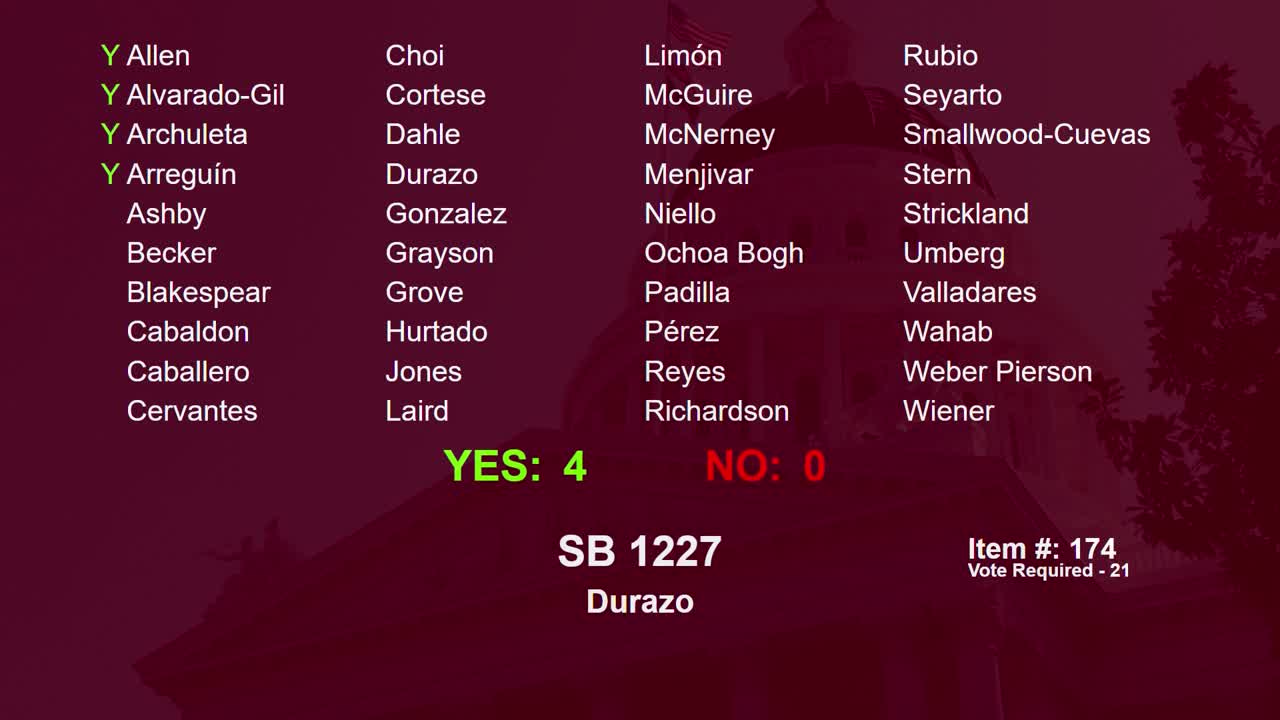 2MIN
Senate Floor
 10MIN
Senate Standing Committee on Human Services
Bill Author