SB 993: Board of Behavioral Sciences: licensees: notices.
- Session Year: 2025-2026
- House: Senate
- Latest Version Date: 2026-09-27
Current Status:
Passed
(2026-09-27: Chaptered by Secretary of State. Chapter 668, Statutes of 2026.)
Introduced
In Committee
Awaiting First Chamber Vote
Passed First Chamber
In Committee
Awaiting Second Chamber Vote
Passed Second Chamber
Enacted
Existing law establishes the Board of Behavioral Sciences and sets forth its powers and duties, including, but not limited to, the licensing, registration, and regulation of marriage and family therapists, educational psychologists, clinical social workers, and professional clinical counselors. Existing law requires these licensees and registrants to provide a client with a written notice stating that the board receives and responds to complaints regarding services provided by the licensee or registrant and containing specified information about the licensee or registrant and their license.
This bill would authorize the licensee or registrant, in specified practice settings, to exercise discretion whether to disclose any or all of the information about the licensee or registrant and their license in the notice based on individual safety concerns if certain requirements are met.
Existing law establishes the Board of Behavioral Sciences and sets forth its powers and duties, including, but not limited to, the licensing, registration, and regulation of marriage and family therapists, educational psychologists, clinical social workers, and professional clinical counselors. Existing law requires these licensees and registrants to provide a client with a written notice stating that the board receives and responds to complaints regarding services provided by the licensee or registrant and containing specified information about the licensee or registrant and their license.
This bill would authorize the employing entity or agency of the licensee or registrant, in specified practice settings, to exercise discretion whether to disclose any or all of the information about the licensee or registrant and their license in the notice based on individual safety concerns if certain requirements are met.
Existing law establishes the Board of Behavioral Sciences and sets forth its powers and duties, including, but not limited to, the licensing, registration, and regulation of marriage and family therapists. therapists, educational psychologists, clinical social workers, and professional clinical counselors. Existing law requires a marriage and family therapist these licensees and registrants to provide a client with a written notice stating that the board receives and responds to complaints regarding services provided by marriage and family therapists the licensee or registrant and containing specified information about the therapist licensee or registrant and their license.
This bill would authorize the employing entity or agency of the therapist, licensee or registrant, in specified practice settings, to exercise discretion whether to disclose any or all of the information about the therapist licensee or registrant and their license in the notice based on individual safety concerns if certain requirements are met.
Existing law establishes the Board of Behavioral Sciences and sets forth its powers and duties, including, but not limited to, the licensing, registration, and regulation of marriage and family therapists. Existing law requires a marriage and family therapist to provide a client with a written notice stating that the board receives and responds to complaints regarding services provided by marriage and family therapists and containing specified information. information about the therapist and their license.
This bill would make nonsubstantive changes to those provisions. authorize the employing entity or agency of the therapist, in specified practice settings, to exercise discretion whether to disclose any or all of the information about the therapist and their license in the notice based on individual safety concerns if certain requirements are met.
Existing law establishes the Board of Behavioral Sciences and sets forth its powers and duties, including, but not limited to, the licensing, registration, and regulation of marriage and family therapists. Existing law requires a marriage and family therapist to provide a client with a written notice containing specified information.
This bill would make nonsubstantive changes to those provisions.
(a)A licensee or registrant shall provide a client with a notice written in at least 12-point type prior to initiating psychotherapy services, or as soon as practicably possible thereafter, that reads as follows:
NOTICE TO CLIENTS
The Board of Behavioral Sciences receives and responds to complaints regarding services provided within the scope of practice of marriage and family therapists. You may contact the board online at www.bbs.ca.gov, or by calling (916) 574-7830.
(b)(1)Except as provided in paragraph (2), upon initiation of psychotherapy services with a client, the notice described in subdivision (a) shall also include the licensees or registrants full name as filed with the board, the license or registration number, the type of license or registration, and the license or registration expiration date.
(2)(A)In any of the following practice settings, a licensee or registrant may exercise discretion whether to include any or all of the information required by paragraph (1) in the notice required by subdivision (a) based on individual safety concerns if the employing entity or agency of the licensee or registrant authorizes the licensee or registrant to exercise discretion and the setting has an established process by which the client may request and obtain sufficient identification information to file a complaint with the board, that process is disclosed to the client as part of the notice, and a copy of the notice is preserved as part of the clients records:
(i)An acute psychiatric hospital, as defined in Section 1250 of the Health and Safety Code.
(ii)A correctional treatment center, as defined in Section 1250 of the Health and Safety Code.
(iii)Any setting where mental health services are provided to incarcerated individuals under the jurisdiction of a local, state, or federal correctional authority, including, but not limited to, a state prison, county jail, juvenile detention facility, or other correctional setting operated by, or under contract with, a governmental entity.
(B)When identifying information is withheld pursuant to this subdivision, the correctional facility or psychiatric hospital shall maintain a process through which a client may obtain sufficient identifying information to file a complaint with the board.
(c)Delivery of the notice required by this section to the client shall be documented.
SEC. 2.Section 4989.17 of the Business and Professions Code is amended to read:4989.17.(a)A licensee shall provide a client with a notice written in at least 12-point type prior to initiating psychological services, or as soon as practicably possible thereafter, that reads as follows:
NOTICE TO CLIENTS
The Board of Behavioral Sciences receives and responds to complaints regarding services provided within the scope of practice of licensed educational psychologists. You may contact the board online at www.bbs.ca.gov, or by calling (916) 574-7830.
(b)(1)Except as provided in paragraph (2), upon initiation of psychological services with a client, the notice described in subdivision (a) shall also include the licensees full name as filed with the board, the license number, the type of license, and the license expiration date.
(2)(A)In any of the following practice settings, a licensee may exercise discretion whether to include any or all of the information required by paragraph (1) in the notice required by subdivision (a) based on individual safety concerns if the employing entity or agency of the licensee authorizes the licensee to exercise discretion and the setting has an established process by which the client may request and obtain sufficient identification information to file a complaint with the board, that process is disclosed to the client as part of the notice, and a copy of the notice is preserved as part of the clients records:
(i)An acute psychiatric hospital, as defined in Section 1250 of the Health and Safety Code.
(ii)A correctional treatment center, as defined in Section 1250 of the Health and Safety Code.
(iii)Any setting where mental health services are provided to incarcerated individuals under the jurisdiction of a local, state, or federal correctional authority, including, but not limited to, a state prison, county jail, juvenile detention facility, or other correctional setting operated by, or under contract with, a governmental entity.
(B)When identifying information is withheld pursuant to this subdivision, the correctional facility or psychiatric hospital shall maintain a process through which a client may obtain sufficient identifying information to file a complaint with the board.
(c)Delivery of the notice required by this section to the client shall be documented.
SEC. 3.Section 4996.75 of the Business and Professions Code is amended to read:4996.75.(a)A licensee or registrant shall provide a client with a notice written in at least 12-point type prior to initiating psychotherapy services, or as soon as practicably possible thereafter, that reads as follows:
NOTICE TO CLIENTS
The Board of Behavioral Sciences receives and responds to complaints regarding services provided within the scope of practice of clinical social workers. You may contact the board online at www.bbs.ca.gov, or by calling (916) 574-7830.
(b)(1)Except as provided in paragraph (2), upon initiation of psychotherapy services with a client, the notice described in subdivision (a) shall also include the licensees or registrants full name as filed with the board, the license or registration number, the type of license or registration, and the license or registration expiration date.
(2)(A)In any of the following practice settings, a licensee or registrant may exercise discretion whether to include any or all of the information required by paragraph (1) in the notice required by subdivision (a) based on individual safety concerns if the employing entity or agency of the licensee or registrant authorizes the licensee or registrant to exercise discretion and the setting has an established process by which the client may request and obtain sufficient identification information to file a complaint with the board, that process is disclosed to the client as part of the notice, and a copy of the notice is preserved as part of the clients records:
(i)An acute psychiatric hospital, as defined in Section 1250 of the Health and Safety Code.
(ii)A correctional treatment center, as defined in Section 1250 of the Health and Safety Code.
(iii)Any setting where mental health services are provided to incarcerated individuals under the jurisdiction of a local, state, or federal correctional authority, including, but not limited to, a state prison, county jail, juvenile detention facility, or other correctional setting operated by, or under contract with, a governmental entity.
(B)When identifying information is withheld pursuant to this subdivision, the correctional facility or psychiatric hospital shall maintain a process through which a client may obtain sufficient identifying information to file a complaint with the board.
(c)Delivery of the notice required by this section to the client shall be documented.
SEC. 4.Section 4999.71 of the Business and Professions Code is amended to read:4999.71.(a)A licensee or registrant shall provide a client with a notice written in at least 12-point type prior to initiating psychotherapy services, or as soon as practicably possible thereafter, that reads as follows:
NOTICE TO CLIENTS
The Board of Behavioral Sciences receives and responds to complaints regarding services provided within the scope of practice of professional clinical counselors. You may contact the board online at www.bbs.ca.gov, or by calling (916) 574-7830.
(b)(1)Except as provided in paragraph (2), upon initiation of psychotherapy services with a client, the notice described in subdivision (a) shall also include the licensees or registrants full name as filed with the board, the license or registration number, the type of license or registration, and the license or registration expiration date.
(2)(A)In any of the following practice settings, a licensee or registrant may exercise discretion whether to include any or all of the information required by paragraph (1) in the notice required by subdivision (a) based on individual safety concerns if the employing entity or agency of the licensee or registrant authorizes the licensee or registrant to exercise discretion and the setting has an established process by which the client may request and obtain sufficient identification information to file a complaint with the board, that process is disclosed to the client as part of the notice, and a copy of the notice is preserved as part of the clients records:
(i)An acute psychiatric hospital, as defined in Section 1250 of the Health and Safety Code.
(ii)A correctional treatment center, as defined in Section 1250 of the Health and Safety Code.
(iii)Any setting where mental health services are provided to incarcerated individuals under the jurisdiction of a local, state, or federal correctional authority, including, but not limited to, a state prison, county jail, juvenile detention facility, or other correctional setting operated by, or under contract with, a governmental entity.
(B)When identifying information is withheld pursuant to this subdivision, the correctional facility or psychiatric hospital shall maintain a process through which a client may obtain sufficient identifying information to file a complaint with the board.
(c)Delivery of the notice required by this section to the client shall be documented.
(a)A licensee or registrant shall provide a client with a notice written in at least 12-point type prior to initiating psychotherapy services, or as soon as practicably possible thereafter, that reads as follows:
NOTICE TO CLIENTS
The Board of Behavioral Sciences receives and responds to complaints regarding services provided within the scope of practice of marriage and family therapists. You may contact the board online at www.bbs.ca.gov, or by calling (916) 574-7830.
(b)(1)Except as provided in paragraph (2), upon initiation of psychotherapy services with a client, the notice described in subdivision (a) shall also include the licensees or registrants full name as filed with the board, the license or registration number, the type of license or registration, and the license or registration expiration date.
(2)(A)In any of the following practice settings, an employing entity or agency of a licensee or registrant may exercise discretion whether to include any or all of the information required by paragraph (1) in the notice required by subdivision (a) based on individual safety concerns if the employing entity or agency of the licensee or registrant authorizes the licensee or registrant to exercise discretion and the setting has an established process by which the client may request and obtain sufficient identification information to file a complaint with the board, that process is disclosed to the client as part of the notice, and a copy of the notice is preserved as part of the clients records:
(i)An acute psychiatric hospital, as defined in Section 1250 of the Health and Safety Code.
(ii)A correctional treatment center, as defined in Section 1250 of the Health and Safety Code.
(iii)Any setting where mental health services are provided to incarcerated individuals under the jurisdiction of a local, state, or federal correctional authority, including, but not limited to, a state prison, county jail, juvenile detention facility, or other correctional setting operated by, or under contract with, a governmental entity.
(B)If the discretion authorized by this paragraph is exercised, the licensee or registrant shall be responsible for ensuring the process to request and obtain identification information required by subparagraph (A) is in place.(B)When identifying information is withheld pursuant to this subdivision, the correctional facility or psychiatric hospital shall maintain a process through which a client may obtain sufficient identifying information to file a complaint with the board.
(c)Delivery of the notice required by this section to the client shall be documented.
SEC. 2.Section 4989.17 of the Business and Professions Code is amended to read:4989.17.(a)A licensee shall provide a client with a notice written in at least 12-point type prior to initiating psychological services, or as soon as practicably possible thereafter, that reads as follows:
NOTICE TO CLIENTS
The Board of Behavioral Sciences receives and responds to complaints regarding services provided within the scope of practice of licensed educational psychologists. You may contact the board online at www.bbs.ca.gov, or by calling (916) 574-7830.
(b)(1)Except as provided in paragraph (2), upon initiation of psychological services with a client, the notice described in subdivision (a) shall also include the licensees full name as filed with the board, the license number, the type of license, and the license expiration date.
(2)(A)In any of the following practice settings, an employing entity or agency of a licensee may exercise discretion whether to include any or all of the information required by paragraph (1) in the notice required by subdivision (a) based on individual safety concerns if the employing entity or agency of the licensee authorizes the licensee to exercise discretion and the setting has an established process by which the client may request and obtain sufficient identification information to file a complaint with the board, that process is disclosed to the client as part of the notice, and a copy of the notice is preserved as part of the clients records:
(i)An acute psychiatric hospital, as defined in Section 1250 of the Health and Safety Code.
(ii)A correctional treatment center, as defined in Section 1250 of the Health and Safety Code.
(iii)Any setting where mental health services are provided to incarcerated individuals under the jurisdiction of a local, state, or federal correctional authority, including, but not limited to, a state prison, county jail, juvenile detention facility, or other correctional setting operated by, or under contract with, a governmental entity.
(B)If the discretion authorized by this paragraph is exercised, the licensee shall be responsible for ensuring the process to request and obtain identification information required by subparagraph (A) is in place.(B)When identifying information is withheld pursuant to this subdivision, the correctional facility or psychiatric hospital shall maintain a process through which a client may obtain sufficient identifying information to file a complaint with the board.
(c)Delivery of the notice required by this section to the client shall be documented.
SEC. 3.Section 4996.75 of the Business and Professions Code is amended to read:4996.75.(a)A licensee or registrant shall provide a client with a notice written in at least 12-point type prior to initiating psychotherapy services, or as soon as practicably possible thereafter, that reads as follows:
NOTICE TO CLIENTS
The Board of Behavioral Sciences receives and responds to complaints regarding services provided within the scope of practice of clinical social workers. You may contact the board online at www.bbs.ca.gov, or by calling (916) 574-7830.
(b)(1)Except as provided in paragraph (2), upon initiation of psychotherapy services with a client, the notice described in subdivision (a) shall also include the licensees or registrants full name as filed with the board, the license or registration number, the type of license or registration, and the license or registration expiration date.
(2)(A)In any of the following practice settings, an employing entity or agency of a licensee or registrant may exercise discretion whether to include any or all of the information required by paragraph (1) in the notice required by subdivision (a) based on individual safety concerns if the employing entity or agency of the licensee or registrant authorizes the licensee or registrant to exercise discretion and the setting has an established process by which the client may request and obtain sufficient identification information to file a complaint with the board, that process is disclosed to the client as part of the notice, and a copy of the notice is preserved as part of the clients records:
(i)An acute psychiatric hospital, as defined in Section 1250 of the Health and Safety Code.
(ii)A correctional treatment center, as defined in Section 1250 of the Health and Safety Code.
(iii)Any setting where mental health services are provided to incarcerated individuals under the jurisdiction of a local, state, or federal correctional authority, including, but not limited to, a state prison, county jail, juvenile detention facility, or other correctional setting operated by, or under contract with, a governmental entity.
(B)If the discretion authorized by this paragraph is exercised, the licensee or registrant shall be responsible for ensuring the process to request and obtain identification information required by subparagraph (A) is in place.(B)When identifying information is withheld pursuant to this subdivision, the correctional facility or psychiatric hospital shall maintain a process through which a client may obtain sufficient identifying information to file a complaint with the board.
(c)Delivery of the notice required by this section to the client shall be documented.
SEC. 4.Section 4999.71 of the Business and Professions Code is amended to read:4999.71.(a)A licensee or registrant shall provide a client with a notice written in at least 12-point type prior to initiating psychotherapy services, or as soon as practicably possible thereafter, that reads as follows:
NOTICE TO CLIENTS
The Board of Behavioral Sciences receives and responds to complaints regarding services provided within the scope of practice of professional clinical counselors. You may contact the board online at www.bbs.ca.gov, or by calling (916) 574-7830.
(b)(1)Except as provided in paragraph (2), upon initiation of psychotherapy services with a client, the notice described in subdivision (a) shall also include the licensees or registrants full name as filed with the board, the license or registration number, the type of license or registration, and the license or registration expiration date.
(2)(A)In any of the following practice settings, an employing entity or agency of a licensee or registrant may exercise discretion whether to include any or all of the information required by paragraph (1) in the notice required by subdivision (a) based on individual safety concerns if the employing entity or agency of the licensee or registrant authorizes the licensee or registrant to exercise discretion and the setting has an established process by which the client may request and obtain sufficient identification information to file a complaint with the board, that process is disclosed to the client as part of the notice, and a copy of the notice is preserved as part of the clients records:
(i)An acute psychiatric hospital, as defined in Section 1250 of the Health and Safety Code.
(ii)A correctional treatment center, as defined in Section 1250 of the Health and Safety Code.
(iii)Any setting where mental health services are provided to incarcerated individuals under the jurisdiction of a local, state, or federal correctional authority, including, but not limited to, a state prison, county jail, juvenile detention facility, or other correctional setting operated by, or under contract with, a governmental entity.
(B)If the discretion authorized by this paragraph is exercised, the licensee or registrant shall be responsible for ensuring the process to request and obtain identification information required by subparagraph (A) is in place.(B)When identifying information is withheld pursuant to this subdivision, the correctional facility or psychiatric hospital shall maintain a process through which a client may obtain sufficient identifying information to file a complaint with the board.
(c)Delivery of the notice required by this section to the client shall be documented.
(a)A licensee or registrant shall provide a client with a notice written in at least 12-point type prior to initiating psychotherapy services, or as soon as practicably possible thereafter, that reads as follows:
NOTICE TO CLIENTS
The Board of Behavioral Sciences receives and responds to complaints regarding services provided within the scope of practice of marriage and family therapists. You may contact the board online at www.bbs.ca.gov, or by calling (916) 574-7830.
(b)(1)Except as provided in paragraph (2), upon initiation of psychotherapy services with a client, the notice described in subdivision (a) shall also include the licensees or registrants full name as filed with the board, the license or registration number, the type of license or registration, and the license or registration expiration date.
(2)(A)In any of the following practice settings, an employing entity or agency of a licensee or registrant may exercise discretion whether to include any or all of the information required by paragraph (1) in the notice required by subdivision (a) based on individual safety concerns if the setting has an established process by which the client may request and obtain sufficient identification information to file a complaint with the board, that process is disclosed to the client as part of the notice, and a copy of the notice is preserved as part of the clients records:
(A)(i)An acute psychiatric hospital, as defined in Section 1250 of the Health and Safety Code.
(B)(ii)A correctional treatment center, as defined in Section 1250 of the Health and Safety Code.
(C)(iii)Any setting where mental health services are provided to incarcerated individuals under the jurisdiction of a local, state, or federal correctional authority, including, but not limited to, a state prison, county jail, juvenile detention facility, or other correctional setting operated by, or under contract with, a governmental entity.
(B)If the discretion authorized by this paragraph is exercised, the licensee or registrant shall be responsible for ensuring the process to request and obtain identification information required by subparagraph (A) is in place.
(c)Delivery of the notice required by this section to the client shall be documented.
SEC. 2.Section 4989.17 of the Business and Professions Code is amended to read:4989.17.(a)A licensee shall provide a client with a notice written in at least 12-point type prior to initiating psychological services, or as soon as practicably possible thereafter, that reads as follows:
NOTICE TO CLIENTS
The Board of Behavioral Sciences receives and responds to complaints regarding services provided within the scope of practice of licensed educational psychologists. You may contact the board online at www.bbs.ca.gov, or by calling (916) 574-7830.
(b)On and after July 1, 2025, (1)Except as provided in paragraph (2), upon initiation of psychological services with a client, the notice described in subdivision (a) shall also include the licensees full name as filed with the board, the license number, the type of license, and the license expiration date.
(2)(A)In any of the following practice settings, an employing entity or agency of a licensee may exercise discretion whether to include any or all of the information required by paragraph (1) in the notice required by subdivision (a) based on individual safety concerns if the setting has an established process by which the client may request and obtain sufficient identification information to file a complaint with the board, that process is disclosed to the client as part of the notice, and a copy of the notice is preserved as part of the clients records:
(i)An acute psychiatric hospital, as defined in Section 1250 of the Health and Safety Code.
(ii)A correctional treatment center, as defined in Section 1250 of the Health and Safety Code.
(iii)Any setting where mental health services are provided to incarcerated individuals under the jurisdiction of a local, state, or federal correctional authority, including, but not limited to, a state prison, county jail, juvenile detention facility, or other correctional setting operated by, or under contract with, a governmental entity.
(B)If the discretion authorized by this paragraph is exercised, the licensee shall be responsible for ensuring the process to request and obtain identification information required by subparagraph (A) is in place.
(c)Delivery of the notice required by this section to the client shall be documented.
SEC. 3.Section 4996.75 of the Business and Professions Code is amended to read:4996.75.(a)A licensee or registrant shall provide a client with a notice written in at least 12-point type prior to initiating psychotherapy services, or as soon as practicably possible thereafter, that reads as follows:
NOTICE TO CLIENTS
The Board of Behavioral Sciences receives and responds to complaints regarding services provided within the scope of practice of clinical social workers. You may contact the board online at www.bbs.ca.gov, or by calling (916) 574-7830.
(b)On and after July 1, 2025, (1)Except as provided in paragraph (2), upon initiation of psychotherapy services with a client, the notice described in subdivision (a) shall also include the licensees or registrants full name as filed with the board, the license or registration number, the type of license or registration, and the license or registration expiration date.
(2)(A)In any of the following practice settings, an employing entity or agency of a licensee or registrant may exercise discretion whether to include any or all of the information required by paragraph (1) in the notice required by subdivision (a) based on individual safety concerns if the setting has an established process by which the client may request and obtain sufficient identification information to file a complaint with the board, that process is disclosed to the client as part of the notice, and a copy of the notice is preserved as part of the clients records:
(i)An acute psychiatric hospital, as defined in Section 1250 of the Health and Safety Code.
(ii)A correctional treatment center, as defined in Section 1250 of the Health and Safety Code.
(iii)Any setting where mental health services are provided to incarcerated individuals under the jurisdiction of a local, state, or federal correctional authority, including, but not limited to, a state prison, county jail, juvenile detention facility, or other correctional setting operated by, or under contract with, a governmental entity.
(B)If the discretion authorized by this paragraph is exercised, the licensee or registrant shall be responsible for ensuring the process to request and obtain identification information required by subparagraph (A) is in place.
(c)Delivery of the notice required by this section to the client shall be documented.
SEC. 4.Section 4999.71 of the Business and Professions Code is amended to read:4999.71.(a)A licensee or registrant shall provide a client with a notice written in at least 12-point type prior to initiating psychotherapy services, or as soon as practicably possible thereafter, that reads as follows:
NOTICE TO CLIENTS
The Board of Behavioral Sciences receives and responds to complaints regarding services provided within the scope of practice of professional clinical counselors. You may contact the board online at www.bbs.ca.gov, or by calling (916) 574-7830.
(b)On and after July 1, 2025, (1)Except as provided in paragraph (2), upon initiation of psychotherapy services with a client, the notice described in subdivision (a) shall also include the licensees or registrants full name as filed with the board, the license or registration number, the type of license or registration, and the license or registration expiration date.
(2)(A)In any of the following practice settings, an employing entity or agency of a licensee or registrant may exercise discretion whether to include any or all of the information required by paragraph (1) in the notice required by subdivision (a) based on individual safety concerns if the setting has an established process by which the client may request and obtain sufficient identification information to file a complaint with the board, that process is disclosed to the client as part of the notice, and a copy of the notice is preserved as part of the clients records:
(i)An acute psychiatric hospital, as defined in Section 1250 of the Health and Safety Code.
(ii)A correctional treatment center, as defined in Section 1250 of the Health and Safety Code.
(iii)Any setting where mental health services are provided to incarcerated individuals under the jurisdiction of a local, state, or federal correctional authority, including, but not limited to, a state prison, county jail, juvenile detention facility, or other correctional setting operated by, or under contract with, a governmental entity.
(B)If the discretion authorized by this paragraph is exercised, the licensee or registrant shall be responsible for ensuring the process to request and obtain identification information required by subparagraph (A) is in place.
(c)Delivery of the notice required by this section to the client shall be documented.
(a)A licensee or registrant shall provide a client with a notice written in at least 12-point type prior to initiating psychotherapy services, or as soon as practicably possible thereafter, that reads as follows:
NOTICE TO CLIENTS
The Board of Behavioral Sciences receives and responds to complaints regarding services provided within the scope of practice of marriage and family therapists. You may contact the board online at www.bbs.ca.gov, or by calling (916) 574-7830.
(b)Upon (1)Except as provided in paragraph (2), upon initiation of psychotherapy services with a client, the notice described in subdivision (a) shall also include the licensees or registrants full name as filed with the board, the license or registration number, the type of license or registration, and the license or registration expiration date.
(2)In any of the following practice settings, an employing entity or agency of a licensee or registrant may exercise discretion whether to include any or all of the information required by paragraph (1) in the notice required by subdivision (a) based on individual safety concerns if the setting has an established process by which the client may request and obtain sufficient identification information to file a complaint with the board, that process is disclosed to the client as part of the notice, and a copy of the notice is preserved as part of the clients records:
(A)An acute psychiatric hospital, as defined in Section 1250 of the Health and Safety Code.
(B)A correctional treatment center, as defined in Section 1250 of the Health and Safety Code.
(C)Any setting where mental health services are provided to incarcerated individuals under the jurisdiction of a local, state, or federal correctional authority, including, but not limited to, a state prison, county jail, juvenile detention facility, or other correctional setting operated by, or under contract with, a governmental entity.
(c)Delivery of the notice required by this section to the client shall be documented.
(a)A licensee or registrant shall provide a client with a notice written in at least 12-point type prior to initiating psychotherapy services, or as soon as practicably possible thereafter, that reads as follows:
NOTICE TO CLIENTS
The Board of Behavioral Sciences receives and responds to complaints regarding services provided within the scope of practice of marriage and family therapists. You may contact the board online at www.bbs.ca.gov, or by calling (916) 574-7830.
(b)On and after July 1, 2025, upon Upon initiation of psychotherapy services with a client, the notice described in subdivision (a) shall also include the licensees or registrants full name as filed with the board, the license or registration number, the type of license or registration, and the license or registration expiration date.
(c)Delivery of the notice required by this section to the client shall be documented.
|
Date
|
Status
|
|---|---|
| Sep 27, 2026 | Chaptered by Secretary of State. Chapter 668, Statutes of 2026. |
| Sep 27, 2026 | Approved by the Governor. |
| Sep 2, 2026 | Enrolled and presented to the Governor at 3 p.m. |
| Aug 27, 2026 | Assembly amendments concurred in. (Ayes 40. Noes 0. Page 5986.) Ordered to engrossing and enrolling. |
| Aug 27, 2026 | Assembly amendments concurred in. (Ayes 39. Noes 0.) Ordered to engrossing and enrolling. |
| Aug 26, 2026 | Ordered to special consent calendar. |
| Aug 24, 2026 | In Senate. Concurrence in Assembly amendments pending. |
| Aug 24, 2026 | Read third time. Passed. (Ayes 77. Noes 0. Page 6374.) Ordered to the Senate. |
| Aug 24, 2026 | Read third time. Passed. Ordered to the Senate. |
| Aug 18, 2026 | Ordered to third reading. |
| Aug 18, 2026 | Read third time and amended. |
| Aug 6, 2026 | Read second time. Ordered to third reading. |
| Aug 5, 2026 | From committee: Do pass. (Ayes 15. Noes 0.) (August 5). |
| Jun 23, 2026 | From committee: Do pass and re-refer to Com. on APPR. (Ayes 19. Noes 0.) (June 23). Re-referred to Com. on APPR. |
| May 26, 2026 | Referred to Com. on B. & P. |
| May 19, 2026 | In Assembly. Read first time. Held at Desk. |
| May 18, 2026 | Read third time. Passed. (Ayes 38. Noes 0. Page 4315.) Ordered to the Assembly. |
| May 18, 2026 | Read third time. Passed. (Ayes 38. Noes 0.) Ordered to the Assembly. |
| May 5, 2026 | Read second time. Ordered to third reading. |
| May 4, 2026 | From committee: Be ordered to second reading pursuant to Senate Rule 28.8. |
| Apr 24, 2026 | Set for hearing May 4. |
| Apr 20, 2026 | From committee: Do pass and re-refer to Com. on APPR. (Ayes 9. Noes 0. Page 3954.) (April 20). Re-referred to Com. on APPR. |
| Apr 20, 2026 | From committee: Do pass and re-refer to Com. on APPR. (Ayes 9. Noes 0.) (April 20). Re-referred to Com. on APPR. |
| Apr 15, 2026 | Set for hearing April 20. |
| Apr 13, 2026 | April 13 set for first hearing canceled at the request of author. |
| Apr 9, 2026 | Set for hearing April 13. |
| Apr 8, 2026 | From committee with author's amendments. Read second time and amended. Re-referred to Com. on B. P. & E.D. |
| Apr 8, 2026 | Re-referred to Com. on B. P. & E.D. |
| Mar 19, 2026 | From committee with author's amendments. Read second time and amended. Re-referred to Com. on RLS. |
| Feb 18, 2026 | Referred to Com. on RLS. |
| Feb 9, 2026 | From printer. May be acted upon on or after March 8. |
| Feb 5, 2026 | Introduced. Read first time. To Com. on RLS. for assignment. To print. |
|
Date
|
Description
|
Location
|
Votes
|
|
|---|---|---|---|---|
| Aug 27, 2026 | Special Consent SB993 Ochoa Bogh et al. | Senate Floor |
Passed |
|
| Aug 24, 2026 | SB 993 Ochoa Bogh Senate Third Reading By Ahrens | Assembly Floor |
Passed |
|
| Aug 5, 2026 | Do pass. | Assembly Standing Committee on Appropriations |
Passed |
|
| Jun 23, 2026 | Do pass and be re-referred to the Committee on [Appropriations] | Assembly Standing Committee on Business and Professions |
Passed |
|
| May 18, 2026 | Senate 3rd Reading SB993 Ochoa Bogh | Senate Floor |
Passed |
|
| Apr 20, 2026 | Do pass, but first be re-referred to the Committee on [Appropriations] | Senate Standing Committee on Business, Professions and Economic Development |
Passed |
This list shows positions taken on this bill by organizations on the date displayed, which is linked to the original source.
Positions by individuals are not included.
|
Organization
|
Position
|
Date
|
|---|---|---|
| American Federation Of State, County And Municipal Employees, Afl-Cio | ** Support | |
| American Federation of State, County and Municipal Employees, (AFSCME), AFL-CIO (sponsor) | ** Support | |
| American Federation of State, County and Municipal Employees (AFSCME) California, AFL-CIO | ** Support | |
| California Baptist Capitol Ministry | ** Support | |
| COUNTY BEHAVIORAL HEALTH DIRECTORS ASSOCIATION (CBHDA) | ** Support | |
| The California Baptist Capitol Ministry | ** Support |
SENATE RULES COMMITTEE Office of Senate Floor Analyses (916) 651-4171 | SB 993 |
UNFINISHED BUSINESS
Bill No: SB 993
Author: Ochoa Bogh (R), et al.
Amended: 8/18/26
Vote: 21
SENATE BUS., PROF. & ECON. DEV. COMMITTEE: 9-0, 4/20/26
AYES: Wahab, Choi, Archuleta, Caballero, Grayson, Niello, Smallwood-Cuevas, Strickland, Umberg
NO VOTE RECORDED: Arreguín, Menjivar
SENATE APPROPRIATIONS COMMITTEE: Senate Rule 28.8
SENATE FLOOR: 38-0, 5/18/26
AYES: Allen, Alvarado-Gil, Archuleta, Arreguín, Ashby, Becker, Blakespear, Cabaldon, Caballero, Cervantes, Choi, Cortese, Dahle, Durazo, Gonzalez, Grayson, Grove, Hurtado, Jones, Laird, Limón, McGuire, McNerney, Menjivar, Ochoa Bogh, Pérez, Reyes, Richardson, Rubio, Seyarto, Smallwood-Cuevas, Stern, Strickland, Umberg, Valladares, Wahab, Weber Pierson, Wiener
NO VOTE RECORDED: Niello, Padilla
ASSEMBLY FLOOR: Passed, 8/24/26
SUBJECT: Board of Behavioral Sciences: licensees: notices
SOURCE: American Federation of State, County and Municipal Employees, AFL-CIO
DIGEST:
This bill revises licensure disclosure requirements for Board of Behavioral Sciences (BBS) licensees or registrants, if certain requirements are met.
Assembly Amendments
authorize a BBS licensee or registrant, instead of an employing entity or agency of a licensee or registrant, in specified practice settings, to exercise discretion whether to include specified information required to be included in a client notice based on individual safety concerns if the employing entity or agency authorizes the licensee or registrant to exercise discretion and requires the specified practice setting maintain a process allowing a client to obtain sufficient identifying information to file a complaint with the BBS, that process is disclosed to the client as part of the notice, and a copy of the notice is preserved in the client’s records.
ANALYSIS:
Existing law:
- Establishes the BBS to license and regulate Marriage and Family Therapists (LMFT), Educational Psychologists (LEP), Clinical Social Workers (LCSW), and Professional Clinical Counselors (LPCC). (Business and Professions Code (BPC) § 4980 et seq.)
- Defines a MFT and PCC “associate” as an unlicensed person who has earned a master’s or doctoral degree qualifying the individual for licensure, as specified. (BPC § 4980.03(b) 4999.12(f))
- Defines a MFT and PCC “trainee” as an unlicensed person who is currently enrolled in a master’s or doctoral degree program that is designed to qualify the person for licensure and who has completed no less than 12 semester or 18 quarter units in any qualifying degree program. (BPC § 4980.03 (c) (4999.12(g))
- Requires a LMFT, LEP, LCSW, and LPCC to display their license in a conspicuous place in the licensee’s primary place of practice. (BPC §§ 4980.31, 4989.48, 4996.7, 4999.70)
- Requires aLMFT, LEP, LCSW, and LPCC to provide a written notice to clients prior to initiating psychotherapy services, that informs the client that the BBS receives and reviews complaints, as specified. (BPC §§ 4980.32, 4989.17, 4996.75, 4999.71)
- Unless specifically exempted, requires a person to obtain a valid license or registration with the Board before engaging in the practice of marriage and family therapy, clinical social work, or professional clinical counseling (BPC §§ 4980(b), 4996(b), 4999.30))
This bill:
- Authorizes an employing entity or agency of a licensee or registrant to exercise discretion, in specific practice settings, whether to include any or all of the following information: the licensee’s or registrant’s full name as filed with the board, the license or registration number, the type of license or registration and the registration expiration date in the notice required prior to initiating psychotherapy services, if the setting has an established process by which the client may request and obtain sufficient identification information to file a complaint with the board, that process is disclosed to the client as part of the notice and a copy of the notice is preserved as part of the client’s records. Requires the licensee or registrant to be responsible, if exercising discretion is utilized, for ensuring the process to request and obtain identification is in place.
- Includes the following specific practice settings: an acute psychiatric hospital, a correctional treatment center, any setting where mental health services are provided to incarcerated individuals under the jurisdiction of a local, state, or federal correctional authority, including but not limited to, a state prison, county jail, juvenile detention facility, or other correctional setting operated by or under contract with a governmental entity.
Background
The Board of Behavioral Sciences (BBS) licenses and regulates Licensed Clinical Social Workers (LCSWs), Licensed Marriage and Family Therapists (LMFTs), Licensed Educational Psychologists (LEPs), and Licensed Professional Clinical Counselors (LPCCs). Additionally, the Board registers Associate Clinical Social Workers (ASWs), Associate Marriage and Family Therapists (AMFTs), and Associate Professional Clinical Counselors (APCCs).
The Board is responsible for the regulatory oversight of over 148,000 licensees and registrants. Each profession has its own scope of practice, entry-level requirements, and professional settings with some overlap in areas. LMFTs are employed in mental health agencies, counseling centers, and private practice. LMFT’s utilize counseling or therapeutic techniques to assist individuals, couples, families, and groups with a focus on marriage, family, and relationship issues. AMFTs have completed the required educational program and are in the process of obtaining the hours of supervisory experience required for licensure. LCSWs are employed in health facilities, private practice, and state and county mental health agencies. LCSWs utilize counseling and psychotherapeutic techniques to assist individuals, couples, families, and groups. ASWs have completed the required educational program and are in the process of obtaining the hours of supervisory experience required for licensure. LEPs work in schools or in private practice and provide educational counseling services such as aptitude and achievement testing or psychological testing. LEPs may not provide psychological testing or counseling services that are unrelated to academic learning processes in the education system. LPCCs work in a variety of settings including hospitals, private practice, and community-based mental health organizations. They apply counseling interventions and psychotherapeutic techniques to identify and remediate cognitive, mental, and emotional issues, including personal growth, adjustment to disability, crisis intervention, and psychosocial and environmental problems. LPCCs work in a variety of settings including hospitals, private practice, and community-based mental health organizations. APCCs have completed the required educational program and are in the process of obtaining the hours of supervisory experience required for licensure.
Disclosure Requirements. Current law requires a licensee prominently display their license in their primary place of practice when conducting mental health services in person confirming for the patient that they are licensed with the BBS. Licensees or registrants licensed by the BBS are also required to provide a client with written notice prior to initiating mental health services, or as soon as possible, that states that the BBS receives and responds to complaints from consumers about mental health services rendered and document in a client’s record. Due to the rise in telehealth services the requirements to physically display a license outside a traditional office setting became impractical. In response, SB 1024 (Ochoa Bogh, Chapter 160, Statues of 2024) updated the procedures for licensed professionals regulated by the BBS by requiring that the written notice also includes the licensee’s or registrant’s full name as filed with the Board, the license and registration number, the type of license or registration, and the expiration date of the license or registration, amongst other provisions. Providing this identifying information to the client receiving telehealth services was a practical solution to create transparency and allow clients to obtain sufficient information to file a complaint, if needed.
As a precautionary measure, this bill seeks to restore previous protections for licensees and registrants who work in high-risk practice settings by allowing employers, based on individual safety concerns, to limit the amount of identifying information that is disclosed to the client, if the practice setting has an established process for the client to obtain said information to file a complaint, the process is disclosed to the client and recorded in the client file.
FISCAL EFFECT: Appropriation: No Fiscal Com.: Yes Local: No
According to the Assembly Committee on Appropriations, the BBS anticipates minor and absorbable costs.
SUPPORT: (Verified 8/24/26)
American Federation of State, County and Municipal Employees, (AFSCME), AFL-CIO (sponsor)
County Behavioral Health Directors Association (CBHDA)
The California Baptist Capitol Ministry
OPPOSITION: (Verified 8/24/26)
None received
ARGUMENTS IN SUPPORT: AFSCME, CBHDA and The California Baptist Capitol Ministry write in support, “The challenges surrounding mental health staffing in California’s state civil service are well-illustrated by recent JLAC audit findings and by the Coleman Receivership. Numerous public agencies are currently experiencing acute shortages of licensed mental health professionals, particularly those who work with incarcerated individuals. Creating and maintaining safe work environments is crucial for recruiting and retaining qualified professionals in this field. By supporting SB 993 we can take a significant step toward ensuring that mental health practitioners feel secure and supported in their roles, allowing them to focus on delivering essential services to incarcerated individuals without compromising their own safety. This bill restores longstanding protections for therapists by allowing them to withhold identifying information, allowing therapists and other professionals to continue delivery of care without risks to personal safety.”
Prepared by: Anna Billy / B., P. & E.D. /
8/24/26 17:17:37
**** END ****
SENATE THIRD READING
STR Bill Id:SB 993
Author:(Ochoa Bogh)
As Amended Ver:August 18, 2026
Majority vote
SUMMARY
Authorizes the name and license or registration information of Board of Behavioral Sciences (BBS or Board) licensees and registrants to be withheld from clients in acute psychiatric hospitals or correctional settings, as specified.
Major Provisions
- Authorizes a BBS licensee or registrant in the following practice settings to exercise discretion whether to include any or all of the information required to be included in a client notice based on individual safety concerns if the employing entity or agency of the licensee or registrant authorizes the licensee or registrant to exercise discretion and the setting has an established process by which the client may request and obtain sufficient identification to file a complaint with the BBS, that process is disclosed to the client as part of the notice, and copy of the notice is preserved as part of the client's records:
- An acute psychiatric hospital, as defined.
- A correctional treatment center, as defined.
- Any setting where mental health services are provided to incarcerated individuals under the jurisdiction of a local, state, or federal correctional authority, including, but not limited to, a state prison, county jail, juvenile detention facility, or other correctional setting operated by, or under contract with, a governmental entity.
- Specifies that when identifying information is withheld, the correctional facility or psychiatric hospital must maintain a process through which a client may obtain sufficient identifying information to file a complaint with the BBS.
COMMENTS
The BBS is responsible for licensing, examining, and enforcing professional standards for LMFTs, LCSWs, LEPs, and LPCCs. Additionally, the BBS registers AMFTs, ASWs, and APCCs. Associates have completed the educational requirements for licensure and are in the process of obtaining supervised experience. In total, the Board is responsible for regulatory oversight of more than 148,000 licensees and registrants. Each profession has its own scope of practice, entry-level requirements, and professional settings, with some overlap.
California law previously required licensees to conspicuously display their license in their primary place of practice. However, this requirement was not helpful to clients who receive mental health services exclusively via telehealth. Consequently, SB 1024 (Ochoa Bogh), Chapter 160, Statutes of 2024, limited the license display requirement to apply only when licensees meet with clients in person, and required licensees and registrants to provide their name and license or registration information in a notice provided to clients.
The proponents of this bill report that since that requirement took effect, therapists have been stalked, harassed, and made to feel unsafe after providing services to incarcerated individuals. This bill would allow therapists to withhold their name and license or registration information from a client in an acute psychiatric hospital or correctional facility based on individual safety concerns. However, the facility must have a process for clients to request sufficient information about a licensee or registrant to file a complaint with the Board. The process must be disclosed to clients in the notice, and a copy of the notice must be included in clients' records.
According to the Author
"[This bill] will address serious safety concerns facing mental health professionals working in correctional facilities, acute psychiatric hospitals, and other high-risk settings. Under current law, providers are required to share detailed identifying information with clients prior to delivering services. While it's important for transparency and accountability, the fails to protect licensees who are dealt with the realities of working with incarcerated and high-risk populations, where disclosing this information can expose providers and potentially their families to harassment, threats, or harm. [This bill] offers a balanced solution for these mental health providers by limiting identifying information but still ensuring patients have a clear and accessible process to request the information necessary to file a complaint with the appropriate licensing board. This bill will restore longstanding protections for mental health professionals ensuring that both the incarcerated population and providers are working in the safest environment possible."
Arguments in Support
As the sponsor of this bill, the American Federation of State, County and Municipal Employees, AFL-CIO writes in support:
Recent changes to law under SB 1024 (Chapter 160, Statutes of 2024) requiring mental health providers to disclose detailed personal identifying information, including full name and license details to patients, were well-intentioned in improving transparency, particularly in telehealth settings. However, in correctional and secure psychiatric environments, these requirements can unintentionally expose therapists to significant risks. Mental health providers working with incarcerated populations often treat individuals with complex behavioral health needs, including those with histories of violence. Requiring routine disclosure of personally identifying information in these settings creates the potential for misuse of that information, placing not only the providers, but also their families, at risk. [This bill] allows employers in correctional and specified psychiatric settings to limit the routine disclosure of identifying information, while still ensuring that patients have a clear and accessible process to obtain the information necessary to file complaints with the appropriate licensing board. This preserves accountability while mitigating unnecessary risk.
Arguments in Opposition
One individual writes in opposition:
I understand and share the bill's underlying concern: providers working in correctional facilities, acute psychiatric hospitals, and similar high-risk settings face real safety risks, and the legislature is right to take that seriously. However, as currently drafted, the bill's mechanism does not achieve its stated safety purpose and may create accountability gaps without meaningfully protecting providers. The bill allows employing entities to omit a licensee's name, license number, license type, and expiration date from the required client notice based on individual safety concerns. The problem is that all of this information is already publicly accessible. The BBS maintains a public license lookup database searchable by a provider's first and last name. Additionally, California law requires licensees to maintain a public address of record with the board. This means that if a client receives a notice containing only a provider's name, or learns a provider's name by any other means, they can immediately locate the provider's license details and address through the BBS public database. Withholding license information from the client notice provides no meaningful barrier to someone determined to locate a provider. In short, the bill imposes new administrative burdens, creates a murky accountability structure that places responsibility on individual licensees of institutional processes they do not control, and does not address the actual mechanism by which provider information becomes accessible.
FISCAL COMMENTS
According to the Assembly Appropriations Committee, the BBS anticipates minor and absorbable costs.
VOTES
SENATE FLOOR: 38-0-2
YES: Allen, Alvarado-Gil, Archuleta, Arreguín, Ashby, Becker, Blakespear, Cabaldon, Caballero, Cervantes, Choi, Cortese, Dahle, Durazo, Gonzalez, Grayson, Grove, Hurtado, Jones, Laird, Limón, McGuire, McNerney, Menjivar, Ochoa Bogh, Pérez, Reyes, Richardson, Rubio, Seyarto, Smallwood-Cuevas, Stern, Strickland, Umberg, Valladares, Wahab, Weber Pierson, Wiener
ABS, ABST OR NV: Niello, Padilla
ASM BUSINESS AND PROFESSIONS: 19-0-0
YES: Berman, Addis, Ahrens, Alanis, Bains, Bauer-Kahan, Caloza, Chen, Elhawary, Hadwick, Haney, Hart, Irwin, Jackson, Patterson, Lowenthal, Macedo, Nguyen, Pellerin
ASM APPROPRIATIONS: 15-0-0
YES: Wicks, Hoover, Arambula, Calderon, Caloza, Dixon, Fong, Mark González, Krell, Pacheco, Pellerin, Sharp-Collins, Solache, Ta, Tangipa
UPDATED
VERSION: August 18, 2026
CONSULTANT: Kaitlin Curry / B. & P. / (916) 319-3301 FN: 0003758
SENATE THIRD READING
STR Bill Id:SB 993
Author:(Ochoa Bogh)
As Amended Ver:April 8, 2026
Majority vote
SUMMARY
Authorizes the name and license or registration information of Board of Behavioral Sciences (BBS or Board) licensees and registrants to be withheld from clients in acute psychiatric hospitals or correctional settings, except as specified.
Major Provisions
- Authorizes, in the following practice settings, an employing entity or agency of a licensee or registrant to exercise discretion whether to include any or all of the information required in a client notice based on individual safety concerns if the setting has an established process by which the client may request and obtain sufficient identification to file a complaint with the BBS, that process is disclosed to the client as part of the notice, and copy of the notice is preserved as part of the client's records:
- An acute psychiatric hospital, as defined.
- A correctional treatment center, as defined.
- Any setting where mental health services are provided to incarcerated individuals under the jurisdiction of a local, state, or federal correctional authority, including, but not limited to, a state prison, county jail, juvenile detention facility, or other correctional setting operated by, or under contract with, a governmental entity.
- Specifies that if discretion is exercised, the licensee or registrant is responsible for ensuring the process to request and obtain identification information is in place.
COMMENTS
The BBS is responsible for licensing, examining, and enforcing professional standards for licensed marriage and family therapists (LMFTs), clinical social workers (LCSWs), educational psychologists (LEPs), and professional clinical counselors (LPCCs). Additionally, the BBS registers associate marriage and family therapists (AMFTs), clinical social workers (ASWs), and professional clinical counselors (APCCs). Associates have completed the educational requirements for licensure and are in the process of obtaining supervised experience. In total, the Board is responsible for regulatory oversight of more than 148,000 licensees and registrants. Each profession has its own scope of practice, entry-level requirements, and professional settings, with some overlap in areas.
California law used to require licensees to conspicuously display their license in their primary place of practice. However, this requirement was not helpful to clients who receive mental health services exclusively via telehealth. Consequently, SB 1024 (Ochoa Bogh), Chapter 160, Statutes of 2024, limited that requirement to apply only when licensees meet with clients in person. To ensure that all clients are provided with the name and license or registration information for their therapist or LEP, the bill also required licensees and registrants to include that information in a notice to clients.
The proponents of this bill report that since that requirement took effect, therapists have been stalked, harassed, and made to feel unsafe after providing services to incarcerated individuals. This bill would allow employers to withhold a therapist's or LEP's name and license or registration information from a client in an acute psychiatric hospital or correctional facility based on individual safety concerns. However, the facility must have a process by which clients can request sufficient information about a licensee or registrant to file a complaint with the Board. The process must be disclosed to clients in the notice, and a copy of the notice must be included in clients' records.
According to the Author
"[This bill] will address serious safety concerns facing mental health professionals working in correctional facilities, acute psychiatric hospitals, and other high-risk settings. Under current law, providers are required to share detailed identifying information with clients prior to delivering services. While it's important for transparency and accountability, the fails to protect licensees who are dealt with the realities of working with incarcerated and high-risk populations, where disclosing this information can expose providers and potentially their families to harassment, threats, or harm. [This bill] offers a balanced solution for these mental health providers by limiting identifying information but still ensuring patients have a clear and accessible process to request the information necessary to file a complaint with the appropriate licensing board. This bill will restore longstanding protections for mental health professionals ensuring that both the incarcerated population and providers are working in the safest environment possible."
Arguments in Support
As the sponsor of this bill, the American Federation of State, County and Municipal Employees, AFL-CIO writes in support:
Recent changes to law under SB 1024 [(Ochoa Bogh)] Chapter 160, Statutes of 2024 requiring mental health providers to disclose detailed personal identifying information, including full name and license details to patients, were well-intentioned in improving transparency, particularly in telehealth settings. However, in correctional and secure psychiatric environments, these requirements can unintentionally expose therapists to significant risks. Mental health providers working with incarcerated populations often treat individuals with complex behavioral health needs, including those with histories of violence. Requiring routine disclosure of personally identifying information in these settings creates the potential for misuse of that information, placing not only the providers, but also their families, at risk. [This bill] allows employers in correctional and specified psychiatric settings to limit the routine disclosure of identifying information, while still ensuring that patients have a clear and accessible process to obtain the information necessary to file complaints with the appropriate licensing board. This preserves accountability while mitigating unnecessary risk.
Arguments in Opposition
One individual writes in opposition:
I understand and share the bill's underlying concern: providers working in correctional facilities, acute psychiatric hospitals, and similar high-risk settings face real safety risks, and the legislature is right to take that seriously. However, as currently drafted, the bill's mechanism does not achieve its stated safety purpose and may create accountability gaps without meaningfully protecting providers. The bill allows employing entities to omit a licensee's name, license number, license type, and expiration date from the required client notice based on individual safety concerns. The problem is that all of this information is already publicly accessible. The BBS maintains a public license lookup database searchable by a provider's first and last name. Additionally, California law requires licensees to maintain a public address of record with the board. This means that if a client receives a notice containing only a provider's name, or learns a provider's name by any other means, they can immediately locate the provider's license details and address through the BBS public database. Withholding license information from the client notice provides no meaningful barrier to someone determined to locate a provider. In short, the bill imposes new administrative burdens, creates a murky accountability structure that places responsibility on individual licensees of institutional processes they do not control, and does not address the actual mechanism by which provider information becomes accessible.
FISCAL COMMENTS
According to the Assembly Appropriations Committee, the BBS anticipates minor and absorbable costs.
VOTES
SENATE FLOOR: 38-0-2
YES: Allen, Alvarado-Gil, Archuleta, Arreguín, Ashby, Becker, Blakespear, Cabaldon, Caballero, Cervantes, Choi, Cortese, Dahle, Durazo, Gonzalez, Grayson, Grove, Hurtado, Jones, Laird, Limón, McGuire, McNerney, Menjivar, Ochoa Bogh, Pérez, Reyes, Richardson, Rubio, Seyarto, Smallwood-Cuevas, Stern, Strickland, Umberg, Valladares, Wahab, Weber Pierson, Wiener
ABS, ABST OR NV: Niello, Padilla
ASM BUSINESS AND PROFESSIONS: 19-0-0
YES: Berman, Addis, Ahrens, Alanis, Bains, Bauer-Kahan, Caloza, Chen, Elhawary, Hadwick, Haney, Hart, Irwin, Jackson, Patterson, Lowenthal, Macedo, Nguyen, Pellerin
ASM APPROPRIATIONS: 15-0-0
YES: Wicks, Hoover, Arambula, Calderon, Caloza, Dixon, Fong, Mark González, Krell, Pacheco, Pellerin, Sharp-Collins, Solache, Ta, Tangipa
UPDATED
VERSION: April 8, 2026
CONSULTANT: Kaitlin Curry / B. & P. / (916) 319-3301 FN: 0003353
Date of Hearing: August 5, 2026
ASSEMBLY COMMITTEE ON APPROPRIATIONS
Buffy Wicks, Chair
SBPCA Bill Id:SB 993
Author:(Ochoa Bogh) – As Amended Ver:April 8, 2026
Policy Committee: | Business and Professions | Vote: | 19 - 0 |
|
| ||
|
|
Urgency: No State Mandated Local Program: No Reimbursable: No
SUMMARY:
This bill authorizes the employer of a Board of Behavioral Sciences (BBS) licensee or registrant to withhold that licensee’s or registrant’s name and license or registration information from clients in acute psychiatric hospitals or correctional settings.
Specifically, this bill:
- Authorizes an employing entity or agency of a BBS licensee or registrant to exercise discretion regarding inclusion of any or all the information required in the notice the licensee or registrant must present to a client prior to initiating psychotherapy services, based on safety concerns, if (a) the setting has a process by which the client may obtain sufficient information to file a complaint with the BBS, (b) the process is disclosed to the client as part of the notice, and (c) a copy of the notice is preserved in the client’s record.
- Specifies the following practice settings in which the above provision is applicable:
- An acute psychiatric hospital.
- A correctional treatment center.
- Any setting where mental health services are provided to incarcerated individuals under the jurisdiction of a local, state, or federal correctional authority, including, but not limited to, a state prison, county jail, juvenile detention facility, or other correctional setting operated by, or under contract with, a governmental entity.
- An acute psychiatric hospital.
- Requires, if the employing entity or agency exercises the discretion authorized in item 1, above, the licensee or registrant to be responsible for ensuring the process in item 1a, above, is in place.
FISCAL EFFECT:
The BBS anticipates minor and absorbable costs.
COMMENTS:
- Purpose. This bill is sponsored by the American Federation of State, County and Municipal Employees (AFSCME) California, AFL-CIO. According to the author:
[This bill] will address serious safety concerns facing mental health professionals working in correctional facilities, acute psychiatric hospitals, and other high-risk settings. Under current law, providers are required to share detailed identifying information with clients prior to delivering services. While it’s important for transparency and accountability, the fails to protect licensees who are dealt with the realities of working with incarcerated and high-risk populations, where disclosing this information can expose providers and potentially their families to harassment, threats, or harm. [This bill] offers a balanced solution for these mental health providers by limiting identifying information but still ensuring patients have a clear and accessible process to request the information necessary to file a complaint with the appropriate licensing board. This bill will restore longstanding protections for mental health professionals ensuring that both the incarcerated population and providers are working in the safest environment possible.
- Background. The BBS licenses, examines, and enforces professional standards for licensed marriage and family therapists (LMFTs), licensed clinical social workers (LCSWs), licensed professional clinical counselors (LPCCs), licensed and educational psychologists (LEPs), as well as registered associate marriage and family therapists (AMFTs), associate clinical social workers (ASWs), and associate professional clinical counselors (APCCs). Associates have completed the educational requirements for licensure and are in the process of obtaining supervised experience. BBS is responsible for regulatory oversight of more than 148,000 licensees and registrants.
SB 1024 (Ochoa Bogh), Chapter 160, Statutes of 2024, changed an existing notice requirement to apply when licensees meet with clients in person and required licensees and registrants to include their name and license or registration information in a notice to clients. The proponents of this bill report that since that requirement took effect, therapists have been stalked, harassed, and made to feel unsafe after providing services to incarcerated individuals. This bill would allow employers to withhold a therapist's or LEP’s name and license or registration information from a client in certain settings. - Policy Concerns. As noted in the Assembly Business and Professions Committee analysis, a client may request a therapist’s name to file a complaint with the BBS and access other information about the therapist, including their address, on the BBS’s website. The bill also authorizes a therapist’s employer to exercise discretion in providing information about a therapist in the client notice, but it is the therapist’s statutory responsibility to provide the client notice. Further, this bill makes it the therapist’s responsibility to ensure that a facility has a process to allow a client to request the therapist’s identifying information, when information about the process is already required in the alternative client notice, and the process is arguably the facility’s responsibility.
Analysis Prepared by: Allegra Kim / APPR. / (916) 319-2081
Date of Hearing: June 23, 2026
ASSEMBLY COMMITTEE ON BUSINESS AND PROFESSIONS
Marc Berman, Chair
SBPCA Bill Id:SB 993
Author:(Ochoa Bogh) – As Amended Ver:April 8, 2026
SENATE VOTE: 38-0
SUBJECT: Board of Behavioral Sciences: licensees: notices
SUMMARY: Authorizes the name and license or registration information of Board of Behavioral Sciences (BBS or Board) licensees and registrants to be withheld from clients in acute psychiatric hospitals or correctional settings, except as specified.
EXISTING LAW:
- Establishes the BBS with the Department of Consumer Affairs to license and regulate licensed marriage and family therapists (LMFTs), clinical social workers (LCSWs), professional clinical counselors (LPCCs), and educational psychologists (LEPs), as well as registered associate marriage and family therapists (AMFTs), clinical social workers (ASWs), and professional clinical counselors (APCCs). (Business and Professions Code (BPC) §§ 4990 et seq.)
- Requires a licensee or registrant to provide a client with a notice prior to initiating psychotherapy services, or as soon as practically possible thereafter, informing them that the BBS receives and responds to complaints regarding services provided by licensees or registrants. (BPC §§ 4980.32(a), 4989.17(a), 4996.75(a), and 4999.71(a))
- Requires the notice above to include the licensee’s or registrant’s full name as filed with the Board, the license or registration number, the type of license or registration, and the license or registration expiration date. (BPC §§ 4080.32(b), 4989.17(b), 4996.75(b), and 4999.71(b))
- Requires delivery of the notice above to the client to be documented. (BPC §§ 4080.32(c), 4989.17(c), 4996.75(c), and 4999.71(c))
- Requires a licensee to display their license in a conspicuous place in the licensee’s primary place of practice when rendering professional clinical services in person. (BPC §§ 4980.31, 4989.48, 4996.7, and 4999.70)
THIS BILL:
- Authorizes, in the following practice settings, an employing entity or agency of a licensee or registrant to exercise discretion whether to include any or all of the information required in the notice based on individual safety concerns if the setting has an established process by which the client may request and obtain sufficient identification to file a complaint with the BBS, that process is disclosed to the client as part of the notice, and copy of the notice is preserved as part of the client’s records:
- An acute psychiatric hospital, as defined.
- A correctional treatment center, as defined.
- Any setting where mental health services are provided to incarcerated individuals under the jurisdiction of a local, state, or federal correctional authority, including, but not limited to, a state prison, county jail, juvenile detention facility, or other correctional setting operated by, or under contract with, a governmental entity.
- Specifies that if discretion is exercised, the licensee or registrant is responsible for ensuring the process to request and obtain identification information is in place.
FISCAL EFFECT: Pursuant to Senate Rule 28.8, no significant state costs anticipated.
COMMENTS:
Purpose. This bill is sponsored by the American Federation of State, County and Municipal Employees, AFL-CIO. According to the author:
[This bill] will address serious safety concerns facing mental health professionals working in correctional facilities, acute psychiatric hospitals, and other high-risk settings. Under current law, providers are required to share detailed identifying information with clients prior to delivering services. While it’s important for transparency and accountability, the fails to protect licensees who are dealt with the realities of working with incarcerated and high-risk populations, where disclosing this information can expose providers and potentially their families to harassment, threats, or harm. [This bill] offers a balanced solution for these mental health providers by limiting identifying information but still ensuring patients have a clear and accessible process to request the information necessary to file a complaint with the appropriate licensing board. This bill will restore longstanding protections for mental health professionals ensuring that both the incarcerated population and providers are working in the safest environment possible.
Background. The BBS is responsible for licensing, examining, and enforcing professional standards for LMFTs, LCSWs, LEPs, and LPCCs. Additionally, the BBS registers AMFTs, ASWs, and APCCs. Associates have completed the educational requirements for licensure and are in the process of obtaining supervised experience. In total, the Board is responsible for regulatory oversight of more than 148,000 licensees and registrants. Each profession has its own scope of practice, entry-level requirements, and professional settings, with some overlap in areas.
California law used to require licensees to conspicuously display their license in their primary place of practice. However, this requirement was not helpful to clients who receive mental health services exclusively via telehealth. Consequently, SB 1024 (Ochoa Bogh), Chapter 160, Statutes of 2024, limited that requirement to apply only when licensees meet with clients in person. To ensure that all clients are provided with the name and license or registration information for their therapist or LEP, the bill also required licensees and registrants to include that information in a notice to clients.
The proponents of this bill report that since that requirement took effect, therapists have been stalked, harassed, and made to feel unsafe after providing services to incarcerated individuals. This bill would allow employers to withhold a therapist's or LEP’s name and license or registration information from a client in an acute psychiatric hospital or correctional facility based on individual safety concerns. However, the facility must have a process by which clients can request sufficient information about a licensee or registrant to file a complaint with the Board. The process must be disclosed to clients in the notice, and a copy of the notice must be included in clients’ records.
Prior Related Legislation. SB 1024 (Ochoa Bogh), Chapter 160, Statutes of 2024, as it relates to this bill, required licensees and registrants to provide a mandatory notice to clients, including their full name, license or registration number, the type of license, and the license or registration expiration date, upon initiation of psychotherapy services.
SB 373 (Menjivar) of 2023, as it relates to this bill, would have prohibited the BBS from disclosing a licensee’s or registrant’s full address online and instead required the Board to disclose the licensee’s or registrant’s city, state, or zip code. SB 373 was vetoed.
AB 630 (Arambula and Low), Chapter 229, Statutes of 2019, required psychotherapy providers who provide services under a BBS license, registration, or exemption to give clients a notice disclosing where complaints against the provider may be filed and made various technical, clarifying, and conforming changes.
ARGUMENTS IN SUPPORT:
As the sponsor of this bill, the American Federation of State, County and Municipal Employees, AFL-CIO writes in support:
Recent changes to law under SB 1024 (Chapter 160, Statutes of 2024) requiring mental health providers to disclose detailed personal identifying information, including full name and license details to patients, were well-intentioned in improving transparency, particularly in telehealth settings. However, in correctional and secure psychiatric environments, these requirements can unintentionally expose therapists to significant risks. Mental health providers working with incarcerated populations often treat individuals with complex behavioral health needs, including those with histories of violence. Requiring routine disclosure of personally identifying information in these settings creates the potential for misuse of that information, placing not only the providers, but also their families, at risk. [This bill] allows employers in correctional and specified psychiatric settings to limit the routine disclosure of identifying information, while still ensuring that patients have a clear and accessible process to obtain the information necessary to file complaints with the appropriate licensing board. This preserves accountability while mitigating unnecessary risk.
ARGUMENTS IN OPPOSITION:
One individual writes in opposition:
I understand and share the bill’s underlying concern: providers working in correctional facilities, acute psychiatric hospitals, and similar high-risk settings face real safety risks, and the legislature is right to take that seriously. However, as currently drafted, the bill’s mechanism does not achieve its stated safety purpose and may create accountability gaps without meaningfully protecting providers. The bill allows employing entities to omit a licensee’s name, license number, license type, and expiration date from the required client notice based on individual safety concerns. The problem is that all of this information is already publicly accessible. The BBS maintains a public license lookup database searchable by a provider’s first and last name. Additionally, California law requires licensees to maintain a public address of record with the board. This means that if a client receives a notice containing only a provider’s name, or learns a provider's name by any other means, they can immediately locate the provider's license details and address through the BBS public database. Withholding license information from the client notice provides no meaningful barrier to someone determined to locate a provider. In short, the bill imposes new administrative burdens, creates a murky accountability structure that places responsibility on individual licensees of institutional processes they do not control, and does not address the actual mechanism by which provider information becomes accessible.
POLICY ISSUES:
Efficacy. While this bill would prevent the name and license or registration information of a therapist or LEP from being proactively provided to clients at psychiatric hospitals or correctional facilities, those clients may request such information to file a complaint with the BBS. With the full name or license or registration number of a therapist or LEP, a client may access any other information about a licensee or registrant that is publicly available on the Board’s website, including an address. Therefore, this bill may not provide a wholesale solution to the concerns raised by the author and proponents.
IMPLEMENTATION ISSUES:
Conflicting Responsibility and Liability. First, this bill authorizes the employing entity or agency to exclude a licensee’s or registrant’s identifying information from the client notice. Because licensees and registrants are ultimately responsible for providing the notice to clients, the author may wish to clarify that a licensee or registrant may exclude identifying information in the required notice if authorized by the employing entity or agency.
Second, this bill makes licensees and registrants responsible for ensuring that a psychiatric hospital or correctional facility has a process in place for clients to request sufficient identifying information to file a complaint with the Board. This requirement is intended to prevent licensees and registrants from withholding identifying information from a notice without confirming that a psychiatric hospital or correctional facility has such a process in place. However, this bill already requires such a process to be identified in the notice whenever identifying information is withheld. Requiring the process to be included in the client notice arguably satisfies the goal of ensuring that a licensee or registrant has confirmed that the psychiatric hospital or correctional facility has a process in place for clients to request the information needed to file a complaint.
REGISTERED SUPPORT:
American Federation of State, County and Municipal Employees, AFL-CIO (Co-sponsor)
American Federation of State, County and Municipal Employees Council 57
California Baptist Capitol Ministry
County Behavioral Health Directors Association
REGISTERED OPPOSITION:
One individual
Analysis Prepared by: Kaitlin Curry / B. & P. / (916) 319-3301
SENATE RULES COMMITTEE Office of Senate Floor Analyses (916) 651-4171 | SB 993 |
THIRD READING
Bill No: SB 993
Author: Ochoa Bogh (R)
Amended: 4/8/26
Vote: 21
SENATE BUS., PROF. & ECON. DEV. COMMITTEE: 9-0, 4/20/26
AYES: Wahab, Choi, Archuleta, Caballero, Grayson, Niello, Smallwood-Cuevas, Strickland, Umberg
NO VOTE RECORDED: Arreguín, Menjivar
SENATE APPROPRIATIONS COMMITTEE: Senate Rule 28.8
SUBJECT: Board of Behavioral Sciences: licensees: notices
SOURCE: American Federation of State, County and Municipal Employees, AFL-CIO
DIGEST:
This bill revises licensure disclosure requirements for Board of Behavioral Sciences (BBS) licensees or registrants, if certain requirements are met.
ANALYSIS:
Existing law:
- Establishes the BBS to license and regulate Marriage and Family Therapists (LMFT), Educational Psychologists (LEP), Clinical Social Workers (LCSW), and Professional Clinical Counselors (LPCC). (Business and Professions Code (BPC) § 4980 et seq.)
- Defines an MFT and PCC “associate” as an unlicensed person who has earned a master’s or doctoral degree qualifying the individual for licensure, as specified. (BPC § 4980.03(b) 4999.12(f))
- Defines a MFT and PCC “trainee” as an unlicensed person who is currently enrolled in a master’s or doctoral degree program that is designed to qualify the person for licensure and who has completed no less than 12 semester or 18 quarter units in any qualifying degree program. (BPC § 4980.03 (c) (4999.12(g))
- Requires a LMFT, LEP, LCSW, and LPCC to display their license in a conspicuous place in the licensee’s primary place of practice. (BPC §§ 4980.31, 4989.48, 4996.7, 4999.70)
- Requires a LMFT, LEP, LCSW, and LPCC to provide a written notice to clients prior to initiating psychotherapy services, that informs the client that the BBS receives and reviews complaints, as specified. (BPC §§ 4980.32, 4989.17, 4996.75, 4999.71.
This bill:
- Authorizes an employing entity or agency of a licensee or registrant to exercise discretion, in specific practice settings, whether to include any or all of the following information: the licensee’s or registrant’s full name as filed with the board, the license or registration number, the type of license or registration and the registration expiration date in the notice required prior to initiating psychotherapy services, if the setting has an established process by which the client may request and obtain sufficient identification information to file a complaint with the board, that process is disclosed to the client as part of the notice and a copy of the notice is preserved as part of the client’s records. Requires the licensee or registrant to be responsible, if exercising discretion is utilized, for ensuring the process to request and obtain identification is in place.
- Includes the following specific practice settings: an acute psychiatric hospital, a correctional treatment center, any setting where mental health services are provided to incarcerated individuals under the jurisdiction of a local, state, or federal correctional authority, including but not limited to, a state prison, county jail, juvenile detention facility, or other correctional setting operated by or under contract with a governmental entity.
Background
Disclosure Requirements. Current law requires a licensee prominently display their license in their primary place of practice when conducting mental health services in person confirming for the patient that they are licensed with the BBS. Licensees or registrants licensed by the BBS are also required to provide a client with written notice prior to initiating mental health services, or as soon as possible, that states that the BBS receives and responds to complaints from consumers about mental health services rendered and document in a client’s record. Due to the rise in telehealth services the requirements to physically display a license outside a traditional office setting became impractical. In response, SB 1024 (Ochoa Bogh, Chapter 160, Statues of 2024) updated the procedures for licensed professionals regulated by the BBS by requiring that the written notice also includes the licensee’s or registrant’s full name as filed with the Board, the license and registration number, the type of license or registration, and the expiration date of the license or registration, amongst other provisions. Providing this identifying information to the client receiving telehealth services was a practical solution to create transparency and allow clients to obtain sufficient information to file a complaint, if needed.
As a precautionary measure, this bill seeks to restore previous protections for licensees and registrants who work in high-risk practice settings by allowing employers, based on individual safety concerns, to limit the amount of identifying information that is disclosed to the client, if the practice setting has an established process for the client to obtain said information to file a complaint, the process is disclosed to the client and recorded in the client file.
FISCAL EFFECT: Appropriation: No Fiscal Com.: Yes Local: No
SUPPORT: (Verified 5/4/26)
American Federation of State, County and Municipal Employees, AFL-CIO (source)
OPPOSITION: (Verified 5/4/26)
None received
ARGUMENTS IN SUPPORT: AFSCME is the sponsor of the bill and writes in support, “AFSCME represents Licensed Marriage and Family Therapists (LMFTs), Licensed Clinical Social Workers (LCSWs), and other mental health professionals who provide critical behavioral health services within the California Department of Corrections and Rehabilitation (CDCR). Our members work daily in correctional treatment centers and facilities serving incarcerated individuals, delivering essential care in some of the most challenging and high-risk environments in the state. SB 993 addresses a safety concern for these professionals. Recent changes to law requiring mental health providers to disclose detailed personal identifying information, including full name and license details, to patients were well-intentioned in improving transparency, particularly in telehealth settings. However, in correctional and secure psychiatric environments, these requirements can unintentionally expose therapists to significant risks. Mental health providers working with incarcerated populations often treat individuals with complex behavioral health needs, including those with histories of violence. Requiring routine disclosure of personally identifying information in these settings creates the potential for misuse of that information, placing not only the providers, but also their families, at risk. SB 993 strikes an appropriate and thoughtful balance between transparency and safety…This preserves accountability while mitigating unnecessary risk.”
Prepared by: Anna Billy / B., P. & E.D. / 916-651-4104
5/5/26 15:55:40
**** END ****
SENATE COMMITTEE ON
BUSINESS, PROFESSIONS AND ECONOMIC DEVELOPMENT
Senator Dr. Aisha Wahab, Chair
2025 - 2026 Regular
Bill No: Hearing Date: April 20, 2026
Author: | |||
Version: |
| ||
Urgency: | Fiscal: | ||
Consultant: | |||
Subject:
SUMMARY:
Revises licensure disclosure requirements for Board of Behavioral Sciences (BBS) licensees or registrants, if certain requirements are met.
Existing law:
- Establishes the BBS to license and regulate Marriage and Family Therapists (LMFT), Educational Psychologists (LEP), Clinical Social Workers (LCSW), and Professional Clinical Counselors (LPCC). (Business and Professions Code (BPC) § 4980 et seq.)
- Defines an MFT and PCC “associate” as an unlicensed person who has earned a master’s or doctoral degree qualifying the individual for licensure, as specified. (BPC § 4980.03(b) 4999.12(f))
- Defines a MFT and PCC “trainee” as an unlicensed person who is currently enrolled in a master’s or doctoral degree program that is designed to qualify the person for licensure and who has completed no less than 12 semester or 18 quarter units in any qualifying degree program. (BPC § 4980.03 (c) (4999.12(g))
- Requires a LMFT, LEP, LCSW, and LPCC to display their license in a conspicuous place in the licensee’s primary place of practice. (BPC §§ 4980.31, 4989.48, 4996.7, 4999.70)
- Requires a LMFT, LEP, LCSW, and LPCC to provide a written notice to clients prior to initiating psychotherapy services, that informs the client that the BBS receives and reviews complaints, as specified. (BPC §§ 4980.32, 4989.17, 4996.75, 4999.71.
- Unless specifically exempted, requires a person to obtain a valid license or registration with the Board before engaging in the practice of marriage and family therapy, clinical social work, or professional clinical counseling (BPC §§ 4980(b), 4996(b), 4999.30))
This bill:
- Authorizes an employing entity or agency of a licensee or registrant to exercise discretion, in specific practice settings, whether to include any or all of the following information: the licensee’s or registrant’s full name as filed with the board, the license or registration number, the type of license or registration and the registration expiration date in the notice required prior to initiating psychotherapy services, if the setting has an established process by which the client may request and obtain sufficient identification information to file a complaint with the board, that process is disclosed to the client as part of the notice and a copy of the notice is preserved as part of the client’s records. Requires the licensee or registrant to be responsible, if exercising discretion is utilized, for ensuring the process to request and obtain identification is in place.
- Includes the following specific practice settings: an acute psychiatric hospital, a correctional treatment center, any setting where mental health services are provided to incarcerated individuals under the jurisdiction of a local, state, or federal correctional authority, including but not limited to, a state prison, county jail, juvenile detention facility, or other correctional setting operated by or under contract with a governmental entity.
FISCAL EFFECT:
Unknown. This bill is keyed fiscal by Legislative Counsel.
COMMENTS:
- Purpose. This bill is sponsored by AFSCME Council 57 and AFSCME Local 2620. According to the Author, SB 993 will address serious safety concerns facing mental health professionals working in correctional facilities, and other high-risk settings. Under current law, providers are required to share detailed identifying information with clients prior to delivering services. While it’s important for transparency and accountability, it fails to protect licensees who are dealt with the realities of working with incarcerated and high-risk populations, where disclosing this information can expose providers and potentially their families to harassment, threats, or harm. SB 993 offers a balanced solution for these mental health providers by limiting identifying information but still ensuring patients have a clear and accessible process to request the information necessary to file a complaint with the appropriate licensing board. This bill will restore longstanding protections for mental health professionals ensuring that both the incarcerated population and providers are working in the safest environment possible.”
- Background. The Board of Behavioral Sciences (BBS) licenses and regulates Licensed Clinical Social Workers (LCSWs), Licensed Marriage and Family Therapists (LMFTs), Licensed Educational Psychologists (LEPs), and Licensed Professional Clinical Counselors (LPCCs). Additionally, the Board registers Associate Clinical Social Workers (ASWs), Associate Marriage and Family Therapists (AMFTs), and Associate Professional Clinical Counselors (APCCs).
The Board is responsible for the regulatory oversight of over 148,000 licensees and registrants. Each profession has its own scope of practice, entry-level requirements, and professional settings with some overlap in areas. LMFTs are employed in mental health agencies, counseling centers, and private practice. LMFT’s utilize counseling or therapeutic techniques to assist individuals, couples, families, and groups with a focus on marriage, family, and relationship issues. AMFTs have completed the required educational program and are in the process of obtaining the hours of supervisory experience required for licensure. LCSWs are employed in health facilities, private practice, and state and county mental health agencies. LCSWs utilize counseling and psychotherapeutic techniques to assist individuals, couples, families, and groups. ASWs have completed the required educational program and are in the process of obtaining the hours of supervisory experience required for licensure. LEPs work in schools or in private practice and provide educational counseling services such as aptitude and achievement testing or psychological testing. LEPs may not provide psychological testing or counseling services that are unrelated to academic learning processes in the education system. LPCCs work in a variety of settings including hospitals, private practice, and community-based mental health organizations. They apply counseling interventions and psychotherapeutic techniques to identify and remediate cognitive, mental, and emotional issues, including personal growth, adjustment to disability, crisis intervention, and psychosocial and environmental problems. LPCCs work in a variety of settings including hospitals, private practice, and community-based mental health organizations. APCCs have completed the required educational program and are in the process of obtaining the hours of supervisory experience required for licensure.
Disclosure Requirements. Current law requires a licensee prominently display their license in their primary place of practice when conducting mental health services in person confirming for the patient that they are licensed with the BBS. Licensees or registrants licensed by the BBS are also required to provide a client with written notice prior to initiating mental health services, or as soon as possible, that states that the BBS receives and responds to complaints from consumers about mental health services rendered and document in a client’s record. Due to the rise in telehealth services the requirements to physically display a license outside a traditional office setting became impractical. In response, SB 1024 (Ochoa Bogh, Chapter 160, Statues of 2024) updated the procedures for licensed professionals regulated by the BBS by requiring that the written notice also includes the licensee’s or registrant’s full name as filed with the Board, the license and registration number, the type of license or registration, and the expiration date of the license or registration, amongst other provisions. Providing this identifying information to the client receiving telehealth services was a practical solution to create transparency and allow clients to obtain sufficient information to file a complaint, if needed.
As a precautionary measure, this bill seeks to restore previous protections for licensees and registrants who work in high-risk practice settings by allowing employers, based on individual safety concerns, to limit the amount of identifying information that is disclosed to the client, if the practice setting has an established process for the client to obtain said information to file a complaint, the process is disclosed to the client and recorded in the client file.
- Related Legislation. SB 1024 (Ochoa Bogh, Chapter 164, Statues of 2024) revised licensure display and disclosure requirements for a BBS licensee and clarifies the persons that count as supervisees, as specified.
AB 630 (Arambula and Low, Chapter 229, Statutes of 2019), required psychotherapy providers who provide services under a BBS license, registration, or exemption to give clients a notice disclosing where complaints against the provider may be filed and makes various technical, clarifying, and conforming changes.
- Arguments in Support. AFSCME is the sponsor of the bill and writes in support,
“AFSCME represents Licensed Marriage and Family Therapists (LMFTs), Licensed Clinical Social Workers (LCSWs), and other mental health professionals who provide critical behavioral health services within the California Department of Corrections and Rehabilitation (CDCR). Our members work daily in correctional treatment centers and facilities serving incarcerated individuals, delivering essential care in some of the most challenging and high-risk environments in the state. SB 993 addresses a safety concern for these professionals. Recent changes to law requiring mental health providers to disclose detailed personal identifying information, including full name and license details, to patients were well-intentioned in improving transparency, particularly in telehealth settings. However, in correctional and secure psychiatric environments, these requirements can unintentionally expose therapists to significant risks. Mental health providers working with incarcerated populations often treat individuals with complex behavioral health needs, including those with histories of violence. Requiring routine disclosure of personally identifying information in these settings creates the potential for misuse of that information, placing not only the providers, but also their families, at risk. SB 993 strikes an appropriate and thoughtful balance between transparency and safety…This preserves accountability while mitigating unnecessary risk.
SUPPORT AND OPPOSITION:
Support:
American Federation of State, County and Municipal Employees, AFL-CIO (co-sponsor)
Opposition:
None received
-- END --
Discussed in Hearing
 1MIN
Assembly Floor
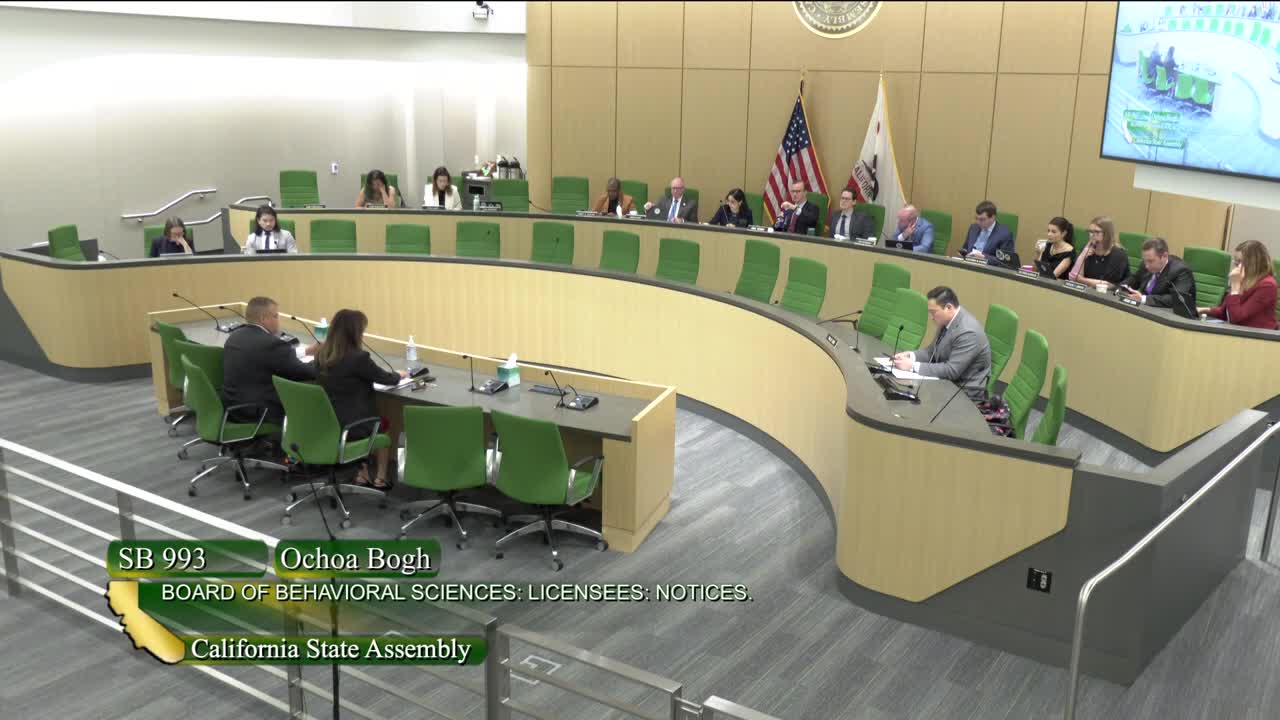 6MIN
Assembly Standing Committee on Business and Professions
 2MIN
Senate Floor
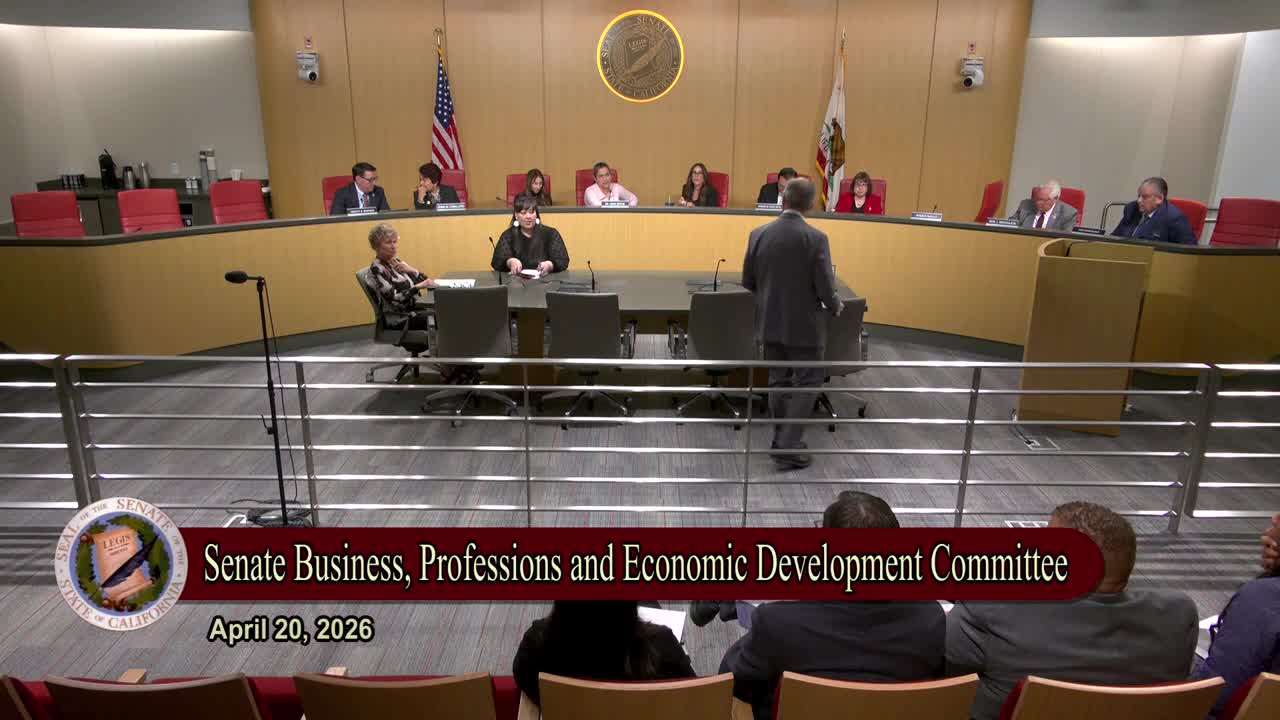 7MIN
Senate Standing Committee on Business, Professions and Economic Development
Bill Author

Bill Co-Author(s):