SCR 107: Dr. Martin Luther King, Jr. Day.
- Session Year: 2025-2026
- House: Senate
- Latest Version Date: 2026-02-20
Current Status:
Passed
(2026-02-20: Chaptered by Secretary of State. Res. Chapter 3, Statutes of 2026.)
Introduced
In Committee
Awaiting First Chamber Vote
Passed First Chamber
In Committee
Awaiting Second Chamber Vote
Passed Second Chamber
Enacted
This measure would honor the late civil rights pioneer Reverend Dr. Martin Luther King, Jr. and commemorate Dr. Martin Luther King, Jr. Day.
This measure would honor the late civil rights pioneer Reverend Dr. Martin Luther King, Jr. and commemorate Dr. Martin Luther King, Jr. Day.
This measure would honor the late civil rights pioneer Reverend Dr. Martin Luther King, Jr. and commemorate Dr. Martin Luther King, Jr. Day.
WHEREAS, On Thursday, January 15, 2026, Dr. Martin Luther King, Jr. would have been 97 years of age; and
WHEREAS, On Monday, January 19, 2026, Dr. Martin Luther King, Jr. Day will be celebrated in remembrance of the late civil rights pioneer and Baptist minister Reverend Dr. Martin Luther King, Jr.; and
WHEREAS, On April 8, 1968, just four days after Dr. Martin Luther King, Jr. was assassinated in Memphis, Tennessee, Congressman John Conyers, Jr. (D-Mich.) introduced the first bill to establish January 15, Dr. Kings birthday, as a federal holiday; and
WHEREAS, On April 10, 1970, California became the first state to pass legislation making Dr. Kings birthday a school holiday and, subsequently, a statewide holiday; and
WHEREAS, In 1979, another 11 years went by for Conyers motion for the federal holiday to come up for a vote on the floor of the House of Representatives; and
WHEREAS, In November 1983, President Ronald Reagan signed the bill creating a United States federal holiday in honor of Dr. King after years of campaigning by activists, recording artist Stevie Wonder, members of the United States Congress, and Dr. Kings wife, the late Coretta Scott King; and
WHEREAS, The first federal holiday honoring Dr. King was celebrated in 1986; and
WHEREAS, By 1986, 17 states had already adopted the federal holiday. But strong resistance by several states to observe this day as a state holiday continued for years; and
WHEREAS, In 2000, Dr. Martin Luther King, Jr. Day was finally observed in all states in some form. However, several states have extended names for the holiday; and
WHEREAS, In 1964, Dr. King received the Nobel Peace Prize in Oslo, Norway, for dynamic leadership of the Civil Rights Movement and steadfast commitment to achieving racial justice through nonviolent action. Dr. King pledged the prize money to the movements continued development. At 35 years of age, Dr. King became the youngest man, and only the second African American, to receive the prestigious award; and
WHEREAS, Dr. King and the Civil Rights Movement helped change public policy from segregation to integration, resulting in the repeal of the post-Reconstruction era state laws mandating racial segregation in the South, known as the Jim Crow Laws, thereby leading to the passage of the Civil Rights Act of 1964, which was signed into law by President Lyndon Johnson on July 2, 1964, and has been effective for over 60 years, the Voting Rights Act of 1965, and other antidiscrimination laws aimed at ending economic, legal, and social segregation in America; and
WHEREAS, Dr. King, in the last months of life, began organizing a Poor Peoples Campaign to, among other things, assemble a multiracial army of the poor that would descend on Washingtonengaging in nonviolent civil disobedience at the Capitol, if need beuntil Congress enacted a poor peoples bill of rights, and 2018 marked the 50th anniversary of this campaign; and
WHEREAS, Dr. King and the Civil Rights Movement helped change public policy from legal and socially acceptable discrimination and segregation to an open and accessible policy of racial integration leading to equal participation in and access to primary and higher education, housing, employment, transportation, federal, state, and local governmental elections, and other aspects of public policy relating to human rights; and
WHEREAS, The life of the Reverend Dr. Martin Luther King, Jr. was devoted to fighting segregation and injustice by nonviolent means and is an outstanding example of courageous leadership in the face of unrelenting violence and harassment by individuals and governmental institutions; and
WHEREAS, In 1968, Mrs. Coretta Scott King officially founded the Martin Luther King, Jr. Center for Nonviolent Social Change, dedicated to being a living memorial aimed at continuing Dr. Kings work on important social ills around the world; and
WHEREAS, Dr. Kings assassination nearly 58 years ago changed America and we continue to work toward racial equality, economic justice, and peace; and
WHEREAS, The Reverend Dr. Martin Luther King, Jr. is a source of inspiration for all Americans; now, therefore, be it
Resolved by the Senate of the State of California, the Assembly thereof concurring, That the Legislature recognizes the benefits of the collaborative work by many organizations that promote, facilitate, and carry out needed service projects nationwide; and be it further
Resolved, That the Legislature encourages its members and colleagues to urge their constituents to participate in community service projects; and be it further
Resolved, That the Legislature acknowledges that, by serving ones country, ones community, and ones neighbor, our nation makes progress in civility, equality, and unity consistent with the values and lifes work of Dr. Martin Luther King, Jr.; and be it further
Resolved, That the Legislature honors the late Reverend Dr. Martin Luther King, Jr. and commemorates Dr. Martin Luther King, Jr. Day; and be it further
Resolved, That the Secretary of the Senate transmit copies of this resolution to the author for appropriate distribution.
|
Date
|
Status
|
|---|---|
| Feb 20, 2026 | Chaptered by Secretary of State. Res. Chapter 3, Statutes of 2026. |
| Feb 20, 2026 | Enrolled and filed with the Secretary of State at 2 p.m. |
| Feb 13, 2026 | In Senate. Ordered to engrossing and enrolling. |
| Feb 13, 2026 | Read. Adopted. (Ayes 64. Noes 0. Page 3990.) Ordered to the Senate. |
| Feb 9, 2026 | From committee: Be adopted. Ordered to consent calendar. (Ayes 10. Noes 0.) (February 9). |
| Jan 26, 2026 | Referred to Com. on RLS. |
| Jan 16, 2026 | In Assembly. Held at Desk. |
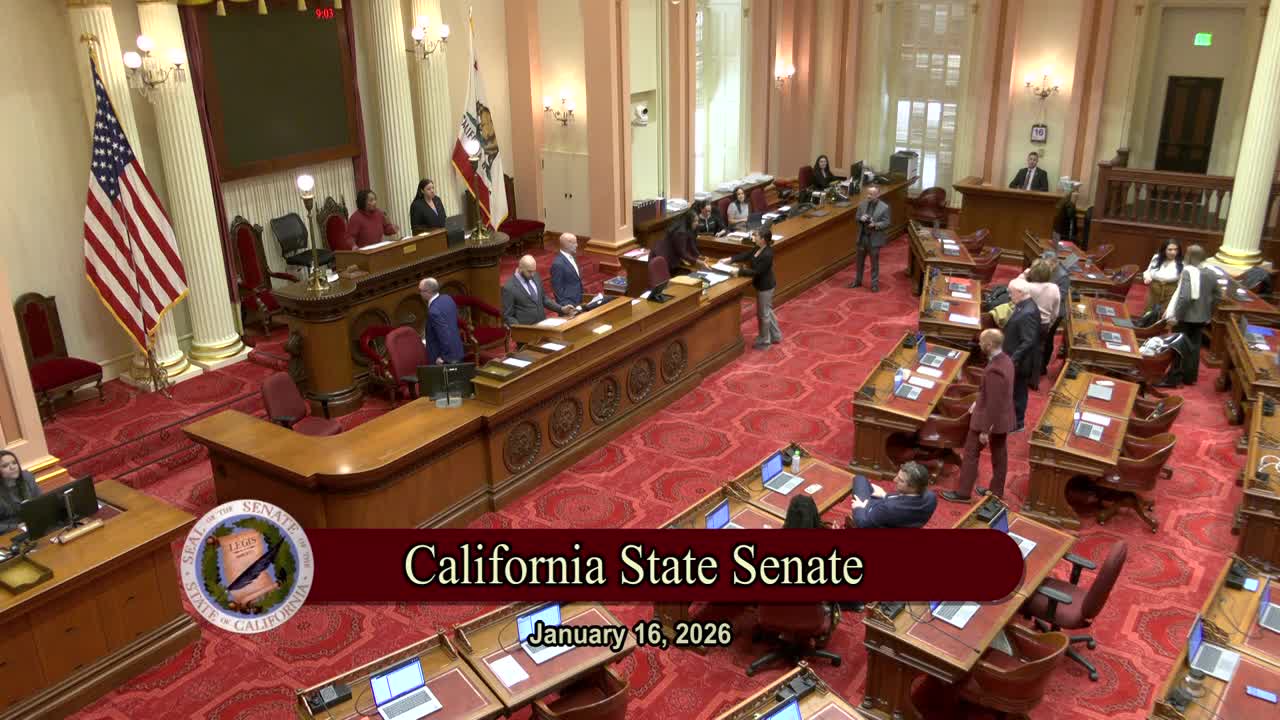
| Jan 16, 2026 | Read. Adopted. (Ayes 33. Noes 0. Page 3241.) Ordered to the Assembly. |
| Jan 14, 2026 | From committee: Ordered to third reading. |
| Jan 6, 2026 | Introduced. Referred to Com. on RLS. |
|
Date
|
Description
|
Location
|
Votes
|
|
|---|---|---|---|---|
| Feb 9, 2026 | Be adopted. To Consent Calendar. | Assembly Standing Committee on Rules |
Passed |
|
| Jan 16, 2026 | Senate 3rd Reading SCR107 Richardson et al. | Senate Floor |
Passed |
This list shows positions taken on this bill by organizations on the date displayed, which is linked to the original source.
Positions by individuals are not included.
Date of Hearing: February 9, 2026
ASSEMBLY COMMITTEE ON
, Chair
SBPCA Bill Id:
Author:() – As Ver:
SENATE VOTE:
SUBJECT:
SUMMARY: Honors the late civil rights pioneer Reverend Dr. Martin Luther King, Jr. and commemorates Dr. Martin Luther King, Jr. Day. Specifically, this resolution makes the following legislative findings:
- On Monday, January 19, 2026, Dr. Martin Luther King, Jr. Day will be celebrated in remembrance of the late civil rights pioneer and Baptist minister Reverend Dr. Martin Luther King, Jr.
- On April 10, 1970, California became the first state to pass legislation making Dr. King’s birthday a school holiday and, subsequently, a statewide holiday.
- The life of Dr. King was devoted to fighting segregation and injustice by nonviolent means and is an outstanding example of courageous leadership in the face of unrelenting violence and harassment by individuals and governmental institutions.
- Dr. King and the Civil Rights Movement helped change public policy from segregation to integration, resulting in the repeal of the post-Reconstruction era state laws mandating racial segregation in the South, known as the “Jim Crow Laws,” thereby leading to the passage of the Civil Rights Act of 1964, the Voting Rights Act of 1965, and other antidiscrimination laws aimed at ending economic, legal, and social segregation in America.
- Dr. King and the Civil Rights Movement helped change public policy to an open and accessible policy of racial integration leading to equal participation in and access to primary and higher education, housing, employment, transportation, federal, state, and local governmental elections, and other aspects of public policy relating to human rights.
- Dr. King’s assassination nearly 58 years ago changed America and we continue to work toward racial equality, economic justice, and peace.
- The Reverend Dr. Martin Luther King, Jr. is a source of inspiration for all Americans.
FISCAL EFFECT: This resolution is keyed non-fiscal by Legislative Counsel.
REGISTERED SUPPORT / OPPOSITION:
Support
None on file
Opposition
None on file
Analysis Prepared by:
SENATE RULES COMMITTEE Office of Senate Floor Analyses (916) 651-4171 | SCR 107 |
THIRD READING
Bill No: SCR 107
Author: Richardson (D), et al.
Introduced: 1/6/26
Vote: 21
SUBJECT: Dr. Martin Luther King, Jr. Day
SOURCE: Author
DIGEST:
This resolution honors the late civil rights pioneer Reverend Dr. Martin Luther King, Jr. and commemorates Dr. Martin Luther King, Jr. Day.
ANALYSIS: This resolution makes the following legislative findings:
- On Monday, January 19, 2026, Dr. Martin Luther King, Jr. Day will be celebrated in remembrance of the late civil rights pioneer and Baptist minister Reverend Dr. Martin Luther King, Jr.
- The life of the Reverend Dr. Martin Luther King, Jr. was devoted to fighting segregation and injustice by nonviolent means and is an outstanding example of courageous leadership in the face of unrelenting violence and harassment by individuals and governmental institutions.
- Dr. King and the Civil Rights Movement helped change public policy from legal and socially acceptable discrimination and segregation to an open and accessible policy of racial integration leading to equal participation in and access to primary and higher education, housing, employment, transportation, federal, state, and local governmental elections, and other aspects of public policy relating to human rights.
This resolution acknowledges that, by serving one’s country, one’s community, and one’s neighbor, our nation makes progress in civility, equality, and unity consistent with the values and life’s work of Dr. Martin Luther King, Jr.
Related/Prior Legislation
SCR 8 (Weber Pierson, Resolution Chapter 9, Statutes of 2025)
ACR 7 (Bryan, Resolution Chapter 4, Statutes of 2025)
ACR 116 (Wilson, Resolution Chapter 16, Statutes of 2024)
SCR 12 (Bradford, Resolution Chapter 12, Statutes of 2023)
ACR 1 (Wilson, Resolution Chapter 2, Statutes of 2023)
SCR 62 (Bradford, Resolution Chapter 62, Statutes of 2022)
ACR 117 (Holden, Resolution Chapter 13, Statutes of 2022)
SCR 6 (Bradford, Resolution Chapter 2, Statutes of 2021)
FISCAL EFFECT: Appropriation: No Fiscal Com.: No Local: No
SUPPORT: (Verified 1/14/26)
None received
OPPOSITION: (Verified 1/14/26)
None received
Prepared by: Aizenia Randhawa / SFA / (916) 651-4171
1/14/26 15:44:34
**** END ****
Discussed in Hearing
View Older Hearings