SCR 25: Nuclear fusion.
- Session Year: 2025-2026
- House: Senate
- Latest Version Date: 2025-09-02
Current Status:
Passed
(2025-09-02: Chaptered by Secretary of State. Res. Chapter 161, Statutes of 2025.)
Introduced
In Committee
Awaiting First Chamber Vote
Passed First Chamber
In Committee
Awaiting Second Chamber Vote
Passed Second Chamber
Enacted
This measure would proclaim that the State of California celebrates the numerous contributions of public and private sector nuclear fusion organizations within California for advancing fusion energy research and development, applauds recent scientific advances in magnetic fusion energy and inertial confinement at public research facilities in San Diego and Livermore, recognizes the vast potential of fusion energy for addressing key climate and national security goals and the contributions of Californias private fusion industry, commends the University of Californias Office of the President for its leadership in establishing the Pacific CREST Fusion initiative, and supports developing the fusion energy ecosystem with the goal of siting a first-of-a-kind fusion pilot plant in California by the 2040s.
This measure would proclaim that the State of California celebrates the numerous contributions of public and private sector nuclear fusion organizations within California for advancing fusion energy research and development, applauds recent scientific advances in magnetic fusion energy and inertial confinement at public research facilities in San Diego and Livermore, recognizes the vast potential of fusion energy for addressing key climate and national security goals and the contributions of Californias private fusion industry, commends the University of Californias Office of the President for its leadership in establishing the Pacific CREST Fusion initiative, and supports developing the fusion energy ecosystem with the goal of siting a first-of-a-kind fusion pilot plant in California by the 2040s.
This measure would proclaim that the State of California celebrates the numerous contributions of public and private sector nuclear fusion organizations within California for advancing fusion energy research and development, applauds recent scientific advances in magnetic fusion energy and inertial confinement at public research facilities in San Diego and Livermore, recognizes the vast potential of fusion energy for addressing key climate and national security goals and the contributions of Californias private fusion industry, commends the University of Californias Office of the President for its leadership in establishing the Pacific CREST Fusion initiative, and supports developing the fusion energy ecosystem with the goal of siting a first-of-a-kind fusion pilot plant in California by the 2040s.
This measure would proclaim that the State of California celebrates the numerous contributions of public and private sector nuclear fusion organizations within California for advancing fusion energy research and redevelopment, development, applauds recent scientific breakthroughs at specified facilities, advances in magnetic fusion energy and inertial confinement at public research facilities in San Diego and Livermore, recognizes the vast potential of fusion energy for addressing key climate and national security goals and the contributions of Californias private fusion industry, commends the University of Californias Office of the President for its leadership in establishing the Pacific CREST Fusion initiative, and supports developing the fusion energy ecosystem with the goal of siting a first-of-a-kind fusion pilot plant in California by the 2030s. 2040s.
This measure would proclaim that the State of California celebrates the numerous contributions of public and private sector fusion organizations within California for advancing fusion energy research and redevelopment, applauds recent scientific breakthroughs at specified facilities, recognizes the vast potential of fusion energy for addressing key climate and national security goals and the contributions of Californias private fusion industry, commends the University of Californias Office of the President for its leadership in establishing the Pacific CREST Fusion initiative, and supports developing the fusion energy ecosystem with the goal of siting a first-of-a-kind fusion pilot plant in California by the 2030s.
WHEREAS, The global demand for energy is projected to increase by 33 to 75 percent by 2050, which will rely significantly on oil, natural gas, and coal amid population growth, industry growth, and higher living standards; and
WHEREAS, The global energy sector is the primary cause of air pollution and greenhouse gas emissions, with coal, oil, and gas supplying more than 80 percent of demand; and
WHEREAS, The 100 Percent Clean Energy Act of 2018 (Chapter 312 of the Statutes of 2018) established a state policy requiring renewable energy and zero-carbon resources to supply 100 percent of electric retail sales to end-use customers by 2045 to help meet the states climate goals; and
WHEREAS, California Governor Gavin Newsom has laid out a comprehensive roadmap called, Building the Electricity Grid of the Future: Californias Clean Energy Transition Plan, demonstrating Californias leadership in responding to climate change and leading the clean energy revolution; and
WHEREAS, Fusion energy holds the potential of nearly limitless clean, safe, and firm energy, without producing air pollution, harmful emissions, or long-lasting nuclear waste; and
WHEREAS, The Nuclear Regulatory Commission is expected to publish a draft rule by March 2025 that regulates fusion machines under a different framework than nuclear fission machines, based on the grounds that fusion facilities may not have the potential to cause large radiation doses to workers or the public in accident scenarios and cannot produce runaway reactions; and
WHEREAS, California is the United States leader in fusion energy research and development, with more than 20,000 jobs throughout the fusion research and development ecosystem; and
WHEREAS, California hosts public sector fusion research and development facilities under the direction of the United States Department of Energy; and
WHEREAS, The tokamak nuclear fusion facility in San Diego is the largest and most productive magnetic fusion energy research facility in the United States, and has made significant advancements in the pursuit of fusion energy, including its 202324 two-year research campaign, which successfully achieved a combination of high density and high confinement that had never previously been achieved simultaneously and fulfills a key requirement of fusion energy production; and
WHEREAS, The ignition nuclear fusion facility in Livermore achieved the first controlled fusion ignition in a laboratory setting in December 2022 and has successfully repeated ignition with higher fusion yields at least five times; and
WHEREAS, California companies are the largest share of industry partners for ITER (Latin for the way), an unprecedented international collaboration of 35 different nations working to design, construct, and assemble a reactor-scale burning plasma experiment that can demonstrate the scientific and technological feasibility of fusion energy, and are supplying key components, including the central solenoid, which is the most powerful superconducting electromagnet in the world and will drive ITERs plasmas; and
WHEREAS, California is a leader in fusion energy academic programs, with nationally recognized programs at the University of Californias campuses at Berkeley, Irvine, Los Angeles, Merced, San Diego, Santa Barbara, Santa Cruz, and Riverside, and robust programs at universities, polytechnic universities, colleges, and vocational schools throughout the state; and
WHEREAS, California is home to one-third of all United States private fusion energy companies working to commercialize fusion, with total global investments exceeding $8 billion; and
WHEREAS, Substantial technical progress has been made in multiple fusion energy pathways and with diverse fuels, including, but not limited to, deuterium-tritium, hydrogen-boron, and deuterium-helium-3; and
WHEREAS, Commercially scaled fusion energy could have a global economic impact of approximately $40 trillion; and
WHEREAS, California enacted Assembly Bill 1172 of the Regular Session of the Legislature (Chapter 360 of the Statutes of 2023), requiring the Energy Commission to assess the potential for fusion energy to contribute to the states energy supply as part of the 2027 Integrated Energy Policy Report, including identifying the necessary regulatory and policy actions required to deploy fusion energy; and
WHEREAS, The United States Fusion Energy Sciences Advisory Committees long-range plan, Powering the Future: Fusion & Plasmas, calls for constructing the first United States fusion pilot plant in the 2040s; and
WHEREAS, The United States Department of Energys decadal strategy, Fusion Energy Strategy 2024, calls for closing science and technology gaps to a commercially relevant fusion pilot plant, preparing the path to sustainable, equitable commercial fusion deployment, and building and leveraging external partnerships to achieve fusion at the fastest possible timescale; and
WHEREAS, The United States Department of Energy published a Request for Information in July 2024 soliciting input for a Fusion Energy Public-Private Consortium Framework, with the goal of accelerating fusion energy research, development, demonstration, and deployment by amplifying federal funding with state, local government, private, and philanthropic funding sources, to meet the goals of the decadal strategy; and
WHEREAS, More than 35 organizations, including 25 based in California, submitted a joint response to the Request for Information under the name of The Pacific Coalition for Advancing Research, Education, Science, and Technology for Fusion Energy (Pacific CREST Fusion), presenting a vision for positioning California as the leader of the United States fusion energy field; and
WHEREAS, On January 22, 2025, the Board of Regents of the University of Californias Office of the President unanimously approved establishing the Pacific CREST Fusion Organization as a University of California led not-for-profit organization to advance fusion energy in California through public-private partnership; now, therefore, be it
Resolved by the Senate of the State of California, the Assembly thereof concurring, That the State of California celebrates the numerous contributions of public and private sector nuclear fusion organizations within California for advancing fusion energy research and development; and be it further
Resolved, That the State of California applauds recent scientific advances in magnetic fusion energy and inertial confinement at public research facilities in San Diego and Livermore; and be it further
Resolved, That the State of California recognizes the vast potential of fusion energy for addressing key climate and national security goals and the contributions of Californias private fusion industry; and be it further
Resolved, That the State of California commends the University of Californias Office of the President for its leadership in establishing the Pacific CREST Fusion initiative; and be it further
Resolved, That the State of California supports developing the fusion energy ecosystem, including the future workforce and supply chain required to advance fusion research, development, demonstration, and deployment, with the goal of siting a first-of-a-kind fusion pilot plant in California by the 2040s; and be it further
Resolved, That the Secretary of the Senate transmit a copy of this resolution to the author for appropriate distribution.
WHEREAS, The global demand for energy is projected to increase by 33 to 75 percent by 2050, which will rely significantly on oil, natural gas, and coal amid population growth, industry growth, and higher living standards; and
WHEREAS, The global energy sector is the primary cause of air pollution and greenhouse gas emissions, with coal, oil, and gas supplying more than 80 percent of demand; and
WHEREAS, The 2021 Senate Bill 100 Joint Agency Report published by the State Energy Resources Conservation and Development Commission (Energy Commission), Public Utilities Commission, and State Air Resources Board pursuant to the 100 Percent Clean Energy Act of 2018 (Chapter 312 of the Statutes of 2018), which 2018) established a target state policy requiring renewable energy and zero-carbon resources to supply 100 percent of electric retail sales to end-use customers by 2045, 2045 to help meet the states economywide climate goals; and
WHEREAS, California Governor Gavin Newsom has laid out a comprehensive roadmap called, Building the Electricity Grid of the Future: Californias Clean Energy Transition Plan, demonstrating Californias leadership in responding to climate change and leading the clean energy revolution; and
WHEREAS, Fusion energy holds the potential of nearly limitless clean, safe, and firm energy, without producing air pollution, harmful emissions, or long-lasting nuclear waste; and
WHEREAS, The Nuclear Regulatory Commission is expected to publish a draft rule by March 2025 that regulates fusion machines under a different framework than nuclear fission machines, based on the grounds that fusion facilities may not have the potential to cause large radiation doses to workers or the public in accident scenarios and cannot produce runaway reactions; and
WHEREAS, California is the United States leader in fusion energy research and development, with more than 20,000 jobs throughout the fusion research and development ecosystem; and
WHEREAS, California hosts public sector fusion research and development facilities under the direction of the United States Department of Energy; and
WHEREAS, The tokamak nuclear fusion facility in San Diego is the largest and most productive magnetic fusion energy research facility in the United States, and has made significant advancements in the pursuit of fusion energy, including its 202324 two-year research campaign, which successfully achieved a combination of high density and high confinement that had never previously been achieved simultaneously and fulfills a key requirement of fusion energy production; and
WHEREAS, The ignition nuclear fusion facility in Livermore achieved the first controlled fusion ignition in a laboratory setting in December 2022 and has successfully repeated ignition with higher fusion yields at least five times; and
WHEREAS, California companies are the largest share of industry partners for ITER (Latin for the way), an unprecedented international collaboration of 35 different nations working to design, construct, and assemble a reactor-scale burning plasma experiment that can demonstrate the scientific and technological feasibility of fusion energy, and are supplying key components, including the central solenoid, which is the most powerful superconducting electromagnet in the world and will drive ITERs plasmas; and
WHEREAS, California is a leader in fusion energy academic programs, with nationally recognized programs at the University of Californias campuses at Berkeley, Irvine, Los Angeles, Merced, San Diego, Santa Barbara, Santa Cruz, and Riverside, and robust programs at universities, polytechnic universities, colleges, and vocational schools throughout the state; and
WHEREAS, California is home to one-third of all United States private fusion energy companies working to commercialize fusion, with total global investments exceeding $8 billion; and
WHEREAS, Substantial technical progress has been made in multiple fusion energy pathways and with diverse fuels, including, but not limited to, deuterium-tritium, hydrogen-boron, and deuterium-helium-3; and
WHEREAS, Commercially scaled fusion energy could have a global economic impact of approximately $40 trillion; and
WHEREAS, California enacted Assembly Bill 1172 of the Regular Session of the Legislature (Chapter 360 of the Statutes of 2023), requiring the Energy Commission to assess the potential for fusion energy to contribute to the states energy supply as part of the 2027 Integrated Energy Policy Report, including identifying the necessary regulatory and policy actions required to deploy fusion energy; and
WHEREAS, The United States Fusion Energy Sciences Advisory Committees long-range plan, Powering the Future: Fusion & Plasmas, calls for constructing the first United States fusion pilot plant in the 2040s; and
WHEREAS, The United States Department of Energys decadal strategy, Fusion Energy Strategy 2024, calls for closing science and technology gaps to a commercially relevant fusion pilot plant, preparing the path to sustainable, equitable commercial fusion deployment, and building and leveraging external partnerships to achieve fusion at the fastest possible timescale; and
WHEREAS, The United States Department of Energy published a Request for Information in July 2024 soliciting input for a Fusion Energy Public-Private Consortium Framework, with the goal of accelerating fusion energy research, development, demonstration, and deployment by amplifying federal funding with state, local government, private, and philanthropic funding sources, to meet the goals of the decadal strategy; and
WHEREAS, More than 35 organizations, including 25 based in California, submitted a joint response to the Request for Information under the name of The Pacific Coalition for Advancing Research, Education, Science, and Technology for Fusion Energy (Pacific CREST Fusion), presenting a vision for positioning California as the leader of the United States fusion energy field; and
WHEREAS, On January 22, 2025, the Board of Regents of the University of Californias Office of the President unanimously approved establishing the Pacific CREST Fusion Organization as a University of California led not-for-profit organization to advance fusion energy in California through public-private partnership; now, therefore, be it
Resolved by the Senate of the State of California, the Assembly thereof concurring, That the State of California celebrates the numerous contributions of public and private sector nuclear fusion organizations within California for advancing fusion energy research and development; and be it further
Resolved, That the State of California applauds recent scientific advances in magnetic fusion energy and inertial confinement at public research facilities in San Diego and Livermore; and be it further
Resolved, That the State of California recognizes the vast potential of fusion energy for addressing key climate and national security goals and the contributions of Californias private fusion industry; and be it further
Resolved, That the State of California commends the University of Californias Office of the President for its leadership in establishing the Pacific CREST Fusion initiative; and be it further
Resolved, That the State of California supports developing the fusion energy ecosystem, including the future workforce and supply chain required to advance fusion research, development, demonstration, and deployment, with the goal of siting a first-of-a-kind fusion pilot plant in California by the 2040s. 2040s; and be it further
Resolved, That the Secretary of the Senate transmit a copy of this resolution to the author for appropriate distribution.
WHEREAS, The global demand for energy is projected to increase by 33 to 75 percent by 2050, which will rely significantly on oil, natural gas, and coal amid population growth, industry growth, and higher living standards; and
WHEREAS, The global energy sector is the primary cause of air pollution and greenhouse gas emissions, with coal, oil, and gas supplying more than 80 percent of demand; and
WHEREAS, The 2021 Senate Bill 100 Joint Agency Report published by the State Energy Resources Conservation and Development Commission (Energy Commission), Public Utilities Commission, and State Air Resources Board pursuant to the 100 Percent Clean Energy Act of 2018 (Chapter 312 of the Statutes of 2018), which established a target requiring renewable energy and zero-carbon resources to supply 100 percent of electric retail sales to end-use customers by 2045, to help meet the states economywide climate goals; and
WHEREAS, California Governor Gavin Newsom has laid out a comprehensive roadmap called, Building the Electricity Grid of the Future: Californias Clean Energy Transition Plan, demonstrating Californias leadership in responding to climate change and leading the clean energy revolution; and
WHEREAS, Fusion energy holds the promise potential of nearly limitless clean, safe, and firm energy, without producing air pollution, harmful emissions, or long-lasting nuclear waste; and
WHEREAS, The Nuclear Regulatory Commission is expected to publish a draft rule by March 2025 that regulates fusion machines under a different framework than nuclear fission machines, based on the grounds that fusion facilities will may not have the potential to cause large radiation doses to workers or the public in accident scenarios and cannot produce runaway reactions; and
WHEREAS, California is the United States leader in fusion energy research and development, with more than 20,000 jobs throughout the fusion research and development ecosystem; and
WHEREAS, California hosts public sector fusion research and development programs facilities under the direction of the United States Department of Energy at Lawrence Berkeley National Laboratory, Lawrence Livermore National Laboratory and the National Ignition Facility, Sandia National Laboratories, the Stanford Linear Accelerator, and the DIII-D National Fusion Facility; Energy; and
WHEREAS, The DIII-D National Fusion Facility tokamak nuclear fusion facility in San Diego is the largest and most productive magnetic fusion energy research facility in the United States, and has made significant advancements in the pursuit of fusion energy, including its 202324 two-year research campaign, which successfully achieved a combination of high density and high confinement that had never previously been achieved simultaneously and fulfils fulfills a key requirement of fusion energy production; and
WHEREAS, The National Ignition Facility ignition nuclear fusion facility in Livermore achieved the first controlled fusion ignition in a laboratory setting in December 2022 and has successfully repeated ignition with higher fusion yields at least five times; and
WHEREAS, California companies are the largest share of industry partners for ITER (Latin for the way), an unprecedented international collaboration of 35 different nations working to design, construct, and assemble a reactor-scale burning plasma experiment that can demonstrate the scientific and technological feasibility of fusion energy, and are supplying key components, including the central solenoid, which is the most powerful superconducting electromagnet in the world and will drive ITERs plasmas; and
WHEREAS, Californias public sector fusion research programs have received more than $5,000,000 to advance cutting-edge fusion research; andWHEREAS, California is a leader in fusion energy academic programs, with nationally recognized programs at the University of Californias campuses at Berkeley, Irvine, Los Angeles, Merced, San Diego, Santa Barbara, Santa Cruz, and Riverside, and robust programs at universities, polytechnic universities, colleges, and vocational schools throughout the state; and
WHEREAS, California is home to one-third of all United States private fusion energy companies working to commercialize fusion, with total global investments exceeding $8 billion; and
WHEREAS, Substantial technical progress has been made in multiple fusion energy pathways and with diverse fuels, including, but not limited to, deuterium-tritium, hydrogen-boron, and deuterium-helium-3; and
WHEREAS, Commercially scaled fusion energy could have a global economic impact of approximately $40 trillion; and
WHEREAS, California enacted Assembly Bill 1172 of the Regular Session of the Legislature (Chapter 360 of the Statutes of 2023), requiring the State Energy Resources Conservation and Development Energy Commission to assess the potential for fusion energy to contribute to the states energy supply as part of the 2027 Integrated Energy Policy Report, including identifying the necessary regulatory and policy actions required to deploy fusion energy; and
WHEREAS, The United States Fusion Energy Sciences Advisory Committees long-range plan, Powering the Future: Fusion & Plasmas, calls for constructing the first United States fusion pilot plant in the 2030s; 2040s; and
WHEREAS, The United States Department of Energys decadal strategy, Fusion Energy Strategy 2024, calls for closing science and technology gaps to a commercially relevant fusion pilot plant, preparing the path to sustainable, equitable commercial fusion deployment, and building and leveraging external partnerships to achieve fusion at the fastest possible timescale; and
WHEREAS, The United States Department of Energy published a Request for Information in July 2024 soliciting input for a Fusion Energy Public-Private Consortium Framework, with the goal of accelerating fusion energy research, development, demonstration, and deployment by amplifying federal funding with state, local government, private, and philanthropic funding sources, to meet the goals of the decadal strategy; and
WHEREAS, More than 35 organizations, including 25 based in California, submitted a joint response to the Request for Information under the name of The Pacific Coalition for Advancing Research, Education, Science, and Technology for Fusion Energy (Pacific CREST Fusion), presenting a vision for positioning California as the leader of the United States fusion energy field; and
WHEREAS, On January 22, 2025, the Board of Regents of the University of Californias Office of the President unanimously approved establishing the Pacific CREST Fusion Organization as a University of California led not-for-profit organization to advance fusion energy in California through public-private partnership; now, therefore, be it
Resolved by the Senate of the State of California, the Assembly thereof concurring, That the State of California celebrates the numerous contributions of public and private sector nuclear fusion organizations within California for advancing fusion energy research and redevelopment; development; and be it further
Resolved, That the State of California applauds recent scientific breakthroughs at the DIII-D National Fusion Facility and the National Ignition Facility at Lawrence Livermore National Laboratory; advances in magnetic fusion energy and inertial confinement at public research facilities in San Diego and Livermore; and be it further
Resolved, That the State of California recognizes the vast potential of fusion energy for addressing key climate and national security goals and the contributions of Californias private fusion industry; and be it further
Resolved, That the State of California commends the University of Californias Office of the President for its leadership in establishing the Pacific CREST Fusion initiative; and be it further
Resolved, That the State of California supports developing the fusion energy ecosystem, including the future workforce and supply chain required to advance fusion research, development, demonstration, and deployment, with the goal of siting a first-of-a-kind fusion pilot plant in California by the 2030s. 2040s.
WHEREAS, The global demand for energy is projected to increase by 33 to 75 percent by 2050, which will rely significantly on oil, natural gas, and coal amid population growth, industry growth, and higher living standards; and
WHEREAS, The global energy sector is the primary cause of air pollution and greenhouse gas emissions, with coal, oil, and gas supplying more than 80 percent of demand; and
WHEREAS, The 2021 Senate Bill 100 Joint Agency Report published by the State Energy Resources Conservation and Development Commission pursuant to the 100 Percent Clean Energy Act of 2018 (Chapter 312 of the Statutes of 2018), which established a target requiring renewable energy and zero-carbon resources to supply 100 percent of electric retail sales to end-use customers by 2045, to help meet the states economywide climate goals; and
WHEREAS, California has laid out a comprehensive roadmap called, Building the Electricity Grid of the Future: Californias Clean Energy Transition Plan, demonstrating Californias leadership in responding to climate change and leading the clean energy revolution; and
WHEREAS, Fusion energy holds the promise of nearly limitless clean, safe, and firm energy, without producing air pollution, harmful emissions, or long-lasting nuclear waste; and
WHEREAS, The Nuclear Regulatory Commission is expected to publish a draft rule by March 2025 that regulates fusion machines under a different framework than nuclear fission machines, based on the grounds that fusion facilities will not have the potential to cause large radiation doses to workers or the public in accident scenarios and cannot produce runaway reactions; and
WHEREAS, California is the United States leader in fusion energy research and development, with more than 20,000 jobs throughout the fusion research and development ecosystem; and
WHEREAS, California hosts public sector fusion research and development programs under the direction of the United States Department of Energy at Lawrence Berkeley National Laboratory, Lawrence Livermore National Laboratory and the National Ignition Facility, Sandia National Laboratories, the Stanford Linear Accelerator, and the DIII-D National Fusion Facility; and
WHEREAS, The DIII-D National Fusion Facility in San Diego is the largest and most productive magnetic fusion energy research facility in the United States, and has made significant advancements in the pursuit of fusion energy, including its 202324 two-year research campaign, which successfully achieved a combination of high density and high confinement that had never previously been achieved simultaneously and fulfils a key requirement of fusion energy production; and
WHEREAS, The National Ignition Facility in Livermore achieved the first controlled fusion ignition in a laboratory setting in December 2022 and has successfully repeated ignition with higher fusion yields at least five times; and
WHEREAS, California companies are the largest share of industry partners for ITER (Latin for the way), an unprecedented international collaboration of 35 different nations working to design, construct, and assemble a reactor-scale burning plasma experiment that can demonstrate the scientific and technological feasibility of fusion energy, and are supplying key components, including the central solenoid, which is the most powerful superconducting electromagnet in the world and will drive ITERs plasmas; and
WHEREAS, Californias public sector fusion research programs have received more than $5,000,000 to advance cutting-edge fusion research; and
WHEREAS, California is a leader in fusion energy academic programs, with nationally recognized programs at the University of Californias campuses at Berkeley, Irvine, Los Angeles, Merced, San Diego, Santa Barbara, Santa Cruz, and Riverside, and robust programs at universities, polytechnic universities, colleges, and vocational schools throughout the state; and
WHEREAS, California is home to one-third of all United States private fusion energy companies working to commercialize fusion, with total global investments exceeding $8 billion; and
WHEREAS, Substantial technical progress has been made in multiple fusion energy pathways and with diverse fuels, including, but not limited to, deuterium-tritium, hydrogen-boron, and deuterium-helium-3; and
WHEREAS, Commercially scaled fusion energy could have a global economic impact of approximately $40 trillion; and
WHEREAS, California enacted Assembly Bill 1172 of the Regular Session of the Legislature (Chapter 360 of the Statutes of 2023), requiring the State Energy Resources Conservation and Development Commission to assess the potential for fusion energy to contribute to the states energy supply as part of the 2027 Integrated Energy Policy Report, including identifying the necessary regulatory and policy actions required to deploy fusion energy; and
WHEREAS, The United States Fusion Energy Sciences Advisory Committees long-range plan, Powering the Future: Fusion & Plasmas, calls for constructing the first United States fusion pilot plant in the 2030s; and
WHEREAS, The United States Department of Energys decadal strategy, Fusion Energy Strategy 2024, calls for closing science and technology gaps to a commercially relevant fusion pilot plant, preparing the path to sustainable, equitable commercial fusion deployment, and building and leveraging external partnerships to achieve fusion at the fastest possible timescale; and
WHEREAS, The United States Department of Energy published a Request for Information in July 2024 soliciting input for a Fusion Energy Public-Private Consortium Framework, with the goal of accelerating fusion energy research, development, demonstration, and deployment by amplifying federal funding with state, local government, private, and philanthropic funding sources, to meet the goals of the decadal strategy; and
WHEREAS, More than 35 organizations, including 25 based in California, submitted a joint response to the Request for Information under the name of The Pacific Coalition for Advancing Research, Education, Science, and Technology for Fusion Energy (Pacific CREST Fusion), presenting a vision for positioning California as the leader of the United States fusion energy field; and
WHEREAS, On January 22, 2025, the Board of Regents of the University of Californias Office of the President unanimously approved establishing the Pacific CREST Fusion Organization as a University of California led not-for-profit organization to advance fusion energy in California through public-private partnership; now, therefore, be it
Resolved by the Senate of the State of California, the Assembly thereof concurring, That the State of California celebrates the numerous contributions of public and private sector fusion organizations within California for advancing fusion energy research and redevelopment; and be it further
Resolved, That the State of California applauds recent scientific breakthroughs at the DIII-D National Fusion Facility and the National Ignition Facility at Lawrence Livermore National Laboratory; and be it further
Resolved, That the State of California recognizes the vast potential of fusion energy for addressing key climate and national security goals and the contributions of Californias private fusion industry; and be it further
Resolved, That the State of California commends the University of Californias Office of the President for its leadership in establishing the Pacific CREST Fusion initiative; and be it further
Resolved, That the State of California supports developing the fusion energy ecosystem, including the future workforce and supply chain required to advance fusion research, development, demonstration, and deployment, with the goal of siting a first-of-a-kind fusion pilot plant in California by the 2030s.
|
Date
|
Status
|
|---|---|
| Sep 2, 2025 | Chaptered by Secretary of State. Res. Chapter 161, Statutes of 2025. |
| Sep 2, 2025 | Enrolled and filed with the Secretary of State at 2 p.m. |
| Aug 25, 2025 | Assembly amendments concurred in. (Ayes 37. Noes 0. Page 2253.) Ordered to engrossing and enrolling. |
| Aug 21, 2025 | Ordered to special consent calendar. |
| Jul 3, 2025 | In Senate. Concurrence in Assembly amendments pending. |
| Jul 3, 2025 | Read. Adopted. (Ayes 74. Noes 0. Page 2427.) Ordered to the Senate. |
| Jun 27, 2025 | Read second time and amended. Ordered to consent calendar. |
| Jun 26, 2025 | From committee: Be adopted as amended. Ordered to consent calendar. (Ayes 18. Noes 0.) (June 25). |
| Jun 5, 2025 | Referred to Com. on U. & E. |
| Apr 7, 2025 | In Assembly. Held at Desk. |
| Apr 7, 2025 | Read. Adopted. (Ayes 36. Noes 0. Page 676.) Ordered to the Assembly. |
| Mar 28, 2025 | Read second time and amended. Ordered to third reading. |
| Mar 27, 2025 | From committee: Be adopted as amended. (Ayes 16. Noes 0. Page 512.) (March 24). |
| Mar 17, 2025 | Set for hearing March 24. |
| Mar 5, 2025 | Re-referred to Com. on E., U & C. |
| Feb 19, 2025 | Introduced. Referred to Com. on RLS. |
|
Date
|
Description
|
Location
|
Votes
|
|
|---|---|---|---|---|
| Aug 25, 2025 | Special Consent SCR25 Blakespear et al. | Senate Floor |
Passed |
|
| Jul 3, 2025 | SCR 25 Blakespear Consent Calendar Second Day | Assembly Floor |
Passed |
|
| Jun 25, 2025 | Be adopted as amended. To Consent Calendar. | Assembly Standing Committee on Utilities and Energy |
Passed |
|
| Apr 7, 2025 | Senate 3rd Reading SCR25 Blakespear et al. | Senate Floor |
Passed |
|
| Mar 24, 2025 | Be adopted as amended | Senate Standing Committee on Energy, Utilities and Communications |
Passed |
This list shows positions taken on this bill by organizations on the date displayed, which is linked to the original source.
Positions by individuals are not included.
|
Organization
|
Position
|
Date
|
|---|---|---|
| City Of Livermore | ** Support | |
| CleanTech San Diego | ** Support | |
| General Atomics | ** Support | |
| General Atomics (Source) | ** Support | |
| Innovation Tri-Valley Leadership Group | ** Support | |
| Kyoto Fusioneering America | ** Support | |
| San Diego Regional Chamber Of Commerce | ** Support | |
| San Diego Regional Economic Development Corporation | ** Support | |
| San Diego State University | ** Support | |
| San Diego State University-Research & Innovation | ** Support | |
| Stanford University’s Extreme Environment Microsystems Lab & nano@stanford | ** Support | |
| Stanford University’s Extreme Environment Microsystems Laboratory and Nano@stanford | ** Support |
SENATE RULES COMMITTEE Office of Senate Floor Analyses (916) 651-1520 Fax: (916) 327-4478 | SCR 25 |
UNFINISHED BUSINESS
Bill No: SCR 25
Author: Blakespear (D) and McNerney (D), et al.
Amended: 6/27/25 in Assembly
Vote: 21
SENATE ENERGY, U. & C. COMMITTEE: 16-0, 3/24/25
AYES: Becker, Ochoa Bogh, Allen, Archuleta, Arreguín, Ashby, Caballero, Gonzalez, Grove, Hurtado, Limón, McNerney, Rubio, Stern, Strickland, Wahab
NO VOTE RECORDED: Dahle
SENATE FLOOR: 36-0, 4/7/25
AYES: Allen, Alvarado-Gil, Archuleta, Arreguín, Ashby, Becker, Blakespear, Cabaldon, Caballero, Cervantes, Choi, Cortese, Durazo, Gonzalez, Grayson, Grove, Hurtado, Jones, Laird, Limón, McGuire, McNerney, Menjivar, Niello, Ochoa Bogh, Padilla, Pérez, Richardson, Rubio, Seyarto, Smallwood-Cuevas, Stern, Umberg, Wahab, Weber Pierson, Wiener
NO VOTE RECORDED: Dahle, Reyes, Strickland, Valladares
ASSEMBLY FLOOR: 74-0, 7/3/25 (Consent) - See last page for vote
SUBJECT: Nuclear fusion
SOURCE: General Atomics
DIGEST:
This resolution celebrates the numerous contributions of public and private sector organizations within California for advancing nuclear fusion energy research and supports developing the fusion energy ecosystem with the goal of siting a first-of-its-kind fusion pilot plant in California by the 2040s.
Assembly Amendments
of 6/27/25 make minor technical and clarifying changes to the reference to the SB 100 report.
ANALYSIS:
Existing law:
- Declares the policy of the state to encourage the use of nuclear energy, wherever feasible, recognizing that such use has the potential of providing direct economic benefit to the public, while helping to conserve limited fossil fuel resources and promoting clean air. (Public Resources Code §800)
- Prohibits any nuclear fission thermal powerplant from being permitted in the state until the federal government approves technologies to reprocess the spent nuclear fuel rods, and the California Energy Commission (CEC) reports to the Legislature affirmative findings of that federal action. (Public Resources Code §25524.1)
- Requires the CEC, as part of its 2027 Integrated Energy Policy Report (IEPR), to include an assessment of the potential of fusion energy to contribute to the state’s power supply. Defines “fusion” to mean a reaction in which at least one heavier, more stable nucleus is produced from at least one lighter, less stable nucleus, typically through high temperatures and pressures, and emitting energy as a result. Defines “fusion energy” to mean the product of fusion reactions inside a fusion device and used to generate electricity or other commercially usable forms of energy. (Public Resources Code §25302.4)
This resolution:
- Proclaims that the State of California celebrates the numerous contributions of public and private sector organizations within California for advancing nuclear fusion energy research and development.
- Applauds recent scientific breakthroughs at research facilities in San Diego and Livermore.
- Recognizes the vast potential of nuclear fusion energy for addressing key climate and national security goals and the contributions of California’s private fusion industry.
- Commends the University of California’s Office of the President for its leadership in establishing the Pacific Coalition for Advancing Research, Education, Science, and Technology (CREST) Fusion initiative.
- Supports developing the fusion energy ecosystem with the goal of siting a first-of-a-kind fusion pilot plant in California by the 2040s.
Background
Nuclear energy. There are two fundamental ways to release energy from nuclear reactions: fission and fusion of atomic nuclei. Nuclear fission is a process where the atomic nucleus splits apart; nuclear fusion is where atomic nuclei combine (or fuse) together. Both processes are theorized to generate energy. In nuclear fission, the process often yields some combination of particles and energy, often with radioactive decay. In nuclear fusion, the process can manifest as either an absorption or release of energy, sometimes with radioactive decay.
Nuclear fission electricity generation is commercially available today, such as the electricity generated at the Diablo Canyon Nuclear Powerplant outside San Luis Obispo. Very generally, for fission-based electricity generation, the atomic splitting releases heat and energy which is used to boil water; the water produces steam, which turns a turbine to generate electricity. Electricity generation based on fusion has yet to become commercially viable, and is still in research and development. There are multiple fusion methods that are currently being pursued for use in a commercial reactor system. Similar to fission, the released energy from a fusion process would be converted to heat, which in turn is converted to electricity via a conventional generator cycle. Although the fusion reaction theoretically does not produce significant or long-lived radioactive byproducts, the high-energy particles irradiate the surrounding reactor vessel and associated components. The irradiated material could pose potential disposal problems similar to those for the irradiated fission reactor vessel.
Nuclear fusion as a zero-carbon energy resources. The need for zero-carbon and renewable energy resources is critical to advance the state’s clean energy and climate goals, including those for 100% zero-carbon and renewable energy by 2045 as established by SB 100 (De León, Chapter 312, Statutes of 2018) and the interim targets established by SB 1020 (Laird, Chapter 361, Statutes of 2022). Nuclear fusion energy has the potential to become a source of clean and resilient energy, however, many important science and technological challenges remain. Unlike nuclear fission, there are less waste products, no risk of a nuclear melt down, and fusion power provides more energy for a given weight of fuel than any fuel-consuming energy source currently in use. The aim of any controlled fusion process is to achieve “ignition,” which occurs when enough fusion reactions take place for the process to become self-sustaining, with fresh fuel then being added to continue it. Once ignition is achieved, there is net energy yield – about four times as much as with nuclear fission. According to the Massachusetts Institute of Technology, the amount of power produced increases with the square of the pressure, so doubling the pressure leads to a fourfold increase in energy production.
Fusion energy is nascent technology. Multiple reports have stated that commercially available nuclear fusion technology may be decades away. Determining the potential of fusion energy as a meaningful source of electricity requires a leap ahead of the current stage of research and demonstration, to consider cost and scale. At this stage, cost is astronomical and scale is tiny. Recent technological breakthroughs have also spurred interest in nuclear fusion development. The team at the world's most powerful laser fusion facility, the National Ignition Facility (NIF) at Lawrence Livermore National Laboratory’s, conducted the first controlled fusion experiment in history to reach the ignition milestone, meaning it achieved a net energy gain, producing more energy from fusion than the laser energy used to drive it. Using its 192 laser beams, NIF is able to deliver more than 60 times the energy of any previous laser system to its target.
California collaborative. In the hopes of advancing the state’s efforts, the University of California’s Office of the President established the Pacific CREST Fusion initiative and the concept of a Pacific CREST Fusion special purpose entity which was approved at the January 22, 2025 meeting of the Board of Regents of the University of California. The vision is to have the Pacific CREST Fusion organization be a University of California led not-for-profit organization to advance fusion energy in California through a public-private partnership. The Pacific CREST Fusion initiative is intended to build off the existing laboratories, research capabilities, and private companies to advance nuclear fusion energy. In addition to the Lawrence Livermore National Laboratory, these include other research and development facilities in the state, specifically: the DIII-D National Fusion Facility in San Diego (a General Atomics facility), Lawrence Berkeley National Laboratory, Sandia National Laboratories, and the SLAC National Accelerator Laboratory at Stanford University, as well as, the world-class researchers at the state’s universities, including at several of the University of California campuses.
Federal funding opportunities. Under the Biden-Harris administration, the federal government announced and pursued efforts to advance fusion energy, including the U.S. Department of Energy’s (US DOE) funding and initiatives to support Bold Decadal Vision for Commercial Fusion Energy. The Pacific CREST initiative is largely positioning for potential US DOE funding via the Bold Decadal Vision for Commercial Fusion Energy, as well as, public-private collaboration to advance fusion energy research, development, deployment, and demonstration given the growing need for zero-carbon energy resources. However, early actions by the new federal administration, including the plethora of executive orders, federal employee layoffs, and other actions by the Trump administration, have created some uncertainty about the US DOE’s continued efforts to advance nuclear fusion energy research and development. This in spite of nuclear energy likely viewed more favorable by the Trump administration compared to other zero-carbon energy resources, namely solar and wind.
Related/Prior Legislation
SB 80 (Caballero) of the current legislative session creates the Fusion Research and Development Innovation Hub Program within the CEC to accelerate the development and growth of fusion energy with the goal of delivering the world’s first fusion energy pilot plant in the state in the 2040s. The bill is pending in the Assembly Appropriations Committee.
SB 86 (McNerney) of the current legislative session, authorizes the California Alternative Energy and Advanced Transportation Financing Authority to provide financial assistance, in the form of exclusions from sales and use tax, to electrical generation facilities using nuclear fusion technology. The bill is pending before the Assembly Revenue and Taxation Committee.
AB 1172 (Calderon, Chapter 360, Statutes 2023) required the CEC as part of its 2025 IEPR to include an assessment of the potential for fusion energy to contribute to California’s power supply.
FISCAL EFFECT: Appropriation: No Fiscal Com.: No Local: No
SUPPORT: (Verified 8/15/25)
General Atomics (Source)
City of Livermore
Cleantech San Diego
Innovation Tri-Valley Leadership Group
Kyoto Fusioneering America
San Diego Regional Chamber of Commerce
San Diego Regional Economic Development Corporation
San Diego State University-Research & Innovation
Stanford University’s Extreme Environment Microsystems Lab & nano@stanford
OPPOSITION: (Verified 8/15/25)
None received
ARGUMENTS IN SUPPORT: General Atomics states:
… SCR 25 recognizes the significant contributions of public and private sector fusion organizations within California for advancing fusion energy research and development, celebrates recent scientific breakthroughs at public research facilities and the important role of California’s growing private fusion industry, and recognizes the vast potential of fusion energy for addressing key climate and national security goals. The resolution further commends the University of California’s Office of the President (UCOP) for its leadership in establishing the Pacific CREST Fusion initiative and calls for siting a first-of-a-kind fusion pilot plant in California by the 2040s.
ASSEMBLY FLOOR: 74-0, 7/3/25
AYES: Addis, Aguiar-Curry, Ahrens, Alanis, Alvarez, Ávila Farías, Bains, Bauer-Kahan, Bennett, Berman, Boerner, Bonta, Bryan, Calderon, Caloza, Carrillo, Castillo, Connolly, Davies, DeMaio, Dixon, Elhawary, Ellis, Fong, Gabriel, Gallagher, Garcia, Gipson, Jeff Gonzalez, Mark González, Hadwick, Haney, Harabedian, Hart, Hoover, Irwin, Jackson, Kalra, Krell, Lackey, Lowenthal, Macedo, McKinnor, Muratsuchi, Nguyen, Ortega, Pacheco, Papan, Patel, Patterson, Pellerin, Petrie-Norris, Ramos, Ransom, Celeste Rodriguez, Michelle Rodriguez, Rogers, Blanca Rubio, Sanchez, Schiavo, Schultz, Sharp-Collins, Solache, Soria, Stefani, Ta, Tangipa, Valencia, Wallis, Ward, Wicks, Wilson, Zbur, Rivas
NO VOTE RECORDED: Arambula, Chen, Flora, Lee, Quirk-Silva
Prepared by: Nidia Bautista / E., U. & C. / (916) 651-4107
8/15/25 16:03:43
**** END ****
SENATE RULES COMMITTEE Office of Senate Floor Analyses (916) 651-1520 Fax: (916) 327-4478 | SCR 25 |
UNFINISHED BUSINESS
Bill No: SCR 25
Author: Blakespear (D) and McNerney (D), et al.
Amended: 6/27/25
Vote: 21
SENATE ENERGY, U. & C. COMMITTEE: 16-0, 3/24/25
AYES: Becker, Ochoa Bogh, Allen, Archuleta, Arreguín, Ashby, Caballero, Gonzalez, Grove, Hurtado, Limón, McNerney, Rubio, Stern, Strickland, Wahab
NO VOTE RECORDED: Dahle
SENATE FLOOR: 36-0, 4/7/25
AYES: Allen, Alvarado-Gil, Archuleta, Arreguín, Ashby, Becker, Blakespear, Cabaldon, Caballero, Cervantes, Choi, Cortese, Durazo, Gonzalez, Grayson, Grove, Hurtado, Jones, Laird, Limón, McGuire, McNerney, Menjivar, Niello, Ochoa Bogh, Padilla, Pérez, Richardson, Rubio, Seyarto, Smallwood-Cuevas, Stern, Umberg, Wahab, Weber Pierson, Wiener
NO VOTE RECORDED: Dahle, Reyes, Strickland, Valladares
ASSEMBLY FLOOR: 74-0, 7/3/25 (Consent) - See last page for vote
SUBJECT: Nuclear fusion
SOURCE: General Atomics
DIGEST:
This resolution celebrates the numerous contributions of public and private sector organizations within California for advancing nuclear fusion energy research and supports developing the fusion energy ecosystem with the goal of siting a first-of-its-kind fusion pilot plant in California by the 2040s.
Assembly Amendments
make minor technical and clarifying changes to the reference to the SB 100 report.
ANALYSIS:
Existing law:
- Declares the policy of the state to encourage the use of nuclear energy, wherever feasible, recognizing that such use has the potential of providing direct economic benefit to the public, while helping to conserve limited fossil fuel resources and promoting clean air. (Public Resources Code §800)
- Prohibits any nuclear fission thermal powerplant from being permitted in the state until the federal government approves technologies to reprocess the spent nuclear fuel rods, and the California Energy Commission (CEC) reports to the Legislature affirmative findings of that federal action. (Public Resources Code §25524.1)
- Requires the CEC, as part of its 2027 Integrated Energy Policy Report (IEPR), to include an assessment of the potential of fusion energy to contribute to the state’s power supply. Defines “fusion” to mean a reaction in which at least one heavier, more stable nucleus is produced from at least one lighter, less stable nucleus, typically through high temperatures and pressures, and emitting energy as a result. Defines “fusion energy” to mean the product of fusion reactions inside a fusion device and used to generate electricity or other commercially usable forms of energy. (Public Resources Code §25302.4)
This resolution:
- Proclaims that the State of California celebrates the numerous contributions of public and private sector organizations within California for advancing nuclear fusion energy research and development.
- Applauds recent scientific breakthroughs at research facilities in San Diego and Livermore.
- Recognizes the vast potential of nuclear fusion energy for addressing key climate and national security goals and the contributions of California’s private fusion industry.
- Commends the University of California’s Office of the President for its leadership in establishing the Pacific Coalition for Advancing Research, Education, Science, and Technology (CREST) Fusion initiative.
- Supports developing the fusion energy ecosystem with the goal of siting a first-of-a-kind fusion pilot plant in California by the 2040s.
Background
Nuclear energy. There are two fundamental ways to release energy from nuclear reactions: fission and fusion of atomic nuclei. Nuclear fission is a process where the atomic nucleus splits apart; nuclear fusion is where atomic nuclei combine (or fuse) together. Both processes are theorized to generate energy. In nuclear fission, the process often yields some combination of particles and energy, often with radioactive decay. In nuclear fusion, the process can manifest as either an absorption or release of energy, sometimes with radioactive decay.
Nuclear fission electricity generation is commercially available today, such as the electricity generated at the Diablo Canyon Nuclear Powerplant outside San Luis Obispo. Very generally, for fission-based electricity generation, the atomic splitting releases heat and energy which is used to boil water; the water produces steam, which turns a turbine to generate electricity. Electricity generation based on fusion has yet to become commercially viable, and is still in research and development. There are multiple fusion methods that are currently being pursued for use in a commercial reactor system. Similar to fission, the released energy from a fusion process would be converted to heat, which in turn is converted to electricity via a conventional generator cycle. Although the fusion reaction theoretically does not produce significant or long-lived radioactive byproducts, the high-energy particles irradiate the surrounding reactor vessel and associated components. The irradiated material could pose potential disposal problems similar to those for the irradiated fission reactor vessel.
Nuclear fusion as a zero-carbon energy resources. The need for zero-carbon and renewable energy resources is critical to advance the state’s clean energy and climate goals, including those for 100% zero-carbon and renewable energy by 2045 as established by SB 100 (De León, Chapter 312, Statutes of 2018) and the interim targets established by SB 1020 (Laird, Chapter 361, Statutes of 2022). Nuclear fusion energy has the potential to become a source of clean and resilient energy, however, many important science and technological challenges remain. Unlike nuclear fission, there are less waste products, no risk of a nuclear melt down, and fusion power provides more energy for a given weight of fuel than any fuel-consuming energy source currently in use. The aim of any controlled fusion process is to achieve “ignition,” which occurs when enough fusion reactions take place for the process to become self-sustaining, with fresh fuel then being added to continue it. Once ignition is achieved, there is net energy yield – about four times as much as with nuclear fission. According to the Massachusetts Institute of Technology, the amount of power produced increases with the square of the pressure, so doubling the pressure leads to a fourfold increase in energy production.
Fusion energy is nascent technology. Multiple reports have stated that commercially available nuclear fusion technology may be decades away. Determining the potential of fusion energy as a meaningful source of electricity requires a leap ahead of the current stage of research and demonstration, to consider cost and scale. At this stage, cost is astronomical and scale is tiny. Recent technological breakthroughs have also spurred interest in nuclear fusion development. The team at the world's most powerful laser fusion facility, the National Ignition Facility (NIF) at Lawrence Livermore National Laboratory’s, conducted the first controlled fusion experiment in history to reach the ignition milestone, meaning it achieved a net energy gain, producing more energy from fusion than the laser energy used to drive it. Using its 192 laser beams, NIF is able to deliver more than 60 times the energy of any previous laser system to its target.
California collaborative. In the hopes of advancing the state’s efforts, the University of California’s Office of the President established the Pacific CREST Fusion initiative and the concept of a Pacific CREST Fusion special purpose entity which was approved at the January 22, 2025 meeting of the Board of Regents of the University of California. The vision is to have the Pacific CREST Fusion organization be a University of California led not-for-profit organization to advance fusion energy in California through a public-private partnership. The Pacific CREST Fusion initiative is intended to build off the existing laboratories, research capabilities, and private companies to advance nuclear fusion energy. In addition to the Lawrence Livermore National Laboratory, these include other research and development facilities in the state, specifically: the DIII-D National Fusion Facility in San Diego (a General Atomics facility), Lawrence Berkeley National Laboratory, Sandia National Laboratories, and the SLAC National Accelerator Laboratory at Stanford University, as well as, the world-class researchers at the state’s universities, including at several of the University of California campuses.
Federal funding opportunities. Under the Biden-Harris administration, the federal government announced and pursued efforts to advance fusion energy, including the U.S. Department of Energy’s (US DOE) funding and initiatives to support Bold Decadal Vision for Commercial Fusion Energy. The Pacific CREST initiative is largely positioning for potential US DOE funding via the Bold Decadal Vision for Commercial Fusion Energy, as well as, public-private collaboration to advance fusion energy research, development, deployment, and demonstration given the growing need for zero-carbon energy resources. However, early actions by the new federal administration, including the plethora of executive orders, federal employee layoffs, and other actions by the Trump administration, have created some uncertainty about the US DOE’s continued efforts to advance nuclear fusion energy research and development. This in spite of nuclear energy likely viewed more favorable by the Trump administration compared to other zero-carbon energy resources, namely solar and wind.
Related/Prior Legislation
SB 80 (Caballero) of the current legislative session creates the Fusion Research and Development Innovation Hub Program within the CEC to accelerate the development and growth of fusion energy with the goal of delivering the world’s first fusion energy pilot plant in the state in the 2040s. The bill is pending in the Assembly Appropriations Committee.
SB 86 (McNerney) of the current legislative session, authorizes the California Alternative Energy and Advanced Transportation Financing Authority to provide financial assistance, in the form of exclusions from sales and use tax, to electrical generation facilities using nuclear fusion technology. The bill is pending before the Assembly Revenue and Taxation Committee.
AB 1172 (Calderon, Chapter 360, Statutes 2023) required the CEC as part of its 2025 IEPR to include an assessment of the potential for fusion energy to contribute to California’s power supply.
FISCAL EFFECT: Appropriation: No Fiscal Com.: No Local: No
SUPPORT: (Verified 7/8/25)
General Atomics (Source)
City of Livermore
Cleantech San Diego
Innovation Tri-Valley Leadership Group
Kyoto Fusioneering America
San Diego Regional Chamber of Commerce
San Diego Regional Economic Development Corporation
San Diego State University-Research & Innovation
Stanford University’s Extreme Environment Microsystems Lab & nano@stanford
OPPOSITION: (Verified 7/8/25)
None received
ARGUMENTS IN SUPPORT: General Atomics states:
… SCR 25 recognizes the significant contributions of public and private sector fusion organizations within California for advancing fusion energy research and development, celebrates recent scientific breakthroughs at public research facilities and the important role of California’s growing private fusion industry, and recognizes the vast potential of fusion energy for addressing key climate and national security goals. The resolution further commends the University of California’s Office of the President (UCOP) for its leadership in establishing the Pacific CREST Fusion initiative and calls for siting a first-of-a-kind fusion pilot plant in California by the 2040s.
ASSEMBLY FLOOR: 74-0, 7/3/25
AYES: Addis, Aguiar-Curry, Ahrens, Alanis, Alvarez, Ávila Farías, Bains, Bauer-Kahan, Bennett, Berman, Boerner, Bonta, Bryan, Calderon, Caloza, Carrillo, Castillo, Connolly, Davies, DeMaio, Dixon, Elhawary, Ellis, Fong, Gabriel, Gallagher, Garcia, Gipson, Jeff Gonzalez, Mark González, Hadwick, Haney, Harabedian, Hart, Hoover, Irwin, Jackson, Kalra, Krell, Lackey, Lowenthal, Macedo, McKinnor, Muratsuchi, Nguyen, Ortega, Pacheco, Papan, Patel, Patterson, Pellerin, Petrie-Norris, Ramos, Ransom, Celeste Rodriguez, Michelle Rodriguez, Rogers, Blanca Rubio, Sanchez, Schiavo, Schultz, Sharp-Collins, Solache, Soria, Stefani, Ta, Tangipa, Valencia, Wallis, Ward, Wicks, Wilson, Zbur, Rivas
NO VOTE RECORDED: Arambula, Chen, Flora, Lee, Quirk-Silva
Prepared by: Nidia Bautista / E., U. & C. / (916) 651-4107
7/9/25 11:49:27
**** END ****
Date of Hearing: June 25, 2025
ASSEMBLY COMMITTEE ON UTILITIES AND ENERGY
Cottie Petrie-Norris, Chair
SBPCA Bill Id:SCR 25
Author:(Blakespear) – As Amended Ver:March 28, 2025
SENATE VOTE: 36-0
SUBJECT: Nuclear fusion energy
SUMMARY: This resolution recognizes the numerous contributions of public and private sector organizations within California, including the University of California and national laboratories, for advancing nuclear fusion energy research and supports developing the fusion energy ecosystem with the goal of siting a fusion pilot plant in California by the 2040s.
Specifically, this resolution:
- Proclaims that the State of California celebrates the numerous contributions of public and private sector organizations within California for advancing nuclear fusion energy research and development.
- Applauds recent scientific breakthroughs at research facilities in San Diego and Livermore.
- Recognizes the vast potential of nuclear fusion energy for addressing key climate and national security goals and the contributions of California’s private fusion industry.
- Commends the University of California’s Office of the President for its leadership in establishing the Pacific Coalition for Advancing Research, Education, Science, and Technology (CREST) Fusion initiative.
- Supports developing the fusion energy ecosystem with the goal of siting a first-of-a-kind fusion pilot plant in California by the 2040s.
EXISTING LAW:
- Declares the policy of the state to encourage the use of nuclear energy, wherever feasible, recognizing that such use has the potential of providing direct economic benefit to the public, while helping to conserve limited fossil fuel resources and promoting clean air. (Public Resources Code §800)
- Prohibits any nuclear fission thermal powerplant from being permitted in the state until the federal government approves technologies to reprocess the spent nuclear fuel rods, and the California Energy Commission (CEC) reports to the Legislature affirmative findings of that federal action. (Public Resources Code §25524.1)
- Requires the CEC, as part of its 2027 Integrated Energy Policy Report (IEPR), to include an assessment of the potential of fusion energy to contribute to the state’s power supply. Defines “fusion” to mean a reaction in which at least one heavier, more stable nucleus is produced from at least one lighter, less stable nucleus, typically through high temperatures and pressures, and emitting energy as a result. Defines “fusion energy” to mean the product of fusion reactions inside a fusion device and used to generate electricity or other commercially usable forms of energy. (Public Resources Code §25302.4)
- Establishes and vests the California Public Utilities Commission (CPUC) with regulatory authority over public utilities, including electric IOUs. Authorizes the CPUC to fix the rates and charges for every public utility and requires that those rates and charges be just and reasonable. (Article XII of the California Constitution and Public Utilities Code § 451)
- Authorizes the CPUC to supervise and regulate every public utility in the state and do all things, whether specifically designated in this part or in addition thereto, which are necessary and convenient in the exercise of such power and jurisdiction. (Public Utilities Code § 701)
- Establishes the CEC, and requires the CEC to assess trends in energy consumption and analyze the social, economic, and environmental consequences of trends. (Public Resources Code § 25200 et seq.)
FISCAL EFFECT: This resolution is keyed fiscal no.
BACKGROUND:
Nuclear energy – There are two fundamental ways to release energy from nuclear reactions: fission and fusion of atomic nuclei. Nuclear fission is a process where the atomic nucleus splits apart; nuclear fusion is where atomic nuclei combine (or fuse) together. Both processes are theorized to generate energy. In nuclear fission, the process often yields some combination of particles and energy, often with radioactive decay. In nuclear fusion, the process can manifest as either an absorption or release of energy, sometimes with radioactive decay.
Nuclear fission electricity generation is commercially available today, such as the electricity generated at the Diablo Canyon Nuclear Powerplant outside San Luis Obispo. Very generally, for fission-based electricity generation, the atomic splitting releases heat and energy, which is used to boil water; the water produces steam, which turns a turbine to generate electricity. Similar indirect conversion cycles are envisioned for fusion electricity generation, where the energy from the reaction is transferred to a working fluid (usually water), which then produces steam to run a turbine. Electricity generation based on fusion has yet to become commercially viable, and is still in research and development. There are multiple fusion methods that are currently being pursued for use in a commercial reactor system. Although the fusion reaction theoretically does not produce significant or long-lived radioactive byproducts, the high-energy particles irradiate the surrounding reactor vessel and associated components. The irradiated material could pose potential disposal problems similar to those for the irradiated fission reactor vessel.
Nuclear fusion as a zero-carbon energy resources – The need for zero-carbon and renewable energy resources is critical to advance the state’s clean energy and climate goals, including those for 100% zero-carbon and renewable energy by 2045 as established by SB 100 (De León, Chapter 312, Statutes of 2018) and the interim targets established by SB 1020 (Laird, Chapter 361, Statutes of 2022). Nuclear fusion energy has the potential to become a source of clean and resilient energy; however, many important scientific and technological challenges remain. Unlike nuclear fission, fusion energy theoretically provides less waste products, no risk of a nuclear meltdown, and a higher energy density (fusion power has the potential to provide more energy for a given weight of fuel than any fuel-consuming energy source currently in use). The aim of any controlled fusion process is to achieve “ignition,” which occurs when enough fusion reactions take place for the process to become self-sustaining, with fresh fuel then being added to continue it. Once ignition is achieved, there is net energy yield – about four times as much as with nuclear fission. According to the Massachusetts Institute of Technology, the amount of power produced increases with the square of the pressure, so doubling the pressure leads to a fourfold increase in energy production.
Fusion energy is nascent technology – Multiple reports have stated that commercially available nuclear fusion technology may be decades away. Determining the potential of fusion energy as a meaningful source of electricity requires a leap ahead of the current stage of research and demonstration, to consider cost and scale. At this stage, cost is astronomical and scale is tiny. Recent technological breakthroughs have also spurred interest in nuclear fusion development. In December 2022, the team at the world's most powerful laser fusion facility, the National Ignition Facility (NIF) at Lawrence Livermore National Laboratory (LLNL), conducted the first controlled fusion experiment in history to reach the ignition milestone, meaning it achieved a net energy gain, producing more energy from fusion than the laser energy used to drive it. Using its 192 laser beams, NIF is able to deliver more than 60 times the energy of any previous laser system to its target. To date, the NIF at LLNL has achieved laboratory fusion ignition eight times: beginning with the historic event on December 5, 2022, and with subsequent success as recently as April 2025.[1] Each ignition event lasts for a few hundred picoseconds (i.e., 100 trillionths of a second);[2] far less than the blink of an eye.
California collaborative – In the hopes of advancing the state’s efforts, the UC established the Pacific CREST Fusion initiative and the concept of a Pacific CREST Fusion special purpose entity, which the Board of Regents approved at its January 22, 2025, meeting. The vision is to have the Pacific CREST Fusion organization be a UC led not-for-profit organization to advance fusion energy in California through a public-private partnership. The Pacific CREST Fusion initiative is intended to build off the existing laboratories, research capabilities, and private companies to advance nuclear fusion energy. In addition to LLNL, these include other research and development facilities in the state, specifically: the DIII-D National Fusion Facility in San Diego, Lawrence Berkeley National Laboratory, Sandia National Laboratories, and the SLAC National Accelerator Laboratory at Stanford University, as well as, the world-class researchers at the state’s universities, including at several of the UC campuses.
Federal funding opportunities – Under the Biden-Harris administration, the federal government announced and pursued efforts to advance fusion energy, including the U.S. Department of Energy’s (US DOE) funding and initiatives to support Bold Decadal Vision for Commercial Fusion Energy. The Pacific CREST initiative is largely positioning for potential US DOE funding via the Bold Decadal Vision for Commercial Fusion Energy, as well as public-private collaboration to advance fusion energy research, development, deployment, and demonstration given the growing need for zero-carbon energy resources. Senate amendments to this bill align the state goal of siting a fusion pilot plant in California in the 2040s, rather than 2030s, the same timeframe noted by the U.S. Fusion Energy Sciences Advisory Committee in its long-range plan, “Powering the Future: Fusion & Plasmas,” which calls for constructing the first U.S. fusion pilot plant by the 2040s. However, recent actions by the new federal administration, including the plethora of executive orders, federal employee layoffs, and other actions by the Trump administration, have created some uncertainty, which remains unresolved, about the US DOE’s continued efforts to advance nuclear fusion energy research and development. Moreover, as of the date of this analysis, the federal budget reconciliation bill does not include a continuation of federal tax credits for fusion energy, due to its federal definition as a separate class of zero-emission technology from “advanced nuclear facilities.”[3] It is unclear if this will remain in the final reconciliation bill.
COMMENTS:
- Author’s Statement. According to the author: “This resolution will recognize California’s leadership in the field of nuclear fusion energy research. Fusion energy offers the promise of a nearly limitless, clean, safe power source. Unlike traditional fossil fuels, it produces no air pollution or harmful emissions. Unlike nuclear fission, it produces no long-lasting dangerous waste. Nuclear fusion holds significant promise in advancing us toward our goal of a 100% clean energy future. California is leading the way in research and development of this technology. We are home to world-renowned institutions pursuing nuclear fusion, such as the DIII-D National Fusion Facility in my district in San Diego. Our academic programs support a strong pipeline of bright minds entering the field. In addition, fusion research in our state attracts billions of dollars in private investment. This resolution expresses California’s commitment to supporting the fusion energy ecosystem and making utility-grade fusion power a reality.”
- Technical amendments. This bill includes many findings describing the status of the fusion energy ecosystem. The committee recommends technical and cleanup amendments.
- Related Legislation.
SB 80 (Caballero) creates the Fusion Research and Development Innovation Hub Program within the CEC to accelerate the development and growth of fusion energy with the goal of delivering the world’s first fusion energy pilot plant in the state in the 2030s. Status: set for hearing in this committee on June 25, 2025.
SB 86 (McNerney) authorizes the California Alternative Energy and Advanced Transportation Financing Authority to provide financial assistance, in the form of exclusions from sales and use tax, to electrical generation facilities using nuclear fusion technology. Status: pending in the Assembly Committee on Revenue and Taxation.
- Prior Legislation.
AB 1172 (Calderon) required the CEC, as part of its 2027 IEPR, to include an assessment of the potential for fusion energy to contribute to California’s power supply. Status: Chapter 360, Statutes 2023.
REGISTERED SUPPORT / OPPOSITION:
Support
City of Livermore
Cleantech San Diego
General Atomics
Innovation Tri-Valley Leadership Group
Kyoto Fusioneering America
San Diego Regional Chamber of Commerce
San Diego Regional Economic Development Corporation
San Diego State University
Stanford University’s Extreme Environment Microsystems Laboratory and Nano@stanford
Opposition
None on file.
Analysis Prepared by: Jackie Kinney / U. & E. / (916) 319-2083
https://lasers.llnl.gov/science/achieving-fusion-ignition ↑
https://st.llnl.gov/news/st-highlights/national-ignition-facility-experiment-puts-researchers-threshold-fusion-ignition ↑
Katie Brigham, “The One Big, Beautiful Bill’s Fusion Exclusion,” Heatmap; June 13, 2025, https://heatmap.news/climate-tech/one-big-beautiful-bill-fusion ↑
SENATE RULES COMMITTEE Office of Senate Floor Analyses (916) 651-1520 Fax: (916) 327-4478 | SCR 25 |
THIRD READING
Bill No: SCR 25
Author: Blakespear (D) and McNerney (D), et al.
Introduced: 2/19/25
Vote: 21
SENATE ENERGY, U. & C. COMMITTEE: 16-0, 3/24/25
AYES: Becker, Ochoa Bogh, Allen, Archuleta, Arreguín, Ashby, Caballero, Gonzalez, Grove, Hurtado, Limón, McNerney, Rubio, Stern, Strickland, Wahab
NO VOTE RECORDED: Dahle
SUBJECT: Nuclear fusion
SOURCE: General Atomics
DIGEST:
This resolution celebrates the numerous contributions of public and private sector organizations within California for advancing nuclear fusion energy research and supports developing the fusion energy ecosystem with the goal of siting a first-of-its-kind fusion pilot plant in California by the 2040s.
ANALYSIS:
Existing law:
- Declares the policy of the state to encourage the use of nuclear energy, wherever feasible, recognizing that such use has the potential of providing direct economic benefit to the public, while helping to conserve limited fossil fuel resources and promoting clean air. (Public Resources Code §800)
- Prohibits any nuclear fission thermal powerplant from being permitted in the state until the federal government approves technologies to reprocess the spent nuclear fuel rods, and the California Energy Commission (CEC) reports to the Legislature affirmative findings of that federal action. (Public Resources Code §25524.1)
- Requires the CEC, as part of its 2027 Integrated Energy Policy Report (IEPR), to include an assessment of the potential of fusion energy to contribute to the state’s power supply. Defines “fusion” to mean a reaction in which at least one heavier, more stable nucleus is produced from at least one lighter, less stable nucleus, typically through high temperatures and pressures, and emitting energy as a result. Defines “fusion energy” to mean the product of fusion reactions inside a fusion device and used to generate electricity or other commercially usable forms of energy. (Public Resources Code §25302.4)
This resolution:
- Proclaims that the State of California celebrates the numerous contributions of public and private sector organizations within California for advancing nuclear fusion energy research and development.
- Applauds recent scientific breakthroughs at research facilities in San Diego and Livermore.
- Recognizes the vast potential of nuclear fusion energy for addressing key climate and national security goals and the contributions of California’s private fusion industry.
- Commends the University of California’s Office of the President for its leadership in establishing the Pacific Coalition for Advancing Research, Education, Science, and Technology (CREST) Fusion initiative.
- Supports developing the fusion energy ecosystem with the goal of siting a first-of-a-kind fusion pilot plant in California by the 2040s.
Background
Nuclear energy. There are two fundamental ways to release energy from nuclear reactions: fission and fusion of atomic nuclei. Nuclear fission is a process where the atomic nucleus splits apart; nuclear fusion is where atomic nuclei combine (or fuse) together. Both processes are theorized to generate energy. In nuclear fission, the process often yields some combination of particles and energy, often with radioactive decay. In nuclear fusion, the process can manifest as either an absorption or release of energy, sometimes with radioactive decay.
Nuclear fission electricity generation is commercially available today, such as the electricity generated at the Diablo Canyon Nuclear Powerplant outside San Luis Obispo. Very generally, for fission-based electricity generation, the atomic splitting releases heat and energy which is used to boil water; the water produces steam, which turns a turbine to generate electricity. Electricity generation based on fusion has yet to become commercially viable, and is still in research and development. There are multiple fusion methods that are currently being pursued for use in a commercial reactor system. Similar to fission, the released energy from a fusion process would be converted to heat, which in turn is converted to electricity via a conventional generator cycle. Although the fusion reaction theoretically does not produce significant or long-lived radioactive byproducts, the high-energy particles irradiate the surrounding reactor vessel and associated components. The irradiated material could pose potential disposal problems similar to those for the irradiated fission reactor vessel.
Nuclear fusion as a zero-carbon energy resources. The need for zero-carbon and renewable energy resources is critical to advance the state’s clean energy and climate goals, including those for 100% zero-carbon and renewable energy by 2045 as established by SB 100 (De León, Chapter 312, Statutes of 2018) and the interim targets established by SB 1020 (Laird, Chapter 361, Statutes of 2022). Nuclear fusion energy has the potential to become a source of clean and resilient energy, however, many important science and technological challenges remain. Unlike nuclear fission, there are less waste products, no risk of a nuclear melt down, and fusion power provides more energy for a given weight of fuel than any fuel-consuming energy source currently in use. The aim of any controlled fusion process is to achieve “ignition,” which occurs when enough fusion reactions take place for the process to become self-sustaining, with fresh fuel then being added to continue it. Once ignition is achieved, there is net energy yield – about four times as much as with nuclear fission. According to the Massachusetts Institute of Technology, the amount of power produced increases with the square of the pressure, so doubling the pressure leads to a fourfold increase in energy production.
Fusion energy is nascent technology. Multiple reports have stated that commercially available nuclear fusion technology may be decades away. Determining the potential of fusion energy as a meaningful source of electricity requires a leap ahead of the current stage of research and demonstration, to consider cost and scale. At this stage, cost is astronomical and scale is tiny. Recent technological breakthroughs have also spurred interest in nuclear fusion development. The team at the world's most powerful laser fusion facility, the National Ignition Facility (NIF) at Lawrence Livermore National Laboratory’s, conducted the first controlled fusion experiment in history to reach the ignition milestone, meaning it achieved a net energy gain, producing more energy from fusion than the laser energy used to drive it. Using its 192 laser beams, NIF is able to deliver more than 60 times the energy of any previous laser system to its target.
California collaborative. In the hopes of advancing the state’s efforts, the University of California’s Office of the President established the Pacific CREST Fusion initiative and the concept of a Pacific CREST Fusion special purpose entity which was approved at the January 22, 2025 meeting of the Board of Regents of the University of California. The vision is to have the Pacific CREST Fusion organization be a University of California led not-for-profit organization to advance fusion energy in California through a public-private partnership. The Pacific CREST Fusion initiative is intended to build off the existing laboratories, research capabilities, and private companies to advance nuclear fusion energy. In addition to the Lawrence Livermore National Laboratory, these include other research and development facilities in the state, specifically: the DIII-D National Fusion Facility in San Diego (a General Atomics facility), Lawrence Berkeley National Laboratory, Sandia National Laboratories, and the SLAC National Accelerator Laboratory at Stanford University, as well as, the world-class researchers at the state’s universities, including at several of the University of California campuses.
Federal funding opportunities. Under the Biden-Harris administration, the federal government announced and pursued efforts to advance fusion energy, including the U.S. Department of Energy’s (US DOE) funding and initiatives to support Bold Decadal Vision for Commercial Fusion Energy. The Pacific CREST initiative is largely positioning for potential US DOE funding via the Bold Decadal Vision for Commercial Fusion Energy, as well as, public-private collaboration to advance fusion energy research, development, deployment, and demonstration given the growing need for zero-carbon energy resources. However, recent actions by the new federal administration, including the plethora of executive orders, federal employee layoffs, and other actions by the Trump administration, have created some uncertainty, which remains unresolved, about the US DOE’s continued efforts to advance nuclear fusion energy research and development.
Related/Prior Legislation
SB 80 (Caballero) of the current legislative session creates the Fusion Research and Development Innovation Hub Program within the CEC to accelerate the development and growth of fusion energy with the goal of delivering the world’s first fusion energy pilot plant in the state in the 2030s. The bill is pending in this Committee.
SB 86 (McNerney) of the current legislative session authorizes the California Alternative Energy and Advanced Transportation Financing Authority to provide financial assistance, in the form of exclusions from sales and use tax, to electrical generation facilities using nuclear fusion technology. The bill is pending before the Senate Revenue and Taxation Committee.
AB 1172 (Calderon, Chapter 360, Statutes 2023) required the CEC as part of its 2025 IEPR to include an assessment of the potential for fusion energy to contribute to California’s power supply.
FISCAL EFFECT: Appropriation: No Fiscal Com.: No Local: No
SUPPORT: (Verified 3/26/25)
General Atomics (Source)
OPPOSITION: (Verified 3/26/25)
None received
ARGUMENTS IN SUPPORT: General Atomics states:
…SCR 25 recognizes the significant contributions of public and private sector fusion organizations within California for advancing fusion energy research and development, celebrates recent scientific breakthroughs at public research facilities and the important role of California’s growing private fusion industry, and recognizes the vast potential of fusion energy for addressing key climate and national security goals. The resolution further commends the University of California’s Office of the President (UCOP) for its leadership in establishing the Pacific CREST Fusion initiative and calls for siting a first-of-a-kind fusion pilot plant in California by the 2030s.
Prepared by: Nidia Bautista / E., U. & C. / (916) 651-4107
3/27/25 15:58:04
**** END ****
SENATE COMMITTEE ON ENERGY, UTILITIES AND COMMUNICATIONS
Senator Josh Becker, Chair
2025 - 2026 Regular
Bill No: Hearing Date: 3/24/2025
Author: | |||
Version: | Introduced | ||
Urgency: | Fiscal: | ||
Consultant: | |||
SUBJECT:
DIGEST: This resolution celebrates the numerous contributions of public and private sector organizations within California for advancing nuclear fusion energy research and supports developing the fusion energy ecosystem with the goal of siting a first-of-its-kind fusion pilot plant in California by the 2030s.
ANALYSIS:
Existing law:
- Declares the policy of the state to encourage the use of nuclear energy, wherever feasible, recognizing that such use has the potential of providing direct economic benefit to the public, while helping to conserve limited fossil fuel resources and promoting clean air. (Public Resources Code §800)
- Prohibits any nuclear fission thermal powerplant from being permitted in the state until the federal government approves technologies to reprocess the spent nuclear fuel rods, and the California Energy Commission (CEC) reports to the Legislature affirmative findings of that federal action. (Public Resources Code §25524.1)
- Requires the CEC to conduct assessments and forecasts of all aspects of energy industry supply, production, transportation, delivery and distribution, demand, and prices and use these assessments and forecasts to develop and evaluate energy policies and programs that conserve resources, protect the environment, ensure energy reliability, enhance the state’s economy, and protect public health and safety. (Public Resources Code §§25000, et seq.)
- Requires the CEC, as part of its 2027 Integrated Energy Policy Report (IEPR), to include an assessment of the potential of fusion energy to contribute to the state’s power supply. Defines “fusion” to mean a reaction in which at least one heavier, more stable nucleus is produced from at least one lighter, less stable nucleus, typically through high temperatures and pressures, and emitting energy as a result. Defines “fusion energy” to mean the product of fusion reactions inside a fusion device and used to generate electricity or other commercially usable forms of energy. (Public Resources Code §25302.4)
This resolution:
- Proclaims that the State of California celebrates the numerous contributions of public and private sector organizations within California for advancing nuclear fusion energy research and development.
- Applauds recent scientific breakthroughs at specified facilities, including at the DIII-D National Fusion Facility in San Diego and the National Ignition Facility at Lawrence Livermore National Laboratory.
- Recognizes the vast potential of nuclear fusion energy for addressing key climate and national security goals and the contributions of California’s private fusion industry.
- Commends the University of California’s Office of the President for its leadership in establishing the Pacific Coalition for Advancing Research, Education, Science, and Technology (CREST) Fusion initiative.
- Supports developing the fusion energy ecosystem with the goal of siting a first-of-a-kind fusion pilot plant in California by the 2030s.
Background
Nuclear energy. There are two fundamental ways to release energy from nuclear reactions: fission and fusion of atomic nuclei. Nuclear fission is a process where the atomic nucleus splits apart; nuclear fusion is where atomic nuclei combine (or fuse) together. Both processes are theorized to generate energy. In nuclear fission, the process often yields some combination of particles and energy, often with radioactive decay. In nuclear fusion, the process can manifest as either an absorption or release of energy, sometimes with radioactive decay.
Nuclear fission electricity generation is commercially available today, such as the Diablo Canyon Nuclear Powerplant outside San Luis Obispo. Very generally, for fission-based electricity generation, the atomic splitting releases heat and energy which is used to boil water; the water produces steam, which turns a turbine to generate electricity. Electricity generation based on fusion has yet to become commercially viable, and is still in research and development. There are multiple fusion methods that are currently being pursued for use in a commercial reactor system. Similar to fission, the released energy from a fusion process would be converted to heat, which in turn is converted to electricity via a conventional generator cycle. Although the fusion reaction theoretically does not produce significant or long-lived radioactive byproducts, the high-energy particles irradiate the surrounding reactor vessel and associated components. The irradiated material could pose potential disposal problems similar to those for the irradiated fission reactor vessel.
Nuclear fusion continues to be actively pursued, unlike nuclear fission, there are less waste products, no risk of a nuclear melt down, and fusion power provides more energy for a given weight of fuel than any fuel-consuming energy source currently in use. The aim of any controlled fusion process is to achieve “ignition,” which occurs when enough fusion reactions take place for the process to become self-sustaining, with fresh fuel then being added to continue it. Once ignition is achieved, there is net energy yield – about four times as much as with nuclear fission. According to the Massachusetts Institute of Technology, the amount of power produced increases with the square of the pressure, so doubling the pressure leads to a fourfold increase in energy production.
Technological “breakthrough.” The world's most powerful laser fusion facility, the National Ignition Facility (NIF) at Lawrence Livermore National Laboratory, was completed in March 2009. Using its 192 laser beams, NIF is able to deliver more than 60 times the energy of any previous laser system to its target. In December 2022, a team at NIF conducted the first controlled fusion experiment in history to reach the ignition milestone, meaning it achieved a net energy gain, producing more energy from fusion than the laser energy used to drive it. Andrew Sowder, senior technical executive at the Electric Power Research Institute (EPRI) was quoted in POWER Magazine describing the ignition milestone as akin to getting the first man in orbit. “You’re not to the moon yet, but you’ve shown you can get the person in space. This is kind of a first step.”
Fusion energy is nascent technology. Multiple reports have stated that commercially available nuclear fusion technology may be decades away. Determining the potential of fusion energy as a meaningful source of electricity requires a leap ahead of the current stage of research and demonstration, to consider cost and scale. At this stage, cost is astronomical and scale is tiny. Under the Biden-Harris administration, the federal government has announced and pursued efforts to advance fusion energy, including the U.S. Department of Energy’s (US DOE) funding and initiatives to support Bold Decadal Vision for Commercial Fusion Energy.
California collaborative. In the hopes of advancing the state’s efforts, the University of California’s Office of the President established the Pacific CREST Fusion initiative and the concept of a Pacific CREST Fusion special purpose entity which was approved at the January 22, 2025 meeting of the Board of Regents of the University of California. The vision is to have the Pacific CREST Fusion organization be a University of California led not-for-profit organization to advance fusion energy in California through a public-private partnership. The Pacific CREST Fusion initiative is intended to build off the existing laboratories, research capabilities, and private companies to advance nuclear fusion energy. In addition to the Lawrence Livermore National Laboratory, these include other research and development facilities in the state, specifically: the DIII-D National Fusion Facility in San Diego, Lawrence Berkeley National Laboratory, Sandia National Laboratories, and the SLAC National Accelerator Laboratory at Stanford University, as well as, the world-class researchers at the state’s universities, including at several of the University of California campuses.
Need for zero-carbon energy resources. The need for zero-carbon and renewable energy resources is critical to advance the state’s clean energy and climate goals, including those for 100% zero-carbon and renewable energy by 2045 as established by SB 100 (De León, Chapter 312, Statutes of 2018) and the interim targets established by SB 1020 (Laird, Chapter 361, Statutes of 2022). Nuclear fusion energy has the potential to become a source of clean and resilient energy, however, many important science and technology challenges remain. The Pacific CREST initiative is largely positioning for potential US DOE funding via the Bold Decadal Vision for Commercial Fusion Energy, as well as, public-private collaboration to advance fusion energy research, development, deployment, and demonstration given the growing need for zero-carbon energy resources.
It is unclear whether the recent change in federal administration and ensuing executive orders, federal employee layoffs, and other actions by the Trump administration will hinder the US DOE efforts on advancing nuclear fusion energy research and development.
Need for amendments. SCR 25 resolves that the State of California supports developing its fusion energy ecosystem with the goal of siting a first-of-a-kind fusion pilot plant in California in the 2030s. This timeframe is a decade earlier than the timeframe noted by the U.S. Fusion Energy Sciences Advisory Committee in its long-range plan, “Powering the Future: Fusion & Plasmas,” which calls for constructing the first U.S. fusion pilot plant by the 2040s. In this regard, the Legislature may wish to align its timeframe with that of the expert advisory committee. As such, the author and committee may wish to amend this resolution to remove references to siting a nuclear fusion energy plant in “the 2030s.”Additionally, the author and committee may wish to make additional, largely clarifying amendments, including replacing the reference to the “Stanford Linear Accelerator” with the “SLAC National Accelerator Laboratory,” replace “promise” with “potential,” and other clarifying changes.
Prior/Related Legislation
SB 80 (Caballero) of the current legislative session creates the Fusion Research and Development Innovation Hub Program within the CEC to accelerate the development and growth of fusion energy with the goal of delivering the world’s first fusion energy pilot plant in the state in the 2030s. The bill is pending in this Committee.
SB 86 (McNerney) of the current legislative session authorizes the California Alternative Energy and Advanced Transportation Financing Authority to provide financial assistance, in the form of exclusions from sales and use tax, to electrical generation facilities using nuclear fusion technology. The bill is pending before the Senate Revenue and Taxation Committee.
AB 1172 (Calderon, Chapter 360, Statutes 2023) required the CEC as part of its 2025 IEPR to include an assessment of the potential for fusion energy to contribute to California’s power supply.
FISCAL EFFECT: Appropriation: Fiscal Com.: Local:
SUPPORT:
General Atomics, (Sponsor)
OPPOSITION:
None received
ARGUMENTS IN SUPPORT: General Atomics states:
“…SCR 25 recognizes the significant contributions of public and private sector fusion organizations within California for advancing fusion energy research and development, celebrates recent scientific breakthroughs at public research facilities and the important role of California’s growing private fusion industry, and recognizes the vast potential of fusion energy for addressing key climate and national security goals. The resolution further commends the University of California’s Office of the President (UCOP) for its leadership in establishing the Pacific CREST Fusion initiative and calls for siting a first-of-a-kind fusion pilot plant in California by the 2030s.”
-- END --
Discussed in Hearing
 5MIN
Senate Floor
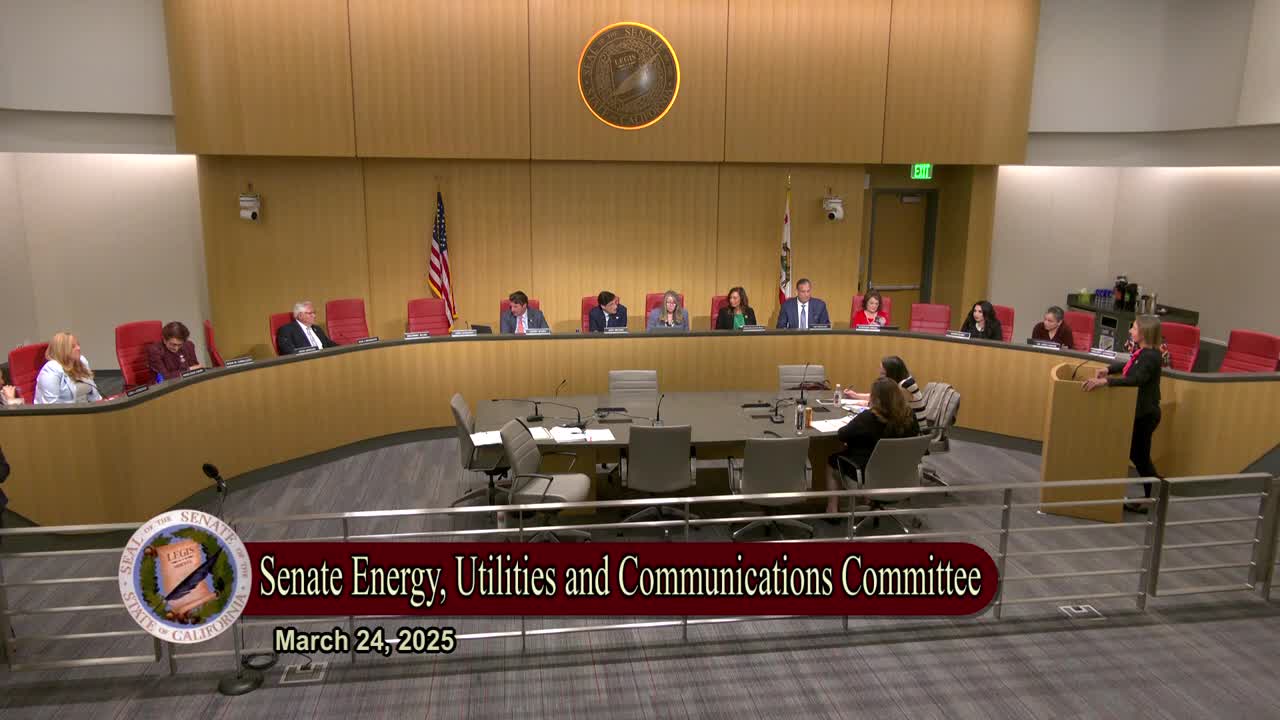 10MIN