SB 1090: Sexually transmitted diseases: outreach and screening services.
- Session Year: 2015-2016
- House: Senate
- Latest Version Date: 2016-08-30
The existing Communicable Disease Prevention and Control Act defines the term venereal disease to mean syphilis, gonorrhea, chancroid, lymphopathia venereum, granuloma inguinale, and chlamydia. Existing law requires the State Department of Public Health to develop and review plans and participate in a program for the prevention and control of venereal disease, and authorizes the department to establish, maintain, and subsidize clinics, dispensaries, and prophylactic stations for the diagnosis, treatment, and prevention of venereal disease.
This bill would delete the term venereal disease and would instead use the term sexually transmitted diseases (STDs), which would be defined as diseases that are primarily transmitted through sexual contact. The bill would require the department, to the extent funds are appropriated by the Legislature, to allocate grants to local health jurisdictions for STD outreach, screening, and other core services. The bill would target and prioritize the allocation of funds to counties based on population and incidence of STDs and would require the allocation of funds to targeted counties to balance the need to spread funding to as many counties as possible and the need to provide meaningful services to each funded county. The bill would make specified mandates and accountability measures applicable to the county when providing the outreach, screening, and other core services.
This bill would provide that the department, in awarding funds pursuant to these provisions, may authorize innovative and impactful outreach, screening, and other core services, such as voluntary screening of inmates and wards of county adult and juvenile corrections facilities, and use of state-of-the-art testing modalities. The bill would require the department to use the accountability measures developed under the bill in order to monitor the activities funded by the bill and would limit the departments expenditures on administrative costs to no more than 10% of the funds appropriated by the Legislature for this purpose.
The bill would also delete obsolete provisions and make conforming changes.
The existing Communicable Disease Prevention and Control Act defines the term venereal disease to mean syphilis, gonorrhea, chancroid, lymphopathia venereum, granuloma inguinale, and chlamydia. Existing law requires the State Department of Public Health to develop and review plans and participate in a program for the prevention and control of venereal disease, and authorizes the department to establish, maintain, and subsidize clinics, dispensaries, and prophylactic stations for the diagnosis, treatment, and prevention of venereal disease.
This bill would delete the term venereal disease and would instead use the term sexually transmitted diseases (STDs), which would be defined as diseases that are primarily transmitted through sexual contact. The bill would require the department, to the extent funds are appropriated by the Legislature, to allocate grants to local health jurisdictions for STD outreach and screening outreach, screening, and other core services. The bill would target and prioritize the allocation of funds to counties based on population and incidence of STDs and would require the allocation of funds to targeted counties to balance the need to spread funding to as many counties as possible and the need to provide meaningful services to each funded county. The bill would make specified mandates and accountability measures applicable to the county and to the community-based organization when providing the outreach and screening outreach, screening, and other core services.
This bill would require the department to provide that the department, in awarding funds pursuant to these provisions, may authorize innovative and impactful outreach and screening outreach, screening, and other core services, such as voluntary screening of inmates and wards of county adult and juvenile corrections facilities, and use of state-of-the-art testing modalities. The bill would require the department to use the accountability measures developed under the bill in order to monitor the activities funded by the bill and would limit the departments expenditures on administrative costs to no more than 10% of the funds appropriated by the Legislature for this purpose.
The bill would also delete obsolete provisions and make conforming changes.
The existing Communicable Disease Prevention and Control Act defines the term venereal disease to mean syphilis, gonorrhea, chancroid, lymphopathia venereum, granuloma inguinale, and chlamydia. Existing law requires the State Department of Public Health to develop and review plans and participate in a program for the prevention and control of venereal disease, and authorizes the department to establish, maintain, and subsidize clinics, dispensaries, and prophylactic stations for the diagnosis, treatment, and prevention of venereal disease.
This bill would delete the term venereal disease and would instead use the term sexually transmitted diseases (STDs), which would be defined as diseases that are primarily transmitted through sexual contact. The bill would require the department, to the extent funds are appropriated by the Legislature, to allocate grants to local health jurisdictions for STD outreach and screening services. The bill would target and prioritize the allocation of funds to counties based on population and incidence of STDs and would require the allocation of funds to targeted counties to balance the need to spread funding to as many counties as possible and the need to provide meaningful services to each funded county. The bill would make specified mandates and accountability measures applicable to the county and to the community-based organization when providing the outreach and screening services.
This bill would require the department to authorize innovative and impactful outreach and screening services, such as voluntary screening of inmates and wards of county adult and juvenile corrections facilities, and use of state-of-the-art testing modalities. The bill would require the department to use the accountability measures developed under the bill in order to monitor the activities funded by the bill and would limit the departments expenditures on administrative costs to no more than 10% of the funds appropriated by the Legislature for this purpose.
The bill would also delete obsolete provisions and make conforming changes.
The existing Communicable Disease Prevention and Control Act defines the term venereal disease to mean syphilis, gonorrhea, chancroid, lymphopathia venereum, granuloma inguinale, and chlamydia. Existing law requires the State Department of Public Health to develop and review plans and participate in a program for the prevention and control of venereal disease, and authorizes the department to establish, maintain, and subsidize clinics, dispensaries, and prophylactic stations for the diagnosis, treatment, and prevention of venereal disease.
This bill would delete the term venereal disease and would instead use the term sexually transmitted diseases (STDs), which would be defined as diseases that are primarily transmitted through sexual contact. The bill would require the department, to the extent funds are appropriated by the Legislature, to allocate grants to local health jurisdictions for STD outreach and screening services. The bill would target and prioritize the allocation of funds to counties based on population and incidence of STDs and would require the allocation of funds to targeted counties to balance the need to spread funding to as many counties as possible and the need to provide meaningful services to each funded county. If a targeted county declines a grant, the bill would authorize the department to solicit proposals from community-based organizations to provide outreach and screening services and would provide that any funding provided to community-based organizations may supplement, but not supplant, the authority of the local health jurisdiction to conduct surveillance and surveillance-based disease intervention for STDs. The bill would make specified mandates and accountability measures applicable to the county and to the community-based organization when providing the outreach and screening services.
This bill would require the department to authorize innovative and impactful outreach and screening services, such as voluntary screening of inmates and wards of county adult and juvenile corrections facilities, and use of state-of-the-art testing modalities. The bill would require the department to use the accountability measures developed under the bill in order to monitor the activities funded by the bill. bill and would limit the departments expenditures on administrative costs to no more than 10% of the funds appropriated by the Legislature for this purpose.
The bill would also delete obsolete provisions and make conforming changes.
Existing law
The existing Communicable Disease Prevention and Control Act defines the term venereal disease to mean syphilis, gonorrhea, chancroid, lymphopathia venereum, granuloma inguinale, and chlamydia. Existing law requires the State Department of Public Health to develop and review plans and participate in a program for the prevention and control of venereal disease, and authorizes the department to establish, maintain, and subsidize clinics, dispensaries, and prophylactic stations for the diagnosis, treatment, and prevention of venereal disease.
This bill would delete the term venereal disease and would instead use the term sexually transmitted diseases (STDs), which would be defined as diseases that are primarily transmitted through sexual contact. The bill would require the department, to the extent funds are appropriated by the Legislature, to allocate grants to counties for sexually transmitted disease (STD) local health jurisdictions for STD outreach and screening services. The bill would target and prioritize the allocation of funds to counties based on population and incidence of STDs and allocate would require the allocation of funds to targeted counties to balance the need to spread funding to as many counties as possible and the need to provide meaningful services to each funded county. If a targeted county declines a grant, the bill would authorize the department to solicit proposals from community-based organizations to provide outreach and screening services. Specified services and would provide that any funding provided to community-based organizations may supplement, but not supplant, the authority of the local health jurisdiction to conduct surveillance and surveillance-based disease intervention for STDs. The bill would make specified mandates and accountability measures would apply applicable to the county of and to the community-based organization when providing the outreach and screening services.
This bill would require the department to authorize innovative and impactful outreach and screening services, such as voluntary screening of inmates and wards of county adult and juvenile corrections facilities, and use of state-of-the-art testing modalities. The bill would require the department to use the accountability measures developed under the bill in order to monitor the activities funded by the bill.
The bill would also delete obsolete provisions and make conforming changes.
Existing law requires the State Department of Public Health to develop and review plans and participate in a program for the prevention and control of venereal disease, and authorizes the department to establish, maintain, and subsidize clinics, dispensaries, and prophylactic stations for the diagnosis, treatment, and prevention of venereal disease.
This bill would require the department, to the extent funds are appropriated by the Legislature, to allocate grants to counties for sexually transmitted disease (STD) outreach and screening services. The bill would target and prioritize counties based on population and incidence of STDs and allocate funds to targeted counties to balance the need to spread funding to as many counties as possible and the need to provide meaningful services to each funded county. If a targeted county declines a grant, the bill would authorize the department to solicit proposals from community-based organizations to provide outreach and screening services. Specified mandates and accountability measures would apply to the county of the community-based organization when providing the outreach and screening services.
This bill would require the department to authorize innovative and impactful screening services, such as voluntary screening of inmates and wards of county adult and juvenile corrections facilities, and use of state-of-the-art testing modalities. The bill would require the department to use the accountability measures developed under the bill in order to monitor the activities funded by the bill.
As used in the Communicable Disease Prevention and Control Act, defined in Section 27, sexually transmitted diseases means diseases that are primarily transmitted through sexual contact.
SEC. 2.Section 120505 of the Health and Safety Code is amended to read:120505.The department shall develop and review plans and provide leadership and consultation for, and participate in, a program for the prevention and control of sexually transmitted diseases.
SEC. 3.Section 120510 of the Health and Safety Code is amended to read:120510.The department shall cooperate in the prevention, control, and cure of sexually transmitted diseases with all of the following:
(a)Physicians and surgeons.
(b)Medical schools.
(c)Public and private hospitals, dispensaries, and clinics.
(d)Administrators of public and private elementary and secondary schools and public and private postsecondary educational institutions.
(e)Penal and charitable institutions.
(f)Detention homes.
(g)Federal, state, local, and district health officers, boards of health, and all other health authorities.
(h)Institutions caring for the mentally ill.
(i)Any other persons, institutions, or agencies.
SEC. 4.Section 120511 is added to the Health and Safety Code, to read:120511.(a)To the extent funds are appropriated by the Legislature for these purposes, the department shall allocate funds to local health jurisdictions for sexually transmitted disease outreach, screening, and other core services in accordance, to the extent possible, with the following:
(1)Counties shall be targeted and prioritized based on population and incidence of sexually transmitted diseases.
(2)Funds shall be allocated to targeted counties in a manner that balances the need to spread funding to as many counties as possible and the need to provide meaningful services to each funded county.
(3)Each recipient county shall demonstrate to the department that the county has done all of the following:
(A)Identified priority target populations.
(B)Satisfactorily described its outreach protocols.
(C)Included community-based partners for outreach, screening, and other core services.
(D)Allocated resources for laboratory costs.
(4)The department shall develop measures for each county funded pursuant to this section to demonstrate accountability.
(b)In awarding funds pursuant to subdivision (a), the department may authorize innovative and impactful outreach, screening, and other core services, including, but not limited to, the following:
(1)Voluntary screening for sexually transmitted diseases among inmates and wards of county adult and juvenile correctional facilities. The department may provide assistance or guidance to the local health jurisdiction if necessary to secure participation by other county agencies.
(2)Social media platforms that allow a person to receive test results, share test results with partners, access treatment services, and reduce administrative costs.
(3)State-of-the-art testing modalities that ensure swift and accurate screening for sexually transmitted diseases.
(4)Community-based testing and disease investigation.
(c)The department shall monitor activities in funded counties, based on the accountability measures required under paragraph (4) of subdivision (a) in order to assess the effectiveness of outreach, screening, and other core services efforts.
(d)The department shall spend no more than 10 percent of any funds appropriated by the Legislature for purposes of this section for administrative costs.
(e)It is the intent of the Legislature that the services identified in this section are to enhance the services that are already provided. Therefore, nothing in this section shall be construed to require the department to replace existing services with the services provided for in subdivision (a) or to prevent the department from adding new services as may be appropriate.
SEC. 5.Section 120515 of the Health and Safety Code is amended to read:120515.The department shall investigate conditions affecting the prevention and control of sexually transmitted diseases and approved procedures for prevention and control, and shall disseminate educational information relative thereto.
SEC. 6.Section 120525 of the Health and Safety Code is repealed.SEC. 7.Section 120525 is added to the Health and Safety Code, to read:120525.The department may provide medical, advisory, financial, or other assistance to organizations as may be approved by it.
SEC. 8.Section 120535 of the Health and Safety Code is amended to read:120535.Any state agency conducting a public hospital shall admit acute sexually transmitted disease cases, when, in the opinion of the department or the local health officer having jurisdiction, persons infected with a sexually transmitted disease may be a menace to public health.
SEC. 9.Section 120540 of the Health and Safety Code is amended to read:120540.The department may require any physician in attendance on a person infected, or suspected of being infected, with a sexually transmitted disease infection to submit specimens as may be designated for examination, when in its opinion the procedure is reasonably necessary to carry out the provisions and purposes of this chapter.
SEC. 10.Section 120565 of the Health and Safety Code is amended to read:120565.If a person subject to proper sexually transmitted disease control measures discontinues any control procedure required by this chapter, the agency administering the procedure, prior to the discontinuance, shall make reasonable efforts to determine whether the person is continuing to comply with the procedure elsewhere.
SEC. 11.Section 120575 of the Health and Safety Code is amended to read:120575.It is the duty of the local health officers to use every available means to ascertain the existence of cases of infectious sexually transmitted diseases within their respective jurisdictions, to investigate all cases that are not, or probably are not, subject to proper control measures approved by the board, to ascertain so far as possible all sources of infection, and to take all measures reasonably necessary to prevent the transmission of infection.
SEC. 12.Section 120605 of the Health and Safety Code is amended to read:120605.This chapter shall not be construed to interfere with the freedom of any adherent of teachings of any well-recognized religious sect, denomination, or organization to depend exclusively upon prayer for healing in accordance with the teachings of the religious sect, denomination, or organization. That person, along with any person treating him or her, shall be exempt from all provisions of this chapter regarding sexually transmitted diseases, except that the provisions of this code and the regulations of the board regarding compulsory reporting of communicable diseases and the quarantine of those diseases, and regarding callings that a person with a sexually transmitted disease may not engage, shall apply.
As used in the Communicable Disease Prevention and Control Act, defined in Section 27, sexually transmitted diseases means diseases that are primarily transmitted through sexual contact.
SEC. 2.Section 120505 of the Health and Safety Code is amended to read:120505.The department shall develop and review plans and provide leadership and consultation for, and participate in, a program for the prevention and control of sexually transmitted diseases.
SEC. 3.Section 120510 of the Health and Safety Code is amended to read:120510.The department shall cooperate in the prevention, control, and cure of sexually transmitted diseases with all of the following:
(a)Physicians and surgeons.
(b)Medical schools.
(c)Public and private hospitals, dispensaries, and clinics.
(d)Administrators of public and private elementary and secondary schools and public and private postsecondary educational institutions.
(e)Penal and charitable institutions.
(f)Detention homes.
(g)Federal, state, local, and district health officers, boards of health, and all other health authorities.
(h)Institutions caring for the mentally ill.
(i)Any other persons, institutions, or agencies.
SEC. 4.Section 120511 is added to the Health and Safety Code, to read:120511.(a)To the extent funds are appropriated by the Legislature for these purposes, the department shall allocate funds to local health jurisdictions for sexually transmitted disease outreach and screening services in accordance with the following: outreach, screening, and other core services in accordance, to the extent possible, with the following:
(1)Counties shall be targeted and prioritized based on population and incidence of sexually transmitted diseases.
(2)Funds shall be allocated to targeted counties in a manner that balances the need to spread funding to as many counties as possible and the need to provide meaningful services to each funded county.
(3)Each recipient county shall demonstrate to the department that the county has done all of the following:
(A)Identified priority target populations.
(B)Satisfactorily described its outreach protocols.
(C)Included community-based partners for outreach and screening. outreach, screening, and other core services.
(D)Allocated resources for laboratory costs.
(4)The department shall develop measures for each county funded pursuant to this section to demonstrate accountability.
(b)The department shall In awarding funds pursuant to subdivision (a), the department may authorize innovative and impactful outreach and screening outreach, screening, and other core services, including, but not limited to, the following:
(1)Voluntary screening for sexually transmitted diseases among inmates and wards of county adult and juvenile correctional facilities. The department may provide assistance or guidance to the local health jurisdiction if necessary to secure participation by other county agencies.
(2)Social media platforms that allow a person to receive test results, share test results with partners, access treatment services, and reduce administrative costs.
(3)State-of-the-art testing modalities that ensure swift and accurate screening for sexually transmitted diseases.
(4)Community-based testing and disease investigation.
(c)The department shall monitor activities in funded counties, based on the accountability measures required under paragraph (4) of subdivision (a) in order to assess the effectiveness of outreach and screening outreach, screening, and other core services efforts.
(d)The department shall spend no more than 10 percent of any funds appropriated by the Legislature for purposes of this section for administrative costs.
(e)It is the intent of the Legislature that the services identified in this section are to enhance the services that are already provided. Therefore, nothing in this section shall be construed to require the department to replace existing services with the services provided for in subdivision (a) or to prevent the department from adding new services as may be appropriate.
SEC. 5.Section 120515 of the Health and Safety Code is amended to read:120515.The department shall investigate conditions affecting the prevention and control of sexually transmitted diseases and approved procedures for prevention and control, and shall disseminate educational information relative thereto.
SEC. 6.Section 120525 of the Health and Safety Code is repealed.SEC. 7.Section 120525 is added to the Health and Safety Code, to read:120525.The department may provide medical, advisory, financial, or other assistance to organizations as may be approved by it.
SEC. 8.Section 120535 of the Health and Safety Code is amended to read:120535.Any state agency conducting a public hospital shall admit acute sexually transmitted disease cases, when, in the opinion of the department or the local health officer having jurisdiction, persons infected with a sexually transmitted disease may be a menace to public health.
SEC. 9.Section 120540 of the Health and Safety Code is amended to read:120540.The department may require any physician in attendance on a person infected, or suspected of being infected, with a sexually transmitted disease infection to submit specimens as may be designated for examination, when in its opinion the procedure is reasonably necessary to carry out the provisions and purposes of this chapter.
SEC. 10.Section 120565 of the Health and Safety Code is amended to read:120565.If a person subject to proper sexually transmitted disease control measures discontinues any control procedure required by this chapter, the agency administering the procedure, prior to the discontinuance, shall make reasonable efforts to determine whether the person is continuing to comply with the procedure elsewhere.
SEC. 11.Section 120575 of the Health and Safety Code is amended to read:120575.It is the duty of the local health officers to use every available means to ascertain the existence of cases of infectious sexually transmitted diseases within their respective jurisdictions, to investigate all cases that are not, or probably are not, subject to proper control measures approved by the board, to ascertain so far as possible all sources of infection, and to take all measures reasonably necessary to prevent the transmission of infection.
SEC. 12.Section 120605 of the Health and Safety Code is amended to read:120605.This chapter shall not be construed to interfere with the freedom of any adherent of teachings of any well-recognized religious sect, denomination, or organization to depend exclusively upon prayer for healing in accordance with the teachings of the religious sect, denomination, or organization. That person, along with any person treating him or her, shall be exempt from all provisions of this chapter regarding sexually transmitted diseases, except that the provisions of this code and the regulations of the board regarding compulsory reporting of communicable diseases and the quarantine of those diseases, and regarding callings that a person with a sexually transmitted disease may not engage, shall apply.
As used in the Communicable Disease Prevention and Control Act, defined in Section 27, sexually transmitted diseases means diseases that are primarily transmitted through sexual contact.
SEC. 2.Section 120505 of the Health and Safety Code is amended to read:120505.The department shall develop and review plans and provide leadership and consultation for, and participate in, a program for the prevention and control of sexually transmitted diseases.
SEC. 3.Section 120510 of the Health and Safety Code is amended to read:120510.The department shall cooperate in the prevention, control, and cure of sexually transmitted diseases with all of the following:
(a)Physicians and surgeons.
(b)Medical schools.
(c)Public and private hospitals, dispensaries, and clinics.
(d)Administrators of public and private elementary and secondary schools and public and private postsecondary educational institutions.
(e)Penal and charitable institutions.
(f)Detention homes.
(g)Federal, state, local, and district health officers, boards of health, and all other health authorities.
(h)Institutions caring for the mentally ill.
(i)Any other persons, institutions, or agencies.
SEC. 4.Section 120511 is added to the Health and Safety Code, to read:120511.(a)To the extent funds are appropriated by the Legislature for these purposes, the department shall allocate funds to local health jurisdictions for sexually transmitted disease outreach and screening services in accordance with the following:
(1)Counties shall be targeted and prioritized based on population and incidence of sexually transmitted diseases.
(2)Funds shall be allocated to targeted counties in a manner that balances the need to spread funding to as many counties as possible and the need to provide meaningful services to each funded county.
(3)Each recipient county shall demonstrate to the department that the county has done all of the following:
(A)Identified priority target populations.
(B)Satisfactorily described its outreach protocols.
(C)Included community-based partners for outreach and screening.
(D)Allocated resources for laboratory costs.
(4)The department shall develop measures for each county funded pursuant to this section to demonstrate accountability.
(b)The department shall authorize innovative and impactful outreach and screening services, including, but not limited to, the following:
(1)Voluntary screening for sexually transmitted diseases among inmates and wards of county adult and juvenile correctional facilities.
(2)Social media platforms that allow a person to receive test results, share test results with partners, access treatment services, and reduce administrative costs.
(3)State-of-the-art testing modalities that ensure swift and accurate screening for sexually transmitted diseases.
(4)Community-based testing and disease investigation.
(c)The department shall monitor activities in funded counties, based on the accountability measures required under paragraph (4) of subdivision (a) in order to assess the effectiveness of outreach and screening efforts.
(d)The department shall spend no more than 10 percent of any funds appropriated by the Legislature for purposes of this section for administrative costs.
(e)It is the intent of the Legislature that the services identified in this section are to enhance the services that are already provided. Therefore, nothing in this section shall be construed to require the department to replace existing services with the services provided for in subdivision (a) or to prevent the department from adding new services as may be appropriate.
SEC. 5.Section 120515 of the Health and Safety Code is amended to read:120515.The department shall investigate conditions affecting the prevention and control of sexually transmitted diseases and approved procedures for prevention and control, and shall disseminate educational information relative thereto.
SEC. 6.Section 120525 of the Health and Safety Code is repealed.SEC. 7.Section 120525 is added to the Health and Safety Code, to read:120525.The department may provide medical, advisory, financial, or other assistance to organizations as may be approved by it.
SEC. 8.Section 120535 of the Health and Safety Code is amended to read:120535.Any state agency conducting a public hospital shall admit acute sexually transmitted disease cases, when, in the opinion of the department or the local health officer having jurisdiction, persons infected with a sexually transmitted disease may be a menace to public health.
SEC. 9.Section 120540 of the Health and Safety Code is amended to read:120540.The department may require any physician in attendance on a person infected, or suspected of being infected, with a sexually transmitted disease infection to submit specimens as may be designated for examination, when in its opinion the procedure is reasonably necessary to carry out the provisions and purposes of this chapter.
SEC. 10.Section 120565 of the Health and Safety Code is amended to read:120565.If a person subject to proper sexually transmitted disease control measures discontinues any control procedure required by this chapter, the agency administering the procedure, prior to the discontinuance, shall make reasonable efforts to determine whether the person is continuing to comply with the procedure elsewhere.
SEC. 11.Section 120575 of the Health and Safety Code is amended to read:120575.It is the duty of the local health officers to use every available means to ascertain the existence of cases of infectious sexually transmitted diseases within their respective jurisdictions, to investigate all cases that are not, or probably are not, subject to proper control measures approved by the board, to ascertain so far as possible all sources of infection, and to take all measures reasonably necessary to prevent the transmission of infection.
SEC. 12.Section 120605 of the Health and Safety Code is amended to read:120605.This chapter shall not be construed to interfere with the freedom of any adherent of teachings of any well-recognized religious sect, denomination, or organization to depend exclusively upon prayer for healing in accordance with the teachings of the religious sect, denomination, or organization. That person, along with any person treating him or her, shall be exempt from all provisions of this chapter regarding sexually transmitted diseases, except that the provisions of this code and the regulations of the board regarding compulsory reporting of communicable diseases and the quarantine of those diseases, and regarding callings that a person with a sexually transmitted disease may not engage, shall apply.
As used in the Communicable Disease Prevention and Control Act, defined in Section 27, sexually transmitted diseases means diseases that are primarily transmitted through sexual contact.
SEC. 2.Section 120505 of the Health and Safety Code is amended to read:120505.The department shall develop and review plans and provide leadership and consultation for, and participate in, a program for the prevention and control of sexually transmitted diseases.
SEC. 3.Section 120510 of the Health and Safety Code is amended to read:120510.The department shall cooperate in the prevention, control, and cure of sexually transmitted diseases with all of the following:
(a)Physicians and surgeons.
(b)Medical schools.
(c)Public and private hospitals, dispensaries, and clinics.
(d)Administrators of public and private elementary and secondary schools and public and private postsecondary educational institutions.
(e)Penal and charitable institutions.
(f)Detention homes.
(g)Federal, state, local, and district health officers, boards of health, and all other health authorities.
(h)Institutions caring for the mentally ill.
(i)Any other persons, institutions, or agencies.
SEC. 4.Section 120511 is added to the Health and Safety Code, to read:120511.(a)To the extent funds are appropriated by the Legislature for these purposes, the department shall allocate funds to local health jurisdictions for sexually transmitted disease outreach and screening services in accordance with the following:
(1)Counties shall be targeted and prioritized based on population and incidence of sexually transmitted diseases.
(2)Funds shall be allocated to targeted counties in a manner that balances the need to spread funding to as many counties as possible and the need to provide meaningful services to each funded county.
(3)Each recipient county shall demonstrate to the department that the county has done all of the following:
(A)Identified priority target populations.
(B)Satisfactorily described its outreach protocols.
(C)Included community-based partners for outreach and screening.
(D)Allocated resources for laboratory costs.
(4)The department shall develop measures for each county funded pursuant to this section to demonstrate accountability.
(5)If a county declines the grant, the department may solicit proposals from community-based organizations to provide outreach and screening services in accordance with the same mandates and accountability measures applicable to the counties pursuant to paragraphs (3) and (4). Any funding provided to a community-based organization pursuant to this paragraph may supplement, but does not supplant, the authority of a local health jurisdiction to conduct surveillance and surveillance-based disease intervention for sexually transmitted diseases.
(b)The department shall authorize innovative and impactful outreach and screening services, including, but not limited to, the following:
(1)Voluntary screening for sexually transmitted diseases among inmates and wards of county adult and juvenile correctional facilities.
(2)Social media platforms that allow a person to receive test results, share test results with partners, access treatment services, and reduce administrative costs.
(3)State-of-the-art testing modalities that ensure swift and accurate screening for sexually transmitted diseases.
(4)Community-based testing and disease investigation.
(c)The department shall monitor activities in funded counties, based on the accountability measures required under paragraph (4) of subdivision (a) in order to assess the effectiveness of outreach and screening efforts.
(d)The department shall spend no more than 10 percent of any funds appropriated by the Legislature for purposes of this section for administrative costs.
SEC. 5.Section 120515 of the Health and Safety Code is amended to read:120515.The department shall investigate conditions affecting the prevention and control of sexually transmitted diseases and approved procedures for prevention and control, and shall disseminate educational information relative thereto.
SEC. 6.Section 120525 of the Health and Safety Code is repealed.SEC. 7.Section 120525 is added to the Health and Safety Code, to read:120525.The department may provide medical, advisory, financial, or other assistance to organizations as may be approved by it.
SEC. 8.Section 120535 of the Health and Safety Code is amended to read:120535.Any state agency conducting a public hospital shall admit acute sexually transmitted disease cases, when, in the opinion of the department or the local health officer having jurisdiction, persons infected with a sexually transmitted disease may be a menace to public health.
SEC. 9.Section 120540 of the Health and Safety Code is amended to read:120540.The department may require any physician in attendance on a person infected, or suspected of being infected, with a sexually transmitted disease infection to submit specimens as may be designated for examination, when in its opinion the procedure is reasonably necessary to carry out the provisions and purposes of this chapter.
SEC. 10.Section 120565 of the Health and Safety Code is amended to read:120565.If a person subject to proper sexually transmitted disease control measures discontinues any control procedure required by this chapter, the agency administering the procedure, prior to the discontinuance, shall make reasonable efforts to determine whether the person is continuing to comply with the procedure elsewhere.
SEC. 11.Section 120575 of the Health and Safety Code is amended to read:120575.It is the duty of the local health officers to use every available means to ascertain the existence of cases of infectious sexually transmitted diseases within their respective jurisdictions, to investigate all cases that are not, or probably are not, subject to proper control measures approved by the board, to ascertain so far as possible all sources of infection, and to take all measures reasonably necessary to prevent the transmission of infection.
SEC. 12.Section 120605 of the Health and Safety Code is amended to read:120605.This chapter shall not be construed to interfere with the freedom of any adherent of teachings of any well-recognized religious sect, denomination, or organization to depend exclusively upon prayer for healing in accordance with the teachings of the religious sect, denomination, or organization. That person, along with any person treating him or her, shall be exempt from all provisions of this chapter regarding sexually transmitted diseases, except that the provisions of this code and the regulations of the board regarding compulsory reporting of communicable diseases and the quarantine of those diseases, and regarding callings that a person with a sexually transmitted disease may not engage, shall apply.
As used in the Communicable Disease Prevention and Control Act (Section 27) venereal diseases means syphilis, gonorrhea, chancroid, lymphopathia venereum, granuloma inguinale, and chlamydia. Act, defined in Section 27, sexually transmitted diseases means diseases that are primarily transmitted through sexual contact.
SEC. 2.Section 120505 of the Health and Safety Code is amended to read:120505.The department shall develop and review plans and provide leadership and consultation for, and participate in, a program for the prevention and control of venereal disease. sexually transmitted diseases.
SEC. 3.Section 120510 of the Health and Safety Code is amended to read:120510.The department shall cooperate in the prevention, control, and cure of venereal sexually transmitted diseases with physicians and surgeons; medical schools; public and private hospitals, dispensaries, and clinics; public and private school, college and university authorities; penal and charitable institutions; reform and industrial schools; detention homes; federal, state, local and district health officers, and boards of health, and all other health authorities; institutions caring for the mentally ill; and with any other persons, institutions, or agencies. all of the following:
(a)Physicians and surgeons.
(b)Medical schools.
(c)Public and private hospitals, dispensaries, and clinics.
(d)Administrators of public and private elementary and secondary schools and public and private postsecondary educational institutions.
(e)Penal and charitable institutions.
(f)Detention homes.
(g)Federal, state, local, and district health officers, boards of health, and all other health authorities.
(h)Institutions caring for the mentally ill.
(i)Any other persons, institutions, or agencies.
SECTION 1.SEC. 4.Section 120511 is added to the Health and Safety Code, to read:120511.(a)To the extent funds are appropriated by the Legislature for these purposes, the department shall allocate funds to counties local health jurisdictions for sexually transmitted disease outreach and screening services in accordance with the following:
(1)Counties shall be targeted and prioritized based on population and incidence of sexually transmitted diseases.
(2)Funds shall be allocated to targeted counties in a manner that balances the need to spread funding to as many counties as possible and the need to provide meaningful services to each funded county.
(3)Each recipient county shall demonstrate to the department that the county has done all of the following:
(A)Identified priority target populations.
(B)Satisfactorily described its outreach protocols.
(C)Included community-based partners for outreach and screening.
(D)Allocated resources for laboratory costs.
(4)The department shall develop measures for each county funded pursuant to this section to demonstrate accountability.
(5)If a county declines the grant, the department may solicit proposals from community-based organizations to provide outreach and screening services in accordance with the same mandates and accountability measures applicable to the counties pursuant to paragraphs (3) and (4). Any funding provided to a community-based organization pursuant to this paragraph may supplement, but does not supplant, the authority of a local health jurisdiction to conduct surveillance and surveillance-based disease intervention for sexually transmitted diseases.
(b)The department shall authorize innovative and impactful outreach and screening services, including, but not limited to, the following:
(1)Voluntary screening for sexually transmitted diseases among inmates and wards of county adult and juvenile correctional facilities.
(2)Social media platforms that allow a person to receive test results, share test results with partners, access treatment services services, and reduce administrative costs.
(3)State-of-the-art testing modalities that ensure swift and accurate screening for sexually transmitted diseases.
(4)Community-based testing and disease investigation.
(c)The department shall monitor activities in funded counties, based on the accountability measures required under paragraph (4) of subdivision (a) in order to assess the effectiveness of outreach and screening efforts.
SEC. 5.Section 120515 of the Health and Safety Code is amended to read:120515.The department shall investigate conditions affecting the prevention and control of venereal sexually transmitted diseases and approved procedures for prevention and control, and shall disseminate educational information relative thereto.
SEC. 6.Section 120525 of the Health and Safety Code is repealed.120525.The department may establish, maintain, and subsidize clinics, dispensaries, and prophylactic stations for the diagnosis, treatment, and prevention of venereal diseases, and may provide medical, advisory, financial, or other assistance to the clinics, dispensaries, and stations as may be approved by it. No clinic, dispensary, or prophylactic station shall be approved unless it meets the requirements of the board and complies with its regulations.
SEC. 7.Section 120525 is added to the Health and Safety Code, to read:120525.The department may provide medical, advisory, financial, or other assistance to organizations as may be approved by it.
SEC. 8.Section 120535 of the Health and Safety Code is amended to read:120535.Any state agency conducting a public hospital shall admit acute venereal sexually transmitted disease cases, when, in the opinion of the department or the local health officer having jurisdiction, persons infected with venereal disease a sexually transmitted disease may be a menace to public health.
SEC. 9.Section 120540 of the Health and Safety Code is amended to read:120540.The department may require any physician in attendance on a person infected infected, or suspected of being infected infected, with a venereal sexually transmitted disease infection to submit specimens as may be designated for examination, when in its opinion the procedure is reasonably necessary to carry out the provisions and purposes of this chapter.
SEC. 10.Section 120565 of the Health and Safety Code is amended to read:120565.If any a person subject to proper venereal sexually transmitted disease control measures discontinues any control procedure required by this chapter, the agency administering the procedure procedure, prior to the discontinuance discontinuance, shall make reasonable efforts to determine whether the person is continuing to comply with the procedure elsewhere.
SEC. 11.Section 120575 of the Health and Safety Code is amended to read:120575.It is the duty of the local health officers to use every available means to ascertain the existence of cases of infectious venereal sexually transmitted diseases within their respective jurisdictions, to investigate all cases that are not, or probably are not, subject to proper control measures approved by the board, to ascertain so far as possible all sources of infection, and to take all measures reasonably necessary to prevent the transmission of infection.
SEC. 12.Section 120605 of the Health and Safety Code is amended to read:120605.Nothing in this This chapter shall not be construed to interfere with the freedom of any adherent of teachings of any well-recognized religious sect, denomination, or organization to depend exclusively upon prayer for healing in accordance with the teachings of the religious sect, denomination, or organization. Any such That person, along with any person treating him or her, shall be exempt from all provisions of this chapter regarding venereal sexually transmitted diseases, except that the provisions of this code and the regulations of the board regarding compulsory reporting of communicable diseases and the quarantine of those diseases, and regarding callings that a person with venereal a sexually transmitted disease may not engage, shall apply.
(a)To the extent funds are appropriated by the Legislature for these purposes, the department shall allocate funds to counties for sexually transmitted disease outreach and screening services in accordance with the following:
(1)Counties shall be targeted and prioritized based on population and incidence of sexually transmitted diseases.
(2)Funds shall be allocated to targeted counties in a manner that balances the need to spread funding to as many counties as possible and the need to provide meaningful services to each funded county.
(3)Each recipient county shall demonstrate to the department that the county has done all of the following:
(A)Identified priority target populations.
(B)Satisfactorily described its outreach protocols.
(C)Included community-based partners for outreach and screening.
(D)Allocated resources for laboratory costs.
(4)The department shall develop measures for each county funded pursuant to this section to demonstrate accountability.
(5)If a county declines the grant, the department may solicit proposals from community-based organizations to provide outreach and screening services in accordance with the same mandates and accountability measures applicable to the counties pursuant to paragraphs (3) and (4).
(b)The department shall authorize innovative and impactful outreach and screening services, including, but not limited to, the following:
(1)Voluntary screening for sexually transmitted diseases among inmates and wards of county adult and juvenile correctional facilities.
(2)Social media platforms that allow a person to receive test results, share test results with partners, access treatment services and reduce administrative costs.
(3)State-of-the-art testing modalities that ensure swift and accurate screening for sexually transmitted diseases.
(4)Community-based testing and disease investigation.
(c)The department shall monitor activities in funded counties, based on the accountability measures required under paragraph (4) of subdivision (a) in order to assess the effectiveness of outreach and screening efforts.
|
Date
|
Status
|
|---|---|
| Sep 1, 2016 | Enrolled and presented to the Governor at 5 p.m. |
| Aug 26, 2016 | Assembly amendments concurred in. (Ayes 38. Noes 0. Page 5450.) Ordered to engrossing and enrolling. |
| Aug 26, 2016 | Assembly amendments concurred in. (Ayes 38. Noes 0.) Ordered to engrossing and enrolling. |
| Aug 23, 2016 | Read third time. Passed. (Ayes 79. Noes 0. Page 6102.) Ordered to the Senate. |
| Aug 23, 2016 | In Senate. Concurrence in Assembly amendments pending. |
| Aug 23, 2016 | Read third time. Passed. Ordered to the Senate. |
| Aug 16, 2016 | Read second time. Ordered to third reading. |
| Aug 15, 2016 | Read second time and amended. Ordered to second reading. |
| Aug 12, 2016 | From committee: Do pass as amended. (Ayes 20. Noes 0.) (August 11). |
| Aug 3, 2016 | August 3 set for first hearing. Placed on APPR. suspense file. |
| Aug 1, 2016 | From committee with author's amendments. Read second time and amended. Re-referred to Com. on APPR. |
| Jun 29, 2016 | From committee: Do pass and re-refer to Com. on APPR. (Ayes 18. Noes 0.) (June 28). Re-referred to Com. on APPR. |
| Jun 13, 2016 | Referred to Com. on HEALTH. |
| Jun 2, 2016 | Read third time. Passed. (Ayes 39. Noes 0. Page 4144.) Ordered to the Assembly. |
| Jun 2, 2016 | In Assembly. Read first time. Held at Desk. |
| Jun 2, 2016 | Read third time. Passed. (Ayes 39. Noes 0.) Ordered to the Assembly. |
| Jun 1, 2016 | Read second time and amended. Ordered to third reading. |
| May 31, 2016 | From committee: Do pass as amended. (Ayes 7. Noes 0. Page 4003.) (May 27). |
| May 31, 2016 | From committee: Do pass as amended. (Ayes 7. Noes 0.) (May 27). |
| May 20, 2016 | Set for hearing May 27. |
| Apr 25, 2016 | April 25 hearing: Placed on APPR. suspense file. |
| Apr 15, 2016 | Set for hearing April 25. |
| Apr 12, 2016 | Read second time and amended. Re-referred to Com. on APPR. |
| Apr 11, 2016 | From committee: Do pass as amended and re-refer to Com. on APPR. (Ayes 9. Noes 0. Page 3445.) (April 6). |
| Apr 11, 2016 | From committee: Do pass as amended and re-refer to Com. on APPR. (Ayes 9. Noes 0.) (April 6). |
| Feb 25, 2016 | Referred to Com. on HEALTH. |
| Feb 18, 2016 | From printer. May be acted upon on or after March 19. |
| Feb 17, 2016 | Introduced. Read first time. To Com. on RLS. for assignment. To print. |
|
Date
|
Description
|
Location
|
Votes
|
|
|---|---|---|---|---|
| Aug 26, 2016 | Unfinished Business SB1090 Mitchell Concurrence | Senate Floor |
Passed |
|
| Aug 23, 2016 | SB 1090 Mitchell Senate Third Reading By BURKE | Assembly Floor |
Passed |
|
| Aug 11, 2016 | Do pass as amended. | Assembly Standing Committee on Appropriations |
Passed |
|
| Jun 28, 2016 | Do pass and be re-referred to the Committee on [Appropriations] | Assembly Standing Committee on Health |
Passed |
|
| Jun 2, 2016 | Senate 3rd Reading SB1090 Mitchell | Senate Floor |
Passed |
|
| May 27, 2016 | Do pass as amended | Senate Standing Committee on Appropriations |
Passed |
|
| Apr 25, 2016 | Placed on suspense file | Senate Standing Committee on Appropriations |
Passed |
|
| Apr 6, 2016 | Do pass as amended, but first amend, and re-refer to the Committee on [Appropriations] | Senate Standing Committee on Health |
Passed |
This list shows positions taken on this bill by organizations on the date displayed, which is linked to the original source.
Positions by individuals are not included.
Office of Senate Floor Analyses (916) 651-1520 Fax: (916) 327-4478 | SB 1090 |
VETO
Bill No: SB 1090
Amended: 8/15/16
SENATE HEALTH COMMITTEE: 9-0, 4/6/16
AYES: Hernandez, Nguyen, Hall, Mitchell, Monning, Nielsen, Pan, Roth, Wolk
SENATE APPROPRIATIONS COMMITTEE: 7-0, 5/27/16
AYES: Lara, Bates, Beall, Hill, McGuire, Mendoza, Nielsen
SENATE FLOOR: 39-0, 6/2/16
AYES: Allen, Anderson, Bates, Beall, Berryhill, Block, Cannella, De León, Fuller, Gaines, Galgiani, Glazer, Hall, Hancock, Hernandez, Hertzberg, Hill, Hueso, Huff, Jackson, Lara, Leno, Leyva, Liu, McGuire, Mendoza, Mitchell, Monning, Moorlach, Morrell, Nguyen, Nielsen, Pan, Pavley, Roth, Stone, Vidak, Wieckowski, Wolk
NO VOTE RECORDED: Runner
SENATE FLOOR: 38-0, 8/26/16
AYES: Allen, Anderson, Bates, Beall, Berryhill, Block, Cannella, Fuller, Gaines, Galgiani, Glazer, Hall, Hancock, Hernandez, Hertzberg, Hill, Hueso, Huff, Jackson, Lara, Leno, Leyva, Liu, McGuire, Mendoza, Mitchell, Monning, Moorlach, Morrell, Nguyen, Nielsen, Pan, Pavley, Roth, Stone, Vidak, Wieckowski, Wolk
NO VOTE RECORDED: De León
ASSEMBLY FLOOR: 79-0, 8/23/16 - See last page for vote
SUBJECT: Sexually transmitted diseases: outreach and screening services
SOURCE: AIDS Healthcare Foundation
DIGEST: This bill requires the Department of Public Health (DPH), to the extent funds are appropriated by the Legislature for these purposes, to allocate funds to counties for sexually transmitted disease (STD) outreach and screening services.
Existing law:
- Requires the DPH to develop and review plans and provide leadership and consultation for, and participate in, a program for the prevention and control of “venereal disease.” Defines “venereal disease” as syphilis, gonorrhea, chancroid, lymphopathia venereum, granuloma inguinale, and chlamydia.
- Permits DPH to establish, maintain, and subsidize clinics, dispensaries, and prophylactic stations for the diagnosis, treatment, and prevention of venereal disease. Permits DPH to provide medical, advisory, financial, or other assistance to the clinics, dispensaries, and stations.
- Permits DPH to furnish treatment for a case or for a group of cases in rural counties or cities upon the recommendation of the local health officer if adequate facilities for the treatment are not available in the county or city.
This bill:
- Requires DPH, to the extent funds are appropriated by the Legislature for these purposes, to allocate funds to counties for STD outreach and screening services as follows:
- Counties are targeted and prioritized based on population and incidence of STDs;
- Funds are allocated to targeted counties in a manner that balances the need to spread funding to as many counties as possible and the need to provide meaningful services to each funded county; and,
- Each recipient county demonstrates that it has: identified priority target populations; satisfactorily described its outreach protocols; included community-based partners for outreach and screening; and, allocated resources for laboratory costs.
- Requires DPH to develop measures for each county funded to demonstrate accountability. Requires DPH to monitor activities in funded counties, based on the accountability measures required in order to assess the effectiveness of outreach and screening efforts.
- Requires DPH to authorize innovative and impactful outreach and screening services, including, but not limited to:
- Voluntary screening for STDs among inmates and wards of county adult and juvenile correctional facilities;
- Social media platforms that allow a person to receive test results, share test results with partners, access treatment services and reduce administrative costs;
- State-of-the-art testing modalities that ensure swift and accurate screening for STDs; and,
- Community-based testing and disease investigation.
- Prohibits DPH from spending any more than 10% of any funds appropriated for purposes of this bill for administrative costs.
- Deletes references in existing law to “venereal disease” and instead uses the term “sexually transmitted diseases,” which is defined under the bill as diseases that are primarily transmitted through sexual contact.
Comments
- Author’s statement. According to the author, STDs remain a large and persistent public health challenge for the citizens of our state. The increasingly large number of cases makes STDs the most commonly reported communicable disease in California. Exacerbating the problem is the fact that because STDs are often asymptomatic, the burden of the disease is far greater than the number of reported cases. It is astonishing that infections that have been easily preventable and treatable for decades are on the rise in dramatic fashion. We can reverse this deplorable situation through more robust and systematic prevention and health interventions. There is a serious lack of funds directed at this epidemic. However, there is also insufficient statutory direction to DPH in terms of addressing priorities and defining and implementing innovative mechanisms for engaging people who are at greatest risk for exposure to an STD. The consequences of inattention are varied, expensive and often permanent. Not only can an STD lead to infection with HIV, it can lead to infertility, heart and kidney disease and complicated pregnancies. Inadequate attention perpetuates a growing epidemic with increasing costs to society. It is essential that every dollar be spent in ways that have the greatest impact.
- California data. According to DPH, California ranked first among all states in 2014 for the total number of cases for chlamydia, gonorrhea, syphilis, and congenital syphilis. In 2014, bacterial STDs (chlamydia, gonorrhea, and syphilis) significantly increased. Important disparities persist, with the highest rates found among young people, African-Americans, and gay and bisexual men. Chlamydia remains the most common reportable disease in California. The highest rates were among young women. Rates among African-American teens and young adult women were the highest of any group, and three to five times higher than white young women. Gonorrhea rates continued to increase sharply across all regions of the state. San Francisco, Shasta, and Kern Counties had the highest rates. Racial disparities persisted with rates among African-Americans six times higher than among whites. Early syphilis cases continued to increase across all regions of California, with the vast majority of cases among men who have sex with men. However, the number of cases among females of reproductive age increased by 56% from 2013. Racial disparities continued with African-American male rates being twice as high as among white males.
- DPH’s STD Control Branch. California statute refers to “venereal disease” and “sexually transmitted diseases” for purposes of the work that the STD Control Branch conducts. According to DPH, the STD Control Branch carries out five core functions to address STD prevention and control in California: surveillance, health promotion and education, assessment and assurance of access to and quality of clinical STD services within the jurisdiction, disease investigation and partner services, and communication/policy. The STD Control Branch has developed a contractual scope of work with local health jurisdictions (LHJs), which includes minimum standards for its core functions. The STD Control Branch currently has contracts with 27 counties and one city health jurisdiction (28 of 61 California LHJs); funds are distributed among LHJs according to a data-driven funding allocation formula. The STD Control Branch may, and currently does, subcontract with CBOs. The LHJ contract process allows for funding of CBOs through a subcontract. The funding is earmarked to support a comprehensive scope of work, including STD surveillance and case reporting (which are legally mandated activities of LHJs). Funding for local assistance through this program has remained fairly consistent over the past three years. In fiscal year (FY) 2014-15, DPH distributed $3.2 million (state and federal funds) to locals for STD control activities, in 2015-16, the number was $3.5 million, and the Governor’s budget proposes $3.3 million for FY 2016-17.
FISCAL EFFECT: Appropriation: No Fiscal Com.: Yes Local: No
According to the Assembly Appropriations Committee, this bill does not by itself fund or require the programs it specifies. However, the placement in code of newly authorized activities creates the following cost pressure:
- Unknown General Fund (GF) cost pressure to provide funding to local health jurisdictions. The bill requires the DPH to make funding available upon appropriation by the Legislature. The amount would depend on future budget appropriations.
- Unknown GF cost pressure to provide program administration, including developing program guidelines, reviewing applications, awarding grants, and monitoring local implementation. For instance, if the amount of funding made available in the future were $10 million per year, the Department would be able to spend up to $1 million per year to administer the program.
AIDS Healthcare Foundation (source)
California Black Health Network
California Chapter of the American College of Emergency Physicians
Community Action Fund of Planned Parenthood of Orange and San Bernardino Counties
Planned Parenthood Action Fund of Santa Barbara, Ventura & San Luis Obispo Counties
Planned Parenthood Action Fund of the Pacific Southwest
Planned Parenthood Advocacy Project Los Angeles County
Planned Parenthood Advocates Pasadena and San Gabriel Valley
Planned Parenthood Affiliates of California
Planned Parenthood Mar Monte
Planned Parenthood Northern California Action Fund
OPPOSITION: (Verified 8/23/16)
None received
ARGUMENTS IN SUPPORT: The AIDS Healthcare Foundation (AHF) writes that the lack of resources to address the continuing epidemic of STD infection is profoundly troubling and that the consequences of inattention are varied, expensive, and often permanent. AHF states that from the larger public health perspective, inattention also perpetuates a growing epidemic with increasing costs to society. Other supporters write that the increasingly large number of cases makes STDs the most commonly reported communicable disease in California, and it is unacceptable that a bacterial infection that has been easily preventable and treatable for decades is on the rise in such dramatic fashion. SB 1090 will help reverse these trends by supporting more robust and systematic health interventions and preventions.
I am returning Senate Bill 1090 without my signature.
This bill requires the Department of Public Health to allocate funds to local health agencies for sexually transmitted disease outreach and screening if there is an appropriation for this purpose in the budget.
The 2016-17 enacted budget provides $5 million in grants to local health agencies working to prevent and control sexually transmitted diseases. While I appreciate the author's commitment to this important public health issue, additional funding depends upon future budget deliberations and decisions. Prescribing the direction and use of future investments in this program is premature.
ASSEMBLY FLOOR: 79-0, 8/23/16
AYES: Achadjian, Alejo, Travis Allen, Arambula, Atkins, Baker, Bigelow, Bloom, Bonilla, Bonta, Brough, Brown, Burke, Calderon, Campos, Chang, Chau, Chávez, Chiu, Chu, Cooley, Cooper, Dababneh, Dahle, Daly, Dodd, Eggman, Frazier, Beth Gaines, Gallagher, Cristina Garcia, Eduardo Garcia, Gatto, Gipson, Gomez, Gonzalez, Gordon, Grove, Hadley, Harper, Roger Hernández, Holden, Irwin, Jones, Jones-Sawyer, Kim, Lackey, Levine, Linder, Lopez, Low, Maienschein, Mathis, Mayes, McCarty, Medina, Melendez, Mullin, Nazarian, Obernolte, O'Donnell, Olsen, Patterson, Quirk, Ridley-Thomas, Rodriguez, Salas, Santiago, Steinorth, Mark Stone, Thurmond, Ting, Wagner, Waldron, Weber, Wilk, Williams, Wood, Rendon
NO VOTE RECORDED: Gray
Prepared by: Melanie Moreno / HEALTH / (916) 651-4111
10/24/16 11:40:30
**** END ****
Office of Senate Floor Analyses (916) 651-1520 Fax: (916) 327-4478 | SB |
UNFINISHED BUSINESS
Bill No: SB 1090
:
SENATE HEALTH COMMITTEE: 9-0, 4/6/16
AYES: Hernandez, Nguyen, Hall, Mitchell, Monning, Nielsen, Pan, Roth, Wolk
SENATE APPROPRIATIONS COMMITTEE: 7-0, 5/27/16
AYES: Lara, Bates, Beall, Hill, McGuire, Mendoza, Nielsen
SENATE FLOOR: 39-0, 6/2/16
AYES: Allen, Anderson, Bates, Beall, Berryhill, Block, Cannella, De León, Fuller, Gaines, Galgiani, Glazer, Hall, Hancock, Hernandez, Hertzberg, Hill, Hueso, Huff, Jackson, Lara, Leno, Leyva, Liu, McGuire, Mendoza, Mitchell, Monning, Moorlach, Morrell, Nguyen, Nielsen, Pan, Pavley, Roth, Stone, Vidak, Wieckowski, Wolk
NO VOTE RECORDED: Runner
ASSEMBLY FLOOR: 79-0, 8/23/16 - See last page for vote
SOURCE: AIDS Healthcare Foundation
DIGEST: This bill requires the Department of Public Health (DPH), to the extent funds are appropriated by the Legislature for these purposes, to allocate funds to counties for sexually transmitted disease (STD) outreach and screening services.
Assembly Amendments state the intent of the Legislature that the services identified in this bill are to enhance the services that are already provided, and nothing is to be construed to require DPH to replace existing services or to prevent DPH from adding new services as may be appropriate; and make technical, clarifying changes.
Existing law:
- Requires the DPH to develop and review plans and provide leadership and consultation for, and participate in, a program for the prevention and control of “venereal disease.” Defines “venereal disease” as syphilis, gonorrhea, chancroid, lymphopathia venereum, granuloma inguinale, and chlamydia.
- Permits DPH to establish, maintain, and subsidize clinics, dispensaries, and prophylactic stations for the diagnosis, treatment, and prevention of venereal disease. Permits DPH to provide medical, advisory, financial, or other assistance to the clinics, dispensaries, and stations.
- Permits DPH to furnish treatment for a case or for a group of cases in rural counties or cities upon the recommendation of the local health officer if adequate facilities for the treatment are not available in the county or city.
This bill:
- Requires DPH, to the extent funds are appropriated by the Legislature for these purposes, to allocate funds to counties for STD outreach and screening services as follows:
- Counties are targeted and prioritized based on population and incidence of STDs;
- Funds are allocated to targeted counties in a manner that balances the need to spread funding to as many counties as possible and the need to provide meaningful services to each funded county; and,
- Each recipient county demonstrates that it has: identified priority target populations; satisfactorily described its outreach protocols; included community-based partners for outreach and screening; and, allocated resources for laboratory costs.
- Requires DPH to develop measures for each county funded to demonstrate accountability. Requires DPH to monitor activities in funded counties, based on the accountability measures required in order to assess the effectiveness of outreach and screening efforts.
- Requires DPH to authorize innovative and impactful outreach and screening services, including, but not limited to:
- Voluntary screening for STDs among inmates and wards of county adult and juvenile correctional facilities;
- Social media platforms that allow a person to receive test results, share test results with partners, access treatment services and reduce administrative costs;
- State-of-the-art testing modalities that ensure swift and accurate screening for STDs; and,
- Community-based testing and disease investigation.
- Prohibits DPH from spending any more than 10% of any funds appropriated for purposes of this bill for administrative costs.
- Deletes references in existing law to “venereal disease” and instead uses the term “sexually transmitted diseases,” which is defined under the bill as diseases that are primarily transmitted through sexual contact.
Comments
- Author’s statement. According to the author, STDs remain a large and persistent public health challenge for the citizens of our state. The increasingly large number of cases makes STDs the most commonly reported communicable disease in California. Exacerbating the problem is the fact that because STDs are often asymptomatic, the burden of the disease is far greater than the number of reported cases. It is astonishing that infections that have been easily preventable and treatable for decades are on the rise in dramatic fashion. We can reverse this deplorable situation through more robust and systematic prevention and health interventions. There is a serious lack of funds directed at this epidemic. However, there is also insufficient statutory direction to DPH in terms of addressing priorities and defining and implementing innovative mechanisms for engaging people who are at greatest risk for exposure to an STD. The consequences of inattention are varied, expensive and often permanent. Not only can an STD lead to infection with HIV, it can lead to infertility, heart and kidney disease and complicated pregnancies. Inadequate attention perpetuates a growing epidemic with increasing costs to society. It is essential that every dollar be spent in ways that have the greatest impact.
- California data. According to DPH, California ranked first among all states in 2014 for the total number of cases for chlamydia, gonorrhea, syphilis, and congenital syphilis. In 2014, bacterial STDs (chlamydia, gonorrhea, and syphilis) significantly increased. Important disparities persist, with the highest rates found among young people, African-Americans, and gay and bisexual men. Chlamydia remains the most common reportable disease in California. The highest rates were among young women. Rates among African-American teens and young adult women were the highest of any group, and three to five times higher than white young women. Gonorrhea rates continued to increase sharply across all regions of the state. San Francisco, Shasta, and Kern Counties had the highest rates. Racial disparities persisted with rates among African-Americans six times higher than among whites. Early syphilis cases continued to increase across all regions of California, with the vast majority of cases among men who have sex with men. However, the number of cases among females of reproductive age increased by 56% from 2013. Racial disparities continued with African-American male rates being twice as high as among white males.
- DPH’s STD Control Branch. California statute refers to “venereal disease” and “sexually transmitted diseases” for purposes of the work that the STD Control Branch conducts. According to DPH, the STD Control Branch carries out five core functions to address STD prevention and control in California: surveillance, health promotion and education, assessment and assurance of access to and quality of clinical STD services within the jurisdiction, disease investigation and partner services, and communication/policy. The STD Control Branch has developed a contractual scope of work with local health jurisdictions (LHJs), which includes minimum standards for its core functions. The STD Control Branch currently has contracts with 27 counties and one city health jurisdiction (28 of 61 California LHJs); funds are distributed among LHJs according to a data-driven funding allocation formula. The STD Control Branch may, and currently does, subcontract with CBOs. The LHJ contract process allows for funding of CBOs through a subcontract. The funding is earmarked to support a comprehensive scope of work, including STD surveillance and case reporting (which are legally mandated activities of LHJs). Funding for local assistance through this program has remained fairly consistent over the past three years. In fiscal year (FY) 2014-15, DPH distributed $3.2 million (state and federal funds) to locals for STD control activities, in 2015-16, the number was $3.5 million, and the Governor’s budget proposes $3.3 million for FY 2016-17.
FISCAL EFFECT: Appropriation: Fiscal Com.: Local:
According to the Assembly Appropriations Committee, this bill does not by itself fund or require the programs it specifies. However, the placement in code of newly authorized activities creates the following cost pressure:
- Unknown General Fund (GF) cost pressure to provide funding to local health jurisdictions. The bill requires the DPH to make funding available upon appropriation by the Legislature. The amount would depend on future budget appropriations.
- Unknown GF cost pressure to provide program administration, including developing program guidelines, reviewing applications, awarding grants, and monitoring local implementation. For instance, if the amount of funding made available in the future were $10 million per year, the Department would be able to spend up to $1 million per year to administer the program.
AIDS Healthcare Foundation (source)
California Black Health Network
California Chapter of the American College of Emergency Physicians
Community Action Fund of Planned Parenthood of Orange and San Bernardino Counties
Planned Parenthood Action Fund of Santa Barbara, Ventura & San Luis Obispo Counties
Planned Parenthood Action Fund of the Pacific Southwest
Planned Parenthood Advocacy Project Los Angeles County
Planned Parenthood Advocates Pasadena and San Gabriel Valley
Planned Parenthood Affiliates of California
Planned Parenthood Mar Monte
Planned Parenthood Northern California Action Fund
OPPOSITION: (Verified 8/23/16)
None received
ARGUMENTS IN SUPPORT: The AIDS Healthcare Foundation (AHF) writes that the lack of resources to address the continuing epidemic of STD infection is profoundly troubling and that the consequences of inattention are varied, expensive, and often permanent. AHF states that from the larger public health perspective, inattention also perpetuates a growing epidemic with increasing costs to society. Other supporters write that the increasingly large number of cases makes STDs the most commonly reported communicable disease in California, and it is unacceptable that a bacterial infection that has been easily preventable and treatable for decades is on the rise in such dramatic fashion. SB 1090 will help reverse these trends by supporting more robust and systematic health interventions and preventions.
ASSEMBLY FLOOR: 79-0, 8/23/16
AYES: Achadjian, Alejo, Travis Allen, Arambula, Atkins, Baker, Bigelow, Bloom, Bonilla, Bonta, Brough, Brown, Burke, Calderon, Campos, Chang, Chau, Chávez, Chiu, Chu, Cooley, Cooper, Dababneh, Dahle, Daly, Dodd, Eggman, Frazier, Beth Gaines, Gallagher, Cristina Garcia, Eduardo Garcia, Gatto, Gipson, Gomez, Gonzalez, Gordon, Grove, Hadley, Harper, Roger Hernández, Holden, Irwin, Jones, Jones-Sawyer, Kim, Lackey, Levine, Linder, Lopez, Low, Maienschein, Mathis, Mayes, McCarty, Medina, Melendez, Mullin, Nazarian, Obernolte, O'Donnell, Olsen, Patterson, Quirk, Ridley-Thomas, Rodriguez, Salas, Santiago, Steinorth, Mark Stone, Thurmond, Ting, Wagner, Waldron, Weber, Wilk, Williams, Wood, Rendon
NO VOTE RECORDED: Gray
8/23/16 20:02:57
**** END ****
SENATE THIRD READING
STR Bill Id:SB 1090
Author:(Mitchell)
As Amended Ver:August 15, 2016
Majority vote
SENATE VOTE: 39-0
Committee | Votes | Ayes | Noes |
Health | 18-0 | Wood, Maienschein, Bonilla, Burke, Campos, Chiu, Gomez, Roger Hernández, Lackey, Nazarian, Olsen, Patterson, Ridley-Thomas, Rodriguez, Santiago, Steinorth, McCarty, Waldron | |
Appropriations | 20-0 | Gonzalez, Bigelow, Bloom, Bonilla, Bonta, Calderon, Chang, Daly, Eggman, Gallagher, Eduardo Garcia, Holden, Jones, Obernolte, Quirk, Santiago, Wagner, Weber, Wood, McCarty |
|
SUMMARY: Requires the Department of Public Health (DPH), to the extent funds are appropriated by the Legislature for these purposes, to allocate funds to counties for sexually transmitted disease (STD) outreach, screening and other core services. Specifically, this bill:
- Requires DPH, to the extent funds are appropriated by the Legislature, to allocate funds to local health jurisdictions for STD outreach, screening and other core services in accordance to the extent possible with the following:
- Requires counties to be targeted and prioritized based on population and incidence of STDs;
- Requires funds to be allocated to targeted counties in a manner that balances the need to spread funding to as many counties as possible and the need to provide meaningful services to each funded county;
- Requires each recipient county to demonstrate to DPH that the county has done all of the following:
- Identified priority target populations;
- Satisfactorily described its outreach protocols;
- Included community-based partners for outreach, screening and other core services; and,
- Allocated resources for laboratory costs.
- Requires DPH to develop measures for each county to demonstrate accountability.
- Requires DPH to authorize innovative and impactful outreach, screening and other core services, including, but not limited to, the following:
- Voluntary screening for STDs among inmates and wards of county adult and juvenile correctional facilities. DPH may provide assistance or guidance to the local health jurisdiction if necessary to secure participation by other county agencies;
- Social media platforms that allow a person to receive test results, share test results with partners, access treatment services, and reduce administrative costs;
- State-of-the-art testing modalities that ensure swift and accurate screening for STDs; and,
- Community-based testing and disease investigation.
- Requires DPH to monitor activities in funded counties, based on the accountability measures required under 1)d) above, in order to assess the effectiveness of outreach, screening, and other core services.
- Prohibits DPH from spending more than 10% of any funds appropriated by the Legislature for administrative costs.
- States legislative intent regarding the services specified in 1) above.
- Deletes references in existing law to "venereal disease" and instead uses the term "sexually transmitted diseases," which is defined as diseases that are primarily transmitted through sexual contact.
FISCAL EFFECT: According to the Assembly Appropriations Committee, this bill does not by itself fund or require the programs it specifies. However, the placement in code of newly authorized activities creates the following cost pressure:
- Unknown General Fund (GF) cost pressure to provide funding to local health jurisdictions. The bill requires the DPH to make funding available upon appropriation by the Legislature. The amount would depend on future budget appropriations.
- Unknown GF cost pressure to provide program administration, including developing program guidelines, reviewing applications, awarding grants, and monitoring local implementation. For instance, if the amount of funding made available in the future were $10 million per year, the Department would be able to spend up to $1 million per year to administer the program.
COMMENTS: According to the author, this bill is necessary because STDs remain a large and persistent public health challenge for the citizens of our state. The increasingly large number of cases makes STDs the most commonly reported communicable disease in California. Exacerbating the problem is the fact that because STDs are often asymptomatic, the burden of the disease is far greater than the number of reported cases. It is astonishing that infections that have been easily preventable and treatable for decades are on the rise in dramatic fashion. We can reverse this deplorable situation through more robust and systematic prevention and health interventions. There is a serious lack of funds directed at this epidemic. However, there is also insufficient statutory direction to DPH in terms of addressing priorities and defining and implementing innovative mechanisms for engaging people who are at greatest risk for exposure to an STD. The consequences of inattention are varied, expensive and often permanent.
Analysis Prepared by: Rosielyn Pulmano/ HEALTH / (916) 319-2097 FN: 0004098
Date of Hearing: August 3, 2016
ASSEMBLY COMMITTEE ON APPROPRIATIONS
Lorena Gonzalez, Chair
SBPCA Bill Id:SB 1090
Author:(Mitchell) – As Amended Ver:August 1, 2016
Policy Committee: | Health | Vote: | 18 - 0 |
Urgency: No State Mandated Local Program: No Reimbursable: No
SUMMARY:
This bill creates a funding structure to allocate funds to local health jurisdictions for sexually transmitted disease outreach and screening services, to the extent funds are appropriated by the Legislature for the purpose.
It also updates and broadens statutes related to STD prevention, and clarifies it does not affect existing services or prevent California Department of Public Health (CDPH) from adding new services.
FISCAL EFFECT:
- Unknown GF costs to provide funding to local health jurisdictions. The bill requires the CDPH to make funding available upon appropriation by the Legislature. The amount would depend on future budget appropriations.
- Unknown GF costs to provide program administration, including developing program guidelines, reviewing applications, awarding grants, and monitoring local implementation. For instance, if the amount of funding made available in the future were $10 million per year, the Department would be able to spend up to ten percent ($1 million) per year to administer the program.
COMMENTS:
- Purpose. According to the author, this bill is necessary because STDs remain a large and persistent public health challenge in the state. This bill updates codes governing STD prevention and provides greater specificity with respect to distribution of funds, establishes accountability standards, and requires the department to authorize innovative and impactful outreach and screening services.
- Background. According to CDPH, bacterial STDs in California (chlamydia, gonorrhea, and syphilis) continued to pose a substantial and increasing public health burden. Chlamydia alone affected about 175,000 people in 2014. Cases of gonorrhea have risen 68%, and cases of syphilis has risen 86%, since 2010. Important disparities persist, with the highest disease rates found among young people, African-Americans, and gay and bisexual men. CDPH is responsible for statewide STD prevention and control, but most public health activities are conducted locally. State and local funding for STDs is discretionary. The state has allocated funding in range of $10-15 million annually (GF/federal) in recent years.
- Related Budget Action. The 2016-17 budget bill (SB 826 (Leno), Chapter 23, Statutes of 2016) appropriated $5 million in one-time money for CDPH's Sexually Transmitted Disease Prevention Program. However, the funding was not specifically allocated for purposes of SB 1090.
- Related Legislation. AB 2424 (Gomez), pending in the Senate Appropriations Committee, creates a funding distribution and accountability scheme for local grants related to chronic disease prevention.
Analysis Prepared by: Lisa Murawski / APPR. / (916) 319-2081
Date of Hearing: June 28, 2016
ASSEMBLY COMMITTEE ON HEALTH
Jim Wood, Chair
SBPCA Bill Id:SB 1090
Author:(Mitchell) – As Amended Ver:June 1, 2016
SENATE VOTE: 39-0
SUBJECT: Sexually transmitted diseases: outreach and screening services.
SUMMARY: Requires the Department of Public Health (DPH), to the extent funds are appropriated by the Legislature for these purposes, to allocate funds to counties for sexually transmitted disease (STD) outreach and screening services. Specifically, this bill:
- Requires DPH, to the extent funds are appropriated by the Legislature, to allocate funds to local health jurisdictions for STD outreach and screening services in accordance with the following:
- Requires counties to be targeted and prioritized based on population and incidence of STDs;
- Requires funds to be allocated to targeted counties in a manner that balances the need to spread funding to as many counties as possible and the need to provide meaningful services to each funded county;
- Requires each recipient county to demonstrate to DPH that the county has done all of the following:
- Identified priority target populations;
- Satisfactorily described its outreach protocols;
- Included community-based partners for outreach and screening; and,
- Allocated resources for laboratory costs.
- Identified priority target populations;
- Requires DPH to develop measures for each county to demonstrate accountability.
- Requires counties to be targeted and prioritized based on population and incidence of STDs;
- Requires DPH to authorize innovative and impactful outreach and screening services, including, but not limited to, the following:
- Voluntary screening for STDs among inmates and wards of county adult and juvenile correctional facilities;
- Social media platforms that allow a person to receive test results, share test results with partners, access treatment services, and reduce administrative costs;
- State-of-the-art testing modalities that ensure swift and accurate screening for STDs; and,
- Community-based testing and disease investigation.
- Voluntary screening for STDs among inmates and wards of county adult and juvenile correctional facilities;
- Requires DPH to monitor activities in funded counties, based on the accountability measures required under 1) d) above in order to assess the effectiveness of outreach and screening efforts.
- Prohibits DPH from spending more than 10% of any funds appropriated by the Legislature for administrative costs.
- Deletes references in existing law to “venereal disease” and instead uses the term “sexually transmitted diseases,” which is defined as diseases that are primarily transmitted through sexual contact.
EXISTING LAW:
- Requires DPH to develop and review plans and provide leadership and consultation for, and participate in, a program for the prevention and control of “venereal disease.” Defines “venereal disease” as syphilis, gonorrhea, chancroid, lymphopathia venereum, granuloma inguinale, and chlamydia.
- Permits DPH to establish, maintain, and subsidize clinics, dispensaries, and prophylactic stations for the diagnosis, treatment, and prevention of venereal disease. Permits DPH to provide medical, advisory, financial, or other assistance to the clinics, dispensaries, and stations.
- Permits DPH to furnish treatment for a case or for a group of cases in rural counties or cities upon the recommendation of the local health officer if adequate facilities for the treatment are not available in the county or city.
FISCAL EFFECT: According to the Senate Appropriations Committee:
- Unknown costs to provide funding to local health jurisdictions (General Fund). This bill requires DPH to make funding available, upon appropriation by the Legislature, to local health jurisdictions. The amount of funding available under the bill is unknown at this time and would depend on future budget appropriations. Staff is not aware of any significant source of funding that could be used for this new program other than the General Fund.
- Unknown costs to provide program administration, including developing program guidelines, reviewing applications, awarding grants, and monitoring accountability requirements on grantees. If the amount of funding made available in the future were $10 million per year, DPH would be able to spend up to $1 million per year to administer the program.
COMMENTS:
- PURPOSE OF THIS BILL. According to the author, this bill is necessary because STDs remain a large and persistent public health challenge for the citizens of our state. The increasingly large number of cases makes STDs the most commonly reported communicable disease in California. Exacerbating the problem is the fact that because STDs are often asymptomatic, the burden of the disease is far greater than the number of reported cases. It is astonishing that infections that have been easily preventable and treatable for decades are on the rise in dramatic fashion. We can reverse this deplorable situation through more robust and systematic prevention and health interventions. There is a serious lack of funds directed at this epidemic. However, there is also insufficient statutory direction to DPH in terms of addressing priorities and defining and implementing innovative mechanisms for engaging people who are at greatest risk for exposure to an STD. The consequences of inattention are varied, expensive and often permanent. Not only can an STD lead to infection with HIV, it can lead to infertility, heart and kidney disease and complicated pregnancies. Inadequate attention perpetuates a growing epidemic with increasing costs to society. It is essential that every dollar be spent in ways that have the greatest impact.
- BACKGROUND. According to DPH, California ranked first among all states in 2014 for the total number of cases for chlamydia, gonorrhea, syphilis, and congenital syphilis. In 2014, the last year for which full data is available, bacterial STDs (chlamydia, gonorrhea, and syphilis) significantly increased over 2013 and even more dramatically for the five year period from 2010 to 2014. During that time chlamydia rose by 12%, gonorrhea by 68%, and primary and secondary syphilis by 86%. Important disparities persist, with the highest rates found among young people, African-Americans, and gay and bisexual men. Chlamydia remains the most common reportable disease in California. The highest rates were among young women. Rates among African-American teens and young adult women were the highest of any group, and three to five times higher than white young women. Gonorrhea rates continued to increase sharply across all regions of the state. San Francisco, Shasta, and Kern Counties had the highest rates. Racial disparities persisted with rates among African-Americans six times higher than among whites. Early syphilis cases continued to increase across all regions of California, with the vast majority of cases among men who have sex with men. However, the number of cases among females of reproductive age increased by 56% from 2013. Racial disparities continued with African-American male rates being twice as high as among white males. The number of infants born with congenital syphilis nearly doubled for the second consecutive year.
- STD CONTROL BRANCH. According to DPH, the STD Control Branch (STDCB) carries out five core functions to address STD prevention and control: surveillance; health promotion and education; assessment and assurance of access to quality clinical STD services within the jurisdiction; disease investigation and partner services; and, communication/policy. STDCB has developed a contractual scope of work with local health jurisdictions (LHJs), which includes minimum standards for its core functions. STDCB currently has contracts with 27 counties and one city health jurisdiction (28 of 61 California LHJs); funds are distributed among LHJs according to a data-driven funding allocation formula. STDCB may, and currently does, subcontract with community based organizations (CBOs). The LHJ contract process allows for funding of CBOs through a subcontract. The funding is earmarked to support a comprehensive scope of work, including STD surveillance and case reporting (which are legally mandated activities of LHJs). Funding for local assistance through this program has remained fairly consistent over the past three years. In fiscal year (FY) 2014-15, DPH distributed $3.2 million (state and federal funds) to locals for STD control activities, in FY 2015-16, the number was $3.5 million, and the Governor’s budget proposed $3.3 million for FY 2016-17.
- SUPPORT. The AIDS Healthcare Foundation (AHF) writes that the lack of resources to address the continuing epidemic of STD infection is profoundly troubling and that the consequences of inattention are varied, expensive, and often permanent. AHF states that from the larger public health perspective, inattention also perpetuates a growing epidemic with increasing costs to society. Other supporters write that the increasingly large number of cases makes STDs the most commonly reported communicable disease in California, and it is unacceptable that a bacterial infection that has been easily preventable and treatable for decades is on the rise in such dramatic fashion. This bill will help reverse these trends by supporting more robust and systematic health interventions and preventions.
REGISTERED SUPPORT / OPPOSITION:
Support
AIDS Healthcare Foundation (sponsor)
California Black Health Network
California Chapter of the American College of Emergency Physicians
Community Action Fund of Planned Parenthood of Orange and San Bernardino Counties
Planned Parenthood Action Fund of Santa Barbara, Ventura & San Luis Obispo Counties
Planned Parenthood Action Fund of the Pacific Southwest
Planned Parenthood Advocacy Project Los Angeles County
Planned Parenthood Advocates Pasadena and San Gabriel Valley
Planned Parenthood Affiliates of California
Planned Parenthood Mar Monte
Planned Parenthood Northern California Action Fund
Opposition
None on file.
Analysis Prepared by: John Gilman / HEALTH / (916) 319-2097
Office of Senate Floor Analyses (916) 651-1520 Fax: (916) 327-4478 | SB 1090 |
THIRD READING
Bill No: SB 1090
Amended: 6/1/16
SENATE HEALTH COMMITTEE: 9-0, 4/6/16
AYES: Hernandez, Nguyen, Hall, Mitchell, Monning, Nielsen, Pan, Roth, Wolk
SENATE APPROPRIATIONS COMMITTEE: 7-0, 5/27/16
AYES: Lara, Bates, Beall, Hill, McGuire, Mendoza, Nielsen
SUBJECT: Sexually transmitted diseases: outreach and screening services
SOURCE: AIDS Healthcare Foundation
DIGEST: This bill requires the Department of Public Health, to the extent funds are appropriated by the Legislature for these purposes, to allocate funds to counties for sexually transmitted disease outreach and screening services.
Existing law:
- Requires the Department of Public Health (DPH) to develop and review plans and provide leadership and consultation for, and participate in, a program for the prevention and control of “venereal disease.” Defines “venereal disease” as syphilis, gonorrhea, chancroid, lymphopathia venereum, granuloma inguinale, and chlamydia.
- Permits DPH to establish, maintain, and subsidize clinics, dispensaries, and prophylactic stations for the diagnosis, treatment, and prevention of venereal disease. Permits DPH to provide medical, advisory, financial, or other assistance to the clinics, dispensaries, and stations.
- Permits DPH to furnish treatment for a case or for a group of cases in rural counties or cities upon the recommendation of the local health officer if adequate facilities for the treatment are not available in the county or city.
This bill:
- Requires DPH, to the extent funds are appropriated by the Legislature for these purposes, to allocate funds to counties for sexually transmitted disease (STD) outreach and screening services as follows:
- Counties are targeted and prioritized based on population and incidence of STDs;
- Funds are allocated to targeted counties in a manner that balances the need to spread funding to as many counties as possible and the need to provide meaningful services to each funded county; and,
- Each recipient county demonstrates that it has: identified priority target populations; satisfactorily described its outreach protocols; included community-based partners for outreach and screening; and, allocated resources for laboratory costs.
- Requires DPH to develop measures for each county funded to demonstrate accountability. Requires DPH to monitor activities in funded counties, based on the accountability measures required in order to assess the effectiveness of outreach and screening efforts.
- Requires DPH to authorize innovative and impactful outreach and screening services, including, but not limited to:
- Voluntary screening for STDs among inmates and wards of county adult and juvenile correctional facilities;
- Social media platforms that allow a person to receive test results, share test results with partners, access treatment services and reduce administrative costs;
- State-of-the-art testing modalities that ensure swift and accurate screening for STDs; and,
- Community-based testing and disease investigation.
- Prohibits DPH from spending any more than 10% of any funds appropriated for purposes of this bill for administrative costs.
- Deletes references in existing law to “venereal disease” and instead uses the term “sexually transmitted diseases,” which is defined under the bill as diseases that are primarily transmitted through sexual contact.
Comments
- Author’s statement. According to the author, STDs remain a large and persistent public health challenge for the citizens of our state. The increasingly large number of cases makes STDs the most commonly reported communicable disease in California. Exacerbating the problem is the fact that because STDs are often asymptomatic, the burden of the disease is far greater than the number of reported cases. It is astonishing that infections that have been easily preventable and treatable for decades are on the rise in dramatic fashion. We can reverse this deplorable situation through more robust and systematic prevention and health interventions. There is a serious lack of funds directed at this epidemic. However, there is also insufficient statutory direction to DPH in terms of addressing priorities and defining and implementing innovative mechanisms for engaging people who are at greatest risk for exposure to an STD. The consequences of inattention are varied, expensive and often permanent. Not only can an STD lead to infection with HIV, it can lead to infertility, heart and kidney disease and complicated pregnancies. Inadequate attention perpetuates a growing epidemic with increasing costs to society. It is essential that every dollar be spent in ways that have the greatest impact.
- California data. According to DPH, California ranked first among all states in 2014 for the total number of cases for chlamydia, gonorrhea, syphilis, and congenital syphilis. In 2014, bacterial STDs (chlamydia, gonorrhea, and syphilis) significantly increased. Important disparities persist, with the highest rates found among young people, African-Americans, and gay and bisexual men. Chlamydia remains the most common reportable disease in California. The highest rates were among young women. Rates among African-American teens and young adult women were the highest of any group, and three to five times higher than white young women. Gonorrhea rates continued to increase sharply across all regions of the state. San Francisco, Shasta, and Kern Counties had the highest rates. Racial disparities persisted with rates among African-Americans six times higher than among whites. Early syphilis cases continued to increase across all regions of California, with the vast majority of cases among men who have sex with men. However, the number of cases among females of reproductive age increased by 56% from 2013. Racial disparities continued with African-American male rates being twice as high as among white males.
- DPH’s STD Control Branch. California statute refers to “venereal disease” and “sexually transmitted diseases” for purposes of the work that the STD Control Branch conducts. According to DPH, the STD Control Branch carries out five core functions to address STD prevention and control in California: surveillance, health promotion and education, assessment and assurance of access to and quality of clinical STD services within the jurisdiction, disease investigation and partner services, and communication/policy. The STD Control Branch has developed a contractual scope of work with local health jurisdictions (LHJs), which includes minimum standards for its core functions. The STD Control Branch currently has contracts with 27 counties and one city health jurisdiction (28 of 61 California LHJs); funds are distributed among LHJs according to a data-driven funding allocation formula. The STD Control Branch may, and currently does, subcontract with CBOs. The LHJ contract process allows for funding of CBOs through a subcontract. The funding is earmarked to support a comprehensive scope of work, including STD surveillance and case reporting (which are legally mandated activities of LHJs). Funding for local assistance through this program has remained fairly consistent over the past three years. In fiscal year (FY) 2014-15, DPH distributed $3.2 million (state and federal funds) to locals for STD control activities, in 2015-16, the number was $3.5 million, and the Governor’s budget proposes $3.3 million for FY 2016-17.
FISCAL EFFECT: Appropriation: No Fiscal Com.: Yes Local: No
According to the Senate Appropriations Committee:
- Unknown costs to provide funding to local health jurisdictions (General Fund). The bill requires DPH to make funding available, upon appropriation by the Legislature, to local health jurisdictions. The amount of funding available under this bill is unknown at this time and would depend on future budget appropriations. Staff is not aware of any significant source of funding that could be used for this new program other than the General Fund.
- Unknown costs to provide program administration, including developing program guidelines, reviewing applications, awarding grants, and monitoring accountability requirements on grantees. If the amount of funding made available in the future were $10 million per year, DPH would be able to spend up to $1 million per year to administer the program.
AIDS Healthcare Foundation (source)
American Federation of State, County and Municipal Employees, AFL-CIO
California Black Health Network
Planned Parenthood Action Fund of Santa Barbara, Ventura & San Louis Obispo Counties
Planned Parenthood Advocates Pasadena and San Gabriel Valley
Planned Parenthood Mar Monte
OPPOSITION: (Verified 5/31/16)
None received
ARGUMENTS IN SUPPORT: The AIDS Healthcare Foundation (AHF) writes that the lack of resources to address the continuing epidemic of STD infection is profoundly troubling and that the consequences of inattention are varied, expensive, and often permanent. AHF states that from the larger public health perspective, inattention also perpetuates a growing epidemic with increasing costs to society. Other supporters write that the increasingly large number of cases makes STDs the most commonly reported communicable disease in California, and it is unacceptable that a bacterial infection that has been easily preventable and treatable for decades is on the rise in such dramatic fashion. SB 1090 will help reverse these trends by supporting more robust and systematic health interventions and preventions.
Prepared by: Melanie Moreno / HEALTH /
6/2/16 10:41:28
**** END ****
SENATE COMMITTEE ON APPROPRIATIONS
Senator Ricardo Lara, Chair
2015 - 2016 Regular Session
SB 1090 (Mitchell) - Sexually transmitted diseases: outreach and screening services
Version: April 12, 2016 | Policy Vote: HEALTH 9 - 0 |
Urgency: No | Mandate: No |
Hearing Date: May 27, 2016 | Consultant: Brendan McCarthy |
Bill Summary:
SB 1090 would require the Department of Public Health, upon appropriation of funding, to allocate funds to local health jurisdictions for sexually transmitted disease outreach and screening services.
*********** ANALYSIS ADDENDUM – SUSPENSE FILE ***********
The following information is revised to reflect amendments
adopted by the committee on May 27, 2016
Fiscal Impact:
- Unknown costs to provide funding to local health jurisdictions (General Fund). The bill requires the Department of Public Health to make funding available, upon appropriation by the Legislature, to local health jurisdictions. The amount of funding available under the bill is unknown at this time and would depend on future budget appropriations. Staff is not aware of any significant source of funding that could be used for this new program other than the General Fund.
- Unknown costs to provide program administration, including developing program guidelines, reviewing applications, awarding grants, and monitoring accountability requirements on grantees. If the amount of funding made available in the future were $10 million per year, the Department would be able to spend up to $1 million per year to administer the program.
Committee Amendments:
Delete the authority to contract with community based organizations and cap administrative expenses at 10% of total program funding.
-- END --
SENATE COMMITTEE ON
Senator Ricardo Lara, Chair
2015 - 2016 Regular Session
SB 1090 (Mitchell) - Sexually transmitted diseases: outreach and screening services
Version: | Policy Vote: |
Urgency: | Mandate: |
Hearing Date: | Consultant: |
This bill meets the criteria for referral to the Suspense File.
Bill Summary:
SB 1090 would require the Department of Public Health, upon appropriation of funding, to allocate funds to local health jurisdictions for sexually transmitted disease outreach and screening services.
Fiscal Impact:
- Unknown costs to provide funding to local health jurisdictions (General Fund). The bill requires the Department of Public Health to make funding available, upon appropriation by the Legislature, to local health jurisdictions. The amount of funding available under the bill is unknown at this time and would depend on future budget appropriations. Staff is not aware of any significant source of funding that could be used for this new program other than the General Fund.
- Unknown costs to provide program administration, including developing program guidelines, reviewing applications, awarding grants, and monitoring accountability requirements on grantees. According to the Department of Public Health, if the amount of funding made available in the future were $10 million per year, the Department would need about $1.6 million per year to administer the program.
Background:
Under current law, the Sexually Transmitted Disease Branch within the Department of Public Health performs disease surveillance, education, assessment of access to treatment, disease investigation, and policy development. The Sexually Transmitted Disease Branch currently contracts with some local health jurisdictions (including 27 county health departments and 1 city health department). The current year budget allocation for these contracts is $3.5 million and the Governor’s budget proposal includes $3.3 million for this purpose.
Proposed Law:
SB 1090 would require the Department of Public Health, upon appropriation of funding, to allocate funds to local health jurisdictions for sexually transmitted disease outreach and screening services.
Specific provisions of the bill would:
- Require the Department of Public Health, upon appropriation of funding by the Legislature, to allocate funds to local health jurisdictions for sexually transmitted disease outreach and screening services;
- Require funding to be targeted and prioritized based on population and disease incidence;
- Require funding to be balanced between the need to spread funding to many counties and the need to provide meaningful services;
- Require recipient counties to demonstrate compliance with specified accountability measures and to comply with Department-developed accountability measures;
- Authorize the Department to solicit proposals from community based organizations if a local health jurisdiction declines a grant;
- Require the Department to authorize specified types of outreach and screening services;
- Require the Department to monitor program activity to ensure accountability measures are met;
- The bill also makes a variety of technical changes to current law to reflect current terminology and practice with regard to sexually transmitted diseases.
Staff Comments:
As noted above, the Department of Public Health’s projected costs to administer the bill’s requirements are about 16% of the assumed program size. This level of administrative cost is relatively high. For example, many bond funded grant programs are limited to using 5% of total funds for administration. It may be possible to reduce administrative costs by streamlining program requirements.
-- END --
SENATE COMMITTEE ON HEALTH
Senator Ed Hernandez, O.D., Chair
BILL NO: SB 1090
AUTHOR: | Mitchell | ||
VERSION: | February 17, 2016 | ||
HEARING DATE: | April 6, 2016 | ||
CONSULTANT: | Melanie Moreno | ||
SUBJECT: Sexually transmitted diseases: outreach and screening services
SUMMARY:
Requires the Department of Public Health, to the extent funds are appropriated by the Legislature for these purposes, to allocate funds to counties for sexually transmitted disease outreach and screening services.
Existing law:
- Requires the Department of Public Health (DPH) to develop and review plans and provide leadership and consultation for, and participate in, a program for the prevention and control of “venereal disease.” Defines “venereal disease” as syphilis, gonorrhea, chancroid, lymphopathia venereum, granuloma inguinale, and chlamydia.
- Permits DPH to establish, maintain, and subsidize clinics, dispensaries, and prophylactic stations for the diagnosis, treatment, and prevention of venereal disease. Permits DPH to provide medical, advisory, financial, or other assistance to the clinics, dispensaries, and stations.
- Permits DPH to furnish treatment for a case or for a group of cases in rural counties or cities upon the recommendation of the local health officer if adequate facilities for the treatment are not available in the county or city.
This bill:
- Requires DPH, to the extent funds are appropriated by the Legislature for these purposes, to allocate funds to counties for sexually transmitted disease (STD) outreach and screening services as follows:
- Counties are targeted and prioritized based on population and incidence of STDs;
- Funds are allocated to targeted counties in a manner that balances the need to spread funding to as many counties as possible and the need to provide meaningful services to each funded county; and,
- Each recipient county demonstrates that it has: identified priority target populations; satisfactorily described its outreach protocols; included community-based partners for outreach and screening; and, allocated resources for laboratory costs.
- Requires DPH to develop measures for each county funded to demonstrate accountability. Requires DPH to monitor activities in funded counties, based on the accountability measures required in order to assess the effectiveness of outreach and screening efforts.
- Permits DPH, if a county declines the grant, to solicit proposals from community-based organizations to provide outreach and screening services in accordance with the same mandates and accountability measures applicable to the counties pursuant to 1) above.
- Requires DPH to authorize innovative and impactful outreach and screening services, including, but not limited to:
- Voluntary screening for STDs among inmates and wards of county adult and juvenile correctional facilities;
- Social media platforms that allow a person to receive test results, share test results with partners, access treatment services and reduce administrative costs;
- State-of-the-art testing modalities that ensure swift and accurate screening for STDs; and,
- Community-based testing and disease investigation.
FISCAL EFFECT:
This bill has not been analyzed by a fiscal committee.
COMMENTS:
- Author’s statement. According to the author, STDs remain a large and persistent public health challenge for the citizens of our state. The increasingly large number of cases makes STDs the most commonly reported communicable disease in California. Exacerbating the problem is the fact that because STDs are often asymptomatic, the burden of the disease is far greater than the number of reported cases. It is astonishing that infections that have been easily preventable and treatable for decades are on the rise in dramatic fashion. We can reverse this deplorable situation through more robust and systematic prevention and health interventions. There is a serious lack of funds directed at this epidemic. However, there is also insufficient statutory direction to DPH in terms of addressing priorities and defining and implementing innovative mechanisms for engaging people who are at greatest risk for exposure to a STD. The consequences of inattention are varied, expensive and often permanent. Not only can a STD lead to infection with HIV, it can lead to infertility, heart and kidney disease and complicated pregnancies. Inadequate attention perpetuates a growing epidemic with increasing costs to society. It is essential that every dollar be spent in ways that have the greatest impact.
- California data. According to DPH, California ranked first among all states in 2014 for the total number of cases for chlamydia, gonorrhea, syphilis, and congenital syphilis. In 2014, bacterial STDs (chlamydia, gonorrhea, and syphilis) significantly increased. Important disparities persist, with the highest rates found among young people, African-Americans, and gay and bisexual men. Chlamydia remains the most common reportable disease in California. The highest rates were among young women. Rates among African-American teens and young adult women were the highest of any group, and three to five times higher than white young women. Gonorrhea rates continued to increase sharply across all regions of the state. San Francisco, Shasta, and Kern Counties had the highest rates. Racial disparities persisted with rates among African-Americans six times higher than among whites. Early syphilis cases continued to increase across all regions of California, with the vast majority of cases among men who have sex with men. However, the number of cases among females of reproductive age increased by 56% from 2013. Racial disparities continued with African-American male rates being twice as high as among white males.
- DPH’s STD Control Branch. California statute refers to “venereal disease” and “sexually transmitted diseases” for purposes of the work that the STD Control Branch conducts. According to DPH, the STD Control Branch carries out five core functions to address STD prevention and control in California: surveillance, health promotion and education, assessment and assurance of access to and quality of clinical STD services within the jurisdiction, disease investigation and partner services, and communication/policy. The STD Control Branch has developed a contractual scope of work with local health jurisdictions (LHJs), which includes minimum standards for its core functions. The STD Control Branch currently has contracts with 27 counties and one city health jurisdiction (28 of 61 California LHJs); funds are distributed among LHJs according to a data-driven funding allocation formula. The STD Control Branch may, and currently does, subcontract with CBOs. The LHJ contract process allows for funding of CBOs through a subcontract. The funding is earmarked to support a comprehensive scope of work, including STD surveillance and case reporting (which are legally mandated activities of LHJs). Funding for local assistance through this program has remained fairly consistent over the past three years. In fiscal year (FY) 2014-15, DPH distributed $3.2 million (state and federal funds) to locals for STD control activities, in 2015-16, the number was $3.5 million, and the Governor’s budget proposes $3.3 million for FY 2016-17.
- Support. The AIDS Healthcare Foundation (AHF) writes that the lack of resources to address the continuing epidemic of STD infection is profoundly troubling and that the consequences of inattention are varied, expensive, and often permanent. AHF states that from the larger public health perspective, inattention also perpetuates a growing epidemic with increasing costs to society. Other supporters write that the increasingly large number of cases makes STDs the most commonly reported communicable disease in California, and it is unacceptable that a bacterial infection that has been easily preventable and treatable for decades is on the rise in such dramatic fashion. SB 1090 will help reverse these trends by supporting more robust and systematic health interventions and preventions.
- Policy comments.
- LHJ authority. This bill permits DPH to solicit proposals from CBOs if a county declines a grant. While this bill is limited to funding for outreach and screening, surveillance and surveillance-based disease intervention is a legally mandated function of LHJs. There are also important aspects of local government authority to set policy that a CBO would not be able to fulfill, and a CBO would not be able to take on the authority of a LHJ to conduct surveillance. The author may wish to clarify that any funding provided to a CBO under this bill may supplement, but does not supplant the authority of a LHJ.
- Outdated statute. The statute that authorizes the STD Control Branch’s work is Health and Safety Code (HSC) Sections 120500 – 120605, and refers to “venereal disease,” which is an outdated term. The current nomenclature is “sexually transmitted diseases” or “sexually transmitted infections.” Additionally, the STDs that are the focus of state and local efforts go beyond the diseases listed in current statute. The current key focus of DPH’s work is on controlling syphilis, gonorrhea, and chlamydia. However, DPH’s focus has changed over the years and may change in the future. Therefore, all references to specific diseases should be removed from statute. The author may wish to amend this bill to update existing statute to define STDs more broadly, such as: “Sexually transmitted diseases are defined as diseases that are primarily transmitted through sexual contact.”
Current statute (HSC 120520) also provides DPH with authority to “establish, maintain, and subsidize clinics, dispensaries, and prophylactic stations for the diagnosis, treatment, and prevention of venereal diseases, and may provide medical, advisory, financial, or other assistance to the clinics, dispensaries, and stations as may be approved by it.” According to DPH, this language is outdated and refers to a time when specialized clinics were established by the DPH and LHJs. DPH no longer directly supports clinics, which are operated exclusively by LHJs. Additionally, only a small number of LHJs operate clinics focused solely on STDs; only 6 of the 11 highest morbidity LHJs have STD clinics. In line with the intent of this bill and the assistance DPH does provide to locals, the author may wish to update current statute to read: “The department may provide medical, advisory, financial, or other assistance to organizations as may be approved by it.”
- LHJs vs. counties. This bill requires DPH to allocate funding to counties for STD outreach and screening. However, the public health system in California at the local level consists of 61 LHJs (58 county health departments and three city health departments). The author may wish to amend this bill refer to LHJs rather than counties.
SUPPORT AND OPPOSITION:
Support: AIDS Healthcare Foundation (sponsor)
American Federation of State, County and Municipal Employees, AFL-CIO
Planned Parenthood Action Fund of Santa Barbara, Ventura & San Louis Obispo Counties
Planned Parenthood Advocates Pasadena and San Gabriel Valley
Planned Parenthood Mar Monte
Oppose: None received.
-- END --
Discussed in Hearing
 29MIN
Assembly Standing Committee on Utilities and Energy
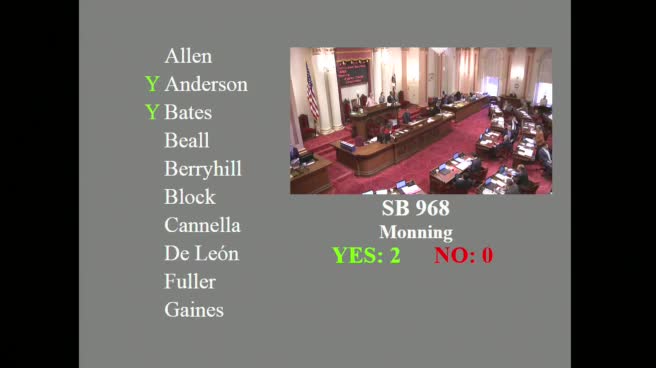 1MIN
Senate Floor
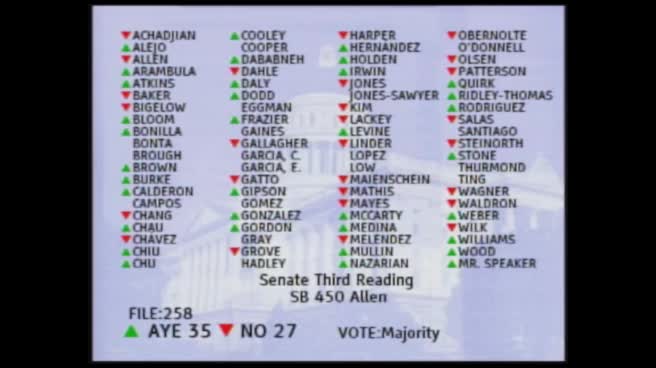 3MIN
Assembly Floor
 5MIN
Assembly Standing Committee on Health
 3MIN
Senate Floor
 3MIN
Senate Standing Committee on Appropriations
 6MIN
Senate Standing Committee on Health
Bill Author



