SJR 15: The federal Unemployment Trust Fund: debt.
- Session Year: 2025-2026
- House: Senate
- Latest Version Date: 2026-05-07
Current Status:
Failed
(2026-07-01: July 1 hearing: Failed passage in committee. (Ayes 1. Noes 3. Page 5165.))
Introduced
In Committee
Awaiting First Chamber Vote
Passed First Chamber
In Committee
Awaiting Second Chamber Vote
Passed Second Chamber
Enacted
This measure would urge the United States Congress to enact federal legislation that would ensure that federal unemployment taxes on businesses are not increased due to any debt to the federal Unemployment Trust Fund that was a direct result of a states decisions resulting in increased filings, including shutdowns, extensions of shutdowns, or lapses in fraud prevention programs.
WHEREAS, The Federal Unemployment Tax Act levies a payroll tax on employers and provides a credit against this tax for contributions made to certified state unemployment compensation programs. The credit is reduced when a state has a debt to their account in the federal Unemployment Trust Fund for a specified number of years, thus requiring employers to pay more federal unemployment tax, and Californias debt currently exceeds $20 billion; and
WHEREAS, According to the California Business Roundtable, the states employers will soon pay a 5.2-percent payroll tax, nearly nine times as much as those in other states that are debt free, plus their state payroll taxes; and
WHEREAS, A January 25, 2021, press release from the Employment Development Department (EDD) confirmed that 9.7 percent of $114 billion distributed in 2020 in unemployment benefits were sent to fraudulent claims. The Employment Development Department also acknowledged that there was another 17 percent of payments that the department was investigating as potentially fraudulent; and
WHEREAS, The total amount of fraud is estimated to be at least $20 billion; and
WHEREAS, In 2021, the EDD estimated that 5 percent of the confirmed fraud was from the states Unemployment Insurance Fund; and
WHEREAS, Fraudulent claims can contribute to the insolvency of a states account in the federal Unemployment Trust Fund, which means employers in those states may have to pay increased taxes for decades to come as they slowly return the states account to solvency, which is not fair to businesses; now, therefore, be it
Resolved by the Senate and the Assembly of the State of California, jointly, That the Legislature urges the United States Congress to enact federal legislation that would ensure that federal unemployment taxes on businesses are not increased due to any debt to the federal Unemployment Trust Fund that was a direct result of a states decisions resulting in increased filings, including shutdowns, extensions of shutdowns, or lapses in fraud prevention programs; and be it further
Resolved, That the Secretary of the Senate transmit copies of this resolution to the President and Vice President of the United States, the Speaker of the House of Representatives, the Majority and Minority Leaders of the Senate, each Senator and Representative from California in the Congress of the United States, and to the author for appropriate distribution.
|
Date
|
Status
|
|---|---|
| Jul 1, 2026 | July 1 hearing: Failed passage in committee. (Ayes 1. Noes 3. Page 5165.) |
| Jul 1, 2026 | July 1 hearing: Failed passage in committee. (Ayes 1. Noes 3.) |
| May 20, 2026 | Re-referred to Com. on L., P.E. & R. |
| May 7, 2026 | Introduced. Referred to Com. on RLS. |
|
Date
|
Description
|
Location
|
Votes
|
|
|---|---|---|---|---|
| Jul 1, 2026 | Be adopted, but first be re-referred to the Committee on [Appropriations] | Senate Standing Committee on Labor, Public Employment and Retirement |
Failed |
This list shows positions taken on this bill by organizations on the date displayed, which is linked to the original source.
Positions by individuals are not included.
SENATE COMMITTEE ON LABOR, PUBLIC EMPLOYMENT AND RETIREMENT
Senator Lola Smallwood-Cuevas, Chair
2025 - 2026 Regular
Bill No: SJR 15 Hearing Date: July 1, 2026
Author: | Jones | ||
Version: | May 7, 2026 | ||
Urgency: |
| Fiscal: | Yes |
Consultant: | Alma Perez-Schwab | ||
SUBJECT: The federal Unemployment Trust Fund: debt
KEY ISSUE
This joint resolution would urge the United States Congress to enact federal legislation that would ensure that federal unemployment taxes on businesses are not increased due to any debt to the federal Unemployment Trust Fund that was a direct result of a state’s decisions resulting in increased filings, including shutdowns, extensions of shutdowns, or lapses in fraud prevention programs.
ANALYSIS
Existing law:
- Creates a comprehensive Unemployment Insurance (UI) system, administered by the Employment Development Department (EDD), where employers pay an experienced-based tax on total payroll that is used to fund UI benefits for unemployed workers. (UI Code §§ 301, 602, 675, 926, 970, 977 & 1251)
- Defines a worker as “unemployed” in any week in which they meet any of the following:
- Any week during which they perform no services and with respect to which no wages are payable to them;
- Any week of less than full-time work, if the wages payable to them with respect to the week, when reduced by $25 or 25 percent of the wages payable, whichever is greater, do not equal or exceed the worker’s weekly benefit amount;
- Any week for which a worker is unable to work due to mental or physical health illness or injury, as specified; or,
- Any week during which they perform full-time work for five days as a juror, or as a witness under subpoena.
- UI compensation benefits are calculated based on wages paid in a worker’s base period, as specified, and provides up to a maximum of $450 each week. (UI Code §1280)
- Provides that an individual is disqualified for UI benefits if the individual left their most recent work voluntarily without good cause or that they have been discharged for misconduct connected with their most recent work. (UI Code §1256)
This bill:
- Declares that:
- The Federal Unemployment Tax Act levies a payroll tax on employers and provides a credit against this tax for contributions made to certified state unemployment compensation programs. The credit is reduced when a state has a debt to their account in the federal Unemployment Trust Fund for a specified number of years, thus requiring employers to pay more federal unemployment tax, and California’s debt currently exceeds $20 billion;
- According to the California Business Roundtable, the state’s employers will soon pay a 5.2-percent payroll tax, nearly nine times as much as those in other states that are debt free, plus their state payroll taxes;
- A January 25, 2021, press release from the Employment Development Department (EDD) confirmed that 9.7 percent of $114 billion distributed in 2020 in unemployment benefits were sent to fraudulent claims. The Employment Development Department also acknowledged that there was another 17 percent of payments that the department was investigating as potentially fraudulent;
- The total amount of fraud is estimated to be at least $20 billion;
- In 2021, the EDD estimated that 5 percent of the confirmed fraud was from the state’s Unemployment Insurance Fund;
- Fraudulent claims can contribute to the insolvency of a state’s account in the federal Unemployment Trust Fund, which means employers in those states may have to pay increased taxes for decades to come as they slowly return the state’s account to solvency, which is not fair to businesses.
- Resolves that, for the reasons declared above, the Legislature urges the United States Congress to enact federal legislation that would ensure that federal unemployment taxes on businesses are not increased due to any debt to the federal Unemployment Trust Fund that was a direct result of a state’s decisions resulting in increased filings, including shutdowns, extensions of shutdowns, or lapses in fraud prevention programs; and be it further
- Directs the Secretary of the Senate to transmit copies of this resolution to the President and Vice President of the United States, the Speaker of the House of Representatives, the Majority and Minority Leaders of the Senate, each Senator and Representative from California in the Congress of the United States, and to the author for appropriate distribution.
COMMENTS
1. Background:
Unemployment Insurance Program:
Created in 1935 as part of the Social Security Act of 1935, the UI program is a unique federal-state program, created by federal law and administered under state and federal laws by EDD. UI provides weekly benefits, for up to a maximum of 26 weeks, unless extended by law, to workers who are unemployed (or underemployed) through no fault of their own and who are able to, available for, and actively seeking work.
Claimant Benefit Calculations:
A claimant's eligibility for benefits depends on their attachment to the labor force determined by computing a minimum earnings test. This requirement denies benefits to claimants whose earnings in a 12-month "base period" are below a specified minimum. The quarter in which the highest wages were received determines the weekly benefit amount. UI benefits range from $40 to a maximum of $450 per week. In 2023, the California average UI benefit amount was $368 per week. The United States total for the 12-month average of weekly benefit amount ending on February 29, 2024 was $443.85.[1]
Financing Structure:
The UI program is financed by employers who pay unemployment taxes on the first $7,000 in wages paid to each worker. The tax rates are set based on schedules laid out in state law, which require higher rates, up to a maximum of 6.2 percent, when the condition of the UI trust fund is poor.[2] Working much like other insurance programs, the actual tax rate varies for each employer, depending in part on the amount of UI benefits paid to former employees. Referred to as being “experience rated,” this method of taxing ensures that employers who lay off or otherwise discharge more workers bear more of the costs of paying for the UI system. An employer may earn a lower tax rate when fewer claims are made on the employer's account by former employees.
According to the United States Department of Labor (US DOL), almost all states have adopted a higher taxable wage base than applicable under the Federal Unemployment Tax Act (FUTA) for purposes of assessing state UI taxes. The $7,000 taxable wage base has not been increased since 1983. Some states have established flexible taxable wage bases that are automatically adjusted, generally on an annual basis. According to the US DOL, most of these states index the taxable wage base to the state’s average annual wage. Other states tie the taxable wage base to the health of the state’s trust fund balance.
California, however, has neither a taxable wage base above $7,000 nor a provision in law that automatically adjusts the taxable wage base if FUTA is amended to apply to a higher amount.[3] In reviewing the US DOL data comparisons, it appears that Washington is the state with the highest taxable wage base at $62,500. At the lower end, California shares the lowest $7,000 taxable wage base spot with Tennessee, Arizona, Florida, Puerto Rico and Louisiana at $7,700.[4] According to the US DOL, besides the U.S. Virgin Islands, California’s trust fund was the least adequately funded of all 53 UI programs heading into the pandemic.[5]
COVID-19 Pandemic and EDD:
The COVID-19 pandemic and the shutdown orders to mitigate the spread of the virus led to a dramatic increase in unemployment beginning in March 2020. Millions of Californians were left unemployed and in critical need of assistance to replace some of the income in which they relied to pay for essentials. Supplemental benefits authorized by President Donald Trump through the federal Coronavirus Aid, Relief, and Economic Security (CARES) Act of 2020, including Pandemic Unemployment Assistance and Pandemic Emergency Unemployment Compensation, further increased the volume and dollar amount of payments. As noted by President Trump at the signing of H.R. 748/CARES Act, the federal government provided “Approximately $250 billion in expanded unemployment benefits. The average worker who has lost his or her job will receive 100 percent of their salary for up to four full months.”[6]
By April 2020, the unemployment rate had surpassed previous peaks observed during the Great Recession. At its peak, the unemployment rate in California reached 16 percent in April 2020. According to EDD, since March 2020, 36.4 million UI claims have been filed and EDD has paid $209 billion in UI benefits.[7]
EDD struggled to service this unprecedented volume of claims and because of the new populations of unemployed individuals eligible for UI under the Pandemic Unemployment Assistance program (the self-employed), EDD was exposed to a range of fraudulent activity. Under scrutiny for its handling of claims and ensuing fraudulent activity, EDD has been the subject of several State Auditor reports, Legislative Analyst’s Office reports and a Governor-directed EDD Strike Team to set a path for needed reforms at EDD. In addition, the Legislature held several oversight hearings on the department and passed into law numerous bills that addressed the various issues facing EDD. EDD has implemented all of the recommendations put forth by the State Auditor.
UI Federal Loan:
Due to the sudden and immense impact of COVID-19, the UI Fund became temporarily insolvent on April 29, 2020, and fluctuated in and out of solvency until maintaining a deficit starting June 3, 2020. As a result, in 2020, California began borrowing from the federal government to pay regular UI benefits, and ended the year with a federal loan balance of $17.8 billion. The loan balance is estimated to be $21.4 billion by the end of 2027.[8]
In order to repay the principal on the federal loan, federal law imposes a tax increase on
employers, referred to as the Federal Unemployment Tax Act (FUTA) credit reduction. This happens when a state UI Fund is in deficit for two consecutive years. Once this occurs, the state loses 0.3 percent of the FUTA tax credit each year, which is the equivalent of an increase in federal taxes of $21 per worker per year. Despite a loan balance at the end of 2020, the FUTA tax credit reduction was not assessed in that year, as California had not been in deficit for two consecutive years. The FUTA credit reductions started occurring for tax year 2022, with the higher federal taxes due in January 2023. The federal tax increase generated $396 million in 2023, $775 million in 2024, and $1.2 billion in 2025 in contributions, and the FUTA tax collections are projected to increase to $1.6 billion in 2026 and $2.0 billion in 2027.[9]
According to the LAO, “As the administration expects the underlying gap to worsen faster than the federal surcharge revenues increase, the annual fund imbalance is expected to continue despite federal payroll tax surcharges. Consequently, the administration expects the outstanding federal UI loan balance to increase by more than $1 billion over the two-year period, from $19 billion in 2022 to $20.3 billion in 2024.”[10] The state pays the interest on these loans from the General Fund. The federal loan is not expected to be paid off until between 2030 and 2032, depending on low and high-cost scenarios.
Interest on the UI loan started accruing on September 7, 2021, and the first interest payment of $29.2 million was paid on September 30, 2021. California paid a second interest payment of $333.5 million on September 30, 2022, a third interest payment of $301.6 million on September 30, 2023, and a fourth interest payment of $467.2 million on September 30, 2024. A fifth interest payment of $628.3 million was paid on September 30, 2025, and California will continue to owe interest until the loan is paid off completely.[11]
UI Fund Balance – not counting the UI federal loan debt:
California’s unemployment rate has remained steady at 5.3 percent as of May 2026.
The UI fund ended 2024 with a deficit of $21.6 billion and ended 2025 with a deficit of $21.7 billion, and the Fund is expected to continue running a deficit of $22.0 billion by 2026 and $21.4 billion by 2027.[12] Regular UI benefit amounts have declined from the peak of the COVID-19 pandemic. Despite this decline, the current financing system will not reduce the outstanding federal deficit absent annually increasing FUTA credit reductions.[13]
Legislative Analyst’s Office: Fixing Unemployment Insurance
In December 2024, the LAO released a report on the UI program which found that the UI financing system is broken and as a result: 1) the annual shortfalls will balloon our outstanding federal UI loan; 2) loans will become a permanent feature of UI and a major ongoing taxpayer cost; and 3) the UI program will be unable to build reserves ahead of the next recession.[14] The LAO found that the state’s UI tax system requires a full redesign so that contributions: 1) cover benefit costs in most years, and (2) build up a reserve that can be drawn down during recessions.
The LAO provided the following four recommendations to fix the UI system[15]:
- Substantially Increase the Taxable Wage Base. We recommend the Legislature increase the taxable wage base from $7,000 to $46,800, tying the taxable wage base to the amount of UI benefits a worker can actually receive ($450 per week). Taxing this level of earnings means no taxes would be paid on wages that are not covered by UI. This taxable wage base level would place California among the ten states with taxable wages bases above $40,000 and all other Western states. While necessary, this step alone would not be sufficient to address the state’s solvency problems.
- Redesign Employer Tax Rates Using Standard Rate and Reserve-Building Rate. Following federal guidelines, we recommend the state adopt a simple, robust UI tax structure comprised of a standard tax rate and a reserve-building tax rate. The standard tax rate would cover typical UI benefit costs. The reserve-building rate would help the state build up a robust reserve that can be drawn down during recessions. Under current conditions, the standard tax rate would be 1.4 percent and the reserve-building rate would be 0.5 percent, for a total of 1.9 percent UI tax rate applied to our proposed $46,800 taxable wage base.
- Transition to Experience Rating System with Fewer Downsides. We recommend the Legislature transition to a new experience rating system that bases employers’ tax rates on increases or decreases in their employment, rather than an exact accounting of their former workers’ UI costs (as the current system operates). This approach would continue to reflect, indirectly, employers’ costs to the UI system because business that reduce employment tend to have higher UI usage. Thus, this alternative approach maintains the policy goals of experience rating but does not suffer from the main downsides of the current system.
- Refinance the Federal Loan with Shared Participation Between Businesses and the State. The outstanding federal loan complicates the state’s efforts to fix its broken UI financing system: as long as the federal loan remains outstanding, even an improved tax system would probably not be able to build reserves ahead of the next recession. To address this, and in acknowledgment of the unique nature of the pandemic that caused the significant UI loan, we outline a shared approach to refinancing the federal loan. This would involve two equal parts: (1) a revenue bond paid back by employers and (2) new borrowing from the Pooled Money Investment Account paid back by the General Fund.
ACA 20 – Save for California’s Future Act:
Among other things, Assembly Constitutional Amendment 20 (chaptered on 6/25/26 as Chapter 130, Statutes of 2026) would, subject to voter approval, amend the provisions of Proposition 2 to build more reserves and extend and expand extra debt payments. Proposition 2 (2014), one of the state’s rainy day funds, established a set of formulas that determine how much in reserves the state must set aside each year. Among its provisions, ACA 20 would authorize the state to use the Proposition 2 debt payments to pay the state’s federal UI loan.
2. Stated need for this joint resolution?
According to the author:
“Given the length of time (from 2023 into the 2030s) that it may take to pay off the loan balance, employers are going to be facing a significant tax increase. In this case, actions taken by the Legislature and Governor, which created a structural imbalance over a decade ago (i.e., increasing UI benefits without offsetting the increased costs in SB 40 (Alarcon) 2001, which was opposed by all Republican Legislators) combined with unanticipated rates of unemployment caused by the Governor’s shuttering of the economy created this backdoor tax increase on employers.
This is unfair and will end up harming the state’s job creators, as employers are being forced through higher taxes to repay a loan balance to federal government that was a result of state action rather than employer action. In this case, businesses were ordered to shut their doors, which meant their employees had to go on unemployment. As mentioned above, the current UI funding scheme is intended to shift more of the burden for funding the UI system on those employers responsible for laying off a higher percentage of workers. In other words, it attempts to hold accountable those who create a greater strain on the system. As it relates to the current strain on the system, the state is responsible for it and therefore must be accountable by paying for it. By requiring employers to pick up the tab for this state action, California is essentially forcing employers into the role of providing a safety net, which is an improper role for employers.
This will harm employers, especially the many small and medium size employers who are still trying to recover from the forced closures and the additional costs/burdens placed upon them by the state’s response to COVID-19. The higher UI taxes will interfere with their ability to pay off debt accumulated while shut down, while also affecting their ability to recover and grow.”
3. Proponent Arguments:
None received.
4. Opponent Arguments:
None received.
5. Prior/Related Legislation:
SB 1434 (Durazo, 2024) would have implemented reforms to the UI program that would have, among other things, increased the $7,000 taxable base wage to an unspecified amount and increased UI benefits to a maximum amount of $700, plus annual cost of living adjustments. SB 1434 was pulled from hearing by the author and never heard.
SUPPORT
None received
OPPOSITION
None received
-- END --
https://oui.doleta.gov/unemploy/DataDashboard.asp ↑
Alamo, Chas. “Repaying the State’s Federal Unemployment Insurance Loan,” Legislative Analyst’s Office, May 26, 2021. https://lao.ca.gov/Publications/Report/4442 ↑
U.S. Department of Labor, Comparison of State Unemployment Laws 2022. Chapter 2 – Financing, 2-4 and 2-5. https://oui.doleta.gov/unemploy/pdf/uilawcompar/2022/complete.pdf ↑
U.S. Department of Labor, Comparison of State Unemployment Laws 2022. Chapter 2 – Financing, 2-5. https://oui.doleta.gov/unemploy/pdf/uilawcompar/2022/complete.pdf ↑
U.S. Department of Labor, “State Unemployment Insurance Trust Fund Solvency Report 2020,” https://oui.doleta.gov/unemploy/docs/trustFundSolvReport2020.pdf ↑
https://trumpwhitehouse.archives.gov/briefings-statements/remarks-president-trump-signing-h-r-748-cares-act/ ↑
https://edd.ca.gov/en/newsroom/facts-and-stats/dashboard/ ↑
EDD May 2026 UI Fund Forecast. https://edd.ca.gov/siteassets/files/unemployment/pdf/2026-may-ui-fund-forecast.pdf ↑
EDD May 2026 UI Fund Forecast. https://edd.ca.gov/siteassets/files/unemployment/pdf/2026-may-ui-fund-forecast.pdf ↑
Alamo, Chas. “New Unemployment Insurance Fund Forecast Shows Imbalance,” Legislative Analyst’s Office, July 7, 2023. https://lao.ca.gov/LAOEconTax/article/Detail/779 ↑
EDD May 2026 UI Fund Forecast. https://edd.ca.gov/siteassets/files/unemployment/pdf/2026-may-ui-fund-forecast.pdf ↑
Ibid. ↑
Ibid. ↑
Petek, Gabriel. “Fixing Unemployment Insurance,” Legislative Analyst’s Office, December 2024. https://lao.ca.gov/reports/2024/4943/Fixing-Unemployment-Insurance-120224.pdf ↑
Ibid. ↑
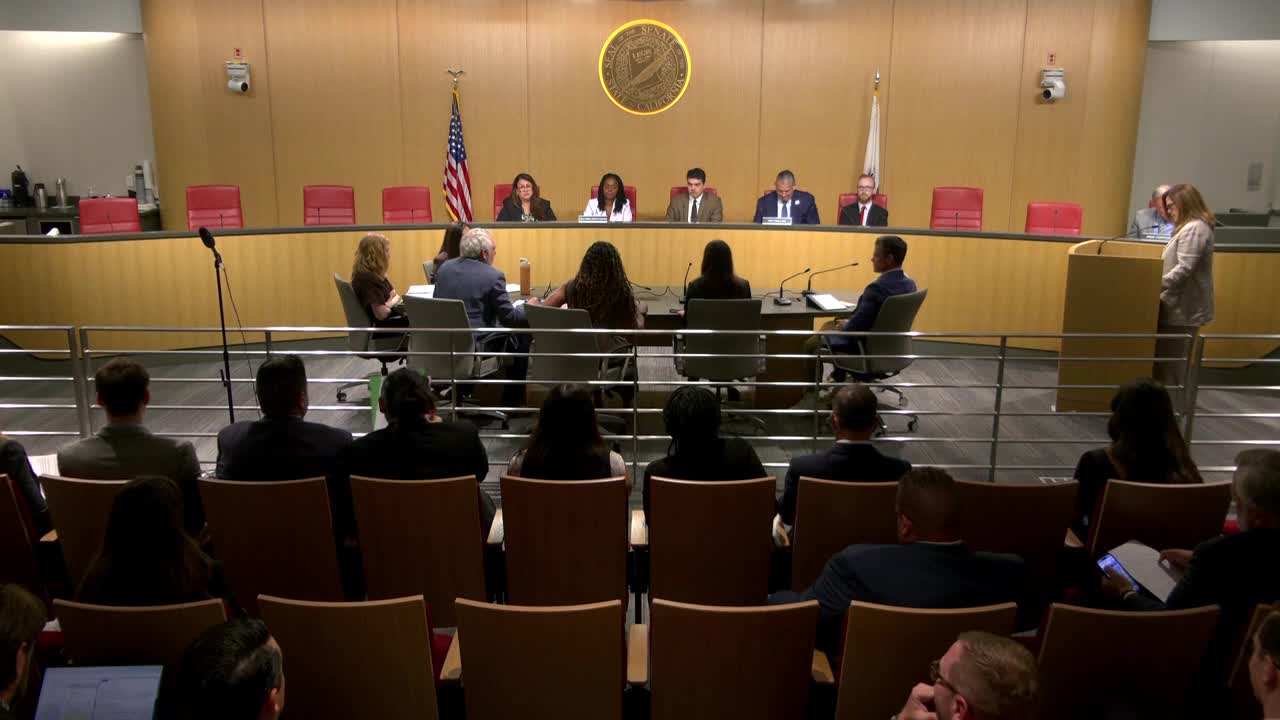
Discussed in Hearing
 11MIN
Senate Standing Committee on Labor, Public Employment and Retirement
Bill Author