SJR 16: Vehicles: commercial driver’s license revocation.
- Session Year: 2025-2026
- House: Senate
- Latest Version Date: 2026-08-24
Current Status:
Passed
(2026-08-24: Chaptered by Secretary of State. Res. Chapter 206, Statutes of 2026.)
Introduced
In Committee
Awaiting First Chamber Vote
Passed First Chamber
In Committee
Awaiting Second Chamber Vote
Passed Second Chamber
Enacted
This measure would urge the Congress of the United States and the Federal Motor Carrier Safety Administration to review federal commercial drivers license disqualification policies and consider reforms that allow greater flexibility for states and appropriate relief for drivers whose livelihoods are affected.
This measure would urge the Congress of the United States and the Federal Motor Carrier Safety Administration to review federal commercial drivers license disqualification policies and consider reforms that allow greater flexibility for states and appropriate relief for drivers whose livelihoods are affected.
This measure would urge the Congress of the United States and the Federal Motor Carrier Safety Administration to review federal commercial drivers license disqualification policies and consider reforms that allow greater flexibility for states and appropriate relief for drivers whose livelihoods are affected.
WHEREAS, Commercial drivers play a necessary role in the movement of essential goods, and are an integral part of Californias economy; and
WHEREAS, There are over 700,000 commercial drivers in California; and
WHEREAS, Commercial drivers transport essential medicine, food, and necessary fuels that people rely on every day; and
WHEREAS, California relies on commercial drivers to transport shipping containers from its 12 seaports and that traffic is approximately 40 percent of imported shipping container traffic across the United States; and
WHEREAS, Commercial drivers do this job for weeks on end, to facilitate the efficient logistical operation of everyday business, without seeing their families; and
WHEREAS, Federal regulations governing commercial drivers licenses are administered by the Federal Motor Carrier Safety Administration; and
WHEREAS, Revised federal disqualification rules have resulted in the suspension or permanent loss of an estimated 17,000 commercial drivers licenses, effectively ending a drivers ability to earn a livelihood; and
WHEREAS, These disqualifications occurred even in cases where the underlying conduct did not involve unsafe operation of a commercial motor vehicle; and
WHEREAS, The trucking industry continues to experience workforce shortages that affect supply chains and economic stability; now, therefore, be it
Resolved by the Senate and the Assembly of the State of California, jointly, That the Legislature respectfully urges the Congress of the United States and the Federal Motor Carrier Safety Administration to review federal commercial drivers license disqualification policies and consider reforms that allow greater flexibility for states and appropriate relief for drivers whose livelihoods are affected; and be it further
Resolved, That the Secretary of the Senate transmit copies of this resolution to the President of the United States, the Administrator of the Federal Motor Carrier Safety Administration, to each Member of the California delegation in the Congress of the United States, and to the author for appropriate distribution.
|
Date
|
Status
|
|---|---|
| Aug 24, 2026 | Chaptered by Secretary of State. Res. Chapter 206, Statutes of 2026. |
| Aug 24, 2026 | Enrolled and filed with the Secretary of State at 1 p.m. |
| Aug 19, 2026 | In Senate. Ordered to engrossing and enrolling. |
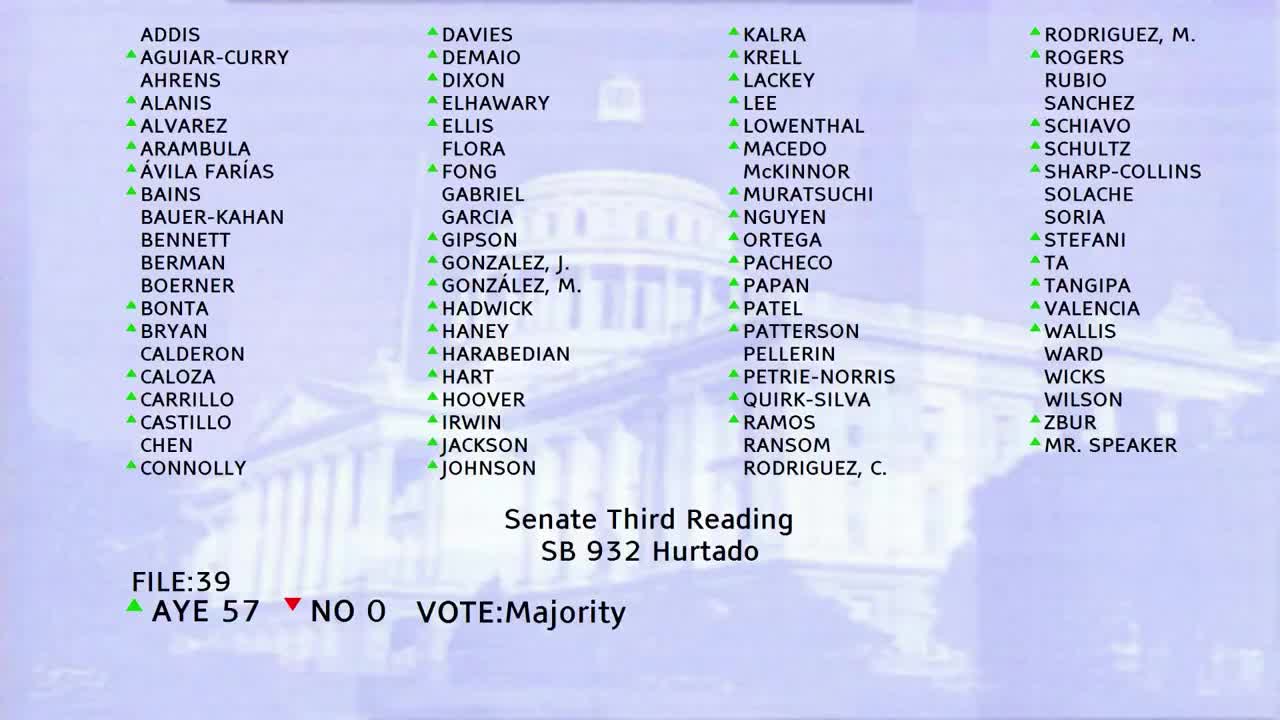
| Aug 19, 2026 | Read. Adopted. (Ayes 59. Noes 12. Page 6263.) Ordered to the Senate. |
| Aug 19, 2026 | Read. Adopted. Ordered to the Senate. |
| Aug 11, 2026 | From committee: Be adopted. Ordered to third reading. (Ayes 10. Noes 1.) (August 10). |
| Aug 6, 2026 | Referred to Com. on TRANS. |
| Jun 30, 2026 | In Assembly. Held at Desk. |
| Jun 29, 2026 | Read. Adopted. (Ayes 29. Noes 5. Page 5082.) Ordered to the Assembly. |
| Jun 29, 2026 | Read. Adopted. (Ayes 29. Noes 5.) Ordered to the Assembly. |
| Jun 9, 2026 | From committee: Be adopted. Ordered to third reading. (Ayes 9. Noes 3. Page 4650.) (June 9). |
| Jun 9, 2026 | From committee: Be adopted. Ordered to third reading. (Ayes 9. Noes 3.) (June 9). |
| May 27, 2026 | Set for hearing June 9. |
| May 20, 2026 | Re-referred to Com. on TRANS. |
| May 7, 2026 | Introduced. Referred to Com. on RLS. |
|
Date
|
Description
|
Location
|
Votes
|
|
|---|---|---|---|---|
| Aug 19, 2026 | SJR 16 Caballero Senate Third Reading By Wilson | Assembly Floor |
Passed |
|
| Aug 10, 2026 | Be adopted. To third reading. | Assembly Standing Committee on Transportation |
Passed |
|
| Jun 29, 2026 | Senate 3rd Reading SJR16 Caballero et al. | Senate Floor |
Passed |
|
| Jun 9, 2026 | Be adopted. Ordered to third reading | Senate Standing Committee on Transportation |
Passed |
This list shows positions taken on this bill by organizations on the date displayed, which is linked to the original source.
Positions by individuals are not included.
|
Organization
|
Position
|
Date
|
|---|---|---|
| California Federation of Labor Unions | ** Support | |
| Teamsters California | ** Support |
SENATE THIRD READING
STR Bill Id:SJR 16
Author:(Caballero)
As Introduced Ver:May 7, 2026
Majority vote
SUMMARY
Urges Congress of the United States and the Federal Motor Carrier Safety Administration (FMCSA) to review federal commercial driver's license (CDL) disqualification policies and consider reforms that allow greater flexibility for states and appropriate relief for drivers.
Major Provisions
COMMENTS
In April of 2025, President Trump issued an executive order establishing stronger federal oversight of CDL standards, including strengthening enforcement of English language proficiency requirements for commercial drivers and directing the U.S. Department of Transportation (USDOT) to review how states issue non-domiciled CDLs.
In June of 2025 the FMCSA launched a nationwide audit of state issuance of non-domiciled CDLs to identify potential compliance issues.
On September 26, 2025, FMCSA announced an emergency action restricting eligibility for issuance and renewal of non-domiciled commercial learner's permits (CLPs) and CDLs. Under the rule: Non-citizens could only obtain non-domiciled CDLs if they meet stricter federal standards, including employment-based visas and mandatory federal immigration verification using SAVE.
According to FMCSA, California admitted to improperly issuing about 20,100 non-domiciled CDLs of the total 65,000 non-domiciled CDLs in the state, which the state has been directed to revoke and reissue under compliant procedures. Most of these CDLs had expiration dates that went beyond the individuals' legal time present in the United States. In response, the Department of Motor Vehicles (DMV) scheduled to cancel 17,400 CDLs on January 5, 2026 with a remaining 2,700 to be cancelled February 13, 2026.
On December 30, 2025, DMV made the decision to delay the cancellation of the CDLs by an additional 60 days.
On January 7, FMCSA took action to withhold federal highway funds from California for failing to meet federal compliance requirements, specifically:
- A previous withhold of around $40 million for failure to enforce English language proficiency standards. (Code of Federal Regulations (CFR) Title 49 Section 391.11(b)(2))
- A determination to withhold approximately $158 million beginning fiscal year 2027 due to continued non-compliance in California's CDL program and up to $315 million if noncompliance continues. The federal government has underscored that withheld funds are not merely deferred but permanently lost if compliance is not achieved.
On March 6, 2026 the DMV canceled approximately 13,000 nondomiciled CDLs in compliance with the Trump administrations new regulations.
As of July 2026, California is continuing to challenge the federal funding loss of $158 million in federal court, which will take effect on October 1.
According to the Author
According to the author, "California's commercial truck drivers are the backbone of our supply chain and a critical workforce that keeps our state and our nation moving. In March of this year, a federal rulemaking targeting immigrant drivers disenfranchised 13,000 commercial drivers in California, stripping them of their ability to earn a living, provide for their families, and contribute the essential logistical services our economy depends on. This action threatens California's working families. Commercial truck drivers cross the country for weeks at a time, often working under dangerous weather conditions, away from their loved ones, to deliver the goods that sustain our communities. SJR 16 calls on Congress to take action to reinstate the displaced drivers who lost their ability to operate commercial vehicles following this federal rulemaking, and to recognize the substantial economic contributions these workers make to California and to the nation. This resolution is an important step to stabilize our supply chain, protect working families, and ensure that the drivers who keep our economy moving are valued and supported."
Arguments in Support
According to the California Federation of Labor Unions, "Commercial drivers form an invaluable part of the supply chain economy in California and across the country. Drivers serve communities nationwide by delivering essentials like food, fuel, goods, and medicine. They also provide critical logistical services that move vehicles, houses, and even people through bus and transit operations. The scope of their work is vast, and their role represents a revolutionary evolution in logistical capability.
The stakes for California are especially high. Roughly 60% of the nation's international imports enter the country through California's major ports. To meet this demand, the state permits logistics companies to employ non-domiciled drivers, drivers that live in other states but move goods all over the country, allowing these workers to earn meaningful livelihoods and support their families. The drivers affected by the recent enforcement action are legally present immigrants, many of whom have started their own trucking and logistics companies. The consequences extend across the economy. The loss of these drivers has weakened supply chains, slowed the delivery of goods, and contributed to rising fuel prices tied to reduced delivery capacity.
SJR 16 calls on Congress to take meaningful action by restoring the DMV's authority to make compliance determinations within the federal standard, as the state exercised prior to this rulemaking. It further urges Congress to formally recognize the substantial economic contributions these drivers make to California and to the nation. Reinstating this authority is not simply a matter of administrative process. It is a critical step toward stabilizing the supply chain, protecting working families, and ensuring that the workers who keep our economy moving are valued rather than displaced and economically abandoned."
Arguments in Opposition
None on file.
FISCAL COMMENTS
This measure is keyed non-fiscal by legislative counsel.
VOTES
SENATE FLOOR: 29-5-6
YES: Allen, Archuleta, Arreguín, Ashby, Becker, Blakespear, Cabaldon, Caballero, Cervantes, Cortese, Durazo, Gonzalez, Grayson, Hurtado, Laird, Limón, McGuire, McNerney, Menjivar, Padilla, Pérez, Reyes, Richardson, Smallwood-Cuevas, Stern, Umberg, Wahab, Weber Pierson, Wiener
NO: Choi, Dahle, Niello, Seyarto, Strickland
ABS, ABST OR NV: Alvarado-Gil, Grove, Jones, Ochoa Bogh, Rubio, Valladares
ASM TRANSPORTATION: 10-1-5
YES: Wilson, Aguiar-Curry, Ahrens, Carrillo, Harabedian, Hart, Papan, Ransom, Sharp-Collins, Ward
NO: Macedo
ABS, ABST OR NV: Davies, Hoover, Jackson, Lackey, Rogers
UPDATED
VERSION: May 7, 2026
CONSULTANT: David Sforza / TRANS. / (916) 319-2093 FN: 0003421
Date of Hearing: August 10, 2026
ASSEMBLY COMMITTEE ON TRANSPORTATION
Lori D. Wilson, Chair
SBPCA Bill Id:SJR 16
Author:(Caballero) – As Introduced Ver:May 7, 2026
SENATE VOTE: 29-5
SUBJECT: Vehicles: commercial driver’s license revocation
SUMMARY: Urges Congress of the United States and the Federal Motor Carrier Safety Administration (FMCSA) to review federal commercial driver’s license (CDL) disqualification policies and consider reforms that allow greater flexibility for states and appropriate relief for drivers. Specifically, this bill:
Makes various findings and declarations related to cancelling CDLs as a result of changes made to federal regulations.
EXISTING LAW: Requires a person to have in their immediate possession a valid CDL of the appropriate class to operate a CMV, and prohibits the DMV from issuing a CDL to a person until the person passes a knowledge test and driving test for the operation of a CMV that complies with the minimum federal standards established by the federal Commercial Motor Vehicle Safety Act of 1986 (Public Law 99-570) and Part 383 of Title 49 of the Code of Federal Regulations, and has satisfied all other requirements of that act as well as any other requirements imposed by this code. (Vehicle Code Section 15250)
Existing federal regulations:
- Require a person to person to prove they are a citizen of the United States or that they are a lawful Permanent Resident to obtain a CDL or Commercial Driver’s Permit.
- Authorizes the following documents as proof of US Citizenship:
- Valid, unexpired US Passport;
- Certified copy of a birth certificate filed with a State Office of Vital Statistics or equivalent agency;
- Consular Report of Birth Abroad (CRBA) issued by the U.S. Department of State;
- Certification of Naturalization used by the U.S. Department of Homeland Security (DHS); and,
- Certificate of Citizenship issued by DHS. (Title 49 CFR 383.73)
- Requires a Lawful Permanent Resident to file proof a valid, unexpired Permanent Resident Card. (Title 49 CFR 383.73)
- Requires States to verify evidence of lawful immigration status for applicants domiciled in a foreign jurisdiction before issuance of a CDL. (Title 49 CFR 383.73)
- Requires States to query SAVE to verify evidence of lawful immigration status. Prohibits a state from issuing a CDL to a person if SAVE does not verify their lawful immigration status. (Title 49 CFR 383.73)
FISCAL EFFECT: Uknown
COMMENTS: According to the author, "California's commercial truck drivers are the backbone of our supply chain and a critical workforce that keeps our state and our nation moving. In March of this year, a federal rulemaking targeting immigrant drivers disenfranchised 13,000 commercial drivers in California, stripping them of their ability to earn a living, provide for their families, and contribute the essential logistical services our economy depends on. This action threatens California's working families. Commercial truck drivers cross the country for weeks at a time, often working under dangerous weather conditions, away from their loved ones, to deliver the goods that sustain our communities. SJR 16 calls on Congress to take action to reinstate the displaced drivers who lost their ability to operate commercial vehicles following this federal rulemaking, and to recognize the substantial economic contributions these workers make to California and to the nation. This resolution is an important step to stabilize our supply chain, protect working families, and ensure that the drivers who keep our economy moving are valued and supported.”
In April of 2025, President Trump issued an executive order establishing stronger federal oversight of CDL standards, including strengthening enforcement of English language proficiency requirements for commercial drivers and directing the U.S. Department of Transportation (USDOT) to review how states issue non-domiciled CDLs.
In June of 2025 the FMCSA launched a nationwide audit of state issuance of non-domiciled CDLs to identify potential compliance issues.
On September 26, 2025, FMCSA announced an emergency action restricting eligibility for issuance and renewal of non-domiciled commercial learner’s permits (CLPs) and CDLs. Under the rule: Non-citizens could only obtain non-domiciled CDLs if they meet stricter federal standards, including employment-based visas and mandatory federal immigration verification using SAVE.
According to FMCSA, California admitted to improperly issuing about 20,100 non-domiciled CDLs of the total 65,000 non-domiciled CDLs in the state, which the state has been directed to revoke and reissue under compliant procedures. Most of these CDLs had expiration dates that went beyond the individuals’ legal time present in the United States. In response, DMV scheduled to cancel 17,400 CDLs on January 5, 2026 with a remaining 2,700 to be cancelled February 13, 2026.
On December 30, 2025, DMV made the decision to delay the cancellation of the CDLs by an additional 60 days.
On January 7, FMCSA took action to withhold federal highway funds from California for failing to meet federal compliance requirements, specifically:
- A previous withhold of around $40 million for failure to enforce English language proficiency standards. (49 C.F.R. § 391.11(b)(2))
- A determination to withhold approximately $158 million beginning fiscal year 2027 due to continued non-compliance in California’s CDL program and up to $315 million if noncompliance continues. The federal government has underscored that withheld funds are not merely deferred but permanently lost if compliance is not achieved.
On March 6, 2026 the DMV canceled approximately 13,000 nondomiciled CDLs in compliance with the Trump administrations new regulations.
As of July 2026, California is continuing to challenge the federal funding loss of $158 million in federal court, which will take effect on October 1.
The California Federation of Labor Unions, writing in support of this resolution, argue “Commercial drivers form an invaluable part of the supply chain economy in California and across the country. Drivers serve communities nationwide by delivering essentials like food, fuel, goods, and medicine. They also provide critical logistical services that move vehicles, houses, and even people through bus and transit operations. The scope of their work is vast, and their role represents a revolutionary evolution in logistical capability.
The stakes for California are especially high. Roughly 60 percent of the nation’s international imports enter the country through California’s major ports. To meet this demand, the state permits logistics companies to employ non-domiciled drivers, drivers that live in other states but move goods all over the country, allowing these workers to earn meaningful livelihoods and support their families. The drivers affected by the recent enforcement action are legally present immigrants, many of whom have started their own trucking and logistics companies. The consequences extend across the economy. The loss of these drivers has weakened supply chains, slowed the delivery of goods, and contributed to rising fuel prices tied to reduced delivery capacity.
SJR 16 calls on Congress to take meaningful action by restoring the DMV’s authority to make compliance determinations within the federal standard, as the state exercised prior to this rulemaking. It further urges Congress to formally recognize the substantial economic contributions these drivers make to California and to the nation. Reinstating this authority is not simply a matter of administrative process. It is a critical step toward stabilizing the supply chain, protecting working families, and ensuring that the workers who keep our economy moving are valued rather than displaced and economically abandoned.”
REGISTERED SUPPORT / OPPOSITION:
Support
California Federation of Labor Unions, AFL-CIO
Teamsters California
Opposition
None on file
Analysis Prepared by: David Sforza / TRANS. / (916) 319-2093
SENATE RULES COMMITTEE Office of Senate Floor Analyses (916) 651-4171 | SJR 16 |
THIRD READING
Bill No: SJR 16
Author: Caballero (D), et al.
Introduced: 5/7/26
Vote: 21
SENATE TRANSPORTATION COMMITTEE: 9-3, 6/9/26
AYES: Cortese, Archuleta, Arreguín, Blakespear, Gonzalez, Grayson, Menjivar, Richardson, Wiener
NOES: Strickland, Dahle, Seyarto
NO VOTE RECORDED: Valladares
SUBJECT: Vehicles: commercial driver’s license revocation
SOURCE: Author
DIGEST:
This resolution urges the United States Congress and the Federal Motor Carrier Safety Administration (FMCSA) to reevaluate certain regulations pertaining to commercial driver’s licenses (CDL), as specified.
ANALYSIS:
Existing law:
- Develops and administers via FMCSA at the federal level, CDL regulations that set nationwide standards relating to testing and licensing requirements, vehicle endorsements, and safety standards, as provided.
- Declares, at the state level, that the Department of Motor Vehicles (DMV) is responsible for issuing, renewing, and enforcing compliance with CDL requirements, as specified.
This resolution urges the United States Congress and FMCSA to review federal CDL disqualification policies and consider reforms that allow states greater flexibility related to the enforcement of federal disqualification policies, as specified.
Comments
Purpose of the resolution. According to the author, "California's commercial truck drivers are the backbone of our supply chain and a critical workforce that keeps our state and our nation moving. In March of this year, a federal rulemaking targeting immigrant drivers disenfranchised 13,000 commercial drivers in California, stripping them of their ability to earn a living, provide for their families, and contribute the essential logistical services our economy depends on. This action threatens California's working families. Commercial truck drivers cross the country for weeks at a time, often working under dangerous weather conditions, away from their loved ones, to deliver the goods that sustain our communities. SJR 16 calls on Congress to take action to reinstate the displaced drivers who lost their ability to operate commercial vehicles following this federal rulemaking, and to recognize the substantial economic contributions these workers make to California and to the nation. This resolution is an important step to stabilize our supply chain, protect working families, and ensure that the drivers who keep our economy moving are valued and supported.”
FMCSA’s Interim Final Rule. On September 29, 2025, FMCSA issued an Interim Final Rule to limit state’s ability to issue and renew non-domiciled CDLs to certain individuals domiciled in foreign jurisdictions. Specifically, the Rule amends Title 49 within the Code of Federal Regulations (CFR), Parts 383 and 384, narrowing individuals eligible for non-domiciled CDLs by imposing stricter eligibility limits, changing documentation requirements, and requiring states to verify immigration states via the Systematic Alien Verification for Entitlements (SAVE) database. The Interim Final Rule went into immediate effect, in turn, requiring DMV to notify certain CDL holders that their license would be revoked per new federal regulations. Currently, a stay has been issued by the United States Court of Appeals (D.C. Circuit) due to a number of lawsuits pending in regard to the Interim Final Rule leaving both the Rule and implementation of the Rule on pending.
This resolution urges the United States Congress and FMCSA to review the Interim Final Rule’s CDL disqualification policies and further consider reforms that provide greater flexibility for states to ensure the jobs and economic well‑being of thousands of commercial drivers in California and throughout the country are preserved.
FISCAL EFFECT: Appropriation: No Fiscal Com.: No Local: No
SUPPORT: (Verified 6/10/26)
California Federation of Labor Unions, Afl-cio
Teamsters California
OPPOSITION: (Verified 6/10/26)
None received
Prepared by: Manny Leon / TRANS. / (916) 651-4121
6/10/26 16:52:23
**** END ****
SENATE COMMITTEE ON TRANSPORTATION
Senator Dave Cortese, Chair
2025 - 2026 Regular
Bill No: Hearing Date: 6/9/2026
Author: | Caballero | ||
Version: | 5/7/2026 Introduced | ||
Urgency: | No | Fiscal: | No |
Consultant: | Manny Leon | ||
SUBJECT:
DIGEST: This resolution urges the United States Congress and the Federal Motor Carrier Safety Administration (FMCSA) to reevaluate certain regulations pertaining to commercial driver’s licenses (CDL), as specified.
ANALYSIS:
Existing law:
- At the federal level, FMCSA develops and administers CDL regulations that set nationwide standards relating to testing and licensing requirements, vehicle endorsements, and safety standards, as provided.
- At the state level, the Department of Motor Vehicles (DMV) is responsible for issuing, renewing, and enforcing compliance with CDL requirements, as specified.
This resolution:
- Urges the United States Congress and FMCSA to review federal CDL disqualification policies and consider reforms that allow states greater flexibility related to the enforcement of federal disqualification policies, as specified.
COMMENTS:
- Purpose of the resolution. According to the author, "California's commercial truck drivers are the backbone of our supply chain and a critical workforce that keeps our state and our nation moving. In March of this year, a federal rulemaking targeting immigrant drivers disenfranchised 13,000 commercial drivers in California, stripping them of their ability to earn a living, provide for their families, and contribute the essential logistical services our economy depends on. This action threatens California's working families. Commercial truck drivers cross the country for weeks at a time, often working under dangerous weather conditions, away from their loved ones, to deliver the goods that sustain our communities. SJR 16 calls on Congress to take action to reinstate the displaced drivers who lost their ability to operate commercial vehicles following this federal rulemaking, and to recognize the substantial economic contributions these workers make to California and to the nation. This resolution is an important step to stabilize our supply chain, protect working families, and ensure that the drivers who keep our economy moving are valued and supported.”
- FMCSA’s Interim Final Rule. On September 29, 2025, FMCSA issued an Interim Final Rule to limit state’s ability to issue and renew non-domiciled CDLs to certain individuals domiciled in foreign jurisdictions. Specifically, the Rule amends Title 49 within the Code of Federal Regulations (CFR), Parts 383 and 384, narrowing individuals eligible for non-domiciled CDLs by imposing stricter eligibility limits, changing documentation requirements, and requiring states to verify immigration states via the Systematic Alien Verification for Entitlements (SAVE) database. The Interim Final Rule went into immediate effect, in turn, requiring DMV to notify certain CDL holders that their license would be revoked per new federal regulations. Currently, a stay has been issued by the United States Court of Appeals (D.C. Circuit) due to a number of lawsuits pending in regard to the Interim Final Rule leaving both the Rule and implementation of the Rule on pending.
This resolution urges the United States Congress and FMCSA to review the Interim Final Rule’s CDL disqualification policies and further consider reforms that provide greater flexibility for states to ensure the jobs and economic well‑being of thousands of commercial drivers in California and throughout the country are preserved.
FISCAL EFFECT: Appropriation: No Fiscal Com.: Local: No
POSITIONS: (Communicated to the committee before noon on Wednesday,
June 3, 2026.)
SUPPORT:
None received
OPPOSITION:
None received
-- END --
Discussed in Hearing
 3MIN
Assembly Floor
 8MIN
Assembly Standing Committee on Transportation
 3MIN
Senate Floor
 9MIN
Senate Standing Committee on Transportation
Bill Author