SB 1150: Mortgages and deeds of trust: mortgage servicers: successors in interest.
- Session Year: 2015-2016
- House: Senate
- Latest Version Date: 2016-09-29
Existing law imposes various requirements to be satisfied prior to exercising a power of sale under a mortgage or deed of trust. Existing law gives a borrower, as defined, various rights and remedies against a mortgage servicer, mortgagee, trustee, beneficiary, and authorized agent in regards to foreclosure prevention alternatives, as defined, including loan modifications, which is commonly referred to as being part of the California Homeowner Bill of Rights. Existing law defines a mortgage servicer as a person or entity who directly services a loan, or is responsible for interacting with the borrower, and managing the loan account on a daily basis, as specified.
This bill until January 1, 2020, would prohibit a mortgage servicer, upon notification that a borrower has died, from recording a notice of default until the mortgage servicer does certain things, including requesting reasonable documentation of the death of the borrower from a claimant, who is someone claiming to be a successor in interest, who is not a party to the loan or promissory note and providing a reasonable period of time for the claimant to present the requested documentation. The bill would deem a claimant a successor in interest, as defined, upon receipt by a mortgage servicer of the reasonable documentation regarding the status of the claimant as a successor in interest and the claimants ownership interest in the real property.
The bill would require a mortgage servicer, within 10 days of a claimant being deemed a successor in interest, to provide the successor in interest with information about the loan, as specified. The bill would require a mortgage servicer to allow a successor in interest to assume the deceased borrowers loan or to apply for foreclosure prevention alternatives on an assumable loan, as specified. The bill would authorize a mortgage servicer, when there are multiple successors in interest who do not wish to proceed as coborrowers or coapplicants, to require any nonapplicant successor in interest to consent in writing to the application for a loan assumption. The bill would provide that a successor in interest, as specified, who assumes an assumable loan and wishes to apply for a foreclosure prevention alternative has the same rights and remedies as a borrower under specified provisions of the California Homeowner Bill of Rights. The bill would authorize a successor in interest to bring an action for injunctive relief to enjoin a material violation of specified provisions of law and would authorize a court to award a prevailing successor in interest reasonable attorneys fees and costs for the action. The bill would define terms for these purposes and make various findings and declarations. The bill would deem a mortgage servicer, mortgagee, or beneficiary of the deed of trust, or an agent thereof, to be in compliance with the above-described provisions if they comply with specified federal laws. The bill would exempt certain depository institutions and persons from these provisions, as specified.
Existing law imposes various requirements to be satisfied prior to exercising a power of sale under a mortgage or deed of trust. Existing law gives a borrower, as defined, various rights and remedies against a mortgage servicer, mortgagee, trustee, beneficiary, and authorized agent in regards to foreclosure prevention alternatives, as defined, including loan modifications, which is commonly referred to as being part of the California Homeowner Bill of Rights. Existing law defines a mortgage servicer as a person or entity who directly services a loan, or is responsible for interacting with the borrower, and managing the loan account on a daily basis, as specified.
This bill until January 1, 2020, would prohibit a mortgage servicer, upon notification that a borrower has died, from recording a notice of default until the mortgage servicer does certain things, including requesting reasonable documentation of the death of the borrower from a claimant, who is someone claiming to be a successor in interest, who is not a party to the loan or promissory note and providing a reasonable period of time for the claimant to present the requested documentation. The bill would deem a claimant a successor in interest, as defined, upon receipt by a mortgage servicer of the reasonable documentation regarding the status of the claimant as a successor in interest and the claimants ownership interest in the real property.
The bill would require a mortgage servicer, within 10 days of a claimant being deemed a successor in interest, to provide the successor in interest with information about the loan, as specified. The bill would require a mortgage servicer to allow a successor in interest to assume the deceased borrowers loan or to apply for foreclosure prevention alternatives on an assumable loan, as specified. The bill would authorize a mortgage servicer, when there are multiple successors in interest who do not wish to proceed as coborrowers or coapplicants, to require any nonapplicant successor in interest to consent in writing to the application for a loan assumption. The bill would provide that a successor in interest, as specified, who assumes an assumable loan and wishes to apply for a foreclosure prevention alternative has the same rights and remedies as a borrower under specified provisions of the California Homeowner Bill of Rights. The bill would authorize a successor in interest to bring an action for injunctive relief to enjoin a material violation of specified provisions of law and would authorize a court to award a prevailing successor in interest reasonable attorneys fees and costs for the action. The bill would define terms for these purposes and make various findings and declarations. The bill would deem a mortgage servicer, mortgagee, or beneficiary of the deed of trust, or an agent thereof, to be in compliance with the above-described provisions if they comply with specified federal laws. The bill would exempt certain depository institutions and persons from these provisions, as specified.
Existing law imposes various requirements to be satisfied prior to exercising a power of sale under a mortgage or deed of trust. Existing law gives a borrower, as defined, various rights and remedies against a mortgage servicer, mortgagee, trustee, beneficiary, and authorized agent in regards to foreclosure prevention alternatives, as defined, including loan modifications, which is commonly referred to as being part of the California Homeowner Bill of Rights. Existing law defines a mortgage servicer as a person or entity who directly services a loan, or is responsible for interacting with the borrower, and managing the loan account on a daily basis, as specified.
This bill until January 1, 2020, would prohibit a mortgage servicer, upon notification that a borrower has died, from recording a notice of default until the mortgage servicer does certain things, including requesting reasonable documentation of the death of the borrower from a claimant, who is someone claiming to be a successor in interest, who is not a party to the loan or promissory note and providing a reasonable period of time for the claimant to present the requested documentation. The bill would deem a claimant a successor in interest, as defined, upon receipt by a mortgage servicer of the reasonable documentation regarding the status of the claimant as a successor in interest and the claimants ownership interest in the real property.
The bill would require a mortgage servicer, within 10 days of a claimant being deemed a successor in interest, to provide the successor in interest with information about the loan, as specified. The bill would require a mortgage servicer to allow a successor in interest to assume the deceased borrowers loan or to apply for foreclosure prevention alternatives on an assumable loan, as specified. The bill would authorize a mortgage servicer, when there are multiple successors in interest who do not wish to proceed as coborrowers or coapplicants, to require any nonapplicant successor in interest to consent in writing to the application for a loan assumption. The bill would provide that a successor in interest, as specified, who assumes an assumable loan and wishes to apply for a foreclosure prevention alternative has the same rights and remedies as a borrower under specified provisions of the California Homeowner Bill of Rights. The bill would authorize a successor in interest to bring an action for injunctive relief to enjoin a material violation of specified provisions of law and would authorize a court to award a prevailing successor in interest reasonable attorneys fees and costs for the action. The bill would define terms for these purposes and make various findings and declarations. The bill would deem a mortgage servicer, mortgagee, or beneficiary of the deed of trust, or an agent thereof, to be in compliance with the above-described provisions if they comply with specified federal laws. The bill would exempt certain depository institutions and persons from these provisions, as specified.
Existing law imposes various requirements to be satisfied prior to exercising a power of sale under a mortgage or deed of trust. Existing law gives a borrower, as defined, various rights and remedies against a mortgage servicer, mortgagee, trustee, beneficiary, and authorized agent in regards to foreclosure prevention alternatives, as defined, including loan modifications, which is commonly referred to as being part of the California Homeowner Bill of Rights. Existing law defines a mortgage servicer as a person or entity who directly services a loan, or is responsible for interacting with the borrower, and managing the loan account on a daily basis, as specified.
This bill would prohibit a mortgage servicer, upon notification that a borrower has died, from recording a notice of default until the mortgage servicer does certain things, including requesting reasonable documentation of the death of the borrower from a claimant, who is someone claiming to be a successor in interest, who is not a party to the loan or promissory note and providing a reasonable period of time for the claimant to present the requested documentation. The bill would deem a claimant a successor in interest, as defined, upon receipt by a mortgage servicer of the reasonable documentation regarding the status of the claimant. claimant as a successor in interest and the claimants ownership interest in the real property. The
The bill would require a mortgage servicer, within 10 days of a claimant being deemed a successor in interest, to provide the successor in interest with information about the loan, as specified. The bill would require a mortgage servicer to allow a successor in interest to assume the deceased borrowers loan or to apply for foreclosure prevention alternatives on an assumable loan, as specified. The bill would authorize a mortgage servicer, when there are multiple successors in interest who do not wish to proceed as coborrowers or coapplicants, to require any nonapplicant successor in interest to consent in writing to the application for a loan assumption. The bill would provide that a successor in interest, as specified, who assumes an assumable loan and wishes to apply for a foreclosure prevention alternative has the same rights and remedies as a borrower under specified provisions of the California Homeowner Bill of Rights. The bill would authorize a successor in interest to bring an action for injunctive relief to enjoin a material violation of specified provisions of law and would authorize a court to award a prevailing successor in interest reasonable attorneys fees and costs for the action. The bill would define terms for these purposes and make various findings and declarations. The bill would deem a mortgage servicer, mortgagee, or beneficiary of the deed of trust, or an agent thereof, to be in compliance with the above-described provisions if they comply with specified federal laws. The bill would exempt specified certain depository institutions and persons from these provisions. provisions, as specified.
Existing law imposes various requirements to be satisfied prior to exercising a power of sale under a mortgage or deed of trust. Existing law gives a borrower, as defined, various rights and remedies against a mortgage servicer, mortgagee, trustee, beneficiary, and authorized agent in regards to foreclosure prevention alternatives, as defined, including loan modifications, which is commonly referred to as being part of the California Homeowner Bill of Rights. Existing law defines a mortgage servicer as a person or entity who directly services a loan, or is responsible for interacting with the borrower, and managing the loan account on a daily basis, as specified.
This bill would prohibit a mortgage servicer, upon notification that a borrower has died, from recording a notice of default until the mortgage servicer does certain things, including requesting reasonable documentation of the death of the borrower from a claimant, who is someone claiming to be a successor in interest, who is not a party to the loan or promissory note and providing a reasonable period of time for the claimant to present the requested documentation. The bill would deem a claimant a successor in interest, as defined, upon receipt by a mortgage servicer of the reasonable documentation regarding the status of the claimant. The bill would require a mortgage servicer, within 10 days of a claimant being deemed a successor in interest, to provide the successor in interest with information about the loan, as specified. The bill would require a mortgage servicer to allow a successor in interest to assume the deceased borrowers loan or to apply for foreclosure prevention alternatives on an assumable loan, as specified. The bill would provide that a successor in interest, as specified, who assumes an assumable loan and wishes to apply for a foreclosure prevention alternative has the same rights and remedies as a borrower under specified provisions of the California Homeowner Bill of Rights. The bill would authorize a successor in interest to bring an action for injunctive relief to enjoin a material violation of specified provisions of law and would authorize a court to award a prevailing successor in interest reasonable attorneys fees and costs for the action. The bill would define terms for these purposes and make various findings and declarations. The bill would deem a mortgage servicer, mortgagee, or beneficiary of the deed of trust, or an agent thereof, to be in compliance with the above-described provisions if they comply with specified federal laws. The bill would exempt specified depository institutions and persons from these provisions.
Existing law imposes various requirements to be satisfied prior to exercising a power of sale under a mortgage or deed of trust. Existing law gives a borrower, as defined, various rights and remedies against a mortgage servicer, mortgagee, trustee, beneficiary, and authorized agent in regards to foreclosure prevention alternatives, as defined, including loan modifications, which is commonly referred to as being part of the California Homeowner Bill of Rights. Existing law defines a mortgage servicer as a person or entity who directly services a loan, or is responsible for interacting with the borrower, and managing the loan account on a daily basis, as specified.
This bill would prohibit a mortgage servicer, upon notification that a borrower has died, from recording a notice of default until the mortgage servicer does certain things, including requesting reasonable documentation of the death of the borrower from a claimant, who is someone claiming to be a successor in interest, who is not a party to the loan or promissory note and providing a reasonable period of time for the claimant to present the requested documentation. The bill would deem a claimant a successor in interest, as defined, upon receipt by a mortgage servicer of the reasonable documentation regarding the status of the claimant. The bill would require a mortgage servicer, within 10 days of a claimant being deemed a successor in interest, to provide the successor in interest with information about the loan, as specified. The bill would require a mortgage servicer to allow a successor in interest to either assume the deceased borrowers loan or to apply for foreclosure prevention alternatives on an assumable loan to the extent permitted under state and federal law and the terms of the loan. loan, as specified. The bill would provide that a successor in interest, as specified, who assumes an assumable loan and wishes to apply for a foreclosure prevention alternative has the same rights and remedies as a borrower under specified provisions of the California Homeowner Bill of Rights. The bill would authorize a successor in interest to bring an action for injunctive relief to enjoin a material violation of specified provisions of law and would authorize a court to award a prevailing successor in interest reasonable attorneys fees and costs for the action. The bill would define terms for these purposes and make various findings and declarations. The bill would deem a mortgage servicer, mortgagee, or beneficiary of the deed of trust, or an agent thereof, to be in compliance with the above-described provisions if they comply with specified federal laws. The bill would exempt specified depository institutions and persons from these provisions.
Existing law imposes various requirements to be satisfied prior to exercising a power of sale under a mortgage or deed of trust. Existing law gives a borrower, as defined, various rights and remedies against a mortgage servicer, mortgagee, trustee, beneficiary, and authorized agent in regards to foreclosure prevention alternatives, as defined, including loan modifications, which is commonly referred to as being part of the California Homeowner Bill of Rights. Existing law defines a mortgage servicer as a person or entity who directly services a loan, or is responsible for interacting with the borrower, and managing the loan account on a daily basis, as specified.
This bill would prohibit a mortgage servicer, upon notification that a borrower has died, from recording a notice of default until the mortgage servicer does certain things, including requesting reasonable documentation of the death of the borrower from a claimant, who is someone claiming to be a successor in interest, who is not a party to the loan or promissory note and providing a reasonable period of time for the claimant to present the requested documentation. The bill would deem a claimant a successor in interest, as defined, upon receipt by a mortgage servicer of the reasonable documentation regarding the status of the claimant. The bill would require a mortgage servicer, within 10 days of a claimant being deemed a successor in interest, to provide the successor in interest with information about the loan, as specified. The bill would require a mortgage servicer to allow a successor in interest to either assume the deceased borrowers loan, except as specified, loan or to apply for foreclosure prevention alternatives on an assumable loan, as specified. loan to the extent permitted under state and federal law and the terms of the loan. The bill would provide that a successor in interest, as specified, who assumes an assumable loan and wishes to apply for a foreclosure prevention alternative has the same rights and remedies as a borrower under specified provisions of the California Homeowner Bill of Rights. The bill would authorize a successor in interest to bring an action for injunctive relief to enjoin a material violation of specified provisions of law and would authorize a court to award a prevailing successor in interest reasonable attorneys fees and costs for the action. The bill would define terms for these purposes and make various findings and declarations. The bill would exempt specified depository institutions and persons from these provisions.
Existing law imposes various requirements to be satisfied prior to exercising a power of sale under a mortgage or deed of trust. Existing law gives a borrower, as defined, various rights and remedies against a mortgage servicer, mortgagee, trustee, beneficiary, and authorized agent in regards to foreclosure prevention alternatives, as defined, including loan modifications, which is commonly referred to as being part of the California Homeowner Bill of Rights. Existing law defines a mortgage servicer as a person or entity who directly services a loan, or is responsible for interacting with the borrower, and managing the loan account on a daily basis, as specified.
This bill would prohibit a mortgage servicer, upon notification that a borrower has died, from recording a notice of default until the mortgage servicer does certain things, including requesting reasonable documentation of the death of the borrower from a claimant, who is someone claiming to be a successor in interest, who is not a party to the loan or promissory note and providing a reasonable period of time for the claimant to present the requested documentation. The bill would deem a claimant a successor in interest, as defined, upon receipt by a mortgage servicer of the reasonable documentation regarding the status of the claimant. The bill would require a mortgage servicer, within 10 days of a claimant being deemed a successor in interest, to provide the successor in interest with information about the loan, as specified. The bill would require a mortgage servicer to allow a successor in interest to either assume the deceased borrowers loan, except as specified, or to apply for foreclosure prevention alternatives on an assumable loan, as specified. The bill would provide that a successor in interest interest, as specified, who assumes an assumable loan and wishes to apply for a foreclosure prevention alternative has the same rights and remedies as a borrower under specified provisions of the California Homeowner Bill of Rights. The bill would authorize a successor in interest to bring an action for injunctive relief to enjoin a material violation of specified provisions of law and would authorize a court to award a prevailing successor in interest reasonable attorneys fees and costs for the action. The bill would define terms for these purposes and make various findings and declarations.
Existing law imposes various requirements to be satisfied prior to exercising a power of sale under a mortgage or deed of trust. Existing law gives a borrower, as defined, various rights and remedies against a mortgage servicer, mortgagee, trustee, beneficiary, and authorized agent in regards to foreclosure prevention alternatives, as defined, including loan modifications, which is commonly referred to as being part of the California Homeowner Bill of Rights. Existing law defines a mortgage servicer as a person or entity who directly services a loan, or is responsible for interacting with the borrower, and managing the loan account on a daily basis, as specified.
This bill would prohibit a mortgage servicer, upon notification that a borrower has died, from recording a notice of default until the mortgage servicer does certain things, including requesting reasonable documentation of the death of the borrower from a claimant, who is someone claiming to be a successor in interest, who is not a party to the loan or promissory note and providing a reasonable period of time for the claimant to present the requested documentation. The bill would deem a claimant a successor in interest, as defined, upon receipt by a mortgage servicer of the reasonable documentation regarding the status of the claimant. The bill would require a mortgage servicer, within 10 days of a claimant being deemed a successor in interest, to provide the successor in interest with information about the loan, as specified. The bill would require a mortgage servicer to allow a successor in interest to either assume the deceased borrowers loan, except as specified, or to apply for foreclosure prevention alternatives on an assumable loan, as specified. The bill would provide that a successor in interest who assumes an assumable loan and wishes to apply for a foreclosure prevention alternative has the same rights and remedies as a borrower under specified provisions of the California Homeowner Bill of Rights. The bill would authorize a successor in interest to bring an action for injunctive relief to enjoin a material violation of specified provisions of law and would authorize a court to award a prevailing successor in interest reasonable attorneys fees and costs for the action. The bill would define terms for these purposes and make various findings and declarations.
Existing law imposes various requirements to be satisfied prior to exercising a power of sale under a mortgage or deed of trust. Existing law gives a borrower, as defined, various rights and remedies against a mortgage servicer, mortgagee, trustee, beneficiary, and authorized agent in regards to foreclosure prevention alternatives, as defined, including loan modifications, which is commonly referred to as being part of the California Homeowner Bill of Rights. Existing law defines a mortgage servicer as a person or entity who directly services a loan, or is responsible for interacting with the borrower, and managing the loan account on a daily basis, as specified.
This bill would prohibit a mortgage servicer, upon notification that a borrower has died, from recording a notice of default until the mortgage servicer does certain things, including requesting reasonable documentation of the death of the borrower from a claimant, who is someone claiming to be a successor in interest, who is not a party to the loan or promissory note and providing a reasonable period of time for the claimant to present the requested documentation. The bill would deem a claimant a successor in interest, as defined, upon receipt by a mortgage servicer of the reasonable documentation regarding the status of the claimant. The bill would require a mortgage servicer, within 10 days of a claimant being deemed a successor in interest, to provide the successor in interest with information about the loan, as specified. The bill would require a mortgage servicer to allow a successor in interest to either assume the deceased borrowers loan, except as specified, or to apply for foreclosure prevention alternatives on an assumable loan, as specified. The bill would provide that a successor in interest who assumes an assumable loan and wishes to apply for a foreclosure prevention alternative has the same rights and remedies as a borrower under specified provisions of the California Homeowner Bill of Rights. The bill would authorize a successor in interest to bring an action for injunctive relief to enjoin a material violation of specified provisions of law and would authorize a court to award a prevailing successor in interest reasonable attorneys fees and costs for the action. The bill would define terms for these purposes and make various findings and declarations.
Existing law imposes various requirements to be satisfied prior to exercising a power of sale under a mortgage or deed of trust. Existing law gives a borrower, as defined, various rights and remedies against a mortgage servicer, mortgagee, trustee, beneficiary, and authorized agent in regards to foreclosure prevention alternatives, as defined, including loan modifications, which is commonly referred to as being part of the California Homeowner Bill of Rights. Existing law defines a mortgage servicer as a person or entity who directly services a loan, or is responsible for interacting with the borrower, and managing the loan account on a daily basis, as specified.
This bill would prohibit a mortgage servicer or lender, as defined, servicer, upon notification that a borrower has died, from recording a notice of default until the mortgage servicer or lender does certain things, including requesting reasonable documentation of the death of the borrower from a claimant, which who is someone claiming to be a successor in interest, that who is not a party to the loan or promissory note and providing a reasonable period of time for the claimant to present the requested documentation. The bill would deem a claimant a successor in interest, as defined, upon receipt by a mortgage servicer or lender of the reasonable documentation regarding the status of the claimant. The bill would require a mortgage servicer or lender, servicer, within 10 days of a claimant being deemed a successor in interest, to provide the successor in interest with information about the loan, as specified. The bill would require a mortgage servicer or lender to allow a successor in interest to either assume the deceased borrowers loan, except as specified, or to apply for foreclosure prevention alternatives on an assumable loan, as specified. The bill would provide that a successor in interest who assumes an assumable loan and wishes to apply for a foreclosure avoidance prevention alternative has the same rights and remedies as a borrower under specified provisions of the California Homeowner Bill of Rights. The bill would authorize a successor in interest to bring an action for injunctive relief to enjoin a material violation of specified provisions of law and would authorize a court to award a prevailing successor in interest reasonable attorneys fees and costs for such an the action. The bill would define terms for these purposes and make various findings and declarations.
Existing law imposes various requirements to be satisfied prior to exercising a power of sale under a mortgage or deed of trust. Existing law gives a borrower, as defined, various rights and remedies against a mortgage servicer, mortgagee, trustee, beneficiary, and authorized agent in regards to foreclosure prevention alternatives, as defined, including loan modifications, which is commonly referred to as being part of the California Homeowner Bill of Rights. Existing law defines a mortgage servicer as a person or entity who directly services a loan, or is responsible for interacting with the borrower, and managing the loan account on a daily basis, as specified.
This bill would prohibit a mortgage servicer or lender, as defined, upon notification that a borrower has died, from recording a notice of default for at least 30 days after until the mortgage servicer or lender does certain things, including requesting reasonable documentation of the death of the borrower from the successor in interest, as defined. The bill would require the mortgage servicer or lender to, among other things, contact the successor in interest in person or by telephone in order to assess the successors financial situation and explore options for the successor to avoid foreclosure, provide the successor in interest with information about loan assumption options and foreclosure avoidance programs, and allow a successor in interest to simultaneously apply to assume the deceased borrowers loan and to apply to receive a loan modification. The bill would authorize a successor in interest or the Attorney General to bring an action to enforce these provisions, as provided. a claimant, which is someone claiming to be a successor in interest, that is not a party to the loan or promissory note and providing a reasonable period of time for the claimant to present the requested documentation. The bill would deem a claimant a successor in interest, as defined, upon receipt by a mortgage servicer or lender of the reasonable documentation regarding the status of the claimant. The bill would require a mortgage servicer or lender, within 10 days of a claimant being deemed a successor in interest, to provide the successor in interest with information about the loan, as specified. The bill would require a mortgage servicer or lender to allow a successor in interest to either assume the deceased borrowers loan, except as specified, or to apply for foreclosure prevention alternatives on an assumable loan, as specified. The bill would provide that a successor in interest who assumes an assumable loan and wishes to apply for a foreclosure avoidance alternative has the same rights and remedies as a borrower under specified provisions of the California Homeowner Bill of Rights. The bill would authorize a successor in interest to bring an action for injunctive relief to enjoin a material violation of specified provisions of law and would authorize a court to award a prevailing successor in interest reasonable attorneys fees and costs for such an action. The bill would define terms for these purposes and make various findings and declarations.
Existing law imposes various requirements to be satisfied prior to exercising a power of sale under a mortgage or deed of trust. Existing law defines a mortgage servicer as a person or entity who directly services a loan, or is responsible for interacting with the borrower, and managing the loan account on a daily basis, as specified.
This bill would prohibit a mortgage servicer or lender, as defined, upon notification that a borrower has died, from recording a notice of default for at least 30 days after requesting reasonable documentation of the death of the borrower from the successor in interest, as defined. The bill would require the mortgage servicer or lender to, among other things, contact the successor in interest in person or by telephone in order to assess the successors financial situation and explore options for the successor to avoid foreclosure, provide the successor in interest with information about loan assumption options and foreclosure avoidance programs, and allow a successor in interest to simultaneously apply to assume the deceased borrowers loan and to apply to receive a loan modification. The bill would authorize a successor in interest or the Attorney General to bring an action to enforce these provisions, as provided.
The Legislature hereby declares all of the following:
(a)Beginning in 2008, California faced a foreclosure crisis, with rapidly dropping home values and skyrocketing job losses. Indiscriminate foreclosure practices of major mortgage servicers compounded the problem as they created a labyrinth of red tape, lost documents, and erroneous information, and then they started foreclosure proceedings while borrowers and their families were in the middle of applying for a loan modification.
(b)The California Legislature responded with a first-in-the-nation Homeowner Bill of Rights (HBOR), which requires mortgage servicers to provide borrowers a fair and transparent process, a single point of contact, and the opportunity to finish applying for a loan modification before foreclosure proceedings can start. HBOR stabilized families, neighborhoods, and local communities by slowing down indiscriminate foreclosures.
(c)Now, however, district attorneys and legal aid organizations are reporting an increasing number of cases in which mortgage servicers use a loophole in HBOR to foreclose on certain homeownerspeople who survive the death of a borrower and have an ownership interest in the home but are not named on the mortgage loan. Most often, the survivor is the borrowers spouse and is over 65 years of age.
(d)When the surviving widow or widower, domestic partner, children, or other heirs attempt to obtain basic information about the loan from the servicer, they face the same kind of barriers and abusesand, finally foreclosurethat convinced the Legislature to pass HBOR.
(e)Home ownership is the primary avenue for most Americans to build generational wealth. Indiscriminate foreclosures on surviving heirs destroy a familys ability to build for its financial future. Foreclosures also exacerbate the racial wealth gapand overall wealth inequalityin society, and force seniors who want to age in place into the overheated rental market instead, with devastating health impacts.
(f)Surviving heirs deserve the same transparency and opportunity to save their home as HBOR gave the original borrower. This act would stem a disturbing nationwide trend and help keep widows and widowers, children, and other survivors in their homeswithout requiring mortgage servicers to do anything more than they already do for other homeowners.
(g)It is the intent of the Legislature that this act work in conjunction with federal Consumer Financial Protection Bureau servicing guidelines.
SEC. 2.Section 2920.7 is added to the Civil Code, to read:2920.7.(a)Upon notification by someone claiming to be a successor in interest that a borrower has died, and where that claimant is not a party to the loan or promissory note, a mortgage servicer shall not record a notice of default pursuant to Section 2924 until the mortgage servicer does both of the following:
(1)Requests reasonable documentation of the death of the borrower from the claimant, including, but not limited to, a death certificate or other written evidence of the death of the borrower. A reasonable period of time shall be provided for the claimant to present this documentation, but no less than 30 days from the date of a written request by the mortgage servicer.
(2)Requests reasonable documentation from the claimant demonstrating the ownership interest of that claimant in the real property. A reasonable period of time shall be provided for the claimant to present this documentation, but no less than 90 days from the date of a written request by the mortgage servicer.
(b)(1)Upon receipt by the mortgage servicer of the reasonable documentation of the status of a claimant as successor in interest and that claimants ownership interest in the real property, that claimant shall be deemed a successor in interest.
(2)There may be more than one successor in interest. A mortgage servicer shall apply the provisions of this section to multiple successors in interest in accordance with the terms of the loan and federal and state laws and regulations. When there are multiple successors in interest who do not wish to proceed as coborrowers or coapplicants, a mortgage servicer may require any nonapplicant successor in interest to consent in writing to the application for loan assumption.
(3)Being a successor in interest under this section does not impose an affirmative duty on a mortgage servicer or alter any obligation the mortgage servicer has to provide a loan modification to the successor in interest. If a successor in interest assumes the loan, he or she may be required to otherwise qualify for available foreclosure prevention alternatives offered by the mortgage servicer.
(c)Within 10 days of a claimant being deemed a successor in interest pursuant to subdivision (b), a mortgage servicer shall provide the successor in interest with information in writing about the loan. This information shall include, at a minimum, loan balance, interest rate and interest reset dates and amounts, balloon payments if any, prepayment penalties if any, default or delinquency status, the monthly payment amount, and payoff amounts.
(d)A mortgage servicer shall allow a successor in interest to either:
(1)Apply to assume the deceased borrowers loan. The mortgage servicer may evaluate the creditworthiness of the successor in interest, subject to applicable investor requirements and guidelines.
(2)If a successor in interest of an assumable loan also seeks a foreclosure prevention alternative, simultaneously apply to assume the loan and for a foreclosure prevention alternative that may be offered by, or available through, the mortgage loan servicer. If the successor in interest qualifies for the foreclosure prevention alternative, assume the loan. The mortgage servicer may evaluate the creditworthiness of the successor in interest subject to applicable investor requirements and guidelines.
(e)(1)A successor in interest shall have all the same rights and remedies as a borrower under subdivision (a) of Section 2923.4 and under Sections 2923.6, 2923.7, 2924, 2924.9, 2924.10, 2924.11, 2924.12, 2924.15, 2924.17, 2924.18, and 2924.19. For the purposes of Section 2924.15, owner-occupied means that the property was the principal residence of the deceased borrower and is security for a loan made for personal, family, or household purposes.
(2)If a trustees deed upon sale has not been recorded, a successor in interest may bring an action for injunctive relief to enjoin a material violation of subdivision (a), (b), (c), or (d). Any injunction shall remain in place and any trustees sale shall be enjoined until the court determines that the mortgage servicer has corrected and remedied the violation or violations giving rise to the action for injunctive relief. An enjoined entity may move to dissolve an injunction based on a showing that the material violation has been corrected and remedied.
(3)After a trustees deed upon sale has been recorded, a mortgage servicer shall be liable to a successor in interest for actual economic damages pursuant to Section 3281 resulting from a material violation of subdivision (a), (b), (c), or (d) by that mortgage servicer if the violation was not corrected and remedied prior to the recordation of the trustees deed upon sale. If the court finds that the material violation was intentional or reckless, or resulted from willful misconduct by a mortgage servicer, the court may award the successor in interest the greater of treble actual damages or statutory damages of fifty thousand dollars ($50,000).
(4)A court may award a prevailing successor in interest reasonable attorneys fees and costs in an action brought pursuant to this section. A successor in interest shall be deemed to have prevailed for purposes of this subdivision if the successor in interest obtained injunctive relief or damages pursuant to this section.
(5)A mortgage servicer shall not be liable for any violation that it has corrected and remedied prior to the recordation of the trustees deed upon sale or that has been corrected and remedied by third parties working on its behalf prior to the recordation of the trustees deed upon sale.
(f)Consistent with their general regulatory authority, and notwithstanding subdivisions (b) and (c) of Section 2924.18, the Department of Business Oversight and the Bureau of Real Estate may adopt regulations applicable to any entity or person under their respective jurisdictions that are necessary to carry out the purposes of this section.
(g)The rights and remedies provided by this section are in addition to and independent of any other rights, remedies, or procedures under any other law. This section shall not be construed to alter, limit, or negate any other rights, remedies, or procedures provided by law.
(h)Except as otherwise provided, this act does not affect the obligations arising from a mortgage or deed of trust.
(i)For purposes of this section, all of the following definitions shall apply:
(1)Notification of the death of the mortgagor or trustor means provision to the mortgage servicer of a death certificate or, if a death certificate is not available, of other written evidence of the death of the mortgagor or trustor deemed sufficient by the mortgage servicer.
(2)Mortgage servicer shall have the same meaning as provided in Section 2920.5.
(3)Reasonable documentation means copies of the following documents, as may be applicable, or, if the relevant documentation listed is not available, other written evidence of the persons status as successor in interest to the real property that secures the mortgage or deed of trust deemed sufficient by the mortgage servicer:
(A)In the case of a personal representative, letters as defined in Section 52 of the Probate Code.
(B)In the case of devisee or an heir, a copy of the relevant will or trust document.
(C)In the case of a beneficiary of a revocable transfer on death deed, a copy of that deed.
(D)In the case of a surviving joint tenant, an affidavit of death of the joint tenant or a grant deed showing joint tenancy.
(E)In the case of a surviving spouse where the real property was held as community property with right of survivorship, an affidavit of death of the spouse or a deed showing community property with right of survivorship.
(F)In the case of a trustee of a trust, a certification of trust pursuant to Section 18100.5 of the Probate Code.
(G)In the case of a beneficiary of a trust, relevant trust documents related to the beneficiarys interest.
(4)Successor in interest means a natural person who provides the mortgage servicer with notification of the death of the mortgagor or trustor and reasonable documentation showing that the person is the spouse, domestic partner, joint tenant as evidenced by grant deed, parent, grandparent, adult child, adult grandchild, or adult sibling of the deceased borrower, who occupied the property as his or her principal residence within the last six continuous months prior to the deceased borrowers death and who currently resides in the property.
(j)This section shall apply to first lien mortgages or deeds of trust that are secured by owner-occupied residential real property containing no more than four dwelling units. Owner-occupied means that the property was the principal residence of the deceased borrower.
(k)(1)Any mortgage servicer, mortgagee, or beneficiary of the deed of trust, or an authorized agent thereof, who, with respect to the successor in interest or person claiming to be a successor in interest, complies with the relevant provisions regarding successors in interest of Part 1024 of Title 12 of the Code of Federal Regulations (12 C.F.R. Part 1024), known as Regulation X, and Part 1026 of Title 12 of the Code of Federal Regulations (12 C.F.R. Part 1026), known as Regulation Z, including any revisions to those regulations, shall be deemed to be in compliance with this section.
(2)The provisions of paragraph (1) shall only become operative on the effective date of any revisions to the relevant provisions regarding successors in interest of Part 1024 of Title 12 of the Code of Federal Regulations (12 C.F.R. Part 1024), known as Regulation X, and Part 1026 of Title 12 of the Code of Federal Regulations (12 C.F.R. Part 1026), known as Regulation Z, issued by the federal Consumer Financial Protection Bureau that revise the Final Servicing Rules in 78 Federal Register 10696, of February 14th, 2013.
(l)This section shall not apply to a successor in interest who is engaged in a legal dispute over the property that is security for the borrowers outstanding mortgage loan and has filed a claim raising this dispute in a legal proceeding.
(m)This section shall not apply to a depository institution chartered under state or federal law, a person licensed pursuant to Division 9 (commencing with Section 22000) or Division 20 (commencing with Section 50000) of the Financial Code, or a person licensed pursuant to Part 1 (commencing with Section 10000) of Division 4 of the Business and Professions Code, that, during its immediately preceding annual reporting period, as established with its primary regulator, foreclosed on 175 or fewer residential real properties, containing no more than four dwelling units, that are located in California.
(n)This section shall remain in effect only until January 1, 2020, and as of that date is repealed, unless a later enacted statute, that is enacted before January 1, 2020, deletes or extends that date.
SEC. 3.The provisions of this act are severable. If any provision of this act or its application is held invalid, that invalidity shall not affect other provisions or applications that can be given effect without the invalid provision or application.
The Legislature hereby declares all of the following:
(a)Beginning in 2008, California faced a foreclosure crisis, with rapidly dropping home values and skyrocketing job losses. Indiscriminate foreclosure practices of major mortgage servicers compounded the problem as they created a labyrinth of red tape, lost documents, and erroneous information, and then they started foreclosure proceedings while borrowers and their families were in the middle of applying for a loan modification.
(b)The California Legislature responded with a first-in-the-nation Homeowner Bill of Rights (HBOR), which requires mortgage servicers to provide borrowers a fair and transparent process, a single point of contact, and the opportunity to finish applying for a loan modification before foreclosure proceedings can start. HBOR stabilized families, neighborhoods, and local communities by slowing down indiscriminate foreclosures.
(c)Now, however, district attorneys and legal aid organizations are reporting an increasing number of cases in which mortgage servicers use a loophole in HBOR to foreclose on certain homeownerspeople who survive the death of a borrower and have an ownership interest in the home but are not named on the mortgage loan. Most often, the survivor is the borrowers spouse and is over 65 years of age.
(d)When the surviving widow or widower, domestic partner, children, or other heirs attempt to obtain basic information about the loan from the servicer, they face the same kind of barriers and abusesand, finally foreclosurethat convinced the Legislature to pass HBOR.
(e)Home ownership is the primary avenue for most Americans to build generational wealth. Indiscriminate foreclosures on surviving heirs destroy a familys ability to build for its financial future. Foreclosures also exacerbate the racial wealth gapand overall wealth inequalityin society, and force seniors who want to age in place into the overheated rental market instead, with devastating health impacts.
(f)Surviving heirs deserve the same transparency and opportunity to save their home as HBOR gave the original borrower. This act would stem a disturbing nationwide trend and help keep widows and widowers, children, and other survivors in their homeswithout requiring mortgage servicers to do anything more than they already do for other homeowners.
(g)It is the intent of the Legislature that this act work in conjunction with federal Consumer Financial Protection Bureau servicing guidelines.
SEC. 2.Section 2920.7 is added to the Civil Code, to read:2920.7.(a)Upon notification by someone claiming to be a successor in interest that a borrower has died, and where that claimant is not a party to the loan or promissory note, a mortgage servicer shall not record a notice of default pursuant to Section 2924 until the mortgage servicer does both of the following:
(1)Requests reasonable documentation of the death of the borrower from the claimant, including, but not limited to, a death certificate or other written evidence of the death of the borrower. A reasonable period of time shall be provided for the claimant to present this documentation, but no less than 30 days from the date of a written request by the mortgage servicer.
(2)Requests reasonable documentation from the claimant demonstrating the ownership interest of that claimant in the real property. A reasonable period of time shall be provided for the claimant to present this documentation, but no less than 90 days from the date of a written request by the mortgage servicer.
(b)(1)Upon receipt by the mortgage servicer of the reasonable documentation of the status of a claimant as successor in interest and that claimants ownership interest in the real property, that claimant shall be deemed a successor in interest.
(2)There may be more than one successor in interest. A mortgage servicer shall apply the provisions of this section to multiple successors in interest in accordance with the terms of the loan and federal and state laws and regulations. When there are multiple successors in interest who do not wish to proceed as coborrowers or coapplicants, a mortgage servicer may require any nonapplicant successor in interest to consent in writing to the application for loan assumption.
(3)Being a successor in interest under this section does not impose an affirmative duty on a mortgage servicer or alter any obligation the mortgage servicer has to provide a loan modification to the successor in interest. If a successor in interest assumes the loan, he or she may be required to otherwise qualify for available foreclosure prevention alternatives offered by the mortgage servicer.
(c)Within 10 days of a claimant being deemed a successor in interest pursuant to subdivision (b), a mortgage servicer shall provide the successor in interest with information in writing about the loan. This information shall include, at a minimum, loan balance, interest rate and interest reset dates and amounts, balloon payments if any, prepayment penalties if any, default or delinquency status, the monthly payment amount, and payoff amounts.
(d)A mortgage servicer shall allow a successor in interest to either:
(1)Apply to assume the deceased borrowers loan. The mortgage servicer may evaluate the creditworthiness of the successor in interest, subject to applicable investor requirements and guidelines.
(2)If a successor in interest of an assumable loan also seeks a foreclosure prevention alternative, simultaneously apply to assume the loan and for a foreclosure prevention alternative that may be offered by, or available through, the mortgage loan servicer. If the successor in interest qualifies for the foreclosure prevention alternative, assume the loan. The mortgage servicer may evaluate the creditworthiness of the successor in interest subject to applicable investor requirements and guidelines.
(e)(1)A successor in interest shall have all the same rights and remedies as a borrower under subdivision (a) of Section 2923.4 and under Sections 2923.6, 2923.7, 2924, 2924.9, 2924.10, 2924.11, 2924.12, 2924.15, 2924.17, 2924.18, and 2924.19. For the purposes of Section 2924.15, owner-occupied means that the property was the principal residence of the deceased borrower and is security for a loan made for personal, family, or household purposes.
(2)If a trustees deed upon sale has not been recorded, a successor in interest may bring an action for injunctive relief to enjoin a material violation of subdivision (a), (b), (c), or (d). Any injunction shall remain in place and any trustees sale shall be enjoined until the court determines that the mortgage servicer has corrected and remedied the violation or violations giving rise to the action for injunctive relief. An enjoined entity may move to dissolve an injunction based on a showing that the material violation has been corrected and remedied.
(3)After a trustees deed upon sale has been recorded, a mortgage servicer shall be liable to a successor in interest for actual economic damages pursuant to Section 3281 resulting from a material violation of subdivision (a), (b), (c), or (d) by that mortgage servicer if the violation was not corrected and remedied prior to the recordation of the trustees deed upon sale. If the court finds that the material violation was intentional or reckless, or resulted from willful misconduct by a mortgage servicer, the court may award the successor in interest the greater of treble actual damages or statutory damages of fifty thousand dollars ($50,000).
(4)A court may award a prevailing successor in interest reasonable attorneys fees and costs in an action brought pursuant to this section. A successor in interest shall be deemed to have prevailed for purposes of this subdivision if the successor in interest obtained injunctive relief or damages pursuant to this section.
(5)A mortgage servicer shall not be liable for any violation that it has corrected and remedied prior to the recordation of the trustees deed upon sale or that has been corrected and remedied by third parties working on its behalf prior to the recordation of the trustees deed upon sale.
(f)Consistent with their general regulatory authority, and notwithstanding subdivisions (b) and (c) of Section 2924.18, the Department of Business Oversight and the Bureau of Real Estate may adopt regulations applicable to any entity or person under their respective jurisdictions that are necessary to carry out the purposes of this section.
(g)The rights and remedies provided by this section are in addition to and independent of any other rights, remedies, or procedures under any other law. This section shall not be construed to alter, limit, or negate any other rights, remedies, or procedures provided by law.
(h)Except as otherwise provided, this act does not affect the obligations arising from a mortgage or deed of trust.
(i)For purposes of this section, all of the following definitions shall apply:
(1)Notification of the death of the mortgagor or trustor means provision to the mortgage servicer of a death certificate or, if a death certificate is not available, of other written evidence of the death of the mortgagor or trustor deemed sufficient by the mortgage servicer.
(2)Mortgage servicer shall have the same meaning as provided in Section 2920.5.
(3)Reasonable documentation means copies of the following documents, as may be applicable, or, if the relevant documentation listed is not available, other written evidence of the persons status as successor in interest to the real property that secures the mortgage or deed of trust deemed sufficient by the mortgage servicer:
(A)In the case of a personal representative, letters as defined in Section 52 of the Probate Code.
(B)In the case of devisee or an heir, a copy of the relevant will or trust document.
(C)In the case of a beneficiary of a revocable transfer on death deed, a copy of that deed.
(D)In the case of a surviving joint tenant, an affidavit of death of the joint tenant or a grant deed showing joint tenancy.
(E)In the case of a surviving spouse where the real property was held as community property with right of survivorship, an affidavit of death of the spouse or a deed showing community property with right of survivorship.
(F)In the case of a trustee of a trust, a certification of trust pursuant to Section 18100.5 of the Probate Code.
(G)In the case of a beneficiary of a trust, relevant trust documents related to the beneficiarys interest.
(4)Successor in interest means a natural person who provides the mortgage servicer with notification of the death of the mortgagor or trustor and reasonable documentation showing that the person is the spouse, domestic partner, joint tenant as evidenced by grant deed, parent, grandparent, adult child, adult grandchild, or adult sibling of the deceased borrower, who occupied the property as his or her principal residence within the last six continuous months prior to the deceased borrowers death and who currently resides in the property.
(j)This section shall apply to first lien mortgages or deeds of trust that are secured by owner-occupied residential real property containing no more than four dwelling units. Owner-occupied means that the property was the principal residence of the deceased borrower.
(k)(1)Any mortgage servicer, mortgagee, or beneficiary of the deed of trust, or an authorized agent thereof, who, with respect to the successor in interest or person claiming to be a successor in interest, complies with the relevant provisions regarding successors in interest of Part 1024 of Title 12 of the Code of Federal Regulations (12 C.F.R. Part 1024), known as Regulation X, and Part 1026 of Title 12 of the Code of Federal Regulations (12 C.F.R. Part 1026), known as Regulation Z, including any revisions to those regulations, shall be deemed to be in compliance with this section.
(2)The provisions of paragraph (1) shall only become operative on the effective date of any revisions to the relevant provisions regarding successors in interest of Part 1024 of Title 12 of the Code of Federal Regulations (12 C.F.R. Part 1024), known as Regulation X, and Part 1026 of Title 12 of the Code of Federal Regulations (12 C.F.R. Part 1026), known as Regulation Z, issued by the federal Consumer Financial Protection Bureau that revise the Final Servicing Rules in 78 Federal Register 10696, of February 14th, 2013.
(l)This section shall not apply to a successor in interest who is engaged in a legal dispute over the property that is security for the borrowers outstanding mortgage loan and has filed a claim raising this dispute in a legal proceeding.
(m)This section shall not apply to a depository institution chartered under state or federal law, a person licensed pursuant to Division 9 (commencing with Section 22000) or Division 20 (commencing with Section 50000) of the Financial Code, or a person licensed pursuant to Part 1 (commencing with Section 10000) of Division 4 of the Business and Professions Code, that, during its immediately preceding annual reporting period, as established with its primary regulator, foreclosed on 175 or fewer residential real properties, containing no more than four dwelling units, that are located in California.
(n)This section shall remain in effect only until January 1, 2020, and as of that date is repealed, unless a later enacted statute, that is enacted before January 1, 2020, deletes or extends that date.
SEC. 3.The provisions of this act are severable. If any provision of this act or its application is held invalid, that invalidity shall not affect other provisions or applications that can be given effect without the invalid provision or application.
The Legislature hereby declares all of the following:
(a)Beginning in 2008, California faced a foreclosure crisis, with rapidly dropping home values and skyrocketing job losses. Indiscriminate foreclosure practices of major mortgage servicers compounded the problem as they created a labyrinth of red tape, lost documents, and erroneous information, and then they started foreclosure proceedings while borrowers and their families were in the middle of applying for a loan modification.
(b)The California Legislature responded with a first-in-the-nation Homeowner Bill of Rights (HBOR), which requires mortgage servicers to provide borrowers a fair and transparent process, a single point of contact, and the opportunity to finish applying for a loan modification before foreclosure proceedings can start. HBOR stabilized families, neighborhoods, and local communities by slowing down indiscriminate foreclosures.
(c)Now, however, district attorneys and legal aid organizations are reporting an increasing number of cases in which mortgage servicers use a loophole in HBOR to foreclose on certain homeownerspeople who survive the death of a borrower and have an ownership interest in the home but are not named on the mortgage loan. Most often, the survivor is the borrowers spouse and is over 65 years of age.
(d)When the surviving widow or widower, domestic partner, children, or other heirs attempt to obtain basic information about the loan from the servicer, they face the same kind of barriers and abusesand, finally foreclosurethat convinced the Legislature to pass HBOR.
(e)Home ownership is the primary avenue for most Americans to build generational wealth. Indiscriminate foreclosures on surviving heirs destroy a familys ability to build for its financial future. Foreclosures also exacerbate the racial wealth gapand overall wealth inequalityin society, and force seniors who want to age in place into the overheated rental market instead, with devastating health impacts.
(f)Surviving heirs deserve the same transparency and opportunity to save their home as HBOR gave the original borrower. This act would stem a disturbing nationwide trend and help keep widows and widowers, children, and other survivors in their homeswithout requiring mortgage servicers to do anything more than they already do for other homeowners.
(g)It is the intent of the Legislature that this act work in conjunction with federal Consumer Financial Protection Bureau servicing guidelines.
SEC. 2.Section 2920.7 is added to the Civil Code, to read:2920.7.(a)Upon notification by someone claiming to be a successor in interest that a borrower has died, and where that claimant is not a party to the loan or promissory note, a mortgage servicer shall not record a notice of default pursuant to Section 2924 until the mortgage servicer does both of the following:
(1)Requests reasonable documentation of the death of the borrower from the claimant, including, but not limited to, a death certificate or other written evidence of the death of the borrower. A reasonable period of time shall be provided for the claimant to present this documentation, but no less than 30 days from the date of a written request by the mortgage servicer.
(2)Requests reasonable documentation from the claimant demonstrating the ownership interest of that claimant in the real property. A reasonable period of time shall be provided for the claimant to present this documentation, but no less than 90 days from the date of a written request by the mortgage servicer.
(b)(1)Upon receipt by the mortgage servicer of the reasonable documentation of the status of a claimant as successor in interest and that claimants ownership interest in the real property, that claimant shall be deemed a successor in interest.
(2)There may be more than one successor in interest. A mortgage servicer shall apply the provisions of this section to multiple successors in interest in accordance with the terms of the loan and federal and state laws and regulations. When there are multiple successors in interest who do not wish to proceed as coborrowers or coapplicants, a mortgage servicer may require any nonapplicant successor in interest to consent in writing to the application for loan assumption.
(3)Being a successor in interest under this section does not impose an affirmative duty on a mortgage servicer or alter any obligation the mortgage servicer has to provide a loan modification to the successor in interest. If a successor in interest assumes the loan, he or she may be required to otherwise qualify for available foreclosure prevention alternatives offered by the mortgage servicer.
(c)Within 10 days of a claimant being deemed a successor in interest pursuant to subdivision (b), a mortgage servicer shall provide the successor in interest with information in writing about the loan. This information shall include, at a minimum, loan balance, interest rate and interest reset dates and amounts, balloon payments if any, prepayment penalties if any, default or delinquency status, the monthly payment amount, and payoff amounts.
(d)A mortgage servicer shall allow a successor in interest to either:
(1)Apply to assume the deceased borrowers loan. The mortgage servicer may evaluate the creditworthiness of the successor in interest, subject to applicable investor requirements and guidelines.
(2)If a successor in interest of an assumable loan also seeks a foreclosure prevention alternative, simultaneously apply to assume the loan and for a foreclosure prevention alternative that may be offered by, or available through, the mortgage loan servicer. If the successor in interest qualifies for the foreclosure prevention alternative, assume the loan. The mortgage servicer may evaluate the creditworthiness of the successor in interest subject to applicable investor requirements and guidelines.
(e)(1)A successor in interest shall have all the same rights and remedies as a borrower under subdivision (a) of Section 2923.4 and under Sections 2923.6, 2923.7, 2924, 2924.9, 2924.10, 2924.11, 2924.12, 2924.15, 2924.17, 2924.18, and 2924.19. For the purposes of Section 2924.15, owner-occupied means that the property was the principal residence of the deceased borrower and is security for a loan made for personal, family, or household purposes.
(2)If a trustees deed upon sale has not been recorded, a successor in interest may bring an action for injunctive relief to enjoin a material violation of subdivision (a), (b), (c), or (d). Any injunction shall remain in place and any trustees sale shall be enjoined until the court determines that the mortgage servicer has corrected and remedied the violation or violations giving rise to the action for injunctive relief. An enjoined entity may move to dissolve an injunction based on a showing that the material violation has been corrected and remedied.
(3)After a trustees deed upon sale has been recorded, a mortgage servicer shall be liable to a successor in interest for actual economic damages pursuant to Section 3281 resulting from a material violation of subdivision (a), (b), (c), or (d) by that mortgage servicer if the violation was not corrected and remedied prior to the recordation of the trustees deed upon sale. If the court finds that the material violation was intentional or reckless, or resulted from willful misconduct by a mortgage servicer, the court may award the successor in interest the greater of treble actual damages or statutory damages of fifty thousand dollars ($50,000).
(4)A court may award a prevailing successor in interest reasonable attorneys fees and costs in an action brought pursuant to this section. A successor in interest shall be deemed to have prevailed for purposes of this subdivision if the successor in interest obtained injunctive relief or damages pursuant to this section.
(5)A mortgage servicer shall not be liable for any violation that it has corrected and remedied prior to the recordation of the trustees deed upon sale or that has been corrected and remedied by third parties working on its behalf prior to the recordation of the trustees deed upon sale.
(f)Consistent with their general regulatory authority, and notwithstanding subdivisions (b) and (c) of Section 2924.18, the Department of Business Oversight and the Bureau of Real Estate may adopt regulations applicable to any entity or person under their respective jurisdictions that are necessary to carry out the purposes of this section.
(g)The rights and remedies provided by this section are in addition to and independent of any other rights, remedies, or procedures under any other law. This section shall not be construed to alter, limit, or negate any other rights, remedies, or procedures provided by law.
(h)Except as otherwise provided, this act does not affect the obligations arising from a mortgage or deed of trust.
(i)For purposes of this section, all of the following definitions shall apply:
(1)Notification of the death of the mortgagor or trustor means provision to the mortgage servicer of a death certificate or, if a death certificate is not available, of other written evidence of the death of the mortgagor or trustor deemed sufficient by the mortgage servicer.
(2)Mortgage servicer shall have the same meaning as provided in Section 2920.5.
(3)Reasonable documentation means copies of the following documents, as may be applicable, or, if the relevant documentation listed is not available, other written evidence of the persons status as successor in interest to the real property that secures the mortgage or deed of trust deemed sufficient by the mortgage servicer:
(A)In the case of a personal representative, letters as defined in Section 52 of the Probate Code.
(B)In the case of devisee or an heir, a copy of the relevant will or trust document.
(C)In the case of a beneficiary of a revocable transfer on death deed, a copy of that deed.
(D)In the case of a surviving joint tenant, an affidavit of death of the joint tenant or a grant deed showing joint tenancy.
(E)In the case of a surviving spouse where the real property was held as community property with right of survivorship, an affidavit of death of the spouse or a deed showing community property with right of survivorship.
(F)In the case of a trustee of a trust, a certification of trust pursuant to Section 18100.5 of the Probate Code.
(G)In the case of a beneficiary of a trust, relevant trust documents related to the beneficiarys interest.
(4)Successor in interest means a natural person who provides the mortgage servicer with notification of the death of the mortgagor or trustor and reasonable documentation showing that the person is the spouse, domestic partner, joint tenant as evidenced by grant deed, parent, grandparent, adult child, adult grandchild, or adult sibling of the deceased borrower, who occupied the property as his or her principal residence within the last six continuous months prior to the deceased borrowers death and who currently resides in the property.
(j)This section shall apply to first lien mortgages or deeds of trust that are secured by owner-occupied residential real property containing no more than four dwelling units. Owner-occupied means that the property was the principal residence of the deceased borrower.
(k)(1)Any mortgage servicer, mortgagee, or beneficiary of the deed of trust, or an authorized agent thereof, who, with respect to the successor in interest or person claiming to be a successor in interest, complies with the relevant provisions regarding successors in interest of Part 1024 of Title 12 of the Code of Federal Regulations (12 C.F.R. Part 1024), known as Regulation X, and Part 1026 of Title 12 of the Code of Federal Regulations (12 C.F.R. Part 1026), known as Regulation Z, including any revisions to those regulations, shall be deemed to be in compliance with this section.
(2)The provisions of paragraph (1) shall only become operative on the effective date of any revisions to the relevant provisions regarding successors in interest of Part 1024 of Title 12 of the Code of Federal Regulations (12 C.F.R. Part 1024), known as Regulation X, and Part 1026 of Title 12 of the Code of Federal Regulations (12 C.F.R. Part 1026), known as Regulation Z, issued by the federal Consumer Financial Protection Bureau that revise the Final Servicing Rules in 78 Federal Register 10696, of February 14th, 2013.
(l)This section shall not apply to a successor in interest who is engaged in a legal dispute over the property that is security for the borrowers outstanding mortgage loan and has filed a claim raising this dispute in a legal proceeding.
(m)This section shall not apply to a depository institution chartered under state or federal law, a person licensed pursuant to Division 9 (commencing with Section 22000) or Division 20 (commencing with Section 50000) of the Financial Code, or a person licensed pursuant to Part 1 (commencing with Section 10000) of Division 4 of the Business and Professions Code, that, during its immediately preceding annual reporting period, as established with its primary regulator, foreclosed on 175 or fewer residential real properties, containing no more than four dwelling units, that are located in California.
(n)This section shall remain in effect only until January 1, 2020, and as of that date is repealed, unless a later enacted statute, that is enacted before January 1, 2020, deletes or extends that date.
SEC. 3.The provisions of this act are severable. If any provision of this act or its application is held invalid, that invalidity shall not affect other provisions or applications that can be given effect without the invalid provision or application.
The Legislature hereby declares all of the following:
(a)Beginning in 2008, California faced a foreclosure crisis, with rapidly dropping home values and skyrocketing job losses. Indiscriminate foreclosure practices of major mortgage servicers compounded the problem as they created a labyrinth of red tape, lost documents, and erroneous information, and then they started foreclosure proceedings while borrowers and their families were in the middle of applying for a loan modification.
(b)The California Legislature responded with a first-in-the-nation Homeowner Bill of Rights (HBOR), which requires mortgage servicers to provide borrowers a fair and transparent process, a single point of contact, and the opportunity to finish applying for a loan modification before foreclosure proceedings can start. HBOR stabilized families, neighborhoods, and local communities by slowing down indiscriminate foreclosures.
(c)Now, however, district attorneys and legal aid organizations are reporting an increasing number of cases in which mortgage servicers use a loophole in HBOR to foreclose on certain homeownerspeople who survive the death of a borrower and have an ownership interest in the home but are not named on the mortgage loan. Most often, the survivor is the borrowers spouse and is over 65 years of age.
(d)When the surviving widow or widower, domestic partner, children, or other heirs attempt to obtain basic information about the loan from the servicer, they face the same kind of barriers and abusesand, finally foreclosurethat convinced the Legislature to pass HBOR.
(e)Home ownership is the primary avenue for most Americans to build generational wealth. Indiscriminate foreclosures on surviving heirs destroy a familys ability to build for its financial future. Foreclosures also exacerbate the racial wealth gapand overall wealth inequalityin society, and force seniors who want to age in place into the overheated rental market instead, with devastating health impacts.
(f)Surviving heirs deserve the same transparency and opportunity to save their home as HBOR gave the original borrower. This act would stem a disturbing nationwide trend and help keep widows and widowers, children, and other survivors in their homeswithout requiring mortgage servicers to do anything more than they already do for other homeowners.
(g)It is the intent of the Legislature that this act work in conjunction with federal Consumer Financial Protection Bureau servicing guidelines.
SEC. 2.Section 2920.7 is added to the Civil Code, to read:2920.7.(a)Upon notification by someone claiming to be a successor in interest that a borrower has died, and where that claimant is not a party to the loan or promissory note, a mortgage servicer shall not record a notice of default pursuant to Section 2924 until the mortgage servicer does both of the following:
(1)Requests reasonable documentation of the death of the borrower from the claimant, including, but not limited to, a death certificate or other written evidence of the death of the borrower. A reasonable period of time shall be provided for the claimant to present this documentation, but no less than 30 days from the date of a written request by the mortgage servicer.
(2)Requests reasonable documentation from the claimant regarding the status demonstrating the ownership interest of that claimant as a successor in interest in the real property. A reasonable period of time shall be provided for the claimant to present this documentation, but no less than 90 days from the date of a written request by the mortgage servicer.
(b)(1)Upon receipt by the mortgage servicer of the reasonable documentation of the status of a claimant as successor in interest and that claimants relation to ownership interest in the real property, that claimant shall be deemed a successor in interest.
(2)There may be more than one successor in interest. A mortgage servicer shall apply the provisions of this section to multiple successors in interest in accordance with the terms of the loan and federal and state laws and regulations. When there are multiple successors in interest who do not wish to proceed as coborrowers or coapplicants, a mortgage servicer may require any nonapplicant successor in interest to consent in writing to the application for loan assumption.
(3)Being a successor in interest under this section does not impose an affirmative duty on a mortgage servicer or alter any obligation the mortgage servicer has to provide a loan modification to the successor in interest. If a successor in interest assumes the loan, he or she may be required to otherwise qualify for available foreclosure prevention alternatives offered by the mortgage servicer.
(c)Within 10 days of a claimant being deemed a successor in interest pursuant to subdivision (b), a mortgage servicer shall provide the successor in interest with information in writing about the loan. This information shall include, at a minimum, loan balance, interest rate and interest reset dates and amounts, balloon payments if any, prepayment penalties if any, default or delinquency status, the monthly payment amount, and payoff amounts.
(d)A mortgage servicer shall allow a successor in interest to: to either:
(1)Apply to assume the deceased borrowers loan. The mortgage servicer may evaluate the creditworthiness of the successor in interest, subject to applicable investor requirements and guidelines.
(2)If a successor in interest of an assumable loan also seeks a foreclosure prevention alternative, simultaneously apply to assume the loan and for a foreclosure prevention alternative that may be offered by, or available through, the mortgage loan servicer.
(3)If servicer. If the successor in interest qualifies for the foreclosure prevention alternative, assume the loan. The mortgage servicer may evaluate the creditworthiness of the successor in interest subject to applicable investor requirements and guidelines.
(e)(1)A successor in interest shall have all the same rights and remedies as a borrower under subdivision (a) of Section 2923.4 and under Sections 2923.6, 2923.7, 2924, 2924.9, 2924.10, 2924.11, 2924.12, 2924.15, 2924.17, 2924.18, and 2924.19. For the purposes of Section 2924.15, owner-occupied means that the property was the principal residence of the deceased borrower and is security for a loan made for personal, family, or household purposes.
(2)If a trustees deed upon sale has not been recorded, a successor in interest may bring an action for injunctive relief to enjoin a material violation of subdivision (a), (b), (c), or (d). Any injunction shall remain in place and any trustees sale shall be enjoined until the court determines that the mortgage servicer has corrected and remedied the violation or violations giving rise to the action for injunctive relief. An enjoined entity may move to dissolve an injunction based on a showing that the material violation has been corrected and remedied.
(3)After a trustees deed upon sale has been recorded, a mortgage servicer shall be liable to a successor in interest for actual economic damages pursuant to Section 3281 resulting from a material violation of subdivision (a), (b), (c), or (d) by that mortgage servicer if the violation was not corrected and remedied prior to the recordation of the trustees deed upon sale. If the court finds that the material violation was intentional or reckless, or resulted from willful misconduct by a mortgage servicer, the court may award the successor in interest the greater of treble actual damages or statutory damages of fifty thousand dollars ($50,000).
(4)A court may award a prevailing successor in interest reasonable attorneys fees and costs in an action brought pursuant to this section. A successor in interest shall be deemed to have prevailed for purposes of this subdivision if the successor in interest obtained injunctive relief or damages pursuant to this section.
(5)A mortgage servicer shall not be liable for any violation that it has corrected and remedied prior to the recordation of the trustees deed upon sale or that has been corrected and remedied by third parties working on its behalf prior to the recordation of the trustees deed upon sale.
(f)Consistent with their general regulatory authority, and notwithstanding subdivisions (b) and (c) of Section 2924.18, the Department of Business Oversight and the Bureau of Real Estate may adopt regulations applicable to any entity or person under their respective jurisdictions that are necessary to carry out the purposes of this section.
(g)The rights and remedies provided by this section are in addition to and independent of any other rights, remedies, or procedures under any other law. This section shall not be construed to alter, limit, or negate any other rights, remedies, or procedures provided by law.
(h)Except as otherwise provided, this act does not affect the obligations arising from a mortgage or deed of trust.
(i)For purposes of this section, all of the following definitions shall apply:
(1)Notification of the death of the mortgagor or trustor means provision to the mortgage servicer of a death certificate or, if a death certificate is not available, of other written evidence of the death of the mortgagor or trustor deemed sufficient by the mortgage servicer.
(2)Mortgage servicer shall have the same meaning as provided in Section 2920.5.
(3)Reasonable documentation means copies of the following documents, as may be applicable, or, if the relevant documentation listed is not available, other written evidence of the persons status as successor in interest to the real property that secures the mortgage or deed of trust deemed sufficient by the mortgage servicer:
(A)In the case of a personal representative, letters as defined in Section 52 of the Probate Code.
(B)In the case of devisee or an heir, a copy of the relevant will or trust document.
(C)In the case of a beneficiary of a revocable transfer on death deed, a copy of that deed.
(D)In the case of a surviving joint tenant, an affidavit of death of the joint tenant or a grant deed showing joint tenancy.
(E)In the case of a surviving spouse where the real property was held as community property with right of survivorship, an affidavit of death of the spouse or a deed showing community property with right of survivorship.
(F)In the case of a trustee of a trust, a certification of trust pursuant to Section 18100.5 of the Probate Code.
(G)In the case of a beneficiary of a trust, relevant trust documents related to the beneficiarys interest.
(4)Successor in interest means a natural person who provides the mortgage servicer with notification of the death of the mortgagor or trustor and reasonable documentation showing that the person is the spouse, domestic partner, joint tenant as evidenced by grant deed, parent, grandparent, adult child, adult grandchild, or adult sibling of the deceased borrower, who occupied the property as his or her principal residence within the last six continuous months prior to the deceased borrowers death and who currently resides in the property.
(j)This section shall apply to first lien mortgages or deeds of trust that are secured by owner-occupied residential real property containing no more than four dwelling units. Owner-occupied means that the property was the principal residence of the deceased borrower.
(k)(1)Any mortgage servicer, mortgagee, or beneficiary of the deed of trust, or an authorized agent thereof, who, with respect to the successor in interest or person claiming to be a successor in interest, complies with the relevant provisions regarding successors in interest of Part 1024 of Title 12 of the Code of Federal Regulations (12 C.F.R. Part 1024), known as Regulation X, and Part 1026 of Title 12 of the Code of Federal Regulations (12 C.F.R. Part 1026), known as Regulation Z, including any revisions to those regulations, shall be deemed to be in compliance with this section.
(2)The provisions of paragraph (1) shall only become operative on the effective date of any revisions to the relevant provisions regarding successors in interest of Part 1024 of Title 12 of the Code of Federal Regulations (12 C.F.R. Part 1024), known as Regulation X, and Part 1026 of Title 12 of the Code of Federal Regulations (12 C.F.R. Part 1026), known as Regulation Z, issued by the federal Consumer Financial Protection Bureau that revise the Final Servicing Rules in 78 Federal Register 10696, of February 14th, 2013.
(l)This section shall not apply to a successor in interest who is engaged in a legal dispute over the property that is security for the borrowers outstanding mortgage loan and has filed a claim raising this dispute in a legal proceeding.
(m)This section shall not apply to a depository institution chartered under state or federal law, a person licensed pursuant to Division 9 (commencing with Section 22000) or Division 20 (commencing with Section 50000) of the Financial Code, or a person licensed pursuant to Part 1 (commencing with Section 10000) of Division 4 of the Business and Professions Code, that, during its immediately preceding annual reporting period, as established with its primary regulator, foreclosed on 175 or fewer residential real properties, containing no more than four dwelling units, that are located in California.
SEC. 3.The provisions of this act are severable. If any provision of this act or its application is held invalid, that invalidity shall not affect other provisions or applications that can be given effect without the invalid provision or application.
The Legislature hereby declares all of the following:
(a)Beginning in 2008, California faced a foreclosure crisis, with rapidly dropping home values and skyrocketing job losses. Indiscriminate foreclosure practices of major mortgage servicers compounded the problem as they created a labyrinth of red tape, lost documents, and erroneous information, and then they started foreclosure proceedings while borrowers and their families were in the middle of applying for a loan modification.
(b)The California Legislature responded with a first-in-the-nation Homeowner Bill of Rights (HBOR), which requires mortgage servicers to provide borrowers a fair and transparent process, a single point of contact, and the opportunity to finish applying for a loan modification before foreclosure proceedings can start. HBOR stabilized families, neighborhoods, and local communities by slowing down indiscriminate foreclosures.
(c)Now, however, district attorneys and legal aid organizations are reporting an increasing number of cases in which mortgage servicers use a loophole in HBOR to foreclose on certain homeownerspeople who survive the death of a borrower and have an ownership interest in the home but are not named on the mortgage loan. Most often, the survivor is the borrowers spouse and is over 65 years of age.
(d)When the surviving widow or widower, domestic partner, children, or other heirs attempt to obtain basic information about the loan from the servicer, they face the same kind of barriers and abusesand, finally foreclosurethat convinced the Legislature to pass HBOR.
(e)Home ownership is the primary avenue for most Americans to build generational wealth. Indiscriminate foreclosures on surviving heirs destroy a familys ability to build for its financial future. Foreclosures also exacerbate the racial wealth gapand overall wealth inequalityin society, and force seniors who want to age in place into the overheated rental market instead, with devastating health impacts.
(f)Surviving heirs deserve the same transparency and opportunity to save their home as HBOR gave the original borrower. This act would stem a disturbing nationwide trend and help keep widows and widowers, children, and other survivors in their homeswithout requiring mortgage servicers to do anything more than they already do for other homeowners.
(g)It is the intent of the Legislature that this act work in conjunction with federal Consumer Financial Protection Bureau servicing guidelines.
SEC. 2.Section 2920.7 is added to the Civil Code, to read:2920.7.(a)Upon notification by someone claiming to be a successor in interest that a borrower has died, and where that claimant is not a party to the loan or promissory note, a mortgage servicer shall not record a notice of default pursuant to Section 2924 until the mortgage servicer does both of the following:
(1)Requests reasonable documentation of the death of the borrower from the claimant, including, but not limited to, a death certificate or other written evidence of the death of the borrower. A reasonable period of time shall be provided for the claimant to present this documentation, but no less than 30 days from the date of a written request by the mortgage servicer.
(2)Requests reasonable documentation from the claimant regarding the status of that claimant as a successor in interest in the real property. A reasonable period of time shall be provided for the claimant to present this documentation, but no less than 90 days from the date of a written request by the mortgage servicer.
(b)(1)Upon receipt by the mortgage servicer of the reasonable documentation of the status of a claimant as successor in interest and that claimants relation to the real property, that claimant shall be deemed a successor in interest.
(2)There may be more than one successor in interest. A mortgage servicer shall apply the provisions of this section to multiple successors in interest in accordance with the terms of the loan and federal and state laws and regulations.
(3)Being a successor in interest under this section does not impose an affirmative duty on a mortgage servicer or alter any obligation the mortgage servicer has to provide a loan modification to the successor in interest. If a successor in interest assumes the loan, he or she may be required to otherwise qualify for available foreclosure prevention alternatives offered by the mortgage servicer.
(c)Within 10 days of a claimant being deemed a successor in interest pursuant to subdivision (b), a mortgage servicer shall provide the successor in interest with information in writing about the loan. This information shall include, at a minimum, loan balance, interest rate and interest reset dates and amounts, balloon payments if any, prepayment penalties if any, default or delinquency status, the monthly payment amount, and payoff amounts.
(d)A mortgage servicer shall allow a successor in interest to:
(1)Assume Apply to assume the deceased borrowers loan, subject to an evaluation of loan. The mortgage servicer may evaluate the creditworthiness of the successor in interest, consistent with the appropriate interest, subject to applicable investor requirements and guidelines.
(2)If the successor in interest qualifies for the foreclosure prevention alternative, assume the loan subject to an evaluation of the creditworthiness of the successor in interest consistent with the appropriate investor requirements and guidelines.
(3)
(2)If a successor in interest of an assumable loan also seeks a foreclosure prevention alternative, simultaneously apply to assume the loan and for a foreclosure prevention alternative that is may be offered by by, or available through, the mortgage loan servicer.
(3)If the successor in interest qualifies for the foreclosure prevention alternative, assume the loan. The mortgage servicer may evaluate the creditworthiness of the successor in interest subject to applicable investor requirements and guidelines.
(e)(1)A successor in interest shall have all the same rights and remedies as a borrower under subdivision (a) of Section 2923.4 and under Sections 2923.6, 2923.7, 2924, 2924.9, 2924.10, 2924.11, 2924.12, 2924.15, 2924.17, 2924.18, and 2924.19. For the purposes of Section 2924.15, owner-occupied means that the property was the principal residence of the deceased borrower and is security for a loan made for personal, family, or household purposes.
(2)If a trustees deed upon sale has not been recorded, a successor in interest may bring an action for injunctive relief to enjoin a material violation of subdivision (a), (b), (c), or (d). Any injunction shall remain in place and any trustees sale shall be enjoined until the court determines that the mortgage servicer has corrected and remedied the violation or violations giving rise to the action for injunctive relief. An enjoined entity may move to dissolve an injunction based on a showing that the material violation has been corrected and remedied.
(3)After a trustees deed upon sale has been recorded, a mortgage servicer shall be liable to a successor in interest for actual economic damages pursuant to Section 3281 resulting from a material violation of subdivision (a), (b), (c), or (d) by that mortgage servicer if the violation was not corrected and remedied prior to the recordation of the trustees deed upon sale. If the court finds that the material violation was intentional or reckless, or resulted from willful misconduct by a mortgage servicer, the court may award the successor in interest the greater of treble actual damages or statutory damages of fifty thousand dollars ($50,000).
(4)A court may award a prevailing successor in interest reasonable attorneys fees and costs in an action brought pursuant to this section. A successor in interest shall be deemed to have prevailed for purposes of this subdivision if the successor in interest obtained injunctive relief or damages pursuant to this section.
(5)A mortgage servicer shall not be liable for any violation that it has corrected and remedied prior to the recordation of the trustees deed upon sale or that has been corrected and remedied by third parties working on its behalf prior to the recordation of the trustees deed upon sale.
(f)Consistent with their general regulatory authority, and notwithstanding subdivisions (b) and (c) of Section 2924.18, the Department of Business Oversight and the Bureau of Real Estate may adopt regulations applicable to any entity or person under their respective jurisdictions that are necessary to carry out the purposes of this section.
(g)The rights and remedies provided by this section are in addition to and independent of any other rights, remedies, or procedures under any other law. This section shall not be construed to alter, limit, or negate any other rights, remedies, or procedures provided by law.
(h)Except as otherwise provided, this act does not affect the obligations arising from a mortgage or deed of trust.
(i)For purposes of this section, all of the following definitions shall apply:
(1)Notification of the death of the mortgagor or trustor means provision to the mortgage servicer of a death certificate or, if a death certificate is not available, of other written evidence of the death of the mortgagor or trustor deemed sufficient by the mortgage servicer.
(2)Mortgage servicer shall have the same meaning as provided in Section 2920.5.
(3)Reasonable documentation means copies of the following documents, as may be applicable, or, if the relevant documentation listed is not available, other written evidence of the persons status as successor in interest to the real property that secures the mortgage or deed of trust deemed sufficient by the mortgage servicer:
(A)In the case of a personal representative, letters as defined in Section 52 of the Probate Code.
(B)In the case of devisee or an heir, a copy of the relevant will or trust document.
(C)In the case of a beneficiary of a revocable transfer on death deed, a copy of that deed.
(D)In the case of a surviving joint tenant, an affidavit of death of the joint tenant or a grant deed showing joint tenancy.
(E)In the case of a surviving spouse where the real property was held as community property with right of survivorship, an affidavit of death of the spouse or a deed showing community property with right of survivorship.
(F)In the case of a trustee of a trust, a certification of trust pursuant to Section 18100.5 of the Probate Code.
(G)In the case of a beneficiary of a trust, relevant trust documents related to the beneficiarys interest.
(4)Successor in interest means a natural person who provides the mortgage servicer with notification of the death of the mortgagor or trustor and reasonable documentation showing that the person is the spouse, domestic partner, joint tenant as evidenced by grant deed, parent, grandparent, adult child, adult grandchild, or adult sibling of the deceased borrower, who occupied the property as his or her principal residence within the last six continuous months prior to the deceased borrowers death. death and who currently resides in the property.
(j)This section shall apply to first lien mortgages or deeds of trust that are secured by owner-occupied residential real property containing no more than four dwelling units. Owner-occupied means that the property was the principal residence of the deceased borrower.
(k)(1)Any mortgage servicer, mortgagee, or beneficiary of the deed of trust, or an authorized agent thereof, who who, with respect to the successor in interest or person claiming to be a successor in interest, complies with the relevant provisions regarding successors in interest of Part 1024 of Title 12 of the Code of Federal Regulations (12 C.F.R. Part 1024), known as Regulation X, and Part 1026 of Title 12 of the Code of Federal Regulations (12 C.F.R. Part 1026), known as Regulation Z, including any revisions to those regulations, shall be deemed to be in compliance with this section.
(2)The provisions of paragraph (1) shall only become operative on the effective date of any revisions to the relevant provisions regarding successors in interest of Part 1024 of Title 12 of the Code of Federal Regulations (12 C.F.R. Part 1024), known as Regulation X, and Part 1026 of Title 12 of the Code of Federal Regulations (12 C.F.R. Part 1026), known as Regulation Z, issued by the Consumer Financial Protection Bureau that revise the Final Servicing Rules in 78 Federal Register 10696, of February 14th, 2013.
(l)This section shall not apply to a successor in interest who is engaged in a legal dispute over the property that is security for the borrowers outstanding mortgage loan and has filed a claim raising this dispute in a legal proceeding.
(m)This section shall not apply to a depository institution chartered under state or federal law, a person licensed pursuant to Division 9 (commencing with Section 22000) or Division 20 (commencing with Section 50000) of the Financial Code, or a person licensed pursuant to Part 1 (commencing with Section 10000) of Division 4 of the Business and Professions Code, that, during its immediately preceding annual reporting period, as established with its primary regulator, foreclosed on 175 or fewer residential real properties, containing no more than four dwelling units, that are located in California.
SEC. 3.The provisions of this act are severable. If any provision of this act or its application is held invalid, that invalidity shall not affect other provisions or applications that can be given effect without the invalid provision or application.
The Legislature hereby declares all of the following:
(a)Beginning in 2008, California faced a foreclosure crisis, with rapidly dropping home values and skyrocketing job losses. Indiscriminate foreclosure practices of major mortgage servicers compounded the problem as they created a labyrinth of red tape, lost documents, and erroneous information, and then they started foreclosure proceedings while borrowers and their families were in the middle of applying for a loan modification.
(b)The California Legislature responded with a first-in-the-nation Homeowner Bill of Rights (HBOR), which requires mortgage servicers to provide borrowers a fair and transparent process, a single point of contact, and the opportunity to finish applying for a loan modification before foreclosure proceedings can start. HBOR stabilized families, neighborhoods, and local communities by slowing down indiscriminate foreclosures.
(c)Now, however, district attorneys and legal aid organizations are reporting an increasing number of cases in which mortgage servicers use a loophole in HBOR to foreclose on certain homeownerspeople who survive the death of a borrower and have an ownership interest in the home but are not named on the mortgage loan. Most often, the survivor is the borrowers spouse and is over 65 years of age.
(d)When the surviving widow or widower, domestic partner, children, or other heirs attempt to obtain basic information about the loan from the servicer, they face the same kind of barriers and abusesand, finally foreclosurethat convinced the Legislature to pass HBOR.
(e)Home ownership is the primary avenue for most Americans to build generational wealth. Indiscriminate foreclosures on surviving heirs destroy a familys ability to build for its financial future. Foreclosures also exacerbate the racial wealth gapand overall wealth inequalityin society, and force seniors who want to age in place into the overheated rental market instead, with devastating health impacts.
(f)Surviving heirs deserve the same transparency and opportunity to save their home as HBOR gave the original borrower. This act would stem a disturbing nationwide trend and help keep widows and widowers, children, and other survivors in their homeswithout requiring mortgage servicers to do anything more than they already do for other homeowners.
(g)It is the intent of the Legislature that this act work in conjunction with federal Consumer Financial Protection Bureau servicing guidelines.
SEC. 2.Section 2920.7 is added to the Civil Code, to read:2920.7.(a)Upon notification by someone claiming to be a successor in interest that a borrower has died, and where that claimant is not a party to the loan or promissory note, a mortgage servicer shall not record a notice of default pursuant to Section 2924 until the mortgage servicer does both of the following:
(1)Requests reasonable documentation of the death of the borrower from the claimant, including, but not limited to, a death certificate or other written evidence of the death of the borrower. A reasonable period of time shall be provided for the claimant to present this documentation, but no less than 30 days from the date of a written request by the mortgage servicer.
(2)Requests reasonable documentation from the claimant regarding the status of that claimant as a successor in interest in the real property. A reasonable period of time shall be provided for the claimant to present this documentation, but no less than 90 days from the date of a written request by the mortgage servicer.
(b)(1)Upon receipt by the mortgage servicer of the reasonable documentation of the status of a claimant as successor in interest and that claimants relation to the real property, that claimant shall be deemed a successor in interest.
(2)There may be more than one successor in interest. A mortgage servicer shall apply the provisions of this section to multiple successors in interest in accordance with the terms of the loan and federal and state laws and regulations.
(3)Being a successor in interest under this section does not impose an affirmative duty on a mortgage servicer or alter any obligation the mortgage servicer has to provide a loan modification to the successor in interest. If a successor in interest assumes the loan, he or she may be required to otherwise qualify for available foreclosure prevention alternatives offered by the mortgage servicer.
(c)Within 10 days of a claimant being deemed a successor in interest pursuant to subdivision (b), a mortgage servicer shall provide the successor in interest with information in writing about the loan. This information shall include, at a minimum, loan balance, interest rate and interest reset dates and amounts, balloon payments if any, prepayment penalties if any, default or delinquency status, the monthly payment amount, and payoff amounts.
(d)A mortgage servicer shall allow a successor in interest to either: to:
(1)Assume the deceased borrowers loan to the extent permitted under state and federal law and the terms of the loan.
(2)Where a successor in interest of an assumable loan also seeks a foreclosure prevention alternative, simultaneously apply to assume the loan and for a foreclosure prevention alternative that is offered by the loan lender or applicable loss mitigation rules. If the successor in interest qualifies for the foreclosure prevention alternative, the servicer shall allow the successor in interest to assume the loan to the extent permitted under state and federal law and the terms of the loan.
(1)Assume the deceased borrowers loan, subject to an evaluation of the creditworthiness of the successor in interest, consistent with the appropriate investor requirements and guidelines.
(2)If the successor in interest qualifies for the foreclosure prevention alternative, assume the loan subject to an evaluation of the creditworthiness of the successor in interest consistent with the appropriate investor requirements and guidelines.
(3)If a successor in interest of an assumable loan also seeks a foreclosure prevention alternative, simultaneously apply to assume the loan and for a foreclosure prevention alternative that is offered by the mortgage loan servicer.
(e)(1)(A)A successor in interest who meets the criteria in subparagraph (B) shall have all the same rights and remedies as a borrower under subdivision (a) of Section 2923.4 and under Sections 2923.6, 2923.7, 2924, 2924.9, 2924.10, 2924.11, 2924.12, 2924.15, 2924.17, 2924.18, and 2924.19. For the purposes of Section 2924.15, owner-occupied means that the property was the principal residence of the deceased borrower and is security for a loan made for personal, family, or household purposes.
(B)For the purposes of subparagraph (A), a successor in interest shall meet all of the following criteria:
(i)Be eligible to assume a deceased borrowers outstanding mortgage loan.
(ii)Wish to apply for a foreclosure prevention alternative in connection with the deceased borrowers loan.
(iii)Be either of the following:
(I)The spouse, child, or grandchild of the deceased borrower.
(II)A person who occupies the property as his or her principal residence at the time of the deceased borrowers death.
(2)If a trustees deed upon sale has not been recorded, a successor in interest may bring an action for injunctive relief to enjoin a material violation of subdivision (a), (b), (c), or (d). Any injunction shall remain in place and any trustees sale shall be enjoined until the court determines that the mortgage servicer has corrected and remedied the violation or violations giving rise to the action for injunctive relief. An enjoined entity may move to dissolve an injunction based on a showing that the material violation has been corrected and remedied.
(3)After a trustees deed upon sale has been recorded, a mortgage servicer shall be liable to a successor in interest for actual economic damages pursuant to Section 3281 resulting from a material violation of subdivision (a), (b), (c), or (d) by that mortgage servicer if the violation was not corrected and remedied prior to the recordation of the trustees deed upon sale. If the court finds that the material violation was intentional or reckless, or resulted from willful misconduct by a mortgage servicer, the court may award the successor in interest the greater of treble actual damages or statutory damages of fifty thousand dollars ($50,000).
(4)A court may award a prevailing successor in interest reasonable attorneys fees and costs in an action brought pursuant to this section. A successor in interest shall be deemed to have prevailed for purposes of this subdivision if the successor in interest obtained injunctive relief or damages pursuant to this section.
(5)A mortgage servicer shall not be liable for any violation that it has corrected and remedied prior to the recordation of the trustees deed upon sale or that has been corrected and remedied by third parties working on its behalf prior to the recordation of the trustees deed upon sale.
(f)Consistent with their general regulatory authority, and notwithstanding subdivisions (b) and (c) of Section 2924.18, the Department of Business Oversight and the Bureau of Real Estate may adopt regulations applicable to any entity or person under their respective jurisdictions that are necessary to carry out the purposes of this section.
(g)The rights and remedies provided by this section are in addition to and independent of any other rights, remedies, or procedures under any other law. This section shall not be construed to alter, limit, or negate any other rights, remedies, or procedures provided by law.
(h)Except as otherwise provided, this act does not affect the obligations arising from a mortgage or deed of trust.
(i)For purposes of this section, all of the following definitions shall apply:
(1)Notification of the death of the mortgagor or trustor means provision to the mortgage servicer of a death certificate or, if a death certificate is not available, of other written evidence of the death of the mortgagor or trustor deemed sufficient by the mortgage servicer.
(2)Mortgage servicer shall have the same meaning as provided in Section 2920.5.
(3)Reasonable documentation means copies of the following documents, as may be applicable, or, if the relevant documentation listed is not available, other written evidence of the persons status as successor in interest to the real property that secures the mortgage or deed of trust deemed sufficient by the mortgage servicer:
(A)In the case of a personal representative, letters as defined in Section 52 of the Probate Code.
(B)In the case of devisee or an heir, a copy of the relevant will or trust document.
(C)In the case of a beneficiary of a revocable transfer on death deed, a copy of that deed.
(D)In the case of a surviving joint tenant, an affidavit of death of the joint tenant or a grant deed showing joint tenancy.
(E)In the case of a surviving spouse where the real property was held as community property with right of survivorship, an affidavit of death of the spouse or a deed showing community property with right of survivorship.
(F)In the case of a trustee of a trust, a certification of trust pursuant to Section 18100.5 of the Probate Code.
(G)In the case of a beneficiary of a trust, relevant trust documents related to the beneficiarys interest.
(4)Successor in interest means a natural person who provides the mortgage servicer with notification of the death of the mortgagor or trustor and reasonable documentation showing that the person is any of the following: the spouse, domestic partner, joint tenant as evidenced by grant deed, parent, grandparent, adult child, adult grandchild, or adult sibling of the deceased borrower, who occupied the property as his or her principal residence within the last six continuous months prior to the deceased borrowers death.
(A)The personal representative, as defined in Section 58 of the Probate Code, of the mortgagors or trustors estate.
(B)The devisee, as defined in Section 34 of the Probate Code, or the heir, as defined in Section 44 of the Probate Code, of the real property that secures the mortgage or deed of trust.
(C)The beneficiary, as defined in Section 5608 of the Probate Code, on a revocable transfer on death deed.
(D)The surviving joint tenant of the mortgagor or trustor.
(E)The surviving spouse of the mortgagor or trustor if the real property that secures the mortgage or deed of trust was held as community property with right of survivorship pursuant to Section 682.1.
(F)The trustee of the trust that owns the real property that secures the mortgage or deed of trust or the beneficiary of that trust.
(j)This section shall apply to first lien mortgages or deeds of trust that are secured by owner-occupied residential real property containing no more than four dwelling units. Owner-occupied means that the property was the principal residence of the deceased borrower.
(k)Any mortgage servicer, mortgagee, or beneficiary of the deed of trust, or an authorized agent thereof, who complies with the relevant provisions regarding successors in interest of Part 1024 of Title 12 of the Code of Federal Regulations (12 C.F.R. Part 1024), known as Regulation X, and Part 1026 of Title 12 of the Code of Federal Regulations (12 C.F.R. Part 1026), known as Regulation Z, including any revisions to those regulations, shall be deemed to be in compliance with this section.
(l)This section shall not apply to a successor in interest who is engaged in a legal dispute over the property that is security for the borrowers outstanding mortgage loan and has filed a claim raising this dispute in a legal proceeding.
(k)
(m)This section shall not apply to a depository institution chartered under state or federal law, a person licensed pursuant to Division 9 (commencing with Section 22000) or Division 20 (commencing with Section 50000) of the Financial Code, or a person licensed pursuant to Part 1 (commencing with Section 10000) of Division 4 of the Business and Professions Code, that, during its immediately preceding annual reporting period, as established with its primary regulator, foreclosed on 175 or fewer residential real properties, containing no more than four dwelling units, that are located in California.
SEC. 3.The provisions of this act are severable. If any provision of this act or its application is held invalid, that invalidity shall not affect other provisions or applications that can be given effect without the invalid provision or application.
The Legislature hereby declares all of the following:
(a)Beginning in 2008, California faced a foreclosure crisis, with rapidly dropping home values and skyrocketing job losses. Indiscriminate foreclosure practices of major mortgage servicers compounded the problem as they created a labyrinth of red tape, lost documents, and erroneous information, and then they started foreclosure proceedings while borrowers and their families were in the middle of applying for a loan modification.
(b)The California Legislature responded with a first-in-the-nation Homeowner Bill of Rights (HBOR), which requires mortgage servicers to provide borrowers a fair and transparent process, a single point of contact, and the opportunity to finish applying for a loan modification before foreclosure proceedings can start. HBOR stabilized families, neighborhoods, and local communities by slowing down indiscriminate foreclosures.
(c)Now, however, district attorneys and legal aid organizations are reporting an increasing number of cases in which mortgage servicers use a loophole in HBOR to foreclose on certain homeownerspeople who survive the death of a borrower and have an ownership interest in the home but are not named on the mortgage loan. Most often, the survivor is the borrowers spouse and is over 65 years of age.
(d)When the surviving widow or widower, domestic partner, children, or other heirs attempt to obtain basic information about the loan from the servicer, they face the same kind of barriers and abusesand, finally foreclosurethat convinced the Legislature to pass HBOR.
(e)Home ownership is the primary avenue for most Americans to build generational wealth. Indiscriminate foreclosures on surviving heirs destroy a familys ability to build for its financial future. Foreclosures also exacerbate the racial wealth gapand overall wealth inequalityin society, and force seniors who want to age in place into the overheated rental market instead, with devastating health impacts.
(f)Surviving heirs deserve the same transparency and opportunity to save their home as HBOR gave the original borrower. This act would stem a disturbing nationwide trend and help keep widows and widowers, children, and other survivors in their homeswithout requiring mortgage servicers to do anything more than they already do for other homeowners.
(g)It is the intent of the Legislature that this act work in conjunction with federal Consumer Financial Protection Bureau servicing guidelines.
SEC. 2.Section 2920.7 is added to the Civil Code, to read:2920.7.(a)Upon notification by someone claiming to be a successor in interest that a borrower has died, and where that claimant is not a party to the loan or promissory note, a mortgage servicer shall not record a notice of default pursuant to Section 2924 until the mortgage servicer does both of the following:
(1)Requests reasonable documentation of the death of the borrower from the claimant, including, but not limited to, a death certificate or other written evidence of the death of the borrower. A reasonable period of time shall be provided for the claimant to present this documentation, but no less than 30 days from the date of a written request by the mortgage servicer.
(2)Requests reasonable documentation from the claimant regarding the status of that claimant as a successor in interest in the real property. A reasonable period of time shall be provided for the claimant to present this documentation, but no less than 90 days from the date of a written request by the mortgage servicer.
(b)(1)Upon receipt by the mortgage servicer of the reasonable documentation of the status of a claimant as successor in interest and that claimants relation to the real property, that claimant shall be deemed a successor in interest.
(2)There may be more than one successor in interest. A mortgage servicer shall apply the provisions of this section to multiple successors in interest in accordance with the terms of the loan and federal and state laws and regulations.
(3)Being a successor in interest under this section does not impose an affirmative duty on a mortgage servicer or alter any obligation the mortgage servicer has to provide a loan modification to the successor in interest. If a successor in interest assumes the loan, he or she may be required to otherwise qualify for available foreclosure prevention alternatives offered by the mortgage servicer.
(c)Within 10 days of a claimant being deemed a successor in interest pursuant to subdivision (b), a mortgage servicer shall provide the successor in interest with information in writing about the loan. This information shall include, at a minimum, loan balance, interest rate and interest reset dates and amounts, balloon payments if any, prepayment penalties if any, default or delinquency status, the monthly payment amount, and payoff amounts.
(d)A mortgage servicer shall allow a successor in interest to either:
(1)Assume the deceased borrowers loan, unless such assumption is prohibited by the terms of the loan. loan to the extent permitted under state and federal law and the terms of the loan.
(2)Where a successor in interest of an assumable loan also seeks a foreclosure prevention alternative, simultaneously apply to assume the loan and for a foreclosure prevention alternative that is offered by the loan lender or applicable loss mitigation rules. If the successor in interest qualifies for the foreclosure prevention alternative, the servicer shall allow the successor in interest to assume the loan. loan to the extent permitted under state and federal law and the terms of the loan.
(e)(1)(A)A successor in interest who meets the criteria in subparagraph (B) shall have all the same rights and remedies as a borrower under subdivision (a) of Section 2923.4 and under Sections 2923.6, 2923.7, 2924, 2924.9, 2924.10, 2924.11, 2924.12, 2924.15, 2924.17, 2924.18, and 2924.19. For the purposes of Section 2924.15, owner-occupied means that the property was the principal residence of the deceased borrower and is security for a loan made for personal, family, or household purposes.
(B)For the purposes of subparagraph (A), a successor in interest shall meet all of the following criteria:
(i)Be eligible to assume a deceased borrowers outstanding mortgage loan.
(ii)Wish to apply for a foreclosure prevention alternative in connection with the deceased borrowers loan.
(iii)Be one either of the following:
(I)The spouse, child, or grandchild of the deceased borrower.
(II)A person who occupies the property as his or her principal residence at the time of the deceased borrowers death.
(III)A person who will occupy the property as his or her principal residence within 60 days of loan assumption.
(2)If a trustees deed upon sale has not been recorded, a successor in interest may bring an action for injunctive relief to enjoin a material violation of subdivision (a), (b), (c), or (d). Any injunction shall remain in place and any trustees sale shall be enjoined until the court determines that the mortgage servicer has corrected and remedied the violation or violations giving rise to the action for injunctive relief. An enjoined entity may move to dissolve an injunction based on a showing that the material violation has been corrected and remedied.
(3)After a trustees deed upon sale has been recorded, a mortgage servicer shall be liable to a successor in interest for actual economic damages pursuant to Section 3281 resulting from a material violation of subdivision (a), (b), (c), or (d) by that mortgage servicer if the violation was not corrected and remedied prior to the recordation of the trustees deed upon sale. If the court finds that the material violation was intentional or reckless, or resulted from willful misconduct by a mortgage servicer, the court may award the successor in interest the greater of treble actual damages or statutory damages of fifty thousand dollars ($50,000).
(4)A court may award a prevailing successor in interest reasonable attorneys fees and costs in an action brought pursuant to this section. A successor in interest shall be deemed to have prevailed for purposes of this subdivision if the successor in interest obtained injunctive relief or damages pursuant to this section.
(5)A mortgage servicer shall not be liable for any violation that it has corrected and remedied prior to the recordation of the trustees deed upon sale or that has been corrected and remedied by third parties working on its behalf prior to the recordation of the trustees deed upon sale.
(f)Consistent with their general regulatory authority, and notwithstanding subdivisions (b) and (c) of Section 2924.18, the Department of Business Oversight and the Bureau of Real Estate may adopt regulations applicable to any entity or person under their respective jurisdictions that are necessary to carry out the purposes of this section.
(g)The rights and remedies provided by this section are in addition to and independent of any other rights, remedies, or procedures under any other law. This section shall not be construed to alter, limit, or negate any other rights, remedies, or procedures provided by law.
(h)Except as otherwise provided, this act does not affect the obligations arising from a mortgage or deed of trust.
(i)For purposes of this section, all of the following definitions shall apply:
(1)Notification of the death of the mortgagor or trustor means provision to the mortgage servicer of a death certificate or, if a death certificate is not available, of other written evidence of the death of the mortgagor or trustor deemed sufficient by the mortgage servicer.
(2)Mortgage servicer shall have the same meaning as provided in Section 2920.5.
(3)Reasonable documentation means copies of the following documents, as may be applicable, or, if the relevant documentation listed is not available, other written evidence of the persons status as successor in interest to the real property that secures the mortgage or deed of trust deemed sufficient by the mortgage servicer:
(A)In the case of a personal representative, letters as defined in Section 52 of the Probate Code.
(B)In the case of devisee or an heir, a copy of the relevant will or trust document.
(C)In the case of a beneficiary of a revocable transfer on death deed, a copy of that deed.
(D)In the case of a surviving joint tenant, an affidavit of death of the joint tenant or a grant deed showing joint tenancy.
(E)In the case of a surviving spouse where the real property was held as community property with right of survivorship, an affidavit of death of the spouse or a deed showing community property with right of survivorship.
(F)In the case of a trustee of a trust, a certification of trust pursuant to Section 18100.5 of the Probate Code.
(G)In the case of a beneficiary of a trust, relevant trust documents related to the beneficiarys interest.
(4)Successor in interest means a natural person who provides the mortgage servicer with notification of the death of the mortgagor or trustor and reasonable documentation showing that the person is any of the following:
(A)The personal representative, as defined in Section 58 of the Probate Code, of the mortgagors or trustors estate.
(B)The devisee, as defined in Section 34 of the Probate Code, or the heir, as defined in Section 44 of the Probate Code, of the real property that secures the mortgage or deed of trust.
(C)The beneficiary, as defined in Section 5608 of the Probate Code, on a revocable transfer on death deed.
(D)The surviving joint tenant of the mortgagor or trustor.
(E)The surviving spouse of the mortgagor or trustor if the real property that secures the mortgage or deed of trust was held as community property with right of survivorship pursuant to Section 682.1.
(F)The trustee of the trust that owns the real property that secures the mortgage or deed of trust or the beneficiary of that trust.
(j)This section shall apply to first lien mortgages or deeds of trust that are secured by owner-occupied residential real property containing no more than four dwelling units. Owner-occupied means that the property was the principal residence of the deceased borrower.
(k)This section shall not apply to a depository institution chartered under state or federal law, a person licensed pursuant to Division 9 (commencing with Section 22000) or Division 20 (commencing with Section 50000) of the Financial Code, or a person licensed pursuant to Part 1 (commencing with Section 10000) of Division 4 of the Business and Professions Code, that, during its immediately preceding annual reporting period, as established with its primary regulator, foreclosed on 175 or fewer residential real properties, containing no more than four dwelling units, that are located in California.
SEC. 3.The provisions of this act are severable. If any provision of this act or its application is held invalid, that invalidity shall not affect other provisions or applications that can be given effect without the invalid provision or application.
The Legislature hereby declares all of the following:
(a)Beginning in 2008, California faced a foreclosure crisis, with rapidly dropping home values and skyrocketing job losses. Indiscriminate foreclosure practices of major mortgage servicers compounded the problem as they created a labyrinth of red tape, lost documents, and erroneous information information, and then they started foreclosure proceedings while borrowers and their families were in the middle of applying for a loan modification.
(b)The California Legislature responded with a first-in-the-nation Homeowner Bill of Rights (HBOR), which requires mortgage servicers to provide borrowers a fair and transparent process, a single point of contact, and the opportunity to finish applying for a loan modification before foreclosure proceedings can start. HBOR stabilized families, neighborhoods, and local communities by slowing down indiscriminate foreclosures.
(c)Now, however, district attorneys and legal aid organizations are reporting an increasing number of cases in which mortgage servicers use a loophole in HBOR to foreclose on certain homeownerspeople who survive the death of a borrower and have an ownership interest in the home but are not named on the mortgage loan. Most often, the survivor is the borrowers spouse and is over 65 years of age.
(d)When the surviving widow or widower, domestic partner, children, or other heirs attempt to obtain basic information about the loan from the servicer, they face the same kind of barriers and abusesand, finally foreclosurethat convinced the Legislature to pass HBOR.
(e)Home ownership is the primary avenue for most Americans to build generational wealth. Indiscriminate foreclosures on surviving heirs destroy a familys ability to build for its financial future. Foreclosures also exacerbate the racial wealth gapand overall wealth inequalityin society, and force seniors who want to age in place into the overheated rental market instead, with devastating health impacts.
(f)Surviving heirs deserve the same transparency and opportunity to save their home as HBOR gave the original borrower. This act would stem a disturbing nationwide trend and help keep widows and widowers, children, and other survivors in their homeswithout requiring mortgage servicers to do anything more than they already do for other homeowners.
(g)It is the intent of the Legislature that this act work in conjunction with federal Consumer Financial Protection Bureau servicing guidelines.
SEC. 2.Section 2920.7 is added to the Civil Code, to read:2920.7.(a)Upon notification by someone claiming to be a successor in interest that a borrower has died, and where that claimant is not a party to the loan or promissory note, a mortgage servicer shall not record a notice of default pursuant to Section 2924 until the mortgage servicer does both of the following:
(1)Requests reasonable documentation of the death of the borrower from the claimant, including, but not limited to, a death certificate or other written evidence of the death of the borrower. A reasonable period of time shall be provided for the claimant to present this documentation, but no less than 30 days from the date of a written request by the mortgage servicer.
(2)Requests reasonable documentation from the claimant regarding the status of that claimant as a successor in interest in the real property. A reasonable period of time shall be provided for the claimant to present this documentation, but no less than 90 days from the date of a written request by the mortgage servicer.
(b)(1)Upon receipt by the mortgage servicer of the reasonable documentation of the status of a claimant as successor in interest and that claimants relation to the real property, that claimant shall be deemed a successor in interest.
(2)There may be more than one successor in interest. A mortgage servicer shall apply the provisions of this section to multiple successors in interest in accordance with the terms of the loan and federal and state laws and regulations.
(3)Being a successor in interest under this section does not impose an affirmative duty on a mortgage servicer or alter any obligation the mortgage servicer has to provide a loan modification to the successor in interest. If a successor in interest assumes the loan, he or she may be required to otherwise qualify for available foreclosure prevention alternatives offered by the mortgage servicer.
(c)Within 10 days of a claimant being deemed a successor in interest pursuant to subdivision (b), a mortgage servicer shall provide the successor in interest with information in writing about the loan. This information shall include, at a minimum, loan balance, interest rate and interest reset dates and amounts, balloon payments if any, prepayment penalties if any, default or delinquency status, the monthly payment amount, and payoff amounts.
(d)A mortgage servicer shall allow a successor in interest to either:
(1)Assume the deceased borrowers loan, unless such assumption is prohibited by the terms of the loan.
(2)Where a successor in interest of an assumable loan also seeks a foreclosure prevention alternative, simultaneously apply to assume the loan and for a foreclosure prevention alternative that is offered by the loan lender or applicable loss mitigation rules. If the successor in interest qualifies for the foreclosure prevention alternative, the servicer shall allow the successor in interest to assume the loan.
(e)(1)(A)A successor in interest who is eligible to assume a deceased borrowers outstanding mortgage loan and wishes to apply for a foreclosure prevention alternative in connection with that loan meets the criteria in subparagraph (B) shall have all the same rights and remedies as a borrower under subdivision (a) of Section 2923.4 and under Sections 2923.6, 2923.7, 2924, 2924.9, 2924.10, 2924.11, 2924.12, 2924.15, 2924.17, 2924.18, and 2924.19. For the purposes of Section 2924.15, owner-occupied means that the property was the principal residence of the deceased borrower and is security for a loan made for personal, family, or household purposes.
(B)For the purposes of subparagraph (A), a successor in interest shall meet all of the following criteria:
(i)Be eligible to assume a deceased borrowers outstanding mortgage loan.
(ii)Wish to apply for a foreclosure prevention alternative in connection with the deceased borrowers loan.
(iii)Be one of the following:
(I)The spouse, child, or grandchild of the deceased borrower.
(II)A person who occupies the property as his or her principal residence at the time of the deceased borrowers death.
(III)A person who will occupy the property as his or her principal residence within 60 days of loan assumption.
(2)If a trustees deed upon sale has not been recorded, a successor in interest may bring an action for injunctive relief to enjoin a material violation of subdivision (a), (b), (c), or (d). Any injunction shall remain in place and any trustees sale shall be enjoined until the court determines that the mortgage servicer has corrected and remedied the violation or violations giving rise to the action for injunctive relief. An enjoined entity may move to dissolve an injunction based on a showing that the material violation has been corrected and remedied.
(3)After a trustees deed upon sale has been recorded, a mortgage servicer shall be liable to a successor in interest for actual economic damages pursuant to Section 3281 resulting from a material violation of subdivision (a), (b), (c), or (d) of Section 2920.7 by that mortgage servicer if the violation was not corrected and remedied prior to the recordation of the trustees deed upon sale. If the court finds that the material violation was intentional or reckless, or resulted from willful misconduct by a mortgage servicer servicer, the court may award the successor in interest the greater of treble actual damages or statutory damages of fifty thousand dollars ($50,000).
(4)A court may award a prevailing successor in interest reasonable attorneys fees and costs in an action brought pursuant to this section. A successor in interest shall be deemed to have prevailed for purposes of this subdivision if the successor in interest obtained injunctive relief or damages pursuant to this section.
(5)A mortgage servicer shall not be liable for any violation that it has corrected and remedied prior to the recordation of the trustees deed upon sale or that has been corrected and remedied by third parties working on its behalf prior to the recordation of the trustees deed upon sale.
(f)Consistent with their general regulatory authority, and notwithstanding subdivisions (b) and (c) of Section 2924.18, the Department of Business Oversight and the Bureau of Real Estate may adopt regulations applicable to any entity or person under their respective jurisdictions that are necessary to carry out the purposes of this section.
(g)The rights and remedies provided by this section are in addition to and independent of any other rights, remedies, or procedures under any other law. This section shall not be construed to alter, limit, or negate any other rights, remedies, or procedures provided by law.
(h)Except as otherwise provided, this act does not affect the obligations arising from a mortgage or deed of trust.
(i)For purposes of this section, all of the following definitions shall apply:
(1)Notification of the death of the mortgagor or trustor means provision to the mortgage servicer of a death certificate or, if a death certificate is not available, of other written evidence of the death of the mortgagor or trustor deemed sufficient by the mortgage servicer.
(2)Mortgage servicer shall have the same meaning as provided in Section 2920.5.
(3)Reasonable documentation means copies of the following documents, as may be applicable, or, if the relevant documentation listed is not available, other written evidence of the persons status as successor in interest to the real property that secures the mortgage or deed of trust deemed sufficient by the mortgage servicer:
(A)In the case of a personal representative, letters as defined in Section 52 of the Probate Code.
(B)In the case of devisee or an heir, a copy of the relevant will or trust document.
(C)In the case of a beneficiary of a revocable transfer on death deed, a copy of that deed.
(D)In the case of a surviving joint tenant, an affidavit of death of the joint tenant or a grant deed showing joint tenancy.
(E)In the case of a surviving spouse where the real property was held as community property with right of survivorship, an affidavit of death of the spouse or a deed showing community property with right of survivorship.
(F)In the case of a trustee of a trust, a certification of trust pursuant to Section 18100.5 of the Probate Code.
(G)In the case of a beneficiary of a trust, relevant trust documents related to the beneficiarys interest.
(4)Successor in interest means a natural person who provides the mortgage servicer with notification of the death of the mortgagor or trustor and reasonable documentation showing that the person is any of the following:
(A)The personal representative, as defined in Section 58 of the Probate Code, of the mortgagors or trustors estate.
(B)The devisee, as defined in Section 34 of the Probate Code, or the heir, as defined in Section 44 of the Probate Code, of the real property that secures the mortgage or deed of trust.
(C)The beneficiary, as defined in Section 5608 of the Probate Code, on a revocable transfer on death deed.
(D)The surviving joint tenant of the mortgagor or trustor.
(E)The surviving spouse of the mortgagor or trustor if the real property that secures the mortgage or deed of trust was held as community property with right of survivorship pursuant to Section 682.1.
(F)The trustee of the trust that owns the real property that secures the mortgage or deed of trust or the beneficiary of that trust.
(j)This section shall apply to first lien mortgages or deeds of trust that are secured by owner-occupied residential real property containing no more than four dwelling units. Owner-occupied means that the property was the principal residence of the deceased borrower.
SEC. 3.The provisions of this act are severable. If any provision of this act or its application is held invalid, that invalidity shall not affect other provisions or applications that can be given effect without the invalid provision or application.
The Legislature hereby declares all of the following:
(a)Beginning in 2008, California faced a foreclosure crisis, with rapidly dropping home values and skyrocketing job losses. Indiscriminate foreclosure practices of major mortgage servicers compounded the problem as they created a labyrinth of red tape, lost documents, and erroneous information and then they started foreclosure proceedings while borrowers and their families were in the middle of applying for a loan modification.
(b)The California Legislature responded with a first-in-the-nation Homeowner Bill of Rights (HBOR), which requires mortgage servicers to provide borrowers a fair and transparent process, a single point of contact, and the opportunity to finish applying for a loan modification before foreclosure proceedings can start. HBOR stabilized families, neighborhoods, and local communities by slowing down indiscriminate foreclosures.
(c)Now, however, district attorneys and legal aid organizations are reporting an increasing number of cases in which mortgage servicers use a loophole in HBOR to foreclose on certain homeownerspeople who survive the death of a borrower and have an ownership interest in the home but are not named on the mortgage loan. Most often, the survivor is the borrowers spouse and is over 65 years of age.
(d)When the surviving widow or widower, domestic partner, children, or other heirs attempt to obtain basic information about the loan from the servicer, they face the same kind of barriers and abusesand, finally foreclosurethat convinced the Legislature to pass HBOR.
(e)Home ownership is the primary avenue for most Americans to build generational wealth. Indiscriminate foreclosures on surviving heirs destroy a familys ability to build for its financial future. Foreclosures also exacerbate the racial wealth gapand overall wealth inequalityin society, and force seniors who want to age in place into the overheated rental market instead, with devastating health impacts.
(f)Surviving heirs deserve the same transparency and opportunity to save their home as HBOR gave the original borrower. This act would stem a disturbing nationwide trend and help keep widows and widowers, children, and other survivors in their homeswithout requiring mortgage servicers to do anything more than they already do for other homeowners.
(g)It is the intent of the Legislature that this act work in conjunction with federal Consumer Financial Protection Bureau servicing guidelines.
SEC. 2.Section 2920.7 is added to the Civil Code, to read:2920.7.(a)Upon notification by someone claiming to be a successor in interest that a borrower has died, and where that claimant is not a party to the loan or promissory note, a mortgage servicer shall not record a notice of default pursuant to Section 2924 until the mortgage servicer does both of the following:
(1)Requests reasonable documentation of the death of the borrower from the claimant, including, but not limited to, a death certificate or other written evidence of the death of the borrower. A reasonable period of time shall be provided for the claimant to present this documentation, but no less than 30 days from the date of a written request by the mortgage servicer.
(2)Requests reasonable documentation from the claimant regarding the status of that claimant as a successor in interest in the real property. A reasonable period of time shall be provided for the claimant to present this documentation, but no less than 90 days from the date of a written request by the mortgage servicer.
(b)(1)Upon receipt by the mortgage servicer of the reasonable documentation of the status of a claimant as successor in interest and that claimants relation to the real property, that claimant shall be deemed a successor in interest.
(2)There may be more than one successor in interest. A mortgage servicer shall apply the provisions of this section to multiple successors in interest in accordance with the terms of the loan and federal and state laws and regulations.
(3)Being a successor in interest under this section does not impose an affirmative duty on a mortgage servicer or alter any obligation the mortgage servicer has to provide a loan modification to the successor in interest. If a successor in interest assumes the loan, he or she may be required to otherwise qualify for available foreclosure prevention alternatives offered by the mortgage servicer.
(c)Within 10 days of a claimant being deemed a successor in interest pursuant to subdivision (b), a mortgage servicer shall provide the successor in interest with information in writing about the loan. This information shall include, at a minimum, loan balance, interest rate and interest reset dates and amounts, balloon payments if any, prepayment penalties if any, default or delinquency status, the monthly payment amount, and payoff amounts.
(d)A mortgage servicer shall allow a successor in interest to either:
(1)Assume the deceased borrowers loan, unless such assumption is prohibited by the terms of the loan.
(2)Where a successor in interest of an assumable loan also seeks a foreclosure prevention alternative, simultaneously apply to assume the loan and for a foreclosure prevention alternative that is offered by the loan lender or applicable loss mitigation rules. If the successor in interest qualifies for the foreclosure prevention alternative, the servicer shall allow the successor in interest to assume the loan.
(e)(1)A successor in interest who is eligible to assume a deceased borrowers outstanding mortgage loan and wishes to apply for a foreclosure prevention alternative in connection with that loan shall have all the same rights and remedies as a borrower under subdivision (a) of Section 2923.4 and under Sections 2923.6, 2923.7, 2924, 2924.9, 2924.10, 2924.11, 2924.12, 2924.15, 2924.17, 2924.18, and 2924.19. For the purposes of Section 2924.15, owner-occupied means that the property was the principal residence of the deceased borrower and is security for a loan made for personal, family, or household purposes.
(2)If a trustees deed upon sale has not been recorded, a successor in interest may bring an action for injunctive relief to enjoin a material violation of subdivision (a), (b), (c), or (d). Any injunction shall remain in place and any trustees sale shall be enjoined until the court determines that the mortgage servicer has corrected and remedied the violation or violations giving rise to the action for injunctive relief. An enjoined entity may move to dissolve an injunction based on a showing that the material violation has been corrected and remedied.
(3)After a trustees deed upon sale has been recorded, a mortgage servicer shall be liable to a successor in interest for actual economic damages pursuant to Section 3281 resulting from a material violation of subdivision (a), (b), (c), or (d) of Section 2920.7 by that mortgage servicer if the violation was not corrected and remedied prior to the recordation of the trustees deed upon sale. If the court finds that the material violation was intentional or reckless, or resulted from willful misconduct by a mortgage servicer the court may award the successor in interest the greater of treble actual damages or statutory damages of fifty thousand dollars ($50,000).
(4)A court may award a prevailing successor in interest reasonable attorneys fees and costs in an action brought pursuant to this section. A successor in interest shall be deemed to have prevailed for purposes of this subdivision if the successor in interest obtained injunctive relief or damages pursuant to this section.
(5)A mortgage servicer shall not be liable for any violation that it has corrected and remedied prior to the recordation of the trustees deed upon sale or that has been corrected and remedied by third parties working on its behalf prior to the recordation of the trustees deed upon sale.
(f)Consistent with their general regulatory authority, and notwithstanding subdivisions (b) and (c) of Section 2924.18, the Department of Business Oversight and the Bureau of Real Estate may adopt regulations applicable to any entity or person under their respective jurisdictions that are necessary to carry out the purposes of this section.
(g)The rights and remedies provided by this section are in addition to and independent of any other rights, remedies, or procedures under any other law. This section shall not be construed to alter, limit, or negate any other rights, remedies, or procedures provided by law.
(h)Except as otherwise provided, this act does not affect the obligations arising from a mortgage or deed of trust.
(h)
(i)For purposes of this section, all of the following definitions shall apply:
(1)Notification of the death of the mortgagor or trustor means provision to the mortgage servicer of a death certificate or, if a death certificate is not available, of other written evidence of the death of the mortgagor or trustor deemed sufficient by the mortgage servicer.
(2)Mortgage servicer shall have the same meaning as provided in Section 2920.5.
(3)Reasonable documentation means copies of the following documents, as may be applicable, or, if the relevant documentation listed is not available, other written evidence of the persons status as successor in interest to the real property that secures the mortgage or deed of trust deemed sufficient by the mortgage servicer:
(A)In the case of a personal representative, letters as defined in Section 52 of the Probate Code.
(B)In the case of devisee or an heir, a copy of the relevant will or trust document.
(C)In the case of a beneficiary of a revocable transfer on death deed, a copy of that deed.
(D)In the case of a surviving joint tenant, an affidavit of death of the joint tenant or a grant deed showing joint tenancy.
(E)In the case of a surviving spouse where the real property was held as community property with right of survivorship, an affidavit of death of the spouse or a deed showing community property with right of survivorship.
(F)In the case of a trustee of a trust, a certification of trust pursuant to Section 18100.5 of the Probate Code.
(G)In the case of a beneficiary of a trust, relevant trust documents related to the beneficiarys interest.
(4)Successor in interest means a natural person who provides the mortgage servicer with notification of the death of the mortgagor or trustor and reasonable documentation showing that the person is any of the following:
(A)The personal representative, as defined in Section 58 of the Probate Code, of the mortgagors or trustors estate.
(B)The devisee, as defined in Section 34 of the Probate Code, or the heir, as defined in Section 44 of the Probate Code, of the real property that secures the mortgage or deed of trust.
(C)The beneficiary, as defined in Section 5608 of the Probate Code, on a revocable transfer on death deed.
(D)The surviving joint tenant of the mortgagor or trustor.
(E)The surviving spouse of the mortgagor or trustor if the real property that secures the mortgage or deed of trust was held as community property with right of survivorship pursuant to Section 682.1.
(F)The trustee of the trust that owns the real property that secures the mortgage or deed of trust or the beneficiary of that trust.
(i)
(j)This section shall apply to first lien mortgages or deeds of trust that are secured by owner-occupied residential real property containing no more than four dwelling units. Owner-occupied means that the property was the principal residence of the deceased borrower.
SEC. 3.The provisions of this act are severable. If any provision of this act or its application is held invalid, that invalidity shall not affect other provisions or applications that can be given effect without the invalid provision or application.
The Legislature hereby declares all of the following:
(a)Beginning in 2008, California faced a foreclosure crisis, with rapidly dropping home values and skyrocketing job losses. Indiscriminate foreclosure practices of major mortgage servicers compounded the problem as they created a labyrinth of red tape, lost documents, and erroneous information and then they started foreclosure proceedings while borrowers and their families were in the middle of applying for a loan modification.
(b)The California Legislature responded with a first-in-the-nation Homeowner Bill of Rights (HBOR), which requires mortgage servicers to provide borrowers a fair and transparent process, a single point of contact, and the opportunity to finish applying for a loan modification before foreclosure proceedings can start. HBOR stabilized families, neighborhoods, and local communities by slowing down indiscriminate foreclosures.
(c)Now, however, district attorneys and legal aid organizations are reporting an increasing number of cases in which mortgage servicers use a loophole in HBOR to foreclose on certain homeownerspeople who survive the death of a borrower and have an ownership interest in the home but are not named on the mortgage loan. Most often, the survivor is the borrowers spouse and is over 65 years of age.
(d)When the surviving widow or widower, domestic partner, children, or other heirs attempt to obtain basic information about the loan from the servicer, they face the same kind of barriers and abusesand, finally foreclosurethat convinced the Legislature to pass HBOR.
(e)Home ownership is the primary avenue for most Americans to build generational wealth. Indiscriminate foreclosures on surviving heirs destroy a familys ability to build for its financial future. Foreclosures also exacerbate the racial wealth gapand overall wealth inequalityin society, and force seniors who want to age in place into the overheated rental market instead, with devastating health impacts.
(f)Surviving heirs deserve the same transparency and opportunity to save their home as HBOR gave the original borrower. This act would stem a disturbing nationwide trend and help keep widows and widowers, children, and other survivors in their homeswithout requiring mortgage servicers to do anything more than they already do for other homeowners.
SEC. 2.Section 2920.7 is added to the Civil Code, to read:2920.7.(a)Upon notification by someone claiming to be a successor in interest that a borrower has died, and where that claimant is not a party to the loan or promissory note, a mortgage servicer shall not record a notice of default pursuant to Section 2924 until the mortgage servicer does both of the following:
(1)Requests reasonable documentation of the death of the borrower from the claimant, including, but not limited to, a death certificate or other written evidence of the death of the borrower. A reasonable period of time shall be provided for the claimant to present this documentation, but no less than 30 days from the date of a written request by the mortgage servicer.
(2)Requests reasonable documentation from the claimant regarding the status of that claimant as a successor in interest in the real property. A reasonable period of time shall be provided for the claimant to present this documentation, but no less than 90 days from the date of a written request by the mortgage servicer.
(b)(1)Upon receipt by the mortgage servicer of the reasonable documentation of the status of a claimant as successor in interest and that claimants relation to the real property, that claimant shall be deemed a successor in interest.
(2)There may be more than one successor in interest. A mortgage servicer shall apply the provisions of this section to multiple successors in interest in accordance with the terms of the loan and federal and state laws and regulations.
(3)Being a successor in interest under this section does not impose an affirmative duty on a mortgage servicer or alter any obligation the mortgage servicer has to provide a loan modification to the successor in interest. If a successor in interest assumes the loan, he or she may be required to otherwise qualify for available foreclosure prevention alternatives offered by the mortgage servicer.
(c)Within 10 days of a claimant being deemed a successor in interest pursuant to subdivision (b), a mortgage servicer shall provide the successor in interest with information in writing about the loan. This information shall include, at a minimum, loan balance, interest rate and interest reset dates and amounts, balloon payments if any, prepayment penalties if any, default or delinquency status, the monthly payment amount, and payoff amounts.
(d)A mortgage servicer shall allow a successor in interest to either:
(1)Assume the deceased borrowers loan, unless such assumption is prohibited by the terms of the loan.
(2)Where a successor in interest of an assumable loan also seeks a foreclosure prevention alternative, simultaneously apply to assume the loan and for a foreclosure prevention alternative that is offered by the loan lender or applicable loss mitigation rules. If the successor in interest qualifies for the foreclosure prevention alternative, the servicer shall allow the successor in interest to assume the loan.
(e)(1)A successor in interest who is eligible to assume a deceased borrowers outstanding mortgage loan and wishes to apply for a foreclosure prevention alternative in connection with that loan shall have all the same rights and remedies as a borrower under subdivision (a) of Section 2923.4 and under Sections 2923.6, 2923.7, 2924, 2924.9, 2924.10, 2924.11, 2924.12, 2924.15, 2924.17, 2924.18, and 2924.19. For the purposes of Section 2924.15, owner-occupied means that the property was the principal residence of the deceased borrower and is security for a loan made for personal, family, or household purposes.
(2)If a trustees deed upon sale has not been recorded, a successor in interest may bring an action for injunctive relief to enjoin a material violation of subdivision (a), (b), (c), or (d) of Section 2920.7. (d). Any injunction shall remain in place and any trustees sale shall be enjoined until the court determines that the mortgage servicer has corrected and remedied the violation or violations giving rise to the action for injunctive relief. An enjoined entity may move to dissolve an injunction based on a showing that the material violation has been corrected and remedied.
(3)After a trustees deed upon sale has been recorded, a mortgage servicer shall be liable to a successor in interest for actual economic damages pursuant to Section 3281 resulting from a material violation of subdivision (a), (b), (c), or (d) of Section 2920.7 by that mortgage servicer if the violation was not corrected and remedied prior to the recordation of the trustees deed upon sale. If the court finds that the material violation was intentional or reckless, or resulted from willful misconduct by a mortgage servicer the court may award the successor in interest the greater of treble actual damages or statutory damages of fifty thousand dollars ($50,000).
(4)A court may award a prevailing successor in interest reasonable attorneys fees and costs in an action brought pursuant to this section. A successor in interest shall be deemed to have prevailed for purposes of this subdivision if the successor in interest obtained injunctive relief or damages pursuant to this section.
(5)A mortgage servicer shall not be liable for any violation that it has corrected and remedied prior to the recordation of the trustees deed upon sale or that has been corrected and remedied by third parties working on its behalf prior to the recordation of the trustees deed upon sale.
(f)Consistent with their general regulatory authority, and notwithstanding subdivisions (b) and (c) of Section 2924.18, the Department of Business Oversight and the Bureau of Real Estate may adopt regulations applicable to any entity or person under their respective jurisdictions that are necessary to carry out the purposes of this section.
(g)The rights and remedies provided by this section are in addition to and independent of any other rights, remedies, or procedures under any other law. This section shall not be construed to alter, limit, or negate any other rights, remedies, or procedures provided by law.
(h)For purposes of this section, all of the following definitions shall apply:
(1)Notification of the death of the mortgagor or trustor means provision to the mortgage servicer of a death certificate or, if a death certificate is not available, of other written evidence of the death of the mortgagor or trustor deemed sufficient by the mortgage servicer.
(2)Mortgage servicer shall have the same meaning as provided in Section 2920.5.
(3)Reasonable documentation means copies of the following documents, as may be applicable, or, if the relevant documentation listed is not available, other written evidence of the persons status as successor in interest to the real property that secures the mortgage or deed of trust deemed sufficient by the mortgage servicer:
(A)In the case of a personal representative, letters as defined in Section 52 of the Probate Code.
(B)In the case of devisee or an heir, a copy of the relevant will or trust document.
(C)In the case of a beneficiary of a revocable transfer on death deed, a copy of that deed.
(D)In the case of a surviving joint tenant, an affidavit of death of the joint tenant or a grant deed showing joint tenancy.
(E)In the case of a surviving spouse where the real property was held as community property with right of survivorship, an affidavit of death of the spouse or a deed showing community property with right of survivorship.
(F)In the case of a trustee of a trust, a certification of trust pursuant to Section 18100.5 of the Probate Code.
(G)In the case of a beneficiary of a trust, relevant trust documents related to the beneficiarys interest.
(4)Successor in interest means a natural person who provides the mortgage servicer with notification of the death of the mortgagor or trustor and reasonable documentation showing that the person is any of the following:
(A)The personal representative, as defined in Section 58 of the Probate Code, of the mortgagors or trustors estate.
(B)The devisee, as defined in Section 34 of the Probate Code, or the heir, as defined in Section 44 of the Probate Code, of the real property that secures the mortgage or deed of trust.
(C)The beneficiary, as defined in Section 5608 of the Probate Code, on a revocable transfer on death deed.
(D)The surviving joint tenant of the mortgagor or trustor.
(E)The surviving spouse of the mortgagor or trustor if the real property that secures the mortgage or deed of trust was held as community property with right of survivorship pursuant to Section 682.1.
(F)The trustee of the trust that owns the real property that secures the mortgage or deed of trust or the beneficiary of that trust.
(i)This section shall apply to first lien mortgages or deeds of trust that are secured by owner-occupied residential real property containing no more than four dwelling units. Owner-occupied means that the property was the principal residence of the deceased borrower.
SEC. 3.The provisions of this act are severable. If any provision of this act or its application is held invalid, that invalidity shall not affect other provisions or applications that can be given effect without the invalid provision or application.
The Legislature hereby declares all of the following:
(a)Beginning in 2008, California faced a foreclosure crisis, with rapidly dropping home values and skyrocketing job losses. Indiscriminate foreclosure practices of major mortgage servicers compounded the problem as they created a labyrinth of red tape, lost documents, and erroneous information and then they started foreclosure proceedings while borrowers and their families were in the middle of applying for a loan modification.
(b)The California Legislature responded with a first-in-the-nation Homeowner Bill of Rights (HBOR), which requires mortgage servicers to provide borrowers a fair and transparent process, a single point of contact, and the opportunity to finish applying for a loan modification before foreclosure proceedings can start. HBOR stabilized families, neighborhoods, and local communities by slowing down indiscriminate foreclosures.
(c)Now, however, district attorneys and legal aid organizations are reporting an increasing number of cases in which mortgage servicers use a loophole in HBOR to foreclose on certain homeownerspeople who survive the death of a borrower and have an ownership interest in the home but are not named on the mortgage loan. Most often, the survivor is the borrowers spouse and is over 65 years of age.
(d)When the surviving widow or widower, domestic partner, children, or other heirs attempt to obtain basic information about the loan from the servicer, they face the same kind of barriers and abusesand, finally foreclosurethat convinced the Legislature to pass HBOR.
(e)Home ownership is the primary avenue for most Americans to build generational wealth. Indiscriminate foreclosures on surviving heirs destroy a familys ability to build for its financial future. Foreclosures also exacerbate the racial wealth gapand overall wealth inequalityin society, and force seniors who want to age in place into the overheated rental market instead, with devastating health impacts.
(f)Surviving heirs deserve the same transparency and opportunity to save their home as HBOR gave the original borrower. This act would stem a disturbing nationwide trend and help keep widows and widowers, children, and other survivors in their homeswithout requiring mortgage servicers to do anything more than they already do for other homeowners.
SEC. 2.Section 2920.7 is added to the Civil Code, to read:2920.7.(a)Upon notification by someone claiming to be a successor in interest that a borrower has died, and where that claimant is not a party to the loan or promissory note, a mortgage servicer or lender shall not record a notice of default pursuant to Section 2924 until the mortgage servicer or lender does both of the following:
(1)Requests reasonable documentation of the death of the borrower from the claimant, including, but not limited to, a death certificate or other written evidence of the death of the borrower. A reasonable period of time shall be provided for the claimant to present this documentation, but no less than 30 days from the date of a written request by the mortgage servicer.
(2)Requests reasonable documentation of the status of a claimant as such, and that claimants interest from the claimant regarding the status of that claimant as a successor in interest in the real property. A reasonable period of time shall be provided for the claimant to present this documentation, but no less than 90 days from the date of a written request by the mortgage servicer.
(b)(1)Upon receipt by the mortgage servicer of the reasonable documentation of the status of a claimant as successor in interest and that claimants relation to the real property, that claimant shall be deemed a successor in interest.
(2)There may be more than one successor in interest.
(3)Being a successor in interest under this section does not impose an affirmative duty on a mortgage servicer or lender or alter any obligation the mortgage servicer or lender has to provide a loan modification to the successor in interest. If a successor in interest assumes the loan, he or she may be required to otherwise qualify for available foreclosure prevention alternatives offered by the mortgage servicer or lender. servicer.
(c)Within 10 days of a claimant being deemed a successor in interest pursuant to subdivision (b), a mortgage servicer or lender shall provide the successor in interest with information in writing about the loan. Such This information shall include, at a minimum, loan balance, interest rate and interest reset dates and amounts, balloon payments if any, prepayment penalties if any, default or delinquency status, the monthly payment amount, and payoff amounts.
(d)A mortgage servicer or lender shall allow a successor in interest to either:
(1)Assume the deceased borrowers loan, unless such assumption is prohibited by the terms of the loan.
(2)Where a successor in interest of an assumable loan also seeks a foreclosure prevention alternative, simultaneously apply to assume the loan and for a foreclosure prevention alternative that is offered by the loan lender or applicable loss mitigation rules. If the successor in interest qualifies for the foreclosure prevention alternative, the servicer or lender shall allow the successor in interest to assume the loan.
(e)(1)A successor in interest who is eligible to assume a deceased borrowers outstanding mortgage loan and wishes to apply for a foreclosure avoidance prevention alternative in connection with that loan shall have all the same rights and remedies as a borrower under subdivision (a) of Section 2923.4 and under Sections 2923.5, 2923.55, 2923.6, 2923.7, 2924, 2924.6, 2924.9, 2924.10, 2924.11, 2924.12, 2924.15, 2924.17, 2924.18, 2924.19, and 2924.20. and 2924.19. For the purposes of Section 2924.15, owner-occupied means that the property was the principal residence of the deceased borrower and is security for a loan made for personal, family, or household purposes.
(2)If a trustees deed upon sale has not been recorded, a successor in interest may bring an action for injunctive relief to enjoin a material violation of subdivision (a), (b), (c), or (d) of Section 2920.7. Any injunction shall remain in place and any trustees sale shall be enjoined until the court determines that the mortgage servicer or lender has corrected and remedied the violation or violations giving rise to the action for injunctive relief. An enjoined entity may move to dissolve an injunction based on a showing that the material violation has been corrected and remedied.
(3)After a trustees deed upon sale has been recorded, a mortgage servicer or lender shall be liable to a successor in interest for actual economic damages pursuant to Section 3281 resulting from a material violation of subdivision (a), (b), (c), or (d) of Section 2920.7 by that mortgage servicer or lender where if the violation was not corrected and remedied prior to the recordation of the trustees deed upon sale. If the court finds that the material violation was intentional or reckless, or resulted from willful misconduct by a mortgage servicer or lender the court may award the successor in interest the greater of treble actual damages or statutory damages of fifty thousand dollars ($50,000).
(4)A court may award a prevailing successor in interest reasonable attorneys fees and costs in an action brought pursuant to this section. A successor in interest shall be deemed to have prevailed for purposes of this subdivision if the successor in interest obtained injunctive relief or damages pursuant to this section.
(5)A mortgage servicer or lender shall not be liable for any violation that it has corrected and remedied prior to the recordation of the trustees deed upon sale or that has been corrected and remedied by third parties working on its behalf prior to the recordation of the trustees deed upon sale.
(f)Consistent with their general regulatory authority, and notwithstanding subdivisions (b) and (c) of Section 2924.18, the Department of Business Oversight and the Bureau of Real Estate may adopt regulations applicable to any entity or person under their respective jurisdictions that are necessary to carry out the purposes of this section.
(g)The rights and remedies provided by this section are in addition to and independent of any other rights, remedies, or procedures under any other law. This section shall not be construed to alter, limit, or negate any other rights, remedies, or procedures provided by law.
(f)
(h)For purposes of this section, all of the following definitions shall apply:
(1)Lender means a finance lender or broker licensed under the California Finance Lenders Law (Division 9 (commencing with Section 22000) of the Financial Code), a residential mortgage lender licensed under the California Residential Mortgage Lending Act (Division 20 (commencing with Section 50000) of the Financial Code), a commercial or industrial bank organized under the Banking Law (Division 1 (commencing with Section 99) of the Financial Code), a savings association organized under the Savings Association Law (Division 2 (commencing with Section 5000) of the Financial Code), and a credit union organized under the California Credit Union Law (Division 5 (commencing with Section 14000) of the Financial Code).
(2)
(1)Notification of the death of the mortgagor or trustor means provision to the mortgage servicer of a death certificate or, if a death certificate is not available, of other written evidence of the death of the mortgagor or trustor deemed sufficient by the mortgage servicer.
(2)Mortgage servicer or lender includes a mortgagee, trustee, beneficiary, or authorized agent. servicer shall have the same meaning as provided in Section 2920.5.
(3)Reasonable documentation means copies of the following documents, as may be applicable, or, if the relevant documentation listed is not available, other written evidence of the persons status as successor in interest to the real property that secures the mortgage or deed of trust deemed sufficient by the mortgage servicer:(A)In the case of a personal representative, letters as defined in Section 52 of the Probate Code.
(B)In the case of devisee or an heir, a copy of the relevant will or trust document.
(C)In the case of a beneficiary of a revocable transfer on death deed, a copy of that deed.
(B)
(D)In the case of a surviving joint tenant, an affidavit of death of the joint tenant or a grant deed showing joint tenancy.
(C)
(E)In the case of a surviving spouse where the real property was held as community property with right of survivorship, an affidavit of death of the spouse or a deed showing community property with right of survivorship.
(D)
(F)In the case of a trustee of a trust, a certification of trust pursuant to Section 18100.5 of the Probate Code.
(E)
(G)In the case of a beneficiary of a trust, relevant trust documents related to the beneficiarys interest.
(4)Successor in interest means a natural person who provides the mortgage servicer or lender with notification of the death of the mortgagor or trustor and reasonable documentation showing that the person is any of the following:(A)The personal representative, as defined in Section 58 of the Probate Code, of the mortgagors or trustors estate.
(B)The devisee, as defined in Section 34 of the Probate Code, or the heir, as defined in Section 44 of the Probate Code, of the real property that secures the mortgage or deed of trust.
(C)The beneficiary of a Revocable Transfer on Death Deed, as defined in Section 5608 of the Probate Code. beneficiary, as defined in Section 5608 of the Probate Code, on a revocable transfer on death deed.
(D)The surviving joint tenant of the mortgagor or trustor.
(E)The surviving spouse of the mortgagor or trustor if the real property that secures the mortgage or deed of trust was held as community property with right of survivorship pursuant to Section 682.1.
(F)The trustee of the trust that owns the real property that secures the mortgage or deed of trust or the beneficiary of that trust.
(i)This section shall apply to first lien mortgages or deeds of trust that are secured by owner-occupied residential real property containing no more than four dwelling units. Owner-occupied means that the property was the principal residence of the deceased borrower.
SEC. 3.The provisions of this act are severable. If any provision of this act or its application is held invalid, that invalidity shall not affect other provisions or applications that can be given effect without the invalid provision or application.
The Legislature hereby declares all of the following:
(a)Beginning in 2008, California faced a foreclosure crisis, with rapidly dropping home values and skyrocketing job losses. Indiscriminate foreclosure practices of major mortgage servicers compounded the problem as they created a labyrinth of red tape, lost documents, and erroneous information and then they started foreclosure proceedings while borrowers and their families were in the middle of applying for a loan modification.
(b)The California Legislature responded with a first-in-the-nation Homeowner Bill of Rights (HBOR), which requires mortgage servicers to provide borrowers a fair and transparent process, a single point of contact, and the opportunity to finish applying for a loan modification before foreclosure proceedings can start. HBOR stabilized families, neighborhoods, and local communities by slowing down indiscriminate foreclosures.
(c)Now, however, district attorneys and legal aid organizations are reporting an increasing number of cases in which mortgage servicers use a loophole in HBOR to foreclose on certain homeownerspeople who survive the death of a borrower and have an ownership interest in the home but are not named on the mortgage loan. Most often, the survivor is the borrowers spouse and is over 65 years of age.
(d)When the surviving widow or widower, domestic partner, children, or other heirs attempt to obtain basic information about the loan from the servicer, they face the same kind of barriers and abusesand, finally foreclosurethat convinced the Legislature to pass HBOR.
(e)Home ownership is the primary avenue for most Americans to build generational wealth. Indiscriminate foreclosures on surviving heirs destroy a familys ability to build for its financial future. Foreclosures also exacerbate the racial wealth gapand overall wealth inequalityin society, and force seniors who want to age in place into the overheated rental market instead, with devastating health impacts.
(f)Surviving heirs deserve the same transparency and opportunity to save their home as HBOR gave the original borrower. This act would stem a disturbing nationwide trend and help keep widows and widowers, children, and other survivors in their homeswithout requiring mortgage servicers to do anything more than they already do for other homeowners.
SECTION 1.SEC. 2.Section 2920.7 is added to the Civil Code, to read:2920.7.(a)Upon notification by someone claiming to be a successor in interest that a borrower has died, and where a successor in interest that claimant is not a party to the loan or promissory note, a mortgage servicer or lender shall not record a notice of default pursuant to Section 2924 until that the mortgage servicer or lender does all both of the following:
(1)Requests reasonable documentation of the death of the borrower from the successor in interest, claimant, including, but not limited to, a death certification certificate or other written evidence of the death of the borrower. A reasonable period of time shall be provided for the claimant to present this documentation, but no less than 30 days from the date of a written request by the mortgage servicer.
(2)Requests reasonable documentation of the status of a successor in interest claimant as such, and that successors claimants interest relation to in the real property. A reasonable period of time shall be provided for the claimant to present this documentation, but no less than 90 days from the date of a written request by the mortgage servicer.
(3)Allows at least 30 days after receiving the information in paragraph (1) before taking any further action on the loan.
(4)Allows a successor in interest to simultaneously apply to assume the deceased borrowers loan and to apply to receive a loan modification.
(5)Provides the successor in interest with a single point of contact and provides the successor one or more direct means of communication with the single point of contact.
(6)(A)Provides the successor in interest with information about loan assumption options and foreclosure avoidance programs.
(B)The information in subparagraph (A) shall be provided in Spanish, Chinese, Tagalog, Vietnamese, and Korean and shall include a list of counselors certified by the United States Department of Housing and Urban Development (HUD) that the successor may contact for assistance.
(7)(A)Contacts the successor in interest in person or by telephone in order to assess the successors financial situation and explore options for the successor to avoid foreclosure. During the initial contact, the mortgage servicer or lender shall advise the successor that he or she has the right to request a subsequent meeting and, if requested, the mortgage servicer or lender shall schedule the meeting to occur within 14 days. The assessment of the successors financial situation and discussion of options may occur during the first contact, or at the subsequent meeting scheduled for that purpose. In either case, the successor shall be provided the toll-free telephone number made available by HUD to find a HUD-certified housing counseling agency. Any meeting may occur telephonically.
(B)A mortgage servicers or lenders loss mitigation personnel may participate by telephone during any contact required by this section.
(C)A successor in interest may designate, with consent given in writing, a HUD-certified housing counseling agency, attorney, or other advisor to discuss with the mortgage servicer or lender, on the successors behalf, the successors financial situation and options for the successor to avoid foreclosure. That contact made at the direction of the successor shall satisfy the contact requirements of this paragraph. Any loan modification or workout plan offered at the meeting by the mortgage servicer or lender is subject to approval by the successor.
(8)If a mortgage servicer or lender is unable to contact a successor in interest pursuant to paragraph (7), the mortgage servicer or lender shall alternatively do all of the following:
(A)Attempt to contact a successor in interest by sending a first-class letter that includes the toll-free telephone number made available by HUD to find a HUD-certified housing counseling agency.
(B)(i)After the letter has been sent, the mortgage servicer or lender shall attempt to contact the borrower by telephone at least three times at different hours and on different days. Telephone calls shall be made to the primary telephone number on file.
(ii)A mortgage servicer or lender may attempt to contact a successor in interest using an automated system to dial successors in interest, provided that, if the telephone call is answered, the call is connected to a live representative of the mortgage servicer or lender.
(iii)A mortgage servicer or lender satisfies the telephone contact requirements of this subparagraph if it determines, after attempting contact pursuant to this subparagraph, that the successors primary telephone number and secondary telephone number or numbers on file, if any, have been disconnected.
(C)If the successor in interest does not respond within two weeks after the telephone call requirements of subparagraph (B) have been satisfied, the mortgage servicer or lender shall then send a certified letter, with return receipt requested.
(D)Provide a means for the successor in interest to contact it in a timely manner, including a toll-free telephone number that will provide access to a live representative during business hours.
(E)Post a prominent link on the homepage of its Internet Web site, if any, to the following information:
(i)Options that may be available to a successor in interest to avoid foreclosure, and instructions to a successor advising him or her on steps to take to explore those options.
(ii)A list of financial documents successor in interest should collect and be prepared to present to the mortgage servicer or lender when discussing options for avoiding foreclosure.
(iii)A toll-free telephone number for a successor in interest who wishes to discuss options for avoiding foreclosure with a mortgage servicer or lender.
(iv)The toll-free telephone number made available by HUD to find a HUD-certified housing counseling agency.
(b)(1)Upon receipt by the mortgage servicer of the reasonable documentation of the status of a claimant as successor in interest and that claimants relation to the real property, that claimant shall be deemed a successor in interest.
(2)There may be more than one successor in interest.
(3)Being a successor in interest under this section does not impose an affirmative duty on a mortgage servicer or lender or alter any obligation the mortgage servicer or lender has to provide a loan modification to the successor in interest. If a successor in interest assumes the loan, he or she may be required to otherwise qualify for available foreclosure prevention alternatives offered by the mortgage servicer or lender.
(c)Within 10 days of a claimant being deemed a successor in interest pursuant to subdivision (b), a mortgage servicer or lender shall provide the successor in interest with information in writing about the loan. Such information shall include, at a minimum, loan balance, interest rate and interest reset dates and amounts, balloon payments if any, prepayment penalties if any, default or delinquency status, the monthly payment amount, and payoff amounts.
(d)A mortgage servicer or lender shall allow a successor in interest to either:
(1)Assume the deceased borrowers loan, unless such assumption is prohibited by the terms of the loan.
(2)Where a successor in interest of an assumable loan also seeks a foreclosure prevention alternative, simultaneously apply to assume the loan and for a foreclosure prevention alternative that is offered by the loan lender or applicable loss mitigation rules. If the successor in interest qualifies for the foreclosure prevention alternative, the servicer or lender shall allow the successor in interest to assume the loan.
(e)(1)A successor in interest who is eligible to assume a deceased borrowers outstanding mortgage loan and wishes to apply for a foreclosure avoidance alternative in connection with that loan shall have all the same rights and remedies as a borrower under subdivision (a) of Section 2923.4 and under Sections 2923.5, 2923.55, 2923.6, 2923.7, 2924, 2924.6, 2924.9, 2924.10, 2924.11, 2924.12, 2924.15, 2924.17, 2924.18, 2924.19, and 2924.20. For the purposes of Section 2924.15, owner-occupied means that the property was the principal residence of the deceased borrower and is security for a loan made for personal, family, or household purposes.
(2)If a trustees deed upon sale has not been recorded, a successor in interest may bring an action for injunctive relief to enjoin a material violation of subdivision (a), (b), (c), or (d) of Section 2920.7. Any injunction shall remain in place and any trustees sale shall be enjoined until the court determines that the mortgage servicer or lender has corrected and remedied the violation or violations giving rise to the action for injunctive relief. An enjoined entity may move to dissolve an injunction based on a showing that the material violation has been corrected and remedied.
(3)After a trustees deed upon sale has been recorded, a mortgage servicer or lender shall be liable to a successor in interest for actual economic damages pursuant to Section 3281 resulting from a material violation of subdivision (a), (b), (c), or (d) of Section 2920.7 by that mortgage servicer or lender where the violation was not corrected and remedied prior to the recordation of the trustees deed upon sale. If the court finds that the material violation was intentional or reckless, or resulted from willful misconduct by a mortgage servicer or lender the court may award the successor in interest the greater of treble actual damages or statutory damages of fifty thousand dollars ($50,000).
(4)A court may award a prevailing successor in interest reasonable attorneys fees and costs in an action brought pursuant to this section. A successor in interest shall be deemed to have prevailed for purposes of this subdivision if the successor in interest obtained injunctive relief or damages pursuant to this section.
(5)A mortgage servicer or lender shall not be liable for any violation that it has corrected and remedied prior to the recordation of the trustees deed upon sale or that has been corrected and remedied by third parties working on its behalf prior to the recordation of the trustees deed upon sale.
(f)Consistent with their general regulatory authority, and notwithstanding subdivisions (b) and (c) of Section 2924.18, the Department of Business Oversight and the Bureau of Real Estate may adopt regulations applicable to any entity or person under their respective jurisdictions that are necessary to carry out the purposes of this section.
(g)The rights and remedies provided by this section are in addition to and independent of any other rights, remedies, or procedures under any other law. This section shall not be construed to alter, limit, or negate any other rights, remedies, or procedures provided by law.
(b)
(f)For purposes of this section, all of the following definitions shall apply:
(1)Lender means a finance lender or broker licensed under the California Finance Lenders Law (Division 9 (commencing with Section 22000) of the Financial Code), a residential mortgage lender licensed under the California Residential Mortgage Lending Act (Division 20 (commencing with Section 50000) of the Financial Code), a commercial or industrial bank organized under the Banking Law (Division 1 (commencing with Section 99) of the Financial Code), a savings association organized under the Savings Association Law (Division 2 (commencing with Section 5000) of the Financial Code), and a credit union organized under the California Credit Union Law (Division 5 (commencing with Section 14000) of the Financial Code). (2)Notification of the death of the mortgagor or trustor means provision to the mortgage servicer of a death certificate or, if a death certificate is not available, of other written evidence of the death of the mortgagor or trustor deemed sufficient by the mortgage servicer.(2)Mortgage servicer or lender includes a mortgagee, trustee, beneficiary, or authorized agent.
(3)Reasonable documentation means copies of the following documents, as may be applicable, or, if the relevant documentation listed is not available, other written evidence of the persons status as successor in interest to the real property that secures the mortgage or deed of trust deemed sufficient by the mortgage servicer:(A)In the case of a personal representative, letters as defined in Section 52 of the Probate Code.
(B)In the case of a surviving joint tenant, an affidavit of death of the joint tenant or a grant deed showing joint tenancy.
(C)In the case of a surviving spouse where the real property was held as community property with right of survivorship, an affidavit of death of the spouse or a deed showing community property with right of survivorship.
(D)In the case of a trustee of a trust, a certification of trust pursuant to Section 18100.5 of the Probate Code.
(E)In the case of a beneficiary of a trust, relevant trust documents related to the beneficiarys interest.
(4)(A)Successor in interest means a natural person who provides the mortgage servicer or lender with notification of the death of the mortgagor or trustor and reasonable documentation showing that the person is any of the following:(i)
(A)The personal representative, as defined in Section 58 of the Probate Code, of the mortgagors or trustors estate.
(B)The devisee, as defined in Section 34 of the Probate Code, or the heir, as defined in Section 44 of the Probate Code, of the real property that secures the mortgage or deed of trust.
(C)The beneficiary of a Revocable Transfer on Death Deed, as defined in Section 5608 of the Probate Code.
(ii)
(D)The surviving joint tenant of the mortgagor or trustor.
(iii)
(E)The surviving spouse of the mortgagor or trustor if the real property that secures the mortgage or deed of trust was held as community property with right of survivorship pursuant to Section 682.1.
(iv)
(F)The trustee of the trust that owns the real property that secures the mortgage or deed of trust or the beneficiary of that trust.
(B)Designation of a successor in interest for purposes of this subdivision does not impose an affirmative duty on a mortgage servicer or lender to offer a loan modification to, or accept an assumption of the loan by, the successor in interest and does not alter any obligation the mortgage servicer or lender may otherwise have to accept an assumption of the loan by the successor in interest. If a successor in interest assumes the loan, he or she may be required to otherwise qualify for available foreclosure prevention alternatives offered by the mortgage servicer or lender.
(c)(1)(A)If a trustees deed upon sale has not been recorded, a successor in interest may bring an action for injunctive relief to enjoin a material violation of this section.
(B)Any injunction shall remain in place and any trustees sale shall be enjoined until the court determines that the mortgage servicer or lender has corrected and remedied the violation or violations giving rise to the action for injunctive relief. An enjoined entity may move to dissolve an injunction based on a showing that the material violation has been corrected and remedied.
(2)After a trustees deed upon sale has been recorded, a mortgage servicer or lender shall be liable to a successor in interest for actual economic damages pursuant to Section 3281 resulting from a material violation of this section.
(3)The Attorney General may bring a civil action in the name of the people to obtain appropriate equitable and declaratory relief whenever the Attorney General has reasonable cause to believe that a violation of this section has occurred.
SEC. 3.The provisions of this act are severable. If any provision of this act or its application is held invalid, that invalidity shall not affect other provisions or applications that can be given effect without the invalid provision or application.
(a)Upon notification that a borrower has died, and where a successor in interest is not a party to the loan or promissory note, a mortgage servicer or lender shall not record a notice of default pursuant to Section 2924 until that servicer or lender does all of the following:
(1)Requests reasonable documentation of the death of the borrower from the successor in interest, including, but not limited to, a death certification or other written evidence of the death of the borrower.
(2)Requests reasonable documentation of the status of a successor in interest as such, and that successors interest relation to the real property.
(3)Allows at least 30 days after receiving the information in paragraph (1) before taking any further action on the loan.
(4)Allows a successor in interest to simultaneously apply to assume the deceased borrowers loan and to apply to receive a loan modification.
(5)Provides the successor in interest with a single point of contact and provides the successor one or more direct means of communication with the single point of contact.
(6)(A)Provides the successor in interest with information about loan assumption options and foreclosure avoidance programs.
(B)The information in subparagraph (A) shall be provided in Spanish, Chinese, Tagalog, Vietnamese, and Korean and shall include a list of counselors certified by the United States Department of Housing and Urban Development (HUD) that the successor may contact for assistance.
(7)(A)Contacts the successor in interest in person or by telephone in order to assess the successors financial situation and explore options for the successor to avoid foreclosure. During the initial contact, the mortgage servicer or lender shall advise the successor that he or she has the right to request a subsequent meeting and, if requested, the mortgage servicer or lender shall schedule the meeting to occur within 14 days. The assessment of the successors financial situation and discussion of options may occur during the first contact, or at the subsequent meeting scheduled for that purpose. In either case, the successor shall be provided the toll-free telephone number made available by HUD to find a HUD-certified housing counseling agency. Any meeting may occur telephonically.
(B)A mortgage servicers or lenders loss mitigation personnel may participate by telephone during any contact required by this section.
(C)A successor in interest may designate, with consent given in writing, a HUD-certified housing counseling agency, attorney, or other advisor to discuss with the mortgage servicer or lender, on the successors behalf, the successors financial situation and options for the successor to avoid foreclosure. That contact made at the direction of the successor shall satisfy the contact requirements of this paragraph. Any loan modification or workout plan offered at the meeting by the mortgage servicer or lender is subject to approval by the successor.
(8)If a mortgage servicer or lender is unable to contact a successor in interest pursuant to paragraph (7), the mortgage servicer or lender shall alternatively do all of the following:
(A)Attempt to contact a successor in interest by sending a first-class letter that includes the toll-free telephone number made available by HUD to find a HUD-certified housing counseling agency.
(B)(i)After the letter has been sent, the mortgage servicer or lender shall attempt to contact the borrower by telephone at least three times at different hours and on different days. Telephone calls shall be made to the primary telephone number on file.
(ii)A mortgage servicer or lender may attempt to contact a successor in interest using an automated system to dial successors in interest, provided that, if the telephone call is answered, the call is connected to a live representative of the mortgage servicer or lender.
(iii)A mortgage servicer or lender satisfies the telephone contact requirements of this subparagraph if it determines, after attempting contact pursuant to this subparagraph, that the successors primary telephone number and secondary telephone number or numbers on file, if any, have been disconnected.
(C)If the successor in interest does not respond within two weeks after the telephone call requirements of subparagraph (B) have been satisfied, the mortgage servicer or lender shall then send a certified letter, with return receipt requested.
(D)Provide a means for the successor in interest to contact it in a timely manner, including a toll-free telephone number that will provide access to a live representative during business hours.
(E)Post a prominent link on the homepage of its Internet Web site, if any, to the following information:
(i)Options that may be available to a successor in interest to avoid foreclosure, and instructions to a successor advising him or her on steps to take to explore those options.
(ii)A list of financial documents successor in interest should collect and be prepared to present to the mortgage servicer or lender when discussing options for avoiding foreclosure.
(iii)A toll-free telephone number for a successor in interest who wishes to discuss options for avoiding foreclosure with a mortgage servicer or lender.
(iv)The toll-free telephone number made available by HUD to find a HUD-certified housing counseling agency.
(b)For purposes of this section, all of the following definitions shall apply:
(1)Lender means a finance lender or broker licensed under the California Finance Lenders Law (Division 9 (commencing with Section 22000) of the Financial Code), a residential mortgage lender licensed under the California Residential Mortgage Lending Act (Division 20 (commencing with Section 50000) of the Financial Code), a commercial or industrial bank organized under the Banking Law (Division 1 (commencing with Section 99) of the Financial Code), a savings association organized under the Savings Association Law (Division 2 (commencing with Section 5000) of the Financial Code), and a credit union organized under the California Credit Union Law (Division 5 (commencing with Section 14000) of the Financial Code).
(2)Notification of the death of the mortgagor or trustor means provision to the mortgage servicer of a death certificate or, if a death certificate is not available, of other written evidence of the death of the mortgagor or trustor deemed sufficient by the mortgage servicer.
(3)Reasonable documentation means copies of the following documents, as may be applicable, or, if the relevant documentation listed is not available, other written evidence of the persons status as successor in interest to the real property that secures the mortgage or deed of trust deemed sufficient by the mortgage servicer:
(A)In the case of a personal representative, letters as defined in Section 52 of Probate Code.
(B)In the case of a surviving joint tenant, an affidavit of death of the joint tenant or a grant deed showing joint tenancy.
(C)In the case of a surviving spouse where the real property was held as community property with right of survivorship, an affidavit of death of the spouse or a deed showing community property with right of survivorship.
(D)In the case of a trustee of a trust, a certification of trust pursuant to Section 18100.5 of the Probate Code.
(E)In the case of a beneficiary of a trust, relevant trust documents related to the beneficiarys interest.
(4)(A)Successor in interest means a natural person who provides the mortgage servicer with notification of the death of the mortgagor or trustor and reasonable documentation showing that the person is any of the following:
(i)The personal representative, as defined in Section 58 of Probate Code, of the mortgagors or trustors estate.
(ii)The surviving joint tenant of the mortgagor or trustor.
(iii)The surviving spouse of the mortgagor or trustor if the real property that secures the mortgage or deed of trust was held as community property with right of survivorship pursuant to Section 682.1.
(iv)The trustee of the trust that owns the real property that secures the mortgage or deed of trust or the beneficiary of that trust.
(B)Designation of a successor in interest for purposes of this subdivision does not impose an affirmative duty on a mortgage servicer or lender to offer a loan modification to, or accept an assumption of the loan by, the successor in interest and does not alter any obligation the mortgage servicer or lender may otherwise have to accept an assumption of the loan by the successor in interest. If a successor in interest assumes the loan, he or she may be required to otherwise qualify for available foreclosure prevention alternatives offered by the mortgage servicer or lender.
(c)(1)(A)If a trustees deed upon sale has not been recorded, a successor in interest may bring an action for injunctive relief to enjoin a material violation of this section.
(B)Any injunction shall remain in place and any trustees sale shall be enjoined until the court determines that the mortgage servicer or lender has corrected and remedied the violation or violations giving rise to the action for injunctive relief. An enjoined entity may move to dissolve an injunction based on a showing that the material violation has been corrected and remedied.
(2)After a trustees deed upon sale has been recorded, a mortgage servicer or lender shall be liable to a successor in interest for actual economic damages pursuant to Section 3281 resulting from a material violation of this section.
(3)The Attorney General may bring a civil action in the name of the people to obtain appropriate equitable and declaratory relief whenever the Attorney General has reasonable cause to believe that a violation of this section has occurred.
|
Date
|
Status
|
|---|---|
| Aug 30, 2016 | Enrolled and presented to the Governor at 1:30 p.m. |
| Aug 24, 2016 | Assembly amendments concurred in. (Ayes 22. Noes 13.) Ordered to engrossing and enrolling. |
| Aug 22, 2016 | Read third time. Passed. (Ayes 49. Noes 26. Page 6012.) Ordered to the Senate. |
| Aug 22, 2016 | In Senate. Concurrence in Assembly amendments pending. |
| Aug 22, 2016 | Read third time. Passed. Ordered to the Senate. |
| Aug 19, 2016 | Read third time and amended. (Ayes 73. Noes 0. Page 5949.) |
| Aug 19, 2016 | Ordered to third reading. |
| Aug 19, 2016 | Read third time and amended. |
| Aug 15, 2016 | Ordered to third reading. |
| Aug 15, 2016 | Read third time and amended. |
| Aug 1, 2016 | Read second time. Ordered to third reading. |
| Jun 30, 2016 | Read second time and amended. Ordered to second reading. |
| Jun 29, 2016 | From committee: Do pass as amended. (Ayes 7. Noes 3.) (June 28). |
| Jun 23, 2016 | Read second time and amended. Re-referred to Com. on JUD. |
| Jun 22, 2016 | From committee: Do pass as amended and re-refer to Com. on JUD. (Ayes 8. Noes 2.) (June 20). |
| Jun 13, 2016 | From committee with author's amendments. Read second time and amended. Re-referred to Com. on B. & F. |
| Jun 9, 2016 | Referred to Coms. on B. & F. and JUD. |
| Jun 2, 2016 | In Assembly. Read first time. Held at Desk. |
| Jun 1, 2016 | Read third time. Passed. (Ayes 21. Noes 14. Page 4083.) Ordered to the Assembly. |
| Jun 1, 2016 | Read third time. Passed. (Ayes 21. Noes 14.) Ordered to the Assembly. |
| May 31, 2016 | Reconsideration granted. (Ayes 37. Noes 0. Page 4066.) |
| May 31, 2016 | Read third time. Refused passage. (Ayes 18. Noes 18. Page 4065.) |
| May 31, 2016 | Reconsideration granted. (Ayes 37. Noes 0.) |
| May 31, 2016 | Motion to reconsider made by Senator Leno. |
| May 31, 2016 | Read third time. Refused passage. (Ayes 18. Noes 18.) |
| May 27, 2016 | Read second time. Ordered to third reading. |
| May 26, 2016 | Ordered to second reading. |
| May 26, 2016 | Read third time and amended. |
| May 17, 2016 | Read second time. Ordered to third reading. |
| May 16, 2016 | Ordered to second reading. |
| May 16, 2016 | Read third time and amended. |
| May 10, 2016 | Read second time and amended. Ordered to third reading. |
| May 9, 2016 | From committee: Do pass as amended. (Ayes 4. Noes 1. Page 3766.) (May 3). |
| May 9, 2016 | From committee: Do pass as amended. (Ayes 4. Noes 1.) (May 3). |
| Apr 26, 2016 | From committee with author's amendments. Read second time and amended. Re-referred to Com. on JUD. |
| Apr 22, 2016 | Set for hearing May 3. |
| Apr 21, 2016 | From committee: Do pass and re-refer to Com. on JUD. (Ayes 4. Noes 3. Page 3606.) (April 20). Re-referred to Com. on JUD. |
| Apr 21, 2016 | From committee: Do pass and re-refer to Com. on JUD. (Ayes 4. Noes 3.) (April 20). Re-referred to Com. on JUD. |
| Apr 8, 2016 | Set for hearing April 20. |
| Apr 6, 2016 | April 6 set for first hearing canceled at the request of author. |
| Mar 28, 2016 | From committee with author's amendments. Read second time and amended. Re-referred to Com. on B. & F.I. |
| Mar 4, 2016 | Set for hearing April 6. |
| Mar 3, 2016 | Referred to Coms. on B. & F.I. and JUD. |
| Feb 19, 2016 | From printer. May be acted upon on or after March 20. |
| Feb 18, 2016 | Introduced. Read first time. To Com. on RLS. for assignment. To print. |
|
Date
|
Description
|
Location
|
Votes
|
|
|---|---|---|---|---|
| Aug 24, 2016 | Unfinished Business SB1150 Leno Concurrence | Senate Floor |
Passed |
|
| Aug 22, 2016 | SB 1150 Leno Senate Third Reading By STONE | Assembly Floor |
Passed |
|
| Aug 19, 2016 | SB 1150 Leno Senate Third Reading Amendment Set #1 | Assembly Floor |
Passed |
|
| Jun 28, 2016 | Do pass as amended. | Assembly Standing Committee on Judiciary |
Passed |
|
| Jun 20, 2016 | Do pass as amended and be re-referred to the Committee on [Judiciary] | Assembly 1st Extraordinary Session on Finance |
Passed |
|
| Jun 1, 2016 | Senate 3rd Reading SB1150 Leno | Senate Floor |
Passed |
|
| May 31, 2016 | Senate 3rd Reading SB1150 Leno Reconsider | Senate Floor |
Passed |
|
| May 31, 2016 | Senate 3rd Reading SB1150 Leno | Senate Floor |
Failed |
|
| May 3, 2016 | Do pass as amended | Senate Standing Committee on Judiciary |
Passed |
|
| Apr 20, 2016 | Do pass, but first be re-referred to the Committee on [Judiciary] | Senate Standing Committee on Banking and Financial Institutions |
Passed |
This list shows positions taken on this bill by organizations on the date displayed, which is linked to the original source.
Positions by individuals are not included.
Office of Senate Floor Analyses (916) 651-1520 Fax: (916) 327-4478 | SB |
UNFINISHED BUSINESS
Bill No: SB 1150
:
SENATE BANKING & F.I. COMMITTEE: 4-3, 4/20/16
AYES: Galgiani, Hall, Hueso, Lara
NOES: Glazer, Vidak, Morrell
SENATE JUDICIARY COMMITTEE: 4-1, 5/3/16
AYES: Jackson, Leno, Monning, Wieckowski
NOES: Anderson
NO VOTE RECORDED: Moorlach, Hertzberg
SENATE FLOOR: 18-18, 5/31/16 (FAIL)
AYES: Allen, Beall, Block, De León, Galgiani, Hall, Hancock, Hueso, Jackson, Lara, Leno, Liu, McGuire, Mitchell, Monning, Pavley, Wieckowski, Wolk
NOES: Anderson, Bates, Berryhill, Cannella, Fuller, Gaines, Glazer, Hernandez, Hill, Huff, Leyva, Mendoza, Moorlach, Morrell, Nguyen, Nielsen, Stone, Vidak
NO VOTE RECORDED: Hertzberg, Pan, Roth, Runner
SENATE FLOOR: 21-14, 6/1/16
AYES: Allen, Beall, Block, De León, Galgiani, Hall, Hancock, Hill, Hueso, Jackson, Lara, Leno, Leyva, Liu, McGuire, Mitchell, Monning, Pan, Pavley, Wieckowski, Wolk
NOES: Anderson, Bates, Cannella, Fuller, Gaines, Glazer, Hernandez, Huff, Moorlach, Morrell, Nguyen, Nielsen, Stone, Vidak
NO VOTE RECORDED: Berryhill, Hertzberg, Mendoza, Roth, Runner
ASSEMBLY FLOOR: 49-26, 8/22/16 - See last page for vote
SOURCE: California Alliance for Retired Americans
California Reinvestment Coalition
Housing and Economic Rights Advocates
DIGEST: This bill, until January 1, 2020, requires mortgage servicers to provide successors in interest to deceased borrowers, as defined, with key information about outstanding mortgages previously held by the deceased borrowers; requires servicers to allow successors in interest to apply to assume those mortgages, as specified, and to apply and be considered for foreclosure prevention alternatives in connection with those mortgages, as specified; and provides judicial enforcement mechanisms for use by successors in interest to compel servicers to comply with the bill’s provisions.
Assembly Amendments limit the persons who are eligible to receive Homeowner Bill of Rights (HBOR) protections, add a safe harbor for servicers that is based on compliance with federal servicing rules, exempt servicers with 175 or fewer residential foreclosures per year, and add a sunset date.
Existing law:
- Provides for HBOR, which contains provisions intended to facilitate communication between mortgage servicers and borrowers regarding options for borrowers to avoid foreclosure; requirements prohibiting mortgage servicers from moving forward in the foreclosure process while a complete loan modification application from a borrower is pending, while a borrower is in compliance with an approved foreclosure prevention alternative, or while a borrower is appealing the denial of a foreclosure prevention alternative; and rules intended to ensure that all foreclosure-related documents recorded by servicers are accurate and complete (Civil Code Sections 2920.5, 2923.4, 2923.5, 2923.55, 2923.6, 2923.7, 2924, 2924.9, 2924.10, 2924.11, 2924.15, 2924.17, and 2924.18)
- Authorizes borrowers to bring judicial actions against servicers to enforce HBOR. If a trustee’s deed upon sale has not been recorded (i.e., if a foreclosure has not been completed), a borrower may bring an action for injunctive relief to enjoin an uncorrected, material violation of HBOR; this injunction remains in place, and any trustee’s sale is enjoined, until the court determines that the servicer has corrected and remedied the violation or violations giving rise to the action for injunctive relief. After a foreclosure is completed, a former borrower may bring an action for actual economic damages resulting from an uncorrected, material violation of HBOR. Courts are authorized to award a prevailing plaintiff reasonable attorney’s fees and costs for actions brought to enforce HBOR; a plaintiff is deemed to have prevailed for purposes of HBOR if that plaintiff obtains injunctive relief or is awarded damages (Civil Code Sections 2924.12 and 2924.19).
This bill:
- Contains findings and declarations regarding passage of HBOR, the inability of surviving heirs to use HBOR to help avoid foreclosure following the death of a borrower named on a mortgage loan, and the importance of providing surviving heirs the same transparency and opportunity to save their homes that HBOR gave the original borrower.
- Provides that, upon notification of a borrower’s death by someone who is not named on the borrower’s mortgage loan, but who claims to be a successor in interest to that borrower, a mortgage servicer may not record a notice of default until that servicer does both of the following:
- Requests reasonable documentation of the death of the borrower from the claimant, and provides that claimant at least 30 days to provide this documentation following written request by the servicer.
- Requests reasonable documentation from the claimant demonstrating the ownership interest of that claimant in the real property, and provides that claimant at least 90 days to provide this information.
- Defines a “successor in interest” as a natural person who notifies a mortgage servicer regarding the death of a borrower and provides reasonable documentation, as defined, showing that he or she meets one of the criteria listed in the bill.
- Clarifies that there may be more than one successor in interest, and provides that a mortgage servicer must apply the provisions of the bill in accordance with the terms of the loan and federal and state laws and regulations. Further provides that when there are multiple successors in interest who do not wish to proceed as coborrowers or coapplicants, a mortgage servicer may require any nonapplicant successor in interest to consent in writing to the application for loan assumption.
- Provides that, within 10 days of a claimant being deemed a successor in interest, a mortgage servicer must provide that successor in interest with the following information in writing about the loan, at a minimum: the loan balance; interest rate and interest rate reset dates and amounts; balloon payments, if any; prepayment penalties, if any; default or delinquency status; monthly payment amount; and payoff amount.
- Requires a mortgage servicer to allow a successor in interest to apply to assume the deceased borrower’s loan. A mortgage servicer may evaluate the creditworthiness of the successor in interest, subject to applicable investor requirements and guidelines.
- Provides that if a successor in interest of an assumable loan also seeks a foreclosure prevention alternative, the servicer must allow the successor in interest to simultaneously apply to assume the loan and for the foreclosure prevention alternative. The mortgage servicer may evaluate the creditworthiness of the successor in interest, subject to applicable investor requirements and guidelines.
- Provides that a successor in interest who meets specified criteria shall have all of the rights and remedies of a borrower under HBOR, as specified. For purposes of those rights and remedies, “owner-occupied” means that the property was the principal residence of the deceased borrower and is security for a loan made for personal, family, or household purposes. To be eligible for HBOR rights and remedies under this bill, a successor in interest must be the spouse, domestic partner, joint tenant as evidenced by grant deed, parent, grandparent, adult child, adult grandchild, or adult sibling of the deceased borrowers, who occupied the property as his or her principal residence within the last six continuous months prior to the deceased borrower’s death and who currently resides in the property.
- Provides that the bill does not apply to a successor in interest who is engaged in a legal dispute over the property that is security for the borrower’s outstanding mortgage loan and has filed a claim raising this dispute in a legal proceeding.
- Provides that any entity subject to the bill’s provisions, who, with respect to the successor in interest or person claiming to be a successor in interest, complies with specified federal regulations, is deemed to be in compliance with this bill. This safe harbor becomes operative on the effective date of the specified federal regulations. These regulations, in turn, become effective 18 months after being published in the Federal Register.
- Provides a private right of action with which to enforce its provisions, as specified. This private right of action mirrors the private right of action available with which to enforce HBOR.
- Provides that the bill does not apply to a servicer that, during its immediately preceding annual reporting period, foreclosed on 175 or fewer residential real properties located in California, containing no more than four dwelling units.
- Clarifies that the Department of Business Oversight and Bureau of Real Estate may adopt regulations applicable to any entity or person under their respective jurisdictions, which are necessary to carry out the bill.
FISCAL EFFECT: Appropriation: Fiscal Com.: Local:
California Alliance for Retired Americans (co-source)
California Reinvestment Coalition (co-source)
Housing and Economic Rights Advocates (co-source)
AARP California
AIDS Legal Referral Panel
Alameda County Board of Supervisors
Bay Area Legal Aid
Burbank Housing Development Corporation
California Attorney General Kamala D. Harris
California District Attorneys Association
California Impact Partners
California Nurses Association
California Professional Firefighters
California Rural Legal Assistance Foundation
California State Council of Hotel Employees and Restaurant Employees
CALPIRG
Center for California Homeowner Association Law
Center for Responsible Lending
Central Valley Realist Board
Community Legal Services in East Palo Alto
Consumer Attorneys of California
Consumer Federation of California
Consumers Union
County of Alameda
Courage Campaign
Fair Housing Council of the San Fernando Valley
Fair Housing of Marin
Family Caregiver Alliance
Housing California
Inland Fair Housing and Mediation Board
Institute on Aging Elder Abuse Prevention Program
Justice in Aging
Law Foundation of Silicon Valley
Legal Aid Foundation of Los Angeles
Legal Services of Northern California
Los Angeles County Consumer & Business Affairs
Los Angeles County Democratic Party
Montebello Housing Development Corporation
NAACP California
National Center for Lesbian Rights
National Council of La Raza
National Housing Law Project
Nehemiah Corporation of America
Neighborhood Housing Services of Los Angeles County
NeighborWorks HomeOwnership Center Sacramento
Non-Profit Housing Association of Northern CA
Peoples' Self-Help Housing Corp.
Project Sentinel
Public Counsel
Public Law Center
Renaissance Entrepreneurship Center
Retired Public Employees Association
Rural Community Assistance Corporation
SEIU California
Shalom Center for T.R.E.E. of Life
Tenants Together
The Arc of California
UDW/AFSCME Local 3930
Unite Here!
United Cerebral Palsy California Collaboration
United Domestic Workers of America - AFSCME Local 3930
Valley Economic Development Center, Inc. --Van Nuys
Valley Industry and Commerce Association
Western Center on Law and Poverty
OPPOSITION: (Verified 8/22/16)
American Securitization Forum
California Bankers Association
California Building Industry Association
California Business Roundtable
California Chamber of Commerce
California Citizens Against Lawsuit Abuse
California Financial Services Association
California Land Title Association
California Mortgage Association
California Mortgage Bankers Association
Civil Justice Association of California
Consumer Mortgage Coalition
Securities Industry and Financial Markets Association
United Trustees Association
ASSEMBLY FLOOR: 49-26, 8/22/16
AYES: Achadjian, Alejo, Arambula, Atkins, Bloom, Bonilla, Bonta, Brown, Burke, Calderon, Campos, Chau, Chiu, Chu, Cooley, Cooper, Dababneh, Dodd, Eggman, Cristina Garcia, Eduardo Garcia, Gatto, Gipson, Gomez, Gonzalez, Gordon, Gray, Hadley, Roger Hernández, Holden, Irwin, Jones-Sawyer, Levine, Lopez, Low, McCarty, Mullin, Nazarian, O'Donnell, Quirk, Ridley-Thomas, Santiago, Mark Stone, Thurmond, Ting, Weber, Williams, Wood, Rendon
NOES: Travis Allen, Baker, Bigelow, Brough, Chang, Chávez, Dahle, Beth Gaines, Gallagher, Grove, Harper, Jones, Kim, Lackey, Linder, Maienschein, Mathis, Mayes, Obernolte, Olsen, Patterson, Salas, Steinorth, Wagner, Waldron, Wilk
NO VOTE RECORDED: Daly, Frazier, Medina, Melendez, Rodriguez
8/22/16 22:49:39
**** END ****
SENATE THIRD READING
STR Bill Id:SB 1150
Author:(Leno and Galgiani)
As Amended Ver:August 19, 2016
Majority vote
SENATE VOTE: 21-14
Committee | Votes | Ayes | Noes |
Banking | 8-2 | Dababneh, Bonilla, Brown, Chau, Gatto, Low, Ridley-Thomas, Mark Stone | Travis Allen, Kim |
Judiciary | 7-3 | Mark Stone, Alejo, Chau, Chiu, Cristina Garcia, Holden, Ting | Wagner, Gallagher, Maienschein |
SUMMARY: Requires mortgage servicers and lenders to provide successors in interest with key information about outstanding mortgages previously held by a deceased borrower; requires servicers and lenders to allow successors in interest to assume those mortgages, as specified, and to apply and be considered for foreclosure prevention alternatives in connection with those mortgages, as specified; and provides judicial enforcement mechanisms for use by successors in interest to compel lenders and servicers to comply with the bill's provisions. Specifically, this bill:
- Provides that upon notification by someone claiming to be a successor in interest that a borrower has died, and where the person claiming to be a successor is not a party to the loan or promissory note, the mortgage servicer shall not record a notice of default (NOD) until the servicer does both of the following:
- Request reasonable documentation of the death of the borrower from the claimant, including but not limited to, a death certificate or other written evidence of the death of the borrower. The servicer is required to provide the claimant a minimum of 30 days to respond to the request for information; and,
- Request reasonable documentation from the claimant demonstrating the ownership interest of the claimant as a successor in interest. The servicer is required to provide the claimant at least 90 days from the date of the written request.
- Specifies that upon receipt by the mortgage servicer of the reasonable documentation of the claimant as successor in interest the claimant shall be deemed a "successor in interest."
- Defines "Successor in interest" as a natural person who provides the mortgage servicer with notification of the death of the mortgagor or trustor and reasonable documentation showing that the person is the spouse, domestic partner, joint tenant as evidenced by grant deed, parent, grandparent, adult child, adult grandchild, or adult sibling of the deceased borrower, who occupied the property as his or her principal residence within the last six continuous months prior to the deceased borrower's death and currently resides in the property.
- Requires a servicer to apply the provisions specified to multiple successors in interest.
- States that an affirmative duty is not on a servicer to provide a loan modification to a successor in interest.
- Provides that a successor in interest that assumes the loan may be required to otherwise qualify for available foreclosure prevention alternatives offered by the mortgage servicer.
- Requires a mortgage servicer, with 10 days of a claimant being deemed a successor in interest to provide the successor in interest with information in writing about the loan, including loan balance, interest rate, interest reset dates and amounts, balloon payments, if any, prepayment penalties if any, default or delinquency status, the monthly payment amount, and payoff amounts.
- Specifies that a mortgage servicer shall allow a successor in interest to:
- Apply to assume the deceased borrower's loan.
- Simultaneously apply to assume the loan and for a foreclosure prevention alternative that may be offered by, or available through the mortgage loan servicer.
- Assume the loan if the successor qualifies for a foreclosure prevention alternative.
- Allows the servicer to evaluate the creditworthiness of the successor in interest that wishes to assume the loan and/or apply for a foreclosure prevention alternative subject to applicable investor requirements and guidelines.
- Requires the servicer to allow the successor in interest to assume the loan if they qualify for a foreclosure prevention alternative.
- Provides that when there are multiple successors in interest who do not wish to proceed as coborrowers or coapplicants, a mortgage servicer may require any nonapplicant successor in interest to consent in writing to the application for loan assumption.
- Provides that a successor in interest shall have all the rights and remedies available under the California Homeowner Bill of Rights (HBOR).
- Provides that any mortgage servicer, mortgagee, or beneficiary of the deed of trust, or an authorized agent thereof, who, with respect to the successor in interest or person claiming to be a successor in interest, complies with the relevant provisions regarding successors in interest of Part 1024 of Title 12 of the Code of Federal Regulations (CFR) (12 CFR Part 1024), known as Regulation X, and Part 1026 of Title 12 of the Code of Federal Regulations (12 CFR Part 1026), known as Regulation Z, including any revisions to those regulations, shall be deemed to be in compliance with this section.
- Specifies that the provisions of the bill shall not apply to a successor in interest who is engaged in a legal dispute over the property that is security for the borrower's outstanding mortgage loan and has filed a claim raising this dispute in a legal proceeding.
- Provides for the following enforcement mechanisms:
- If a trustee's deed upon sale has not been recorded, a successor in interest may bring an action for injunctive relief. Any injunction shall remain in place and any trustee's sale shall be enjoined until the court determines that the mortgage servicer has corrected and remedied the violation.
- After a trustee's deed upon sale has been recorded, a mortgage servicer shall be liable to a successor in interest for actual economic damages resulting from a material violation. If the material violation is found to be intentional or reckless, or resulted from willful misconduct the court may award the successor in interest the greater of treble actual damages of statutory damages of $50,000.
- A prevailing successor in interest may be awarded reasonable attorney's fees and costs. A successor in interest is considered to be prevailing if they have obtained injunctive relief or damages.
- A servicer is not liable for a violation that it has corrected and remedied prior to recordation of the trustee's deed upon sale.
- Provides the Department of Business Oversight and the Bureau of Real Estate with power to adopt regulations applicable to any entity or person under their respective jurisdictions that are necessary to carry out the provisions of this bill.
- Defines "reasonable documentation" as copies of the following documents:
- In the case of a personal representative, letters as defined in Probate Code Section 52;
- In the case of devisee or an heir, a copy of the relevant will or trust document;
- In the case of a beneficiary of a revocable transfer on death deed, a copy of that deed;
- In the case of a surviving joint tenant, an affidavit of death of the joint tenant or a grant deed showing joint tenancy;
- In the case of a surviving spouse where the real property was held as community property with right of survivorship, an affidavit of death of the spouse or a deed showing community property with right of survivorship;
- In the case of a trustee of a trust, a certification of trust pursuant to Probate Code Section 18100.5; and,
- In the case of a beneficiary of a trust, relevant trust documents related to the beneficiary's interest.
- Specifies that if the documents in 17) a) through g) above, are not available then "reasonable documentation" may include other written evidence of the person's status as a successor in interest.
- Exempts from its provisions a depository institution chartered under state or federal law, a person licensed under the California Finance Lenders Law, or the California Residential Mortgage Lending Act or a person licensed under the real estate law that during its immediate preceding annual reporting period foreclosed on 175 or fewer residential real properties, containing no more than four dwelling units that are located in California.
- Sunsets the provisions on January 1, 2020.
- Makes the following findings and declarations:
- Beginning in 2008, California faced a foreclosure crisis, with rapidly dropping home values and skyrocketing job losses. Indiscriminate foreclosure practices of major mortgage servicers compounded the problem as they created a labyrinth of red tape, lost documents, and erroneous information, and then they started foreclosure proceedings while borrowers and their families were in the middle of applying for a loan modification.
- The California Legislature responded with a first-in-the-nation HBOR, which requires mortgage servicers to provide borrowers a fair and transparent process, a single point of contact (SPOC), and the opportunity to finish applying for a loan modification before foreclosure proceedings can start. HBOR stabilized families, neighborhoods, and local communities by slowing down indiscriminate foreclosures.
- Now, however, district attorneys and legal aid organizations are reporting an increasing number of cases in which mortgage servicers use a loophole in HBOR to foreclose on certain homeowners – people who survive the death of a borrower and have an ownership interest in the home but are not named on the mortgage loan. Most often, the "survivor" is the borrower's spouse and is over 65 years of age.
- When the surviving widow or widower, domestic partner, children, or other heirs attempt to obtain basic information about the loan from the servicer, they face the same kind of barriers and abuses – and, finally foreclosure – that convinced the Legislature to pass HBOR.
- Home ownership is the primary avenue for most Americans to build generational wealth. Indiscriminate foreclosures on surviving heirs destroy a family's ability to build for its financial future. Foreclosures also exacerbate the racial wealth gap – and overall wealth inequality – in society, and force seniors who want to "age in place" into the overheated rental market instead, with devastating health impacts.
- Surviving heirs deserve the same transparency and opportunity to save their home as HBOR gave the original borrower. This act would stem a disturbing nationwide trend and help keep widows and widowers, children, and other survivors in their homes—without requiring mortgage servicers to do anything more than they already do for other homeowners.
- It is the intent of the Legislature that this act work in conjunction with federal Consumer Financial Protection Bureau (CFPB) servicing guidelines.
FISCAL EFFECT: None. The bill is keyed non-fiscal by the Legislative Counsel.
COMMENTS:
Need for the bill.
According to the author:
California led the nation in 2012 with its HBOR, requiring a single point of contact and prohibiting dual-tracking of borrowers, a practice of driving owners to foreclosure even while working on loan modifications. HBOR is credited with having slowed down foreclosures in 2013 as servicers attended to the new homeowner protections. HBOR helps stabilize families, neighborhoods, and local economies. However, there's more to be done.
In California and across the country, legal aid organizations have documented that the very abuses HBOR prohibits are being endured by widows, widowers, and other survivors who are losing their homes to foreclosure because the mortgage servicer refuses to consider them for a loan assumption or modification. The servicers maintain that surviving homeowners who aren't listed on the mortgage note have no protections under HBOR, even though the intent of the bill was to protect all homeowners.
In the most common scenario, a surviving widow owns her home, but is not listed on its mortgage loan. She attempts to apply for a loan assumption and to get information on loan modification options, just as her spouse could have done under HBOR. At that point, she faces a mortgage servicer who exhibits the same problematic behaviors that convinced the legislature to pass HBOR: refusing to talk to the homeowner, creating a confusing labyrinth of processes, losing documents repeatedly, transferring responsibilities between multiple employees, giving inaccurate information, and foreclosing on the homeowner without ever considering her for a loan modification.
Unnecessary foreclosures devastate families' ability to build for their financial future. As homeownership remains the primary way that Americans build wealth for themselves and their offspring, our continued failure to protect surviving spouses and children only exacerbates the racial wealth gap in society. Further, foreclosures on survivors thwart the intent of property, and wills and estates laws. And, unnecessary foreclosures also are secret, silent killers. Seniors forced from their home are likely to suffer devastating health impacts, and with dramatically high and still rising rents across California, homelessness.
Surviving homeowners deserve a fair chance to take responsibility for their mortgage loan attached to their homes. They deserve the respect of receiving clear communication and accurate information, especially during the stressful time following the death of a loved one. This bill clarifies the responsibilities of a lender when a borrower dies leaving a surviving homeowner who wishes to assume the loan.
On June 27, 2012, the Conference Committee on the California Foreclosure Crisis passed HBOR in order to protect homeowners in the mortgage market, help keep families in their homes, and revive the state's economy following historic foreclosure rates and rampant abuse, fraud, and deception that caused more than one million Californian's to lose their homes. That bill package sought to: 1) stop the practice of "dual-tracking;" 2) establish a SPOC for homeowners with their lenders; and 3) mandate a chain of title of the property.
Generally speaking, HBOR creates requirements intended to facilitate communication between mortgage servicers and borrowers regarding options for borrowers to avoid foreclosure. HBOR restricts servicers from recording a NOD under California's non-judicial foreclosure process until at least 30 days after contacting a borrower to discuss options for that borrower to avoid foreclosure. HBOR requires servicers to send specified documents to delinquent borrowers informing them of their rights and to provide a toll-free telephone number that can be used by borrowers to identify nearby housing counseling agencies before recording a NOD. Importantly, once a borrower submits a loan modification application, the servicer is prohibited from taking any further steps in the non-judicial foreclosure process while that application is pending. If the loan modification application is denied, the servicer must send a written notice of denial to the borrower, identifying the reasons for the denial and informing the borrower how the denial decision may be appealed.
HBOR requires servicers to ensure that they have competent and reliable evidence to substantiate a borrower's default and the servicer's right to foreclose before recording documents in the non-judicial foreclosure process. HBOR also requires servicers to assign SPOC to any borrower who requests a foreclosure prevention alternative, and states that the contact must have authority to act on behalf of the servicer, as specified, and be knowledgeable about the borrower's situation and current status in the servicer's loss mitigation process. HBOR includes various consumer remedies for violations of its provisions, including treble and statutory damages.
This bill seeks to extend the protections of HBOR to successors in interest as defined including a right to seek injunctive relief and economic damages under certain scenarios.
Existing Rules Concerning Successors in Interest.
Under regulations implementing the federal Real Estate Settlement Procedures Act (RESPA), effective January 10, 2014, servicers are required to have policies and procedures in place to, "upon notification of the death of a borrower, promptly identify and facilitate communication with the successor in interest of the deceased borrower with respect to the property secured by the deceased borrower's mortgage loan" (12 CFR 1024.38). Pursuant to the RESPA regulations, those policies and procedures must be reasonably designed to ensure that a servicer can do all of the following: 1) provide accurate information to a borrower regarding loss mitigation options available to that borrower; 2) identify with specificity all loss mitigation options for which a borrower may be eligible; 3) identify documents and information that a borrower is required to submit to complete a loss mitigation application; 4) provide prompt access to all documents and information submitted by a borrower in connection with a loss mitigation option to servicer personnel that are assigned to assist the borrower; and 5) properly evaluate a borrower who submits an application for a loss mitigation option for all loss mitigation options for which the borrower may be eligible, as specified.
These regulations, and servicers' responsibilities under them, were clarified in a bulletin issued by the federal CFPB prior to the operative date of the regulations (http://files.consumerfinance.gov/f/201310_cfpb_mortgage-servicing_bulletin.pdf). The following year, the CFPB also clarified that where a successor in interest obtains title to a dwelling and agrees to be added onto a mortgage secured by that dwelling, the lender is not required to evaluate that successor's ability to repay that mortgage using CFPB's Ability-to-Repay Rule (http://files.consumerfinance.gov/f/201407_cfpb_bulletin_mortgage-lending-rules_successors.pdf) as the ability to repay rule is far more cumbersome and restrictive than simply evaluating basic creditworthiness and affordability that is required by Fannie Mae and Freddie Mac for loan assumptions.
The RESPA rules are broadly applicable to all "federally-related mortgage loans," which, generally speaking, include all single-family residential mortgages (both purchase money and refinanced mortgages, and both first and subordinate liens), which are made by state- or federally-regulated lenders.
Fannie Mae has also issued guidance around the successor in interest issue, which must be followed by entities that service loans owned or guaranteed by that government-sponsored enterprise. In a Lender Letter issued in February 2013, Fannie Mae requires servicers to "implement policies and procedures to promptly identify and communicate with the new property owner in connection with a property transfer that is an exempt transaction. These policies and procedures must allow the new owner to continue making mortgage payments and pursue an assumption of the mortgage loan as well as a foreclosure prevention alternative, if applicable. This includes a widow, executor, or administrator of the borrower's estate, or other authorized representative of the borrower upon notification of the borrower's death." The Lender Letter's reference to "exempt transaction" refers to transfers protected under Garn-St. Germain.
In its Lender Letter Fannie Mae goes on to say, "If the mortgage loan is delinquent and the new property owner is unable to bring the mortgage loan current but may be able to resolve the delinquency with a foreclosure prevention alternative and assume the mortgage loan, the servicer must collect a Borrower Response Package from the new property owner and evaluate the request as if they were a borrower. If the servicer determines that a foreclosure prevention alternative is appropriate, it must submit its recommendation to Fannie Mae for written approval. Fannie Mae will determine the terms of the foreclosure prevention alternative and any related assumption."
Fannie Mae's most recently-issued servicing guide reflects the guidance first issued in February 2013. Freddie Mac has issued similar guidance for entities that service mortgages which are owned or guaranteed by it (http://www.freddiemac.com/singlefamily/guide/bulletins/pdf/bll1303.pdf).
Finally, the Home Affordable Modification Program (HAMP), designed by the United States Department of the Treasury and applicable to many mortgages not owned or guaranteed by Fannie Mae or Freddie Mac, instructs servicers subject to its rules to consider non-borrower successors in interest for HAMP modifications as if they were borrowers and to suspend any ongoing foreclosure while doing so. The HAMP servicer handbook also states that "Non-borrowers who inherit or are awarded sole title to a property may be considered for HAMP even if the borrower who previously owned the property was not already in a Trial Payment Plan. Such titleholders may be considered for HAMP if they meet all applicable eligibility criteria. In this case, servicers should collect an Initial Package from the non-borrower who now owns the property and evaluate the request as if he or she was the borrower. The servicer should process the assumption and loan modification contemporaneously if the titleholder is eligible for HAMP and investor guidelines and applicable law permit an assumption of the loan." (https://www.hmpadmin.com/portal/programs/docs/hamp_servicer/mhahandbook_5.pdf; see Section 8.8).
Action from CFPB:
On August 4th, 2016 CFPB issued their final rule regarding Mortgage Servicing Rules and Regulation Z and Regulation X. These final rules include provisions for dealing with successors in interest. If a borrower dies, existing CFPB rules require that servicers have policies and procedures in place to promptly identify and communicate with family members, heirs, or other parties, known as "successors in interest," who have a legal interest in the home. The final rule establishes a broad definition of successor in interest that generally includes persons who receive property upon the death of a relative or joint tenant; as a result of a divorce or legal separation; through certain trusts; or from a spouse or parent. The final rule ensures that those confirmed as successors in interest will generally receive the same protections under the CFPB's mortgage servicing rules as the original borrower. These rules are expected to be active sometime in the Spring of 2018.
Prior and Related Legislation:
AB 244 (Eggman) of 2015: Would have included successors in interest, as defined, within the HBOR definition of borrower and thus provided those successors with all of the rights that borrowers possess under that law. AB 244 was not taken up by its author in the Assembly Banking & Finance Committee.
AB 278 (Eng), Chapter 86, Statutes of 2012, and SB 900 (Leno, et al.), Chapter 87, Statutes of 2012: Enacted comprehensive mortgage loan servicing reforms, established mortgage loan borrower protections, and modified California's nonjudicial foreclosure process. Although certain provisions sunset on January 1, 2018, the majority remain in force past that sunset date.
SB 7 X2 (Corbett), Chapter 4, Statutes of 2009-10 Second Extraordinary Session, and AB 7 X2 (Lieu), Chapter 5, Statutes of 2009-10 Second Extraordinary Session: Required mortgage loan servicers that lacked comprehensive mortgage loan modification programs, as defined, to wait an additional 90 days before recording a notice of sale on mortgages or deeds of trust, which were recorded from January 1, 2003, to January 1, 2008, and were secured by single-family, owner-occupied residential real property.
SB 1137 (Perata), Chapter 69, Statutes of 2008: Established the contact requirements summarized in Existing Law 1a. Sunset on January 1, 2013 (though its provisions were extended indefinitely through enactment of HBOR).
Analysis Prepared by: Mark Farouk / B. & F. / (916) 319-3081 FN: 0004699
SENATE THIRD READING
STR Bill Id:SB 1150
Author:(Leno and Galgiani)
As Amended Ver:August 15, 2016
Majority vote
SENATE VOTE: 21-14
Committee | Votes | Ayes | Noes |
Banking | 8-2 | Dababneh, Bonilla, Brown, Chau, Gatto, Low, Ridley-Thomas, Mark Stone | Travis Allen, Kim |
Judiciary | 7-3 | Mark Stone, Alejo, Chau, Chiu, Cristina Garcia, Holden, Ting | Wagner, Gallagher, Maienschein |
SUMMARY: Requires mortgage servicers and lenders to provide successors in interest with key information about outstanding mortgages previously held by a deceased borrower; requires servicers and lenders to allow successors in interest to assume those mortgages, as specified, and to apply and be considered for foreclosure prevention alternatives in connection with those mortgages, as specified; and provides judicial enforcement mechanisms for use by successors in interest to compel lenders and servicers to comply with the bill's provisions. Specifically, this bill:
- Provides that upon notification by someone claiming to be a successor in interest that a borrower has died, and where the person claiming to be a successor is not a party to the loan or promissory note, the mortgage servicer shall not record a notice of default (NOD) until the servicer does both of the following:
- Request reasonable documentation of the death of the borrower from the claimant, including but not limited to, a death certificate or other written evidence of the death of the borrower. The servicer is required to provide the claimant a minimum of 30 days to respond to the request for information; and,
- Request reasonable documentation from the claimant demonstrating the ownership interest of the claimant as a successor in interest. The servicer is required to provide the claimant at least 90 days from the date of the written request.
- Specifies that upon receipt by the mortgage servicer of the reasonable documentation of the claimant as successor in interest the claimant shall be deemed a "successor in interest."
- Defines "Successor in interest" as a natural person who provides the mortgage servicer with notification of the death of the mortgagor or trustor and reasonable documentation showing that the person is the spouse, domestic partner, joint tenant as evidenced by grant deed, parent, grandparent, adult child, adult grandchild, or adult sibling of the deceased borrower, who occupied the property as his or her principal residence within the last six continuous months prior to the deceased borrower's death and currently resides in the property.
- Requires a servicer to apply the provisions specified to multiple successors in interest.
- States that an affirmative duty is not on a servicer to provide a loan modification to a successor in interest.
- Provides that a successor in interest that assumes the loan may be required to otherwise qualify for available foreclosure prevention alternatives offered by the mortgage servicer.
- Requires a mortgage servicer, with 10 days of a claimant being deemed a successor in interest to provide the successor in interest with information in writing about the loan, including loan balance, interest rate, interest reset dates and amounts, balloon payments, if any, prepayment penalties if any, default or delinquency status, the monthly payment amount, and payoff amounts.
- Specifies that a mortgage servicer shall allow a successor in interest to:
- Apply to assume the deceased borrower's loan.
- Simultaneously apply to assume the loan and for a foreclosure prevention alternative that may be offered by, or available through the mortgage loan servicer.
- Assume the loan if the successor qualifies for a foreclosure prevention alternative.
- Allows the servicer to evaluate the creditworthiness of the successor in interest that wishes to assume the loan and/or apply for a foreclosure prevention alternative subject to applicable investor requirements and guidelines.
- Requires the servicer to allow the successor in interest to assume the loan if they qualify for a foreclosure prevention alternative.
- Provides that when there are multiple successors in interest who do not wish to proceed as coborrowers or coapplicants, a mortgage servicer may require any nonapplicant successor in interest to consent in writing to the application for loan assumption.
- Provides that a successor in interest shall have all the rights and remedies available under the California Homeowner Bill of Rights (HBOR).
- Provides that any mortgage servicer, mortgagee, or beneficiary of the deed of trust, or an authorized agent thereof, who, with respect to the successor in interest or person claiming to be a successor in interest, complies with the relevant provisions regarding successors in interest of Part 1024 of Title 12 of the Code of Federal Regulations (CFR) (12 CFR Part 1024), known as Regulation X, and Part 1026 of Title 12 of the Code of Federal Regulations (12 CFR Part 1026), known as Regulation Z, including any revisions to those regulations, shall be deemed to be in compliance with this section.
- Specifies that the provisions of the bill shall not apply to a successor in interest who is engaged in a legal dispute over the property that is security for the borrower's outstanding mortgage loan and has filed a claim raising this dispute in a legal proceeding.
- Provides for the following enforcement mechanisms:
- If a trustee's deed upon sale has not been recorded, a successor in interest may bring an action for injunctive relief. Any injunction shall remain in place and any trustee's sale shall be enjoined until the court determines that the mortgage servicer has corrected and remedied the violation.
- After a trustee's deed upon sale has been recorded, a mortgage servicer shall be liable to a successor in interest for actual economic damages resulting from a material violation. If the material violation is found to be intentional or reckless, or resulted from willful misconduct the court may award the successor in interest the greater of treble actual damages of statutory damages of $50,000.
- A prevailing successor in interest may be awarded reasonable attorney's fees and costs. A successor in interest is considered to be prevailing if they have obtained injunctive relief or damages.
- A servicer is not liable for a violation that it has corrected and remedied prior to recordation of the trustee's deed upon sale.
- Provides the Department of Business Oversight and the Bureau of Real Estate with power to adopt regulations applicable to any entity or person under their respective jurisdictions that are necessary to carry out the provisions of this bill.
- Defines "reasonable documentation" as copies of the following documents:
- In the case of a personal representative, letters as defined in Probate Code Section 52;
- In the case of devisee or an heir, a copy of the relevant will or trust document;
- In the case of a beneficiary of a revocable transfer on death deed, a copy of that deed;
- In the case of a surviving joint tenant, an affidavit of death of the joint tenant or a grant deed showing joint tenancy;
- In the case of a surviving spouse where the real property was held as community property with right of survivorship, an affidavit of death of the spouse or a deed showing community property with right of survivorship;
- In the case of a trustee of a trust, a certification of trust pursuant to Probate Code Section 18100.5; and,
- In the case of a beneficiary of a trust, relevant trust documents related to the beneficiary's interest.
- Specifies that if the documents in 16)a) through g) above, are not available then "reasonable documentation" may include other written evidence of the person's status as a successor in interest.
- Exempts from its provisions a depository institution chartered under state or federal law, a person licensed under the California Finance Lenders Law, or the California Residential Mortgage Lending Act or a person licensed under the real estate law that during its immediate preceding annual reporting period foreclosed on 175 or fewer residential real properties, containing no more than four dwelling units that are located in California.
- Makes the following findings and declarations:
- Beginning in 2008, California faced a foreclosure crisis, with rapidly dropping home values and skyrocketing job losses. Indiscriminate foreclosure practices of major mortgage servicers compounded the problem as they created a labyrinth of red tape, lost documents, and erroneous information, and then they started foreclosure proceedings while borrowers and their families were in the middle of applying for a loan modification.
- The California Legislature responded with a first-in-the-nation HBOR, which requires mortgage servicers to provide borrowers a fair and transparent process, a single point of contact (SPOC), and the opportunity to finish applying for a loan modification before foreclosure proceedings can start. HBOR stabilized families, neighborhoods, and local communities by slowing down indiscriminate foreclosures.
- Now, however, district attorneys and legal aid organizations are reporting an increasing number of cases in which mortgage servicers use a loophole in HBOR to foreclose on certain homeowners – people who survive the death of a borrower and have an ownership interest in the home but are not named on the mortgage loan. Most often, the "survivor" is the borrower's spouse and is over 65 years of age.
- When the surviving widow or widower, domestic partner, children, or other heirs attempt to obtain basic information about the loan from the servicer, they face the same kind of barriers and abuses – and, finally foreclosure – that convinced the Legislature to pass HBOR.
- Home ownership is the primary avenue for most Americans to build generational wealth. Indiscriminate foreclosures on surviving heirs destroy a family's ability to build for its financial future. Foreclosures also exacerbate the racial wealth gap – and overall wealth inequality – in society, and force seniors who want to "age in place" into the overheated rental market instead, with devastating health impacts.
- Surviving heirs deserve the same transparency and opportunity to save their home as HBOR gave the original borrower. This act would stem a disturbing nationwide trend and help keep widows and widowers, children, and other survivors in their homes—without requiring mortgage servicers to do anything more than they already do for other homeowners.
- It is the intent of the Legislature that this act work in conjunction with federal Consumer Financial Protection Bureau (CFPB) servicing guidelines.
FISCAL EFFECT: None. The bill is keyed non-fiscal by the Legislative Counsel.
COMMENTS:
Need for the bill.
According to the author:
California led the nation in 2012 with its HBOR, requiring a single point of contact and prohibiting dual-tracking of borrowers, a practice of driving owners to foreclosure even while working on loan modifications. HBOR is credited with having slowed down foreclosures in 2013 as servicers attended to the new homeowner protections. HBOR helps stabilize families, neighborhoods, and local economies. However, there's more to be done.
In California and across the country, legal aid organizations have documented that the very abuses HBOR prohibits are being endured by widows, widowers, and other survivors who are losing their homes to foreclosure because the mortgage servicer refuses to consider them for a loan assumption or modification. The servicers maintain that surviving homeowners who aren't listed on the mortgage note have no protections under HBOR, even though the intent of the bill was to protect all homeowners.
In the most common scenario, a surviving widow owns her home, but is not listed on its mortgage loan. She attempts to apply for a loan assumption and to get information on loan modification options, just as her spouse could have done under HBOR. At that point, she faces a mortgage servicer who exhibits the same problematic behaviors that convinced the legislature to pass HBOR: refusing to talk to the homeowner, creating a confusing labyrinth of processes, losing documents repeatedly, transferring responsibilities between multiple employees, giving inaccurate information, and foreclosing on the homeowner without ever considering her for a loan modification.
Unnecessary foreclosures devastate families' ability to build for their financial future. As homeownership remains the primary way that Americans build wealth for themselves and their offspring, our continued failure to protect surviving spouses and children only exacerbates the racial wealth gap in society. Further, foreclosures on survivors thwart the intent of property, and wills and estates laws. And, unnecessary foreclosures also are secret, silent killers. Seniors forced from their home are likely to suffer devastating health impacts, and with dramatically high and still rising rents across California, homelessness.
Surviving homeowners deserve a fair chance to take responsibility for their mortgage loan attached to their homes. They deserve the respect of receiving clear communication and accurate information, especially during the stressful time following the death of a loved one. This bill clarifies the responsibilities of a lender when a borrower dies leaving a surviving homeowner who wishes to assume the loan.
On June 27, 2012, the Conference Committee on the California Foreclosure Crisis passed HBOR in order to protect homeowners in the mortgage market, help keep families in their homes, and revive the state's economy following historic foreclosure rates and rampant abuse, fraud, and deception that caused more than one million Californian's to lose their homes. That bill package sought to: 1) stop the practice of "dual-tracking;" 2) establish a SPOC for homeowners with their lenders; and 3) mandate a chain of title of the property.
Generally speaking, HBOR creates requirements intended to facilitate communication between mortgage servicers and borrowers regarding options for borrowers to avoid foreclosure. HBOR restricts servicers from recording a NOD under California's non-judicial foreclosure process until at least 30 days after contacting a borrower to discuss options for that borrower to avoid foreclosure. HBOR requires servicers to send specified documents to delinquent borrowers informing them of their rights and to provide a toll-free telephone number that can be used by borrowers to identify nearby housing counseling agencies before recording a NOD. Importantly, once a borrower submits a loan modification application, the servicer is prohibited from taking any further steps in the non-judicial foreclosure process while that application is pending. If the loan modification application is denied, the servicer must send a written notice of denial to the borrower, identifying the reasons for the denial and informing the borrower how the denial decision may be appealed.
HBOR requires servicers to ensure that they have competent and reliable evidence to substantiate a borrower's default and the servicer's right to foreclose before recording documents in the non-judicial foreclosure process. HBOR also requires servicers to assign SPOC to any borrower who requests a foreclosure prevention alternative, and states that the contact must have authority to act on behalf of the servicer, as specified, and be knowledgeable about the borrower's situation and current status in the servicer's loss mitigation process. HBOR includes various consumer remedies for violations of its provisions, including treble and statutory damages.
This bill seeks to extend the protections of HBOR to successors in interest as defined including a right to seek injunctive relief and economic damages under certain scenarios.
Existing Rules Concerning Successors in Interest.
Under regulations implementing the federal Real Estate Settlement Procedures Act (RESPA), effective January 10, 2014, servicers are required to have policies and procedures in place to, "upon notification of the death of a borrower, promptly identify and facilitate communication with the successor in interest of the deceased borrower with respect to the property secured by the deceased borrower's mortgage loan" (12 CFR 1024.38). Pursuant to the RESPA regulations, those policies and procedures must be reasonably designed to ensure that a servicer can do all of the following: 1) provide accurate information to a borrower regarding loss mitigation options available to that borrower; 2) identify with specificity all loss mitigation options for which a borrower may be eligible; 3) identify documents and information that a borrower is required to submit to complete a loss mitigation application; 4) provide prompt access to all documents and information submitted by a borrower in connection with a loss mitigation option to servicer personnel that are assigned to assist the borrower; and 5) properly evaluate a borrower who submits an application for a loss mitigation option for all loss mitigation options for which the borrower may be eligible, as specified.
These regulations, and servicers' responsibilities under them, were clarified in a bulletin issued by the federal CFPB prior to the operative date of the regulations (http://files.consumerfinance.gov/f/201310_cfpb_mortgage-servicing_bulletin.pdf). The following year, the CFPB also clarified that where a successor in interest obtains title to a dwelling and agrees to be added onto a mortgage secured by that dwelling, the lender is not required to evaluate that successor's ability to repay that mortgage using CFPB's Ability-to-Repay Rule (http://files.consumerfinance.gov/f/201407_cfpb_bulletin_mortgage-lending-rules_successors.pdf) as the ability to repay rule is far more cumbersome and restrictive than simply evaluating basic creditworthiness and affordability that is required by Fannie Mae and Freddie Mac for loan assumptions.
The RESPA rules are broadly applicable to all "federally-related mortgage loans," which, generally speaking, include all single-family residential mortgages (both purchase money and refinanced mortgages, and both first and subordinate liens), which are made by state- or federally-regulated lenders.
Fannie Mae has also issued guidance around the successor in interest issue, which must be followed by entities that service loans owned or guaranteed by that government-sponsored enterprise. In a Lender Letter issued in February 2013, Fannie Mae requires servicers to "implement policies and procedures to promptly identify and communicate with the new property owner in connection with a property transfer that is an exempt transaction. These policies and procedures must allow the new owner to continue making mortgage payments and pursue an assumption of the mortgage loan as well as a foreclosure prevention alternative, if applicable. This includes a widow, executor, or administrator of the borrower's estate, or other authorized representative of the borrower upon notification of the borrower's death." The Lender Letter's reference to "exempt transaction" refers to transfers protected under Garn-St. Germain.
In its Lender Letter Fannie Mae goes on to say, "If the mortgage loan is delinquent and the new property owner is unable to bring the mortgage loan current but may be able to resolve the delinquency with a foreclosure prevention alternative and assume the mortgage loan, the servicer must collect a Borrower Response Package from the new property owner and evaluate the request as if they were a borrower. If the servicer determines that a foreclosure prevention alternative is appropriate, it must submit its recommendation to Fannie Mae for written approval. Fannie Mae will determine the terms of the foreclosure prevention alternative and any related assumption."
Fannie Mae's most recently-issued servicing guide reflects the guidance first issued in February 2013. Freddie Mac has issued similar guidance for entities that service mortgages which are owned or guaranteed by it (http://www.freddiemac.com/singlefamily/guide/bulletins/pdf/bll1303.pdf).
Finally, the Home Affordable Modification Program (HAMP), designed by the United States Department of the Treasury and applicable to many mortgages not owned or guaranteed by Fannie Mae or Freddie Mac, instructs servicers subject to its rules to consider non-borrower successors in interest for HAMP modifications as if they were borrowers and to suspend any ongoing foreclosure while doing so. The HAMP servicer handbook also states that "Non-borrowers who inherit or are awarded sole title to a property may be considered for HAMP even if the borrower who previously owned the property was not already in a Trial Payment Plan. Such titleholders may be considered for HAMP if they meet all applicable eligibility criteria. In this case, servicers should collect an Initial Package from the non-borrower who now owns the property and evaluate the request as if he or she was the borrower. The servicer should process the assumption and loan modification contemporaneously if the titleholder is eligible for HAMP and investor guidelines and applicable law permit an assumption of the loan." (https://www.hmpadmin.com/portal/programs/docs/hamp_servicer/mhahandbook_5.pdf; see Section 8.8).
Pending Action from CFPB:
On October 15, 2013, CFPB issued Bulletin 2013-12 to provide guidance regarding the RESPA or Regulation X and The Truth in Lending Act (TILA or Regulation Z). This bulletin provided guidance for mortgage services on policies and procedures servicers must maintain regarding the identification of and communication with any successor in interest of a deceased borrower.
On December 15, 2014 CFPB announced changes to the Mortgage Servicing Rules and Regulation Z and Regulation X addressing many of the issues previously offered in Bulletin 2013-12. Among these proposed changes are three sets of rule changes with respect to successors in interest – persons who inherit or receive property when there is still an outstanding mortgage loan. First, the CFPB is proposing that all of the existing Mortgage Servicing Rules will apply to the successor once the servicer confirms that they are, in fact, a successor in interest. Second, the proposed amendments state how the determination of whether a person is a successor is made. Third, the proposal ensures that those confirmed as successors generally receive the same protections under the CFPB's Mortgage Servicing Rules as the original borrower. The proposed new definition of successor in interest would include homeowners who receive property through inheritance from a family member or upon the death of a joint tenant, after a divorce or legal separation, through a family trust, or through a transfer from a parent to a child.
The background and justification for the proposed CFPB regulations are contained in Federal Register, Vol. 79, No. 240. In expanding the application of the mortgage servicing rules, CFPB provides that it is "proposing to apply all of the Mortgage Servicing Rules to successors in interest whose identify and ownership interest in the property have been confirmed by the servicer." Furthermore, the rules are designed to require servicers to "maintain policies and procedures reasonable designed to ensure that the servicer can, upon identification of a potential successor interest, promptly provide to that person a description of the documents the servicer reasonably requires to confirm the person's identity and ownership interest in the property…"
Prior and Related Legislation:
AB 244 (Eggman) of 2015: Would have included successors in interest, as defined, within the HBOR definition of borrower and thus provided those successors with all of the rights that borrowers possess under that law. AB 244 was not taken up by its author in the Assembly Banking & Finance Committee.
AB 278 (Eng, et al.), Chapter 86, Statutes of 2012 and SB 900 (Leno, et al.), Chapter 87, Statutes of 2012: Enacted comprehensive mortgage loan servicing reforms, established mortgage loan borrower protections, and modified California's nonjudicial foreclosure process. Although certain provisions sunset on January 1, 2018, the majority remain in force past that sunset date.
SB 7 X2 (Corbett), Chapter 4, Statutes of 2009-10 Second Extraordinary Session, and AB 7 X2 (Lieu), Chapter 5, Statutes of 2009-10 Second Extraordinary Session: Required mortgage loan servicers that lacked comprehensive mortgage loan modification programs, as defined, to wait an additional 90 days before recording a notice of sale on mortgages or deeds of trust, which were recorded from January 1, 2003, to January 1, 2008, and were secured by single-family, owner-occupied residential real property.
SB 1137 (Perata), Chapter 69, Statutes of 2008: Established the contact requirements summarized in Existing Law 1a. Sunset on January 1, 2013 (though its provisions were extended indefinitely through enactment of HBOR).
Analysis Prepared by: Mark Farouk / B. & F. / (916) 319-3081 FN: 0004139
SENATE THIRD READING
STR Bill Id:SB 1150
Author:(Leno and Galgiani)
As Amended Ver:June 30, 2016
Majority vote
SENATE VOTE: 21-14
Committee | Votes | Ayes | Noes |
Banking | 8-2 | Dababneh, Bonilla, Brown, Chau, Gatto, Low, Ridley-Thomas, Mark Stone | Travis Allen, Kim |
Judiciary | 7-3 | Mark Stone, Alejo, Chau, Chiu, Cristina Garcia, Holden, Ting | Wagner, Gallagher, Maienschein |
SUMMARY: Requires mortgage servicers and lenders to provide successors in interest with key information about outstanding mortgages previously held by a deceased borrower; requires servicers and lenders to allow successors in interest to assume those mortgages, as specified, and to apply and be considered for foreclosure prevention alternatives in connection with those mortgages, as specified; and provides judicial enforcement mechanisms for use by successors in interest to compel lenders and servicers to comply with the bill's provisions. Specifically, this bill:
- Provides that upon notification by someone claiming to be a successor in interest that a borrower has died, and where the person claiming to be a successor is not a party to the loan or promissory note, the mortgage servicer shall not record a notice of default (NOD) until the servicer does both of the following:
- Request reasonable documentation of the death of the borrower from the claimant, including but not limited to, a death certificate or other written evidence of the death of the borrower. The servicer is required to provide the claimant a minimum of 30 days to respond to the request for information; and,
- Request reasonable documentation from the claimant regarding the status of the claimant as a successor in interest. The servicer is required to provide the claimant at least 90 days from the date of the written request.
- Specifies that upon receipt by the mortgage servicer of the reasonable documentation of the claimant as successor in interest the claimant shall be deemed a "successor in interest."
- Defines "Successor in interest" as a natural person who provides the mortgage servicer with notification of the death of the mortgagor or trustor and reasonable documentation showing that the person is the spouse, domestic partner, joint tenant as evidenced by grant deed, parent, grandparent, adult child, adult grandchild, or adult sibling of the deceased borrower, who occupied the property as his or her principal residence within the last six continuous months prior to the deceased borrower's death and currently resides in the property.
- Requires a servicer to apply the provisions specified to multiple successors in interest.
- States that an affirmative duty is not on a servicer to provide a loan modification to a successor in interest.
- Provides that a successor in interest that assumes the loan may be required to otherwise qualify for available foreclosure prevention alternatives offered by the mortgage servicer.
- Requires a mortgage servicer, with 10 days of a claimant being deemed a successor in interest to provide the successor in interest with information in writing about the loan, including loan balance, interest rate, interest reset dates and amounts, balloon payments, if any, prepayment penalties if any, default or delinquency status, the monthly payment amount, and payoff amounts.
- Specifies that a mortgage servicer shall allow a successor in interest to:
- Apply to assume the deceased borrower's loan.
- Simultaneously apply to assume the loan and for a foreclosure prevention alternative that may be offered by, or available through the mortgage loan servicer.
- Assume the loan if the successor qualifies for a foreclosure prevention alternative.
- Allows the servicer to evaluate the creditworthiness of the successor in interest that wishes to assume the loan and/or apply for a foreclosure prevention alternative subject to applicable investor requirements and guidelines.
- Requires the servicer to allow the successor in interest to assume the loan if they qualify for a foreclosure prevention alternative.
- Provides that a successor in interest shall have all the rights and remedies available under the California Homeowner Bill of Rights (HBOR).
- Provides that any mortgage servicer, mortgagee, or beneficiary of the deed of trust, or an authorized agent thereof, who, with respect to the successor in interest or person claiming to be a successor in interest, complies with the relevant provisions regarding successors in interest of Part 1024 of Title 12 of the Code of Federal Regulations (CFR) (12 CFR Part 1024), known as Regulation X, and Part 1026 of Title 12 of the Code of Federal Regulations (12 CFR Part 1026), known as Regulation Z, including any revisions to those regulations, shall be deemed to be in compliance with this section.
- Specifies that the provisions of the bill shall not apply to a successor in interest who is engaged in a legal dispute over the property that is security for the borrower's outstanding mortgage loan and has filed a claim raising this dispute in a legal proceeding.
- Provides for the following enforcement mechanisms:
- If a trustee's deed upon sale has not been recorded, a successor in interest may bring an action for injunctive relief. Any injunction shall remain in place and any trustee's sale shall be enjoined until the court determines that the mortgage servicer has corrected and remedied the violation.
- After a trustee's deed upon sale has been recorded, a mortgage servicer shall be liable to a successor in interest for actual economic damages resulting from a material violation. If the material violation is found to be intentional or reckless, or resulted from willful misconduct the court may award the successor in interest the greater of treble actual damages of statutory damages of $50,000.
- A prevailing successor in interest may be awarded reasonable attorney's fees and costs. A successor in interest is considered to be prevailing if they have obtained injunctive relief or damages.
- A servicer is not liable for a violation that it has corrected and remedied prior to recordation of the trustee's deed upon sale.
- Provides the Department of Business Oversight and the Bureau of Real Estate with power to adopt regulations applicable to any entity or person under their respective jurisdictions that are necessary to carry out the provisions of this bill.
- Defines "reasonable documentation" as copies of the following documents:
- In the case of a personal representative, letters as defined in Probate Code Section 52;
- In the case of devisee or an heir, a copy of the relevant will or trust document;
- In the case of a beneficiary of a revocable transfer on death deed, a copy of that deed;
- In the case of a surviving joint tenant, an affidavit of death of the joint tenant or a grant deed showing joint tenancy;
- In the case of a surviving spouse where the real property was held as community property with right of survivorship, an affidavit of death of the spouse or a deed showing community property with right of survivorship;
- In the case of a trustee of a trust, a certification of trust pursuant to Probate Code Section 18100.5; and,
- In the case of a beneficiary of a trust, relevant trust documents related to the beneficiary's interest.
- Specifies that if the documents in 16)a) through g) above, are not available then "reasonable documentation" may include other written evidence of the person's status as a successor in interest.
- Exempts from its provisions a depository institution chartered under state or federal law, a person licensed under the California Finance Lenders Law, or the California Residential Mortgage Lending Act or a person licensed under the real estate law that during its immediate preceding annual reporting period foreclosed on 175 or fewer residential real properties, containing no more than four dwelling units that are located in California.
- Makes the following findings and declarations:
- Beginning in 2008, California faced a foreclosure crisis, with rapidly dropping home values and skyrocketing job losses. Indiscriminate foreclosure practices of major mortgage servicers compounded the problem as they created a labyrinth of red tape, lost documents, and erroneous information, and then they started foreclosure proceedings while borrowers and their families were in the middle of applying for a loan modification.
- The California Legislature responded with a first-in-the-nation HBOR, which requires mortgage servicers to provide borrowers a fair and transparent process, a single point of contact (SPOC), and the opportunity to finish applying for a loan modification before foreclosure proceedings can start. HBOR stabilized families, neighborhoods, and local communities by slowing down indiscriminate foreclosures.
- Now, however, district attorneys and legal aid organizations are reporting an increasing number of cases in which mortgage servicers use a loophole in HBOR to foreclose on certain homeowners – people who survive the death of a borrower and have an ownership interest in the home but are not named on the mortgage loan. Most often, the "survivor" is the borrower's spouse and is over 65 years of age.
- When the surviving widow or widower, domestic partner, children, or other heirs attempt to obtain basic information about the loan from the servicer, they face the same kind of barriers and abuses – and, finally foreclosure – that convinced the Legislature to pass HBOR.
- Home ownership is the primary avenue for most Americans to build generational wealth. Indiscriminate foreclosures on surviving heirs destroy a family's ability to build for its financial future. Foreclosures also exacerbate the racial wealth gap – and overall wealth inequality – in society, and force seniors who want to "age in place" into the overheated rental market instead, with devastating health impacts.
- Surviving heirs deserve the same transparency and opportunity to save their home as HBOR gave the original borrower. This act would stem a disturbing nationwide trend and help keep widows and widowers, children, and other survivors in their homes—without requiring mortgage servicers to do anything more than they already do for other homeowners.
- It is the intent of the Legislature that this act work in conjunction with federal Consumer Financial Protection Bureau (CFPB) servicing guidelines.
FISCAL EFFECT: None. The bill is keyed non-fiscal by the Legislative Counsel.
COMMENTS:
Need for the bill.
According to the author:
California led the nation in 2012 with its Homeowners' Bill of Rights (HBOR), requiring a single point of contact and prohibiting dual-tracking of borrowers, a practice of driving owners to foreclosure even while working on loan modifications. HBOR is credited with having slowed down foreclosures in 2013 as servicers attended to the new homeowner protections. HBOR helps stabilize families, neighborhoods, and local economies. However, there's more to be done.
In California and across the country, legal aid organizations have documented that the very abuses HBOR prohibits are being endured by widows, widowers, and other survivors who are losing their homes to foreclosure because the mortgage servicer refuses to consider them for a loan assumption or modification. The servicers maintain that surviving homeowners who aren't listed on the mortgage note have no protections under HBOR, even though the intent of the bill was to protect all homeowners.
In the most common scenario, a surviving widow owns her home, but is not listed on its mortgage loan. She attempts to apply for a loan assumption and to get information on loan modification options, just as her spouse could have done under HBOR. At that point, she faces a mortgage servicer who exhibits the same problematic behaviors that convinced the legislature to pass HBOR: refusing to talk to the homeowner, creating a confusing labyrinth of processes, losing documents repeatedly, transferring responsibilities between multiple employees, giving inaccurate information, and foreclosing on the homeowner without ever considering her for a loan modification.
Unnecessary foreclosures devastate families' ability to build for their financial future. As homeownership remains the primary way that Americans build wealth for themselves and their offspring, our continued failure to protect surviving spouses and children only exacerbates the racial wealth gap in society. Further, foreclosures on survivors thwart the intent of property, and wills and estates laws. And, unnecessary foreclosures also are secret, silent killers. Seniors forced from their home are likely to suffer devastating health impacts, and with dramatically high and still rising rents across California, homelessness.
Surviving homeowners deserve a fair chance to take responsibility for their mortgage loan attached to their homes. They deserve the respect of receiving clear communication and accurate information, especially during the stressful time following the death of a loved one. SB 1150 clarifies the responsibilities of a lender when a borrower dies leaving a surviving homeowner who wishes to assume the loan.
On June 27, 2012, the Conference Committee on the California Foreclosure Crisis passed HBOR in order to protect homeowners in the mortgage market, help keep families in their homes, and revive the state's economy following historic foreclosure rates and rampant abuse, fraud, and deception that caused more than one million Californian's to lose their homes. That bill package sought to: 1) stop the practice of "dual-tracking;" 2) establish a SPOC for homeowners with their lenders; and 3) mandate a chain of title of the property.
Generally speaking, HBOR creates requirements intended to facilitate communication between mortgage servicers and borrowers regarding options for borrowers to avoid foreclosure. HBOR restricts servicers from recording a NOD under California's non-judicial foreclosure process until at least 30 days after contacting a borrower to discuss options for that borrower to avoid foreclosure. HBOR requires servicers to send specified documents to delinquent borrowers informing them of their rights and to provide a toll-free telephone number that can be used by borrowers to identify nearby housing counseling agencies before recording a NOD. Importantly, once a borrower submits a loan modification application, the servicer is prohibited from taking any further steps in the non-judicial foreclosure process while that application is pending. If the loan modification application is denied, the servicer must send a written notice of denial to the borrower, identifying the reasons for the denial and informing the borrower how the denial decision may be appealed.
HBOR requires servicers to ensure that they have competent and reliable evidence to substantiate a borrower's default and the servicer's right to foreclose before recording documents in the non-judicial foreclosure process. HBOR also requires servicers to assign SPOC to any borrower who requests a foreclosure prevention alternative, and states that the contact must have authority to act on behalf of the servicer, as specified, and be knowledgeable about the borrower's situation and current status in the servicer's loss mitigation process. HBOR includes various consumer remedies for violations of its provisions, including treble and statutory damages.
SB 1150 seeks to extend the protections of HBOR to successors in interest as defined including a right to seek injunctive relief and economic damages under certain scenarios.
Existing Rules Concerning Successors in Interest.
Under regulations implementing the federal Real Estate Settlement Procedures Act (RESPA), effective January 10, 2014, servicers are required to have policies and procedures in place to, "upon notification of the death of a borrower, promptly identify and facilitate communication with the successor in interest of the deceased borrower with respect to the property secured by the deceased borrower's mortgage loan" (12 CFR 1024.38). Pursuant to the RESPA regulations, those policies and procedures must be reasonably designed to ensure that a servicer can do all of the following: 1) provide accurate information to a borrower regarding loss mitigation options available to that borrower; 2) identify with specificity all loss mitigation options for which a borrower may be eligible; 3) identify documents and information that a borrower is required to submit to complete a loss mitigation application; 4) provide prompt access to all documents and information submitted by a borrower in connection with a loss mitigation option to servicer personnel that are assigned to assist the borrower; and 5) properly evaluate a borrower who submits an application for a loss mitigation option for all loss mitigation options for which the borrower may be eligible, as specified.
These regulations, and servicers' responsibilities under them, were clarified in a bulletin issued by the federal CFPB prior to the operative date of the regulations (http://files.consumerfinance.gov/f/201310_cfpb_mortgage-servicing_bulletin.pdf). The following year, the CFPB also clarified that where a successor in interest obtains title to a dwelling and agrees to be added onto a mortgage secured by that dwelling, the lender is not required to evaluate that successor's ability to repay that mortgage using CFPB's Ability-to-Repay Rule (http://files.consumerfinance.gov/f/201407_cfpb_bulletin_mortgage-lending-rules_successors.pdf) as the ability to repay rule is far more cumbersome and restrictive than simply evaluating basic creditworthiness and affordability that is required by Fannie Mae and Freddie Mac for loan assumptions.
The RESPA rules are broadly applicable to all "federally-related mortgage loans," which, generally speaking, include all single-family residential mortgages (both purchase money and refinanced mortgages, and both first and subordinate liens), which are made by state- or federally-regulated lenders.
Fannie Mae has also issued guidance around the successor in interest issue, which must be followed by entities that service loans owned or guaranteed by that government-sponsored enterprise. In a Lender Letter issued in February 2013, Fannie Mae requires servicers to "implement policies and procedures to promptly identify and communicate with the new property owner in connection with a property transfer that is an exempt transaction. These policies and procedures must allow the new owner to continue making mortgage payments and pursue an assumption of the mortgage loan as well as a foreclosure prevention alternative, if applicable. This includes a widow, executor, or administrator of the borrower's estate, or other authorized representative of the borrower upon notification of the borrower's death." The Lender Letter's reference to "exempt transaction" refers to transfers protected under Garn-St. Germain.
In its Lender Letter Fannie Mae goes on to say, "If the mortgage loan is delinquent and the new property owner is unable to bring the mortgage loan current but may be able to resolve the delinquency with a foreclosure prevention alternative and assume the mortgage loan, the servicer must collect a Borrower Response Package from the new property owner and evaluate the request as if they were a borrower. If the servicer determines that a foreclosure prevention alternative is appropriate, it must submit its recommendation to Fannie Mae for written approval. Fannie Mae will determine the terms of the foreclosure prevention alternative and any related assumption."
Fannie Mae's most recently-issued servicing guide reflects the guidance first issued in February 2013. Freddie Mac has issued similar guidance for entities that service mortgages which are owned or guaranteed by it (http://www.freddiemac.com/singlefamily/guide/bulletins/pdf/bll1303.pdf).
Finally, the Home Affordable Modification Program (HAMP), designed by the United States Department of the Treasury and applicable to many mortgages not owned or guaranteed by Fannie Mae or Freddie Mac, instructs servicers subject to its rules to consider non-borrower successors in interest for HAMP modifications as if they were borrowers and to suspend any ongoing foreclosure while doing so. The HAMP servicer handbook also states that "Non-borrowers who inherit or are awarded sole title to a property may be considered for HAMP even if the borrower who previously owned the property was not already in a Trial Payment Plan. Such titleholders may be considered for HAMP if they meet all applicable eligibility criteria. In this case, servicers should collect an Initial Package from the non-borrower who now owns the property and evaluate the request as if he or she was the borrower. The servicer should process the assumption and loan modification contemporaneously if the titleholder is eligible for HAMP and investor guidelines and applicable law permit an assumption of the loan." (https://www.hmpadmin.com/portal/programs/docs/hamp_servicer/mhahandbook_5.pdf; see Section 8.8).
Pending Action from CFPB:
On October 15, 2013, CFPB issued Bulletin 2013-12 to provide guidance regarding the RESPA or Regulation X and The Truth in Lending Act (TILA or Regulation Z). This bulletin provided guidance for mortgage services on policies and procedures servicers must maintain regarding the identification of and communication with any successor in interest of a deceased borrower.
On December 15, 2014 CFPB announced changes to the Mortgage Servicing Rules and Regulation Z and Regulation X addressing many of the issues previously offered in Bulletin 2013-12. Among these proposed changes are three sets of rule changes with respect to successors in interest – persons who inherit or receive property when there is still an outstanding mortgage loan. First, the CFPB is proposing that all of the existing Mortgage Servicing Rules will apply to the successor once the servicer confirms that they are, in fact, a successor in interest. Second, the proposed amendments state how the determination of whether a person is a successor is made. Third, the proposal ensures that those confirmed as successors generally receive the same protections under the CFPB's Mortgage Servicing Rules as the original borrower. The proposed new definition of successor in interest would include homeowners who receive property through inheritance from a family member or upon the death of a joint tenant, after a divorce or legal separation, through a family trust, or through a transfer from a parent to a child.
The background and justification for the proposed CFPB regulations are contained in Federal Register, Vol. 79, No. 240. In expanding the application of the mortgage servicing rules, CFPB provides that it is "proposing to apply all of the Mortgage Servicing Rules to successors in interest whose identify and ownership interest in the property have been confirmed by the servicer." Furthermore, the rules are designed to require servicers to "maintain policies and procedures reasonable designed to ensure that the servicer can, upon identification of a potential successor interest, promptly provide to that person a description of the documents the servicer reasonably requires to confirm the person's identity and ownership interest in the property…"
Prior and Related Legislation:
AB 244 (Eggman) of 2015: Would have included successors in interest, as defined, within the HBOR definition of borrower and thus provided those successors with all of the rights that borrowers possess under that law. AB 244 was not taken up by its author in the Assembly Banking & Finance Committee.
AB 278 (Eng, et al.), Chapter 86, Statutes of 2012) and SB 900 (Leno, et al.), Chapter 87, Statutes of 2012): Enacted comprehensive mortgage loan servicing reforms, established mortgage loan borrower protections, and modified California's nonjudicial foreclosure process. Although certain provisions sunset on January 1, 2018, the majority remain in force past that sunset date.
SB 7 (Corbett), Chapter 4, Statutes of 2009-10 Second Extraordinary Session, and AB 7 (Lieu), Chapter 5, Statutes of 2009-10 Second Extraordinary Session: Required mortgage loan servicers that lacked comprehensive mortgage loan modification programs, as defined, to wait an additional 90 days before recording a notice of sale on mortgages or deeds of trust, which were recorded from January 1, 2003, to January 1, 2008, and were secured by single-family, owner-occupied residential real property.
SB 1137 (Perata), Chapter 69, Statutes of 2008: Established the contact requirements summarized in Existing Law 1a. Sunset on January 1, 2013 (though its provisions were extended indefinitely through enactment of HBOR).
Analysis Prepared by: Mark Farouk / B. & F. / (916) 319-3081 FN: 0003604
Date of Hearing: June 28, 2016
ASSEMBLY COMMITTEE ON JUDICIARY
Mark Stone, Chair
SBPCA Bill Id:SB 1150
Author:(Leno) – As Amended Ver:June 23, 2016
As Proposed to be Amended
SENATE VOTE: 21-14
SUBJECT: MORTGAGES AND DEEDS OF TRUST: MORTGAGE SERVICERS AND LENDERS: SUCCESSORS IN INTEREST
KEY ISSUE: IN ORDER TO HELP KEEP A FAMILY IN THEIR HOME AFTER THE DEATH OF THE HOMEOWNER, SHOULD THE IMPORTANT PROTECTIONS ENACTED BY the LEGISLATURE IN the HOMEOWNERS' BILL OF RIGHTS BE EXTENDED TO THE SURVIVING SPOUSE, A CHILD, OR OTHER INDIVIDUALS WHO RESIDE IN the HOME AND WHO may QUALIFY AS A SUCCESSOR IN INTEREST, AS SPECIFIED?
SYNOPSIS
In 2012, the Legislature enacted and the Governor signed the Homeowners' Bill of Rights (HBOR), landmark legislation that provided important due process protections to homeowners and established rules and procedures to facilitate communication between mortgage servicers and borrowers regarding options for borrowers to avoid foreclosure. According to the author, however, the law is not working as well as it should because banks and loan servicers commonly refuse to extend the protections of HBOR to surviving spouses and other successors in interest. Proponents of the bill, representing a broad coalition of consumer advocates, housing advocates, labor unions, legal aid providers, and the Attorney General's office, report that the shortcomings of the HBOR typically arise when a family member who is the sole borrower named on a home loan passes away. A surviving family member, often a widow or widower, who wishes to continue paying the mortgage loan, may have difficulty assuming the deceased borrower’s loan and/or affording the current mortgage payment with the loss of the deceased’s income. Surviving family members may then seek a loan assumption and modification, only to be refused by the mortgage servicer because their name is not on the loan, even when the surviving family member has a legal property interest in the home.
To address this problem and prevent unnecessary foreclosures, the bill seeks to clarify the responsibilities of a lender when a borrower dies leaving a surviving homeowner who wishes to assume the loan. This bill would address the lack of remedies under HBOR for such individuals by authorizing a successor in interest, as defined, to receive information about a deceased borrower’s mortgage loan, assume the loan in certain circumstances, and utilize HBOR’s foreclosure prevention tools. The protections contained in this bill are enforceable by a private right of action to successors in interest modeled on the private right of action afforded to homeowners under HBOR.
After extensive negotiations with opponents of the bill, led by mortgage servicers and bankers, the author has proposed several amendments to be taken in this Committee that do the following: (1) require the successor in interest to be a person currently living in the residence; (2) clarify conditions for assumption of the loan, including a creditworthiness check of the proposed successor in interest; and (3) clarify the operative date of the bill's safe harbor provisions, pending the date that expected new federal regulations by the Consumer Financial Protection Bureau (CFPB) become effective. At the time of this analysis, there was not yet mutual agreement on proposed amendments to address the concern of servicers that the bill inadequately informs the servicer how to comply with the law when there are multiple successors in interest. After much discussion of the issue, both sides have committed to continue working together on potential amendments should the bill move forward. This bill previously was approved by the Assembly Banking Committee by an 8-2 vote after the author agreed to several amendments requested in that Committee.
SUMMARY: Extends existing protections in the Homeowners Bill of Rights to successors in interest, as defined, when certain conditions are satisfied. Specifically, this bill:
- Provides that upon notification by someone claiming to be a successor in interest that a borrower has died, and where the person claiming to be a successor is not a party to the loan or promissory note, the mortgage servicer shall not record a notice of default (NOD) until the servicer does both of the following:
- Request reasonable documentation of the death of the borrower from the claimant, including but not limited to, a death certificate or other written evidence of the death of the borrower. The servicer is required to provide the claimant a minimum of 30 days to respond to the request for information; and,
- Request reasonable documentation from the claimant regarding the status of the claimant as a successor in interest. The servicer is required to provide the claimant at least 90 days from the date of the written request.
- Specifies that upon receipt by the mortgage servicer of the reasonable documentation of the claimant as successor in interest the claimant shall be deemed a "successor in interest."
- Defines “successor in interest” as a natural person who provides the mortgage servicer with notification of the death of the mortgagor or trustor and reasonable documentation showing that the person is the spouse, domestic partner, joint tenant as evidenced by grant deed, parent, grandparent, adult child, adult grandchild, or adult sibling of the deceased borrower, who occupied the property as his or her principal residence within the last six continuous months prior to the deceased borrower’s death and currently resides in the property.
- Allows for more than one successor in interest and requires a servicer to apply the provisions of this bill to multiple successors in interest.
- States that an affirmative duty is not on a servicer to provide a loan modification to a successor in interest, and provides that a successor in interest that assumes the loan may be required to otherwise qualify for available foreclosure prevention alternatives offered by the mortgage servicer.
- Requires a mortgage servicer, within 10 days of a claimant being deemed a successor in interest to provide the successor in interest with information in writing about the loan, including loan balance, interest rate, interest reset dates and amounts, balloon payments, if any, prepayment penalties if any, default or delinquency status, the monthly payment amount, and payoff amounts.
- Specifies that a mortgage servicer shall allow a successor in interest to:
- Apply to assume the deceased borrower's loan. The servicer may evaluate the creditworthiness of the successor in interest subject to applicable investor requirements and guidelines.
- If a successor in interest of an assumable loan also seeks a foreclosure prevention alternative, simultaneously apply to assume the loan and for a foreclosure prevention alternative that may be offered by, or available through, the mortgage loan servicer.
- If the successor in interest qualifies for the foreclosure prevention alternative, assume the loan. The servicer may evaluate the creditworthiness of the successor in interest subject to applicable investor requirements and guidelines.
- Provides that a successor in interest shall have all the rights and remedies available under the California Homeowner Bill of Rights (HBOR).
- Provides that if a trustee's deed upon sale has not been recorded, a successor in interest may bring an action for injunctive relief. Any injunction shall remain in place and any trustee's sale shall be enjoined until the court determines that the mortgage servicer has corrected and remedied the violation.
- Provides that after a trustee's deed upon sale has been recorded, a mortgage servicer shall be liable to a successor in interest for actual economic damages resulting from a material violation. If the material violation is found to be intentional or reckless, or resulted from willful misconduct the court may award the successor in interest the greater of treble actual damages of statutory damages of $50,000.
- Allows a prevailing successor in interest to be awarded reasonable attorney's fees and costs. Clarifies that a successor in interest is considered to be prevailing if they have obtained injunctive relief or damages.
- Makes a servicer not liable for a violation that it has corrected and remedied prior to recordation of the trustee's deed upon sale.
- Provides the Department of Business Oversight and the Bureau of Real Estate with power to adopt regulations applicable to any entity or person under their respective jurisdictions that are necessary to carry out the provisions of this bill.
- Identifies the specific documents that are sufficient to constitute "reasonable documentation" for different types of successors in interest, and allows that if they are not available then "reasonable documentation" may include other written evidence of the person's status as a successor in interest.
- Exempts from its provisions a depository institution chartered under state or federal law, a person licensed under the California Finance Lenders Law, or the California Residential Mortgage Lending Act or a person licensed under the real estate law that during its immediate preceding annual reporting period foreclosed on 175 or fewer residential real properties, containing no more than four dwelling units that are located in California.
- Provides that any mortgage servicer, mortgagee, or beneficiary of the deed of trust, or an authorized agent thereof, who, with respect to the successor in interest or person claiming to be a successor in interest, complies with the relevant provisions regarding successors in interest of Part 1024 of Title 12 of the Code of Federal Regulations (12 C.F.R. Part 1024), known as Regulation X, and Part 1026 of Title 12 of the Code of Federal Regulations (12 C.F.R. Part 1026), known as Regulation Z, including any revisions to those regulations, shall be deemed to be in compliance with this bill.
- Clarifies that the safe harbor described above in Item 16) does not become operative until the effective date of any revisions to the relevant provisions regarding successors in interest of Regulation X and Regulation Z, issued by the Consumer Financial Protection Bureau that revise the Final Servicing Rules in 78 Federal Register 10,696, of February 14th, 2013.
- Exempts from its provisions a successor in interest who is engaged in a legal dispute over the property that is security for the borrower’s outstanding mortgage loan and has filed a claim raising this dispute in a legal proceeding.
EXISTING LAW, the Homeowners' Bill of Rights (HBOR), generally provides guidelines to facilitate communication between mortgage servicers and borrowers regarding options for borrowers to avoid foreclosure. Pursuant to the HBOR, the following rules apply to servicers with respect to first-lien mortgages secured by owner-occupied principal residences containing one- to four-dwelling units:
- Servicers may not record a NOD until at least 30 days after making initial contact with a borrower to discuss options for that borrower to avoid foreclosure or, if contact with the borrower cannot be made, until at least 30 days after the servicer satisfies specified due diligence requirements to establish contact. (Civil Code Sections 2923.5 and 2923.55. All further references are to this Code unless otherwise stated.)
- Until January 1, 2018, servicers may not record a NOD before sending specified documents to delinquent borrowers informing them of certain rights and providing a toll-free telephone number that can be used by borrowers to identify nearby housing counseling agencies. (Section 2923.55.)
- Until January 1, 2018, servicers that offer one or more foreclosure prevention alternatives must send the following to a borrower in writing, within five business days after recording a NOD, unless that borrower has previously exhausted the first lien loan modification process: a statement that the borrower may still be evaluated for one or more alternatives to foreclosure; a statement informing the borrower whether an application is required to be considered for this alternative/these alternatives; and information on the means and process by which a borrower may obtain an application, if one is required. (Section 2924.9.)
- Until January 1, 2018, servicers must acknowledge receipt of any document received in connection with a first lien loan modification application within five days of receipt of that document. (Section 2924.10.)
- Once a borrower submits a complete first lien loan modification application, a servicer may not take the next step in the nonjudicial foreclosure process while that application is pending, as specified. If a borrower’s first lien loan modification application is denied, servicers must send written notice of denial to the borrower, identifying the reasons for denial with specificity and informing the borrower how to appeal the denial, including the date by which the appeal must be submitted. (Sections 2924.10. and 2924.11.)
- Before recording any one of several different types of documents that are required in the context of nonjudicial foreclosure, servicers must ensure that they have reviewed competent and reliable evidence to substantiate the borrower’s default and the servicer’s right to foreclose. Any of these documents that are recorded by or on behalf of a mortgage servicer must be accurate and complete and must be supported by competent and reliable evidence. (Section 2924.17.)
- Servicers must assign a single point of contact (SPOC) upon request by any borrower who requests a foreclosure prevention alternative. The SPOC is either an individual or a team of personnel, each of whom has the ability and authority to undertake several specified responsibilities, and each of whom is knowledgeable about the borrower’s situation and current status in the loss mitigation process. The requirement to provide a SPOC concludes when the servicer determines that all loss mitigation options offered by or through that servicer have been exhausted, or when the borrower’s mortgage becomes current. (Section 2923.7.)
- Creates a private right of action that authorizes borrowers to bring judicial actions against servicers to enforce the aforementioned provisions. Specifically:
- If a trustee’s deed upon sale has not been recorded (i.e., if a foreclosure has not been completed), a borrower may bring an action for injunctive relief to enjoin an uncorrected, material violation of the aforementioned provisions; this injunction remains in place, and any trustee’s sale is enjoined, until the court determines that the servicer has corrected and remedied the violation or violations giving rise to the action for injunctive relief.
- After a foreclosure is completed, a former borrower may bring an action for actual economic damages resulting from an uncorrected, material violation of any of the aforementioned provisions. Courts are authorized to award a prevailing plaintiff reasonable attorney’s fees and costs for actions brought to enforce the aforementioned provisions; a plaintiff is deemed to have prevailed for purposes of HBOR if that plaintiff obtained injunctive relief or was awarded damages. (Sections 2924.12 and 2924.19.)
FISCAL EFFECT: As currently in print this bill is keyed non-fiscal.
COMMENTS: In 2012, the Legislature enacted and the Governor signed the Homeowners' Bill of Rights (HBOR), a landmark package of legislation that provided important due process protections to homeowners and established rules and procedures to facilitate communication between mortgage servicers and borrowers regarding options for borrowers to avoid foreclosure. According to the author, however, the law is not working as well as it should because banks and loan servicers commonly refuse to extend the protections of HBOR to surviving spouses and other so-called "successors in interest." As specified, this bill would extend existing protections in the Homeowners Bill of Rights to successors in interest, as defined, and clarify the responsibilities of a lender when a borrower dies leaving a surviving homeowner who wishes to assume the loan. According to the author:
California led the nation in 2012 with its Homeowners’ Bill of Rights (HBOR), requiring a single point of contact and prohibiting dual-tracking of borrowers, a practice of driving owners to foreclosure even while working on loan modifications. HBOR is credited with having slowed down foreclosures in 2013 as servicers attended to the new homeowner protections. HBOR helps stabilize families, neighborhoods, and local economies. However, there’s more to be done.
In California and across the country, legal aid organizations have documented that the very abuses HBOR prohibits are being endured by widows, widowers, and other survivors who are losing their homes to foreclosure because the mortgage servicer refuses to consider them for a loan assumption or modification. The servicers maintain that surviving homeowners who aren’t listed on the mortgage note have no protections under HBOR, even though the intent of the bill was to protect all homeowners.
Unnecessary foreclosures devastate families’ ability to build for their financial future. As homeownership remains the primary way that Americans build wealth for themselves and their offspring, our continued failure to protect surviving spouses and children only exacerbates the racial wealth gap in society. Further, foreclosures on survivors thwart the intent of property, and wills and estates laws. And, unnecessary foreclosures also are secret, silent killers. Seniors forced from their home are likely to suffer devastating health impacts, and with dramatically high and still rising rents across California, homelessness.
SB 1150 clarifies the responsibilities of a lender when a borrower dies leaving a surviving homeowner who wishes to assume the loan. This bill would address the lack of remedies under HBOR for such individuals by authorizing a successor in interest, as defined, to receive information about a deceased borrower’s mortgage loan, assume the loan in certain circumstances, and utilize HBOR’s foreclosure prevention tools.
In support of the bill, the California Alliance for Retired Americans (CARA) writes to explain the most common shortcoming under HBOR that arises, and that the bill is intended to address:
Currently, widows, widowers and certain heirs are being denied a fair chance to remain in their homes, as mortgage servicers deny them communication, information, and the opportunity to be considered for a loan modification. Without the right to basic information about the loan, and the right to be considered for a loan modification and a simultaneous loan assumption, family members are being unfairly foreclosed upon and forced from their homes during a difficult time in their lives.
This issue presents itself when a family member who is the sole borrower named on a home loan passes away. The surviving family members, who wish to continue paying the mortgage loan, may have difficulty assuming the deceased borrower’s loan and/or affording the current mortgage payment with the loss of the deceased’s income. Surviving family members may then seek a loan assumption and modification, only to be refused by the mortgage servicer because their name is not on the loan, even when the surviving family member has a legal property interest in the home.
During this difficult and unfortunate period when the loss of a loved one is still fresh, family members should not have to deal with the added stress of losing their homes. In 2012, with the passage of the Homeowner Bill of Rights (HBOR), the state of California provided strong due process protections to similar vulnerable homeowners. But banks and loan servicers argue that HBOR does not protect surviving spouses and other successors in interest.
The effect of all this is that survivors and successors in interest have FEWER rights and LESS ability to retain their homes than other homeowners. This is a horrible outcome that the Legislature did not foresee when HBOR was debated and passed.
This bill would extend existing protections in HBOR to help protect unnecessary foreclosures against qualified successors in interest. Generally speaking, HBOR creates requirements intended to facilitate communication between mortgage servicers and borrowers regarding options for borrowers to avoid foreclosure. HBOR restricts servicers from recording a Notice of Default (NOD) under California’s non-judicial foreclosure process until at least 30 days after contacting a borrower to discuss options for that borrower to avoid foreclosure. HBOR requires servicers to send specified documents to delinquent borrowers informing them of their rights and to provide a toll-free telephone number that can be used by borrowers to identify nearby housing counseling agencies before recording a NOD. Importantly, once a borrower submits a loan modification application, the servicer is prohibited from taking any further steps in the non-judicial foreclosure process while that application is pending. If the loan modification application is denied, the servicer must send a written notice of denial to the borrower, identifying the reasons for the denial and informing the borrower how the denial decision may be appealed.
HBOR requires servicers to ensure that they have competent and reliable evidence to substantiate a borrower’s default and the servicer’s right to foreclose before recording documents in the non-judicial foreclosure process. HBOR also requires servicers to assign SPOC to any borrower who requests a foreclosure prevention alternative, and states that the contact must have authority to act on behalf of the servicer, as specified, and be knowledgeable about the borrower’s situation and current status in the servicer’s loss mitigation process.
Like the HBOR, this bill extends a similar private right of action to a successor in interest. In order to incentivize servicers to comply with the law, HBOR provides powerful consumer remedies, including a private right of action and statutory damages. This bill would extend these same protections to successors in interest, as defined and under certain conditions. Under this bill, successors will be able to obtain basic information about the status of a decedent’s loan, assume the loan subject to applicable investor requirements and guidelines, and, if necessary, seek a loan modification using all the tools provided under HBOR. These protections are all enforceable by a private right of action to successors in interest modeled on the private right of action given to homeowners under HBOR.
Opponents characterize the private right of action as "draconian" and contend that it "will lead to unnecessary litigation as parties pursue court action as a means to clarify the law." In response the author simply notes that the objective of this bill is to extend existing HBOR protections to successors in interest, including the existing private right of action, and to exclude the private right of action from this bill would potentially create a perverse two-tiered system where original homeowners could avail themselves of HBOR, but their successors in interest could not for exactly the same protections.
Proposed amendment to narrow definition of "successor in interest." The bill was recently amended to define a successor in interest as "a natural person who provides the mortgage servicer with notification of the death of the mortgagor or trustor and reasonable documentation showing that the person is the spouse, domestic partner, joint tenant as evidenced by grant deed, parent, grandparent, adult child, adult grandchild, or adult sibling of the deceased borrower, who occupied the property as his or her principal residence within the last six continuous months prior to the deceased borrower’s death." Opponents of the bill, led by the California Bankers Association, contend that even this definition is too broad and unacceptably allows a person who does not reside at the home to become a successor in interest and seek a modification of the loan for the purposes of making the home a more attractive investment property. Although the successor would have to have lived at the home for the previous six months before the death of the homeowner, the opponents contend, there is no requirement that the person currently live at the residence while seeking better loan terms; he or she could move out and use the HBOR to his or her benefit with the intent of renting out the home. Opponents state, "Application to potential investment property for the successor in interest is a significant departure from the existing law and defeats a threshold principle of focusing on avoiding foreclosure on owner-occupied, principal residences."
Accordingly, the author now proposes to amend the bill to further narrow the definition of "successor in interest" to require the person to currently reside in the property. By doing so this amendment shrinks the pool of people who potentially qualify as a successor-in-interest to only relatives or joint tenants who lived in the house for at least six months before the death of the borrower and who continue to reside in the house currently. As this amendment was suggested by the opponents, it is believed sufficient to address their concerns on the definition of successor in interest.
Proposed amendment to clarify the creditworthiness check for assumption of the loan. The bill was recently amended to provide that the mortgage servicer shall allow a successor in interest to assume the deceased borrower's loan subject to an evaluation of the creditworthiness of the successor in interest, consistent with the appropriate investor requirements and guidelines. These amendments were necessary to ensure that the bill complies with Section 341 of the federal Garn-St. Germain Act, which explicitly provides that all delinquency remedies are governed by the mortgage contract, and not by a state law, such as SB 1150. As recently amended, the servicer may evaluate the creditworthiness of the successor in interest before making a credit decision to allow assumption of the loan.
Proposed amendments to the bill make technical revisions to those recent amendments to further clarify that the servicer may evaluate the person's creditworthiness subject to the applicable investor requirements and guidelines (i.e. Fannie Mae and Freddie Mac guidelines); however, this evaluation is not intended to be performed at the discretion of the servicer, but rather when the investor requirements call for it to be done (which is assumed to be true in the vast majority of cases.) Proponents of the bill are concerned that, unless clarified, the previous set of amendments may be interpreted to allow a creditworthiness check that would not otherwise be conducted. The proposed amendments are believed to address those concerns; in addition, they reorganize the paragraphs and acknowledge that the successor in interest can apply for foreclosure prevention alternatives that are not strictly "offered by" the servicer (e.g. offered by a government agency.) Such a program would, however, still be "available through" the servicer.
Proposed amendments clarifying application of the safe harbor provisions. On October 15, 2013 CFPB issued Bulletin 2013-12 to provide guidance regarding the RESPA or Reg X and The Truth in Lending Act (TILA or Reg Z). This bulletin provided guidance for mortgage services on policies and procedures servicers must maintain regarding the identification of and communication with any successor in interest of a deceased borrower.
On December 15, 2014 CFPB announced changes to the Mortgage Servicing Rules and Reg Z and Reg X addressing many of the issues previously offered in Bulletin 2013-12. Among these proposed changes are three sets of rule changes with respect to successors in interest – persons who inherit or receive property when there is still an outstanding mortgage loan. First, the CFPB is proposing that all of the existing Mortgage Servicing Rules will apply to the successor once the servicer confirms that they are, in fact, a successor in interest. Second, the proposed amendments state how the determination of whether a person is a successor is made. Third, the proposal ensures that those confirmed as successors generally receive the same protections under the CFPB’s Mortgage Servicing Rules as the original borrower. The proposed new definition of successor in interest would include homeowners who receive property through inheritance from a family member or upon the death of a joint tenant, after a divorce or legal separation, through a family trust, or through a transfer from a parent to a child.
The background and justification for the proposed CFPB regulations are contained in Federal Register, Vol. 79, No. 240. In expanding the application of the mortgage servicing rules, CFPB provides that it is “proposing to apply all of the Mortgage Servicing Rules to successors in interest whose identify and ownership interest in the property have been confirmed by the servicer.” Furthermore, the rules are designed to require servicers to “maintain policies and procedures reasonable designed to ensure that the servicer can, upon identification of a potential successor interest, promptly provide to that person a description of the documents the servicer reasonably requires to confirm the person’s identity and ownership interest in the property."
Opponents of the bill state that they believe this bill to be fundamentally premature given pending regulations being promulgated by the federal Consumer Financial Protection Bureau (CFPB) which, as described above, address similar underlying issues about successors in interest as this bill. This bill was recently amended to include a safe harbor provision intended to eliminate a situation where loan servicers may be caught between conflicting provisions of this bill and the prospective CFPB regulations that are reportedly going to be published later this summer. The opposition states: "If there are deficiencies in the published regulations, we welcome a legislative opportunity to discuss further refinements, if necessary."
Proponents of the bill wish to clarify that under the safe harbor language, as recently amended into the bill, a servicer is deemed to comply with this bill if it complies with the applicable regulations (known as Regulations X and Z) not generally over a period of time, but rather comply with the regulations specifically with respect to the individual successor in interest, or person claiming to be the successor in interest. Proposed amendments to the bill make this clarification.
In addition, proponents note that the timing of the forthcoming CFPB regulations is still an uncertainty, and they may come out later than this summer or perhaps not at all under unforeseen circumstances. In such a case, the entirety of this bill would be mooted by the current safe harbor clause because compliance with the existing 2013 regulations (which are much less robust than the proposed new regulations) would be deemed compliance with this bill. Therefore, they seek an amendment to clarify that the safe harbor shall not become operative until the effective date of any revisions to the relevant provisions regarding successors in interest of Regulation X and Regulation Z. Unless and until new CFPB regulations go into effect, there is no potential conflict to resolve and therefore no need for a safe harbor provision until that point. Proposed author's amendments now clarify this rule regarding the operative date of the safe harbor provisions.
Efforts to develop rules for handling multiple successors in interest. As currently in print, the bill states that there may be more than one successor in interest and provides that "a mortgage servicer shall apply the provisions of this section to multiple successors in interest in accordance with the terms of the loan and federal and state laws and regulations." Opponents of the bill contend that the bill fails to adequately inform the servicer what is necessary to comply with the law when there are multiple successors in interest. They state:
As drafted, the measure mandates that a mortgage servicer negotiate with more than one successor in interest. And while the measure contemplates multiple successors approaching a mortgage servicer, the measure offers no clarity on how to manage such scenarios. Accordingly, the measure may inappropriately circumvent a necessary judicial process by forcing a mortgage servicer into a situation normally left to a probate court when attempting to settle an estate. In order to comply, should the mortgage servicer work with the first successor in interest or a subsequent successor? Must the mortgage servicer assign one single point of contact or must each successor in interest have their own single point of contact? How does the mortgage servicer evaluate multiple successors in interest for consideration of a loan modification and/or loan assumption? These are just a few of the questions for which answers have not been provided.
In response, the author states:
Servicers already face these situations - when a homeowner leaves his or her home to two or more children/people - and should have policies in place to address them. Nothing in SB 1150 will change the frequency of these cases. Additionally, because Fannie Mae, Freddie Mac, and the Federal Housing Administration currently require the types of communication included in SB 1150, servicers should already know how to communicate with multiple successors and allow them to assume the loan. Put another way, any servicer that does not have a “multiple successors” policy in place is in violation of existing federal rules [such as] CFPB Bulletin 2013-12.
Opponents counter that suggestions that the servicer should do what they may already be required to do under existing policies and procedures is an insufficient response, and the bill should be clearer on what constitutes compliance.
The Committee notes that the bill was recently amended to provide that the bill does not apply when there is a successor in interest who is engaged in a legal dispute over the property that is security for the borrower’s outstanding mortgage loan and has filed a claim raising this dispute in a legal proceeding. In other words, there is no multiple successor in interest problem for the servicer to deal with when there is a legal dispute between the possible successors in interest. Only disputes that do not rise to the level of becoming a legal dispute are now at issue.
Additionally, the author's proposed amendment to narrow the definition of "successor in interest" to require the person to currently reside in the property should help alleviate some of the opposition's concerns because it further reduces the likelihood of a multiple successor in interest problem. Under this proposed amendment, the pool of people who could possibly be considered a successor in interest includes only those people currently living in the home and who are most likely related—perhaps making a mutually acceptable resolution more likely.
At the time of this analysis, there was not yet an agreement on proposed amendments to address the issue of multiple successors in interest. After much discussion of the issue, both sides have committed to continue working on potential amendments should the bill move forward. It is also possible that the CFPB regulations are published this summer before potential amendments to this bill would have to be finalized, so a mutual agreement to keep working on amendment language going forward is a reasonable course of action.
REGISTERED SUPPORT / OPPOSITION:
Support
California Alliance for Retired Americans (CARA) (co-sponsor)
California Reinvestment Coalition (CRC) (co-sponsor)
Housing and Economic Rights Advocates (HERA) (co-sponsor)
AARP California
AIDS Legal Referral Panel (ALRP)
Alameda County Board of Supervisors
Bay Area Legal Aid (BayLegal)
Burbank Housing Development Corporation
California Attorney General Kamala Harris
California District Attorneys Association (CDAA)
California Nurses Association
California Professional Firefighters (CPF)
California Rural Legal Assistance, Inc.
California State Council of the Service Employees International Union (SEIU)
CALPIRG
Capitol Impact Partners
Center for California Homeowner Association Law (CCHAL)
Center for Responsible Lending (CRL)
Central Valley Realtist Board (CVRB)
Community Legal Services in East Palo Alto
Consumer Attorneys of California
Consumer Federation of California (CFC)
Consumers Union
County of Alameda
Courage Campaign
Fair Housing Council of San Fernando Valley Council
Fair Housing of Marin
Family Caregiver Alliance
Housing California
Inland Fair Housing and Mediation Board (IFHMB)
Institute on Aging Elder Abuse Prevention Program
Justice in Aging
Law Foundation of Silicon Valley
Legal Aid Foundation of Los Angeles (LAFLA)
Legal Services of Northern California (LSNC)
Los Angeles County Consumer & Business Affairs (DCBA)
Los Angeles County Democratic Party (LACDP)
Montebello Housing Development Corporation (MHDC)
National Center for Lesbian Rights (NCLR)
National Council of La Raza (NCLR)
National Housing Law Project
Nehemiah Corporation of America
Neighborhood Housing Services of Los Angeles County (nhs)
NeighborWorks Homeownership Center Sacramento Region
Non-Profit Housing Association of Northern California (NPH)
Peoples' Self-Help Housing
Project Sentinel
Public Counsel
Public Law Center (PLC)
Renaissance Entrepreneurship Center
Retired Public Employees Association (RPEA)
Rural Community Assistance Corporation (RCAC)
Shalom Center for T.R.E.E. of Life
Tenants Together
The Arc
Unite Here
United Cerebral Palsy California Collaboration
United Domestic Workers of America – AFSCME local 3930
Valley Economic Development Center (VEDC)
Valley Industry and Commerce Association (VICA)
Western Center on Law & Poverty
Opposition
American Securitization Forum
California Bankers Association
California Building Industry Association
California Business Roundtable
California Chamber of Commerce
California Citizens against Lawsuit Abuse
California Community Banking Network
California Financial Services Association
California Land Title Association
California Mortgage Association
California Mortgage Bankers Association
Civil Justice Association of California
Consumer Mortgage Coalition
Securities Industry and Financial Markets Association
United Trustees Association
Analysis Prepared by: Anthony Lew / JUD. / (916) 319-2334
Date of Hearing: June 20, 2016
ASSEMBLY COMMITTEE ON BANKING AND FINANCE
Matthew Dababneh, Chair
SBPCA Bill Id:SB 1150
Author:(Leno) – As Amended Ver:June 13, 2016
SENATE VOTE: 21-14
SUBJECT: Mortgages and deeds of trust: mortgage servicers and lenders: successors in interest
SUMMARY: Requires mortgage servicers and lenders to provide successors in interest with key information about outstanding mortgages previously held by a deceased borrower; requires servicers and lenders to allow successors in interest to assume those mortgages, as specified, and to apply and be considered for foreclosure prevention alternatives in connection with those mortgages, as specified; and provides judicial enforcement mechanisms for use by successors in interest to compel lenders and servicers to comply with the bill’s provisions. Specifically, this bill:
- Provides that upon notification by someone claiming to be a successor in interest that a borrower has died, and where the person claiming to be a successor is not a party to the loan or promissory note, the mortgage servicer shall not record a notice of default (NOD) until the servicer does both of the following:
- Request reasonable documentation of the death of the borrower from the claimant, including but not limited to, a death certificate or other written evidence of the death of the borrower. The servicer is required to provide the claimant a minimum of 30 days to respond to the request for information; and,
- Request reasonable documentation from the claimant regarding the status of the claimant as a successor in interest. The servicer is required to provide the claimant at least 90 days from the date of the written request.
- Request reasonable documentation of the death of the borrower from the claimant, including but not limited to, a death certificate or other written evidence of the death of the borrower. The servicer is required to provide the claimant a minimum of 30 days to respond to the request for information; and,
- Specifies that upon receipt by the mortgage servicer of the reasonable documentation of the claimant as successor in interest the claimant shall be deemed a "successor in interest."
- Requires a servicer to apply the provisions specified to multiple successors in interest.
- States that an affirmative duty is not on a servicer to provide a loan modification to a successor in interest.
- Provides that a successor in interest that assumes the loan may be required to otherwise qualify for available foreclosure prevention alternatives offered by the mortgage servicer.
- Requires a mortgage servicer, with 10 days of a claimant being deemed a successor in interest to provide the successor in interest with information in writing about the loan, including loan balance, interest rate, interest reset dates and amounts, balloon payments, if any, prepayment penalties if any, default or delinquency status, the monthly payment amount, and payoff amounts.
- Specifies that a mortgage servicer shall allow a successor in interest to either:
- Assume the deceased borrower's loan to the extent permitted under state and federal law and terms of the loan; and,
- In the case where a successor in interest seeks a foreclosure prevention alternative, simultaneously apply to assume the loan and for a foreclosure prevention alternative that is offered by the loan lender or applicable loss mitigation rules.
- Assume the deceased borrower's loan to the extent permitted under state and federal law and terms of the loan; and,
- Requires the servicer to allow the successor in interest to assume the loan if they qualify for a foreclosure prevention alternative.
- Provides that a successor in interest shall have all the rights and remedies available under the California Homeowner Bill of Rights (HBOR).
- Specifies, that in order to receive the protections of HBOR the successor in interest must meet the following criteria:
- Be eligible to assume a deceased borrower's outstanding mortgage loan;
- Wish to apply for a foreclosure prevention alternative in connection with the deceased borrower's loan; and,
- Be either of the following:
- The spouse, child, or grandchild of the deceased borrower; or,
- A person who occupies the property as his or her principal residence at the time of the deceased borrower's death.
- The spouse, child, or grandchild of the deceased borrower; or,
- Be eligible to assume a deceased borrower's outstanding mortgage loan;
- Provides for the following enforcement mechanisms:
- If a trustee's deed upon sale has not been recorded, a successor in interest may bring an action for injunctive relief. Any injunction shall remain in place and any trustee's sale shall be enjoined until the court determines that the mortgage servicer has corrected and remedied the violation.
- After a trustee's deed upon sale has been recorded, a mortgage servicer shall be liable to a successor in interest for actual economic damages resulting from a material violation. If the material violation is found to be intentional or reckless, or resulted from willful misconduct the court may award the successor in interest the greater of treble actual damages of statutory damages of $50,000.
- A prevailing successor in interest may be awarded reasonable attorney's fees and costs. A successor in interest is considered to be prevailing if they have obtained injunctive relief or damages.
- A servicer is not liable for a violation that it has corrected and remedied prior to recordation of the trustee's deed upon sale.
- If a trustee's deed upon sale has not been recorded, a successor in interest may bring an action for injunctive relief. Any injunction shall remain in place and any trustee's sale shall be enjoined until the court determines that the mortgage servicer has corrected and remedied the violation.
- Provides the Department of Business Oversight and the Bureau of Real Estate with power to adopt regulations applicable to any entity or person under their respective jurisdictions that are necessary to carry out the provisions of this bill.
- Defines "reasonable documentation" as copies of the following documents:
- In the case of a personal representative, letters as defined in Section 52 of the Probate Code;
- In the case of devisee or an heir, a copy of the relevant will or trust document;
- In the case of a beneficiary of a revocable transfer on death deed, a copy of that deed;
- In the case of a surviving joint tenant, an affidavit of death of the joint tenant or a grant deed showing joint tenancy;
- In the case of a surviving spouse where the real property was held as community property with right of survivorship, an affidavit of death of the spouse or a deed showing community property with right of survivorship;
- In the case of a trustee of a trust, a certification of trust pursuant to Section 18100.5 of the Probate Code; and,
- In the case of a beneficiary of a trust, relevant trust documents related to the beneficiary’s interest.
- In the case of a personal representative, letters as defined in Section 52 of the Probate Code;
- Specifies that if the documents in #13 a) through g) are not available then "reasonable documentation" may include other written evidence of the person's status as a successor in interest.
- Defines “Successor in interest” as a natural person who provides the mortgage servicer with notification of the death of the mortgagor or trustor and reasonable documentation showing that the person is any of the following:
- The personal representative, as defined in Section 58 of the Probate Code, of the mortgagor’s or trustor’s estate;
- The devisee, as defined in Section 34 of the Probate Code, or the heir, as defined in Section 44 of the Probate Code, of the real property that secures the mortgage or deed of trust;
- The beneficiary, as defined in Section 5608 of the Probate Code, on a revocable transfer on death deed;
- The surviving joint tenant of the mortgagor or trustor; or,
- The surviving spouse of the mortgagor or trustor if the real property that secures the mortgage or deed of trust was held as community property with right of survivorship pursuant to Section 682.1.
- The personal representative, as defined in Section 58 of the Probate Code, of the mortgagor’s or trustor’s estate;
- Exempts from its provisions a depository institution chartered under state or federal law, a person licensed under the California Finance Lenders Law, or the California Residential Mortgage Lending Act or a person licensed under the real estate law that during its immediate preceding annual reporting period foreclosed on 175 or fewer residential real properties, containing no more than four dwelling units that are located in California.
- Makes the following findings and declarations:
- Beginning in 2008, California faced a foreclosure crisis, with rapidly dropping home values and skyrocketing job losses. Indiscriminate foreclosure practices of major mortgage servicers compounded the problem as they created a labyrinth of red tape, lost documents, and erroneous information, and then they started foreclosure proceedings while borrowers and their families were in the middle of applying for a loan modification.
- The California Legislature responded with a first-in-the-nation HBOR, which requires mortgage servicers to provide borrowers a fair and transparent process, a single point of contact (SPOC), and the opportunity to finish applying for a loan modification before foreclosure proceedings can start. HBOR stabilized families, neighborhoods, and local communities by slowing down indiscriminate foreclosures.
- Now, however, district attorneys and legal aid organizations are reporting an increasing number of cases in which mortgage servicers use a loophole in HBOR to foreclose on certain homeowners—people who survive the death of a borrower and have an ownership interest in the home but are not named on the mortgage loan. Most often, the “survivor” is the borrower’s spouse and is over 65 years of age.
- When the surviving widow or widower, domestic partner, children, or other heirs attempt to obtain basic information about the loan from the servicer, they face the same kind of barriers and abuses—and, finally foreclosure—that convinced the Legislature to pass HBOR.
- Home ownership is the primary avenue for most Americans to build generational wealth. Indiscriminate foreclosures on surviving heirs destroy a family’s ability to build for its financial future. Foreclosures also exacerbate the racial wealth gap—and overall wealth inequality—in society, and force seniors who want to “age in place” into the overheated rental market instead, with devastating health impacts.
- Surviving heirs deserve the same transparency and opportunity to save their home as HBOR gave the original borrower. This act would stem a disturbing nationwide trend and help keep widows and widowers, children, and other survivors in their homes—without requiring mortgage servicers to do anything more than they already do for other homeowners.
- It is the intent of the Legislature that this act work in conjunction with federal Consumer Financial Protection Bureau (CFPB) servicing guidelines.
- Beginning in 2008, California faced a foreclosure crisis, with rapidly dropping home values and skyrocketing job losses. Indiscriminate foreclosure practices of major mortgage servicers compounded the problem as they created a labyrinth of red tape, lost documents, and erroneous information, and then they started foreclosure proceedings while borrowers and their families were in the middle of applying for a loan modification.
EXISTING FEDERAL LAW:
- Defines a due-on-sale clause, pursuant to the Garn-St. Germain Depository Institutions Act of 1982 (Garn St. Germain; 12 USC Section 1701j-3), as a contract provision which authorizes a lender, at its option, to declare due and payable sums secured by the lender's security instrument if all or any part of the property, or an interest therein, securing the real property loan is sold or transferred without the lender’s prior written consent, and authorizes lenders to enter into and enforce real property loan contracts containing due-on-sale clauses. The existence of this federal act is the primary reason that existing mortgages must usually be fully paid off when a house is sold to a new owner.
- Provides, pursuant to Garn-St. Germain, that a due-on-sale may not be enforced on a loan secured by residential real property containing fewer than five dwelling units, when that real property is transferred in any one of the following ways: a transfer by devise, descent, or operation of law on the death of a joint tenant or tenant by the entirety; a transfer to a relative resulting from the death of a borrower; a transfer where the spouse or children of the borrower become an owner of the property; a transfer resulting from a decreed of dissolution of marriage, legal separation agreement, or from an incidental property settlement agreement, by which the spouse of the borrower becomes an owner of the property; or a transfer into an inter vivos trust in which the borrower is and remains a beneficiary and which does not relate to a transfer of rights of occupancy in the property. Because of these exceptions, lenders commonly allow successors in interest to assume an outstanding mortgage secured by property they obtain through one of the transfer mechanisms listed immediately above.
EXISTING STATE LAW:
- Provides for HBOR, which contains numerous provisions intended to facilitate communication between mortgage servicers and borrowers regarding options for borrowers to avoid foreclosure. The following provisions apply to servicers with respect to first-lien mortgages secured by owner-occupied principal residences containing one- to four-dwelling units:
- Servicers may not record a NOD until at least 30 days after making initial contact with a borrower to discuss options for that borrower to avoid foreclosure or, if contact with the borrower cannot be made, until at least 30 days after the servicer satisfies specified due diligence requirements to establish contact (Civil Code Section 2923.5 and Civil Code Section 2923.55; all further code section references are to the Civil Code).
- Until January 1, 2018, servicers may not record a NOD before sending specified documents to delinquent borrowers informing them of certain rights and providing a toll-free telephone number that can be used by borrowers to identify nearby housing counseling agencies (Section 2923.55).
- Until January 1, 2018, servicers that offer one or more foreclosure prevention alternatives must send the following to a borrower in writing, within five business days after recording a NOD, unless that borrower has previously exhausted the first lien loan modification process: a statement that the borrower may still be evaluated for one or more alternatives to foreclosure; a statement informing the borrower whether an application is required to be considered for this alternative/these alternatives; and information on the means and process by which a borrower may obtain an application, if one is required (Section 2924.9).
- Until January 1, 2018, servicers must acknowledge receipt of any document received in connection with a first lien loan modification application within five days of receipt of that document (Section 2924.9).
- Once a borrower submits a complete first lien loan modification application, a servicer may not take the next step in the nonjudicial foreclosure process while that application is pending, as specified. If a borrower’s first lien loan modification application is denied, servicers must send written notice of denial to the borrower, identifying the reasons for denial with specificity and informing the borrower how to appeal the denial, including the date by which the appeal must be submitted (Section 2923.6, 2924.10. and 2924.11).
- Before recording any one of several different types of documents that are required in the context of nonjudicial foreclosure, servicers must ensure that they have reviewed competent and reliable evidence to substantiate the borrower’s default and the servicer’s right to foreclose. Any of these documents that are recorded by or on behalf of a mortgage servicer must be accurate and complete and must be supported by competent and reliable evidence (Section 2923.17).
- Servicers must assign a SPOC upon request by any borrower who requests a foreclosure prevention alternative. The SPOC is either an individual or a team of personnel, each of whom has the ability and authority to undertake several specified responsibilities, and each of whom is knowledgeable about the borrower’s situation and current status in the loss mitigation process. The requirement to provide a SPOC concludes when the servicer determines that all loss mitigation options offered by or through that servicer have been exhausted, or when the borrower’s mortgage becomes current (Section 2923.7).
- Authorizes borrowers to bring judicial actions against servicers to enforce the aforementioned provisions. If a trustee’s deed upon sale has not been recorded (i.e., if a foreclosure has not been completed), a borrower may bring an action for injunctive relief to enjoin an uncorrected, material violation of the aforementioned provisions; this injunction remains in place, and any trustee’s sale is enjoined, until the court determines that the servicer has corrected and remedied the violation or violations giving rise to the action for injunctive relief. After a foreclosure is completed, a former borrower may bring an action for actual economic damages resulting from an uncorrected, material violation of any of the aforementioned provisions. Courts are authorized to award a prevailing plaintiff reasonable attorney’s fees and costs for actions brought to enforce the aforementioned provisions; a plaintiff is deemed to have prevailed for purposes of HBOR if that plaintiff obtained injunctive relief or was awarded damages (Sections 2924.12 and 2924.19).
- Servicers may not record a NOD until at least 30 days after making initial contact with a borrower to discuss options for that borrower to avoid foreclosure or, if contact with the borrower cannot be made, until at least 30 days after the servicer satisfies specified due diligence requirements to establish contact (Civil Code Section 2923.5 and Civil Code Section 2923.55; all further code section references are to the Civil Code).
FISCAL EFFECT: The bill is keyed non-fiscal
COMMENTS:
Need for the bill.
According to the author:
California led the nation in 2012 with its Homeowners’ Bill of Rights (HBOR), requiring a single point of contact and prohibiting dual-tracking of borrowers, a practice of driving owners to foreclosure even while working on loan modifications. HBOR is credited with having slowed down foreclosures in 2013 as servicers attended to the new homeowner protections. HBOR helps stabilize families, neighborhoods, and local economies. However, there’s more to be done.
In California and across the country, legal aid organizations have documented that the very abuses HBOR prohibits are being endured by widows, widowers, and other survivors who are losing their homes to foreclosure because the mortgage servicer refuses to consider them for a loan assumption or modification. The servicers maintain that surviving homeowners who aren’t listed on the mortgage note have no protections under HBOR, even though the intent of the bill was to protect all homeowners.
In the most common scenario, a surviving widow owns her home, but is not listed on its mortgage loan. She attempts to apply for a loan assumption and to get information on loan modification options, just as her spouse could have done under HBOR. At that point, she faces a mortgage servicer who exhibits the same problematic behaviors that convinced the legislature to pass HBOR: refusing to talk to the homeowner, creating a confusing labyrinth of processes, losing documents repeatedly, transferring responsibilities between multiple employees, giving inaccurate information, and foreclosing on the homeowner without ever considering her for a loan modification.
Unnecessary foreclosures devastate families’ ability to build for their financial future. As homeownership remains the primary way that Americans build wealth for themselves and their offspring, our continued failure to protect surviving spouses and children only exacerbates the racial wealth gap in society. Further, foreclosures on survivors thwart the intent of property, and wills and estates laws. And, unnecessary foreclosures also are secret, silent killers. Seniors forced from their home are likely to suffer devastating health impacts, and with dramatically high and still rising rents across California, homelessness.
Surviving homeowners deserve a fair chance to take responsibility for their mortgage loan attached to their homes. They deserve the respect of receiving clear communication and accurate information, especially during the stressful time following the death of a loved one. SB 1150 clarifies the responsibilities of a lender when a borrower dies leaving a surviving homeowner who wishes to assume the loan.
On June 27, 2012, the Conference Committee on the California Foreclosure Crisis passed HBOR in order to protect homeowners in the mortgage market, help keep families in their homes, and revive the state’s economy following historic foreclosure rates and rampant abuse, fraud, and deception that caused more than one million Californian’s to lose their homes. That bill package sought to: (1) stop the practice of “dual-tracking;” (2) establish a SPOC for homeowners with their lenders; and (3) mandate a chain of title of the property.
Generally speaking, HBOR creates requirements intended to facilitate communication between mortgage servicers and borrowers regarding options for borrowers to avoid foreclosure. HBOR restricts servicers from recording a NOD under California’s non-judicial foreclosure process until at least 30 days after contacting a borrower to discuss options for that borrower to avoid foreclosure. HBOR requires servicers to send specified documents to delinquent borrowers informing them of their rights and to provide a toll-free telephone number that can be used by borrowers to identify nearby housing counseling agencies before recording a NOD. Importantly, once a borrower submits a loan modification application, the servicer is prohibited from taking any further steps in the non-judicial foreclosure process while that application is pending. If the loan modification application is denied, the servicer must send a written notice of denial to the borrower, identifying the reasons for the denial and informing the borrower how the denial decision may be appealed.
HBOR requires servicers to ensure that they have competent and reliable evidence to substantiate a borrower’s default and the servicer’s right to foreclose before recording documents in the non-judicial foreclosure process. HBOR also requires servicers to assign SPOC to any borrower who requests a foreclosure prevention alternative, and states that the contact must have authority to act on behalf of the servicer, as specified, and be knowledgeable about the borrower’s situation and current status in the servicer’s loss mitigation process. HBOR includes various consumer remedies for violations of its provisions, including treble and statutory damages.
AB 1150 seeks to extend the protections of HBOR to successors in interest as defined including a right to seek injunctive relief and economic damages under certain scenarios.
Existing Rules Concerning Successors in Interest.
Under regulations implementing the federal Real Estate Settlement Procedures Act (RESPA), effective January 10, 2014, servicers are required to have policies and procedures in place to, “upon notification of the death of a borrower, promptly identify and facilitate communication with the successor in interest of the deceased borrower with respect to the property secured by the deceased borrower's mortgage loan” (12 CFR 1024.38). Pursuant to the RESPA regulations, those policies and procedures must be reasonably designed to ensure that a servicer can do all of the following: (1) provide accurate information to a borrower regarding loss mitigation options available to that borrower; (2) identify with specificity all loss mitigation options for which a borrower may be eligible; (3) identify documents and information that a borrower is required to submit to complete a loss mitigation application; (4) provide prompt access to all documents and information submitted by a borrower in connection with a loss mitigation option to servicer personnel that are assigned to assist the borrower; and (5) properly evaluate a borrower who submits an application for a loss mitigation option for all loss mitigation options for which the borrower may be eligible, as specified.
These regulations, and servicers’ responsibilities under them, were clarified in a bulletin issued by the federal CFPB prior to the operative date of the regulations (http://files.consumerfinance.gov/f/201310_cfpb_mortgage-servicing_bulletin.pdf). The following year, the CFPB also clarified that where a successor in interest obtains title to a dwelling and agrees to be added onto a mortgage secured by that dwelling, the lender is not required to evaluate that successor’s ability to repay that mortgage using CFPB’s Ability-to-Repay Rule (http://files.consumerfinance.gov/f/201407_cfpb_bulletin_mortgage-lending-rules_successors.pdf) as the ability to repay rule is far more cumbersome and restrictive than simply evaluating basic creditworthiness and affordability that is required by Fannie Mae and Freddie Mac for loan assumptions.
The RESPA rules are broadly applicable to all “federally-related mortgage loans,” which, generally speaking, include all single-family residential mortgages (both purchase money and refinanced mortgages, and both first and subordinate liens), which are made by state- or federally-regulated lenders.
Fannie Mae has also issued guidance around the successor in interest issue, which must be followed by entities that service loans owned or guaranteed by that government-sponsored enterprise. In a Lender Letter issued in February 2013, Fannie Mae requires servicers to “implement policies and procedures to promptly identify and communicate with the new property owner in connection with a property transfer that is an exempt transaction. These policies and procedures must allow the new owner to continue making mortgage payments and pursue an assumption of the mortgage loan as well as a foreclosure prevention alternative, if applicable. This includes a widow, executor, or administrator of the borrower’s estate, or other authorized representative of the borrower upon notification of the borrower’s death.” The Lender Letter’s reference to “exempt transaction” refers to transfers protected under Garn-St. Germain.
In its Lender Letter Fannie Mae goes on to say, “If the mortgage loan is delinquent and the new property owner is unable to bring the mortgage loan current but may be able to resolve the delinquency with a foreclosure prevention alternative and assume the mortgage loan, the servicer must collect a Borrower Response Package from the new property owner and evaluate the request as if they were a borrower. If the servicer determines that a foreclosure prevention alternative is appropriate, it must submit its recommendation to Fannie Mae for written approval. Fannie Mae will determine the terms of the foreclosure prevention alternative and any related assumption.”
Fannie Mae’s most recently-issued servicing guide reflects the guidance first issued in February 2013. Freddie Mac has issued similar guidance for entities that service mortgages which are owned or guaranteed by it (http://www.freddiemac.com/singlefamily/guide/bulletins/pdf/bll1303.pdf).
Finally, the Home Affordable Modification Program (HAMP), designed by the U.S. Department of the Treasury and applicable to many mortgages not owned or guaranteed by Fannie Mae or Freddie Mac, instructs servicers subject to its rules to consider non-borrower successors in interest for HAMP modifications as if they were borrowers and to suspend any ongoing foreclosure while doing so. The HAMP servicer handbook also states that “Non-borrowers who inherit or are awarded sole title to a property may be considered for HAMP even if the borrower who previously owned the property was not already in a Trial Payment Plan. Such titleholders may be considered for HAMP if they meet all applicable eligibility criteria. In this case, servicers should collect an Initial Package from the non-borrower who now owns the property and evaluate the request as if he or she was the borrower. The servicer should process the assumption and loan modification contemporaneously if the titleholder is eligible for HAMP and investor guidelines and applicable law permit an assumption of the loan.” (https://www.hmpadmin.com/portal/programs/docs/hamp_servicer/mhahandbook_5.pdf; see Section 8.8).
Pending Action from CFPB:
On October 15, 2013 CFPB issued Bulletin 2013-12 to provide guidance regarding the RESPA or Reg X and The Truth in Lending Act (TILA or Reg Z). This bulletin provided guidance for mortgage services on policies and procedures servicers must maintain regarding the identification of and communication with any successor in interest of a deceased borrower.
On December 15, 2014 CFPB announced changes to the Mortgage Servicing Rules and Reg Z and Reg X addressing many of the issues previously offered in Bulletin 2013-12. Among these proposed changes are three sets of rule changes with respect to successors in interest – persons who inherit or receive property when there is still an outstanding mortgage loan. First, the CFPB is proposing that all of the existing Mortgage Servicing Rules will apply to the successor once the servicer confirms that they are, in fact, a successor in interest. Second, the proposed amendments state how the determination of whether a person is a successor is made. Third, the proposal ensures that those confirmed as successors generally receive the same protections under the CFPB’s Mortgage Servicing Rules as the original borrower. The proposed new definition of successor in interest would include homeowners who receive property through inheritance from a family member or upon the death of a joint tenant, after a divorce or legal separation, through a family trust, or through a transfer from a parent to a child.
The background and justification for the proposed CFPB regulations are contained in Federal Register, Vol. 79, No. 240. In expanding the application of the mortgage servicing rules, CFPB provides that it is “proposing to apply all of the Mortgage Servicing Rules to successors in interest whose identify and ownership interest in the property have been confirmed by the servicer.” Furthermore, the rules are designed to require servicers to “maintain policies and procedures reasonable designed to ensure that the servicer can, upon identification of a potential successor interest, promptly provide to that person a description of the documents the servicer reasonably requires to confirm the person’s identity and ownership interest in the property…”
Summary of arguments in support:
SB 1150 is co-sponsored by the California Alliance for Retired Americans, California Reinvestment Coalition, and Housing and Economic Rights Advocates, and is supported by Attorney General Harris and numerous consumer advocacy, legal services, and housing rights organizations and unions, including the Consumer Federation of California, California Rural Legal Assistance, Nehemiah Corporation of America, CALPIRG, Western Center on Law & Poverty, SEIU California, UNITE HERE, UDW/AFSCME Local 3930, California Professional Firefighters, Public Law Center, Public Counsel, Justice in Aging, Institute on Aging, Family Caregiver Alliance, Capital Impact Partners, Renaissance Entrepreneurship Center, Bay Area Legal Aid, Fair Housing of Marin, Neighborhood Housing Services of Los Angeles County, Project Sentinel, Rural Community Assistance Corporation, The Arc and United Cerebral Palsy California Collaboration, and others.
Currently, widows, widowers, and certain heirs are being denied a fair chance to remain in their homes, as mortgage servicers deny them communication, information, and the opportunity to be considered for a loan modification. This issue presents itself when a family member who is the sole borrower named on a home loan passes away. The surviving family members who wish to continue paying the mortgage loan, may have difficulty assuming the deceased borrower’s loan and/or affording the current mortgage payment with the loss of the deceased’s income. Surviving family members may then seek a loan assumption and modification, only to be refused by the mortgage servicer because their name is not on the loan, even when the surviving family member has a legal property interest in the home. During this difficult and unfortunate period when the loss of a loved one is still fresh, family members should not have to deal with the added stress of losing their homes.
In 2012, with the passage of the Homeowner Bill of Rights (HBOR), the state of California provided strong due process protections to similar vulnerable homeowners. But banks and loan servicers argue that HBOR does not protect surviving spouses and other successors in interest. The effect of all this is that survivors and successors in interest have FEWER rights and LESS ability to retain their homes than other homeowners. This is a horrible outcome that the Legislature did not foresee when HBOR was debated and passed. This is why support SB 1150. The bill will provide surviving family members with the opportunity to receive basic information about the loan, request an assumption and loan modification, and be given a fair consideration as to whether they will be able keep their home.
Despite federal Consumer Financial Protection Bureau guidance regarding communications with successors-in-interest, mortgage servicers continue to refuse to communicate with successors, require onerous or nonexistent documentation from successors, and refuse to suspend foreclosure proceedings to explore alternatives, which can result in unnecessary loss of family homes.
Arguments in opposition:
A coalition comprised of mortgage lenders, other financial services providers involved in mortgage lending and securitization, the California Chamber of Commerce, Civil Justice Association of California, and California Citizens Against Lawsuit Abuse submitted a group letter of opposition to the bill, citing several concerns.
Senate Bill 1150 is not a modest bill. The measure creates unknowable risk where third parties not known to the mortgage servicer at some point in the future attempt to seek relief under SB 1150’s provisions. The measure imposes significant new obligations and burdens on mortgage servicers. The measure will cause a delay in collateral recovery which may leave properties in disrepair. Significant legal liability will be visited upon mortgage servicers attempting to comply with an unclear mandate.
The ramifications of this measure are exacerbated by the overlap and conflict that will result from the failure to wait for the CFPB’s regulations. If SB 1150 is enacted, mortgage servicers will confront two standards, one state and one federal and will be left to interpret which rule, or portion thereof, to follow. Failure to choose correctly will lead to alleged violations. Indicating that SB 1150 will “align” with federal law is not feasible and begs the question of why a state law is needed if the goal is to align with the federal law.
The measure forces a mortgage servicer to cause the successor in interest to assume the loan without clarifying whether the mortgage servicer can evaluate the successor in interest’s creditworthiness. This mandates a credit decision without the opportunity to appropriately underwrite. This is expressly prohibited by §341 of the federal Garn-St. Germain Act, which explicitly provides that all delinquency remedies are governed by the mortgage contract, and not by a state law.
It is also notable that the measure is not limited to widows and orphans and instead applies to any natural person that is a personal representative, beneficiary of a revocable transfer on death deed, a joint tenant, or a trustee or beneficiary, all of which may include individuals without any familial relation to the deceased borrower.
As drafted, this measure specifically contemplates that “there may be more than one successor in interest.” Yet, the measure fails to adequately inform the mortgage servicer what is necessary to comply with the law when there are multiple successors in interest. Must a mortgage servicer communicate with one or all of the successors in interest? May the mortgage servicer communicate with the successors in interest separately or collectively? Must the mortgage servicer furnish all required information regarding the deceased borrower’s loan to one or all the successors in interest? Must the mortgage servicer assign one single point of contact or must each successor in interest have their own single point of contact? How does the mortgage servicer evaluate multiple successors in interest for consideration of a loan modification and/or loan assumption? Must the mortgage servicer underwrite them individually or collectively? These are just a few questions for which answers have not been provided.
Discussion & Amendments:
Supporters of this bill have provided case studies concerning spouses or children residing in a home having monumental difficulties communicating with their mortgage loan servicer when the borrower on the loan has passed away. These stories are terrible to read as successors in interest have been refused even basic information about the mortgage loan and next to no possibility of receiving a loan modification if they qualified for one. However, while these cases are problematic, and no one should make excuses for the poor treatment of surviving spouses or children in relation to their mortgage loan servicer, SB 1150 goes further than simply ensuring that successors in interest receive the proper information about the mortgage loan. In some cases the motivation of the bill and the actual implementation of the language diverge.
The bill contains several issues that need to be revision. Where possible, staff has suggested potential fixes for the identified issues.
- The CFPB is expected to release its final servicing rules that will address successor in interest issues sometime in July of this year. The legislative findings and declarations of SB 1150 state, "It is the intent of the Legislature that this act work in conjunction with federal CFPB servicing guidelines." It is unclear how the CFPB servicing rules are to work with SB 1150 and the statement "in conjunction" provides no great clarity as to the meaning of that phrase. Staff recommends including a clear statement that compliance with the CFPB rules would be deemed compliance with the provisions proposed by SB 1150. This is not unlike provisions in HOBR, specifically Civil Code Section 2924.12 that provides that a signatory to a consent judgment entered in the case entitled United States of America et al. v. Bank of America Corporation et al. is liable for certain violations under HOBR.
Therefore staff recommends the following language be added to the bill:
Any mortgage servicer, mortgagee, or beneficiary of the deed of trust or an authorized agent of such person who complies with the relevant provisions of relating to successors in interest of 12 C.F.R. Part 1024, known as Regulation X, and 12 C.F.R. Part 1026, known as Regulation Z, as those regulations are amended by the Final Servicing Rules issued by the Consumer Financial Protection Bureau in 78 Federal Register 10,696 on February 14th, 2013 and any amendments thereto, is deemed to be in compliance with this section.
- The criteria specified on page 5 lines 22-31, is unclear as to the application of successor in interest status as on page 7, lines 27-40 and page 8, lines1-5 is a definition of "successor in interest" that is broader than the "criteria" of a successor in interest that occurs back on page 5. This language is not limited to those residing in the home and could include children or grandchildren that no longer live in the home or that may have never lived in the home due to various family circumstances. This further exacerbates the ability of competing to successors not even living in the home to create confusion regarding the mortgage and the property. Therefor the committee may wish to recommend using the "criteria" for a successor interest as the definition of those covered by this bill. The revised definition below also includes those parties that are currently considered for loan assumption under mortgage servicer investor guidelines, as discussed in more detail later in this analysis.
To create clarity on this issue the following amendments are necessary:
- Strike the successor in interest criteria on page 5, lines 22-31.
- Revise definition of "successor in interest" by striking lines, 31-40 on page 7, and lines 1-5 on page 8 and then on page 7, line 30, after "following" insert, The spouse, domestic partner, parent, grand-parent, adult child, or adult grandchild, or adult sibling of the deceased borrower, who occupied the property as his or her principal residence within the last six continuous months prior to the deceased borrower’s death
- Strike the successor in interest criteria on page 5, lines 22-31.
- Once a person is deemed a successor in interest, which happens upon the claimant presenting "reasonable documentation" that is not subject to review, the servicer must allow the successor to assume the deceased borrower's loan. The bill is drafted in such a way that this assumption is required without a determination of whether the successor in interest can afford the mortgage which could facilitate the transfer the mortgage to someone with no ability to repay the mortgage or ability to qualify for a mortgage loan modification. Fannie Mae and Freddie Mac are the investors for well over 60% of the residential mortgage market. Their servicing guidelines, which must be followed by mortgage loan servicers servicing Fannie Mae and Freddie Mac specify that if a transferee, in this case a successor in interest, wishes to assume the mortgage loan they must determine the credit worthiness of transferee (Section 8406.4 of the Single Family Seller/Servicing Guide). Under these guidelines a protected transferee as established in Garn-St. Germain may continue to pay on the existing loan without assuming the loan which would not trigger a requirement to determine credit worthiness as the transferee is paying on the loan without assuming the underlying debt. However, the guidelines are clear that in order to assume the loan credit qualification is necessary. The committee is also in receipt of a letter dated May 30th, 2016 from the general counsel of the Federal Housing Finance Agency, currently the conservator for Fannie Mae and Freddie Mac that provides, "Servicers must not impose credit qualifying criteria on the transferee unless the new owner desires to assume the loan or seek loss mitigation…(emphasis added)"
Therefor the committee may wish to consider the following changes to the language on page 5, lines 1-13:
- Strike lines 1-13 on page 5 and insert the following:
- Strike lines 1-13 on page 5 and insert the following:
(1) Assume the deceased borrower’s loan subject to an evaluation of the creditworthiness of the successor in interest consistent with the appropriate investor requirements and guidelines.
(2) If the successor in interest qualifies for the foreclosure prevention alternative, the servicer shall allow the successor in interest to assume the loan subject to an evaluation of the creditworthiness of the successor in interest consistent with the appropriate investor requirements and guidelines.
(3) Where a successor in interest of an assumable loan also seeks a foreclosure prevention alternative, the mortgage loan servicer shall allow the successor in interest to simultaneously apply to assume the loan and for a foreclosure prevention alternative that is offered by the mortgage loan servicer.
This language provides additional points of clarification necessary to ensure appropriate loan assumption. In order for a borrower, or in this case a successor in interest to be considered for a loan modification they must present documentation of some economic distress, whether temporary or long-term and the ability to afford a modified mortgage loan payment. For example, HOBR, under Civil Code 2920.5 provides that a "borrower" for consideration of the protections provided under HOBR is considered someone "potentially eligible" for a loan modification under certain circumstances. The current version of SB 1150 is not clear that the successor in interest seeking loss mitigation must be potentially eligible. The amendments in sub a) above clarify this by including the language "If the successor in interest qualifies…" This will ensure that a mortgage loan servicer is not required to provide a loan modification to someone who does not qualify for a modification.
Prior and Related Legislation:
AB 244 (Eggman), 2015: Would have included successors in interest, as defined, within the HBOR definition of borrower and thus provided those successors with all of the rights that borrowers possess under that law. Never taken up by its author in the Assembly Banking & Finance Committee.
AB 278 (Eng et al., Chapter 86, Statutes of 2012) and SB 900 (Leno et al., Chapter 87, Statutes of 2012): Enacted comprehensive mortgage loan servicing reforms, established mortgage loan borrower protections, and modified California’s nonjudicial foreclosure process. Although certain provisions sunset on January 1, 2018, the majority remain in force past that sunset date.
SB 7 (Corbett), Chapter 4, 2009-2010 Second Extraordinary Session, and AB 7 (Lieu), Chapter 5, 2009-2010 Second Extraordinary Session: Required mortgage loan servicers that lacked comprehensive mortgage loan modification programs, as defined, to wait an additional 90 days before recording a notice of sale on mortgages or deeds of trust, which were recorded from January 1, 2003 to January 1, 2008, and were secured by single-family, owner-occupied residential real property.
SB 1137 (Perata), Chapter 69, Statutes of 2008: Established the contact requirements summarized in Existing Law 1a. Sunset on January 1, 2013 (though its provisions were extended indefinitely through enactment of HBOR).
REGISTERED SUPPORT / OPPOSITION:
Support
California Alliance for Retired Americans (CARA) – Co-sponsor
California Reinvestment Coalition (CRC) – Co-sponsor
Housing and Economic Rights Advocates (HERA) – Co-sponsor
AARP California
AIDS Legal Referral Panel (ALRP)
Alameda County Board of Supervisors
Bay Area Legal Aid (BayLegal)
Burbank Housing Development Corporation
California Attorney General
California District Attorneys Association (CDAA)
California Nurses Association
California Professional Firefighters (CPF)
California Rural Legal Assistance, Inc.
California State Council of the Service Employees International Union (SEIU)
CALPIRG
Capitol Impact Partners
Center for California Homeowner Association Law (CCHAL)
Center for Responsible Lending (CRL)
Central Valley Realtist Board (CVRB)
Community Legal Services in East Palo Alto
Consumer Attorneys of California
Consumer Federation of California (CFC)
Consumers Union
County of Alameda
Courage Campaign
Fair Housing Council of San Fernando Valley Council
Fair Housing of Marin
Family Caregiver Alliance
Housing California
Inland Fair Housing and Mediation Board (IFHMB)
Institute on Aging Elder Abuse Prevention Program
Justice in Aging
Law Foundation of Silicon Valley
Legal Aid Foundation of Los Angeles (LAFLA)
Legal Services of Northern California (LSNC)
Los Angeles County Consumer & Business Affairs (DCBA)
Los Angeles County Democratic Party (LACDP)
Montebello Housing Development Corporation (MHDC)
National Center for Lesbian Rights (NCLR)
National Council of La Raza (NCLR)
National Housing Law Project
Nehemiah Corporation of America
Neighborhood Housing Services of Los Angeles County (nhs)
NeighborWorks Homeownership Center Sacramento Region
Non-Profit Housing Association of Northern California (NPH)
Peoples' Self-Help Housing
Project Sentinel
Public Counsel
Public Law Center (PLC)
Renaissance Entrepreneurship Center
Retired Public Employees Association (RPEA)
Rural Community Assistance Corporation (RCAC)
Shalom Center for T.R.E.E. of Life
Tenants Together
The Arc
Unite Here
United Cerebral Palsy California Collaboration
United Domestic Workers of America – AFSCME local 3930
Valley Economic Development Center (VEDC)
Valley Industry and Commerce Association (VICA)
Western Center on Law & Poverty
1 Individual
Opposition
American Securitization Forum
California Bankers Association
California Building Industry Association
California Business Roundtable
California Chamber of Commerce
California Citizens against Lawsuit Abuse
California Community Banking Network
California Financial Services Association
California Land Title Association
California Mortgage Association
California Mortgage Bankers Association
Civil Justice Association of California
Consumer Mortgage Coalition
Securities Industry and Financial Markets Association
United Trustees Association
Analysis Prepared by: Mark Farouk / B. & F. / (916) 319-3081
Office of Senate Floor Analyses (916) 651-1520 Fax: (916) 327-4478 | SB |
THIRD READING
Bill No: SB 1150
:
SENATE BANKING & F.I. COMMITTEE: 4-3, 4/20/16
AYES: Galgiani, Hall, Hueso, Lara
NOES: Glazer, Vidak, Morrell
SENATE JUDICIARY COMMITTEE: 4-1, 5/3/16
AYES: Jackson, Leno, Monning, Wieckowski
NOES: Anderson
NO VOTE RECORDED: Moorlach, Hertzberg
SOURCE: California Alliance for Retired Americans
California Reinvestment Coalition
Housing and Economic Rights Advocates
DIGEST: This bill requires mortgage servicers to provide successors in interest to deceased borrowers, as defined, with key information about outstanding mortgages previously held by the deceased borrowers; requires servicers to allow successors in interest to assume those mortgages, as specified, and to apply and be considered for foreclosure prevention alternatives in connection with those mortgages, as specified; and provides judicial enforcement mechanisms for use by successors in interest to compel servicers to comply with the bill’s provisions.
Senate Floor Amendments of 5/26/16 modify eligibility for Homeowner Bill of Rights (HBOR) protections. The amendments provide that a spouse, child, or grandchild of a deceased borrower, who is eligible to assume the deceased borrower’s mortgage loan and who wishes to apply for a foreclosure prevention alternative in connection with that loan, is eligible for HBOR protections. That spouse, child, or grandchild need not have lived in the property at the time of the borrower’s death nor plan to live in the property following the borrower’s death. The amendments further provide that a successor in interest who is not a spouse, child, or grandchild of the deceased borrower, but who is eligible to assume the deceased borrower’s mortgage loan and who wishes to apply for a foreclosure prevention alternative in connection with that loan, is eligible for HBOR protections, if that successor in interest occupied the property as his or her principal residence at the time of the deceased borrower’s death or will occupy the property as his or her principal residence within 60 days of loan assumption.
Senate Floor Amendments of 5/16/16 add an additional statement of legislative intent and clarify that, except as otherwise provided, the bill does not affect the obligations arising from a mortgage or deed of trust.
Existing law:
- Provides for HBOR, which contains provisions intended to facilitate communication between mortgage servicers and borrowers regarding options for borrowers to avoid foreclosure; requirements prohibiting mortgage servicers from moving forward in the foreclosure process while a complete loan modification application from a borrower is pending, while a borrower is in compliance with an approved foreclosure prevention alternative, or while a borrower is appealing the denial of a foreclosure prevention alternative; and rules intended to ensure that all foreclosure-related documents recorded by servicers are accurate and complete (Civil Code Sections 2920.5, 2923.4, 2923.5, 2923.55, 2923.6, 2923.7, 2924, 2924.9, 2924.10, 2924.11, 2924.15, 2924.17, and 2924.18)
- Authorizes borrowers to bring judicial actions against servicers to enforce HBOR. If a trustee’s deed upon sale has not been recorded (i.e., if a foreclosure has not been completed), a borrower may bring an action for injunctive relief to enjoin an uncorrected, material violation of HBOR; this injunction remains in place, and any trustee’s sale is enjoined, until the court determines that the servicer has corrected and remedied the violation or violations giving rise to the action for injunctive relief. After a foreclosure is completed, a former borrower may bring an action for actual economic damages resulting from an uncorrected, material violation of HBOR. Courts are authorized to award a prevailing plaintiff reasonable attorney’s fees and costs for actions brought to enforce HBOR; a plaintiff is deemed to have prevailed for purposes of HBOR if that plaintiff obtains injunctive relief or is awarded damages (Civil Code Sections 2924.12 and 2924.19).
This bill:
- Contains findings and declarations regarding passage of HBOR, the inability of surviving heirs to use HBOR to help avoid foreclosure following the death of a borrower named on a mortgage loan, and the importance of providing surviving heirs the same transparency and opportunity to save their homes that HBOR gave the original borrower.
- Provides that, upon notification of a borrower’s death by someone who is not named on the borrower’s mortgage loan, but who claims to be a successor in interest to that borrower, a mortgage servicer may not record a notice of default until that servicer does both of the following:
- Requests reasonable documentation of the death of the borrower from the claimant and provides that claimant at least 30 days to provide this documentation following written request by the servicer.
- Requests reasonable documentation from the claimant regarding the status of that claimant as a successor in interest and provides that claimant at least 90 days to provide this information.
- Defines a “successor in interest” as a natural person who notifies a mortgage servicer regarding the death of a borrower and provides reasonable documentation, as defined, showing that he or she meets one of the criteria listed in the bill.
- Clarifies that there may be more than one successor in interest.
- Provides that, within 10 days of a claimant being deemed a successor in interest, a mortgage servicer must provide that successor in interest with the following information in writing about the loan, at a minimum: the loan balance; interest rate and interest rate reset dates and amounts; balloon payments, if any; prepayment penalties, if any; default or delinquency status; monthly payment amount; and payoff amount.
- Requires a mortgage servicer to allow a successor in interest to assume the deceased borrower’s loan, unless such assumption is prohibited by the terms of the deceased borrower’s loan. In the alternative, where a successor in interest of an assumable loan also seeks a foreclosure prevention alternative in connection with that loan, requires a mortgage servicer to allow that successor in interest to simultaneously apply to assume the deceased borrower’s loan and apply for a foreclosure prevention alternative in connection with that loan, to the extent permitted by that loan or applicable loss mitigation rules. Provides that if the successor in interest qualifies for the foreclosure prevention alternative, the mortgage servicer must allow the successor in interest to assume the loan.
- Provides that a successor in interest who meets specified criteria shall have all of the rights and remedies of a borrower under HBOR, as specified. For purposes of those rights and remedies, “owner-occupied” means that the property was the principal residence of the deceased borrower and is security for a loan made for personal, family, or household purposes. To be eligible for HBOR rights and remedies under this bill, a successor in interest must meet all of the following criteria:
- Be eligible to assume the deceased borrower’s outstanding mortgage loan.
- Wish to apply for a foreclosure prevention alternative in connection with the deceased borrower’s mortgage loan.
- Be one of the following:
- The spouse, child, or grandchild of the deceased borrower;
- A person who occupies the property as his or her principal residence at the time of the deceased borrower’s death;
- A person who will occupy the property as his or her principal residence within 60 days of loan assumption.
- Provides a private right of action with which to enforce its provisions, as specified. This private right of action mirrors the private right of action available with which to enforce HBOR.
- Clarifies that the Department of Business Oversight and Bureau of Real Estate may adopt regulations applicable to any entity or person under their respective jurisdictions, which are necessary to carry out the bill.
Background
In July 2012, the California Legislature passed, and Governor Brown signed, two identical pieces of legislation that became effective January 1, 2013. AB 278 (Eng et al., Chapter 86, Statutes of 2012) and SB 900 (Leno et al., Chapter 87, Statutes of 2012), collectively known as HBOR, enacted comprehensive mortgage loan servicing reforms, established mortgage loan borrower protections, and modified California’s nonjudicial foreclosure process.
After HBOR was enacted, housing counseling agencies encountered problems following the death of a borrower, which mirrored many of the problems they had seen involving borrowers prior to enactment of HBOR. For example, housing counseling agencies observed that the successors in interest to a deceased borrower were having difficulty obtaining information about the outstanding mortgage loan from the deceased borrower’s loan servicer. Successors in interest were also having trouble applying for foreclosure prevention alternatives in connection with the outstanding mortgages previously held by the deceased borrowers and, because they were not considered “borrowers” for purposes of HBOR, were not entitled to the protections against foreclosure that are afforded to borrowers under HBOR. This bill extends HBOR protections to persons whose names do not appear on a mortgage loan, but who are successors in interest to deceased borrowers whose names did appear on the mortgage loan.
Comments
Several federal rules already exist to help the successors in interest who are the subject of this bill (e.g., 12 CFR 1024.38, the two guidance documents issued by the Consumer Financial Protection Bureau (CFPB) to interpret that regulation, http://files.consumerfinance.gov/f/201310_cfpb_mortgage-servicing_bulletin.pdf and http://files.consumerfinance.gov/f/201407_cfpb_bulletin_mortgage-lending-rules_successors.pdf, and servicing guidelines issued by Fannie Mae and Freddie Mac). More federal rules to help this group are expected to become final later this year (e.g., http://files.consumerfinance.gov/f/201411_cfpb_proposed-rule_mortgage-servicing.pdf).
However, the federal rules listed above are enforceable through a combination of administratively-enforced civil penalties, restitution orders, and mortgage loan buyback requirements. They do not expressly authorize a successor in interest to go to court to seek an injunction to compel a servicer to comply with the rules, nor to petition that court for damages resulting from a foreclosure caused by a servicer’s noncompliance with the rules.
This bill, in contrast, contains a private right of action modeled on the private right of action contained in HBOR. The arguments for and against this bill hinge on this private right of action. This bill’s sponsors believe that the federal rules listed above, while helpful, are insufficient, because borrowers lack a strong mechanism with which to compel servicers to comply with them. This bill’s opponents oppose new state law on this topic, in part because they believe it is unnecessary given the existence of federal rules, and in part because they believe that a new private right of action will lead to costly and potentially frivolous litigation.
FISCAL EFFECT: Appropriation: Fiscal Com.: Local:
California Alliance for Retired Americans (co-source)
California Reinvestment Coalition (co-source)
Housing and Economic Rights Advocates (co-source)
Attorney General Kamala Harris
AARP
AIDS Legal Referral Panel
Bay Area Legal Aid
Burbank Housing Development Corporation
California District Attorneys Association
California Nurses Association
California Professional Firefighters
California Rural Legal Assistance, Inc.
California Rural Legal Assistance Foundation
CALPIRG
Capital Impact Partners
Center for California Homeowner Association Law
Center for Responsible Lending
Central Valley Realtist Board
Community Legal Services in East Palo Alto
Consumer Attorneys of California
Consumer Federation of California
Consumers Union
County of Alameda
Courage Campaign
Fair Housing Council of the San Fernando Valley
Fair Housing of Marin
Family Caregiver Alliance
Housing California
Inland Fair Housing and Mediation Board
Institute on Aging
Justice in Aging
Law Foundation of Silicon Valley
Legal Aid Foundation of Los Angeles
Legal Services of Northern California
Los Angeles County Democratic Party
Montebello Housing Development Corporation
National Center for Lesbian Rights
National Council of La Raza
National Housing Law Project
Nehemiah Corporation of America
Neighborhood Housing Services of Los Angeles County
NeighborWorks HomeOwnership Center Sacramento Region
Nonprofit Housing of Northern California
People’s Self-Help Housing
Project Sentinel
Public Counsel
Public Law Center
Renaissance Entrepreneurship Center
Retired Public Employees Association
Rural Community Assistance Corporation
SEIU California
Shalom Center for T.R.E.E. of Life
Tenants Together
The Arc and United Cerebral Palsy California Collaboration
UDW/AFSCME Local 3930
UNITE HERE
Valley Economic Development Centers
Valley Industry and Commerce Association
Western Center on Law & Poverty
OPPOSITION: (Verified 5/26/16)
American Securitization Forum
California Bankers Association
California Building Industry Association
California Business Roundtable
California Chamber of Commerce
California Citizens Against Lawsuit Abuse
California Community Banking Network
California Credit Union League
California Financial Services Association
California Land Title Association
California Mortgage Association
California Mortgage Bankers Association
Civil Justice Association of California
Consumer Mortgage Coalition
Securities Industry and Financial Markets Association
Travis Credit Union
United Trustees Association
ARGUMENTS IN SUPPORT: Supporters state, “Currently, widows, widowers, and certain heirs are being denied a fair chance to remain in their homes, as mortgage servicers deny them communication, information, and the opportunity to be considered for a loan modification. Without the right to basic information about the loan, and the right to be considered for a loan modification and a simultaneous loan assumption, family members are being unfairly foreclosed upon and forced from their homes during a difficult time in their lives.
“The issue presents itself when a family member who is the sole borrower named on a home loan passes away. The surviving family members who wish to continue paying the mortgage loan may have difficulty assuming the deceased borrower’s loan and/or affording the current mortgage payment with the loss of the deceased’s income. Surviving family members may then seek a loan assumption and modification, only to be refused by the mortgage servicer because their name is not on the loan, even when the surviving family member has a legal property interest in the home.
“During the difficult time after the loss of a loved one, family members should not have to deal with the added stress of losing their home. In 2012, with passage of the Homeowner Bill of Rights, California provided strong due process protections to similar vulnerable homeowners. Unfortunately, banks and loan servicers argue that HBOR does not protect surviving spouses and other successors in interest. The effect is that survivors and successors in interest have fewer rights and less ability to retain their homes than other homeowners. This is an unfortunate outcome that the Legislature did not foresee when HBOR was debated and passed.”
ARGUMENTS IN OPPOSITION: Opponents assert that SB 1150 “mandates an interference of contract rights by allowing third parties not originally a party to a mortgage contract to apply for a loan assumption and foreclosure avoidance alternatives” in connection with the original contract. “The bill provisions will likely delay the foreclosure process by additional months, if not years, if a property is involved in probate following a borrower’s death and include a new minimum 90-day mandated statutory timeframe to provide proof of the borrower’s death and proof of successor in interest status. Finally, of great concern is the fact that the bill establishes new, lopsided, private rights of action with draconian penalties, injunctive relief and attorney’s fees only for the prevailing successor in interest.”
Opponents also believe that SB 1150 is premature given pending regulations being promulgated by CFPB, which address the same underlying issue being addressed by SB 1150 and are scheduled to be finalized in mid-2016. “It is unclear what deficiencies exist in the federal proposal to cause the proponents to seek a state legislative solution. In fact, the supporting documents provided by the CFPB indicated that the regulations are prompted by concerns raised by consumer advocates... advancing state legislation without the benefit of understanding the final regulation is ill-advised and may create conflict between state and federal law. In fact, having a separate state rule is unnecessary unless one of the key motivations is the creation of a private right of action.”
Finally, opponents observe that the bill’s scope is far broader than that of HBOR. SB 1150 applies to circumstances where a successor in interest does not occupy the property as their principal residence. “Application to potential investment property for the successor in interest, as an example, is a significant departure from the existing law and defeats a threshold principle of focusing on avoiding foreclosure on owner-occupied principal residences... the bill would only require that the property be the owner-occupied residence of the original deceased borrower, not of the third party successor in interest.”
5/28/16 17:08:36
Office of Senate Floor Analyses (916) 651-1520 Fax: (916) 327-4478 | SB |
THIRD READING
Bill No: SB 1150
:
SENATE BANKING & F.I. COMMITTEE: 4-3, 4/20/16
AYES: Galgiani, Hall, Hueso, Lara
NOES: Glazer, Vidak, Morrell
SENATE JUDICIARY COMMITTEE: 4-1, 5/3/16
AYES: Jackson, Leno, Monning, Wieckowski
NOES: Anderson
NO VOTE RECORDED: Moorlach, Hertzberg
SOURCE: California Alliance for Retired Americans
California Reinvestment Coalition
Housing and Economic Rights Advocates
DIGEST: This bill requires mortgage servicers to provide successors in interest to deceased borrowers, as defined, with key information about outstanding mortgages previously held by the deceased borrowers; requires servicers to allow successors in interest to assume those mortgages, as specified, and to apply and be considered for foreclosure prevention alternatives in connection with those mortgages, as specified; and provides judicial enforcement mechanisms for use by successors in interest to compel servicers to comply with the bill’s provisions.
Senate Floor Amendments of 5/16/16 add an additional statement of legislative intent and clarify that, except as otherwise provided, the bill does not affect the obligations arising from a mortgage or deed of trust.
Existing law:
- Provides for the Homeowners Bill of Rights (HBOR), which contains provisions intended to facilitate communication between mortgage servicers and borrowers regarding options for borrowers to avoid foreclosure; requirements prohibiting mortgage servicers from moving forward in the foreclosure process while a complete loan modification application from a borrower is pending, while a borrower is in compliance with an approved foreclosure prevention alternative, or while a borrower is appealing the denial of a foreclosure prevention alternative; and rules intended to ensure that all foreclosure-related documents recorded by servicers are accurate and complete (Civil Code Sections 2920.5, 2923.4, 2923.5, 2923.55, 2923.6, 2923.7, 2924, 2924.9, 2924.10, 2924.11, 2924.15, 2924.17, and 2924.18)
- Authorizes borrowers to bring judicial actions against servicers to enforce HBOR. If a trustee’s deed upon sale has not been recorded (i.e., if a foreclosure has not been completed), a borrower may bring an action for injunctive relief to enjoin an uncorrected, material violation of HBOR; this injunction remains in place, and any trustee’s sale is enjoined, until the court determines that the servicer has corrected and remedied the violation or violations giving rise to the action for injunctive relief. After a foreclosure is completed, a former borrower may bring an action for actual economic damages resulting from an uncorrected, material violation of HBOR. Courts are authorized to award a prevailing plaintiff reasonable attorney’s fees and costs for actions brought to enforce HBOR; a plaintiff is deemed to have prevailed for purposes of HBOR if that plaintiff obtains injunctive relief or is awarded damages (Civil Code Sections 2924.12 and 2924.19).
This bill:
- Contains findings and declarations regarding passage of HBOR, the inability of surviving heirs to use HBOR to help avoid foreclosure following the death of a borrower named on a mortgage loan, and the importance of providing surviving heirs the same transparency and opportunity to save their homes that HBOR gave the original borrower.
- Provides that, upon notification of a borrower’s death by someone who is not named on the borrower’s mortgage loan, but who claims to be a successor in interest to that borrower, a mortgage servicer may not record a notice of default until that servicer does both of the following:
- Requests reasonable documentation of the death of the borrower from the claimant and provides that claimant at least 30 days to provide this documentation following written request by the servicer.
- Requests reasonable documentation from the claimant regarding the status of that claimant as a successor in interest and provides that claimant at least 90 days to provide this information.
- Defines a “successor in interest” as a natural person who notifies a mortgage servicer regarding the death of a borrower and provides reasonable documentation, as defined, showing that he or she meets one of the criteria listed in the bill.
- Clarifies that there may be more than one successor in interest.
- Provides that, within 10 days of a claimant being deemed a successor in interest, a mortgage servicer must provide that successor in interest with the following information in writing about the loan, at a minimum: the loan balance; interest rate and interest rate reset dates and amounts; balloon payments, if any; prepayment penalties, if any; default or delinquency status; monthly payment amount; and payoff amount.
- Requires a mortgage servicer to allow a successor in interest to assume the deceased borrower’s loan, unless such assumption is prohibited by the terms of the deceased borrower’s loan. In the alternative, where a successor in interest of an assumable loan also seeks a foreclosure prevention alternative in connection with that loan, requires a mortgage servicer to allow that successor in interest to simultaneously apply to assume the deceased borrower’s loan and apply for a foreclosure prevention alternative in connection with that loan, to the extent permitted by that loan or applicable loss mitigation rules. Provides that if the successor in interest qualifies for the foreclosure prevention alternative, the mortgage servicer must allow the successor in interest to assume the loan.
- Provides a successor in interest who is eligible to assume a deceased borrower’s outstanding mortgage loan and who wishes to apply for a foreclosure avoidance alternative in connection with that loan all of the same rights and remedies as a borrower under HBOR, as specified. For purposes of those rights and remedies, “owner-occupied” means that the property was the principal residence of the deceased borrower and is security for a loan made for personal, family, or household purposes.
- Provides a private right of action with which to enforce its provisions, as specified. This private right of action mirrors the private right of action available with which to enforce HBOR.
- Clarifies that the Department of Business Oversight and Bureau of Real Estate may adopt regulations applicable to any entity or person under their respective jurisdictions, which are necessary to carry out the bill.
Background
In July 2012, the California Legislature passed, and Governor Brown signed, two identical pieces of legislation that became effective January 1, 2013. AB 278 (Eng et al., Chapter 86, Statutes of 2012) and SB 900 (Leno et al., Chapter 87, Statutes of 2012), collectively known as HBOR, enacted comprehensive mortgage loan servicing reforms, established mortgage loan borrower protections, and modified California’s nonjudicial foreclosure process.
After HBOR was enacted, housing counseling agencies encountered problems following the death of a borrower, which mirrored many of the problems they had seen involving borrowers prior to enactment of HBOR. For example, housing counseling agencies observed that the successors in interest to a deceased borrower were having difficulty obtaining information about the outstanding mortgage loan from the deceased borrower’s loan servicer. Successors in interest were also having trouble applying for foreclosure prevention alternatives in connection with the outstanding mortgages previously held by the deceased borrowers and, because they were not considered “borrowers” for purposes of HBOR, were not entitled to the protections against foreclosure that are afforded to borrowers under HBOR. This bill extends HBOR protections to persons whose names do not appear on a mortgage loan, but who are successors in interest to deceased borrowers whose names did appear on the mortgage loan.
Comments
Several federal rules already exist to help the successors in interest who are the subject of this bill (e.g., 12 CFR 1024.38, the two guidance documents issued by the Consumer Financial Protection Bureau (CFPB) to interpret that regulation, http://files.consumerfinance.gov/f/201310_cfpb_mortgage-servicing_bulletin.pdf and http://files.consumerfinance.gov/f/201407_cfpb_bulletin_mortgage-lending-rules_successors.pdf, and servicing guidelines issued by Fannie Mae and Freddie Mac). More federal rules to help this group are expected to become final later this year (e.g., http://files.consumerfinance.gov/f/201411_cfpb_proposed-rule_mortgage-servicing.pdf).
However, the federal rules listed above are enforceable through a combination of administratively-enforced civil penalties, restitution orders, and mortgage loan buyback requirements. They do not expressly authorize a successor in interest to go to court to seek an injunction to compel a servicer to comply with the rules, nor to petition that court for damages resulting from a foreclosure caused by a servicer’s noncompliance with the rules.
This bill, in contrast, contains a private right of action modeled on the private right of action contained in HBOR. The arguments for and against this bill hinge on this private right of action. This bill’s sponsors believe that the federal rules listed above, while helpful, are insufficient, because borrowers lack a strong mechanism with which to compel servicers to comply with them. This bill’s opponents oppose new state law on this topic, in part because they believe it is unnecessary given the existence of federal rules, and in part because they believe that a new private right of action will lead to costly and potentially frivolous litigation.
FISCAL EFFECT: Appropriation: Fiscal Com.: Local:
California Alliance for Retired Americans (co-source)
California Reinvestment Coalition (co-source)
Housing and Economic Rights Advocates (co-source)
Attorney General Kamala Harris
AARP
AIDS Legal Referral Panel
Bay Area Legal Aid
Burbank Housing Development Corporation
California District Attorneys Association
California Nurses Association
California Professional Firefighters
California Rural Legal Assistance, Inc.
California Rural Legal Assistance Foundation
CALPIRG
Capital Impact Partners
Central Valley Realtist Board
Community Legal Services in East Palo Alto
Consumer Attorneys of California
Consumer Federation of California
Consumers Union
County of Alameda
Courage Campaign
Fair Housing Council of the San Fernando Valley
Fair Housing of Marin
Family Caregiver Alliance
Housing California
Inland Fair Housing and Mediation Board
Institute on Aging
Justice in Aging
Law Foundation of Silicon Valley
Legal Aid Foundation of Los Angeles
Legal Services of Northern California
Los Angeles County Democratic Party
Montebello Housing Development Corporation
National Center for Lesbian Rights
National Council of La Raza
National Housing Law Project
Nehemiah Corporation of America
Neighborhood Housing Services of Los Angeles County
NeighborWorks HomeOwnership Center Sacramento Region
Nonprofit Housing of Northern California
People’s Self-Help Housing
Project Sentinel
Public Counsel
Public Law Center
Renaissance Entrepreneurship Center
Retired Public Employees Association
Rural Community Assistance Corporation
SEIU California
Shalom Center for T.R.E.E. of Life
Tenants Together
The Arc and United Cerebral Palsy California Collaboration
UDW/AFSCME Local 3930
UNITE HERE
Valley Economic Development Centers
Valley Industry and Commerce Association
Western Center on Law & Poverty
OPPOSITION: (Verified 5/16/16)
American Securitization Forum
California Bankers Association
California Building Industry Association
California Business Roundtable
California Chamber of Commerce
California Citizens Against Lawsuit Abuse
California Community Banking Network
California Credit Union League
California Financial Services Association
California Land Title Association
California Mortgage Association
California Mortgage Bankers Association
Civil Justice Association of California
Consumer Mortgage Coalition
Securities Industry and Financial Markets Association
Travis Credit Union
United Trustees Association
ARGUMENTS IN SUPPORT: Supporters state, “Currently, widows, widowers, and certain heirs are being denied a fair chance to remain in their homes, as mortgage servicers deny them communication, information, and the opportunity to be considered for a loan modification. Without the right to basic information about the loan, and the right to be considered for a loan modification and a simultaneous loan assumption, family members are being unfairly foreclosed upon and forced from their homes during a difficult time in their lives.
“The issue presents itself when a family member who is the sole borrower named on a home loan passes away. The surviving family members who wish to continue paying the mortgage loan may have difficulty assuming the deceased borrower’s loan and/or affording the current mortgage payment with the loss of the deceased’s income. Surviving family members may then seek a loan assumption and modification, only to be refused by the mortgage servicer because their name is not on the loan, even when the surviving family member has a legal property interest in the home.
“During the difficult time after the loss of a loved one, family members should not have to deal with the added stress of losing their home. In 2012, with passage of the Homeowner Bill of Rights, California provided strong due process protections to similar vulnerable homeowners. Unfortunately, banks and loan servicers argue that HBOR does not protect surviving spouses and other successors in interest. The effect is that survivors and successors in interest have fewer rights and less ability to retain their homes than other homeowners. This is an unfortunate outcome that the Legislature did not foresee when HBOR was debated and passed.”
ARGUMENTS IN OPPOSITION: Opponents assert that SB 1150 “mandates an interference of contract rights by allowing third parties not originally a party to a mortgage contract to apply for a loan assumption and foreclosure avoidance alternatives” in connection with the original contract. “The bill provisions will likely delay the foreclosure process by additional months, if not years, if a property is involved in probate following a borrower’s death and include a new minimum 90-day mandated statutory timeframe to provide proof of the borrower’s death and proof of successor in interest status. Finally, of great concern is the fact that the bill establishes new, lopsided, private rights of action with draconian penalties, injunctive relief and attorney’s fees only for the prevailing successor in interest.”
Opponents also believe that SB 1150 is premature given pending regulations being promulgated by CFPB, which address the same underlying issue being addressed by SB 1150 and are scheduled to be finalized in mid-2016. “It is unclear what deficiencies exist in the federal proposal to cause the proponents to seek a state legislative solution. In fact, the supporting documents provided by the CFPB indicated that the regulations are prompted by concerns raised by consumer advocates... advancing state legislation without the benefit of understanding the final regulation is ill-advised and may create conflict between state and federal law. In fact, having a separate state rule is unnecessary unless one of the key motivations is the creation of a private right of action.”
Finally, opponents observe that the bill’s scope is far broader than that of HBOR. SB 1150 applies to circumstances where a successor in interest does not occupy the property as their principal residence. “Application to potential investment property for the successor in interest, as an example, is a significant departure from the existing law and defeats a threshold principle of focusing on avoiding foreclosure on owner-occupied principal residences... the bill would only require that the property be the owner-occupied residence of the original deceased borrower, not of the third party successor in interest.”
5/19/16 9:25:36
Office of Senate Floor Analyses (916) 651-1520 Fax: (916) 327-4478 | SB |
THIRD READING
Bill No: SB 1150
:
SENATE BANKING & F.I. COMMITTEE: 4-3, 4/20/16
AYES: Galgiani, Hall, Hueso, Lara
NOES: Glazer, Vidak, Morrell
SENATE JUDICIARY COMMITTEE: 4-1, 5/3/16
AYES: Jackson, Leno, Monning, Wieckowski
NOES: Anderson
NO VOTE RECORDED: Moorlach, Hertzberg
SOURCE: California Alliance for Retired Americans
California Reinvestment Coalition
Housing and Economic Rights Advocates
DIGEST: This bill requires mortgage servicers to provide successors in interest to deceased borrowers, as defined, with key information about outstanding mortgages previously held by the deceased borrowers; requires servicers to allow successors in interest to assume those mortgages, as specified, and to apply and be considered for foreclosure prevention alternatives in connection with those mortgages, as specified; and provides judicial enforcement mechanisms for use by successors in interest to compel servicers to comply with the bill’s provisions.
Senate Floor Amendments of 5/16/16 add an additional statement of legislative intent and clarify that, except as otherwise provided, the bill does not affect the obligations arising from a mortgage or deed of trust.
Existing law:
- Provides for the Homeowners Bill of Rights (HBOR), which contains provisions intended to facilitate communication between mortgage servicers and borrowers regarding options for borrowers to avoid foreclosure; requirements prohibiting mortgage servicers from moving forward in the foreclosure process while a complete loan modification application from a borrower is pending, while a borrower is in compliance with an approved foreclosure prevention alternative, or while a borrower is appealing the denial of a foreclosure prevention alternative; and rules intended to ensure that all foreclosure-related documents recorded by servicers are accurate and complete (Civil Code Sections 2920.5, 2923.4, 2923.5, 2923.55, 2923.6, 2923.7, 2924, 2924.9, 2924.10, 2924.11, 2924.15, 2924.17, and 2924.18)
- Authorizes borrowers to bring judicial actions against servicers to enforce HBOR. If a trustee’s deed upon sale has not been recorded (i.e., if a foreclosure has not been completed), a borrower may bring an action for injunctive relief to enjoin an uncorrected, material violation of HBOR; this injunction remains in place, and any trustee’s sale is enjoined, until the court determines that the servicer has corrected and remedied the violation or violations giving rise to the action for injunctive relief. After a foreclosure is completed, a former borrower may bring an action for actual economic damages resulting from an uncorrected, material violation of HBOR. Courts are authorized to award a prevailing plaintiff reasonable attorney’s fees and costs for actions brought to enforce HBOR; a plaintiff is deemed to have prevailed for purposes of HBOR if that plaintiff obtains injunctive relief or is awarded damages (Civil Code Sections 2924.12 and 2924.19).
This bill:
- Contains findings and declarations regarding passage of HBOR, the inability of surviving heirs to use HBOR to help avoid foreclosure following the death of a borrower named on a mortgage loan, and the importance of providing surviving heirs the same transparency and opportunity to save their homes that HBOR gave the original borrower.
- Provides that, upon notification of a borrower’s death by someone who is not named on the borrower’s mortgage loan, but who claims to be a successor in interest to that borrower, a mortgage servicer may not record a notice of default until that servicer does both of the following:
- Requests reasonable documentation of the death of the borrower from the claimant and provides that claimant at least 30 days to provide this documentation following written request by the servicer.
- Requests reasonable documentation from the claimant regarding the status of that claimant as a successor in interest and provides that claimant at least 90 days to provide this information.
- Defines a “successor in interest” as a natural person who notifies a mortgage servicer regarding the death of a borrower and provides reasonable documentation, as defined, showing that he or she meets one of the criteria listed in the bill.
- Clarifies that there may be more than one successor in interest.
- Provides that, within 10 days of a claimant being deemed a successor in interest, a mortgage servicer must provide that successor in interest with the following information in writing about the loan, at a minimum: the loan balance; interest rate and interest rate reset dates and amounts; balloon payments, if any; prepayment penalties, if any; default or delinquency status; monthly payment amount; and payoff amount.
- Requires a mortgage servicer to allow a successor in interest to assume the deceased borrower’s loan, unless such assumption is prohibited by the terms of the deceased borrower’s loan. In the alternative, where a successor in interest of an assumable loan also seeks a foreclosure prevention alternative in connection with that loan, requires a mortgage servicer to allow that successor in interest to simultaneously apply to assume the deceased borrower’s loan and apply for a foreclosure prevention alternative in connection with that loan, to the extent permitted by that loan or applicable loss mitigation rules. Provides that if the successor in interest qualifies for the foreclosure prevention alternative, the mortgage servicer must allow the successor in interest to assume the loan.
- Provides a successor in interest who is eligible to assume a deceased borrower’s outstanding mortgage loan and who wishes to apply for a foreclosure avoidance alternative in connection with that loan all of the same rights and remedies as a borrower under HBOR, as specified. For purposes of those rights and remedies, “owner-occupied” means that the property was the principal residence of the deceased borrower and is security for a loan made for personal, family, or household purposes.
- Provides a private right of action with which to enforce its provisions, as specified. This private right of action mirrors the private right of action available with which to enforce HBOR.
- Clarifies that the Department of Business Oversight and Bureau of Real Estate may adopt regulations applicable to any entity or person under their respective jurisdictions, which are necessary to carry out the bill.
Background
In July 2012, the California Legislature passed, and Governor Brown signed, two identical pieces of legislation that became effective January 1, 2013. AB 278 (Eng et al., Chapter 86, Statutes of 2012) and SB 900 (Leno et al., Chapter 87, Statutes of 2012), collectively known as HBOR, enacted comprehensive mortgage loan servicing reforms, established mortgage loan borrower protections, and modified California’s nonjudicial foreclosure process.
After HBOR was enacted, housing counseling agencies encountered problems following the death of a borrower, which mirrored many of the problems they had seen involving borrowers prior to enactment of HBOR. For example, housing counseling agencies observed that the successors in interest to a deceased borrower were having difficulty obtaining information about the outstanding mortgage loan from the deceased borrower’s loan servicer. Successors in interest were also having trouble applying for foreclosure prevention alternatives in connection with the outstanding mortgages previously held by the deceased borrowers and, because they were not considered “borrowers” for purposes of HBOR, were not entitled to the protections against foreclosure that are afforded to borrowers under HBOR. This bill extends HBOR protections to persons whose names do not appear on a mortgage loan, but who are successors in interest to deceased borrowers whose names did appear on the mortgage loan.
Comments
Several federal rules already exist to help the successors in interest who are the subject of this bill (e.g., 12 CFR 1024.38, the two guidance documents issued by the Consumer Financial Protection Bureau (CFPB) to interpret that regulation, http://files.consumerfinance.gov/f/201310_cfpb_mortgage-servicing_bulletin.pdf and http://files.consumerfinance.gov/f/201407_cfpb_bulletin_mortgage-lending-rules_successors.pdf, and servicing guidelines issued by Fannie Mae and Freddie Mac). More federal rules to help this group are expected to become final later this year (e.g., http://files.consumerfinance.gov/f/201411_cfpb_proposed-rule_mortgage-servicing.pdf).
However, the federal rules listed above are enforceable through a combination of administratively-enforced civil penalties, restitution orders, and mortgage loan buyback requirements. They do not expressly authorize a successor in interest to go to court to seek an injunction to compel a servicer to comply with the rules, nor to petition that court for damages resulting from a foreclosure caused by a servicer’s noncompliance with the rules.
This bill, in contrast, contains a private right of action modeled on the private right of action contained in HBOR. The arguments for and against this bill hinge on this private right of action. This bill’s sponsors believe that the federal rules listed above, while helpful, are insufficient, because borrowers lack a strong mechanism with which to compel servicers to comply with them. This bill’s opponents oppose new state law on this topic, in part because they believe it is unnecessary given the existence of federal rules, and in part because they believe that a new private right of action will lead to costly and potentially frivolous litigation.
FISCAL EFFECT: Appropriation: Fiscal Com.: Local:
California Alliance for Retired Americans (co-source)
California Reinvestment Coalition (co-source)
Housing and Economic Rights Advocates (co-source)
Attorney General Kamala Harris
AARP
AIDS Legal Referral Panel
Bay Area Legal Aid
Burbank Housing Development Corporation
California District Attorneys Association
California Nurses Association
California Professional Firefighters
California Rural Legal Assistance, Inc.
California Rural Legal Assistance Foundation
CALPIRG
Capital Impact Partners
Community Legal Services in East Palo Alto
Consumer Attorneys of California
Consumer Federation of California
Consumers Union
County of Alameda
Courage Campaign
Fair Housing Council of the San Fernando Valley
Fair Housing of Marin
Family Caregiver Alliance
Housing California
Inland Fair Housing and Mediation Board
Institute on Aging
Justice in Aging
Law Foundation of Silicon Valley
Legal Aid Foundation of Los Angeles
Legal Services of Northern California
Los Angeles County Democratic Party
Montebello Housing Development Corporation
National Center for Lesbian Rights
National Council of La Raza
National Housing Law Project
Nehemiah Corporation of America
Neighborhood Housing Services of Los Angeles County
NeighborWorks HomeOwnership Center Sacramento Region
Nonprofit Housing of Northern California
People’s Self-Help Housing
Project Sentinel
Public Counsel
Public Law Center
Renaissance Entrepreneurship Center
Retired Public Employees Association
Rural Community Assistance Corporation
SEIU California
Shalom Center for T.R.E.E. of Life
Tenants Together
The Arc and United Cerebral Palsy California Collaboration
UDW/AFSCME Local 3930
UNITE HERE
Valley Economic Development Centers
Valley Industry and Commerce Association
Western Center on Law & Poverty
OPPOSITION: (Verified 5/16/16)
American Securitization Forum
California Bankers Association
California Building Industry Association
California Business Roundtable
California Chamber of Commerce
California Citizens Against Lawsuit Abuse
California Community Banking Network
California Credit Union League
California Financial Services Association
California Land Title Association
California Mortgage Association
California Mortgage Bankers Association
Civil Justice Association of California
Consumer Mortgage Coalition
Securities Industry and Financial Markets Association
Travis Credit Union
United Trustees Association
ARGUMENTS IN SUPPORT: Supporters state, “Currently, widows, widowers, and certain heirs are being denied a fair chance to remain in their homes, as mortgage servicers deny them communication, information, and the opportunity to be considered for a loan modification. Without the right to basic information about the loan, and the right to be considered for a loan modification and a simultaneous loan assumption, family members are being unfairly foreclosed upon and forced from their homes during a difficult time in their lives.
“The issue presents itself when a family member who is the sole borrower named on a home loan passes away. The surviving family members who wish to continue paying the mortgage loan may have difficulty assuming the deceased borrower’s loan and/or affording the current mortgage payment with the loss of the deceased’s income. Surviving family members may then seek a loan assumption and modification, only to be refused by the mortgage servicer because their name is not on the loan, even when the surviving family member has a legal property interest in the home.
“During the difficult time after the loss of a loved one, family members should not have to deal with the added stress of losing their home. In 2012, with passage of the Homeowner Bill of Rights, California provided strong due process protections to similar vulnerable homeowners. Unfortunately, banks and loan servicers argue that HBOR does not protect surviving spouses and other successors in interest. The effect is that survivors and successors in interest have fewer rights and less ability to retain their homes than other homeowners. This is an unfortunate outcome that the Legislature did not foresee when HBOR was debated and passed.”
ARGUMENTS IN OPPOSITION: Opponents assert that SB 1150 “mandates an interference of contract rights by allowing third parties not originally a party to a mortgage contract to apply for a loan assumption and foreclosure avoidance alternatives” in connection with the original contract. “The bill provisions will likely delay the foreclosure process by additional months, if not years, if a property is involved in probate following a borrower’s death and include a new minimum 90-day mandated statutory timeframe to provide proof of the borrower’s death and proof of successor in interest status. Finally, of great concern is the fact that the bill establishes new, lopsided, private rights of action with draconian penalties, injunctive relief and attorney’s fees only for the prevailing successor in interest.”
Opponents also believe that SB 1150 is premature given pending regulations being promulgated by CFPB, which address the same underlying issue being addressed by SB 1150 and are scheduled to be finalized in mid-2016. “It is unclear what deficiencies exist in the federal proposal to cause the proponents to seek a state legislative solution. In fact, the supporting documents provided by the CFPB indicated that the regulations are prompted by concerns raised by consumer advocates... advancing state legislation without the benefit of understanding the final regulation is ill-advised and may create conflict between state and federal law. In fact, having a separate state rule is unnecessary unless one of the key motivations is the creation of a private right of action.”
Finally, opponents observe that the bill’s scope is far broader than that of HBOR. SB 1150 applies to circumstances where a successor in interest does not occupy the property as their principal residence. “Application to potential investment property for the successor in interest, as an example, is a significant departure from the existing law and defeats a threshold principle of focusing on avoiding foreclosure on owner-occupied principal residences... the bill would only require that the property be the owner-occupied residence of the original deceased borrower, not of the third party successor in interest.”
5/18/16 16:27:58
Office of Senate Floor Analyses (916) 651-1520 Fax: (916) 327-4478 | SB |
THIRD READING
Bill No: SB 1150
:
SENATE BANKING & F.I. COMMITTEE: 4-3, 4/20/16
AYES: Galgiani, Hall, Hueso, Lara
NOES: Glazer, Vidak, Morrell
SENATE JUDICIARY COMMITTEE: 4-1, 5/3/16
AYES: Jackson, Leno, Monning, Wieckowski
NOES: Anderson
NO VOTE RECORDED: Moorlach, Hertzberg
SOURCE: California Alliance for Retired Americans
California Reinvestment Coalition
Housing and Economic Rights Advocates
DIGEST: This bill requires mortgage servicers to provide successors in interest to deceased borrowers, as defined, with key information about outstanding mortgages previously held by the deceased borrowers; requires servicers to allow successors in interest to assume those mortgages, as specified, and to apply and be considered for foreclosure prevention alternatives in connection with those mortgages, as specified; and provides judicial enforcement mechanisms for use by successors in interest to compel servicers to comply with the bill’s provisions.
Existing law:
- Provides for the Homeowners Bill of Rights (HBOR), which contains provisions intended to facilitate communication between mortgage servicers and borrowers regarding options for borrowers to avoid foreclosure; requirements prohibiting mortgage servicers from moving forward in the foreclosure process while a complete loan modification application from a borrower is pending, while a borrower is in compliance with an approved foreclosure prevention alternative, or while a borrower is appealing the denial of a foreclosure prevention alternative; and rules intended to ensure that all foreclosure-related documents recorded by servicers are accurate and complete (Civil Code Sections 2920.5, 2923.4, 2923.5, 2923.55, 2923.6, 2923.7, 2924, 2924.9, 2924.10, 2924.11, 2924.15, 2924.17, and 2924.18)
- Authorizes borrowers to bring judicial actions against servicers to enforce HBOR. If a trustee’s deed upon sale has not been recorded (i.e., if a foreclosure has not been completed), a borrower may bring an action for injunctive relief to enjoin an uncorrected, material violation of HBOR; this injunction remains in place, and any trustee’s sale is enjoined, until the court determines that the servicer has corrected and remedied the violation or violations giving rise to the action for injunctive relief. After a foreclosure is completed, a former borrower may bring an action for actual economic damages resulting from an uncorrected, material violation of HBOR. Courts are authorized to award a prevailing plaintiff reasonable attorney’s fees and costs for actions brought to enforce HBOR; a plaintiff is deemed to have prevailed for purposes of HBOR if that plaintiff obtains injunctive relief or is awarded damages (Civil Code Sections 2924.12 and 2924.19).
This bill:
- Contains findings and declarations regarding passage of HBOR, the inability of surviving heirs to use HBOR to help avoid foreclosure following the death of a borrower named on a mortgage loan, and the importance of providing surviving heirs the same transparency and opportunity to save their homes that HBOR gave the original borrower.
- Provides that, upon notification of a borrower’s death by someone who is not named on the borrower’s mortgage loan, but who claims to be a successor in interest to that borrower, a mortgage servicer may not record a notice of default until that servicer does both of the following:
- Requests reasonable documentation of the death of the borrower from the claimant and provides that claimant at least 30 days to provide this documentation following written request by the servicer.
- Requests reasonable documentation from the claimant regarding the status of that claimant as a successor in interest and provides that claimant at least 90 days to provide this information.
- Defines a “successor in interest” as a natural person who notifies a mortgage servicer regarding the death of a borrower and provides reasonable documentation, as defined, showing that he or she meets one of the criteria listed in the bill.
- Clarifies that there may be more than one successor in interest.
- Provides that, within 10 days of a claimant being deemed a successor in interest, a mortgage servicer must provide that successor in interest with the following information in writing about the loan, at a minimum: the loan balance; interest rate and interest rate reset dates and amounts; balloon payments, if any; prepayment penalties, if any; default or delinquency status; monthly payment amount; and payoff amount.
- Requires a mortgage servicer to allow a successor in interest to assume the deceased borrower’s loan, unless such assumption is prohibited by the terms of the deceased borrower’s loan. In the alternative, where a successor in interest of an assumable loan also seeks a foreclosure prevention alternative in connection with that loan, requires a mortgage servicer to allow that successor in interest to simultaneously apply to assume the deceased borrower’s loan and apply for a foreclosure prevention alternative in connection with that loan, to the extent permitted by that loan or applicable loss mitigation rules. Provides that if the successor in interest qualifies for the foreclosure prevention alternative, the mortgage servicer must allow the successor in interest to assume the loan.
- Provides a successor in interest who is eligible to assume a deceased borrower’s outstanding mortgage loan and who wishes to apply for a foreclosure avoidance alternative in connection with that loan all of the same rights and remedies as a borrower under HBOR, as specified. For purposes of those rights and remedies, “owner-occupied” means that the property was the principal residence of the deceased borrower and is security for a loan made for personal, family, or household purposes.
- Provides a private right of action with which to enforce its provisions, as specified. This private right of action mirrors the private right of action available with which to enforce HBOR.
- Clarifies that the Department of Business Oversight and Bureau of Real Estate may adopt regulations applicable to any entity or person under their respective jurisdictions, which are necessary to carry out the bill.
Background
In July 2012, the California Legislature passed, and Governor Brown signed, two identical pieces of legislation that became effective January 1, 2013. AB 278 (Eng et al., Chapter 86, Statutes of 2012) and SB 900 (Leno et al., Chapter 87, Statutes of 2012), collectively known as HBOR, enacted comprehensive mortgage loan servicing reforms, established mortgage loan borrower protections, and modified California’s nonjudicial foreclosure process.
After HBOR was enacted, housing counseling agencies encountered problems following the death of a borrower, which mirrored many of the problems they had seen involving borrowers prior to enactment of HBOR. For example, housing counseling agencies observed that the successors in interest to a deceased borrower were having difficulty obtaining information about the outstanding mortgage loan from the deceased borrower’s loan servicer. Successors in interest were also having trouble applying for foreclosure prevention alternatives in connection with the outstanding mortgages previously held by the deceased borrowers and, because they were not considered “borrowers” for purposes of HBOR, were not entitled to the protections against foreclosure that are afforded to borrowers under HBOR. This bill extends HBOR protections to persons whose names do not appear on a mortgage loan, but who are successors in interest to deceased borrowers whose names did appear on the mortgage loan.
Comments
Several federal rules already exist to help the successors in interest who are the subject of this bill (e.g., 12 CFR 1024.38, the two guidance documents issued by the Consumer Financial Protection Bureau (CFPB) to interpret that regulation, http://files.consumerfinance.gov/f/201310_cfpb_mortgage-servicing_bulletin.pdf and http://files.consumerfinance.gov/f/201407_cfpb_bulletin_mortgage-lending-rules_successors.pdf, and servicing guidelines issued by Fannie Mae and Freddie Mac). More federal rules to help this group are expected to become final later this year (e.g., http://files.consumerfinance.gov/f/201411_cfpb_proposed-rule_mortgage-servicing.pdf).
However, the federal rules listed above are enforceable through a combination of administratively-enforced civil penalties, restitution orders, and mortgage loan buyback requirements. They do not expressly authorize a successor in interest to go to court to seek an injunction to compel a servicer to comply with the rules, nor to petition that court for damages resulting from a foreclosure caused by a servicer’s noncompliance with the rules.
This bill, in contrast, contains a private right of action modeled on the private right of action contained in HBOR. The arguments for and against this bill hinge on this private right of action. This bill’s sponsors believe that the federal rules listed above, while helpful, are insufficient, because borrowers lack a strong mechanism with which to compel servicers to comply with them. This bill’s opponents oppose new state law on this topic, in part because they believe it is unnecessary given the existence of federal rules, and in part because they believe that a new private right of action will lead to costly and potentially frivolous litigation.
FISCAL EFFECT: Appropriation: Fiscal Com.: Local:
California Alliance for Retired Americans (co-source)
California Reinvestment Coalition (co-source)
Housing and Economic Rights Advocates (co-source)
AARP
AIDS Legal Referral Panel
Attorney General Kamala Harris
Bay Area Legal Aid
Burbank Housing Development Corporation
California District Attorneys Association
California Nurses Association
California Professional Firefighters
California Rural Legal Assistance, Inc.
California Rural Legal Assistance Foundation
CALPIRG
Capital Impact Partners
Community Legal Services in East Palo Alto
Consumer Attorneys of California
Consumer Federation of California
Consumers Union
County of Alameda
Courage Campaign
Fair Housing Council of the San Fernando Valley
Fair Housing of Marin
Family Caregiver Alliance
Housing California
Inland Fair Housing and Mediation Board
Institute on Aging
Justice in Aging
Law Foundation of Silicon Valley
Legal Aid Foundation of Los Angeles
Legal Services of Northern California
Los Angeles County Democratic Party
Montebello Housing Development Corporation
National Center for Lesbian Rights
National Council of La Raza
National Housing Law Project
Nehemiah Corporation of America
Neighborhood Housing Services of Los Angeles County
NeighborWorks HomeOwnership Center Sacramento Region
Nonprofit Housing of Northern California
People’s Self-Help Housing
Project Sentinel
Public Counsel
Public Law Center
Renaissance Entrepreneurship Center
Retired Public Employees Association
Rural Community Assistance Corporation
SEIU California
Shalom Center for T.R.E.E. of Life
Tenants Together
The Arc and United Cerebral Palsy California Collaboration
UDW/AFSCME Local 3930
UNITE HERE
Valley Economic Development Centers
Valley Industry and Commerce Association
Western Center on Law & Poverty
OPPOSITION: (Verified 5/10/16)
American Securitization Forum
California Bankers Association
California Building Industry Association
California Business Roundtable
California Chamber of Commerce
California Citizens Against Lawsuit Abuse
California Community Banking Network
California Credit Union League
California Financial Services Association
California Land Title Association
California Mortgage Association
California Mortgage Bankers Association
Civil Justice Association of California
Consumer Mortgage Coalition
Securities Industry and Financial Markets Association
Travis Credit Union
United Trustees Association
ARGUMENTS IN SUPPORT: Supporters state, “Currently, widows, widowers, and certain heirs are being denied a fair chance to remain in their homes, as mortgage servicers deny them communication, information, and the opportunity to be considered for a loan modification. Without the right to basic information about the loan, and the right to be considered for a loan modification and a simultaneous loan assumption, family members are being unfairly foreclosed upon and forced from their homes during a difficult time in their lives.
“The issue presents itself when a family member who is the sole borrower named on a home loan passes away. The surviving family members who wish to continue paying the mortgage loan may have difficulty assuming the deceased borrower’s loan and/or affording the current mortgage payment with the loss of the deceased’s income. Surviving family members may then seek a loan assumption and modification, only to be refused by the mortgage servicer because their name is not on the loan, even when the surviving family member has a legal property interest in the home.
“During the difficult time after the loss of a loved one, family members should not have to deal with the added stress of losing their home. In 2012, with passage of the Homeowner Bill of Rights, California provided strong due process protections to similar vulnerable homeowners. Unfortunately, banks and loan servicers argue that HBOR does not protect surviving spouses and other successors in interest. The effect is that survivors and successors in interest have fewer rights and less ability to retain their homes than other homeowners. This is an unfortunate outcome that the Legislature did not foresee when HBOR was debated and passed.”
ARGUMENTS IN OPPOSITION: Opponents assert that SB 1150 “mandates an interference of contract rights by allowing third parties not originally a party to a mortgage contract to apply for a loan assumption and foreclosure avoidance alternatives” in connection with the original contract. “The bill provisions will likely delay the foreclosure process by additional months, if not years, if a property is involved in probate following a borrower’s death and include a new minimum 90-day mandated statutory timeframe to provide proof of the borrower’s death and proof of successor in interest status. Finally, of great concern is the fact that the bill establishes new, lopsided, private rights of action with draconian penalties, injunctive relief and attorney’s fees only for the prevailing successor in interest.”
Opponents also believe that SB 1150 is premature given pending regulations being promulgated by CFPB, which address the same underlying issue being addressed by SB 1150 and are scheduled to be finalized in mid-2016. “It is unclear what deficiencies exist in the federal proposal to cause the proponents to seek a state legislative solution. In fact, the supporting documents provided by the CFPB indicated that the regulations are prompted by concerns raised by consumer advocates... advancing state legislation without the benefit of understanding the final regulation is ill-advised and may create conflict between state and federal law. In fact, having a separate state rule is unnecessary unless one of the key motivations is the creation of a private right of action.”
Finally, opponents observe that the bill’s scope is far broader than that of HBOR. SB 1150 applies to circumstances where a successor in interest does not occupy the property as their principal residence. “Application to potential investment property for the successor in interest, as an example, is a significant departure from the existing law and defeats a threshold principle of focusing on avoiding foreclosure on owner-occupied principal residences... the bill would only require that the property be the owner-occupied residence of the original deceased borrower, not of the third party successor in interest.”
5/11/16 15:12:41
Senator Hannah-Beth Jackson, Chair
2015-2016 Regular Session
Bill No: SB 1150 (Author:Leno)
Version: April 26, 2016
Hearing Date: May 3, 2016
Fiscal: No
Urgency: No
Consultant: TH
SUBJECT
Mortgages and Deeds of Trust: Mortgage Servicers and Lenders: Successors in Interest
DESCRIPTION
This bill would require mortgage servicers and lenders, upon receiving sufficient documentation to show a person’s “successor in interest” status, to provide that person with basic information about the status of a mortgage or loan. For certain mortgages that authorize loan assumption, this bill would require financial institutions to allow the successor in interest to assume the loan and apply (though not necessarily receive) a loan modification under the Homeowner’s Bill of Rights. The bill would provide successors in interest with a private right of action against financial institutions that violate these provisions, including $50,000 in statutory damages, and would authorize the Department of Business Oversight and the Bureau of Real Estate to develop implementing regulations.
BACKGROUND
On June 27, 2012, the Conference Committee on the California Foreclosure Crisis passed the Homeowners’ Bill of Rights (HBOR) in order to protect homeowners in the mortgage market, help keep families in their homes, and revive the state’s economy following historic foreclosure rates and rampant abuse, fraud, and deception that caused more than one million Californian’s to lose their homes. That bill package sought to: (1) stop the practice of “dual-tracking;”[1] (2) establish a single point of contact for homeowners with their lenders; and (3) mandate a chain of title of the property.
Generally speaking, HBOR creates requirements intended to facilitate communication between mortgage servicers and borrowers regarding options for borrowers to avoid foreclosure. HBOR restricts servicers from recording a Notice of Default under California’s non-judicial foreclosure process until at least 30 days after contacting a borrower to discuss options for that borrower to avoid foreclosure. HBOR requires servicers to send specified documents to delinquent borrowers informing them of their rights and to provide a toll-free telephone number that can be used by borrowers to identify nearby housing counseling agencies before recording a Notice of Default. Importantly, once a borrower submits a loan modification application, the servicer is prohibited from taking any further steps in the non-judicial foreclosure process while that application is pending. If the loan modification application is denied, the servicer must send a written notice of denial to the borrower, identifying the reasons for the denial and informing the borrower how the denial decision may be appealed.
HBOR requires servicers to ensure that they have competent and reliable evidence to substantiate a borrower’s default and the servicer’s right to foreclose before recording documents in the non-judicial foreclosure process. HBOR also requires servicers to assign a single point of contact to any borrower who requests a foreclosure prevention alternative, and states that the contact must have authority to act on behalf of the servicer, as specified, and be knowledgeable about the borrower’s situation and current status in the servicer’s loss mitigation process. HBOR includes various consumer remedies for violations of its provisions, including treble and statutory damages.
While HBOR contains robust protections for borrowers facing foreclosure, the statute lacks similar protections for the survivors of borrowers who attempt to use the statute’s provisions to prevent a deceased relative’s home from being foreclosed upon. According to a recent article in Forbes:
The California Homeowner Bill of Rights has been widely credited with leveling the playing field between individual homeowners and their mortgage servicers. It has been a strong part of the housing recovery. Both Nevada and Minnesota have enacted similar versions of the Homeowner Bill of Rights. But a vocal group of housing organizations in California are arguing that it is not strong enough. The problem? Widowed homeowners are left with no standing on their mortgage.
. . .
Despite the strong protections enacted under HBOR, family members who want to speak with their mortgage servicers after the death of a loved one are still hitting a brick wall. In some cases, a family member may be on the title to the home, but aren’t on the mortgage, and servicers refuse to speak to them and instead insist on speaking with the deceased borrower who was listed on the mortgage. As a result, homeowners are facing red-tape, mixed messages, unreasonable obstacles, and unnecessary foreclosures.
Mortgage servicers have argued that protections for homeowners created by HBOR do not extend to widowed homeowners and other surviving heirs who have a legal interest in the home but who aren’t listed on a mortgage. Even in cases where a servicer will speak with a surviving family member, homeowners can be caught in an endless cycle if they try to seek a loan modification as a result of their reduced income after the death of a loved one. Servicers won’t consider them for a loan modification until they assume the mortgage. But, the servicers won’t let them assume the mortgage unless they demonstrate that they can afford it. As a result, mortgage payments are missed or they are not accepted by the servicer, fees rack up, and servicers push grieving family members into foreclosure. (Anna Bahney, Widowed Homeowners Fight for Standing in California, Forbes (Apr. 30, 2015) <http://www.forbes.com/sites/annabahney/2015/04/30/widowed-homeowners-fight-for-standing-in-california> [as of Apr. 29, 2016].)
This bill would address the lack of remedies under HBOR for such individuals by authorizing a successor in interest, as defined, to receive information about a deceased borrower’s mortgage loan, assume the loan in certain circumstances, and utilize HBOR’s foreclosure prevention tools.
CHANGES TO EXISTING LAW
Existing law regulates the non-judicial foreclosure of properties pursuant to the power of sale contained within a mortgage contract. To commence the process, existing law requires the trustee, mortgagee, or beneficiary to record a Notice of Default (NOD) and allow three months to lapse before setting a date for sale of the property. Existing law requires the notice of a non-judicial foreclosure sale to be officially noticed in a newspaper of general circulation, posted on the property, and recorded at least 20 days before the sale date. (Civ. Code Secs. 2924, 2924f.)
Existing law, the Homeowner’s Bill of Rights (HBOR), from January 1, 2013 through December 31, 2017, generally prohibits a mortgage servicer, mortgagee, trustee, beneficiary, or authorized agent from recording an NOD until at least 30 days after establishing contact with a delinquent borrower or complying with specified due diligence requirements to establish contact, and, if a borrower submits a complete application for a first lien loan modification, before that borrower has been provided with a written determination by the servicer regarding that borrower’s eligibility for that loan modification. (Civ. Code Sec. 2923.5.)
Existing law, beginning on January 1, 2018, generally prohibits a mortgage servicer, mortgagee, trustee, beneficiary, or authorized agent from recording an NOD until at least 30 days after establishing contact with a delinquent borrower or complying with specified due diligence requirements to establish contact, and, if a borrower submits a complete application for a foreclosure prevention alternative, before that borrower has been provided with a written determination by the servicer regarding eligibility for the requested alternative. (Civ. Code Sec. 2923.5.)
Existing law, from January 1, 2013 through December 31, 2017, generally prohibits a mortgage servicer, mortgagee, trustee, beneficiary, or authorized agent from recording an NOD: (1) until the servicer provides specified information to the borrower; (2) until at least 30 days after the servicer establishes contact with a delinquent borrower or complies with specified due diligence requirements to establish contact; (3) while a complete first lien loan modification is pending review; and (4) if a complete first lien loan modification application has been submitted by a borrower, until any of the following occurs: the servicer makes a written determination that the borrower is not eligible for a first lien loan modification, and any appeal period has expired; the borrower does not accept an offered first lien loan modification within 14 days of its offer; or, the borrower accepts a written first lien loan modification, but defaults on or otherwise breaches his or her obligation under that loan modification agreement. (Civ. Code Sec. 2923.55.)
Existing law, from January 1, 2013 through December 31, 2017, generally prohibits a mortgage servicer, mortgagee, trustee, beneficiary, or authorized agent from recording an NOD or Notice of Sale (NOS), or from conducting a trustee’s sale: (1) while a complete first lien loan modification is pending review; or (2) if a complete first lien loan modification application has been submitted by a borrower, until any of the following occurs: (a) the servicer makes a written determination that the borrower is not eligible for a first lien loan modification, and any appeal period has expired; (b) the borrower does not accept an offered first lien loan modification within 14 days of its offer; or, (c) the borrower accepts a written first lien loan modification, but defaults or otherwise breaches his or her obligation under that loan modification agreement. (Civ. Code Sec. 2923.6.)
Existing law requires, upon request from a borrower who requests a foreclosure prevention alternative, the mortgage servicer to promptly establish a single point of contact and provide the borrower with one or more direct means of communication with the single point of contact. The mortgage servicer’s single point of contact is responsible for, among other things:
- communicating the process by which a borrower may apply for an available foreclosure prevention alternative and the deadline for any required submissions to be considered for these options;
- coordinating receipt of all documents associated with available foreclosure prevention alternatives and notifying the borrower of any missing documents necessary to complete the application;
- having access to current information and personnel sufficient to timely, accurately, and adequately inform the borrower of the current status of the foreclosure prevention alternative;
- ensuring that a borrower is considered for all foreclosure prevention alternatives offered by, or through, the mortgage servicer, if any; and
- having access to individuals with the ability and authority to stop foreclosure proceedings when necessary. (Civ. Code Sec. 2923.7.)
Existing law, from January 1, 2013 through December 31, 2017, generally prohibits a mortgage servicer, mortgagee, trustee, beneficiary, or authorized agent from recording an NOD or NOS, or conducting a trustee’s sale, once a borrower has been approved for a foreclosure prevention alternative in writing, and as long as one of the following two conditions is met: (1) the borrower is in compliance with the terms of a written trial or permanent loan modification, forbearance, or repayment plan; or (2) a foreclosure prevention alternative has been approved in writing by all parties, and proof of funds or financing has been provided to the servicer. (Civ. Code Sec. 2924.11.)
Existing law, beginning on January 1, 2018, prohibits a mortgage servicer, mortgagee, trustee, beneficiary, or authorized agent from: (1) recording a NOS or conducting a trustee’s sale while a complete application for a foreclosure prevention alternative is pending, and until the borrower has been provided with a written determination by the servicer regarding that borrower’s eligibility for the requested foreclosure prevention alternative; and (2) recording an NOD or NOS, or conducting a trustee’s sale, once a foreclosure prevention alternative is approved in writing, and as long as one of the following two conditions is met: (a) the borrower is in compliance with the terms of a written trial or permanent loan modification, forbearance, or repayment plan; or (b) a foreclosure prevention alternative has been approved in writing by all parties, and proof of funds or financing has been provided to the servicer. (Civ. Code Sec. 2924.11.)
Existing law, from January 1, 2013 through December 31, 2017, generally prohibits a mortgage servicer, trustee, mortgagee, beneficiary, or authorized agent from recording an NOD or NOS, or from conducting a trustee’s sale: (1) while a complete first lien loan modification application is pending, and until the borrower has been provided with a written determination by the servicer regarding that borrower’s eligibility for that loan modification; and (2) under either of the following circumstances, if a borrower has been approved for a foreclosure prevention alternative in writing by the servicer: (a) the borrower is in compliance with the terms of a written trial or permanent loan modification, forbearance, or repayment plan; or (b) a foreclosure prevention alternative has been approved in writing by all parties, and proof of funds or financing has been provided to the servicer. (Civ. Code Sec. 2924.18.)
Existing law provides for various remedies for violations of the above provisions, including treble actual damages and statutory damages. (Civ. Code Secs. 2924.12, 2924.19.)
This bill states that upon notification by someone claiming to be a successor in interest that a borrower has died, and where that claimant is not a party to the loan or promissory note, a mortgage servicer shall not record a notice of default until the mortgage servicer does both of the following:
- requests reasonable documentation of the death of the borrower from the claimant within a reasonable period of time, as specified; and
- requests reasonable documentation from the claimant regarding the status of that claimant as a successor in interest in the real property within a reasonable period of time, as specified.
This bill states that upon receipt by the mortgage servicer of reasonable documentation of the status of a claimant as successor in interest and that claimant’s relation to the real property, that claimant shall be deemed a “successor in interest.” This bill specifies that there may be more than one successor in interest, and that being a successor in interest does not impose an affirmative duty on a mortgage servicer or alter any obligation the mortgage servicer has to provide a loan modification to the successor in interest.
This bill states that within 10 days of a claimant being deemed a successor in interest, a mortgage servicer shall provide the successor in interest with information in writing about the loan, including loan balance, interest rate and interest reset dates and amounts, balloon payments if any, prepayment penalties if any, default or delinquency status, the monthly payment amount, and payoff amounts.
This bill states that a mortgage servicer shall allow a successor in interest to either:
- assume the deceased borrower’s loan, unless such assumption is prohibited by the terms of the loan; or
- where a successor in interest of an assumable loan also seeks a foreclosure prevention alternative, simultaneously apply to assume the loan and for a foreclosure prevention alternative that is offered by the loan lender or applicable loss mitigation rules. If the successor in interest qualifies for the foreclosure prevention alternative, the servicer shall allow the successor in interest to assume the loan.
This bill states that a successor in interest who is eligible to assume a deceased borrower’s outstanding mortgage loan and wishes to apply for a foreclosure prevention alternative in connection with that loan shall have all the same rights and remedies as a borrower under specified sections of the Homeowner’s Bill of Rights.
This bill provides successors in interest with certain remedies for violations of the above provisions, including injunctive relief, actual economic damages, treble actual damages, or statutory damages of $50,000, and reasonable attorney fees and costs.
This bill authorizes the Department of Business Oversight and the Bureau of Real Estate to adopt regulations under their respective jurisdictions as necessary to implement the above provisions.
This bill specifies that it shall only apply to first lien mortgages or deeds of trust that are secured by owner-occupied residential real property containing no more than four dwelling units.
This bill makes related findings and declarations.
COMMENT
- Stated need for the bill
According to the author:
California led the nation in 2012 with its Homeowners’ Bill of Rights (HBOR), requiring a single point of contact and prohibiting dual-tracking of borrowers, a practice of driving owners to foreclosure even while working on loan modifications. HBOR is credited with having slowed down foreclosures in 2013 as servicers attended to the new homeowner protections. HBOR helps stabilize families, neighborhoods, and local economies. However, there’s more to be done.
In California and across the country, legal aid organizations have documented that the very abuses HBOR prohibits are being endured by widows, widowers, and other survivors who are losing their homes to foreclosure because the mortgage servicer refuses to consider them for a loan assumption or modification. The servicers maintain that surviving homeowners who aren’t listed on the mortgage note have no protections under HBOR, even though the intent of the bill was to protect all homeowners.
In the most common scenario, a surviving widow owns her home, but is not listed on its mortgage loan. She attempts to apply for a loan assumption and to get information on loan modification options, just as her spouse could have done under HBOR. At that point, she faces a mortgage servicer who exhibits the same problematic behaviors that convinced the legislature to pass HBOR: refusing to talk to the homeowner, creating a confusing labyrinth of processes, losing documents repeatedly, transferring responsibilities between multiple employees, giving inaccurate information, and foreclosing on the homeowner without ever considering her for a loan modification.
Unnecessary foreclosures devastate families’ ability to build for their financial future. As homeownership remains the primary way that Americans build wealth for themselves and their offspring, our continued failure to protect surviving spouses and children only exacerbates the racial wealth gap in society. Further, foreclosures on survivors thwart the intent of property, and wills and estates laws. And, unnecessary foreclosures also are secret, silent killers. Seniors forced from their home are likely to suffer devastating health impacts, and with dramatically high and still rising rents across California, homelessness.
Surviving homeowners deserve a fair chance to take responsibility for their mortgage loan attached to their homes. They deserve the respect of receiving clear communication and accurate information, especially during the stressful time following the death of a loved one. SB 1150 clarifies the responsibilities of a lender when a borrower dies leaving a surviving homeowner who wishes to assume the loan.
- Protecting successors from foreclosure
The Homeowner’s Bill of Rights (HBOR) transformed non-judicial foreclosure practices in California by creating basic fairness and transparency requirements for homeowners facing foreclosure. HBOR requires lenders to take deliberate steps to help homeowners avoid foreclosure by providing them with critical information on loan modification options, and by suspending the foreclosure process while a loan modification is being considered. HBOR requires transparency and fairness in the foreclosure process by requiring lenders to verify and authenticate documents relied on by lenders during the process, by requiring lenders to speak with one voice to consumers through a single point of contact, and by giving homeowners powerful remedies to incentivize lenders to comply with the law.
This bill would extend these same critical protections to successors in interest of homeowners who pass away. Under this bill, successors will be able to obtain basic information about the status of a decedent’s loan, postpone the foreclosure process while the lender determines whether a claimant should be treated as a “successor in interest,” assume the loan unless prohibited by the loan’s terms, and, if necessary, seek a loan modification using all the tools provided under HBOR. This bill grants a private right of action to successors in interest modeled on the private right of action given to homeowners under HBOR, and, like HBOR, the availability of a strong remedial right of action gives successors the power to compel mortgage servicers to comply with the bill’s provisions. With these tools made available to them, successors who choose to assume a loan will be better positioned to help keep a decedent’s home from falling into foreclosure.
- Existing federal remedies
The federal Garn–St Germain Depository Institutions Act of 1982 (Pub.L. 97–320) already provides successors in interest with limited authority to act on behalf of a decedent to keep a mortgage loan current. This act, passed as part of a larger package of measures aimed at revitalizing the housing industry, prevents lenders from calling a loan due or forcing immediate repayment of a note in certain circumstances, including when a surviving joint tenant takes title to a home, or when title is transferred by inheritance to another who takes occupancy of the home.
Generally speaking, mortgages with a “due-on-sale” clause become due and payable at the option of the mortgagee if the mortgagor transfers title of a mortgaged property without the mortgagee’s consent. The Garn–St Germain Act invalidated these due-on-sale clauses in certain situations for residential mortgages entered into after 1982 where a property is transferred “by devise, descent, or operation of law on the death of a joint tenant or tenant by the entirety,” by “transfer to a relative resulting from the death of a borrower,” or by “transfer where the spouse or children of the borrower become an owner of the property.” (12,U.S.C. § 1701j-3(d).)
Despite invalidating these due-on-sale clauses, the Garn–St Germain Act does not require lenders to allow successors to “assume” a decedent’s mortgage, which is where a successor takes on all the obligations and benefits held by the decedent under a loan contract and becomes legally responsible for the loan. Rather, Garn–St Germain encourages lenders “to permit an assumption of a real property loan at the existing contract rate.” (12,U.S.C. § 1701j-3(b).) Without the ability to assume a loan and be added to the mortgage note, a successor in interest lacks lawful authority to exercise rights as a homeowner under HBOR and pursue a mortgage loan modification, should a modification prove necessary. This bill remedies that situation by requiring a mortgage servicer to allow a successor in interest to assume the deceased borrower’s loan, unless such assumption is prohibited by the terms of the loan, at the successor’s election.
- Multiple successors in interest
The California Bankers Association, along with other mortgage servicer and business organizations writing in opposition, raise concerns that this bill could require mortgage servicers to contend with multiple, potentially competing, successors in interest all seeking to assume a decedent’s mortgage. They write:
[a]s drafted, the measure mandates that a mortgage servicer negotiate with more than one successor in interest. And while the measure contemplates multiple successors approaching a mortgage servicer, the measure offers no clarity on how to manage such scenarios. Accordingly, the measure may inappropriately circumvent a necessary judicial process by forcing a mortgage servicer into a situation normally left to a probate court when attempting to settle an estate. In order to comply, should the mortgage servicer work with the first successor in interest or a subsequent successor? Does a successor that is not a family member who approaches the mortgage servicer first have priority over a family member?
Responding to this concern, the author states:
The opponents’ “multiple successors” issue is a red herring. Servicers already face these situations - when a homeowner leaves his or her home to two or more children/people - and should have policies in place to address them. Nothing in SB 1150 will change the frequency of these cases. Additionally, because Fannie Mae, Freddie Mac, and the Federal Housing Administration currently require the types of communication included in SB 1150, servicers should already know how to communicate with multiple successors and allow them to assume the loan. Put another way, any servicer that does not have a “multiple successors” policy in place is in violation of existing federal rules [such as] CFPB Bulletin 2013-12.
Staff notes that regulations implementing the federal Real Estate Settlement Procedures Act (RESPA) already require mortgage servicers to treat successors in interest as borrowers with respect to a decedent’s mortgage loan, both in terms of communicating loan details and in terms of considering applications for loan modifications. These regulations require loan servicers to “maintain policies and procedures that are reasonably designed,” upon notification of the death of a borrower, to:
- promptly identify and facilitate communication with the successor in interest of the deceased borrower with respect to the property secured by the deceased borrower’s mortgage loan;
- provide accurate information regarding loss mitigation options available to a borrower from the owner or assignee of the borrower’s mortgage loan;
- identify with specificity all loss mitigation options for which borrowers may be eligible pursuant to any requirements established by an owner or assignee of the borrower’s mortgage loan;
- provide prompt access to all documents and information submitted by a borrower in connection with a loss mitigation option to servicer personnel that are assigned to assist the borrower;
- identify documents and information that a borrower is required to submit to complete a loss mitigation application; and
- properly evaluate a borrower who submits an application for a loss mitigation option for all loss mitigation options for which the borrower may be eligible pursuant to any requirements established by the owner or assignee of the borrower’s mortgage loan. (12 C.F.R. Sec. 1024.38(b).
To clarify that mortgage lenders are to follow existing federal regulations concerning communications with, and applications received from, successors in interest, the author offers the following amendment:
Author’s Amendment:
On page 4, following line 9, insert “Servicers shall apply the provisions of this section to multiple successors in accordance with the terms of the loan and federal and state laws and regulations.”
- Opposition concerns
In addition to concerns over mortgage servicers potentially having to respond to requests by multiple successors in interest, opposition stakeholders raise a number of other concerns with SB 1150. First, the coalition of opposition stakeholders asserts that SB 1150 is premature, given that regulations are being promulgated by the federal Consumer Financial Protection Bureau that are expected to address some of the same issues in SB 1150 and are scheduled to be finalized in mid-2016. Opposition stakeholders also assert that SB 1150 would impermissibly interfere with the contract rights of others by allowing third parties not originally party to a mortgage contract to apply for loan assumption and foreclosure avoidance alternatives in connection with the original contract. Opposition stakeholders suggest generally that “state and federal privacy laws” will restrict mortgage servicers from providing loan information to successors as proposed in the bill, that the bill’s provisions will “delay the foreclosure process by additional months, if not years,” and that the bill “establishes new, lopsided, private rights of action with draconian penalties.” Finally, opposition stakeholders believe the bill’s scope extends far beyond that of HBOR, including to residences that are not “owner-occupied,” and that imprecision regarding how mortgage servicers are to comply with the bill’s provisions “will lead to unnecessary litigation as parties pursue court action as a means to clarify the law.”
Support: AARP California; AIDS Legal Referral Panel; Alameda County Board of Supervisors; Attorney General Kamala Harris; Bay Area Legal Aid; Burbank Housing Development Corporation; California District Attorneys Association; California Nurses Association; California Professional Firefighters; California Rural Legal Assistance Foundation; CALPIRG; Capital Impact Partners; Community Legal Services in East Palo Alto; Consumer Attorneys of California; Consumer Federation of California; Consumers Union; Courage Campaign; Fair Housing Council of the San Fernando Valley; Fair Housing of Marin; Family Caregiver Alliance; Housing California; Inland Fair Housing and Meditation Board; Institute on Aging; Justice in Aging; Law Foundation of Silicon Valley; Legal Aid Foundation of Los Angeles; Legal Services of Northern California; Los Angeles County Democratic Party; Montebello Housing Development Corporation; National Center for Lesbian Rights; National Council of La Raza; National Housing Law Project; Nehemiah Corporation of America; Neighborhood Housing Services of Los Angeles County; Non-Profit Housing Association of Northern California; People’s Self-Help Housing; Project Sentinel; Public Counsel; Public Law Center; Renaissance Entrepreneurship Center; Retired Public Employees Association; Rural Community Assistance Corporation; SEIU California; Tenants Together; The Arc and United Cerebral Palsy California Collaboration; United Domestic Workers of America /AFSCME Local 3930; UNITE HERE; Valley Industry and Commerce Association; Western Center on Law & Poverty; One individual
Opposition: American Securitization Forum; California Bankers Association; California Building Industry Association; California Business Roundtable; California Chamber of Commerce; California Citizens Against Lawsuit Abuse; California Community Banking Network; California Credit Union League; California Financial Services Association;
California Land Title Association; California Mortgage Association; California Mortgage Bankers Association; Civil Justice Association of California; Consumer Mortgage Coalition; Securities Industry and Financial Markets Association; United Trustees Association
HISTORY
Source: California Alliance for Retired Americans; California Reinvestment Coalition; Housing and Economic Rights Advocates
Related Pending Legislation: None Known
Prior Legislation:
AB 244 (Eggman, 2015) would have permitted a successor in interest to succeed a deceased borrower for the purpose of exercising rights under the Homeowner’s Bill of Rights. This bill would have defined a successor in interest as a surviving spouse who provides the mortgage servicer with notification of the death of the mortgagor or trustor, as well as specified supporting documentation. This bill died in the Assembly Banking and Finance Committee.
AB 278 (Eng et al., Ch. 86, Stats. 2012) and SB 900 (Leno et al., Ch. 87, Stats. 2012) enacted the Homeowner’s Bill of Rights.
Prior Vote: Senate Banking and Financial Institutions Committee (Ayes 4, Noes 3)
**************
“Dual tracking” generally refers to the practice of a lender pursuing foreclosure while a homeowner is applying for, or being considered for, a mortgage modification. ↑
SENATE COMMITTEE ON
BANKING AND FINANCIAL INSTITUTIONS
Senator Steven Glazer, Chair
2015 - 2016 Regular
Bill No: Hearing Date: April 20, 2016
Author: | |||
Version: | March 28, 2016 Amended | ||
Urgency: | Fiscal: | No | |
Consultant: | |||
Subject:
SUMMARY
Requires mortgage servicers and lenders to provide successors in interest to deceased borrowers, as defined, with key information about outstanding mortgages previously held by the deceased borrowers; requires servicers and lenders to allow successors in interest to assume those mortgages, as specified, and to apply and be considered for foreclosure prevention alternatives in connection with those mortgages, as specified; and provides judicial enforcement mechanisms for use by successors in interest to compel lenders and servicers to comply with the bill’s provisions.
DESCRIPTION
- Contains findings and declarations regarding passage of the California Homeowner Bill of Rights (HBOR), the inability of surviving heirs to use HBOR to help avoid foreclosure following the death of a borrower named on a mortgage loan, and the importance of providing surviving heirs the same transparency and opportunity to save their homes that HBOR gave the original borrower.
- Provides that, upon notification of a borrower’s death by someone who is not named on the borrower’s mortgage loan, but who claims to be a successor in interest to that borrower, a mortgage servicer or lender may not record a notice of default until that servicer or lender does all of the following:
- Requests reasonable documentation of the death of the borrower from the claimant and provides that claimant at least 30 days to provide this documentation following written request by the servicer or lender.
- Requests reasonable documentation of the status of the claimant as such and of that claimant’s interest in the real property. A servicer or lender must provide the claimant at least 90 days to provide this information.
- Defines a “successor in interest” as a natural person who notifies a mortgage servicer or lender regarding the death of a borrower and provides reasonable documentation showing that he or she is any of the following:
- The personal representative of the borrower’s estate, as defined in Section 58 of the Probate Code.
- The devisee, as defined in Section 34 of the Probate Code, or the heir, as defined in Section 44 of the Probate Code, of the real property that secures the mortgage or deed of trust.
- The beneficiary of a Revocable Transfer on Death Deed, as defined in Section 5608 of the Probate Code.
- The surviving joint tenant of the borrower.
- The surviving spouse of the borrower if the real property that secures the mortgage or deed of trust was held as community property with right of survivorship, as specified.
- The trustee of the trust that owns the real property that secures the mortgage or deed of trust or the beneficiary of that trust.
- The personal representative of the borrower’s estate, as defined in Section 58 of the Probate Code.
- Clarifies that there may be more than one successor in interest.
- Defines “reasonable documentation” of the status of a claimant as a successor in interest as copies of the following documents, as applicable, or other written evidence of a person’s status as successor in interest in the real property that secures the mortgage or deed of trust:
- In the case of a personal representative, letters as defined in Section 52 of the Probate Code.
- In the case of a surviving joint tenant, an affidavit of death of the joint tenant or a grant deed showing joint tenancy.
- In the case of a surviving spouse where the real property was held as community property with right of survivorship, an affidavit of death of the spouse or a deed showing community property with right of survivorship.
- In the case of a trustee of a trust, a certification of trust pursuant to Section 18100.5 of the Probate Code.
- In the case of a beneficiary of a trust, relevant trust documents related to the beneficiary’s interest.
- In the case of a personal representative, letters as defined in Section 52 of the Probate Code.
- Provides that, within 10 days of a claimant being deemed a successor in interest, a mortgage servicer or lender must provide that successor in interest with the following information in writing about the loan, at a minimum: the loan balance; interest rate and interest rate reset dates and amounts; balloon payments, if any; prepayment penalties, if any; default or delinquency status; monthly payment amount; and payoff amount.
- Requires a mortgage servicer or lender to allow a successor in interest to assume the deceased borrower’s loan, unless such assumption is prohibited by the terms of the deceased borrower’s loan. In the alternative, where a successor in interest of an assumable loan also seeks a foreclosure prevention alternative in connection with that loan, requires a mortgage servicer or lender to allow that successor in interest to simultaneously apply to assume the deceased borrower’s loan and apply for a foreclosure prevention alternative in connection with that loan, to the extent permitted by that loan or applicable loss mitigation rules. Provides that if the successor in interest qualifies for the foreclosure prevention alternative, the mortgage servicer or lender must allow the successor in interest to assume the loan.
- Requests reasonable documentation of the death of the borrower from the claimant and provides that claimant at least 30 days to provide this documentation following written request by the servicer or lender.
- Provides a successor in interest who is eligible to assume a deceased borrower’s outstanding mortgage loan and who wishes to apply for a foreclosure avoidance alternative in connection with that loan all of the same rights and remedies as a borrower under HBOR, as specified. For purposes of those rights and remedies, “owner-occupied” means that the property was the principal residence of the deceased borrower and is security for a loan made for personal, family, or household purposes.
- Provides the following mechanisms with which to enforce the provisions of the bill:
- If a trustee’s deed upon sale has not been recorded, a successor in interest may bring an action for injunctive relief to enjoin a material violation of the bill. Any injunction remains in place, and any trustee’s sale is enjoined, until the court determines that the mortgage servicer or lender has corrected and remedied the violation or violations giving rise to the action for injunctive relief. An enjoined entity may move to dissolve an injunction based on a showing that the material violation was been corrected or remedied.
- After a trustee’s deed upon sale has been recorded, a successor in interest may bring an action to recover actual economic damages resulting from a material violation of the bill that is not corrected and remedied by a servicer or lender prior to the recordation of the trustee’s deed upon sale. If the court finds that the material violation was intentional or reckless or resulted from willful misconduct by a servicer or lender, the court may award the successor in interest the greater of treble actual economic damages or statutory damages of $50,000.
- Authorizes a court to award a prevailing successor in interest reasonable attorney’s fees and costs in an action brought pursuant to the provisions of the bill, and provides that a successor in interest has been deemed to have prevailed for purposes of the bill if the successor in interest obtained injunctive relief or damages pursuant to the bill.
- If a trustee’s deed upon sale has not been recorded, a successor in interest may bring an action for injunctive relief to enjoin a material violation of the bill. Any injunction remains in place, and any trustee’s sale is enjoined, until the court determines that the mortgage servicer or lender has corrected and remedied the violation or violations giving rise to the action for injunctive relief. An enjoined entity may move to dissolve an injunction based on a showing that the material violation was been corrected or remedied.
- Clarifies that the Department of Business Oversight and Bureau of Real Estate may adopt regulations applicable to any entity or person under their respective jurisdictions that are necessary to carry out the bill.
EXISTING FEDERAL LAW
Defines a due-on-sale clause, pursuant to the Garn-St. Germain Depository Institutions Act of 1982 (Garn St. Germain; 12 USC Section 1701j-3), as a contract provision which authorizes a lender, at its option, to declare due and payable sums secured by the lender's security instrument if all or any part of the property, or an interest therein, securing the real property loan is sold or transferred without the lender’s prior written consent, and authorizes lenders to enter into and enforce real property loan contracts containing due-on-sale clauses. The existence of this federal act is the primary reason that existing mortgages must usually be fully paid off when a house is sold to a new owner.
Provides, pursuant to Garn-St. Germain, that a due-on-sale may not be enforced on a loan secured by residential real property containing fewer than five dwelling units, when that real property is transferred in any one of the following ways: a transfer by devise, descent, or operation of law on the death of a joint tenant or tenant by the entirety; a transfer to a relative resulting from the death of a borrower; a transfer where the spouse or children of the borrower become an owner of the property; a transfer resulting from a decreed of dissolution of marriage, legal separation agreement, or from an incidental property settlement agreement, by which the spouse of the borrower becomes an owner of the property; or a transfer into an inter vivos trust in which the borrower is and remains a beneficiary and which does not relate to a transfer of rights of occupancy in the property. Because of these exceptions, lenders commonly allow successors in interest to assume an outstanding mortgage secured by property they obtain through one of the transfer mechanisms listed immediately above.
EXISTING LAW
- Provides for HBOR, which contains numerous provisions intended to facilitate communication between mortgage servicers and borrowers regarding options for borrowers to avoid foreclosure. The following provisions apply to servicers with respect to first-lien mortgages secured by owner-occupied principal residences containing one- to four-dwelling units:
- Servicers may not record a notice of default (NOD) until at least 30 days after making initial contact with a borrower to discuss options for that borrower to avoid foreclosure or, if contact with the borrower cannot be made, until at least 30 days after the servicer satisfies specified due diligence requirements to establish contact (Civil Code Section 2923.5 and Civil Code Section 2923.55; all further code section references are to the Civil Code).
- Until January 1, 2018, servicers may not record a NOD before sending specified documents to delinquent borrowers informing them of certain rights and providing a toll-free telephone number that can be used by borrowers to identify nearby housing counseling agencies (Section 2923.55).
- Until January 1, 2018, servicers that offer one or more foreclosure prevention alternatives must send the following to a borrower in writing, within five business days after recording a NOD, unless that borrower has previously exhausted the first lien loan modification process: a statement that the borrower may still be evaluated for one or more alternatives to foreclosure; a statement informing the borrower whether an application is required to be considered for this alternative/these alternatives; and information on the means and process by which a borrower may obtain an application, if one is required (Section 2924.9).
- Until January 1, 2018, servicers must acknowledge receipt of any document received in connection with a first lien loan modification application within five days of receipt of that document (Section 2924.9).
- Once a borrower submits a complete first lien loan modification application, a servicer may not take the next step in the nonjudicial foreclosure process while that application is pending, as specified. If a borrower’s first lien loan modification application is denied, servicers must send written notice of denial to the borrower, identifying the reasons for denial with specificity and informing the borrower how to appeal the denial, including the date by which the appeal must be submitted (Section 2923.6, 2924.10. and 2924.11).
- Before recording any one of several different types of documents that are required in the context of nonjudicial foreclosure, servicers must ensure that they have reviewed competent and reliable evidence to substantiate the borrower’s default and the servicer’s right to foreclose. Any of these documents that are recorded by or on behalf of a mortgage servicer must be accurate and complete and must be supported by competent and reliable evidence (Section 2923.17).
- Servicers must assign a single point of contact (SPOC) upon request by any borrower who requests a foreclosure prevention alternative. The SPOC is either an individual or a team of personnel, each of whom has the ability and authority to undertake several specified responsibilities, and each of whom is knowledgeable about the borrower’s situation and current status in the loss mitigation process. The requirement to provide a SPOC concludes when the servicer determines that all loss mitigation options offered by or through that servicer have been exhausted, or when the borrower’s mortgage becomes current (Section 2923.7).
- Servicers may not record a notice of default (NOD) until at least 30 days after making initial contact with a borrower to discuss options for that borrower to avoid foreclosure or, if contact with the borrower cannot be made, until at least 30 days after the servicer satisfies specified due diligence requirements to establish contact (Civil Code Section 2923.5 and Civil Code Section 2923.55; all further code section references are to the Civil Code).
- Authorizes borrowers to bring judicial actions against servicers to enforce the aforementioned provisions. If a trustee’s deed upon sale has not been recorded (i.e., if a foreclosure has not been completed), a borrower may bring an action for injunctive relief to enjoin an uncorrected, material violation of the aforementioned provisions; this injunction remains in place, and any trustee’s sale is enjoined, until the court determines that the servicer has corrected and remedied the violation or violations giving rise to the action for injunctive relief. After a foreclosure is completed, a former borrower may bring an action for actual economic damages resulting from an uncorrected, material violation of any of the aforementioned provisions. Courts are authorized to award a prevailing plaintiff reasonable attorney’s fees and costs for actions brought to enforce the aforementioned provisions; a plaintiff is deemed to have prevailed for purposes of HBOR if that plaintiff obtained injunctive relief or was awarded damages (Sections 2924.12 and 2924.19).
COMMENTS
- Purpose: This bill is intended to protect the rights of successors in interest to real property on which there is an outstanding mortgage or mortgages by requiring lenders and servicers to provide those successors in interest with key information about those mortgages; allowing successors in interest to assume those mortgages; allowing successors in interest to apply and be considered for foreclosure avoidance alternatives in connection with those mortgages; and providing judicial enforcement mechanisms for use by successors in interest to compel lenders and servicers to comply with the bill’s provisions.
- Background: In July 2012, the California Legislature passed, and Governor Brown signed, two identical pieces of legislation that became effective January 1, 2013. AB 278 (Eng et al., Chapter 86, Statutes of 2012) and SB 900 (Leno et al., Chapter 87, Statutes of 2012), collectively known as HBOR, enacted comprehensive mortgage loan servicing reforms, established mortgage loan borrower protections, and modified California’s nonjudicial foreclosure process. Key provisions of HBOR are summarized above in the Existing State Law section.
AB 278 and SB 900 were the culmination of several years of debate within the California Legislature regarding the appropriate response to problems that had plagued California borrowers during the mortgage crisis. For years, borrowers had complained of losing their homes to foreclosure while simultaneously engaging in discussions with their mortgage servicers about loan modifications (a practice known as dual-tracking). Many borrowers also complained of receiving the runaround when they called their servicers to inquire about loan modifications or other forms of mortgage loan forbearance or forgiveness – long hold times ended in disconnections or voicemail boxes that were too full to accept messages; borrowers who got through to a live representative would often have to re-educate servicer personnel about their situations, every time they called; continuity among servicer personnel was limited or nonexistent. Borrower paperwork was repeatedly lost, resulting in the need to submit multiple copies of the same documents; by the time servicers acknowledged receipt of those documents, borrowers were often told that the documents were out of date, and were asked to submit updated copies. Borrowers were verbally offered loan modifications, but never provided with anything in writing. Borrowers would receive a loan modification denial from one department of a servicer, while another department of the servicer assured them that their modification application was still under review. The list of complaints was long, and frustration among borrowers and legislators was high. HBOR was intended to reduce the incidence of these problems in California and provide a strong enforcement mechanism for use by borrowers to compel lender and servicer compliance with its provisions.
This Committee held two oversight hearings to study the impact of HBOR, in October 2013 and May 2014. During the May 2014 hearing, consumer advocates testified about a problem they had begun to see, involving successors in interest. Specifically, when a mortgage loan borrower died, the successors in interest to that borrower were having difficulty obtaining information about the outstanding mortgage loan from the deceased borrower’s loan servicer. Successors in interest were also having trouble applying for foreclosure prevention alternatives in connection with the outstanding mortgages and, because they were not considered “borrowers” for purposes of HBOR, were not entitled to the protections against foreclosure that are afforded to borrowers under HBOR.
Last year, two of this bill’s sponsors (the California Reinvestment Coalition and Housing and Economic Rights Advocates) sponsored AB 244 (Eggman), which, as proposed, would have granted HBOR borrower status to persons who could demonstrate that they were successors in interest. Because of significant opposition to that bill from financial services groups and the California Chamber of Commerce, AB 244 was never taken up by its author in the Assembly Banking and Finance Committee.
SB 1150 is similar to last year’s AB 244, but provides greater clarity regarding how one who claims to be a successor in interest should go about proving that fact, and regarding exactly what information about a deceased borrower’s outstanding mortgage loan must be provided by mortgage lenders and servicers to successors in interest to a deceased borrower. - It’s All About Enforcement: As discussed below, several federal rules already exist to help the successors in interest who are the subject of this bill, and more federal rules to help this group are expected to become final later this year. However, the federal rules summarized below are enforceable through a combination of administratively-enforced civil penalties, restitution orders, and mortgage loan buyback requirements. They do not expressly authorize a successor in interest to go to court to seek an injunction to compel a servicer to comply with the rules, nor to petition that court for damages resulting from a foreclosure caused by a servicer’s noncompliance with the rules.
This bill, in contrast, contains a private right of action modeled on the private right of action that was added to state law by HBOR. The arguments for and against this bill hinge on this private right of action. This bill’s sponsors believe that the federal rules summarized below, while helpful, are insufficient, because borrowers lack a strong mechanism with which to compel servicers to comply with them. This bill’s opponents oppose new state law on this topic, in part because they believe it is unnecessary given the existence of federal rules, and in part because they believe that a new private right of action will lead to costly and potentially frivolous litigation. - Existing Rules Regarding The Rights Of Successors In Interest: If enacted, this bill will add to requirements that are already in place at the federal level around transfers in interest of real property to successors in interest. Federal rules generally require financial institutions to treat successors in interest as borrowers, both in terms of communicating with them about outstanding mortgage loans and considering them for foreclosure avoidance alternatives in connection with those loans.
- Under regulations implementing the federal Real Estate Settlement Procedures Act (RESPA), effective January 10, 2014, servicers are required to have policies and procedures in place to, “upon notification of the death of a borrower, promptly identify and facilitate communication with the successor in interest of the deceased borrower with respect to the property secured by the deceased borrower's mortgage loan” (12 CFR 1024.38). Pursuant to the RESPA regulations, those policies and procedures must be reasonably designed to ensure that a servicer can do all of the following: (1) provide accurate information to a borrower regarding loss mitigation options available to that borrower; (2) identify with specificity all loss mitigation options for which a borrower may be eligible; (3) identify documents and information that a borrower is required to submit to complete a loss mitigation application; (4) provide prompt access to all documents and information submitted by a borrower in connection with a loss mitigation option to servicer personnel that are assigned to assist the borrower; and (5) properly evaluate a borrower who submits an application for a loss mitigation option for all loss mitigation options for which the borrower may be eligible, as specified.
These regulations, and servicers’ responsibilities under them, were clarified in a bulletin issued by the federal Consumer Financial Protection Bureau (CFPB) prior to the operative date of the regulations (http://files.consumerfinance.gov/f/201310_cfpb_mortgage-servicing_bulletin.pdf). The following year, the CFPB also clarified that where a successor in interest obtains title to a dwelling and agrees to be added onto a mortgage secured by that dwelling, the lender is not required to evaluate that successor’s ability to repay that mortgage using CFPB’s Ability-to-Repay Rule (http://files.consumerfinance.gov/f/201407_cfpb_bulletin_mortgage-lending-rules_successors.pdf)
The RESPA rules are broadly applicable to all “federally-related mortgage loans,” which, generally speaking, include all single-family residential mortgages (both purchase money and refinanced mortgages, and both first and subordinate liens), which are made by state- or federally-regulated lenders. - Fannie Mae has also issued guidance around the successor in interest issue, which must be followed by entities that service loans owned or guaranteed by that government-sponsored enterprise. In a Lender Letter issued in February 2013, Fannie Mae requires servicers to “implement policies and procedures to promptly identify and communicate with the new property owner in connection with a property transfer that is an exempt transaction. These policies and procedures must allow the new owner to continue making mortgage payments and pursue an assumption of the mortgage loan as well as a foreclosure prevention alternative, if applicable. This includes a widow, executor, or administrator of the borrower’s estate, or other authorized representative of the borrower upon notification of the borrower’s death.” The Lender Letter’s reference to “exempt transaction” refers to transfers protected under Garn-St. Germain.
In its Lender Letter Fannie Mae goes on to say, “If the mortgage loan is delinquent and the new property owner is unable to bring the mortgage loan current but may be able to resolve the delinquency with a foreclosure prevention alternative and assume the mortgage loan, the servicer must collect a Borrower Response Package from the new property owner and evaluate the request as if they were a borrower. If the servicer determines that a foreclosure prevention alternative is appropriate, it must submit its recommendation to Fannie Mae for written approval. Fannie Mae will determine the terms of the foreclosure prevention alternative and any related assumption.”
Fannie Mae’s most recently-issued servicing guide reflects the guidance first issued in February 2013. Freddie Mac has issued similar guidance for entities that service mortgages which are owned or guaranteed by it (http://www.freddiemac.com/singlefamily/guide/bulletins/pdf/bll1303.pdf). - Finally, the Home Affordable Modification Program (HAMP), designed by the U.S. Department of the Treasury and applicable to many mortgages not owned or guaranteed by Fannie Mae or Freddie Mac, instructs servicers subject to its rules to consider non-borrower successors in interest for HAMP modifications as if they were borrowers and to suspend any ongoing foreclosure while doing so. The HAMP servicer handbook also states that “Non-borrowers who inherit or are awarded sole title to a property may be considered for HAMP even if the borrower who previously owned the property was not already in a Trial Payment Plan. Such titleholders may be considered for HAMP if they meet all applicable eligibility criteria. In this case, servicers should collect an Initial Package from the non-borrower who now owns the property and evaluate the request as if he or she was the borrower. The servicer should process the assumption and loan modification contemporaneously if the titleholder is eligible for HAMP and investor guidelines and applicable law permit an assumption of the loan.” (https://www.hmpadmin.com/portal/programs/docs/hamp_servicer/mhahandbook_5.pdf; see Section 8.8).
- Under regulations implementing the federal Real Estate Settlement Procedures Act (RESPA), effective January 10, 2014, servicers are required to have policies and procedures in place to, “upon notification of the death of a borrower, promptly identify and facilitate communication with the successor in interest of the deceased borrower with respect to the property secured by the deceased borrower's mortgage loan” (12 CFR 1024.38). Pursuant to the RESPA regulations, those policies and procedures must be reasonably designed to ensure that a servicer can do all of the following: (1) provide accurate information to a borrower regarding loss mitigation options available to that borrower; (2) identify with specificity all loss mitigation options for which a borrower may be eligible; (3) identify documents and information that a borrower is required to submit to complete a loss mitigation application; (4) provide prompt access to all documents and information submitted by a borrower in connection with a loss mitigation option to servicer personnel that are assigned to assist the borrower; and (5) properly evaluate a borrower who submits an application for a loss mitigation option for all loss mitigation options for which the borrower may be eligible, as specified.
- New Rules Regarding The Rights Of Successors In Interest: On December 15, 2014, the CFPB proposed new rules to address the successor in interest issue (http://files.consumerfinance.gov/f/201411_cfpb_proposed-rule_mortgage-servicing.pdf). As described by the CFPB, “the Bureau is proposing to apply all of the Bureau’s Mortgage Servicing Rules to a successor in interest once a servicer confirms that a person is a successor in interest. Second, the Bureau is proposing rules relating to how a mortgage servicer makes this confirmation. Third, the Bureau is proposing that, to the extent that the Mortgage Servicing Rules apply to successors in interest, the rules would apply with respect to all successors in interest who acquired an ownership interest in a transfer protected from acceleration and therefore foreclosure, under Federal law. The new definition of successors in interest would include homeowners who receive a property through inheritance from a family member or upon the death of a joint tenant, after a divorce or legal separation, through a family trust, or through a transfer from a spouse or from a parent to a child.”
Importantly, as proposed by the CFPB, successors in interest would obtain borrower protections regardless of whether they assume the mortgage loan obligation under state law. Thus, one could apply for a loan modification in connection with a mortgage loan before assuming that loan. Last fall, the CFPB stated that it would issue final regulations on this topic in mid-2016. - Summary of Arguments in Support:
- SB 1150 is co-sponsored by the California Alliance for Retired Americans, California Reinvestment Coalition, and Housing and Economic Rights Advocates, and is supported by Attorney General Harris and numerous consumer advocacy, legal services, and housing rights organizations and unions, including the Consumer Federation of California, California Rural Legal Assistance, Nehemiah Corporation of America, CALPIRG, Western Center on Law & Poverty, SEIU California, UNITE HERE, UDW/AFSCME Local 3930, California Professional Firefighters, Public Law Center, Public Counsel, Justice in Aging, Institute on Aging, Family Caregiver Alliance, Capital Impact Partners, Renaissance Entrepreneurship Center, Bay Area Legal Aid, Fair Housing of Marin, Neighborhood Housing Services of Los Angeles County, Project Sentinel, Rural Community Assistance Corporation, The Arc and United Cerebral Palsy California Collaboration, and others.
“Currently, widows, widowers, and certain heirs are being denied a fair chance to remain in their homes, as mortgage servicers deny them communication, information, and the opportunity to be considered for a loan modification. Without the right to basic information about the loan, and the right to be considered for a loan modification and a simultaneous loan assumption, family members are being unfairly foreclosed upon and forced from their homes during a difficult time in their lives.
“The issue presents itself when a family member who is the sole borrower named on a home loan passes away. The surviving family members who wish to continue paying the mortgage loan may have difficulty assuming the deceased borrower’s loan and/or affording the current mortgage payment with the loss of the deceased’s income. Surviving family members may then seek a loan assumption and modification, only to be refused by the mortgage servicer because their name is not on the loan, even when the surviving family member has a legal property interest in the home.
“During the difficult time after the loss of a loved one, family members should not have to deal with the added stress of losing their home. In 2012, with passage of the Homeowner Bill of Rights, California provided strong due process protections to similar vulnerable homeowners. Unfortunately, banks and loan servicers argue that HBOR does not protect surviving spouses and other successors in interest. The effect is that survivors and successors in interest have fewer rights and less ability to retain their homes than other homeowners. This is an unfortunate outcome that the Legislature did not foresee when HBOR was debated and passed.”
- SB 1150 is co-sponsored by the California Alliance for Retired Americans, California Reinvestment Coalition, and Housing and Economic Rights Advocates, and is supported by Attorney General Harris and numerous consumer advocacy, legal services, and housing rights organizations and unions, including the Consumer Federation of California, California Rural Legal Assistance, Nehemiah Corporation of America, CALPIRG, Western Center on Law & Poverty, SEIU California, UNITE HERE, UDW/AFSCME Local 3930, California Professional Firefighters, Public Law Center, Public Counsel, Justice in Aging, Institute on Aging, Family Caregiver Alliance, Capital Impact Partners, Renaissance Entrepreneurship Center, Bay Area Legal Aid, Fair Housing of Marin, Neighborhood Housing Services of Los Angeles County, Project Sentinel, Rural Community Assistance Corporation, The Arc and United Cerebral Palsy California Collaboration, and others.
- Summary of Arguments in Opposition:
- A coalition comprised of mortgage lenders, other financial services providers involved in mortgage lending and securitization, the California Chamber of Commerce, Civil Justice Association of California, and California Citizens Against Lawsuit Abuse submitted a group letter of opposition to the bill, citing several concerns.
SB 1150 mandates an interference of contract rights by allowing third parties not originally a party to a mortgage contract to apply for a loan assumption and foreclosure avoidance alternatives in connection with the original contract. The bill imposes nonsensical due diligence outreach requirements on mortgage servicers, despite the fact that the third party has already identified him or herself. The bill will likely delay the foreclosure process by additional months, if not years, if a property is involved in probate following a borrower’s death. The bill also establishes new, lopsided private rights of action with draconian penalties and attorney’s fees only for a prevailing successor in interest.
The coalition also believes that SB 1150 is premature given pending regulations being promulgated by CFPB, which address the same underlying issue being addressed by SB 1150 and are scheduled to be finalized in mid-2016. The CFPB’s proposed regulations address the concerns raised by proponents of SB 1150 and do so on a uniform, national basis. “It is unclear what deficiencies exist in the federal proposal to cause the proponents to seek a state legislative solution. In fact, the supporting documents provided by the CFPB indicated that the regulations are prompted by concerns raised by consumer advocates... advancing state legislation without the benefit of understanding the final regulation is ill-advised and may create conflict between state and federal law. In fact, having a separate state rule is unnecessary unless one of the key motivations is the creation of a private right of action.”
Furthermore, “as drafted, the measure mandates that a mortgage servicer negotiate with more than one successor in interest. And while the measure contemplates multiple successors approaching a mortgage servicer, the measure offers no clarity on how to manage such scenarios. Accordingly, the measure may inappropriately circumvent a necessary judicial process by forcing a mortgage servicer into a situation normally left to a probate court when attempting to settle an estate. In order to comply, should the mortgage servicer work with the first successor in interest or a subsequent successor? Does a successor that is not a family member who approaches the mortgage servicer first have priority over a family member?”
The coalition also observes that the bill’s scope is far broader than that of HBOR. The bill applies to circumstances where a successor in interest does not occupy the property as their principal residence. “Application to potential investment property for the successor in interest, as an example, is a significant departure from the existing law and defeats a threshold principle of focusing on avoiding foreclosure on owner-occupied principal residences. Recent amendments make it explicit that the bill only would require that the property be the owner-occupied residence of the original deceased borrower, not of the third party successor in interest.”
“We have long advocated for legislation that is clear and unambiguous. The existing HBOR contains many imprecise provisions, which will only be exacerbated by the lack of specificity contained within SB 1150. Imprecision combined with a private right of action for injunctive relief, the greater of treble damages or $50,000, and attorney’s fees only for the prevailing successor in interest will lead to unnecessary litigation as parties pursue court action as a means to clarify the law. This statement is not hyperbole and is supported by the current flow of litigation resulting from enactment of HBOR.”
Finally, although not the basis for the coalition’s opposition, the organizations that signed on to the coalition letter also take issue with several of the findings and declarations in the bill.
- A coalition comprised of mortgage lenders, other financial services providers involved in mortgage lending and securitization, the California Chamber of Commerce, Civil Justice Association of California, and California Citizens Against Lawsuit Abuse submitted a group letter of opposition to the bill, citing several concerns.
- Amendments: The following technical and clarifying amendments have been agreed to by the author and are intended to help ensure that the bill can be implemented, if enacted. They are not expected to change the positions of any of the supporters or opponents of the bill.
- The author’s office is proposing a technical amendment to clarify the process by which a claimant may provide a servicer or lender with reasonable documentation regarding that claimant’s status as a successor in interest.
Page 4, line 11, after “documentation” insert: “from the claimant regarding the status of that claimant as a successor in interest” and strike “of the status of a claimant as such, and that claimant’s interest” on lines 11 through 13. - This bill defines what is meant by the term “reasonable documentation” with respect to five of the seven types of successors in interest, but it is silent on what constitutes reasonable documentation for the remaining two types. Clarifying amendments are necessary to specify what constitutes reasonable documentation in the case of a devisee, as defined in Section 34 of the Probate Code, of the real property that secures the mortgage or deed of trust; an heir, as defined in Section 44 of the Probate Code, of the real property that secures the mortgage or deed of trust; or a beneficiary of a Revocable Transfer on Death Deed, as defined in Section 5608 of the Probate Code.
Page 9, between lines 13 and 14, insert:
(B) In the case of a devisee or an heir, a copy of the relevant will or trust document.
(C) In the case of a beneficiary of a Revocable Transfer on Death Deed, a copy of that deed. - The paragraph on page 7, lines 10 through 20, contains a reference to a foreclosure avoidance alternative, while the remainder of the bill and HBOR refer to foreclosure prevention alternatives. An amendment is necessary to standardize the reference.
Page 7, line 12, strike “avoidance” and insert: prevention - The same paragraph, found on page 7, lines 10 through 20, is intended to provide a successor in interest that is eligible to assume a deceased borrower’s outstanding mortgage loan and that wishes to apply for a foreclosure prevention alternative in connection with that loan with all the same rights and remedies as are provided to borrowers under HBOR. However, the list of Civil Code Sections intended to reflect rights and remedies provided under HBOR includes four code sections that are not applicable and should be deleted (Civil Code Sections 2923.5, 2923.55, 2924.6 and 2924.20).
Civil Code Sections 2923.5 and 2923.55 require servicers to outreach to delinquent borrowers to discuss options for avoiding foreclosure. These sections are inapplicable in the context of this bill, because this bill is predicated on claimants reaching out to servicers; once that outreach and the subsequent communication between servicers and claimants has occurred, it makes little sense to require servicers to engage in due diligence to outreach to those claimants.
Section 2924.6 was added to the Civil Code in 1975 and was not part of HBOR.
Section 2924.20 was part of HBOR but does not contain a right or a remedy; it merely authorizes the adoption of regulations.
Page 7, lines 14 through and 16, strike “2923.5,” “2923.55,” “2924.6” and “2924.20” - The following amendments are recommended to remove confusing and conflicting definitions; they are not intended to change the scope or application of the bill.
Page 8, strike lines 27 through 38
Page 9, strike lines 4 and 5 and insert: (2) “Mortgage servicer” shall have the same meaning as provided in Section 2920.5
Throughout the bill: strike references to “servicer or lender” and replace them with references to “servicer” - HBOR applies to first lien mortgages or deeds of trust that are secured by owner-occupied residential real property containing no more than four dwelling units. As drafted, SB 1150 is not limited in that way. Thus, this bill applies to commercial property and multi-family residential property like apartment buildings, as well as single-family homes. An amendment is suggested to limit this bill to the same mortgages to which HBOR applies.
Page 10, after line 6, insert: (g) This section shall apply to first lien mortgages or deeds of trust that are secured by owner-occupied residential real property containing no more than four dwelling units.
Although the aforementioned amendment is acceptable to the author, he also wishes to make the following additional clarification to the bill after the sentence above: “Owner-occupied” means that the property was the principal residence of the deceased borrower.
- The author’s office is proposing a technical amendment to clarify the process by which a claimant may provide a servicer or lender with reasonable documentation regarding that claimant’s status as a successor in interest.
- Prior and Related Legislation:
- AB 244 (Eggman), 2015: Would have includes successors in interest, as defined, within the HBOR definition of borrower and thus provided those successors with all of the rights that borrowers possess under that law. Never taken up by its author in the Assembly Banking & Finance Committee.
- AB 278 (Eng et al., Chapter 86, Statutes of 2012) and SB 900 (Leno et al., Chapter 87, Statutes of 2012): Enacted comprehensive mortgage loan servicing reforms, established mortgage loan borrower protections, and modified California’s nonjudicial foreclosure process. Although certain provisions sunset on January 1, 2018, the majority remain in force past that sunset date.
- SB 7 (Corbett), Chapter 4, 2009-2010 Second Extraordinary Session, and AB 7 (Lieu), Chapter 5, 2009-2010 Second Extraordinary Session: Required mortgage loan servicers that lacked comprehensive mortgage loan modification programs, as defined, to wait an additional 90 days before recording a notice of sale on mortgages or deeds of trust, which were recorded from January 1, 2003 to January 1, 2008, and were secured by single-family, owner-occupied residential real property.
- SB 1137 (Perata), Chapter 69, Statutes of 2008: Established the contact requirements summarized in Existing Law 1a. Sunset on January 1, 2013 (though its provisions were extended indefinitely through enactment of HBOR, summarized above).
- AB 244 (Eggman), 2015: Would have includes successors in interest, as defined, within the HBOR definition of borrower and thus provided those successors with all of the rights that borrowers possess under that law. Never taken up by its author in the Assembly Banking & Finance Committee.
LIST OF REGISTERED SUPPORT/OPPOSITION
Support
California Alliance for Retired Americans (co-sponsor)
California Reinvestment Coalition (co-sponsor)
Housing and Economic Rights Advocates (co-sponsor)
AIDS Legal Referral Panel
Attorney General Kamala Harris
Bay Area Legal Aid
Burbank Housing Development Corporation
California Professional Firefighters
California Rural Legal Assistance, Inc.
California Rural Legal Assistance Foundation
CALPIRG
Capital Impact Partners
Community Legal Services in East Palo Alto
Consumer Attorneys of California
Consumer Federation of California
Consumers Union
County of Alameda
Courage Campaign
Fair Housing of Marin
Family Caregiver Alliance
Institute on Aging
Justice in Aging
Law Foundation of Silicon Valley
Legal Aid Foundation of Los Angeles
Legal Services of Northern California
Los Angeles County Democratic Party
Montebello Housing Development Corporation
National Center for Lesbian Rights
National Council of La Raza
National Housing Law Project
Nehemiah Corporation of America
Neighborhood Housing Services of Los Angeles County
Project Sentinel
Public Counsel
Public Law Center
Renaissance Entrepreneurship Center
Rural Community Assistance Corporation
SEIU California
Tenants Together
The Arc and United Cerebral Palsy California Collaboration
UDW/AFSCME Local 3930
UNITE HERE
Western Center on Law & Poverty
Opposition
American Securitization Forum
California Bankers Association
California Building Industry Association
California Business Roundtable
California Chamber of Commerce
California Citizens Against Lawsuit Abuse
California Community Banking Network
California Credit Union League
California Financial Services Association
California Land Title Association
California Mortgage Association
California Mortgage Bankers Association
Civil Justice Association of California
Consumer Mortgage Coalition
Securities Industry and Financial Markets Association
Travis Credit Union
United Trustees Association
-- END --
SENATE COMMITTEE ON
BANKING AND FINANCIAL INSTITUTIONS
Senator Steven Glazer, Chair
2015 - 2016 Regular
Bill No: Hearing Date: April 6, 2016
Author: | |||
Version: | March 28, 2016 Amended | ||
Urgency: | Fiscal: | No | |
Consultant: | |||
Subject:
SUMMARY
Requires mortgage servicers and lenders to provide successors in interest to deceased borrowers, as defined, with key information about outstanding mortgages previously held by the deceased borrowers; requires servicers and lenders to allow successors in interest to assume those mortgages, as specified, and to apply and be considered for foreclosure prevention alternatives in connection with those mortgages, as specified; and provides judicial enforcement mechanisms for use by successors in interest to compel lenders and servicers to comply with the bill’s provisions.
DESCRIPTION
- Contains findings and declarations regarding passage of the California Homeowner Bill of Rights (HBOR), the inability of surviving heirs to use HBOR to help avoid foreclosure following the death of a borrower named on a mortgage loan, and the importance of providing surviving heirs the same transparency and opportunity to save their homes that HBOR gave the original borrower.
- Provides that, upon notification of a borrower’s death by someone who is not named on the borrower’s mortgage loan, but who claims to be a successor in interest to that borrower, a mortgage servicer or lender may not record a notice of default until that servicer or lender does all of the following:
- Requests reasonable documentation of the death of the borrower from the claimant and provides that claimant at least 30 days to provide this documentation following written request by the servicer or lender.
- Requests reasonable documentation of the status of the claimant as such and of that claimant’s interest in the real property. A servicer or lender must provide the claimant at least 90 days to provide this information.
- Defines a “successor in interest” as a natural person who notifies a mortgage servicer or lender regarding the death of a borrower and provides reasonable documentation showing that he or she is any of the following:
- The personal representative of the borrower’s estate, as defined in Section 58 of the Probate Code.
- The devisee, as defined in Section 34 of the Probate Code, or the heir, as defined in Section 44 of the Probate Code, of the real property that secures the mortgage or deed of trust.
- The beneficiary of a Revocable Transfer on Death Deed, as defined in Section 5608 of the Probate Code.
- The surviving joint tenant of the borrower.
- The surviving spouse of the borrower if the real property that secures the mortgage or deed of trust was held as community property with right of survivorship, as specified.
- The trustee of the trust that owns the real property that secures the mortgage or deed of trust or the beneficiary of that trust.
- The personal representative of the borrower’s estate, as defined in Section 58 of the Probate Code.
- Clarifies that there may be more than one successor in interest.
- Defines “reasonable documentation” of the status of a claimant as a successor in interest as copies of the following documents, as applicable, or other written evidence of a person’s status as successor in interest in the real property that secures the mortgage or deed of trust:
- In the case of a personal representative, letters as defined in Section 52 of the Probate Code.
- In the case of a surviving joint tenant, an affidavit of death of the joint tenant or a grant deed showing joint tenancy.
- In the case of a surviving spouse where the real property was held as community property with right of survivorship, an affidavit of death of the spouse or a deed showing community property with right of survivorship.
- In the case of a trustee of a trust, a certification of trust pursuant to Section 18100.5 of the Probate Code.
- In the case of a beneficiary of a trust, relevant trust documents related to the beneficiary’s interest.
- In the case of a personal representative, letters as defined in Section 52 of the Probate Code.
- Provides that, within 10 days of a claimant being deemed a successor in interest, a mortgage servicer or lender must provide that successor in interest with the following information in writing about the loan, at a minimum: the loan balance; interest rate and interest rate reset dates and amounts; balloon payments, if any; prepayment penalties, if any; default or delinquency status; monthly payment amount; and payoff amount.
- Requires a mortgage servicer or lender to allow a successor in interest to assume the deceased borrower’s loan, unless such assumption is prohibited by the terms of the deceased borrower’s loan. In the alternative, where a successor in interest of an assumable loan also seeks a foreclosure prevention alternative in connection with that loan, requires a mortgage servicer or lender to allow that successor in interest to simultaneously apply to assume the deceased borrower’s loan and apply for a foreclosure prevention alternative in connection with that loan, to the extent permitted by that loan or applicable loss mitigation rules. Provides that if the successor in interest qualifies for the foreclosure prevention alternative, the mortgage servicer or lender must allow the successor in interest to assume the loan.
- Requests reasonable documentation of the death of the borrower from the claimant and provides that claimant at least 30 days to provide this documentation following written request by the servicer or lender.
- Provides a successor in interest who is eligible to assume a deceased borrower’s outstanding mortgage loan and who wishes to apply for a foreclosure avoidance alternative in connection with that loan all of the same rights and remedies as a borrower under HBOR, as specified. For purposes of those rights and remedies, “owner-occupied” means that the property was the principal residence of the deceased borrower and is security for a loan made for personal, family, or household purposes.
- Provides the following mechanisms with which to enforce the provisions of the bill:
- If a trustee’s deed upon sale has not been recorded, a successor in interest may bring an action for injunctive relief to enjoin a material violation of the bill. Any injunction remains in place, and any trustee’s sale is enjoined, until the court determines that the mortgage servicer or lender has corrected and remedied the violation or violations giving rise to the action for injunctive relief. An enjoined entity may move to dissolve an injunction based on a showing that the material violation was been corrected or remedied.
- After a trustee’s deed upon sale has been recorded, a successor in interest may bring an action to recover actual economic damages resulting from a material violation of the bill that is not corrected and remedied by a servicer or lender prior to the recordation of the trustee’s deed upon sale. If the court finds that the material violation was intentional or reckless or resulted from willful misconduct by a servicer or lender, the court may award the successor in interest the greater of treble actual economic damages or statutory damages of $50,000.
- Authorizes a court to award a prevailing successor in interest reasonable attorney’s fees and costs in an action brought pursuant to the provisions of the bill, and provides that a successor in interest has been deemed to have prevailed for purposes of the bill if the successor in interest obtained injunctive relief or damages pursuant to the bill.
- If a trustee’s deed upon sale has not been recorded, a successor in interest may bring an action for injunctive relief to enjoin a material violation of the bill. Any injunction remains in place, and any trustee’s sale is enjoined, until the court determines that the mortgage servicer or lender has corrected and remedied the violation or violations giving rise to the action for injunctive relief. An enjoined entity may move to dissolve an injunction based on a showing that the material violation was been corrected or remedied.
- Clarifies that the Department of Business Oversight and Bureau of Real Estate may adopt regulations applicable to any entity or person under their respective jurisdictions that are necessary to carry out the bill.
EXISTING FEDERAL LAW
Defines a due-on-sale clause, pursuant to the Garn-St. Germain Depository Institutions Act of 1982 (Garn St. Germain; 12 USC Section 1701j-3), as a contract provision which authorizes a lender, at its option, to declare due and payable sums secured by the lender's security instrument if all or any part of the property, or an interest therein, securing the real property loan is sold or transferred without the lender’s prior written consent, and authorizes lenders to enter into and enforce real property loan contracts containing due-on-sale clauses. The existence of this federal act is the primary reason that existing mortgages must usually be fully paid off when a house is sold to a new owner.
Provides, pursuant to Garn-St. Germain, that a due-on-sale may not be enforced on a loan secured by residential real property containing fewer than five dwelling units, when that real property is transferred in any one of the following ways: a transfer by devise, descent, or operation of law on the death of a joint tenant or tenant by the entirety; a transfer to a relative resulting from the death of a borrower; a transfer where the spouse or children of the borrower become an owner of the property; a transfer resulting from a decreed of dissolution of marriage, legal separation agreement, or from an incidental property settlement agreement, by which the spouse of the borrower becomes an owner of the property; or a transfer into an inter vivos trust in which the borrower is and remains a beneficiary and which does not relate to a transfer of rights of occupancy in the property. Because of these exceptions, lenders commonly allow successors in interest to assume an outstanding mortgage secured by property they obtain through one of the transfer mechanisms listed immediately above.
EXISTING LAW
- Provides for HBOR, which contains numerous provisions intended to facilitate communication between mortgage servicers and borrowers regarding options for borrowers to avoid foreclosure. The following provisions apply to servicers with respect to first-lien mortgages secured by owner-occupied principal residences containing one- to four-dwelling units:
- Servicers may not record a notice of default (NOD) until at least 30 days after making initial contact with a borrower to discuss options for that borrower to avoid foreclosure or, if contact with the borrower cannot be made, until at least 30 days after the servicer satisfies specified due diligence requirements to establish contact (Civil Code Section 2923.5 and Civil Code Section 2923.55; all further code section references are to the Civil Code).
- Until January 1, 2018, servicers may not record a NOD before sending specified documents to delinquent borrowers informing them of certain rights and providing a toll-free telephone number that can be used by borrowers to identify nearby housing counseling agencies (Section 2923.55).
- Until January 1, 2018, servicers that offer one or more foreclosure prevention alternatives must send the following to a borrower in writing, within five business days after recording a NOD, unless that borrower has previously exhausted the first lien loan modification process: a statement that the borrower may still be evaluated for one or more alternatives to foreclosure; a statement informing the borrower whether an application is required to be considered for this alternative/these alternatives; and information on the means and process by which a borrower may obtain an application, if one is required (Section 2924.9).
- Until January 1, 2018, servicers must acknowledge receipt of any document received in connection with a first lien loan modification application within five days of receipt of that document (Section 2924.9).
- Once a borrower submits a complete first lien loan modification application, a servicer may not take the next step in the nonjudicial foreclosure process while that application is pending, as specified. If a borrower’s first lien loan modification application is denied, servicers must send written notice of denial to the borrower, identifying the reasons for denial with specificity and informing the borrower how to appeal the denial, including the date by which the appeal must be submitted (Section 2923.6, 2924.10. and 2924.11).
- Before recording any one of several different types of documents that are required in the context of nonjudicial foreclosure, servicers must ensure that they have reviewed competent and reliable evidence to substantiate the borrower’s default and the servicer’s right to foreclose. Any of these documents that are recorded by or on behalf of a mortgage servicer must be accurate and complete and must be supported by competent and reliable evidence (Section 2923.17).
- Servicers must assign a single point of contact (SPOC) upon request by any borrower who requests a foreclosure prevention alternative. The SPOC is either an individual or a team of personnel, each of whom has the ability and authority to undertake several specified responsibilities, and each of whom is knowledgeable about the borrower’s situation and current status in the loss mitigation process. The requirement to provide a SPOC concludes when the servicer determines that all loss mitigation options offered by or through that servicer have been exhausted, or when the borrower’s mortgage becomes current (Section 2923.7).
- Servicers may not record a notice of default (NOD) until at least 30 days after making initial contact with a borrower to discuss options for that borrower to avoid foreclosure or, if contact with the borrower cannot be made, until at least 30 days after the servicer satisfies specified due diligence requirements to establish contact (Civil Code Section 2923.5 and Civil Code Section 2923.55; all further code section references are to the Civil Code).
- Authorizes borrowers to bring judicial actions against servicers to enforce the aforementioned provisions. If a trustee’s deed upon sale has not been recorded (i.e., if a foreclosure has not been completed), a borrower may bring an action for injunctive relief to enjoin an uncorrected, material violation of the aforementioned provisions; this injunction remains in place, and any trustee’s sale is enjoined, until the court determines that the servicer has corrected and remedied the violation or violations giving rise to the action for injunctive relief. After a foreclosure is completed, a former borrower may bring an action for actual economic damages resulting from an uncorrected, material violation of any of the aforementioned provisions. Courts are authorized to award a prevailing plaintiff reasonable attorney’s fees and costs for actions brought to enforce the aforementioned provisions; a plaintiff is deemed to have prevailed for purposes of HBOR if that plaintiff obtained injunctive relief or was awarded damages (Sections 2924.12 and 2924.19).
COMMENTS
- Purpose: This bill is intended to protect the rights of successors in interest to real property on which there is an outstanding mortgage or mortgages by requiring lenders and servicers to provide those successors in interest with key information about those mortgages; allowing successors in interest to assume those mortgages; allowing successors in interest to apply and be considered for foreclosure avoidance alternatives in connection with those mortgages; and providing judicial enforcement mechanisms for use by successors in interest to compel lenders and servicers to comply with the bill’s provisions.
- Background: In July 2012, the California Legislature passed, and Governor Brown signed, two identical pieces of legislation that became effective January 1, 2013. AB 278 (Eng et al., Chapter 86, Statutes of 2012) and SB 900 (Leno et al., Chapter 87, Statutes of 2012), collectively known as HBOR, enacted comprehensive mortgage loan servicing reforms, established mortgage loan borrower protections, and modified California’s nonjudicial foreclosure process. Key provisions of HBOR are summarized above in the Existing State Law section.
AB 278 and SB 900 were the culmination of several years of debate within the California Legislature regarding the appropriate response to problems that had plagued California borrowers during the mortgage crisis. For years, borrowers had complained of losing their homes to foreclosure while simultaneously engaging in discussions with their mortgage servicers about loan modifications (a practice known as dual-tracking). Many borrowers also complained of receiving the runaround when they called their servicers to inquire about loan modifications or other forms of mortgage loan forbearance or forgiveness – long hold times ended in disconnections or voicemail boxes that were too full to accept messages; borrowers who got through to a live representative would often have to re-educate servicer personnel about their situations, every time they called; continuity among servicer personnel was limited or nonexistent. Borrower paperwork was repeatedly lost, resulting in the need to submit multiple copies of the same documents; by the time servicers acknowledged receipt of those documents, borrowers were often told that the documents were out of date, and were asked to submit updated copies. Borrowers were verbally offered loan modifications, but never provided with anything in writing. Borrowers would receive a loan modification denial from one department of a servicer, while another department of the servicer assured them that their modification application was still under review. The list of complaints was long, and frustration among borrowers and legislators was high. HBOR was intended to reduce the incidence of these problems in California and provide a strong enforcement mechanism for use by borrowers to compel lender and servicer compliance with its provisions.
This Committee held two oversight hearings to study the impact of HBOR, in October 2013 and May 2014. During the May 2014 hearing, consumer advocates testified about a problem they had begun to see, involving successors in interest. Specifically, when a mortgage loan borrower died, the successors in interest to that borrower were having difficulty obtaining information about the outstanding mortgage loan from the deceased borrower’s loan servicer. Successors in interest were also having trouble applying for foreclosure prevention alternatives in connection with the outstanding mortgages and, because they were not considered “borrowers” for purposes of HBOR, were not entitled to the protections against foreclosure that are afforded to borrowers under HBOR.
Last year, two of this bill’s sponsors (the California Reinvestment Coalition and Housing and Economic Rights Advocates) sponsored AB 244 (Eggman), which, as proposed, would have granted HBOR borrower status to persons who could demonstrate that they were successors in interest. Because of significant opposition to that bill from financial services groups and the California Chamber of Commerce, AB 244 was never taken up by its author in the Assembly Banking and Finance Committee.
SB 1150 is similar to last year’s AB 244, but provides greater clarity regarding how one who claims to be a successor in interest should go about proving that fact, and regarding exactly what information about a deceased borrower’s outstanding mortgage loan must be provided by mortgage lenders and servicers to successors in interest to a deceased borrower. - It’s All About Enforcement: As discussed below, several federal rules already exist to help the successors in interest who are the subject of this bill, and more federal rules to help this group are expected to become final later this year. However, the federal rules summarized below are enforceable through a combination of administratively-enforced civil penalties, restitution orders, and mortgage loan buyback requirements. They do not expressly authorize a successor in interest to go to court to seek an injunction to compel a servicer to comply with the rules, nor to petition that court for damages resulting from a foreclosure caused by a servicer’s noncompliance with the rules.
This bill, in contrast, contains a private right of action modeled on the private right of action that was added to state law by HBOR. The arguments for and against this bill hinge on this private right of action. This bill’s sponsors believe that the federal rules summarized below, while helpful, are insufficient, because borrowers lack a strong mechanism with which to compel servicers to comply with them. This bill’s opponents oppose new state law on this topic, in part because they believe it is unnecessary given the existence of federal rules, and in part because they believe that a new private right of action will lead to costly and potentially frivolous litigation. - Existing Rules Regarding The Rights Of Successors In Interest: If enacted, this bill will add to requirements that are already in place at the federal level around transfers in interest of real property to successors in interest. Federal rules generally require financial institutions to treat successors in interest as borrowers, both in terms of communicating with them about outstanding mortgage loans and considering them for foreclosure avoidance alternatives in connection with those loans.
- Under regulations implementing the federal Real Estate Settlement Procedures Act (RESPA), effective January 10, 2014, servicers are required to have policies and procedures in place to, “upon notification of the death of a borrower, promptly identify and facilitate communication with the successor in interest of the deceased borrower with respect to the property secured by the deceased borrower's mortgage loan” (12 CFR 1024.38). Pursuant to the RESPA regulations, those policies and procedures must be reasonably designed to ensure that a servicer can do all of the following: (1) provide accurate information to a borrower regarding loss mitigation options available to that borrower; (2) identify with specificity all loss mitigation options for which a borrower may be eligible; (3) identify documents and information that a borrower is required to submit to complete a loss mitigation application; (4) provide prompt access to all documents and information submitted by a borrower in connection with a loss mitigation option to servicer personnel that are assigned to assist the borrower; and (5) properly evaluate a borrower who submits an application for a loss mitigation option for all loss mitigation options for which the borrower may be eligible, as specified.
These regulations, and servicers’ responsibilities under them, were clarified in a bulletin issued by the federal Consumer Financial Protection Bureau (CFPB) prior to the operative date of the regulations (http://files.consumerfinance.gov/f/201310_cfpb_mortgage-servicing_bulletin.pdf). The following year, the CFPB also clarified that where a successor in interest obtains title to a dwelling and agrees to be added onto a mortgage secured by that dwelling, the lender is not required to evaluate that successor’s ability to repay that mortgage using CFPB’s Ability-to-Repay Rule (http://files.consumerfinance.gov/f/201407_cfpb_bulletin_mortgage-lending-rules_successors.pdf)
The RESPA rules are broadly applicable to all “federally-related mortgage loans,” which, generally speaking, include all single-family residential mortgages (both purchase money and refinanced mortgages, and both first and subordinate liens), which are made by state- or federally-regulated lenders. - Fannie Mae has also issued guidance around the successor in interest issue, which must be followed by entities that service loans owned or guaranteed by that government-sponsored enterprise. In a Lender Letter issued in February 2013, Fannie Mae requires servicers to “implement policies and procedures to promptly identify and communicate with the new property owner in connection with a property transfer that is an exempt transaction. These policies and procedures must allow the new owner to continue making mortgage payments and pursue an assumption of the mortgage loan as well as a foreclosure prevention alternative, if applicable. This includes a widow, executor, or administrator of the borrower’s estate, or other authorized representative of the borrower upon notification of the borrower’s death.” The Lender Letter’s reference to “exempt transaction” refers to transfers protected under Garn-St. Germain.
In its Lender Letter Fannie Mae goes on to say, “If the mortgage loan is delinquent and the new property owner is unable to bring the mortgage loan current but may be able to resolve the delinquency with a foreclosure prevention alternative and assume the mortgage loan, the servicer must collect a Borrower Response Package from the new property owner and evaluate the request as if they were a borrower. If the servicer determines that a foreclosure prevention alternative is appropriate, it must submit its recommendation to Fannie Mae for written approval. Fannie Mae will determine the terms of the foreclosure prevention alternative and any related assumption.”
Fannie Mae’s most recently-issued servicing guide reflects the guidance first issued in February 2013. Freddie Mac has issued similar guidance for entities that service mortgages which are owned or guaranteed by it (http://www.freddiemac.com/singlefamily/guide/bulletins/pdf/bll1303.pdf). - Finally, the Home Affordable Modification Program (HAMP), designed by the U.S. Department of the Treasury and applicable to many mortgages not owned or guaranteed by Fannie Mae or Freddie Mac, instructs servicers subject to its rules to consider non-borrower successors in interest for HAMP modifications as if they were borrowers and to suspend any ongoing foreclosure while doing so. The HAMP servicer handbook also states that “Non-borrowers who inherit or are awarded sole title to a property may be considered for HAMP even if the borrower who previously owned the property was not already in a Trial Payment Plan. Such titleholders may be considered for HAMP if they meet all applicable eligibility criteria. In this case, servicers should collect an Initial Package from the non-borrower who now owns the property and evaluate the request as if he or she was the borrower. The servicer should process the assumption and loan modification contemporaneously if the titleholder is eligible for HAMP and investor guidelines and applicable law permit an assumption of the loan.” (https://www.hmpadmin.com/portal/programs/docs/hamp_servicer/mhahandbook_5.pdf; see Section 8.8).
- Under regulations implementing the federal Real Estate Settlement Procedures Act (RESPA), effective January 10, 2014, servicers are required to have policies and procedures in place to, “upon notification of the death of a borrower, promptly identify and facilitate communication with the successor in interest of the deceased borrower with respect to the property secured by the deceased borrower's mortgage loan” (12 CFR 1024.38). Pursuant to the RESPA regulations, those policies and procedures must be reasonably designed to ensure that a servicer can do all of the following: (1) provide accurate information to a borrower regarding loss mitigation options available to that borrower; (2) identify with specificity all loss mitigation options for which a borrower may be eligible; (3) identify documents and information that a borrower is required to submit to complete a loss mitigation application; (4) provide prompt access to all documents and information submitted by a borrower in connection with a loss mitigation option to servicer personnel that are assigned to assist the borrower; and (5) properly evaluate a borrower who submits an application for a loss mitigation option for all loss mitigation options for which the borrower may be eligible, as specified.
- New Rules Regarding The Rights Of Successors In Interest: On December 15, 2014, the CFPB proposed new rules to address the successor in interest issue (http://files.consumerfinance.gov/f/201411_cfpb_proposed-rule_mortgage-servicing.pdf). As described by the CFPB, “the Bureau is proposing to apply all of the Bureau’s Mortgage Servicing Rules to a successor in interest once a servicer confirms that a person is a successor in interest. Second, the Bureau is proposing rules relating to how a mortgage servicer makes this confirmation. Third, the Bureau is proposing that, to the extent that the Mortgage Servicing Rules apply to successors in interest, the rules would apply with respect to all successors in interest who acquired an ownership interest in a transfer protected from acceleration and therefore foreclosure, under Federal law. The new definition of successors in interest would include homeowners who receive a property through inheritance from a family member or upon the death of a joint tenant, after a divorce or legal separation, through a family trust, or through a transfer from a spouse or from a parent to a child.”
Importantly, as proposed by the CFPB, successors in interest would obtain borrower protections regardless of whether they assume the mortgage loan obligation under state law. Thus, one could apply for a loan modification in connection with a mortgage loan before assuming that loan. Last fall, the CFPB stated that it would issue final regulations on this topic in mid-2016. - Summary of Arguments in Support:
- SB 1150 is co-sponsored by the California Alliance for Retired Americans, California Reinvestment Coalition, and Housing and Economic Rights Advocates, and is supported by Attorney General Harris and numerous consumer advocacy, legal services, and housing rights organizations and unions, including the Consumer Federation of California, California Rural Legal Assistance, Nehemiah Corporation of America, CALPIRG, Western Center on Law & Poverty, SEIU California, UNITE HERE, UDW/AFSCME Local 3930, California Professional Firefighters, Public Law Center, Public Counsel, Justice in Aging, Institute on Aging, Family Caregiver Alliance, Capital Impact Partners, Renaissance Entrepreneurship Center, Bay Area Legal Aid, Fair Housing of Marin, Neighborhood Housing Services of Los Angeles County, Project Sentinel, Rural Community Assistance Corporation, The Arc and United Cerebral Palsy California Collaboration, and others.
“Currently, widows, widowers, and certain heirs are being denied a fair chance to remain in their homes, as mortgage servicers deny them communication, information, and the opportunity to be considered for a loan modification. Without the right to basic information about the loan, and the right to be considered for a loan modification and a simultaneous loan assumption, family members are being unfairly foreclosed upon and forced from their homes during a difficult time in their lives.
“The issue presents itself when a family member who is the sole borrower named on a home loan passes away. The surviving family members who wish to continue paying the mortgage loan may have difficulty assuming the deceased borrower’s loan and/or affording the current mortgage payment with the loss of the deceased’s income. Surviving family members may then seek a loan assumption and modification, only to be refused by the mortgage servicer because their name is not on the loan, even when the surviving family member has a legal property interest in the home.
“During the difficult time after the loss of a loved one, family members should not have to deal with the added stress of losing their home. In 2012, with passage of the Homeowner Bill of Rights, California provided strong due process protections to similar vulnerable homeowners. Unfortunately, banks and loan servicers argue that HBOR does not protect surviving spouses and other successors in interest. The effect is that survivors and successors in interest have fewer rights and less ability to retain their homes than other homeowners. This is an unfortunate outcome that the Legislature did not foresee when HBOR was debated and passed.”
- SB 1150 is co-sponsored by the California Alliance for Retired Americans, California Reinvestment Coalition, and Housing and Economic Rights Advocates, and is supported by Attorney General Harris and numerous consumer advocacy, legal services, and housing rights organizations and unions, including the Consumer Federation of California, California Rural Legal Assistance, Nehemiah Corporation of America, CALPIRG, Western Center on Law & Poverty, SEIU California, UNITE HERE, UDW/AFSCME Local 3930, California Professional Firefighters, Public Law Center, Public Counsel, Justice in Aging, Institute on Aging, Family Caregiver Alliance, Capital Impact Partners, Renaissance Entrepreneurship Center, Bay Area Legal Aid, Fair Housing of Marin, Neighborhood Housing Services of Los Angeles County, Project Sentinel, Rural Community Assistance Corporation, The Arc and United Cerebral Palsy California Collaboration, and others.
- Summary of Arguments in Opposition:
- A coalition comprised of mortgage lenders, other financial services providers involved in mortgage lending and securitization, the California Chamber of Commerce, Civil Justice Association of California, and California Citizens Against Lawsuit Abuse submitted a group letter of opposition to the bill, citing several concerns.
SB 1150 mandates an interference of contract rights by allowing third parties not originally a party to a mortgage contract to apply for a loan assumption and foreclosure avoidance alternatives in connection with the original contract. The bill imposes nonsensical due diligence outreach requirements on mortgage servicers, despite the fact that the third party has already identified him or herself. The bill will likely delay the foreclosure process by additional months, if not years, if a property is involved in probate following a borrower’s death. The bill also establishes new, lopsided private rights of action with draconian penalties and attorney’s fees only for a prevailing successor in interest.
The coalition also believes that SB 1150 is premature given pending regulations being promulgated by CFPB, which address the same underlying issue being addressed by SB 1150 and are scheduled to be finalized in mid-2016. The CFPB’s proposed regulations address the concerns raised by proponents of SB 1150 and do so on a uniform, national basis. “It is unclear what deficiencies exist in the federal proposal to cause the proponents to seek a state legislative solution. In fact, the supporting documents provided by the CFPB indicated that the regulations are prompted by concerns raised by consumer advocates... advancing state legislation without the benefit of understanding the final regulation is ill-advised and may create conflict between state and federal law. In fact, having a separate state rule is unnecessary unless one of the key motivations is the creation of a private right of action.”
Furthermore, “as drafted, the measure mandates that a mortgage servicer negotiate with more than one successor in interest. And while the measure contemplates multiple successors approaching a mortgage servicer, the measure offers no clarity on how to manage such scenarios. Accordingly, the measure may inappropriately circumvent a necessary judicial process by forcing a mortgage servicer into a situation normally left to a probate court when attempting to settle an estate. In order to comply, should the mortgage servicer work with the first successor in interest or a subsequent successor? Does a successor that is not a family member who approaches the mortgage servicer first have priority over a family member?”
The coalition also observes that the bill’s scope is far broader than that of HBOR. The bill applies to circumstances where a successor in interest does not occupy the property as their principal residence. “Application to potential investment property for the successor in interest, as an example, is a significant departure from the existing law and defeats a threshold principle of focusing on avoiding foreclosure on owner-occupied principal residences. Recent amendments make it explicit that the bill only would require that the property be the owner-occupied residence of the original deceased borrower, not of the third party successor in interest.”
“We have long advocated for legislation that is clear and unambiguous. The existing HBOR contains many imprecise provisions, which will only be exacerbated by the lack of specificity contained within SB 1150. Imprecision combined with a private right of action for injunctive relief, the greater of treble damages or $50,000, and attorney’s fees only for the prevailing successor in interest will lead to unnecessary litigation as parties pursue court action as a means to clarify the law. This statement is not hyperbole and is supported by the current flow of litigation resulting from enactment of HBOR.”
Finally, although not the basis for the coalition’s opposition, the organizations that signed on to the coalition letter also take issue with several of the findings and declarations in the bill.
- A coalition comprised of mortgage lenders, other financial services providers involved in mortgage lending and securitization, the California Chamber of Commerce, Civil Justice Association of California, and California Citizens Against Lawsuit Abuse submitted a group letter of opposition to the bill, citing several concerns.
- Amendments: The following technical and clarifying amendments have been agreed to by the author and are intended to help ensure that the bill can be implemented, if enacted. They are not expected to change the positions of any of the supporters or opponents of the bill.
- The author’s office is proposing a technical amendment to clarify the process by which a claimant may provide a servicer or lender with reasonable documentation regarding that claimant’s status as a successor in interest.
Page 4, line 11, after “documentation” insert: “from the claimant regarding the status of that claimant as a successor in interest” and strike “of the status of a claimant as such, and that claimant’s interest” on lines 11 through 13. - This bill defines what is meant by the term “reasonable documentation” with respect to five of the seven types of successors in interest, but it is silent on what constitutes reasonable documentation for the remaining two types. Clarifying amendments are necessary to specify what constitutes reasonable documentation in the case of a devisee, as defined in Section 34 of the Probate Code, of the real property that secures the mortgage or deed of trust; an heir, as defined in Section 44 of the Probate Code, of the real property that secures the mortgage or deed of trust; or a beneficiary of a Revocable Transfer on Death Deed, as defined in Section 5608 of the Probate Code.
Page 9, between lines 13 and 14, insert:
(B) In the case of a devisee or an heir, a copy of the relevant will or trust document.
(C) In the case of a beneficiary of a Revocable Transfer on Death Deed, a copy of that deed. - The paragraph on page 7, lines 10 through 20, contains a reference to a foreclosure avoidance alternative, while the remainder of the bill and HBOR refer to foreclosure prevention alternatives. An amendment is necessary to standardize the reference.
Page 7, line 12, strike “avoidance” and insert: prevention - The same paragraph, found on page 7, lines 10 through 20, is intended to provide a successor in interest that is eligible to assume a deceased borrower’s outstanding mortgage loan and that wishes to apply for a foreclosure prevention alternative in connection with that loan with all the same rights and remedies as are provided to borrowers under HBOR. However, the list of Civil Code Sections intended to reflect rights and remedies provided under HBOR includes four code sections that are not applicable and should be deleted (Civil Code Sections 2923.5, 2923.55, 2924.6 and 2924.20).
Civil Code Sections 2923.5 and 2923.55 require servicers to outreach to delinquent borrowers to discuss options for avoiding foreclosure. These sections are inapplicable in the context of this bill, because this bill is predicated on claimants reaching out to servicers; once that outreach and the subsequent communication between servicers and claimants has occurred, it makes little sense to require servicers to engage in due diligence to outreach to those claimants.
Section 2924.6 was added to the Civil Code in 1975 and was not part of HBOR.
Section 2924.20 was part of HBOR but does not contain a right or a remedy; it merely authorizes the adoption of regulations.
Page 7, lines 14 through and 16, strike “2923.5,” “2923.55,” “2924.6” and “2924.20” - The following amendments are recommended to remove confusing and conflicting definitions; they are not intended to change the scope or application of the bill.
Page 8, strike lines 27 through 38
Page 9, strike lines 4 and 5 and insert: (2) “Mortgage servicer” shall have the same meaning as provided in Section 2920.5
Throughout the bill: strike references to “servicer or lender” and replace them with references to “servicer” - HBOR applies to first lien mortgages or deeds of trust that are secured by owner-occupied residential real property containing no more than four dwelling units. As drafted, SB 1150 is not limited in that way. Thus, this bill applies to commercial property and multi-family residential property like apartment buildings, as well as single-family homes. An amendment is suggested to limit this bill to the same mortgages to which HBOR applies.
Page 10, after line 6, insert: (g) This section shall apply to first lien mortgages or deeds of trust that are secured by owner-occupied residential real property containing no more than four dwelling units.
Although the aforementioned amendment is acceptable to the author, he also wishes to make the following additional clarification to the bill after the sentence above: “Owner-occupied” means that the property was the principal residence of the deceased borrower.
- The author’s office is proposing a technical amendment to clarify the process by which a claimant may provide a servicer or lender with reasonable documentation regarding that claimant’s status as a successor in interest.
- Prior and Related Legislation:
- AB 244 (Eggman), 2015: Would have includes successors in interest, as defined, within the HBOR definition of borrower and thus provided those successors with all of the rights that borrowers possess under that law. Never taken up by its author in the Assembly Banking & Finance Committee.
- AB 278 (Eng et al., Chapter 86, Statutes of 2012) and SB 900 (Leno et al., Chapter 87, Statutes of 2012): Enacted comprehensive mortgage loan servicing reforms, established mortgage loan borrower protections, and modified California’s nonjudicial foreclosure process. Although certain provisions sunset on January 1, 2018, the majority remain in force past that sunset date.
- SB 7 (Corbett), Chapter 4, 2009-2010 Second Extraordinary Session, and AB 7 (Lieu), Chapter 5, 2009-2010 Second Extraordinary Session: Required mortgage loan servicers that lacked comprehensive mortgage loan modification programs, as defined, to wait an additional 90 days before recording a notice of sale on mortgages or deeds of trust, which were recorded from January 1, 2003 to January 1, 2008, and were secured by single-family, owner-occupied residential real property.
- SB 1137 (Perata), Chapter 69, Statutes of 2008: Established the contact requirements summarized in Existing Law 1a. Sunset on January 1, 2013 (though its provisions were extended indefinitely through enactment of HBOR, summarized above).
- AB 244 (Eggman), 2015: Would have includes successors in interest, as defined, within the HBOR definition of borrower and thus provided those successors with all of the rights that borrowers possess under that law. Never taken up by its author in the Assembly Banking & Finance Committee.
LIST OF REGISTERED SUPPORT/OPPOSITION
Support
California Alliance for Retired Americans (co-sponsor)
California Reinvestment Coalition (co-sponsor)
Housing and Economic Rights Advocates (co-sponsor)
AIDS Legal Referral Panel
Attorney General Kamala Harris
Bay Area Legal Aid
California Professional Firefighters
California Rural Legal Assistance, Inc.
California Rural Legal Assistance Foundation
CALPIRG
Capital Impact Partners
Community Legal Services in East Palo Alto
Consumer Attorneys of California
Consumer Federation of California
Courage Campaign
Fair Housing of Marin
Family Caregiver Alliance
Institute on Aging
Justice in Aging
Legal Services of Northern California
National Center for Lesbian Rights
Nehemiah Corporation of America
Neighborhood Housing Services of Los Angeles County
Project Sentinel
Public Counsel
Public Law Center
Renaissance Entrepreneurship Center
Rural Community Assistance Corporation
SEIU California
The Arc and United Cerebral Palsy California Collaboration
UDW/AFSCME Local 3930
UNITE HERE
Western Center on Law & Poverty
Opposition
American Securitization Forum
California Bankers Association
California Building Industry Association
California Business Roundtable
California Chamber of Commerce
California Citizens Against Lawsuit Abuse
California Community Banking Network
California Credit Union League
California Financial Services Association
California Land Title Association
California Mortgage Association
California Mortgage Bankers Association
Civil Justice Association of California
Consumer Mortgage Coalition
Securities Industry and Financial Markets Association
United Trustees Association
-- END --
Discussed in Hearing
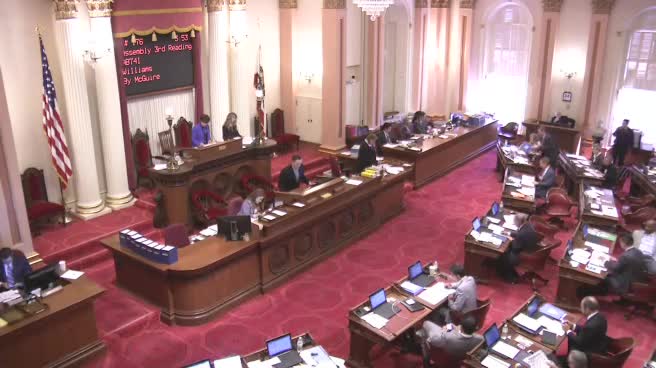 7MIN
Senate Floor
 9MIN
Assembly Floor
 1MIN
Assembly Floor
 55MIN
Assembly Standing Committee on Banking and Finance
 6MIN
Senate Floor
 9MIN
Senate Floor
 41MIN
Senate Standing Committee on Judiciary


Bill Co-Author(s):