SB 1161: Statutes of limitation: California Climate Science Truth and Accountability Act of 2016.
- Session Year: 2015-2016
- House: Senate
- Latest Version Date: 2016-05-10
Existing law requires an action alleging unfair competition, as defined, to be commenced within 4 years after the cause of action accrued.
This bill would, for actions brought by the Attorney General or certain public prosecutors, a district attorney, extend the time period for the commencement of revive an action for unfair competition with respect to scientific evidence regarding the existence, extent, or current or future impacts of anthropogenic induced anthropogenic-induced climate change to within 30 years of an act giving rise to the cause of action. The bill would revive actions that are time-barred is time barred as of January 1, 2017, as specified. and would authorize the action to be brought within 4 years of that date.
Existing law requires an action alleging unfair competition, as defined, to be commenced within 4 years after the cause of action accrued.
This bill would, for actions brought by the Attorney General or certain public prosecutors, extend the time period for the commencement of an action for unfair competition with respect to scientific evidence regarding the existence, extent, or current or future impacts of anthropogenic induced climate change to within 30 years of an act giving rise to the cause of action. The bill would revive actions that are time-barred as of January 1, 2017, as specified.
Existing law delineates the provisions setting forth the periods prescribed for the commencement of actions other than for the recovery of real property.
This bill would make a technical, nonsubstantive change in that provision.
Existing law delineates the provisions setting forth the periods prescribed for the commencement of actions other than for the recovery of real property.
This bill would make a technical, nonsubstantive change in that provision.
This act shall be known, and may be cited, as the California Climate Science Truth and Accountability Act of 2016.
SEC. 2.(a)The Legislature finds and declares all of the following:
(1)There is broad scientific consensus that anthropogenic global warming is occurring and changing the worlds climate patterns, and that the primary cause is the emission of greenhouse gases from the production and combustion of fossil fuels, such as coal, oil, and natural gas.
(2)The United States Environmental Protection Agency (USEPA) states that the buildup of atmospheric greenhouse gases results in impacts that include the following:
(A)Changing temperature and precipitation patterns.
(B)Increases in ocean temperatures, sea level, and acidity.
(C)Melting of glaciers and sea ice.
(D)Changes in the frequency, intensity, and duration of extreme weather events.
(E)Shifts in ecosystem characteristics, such as the length of the growing season, timing of flower blooms, and migration of birds.
(F)Increased threats to human health.
(3)Impacts and damages from emissions of greenhouse gases that cause climate change have been occurring for many years and will be felt from decades to centuries after those emissions have occurred. The USEPA states, [b]ecause many of the major greenhouse gases stay in the atmosphere for tens to hundreds of years after being released, their warming effects on the climate persist over a long time and can therefore affect both present and future generations.
(4)Reports and documentation published by researchers, public interest nongovernmental organizations, and media in recent years show that some fossil fuel companies were aware by the late 1970s of scientific studies showing that carbon dioxide emissions from fossil fuel combustion pose significant risk of harmful global warming. The reports and documents also indicate that by the mid-1980s fossil fuel company scientists were confirming in internal documents intended for company management that emissions from fossil fuel fuels were contributing significantly to climate change, and companies were factoring global warming into their own business investments.
(5)By 1988, the scientific evidence of climate change and the significant risks it poses was widely communicated to the public and was confirmed in congressional testimony by the National Aeronautics and Space Administration (NASA). In that year, the United Nations formed the Intergovernmental Panel on Climate Change and the federal National Energy Policy Act of 1988 (House Resolution 5380, 100th Congress) was introduced in Congress in an effort to reduce the emissions of greenhouse gases. Because of the highly public dissemination of information, congressional discussion, and extensive media coverage of the robust scientific evidence of the risks of continued burning of fossil fuel products, major fossil fuel producers knew or should have known the risks of continued burning of their products by 1988.
(6)More than half of all industrial carbon emissions have been released since 1988, after the fossil fuel businesses knew of the harm their products might cause, and have substantially increased risks from climate change impacts to life, health, and property.
(7)Since at least 1989, published reports indicate that some of these same entities have put sustained and significant efforts and resources into creating public doubt on the science related to climate change caused by anthropogenic sources.
(8)Misleading and inaccurate information disseminated by organizations and representatives backed by fossil fuel companies, along with advertising and publicity casting doubt on scientific understanding of climate change, have led to confusion, disagreement, and unnecessary controversy over the causes of climate change and the effects of emissions of greenhouse gases. This type of misinformation, widely and broadly disseminated in the media, has long delayed public understanding of the risks of continuing to emit high levels of greenhouse gases, confused and polarized the public on the need to aggressively reduce emissions to limit risks from climate change, and increased damage to public safety, health, and property in California as well as nationally and globally.
(9)Scientific studies indicate that climate change impacts are occurring in California, causing significant damage to the economy, environment, and public health. In a 2013 report on climate change indicators, the Office of Environmental Health Hazard Assessment found that California is already experiencing serious and measurable impacts from atmospheric warming in the states weather, water systems, high wildfire frequency and intensity, plant and animal species health, and human health and morbidity.
(10)Climate change has been tied by scientists to the severity and intensity of the historically unprecedented and costly drought that California has been experiencing since 2011 that has resulted in communities running out of water, agricultural water cutbacks, and unprecedented groundwater use that has caused subsidence and a loss of storage capacity in the states critical aquifers.
(11)An independent bipartisan report, published in 2014, indicates that, by 2050, California will be suffering economic losses of tens of billions of dollars due to climate change-related impacts and that heat-related deaths could be twice the number of current traffic-related deaths annually by the late 21st century.
(b)It is the intent of the Legislature to retroactively revive and extend the statute of limitation for actions that may or may not be barred by the applicable statute of limitation existing before January 1, 2017, and that seek redress for unfair competition practices committed by entities that have deceived, confused, or misled the public on the risks of climate change or financially supported activities that have deceived, confused, or misled the public on those risks.
SEC. 3.Section 342.5 is added to the Code of Civil Procedure, to read:342.5.(a)(1)Notwithstanding Section 17208 of the Business and Professions Code, an action may be brought pursuant to Chapter 5 (commencing with Section 17200) of Part 2 of Division 7 of the Business and Professions Code against a corporation, firm, partnership, joint stock company, association, or other organization of persons that has directly or indirectly engaged in unfair competition, as defined in Section 17200 of the Business and Profession Professions Code, with respect to scientific evidence regarding the existence, extent, or current or future impacts of anthropogenic induced anthropogenic-induced climate change if the action is commenced within 30 years of an act giving rise to the cause of action. that would otherwise be barred as of January 1, 2017, solely because the statute of limitation has or had expired, is revived and, in that case, the action may be commenced within four years of January 1, 2017. Nothing in this subdivision shall be construed to alter the applicable limitation period of an action that is not time barred as of January 1, 2017.
(2)Actions that are otherwise barred as of January 1, 2017, solely because the statute of limitation specified in Section 17208 of the Business and Professions Code has or had expired are revived to the extent that the actions are commenced within 30 years of an act giving rise to the cause of action.
(3)
(2)Paragraph (2) (1) does not apply to an action against an entity who is a party to a prior action brought to enforce a cause of action pursuant to Chapter 5 (commencing with Section 17200) of Part 2 of Division 7 of the Business and Professions Code actions alleging claims described in paragraph (1) for which a final and nonappealable judgment has been rendered.
(b)This section applies only to actions brought by the Attorney General, General or a district attorney, or a city attorney of a city having a population in excess of 750,000. attorney.
This act shall be known, and may be cited, as the California Climate Science Truth and Accountability Act of 2016.
SEC. 2.(a)The Legislature finds and declares all of the following:
(1)There is broad scientific consensus that anthropogenic global warming is occurring and changing the worlds climate patterns, and that the primary cause is the emission of greenhouse gases from the production and combustion of fossil fuels, such as coal, oil, and natural gas.
(2)The United States Environmental Protection Agency (USEPA) states that the buildup of atmospheric greenhouse gases results in impacts that include the following:
(A)Changing temperature and precipitation patterns.
(B)Increases in ocean temperatures, sea level, and acidity.
(C)Melting of glaciers and sea ice.
(D)Changes in the frequency, intensity, and duration of extreme weather events.
(E)Shifts in ecosystem characteristics, such as the length of the growing season, timing of flower blooms, and migration of birds.
(F)Increased threats to human health.
(3)Impacts and damages from emissions of greenhouse gases that cause climate change have been occurring for many years and will be felt from decades to centuries after those emissions have occurred. The USEPA states, [b]ecause many of the major greenhouse gases stay in the atmosphere for tens to hundreds of years after being released, their warming effects on the climate persist over a long time and can therefore affect both present and future generations.
(4)Reports and documentation published by researchers, public interest nongovernmental organizations, and media in recent years show that some fossil fuel companies were aware by the late 1970s of scientific studies showing that carbon dioxide emissions from fossil fuel combustion pose significant risk of harmful global warming. The reports and documents also indicate that by the mid-1980s fossil fuel company scientists were confirming in internal documents intended for company management that emissions from fossil fuel were contributing significantly to climate change, and companies were factoring global warming into their own business investments.
(5)By 1988, the scientific evidence of climate change and the significant risks it poses was widely communicated to the public and was confirmed in congressional testimony by the National Aeronautic and Space Administration (NASA). In that year, the United Nations formed the Intergovernmental Panel on Climate Change and the federal National Energy Policy Act of 1988 (House Resolution 5380, 100th Congress) was introduced in Congress in an effort to reduce the emissions of greenhouse gases. Because of the highly public dissemination of information, congressional discussion, and extensive media coverage of the robust scientific evidence of the risks of continued burning of fossil fuel products, major fossil fuel producers knew or should have known the risks of continued burning of their products by 1988.
(6)More than half of all industrial carbon emissions have been released since 1988, after the fossil fuel businesses knew of the harm their products might cause, and have substantially increased risks from climate change impacts to life, health, and property.
(7)Since at least 1989, published reports indicate that some of these same entities have put sustained and significant efforts and resources into creating public doubt on the science related to climate change caused by anthropogenic sources.
(8)Misleading and inaccurate information disseminated by organizations and representatives backed by fossil fuel companies, along with advertising and publicity casting doubt on scientific understanding of climate change, have led to confusion, disagreement, and unnecessary controversy over the causes of climate change and the effects of emissions of greenhouse gases. This type of misinformation, widely and broadly disseminated in the media, has long delayed public understanding of the risks of continuing to emit high levels of greenhouse gases, confused and polarized the public on the need to aggressively reduce emissions to limit risks from climate change, and increased damage to public safety, health, and property in California as well as nationally and globally.
(9)Scientific studies indicate that climate change impacts are occurring in California, causing significant damage to the economy, environment, and public health. In a 2013 report on climate change indicators, the Office of Environmental Health Hazard Assessment found that California is already experiencing serious and measurable impacts from atmospheric warming in the states weather, water systems, high wildfire frequency and intensity, plant and animal species health, and human health and morbidity.
(10)Climate change has been tied by scientists to the severity and intensity of the historically unprecedented and costly drought that California has been experiencing since 2011 that has resulted in communities running out of water, agricultural water cutbacks, and unprecedented groundwater use that has caused subsidence and a loss of storage capacity in the states critical aquifers.
(11)An independent bipartisan report, published in 2014, indicates that, by 2050, California will be suffering economic losses of tens of billions of dollars due to climate change-related impacts and that heat-related deaths could be twice the number of current traffic-related deaths annually by late 21st century.
(b)It is the intent of the Legislature to retroactively revive and extend the statute of limitation for actions that may or may not be barred by the applicable statute of limitation existing before January 1, 2017, that seek redress for unfair competition practices committed by entities that have deceived, confused, or misled the public on the risks of climate change or financially supported activities that have deceived, confused, or misled the public on those risks.
SEC. 3.Section 342.5 is added to the Code of Civil Procedure, to read:342.5.(a)(1)Notwithstanding Section 17208 of the Business and Professions Code, an action may be brought pursuant to Chapter 5 (commencing with Section 17200) of Part 2 of Division 7 of the Business and Professions Code against a corporation, firm, partnership, joint stock company, association, or other organization of persons that has directly or indirectly engaged in unfair competition, as defined in Section 17200 of the Business and Profession Code, with respect to scientific evidence regarding the existence, extent, or current or future impacts of anthropogenic induced climate change if the action is commenced within 30 years of an act giving rise to the cause of action.
(2)Actions that are otherwise barred as of January 1, 2017, solely because the statute of limitation specified in Section 17208 of the Business and Professions Code has or had expired are revived to the extent that the actions are commenced within 30 years of an act giving rise to the cause of action.
(3)Paragraph (2) does not apply to an action against an entity who is a party to a prior action brought to enforce a cause of action pursuant to Chapter 5 (commencing with Section 17200) of Part 2 of Division 7 of the Business and Professions Code for which a final and nonappealable judgment has been rendered.
(b)This section applies only to actions brought by the Attorney General, a district attorney, or a city attorney of a city having a population in excess of 750,000.
SECTION 1.Section 335 of the Code of Civil Procedure is amended to read:335.The periods prescribed for the commencement of actions other than for the recovery of real property are as set forth in this chapter.
The periods prescribed for the commencement of actions other than for the recovery of real property, are as follows: property are as set forth in this chapter.
|
Date
|
Status
|
|---|---|
| Jun 2, 2016 | Ordered to inactive file on request of Senator Monning. |
| May 10, 2016 | Read second time and amended. Ordered to third reading. |
| May 9, 2016 | From committee: Do pass as amended. (Ayes 4. Noes 2. Page 3766.) (May 3). |
| May 9, 2016 | From committee: Do pass as amended. (Ayes 4. Noes 2.) (May 3). |
| Apr 22, 2016 | Set for hearing May 3. |
| Apr 21, 2016 | From committee: Do pass and re-refer to Com. on JUD. (Ayes 5. Noes 2. Page 3643.) (April 20). Re-referred to Com. on JUD. |
| Apr 21, 2016 | From committee: Do pass and re-refer to Com. on JUD. (Ayes 5. Noes 2.) (April 20). Re-referred to Com. on JUD. |
| Apr 8, 2016 | Set for hearing April 20. |
| Apr 4, 2016 | Re-referred to Coms. on E.Q. and JUD. |
| Mar 29, 2016 | From committee with author's amendments. Read second time and amended. Re-referred to Com. on RLS. |
| Mar 3, 2016 | Referred to Com. on RLS. |
| Feb 19, 2016 | From printer. May be acted upon on or after March 20. |
| Feb 18, 2016 | Introduced. Read first time. To Com. on RLS. for assignment. To print. |
|
Date
|
Description
|
Location
|
Votes
|
|
|---|---|---|---|---|
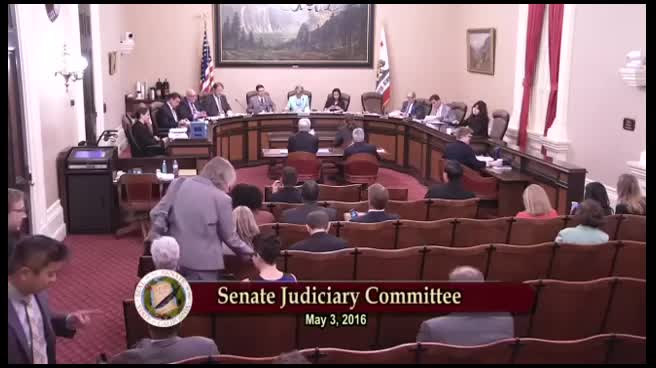
| May 3, 2016 | Do pass as amended | Senate Standing Committee on Judiciary |
Passed |
|
| Apr 20, 2016 | Do pass, but first be re-referred to the Committee on [Judiciary] | Senate Standing Committee on Environmental Quality |
Passed |
This list shows positions taken on this bill by organizations on the date displayed, which is linked to the original source.
Positions by individuals are not included.
Office of Senate Floor Analyses (916) 651-1520 Fax: (916) 327-4478 | SB |
THIRD READING
Bill No: SB 1161
:
SENATE ENVIRONMENTAL QUALITY COMMITTEE: 5-2, 4/20/16
AYES: Wieckowski, Hill, Jackson, Leno, Pavley
NOES: Gaines, Bates
SENATE JUDICIARY COMMITTEE: 4-2, 5/3/16
AYES: Jackson, Leno, Monning, Wieckowski
NOES: Moorlach, Anderson
NO VOTE RECORDED: Hertzberg
DIGEST: This bill, for actions brought by the Attorney General or a district attorney, revives an action for unfair competition with respect to scientific evidence regarding the existence, extent, or current or future impacts of anthropogenic-induced climate change that is time barred as of January 1, 2017, and authorizes the action to be brought within four years of that date.
ANALYSIS: Existing federal law, under the Federal Trade Commission Act Section 5 (FTC Act) (15 USC 45), prohibits “unfair or deceptive acts or practices in or affecting commerce.” The prohibition applies to all persons engaged in commerce.
Existing state law, under the Unfair Competition Law (UCL) (Business and Professions Code §17200 et seq.):
- Confers standing on both private parties and public prosecutors.
- Authorizes the Attorney General, district attorneys, county counsels and city attorneys to file lawsuits on behalf of injured citizens. Business and Professions Code §17204 et seq.)
- Defines unfair competition as: (a) an unlawful business act or practice; (b) an unfair business act or practice; (c) a fraudulent business act or practice; (d) unfair, deceptive, untrue or misleading advertising; or (e) any act prohibited by the Consumers Legal Remedies Act (Business and Professions Code §§17500 -17577.5), which applies to any “consumer” transaction involving the “sale or lease of goods or services,” and explicitly prohibits 24 separate business acts or practices.
- Requires an action alleging unfair competition, as defined, to be commenced within four years after the cause of action accrued.
- Allows the court to prevent the use of unfair competition and to restore money or property to victims of unfair competition - allows for both monetary damages and injunctive relief where necessary. Restitution and disgorgement of profits are used primarily to deter future violations. Courts use various factors to determine the amount of the penalty, including “the nature and seriousness of the misconduct, the number of violations, the persistence of the misconduct, the length of time over which the misconduct occurred, the willfulness of the defendant’s misconduct, and the defendant’s assets, liabilities, and net worth.” However, the UCL does not permit punitive damages awards.
This bill:
- Enacts the California Climate Science Truth and Accountability Act.
- Makes specified findings regarding the impacts of climate change.
- Revives, for actions brought by the Attorney General or a district attorney, an action for unfair competition with respect to scientific evidence regarding the existence, extent, or current or future impacts of anthropogenic-induced climate change that is time barred as of January 1, 2017, and authorizes the action to be brought within four years of that date.
Background
- History of California Unfair Competition laws
California Civil Code §3369, enacted in 1872, was California’s early unfair competition statute. It “addressed only the availability of civil remedies for business violations in cases of penalty, forfeiture, and criminal violation.”
A 1933 amendment expanded the law to prohibit “any person [from] performing an act of unfair competition.” This amendment did not, however, extend UCL protection to consumers. This limitation was in response to the U.S. Supreme Court’s 1931 decision in FTC v. Raladam. In Raladam, the Court held that an FTC Act Section 5 violation must show actual injury to competition. This ruling prevented individual consumers from suing under the FTC Act. Following this rationale, California applied the UCL to unfair business practices that affected business competitors, not consumers.
In 1935, consumers, not just business competitors, were given the opportunity to sue under the UCL. The Supreme Court of California clarified the statute in American Philatelic Soc. v. Claibourne, stating that “the rules of unfair competition” should protect the public from “fraud and deceit.”
In 1962, a California appellate court reiterated this rule by stating that the UCL extended “equitable relief to situations beyond the scope of purely business competition.” In 1977, the Legislature moved UCL to the California Business and Professions Code §17200.
In November 2004, California voters enacted Proposition 64 to amend the UCL. Proposition 64:
- Specified that, to have standing to pursue a lawsuit under the UCL, a private plaintiff must have “suffered injury in fact and . . . lost money or property as a result of ” the alleged wrongdoing,
- Specified that a private party “may pursue representative claims or relief on behalf of others only if the claimant” both “meets the standing requirements” added by Proposition 64 “and complies with Section 382 of the Code of Civil Procedure,” which sets forth California’s requirements for maintaining a class action.
- Deleted language that formerly authorized the prosecution of actions by private parties purportedly “acting for the interests of . . . the general public.” Id. §3 (amending Cal. Bus. & Prof. Code §17204).
- Protecting consumers from unfair business practices
California’s UCL, has protected California consumers from “unlawful, unfair or fraudulent business act[s] or practice[s]” for over 70 years. (Bus. & Prof. Code §17200.) It renders an individual liable for any unlawful, unfair, or fraudulent business act or practice and any unfair, deceptive, untrue, or misleading advertising. In describing the UCL’s broad scope, the California Supreme Court explained: “it does not proscribe specific practices. Rather . . . it defines unfair competition to include any unlawful, unfair or fraudulent business act or practice. Its coverage is sweeping, embracing anything that can properly be called a business practice and that at the same time is forbidden by law.” (Cel-Tech Communications, Inc. v. Los Angeles Cellular Telephone Co. (1999) 20 Cal.4th 163, 180 (internal quotation marks and citations omitted).)
- The Oil Industry and Climate Change Research
Recent news articles from the Los Angeles Times and the Energy and Environmental Reporting Project at Columbia University’s Graduate School of Journalism have revealed a striking disconnect between the public positions taken by oil companies over the past few decades, and the internal planning and research conducted by those same companies, regarding human-induced climate change. According to the Times:
Before most Americans were even aware of global warming, Exxon was investing in high-quality research on the subject. According to reports . . . the oil company's scientists concluded in the 1970s, ‘80s and ‘90s that climate change was real, would transform the Earth’s landscape and was driven by human activity — especially the burning of fossil fuels.
As the debate over climate change began in earnest, however, Exxon didn’t use its wealth of scientific findings to issue an alarm to the world, or even to add a supportive, attention-grabbing voice to those of the climatologists who were trying to convince policymakers and the public. Instead, company officials publicly cast doubt on the very existence of global warming, arguing that the science was just too murky to draw a conclusion. (Editorial Board, Exxon's Damaging Denial on Climate Change, Los Angeles Times, Oct. 15, 2015)
Exxon was not the only oil company seemingly experiencing this disconnect. According to another Times article:
A few weeks before seminal climate change talks in Kyoto back in 1997, Mobil Oil took out a bluntly worded advertisement in the New York Times and Washington Post. “Let’s face it: The science of climate change is too uncertain to mandate a plan of action that could plunge economies into turmoil,” the ad said. “Scientists cannot predict with certainty if temperatures will increase, by how much and where changes will occur.”
One year earlier, though, engineers at Mobil Oil were concerned enough about climate change to design and build a collection of exploration and production facilities along the Nova Scotia coast that made structural allowances for rising temperatures and sea levels. (Amy Lieberman and Susanne Rust, Big Oil Braced for Global Warming While it Fought Regulations, Los Angeles Times, Dec. 31, 2015.)
Through an examination of “oil industry records and interviews with current and former executives,” the Times and the Energy and Environmental Reporting Project discovered that this “two-pronged strategy was widespread within the industry during the 1990s and early 2000s,” finding that “[a]s many of the world’s major oil companies — including Exxon, Mobil and Shell — joined a multimillion-dollar industry effort to stave off new regulations to address climate change, they were quietly safeguarding billion-dollar infrastructure projects from rising sea levels, warming temperatures and increasing storm severity.”
This bill explicitly authorizes district attorneys and the Attorney General to pursue UCL claims alleging that a business or organization has directly or indirectly engaged in unfair competition with respect to scientific evidence regarding the existence, extent, or current or future impacts of anthropogenic induced climate change.
- Purpose of this bill
According to the author:
Recent research has shown that nearly two-thirds of all industrial carbon dioxide and methane released into the atmosphere since the dawn of the industrial revolution can be traced to just 90 entities. The top five investor-owned companies on the list— Chevron, ExxonMobil, British Petroleum, Shell, and ConocoPhillips—are responsible for one-eighth of all emissions.
New discoveries by Inside Climate News, the Los Angeles Times, and a Union of Concerned Scientists’ report, The Climate Deception Dossiers, show that by the 1980s the fossil fuel industry was well aware of the emerging scientific consensus that emissions from the burning of fossil fuels was increasing global temperature. In fact, many companies engaged in their own climate change research and shared some of this research with others in the industry. Exxon’s own climate scientists, for example, conducted cutting-edge climate change research in the late 1970s and early 1980s. There is also evidence that companies began factoring projected climate change into their own business decisions and operations.
State law provides a broad right of action to challenge “unfair” business practices. Generally, the law establishes a statute of limitations of four years, though case law indicates that if the legislature finds sufficient cause, it has the ability to retroactively extend the statute of limitations. Given the environmental, health, and economic impacts that Californians are already paying for as a result of the fossil fuel industry’s many years of public deception, it is important to hold the industry responsible. Keeping the statute limited to only four years may undermine the state’s ability to hold fossil fuel companies responsible for their practices that extend back well beyond four years, as well as the damages and risks that Californians and everyone else must face for centuries to come. By extending the statute of limitations, California has the opportunity to hold these companies fully accountable for their actions.
SB 1161 seeks to provide recourse under the Unfair Competition Law for deceptive behavior relating to scientific evidence of climate change.”
FISCAL EFFECT: Appropriation: Fiscal Com.: Local:
Amazon Watch
As You Sow
Asian Pacific Environmental Network
Azul
California Coastal Protection Network
California League of Conservation Voters
Center for Biological Diversity
Center for Environmental Health
Center for International Environmental Law
Climate Hawks Vote
Climate Resolve
Coalition for Clean Air
Consumer Attorneys of California
Environment California
Fossil Free California
Global Exchange
Interfaith Power & Light
Media Alliance
Natural Resources Defense Council
Rainforest Action Network
Sierra Club California
Stand
Zevin Asset Management, LLC
OPPOSITION: (Verified 5/11/16)
American Chemistry Council
American Insurance Association
Association of California Insurance Companies
California Business Roundtable
California Business Properties Association
California Building Industry Association
California Chamber of Commerce
California Independent Oil Marketers Association
California Independent Petroleum Association
California Manufacturers and Technology Association
California Retailers Association
Civil Justice Association of California
National Federation of Independent Business
Valley Industry and Commerce Association
5/11/16 15:52:44
**** END ****
Senator Hannah-Beth Jackson, Chair
2015-2016 Regular Session
Bill No: SB 1161 (Author:Allen)
Version: March 29, 2016
Hearing Date: May 3, 2016
Fiscal: No
Urgency: No
Consultant: TH
SUBJECT
Statutes of Limitation: California Climate Science Truth and Accountability Act of 2016
DESCRIPTION
This bill would retroactively extend the statute of limitation to 30 years for claims brought under the Unfair Competition Law alleging unfair competition with respect to scientific evidence regarding the existence, extent, or current or future impacts of anthropogenic induced climate change. The retroactive statute of limitation created by this bill would apply only to claims brought by specified public prosecutors.
(This analysis reflects author’s amendments to be offered in Committee.)
BACKGROUND
Recent news articles from the Los Angeles Times and the Energy and Environmental Reporting Project at Columbia University’s Graduate School of Journalism have revealed a striking disconnect between the public positions taken by oil companies over the past few decades, and the internal planning and research conducted by those same companies, regarding human-induced climate change. According to the Times:
Before most Americans were even aware of global warming, Exxon was investing in high-quality research on the subject. According to reports . . . the oil company's scientists concluded in the 1970s, ‘80s and ‘90s that climate change was real, would transform the Earth’s landscape and was driven by human activity — especially the burning of fossil fuels.
As the debate over climate change began in earnest, however, Exxon didn’t use its wealth of scientific findings to issue an alarm to the world, or even to add a supportive, attention-grabbing voice to those of the climatologists who were trying to convince policymakers and the public. Instead, company officials publicly cast doubt on the very existence of global warming, arguing that the science was just too murky to draw a conclusion. (Editorial Board, Exxon's Damaging Denial on Climate Change, Los Angeles Times, Oct. 15, 2015 <http://www.latimes.com/opinion/ editorials/la-ed-exxon-climate-change-20151015-story.html> [as of Apr. 27, 2016].)
Exxon was not the only oil company seemingly experiencing this disconnect. According to another Times article:
A few weeks before seminal climate change talks in Kyoto back in 1997, Mobil Oil took out a bluntly worded advertisement in the New York Times and Washington Post. “Let’s face it: The science of climate change is too uncertain to mandate a plan of action that could plunge economies into turmoil,” the ad said. “Scientists cannot predict with certainty if temperatures will increase, by how much and where changes will occur.”
One year earlier, though, engineers at Mobil Oil were concerned enough about climate change to design and build a collection of exploration and production facilities along the Nova Scotia coast that made structural allowances for rising temperatures and sea levels. (Amy Lieberman and Susanne Rust, Big Oil Braced for Global Warming While it Fought Regulations, Los Angeles Times, Dec. 31, 2015 <http://graphics.latimes.com/oil-operations/> [as of Apr. 27, 2016].)
Through an examination of “oil industry records and interviews with current and former executives,” the Times and the Energy and Environmental Reporting Project discovered that this “two-pronged strategy was widespread within the industry during the 1990s and early 2000s,” finding that “[a]s many of the world’s major oil companies — including Exxon, Mobil and Shell — joined a multimillion-dollar industry effort to stave off new regulations to address climate change, they were quietly safeguarding billion-dollar infrastructure projects from rising sea levels, warming temperatures and increasing storm severity.” (Id.)
This bill would allow specified public prosecutors to bring claims against oil companies that engaged in this practice under California’s Unfair Competition Law by retroactively extending the statute of limitation to 30 years for claims alleging unfair competition with respect to scientific evidence regarding the existence, extent, or current or future impacts of anthropogenic induced climate change.
CHANGES TO EXISTING LAW
Existing law, the Unfair Competition Law, protects consumers and competitors against unlawful, unfair or fraudulent business acts or practices and unfair, deceptive, untrue, or misleading advertising. (Bus. & Prof. Code Sec. 17200 et seq.)
Existing law states that any person who engages, has engaged, or proposes to engage in unfair competition may be enjoined in any court of competent jurisdiction. (Bus. & Prof. Code Sec. 17203.)
Existing law states that, in addition to other remedies, any person who engages, has engaged, or proposes to engage in unfair competition shall be liable for a civil penalty not to exceed $2,500 for each violation, which shall be assessed and recovered in a civil action brought in the name of the people of the State of California by specified public prosecutors. (Bus. & Prof. Code Sec. 17206(a).)
Existing law states that any action to enforce a cause of action pursuant to the Unfair Competition Law shall be commenced within four years after the cause of action accrued. (Bus. & Prof. Code Sec. 17208.)
This bill states that, notwithstanding the above provision, an action may be brought pursuant to the Unfair Competition Law against a corporation, firm, partnership, joint stock company, association, or other organization of persons that has directly or indirectly engaged in unfair competition with respect to scientific evidence regarding the existence, extent, or current or future impacts of anthropogenic induced climate change if the action is commenced within 30 years of an act giving rise to the cause of action.
This bill specifies that actions alleging claims described in the provision above that are otherwise barred as of January 1, 2017, solely because the statute of limitation specified in the Unfair Competition Law has or had expired are revived to the extent that the actions are commenced within 30 years of an act giving rise to the cause of action.
This bill specifies that the above provision does not apply to actions for which a final and nonappealable judgment has been rendered.
This bill specifies that its provisions shall only apply to actions brought by the Attorney General, or a district attorney.
COMMENT
- Stated need for the bill
According to the author:
Recent research has shown that nearly two-thirds of all industrial carbon dioxide and methane released into the atmosphere since the dawn of the industrial revolution can be traced to just 90 entities. The top five investor-owned companies on the list— Chevron, ExxonMobil, British Petroleum, Shell, and ConocoPhillips—are responsible for one-eighth of all emissions.
New discoveries by Inside Climate News, the Los Angeles Times, and a Union of Concerned Scientists’ report, The Climate Deception Dossiers, show that by the 1980s the fossil fuel industry was well aware of the emerging scientific consensus that emissions from the burning of fossil fuels was increasing global temperature. In fact, many companies engaged in their own climate change research and shared some of this research with others in the industry. Exxon’s own climate scientists, for example, conducted cutting-edge climate change research in the late 1970s and early 1980s. There is also evidence that companies began factoring projected climate change into their own business decisions and operations.
State law provides a broad right of action to challenge “unfair” business practices. Generally, the law establishes a statute of limitations of four years, though case law indicates that if the legislature finds sufficient cause, it has the ability to retroactively extend the statute of limitations. Given the environmental, health, and economic impacts that Californians are already paying for as a result of the fossil fuel industry’s many years of public deception, it is important to hold the industry responsible. Keeping the statute limited to only four years may undermine the state’s ability to hold fossil fuel companies responsible for their practices that extend back well beyond four years, as well as the damages and risks that Californians and everyone else must face for centuries to come. By extending the statute of limitations, California has the opportunity to hold these companies fully accountable for their actions.
SB 1161 seeks to extend the statute of limitations under the state’s Unfair Competition Law from 4 years to 30 years for deceptive behavior relating to scientific evidence of climate change.
- Protecting consumers from unfair business practices
California’s Unfair Competition Law (UCL), has protected California consumers from “unlawful, unfair or fraudulent business act[s] or practice[s]” for over 70 years. (Bus. & Prof. Code Sec. 17200.) It renders an individual liable for any unlawful, unfair, or fraudulent business act or practice and any unfair, deceptive, untrue, or misleading advertising. In describing the Unfair Competition Law’s broad scope, the California Supreme Court explained: “it does not proscribe specific practices. Rather . . . it defines unfair competition to include any unlawful, unfair or fraudulent business act or practice. Its coverage is sweeping, embracing anything that can properly be called a business practice and that at the same time is forbidden by law.” (Cel-Tech Communications, Inc. v. Los Angeles Cellular Telephone Co. (1999) 20 Cal.4th 163, 180 (internal quotation marks and citations omitted).)
This bill would explicitly authorize district attorneys and the Attorney General to pursue UCL claims alleging that a business or organization has directly or indirectly engaged in unfair competition with respect to scientific evidence regarding the existence, extent, or current or future impacts of anthropogenic induced climate change, provided the action is commenced within 30 years of the act giving rise to the cause of action. In effect, the bill would allow these public prosecutors to reach back and hold firms accountable for allegedly misleading consumers about the harmful effects of human-induced climate change despite knowing that these harms were likely to materialize. This sort of claim – an action for redress based on the misleading or fraudulent business practices of another – falls squarely within the mandate of the UCL, which is to “provid[e] an equitable means through which both public prosecutors and private individuals can bring suit to prevent unfair business practices and restore money or property to victims of these practices.” (Korea Supply Co. v. Lockheed Martin Corp. (2003) 29 Cal.4th 1134, 1150.)
- Tolling for delayed discovery
The Unfair Competition Law (UCL) generally requires litigants to file their claims within 4 years of the date upon which their claim accrued. (See Bus. & Prof. Code Sec. 17208.) However, the common law recognizes “a handful of equitable exceptions to and modifications of the usual rules governing limitations periods,” and these exceptions and modifications operate to “alter the rules governing either the initial accrual of a claim, the subsequent running of the limitations period, or both.” (Aryeh v. Canon Business Solutions, Inc. (2013) 55 Cal.4th 1185, 1192.) Among the exceptions to the normal rules governing limitations periods is the “discovery rule,” which “postpones accrual of a cause of action until the plaintiff discovers, or has reason to discover, the cause of action.” (Id.)
According to a recent California Supreme Court case, “the UCL is governed by common law accrual rules,” including the discovery rule, “to the same extent as any other statute.” (Id. at 1196.) Consequently, it is possible that public prosecutors, and any other aggrieved party with standing, could bring a claim against a company that allegedly misled consumers about the harmful effects of human-induced climate change under existing law, given that the revelations of this conduct were made public only recently. Recognizing this possibility, the author nonetheless states:
while the delayed discovery rule tolls the statute after the cause of action has accrued (the act, causation, and harms), it is unclear how courts will [rule on this] issue. There is the possibility that a court could find that a plaintiff could have discovered their claims more than 4 years ago. SB 1161 avoids stepping into the common law debate by clarifying to courts that they don’t need to delve into a legal battle about whether plaintiff had discovered or had reason to discover this very specific cause of action. Thus, SB 1161 avoids the current uncertainty about whether plaintiff’s claims are barred and legislates the extension by focusing on when the act occurred rather than letting one judge decide the discovery analysis and thus about whether these claims should be allowed to proceed.
- Extended statutes of limitation
Statutes of limitation are a fundamental element of California law. By limiting the time period within which a party can bring a cause of action against another, statutes of limitation provide finality to disputes that otherwise might never end. Without statutes of limitation, ancient wrongs committed while someone was young might become the subject of litigation years later in their old age. Statutes of limitation “are designed to promote justice by preventing surprises through the revival of claims that have been allowed to slumber until evidence has been lost, memories have faded, and witnesses have disappeared. The theory is that even if one has a just claim it is unjust not to put the adversary on notice to defend within the period of limitation and that the right to be free of stale claims in time comes to prevail over the right to prosecute them.” (Order of R. Telegraphers v. Railway Express Agency, Inc. (1944), 321 U.S. 342, 348-349.)
This bill would create a new 30-year statute of limitation under the UCL for claims against defendants that allegedly misled consumers about the harmful effects of human-induced climate change. A coalition of business organizations, in opposition, state:
Current law allows unfair competition actions under Business and Professions Code 17200 to be brought within four years. Companies therefore keep their papers and records for a set period of time before discarding them. No businesses could have anticipated 30 years ago that it would have to defend its routine business activities in the context of climate change litigation. If you were accused now of doing something on today’s date 29 years ago, and had to provide documentation and proof to defend yourself, could you do so? The administrative and transactional costs to keeping items for 30 years would be prohibitive, and until now, there would have been no reason to do so.
. . .
This bill is changing the rules on companies late in the game. An extension of over 26 years, retroactively, is at odds with our notions of fair jurisprudence.
. . .
California already places tremendous burdens upon the companies it depends upon for its tax base. Our civil justice system is already perceived as the least fair in the country, as evidenced by our ranking, yet again, as the nation’s number one “judicial hellhole.” This bill will require companies to operate in a constant state of “litigation preparedness,” spending time and resources on preserving, organizing and maintaining information in the event that they are eventually sued.
Writing in support of an extended statute of limitation, the Union of Concerned Scientists, the sponsor of SB 1161, writes:
We believe that extending the statute of limitations to 30 years from an act giving rise to the cause of action is appropriate given the scale and duration of the allegations. The alleged deceit rivals the tobacco industry’s disavowal of the link between tobacco and cancer, but the impact of fossil fuels is even greater on people, the environment, and the economy. Damage of climate change is already occurring and will become more severe as time passes. Moreover, more than half of all industrial carbon dioxide emissions have been emitted since 1988—a time when the industry knew of the damage caused by their product. Thus, the gravity of potential misconduct is huge and deserving of a fair hearing on the merits. . . . [W]hether these companies have actually broken the law is something for the courts to decide—SB 1161 is not making that judgment. The bill only gives law enforcement the opportunity to make sure justice is served for the full weight of any violations that could be proven in court.
Recognizing the concerns surrounding the creation of a 30-year statute of limitation as proposed in this bill, the Committee might wish to consider alternative pathways that would permit these claims to be brought under the UCL, such as enacting a one-time revival period for otherwise time-lapsed claims, or bolstering applicability of the delayed discovery rule.
- Retroactivity
In addition to providing an expanded prospective statute of limitation for bringing specified claims regarding the harmful effects of human-induced climate change, this bill would also have retroactive effect to revive claims that, absent such revival, would be barred as untimely under the UCL’s existing 4-year statute of limitation. “Generally, statutes operate prospectively only.” (McClung v. Employment Dev. Dept. (2004) 34 Cal.4th 467, 475.)
[T]he presumption against retroactive legislation is deeply rooted in our jurisprudence, and embodies a legal doctrine centuries older than our Republic. Elementary considerations of fairness dictate that individuals should have an opportunity to know what the law is and to conform their conduct accordingly; settled expectations should not be lightly disrupted. For that reason, the principle that the legal effect of conduct should ordinarily be assessed under the law that existed when the conduct took place has timeless and universal appeal. (Landgraf v. USI Film Products (1994) 511 U.S. 244, 265 (internal citations omitted).)
“A statute does not operate [retroactively] merely because it is applied in a case arising from conduct antedating the statute’s enactment, or upsets expectations based in prior law. Rather, the court must ask whether the new provision attaches new legal consequences to events completed before its enactment.” (Landgraf, 511 U.S. at 269-70 (internal citations omitted).) “This is not to say,” however, “that a statute may never apply retroactively.” (McClung, 34 Cal.4th at 475.) In California, “[a] statute’s retroactivity is, in the first instance, a policy determination for the Legislature and one to which courts defer absent some constitutional objection to retroactivity.” (Id., at 475.) Under California law, “a statute may be applied retroactively only if it contains express language of retroactivity or if other sources provide a clear and unavoidable implication that the Legislature intended retroactive application.” (Myers v. Philip Morris Companies, Inc. (2002) 28 Cal.4th 828, 844.)
The language in this bill makes clear that it would operate retroactively to revive claims brought by public prosecutors against specified entities that directly or indirectly engaged in unfair competition with respect to scientific evidence regarding the existence, extent, or current or future impacts of anthropogenic induced climate change. In so doing, it would allow public prosecutors to bring claims under the UCL against corporations that allegedly misled the public about the harmful effects of climate change in the 1980s and 1990s. Importantly, the retroactive reach of this bill would not extend to claims accruing outside the 30-year statute of limitation, and would not operate to revive claims for which a final and nonappealable judgment has already been rendered.
- Author’s amendments
The author offers the following amendments to clarify the scope of this bill’s retroactivity and revival provisions, and to strike specified city attorneys from the list of public prosecutors authorized to bring claims under the extended statute of limitation.
Amendments:
On page 2, line 38, following “Actions” insert “alleging claims described in paragraph (1)”
On page 3, strike lines 3 through 7, and insert “(3) Paragraph (2) does not apply to actions alleging claims described in paragraph (1) for which a final and nonappealable judgment has been rendered.”
On page 3, lines 9 and 10, strike “or a city attorney of a city having a population in excess of 750,000.”
Support: Amazon Watch; As You Sow; Asian Pacific Environmental Network; Azul; California Coastal Protection Network; California League of Conservation Voters; Center for Biological Diversity; Center for Environmental Health; Center for International Environmental Law; Climate Hawks Vote; Climate Resolve; Coalition for Clean Air; Consumer Attorneys of California; Environment California; Fossil Free California; Global Exchange; Interfaith Power & Light; Media Alliance; Natural Resources Defense Council; Rainforest Action Network; Sierra Club California; Stand; Zevin Asset Management, LLC
Opposition: American Chemistry Council; American Insurance Association; Association of California Insurance Companies; California Business Roundtable; California Business Properties Association; California Building Industry Association; California Chamber of Commerce; California Independent Oil Marketers Association; California Independent Petroleum Association; California Manufacturers and Technology Association; California Retailers Association; Civil Justice Association of California; National Federation of Independent Business; Valley Industry and Commerce Association
HISTORY
Source: Union of Concerned Scientists
Related Pending Legislation: None Known
Prior Legislation: None Known
Prior Vote: Senate Environmental Quality Committee (Ayes 5, Noes 2)
**************
SENATE COMMITTEE ON ENVIRONMENTAL QUALITY
Senator Wieckowski, Chair
2015 - 2016 Regular
Bill No: SB 1161
Author: | Allen | ||
Version: | 3/29/2016 | Hearing Date: | 4/20/2016 |
Urgency: | No | Fiscal: | No |
Consultant: | Rachel Machi Wagoner | ||
SUBJECT: Statutes of limitation: California Climate Science Truth and Accountability Act of 2016
ANALYSIS:
Existing federal law: Under the Federal Trade Commission Act Section 5 (FTC Act) (15 USC 45), prohibits “unfair or deceptive acts or practices in or affecting commerce.” The prohibition applies to all persons engaged in commerce.
Existing law: Under the Unfair Competition Law (UCL) (Business and Professions Code §17200 et seq.):
- Confers standing on both private parties and public prosecutors.
- Authorizes the Attorney General, district attorneys, county counsels and city attorneys to file lawsuits on behalf of injured citizens. Business and Professions Code §17204 et seq.)
- Defines unfair competition as: (1) an unlawful business act or practice; (2) an unfair business act or practice; (3) a fraudulent business act or practice; (4) unfair, deceptive, untrue or misleading advertising; or (5) any act prohibited by the Consumers Legal Remedies Act (Business and Professions Code §§17500 -17577.5), which applies to any “consumer” transaction involving the “sale or lease of goods or services,” and explicitly prohibits 24 separate business acts or practices.
- Requires an action alleging unfair competition, as defined, to be commenced within 4 years after the cause of action accrued.
- Allows the court to prevent the use of unfair competition and to restore money or property to victims of unfair competition - allows for both monetary damages and injunctive relief where necessary. Restitution and disgorgement of profits are used primarily to deter future violations. Courts use various factors to determine the amount of the penalty, including “the nature and seriousness of the misconduct, the number of violations, the persistence of the misconduct, the length of time over which the misconduct occurred, the willfulness of the defendant’s misconduct, and the defendant’s assets, liabilities, and net worth.” However, the UCL does not permit punitive damages awards.
This bill enacts the California Climate Science Truth and Accountability Act:
- Makes specified findings regarding the impacts of climate change.
- For actions brought by the Attorney General or certain public prosecutors, extend the time period for the commencement of an action for unfair competition with respect to scientific evidence regarding the existence, extent, or current or future impacts of anthropogenic induced climate change to within 30 years of an act giving rise to the cause of action. The bill would revive actions that are time-barred as of January 1, 2017, as specified.
Background
- History of California Unfair Competition laws.
California Civil Code §3369, enacted in 1872, was California’s early unfair competition statute. It “addressed only the availability of civil remedies for business violations in cases of penalty, forfeiture, and criminal violation.”
A 1933 amendment expanded the law to prohibit “any person [from] performing an act of unfair competition.” This amendment did not, however, extend UCL protection to consumers. This limitation was in response to the U.S. Supreme Court’s 1931 decision in FTC v. Raladam.[5] In Raladam, the Court held that an FTC Act Section 5 violation must show actual injury to competition. This ruling prevented individual consumers from suing under the FTC Act. Following this rationale, California applied the UCL to unfair business practices that affected business competitors, not consumers.
In 1935, consumers, not just business competitors, were given the opportunity to sue under the UCL. The Supreme Court of California clarified the statute in American Philatelic Soc. v. Claibourne, stating that “the rules of unfair competition” should protect the public from “fraud and deceit.”
In 1962, a California appellate court reiterated this rule by stating that the UCL extended “equitable relief to situations beyond the scope of purely business competition.” In 1977, the Legislature moved UCL to the California Business and Professions Code §17200.
In November 2004, California voters enacted Proposition 64 to amend the UCL. Proposition 64:
- Specified that, to have standing to pursue a lawsuit under the UCL, a private plaintiff must have “suffered injury in fact and . . . lost money or property as a result of ” the alleged wrongdoing,
- Specified that a private party “may pursue representative claims or relief on behalf of others only if the claimant” both “meets the standing requirements” added by Proposition 64 “and complies with Section 382 of the Code of Civil Procedure,” which sets forth California’s requirements for maintaining a class action.
- Deleted language that formerly authorized the prosecution of actions by private parties purportedly “acting for the interests of . . . the general public.” Id. §3 (amending Cal. Bus. & Prof. Code §17204).
- Examples of UCL and Environmental Prosecution.
In a 2011 article titled, Public Prosecutorial Enforcement of the Unfair Competition Law Following the Passage of Proposition 64, former Marin County Deputy District Attorney Bob Nichols states, “The principal role of a public prosecutor is to seek justice. Restitution and recovery of losses for injured consumers is always a prosecutorial concern, but this function is ancillary to the greater public need of ceasing the unlawful conduct, punishment, and deterrence. This is not unlike the traditional prosecutorial role in criminal cases. In fulfilling this obligation, consumer prosecutors do not seek damages but rather injunctive relief, restitution, and civil penalties.”
Business and Professions Code §17200 is routinely used today in the prosecution of environmental cases under these principles.
In 2007 prosecutors pursued a UCL case against Home Depot for illegal hazardous waste storage and transportation violations found during a three- year investigation. A multi-jurisdictional, statewide prosecution team in 28 counties tracked hazardous waste management practices and the state’s fire code at California’s Home Depot stores statewide. The case resulted in a $9.9 million dollar settlement.
In 2009 the state filed suit against Kmart for disposal of toxic substances in landfills. The state forged an $8.65 million settlement with Kmart and required the company to stop disposing of toxic substances in landfills.
In 2010, the Attorney General and 20 district attorneys filed a statewide suit, pursuing a UCL action against Wal-Mart for violating California’s environmental laws in its handling and disposal of hazardous materials. Wal-Mart agreed to settle the case for $27.6 million. The settlement includes $20 million to be split among prosecutors in 20 jurisdictions and 32 environmental health agencies throughout the state; $1.6 million in costs for the investigation; $3 million to a fund for other environmental investigations; and $3 million toward keeping stores in compliance.
In 2011 the Target Corporation agreed to pay $22.5 million to settle a UCL case wherein prosecutors accused the retailer of the “willful disregard for California’s hazardous waste laws” for such violations as pouring chemicals returned by customers down the drain and dumping incompatible, combustible liquids like ammonia and bleach into trash bins.
In 2013 Attorney General Kamala D. Harris was joined by eight District Attorneys in filing a UCL lawsuit against BP West Coast Products, BP Products North America, Inc. and Atlantic Richfield Company (ARCO) for allegedly violating state laws governing hazardous materials and hazardous waste by failing to properly inspect and maintain underground tanks used to store gasoline for retail sale at more than 780 gas stations in California. In 2002, similarly, Attorney General Bill Lockyer settled a UCL case with BP-ARCO for $45.8 million, “the largest penalty in the nation for alleged widespread underground tank violations at ARCO stations in California.”
- Broad Impacts of Climate Change in California and Worldwide.
There is broad scientific consensus that the climate is warming and that much of this warming is due to human activities, with serious implications for California.
The 5th assessment report from the Intergovernmental Panel on Climate Change (IPCC) notes that atmospheric concentrations of global warming pollutants have risen to levels unseen in the past 800,000 years. Carbon dioxide concentrations have increased by 40% since pre-industrial times. Over time, these increases have led to a rise of global average surface temperatures of approximately 1.4°F since 1900, with much of this increase occurring after 1970. Per the latest report by the National Oceanic and Atmospheric Administration (NOAA), 2014 was the 38th consecutive year that the global temperature increased.
Research indicates that an increase in the global average temperature of 3.6°F above pre-industrial levels, which is only 1.1°C (2.0°F) above present levels, poses severe risks to natural systems and human health and well-being. According to the U.S. Environmental Protection Agency, for every 2°F increase in global average temperature, we can expect to see 5-15% reductions in crop yields, 3-10% increases in rainfall during heavy precipitation events when flood risks are already high, and 200-400% increases in areas burned by wildfires in the western United States.
Higher temperatures globally have already resulted in diminished snow and sea ice and have caused sea level to rise by nearly eight inches.
In California, the frequency of extreme events, including heat waves, wildfires, floods, and droughts, are expected to increase. Higher temperatures and more frequent and severe extreme events will have a range of consequences for public health through impacts to water quality, air quality, and the spread of infectious diseases.
As the evidence for anthropogenic climate change has mounted over the last few decades, the state has implemented a broad climate portfolio to mitigate global warming impacts by pursuing policies that reduce greenhouse gasses (GHGs).
And although deep and severe cuts in GHG emissions globally are still needed to avoid the most severe consequences of a changing climate, they will not be enough to stave off climate change and its environmental and public health impacts. Even if all GHG emissions ceased today, many impacts of climate change would still be unavoidable because the climate system has changed over time.
A major report from the University of College London’s Institute for Global Health and the medical journal The Lancet has called climate change the “biggest global health threat of the 21st century.” Climate change not only brings about new threats, it is a magnifier of existing natural hazards. The impacts to health, infrastructure, hazard response, etc. will come with a financial cost, as well. Additionally, the Pacific Institute estimates that $100 billion worth of property is at risk of flooding during a 100-year flood with 1.4 meters of projected sea level rise, including 55 healthcare facilities, over 330 hazardous waste facilities or sites, 30 coastal power plants, and 28 wastewater treatment plants.
Furthermore, recent extreme climate events revealed that the impacts from climate change are happening now and underscored the significant vulnerability in many human systems to climate variability.
Comments
- Purpose of Bill. According the author, international industry documents show that many of the world’s largest fossil fuel companies have worked to deceive the public about the realities and risks of climate change for decades. While evidence suggests that such efforts continue today, it is critical for law enforcement to have the opportunity to hold these companies more fully accountable for any laws they have violated during the course of their decades-long public disinformation campaign. The author asserts that had fossil fuel companies not chosen a strategy of denial and deception on the science of climate change, significant economic, health and environmental impacts of climate change could have been avoided. The author states that since 1988, a time that fossil fuel companies knew the risks and likely consequences to the climate of processing and burning their products, more than half of industrial carbon emissions have been released.
The author argues that SB 1161would not create any new liabilities in state law. According to the author, rather it would extend the statute of limitations of California’s UCL for deceptive behavior relating to the scientific evidence of climate change. The author further states that SB 1161 does not presume that any fossil fuel companies or trade associations have broken the law. Rather by extending the statute of limitations, SB 1161 would merely give law enforcement the opportunity to ensure that justice is served for the full weight of any violations that may have been committed.
DOUBLE REFERRAL:
If this measure is approved by the Senate Environmental Quality Committee, the do pass motion must include the action to re-refer the bill to the Senate Judiciary Committee.
SOURCE:
Union of Concerned Scientists
SUPPORT:
Amazon Watch
Asian Pacific Environmental Network
Azul
California Coastal Protection Network
California League of Conservation Voters
Center for Biological Diversity
Center for Environmental Health
Center for International Environmental Law
Climate Hawks Vote
Climate Resolve
Environment California
Fossil Free California
Global Exchange
Media Alliance
Natural Resources Defense Council
Rainforest Action Network
Sierra Club California
Stand
OPPOSITION:
California Chamber of Commerce
Civil Justice Association of California
ARGUMENTS IN SUPPORT:
Supporters argue:
“Recent reporting by the Los Angeles Times, Inside Climate News and a Union of Concerned Scientists report, The Climate Deception Dossiers, indicate that by the 1980s the fossil fuel industry was well aware of the emerging scientific consensus that emissions from the burning of fossil fuels was increasing global temperature. Unfortunately, despite this knowledge, industry documents show that many fossil fuel companies and their trade groups developed and participated in a concerted campaign to sow public confusion about the science of climate change. These actions included public statements denying climate change, coordinated public relations campaigns to deceive the public, newspaper advertisements and secretly funding contrarian climate research, among other activities.
Whether these companies have actually broken the law is something for the courts to decide. The objective of SB 1161 is to give law enforcement the opportunity to ensure that justice prevails for the full weight of any violations that may have been committed. To that end, SB 1161 would extend the statute of limitations under the state’s UCL to 30 years for deceptive behavior relating to scientific evidence regarding climate change.
ARGUMENTS IN OPPOSITION:
The opposition argues:
“Statutes of limitations ‘have long been respected as fundamental to a well-ordered judicial system.’ Board of Regents v. Tomanio, 446 U.S. 478. They serve an important purpose in maintaining the ability of our civil justice system to produce equitable results. The California Supreme Court succinctly pointed out the value of the statute of limitations. ‘The purpose of any limitations statute is to require diligent prosecution of known claims thereby providing necessary finality and predictability in legal affairs, and ensuring that claims will be resolved while the evidence bearing on the issues is reasonably available and fresh.” Kaiser Foundation Hospitals v. Workers’ Comp. Appeals Bd., 39 Cal.3d 57 (1985). The statute of limitations promotes justice by preventing the assertion of claims ‘that have been allowed to slumber until evidence has been lost, memories have faded and witnesses have disappeared.’ Order of R.R. Telegraphers v. Ry Express Agency, 321 U.S. 342 (1944). Extending the period for filing these claims and reviving claims up to 30 years old increases the likelihood that witnesses and evidence will be unavailable and that memories will be less reliable.
Extending the statute of limitations also sets a dangerous precedent. If the legislature were to adopt a special filing period for this category of lawsuit, that would become the standard for how the body reacts to future current events. Every accident, natural or man-made disaster, product recall or other source of multiple claims for damages would be a candidate for a special extension of the time for filing civil actions.”
-- END --
Bill Author