SB 1177: Physician and Surgeon Health and Wellness Program.
- Session Year: 2015-2016
- House: Senate
- Latest Version Date: 2016-09-24
Existing law establishes in the Department of Consumer Affairs the Substance Abuse Coordination Committee, comprised of the executive officers of the departments healing arts boards and a designee of the State Department of Health Care Services. Existing law requires the committee to formulate, by January 1, 2010, uniform and specific standards in specified areas that each healing arts board is required to use in dealing with substance-abusing licensees, whether or not a healing arts board has a formal diversion program.
Existing law, the Medical Practice Act, provides for the licensure and regulation of physicians and surgeons by the Medical Board of California within the Department of Consumer Affairs. Existing law requires all moneys paid to and received by the Medical Board of California to be paid into the State Treasury and credited to the Contingent Fund of the Medical Board of California, which, except for fine and penalty money, is a continuously appropriated fund.
This bill would authorize the board to establish a Physician and Surgeon Health and Wellness Program for the early identification of, and appropriate interventions to support a physician and surgeon in his or her rehabilitation from, substance abuse, as specified. If the board establishes a program, the bill would require the board to contract for the programs administration with a private 3rd-party independent administering entity meeting certain requirements. The bill would require program participants to enter into an individual agreement with the program that includes, among other things, a requirement to pay expenses related to treatment, monitoring, and laboratory tests, as provided.
This bill would create the Physician and Surgeon Health and Wellness Program Account within the Contingent Fund of the Medical Board of California. The bill would require the board to adopt regulations to determine the appropriate fee for a physician and surgeon to participate in the program, as specified. The bill would require these fees to be deposited in the Physician and Surgeon Health and Wellness Program Account and to be available, upon appropriation by the Legislature, for the support of the program. Subject to appropriation by the Legislature, the bill would authorize the board to use moneys from the Contingent Fund of the Medical Board of California to support the initial costs for the board to establish the program, except the bill would prohibit these moneys from being used to cover any costs for individual physician and surgeon participation in the program.
Existing law establishes in the Department of Consumer Affairs the Substance Abuse Coordination Committee, comprised of the executive officers of the departments healing arts boards and a designee of the State Department of Health Care Services. Existing law requires the committee to formulate, by January 1, 2010, uniform and specific standards in specified areas that each healing arts board is required to use in dealing with substance-abusing licensees, whether or not a healing arts board has a formal diversion program.
Existing law, the Medical Practice Act, provides for the licensure and regulation of physicians and surgeons by the Medical Board of California within the Department of Consumer Affairs. Existing law requires all moneys paid to and received by the Medical Board of California to be paid into the State Treasury and credited to the Contingent Fund of the Medical Board of California, which, except for fine and penalty money, is a continuously appropriated fund.
This bill would authorize the board to establish a Physician and Surgeon Health and Wellness Program for the early identification of, and appropriate interventions to support a physician and surgeon in his or her rehabilitation from, substance abuse, as specified. If the board establishes a program, the bill would require the board to contract for the programs administration with a private 3rd-party independent administering entity meeting certain requirements. The bill would require program participants to enter into an individual agreement with the program that includes, among other things, a requirement to pay expenses related to treatment, monitoring, and laboratory tests, as provided.
This bill would create the Physician and Surgeon Health and Wellness Program Account within the Contingent Fund of the Medical Board of California. The bill would require the board to adopt regulations to determine the appropriate fee for a physician and surgeon to participate in the program, as specified. The bill would require these fees to be deposited in the Physician and Surgeon Health and Wellness Program Account and to be available, upon appropriation by the Legislature, for the support of the program. Subject to appropriation by the Legislature, the bill would authorize the board to use moneys from the Contingent Fund of the Medical Board of California to support the initial costs for the board to establish the program, except the bill would prohibit these moneys from being used to cover any costs for individual physician and surgeon participation in the program.
Existing law establishes in the Department of Consumer Affairs the Substance Abuse Coordination Committee, comprised of the executive officers of the departments healing arts boards and a designee of the State Department of Health Care Services. Existing law requires the committee to formulate, by January 1, 2010, uniform and specific standards in specified areas that each healing arts board is required to use in dealing with substance-abusing licensees, whether or not a healing arts board has a formal diversion program.
Existing law, the Medical Practice Act, provides for the licensure and regulation of physicians and surgeons by the Medical Board of California within the department. Department of Consumer Affairs. Existing law requires all moneys paid to and received by the Medical Board of California to be paid into the State Treasury and credited to the Contingent Fund of the Medical Board of California, which, except for fine and penalty money, is a continuously appropriated fund.
This bill would authorize the board to establish a Physician and Surgeon Health and Wellness Program for the early identification of, and appropriate interventions to support a physician and surgeon in his or her rehabilitation from, substance abuse, as specified. If the board establishes a program, the bill would require the board to contract for the programs administration with a private 3rd-party independent administering entity meeting certain requirements. The bill would require program participants to enter into an individual agreement with the program that includes, among other things, a requirement to pay expenses related to treatment, monitoring, and laboratory tests, as provided.
This bill would create the Physician and Surgeon Health and Wellness Program Account within the Contingent Fund of the Medical Board of California. The bill would require the board to adopt regulations to determine the appropriate fee for a physician and surgeon to participate in the program, as specified. The bill would require these fees to be deposited in the Physician and Surgeon Health and Wellness Program Account and to be available, upon appropriation by the Legislature, for the support of the program. Subject to appropriation by the Legislature, the bill would authorize the board to use moneys from the Contingent Fund of the Medical Board of California to support the initial costs for the board to establish the program, except the bill would prohibit these moneys from being used to cover any costs for individual physician and surgeon participation in the program.
Existing law establishes in the Department of Consumer Affairs the Substance Abuse Coordination Committee, comprised of the executive officers of the departments healing arts boards and a designee of the State Department of Health Care Services. Existing law requires the committee to formulate, by January 1, 2010, uniform and specific standards in specified areas that each healing arts board is required to use in dealing with substance-abusing licensees, whether or not a healing arts board has a formal diversion program.
Existing law, the Medical Practice Act, provides for the licensure and regulation of physicians and surgeons by the Medical Board of California within the department. Existing law requires all moneys paid to and received by the Medical Board of California to be paid into the State Treasury and credited to the Contingent Fund of the Medical Board of California, which, except for fine and penalty money, is a continuously appropriated fund.
This bill would authorize the board to establish a Physician and Surgeon Health and Wellness Program for the early identification of, and appropriate interventions to support a physician and surgeon in his or her rehabilitation from, substance abuse, as specified. If the board establishes a program, the bill would require the board to contract for the programs administration with a private 3rd-party independent administering entity meeting certain requirements. The bill would require program participants to enter into an individual agreement with the program that includes, among other things, a requirement to pay expenses related to treatment, monitoring, and laboratory tests, as provided.
This bill would create the Physician and Surgeon Health and Wellness Program Account within the Contingent Fund of the Medical Board of California. The bill would require the board to adopt regulations to determine the appropriate fee for a physician and surgeon to participate in the program, as specified. The bill would require these fees to be deposited in the Physician and Surgeon Health and Wellness Program Account and to be available, upon appropriation by the Legislature, for the support of the program. Subject to appropriation by the Legislature, the bill would authorize the board to use moneys from the Contingent Fund of the Medical Board of California to support the initial costs for the board to establish the program, except the bill would prohibit these moneys from being used to cover any costs for individual physician and surgeon participation in the program.
Existing law establishes in the Department of Consumer Affairs the Substance Abuse Coordination Committee, comprised of the executive officers of the departments healing arts boards and a designee of the State Department of Health Care Services. Existing law requires the committee to formulate, by January 1, 2010, uniform and specific standards in specified areas that each healing arts board is required to use in dealing with substance-abusing licensees, whether or not a healing arts board has a formal diversion program.
Existing law, the Medical Practice Act, provides for the licensure and regulation of physicians and surgeons by the Medical Board of California within the department. Existing law requires all moneys paid to and received by the Medical Board of California to be paid into the State Treasury and credited to the Contingent Fund of the Medical Board of California, which, except for fine and penalty money, is a continuously appropriated fund.
This bill would authorize the board to establish a Physician and Surgeon Health and Wellness Program for the early identification of, and appropriate interventions to support a physician and surgeon in his or her rehabilitation from, substance abuse, as specified. If the board establishes a program, the bill would require the board to contract for the programs administration with a private third-party 3rd-party independent administering entity meeting certain requirements. The bill would require program participants to enter into an individual agreement with the program that includes, among other things, a requirement to pay expenses related to treatment, monitoring, and laboratory tests, as provided.
This bill would create the Physician and Surgeon Health and Wellness Program Account within the Contingent Fund of the Medical Board of California. The bill would require the board to adopt regulations to determine the appropriate fee for a physician and surgeon to participate in the program, as specified. The bill would require these fees to be deposited in the Physician and Surgeon Health and Wellness Program Account and to be available, upon appropriation by the Legislature, for the support of the program. Subject to appropriation by the Legislature, the bill would authorize the board to use moneys from the Contingent Fund of the Medical Board of California to support the initial costs for the board to establish the program, except the bill would prohibit these moneys from being used to cover any costs for individual physician and surgeon participation in the program.
Existing law establishes in the Department of Consumer Affairs the Substance Abuse Coordination Committee, comprised of the executive officers of the departments healing arts boards and a designee of the State Department of Health Care Services. Existing law requires the committee to formulate, by January 1, 2010, uniform and specific standards in specified areas that each healing arts board is required to use in dealing with substance-abusing licensees, whether or not a healing arts board has a formal diversion program.
Existing law, the Medical Practice Act, provides for the licensure and regulation of physicians and surgeons by the Medical Board of California within the department. Existing law requires all moneys paid to and received by the Medical Board of California to be paid into the State Treasury and credited to the Contingent Fund of the Medical Board of California, which, except for fine and penalty money, is a continuously appropriated fund.
This bill would authorize the board to establish a Physician and Surgeon Health and Wellness Program for the early identification of, and appropriate interventions to support a physician and surgeon in his or her rehabilitation from, substance abuse, as specified. If the board establishes a program, the bill would require the board to contract for the programs administration with a private third-party independent administering entity meeting certain requirements. The bill would require program participants to enter into an individual agreement with the program that includes, among other things, a requirement to pay expenses related to treatment, monitoring, and laboratory tests, as provided.
This bill would create the Physician and Surgeon Health and Wellness Program Account within the Contingent Fund of the Medical Board of California. The bill would require the board to adopt regulations to determine the appropriate fee for a physician and surgeon to participate in the program, as specified. The bill would require these fees to be deposited in the Physician and Surgeon Health and Wellness Program Account and to be available, upon appropriation by the Legislature, for the support of the program. Subject to appropriation by the Legislature, the bill would authorize the board to use moneys from the Contingent Fund of the Medical Board of California to support the initial costs for the board to establish the program, except the bill would prohibit these moneys from being used to cover any costs for individual physician and surgeon participation in the program.
Existing law establishes in the Department of Consumer Affairs the Substance Abuse Coordination Committee, comprised of the executive officers of the departments healing arts boards and a designee of the State Department of Health Care Services. Existing law requires the committee to formulate, by January 1, 2010, uniform and specific standards in specified areas that each healing arts board is required to use in dealing with substance-abusing licensees, whether or not a healing arts board has a formal diversion program.
Existing law, the Medical Practice Act, provides for the licensure and regulation of physicians and surgeons by the Medical Board of California within the department. Existing law requires all moneys paid to and received by the Medical Board of California to be paid into the state treasury State Treasury and credited to the Contingent Fund of the Medical Board of California, which, except for fine and penalty money, is a continuously appropriated fund.
This bill would authorize the board to establish a Physician and Surgeon Health and Wellness Program for the early identification of, and appropriate interventions to support a physician and surgeon in his or her rehabilitation from, substance abuse, as specified. If the board establishes a program, the bill would require the board to contract for the programs administration with a private third-party independent administering entity meeting certain requirements. The bill would require program participants to enter into an individual agreement with the program that includes, among other things, a requirement to pay expenses related to treatment, monitoring, and laboratory tests, as provided.
This bill would create the Physician and Surgeon Health and Wellness Program Account within the Contingent Fund of the Medical Board of California. The bill would require the board to adopt regulations to determine the appropriate fee for a physician and surgeon to participate in the program, as specified. The bill would require these fees to be deposited in the Physician and Surgeon Health and Wellness Program Account and to be available, upon appropriation by the Legislature, for the support of the program. Subject to appropriation by the Legislature, the bill would authorize the board to use moneys from the Contingent Fund of the Medical Board of California to support the initial costs for the board to establish the program, except the bill would prohibit these moneys from being used to cover any costs for individual physician and surgeon participation in the program.
Existing law establishes in the Department of Consumer Affairs the Substance Abuse Coordination Committee, comprised of the executive officers of the departments healing arts boards and a designee of the State Department of Health Care Services. Existing law requires the committee to formulate, by January 1, 2010, uniform and specific standards in specified areas that each healing arts board is required to use in dealing with substance-abusing licensees, whether or not a healing arts board has a formal diversion program. Existing
Existing law, the Medical Practice Act, provides for the licensure and regulation of physicians and surgeons by the Medical Board of California within the department. Existing law requires all moneys paid to and received by the Medical Board of California to be paid into the state treasury and credited to the Contingent Fund of the Medical Board of California, which, except for fine and penalty money, is a continuously appropriated fund.
This bill would authorize the board to establish a Physician and Surgeon Health and Wellness Program for the early identification of, and appropriate interventions to support a physician and surgeon in his or her rehabilitation from from, substance abuse, physical or mental health, burnout, or other similar conditions, as specified. If the board establishes a program, the bill would require the board to contract for the programs administration with an a private third-party independent administering entity meeting certain requirements. The bill would require program participants to enter into a contractual an individual agreement agreeing to cooperate with all elements of the program designed for the individual participant for successful completion of any treatment or monitoring recommendations. with the program that includes, among other things, a requirement to pay expenses related to treatment, monitoring, and laboratory tests, as provided.
This bill would declare the intent of the Legislature to enact legislation that would authorize an administrative fee to be established by the board to be charged to the individual licensee for participation in the program and require all costs of treatment to be paid by the participant.
This bill would create the Physician and Surgeon Health and Wellness Program Account within the Contingent Fund of the Medical Board of California. The bill would require the board to adopt regulations to determine the appropriate fee for a physician and surgeon to participate in the program, as specified. The bill would require these fees to be deposited in the Physician and Surgeon Health and Wellness Program Account and to be available, upon appropriation by the Legislature, for the support of the program. Subject to appropriation by the Legislature, the bill would authorize the board to use moneys from the Contingent Fund of the Medical Board of California to support the initial costs for the board to establish the program, except the bill would prohibit these moneys from being used to cover any costs for individual physician and surgeon participation in the program.
Existing law establishes in the Department of Consumer Affairs the Substance Abuse Coordination Committee, comprised of the executive officers of the departments healing arts boards and a designee of the State Department of Health Care Services. Existing law requires the committee to formulate, by January 1, 2010, uniform and specific standards in specified areas that each healing arts board is required to use in dealing with substance-abusing licensees, whether or not a healing arts board has a formal diversion program. Existing law, the Medical Practice Act, provides for the licensure and regulation of physicians and surgeons by the Medical Board of California within the department.
This bill would authorize the board to establish a Physician and Surgeon Health and Wellness Program for the early identification and appropriate interventions to support a physician and surgeon in his or her rehabilitation from substance abuse, physical or mental illness, health, burnout, or other similar conditions, as specified. If the board establishes a program, the bill would require the board to contract for the programs administration with an independent administering entity meeting certain requirements. The bill would require program participants to enter into a contractual agreement agreeing to cooperate with all elements of the program designed for the individual participant for successful completion of any treatment or monitoring recommendations.
This bill would declare the intent of the Legislature to enact legislation that would authorize an administrative fee to be established by the board to be charged to the individual licensee for participation in the program and require all costs of treatment to be paid by the participant.
Existing law establishes in the Department of Consumer Affairs the Substance Abuse Coordination Committee, comprised of the executive officers of the departments healing arts boards and a designee of the State Department of Health Care Services. Existing law requires the committee to formulate, by January 1, 2010, uniform and specific standards in specified areas that each healing arts board is required to use in dealing with substance-abusing licensees, whether or not a healing arts board has a formal diversion program. Existing law, the Medical Practice Act, provides for the licensure and regulation of physicians and surgeons by the Medical Board of California within the department.
This bill would authorize the board to establish a Physician and Surgeon Health and Wellness Program for the early identification and appropriate interventions to support a physician and surgeon in his or her rehabilitation from substance abuse, physical or mental illness, burnout, or other similar conditions, as specified.
(a)The board may establish a Physician and Surgeon Health and Wellness Program for the early identification of, and appropriate interventions to support a physician and surgeon in his or her rehabilitation from, substance abuse to ensure that the physician and surgeon remains able to practice medicine in a manner that will not endanger the public health and safety and that will maintain the integrity of the medical profession. The program, if established, shall aid a physician and surgeon with substance abuse issues impacting his or her ability to practice medicine.
(b)For the purposes of this article, program shall mean the Physician and Surgeon Health and Wellness Program.
(c)If the board establishes a program, the program shall meet the requirements of this article.
2340.2.If the board establishes a program, the program shall do all of the following:
(a)Provide for the education of all licensed physicians and surgeons with respect to the recognition and prevention of physical, emotional, and psychological problems.
(b)Offer assistance to a physician and surgeon in identifying substance abuse problems.
(c)Evaluate the extent of substance abuse problems and refer the physician and surgeon to the appropriate treatment by executing a written agreement with a physician and surgeon participant.
(d)Provide for the confidential participation by a physician and surgeon with substance abuse issues who does not have a restriction on his or her practice related to those substance abuse issues. If an investigation of a physician and surgeon occurs after the physician and surgeon has enrolled in the program, the board may inquire of the program whether the physician and surgeon is enrolled in the program and the program shall respond accordingly.
(e)Comply with the Uniform Standards Regarding Substance-Abusing Healing Arts Licensees as adopted by the Substance Abuse Coordination Committee of the department pursuant to Section 315.
2340.4.(a)If the board establishes a program, the board shall contract for the programs administration with a private third-party independent administering entity pursuant to a request for proposals. The process for procuring the services for the program shall be administered by the board pursuant to Article 4 (commencing with Section 10335) of Chapter 2 of Part 2 of Division 2 of the Public Contract Code. However, Section 10425 of the Public Contract Code shall not apply to this subdivision.
(b)The administering entity shall have expertise and experience in the areas of substance or alcohol abuse in healing arts professionals.
(c)The administering entity shall identify and use a statewide treatment resource network that includes treatment and screening programs and support groups and shall establish a process for evaluating the effectiveness of those programs.
(d)The administering entity shall provide counseling and support for the physician and surgeon and for the family of any physician and surgeon referred for treatment.
(e)The administering entity shall make their services available to all licensed California physicians and surgeons, including those who self-refer to the program.
(f)The administering entity shall have a system for immediately reporting a physician and surgeon, including, but not limited to, a physician and surgeon who withdraws or is terminated from the program, to the board. This system shall ensure absolute confidentiality in the communication to the board. The administering entity shall not provide this information to any other individual or entity unless authorized by the participating physician and surgeon or this article.
(g)The contract entered into pursuant to this section shall also require the administering entity to do the following:
(1)Provide regular communication to the board, including annual reports to the board with program statistics, including, but not limited to, the number of participants currently in the program, the number of participants referred by the board as a condition of probation, the number of participants who have successfully completed their agreement period, and the number of participants terminated from the program. In making reports, the administering entity shall not disclose any personally identifiable information relating to any participant.
(2)Submit to periodic audits and inspections of all operations, records, and management related to the program to ensure compliance with the requirements of this article and its implementing rules and regulations. Any audit conducted pursuant to this section shall maintain the confidentiality of all records reviewed and information obtained in the course of conducting the audit and shall not disclose any information identifying a program participant.
(h)If the board determines the administering entity is not in compliance with the requirements of the program or contract entered into with the board, the board may terminate the contract.
2340.6.(a)A physician and surgeon shall, as a condition of participation in the program, enter into an individual agreement with the program and agree to pay expenses related to treatment, monitoring, laboratory tests, and other activities specified in the participants written agreement. The agreement shall include all of the following:
(1)A jointly agreed-upon plan and mandatory conditions and procedures to monitor compliance with the program.
(2)Compliance with terms and conditions of treatment and monitoring.
(3)Criteria for program completion.
(4)Criteria for termination of a physician and surgeon participant from the program.
(5)Acknowledgment that withdrawal or termination of a physician and surgeon participant from the program shall be reported to the board.
(6)Acknowledgment that expenses related to treatment, monitoring, laboratory tests, and other activities specified by the program shall be paid by the physician and surgeon participant.
(b)Any agreement entered into pursuant to this section shall not be considered a disciplinary action or order by the board and shall not be disclosed to the board if both of the following apply:
(1)The physician and surgeon did not enroll in the program as a condition of probation or as a result of an action by the board.
(2)The physician and surgeon is in compliance with the conditions and procedures in the agreement.
(c)Any oral or written information reported to the board shall remain confidential and shall not constitute a waiver of any existing evidentiary privileges. However, confidentiality regarding the physician and surgeons participation in the program and related records shall not apply if the board has referred a participant as a condition of probation or as otherwise authorized by this article.
(d)Nothing in this section prohibits, requires, or otherwise affects the discovery or admissibility of evidence in an action by the board against a physician and surgeon based on acts or omissions that are alleged to be grounds for discipline.
(e)Participation in the program shall not be a defense to any disciplinary action that may be taken by the board. This section does not preclude the board from commencing disciplinary action against a physician and surgeon who is terminated unsuccessfully from the program. However, that disciplinary action shall not include as evidence any confidential information unless authorized by this article.
2340.8.(a)The Physician and Surgeon Health and Wellness Program Account is hereby established within the Contingent Fund of the Medical Board of California. Any fees collected by the board pursuant to subdivision (b) shall be deposited in the Physician and Surgeon Health and Wellness Program Account and shall be available, upon appropriation by the Legislature, for the support of the program.
(b)The board shall adopt regulations to determine the appropriate fee that a physician and surgeon participating in the program shall provide to the board. The fee amount adopted by the board shall be set at a level sufficient to cover all costs for participating in the program, including any administrative costs incurred by the board to administer the program.
(c)Subject to appropriation by the Legislature, the board may use moneys from the Contingent Fund of the Medical Board of California to support the initial costs for the board to establish the program under this article, except these moneys shall not be used to cover any costs for individual physician and surgeon participation in the program.
(a)The board may establish a Physician and Surgeon Health and Wellness Program for the early identification of, and appropriate interventions to support a physician and surgeon in his or her rehabilitation from, substance abuse to ensure that the physician and surgeon remains able to practice medicine in a manner that will not endanger the public health and safety and that will maintain the integrity of the medical profession. The program, if established, shall aid a physician and surgeon with substance abuse issues impacting his or her ability to practice medicine.
(b)For the purposes of this article, program shall mean the Physician and Surgeon Health and Wellness Program.
(c)If the board establishes a program, the program shall meet the requirements of this article.
2340.2.If the board establishes a program, the program shall do all of the following:
(a)Provide for the education of all licensed physicians and surgeons with respect to the recognition and prevention of physical, emotional, and psychological problems.
(b)Offer assistance to a physician and surgeon in identifying substance abuse problems.
(c)Evaluate the extent of substance abuse problems and refer the physician and surgeon to the appropriate treatment by executing a written agreement with a physician and surgeon participant.
(d)Provide for the confidential participation by a physician and surgeon with substance abuse issues who does not have a restriction on his or her practice related to those substance abuse issues. If an investigation of a physician and surgeon occurs after the physician and surgeon has enrolled in the program, the board may inquire of the program whether the physician and surgeon is enrolled in the program and the program shall respond accordingly.
(e)Comply with the Uniform Standards Regarding Substance-Abusing Healing Arts Licensees as adopted by the Substance Abuse Coordination Committee of the department pursuant to Section 315.
2340.4.(a)If the board establishes a program, the board shall contract for the programs administration with a private third-party independent administering entity pursuant to a request for proposals. The process for procuring the services for the program shall be administered by the board pursuant to Article 4 (commencing with Section 10335) of Chapter 2 of Part 2 of Division 2 of the Public Contract Code. However, Section 10425 of the Public Contract Code shall not apply to this subdivision.
(b)The administering entity shall have expertise and experience in the areas of substance or alcohol abuse in healing arts professionals.
(c)The administering entity shall identify and use a statewide treatment resource network that includes treatment and screening programs and support groups and shall establish a process for evaluating the effectiveness of those programs.
(d)The administering entity shall provide counseling and support for the physician and surgeon and for the family of any physician and surgeon referred for treatment.
(e)The administering entity shall make their services available to all licensed California physicians and surgeons, including those who self-refer to the program.
(f)The administering entity shall have a system for immediately reporting a physician and surgeon, including, but not limited to, a physician and surgeon who withdraws or is terminated from the program, to the board. This system shall ensure absolute confidentiality in the communication to the board. The administering entity shall not provide this information to any other individual or entity unless authorized by the participating physician and surgeon or this article.
(g)The contract entered into pursuant to this section shall also require the administering entity to do the following:
(1)Provide regular communication to the board, including annual reports to the board with program statistics, including, but not limited to, the number of participants currently in the program, the number of participants referred by the board as a condition of probation, the number of participants who have successfully completed their agreement period, and the number of participants terminated from the program. In making reports, the administering entity shall not disclose any personally identifiable information relating to any participant.
(2)Submit to periodic audits and inspections of all operations, records, and management related to the program to ensure compliance with the requirements of this article and its implementing rules and regulations. Any audit conducted pursuant to this section shall maintain the confidentiality of all records reviewed and information obtained in the course of conducting the audit and shall not disclose any information identifying a program participant.
(h)If the board determines the administering entity is not in compliance with the requirements of the program or contract entered into with the board, the board may terminate the contract.
2340.6.(a)A physician and surgeon shall, as a condition of participation in the program, enter into an individual agreement with the program and agree to pay expenses related to treatment, monitoring, laboratory tests, and other activities specified in the participants written agreement. The agreement shall include all of the following:
(1)A jointly agreed-upon plan and mandatory conditions and procedures to monitor compliance with the program.
(2)Compliance with terms and conditions of treatment and monitoring.
(3)Criteria for program completion.
(4)Criteria for termination of a physician and surgeon participant from the program.
(5)Acknowledgment that withdrawal or termination of a physician and surgeon participant from the program shall be reported to the board.
(6)Acknowledgment that expenses related to treatment, monitoring, laboratory tests, and other activities specified by the program shall be paid by the physician and surgeon participant.
(b)Any agreement entered into pursuant to this section shall not be considered a disciplinary action or order by the board and shall not be disclosed to the board if both of the following apply:
(1)The physician and surgeon did not enroll in the program as a condition of probation or as a result of an action by the board.
(2)The physician and surgeon is in compliance with the conditions and procedures in the agreement.
(c)Any oral or written information reported to the board shall remain confidential and shall not constitute a waiver of any existing evidentiary privileges. However, confidentiality regarding the physician and surgeons participation in the program and related records shall not apply if the board has referred a participant as a condition of probation or as otherwise authorized by this article.
(d)Nothing in this section prohibits, requires, or otherwise affects the discovery or admissibility of evidence in an action by the board against a physician and surgeon based on acts or omissions that are alleged to be grounds for discipline.
(e)Participation in the program shall not be a defense to any disciplinary action that may be taken by the board. This section does not preclude the board from commencing disciplinary action against a physician and surgeon who is terminated unsuccessfully from the program. However, that disciplinary action shall not include as evidence any confidential information unless authorized by this article.
2340.8.(a)The Physician and Surgeon Health and Wellness Program Account is hereby established within the Contingent Fund of the Medical Board of California. Any fees collected by the board pursuant to subdivision (b) shall be deposited in the Physician and Surgeon Health and Wellness Program Account and shall be available, upon appropriation by the Legislature, for the support of the program.
(b)The board shall adopt regulations to determine the appropriate fee that a physician and surgeon participating in the program shall provide to the board. The fee amount adopted by the board shall be set at a level sufficient to cover all costs for participating in the program, including any administrative costs incurred by the board to administer the program.
(c)Subject to appropriation by the Legislature, the board may use moneys from the Contingent Fund of the Medical Board of California to support the initial costs for the board to establish the program under this article, except these moneys shall not be used to cover any costs for individual physician and surgeon participation in the program.
(a)The board may establish a Physician and Surgeon Health and Wellness Program for the early identification of, and appropriate interventions to support a physician and surgeon in his or her rehabilitation from, substance abuse to ensure that the physician and surgeon remains able to practice medicine in a manner that will not endanger the public health and safety and that will maintain the integrity of the medical profession. The program, if established, shall aid a physician and surgeon with substance abuse issues impacting his or her ability to practice medicine.
(b)For the purposes of this article, program shall mean the Physician and Surgeon Health and Wellness Program.
(c)If the board establishes a program, the program shall meet the requirements of this article.
2340.2.If the board establishes a program, the program shall do all of the following:
(a)Provide for the education of all licensed physicians and surgeons with respect to the recognition and prevention of physical, emotional, and psychological problems.
(b)Offer assistance to a physician and surgeon in identifying substance abuse problems.
(c)Evaluate the extent of substance abuse problems and refer the physician and surgeon to the appropriate treatment by executing a written agreement with a physician and surgeon participant.
(d)Provide for the confidential participation by a physician and surgeon with substance abuse issues who does not have a restriction on his or her practice related to those substance abuse issues. If an investigation of a physician and surgeon occurs after the physician and surgeon has enrolled in the program, the board may inquire of the program whether the physician and surgeon is enrolled in the program and the program shall respond accordingly.
(e)Comply with the Uniform Standards Regarding Substance-Abusing Healing Arts Licensees as adopted by the Substance Abuse Coordination Committee of the Department of Consumer Affairs department pursuant to Section 315.
2340.4.(a)If the board establishes a program, the board shall contract for the programs administration with a private third-party independent administering entity pursuant to a request for proposals. The process for procuring the services for the program shall be administered by the board pursuant to Article 4 (commencing with Section 10335) of Chapter 2 of Part 2 of Division 2 of the Public Contract Code. However, Section 10425 of the Public Contract Code shall not apply to this subdivision.
(b)The administering entity shall have expertise and experience in the areas of substance or alcohol abuse in healing arts professionals.
(c)The administering entity shall identify and use a statewide treatment resource network that includes treatment and screening programs and support groups and shall establish a process for evaluating the effectiveness of those programs.
(d)The administering entity shall provide counseling and support for the physician and surgeon and for the family of any physician and surgeon referred for treatment.
(e)The administering entity shall make their services available to all licensed California physicians and surgeons, including those who self-refer to the program.
(f)The administering entity shall have a system for immediately reporting a physician and surgeon, including, but not limited to, a physician and surgeon who withdraws or is terminated from the program, to the board. This system shall ensure absolute confidentiality in the communication to the board. The administering entity shall not provide this information to any other individual or entity unless authorized by the participating physician and surgeon or this article.
(g)The contract entered into pursuant to this section shall also require the administering entity to do the following:
(1)Provide regular communication to the board, including annual reports to the board with program statistics, including, but not limited to, the number of participants currently in the program, the number of participants referred by the board as a condition of probation, the number of participants who have successfully completed their agreement period, and the number of participants terminated from the program. In making reports, the administering entity shall not disclose any personally identifiable information relating to any participant.
(2)Submit to periodic audits and inspections of all operations, records, and management related to the program to ensure compliance with the requirements of this article and its implementing rules and regulations. Any audit conducted pursuant to this section shall maintain the confidentiality of all records reviewed and information obtained in the course of conducting the audit and shall not disclose any information identifying a program participant.
(h)In the event that If the board determines the administering entity is not in compliance with the requirements of the program or contract entered into with the board, the board may terminate the contract.
2340.6.(a)A physician and surgeon shall, as a condition of participation in the program, enter into an individual agreement with the program and agree to pay expenses related to treatment, monitoring, laboratory tests, and other activities specified in the participants written agreement. The agreement shall include all of the following:
(1)A jointly agreed-upon plan and mandatory conditions and procedures to monitor compliance with the program.
(2)Compliance with terms and conditions of treatment and monitoring.
(3)Criteria for program completion.
(4)Criteria for termination of a physician and surgeon participant from the program.
(5)Acknowledgment that withdrawal or termination of a physician and surgeon participant from the program shall be reported to the board.
(6)Acknowledgment that expenses related to treatment, monitoring, laboratory tests, and other activities specified by the program shall be paid by the physician and surgeon participant.
(b)Any agreement entered into pursuant to this section shall not be considered a disciplinary action or order by the board and shall not be disclosed to the board if both of the following apply:
(1)The physician and surgeon did not enroll in the program as a condition of probation or as a result of an action by the board.
(2)The physician and surgeon is in compliance with the conditions and procedures in the agreement.
(c)Any oral or written information reported to the board shall remain confidential and shall not constitute a waiver of any existing evidentiary privileges under any other provision or rule of law. privileges. However, confidentiality regarding the physician and surgeons participation in the program and related records shall not apply if the board has referred a participant as a condition of probation. probation or as otherwise authorized by this article.
(d)Nothing in this section prohibits, requires, or otherwise affects the discovery or admissibility of evidence in an action by the board against a physician and surgeon based on acts or omissions that are alleged to be grounds for discipline.
(e)Participation in the program shall not be a defense to any disciplinary action that may be taken by the board. This section does not preclude the board from commencing disciplinary action against a physician and surgeon who is terminated unsuccessfully from the program. However, that disciplinary action may shall not include as evidence any confidential information unless authorized by this article.
2340.8.(a)The Physician and Surgeon Health and Wellness Program Account is hereby established within the Contingent Fund of the Medical Board of California. Any fees collected by the board pursuant to subdivision (b) shall be deposited in the Physician and Surgeon Health and Wellness Program Account and shall be available, upon appropriation by the Legislature, for the support of the program.
(b)The board shall adopt regulations to determine the appropriate fee that a physician and surgeon participating in the program shall provide to the board. The fee amount adopted by the board shall be set at a level sufficient to cover all costs for participating in the program, including any administrative costs incurred by the board to administer the program.
(c)Subject to appropriation by the Legislature, the board may use moneys from the Contingent Fund of the Medical Board of California to support the initial costs for the board to establish the program under this article, except these moneys shall not be used to cover any costs for individual physician and surgeon participation in the program.
(a)The board may establish a Physician and Surgeon Health and Wellness Program for the early identification of, and appropriate interventions to support a physician and surgeon in his or her rehabilitation from, substance abuse to ensure that the physician and surgeon remains able to practice medicine in a manner that will not endanger the public health and safety and that will maintain the integrity of the medical profession. The program, if established, shall aid a physician and surgeon with substance abuse issues impacting his or her ability to practice medicine.
(b)For the purposes of this article, program shall mean the Physician and Surgeon Health and Wellness Program.
(c)If the board establishes a program, the program shall meet the requirements of this article.
2340.2.If the board establishes a program, the program shall do all of the following:
(a)Provide for the education of all licensed physicians and surgeons with respect to the recognition and prevention of physical, emotional, and psychological problems.
(b)Offer assistance to a physician and surgeon in identifying substance abuse problems.
(c)Evaluate the extent of substance abuse problems and refer the physician and surgeon to the appropriate treatment by executing a written agreement with a physician and surgeon participant.
(d)Provide for the confidential participation by a physician and surgeon with substance abuse issues who does not have a restriction on his or her practice related to those substance abuse issues. If an investigation of a physician and surgeon occurs after the physician and surgeon has enrolled in the program, the board may inquire of the program whether the physician and surgeon is enrolled in the program. program and the program shall respond accordingly.
(e)Comply with the Uniform Standards Regarding Substance-Abusing Healing Arts Licensees as adopted by the Substance Abuse Coordination Committee of the Department of Consumer Affairs pursuant to Section 315.
2340.4.(a)If the board establishes a program, the board shall contract for the programs administration with a private third-party independent administering entity pursuant to a request for proposals. The process for procuring the services for the program shall be administered by the board pursuant to Article 4 (commencing with Section 10335) of Chapter 2 of Part 2 of Division 2 of the Public Contract Code. However, Section 10425 of the Public Contract Code shall not apply to this subdivision.
(b)The administering entity shall have expertise and experience in the areas of substance or alcohol abuse in healing arts professionals.
(c)The administering entity shall identify and use a statewide treatment resource network that includes treatment and screening programs and support groups and shall establish a process for evaluating the effectiveness of such those programs.
(d)The administering entity shall provide counseling and support for the physician and surgeon and for the family of any physician and surgeon referred for treatment.
(e)The administering entity shall make their services available to all licensed California physicians and surgeons, including those who self-refer to the program.
(f)The administering entity shall have a system for immediately reporting a physician and surgeon, including, but not limited to, a physician and surgeon who withdraws or is terminated from the program, to the board. This system shall ensure absolute confidentiality in the communication to the board. The administering entity shall not provide this information to any other individual or entity unless authorized by the participating physician and surgeon. surgeon or this article.
(g)The contract entered into pursuant to this section shall also require the administering entity to do the following:
(1)Provide regular communication to the board, including annual reports to the board with program statistics, including, but not limited to, the number of participants currently in the program, the number of participants referred by the board as a condition of probation, the number of participants who have successfully completed their agreement period, and the number of participants terminated from the program. In making reports, the administering entity shall not disclose any personally identifiable information relating to any participant.
(2)Submit to periodic audits and inspections of all operations, records, and management related to the program to ensure compliance with the requirements of this article and its implementing rules and regulations. Any audit conducted pursuant to this section shall maintain the confidentiality of all records reviewed and information obtained in the course of conducting the audit and shall not disclose any information identifying a program participant.
(h)In the event that the board determines the administering entity is not in compliance with the requirements of the program or contract entered into with the board, the board may terminate the contract.
2340.6.(a)A physician and surgeon shall, as a condition of participation in the program, enter into an individual agreement with the program and agree to pay expenses related to treatment, monitoring, laboratory tests, and other activities specified in the participants written agreement. The agreement shall include all of the following:
(1)A jointly agreed-upon plan and mandatory conditions and procedures to monitor compliance with the program.
(2)Compliance with terms and conditions of treatment and monitoring.
(3)Criteria for program completion.
(4)Criteria for termination of a physician and surgeon participant from the program.
(5)Acknowledgment that withdrawal or termination of a physician and surgeon participant from the program shall be reported to the board.
(6)Acknowledgment that expenses related to treatment, monitoring, laboratory tests, and other activities specified by the program shall be paid by the physician and surgeon participant.
(b)Any agreement entered into pursuant to this section shall not be considered a disciplinary action or order by the board and shall not be disclosed to the board if both of the following apply:
(1)The physician and surgeon did not enroll in the program as a condition of probation or as a result of an action by the board.
(2)The physician and surgeon is in compliance with the conditions and procedures in the agreement.
(c)Any oral or written information reported to the board shall remain confidential and shall not constitute a waiver of any existing evidentiary privileges under any other provision or rule of law. However, confidentiality regarding the physician and surgeons participation in the program and related records shall not apply if the board has referred a participant as a condition of probation.
(d)Nothing in this section prohibits, requires, or otherwise affects the discovery or admissibility of evidence in an action by the board against a physician and surgeon based on acts or omissions within the course and scope of his or her practice. that are grounds for discipline.
(e)Participation in the program shall not be a defense to any disciplinary action that may be taken by the board. This section does not preclude the board from commencing disciplinary action against a physician and surgeon who is terminated unsuccessfully from the program. However, that disciplinary action may not include as evidence any confidential information unless authorized by this section. article.
2340.8.(a)The Physician and Surgeon Health and Wellness Program Account is hereby established within the Contingent Fund of the Medical Board of California. Any fees collected by the board pursuant to subdivision (b) shall be deposited in the Physician and Surgeon Health and Wellness Program Account and shall be available, upon appropriation by the Legislature, for the support of the program.
(b)The board shall adopt regulations to determine the appropriate fee that a physician and surgeon participating in the program shall provide to the board. The fee amount adopted by the board shall be set at a level sufficient to cover all costs for participating in the program, including any administrative costs incurred by the board to administer the program.
(c)Subject to appropriation by the Legislature, the board may use moneys from the Contingent Fund of the Medical Board of California to support the initial costs for the board to establish the program under this article, except these moneys shall not be used to cover any costs for individual physician and surgeon participation in the program.
(a)The board may establish a Physician and Surgeon Health and Wellness Program for the early identification of, and appropriate interventions to support a physician and surgeon in his or her rehabilitation from, substance abuse to ensure that the physician and surgeon remains able to practice medicine in a manner that will not endanger the public health and safety and that will maintain the integrity of the medical profession. The program, if established, shall aid a physician and surgeon with substance abuse issues impacting his or her ability to practice medicine.
(b)For the purposes of this article, program shall mean the Physician and Surgeon Health and Wellness Program.
(c)If the board establishes a program, the program shall meet the requirements of this article.
2340.2.If the board establishes a program, the program shall do all of the following:
(a)Provide for the education of all licensed physicians and surgeons with respect to the recognition and prevention of physical, emotional, and psychological problems.
(b)Offer assistance to a physician and surgeon in identifying substance abuse problems.
(c)Evaluate the extent of substance abuse problems and refer the physician and surgeon to the appropriate treatment by executing a written agreement with a physician and surgeon participant.
(d)Provide for the confidential participation by a physician and surgeon with substance abuse issues who does not have a restriction on his or her practice related to those substance abuse issues. If an investigation of a physician and surgeon occurs after the physician and surgeon has enrolled in the program, the board may inquire of the program whether the physician and surgeon is enrolled in the program.
(e)Comply with the Uniform Standards Regarding Substance-Abusing Healing Arts Licensees as adopted by the Substance Abuse Coordination Committee of the Department of Consumer Affairs pursuant to Section 315.
2340.4.(a)If the board establishes a program, the board shall contract for the programs administration with a private third-party independent administering entity pursuant to a request for proposals. The process for procuring the services for the program shall be administered by the board pursuant to Article 4 (commencing with Section 10335) of Chapter 2 of Part 2 of Division 2 of the Public Contract Code. However, Section 10425 of the Public Contract Code shall not apply to this subdivision.
(b)The administering entity shall have expertise and experience in the areas of substance or alcohol abuse in healing arts professionals.
(c)The administering entity shall identify and use a statewide treatment resource network that includes treatment and screening programs and support groups and shall establish a process for evaluating the effectiveness of such programs.
(d)The administering entity shall provide counseling and support for the physician and surgeon and for the family of any physician and surgeon referred for treatment.
(e)The administering entity shall make their services available to all licensed California physicians and surgeons, including those who self-refer to the program.
(f)The administering entity shall have a system for immediately reporting a physician and surgeon surgeon, including, but not limited to, a physician and surgeon who withdraws or is terminated from the program program, to the board. This system shall ensure absolute confidentiality in the communication to the board. The administering entity shall not provide this information to any other individual or entity unless authorized by the participating physician and surgeon.
(g)The contract entered into pursuant to this section shall also require the administering entity to do the following:
(1)Provide regular communication to the board, including annual reports to the board with program statistics, including, but not limited to, the number of participants currently in the program, the number of participants referred by the board as a condition of probation, the number of participants who have successfully completed their agreement period, and the number of participants terminated from the program. In making reports, the administering entity shall not disclose any personally identifiable information relating to any participant.
(2)Submit to periodic audits and inspections of all operations, records, and management related to the program to ensure compliance with the requirements of this article and its implementing rules and regulations. Any audit conducted pursuant to this section shall maintain the confidentiality of all records reviewed and information obtained in the course of conducting the audit and shall not disclose any information identifying a program participant.
(h)In the event that the board determines the administering entity is not in compliance with the requirements of the program or contract entered into with the board, the board may terminate the contract.
2340.6.(a)A physician and surgeon shall, as a condition of participation in the program, enter into an individual agreement with the program and agree to pay expenses related to treatment, monitoring, laboratory tests, and other activities specified in the participants written agreement. The agreement shall include all of the following:
(1)A jointly agreed upon agreed-upon plan and mandatory conditions and procedures to monitor compliance with the program.
(2)Compliance with terms and conditions of treatment and monitoring.
(3)Criteria for program completion.
(4)Criteria for termination of a physician and surgeon participant from the program.
(5)Acknowledgment that withdrawal or termination of a physician and surgeon participant from the program shall be reported to the board.
(6)Acknowledgment that expenses related to treatment, monitoring, laboratory tests, and other activities specified by the program shall be paid by the physician and surgeon participant.
(b)Any agreement entered into pursuant to this section shall not be considered a disciplinary action or order by the board and shall not be disclosed to the board if both of the following apply:
(1)The physician and surgeon did not enroll in the program as a condition of probation or as a result of an action by the board.
(2)The physician and surgeon is in compliance with the conditions and procedures in the agreement.
(c)Any oral or written information reported to the board shall remain confidential and shall not constitute a waiver of any existing evidentiary privileges under any other provision or rule of law. However, confidentiality regarding the physician and surgeons participation in the program and related records shall not apply if the board has referred a participant as a condition of probation.
(d)Nothing in this section prohibits, requires, or otherwise affects the discovery or admissibility of evidence in an action by the board against a physician and surgeon based on acts or omissions within the course and scope of his or her practice.
(e)Any information received, developed, or maintained regarding a physician and surgeon in the program shall not be used for any other purposes.
(f)
(e)Participation in the program shall not be a defense to any disciplinary action that may be taken by the board. This section does not preclude the board from commencing disciplinary action against a physician and surgeon who is terminated unsuccessfully from the program. However, that disciplinary action may not include as evidence any confidential information unless authorized by this section.
2340.8.(a)The Physician and Surgeon Health and Wellness Program Account is hereby established within the Contingent Fund of the Medical Board of California. Any fees collected by the board pursuant to subdivision (b) shall be deposited in the Physician and Surgeon Health and Wellness Program Account and shall be available, upon appropriation by the Legislature, for the support of the program.
(b)The board shall adopt regulations to determine the appropriate fee that a physician and surgeon participating in the program shall provide to the board. The fee amount adopted by the board shall be set at a level sufficient to cover all costs for participating in the program, including any administrative costs incurred by the board to administer the program.
(c)Subject to appropriation by the Legislature, the board may use moneys from the Contingent Fund of the Medical Board of California to support the initial costs for the board to establish the program under this article, except these moneys shall not be used to cover any costs for individual physician and surgeon participation in the program.
2340.10.The Administrative Procedure Act (Chapter 3.5 (commencing with Section 11340) of Part 1 of Division 3 of Title 2 of the Government Code) shall apply to regulations adopted pursuant to this article.
(a)The board may establish a Physician and Surgeon Health and Wellness Program for the early identification of, and appropriate interventions to support a physician and surgeon in his or her rehabilitation from, substance abuse to ensure that the physician and surgeon remains able to practice medicine in a manner that will not endanger the public health and safety and that will maintain the integrity of the medical profession. The program, if established, shall aid a physician and surgeon with substance abuse issues impacting his or her ability to practice medicine.
(b)For the purposes of this article, program shall mean the Physician and Surgeon Health and Wellness Program.
(c)If the board establishes a program, the program shall meet the requirements of this article.
2340.2.(a)If the board establishes a program, the program shall do all of the following:
(1)
(a)Provide for the education of all licensed physicians and surgeons with respect to the recognition and prevention of physical, emotional, and psychological problems.
(2)
(b)Offer assistance to a physician and surgeon in identifying substance abuse problems.
(3)
(c)Evaluate the extent of substance abuse problems and refer the physician and surgeon to the appropriate treatment by executing a written agreement with a physician and surgeon participant.
(4)
(d)Provide for the confidential participation by a physician and surgeon with substance abuse issues who does not have a restriction on his or her practice related to those substance abuse issues.
(5)
(e)Comply with the Uniform Standards Regarding Substance-Abusing Healing Arts Licensees as adopted by the Substance Abuse Coordination Committee of the Department of Consumer Affairs pursuant to Section 315.
2340.4.(a)If the board establishes a program, the board shall contract for the programs administration with a private third-party independent administering entity pursuant to a request for proposals. The process for procuring the services for the program shall be administered by the board pursuant to Article 4 (commencing with Section 10335) of Chapter 2 of Part 2 of Division 2 of the Public Contract Code. However, Section 10425 of the Public Contract Code shall not apply to this subdivision.
(b)The administering entity shall have expertise and experience in the areas of substance or alcohol abuse in healing arts professionals.
(c)The administering entity shall identify and use a statewide treatment resource network that includes treatment and screening programs and support groups and shall establish a process for evaluating the effectiveness of such programs.
(d)The administering entity shall provide counseling and support for the physician and surgeon and for the family of any physician and surgeon referred for treatment.
(e)The administering entity shall make their services available to all licensed California physicians and surgeons, including those who self-refer to the program.
(f)The administering entity shall have a system for immediately reporting a physician and surgeon who withdraws or is terminated from the program to the board. This system shall ensure absolute confidentiality in the communication to the board. The administering entity shall not provide this information to any other individual or entity unless authorized by the participating physician and surgeon.
(g)The contract entered into pursuant to this section shall also require the administering entity to do the following:
(1)Provide regular communication to the board, including annual reports to the board with program statistics, including, but not limited to, the number of participants currently in the program, the number of participants referred by the board as a condition of probation, the number of participants who have successfully completed their agreement period, and the number of participants terminated from the program. In making reports, the administering entity shall not disclose any personally identifiable information relating to any participant.
(2)Submit to periodic audits and inspections of all operations, records, and management related to the program to ensure compliance with the requirements of this article and its implementing rules and regulations. Any audit conducted pursuant to this section shall maintain the confidentiality of all records reviewed and information obtained in the course of conducting the audit and shall not disclose any information identifying a program participant.
(h)In the event that the board determines the administering entity is not in compliance with the requirements of the program or contract entered into with the board, the board may terminate the contract.
2340.6.(a)A physician and surgeon shall, as a condition of participation in the program, enter into an individual agreement with the program and agree to pay expenses related to treatment, monitoring, laboratory tests, and other activities specified in the participants written agreement. The agreement shall include all of the following:
(1)A jointly agreed upon plan and mandatory conditions and procedures to monitor compliance with the program.
(2)Compliance with terms and conditions of treatment and monitoring.
(3)Criteria for program completion.
(4)Criteria for termination of a physician and surgeon participant from the program.
(5)Acknowledgment that withdrawal or termination of a physician and surgeon participant from the program shall be reported to the board.
(6)Acknowledgment that expenses related to treatment, monitoring, laboratory tests, and other activities specified by the program shall be paid by the physician and surgeon participant.
(b)Any agreement entered into pursuant to this section shall not be considered a disciplinary action or order by the board and shall not be disclosed to the board if both of the following apply:
(1)The physician and surgeon did not enroll in the program as a condition of probation or as a result of an action by the board.
(2)The physician and surgeon is in compliance with the conditions and procedures in the agreement.
(c)Any oral or written information reported to the board shall remain confidential and shall not constitute a waiver of any existing evidentiary privileges under any other provision or rule of law. However, confidentiality regarding the physician and surgeons participation in the program and related records shall not apply if the board has referred a participant as a condition of probation.
(d)Nothing in this section prohibits, requires, or otherwise affects the discovery or admissibility of evidence in an action by the board against a physician and surgeon based on acts or omissions within the course and scope of his or her practice.
(e)Any information received, developed, or maintained regarding a physician and surgeon in the program shall not be used for any other purposes.
(f)Participation in the program shall not be a defense to any disciplinary action that may be taken by the board. This section does not preclude the board from commencing disciplinary action against a physician and surgeon who is terminated unsuccessfully from the program. However, that disciplinary action may not include as evidence any confidential information unless authorized by this section.
2340.8.(a)The Physician and Surgeon Health and Wellness Program Account is hereby established within the Contingent Fund of the Medical Board of California. Any fees collected by the board pursuant to subdivision (b) shall be deposited in the Physician and Surgeon Health and Wellness Program Account and shall be available, upon appropriation by the Legislature, for the support of the program.
(b)The board shall adopt regulations to determine the appropriate fee that a physician and surgeon participating in the program shall provide to the board. The fee amount adopted by the board shall be set at a level sufficient to cover all costs for participating in the program. program, including any administrative costs incurred by the board to administer the program.
(c)Subject to appropriation by the Legislature, the board may use moneys from the Contingent Fund of the Medical Board of California to support the initial costs for the board to establish the program under this article, except these moneys shall not be used to cover any costs for individual physician and surgeon participation in the program.
2340.10.The Administrative Procedure Act (Chapter 3.5 (commencing with Section 11340) of Part 1 of Division 3 of Title 2 of the Government Code) shall apply to regulations adopted pursuant to this article.
(a)The board may establish a Physician and Surgeon Health and Wellness Program for the early identification of, and appropriate interventions to support a physician and surgeon in his or her rehabilitation from, substance abuse to ensure that the physician and surgeon remains able to practice medicine in a manner that will not endanger the public health and safety and that will maintain the integrity of the medical profession. The program, if established, shall aid a physician and surgeon with substance abuse issues impacting his or her ability to practice medicine.
(b)For the purposes of this article, program shall mean the Physician and Surgeon Health and Wellness Program.
(c)If the board establishes a program, the program shall meet the requirements of this article.
2340.2.(a)If the board establishes a program, the program shall do all of the following:
(1)Provide for the education of all licensed physicians and surgeons with respect to the recognition and prevention of physical, emotional, and psychological problems.
(2)Offer assistance to a physician and surgeon in identifying substance abuse problems.
(3)Evaluate the extent of substance abuse problems and refer the physician and surgeon to the appropriate treatment by executing a written agreement with a physician and surgeon participant.
(4)Provide for the confidential participation by a physician and surgeon with substance abuse issues who is not the subject of a current investigation. does not have a restriction on his or her practice related to those substance abuse issues.
(5)Comply with the Uniform Standards Regarding Substance-Abusing Healing Arts Licensees as adopted by the Substance Abuse Coordination Committee of the Department of Consumer Affairs pursuant to Section 315.
2340.4.(a)If the board establishes a program, the board shall contract for the programs administration with a private third-party independent administering entity pursuant to a request for proposals. The process for procuring the services for the program shall be administered by the board pursuant to Article 4 (commencing with Section 10335) of Chapter 2 of Part 2 of Division 2 of the Public Contract Code. However, Section 10425 of the Public Contract Code shall not apply to this subdivision.
(b)The administering entity shall have expertise and experience in the areas of substance or alcohol abuse in healing arts professionals.
(c)The administering entity shall identify and use a statewide treatment resource network that includes treatment and screening programs and support groups and shall establish a process for evaluating the effectiveness of such programs.
(d)The administering entity shall provide counseling and support for the physician and surgeon and for the family of any physician and surgeon referred for treatment.
(e)The administering entity shall make their services available to all licensed California physicians and surgeons, including those who self-refer to the program.
(f)The administering entity shall have a system for immediately reporting a physician and surgeon who withdraws or is terminated from the program to the board. This system shall ensure absolute confidentiality in the communication to the board. The administering entity shall not provide this information to any other individual or entity unless authorized by the participating physician and surgeon.
(g)The contract entered into pursuant to this section shall also require the administering entity to do the following:
(1)Provide regular communication to the board, including annual reports to the board with program statistics, including, but not limited to, the number of participants currently in the program, the number of participants referred by the board as a condition of probation, the number of participants who have successfully completed their agreement period, and the number of participants terminated from the program. In making reports, the administering entity shall not disclose any personally identifiable information relating to any participant.
(2)Submit to periodic audits and inspections of all operations, records, and management related to the program to ensure compliance with the requirements of this article and its implementing rules and regulations. Any audit conducted pursuant to this section shall maintain the confidentiality of all records reviewed and information obtained in the course of conducting the audit and shall not disclose any information identifying a program participant.
(h)In the event that the board determines the administering entity is not in compliance with the requirements of the program or contract entered into with the board, the board may terminate the contract.
2340.6.(a)A physician and surgeon shall, as a condition of participation in the program, enter into an individual agreement with the program and agree to pay expenses related to treatment, monitoring, laboratory tests, and other activities specified in the participants written agreement. The agreement shall include all of the following:
(1)A jointly agreed upon plan and mandatory conditions and procedures to monitor compliance with the program.
(2)Compliance with terms and conditions of treatment and monitoring.
(3)Criteria for program completion.
(4)Criteria for termination of a physician and surgeon participant from the program.
(5)Acknowledgment that withdrawal or termination of a physician and surgeon participant from the program shall be reported to the board.
(6)Acknowledgment that expenses related to treatment, monitoring, laboratory tests, and other activities specified by the program shall be paid by the physician and surgeon participant.
(b)Any agreement entered into pursuant to this section shall not be considered a disciplinary action or order by the board and shall not be disclosed to the board if both of the following apply:
(1)The physician and surgeon did not enroll in the program as a condition of probation or as a result of an action by the board.
(2)The physician and surgeon is in compliance with the conditions and procedures in the agreement.
(c)Any oral or written information reported to the board shall remain confidential and shall not constitute a waiver of any existing evidentiary privileges under any other provision or rule of law. However, confidentiality regarding the physician and surgeons participation in the program and related records shall not apply if the board has referred a participant as a condition of probation.
(d)Nothing in this section prohibits, requires, or otherwise affects the discovery or admissibility of evidence in an action by the board against a physician and surgeon based on acts or omissions within the course and scope of his or her practice.
(e)Any information received, developed, or maintained regarding a physician and surgeon in the program shall not be used for any other purposes.
(f)Participation in the program shall not be a defense to any disciplinary action that may be taken by the board. This section does not preclude the board from commencing disciplinary action against a physician and surgeon who is terminated unsuccessfully from the program. However, that disciplinary action may not include as evidence any confidential information unless authorized by this section.
2340.8.(a)The Physician and Surgeon Health and Wellness Program Account is hereby established within the Contingent Fund of the Medical Board of California. Any fees collected by the board pursuant to subdivision (b) shall be deposited in the Physician and Surgeon Health and Wellness Program Account and shall be available, upon appropriation by the Legislature, for the support of the program.
(b)The board shall adopt regulations to determine the appropriate fee that a physician and surgeon participating in the program shall provide to the board. The fee amount adopted by the board shall be set at a level sufficient to cover all costs for participating in the program.
(c)Subject to appropriation by the Legislature, the board may use moneys from the Contingent Fund of the Medical Board of California to support the initial costs for the board to establish the program under this article, except these moneys shall not be used to cover any costs for individual physician and surgeon participation in the program.
2340.10.The Administrative Procedure Act (Chapter 3.5 (commencing with Section 11340) of Part 1 of Division 3 of Title 2 of the Government Code) shall apply to regulations adopted pursuant to this article.
(a)The board may establish a Physician and Surgeon Health and Wellness Program for the early identification and appropriate interventions to support a physician and surgeon in his or her rehabilitation from substance abuse, physical or mental health, burnout, or other similar conditions to ensure that the physician and surgeon remains able to practice medicine in a manner that will not endanger the public health and safety and will maintain the integrity of the medical profession. The program, if established, shall aid a physician and surgeon with those health issues impacting his or her ability to practice medicine.
(b)For the purposes of this article, program shall mean the Physician and Surgeon Health and Wellness Program.
(c)If the board establishes a program, the program shall meet the requirements of this article.
2340.2.(a)If the board establishes a program, the board shall contract for the programs administration with an independent administering entity that shall do all of the following:
(1)Provide for the education of physicians and surgeons with respect to the recognition and prevention of physical, emotional, and psychological problems and provide for intervention when necessary or under circumstances that may be established through regulations adopted by the board.
(2)Offer assistance to a physician and surgeon in identifying physical, emotional, or psychological problems.
(3)Evaluate the extent of physical, emotional, or psychological problems and refer the physician and surgeon to the appropriate treatment.
(4)Pursuant to regulations adopted by the board addressing protocols to report compliance back to the referring entity described in paragraph (6), monitor the compliance of a physician and surgeon who has been referred for treatment.
(5)Provide counseling and support for the physician and surgeon and for the family of any physician and surgeon referred for treatment.
(6)Agree to receive referrals from the board and other health care entities, including, but not limited to, hospital medical staffs, well-being committees, and medical corporations.
(7)Agree to make their services available to all licensed California physicians and surgeons.
(b)For the purposes of the program, an administering entity shall mean a private entity contracted to perform the duties described in, and meet the requirements of, this article. A request for proposals shall be solicited by the board in the selection of the administering entity.
2340.4.The administering entity of the program shall:
(a)Have expertise and experience in the areas of substance or alcohol abuse, and mental disorders in healing arts professionals.
(b)Evaluate the programs progress, prepare reports and provide an annual accounting to the board on nonconfidential, statistical information as determined by the board.
(c)Identify and use a statewide treatment resource network, which includes treatment and screening programs and support groups.
(d)Demonstrate a process for evaluating the effectiveness of such programs.
(e)Be subject to an independent audit.
2340.6.(a)All participants of the program shall enter into a contractual agreement agreeing to cooperate with all elements of the program designed for the individual participant for successful completion of any treatment or monitoring recommendations as determined by the administering entity.
(b)If a participant referred to the program is terminated from the program for any reason other than the successful completion of the program, the administrating entity shall inform the referring entity of the participants termination. If the program determines that the continued practice of medicine by that individual creates too great a risk to public health, safety, and welfare, that fact shall be reported to the referring entity and all documents and information pertaining to and supporting that conclusion shall be provided to the referring entity.
(c)Unless required under subdivision (b), all program records and documents and records and documents of participation of a physician and surgeon in the program shall be confidential and are not subject to discovery or subpoena.
(d)Participation in the program shall not be a defense to any disciplinary action that may be taken by the board. This section does not preclude the board from commencing disciplinary action against a physician and surgeon who is terminated unsuccessfully from the program. However, that disciplinary action may not include as evidence any confidential information, including documents and records described in subdivision (c).
2340.8.No program employee, contractor, or agent thereof, shall be liable for any civil or criminal damages because of acts or omissions that may occur while acting in good faith in a program established pursuant to this article.
2340.10.(a)It is the intent of the Legislature to enact legislation that would authorize an administrative fee to be established by the board to be charged to the individual licensee for participation in the program and to require all costs of treatment to be paid by the participant.
(b)It is the intent of the Legislature to enact legislation that would provide that nothing in this section shall be construed to prohibit additional funding from private contributions from being used to support the operations of the program.
2340.12.The Administrative Procedure Act (Chapter 3.5 (commencing with Section 11340) of Part 1 of Division 3 of Title 2 of the Government Code) shall apply to regulations adopted pursuant to this article.
2340.(a)The board may establish a Physician and Surgeon Health and Wellness Program for the early identification of, and appropriate interventions to support a physician and surgeon in his or her rehabilitation from, substance abuse to ensure that the physician and surgeon remains able to practice medicine in a manner that will not endanger the public health and safety and that will maintain the integrity of the medical profession. The program, if established, shall aid a physician and surgeon with substance abuse issues impacting his or her ability to practice medicine.
(b)For the purposes of this article, program shall mean the Physician and Surgeon Health and Wellness Program.
(c)If the board establishes a program, the program shall meet the requirements of this article.
2340.2.(a)If the board establishes a program, the program shall do all of the following:
(1)Provide for the education of all licensed physicians and surgeons with respect to the recognition and prevention of physical, emotional, and psychological problems.
(2)Offer assistance to a physician and surgeon in identifying substance abuse problems.
(3)Evaluate the extent of substance abuse problems and refer the physician and surgeon to the appropriate treatment by executing a written agreement with a physician and surgeon participant.
(4)Provide for the confidential participation by a physician and surgeon with substance abuse issues who is not the subject of a current investigation.
(5)Comply with the Uniform Standards Regarding Substance-Abusing Healing Arts Licensees as adopted by the Substance Abuse Coordination Committee of the Department of Consumer Affairs pursuant to Section 315.
2340.4.(a)If the board establishes a program, the board shall contract for the programs administration with a private third-party independent administering entity pursuant to a request for proposals. The process for procuring the services for the program shall be administered by the board pursuant to Article 4 (commencing with Section 10335) of Chapter 2 of Part 2 of Division 2 of the Public Contract Code. However, Section 10425 of the Public Contract Code shall not apply to this subdivision.
(b)The administering entity shall have expertise and experience in the areas of substance or alcohol abuse in healing arts professionals.
(c)The administering entity shall identify and use a statewide treatment resource network that includes treatment and screening programs and support groups and shall establish a process for evaluating the effectiveness of such programs.
(d)The administering entity shall provide counseling and support for the physician and surgeon and for the family of any physician and surgeon referred for treatment.
(e)The administering entity shall make their services available to all licensed California physicians and surgeons, including those who self-refer to the program.
(f)The administering entity shall have a system for immediately reporting a physician and surgeon who is terminated from the program to the board. This system shall ensure absolute confidentiality in the communication to the board. The administering entity shall not provide this information to any other individual or entity unless authorized by the participating physician and surgeon.
(g)The contract entered into pursuant to this section shall also require the administering entity to do the following:
(1)Provide regular communication to the board, including annual reports to the board with program statistics, including, but not limited to, the number of participants currently in the program, the number of participants referred by the board as a condition of probation, the number of participants who have successfully completed their agreement period, and the number of participants terminated from the program. In making reports, the administering entity shall not disclose any personally identifiable information relating to any participant.
(2)Submit to periodic audits and inspections of all operations, records, and management related to the program to ensure compliance with the requirements of this article and its implementing rules and regulations. Any audit conducted pursuant to this section shall maintain the confidentiality of all records reviewed and information obtained in the course of conducting the audit and shall not disclose any information identifying a program participant.
(h)In the event that the board determines the administering entity is not in compliance with the requirements of the program or contract entered into with the board, the board may terminate the contract.
2340.6.(a)A physician and surgeon shall, as a condition of participation in the program, enter into an individual agreement with the program and agree to pay expenses related to treatment, monitoring, laboratory tests, and other activities specified in the participants written agreement. The agreement shall include all of the following:
(1)A jointly agreed upon plan and mandatory conditions and procedures to monitor compliance with the program.
(2)Compliance with terms and conditions of treatment and monitoring.
(3)Criteria for program completion.
(4)Criteria for termination of a physician and surgeon participant from the program.
(5)Acknowledgment that withdrawal or termination of a physician and surgeon participant from the program shall be reported to the board.
(6)Acknowledgment that expenses related to treatment, monitoring, laboratory tests, and other activities specified by the program shall be paid by the physician and surgeon participant.
(b)Any agreement entered into pursuant to this section shall not be considered a disciplinary action or order by the board and shall not be disclosed if both of the following apply:
(1)The physician and surgeon did not enroll in the program as a condition of probation or as a result of an action by the board.
(2)The physician and surgeon is in compliance with the conditions and procedures in the agreement.
(c)Any oral or written information reported to the board shall remain confidential and shall not constitute a waiver of any existing evidentiary privileges under any other provision or rule of law. However, confidentiality regarding the physician and surgeons participation in the program and related records shall not apply if the board has referred a participant as a condition of probation.
(d)Nothing in this section prohibits, requires, or otherwise affects the discovery or admissibility of evidence in an action by the board against a physician and surgeon based on acts or omissions within the course and scope of his or her practice.
(e)Any information received, developed, or maintained regarding a physician and surgeon in the program shall not be used for any other purposes.
(f)Participation in the program shall not be a defense to any disciplinary action that may be taken by the board. This section does not preclude the board from commencing disciplinary action against a physician and surgeon who is terminated unsuccessfully from the program. However, that disciplinary action may not include as evidence any confidential information unless authorized by this section.
2340.8.(a)The Physician and Surgeon Health and Wellness Program Account is hereby established within the Contingent Fund of the Medical Board of California. Any fees collected by the board pursuant to subdivision (b) shall be deposited in the Physician and Surgeon Health and Wellness Program Account and shall be available, upon appropriation by the Legislature, for the support of the program.
(b)The board shall adopt regulations to determine the appropriate fee that a physician and surgeon participating in the program shall provide to the board. The fee amount adopted by the board shall be set at a level sufficient to cover all costs for participating in the program.
(c)Subject to appropriation by the Legislature, the board may use moneys from the Contingent Fund of the Medical Board of California to support the initial costs for the board to establish the program under this article, except these moneys shall not be used to cover any costs for individual physician and surgeon participation in the program.
2340.10.The Administrative Procedure Act (Chapter 3.5 (commencing with Section 11340) of Part 1 of Division 3 of Title 2 of the Government Code) shall apply to regulations adopted pursuant to this article.
(a)The board may establish a Physician and Surgeon Health and Wellness Program for the early identification and appropriate interventions to support a physician and surgeon in his or her rehabilitation from substance abuse, physical or mental illness, health, burnout, or other similar conditions to ensure that the physician and surgeon remains able to practice medicine in a manner that will not endanger the public health and safety and will maintain the integrity of the medical profession. The program, if established, shall aid a physician and surgeon with those health issues impacting his or her ability to practice medicine.
(b)For the purposes of this article, program shall mean the Physician and Surgeon Health and Wellness Program.
(c)If the board establishes a program, the program shall meet the requirements of this article.
2340.2.(a)If the board establishes a program, the board shall contract for the programs administration with an independent administering entity that shall do all of the following:
(1)Provide for the education of physicians and surgeons with respect to the recognition and prevention of physical, emotional, and psychological problems and provide for intervention when necessary or under circumstances that may be established through regulations adopted by the board.
(2)Offer assistance to a physician and surgeon in identifying physical, emotional, or psychological problems.
(3)Evaluate the extent of physical, emotional, or psychological problems and refer the physician and surgeon to the appropriate treatment.
(4)Pursuant to regulations adopted by the board addressing protocols to report compliance back to the referring entity described in paragraph (6), monitor the compliance of a physician and surgeon who has been referred for treatment.
(5)Provide counseling and support for the physician and surgeon and for the family of any physician and surgeon referred for treatment.
(6)Agree to receive referrals from the board and other health care entities, including, but not limited to, hospital medical staffs, well-being committees, and medical corporations.
(7)Agree to make their services available to all licensed California physicians and surgeons.
(b)For the purposes of the program, an administering entity shall mean a private entity contracted to perform the duties described in, and meet the requirements of, this article. A request for proposals shall be solicited by the board in the selection of the administering entity.
2340.4.The administering entity of the program shall:
(a)Have expertise and experience in the areas of substance or alcohol abuse, and mental disorders in healing arts professionals.
(b)Evaluate the programs progress, prepare reports and provide an annual accounting to the board on nonconfidential, statistical information as determined by the board.
(c)Identify and use a statewide treatment resource network, which includes treatment and screening programs and support groups.
(d)Demonstrate a process for evaluating the effectiveness of such programs.
(e)Be subject to an independent audit.
2340.6.(a)All participants of the program shall enter into a contractual agreement agreeing to cooperate with all elements of the program designed for the individual participant for successful completion of any treatment or monitoring recommendations as determined by the administering entity.
(b)If a participant referred to the program is terminated from the program for any reason other than the successful completion of the program, the administrating entity shall inform the referring entity of the participants termination. If the program determines that the continued practice of medicine by that individual creates too great a risk to public health, safety, and welfare, that fact shall be reported to the referring entity and all documents and information pertaining to and supporting that conclusion shall be provided to the referring entity.
(c)Unless required under subdivision (b), all program records and documents and records and documents of participation of a physician and surgeon in the program shall be confidential and are not subject to discovery or subpoena.
(d)Participation in the program shall not be a defense to any disciplinary action that may be taken by the board. This section does not preclude the board from commencing disciplinary action against a physician and surgeon who is terminated unsuccessfully from the program. However, that disciplinary action may not include as evidence any confidential information, including documents and records described in subdivision (c).
2340.8.No program employee, contractor, or agent thereof, shall be liable for any civil or criminal damages because of acts or omissions that may occur while acting in good faith in a program established pursuant to this article.
2340.10.(a)It is the intent of the Legislature to enact legislation that would authorize an administrative fee to be established by the board to be charged to the individual licensee for participation in the program and to require all costs of treatment to be paid by the participant.
(b)It is the intent of the Legislature to enact legislation that would provide that nothing in this section shall be construed to prohibit additional funding from private contributions from being used to support the operations of the program.
2340.12.The Administrative Procedure Act (Chapter 3.5 (commencing with Section 11340) of Part 1 of Division 3 of Title 2 of the Government Code) shall apply to regulations adopted pursuant to this article.
The board may establish a Physician and Surgeon Health and Wellness Program for the early identification and appropriate interventions to support a physician and surgeon in his or her rehabilitation from substance abuse, physical or mental illness, burnout, or other similar conditions to ensure that the physician and surgeon remains able to practice medicine in a manner that will not endanger the public health and safety and will maintain the integrity of the medical profession. The program, if established, shall aid a physician and surgeon with those health issues impacting his or her ability to practice medicine.
|
Date
|
Status
|
|---|---|
| Sep 8, 2016 | Enrolled and presented to the Governor at 5 p.m. |
| Aug 29, 2016 | Assembly amendments concurred in. (Ayes 39. Noes 0. Page 5473.) Ordered to engrossing and enrolling. |
| Aug 29, 2016 | Assembly amendments concurred in. (Ayes 38. Noes 0.) Ordered to engrossing and enrolling. |
| Aug 25, 2016 | From committee: That the Assembly amendments be concurred in. (Ayes 7. Noes 0. Page 5436.) |
| Aug 25, 2016 | Set for hearing August 25. |
| Aug 25, 2016 | From committee: That the Assembly amendments be concurred in. (Ayes 7. Noes 0.) |
| Aug 24, 2016 | From committee: Be re-referred to Com. on B., P. & E.D. pursuant to Senate Rule 29.10(d). (Ayes 5. Noes 0.) Re-referred to Com. on B., P. & E.D. |
| Aug 24, 2016 | Re-referred to Com. on RLS. pursuant to Senate Rule 29.10(d). |
| Aug 23, 2016 | Read third time. Passed. (Ayes 78. Noes 0. Page 6087.) Ordered to the Senate. |
| Aug 23, 2016 | In Senate. Concurrence in Assembly amendments pending. |
| Aug 23, 2016 | Read third time. Passed. Ordered to the Senate. |
| Aug 18, 2016 | Read third time and amended. |
| Aug 18, 2016 | Ordered to third reading. |
| Aug 15, 2016 | Read second time. Ordered to third reading. |
| Aug 12, 2016 | From committee: Do pass. (Ayes 20. Noes 0.) (August 11). |
| Aug 3, 2016 | August 3 set for first hearing. Placed on APPR. suspense file. |
| Aug 1, 2016 | From committee with author's amendments. Read second time and amended. Re-referred to Com. on APPR. |
| Jun 23, 2016 | Read second time and amended. Re-referred to Com. on APPR. |
| Jun 22, 2016 | From committee: Do pass as amended and re-refer to Com. on APPR. (Ayes 13. Noes 0.) (June 21). |
| Jun 9, 2016 | Referred to Com. on B. & P. |
| Jun 2, 2016 | Read third time. Passed. (Ayes 39. Noes 0. Page 4141.) Ordered to the Assembly. |
| Jun 2, 2016 | In Assembly. Read first time. Held at Desk. |
| Jun 2, 2016 | Read third time. Passed. (Ayes 39. Noes 0.) Ordered to the Assembly. |
| Jun 1, 2016 | Read second time and amended. Ordered to third reading. |
| May 31, 2016 | From committee: Do pass as amended. (Ayes 7. Noes 0. Page 4005.) (May 27). |
| May 31, 2016 | From committee: Do pass as amended. (Ayes 7. Noes 0.) (May 27). |
| May 20, 2016 | Set for hearing May 27. |
| May 16, 2016 | May 16 hearing: Placed on APPR. suspense file. (Ayes 7. Noes 0.) |
| May 6, 2016 | Set for hearing May 16. |
| May 4, 2016 | From committee with author's amendments. Read second time and amended. Re-referred to Com. on APPR. |
| Apr 21, 2016 | Re-referred to Com. on APPR. |
| Apr 21, 2016 | Withdrawn from committee. |
| Apr 20, 2016 | From committee with author's amendments. Read second time and amended. Re-referred to Com. on JUD. |
| Apr 19, 2016 | From committee: Do pass and re-refer to Com. on JUD. (Ayes 9. Noes 0. Page 3591.) (April 18). Re-referred to Com. on JUD. |
| Apr 19, 2016 | April 19 hearing postponed by committee. |
| Apr 19, 2016 | From committee: Do pass and re-refer to Com. on JUD. (Ayes 9. Noes 0.) (April 18). Re-referred to Com. on JUD. |
| Apr 15, 2016 | Set for hearing April 19 in JUD. pending receipt. |
| Apr 13, 2016 | Set for hearing April 18. |
| Apr 11, 2016 | Re-referred to Coms. on B., P. & E.D. and JUD. |
| Apr 7, 2016 | Re-referred to Com. on RLS. |
| Apr 7, 2016 | Withdrawn from committee. |
| Apr 4, 2016 | From committee with author's amendments. Read second time and amended. Re-referred to Com. on B., P. & E.D. |
| Mar 11, 2016 | Set for hearing April 11. |
| Mar 3, 2016 | Referred to Com. on B., P. & E.D. |
| Feb 19, 2016 | From printer. May be acted upon on or after March 20. |
| Feb 18, 2016 | Introduced. Read first time. To Com. on RLS. for assignment. To print. |
|
Date
|
Description
|
Location
|
Votes
|
|
|---|---|---|---|---|
| Aug 29, 2016 | Unfinished Business SB1177 Galgiani Concurrence | Senate Floor |
Passed |
|
| Aug 25, 2016 | That the Assembly amendments be concurred in | Senate Standing Committee on Business, Professions and Economic Development |
Passed |
|
| Aug 23, 2016 | SB 1177 Galgiani Senate Third Reading By GOMEZ | Assembly Floor |
Passed |
|
| Aug 11, 2016 | Do pass. | Assembly Standing Committee on Appropriations |
Passed |
|
| Jun 21, 2016 | Do pass as amended and be re-referred to the Committee on [Appropriations] | Assembly Standing Committee on Business and Professions |
Passed |
|
| Jun 2, 2016 | Senate 3rd Reading SB1177 Galgiani | Senate Floor |
Passed |
|
| May 27, 2016 | Do pass as amended | Senate Standing Committee on Appropriations |
Passed |
|
| May 16, 2016 | Placed on suspense file | Senate Standing Committee on Appropriations |
Passed |
|
| Apr 18, 2016 | Do pass, but first be re-referred to the Committee on [Judiciary] | Senate Standing Committee on Business, Professions and Economic Development |
Passed |
This list shows positions taken on this bill by organizations on the date displayed, which is linked to the original source.
Positions by individuals are not included.
Office of Senate Floor Analyses (916) 651-1520 Fax: (916) 327-4478 | SB |
UNFINISHED BUSINESS
Bill No: SB 1177
:
SENATE BUS., PROF. & ECON. DEV. COMMITTEE: 9-0, 4/18/16
AYES: Hill, Bates, Berryhill, Block, Galgiani, Hernandez, Jackson, Mendoza, Wieckowski
SENATE APPROPRIATIONS COMMITTEE: 7-0, 5/27/16
AYES: Lara, Bates, Beall, Hill, McGuire, Mendoza, Nielsen
SENATE BUS., PROF. & ECON. DEV. COMMITTEE: 7-0, 8/25/16 (pursuant to Senate Rule 29.10)
AYES: Hill, Bates, Gaines, Galgiani, Jackson, Mendoza, Wieckowski
NO VOTE RECORDED: Block, Hernandez
SENATE FLOOR: 39-0, 6/2/16
AYES: Allen, Anderson, Bates, Beall, Berryhill, Block, Cannella, De León, Fuller, Gaines, Galgiani, Glazer, Hall, Hancock, Hernandez, Hertzberg, Hill, Hueso, Huff, Jackson, Lara, Leno, Leyva, Liu, McGuire, Mendoza, Mitchell, Monning, Moorlach, Morrell, Nguyen, Nielsen, Pan, Pavley, Roth, Stone, Vidak, Wieckowski, Wolk
NO VOTE RECORDED: Runner
ASSEMBLY FLOOR: 78-0, 8/23/16 - See last page for vote
SOURCE: California Medical Association
DIGEST: This bill authorizes the Medical Board of California (MBC) to establish a Physician and Surgeon Health and Wellness Program (PHWP) for the early identification and appropriate interventions to support a licensee in his or her rehabilitation from substance abuse and authorizes MBC to contract with an independent entity to administer the PHWP.
Assembly Amendments ensure that physicians who enroll in the PHWP are not able to avoid enforcement action for substance abuse related offenses by allowing confidentiality of self-referrals to be breached if an investigation of a substance abuse offense occurs after enrollment in the Program, ensure that entity running the Program through a contract with MBC is able to report the physician’s name for additional offenses outlined in the Uniform Standards, and make further changes to ensure the PHWP conforms to the Uniform Standards.
Existing law:
- Establishes requirements for individuals or entities contracting with the Department of Consumer Affairs (DCA) or any board within the DCA to provide services relating to the treatment and rehabilitation of licentiates impaired by alcohol or dangerous drugs. Requires all records and documents pertaining to services for the treatment and rehabilitation of licentiates impaired by alcohol or dangerous drugs provided by any contract vendor to the DCA, or to any board to be kept confidential, and not subject to discovery or subpoena. (BPC § 156.1)
- Establishes the Substance Abuse Coordination Committee (SACC) in the DCA, and requires the SACC to formulate, by January 1, 2010, uniform and specific standards in specified areas that each healing arts board shall use in dealing with substance-abusing licensees, whether or not a board chooses to have a formal diversion program. (BPC § 315)
- Requires certain healing arts boards within the DCA to establish a diversion program for board licensees in order to seek ways and means to identify and rehabilitate licensees whose competency may be impaired due to abuse of dangerous drugs and alcohol, so that licensees may be treated and returned to practice in a manner which will not endanger the public health and safety. Most also specify legislative intent that a diversion program (or intervention program) is a voluntary alternative approach to traditional disciplinary actions.
- Requires MBC cases involving drug or alcohol abuse by a physician and surgeon involving death or serious bodily injury to a patient to be handled as a high priority. (BPC § 2220.05)
- Provides MBC with the authority to issue a probationary physician's and surgeon's certificate to an applicant subject to terms and conditions, including, but not limited to practice limited to a supervised, structured environment, continuing medical or psychiatric treatment, ongoing participation in a specified rehabilitation program, or abstention from the use of alcohol or drugs. (BPC § 2221)
- Provides that the use of, or self-prescribing or self-administering, of any controlled substance or dangerous drugs or alcoholic beverages in such a manner as to be dangerous or injurious to the licensee or any other person or to the public, or to the extent that such use impairs the ability of the licensee to practice medicine safely, or more than one misdemeanor or any felony involving the use, consumption or self-administration of any of these substances, constitutes unprofessional conduct. (BPC § 2239)
This bill authorizes MBC to establish a PHWP and requires MBC, if it establishes a PHWP, to contract for administration with an independent administering entity selected by MBC through a request for proposals process. This bill also establishes requirements for a PHWP and provides that MBC shall determine the appropriate fee that a participant shall pay cover all costs for participating in the Program, including any costs to administer the Program.
Background
According to the author, currently, California physicians and surgeons are the only licensed medical professionals without a wellness and treatment program aimed at providing support and rehabilitation for substance abuse, stress, and other health issues.
The MBC’s former Physician Diversion Program (PDP). The MBC’s PDP was created in 1980 to rehabilitate doctors with mental illness and substance abuse problems without endangering public health and safety. Under this concept, physicians who abuse drugs and/or alcohol or who are mentally or physically ill may be “diverted” from the disciplinary track into a program that monitors their compliance with terms and conditions of a contract that is aimed at ensuring their recovery. The PDP monitored participants’ attendance at group meetings, facilitated random drug testing, and required reports from work-site monitors and treatment providers. Many of the physicians in the PDP retained full and unrestricted medical licenses during their participation and enjoyed complete confidentiality. In recognition that patient safety could not continue to be compromised, as numerous audits pointed out about the PDP, the MBC voted unanimously on July 26, 2007 to end the PDP. The PDP was allowed to sunset on June 30, 2008.
Other health board diversion programs. While MBC housed its diversion program, other boards outsource these functions. The DCA currently manages a master contract with MAXIMUS, Inc. (MAXIMUS), a publicly traded corporation for the healing arts boards that have a diversion program. Under this model, the individual boards oversee the programs, but services are provided by MAXIMUS. These diversion programs generally follow the same general principles of the MBC’s former PDP. Health practitioners with substance abuse issues may be referred in lieu of discipline or self-refer into the programs and receive help with rehabilitation. After an initial evaluation, individuals accept a participation agreement and are regularly monitored in various ways, including random drug testing, to ensure compliance.
Uniform Substance Abuse Standards. SB 1441 (Ridley-Thomas, Chapter 548, Statutes of 2008) required the DCA to develop uniform and specific standards that shall be used by each healing arts board in dealing with substance-abusing licensees in 16 specified areas, including requirements and standards for:
(1) clinical and diagnostic evaluation of the licensee; (2) temporary removal of the licensee from practice; (3) communication with licensee’s employer about licensee status and condition; (4) testing and frequency of testing while participating in a diversion program or while on probation; (5) group meeting attendance and qualifications for facilitators; (6) determining what type of treatment is necessary; (7) worksite monitoring; (8) procedures to be followed if a licensee tests positive for a banned substance; (9) procedures to be followed when a licensee is confirmed to have ingested a banned substance; (10) consequences for major violations and minor violations of the standards and requirements; (11) return to practice on a full-time basis; (12) reinstatement of a health practitioner’s license; (13) use and reliance on a private-sector vendor that provides diversion services; (14) the extent to which participation in a diversion program shall be kept confidential; (15) audits of a private-sector vendor’s performance and adherence to the uniform standards and requirements; and (16) measurable criteria and standards to determine how effective diversion programs are in protecting patients and in assisting licensees in recovering from substance abuse in the long term. The “Uniform Substance Abuse Standards” (Uniform Standards) were finally adopted in early 2010, with the exception of the frequency of drug testing which was finalized in March 2011. The MBC formally implemented the Uniform Standards in July 2014.
Post-diversion at MBC. Without a diversion program, impaired physicians with substance abuse issues must find their own treatment facility for assistance. MBC is not made aware that the physician received treatment unless a complaint is received, and the physician may present the treatment as evidence in a disciplinary proceeding only if he or she wishes. When MBC is made aware of substance abuse, licensees are placed on formal probation, with terms customized to fit the licensee’s individual need. Typical terms include participation in support group meetings, random testing for drug and alcohol use, practice restrictions, and/or medical or psychiatric treatment, including psychotherapy. MBC still retains the power to currently order biological fluid testing as a condition of probation. If the physician tests positive, MBC issues a cease practice order, if allowed in the condition of probation, until MBC investigates and takes subsequent action. If the condition does not authorize a cease practice order, MBC investigates whether the physician is safe to practice medicine. If not, MBC staff will seek an Interim Suspension Order or ask the physician to agree not to practice via a stipulated agreement.
FISCAL EFFECT: Appropriation: Fiscal Com.: Local:
According to the Assembly Appropriations Committee, assuming approximately 400 to 500 licensees will participate in the PHWP, and assuming an annual cost of $4,000 per individual (based on current DCA diversion contract rate per participant), the cost would be approximately $1.6 million to $2 million per year for MBC to contract with a third-party vendor to administer PHWP. This bill will also result in approximately $105,000 per year, plus an additional $8,000 for the first year of funding, for staff to set up and initiate the PHWP and then to provide ongoing support.
California Medical Association (source)
California Chapter of the American College of Emergency Physicians
California Health Advocates
California Hospital Association
California Primary Care Association
Medical Board of California
Union of American Physicians and Dentists
OPPOSITION: (Verified 8/25/16)
Center for Public Interest Law
Consumers Union’s Safe Patient Project
ARGUMENTS IN SUPPORT: Supporters state that this bill will bring California back in line with the majority of other states and licensed professions who recognize that wellness and treatment programs serve to enhance public health as well as provide necessary resources for those in need of help. Supporters note that this bill will achieve legislation that is supportive of early intervention, offers flexible treatment options and achieves the goals of retaining valuable members of the medical community while protecting the public. MBC writes that the PHWP proposed in this bill is not a diversion program, will not divert physicians from discipline and notes that this bill requires compliance with the Uniform Standards as well as requires any participant who is terminated or withdraws from the PHWP to be reported to MBC, very important elements to the Board.
ARGUMENTS IN OPPOSITION: Consumers Union’s Safe Patient Project (CU SPP) is concerned that this bill wwill allow physicians accused of substance abuse to be diverted into a confidential substance abuse program and that information will be kept secret from their patients. According to the group, “As soon as a physician is required to enter a substance abuse-related program that information should be publicly reported on the MBC website. Further, substance abusing physicians who have been referred by the MBC into treatment should be required to disclose that to their patients. Additionally, whether or not substance abuse is involved, all physicians should be subject, at minimum, to the same MBC public reporting requirements, i.e. the involvement of substance abuse should never be a cause to allow secrecy or reduce public reporting requirements, such as information about actions taken by the board on doctors’ online profiles.” CU SPP additionally writes that the Program included in this bill for substance abusing physicians should not be associated with the California Medical Association (CMA) or with any nonprofit associated with the CMA or with any entity associated with past administrators. According to CU SPP, “This ‘fox guarding the chicken house’ approach led to the failed model the MBC used in the past and should not be repeated.”
ASSEMBLY FLOOR: 78-0, 8/23/16
AYES: Achadjian, Alejo, Travis Allen, Arambula, Atkins, Baker, Bigelow, Bloom, Bonilla, Bonta, Brough, Brown, Burke, Calderon, Campos, Chang, Chau, Chávez, Chiu, Chu, Cooley, Cooper, Dababneh, Dahle, Daly, Dodd, Eggman, Frazier, Beth Gaines, Gallagher, Cristina Garcia, Eduardo Garcia, Gatto, Gipson, Gomez, Gonzalez, Gordon, Gray, Grove, Hadley, Harper, Roger Hernández, Holden, Irwin, Jones, Jones-Sawyer, Kim, Lackey, Levine, Linder, Lopez, Low, Maienschein, Mathis, Mayes, McCarty, Medina, Melendez, Nazarian, Obernolte, O'Donnell, Olsen, Patterson, Quirk, Ridley-Thomas, Rodriguez, Salas, Santiago, Steinorth, Mark Stone, Thurmond, Wagner, Waldron, Weber, Wilk, Williams, Wood, Rendon
NO VOTE RECORDED: Mullin, Ting
**** END ****
SENATE COMMITTEE ON
BUSINESS, PROFESSIONS AND ECONOMIC DEVELOPMENT
Senator Jerry Hill, Chair
2015 - 2016 Regular
Bill No: Hearing Date: August 25, 2016
Author: | |||
Version: | August 18, 2016 | ||
Urgency: | No | Fiscal: | Yes |
Consultant: | Sarah Mason | ||
Subject:
SUMMARY:
Authorizes the Medical Board of California (MBC) to establish a Physician and Surgeon Health and Wellness Program (PHWP) for the early identification and appropriate interventions to support a licensee in his or her rehabilitation from substance abuse and authorizes MBC to contract with an independent entity to administer the PHWP.
Existing law:
- Establishes the Department of Consumer Affairs (DCA) which oversees boards and bureaus that license and regulate businesses and professions, including but not limited to physicians, nurses, dentists, engineers, architects, contractors, cosmetologists, automotive repair facilities and private postsecondary education institutions. (Business and Professions Code (BPC § 101)
- Requires individuals or entities contracting with the DCA or any board within the DCA to provide services relating to the treatment and rehabilitation of licentiates impaired by alcohol or dangerous drugs to retain all records and documents pertaining to those services until such time as these records and documents have been reviewed for audit by the Department for a maximum of three years, as specified. (BPC § 156.1)
- Requires all records and documents pertaining to services for the treatment and rehabilitation of licentiates impaired by alcohol or dangerous drugs provided by any contract vendor to the DCA, or to any board to be kept confidential, and not subject to discovery or subpoena. (Id.)
- Establishes the Substance Abuse Coordination Committee (SACC) in the DCA, comprised of executive officers of the DCA’s healing arts boards and a designee of the State Department of Health Care Services. (BPC § 315 (a))
- Requires the SACC to formulate, by January 1, 2010, uniform and specific standards (Uniform Standards) in specified areas that each healing arts board shall use in dealing with substance-abusing licensees, whether or not a board chooses to have a formal diversion program. (BPC § 315 (c))
- Requires a healing arts board, except the Board of Registered Nursing (BRN), to order a licensee of the board to cease practice if the licensee tests positive for any substance that is prohibited under the terms of the licensee’s probation or diversion program. (BPC § 315.2)
- Permits a healing arts board to adopt regulations authorizing the board to order a licensee on probation or in a diversion program to cease practice due to a major violation or if the licensee has been ordered to undergo a clinical diagnostic evaluation pursuant to uniform and specific standards, as specified, but that this requirement shall not apply to the BRN for purposes of their intervention program. (BPC §§ 315.4 (a) and (d))
- Prohibits an order to cease practice from being governed by the Administrative Procedures Act, and states that the order shall not constitute a disciplinary action. (BPC §§ 315.4 (b) and (c))
- Requires the following boards to establish a diversion program for board licensees in order to seek ways and means to identify and rehabilitate licensees whose competency may be impaired due to abuse of dangerous drugs and alcohol, so that licensees may be treated and returned to practice in a manner which will not endanger the public health and safety. Most also specify Legislative intent that a diversion program (or intervention program) is a voluntary alternative approach to traditional disciplinary actions:
- The Dental Board of California for dentists and dental hygienists. (BPC §§ 1695-1699 and BPC §§ 1966-1966.6))
- The Osteopathic Medical Board of California for osteopathic physicians and surgeons. (BPC §§ 2360-2370)
- The Physical Therapy Board of California for physical therapists. (BPC §§ 2662-2669)
- The Board of Registered Nursing for registered nurses. (BPC §§ 2770-2770.14)
- The Physician Assistant Board for physician assistants. (BPC §§ 3534- 3534.10)
- The Board of Pharmacy to operate a recovery program for pharmacists or intern pharmacists. (BPC §§ 4360-4373)
- The Veterinary Medical Board for veterinarians and registered veterinary technicians. (BPC §§ 4860-4873)
- Establishes the Attorney Diversion and Assistance Act within the State Bar of California to address the substance abuse and mental health problems of attorneys who voluntarily participate in the program. (BPC §§ 6230-6238)
- Provides for the professional review of specified healing arts licentiates by a peer review body, as defined, including a medical or professional staff of any licensed health care facility or clinic, health care service plan, specified health professional societies, or a committee organized by any entity that functions as a body to review the quality of professional care provided by specified health care practitioners. (BPC § 805)
- Requires a report to be filed by a peer review body to an agency having regulatory jurisdiction over healing arts licentiates if a licentiate's application for staff privileges is denied or rejected, has had his or her membership, staff privileges, or employment terminated or revoked for medical disciplinary reasons; or if restrictions are imposed, or voluntarily accepted, on staff privileges, membership or employment for a cumulative total of 30 days or more for any 12-month period, for a medical disciplinary cause or reason (Commonly referred to as an “805 report” pursuant to § 805 of the BPC.)
- Requires a peer review body to file a report with the relevant agency within 15 days after a peer review body makes a final decision or recommendation regarding the disciplinary action to be taken against a licentiate if it is determined, based on the investigation of the licentiate, that the licentiate was involved in the use of, or prescribing for or administering to himself or herself, any controlled substance; or the use of any dangerous drug or alcoholic beverages, to the extent, or in such a manner as to be dangerous or injurious to the licentiate, any other person, or to the public, or to the extent that such use impairs the ability of the licentiate to practice safely. (BPC § 805.01)
- Provides for the licensure and regulation of physicians and surgeons by the Medical Board of California (MBC) pursuant to the Medical Practice Act. (Business and Professions Code (BPC) § 2000 et. seq.)
- Requires MBC to investigate complaints from the public, other licensees, health care facilities or from others as specified. Requires MBC to investigate the circumstances underlying a report received pursuant to BPC §805 or §805.01 above within 30 days to determine if an interim suspension order or temporary restraining order should be issued. (BPC § 2220)
- Requires MBC to prioritize its investigative and prosecutorial resources to ensure that physicians and surgeons representing the greatest threat of harm are identified and disciplined expeditiously. Requires cases involving drug or alcohol abuse by a physician and surgeon involving death or serious bodily injury to a patient to be handled as a high priority. (BPC §2220.05)
- Provides MBC with the authority to issue a probationary physician's and surgeon's certificate to an applicant subject to terms and conditions, including, but not limited to practice limited to a supervised, structured environment, continuing medical or psychiatric treatment, ongoing participation in a specified rehabilitation program, or abstention from the use of alcohol or drugs. (BPC §2221)
- Provides that the MBC shall take action against a physician who is charged with unprofessional conduct, as specified. (BPC § 2234)
- Provides that a violation of any federal or state statute or regulation regulating dangerous drugs or controlled substances constitutes unprofessional conduct. (BPC § 2238)
- Provides that the use of, or self-prescribing or self-administering, of any controlled substance or dangerous drugs or alcoholic beverages in such a manner as to be dangerous or injurious to the licensee or any other person or to the public, or to the extent that such use impairs the ability of the licensee to practice medicine safely, or more than one misdemeanor or any felony involving the use, consumption or self-administration of any of these substances, constitutes unprofessional conduct. (BPC § 2239)
This bill:
- Authorizes MBC to establish a Physician and Surgeon Health and Wellness Program (PHWP) for the early identification and appropriate interventions to support a licensee in his or her rehabilitation from substance abuse to ensure that the licensee remains able to practice medicine in a manner that will not endanger the public health and safety and will maintain the integrity of the medical profession.
- Requires MBC, if it establishes a PHWP, to contract for administration with an independent administering entity selected by MBC through a request for proposals process and requires the PHWP to:
- Educate licensees about the recognition and prevention of physical, emotional, and psychological problems;
- Offer assistance to licensees in identifying substance abuse problems;
- Evaluate the extent of substance abuse problems and refer licensees to the appropriate treatment by executing a written agreement with a participant;
- Provide for the confidential participation by a licensee with substance abuse issues who does not have a restriction on his or her practice related to those substance abuse issues. Authorizes MBC to inquire of the program whether a licensee is enrolled, if an investigation of licensee occurs after the licensee has enrolled in the program; and
- Comply with the Uniform Standards as adopted by the SACC.
- Requires the administering entity to have expertise and experience in the areas of substance or alcohol abuse in healing arts professionals, identify and use a statewide treatment resource network including treatment and screening programs and support groups, establish a process for evaluating these treatment and screening programs, provide counseling and support for the licensee and for the family of any physician and surgeon referred for treatment, make their services available to all licensees, including those who self-refer and have a system for immediately reporting a licensee to MBC, including, but not limited to, a physician and surgeon who withdraws or is terminated from the program. Requires this system of reporting to ensure absolute confidentiality in the communication to the MBC and prohibits the administering entity from providing this information to any other individual or entity unless authorized by the participating licensee.
- Specifies that the contract with MBC and an administering entity shall require the administering entity to provide regular communication to MBC, including annual reports to the board with program statistics that do not include personally identifiable information relating to any participant. Requires the administering entity to submit to periodic audits and inspections of all operations, records, and management that maintain the confidentiality of all records reviewed and information obtained in the course of conducting the audit. Authorizes MBC to terminate the contract.
- Requires physician and surgeon participants to enter into an individual agreement with the program and agree to pay expenses related to treatment, monitoring, laboratory tests, and other activities specified in the participant’s written agreement which shall include:
- A jointly agreed-upon plan and mandatory conditions and procedures to monitor compliance with the program;
- Compliance with terms and conditions of treatment and monitoring;
- Criteria for program completion;
- Criteria for termination of a participant from the program;
- Acknowledgment that withdrawal or termination of a physician and surgeon participant from the program shall be reported to MBC.
- States that any agreement entered shall not be considered a disciplinary action or order by MBC and shall not be disclosed to MBC if the physician and surgeon did not enroll in the program as a condition of probation or as a result of a MBC action and if the physician and surgeon is in compliance with the conditions and procedures in the agreement. States that any oral or written information reported to MBC shall remain confidential and shall not constitute a waiver of any existing evidentiary privileges, except that confidentiality regarding participation in the program and related records shall not apply if MBC has referred a participant as a condition of probation. States that nothing in this section prohibits, requires, or otherwise affects the discovery or admissibility of evidence in an action by MBC against a physician and surgeon based on acts or omissions that are alleged to be grounds for discipline.
- Provides that participation in the program shall not be a defense to any disciplinary action that may be taken by MBC and clarifies that MBC is not precluded from commencing disciplinary action against a physician and surgeon who is terminated unsuccessfully from the program.
- Establishes the PHWP Account is the Contingent Fund of MBC, funds from which shall be available upon appropriation by the Legislature for the support of the PHWP. Requires MBC to adopt regulations to determine the appropriate fee that a participating licensee shall provide MBC and states that the fee must cover all costs for participating in the program, including any administrative costs incurred by MBC to administer the program.
FISCAL EFFECT:
COMMENTS:
- Purpose. This bill is sponsored by the California Medical Association (CMA). According to the Author, “Currently, California physicians and surgeons are the only licensed medical professionals without a wellness and treatment program aimed at providing support and rehabilitation for substance abuse, stress, and other health issues. In fact, California is just one of a few states nationwide that does not provide a pathway for physicians and surgeons to address substance abuse and mental health problems. Physicians experience health problems at the same frequency as the general population. Most states have robust physician health programs to evaluate and coordinate care for physicians suffering from mental health, behavioral health or substance abuse issues. Because there is no program in California, many who suffer from these conditions often do not know where to turn for help. California needs a statewide system to increase awareness and coordination of reliable treatment options.”
- Background.
- The Medical Board’s former Physician Diversion Program (PDP). The MBC’s PDP was created in 1980 to rehabilitate doctors with mental illness and substance abuse problems without endangering public health and safety. Under this concept, physicians who abuse drugs and/or alcohol or who are mentally or physically ill may be “diverted” from the disciplinary track into a program that monitors their compliance with terms and conditions of a contract that is aimed at ensuring their recovery.
The PDP was a voluntary program and only those physicians and surgeons who voluntarily requested diversion treatment and supervision could participate in the program. A physician could enter the diversion program in any of the following ways: a) self-referral; b) referral by the MBC’s Enforcement Unit in lieu of discipline; or c) directed as part of a disciplinary order. Confidentiality was required for physicians and doctors that self-refer and could be granted to those who were referred by MBC (doctors could avoid public discipline if there was no evidence of patient harm and they successfully completed the program). For those who were directed to the program as part of a disciplinary order, disciplinary actions are public records and the practice violation that triggered the MBC’s involvement would be reflected in the doctor’s public file. Any physician and surgeon terminated from the PDP for failure to comply with program requirements was subject to a disciplinary action for acts committed before, after or during participation in the PDP, and a physician that successfully completed the PDP was not subject to any disciplinary action for any alleged violation that resulted in referral to the PDP. The PDP monitored participants’ attendance at group meetings, facilitated random drug testing, and required reports from work-site monitors and treatment providers. Many of the physicians in the PDP retained full and unrestricted medical licenses during their participation and enjoyed complete confidentiality. The PDP was allowed to sunset on June 30, 2008.
- Audits and Review of the PDP. The Bureau of State Audits (BSA) audited the PDP four times between 1982 and 2007. In 2005, a statutorily created enforcement monitor also audited the PDP. The enforcement monitor’s audit indicated that “the Board's PDP is significantly flawed; its most important monitoring mechanisms are failing, it is chronically understaffed, and it exposes patients to unacceptable risks posed by physicians who abuse drugs and alcohol.” The 2007 BSA audit concluded, “Although the PDP has made many improvements since the release of the November 2005 report of the enforcement monitor, there are still some areas in which the program must improve in order to adequately protect the public.” BSA pointed out the following: Although case managers appear to be contacting participants on a regular basis and participants appear to be attending group meetings and completing the required amount of drug tests, the PDP did not adequately ensure that it receives required monitoring reports from its participants’ treatment providers and work-site monitors. In addition, although the PDP reduced the amount of time it takes to admit new participants into the program and begin drug testing, it did not always respond to potential relapses in a timely and adequate manner. Specifically, the PDP did not always require a physician to immediately stop practicing medicine after testing positive for alcohol or a non-prescribed or prohibited drug. Further, of the drug tests scheduled in June and October 2006, 26 percent were not performed as randomly scheduled. Additionally, the PDP currently did not have an effective process for reconciling its scheduled drug tests with the actual drug tests performed and does not formally evaluate its collectors, group facilitators, and diversion evaluation committee members to determine whether they are meeting program standards. The BSA indicated that MBC had not provided consistently effective oversight of the PDP.
In recognition that patient safety could not continue to be compromised, the MBC voted unanimously on July 26, 2007 to end the PDP, declaring in its motion that “in light of Board’s primary mission of consumer protection and as the regulatory agency charged with the licensing of physicians and surgeons and enforcement of the Medical Practice Act, the Board hereby determines it is inconsistent with Board’s public protection mission and policies to operate a diversion program.” This declaration prompted the Board to approve a Diversion Transition Plan (DTP) on November 2, 2007 to accommodate the 203 physicians already in the PDP.
- Other Health Board Diversion Programs. While MBC housed its diversion program, other boards outsource these functions. The DCA currently manages a master contract with MAXIMUS, Inc. (MAXIMUS), a publicly traded corporation for the healing arts boards that have a diversion program. Under this model, the individual boards oversee the programs, but services are provided by MAXIMUS. These diversion programs generally follow the same general principles of the MBC’s former PDP. Health practitioners with substance abuse issues may be referred in lieu of discipline or self-refer into the programs and receive help with rehabilitation. After an initial evaluation, individuals accept a participation agreement and are regularly monitored in various ways, including random drug testing, to ensure compliance. MAXIMUS provides the following services that the Medical Board kept in house: Medical advisors, compliance monitors, case managers, urine testing system, reporting, and record maintenance. The DCA’s master contract standardizes certain tasks, such as designing and implementing a case management system, maintaining a 24-hour access line, and providing initial intake and in-person assessments, but the planning and execution of the programs are tailored to each board according to their needs and mandates. Each board specifies its own policies and procedures. MAXIMUS generally has a less hands-on approach to managing the diversion programs than the Medical Board attempted. MAXIMUS reports that caseloads range from 100 to 200 per clinical case management team. MAXIMUS also limits its in-person resources; for example, in the program design for the Board of Registered Nursing, MAXIMUS specifies that they will conduct in-person reassessments by telephone unless otherwise requested by the Nursing Board. Also, the contractor performs unobserved, as well as observed, drug screening.
The most recent audit of MAXIMUS conducted on behalf of DCA by CPS Human Resources Consulting (CPS Audit) found that overall MAXIMUS is effectively and efficiently managing the various diversion programs (the audit only focused on the contractor and did not look into how boards refer licensees or what boards do with information from MAXIMUS). The audit recommended that MAXIMUS be continued as the vendor. Cost of participation remains an issue and may be cost-prohibitive for many licensees. Audit findings and recommendations include:
- Over the audit period, approximately 67 percent of program participants were female; 80 percent were Caucasian, and the average age increased from 30-34 years old to 45-49 years old
- Approximately 67 percent of participants entered the program through a referral by a board
- Slightly over 50 percent of participants successfully completed the program
- Most relapses occurred in the first year of the program and primarily due to abuse of alcohol, narcotics and other opiates, and benzodiazepine but the rate of relapse has improved over time
- BRN does not include nurses on probation in the program
- Some program participants lose their health insurance, but there are insurance benefits available for substance abuse and mental health treatment
- MAXIMUS should identify a program staff member whose sole responsibility is to become knowledgeable about health insurance coverage benefits and referral sources, and periodically update the clinical case managers and compliance monitors (this would require a change in the master contract with DCA)
- Clinical case manager caseloads should be reduced, program managers should be provided with recovery training and MAXIMUS should identify ways to better treat participants suffering from mental illness (this would require a change in the master contract with DCA)
- MAXIMUS should identify an acceptable, but less frequent, random testing schedule that would accomplish the goal and reduce participant cost and loss; Uniform Standard 4 would then have to be modified accordingly (this would require a change in the master contract with DCA)
- Participating boards should attempt to monitor long range participant outcomes after program completion, which would require a statutory change (this would require a change in the master contract with DCA)
- Uniform Substance Abuse Standards. SB 1441 (Ridley-Thomas, Chapter 548, Statutes of 2008) required the DCA to develop Uniform Standards to be used by each healing arts board in dealing with substance-abusing licensees in 16 specified areas, including requirements and standards for: (1) clinical and diagnostic evaluation of the licensee; (2) temporary removal of the licensee from practice; (3) communication with licensee’s employer about licensee status and condition; (4) testing and frequency of testing while participating in a diversion program or while on probation; (5) group meeting attendance and qualifications for facilitators; (6) determining what type of treatment is necessary; (7) worksite monitoring; (8) procedures to be followed if a licensee tests positive for a banned substance; (9) procedures to be followed when a licensee is confirmed to have ingested a banned substance; (10) consequences for major violations and minor violations of the standards and requirements; (11) return to practice on a full-time basis; (12) reinstatement of a health practitioner’s license; (13) use and reliance on a private-sector vendor that provides diversion services; (14) the extent to which participation in a diversion program shall be kept confidential; (15) audits of a private-sector vendor’s performance and adherence to the uniform standards and requirements; and (16) measurable criteria and standards to determine how effective diversion programs are in protecting patients and in assisting licensees in recovering from substance abuse in the long term.
As part of the SB 1441 implementation, the DCA convened the Substance Abuse Coordination Committee (SACC), which consisted of representatives from all of the healing arts boards. A series of meetings, subject to the Bagley-Keene Open Meeting Act, were held from 2009 to 2011 to discuss and develop the standards. The Uniform Standards were finally adopted in early 2010, with the exception of the frequency of drug testing. The Department reconvened the SACC in March 2011, where a final vote was taken on an amended schedule for drug testing frequency.
At that time, all of the health care boards were asked to adopt and implement the standards. In response to questions regarding whether adoption of the standards was optional or mandatory, three different legal opinions were issued that opined that the boards were mandated to adopt all of the standards.
The only standard that needed statutory authority dealt with the cease practice requirement. SB 1172 (Negrete McLeod, Chapter 517, Statutes of 2010) was enacted, and among other provisions required healing arts boards to order a licensee to cease practice if the licensee tests positive for any prohibited substance under the terms of the licensee's probation or diversion program.
By 2013, two years after the final form was developed, MBC had still not yet adopted the Uniform Standards. The prior confusion and delay by MBC in adopting the standards in their entirety was whether or not the board needed to reinstate its diversion program in order to implement the Uniform Standards.
It was determined at the April 2013 MBC meeting that a specified diversion program was not a condition necessary to implement the Uniform Standards, and therefore, MBC could immediately commence the rulemaking process to adopt the new standards. The MBC formally implemented the Uniform Standards in July 2014.
- Post-Diversion at MBC. Without a diversion program, impaired physicians with substance abuse issues must find their own treatment facility for ssistance. MBC is not made aware that the physician received treatment unless a complaint is received, and the physician may present the treatment as evidence in a disciplinary proceeding only if he or she wishes. When MBC is made aware of substance abuse, licensees are placed on formal probation, with terms customized to fit the licensee’s individual need. Typical terms include participation in support group meetings, random testing for drug and alcohol use, practice restrictions, and/or medical or psychiatric treatment, including psychotherapy.
MBC still retains the power to currently order biological fluid testing as a condition of probation. Each physician must find a collector to perform random drug testing as required by MBC's Probation Unit, and the collector must meet the testing requirements set out in the terms and conditions of probation. If the physician tests positive, MBC issues a cease practice order, if allowed in the condition of probation, until the Board investigates and takes subsequent action. If the condition does not authorize a cease practice order, the Board investigates whether the physician is safe to practice medicine. If not, MBC staff will seek an Interim Suspension Order or ask the physician to agree not to practice via a stipulated agreement.
- Current Diversion Discussion by MBC. At the October 2015 MBC meeting, the Board discussed a new physician health program. At the time, the board discussed recommendations about the operation of the program by a private entity who would report to the board when a physician is terminated from the program for any reason. MBC voted to approve a set of elements for a physician health program including:
- Compliance with the Uniform Standards.
- Not residing within MBC.
- Run by a private/contracted non-profit entity.
- Inclusion of adequate protocols for communication with MBC.
- Participation in regularly scheduled meetings with MBC.
- Allowance for both self-referrals and probationers to participate.
- Reporting to MBC of any physician who is terminated from the program, for any reason.
- No diversion - if a complaint/report is received, MBC's enforcement process will be followed, regardless of program participation.
- Maintenance of clear and regular communication to MBC on the status of probationers in the Program.
- Participants share in cost of administering the program.
- Repercussions, if required audit finds the program is not in compliance.
- Assurance that sufficient resources are available to perform clinical roles and case management roles, with sufficient expertise and experience
(50 physicians per case manager). - Limited to substance-abusing licensees.
- Strict documentation of monitoring.
- Prior Related Legislation. AB 2346 (Gonzalez) of 2014 would have authorized MBC to contract with a third party to establish a voluntary Physician Health Program. (Status: The bill was held under submission in the Assembly Committee on Appropriations.)
SB 1483 (Steinberg) of 2012 would have created the Physician Health, Awareness, and Monitoring Quality Act (PHAMQ Act) and established a Physician Health Program for physicians, medical students, and medical residents seeking treatment for alcohol or substance abuse, a mental disorder, or other health conditions. Created a Physician Health, Awareness, and Monitoring Quality Oversight Committee within the DCA and vested it with the duties and responsibilities for the program, including entering into contracts. (Status: The bill was placed on inactive file on the Assembly Floor.)
SB 1172 (Negrete McLeod, Chapter 517, Statutes of 2010) required healing arts boards to order a licensee to cease practice if the licensee tests positive for any prohibited substance under the terms of the licensee's probation or diversion program
AB 526 (Fuentes) of 2009 would have established a voluntary Physician Health Program within the State and Consumer Services Agency to assist physicians and surgeons with alcohol or substance abuse. (Status: The bill was held under submission in the Senate Committee on Appropriations.)
AB 214 (Fuentes) of 2008 would have established a voluntary Physician Health Program within the Department of Public Health to assist physicians and surgeons with alcohol or substance abuse. (Status: The measure was vetoed by Governor Schwarzenegger who stated in his veto message that “separating the operation of such programs from the Medical Board of California is inappropriate. Ideally, diversion programs would always lead to success, but the reality is that not everyone succeeds in recovery. It is critical that the licensing agency be directly involved in monitoring participation in diversion programs to protect patients and enable timely enforcement actions.”)
SB 1441 (Ridley-Thomas, Chapter 548, Statutes of 2008) established the SACC within DCA to develop uniform standards and controls for programs dealing with licensees with substance abuse problems.
AB 2443 (Nakanishi) of 2008 would have required the MBC to establish a program to promote the well-being of physicians and surgeons. (Status: The measure was vetoed by Governor Schwarzenegger who stated in his veto message “This bill, while well-intentioned, detracts from the mission and purpose of the MBC. The Board should be focused on successfully implementing its current licensure, regulatory and enforcement activities before attempting to offer new programs outside its highest priority – protecting the health and safety of consumers.")
SB 761 (Ridley-Thomas) of 2007 would have extended the sunset date of the PDP to July 1, 2010. (Status: The bill was held under submission in the Assembly Committee on Appropriations.)
SB 231 (Figueroa, Chapter 674, Statutes of 2005) established a January 1, 2009, sunset date for the PDP.
- Arguments in Support. Supporters state that this bill will bring California back in line with the majority of other states and licensed professions who recognize that wellness and treatment programs serve to enhance public health as well as provide necessary resources for those in need of help. Supporters note that this bill would achieve legislation that is supportive of early intervention, offers flexible treatment options and achieves the goals of retaining valuable members of the medical community while protecting the public.
MBC writes that the PHWP proposed in this bill is not a diversion program, will not divert physicians from discipline and notes that the bill requires compliance with the Uniform Standards as well as requires any participant who is terminated or withdraws from the PHWP to be reported to MBC, very important elements to the board.
- Arguments in Opposition. Consumers Union’s Safe Patient Project (CU SPP) is concerned that this bill would allow physicians accused of substance abuse to be diverted into a confidential substance abuse program and that information will be kept secret from their patients. According to the group, “As soon as a physician is required to enter a substance abuse-related program that information should be publicly reported on the MBC website. Further, substance abusing physicians who have been referred by the MBC into treatment should be required to disclose that to their patients. Additionally, whether or not substance abuse is involved, all physicians should be subject, at minimum, to the same MBC public reporting requirements, i.e. the involvement of substance abuse should never be a cause to allow secrecy or reduce public reporting requirements, such as information about actions taken by the board on doctors’ online profiles.” CU SPP additionally writes that the program included in this legislation for substance abusing physicians should not be associated with the California Medical Association or with any nonprofit associated with the CMA or with any entity associated with past administrators. According to CU SPP, “This ‘fox guarding the chicken house’ approach led to the failed model the MBC used in the past and should not be repeated.”
SUPPORT AND OPPOSITION:
Support:
California Chapter of the American College of Emergency Physicians
California Health Advocates
California Hospital Association
California Primary Care Association
Medical Board of California
Union of American Physicians and Dentists
Neutral:
Consumer Watchdog
Opposition:
Center for Public Interest Law
Consumers Union Safe Patient Project
-- END --
SENATE THIRD READING
STR Bill Id:SB 1177
Author:(Galgiani)
As Amended Ver:August 1, 2016
Majority vote
SENATE VOTE: 39-0
Committee | Votes | Ayes | Noes |
Business & Professions | 13-0 | Salas, Brough, Baker, Bloom, Campos, Chávez, Dodd, Eggman, Gatto, Gomez, Holden, Jones, Wood | |
Appropriations | 20-0 | Gonzalez, Bigelow, Bloom, Bonilla, Bonta, Calderon, Chang, Daly, Eggman, Gallagher, Eduardo Garcia, Holden, Jones, Obernolte, Quirk, Santiago, Wagner, Weber, Wood, McCarty |
|
SUMMARY: Authorizes the Medical Board of California (MBC) to contract with a private third party to allow physicians and surgeons to participate in a Physician Health and Wellness Program (PHWP) to provide treatment for substance abuse disorders. Specifically, this bill:
- Permits the MBC to establish a PHWP for the early identification of, and appropriate interventions to support a physician and surgeon in his or her rehabilitation from, substance abuse to ensure that the physician and surgeon remains able to practice medicine in a manner that will not endanger the public health and safety and that will maintain the integrity of the medical profession.
- Defines "program" as the PHWP.
- Requires a PHWP to:
- Provide for the education of all licensed physicians and surgeons with respect to the recognition and prevention of physical, emotional, and psychological problems;
- Offer assistance to a physician and surgeon in identifying substance abuse problems;
- Evaluate the extent of substance abuse problems and refer the physician and surgeon to the appropriate treatment by executing a written agreement with a physician and surgeon participant;
- Provide for the confidential participation by a physician and surgeon with substance abuse issues who does not have a restriction on his or her practice related to those substance abuse issues, as specified; and,
- Comply with the Uniform Standards Regarding Substance-Abusing Healing Arts Licensees as adopted by the Substance Abuse Coordination Committee (SACC) of the Department of Consumer Affairs (DCA).
- Specifies that if the MBC establishes a PHWP, the MBC shall contract for the program's administration with a private third-party independent administering entity pursuant to a request for proposals.
- Requires the administering entity to:
- Have expertise and experience in the areas of substance or alcohol abuse in healing arts professionals;
- Identify and use a statewide treatment resource network that includes treatment and screening programs and support groups and shall establish a process for evaluating the effectiveness of such programs;
- Provide counseling and support for the physician and surgeon and for the family of any physician and surgeon referred for treatment;
- Make their services available to all licensed California physicians and surgeons, including those who self-refer to the PHWP; and,
- Have a system for immediately reporting a physician and surgeon who withdraws or is terminated from the PHWP to the MBC. This system shall ensure absolute confidentiality in the communication to the MBC. The administering entity shall not provide this information to any other individual or entity unless authorized by the participating physician and surgeon.
- Specifies that the contract shall require the administering entity to do the following:
- Provide regular communication to the MBC, including annual reports to the MBC with PHWP statistics, including, but not limited to, the number of participants currently in the PHWP, the number of participants referred by the MBC as a condition of probation, the number of participants who have successfully completed their agreement period, and the number of participants terminated from the PHWP. In making reports, the administering entity shall not disclose any personally identifiable information relating to any participant;
- Submit to periodic audits and inspections of all operations, records, and management related to the PHWP to ensure compliance with the requirements of this article and its implementing rules and regulations. Any audit conducted pursuant to this section shall maintain the confidentiality of all records reviewed and information obtained in the course of conducting the audit and shall not disclose any information identifying a PHWP participant; and,
- Allow the MBC to terminate the contract in the event that the MBC determines the administering entity is not in compliance with the requirements of the PHWP or contract entered into with the MBC.
- Indicates that a physician and surgeon shall, as a condition of participation in the PHWP, enter into an individual agreement with the PHWP and agree to pay expenses related to treatment, monitoring, laboratory tests, and other activities specified in the participant's written agreement. The agreement shall include all of the following:
- A jointly agreed upon plan and mandatory conditions and procedures to monitor compliance with the PHWP;
- Compliance with terms and conditions of treatment and monitoring;
- Criteria for PHWP completion;
- Criteria for termination of a physician and surgeon participant from the PHWP;
- Acknowledgment that withdrawal or termination of a physician and surgeon participant from the PHWP shall be reported to the MBC; and,
- Acknowledgment that expenses related to treatment, monitoring, laboratory tests, and other activities specified by the PHWP shall be paid by the physician and surgeon participant.
- Specifies that any agreement entered into pursuant to this section shall not be considered a disciplinary action or order by the MBC and shall not be disclosed to the MBC if both of the following apply:
- The physician and surgeon did not enroll in the PHWP as a condition of probation or as a result of an action by the MBC; and,
- The physician and surgeon is in compliance with the conditions and procedures in the agreement.
- States that any oral or written information reported to the MBC shall remain confidential and does not constitute a waiver of any existing evidentiary privileges under any other provision or rule of law. However, confidentiality regarding the physician and surgeon's participation in the PHWP and related records do not apply if the MBC has referred a participant as a condition of probation.
- Specifies that nothing in this section prohibits, requires, or otherwise affects the discovery or admissibility of evidence in an action by the MBC against a physician and surgeon based on acts or omissions within the course and scope of his or her practice.
- States that participation in the PHWP is not a defense to any disciplinary action that may be taken by the MBC. This section does not preclude the MBC from commencing disciplinary action against a physician and surgeon who is terminated unsuccessfully from the PHWP. However, that disciplinary action may not include as evidence any confidential information unless authorized by this section.
- Establishes the Physician and Surgeon Health and Wellness Program Account within the Contingent Fund of the MBC.
- Specifies that any fees collected by the MBC, as specified, must be deposited in the Physician and Surgeon Health and Wellness Program Account and shall be available, upon appropriation by the Legislature, for the support of the program.
- States that the MBC shall adopt regulations to determine the appropriate fee that a physician and surgeon participating in the PHWP is required to provide to the MBC. The fee amount adopted by the MBC must be set at a level sufficient to cover all costs for participating in the PHWP including any administrative costs incurred by the board to administer the PHWP.
- Permits the MBC, subject to appropriation by the Legislature, to use moneys from the Contingent Fund of the MBC to support the initial costs for the MBC to establish the PHWP under this article, except these moneys is not to be used to cover any costs for individual physician and surgeon participation in the PHWP.
FISCAL EFFECT: According to the Assembly Appropriations Committee:
- Assuming approximately 400 to 500 licensees will participate in the program, and assuming an annual cost of $4,000 per individual (based on current DCA diversion contract rate per participant), the cost would be approximately $1.6 million to $2 million per year to contract with a third-party vendor to administer the program (Physician and Surgeon Health and Wellness Program Account, created by this bill and funded by fees adopted pursuant to this bill). The actual treatment costs are required to be paid privately by program participants, and are not included here.
- Approximately $105,000 per year, plus an additional $8,000 for the first year of funding, for staff to set up and initiate the program and then to provide ongoing support and coordinate with the third-party vendor to implement the program (Contingent Fund of the MBC for first year; Physician and Surgeon Health and Wellness Program Account on an ongoing basis thereafter).
- Unknown, likely minor, one-time information technology costs (Contingent Fund of the MBC).
COMMENTS:
Purpose. This bill is sponsored by the California Medical Association. According to the author, "As in other states, [this bill] will establish a much-needed statewide Physician Health and Wellness Program in California, which is essential for increasing patient safety through early identification of physicians with substance abuse disorders. It will ensure resources are available to increase awareness, coordination, and monitoring of treatment for physicians, and will ensure the [MBC] can take decisive action to protect patients."
Background. Substance Misuse, Abuse, and Addiction among Health Care Licensees. The distinctions between misuse, abuse, and addiction are important. Substance misuse is defined as inappropriate use of any substance, such as alcohol, a street drug, or misuse of a prescription or over the counter drug. Substance abuse has been described as unreasonable ingestion of a mind-altering substance that causes harm or injury to the health care professional. Addiction is a compulsive or chronic need for, or an active addiction to, alcohol or drugs. Healthcare professionals are at particular risk for substance misuse, abuse, and addiction; however, limited data is available on the rates of incidence because abusing or addicted health care professionals rarely report abuse or addiction for fear of disciplinary action against their license to practice. It is also difficult to gather accurate statistics because employers often fail to recognize the signs and symptoms of these disorders. Available literature estimates that between 10% to 15% of health care professionals are afflicted with alcohol or drug addiction.
Health care professionals are at particular risk for alcohol/drug misuse, abuse, or addiction for many reasons. Drugs are one of the primary tools used by health care professionals to treat and help their patients. They prescribe, administer, and dispense medications every day. In addition, their exposure and accessibility to mind-altering medications, pharmacological knowledge of the drugs that fosters a false sense of control, and a tendency to self-treat or self-medicate are contributing factors. (Nebraska Department of Health and Human Services, Alcohol and Drug Abuse and Addiction: A Healthcare Professional’s Guide, 2011).
In a study conducted by Cicala (2003), 8% to 12% of physicians were estimated to be at risk of developing a substance use problem. Specifically, emergency medicine and anesthesiology tend to be the highest-risk specialties for substance use problems among physicians. Similarly, Trinkoff and Storr (1998) conducted an investigation where substance use was studied among nurses. Thirty-two percent of 4,438 respondents indicated some substance abuse. Emergency room nurses were 3.5 times as likely to abuse substances as general practice or pediatric nurses. Oncology or administrative nurses were twice as likely to binge-drink. Psychiatric nurses were 2.5 times as likely as general practice nurses to smoke.
Diversion and Physician Health Programs. Diversion programs are established by enforcement entities to allow professional licensees the opportunity to address their substance misuse, abuse or addiction, in lieu of automatic discipline. Physician health programs (PHPs) offer the same services to enrollees as diversion programs, but not all PHPs provide the ability for certain enrollees to "divert" automatic discipline from enforcement entities by instead enrolling, participating, and completing treatment. In 1974, the American Medical Association and the Federation of State Medical Boards advised state medical boards on the importance of developing PHPs. By 1980, almost all states had authorized or implemented PHPs. To date, PHPs operate in 47 states and the District of Columbia.
Several studies have reported recovery rates between 70% to 90% for physicians with substance use problems monitored by PHPs (DuPont, R.L. et al., 2009; McLellan, A.T., 2008). Other studies cite abstinence rates of almost 90% five years after physicians completed PHPs (Institute for Behavior and Health, Creating a New Standard for Addiction Treatment Outcomes, 2014).
Diversion Programs in California. Across the state, there are multiple programs including seven programs housed within the DCA and one program, the Lawyer Assistance Program, operated by the State Bar of California.
The BPC requires seven different boards to establish diversion programs which will allow the boards to identify and rehabilitate licensees whose competency may be impaired due to substance misuse, abuse, or addiction. The programs are intended to provide treatment to licenses so that they can return to practice in a manner that will not endanger the public's health and safety. Most of these boards specify in their practice acts that participation in the diversion programs is a voluntary alternative approach to traditional disciplinary actions. The following boards are authorized to administer a diversion program via statute:
- The Dental Board of California
- The Osteopathic Medical Board of California
- The Physical Therapy Board of California
- The Board of Registered Nursing
- The Physician Assistant Board
- The Board of Pharmacy
- The Veterinary Medical Board
The MBC's Diversion Program. The MBC previously operated a diversion program from 1980 until 2008. The program re-routed physicians with substance use problems out of the enforcement program and into a monitoring program intended to assist them in their recovery. Participants were required to adhere to an agreement for a five-year monitoring program, including random bodily fluids testing, mandatory group meeting attendance, worksite monitoring, and often substance abuse treatment and/or psychotherapy. Those who complied with these terms and maintained sobriety for three years were discharged from the program without facing disciplinary action. Those who violated the agreement were referred to the enforcement program for discipline. Many of the physicians in the program retained full and unrestricted medical licenses during their participation in the diversion program and their participation was confidential.
Audit of the MBC's Diversion Program. The MBC's diversion program was audited five times with its first audit commencing in 2003 as a result of a legislatively mandated enforcement monitor who was placed at the MBC to monitor its oversight of the diversion program (SB 1950 (Figueroa), Chapter 1085, Statues of 2002). The fifth audit was completed in 2007 by the Bureau of State Audits.
In a report of the first audit, it was recommended that MBC consider contracting the program out to another entity due to the MBC's problems with administering the program. All subsequent audits resulted in reports that highlighted the MBC's difficulty with establishing and maintaining sufficient quality controls in administering the program, and pointed out problems including insufficient staff, inadequate monitoring and reporting mechanisms, and deficient guidance. The MBC did not make all of the recommended changes from the various audits. The program was discontinued July 1, 2008.
Uniform Standards Regarding Substance-Abusing Healing Arts Licensees (Uniform Standards). Senate Bill 1441 (Ridley-Thomas), Chapter 548, Statutes of 2008, created the SACC. The SACC was required to formulate uniform and specific standards in specified areas that each healing arts board should use when dealing with licensees with substance use problems, regardless if the board decided to have a formal program. The standards were finalized in April of 2011. Since then, there have been three separate legal opinions that concluded that the use of the Uniform Standards by the DCA's healing arts boards is mandatory.
The MBC stated at its October 29, 2015 board meeting that any PHWP operated by the MBC should comply with the Uniform Standards. It further stated in its letter of support that it interprets the PHWP described in this bill as being compliant with the Uniform Standards.
Analysis Prepared by: Le Ondra Clark Harvey Ph.D. / B. & P. / (916) 319-3301 FN: 0004044
SENATE THIRD READING
STR Bill Id:SB 1177
Author:(Galgiani)
As Amended Ver:August 18, 2016
Majority vote
SENATE VOTE: 39-0
Committee | Votes | Ayes | Noes |
Business & Professions | 13-0 | Salas, Brough, Baker, Bloom, Campos, Chávez, Dodd, Eggman, Gatto, Gomez, Holden, Jones, Wood | |
Appropriations | 20-0 | Gonzalez, Bigelow, Bloom, Bonilla, Bonta, Calderon, Chang, Daly, Eggman, Gallagher, Eduardo Garcia, Holden, Jones, Obernolte, Quirk, Santiago, Wagner, Weber, Wood, McCarty |
SUMMARY: Authorizes the Medical Board of California (MBC) to contract with a private third party to allow physicians and surgeons to participate in a Physician Health and Wellness Program (PHWP) to provide treatment for substance abuse disorders. Specifically, this bill:
- Permits the MBC to establish a PHWP for the early identification of, and appropriate interventions to support a physician and surgeon in his or her rehabilitation from, substance abuse to ensure that the physician and surgeon remains able to practice medicine in a manner that will not endanger the public health and safety and that will maintain the integrity of the medical profession.
- Defines "program" as the PHWP.
- Requires a PHWP to:
- Provide for the education of all licensed physicians and surgeons with respect to the recognition and prevention of physical, emotional, and psychological problems;
- Offer assistance to a physician and surgeon in identifying substance abuse problems;
- Evaluate the extent of substance abuse problems and refer the physician and surgeon to the appropriate treatment by executing a written agreement with a physician and surgeon participant;
- Provide for the confidential participation by a physician and surgeon with substance abuse issues who does not have a restriction on his or her practice related to those substance abuse issues, as specified; and,
- Comply with the Uniform Standards Regarding Substance-Abusing Healing Arts Licensees as adopted by the Substance Abuse Coordination Committee (SACC) of the Department of Consumer Affairs (DCA).
- Specifies that if the MBC establishes a PHWP, the MBC shall contract for the program's administration with a private third-party independent administering entity pursuant to a request for proposals.
- Requires the administering entity to:
- Have expertise and experience in the areas of substance or alcohol abuse in healing arts professionals;
- Identify and use a statewide treatment resource network that includes treatment and screening programs and support groups and shall establish a process for evaluating the effectiveness of such programs;
- Provide counseling and support for the physician and surgeon and for the family of any physician and surgeon referred for treatment;
- Make their services available to all licensed California physicians and surgeons, including those who self-refer to the PHWP; and,
- Have a system for immediately reporting a physician and surgeon who withdraws or is terminated from the PHWP to the MBC. This system shall ensure absolute confidentiality in the communication to the MBC. The administering entity shall not provide this information to any other individual or entity unless authorized by the participating physician and surgeon.
- Specifies that the contract shall require the administering entity to do the following:
- Provide regular communication to the MBC, including annual reports to the MBC with PHWP statistics, including, but not limited to, the number of participants currently in the PHWP, the number of participants referred by the MBC as a condition of probation, the number of participants who have successfully completed their agreement period, and the number of participants terminated from the PHWP. In making reports, the administering entity shall not disclose any personally identifiable information relating to any participant;
- Submit to periodic audits and inspections of all operations, records, and management related to the PHWP to ensure compliance with the requirements of this article and its implementing rules and regulations. Any audit conducted pursuant to this section shall maintain the confidentiality of all records reviewed and information obtained in the course of conducting the audit and shall not disclose any information identifying a PHWP participant; and,
- Allow the MBC to terminate the contract if the MBC determines the administering entity is not in compliance with the requirements of the PHWP or contract entered into with the MBC.
- Indicates that a physician and surgeon shall, as a condition of participation in the PHWP, enter into an individual agreement with the PHWP and agree to pay expenses related to treatment, monitoring, laboratory tests, and other activities specified in the participant's written agreement. The agreement shall include all of the following:
- A jointly agreed upon plan and mandatory conditions and procedures to monitor compliance with the PHWP;
- Compliance with terms and conditions of treatment and monitoring;
- Criteria for PHWP completion;
- Criteria for termination of a physician and surgeon participant from the PHWP;
- Acknowledgment that withdrawal or termination of a physician and surgeon participant from the PHWP shall be reported to the MBC; and,
- Acknowledgment that expenses related to treatment, monitoring, laboratory tests, and other activities specified by the PHWP shall be paid by the physician and surgeon participant.
- Specifies that any agreement entered into pursuant to this section shall not be considered a disciplinary action or order by the MBC and shall not be disclosed to the MBC if both of the following apply:
- The physician and surgeon did not enroll in the PHWP as a condition of probation or as a result of an action by the MBC; and,
- The physician and surgeon is in compliance with the conditions and procedures in the agreement.
- States that any oral or written information reported to the MBC shall remain confidential and does not constitute a waiver of any existing evidentiary privileges. However, confidentiality regarding the physician and surgeon's participation in the PHWP and related records do not apply if the MBC has referred a participant as a condition of probation or as otherwise authorized under this bill.
- Specifies that nothing in this section prohibits, requires, or otherwise affects the discovery or admissibility of evidence in an action by the MBC against a physician and surgeon based on acts or omissions that are alleged to be grounds for discipline.
- States that participation in the PHWP is not a defense to any disciplinary action that may be taken by the MBC. This section does not preclude the MBC from commencing disciplinary action against a physician and surgeon who is terminated unsuccessfully from the PHWP. However, that disciplinary action shall not include as evidence any confidential information unless authorized by this bill.
- Establishes the Physician and Surgeon Health and Wellness Program Account within the Contingent Fund of the MBC.
- Specifies that any fees collected by the MBC, as specified, must be deposited in the Physician and Surgeon Health and Wellness Program Account and shall be available, upon appropriation by the Legislature, for the support of the program.
- States that the MBC shall adopt regulations to determine the appropriate fee that a physician and surgeon participating in the PHWP is required to provide to the MBC. The fee amount adopted by the MBC must be set at a level sufficient to cover all costs for participating in the PHWP including any administrative costs incurred by the board to administer the PHWP.
- Permits the MBC, subject to appropriation by the Legislature, to use moneys from the Contingent Fund of the MBC to support the initial costs for the MBC to establish the PHWP under this article, except these moneys is not to be used to cover any costs for individual physician and surgeon participation in the PHWP.
FISCAL EFFECT: According to the Assembly Appropriations Committee:
- Assuming approximately 400 to 500 licensees will participate in the program, and assuming an annual cost of $4,000 per individual (based on current DCA diversion contract rate per participant), the cost would be approximately $1.6 million to $2 million per year to contract with a third-party vendor to administer the program (Physician and Surgeon Health and Wellness Program Account, created by this bill and funded by fees adopted pursuant to this bill). The actual treatment costs are required to be paid privately by program participants, and are not included here.
- Approximately $105,000 per year, plus an additional $8,000 for the first year of funding, for staff to set up and initiate the program and then to provide ongoing support and coordinate with the third-party vendor to implement the program (Contingent Fund of the MBC for first year; Physician and Surgeon Health and Wellness Program Account on an ongoing basis thereafter).
- Unknown, likely minor, one-time information technology costs (Contingent Fund of the MBC).
COMMENTS:
Purpose. This bill is sponsored by the California Medical Association. According to the author, "As in other states, [this bill] will establish a much-needed statewide Physician Health and Wellness Program in California, which is essential for increasing patient safety through early identification of physicians with substance abuse disorders. It will ensure resources are available to increase awareness, coordination, and monitoring of treatment for physicians, and will ensure the [MBC] can take decisive action to protect patients."
Background. Substance Misuse, Abuse, and Addiction among Health Care Licensees. The distinctions between misuse, abuse, and addiction are important. Substance misuse is defined as inappropriate use of any substance, such as alcohol, a street drug, or misuse of a prescription or over the counter drug. Substance abuse has been described as unreasonable ingestion of a mind-altering substance that causes harm or injury to the health care professional. Addiction is a compulsive or chronic need for, or an active addiction to, alcohol or drugs. Healthcare professionals are at particular risk for substance misuse, abuse, and addiction; however, limited data is available on the rates of incidence because abusing or addicted health care professionals rarely report abuse or addiction for fear of disciplinary action against their license to practice. It is also difficult to gather accurate statistics because employers often fail to recognize the signs and symptoms of these disorders. Available literature estimates that between 10% to 15% of health care professionals are afflicted with alcohol or drug addiction.
Health care professionals are at particular risk for alcohol/drug misuse, abuse, or addiction for many reasons. Drugs are one of the primary tools used by health care professionals to treat and help their patients. They prescribe, administer, and dispense medications every day. In addition, their exposure and accessibility to mind-altering medications, pharmacological knowledge of the drugs that fosters a false sense of control, and a tendency to self-treat or self-medicate are contributing factors. (Nebraska Department of Health and Human Services, Alcohol and Drug Abuse and Addiction: A Healthcare Professional’s Guide, 2011).
In a study conducted by Cicala (2003), 8% to 12% of physicians were estimated to be at risk of developing a substance use problem. Specifically, emergency medicine and anesthesiology tend to be the highest-risk specialties for substance use problems among physicians. Similarly, Trinkoff and Storr (1998) conducted an investigation where substance use was studied among nurses. Thirty-two percent of 4,438 respondents indicated some substance abuse. Emergency room nurses were 3.5 times as likely to abuse substances as general practice or pediatric nurses. Oncology or administrative nurses were twice as likely to binge-drink. Psychiatric nurses were 2.5 times as likely as general practice nurses to smoke.
Diversion and Physician Health Programs. Diversion programs are established by enforcement entities to allow professional licensees the opportunity to address their substance misuse, abuse or addiction, in lieu of automatic discipline. Physician health programs (PHPs) offer the same services to enrollees as diversion programs, but not all PHPs provide the ability for certain enrollees to "divert" automatic discipline from enforcement entities by instead enrolling, participating, and completing treatment. In 1974, the American Medical Association and the Federation of State Medical Boards advised state medical boards on the importance of developing PHPs. By 1980, almost all states had authorized or implemented PHPs. To date, PHPs operate in 47 states and the District of Columbia.
Several studies have reported recovery rates between 70% to 90% for physicians with substance use problems monitored by PHPs (DuPont, R.L. et al., 2009; McLellan, A.T., 2008). Other studies cite abstinence rates of almost 90% five years after physicians completed PHPs (Institute for Behavior and Health, Creating a New Standard for Addiction Treatment Outcomes, 2014).
Diversion Programs in California. Across the state, there are multiple programs including seven programs housed within the DCA and one program, the Lawyer Assistance Program, operated by the State Bar of California.
The BPC requires seven different boards to establish diversion programs which will allow the boards to identify and rehabilitate licensees whose competency may be impaired due to substance misuse, abuse, or addiction. The programs are intended to provide treatment to licenses so that they can return to practice in a manner that will not endanger the public's health and safety. Most of these boards specify in their practice acts that participation in the diversion programs is a voluntary alternative approach to traditional disciplinary actions. The following boards are authorized to administer a diversion program via statute:
- The Dental Board of California
- The Osteopathic Medical Board of California
- The Physical Therapy Board of California
- The Board of Registered Nursing
- The Physician Assistant Board
- The Board of Pharmacy
- The Veterinary Medical Board
The MBC's Diversion Program. The MBC previously operated a diversion program from 1980 until 2008. The program re-routed physicians with substance use problems out of the enforcement program and into a monitoring program intended to assist them in their recovery. Participants were required to adhere to an agreement for a five-year monitoring program, including random bodily fluids testing, mandatory group meeting attendance, worksite monitoring, and often substance abuse treatment and/or psychotherapy. Those who complied with these terms and maintained sobriety for three years were discharged from the program without facing disciplinary action. Those who violated the agreement were referred to the enforcement program for discipline. Many of the physicians in the program retained full and unrestricted medical licenses during their participation in the diversion program and their participation was confidential.
Audit of the MBC's Diversion Program. The MBC's diversion program was audited five times with its first audit commencing in 2003 as a result of a legislatively mandated enforcement monitor who was placed at the MBC to monitor its oversight of the diversion program (SB 1950 (Figueroa), Chapter 1085, Statues of 2002). The fifth audit was completed in 2007 by the Bureau of State Audits.
In a report of the first audit, it was recommended that MBC consider contracting the program out to another entity due to the MBC's problems with administering the program. All subsequent audits resulted in reports that highlighted the MBC's difficulty with establishing and maintaining sufficient quality controls in administering the program, and pointed out problems including insufficient staff, inadequate monitoring and reporting mechanisms, and deficient guidance. The MBC did not make all of the recommended changes from the various audits. The program was discontinued July 1, 2008.
Uniform Standards Regarding Substance-Abusing Healing Arts Licensees (Uniform Standards). Senate Bill 1441 (Ridley-Thomas), Chapter 548, Statutes of 2008, created the SACC. The SACC was required to formulate uniform and specific standards in specified areas that each healing arts board should use when dealing with licensees with substance use problems, regardless if the board decided to have a formal program. The standards were finalized in April of 2011. Since then, there have been three separate legal opinions that concluded that the use of the Uniform Standards by the DCA's healing arts boards is mandatory.
The MBC stated at its October 29, 2015 board meeting that any PHWP operated by the MBC should comply with the Uniform Standards. It further stated in its letter of support that it interprets the PHWP described in this bill as being compliant with the Uniform Standards.
Analysis Prepared by: Le Ondra Clark Harvey Ph.D. / B. & P. / (916) 319-3301 FN: 0004504
Date of Hearing: August 3, 2016
ASSEMBLY COMMITTEE ON APPROPRIATIONS
Lorena Gonzalez, Chair
SBPCA Bill Id:SB 1177
Author:(Galgiani) – As Amended Ver:August 1, 2016
Policy Committee: | Business and Professions | Vote: | 13 - 0 |
Urgency: No State Mandated Local Program: No Reimbursable: No
SUMMARY:
This bill authorizes the Medical Board of California (MBC) to establish a Physician and Surgeon Health and Wellness Program, which seeks to provide interventions to support doctors in their recovery from substance abuse. Specifically, this bill:
- Authorizes the program, and requires the board, if the program is established, to contract with a private third-party entity to administer the program.
- Requires program participants to enter into an individual agreement with the program that includes, among other things, a requirement to pay their own treatment and monitoring expenses.
- Creates a Physician and Surgeon Health and Wellness Program Account within the Contingent Fund of the MBC to fund the program.
- Requires the board to adopt regulations defining program fees, and requires fee revenue to be available, upon appropriation by the Legislature, for the support of the program.
- Authorizes startup costs to be funded through the Contingent Fund of the MBC.
FISCAL EFFECT:
- Assuming approximately 400 to 500 licensees will participate in the program, and assuming an annual cost of $4,000 per individual (based on current DCA diversion contract rate per participant), the cost would be approximately $1.6 million to $2 million per year to contract with a third-party vendor to administer the program (Physician and Surgeon Health and Wellness Program Account, created by this bill and funded by fees adopted pursuant to this bill). The actual treatment costs are required to be paid privately by program participants, and are not included here.
- Approximately $105,000 per year, plus an additional $8,000 for the first year of funding, for staff to set up and initiate the program and then to provide ongoing support and coordinate with the third-party vendor to implement the program (Contingent Fund of the MBC for first year; Physician and Surgeon Health and Wellness Program Account on an ongoing basis thereafter).
- Unknown, likely minor, one-time information technology costs (Contingent Fund of the MBC).
COMMENTS:
- Purpose. According to the author, this bill is intended to improve patient safety through early identification of physicians with substance abuse disorders. It will ensure resources are available to increase awareness, coordination, and monitoring of treatment for physicians, and will ensure the MBC can take action to protect patients. This bill is sponsored by the California Medical Association.
- Background. Healthcare professionals are at particular risk for substance misuse, abuse, and addiction. Limited data is available on the rates of incidence because abusing or addicted health care professionals rarely report abuse or addiction for fear of disciplinary action against their license to practice, but available literature estimates that between 10 to 15 percent of health care professionals are afflicted with alcohol or drug addiction.
Diversion programs are established by enforcement entities to allow professional licensees the opportunity to address their substance misuse, abuse or addiction, in lieu of automatic discipline. Physician health programs (PHPs) offer the same services to enrollees as diversion programs, but not all PHPs provide the ability for certain enrollees to “divert” automatic discipline from enforcement entities. Seven health-related DCA boards are authorized under current law to administer diversion programs.
The MBC administered a diversion program until 2008, which re-routed physicians with substance use problems out of the enforcement program and into a monitoring program intended to assist them in their recovery. A number of audits identified mismanagement, including MBC’s difficulty with establishing and maintaining sufficient quality controls in administering the program, insufficient staff, inadequate monitoring and reporting mechanisms, and deficient guidance.
This bill does not explicitly divert physicians from discipline, but it does provide that participation is on a confidential basis, except in specified circumstances. In addition, the creation of a program allows MBC the option of referring to the program as a condition of probation. It also attempts to address issues raised in the audit by requiring the program be administered by a contractor and requiring the program conform with specified standards.
- Prior Legislation. Since the dissolution of the prior program, there have been several legislative attempts to reestablish a program.
- AB 2436 (Gonzalez) of 2014, would have authorized the Medical Board of California (MBC) to establish a voluntary and confidential program. That bill was held on this Committee's suspense file.
- SB 1483 (Steinberg) of 2012 would have required the Department of Consumer Affairs to contract with a vendor to administer a physician health program. That bill was held on this Committee's Suspense file.
- AB 214 (Fuentes) in 2008 established a voluntary program within the Department of Public Health, and was vetoed due to concerns that physician oversight would be fragmented without MBC involvement.
- AB 526 (Fuentes) in 2009 would have established a voluntary program within the State and Consumer Services Agency. This bill was held on the Senate Appropriations Committee Suspense file.
- SB 1441 (Ridley-Thomas), Chapter 548, Statutes of 2008, created the Substance Abuse Coordination Committee (SACC) and required the committee to formulate uniform and specific standards in specified areas that each healing arts board must use in dealing with substance-abusing licensees, whether or not a board chooses to have a formal diversion program.
- Support. Medical providers, the Drug Policy Alliance, and the MBC support this bill. Supporters believe this bill is a reasonable approach to deal with physician substance abuse that allows physicians to confront their problems and recover from substance abuse, thereby improving patient safety. The MBC notes it complies with the Uniform Standards developed by an expert DCA committee, and would require any physician participant who terminates or withdraws from the program to be reported to the Board.
- Opposition. Consumer groups, including the Center for Public Interest Law and Consumers Union, as well as the Consumer Attorneys of California oppose, citing concern that the bill would allow physicians accused of substance abuse to be diverted into a confidential substance abuse program and that information will be kept secret from their patients.
Analysis Prepared by: Lisa Murawski / APPR. / (916) 319-2081
Date of Hearing:
ASSEMBLY COMMITTEE ON BUSINESS AND PROFESSIONS
Rudy Salas, Chair
SBPCA Bill Id:
Author:() – As Ver:
SENATE VOTE:
SUBJECT:
SUMMARY: Authorizes the Medical Board of California (MBC) to contract with a private third party to allow physicians and surgeons to participate in a Physician Health and Wellness Program (PHWP) to provide treatment for substance abuse disorders.
EXISTING LAW:
- Establishes the Department of Consumer Affairs (DCA) which oversees boards and bureaus that license and regulate businesses and professions, including but not limited to physicians, nurses, dentists, engineers, architects, contractors, cosmetologists, automotive repair facilities and private postsecondary education institutions. (Business and Professions Code (BPC) § 101)
- Requires individuals or entities contracting with the DCA, or any board within the DCA, to provide services relating to the treatment and rehabilitation of licentiates impaired by alcohol or dangerous drugs to retain all records and documents pertaining to those services until such time as these records and documents have been reviewed for audit by the DCA for a maximum of three years, as specified. (BPC § 156.1)
- Requires all records and documents pertaining to services for the treatment and rehabilitation of licentiates impaired by alcohol or dangerous drugs provided by any contract vendor to the DCA, or to any board to be kept confidential, and not subject to discovery or subpoena.
- Establishes the Substance Abuse Coordination Committee (SACC) within the DCA, comprised of executive officers of the DCA’s healing arts boards and a designee of the State Department of Health Care Services. (BPC § 315 (a))
- Requires the SACC to formulate, by January 1, 2010, uniform and specific standards in specified areas that each healing arts board shall use in dealing with substance-abusing licensees, whether or not a board chooses to have a formal diversion program. (BPC § 315 (c))
- Requires a healing arts board, except the Board of Registered Nursing (BRN), to order a licensee of the board to cease practice if the licensee tests positive for any substance that is prohibited under the terms of the licensee’s probation or diversion program. (BPC § 315.2)
- Permits a healing arts board to adopt regulations authorizing the board to order a licensee on probation or in a diversion program to cease practice due to a major violation, or if the licensee has been ordered to undergo a clinical diagnostic evaluation pursuant to uniform and specific standards, as specified, but that this requirement shall not apply to the BRN for purposes of their intervention program. (BPC §§ 315.4 (a) and (d))
- Prohibits an order to cease practice from being governed by the Administrative Procedures Act (APA), and states that the order shall not constitute a disciplinary action. (BPC §§ 315.4 (b) and (c))
- Requires the following boards to establish a diversion program for board licensees in order to seek ways and means to identify and rehabilitate licensees whose competency may be impaired due to abuse of dangerous drugs and alcohol, so that licensees may be treated and returned to practice in a manner which will not endanger the public’s health and safety. Most boards also specify Legislative intent that a diversion program (or intervention program) is a voluntary alternative approach to traditional disciplinary actions:
- The Dental Board of California for dentists and dental hygienists. (BPC §§ 1695-1699; 1966-1966.6)
- The Osteopathic Medical Board of California for osteopathic physicians and surgeons. (BPC §§ 2360-2370)
- The Physical Therapy Board of California for physical therapists. (BPC §§ 2662-2669)
- The Board of Registered Nursing for registered nurses. (BPC §§ 2770-2770.14)
- The Physician Assistant Board for physician assistants. (BPC §§ 3534- 3534.10)
- The Board of Pharmacy to operate a recovery program for pharmacists or intern pharmacists. (BPC §§ 4360-4373)
- The Veterinary Medical Board for veterinarians and registered veterinary technicians. (BPC §§ 4860-4873)
- Establishes the Attorney Diversion and Assistance Act within the State Bar of California to address the substance abuse and mental health problems of attorneys who voluntarily participate in the program. (BPC §§ 6230-6238)
- Provides for the professional review of specified healing arts licentiates by a peer review body, as defined, including a medical or professional staff of any licensed health care facility or clinic, health care service plan, specified health professional societies, or a committee organized by any entity that functions as a body to review the quality of professional care provided by specified health care practitioners. (BPC § 805)
- Requires a report to be filed by a peer review body to an agency having regulatory jurisdiction over healing arts licentiates if a licentiate's application for staff privileges is denied or rejected, has had his or her membership, staff privileges, or employment terminated or revoked for medical disciplinary reasons; or if restrictions are imposed, or voluntarily accepted, on staff privileges, membership or employment for a cumulative total of 30 days or more for any 12-month period, for a medical disciplinary cause or reason. (BPC § 805)
- Requires a peer review body to file a report with the relevant agency within 15 days after a peer review body makes a final decision or recommendation regarding the disciplinary action to be taken against a licentiate if it is determined, based on the investigation of the licentiate, that the licentiate was involved in the use of, or prescribing for or administering to himself or herself, any controlled substance; or the use of any dangerous drug or alcoholic beverages, to the extent, or in such a manner as to be dangerous or injurious to the licentiate, any other person, or to the public, or to the extent that such use impairs the ability of the licentiate to practice safely. (BPC § 805.01)
- Provides for the licensure and regulation of physicians and surgeons by the MBC pursuant to the Medical Practice Act (Act). (BPC § 2000 et. seq.)
- Requires the MBC to investigate complaints from the public, other licensees, health care facilities, or from others as specified. Requires the MBC to investigate the circumstances underlying a report received pursuant to BPC § 805 or § 805.01 above within 30 days to determine if an interim suspension order or temporary restraining order should be issued. (BPC § 2220)
- Requires the MBC to prioritize its investigative and prosecutorial resources to ensure that physicians and surgeons representing the greatest threat of harm are identified and disciplined expeditiously. Requires cases involving drug or alcohol abuse by a physician and surgeon involving death or serious bodily injury to a patient to be handled as a high priority. (BPC §2220.05)
- Provides MBC with the authority to issue a probationary physician's and surgeon's certificate to an applicant subject to terms and conditions, including, but not limited the applicant to limited practice under a supervised, structured environment, continuing medical or psychiatric treatment, ongoing participation in a specified rehabilitation program, or abstention from the use of alcohol or drugs. (BPC §2221)
- Provides that the MBC shall take action against a physician who is charged with unprofessional conduct, as specified. (BPC § 2234)
- Provides that a violation of any federal or state statute or regulation regulating dangerous drugs or controlled substances constitutes unprofessional conduct. (BPC § 2238)
- Provides that the use of, or self-prescribing or self-administering, of any controlled substance or dangerous drugs or alcoholic beverages in such a manner as to be dangerous or injurious to the licensee or any other person or to the public, or to the extent that such use impairs the ability of the licensee to practice medicine safely, or more than one misdemeanor or any felony involving the use, consumption or self-administration of any of these substances, constitutes unprofessional conduct. (BPC § 2239)
THIS BILL:
- Permits the MBC to establish a PHWP for the early identification of, and appropriate interventions to support a physician and surgeon in his or her rehabilitation from, substance abuse to ensure that the physician and surgeon remains able to practice medicine in a manner that will not endanger the public health and safety and that will maintain the integrity of the medical profession.
- Defines “program” as the PHWP.
- Requires the PHWP to:
- Provide for the education of all licensed physicians and surgeons with respect to the recognition and prevention of physical, emotional, and psychological problems;
- Offer assistance to a physician and surgeon in identifying substance abuse problems;
- Evaluate the extent of substance abuse problems and refer the physician and surgeon to the appropriate treatment by executing a written agreement with a physician and surgeon participant;
- Provide for the confidential participation by a physician and surgeon with substance abuse issues who does not have a restriction on his or her practice related to those substance abuse issues; and,
- Comply with the Uniform Standards Regarding Substance-Abusing Healing Arts Licensees as adopted by the SACC of the DCA.
- Specifies that if the MBC establishes a PHWP, the MBC shall contract for the program’s administration with a private third-party independent administering entity pursuant to a request for proposals.
- Requires the administering entity to:
- Have expertise and experience in the areas of substance or alcohol abuse in healing arts professionals;
- Identify and use a statewide treatment resource network that includes treatment and screening programs and support groups and shall establish a process for evaluating the effectiveness of such programs;
- Provide counseling and support for the physician and surgeon and for the family of any physician and surgeon referred for treatment;
- Make their services available to all licensed California physicians and surgeons, including those who self-refer to the PHWP; and,
- Have a system for immediately reporting a physician and surgeon who withdraws or is terminated from the PHWP to the MBC. This system shall ensure absolute confidentiality in the communication to the MBC. The administering entity shall not provide this information to any other individual or entity unless authorized by the participating physician and surgeon.
- Additionally requires the administering entity to do the following:
- Provide regular communication to the MBC, including annual reports to the MBC with PHWP statistics, including, but not limited to, the number of participants currently in the PHWP, the number of participants referred by the MBC as a condition of probation, the number of participants who have successfully completed their agreement period, and the number of participants terminated from the PHWP. In making reports, the administering entity shall not disclose any personally identifiable information relating to any participant.
- Submit to periodic audits and inspections of all operations, records, and management related to the PHWP to ensure compliance with the requirements of this article and its implementing rules and regulations. Specifies that any audit conducted pursuant to this section shall maintain the confidentiality of all records reviewed and information obtained in the course of conducting the audit and shall not disclose any information identifying a PHWP participant.
- Allow the MBC to terminate the contract in the event that the MBC determines the administering entity is not in compliance with the requirements of the PHWP or contract entered into with the MBC.
- Indicates that a physician and surgeon shall, as a condition of participation in the PHWP, enter into an individual agreement with the PHWP and agree to pay expenses related to treatment, monitoring, laboratory tests, and other activities specified in the participant’s written agreement. The agreement shall include all of the following:
- A jointly agreed upon plan and mandatory conditions and procedures to monitor compliance with the PHWP;
- Compliance with terms and conditions of treatment and monitoring;
- Criteria for PHWP completion;
- Criteria for termination of a physician and surgeon participant from the PHWP;
- Acknowledgment that withdrawal or termination of a physician and surgeon participant from the PHWP shall be reported to the MBC; and,
- Acknowledgment that expenses related to treatment, monitoring, laboratory tests, and other activities specified by the PHWP shall be paid by the physician and surgeon participant.
- Specifies that any agreement entered into pursuant to this section shall not be considered a disciplinary action or order by the MBC and shall not be disclosed to the MBC if both of the following apply:
- The physician and surgeon did not enroll in the PHWP as a condition of probation or as a result of an action by the MBC; and,
- The physician and surgeon is in compliance with the conditions and procedures in the agreement.
- States that any oral or written information reported to the MBC shall remain confidential and does not constitute a waiver of any existing evidentiary privileges under any other provision or rule of law. However, confidentiality regarding the physician and surgeon’s participation in the PHWP and related records do not apply if the MBC has referred a participant as a condition of probation.
- Specifies that nothing in this section prohibits, requires, or otherwise affects the discovery or admissibility of evidence in an action by the MBC against a physician and surgeon based on acts or omissions within the course and scope of his or her practice.
- Indicates that any information received, developed, or maintained regarding a physician and surgeon in the PHWP is not to be used for any other purposes.
- States that participation in the PHWP is not a defense to any disciplinary action that may be taken by the MBC. This section does not preclude the MBC from commencing disciplinary action against a physician and surgeon who is terminated unsuccessfully from the PHWP. However, that disciplinary action may not include as evidence any confidential information unless authorized by this section.
- Establishes the Physician and Surgeon Health and Wellness Program Account within the Contingent Fund of the MBC.
- Specifies that any fees collected by the MBC, as specified, must be deposited in the Physician and Surgeon Health and Wellness Program Account and shall be available, upon appropriation by the Legislature, for the support of the program.
- States that the MBC shall adopt regulations to determine the appropriate fee that a physician and surgeon participating in the PHWP is required to provide to the MBC. The fee amount adopted by the MBC must be set at a level sufficient to cover all costs for participating in the PHWP including any administrative costs incurred by the board to administer the PHWP.
- Permits the MBC, subject to appropriation by the Legislature, to use moneys from the Contingent Fund of the MBC to support the initial costs for the MBC to establish the PHWP under this article, except these moneys is not to be used to cover any costs for individual physician and surgeon participation in the PHWP.
FISCAL EFFECT: Unknown. This bill has been keyed fiscal by the Legislative Counsel.
COMMENTS:
Purpose. This bill is sponsored by the California Medical Association. According to the author, “As in other states, [this bill] will establish a much-needed statewide Physician Health and Wellness Program in California, which is essential for increasing patient safety through early identification of physicians with substance abuse disorders. It will ensure resources are available to increase awareness, coordination, and monitoring of treatment for physicians, and will ensure the [MBC] can take decisive action to protect patients.”
Background. Substance Misuse, Abuse, and Addiction among Health Care Licensees. The distinctions between misuse, abuse, and addiction are important. Substance misuse is defined as inappropriate use of any substance, such as alcohol, a street drug, or misuse of a prescription or over the counter drug. Substance abuse has been described as unreasonable ingestion of a mind-altering substance that causes harm or injury to the health care professional. Addiction is a compulsive or chronic need for, or an active addiction to, alcohol or drugs. Healthcare professionals are at particular risk for substance misuse, abuse, and addiction; however, limited data is available on the rates of incidence because abusing or addicted health care professionals rarely report abuse or addiction for fear of disciplinary action against their license to practice. It is also difficult to gather accurate statistics because employers often fail to recognize the signs and symptoms of these disorders. Available literature estimates that between 10 to 15 percent of health care professionals are afflicted with alcohol or drug addiction.
Health care professionals are at particular risk for alcohol/drug misuse, abuse, or addiction for many reasons. Drugs are one of the primary tools used by health care professionals to treat and help their patients. They prescribe, administer, and dispense medications every day. In addition, their exposure and accessibility to mind-altering medications, pharmacological knowledge of the drugs that fosters a false sense of control, and a tendency to self-treat or self-medicate are contributing factors. (Nebraska Department of Health and Human Services, Alcohol and Drug Abuse and Addiction: A Healthcare Professional’s Guide, 2011).
In a study conducted by Cicala (2003), 8 to 12 percent of physicians were estimated to be at risk of developing a substance use problem. Specifically, emergency medicine and anesthesiology tend to be the highest-risk specialties for substance use problems among physicians. Similarly, Trinkoff and Storr (1998) conducted an investigation where substance use was studied among nurses. Thirty-two percent of 4,438 respondents indicated some substance abuse. Emergency room nurses were 3.5 times as likely to abuse substances as general practice or pediatric nurses. Oncology or administrative nurses were twice as likely to binge-drink. Psychiatric nurses were 2.5 times as likely as general practice nurses to smoke.
Diversion and Physician Health Programs. Diversion programs are established by enforcement entities to allow professional licensees the opportunity to address their substance misuse, abuse or addiction, in lieu of automatic discipline. Physician health programs (PHPs) offer the same services to enrollees as diversion programs, but not all PHPs provide the ability for certain enrollees to “divert” automatic discipline from enforcement entities by instead enrolling, participating, and completing treatment. In 1974, the American Medical Association and the Federation of State Medical Boards advised state medical boards on the importance of developing PHPs. By 1980, almost all states had authorized or implemented PHPs. To date, PHPs operate in 47 states and the District of Columbia.
Several studies have reported recovery rates between 70 to 90 percent for physicians with substance use problems monitored by PHPs (DuPont, R.L. et al., 2009; McLellan, A.T., 2008). Other studies cite abstinence rates of almost 90 percent five years after physicians completed PHPs (Institute for Behavior and Health, Creating a New Standard for Addiction Treatment Outcomes, 2014).
Diversion Programs in California. Across the state, there are multiple programs including seven programs housed within the DCA and one program, the Lawyer Assistance Program, operated by the State Bar of California.
The BPC requires seven different boards to establish diversion programs which will allow the boards to identify and rehabilitate licensees whose competency may be impaired due to substance misuse, abuse, or addiction. The programs are intended to provide treatment to licenses so that they can return to practice in a manner that will not endanger the public’s health and safety. Most of these boards specify in their practice acts that participation in the diversion programs is a voluntary alternative approach to traditional disciplinary actions. The following boards are authorized to administer a diversion program via statute:
- The Dental Board of California
- The Osteopathic Medical Board of California
- The Physical Therapy Board of California
- The Board of Registered Nursing
- The Physician Assistant Board
- The Board of Pharmacy
- The Veterinary Medical Board
The MBC’s Diversion Program. The MBC previously operated a diversion program from 1980 until 2008. The program re-routed physicians with substance use problems out of the enforcement program and into a monitoring program intended to assist them in their recovery. Participants were required to adhere to an agreement for a five-year monitoring program, including random bodily fluids testing, mandatory group meeting attendance, worksite monitoring, and often substance abuse treatment and/or psychotherapy. Those who complied with these terms and maintained sobriety for three years were discharged from the program without facing disciplinary action. Those who violated the agreement were referred to the enforcement program for discipline. Many of the physicians in the program retained full and unrestricted medical licenses during their participation in the diversion program and their participation was confidential.
Audit of the MBC’s Diversion Program. The MBC’s diversion program was audited five times with its first audit commencing in 2003 as a result of a legislatively mandated enforcement monitor who was placed at the MBC to monitor its oversight of the diversion program (SB 1950 (Figueroa), Chapter 1085, Statues of 2002). The fifth audit was completed in 2007 by the Bureau of State Audits.
In a report of the first audit, it was recommended that MBC consider contracting the program out to another entity due to the MBC's problems with administering the program. All subsequent audits resulted in reports that highlighted the MBC’s difficulty with establishing and maintaining sufficient quality controls in administering the program, and pointed out problems including insufficient staff, inadequate monitoring and reporting mechanisms, and deficient guidance. The MBC did not make all of the recommended changes from the various audits. The program was discontinued July 1, 2008.
Uniform Standards Regarding Substance-Abusing Healing Arts Licensees (Uniform Standards). Senate Bill 1441 (Ridley-Thomas), Chapter 548, Statutes of 2008, created the SACC. The SACC was required to formulate uniform and specific standards in specified areas that each healing arts board should use when dealing with licensees with substance use problems, regardless if the board decided to have a formal program. The standards were finalized in April of 2011. Since then, there have been three separate legal opinions that concluded that the use of the Uniform Standards by the DCA’s healing arts boards is mandatory. The standards outline how the boards should address the following:
- Clinical and diagnostic evaluation of the licensee;
- Temporary removal of the licensee from practice;
- Communication with licensee’s employer about licensee status and condition;
- Testing and frequency of testing while participating in a diversion program or while on probation;
- Group meeting attendance and qualifications for facilitators;
- Determining what type of treatment is necessary;
- Worksite monitoring;
- Procedures to be followed if a licensee tests positive for a banned substance;
- Procedures to be followed when a licensee is confirmed to have ingested a banned substance;
- Consequences for major violations and minor violations of the standards and requirements;
- Return to practice on a full-time basis;
- Reinstatement of a health practitioner’s license;
- Use and reliance on a private-sector vendor that provides diversion services;
- The extent to which participation in a diversion program shall be kept confidential;
- Audits of a private-sector vendor’s performance and adherence to the uniform standards and requirements; and
- Measurable criteria and standards to determine how effective diversion programs are in protecting patients and in assisting licensees in recovering from substance abuse in the long term.
The MBC stated at its October 29, 2015 board meeting that any PHWP operated by the MBC should comply with the Uniform Standards. It further stated in its letter of support that it interprets the PHWP described in this bill as being compliant with the Uniform Standards.
Prior Related Legislation. AB 2346 (Gonzalez) of 2014, would have authorized MBC to contract with a third party to establish a voluntary Physician Health Program. (NOTE: The bill was held under submission in the Assembly Committee on Appropriations.)
SB 1483 (Steinberg) of 2012, would have created the Physician Health, Awareness, and Monitoring Quality Act (PHAMQ Act) and established a Physician Health Program for physicians, medical students, and medical residents seeking treatment for alcohol or substance abuse, a mental disorder, or other health conditions. Created a Physician Health, Awareness, and Monitoring Quality Oversight Committee within the DCA and vested it with the duties and responsibilities for the program, including entering into contracts. (NOTE: The bill was placed on inactive file on the Assembly Floor.)
SB 1172 (Negrete McLeod) Chapter 517, Statutes of 2010, required healing arts boards to order a licensee to cease practice if the licensee tests positive for any prohibited substance under the terms of the licensee's probation or diversion program.
AB 526 (Fuentes) of 2009, would have established a voluntary Physician Health Program within the State and Consumer Services Agency to assist physicians and surgeons with alcohol or substance abuse. (NOTE: The bill was held under submission in the Senate Committee on Appropriations.)
AB 214 (Fuentes) of 2008, would have established a voluntary Physician Health Program within the Department of Public Health to assist physicians and surgeons with alcohol or substance abuse. (NOTE: The bill was vetoed by Governor Schwarzenegger who stated in his veto message, “separating the operation of such programs from the [MBC] is inappropriate. Ideally, diversion programs would always lead to success, but the reality is that not everyone succeeds in recovery. It is critical that the licensing agency be directly involved in monitoring participation in diversion programs to protect patients and enable timely enforcement actions.”)
SB 1441 (Ridley-Thomas) Chapter 548, Statutes of 2008, established the SACC within the DCA to develop uniform standards and controls for programs dealing with licensees with substance abuse problems.
AB 2443 (Nakanishi) of 2008, would have required the MBC to establish a program to promote the well-being of physicians and surgeons. (NOTE: The bill was vetoed by Governor Schwarzenegger who stated in his veto message, “This bill, while well-intentioned, detracts from the mission and purpose of the MBC. The [MBC] should be focused on successfully implementing its current licensure, regulatory and enforcement activities before attempting to offer new programs outside its highest priority – protecting the health and safety of consumers.")
SB 761 (Ridley-Thomas) of 2007, would have extended the sunset date of the PDP to July 1, 2010. (NOTE: The bill was held under submission in the Assembly Committee on Appropriations.)
SB 231 (Figueroa) Chapter 674, Statutes of 2005, established a January 1, 2009, sunset date for the physician diversion program.
ARGUMENTS IN SUPPORT:
The California Medical Association, sponsors of this bill, write, “Currently, California physicians and surgeons are the only licensed medical professionals without a wellness and treatment program aimed at providing support and rehabilitation for substance abuse disorders. In fact, California is just one of a few states nationwide that does not provide a pathway for physicians and surgeons to address substance abuse and mental health problems. Because there is no program in California, many who suffer from these conditions often do not know where to turn for help. A statewide system will increase awareness and coordination of reliable treatment options.”
The California Chapter of the American College of Emergency Physicians writes in support, “Studies show that burnout is common among physicians, and even more so among emergency physicians, with rates as high as 60%... It’s not at all surprising that burnout, left unchecked, can lead to serious consequences, such as substance abuse and even suicide. That’s why it’s crucial to provide support for those suffering from its effects.”
The California Academy of Family Physicians writes in their letter of support, “…the MBC operated a Diversion Program for physicians and surgeons…[that] allowed for participation in the program in lieu of discipline. The program proposed under [this bill] would not be a diversion program; participation would not preclude the MBC from taking disciplinary actions deemed necessary, thereby strengthening consumer protections.”
The California Health Advocates also supports the bill and writes, “California’s Physicians and Surgeons face a myriad of work related stresses and it is important that we do more to protect their well-being because they keep the rest of us healthy. [This bill] will authorize the [MBC] to establish a Physician and surgeon Health and Wellness Program for the early identification and appropriate interventions to support a physician and surgeon in his or her rehabilitation from substance abuse, physical or mental illness and burnout. The creation of this type of wellness program is long overdue.”
The California Hospital Association writes, “CHA feels this bill would achieve legislation that is supportive of early intervention, offers flexible treatment options and achieves the goals of retaining valuable members of the medical community while protecting the public.”
The California Society of Addiction Medicine supports the bill and writes, “As physicians, CSAM understands the importance of protecting patients. No other progression swears an oath of allegiance to their clients’ wellbeing quite like the Hippocratic Oath. To protect our patients we must find the most effective way to safeguard them from healthcare professionals who abuse alcohol and other drugs.”
The Drug Policy Alliance writes, “California is one of only a handful of states with no such program in place. We support creating this kind of program because national scientific evidence proves that the public is safer when doctors who need help with physical and mental health conditions can access that help and be monitored by such a program.”
The Medical Board of California supports the bill and writes, “This bill would require the PHWP to comply with the Uniform Standards and would require any physician participant who terminates or withdraws from the PHWP to be reported to the Board. These are both very important elements for consumer protection.”
The Union of American Physicians and Dentists writes, “There is a tragic irony in California being one of the only states in America to not provide their professional healthcare providers with a holistic support and rehabilitation program for substance abuse, stress, and other health issues. It is imperative California works to provide our physicians and surgeons with the same type of robust assistance and care we provide to other professional classes.”
The Western Occupational and Environmental Medical Association writes in support, “Similar programs exist in most other states, and in California, physicians are the only medical professionals without access to a program that provides support and rehabilitation for substance abuse, stress, or other issues. The Physician Health Program would fill that void.”
ARGUMENTS IN OPPOSITION:
The Center for Public Interest Law opposes the bill and writes, “At a minimum,…it is critical that the bill be amended to ensure patients are adequately protected…CPIL recommends the following amendments:
- The bill should be amended to require MBC to appoint a standing committee of [MBC] members to meet quarterly, in public to review data provided by the administering entity, and any audits performed with respect to the program as required by Uniform Standard #15. The committee should be comprised of three public members and two licensee members of the [MBC], evaluate the programs’ compliance with the Uniform Standards, and report its finding to the [MBC].
- The bill should impose a sunset date on the program two years after it is implemented so that the Legislature may evaluate the program and ensure MBC is maintaining its public protection mandate.
- Section 2340.4(h) should be amended to clarify that the [MBC] may terminate the contract with the administering entity if it determines the administering entity is not in compliance with the Uniform Standards, the requirements of the program, or any contract entered into with the [MBC].”
The Consumer Attorneys of California writes in opposition, “Our organization appreciates that the CMA and other physician groups acknowledge that drug and alcohol dependency among physicians is a serious matter that deserves attention by the Legislature. Unfortunately, [this bill] falls short of the steps needed to ensure that this dangerous problem is addressed in a way that provides accountability, correction and, above all else, assurance that patients are protected from negligent treatment by doctors under the influence.”
The Consumers Union writes in opposition to the bill, “We are concerned that this bill would allow physicians accused of substance abuse to be diverted into a confidential substance abuse program and that information will be kept secret from their patients. As soon as a physician is required to enter a substance abuse-related program, that information should be publicly reported on the MBC website. Further, substance abusing physicians who have been referred by the MBC into treatment should be required to disclose that to their patients. Additionally, whether or not substance abuse is involved, all physicians should be subject, at minimum, to the same MBC public reporting requirements, i.e. the involvement of substance abuse should never be a cause to allow secrecy or reduce public reporting requirements, such as information about actions taken by the board on doctors’ online profiles.”
AMENDMENTS:
- In order to ensure that physicians who enroll in the PHWP do not avoid enforcement action from the MBC for substance abuse related offenses, the bill should be amended to allow for confidentiality of self-referrals to be breached if an investigation of a substance abuse offense occurs after enrollment in the program as follows:
2340.2 (d) Provide for the confidential participation by a physician and surgeon with substance abuse issues who do not have a restriction on his or her practice related to those substance abuse issues. If an investigation of a physician occurs after the physician has enrolled in the program, the board may inquire of the program if the physician is enrolled in the program.
- In order to ensure that the provisions of this bill allow the administering entity the ability to report the physician’s name to the MBC for additional offenses outlined in the Uniform Standards, the bill should be amended as follows:
2340.4 (f) The administering entity shall have a system for immediately reporting a to the board a physicians and surgeons including but not limited to those who withdraws or are is terminated from the program. to the board.
- To address the conflict in language listed in subdivision (d) and (e), the bill should be amended as follows:
2340.6 (d) Nothing in this section prohibits, requires, or otherwise affects the discovery or admissibility of evidence in an action by the board against a physician and surgeon based on acts or omissions within the course and scope of his or her practice.
2340.6 (e) Any information received, developed, or maintained regarding a physician and surgeon in the program shall not be used for any other purposes.
REGISTERED SUPPORT:
California Medical Association (sponsor)
California American College of Emergency Physicians
California Academy of Family Physicians
California Health Advocates
California Hospital Association
California Society of Addiction Medicine
Drug Policy Alliance
Medical Board of California
Union of American Physicians and Dentists
Western Occupational and Environmental Medical Association
REGISTERED OPPOSITION:
Center for Public Interest Law
Consumer Attorneys of California
Consumers Union
1 individual
Analysis Prepared by: Le Ondra Clark Harvey, Ph.D. / B. & P. / (916) 319-3301
Office of Senate Floor Analyses (916) 651-1520 Fax: (916) 327-4478 | SB 1177 |
THIRD READING
Bill No: SB 1177
Amended: 6/1/16
SENATE BUS., PROF. & ECON. DEV. COMMITTEE: 9-0, 4/18/16
AYES: Hill, Bates, Berryhill, Block, Galgiani, Hernandez, Jackson, Mendoza, Wieckowski
SENATE APPROPRIATIONS COMMITTEE: 7-0, 5/27/16
AYES: Lara, Bates, Beall, Hill, McGuire, Mendoza, Nielsen
SUBJECT: Physician and Surgeon Health and Wellness Program
SOURCE: California Medical Association
DIGEST: This bill authorizes the Medical Board of California (MBC) to establish a Physician and Surgeon Health and Wellness Program (PHWP) for the early identification and appropriate interventions to support a licensee in his or her rehabilitation from substance abuse, physical or mental illness, health, burnout, or other similar conditions and authorizes MBC to contract with an independent entity to administer the program.
Existing law:
- Establishes requirements for individuals or entities contracting with the Department of Consumer Affairs (DCA) or any board within the DCA to provide services relating to the treatment and rehabilitation of licentiates impaired by alcohol or dangerous drugs. Requires all records and documents pertaining to services for the treatment and rehabilitation of licentiates impaired by alcohol or dangerous drugs provided by any contract vendor to the DCA, or to any board to be kept confidential, and not subject to discovery or subpoena. (BPC § 156.1)
- Establishes the Substance Abuse Coordination Committee (SACC) in the DCA, and requires the SACC to formulate, by January 1, 2010, uniform and specific standards in specified areas that each healing arts board shall use in dealing with substance-abusing licensees, whether or not a board chooses to have a formal diversion program. (BPC § 315)
- Requires certain healing arts boards within the DCA to establish a diversion program for board licensees in order to seek ways and means to identify and rehabilitate licensees whose competency may be impaired due to abuse of dangerous drugs and alcohol, so that licensees may be treated and returned to practice in a manner which will not endanger the public health and safety. Most also specify legislative intent that a diversion program (or intervention program) is a voluntary alternative approach to traditional disciplinary actions.
- Requires MBC cases involving drug or alcohol abuse by a physician and surgeon involving death or serious bodily injury to a patient to be handled as a high priority. (BPC § 2220.05)
- Provides MBC with the authority to issue a probationary physician's and surgeon's certificate to an applicant subject to terms and conditions, including, but not limited to practice limited to a supervised, structured environment, continuing medical or psychiatric treatment, ongoing participation in a specified rehabilitation program, or abstention from the use of alcohol or drugs. (BPC § 2221)
- Provides that the use of, or self prescribing or self administering, of any controlled substance or dangerous drugs or alcoholic beverages in such a manner as to be dangerous or injurious to the licensee or any other person or to the public, or to the extent that such use impairs the ability of the licensee to practice medicine safely, or more than one misdemeanor or any felony involving the use, consumption or self-administration of any of these substances, constitutes unprofessional conduct. (BPC § 2239)
This bill authorizes MBC to establish a PHWP and requires MBC, if it establishes a PHWP, to contract for administration with an independent administering entity selected by MBC through a request for proposals process. This bill also establishes requirements for a PHWP and provides that MBC shall determine the appropriate fee that a participant shall pay cover all costs for participating in the program, including any costs to administer the program.
Background
According to the author, currently, California physicians and surgeons are the only licensed medical professionals without a wellness and treatment program aimed at providing support and rehabilitation for substance abuse, stress, and other health issues.
The MBC’s former Physician Diversion Program (PDP). The MBC’s PDP was created in 1980 to rehabilitate doctors with mental illness and substance abuse problems without endangering public health and safety. Under this concept, physicians who abuse drugs and/or alcohol or who are mentally or physically ill may be “diverted” from the disciplinary track into a program that monitors their compliance with terms and conditions of a contract that is aimed at ensuring their recovery. The PDP monitored participants’ attendance at group meetings, facilitated random drug testing, and required reports from work-site monitors and treatment providers. Many of the physicians in the PDP retained full and unrestricted medical licenses during their participation and enjoyed complete confidentiality. In recognition that patient safety could not continue to be compromised, as numerous audits pointed out about the PDP, the MBC voted unanimously on July 26, 2007 to end the PDP. The PDP was allowed to sunset on June 30, 2008.
Other health board diversion programs. While MBC housed its diversion program, other boards outsource these functions. The DCA currently manages a master contract with MAXIMUS, Inc. (MAXIMUS), a publicly traded corporation for the healing arts boards that have a diversion program. Under this model, the individual boards oversee the programs, but services are provided by MAXIMUS. These diversion programs generally follow the same general principles of the MBC’s former PDP. Health practitioners with substance abuse issues may be referred in lieu of discipline or self-refer into the programs and receive help with rehabilitation. After an initial evaluation, individuals accept a participation agreement and are regularly monitored in various ways, including random drug testing, to ensure compliance.
Uniform Substance Abuse Standards. SB 1441 (Ridley-Thomas, Chapter 548, Statutes of 2008) required the DCA to develop uniform and specific standards that shall be used by each healing arts board in dealing with substance-abusing licensees in 16 specified areas, including requirements and standards for: (1) clinical and diagnostic evaluation of the licensee; (2) temporary removal of the licensee from practice; (3) communication with licensee’s employer about licensee status and condition; (4) testing and frequency of testing while participating in a diversion program or while on probation; (5) group meeting attendance and qualifications for facilitators; (6) determining what type of treatment is necessary; (7) worksite monitoring; (8) procedures to be followed if a licensee tests positive for a banned substance; (9) procedures to be followed when a licensee is confirmed to have ingested a banned substance; (10) consequences for major violations and minor violations of the standards and requirements; (11) return to practice on a full-time basis; (12) reinstatement of a health practitioner’s license; (13) use and reliance on a private-sector vendor that provides diversion services; (14) the extent to which participation in a diversion program shall be kept confidential; (15) audits of a private-sector vendor’s performance and adherence to the uniform standards and requirements; and (16) measurable criteria and standards to determine how effective diversion programs are in protecting patients and in assisting licensees in recovering from substance abuse in the long term. The “Uniform Substance Abuse Standards” (Uniform Standards) were finally adopted in early 2010, with the exception of the frequency of drug testing which was finalized in March 2011. The MBC formally implemented the Uniform Standards in July 2014.
Post-diversion at MBC. Without a diversion program, impaired physicians with substance abuse issues must find their own treatment facility for assistance. MBC is not made aware that the physician received treatment unless a complaint is received, and the physician may present the treatment as evidence in a disciplinary proceeding only if he or she wishes. When MBC is made aware of substance abuse, licensees are placed on formal probation, with terms customized to fit the licensee’s individual need. Typical terms include participation in support group meetings, random testing for drug and alcohol use, practice restrictions, and/or medical or psychiatric treatment, including psychotherapy. MBC still retains the power to currently order biological fluid testing as a condition of probation. If the physician tests positive, MBC issues a cease practice order, if allowed in the condition of probation, until MBC investigates and takes subsequent action. If the condition does not authorize a cease practice order, MBC investigates whether the physician is safe to practice medicine. If not, MBC staff will seek an Interim Suspension Order or ask the physician to agree not to practice via a stipulated agreement.
FISCAL EFFECT: Appropriation: No Fiscal Com.: Yes Local: No
According to the Senate Appropriations Committee, this bill will result in likely ongoing costs up to $150,000 per year for staff support of the new program by the MBC and likely ongoing contract costs between $200,000 and $400,000 per year to operate the PHWP.
California Medical Association (source)
California Hospital Association
California Primary Care Association
Medical Board of California
Union of American Physicians and Dentists
Center for Public Interest Law
Consumer Attorneys of California
Consumer Watchdog
Consumers Union’s Safe Patient Project
ARGUMENTS IN SUPPORT: Supporters believe that this bill will bring California back in line with the majority of other states and licensed professions who recognize that wellness and treatment programs serve to enhance public health as well as provide necessary resources for those in need of help. Supporters also believe that this bill supports early intervention, offers flexible treatment options and achieves the goals of retaining valuable members of the medical community while protecting the public.
ARGUMENTS IN OPPOSITION: Opponents do not believe there is a need for this bill and cite the numerous documented failures of the former PDP. Opponents are concerned that the bill is confusing and does not conform to the Uniform Standards. Opponents also are concerned that the bill would allow physicians accused of substance abuse to be diverted into a confidential substance abuse program and that information will be kept secret from their patients. Opponents believe that as soon as a physician is required to enter a substance abuse-related program, the information should be publicly reported on the MBC website. Opponents are concerned that the former PDP created a revolving door for drunk and high physicians who went in and out of treatment.
Prepared by: Sarah Mason / B., P. & E.D. / (916) 651-4104
6/1/16 18:41:35
**** END ****
SENATE COMMITTEE ON APPROPRIATIONS
Senator Ricardo Lara, Chair
2015 - 2016 Regular Session
SB 1177 (Galgiani) - Physician and Surgeon Health and Wellness Program
Version: May 4, 2016 | Policy Vote: B., P. & E.D. 9 - 0 |
Urgency: No | Mandate: No |
Hearing Date: May 27, 2016 | Consultant: Brendan McCarthy |
Bill Summary:
SB 1177 would authorize the Medical Board of California to establish a Physician and Surgeon Health and Wellness program.
*********** ANALYSIS ADDENDUM – SUSPENSE FILE ***********
The following information is revised to reflect amendments
adopted by the committee on May 27, 2016
Fiscal Impact:
- Likely ongoing costs up to $150,000 per year for staff support of the new program by the Medical Board of California (Contingent Fund of the Medical Board of California).
- Likely ongoing contract costs between $200,000 and $400,000 per year to operate the Program (Contingent Fund of the Medical Board of California). The Department of Consumer Affairs currently contracts with an outside entity to manage a program to provide substance abuse services to licensees of several licensing boards.
The cost estimate above assumes that disciplinary actions by the Medical Board relating to mental health or substance abuse issues that do not result in license revocation or surrender would likely result in the licensee entering the program authorized under the bill. The estimate also assumes that some portion of other disciplinary actions involve a substance abuse issue which would lead to a licensee entering the program. Under the bill, the costs to participate in the program would be paid for by participating licensees (as would the costs for direct health care or substance abuse services).
Committee Amendments:
Clarify that the fee imposed by the Medical Board on participants in the program shall cover administrative costs incurred by the Board.
-- END --
SENATE COMMITTEE ON APPROPRIATIONS
Senator Ricardo Lara, Chair
2015 - 2016 Regular Session
SB 1177 (Galgiani) - Physician and Surgeon Health and Wellness Program
Version: May 4, 2016 | Policy Vote: B., P. & E.D. 9 - 0 |
Urgency: No | Mandate: No |
Hearing Date: May 16, 2016 | Consultant: Brendan McCarthy |
This bill meets the criteria for referral to the Suspense File.
Bill Summary:
SB 1177 would authorize the Medical Board of California to establish a Physician and Surgeon Health and Wellness program.
Fiscal Impact:
- Likely ongoing costs up to $150,000 per year for staff support of the new program by the Medical Board of California (Contingent Fund of the Medical Board of California).
- Likely ongoing contract costs between $200,000 and $400,000 per year to operate the Program (Contingent Fund of the Medical Board of California). The Department of Consumer Affairs currently contracts with an outside entity to manage a program to provide substance abuse services to licensees of several licensing boards.
The cost estimate above assumes that disciplinary actions by the Medical Board relating to mental health or substance abuse issues that do not result in license revocation or surrender would likely result in the licensee entering the program authorized under the bill. The estimate also assumes that some portion of other disciplinary actions involve a substance abuse issue which would lead to a licensee entering the program. Under the bill, the costs to participate in the program would be paid for by participating licensees (as would the costs for direct health care or substance abuse services).
Background:
Under current law, the Medical Board of California licenses physicians and surgeons and regulates the practice of medicine. The Medical Board formerly operated a “diversion” program, wherein licensees subject to disciplinary action relating to substance abuse could seek treatment for those issues in lieu of disciplinary action. After several reviews of the former diversion program found serious deficiencies, the program was allowed to sunset in 2008.
Many other health profession licensing boards within the Department of Consumer Affairs operate diversion programs, operated by a single outside entity that contracts with the Department.
Proposed Law:
SB 1177 would authorize the Medical Board of California to establish a Physician and Surgeon Health and Wellness program.
Specific provisions of the bill would:
- Authorize the Medical Board to establish a Physician and Surgeon Health and Wellness Program for the early identification and appropriate interventions to support rehabilitation from substance abuse;
- Require the Program to meet specified criteria – including referral to appropriate treatment, requiring a written agreement with a participant, and compliance with existing policies of the Department of Consumer Affairs;
- Require the Board to contract for program administration with a third-party vendor, with specified criteria and requirements on the vendor;
- Require a physician, as condition of participation in the Program, to enter into a written agreement with the Program and to pay all expenses related to treatment, testing, etc.;
- Require the Board to adopt regulations to establish a fee on participating physicians, to cover all the costs of participating in the Program.
Related Legislation:
In recent years, there have been several bills proposed to establish some form of diversion program at the Medical Board – including AB 2346 (Gonzalez, 2014), SB 1483 (Steinberg, 2012), AB 526 (Fuentes, 2009), AB 214 (Fuentes, 2008), and AB 2443 (Nakanishi, 2008). None of those bills were enacted.
-- END --
SENATE COMMITTEE ON
BUSINESS, PROFESSIONS AND ECONOMIC DEVELOPMENT
Senator Jerry Hill, Chair
2015 - 2016 Regular
Bill No: SB 1177 Hearing Date: April 18, 2016
Author: | Galgiani | ||
Version: |
| ||
Urgency: | Fiscal: | ||
Consultant: | |||
Subject: Physician and Surgeon Health and Wellness Program
SUMMARY:
Authorizes the Medical Board of California (MBC) to establish a Physician and Surgeon Health and Wellness Program for the early identification and appropriate interventions to support a licensee in his or her rehabilitation from substance abuse, physical or mental illness, health, burnout, or other similar conditions and authorizes MBC to contract with an independent entity to administer the program.
Existing law:
- Establishes the Department of Consumer Affairs (DCA) which oversees boards and bureaus that license and regulate businesses and professions, including but not limited to physicians, nurses, dentists, engineers, architects, contractors, cosmetologists, automotive repair facilities and private postsecondary education institutions. (Business and Professions Code (BPC § 101)
- Requires individuals or entities contracting with the DCA or any board within the DCA to provide services relating to the treatment and rehabilitation of licentiates impaired by alcohol or dangerous drugs to retain all records and documents pertaining to those services until such time as these records and documents have been reviewed for audit by the Department for a maximum of three years, as specified. (BPC § 156.1)
- Requires all records and documents pertaining to services for the treatment and rehabilitation of licentiates impaired by alcohol or dangerous drugs provided by any contract vendor to the DCA, or to any board to be kept confidential, and not subject to discovery or subpoena. (Id.)
- Establishes the Substance Abuse Coordination Committee (SACC) in the DCA, comprised of executive officers of the DCA’s healing arts boards and a designee of the State Department of Health Care Services. (BPC § 315 (a))
- Requires the SACC to formulate, by January 1, 2010, uniform and specific standards in specified areas that each healing arts board shall use in dealing with substance-abusing licensees, whether or not a board chooses to have a formal diversion program. (BPC § 315 (c))
- Requires a healing arts board, except the Board of Registered Nursing (BRN), to order a licensee of the board to cease practice if the licensee tests positive for any substance that is prohibited under the terms of the licensee’s probation or diversion program. (BPC § 315.2)
- Permits a healing arts board to adopt regulations authorizing the board to order a licensee on probation or in a diversion program to cease practice due to a major violation or if the licensee has been ordered to undergo a clinical diagnostic evaluation pursuant to uniform and specific standards, as specified, but that this requirement shall not apply to the BRN for purposes of their intervention program. (BPC §§ 315.4 (a) and (d))
- Prohibits an order to cease practice from being governed by the Administrative Procedures Act (APA), and states that the order shall not constitute a disciplinary action. (BPC §§ 315.4 (b) and (c))
- Requires the following boards to establish a diversion program for board licensees in order to seek ways and means to identify and rehabilitate licensees whose competency may be impaired due to abuse of dangerous drugs and alcohol, so that licensees may be treated and returned to practice in a manner which will not endanger the public health and safety. Most also specify Legislative intent that a diversion program (or intervention program) is a voluntary alternative approach to traditional disciplinary actions:
- The Dental Board of California for dentists and dental hygienists. (BPC §§ 1695-1699 and BPC §§ 1966-1966.6))
- The Osteopathic Medical Board of California for osteopathic physicians and surgeons. (BPC §§ 2360-2370)
- The Physical Therapy Board of California for physical therapists. (BPC §§ 2662-2669)
- The Board of Registered Nursing for registered nurses. (BPC §§ 2770-2770.14)
- The Physician Assistant Board for physician assistants. (BPC §§ 3534- 3534.10)
- The Board of Pharmacy to operate a recovery program for pharmacists or intern pharmacists. (BPC §§ 4360-4373)
- The Veterinary Medical Board for veterinarians and registered veterinary technicians. (BPC §§ 4860-4873)
- Establishes the Attorney Diversion and Assistance Act within the State Bar of California to address the substance abuse and mental health problems of attorneys who voluntarily participate in the program. (BPC §§ 6230-6238)
- Provides for the professional review of specified healing arts licentiates by a peer review body, as defined, including a medical or professional staff of any licensed health care facility or clinic, health care service plan, specified health professional societies, or a committee organized by any entity that functions as a body to review the quality of professional care provided by specified health care practitioners. (BPC § 805)
- Requires a report to be filed by a peer review body to an agency having regulatory jurisdiction over healing arts licentiates if a licentiate's application for staff privileges is denied or rejected, has had his or her membership, staff privileges, or employment terminated or revoked for medical disciplinary reasons; or if restrictions are imposed, or voluntarily accepted, on staff privileges, membership or employment for a cumulative total of 30 days or more for any 12-month period, for a medical disciplinary cause or reason (Commonly referred to as an “805 report” pursuant to § 805 of the BPC.)
- Requires a peer review body to file a report with the relevant agency within 15 days after a peer review body makes a final decision or recommendation regarding the disciplinary action to be taken against a licentiate if it is determined, based on the investigation of the licentiate, that the licentiate was involved in the use of, or prescribing for or administering to himself or herself, any controlled substance; or the use of any dangerous drug or alcoholic beverages, to the extent, or in such a manner as to be dangerous or injurious to the licentiate, any other person, or to the public, or to the extent that such use impairs the ability of the licentiate to practice safely. (BPC § 805.01)
- Provides for the licensure and regulation of physicians and surgeons by the Medical Board of California (MBC) pursuant to the Medical Practice Act (Act). (Business and Professions Code (BPC) § 2000 et. seq.)
- Requires MBC to investigate complaints from the public, other licensees, health care facilities or from others as specified. Requires MBC to investigate the circumstances underlying a report received pursuant to BPC §805 or §805.01 above within 30 days to determine if an interim suspension order or temporary restraining order should be issued. (BPC § 2220)
- Requires MBC to prioritize its investigative and prosecutorial resources to ensure that physicians and surgeons representing the greatest threat of harm are identified and disciplined expeditiously. Requires cases involving drug or alcohol abuse by a physician and surgeon involving death or serious bodily injury to a patient to be handled as a high priority. (BPC §2220.05)
- Provides MBC with the authority to issue a probationary physician's and surgeon's certificate to an applicant subject to terms and conditions, including, but not limited to practice limited to a supervised, structured environment, continuing medical or psychiatric treatment, ongoing participation in a specified rehabilitation program, or abstention from the use of alcohol or drugs. (BPC §2221)
- Provides that the MBC shall take action against a physician who is charged with unprofessional conduct, as specified. (BPC § 2234)
- Provides that a violation of any federal or state statute or regulation regulating dangerous drugs or controlled substances constitutes unprofessional conduct. (BPC § 2238)
- Provides that the use of, or self prescribing or self administering, of any controlled substance or dangerous drugs or alcoholic beverages in such a manner as to be dangerous or injurious to the licensee or any other person or to the public, or to the extent that such use impairs the ability of the licensee to practice medicine safely, or more than one misdemeanor or any felony involving the use, consumption or self-administration of any of these substances, constitutes unprofessional conduct. (BPC § 2239)
This bill:
- Authorizes MBC to establish a Physician and Surgeon Health and Wellness Program (PHWP) for the early identification and appropriate interventions to support a licensee in his or her rehabilitation from substance abuse, physical or mental illness, health, burnout, or other similar conditions to ensure that the licensee remains able to practice medicine in a manner that will not endanger the public health and safety and will maintain the integrity of the medical profession.
- Requires MBC, if it establishes a PHWP, to contract for administration with an independent administering entity selected by MBC through a request for proposals process and requires the PHWP to:
- Educate licensees about the recognition and prevention of physical, emotional, and psychological problems and provide for intervention when necessary or under circumstances that may be established through regulations;
- Offer assistance to licensees in identifying physical, emotional, or psychological problems;
- Evaluate the extent of physical, emotional, or psychological problems and refer licensees to the appropriate treatment;
- Monitor the compliance of licensees referred for treatment pursuant to regulations;
- Provide counseling and support for licensees and for the family of any licensee referred for treatment;
- Agree to receive referrals from MBC and other health care entities like hospital medical staffs, well-being committees, and medical corporations; and
- Agree to make their services available to all California MBC licensees.
- Requires the administering entity to have expertise and experience in the areas of substance or alcohol abuse, and mental disorders in healing arts professionals, evaluate the PHWP’s progress, prepare reports and provide an annual accounting to MBC, identify and use a statewide treatment resource network including treatment and screening programs and support groups, demonstrate a process for evaluating the effectiveness of those programs and be subject to an independent audit.
- Requires the administering entity to inform the referring entity if a participant is terminated from the PHWP for any reason other than the successful completion of the program. Provides that if the PHWP determines that the continued practice of medicine by that individual creates too great a risk to public health, safety, and welfare, that fact shall be reported to the referring entity along with all documents and information regarding that conclusion.
- Makes all PHWP records and documents and records and documents related to licensee participation confidential and not subject to discovery or subpoena.
- States that participation in the PHWP shall not be a defense to any disciplinary action that may be taken by MBC and specifies that MBC may commence disciplinary action against a licensee who is terminated unsuccessfully but that disciplinary action may not include as evidence any confidential information in
Item #5) above. - Provides a PHWP employee, contractor or agent immunity from civil liability or criminal damages for acts or omissions that may occur while acting in good faith in a PHWP.
- States Legislative intent to authorize an administrative fee to be established by MBC to be charged to the individual licensee for participation in the program and to require all costs of treatment to be paid by the participant.
- States Legislative intent that additional funding from private contributions to support the operations of the program is not prohibited.
- Requires regulations related to the PHWP to be subject to the Administrative Procedure Act (APA).
FISCAL EFFECT:
Unknown. This bill is keyed “fiscal” by Legislative Counsel.
COMMENTS:
- Purpose. This bill is sponsored by the California Medical Association (CMA). According to the Author, “Currently, California physicians and surgeons are the only licensed medical professionals without a wellness and treatment program aimed at providing support and rehabilitation for substance abuse, stress, and other health issues. In fact, California is just one of a few states nationwide that does not provide a pathway for physicians and surgeons to address substance abuse and mental health problems. Physicians experience health problems at the same frequency as the general population. Most states have robust physician health programs to evaluate and coordinate care for physicians suffering from mental health, behavioral health or substance abuse issues. Because there is no program in California, many who suffer from these conditions often do not know where to turn for help. California needs a statewide system to increase awareness and coordination of reliable treatment options.”
- Background.
- The Medical Board’s former Physician Diversion Program (PDP). The MBC’s PDP was created in 1980 to rehabilitate doctors with mental illness and substance abuse problems without endangering public health and safety. Under this concept, physicians who abuse drugs and/or alcohol or who are mentally or physically ill may be “diverted” from the disciplinary track into a program that monitors their compliance with terms and conditions of a contract that is aimed at ensuring their recovery.
The PDP was a voluntary program and only those physicians and surgeons who voluntarily requested diversion treatment and supervision could participate in the program. A physician could enter the diversion program in any of the following ways: a) self-referral; b) referral by the MBC’s Enforcement Unit in lieu of discipline; or c) directed as part of a disciplinary order. Confidentiality was required for physicians and doctors that self-refer and could be granted to those who were referred by MBC (doctors could avoid public discipline if there was no evidence of patient harm and they successfully completed the program). For those who were directed to the program as part of a disciplinary order, disciplinary actions are public records and the practice violation that triggered the MBC’s involvement would be reflected in the doctor’s public file. Any physician and surgeon terminated from the PDP for failure to comply with program requirements was subject to a disciplinary action for acts committed before, after or during participation in the PDP, and a physician that successfully completed the PDP was not subject to any disciplinary action for any alleged violation that resulted in referral to the PDP. The PDP monitored participants’ attendance at group meetings, facilitated random drug testing, and required reports from work-site monitors and treatment providers. Many of the physicians in the PDP retained full and unrestricted medical licenses during their participation and enjoyed complete confidentiality. The PDP was allowed to sunset on June 30, 2008.
- Audits and Review of the PDP. The Bureau of State Audits (BSA) audited the PDP four times between 1982 and 2007. In 2005, a statutorily created enforcement monitor also audited the PDP. The enforcement monitor’s audit indicated that “the Board's PDP is significantly flawed; its most important monitoring mechanisms are failing, it is chronically understaffed, and it exposes patients to unacceptable risks posed by physicians who abuse drugs and alcohol.” The 2007 BSA audit concluded, “Although the PDP has made many improvements since the release of the November 2005 report of the enforcement monitor, there are still some areas in which the program must improve in order to adequately protect the public.” BSA pointed out the following: Although case managers appear to be contacting participants on a regular basis and participants appear to be attending group meetings and completing the required amount of drug tests, the PDP did not adequately ensure that it receives required monitoring reports from its participants’ treatment providers and work-site monitors. In addition, although the PDP reduced the amount of time it takes to admit new participants into the program and begin drug testing, it did not always respond to potential relapses in a timely and adequate manner. Specifically, the PDP did not always require a physician to immediately stop practicing medicine after testing positive for alcohol or a non-prescribed or prohibited drug. Further, of the drug tests scheduled in June and October 2006, 26 percent were not performed as randomly scheduled. Additionally, the PDP currently did not have an effective process for reconciling its scheduled drug tests with the actual drug tests performed and does not formally evaluate its collectors, group facilitators, and diversion evaluation committee members to determine whether they are meeting program standards. The BSA indicated that MBC had not provided consistently effective oversight of the PDP.
In recognition that patient safety could not continue to be compromised, the MBC voted unanimously on July 26, 2007 to end the PDP, declaring in its motion that “in light of Board’s primary mission of consumer protection and as the regulatory agency charged with the licensing of physicians and surgeons and enforcement of the Medical Practice Act, the Board hereby determines it is inconsistent with Board’s public protection mission and policies to operate a diversion program.” This declaration prompted the Board to approve a Diversion Transition Plan (DTP) on November 2, 2007 to accommodate the 203 physicians already in the PDP.
- Other Health Board Diversion Programs. While MBC housed its diversion program, other boards outsource these functions. The DCA currently manages a master contract with MAXIMUS, Inc. (MAXIMUS), a publicly traded corporation for the healing arts boards that have a diversion program. Under this model, the individual boards oversee the programs, but services are provided by MAXIMUS. These diversion programs generally follow the same general principles of the MBC’s former PDP. Health practitioners with substance abuse issues may be referred in lieu of discipline or self-refer into the programs and receive help with rehabilitation. After an initial evaluation, individuals accept a participation agreement and are regularly monitored in various ways, including random drug testing, to ensure compliance. MAXIMUS provides the following services that the Medical Board kept in house: Medical advisors, compliance monitors, case managers, urine testing system, reporting, and record maintenance. The DCA’s master contract standardizes certain tasks, such as designing and implementing a case management system, maintaining a 24-hour access line, and providing initial intake and in-person assessments, but the planning and execution of the programs are tailored to each board according to their needs and mandates. Each board specifies its own policies and procedures. MAXIMUS generally has a less hands-on approach to managing the diversion programs than the Medical Board attempted. MAXIMUS reports that caseloads range from 100 to 200 per clinical case management team. MAXIMUS also limits its in-person resources; for example, in the program design for the Board of Registered Nursing, MAXIMUS specifies that they will conduct in-person reassessments by telephone unless otherwise requested by the Nursing Board. Also, the contractor performs unobserved, as well as observed, drug screening.
The most recent audit of MAXIMUS conducted on behalf of DCA by CPS Human Resources Consulting (CPS Audit) found that overall MAXIMUS is effectively and efficiently managing the various diversion programs (the audit only focused on the contractor and did not look into how boards refer licensees or what boards do with information from MAXIMUS). The audit recommended that MAXIMUS be continued as the vendor. Cost of participation remains an issue and may be cost-prohibitive for many licensees. Audit findings and recommendations include:
- Over the audit period, approximately 67 percent of program participants were female; 80 percent were Caucasian, and the average age increased from 30-34 years old to 45-49 years old
- Approximately 67 percent of participants entered the program through a referral by a board
- Slightly over 50 percent of participants successfully completed the program
- Most relapses occurred in the first year of the program and primarily due to abuse of alcohol, narcotics and other opiates, and benzodiazepine but the rate of relapse has improved over time
- BRN does not include nurses on probation in the program
- Some program participants lose their health insurance, but there are insurance benefits available for substance abuse and mental health treatment
- MAXIMUS should identify a program staff member whose sole responsibility is to become knowledgeable about health insurance coverage benefits and referral sources, and periodically update the clinical case managers and compliance monitors (this would require a change in the master contract with DCA)
- Clinical case manager caseloads should be reduced, program managers should be provided with recovery training and MAXIMUS should identify ways to better treat participants suffering from mental illness (this would require a change in the master contract with DCA)
- MAXIMUS should identify an acceptable, but less frequent, random testing schedule that would accomplish the goal and reduce participant cost and loss; Uniform Standard 4 would then have to be modified accordingly (this would require a change in the master contract with DCA)
- Participating boards should attempt to monitor long range participant outcomes after program completion, which would require a statutory change (this would require a change in the master contract with DCA)
- Uniform Substance Abuse Standards. SB 1441 (Ridley-Thomas, Chapter 548, Statutes of 2008) required the DCA to develop uniform and specific standards that shall be used by each healing arts board in dealing with substance-abusing licensees in 16 specified areas, including requirements and standards for: (1) clinical and diagnostic evaluation of the licensee;
(2) temporary removal of the licensee from practice; (3) communication with licensee’s employer about licensee status and condition; (4) testing and frequency of testing while participating in a diversion program or while on probation; (5) group meeting attendance and qualifications for facilitators;
(6) determining what type of treatment is necessary; (7) worksite monitoring;
(8) procedures to be followed if a licensee tests positive for a banned substance; (9) procedures to be followed when a licensee is confirmed to have ingested a banned substance; (10) consequences for major violations and minor violations of the standards and requirements; (11) return to practice on a full-time basis; (12) reinstatement of a health practitioner’s license; (13) use and reliance on a private-sector vendor that provides diversion services; (14) the extent to which participation in a diversion program shall be kept confidential; (15) audits of a private-sector vendor’s performance and adherence to the uniform standards and requirements; and (16) measurable criteria and standards to determine how effective diversion programs are in protecting patients and in assisting licensees in recovering from substance abuse in the long term.
As part of the SB 1441 implementation, the DCA convened the Substance Abuse Coordination Committee (SACC), which consisted of representatives from all of the healing arts boards. A series of meetings, subject to the Bagley-Keene Open Meeting Act, were held from 2009 to 2011 to discuss and develop the standards. The “Uniform Substance Abuse Standards” (“Uniform Standards”) were finally adopted in early 2010, with the exception of the frequency of drug testing. The Department reconvened the SACC in March 2011, where a final vote was taken on an amended schedule for drug testing frequency.
At that time, all of the health care boards were asked to adopt and implement the standards. In response to questions regarding whether adoption of the standards was optional or mandatory, three different legal opinions were issued that opined that the boards were mandated to adopt all of the standards.
The only standard that needed statutory authority dealt with the cease practice requirement. SB 1172 (Negrete McLeod, Chapter 517, Statutes of 2010) was enacted, and among other provisions required healing arts boards to order a licensee to cease practice if the licensee tests positive for any prohibited substance under the terms of the licensee's probation or diversion program.
By 2013, two years after the final form was developed, MBC had still not yet adopted the Uniform Standards. The prior confusion and delay by MBC in adopting the standards in their entirety was whether or not the board needed to reinstate its diversion program in order to implement the Uniform Standards.
It was determined at the April 2013 MBC meeting that a specified diversion program was not a condition necessary to implement the Uniform Standards, and therefore, MBC could immediately commence the rulemaking process to adopt the new standards. The MBC formally implemented the Uniform Standards in July 2014.
- Post-Diversion at MBC. Without a diversion program, impaired physicians with substance abuse issues must find their own treatment facility for ssistance. MBC is not made aware that the physician received treatment unless a complaint is received, and the physician may present the treatment as evidence in a disciplinary proceeding only if he or she wishes. When MBC is made aware of substance abuse, licensees are placed on formal probation, with terms customized to fit the licensee’s individual need. Typical terms include participation in support group meetings, random testing for drug and alcohol use, practice restrictions, and/or medical or psychiatric treatment, including psychotherapy.
MBC still retains the power to currently order biological fluid testing as a condition of probation. Each physician must find a collector to perform random drug testing as required by MBC's Probation Unit, and the collector must meet the testing requirements set out in the terms and conditions of probation. If the physician tests positive, MBC issues a cease practice order, if allowed in the condition of probation, until the Board investigates and takes subsequent action. If the condition does not authorize a cease practice order, the Board investigates whether the physician is safe to practice medicine. If not, MBC staff will seek an Interim Suspension Order or ask the physician to agree not to practice via a stipulated agreement.
- Current Diversion Discussion by MBC. At the October 2015 MBC meeting, the Board discussed a new physician health program. At the time, the board discussed recommendations about the operation of the program by a private entity who would report to the board when a physician is terminated from the program for any reason. MBC voted to approve a set of elements for a physician health program including:
- Compliance with the Uniform Standards
- Not residing within MBC
- Run by a private/contracted non-profit entity
- Inclusion of adequate protocols for communication with MBC
- Participation in regularly scheduled meetings with MBC
- Allowance for both self-referrals and probationers to participate
- Reporting to MBC of any physician who is terminated from the program, for any reason
- No diversion - if a complaint/report is received, MBC's enforcement process will be followed, regardless of program participation
- Maintenance of clear and regular communication to MBC on the status of probationers in the Program
- Participants share in cost of administering the program
- Repercussions if required audit finds the program is not in compliance
- Assurance that sufficient resources are available to perform clinical roles and case management roles, with sufficient expertise and experience (50 physicians per case manager)
- Limited to substance-abusing licensees
- Strict documentation of monitoring
This bill complies with only 5 of the 14 elements MBC determined were necessary for any physician health program.
- Prior Related Legislation. AB 2346 (Gonzalez) of 2014 would have authorized MBC to contract with a third party to establish a voluntary Physician Health Program. (Status: The bill was held under submission in the Assembly Committee on Appropriations.)
SB 1483 (Steinberg) of 2012 would have created the Physician Health, Awareness, and Monitoring Quality Act (PHAMQ Act) and established a Physician Health Program for physicians, medical students, and medical residents seeking treatment for alcohol or substance abuse, a mental disorder, or other health conditions. Created a Physician Health, Awareness, and Monitoring Quality Oversight Committee within the DCA and vested it with the duties and responsibilities for the program, including entering into contracts. (Status: The bill was placed on inactive file on the Assembly Floor.)
SB 1172 (Negrete McLeod, Chapter 517, Statutes of 2010) required healing arts boards to order a licensee to cease practice if the licensee tests positive for any prohibited substance under the terms of the licensee's probation or diversion program
AB 526 (Fuentes) of 2009 would have established a voluntary Physician Health Program within the State and Consumer Services Agency to assist physicians and surgeons with alcohol or substance abuse. (Status: The bill was held under submission in the Senate Committee on Appropriations.)
AB 214 (Fuentes) of 2008 would have established a voluntary Physician Health Program within the Department of Public Health to assist physicians and surgeons with alcohol or substance abuse. (Status: The measure was vetoed by Governor Schwarzenegger who stated in his veto message that “separating the operation of such programs from the Medical Board of California is inappropriate. Ideally, diversion programs would always lead to success, but the reality is that not everyone succeeds in recovery. It is critical that the licensing agency be directly involved in monitoring participation in diversion programs to protect patients and enable timely enforcement actions.”)
SB 1441 (Ridley-Thomas, Chapter 548, Statutes of 2008) established the SACC within DCA to develop uniform standards and controls for programs dealing with licensees with substance abuse problems.
AB 2443 (Nakanishi) of 2008 would have required the MBC to establish a program to promote the well-being of physicians and surgeons. (Status: The measure was vetoed by Governor Schwarzenegger who stated in his veto message “This bill, while well-intentioned, detracts from the mission and purpose of the MBC. The Board should be focused on successfully implementing its current licensure, regulatory and enforcement activities before attempting to offer new programs outside its highest priority – protecting the health and safety of consumers.")
SB 761 (Ridley-Thomas) of 2007 would have extended the sunset date of the PDP to July 1, 2010. (Status: The bill was held under submission in the Assembly Committee on Appropriations.)
SB 231 (Figueroa, Chapter 674, Statutes of 2005) established a January 1, 2009, sunset date for the PDP.
- Arguments in Support. CMA writes in support of this bill, stating that it will bring California back in line with the majority of other states and licensed professions who recognize that wellness and treatment programs serve to enhance public health as well as provide necessary resources for those in need of help. CMA adds that “It is critical that we protect and preserve those physicians currently practicing in California, and provide them with the same type of treatment assistance California currently provides to many other licensed professionals, including attorneys, pharmacists, nurses and veterinarians.”
The California Hospital Association believes that this bill would achieve legislation that is supportive of early intervention, offers flexible treatment options and achieves the goals of retaining valuable members of the medical community while protecting the public.
- Arguments in Opposition. The Center for Public Interest Law (CPIL) is opposed to this bill, writing that there is no need for it. CPIL states that through the program established in this bill, MBC may never get records of drug test failures or other noncompliance from the program and as currently written, the bill lacks numerous critically important provisions and safeguards, including several upon which the MBC insisted at its October 2015 meeting. CPIL notes that MBC and its prior program failed miserably at translating the concepts of physician rehabilitation or recovery from substance abuse, a problem that is particularly serious in the medical profession due to stress and access to drugs inherent in the profession, into an effective program, stating that “the State of California need not be involved in an individual physician’s personal journey to recovery – especially when there are literally thousands of private programs to assist substance-abusing individuals in this effort”. CPIL notes that the bill also lacks a number of key provisions to assist substance-abusing physicians while protecting patients from them. Specifically: the bill does not require compliance with the Uniform Standards Regarding Substance-Abusing Healing Arts Licensees developed by the SACC; the bill fails to require the program to immediately notify the MBC’s enforcement program when a physician participant relapses or violates probation terms by only requiring notification to the referring entity; the bill maintains confidentiality of program records which handcuffs MBC in pursuing action; the bill does not preclude any individual who sat on the former MBC Liaison Committee which oversaw the former Diversion Program for 24 of its 27 years during which time it failed all 5 audits conducted and the bill fails to establish adequate funding for, and MBC control of the size and staffing, of the program. CPIL states that MBC’s paramount priority is public protection, not physician rehabilitation.
Consumers Union’s Safe Patient Project (CUSPP) is also opposed to this bill, expressing concerns that the bill would allow physicians accused of substance abuse to be diverted into a confidential substance abuse program and that information will be kept secret from their patients. CUSPP believes that as soon as a physician is required to enter a substance abuse-related program, the information should be publicly reported on the MBC website. CUSPP also believes that the Uniform Standards, only adopted by MBC in July 2015, should be followed in all matters relating to substance abuse to ensure public protection. According to CUSPP, there is nothing now that prevents doctors from seeking treatment with complete confidentiality and there is no need to create a special program that may interfere with the MBC’s oversight responsibilities.
Consumer Watchdog also opposes this bill, stating that physician substance abuse is an endemic, but too-often hidden problem. According to Consumer Watchdog, only 47 disciplinary actions were taken by MBC in 2014-15 despite upwards of 2,000 of the MBC’s 110,000 licensees likely to be abusing substances at any given time. Over a 10-year period, MBC disciplined just 149 doctors for substance abuse, 27 for using drugs or alcohol at work and 104 for DUIs. Consumer Watchdog states that the former PDP created a revolving door for drunk and high physicians who went in and out of treatment, avoiding discipline while their patients were unaware of their ongoing problem. Consumer Watchdog notes that while patient safety demands the public and the Medical Board to be informed of physician addiction problems, this bill would ensure just the opposite since all program records and documents would be confidential. The organization is also concerned that the bill does not remove doctors from practice when they enroll in rehab, does not require MBC to be notified of physicians entering the program, contains no consequences for a physician who fails the program, does not require doctors to surrender their license if they repeatedly fail treatment and does not comply with the Uniform Standards.
- Proposed Author’s Amendments. In response to concerns that this bill in its current form does not conform to the elements MBC approved as necessary components of a physician health and wellness program, the Author has agreed to accept the following amendments.
On page 2, strike lines 1-26 inclusive
On page 3, strike lines 1-39 inclusive
On page 4, strike lines 1-37 inclusive
On page 5, strike lines 1-2
On page 5, in line 3, insert:
Article 14 (commencing with Section 2340) is added to Chapter 5 of Division 2 of the Business and Professions Code, to read:
Article 14. Physician and Surgeon Health and Wellness Program
2340. (a) The board may establish a Physician and Surgeon Health and Wellness Program for the early identification and appropriate interventions to support a physician and surgeon in his or her rehabilitation from substance abuse to ensure that the physician and surgeon remains able to practice medicine in a manner which will not endanger the public health and safety, and will maintain the integrity of the medical profession. The program, if established, shall aid a physician and surgeon with substance abuse issues impacting his or her ability to practice medicine.
(b) For the purposes of this article, “program” shall mean the Physician and Surgeon Health and Wellness Program.
(c) If the board establishes a program, the program shall meet the requirements of this article.
2341. (a) If the board establishes a program, the program shall do all of the following:
(1) Provide for the education of all licensed physicians and surgeons with respect to the recognition and prevention of physical, emotional, and psychological problems
(2) Offer assistance to a physician and surgeon in identifying substance abuse problems.
(3) Evaluate the extent of substance abuse problems and refer the physician and surgeon to the appropriate treatment by executing a written agreement with a physician and surgeon participant.
(4) Provide for the confidential participation by a physician and surgeon with substance abuse issues who is not the subject of a current investigation.
(5) Comply with the Uniform Standards Regarding Substance-Abusing Healing Arts Licensees as adopted by the Substance Abuse Coordination Committee of the Department of Consumer Affairs pursuant to Section 315.
2342. (a) If the board establishes a program, the board shall contract for the program’s administration with a private third-party independent administering entity pursuant to a request for proposals. The process for procuring the services for the program shall be administered by the board pursuant to Article 4 (commencing with Section 10335) of Chapter 2 of Part 2 of Division 2 of the Public Contract Code.
(b) The administering entity shall have expertise and experience in the areas of substance or alcohol abuse in healing arts professionals.
(c) The administering entity shall identify and use a statewide treatment resource network, which includes treatment and screening programs and support groups, and shall establish a process for evaluating the effectiveness of such programs.
(d) The administering entity shall provide counseling and support for the physician and surgeon and for the family of any physician and surgeon referred for treatment.
(e) The administering entity shall make their services available to all licensed California physicians and surgeons, including those who self-refer to the program.
(f) The administering entity shall have a system for immediately reporting a physician or surgeon who withdraws or is terminated from the program to the board. This system shall ensure absolute confidentiality in the communication to the board. The administering entity shall not provide this information to any other individual or entity unless authorized by the participating physician or surgeon.
(g) The contract entered into pursuant to this section shall also require the administering entity to do the following:
(1) Provide regular communication to the board, including annual reports to the board with program statistics, including, but not limited to, the number of participants currently in the program, the number of participants referred by the board as a condition of probation, the number of participants who have successfully completed their agreement period and the number of participants terminated from the program. In making reports, the administering entity shall not disclose any personally identifiable information relating to any participant.
(2) Submit to periodic audits and inspections of all operations, records and management related to the program to ensure compliance with the requirements of this article and its implementing rules and regulations. Any audit conducted pursuant to this section shall maintain the confidentiality of all records reviewed and information obtained in the course of conducting the audit and shall not disclose any information identifying a program participant.
(f) In the event that the board determines the administering entity is not in compliance with the requirements of the program or contract entered into with the board, the board may terminate the contract.
2343. (a) A physician and surgeon shall, as a condition of participation in the program, enter into an individual agreement with the program and agree to pay expenses related to treatment, monitoring, laboratory tests, and other activities specified in the participant’s written agreement. The agreement shall include all of the following:
(1) A jointly-agreed upon plan and mandatory conditions and procedures to monitor compliance with the program.
(2) Acknowledgement that the participant will comply with the terms and conditions of treatment and monitoring.
(3) Criteria for program completion.
(4) Criteria for termination of a physician and surgeon participant from the program.
(5) Acknowledgement that withdrawal or termination of a physician and surgeon participant from the program shall be reported to the board.
(6) Acknowledgement that expenses related to treatment, monitoring, laboratory tests and other activities specified by the program shall be paid by the physician and surgeon participant.
(b) Any agreement entered into pursuant to this section shall not be considered a disciplinary action or order by the board and shall not be disclosed if both of the following apply:
(1) The physician and surgeon did not enroll in the program as a condition of probation or as a result of an action by the board.
(2) The physician and surgeon is in compliance with the conditions and procedures in the agreement.
(c) Any oral or written information reported to the board shall remain confidential and shall not constitute a waiver of any existing evidentiary privileges under any other provision or rule of law. However, confidentiality regarding the physician and surgeon’s participation in the program and related records shall not apply if the board has referred a participant as a condition of probation.
(d) Nothing in this section prohibits, requires or otherwise affects the discovery or admissibility of evidence in an action by the board against a physician and surgeon based on acts or omissions within the course and scope of his or her practice.
(e) Any information received, developed or maintained regarding a physician and surgeon in the program shall not be used for any other purposes.
(f) Participation in the program shall not be a defense to any disciplinary action that may be taken by the board. This section does not preclude the board from commencing disciplinary action against a physician and surgeon who is terminated unsuccessfully from the program. However, that disciplinary action may not include as evidence any confidential information, unless authorized by this section.
2344. (a) The Physician and Surgeon Health and Wellness Program Account is hereby established within the Medical Board Contingent Fund. Any fee revenues generated pursuant to this section shall be deposited in the Physician and Surgeon Health and Wellness Program Account and shall be available, upon appropriation of the Legislature, for the support of this program.
(b) The board shall adopt regulations to determine the appropriate fee a physician or surgeon participating in the program shall provide to the board. The fees adopted by the board shall be set at a level sufficient to cover all costs of operating the program.
(c) Upon appropriation of the Legislature, the board may use monies from the Medical Board Contingent Fund to support the initial costs to establish the program. Any such monies from the Medical Board Contingent Fund shall be repaid with fees assessed pursuant to subdivision (b).
2345. The Administrative Procedure Act (Chapter 3.5 (commencing with Section 11340) of Part 1 of Division 3 of Title 2 of the Government Code) shall apply to regulations adopted pursuant to this article.
SUPPORT AND OPPOSITION:
Support:
California Medical Association (Sponsor)
California Hospital Association
California Psychiatric Association
Opposition:
Center for Public Interest Law
Consumer Attorneys of California
Consumers Union’s Safe Patient Project
Consumer Watchdog
-- END --
Discussed in Hearing
 29MIN
Senate Standing Committee on Business, Professions and Economic Development
 2MIN
Assembly Floor
 1MIN
Assembly Floor
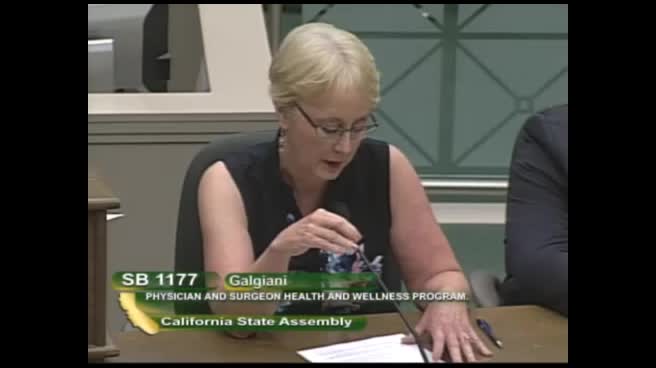 31MIN
Assembly Standing Committee on Business and Professions
 2MIN
Senate Floor
 49MIN
Senate Standing Committee on Business, Professions and Economic Development
Bill Author

Bill Co-Author(s):