SB 1196: Professions and vocations: Bureau of Real Estate, Bureau of Real Estate Appraisers, and Bureau of Security and Investigative Services.
- Session Year: 2015-2016
- House: Senate
- Latest Version Date: 2016-09-29
(1)Existing law provides for the regulation, by the Bureau of Security and Investigative Services within the Department of Consumer Affairs, of locksmiths and the employees of locksmiths, repossessors, private investigators, private patrol operators, armored contract carriers, firearms and baton training facilities, and employees of those licensees, alarm company operators and alarm agents, and proprietary security services. Existing law prescribes various fees and fines in connection with the regulation of these professions and vocations and provides for the deposit of the majority of these fees and fines into the Private Security Services Fund. Existing law also establishes the Professions and Vocations Fund, which consists of certain funds. Existing law provides that fine, penalty, and cost recovery moneys in any fund within the Professions and Vocations Fund are available only upon appropriation by the Legislature.
This bill would subject the bureau to review by the appropriate policy committees of the Legislature. The bill would also provide that the Private Security Services Fund is a fund in the Professions and Vocations Fund.
(2)The Collateral Recovery Act provides for the licensure and regulation of repossession agencies by the Bureau of Security and Investigative Services and prohibits the use of an alias in connection with the official activities of a licensed repossession agencys business.
This bill would instead prohibit the use of a business name other than the name of a licensed repossession agency in connection with the official activities of the licensees business.
(3)The Private Investigator Act provides for the licensure and regulation of private investigators by the Bureau of Security and Investigative Services. Until January 1, 2018, the act provides for the licensure of limited liability companies under the act and requires the application for licensure of a limited liability company to be subscribed, verified, and signed by a duly authorized member of the applicant under penalty of perjury. The act also requires a licensee to notify the Bureau of Security and Investigative Services within 30 days of any change in its corporate officers or any addition of a new partner.
This bill would additionally require the application for licensure of a limited liability company to be subscribed, verified, and signed by the qualified manager of the applicant. By expanding the scope of the crime of perjury, this bill would impose a state-mandated local program. The bill, among other things, would also require a licensee to notify the bureau within 30 days of any change in members required to be named in a corporations or limited liability corporations application for licensure.
(4)The Private Investigator Act prohibits a licensed private investigator and qualified manager who, in the course of his or her employment or business, carries a deadly weapon from carrying or using a firearm unless he or she has in his or her possession a valid firearms qualification card and requires the licensed private investigator and qualified manager to comply with, and be subject to, specified provisions.
This bill would authorize a licensed private investigator and qualified manager who possesses a valid firearms qualification card to also carry a concealed firearm if he or she satisfies specified conditions. The bill would also require, if a firearms qualification card is denied, the denial to be in writing, include the basis for the denial, and inform the applicant of his or her right to contest the denial.
(5)The Alarm Company Act requires that specified agreements entered into by an alarm company pertaining to alarm systems, including, among others, lease agreements, monitoring agreements, service agreements, and installation agreements, be in writing and include specified items.
This bill would additionally require initial agreements entered into on or after January 1, 2017, that contain an automatic renewal provision for a period of more than one month to disclose and describe the automatic renewal provision, as provided.
(6)The Private Security Services Act provides, among other matters, for the licensure and regulation of private patrol operators by the Bureau of Security and Investigative Services and makes a violation of its provisions a crime. Under that act, a person required to be registered as a security guard must report to his or her employer, within 24 hours of the incident, the circumstances surrounding the discharge of any firearm in which he or she is involved while acting within the course and scope of his or her employment. That act requires a person required to be registered as a security guard to carry a valid and current security guard registration card on his or her person, while on duty, and also requires a person registered as a security guard or patrolperson to deliver to the Director of Consumer Affairs and to local law enforcement a written report describing the circumstances surrounding the discharge of a firearm in which he or she was involved while acting within the course of his or her employment, within 7 days of the incident.
This bill would additionally impose the reporting duties upon the employer of the security guard or patrolperson. The bill would authorize a person required to be registered as a security guard, while pending receipt of the security guard registration card after the bureaus approval, to be on duty if the person carries on his or her person both a hardcopy printout of the approved security guard registration information from the bureaus Internet Web site and a valid picture identification.
(7)Existing law requires security guards, security patrolpersons, alarm company operators, and other specified persons to complete specified courses, acquire specified licenses, and be subject to specified provisions relating to their duties and relating to the carrying and use of a firearm or baton, as provided.
This bill would exempt from those provisions a federal qualified law enforcement officer, as defined.
(8)Existing law requires the Bureau of Security and Investigative Services to issue a firearms permit to a private patrol operator, alarm company operator, or other specified licensee when certain conditions are satisfied, including that the applicant has filed with the bureau a classifiable fingerprint card and that the bureau has determined, after investigation, that the carrying and use of a firearm by the applicant, in the course of his or her duties, presents no apparent threat to the public safety. Existing law prohibits a person required to be registered as a security guard from carrying or using a firearm unless he or she possesses a valid and current firearms permit and requires that person to carry the permit on his or her person when carrying a firearm on duty.
This bill would provide for the association of a firearms permit with the license or registration of the applicant, as specified. The bill would authorize an applicant for a firearms permit to, in lieu of submitting a classifiable fingerprint card, submit fingerprints into an electronic fingerprinting system administered by the Department of Justice, as specified. The bill would require an applicant for a firearms permit who is a registered security guard to complete a specified assessment to determine whether or not the applicant, at the point in time of the assessment, is capable of exercising appropriate judgment, restraint, and self-control for the purposes of carrying and using a firearm during the course of his or her security guard duties, as provided. The bill would prohibit the bureau from issuing or renewing a firearm permit to an applicant who has been found incapable of exercising appropriate judgment, restraint, and self-control pursuant to the assessment in the past 12 months, as specified. The bill would authorize the appeal of the denial of a firearms permit or firearms qualification card on the basis of the results of the assessment. The bill would authorize the bureau to seek an emergency order against the holder of a firearms permit if, after investigation relating to specific events, the bureau determines that the holder of the permit presents an undue hazard to public safety. The bill would prohibit licensees or registrants with firearms permits from carrying or using a firearm while performing duties not related to the qualifying license or registration to which the bureau associated the licensees or registrants firearms permit. The bill would authorize a person required to be registered as a security guard, while pending receipt of the firearms permit after the bureaus approval, to carry a firearm while on duty if the person carries on his or her person both a hardcopy printout of the approved firearms permit information from the bureaus Internet Web site and a valid picture identification.
(9)Existing law provides that any institution, firm, or individual wishing the approval of the Bureau of Security and Investigative Services to offer the firearms course must complete an application for certification as a firearms training facility, as specified.
This bill would require the bureau, within 120 days after issuance of a Firearms Training Facility Certificate, to inspect the facility for compliance with the specified requirements. The bill would authorize the bureau to inspect the facility prior to the issuance of a certificate. The bill would also require the bureau to maintain a program of random and targeted inspections of facilities to ensure compliance with applicable laws relating to the conduct and operation of facilities and to inform facilities when the bureau determines that the facility is not in compliance with the above-mentioned laws.
(10)The Collateral Recovery Act, the Private Investigator Act, the Private Security Services Act, and the Alarm Company Act impose, or authorize the imposition of, various fines and civil penalties, or suspend various licenses or permits issued pursuant to those acts, for violations of specified provisions of those acts.
This bill would revise specified fine amounts, civil penalty amounts, and suspensions for violations of specified provisions of the Collateral Recovery Act, the Private Investigator Act, the Private Security Services Act, and the Alarm Company Act.
(11)The Private Investigator Act, the Private Security Services Act, and the Alarm Company Act require specified licensees and applicants for licensure to, as a condition of the issuance, reinstatement, reactivation, or continued valid use of a license, maintain policies of insurance against liability for damages arising out of activities for which licensure is required pursuant to those acts, as specified.
This bill would require the insurer of those policies of insurance to list the Bureau of Security and Investigative Services as the certificate holder for the purposes of receiving notifications related to the policys status. The bill, until January 1, 2019, would provide for the automatic suspension, after 30-days written notice, of a licensee under the Alarm Company Act for failure to maintain sufficient insurance or failure to provide proof of required insurance upon request by the bureau, as specified.
(12)Existing law, the Real Estate Law, provides for the licensure and regulation of real estate brokers and real estate salespersons by the Real Estate Commissioner, the chief officer of the Bureau of Real Estate within the Department of Consumer Affairs. That law authorizes the commissioner to suspend or revoke the license of a real estate licensee if the licensee has entered a plea of guilty or nolo contendere to, or been found guilty of, or been convicted of, a felony, or a crime substantially related to the qualifications, functions, or duties of a real estate licensee, and the time for appeal has elapsed or the judgment of conviction has been affirmed on appeal, or other conditions are met.
Existing law, the Real Estate Appraisers Licensing and Certification Law, provides for the licensure, certification, and regulation of real estate appraisers and appraisal management companies by the Bureau of Real Estate Appraisers within the Department of Consumer Affairs, which is headed by the Chief of the Bureau of Real Estate Appraisers. That law requires the chief to adopt regulations governing the process and the procedure of applying for a real estate appraisers license and requires these regulations to include, among others, necessary experience or education and the submittal of an applicants social security number. To substantiate appraisal experience or to facilitate investigations, existing law requires licensees, applicants, and persons acting in a capacity that requires a license to submit copies of appraisals or any other work product, as specified, and all supporting documentation.
A willful violation of these laws is a crime.
This bill would subject the Bureau of Real Estate and the Bureau of Real Estate Appraisers to review by the appropriate policy committees of the Legislature, as specified. The bill would further authorize the Real Estate Commissioner to suspend the license of a real estate license upon the entry of a guilty plea by the licensee to any of the crimes described above. The bill would require the rescission of the suspension if the plea is withdrawn. The bill would further require the Chief of the Bureau of Real Estate Appraisers to require, as part of the educational requirements for applicants for licensure, the completion of a course on state and federal laws regulating the appraisal profession, as specified, and would additionally authorize the submittal of an applicants individual taxpayer identification number. The bill would additionally require those licensees, applicants, and persons acting in a capacity that requires a license to submit copies of engagement letters. Because the willful failure to submit those engagement letters would be a crime, the bill would impose a state-mandated local program.
(13)The California Constitution requires the state to reimburse local agencies and school districts for certain costs mandated by the state. Statutory provisions establish procedures for making that reimbursement.
This bill would provide that no reimbursement is required by this act for a specified reason.
(1)Existing law provides for the regulation, by the Bureau of Security and Investigative Services within the Department of Consumer Affairs, of locksmiths and the employees of locksmiths, repossessors, private investigators, private patrol operators, armored contract carriers, firearms and baton training facilities, and employees of those licensees, alarm company operators and alarm agents, and proprietary security services. Existing law prescribes various fees and fines in connection with the regulation of these professions and vocations and provides for the deposit of the majority of these fees and fines into the Private Security Services Fund. Existing law also establishes the Professions and Vocations Fund, which consists of certain funds. Existing law provides that fine, penalty, and cost recovery moneys in any fund within the Professions and Vocations Fund are available only upon appropriation by the Legislature.
This bill would subject the bureau to review by the appropriate policy committees of the Legislature. The bill would also provide that the Private Security Services Fund is a fund in the Professions and Vocations Fund.
(2)The Collateral Recovery Act provides for the licensure and regulation of repossession agencies by the Bureau of Security and Investigative Services and prohibits the use of an alias in connection with the official activities of a licensed repossession agencys business.
This bill would instead prohibit the use of a business name other than the name of a licensed repossession agency in connection with the official activities of the licensees business.
(3)The Private Investigator Act provides for the licensure and regulation of private investigators by the Bureau of Security and Investigative Services. Until January 1, 2018, the act provides for the licensure of limited liability companies under the act and requires the application for licensure of a limited liability company to be subscribed, verified, and signed by a duly authorized member of the applicant under penalty of perjury. The act also requires a licensee to notify the Bureau of Security and Investigative Services within 30 days of any change in its corporate officers or any addition of a new partner.
This bill would additionally require the application for licensure of a limited liability company to be subscribed, verified, and signed by a the qualified manager of the applicant. By expanding the scope of the crime of perjury, this bill would impose a state-mandated local program. The bill, among other things, would also require a licensee to notify the bureau within 30 days of any change in members required to be named in a corporations or limited liability corporations application for licensure.
(4)The Private Investigator Act prohibits a licensed private investigator and qualified manager who, in the course of his or her employment or business, carries a deadly weapon to carry or use a firearm unless he or she has in his or her possession a valid firearms qualification card and requires the licensed private investigator and qualified manager to comply with, and be subject to, specified provisions.
This bill would authorize a licensed private investigator and qualified manager who possesses a valid firearms qualification card to also carry a concealed firearm if he or she satisfies specified conditions. The bill would also require, if a firearms qualification card is denied, the denial to be in writing, include the basis for the denial, and inform the applicant of his or her right to contest the denial.
(5)The Alarm Company Act requires that specified agreements entered into by an alarm company pertaining to alarm systems, including, among others, lease agreements, monitoring agreements, service agreements, and installation agreements, be in writing and include specified items.
This bill would additionally require initial agreements entered into on or after January 1, 2017, that contain an automatic renewal provision for a period of more than one month to disclose and describe the automatic renewal provision, as provided.
(6)The Private Security Services Act provides, among other matters, for the licensure and regulation of private patrol operators by the Bureau of Security and Investigative Services and makes a violation of its provisions a crime. Under existing law, that act, a person required to be registered as a security guard must report to his or her employer, within 24 hours of the incident, the circumstances surrounding the discharge of any firearm in which he or she is involved while acting within the course and scope of his or her employment. Existing law That act requires a person required to be registered as a security guard to carry a valid and current security guard registration card on his or her person, while on duty, and also requires a person registered as a security guard or patrolperson to deliver to the Director of Consumer Affairs and to local law enforcement a written report describing the circumstances surrounding the discharge of a firearm in which he or she was involved while acting within the course of his or her employment, within 7 days of the incident.
This bill would additionally impose the reporting duties upon the employer of the security guard or patrolperson. The bill would authorize a person required to be registered as a security guard, while pending receipt of the security guard registration card after the bureaus approval, to be on duty if the person carries on his or her person both a hardcopy printout of the approved security guard registration information from the bureaus Internet Web site and a valid picture identification.
(7)Existing law requires security guards, security patrolpersons, alarm company operators, and other specified persons to complete specified courses, acquire specified licenses, and be subject to specified provisions relating to their duties and relating to the carrying and use of a firearm or baton, as provided.
This bill would exempt from those provisions a federal qualified law enforcement officer, as defined.
(8)Existing law requires the Bureau of Security and Investigative Services to issue a firearms permit to a private patrol operator, alarm company operator, or other specified licensee when certain conditions are satisfied, including that the applicant has filed with the bureau a classifiable fingerprint card and that the bureau has determined, after investigation, that the carrying and use of a firearm by the applicant, in the course of his or her duties, presents no apparent threat to the public safety. Existing law prohibits a person required to be registered as a security guard from carrying or using a firearm unless he or she possesses a valid and current firearms permit and requires that person to carry the permit on his or her person when carrying a firearm on duty.
This bill would provide for the association of a firearms permit with the license or registration of the applicant, as specified. The bill would authorize an applicant for a firearms permit to, in lieu of submitting a classifiable fingerprint card, submit fingerprints into an electronic fingerprinting system administered by the Department of Justice, as specified. The bill would require an applicant for a firearms permit who is a registered security guard to complete a specified assessment to determine whether or not the applicant, at the point in time of the assessment, is capable of exercising appropriate judgment, restraint, and self-control for the purposes of carrying and using a firearm during the course of his or her security guard duties, as provided. The bill would prohibit the bureau from issuing or renewing a firearm permit to an applicant who has been found incapable of exercising appropriate judgment, restraint, and self-control pursuant to the assessment in the past 12 months, as specified. The bill would authorize the appeal of the denial of a firearms permit or firearms qualification card on the basis of the results of the assessment. The bill would authorize the bureau to seek an emergency order against the holder of a firearms permit if, after investigation relating to specific events, the bureau determines that the holder of the permit presents an undue hazard to public safety. The bill would prohibit licensees or registrants with firearms permits from carrying or using a firearm while performing duties not related to the qualifying license or registration to which the bureau associated the licensees or registrants firearms permit. The bill would authorize a person required to be registered as a security guard, while pending receipt of the firearms permit after the bureaus approval, to carry a firearm while on duty if the person carries on his or her person both a hardcopy printout of the approved firearms permit information from the bureaus Internet Web site and a valid picture identification.
(9)Existing law provides that any institution, firm, or individual wishing the approval of the Bureau of Security and Investigative Services to offer the firearms course must complete an application for certification as a firearms training facility, as specified.
This bill would require the bureau, within 120 days after issuance of a Firearms Training Facility Certificate, to inspect the facility for compliance with the specified requirements. The bill would authorize the bureau to inspect the facility prior to the issuance of a certificate. The bill would also require the bureau to maintain a program of random and targeted inspections of facilities to ensure compliance with applicable laws relating to the conduct and operation of facilities and to inform facilities when the bureau determines that the facility is not in compliance with the above-mentioned laws.
(10)The Collateral Recovery Act, the Private Investigator Act, the Private Security Services Act, and the Alarm Company Act impose, or authorize the imposition of, various fines and civil penalties, or suspend various licenses or permits issued pursuant to those acts, for violations of specified provisions of those acts.
This bill would revise specified fine amounts, civil penalty amounts, and suspensions for violations of specified provisions of the Collateral Recovery Act, the Private Investigator Act, the Private Security Services Act, and the Alarm Company Act.
(11)The Private Investigator Act, the Private Security Services Act, and the Alarm Company Act require specified licensees and applicants for licensure to, as a condition of the issuance, reinstatement, reactivation, or continued valid use of a license, maintain policies of insurance against liability for damages arising out of activities for which licensure is required pursuant to those acts, as specified.
This bill would require the insurer of those policies of insurance to list the Bureau of Security and Investigative Services as the certificate holder for the purposes of receiving notifications related to the policys status. The bill, until January 1, 2019, would provide for the automatic suspension, after 30-days written notice, of a licensee under the Alarm Company Act for failure to maintain sufficient insurance or failure to provide proof of required insurance upon request by the bureau, as specified.
(12)Existing law, the Real Estate Law, provides for the licensure and regulation of real estate brokers and real estate salespersons by the Real Estate Commissioner, the chief officer of the Bureau of Real Estate within the Department of Consumer Affairs. That law authorizes the commissioner to suspend or revoke the license of a real estate licensee if the licensee has entered a plea of guilty or nolo contendere to, or been found guilty of, or been convicted of, a felony, or a crime substantially related to the qualifications, functions, or duties of a real estate licensee, and the time for appeal has elapsed or the judgment of conviction has been affirmed on appeal, or other conditions are met.
Existing law, the Real Estate Appraisers Licensing and Certification Law, provides for the licensure, certification, and regulation of real estate appraisers and appraisal management companies by the Bureau of Real Estate Appraisers within the Department of Consumer Affairs, which is headed by the Chief of the Bureau of Real Estate Appraisers. That law requires the chief to adopt regulations governing the process and the procedure of applying for a real estate appraisers license and requires these regulations to include, among others, necessary experience or education and the submittal of an applicants social security number. To substantiate appraisal experience or to facilitate investigations, existing law requires licensees, applicants, and persons acting in a capacity that requires a license to submit copies of appraisals or any other work product, as specified, and all supporting documentation.
A willful violation of these laws is a crime.
This bill would subject the Bureau of Real Estate and the Bureau of Real Estate Appraisers to review by the appropriate policy committees of the Legislature, as specified. The bill would authorize the Bureau of Real Estate, upon receipt of the certified copy of the plea and after a hearing, to suspend the license of a real estate licensee until the time for appeal has elapsed and further authorize the Real Estate Commissioner to suspend the license of a real estate license upon the entry of a guilty plea by the licensee to any of the crimes described above. The bill would require the commissioner to rescind recission of the suspension if the plea is withdrawn. The bill would further require the Chief of the Bureau of Real Estate Appraisers to require, as part of the educational requirements for applicants for licensure, the completion of a course on state and federal laws regulating the appraisal profession, as specified, and would additionally authorize the submittal of an applicants individual taxpayer identification number. The bill would additionally require those licensees, applicants, and persons acting in a capacity that requires a license to submit copies of engagement letters. Because the willful failure to submit those engagement letters would be a crime, the bill would impose a state-mandated local program.
(13)The California Constitution requires the state to reimburse local agencies and school districts for certain costs mandated by the state. Statutory provisions establish procedures for making that reimbursement.
This bill would provide that no reimbursement is required by this act for a specified reason.
(1)Existing law provides for the regulation, by the Bureau of Security and Investigative Services within the Department of Consumer Affairs, of locksmiths and the employees of locksmiths, repossessors, private investigators, private patrol operators, armored contract carriers, firearms and baton training facilities, and employees of those licensees, alarm company operators and alarm agents, and proprietary security services. Existing law prescribes various fees and fines in connection with the regulation of these professions and vocations and provides for the deposit of the majority of these fees and fines into the Private Security Services Fund. Existing law also establishes the Professions and Vocations Fund, which consists of certain funds. Existing law provides that fine, penalty, and cost recovery moneys in any fund within the Professions and Vocations Fund are available only upon appropriation by the Legislature.
This bill would subject the bureau to review by the appropriate policy committees of the Legislature. The bill would also provide that the Private Security Services Fund is a fund in the Professions and Vocations Fund.
(2)The Collateral Recovery Act provides for the licensure and regulation of repossession agencies by the Bureau of Security and Investigative Services and prohibits the use of an alias in connection with the official activities of a licensed repossession agencys business.
This bill would instead prohibit the use of a business name other than the name of a licensed repossession agency in connection with the official activities of the licensees business.
(3)The Private Investigator Act provides for the licensure and regulation of private investigators by the Bureau of Security and Investigative Services. Until January 1, 2018, the act provides for the licensure of limited liability companies under the act and requires the application for licensure of a limited liability company to be subscribed, verified, and signed by a duly authorized member of the applicant under penalty of perjury. The act also requires a licensee to notify the Bureau of Security and Investigative Services within 30 days of any change in its corporate officers or any addition of a new partner.
This bill would additionally require the application for licensure of a limited liability company to be subscribed, verified, and signed by a the qualified manager of the applicant. By expanding the scope of the crime of perjury, this bill would impose a state-mandated local program. The bill, among other things, would also require a licensee to notify the bureau within 30 days of any change in members required to be named in a corporations or limited liability corporations application for licensure.
(4)The Private Investigator Act prohibits a licensed private investigator and qualified manager who, in the course of his or her employment or business, carries a deadly weapon to carry or use a firearm unless he or she has in his or her possession a valid firearms qualification card and requires the licensed private investigator and qualified manager to comply with, and be subject to, specified provisions.
This bill would authorize a licensed private investigator and qualified manager who possesses a valid firearms qualification card to also carry a concealed firearm if he or she satisfies specified conditions. The bill would also require, if a firearms qualification card is denied, the denial to be in writing, include the basis for the denial, and inform the applicant of his or her right to contest the denial.
(5)The Alarm Company Act requires that specified agreements entered into by an alarm company pertaining to alarm systems, including, among others, lease agreements, monitoring agreements, service agreements, and installation agreements, be in writing and include specified items.
This bill would additionally require initial agreements entered into on or after January 1, 2017, that contain an automatic renewal provision for a period of more than one month to disclose and describe the automatic renewal provision, as provided.
(6)The Private Security Services Act provides, among other matters, for the licensure and regulation of private patrol operators by the Bureau of Security and Investigative Services and makes a violation of its provisions a crime. Under existing law, a person required to be registered as a security guard must report to his or her employer, within 24 hours of the incident, the circumstances surrounding the discharge of any firearm in which he or she is involved while acting within the course and scope of his or her employment. Existing law also requires a person registered as a security or patrolperson to deliver to the Director of Consumer Affairs and to local law enforcement a written report describing the circumstances surrounding the discharge of a firearm in which he or she was involved while acting within the course of his or her employment, within 7 days of the incident.
This bill would additionally impose the reporting duties upon the employer of the security guard or patrolperson.
(7)Existing law requires security guards, security patrolpersons, alarm company operators, and other specified persons to complete specified courses, acquire specified licenses, and be subject to specified provisions relating to their duties and relating to the carrying and use of a firearm or baton, as provided.
This bill would exempt from those provisions a federal qualified law enforcement officer, as defined.
(8)Existing law requires the Bureau of Security and Investigative Services to issue a firearms permit to a private patrol operator, alarm company operator, or other specified licensee when certain conditions are satisfied, including that the bureau has determined, after investigation, that the carrying and use of a firearm by the applicant, in the course of his or her duties, presents no apparent threat to the public safety.
This bill would provide for the association of a firearms permit with the license or registration of the applicant, as specified. The bill would require an applicant for a firearms permit who is a registered security guard to complete a specified assessment to determine whether or not the applicant, at the point in time of the assessment, is capable of exercising appropriate judgment, restraint, and self-control for the purposes of carrying and using a firearm during the course of his or her security guard duties, as provided. The bill would prohibit the bureau from issuing or renewing a firearm permit to an applicant who has been found incapable of exercising appropriate judgment, restraint, and self-control pursuant to the assessment in the past 12 months, as specified. The bill would authorize the appeal of the denial of a firearms permit or firearms qualification card on the basis of the results of the assessment. The bill would authorize the bureau to seek an emergency order against the holder of a firearms permit if, after investigation relating to specific events, the bureau determines that the holder of the permit presents an undue hazard to public safety. The bill would prohibit licensees or registrants with firearms permits from carrying or using a firearm while performing duties not related to the qualifying license or registration to which the bureau associated the licensees or registrants firearms permit.
(9)Existing law provides that any institution, firm, or individual wishing the approval of the Bureau of Security and Investigative Services to offer the firearms course must complete an application for certification as a firearms training facility, as specified.
This bill would require the bureau, within 120 days after issuance of a Firearms Training Facility Certificate, to inspect the facility for compliance with the specified requirements. The bill would authorize the bureau to inspect the facility prior to the issuance of a certificate. The bill would also require the bureau to maintain a program of random and targeted inspections of facilities to ensure compliance with applicable laws relating to the conduct and operation of facilities and to inform facilities when the bureau determines that the facility is not in compliance with the above-mentioned laws.
(10)The Collateral Recovery Act, the Private Investigator Act, the Private Security Services Act, and the Alarm Company Act impose, or authorize the imposition of, various fines and civil penalties, or suspend various licenses or permits issued pursuant to those acts, for violations of specified provisions of those acts.
This bill would revise specified fine amounts, civil penalty amounts, and suspensions for violations of specified provisions of the Collateral Recovery Act, the Private Investigator Act, the Private Security Services Act, and the Alarm Company Act.
(11)The Private Investigator Act, the Private Security Services Act, and the Alarm Company Act require specified licensees and applicants for licensure to, as a condition of the issuance, reinstatement, reactivation, or continued valid use of a license, maintain policies of insurance against liability for damages arising out of activities for which licensure is required pursuant to those acts, as specified.
This bill would require the insurer of those policies of insurance to list the Bureau of Security and Investigative Services as the certificate holder for the purposes of receiving notifications related to the policys status. The bill, until January 1, 2019, would provide for the automatic suspension, after 30-days written notice, of a licensee under the Alarm Company Act for failure to maintain sufficient insurance or failure to provide proof of required insurance upon request by the bureau, as specified.
Existing
(12)Existing law, the Real Estate Law, provides for the licensure and regulation of real estate brokers and real estate salespersons by the Real Estate Commissioner, the chief officer of the Bureau of Real Estate within the Department of Consumer Affairs. That law authorizes the commissioner to suspend or revoke the license of a real estate licensee if the licensee has entered a plea of guilty or nolo contendere to, or been found guilty of, or been convicted of, a felony, or a crime substantially related to the qualifications, functions, or duties of a real estate licensee, and the time for appeal has elapsed or the judgment of conviction has been affirmed on appeal, or other conditions are met.
Existing law, the Real Estate Appraisers Licensing and Certification Law, provides for the licensure, certification, and regulation of real estate appraisers and appraisal management companies by the Bureau of Real Estate Appraisers within the Department of Consumer Affairs, which is headed by the Chief of the Bureau of Real Estate Appraisers. That law requires the chief to adopt regulations governing the process and the procedure of applying for a real estate appraisers license and requires these regulations to include, among others, necessary experience or education and the submittal of an applicants social security number. To substantiate appraisal experience or to facilitate investigations, existing law requires that licensees, applicants, and persons acting in a capacity that requires a license to submit copies of appraisals or any other work product, as specified, and all supporting documentation.
A willful violation of these laws is a crime.
This bill would subject the Bureau of Real Estate and the Bureau of Real Estate Appraisers to review by the appropriate policy committees of the Legislature, as specified. The bill would further authorize the Real Estate Commissioner Bureau of Real Estate, upon receipt of the certified copy of the plea and after a hearing, to suspend the license of a real estate licensee upon the entry of a guilty plea by the licensee to any of the crimes described above until the time for appeal has elapsed and would require the commissioner to rescind the suspension if the plea is withdrawn. The bill would further require the Chief of the Bureau of Real Estate Appraisers to require, as part of the educational requirements for applicants for licensure, the completion of a course on state and federal laws regulating the appraisal profession, as specified, and would additionally authorize the submittal of an applicants individual taxpayer identification number. The bill would additionally require those licensees, applicants, and persons acting in a capacity that requires a license to submit copies of engagement letters. Because the willful failure to submit those engagement letters would be a crime, the bill would impose a state-mandated local program.
The
(13)The California Constitution requires the state to reimburse local agencies and school districts for certain costs mandated by the state. Statutory provisions establish procedures for making that reimbursement.
This bill would provide that no reimbursement is required by this act for a specified reason.
Existing law, the Real Estate Law, provides for the licensure and regulation of real estate brokers and real estate salespersons by the Real Estate Commissioner, the chief officer of the Bureau of Real Estate within the Department of Consumer Affairs. That law authorizes the commissioner to suspend or revoke the license of a real estate licensee if the licensee has entered a plea of guilty or nolo contendere to, or been found guilty of, or been convicted of, a felony, or a crime substantially related to the qualifications, functions, or duties of a real estate licensee, and the time for appeal has elapsed or the judgment of conviction has been affirmed on appeal, or other conditions are met.
Existing law, the Real Estate Appraisers Licensing and Certification Law, provides for the licensure, certification, and regulation of real estate appraisers and appraisal management companies by the Bureau of Real Estate Appraisers within the Department of Consumer Affairs, which is headed by the Chief of the Bureau of Real Estate Appraisers. That law requires the chief to adopt regulations governing the process and the procedure of applying for a real estate appraisers license and requires these regulations to include, among others, necessary experience or education. education and the submittal of an applicants social security number. To substantiate appraisal experience or to facilitate investigations, existing law requires that licensees, applicants, and persons acting in a capacity that requires a license to submit copies of appraisals or any other work product, as specified, and all supporting documentation.
A willful violation of these laws is a crime.
This bill would subject the Bureau of Real Estate and the Bureau of Real Estate Appraisers to review by the appropriate policy committees of the Legislature, as specified. The bill would further authorize the Real Estate Commissioner to suspend the license of a real estate licensee upon the entry of a guilty plea by the licensee to any of the crimes described above and would require the commissioner to rescind the suspension if the plea is withdrawn. The bill would further require the Chief of the Bureau of Real Estate Appraisers to require, as part of the educational requirements for applicants for licensure, the completion of a course on state and federal laws regulating the appraisal profession, as specified. specified, and would additionally authorize the submittal of an applicants individual taxpayer identification number. The bill would additionally require those licensees, applicants, and persons acting in a capacity that requires a license to submit copies of engagement letters. Because the willful failure to submit those engagement letters would be a crime, the bill would impose a state-mandated local program.
The California Constitution requires the state to reimburse local agencies and school districts for certain costs mandated by the state. Statutory provisions establish procedures for making that reimbursement.
This bill would provide that no reimbursement is required by this act for a specified reason.
Existing law, the Real Estate Law, provides for the licensure and regulation of real estate brokers and real estate salespersons by the Real Estate Commissioner, the chief officer of the Bureau of Real Estate within the Department of Consumer Affairs. That law authorizes the commissioner to suspend or revoke the license of a real estate licensee if the licensee has entered a plea of guilty or nolo contendere to, or been found guilty of, or been convicted of, a felony, or a crime substantially related to the qualifications, functions, or duties of a real estate licensee, and the time for appeal has elapsed or the judgment of conviction has been affirmed on appeal, or other conditions are met.
Existing law, the Real Estate Appraisers Licensing and Certification Law, provides for the licensure, certification, and regulation of real estate appraisers and appraisal management companies by the Bureau of Real Estate Appraisers within the Department of Consumer Affairs, which is headed by the Chief of the Bureau of Real Estate Appraisers. That law requires the chief to adopt regulations governing the process and the procedure of applying for a real estate appraisers license and requires these regulations to include, among others, necessary experience or education.
This bill would subject the Bureau of Real Estate and the Bureau of Real Estate Appraisers to review by the appropriate policy committees of the Legislature, as specified. The bill would further authorize the Real Estate Commissioner to suspend the license of a real estate licensee upon the entry of a guilty plea by the licensee to any of the crimes described above and would require the commissioner to rescind the suspension if the plea is withdrawn. The bill would further require the Chief of the Bureau of Real Estate Appraisers to require, as part of the educational requirements for applicants for licensure, the completion of a course on state and federal laws regulating the appraisal profession, as specified.
Existing law, the Real Estate Law, provides for the licensure and regulation of real estate brokers and real estate salespersons by the Real Estate Commissioner, the chief officer of the Bureau of Real Estate within the Department of Consumer Affairs.
Existing law, the Real Estate Appraisers Licensing and Certification Law, provides for the licensure, certification, and regulation of real estate appraisers and appraisal management companies by the Bureau of Real Estate Appraisers within the Department of Consumer Affairs, which is headed by the Chief of the Bureau of Real Estate Appraisers.
This bill would subject the Bureau of Real Estate and the Bureau of Real Estate Appraisers to review by the appropriate policy committees of the Legislature, as specified.
(a)There is in the State Treasury the Professions and Vocations Fund. The fund shall consist of the following special funds:
(1)Accountancy Fund.
(2)California Architects Board Fund.
(3)Athletic Commission Fund.
(4)Barbering and Cosmetology Contingent Fund.
(5)Cemetery and Funeral Fund.
(6)Contractors License Fund.
(7)State Dentistry Fund.
(8)Guide Dogs for the Blind Fund.
(9)Home Furnishings and Thermal Insulation Fund.
(10)California Architects Board-Landscape Architects Fund.
(11)Contingent Fund of the Medical Board of California.
(12)Optometry Fund.
(13)Pharmacy Board Contingent Fund.
(14)Physical Therapy Fund.
(15)Private Investigator Fund.
(16)Private Security Services Fund.
(17)Professional Engineers, Land Surveyors, and Geologists Fund.
(18)Consumer Affairs Fund.
(19)Behavioral Sciences Fund.
(20)Licensed Midwifery Fund.
(21)Court Reporters Fund.
(22)Veterinary Medical Board Contingent Fund.
(23)Vocational Nursing and Psychiatric Technicians Fund.
(24)Electronic and Appliance Repair Fund.
(25)Dispensing Opticians Fund.
(26)Acupuncture Fund.
(27)Physician Assistant Fund.
(28)Board of Podiatric Medicine Fund.
(29)Psychology Fund.
(30)Respiratory Care Fund.
(31)Speech-Language Pathology and Audiology and Hearing Aid Dispensers Fund.
(32)Board of Registered Nursing Fund.
(33)Animal Health Technician Examining Committee Fund.
(34)State Dental Hygiene Fund.
(35)State Dental Assistant Fund.
(36)Structural Pest Control Fund.
(37)Structural Pest Control Eradication and Enforcement Fund.
(38)Structural Pest Control Research Fund.
(b)For accounting and recordkeeping purposes, the Professions and Vocations Fund shall be deemed to be a single special fund, and each of the several special funds therein shall constitute and be deemed to be a separate account in the Professions and Vocations Fund. Each account or fund shall be available for expenditure only for the purposes as are now or may hereafter be provided by law.
(c)This section shall become operative on July 1, 2016.
SEC. 2.Article 10 (commencing with Section 6981) is added to Chapter 8.5 of Division 3 of the Business and Professions Code, to read:10.Review6981.Notwithstanding any other law, the powers and duties of the bureau, as set forth in this chapter, shall be subject to review by the appropriate policy committees of the Legislature. The review shall be performed as if this chapter were scheduled to be repealed as of January 1, 2020.
SEC. 3.Section 7507.6 of the Business and Professions Code is amended to read:7507.6.(a)Within seven days after a violent act has occurred involving a licensee, or any officer, partner, qualified certificate holder, registrant, or employee of a licensee, while acting within the course and scope of his or her employment or contract, that results in a police report or bodily harm or bodily injury, the licensee or the licensees qualified certificate holder or registrant, shall mail or deliver to the chief a notice concerning the incident upon a form provided by the bureau.
(b)Within seven days after the occurrence of a violent act or a threatened violent act involving a licensee, or any officer, partner, qualified certificate holder, registrant, or employee of a licensee, while acting within the course and scope of his or her employment or contract, that results in a police report or bodily harm or bodily injury, the licensee or the licensees qualified certificate holder or registrant shall send by certified mail, return receipt requested, a notice containing information about the incident to the person or individual who made the assignment. If the assignor is not the legal owner, the assignor shall notify the legal owner of the contents of the notice.
(c)A licensee, qualified certificate holder, or registrant may send the notice set forth in subdivision (b) for a violent act or threatened violent act even if a police report is not made or no bodily harm or bodily injury occurs. Any notice of a threatened violent act provided pursuant to subdivision (b) may only be used to notify a subsequent assignee and not for any collateral purpose. Nothing in this subdivision or subdivision (b) shall be construed to provide immunity against any claim for defamation.
SEC. 4.Section 7508.1 of the Business and Professions Code is amended to read:7508.1.The director may assess administrative fines for the following prohibited acts:
(a)Knowingly making any false report to his or her employer or client for whom information was being obtained. The fine shall be one hundred dollars ($100) for the first violation and five hundred dollars ($500) for each violation thereafter.
(b)Using any identification to indicate registration as a repossessor, other than the bureau-issued registration card, except an employer identification card issued by the repossession agency which has met bureau approval, or a badge, cap insignia, or jacket patch as provided in Section 7508.8. A bureau-issued registration card shall be carried by those individuals specified by Section 7506.3, and shall be shown on demand to any bureau employee or law enforcement officer. The fine shall be one hundred dollars ($100) for each violation.
(c)Using a business name other than the name under which the license is issued in connection with the official activities of the licensees business. The bureau shall issue a notice of warning for a first violation, a fine of one hundred dollars ($100) for the second violation, and a fine not to exceed two hundred fifty dollars ($250) for each violation thereafter.
(d)Appearing as an assignee party in any court proceeding involving claim and delivery, replevin, or other possessory court action, action to foreclose a chattel mortgage, mechanics lien, materialmans lien, or any other lien. This section shall not prohibit a licensee from appearing as a defendant in any of the preceding actions. The fine shall be one hundred dollars ($100) for each violation.
SEC. 5.Section 7508.2 of the Business and Professions Code is amended to read:7508.2.The director may assess administrative fines for any of the following prohibited acts:
(a)Recovering collateral or making any money demand in lieu thereof, including, but not limited to, collateral registered under the Vehicle Code, that has been sold under a security agreement before a signed or telegraphic authorization has been received from the legal owner, debtor, lienholder, lessor, or repossession agency acting on behalf of the legal owner, debtor, lienholder, or lessor of the collateral. A telephonic assignment is acceptable if the legal owner, debtor, lienholder, lessor, or repossession agency acting on behalf of the legal owner, debtor, lienholder, or lessor is known to the licensee and a written authorization from the legal owner, debtor, lienholder, lessor, or repossession agency acting on behalf of the legal owner, debtor, lienholder, or lessor is received by the licensee within 10 working days or a request by the licensee for a written authorization from the legal owner, debtor, lienholder, lessor, or repossession agency acting on behalf of the legal owner, debtor, lienholder, or lessor is made in writing within 10 working days. Referrals of assignments from one licensee to another licensee are acceptable. The referral of an assignment shall be made under the same terms and conditions as in the original assignment. The fine shall be one hundred dollars ($100) for the first violation and five hundred dollars ($500) for each violation thereafter, per audit.
(b)Using collateral or personal effects, which have been recovered, for the personal benefit of a licensee, or officer, partner, manager, registrant, or employee of a licensee. The fine shall be two hundred fifty dollars ($250) for the first violation and a fine not to exceed one thousand dollars ($1,000) for each violation thereafter. This subdivision does not apply to personal effects disposed of pursuant to subdivision (c) of Section 7507.9. Nothing in this subdivision prohibits the using or taking of personal property connected, adjoined, or affixed to the collateral through an unbroken sequence if that use or taking is reasonably necessary to effectuate the recovery in a safe manner or to protect the collateral or personal effects.
(c)Selling collateral recovered under this chapter, or making a demand for payment in lieu of repossession. The fine shall be two hundred fifty dollars ($250) for the first violation and a fine not to exceed one thousand dollars ($1,000) for each subsequent violation.
(d)Unlawfully entering any private building or secured area without the consent of the owner, or of the person in legal possession thereof, at the time of repossession. The fine shall be five hundred dollars ($500) for each violation.
(e)Committing unlawful assault or battery on another person during the course of a repossession. The fine shall not exceed two thousand five hundred dollars ($2,500) for each violation.
(f)Falsification of an inventory. The fine shall be one hundred dollars ($100) for the first violation and two hundred fifty dollars ($250) for each violation thereafter.
(g)Soliciting from the legal owner the recovery of specific collateral registered under the Vehicle Code or under the motor vehicle licensing laws of other states after the collateral has been seen or located on a public street or on public or private property without divulging the location of the vehicle. The fine shall be one hundred dollars ($100) for the first violation and two hundred fifty dollars ($250) for each violation thereafter.
SEC. 6.Section 7508.3 of the Business and Professions Code is amended to read:7508.3.A licensee, or any of his or her registrants or employees, or a qualified certificate holder, is prohibited from using any false or misleading representation during the course of recovery of collateral. The bureau shall issue a notice of warning for a first violation, a fine of one hundred dollars ($100) for the second violation, and a fine not to exceed two hundred fifty dollars ($250) for any subsequent violation of any of the following:
(a)The false representation or implication that the individual is vouched for, bonded by, or affiliated with the United States or with any state, county, city, or city and county, including the use of any badge, uniform, or facsimile thereof.
(b)The false representation or implication that any individual is an attorney or that any communication is from any attorney.
(c)The representation or implication by a repossession agency or its registrants or employees that nonpayment of any debt will result in the arrest or imprisonment of any person or the seizure, garnishment, attachment, or sale of any property or wages of any person, unless the action is lawful and the creditor has instructed the repossession agency to inform the debtor that the creditor intends to take the action.
(d)The threat to take any action that cannot legally be taken.
(e)The false representation or implication that the debtor committed any crime or other conduct in order to disgrace the debtor.
(f)The use or distribution of any written communication which simulates or is falsely represented to be a document authorized, issued, or approved by any court, official, or agency of the United States or any state, or which creates a false impression as to its source, authorization, or approval.
(g)The false representation or implication that documents are legal process.
(h)The use of any business, company, or organization name other than the true name of the repossession agencys business, company, or organization.
(i)The use of any deceptive forms.
SEC. 7.Section 7508.4 of the Business and Professions Code is amended to read:7508.4.The director may assess administrative fines for any of the following prohibited acts:
(a)Conducting business from any location other than that location to which a license was issued or conducting a business as an individual, partnership, limited liability company, or corporation unless the licensee holds a valid license issued to that exact same individual, partnership, limited liability company, or corporation. The fine shall be one thousand dollars ($1,000) for each violation.
(b)Aiding or abetting an unlicensed repossessor or assigning his or her license. Assigning his or her license means that no licensee shall permit a registrant, employee, or agent in his or her own name to advertise, engage clients, furnish reports, or present bills to clients, or in any manner whatsoever to conduct business for which a license is required under this chapter. The fine shall be one thousand dollars ($1,000) for each violation.
(c)Failing to register registrants within 15 days. The fine shall be two hundred fifty dollars ($250) for each of the first two violations and one thousand dollars ($1,000) for each violation thereafter.
(d)Employing a person whose registration has expired or been revoked, denied, suspended, or canceled, if the bureau has furnished a listing of these persons to the licensee. The fine shall be one hundred fifty dollars ($150) for the first violation and a fine not to exceed one thousand dollars ($1,000) for each violation thereafter.
(e)Failing to notify the bureau, within 30 days, of any change in officers. A notice of warning shall be issued for the first violation. Thereafter, the fine shall be five hundred dollars ($500) for each violation.
(f)Failing to submit the notices regarding a violent act or threatened violent act within seven days pursuant to Section 7507.6 or to submit a copy of a judgment awarded against the licensee for an amount of more than the then prevailing maximum claim that may be brought in small claims court within seven days pursuant to Section 7507.7. The fine shall not exceed five hundred dollars ($500) for the first violation and shall not exceed one thousand dollars ($1,000) for each violation thereafter.
(g)Failing to include the licensees name, address, and license number in any advertisement. The fine shall be fifty dollars ($50) for each violation.
(h)Failing to maintain personal effects for at least 60 days. The fine shall be one hundred dollars ($100) for the first violation and two hundred fifty dollars ($250) for each violation thereafter.
(i)Failing to provide a personal effects list or a notice of seizure within the time limits set forth in Section 7507.9 or 7507.10. The fine shall be one hundred dollars ($100) for the first violation and two hundred fifty dollars ($250) for each violation thereafter.
(j)Failing to file the required report pursuant to Section 28 of the Vehicle Code. The fine shall be one hundred dollars ($100) for the first violation and two hundred fifty dollars ($250) for each violation thereafter, per audit.
(k)Failing to maintain an accurate record and accounting of secure temporary registration forms. The qualified certificate holder shall be fined two hundred fifty dollars ($250) for the first violation, fined an amount not to exceed five hundred dollars ($500) for the second violation, and fined an amount not to exceed one thousand dollars ($1,000) plus a one-year suspension of the privilege to issue temporary registrations pursuant to Section 7506.9 for the third and subsequent violations.
(l)Representing that a licensee has an office and conducts business at a specific address when that is not the case. The fine shall be five thousand dollars ($5,000) for each violation.
(m)Notwithstanding any other law, the money in the Private Security Services Fund that is attributable to administrative fines imposed pursuant to this section shall not be continuously appropriated and shall be available for expenditure only upon appropriation by the Legislature.
SEC. 8.Section 7508.6 of the Business and Professions Code is amended to read:7508.6.The director may assess administrative fines against any repossession agency licensee, qualified certificate holder, or registrant for failure to notify the bureau within 30 days of any change of residence or business address. The fine shall be fifty dollars ($50) for each violation.
SEC. 9.Article 12 (commencing with Section 7511.5) is added to Chapter 11 of Division 3 of the Business and Professions Code, to read:12.Review7511.5.Notwithstanding any other law, the powers and duties of the bureau, as set forth in this chapter, shall be subject to review by the appropriate policy committees of the Legislature. The review shall be performed as if this chapter were scheduled to be repealed as of January 1, 2020.
SEC. 10.Section 7520.3 of the Business and Professions Code is amended to read:7520.3.(a)As a condition of the issuance, reinstatement, reactivation, or continued valid use of a license under this chapter, a limited liability company shall, in accordance with this section, maintain a policy or policies of insurance against liability imposed on or against it by law for damages arising out of claims based upon acts, errors, or omissions arising out of the private investigator services it provides.
(b)The total aggregate limit of liability under the policy or policies of insurance required under this section shall be as follows:
(1)For a limited liability company licensee with five or fewer persons named as managing members pursuant to subdivision (i) of Section 7525.1, the aggregate limit shall not be less than one million dollars ($1,000,000).
(2)For a limited liability company licensee with more than five persons named as managing members pursuant to subdivision (i) of Section 7525.1, an additional one hundred thousand dollars ($100,000) of insurance shall be obtained for each person named as managing members of the licensee except that the maximum amount of insurance is not required to exceed five million dollars ($5,000,000) in any one designated period, less amounts paid in defending, settling, or discharging claims as set forth under this section.
(c)Prior to the issuance, reinstatement, or reactivation of a limited liability company license as provided under this chapter, the applicant or licensee shall, in the manner prescribed by the bureau, submit the information and documentation required by this section and requested by the bureau, demonstrating compliance with the financial security requirements specified by this section.
(d)For any insurance policy secured by a licensee in satisfaction of this section, a Certificate of Liability Insurance, signed by an authorized agent or employee of the insurer, shall be submitted electronically or otherwise to the bureau. The insurer issuing the certificate shall report to the bureau the following information for any policy required under this section: name, license number, policy number, dates that coverage is scheduled to commence and lapse, and cancellation date if applicable. The insurer shall list the bureau as the certificate holder for the purposes of receiving notifications related to the policys status.
(e)(1)If a licensee fails to maintain sufficient insurance as required by this section, or fails to provide proof of the required insurance upon request by the bureau, the license is subject to suspension and shall be automatically suspended pursuant to this subdivision until the date that the licensee provides proof to the bureau of compliance with the insurance coverage requirement.
(2)Prior to an automatic suspension, the bureau shall notify the licensee, in writing, that it has 30 days to provide proof to the bureau of having the required insurance or the license shall be automatically suspended.
(3)If the licensee fails to provide proof of insurance coverage within this period, the bureau may automatically suspend the license.
(f)If the license of a limited liability company is suspended pursuant to subdivision (e), each member of the limited liability company shall be personally liable up to one million dollars ($1,000,000) each for damages resulting to third parties in connection with the companys performance, during the period of suspension, of any act or contract when a license is required by this chapter.
(g)This section shall remain in effect only until January 1, 2018, and as of that date is repealed.
SEC. 11.Section 7525.1 of the Business and Professions Code, as amended by Section 5 of Chapter 635 of the Statutes of 2015, is amended to read:7525.1.An application shall be verified and shall include:
(a)The full name and business address of the applicant.
(b)The name under which the applicant intends to do business.
(c)A statement as to the general nature of the business in which the applicant intends to engage.
(d)A verified statement of his or her experience qualifications.
(e)(1)If the applicant is an individual, a qualified manager, a partner of a partnership, an officer of a corporation designated in subdivision (h), or a managing member of a limited liability company designated in subdivision (i), one personal identification form provided by the bureau upon which shall appear a photograph taken within one year immediately preceding the date of the filing of the application together with two legible sets of fingerprints, one set of which shall be forwarded to the Federal Bureau of Investigation for purposes of a background check, on a form approved by the Department of Justice, and a personal description of each person, respectively. The identification form shall include residence addresses and employment history for the previous five years and be signed under penalty of perjury.
(2)The bureau may impose a fee not to exceed three dollars ($3) for processing classifiable fingerprint cards submitted by applicants, excluding those submitted into an electronic fingerprint system using electronic fingerprint technology.
(f)In addition, if the applicant for a license is an individual, the application shall list all other names known as or used during the past 10 years and shall state that the applicant is to be personally and actively in charge of the business for which the license is sought. If any other qualified manager is to be actively in charge of the business, the application shall be subscribed, verified, and signed by the applicant, under penalty of perjury. If any other person is to be actively in charge of the business, the application shall also be subscribed, verified, and signed by that person under penalty of perjury.
(g)If the applicants for a license are copartners, the application shall state the true names and addresses of all partners and the name of the partner to be actively in charge of the business for which the license is sought and list all other names known as or used during the past 10 years. If a qualified manager other than a partner is to be actively in charge of the business, then the application shall be subscribed, verified, and signed by all of the partners under penalty of perjury. If any other person is to be actively in charge of the business, the application shall also be subscribed, verified, and signed by that person, under penalty of perjury, under penalty of perjury by all of the partners and the qualified manager, or by all of the partners or the qualified manager.
(h)If the applicant for a license is a corporation, the application shall state the true names and complete residence addresses of the chief executive officer, secretary, chief financial officer, and any other corporate officer who will be active in the business to be licensed. The application shall also state the name and address of the designated person to be actively in charge of the business for which the license is sought. The application shall be subscribed, verified, and signed by a duly authorized officer of the applicant and by the qualified manager thereof, under penalty of perjury.
(i)If the applicant for a license is a limited liability company, the application shall state the true name and complete residence address of each managing member and any other officer or member who will be active in the business to be licensed. A copy of the most recent articles of organization, as filed by the Secretary of State, shall be supplied to the bureau upon request. The application shall also state the name and residence address of the designated person to be actively in charge of the business for which the license is sought. The application shall be subscribed, verified, and signed by a duly authorized member of the applicant and by the qualified manager thereof under penalty of perjury.
(j)Any other information, evidence, statements, or documents as may be required by the director.
(k)At the discretion of the applicant, a valid email address.
(l)This section shall remain in effect only until January 1, 2018, and as of that date is repealed.
SEC. 12.Section 7533.5 of the Business and Professions Code is amended to read:7533.5.(a)A licensee shall notify the bureau within 30 days of any change in its corporate officers, or members required to be named pursuant to subdivision (h) or (i) of Section 7525.1, and of any addition of a new partner.
(b)Applications, on forms prescribed by the director, shall be submitted by all new officers, managing members, and partners. The director may suspend or revoke a license issued under this chapter if the director determines that the new officer, managing member, or partner of a licensee has committed any of the acts constituting grounds to deny an application for a license or to take disciplinary action against a licensee pursuant to Section 7538 or 7538.5, respectively.
(c)This section shall remain in effect only until January 1, 2018, and as of that date is repealed.
SEC. 13.Section 7533.5 is added to the Business and Professions Code, to read:7533.5.(a)A licensee shall notify the bureau within 30 days of any change in its corporate officers, or members required to be named pursuant to subdivision (h) of Section 7525.1, and of any addition of a new partner.
(b)Applications, on forms prescribed by the director, shall be submitted by all new officers and partners. The director may suspend or revoke a license issued under this chapter if the director determines that the new officer or partner of a licensee has committed any of the acts constituting grounds to deny an application for a license or to take disciplinary action against a licensee pursuant to Section 7538 or 7538.5, respectively.
(c)This section shall become operative on January 1, 2018.
SEC. 14.Section 7542 of the Business and Professions Code is amended to read:7542.(a)A licensee and qualified manager who in the course of his or her employment or business carries a deadly weapon shall complete a course of training in the exercise of the powers to arrest as specified in Section 7583.7 and a course of training in the carrying and use of firearms as specified in Article 4 (commencing with Section 7583) of Chapter 11.5. A licensee or qualified manager shall not carry or use a firearm unless he or she has met the requirements of Sections 7583.23, 7583.24, and 7583.28 and has in his or her possession a valid firearms qualification card. A licensee or qualified manager who possesses a valid firearms qualification card shall comply with, and be subject to, Sections 7583.25, 7583.26, 7583.27, 7583.30, 7583.31, 7583.32, and 7583.37. A licensee or qualified manager who possesses a valid firearms qualification card may carry a firearm capable of being concealed upon the person in a concealed manner if he or she complies with applicable provisions set forth in Chapter 4 (commencing with Section 26150) of Division 5 of Title 4 of Part 6 of the Penal Code.
(b)If a firearms qualification card is denied, the denial shall be in writing and shall describe the basis for the denial. The denial shall inform the applicant that if he or she desires a review by the Private Investigator Disciplinary Review Committee to contest the denial, the review shall be requested of the director within 30 days following the issuance of the denial. A review or hearing shall be held pursuant to Section 7519.3. However, no review or hearing shall be granted to an individual who is otherwise prohibited by law from carrying a firearm.
(c)(1)If a firearms qualification card is denied on the basis of the results of an assessment pursuant to 7583.47, the denial shall be in writing and shall describe the basis for the denial. The denial shall inform the applicant that if he or she desires to contest the denial, the applicant shall request a hearing within 30 days of the issuance of the denial.
(2)Appeals of denials pursuant to this subdivision shall be in accordance with Chapter 5 (commencing with Section 11500) of Part 1 of Division 3 of Title 2 of the Government Code.
SEC. 15.Section 7563 of the Business and Professions Code is amended to read:7563.The director, in lieu of suspending or revoking a license issued under this chapter for violations of Sections 7561.1, 7561.3, and 7561.4, may impose a civil penalty not to exceed five hundred dollars ($500) for the first violation, and one thousand dollars ($1,000) for each violation thereafter, upon a licensee, if the director determines that this action better serves the purposes of this chapter.
SEC. 16.Section 7566 of the Business and Professions Code is amended to read:7566.The director may assess administrative fines of fifty dollars ($50) against any licensee, qualified manager, or firearms qualification cardholder for each violation for failure to notify the bureau within 30 days of any change of residence or business address. The principal place of business may be at a home or at a business address, but it shall be the place at which the licensee maintains a permanent office.
SEC. 17.Section 7570 of the Business and Professions Code, as amended by Section 16 of Chapter 669 of the Statutes of 2014, is amended to read:7570.The fees prescribed by this chapter are as follows:
(a)The application and examination fee for an original license shall not exceed fifty dollars ($50).
(b)The application fee for an original branch office certificate shall not exceed thirty dollars ($30).
(c)The fee for an original license for a private investigator shall not exceed one hundred seventy-five dollars ($175).
(d)The renewal fee is as follows:
(1)For a license as a private investigator, the fee shall not exceed one hundred twenty-five dollars ($125).
(2)For a branch office certificate for a private investigator, the fee shall not exceed thirty dollars ($30).
(e)The delinquency fee is 50 percent of the renewal fee in effect on the date of expiration.
(f)A reinstatement fee is equal to the amount of the renewal fee plus the regular delinquency fee.
(g)The fee for reexamination of an applicant or his or her manager shall not exceed fifteen dollars ($15).
(h)The processing fee for the assignment of a license pursuant to Section 7530 shall not exceed one hundred twenty-five dollars ($125).
(i)This section shall remain in effect only until January 1, 2018, and as of that date is repealed.
SEC. 18.Section 7570 of the Business and Professions Code, as added by Section 17 of Chapter 669 of the Statutes of 2014, is amended to read:7570.The fees prescribed by this chapter are as follows:
(a)The application and examination fee for an original license shall not exceed fifty dollars ($50).
(b)The application fee for an original branch office certificate shall not exceed thirty dollars ($30).
(c)The fee for an original license for a private investigator shall not exceed one hundred seventy-five dollars ($175).
(d)The renewal fee is as follows:
(1)For a license as a private investigator, the fee shall not exceed one hundred twenty-five dollars ($125).
(2)For a branch office certificate for a private investigator, the fee shall not exceed thirty dollars ($30).
(e)The delinquency fee is 50 percent of the renewal fee in effect on the date of expiration.
(f)A reinstatement fee is equal to the amount of the renewal fee plus the regular delinquency fee.
(g)The fee for reexamination of an applicant or his or her manager shall not exceed fifteen dollars ($15).
(h)This section shall become operative on January 1, 2018.
SEC. 19.Article 8 (commencing with Section 7573.5) is added to Chapter 11.3 of Division 3 of the Business and Professions Code, to read:8.Review7573.5.Notwithstanding any other law, the powers and duties of the bureau, as set forth in this chapter, shall be subject to review by the appropriate policy committees of the Legislature. The review shall be performed as if this chapter were scheduled to be repealed as of January 1, 2020.
SEC. 20.Section 7574.21 of the Business and Professions Code is amended to read:7574.21.A person registered as a proprietary private security employer shall do the following with respect to proprietary private security officers in his or her employment:
(a)Maintain an accurate and current record of the name, address, commencing date of employment, and position of each proprietary private security officer, and the date of termination of employment when a proprietary private security officer is terminated.
(b)Maintain an accurate and current record of proof of completion by each proprietary private security officer of the training described in Section 7574.18.
SEC. 21.Article 6 (commencing with Section 7576) is added to Chapter 11.4 of Division 3 of the Business and Professions Code, to read:6.Review7576.Notwithstanding any other law, the powers and duties of the bureau, as set forth in this chapter, shall be subject to review by the appropriate policy committees of the Legislature. The review shall be performed as if this chapter were scheduled to be repealed as of January 1, 2020.
SEC. 22.Section 7583.3 of the Business and Professions Code is amended to read:7583.3.No person required to be registered as a security guard pursuant to this chapter shall do any of the following:
(a)Fail to carry on his or her person, while on duty, a valid and current security guard registration card, or if pending receipt of the registration card after the bureaus approval, a hardcopy printout of the approved security guard registration information from the bureaus Internet Web site and a valid picture identification pursuant to Section 7583.17.
(b)Fail to carry on his or her person when carrying a firearm on duty either a valid and current firearms permit, or if pending receipt of the permit after the bureaus approval, a hardcopy printout of the approved firearms permit information from the bureaus Internet Web site and a valid picture identification pursuant to Section 7583.12.
(c)Carry or use a firearm unless he or she possesses a valid and current firearms permit that is associated with a valid and current security guard registration issued pursuant to this chapter.
(d)Fail to report to his or her employer within 24 hours of the incident the circumstances surrounding any incident involving the discharge of any firearm in which he or she is involved while acting within the course and scope of his or her employment.
SEC. 23.Section 7583.4 of the Business and Professions Code is amended to read:7583.4.Any person registered as a security guard or patrolperson, and the employer of the security guard or patrolperson, shall deliver to the director a written report describing fully the circumstances surrounding any incident involving the discharge of any firearm in which he or she was involved while acting within the course and scope of his or her employment, within seven days after the incident. The report shall be made on a form prescribed by the director which shall include, but not be limited to, the following:
(a)The name, address, and date of birth of the guard or patrolperson.
(b)The registration number of the guard or patrolperson.
(c)The firearm permit number and baton permit number of the guard or patrolperson, if applicable.
(d)The name of the employer of the person.
(e)The description of any injuries and damages that occurred.
(f)The identity of all participants in the incident.
(g)Whether a police investigation was conducted relating to the incident.
(h)The date and location of the incident. Any report may be investigated by the director to determine if any disciplinary action is necessary.
A copy of the report delivered to the director pursuant to this section shall also be delivered within seven days of the incident to the local police or sheriffs department which has jurisdiction over the geographic area where the incident occurred.
SEC. 24.Section 7583.6 of the Business and Professions Code is amended to read:7583.6.(a)A person entering the employ of a licensee to perform the functions of a security guard or a security patrolperson shall complete a course in the exercise of the power to arrest prior to being assigned to a duty location.
(b)Except for a registrant who has completed the course of training required by Section 7583.45, a person registered pursuant to this chapter shall complete not less than 32 hours of training in security officer skills within six months from the date the registration card is issued. Sixteen of the 32 hours shall be completed within 30 days from the date the registration card is issued.
(c)A course provider shall issue a certificate to a security guard upon satisfactory completion of a required course, conducted in accordance with the departments requirements. A private patrol operator may provide training programs and courses in addition to the training required in this section. A registrant who is unable to provide his or her employing licensee the certificate of satisfactory completion required by this subdivision shall complete 16 hours of the training required by subdivision (b) within 30 days of the date of his or her employment and shall complete the 16 remaining hours within six months of his or her employment date.
(d)The department shall develop and approve by regulation a standard course and curriculum for the skills training required by subdivision (b) to promote and protect the safety of persons and the security of property. For this purpose, the department shall consult with consumers, labor organizations representing private security officers, private patrol operators, educators, and subject matter experts.
(e)The course of training required by subdivision (b) may be administered, tested, and certified by any licensee, or by any organization or school approved by the department. The department may approve any person or school to teach the course.
(f)(1)On and after January 1, 2005, a licensee shall annually provide each employee registered pursuant to this chapter with eight hours of specifically dedicated review or practice of security officer skills prescribed in either course required in Section 7583.6 or 7583.7.
(2)A licensee shall maintain at the principal place of business or branch office a record verifying completion of the review or practice training for a period of not less than two years. The records shall be available for inspection by the bureau upon request.
(g)This section does not apply to a peace officer as defined in Chapter 4.5 (commencing with Section 830) of Title 3 of Part 2 of the Penal Code who has successfully completed a course of study in the exercise of the power to arrest approved by the Commission on Peace Officer Standards and Training, or a federal qualified law enforcement officer, as defined in Section 926B of Title 18 of the United States Code, who has successfully completed a course of study in the exercise of the power to arrest. This section does not apply to armored vehicle guards.
SEC. 25.Section 7583.9 of the Business and Professions Code is amended to read:7583.9.(a)Upon accepting employment by a private patrol operator, any employee who performs the function of a security guard or security patrolperson who is not currently registered with the bureau, shall complete an application for registration on a form as prescribed by the director, and obtain two classifiable fingerprint cards for submission to the Department of Justice. The applicant shall submit the application, the registration fee, and his or her fingerprints to the bureau. The bureau shall forward the classifiable fingerprint cards to the Department of Justice. The Department of Justice shall forward one classifiable fingerprint card to the Federal Bureau of Investigation for purposes of a background check.
(b)If a private patrol operator pays the application fee on behalf of the applicant, nothing in this section shall preclude the private patrol operator from withholding the amount of the fee from the applicants compensation.
(c)The licensee shall maintain supplies of applications and fingerprint cards that shall be provided by the bureau upon request.
(d)In lieu of classifiable fingerprint cards provided for in this section, the bureau may authorize applicants to submit their fingerprints into an electronic fingerprinting system administered by the Department of Justice. Applicants who submit their fingerprints by electronic means shall have their fingerprints entered into the system through a terminal operated by a law enforcement agency or other facility authorized by the Department of Justice to conduct electronic fingerprinting. The enforcement agency responsible for operating the terminal may charge a fee sufficient to reimburse it for the costs incurred in providing this service.
(e)Upon receipt of an applicants electronic or hard card fingerprints as provided in this section, the Department of Justice shall disseminate the following information to the bureau:
(1)Every conviction rendered against the applicant.
(2)Every arrest for an offense for which the applicant is presently awaiting trial, whether the applicant is incarcerated or has been released on bail or on his or her own recognizance pending trial.
(f)(1)The requirement in subdivision (a) to submit a fingerprint card does not apply to any of the following:
(A)A currently employed, full-time peace officer holding peace officer status under Chapter 4.5 (commencing with Section 830) of Title 3 of Part 2 of the Penal Code.
(B)A level I or level II reserve officer under paragraphs (1) and (2) of subdivision (a) of Section 832.6 of the Penal Code.
(2)An individual listed in subparagraph (A) or (B) of paragraph (1) may immediately perform the functions of a security guard or security patrolperson provided that he or she has submitted an application, the applicable fees, and his or her fingerprints, if required to submit fingerprints pursuant to subdivision (a), to the bureau for a security guard registration.
(3)This subdivision does not apply to a peace officer required to obtain a firearm qualification card pursuant to Section 7583.12.
(g)Peace officers exempt from the submission of classifiable fingerprints pursuant to subdivision (f) shall submit verification of their active duty peace officer status to the bureau with their application for registration. A photocopy of the front and back of their peace officer identification badge shall be adequate verification.
(h)Peace officers exempt from the submission of classifiable fingerprints pursuant to subdivision (f) shall report a change in their active duty peace officer status to the bureau within 72 hours of the change in active duty peace officer status.
(i)(1)Peace officers exempt from obtaining a firearm qualification card pursuant to subdivision (e) of Section 7583.12 shall submit to the bureau with their application for registration a letter of approval from his or her primary employer authorizing him or her to carry a firearm while working as a security guard or security officer.
(2)For purposes of this section, primary employer means a public safety agency currently employing a peace officer subject to this section.
(j) In addition to the amount authorized pursuant to Section 7570.1, the bureau may impose an additional fee not to exceed three dollars ($3) for processing classifiable fingerprint cards submitted by applicants excluding those submitted into an electronic fingerprint system using electronic fingerprint technology.
(k) An employee shall, on the first day of employment, display to the client his or her registration card if it is feasible and practical to comply with this disclosure requirement. The employee shall thereafter display to the client his or her registration card upon the request of the client.
SEC. 26.Section 7583.12 of the Business and Professions Code is amended to read:7583.12.(a)An employee of a licensee shall not carry or use a firearm unless the employee has in his or her possession both of the following:
(1)A valid guard registration card issued pursuant to this chapter.
(2)A valid firearm qualification card issued pursuant to this chapter.
(b)An employee of a licensee may carry or use a firearm while working as a security guard or security patrolperson pending receipt of a firearm qualification card if he or she has been approved by the bureau and carries on his or her person a hardcopy printout of the bureaus approval from the bureaus Internet Web site and a valid picture identification.
(c)In the event of the loss or destruction of the firearm qualification card, the cardholder may apply to the bureau for a certified replacement of the card, stating the circumstances surrounding the loss, and pay a ten-dollar ($10) certification fee, whereupon the bureau shall issue a certified replacement of the card.
(d)Paragraph (2) of subdivision (a) and subdivision (b) shall not apply to a duly appointed peace officer, as defined in Chapter 4.5 (commencing with Section 830) of Title 3 of Part 2 of the Penal Code, who meets all of the following:
(1)He or she has successfully completed a course of study in the use of firearms.
(2)He or she is authorized to carry a concealed firearm in the course and scope of his or her employment pursuant to Article 2 (commencing with Section 25450) of Chapter 2 of Division 5 of Title 4 of Part 6 of the Penal Code.
(3)He or she has proof that he or she has applied to the bureau for a firearm qualification card.
(e)(1)This section shall not apply to a duly appointed peace officer, as defined in Chapter 4.5 (commencing with Section 830) of Title 3 of Part 2 of the Penal Code, or a federal qualified law enforcement officer, as defined in Section 926B of Title 18 of the United States Code, who has written approval from his or her primary employer, as defined in paragraph (2) of subdivision (i) of Section 7583.9, to carry a firearm while working as a security guard.
(2)A peace officer exempt under this subdivision shall carry on his or her person a letter of approval from his or her primary employer authorizing him or her to carry a firearm while working as a security guard.
SEC. 27.Section 7583.22 of the Business and Professions Code is amended to read:7583.22.(a)A licensee, qualified manager of a licensee, or security guard who, in the course of his or her employment, may be required to carry a firearm shall, prior to carrying a firearm, do both of the following:
(1)Complete a course of training in the carrying and use of firearms.
(2)Receive a firearms qualification card or be otherwise qualified to carry a firearm as provided in Section 7583.12.
(b)A licensee shall not permit an employee to carry or use a loaded or unloaded firearm, whether or not it is serviceable or operative, unless the employee possesses a valid and current firearms qualification card issued by the bureau or is so otherwise qualified to carry a firearm as provided in Section 7583.12.
(c)A pocket card issued by the bureau pursuant to Section 7582.13 may also serve as a firearms qualification card if so indicated on the face of the card.
(d)Paragraph (1) of subdivision (a) shall not apply to a peace officer as defined in Chapter 4.5 (commencing with Section 830) of Title 3 of Part 2 of the Penal Code, who has successfully completed a course of study in the use of firearms or to a federal qualified law enforcement officer, as defined in Section 926B of Title 18 of the United States Code, who has successfully completed a course of study in the use of firearms.
SEC. 28.Section 7583.23 of the Business and Professions Code is amended to read:7583.23.The bureau shall issue a firearms permit when all of the following conditions are satisfied:
(a)The applicant is a licensee, a qualified manager of a licensee, or a registered security guard subject to the following:
(1)The firearms permit may only be associated with the following:
(A)A sole owner of a sole ownership licensee, pursuant to Section 7582.7 or 7525.1.
(B)A partner of a partnership licensee, pursuant to Section 7582.7 or 7525.1.
(C)A qualified manager of a licensee, pursuant to Section 7536 or 7582.22.
(D)A security guard registrant.
(2)If the firearms permit is associated with a security guard registration, he or she is subject to the provisions of Section 7583.47, regardless of any other license possessed or associated with the firearms permit.
(b)A certified firearms training instructor has certified that the applicant has successfully completed a written examination prepared by the bureau and training course in the carrying and use of firearms approved by the bureau.
(c)The applicant has filed with the bureau a classifiable fingerprint card, a completed application for a firearms permit on a form prescribed by the director, dated and signed by the applicant, certifying under penalty of perjury that the information in the application is true and correct. In lieu of a classifiable fingerprint card, the applicant may submit fingerprints into an electronic fingerprinting system administered by the Department of Justice. An applicant who submits his or her fingerprints by electronic means shall have his or her fingerprints entered into the system through a terminal operated by a law enforcement agency or other facility authorized by the Department of Justice to conduct electronic fingerprinting. The terminal operator may charge a fee sufficient to reimburse it for the costs incurred in providing this service.
(d)The bureau has determined, after investigation, that the carrying and use of a firearm by the applicant, in the course of his or her duties, presents no apparent threat to the public safety, or that the carrying and use of a firearm by the applicant is not in violation of the Penal Code.
(e)The applicant has produced evidence to the firearm training facility that he or she is a citizen of the United States or has permanent legal alien status in the United States. Evidence of citizenship or permanent legal alien status shall be that deemed sufficient by the bureau to ensure compliance with federal laws prohibiting possession of firearms by persons unlawfully in the United States and may include, but not be limited to, United States Department of Justice, Immigration and Naturalization Service Form I-151 or I-551, Alien Registration Receipt Card, naturalization documents, or birth certificates evidencing lawful residence or status in the United States.
(f)The application is accompanied by the application fees prescribed in this chapter.
(g)Beginning January 1, 2018, the applicant is a registered security guard and he or she has been found capable of exercising appropriate judgment, restraint, and self-control, for the purposes of carrying and using a firearm during the course of his or her duties, pursuant to Section 7583.47.
SEC. 29.Section 7583.24 of the Business and Professions Code is amended to read:7583.24.(a)The bureau shall not issue a firearm permit if the applicant is prohibited from possessing, receiving, owning, or purchasing a firearm pursuant to state or federal law.
(b)Before issuing an initial firearm permit the bureau shall provide the Department of Justice with the name, address, social security number, and fingerprints of the applicant.
(c)The Department of Justice shall inform the bureau, within 60 days from receipt of the information specified in subdivision (b), of the applicants eligibility to possess, receive, purchase, or own a firearm pursuant to state and federal law.
(d)An applicant who has been denied a firearm permit based upon subdivision (a) may reapply for the permit after the prohibition expires. The bureau shall treat this application as an initial application and shall follow the required screening process as specified in this section.
(e)Beginning January 1, 2018, the bureau shall not issue a firearm permit pursuant to this chapter to a registered security guard if the applicant has been found incapable, at the time of application, of exercising appropriate judgment, restraint, and self-control for the purposes of carrying and using a firearm during the course of his or her duties, pursuant to Section 7583.47. An applicant who has been denied a firearm permit pursuant to this subdivision may reapply for the permit after 12 months from the date of denial. The bureau shall treat the application as an initial application and the applicant must satisfy all the requirements specified in Section 7583.23.
(f)Beginning January 1, 2018, the bureau shall not issue a firearm permit pursuant to this chapter to a licensee or a qualified manager of a licensee who, within the past 12 months, has been found incapable of exercising appropriate judgment, restraint, and self-control, for the purposes of carrying and using a firearm during the course of his or her duties, pursuant to the assessment required under Section 7583.47 for a permit associated with a security guard registration.
SEC. 30.Section 7583.25 of the Business and Professions Code is amended to read:7583.25.(a)The bureau shall not renew a firearm permit if the applicant is prohibited from possessing, receiving, purchasing, or owning a firearm pursuant to state or federal law.
(b)Before renewing a firearm permit, the bureau shall provide the Department of Justice with the information necessary to identify the renewal applicant.
(c)The Department of Justice shall inform the bureau, within 30 days of receipt of the information specified in subdivision (b), of the renewal applicants eligibility to possess, receive, purchase, or own a firearm pursuant to state and federal law.
(d)An applicant who is denied a firearm permit renewal based upon subdivision (a) may reapply for the permit after the prohibition expires. The bureau shall treat this as an initial application and shall follow the screening process specified in Section 7583.24.
SEC. 31.Section 7583.27 of the Business and Professions Code is amended to read:7583.27.(a)A firearm permit shall be automatically revoked if at any time the Department of Justice notifies the bureau that the holder of the firearm permit is prohibited from possessing, receiving, or purchasing a firearm pursuant to state or federal law. Following the automatic revocation, an administrative hearing shall be provided upon written request to the bureau in accordance with Chapter 5 (commencing with Section 11500) of Part 1 of Division 3 of Title 2 of the Government Code.
(b)The bureau shall seek an emergency order pursuant to Article 13 (commencing with Section 11460.10) of Chapter 4.5 of Part 1 of Division 3 of Title 2 of the Government Code against the holder of the firearms permit if, after the bureaus investigation relating to any of the following events, the bureau determines that the holder of the firearms permit presents an undue hazard to public safety that may result in substantial injury to another:
(1)Receipt of subsequent arrest information of an arrest for any of the following:
(A)Assault.
(B)Battery.
(C)Any use of force or violence on any person committed by the permitholder.
(2)A report from a bureau-approved firearms training facility or instructor made pursuant to Section 7585.18.
(3)A report from the permitholders employer or former employer that the permitholder may be a threat to public safety.
(4)A complaint filed by any member of the public that the permitholder may be a threat to public safety.
(5)If the permitholder has been determined incapable of exercising appropriate judgment, restraint, and self-control pursuant to the assessment required under Section 7583.47 for a permit associated with a security guard registration.
SEC. 32.Section 7583.29 of the Business and Professions Code is amended to read:7583.29.(a)If a firearms permit is denied, the denial of the permit shall be in writing and shall describe the basis for the denial. The denial shall inform the applicant that if he or she desires a review by a disciplinary review committee to contest the denial, the review shall be requested of the director within 30 days following notice of the issuance of the denial. A review or hearing shall be held pursuant to Section 7581.3. However, no review or hearing shall be granted to an individual who is otherwise prohibited by law from carrying a firearm.
(b)(1)If a firearms permit is denied on the basis of the results of an assessment required pursuant to Section 7583.47 for a permit associated with a security guard registration, the denial shall be in writing and shall describe the basis for the denial. The denial shall inform the applicant that if he or she desires to contest the denial, the applicant shall request a hearing within 30 days of the issuance of the denial.
(2)Appeals of denials pursuant to this subdivision shall be in accordance with Chapter 5 (commencing with Section 11500) of Part 1 of Division 3 of Title 2 of the Government Code.
SEC. 33.Section 7583.32 of the Business and Professions Code is amended to read:7583.32.(a)A firearms qualification card expires two years from the date of issuance, if not renewed. A person who wishes to renew a firearms qualification card shall file an application for renewal at least 60 days prior to the cards expiration. A person whose card has expired shall not carry a firearm until he or she has been issued a renewal card by the bureau.
(b)The bureau shall not renew a firearms qualification card unless all of the following conditions are satisfied:
(1)The cardholder has filed with the bureau a completed application for renewal of a firearms qualification card, on a form prescribed by the director, dated and signed by the applicant under penalty of perjury certifying that the information on the application is true and correct.
(2)The applicant has requalified on the range and has successfully passed a written examination based on course content as specified in the firearms training manual approved by the department and taught at a training facility approved by the bureau.
(3)The application is accompanied by a firearms requalification fee as prescribed in this chapter.
(4)The applicant has produced evidence to the firearm training facility, either upon receiving his or her original qualification card or upon filing for renewal of that card, that he or she is a citizen of the United States or has permanent legal alien status in the United States. Evidence of citizenship or permanent legal alien status is that deemed sufficient by the bureau to ensure compliance with federal laws prohibiting possession of firearms by persons unlawfully in the United States and may include, but not be limited to, the United States Department of Justice, Immigration and Naturalization Service Form I-151 or I-551, Alien Registration Receipt Card, naturalization documents, or birth certificates evidencing lawful residence or status in the United States.
(c)An expired firearms qualification card may not be renewed. A person with an expired registration is required to apply for a new firearms qualification in the manner required of persons not previously registered. A person whose card has expired shall not carry a firearm until he or she has been issued a new firearms qualification card by the bureau.
(d)Paragraph (2) of subdivision (b) shall not apply to a duly appointed peace officer, as defined in Chapter 4.5 (commencing with Section 830) of Title 3 of Part 2 of the Penal Code who is authorized to carry a firearm in the course of his or her duties and who has successfully completed requalification training.
SEC. 34.Section 7583.33 of the Business and Professions Code is amended to read:7583.33.(a)Any licensee, qualified manager, or a registered uniformed security guard who wishes to carry a baton in the performance of his or her duties, shall qualify to carry the weapon pursuant to Article 5 (commencing with Section 7585).
(b)Subdivision (a) does not apply to a peace officer as defined in Chapter 4.5 (commencing with Section 830) of Title 3 of Part 2 of the Penal Code who has successfully completed a course of study in the use of batons or to a federal qualified law enforcement officer, as defined in Section 926B of Title 18 of the United States Code, who has successfully completed a course of study in the use of batons.
SEC. 35.Section 7583.37 of the Business and Professions Code is amended to read:7583.37.The director may assess fines as enumerated in Article 7 (commencing with Section 7587). Assessment of administrative fines shall be independent of any other action by the bureau or any local, state, or federal governmental agency that may result from a violation of this article. In addition to other prohibited acts under this chapter, no licensee, qualified manager, or registered security guard shall, during the course and scope of licensed activity, do any of the following:
(a)Carry any inoperable, replica, or other simulated firearm.
(b)Use a firearm in violation of the law, or in knowing violation of the standards for the carrying and usage of firearms as taught in the course of training in the carrying and use of firearms. Unlawful or prohibited uses of firearms shall include, but not be limited to, the following:
(1)Illegally using, carrying, or possessing a dangerous weapon.
(2)Brandishing a weapon.
(3)Drawing a weapon without proper cause.
(4)Provoking a shooting incident without cause.
(5)Carrying or using a firearm while on duty while under the influence of alcohol or dangerous drugs.
(6)Carrying or using a firearm of a caliber for which a firearms permit has not been issued by the bureau.
(7)Carrying or using a firearm while performing duties not related to the qualifying license or registration to which the bureau associated the firearms permit.
(c)Carry or use a baton in the performance of his or her duties, unless he or she has in his or her possession a valid baton certificate issued pursuant to Section 7585.14.
(d)Carry or use tear gas or any other nonlethal chemical agent in the performance of his or her duties unless he or she has in his or her possession proof of completion of a course in the carrying and use of tear gas or any other nonlethal chemical agent.
(e)Carry a concealed pistol, revolver, or other firearm capable of being concealed upon the person unless one of the following circumstances applies:
(1)The person has been issued a permit to carry a pistol, revolver, or other firearm capable of being concealed upon the person in a concealed manner by a local law enforcement agency pursuant to Section 26150, 26155, 26170, or 26215 of the Penal Code.
(2)The person is employed as a guard or messenger of a common carrier, bank, or other financial institution and he or she carries the weapon while actually employed in and about the shipment, transportation, or delivery of any money, treasure, bullion, bonds, or other thing of value within this state, as specified in Section 25630 of the Penal Code.
(3)The person is an honorably retired peace officer authorized to carry a concealed firearm pursuant to Section 25650 of the Penal Code or Article 2 (commencing with Section 25450) of Chapter 2 of Division 5 of Title 4 of Part 6 of the Penal Code.
(4)The person is a duly appointed peace officer, as defined in Chapter 4.5 (commencing with Section 830) of Title 3 of Part 2 of the Penal Code, who is authorized to carry a concealed firearm in the course and scope of his or her employment pursuant to Article 2 (commencing with Section 25450) of Chapter 2 of Division 5 of Title 4 of Part 6 of the Penal Code.
SEC. 36.Section 7583.39 of the Business and Professions Code is amended to read:7583.39.(a)The bureau shall require, as a condition precedent to the issuance, reinstatement, reactivation, renewal, or continued maintenance of a license, that the applicant or licensee file or have on file with the bureau, an insurance policy, as defined in Section 7583.40.
(b)If a licensee fails to maintain sufficient insurance, as required by this section, or fails to provide proof of the required insurance policy upon request by the bureau, the license shall be automatically suspended by operation of law until the date that the licensee provides proof to the bureau of compliance with the insurance coverage requirement. Prior to an automatic suspension, the bureau shall notify the licensee, in writing, that it has 30 days to provide proof to the bureau of having the required insurance policy or the license shall be automatically suspended.
(c)(1)A Certificate of Liability Insurance issued by an authorized agent or employee of the insurer shall be submitted to the bureau electronically, or in a manner authorized by the bureau, for an insurance policy secured by a licensee in satisfaction of this section. The insurer shall list the bureau as the certificate holder for the purposes of receiving notifications related to the policys status.
(2)An insurer issuing a Certificate of Liability Insurance pursuant to paragraph (1) shall report the following information to the bureau for an insurance policy required by this section:
(A)The name of the insured.
(B)The licensees license number.
(C)The policy number.
(D)The dates that coverage is scheduled to commence and end.
(E)The cancellation date, if applicable.
SEC. 37.Section 7583.47 is added to the Business and Professions Code, to read:7583.47.(a)As used in this section, assessment means the application of a testing instrument identified by the bureau that evaluates whether an applicant for a firearms permit who is a registered security guard, at the time of the assessment, possesses appropriate judgment, restraint, and self-control for the purposes of carrying and using a firearm during the course of his or her security guard duties.
(b)Beginning January 1, 2018, the applicant shall complete the assessment, as specified in this section.
(c)(1)The bureau shall implement a process to administer the assessment specified in this section by January 1, 2018. The establishment of the assessment and the process for administering the assessment shall not be subject to the requirements of Chapter 3.5 (commencing with Section 11340) of Part 1 of Division 3 of Title 2 of the Government Code.
(2)The bureau shall consult with a California licensed psychologist, psychologists, or other persons with subject matter expertise, whose minimum duties shall include, but are not limited to, assisting the bureau with all of the following:
(A)Establishing criteria for a contract with a vendor to administer the assessment.
(B)Identifying minimum standards for the assessment.
(C)Evaluating currently available assessments.
(D)Providing consultative services on the bids received by the bureau from third-party vendors seeking to administer and interpret the assessment, to ensure both of the following:
(i)Compliance with the applicable standards of care for the administration and interpretation of such assessments.
(ii)The assessment will be administered in accordance with the assessment manufacturers requirements.
(3)The bureau shall contract with a third-party vendor to administer the assessment. All third-party vendors seeking to administer the assessment must meet the minimum standards established by the bureau, its consultants, and the assessment manufacturers requirements for administering the assessment. Considerations for the third-party vendor contract shall include, but are not limited to, all of the following:
(A)Cost to the applicant to complete the assessment.
(B)Geographic accessibility statewide of the assessment to applicants.
(C)Assessment compliance with the established minimum standards for the assessment and assessment process.
(D)Ensuring an assessment carried out on an applicant complies with the applicable professional standards of care for such assessments, as well as the assessment manufacturers requirements for administering the assessment.
(d)Upon the bureaus verification that the applicant has satisfied subdivisions (a) to (f), inclusive, of Section 7583.23 and upon the applicants clearance of a background check by the Department of Justice and the Federal Bureau of Investigation to possess a firearm, the bureau shall notify the applicant that he or she is to contact the bureaus vendor to complete the assessment. The applicant, or his or her designee or employer if the employer voluntarily chooses, shall bear the cost of the assessment.
(e)Within 30 days of administering an applicants assessment, the vendor shall directly provide the bureau, on a form and in a manner prescribed by the bureau, the applicants assessment results. If the results of the applicants assessment indicate that he or she is incapable of exercising appropriate judgment, restraint, and self-control for the purposes of carrying and using a firearm during the course of his or her duties, at the point in time of the evaluation, the bureau shall not issue a firearms permit.
(f)The application shall be deemed incomplete until the bureau receives the applicants results of his or her assessment.
(g)The bureau may prescribe, adopt, and enforce emergency regulations, and promulgate regulations to implement this section. Any emergency regulation prescribed, adopted, or enforced pursuant to this section shall be adopted in accordance with Chapter 3.5 (commencing with Section 11340) of Part 1 of Division 3 of Title 2 of the Government Code, and for purposes of that chapter, including Section 11349.6 of the Government Code, the adoption of the regulation is an emergency and shall be considered by the Office of Administrative Law as necessary for the immediate preservation of the public peace, health and safety, and general welfare.
(h)The assessment required pursuant to this section shall be subject to review by the appropriate policy committees of the Legislature. The review shall be performed as if this section was scheduled to be repealed as of January 1, 2020.
SEC. 38.Section 7585.4.1 is added to the Business and Professions Code, to read:7585.4.1.(a)(1)Within 120 days after issuance of a Firearms Training Facility Certificate, the bureau shall inspect the facility for compliance with the applicable requirements of this article and the applicable rules and regulations of the bureau adopted pursuant to this article.
(2)The bureau may inspect the establishment for which a certificate application has been made prior to the issuance of the certificate.
(b)The bureau shall maintain a program of random and targeted inspections of facilities to ensure compliance with applicable laws relating to the conduct and operation of facilities.
(c)If the bureau determines that any facility is not complying with applicable laws relating to the conduct and operation of facilities, notice thereof shall immediately be given to the facility.
(d)In addition to the notice, the bureau may issue a citation or take other disciplinary action for violations of applicable laws.
SEC. 39.Section 7587.8 of the Business and Professions Code is amended to read:7587.8.The director may assess fines for the following acts pursuant to Article 4 (commencing with Section 7583) only as follows:
(a)Violation of subdivisions (a), (b), and (c) of Section 7583.2; five hundred dollars ($500) per violation.
(b)Violation of subdivisions (h) and (i) of Section 7583.2; two hundred fifty dollars ($250) per violation.
(c)Violation of subdivision (d) of Section 7583.2; five hundred dollars ($500) per violation.
(d)Violation of subdivision (g) of Section 7583.2; one thousand dollars ($1,000) for the first violation and two thousand five hundred dollars ($2,500) per violation for each violation thereafter.
(e)Violation of subdivision (f) of Section 7583.2; two thousand five hundred dollars ($2,500) per violation, notwithstanding any other provision of law.
SEC. 40.Section 7587.9 of the Business and Professions Code is amended to read:7587.9.The director may assess fines for the following acts pursuant to Article 4 (commencing with Section 7583) only as follows:
(a)Violation of subdivisions (a) and (b) of Section 7583.3; one hundred fifty dollars ($150) per violation.
(b)Violation of subdivision (c) of Section 7583.3; five hundred dollars ($500) for the first violation and one thousand dollars ($1,000) per violation for each violation thereafter.
(c)Violation of Section 7583.4; five hundred dollars ($500) per violation.
SEC. 41.Section 7587.10 of the Business and Professions Code is amended to read:7587.10.The director may assess fines for the following acts pursuant to Article 4 (commencing with Section 7583) only as follows:
(a)Violation of subdivisions (c) and (d) of Section 7583.37; one hundred dollars ($100) for the first violation and two hundred dollars ($200) for each violation thereafter.
(b)Violation of subdivision (a) of Section 7583.37; one hundred dollars ($100) for the first violation and five hundred dollars ($500) for each violation thereafter.
(c)Violation of subdivision (e) of Section 7583.37; one thousand dollars ($1,000).
(d)Violation of subdivision (b) of Section 7583.37; one thousand dollars ($1,000) and suspension of a firearm qualification card for six months for the first violation and, for a violation thereafter, one thousand dollars ($1,000) and a suspension of a firearm qualification card for not more than one year.
SEC. 42.Section 7587.12 of the Business and Professions Code is amended to read:7587.12.The director may assess fines for the following acts only as follows:
(a)Violations of paragraph (1), (2), (11), or (12) of subdivision (a) of Section 7585.19; two hundred fifty dollars ($250) for the first violation and five hundred dollars ($500) for subsequent violations.
(b)Violations of paragraph (3), (7), (8), or (10) of subdivision (a) of Section 7585.19; five hundred dollars ($500) for each violation.
(c)Violations of paragraph (6) of subdivision (a) of Section 7585.19; five hundred dollars ($500) for each hour shortened.
(d)Violations of paragraph (4) of subdivision (a) of Section 7585.19; five hundred dollars ($500) for each violation.
(e)Violations of paragraph (5) of subdivision (a) of Section 7585.19; five hundred dollars ($500) for every hour the course has been shortened.
(f)Violations of paragraph (9) of subdivision (a) of Section 7585.19; one thousand dollars ($1,000) for each violation.
SEC. 43.Section 7587.14 of the Business and Professions Code is amended to read:7587.14.The director may assess administrative fines of fifty dollars ($50) against any licensee, registrant, or firearms qualification cardholder for each violation for failure to notify the bureau within 30 days of any change of residence or business address. The principal place of business may be at a home or at a business address, but it shall be the place at which the licensee maintains a permanent office.
SEC. 44.Section 7587.15 of the Business and Professions Code is amended to read:7587.15.Notwithstanding any other provision of law, the director may assess a fine of up to five thousand dollars ($5,000) per violation against any licensee for a failure to comply with subdivision (e) of Section 7583.2.
SEC. 45.Section 7588 of the Business and Professions Code is amended to read:7588.The fees prescribed by this chapter are as follows:
(a)The application and examination fee for an original license for a private patrol operator may not exceed five hundred dollars ($500).
(b)The application fee for an original branch office certificate for a private patrol operator may not exceed two hundred fifty dollars ($250).
(c)The fee for an original license for a private patrol operator may not exceed seven hundred dollars ($700).
(d)The renewal fee is as follows:
(1)For a license as a private patrol operator, the fee may not exceed seven hundred dollars ($700).
(2)For a branch office certificate for a private patrol operator, the fee may not exceed seventy-five dollars ($75).
(e)The delinquency fee is 50 percent of the renewal fee in effect on the date of expiration.
(f)A reinstatement fee is equal to the amount of the renewal fee plus the regular delinquency fee.
(g)The fee for reexamination of an applicant or his or her manager shall be the actual cost to the bureau for developing, purchasing, grading, and administering each examination.
(h)Registration fees pursuant to this chapter are as follows:
(1)A registration fee for a security guard shall not exceed fifty dollars ($50).
(2)A security guard registration renewal fee shall not exceed thirty-five dollars ($35).
(i)Fees to carry out other provisions of this chapter are as follows:
(1)A firearms qualification fee may not exceed eighty dollars ($80).
(2)A firearms requalification fee may not exceed sixty dollars ($60).
(3)An initial baton certification fee may not exceed fifty dollars ($50).
(4)An application fee and renewal fee for certification as a firearms training facility or a baton training facility may not exceed five hundred dollars ($500).
(5)An application fee and renewal fee for certification as a firearms training instructor or a baton training instructor may not exceed two hundred fifty dollars ($250).
SEC. 46.Article 9 (commencing with Section 7588.8) is added to Chapter 11.5 of Division 3 of the Business and Professions Code, to read:9.Review7588.8.Notwithstanding any other law, the powers and duties of the bureau, as set forth in this chapter, shall be subject to review by the appropriate policy committees of the Legislature. The review shall be performed as if this chapter were scheduled to be repealed as of January 1, 2020.
SEC. 47.Section 7591.11 of the Business and Professions Code is amended to read:7591.11.(a)The bureau shall deny a firearms permit, pursuant to Chapter 2 (commencing with Section 29800) of Division 9 of Title 4 of Part 6 of the Penal Code, to any licensee, qualified manager, or alarm agent who has been convicted of a felony, unless the felony conviction has been reduced pursuant to Section 17 of the Penal Code or the person has been pardoned by the Governor. The licensee, qualified manager, or alarm agent shall not have a right to a review or a hearing if the denial is made pursuant to this section.
(b)The bureau shall not issue a firearms permit pursuant to this chapter to an applicant who, within the past 12 months, has been found incapable of exercising appropriate judgment, restraint, and self-control, for the purposes of carrying and using a firearm during the course of his or her duties pursuant to the assessment required under Section 7583.47 for a permit associated with a security guard registration.
SEC. 48.Section 7596.3 of the Business and Professions Code is amended to read:7596.3.The director shall issue a firearms permit when all of the following conditions exist:
(a)The applicant is a licensee, a qualified manager of a licensee, a designated branch office manager of a licensee, or a registered alarm agent. A firearms permit may only be associated with the following:
(1)A sole owner of a sole ownership licensee.
(2)A partner of a partnership licensee.
(3)A qualified manager of a licensee.
(4)A designated branch office manager of a licensee.
(5)A registered alarm agent.
(b)The applicant has filed with the bureau a classifiable fingerprint card, a completed application for a firearms permit on a form prescribed by the director, dated and signed by the applicant, certifying under penalty of perjury that the information in the application is true and correct. In lieu of a classifiable fingerprint card, the applicant may submit fingerprints into an electronic fingerprinting system administered by the Department of Justice. An applicant who submits his or her fingerprints by electronic means shall have his or her fingerprints entered into the system through a terminal operated by a law enforcement agency or other facility authorized by the Department of Justice to conduct electronic fingerprinting. The terminal operator may charge a fee sufficient to reimburse it for the costs incurred in providing this service.
(c)A certified firearms training instructor certifies that the applicant has successfully completed the bureau-approved training course in the carrying and use of firearms.
(d)The applicant has provided the bureau with evidence that the applicant has completed a course in the exercise of the powers to arrest.
(e)The bureau has determined, after investigation, that the carrying and use of a firearm by the applicant, in the course of his or her duties, presents no apparent threat to the public safety, or the carrying and use of a firearm by the applicant is not in violation of the Penal Code.
(f)The applicant has produced evidence to the firearm training facility that he or she is a citizen of the United States or has permanent legal alien status in the United States. Evidence of citizenship or permanent legal alien status shall be that deemed sufficient by the bureau to ensure compliance with federal laws prohibiting possession of firearms by persons unlawfully in the United States and may include, but not be limited to, Department of Justice, Immigration and Naturalization Service Form I-151 or I-551, Alien Registration Receipt Card, naturalization documents, or birth certificates evidencing lawful residence or status in the United States.
(g)The application is accompanied by the fee prescribed in this chapter.
SEC. 49.Section 7596.4 of the Business and Professions Code is amended to read:7596.4.(a)(1)If a firearms permit is denied, the denial of the permit shall be in writing and shall describe the basis for the denial. The denial shall inform the applicant that if he or she desires a review by the Alarm Company Operator Disciplinary Review Committee, the review shall be requested within 30 days of the issuance of the denial.
(2)A review or hearing shall be held pursuant to Section 7591.19. However, no review or hearing shall be granted to an individual who is otherwise prohibited by law from carrying a firearm.
(b)(1)If a firearms permit is denied on the basis of the results of an assessment required for a permit associated with a security guard registration pursuant to 7583.47, the denial shall be in writing and shall describe the basis for the denial. The denial shall inform the applicant that if he or she desires to contest the denial, the applicant shall request a hearing within 30 days of the issuance of the denial.
(2)Appeals of denials pursuant to this subdivision shall be in accordance with Chapter 5 (commencing with Section 11500) of Part 1 of Division 3 of Title 2 of the Government Code.
SEC. 50.Section 7596.8 of the Business and Professions Code is amended to read:7596.8.(a)The bureau shall not issue a firearm permit if the applicant is prohibited from possessing, receiving, owning, or purchasing a firearm pursuant to state or federal law.
(b)Before issuing an initial firearm permit the bureau shall provide the Department of Justice with the name, address, social security number, and fingerprints of the applicant.
(c)The Department of Justice shall inform the bureau, within 60 days from receipt of the information specified in subdivision (b), of the applicants eligibility to possess, receive, purchase, or own a firearm pursuant to state and federal law.
(d)An applicant who has been denied a firearm permit based upon subdivision (a) may reapply for the permit after the prohibition expires. The bureau shall treat this application as an initial application and shall follow the required screening process as specified in this section.
(e)The bureau shall not issue a firearm permit pursuant to this chapter to an applicant who, within the past 12 months, has been found incapable of exercising appropriate judgment, restraint, and self-control, for the purposes of carrying and using a firearm during the course of his or her duties, pursuant to the assessment required under Section 7583.47 for a permit associated with a security guard registration.
SEC. 51.Section 7596.83 of the Business and Professions Code is amended to read:7596.83.(a)A firearm permit shall be automatically revoked if at any time the Department of Justice notifies the bureau that the holder of the firearm permit is prohibited from possessing, receiving, or purchasing a firearm pursuant to state or federal law. Following the automatic revocation, an administrative hearing shall be provided upon written request to the bureau in accordance with Chapter 5 (commencing with Section 11500) of Part 1 of Division 3 of Title 2 of the Government Code.
(b)The bureau shall seek an emergency order pursuant to Article 13 (commencing with Section 11460.10) of Chapter 4.5 of Part 1 of Division 3 of Title 2 of the Government Code against the holder of the firearms permit if, after the bureaus investigation relating to any of the following events, the bureau determines that the holder of the firearms permit presents an undue hazard to public safety that may result in substantial injury to another:
(1)Receipt of subsequent arrest information of an arrest for any of the following:
(A)Assault.
(B)Battery.
(C)Any use of force or violence on any person committed by the permitholder.
(2)A report from a bureau-approved firearms training facility or instructor made pursuant to Section 7585.18.
(3)A report from the permitholders employer or former employer that the permitholder may be a threat to public safety.
(4)A complaint filed by any member of the public that the permitholder may be a threat to public safety.
(5)If the permitholder has been determined incapable of exercising appropriate judgment, restraint, and self-control pursuant to the assessment required under Section 7583.47 for a permit associated with a security guard registration.
SEC. 52.Section 7597.1 of the Business and Professions Code is amended to read:7597.1.(a)A licensee, qualified manager, branch office manager, or alarm agent shall not carry, use, or possess a loaded or unloaded firearm in the course and scope of his or her employment, whether or not it is serviceable or operative, unless he or she has in his or her possession a valid and current firearms qualification card issued to him or her by the bureau. The card shall be shown to any peace officer or bureau representative upon demand.
(b)Subdivision (a) shall not apply to a duly appointed peace officer, as defined in Chapter 4.5 (commencing with Section 830) of Title 3 of Part 2 of the Penal Code, or a federal qualified law enforcement officer, as defined in Section 926B of Title 18 of the United States Code, who meets all of the following:
(1)He or she has successfully completed a course of study in the use of firearms.
(2)He or she is authorized to carry a concealed firearm in the course and scope of his or her employment pursuant to Article 2 (commencing with Section 25450) of Chapter 2 of Division 5 of Title 4 of Part 6 of the Penal Code.
(3)He or she has proof that he or she has applied to the bureau for a firearms qualification card.
(c)A fine of two hundred fifty dollars ($250) may be assessed for the first violation of this section and a fine of five hundred dollars ($500) for each subsequent violation.
SEC. 53.Section 7597.2 of the Business and Professions Code is amended to read:7597.2.(a)A licensee, qualified manager, branch office manager, or alarm agent shall not carry any inoperable, replica, or other simulated firearm.
(b)A violation of this section shall result in a fine of one hundred dollars ($100) for the first violation and a fine of two hundred fifty dollars ($250) for each subsequent violation.
SEC. 54.Section 7597.3 of the Business and Professions Code is amended to read:7597.3.(a)No licensee, qualified manager, branch office manager, or alarm agent shall use a firearm which is in violation of law, or in knowing violation of the standards for carrying and usage of firearms, as taught in the course of training in the carrying and use of firearms, including, but not limited to:
(1)Illegally using, carrying, or possessing a dangerous weapon.
(2)Brandishing a weapon.
(3)Drawing a weapon without proper cause.
(4)Provoking a shooting incident without cause.
(5)Carrying or using a firearm while on duty under the influence of alcohol or dangerous drugs.
(6)Carrying or using a firearm of a caliber for which a bureau firearms permit has not been issued.
(7)Carrying or using a firearm while performing duties not related to the qualifying license, certificate, or registration to which the bureau associated the firearms permit.
(b)A fine of one thousand dollars ($1,000) and a suspension of the firearms permit for six months may be assessed for the first violation of this section and a fine of one thousand dollars ($1,000) and a suspension of the firearms permit for not more than one year for a subsequent violation.
SEC. 55.Section 7597.5 of the Business and Professions Code is amended to read:7597.5.(a)A licensee, qualified manager, branch office manager, or alarm agent shall not carry or use tear gas or any other nonlethal chemical agent in the performance of his or her duties, unless he or she has in his or her possession proof of completion of a course in the carrying and use of tear gas or other nonlethal chemical agent.
(b)A fine of one hundred dollars ($100) may be assessed for the first violation of this section and a fine of two hundred fifty dollars ($250) for each subsequent violation.
SEC. 56.Section 7597.6 of the Business and Professions Code is amended to read:7597.6.(a)A licensee, qualified manager, branch office manager, or alarm agent shall not carry a pistol, revolver, or other firearm capable of being concealed upon the person in a concealed manner unless one of the following circumstances apply:
(1)The person has been issued a permit to carry that firearm in a concealed manner by a local law enforcement agency pursuant to Section 26150, 26155, 26170, or 26215 of the Penal Code.
(2)The person is an honorably retired peace officer authorized to carry a concealed firearm pursuant to Section 25650 of the Penal Code or Article 2 (commencing with Section 25450) of Chapter 2 of Division 5 of Title 4 of Part 6 of the Penal Code.
(3)The person is a duly appointed peace officer, as defined in Chapter 4.5 (commencing with Section 830) of Title 3 of Part 2 of the Penal Code, who is authorized to carry a concealed firearm in the course and scope of his or her employment pursuant to Article 2 (commencing with Section 25450) of Chapter 2 of Division 5 of Title 4 of Part 6 of the Penal Code.
(b)A fine of one thousand dollars ($1,000) may be assessed for each violation of subdivision (a).
SEC. 57.Section 7598.51 of the Business and Professions Code is amended to read:7598.51.(a)An alarm agent shall carry on his or her person, while on duty, either a valid and current registration card or a temporary application for registration.
(b)A fine of one hundred fifty dollars ($150) may be assessed for each violation of subdivision (a).
SEC. 58.Section 7598.53 of the Business and Professions Code is amended to read:7598.53.An alarm agent who responds to an alarm system shall wear a prominently displayed patch or other designation which clearly identifies the name of the licensee. An alarm agent who carries a deadly weapon while responding to an alarm system shall wear a recognizable uniform with a prominently displayed patch or other designation which clearly identifies the name of the licensee. The uniform must be distinguishable from the uniforms worn by local regular law enforcement officers. A violation of this section may result in a fine of two hundred fifty dollars ($250) for each violation.
SEC. 59.Section 7599.32 of the Business and Professions Code, as amended by Section 13 of Chapter 140 of the Statutes of 2015, is amended to read:7599.32.(a)A licensee shall notify the bureau within 30 days of any change of its officers or members required to be named pursuant to Section 7593.4 or 7593.5 and of any addition of a new partner.
(b)Applications, on forms prescribed by the director, shall be submitted by all new officers, managing members, and partners. The director may suspend or revoke a license issued under this chapter if the director determines that the new officer, managing member, or partner has committed any act which constitutes grounds for the denial of a license pursuant to Section 7591.10.
(c)A notice of warning may be issued for the first violation of this section and a fine of five hundred dollars ($500) for each subsequent violation.
(d)This section shall remain in effect only until January 1, 2019, and as of that date is repealed.
SEC. 60.Section 7599.32 of the Business and Professions Code, as amended by Section 14 of Chapter 140 of the Statutes of 2015, is amended to read:7599.32.(a)A licensee shall notify the bureau within 30 days of any change of its officers required to be named pursuant to Section 7593.4 and of any addition of a new partner.
(b)Applications, on forms prescribed by the director, shall be submitted by all new officers and partners. The director may suspend or revoke a license issued under this chapter if the director determines that the new officer or partner has committed any act which constitutes grounds for the denial of a license pursuant to Section 7591.10.
(c)A notice of warning may be issued for the first violation of this section and a fine of five hundred dollars ($500) for each subsequent violation.
(d)This section shall become operative on January 1, 2019.
SEC. 61.Section 7599.33 of the Business and Professions Code is amended to read:7599.33.A licensee shall not conduct business, as defined in Section 7599.20, from any location other than that location for which a license or branch office registration was issued. A violation of this section may result in a fine of five hundred dollars ($500) for the first violation of this section and a fine of one thousand dollars ($1,000) for each subsequent violation.
SEC. 62.Section 7599.34 of the Business and Professions Code, as amended by Section 15 of Chapter 140 of the Statutes of 2015, is amended to read:7599.34.(a)A licensee shall not conduct a business as an individual, partnership, limited liability company, or corporation unless the licensee holds a valid license issued to that exact same individual, partnership, limited liability company, or corporation. A violation of this section may result in a fine of five hundred dollars ($500) for each violation.
(b)As a condition of the issuance, reinstatement, reactivation, or continued valid use of a license under this chapter, a limited liability company shall, in accordance with the provisions of this section, maintain a policy or policies of insurance against liability imposed on or against it by law for damages arising out of claims based upon acts, errors, or omissions arising out of the alarm company services it provides.
(c)The total aggregate limit of liability under the policy or policies of insurance required under this section shall be as follows:
(1)For a limited liability company licensee with five or fewer persons named as managing members pursuant to Section 7593.5 or 7599.32, the aggregate limit shall not be less than one million dollars ($1,000,000).
(2)For a limited liability company licensee with more than five persons named as managing members pursuant to Section 7593.5 or 7599.32, an additional one hundred thousand dollars ($100,000) of insurance shall be obtained for each person named as managing members of the licensee except that the maximum amount of insurance is not required to exceed five million dollars ($5,000,000) in any one designated period, less amounts paid in defending, settling, or discharging claims as set forth under this section.
(d)Prior to the issuance, reinstatement, or reactivation of a limited liability company license as provided under this chapter, the applicant or licensee shall, in the manner prescribed by the bureau, submit the information and documentation required by this section and requested by the bureau, demonstrating compliance with the financial security requirements specified by this section.
(e)For any insurance policy secured by a licensee in satisfaction of this section, a Certificate of Liability Insurance, signed by an authorized agent or employee of the insurer, shall be submitted electronically or otherwise to the bureau. The insurer issuing the certificate shall report to the bureau the following information for any policy required under this section: name, license number, policy number, dates that coverage is scheduled to commence and lapse, the date and amount of any payment of claims, and cancellation date if applicable. The insurer shall list the bureau as the certificate holder for the purposes of receiving notifications related to the policys status.
(f)(1)If a licensee fails to maintain sufficient insurance as required by this section, or fails to provide proof of the required insurance upon request by the bureau, the license is subject to suspension and is automatically suspended pursuant to this subdivision until the date that the licensee provides proof to the bureau of compliance with the insurance coverage requirement.
(2)Prior to an automatic suspension, the bureau shall notify the licensee, in writing, that the licensee has 30 days to provide proof to the bureau of having the required insurance or the license shall be automatically suspended.
(3)If the licensee fails to provide proof of insurance coverage within the period described in paragraph (2), the bureau may automatically suspend the license.
(g)Where the license of a limited liability company is suspended pursuant to subdivision (f), each member of the limited liability company shall be personally liable up to one million dollars ($1,000,000) each for damages resulting to third parties in connection with the companys performance, during the period of suspension, of any act or contract where a license is required by this chapter.
(h)This section shall remain in effect only until January 1, 2019, and as of that date is repealed.
SEC. 63.Section 7599.34 of the Business and Professions Code, as amended by Section 16 of Chapter 140 of the Statutes of 2015, is amended to read:7599.34.(a)A licensee shall not conduct a business as an individual, partnership, or corporation unless the licensee holds a valid license issued to that exact same individual, partnership, or corporation. A violation of this section may result in a fine of five hundred dollars ($500) for each violation.
(b)This section shall become operative on January 1, 2019.
SEC. 64.Section 7599.36 of the Business and Professions Code is amended to read:7599.36.(a)Each licensee shall maintain a file or record containing the name, address, commencing date of employment, and position of each employee, and the date of termination. Those files and records shall be retained during the time of employment and for a period of not less than two years thereafter, and, together with usual payroll records, shall be available for inspection by the bureau, and copies thereof and information pertaining thereto or contained therein shall be submitted to the bureau upon written request. A violation concerning the maintenance of the files or records may result in a fine of two hundred fifty dollars ($250) for each violation.
(b)A failure of a licensee to respond to the bureaus request to forward copies of the files or records and information pertaining thereto or contained therein within 30 days of the bureaus request may result in a fine of two hundred fifty dollars ($250) for each violation.
SEC. 65.Section 7599.37 of the Business and Professions Code is amended to read:7599.37.Each licensee shall maintain an accurate and current record of proof of completion of the course of training in the exercise of the power to arrest as required by Section 7598.1, by each of his or her employees. A violation of this section may result in a fine of five hundred dollars ($500) for each violation.
SEC. 66.Section 7599.38 of the Business and Professions Code is amended to read:7599.38.Each licensee shall certify an employees completion of the course of training in the exercise of power to arrest, or obtain proof that the training has been administered by a bureau-approved training facility, prior to allowing the employee to respond to an alarm system as required by Section 7598.1. A violation of this section may result in a fine of five hundred dollars ($500) for each violation.
SEC. 67.Section 7599.40 of the Business and Professions Code is amended to read:7599.40.A licensee shall not allow any employee to carry a firearm or other deadly weapon without first ascertaining that the employee is proficient in the use of each weapon to be carried. A current and valid firearm qualification card which indicates the specific caliber of the firearm which may be carried shall be deemed evidence of proficiency. A firearm qualification permit is not valid unless the employee holds a valid, current registration card. With respect to other deadly weapons, evidence of proficiency shall include a certificate from a training facility, certifying that the employee is proficient in the use of that particular deadly weapon. A violation of this section may result in a fine of two thousand five hundred dollars ($2,500) for each violation.
SEC. 68.Section 7599.41 of the Business and Professions Code is amended to read:7599.41.A licensee shall maintain an accurate and current record of all firearms or other deadly weapons that are in the possession of the licensee, or of any employee of the licensee, while on duty. The record shall contain the make, model, and serial number, or a description of any other deadly weapon, and the name of the person who has title of ownership. A violation of this section may result in a fine of five hundred dollars ($500) for each violation.
SEC. 69.Section 7599.42 of the Business and Professions Code, as amended by Section 17 of Chapter 140 of the Statutes of 2015, is amended to read:7599.42.(a)Within seven days after any violent incident involving a dangerous weapon that has been caused by or occurred upon a licensee or any officer, partner, managing member, qualified manager, or employee of a licensee, while acting within the course and scope of his or her employment, and that results in bodily injury to any person or death of any person involved in that incident or of any discharge of a weapon, excluding any discharge which occurs on the range, the licensee or his or her manager shall mail or deliver to the chief a detailed report of the incident. The report shall describe fully the circumstances surrounding the incident, any injuries or damages incurred, the identity of all participants, and whether a police investigation was conducted. A violation of this section by a licensee or any officer, partner, managing member, or qualified manager may result in a fine of one thousand dollars ($1,000) for the first violation and two thousand dollars ($2,000) for each subsequent violation. A violation of this section by an employee of a licensee may result in a fine of five hundred dollars ($500) for each violation.
(b)This section shall remain in effect only until January 1, 2019, and as of that date is repealed.
SEC. 70.Section 7599.42 of the Business and Professions Code, as amended by Section 18 of Chapter 140 of the Statutes of 2015, is amended to read:7599.42.(a)Within seven days after any violent incident involving a dangerous weapon, that has been caused by or occurred upon a licensee or any officer, partner, qualified manager, or employee of a licensee, while acting within the course and scope of his or her employment, and that results in bodily injury to any person or death of any person involved in that incident or of any discharge of a weapon, excluding any discharge which occurs on the range, the licensee or his or her manager shall mail or deliver to the chief a detailed report of the incident. The report shall describe fully the circumstances surrounding the incident, any injuries or damages incurred, the identity of all participants, and whether a police investigation was conducted. A violation of this section by a licensee or any officer, partner, or qualified manager may result in a fine of one thousand dollars ($1,000) for the first violation and two thousand five hundred dollars ($2,500) for each subsequent violation. A violation of this section by an employee of a licensee may result in a fine of five hundred dollars ($500) for each violation.
(b)This section shall become operative on January 1, 2019.
SEC. 71.Section 7599.44 of the Business and Professions Code is amended to read:7599.44.Every advertisement by a licensee soliciting or advertising business shall contain his or her name and license number as they appear in the records of the bureau. A violation of this section may result in a fine of five hundred dollars ($500) for the first violation and one thousand dollars ($1,000) for each subsequent violation.
SEC. 72.Section 7599.45 of the Business and Professions Code is amended to read:7599.45.A licensee or employee of a licensee shall not enter any private building or portion thereof, excepting premises open to the public, without the consent of the owner or the person in legal possession thereof. A violation of this section may result in a fine of one hundred dollars ($100) for each violation.
SEC. 73.Section 7599.54 of the Business and Professions Code is amended to read:7599.54.(a)Except as provided by Section 7599.56, every agreement, including, but not limited to, lease agreements, monitoring agreements, and service agreements, including all labor, services, and materials to be provided for the installation of an alarm system, shall be in writing. Except as provided by Section 7599.56, all amendments subject to the provisions of this section to an initial agreement shall be in writing. Each initial agreement shall contain, but not be limited to, the following:
(1)The name, business address, business telephone number, and license number of the licensed alarm company operator and the registration number of any alarm agent who solicited or negotiated the agreement.
(2)The approximate dates when the work will begin and be substantially completed.
(3)A description of the work to be done, a description of the materials to be used, and the agreed consideration for the work.
(4)A disclosure that alarm company operators are licensed and regulated by the Bureau of Security and Investigative Services, Department of Consumer Affairs, including the bureaus current address and contact information.
(5)A description of the alarm system including the major components thereof and services to be provided to the purchaser once the alarm is installed, including response or monitoring services, if any.
(6)Other matters agreed to by the parties of the contract. The agreement shall be legible and shall be in a form as to clearly describe any other document which is to be incorporated into the contract, and, before any work is done, the client shall be furnished with a copy of the written agreement signed by the licensee.
(7)A statement setting forth that upon completion of the installation of the alarm system, the alarm company shall thoroughly instruct the purchaser in the proper use of the alarm system.
(8)In the event a mechanics lien is to be utilized, a notice-to-owner statement which shall describe, in nontechnical language and in a clear and coherent manner using words with common and everyday meaning, the pertinent provisions of this states mechanics lien laws and the rights and responsibilities of an owner of property and a contractor thereunder, including the provisions relating to the filing of a contract concerning a work of improvement with the county recorder and the recording in the office of a contractors payment bond for private work.
(9)For agreements entered into on or after January 1, 2017, that include an automatic renewal provision renewing the agreement for a period of more than one month, a clear and distinct disclosure shall be included separate from the terms and conditions of the agreement advising the consumer that the agreement he or she is entering into contains an automatic renewal provision. The disclosure shall include the length of time of the renewal term and specify that failure to provide notification of nonrenewal to the licensee, as required in the agreement, will result in the automatic renewal of the agreement. The consumer shall acknowledge being advised of the automatic renewal provision by signing or initialing the disclosure. The disclosure may be included on the same document as the three-day right to cancel form required by Section 1689.7 of the Civil Code. The automatic renewal provision shall be void and invalid without a separate acknowledgment of the disclosure by the consumer.
(10)In addition to the above, every initial residential sales and lease agreement, the total cost which over the time period fixed by the agreement exceeds two hundred fifty dollars ($250), including the cost of all labor, service, or material to be provided by the licensee for the installation, shall include, but not be limited to, the following:
(A)A schedule of payments showing the amount of each payment as a sum in dollars and cents. This schedule of payments shall be referenced to the amount of work for services to be performed or to any materials or equipment to be supplied.
(B)If the payment schedule contained in the agreement provides for a downpayment to be paid to the licensee by the owner or the tenant before commencement of the work, that downpayment shall not exceed one thousand dollars ($1,000) or 10 percent of the contract price, excluding finance charges, whichever is the lesser.
(C)In no event shall the payment schedule provide that the licensee receive, nor shall the licensee actually receive, payment in excess of 100 percent of the value of the work performed on the project at any time, excluding finance charges, except that the licensee may receive an initial downpayment authorized by subparagraph (B). A failure by the licensee, without legal excuse, to substantially commence work within 20 days of the approximate date specified in the contract when work is to commence, shall postpone the next succeeding payment to the licensee for that period of time equivalent to the time between when substantial commencement was to have occurred and when it did occur.
(D)A notice-to-owner statement which shall describe, in nontechnical language and in a clear and coherent manner using words with common and everyday meaning, the pertinent provisions of this states mechanics lien laws and the rights and responsibilities of an owner of property and a contractor thereunder, including the provisions relating to the filing of a contract concerning a work of improvement with the county recorder and the recording in the office of a contractors payment bond for private work.
(E)A description of what constitutes substantial commencement of work pursuant to the contract.
(F)A disclosure that failure by the licensee, without legal excuse, to substantially commence work within 20 days from the approximate date specified in the agreement when the work will begin is a violation of the Alarm Company Act.
(G)A disclosure informing the buyer of any potential permit fees which may be required by local jurisdictions concerning the monitoring of an existing alarm system.
(H)This section shall not be construed to prohibit the parties to a residential alarm system sale contract from agreeing to a contract or account subject to Chapter 1 (commencing with Section 1801) of Title 2 of Part 4 of Division 3 of the Civil Code.
(b)A violation of this section or failure to commence work pursuant to subparagraph (F) of paragraph (10) of subdivision (a) may result in a fine of one hundred dollars ($100) for the first violation and a fine of five hundred dollars ($500) for each subsequent violation.
SEC. 74.Section 7599.59 of the Business and Professions Code is amended to read:7599.59.The director may assess administrative fines of fifty dollars ($50) against any licensee, qualified certificate holder, firearms qualification card holder, or registrant for each violation for failure to notify the bureau within 30 days of any change of residence or business address.
SEC. 75.Article 15 (commencing with Section 7599.80) is added to Chapter 11.6 of Division 3 of the Business and Professions Code, to read:15.Review7599.80.Notwithstanding any other law, the powers and duties of the bureau, as set forth in this chapter, shall be subject to review by the appropriate policy committees of the Legislature. The review shall be performed as if this chapter were scheduled to be repealed as of January 1, 2020.
SEC. 76.Section 10050 of the Business and Professions Code is amended to read:10050.(a)(1)There is in the Department of Consumer Affairs a Bureau of Real Estate, the chief officer of which bureau is named the Real Estate Commissioner.
(2)Notwithstanding any other law, the powers and duties of the bureau, as set forth in this part and Chapter 1 (commencing with Section 11000) of Part 2, shall be subject to review by the appropriate policy committees of the Legislature. The review shall be performed as if this part and that chapter were scheduled to be repealed as of January 1, 2021.
(b)It shall be the principal responsibility of the commissioner to enforce all laws in this part and Chapter 1 (commencing with Section 11000) of Part 2 in a manner that achieves the maximum protection for the purchasers of real property and those persons dealing with real estate licensees.
(c)Wherever the term commissioner is used in this division, it means the Real Estate Commissioner.
SEC. 77.Section 10177 of the Business and Professions Code is amended to read:10177.The commissioner may suspend or revoke the license of a real estate licensee, delay the renewal of a license of a real estate licensee, or deny the issuance of a license to an applicant, who has done any of the following, or may suspend or revoke the license of a corporation, delay the renewal of a license of a corporation, or deny the issuance of a license to a corporation, if an officer, director, or person owning or controlling 10 percent or more of the corporations stock has done any of the following:
(a)Procured, or attempted to procure, a real estate license or license renewal, for himself or herself or a salesperson, by fraud, misrepresentation, or deceit, or by making a material misstatement of fact in an application for a real estate license, license renewal, or reinstatement.
(b)(1)Entered a plea of guilty or nolo contendere to, or been found guilty of, or been convicted of, a felony, or a crime substantially related to the qualifications, functions, or duties of a real estate licensee, and the time for appeal has elapsed or the judgment of conviction has been affirmed on appeal, irrespective of an order granting probation following that conviction, suspending the imposition of sentence, or of a subsequent order under Section 1203.4 of the Penal Code allowing that licensee to withdraw his or her plea of guilty and to enter a plea of not guilty, or dismissing the accusation or information.
(2)Notwithstanding paragraph (1), and with the recognition that sentencing may not occur for months or years following the entry of a guilty plea, the commission may suspend the license of a real estate licensee upon the entry by the licensee of a guilty plea to any of the crimes described in paragraph (1). If the guilty plea is withdrawn, the suspension shall be rescinded and the license reinstated to its status prior to the suspension. The bureau shall notify a person whose license is subject to suspension pursuant to this paragraph of his or her right to have the issue of the suspension heard in accordance with Section 10100.
(c)Knowingly authorized, directed, connived at, or aided in the publication, advertisement, distribution, or circulation of a material false statement or representation concerning his or her designation or certification of special education, credential, trade organization membership, or business, or concerning a business opportunity or a land or subdivision, as defined in Chapter 1 (commencing with Section 11000) of Part 2, offered for sale.
(d)Willfully disregarded or violated the Real Estate Law (Part 1 (commencing with Section 10000)) or Chapter 1 (commencing with Section 11000) of Part 2 or the rules and regulations of the commissioner for the administration and enforcement of the Real Estate Law and Chapter 1 (commencing with Section 11000) of Part 2.
(e)Willfully used the term realtor or a trade name or insignia of membership in a real estate organization of which the licensee is not a member.
(f)Acted or conducted himself or herself in a manner that would have warranted the denial of his or her application for a real estate license, or either had a license denied or had a license issued by another agency of this state, another state, or the federal government revoked or suspended for acts that, if done by a real estate licensee, would be grounds for the suspension or revocation of a California real estate license, if the action of denial, revocation, or suspension by the other agency or entity was taken only after giving the licensee or applicant fair notice of the charges, an opportunity for a hearing, and other due process protections comparable to the Administrative Procedure Act (Chapter 3.5 (commencing with Section 11340), Chapter 4 (commencing with Section 11370), and Chapter 5 (commencing with Section 11500) of Part 1 of Division 3 of Title 2 of the Government Code), and only upon an express finding of a violation of law by the agency or entity.
(g)Demonstrated negligence or incompetence in performing an act for which he or she is required to hold a license.
(h)As a broker licensee, failed to exercise reasonable supervision over the activities of his or her salespersons, or, as the officer designated by a corporate broker licensee, failed to exercise reasonable supervision and control of the activities of the corporation for which a real estate license is required.
(i)Used his or her employment by a governmental agency in a capacity giving access to records, other than public records, in a manner that violates the confidential nature of the records.
(j)Engaged in any other conduct, whether of the same or a different character than specified in this section, that constitutes fraud or dishonest dealing.
(k)Violated any of the terms, conditions, restrictions, and limitations contained in an order granting a restricted license.
(l)(1)Solicited or induced the sale, lease, or listing for sale or lease of residential property on the ground, wholly or in part, of loss of value, increase in crime, or decline of the quality of the schools due to the present or prospective entry into the neighborhood of a person or persons having a characteristic listed in subdivision (a) or (d) of Section 12955 of the Government Code, as those characteristics are defined in Sections 12926 and 12926.1, subdivision (m) and paragraph (1) of subdivision (p) of Section 12955, and Section 12955.2 of the Government Code.
(2)Notwithstanding paragraph (1), with respect to familial status, paragraph (1) shall not be construed to apply to housing for older persons, as defined in Section 12955.9 of the Government Code. With respect to familial status, nothing in paragraph (1) shall be construed to affect Sections 51.2, 51.3, 51.4, 51.10, 51.11, and 799.5 of the Civil Code, relating to housing for senior citizens. Subdivision (d) of Section 51 and Section 4760 of the Civil Code and subdivisions (n), (o), and (p) of Section 12955 of the Government Code shall apply to paragraph (1).
(m)Violated the Franchise Investment Law (Division 5 (commencing with Section 31000) of Title 4 of the Corporations Code) or regulations of the Commissioner of Corporations pertaining thereto.
(n)Violated the Corporate Securities Law of 1968 (Division 1 (commencing with Section 25000) of Title 4 of the Corporations Code) or the regulations of the Commissioner of Corporations pertaining thereto.
(o)Failed to disclose to the buyer of real property, in a transaction in which the licensee is an agent for the buyer, the nature and extent of a licensees direct or indirect ownership interest in that real property. The direct or indirect ownership interest in the property by a person related to the licensee by blood or marriage, by an entity in which the licensee has an ownership interest, or by any other person with whom the licensee has a special relationship shall be disclosed to the buyer.
(p)Violated Article 6 (commencing with Section 10237).
(q)Violated or failed to comply with Chapter 2 (commencing with Section 2920) of Title 14 of Part 4 of Division 3 of the Civil Code, related to mortgages.
If a real estate broker that is a corporation has not done any of the foregoing acts, either directly or through its employees, agents, officers, directors, or persons owning or controlling 10 percent or more of the corporations stock, the commissioner may not deny the issuance or delay the renewal of a real estate license to, or suspend or revoke the real estate license of, the corporation, provided that any offending officer, director, or stockholder, who has done any of the foregoing acts individually and not on behalf of the corporation, has been completely disassociated from any affiliation or ownership in the corporation. A decision by the commissioner to delay the renewal of a real estate license shall toll the expiration of that license until the results of any pending disciplinary actions against that licensee are final, or until the licensee voluntarily surrenders his, her, or its license, whichever is earlier.
SEC. 78.Section 11301 of the Business and Professions Code is amended to read:11301.(a)(1)There is hereby created within the Department of Consumer Affairs a Bureau of Real Estate Appraisers to administer and enforce this part.
(2)Notwithstanding any other law, the powers and duties of the bureau, as set forth in this part, shall be subject to review by the appropriate policy committees of the Legislature. The review shall be performed as if this part were scheduled to be repealed as of January 1, 2021.
(b)Whenever the term Office of Real Estate Appraisers appears in any other law, it means the Bureau of Real Estate Appraisers.
SEC. 79.Section 11320 of the Business and Professions Code is amended to read:11320.No person shall engage in federally related real estate appraisal activity governed by this part or assume or use the title of or any title designation or abbreviation as a licensed appraiser in this state without an active license as defined in Section 11302. Any person who willfully violates this provision is guilty of a public offense punishable by imprisonment pursuant to subdivision (h) of Section 1170 of the Penal Code, or in a county jail for not more than one year, or by a fine not exceeding ten thousand dollars ($10,000), or by both the imprisonment and fine. The possession of a license issued pursuant to this part does not preempt the application of other statutes including the requirement for specialized training or licensure pursuant to Article 3 (commencing with Section 750) of Chapter 2.5 of Division 1 of the Public Resources Code.
SEC. 80.Section 11328 of the Business and Professions Code is amended to read:11328.To substantiate documentation of appraisal experience, or to facilitate the investigation of illegal or unethical activities by a licensee, applicant, or other person acting in a capacity that requires a license, that licensee, applicant, or person shall, upon the request of the director, submit copies of the engagement letters, appraisals, or any work product which is addressed by the Uniform Standards of Professional Appraisal Practice, and all supporting documentation and data to the office. This material shall be confidential in accordance with the confidentiality provisions of the Uniform Standards of Professional Appraisal Practice.
SEC. 81.Section 11340 of the Business and Professions Code is amended to read:11340.The director shall adopt regulations governing the process and the procedure of applying for a license which shall include, but not be limited to, necessary experience or education, equivalency, and minimum requirements of the Appraisal Foundation, if any.
(a)For purposes of the educational background requirements established under this section, the director shall do both of the following:
(1)Grant credits for any courses taken on real estate appraisal ethics or practices pursuant to Section 10153.2, or which are deemed by the director to meet standards established pursuant to this part and federal law.
(2)Require the completion of a course on state and federal laws regulating the appraisal profession, as approved by the bureau every two years. The course shall include an examination that requires an applicant to demonstrate the applicants knowledge of those laws.
(b)For the purpose of implementing and applying this section, the director shall prescribe by regulation equivalent courses and equivalent experience. The experience of employees of an assessors office or of the State Board of Equalization in setting forth opinions of value of real property for tax purposes shall be deemed equivalent to experience in federally related real estate appraisal activity. Notwithstanding any other law, a holder of a valid real estate broker license shall be deemed to have completed appraisal license application experience requirements upon proof that he or she has accumulated 1,000 hours of experience in the valuation of real property.
(c)The director shall adopt regulations for licensure which shall meet, at a minimum, the requirements and standards established by the Appraisal Foundation and the federal financial institutions regulatory agencies acting pursuant to Section 1112 of the Financial Institutions Reform Recovery and Enforcement Act of 1989 (FIRREA) (Public Law 101-73). The director shall, by regulation, require the application for a real estate appraiser license to include the applicants social security number or individual taxpayer identification number.
(d)In evaluating the experience of any applicant for a license, regardless of the number of hours required of that applicant, the director shall apply the same standards to the experience of all applicants.
(e)No license shall be issued to an applicant who is less than 18 years of age.
SEC. 82.No reimbursement is required by this act pursuant to Section 6 of Article XIIIB of the California Constitution because the only costs that may be incurred by a local agency or school district will be incurred because this act creates a new crime or infraction, eliminates a crime or infraction, or changes the penalty for a crime or infraction, within the meaning of Section 17556 of the Government Code, or changes the definition of a crime within the meaning of Section 6 of Article XIIIB of the California Constitution.
(a)There is in the State Treasury the Professions and Vocations Fund. The fund shall consist of the following special funds:
(1)Accountancy Fund.
(2)California Architects Board Fund.
(3)Athletic Commission Fund.
(4)Barbering and Cosmetology Contingent Fund.
(5)Cemetery and Funeral Fund.
(6)Contractors License Fund.
(7)State Dentistry Fund.
(8)Guide Dogs for the Blind Fund.
(9)Home Furnishings and Thermal Insulation Fund.
(10)California Architects Board-Landscape Architects Fund.
(11)Contingent Fund of the Medical Board of California.
(12)Optometry Fund.
(13)Pharmacy Board Contingent Fund.
(14)Physical Therapy Fund.
(15)Private Investigator Fund.
(16)Private Security Services Fund.
(17)Professional Engineers, Land Surveyors, and Geologists Fund.
(18)Consumer Affairs Fund.
(19)Behavioral Sciences Fund.
(20)Licensed Midwifery Fund.
(21)Court Reporters Fund.
(22)Veterinary Medical Board Contingent Fund.
(23)Vocational Nursing and Psychiatric Technicians Fund.
(24)Electronic and Appliance Repair Fund.
(25)Dispensing Opticians Fund.
(26)Acupuncture Fund.
(27)Physician Assistant Fund.
(28)Board of Podiatric Medicine Fund.
(29)Psychology Fund.
(30)Respiratory Care Fund.
(31)Speech-Language Pathology and Audiology and Hearing Aid Dispensers Fund.
(32)Board of Registered Nursing Fund.
(33)Animal Health Technician Examining Committee Fund.
(34)State Dental Hygiene Fund.
(35)State Dental Assistant Fund.
(36)Structural Pest Control Fund.
(37)Structural Pest Control Eradication and Enforcement Fund.
(38)Structural Pest Control Research Fund.
(b)For accounting and recordkeeping purposes, the Professions and Vocations Fund shall be deemed to be a single special fund, and each of the several special funds therein shall constitute and be deemed to be a separate account in the Professions and Vocations Fund. Each account or fund shall be available for expenditure only for the purposes as are now or may hereafter be provided by law.
(c)This section shall become operative on July 1, 2016.
SEC. 2.Article 10 (commencing with Section 6981) is added to Chapter 8.5 of Division 3 of the Business and Professions Code, to read:10.Review6981.Notwithstanding any other law, the powers and duties of the bureau, as set forth in this chapter, shall be subject to review by the appropriate policy committees of the Legislature. The review shall be performed as if this chapter were scheduled to be repealed as of January 1, 2020.
SEC. 3.Section 7507.6 of the Business and Professions Code is amended to read:7507.6.(a)Within seven days after a violent act has occurred involving a licensee, or any officer, partner, qualified certificate holder, registrant, or employee of a licensee, while acting within the course and scope of his or her employment or contract, that results in a police report or bodily harm or bodily injury, the licensee or the licensees qualified certificate holder or registrant, shall mail or deliver to the chief a notice concerning the incident upon a form provided by the bureau.
(b)Within seven days after the occurrence of a violent act or a threatened violent act involving a licensee, or any officer, partner, qualified certificate holder, registrant, or employee of a licensee, while acting within the course and scope of his or her employment or contract, that results in a police report or bodily harm or bodily injury, the licensee or the licensees qualified certificate holder or registrant shall send by certified mail, return receipt requested, a notice containing information about the incident to the person or individual who made the assignment. If the assignor is not the legal owner, the assignor shall notify the legal owner of the contents of the notice.
(c)A licensee, qualified certificate holder, or registrant may send the notice set forth in subdivision (b) for a violent act or threatened violent act even if a police report is not made or no bodily harm or bodily injury occurs. Any notice of a threatened violent act provided pursuant to subdivision (b) may only be used to notify a subsequent assignee and not for any collateral purpose. Nothing in this subdivision or subdivision (b) shall be construed to provide immunity against any claim for defamation.
SEC. 4.Section 7508.1 of the Business and Professions Code is amended to read:7508.1.The director may assess administrative fines for the following prohibited acts:
(a)Knowingly making any false report to his or her employer or client for whom information was being obtained. The fine shall be one hundred dollars ($100) for the first violation and five hundred dollars ($500) for each violation thereafter.
(b)Using any identification to indicate registration as a repossessor, other than the bureau-issued registration card, except an employer identification card issued by the repossession agency which has met bureau approval, or a badge, cap insignia, or jacket patch as provided in Section 7508.8. A bureau-issued registration card shall be carried by those individuals specified by Section 7506.3, and shall be shown on demand to any bureau employee or law enforcement officer. The fine shall be one hundred dollars ($100) for each violation.
(c)Using a business name other than the name under which the license is issued in connection with the official activities of the licensees business. The bureau shall issue a notice of warning for a first violation, a fine of one hundred dollars ($100) for the second violation, and a fine not to exceed two hundred fifty dollars ($250) for each violation thereafter.
(d)Appearing as an assignee party in any court proceeding involving claim and delivery, replevin, or other possessory court action, action to foreclose a chattel mortgage, mechanics lien, materialmans lien, or any other lien. This section shall not prohibit a licensee from appearing as a defendant in any of the preceding actions. The fine shall be one hundred dollars ($100) for each violation.
SEC. 5.Section 7508.2 of the Business and Professions Code is amended to read:7508.2.The director may assess administrative fines for any of the following prohibited acts:
(a)Recovering collateral or making any money demand in lieu thereof, including, but not limited to, collateral registered under the Vehicle Code, that has been sold under a security agreement before a signed or telegraphic authorization has been received from the legal owner, debtor, lienholder, lessor, or repossession agency acting on behalf of the legal owner, debtor, lienholder, or lessor of the collateral. A telephonic assignment is acceptable if the legal owner, debtor, lienholder, lessor, or repossession agency acting on behalf of the legal owner, debtor, lienholder, or lessor is known to the licensee and a written authorization from the legal owner, debtor, lienholder, lessor, or repossession agency acting on behalf of the legal owner, debtor, lienholder, or lessor is received by the licensee within 10 working days or a request by the licensee for a written authorization from the legal owner, debtor, lienholder, lessor, or repossession agency acting on behalf of the legal owner, debtor, lienholder, or lessor is made in writing within 10 working days. Referrals of assignments from one licensee to another licensee are acceptable. The referral of an assignment shall be made under the same terms and conditions as in the original assignment. The fine shall be one hundred dollars ($100) for the first violation and five hundred dollars ($500) for each violation thereafter, per audit.
(b)Using collateral or personal effects, which have been recovered, for the personal benefit of a licensee, or officer, partner, manager, registrant, or employee of a licensee. The fine shall be two hundred fifty dollars ($250) for the first violation and a fine not to exceed one thousand dollars ($1,000) for each violation thereafter. This subdivision does not apply to personal effects disposed of pursuant to subdivision (c) of Section 7507.9. Nothing in this subdivision prohibits the using or taking of personal property connected, adjoined, or affixed to the collateral through an unbroken sequence if that use or taking is reasonably necessary to effectuate the recovery in a safe manner or to protect the collateral or personal effects.
(c)Selling collateral recovered under this chapter, or making a demand for payment in lieu of repossession. The fine shall be two hundred fifty dollars ($250) for the first violation and a fine not to exceed one thousand dollars ($1,000) for each subsequent violation.
(d)Unlawfully entering any private building or secured area without the consent of the owner, or of the person in legal possession thereof, at the time of repossession. The fine shall be five hundred dollars ($500) for each violation.
(e)Committing unlawful assault or battery on another person during the course of a repossession. The fine shall not exceed two thousand five hundred dollars ($2,500) for each violation.
(f)Falsification of an inventory. The fine shall be one hundred dollars ($100) for the first violation and two hundred fifty dollars ($250) for each violation thereafter.
(g)Soliciting from the legal owner the recovery of specific collateral registered under the Vehicle Code or under the motor vehicle licensing laws of other states after the collateral has been seen or located on a public street or on public or private property without divulging the location of the vehicle. The fine shall be one hundred dollars ($100) for the first violation and two hundred fifty dollars ($250) for each violation thereafter.
SEC. 6.Section 7508.3 of the Business and Professions Code is amended to read:7508.3.A licensee, or any of his or her registrants or employees, or a qualified certificate holder, is prohibited from using any false or misleading representation during the course of recovery of collateral. The bureau shall issue a notice of warning for a first violation, a fine of one hundred dollars ($100) for the second violation, and a fine not to exceed two hundred fifty dollars ($250) for any subsequent violation of any of the following:
(a)The false representation or implication that the individual is vouched for, bonded by, or affiliated with the United States or with any state, county, city, or city and county, including the use of any badge, uniform, or facsimile thereof.
(b)The false representation or implication that any individual is an attorney or that any communication is from any attorney.
(c)The representation or implication by a repossession agency or its registrants or employees that nonpayment of any debt will result in the arrest or imprisonment of any person or the seizure, garnishment, attachment, or sale of any property or wages of any person, unless the action is lawful and the creditor has instructed the repossession agency to inform the debtor that the creditor intends to take the action.
(d)The threat to take any action that cannot legally be taken.
(e)The false representation or implication that the debtor committed any crime or other conduct in order to disgrace the debtor.
(f)The use or distribution of any written communication which simulates or is falsely represented to be a document authorized, issued, or approved by any court, official, or agency of the United States or any state, or which creates a false impression as to its source, authorization, or approval.
(g)The false representation or implication that documents are legal process.
(h)The use of any business, company, or organization name other than the true name of the repossession agencys business, company, or organization.
(i)The use of any deceptive forms.
SEC. 7.Section 7508.4 of the Business and Professions Code is amended to read:7508.4.The director may assess administrative fines for any of the following prohibited acts:
(a)Conducting business from any location other than that location to which a license was issued or conducting a business as an individual, partnership, limited liability company, or corporation unless the licensee holds a valid license issued to that exact same individual, partnership, limited liability company, or corporation. The fine shall be one thousand dollars ($1,000) for each violation.
(b)Aiding or abetting an unlicensed repossessor or assigning his or her license. Assigning his or her license means that no licensee shall permit a registrant, employee, or agent in his or her own name to advertise, engage clients, furnish reports, or present bills to clients, or in any manner whatsoever to conduct business for which a license is required under this chapter. The fine shall be one thousand dollars ($1,000) for each violation.
(c)Failing to register registrants within 15 days. The fine shall be two hundred fifty dollars ($250) for each of the first two violations and one thousand dollars ($1,000) for each violation thereafter.
(d)Employing a person whose registration has expired or been revoked, denied, suspended, or canceled, if the bureau has furnished a listing of these persons to the licensee. The fine shall be one hundred fifty dollars ($150) for the first violation and a fine not to exceed one thousand dollars ($1,000) for each violation thereafter.
(e)Failing to notify the bureau, within 30 days, of any change in officers. A notice of warning shall be issued for the first violation. Thereafter, the fine shall be five hundred dollars ($500) for each violation.
(f)Failing to submit the notices regarding a violent act or threatened violent act within seven days pursuant to Section 7507.6 or to submit a copy of a judgment awarded against the licensee for an amount of more than the then prevailing maximum claim that may be brought in small claims court within seven days pursuant to Section 7507.7. The fine shall not exceed five hundred dollars ($500) for the first violation and shall not exceed one thousand dollars ($1,000) for each violation thereafter.
(g)Failing to include the licensees name, address, and license number in any advertisement. The fine shall be fifty dollars ($50) for each violation.
(h)Failing to maintain personal effects for at least 60 days. The fine shall be one hundred dollars ($100) for the first violation and two hundred fifty dollars ($250) for each violation thereafter.
(i)Failing to provide a personal effects list or a notice of seizure within the time limits set forth in Section 7507.9 or 7507.10. The fine shall be one hundred dollars ($100) for the first violation and two hundred fifty dollars ($250) for each violation thereafter.
(j)Failing to file the required report pursuant to Section 28 of the Vehicle Code. The fine shall be one hundred dollars ($100) for the first violation and two hundred fifty dollars ($250) for each violation thereafter, per audit.
(k)Failing to maintain an accurate record and accounting of secure temporary registration forms. The qualified certificate holder shall be fined two hundred fifty dollars ($250) for the first violation, fined an amount not to exceed five hundred dollars ($500) for the second violation, and fined an amount not to exceed one thousand dollars ($1,000) plus a one-year suspension of the privilege to issue temporary registrations pursuant to Section 7506.9 for the third and subsequent violations.
(l)Representing that a licensee has an office and conducts business at a specific address when that is not the case. The fine shall be five thousand dollars ($5,000) for each violation.
(m)Notwithstanding any other law, the money in the Private Security Services Fund that is attributable to administrative fines imposed pursuant to this section shall not be continuously appropriated and shall be available for expenditure only upon appropriation by the Legislature.
SEC. 8.Section 7508.6 of the Business and Professions Code is amended to read:7508.6.The director may assess administrative fines against any repossession agency licensee, qualified certificate holder, or registrant for failure to notify the bureau within 30 days of any change of residence or business address. The fine shall be fifty dollars ($50) for each violation.
SEC. 9.Article 12 (commencing with Section 7511.5) is added to Chapter 11 of Division 3 of the Business and Professions Code, to read:12.Review7511.5.Notwithstanding any other law, the powers and duties of the bureau, as set forth in this chapter, shall be subject to review by the appropriate policy committees of the Legislature. The review shall be performed as if this chapter were scheduled to be repealed as of January 1, 2020.
SEC. 10.Section 7520.3 of the Business and Professions Code is amended to read:7520.3.(a)As a condition of the issuance, reinstatement, reactivation, or continued valid use of a license under this chapter, a limited liability company shall, in accordance with this section, maintain a policy or policies of insurance against liability imposed on or against it by law for damages arising out of claims based upon acts, errors, or omissions arising out of the private investigator services it provides.
(b)The total aggregate limit of liability under the policy or policies of insurance required under this section shall be as follows:
(1)For a limited liability company licensee with five or fewer persons named as managing members pursuant to subdivision (i) of Section 7525.1, the aggregate limit shall not be less than one million dollars ($1,000,000).
(2)For a limited liability company licensee with more than five persons named as managing members pursuant to subdivision (i) of Section 7525.1, an additional one hundred thousand dollars ($100,000) of insurance shall be obtained for each person named as managing members of the licensee except that the maximum amount of insurance is not required to exceed five million dollars ($5,000,000) in any one designated period, less amounts paid in defending, settling, or discharging claims as set forth under this section.
(c)Prior to the issuance, reinstatement, or reactivation of a limited liability company license as provided under this chapter, the applicant or licensee shall, in the manner prescribed by the bureau, submit the information and documentation required by this section and requested by the bureau, demonstrating compliance with the financial security requirements specified by this section.
(d)For any insurance policy secured by a licensee in satisfaction of this section, a Certificate of Liability Insurance, signed by an authorized agent or employee of the insurer, shall be submitted electronically or otherwise to the bureau. The insurer issuing the certificate shall report to the bureau the following information for any policy required under this section: name, license number, policy number, dates that coverage is scheduled to commence and lapse, and cancellation date if applicable. The insurer shall list the bureau as the certificate holder for the purposes of receiving notifications related to the policys status.
(e)(1)If a licensee fails to maintain sufficient insurance as required by this section, or fails to provide proof of the required insurance upon request by the bureau, the license is subject to suspension and shall be automatically suspended pursuant to this subdivision until the date that the licensee provides proof to the bureau of compliance with the insurance coverage requirement.
(2)Prior to an automatic suspension, the bureau shall notify the licensee, in writing, that it has 30 days to provide proof to the bureau of having the required insurance or the license shall be automatically suspended.
(3)If the licensee fails to provide proof of insurance coverage within this period, the bureau may automatically suspend the license.
(f)If the license of a limited liability company is suspended pursuant to subdivision (e), each member of the limited liability company shall be personally liable up to one million dollars ($1,000,000) each for damages resulting to third parties in connection with the companys performance, during the period of suspension, of any act or contract when a license is required by this chapter.
(g)This section shall remain in effect only until January 1, 2018, and as of that date is repealed.
SEC. 11.Section 7525.1 of the Business and Professions Code, as amended by Section 5 of Chapter 635 of the Statutes of 2015, is amended to read:7525.1.An application shall be verified and shall include:
(a)The full name and business address of the applicant.
(b)The name under which the applicant intends to do business.
(c)A statement as to the general nature of the business in which the applicant intends to engage.
(d)A verified statement of his or her experience qualifications.
(e)(1)If the applicant is an individual, a qualified manager, a partner of a partnership, an officer of a corporation designated in subdivision (h), or a managing member of a limited liability company designated in subdivision (i), one personal identification form provided by the bureau upon which shall appear a photograph taken within one year immediately preceding the date of the filing of the application together with two legible sets of fingerprints, one set of which shall be forwarded to the Federal Bureau of Investigation for purposes of a background check, on a form approved by the Department of Justice, and a personal description of each person, respectively. The identification form shall include residence addresses and employment history for the previous five years and be signed under penalty of perjury.
(2)The bureau may impose a fee not to exceed three dollars ($3) for processing classifiable fingerprint cards submitted by applicants, excluding those submitted into an electronic fingerprint system using electronic fingerprint technology.
(f)In addition, if the applicant for a license is an individual, the application shall list all other names known as or used during the past 10 years and shall state that the applicant is to be personally and actively in charge of the business for which the license is sought. If any other qualified manager is to be actively in charge of the business, the application shall be subscribed, verified, and signed by the applicant, under penalty of perjury. If any other person is to be actively in charge of the business, the application shall also be subscribed, verified, and signed by that person under penalty of perjury.
(g)If the applicants for a license are copartners, the application shall state the true names and addresses of all partners and the name of the partner to be actively in charge of the business for which the license is sought and list all other names known as or used during the past 10 years. If a qualified manager other than a partner is to be actively in charge of the business, then the application shall be subscribed, verified, and signed by all of the partners under penalty of perjury. If any other person is to be actively in charge of the business, the application shall also be subscribed, verified, and signed by that person, under penalty of perjury, under penalty of perjury by all of the partners and the qualified manager, or by all of the partners or the qualified manager.
(h)If the applicant for a license is a corporation, the application shall state the true names and complete residence addresses of the chief executive officer, secretary, chief financial officer, and any other corporate officer who will be active in the business to be licensed. The application shall also state the name and address of the designated person to be actively in charge of the business for which the license is sought. The application shall be subscribed, verified, and signed by a duly authorized officer of the applicant and by the qualified manager thereof, under penalty of perjury.
(i)If the applicant for a license is a limited liability company, the application shall state the true name and complete residence address of each managing member and any other officer or member who will be active in the business to be licensed. A copy of the most recent articles of organization, as filed by the Secretary of State, shall be supplied to the bureau upon request. The application shall also state the name and residence address of the designated person to be actively in charge of the business for which the license is sought. The application shall be subscribed, verified, and signed by a duly authorized member of the applicant and by the qualified manager thereof under penalty of perjury.
(j)Any other information, evidence, statements, or documents as may be required by the director.
(k)At the discretion of the applicant, a valid email address.
(l)This section shall remain in effect only until January 1, 2018, and as of that date is repealed.
SEC. 12.Section 7533.5 of the Business and Professions Code is amended to read:7533.5.(a)A licensee shall notify the bureau within 30 days of any change in its corporate officers, or members required to be named pursuant to subdivision (h) or (i) of Section 7525.1, and of any addition of a new partner.
(b)Applications, on forms prescribed by the director, shall be submitted by all new officers, managing members, and partners. The director may suspend or revoke a license issued under this chapter if the director determines that the new officer, managing member, or partner of a licensee has committed any of the acts constituting grounds to deny an application for a license or to take disciplinary action against a licensee pursuant to Section 7538 or 7538.5, respectively.
(c)This section shall remain in effect only until January 1, 2018, and as of that date is repealed.
SEC. 13.Section 7533.5 is added to the Business and Professions Code, to read:7533.5.(a)A licensee shall notify the bureau within 30 days of any change in its corporate officers, or members required to be named pursuant to subdivision (h) of Section 7525.1, and of any addition of a new partner.
(b)Applications, on forms prescribed by the director, shall be submitted by all new officers and partners. The director may suspend or revoke a license issued under this chapter if the director determines that the new officer or partner of a licensee has committed any of the acts constituting grounds to deny an application for a license or to take disciplinary action against a licensee pursuant to Section 7538 or 7538.5, respectively.
(c)This section shall become operative on January 1, 2018.
SEC. 14.Section 7542 of the Business and Professions Code is amended to read:7542.(a)A licensee and qualified manager who in the course of his or her employment or business carries a deadly weapon shall complete a course of training in the exercise of the powers to arrest as specified in Section 7583.7 and a course of training in the carrying and use of firearms as specified in Article 4 (commencing with Section 7583) of Chapter 11.5. A licensee or qualified manager shall not carry or use a firearm unless he or she has met the requirements of Sections 7583.23, 7583.24, and 7583.28 and has in his or her possession a valid firearms qualification card. A licensee or qualified manager who possesses a valid firearms qualification card shall comply with, and be subject to, Sections 7583.25, 7583.26, 7583.27, 7583.30, 7583.31, 7583.32, and 7583.37. A licensee or qualified manager who possesses a valid firearms qualification card may carry a firearm capable of being concealed upon the person in a concealed manner if he or she complies with applicable provisions set forth in Chapter 4 (commencing with Section 26150) of Division 5 of Title 4 of Part 6 of the Penal Code.
(b)If a firearms qualification card is denied, the denial shall be in writing and shall describe the basis for the denial. The denial shall inform the applicant that if he or she desires a review by the Private Investigator Disciplinary Review Committee to contest the denial, the review shall be requested of the director within 30 days following the issuance of the denial. A review or hearing shall be held pursuant to Section 7519.3. However, no review or hearing shall be granted to an individual who is otherwise prohibited by law from carrying a firearm.
(c)(1)If a firearms qualification card is denied on the basis of the results of an assessment pursuant to 7583.47, the denial shall be in writing and shall describe the basis for the denial. The denial shall inform the applicant that if he or she desires to contest the denial, the applicant shall request a hearing within 30 days of the issuance of the denial.
(2)Appeals of denials pursuant to this subdivision shall be in accordance with Chapter 5 (commencing with Section 11500) of Part 1 of Division 3 of Title 2 of the Government Code.
SEC. 15.Section 7563 of the Business and Professions Code is amended to read:7563.The director, in lieu of suspending or revoking a license issued under this chapter for violations of Sections 7561.1, 7561.3, and 7561.4, may impose a civil penalty not to exceed five hundred dollars ($500) for the first violation, and one thousand dollars ($1,000) for each violation thereafter, upon a licensee, if the director determines that this action better serves the purposes of this chapter.
SEC. 16.Section 7566 of the Business and Professions Code is amended to read:7566.The director may assess administrative fines of fifty dollars ($50) against any licensee, qualified manager, or firearms qualification cardholder for each violation for failure to notify the bureau within 30 days of any change of residence or business address. The principal place of business may be at a home or at a business address, but it shall be the place at which the licensee maintains a permanent office.
SEC. 17.Section 7570 of the Business and Professions Code, as amended by Section 16 of Chapter 669 of the Statutes of 2014, is amended to read:7570.The fees prescribed by this chapter are as follows:
(a)The application and examination fee for an original license shall not exceed fifty dollars ($50).
(b)The application fee for an original branch office certificate shall not exceed thirty dollars ($30).
(c)The fee for an original license for a private investigator shall not exceed one hundred seventy-five dollars ($175).
(d)The renewal fee is as follows:
(1)For a license as a private investigator, the fee shall not exceed one hundred twenty-five dollars ($125).
(2)For a branch office certificate for a private investigator, the fee shall not exceed thirty dollars ($30).
(e)The delinquency fee is 50 percent of the renewal fee in effect on the date of expiration.
(f)A reinstatement fee is equal to the amount of the renewal fee plus the regular delinquency fee.
(g)The fee for reexamination of an applicant or his or her manager shall not exceed fifteen dollars ($15).
(h)The processing fee for the assignment of a license pursuant to Section 7530 shall not exceed one hundred twenty-five dollars ($125).
(i)This section shall remain in effect only until January 1, 2018, and as of that date is repealed.
SEC. 18.Section 7570 of the Business and Professions Code, as added by Section 17 of Chapter 669 of the Statutes of 2014, is amended to read:7570.The fees prescribed by this chapter are as follows:
(a)The application and examination fee for an original license shall not exceed fifty dollars ($50).
(b)The application fee for an original branch office certificate shall not exceed thirty dollars ($30).
(c)The fee for an original license for a private investigator shall not exceed one hundred seventy-five dollars ($175).
(d)The renewal fee is as follows:
(1)For a license as a private investigator, the fee shall not exceed one hundred twenty-five dollars ($125).
(2)For a branch office certificate for a private investigator, the fee shall not exceed thirty dollars ($30).
(e)The delinquency fee is 50 percent of the renewal fee in effect on the date of expiration.
(f)A reinstatement fee is equal to the amount of the renewal fee plus the regular delinquency fee.
(g)The fee for reexamination of an applicant or his or her manager shall not exceed fifteen dollars ($15).
(h)This section shall become operative on January 1, 2018.
SEC. 19.Article 8 (commencing with Section 7573.5) is added to Chapter 11.3 of Division 3 of the Business and Professions Code, to read:8.Review7573.5.Notwithstanding any other law, the powers and duties of the bureau, as set forth in this chapter, shall be subject to review by the appropriate policy committees of the Legislature. The review shall be performed as if this chapter were scheduled to be repealed as of January 1, 2020.
SEC. 20.Section 7574.21 of the Business and Professions Code is amended to read:7574.21.A person registered as a proprietary private security employer shall do the following with respect to proprietary private security officers in his or her employment:
(a)Maintain an accurate and current record of the name, address, commencing date of employment, and position of each proprietary private security officer, and the date of termination of employment when a proprietary private security officer is terminated.
(b)Maintain an accurate and current record of proof of completion by each proprietary private security officer of the training described in Section 7574.18.
SEC. 21.Article 6 (commencing with Section 7576) is added to Chapter 11.4 of Division 3 of the Business and Professions Code, to read:6.Review7576.Notwithstanding any other law, the powers and duties of the bureau, as set forth in this chapter, shall be subject to review by the appropriate policy committees of the Legislature. The review shall be performed as if this chapter were scheduled to be repealed as of January 1, 2020.
SEC. 22.Section 7583.3 of the Business and Professions Code is amended to read:7583.3.No person required to be registered as a security guard pursuant to this chapter shall do any of the following:
(a)Fail to carry on his or her person, while on duty, a valid and current security guard registration card. card, or if pending receipt of the registration card after the bureaus approval, a hardcopy printout of the approved security guard registration information from the bureaus Internet Web site and a valid picture identification pursuant to Section 7583.17.
(b)Fail to carry on his or her person a valid and current firearms permit when carrying a firearm on duty. duty either a valid and current firearms permit, or if pending receipt of the permit after the bureaus approval, a hardcopy printout of the approved firearms permit information from the bureaus Internet Web site and a valid picture identification pursuant to Section 7583.12.
(c)Carry or use a firearm unless he or she possesses a valid and current firearms permit that is associated with a valid and current security guard registration issued pursuant to this chapter.
(d)Fail to report to his or her employer within 24 hours of the incident the circumstances surrounding any incident involving the discharge of any firearm in which he or she is involved while acting within the course and scope of his or her employment.
SEC. 23.Section 7583.4 of the Business and Professions Code is amended to read:7583.4.Any person registered as a security guard or patrolperson, and the employer of the security guard or patrolperson, shall deliver to the director a written report describing fully the circumstances surrounding any incident involving the discharge of any firearm in which he or she was involved while acting within the course and scope of his or her employment, within seven days after the incident. The report shall be made on a form prescribed by the director which shall include, but not be limited to, the following:
(a)The name, address, and date of birth of the guard or patrolperson.
(b)The registration number of the guard or patrolperson.
(c)The firearm permit number and baton permit number of the guard or patrolperson, if applicable.
(d)The name of the employer of the person.
(e)The description of any injuries and damages that occurred.
(f)The identity of all participants in the incident.
(g)Whether a police investigation was conducted relating to the incident.
(h)The date and location of the incident. Any report may be investigated by the director to determine if any disciplinary action is necessary.
A copy of the report delivered to the director pursuant to this section shall also be delivered within seven days of the incident to the local police or sheriffs department which has jurisdiction over the geographic area where the incident occurred.
SEC. 24.Section 7583.6 of the Business and Professions Code is amended to read:7583.6.(a)A person entering the employ of a licensee to perform the functions of a security guard or a security patrolperson shall complete a course in the exercise of the power to arrest prior to being assigned to a duty location.
(b)Except for a registrant who has completed the course of training required by Section 7583.45, a person registered pursuant to this chapter shall complete not less than 32 hours of training in security officer skills within six months from the date the registration card is issued. Sixteen of the 32 hours shall be completed within 30 days from the date the registration card is issued.
(c)A course provider shall issue a certificate to a security guard upon satisfactory completion of a required course, conducted in accordance with the departments requirements. A private patrol operator may provide training programs and courses in addition to the training required in this section. A registrant who is unable to provide his or her employing licensee the certificate of satisfactory completion required by this subdivision shall complete 16 hours of the training required by subdivision (b) within 30 days of the date of his or her employment and shall complete the 16 remaining hours within six months of his or her employment date.
(d)The department shall develop and approve by regulation a standard course and curriculum for the skills training required by subdivision (b) to promote and protect the safety of persons and the security of property. For this purpose, the department shall consult with consumers, labor organizations representing private security officers, private patrol operators, educators, and subject matter experts.
(e)The course of training required by subdivision (b) may be administered, tested, and certified by any licensee, or by any organization or school approved by the department. The department may approve any person or school to teach the course.
(f)(1)On and after January 1, 2005, a licensee shall annually provide each employee registered pursuant to this chapter with eight hours of specifically dedicated review or practice of security officer skills prescribed in either course required in Section 7583.6 or 7583.7.
(2)A licensee shall maintain at the principal place of business or branch office a record verifying completion of the review or practice training for a period of not less than two years. The records shall be available for inspection by the bureau upon request.
(g)This section does not apply to a peace officer as defined in Chapter 4.5 (commencing with Section 830) of Title 3 of Part 2 of the Penal Code who has successfully completed a course of study in the exercise of the power to arrest approved by the Commission on Peace Officer Standards and Training, or a federal qualified law enforcement officer, as defined in Section 926B of Title 18 of the United States Code, who has successfully completed a course of study in the exercise of the power to arrest. This section does not apply to armored vehicle guards.
SEC. 25.Section 7583.9 of the Business and Professions Code is amended to read:7583.9.(a)Upon accepting employment by a private patrol operator, any employee who performs the function of a security guard or security patrolperson who is not currently registered with the bureau, shall complete an application for registration on a form as prescribed by the director, and obtain two classifiable fingerprint cards for submission to the Department of Justice. The applicant shall submit the application, the registration fee, and his or her fingerprints to the bureau. The bureau shall forward the classifiable fingerprint cards to the Department of Justice. The Department of Justice shall forward one classifiable fingerprint card to the Federal Bureau of Investigation for purposes of a background check.
(b)If a private patrol operator pays the application fee on behalf of the applicant, nothing in this section shall preclude the private patrol operator from withholding the amount of the fee from the applicants compensation.
(c)The licensee shall maintain supplies of applications and fingerprint cards that shall be provided by the bureau upon request.
(d)In lieu of classifiable fingerprint cards provided for in this section, the bureau may authorize applicants to submit their fingerprints into an electronic fingerprinting system administered by the Department of Justice. Applicants who submit their fingerprints by electronic means shall have their fingerprints entered into the system through a terminal operated by a law enforcement agency or other facility authorized by the Department of Justice to conduct electronic fingerprinting. The enforcement agency responsible for operating the terminal may charge a fee sufficient to reimburse it for the costs incurred in providing this service.
(e)Upon receipt of an applicants electronic or hard card fingerprints as provided in this section, the Department of Justice shall disseminate the following information to the bureau:
(1)Every conviction rendered against the applicant.
(2)Every arrest for an offense for which the applicant is presently awaiting trial, whether the applicant is incarcerated or has been released on bail or on his or her own recognizance pending trial.
(f)(1)The requirement in subdivision (a) to submit a fingerprint card does not apply to any of the following:
(A)A currently employed, full-time peace officer holding peace officer status under Chapter 4.5 (commencing with Section 830) of Title 3 of Part 2 of the Penal Code.
(B)A level I or level II reserve officer under paragraphs (1) and (2) of subdivision (a) of Section 832.6 of the Penal Code.
(2)An individual listed in subparagraph (A) or (B) of paragraph (1) may immediately perform the functions of a security guard or security patrolperson provided that he or she has submitted an application, the applicable fees, and his or her fingerprints, if required to submit fingerprints pursuant to subdivision (a), to the bureau for a security guard registration.
(3)This subdivision does not apply to a peace officer required to obtain a firearm qualification card pursuant to Section 7583.12.
(g)Peace officers exempt from the submission of classifiable fingerprints pursuant to subdivision (f) shall submit verification of their active duty peace officer status to the bureau with their application for registration. A photocopy of the front and back of their peace officer identification badge shall be adequate verification.
(h)Peace officers exempt from the submission of classifiable fingerprints pursuant to subdivision (f) shall report a change in their active duty peace officer status to the bureau within 72 hours of the change in active duty peace officer status.
(i)(1)Peace officers exempt from obtaining a firearm qualification card pursuant to subdivision (e) of Section 7583.12 shall submit to the bureau with their application for registration a letter of approval from his or her primary employer authorizing him or her to carry a firearm while working as a security guard or security officer.
(2)For purposes of this section, primary employer means a public safety agency currently employing a peace officer subject to this section.
(j) In addition to the amount authorized pursuant to Section 7570.1, the bureau may impose an additional fee not to exceed three dollars ($3) for processing classifiable fingerprint cards submitted by applicants excluding those submitted into an electronic fingerprint system using electronic fingerprint technology.
(k) An employee shall, on the first day of employment, display to the client his or her registration card if it is feasible and practical to comply with this disclosure requirement. The employee shall thereafter display to the client his or her registration card upon the request of the client.
SEC. 26.Section 7583.12 of the Business and Professions Code is amended to read:7583.12.(a)An employee of a licensee shall not carry or use a firearm unless the employee has in his or her possession both of the following:
(1)A valid guard registration card issued pursuant to this chapter.
(2)A valid firearm qualification card issued pursuant to this chapter.
(b)An employee of a licensee may carry or use a firearm while working as a security guard or security patrolperson pending receipt of a firearm qualification card if he or she has been approved by the bureau and carries on his or her person a hardcopy printout of the bureaus approval from the bureaus Internet Web site and a valid picture identification.
(c)In the event of the loss or destruction of the firearm qualification card, the cardholder may apply to the bureau for a certified replacement of the card, stating the circumstances surrounding the loss, and pay a ten-dollar ($10) certification fee, whereupon the bureau shall issue a certified replacement of the card.
(d)Paragraph (2) of subdivision (a) and subdivision (b) shall not apply to a duly appointed peace officer, as defined in Chapter 4.5 (commencing with Section 830) of Title 3 of Part 2 of the Penal Code, who meets all of the following:
(1)He or she has successfully completed a course of study in the use of firearms.
(2)He or she is authorized to carry a concealed firearm in the course and scope of his or her employment pursuant to Article 2 (commencing with Section 25450) of Chapter 2 of Division 5 of Title 4 of Part 6 of the Penal Code.
(3)He or she has proof that he or she has applied to the bureau for a firearm qualification card.
(e)(1)This section shall not apply to a duly appointed peace officer, as defined in Chapter 4.5 (commencing with Section 830) of Title 3 of Part 2 of the Penal Code, or a federal qualified law enforcement officer, as defined in Section 926B of Title 18 of the United States Code, who has written approval from his or her primary employer, as defined in paragraph (2) of subdivision (i) of Section 7583.9, to carry a firearm while working as a security guard.
(2)A peace officer exempt under this subdivision shall carry on his or her person a letter of approval from his or her primary employer authorizing him or her to carry a firearm while working as a security guard.
SEC. 27.Section 7583.22 of the Business and Professions Code is amended to read:7583.22.(a)A licensee, qualified manager of a licensee, or security guard who, in the course of his or her employment, may be required to carry a firearm shall, prior to carrying a firearm, do both of the following:
(1)Complete a course of training in the carrying and use of firearms.
(2)Receive a firearms qualification card or be otherwise qualified to carry a firearm as provided in Section 7583.12.
(b)A licensee shall not permit an employee to carry or use a loaded or unloaded firearm, whether or not it is serviceable or operative, unless the employee possesses a valid and current firearms qualification card issued by the bureau or is so otherwise qualified to carry a firearm as provided in Section 7583.12.
(c)A pocket card issued by the bureau pursuant to Section 7582.13 may also serve as a firearms qualification card if so indicated on the face of the card.
(d)Paragraph (1) of subdivision (a) shall not apply to a peace officer as defined in Chapter 4.5 (commencing with Section 830) of Title 3 of Part 2 of the Penal Code, who has successfully completed a course of study in the use of firearms or to a federal qualified law enforcement officer, as defined in Section 926B of Title 18 of the United States Code, who has successfully completed a course of study in the use of firearms.
SEC. 28.Section 7583.23 of the Business and Professions Code is amended to read:7583.23.The bureau shall issue a firearms permit when all of the following conditions are satisfied:
(a)The applicant is a licensee, a qualified manager of a licensee, or a registered security guard subject to both of the following:
(1)The firearms permit may only be associated with the following:
(A)A sole owner of a sole ownership licensee, pursuant to Section 7582.7 or 7525.1.
(B)A partner of a partnership licensee, pursuant to Section 7582.7 or 7525.1.
(C)A qualified manager of a licensee, pursuant to Section 7536 or 7582.22.
(D)A security guard registrant.
(2)If the firearms permit is associated with a security guard registration, he or she is subject to the provisions of Section 7583.47, regardless of any other license possessed or associated with the firearms permit.
(b)A certified firearms training instructor has certified that the applicant has successfully completed a written examination prepared by the bureau and training course in the carrying and use of firearms approved by the bureau.
(c)The applicant has filed with the bureau a classifiable fingerprint card, a completed application for a firearms permit on a form prescribed by the director, dated and signed by the applicant, certifying under penalty of perjury that the information in the application is true and correct. In lieu of a classifiable fingerprint card, the applicant may submit fingerprints into an electronic fingerprinting system administered by the Department of Justice. An applicant who submits his or her fingerprints by electronic means shall have his or her fingerprints entered into the system through a terminal operated by a law enforcement agency or other facility authorized by the Department of Justice to conduct electronic fingerprinting. The terminal operator may charge a fee sufficient to reimburse it for the costs incurred in providing this service.
(d)The bureau has determined, after investigation, that the carrying and use of a firearm by the applicant, in the course of his or her duties, presents no apparent threat to the public safety, or that the carrying and use of a firearm by the applicant is not in violation of the Penal Code.
(e)The applicant has produced evidence to the firearm training facility that he or she is a citizen of the United States or has permanent legal alien status in the United States. Evidence of citizenship or permanent legal alien status shall be that deemed sufficient by the bureau to ensure compliance with federal laws prohibiting possession of firearms by persons unlawfully in the United States and may include, but not be limited to, United States Department of Justice, Immigration and Naturalization Service Form I-151 or I-551, Alien Registration Receipt Card, naturalization documents, or birth certificates evidencing lawful residence or status in the United States.
(f)The application is accompanied by the application fees prescribed in this chapter.
(g)Beginning January 1, 2018, the applicant is a registered security guard and he or she has been found capable of exercising appropriate judgment, restraint, and self-control, for the purposes of carrying and using a firearm during the course of his or her duties, pursuant to Section 7583.47.
SEC. 29.Section 7583.24 of the Business and Professions Code is amended to read:7583.24.(a)The bureau shall not issue a firearm permit if the applicant is prohibited from possessing, receiving, owning, or purchasing a firearm pursuant to state or federal law.
(b)Before issuing an initial firearm permit the bureau shall provide the Department of Justice with the name, address, social security number, and fingerprints of the applicant.
(c)The Department of Justice shall inform the bureau, within 60 days from receipt of the information specified in subdivision (b), of the applicants eligibility to possess, receive, purchase, or own a firearm pursuant to state and federal law.
(d)An applicant who has been denied a firearm permit based upon subdivision (a) may reapply for the permit after the prohibition expires. The bureau shall treat this application as an initial application and shall follow the required screening process as specified in this section.
(e)Beginning January 1, 2018, the bureau shall not issue a firearm permit pursuant to this chapter to a registered security guard if the applicant has been found incapable, at the time of application, of exercising appropriate judgment, restraint, and self-control for the purposes of carrying and using a firearm during the course of his or her duties, pursuant to Section 7583.47. An applicant who has been denied a firearm permit pursuant to this subdivision may reapply for the permit after 12 months from the date of denial. The bureau shall treat the application as an initial application and the applicant must satisfy all the requirements specified in Section 7583.23.
(f)Beginning January 1, 2018, the bureau shall not issue a firearm permit pursuant to this chapter to a licensee or a qualified manager of a licensee who, within the past 12 months, has been found incapable of exercising appropriate judgment, restraint, and self-control, for the purposes of carrying and using a firearm during the course of his or her duties, pursuant to the assessment required under Section 7583.47 for a permit associated with a security guard registration.
SEC. 30.Section 7583.25 of the Business and Professions Code is amended to read:7583.25.(a)The bureau shall not renew a firearm permit if the applicant is prohibited from possessing, receiving, purchasing, or owning a firearm pursuant to state or federal law.
(b)Before renewing a firearm permit, the bureau shall provide the Department of Justice with the information necessary to identify the renewal applicant.
(c)The Department of Justice shall inform the bureau, within 30 days of receipt of the information specified in subdivision (b), of the renewal applicants eligibility to possess, receive, purchase, or own a firearm pursuant to state and federal law.
(d)An applicant who is denied a firearm permit renewal based upon subdivision (a) may reapply for the permit after the prohibition expires. The bureau shall treat this as an initial application and shall follow the screening process specified in Section 7583.24.
SEC. 31.Section 7583.27 of the Business and Professions Code is amended to read:7583.27.(a)A firearm permit shall be automatically revoked if at any time the Department of Justice notifies the bureau that the holder of the firearm permit is prohibited from possessing, receiving, or purchasing a firearm pursuant to state or federal law. Following the automatic revocation, an administrative hearing shall be provided upon written request to the bureau in accordance with Chapter 5 (commencing with Section 11500) of Part 1 of Division 3 of Title 2 of the Government Code.
(b)The bureau shall seek an emergency order pursuant to Article 13 (commencing with Section 11460.10) of Chapter 4.5 of Part 1 of Division 3 of Title 2 of the Government Code against the holder of the firearms permit if, after the bureaus investigation relating to any of the following events, the bureau determines that the holder of the firearms permit presents an undue hazard to public safety that may result in substantial injury to another:
(1)Receipt of subsequent arrest information of an arrest for any of the following:
(A)Assault.
(B)Battery.
(C)Any use of force or violence on any person committed by the permitholder.
(2)A report from a bureau-approved firearms training facility or instructor made pursuant to Section 7585.18.
(3)A report from the permitholders employer or former employer that the permitholder may be a threat to public safety.
(4)A complaint filed by any member of the public that the permitholder may be a threat to public safety.
(5)If the permitholder has been determined incapable of exercising appropriate judgment, restraint, and self-control pursuant to the assessment required under Section 7583.47 for a permit associated with a security guard registration.
SEC. 32.Section 7583.29 of the Business and Professions Code is amended to read:7583.29.(a)If a firearms permit is denied, the denial of the permit shall be in writing and shall describe the basis for the denial. The denial shall inform the applicant that if he or she desires a review by a disciplinary review committee to contest the denial, the review shall be requested of the director within 30 days following notice of the issuance of the denial. A review or hearing shall be held pursuant to Section 7581.3. However, no review or hearing shall be granted to an individual who is otherwise prohibited by law from carrying a firearm.
(b)(1)If a firearms permit is denied on the basis of the results of an assessment required pursuant to Section 7583.47 for a permit associated with a security guard registration, the denial shall be in writing and shall describe the basis for the denial. The denial shall inform the applicant that if he or she desires to contest the denial, the applicant shall request a hearing within 30 days of the issuance of the denial.
(2)Appeals of denials pursuant to this subdivision shall be in accordance with Chapter 5 (commencing with Section 11500) of Part 1 of Division 3 of Title 2 of the Government Code.
SEC. 33.Section 7583.32 of the Business and Professions Code is amended to read:7583.32.(a)A firearms qualification card expires two years from the date of issuance, if not renewed. A person who wishes to renew a firearms qualification card shall file an application for renewal at least 60 days prior to the cards expiration. A person whose card has expired shall not carry a firearm until he or she has been issued a renewal card by the bureau.
(b)The bureau shall not renew a firearms qualification card unless all of the following conditions are satisfied:
(1)The cardholder has filed with the bureau a completed application for renewal of a firearms qualification card, on a form prescribed by the director, dated and signed by the applicant under penalty of perjury certifying that the information on the application is true and correct.
(2)The applicant has requalified on the range and has successfully passed a written examination based on course content as specified in the firearms training manual approved by the department and taught at a training facility approved by the bureau.
(3)The application is accompanied by a firearms requalification fee as prescribed in this chapter.
(4)The applicant has produced evidence to the firearm training facility, either upon receiving his or her original qualification card or upon filing for renewal of that card, that he or she is a citizen of the United States or has permanent legal alien status in the United States. Evidence of citizenship or permanent legal alien status is that deemed sufficient by the bureau to ensure compliance with federal laws prohibiting possession of firearms by persons unlawfully in the United States and may include, but not be limited to, the United States Department of Justice, Immigration and Naturalization Service Form I-151 or I-551, Alien Registration Receipt Card, naturalization documents, or birth certificates evidencing lawful residence or status in the United States.
(c)An expired firearms qualification card may not be renewed. A person with an expired registration is required to apply for a new firearms qualification in the manner required of persons not previously registered. A person whose card has expired shall not carry a firearm until he or she has been issued a new firearms qualification card by the bureau.
(d)Paragraph (2) of subdivision (b) shall not apply to a duly appointed peace officer, as defined in Chapter 4.5 (commencing with Section 830) of Title 3 of Part 2 of the Penal Code who is authorized to carry a firearm in the course of his or her duties and who has successfully completed requalification training.
SEC. 34.Section 7583.33 of the Business and Professions Code is amended to read:7583.33.(a)Any licensee, qualified manager, or a registered uniformed security guard who wishes to carry a baton in the performance of his or her duties, shall qualify to carry the weapon pursuant to Article 5 (commencing with Section 7585).
(b)Subdivision (a) does not apply to a peace officer as defined in Chapter 4.5 (commencing with Section 830) of Title 3 of Part 2 of the Penal Code who has successfully completed a course of study in the use of batons or to a federal qualified law enforcement officer, as defined in Section 926B of Title 18 of the United States Code, who has successfully completed a course of study in the use of batons.
SEC. 35.Section 7583.37 of the Business and Professions Code is amended to read:7583.37.The director may assess fines as enumerated in Article 7 (commencing with Section 7587). Assessment of administrative fines shall be independent of any other action by the bureau or any local, state, or federal governmental agency that may result from a violation of this article. In addition to other prohibited acts under this chapter, no licensee, qualified manager, or registered security guard shall, during the course and scope of licensed activity, do any of the following:
(a)Carry any inoperable, replica, or other simulated firearm.
(b)Use a firearm in violation of the law, or in knowing violation of the standards for the carrying and usage of firearms as taught in the course of training in the carrying and use of firearms. Unlawful or prohibited uses of firearms shall include, but not be limited to, the following:
(1)Illegally using, carrying, or possessing a dangerous weapon.
(2)Brandishing a weapon.
(3)Drawing a weapon without proper cause.
(4)Provoking a shooting incident without cause.
(5)Carrying or using a firearm while on duty while under the influence of alcohol or dangerous drugs.
(6)Carrying or using a firearm of a caliber for which a firearms permit has not been issued by the bureau.
(7)Carrying or using a firearm while performing duties not related to the qualifying license or registration to which the bureau associated the firearms permit.
(c)Carry or use a baton in the performance of his or her duties, unless he or she has in his or her possession a valid baton certificate issued pursuant to Section 7585.14.
(d)Carry or use tear gas or any other nonlethal chemical agent in the performance of his or her duties unless he or she has in his or her possession proof of completion of a course in the carrying and use of tear gas or any other nonlethal chemical agent.
(e)Carry a concealed pistol, revolver, or other firearm capable of being concealed upon the person unless one of the following circumstances applies:
(1)The person has been issued a permit to carry a pistol, revolver, or other firearm capable of being concealed upon the person in a concealed manner by a local law enforcement agency pursuant to Section 26150, 26155, 26170, or 26215 of the Penal Code.
(2)The person is employed as a guard or messenger of a common carrier, bank, or other financial institution and he or she carries the weapon while actually employed in and about the shipment, transportation, or delivery of any money, treasure, bullion, bonds, or other thing of value within this state, as specified in Section 25630 of the Penal Code.
(3)The person is an honorably retired peace officer authorized to carry a concealed firearm pursuant to Section 25650 of the Penal Code or Article 2 (commencing with Section 25450) of Chapter 2 of Division 5 of Title 4 of Part 6 of the Penal Code.
(4)The person is a duly appointed peace officer, as defined in Chapter 4.5 (commencing with Section 830) of Title 3 of Part 2 of the Penal Code, who is authorized to carry a concealed firearm in the course and scope of his or her employment pursuant to Article 2 (commencing with Section 25450) of Chapter 2 of Division 5 of Title 4 of Part 6 of the Penal Code.
SEC. 36.Section 7583.39 of the Business and Professions Code is amended to read:7583.39.(a)The bureau shall require, as a condition precedent to the issuance, reinstatement, reactivation, renewal, or continued maintenance of a license, that the applicant or licensee file or have on file with the bureau, an insurance policy, as defined in Section 7583.40.
(b)If a licensee fails to maintain sufficient insurance, as required by this section, or fails to provide proof of the required insurance policy upon request by the bureau, the license shall be automatically suspended by operation of law until the date that the licensee provides proof to the bureau of compliance with the insurance coverage requirement. Prior to an automatic suspension, the bureau shall notify the licensee, in writing, that it has 30 days to provide proof to the bureau of having the required insurance policy or the license shall be automatically suspended.
(c)(1)A Certificate of Liability Insurance issued by an authorized agent or employee of the insurer shall be submitted to the bureau electronically, or in a manner authorized by the bureau, for an insurance policy secured by a licensee in satisfaction of this section. The insurer shall list the bureau as the certificate holder for the purposes of receiving notifications related to the policys status.
(2)An insurer issuing a Certificate of Liability Insurance pursuant to paragraph (1) shall report the following information to the bureau for an insurance policy required by this section:
(A)The name of the insured.
(B)The licensees license number.
(C)The policy number.
(D)The dates that coverage is scheduled to commence and end.
(E)The cancellation date, if applicable.
SEC. 37.Section 7583.47 is added to the Business and Professions Code, to read:7583.47.(a)As used in this section, assessment means the application of a testing instrument identified by the bureau that evaluates whether an applicant for a firearms permit who is a registered security guard, at the time of the assessment, possesses appropriate judgment, restraint, and self-control for the purposes of carrying and using a firearm during the course of his or her security guard duties.
(b)Beginning January 1, 2018, the applicant shall complete the assessment, as specified in this section.
(c)(1)The bureau shall implement a process to administer the assessment specified in this section by January 1, 2018. The establishment of the assessment and the process for administering the assessment shall not be subject to the requirements of Chapter 3.5 (commencing with Section 11340) of Part 1 of Division 3 of Title 2 of the Government Code.
(2)The bureau shall consult with a California licensed psychologist, psychologists, or other persons with subject matter expertise, whose minimum duties shall include, but are not limited to, assisting the bureau with all of the following:
(A)Establishing criteria for a contract with a vendor to administer the assessment.
(B)Identifying minimum standards for the assessment.
(C)Evaluating currently available assessments.
(D)Providing consultative services on the bids received by the bureau from third-party vendors seeking to administer and interpret the assessment, to ensure both of the following:
(i)Compliance with the applicable standards of care for the administration and interpretation of such assessments.
(ii)The assessment will be administered in accordance with the assessment manufacturers requirements.
(3)The bureau shall contract with a third-party vendor to administer the assessment. All third-party vendors seeking to administer the assessment must meet the minimum standards established by the bureau, its consultants, and the assessment manufacturers requirements for administering the assessment. Considerations for the third-party vendor contract shall include, but are not limited to, all of the following:
(A)Cost to the applicant to complete the assessment.
(B)Geographic accessibility statewide of the assessment to applicants.
(C)Assessment compliance with the established minimum standards for the assessment and assessment process.
(D)Ensuring an assessment carried out on an applicant complies with the applicable professional standards of care for such assessments, as well as the assessment manufacturers requirements for administering the assessment.
(d)Upon the bureaus verification that the applicant has satisfied subdivisions (a) to (f), inclusive, of Section 7583.23 and upon the applicants clearance of a background check by the Department of Justice and the Federal Bureau of Investigation to possess a firearm, the bureau shall notify the applicant that he or she is to contact the bureaus vendor to complete the assessment. The applicant, or his or her designee or employer if the employer voluntarily chooses, shall bear the cost of the assessment.
(e)Within 30 days of administering an applicants assessment, the vendor shall directly provide the bureau, on a form and in a manner prescribed by the bureau, the applicants assessment results. If the results of the applicants assessment indicate that he or she is incapable of exercising appropriate judgment, restraint, and self-control for the purposes of carrying and using a firearm during the course of his or her duties, at the point in time of the evaluation, the bureau shall not issue a firearms permit.
(f)The application shall be deemed incomplete until the bureau receives the applicants results of his or her assessment.
(g)The bureau may prescribe, adopt, and enforce emergency regulations, and promulgate regulations to implement this section. Any emergency regulation prescribed, adopted, or enforced pursuant to this section shall be adopted in accordance with Chapter 3.5 (commencing with Section 11340) of Part 1 of Division 3 of Title 2 of the Government Code, and for purposes of that chapter, including Section 11349.6 of the Government Code, the adoption of the regulation is an emergency and shall be considered by the Office of Administrative Law as necessary for the immediate preservation of the public peace, health and safety, and general welfare.
(h)The assessment required pursuant to this section shall be subject to review by the appropriate policy committees of the Legislature. The review shall be performed as if this section was scheduled to be repealed as of January 1, 2020.
SEC. 38.Section 7585.4.1 is added to the Business and Professions Code, to read:7585.4.1.(a)(1)Within 120 days after issuance of a Firearms Training Facility Certificate, the bureau shall inspect the facility for compliance with the applicable requirements of this article and the applicable rules and regulations of the bureau adopted pursuant to this article.
(2)The bureau may inspect the establishment for which a certificate application has been made prior to the issuance of the certificate.
(b)The bureau shall maintain a program of random and targeted inspections of facilities to ensure compliance with applicable laws relating to the conduct and operation of facilities.
(c)If the bureau determines that any facility is not complying with applicable laws relating to the conduct and operation of facilities, notice thereof shall immediately be given to the facility.
(d)In addition to the notice, the bureau may issue a citation or take other disciplinary action for violations of applicable laws.
SEC. 39.Section 7587.8 of the Business and Professions Code is amended to read:7587.8.The director may assess fines for the following acts pursuant to Article 4 (commencing with Section 7583) only as follows:
(a)Violation of subdivisions (a), (b), and (c) of Section 7583.2; five hundred dollars ($500) per violation.
(b)Violation of subdivisions (h) and (i) of Section 7583.2; two hundred fifty dollars ($250) per violation.
(c)Violation of subdivision (d) of Section 7583.2; five hundred dollars ($500) per violation.
(d)Violation of subdivision (g) of Section 7583.2; one thousand dollars ($1,000) for the first violation and two thousand five hundred dollars ($2,500) per violation for each violation thereafter.
(e)Violation of subdivision (f) of Section 7583.2; two thousand five hundred dollars ($2,500) per violation, notwithstanding any other provision of law.
SEC. 40.Section 7587.9 of the Business and Professions Code is amended to read:7587.9.The director may assess fines for the following acts pursuant to Article 4 (commencing with Section 7583) only as follows:
(a)Violation of subdivisions (a) and (b) of Section 7583.3; one hundred fifty dollars ($150) per violation.
(b)Violation of subdivision (c) of Section 7583.3; five hundred dollars ($500) for the first violation and one thousand dollars ($1,000) per violation for each violation thereafter.
(c)Violation of Section 7583.4; five hundred dollars ($500) per violation.
SEC. 41.Section 7587.10 of the Business and Professions Code is amended to read:7587.10.The director may assess fines for the following acts pursuant to Article 4 (commencing with Section 7583) only as follows:
(a)Violation of subdivisions (c) and (d) of Section 7583.37; one hundred dollars ($100) for the first violation and two hundred dollars ($200) for each violation thereafter.
(b)Violation of subdivision (a) of Section 7583.37; one hundred dollars ($100) for the first violation and five hundred dollars ($500) for each violation thereafter.
(c)Violation of subdivision (e) of Section 7583.37; one thousand dollars ($1,000).
(d)Violation of subdivision (b) of Section 7583.37; one thousand dollars ($1,000) and suspension of a firearm qualification card for six months for the first violation and, for a violation thereafter, one thousand dollars ($1,000) and a suspension of a firearm qualification card for not more than one year.
SEC. 42.Section 7587.12 of the Business and Professions Code is amended to read:7587.12.The director may assess fines for the following acts only as follows:
(a)Violations of paragraph (1), (2), (11), or (12) of subdivision (a) of Section 7585.19; two hundred fifty dollars ($250) for the first violation and five hundred dollars ($500) for subsequent violations.
(b)Violations of paragraph (3), (7), (8), or (10) of subdivision (a) of Section 7585.19; five hundred dollars ($500) for each violation.
(c)Violations of paragraph (6) of subdivision (a) of Section 7585.19; five hundred dollars ($500) for each hour shortened.
(d)Violations of paragraph (4) of subdivision (a) of Section 7585.19; five hundred dollars ($500) for each violation.
(e)Violations of paragraph (5) of subdivision (a) of Section 7585.19; five hundred dollars ($500) for every hour the course has been shortened.
(f)Violations of paragraph (9) of subdivision (a) of Section 7585.19; one thousand dollars ($1,000) for each violation.
SEC. 43.Section 7587.14 of the Business and Professions Code is amended to read:7587.14.The director may assess administrative fines of fifty dollars ($50) against any licensee, registrant, or firearms qualification cardholder for each violation for failure to notify the bureau within 30 days of any change of residence or business address. The principal place of business may be at a home or at a business address, but it shall be the place at which the licensee maintains a permanent office.
SEC. 44.Section 7587.15 of the Business and Professions Code is amended to read:7587.15.Notwithstanding any other provision of law, the director may assess a fine of up to five thousand dollars ($5,000) per violation against any licensee for a failure to comply with subdivision (e) of Section 7583.2.
SEC. 45.Section 7588 of the Business and Professions Code is amended to read:7588.The fees prescribed by this chapter are as follows:
(a)The application and examination fee for an original license for a private patrol operator may not exceed five hundred dollars ($500).
(b)The application fee for an original branch office certificate for a private patrol operator may not exceed two hundred fifty dollars ($250).
(c)The fee for an original license for a private patrol operator may not exceed seven hundred dollars ($700).
(d)The renewal fee is as follows:
(1)For a license as a private patrol operator, the fee may not exceed seven hundred dollars ($700).
(2)For a branch office certificate for a private patrol operator, the fee may not exceed seventy-five dollars ($75).
(e)The delinquency fee is 50 percent of the renewal fee in effect on the date of expiration.
(f)A reinstatement fee is equal to the amount of the renewal fee plus the regular delinquency fee.
(g)The fee for reexamination of an applicant or his or her manager shall be the actual cost to the bureau for developing, purchasing, grading, and administering each examination.
(h)Registration fees pursuant to this chapter are as follows:
(1)A registration fee for a security guard shall not exceed fifty dollars ($50).
(2)A security guard registration renewal fee shall not exceed thirty-five dollars ($35).
(i)Fees to carry out other provisions of this chapter are as follows:
(1)A firearms qualification fee may not exceed eighty dollars ($80).
(2)A firearms requalification fee may not exceed sixty dollars ($60).
(3)An initial baton certification fee may not exceed fifty dollars ($50).
(4)An application fee and renewal fee for certification as a firearms training facility or a baton training facility may not exceed five hundred dollars ($500).
(5)An application fee and renewal fee for certification as a firearms training instructor or a baton training instructor may not exceed two hundred fifty dollars ($250).
SEC. 46.Article 9 (commencing with Section 7588.8) is added to Chapter 11.5 of Division 3 of the Business and Professions Code, to read:9.Review7588.8.Notwithstanding any other law, the powers and duties of the bureau, as set forth in this chapter, shall be subject to review by the appropriate policy committees of the Legislature. The review shall be performed as if this chapter were scheduled to be repealed as of January 1, 2020.
SEC. 47.Section 7591.11 of the Business and Professions Code is amended to read:7591.11.(a)The bureau shall deny a firearms permit, pursuant to Chapter 2 (commencing with Section 29800) of Division 9 of Title 4 of Part 6 of the Penal Code, to any licensee, qualified manager, or alarm agent who has been convicted of a felony, unless the felony conviction has been reduced pursuant to Section 17 of the Penal Code or the person has been pardoned by the Governor. The licensee, qualified manager, or alarm agent shall not have a right to a review or a hearing if the denial is made pursuant to this section.
(b)The bureau shall not issue a firearms permit pursuant to this chapter to an applicant who, within the past 12 months, has been found incapable of exercising appropriate judgment, restraint, and self-control, for the purposes of carrying and using a firearm during the course of his or her duties pursuant to the assessment required under Section 7583.47 for a permit associated with a security guard registration.
SEC. 48.Section 7596.3 of the Business and Professions Code is amended to read:7596.3.The director shall issue a firearms permit when all of the following conditions exist:
(a)The applicant is a licensee, a qualified manager of a licensee, a designated branch office manager of a licensee, or a registered alarm agent. A firearms permit may only be associated with the following:
(1)A sole owner of a sole ownership licensee.
(2)A partner of a partnership licensee.
(3)A qualified manager of a licensee.
(4)A designated branch office manager of a licensee.
(5)A registered alarm agent.
(b)The applicant has filed with the bureau a classifiable fingerprint card, a completed application for a firearms permit on a form prescribed by the director, dated and signed by the applicant, certifying under penalty of perjury that the information in the application is true and correct. In lieu of a classifiable fingerprint card, the applicant may submit fingerprints into an electronic fingerprinting system administered by the Department of Justice. An applicant who submits his or her fingerprints by electronic means shall have his or her fingerprints entered into the system through a terminal operated by a law enforcement agency or other facility authorized by the Department of Justice to conduct electronic fingerprinting. The terminal operator may charge a fee sufficient to reimburse it for the costs incurred in providing this service.
(c)A certified firearms training instructor certifies that the applicant has successfully completed the bureau-approved training course in the carrying and use of firearms.
(d)The applicant has provided the bureau with evidence that the applicant has completed a course in the exercise of the powers to arrest.
(e)The bureau has determined, after investigation, that the carrying and use of a firearm by the applicant, in the course of his or her duties, presents no apparent threat to the public safety, or the carrying and use of a firearm by the applicant is not in violation of the Penal Code.
(f)The applicant has produced evidence to the firearm training facility that he or she is a citizen of the United States or has permanent legal alien status in the United States. Evidence of citizenship or permanent legal alien status shall be that deemed sufficient by the bureau to ensure compliance with federal laws prohibiting possession of firearms by persons unlawfully in the United States and may include, but not be limited to, Department of Justice, Immigration and Naturalization Service Form I-151 or I-551, Alien Registration Receipt Card, naturalization documents, or birth certificates evidencing lawful residence or status in the United States.
(g)The application is accompanied by the fee prescribed in this chapter.
SEC. 49.Section 7596.4 of the Business and Professions Code is amended to read:7596.4.(a)(1)If a firearms permit is denied, the denial of the permit shall be in writing and shall describe the basis for the denial. The denial shall inform the applicant that if he or she desires a review by the Alarm Company Operator Disciplinary Review Committee, the review shall be requested within 30 days of the issuance of the denial.
(2)A review or hearing shall be held pursuant to Section 7591.19. However, no review or hearing shall be granted to an individual who is otherwise prohibited by law from carrying a firearm.
(b)(1)If a firearms permit is denied on the basis of the results of an assessment required for a permit associated with a security guard registration pursuant to 7583.47, the denial shall be in writing and shall describe the basis for the denial. The denial shall inform the applicant that if he or she desires to contest the denial, the applicant shall request a hearing within 30 days of the issuance of the denial.
(2)Appeals of denials pursuant to this subdivision shall be in accordance with Chapter 5 (commencing with Section 11500) of Part 1 of Division 3 of Title 2 of the Government Code.
SEC. 50.Section 7596.8 of the Business and Professions Code is amended to read:7596.8.(a)The bureau shall not issue a firearm permit if the applicant is prohibited from possessing, receiving, owning, or purchasing a firearm pursuant to state or federal law.
(b)Before issuing an initial firearm permit the bureau shall provide the Department of Justice with the name, address, social security number, and fingerprints of the applicant.
(c)The Department of Justice shall inform the bureau, within 60 days from receipt of the information specified in subdivision (b), of the applicants eligibility to possess, receive, purchase, or own a firearm pursuant to state and federal law.
(d)An applicant who has been denied a firearm permit based upon subdivision (a) may reapply for the permit after the prohibition expires. The bureau shall treat this application as an initial application and shall follow the required screening process as specified in this section.
(e)The bureau shall not issue a firearm permit pursuant to this chapter to an applicant who, within the past 12 months, has been found incapable of exercising appropriate judgment, restraint, and self-control, for the purposes of carrying and using a firearm during the course of his or her duties, pursuant to the assessment required under Section 7583.47 for a permit associated with a security guard registration.
SEC. 51.Section 7596.83 of the Business and Professions Code is amended to read:7596.83.(a)A firearm permit shall be automatically revoked if at any time the Department of Justice notifies the bureau that the holder of the firearm permit is prohibited from possessing, receiving, or purchasing a firearm pursuant to state or federal law. Following the automatic revocation, an administrative hearing shall be provided upon written request to the bureau in accordance with Chapter 5 (commencing with Section 11500) of Part 1 of Division 3 of Title 2 of the Government Code.
(b)The bureau shall seek an emergency order pursuant to Article 13 (commencing with Section 11460.10) of Chapter 4.5 of Part 1 of Division 3 of Title 2 of the Government Code against the holder of the firearms permit if, after the bureaus investigation relating to any of the following events, the bureau determines that the holder of the firearms permit presents an undue hazard to public safety that may result in substantial injury to another:
(1)Receipt of subsequent arrest information of an arrest for any of the following:
(A)Assault.
(B)Battery.
(C)Any use of force or violence on any person committed by the permitholder.
(2)A report from a bureau-approved firearms training facility or instructor made pursuant to Section 7585.18.
(3)A report from the permitholders employer or former employer that the permitholder may be a threat to public safety.
(4)A complaint filed by any member of the public that the permit holder may be a threat to public safety.
(5)If the permitholder has been determined incapable of exercising appropriate judgment, restraint, and self-control pursuant to the assessment required under Section 7583.47 for a permit associated with a security guard registration.
SEC. 52.Section 7597.1 of the Business and Professions Code is amended to read:7597.1.(a)A licensee, qualified manager, branch office manager, or alarm agent shall not carry, use, or possess a loaded or unloaded firearm in the course and scope of his or her employment, whether or not it is serviceable or operative, unless he or she has in his or her possession a valid and current firearms qualification card issued to him or her by the bureau. The card shall be shown to any peace officer or bureau representative upon demand.
(b)Subdivision (a) shall not apply to a duly appointed peace officer, as defined in Chapter 4.5 (commencing with Section 830) of Title 3 of Part 2 of the Penal Code, or a federal qualified law enforcement officer, as defined in Section 926B of Title 18 of the United States Code, who meets all of the following:
(1)He or she has successfully completed a course of study in the use of firearms.
(2)He or she is authorized to carry a concealed firearm in the course and scope of his or her employment pursuant to Article 2 (commencing with Section 25450) of Chapter 2 of Division 5 of Title 4 of Part 6 of the Penal Code.
(3)He or she has proof that he or she has applied to the bureau for a firearms qualification card.
(c)A fine of two hundred fifty dollars ($250) may be assessed for the first violation of this section and a fine of five hundred dollars ($500) for each subsequent violation.
SEC. 53.Section 7597.2 of the Business and Professions Code is amended to read:7597.2.(a)A licensee, qualified manager, branch office manager, or alarm agent shall not carry any inoperable, replica, or other simulated firearm.
(b)A violation of this section shall result in a fine of one hundred dollars ($100) for the first violation and a fine of two hundred fifty dollars ($250) for each subsequent violation.
SEC. 54.Section 7597.3 of the Business and Professions Code is amended to read:7597.3.(a)No licensee, qualified manager, branch office manager, or alarm agent shall use a firearm which is in violation of law, or in knowing violation of the standards for carrying and usage of firearms, as taught in the course of training in the carrying and use of firearms, including, but not limited to:
(1)Illegally using, carrying, or possessing a dangerous weapon.
(2)Brandishing a weapon.
(3)Drawing a weapon without proper cause.
(4)Provoking a shooting incident without cause.
(5)Carrying or using a firearm while on duty under the influence of alcohol or dangerous drugs.
(6)Carrying or using a firearm of a caliber for which a bureau firearms permit has not been issued.
(7)Carrying or using a firearm while performing duties not related to the qualifying license, certificate, or registration to which the bureau associated the firearms permit.
(b)A fine of one thousand dollars ($1,000) and a suspension of the firearms permit for six months may be assessed for the first violation of this section and a fine of one thousand dollars ($1,000) and a suspension of the firearms permit for not more than one year for a subsequent violation.
SEC. 55.Section 7597.5 of the Business and Professions Code is amended to read:7597.5.(a)A licensee, qualified manager, branch office manager, or alarm agent shall not carry or use tear gas or any other nonlethal chemical agent in the performance of his or her duties, unless he or she has in his or her possession proof of completion of a course in the carrying and use of tear gas or other nonlethal chemical agent.
(b)A fine of one hundred dollars ($100) may be assessed for the first violation of this section and a fine of two hundred fifty ($250) for each subsequent violation.
SEC. 56.Section 7597.6 of the Business and Professions Code is amended to read:7597.6.(a)A licensee, qualified manager, branch office manager, or alarm agent shall not carry a pistol, revolver, or other firearm capable of being concealed upon the person in a concealed manner unless one of the following circumstances apply:
(1)The person has been issued a permit to carry that firearm in a concealed manner by a local law enforcement agency pursuant to Section 26150, 26155, 26170, or 26215 of the Penal Code.
(2)The person is an honorably retired peace officer authorized to carry a concealed firearm pursuant to Section 25650 of the Penal Code or Article 2 (commencing with Section 25450) of Chapter 2 of Division 5 of Title 4 of Part 6 of the Penal Code.
(3)The person is a duly appointed peace officer, as defined in Chapter 4.5 (commencing with Section 830) of Title 3 of Part 2 of the Penal Code, who is authorized to carry a concealed firearm in the course and scope of his or her employment pursuant to Article 2 (commencing with Section 25450) of Chapter 2 of Division 5 of Title 4 of Part 6 of the Penal Code.
(b)A fine of one thousand dollars ($1,000) may be assessed for each violation of subdivision (a).
SEC. 57.Section 7598.51 of the Business and Professions Code is amended to read:7598.51.(a)An alarm agent shall carry on his or her person, while on duty, either a valid and current registration card or a temporary application for registration.
(b)A fine of one hundred fifty dollars ($150) may be assessed for each violation of subdivision (a).
SEC. 58.Section 7598.53 of the Business and Professions Code is amended to read:7598.53.An alarm agent who responds to an alarm system shall wear a prominently displayed patch or other designation which clearly identifies the name of the licensee. An alarm agent who carries a deadly weapon while responding to an alarm system shall wear a recognizable uniform with a prominently displayed patch or other designation which clearly identifies the name of the licensee. The uniform must be distinguishable from the uniforms worn by local regular law enforcement officers. A violation of this section may result in a fine of two hundred fifty dollars ($250) for each violation.
SEC. 59.Section 7599.32 of the Business and Professions Code, as amended by Section 13 of Chapter 140 of the Statutes of 2015, is amended to read:7599.32.(a)A licensee shall notify the bureau within 30 days of any change of its officers or members required to be named pursuant to Section 7593.4 or 7593.5 and of any addition of a new partner.
(b)Applications, on forms prescribed by the director, shall be submitted by all new officers, managing members, and partners. The director may suspend or revoke a license issued under this chapter if the director determines that the new officer, managing member, or partner has committed any act which constitutes grounds for the denial of a license pursuant to Section 7591.10.
(c)A notice of warning may be issued for the first violation of this section and a fine of five hundred dollars ($500) for each subsequent violation.
(d)This section shall remain in effect only until January 1, 2019, and as of that date is repealed.
SEC. 60.Section 7599.32 of the Business and Professions Code, as amended by Section 14 of Chapter 140 of the Statutes of 2015, is amended to read:7599.32.(a)A licensee shall notify the bureau within 30 days of any change of its officers required to be named pursuant to Section 7593.4 and of any addition of a new partner.
(b)Applications, on forms prescribed by the director, shall be submitted by all new officers and partners. The director may suspend or revoke a license issued under this chapter if the director determines that the new officer or partner has committed any act which constitutes grounds for the denial of a license pursuant to Section 7591.10.
(c)A notice of warning may be issued for the first violation of this section and a fine of five hundred dollars ($500) for each subsequent violation.
(d)This section shall become operative on January 1, 2019.
SEC. 61.Section 7599.33 of the Business and Professions Code is amended to read:7599.33.A licensee shall not conduct business, as defined in Section 7599.20, from any location other than that location for which a license or branch office registration was issued. A violation of this section may result in a fine of five hundred dollars ($500) for the first violation of this section and a fine of one thousand dollars ($1,000) for each subsequent violation.
SEC. 62.Section 7599.34 of the Business and Professions Code, as amended by Section 15 of Chapter 140 of the Statutes of 2015, is amended to read:7599.34.(a)A licensee shall not conduct a business as an individual, partnership, limited liability company, or corporation unless the licensee holds a valid license issued to that exact same individual, partnership, limited liability company, or corporation. A violation of this section may result in a fine of five hundred dollars ($500) for each violation.
(b)As a condition of the issuance, reinstatement, reactivation, or continued valid use of a license under this chapter, a limited liability company shall, in accordance with the provisions of this section, maintain a policy or policies of insurance against liability imposed on or against it by law for damages arising out of claims based upon acts, errors, or omissions arising out of the alarm company services it provides.
(c)The total aggregate limit of liability under the policy or policies of insurance required under this section shall be as follows:
(1)For a limited liability company licensee with five or fewer persons named as managing members pursuant to Section 7593.5 or 7599.32, the aggregate limit shall not be less than one million dollars ($1,000,000).
(2)For a limited liability company licensee with more than five persons named as managing members pursuant to Section 7593.5 or 7599.32, an additional one hundred thousand dollars ($100,000) of insurance shall be obtained for each person named as managing members of the licensee except that the maximum amount of insurance is not required to exceed five million dollars ($5,000,000) in any one designated period, less amounts paid in defending, settling, or discharging claims as set forth under this section.
(d)Prior to the issuance, reinstatement, or reactivation of a limited liability company license as provided under this chapter, the applicant or licensee shall, in the manner prescribed by the bureau, submit the information and documentation required by this section and requested by the bureau, demonstrating compliance with the financial security requirements specified by this section.
(e)For any insurance policy secured by a licensee in satisfaction of this section, a Certificate of Liability Insurance, signed by an authorized agent or employee of the insurer, shall be submitted electronically or otherwise to the bureau. The insurer issuing the certificate shall report to the bureau the following information for any policy required under this section: name, license number, policy number, dates that coverage is scheduled to commence and lapse, the date and amount of any payment of claims, and cancellation date if applicable. The insurer shall list the bureau as the certificate holder for the purposes of receiving notifications related to the policys status.
(f)(1)If a licensee fails to maintain sufficient insurance as required by this section, or fails to provide proof of the required insurance upon request by the bureau, the license is subject to suspension and is automatically suspended pursuant to this subdivision until the date that the licensee provides proof to the bureau of compliance with the insurance coverage requirement.
(2)Prior to an automatic suspension, the bureau shall notify the licensee, in writing, that the licensee has 30 days to provide proof to the bureau of having the required insurance or the license shall be automatically suspended.
(3)If the licensee fails to provide proof of insurance coverage within the period described in paragraph (2), the bureau may automatically suspend the license.
(g)Where the license of a limited liability company is suspended pursuant to subdivision (f), each member of the limited liability company shall be personally liable up to one million dollars ($1,000,000) each for damages resulting to third parties in connection with the companys performance, during the period of suspension, of any act or contract where a license is required by this chapter.
(h)This section shall remain in effect only until January 1, 2019, and as of that date is repealed.
SEC. 63.Section 7599.34 of the Business and Professions Code, as amended by Section 16 of Chapter 140 of the Statutes of 2015, is amended to read:7599.34.(a)A licensee shall not conduct a business as an individual, partnership, or corporation unless the licensee holds a valid license issued to that exact same individual, partnership, or corporation. A violation of this section may result in a fine of five hundred dollars ($500) for each violation.
(b)This section shall become operative on January 1, 2019.
SEC. 64.Section 7599.36 of the Business and Professions Code is amended to read:7599.36.(a)Each licensee shall maintain a file or record containing the name, address, commencing date of employment, and position of each employee, and the date of termination. Those files and records shall be retained during the time of employment and for a period of not less than two years thereafter, and, together with usual payroll records, shall be available for inspection by the bureau, and copies thereof and information pertaining thereto or contained therein shall be submitted to the bureau upon written request. A violation concerning the maintenance of the files or records may result in a fine of two hundred fifty dollars ($250) for each violation.
(b)A failure of a licensee to respond to the bureaus request to forward copies of the files or records and information pertaining thereto or contained therein within 30 days of the bureaus request may result in a fine of two hundred fifty dollars ($250) for each violation.
SEC. 65.Section 7599.37 of the Business and Professions Code is amended to read:7599.37.Each licensee shall maintain an accurate and current record of proof of completion of the course of training in the exercise of the power to arrest as required by Section 7598.1, by each of his or her employees. A violation of this section may result in a fine of five hundred dollars ($500) for each violation.
SEC. 66.Section 7599.38 of the Business and Professions Code is amended to read:7599.38.Each licensee shall certify an employees completion of the course of training in the exercise of power to arrest, or obtain proof that the training has been administered by a bureau-approved training facility, prior to allowing the employee to respond to an alarm system as required by Section 7598.1. A violation of this section may result in a fine of five hundred dollars ($500) for each violation.
SEC. 67.Section 7599.40 of the Business and Professions Code is amended to read:7599.40.A licensee shall not allow any employee to carry a firearm or other deadly weapon without first ascertaining that the employee is proficient in the use of each weapon to be carried. A current and valid firearm qualification card which indicates the specific caliber of the firearm which may be carried shall be deemed evidence of proficiency. A firearm qualification permit is not valid unless the employee holds a valid, current registration card. With respect to other deadly weapons, evidence of proficiency shall include a certificate from a training facility, certifying that the employee is proficient in the use of that particular deadly weapon. A violation of this section may result in a fine of two thousand five hundred dollars ($2,500) for each violation.
SEC. 68.Section 7599.41 of the Business and Professions Code is amended to read:7599.41.A licensee shall maintain an accurate and current record of all firearms or other deadly weapons that are in the possession of the licensee, or of any employee of the licensee, while on duty. The record shall contain the make, model, and serial number, or a description of any other deadly weapon, and the name of the person who has title of ownership. A violation of this section may result in a fine of five hundred dollars ($500) for each violation.
SEC. 69.Section 7599.42 of the Business and Professions Code, as amended by Section 17 of Chapter 140 of the Statutes of 2015, is amended to read:7599.42.(a)Within seven days after any violent incident involving a dangerous weapon that has been caused by or occurred upon a licensee or any officer, partner, managing member, qualified manager, or employee of a licensee, while acting within the course and scope of his or her employment, and that results in bodily injury to any person or death of any person involved in that incident or of any discharge of a weapon, excluding any discharge which occurs on the range, the licensee or his or her manager shall mail or deliver to the chief a detailed report of the incident. The report shall describe fully the circumstances surrounding the incident, any injuries or damages incurred, the identity of all participants, and whether a police investigation was conducted. A violation of this section by a licensee or any officer, partner, managing member, or qualified manager may result in a fine of one thousand dollars ($1,000) for the first violation and two thousand dollars ($2,000) for each subsequent violation. A violation of this section by an employee of a licensee may result in a fine of five hundred dollars ($500) for each violation.
(b)This section shall remain in effect only until January 1, 2019, and as of that date is repealed.
SEC. 70.Section 7599.42 of the Business and Professions Code, as amended by Section 18 of Chapter 140 of the Statutes of 2015, is amended to read:7599.42.(a)Within seven days after any violent incident involving a dangerous weapon, that has been caused by or occurred upon a licensee or any officer, partner, qualified manager, or employee of a licensee, while acting within the course and scope of his or her employment, and that results in bodily injury to any person or death of any person involved in that incident or of any discharge of a weapon, excluding any discharge which occurs on the range, the licensee or his or her manager shall mail or deliver to the chief a detailed report of the incident. The report shall describe fully the circumstances surrounding the incident, any injuries or damages incurred, the identity of all participants, and whether a police investigation was conducted. A violation of this section by a licensee or any officer, partner, or qualified manager may result in a fine of one thousand dollars ($1,000) for the first violation and two thousand five hundred ($2,500) for each subsequent violation. A violation of this section by an employee of a licensee may result in a fine of five hundred dollars ($500) for each violation.
(b)This section shall become operative on January 1, 2019.
SEC. 71.Section 7599.44 of the Business and Professions Code is amended to read:7599.44.Every advertisement by a licensee soliciting or advertising business shall contain his or her name and license number as they appear in the records of the bureau. A violation of this section may result in a fine of five hundred dollars ($500) for the first violation and one thousand dollars ($1,000) for each subsequent violation.
SEC. 72.Section 7599.45 of the Business and Professions Code is amended to read:7599.45.A licensee or employee of a licensee shall not enter any private building or portion thereof, excepting premises open to the public, without the consent of the owner or the person in legal possession thereof. A violation of this section may result in a fine of one hundred dollars ($100) for each violation.
SEC. 73.Section 7599.54 of the Business and Professions Code is amended to read:7599.54.(a)Except as provided by Section 7599.56, every agreement, including, but not limited to, lease agreements, monitoring agreements, and service agreements, including all labor, services, and materials to be provided for the installation of an alarm system, shall be in writing. Except as provided by Section 7599.56, all amendments subject to the provisions of this section to an initial agreement shall be in writing. Each initial agreement shall contain, but not be limited to, the following:
(1)The name, business address, business telephone number, and license number of the licensed alarm company operator and the registration number of any alarm agent who solicited or negotiated the agreement.
(2)The approximate dates when the work will begin and be substantially completed.
(3)A description of the work to be done, a description of the materials to be used, and the agreed consideration for the work.
(4)A disclosure that alarm company operators are licensed and regulated by the Bureau of Security and Investigative Services, Department of Consumer Affairs, including the bureaus current address and contact information.
(5)A description of the alarm system including the major components thereof and services to be provided to the purchaser once the alarm is installed, including response or monitoring services, if any.
(6)Other matters agreed to by the parties of the contract. The agreement shall be legible and shall be in a form as to clearly describe any other document which is to be incorporated into the contract, and, before any work is done, the client shall be furnished with a copy of the written agreement signed by the licensee.
(7)A statement setting forth that upon completion of the installation of the alarm system, the alarm company shall thoroughly instruct the purchaser in the proper use of the alarm system.
(8)In the event a mechanics lien is to be utilized, a notice-to-owner statement which shall describe, in nontechnical language and in a clear and coherent manner using words with common and everyday meaning, the pertinent provisions of this states mechanics lien laws and the rights and responsibilities of an owner of property and a contractor thereunder, including the provisions relating to the filing of a contract concerning a work of improvement with the county recorder and the recording in the office of a contractors payment bond for private work.
(9)For agreements entered into on or after January 1, 2017, that include an automatic renewal provision renewing the agreement for a period of more than one month, a clear and distinct disclosure shall be included separate from the terms and conditions of the agreement advising the consumer that the agreement he or she is entering into contains an automatic renewal provision. The disclosure shall include the length of time of the renewal term and specify that failure to provide notification of nonrenewal to the licensee, as required in the agreement, will result in the automatic renewal of the agreement. The consumer shall acknowledge being advised of the automatic renewal provision by signing or initialing the disclosure. The disclosure may be included on the same document as the three-day right to cancel form required by Section 1689.7 of the Civil Code. The automatic renewal provision shall be void and invalid without a separate acknowledgment of the disclosure by the consumer.
(10)In addition to the above, every initial residential sales and lease agreement, the total cost which over the time period fixed by the agreement exceeds two hundred fifty dollars ($250), including the cost of all labor, service, or material to be provided by the licensee for the installation, shall include, but not be limited to, the following:
(A)A schedule of payments showing the amount of each payment as a sum in dollars and cents. This schedule of payments shall be referenced to the amount of work for services to be performed or to any materials or equipment to be supplied.
(B)If the payment schedule contained in the agreement provides for a downpayment to be paid to the licensee by the owner or the tenant before commencement of the work, that downpayment shall not exceed one thousand dollars ($1,000) or 10 percent of the contract price, excluding finance charges, whichever is the lesser.
(C)In no event shall the payment schedule provide that the licensee receive, nor shall the licensee actually receive, payment in excess of 100 percent of the value of the work performed on the project at any time, excluding finance charges, except that the licensee may receive an initial downpayment authorized by paragraph (2). subparagraph (B). A failure by the licensee, without legal excuse, to substantially commence work within 20 days of the approximate date specified in the contract when work is to commence, shall postpone the next succeeding payment to the licensee for that period of time equivalent to the time between when substantial commencement was to have occurred and when it did occur.
(D)A notice-to-owner statement which shall describe, in nontechnical language and in a clear and coherent manner using words with common and everyday meaning, the pertinent provisions of this states mechanics lien laws and the rights and responsibilities of an owner of property and a contractor thereunder, including the provisions relating to the filing of a contract concerning a work of improvement with the county recorder and the recording in the office of a contractors payment bond for private work.
(E)A description of what constitutes substantial commencement of work pursuant to the contract.
(F)A disclosure that failure by the licensee, without legal excuse, to substantially commence work within 20 days from the approximate date specified in the agreement when the work will begin is a violation of the Alarm Company Act.
(G)A disclosure informing the buyer of any potential permit fees which may be required by local jurisdictions concerning the monitoring of an existing alarm system.
(H)This section shall not be construed to prohibit the parties to a residential alarm system sale contract from agreeing to a contract or account subject to Chapter 1 (commencing with Section 1801) of Title 2 of Part 4 of Division 3 of the Civil Code.
(b)A violation of this section or failure to commence work pursuant to subparagraph (F) of paragraph (10) of subdivision (a) may result in a fine of one hundred dollars ($100) for the first violation and a fine of five hundred dollars ($500) for each subsequent violation.
SEC. 74.Section 7599.59 of the Business and Professions Code is amended to read:7599.59.The director may assess administrative fines of fifty dollars ($50) against any licensee, qualified certificate holder, firearms qualification card holder, or registrant for each violation for failure to notify the bureau within 30 days of any change of residence or business address.
SEC. 75.Article 15 (commencing with Section 7599.80) is added to Chapter 11.6 of Division 3 of the Business and Professions Code, to read:15.Review7599.80.Notwithstanding any other law, the powers and duties of the bureau, as set forth in this chapter, shall be subject to review by the appropriate policy committees of the Legislature. The review shall be performed as if this chapter were scheduled to be repealed as of January 1, 2020.
SEC. 76.Section 10050 of the Business and Professions Code is amended to read:10050.(a)(1)There is in the Department of Consumer Affairs a Bureau of Real Estate, the chief officer of which bureau is named the Real Estate Commissioner.
(2)Notwithstanding any other law, the powers and duties of the bureau, as set forth in this part and Chapter 1 (commencing with Section 11000) of Part 2, shall be subject to review by the appropriate policy committees of the Legislature. The review shall be performed as if this part and that chapter were scheduled to be repealed as of January 1, 2021.
(b)It shall be the principal responsibility of the commissioner to enforce all laws in this part and Chapter 1 (commencing with Section 11000) of Part 2 in a manner that achieves the maximum protection for the purchasers of real property and those persons dealing with real estate licensees.
(c)Wherever the term commissioner is used in this division, it means the Real Estate Commissioner.
SEC. 77.Section 10177 of the Business and Professions Code is amended to read:10177.The commissioner may suspend or revoke the license of a real estate licensee, delay the renewal of a license of a real estate licensee, or deny the issuance of a license to an applicant, who has done any of the following, or may suspend or revoke the license of a corporation, delay the renewal of a license of a corporation, or deny the issuance of a license to a corporation, if an officer, director, or person owning or controlling 10 percent or more of the corporations stock has done any of the following:
(a)Procured, or attempted to procure, a real estate license or license renewal, for himself or herself or a salesperson, by fraud, misrepresentation, or deceit, or by making a material misstatement of fact in an application for a real estate license, license renewal, or reinstatement.
(b)(1)Entered a plea of guilty or nolo contendere to, or been found guilty of, or been convicted of, a felony, or a crime substantially related to the qualifications, functions, or duties of a real estate licensee, and the time for appeal has elapsed or the judgment of conviction has been affirmed on appeal, irrespective of an order granting probation following that conviction, suspending the imposition of sentence, or of a subsequent order under Section 1203.4 of the Penal Code allowing that licensee to withdraw his or her plea of guilty and to enter a plea of not guilty, or dismissing the accusation or information.
(2)Notwithstanding paragraph (1), and with the recognition that sentencing may not occur for months or years following the entry of a guilty plea, upon receipt of the certified copy of the entered plea, if after a hearing conducted pursuant to Section 10100 before an administrative law judge from the Office of Administrative Hearings, it is determined that the licensee has entered a guilty plea to a felony or crime substanitally related to the qualifications, functions, or duties of a real estate licensee, the commissioner may suspend the license or endorsement of the bureau until the time for appeal has elapsed, if no appeal has been taken, or until the judgment of conviction has been affirmed on appeal or has otherwise become final, and until further order of the bureau. The commission may suspend the license of a real estate licensee upon the entry by the licensee of a guilty plea to any of the crimes described in paragraph (1). If the guilty plea is withdrawn, the suspension shall be rescinded and the license reinstated to its status prior to the suspension. The bureau shall notify a person whose license is subject to suspension pursuant to this paragraph of his or her right to have the issue of the suspension heard in accordance with Section 10100.
(c)Knowingly authorized, directed, connived at, or aided in the publication, advertisement, distribution, or circulation of a material false statement or representation concerning his or her designation or certification of special education, credential, trade organization membership, or business, or concerning a business opportunity or a land or subdivision, as defined in Chapter 1 (commencing with Section 11000) of Part 2, offered for sale.
(d)Willfully disregarded or violated the Real Estate Law (Part 1 (commencing with Section 10000)) or Chapter 1 (commencing with Section 11000) of Part 2 or the rules and regulations of the commissioner for the administration and enforcement of the Real Estate Law and Chapter 1 (commencing with Section 11000) of Part 2.
(e)Willfully used the term realtor or a trade name or insignia of membership in a real estate organization of which the licensee is not a member.
(f)Acted or conducted himself or herself in a manner that would have warranted the denial of his or her application for a real estate license, or either had a license denied or had a license issued by another agency of this state, another state, or the federal government revoked or suspended for acts that, if done by a real estate licensee, would be grounds for the suspension or revocation of a California real estate license, if the action of denial, revocation, or suspension by the other agency or entity was taken only after giving the licensee or applicant fair notice of the charges, an opportunity for a hearing, and other due process protections comparable to the Administrative Procedure Act (Chapter 3.5 (commencing with Section 11340), Chapter 4 (commencing with Section 11370), and Chapter 5 (commencing with Section 11500) of Part 1 of Division 3 of Title 2 of the Government Code), and only upon an express finding of a violation of law by the agency or entity.
(g)Demonstrated negligence or incompetence in performing an act for which he or she is required to hold a license.
(h)As a broker licensee, failed to exercise reasonable supervision over the activities of his or her salespersons, or, as the officer designated by a corporate broker licensee, failed to exercise reasonable supervision and control of the activities of the corporation for which a real estate license is required.
(i)Used his or her employment by a governmental agency in a capacity giving access to records, other than public records, in a manner that violates the confidential nature of the records.
(j)Engaged in any other conduct, whether of the same or a different character than specified in this section, that constitutes fraud or dishonest dealing.
(k)Violated any of the terms, conditions, restrictions, and limitations contained in an order granting a restricted license.
(l)(1)Solicited or induced the sale, lease, or listing for sale or lease of residential property on the ground, wholly or in part, of loss of value, increase in crime, or decline of the quality of the schools due to the present or prospective entry into the neighborhood of a person or persons having a characteristic listed in subdivision (a) or (d) of Section 12955 of the Government Code, as those characteristics are defined in Sections 12926 and 12926.1, subdivision (m) and paragraph (1) of subdivision (p) of Section 12955, and Section 12955.2 of the Government Code.
(2)Notwithstanding paragraph (1), with respect to familial status, paragraph (1) shall not be construed to apply to housing for older persons, as defined in Section 12955.9 of the Government Code. With respect to familial status, nothing in paragraph (1) shall be construed to affect Sections 51.2, 51.3, 51.4, 51.10, 51.11, and 799.5 of the Civil Code, relating to housing for senior citizens. Subdivision (d) of Section 51 and Section 4760 of the Civil Code and subdivisions (n), (o), and (p) of Section 12955 of the Government Code shall apply to paragraph (1).
(m)Violated the Franchise Investment Law (Division 5 (commencing with Section 31000) of Title 4 of the Corporations Code) or regulations of the Commissioner of Corporations pertaining thereto.
(n)Violated the Corporate Securities Law of 1968 (Division 1 (commencing with Section 25000) of Title 4 of the Corporations Code) or the regulations of the Commissioner of Corporations pertaining thereto.
(o)Failed to disclose to the buyer of real property, in a transaction in which the licensee is an agent for the buyer, the nature and extent of a licensees direct or indirect ownership interest in that real property. The direct or indirect ownership interest in the property by a person related to the licensee by blood or marriage, by an entity in which the licensee has an ownership interest, or by any other person with whom the licensee has a special relationship shall be disclosed to the buyer.
(p)Violated Article 6 (commencing with Section 10237).
(q)Violated or failed to comply with Chapter 2 (commencing with Section 2920) of Title 14 of Part 4 of Division 3 of the Civil Code, related to mortgages.
If a real estate broker that is a corporation has not done any of the foregoing acts, either directly or through its employees, agents, officers, directors, or persons owning or controlling 10 percent or more of the corporations stock, the commissioner may not deny the issuance or delay the renewal of a real estate license to, or suspend or revoke the real estate license of, the corporation, provided that any offending officer, director, or stockholder, who has done any of the foregoing acts individually and not on behalf of the corporation, has been completely disassociated from any affiliation or ownership in the corporation. A decision by the commissioner to delay the renewal of a real estate license shall toll the expiration of that license until the results of any pending disciplinary actions against that licensee are final, or until the licensee voluntarily surrenders his, her, or its license, whichever is earlier.
SEC. 78.Section 11301 of the Business and Professions Code is amended to read:11301.(a)(1)There is hereby created within the Department of Consumer Affairs a Bureau of Real Estate Appraisers to administer and enforce this part.
(2)Notwithstanding any other law, the powers and duties of the bureau, as set forth in this part, shall be subject to review by the appropriate policy committees of the Legislature. The review shall be performed as if this part were scheduled to be repealed as of January 1, 2021.
(b)Whenever the term Office of Real Estate Appraisers appears in any other law, it means the Bureau of Real Estate Appraisers.
SEC. 79.Section 11320 of the Business and Professions Code is amended to read:11320.No person shall engage in federally related real estate appraisal activity governed by this part or assume or use the title of or any title designation or abbreviation as a licensed appraiser in this state without an active license as defined in Section 11302. Any person who willfully violates this provision is guilty of a public offense punishable by imprisonment pursuant to subdivision (h) of Section 1170 of the Penal Code, or in a county jail for not more than one year, or by a fine not exceeding ten thousand dollars ($10,000), or by both the imprisonment and fine. The possession of a license issued pursuant to this part does not preempt the application of other statutes including the requirement for specialized training or licensure pursuant to Article 3 (commencing with Section 750) of Chapter 2.5 of Division 1 of the Public Resources Code.
SEC. 80.Section 11328 of the Business and Professions Code is amended to read:11328.To substantiate documentation of appraisal experience, or to facilitate the investigation of illegal or unethical activities by a licensee, applicant, or other person acting in a capacity that requires a license, that licensee, applicant, or person shall, upon the request of the director, submit copies of the engagement letters, appraisals, or any work product which is addressed by the Uniform Standards of Professional Appraisal Practice, and all supporting documentation and data to the office. This material shall be confidential in accordance with the confidentiality provisions of the Uniform Standards of Professional Appraisal Practice.
SEC. 81.Section 11340 of the Business and Professions Code is amended to read:11340.The director shall adopt regulations governing the process and the procedure of applying for a license which shall include, but not be limited to, necessary experience or education, equivalency, and minimum requirements of the Appraisal Foundation, if any.
(a)For purposes of the educational background requirements established under this section, the director shall do both of the following:
(1)Grant credits for any courses taken on real estate appraisal ethics or practices pursuant to Section 10153.2, or which are deemed by the director to meet standards established pursuant to this part and federal law.
(2)Require the completion of a course on state and federal laws regulating the appraisal profession, as approved by the bureau every two years. The course shall include an examination that requires an applicant to demonstrate the applicants knowledge of those laws.
(b)For the purpose of implementing and applying this section, the director shall prescribe by regulation equivalent courses and equivalent experience. The experience of employees of an assessors office or of the State Board of Equalization in setting forth opinions of value of real property for tax purposes shall be deemed equivalent to experience in federally related real estate appraisal activity. Notwithstanding any other law, a holder of a valid real estate broker license shall be deemed to have completed appraisal license application experience requirements upon proof that he or she has accumulated 1,000 hours of experience in the valuation of real property.
(c)The director shall adopt regulations for licensure which shall meet, at a minimum, the requirements and standards established by the Appraisal Foundation and the federal financial institutions regulatory agencies acting pursuant to Section 1112 of the Financial Institutions Reform Recovery and Enforcement Act of 1989 (FIRREA) (Public Law 101-73). The director shall, by regulation, require the application for a real estate appraiser license to include the applicants social security number or individual taxpayer identification number.
(d)In evaluating the experience of any applicant for a license, regardless of the number of hours required of that applicant, the director shall apply the same standards to the experience of all applicants.
(e)No license shall be issued to an applicant who is less than 18 years of age.
SEC. 82.No reimbursement is required by this act pursuant to Section 6 of Article XIIIB of the California Constitution because the only costs that may be incurred by a local agency or school district will be incurred because this act creates a new crime or infraction, eliminates a crime or infraction, or changes the penalty for a crime or infraction, within the meaning of Section 17556 of the Government Code, or changes the definition of a crime within the meaning of Section 6 of Article XIIIB of the California Constitution.
(a)There is in the State Treasury the Professions and Vocations Fund. The fund shall consist of the following special funds:
(1)Accountancy Fund.
(2)California Architects Board Fund.
(3)Athletic Commission Fund.
(4)Barbering and Cosmetology Contingent Fund.
(5)Cemetery and Funeral Fund.
(6)Contractors License Fund.
(7)State Dentistry Fund.
(8)Guide Dogs for the Blind Fund.
(9)Home Furnishings and Thermal Insulation Fund.
(10)California Architects Board-Landscape Architects Fund.
(11)Contingent Fund of the Medical Board of California.
(12)Optometry Fund.
(13)Pharmacy Board Contingent Fund.
(14)Physical Therapy Fund.
(15)Private Investigator Fund.
(16)Private Security Services Fund.
(16)
(17)Professional Engineers, Land Surveyors, and Geologists Fund.
(17)
(18)Consumer Affairs Fund.
(18)
(19)Behavioral Sciences Fund.
(19)
(20)Licensed Midwifery Fund.
(20)
(21)Court Reporters Fund.
(21)
(22)Veterinary Medical Board Contingent Fund.
(22)
(23)Vocational Nursing and Psychiatric Technicians Fund.
(23)
(24)Electronic and Appliance Repair Fund.
(24)
(25)Dispensing Opticians Fund.
(25)
(26)Acupuncture Fund.
(26)
(27)Physician Assistant Fund.
(27)
(28)Board of Podiatric Medicine Fund.
(28)
(29)Psychology Fund.
(29)
(30)Respiratory Care Fund.
(30)
(31)Speech-Language Pathology and Audiology and Hearing Aid Dispensers Fund.
(31)
(32)Board of Registered Nursing Fund.
(32)
(33)Animal Health Technician Examining Committee Fund.
(33)
(34)State Dental Hygiene Fund.
(34)
(35)State Dental Assistant Fund.
(35)
(36)Structural Pest Control Fund.
(36)
(37)Structural Pest Control Eradication and Enforcement Fund.
(37)
(38)Structural Pest Control Research Fund.
(b)For accounting and recordkeeping purposes, the Professions and Vocations Fund shall be deemed to be a single special fund, and each of the several special funds therein shall constitute and be deemed to be a separate account in the Professions and Vocations Fund. Each account or fund shall be available for expenditure only for the purposes as are now or may hereafter be provided by law.
(c)This section shall become operative on July 1, 2016.
SEC. 2.Article 10 (commencing with Section 6981) is added to Chapter 8.5 of Division 3 of the Business and Professions Code, to read:10.Review6981.Notwithstanding any other law, the powers and duties of the bureau, as set forth in this chapter, shall be subject to review by the appropriate policy committees of the Legislature. The review shall be performed as if this chapter were scheduled to be repealed as of January 1, 2020.
SEC. 3.Section 7507.6 of the Business and Professions Code is amended to read:7507.6.(a)Within seven days after a violent act has occurred involving a licensee, or any officer, partner, qualified certificate holder, registrant registrant, or employee of a licensee, while acting within the course and scope of his or her employment or contract, that results in a police report or bodily harm or bodily injury, the licensee or the licensees qualified certificate holder or registrant, shall mail or deliver to the chief a notice concerning the incident upon a form provided by the bureau.
(b)Within seven days after the occurrence of a violent act or a threatened violent act involving a licensee, or any officer, partner, qualified certificate holder, registrant, or employee of a licensee licensee, while acting within the course and scope of his or her employment or contract, that results in a police report or bodily harm or bodily injury, the licensee or the licensees qualified certificate holder or registrant shall send by certified mail, return receipt requested, a notice containing information about the incident to the person or individual who made the assignment. If the assignor is not the legal owner, the assignor shall notify the legal owner of the contents of the notice.
(c)A licensee, qualified certificate holder, or registrant may send the notice set forth in subdivision (b) for a violent act or threatened violent act even if a police report is not made or no bodily harm or bodily injury occurs. Any notice of a threatened violent act provided pursuant to subdivision (b) may only be used to notify a subsequent assignee and not for any collateral purpose. Nothing in this subdivision or subdivision (b) shall be construed to provide immunity against any claim for defamation.
SEC. 4.Section 7508.1 of the Business and Professions Code is amended to read:7508.1.The director may assess administrative fines for the following prohibited acts:
(a)Knowingly making any false report to his or her employer or client for whom information was being obtained. The fine shall be one hundred dollars ($100) for the first violation, violation and five hundred dollars ($500) for each violation thereafter.
(b)Using any identification to indicate registration as a repossessor, other than the bureau-issued registration card, except an employer identification card issued by the repossession agency which has met bureau approval, or a badge, cap insignia, or jacket patch as provided in Section 7508.8. A bureau-issued registration card shall be carried by those individuals specified by Section 7506.3, and shall be shown on demand to any bureau employee or law enforcement officer. The fine shall be twenty-five dollars ($25) one hundred dollars ($100) for each violation.
(c)Using an alias a business name other than the name under which the license is issued in connection with the official activities of the licensees business. A notice of warning shall be issued for the first violation. Thereafter the fine shall be twenty-five dollars ($25) for each violation. The bureau shall issue a notice of warning for a first violation, a fine of one hundred dollars ($100) for the second violation, and a fine not to exceed two hundred fifty dollars ($250) for each violation thereafter.
(d)Appearing as an assignee party in any court proceeding involving claim and delivery, replevin, or other possessory court action, action to foreclose a chattel mortgage, mechanics lien, materialmans lien, or any other lien. This section shall not prohibit a licensee from appearing as a defendant in any of the preceding actions. The fine shall be one hundred dollars ($100) for each violation.
SEC. 5.Section 7508.2 of the Business and Professions Code is amended to read:7508.2.The director may assess administrative fines for any of the following prohibited acts:
(a)Recovering collateral or making any money demand in lieu thereof, including, but not limited to, collateral registered under the Vehicle Code, that has been sold under a security agreement before a signed or telegraphic authorization has been received from the legal owner, debtor, lienholder, lessor, or repossession agency acting on behalf of the legal owner, debtor, lienholder, or lessor of the collateral. A telephonic assignment is acceptable if the legal owner, debtor, lienholder, lessor, or repossession agency acting on behalf of the legal owner, debtor, lienholder, or lessor is known to the licensee and a written authorization from the legal owner, debtor, lienholder, lessor, or repossession agency acting on behalf of the legal owner, debtor, lienholder, or lessor is received by the licensee within 10 working days or a request by the licensee for a written authorization from the legal owner, debtor, lienholder, lessor, or repossession agency acting on behalf of the legal owner, debtor, lienholder, or lessor is made in writing within 10 working days. Referrals of assignments from one licensee to another licensee are acceptable. The referral of an assignment shall be made under the same terms and conditions as in the original assignment. The fine shall be twenty-five dollars ($25) one hundred dollars ($100) for each of the first five violations and one hundred dollars ($100) violation and five hundred dollars ($500) for each violation thereafter, per audit.
(b)Using collateral or personal effects, which have been recovered, for the personal benefit of a licensee, or officer, partner, manager, registrant, or employee of a licensee. The fine shall be twenty-five dollars ($25) two hundred fifty dollars ($250) for the first violation and one hundred dollars ($100) a fine not to exceed one thousand dollars ($1,000) for each violation thereafter. This subdivision does not apply to personal effects disposed of pursuant to subdivision (c) of Section 7507.9. Nothing in this subdivision prohibits the using or taking of personal property connected, adjoined, or affixed to the collateral through an unbroken sequence if that use or taking is reasonably necessary to effectuate the recovery in a safe manner or to protect the collateral or personal effects.
(c)Selling collateral recovered under this chapter, or making a demand for payment in lieu of repossession. The fine shall be two hundred fifty dollars ($250) for the first violation and a fine not to exceed one thousand dollars ($1,000) for each subsequent violation.
(d)Unlawfully entering any private building or secured area without the consent of the owner, or of the person in legal possession thereof, at the time of repossession. The fine shall be five hundred dollars ($500) for each violation.
(e)Committing unlawful assault or battery on another person. person during the course of a repossession. The fine shall be not exceed two thousand five hundred dollars ($500) ($2,500) for each violation.
(f)Falsification or alteration of an inventory. The fine shall be twenty-five dollars ($25) for each violation. one hundred dollars ($100) for the first violation and two hundred fifty dollars ($250) for each violation thereafter.
(g)Soliciting from the legal owner the recovery of specific collateral registered under the Vehicle Code or under the motor vehicle licensing laws of other states after the collateral has been seen or located on a public street or on public or private property without divulging the location of the vehicle. The fine shall be one hundred dollars ($100) for the first violation and two hundred fifty dollars ($250) for each violation thereafter.
SEC. 6.Section 7508.3 of the Business and Professions Code is amended to read:7508.3.A licensee, or any of his or her registrants or employees, or a qualified certificate holder, shall be is prohibited from using any false or misleading representation during the course of recovery of collateral and may be issued collateral. The bureau shall issue a notice of warning for the first violation; assessed a twenty-five dollar ($25) fine for the second violation; and assessed a one hundred dollar ($100) fine a first violation, a fine of one hundred dollars ($100) for the second violation, and a fine not to exceed two hundred fifty dollars ($250) for any subsequent violation of any of the following:
(a)The false representation or implication that the individual is vouched for, bonded by, or affiliated with the United States or with any state, county, city, or city and county, including the use of any badge, uniform, or facsimile thereof.
(b)The false representation or implication that any individual is an attorney or that any communication is from any attorney.
(c)The representation or implication by a repossession agency or its registrants or employees that nonpayment of any debt will result in the arrest or imprisonment of any person or the seizure, garnishment, attachment, or sale of any property or wages of any person, unless the action is lawful and the creditor has instructed the repossession agency to inform the debtor that the creditor intends to take the action.
(d)The threat to take any action that cannot legally be taken or that is not intended to be taken.
(e)The false representation or implication that the debtor committed any crime or other conduct in order to disgrace the debtor.
(f)The use or distribution of any written communication which simulates or is falsely represented to be a document authorized, issued, or approved by any court, official, or agency of the United States or any state, or which creates a false impression as to its source, authorization, or approval.
(g)The false representation or implication that documents are legal process.
(h)The use of any business, company, or organization name other than the true name of the repossession agencys business, company, or organization.
(i)The use of any deceptive forms.
SEC. 7.Section 7508.4 of the Business and Professions Code is amended to read:7508.4.The director may assess administrative fines for any of the following prohibited acts:
(a)Conducting business from any location other than that location to which a license was issued or conducting a business as an individual, partnership, limited liability company, or corporation unless the licensee holds a valid license issued to that exact same individual, partnership, limited liability company, or corporation. The fine shall be one thousand dollars ($1,000) for each violation.
(b)Aiding or abetting an unlicensed repossessor or assigning his or her license. Assigning his or her license means that no licensee shall permit a registrant, employee, or agent in his or her own name to advertise, engage clients, furnish reports, or present bills to clients, or in any manner whatsoever to conduct business for which a license is required under this chapter. The fine shall be one thousand dollars ($1,000) for each violation.
(c)Failing to register registrants within 15 days. The fine shall be two hundred fifty dollars ($250) for each of the first two violations and one thousand dollars ($1,000) for each violation thereafter.
(d)Employing a person whose registration has expired or been revoked, denied, suspended, or canceled, if the bureau has furnished a listing of these persons to the licensee. The fine shall be twenty-five dollars ($25) for each violation. one hundred fifty dollars ($150) for the first violation and a fine not to exceed one thousand dollars ($1,000) for each violation thereafter.
(e)Failing to notify the bureau, within 30 days, of any change in officers. A notice of warning shall be issued for the first violation. Thereafter, the fine shall be twenty-five dollars ($25) five hundred dollars ($500) for each violation.
(f)Failing to submit the notices regarding a violent act or threatened violent act within seven days pursuant to Section 7507.6 or to submit a copy of a judgment awarded against the licensee for an amount of more than the then prevailing maximum claim that may be brought in small claims court within seven days pursuant to Section 7507.7. The fine shall be twenty-five dollars ($25) not exceed five hundred dollars ($500) for the first violation and one hundred dollars ($100) per shall not exceed one thousand dollars ($1,000) for each violation thereafter.
(g)Failing to include the licensees name, address, and license number in any advertisement. A notice of warning shall be issued for the first violation. Thereafter, the The fine shall be twenty-five dollars ($25) fifty dollars ($50) for each violation.
(h)Failing to maintain personal effects for at least 60 days. The fine shall be twenty-five dollars ($25) one hundred dollars ($100) for the first violation and one hundred dollars ($100) two hundred fifty dollars ($250) for each violation thereafter.
(i)Failing to provide a personal effects list or a notice of seizure within the time limits set forth in Section 7507.9 or 7507.10. The fine shall be twenty-five dollars ($25) one hundred dollars ($100) for the first violation and one hundred dollars ($100) two hundred fifty dollars ($250) for each violation thereafter.
(j)Failing to file the required report pursuant to Section 28 of the Vehicle Code. The fine shall be twenty-five dollars ($25) one hundred dollars ($100) for each of the first five violations violation and one hundred dollars ($100) two hundred fifty dollars ($250) for each violation thereafter, per audit.
(k)Failing to maintain an accurate record and accounting of secure temporary registration forms. The qualified certificate holder shall be fined twenty-five dollars ($25) for the first violation, one hundred dollars ($100) for the second violation, two hundred fifty dollars ($250) for the third violation, and two hundred fifty dollars ($250) two hundred fifty dollars ($250) for the first violation, fined an amount not to exceed five hundred dollars ($500) for the second violation, and fined an amount not to exceed one thousand dollars ($1,000) plus a one-year suspension of the privilege to issue temporary registrations pursuant to Section 7506.9 for the fourth third and subsequent violations.
(l)Representing that a licensee has an office and conducts business at a specific address when that is not the case. The fine shall be five thousand dollars ($5,000) for each violation.
(m)Notwithstanding any other provision of law, the money in the Private Security Services Fund that is attributable to administrative fines imposed pursuant to subdivision (c) this section shall not be continuously appropriated and shall be available for expenditure only upon appropriation by the Legislature.
SEC. 8.Section 7508.6 of the Business and Professions Code is amended to read:7508.6.The director may assess administrative fines against any repossession agency licensee, qualified certificate holder, or registrant for failure to notify the bureau within 30 days of any change of residence or business address. The fine shall be twenty-five dollars ($25) fifty dollars ($50) for each violation.
SEC. 9.Article 12 (commencing with Section 7511.5) is added to Chapter 11 of Division 3 of the Business and Professions Code, to read:12.Review7511.5.Notwithstanding any other law, the powers and duties of the bureau, as set forth in this chapter, shall be subject to review by the appropriate policy committees of the Legislature. The review shall be performed as if this chapter were scheduled to be repealed as of January 1, 2020.
SEC. 10.Section 7520.3 of the Business and Professions Code is amended to read:7520.3.(a)As a condition of the issuance, reinstatement, reactivation, or continued valid use of a license under this chapter, a limited liability company shall, in accordance with this section, maintain a policy or policies of insurance against liability imposed on or against it by law for damages arising out of claims based upon acts, errors, or omissions arising out of the private investigator services it provides.
(b)The total aggregate limit of liability under the policy or policies of insurance required under this section shall be as follows:
(1)For a limited liability company licensee with five or fewer persons named as managing members pursuant to subdivision (i) of Section 7525.1, the aggregate limit shall not be less than one million dollars ($1,000,000).
(2)For a limited liability company licensee with more than five persons named as managing members pursuant to subdivision (i) of Section 7525.1, an additional one hundred thousand dollars ($100,000) of insurance shall be obtained for each person named as managing members of the licensee except that the maximum amount of insurance is not required to exceed five million dollars ($5,000,000) in any one designated period, less amounts paid in defending, settling, or discharging claims as set forth under this section.
(c)Prior to the issuance, reinstatement, or reactivation of a limited liability company license as provided under this chapter, the applicant or licensee shall, in the manner prescribed by the bureau, submit the information and documentation required by this section and requested by the bureau, demonstrating compliance with the financial security requirements specified by this section.
(d)For any insurance policy secured by a licensee in satisfaction of this section, a Certificate of Liability Insurance, signed by an authorized agent or employee of the insurer, shall be submitted electronically or otherwise to the bureau. The insurer issuing the certificate shall report to the bureau the following information for any policy required under this section: name, license number, policy number, dates that coverage is scheduled to commence and lapse, the date and amount of any payment of claims, and cancellation date if applicable. The insurer shall list the bureau as the certificate holder for the purposes of receiving notifications related to the policys status.
(e)(1)If a licensee fails to maintain sufficient insurance as required by this section, or fails to provide proof of the required insurance upon request by the bureau, the license is subject to suspension and shall be automatically suspended pursuant to this subdivision until the date that the licensee provides proof to the bureau of compliance with the insurance coverage requirement.
(2)Prior to an automatic suspension, the bureau shall notify the licensee, in writing, that it has 30 days to provide proof to the bureau of having the required insurance or the license shall be automatically suspended.
(3)If the licensee fails to provide proof of insurance coverage within this period, the bureau may automatically suspend the license.
(f)If the license of a limited liability company is suspended pursuant to subdivision (e), each member of the limited liability company shall be personally liable up to one million dollars ($1,000,000) each for damages resulting to third parties in connection with the companys performance, during the period of suspension, of any act or contract when a license is required by this chapter.
(g)This section shall remain in effect only until January 1, 2018, and as of that date is repealed, unless a later enacted statute, that is enacted before January 1, 2018, deletes or extends that date. repealed.
SEC. 11.Section 7525.1 of the Business and Professions Code, as amended by Section 5 of Chapter 635 of the Statutes of 2015, is amended to read:7525.1.An application shall be verified and shall include:
(a)The full name and business address of the applicant.
(b)The name under which the applicant intends to do business.
(c)A statement as to the general nature of the business in which the applicant intends to engage.
(d)A verified statement of his or her experience qualifications.
(e)(1)If the applicant is an individual, a qualified manager, a partner of a partnership, an officer of a corporation designated in subdivision (h), or a managing member of a limited liability company designated in subdivision (i), one personal identification form provided by the bureau upon which shall appear a photograph taken within one year immediately preceding the date of the filing of the application together with two legible sets of fingerprints, one set of which shall be forwarded to the Federal Bureau of Investigation for purposes of a background check, on a form approved by the Department of Justice, and a personal description of each person, respectively. The identification form shall include residence addresses and employment history for the previous five years and be signed under penalty of perjury.
(2)The bureau may impose a fee not to exceed three dollars ($3) for processing classifiable fingerprint cards submitted by applicants, excluding those submitted into an electronic fingerprint system using electronic fingerprint technology.
(f)In addition, if the applicant for a license is an individual, the application shall list all other names known as or used during the past 10 years and shall state that the applicant is to be personally and actively in charge of the business for which the license is sought. If any other qualified manager is to be actively in charge of the business, the application shall be subscribed, verified, and signed by the applicant, under penalty of perjury. If any other person is to be actively in charge of the business, the application shall also be subscribed, verified, and signed by that person under penalty of perjury.
(g)If the applicants for a license are copartners, the application shall state the true names and addresses of all partners and the name of the partner to be actively in charge of the business for which the license is sought and list all other names known as or used during the past 10 years. If a qualified manager other than a partner is to be actively in charge of the business, then the application shall be subscribed, verified, and signed by all of the partners under penalty of perjury. If any other person is to be actively in charge of the business, the application shall also be subscribed, verified, and signed by that person, under penalty of perjury, under penalty of perjury by all of the partners and the qualified manager, or by all of the partners or the qualified manager.
(h)If the applicant for a license is a corporation, the application shall state the true names and complete residence addresses of the chief executive officer, secretary, chief financial officer, and any other corporate officer who will be active in the business to be licensed. The application shall also state the name and address of the designated person to be actively in charge of the business for which the license is sought. The application shall be subscribed, verified, and signed by a duly authorized officer of the applicant and by the qualified manager thereof, under penalty of perjury.
(i)If the applicant for a license is a limited liability company, the application shall state the true name and complete residence address of each managing member and any other officer or member who will be active in the business to be licensed. A copy of the most recent articles of organization, as filed by the Secretary of State, shall be supplied to the bureau upon request. The application shall also state the name and residence address of the designated person to be actively in charge of the business for which the license is sought. The application shall be subscribed, verified, and signed by a duly authorized member of the applicant and by the qualified manager thereof under penalty of perjury.
(j)Any other information, evidence, statements, or documents as may be required by the director.
(k)At the discretion of the applicant, a valid email address.
(l)This section shall remain in effect only until January 1, 2018, and as of that date is repealed, unless a later enacted statute, that is enacted before January 1, 2018, deletes or extends that date. repealed.
SEC. 12.Section 7533.5 of the Business and Professions Code is amended to read:7533.5.(a)A licensee shall notify the bureau within 30 days of any change in its corporate officers or officers, or members required to be named pursuant to subdivision (h) or (i) of Section 7525.1, and of any addition of a new partner.
(b)Applications, on forms prescribed by the director, shall be submitted by all new officers officers, managing members, and partners. The director may suspend or revoke a license issued under this chapter if the director determines that the new officer officer, managing member, or partner of a licensee has committed any of the acts constituting grounds to deny an application for a license or to take disciplinary action against a licensee pursuant to Section 7538 or 7538.5, respectively.
(c)This section shall remain in effect only until January 1, 2018, and as of that date is repealed.
SEC. 13.Section 7533.5 is added to the Business and Professions Code, to read:7533.5.(a)A licensee shall notify the bureau within 30 days of any change in its corporate officers, or members required to be named pursuant to subdivision (h) of Section 7525.1, and of any addition of a new partner.
(b)Applications, on forms prescribed by the director, shall be submitted by all new officers and partners. The director may suspend or revoke a license issued under this chapter if the director determines that the new officer or partner of a licensee has committed any of the acts constituting grounds to deny an application for a license or to take disciplinary action against a licensee pursuant to Section 7538 or 7538.5, respectively.
(c)This section shall become operative on January 1, 2018.
SEC. 14.Section 7542 of the Business and Professions Code is amended to read:7542.Every (a)A licensee and qualified manager who in the course of his or her employment or business carries a deadly weapon shall complete a course of training in the exercise of the powers to arrest as specified in Section 7583.7 and a course of training in the carrying and use of firearms as specified in Article 4 (commencing with Section 7583) of Chapter 11.5. No A licensee or qualified manager shall not carry or use a firearm unless he or she has met the requirements of Sections 7583.23, 7583.28, and 7583.29 7583.24, and 7583.28 and has in his or her possession a valid firearms qualification card as provided in Section 7583.30. card. A licensee or qualified manager who possesses a valid firearms qualification card shall comply with with, and be subject to the provisions of to, Sections 7583.25, 7583.26, 7583.27, 7583.30, 7583.31, 7583.32, and 7583.37. A licensee or qualified manager who possesses a valid firearms qualification card may carry a firearm capable of being concealed upon the person in a concealed manner if he or she complies with applicable provisions set forth in Chapter 4 (commencing with Section 26150) of Division 5 of Title 4 of Part 6 of the Penal Code.
(b)If a firearms qualification card is denied, the denial shall be in writing and shall describe the basis for the denial. The denial shall inform the applicant that if he or she desires a review by the Private Investigator Disciplinary Review Committee to contest the denial, the review shall be requested of the director within 30 days following the issuance of the denial. A review or hearing shall be held pursuant to Section 7519.3. However, no review or hearing shall be granted to an individual who is otherwise prohibited by law from carrying a firearm.
(c)(1)If a firearms qualification card is denied on the basis of the results of an assessment pursuant to 7583.47, the denial shall be in writing and shall describe the basis for the denial. The denial shall inform the applicant that if he or she desires to contest the denial, the applicant shall request a hearing within 30 days of the issuance of the denial.
(2)Appeals of denials pursuant to this subdivision shall be in accordance with Chapter 5 (commencing with Section 11500) of Part 1 of Division 3 of Title 2 of the Government Code.
SEC. 15.Section 7563 of the Business and Professions Code is amended to read:7563.The director, in lieu of suspending or revoking a license issued under this chapter for violations of Sections 7561.1, 7561.3, and 7561.4, may impose a civil penalty not to exceed five hundred dollars ($500) for the first violation, and one thousand dollars ($1,000) for each violation thereafter, upon a licensee, if the director determines that this action better serves the purposes of this chapter.
SEC. 16.Section 7566 of the Business and Professions Code is amended to read:7566.The director may assess administrative fines of fifty dollars ($50) against any licensee, registrant, qualified manager, or firearms qualification cardholder for each violation for failure to notify the bureau within 30 days of any change of residence or business address. The principal place of business may be at a home or at a business address, but it shall be the place at which the licensee maintains a permanent office.
(a)The fine shall be twenty-five dollars ($25) for each violation by a licensee.
(b)The fine shall be fifteen dollars ($15) for each violation by a registrant or a firearms qualification cardholder.
SEC. 17.Section 7570 of the Business and Professions Code, as amended by Section 16 of Chapter 669 of the Statutes of 2014, is amended to read:7570.The fees prescribed by this chapter are as follows:
(a)The application and examination fee for an original license shall not exceed fifty dollars ($50).
(b)The application fee for an original branch office certificate shall not exceed thirty dollars ($30).
(c)The fee for an original license for a private investigator shall not exceed one hundred seventy-five dollars ($175).
(d)The renewal fee is as follows:
(1)For a license as a private investigator, the fee shall not exceed one hundred twenty-five dollars ($125).
(2)For a combination license as a private investigator and private patrol operator under Chapter 11.5 (commencing with Section 7580), AC or DC prefix, the fee shall not exceed six hundred dollars ($600).
(3)
(2)For a branch office certificate for a private investigator, the fee shall not exceed thirty dollars ($30), and for a combination private investigator and private patrol operator under Chapter 11.5 (commencing with Section 7580), the fee shall not exceed forty dollars ($40). ($30).
(e)The delinquency fee is 50 percent of the renewal fee in effect on the date of expiration.
(f)A reinstatement fee is equal to the amount of the renewal fee plus the regular delinquency fee.
(g)The fee for reexamination of an applicant or his or her manager shall not exceed fifteen dollars ($15).
(h)The processing fee for the assignment of a license pursuant to Section 7530 shall not exceed one hundred twenty-five dollars ($125).
(i)This section shall remain in effect only until January 1, 2018, and as of that date is repealed, unless a later enacted statute, that is enacted before January 1, 2018, deletes or extends that date. repealed.
SEC. 18.Section 7570 of the Business and Professions Code, as added by Section 17 of Chapter 669 of the Statutes of 2014, is amended to read:7570.The fees prescribed by this chapter are as follows:
(a)The application and examination fee for an original license shall not exceed fifty dollars ($50).
(b)The application fee for an original branch office certificate shall not exceed thirty dollars ($30).
(c)The fee for an original license for a private investigator shall not exceed one hundred seventy-five dollars ($175).
(d)The renewal fee is as follows:
(1)For a license as a private investigator, the fee shall not exceed one hundred twenty-five dollars ($125).
(2)For a combination license as a private investigator and private patrol operator under Chapter 11.5 (commencing with Section 7580), AC or DC prefix, the fee shall not exceed six hundred dollars ($600).
(3)
(2)For a branch office certificate for a private investigator, the fee shall not exceed thirty dollars ($30), and for a combination private investigator and private patrol operator under Chapter 11.5 (commencing with Section 7580), the fee shall not exceed forty dollars ($40). ($30).
(e)The delinquency fee is 50 percent of the renewal fee in effect on the date of expiration.
(f)A reinstatement fee is equal to the amount of the renewal fee plus the regular delinquency fee.
(g)The fee for reexamination of an applicant or his or her manager shall not exceed fifteen dollars ($15).
(h)This section shall become operative on January 1, 2018.
SEC. 19.Article 8 (commencing with Section 7573.5) is added to Chapter 11.3 of Division 3 of the Business and Professions Code, to read:8.Review7573.5.Notwithstanding any other law, the powers and duties of the bureau, as set forth in this chapter, shall be subject to review by the appropriate policy committees of the Legislature. The review shall be performed as if this chapter were scheduled to be repealed as of January 1, 2020.
SEC. 20.Section 7574.21 of the Business and Professions Code is amended to read:7574.21.A person registered as a proprietary private security employer shall do the following with respect to proprietary private security officers in his or her employment:
(a)Maintain an accurate and current record of the name, address, commencing date of employment, and position of each proprietary private security officer, and the date of termination of employment when a proprietary private security officer is terminated.
(b)Maintain an accurate and current record of proof of completion by each proprietary private security officer of the training described in Section 7574.5. 7574.18.
SEC. 21.Article 6 (commencing with Section 7576) is added to Chapter 11.4 of Division 3 of the Business and Professions Code, to read:6.Review7576.Notwithstanding any other law, the powers and duties of the bureau, as set forth in this chapter, shall be subject to review by the appropriate policy committees of the Legislature. The review shall be performed as if this chapter were scheduled to be repealed as of January 1, 2020.
SEC. 22.Section 7583.3 of the Business and Professions Code is amended to read:7583.3.No person required to be registered as a security guard pursuant to this chapter shall do any of the following:
(a)Fail to carry on his or her person, while on duty, a valid and current security guard registration card.
(b)Fail to carry on his or her person a valid and current firearms permit when carrying a firearm on duty.
(c)Carry or use a firearm unless he or she possesses a valid and current firearms permit that is associated with a valid and current security guard registration issued pursuant to this chapter.
(d)Fail to report to his or her employer within 24 hours of the incident the circumstances surrounding any incident involving the discharge of any firearm in which he or she is involved while acting within the course and scope of his or her employment.
SEC. 23.Section 7583.4 of the Business and Professions Code is amended to read:7583.4.Any person registered as a security guard or patrolperson patrolperson, and the employer of the security guard or patrolperson, shall deliver to the director a written report describing fully the circumstances surrounding any incident involving the discharge of any firearm in which he or she was involved while acting within the course and scope of his or her employment, within seven days after the incident. The report shall be made on a form prescribed by the director which shall include, but not be limited to, the following:
(a)The name, address, and date of birth of the guard or patrolperson.
(b)The registration number of the guard or patrolperson.
(c)The firearm permit number and baton permit number of the guard or patrolperson, if applicable.
(d)The name of the employer of the person.
(e)The description of any injuries and damages that occurred.
(f)The identity of all participants in the incident.
(g)Whether a police investigation was conducted relating to the incident.
(h)The date and location of the incident. Any report may be investigated by the director to determine if any disciplinary action is necessary.
A copy of the report delivered to the director pursuant to this section shall also be delivered within seven days of the incident to the local police or sheriffs department which has jurisdiction over the geographic area where the incident occurred.
SEC. 24.Section 7583.6 of the Business and Professions Code is amended to read:7583.6.(a)A person entering the employ of a licensee to perform the functions of a security guard or a security patrolperson shall complete a course in the exercise of the power to arrest prior to being assigned to a duty location.
(b)Except for a registrant who has completed the course of training required by Section 7583.45, a person registered pursuant to this chapter shall complete not less than 32 hours of training in security officer skills within six months from the date the registration card is issued. Sixteen of the 32 hours shall be completed within 30 days from the date the registration card is issued.
(c)A course provider shall issue a certificate to a security guard upon satisfactory completion of a required course, conducted in accordance with the departments requirements. A private patrol operator may provide training programs and courses in addition to the training required in this section. A registrant who is unable to provide his or her employing licensee the certificate of satisfactory completion required by this subdivision shall complete 16 hours of the training required by subdivision (b) within 30 days of the date of his or her employment and shall complete the 16 remaining hours within six months of his or her employment date.
(d)The department shall develop and approve by regulation a standard course and curriculum for the skills training required by subdivision (b) to promote and protect the safety of persons and the security of property. For this purpose, the department shall consult with consumers, labor organizations representing private security officers, private patrol operators, educators, and subject matter experts.
(e)The course of training required by subdivision (b) may be administered, tested, and certified by any licensee, or by any organization or school approved by the department. The department may approve any person or school to teach the course.
(f)(1)On and after January 1, 2005, a licensee shall annually provide each employee registered pursuant to this chapter with eight hours of specifically dedicated review or practice of security officer skills prescribed in either course required in Section 7583.6 or 7583.7.
(2)A licensee shall maintain at the principal place of business or branch office a record verifying completion of the review or practice training for a period of not less than two years. The records shall be available for inspection by the bureau upon request.
(g)This section does not apply to a peace officer as defined in Chapter 4.5 (commencing with Section 830) of Title 3 of Part 2 of the Penal Code who has successfully completed a course of study in the exercise of the power to arrest approved by the Commission on Peace Officer Standards and Training. Training, or a federal qualified law enforcement officer, as defined in Section 926B of Title 18 of the United States Code, who has successfully completed a course of study in the exercise of the power to arrest. This section does not apply to armored vehicle guards.
(h)This section shall become operative on July 1, 2004.
SEC. 25.Section 7583.9 of the Business and Professions Code is amended to read:7583.9.(a)Upon accepting employment by a private patrol operator, any employee who performs the function of a security guard or security patrolperson who is not currently registered with the bureau, shall complete an application for registration on a form as prescribed by the director, and obtain two classifiable fingerprint cards for submission to the Department of Justice. The applicant shall submit the application, the registration fee, and his or her fingerprints to the bureau. The bureau shall forward the classifiable fingerprint cards to the Department of Justice. The Department of Justice shall forward one classifiable fingerprint card to the Federal Bureau of Investigation for purposes of a background check.
(b)If a private patrol operator pays the application fee on behalf of the applicant, nothing in this section shall preclude the private patrol operator from withholding the amount of the fee from the applicants compensation.
(c)The licensee shall maintain supplies of applications and fingerprint cards that shall be provided by the bureau upon request.
(d)In lieu of classifiable fingerprint cards provided for in this section, the bureau may authorize applicants to submit their fingerprints into an electronic fingerprinting system administered by the Department of Justice. Applicants who submit their fingerprints by electronic means shall have their fingerprints entered into the system through a terminal operated by a law enforcement agency or other facility authorized by the Department of Justice to conduct electronic fingerprinting. The enforcement agency responsible for operating the terminal may charge a fee sufficient to reimburse it for the costs incurred in providing this service.
(e)Upon receipt of an applicants electronic or hard card fingerprints as provided in this section, the Department of Justice shall disseminate the following information to the bureau:
(1)Every conviction rendered against the applicant.
(2)Every arrest for an offense for which the applicant is presently awaiting trial, whether the applicant is incarcerated or has been released on bail or on his or her own recognizance pending trial.
(f)(1)The requirement in subdivision (a) to submit a fingerprint card does not apply to any of the following:
(A)A currently employed, full-time peace officer holding peace officer status under Chapter 4.5 (commencing with Section 830) of Title 3 of Part 2 of the Penal Code.
(B)A level I or level II reserve officer under paragraphs (1) and (2) of subdivision (a) of Section 832.6 of the Penal Code.
(2)An individual listed in subparagraph (A) or (B) of paragraph (1) may immediately perform the functions of a security guard or security patrolperson provided that he or she has submitted an application, the applicable fees, and his or her fingerprints, if required to submit fingerprints pursuant to subdivision (a), to the bureau for a security guard registration.
(3)This subdivision does not apply to a peace officer required to obtain a firearm qualification card pursuant to Section 7583.12.
(g)Peace officers exempt from the submission of classifiable fingerprints pursuant to subdivision (f) shall submit verification of their active duty peace officer status to the bureau with their application for registration. A photocopy of the front and back of their peace officer identification badge shall be adequate verification.
(h)Peace officers exempt from the submission of classifiable fingerprints pursuant to subdivision (f) shall report a change in their active duty peace officer status to the bureau within 72 hours of the change in active duty peace officer status.
(i)(1)Peace officers exempt from obtaining a firearm qualification card pursuant to subdivision (c) (e) of Section 7583.12 shall submit to the bureau with their application for registration a letter of approval from his or her primary employer authorizing him or her to carry a firearm while working as a security guard or security officer.
(2)For purposes of this section, primary employer means a public safety agency currently employing a peace officer subject to this section.
(j) In addition to the amount authorized pursuant to Section 7570.1, the bureau may impose an additional fee not to exceed three dollars ($3) for processing classifiable fingerprint cards submitted by applicants excluding those submitted into an electronic fingerprint system using electronic fingerprint technology.
(k) An employee shall, on the first day of employment, display to the client his or her registration card if it is feasible and practical to comply with this disclosure requirement. The employee shall thereafter display to the client his or her registration card upon the request of the client.
SEC. 26.Section 7583.12 of the Business and Professions Code is amended to read:7583.12.(a)No An employee of a licensee shall not carry or use a firearm unless the employee has in his or her possession both of the following:
(1)A valid guard registration card issued pursuant to this chapter.
(2)A valid firearm qualification card issued pursuant to this chapter.
(b)An employee of a licensee may carry or use a firearm while working as a security guard or security patrolperson pending receipt of a firearm qualification card if he or she has been approved by the bureau and carries on his or her person a hardcopy printout of the bureaus approval from the bureaus Internet Web site and a valid picture identification.
(c)In the event of the loss or destruction of the firearm qualification card, the cardholder may apply to the bureau for a certified replacement of the card, stating the circumstances surrounding the loss, and pay a ten-dollar ($10) certification fee, whereupon the bureau shall issue a certified replacement of the card.
(d)Paragraph (2) of subdivision (a) and subdivision (b) shall not apply to a duly appointed peace officer, as defined in Chapter 4.5 (commencing with Section 830) of Title 3 of Part 2 of the Penal Code, who meets all of the following:
(1)He or she has successfully completed a course of study in the use of firearms.
(2)He or she is authorized to carry a concealed firearm in the course and scope of his or her employment pursuant to Article 2 (commencing with Section 25450) of Chapter 2 of Division 5 of Title 4 of Part 6 of the Penal Code.
(3)He or she has proof that he or she has applied to the bureau for a firearm qualification card.
(e)(1)This section shall not apply to a duly appointed peace officer, as defined in Chapter 4.5 (commencing with Section 830) of Title 3 of Part 2 of the Penal Code, or a federal qualified law enforcement officer, as defined in Section 926B of Title 18 of the United States Code, who has written approval from his or her primary employer, as defined in paragraph (2) of subdivision (i) of Section 7583.9, to carry a firearm while working as a security guard or security officer. guard.
(2)A peace officer exempt under this subdivision shall carry on his or her person a letter of approval from his or her primary employer authorizing him or her to carry a firearm while working as a security guard or security officer. guard.
SEC. 27.Section 7583.22 of the Business and Professions Code is amended to read:7583.22.(a)A licensee, qualified manager of a licensee, or security guard who, in the course of his or her employment, may be required to carry a firearm shall, prior to carrying a firearm, do both of the following:
(1)Complete a course of training in the carrying and use of firearms.
(2)Receive a firearms qualification card or be otherwise qualified to carry a firearm as provided in Section 7583.12.
(b)A licensee shall not permit an employee to carry or use a loaded or unloaded firearm, whether or not it is serviceable or operative, unless the employee possesses a valid and current firearms qualification card issued by the bureau or is so otherwise qualified to carry a firearm as provided in Section 7583.12.
(c)A pocket card issued by the bureau pursuant to Section 7582.13 may also serve as a firearms qualification card if so indicated on the face of the card.
(d)Paragraph (1) of subdivision (a) shall not apply to a peace officer as defined in Chapter 4.5 (commencing with Section 830) of Title 3 of Part 2 of the Penal Code, who has successfully completed a course of study in the use of firearms or to a federal qualified law enforcement officer, as defined in Section 926B of Title 18 of the United States Code, who has successfully completed a course of study in the use of firearms.
(e)This section shall become operative on January 1, 1998.
SEC. 28.Section 7583.23 of the Business and Professions Code is amended to read:7583.23.The bureau shall issue a firearms permit when all of the following conditions are satisfied:
(a)The applicant is a licensee, a qualified manager of a licensee, or a registered uniformed security guard. guard subject to both of the following:
(1)The firearms permit may only be associated with the following:
(A)A sole owner of a sole ownership licensee, pursuant to Section 7582.7 or 7525.1.
(B)A partner of a partnership licensee, pursuant to Section 7582.7 or 7525.1.
(C)A qualified manager of a licensee, pursuant to Section 7536 or 7582.22.
(D)A security guard registrant.
(2)If the firearms permit is associated with a security guard registration, he or she is subject to the provisions of Section 7583.47, regardless of any other license possessed or associated with the firearms permit.
(b)A certified firearms training instructor has certified that the applicant has successfully completed a written examination prepared by the bureau and training course in the carrying and use of firearms approved by the bureau.
(c)The applicant has filed with the bureau a classifiable fingerprint card, a completed application for a firearms permit on a form prescribed by the director, dated and signed by the applicant, certifying under penalty of perjury that the information in the application is true and correct.
(d)The bureau has determined, after investigation, that the carrying and use of a firearm by the applicant, in the course of his or her duties, presents no apparent threat to the public safety, or that the carrying and use of a firearm by the applicant is not in violation of the Penal Code.
(e)The applicant has produced evidence to the firearm training facility that he or she is a citizen of the United States or has permanent legal alien status in the United States. Evidence of citizenship or permanent legal alien status shall be that deemed sufficient by the bureau to ensure compliance with federal laws prohibiting possession of firearms by persons unlawfully in the United States and may include, but not be limited to, United States Department of Justice, Immigration and Naturalization Service Form I-151 or I-551, Alien Registration Receipt Card, naturalization documents, or birth certificates evidencing lawful residence or status in the United States.
(f)The application is accompanied by the application fees prescribed in this chapter.
(g)Beginning January 1, 2018, the applicant is a registered security guard and he or she has been found capable of exercising appropriate judgment, restraint, and self-control, for the purposes of carrying and using a firearm during the course of his or her duties, pursuant to Section 7583.47.
SEC. 29.Section 7583.24 of the Business and Professions Code is amended to read:7583.24.(a)The bureau shall not issue a firearm permit if the applicant is prohibited from possessing, receiving, owning, or purchasing a firearm pursuant to state or federal law.
(b)Before issuing an initial firearm permit the bureau shall provide the Department of Justice with the name, address, social security number, and fingerprints of the applicant.
(c)The Department of Justice shall inform the bureau, within 60 days from receipt of the information specified in subdivision (b), of the applicants eligibility to possess, receive, purchase, or own a firearm pursuant to state and federal law.
(d)An applicant who has been denied a firearm permit based upon subdivision (a) may reapply for the permit after the prohibition expires. The bureau shall treat this application as an initial application and shall follow the required screening process as specified in this section.
(e)Beginning January 1, 2018, the bureau shall not issue a firearm permit pursuant to this chapter to a registered security guard if the applicant has been found incapable, at the time of application, of exercising appropriate judgment, restraint, and self-control for the purposes of carrying and using a firearm during the course of his or her duties, pursuant to Section 7583.47. An applicant who has been denied a firearm permit pursuant to this subdivision may reapply for the permit after 12 months from the date of denial. The bureau shall treat the application as an initial application and the applicant must satisfy all the requirements specified in Section 7583.23.
(f)Beginning January 1, 2018, the bureau shall not issue a firearm permit pursuant to this chapter to a licensee or a qualified manager of a licensee who, within the past 12 months, has been found incapable of exercising appropriate judgment, restraint, and self-control, for the purposes of carrying and using a firearm during the course of his or her duties, pursuant to the assessment required under Section 7583.47 for a permit associated with a security guard registration.
SEC. 30.Section 7583.25 of the Business and Professions Code is amended to read:7583.25.(a)The bureau shall not renew a firearm permit if the applicant is prohibited from possessing, receiving, purchasing, or owning a firearm pursuant to state or federal law.
(b)Before renewing a firearm permit, the bureau shall provide the Department of Justice with the information necessary to identify the renewal applicant. No firearm permit shall be renewed if the expiration date of the permit is between October 1, 1993, and October 1, 1994, unless the application for renewal is also accompanied by a classifiable fingerprint card and the fingerprint processing fees for that card.
(c)The Department of Justice shall inform the bureau, within 30 days of receipt of the information specified in subdivision (b), of the renewal applicants eligibility to possess, receive, purchase, or own a firearm pursuant to state and federal law.
(d)An applicant who is denied a firearm permit renewal based upon subdivision (a) may reapply for the permit after the prohibition expires. The bureau shall treat this as an initial application and shall follow the screening process specified in Section 7583.24.
SEC. 31.Section 7583.27 of the Business and Professions Code is amended to read:7583.27.(a)A firearm permit shall be automatically revoked if at any time the Department of Justice notifies the bureau that the holder of the firearm permit is prohibited from possessing, receiving, or purchasing a firearm pursuant to state or federal law. Following the automatic revocation, an administrative hearing shall be provided upon written request to the bureau in accordance with Chapter 5 (commencing with Section 11500) of Part 1 of Division 3 of Title 2 of the Government Code.
(b)The bureau shall seek an emergency order pursuant to Article 13 (commencing with Section 11460.10) of Chapter 4.5 of Part 1 of Division 3 of Title 2 of the Government Code against the holder of the firearms permit if, after the bureaus investigation relating to any of the following events, the bureau determines that the holder of the firearms permit presents an undue hazard to public safety that may result in substantial injury to another:
(1)Receipt of subsequent arrest information of an arrest for any of the following:
(A)Assault.
(B)Battery.
(C)Any use of force or violence on any person committed by the permitholder.
(2)A report from a bureau-approved firearms training facility or instructor made pursuant to Section 7585.18.
(3)A report from the permitholders employer or former employer that the permitholder may be a threat to public safety.
(4)A complaint filed by any member of the public that the permitholder may be a threat to public safety.
(5)If the permitholder has been determined incapable of exercising appropriate judgment, restraint, and self-control pursuant to the assessment required under Section 7583.47 for a permit associated with a security guard registration.
SEC. 32.Section 7583.29 of the Business and Professions Code is amended to read:7583.29.(a)If a firearms permit is denied, the denial of the permit shall be in writing and shall describe the basis for the denial. The denial shall inform the applicant that if he or she desires a review by a disciplinary review committee to contest the denial, the review shall be requested of the director within 30 days following notice of the issuance of the denial. A review or hearing shall be held pursuant to Section 7581.3. However, no review or hearing shall be granted to an individual who is otherwise prohibited by law from carrying a firearm.
(b)(1)If a firearms permit is denied on the basis of the results of an assessment required pursuant to Section 7583.47 for a permit associated with a security guard registration, the denial shall be in writing and shall describe the basis for the denial. The denial shall inform the applicant that if he or she desires to contest the denial, the applicant shall request a hearing within 30 days of the issuance of the denial.
(2)Appeals of denials pursuant to this subdivision shall be in accordance with Chapter 5 (commencing with Section 11500) of Part 1 of Division 3 of Title 2 of the Government Code.
SEC. 33.Section 7583.32 of the Business and Professions Code is amended to read:7583.32.(a)A firearms qualification card expires two years from the date of issuance, if not renewed. A person who wishes to renew a firearms qualification card shall file an application for renewal at least 60 days prior to the cards expiration. A person whose card has expired shall not carry a firearm until he or she has been issued a renewal card by the bureau.
(b)The bureau shall not renew a firearms qualification card unless all of the following conditions are satisfied:
(1)The cardholder has filed with the bureau a completed application for renewal of a firearms qualification card, on a form prescribed by the director, dated and signed by the applicant under penalty of perjury certifying that the information on the application is true and correct.
(2)The applicant has requalified on the range and has successfully passed a written examination based on course content as specified in the firearms training manual approved by the department and taught at a training facility approved by the bureau.
(3)The application is accompanied by a firearms requalification fee as prescribed in this chapter.
(4)The applicant has produced evidence to the firearm training facility, either upon receiving his or her original qualification card or upon filing for renewal of that card, that he or she is a citizen of the United States or has permanent legal alien status in the United States. Evidence of citizenship or permanent legal alien status is that deemed sufficient by the bureau to ensure compliance with federal laws prohibiting possession of firearms by persons unlawfully in the United States and may include, but not be limited to, the United States Department of Justice, Immigration and Naturalization Service Form I-151 or I-551, Alien Registration Receipt Card, naturalization documents, or birth certificates evidencing lawful residence or status in the United States.
(c)An expired firearms qualification card may not be renewed. A person with an expired registration is required to apply for a new firearms qualification in the manner required of persons not previously registered. A person whose card has expired shall not carry a firearm until he or she has been issued a new firearms qualification card by the bureau.
(d)Paragraph (2) of subdivision (b) shall not apply to a duly appointed peace officer, as defined in Chapter 4.5 (commencing with Section 830) of Title 3 of Part 2 of the Penal Code who is authorized to carry a firearm in the course of his or her duties and who has successfully completed requalification training.
SEC. 34.Section 7583.33 of the Business and Professions Code is amended to read:7583.33.(a)Any licensee, qualified manager, or a registered uniformed security guard who wishes to carry a baton in the performance of his or her duties, shall qualify to carry the weapon pursuant to Article 5 (commencing with Section 7585).
(b)Subdivision (a) does not apply to a peace officer as defined in Chapter 4.5 (commencing with Section 830) of Title 3 of Part 2 of the Penal Code who has successfully completed a course of study in the use of batons or to a federal qualified law enforcement officer, as defined in Section 926B of Title 18 of the United States Code, who has successfully completed a course of study in the use of batons.
SEC. 35.Section 7583.37 of the Business and Professions Code is amended to read:7583.37.The director may assess fines as enumerated in Article 7 (commencing with Section 7587). Assessment of administrative fines shall be independent of any other action by the bureau or any local, state, or federal governmental agency that may result from a violation of this article. In addition to other prohibited acts under this chapter, no licensee, qualified manager, or registered security guard shall, during the course and scope of licensed activity, do any of the following:
(a)Carry any inoperable, replica, or other simulated firearm.
(b)Use a firearm in violation of the law, or in knowing violation of the standards for the carrying and usage of firearms as taught in the course of training in the carrying and use of firearms. Unlawful or prohibited uses of firearms shall include, but not be limited to, the following:
(1)Illegally using, carrying, or possessing a dangerous weapon.
(2)Brandishing a weapon.
(3)Drawing a weapon without proper cause.
(4)Provoking a shooting incident without cause.
(5)Carrying or using a firearm while on duty while under the influence of alcohol or dangerous drugs.
(6)Carrying or using a firearm of a caliber for which a firearms permit has not been issued by the bureau.
(7)Carrying or using a firearm while performing duties not related to the qualifying license or registration to which the bureau associated the firearms permit.
(c)Carry or use a baton in the performance of his or her duties, unless he or she has in his or her possession a valid baton certificate issued pursuant to Section 7585.14.
(d)Carry or use tear gas or any other nonlethal chemical agent in the performance of his or her duties unless he or she has in his or her possession proof of completion of a course in the carrying and use of tear gas or any other nonlethal chemical agent.
(e)Carry a concealed pistol, revolver, or other firearm capable of being concealed upon the person unless one of the following circumstances applies:
(1)The person has been issued a permit to carry a pistol, revolver, or other firearm capable of being concealed upon the person in a concealed manner by a local law enforcement agency pursuant to Section 26150, 26155, 26170, or 26215 of the Penal Code.
(2)The person is employed as a guard or messenger of a common carrier, bank, or other financial institution and he or she carries the weapon while actually employed in and about the shipment, transportation, or delivery of any money, treasure, bullion, bonds, or other thing of value within this state, as specified in Section 25630 of the Penal Code.
(3)The person is an honorably retired peace officer authorized to carry a concealed firearm pursuant to Section 25650 of the Penal Code or Article 2 (commencing with Section 25450) of Chapter 2 of Division 5 of Title 4 of Part 6 of the Penal Code.
(4)The person is a duly appointed peace officer, as defined in Chapter 4.5 (commencing with Section 830) of Title 3 of Part 2 of the Penal Code, who is authorized to carry a concealed firearm in the course and scope of his or her employment pursuant to Article 2 (commencing with Section 25450) of Chapter 2 of Division 5 of Title 4 of Part 6 of the Penal Code.
SEC. 36.Section 7583.39 of the Business and Professions Code is amended to read:7583.39.(a)The bureau shall require, as a condition precedent to the issuance, reinstatement, reactivation, renewal, or continued maintenance of a license, that the applicant or licensee file or have on file with the bureau, an insurance policy, as defined in Section 7583.40.
(b)If a licensee fails to maintain sufficient insurance, as required by this section, or fails to provide proof of the required insurance policy upon request by the bureau, the license shall be automatically suspended by operation of law until the date that the licensee provides proof to the bureau of compliance with the insurance coverage requirement. Prior to an automatic suspension, the bureau shall notify the licensee, in writing, that it has 30 days to provide proof to the bureau of having the required insurance policy or the license shall be automatically suspended.
(c)(1)A Certificate of Liability Insurance issued by an authorized agent or employee of the insurer shall be submitted to the bureau electronically, or in a manner authorized by the bureau, for an insurance policy secured by a licensee in satisfaction of this section. The insurer shall list the bureau as the certificate holder for the purposes of receiving notifications related to the policys status.
(2)An insurer issuing a Certificate of Liability Insurance pursuant to paragraph (1) shall report the following information to the bureau for an insurance policy required by this section:
(A)The name of the insured.
(B)The licensees license number.
(C)The policy number.
(D)The dates that coverage is scheduled to commence and end.
(E)The cancellation date, if applicable.
SEC. 37.Section 7583.47 is added to the Business and Professions Code, to read:7583.47.(a)As used in this section, assessment means the application of a testing instrument identified by the bureau that evaluates whether an applicant for a firearms permit who is a registered security guard, at the time of the assessment, possesses appropriate judgment, restraint, and self-control for the purposes of carrying and using a firearm during the course of his or her security guard duties.
(b)Beginning January 1, 2018, the applicant shall complete the assessment, as specified in this section.
(c)(1)The bureau shall implement a process to administer the assessment specified in this section by January 1, 2018. The establishment of the assessment and the process for administering the assessment shall not be subject to the requirements of Chapter 3.5 (commencing with Section 11340) of Part 1 of Division 3 of Title 2 of the Government Code.
(2)The bureau shall consult with a California licensed psychologist, psychologists, or other persons with subject matter expertise, whose minimum duties shall include, but are not limited to, assisting the bureau with all of the following:
(A)Establishing criteria for a contract with a vendor to administer the assessment.
(B)Identifying minimum standards for the assessment.
(C)Evaluating currently available assessments.
(D)Providing consultative services on the bids received by the bureau from third-party vendors seeking to administer and interpret the assessment, to ensure both of the following:
(i)Compliance with the applicable standards of care for the administration and interpretation of such assessments.
(ii)The assessment will be administered in accordance with the assessment manufacturers requirements.
(3)The bureau shall contract with a third-party vendor to administer the assessment. All third-party vendors seeking to administer the assessment must meet the minimum standards established by the bureau, its consultants, and the assessment manufacturers requirements for administering the assessment. Considerations for the third-party vendor contract shall include, but are not limited to, all of the following:
(A)Cost to the applicant to complete the assessment.
(B)Geographic accessibility statewide of the assessment to applicants.
(C)Assessment compliance with the established minimum standards for the assessment and assessment process.
(D)Ensuring an assessment carried out on an applicant complies with the applicable professional standards of care for such assessments, as well as the assessment manufacturers requirements for administering the assessment.
(d)Upon the bureaus verification that the applicant has satisfied subdivisions (a) to (f), inclusive, of Section 7583.23 and upon the applicants clearance of a background check by the Department of Justice and the Federal Bureau of Investigation to possess a firearm, the bureau shall notify the applicant that he or she is to contact the bureaus vendor to complete the assessment. The applicant, or his or her designee or employer if the employer voluntarily chooses, shall bear the cost of the assessment.
(e)Within 30 days of administering an applicants assessment, the vendor shall directly provide the bureau, on a form and in a manner prescribed by the bureau, the applicants assessment results. If the results of the applicants assessment indicate that he or she is incapable of exercising appropriate judgment, restraint, and self-control for the purposes of carrying and using a firearm during the course of his or her duties, at the point in time of the evaluation, the bureau shall not issue a firearms permit.
(f)The application shall be deemed incomplete until the bureau receives the applicants results of his or her assessment.
(g)The bureau may prescribe, adopt, and enforce emergency regulations, and promulgate regulations to implement this section. Any emergency regulation prescribed, adopted, or enforced pursuant to this section shall be adopted in accordance with Chapter 3.5 (commencing with Section 11340) of Part 1 of Division 3 of Title 2 of the Government Code, and for purposes of that chapter, including Section 11349.6 of the Government Code, the adoption of the regulation is an emergency and shall be considered by the Office of Administrative Law as necessary for the immediate preservation of the public peace, health and safety, and general welfare.
(h)The assessment required pursuant to this section shall be subject to review by the appropriate policy committees of the Legislature. The review shall be performed as if this section was scheduled to be repealed as of January 1, 2020.
SEC. 38.Section 7585.4.1 is added to the Business and Professions Code, to read:7585.4.1.(a)(1)Within 120 days after issuance of a Firearms Training Facility Certificate, the bureau shall inspect the facility for compliance with the applicable requirements of this article and the applicable rules and regulations of the bureau adopted pursuant to this article.
(2)The bureau may inspect the establishment for which a certificate application has been made prior to the issuance of the certificate.
(b)The bureau shall maintain a program of random and targeted inspections of facilities to ensure compliance with applicable laws relating to the conduct and operation of facilities.
(c)If the bureau determines that any facility is not complying with applicable laws relating to the conduct and operation of facilities, notice thereof shall immediately be given to the facility.
(d)In addition to the notice, the bureau may issue a citation or take other disciplinary action for violations of applicable laws.
SEC. 39.Section 7587.8 of the Business and Professions Code is amended to read:7587.8.The director may assess fines for the following acts pursuant to Article 4 (commencing with Section 7583) only as follows:
(a)Violation of subdivisions (a), (b), and (c) of Section 7583.2; one hundred dollars ($100) five hundred dollars ($500) per violation.
(b)Violation of subdivisions (h) and (i) of Section 7583.2; one hundred dollars ($100) for the first violation and two hundred fifty dollars ($250) per violation for each violation thereafter. violation.
(c)Violation of subdivision (d) of Section 7583.2; one hundred dollars ($100) five hundred dollars ($500) per violation.
(d)Violation of subdivision (g) of Section 7583.2; five hundred dollars ($500) one thousand dollars ($1,000) for the first violation and one two thousand five hundred dollars ($1,500) ($2,500) per violation for each violation thereafter.
(e)Violation of subdivision (f) of Section 7583.2; two thousand five hundred dollars ($2,500) per violation, notwithstanding any other provision of law.
SEC. 40.Section 7587.9 of the Business and Professions Code is amended to read:7587.9.The director may assess fines for the following acts pursuant to Article 4 (commencing with Section 7583) only as follows:
(a)Violation of subdivisions (a) and (b) of Section 7583.3; twenty-five dollars ($25) for the first violation and fifty dollars ($50) per violation for each violation thereafter. one hundred fifty dollars ($150) per violation.
(b)Violation of subdivision (c) of Section 7583.3; two hundred fifty dollars ($250) five hundred dollars ($500) for the first violation and five hundred dollars ($500) one thousand dollars ($1,000) per violation for each violation thereafter.
(c)Violation of Section 7583.4; two hundred fifty dollars ($250) for the first violation and five hundred dollars ($500) per violation for each violation thereafter. violation.
SEC. 41.Section 7587.10 of the Business and Professions Code is amended to read:7587.10.The director may assess fines for the following acts pursuant to Article 4 (commencing with Section 7583) only as follows:
(a)Violation of subdivisions (c) and (d) of Section 7583.37; one hundred dollars ($100) for the first violation and two hundred dollars ($200) for each violation thereafter.
(b)Violation of subdivision (a) of Section 7583.37; one hundred dollars ($100) for the first violation and five hundred dollars ($500) for each violation thereafter.
(c)Violation of subdivision (e) of Section 7583.37; one thousand dollars ($1000). ($1,000).
(d)Violation of subdivision (b) of Section 7583.37; one thousand dollars ($1000) for the first violation ($1,000) and suspension of a firearm qualification card for six months for each violation thereafter. the first violation and, for a violation thereafter, one thousand dollars ($1,000) and a suspension of a firearm qualification card for not more than one year.
SEC. 42.Section 7587.12 of the Business and Professions Code is amended to read:7587.12.The director may assess fines for the following acts only as follows:
(a)Violations of paragraph (1), (2), (11), or (12) of subdivision (a) of Section 7585.19; one hundred dollars ($100) two hundred fifty dollars ($250) for the first violation and five hundred dollars ($500) for subsequent violations.
(b)Violations of paragraph (3), (7), (8), or (10) of subdivision (a) of Section 7585.19; five hundred dollars ($500) for each violation.
(c)Violations of paragraph (6) of subdivision (a) of Section 7585.19; two hundred fifty dollars ($250) five hundred dollars ($500) for each hour shortened.
(d)Violations of paragraph (4) of subdivision (a) of Section 7585.19; five hundred dollars ($500) for each violation.
(e)Violations of paragraph (5) of subdivision (a) of Section 7585.19; five hundred dollars ($500) for every hour the course has been shortened.
(f)Violations of paragraph (9) of subdivision (a) of Section 7585.19; one thousand dollars ($1,000) for each violation.
SEC. 43.Section 7587.14 of the Business and Professions Code is amended to read:7587.14.The director may assess administrative fines of fifty dollars ($50) against any licensee, registrant, or firearms qualification cardholder for each violation for failure to notify the bureau within 30 days of any change of residence or business address. The principal place of business may be at a home or at a business address, but it shall be the place at which the licensee maintains a permanent office.
(a)The fine shall be twenty-five dollars ($25) for the first violation and fifty dollars ($50) per violation for each violation thereafter by a licensee.
(b)The fine shall be fifty dollars ($50) for each violation by a registrant or a firearms qualification cardholder.
SEC. 44.Section 7587.15 of the Business and Professions Code is amended to read:7587.15.Notwithstanding any other provision of law, the director may assess a fine of up to five thousand dollars ($5,000) per violation against any licensee for a failure to comply with subdivision (e) of Section 7583.2 or Section 7583.11. In addition, the director may deny, suspend, or revoke a license issued under this chapter for a failure to comply with Section 7583.11. 7583.2.
SEC. 45.Section 7588 of the Business and Professions Code is amended to read:7588.The fees prescribed by this chapter are as follows:
(a)The application and examination fee for an original license for a private patrol operator may not exceed five hundred dollars ($500).
(b)The application fee for an original branch office certificate for a private patrol operator may not exceed two hundred fifty dollars ($250).
(c)The fee for an original license for a private patrol operator may not exceed seven hundred dollars ($700).
(d)The renewal fee is as follows:
(1)For a license as a private patrol operator, the fee may not exceed seven hundred dollars ($700).
(2)For a combination license as a private investigator under Chapter 11.3 (commencing with Section 7512) and private patrol operator, AC or DC prefix, the fee may not exceed six hundred dollars ($600).
(3)
(2)For a branch office certificate for a combination private investigator under Chapter 11.3 (commencing with Section 7512) and private patrol operator, the fee may not exceed forty dollars ($40), and for a private patrol operator, the fee may not exceed seventy-five dollars ($75).
(e)The delinquency fee is 50 percent of the renewal fee in effect on the date of expiration.
(f)A reinstatement fee is equal to the amount of the renewal fee plus the regular delinquency fee.
(g)The fee for reexamination of an applicant or his or her manager shall be the actual cost to the bureau for developing, purchasing, grading, and administering each examination.
(h)Registration fees pursuant to this chapter are as follows:
(1)A registration fee for a security guard shall not exceed fifty dollars ($50).
(2)A security guard registration renewal fee shall not exceed thirty-five dollars ($35).
(i)Fees to carry out other provisions of this chapter are as follows:
(1)A firearms qualification fee may not exceed eighty dollars ($80).
(2)A firearms requalification fee may not exceed sixty dollars ($60).
(3)An initial baton certification fee may not exceed fifty dollars ($50).
(4)An application fee and renewal fee for certification as a firearms training facility or a baton training facility may not exceed five hundred dollars ($500).
(5)An application fee and renewal fee for certification as a firearms training instructor or a baton training instructor may not exceed two hundred fifty dollars ($250).
SEC. 46.Article 9 (commencing with Section 7588.8) is added to Chapter 11.5 of Division 3 of the Business and Professions Code, to read:9.Review7588.8.Notwithstanding any other law, the powers and duties of the bureau, as set forth in this chapter, shall be subject to review by the appropriate policy committees of the Legislature. The review shall be performed as if this chapter were scheduled to be repealed as of January 1, 2020.
SEC. 47.Section 7591.11 of the Business and Professions Code is amended to read:7591.11.(a)The bureau shall deny a firearms permit, pursuant to Chapter 2 (commencing with Section 29800) of Division 9 of Title 4 of Part 6 of the Penal Code, to any licensee, qualified manager, or alarm agent who has been convicted of a felony, unless the felony conviction has been reduced pursuant to Section 17 of the Penal Code or the person has been pardoned by the Governor. The licensee, qualified manager, or alarm agent shall not have a right to a review or a hearing if the denial is made pursuant to this section.
(b)The bureau shall not issue a firearms permit pursuant to this chapter to an applicant who, within the past 12 months, has been found incapable of exercising appropriate judgment, restraint, and self-control, for the purposes of carrying and using a firearm during the course of his or her duties pursuant to the assessment required under Section 7583.47 for a permit associated with a security guard registration.
SEC. 48.Section 7596.3 of the Business and Professions Code is amended to read:7596.3.The director shall issue a firearms permit when all of the following conditions exist:
(a)The applicant is a licensee, a qualified manager of a licensee, a designated branch office manager of a licensee, or a registered alarm agent. A firearms permit may only be associated with the following:
(1)A sole owner of a sole ownership licensee.
(2)A partner of a partnership licensee.
(3)A qualified manager of a licensee.
(4)A designated branch office manager of a licensee.
(5)A registered alarm agent.
(b)The applicant has filed with the bureau a classifiable fingerprint card, a completed application for a firearms permit on a form prescribed by the director, dated and signed by the applicant, certifying under penalty of perjury that the information in the application is true and correct.
(c)A certified firearms training instructor certifies that the applicant has successfully completed the bureau-approved training course in the carrying and use of firearms.
(d)The applicant has provided the bureau with evidence that the applicant has completed a course in the exercise of the powers to arrest.
(e)The bureau has determined, after investigation, that the carrying and use of a firearm by the applicant, in the course of his or her duties, presents no apparent threat to the public safety, or the carrying and use of a firearm by the applicant is not in violation of the Penal Code.
(f)The applicant has produced evidence to the firearm training facility that he or she is a citizen of the United States or has permanent legal alien status in the United States. Evidence of citizenship or permanent legal alien status shall be that deemed sufficient by the bureau to ensure compliance with federal laws prohibiting possession of firearms by persons unlawfully in the United States and may include, but not be limited to, Department of Justice, Immigration and Naturalization Service Form I-151 or I-551, Alien Registration Receipt Card, naturalization documents, or birth certificates evidencing lawful residence or status in the United States.
(g)The application is accompanied by the fee prescribed in this chapter.
SEC. 49.Section 7596.4 of the Business and Professions Code is amended to read:7596.4.(a)(1)If a firearms permit is denied, the denial of the permit shall be in writing and shall describe the basis for the denial. The denial shall inform the applicant that if he or she desires a review by the Alarm Company Operator Disciplinary Review Committee or a hearing to contest the denial, Committee, the review or hearing shall be requested within 30 days of the issuance of the denial.
A
(2)A review or hearing shall be held pursuant to Section 7591.19. However, no review or hearing shall be granted to an individual who is otherwise prohibited by law from carrying a firearm.
(b)(1)If a firearms permit is denied on the basis of the results of an assessment required for a permit associated with a security guard registration pursuant to 7583.47, the denial shall be in writing and shall describe the basis for the denial. The denial shall inform the applicant that if he or she desires to contest the denial, the applicant shall request a hearing within 30 days of the issuance of the denial.
(2)Appeals of denials pursuant to this subdivision shall be in accordance with Chapter 5 (commencing with Section 11500) of Part 1 of Division 3 of Title 2 of the Government Code.
SEC. 50.Section 7596.8 of the Business and Professions Code is amended to read:7596.8.(a)Effective October 1, 1993, the The bureau shall not issue a firearm permit if the applicant is prohibited from possessing, receiving, owning, or purchasing a firearm pursuant to state or federal law.
(b)Before issuing an initial firearm permit the bureau shall provide the Department of Justice with the name, address, social security number, and fingerprints of the applicant.
(c)The Department of Justice shall inform the bureau, within 60 days from receipt of the information specified in subdivision (b), of the applicants eligibility to possess, receive, purchase, or own a firearm pursuant to state and federal law.
(d)An applicant who has been denied a firearm permit based upon subdivision (a) may reapply for the permit after the prohibition expires. The bureau shall treat this application as an initial application and shall follow the required screening process as specified in this section.
(e)The bureau shall not issue a firearm permit pursuant to this chapter to an applicant who, within the past 12 months, has been found incapable of exercising appropriate judgment, restraint, and self-control, for the purposes of carrying and using a firearm during the course of his or her duties, pursuant to the assessment required under Section 7583.47 for a permit associated with a security guard registration.
SEC. 51.Section 7596.83 of the Business and Professions Code is amended to read:7596.83.(a)A firearm permit shall be automatically revoked if at any time the Department of Justice notifies the bureau that the holder of the firearm permit is prohibited from possessing, receiving, or purchasing a firearm pursuant to state or federal law. Following the automatic revocation, an administrative hearing shall be provided upon written request to the bureau in accordance with Chapter 5 (commencing with Section 11500) of Part 1 of Division 3 of Title 2 of the Government Code.
(b)The bureau shall seek an emergency order pursuant to Article 13 (commencing with Section 11460.10) of Chapter 4.5 of Part 1 of Division 3 of Title 2 of the Government Code against the holder of the firearms permit if, after the bureaus investigation relating to any of the following events, the bureau determines that the holder of the firearms permit presents an undue hazard to public safety that may result in substantial injury to another:
(1)Receipt of subsequent arrest information of an arrest for any of the following:
(A)Assault.
(B)Battery.
(C)Any use of force or violence on any person committed by the permitholder.
(2)A report from a bureau-approved firearms training facility or instructor made pursuant to Section 7585.18.
(3)A report from the permitholders employer or former employer that the permitholder may be a threat to public safety.
(4)A complaint filed by any member of the public that the permit holder may be a threat to public safety.
(5)If the permitholder has been determined incapable of exercising appropriate judgment, restraint, and self-control pursuant to the assessment required under Section 7583.47 for a permit associated with a security guard registration.
SEC. 52.Section 7597.1 of the Business and Professions Code is amended to read:7597.1.(a)No A licensee, qualified manager, branch office manager, or alarm agent shall not carry, use, or possess a loaded or unloaded firearm in the course and scope of his or her employment, whether or not it is serviceable or operative, unless he or she has in his or her possession a valid and current firearms qualification card issued to him or her by the bureau. The card shall be shown to any peace officer or bureau representative upon demand.
(b)Subdivision (a) shall not apply to a duly appointed peace officer, as defined in Chapter 4.5 (commencing with Section 830) of Title 3 of Part 2 of the Penal Code, or a federal qualified law enforcement officer, as defined in Section 926B of Title 18 of the United States Code, who meets all of the following:
(1)He or she has successfully completed a course of study in the use of firearms.
(2)He or she is authorized to carry a concealed firearm in the course and scope of his or her employment pursuant to Article 2 (commencing with Section 25450) of Chapter 2 of Division 5 of Title 4 of Part 6 of the Penal Code.
(3)He or she has proof that he or she has applied to the bureau for a firearms qualification card.
(c)A fine of twenty-five dollars ($25) two hundred fifty dollars ($250) may be assessed for the first violation of this section and a fine of one hundred dollars ($100) five hundred dollars ($500) for each subsequent violation.
SEC. 53.Section 7597.2 of the Business and Professions Code is amended to read:7597.2.No (a)A licensee, qualified manager, branch office manager, or alarm agent shall not carry any inoperable, replica, or other simulated firearm.
A
(b)A violation of this section shall result in a fine of twenty-five dollars ($25) one hundred dollars ($100) for the first violation and a fine of one hundred dollars ($100) two hundred fifty dollars ($250) for each subsequent violation.
SEC. 54.Section 7597.3 of the Business and Professions Code is amended to read:7597.3.(a)No licensee, qualified manager, branch office manager, or alarm agent shall use a firearm which is in violation of law, or in knowing violation of the standards for carrying and usage of firearms, as taught in the course of training in the carrying and use of firearms, including, but not limited to:
(a)
(1)Illegally using, carrying, or possessing a dangerous weapon.
(b)
(2)Brandishing a weapon.
(c)
(3)Drawing a weapon without proper cause.
(d)
(4)Provoking a shooting incident without cause.
(e)
(5)Carrying or using a firearm while on duty under the influence of alcohol or dangerous drugs.
(f)
(6)Carrying or using a firearm of a caliber for which a bureau firearms permit has not been issued.
(7)Carrying or using a firearm while performing duties not related to the qualifying license, certificate, or registration to which the bureau associated the firearms permit.
A
(b)A fine of one hundred dollars ($100) thousand dollars ($1,000) and a suspension of the firearms permit for six months may be assessed for the first violation of this section and a fine of five hundred dollars ($500) for each one thousand dollars ($1,000) and a suspension of the firearms permit for not more than one year for a subsequent violation.
SEC. 55.Section 7597.5 of the Business and Professions Code is amended to read:7597.5.No (a)A licensee, qualified manager, branch office manager, or alarm agent shall not carry or use tear gas or any other nonlethal chemical agent in the performance of his or her duties, unless he or she has in his or her possession proof of completion of a course in the carrying and use of tear gas or other nonlethal chemical agent.
A
(b)A fine of twenty-five dollars ($25) one hundred dollars ($100) may be assessed for the first violation of this section and a fine of one hundred dollars ($100) two hundred fifty ($250) for each subsequent violation.
SEC. 56.Section 7597.6 of the Business and Professions Code is amended to read:7597.6.(a)No A licensee, qualified manager, branch office manager, or alarm agent shall not carry a pistol, revolver, or other firearm capable of being concealed upon the person in a concealed manner unless one of the following circumstances apply:
(1)The person has been issued a permit to carry that firearm in a concealed manner by a local law enforcement agency pursuant to Section 26150, 26155, 26170, or 26215 of the Penal Code.
(2)The person is an honorably retired peace officer authorized to carry a concealed firearm pursuant to Section 25650 of the Penal Code or Article 2 (commencing with Section 25450) of Chapter 2 of Division 5 of Title 4 of Part 6 of the Penal Code.
(3)The person is a duly appointed peace officer, as defined in Chapter 4.5 (commencing with Section 830) of Title 3 of Part 2 of the Penal Code, who is authorized to carry a concealed firearm in the course and scope of his or her employment pursuant to Article 2 (commencing with Section 25450) of Chapter 2 of Division 5 of Title 4 of Part 6 of the Penal Code.
(b)A fine of five hundred dollars ($500) one thousand dollars ($1,000) may be assessed for each violation of subdivision (a).
SEC. 57.Section 7598.51 of the Business and Professions Code is amended to read:7598.51.(a)An alarm agent shall carry on his or her person, while on duty, either a valid and current registration card or a temporary application for registration.
A
(b)A fine of ten dollars ($10) one hundred fifty dollars ($150) may be assessed for the first violation of this section and a fine of twenty-five dollars ($25) for each subsequent violation. each violation of subdivision (a).
SEC. 58.Section 7598.53 of the Business and Professions Code is amended to read:7598.53.An alarm agent who responds to an alarm system shall wear a prominently displayed patch or other designation which clearly identifies the name of the licensee. An alarm agent who carries a deadly weapon while responding to an alarm system shall wear a recognizable uniform with a prominently displayed patch or other designation which clearly identifies the name of the licensee. The uniform must be distinguishable from the uniforms worn by local regular law enforcement officers. A violation of this section may result in a fine of twenty-five dollars ($25) two hundred fifty dollars ($250) for each violation.
SEC. 59.Section 7599.32 of the Business and Professions Code, as amended by Section 13 of Chapter 140 of the Statutes of 2015, is amended to read:7599.32.(a)A licensee shall notify the bureau within 30 days of any change of its officers or members required to be named pursuant to Section 7593.4 or 7593.5 and of any addition of a new partner.
(b)Applications, on forms prescribed by the director, shall be submitted by all new officers, managing members, and partners. The director may suspend or revoke a license issued under this chapter if the director determines that the new officer, managing member, or partner has committed any act which constitutes grounds for the denial of a license pursuant to Section 7591.10.
(c)A notice of warning may be issued for the first violation of this section and a fine of twenty-five dollars ($25) five hundred dollars ($500) for each subsequent violation.
(d)This section shall remain in effect only until January 1, 2019, and as of that date is repealed, unless a later enacted statute, that is enacted before January 1, 2019, deletes or extends that date. repealed.
SEC. 60.Section 7599.32 of the Business and Professions Code, as amended by Section 14 of Chapter 140 of the Statutes of 2015, is amended to read:7599.32.(a)A licensee shall notify the bureau within 30 days of any change of its officers required to be named pursuant to Section 7593.4 and of any addition of a new partner.
(b)Applications, on forms prescribed by the director, shall be submitted by all new officers and partners. The director may suspend or revoke a license issued under this chapter if the director determines that the new officer or partner has committed any act which constitutes grounds for the denial of a license pursuant to Section 7591.10.
(c)A notice of warning may be issued for the first violation of this section and a fine of twenty-five dollars ($25) five hundred dollars ($500) for each subsequent violation.
(d)This section shall become operative on January 1, 2019.
SEC. 61.Section 7599.33 of the Business and Professions Code is amended to read:7599.33.No A licensee shall not conduct business business, as defined in Section 7599.20 7599.20, from any location other than that location for which a license or branch office registration was issued. A violation of this section may result in a fine of twenty-five dollars ($25) for each five hundred dollars ($500) for the first violation of this section and a fine of one thousand dollars ($1,000) for each subsequent violation.
SEC. 62.Section 7599.34 of the Business and Professions Code, as amended by Section 15 of Chapter 140 of the Statutes of 2015, is amended to read:7599.34.(a)No A licensee shall not conduct a business as an individual, partnership, limited liability company, or corporation unless the licensee holds a valid license issued to that exact same individual, partnership, limited liability company, or corporation. A violation of this section may result in a fine of one hundred dollars ($100) five hundred dollars ($500) for each violation.
(b)As a condition of the issuance, reinstatement, reactivation, or continued valid use of a license under this chapter, a limited liability company shall, in accordance with the provisions of this section, maintain a policy or policies of insurance against liability imposed on or against it by law for damages arising out of claims based upon acts, errors, or omissions arising out of the alarm company services it provides.
(c)The total aggregate limit of liability under the policy or policies of insurance required under this section shall be as follows:
(1)For a limited liability company licensee with five or fewer persons named as managing members pursuant to Section 7593.5 or 7599.32, the aggregate limit shall not be less than one million dollars ($1,000,000).
(2)For a limited liability company licensee with more than five persons named as managing members pursuant to Section 7593.5 or 7599.32, an additional one hundred thousand dollars ($100,000) of insurance shall be obtained for each person named as managing members of the licensee except that the maximum amount of insurance is not required to exceed five million dollars ($5,000,000) in any one designated period, less amounts paid in defending, settling, or discharging claims as set forth under this section.
(d)Prior to the issuance, reinstatement, or reactivation of a limited liability company license as provided under this chapter, the applicant or licensee shall, in the manner prescribed by the bureau, submit the information and documentation required by this section and requested by the bureau, demonstrating compliance with the financial security requirements specified by this section.
(e)For any insurance policy secured by a licensee in satisfaction of this section, a Certificate of Liability Insurance, signed by an authorized agent or employee of the insurer, shall be submitted electronically or otherwise to the bureau. The insurer issuing the certificate shall report to the bureau the following information for any policy required under this section: name, license number, policy number, dates that coverage is scheduled to commence and lapse, the date and amount of any payment of claims, and cancellation date if applicable. The insurer shall list the bureau as the certificate holder for the purposes of receiving notifications related to the policys status.
(f)(1)If a licensee fails to maintain sufficient insurance as required by this section, or fails to provide proof of the required insurance upon request by the bureau, the license is subject to suspension. suspension and is automatically suspended pursuant to this subdivision until the date that the licensee provides proof to the bureau of compliance with the insurance coverage requirement.
(2)Prior to an automatic suspension, the bureau shall notify the licensee, in writing, that the licensee has 30 days to provide proof to the bureau of having the required insurance or the license shall be automatically suspended.
(3)If the licensee fails to provide proof of insurance coverage within the period described in paragraph (2), the bureau may automatically suspend the license.
(g)Where the license of a limited liability company is suspended pursuant to subdivision (f), each member of the limited liability company shall be personally liable up to one million dollars ($1,000,000) each for damages resulting to third parties in connection with the companys performance, during the period of suspension, of any act or contract where a license is required by this chapter.
(h)This section shall remain in effect only until January 1, 2019, and as of that date is repealed, unless a later enacted statute, that is enacted before January 1, 2019, deletes or extends that date. repealed.
SEC. 63.Section 7599.34 of the Business and Professions Code, as amended by Section 16 of Chapter 140 of the Statutes of 2015, is amended to read:7599.34.(a)No A licensee shall not conduct a business as an individual, partnership, or corporation unless the licensee holds a valid license issued to that exact same individual, partnership, or corporation. A violation of this section may result in a fine of one hundred dollars ($100) five hundred dollars ($500) for each violation.
(b)This section shall become operative on January 1, 2019.
SEC. 64.Section 7599.36 of the Business and Professions Code is amended to read:7599.36.(a)Each licensee shall maintain a file or record containing the name, address, commencing date of employment, and position of each employee, and the date of termination. Those files and records shall be retained during the time of employment and for a period of not less than two years thereafter, and, together with usual payroll records, shall be available for inspection by the bureau, and copies thereof and information pertaining thereto or contained therein shall be submitted to the bureau upon written request. A violation concerning the maintenance of the files or records may result in a fine of twenty-five dollars ($25) two hundred fifty dollars ($250) for each violation.
A
(b)A failure of a licensee to respond to the bureaus request to forward copies of the files or records and information pertaining thereto or contained therein within 30 days of the bureaus request may result in a fine of twenty-five dollars ($25) and ten dollars ($10) for each additional day that elapses following the 30th day. two hundred fifty dollars ($250) for each violation.
SEC. 65.Section 7599.37 of the Business and Professions Code is amended to read:7599.37.Each licensee shall maintain an accurate and current record of proof of completion of the course of training in the exercise of the power to arrest as required by Section 7598.1, by each of his or her employees. A violation of this section may result in a fine of twenty-five dollars ($25) five hundred dollars ($500) for each violation.
SEC. 66.Section 7599.38 of the Business and Professions Code is amended to read:7599.38.Each licensee shall certify an employees completion of the course of training in the exercise of power to arrest, or obtain proof that the training has been administered by a bureau-approved training facility, prior to allowing the employee to respond to an alarm system as required by Section 7598.1. A violation of this section may result in a fine of one hundred dollars ($100) five hundred dollars ($500) for each violation.
SEC. 67.Section 7599.40 of the Business and Professions Code is amended to read:7599.40.No A licensee shall not allow any employee to carry a firearm or other deadly weapon without first ascertaining that the employee is proficient in the use of each weapon to be carried. A current and valid firearm qualification card which indicates the specific caliber of the firearm which may be carried shall be deemed evidence of proficiency. A firearm qualification permit is not valid unless the employee holds a valid, current registration card. With respect to other deadly weapons, evidence of proficiency shall include a certificate from a training facility, certifying that the employee is proficient in the use of that particular deadly weapon. A violation of this section may result in a fine of two hundred fifty dollars ($250) thousand five hundred dollars ($2,500) for each violation.
SEC. 68.Section 7599.41 of the Business and Professions Code is amended to read:7599.41.A licensee shall maintain an accurate and current record of all firearms or other deadly weapons that are in the possession of the licensee, or of any employee of the licensee, while on duty. The record shall contain the make, model, and serial number, or a description of any other deadly weapon, and the name of the person who has title of ownership. A violation of this section may result in a fine of twenty-five dollars ($25) five hundred dollars ($500) for each violation.
SEC. 69.Section 7599.42 of the Business and Professions Code, as amended by Section 17 of Chapter 140 of the Statutes of 2015, is amended to read:7599.42.(a)Within seven days after any violent incident involving a dangerous weapon that has been caused by or occurred upon a licensee or any officer, partner, managing member, qualified manager, or employee of a licensee, while acting within the course and scope of his or her employment, and that results in bodily injury to any person or death of any person involved in that incident or of any discharge of a weapon, excluding any discharge which occurs on the range, the licensee or his or her manager shall mail or deliver to the chief a detailed report of the incident. The report shall describe fully the circumstances surrounding the incident, any injuries or damages incurred, the identity of all participants, and whether a police investigation was conducted. A violation of this section by a licensee or any officer, partner, managing member, or qualified manager may result in a fine of twenty-five dollars ($25) one thousand dollars ($1,000) for the first violation and one hundred dollars ($100) two thousand dollars ($2,000) for each subsequent violation. A violation of this section by an employee of a licensee may result in a fine of five hundred dollars ($500) for each violation.
(b)This section shall remain in effect only until January 1, 2019, and as of that date is repealed, unless a later enacted statute, that is enacted before January 1, 2019, deletes or extends that date. repealed.
SEC. 70.Section 7599.42 of the Business and Professions Code, as amended by Section 18 of Chapter 140 of the Statutes of 2015, is amended to read:7599.42.(a)Within seven days after any violent incident involving a dangerous weapon, that has been caused by or occurred upon a licensee or any officer, partner, qualified manager, or employee of a licensee, while acting within the course and scope of his or her employment, and that results in bodily injury to any person or death of any person involved in that incident or of any discharge of a weapon, excluding any discharge which occurs on the range, the licensee or his or her manager shall mail or deliver to the chief a detailed report of the incident. The report shall describe fully the circumstances surrounding the incident, any injuries or damages incurred, the identity of all participants, and whether a police investigation was conducted. A violation of this section by a licensee or any officer, partner, or qualified manager may result in a fine of twenty-five dollars ($25) one thousand dollars ($1,000) for the first violation and one hundred dollars ($100) two thousand five hundred ($2,500) for each subsequent violation. A violation of this section by an employee of a licensee may result in a fine of five hundred dollars ($500) for each violation.
(b)This section shall become operative on January 1, 2019.
SEC. 71.Section 7599.44 of the Business and Professions Code is amended to read:7599.44.Every advertisement by a licensee soliciting or advertising business shall contain his or her name and license number as they appear in the records of the bureau. A violation of this section may result in a Notice of Warning fine of five hundred dollars ($500) for the first violation, and a fine of twenty-five dollars ($25) violation and one thousand dollars ($1,000) for each subsequent violation.
SEC. 72.Section 7599.45 of the Business and Professions Code is amended to read:7599.45.No A licensee or employee of a licensee shall not enter any private building or portion thereof, excepting premises open to the public, without the consent of the owner or the person in legal possession thereof. A violation of this section may result in a fine of twenty-five dollars ($25) for the first violation and one hundred dollars ($100) for each subsequent violation.
SEC. 73.Section 7599.54 of the Business and Professions Code is amended to read:7599.54.(a)Except as provided by Section 7599.56, every agreement, including, but not limited to, lease agreements, monitoring agreements, and service agreements, including all labor, services, and materials to be provided for the installation of an alarm system, shall be in writing. Except as provided by Section 7599.56, all amendments subject to the provisions of this section to an initial agreement shall be in writing. Each initial agreement shall contain, but not be limited to, the following:
(a)
(1)The name, business address, business telephone number, and license number of the licensed alarm company operator and the registration number of any alarm agent who solicited or negotiated the agreement.
(b)
(2)The approximate dates when the work will begin and be substantially completed.
(c)
(3)A description of the work to be done, a description of the materials to be used, and the agreed consideration for the work.
(d)
(4)A disclosure that alarm company operators are licensed and regulated by the Bureau of Security and Investigative Services, Department of Consumer Affairs, Sacramento, CA, 95814. including the bureaus current address and contact information.
(e)
(5)A description of the alarm system including the major components thereof and services to be provided to the purchaser once the alarm is installed, including response or monitoring services, if any.
(f)
(6)Other matters agreed to by the parties of the contract. The agreement shall be legible and shall be in a form as to clearly describe any other document which is to be incorporated into the contract, and, before any work is done, the client shall be furnished with a copy of the written agreement signed by the licensee.
(g)
(7)A statement setting forth that upon completion of the installation of the alarm system, the alarm company shall thoroughly instruct the purchaser in the proper use of the alarm system.
(h)
(8)In the event a mechanics lien is to be utilized, a notice-to-owner statement which shall describe, in nontechnical language and in a clear and coherent manner using words with common and everyday meaning, the pertinent provisions of this states mechanics lien laws and the rights and responsibilities of an owner of property and a contractor thereunder, including the provisions relating to the filing of a contract concerning a work of improvement with the county recorder and the recording in the office of a contractors payment bond for private work.
(9)For agreements entered into on or after January 1, 2017, that include an automatic renewal provision renewing the agreement for a period of more than one month, a clear and distinct disclosure shall be included separate from the terms and conditions of the agreement advising the consumer that the agreement he or she is entering into contains an automatic renewal provision. The disclosure shall include the length of time of the renewal term and specify that failure to provide notification of nonrenewal to the licensee, as required in the agreement, will result in the automatic renewal of the agreement. The consumer shall acknowledge being advised of the automatic renewal provision by signing or initialing the disclosure. The disclosure may be included on the same document as the three-day right to cancel form required by Section 1689.7 of the Civil Code. The automatic renewal provision shall be void and invalid without a separate acknowledgment of the disclosure by the consumer.
(i)
(10)In addition to the above, every initial residential sales and lease agreement, the total cost which over the time period fixed by the agreement exceeds two hundred fifty dollars ($250), including the cost of all labor, service, or material to be provided by the licensee for the installation, shall include, but not be limited to, the following:
(1)
(A)A schedule of payments showing the amount of each payment as a sum in dollars and cents. This schedule of payments shall be referenced to the amount of work for services to be performed or to any materials or equipment to be supplied.
(2)
(B)If the payment schedule contained in the agreement provides for a down payment downpayment to be paid to the licensee by the owner or the tenant before commencement of the work, that down payment downpayment shall not exceed one thousand dollars ($1,000) or 10 percent of the contract price, excluding finance charges, whichever is the lesser.
(3)
(C)In no event shall the payment schedule provide that the licensee receive, nor shall the licensee actually receive, payment in excess of 100 percent of the value of the work performed on the project at any time, excluding finance charges, except that the licensee may receive an initial down payment downpayment authorized by paragraph (2). A failure by the licensee, without legal excuse, to substantially commence work within 20 days of the approximate date specified in the contract when work is to commence, shall postpone the next succeeding payment to the licensee for that period of time equivalent to the time between when substantial commencement was to have occurred and when it did occur.
(4)
(D)A notice-to-owner statement which shall describe, in nontechnical language and in a clear and coherent manner using words with common and everyday meaning, the pertinent provisions of this states mechanics lien laws and the rights and responsibilities of an owner of property and a contractor thereunder, including the provisions relating to the filing of a contract concerning a work of improvement with the county recorder and the recording in the office of a contractors payment bond for private work.
(5)
(E)A description of what constitutes substantial commencement of work pursuant to the contract.
(6)
(F)A disclosure that failure by the licensee, without legal excuse, to substantially commence work within 20 days from the approximate date specified in the agreement when the work will begin is a violation of the Alarm Company Act.
(7)
(G)A disclosure informing the buyer of any potential permit fees which may be required by local jurisdictions concerning the monitoring of an existing alarm system.
(8)
(H)This section shall not be construed to prohibit the parties to a residential alarm system sale contract from agreeing to a contract or account subject to Chapter 1 (commencing with Section 1801) of Title 2 of Part 4 of Division 3 of the Civil Code.
A
(b)A violation of this section or failure to commence work pursuant to subparagraph (F) of paragraph (6) (10) of subdivision (h) (a) may result in a fine of one hundred dollars ($100) for the first violation and a five hundred dollar ($500) fine of five hundred dollars ($500) for each subsequent violation.
SEC. 74.Section 7599.59 of the Business and Professions Code is amended to read:7599.59.The director may assess administrative fines of fifty dollars ($50) against any licensee, qualified certificate holder, firearms qualification card holder, or registrant for each violation for failure to notify the bureau within 30 days of any change of residence or business address.
(a)The fine shall be twenty-five dollars ($25) for each violation by a licensee or qualified certificate holder.
(b)The fine shall be fifteen dollars ($15) for each violation by a firearms qualification card holder or registrant.
SEC. 75.Article 15 (commencing with Section 7599.80) is added to Chapter 11.6 of Division 3 of the Business and Professions Code, to read:15.Review7599.80.Notwithstanding any other law, the powers and duties of the bureau, as set forth in this chapter, shall be subject to review by the appropriate policy committees of the Legislature. The review shall be performed as if this chapter were scheduled to be repealed as of January 1, 2020.
SECTION 1.SEC. 76.Section 10050 of the Business and Professions Code is amended to read:10050.(a)(1)There is in the Department of Consumer Affairs a Bureau of Real Estate, the chief officer of which bureau is named the Real Estate Commissioner.
(2)Notwithstanding any other law, the powers and duties of the bureau, as set forth in this part and Chapter 1 (commencing with Section 11000) of Part 2, shall be subject to review by the appropriate policy committees of the Legislature. The review shall be performed as if this part and that chapter were scheduled to be repealed as of January 1, 2021.
(b)It shall be the principal responsibility of the commissioner to enforce all laws in this part and Chapter 1 (commencing with Section 11000) of Part 2 in a manner that achieves the maximum protection for the purchasers of real property and those persons dealing with real estate licensees.
(c)Wherever the term commissioner is used in this division, it means the Real Estate Commissioner.
SEC. 2.SEC. 77.Section 10177 of the Business and Professions Code is amended to read:10177.The commissioner may suspend or revoke the license of a real estate licensee, delay the renewal of a license of a real estate licensee, or deny the issuance of a license to an applicant, who has done any of the following, or may suspend or revoke the license of a corporation, delay the renewal of a license of a corporation, or deny the issuance of a license to a corporation, if an officer, director, or person owning or controlling 10 percent or more of the corporations stock has done any of the following:
(a)Procured, or attempted to procure, a real estate license or license renewal, for himself or herself or a salesperson, by fraud, misrepresentation, or deceit, or by making a material misstatement of fact in an application for a real estate license, license renewal, or reinstatement.
(b)(1)Entered a plea of guilty or nolo contendere to, or been found guilty of, or been convicted of, a felony, or a crime substantially related to the qualifications, functions, or duties of a real estate licensee, and the time for appeal has elapsed or the judgment of conviction has been affirmed on appeal, irrespective of an order granting probation following that conviction, suspending the imposition of sentence, or of a subsequent order under Section 1203.4 of the Penal Code allowing that licensee to withdraw his or her plea of guilty and to enter a plea of not guilty, or dismissing the accusation or information.
(2)Notwithstanding paragraph (1), and with the recognition that sentencing may not occur for months or years following the entry of a guilty plea, the commissioner may suspend the license of a real estate licensee upon the entry by the licensee of a guilty plea to any of the crimes described in paragraph (1). upon receipt of the certified copy of the entered plea, if after a hearing conducted pursuant to Section 10100 before an administrative law judge from the Office of Administrative Hearings, it is determined that the licensee has entered a guilty plea to a felony or crime substanitally related to the qualifications, functions, or duties of a real estate licensee, the commissioner may suspend the license or endorsement of the bureau until the time for appeal has elapsed, if no appeal has been taken, or until the judgment of conviction has been affirmed on appeal or has otherwise become final, and until further order of the bureau. If the guilty plea is withdrawn, the suspension shall be rescinded and the license reinstated to its status prior to the suspension. The bureau shall notify a person whose license is subject to suspension pursuant to this paragraph of his or her right to elect to have the issue of the suspension heard in accordance with Section 10100.
(c)Knowingly authorized, directed, connived at, or aided in the publication, advertisement, distribution, or circulation of a material false statement or representation concerning his or her designation or certification of special education, credential, trade organization membership, or business, or concerning a business opportunity or a land or subdivision, as defined in Chapter 1 (commencing with Section 11000) of Part 2, offered for sale.
(d)Willfully disregarded or violated the Real Estate Law (Part 1 (commencing with Section 10000)) or Chapter 1 (commencing with Section 11000) of Part 2 or the rules and regulations of the commissioner for the administration and enforcement of the Real Estate Law and Chapter 1 (commencing with Section 11000) of Part 2.
(e)Willfully used the term realtor or a trade name or insignia of membership in a real estate organization of which the licensee is not a member.
(f)Acted or conducted himself or herself in a manner that would have warranted the denial of his or her application for a real estate license, or either had a license denied or had a license issued by another agency of this state, another state, or the federal government revoked or suspended for acts that, if done by a real estate licensee, would be grounds for the suspension or revocation of a California real estate license, if the action of denial, revocation, or suspension by the other agency or entity was taken only after giving the licensee or applicant fair notice of the charges, an opportunity for a hearing, and other due process protections comparable to the Administrative Procedure Act (Chapter 3.5 (commencing with Section 11340), Chapter 4 (commencing with Section 11370), and Chapter 5 (commencing with Section 11500) of Part 1 of Division 3 of Title 2 of the Government Code), and only upon an express finding of a violation of law by the agency or entity.
(g)Demonstrated negligence or incompetence in performing an act for which he or she is required to hold a license.
(h)As a broker licensee, failed to exercise reasonable supervision over the activities of his or her salespersons, or, as the officer designated by a corporate broker licensee, failed to exercise reasonable supervision and control of the activities of the corporation for which a real estate license is required.
(i)Used his or her employment by a governmental agency in a capacity giving access to records, other than public records, in a manner that violates the confidential nature of the records.
(j)Engaged in any other conduct, whether of the same or a different character than specified in this section, that constitutes fraud or dishonest dealing.
(k)Violated any of the terms, conditions, restrictions, and limitations contained in an order granting a restricted license.
(l)(1)Solicited or induced the sale, lease, or listing for sale or lease of residential property on the ground, wholly or in part, of loss of value, increase in crime, or decline of the quality of the schools due to the present or prospective entry into the neighborhood of a person or persons having a characteristic listed in subdivision (a) or (d) of Section 12955 of the Government Code, as those characteristics are defined in Sections 12926 and 12926.1, subdivision (m) and paragraph (1) of subdivision (p) of Section 12955, and Section 12955.2 of the Government Code.
(2)Notwithstanding paragraph (1), with respect to familial status, paragraph (1) shall not be construed to apply to housing for older persons, as defined in Section 12955.9 of the Government Code. With respect to familial status, nothing in paragraph (1) shall be construed to affect Sections 51.2, 51.3, 51.4, 51.10, 51.11, and 799.5 of the Civil Code, relating to housing for senior citizens. Subdivision (d) of Section 51 and Section 4760 of the Civil Code and subdivisions (n), (o), and (p) of Section 12955 of the Government Code shall apply to paragraph (1).
(m)Violated the Franchise Investment Law (Division 5 (commencing with Section 31000) of Title 4 of the Corporations Code) or regulations of the Commissioner of Corporations pertaining thereto.
(n)Violated the Corporate Securities Law of 1968 (Division 1 (commencing with Section 25000) of Title 4 of the Corporations Code) or the regulations of the Commissioner of Corporations pertaining thereto.
(o)Failed to disclose to the buyer of real property, in a transaction in which the licensee is an agent for the buyer, the nature and extent of a licensees direct or indirect ownership interest in that real property. The direct or indirect ownership interest in the property by a person related to the licensee by blood or marriage, by an entity in which the licensee has an ownership interest, or by any other person with whom the licensee has a special relationship shall be disclosed to the buyer.
(p)Violated Article 6 (commencing with Section 10237).
(q)Violated or failed to comply with Chapter 2 (commencing with Section 2920) of Title 14 of Part 4 of Division 3 of the Civil Code, related to mortgages.
If a real estate broker that is a corporation has not done any of the foregoing acts, either directly or through its employees, agents, officers, directors, or persons owning or controlling 10 percent or more of the corporations stock, the commissioner may not deny the issuance or delay the renewal of a real estate license to, or suspend or revoke the real estate license of, the corporation, provided that any offending officer, director, or stockholder, who has done any of the foregoing acts individually and not on behalf of the corporation, has been completely disassociated from any affiliation or ownership in the corporation. A decision by the commissioner to delay the renewal of a real estate license shall toll the expiration of that license until the results of any pending disciplinary actions against that licensee are final, or until the licensee voluntarily surrenders his, her, or its license, whichever is earlier.
SEC. 3.SEC. 78.Section 11301 of the Business and Professions Code is amended to read:11301.(a)(1)There is hereby created within the Department of Consumer Affairs a Bureau of Real Estate Appraisers to administer and enforce this part.
(2)Notwithstanding any other law, the powers and duties of the bureau, as set forth in this part, shall be subject to review by the appropriate policy committees of the Legislature. The review shall be performed as if this part were scheduled to be repealed as of January 1, 2021.
(b)Whenever the term Office of Real Estate Appraisers appears in any other law, it means the Bureau of Real Estate Appraisers.
SEC. 4.SEC. 79.Section 11320 of the Business and Professions Code is amended to read:11320.No person shall engage in federally related real estate appraisal activity governed by this part or assume or use the title of or any title designation or abbreviation as a licensed appraiser in this state without an active license as defined in Section 11302. Any person who willfully violates this provision is guilty of a public offense punishable by imprisonment pursuant to subdivision (h) of Section 1170 of the Penal Code, or in a county jail for not more than one year, or by a fine not exceeding ten thousand dollars ($10,000), or by both the imprisonment and fine. The possession of a license issued pursuant to this part does not preempt the application of other statutes including the requirement for specialized training or licensure pursuant to Article 3 (commencing with Section 750) of Chapter 2.5 of Division 1 of the Public Resources Code.
SEC. 5.SEC. 80.Section 11328 of the Business and Professions Code is amended to read:11328.To substantiate documentation of appraisal experience, or to facilitate the investigation of illegal or unethical activities by a licensee, applicant, or other person acting in a capacity that requires a license, that licensee, applicant, or person shall, upon the request of the director, submit copies of the engagement letters, appraisals, or any work product which is addressed by the Uniform Standards of Professional Appraisal Practice, and all supporting documentation and data to the office. This material shall be confidential in accordance with the confidentiality provisions of the Uniform Standards of Professional Appraisal Practice.
SEC. 6.SEC. 81.Section 11340 of the Business and Professions Code is amended to read:11340.The director shall adopt regulations governing the process and the procedure of applying for a license which shall include, but not be limited to, necessary experience or education, equivalency, and minimum requirements of the Appraisal Foundation, if any.
(a)For purposes of the educational background requirements established under this section, the director shall do both of the following:
(1)Grant credits for any courses taken on real estate appraisal ethics or practices pursuant to Section 10153.2, or which are deemed by the director to meet standards established pursuant to this part and federal law.
(2)Require the completion of a course on state and federal laws regulating the appraisal profession, as approved by the bureau every two years. The course shall include an examination that requires an applicant to demonstrate the applicants knowledge of those laws.
(b)For the purpose of implementing and applying this section, the director shall prescribe by regulation equivalent courses and equivalent experience. The experience of employees of an assessors office or of the State Board of Equalization in setting forth opinions of value of real property for tax purposes shall be deemed equivalent to experience in federally related real estate appraisal activity. Notwithstanding any other law, a holder of a valid real estate broker license shall be deemed to have completed appraisal license application experience requirements upon proof that he or she has accumulated 1,000 hours of experience in the valuation of real property.
(c)The director shall adopt regulations for licensure which shall meet, at a minimum, the requirements and standards established by the Appraisal Foundation and the federal financial institutions regulatory agencies acting pursuant to Section 1112 of the Financial Institutions Reform Recovery and Enforcement Act of 1989 (FIRREA) (Public Law 101-73). The director shall, by regulation, require the application for a real estate appraiser license to include the applicants social security number or individual taxpayer identification number.
(d)In evaluating the experience of any applicant for a license, regardless of the number of hours required of that applicant, the director shall apply the same standards to the experience of all applicants.
(e)No license shall be issued to an applicant who is less than 18 years of age.
SEC. 7.SEC. 82.No reimbursement is required by this act pursuant to Section 6 of Article XIIIB of the California Constitution because the only costs that may be incurred by a local agency or school district will be incurred because this act creates a new crime or infraction, eliminates a crime or infraction, or changes the penalty for a crime or infraction, within the meaning of Section 17556 of the Government Code, or changes the definition of a crime within the meaning of Section 6 of Article XIIIB of the California Constitution.
(a)(1)There is in the Department of Consumer Affairs a Bureau of Real Estate, the chief officer of which bureau is named the Real Estate Commissioner.
(2)Notwithstanding any other law, the powers and duties of the bureau, as set forth in this part and Chapter 1 (commencing with Section 11000) of Part 2, shall be subject to review by the appropriate policy committees of the Legislature. The review shall be performed as if this part and that chapter were scheduled to be repealed as of January 1, 2021.
(b)It shall be the principal responsibility of the commissioner to enforce all laws in this part and Chapter 1 (commencing with Section 11000) of Part 2 in a manner that achieves the maximum protection for the purchasers of real property and those persons dealing with real estate licensees.
(c)Wherever the term commissioner is used in this division, it means the Real Estate Commissioner.
SEC. 2.Section 10177 of the Business and Professions Code is amended to read:10177.The commissioner may suspend or revoke the license of a real estate licensee, delay the renewal of a license of a real estate licensee, or deny the issuance of a license to an applicant, who has done any of the following, or may suspend or revoke the license of a corporation, delay the renewal of a license of a corporation, or deny the issuance of a license to a corporation, if an officer, director, or person owning or controlling 10 percent or more of the corporations stock has done any of the following:
(a)Procured, or attempted to procure, a real estate license or license renewal, for himself or herself or a salesperson, by fraud, misrepresentation, or deceit, or by making a material misstatement of fact in an application for a real estate license, license renewal, or reinstatement.
(b)(1)Entered a plea of guilty or nolo contendere to, or been found guilty of, or been convicted of, a felony, or a crime substantially related to the qualifications, functions, or duties of a real estate licensee, and the time for appeal has elapsed or the judgment of conviction has been affirmed on appeal, irrespective of an order granting probation following that conviction, suspending the imposition of sentence, or of a subsequent order under Section 1203.4 of the Penal Code allowing that licensee to withdraw his or her plea of guilty and to enter a plea of not guilty, or dismissing the accusation or information.
(2)Notwithstanding paragraph (1), and with the recognition that sentencing may not occur for months or years following the entry of a guilty plea, the commissioner may suspend the license of a real estate licensee upon the entry by the licensee of a guilty plea to any of the crimes described in paragraph (1). If the guilty plea is withdrawn, the suspension shall be rescinded and the license reinstated to its status prior to the suspension. The bureau shall notify a person whose license is subject to suspension pursuant to this paragraph of his or her right to elect to have the issue of the suspension heard in accordance with Section 10100.
(c)Knowingly authorized, directed, connived at, or aided in the publication, advertisement, distribution, or circulation of a material false statement or representation concerning his or her designation or certification of special education, credential, trade organization membership, or business, or concerning a business opportunity or a land or subdivision, as defined in Chapter 1 (commencing with Section 11000) of Part 2, offered for sale.
(d)Willfully disregarded or violated the Real Estate Law (Part 1 (commencing with Section 10000)) or Chapter 1 (commencing with Section 11000) of Part 2 or the rules and regulations of the commissioner for the administration and enforcement of the Real Estate Law and Chapter 1 (commencing with Section 11000) of Part 2.
(e)Willfully used the term realtor or a trade name or insignia of membership in a real estate organization of which the licensee is not a member.
(f)Acted or conducted himself or herself in a manner that would have warranted the denial of his or her application for a real estate license, or either had a license denied or had a license issued by another agency of this state, another state, or the federal government revoked or suspended for acts that, if done by a real estate licensee, would be grounds for the suspension or revocation of a California real estate license, if the action of denial, revocation, or suspension by the other agency or entity was taken only after giving the licensee or applicant fair notice of the charges, an opportunity for a hearing, and other due process protections comparable to the Administrative Procedure Act (Chapter 3.5 (commencing with Section 11340), Chapter 4 (commencing with Section 11370), and Chapter 5 (commencing with Section 11500) of Part 1 of Division 3 of Title 2 of the Government Code), and only upon an express finding of a violation of law by the agency or entity.
(g)Demonstrated negligence or incompetence in performing an act for which he or she is required to hold a license.
(h)As a broker licensee, failed to exercise reasonable supervision over the activities of his or her salespersons, or, as the officer designated by a corporate broker licensee, failed to exercise reasonable supervision and control of the activities of the corporation for which a real estate license is required.
(i)Used his or her employment by a governmental agency in a capacity giving access to records, other than public records, in a manner that violates the confidential nature of the records.
(j)Engaged in any other conduct, whether of the same or a different character than specified in this section, that constitutes fraud or dishonest dealing.
(k)Violated any of the terms, conditions, restrictions, and limitations contained in an order granting a restricted license.
(l)(1)Solicited or induced the sale, lease, or listing for sale or lease of residential property on the ground, wholly or in part, of loss of value, increase in crime, or decline of the quality of the schools due to the present or prospective entry into the neighborhood of a person or persons having a characteristic listed in subdivision (a) or (d) of Section 12955 of the Government Code, as those characteristics are defined in Sections 12926 and 12926.1, subdivision (m) and paragraph (1) of subdivision (p) of Section 12955, and Section 12955.2 of the Government Code.
(2)Notwithstanding paragraph (1), with respect to familial status, paragraph (1) shall not be construed to apply to housing for older persons, as defined in Section 12955.9 of the Government Code. With respect to familial status, nothing in paragraph (1) shall be construed to affect Sections 51.2, 51.3, 51.4, 51.10, 51.11, and 799.5 of the Civil Code, relating to housing for senior citizens. Subdivision (d) of Section 51 and Section 4760 of the Civil Code and subdivisions (n), (o), and (p) of Section 12955 of the Government Code shall apply to paragraph (1).
(m)Violated the Franchise Investment Law (Division 5 (commencing with Section 31000) of Title 4 of the Corporations Code) or regulations of the Commissioner of Corporations pertaining thereto.
(n)Violated the Corporate Securities Law of 1968 (Division 1 (commencing with Section 25000) of Title 4 of the Corporations Code) or the regulations of the Commissioner of Corporations pertaining thereto.
(o)Failed to disclose to the buyer of real property, in a transaction in which the licensee is an agent for the buyer, the nature and extent of a licensees direct or indirect ownership interest in that real property. The direct or indirect ownership interest in the property by a person related to the licensee by blood or marriage, by an entity in which the licensee has an ownership interest, or by any other person with whom the licensee has a special relationship shall be disclosed to the buyer.
(p)Violated Article 6 (commencing with Section 10237).
(q)Violated or failed to comply with Chapter 2 (commencing with Section 2920) of Title 14 of Part 4 of Division 3 of the Civil Code, related to mortgages.
If a real estate broker that is a corporation has not done any of the foregoing acts, either directly or through its employees, agents, officers, directors, or persons owning or controlling 10 percent or more of the corporations stock, the commissioner may not deny the issuance or delay the renewal of a real estate license to, or suspend or revoke the real estate license of, the corporation, provided that any offending officer, director, or stockholder, who has done any of the foregoing acts individually and not on behalf of the corporation, has been completely disassociated from any affiliation or ownership in the corporation. A decision by the commissioner to delay the renewal of a real estate license shall toll the expiration of that license until the results of any pending disciplinary actions against that licensee are final, or until the licensee voluntarily surrenders his, her, or its license, whichever is earlier.
SEC. 3.Section 11301 of the Business and Professions Code is amended to read:11301.(a)(1)There is hereby created within the Department of Consumer Affairs a Bureau of Real Estate Appraisers to administer and enforce this part.
(2)Notwithstanding any other law, the powers and duties of the bureau, as set forth in this part, shall be subject to review by the appropriate policy committees of the Legislature. The review shall be performed as if this part were scheduled to be repealed as of January 1, 2021.
(b)Whenever the term Office of Real Estate Appraisers appears in any other law, it means the Bureau of Real Estate Appraisers.
SEC. 4.Section 11320 of the Business and Professions Code is amended to read:11320.No person shall engage in federally related real estate appraisal activity governed by this part or assume or use the title of or any title designation or abbreviation as a licensed appraiser in this state without first obtaining a an active license as defined in Section 11302. Any person who willfully violates this provision is guilty of a public offense punishable by imprisonment pursuant to subdivision (h) of Section 1170 of the Penal Code, or in a county jail for not more than one year, or by a fine not exceeding ten thousand dollars ($10,000), or by both the imprisonment and fine. The possession of a license issued pursuant to this part does not preempt the application of other statutes including the requirement for specialized training or licensure pursuant to Article 3 (commencing with Section 750) of Chapter 2.5 of Division 1 of the Public Resources Code.
SEC. 5.Section 11328 of the Business and Professions Code is amended to read:11328.To substantiate documentation of appraisal experience, or to facilitate the investigation of illegal or unethical activities by a licensee, applicant, or other person acting in a capacity that requires a license, that licensee, applicant, or person shall, upon the request of the director, submit copies of the engagement letters, appraisals, or any work product which is addressed by the Uniform Standards of Professional Appraisal Practice, and all supporting documentation and data to the office. This material shall be confidential in accordance with the confidentiality provisions of the Uniform Standards of Professional Appraisal Practice.
SEC. 4.SEC. 6.Section 11340 of the Business and Professions Code is amended to read:11340.The director shall adopt regulations governing the process and the procedure of applying for a license which shall include, but not be limited to, necessary experience or education, equivalency, and minimum requirements of the Appraisal Foundation, if any.
(a)For purposes of the educational background requirements established under this section, the director shall do both of the following:
(1)Grant credits for any courses taken on real estate appraisal ethics or practices pursuant to Section 10153.2, or which are deemed by the director to meet standards established pursuant to this part and federal law.
(2)Require the completion of a course on state and federal laws regulating the appraisal profession, as approved by the bureau every two years. The course shall include an examination that requires an applicant to demonstrate the applicants knowledge of those laws.
(b)For the purpose of implementing and applying this section, the director shall prescribe by regulation equivalent courses and equivalent experience. The experience of employees of an assessors office or of the State Board of Equalization in setting forth opinions of value of real property for tax purposes shall be deemed equivalent to experience in federally related real estate appraisal activity. Notwithstanding any other law, a holder of a valid real estate broker license shall be deemed to have completed appraisal license application experience requirements upon proof that he or she has accumulated 1,000 hours of experience in the valuation of real property.
(c)The director shall adopt regulations for licensure which shall meet, at a minimum, the requirements and standards established by the Appraisal Foundation and the federal financial institutions regulatory agencies acting pursuant to Section 1112 of the Financial Institutions Reform Recovery and Enforcement Act of 1989, Public 1989 (FIRREA) (Public Law 101-73 (FIRREA). 101-73). The director shall, by regulation, require the application for a real estate appraiser license to include the applicants social security number. number or individual taxpayer identification number.
(d)In evaluating the experience of any applicant for a license, regardless of the number of hours required of that applicant, the director shall apply the same standards to the experience of all applicants.
(e)No license shall be issued to an applicant who is less than 18 years of age.
SEC. 7.No reimbursement is required by this act pursuant to Section 6 of Article XIIIB of the California Constitution because the only costs that may be incurred by a local agency or school district will be incurred because this act creates a new crime or infraction, eliminates a crime or infraction, or changes the penalty for a crime or infraction, within the meaning of Section 17556 of the Government Code, or changes the definition of a crime within the meaning of Section 6 of Article XIIIB of the California Constitution.
(a)(1)There is in the Department of Consumer Affairs a Bureau of Real Estate, the chief officer of which bureau is named the Real Estate Commissioner.
(2)Notwithstanding any other law, the powers and duties of the bureau, as set forth in this part and Chapter 1 (commencing with Section 11000) of Part 2, shall be subject to review by the appropriate policy committees of the Legislature. The review shall be performed as if this part and that chapter were scheduled to be repealed as of January 1, 2021.
(b)It shall be the principal responsibility of the commissioner to enforce all laws in this part and Chapter 1 (commencing with Section 11000) of Part 2 in a manner that achieves the maximum protection for the purchasers of real property and those persons dealing with real estate licensees.
(c)Wherever the term commissioner is used in this division, it means the Real Estate Commissioner.
SEC. 2.Section 10177 of the Business and Professions Code is amended to read:10177.The commissioner may suspend or revoke the license of a real estate licensee, delay the renewal of a license of a real estate licensee, or deny the issuance of a license to an applicant, who has done any of the following, or may suspend or revoke the license of a corporation, delay the renewal of a license of a corporation, or deny the issuance of a license to a corporation, if an officer, director, or person owning or controlling 10 percent or more of the corporations stock has done any of the following:
(a)Procured, or attempted to procure, a real estate license or license renewal, for himself or herself or a salesperson, by fraud, misrepresentation, or deceit, or by making a material misstatement of fact in an application for a real estate license, license renewal, or reinstatement.
(b)(1)Entered a plea of guilty or nolo contendere to, or been found guilty of, or been convicted of, a felony, or a crime substantially related to the qualifications, functions, or duties of a real estate licensee, and the time for appeal has elapsed or the judgment of conviction has been affirmed on appeal, irrespective of an order granting probation following that conviction, suspending the imposition of sentence, or of a subsequent order under Section 1203.4 of the Penal Code allowing that licensee to withdraw his or her plea of guilty and to enter a plea of not guilty, or dismissing the accusation or information.
(2)Notwithstanding paragraph (1), and with the recognition that sentencing may not occur for months or years following the entry of a guilty plea, the commissioner may suspend the license of a real estate licensee upon the entry by the licensee of a guilty plea to any of the crimes described in paragraph (1). If the guilty plea is withdrawn, the suspension shall be rescinded and the license reinstated to its status prior to the suspension. The bureau shall notify a person whose license is subject to suspension pursuant to this paragraph of his or her right to elect to have the issue of the suspension heard in accordance with Section 10100.
(c)Knowingly authorized, directed, connived at, or aided in the publication, advertisement, distribution, or circulation of a material false statement or representation concerning his or her designation or certification of special education, credential, trade organization membership, or business, or concerning a business opportunity or a land or subdivision, as defined in Chapter 1 (commencing with Section 11000) of Part 2, offered for sale.
(d)Willfully disregarded or violated the Real Estate Law (Part 1 (commencing with Section 10000)) or Chapter 1 (commencing with Section 11000) of Part 2 or the rules and regulations of the commissioner for the administration and enforcement of the Real Estate Law and Chapter 1 (commencing with Section 11000) of Part 2.
(e)Willfully used the term realtor or a trade name or insignia of membership in a real estate organization of which the licensee is not a member.
(f)Acted or conducted himself or herself in a manner that would have warranted the denial of his or her application for a real estate license, or either had a license denied or had a license issued by another agency of this state, another state, or the federal government revoked or suspended for acts that, if done by a real estate licensee, would be grounds for the suspension or revocation of a California real estate license, if the action of denial, revocation, or suspension by the other agency or entity was taken only after giving the licensee or applicant fair notice of the charges, an opportunity for a hearing, and other due process protections comparable to the Administrative Procedure Act (Chapter 3.5 (commencing with Section 11340), Chapter 4 (commencing with Section 11370), and Chapter 5 (commencing with Section 11500) of Part 1 of Division 3 of Title 2 of the Government Code), and only upon an express finding of a violation of law by the agency or entity.
(g)Demonstrated negligence or incompetence in performing an act for which he or she is required to hold a license.
(h)As a broker licensee, failed to exercise reasonable supervision over the activities of his or her salespersons, or, as the officer designated by a corporate broker licensee, failed to exercise reasonable supervision and control of the activities of the corporation for which a real estate license is required.
(i)Used his or her employment by a governmental agency in a capacity giving access to records, other than public records, in a manner that violates the confidential nature of the records.
(j)Engaged in any other conduct, whether of the same or a different character than specified in this section, that constitutes fraud or dishonest dealing.
(k)Violated any of the terms, conditions, restrictions, and limitations contained in an order granting a restricted license.
(l)(1)Solicited or induced the sale, lease, or listing for sale or lease of residential property on the ground, wholly or in part, of loss of value, increase in crime, or decline of the quality of the schools due to the present or prospective entry into the neighborhood of a person or persons having a characteristic listed in subdivision (a) or (d) of Section 12955 of the Government Code, as those characteristics are defined in Sections 12926 and 12926.1, subdivision (m) and paragraph (1) of subdivision (p) of Section 12955, and Section 12955.2 of the Government Code.
(2)Notwithstanding paragraph (1), with respect to familial status, paragraph (1) shall not be construed to apply to housing for older persons, as defined in Section 12955.9 of the Government Code. With respect to familial status, nothing in paragraph (1) shall be construed to affect Sections 51.2, 51.3, 51.4, 51.10, 51.11, and 799.5 of the Civil Code, relating to housing for senior citizens. Subdivision (d) of Section 51 and Section 4760 of the Civil Code and subdivisions (n), (o), and (p) of Section 12955 of the Government Code shall apply to paragraph (1).
(m)Violated the Franchise Investment Law (Division 5 (commencing with Section 31000) of Title 4 of the Corporations Code) or regulations of the Commissioner of Corporations pertaining thereto.
(n)Violated the Corporate Securities Law of 1968 (Division 1 (commencing with Section 25000) of Title 4 of the Corporations Code) or the regulations of the Commissioner of Corporations pertaining thereto.
(o)Failed to disclose to the buyer of real property, in a transaction in which the licensee is an agent for the buyer, the nature and extent of a licensees direct or indirect ownership interest in that real property. The direct or indirect ownership interest in the property by a person related to the licensee by blood or marriage, by an entity in which the licensee has an ownership interest, or by any other person with whom the licensee has a special relationship shall be disclosed to the buyer.
(p)Violated Article 6 (commencing with Section 10237).
(q)Violated or failed to comply with Chapter 2 (commencing with Section 2920) of Title 14 of Part 4 of Division 3 of the Civil Code, related to mortgages.
If a real estate broker that is a corporation has not done any of the foregoing acts, either directly or through its employees, agents, officers, directors, or persons owning or controlling 10 percent or more of the corporations stock, the commissioner may not deny the issuance or delay the renewal of a real estate license to, or suspend or revoke the real estate license of, the corporation, provided that any offending officer, director, or stockholder, who has done any of the foregoing acts individually and not on behalf of the corporation, has been completely disassociated from any affiliation or ownership in the corporation. A decision by the commissioner to delay the renewal of a real estate license shall toll the expiration of that license until the results of any pending disciplinary actions against that licensee are final, or until the licensee voluntarily surrenders his, her, or its license, whichever is earlier.
This section shall become operative on July 1, 2012.
SEC. 2.SEC. 3.Section 11301 of the Business and Professions Code is amended to read:11301.(a)(1)(a)(1)There is hereby created within the Department of Consumer Affairs a Bureau of Real Estate Appraisers to administer and enforce this part.
(2)Notwithstanding any other law, the powers and duties of the bureau, as set forth in this part, shall be subject to review by the appropriate policy committees of the Legislature. The review shall be performed as if this part were scheduled to be repealed as of January 1, 2021.
(b)Whenever the term Office of Real Estate Appraisers appears in any other law, it means the Bureau of Real Estate Appraisers.
SEC. 4.Section 11340 of the Business and Professions Code is amended to read:11340.The director shall adopt regulations governing the process and the procedure of applying for a license which shall include, but not be limited to, necessary experience or education, equivalency, and minimum requirements of the Appraisal Foundation, if any.
(a)For purposes of the educational background requirements established under this section, the director shall grant do both of the following:
(1)Grant credits for any courses taken on real estate appraisal ethics or practices pursuant to Section 10153.2, or which are deemed by the director to meet standards established pursuant to this part and federal law.
(2)Require the completion of a course on state and federal laws regulating the appraisal profession, as approved by the bureau every two years. The course shall include an examination that requires an applicant to demonstrate the applicants knowledge of those laws.
(b)For the purpose of implementing and applying this section, the director shall prescribe by regulation equivalent courses and equivalent experience. The experience of employees of an assessors office or of the State Board of Equalization in setting forth opinions of value of real property for tax purposes shall be deemed equivalent to experience in federally related real estate appraisal activity. Notwithstanding any other law, a holder of a valid real estate broker license shall be deemed to have completed appraisal license application experience requirements upon proof that he or she has accumulated 1,000 hours of experience in the valuation of real property.
(c)The director shall adopt regulations for licensure which shall meet, at a minimum, the requirements and standards established by the Appraisal Foundation and the federal financial institutions regulatory agencies acting pursuant to Section 1112 of the Financial Institutions Reform Recovery and Enforcement Act of 1989, Public Law 101-73 (FIRREA). The director shall, by regulation, require the application for a real estate appraiser license to include the applicants social security number.
(d)In evaluating the experience of any applicant for a license, regardless of the number of hours required of that applicant, the director shall apply the same standards to the experience of all applicants.
(e)No license shall be issued to an applicant who is less than 18 years of age.
(a)(1)There is in the Department of Consumer Affairs a Bureau of Real Estate, the chief officer of which bureau is named the Real Estate Commissioner.
(2)Notwithstanding any other law, the powers and duties of the bureau, as set forth in this part and Chapter 1 (commencing with Section 11000) of Part 2, shall be subject to review by the appropriate policy committees of the Legislature. The review shall be performed as if this part and that chapter were scheduled to be repealed as of January 1, 2021.
(b)It shall be the principal responsibility of the commissioner to enforce all laws in this part (commencing with Section 10000) and Chapter 1 (commencing with Section 11000) of Part 2 of this division in a manner that achieves the maximum protection for the purchasers of real property and those persons dealing with real estate licensees.
(c)Wherever the term commissioner is used in this division, it means the Real Estate Commissioner.
SEC. 2.Section 11301 of the Business and Professions Code is amended to read:11301.(a)(1)There is hereby created within the Department of Consumer Affairs a Bureau of Real Estate Appraisers to administer and enforce this part.
(2)Notwithstanding any other law, the powers and duties of the bureau, as set forth in this part, shall be subject to review by the appropriate policy committees of the Legislature. The review shall be performed as if this part were scheduled to be repealed as of January 1, 2021.
(b)Whenever the term Office of Real Estate Appraisers appears in any other law, it means the Bureau of Real Estate Appraisers.
|
Date
|
Status
|
|---|---|
| Sep 9, 2016 | Enrolled and presented to the Governor at 3:30 p.m. |
| Aug 31, 2016 | Assembly amendments concurred in. (Ayes 37. Noes 0. Page 5558.) Ordered to engrossing and enrolling. |
| Aug 31, 2016 | Assembly amendments concurred in. (Ayes 36. Noes 0.) Ordered to engrossing and enrolling. |
| Aug 30, 2016 | Read third time. Passed. (Ayes 79. Noes 0. Page 6476.) Ordered to the Senate. |
| Aug 30, 2016 | Read third time. Passed. Ordered to the Senate. |
| Aug 30, 2016 | In Senate. Concurrence in Assembly amendments pending. |
| Aug 29, 2016 | Read second time. Ordered to third reading. |
| Aug 25, 2016 | From committee: Do pass. (Ayes 16. Noes 0.) (August 24). |
| Aug 22, 2016 | Joint Rule 62(a) suspended. |
| Aug 19, 2016 | From committee with author's amendments. Read second time and amended. Re-referred to Com. on B. & P. |
| Aug 15, 2016 | Re-referred to Com. on B. & P. pursuant to Assembly Rule 77.2. |
| Aug 15, 2016 | Ordered to third reading. |
| Aug 15, 2016 | Read third time and amended. |
| Aug 8, 2016 | Ordered to third reading. |
| Aug 8, 2016 | From consent calendar on motion of Assembly Member Calderon. |
| Aug 4, 2016 | Read second time. Ordered to consent calendar. |
| Aug 3, 2016 | From committee: Do pass. Ordered to consent calendar. (Ayes 20. Noes 0.) (August 3). |
| Jun 28, 2016 | From committee: Do pass and re-refer to Com. on APPR. with recommendation: To consent calendar. (Ayes 16. Noes 0.) (June 28). Re-referred to Com. on APPR. |
| Jun 20, 2016 | From committee with author's amendments. Read second time and amended. Re-referred to Com. on B. & P. |
| May 27, 2016 | Referred to Com. on B. & P. |
| May 12, 2016 | Read third time. Passed. (Ayes 38. Noes 0. Page 3846.) Ordered to the Assembly. |
| May 12, 2016 | In Assembly. Read first time. Held at Desk. |
| May 12, 2016 | Read third time. Passed. (Ayes 38. Noes 0.) Ordered to the Assembly. |
| May 10, 2016 | Read second time. Ordered to third reading. |
| May 9, 2016 | From committee: Be ordered to second reading pursuant to Senate Rule 28.8. |
| Apr 29, 2016 | Set for hearing May 9. |
| Apr 19, 2016 | From committee: Do pass and re-refer to Com. on APPR. (Ayes 9. Noes 0. Page 3592.) (April 18). Re-referred to Com. on APPR. |
| Apr 19, 2016 | From committee: Do pass and re-refer to Com. on APPR. (Ayes 9. Noes 0.) (April 18). Re-referred to Com. on APPR. |
| Apr 12, 2016 | From committee with author's amendments. Read second time and amended. Re-referred to Com. on B., P. & E.D. |
| Mar 29, 2016 | Set for hearing April 18. |
| Mar 3, 2016 | Referred to Com. on B., P. & E.D. |
| Feb 19, 2016 | From printer. May be acted upon on or after March 20. |
| Feb 18, 2016 | Introduced. Read first time. To Com. on RLS. for assignment. To print. |
|
Date
|
Description
|
Location
|
Votes
|
|
|---|---|---|---|---|
| Sep 1, 2016 | Unfinished Business SB1196 Hill Concurrence | Senate Floor |
Passed |
|
| Aug 31, 2016 | Unfinished Business SB1196 Hill Concurrence | Senate Floor |
Passed |
|
| Aug 30, 2016 | SB 1196 Hill Senate Third Reading By BONILLA | Assembly Floor |
Passed |
|
| Aug 24, 2016 | Do pass. | Assembly Standing Committee on Business and Professions |
Passed |
|
| Aug 3, 2016 | Do pass. To Consent Calendar. | Assembly Standing Committee on Appropriations |
Passed |
|
| Jun 28, 2016 | Do pass and be re-referred to the Committee on [Appropriations] with recommendation: To Consent Calendar | Assembly Standing Committee on Business and Professions |
Passed |
|
| May 12, 2016 | Senate 3rd Reading SB1196 Hill | Senate Floor |
Passed |
|
| Apr 18, 2016 | Do pass, but first be re-referred to the Committee on [Appropriations] | Senate Standing Committee on Business, Professions and Economic Development |
Passed |
This list shows positions taken on this bill by organizations on the date displayed, which is linked to the original source.
Positions by individuals are not included.
Office of Senate Floor Analyses (916) 651-1520 Fax: (916) 327-4478 | SB |
UNFINISHED BUSINESS
Bill No: SB 1196
:
SENATE BUS., PROF. & ECON. DEV. COMMITTEE: 9-0, 4/18/16
AYES: Hill, Bates, Berryhill, Block, Galgiani, Hernandez, Jackson, Mendoza, Wieckowski
SENATE APPROPRIATIONS COMMITTEE: Senate Rule 28.8
SENATE FLOOR: 38-0, 5/12/16
AYES: Allen, Anderson, Bates, Beall, Berryhill, Block, Cannella, De León, Fuller, Gaines, Galgiani, Glazer, Hall, Hancock, Hernandez, Hertzberg, Hill, Hueso, Huff, Jackson, Lara, Leno, Leyva, McGuire, Mendoza, Mitchell, Monning, Moorlach, Morrell, Nguyen, Nielsen, Pan, Pavley, Roth, Stone, Vidak, Wieckowski, Wolk
NO VOTE RECORDED: Liu, Runner
ASSEMBLY FLOOR: 79-0, 8/30/16 - See last page for vote
DIGEST: This bill subjects the Bureau of Security and Investigative Services (BSIS) to review by the appropriate committees of the Legislature, and makes various changes to provisions in the Alarm Company Act, Locksmith Act, Private Investigator Act, Private Security Services Act, Proprietary Security Services Act, and Collateral Recovery Act to improve the oversight, enforcement and regulation by the BSIS of licensees under each Act; adds a sunset review date for the Bureau of Real Estate (CalBRE) and Bureau of Real Estate Appraisers (BREA), and makes various changes to provisions in the Real Estate Law and the Real Estate Appraisers’ Licensing and Certification Law to improve the oversight, enforcement and regulation by the CalBRE and BREA, and makes other technical changes.
Assembly Amendments insert provisions related to BSIS.
Existing law:
- Establishes the BSIS within the Department of Consumer Affairs (DCA). (Business and Professions Code (BPC) § 6980.1) with responsibility for administering the Alarm Company Act (BPC § 7590), Locksmith Act (BPC § 6980), Private Investigator Act (BPC § 7512), Private Security Services Act (BPC § 7580), Proprietary Security Services Act (BPC § 7574) and Collateral Recovery Act (BPC § 7500) and oversight for licensees of each Act.
- Establishes the Real Estate Law, administered by the CalBRE, within the DCA, to license and regulate real estate salespersons, brokers, and mortgage loan originators. (BPC § 10000, et seq.)
- Provides that the Real Estate Commissioner (Commissioner) may revoke or suspend a real estate license who entered a plea of guilty or nolo contendere to, or was found guilty of, or convicted of, a felony, or a crime substantially related to the qualifications, functions, or duties of a real estate licensee, after the time for appeal has elapsed or the judgment of conviction has been affirmed on appeal. (BPC § 10177(b))
- Establishes the Real Estate Appraiser’s Law, administered by the BREA within the DCA, to licenses and regulates real estate appraisers. (BPC § 11300, et seq.)
- Requires the Commissioner to adopt regulations governing the process and procedures for renewal of a license to include, but not be limited to, continuing education (CE) requirements, which will be reported on the basis of four-year CE cycles. (BPC § 11360)
This bill:
- Subjects the BSIS to review by the appropriate committees of the Legislature.
- Establishes a process by which BSIS will contract with a vendor to offer assessments to determine if an applicant for licensure as an armed security guard is capable of exercising appropriate judgment, restraint and self-control.
- Authorizes BSIS authority to seek an emergency order against the holder of a firearms permit if, after the BSIS’ investigation upon receipt of arrest information for assault, battery, use of force or violence, or a report from a BSIS approved firearms training facility or a report from the employer that individual is a threat to public safety or if the individual has been determined incapable of exercising appropriate judgment, restraint and self-control.
- Requires BSIS to conduct inspections of all firearms training facilities in this state to ensure compliance with applicable BSIS requirements, rules, and regulations.
- Ensures due process for firearm permit licensees and applicants, while also ensuring that a firearms permit is associated with a BSIS license type.
- Requires alarm companies to make a specific disclosure to their customers regarding any evergreen clause renewals in their contracts.
- Requires both a security guard and his or her employer to submit a written report of any incident involving the discharge of a firearm while on he or she is on duty.
- Clarifies that private investigators who wish to carry a concealed firearm must obtain and have on their person while carrying out an investigation, both a BSIS issued firearms permit as well as a Concealed Carry Weapons permit.
- Updates the fine and citation structure for violations of provisions in the Alarm Company Act, Private Investigator Act, Private Security Services Act, and Collateral Recovery Act to conform to current practice.
- Adds a four year sunset review date to the CalBRE and BREA.
- Permits the CalBRE Commissioner to suspend the license of a real estate licensee who has entered into a guilty plea for a felony or a crime substantially related to the qualifications, functions, or duties of a real estate licensee.
- Requires the CalBRE to notify person whose license is subject to suspension of his or her right to elect to have the issue of the suspension heard.
- Requires that the suspension be rescinded and the license reinstated to its status prior to the suspension if the plea of guilty is withdrawn by the licensee.
- Requires an applicant for a Real Estate Appraiser’s license to complete a BREA-approved course and examination that tests the applicant’s knowledge of state and federal laws relating to the practice of appraising.
- Makes other technical changes.
Background
This bill is one of a number of “sunset bills” the Author introduced this year. Beginning in 2016, the Senate Business and Professions Committee and the Assembly Business and Professions Committee (Committees) conducted joint oversight hearings to review 12 regulatory entities: The DCA, Acupuncture Board, Board of Behavioral Sciences, California Massage Therapy Association, Court Reporters Board, Board of Pharmacy, Physician Assistant Board, Board of Podiatric Medicine, Bureau of Private Postsecondary Education, Board of Psychology, CalBRE, BREA, and Veterinary Medical Board. BSIS was reviewed in 2015. This bill, and the accompanying sunset bills, are intended to implement legislative changes as recommended by staff of the Committees and which are reflected in the background papers prepared by Committee staff for each agency and program reviewed by the Committees for this year. SB 1196 is necessary to ensure continued oversight of the real estate and appraiser professions by CalBRE and BREA, as well as alarm companies and their employees, locksmiths, private investigators, private security services, proprietary security services, and repossessors by BSIS.
CalBRE is the state entity currently charged with responsibility to enforce the Real Estate Law, the Subdivided Lands Act, and the Vacation Ownership and Time-share Act of 2004. CalBRE’s programs are in place to satisfy the Bureau’s statutorily mandated obligations of licensing and regulating salespersons, brokers, mortgage loan originators, real estate and prepaid listing service licensees, reviewing and approving subdivision and time share offerings, and approving CE and pre-license courses.
In 1989, Title XI of the federal Financial Institutions Reform, Recovery and Enforcement Act was adopted by congress mandating states to license and certify real estate appraisers who appraise property for federally related transactions. The federal law was enacted as a result of the savings and loan crisis. In response to the federal mandate, the California Legislature enacted the Real Estate Appraisers Licensing and Certification Law in 1990 (AB 527, Chapter 491, Statutes of 1990). The Office of Real Estate Appraisers (OREA) was established within the Business, Transportation and Housing Agency, and charged with developing and implementing a real estate appraiser licensing and certification program compliant with the federal mandate. In 2012, Governor Brown submitted a reorganization plan to the Legislature. As a result, on July 1, 2013, OREA became the BREA within DCA.
BSIS currently licenses about 380,000 companies and employees serving in the areas of alarm services, locksmith services, private investigation, private security, repossession, and firearm and baton training. BSIS administers the Alarm Company Act, Locksmith Act, Private Investigator Act, Private Security Services Act, Proprietary Security Services Act and Collateral Recovery Act.
This bill includes a number of consumer protection and public safety reforms related to the operations of BSIS and ensures that BSIS is reviewed by the appropriate policy committees of the Legislature. SB 1196 also ensures that CalBRE and BREA are reviewed by the appropriate policy committees of the Legislature in four years (2021). This bill additionally provides the Commissioner the authority to suspend the license of a real estate licensee who has entered into a guilty plea for a felony or a crime substantially related to the qualifications, functions, or duties of a real estate license and requires an applicant for a Real Estate Appraiser’s license to complete a course and examination that tests the applicant’s knowledge of state and federal laws relating to the practice of appraising.
FISCAL EFFECT: Appropriation: Fiscal Com.: Local:
According to the Assembly Appropriations Committee, the provisions related to CalBRE and BREA will result in minor and absorbable costs. According to information provided by the DCA, the provisions related to BSIS will result in absorbable costs related to firearm training facilities inspections; ongoing costs of $225,000 related to the assessment to determine if an applicant for licensure as an armed security guard is capable of exercising appropriate judgment, restraint and self-control and; onetime costs of approximately $397,000 to implement the assessment and training facility inspection provisions of this bill within the DCA’s BreEZe system, costs that are expected to be absorbable within existing resources.
California Association of Licensed Security Agencies, Guards & Associates
OPPOSITION: (Verified 8/29/16)
None received
ARGUMENTS IN SUPPORT: California Association of Licensed Security Agencies, Guards & Associates (CALSAGA) writes that this bill makes noteworthy changes to the Private Security Services Act, especially as it pertains to individuals carrying firearms as part of their duties. According to CALSAGA, this bill adds another level of scrutiny to the licensing process which directly results in enhanced public safety for the citizens of California.
ASSEMBLY FLOOR: 79-0, 8/30/16
AYES: Achadjian, Alejo, Travis Allen, Arambula, Atkins, Baker, Bigelow, Bloom, Bonilla, Bonta, Brough, Brown, Burke, Calderon, Campos, Chang, Chau, Chávez, Chiu, Chu, Cooley, Cooper, Dababneh, Dahle, Daly, Dodd, Eggman, Frazier, Beth Gaines, Gallagher, Cristina Garcia, Eduardo Garcia, Gatto, Gipson, Gomez, Gonzalez, Gordon, Gray, Grove, Hadley, Harper, Roger Hernández, Holden, Irwin, Jones, Jones-Sawyer, Kim, Lackey, Levine, Linder, Lopez, Low, Maienschein, Mathis, Mayes, McCarty, Medina, Melendez, Mullin, Nazarian, Obernolte, O'Donnell, Olsen, Quirk, Ridley-Thomas, Rodriguez, Salas, Santiago, Steinorth, Mark Stone, Thurmond, Ting, Wagner, Waldron, Weber, Wilk, Williams, Wood, Rendon
NO VOTE RECORDED: Patterson
8/30/16 19:58:09
**** END ****
SENATE THIRD READING
STR Bill Id:SB 1196
Author:(Hill)
As Amended Ver:August 19, 2016
Majority vote
SENATE VOTE: 38-0
Committee | Votes | Ayes | Noes |
Appropriations | 20-0 | Gonzalez, Bigelow, Bloom, Bonilla, Bonta, Calderon, Chang, Daly, Eggman, Gallagher, Eduardo Garcia, Holden, Jones, Obernolte, Quirk, Santiago, Wagner, Weber, Wood, Chau | |
Business & Professions | 16-0 | Salas, Brough, Baker, Bloom, Campos, Chávez, Dahle, Dodd, Eggman, Gatto, Gomez, Holden, Jones, Mullin, Ting, Wood |
SUMMARY: Subjects the Bureau of Security and Investigative Services (BSIS) to review by the appropriate committees of the Legislature, and makes various changes to provisions in the Alarm Company Act, Locksmith Act, Private Investigator Act, Private Security Services Act, Proprietary Security Services Act, and Collateral Recovery Act to improve the oversight, enforcement and regulation by the BSIS of licensees under each Act; adds a sunset review date for the Bureau of Real Estate (CalBRE) and Bureau of Real Estate Appraisers (BREA), and makes various changes to provisions in the Real Estate Law and the Real Estate Appraisers' Licensing and Certification Law to improve the oversight, enforcement and regulation by the CalBRE and BREA, and makes other technical changes. Specifically, this bill:
- Subjects the BSIS to review by the appropriate committees of the Legislature by January 1, 2020.
- Updates the fine and citation structure for violations of provisions in the Alarm Company Act, Private Investigator Act, Private Security Services Act, and Collateral Recovery Act, as specified.
- Requires the insurer of any insurance policy secured by a licensee list the BSIS as the certificate holder for the purposes of receiving notifications related to the policy's status.
- Requires a licensee who is a private investigator to notify the BSIS within 30 days of any change in its corporate officers, or members required to be named.
- Provides that a licensee or qualified manager who possesses a valid firearms qualification card may carry a firearm capable of being concealed upon the person in a concealed manner if he or she complies with Penal Code Section 26150.
- Requires that a denial of a firearms qualification card be in writing and with a description of the basis for denial, inform the applicant that a review by the Private Investigator Disciplinary Review Committee to contest the denial must be requested within 30 days following the issuance of the denial; specify that no review will be granted to an individual who is otherwise prohibited from carrying a firearm.
- Prohibits a person required to be registered as a security guard from carrying or using a firearm unless he or she possesses a valid and current firearms permit that is associated with a valid and current security guard registration.
- Requires that a security guard carry on his or her person, while on duty, a valid and current security guard registration card, or if pending receipt of the registration card after the bureau's approval, a hardcopy printout of the approved security guard registration information, as provided, and a valid picture identification.
- Requires that a security guard carry on his or her person, while on duty either a valid and current firearms permit, or if pending receipt of the permit after the BSIS approval, a hardcopy printout of the approved firearms permit information, as provided, and a valid picture identification.
- Requires a person registered as a patrolperson, in addition to a person who is a registered security guard, and his or her employer to deliver to the director of the BSIS, within seven days, a written report describing fully the circumstances surrounding any incident involving the discharge of any firearm in which he or she was involved while acting within the scope of his or her employment.
- Specifies that a person entering the employ of a licensee to perform the functions of a security guard or security patrolperson is exempt from completing a course of study in the exercise of power to arrest prior to being assigned to a duty location if that person is a peace officer, as defined, and has successfully completed a course of study in the exercise of power to arrest approved by the Commission on Peace Officer Standards and Training, or is a federal qualified law enforcement officer, as defined, and has successfully completed a course of study in the exercise of power to arrest.
- Permits a duly appointed peace officer, as defined, or a federal qualified law enforcement officer, as defined, and who has written approval from his or her primary employer, to carry a firearm while working as a security guard.
- Exempts from the requirement for a licensee, qualified manager of a licensee, or a security guard who, in the course of his or her employment, may be required to carry a firearm, prior to carrying a firearm, to complete a course of training in the carrying and use of firearms and receive a qualification card, if that person is a peace officer, as defined, or a federal qualified law enforcement officer, as defined, who has completed a course of study in the use of firearms.
- Provides that agreements entered into on or after January 1, 2017, that include an automatic renewal provision renewing the agreement for a period of more than one month, must include a clear and distinct disclosure, as specified, separate from the terms and conditions to advise the consumer that the agreement contains the automatic renewal provision; require the consumer to acknowledge the disclosure by signing or initialing it; and, void invalidate the automatic renewal provision if it is not separately acknowledged.
- Requires the BSIS to issue a firearms permit, beginning January 1, 2018, when specified conditions are met, including among others:
- The applicant is a licensee, qualified manager of a licensee, or a registered security guard, subject to specified provisions, and the firearms permit is associated with a security guard registration regardless of any other license possessed or associated with the firearms permit; and,
- The applicant is a registered security guard and he or she has been found capable of exercising appropriate judgment, restraint, and self-control, for the purposes of carrying and using a firearm during the course of his or her duties.
- The applicant has filed with the bureau a classifiable fingerprint card, a completed application for a firearms permit, as specified. In lieu of a classifiable fingerprint card, the applicant may submit fingerprints into an electronic fingerprinting system administered by the Department of Justice (DOJ). The terminal operator may charge a fee sufficient to reimburse it for the costs incurred in providing this service.
- Prohibits the BSIS from issuing a firearms permit, beginning January 1, 2018, if the applicant:
- Is a registered security guard who has been found incapable, at the time of application, of exercising appropriate judgment restraint, and self-control for the purposes of carrying and using a firearm during the course of his or her duties; however, specifies that an applicant who has been denied a permit for this reason may reapply for the permit after 12 months from the date of denial and that this application will be treated as an initial application; and,
- Is a qualified manager of a licensee, who within the past 12 months, has been found incapable of exercising appropriate judgment restraint, and self-control for the purposes of carrying and using a firearm during the course of his or her duties, as specified.
- Requires the BSIS to seek an emergency order against the holder of a firearms permit if, after the BSIS's investigation relating to the following events, the BSIS determines that the permit holder presents an undue hazard to the public safety that may result in substantial injury to another:
- Receipt of subsequent arrest information for assault, battery, or any use of force or violence on any person committed by the permit holder;
- A report from a BSIS-approved firearms training facility or instructor;
- A report from the permit holder's employer of former employer, or a complaint filed by any member of the public, that the permit holder may be a threat to public safety; or,
- The permit holder's appropriate judgment, restraint, and self-control pursuant to the assessment required under Business and Professions Code (BPC) Section 7583.47.
- Exempts from the requirement for a licensee, qualified manager of a licensee, or a security guard who wishes to carry a baton in the performance of his or her duties, to qualify to carry the weapon, if that person is a peace officer, as defined, or a federal qualified law enforcement officer, as defined, who has completed a course of study in the use of batons.
- Permits the director of the BSIS to assess fines for specified violations, including among others, carrying or using a firearm while performing duties not related to the qualifying license or registration to which the BSIS associated the firearms permit.
- Requires the BSIS to deny a firearms permit to any applicant, who within the past 12 months, has been found incapable of exercising appropriate judgment restraint, and self-control for the purposes of carrying and using a firearm during the course of his or her duties, to the assessment required under BPC Section 7583.47.
- Requires the BSIS to issue a firearms permit when specified conditions are met, including among others, the applicant is a licensee, qualified manager of a licensee, a designated branch office manager of a licensee, or a registered alarm agent, subject to specified provisions, including among others, that the applicant has filed with the bureau a classifiable fingerprint card, a completed application for a firearms permit, as specified. In lieu of a classifiable fingerprint card, the applicant may submit fingerprints into an electronic fingerprinting system administered by the DOJ. The terminal operator may charge a fee sufficient to reimburse it for the costs incurred in providing this service.
- Requires that a denial of a firearms permit on the basis of the results of an assessment, required for a permit associated with a security guard registration, be in writing and with a description of the basis for denial; and, inform the applicant that he or she must request within 30 days following the issuance of the denial a hearing to contest the denial.
- Prohibits the BSIS from issuing a firearms permit, if the applicant is a licensee, qualified manager of a licensee, a designated branch office manager of a licensee, or a registered alarm agent, who within the past 12 months, has been found incapable of exercising appropriate judgment restraint, and self-control for the purposes of carrying and using a firearm during the course of his or her duties, to the assessment required under BPC Section 7583.47.
- Exempts a duly appointed peace officer, as defined, or a federal qualified law enforcement officer, as defined, and who has met specified provisions, from the prohibition for a licensee, qualified manager, branch office manager, or alarm agent to carry, use, or possess a loaded or unloaded firearm in the course and scope of his or her employment, whether or not it is serviceable or operative, unless he or she has in his or her possession a valid and current firearms qualification card.
- Prohibits a licensee, qualified manager, branch office manager, or alarm agent to use a firearm which is in violation of law, or in knowing violation of the standards for carrying and usage of firearms, as taught in the course of training in the carrying and use of firearms, including, but not limited to, carrying or using a firearm while performing duties not related to the qualifying license, certificate, or registration to which the BSIS associated the firearms permit.
- Provides that if a licensee fails to provide proof of the required insurance upon request by the BSIS, the license is subject to suspension and is automatically suspended until the licensee provides proof to the BSIS of compliance with the insurance coverage requirement; prior to an automatic suspension, the BSIS is required to notify the licensee in writing that he or she has 30 days to provide proof to the BSIS of having the required insurance; and, if the licensee fails to provide proof of insurance coverage within the notice period, the BSIS may automatically suspend the license.
- Requires every agreement, beginning January 1, 2017, including but not limited to, materials to be provided for the installation of an alarm system, and any amendments to the provisions of an initial agreement, to be in writing, except as provided; require each initial agreement to contain, among other things, a disclosure that alarm company operators are licensed and regulated by the BSIS, Department of Consumer Affairs (DCA), including the BSIS's current address and contact information.
- Adds a four year sunset review date to the CalBRE and BREA.
- Permits the Commissioner to suspend the license of a real estate licensee who has entered into a guilty plea for a felony or a crime substantially related to the qualifications, functions, or duties of a real estate licensee.
- Requires the CalBRE to notify person whose license is subject to suspension of his or her right to elect to have the issue of the suspension heard.
- Requires that the suspension be rescinded and the license reinstated to its status prior to the suspension if the plea of guilty is withdrawn by the licensee.
- Requires an applicant for a Real Estate Appraiser's license to complete a BREA-approved course and examination that tests the applicant's knowledge of state and federal laws relating to the practice of appraising.
- Makes other technical changes.
FISCAL EFFECT: The provisions of this bill related to the BSIS will result in the following costs:
- Costs to conduct compliance inspections of firearms training facilities are expected to be minor and absorbable. The BSIS currently has 367 licensed firearm training facilities and assumes a 5% increase annually.
- Costs of $40,000 in the current year, $282,000 in fiscal year 2017-18, and $225,000 in 2018-19 and ongoing to the BSIS (Private Security Services Fund), and 3.0 Personnel Years (PY) of licensing staff, to develop and process psychological assessments submitted with Firearm Permit applications. The 2017-18 cost includes $100,000 in contract costs.
- Onetime costs of approximately $397,000 to add psychological testing and firearm inspection codes to the BreEZe system.
- Unknown penalty and fine revenue gains.
- The Committee notes that the BSIS has projected expenditures of approximately $12.1 million (mainly from the Private Security Services Fund) annually, supporting 51.4 PY. This is offset by the collection of approximately $12.1 million in fee revenues. The Committee also notes that the Private Security Services Fund and the Private Investigator Fund have revenues and expenditures that are in balance, and both funds have healthy reserves to fund the additional expenditures related to this bill.
According to the August 1, 2016 Assembly Appropriations Committee, the provisions of this bill related to the CalBRE and BREA will result in the following costs:
- Minor and absorbable costs to CalBRE to handle the additional requirements for suspended licenses.
- Minor and absorbable costs to BREA to update the application for a real estate appraiser and the applicant's packet.
COMMENTS:
Purpose. This bill is sponsored by the author. According to the author, "[This bill] ensures that CalBRE and BREA are reviewed by the appropriate policy committees of the Legislature in four years (2021). The bill additionally provides the Real Estate Commissioner the authority to suspend the license of a real estate licensee who has entered into a guilty plea for a felony or a crime substantially related to the qualifications, functions, or duties of a real estate license and requires an applicant for a Real Estate Appraiser's license to complete a course and examination that tests the applicant's knowledge of state and federal laws relating to the practice of appraising.
The bill also includes a number of consumer protection and public safety reforms related to the operations of BSIS and ensures that BSIS is reviewed by the appropriate policy committees of the Legislature."
Background. Joint Oversight Hearings and Sunset Review of the (Department of Consumer Affairs) DCA Licensing Boards. In March of 2015 and 2016, the Assembly Business and Professions Committee and the Senate Business, Professions and Economic Development Committee (Committees) conducted multiple joint oversight hearings to review regulatory boards within the DCA and one regulatory entity outside of the DCA. The sunset bills are intended to implement legislative changes recommended in the respective background reports drafted by the Committee staff for the agencies reviewed that year.
Background on the BSIS. The BSIS currently licenses about 380,000 companies and employees serving in the areas of alarm services, locksmith services, private investigation, private security, repossession, and firearm and baton training. Specifically, the BSIS regulates the following Acts: 1) Alarm Company Act; 2) Locksmith Act; 3) Private Investigator Act; 4) Private Security Services Act; 5) Proprietary Security Services Act; and 6) Collateral Recovery Act.
Issuing Firearm/Baton Permits. California currently mandates applicants for a firearm or baton permit to meet specified minimum requirements, including among other things, completing a written examination, completing a training course in the use of firearms or batons, and submitting a classifiable fingerprint card to specified agencies. This bill expands on those provisions by requiring an applicant to be registered with the BSIS, and has demonstrated that he or she has been found capable of exercising appropriate judgment, restraint, and self-control, for the purposes of carrying and using a firearm during the course of his or her duties.
Assessing Applicants for Firearm/Baton Permits. Several states may use third-party vendors to develop assessment tools in the process of issuing firearms permits. However, California currently does not have a standardized assessment. This bill requires the BSIS to implement a process to administer an assessment and to consult with subject matter experts, such as psychologists, who can assist the BSIS in establishing criteria for a contract with a vendor to administer the assessment, identify minimum standards for the assessment, and evaluate currently available assessments.
Mandatory Reporting Requirements. The BSIS is not required by law to collect reports of shooting incidents involving armed guards. However, entities overseeing the actions of licensed armed guards are required to submit these reports. It is unknown how many incidents that meet the criteria for reporting are not reported to the BSIS because this process depends upon self-reporting. As a result of issues that have been raised about the effectiveness of the self-reporting process for firearm discharge incidents, this bill requires a person registered as a security guard or patrolperson, and his or her employer, to submit an incident report to the director of the DCA describing fully the circumstances surrounding any incident involving the discharge of any firearm while acting within the course and scope of his or her employment.
Cite and Fine Updates. The BSIS issues citations and fines as a means to encourage compliance with the laws and regulations of the six acts within its oversight authority. This bill updates the fine and citation structure for violations of provisions in the Alarm Company Act, Private Investigator Act, Private Security Services Act, and Collateral Recovery Act in order to help the BSIS better encourage compliance with existing laws and regulations.
Background on the CalBRE. CalBRE is the state entity currently charged with responsibility to enforce the Real Estate Law, the Subdivided Lands Act, and the Vacation Ownership and Time-share Act of 2004. As a result of Governor Brown's reorganization plan to the Legislature in 2012, the CalBRE became a bureau within the DCA, moving from the independent Department of Real Estate (DRE) and AB 1317 (Frazier), Chapter 352, Statutes of 2013, enacted those statutory changes. With respect to its core functions, CalBRE currently licenses 405,985 persons in California. Last fiscal year, CalBRE issued over 25,000 new licenses and renewed over 79,000.
CalBRE Licensee Suspension. CalBRE has seen instances where major criminal cases involving real estate fraud have taken years to work their way through federal and state criminal courts. In these cases, CalBRE has seen licensees who were defendants plead guilty relatively early in the process as part of a plea bargain that furthers the prosecution of other defendants. Those guilty pleas may not result in a conviction for months, if not years, as the case against the other defendants proceeds. As presently written in statute, that guilty licensee (who has entered his or her own voluntary and knowing plea) may continue to practice real estate.
This bill provides the Commissioner the authority to suspend the license of a real estate licensee who has entered into a guilty plea for a felony or a crime substantially related to the qualifications, functions, or duties of a real estate licensee.
Background on the BREA. In 1989, Title XI of the federal Financial Institutions Reform, Recovery and Enforcement Act (FIRREA) was adopted by congress mandating states to license and certify real estate appraisers who appraise property for federally related transactions. The federal law was enacted as a result of the savings and loan crisis. In response to the federal mandate, the California Legislature enacted the Real Estate Appraisers Licensing and Certification Law.
The BREA, which is entirely funded by licensing fees, is a single program comprised of two core components, licensing and enforcement. The Licensing Division implements the minimum requirements for licensure, according to criteria established by the federal government and California law. The Licensing Division also registers Appraisal Management Companies (AMC) in compliance with California law. The Enforcement Division investigates the background of applicants, licensees, and AMC registrants to ensure they meet the standards for licensure. The Enforcement Division also investigates complaints of violations of California law and national appraisal standards filed against licensed appraisers and registered AMCs.
Federal Oversight of the BREA. The following entities are not part of BREA, but they have influence over BREA and its operations at the federal level:
- The Appraisal Subcommittee (ASC) was created in 1989 pursuant to Title XI of the FIRREA. The ASC's role as an independent federal institution is to generally oversee the real estate appraisal process as it relates to federally regulated transactions and oversees the Appraisal Foundation.
- The Appraisal Foundation (Foundation) is a non-profit organization that works to advance professionalism for appraisers through the promulgation of standards, appraiser qualifications, and guidance regarding appraisal methods and techniques. The Foundation is comprised of the Appraisal Standards Board, the Appraisal Qualifications Board, and the Appraisal Practices Board.
Licensee Education. Prior to licensure, applicants are not required take a course or pass an exam to show fluency in federal and state laws and regulations. Only upon renewal of the licensure must real estate appraisers demonstrate their knowledge of federal and state laws and regulations. Real estate appraiser licenses must be renewed every two years and all licensed appraisers must meet minimum continuing education (CE) requirements before renewing their license. In practical terms, this requires a renewal of the seven-hour Uniform Standards of Professional Appraisal Practice course every two years on its own, and a full CE (56 hours) renewal every four years. CE courses or seminars must cover appraisal related topics including subjects such as land use planning, appraisal computer applications, cost estimating, and green building appraisals.
This bill requires an applicant for a real estate appraiser's license to complete a BREA-approved course and examination testing the applicant on federal and state laws regulating the appraisal profession.
Analysis Prepared by: Gabby Nepomuceno / B. & P. / (916) 319-3301 FN: 0004939
Date of Hearing: August 24, 2016
ASSEMBLY COMMITTEE ON BUSINESS AND PROFESSIONS
Rudy Salas, Chair
SBPCA Bill Id:
Author:() – As Ver:
SENATE VOTE:
SUBJECT:
SUMMARY: Subjects the Bureau of Security and Investigative Services (BSIS) to review by the appropriate committees of the Legislature, and makes various changes to provisions in the Alarm Company Act, Locksmith Act, Private Investigator Act, Private Security Services Act, Proprietary Security Services Act, and Collateral Recovery Act to improve the oversight, enforcement and regulation by the BSIS of licensees under each Act; adds a sunset review date for the Bureau of Real Estate (CalBRE) and Bureau of Real Estate Appraisers (BREA), and makes various changes to provisions in the Real Estate Law and the Real Estate Appraisers’ Licensing and Certification Law to improve the oversight, enforcement and regulation by the CalBRE and BREA, and makes other technical changes.
EXISTING LAW:
- Establishes the BSIS within the Department of Consumer Affairs (DCA). (Business and Professions Code (BPC) Section 6980.1)
- Establishes the following Acts:
- Alarm Company Act (BPC Section 7590)
- Locksmith Act (BPC Section 6980)
- Private Investigator Act (BPC Section 7512)
- Private Security Services Act (BPC Section 7580)
- Proprietary Security Services Act (BPC Section 7574)
- Collateral Recovery Act (BPC Section 7500)
- Requires applicants for a firearms permit to meet the following requirements:
- The applicant is a licensee, a qualified manager of a licensee, or a registered uniformed security guard.
- A certified firearms training instructor has certified that the applicant has successfully completed a written examination prepared by the BSIS and training course in the carrying and use of firearms approved by the Bureau.
- The applicant has filed with the BSIS a classifiable fingerprint card, a completed application for a firearms permit on a form prescribed by the Bureau, dated and signed by the applicant, certifying under penalty of perjury that the information in the application is true and correct.
- The BSIS has determined, after investigation, that the carrying and use of a firearm by the applicant, in the course of his or her duties, presents no apparent threat to the public safety, or that the carrying and use of a firearm by the applicant is not in violation of the Penal Code.
- Requires armed guards applying for a BSIS issued firearms permit to submit a second set of fingerprints to the Department of Justice (DOJ) to obtain a DOJ Firearm Eligibility Determination before consideration of a firearms permit from the Bureau. (BPC Section 7583.23(c))
- Specifies that any institution, firm, or individual seeking the BSIS certification as a firearms training facility must complete an application that includes: the name and location of the entity; the places, days, and times the course will be offered; an estimate of the minimum and maximum class size; the location and description of the range facilities; and, the names and certificate numbers of the Bureau-certified firearms training instructors who will teach the course. (BPC Section 7585.3)
- States that applicants that wish to obtain a firearms qualifications card must complete a course of training in the carrying and usage of firearms according to the standards of the BSIS “Firearms Training Manual”, which includes: the moral and legal aspects of firearms usage, firearms nomenclature and maintenance, weapon handling and shooting fundamentals, emergency procedures, and prequalification range training. Applicants are also required to take a qualification course of fire which includes: range safety and procedures, demonstration and dry firing, practice rounds, and qualification firing.
(BPC Sections 7585 and 7585.6) - Requires Private Patrol Operators to maintain an accurate and current record of all firearms and deadly weapons in the possession of the licensee or any employee while he or she is on duty. (BPC Section 7583.2)
- Requires Private Patrol Operators to deliver to the director of the DCA a written report describing fully the circumstances surrounding the discharge of any firearm, or physical altercations, as specified, with a member of the public while on duty, by a licensee or any officer, partner, or employee of a licensee while acting within the course and scope of his or her employment within seven days after the incident. Authorizes the director to investigate any report to determine if any disciplinary action is necessary. (BPC Section 7583.2)
- Specifies that any person registered as a security guard or patrol person is required to deliver to the director a written report describing fully the circumstances surrounding any incident involving the discharge of any firearm in which he or she was involved while acting within the course and scope of his or her employment, within seven days of the incident and requires specified information to be provided on the form provided by the director.
(BPC Section 7583.4) - Exempts California peace officers from BSIS firearms training courses if he or she has successfully completed a course of study in the use of firearms.
(BPC Section 7583.22) - States that a private investigator (PI) must possess a valid BSIS firearms qualification card on his or her person while carrying a firearm during the course of an investigation. (BPC Section 7542)
- States that every agreement, including, but not limited to, lease agreements, monitoring agreements, and service agreements, as well as all labor, services, and materials to be provided for the installation of an alarm system, must be in writing. (BPC Section 7599.54)
- Establishes the Real Estate Law, administered by the CalBRE, within the DCA, to license and regulate real estate salespersons, brokers, and mortgage loan originators. (BPC Section 10000, et seq.)
- Provides that the Real Estate Commissioner (Commissioner) may revoke or suspend a real estate license who entered a plea of guilty or nolo contendere to, or was found guilty of, or convicted of, a felony, or a crime substantially related to the qualifications, functions, or duties of a real estate licensee, after the time for appeal has elapsed or the judgment of conviction has been affirmed on appeal. (BPC Section 10177(b))
- Establishes the Real Estate Appraiser’s Law, administered by the BREA within the DCA, to licenses and regulates real estate appraisers. (BPC Section 11300, et seq.)
- Requires the Commissioner to adopt regulations governing the process and procedures for renewal of a license to include, but not be limited to, continuing education (CE) requirements, which will be reported on the basis of four-year CE cycles. (BPC Section 11360)
THIS BILL:
- Subjects the BSIS to review by the appropriate committees of the Legislature by January 1, 2020.
- Updates the fine and citation structure for violations of provisions in the Alarm Company Act, Private Investigator Act, Private Security Services Act, and Collateral Recovery Act, as specified.
- Requires the insurer of any insurance policy secured by a licensee list the BSIS as the certificate holder for the purposes of receiving notifications related to the policy’s status.
- Requires a licensee who is a private investigator to notify the BSIS within 30 days of any change in its corporate officers, or members required to be named.
- Provides that a licensee or qualified manager who possesses a valid firearms qualification card may carry a firearm capable of being concealed upon the person in a concealed manner if he or she complies with Penal Code Section 26150.
- Requires that a denial of a firearms qualification card be in writing and with a description of the basis for denial, inform the applicant that a review by the Private Investigator Disciplinary Review Committee to contest the denial must be requested within 30 days following the issuance of the denial; specify that no review will be granted to an individual who is otherwise prohibited from carrying a firearm.
- Prohibits a person required to be registered as a security guard from carrying or using a firearm unless he or she possesses a valid and current firearms permit that is associated with a valid and current security guard registration.
- Requires that a security guard carry on his or her person, while on duty, a valid and current security guard registration card, or if pending receipt of the registration card after the bureau’s approval, a hardcopy printout of the approved security guard registration information, as provided, and a valid picture identification.
- Requires that a security guard carry on his or her person, while on duty either a valid and current firearms permit, or if pending receipt of the permit after the BSIS approval, a hardcopy printout of the approved firearms permit information, as provided, and a valid picture identification.
- Requires a person registered as a patrolperson, in addition to a person who is a registered security guard, and his or her employer to deliver to the director of the BSIS, within seven days, a written report describing fully the circumstances surrounding any incident involving the discharge of any firearm in which he or she was involved while acting within the scope of his or her employment.
- Specifies that a person entering the employ of a licensee to perform the functions of a security guard or security patrolperson is exempt from completing a course of study in the exercise of power to arrest prior to being assigned to a duty location if that person is a peace officer, as defined, and has successfully completed a course of study in the exercise of power to arrest approved by the Commission on Peace Officer Standards and Training, or is a federal qualified law enforcement officer, as defined, and has successfully completed a course of study in the exercise of power to arrest.
- Permits a duly appointed peace officer, as defined, or a federal qualified law enforcement officer, as defined, and who has written approval from his or her primary employer, to carry a firearm while working as a security guard.
- Exempts from the requirement for a licensee, qualified manager of a licensee, or a security guard who, in the course of his or her employment, may be required to carry a firearm, prior to carrying a firearm, to complete a course of training in the carrying and use of firearms and receive a qualification card, if that person is a peace officer, as defined, or a federal qualified law enforcement officer, as defined, who has completed a course of study in the use of firearms.
- Provides that agreements entered into on or after January 1, 2017, that include an automatic renewal provision renewing the agreement for a period of more than one month, must include a clear and distinct disclosure, as specified, separate from the terms and conditions to advise the consumer that the agreement contains the automatic renewal provision; require the consumer to acknowledge the disclosure by signing or initialing it; and, void invalidate the automatic renewal provision if it is not separately acknowledged.
- Requires the BSIS to issue a firearms permit, beginning January 1, 2018, when specified conditions are met, including among others:
- The applicant is a licensee, qualified manager of a licensee, or a registered security guard, subject to specified provisions, and the firearms permit is associated with a security guard registration regardless of any other license possessed or associated with the firearms permit; and,
- The applicant is a registered security guard and he or she has been found capable of exercising appropriate judgement, restraint, and self-control, for the purposes of carrying and using a firearm during the course of his or her duties.
- The applicant has filed with the bureau a classifiable fingerprint card, a completed application for a firearms permit, as specified. In lieu of a classifiable fingerprint card, the applicant may submit fingerprints into an electronic fingerprinting system administered by the DOJ. The terminal operator may charge a fee sufficient to reimburse it for the costs incurred in providing this service.
- Prohibits the BSIS from issuing a firearms permit, beginning January 1, 2018, if the applicant:
- Is a registered security guard who has been found incapable, at the time of application, of exercising appropriate judgement restraint, and self-control for the purposes of carrying and using a firearm during the course of his or her duties; however, specifies that an applicant who has been denied a permit for this reason may reapply for the permit after 12 months from the date of denial and that this application will be treated as an initial application; and,
- Is a qualified manager of a licensee, who within the past 12 months, has been found incapable of exercising appropriate judgement restraint, and self-control for the purposes of carrying and using a firearm during the course of his or her duties, as specified.
- Requires the BSIS to seek an emergency order against the holder of a firearms permit if, after the BSIS’s investigation relating to the following events, the BSIS determines that the permit holder presents an undue hazard to the public safety that may result in substantial injury to another:
- Receipt of subsequent arrest information for assault, battery, or any use of force or violence on any person committed by the permit holder;
- A report from a BSIS-approved firearms training facility or instructor;
- A report from the permit holder’s employer of former employer, or a complaint filed by any member of the public, that the permit holder may be a threat to public safety; or,
- The permit holder’s appropriate judgement, restraint, and self-control pursuant to the assessment required under BPC Section 7583.47.
- Exempts from the requirement for a licensee, qualified manager of a licensee, or a security guard who wishes to carry a baton in the performance of his or her duties, to qualify to carry the weapon, if that person is a peace officer, as defined, or a federal qualified law enforcement officer, as defined, who has completed a course of study in the use of batons.
- Permits the director of the BSIS to assess fines for specified violations, including among others, carrying or using a firearm while performing duties not related to the qualifying license or registration to which the BSIS associated the firearms permit.
- Requires the BSIS to deny a firearms permit to any applicant, who within the past 12 months, has been found incapable of exercising appropriate judgement restraint, and self-control for the purposes of carrying and using a firearm during the course of his or her duties, to the assessment required under Business and Professions Code (BPC) Section 7583.47.
- Requires the BSIS to issue a firearms permit when specified conditions are met, including among others, the applicant is a licensee, qualified manager of a licensee, a designated branch office manager of a licensee, or a registered alarm agent, subject to specified provisions, including among others, that the applicant has filed with the bureau a classifiable fingerprint card, a completed application for a firearms permit, as specified. In lieu of a classifiable fingerprint card, the applicant may submit fingerprints into an electronic fingerprinting system administered by the DOJ. The terminal operator may charge a fee sufficient to reimburse it for the costs incurred in providing this service.
- Requires that a denial of a firearms permit on the basis of the results of an assessment, required for a permit associated with a security guard registration, be in writing and with a description of the basis for denial; and, inform the applicant that he or she must request within 30 days following the issuance of the denial a hearing to contest the denial.
- Prohibits the BSIS from issuing a firearms permit, if the applicant is a licensee, qualified manager of a licensee, a designated branch office manager of a licensee, or a registered alarm agent, who within the past 12 months, has been found incapable of exercising appropriate judgement restraint, and self-control for the purposes of carrying and using a firearm during the course of his or her duties, to the assessment required under BPC Section 7583.47.
- Exempts a duly appointed peace officer, as defined, or a federal qualified law enforcement officer, as defined, and who has met specified provisions, from the prohibition for a licensee, qualified manager, branch office manager, or alarm agent to carry, use, or possess a loaded or unloaded firearm in the course and scope of his or her employment, whether or not it is serviceable or operative, unless he or she has in his or her possession a valid and current firearms qualification card.
- Prohibits a licensee, qualified manager, branch office manager, or alarm agent to use a firearm which is in violation of law, or in knowing violation of the standards for carrying and usage of firearms, as taught in the course of training in the carrying and use of firearms, including, but not limited to, carrying or using a firearm while performing duties not related to the qualifying license, certificate, or registration to which the BSIS associated the firearms permit.
- Provides that if a licensee fails to provide proof of the required insurance upon request by the BSIS, the license is subject to suspension and is automatically suspended until the licensee provides proof to the BSIS of compliance with the insurance coverage requirement; prior to an automatic suspension, the BSIS is required to notify the licensee in writing that he or she has 30 days to provide proof to the BSIS of having the required insurance; and, if the licensee fails to provide proof of insurance coverage within the notice period, the BSIS may automatically suspend the license.
- Requires every agreement, beginning January 1, 2017, including but not limited to, materials to be provided for the installation of an alarm system, and any amendments to the provisions of an initial agreement, to be in writing, except as provided; require each initial agreement to contain, among other things, a disclosure that alarm company operators are licensed and regulated by the BSIS, DCA, including the BSIS’s current address and contact information.
- Adds a four year sunset review date to the CalBRE and BREA.
- Permits the Commissioner to suspend the license of a real estate licensee who has entered into a guilty plea for a felony or a crime substantially related to the qualifications, functions, or duties of a real estate licensee.
- Requires the CalBRE to notify person whose license is subject to suspension of his or her right to elect to have the issue of the suspension heard.
- Requires that the suspension be rescinded and the license reinstated to its status prior to the suspension if the plea of guilty is withdrawn by the licensee.
- Requires an applicant for a Real Estate Appraiser’s license to complete a BREA-approved course and examination that tests the applicant’s knowledge of state and federal laws relating to the practice of appraising.
- Makes other technical changes.
FISCAL EFFECT: The provisions of this bill related to the BSIS will result in the following costs:
- Costs to conduct compliance inspections of firearms training facilities are expected to be minor and absorbable. The BSIS currently has 367 licensed firearm training facilities and assumes a 5% increase annually.
- Costs of $40,000 in the current year, $282,000 in fiscal year 2017-18, and $225,000 in 2018-19 and ongoing to the BSIS (Private Security Services Fund), and 3.0 Personnel Years (PY) of licensing staff, to develop and process psychological assessments submitted with Firearm Permit applications. The 2017-18 cost includes $100,000 in contract costs.
- Onetime costs of approximately $397,000 to add psychological testing and firearm inspection codes to the BreEZe system.
- Unknown penalty and fine revenue gains.
- The Committee notes that the BSIS has projected expenditures of approximately $12.1 million (mainly from the Private Security Services Fund) annually, supporting 51.4 PY. This is offset by the collection of approximately $12.1 million in fee revenues. The Committee also notes that the Private Security Services Fund and the Private Investigator Fund have revenues and expenditures that are in balance, and both funds have healthy reserves to fund the additional expenditures related to this bill.
According to the August 1, 2016 Assembly Committee on Appropriations analysis, the provisions of this bill related to the CalBRE and BREA will result in the following costs:
- Minor and absorbable costs to CalBRE to handle the additional requirements for suspended licenses.
- Minor and absorbable costs to BREA to update the application for a real estate appraiser and the applicant's packet.
COMMENTS:
Purpose. This bill is sponsored by the author. According to the author, “[This bill] ensures that CalBRE and BREA are reviewed by the appropriate policy committees of the Legislature in four years (2021). The bill additionally provides the Real Estate Commissioner the authority to suspend the license of a real estate licensee who has entered into a guilty plea for a felony or a crime substantially related to the qualifications, functions, or duties of a real estate license and requires an applicant for a Real Estate Appraiser’s license to complete a course and examination that tests the applicant’s knowledge of state and federal laws relating to the practice of appraising.
The bill also includes a number of consumer protection and public safety reforms related to the operations of BSIS and ensures that BSIS is reviewed by the appropriate policy committees of the Legislature.”
Background. Joint Oversight Hearings and Sunset Review of the (Department of Consumer Affairs) DCA Licensing Boards. In March of 2015 and 2016, the Assembly Business and Professions Committee and the Senate Business, Professions and Economic Development Committee (Committees) conducted multiple joint oversight hearings to review regulatory boards within the DCA and one regulatory entity outside of the DCA. The sunset bills are intended to implement legislative changes recommended in the respective background reports drafted by the Committee staff for the agencies reviewed that year.
The Sunset Review Process. The sunset review process provides a formal mechanism for the DCA; the Legislature; the regulatory boards, bureaus and committees; interested parties; and stakeholders to make recommendations for improvements to the authority of consumer protection boards and bureaus. This is performed on a standard four-year cycle and was mandated by SB 2036 (McCorquodale), Chapter 908, Statutes of 1994. Each eligible agency is required to submit to the Committees a report covering the entire period since last reviewed that includes, among other things, the purpose and necessity of the agency and any recommendations of the agency for changes or reorganization in order to better fulfill its purpose. An eligible agency is allowed to sunset unless the Legislature enacts a law to extend, consolidate, or reorganize the eligible agency. With respect to the BSIS, the CalBRE and the BREA, the provisions governing these bureaus would not be repealed if the sunset date is not extended; rather, the sunset date serves to subject the bureaus to review by the appropriate policy committees on a regular basis.
Background on the BSIS. The BSIS currently licenses about 380,000 companies and employees serving in the areas of alarm services, locksmith services, private investigation, private security, repossession, and firearm and baton training. Specifically, the BSIS regulates the following Acts: 1) Alarm Company Act; 2) Locksmith Act; 3) Private Investigator Act; 4) Private Security Services Act; 5) Proprietary Security Services Act; and 6) Collateral Recovery Act.
Issuing Firearm/Baton Permits. California currently mandates applicants for a firearm or baton permit to meet specified minimum requirements, including among other things, completing a written examination, completing a training course in the use of firearms or batons, and submitting a classifiable fingerprint card to specified agencies. This bill expands on those provisions by requiring an applicant to be registered with the BSIS, and has demonstrated that he or she has been found capable of exercising appropriate judgment, restraint, and self-control, for the purposes of carrying and using a firearm during the course of his or her duties.
Assessing Applicants for Firearm/Baton Permits. Several states may use third-party vendors to develop assessment tools in the process of issuing firearms permits. However, California currently does not have a standardized assessment. This bill requires the BSIS to implement a process to administer an assessment and to consult with subject matter experts, such as psychologists, who can assist the BSIS in establishing criteria for a contract with a vendor to administer the assessment, identify minimum standards for the assessment, and evaluate currently available assessments.
Mandatory Reporting Requirements. The BSIS is not required by law to collect reports of shooting incidents involving armed guards. However, entities overseeing the actions of licensed armed guards are required to submit these reports. It is unknown how many incidents that meet the criteria for reporting are not reported to the BSIS because this process depends upon self-reporting. As a result of issues that have been raised about the effectiveness of the self-reporting process for firearm discharge incidents, this bill requires a person registered as a security guard or patrolperson, and his or her employer, to submit an incident report to the director of the DCA describing fully the circumstances surrounding any incident involving the discharge of any firearm while acting within the course and scope of his or her employment.
Cite and Fine Updates. The BSIS issues citations and fines as a means to encourage compliance with the laws and regulations of the six acts within its oversight authority. This bill updates the fine and citation structure for violations of provisions in the Alarm Company Act, Private Investigator Act, Private Security Services Act, and Collateral Recovery Act in order to help the BSIS better encourage compliance with existing laws and regulations.
Background on the CalBRE. CalBRE is the state entity currently charged with responsibility to enforce the Real Estate Law, the Subdivided Lands Act, and the Vacation Ownership and Time-share Act of 2004.
In 2012, Governor Brown submitted a reorganization plan to the Legislature. As a result, on July 1, 2013, CalBRE became a bureau within the DCA, moving from the independent Department of Real Estate (DRE). AB 1317 (Frazier), Chapter 352, Statutes of 2013, enacted the statutory changes necessary to reflect the changes in law made by the Governor’s Reorganization Plan No. 2, including moving the former DRE under the DCA within the Business, Consumer Services, and Housing Agency. With respect to its core functions, CalBRE currently licenses 405,985 persons in California. Last fiscal year, CalBRE issued over 25,000 new licenses and renewed over 79,000.
CalBRE Licensee Suspension. Currently, CalBRE is required to wait for “the time for appeal” to elapse on a guilty plea before the plea can be used for disciplinary action. CalBRE has seen instances where major criminal cases involving real estate fraud have taken years to work their way through federal and state criminal courts. In these cases, CalBRE has seen licensees who were defendants plead guilty relatively early in the process as part of a plea bargain that furthers the prosecution of other defendants. Those guilty pleas may not result in a conviction for months, if not years, as the case against the other defendants proceeds. As presently written in statute, that guilty licensee (who has entered his or her own voluntary and knowing plea) may continue to practice real estate.
The ability for the CalBRE to take swift action against a licensee and promote public health and safety appears to be limited by this section of statute. This bill provides the Commissioner the authority to suspend the license of a real estate licensee who has entered into a guilty plea for a felony or a crime substantially related to the qualifications, functions, or duties of a real estate licensee.
Background on the BREA. In 1989, Title XI of the federal Financial Institutions Reform, Recovery and Enforcement Act (FIRREA) was adopted by congress mandating states to license and certify real estate appraisers who appraise property for federally related transactions. The federal law was enacted as a result of the savings and loan crisis. In response to the federal mandate, the California Legislature enacted the Real Estate Appraisers Licensing and Certification Law.
The BREA, which is entirely funded by licensing fees, is a single program comprised of two core components, licensing and enforcement. The Licensing Division implements the minimum requirements for licensure, according to criteria established by the federal government and California law. The Licensing Division also registers Appraisal Management Companies (AMC) in compliance with California law. The Enforcement Division investigates the background of applicants, licensees, and AMC registrants to ensure they meet the standards for licensure. The Enforcement Division also investigates complaints of violations of California law and national appraisal standards filed against licensed appraisers and registered AMCs.
Federal Oversight of the BREA. The following entities are not part of BREA, but they have influence over BREA and its operations at the federal level:
- The Appraisal Subcommittee (ASC) was created in 1989 pursuant to Title XI of the FIRREA. The ASC’s role as an independent federal institution is to generally oversee the real estate appraisal process as it relates to federally regulated transactions. More specifically, the ASC reviews each state’s compliance with federal requirements for licensed appraisers and AMCs and can take action in the case of non-compliance; maintains a national registry of approved appraisers; and oversees the Appraisal Foundation.
- The Appraisal Foundation (Foundation) is a non-profit organization that works to advance professionalism for appraisers through the promulgation of standards, appraiser qualifications, and guidance regarding appraisal methods and techniques. The Appraisal Standards Board within the Foundation determines and maintains the Uniform Standards of Professional Appraisal Practice (USPAP) which all states must enforce to be compliant with federal requirements and allow state licensed appraisers to participate in federally regulated transactions. The Appraisal Qualifications Board within the Foundation establishes the minimum education and experience requirements as well as the examination requirements. The Appraisal Practices Board within the Foundation is charged with providing guidance and issuing opinions on recognized valuation methods and techniques.
Licensee Education. Prior to licensure, applicants are not required take a course or pass an exam to show fluency in federal and state laws and regulations. Only upon renewal of the licensure must real estate appraisers demonstrate their knowledge of federal and state laws and regulations. Real estate appraiser licenses must be renewed every two years and all licensed appraisers must meet minimum CE requirements before renewing their license. In practical terms, this requires a renewal of the 7-hour USPAP course every two years on its own, and a full CE (56 hours) renewal every four years. CE courses or seminars must cover appraisal related topics including subjects such as land use planning, appraisal computer applications, cost estimating, and green building appraisals.
This bill requires an applicant for a real estate appraiser’s license to complete a BREA-approved course and examination testing the applicant on federal and state laws regulating the appraisal profession.
ARGUMENTS IN SUPPORT:
The California Association of Licensed Security Agencies, Guards and Associates writes in support, “[This bill] makes noteworthy changes to the Private Securities Act…especially as it pertains to individuals carrying firearms as part of their duties. This new prerequisite requires applicants for a firearms qualifications card to pass a psychological assessment to determine an applicant’s ability to ‘exercise appropriate judgment, restraint, and self-control for the purposes of carrying and using a firearm during the course of his or her duties.’ This legislation adds another level of scrutiny to the licensing process which directly results in enhanced public safety for the citizens of California.”
ARGUMENTS IN OPPOSITION:
None on file.
REGISTERED SUPPORT:
California Association of Licensed Security Agencies, Guards and Associates
REGISTERED OPPOSITION:
None on file.
Analysis Prepared by: Gabby Nepomuceno / B. & P. / (916) 319-3301
SENATE THIRD READING
STR Bill Id:SB 1196
Author:(Hill)
As Amended Ver:June 20, 2016
Majority vote
SENATE VOTE: 38-0
Committee | Votes | Ayes | Noes |
Business & Professions | 16-0 | Salas, Brough, Baker, Bloom, Campos, Chávez, Dahle, Dodd, Eggman, Gatto, Gomez, Holden, Jones, Mullin, Ting, Wood | |
Appropriations | 20-0 | Gonzalez, Bigelow, Bloom, Bonilla, Bonta, Calderon, Chang, Daly, Eggman, Gallagher, Eduardo Garcia, Holden, Jones, Obernolte, Quirk, Santiago, Wagner, Weber, Wood, Chau |
|
SUMMARY: Adds a sunset review date for the Bureau of Real Estate (CalBRE) and Bureau of Real Estate Appraisers (BREA); authorizes the Real Estate Commissioner (Commissioner) to suspend the license of a real estate licensee for specified reasons; requires the CalBRE to notify a person whose license is subject to suspension of his or her right to elect to have the issue of the suspension heard; requires that the suspension be rescinded and the license reinstated to its status prior to the suspension if the plea of guilty is withdrawn by the licensee; requires an applicant for a Real Estate Appraiser's license to complete a BREA-approved course and examination that tests the applicant's knowledge of state and federal laws relating to the practice of appraising; and makes other technical changes. Specifically, this bill:
- Adds a four year sunset review date to the CalBRE and BREA.
- Provides the Commissioner the authority to suspend the license of a real estate licensee who has entered into a guilty plea for a felony or a crime substantially related to the qualifications, functions, or duties of a real estate licensee.
- Requires the CalBRE to notify a person whose license is subject to suspension of his or her right to elect to have the issue of the suspension heard.
- Requires that the suspension be rescinded and the license reinstated to its status prior to the suspension if the plea of guilty is withdrawn by the licensee.
- Requires an applicant for a Real Estate Appraiser's license to complete a BREA-approved course and examination that tests the applicant's knowledge of state and federal laws relating to the practice of appraising.
- Makes other technical changes.
FISCAL EFFECT: According to the Assembly Appropriations Committee, this bill will result in:
- Minor and absorbable costs to CalBRE to handle the additional requirements for suspended licenses.
- Minor and absorbable costs to BREA to update the application for a real estate appraiser and the applicant's packet.
COMMENTS:
Purpose. This bill is sponsored by the author. According to the author, "This bill is necessary to add sunset dates for CalBRE and BREA in order to ensure oversight over the real estate and appraiser profession. The health, safety, and welfare of consumers are protected by a well-regulated real estate and appraiser profession. CalBRE and BREA have shown over the years a strong commitment to improve the Bureaus' overall efficiency and effectiveness and has worked cooperatively with the Legislature and this Committee to bring about necessary changes. While the Bureaus need to review some of its enforcement and licensing practices, CalBRE and BREA should both be given a four-year sunset date so that the Committee may review once again if the issues and recommendations in the background paper and others of the Committee have been addressed."
Background. Joint Oversight Hearings and Sunset Review of the Department of Consumer Affairs (DCA) Licensing Boards. In March of 2016, the Assembly Business and Professions Committee and the Senate Business, Professions and Economic Development Committee (Committees) conducted multiple joint oversight hearings to review 11 regulatory boards within the DCA and one regulatory entity outside of the DCA. The sunset bills are intended to implement legislative changes recommended in the respective background reports drafted by the Committee staff for the agencies reviewed this year.
The Sunset Review Process. The sunset review process provides a formal mechanism for the DCA; the Legislature; the regulatory boards, bureaus and committees; interested parties; and stakeholders to make recommendations for improvements to the authority of consumer protection boards and bureaus. This is performed on a standard four-year cycle and was mandated by SB 2036 (McCorquodale), Chapter 908, Statutes of 1994. Each eligible agency is required to submit to the Committees a report covering the entire period since last reviewed that includes, among other things, the purpose and necessity of the agency and any recommendations of the agency for changes or reorganization in order to better fulfill its purpose. During the sunset review hearings, the Committees take public testimony and evaluate the eligible agency prior to the date the agency is scheduled to be repealed. An eligible agency is allowed to sunset unless the Legislature enacts a law to extend, consolidate, or reorganize the eligible agency. With respect to the CalBRE and the BREA, the provisions governing these bureaus would not be repealed if the sunset date is not extended; rather, the sunset date serves to subject the bureaus to review by the appropriate policy committees on a regular basis.
Background on the CalBRE. Real estate licensing in California commenced in 1917. CalBRE is the state entity currently charged with responsibility to enforce the Real Estate Law, the Subdivided Lands Act, and the Vacation Ownership and Time-share Act of 2004. Each of CalBRE's programs contribute toward satisfying its mission of protecting and serving the interests of the public in real estate transactions and providing related services to the real estate industry.
Governor's Reorganization Plan No. 2. In 2012, Governor Brown submitted a reorganization plan to the Legislature. As a result, on July 1, 2013, CalBRE became a bureau within the DCA, moving from the independent Department of Real Estate (DRE). AB 1317 (Frazier), Chapter 352, Statutes of 2013, enacted the statutory changes necessary to reflect the changes in law made by the Governor's Reorganization Plan No. 2, including moving the former DRE under the DCA within the Business, Consumer Services, and Housing Agency.
With respect to its core functions, CalBRE currently licenses 405,985 persons in California. Last fiscal year, CalBRE issued over 25,000 new licenses and renewed over 79,000. CalBRE's enforcement efforts resulted in 185 license denials, 705 licensing disciplinary actions (revocations, surrenders, suspensions and public reprovals) and 62 Desist and Refrain Orders. Moreover, CalBRE issued over 2,350 final public reports, which translated to 30,641 new housing units being offered for sale in California in fiscal year 2014/2015.
CalBRE Licensee Suspension. Currently, CalBRE is required to wait for "the time for appeal" to elapse on a guilty plea before the plea can be used for disciplinary action. CalBRE has seen instances where major criminal cases involving real estate fraud have taken years to work their way through federal and state criminal courts. In these cases, CalBRE has seen licensees who were defendants plead guilty relatively early in the process as part of a plea bargain that furthers the prosecution of other defendants. Those guilty pleas may not result in a conviction for months, if not years, as the case against the other defendants proceeds. As presently written in statute, that guilty licensee (who has entered his or her own voluntary and knowing plea) may continue to practice real estate.
The ability for the CalBRE to take swift action against a licensee and promote public health and safety appears to be limited by this section of statute. This bill provides the Commissioner authority to suspend the license of a real estate licensee who has entered into a guilty plea for a felony or a crime substantially related to the qualifications, functions, or duties of a real estate licensee.
Background on the BREA. In 1989, Title XI of the federal Financial Institutions Reform, Recovery and Enforcement Act (FIRREA) was adopted by congress mandating states to license and certify real estate appraisers who appraise property for federally related transactions. The federal law was enacted as a result of the savings and loan crisis. In response to the federal mandate, the California Legislature enacted the Real Estate Appraisers Licensing and Certification Law in 1990 (AB 527 (Polanco), Chapter 491, Statutes of 1990). The Office of Real Estate Appraisers (OREA) was established within the Business, Transportation and Housing Agency, and charged with developing and implementing a real estate appraiser licensing and certification program compliant with the federal mandate. In 2012, Governor Brown submitted a reorganization plan to the Legislature. As a result, on July 1, 2013, OREA became the BREA within DCA.
The BREA, which is entirely funded by licensing fees, is a single program comprised of two core components, licensing and enforcement. The Licensing Division implements the minimum requirements for licensure, according to criteria established by the federal government and California law. The Licensing Division also registers Appraisal Management Companies (AMC) in compliance with California law. The Enforcement Division investigates the background of applicants, licensees, and AMC registrants to ensure they meet the standards for licensure. The Enforcement Division also investigates complaints of violations of California law and national appraisal standards filed against licensed appraisers and registered AMCs.
BREA is responsible for the accreditation of educational courses and providers for real estate appraisers. BREA has reviewed and approved over 1,800 pre-licensing and continuing education (CE) courses. In addition to the real estate appraisal related courses offered by California's community colleges and universities, over 70 proprietary schools provide appraisal education.
Federal Oversight of the BREA. The following entities are not part of BREA, but they have influence over BREA and its operations at the federal level:
- The Appraisal Subcommittee (ASC) was created in 1989 pursuant to Title XI of the FIRREA. The ASC's role as an independent federal institution is to generally oversee the real estate appraisal process as it relates to federally regulated transactions. More specifically, the ASC reviews each state's compliance with federal requirements for licensed appraisers and AMCs and can take action in the case of non-compliance; maintains a national registry of approved appraisers; and oversees the Appraisal Foundation.
- The Appraisal Foundation (Foundation) is a non-profit organization that works to advance professionalism for appraisers through the promulgation of standards, appraiser qualifications, and guidance regarding appraisal methods and techniques. The Appraisal Standards Board within the Foundation determines and maintains the Uniform Standards of Professional Appraisal Practice (USPAP) which all states must enforce to be compliant with federal requirements and allow state licensed appraisers to participate in federally regulated transactions. The Appraisal Qualifications Board within the Foundation establishes the minimum education and experience requirements as well as the examination requirements. The Appraisal Practices Board within the Foundation is charged with providing guidance and issuing opinions on recognized valuation methods and techniques.
The following are some of the major issues pertaining to the BREA along with background information concerning the particular issue.
Licensee Education. Prior to licensure, applicants are not required take a course or pass an exam to show fluency in federal and state laws and regulations. Only upon renewal of the licensure must real estate appraisers demonstrate their knowledge of federal and state laws and regulations. Real estate appraiser licenses must be renewed every two years and all licensed appraisers must meet minimum CE requirements before renewing their license. In practical terms, this requires a renewal of the seven-hour USPAP course every two years on its own, and a full CE (56 hours) renewal every four years. CE courses or seminars must cover appraisal related topics including subjects such as land use planning, appraisal computer applications, cost estimating, and green building appraisals.
This bill requires an applicant for a real estate appraiser's license to complete a BREA-approved course and examination testing the applicant on federal and state laws regulating the appraisal profession.
Analysis Prepared by: Gabby Nepomuceno / B. & P. / (916) 319-3301 FN: 0003883
Date of Hearing: August 3, 2016
ASSEMBLY COMMITTEE ON APPROPRIATIONS
Lorena Gonzalez, Chair
SBPCA Bill Id:SB 1196
Author:(Hill) – As Amended Ver:June 20, 2016
Policy Committee: | Business and Professions | Vote: | 16 - 0 |
Urgency: No State Mandated Local Program: Yes Reimbursable: No
SUMMARY: This bill makes several changes regarding the Bureau of Real Estate (BRE) and the Bureau of Real Estate Appraisers (BREA) based on recommendations made during the legislative sunset review process. Specifically, this bill:
- Adds a four year sunset review date to the BRE and BREA.
- Provides the Real Estate Commissioner the authority to suspend the license of a real estate licensee who has entered into a guilty plea for a felony or a crime substantially related to the qualifications, functions, or duties of a real estate licensee.
- Requires the BRE to notify person whose license is subject to suspension of his or her right to elect to have the issue of the suspension heard.
- Requires that the suspension be rescinded and the license reinstated to its status prior to the suspension if the plea of guilty is withdrawn by the licensee.
- Requires an applicant for a Real Estate Appraiser’s license to complete a BREA-approved course and examination that tests the applicant’s knowledge of state and federal laws relating to the practice of appraising.
FISCAL EFFECT:
- Minor and absorbable costs to BRE to handle the additional requirements for suspended licenses.
- Minor and absorbable costs to BREA to update the application for a real estate appraiser and the applicant's packet.
COMMENTS:
- Purpose. According to the author, “This bill is necessary to add sunset dates for BRE and BREA in order to ensure oversight over the real estate and appraiser profession. The health, safety, and welfare of consumers are protected by a well-regulated real estate and appraiser profession. BRE and BREA have shown over the years a strong commitment to improve the Bureaus’ overall efficiency and effectiveness and has worked cooperatively with the Legislature and this Committee to bring about necessary changes. While the Bureaus need to review some of their enforcement and licensing practices, BRE and BREA should both be given a four-year sunset date so that the Committee may review once again if the issues and recommendations in the background paper and others of the Committee have been addressed.”
- Background. The BRE currently licenses 405,985 persons in California. Licensed salespersons (265,645) outnumber licensed brokers (136,232) nearly two to one. Last fiscal year, BRE issued over 25,000 new licenses and renewed over 79,000. BRE’s enforcement efforts resulted in 185 license denials, 705 licensing disciplinary actions (revocations, surrenders, suspensions and public reprovals) and 62 Desist and Refrain Orders. Moreover, BRE issued over 2,350 final public reports, which translated to 30,641 new housing units being offered for sale in California in FY 2014/2015.
The BREA, entirely funded by licensing fees, is a single program comprised of two core components, licensing and enforcement. The Licensing Division implements the minimum requirements for licensure, according to criteria established by the federal government and California law. The Enforcement Division investigates the background of applicants, licensees, and Appraisal Management Companies to ensure they meet the standards for licensure. The Enforcement Division also investigates complaints of violations of California law and national appraisal standards.
- Sunset Review Process. In March of 2016, the Assembly Business and Professions Committee and the Senate Business, Professions and Economic Development Committee (Committees) conducted multiple joint oversight hearings to review 11 regulatory boards within the DCA and one regulatory entity outside of the DCA. The sunset bills, including this one, are intended to implement legislative changes recommended in the respective background reports drafted by the Committee staff for the agencies reviewed this year.
With respect to BRE and BREA, the provisions governing these bureaus would not be repealed if the sunset date is not extended; rather, the sunset date serves to subject the bureaus to review by the appropriate policy committees on a regular basis.
- Current Legislation. SB 710 (Galgiani), pending concurrence on the Senate Floor, corrects a drafting error that requires the listing of a company name and a responsible broker’s license number on all “team” advertising and instead requires only one or the other to be listed.
- Prior Legislation. SB 706 (Price), Chapter 712, Statutes of 2011, made numerous enforcement enhancements to the former Department of Real Estate and the former Office of Real Estate Appraisers; required licensing boards to post information about licensees on the Internet, as specified; and made updating and conforming changes.
Analysis Prepared by: Jennifer Swenson / APPR. / (916) 319-2081
Date of Hearing:
ASSEMBLY COMMITTEE ON BUSINESS AND PROFESSIONS
Rudy Salas, Chair
SBPCA Bill Id:
Author:() – As Ver:
SENATE VOTE:
SUBJECT:
SUMMARY: Adds a sunset review date for the Bureau of Real Estate (CalBRE) and Bureau of Real Estate Appraisers (BREA); authorizes the Real Estate Commissioner (Commissioner) to suspend the license of a real estate licensee for specified reasons; requires the CalBRE to notify a person whose license is subject to suspension of his or her right to elect to have the issue of the suspension heard; requires that the suspension be rescinded and the license reinstated to its status prior to the suspension if the plea of guilty is withdrawn by the licensee; requires an applicant for a Real Estate Appraiser’s license to complete a BREA-approved course and examination that tests the applicant’s knowledge of state and federal laws relating to the practice of appraising; and makes other technical changes.
EXISTING LAW:
- Establishes the Real Estate Law, administered by the CalBRE, within the Department of Consumer Affairs (DCA), to license and regulate real estate salespersons, brokers, and mortgage loan originators. (BPC Section 10000, et seq.)
- Provides that the Real Estate Commissioner (Commissioner) may revoke or suspend a real estate license who entered a plea of guilty or nolo contendere to, or was found guilty of, or convicted of, a felony, or a crime substantially related to the qualifications, functions, or duties of a real estate licensee, after the time for appeal has elapsed or the judgment of conviction has been affirmed on appeal. (BPC Section 10177(b))
- Establishes the Real Estate Appraiser’s Law, administered by the BREA within the DCA, to licenses and regulates real estate appraisers. (BPC Section 11300, et seq.)
- Requires the BREA Bureau Chief to adopt regulations governing the process and procedures for renewal of a license to include, but not be limited to, continuing education (CE) requirements, which will be reported on the basis of four-year CE cycles. (BPC Section 11360)
THIS BILL:
- Adds a four year sunset review date to the CalBRE and BREA.
- Provides the Commissioner the authority to suspend the license of a real estate licensee who has entered into a guilty plea for a felony or a crime substantially related to the qualifications, functions, or duties of a real estate licensee.
- Requires the CalBRE to notify person whose license is subject to suspension of his or her right to elect to have the issue of the suspension heard.
- Requires that the suspension be rescinded and the license reinstated to its status prior to the suspension if the plea of guilty is withdrawn by the licensee.
- Requires an applicant for a Real Estate Appraiser’s license to complete a BREA-approved course and examination that tests the applicant’s knowledge of state and federal laws relating to the practice of appraising.
- Makes other technical changes.
FISCAL EFFECT: According to the Senate Appropriations Committee, pursuant to Senate Rule 28.8, negligible state costs.
COMMENTS:
Purpose. This bill is sponsored by the author. According to the author, “This bill is necessary to add sunset dates for CalBRE and BREA in order to ensure oversight over the real estate and appraiser profession. The health, safety, and welfare of consumers are protected by a well-regulated real estate and appraiser profession. CalBRE and BREA have shown over the years a strong commitment to improve the Bureaus’ overall efficiency and effectiveness and has worked cooperatively with the Legislature and this Committee to bring about necessary changes. While the Bureaus need to review some of its enforcement and licensing practices, CalBRE and BREA should both be given a four-year sunset date so that the Committee may review once again if the issues and recommendations in the background paper and others of the Committee have been addressed.”
Background. Joint Oversight Hearings and Sunset Review of the DCA Licensing Boards. In March of 2016, the Assembly Business and Professions Committee and the Senate Business, Professions and Economic Development Committee (Committees) conducted multiple joint oversight hearings to review 11 regulatory boards within the DCA and one regulatory entity outside of the DCA. The sunset bills are intended to implement legislative changes recommended in the respective background reports drafted by the Committee staff for the agencies reviewed this year.
The Sunset Review Process. The sunset review process provides a formal mechanism for the DCA; the Legislature; the regulatory boards, bureaus and committees; interested parties; and stakeholders to make recommendations for improvements to the authority of consumer protection boards and bureaus. This is performed on a standard four-year cycle and was mandated by SB 2036 (McCorquodale), Chapter 908, Statutes of 1994. Each eligible agency is required to submit to the Committees a report covering the entire period since last reviewed that includes, among other things, the purpose and necessity of the agency and any recommendations of the agency for changes or reorganization in order to better fulfill its purpose. During the sunset review hearings, the Committees take public testimony and evaluate the eligible agency prior to the date the agency is scheduled to be repealed. An eligible agency is allowed to sunset unless the Legislature enacts a law to extend, consolidate, or reorganize the eligible agency. With respect to the CalBRE and the BREA, the provisions governing these bureaus would not be repealed if the sunset date is not extended; rather, the sunset date serves to subject the bureaus to review by the appropriate policy committees on a regular basis.
Background on the CalBRE. Real estate licensing in California commenced in 1917. CalBRE is the state entity currently charged with responsibility to enforce the Real Estate Law, the Subdivided Lands Act, and the Vacation Ownership and Time-share Act of 2004. CalBRE’s programs are in place to satisfy the Bureau’s statutorily mandated obligations of licensing and regulating salespersons, brokers, mortgage loan originators, real estate and prepaid listing service licensees, reviewing and approving subdivision and time share offerings, and approving CE and pre-license courses. Within the framework of requirements of Division 4 of the BPC and the regulations of the Commissioner as contained in the California Code of Regulations, each of CalBRE’s programs contribute toward satisfying its mission of protecting and serving the interests of the public in real estate transactions and providing related services to the real estate industry. Specifically, BPC Section 10050 requires the Commissioner to enforce all laws commencing with BPC Section 10000 and BPC Section 11000 in a manner which achieves the maximum protection for the purchasers of real property and those persons dealing with real estate licensees.
Governor’s Reorganization Plan No. 2. In 2012, Governor Brown submitted a reorganization plan to the Legislature. As a result, on July 1, 2013, CalBRE became a Bureau within the DCA moving from the independent Department of Real Estate (DRE). AB 1317 (Frazier), Chapter 352, Statutes of 2013, enacted the statutory changes necessary to reflect the changes in law made by the Governor’s Reorganization Plan No. 2, including moving the former DRE from under the jurisdiction of the former Business, Transportation, and Housing Agency to become the current CalBRE under the DCA within the Business, Consumer Services, and Housing Agency.
With respect to its core functions, CalBRE currently licenses 405,985 persons in California. Licensed salespersons (265,645) outnumber licensed brokers (136,232) nearly two to one. Of the 402,000 real estate licensees, over 23,600 have a Mortgage Loan Originator (MLO) endorsement that allows the licensee to originate residential mortgage loans. Last fiscal year, CalBRE issued over 25,000 new licenses and renewed over 79,000. CalBRE’s enforcement efforts resulted in 185 license denials, 705 licensing disciplinary actions (revocations, surrenders, suspensions and public reprovals) and 62 Desist and Refrain Orders. Moreover, CalBRE issued over 2,350 final public reports, which translated to 30,641 new housing units being offered for sale in California in FY 2014/2015.
The CalBRE’s mission is: “to safeguard and promote the public interests in real estate matters through licensure, regulation, education and enforcement.”
CalBRE Licensee Suspension. Currently, BPC Section 10177(b) is written in such a way that it requires “the time for appeal” to elapse on a guilty plea before CalBRE can use it for disciplinary action. CalBRE has seen instances where major criminal cases involving real estate fraud have taken years to work their way through federal and state criminal courts. In these cases, CalBRE has seen licensees who were defendants plead guilty relatively early in the process as part of a plea bargain that furthers the prosecution of other defendants. Those guilty pleas may not result in a conviction for months, if not years, as the case against the other defendants proceeds. As presently written in statute, that guilty licensee (who has entered his or her own voluntary and knowing plea) may continue to practice real estate.
The ability for the CalBRE to take swift action against a licensee and promote public health and safety appears to be limited by this section of statute. Without the authority to suspend a license from a real estate licensee who voluntarily enters a guilty plea to a felony or substantially related crime, real estate licensees are able to continue to practice real estate. This bill provides the Commissioner authority to suspend the license of a real estate licensee who has entered into a guilty plea for a felony or a crime substantially related to the qualifications, functions, or duties of a real estate licensee.
Background on the BREA. In 1989, Title XI of the federal Financial Institutions Reform, Recovery and Enforcement Act was adopted by congress mandating states to license and certify real estate appraisers who appraise property for federally related transactions. The federal law was enacted as a result of the savings and loan crisis. In response to the federal mandate, the California Legislature enacted the Real Estate Appraisers Licensing and Certification Law in 1990 (AB 527, Chapter 491, Statutes of 1990). The Office of Real Estate Appraisers (OREA) was established within the Business, Transportation and Housing Agency, and charged with developing and implementing a real estate appraiser licensing and certification program compliant with the federal mandate. In 2012, Governor Brown submitted a reorganization plan to the Legislature. As a result, on July 1, 2013, OREA became the BREA within DCA.
The BREA, which is entirely funded by licensing fees, is a single program comprised of two core components, licensing and enforcement. The Licensing Division implements the minimum requirements for licensure, according to criteria established by the federal government and California law, to ensure that only qualified persons are licensed to conduct appraisals in federally related real estate transactions. Applicants must meet minimum education and experience requirements and successfully complete a nationally approved examination. The Licensing Division also registers Appraisal Management Companies (AMC) in compliance with California law. The Enforcement Division investigates the background of applicants, licensees, and AMC registrants to ensure they meet the standards for licensure. The Enforcement Division also investigates complaints of violations of California law and national appraisal standards filed against licensed appraisers and registered AMCs.
BREA is responsible for the accreditation of educational courses and providers for real estate appraisers. BREA has reviewed and approved over 1,800 pre-licensing and CE courses. In addition to the real estate appraisal related courses offered by California's community colleges and universities, over 70 proprietary schools provide appraisal education.
Federal Oversight of the BREA. The following entities are not part of BREA, but they have influence over BREA and its operations at the federal level:
- Appraisal Subcommittee: The Appraisal Subcommittee (ASC) was created in 1989 pursuant to Title XI of the Financial Institutions Reform, Recovery, and Enforcement Act of 1989. The ASC’s role as an independent federal institution is to generally oversee the real estate appraisal process as it relates to federally regulated transactions. More specifically, the ASC reviews each state’s compliance with federal requirements for licensed appraisers and appraisal management companies and can take action in the case of non-compliance; maintains a national registry of approved appraisers; and oversees the Appraisal Foundation.
- Appraisal Foundation: The Appraisal Foundation (Foundation) is a non-profit organization that works to advance professionalism for appraisers through the promulgation of standards, appraiser qualifications, and guidance regarding appraisal methods and techniques. The Appraisal Standards Board within the Foundation determines and maintains the Uniform Standards of Professional Appraisal Practice (USPAP) which all states must enforce to be compliant with federal requirements and allow state licensed appraisers to participate in federally regulated transactions. The Appraisal Qualifications Board within the Foundation establishes the minimum education and experience requirements as well as the examination requirements. The Appraisal Practices Board within the Foundation is charged with providing guidance and issuing opinions on recognized valuation methods and techniques.
The following are some of the major issues pertaining to the BREA along with background information concerning the particular issue.
Licensee Education. Prior to licensure, applicants are not required take a course or pass an exam to show fluency in federal and state laws and regulations. Only upon renewal of the licensure must real estate appraisers demonstrate their knowledge of federal and state laws and regulations. Real estate appraiser licenses must be renewed every two years. However, there are two separate CE requirements in order to renew a license. All licensed appraisers must meet minimum CE requirements before renewing their license. A total of 56 hours of CE is required during the four-year CE cycle. In practical terms, this requires a renewal of the 7-hour USPAP course every two years on its own, and a full CE (56 hours) renewal every four years. Generally the requirement is a full CE 56 hour renewal every other two year cycle, with a reduced 7 hour CE renewal cycle in between. CE courses or seminars must cover appraisal related topics including subjects such as land use planning, appraisal computer applications, cost estimating, and green building appraisals.
This bill requires an applicant for a real estate appraiser’s license to complete a BREA-approved course and examination testing the applicant on federal and state laws regulating the appraisal profession.
Current Related Legislation. SB 710 (Galgiani) of the current Legislative Session, corrects a drafting error that requires the listing of a company name and a responsible broker’s license number on all “team” advertising and instead requires only one or the other to be listed. STATUS: This bill is pending in the Assembly Committee on Business and Professions.
Prior Related Legislation. SB 706 (Price), Chapter 712, Statutes of 2011, made numerous enforcement enhancements to the former DRE and the former Office of Real Estate Appraisers; required licensing boards to post information about licensees on the Internet, as specified; and made updating and conforming changes.
REGISTERED SUPPORT:
None on file.
REGISTERED OPPOSITION:
None on file.
Analysis Prepared by: Gabby Nepomuceno / B. & P. / (916) 319-3301
Office of Senate Floor Analyses (916) 651-1520 Fax: (916) 327-4478 | SB |
THIRD READING
Bill No: SB 1196
:
SENATE BUS, PROF. & ECON. DEV. COMMITTEE: 9-0, 4/18/16
AYES: Hill, Bates, Berryhill, Block, Galgiani, Hernandez, Jackson, Mendoza, Wieckowski
SENATE APPROPRIATIONS COMMITTEE: Senate Rule 28.8
DIGEST: This bill (1) adds a four-year sunset date to the Bureau of Real Estate and Bureau of Real Estate Appraisers; (2) provides the Real Estate Commissioner the authority to suspend the license of a real estate licensee who has entered into a guilty plea for a felony or a crime substantially related to the qualifications, functions, or duties of a real estate license; and (3) requires an applicant for a Real Estate Appraiser’s license to complete a course and examination that tests the applicant’s knowledge of state and federal laws relating to the practice of appraising.
Existing law:
- Establishes the Real Estate Law, administered by the Bureau of Real Estate (CalBRE or Bureau), within the Department of Consumer Affairs (DCA), which licenses and regulates real estate salespersons, brokers, and mortgage loan originators. (BPC § 1000 et seq.)
- Provides that the Real Estate Commissioner (Commissioner) may revoke or suspend a real estate license who entered a plea of guilty or nolo contendere to, or was found guilty of, or convicted of, a felony, or a crime substantially related to the qualifications, functions, or duties of a real estate licensee, after the time for appeal has elapsed or the judgment of conviction has been affirmed on appeal. (BPC § 10177(b))
- Establishes the Real Estate Appraiser’s Law, administered by the Bureau of Real Estate Appraisers (BREA), within the DCA, which licenses and regulates real estate appraisers. (BPC § 11300 et seq.)
- Requires the Bureau Chief to adopt regulations governing the process and procedures for renewal of a license to include, but not be limited to, continuing education (CE) requirements, which will be reported on the basis of four-year CE cycles. (BPC § 11360)
This bill:
- Requires CalBRE and BREA to be reviewed by the appropriate policy committees in four years.
- Provides the Commissioner the authority to suspend the license of a real estate licensee who has entered into a guilty plea for a felony or a crime substantially related to the qualifications, functions, or duties of a real estate license.
- Requires the Bureau to notify person whose license is subject to suspension of his or her right to elect to have the issue of the suspension heard.
- Requires that the suspension be rescinded and the license reinstated to its status prior to the suspension if the plea of guilty is withdrawn by the licensee.
- Requires an applicant for a Real Estate Appraiser’s license to complete a Bureau approved course and examination that tests the applicant’s knowledge of state and federal laws relating to the practice of appraising.
- Makes other technical changes.
Background
- Review of CalBRE – issues identified and recommended changes. The following are some of the major issues pertaining to CalBRE along with background information concerning the particular issue. Recommendations were made by the Senate Business, Professions and Economic Development Committee staff regarding the particular issue areas which needed to be addressed.
- Issue: Licensee Suspension
Background. Currently, BPC Section 10177 (b) is written in such a way that it requires “the time for appeal” to elapse on a guilty plea before CalBRE can use it for disciplinary action. The full language for BPC Section 10177(b) reads:
BPC § 10177. “The commissioner may suspend or revoke the license of a real estate licensee, delay the renewal of a license of a real estate licensee, or deny the issuance of a license to an applicant, who has done any of the following, or may suspend or revoke the license of a corporation, delay the renewal of a license of a corporation, or deny the issuance of a license to a corporation, if an officer, director, or person owning or controlling 10 percent or more of the corporation’s stock has done any of the following:
(b) Entered a plea of guilty or nolo contendere to, or been found guilty of, or been convicted of, a felony, or a crime substantially related to the qualifications, functions, or duties of a real estate licensee, and the time for appeal has elapsed or the judgment of conviction has been affirmed on appeal, irrespective of an order granting probation following that conviction, suspending the imposition of sentence, or of a subsequent order under Section 1203.4 of the Penal Code allowing that licensee to withdraw his or her plea of guilty and to enter a plea of not guilty, or dismissing the accusation or information.”
CalBRE has seen instances where major criminal cases involving real estate fraud have taken years to work their way through federal and state criminal courts. In these cases, CalBRE has seen licensees who were defendants plead guilty relatively early in the process as part of a plea bargain that furthers the prosecution of other defendants. Those guilty pleas may not result in a conviction for months, if not years, as the case against the other defendants proceeds. As presently written in statute, that guilty licensee (who has entered his or her own voluntary and knowing plea) may continue to practice real estate.
The ability for the Bureau to take swift action against a licensee and promote public health and safety appears to be limited by this section of statute. Without the authority to suspend a license from a real estate licensee who voluntarily enters a guilty plea to a felony or substantially related crime, real estate licensees are able to continue to practice real estate.
Recommendation and proposed statutory change. The Legislature may wish to grant the Commissioner authority to suspend the license of a real estate licensee who has entered into a guilty plea for a felony or a crime substantially related to the qualifications, functions, or duties of a real estate license.
This bill makes the following changes to the Real Estate Law related to licensee suspension:
Provides the Commissioner authority to suspend the license of a real estate licensee who has entered into a guilty plea for a felony or a crime substantially related to the qualifications, functions, or duties of a real estate license. The language would be added onto BPC § 10177(b). The language reads:
“Notwithstanding the above, and with the recognition that sentencing may not occur for months or years following the entry of a guilty plea, the commissioner may suspend the license of a real estate licensee upon the entry by the licensee of a guilty plea to the crimes mentioned above. If the plea of guilty is withdrawn, the suspension shall be rescinded and the license reinstated to its status prior to the suspension. The Bureau shall the notify person whose license is subject to suspension of his or her right to elect to have the issue of the suspension heard in accordance with Section 10100 of the Business and Professions Code.”
- Review of the BREA – issues identified and recommended changes. The following are some of the major issues pertaining to BREA along with background information concerning the particular issue. Recommendations were made by the Senate Business, Professions and Economic Development Committee staff regarding the particular issue areas which needed to be addressed.
- Issue: Licensee Education
Background. Prior to licensure, applicants are not required take a course or pass an exam to show fluency in federal and state laws and regulations. Only upon renewal of the licensure must real estate appraisers demonstrate their knowledge of federal and state laws and regulations.
Real estate appraiser licenses must be renewed every two years. However, there are two separate CE requirements in order to renew a license. All licensed appraisers must meet minimum CE requirements before renewing their license. A total of 56 hours of CE is required during the four-year continuing education cycle, including the following mandatory courses for all license categories:
- Seven-hour National Uniform Standards of Professional Appraisal Practice (USPAP) course-required every two years.
- Four-hour Bureau approved course entitled “Federal and State Laws and Regulations”- required every four years. (BPC § 11360(a)).
In practical terms, this requires a renewal of the seven-hour USPAP course every two years on its own, and a full CE (56 hours) renewal every four years. Generally the requirement is a full CE 56 hour renewal every other two year cycle, with a reduced seven-hour CE renewal cycle in between.
CE courses or seminars must cover appraisal related topics including subjects such as land use planning, appraisal computer applications, cost estimating, and green building appraisals.
Recommendation and proposed statutory change. To ensure adequate public protection and curtail unnecessary complaint investigations, the Legislature may wish to require applicants for a real estate appraiser license to initially demonstrate their knowledge of the federal and state laws regulating the appraisal profession. The most effective way to accomplish this would be to require applicants, prior to licensure, to complete a course and pass an examination that would include questions regarding federal and state laws and regulations.
This bill makes the following changes to the Appraisers Law related to licensee education:
Requires an applicant for a real estate appraiser’s license to complete a Bureau-approved course and examination testing the applicant on federal and state laws regulating the appraisal profession.
FISCAL EFFECT: Appropriation: Fiscal Com.: Local:
None received
OPPOSITION: (Verified 5/10/16)
None received
5/11/16 15:58:19
**** END ****
SENATE COMMITTEE ON
BUSINESS, PROFESSIONS AND ECONOMIC DEVELOPMENT
Senator Jerry Hill, Chair
2015 - 2016 Regular
Bill No: Hearing Date: April 18, 2016
Author: | |||
Version: | April 12, 2016 | ||
Urgency: | No | Fiscal: | Yes |
Consultant: | Mark Mendoza | ||
Subject:
SUMMARY: Adds a four year sunset date to the Bureau of Real Estate and Bureau of Real Estate Appraisers; provides the Real Estate Commissioner the authority to suspend the license of a real estate licensee who has entered into a guilty plea for a felony or a crime substantially related to the qualifications, functions, or duties of a real estate license; requires an applicant for a Real Estate Appraiser’s license to complete a course and examination that tests the applicant’s knowledge of state and federal laws relating to the practice of appraising.
Existing law:
- Establishes the Real Estate Law, administered by the Bureau of Real Estate (CalBRE or Bureau), within the Department of Consumer Affairs (DCA), which licenses and regulates real estate salespersons, brokers, and mortgage loan originators. (BPC § 1000 et seq.)
- Provides that the Real Estate Commissioner (Commissioner) may revoke or suspend a real estate license who entered a plea of guilty or nolo contendere to, or was found guilty of, or convicted of, a felony, or a crime substantially related to the qualifications, functions, or duties of a real estate licensee, after the time for appeal has elapsed or the judgment of conviction has been affirmed on appeal.
(BPC § 10177(b)) - Establishes the Real Estate Appraiser’s Law, administered by the Bureau of Real Estate Appraisers (BREA), within the DCA, which licenses and regulates real estate appraisers. (BPC § 11300 et seq.)
- Requires the Bureau Chief to adopt regulations governing the process and procedures for renewal of a license to include, but not be limited to, continuing education requirements, which will be reported on the basis of four-year continuing education cycles. (BPC § 11360)
This bill:
- Adds a four year sunset date to the Bureau of Real Estate and Bureau of Real Estate Appraisers.
- Provides the Real Estate Commissioner the authority to suspend the license of a real estate licensee who has entered into a guilty plea for a felony or a crime substantially related to the qualifications, functions, or duties of a real estate license.
- Requires the Bureau to notify person whose license is subject to suspension of his or her right to elect to have the issue of the suspension heard.
- Requires that the suspension be rescinded and the license reinstated to its status prior to the suspension if the plea of guilty is withdrawn by the licensee.
- Requires an applicant for a Real Estate Appraiser’s license to complete a Bureau approved course and examination that tests the applicant’s knowledge of state and federal laws relating to the practice of appraising.
- Makes other technical changes.
FISCAL EFFECT:
Unknown. This bill is keyed “fiscal” by Legislative Counsel.
COMMENTS:
- Purpose. This bill is sponsored by the Author. This bill is one of five “sunset review bills” the Author is sponsoring this session. According to the Author, this bill is necessary to add sunset dates for CalBRE and BREA in order to ensure oversight over the real estate and appraiser profession. The health, safety, and welfare of consumers are protected by a well-regulated real estate and appraiser profession. CalBRE and BREA have shown over the years a strong commitment to improve the Bureaus’ overall efficiency and effectiveness and has worked cooperatively with the Legislature and this Committee to bring about necessary changes. While the Bureaus need to review some of its enforcement and licensing practices, CalBRE and BREA should both be given a four-year sunset date so that the Committee may review once again if the issues and recommendations in the background paper and others of the Committee have been addressed.
- Oversight Hearings and Sunset Review of Licensing Boards and Programs. Beginning in 2016, the Senate Business and Professions Committee and the Assembly Business and Professions Committee (Committees) conducted joint oversight hearings to review 12 regulatory entities: DCA, Acupuncture Board, Board of Behavioral Sciences, California Massage Therapy Association, Court Reporters Board, Board of Pharmacy, Physician Assistant Board, Board of Podiatric Medicine, Bureau of Private Postsecondary Education, Board of Psychology, Bureau of Real Estate, Bureau of Real Estate Appraisers, and Veterinary Medical Board.
The Committees conducted two hearings in March and joined with the Senate Committee on Education and Assembly Committee on Higher Education to review Bureau of Private Postsecondary Education. This bill and the accompanying sunset bills are intended to implement legislative changes as recommended by staff of the Committees and which are reflected in the background papers prepared by Committee staff for each agency and program reviewed this year.
- Background on CalBRE. Real estate licensing in California commenced in 1917. CalBRE is the state entity currently charged with responsibility to enforce the Real Estate Law, the Subdivided Lands Act, and the Vacation Ownership and Time-share Act of 2004. CalBRE’s programs are in place to satisfy the Bureau’s statutorily mandated obligations of licensing and regulating salespersons, brokers, mortgage loan originators, real estate and prepaid listing service licensees, reviewing and approving subdivision and time share offerings, and approving continuing education (CE) and pre-license courses. Within the framework of requirements of Division 4 of the BPC and the Regulations of the Real Estate Commissioner as contained in the California Code of Regulations, each of CalBRE’s programs contribute toward satisfying its mission of protecting and serving the interests of the public in real estate transactions and providing related services to the real estate industry. Specifically, BPC § 10050 requires the Real Estate Commissioner to enforce all laws commencing with BPC § 10000 and BPC § 11000 of Part 2 in a manner which achieves the maximum protection for the purchasers of real property and those persons dealing with real estate licensees.
- Governor’s Reorganization Plan No. 2. In 2012, Governor Brown submitted a reorganization plan to the Legislature. As a result, on July 1, 2013, CalBRE became a Bureau within the DCA moving from the independent Department of Real Estate (DRE).
AB 1317 (Frazier, Chapter 352, Statutes of 2013) enacted the statutory changes necessary to reflect the changes in law made by the Governor’s Reorganization Plan No. 2, including moving the former DRE from under the jurisdiction of the former Business, Transportation, and Housing Agency to become a new CalBRE under DCA within the Business, Consumer Services, and Housing Agency.
With respect to its core functions, CalBRE currently licenses 405,985 persons in California. Licensed salespersons (265,645) outnumber licensed brokers (136,232) nearly two to one. Of the 402,000 real estate licensees, over 23,600 have a Mortgage Loan Originator (MLO) endorsement that allows the licensee to originate residential mortgage loans. Last fiscal year, CalBRE issued over 25,000 new licenses and renewed over 79,000. CalBRE’s enforcement efforts resulted in
185 license denials, 705 licensing disciplinary actions (revocations, surrenders, suspensions and public reprovals) and 62 Desist and Refrain Orders. Moreover, CalBRE issued over 2,350 final public reports, which translated to 30,641 new housing units being offered for sale in California in FY 2014/2015.
The Bureau’s mission is “to safeguard and promote the public interests in REAL ESTATE MATTERS through licensure, regulation, education and enforcement.”
- Review of CalBRE – Issues Identified and Recommended Changes. The following are some of the major issues pertaining to CalBRE along with background information concerning the particular issue. Recommendations were made by Committee staff regarding the particular issue areas which needed to be addressed.
- Issue: Licensee Suspension
Background: Currently, BPC § 10177 (b) is written in such a way that it requires “the time for appeal” to elapse on a guilty plea before CalBRE can use it for disciplinary action. The full language for BPC § 10177(b) reads:
BPC § 10177. “The commissioner may suspend or revoke the license of a real estate licensee, delay the renewal of a license of a real estate licensee, or deny the issuance of a license to an applicant, who has done any of the following, or may suspend or revoke the license of a corporation, delay the renewal of a license of a corporation, or deny the issuance of a license to a corporation, if an officer, director, or person owning or controlling 10 percent or more of the corporation’s stock has done any of the following:
(b) Entered a plea of guilty or nolo contendere to, or been found guilty of, or been convicted of, a felony, or a crime substantially related to the qualifications, functions, or duties of a real estate licensee, and the time for appeal has elapsed or the judgment of conviction has been affirmed on appeal, irrespective of an order granting probation following that conviction, suspending the imposition of sentence, or of a subsequent order under Section 1203.4 of the Penal Code allowing that licensee to withdraw his or her plea of guilty and to enter a plea of not guilty, or dismissing the accusation or information.”
CalBRE has seen instances where major criminal cases involving real estate fraud have taken years to work their way through federal and state criminal courts. In these cases, CalBRE has seen licensees who were defendants plead guilty relatively early in the process as part of a plea bargain that furthers the prosecution of other defendants. Those guilty pleas may not result in a conviction for months, if not years, as the case against the other defendants proceeds. As presently written in statute, that guilty licensee (who has entered his or her own voluntary and knowing plea) may continue to practice real estate.
The ability for the Bureau to take swift action against a licensee and promote public health and safety appears to be limited by this section of statute. Without the authority to suspend a license from a real estate licensee who voluntarily enters a guilty plea to a felony or substantially related crime, real estate licensees are able to continue to practice real estate.
Recommendation and Proposed Statutory Change: The Committee may wish to grant the Commissioner authority to suspend the license of a real estate licensee who has entered into a guilty plea for a felony or a crime substantially related to the qualifications, functions, or duties of a real estate license.
This bill makes the following changes to the Real Estate Law related to licensee suspension:
Provides the Commissioner authority to suspend the license of a real estate licensee who has entered into a guilty plea for a felony or a crime substantially related to the qualifications, functions, or duties of a real estate license. The language would be added onto BPC § 10177(b). The language reads:
“Notwithstanding the above, and with the recognition that sentencing may not occur for months or years following the entry of a guilty plea, the commissioner may suspend the license of a real estate licensee upon the entry by the licensee of a guilty plea to the crimes mentioned above. If the plea of guilty is withdrawn, the suspension shall be rescinded and the license reinstated to its status prior to the suspension. The Bureau shall the notify person whose license is subject to suspension of his or her right to elect to have the issue of the suspension heard in accordance with Section 10100 of the Business and Professions Code.”
- Background on the BREA. In 1989, Title XI of the federal Financial Institutions Reform, Recovery and Enforcement Act was adopted by congress mandating states to license and certify real estate appraisers who appraise property for federally related transactions. The federal law was enacted as a result of the savings and loan crisis.
In response to the federal mandate, the California Legislature enacted the Real Estate Appraisers Licensing and Certification Law in 1990 (AB 527, Chapter 491, Statutes of 1990). The Office of Real Estate Appraisers (OREA) was established within the Business, Transportation and Housing Agency, and charged with developing and implementing a real estate appraiser licensing and certification program compliant with the federal mandate. In 2012, Governor Brown submitted a reorganization plan to the Legislature. As a result, on July 1, 2013, OREA became the BREA within DCA.
BREA, which is entirely funded by licensing fees, is a single program comprised of two core components, licensing and enforcement.
The Licensing Division implements the minimum requirements for licensure, according to criteria established by the federal government and California law, to ensure that only qualified persons are licensed to conduct appraisals in federally related real estate transactions. Applicants must meet minimum education and experience requirements and successfully complete a nationally approved examination. The Licensing Division also registers Appraisal Management Companies (AMC) in compliance with California law.
The Enforcement Division investigates the background of applicants, licensees, and AMC registrants to ensure they meet the standards for licensure. The Enforcement Division also investigates complaints of violations of California law and national appraisal standards filed against licensed appraisers and registered AMCs.
BREA is responsible for the accreditation of educational courses and providers for real estate appraisers. BREA has reviewed and approved over 1,800 pre-licensing and continuing education courses. In addition to the real estate appraisal related 3 courses offered by California's community colleges and universities, over 70 proprietary schools provide appraisal education.
- Federal Oversight of BREA. The following entities are not part of BREA, but they have influence over BREA and its operations at the federal level.
- Appraisal Subcommittee: The Appraisal Subcommittee (ASC) was created in 1989 pursuant to Title XI of the Financial Institutions Reform, Recovery, and Enforcement Act of 1989. The ASC’s role as an independent federal institution is to generally oversee the real estate appraisal process as it relates to federally regulated transactions. More specifically, the ASC reviews each state’s compliance with federal requirements for licensed appraisers and appraisal management companies and can take action in the case of non-compliance; maintains a national registry of approved appraisers; and oversees the Appraisal Foundation.
- Appraisal Foundation: The Appraisal Foundation (Foundation) is a non-profit organization that works to advance professionalism for appraisers through the promulgation of standards, appraiser qualifications, and guidance regarding appraisal methods and techniques. The Appraisal Standards Board within the Foundation determines and maintains the Uniform Standards of Professional Appraisal Practice (USPAP) which all states must enforce to be compliant with federal requirements and allow state licensed appraisers to participate in federally regulated transactions. The Appraisal Qualifications Board within the Foundation establishes the minimum education and experience requirements as well as the examination requirements. The Appraisal Practices Board within the Foundation is charged with providing guidance and issuing opinions on recognized valuation methods and techniques.
- Review of the BREA – Issues Identified and Recommended Changes. The following are some of the major issues pertaining to BREA along with background information concerning the particular issue. Recommendations were made by Committee staff regarding the particular issue areas which needed to be addressed.
- Issue: Licensee Education
Background: Prior to licensure, applicants are not required take a course or pass an exam to show fluency in federal and state laws and regulations. Only upon renewal of the licensure must real estate appraisers demonstrate their knowledge of federal and state laws and regulations.
Real estate appraiser licenses must be renewed every two years. However, there are two separate continuing education (CE) requirements in order to renew a license. All licensed appraisers must meet minimum CE requirements before renewing their license. A total of 56 hours of CE is required during the four-year continuing education cycle, including the following mandatory courses for all license categories:
- 7-hour National USPAP course-required every two years.
- 4-hour Bureau approved course entitled "Federal and State Laws and Regulations"- required every four years. (BPC § 11360(a)).
In practical terms, this requires a renewal of the 7-hour USPAP course every two years on its own, and a full CE (56 hours) renewal every four years. Generally the requirement is a full CE 56 hour renewal every other two year cycle, with a reduced 7 hour CE renewal cycle in between.
Continuing education courses or seminars must cover appraisal related topics including subjects such as land use planning, appraisal computer applications, cost estimating, and green building appraisals.
Recommendation and Proposed Statutory Change: To ensure adequate public protection and curtail unnecessary complaint investigations, the Committee may wish to require applicants for a real estate appraiser license to initially demonstrate their knowledge of the federal and state laws regulating the appraisal profession. The most effective way to accomplish this would be to require applicants, prior to licensure, to complete a course and pass an examination that would include questions regarding federal and state laws and regulations.
This bill makes the following changes to the Appraisers Law related to licensee education:
Requires an applicant for a real estate appraiser’s license to complete a Bureau-approved course and examination testing the applicant on federal and state laws regulating the appraisal profession.
- Prior Legislation. SB 706 (Price, Chapter 712, Statutes of 2011) made numerous enforcement enhancements to the former Department of Real Estate and the former Office of Real Estate Appraisers; required licensing boards to post information about licensees on the Internet, as specified; and made updating and conforming changes.
SUPPORT AND OPPOSITION:
Support: None on file as of April 12, 2016.
Opposition: None on file as of April 12, 2016.
-- END --
Discussed in Hearing
 2MIN
Senate Floor
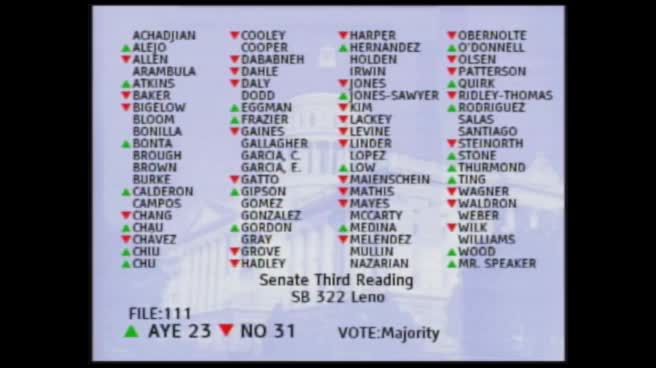 54SEC
Assembly Floor
 2MIN
Assembly Standing Committee on Business and Professions
 1MIN
Assembly Floor
 1MIN
Senate Floor
 1MIN
Senate Standing Committee on Business, Professions and Economic Development
Bill Author


