SB 1241: Employment contracts: adjudication: choice of law and forum.
- Session Year: 2015-2016
- House: Senate
- Latest Version Date: 2016-09-25
Existing law regulates the terms and conditions of labor contracts. Existing law prohibits an employer from requiring an employee or applicant for employment to agree, in writing, to any term or condition that is known by the employer to be illegal. Existing law creates the Division of Labor Standards Enforcement, which is under the direction of the Labor Commissioner, and generally commits to the commissioner the authority and responsibility for the enforcement of employment laws.
This bill, for contracts entered into, modified, or extended on or after January 1, 2017, would prohibit an employer from requiring an employee who primarily resides and works in California, as a condition of employment, to agree to a provision that would require the employee to adjudicate outside of California a claim arising in California or deprive the employee of the substantive protection of California law with respect to a controversy arising in California. The bill would make any provision of a contract that violates these prohibitions voidable, upon request of the employee, and would require a dispute over a voided provision to be adjudicated in California under California law. The bill would specify that injunctive relief is available and would authorize a court to award reasonable attorneys fees. The bill would provide that adjudication includes litigation and arbitration for purposes of these provisions. The bill would except from these provisions a contract with an employee who was represented by legal counsel, as specified.
Existing law, the Consumer Contract Awareness Act of 1990, defines a consumer contract as a writing prepared by a seller that provides for the sale or lease of goods or services or the extension of credit, as specified, for personal, family, or household purposes, among other provisions. The act requires a seller, which includes financial institutions, to deliver a copy of a consumer contract to the consumer at the time the contract is signed, and it prohibits the waiver of any provisions of the act.
Existing law regulates the terms and conditions of labor contracts. Existing law prohibits an employer from requiring an employee or applicant for employment to agree, in writing, to any term or condition that is known by the employer to be illegal. Existing law creates the Division of Labor Standards Enforcement, which is under the direction of the Labor Commissioner, and generally commits to the commissioner the authority and responsibility for the enforcement of employment laws.
This bill would prohibit, bill, for contracts entered into, modified, or extended on or after January 1, 2017, a seller would prohibit an employer from requiring a consumer, as a condition of entering into a contract, an employee who primarily resides and works in California, as a condition of employment, to agree to a provision that would require the consumer to adjudicate outside of California a claim arising in California or deprive the consumer employee of the substantive protection of California law with respect to a controversy arising in California. The bill would make any choice of venue or choice of law provision of a contract that violates these prohibitions voidable, upon request of a consumer who primarily resides in California, if the provision would violate either of those prohibitions as provided. the employee and would require a dispute over a voided provision to be adjudicated in California under California law. The bill would make specify that injunctive relief is available and would authorize a court to award a consumer reasonable attorneys fees. The bill would provide that adjudication includes litigation and arbitration for purposes of these provisions. The bill would except from these provisions a contract with an employee who was represented by legal counsel, as specified.
This bill also would create an analogous set of rights, prohibitions, and requirements, as described above, in connection with employment contracts for an employee who primarily resides and works in California. The bill would except from these employment provisions a contract with an employee who is represented by legal counsel, as specified, or a talent agency, as defined.
Existing law, the Consumer Contract Awareness Act of 1990, defines a consumer contract as a writing prepared by a seller that provides for the sale or lease of goods or services or the extension of credit, as specified, for personal, family, or household purposes, among other provisions. The act requires a seller, which includes financial institutions, to deliver a copy of a consumer contract to the consumer at the time the contract is signed, and it prohibits the waiver of any provisions of the act.
This bill would prohibit, for contracts entered into, modified, or extended on or after January 1, 2017, a seller from requiring a consumer, as a condition of entering into a contract, to agree to a provision that would require the consumer to adjudicate outside of California a claim arising in California or deprive the consumer of the protection of California law with respect to a controversy arising in California. The bill would make any choice of venue or choice of law provision voidable, upon request of the consumer, a consumer who primarily resides in California, if the provision would violate either of those prohibitions as provided. The bill would make injunctive relief available and would authorize a court to award a consumer reasonable attorneys fees. The bill would provide that adjudication includes litigation and arbitration for purposes of these provisions.
This bill also would create an analogous set of rights, prohibitions, and requirements, as described above, in connection with employment contracts. contracts for an employee who primarily resides and works in California. The bill would except from these employment provisions a contract with an employee who is represented by legal counsel, as specified. specified, or a talent agency, as defined.
Existing law, the Consumer Contract Awareness Act of 1990, defines a consumer contract as a writing prepared by a seller that provides for the sale or lease of goods or services or the extension of credit, as specified, for personal, family, or household purposes, among other provisions. The act requires a seller, which includes financial institutions, to deliver a copy of a consumer contract to the consumer at the time the contract is signed, and it prohibits the waiver of any provisions of the act.
This bill would provide, prohibit, for contracts entered into, modified, or extended on or after January 1, 2017, that a provision in a consumer contract that purports to designate the venue in which a controversy arising from the consumer contract is litigated, or the choice of law to be applied, is voidable by the consumer, with respect to a controversy arising in California, if the provision would deprive the consumer of the protection of California law or require the consumer to litigate the controversy out of state. The bill would prohibit a seller from requiring a consumer to agree to these voidable provisions as a condition of entering into a contract regulated by the act, and would provide that such provisions, if required, are inoperative and California law applies in its place. a seller from requiring a consumer, as a condition of entering into a contract, to agree to a provision that would require the consumer to adjudicate outside of California a claim arising in California or deprive the consumer of the protection of California law with respect to a controversy arising in California. The bill would make any choice of venue or choice of law provision voidable, upon request of the consumer, if the provision would violate either of those prohibitions as provided. The bill would specify that make injunctive relief is available in this context and that a court may and would authorize a court to award a plaintiff consumer reasonable attorneys fees. The bill would include arbitration with litigation provide that adjudication includes litigation and arbitration for purposes of these provisions.
This bill also would create an analogous set of rights, prohibitions, and requirements, as described above, in connection with employment contracts. The bill would except from these employment provisions a contract with an employee who is represented by legal counsel, as specified.
Existing law, the Consumer Contract Awareness Act, Act of 1990, defines a consumer contract as a writing prepared by a seller that provides for the sale or lease of goods or services or the extension of credit, as specified, for personal, family, or household purposes, among other provisions. The act requires a seller, which includes financial institutions, to deliver a copy of a consumer contract to the consumer at the time the contract is signed, and it prohibits the waiver of any provisions of the act.
This bill would provide, for contracts entered into, modified, or extended on or after January 1, 2017, that a provision in a consumer contract that purports to designate the venue in which a controversy arising from the consumer contract is litigated, or the choice of law to be applied, is voidable by the consumer, with respect to a controversy arising in California, if the provision would deprive the consumer of the protection of California law or require the consumer to litigate the controversy out of state. The bill would prohibit a seller from requiring a consumer to agree to these voidable provisions as a condition of entering into a contract regulated by the act, and would provide that such provisions, if required, are inoperative and California law applies in its place. The bill would specify that injunctive relief is available in this context and that a court may award a plaintiff reasonable attorneys fees. The bill would include arbitration with litigation for purposes of these provisions.
This bill also would create an analogous set of rights, prohibitions, and requirements, as described above, in connection with employment contracts. The bill would except from these provisions a contract with an employee who is represented by legal counsel, as specified.
Existing law, the Consumer Contract Awareness Act, defines a consumer contract as a writing prepared by a seller that provides for the sale or lease of goods or services services or the extension of credit, as specified, for personal, family, or household purposes, among other provisions. The act require a seller requires a seller, which includes financial institutions, to deliver a copy of a consumer contract to the consumer at the time the contract is signed, and it prohibits the waiver of any provisions of the act.
This bill would, in addition, provide would provide, for contracts entered into, modified, or extended on or after January 1, 2017, that a provision in a consumer contract that purports to designate the venue in which a controversy arising from the consumer contract is litigated, or the choice of law to be applied, is voidable by the consumer, with respect to a controversy arising in California, if the provision would deprive the consumer of the protection of California law or require the consumer to litigate the controversy out of state. The bill would prohibit a seller from requiring a consumer to agree to these voidable provisions as a condition of entering into a contract regulated by the act, and would provide that such provisions, if required, are inoperative and California law applies in its place. The bill would specify that injunctive relief is available in this context and that a court may award a plaintiff reasonable attorneys fees. The bill would include arbitration with litigation for purposes of these provisions.
This bill also would create an analogous set of rights, prohibitions, and requirements, as described above, in connection with employment contracts.
Existing law, the Consumer Contract Awareness Act, defines a consumer contract as a writing prepared by a seller that provides for the sale or lease of goods or services for personal, family, or household purposes, among other provisions. The act require a seller to deliver a copy of a consumer contract to the consumer at the time the contract is signed, and it prohibits the waiver of any provisions of the act.
This bill would, in addition, provide that a provision in a consumer contract that purports to designate the venue in which a controversy arising from the consumer contract is litigated, or the choice of law to be applied, is voidable by the consumer, with respect to a controversy arising in California, if the provision would deprive the consumer of the protection of California law or require the consumer to litigate the controversy out of state.
Existing law establishes standards for arbitration, and requires the court to vacate an arbitration award if it makes certain findings.
This bill would make a technical, nonsubstantive change to that provision.
Existing law establishes standards for arbitration, and requires the court to vacate an arbitration award if it makes certain findings.
This bill would make a technical, nonsubstantive change to that provision.
(a)An employer shall not require an employee who primarily resides and works in California, as a condition of employment, to agree to a provision that would do either of the following:
(1)Require the employee to adjudicate outside of California a claim arising in California.
(2)Deprive the employee of the substantive protection of California law with respect to a controversy arising in California.
(b)Any provision of a contract that violates subdivision (a) is voidable by the employee, and if a provision is rendered void at the request of the employee, the matter shall be adjudicated in California and California law shall govern the dispute.
(c)In addition to injunctive relief and any other remedies available, a court may award an employee who is enforcing his or her rights under this section reasonable attorneys fees.
(d)For purposes of this section, adjudication includes litigation and arbitration.
(e)This section shall not apply to a contract with an employee who is in fact individually represented by legal counsel in negotiating the terms of an agreement to designate either the venue or forum in which a controversy arising from the employment contract may be adjudicated or the choice of law to be applied.
(f)This section shall apply to a contract entered into, modified, or extended on or after January 1, 2017.
(a)A seller shall not require a consumer, as a condition of entering into a contract, to agree to a provision that would do either of the following:
(1)Require the consumer to adjudicate outside of California a claim arising in California.
(2)Deprive the consumer of the protection of California law with respect to a controversy arising in California.
(b)Notwithstanding any other law, any choice of venue or choice of law provision is voidable, upon request of a consumer who primarily resides in California, if the provision would do either of the following:
(1)Require the consumer to adjudicate outside of California a claim arising in California.
(2)Deprive the consumer of the protection of California law with respect to a controversy arising in California.
(c)If a provision is rendered void at the request of the consumer, as described in subdivision (b), the matter shall be adjudicated in California and California law shall govern the dispute.
(d)In addition to injunctive relief and any other remedies available, a court may award a consumer who is enforcing his or her rights under this section reasonable attorneys fees.
(e)For purposes of this section, adjudication includes litigation and arbitration.
(f)This section shall apply to a contract entered into, modified, or extended on or after January 1, 2017.
SEC. 2.SECTION 1.Section 925 is added to the Labor Code, to read:925.(a)An employer shall not require an employee or job applicant, who primarily resides and works in California, as a condition of employment, to agree to a provision that would do either of the following:
(1)Require the employee to adjudicate outside of California a claim arising in California.
(2)Deprive the employee of the substantive protection of California law with respect to a controversy arising in California.
(b)Notwithstanding any other law, any choice of venue or choice of law provision is voidable, upon request of an employee who primarily resides and works in California, if the provision would do either of the following:
(1)Require the employee to adjudicate outside of California a claim arising in California.
(2)Deprive the employee of the protection of California law with respect to a controversy arising in California.
(c)If a provision is rendered void at the request of the employee, as described in subdivision (b), the matter shall be adjudicated in California and California law shall govern the dispute.
(b)Any provision of a contract that violates subdivision (a) is voidable by the employee, and if a provision is rendered void at the request of the employee, the matter shall be adjudicated in California and California law shall govern the dispute.
(d)
(c)In addition to injunctive relief and any other remedies available, a court may award an employee who is enforcing his or her rights under this section reasonable attorneys fees.
(e)
(d)For purposes of this section, adjudication includes litigation and arbitration.
(f)
(e)This section shall not apply to a contract with an employee who is in fact individually represented by legal counsel in negotiating the terms of an agreement to designate either the venue or forum in which a controversy arising from the employment contract may be adjudicated or the choice of law to be applied.
(g)This section shall not apply to a contract for which the employee was represented by a talent agency, as defined in subdivision (a) of Section 1700.4.
(h)
(f)This section shall apply to a contract entered into, modified, or extended on or after January 1, 2017.
(a)A seller shall not require a consumer, as a condition of entering into a contract, to agree to a provision that would do either of the following:
(1)Require the consumer to adjudicate outside of California a claim arising in California.
(2)Deprive the consumer of the protection of California law with respect to a controversy arising in California.
(b)Any Notwithstanding any other law, any choice of venue or choice of law provision is voidable, upon request of the consumer, a consumer who primarily resides in California, if the provision would do either of the following:
(1)Require the consumer to adjudicate outside of California a claim arising in California.
(2)Deprive the consumer of the protection of California law with respect to a controversy arising in California.
(c)If a provision is rendered void at the request of the consumer, as described in subdivision (b), the matter shall be adjudicated in California and California law shall govern the dispute.
(d)In addition to injunctive relief and any other remedies available, a court may award a consumer who is enforcing his or her rights under this section reasonable attorneys fees.
(e)For purposes of this section, adjudication includes litigation and arbitration.
(f)This section shall apply to a contract entered into, modified, or extended on or after January 1, 2017.
SEC. 2.Section 925 is added to the Labor Code, to read:925.(a)An employer shall not require an employee or job applicant, as a condition of employment, to agree to a provision that would do either of the following:
(1)Require the employee to adjudicate outside of California a claim arising in California.
(2)Deprive the employee of the protection of California law with respect to a controversy arising in California.
(b)Any Notwithstanding any other law, any choice of venue or choice of law provision is voidable, upon request of the employee, an employee who primarily resides and works in California, if the provision would do either of the following:
(1)Require the employee to adjudicate outside of California a claim arising in California.
(2)Deprive the employee of the protection of California law with respect to a controversy arising in California.
(c)If a provision is rendered void at the request of the employee, as described in subdivision (b), the matter shall be adjudicated in California and California law shall govern the dispute.
(d)In addition to injunctive relief and any other remedies available, a court may award an employee who is enforcing his or her rights under this section reasonable attorneys fees.
(e)For purposes of this section, adjudication includes litigation and arbitration.
(f)This section shall not apply to a contract with an employee who is in fact individually represented by legal counsel in negotiating the terms of an agreement to designate either the venue or forum in which a controversy arising from the employment contract may be adjudicated or the choice of law to be applied.
(g)This section shall not apply to a contract for which the employee was represented by a talent agency, as defined in subdivision (a) of Section 1700.4.
(g)
(h)This section shall apply to a contract entered into, modified, or extended on or after January 1, 2017.
(a)A seller shall not require a consumer, as a condition of entering into a contract, to agree to a provision that would do either of the following:
(1)Require the consumer to adjudicate outside of California a claim arising in California.
(2)Deprive the consumer of the protection of California law with respect to a controversy arising in California.
(b)Any choice of venue or choice of law provision is voidable, upon request of the consumer, if the provision would do either of the following:
(1)Require the consumer to adjudicate outside of California a claim arising in California.
(2)Deprive the consumer of the protection of California law with respect to a controversy arising in California.
(c)If a provision is rendered void at the request of the consumer, as described in subdivision (b), the matter shall be adjudicated in California and California law shall govern the dispute.
(d)In addition to injunctive relief and any other remedies available, a court may award a consumer who is enforcing his or her rights under this section reasonable attorneys fees.
(e)For purposes of this section, adjudication includes litigation and arbitration.
(f)This section shall apply to a contract entered into, modified, or extended on or after January 1, 2017.
SEC. 2.Section 925 is added to the Labor Code, to read:925.(a)An employer shall not require an employee or job applicant, as a condition of employment, to agree to a provision that would do either of the following:
(1)Require the employee to adjudicate outside of California a claim arising in California.
(2)Deprive the employee of the protection of California law with respect to a controversy arising in California.
(b)Any choice of venue or choice of law provision is voidable, upon request of the employee, if the provision would do either of the following:
(1)Require the employee to adjudicate outside of California a claim arising in California.
(2)Deprive the employee of the protection of California law with respect to a controversy arising in California.
(c)If a provision is rendered void at the request of the employee, as described in subdivision (b), the matter shall be adjudicated in California and California law shall govern the dispute.
(d)In addition to injunctive relief and any other remedies available, a court may award an employee who is enforcing his or her rights under this section reasonable attorneys fees.
(e)For purposes of this section, adjudication includes litigation and arbitration.
(f)This section shall not apply to a contract with an employee who is in fact individually represented by legal counsel in negotiating the terms of an agreement to designate either the venue or forum in which a controversy arising from the employment contract may be adjudicated or the choice of law to be applied.
(g)This section shall apply to a contract entered into, modified, or extended on or after January 1, 2017.
SECTION 1.Section 1799.208 is added to the Civil Code, to read:1799.208.(a)Notwithstanding any other law, a provision in a consumer contract that purports to designate the venue in which a controversy arising from the consumer contract may be litigated, or the choice of law to be applied, is voidable by the consumer if the provision would do either of the following:
(1)Deprive the consumer of the protection of California law with respect to a controversy arising in California.
(2)Require the consumer to litigate outside of California a claim arising in California.
(b)A seller shall not require a consumer to agree to a provision as described in subdivision (a) as a condition of entering into a contract regulated by this title, and if such a provision is required, it shall be inoperative and California law shall apply in its place.
(c)In addition to injunctive relief and any other remedies available, a court may award a plaintiff who is enforcing his or her rights under this section reasonable attorneys fees.
(d)For purposes of this section, litigation includes arbitration.
(e)This section shall apply to a contract entered into, modified, or extended on or after January 1, 2017.
SEC. 2.Section 925 is added to the Labor Code, to read:925.(a)Notwithstanding any other law, a provision in an employment contract that purports to designate the venue in which a controversy arising from the employment contract may be litigated, or the choice of law to be applied, is voidable by the employee if the provision would do either of the following:
(1)Deprive the employee of the protection of California law with respect to a controversy arising in California.
(2)Require the employee to litigate outside of California a claim arising in California.
(b)An employer shall not require a person to agree to a provision as described in subdivision (a) as a condition of entering into an employment contract, and if such a provision is required, it shall be inoperative and California law shall apply in its place.
(c)In addition to injunctive relief and any other remedies available, a court may award a plaintiff who is enforcing his or her rights under this section reasonable attorneys fees.
(d)For purposes of this section, litigation includes arbitration.
(e)This section shall not apply to a contract with an employee who is individually represented by legal counsel in negotiating the terms of an agreement to designate the venue in which a controversy arising from the employment contract may be litigated or the choice of law to be applied.
(f)This section shall apply to a contract entered into, modified, or extended on or after January 1, 2017.
(a)Notwithstanding any other law, a provision in a consumer contract that purports to designate the venue in which a controversy arising from the consumer contract may be litigated, or the choice of law to be applied, is voidable by the consumer if the provision would do either of the following:
(1)Deprive the consumer of the protection of California law with respect to a controversy arising in California.
(2)Require the consumer to litigate outside of California a claim arising in California.
(b)A seller shall not require a consumer to agree to a provision as described in subdivision (a) as a condition of entering into a contract regulated by this title, and if such a provision is required, it shall be inoperative and California law shall apply in its place.
(c)In addition to injunctive relief and any other remedies available, a court may award a plaintiff who is enforcing his or her rights under this section reasonable attorneys fees.
(d)For purposes of this section, litigation includes arbitration.
(e)This section shall apply to a contract entered into, modified, or extended on or after January 1, 2017.
SEC. 2.Section 925 is added to the Labor Code, to read:925.(a)Notwithstanding any other law, a provision in an employment contract that purports to designate the venue in which a controversy arising from the employment contract may be litigated, or the choice of law to be applied, is voidable by the employee if the provision would do either of the following:
(1)Deprive the employee of the protection of California law with respect to a controversy arising in California.
(2)Require the employee to litigate outside of California a claim arising in California.
(b)An employer shall not require a person to agree to a provision as described in subdivision (a) as a condition of entering into an employment contract, and if such a provision is required, it shall be inoperative and California law shall apply in its place.
(c)In addition to injunctive relief and any other remedies available, a court may award a plaintiff who is enforcing his or her rights under this section reasonable attorneys fees.
(d)For purposes of this section, litigation includes arbitration.
(e)This section shall not apply to a contract with an employee who is individually represented by legal counsel in negotiating the terms of an agreement to designate the venue in which a controversy arising from the employment contract may be litigated or the choice of law to be applied.
(e)
(f)This section shall apply to a contract entered into, modified, or extended on or after January 1, 2017.
(a)Notwithstanding any other law, a provision in a consumer contract, as defined by subdivision (b) of Section 1799.201, contract that purports to designate the venue in which a controversy arising from the consumer contract may be litigated, or the choice of law to be applied, is voidable by the consumer if the provision would do either of the following:
(1)Deprive the consumer of the protection of California law with respect to a controversy arising in California.
(2)Require the consumer to litigate outside of California a claim arising in California.
(b)A seller shall not require a consumer to agree to a provision as described in subdivision (a) as a condition of entering into a contract regulated by this title, and if such a provision is required, it shall be inoperative and California law shall apply in its place.
(c)In addition to injunctive relief and any other remedies available, a court may award a plaintiff who is enforcing his or her rights under this section reasonable attorneys fees.
(b)
(d)For purposes of this section, litigation includes arbitration.
(e)This section shall apply to a contract entered into, modified, or extended on or after January 1, 2017.
SEC. 2.Section 925 is added to the Labor Code, to read:925.(a)Notwithstanding any other law, a provision in an employment contract that purports to designate the venue in which a controversy arising from the employment contract may be litigated, or the choice of law to be applied, is voidable by the employee if the provision would do either of the following:
(1)Deprive the employee of the protection of California law with respect to a controversy arising in California.
(2)Require the employee to litigate outside of California a claim arising in California.
(b)An employer shall not require a person to agree to a provision as described in subdivision (a) as a condition of entering into an employment contract, and if such a provision is required, it shall be inoperative and California law shall apply in its place.
(c)In addition to injunctive relief and any other remedies available, a court may award a plaintiff who is enforcing his or her rights under this section reasonable attorneys fees.
(d)For purposes of this section, litigation includes arbitration.
(e)This section shall apply to a contract entered into, modified, or extended on or after January 1, 2017.
(a)Notwithstanding any other law, a provision in a consumer contract, as defined by subdivision (b) of Section 1799.201, that purports to designate the venue in which a controversy arising from the consumer contract may be litigated, or the choice of law to be applied, is voidable by the consumer if the provision would do either of the following:
(1)Deprive the consumer of the protection of California law with respect to a controversy arising in California.
(2)Require the consumer to litigate outside of California a claim arising in California.
(b)For purposes of this section, litigation includes arbitration.
SECTION 1.Section 1286.2 of the Code of Civil Procedure is amended to read:1286.2.(a)Subject to Section 1286.4, the court shall vacate the award if the court determines any of the following:
(1)The award was procured by corruption, fraud or other undue means.
(2)There was corruption in an arbitrator.
(3)The rights of the party were substantially prejudiced by misconduct of a neutral arbitrator.
(4)The arbitrators exceeded their powers and the award cannot be corrected without affecting the merits of the decision upon the controversy submitted.
(5)The rights of the party were substantially prejudiced by the refusal of the arbitrators to postpone the hearing upon sufficient cause being shown therefor or by the refusal of the arbitrators to hear evidence material to the controversy or by other conduct of the arbitrators contrary to the provisions of this title.
(6)An arbitrator making the award either: (A) failed to disclose within the time required for disclosure a ground for disqualification of which the arbitrator was then aware; or (B) was subject to disqualification upon grounds specified in Section 1281.91 but failed upon receipt of timely demand to disqualify himself or herself as required by that provision. However, this subdivision does not apply to arbitration proceedings conducted under a collective bargaining agreement between employers and employees or between their respective representatives.
(b)Petitions to vacate an arbitration award pursuant to Section 1285 are subject to the provisions of Section 128.7.
(a)Subject to Section 1286.4, the court shall vacate the award if the court determines any of the following:
(1)The award was procured by corruption, fraud or other undue means.
(2)There was corruption in any of the arbitrators. an arbitrator.
(3)The rights of the party were substantially prejudiced by misconduct of a neutral arbitrator.
(4)The arbitrators exceeded their powers and the award cannot be corrected without affecting the merits of the decision upon the controversy submitted.
(5)The rights of the party were substantially prejudiced by the refusal of the arbitrators to postpone the hearing upon sufficient cause being shown therefor or by the refusal of the arbitrators to hear evidence material to the controversy or by other conduct of the arbitrators contrary to the provisions of this title.
(6)An arbitrator making the award either: (A) failed to disclose within the time required for disclosure a ground for disqualification of which the arbitrator was then aware; or (B) was subject to disqualification upon grounds specified in Section 1281.91 but failed upon receipt of timely demand to disqualify himself or herself as required by that provision. However, this subdivision does not apply to arbitration proceedings conducted under a collective bargaining agreement between employers and employees or between their respective representatives.
(b)Petitions to vacate an arbitration award pursuant to Section 1285 are subject to the provisions of Section 128.7.
|
Date
|
Status
|
|---|---|
| Sep 9, 2016 | Enrolled and presented to the Governor at 3:30 p.m. |
| Aug 31, 2016 | Assembly amendments concurred in. (Ayes 24. Noes 13. Page 5597.) Ordered to engrossing and enrolling. |
| Aug 31, 2016 | Read third time. Passed. (Ayes 54. Noes 21. Page 6576.) Ordered to the Senate. |
| Aug 31, 2016 | Assembly amendments concurred in. (Ayes 24. Noes 13.) Ordered to engrossing and enrolling. |
| Aug 31, 2016 | In Senate. Concurrence in Assembly amendments pending. |
| Aug 31, 2016 | Read third time. Passed. Ordered to the Senate. |
| Aug 30, 2016 | Read second time. Ordered to third reading. |
| Aug 29, 2016 | Read second time and amended. Ordered to second reading. |
| Aug 29, 2016 | From committee: Do pass as amended. (Ayes 8. Noes 1.) (August 25). |
| Aug 24, 2016 | Joint Rule 62(a) suspended. |
| Aug 24, 2016 | Re-referred to Com. on JUD. pursuant to Assembly Rule 77.2. |
| Aug 19, 2016 | Read third time and amended. (Ayes 73. Noes 0. Page 5948.) |
| Aug 19, 2016 | Ordered to third reading. |
| Aug 19, 2016 | Read third time and amended. |
| Jun 30, 2016 | Read second time. Ordered to third reading. |
| Jun 29, 2016 | From committee: Do pass. (Ayes 12. Noes 6.) (June 29). |
| Jun 21, 2016 | From committee: Do pass and re-refer to Com. on APPR. (Ayes 7. Noes 3.) (June 21). Re-referred to Com. on APPR. |
| Jun 20, 2016 | From committee with author's amendments. Read second time and amended. Re-referred to Com. on JUD. |
| Jun 14, 2016 | From committee with author's amendments. Read second time and amended. Re-referred to Com. on JUD. |
| May 27, 2016 | Referred to Com. on JUD. |
| May 12, 2016 | Read third time. Passed. (Ayes 25. Noes 13. Page 3847.) Ordered to the Assembly. |
| May 12, 2016 | In Assembly. Read first time. Held at Desk. |
| May 12, 2016 | Read third time. Passed. (Ayes 25. Noes 13.) Ordered to the Assembly. |
| May 10, 2016 | Read second time. Ordered to third reading. |
| May 9, 2016 | From committee: Be ordered to second reading pursuant to Senate Rule 28.8. |
| Apr 29, 2016 | Set for hearing May 9. |
| Apr 27, 2016 | From committee: Do pass and re-refer to Com. on APPR. (Ayes 5. Noes 1. Page 3700.) (April 26). Re-referred to Com. on APPR. |
| Apr 27, 2016 | From committee: Do pass and re-refer to Com. on APPR. (Ayes 5. Noes 1.) (April 26). Re-referred to Com. on APPR. |
| Apr 19, 2016 | Set for hearing April 26. |
| Apr 18, 2016 | From committee with author's amendments. Read second time and amended. Re-referred to Com. on JUD. |
| Apr 4, 2016 | Re-referred to Com. on JUD. |
| Mar 29, 2016 | From committee with author's amendments. Read second time and amended. Re-referred to Com. on RLS. |
| Mar 3, 2016 | Referred to Com. on RLS. |
| Feb 19, 2016 | From printer. May be acted upon on or after March 20. |
| Feb 18, 2016 | Introduced. Read first time. To Com. on RLS. for assignment. To print. |
|
Date
|
Description
|
Location
|
Votes
|
|
|---|---|---|---|---|
| Aug 31, 2016 | W/O REF. TO FILE SB1241 Wieckowski | Senate Floor |
Passed |
|
| Aug 31, 2016 | SB 1241 Wieckowski Senate Third Reading By ALEJO | Assembly Floor |
Passed |
|
| Aug 25, 2016 | Do pass as amended. | Assembly Standing Committee on Judiciary |
Passed |
|
| Aug 19, 2016 | SB 1241 Wieckowski Senate Third Reading Amendment Set #1 | Assembly Floor |
Passed |
|
| Jun 29, 2016 | Do pass. | Assembly Standing Committee on Appropriations |
Passed |
|
| Jun 21, 2016 | Do pass and be re-referred to the Committee on [Appropriations] | Assembly Standing Committee on Judiciary |
Passed |
|
| May 12, 2016 | Senate 3rd Reading SB1241 Wieckowski | Senate Floor |
Passed |
|
| Apr 26, 2016 | Do pass, but first be re-referred to the Committee on [Appropriations] | Senate Standing Committee on Judiciary |
Passed |
This list shows positions taken on this bill by organizations on the date displayed, which is linked to the original source.
Positions by individuals are not included.
Office of Senate Floor Analyses (916) 651-1520 Fax: (916) 327-4478 | SB |
UNFINISHED BUSINESS
Bill No: SB 1241
:
SENATE JUDICIARY COMMITTEE: 5-1, 4/26/16
AYES: Jackson, Hertzberg, Leno, Monning, Wieckowski
NOES: Anderson
NO VOTE RECORDED: Moorlach
SENATE APPROPRIATIONS COMMITTEE: Senate Rule 28.8
SENATE FLOOR: 25-13, 5/12/16
AYES: Allen, Beall, Block, De León, Galgiani, Glazer, Hall, Hancock, Hernandez, Hertzberg, Hill, Hueso, Jackson, Lara, Leno, Leyva, McGuire, Mendoza, Mitchell, Monning, Pan, Pavley, Roth, Wieckowski, Wolk
NOES: Anderson, Bates, Berryhill, Cannella, Fuller, Gaines, Huff, Moorlach, Morrell, Nguyen, Nielsen, Stone, Vidak
NO VOTE RECORDED: Liu, Runner
ASSEMBLY FLOOR: Not available
DIGEST: This bill prohibits employers, in contracts entered into, modified, or extended on or after January 1, 2017, from requiring an employee who resides and works in California, as a condition of employment, to agree to a provisions that either: (1) requires the employee to adjudicate outside of California a claim arising in California; or (2) deprives the employee of the substantive protection of California law with respect to a controversy arising in California. This bill provides that such a provision is voidable by the employee. If such a provision is rendered void at the employee’s request, then the matter must be adjudicated (meaning litigated or arbitrated) in California and California law shall govern the dispute. This bill provides a specified exception to these provisions for any employee who is in fact individually represented by legal counsel in negotiating the terms of an agreement and otherwise authorizes a court to award a plaintiff enforcing his or her rights under this bill attorney’s fees, as specified.
Assembly Amendments narrow the bill by limiting its protections to employment contracts and adding an exemption for employees individually represented by legal counsel, as specified; and make other technical and clarifying changes.
Existing law:
- Permits California courts to exercise jurisdiction on any basis not inconsistent with the state or federal Constitutions. A court is also authorized to stay or dismiss most actions in which it finds “that in the interest of substantial justice” the action should be heard in a forum outside of California.
- Codifies the established doctrine that the courts will not enforce an unconscionable contract. Specifically, existing law provides that, if a court finds as a matter of law that a contract or any clause of the contract was unconscionable at the time it was made, the court may refuse to enforce the contract or the unconscionable clause.
- Holds that “unconscionability has both a ‘procedural’ and a ‘substantive’ element, the former focusing on ‘oppression’ or ‘surprise’ due to unequal bargaining power, the latter on ‘overly harsh’ or ‘one-sided’ results.” (Armendariz et al. v. Foundation Health Psychcare Services, Inc. (2000) 24 Cal.4th 83, 114.)
- Holds that forum selection clauses will be enforced only “so long as California consumers will not find their substantial legal rights significantly impaired by their enforcement.” “California courts will refuse to defer to the selected forum if to do so would substantially diminish the rights of California residents in a way that violates our state’s public policy.” (America Online, Inc. v. The Superior Court of Alameda County (2001) 90 Cal.App.4th 1, 21, 23.)
- Provides, with respect to a contract between a contractor and a subcontractor for the construction of a public or private work of improvement in this state, that a provision shall be void and unenforceable if it purports to require any dispute between the parties to be litigated, arbitrated, or otherwise determined outside this state or purports to preclude a party from commencing such a proceeding or obtaining a judgment or other resolution in this state or the courts of this state.
- Provides for a maxim of jurisprudence that “[a]ny one may waive the advantage of a law intended solely for his benefit. But a law established for a public reason cannot be contravened by a private agreement.”
- Provides the waiver of certain substantive rights as against public policy, such as a person’s rights under the Consumer Legal Remedies Act (Civ. Code Sec. 1751) and a person’s rights under state securities laws (Corp. Code Sec. 25701). Thus, those rights are non-waivable.
- Makes certain other employment contract provisions, such as non-compete clauses, void or voidable as against public policy. (See e.g., Civ. Code Secs. 1670.8, 1751, 1799.207, Bus. & Prof. Sec. 16600; Edwards v. Arthur Andersen LLP (2008) 44 Cal.4th 937, Fillpoint, LLC v. Maas, 208 Cal.App.4th 1170, 1182-1183.)
This bill:
- Adds to the Labor Code a statute prohibiting an employer from requiring an employee who resides and works in California, as a condition of employment, to agree to a provision that would either:
- Require the employee to adjudicate outside of California a claim arising in California; or
- Deprive the employee of the substantive protection of California law with respect to a controversy arising in California
- Provides that any contract provision that violates the above is voidable by the employee and provides that if the provision is rendered void at the employee’s request, the matter shall be adjudicated in California and California shall govern the dispute.
- Specifies that for these purposes, adjudication includes litigation and arbitration.
- Provides that in addition to injunctive relief and any other remedies available, a court may award an employee who is enforcing his or her rights under this bill reasonable attorney’s fees.
- Exempts from these provisions any employee who is in fact individually represented by legal counsel in negotiating the terms of an agreement to designate either the venue or forum in which a controversy arising from the employment contract may be adjudicated or the choice of law to be applied.
- Provides that these provisions apply to a contract entered into, modified, or extended on or after January 1, 2017.
Background
As a general matter, arbitrations provide an alternative method of dispute resolution, outside of the courts, wherein a neutral third party, known as the arbitrator, renders a decision after a hearing to which both parties have had an opportunity to be heard. Under California law, there are two distinguishable types of arbitration: judicial arbitration (also known as court-annexed arbitration, governed under Code of Civil Procedure Sections 1141.10 -1141.31) and private arbitrations (also commonly known as “contractual,” “voluntary,” or “nonjudicial” arbitrations; governed under the California Arbitration Act, Code of Civil Procedure Section 1280 et seq.).
On March 1, 2016, the Senate Judiciary Committee held an informational hearing on the topic of private or contractual arbitration agreements, entitled The Federal Arbitration Act, the U.S. Supreme Court, and the Impact of Mandatory Arbitration on California Consumers and Employees. In that hearing, many issues facing consumers and employees who are subject to arbitration clauses contained in standardized, take-it-or-leave-it, or “adhesive,” contracts were brought to light. That hearing also brought to light the various difficulties facing the state in addressing some of the underlying, fundamental harms faced by consumers and employees as a result of federal preemption and U.S. Supreme Court precedent interpreting the Federal Arbitration Act. A package of arbitration bills, of which this bill is one, arose out of the hearing, seeking to address various fairness issues surrounding the rules that govern the conduct and operation of arbitrators and arbitrations in this state.
Of particular relevance to this bill are issues of fairness surrounding choice of law and choice of forum clauses as a condition of non-negotiable consumer and employment contracts, and, specifically, the ability of a seller or employer to require a California consumer or employee to litigate or arbitrate their claims arising out of California in another state, or pursuant to another state’s laws. Generally speaking, California law does not currently prohibit companies or employers from requiring consumers or employees to agree to a non-California forum or to apply non-California law to resolve their disputes. As a matter of case law, such clauses are valid so long as the California consumer or employee “will not find their substantial legal rights significantly impaired by their enforcement.” (America Online, Inc. v. The Superior Court of Alameda County (2001) 90 Cal.App.4th 1, 21, 23.)
This bill, as narrowed in the Assembly to address opposition concerns, seeks to generally ensure that California employees cannot be forced to litigate or arbitrate their California-based claims outside of California, under out-of-state laws, as a condition of an employment contract. Specifically, this bill authorizes an employee who resides and works in California to render void any provision required by an employer in violation of this bill, as a condition of employment, that would either: (1) require the employee to adjudicate outside of California a claim arising in California; or (2) deprive the employee of the substantive protection of California law with respect to a controversy arising in California. Under this bill, if such a provision is rendered void at the employee’s request, then the matter must be adjudicated (meaning litigated or arbitrated) in California and California law shall govern the dispute. This bill exempts from these provisions any employees who are in fact individually represented by legal counsel in negotiating the terms of an agreement, as specified.
Comments
As stated by the author:
SB 1241 focuses in on two harmful kinds of clauses that can appear in an employment contract:
(1) Choice of venue clauses that force a worker into an arbitration in another state, and;
(2) Choice of law clauses that intentionally require that a different state’s laws govern the case.
[ . . . ] A worker who lives and works in California should never be forced to travel to a different state to exercise rights she has under California law.
In support of the bill, the California Employment Lawyers Association writes:
Increasingly, employers, particularly out-of-state employers, are imposing choice-of-law and forum selection provisions on their California workers in order to: evade California law, make it more difficult for employees to pursue legitimate claims, and ensure that any disputes are decided in a forum that is most favorable to the employer. [ . . . ]
Needless to say, most workers lack the resources to travel across the country—let alone around the world—to pursue an employment claim in another state or country. The problem is particularly acute for lower income workers and disabled workers. Those workers that do have the resources and ability to travel might well find that the protection that they had under California law does not exist, or is not as comprehensive, in the jurisdiction that will be deciding their dispute. [ . . . ]
In [a] recent case, a California employee was fired after speaking to other employees about alleged violations of California’s Labor Code and because she refused to sign a new arbitration agreement. Rather than taking her case to court in California, her employer has forced the claim to be arbitrated in New York because of a choice-of-venue provision buried in her new-hire paperwork.
FISCAL EFFECT: Appropriation: Fiscal Com.: Local:
California Conference Board of the Amalgamated Transit Union
California Conference of Machinists
California Dispute Resolution Council
California Employment Lawyers Association
Consumer Attorneys of California
Consumer Federation
Engineers & Scientists of CA, IFPTE Local 20, AFL-CIO
Equality California
International Longshore and Warehouse Union
Professional and Technical Engineers, IFPTE Local 21, AFL-CIO
SAG-AFTRA, AFL-CIO
Small Business California
Teamsters
UNITE-HERE, AFL-CIO
Utility Workers Union of America, AFL-CIO
OPPOSITION: (Verified 8/31/16)
Civil Justice Association of California
8/31/16 22:16:40
**** END ****
SENATE THIRD READING
STR Bill Id:SB 1241
Author:(Wieckowski)
As Amended Ver:August 29, 2016
Majority vote
SENATE VOTE: 25-13
Committee | Votes | Ayes | Noes |
Judiciary | 8-1 | Mark Stone, Alejo, Chau, Chiu, Gallagher, Holden, Maienschein, Ting | Wagner |
SUMMARY: Allows an employee to void a contractual provision that requires the employee to adjudicate a legal claim outside of California, or require the employee to waive his or her protections under California law. Specifically, this bill:
- Prohibits an employer from requiring an employee, who primarily resides and works in California, as a condition of employment, to agree to a provision that would do either of the following:
- Require the employee to adjudicate outside of California a claim arising in California.
- Deprive the employee of the protection of California law with respect to a controversy arising in California.
- Provides that any contract that violates 1) above, is voidable by the employee. If rendered void at the request of the employee, the matter shall be adjudicated in California and California law shall govern the dispute.
- Allows a court to award an employee who is enforcing his or her rights under this act reasonable attorney's fees, in addition to other remedies available.
- Provides that this act does not apply to an employment contract with an employee who is in fact individually represented by legal counsel in negotiating the terms of an agreement to designate either the venue or forum in which a controversy arising from the employment contract may be adjudicated or the choice of law to be applied.
- Defines adjudication under this act to include litigation and arbitration.
FISCAL EFFECT: According to the Assembly Appropriations Committee, any fiscal impact to the courts should be minor.
COMMENTS: According to author, an increasing number of businesses and employers are imposing choice of venue and choice of law contractual provisions on Californians in order to evade California law. These contractual provisions allow businesses and employer to pick laws or venues of another state (and even another country) that are favorable to the business interest to govern a legal dispute if one should arise. Thus, Californians who are forced to agree to these contractual terms must travel to other states or countries to litigate or arbitrate a legal claim. Given the expense and burdens of going to another forum, this ultimately means that a consumer or an employee is unlikely to vindicate his or her legal rights.
This bill prohibits an employer from requiring an employee (who primarily resides and works in California)—as a condition of employment—to agree to a provision that would either require the employee to adjudicate a legal claim outside of California, or deprive the employee of protection under California law. If an employee is subject to such a contractual provision during the course of employment, this bill allows an employee to void those provisions. If voided, the legal matter may be adjudicated in California under California law. This bill applies to contracts commencing after January 1, 2017, and allows a court to award reasonable attorney's fees to an employee who is enforcing his or her rights under this bill.
California has a history of protecting against potentially one-sided contractual arrangements. California has previously enacted laws restricting the use of choice of law and forum selection clauses in contracts. (See AB 2781 (Leno), Chapter 797, Statutes of 2006, child support collection choice of law agreements; AB 268 (Wayne), Chapter 624, Statutes of 2001, sale of structured settlements received in tort claims choice of law and forum selection agreements; SB 568 (Sher), Chapter 194, Statutes of 1997, Uniform Interstate Family Support Act choice of law; AB 1051 (Eastin), Chapter 582, Statutes of 1991, construction subcontracts cannot be litigated or arbitrated outside this state.) Indeed, many California courts recognize this strong public policy. For instance, "California courts will refuse to defer to the selected forum if to do so would substantially diminish the rights of California residents in a way that violates our state's public policy." (America Online, Inc. v. Superior Court (2001) 90 Cal.App.4th 1, 12.) This is because "[o]ur law favors forum selection agreements only so long as they are procured freely and voluntarily, with the place chosen having some logical nexus to one of the parties or the dispute, and so long as California consumers will not find their substantial legal rights significantly impaired by their enforcement." (Ibid.) Accordingly, it appears that this bill is consistent with the Legislature's previous efforts in protecting Californians from potentially unfair and unreasonable contracts aimed at protecting consumers and workers.
This bill is consistent with, but not duplicative of, existing law. Observers correctly note that California courts have the authority to refuse to enforce one-sided choice of venue and choice of law provisions. For example, a court may invalidate a provision if the inconvenience of the forum is so grave that it effectively deprives litigants of their day in court. (The Bremen v. Zapata Off-Shore Co. (1972) 407 U.S. 1, 17.) Additionally, a court may refuse to enforce a choice of law if another state's laws fundamentally conflict with the public policy of California. (Washington Mutual Bank v. Superior Court (2001) 24 Cal.4th 906, 916; see Nedlloyd Lines B.V. v. Superior Court (1992) 3 Cal.4th 459, 465.) Based on these rules, the opponents argue that this bill is unnecessary. Although opponents correctly assert that courts have the authority to strike down one-sided contracts, it is unclear how often this actually happens. Under existing law, forum selection clauses are valid and enforceable unless the contesting party meets the "heavy burden" of proving that enforcing the clause would be unreasonable under the circumstances of a case. (Bancomer v. Superior Court (1996) 44 Cal.App.4th 1450, 1457.) In other words, a consumer or an employee seeking to invalidate an unfair forum selection clause must show that adjudicating in another state, or following the laws of another forum would be unreasonable. Supporters of this bill sensibly argue that this burden is unrealistic. Supporters argue that many consumers and employees do not have the means to invalidate one-sided contractual agreements. Additionally, supporters contend that in consumer contracts where the amount in controversy is often small, the costs and burdens of traveling to another forum will exceed the potentially redressible remedies. Thus, it seems likely that without this bill, many one-sided clauses will remain in place. Accordingly, this bill does not appear to be unnecessary, or duplicative of existing law.
This bill does not apply to employees who are represented by counsel who have negotiated employment terms. Since this bill is aimed at protecting employees who may not have sufficient bargaining power throughout the employment relationship, this bill exempts employment contracts where an employee is individually represented by legal counsel in negotiating terms of an agreement that designate venue or the choice of law. These exemptions, intended to alleviate concerns raised by the business community, are consistent with the policy goal of this bill: Californians should be bound by potentially one-sided terms only if the Californian knowingly and voluntarily agrees to such terms.
Similarly, this bill allows California employees the choice to adjudicate their claims outside of California. Although California law provides broad protections for California employees, there may be an instance where an employee wants to adjudicate a claim outside of California or to have another forum's laws govern the dispute. To that end, this bill allows an employee subject to such a contractual provision the option of voiding those outside-of-California clauses. By making these provisions voidable (rather than void), this bill ensures that employees are not coerced into signing away their rights under California law.
Prior Vetoed Bills: The prohibitions of this bill limiting choice of law or choice of forum provisions in employment contracts is similar to a prior bill, AB 267 (Swanson) of 2011, which was vetoed by Governor Brown.
In vetoing AB 267, Governor Brown stated:
This measure would prohibit employment contracts that require California employees to agree to the use of legal forums and laws of other states. Current law prohibits California employees from being subjected to laws or forums that substantially diminish their rights under our laws and I have not seen convincing evidence that these protections are insufficient to protect employees in California. Finally, I would note that imposing this burden could deter out of state companies from hiring Californians - something we can ill afford at this time of high unemployment.
Analysis Prepared by: Eric Dang / JUD. / (916) 319-2334 FN: 0004949
Date of Hearing: August 25, 2016
ASSEMBLY COMMITTEE ON JUDICIARY
Mark Stone, Chair
SBPCA Bill Id:SB 1241
Author:(Wieckowski) – As Amended Ver:August 19, 2016
As Proposed to be Amended
SENATE VOTE: 25-13
SUBJECT: CONTRACTS
KEY ISSUE: IN ORDER TO PROTECT CALIFORNIA EMPLOYEES FROM BEING FORCED TO LEAVE THE STATE OR BEING SUBJECTED TO THE POTENTIALLY LESS-PROTECTIVE LAWS OF ANOTHER STATE OR COUNTRY DURING A LEGAL DISPUTE, SHOULD AN EMPLOYEE BE ALLOWED TO VOID A CHOICE-OF-VENUE OR CHOICE-OF-LAW PROVISION THAT WOULD REQUIRE THE EMPLOYEE TO ADJUDICATE A LEGAL CLAIM OUTSIDE OF CALIFORNIA OR DEPRIVE THAT CALIFORNIAN FROM THE PROTECTION OF CALIFORNIA LAW?
SYNOPSIS
According to the author, an increasing number of businesses and employers are imposing choice of venue and choice of law contractual provisions on Californians in order to evade California law. These contractual provisions allow businesses and employers to pick laws or venues of other states (and even other countries) to govern a legal dispute in the event that one arises. Accordingly, Californians who are forced to agree to these contractual terms must travel to another state or country to litigate or arbitrate a legal claim. Given the expense and burdens of going to another forum, this ultimately means that a consumer or an employee is unlikely to vindicate his or her legal rights.
Originally, this bill allowed a California employee or consumer to void such one-sided provisions as described above. As proposed to be amended, this bill has been narrowed to apply only to California employees who primarily reside and work in California. Specifically, this bill prohibits an employer from requiring a California employee—as a condition of employment—to agree to a provision that would either: require the employee to adjudicate outside of California a claim arising in California, or deprive the employee of protection under California law. This bill exempts employees represented by legal counsel in negotiating specified employment terms or by a talent agency.
As this analysis was being prepared, this Committee was unable to confirm the support or opposition for this bill as proposed to be amended; accordingly, there is no support or opposition on file. However, in its prior version, this bill was supported by consumer advocates, employment lawyers, small businesses, and California arbitrators, and was opposed by various business interests, led by the Chamber of Commerce, who primarily contended that the bill was unnecessary because courts could invalidate unfair contractual provisions. The author believes that the bill as proposed to be amended will remove most, if not all, of the opposition to the bill.
SUMMARY: Allows an employee to void a contractual provision that requires the employee to adjudicate a legal claim outside of California, or require the employee to waive his or her protections under California law. Specifically, this bill:
- Prohibits an employer from requiring an employee, who primarily resides and works in California, as a condition of employment, to agree to a provision that would do either of the following:
- Require the employee to adjudicate outside of California a claim arising in California.
- Deprive the employee of the substantive protection of California law with respect to a controversy arising in California.
- Provides that any contract that violates 1) is voidable by the employee. If rendered void at the request of the employee, the matter shall be adjudicated in California and California law shall govern the dispute.
- Allows a court to award an employee who is enforcing his or her rights under this act reasonable attorney’s fees, in addition to other remedies available.
- Provides that this act does not apply to a contract with an employee who is in fact individually represented by legal counsel in negotiating the terms of an agreement to designate either the venue or forum in which a controversy arising from the employment contract may be adjudicated or the choice of law to be applied.
- Provides that this act does not apply to a contract for which the employee was represented by a talent agency, as defined.
- Defines adjudication under this act to include litigation and arbitration.
EXISTING LAW:
- Provides that if the court as a matter of law finds the contract or any clause of the contract to have been unconscionable at the time it was made the court may refuse to enforce the contract, or the unconscionable clause. (Civil Code Section 1670.5.)
- Holds that a mandatory forum selection clause is generally given effect unless enforcement would be unreasonable or unfair. (Verdugo v. Alliantgroup, L.P. (2015) 237 Cal.App.4th 141, 147.)
- Holds that California courts will refuse to defer to the selected forum if to do so would substantially diminish the rights of California residents in a way that violates California’s public policy. (America Online, Inc. v. Superior Court (2001) 90 Cal.App.4th 1, 12.)
- Holds that the party opposing the enforcement of a forum selection clause ordinarily bears the substantial burden of proving why it should not be enforced. (Global Packaging, Inc. v. Superior Court (2011) 196 Cal.App.4th 1623, 1633.)
FISCAL EFFECT: As currently in print this bill is keyed fiscal.
COMMENTS: Justice Brennan once said that, “courts are the central dispute-setting institutions of our society. They are bound to do equal justice under the law, to rich and poor alike.” It comes as no surprise then that the phrase, “Equal Justice Under Law,” is engraved above the entrance to our nation’s highest court. And so it seems, we put a great deal of faith in our courts – but would we expect any less? We anticipate our courts to apply the law in a fair, neutral, and open manner. We hold judges to high standards, and ask that they avoid even the appearance of impropriety. We count on our judiciary to advance the law, issue orders, and render written opinions. And yet, we acknowledge that our system isn’t perfect and that despite their best efforts, courts sometimes get it wrong. Acknowledging the imperfection of our justice system is undoubtedly one reason why it has safeguards. We remember that decisions of courts are reviewed by appellate courts and indeed, reviewed by our elected branches. In order to facilitate the right to appeal, we provide a record of the proceedings, in criminal matters at least. And so, when our families, friends, and neighbors are injured, wronged, or have a dispute, we rely upon that faith that our courts—the institution we trust upon to promote fairness—will deliver equal justice under the law.
As this Committee is well-aware, arbitration is a form of alternative dispute resolution held outside of courts where a third-party (rather than a judge) makes a binding (and rarely appealable) award. Because most arbitration is created by entering into a contract (usually a contract that is adhesive or take-it-or-leave-it), the arbitration agreement will lay-out the procedures that will be followed during the arbitration hearing. For example, the terms of the arbitration agreement may stipulate that the award need not be written or justified (unlike in court), and that the entire process be kept in secret (rather than in public view). Arbitrators do not need to be lawyers, nor do they need to be trained in the law. Arbitrators who issue favorable awards to a particular company can be repeatedly-hired by that same company to serve as the arbitration-neutral without ever notifying the public about that employment-history. It’s easy to predict the calls if you can hire the umpire.
Last year, the New York Times issued a three-part series titled, “Beware the Fine Print” – a special report examining how arbitration clauses buried in contracts deprives Americans of their fundamental constitutional rights:
Over the last 10 years, thousands of businesses across the country – from big corporations to storefront shops – have used arbitration to create an alternate system of justice. There, rules tend to favor businesses, and judges and juries have been replaced by arbitrators who commonly consider the companies their clients. The change has been swift and virtually unnoticed, even though it has meant that tens of millions of Americans have lost a fundamental right: their day in court. (Silver-Greenberg & Corkery, In Arbitration, a Privatization of the Justice System, N.Y. Times (Nov. 1, 2015).)
In fact, some legal scholars have stated that, arbitration “amounts to the whole-scale privatization of the justice system.” (Ibid.) In an effort to protect consumers and workers, this Legislature has worked on legislation aimed at leveling the playing field, a turf that has been used by corporate interests to evade public scrutiny, and even, avoid the law. This is because arbitrators do not need to be trained in the law, or even apply the law, or render a decision consistent with the evidence presented to them. What evidence is presented may, in fact, be incomplete because parties in arbitration have no legal right to obtain evidence in support of their claims or defenses, or the claims or defenses of the other party, contrary to the longstanding discovery practice in public courts. Advocates continue to debate about the benefits and harms of mandatory-arbitration. Proponents of arbitration say that arbitration produces quicker results and reduces litigation costs. Opponents argue that arbitration harms consumers and workers because arbitration proceedings render unfair awards.
A Return of the Lochner Era? In 1897, the State of New York enacted a labor law intended to protect its bakers: no employee may work in a bakery establishment for more than sixty hours in any one week. That law—which seems reasonable when considering today’s standards—was infamously struck down by the Supreme Court in 1905. The Court held that the state law interfered with a person’s freedom to contract, rejecting New York’s argument that the law was intended to promote the public’s welfare. (Lochner v. New York (1905) 198 U.S. 45, 52.) Some legal commentators have repudiated the Lochner decision as a relic, even a stain in American jurisprudence. Indeed, some scholars have stated that “[a]side from Dred Scott itself, Lochner…is now considered the most discredited decision in Supreme Court history.” (Schwartz, A History of the Supreme Court, (1995).) While scholars continue to debate the Lochner decision, one thing seems clear: the Lochner era prioritized economic liberty over the state’s interests in protecting the general welfare of its residents. Although one might expect that the principles behind Lochner are long behind us, sometimes, Lochner rears its ugly head. Recently, businesses and employers have been requiring consumers and employees to agree to contractual provisions that seek to evade California law. For instance, a consumer might be required to sign a choice of venue provision, which would require the consumer to go to another state to resolve a legal dispute. In other contracts, an employee might be obligated to sign a choice of law provision, which would require the employee to accept the laws of another state to govern a legal dispute. In a Lochner era, one might argue that these provisions were unproblematic; after all, the employee “voluntarily” agreed to the terms of these contracts – no matter how unfair or unreasonable. Indeed, it would seem that no matter how beneficial the social regulation, the view under Lochner is that consumers and employees who enter into contracts do so at their own peril. But we proudly know that California is no home of Lochner.
The problem that this bill seeks to fix: According to author of the bill, an increasing number of businesses and employers are imposing contractual provisions on Californians in order to evade California law. These contractual provisions allow businesses and employers to pick laws or venues of another state (and even another country) that are favorable to the business interest to govern a legal dispute if one should arise. Accordingly, Californians who are forced to agree to these contractual terms must travel to other states or countries in order to litigate or arbitrate legal claims. Given the expense and burden of going to another forum, this ultimately means that an employee is unlikely to vindicate his or her legal rights.
This bill has been narrowed and as proposed to be amended, applies its protections to California employees (rather than California consumers). This bill prohibits an employer from requiring an employee (who primarily resides and works in California)—as a condition of employment—to agree to a provision that would either require the employee to adjudicate a legal claim outside of California, or deprive the employee of the protections of California law. If an employee is subject to such a contractual provision during the course of employment, this bill would allow an employee to void the provision. If voided, the legal matter would be adjudicated in California under California law. This bill applies to contracts commencing after January 1, 2017, and allows a court to award reasonable attorney’s fees to an employee who is enforcing his or her rights under this bill.
Author’s statement: In support of the bill, the author writes:
Senate Bill 1241 focuses in on two of the worst kinds of clauses that can appear in an employment contract: (1) Choice of venue clauses that require a worker to go to an arbitration or to a court in an entirely different state, and; (2) Choice of law clauses that intentionally pick what state’s law governs the arbitration – thus deciding what the rules are – to disadvantage the worker. A California employee should never be forced to travel to a different state to exercise her right to litigate or obligation to arbitrate a claim. If you’re employing Californians who live in California, you should not be able to force all dispute resolution to take place in Florida or under the laws of Delaware. Just the cost of travel alone prevents California consumers who have been harmed by an illegal practice from seeking compensation. SB 1241 ensures that employees are able to arbitrate in California.
California has a history of protecting against potentially one-sided contractual arrangements. It should come as no surprise that California has previously enacted laws restricting the use of choice of law and forum selection clauses in contracts. (See AB 2781 (Leno, Ch. 797, Stats. 2006) child support collection choice of law agreements; AB 268 (Wayne, Ch. 624, Stats. 2001) sale of structured settlements received in tort claims choice of law and forum selection agreements; SB 586 (Sher, Ch. 194, Stats. 1997) Uniform Interstate Family Support Act choice of law; AB 1051 (Eastin, Ch. 582, Stats. 1991) construction subcontracts cannot be litigated or arbitrated outside this state).) Indeed, many California courts recognize this strong public policy. For instance, “California courts will refuse to defer to the selected forum if to do so would substantially diminish the rights of California residents in a way that violates our state’s public policy.” (America Online, Inc. v. Superior Court (2001) 90 Cal.App.4th 1, 12.) This is because “[o]ur law favors forum selection agreements only so long as they are procured freely and voluntarily, with the place chosen having some logical nexus to one of the parties or the dispute, and so long as California consumers will not find their substantial legal rights significantly impaired by their enforcement.” (Ibid.) Accordingly, it appears that this bill is consistent with the Legislature’s previous efforts in protecting Californians from potentially unfair and unreasonable contracts.
This bill is consistent with, but not duplicative of, existing law. Observers correctly note that California courts have the authority to refuse to enforce one-sided choice of venue and choice of law provisions. For example, a court may invalidate a provision if the inconvenience of the forum is so grave that it effectively deprives litigants of their day in court. (The Bremen v. Zapata Off-Shore Co. (1972) 407 U.S. 1, 17.) Additionally, a court may refuse to enforce a choice of law if another state’s laws fundamentally conflict with the public policy of California. (Washington Mutual Bank v. Superior Court (2001) 24 Cal.4th 906, 916; see Nedlloyd Lines B.V. v. Superior Court (1992) 3 Cal.4th 459, 465.) While courts have the authority to strike down one-sided contracts, there is a strong presumption that forum selection clauses are valid and enforceable unless the contesting party meets the “heavy burden” of proving that enforcing the clause would be unreasonable under the circumstances of a case. (Bancomer v. Superior Court (1996) 44 Cal.App.4th 1450, 1457.) In order words, a consumer or an employee seeking to invalidate an unfair forum selection clause must show that adjudicating in another state, or following the laws of another forum would be unreasonable. The burden seems unrealistic. The author reasonably argues that many employees do not have the means to invalidate one-sided contractual agreements, let alone travel to other forums to adjudicate legal claims. Thus, it seems likely that without this bill, many one-sided clauses in employment contracts will remain in place. Accordingly, this bill does not appear to be duplicative of existing law.
Adjudication includes both litigation and arbitration. At issue is whether this bill somehow implicates the Federal Arbitration Act: it does not appear so. Since this bill applies to all contracts involving employees, this bill does not appear to violate the Federal Arbitration Act. Additionally, if an employee is subject to a choice of law or choice of venue provision that requires adjudication outside of California, or deprives the Californian of protection under California law during the course of employment, this bill allows the employee to void the provision and adjudicate the legal claim in California. This also means that if an employee would otherwise have been forced to travel outside of California to arbitrate a claim, the employee could void the provision, and the matter would be similarly arbitrated in California under the State’s laws.
This bill does not apply to employees who are represented by counsel or a talent agency. Since this bill is aimed at protecting employees who may not have sufficient bargaining power throughout the employment relationship, this bill exempts employment contracts where an employee is individually represented by legal counsel in negotiating terms of an agreement that designate venue or the choice of law, or by a talent agency. These exemptions, intended to alleviate concerns raised by the business community, are consistent with the policy goal of this bill: Californians should be bound by potentially one-sided terms only if the Californian knowingly and voluntarily agrees to such terms.
Similarly, this bill allows California employees the choice to adjudicate their claims outside of California. Although California law provides broad protections for California employees, there may be an instance where an employee wants to adjudicate a claim outside of California or to have another forum’s laws govern the dispute. To that end, this bill allows an employee subject to such a contractual provision the option of voiding those outside-of-California clauses. By making these provisions voidable (rather than void), this bill ensures that employees are not coerced into signing away their rights under California law.
The bill does not appear to violate the Contract Clause Violation. Article I, Section 10 of the U.S. Constitution, known as the Contract Clause, provides that, “[n]o state shall…pass any…law impairing the obligation of contracts.” (U.S. Const., art. I, § 10.) But it is well-established that the Contract Clause does not prevent the government from regulating the terms of future contracts. Given that this bill only applies prospectively to contracts entered into after January 1, 2017, the Contract Clause is not implicated.
Prior Vetoed Bills: The prohibitions of this bill limiting choice of law or choice of forum provisions in employment contracts is similar to a prior bill, AB 267 (Swanson, 2011), which was vetoed by Governor Brown.
In vetoing AB 267, Governor Brown stated:
This measure would prohibit employment contracts that require California employees to agree to the use of legal forums and laws of other states. Current law prohibits California employees from being subjected to laws or forums that substantially diminish their rights under our laws and I have not seen convincing evidence that these protections are insufficient to protect employees in California. Finally, I would note that imposing this burden could deter out of state companies from hiring Californians - something we can ill afford at this time of high unemployment..
REGISTERED SUPPORT / OPPOSITION:
Support (to the prior version of this bill)
California Conference Board of the Amalgamated Transit Union
California Conference of Machinists
California Dispute Resolution Council
California Employment Lawyers Association
California Teamsters Public Affairs Council
Consumer Attorneys of California
Consumer Federation of California
Engineers and Scientists of California, IFPTE Local 20, AFL-CIO
International Longshore and Warehouse Union
Professional and Technical Engineers, IFPTE Local 21, AFL-CIO
SAG-AFTRA, AFL-CIO
Small Business California
UNITE-HERE, AFL-CIO
Utility Workers Union of America, AFL-CIO
Opposition (to the prior version of this bill)
California Chamber of Commerce
American Insurance Association
California Bankers Association
California Farm Bureau Federation
California Manufacturers and Technology Association
Civil Justice Association of California
Dish Network
Feld Entertainment, Inc.
Motion Picture Association of America
Analysis Prepared by: Eric Dang / JUD. / (916) 319-2334
SENATE THIRD READING
STR Bill Id:SB 1241
Author:(Wieckowski)
As Amended Ver:August 19, 2016
Majority vote
SENATE VOTE: 25-13
Committee | Votes | Ayes | Noes |
Judiciary | 7-3 | Mark Stone, Alejo, Chau, Chiu, Cristina Garcia, Holden, Ting | Wagner, Gallagher, Maienschein |
Appropriations | 12-6 | Gonzalez, Bloom, Bonta, Calderon, Daly, Eggman, Roger Hernández, Holden, Quirk, Santiago, Weber, Wood | Bigelow, Chang, Gallagher, Jones, Obernolte, Wagner |
SUMMARY: Allows a consumer or an employee to void a choice of venue or choice of law provision that would either require the consumer or employee to adjudicate a legal claim outside of California, or require the consumer or employee to waive their protections under California law. Specifically, this bill:
- Prohibits a seller from requiring a consumer, as a condition of entering into a contract, to agree to a provision that would do either of the following:
- Require the consumer to adjudicate outside of California a claim arising in California.
- Deprive the consumer of the protection of California law with respect to a controversy arising in California.
- Provides that any choice of venue or choice of law provision is voidable, upon request of the consumer who primarily resides in California, if the provision would do either of the following:
- Require the consumer to adjudicate outside of California a claim arising in California.
- Deprive the consumer of the protection of California law with respect to a controversy arising in California.
- Establishes that if provision described in 2) above, is rendered void at the request of the consumer, the matter shall be adjudicated in California and California law shall govern the dispute.
- Allows a court to award a consumer who is enforcing his or her rights under this act reasonable attorney's fees, in addition to other remedies available.
- Prohibits an employer from requiring an employee or job applicant, as a condition of employment, to agree to a provision that would do either of the following:
- Require the employee to adjudicate outside of California a claim arising in California.
- Deprive the employee of the protection of California law with respect to a controversy arising in California.
- Provides that any choice of venue or choice of law provision is voidable, upon request of the employee who primarily resides and works in California, if the provision would do either of the following:
- Require the employee to adjudicate outside of California a claim arising in California.
- Deprive the employee of the protection of California law with respect to a controversy arising in California.
- Establishes that if provision described in 6) above, is rendered void at the request of the employee, the matter shall be adjudicated in California and California law shall govern the dispute.
- Allows a court to award an employee who is enforcing his or her rights under this act reasonable attorney's fees, in addition to other remedies available.
- Provides that this act does not apply to an employment contract with an employee who is in fact individually represented by legal counsel in negotiating the terms of an agreement to designate either the venue or forum in which a controversy arising from the employment contract may be adjudicated or the choice of law to be applied.
- Provides that this act does not apply to an employment contract where the employee was represented by a talent agency, as defined.
- Defines adjudication under this act to include litigation and arbitration.
FISCAL EFFECT: According to the Assembly Appropriations Committee, any fiscal impact to the courts should be minor.
COMMENTS: According to author, an increasing number of businesses and employers are imposing choice of venue and choice of law contractual provisions on Californians in order to evade California law. These contractual provisions allow businesses and employer to pick laws or venues of another state (and even another country) that are favorable to the business interest to govern a legal dispute if one should arise. Thus, Californians who are forced to agree to these contractual terms must travel to other states or countries to litigate or arbitrate a legal claim. Given the expense and burdens of going to another forum, this ultimately means that a consumer or an employee is unlikely to vindicate his or her legal rights.
This bill prohibits a seller or an employer from requiring a consumer or an employee from agreeing to a provision, as a condition of entering into a contract, that would either require the consumer or employee to adjudicate a legal claim outside of California, or deprive the consumer or the employee of protection under California law. Additionally, if a consumer or an employee becomes subject to such contractual provisions during a contractual relationship with a seller or employer, this bill allows a consumer or an employee to void these provisions so that the legal claim may be adjudicated in California under California law. This bill applies to contracts commencing after January 1, 2017, and also allows a court to award reasonable attorney's fees for a consumer or an employee who enforces rights under this bill. Under this bill, adjudication includes litigation and arbitration.
California has a history of protecting against potentially one-sided contractual arrangements. California has previously enacted laws restricting the use of choice of law and forum selection clauses in contracts. (See AB 2781 (Leno), Chapter 797, Statutes of 2006, child support collection choice of law agreements; AB 268 (Wayne), Chapter 624, Statutes of 2001, sale of structured settlements received in tort claims choice of law and forum selection agreements; SB 568 (Sher), Chapter 194, Statutes of 1997, Uniform Interstate Family Support Act choice of law; AB 1051 (Eastin), Chapter 582, Statutes of 1991, construction subcontracts cannot be litigated or arbitrated outside this state.) Indeed, many California courts recognize this strong public policy. For instance, "California courts will refuse to defer to the selected forum if to do so would substantially diminish the rights of California residents in a way that violates our state's public policy." (America Online, Inc. v. Superior Court (2001) 90 Cal.App.4th 1, 12.) This is because "[o]ur law favors forum selection agreements only so long as they are procured freely and voluntarily, with the place chosen having some logical nexus to one of the parties or the dispute, and so long as California consumers will not find their substantial legal rights significantly impaired by their enforcement." (Ibid.) Accordingly, it appears that this bill is consistent with the Legislature's previous efforts in protecting Californians from potentially unfair and unreasonable contracts aimed at protecting consumers and workers.
This bill is consistent with, but not duplicative of, existing law. Opposition to this bill contends that California courts have the authority to refuse to enforce one-sided choice of venue and choice of law provisions. For example, a court may invalidate a provision if the inconvenience of the forum is so grave that it effectively deprives litigants of their day in court. (The Bremen v. Zapata Off-Shore Co. (1972) 407 U.S. 1, 17.) Additionally, a court may refuse to enforce a choice of law if another state's laws fundamentally conflict with the public policy of California. (Washington Mutual Bank v. Superior Court (2001) 24 Cal.4th 906, 916; see Nedlloyd Lines B.V. v. Superior Court (1992) 3 Cal.4th 459, 465.) Based on these rules, the opponents argue that this bill is unnecessary. Although opponents correctly assert that courts have the authority to strike down one-sided contracts, it is unclear how often this actually happens. Under existing law, forum selection clauses are valid and enforceable unless the contesting party meets the "heavy burden" of proving that enforcing the clause would be unreasonable under the circumstances of a case. (Bancomer v. Superior Court (1996) 44 Cal.App.4th 1450, 1457.) In other words, a consumer or an employee seeking to invalidate an unfair forum selection clause must show that adjudicating in another state, or following the laws of another forum would be unreasonable. Supporters of this bill sensibly argue that this burden is unrealistic. Supporters argue that many consumers and employees do not have the means to invalidate one-sided contractual agreements. Additionally, supporters contend that in consumer contracts where the amount in controversy is often small, the costs and burdens of traveling to another forum will exceed the potentially redressible remedies. Thus, it seems likely that without this bill, many one-sided clauses will remain in place. Accordingly, this bill does not appear to be unnecessary, or duplicative of existing law.
This bill does not apply to employees who are represented by counsel who have negotiated employment terms. The opposition raises the concern that this bill would relieve a highly paid employee—who has more than sufficient bargaining power in negotiating her employment agreement—of honoring the terms of her contract. To address this concern, this bill exempts employment contracts where an employee is individually represented by legal counsel in negotiating terms of an agreement that designate venue or the choice of law, or where the employee was represented by a talent agency as defined. Although it is unclear whether this recent amendment alleviates the opposition's concerns, the amendment addresses the crux of this bill: Californians should only be bound by these potentially one-sided terms if the Californian knowingly and voluntarily wants to leave the state to adjudicate a legal claim.
This bill exempts an employment contract where the employee is represented by a talent agency. To address concerns raised by opponents of the bill, this bill's employment contract provisions have been amended to exempt a contract for which the employee was represented by a talent agency.
Similarly, this bill allows California consumers and employees the choice to adjudicate their claims outside of California. Although California law provides broad consumer and employee protections, there might be an instance when a consumer or an employee would like to have a legal claim be adjudicated outside of California, or would want to have the laws outside of California govern a dispute. To that end, this bill allows California consumers and employees the option to void a choice of venue and choice of law provision. To ensure that the protections afforded under this bill are reserved for Californians, this bill specifically provides that the consumer or the employee—who is seeking to void a choice of venue or choice of law provision in a consumer or employment contract as provided under this bill—must primarily reside in California (and for the employee, primarily work in California). By making these provisions voidable (rather than void), this bill ensures that consumers and employees are not being coerced into signing away their rights under California law.
Prior Vetoed Bills: The prohibitions of this bill limiting choice of law or choice of forum provisions in employment contracts is similar to a prior bill, AB 267 (Swanson) of 2011, which was vetoed by Governor Brown.
In vetoing AB 267, Governor Brown stated:
This measure would prohibit employment contracts that require California employees to agree to the use of legal forums and laws of other states. Current law prohibits California employees from being subjected to laws or forums that substantially diminish their rights under our laws and I have not seen convincing evidence that these protections are insufficient to protect employees in California. Finally, I would note that imposing this burden could deter out of state companies from hiring Californians - something we can ill afford at this time of high unemployment.
Analysis Prepared by: Eric Dang / JUD. / (916) 319-2334 FN: 0004615
SENATE THIRD READING
STR Bill Id:SB 1241
Author:(Wieckowski)
As Amended Ver:June 20, 2016
Majority vote
SENATE VOTE: 25-13
Committee | Votes | Ayes | Noes |
Judiciary | 7-3 | Mark Stone, Alejo, Chau, Chiu, Cristina Garcia, Holden, Ting |
|
Appropriations | 12-6 | Gonzalez, Bloom, Bonta, Calderon, Daly, Eggman, Roger Hernández, Holden, Quirk, Santiago, Weber, Wood | Bigelow, Chang, Gallagher, Jones, Obernolte, Wagner |
SUMMARY: Allows a consumer or an employee to void a choice of venue or choice of law provision that would either require the consumer or employee to adjudicate a legal claim outside of California, or require the consumer or employee to waive their protections under California law. Specifically, this bill:
- Prohibits a seller from requiring a consumer, as a condition of entering into a contract, to agree to a provision that would do either of the following:
- Require the consumer to adjudicate outside of California a claim arising in California.
- Deprive the consumer of the protection of California law with respect to a controversy arising in California.
- Provides that any choice of venue or choice of law provision is voidable, upon request of the consumer, if the provision would do either of the following:
- Require the consumer to adjudicate outside of California a claim arising in California.
- Deprive the consumer of the protection of California law with respect to a controversy arising in California.
- Establishes that if provision described in 2) above is rendered void at the request of the consumer, the matter shall be adjudicated in California and California law shall govern the dispute.
- Allows a court to award a consumer who is enforcing his or her rights under this act reasonable attorney's fees, in addition to other remedies available.
- Prohibits an employer from requiring an employee or job applicant, as a condition of employment, to agree to a provision that would do either of the following:
- Require the employee to adjudicate outside of California a claim arising in California.
- Deprive the employee of the protection of California law with respect to a controversy arising in California.
- Provides that any choice of venue or choice of law provision is voidable, upon request of the employee, if the provision would do either of the following:
- Require the employee to adjudicate outside of California a claim arising in California.
- Deprive the employee of the protection of California law with respect to a controversy arising in California.
- Establishes that if provision described in 6) above is rendered void at the request of the employee, the matter shall be adjudicated in California and California law shall govern the dispute.
- Allows a court to award an employee who is enforcing his or her rights under this act reasonable attorney's fees, in addition to other remedies available.
- Provides that this act does not apply to a contract with an employee who is in fact individually represented by legal counsel in negotiating the terms of an agreement to designate either the venue or forum in which a controversy arising from the employment contract may be adjudicated or the choice of law to be applied.
- Defines adjudication under this act to include litigation and arbitration.
FISCAL EFFECT: According to the Assembly Appropriations Committee, any fiscal impact to the courts should be minor.
COMMENTS: According to author, an increasing number of businesses and employers are imposing choice of venue and choice of law contractual provisions on Californians in order to evade California law. These contractual provisions allow businesses and employer to pick laws or venues of another state (and even another country) that are favorable to the business interest to govern a legal dispute if one should arise. Thus, Californians who are forced to agree to these contractual terms must travel to other states or countries to litigate or arbitrate a legal claim. Given the expense and burdens of going to another forum, this ultimately means that a consumer or an employee is unlikely to vindicate his or her legal rights.
This bill prohibits a seller or an employer from requiring a consumer or an employee from agreeing to a provision, as a condition of entering into a contract, that would either require the consumer or employee to adjudicate a legal claim outside of California, or deprive the consumer or the employee of protection under California law. Additionally, if a consumer or an employee becomes subject to such contractual provisions during a contractual relationship with a seller or employer, this bill allows a consumer or an employee to void these provisions so that the legal claim may be adjudicated in California under California law. This bill applies to contracts commencing after January 1, 2017, and also allows a court to award reasonable attorney's fees for a consumer or an employee who enforces rights under this bill. Under the bill, adjudication includes litigation and arbitration.
California has a history of protecting against potentially one-sided contractual arrangements. California has previously enacted laws restricting the use of choice of law and forum selection clauses in contracts. (See AB 2781 (Leno), Chapter 797, Statutes of 2006, child support collection choice of law agreements; AB 268 (Wayne), Chapter 624, Statutes of 2001, sale of structured settlements received in tort claims choice of law and forum selection agreements; SB 568 (Sher), Chapter 194, Statutes of 1997, Uniform Interstate Family Support Act choice of law; AB 1051 (Eastin), Chapter 582, Statutes of 1991, construction subcontracts cannot be litigated or arbitrated outside this state.) Indeed, many California courts recognize this strong public policy. For instance, "California courts will refuse to defer to the selected forum if to do so would substantially diminish the rights of California residents in a way that violates our state's public policy." (America Online, Inc. v. Superior Court (2001) 90 Cal.App.4th 1, 12.) This is because "[o]ur law favors forum selection agreements only so long as they are procured freely and voluntarily, with the place chosen having some logical nexus to one of the parties or the dispute, and so long as California consumers will not find their substantial legal rights significantly impaired by their enforcement." (Ibid.) Accordingly, it appears that this bill is consistent with the Legislature's previous efforts in protecting Californians from potentially unfair and unreasonable contracts aimed at protecting consumers and workers.
This bill is consistent with, but not duplicative of, existing law. Opposition to this bill contends that California courts have the authority to refuse to enforce one-sided choice of venue and choice of law provisions. For example, a court may invalidate a provision if the inconvenience of the forum is so grave that it effectively deprives litigants of their day in court. (The Bremen v. Zapata Off-Shore Co. (1972) 407 U.S. 1, 17.) Additionally, a court may refuse to enforce a choice of law if another state's laws fundamentally conflict with the public policy of California. (Washington Mutual Bank v. Superior Court (2001) 24 Cal.4th 906, 916; see Nedlloyd Lines B.V. v. Superior Court (1992) 3 Cal.4th 459, 465.) Based on these rules, the opponents argue that this bill is unnecessary. Although opponents correctly assert that courts have the authority to strike down one-sided contracts, it is unclear how often this actually happens. Under existing law, forum selection clauses are valid and enforceable unless the contesting party meets the "heavy burden" of proving that enforcing the clause would be unreasonable under the circumstances of a case. (Bancomer v. Superior Court (1996) 44 Cal.App.4th 1450, 1457.) In other words, a consumer or an employee seeking to invalidate an unfair forum selection clause must show that adjudicating in another state, or following the laws of another forum would be unreasonable. Supporters of this bill sensibly argue that this burden is unrealistic. Supporters argue that many consumers and employees do not have the means to invalidate one-sided contractual agreements. Additionally, supporters contend that in consumer contracts where the amount in controversy is often small, the costs and burdens of traveling to another forum will exceed the potentially redressible remedies. Thus, it seems likely that without this bill, many one-sided clauses will remain in place. Accordingly, this bill does not appear to be unnecessary, or duplicative of existing law.
This bill does not apply to employees who are represented by counsel who have negotiated employment terms. The opposition raises the concern that this bill would relieve a highly paid employee—who has more than sufficient bargaining power in negotiating her employment agreement—of honoring the terms of her contract. The author's recent amendments appear to be aimed at addressing this concern. This bill now exempts employment contracts where an employee is individually represented by legal counsel in negotiating terms of an agreement that designate venue or the choice of law. Although it is unclear whether this recent amendment alleviates all of the opposition's concerns, the amendment addresses the crux of this bill: Californians should only be bound by these potentially one-sided terms if the Californian knowingly and voluntarily wants to leave the state to adjudicate a legal claim.
Similarly, this bill allows California consumers and employees the choice to adjudicate their claims outside of California. Although California law provides broad consumer and employee protections, there might be an instance when a consumer or an employee would like to have a legal claim be adjudicated outside of California, or would want to have the laws outside of California govern a dispute. To that end, this bill allows consumers and employees the option to void a choice of venue and choice of law provision. By making these provisions voidable (rather than void), this bill ensures that consumers and employees are not being coerced into signing away their rights under California law.
Prior Vetoed Bills: The prohibitions of this bill limiting choice of law or choice of forum provisions in employment contracts is similar to a prior bill, AB 267 (Swanson) of 2011, which was vetoed by Governor Brown.
In vetoing AB 267, Governor Brown stated:
This measure would prohibit employment contracts that require California employees to agree to the use of legal forums and laws of other states. Current law prohibits California employees from being subjected to laws or forums that substantially diminish their rights under our laws and I have not seen convincing evidence that these protections are insufficient to protect employees in California. Finally, I would note that imposing this burden could deter out of state companies from hiring Californians - something we can ill afford at this time of high unemployment.
Analysis Prepared by: Eric Dang / JUD. / (916) 319-2334 FN: 0003624
Date of Hearing: June 29, 2016
ASSEMBLY COMMITTEE ON APPROPRIATIONS
Lorena Gonzalez, Chair
SBPCA Bill Id:SB 1241
Author:(Wieckowski) – As Amended Ver:June 20, 2016
Policy Committee: | Judiciary | Vote: | 7 - 3 |
|
| ||
|
|
Urgency: No State Mandated Local Program: No Reimbursable: No
SUMMARY:
This bill allows a consumer or an employee to void a choice-of-venue or choice-of-law provision in a purchase or employment contract, entered into after January 1, 2017, that would either require the consumer or employee to adjudicate a legal claim outside of California or require the consumer or employee to waive their protections under California law. This bill also:
- Stipulates that if provision or condition described above is rendered void at the request of the consumer or employee, the matter must be adjudicated, through litigation or arbitration, in California and California law shall govern the dispute.
- Allows a court to award a consumer or employee, who is enforcing his or her rights under this act, reasonable attorney’s fees, in addition to other remedies available.
- Provides that this act does not apply to a contract with an employee who is individually represented by legal counsel in negotiating the terms of an agreement to designate either the venue or forum in which a controversy arising from the employment contract may be adjudicated or the choice of law to be applied.
FISCAL EFFECT:
Any fiscal impact to the courts should be minor.
COMMENTS:
- Purpose. According to author and supporters of the bill, an increasing number of businesses and employers are imposing choice of venue and choice of law contractual provisions on Californians in order to evade California law. These contractual provisions allow businesses and employers to pick laws or venues of another state (and even another country) that are favorable to the business interest to govern a legal dispute if one should arise. Accordingly, Californians who are forced to agree to these contractual terms must travel to other states or countries to litigate or arbitrate a legal claim. Given the expense and burdens of going to another forum, this ultimately means that a consumer or an employee is unlikely to vindicate his or her legal rights.
This bill prohibits a seller or an employer from requiring a consumer or an employee from agreeing to a provision, as a condition of entering into a contract, that would either require the consumer or employee to adjudicate a legal claim outside of California, or deprive the consumer or the employee of protection under California law. Additionally, if a consumer or an employee becomes subject to such contractual provisions during a contractual relationship with a seller or employer, this bill allows a consumer or an employee to void these provisions so that the legal claim may be adjudicated in California under California law. This bill applies to contracts commencing after January 1, 2017, and also allows a court to award reasonable attorney’s fees for a consumer or an employee who enforces rights under this bill.
- Opposition. Various business interests led by the Chamber of Commerce, contend that this bill is unnecessary because courts may already invalidate choice of law of venue clauses in California contracts by evaluating, in part, the bargaining power and convenience of the parties involved.
- Prior Legislation. AB 267 (Swanson) of 2011, which included provisions similar to this bill with respect to employment contracts, was vetoed. The Governor indicated, "I have not seen convincing evidence that these protections are insufficient to protect employees in California. Finally, I would note that imposing this burden could deter out of state companies from hiring Californians - something we can ill afford at this time of high unemployment."
Analysis Prepared by: Chuck Nicol / APPR. / (916) 319-2081
Date of Hearing: June 21, 2016
ASSEMBLY COMMITTEE ON JUDICIARY
Mark Stone, Chair
SBPCA Bill Id:SB 1241
Author:(Wieckowski) – As Amended Ver:June 20, 2016
SENATE VOTE: 25-13
SUBJECT: CONTRACTS: CHOICE OF VENUE AND CHOICE OF LAW
KEY ISSUE: IN ORDER TO PROTECT CALIFORNIANS FROM BEING FORCED TO LEAVE THE STATE, OR BEING SUBJECT TO POTENTIALLY LESS-PROTECTIVE LAWS OF ANOTHER STATE OR COUNTRY TO GOVERN A LEGAL DISPUTE, SHOULD A CONSUMER OR EMPLOYEE BE ALLOWED TO VOID A CHOICE-OF-VENUE OR CHOICE-OF-LAW PROVISION THAT WOULD REQUIRE THE CONSUMER OR THE EMPLOYEE TO ADJUDICATE A LEGAL CLAIM OUTSIDE OF CALIFORNIA OR DEPRIVE THAT CALIFORNIAN FROM THE PROTECTION OF CALIFORNIA LAW?
SYNOPSIS
According to the author and supporters of the bill—including consumer advocates, employment lawyers, small businesses, and California arbitrators—an increasing number of businesses and employers are imposing choice of venue and choice of law contractual provisions on Californians in order to evade California law. These contractual provisions allow businesses and employer to pick laws or venues of other states (and even other countries) to govern a legal dispute in the event that one arises. Accordingly, Californians who are forced to agree to these contractual terms must travel to another state or country to litigate or arbitrate a legal claim. Given the expense and burdens of going to another forum, this ultimately means that a consumer or an employee is unlikely to vindicate his or her legal rights.
This bill allows a consumer or an employee to void a choice of venue or choice of law provision that would require the consumer or employee to either adjudicate a legal claim outside of California, or require the consumer or employee to waive his or her protections under California law. Proponents of the bill argue that many consumers and employees do not have the means to seek to invalidate one-sided contractual agreements, let alone travel to another forum to adjudicate a legal claim. Opponents of the bill, consisting of various business interests led by the Chamber of Commerce, primarily contend that this bill is unnecessary because courts may invalidate such provisions.
SUMMARY: Allows a consumer or an employee to void a choice of venue or choice of law provision that would either require the consumer or employee to adjudicate a legal claim outside of California, or require the consumer or employee to waive their protections under California law. Specifically, this bill:
- Prohibits a seller from requiring a consumer, as a condition of entering into a contract, to agree to a provision that would do either of the following:
- Require the consumer to adjudicate outside of California a claim arising in California.
- Deprive the consumer of the protection of California law with respect to a controversy arising in California.
- Provides that any choice of venue or choice of law provision is voidable, upon request of the consumer, if the provision would do either of the following:
- Require the consumer to adjudicate outside of California a claim arising in California.
- Deprive the consumer of the protection of California law with respect to a controversy arising in California.
- Establishes that if provision described in #2 above is rendered void at the request of the consumer, the matter shall be adjudicated in California and California law shall govern the dispute.
- Allows a court to award a consumer who is enforcing his or her rights under this act reasonable attorney’s fees, in addition to other remedies available.
- Prohibits an employer from requiring an employee or job applicant, as a condition of employment, to agree to a provision that would do either of the following:
- Require the employee to adjudicate outside of California a claim arising in California.
- Deprive the employee of the protection of California law with respect to a controversy arising in California.
- Provides that any choice of venue or choice of law provision is voidable, upon request of the employee, if the provision would do either of the following:
- Require the employee to adjudicate outside of California a claim arising in California.
- Deprive the employee of the protection of California law with respect to a controversy arising in California.
- Establishes that if provision described in #6 above is rendered void at the request of the employee, the matter shall be adjudicated in California and California law shall govern the dispute.
- Allows a court to award an employee who is enforcing his or her rights under this act reasonable attorney’s fees, in addition to other remedies available.
- Provides that this act does not apply to a contract with an employee who is in fact individually represented by legal counsel in negotiating the terms of an agreement to designate either the venue or forum in which a controversy arising from the employment contract may be adjudicated or the choice of law to be applied.
- Defines adjudication under this act to include litigation and arbitration.
EXISTING LAW:
- Provides that if the court as a matter of law finds the contract or any clause of the contract to have been unconscionable at the time it was made the court may refuse to enforce the contract, or the unconscionable clause. (Civil Code Section 1670.5.)
- Establishes the Consumer Contract Awareness Act. (Civil Code Section 1799.200.)
- Under the Consumer Contract Act, defines a consumer contract to mean a writing as specified that provides for the sale or lease of goods or services or for the extension of credit. (Civil Code Section 1799.201.)
- Holds that a mandatory forum selection clause is generally given effect unless enforcement would be unreasonable or unfair. (Verdugo v. Alliantgroup, L.P. (2015) 237 Cal.App.4th 141, 147.)
- Holds that California courts will refuse to defer to the selected forum if to do so would substantially diminish the rights of California residents in a way that violates California’s public policy. (America Online, Inc. v. Superior Court (2001) 90 Cal.App.4th 1, 12.)
- Holds that the party opposing the enforcement of a forum selection clause ordinarily bears the substantial burden of proving why it should not be enforced. (Global Packaging, Inc. v. Superior Court (2011) 196 Cal.App.4th 1623, 1633.)
FISCAL EFFECT: As currently in print this bill is keyed fiscal.
COMMENTS: Justice Brennan once said that, “courts are the central dispute-setting institutions of our society. They are bound to do equal justice under the law, to rich and poor alike.” It comes as no surprise then that the phrase, “Equal Justice Under Law,” is engraved above the entrance to our nation’s highest court. And so it seems, we put a great deal of faith in our courts – but would we expect any less? We anticipate our courts to apply the law in a fair, neutral, and open manner. We hold judges to high standards, and ask that they avoid even the appearance of impropriety. We count on our judiciary to advance the law, issue orders, and render written opinions. And yet, we acknowledge that our system isn’t perfect and that despite their best efforts, courts sometimes get it wrong. Acknowledging the imperfection of our justice system is undoubtedly one reason why it has safeguards. We remember that decisions of courts are reviewed by appellate courts and indeed, reviewed by our elected branches. In order to facilitate the right to appeal, we provide a record of the proceedings, in criminal matters at least. And so, when our families, friends, and neighbors are injured, wronged, or have a dispute, we rely upon that faith that our courts—the institution we trust upon to promote fairness—will deliver equal justice under the law.
As this Committee is well-aware, arbitration is a form of alternative dispute resolution held outside of courts where a third-party (rather than a judge) makes a binding (and rarely appealable) award. Because most arbitration is created by entering into a contract (usually a contract that is adhesive or take-it-or-leave-it), the arbitration agreement will lay-out the procedures that will be followed during the arbitration hearing. For example, the terms of the arbitration agreement may stipulate that the award need not be written or justified (unlike in court), and that the entire process be kept in secret (rather than in public view). Arbitrators do not need to be lawyers, nor do they need to be trained in the law. Arbitrators who issue favorable awards to a particular company can be repeatedly-hired by that same company to serve as the arbitration-neutral without ever notifying the public about that award-history. It’s easy to predict the calls if you can hire the umpire.
Last year, the New York Times issued a three-part series titled, “Beware the Fine Print” – a special report examining how arbitration clauses buried in contracts deprives Americans of their fundamental constitutional rights:
Over the last 10 years, thousands of businesses across the country – from big corporations to storefront shops – have used arbitration to create an alternate system of justice. There, rules tend to favor businesses, and judges and juries have been replaced by arbitrators who commonly consider the companies their clients. The change has been swift and virtually unnoticed, even though it has meant that tens of millions of Americans have lost a fundamental right: their day in court. (Silver-Greenberg & Corkery, In Arbitration, a Privatization of the Justice System, N.Y. Times (Nov. 1, 2015).)
In fact, some legal scholars have stated that, arbitration “amounts to the whole-scale privatization of the justice system.” (Ibid.) In an effort to protect consumers and workers, this Legislature has worked on legislation aimed at leveling the playing field, a turf that has been used by corporate interests to evade public scrutiny, and even, avoid the law. This is because arbitrators do not need to be trained in the law, or even apply the law, or render a decision consistent with the evidence presented to them. What evidence is presented may, in fact, be incomplete because parties in arbitration have no legal right to obtain evidence in support of their claims or defenses, or the claims or defenses of the other party, contrary to the longstanding discovery practice in public courts. Advocates continue to debate about the benefits and harms of mandatory-arbitration. Proponents of arbitration say that arbitration produces quicker results and reduces litigation costs. Opponents argue that arbitration harms consumers and workers because arbitration proceedings render unfair awards.
A brief review of recent court decisions on arbitration. Given the preemptive issues surrounding the Federal Arbitration Act (FAA) and the U.S. Supreme Court’s interpretation of the FAA, the ability to legislate around the issue of arbitration is difficult. In 2005, the California Supreme Court held that in certain adhesive take-it-or-leave-it consumer contracts, a contractual provision requiring the consumer to waive class-action is unconscionable and void. This is known as the Discovery Bank rule (herein the Rule). (36 Cal. 4th 148, 159.) In the well-known Concepcion decision, the U.S. Supreme Court struck down the Rule. (AT&T Mobility LLC v. Concepcion (2011) 563 U.S. 333, 344-47.) In that case, Vincent and Liza Concepcion entered into a cellphone contract that required claims to be brought in an “individual capacity, and not as a plaintiff or class member in any purported class or representative proceeding.” (Id. at 336.) Relying on Discovery Bank, the Concepcions challenged the class-action waiver as an unconscionable contract provision. (Id. at 338.) In abrogating the Rule, the Court held that the Rule stood “as an obstacle to the accomplishment and execution of the full purposes and objectives of Congress” because it “interferes with fundamental attributes of arbitration.” (Id. at 344-47.) Although the Supreme Court has not defined a “fundamental attribute of arbitration,” the Court did say that there were potential advantages of arbitration: lower costs, greater efficiency and speed, and the ability to choose expert adjudicators to resolve specialized disputes. (Id. at 348.) Indeed, the Court analogized to several examples on the kinds of rules or laws that would amount to “interference” with the “fundamental attribute of arbitration.” For example, a rule to require arbitration agreements and proceedings to provide judicially-monitored discovery, or to follow the Federal Rules of Evidence would clearly violate the FAA. (Id. at 342.) In those instances, those additional protections and procedures—admirable as they are—would increase costs, reduce efficiency and speed, and prevent an arbitrator from applying the rules he or she wants to apply; accordingly, states and courts are limited in crafting certain rules.
Despite what some may say, California may regulate issues that affect arbitration. Relying on these principles in Concepcion, some argue that anything that interferes with arbitration is preempted by the FAA, as interpreted under Concepcion; however, this argument is mistaken. Federal law does not preempt states from enacting basic protections around the principles of contract law. While federal preemption is broad, states are permitted to set rules that are consistent with certain contract law principles. Additionally, states may establish specific arbitration rules in their states. As the Supreme Court has stated, “parties are generally free to structure their arbitration agreements as they see fit…[Where] parties have agreed to abide by state rules of arbitration, enforcing those rules according to the terms of the agreement is fully consistent with the goals of the FAA.” (Volt Information Sciences, Inc. v. Board of Trustees of Leland Stanford Junior Univ. (1989) 489 U.S. 468, 479.) Accordingly, states can enact legislation that affects arbitration without offending the FAA.
A Return of the Lochner Era? In 1897, the State of New York enacted a labor law intended to protect its bakers: no employee may work in a bakery establishment for more than sixty hours in any one week. That law—which seems reasonable when considering today’s standards—was infamously struck down by the Supreme Court in 1905. The Court held that the state law interfered with a person’s freedom to contract, rejecting New York’s argument that the law was intended to promote the public’s welfare. (Lochner v. New York (1905) 198 U.S. 45, 52.) Some legal commentators have repudiated the Lochner decision as a relic, even a stain in American jurisprudence. Indeed, some scholars have stated that “[a]side from Dred Scott itself, Lochner…is now considered the most discredited decision in Supreme Court history.” (Schwartz, A History of the Supreme Court, (1995).) While scholars continue to debate the Lochner decision, one thing seems clear: the Lochner era prioritized economic liberty over the state’s interests in protecting the general welfare of its residents. Although one might expect that the principles behind Lochner are long behind us, sometimes, Lochner rears its ugly head. Recently, businesses and employers have been requiring consumers and employees to agree to contractual provisions that seek to evade California law. For instance, a consumer might be required to sign a choice of venue provision, which would require the consumer to go to another state to resolve a legal dispute. In other contracts, an employee might be obligated to sign a choice of law provision, which would require the employee to accept the laws of another state to govern a legal dispute. In a Lochner era, one might argue that these provisions were not problematic because parties voluntarily agreed to the terms of these contracts – no matter how unfair or unreasonable. Indeed, it would seem that no matter how beneficial the social regulation, the view under Lochner is that consumers and employees who enter into contracts do so at their own peril. But we proudly know that California is no home of Lochner.
The problem that this bill seeks to fix: According to author and supporters of the bill, an increasing number of businesses and employers are imposing choice of venue and choice of law contractual provisions on Californians in order to evade California law. These contractual provisions allow businesses and employer to pick laws or venues of another state (and even another country) that are favorable to the business interest to govern a legal dispute if one should arise. Accordingly, Californians who are forced to agree to these contractual terms must travel to other states or countries to litigate or arbitrate a legal claim. Given the expense and burdens of going to another forum, this ultimately means that a consumer or an employee is unlikely to vindicate his or her legal rights.
Summary of the bill: This bill prohibits a seller or an employer from requiring a consumer or an employee from agreeing to a provision, as a condition of entering into a contract, that would either require the consumer or employee to adjudicate a legal claim outside of California, or deprive the consumer or the employee of protection under California law. Additionally, if a consumer or an employee becomes subject to such contractual provisions during a contractual relationship with a seller or employer, this bill allows a consumer or an employee to void these provisions so that the legal claim may be adjudicated in California under California law. This bill applies to contracts commencing after January 1, 2017, and also allows a court to award reasonable attorney’s fees for a consumer or an employee who enforces rights under this bill.
Author’s statement: In support of the bill, the author writes:
Arbitration goes wrong when it is forced – when a company requires a consumer to submit any dispute that may arise to arbitration as a nonnegotiable condition of employment or buying a product or service. Forced arbitration is a private out-of-court process that businesses and employers usually require as a condition of receiving a good, service, or a job. The California consumer or employee is required to waive her right to sue, to participate in a class action lawsuit, or to appeal. Forced arbitration is mandatory, the arbitrator’s decision is binding, and the results are not public. Unfortunately, forced arbitration clauses are everywhere: They’re in the fine print of car loans and leases, credit cards, checking accounts, insurance, investing accounts, student loans, and even certain employment and nursing home agreements. (In the credit card market alone, arbitration clauses bind as many as 80 million consumers.)
SB 1241 ensures that a California consumer who purchases a good or service in California or works in California is not forced to arbitrate or litigate in a different state; and give up protections afforded under California law.
California has a history of protecting against potentially one-sided contractual arrangements. It should come as no surprise that California has previously enacted laws restricting the use of choice of law and forum selection clauses in contracts. (See AB 2781 (Leno, Ch. 797, Stats. 2006) child support collection choice of law agreements; AB 268 (Wayne, Ch. 624, Stats. 2001) sale of structured settlements received in tort claims choice of law and forum selection agreements; SB 586 (Sher, Ch. 194, Stats. 1997) Uniform Interstate Family Support Act choice of law; AB 1051 (Eastin, Ch. 582, Stats. 1991) construction subcontracts cannot be litigated or arbitrated outside this state).) Indeed, many California courts recognize this strong public policy. For instance, “California courts will refuse to defer to the selected forum if to do so would substantially diminish the rights of California residents in a way that violates our state’s public policy.” (America Online, Inc. v. Superior Court (2001) 90 Cal.App.4th 1, 12.) This is because “[o]ur law favors forum selection agreements only so long as they are procured freely and voluntarily, with the place chosen having some logical nexus to one of the parties or the dispute, and so long as California consumers will not find their substantial legal rights significantly impaired by their enforcement.” (Ibid.) Accordingly, it appears that this bill is consistent with the Legislature’s previous efforts in protecting Californians from potentially unfair and unreasonable contracts aimed at protecting consumers and workers.
This bill is consistent with, but not duplicative of, existing law. The opposition correctly argues that California courts have the authority to refuse to enforce one-sided choice of venue and choice of law provisions. For example, a court may invalidate a provision if the inconvenience of the forum is so grave that it effectively deprives litigants of their day in court. (The Bremen v. Zapata Off-Shore Co. (1972) 407 U.S. 1, 17.) Additionally, a court may refuse to enforce a choice of law if another state’s laws fundamentally conflict with the public policy of California. (Washington Mutual Bank v. Superior Court (2001) 24 Cal.4th 906, 916; see Nedlloyd Lines B.V. v. Superior Court (1992) 3 Cal.4th 459, 465.) Based on these rules, the opponents argue that this bill is unnecessary. However, their arguments appear to be misplaced. While courts have the authority to strike down one-sided contracts, there is a strong presumption that forum selection clauses are valid and enforceable unless the contesting party meets the “heavy burden” of proving that enforcing the clause would be unreasonable under the circumstances of a case. (Bancomer v. Superior Court (1996) 44 Cal.App.4th 1450, 1457.) In order words, a consumer or an employee seeking to invalidate an unfair forum selection clause must show that adjudicating in another state, or following the laws of another forum would be unreasonable. Supporters of this bill sensibly argue that this burden is unrealistic. Supporters argue that many consumers and employees do not have the means to invalidate one-sided contractual agreements, let alone travel to other forums to adjudicate legal claims. Additionally, supporters contend that in consumer contracts where the amount in controversy is often small, the costs and burdens of traveling to another forum will exceed the potentially redressible remedies. Thus, it seems likely that without this bill, many one-sided clauses will remain in place. Accordingly, this bill does not appear to be unnecessary, or duplicative of existing law.
Adjudication includes both litigation and arbitration. At issue is whether this bill somehow implicates the Federal Arbitration Act: it does not appear so. Since this bill applies to all contracts involving consumers and employees, this bill does not appear to violate the Federal Arbitration Act. Additionally, if an employee or consumer is subject to a choice of law or choice of venue provision that requires adjudication outside of California, or deprives the Californian of protection under California law, this bill allows the employee or the consumer to void the provision and adjudicate the legal claim in California. Accordingly, under this bill, if a consumer would be forced to travel outside of California to arbitrate a claim, the consumer could void the provision, and the matter would be similarly arbitrated in California under the State’s laws.
This bill does not apply to employees who are represented by counsel who have negotiated employment terms. The opposition raises the concern that this bill would relieve a highly paid employee—who has more than sufficient bargaining power in negotiating her employment agreement—of honoring the terms of her contract. The author’s recent amendments appear to be aimed at addressing this concern. This bill now exempts employment contracts where an employee is individually represented by legal counsel in negotiating terms of an agreement that designate venue or the choice of law. Although it is unclear whether this recent amendment alleviates all of the opposition’s concerns, the amendment addresses the crux of this bill: Californians should only be bound by these potentially one-sided terms if the Californian knowingly and voluntarily wants to leave the state to adjudicate a legal claim.
Similarly, this bill allows California consumers and employees the choice to adjudicate their claims outside of California. Although California law provides broad consumer and employee protections, there might be an instance when a consumer or an employee would like to have a legal claim be adjudicated outside of California, or would want to have the laws outside of California govern a dispute. To that end, this bill allows consumers and employees the option to void a choice of venue and choice of law provision. As previously mentioned, at issue is whether a party agrees to such terms knowingly and voluntarily. By making these provisions voidable (rather than void), this bill ensures that consumers and employees are not being coerced into signing away their rights under California law.
The bill does not appear to violate the Contract Clause Violation. Article I, Section 10 of the U.S. Constitution, known as the Contract Clause, provides that, “[n]o state shall…pass any…law impairing the obligation of contracts.” (U.S. Const., art. I, § 10.) But it is well-established that the Contract Clause does not prevent the government from regulating the terms of future contracts. Given that this bill only applies prospectively to contracts entered into after January 1, 2017, the Contract Clause is not implicated.
Prior Vetoed Bills: The prohibitions of this bill limiting choice of law or choice of forum provisions in employment contracts is similar to a prior bill, AB 267 (Swanson, 2011), which was vetoed by Governor Brown.
In vetoing AB 267, Governor Brown stated:
This measure would prohibit employment contracts that require California employees to agree to the use of legal forums and laws of other states. Current law prohibits California employees from being subjected to laws or forums that substantially diminish their rights under our laws and I have not seen convincing evidence that these protections are insufficient to protect employees in California. Finally, I would note that imposing this burden could deter out of state companies from hiring Californians - something we can ill afford at this time of high unemployment.
ARGUMENTS IN SUPPORT: The Small Business California which represents employers and small businesses, argues that this bill will help small businesses that lack the resources to deal with legal claims outside of the state or country. In support, it writes:
Generally, it is only large companies, usually with out-of-state headquarters or a substantial out-of-state presence, that are in a position to force consumers to litigate claims in distant forums under non-California law. A small business in California is unlikely to have the ties to other forums to be able to make choice of law work. These clauses give large companies an unfair competitive advantage over California-based small businesses. Sometimes, it is the small business that is the customer of or the contractor to the large business and loses its rights because it cannot afford to bring its own claim or defend itself against the large business in that distant forum.
California Employment Lawyers Association supports this bill because it supports California employees and employers. In support, CELA writes:
The current situation clearly benefits out-of-state employers at the expense of California employers. Employers who remain subject to the rigorous requirements of California labor and employment law are at a distinct competitive disadvantage when an out-of-state employer uses a choice-of-law provision to exempt itself from California’s laws governing employment relationships and adopt another state’s less protective regime. Correcting this problem therefore benefits California employers as well as employees and contributes to fair competition in California.
ARGUMENTS IN OPPOSITION: Opponents of the bill, consisting of various business interests led by the Chamber of Commerce, primarily contend that this bill is unnecessary. The opposition writes:
There is no need to prohibit or limit choice of law of venue clauses in California contracts. Under existing law, California employees and consumers are already protected from contractual choice of law or venue provisions that are unreasonable, unconscionable or would substantially diminish their California legal protections. California courts currently have the authority to refuse to enforce such provisions by evaluating, in part, the bargaining power of the parties involved as well as which state has a stronger interest. SB 1241 eliminates the discretion of the courts to weigh varying interests, including the bargaining power of the parties and the convenience of the parties involved and simply declares such provisions voidable if it does not designate California as the forum and California law.
REGISTERED SUPPORT / OPPOSITION:
Support
California Dispute Resolution Council
California Employment Lawyers Association
Consumer Attorneys of California
Consumer Federation of California
Small Business California
Opposition
California Chamber of Commerce
American Insurance Association
California Bankers Association
California Farm Bureau Federation
California Manufacturers and Technology Association
Civil Justice Association of California
Dish Network
Feld Entertainment, Inc.
Motion Picture Association of America
Analysis Prepared by: Eric Dang / JUD. / (916) 319-2334
Office of Senate Floor Analyses (916) 651-1520 Fax: (916) 327-4478 | SB |
THIRD READING
Bill No: SB 1241
:
SENATE JUDICIARY COMMITTEE: 5-1, 4/26/16
AYES: Jackson, Hertzberg, Leno, Monning, Wieckowski
NOES: Anderson
NO VOTE RECORDED: Moorlach
SENATE APPROPRIATIONS COMMITTEE: Senate Rule 28.8
DIGEST: This bill makes any provision in a consumer or employment contract entered into, modified, or extended on or after January 1, 2017 that purports to designate the venue in which a controversy arising from the contract may be litigated, or the choice of law to be applied, voidable by the consumer or employee, under specified circumstances. Further, this bill prohibits a seller or employer from requiring a consumer or employee to agree to such a provision, as specified, and provides that if such a provision is required, it shall be inoperative and California law shall apply in its place. Lastly, this bill authorizes a court to award a plaintiff enforcing his or her rights under this bill attorney’s fees, as specified.
Existing law:
- Permits California courts to exercise jurisdiction on any basis not inconsistent with the state or federal Constitutions. A court is also authorized to stay or dismiss most actions in which it finds “that in the interest of substantial justice” the action should be heard in a forum outside of California.
- Codifies the established doctrine that the courts will not enforce an unconscionable contract. Specifically, existing law provides that, if a court finds as a matter of law that a contract or any clause of the contract was unconscionable at the time it was made, the court may refuse to enforce the contract or the unconscionable clause.
- Holds that “unconscionability has both a ‘procedural’ and a ‘substantive’ element, the former focusing on ‘oppression’ or ‘surprise’ due to unequal bargaining power, the latter on ‘overly harsh’ or ‘one-sided’ results.” (Armendariz et al. v. Foundation Health Psychcare Services, Inc. (2000) 24 Cal.4th 83, 114.)
- Holds that forum selection clauses will be enforced only “so long as California consumers will not find their substantial legal rights significantly impaired by their enforcement.” “California courts will refuse to defer to the selected forum if to do so would substantially diminish the rights of California residents in a way that violates our state’s public policy.” (America Online, Inc. v. The Superior Court of Alameda County (2001) 90 Cal.App.4th 1, 21, 23.)
- Provides, with respect to a contract between a contractor and a subcontractor for the construction of a public or private work of improvement in this state, that a provision shall be void and unenforceable if it purports to require any dispute between the parties to be litigated, arbitrated, or otherwise determined outside this state or purports to preclude a party from commencing such a proceeding or obtaining a judgment or other resolution in this state or the courts of this state.
- Provides for a maxim of jurisprudence that “[a]ny one may waive the advantage of a law intended solely for his benefit. But a law established for a public reason cannot be contravened by a private agreement.”
- Provides the waiver of certain substantive rights as against public policy, such as a person’s rights under the Consumer Legal Remedies Act (Civ. Code Sec. 1751) and a person’s rights under state securities laws (Corp. Code Sec. 25701). Thus, those rights are non-waivable.
- Makes certain other employment contract provisions, such as non-compete clauses, void or voidable as against public policy. (See e.g., Civ. Code Secs. 1670.8, 1751, 1799.207, Bus. & Prof. Sec. 16600; Edwards v. Arthur Andersen LLP (2008) 44 Cal.4th 937, Fillpoint, LLC v. Maas, 208 Cal.App.4th 1170, 1182-1183.)
- Defines a consumer contract under the Consumer Contract Awareness Act as a writing prepared by a seller to be signed by a consumer which provides for the sale or lease of goods or services that are purchased or leased primarily for personal, family, or household purposes.
This bill:
- Adds to the Consumer Contract Awareness Act that, notwithstanding any other law, a provision in a consumer contract that purports to designate the venue in which a controversy arising from the consumer contract may be litigated, or the choice of law to be applied, is voidable by the consumer if the provision would either:
- Deprive the consumer of the protection of California law with respect to a controversy arising in California; or
- Require the consumer to litigate outside of California a claim arising in California.
- Adds to the Labor Code that, notwithstanding any other law, a provision in an employment contract that purports to designate the venue in which a controversy arising from the employment contract may be litigated, or the choice of law to be applied, is voidable by the employee if the provision would either:
- Deprive the employee of the protection of California law with respect to a controversy arising in California; or
- Require the employee to litigate outside of California a claim arising in California.
- Provides that, for these purposes, litigation includes arbitration.
- Prohibits a seller or employer from requiring a person to agree to a provision as described above as a condition of entering into a contract regulated by the Consumer Contract Awareness Act or an employment contract. If such a provision is required, the provision is inoperative and California law applies in its place.
- Provides that, in addition to injunctive relief and any other remedies available, a court may award a plaintiff who is enforcing his or her rights under this bill reasonable attorney’s fees.
- Provides that these provisions shall apply to a contract entered into, modified, or extended on or after January 1, 2017.
Background
As a general matter, arbitrations provide an alternative method of dispute resolution, outside of the courts, wherein a neutral third party, known as the arbitrator, renders a decision after a hearing to which both parties have had an opportunity to be heard. Under California law, there are two distinguishable types of arbitration: judicial arbitration (also known as court-annexed arbitration, governed under Code of Civil Procedure Sections 1141.10 -1141.31) and private arbitrations (also commonly known as “contractual,” “voluntary,” or “nonjudicial” arbitrations; governed under the California Arbitration Act, Code of Civil Procedure Section 1280 et seq.).
On March 1, 2016, the Senate Judiciary Committee held an informational hearing on the topic of private or contractual arbitration agreements, entitled The Federal Arbitration Act, the U.S. Supreme Court, and the Impact of Mandatory Arbitration on California Consumers and Employees. In that hearing, many issues facing consumers and employees who are subject to arbitration clauses contained in standardized, take-it-or-leave-it, or “adhesive,” contracts were brought to light. That hearing also brought to light the various difficulties facing the state in addressing some of the underlying, fundamental harms faced by consumers and employees as a result of federal preemption and U.S. Supreme Court precedent interpreting the Federal Arbitration Act. A package of arbitration bills, of which this bill is one, arose out of the hearing, seeking to address various fairness issues surrounding the rules that govern the conduct and operation of arbitrators and arbitrations in this state.
Of particular relevance to this bill are issues of fairness surrounding choice of law and choice of forum clauses as a condition of non-negotiable consumer and employment contracts, and, specifically, the ability of a seller or employer to require a California consumer or employee to litigate or arbitrate their claims arising out of California in another state, or pursuant to another state’s laws. Generally speaking, California law does not currently prohibit companies or employers from requiring consumers or employees to agree to a non-California forum or to apply non-California law to resolve their disputes. As a matter of case law, such clauses are valid so long as the California consumer or employee “will not find their substantial legal rights significantly impaired by their enforcement.” (America Online, Inc. v. The Superior Court of Alameda County (2001) 90 Cal.App.4th 1, 21, 23.)
This bill seeks to ensure that California consumers and employees cannot be forced to litigate or arbitrate their California-based claims outside of California, under out-of-state laws, as a condition of a consumer or employment contract. Specifically, this bill provides that, in any consumer or employment contract entered into, modified, or extended on or after January 1, 2017, a provision that purports to designate the venue in which a controversy arising from the contract may be litigated or arbitrated, or the choice of law to be applied, is voidable by the consumer or employee, if it: (1) deprives the consumer or employee of the protection of California law with respect to a controversy arising in California; or (2) requires the consumer or employee to litigate outside of California a claim arising in California. This bill prohibits a seller or employer from requiring a consumer or employee to agree to such a provision as a condition of a consumer or employment contract, and provides that such a provision is inoperative and California law must be applied in its place.
Comments
As stated by the author:
Arbitration goes wrong when it is forced – when a company requires a consumer to submit any dispute that may arise to arbitration as a nonnegotiable condition of employment or buying a product or service. Forced arbitration is a private out-of-court process that businesses and employers usually require as a condition of receiving a good, service, or a job. The California consumer is required to waive her right to sue, to participate in a class action lawsuit, or to appeal. Forced arbitration is mandatory, the arbitrator’s decision is binding, and the results are not public.
Unfortunately, forced arbitration clauses are everywhere: They’re in the fine print of car loans and leases, credit cards, checking accounts, insurance, investing accounts, student loans, and even certain employment and nursing home agreements. (In the credit card market alone, arbitration clauses bind as many as 80 million consumers.)
SB 1241 focuses in on two of the worst clauses that can appear in a consumer [or employment] contract: (1) Choice of forum clauses that require a consumer [or employee] to go to an arbitration or to a court in an entirely different state, and;
(2) Choice of law clauses that intentionally pick what state’s law governs the case – thus deciding what the rules are – to disadvantage the consumer [or employee].
Specifically, SB 1241 states that consumer and employment contracts that require a party to litigate or arbitrate in a different state or require that a different state’s law govern the dispute are voidable by the consumer.
FISCAL EFFECT: Appropriation: Fiscal Com.: Local:
California Dispute Resolution Council
California Employment Lawyers Association
Consumer Attorneys of California
Consumer Federation
OPPOSITION: (Verified 5/11/16)
American Insurance Association
California Bankers Association
California Chamber of Commerce
California Manufacturers and Technology Association
Civil Justice Association of California
Feld Entertainment
Motion Picture Association of America
National Federation of Independent Business
ARGUMENTS IN SUPPORT: In support of the bill, the California Employment Lawyers Association writes:
Increasingly, employers, particularly out-of-state employers, are imposing choice-of-law and forum selection provisions on their California workers in order to: evade California law, make it more difficult for employees to pursue legitimate claims, and ensure that any disputes are decided in a forum that is most favorable to the employer. [ . . . ]
Needless to say, most workers lack the resources to travel across the country—let alone around the world—to pursue an employment claim in another state or country. The problem is particularly acute for lower income workers and disabled workers. Those workers that do have the resources and ability to travel might well find that the protection that they had under California law does not exist, or is not as comprehensive, in the jurisdiction that will be deciding their dispute. [ . . . ]
In [a] recent case, a California employee was fired after speaking to other employees about alleged violations of California’s Labor Code and because she refused to sign a new arbitration agreement. Rather than taking her case to court in California, her employer has forced the claim to be arbitrated in New York because of a choice-of-venue provision buried in her new-hire paperwork.
In support, the Consumer Attorneys of California adds that:
Without any legislation to guide them, California courts have freely enforced these choice of law and choice of forum provisions, sending California workers to Florida, Illinois, New York, Minnesota, and even out of the country, to resolve their claims and other employment disputes.
People and small businesses should not be forced to travel outside of California to have their claims heard. Likewise, it is unconscionable to have to waive your rights to have California’s laws apply to your claims.
ARGUMENTS IN OPPOSITION: In opposition, a coalition including American Insurance Association, California Bankers Association, California Chamber of Commerce, California Manufacturers and Technology Association, Civil Justice Association of California, Feld Entertainment, Motion Picture Association of America, and the National Federation of Independent Business writes:
There is no need to prohibit or limit choice of law o[r] venue clauses in California contracts. Under existing law, California employees and consumers are already protected from contractual choice of law or venue provisions that are unreasonable, unconscionable or would substantially diminish their California legal protections. [ . . . ] California courts currently have the authority to enforce such provisions by evaluating, in part, the bargaining power of the parties involved as well as which state has a stronger interest.
[ . . . ]
If SB 1241 becomes law, [a] highly paid employee who had more than sufficient bargaining power in negotiating his employment agreement, would be relieved of honoring the terms of his contract. When the forum is inconvenient or the choice of law would deny a California resident appropriate protection, the courts routinely reject such clauses. [Case citations omitted.]
The analysis for choice of law or venue provisions in contracts with arbitration provisions is no different. [Case citations omitted.] SB 1241 eliminates the discretion of the courts to weigh varying interests, including the bargaining power of the parties and the convenience of the parties involved and simply declares such provisions unenforceable if it is not litigated in California under California law.
5/11/16 15:12:37
**** END ****
Senator Hannah-Beth Jackson, Chair
2015-2016 Regular Session
Bill No: SB 1241 (Author:Wieckowski)
Version: April 18, 2016
Hearing Date: April 26, 2016
Fiscal: No
Urgency: No
Consultant: RD
SUBJECT
Contracts
DESCRIPTION
This bill, with respect to contracts entered into, modified, or extended on or after January 1, 2017, would make any provision in a consumer or employment contract that purports to designate the venue in which a controversy arising from the contract may be litigated, or the choice of law to be applied, voidable by the consumer or employee, under specified circumstances. Further, this bill would prohibit a seller or employer from requiring a consumer or employee to agree to such a provision, as specified, and if such a provision is required, it shall be inoperative and California law shall apply in its place. Lastly, this bill would authorize a court to award a plaintiff enforcing his or her rights under this bill attorney’s fees, as specified.
BACKGROUND
As a general matter, arbitrations provide an alternative method of dispute resolution, outside of the courts, wherein a neutral third party, known as the arbitrator, renders a decision after a hearing to which both parties have had an opportunity to be heard. Under California law, there are two distinguishable types of arbitration: judicial arbitration (also known as court-annexed arbitration, governed under Code of Civil Procedure Sections 1141.10 -1141.31) and private arbitrations (also commonly known as “contractual,” “voluntary,” or “nonjudicial” arbitrations; governed under the California Arbitration Act, Code of Civil Procedure Section 1280 et seq.).
On March 1, 2016, the Senate Judiciary Committee held an informational hearing on the topic of private or contractual arbitration agreements, entitled The Federal Arbitration Act, the U.S. Supreme Court, and the Impact of Mandatory Arbitration on California Consumers and Employees. In that hearing, many issues facing consumers and employees who are subject to arbitration clauses contained in standardized, take-it-or-leave-it, or “adhesive,” contracts were brought to light. That hearing also brought to light the various difficulties facing the State in addressing some of the underlying, fundamental harms faced by consumers and employees as a result of federal preemption and U.S. Supreme Court precedent interpreting the Federal Arbitration Act. A package of arbitration bills, of which this bill is one, arose out of the hearing, seeking to address various fairness issues surrounding the rules that govern the conduct and operation of arbitrators and arbitrations in this state.
Of particular relevance to this bill are issues of fairness surrounding choice of law and choice of forum clauses as a condition of non-negotiable consumer and employment contracts, and, specifically, the ability of a seller or employer to require a California consumer or employee to litigate or arbitrate their claims arising out of California in another state, or pursuant to another state’s laws. Generally speaking, California law does not currently prohibit companies or employers from requiring consumers or employees to agree to a non-California forum or to apply non-California law to resolve their disputes. As a matter of case law, such clauses are valid so long as the California consumer or employee “will not find their substantial legal rights significantly impaired by their enforcement.” (America Online, Inc. v. The Superior Court of Alameda County (2001) 90 Cal.App.4th 1, 21, 23.)
This bill seeks to ensure that California consumers and employees cannot be forced to litigate or arbitrate their California-based claims outside of California, under out-of-state laws, as a condition of a consumer or employment contract. Specifically, this bill would provide that, in any consumer or employment contract entered into on or after January 1, 2017, a provision that purports to designate the venue in which a controversy arising from the contract may be litigated or arbitrated, or the choice of law to be applied, is voidable by the consumer or employee, if it: (1) deprives the consumer or employee of the protection of California law with respect to a controversy arising in California; or (2) requires the consumer or employee to litigate outside of California a claim arising in California. This bill would prohibit a seller or employer from requiring a consumer or employee to agree to such a provision as a condition of a consumer or employment contract, and would provide that such a provision is inoperative and California law must be applied in its place.
CHANGES TO EXISTING LAW
Existing law permits California courts to exercise jurisdiction on any basis not inconsistent with the state or federal Constitutions. (Code Civ. Proc. Sec. 410.10.) A court is also authorized to stay or dismiss most actions in which it finds “that in the interest of substantial justice” the action should be heard in a forum outside of California. (Code Civ. Proc. Sec. 410.30(a).)
Existing law codifies the established doctrine that the courts will not enforce an unconscionable contract. Specifically, existing law provides that, if a court finds as a matter of law that a contract or any clause of the contract was unconscionable at the time it was made, the court may refuse to enforce the contract or the unconscionable clause. (Civ. Code Sec. 1670.5.)
Existing case law, in which the California Supreme Court struck down a mandatory arbitration agreement in an employment contract as an unconscionable contract of adhesion, holds that “unconscionability has both a ‘procedural’ and a ‘substantive’ element, the former focusing on ‘oppression’ or ‘surprise’ due to unequal bargaining power, the latter on ‘overly harsh’ or ‘one-sided’ results.” (Armendariz et al. v. Foundation Health Psychcare Services, Inc. (2000) 24 Cal.4th 83, 114.)
Existing case law, in which the appellate court refused to enforce a forum selection clause in a consumer contract, holds that forum selection clauses will be enforced only “so long as California consumers will not find their substantial legal rights significantly impaired by their enforcement.” “California courts will refuse to defer to the selected forum if to do so would substantially diminish the rights of California residents in a way that violates our state’s public policy.” (America Online, Inc. v. The Superior Court of Alameda County (2001) 90 Cal.App.4th 1, 21, 23.)
Existing law provides, with respect to a contract between a contractor and a subcontractor for the construction of a public or private work of improvement in this state, that a provision shall be void and unenforceable if it purports to require any dispute between the parties to be litigated, arbitrated, or otherwise determined outside this state or purports to preclude a party from commencing such a proceeding or obtaining a judgment or other resolution in this state or the courts of this state. (Code Civ. Proc. Sec. 410.42.)
Existing law provides for a maxim of jurisprudence that “[a]ny one may waive the advantage of a law intended solely for his benefit. But a law established for a public reason cannot be contravened by a private agreement.” (Civ. Code Sec. 3513.)
Existing law provides the waiver of certain substantive rights as against public policy, such as a person’s rights under the Consumer Legal Remedies Act (Civ. Code Sec. 1751) and a person’s rights under state securities laws (Corp. Code Sec. 25701). Thus, those rights are non-waivable.
Existing law makes certain other employment contract provisions, such as non-compete clauses, void or voidable as against public policy. (See e.g., Civ. Code Secs. 1670.8, 1751, 1799.207, Bus. & Prof. Sec. 16600; Edwards v. Arthur Andersen LLP (2008) 44 Cal.4th 937, Fillpoint, LLC v. Maas, 208 Cal.App.4th 1170, 1182-1183.)
Existing law, the Consumer Contract Awareness Act, defines a consumer contract as a writing prepared by a seller to be signed by a consumer which provides for the sale or lease of goods or services that are purchased or leased primarily for personal, family, or household purposes. (Civ. Code Sec. 1799.201.)
This bill would add to the Consumer Contract Awareness Act that, notwithstanding any other law, a provision in a consumer contract that purports to designate the venue in which a controversy arising from the consumer contract may be litigated, or the choice of law to be applied, is voidable by the consumer if the provision would either:
- deprive the consumer of the protection of California law with respect to a controversy arising in California; or
- require the consumer to litigate outside of California a claim arising in California.
This bill would add to the Labor Code that, notwithstanding any other law, a provision in an employment contract that purports to designate the venue in which a controversy arising from the employment contract may be litigated, or the choice of law to be applied, is voidable by the employee if the provision would either:
- deprive the employee of the protection of California law with respect to a controversy arising in California; or
- require the employee to litigate outside of California a claim arising in California.
This bill would provide that, for these purposes, litigation includes arbitration.
This bill would prohibit a seller or employer from requiring a person to agree to a provision as described above as a condition of entering into a contract regulated by the Consumer Contract Awareness Act or an employment contract. If such a provision is required, the provision would be inoperative and California law would apply in its place.
This bill would provide that, in addition to injunctive relief and any other remedies available, a court may award a plaintiff who is enforcing his or her rights under this section reasonable attorney’s fees.
This bill would provide that these provisions shall apply to a contract entered into, modified, or extended on or after January 1, 2017.
COMMENT
1. Stated need for the bill
According to the author:
Arbitration goes wrong when it is forced – when a company requires a consumer to submit any dispute that may arise to arbitration as a nonnegotiable condition of employment or buying a product or service. Forced arbitration is a private out-of-court process that businesses and employers usually require as a condition of receiving a good, service, or a job. The California consumer is required to waive her right to sue, to participate in a class action lawsuit, or to appeal. Forced arbitration is mandatory, the arbitrator’s decision is binding, and the results are not public.
Unfortunately, forced arbitration clauses are everywhere: They’re in the fine print of car loans and leases, credit cards, checking accounts, insurance, investing accounts, student loans, and even certain employment and nursing home agreements. (In the credit card market alone, arbitration clauses bind as many as 80 million consumers.)
SB 1241 focuses in on two of the worst clauses that can appear in a consumer [or employment] contract: (1) Choice of forum clauses that require a consumer [or employee] to go to an arbitration or to a court in an entirely different state, and;
(2) Choice of law clauses that intentionally pick what state’s law governs the case – thus deciding what the rules are – to disadvantage the consumer [or employee].
Specifically, SB 1241 states that consumer and employment contracts that require a party to litigate or arbitrate in a different state or require that a different state’s law govern the dispute are voidable by the consumer.
In support of the bill, the California Employment Lawyers Association writes:
Increasingly, employers, particularly out-of-state employers, are imposing choice-of-law and forum selection provisions on their California workers in order to: evade California law, make it more difficult for employees to pursue legitimate claims, and ensure that any disputes are decided in a forum that is most favorable to the employer. [ . . . ]
Needless to say, most workers lack the resources to travel across the country—let alone around the world—to pursue an employment claim in another state or country. The problem is particularly acute for lower income workers and disabled workers. Those workers that do have the resources and ability to travel might well find that the protection that they had under California law does not exist, or is not as comprehensive, in the jurisdiction that will be deciding their dispute. [ . . . ]
In [a] recent case, a California employee was fired after speaking to other employees about alleged violations of California’s Labor Code and because she refused to sign a new arbitration agreement. Rather than taking her case to court in California, her employer has forced the claim to be arbitrated in New York because of a choice-of-venue provision buried in her new-hire paperwork.
In support, the Consumer Attorneys of California adds that:
Without any legislation to guide them, California courts have freely enforced these choice of law and choice of forum provisions, sending California workers to Florida, Illinois, New York, Minnesota, and even out of the country, to resolve their claims and other employment disputes.
People and small businesses should not be forced to travel outside of California to have their claims heard. Likewise, it is unconscionable to have to waive your rights to have California’s laws apply to your claims.
2. California’s interest in consumer and employment contracts in California
This bill would remove the ability of a seller or employer to require a consumer or employee to sign a choice of forum or the choice of law agreement designating a non-California venue, or non-California law to be applied, if it would: (1) deprive the consumer of the protection of California law with respect to a controversy that arose in California; or (2) require the consumer to litigate or arbitrate outside of California if the claim arose in California. Any such provision would be voidable by the consumer or employee and rendered inoperative, thus requiring California law to be applied. Of particular concern to the proponents of this bill appears to be the use and impact of such choice of law and choice of forum clauses alongside provisions mandating arbitration of all disputes in standardized, contracts of adhesion, or largely non-negotiable contracts where the parties have unequal bargaining power.
In support, the Consumer Federation of California writes that “[t]he use of mandatory arbitration clauses in consumer contracts has skyrocketed over the last few years. These clauses are often in adhesion contracts, conditional to receiving a good, service, or a job, and deny consumers their day in court. Consumers are required to waive their right to sue, to participate in a class action lawsuit, or to appeal. Forced arbitration clauses are particularly harmful when they limit the choice of forum, requiring a consumer to go to an arbitration or to a court in a different state, and when they determine what state’s law governs the arbitration. The choice of law is made intentionally by selecting state law advantageous to the company and detrimental to the consumer.”
The author asserts that California consumers and employees should never be forced to travel to a different state to resolve their disputes, or have the laws of a different state govern their dispute by way of choice of law and choice of forum clauses. As stated by the author, “if you’re selling goods or services in California or employing Californians, you should not be able to force all dispute resolution to take place in Florida or Delaware. These clauses have a chilling effect for several reasons. Just the cost of travel alone prevents California consumers who have been harmed by an illegal practice from seeking compensation. This is especially true when the amount in controversy is not very large.” Furthermore, the author argues, “[t]he only reason an entity doing business in California through selling a product or service in California or employing a Californian would want the laws of another state to apply is to disadvantage the consumer because that state’s consumer protection laws are weaker.”
California has a history of protecting against potentially one-sided contractual arrangements. The California Supreme Court struck down a mandatory arbitration agreement in an employment contract as an unconscionable contract of adhesion, holding that “unconscionability has both a ‘procedural’ and a ‘substantive’ element, the former focusing on ‘oppression’ or ‘surprise’ due to unequal bargaining power, the latter on ‘overly harsh’ or ‘one-sided’ results.” (Armendariz et al. v. Foundation Health Psychcare Services, Inc. (2000) 24 Cal.4th 83, 114.)
Further, California also has a demonstrated and legitimate interest in protecting its residents from unconscionable contracts that overly burden the resident by forcing him or her to litigate or arbitrate a claim arising in California in a different state, while applying out-of-state law. In America Online, Inc. v. Superior Court (2001) 90 Cal.App.4th 1, a California Court of Appeal addressed forum selection clauses and held that “[o]ur law favors forum selection agreements only so long as they are procured freely and voluntarily, with the place chosen having some logical nexus to one of the parties or the dispute, and so long as California consumers will not find their substantial legal rights significantly impaired by their enforcement.” (Id. at 21.) Accordingly, having sufficiently drawn a nexus between California’s desire to protect its citizens and the nature of certain contracts between the parties, this Legislature has at various times approved laws restricting choice of law and forum selection between certain contracting parties in order to protect its residents. (See Comment 3 for more on such existing law.)
Surely, this state has a substantial nexus to claims or controversies arising in California between an employer and California employee, or a seller and California consumer, as well as a substantial interest in ensuring California laws govern such claims. Moreover, given that employees may not have the freedom to select their employer with particularity, let alone negotiate the terms of their employment contracts, employers largely have the upper hand when requiring an employee to agree to choice of law, choice of venue, and choice of forum provisions. A similar imbalance of power lies between a consumer and the seller of the goods or services that the consumer needs. As such, choice of law and choice of forum agreements contained in consumer and employment contracts, to a great degree, are arguably not procured “freely and voluntarily.” Further, given that the employment dispute between the employer and the California employee arises in California, where the employee performs his or her services, applying California law in these disputes is certainly logical. And where a company sells goods in California to California consumers, using California law in these consumer law disputes is logical as well. Thus, as a matter of public policy, this bill appears to level the playing field between companies and consumers, and employers and employees in many otherwise non-negotiable contracts in a reasonable fashion. Furthermore, as noted by the California Employment Lawyers Association, in support of the bill, this bill also levels the playing field between California and non-California businesses and employers:
The current situation clearly benefits out-of-state employers at the expense of California employers. Employers who remain subject to the rigorous requirements of California labor and employment law are at a distinct competitive disadvantage when an out-of-state employer uses a choice-of-law provision to exempt itself from California’s laws governing employment relationships and adopt another State’s less protective regime. Correcting this problem therefore benefits California employers as well as employees and contributes to fair competition in California.
3. Freedom of parties to contract
Several bills brought in this Legislature over the last 15 years have sought to limit or ban choice of law or choice of forum clauses in various contracts, particularly where an agreement would require the employee to litigate in another state or deprive the employee of substantive rights available in California. Similar to those prior efforts, this bill seeks to prohibit choice of law and choice of forum clauses in consumer and employment agreements if they would require the consumer or employee to litigate or arbitrate in another state or deprive the employee of substantive rights available in California.
Such protective statutes have been enacted in other areas, such as in construction cases, and in regulating private child support collections. Specifically, existing law provides with respect to a contract between a contractor and a subcontractor for the construction of a public work of improvement in California that a provision shall be void and unenforceable if it purports to require any dispute between the parties to be litigated, arbitrated, or otherwise determined outside this state, or purports to preclude a party from commencing such a proceeding or obtaining a judgment or other resolution in this state or the courts of this state. (Code Civ. Proc. Sec. 410.42.)
In addition, private child support collectors are forbidden to require, as a condition of providing services to an obligee, that the obligee waive any right or procedure provided for in any state law regarding the right to file and pursue a civil action, or that the obligee agree to resolve disputes in a jurisdiction outside of California or to the application of laws other than those of California. Any waiver, including, but not limited to an agreement to arbitrate or regarding choice of forum or choice of law, that is required as a condition of doing business with the private child support collector is presumed involuntary, unconscionable, against public policy, and unenforceable. (Fam. Code Sec. 5614(b)(7).)
Under both the federal and state constitutions, a federal or state law may not unduly impair existing contractual relationships. (U.S. Const. art. I, Sec. 10, Cal. Const. art. I, Sec. 9.) In Energy Reserves Group v. Kansas Power & Light (1983) 459 U.S. 400, the U.S. Supreme Court laid out a three-part test for whether a state law violates the Contract Clause. First, the state regulation must substantially impair a contractual relationship. Second, the state “must have a significant and legitimate purpose behind the regulation, such as the remedying of a broad and general social or economic problem.” (Id. at 411-13.) Third, the law must be reasonable and appropriate for its intended purpose (this test is similar to the rational basis review). Thus, a state regulation that imposes a substantial impairment on a contractual relationship will be upheld if a significant or legitimate public interest justifies the regulation and if the law adjusts the parties’ rights in a reasonable and appropriate way. (Id. at 411-413; Associated Builders & Contractors v. Baca (1991) 769 F. Supp. 1537, 1551 (N.D. Cal.).)
A ban on choice of law and choice of forum clauses in employment agreements could arguably pass constitutional muster under the above test only if the ban is imposed as a condition of employment and because it would be aimed at a broad, generalized social problem potentially affecting every California employee, not a private interest matter. (See Allied Structural Steel Co. v. Spannaus (1978) 438 U.S. 234, 261.)
Notably, a Louisiana law that imposes an outright ban on such clauses was upheld as constitutional by the Louisiana Supreme Court in Sawicki v. K/S Stavanager Prince and Assurane-Foreninger Skuld (La.2001) 802 So.2d 598. The Louisiana law prohibits choice of forum clauses and choice of law clauses in employment contracts, except where “expressly, knowingly, and voluntarily agreed to and ratified by the employee after the
occurrence of the incident which is the subject of the civil or administrative action.” (La. Rev. Stat. 23:921(a)(2).) The Louisiana Supreme Court held that the statute did not violate the Contract Clause because it did not impair the contractual relationship between the employer and the employee and that the statute reasonably accomplished a legitimate public purpose. Likewise, this bill would ban such clauses under the same conditions to protect the rights of California workers. In the context of consumer agreements, which are also covered by this bill, choice of law and forum selection clauses that take Californian consumers out of state to litigate their claims arguably undermines a host of state consumer protection laws which not only seek to protect the public against various business practices, but that contain anti-waiver provisions that seek to prohibit a consumer from being forced to waive their rights under those laws in any contract. Being forced to litigate their claims outside of California or by out-of-state laws would presumably undermine those very anti-waiver provisions.
4. Veto of similar bills
The prohibitions of this bill limiting choice of law or choice of forum provisions in employment contracts are similar to three prior bills. First, this bill is similar to the enrolled version of AB 267 (Swanson, 2011). In vetoing AB 267, Governor Brown stated:
This measure would prohibit employment contracts that require California employees to agree to the use of legal forums and laws of other states.
Current law prohibits California employees from being subjected to laws or forums that substantially diminish their rights under our laws and I have not seen convincing evidence that these protections are insufficient to protect employees in California.
Finally, I would note that imposing this burden could deter out of state companies from hiring Californians - something we can ill afford at this time of high unemployment.
This bill is similar to the enrolled version of AB 335 (Fuentes, 2009). In vetoing AB 335, Governor Schwarzenegger stated:
This bill is similar to AB 1043 (Swanson, 2007), which I also vetoed. Like AB 1043, this bill would discourage out-of-state and multinational employers from hiring California-based workers and potentially contribute toward the growing problem of unemployment. Additionally, the bill is unnecessary because courts are already well equipped to determine when a choice of law or choice of forum provision in a private contract should be enforced in consideration of all applicable circumstances.
Lastly, this bill is substantially similar to the enrolled version of AB 1043 (Swanson, 2007). In vetoing AB 1043, Governor Schwarzenegger stated:
This bill appears to create a solution in search of a problem. California law currently ensures that employees can not [sic] be subjected to unconscionable contract provisions that would force them to forego the protections of California law or litigate their claims in an inappropriate out-of-state forum. Moreover, this bill creates unnecessary and unhelpful uncertainties for the employers and employees concerning issues of federal preemption. Lastly, I strongly support the right of parties to freely contract for the terms of their employment relationship. This bill fundamentally conflicts with that policy.
In contrast to those bills, this bill would make the choice of law and choice of forum provisions voidable by the employee, and not automatically void and unenforceable.
5. Opposition concerns
In opposition, the Civil Justice Association of California (CJAC) writes that similar prohibitions existed in prior bills that were vetoed by Governors Brown and Schwarzenegger. (See Comment 4, above.) “In their veto messages both governors noted that California law already prohibits Californians from being subject to laws or forums that substantially diminish their rights under California law. Governor Brown noted that AB 267 could deter out-of-state employers from hiring Californians.” CJAC argues further that this bill is unnecessary:
California consumers and employees are already protected from unconscionable contract provisions, including forum selection and choice of law. In America Online, Inc. v. Superior Court, 90 Cal.App.4th 1 (2001), a California appeals court refused to enforce a forum selection clause in a class-action consumer contract dispute, holding that California class members’ rights would be substantially diminished if they were required to litigate their claims in Virginia.
In Verdugo v. Alliantgroup, L.P., 237 Cal.App.4th 141 (2015), a California appeals court refused to enforce a forum designation clause in an employment dispute, holding that the employer could not demonstrate that enforcement would not diminish employee’s rights if litigated in Texas courts.
Judges evaluating these clauses for enforceability should be allowed to balance factors in individual cases to determine if choice of law or forum clauses are valid. Prohibiting these clauses by statute is unnecessary as the law already protects Californians from unconscionable contracts.
In response, the author writes that this bill is clearly necessary, as only a few weeks ago, a California employee was forced to arbitrate her wrongful termination claim in New York because of a choice-of-venue provision buried in her new-hire paperwork. In addition to that recent case, the author writes that:
[N]umerous courts have enforced choice-of-law and forum selection provisions in employment contracts.
- Olinick v. BMG Entm’t, 138 Cal. App. 4th 1286 (Cal. Ct. App. 2006) (requiring California employee to litigate discrimination claims in New York);
- Hopkinson v. Lotus Dev. Corp, 1995 U.S. Dist. Lexis 8804 (N.D. Cal. June 21, 1995) (requiring California employees to litigate age discrimination and other claims in Massachusetts);
- Flake v. Medline Indus., Inc., 882 F. Supp. 947 (E.D. Cal. 1995) (requiring California employee to litigate age discrimination claims in Illinois);
- Sarmiento v. BMG Entm’t, 326 F. Supp. 2d 1108 (C.D. Cal. 2003) (requiring California employee to litigate breach of contract and wage claims in New York).
- Spradlin v. Lear Siegler Management Services (9th Cir. 1991) 926 F.2d 865, (requiring a California citizen to litigate his age discrimination claims in Saudi Arabia)
These cases hold that the burden is on the employee to prove that the provision is unconscionable or unreasonable. As a practical matter, this means that the choice-of- law and forum selection provisions are usually enforced.
Support: California Employment Lawyers Association; Consumer Attorneys of California; Consumer Federation
Opposition: Civil Justice Association of California
HISTORY
Source: Author
Related Pending Legislation:
SB 1078 (Jackson, 2016) would add specified rules relating to marketing activities of private arbitration companies and relating to the ability of arbitrators to enter into future arrangements with one party to a pending arbitration. This bill would also allow parties to recoup fees where an award has been vacated or the arbitrator has been removed during an arbitration for violations of ethical rules or disclosure requirements.
SB 1065 (Monning, 2016) would eliminate the existing law right of appeal when a motion to compel arbitration has been denied, if the case involves a claim under the Elder Abuse and Dependent Adult Civil Protection Act and the senior has received a trial preference under existing law due to age and health.
SB 1007 (Wieckowski, 2016) would establish the right of a party to an arbitration to have a certified shorthand reporter transcribe any deposition, proceeding, or hearing, at the expense of the party requesting the transcript, except as specified, and would provide that the transcript shall be the official record of the deposition, proceeding, or hearing. The refusal of this right would be a ground for vacatur of the arbitration award.
Prior Legislation:
AB 267 (Swanson, 2011) See Comment 4.
AB 335 (Fuentes, 2009) See Comment 4.
AB 1403 (Swanson, 2007) See Comment 4.
AB 1740 (Assembly Judiciary Committee, 2005) would have provided that an agreement entered into or renewed on or after January 1, 2006, establishing a forum outside of this state for the hearing of specified matters relating to a California consumer would be contrary to public policy and void and unenforceable. This bill died without a hearing in our Committee.
AB 2331 (Wayne, Ch. 815, Stats. 2002) added anti-waiver provisions to various consumer protection laws.
AB 256 (Wayne, 2001) would have required that any action commenced against a resident who is a consumer in this state arising out of a consumer contract or other transaction for the purchase, lease, license, or bailment of goods or services primarily for personal, family, or household purposes, be filed in the county in which the consumer signed the contract, the county in which the consumer resided at the time the transaction was entered into, or the county in which the consumer resides at the time action is filed. That bill was vetoed.
**************
Discussed in Hearing
 2MIN
Assembly Floor
 6MIN
Senate Floor
 5MIN
Assembly Standing Committee on Appropriations
 26MIN
Assembly Standing Committee on Judiciary
 4MIN
Senate Floor
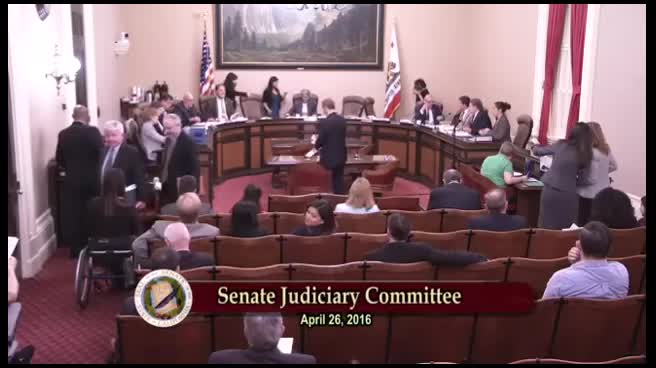 20MIN
Senate Standing Committee on Judiciary
Bill Author
Bill Co-Author(s):