SB 1257: State Bar: admission: license: pro bono service requirement.
- Session Year: 2015-2016
- House: Senate
- Latest Version Date: 2016-08-16
Existing law, the State Bar Act, requires an applicant for admission and a license to practice law, to meet certain requirements, including, but not limited to, having completed certain legal education in a law school, law office, or judges chambers, passed an examination in professional responsibility, and passed the general bar examination. Existing law prohibits a person from practicing law in this state unless he or she is an active member of the State Bar.
This bill would additionally require an applicant, prior to admission, to complete at least 50 hours of supervised pro bono legal service, as specified, in order to supplement the applicants legal education with practical legal work experience. Upon completion of the pro bono legal service requirement, the bill would require an applicant and the supervisor, as defined, to complete and sign a form confirming completion of the pro bono service. The bill would require the State Bar to adopt rules for the retention of the certification forms. The bill would authorize the State Bar to create the form upon which an applicant can report completion of pro bono service. The bill would require the State Bar to randomly audit submitted forms to ensure compliance with these provisions. The bill would provide that these provisions apply to all applicants who enter law school on or after January 1, 2018.
Existing law, the State Bar Act, requires an applicant for admission and a license to practice law, to meet certain requirements, including, but not limited to, having completed certain legal education in a law school, law office, or judges chambers, passed an examination in professional responsibility, and passed the general bar examination. Existing law prohibits a person from practicing law in this state unless he or she is an active member of the State Bar.
This bill would additionally require an applicant, prior to admission, to complete at least 50 hours of supervised pro bono legal service, as specified, in order to supplement the applicants legal education with practical legal work experience. Upon completion of the pro bono legal service requirement, the bill would require an applicant and the supervisor, as defined, to complete and sign a form confirming completion of the pro bono service. The bill would require the State Bar to adopt rules for the submission and retention of the certification forms. The bill would authorize the State Bar to create the form upon which an applicant can report completion of pro bono service. The bill would require the State Bar to randomly audit submitted forms to ensure compliance with these provisions. The bill would provide that these provisions apply to all applicants who enter law school on or after January 1, 2018.
Existing law, the State Bar Act, requires an applicant for admission and a license to practice law, to meet certain requirements, including, but not limited to, having completed certain legal education in a law school, law office, or judges chambers, passed an examination in professional responsibility, and passed the general bar examination. Existing law prohibits a person from practicing law in this state unless he or she is an active member of the State Bar.
This bill would additionally require an applicant, prior to admission, to complete at least 50 hours of supervised pro bono legal service, as specified, in order to supplement the applicants legal education with practical legal work experience. Upon completion of the pro bono legal service requirement, the bill would require an applicant and the supervising attorney or active judge supervisor, as defined, to complete and sign a form confirming completion of the pro bono service. The bill would require the State Bar to adopt rules for the submission and retention of the certification forms. The bill would authorize the State Bar to create the form upon which an applicant can report completion of pro bono service. The bill would require the State Bar to randomly audit applicants submitted forms to ensure completion of 50 hours of pro bono legal service. compliance with these provisions. The bill would provide that these provisions become operative on apply to all applicants who enter law school on or after January 1, 2018.
Existing law, the State Bar Act, requires an applicant for admission and a license to practice law, to meet certain requirements, including, but not limited to, having completed certain legal education in a law school, law office, or judges chambers, passed an examination in professional responsibility, and passed the general bar examination. Existing law prohibits a person from practicing law in this state unless he or she is an active member of the State Bar.
This bill would additionally require an applicant, prior to filing an application for admission and a license to practice, admission, to complete at least 50 hours of supervised pro bono legal service, as specified, in order to supplement the applicants legal education with practical legal work experience. Upon completion of the pro bono legal service requirement, the bill would require an applicant and the supervising attorney or active judge to complete, sign, and submit complete and sign a form to the State Bar confirming completion of the pro bono service, and service. The bill would require the State Bar to adopt rules for the submission and retention of the certification forms. The bill would authorize the State Bar to create the form upon which an applicant can report completion of pro bono service. The bill would require the State Bar to randomly audit applicants to ensure completion of 50 hours of pro bono legal service. The bill would provide that these provisions become operative on January 1, 2018.
Existing law, the State Bar Act, requires an applicant for admission and a license to practice law, to meet certain requirements, including, but not limited to, having completed certain legal education in a law school, law office, or judges chambers, passed an examination in professional responsibility, and passed the general bar examination. Existing law prohibits a person from practicing law in this state unless he or she is an active member of the State Bar.
This bill would additionally require an applicant, prior to filing an application for admission and a license to practice, to complete at least 50 hours of supervised pro bono service, as specified, in order to supplement the applicants legal education with practical legal work experience. Upon completion of the pro bono service requirement, the bill would require an applicant to complete, sign, and submit a form to the State Bar confirming completion of the pro bono service. service, and would authorize the State Bar to create the form upon which an applicant can report completion of pro bono service. The bill would require the State Bar to randomly audit applicants to ensure completion of 50 hours of pro bono service. The bill would provide that these provisions become operative on January 1, 2018.
Existing law, the State Bar Act, requires an applicant for admission and a license to practice law, to meet certain requirements, including, but not limited to, having completed certain legal education in a law school, law office, or judges chambers, passed an examination in professional responsibility, and passed the general bar examination. Existing law prohibits a person from practicing law in this state unless he or she is an active member of the State Bar.
This bill would additionally require an applicant, prior to filing an application for admission and a license to practice, to complete at least 50 hours of supervised pro bono service, as specified, in order to supplement the applicants legal education with practical legal work experience. Upon completion of the pro bono service requirement, the bill would require an applicant to complete, sign, and submit a form to the State Bar confirming completion of the pro bono service.
(a)In addition to satisfying the requirements in Section 6060, irrespective of the manner or law school in which an applicant acquires his or her legal education, an applicant for admission and a license to practice shall complete at least 50 hours of pro bono legal service prior to admission. The purpose of this pro bono legal service requirement is to supplement the applicants legal education with practical legal work experience and expose the applicant to the professional value of pro bono legal service for the public good.
(b)All qualifying pro bono legal service shall be performed under the supervision of one of the following:
(1)A member of a law school faculty, including part-time faculty, or an instructor employed by a law school.
(2)A person with the appropriate licensing to represent the client before the relevant judicial body or government agency, which includes, but is not limited to, an active licensed attorney in good standing.
(3)An active licensed attorney in good standing.
(c)For the purposes of this section, the following definitions shall apply:
(1)Pro bono legal service means work without compensation from the client who receives the legal service that is designed to benefit the public interest or persons who are indigent or of modest means for one of the individuals, organizations, or programs listed in subdivision (d) that is for one of the following purposes:
(A)To secure or promote access to justice, including, but not limited to, the protection of civil rights, civil liberties, or public rights.
(B)To address the economic, health, and social needs of persons who are indigent or of modest means.
(C)To further the purpose of a charitable, civic, community, governmental, or educational organization where payment of the market rate for legal fees would significantly deplete the organizations resources or would otherwise be inappropriate.
(2)Modest means means low income, very low income, or extremely low income under the official state income limits established by the Department of Housing and Community Development under Section 50093 of the Health and Safety Code or under comparable official state income limits in another United States jurisdiction.
(3)Attorney incubator program means a postgraduate training program that teaches attorneys how to form, develop, and sustain law firms.
(d)Pro bono legal service shall be performed with or for any of the following:
(1)A legal aid organization, as defined by Section 6159.51, or a qualified legal services project or a qualified support center, as defined in Section 6213.
(2)A nonprofit organization.
(3)A charitable, civic, community, governmental, or educational organization.
(4)An externship, law school clinic or other placement approved for credit hours by a law school, or law school-sponsored project, in which the applicant is assigned work that otherwise meets the criteria of this section.
(5)A law firm, including a solo practitioner, or other legal services provider where the applicant is assigned work that otherwise meets the criteria of this section.
(6)A State Bar-certified lawyer referral and information services panel that provides legal services to the indigent or persons of modest means without charge or for less than market rate.
(7)An attorney incubator program or nonprofit law corporation affiliated with a law school or bar association that provides legal services to the indigent or persons of modest means without charge or for less than market rate.
(e)Nothing in this section prohibits an applicant from receiving compensation, including, but not limited to, a salary, for performing pro bono legal service that is paid by a person or entity other than the client who receives the pro bono legal service.
(f)Subject to subdivision (b), the 50 hours of pro bono legal service, or any portion thereof, may be completed in any state or territory of the United States, the District of Columbia, or any foreign country.
(g)The 50 hours of pro bono legal service shall be provided after the commencement of the applicants legal studies, and prior to admission.
(h)(1)Upon completion of the pro bono legal service requirement, an applicant shall complete a form describing the nature and dates of pro bono legal service and the number of hours completed and submit the form to the State Bar. Both the applicant and the supervising attorney or active judge shall sign the form. The State Bar shall adopt rules for its retention of the certification forms.
(2)The State Bar may create the form upon which the applicant can report completion of pro bono legal service.
(i)No applicant may satisfy any part of the 50-hour requirement by participating in any partisan political activities.
(j)The requirements of this section do not apply to:
(1)An applicant who is already admitted to practice in any state, territory, or foreign jurisdiction.
(2)An applicant who has earned a J.D. or its equivalent in a foreign jurisdiction and is qualified to practice without a separate admission process in that jurisdiction.
(3)An applicant qualifying for admission by completion of an LL.M. degree program.
(k)(1)Each law school shall publicly disclose on its Internet Web site through a link from the Internet Web site homepage of the law school under Pro Bono Legal Service Requirement for Law Students, all of the following information:
(A)A description of the requirements of this section.
(B)Links to programs available to students at the school and in the local community that provide opportunities for pro bono legal service and allow students to comply with the requirements of this section.
(C)To the extent practicable, information about times and dates when the programs are open or available to students that have been provided to the law school by the pro bono legal service program.
(2)Each law school shall provide an initial link to the above information to the State Bar no later than January 1, 2018, and shall maintain updated links to qualifying school and community programs on an annual basis.
(l)The State Bar shall publicly disclose on its Internet Web site, with a link from the Future Lawyers or Admissions Internet Web page of the State Bar under Pro Bono Legal Service Requirement for Law Students, all of the following information:
(1)A description of the requirements of this section.
(2)A link to the information described in paragraph (1) of subdivision (k) for each law school in the state that provides its link to that information to the State Bar pursuant to paragraph (2) of subdivision (k).
(m)Pursuant to rules adopted under subdivision (g), the State Bar shall randomly audit the compliance documentation applicants submit to ensure its consistency with the criteria in paragraph (1) of subdivision (c). This section shall not require the State Bar to audit or investigate any service providers for which work was done by an applicant or to evaluate the substance of any work that was done by an applicant.
(n)The requirements of this section shall apply to all applicants who enter law school on or after January 1, 2018.
(a)In addition to satisfying the requirements in Section 6060, irrespective of the manner or law school in which an applicant acquires his or her legal education, an applicant for admission and a license to practice shall complete at least 50 hours of pro bono legal service prior to admission. The purpose of this pro bono legal service requirement is to supplement the applicants legal education with practical legal work experience and expose the applicant to the professional value of pro bono legal service for the public good.
(b)All qualifying pro bono legal service shall be performed under the supervision of one of the following:
(1)A member of a law school faculty, including adjunct part-time faculty, or an instructor employed by a law school.
(2)A person with the appropriate licensing to represent the client before the relevant judicial body or government agency, which includes, but is not limited to, an active licensed attorney in good standing.
(3)An active licensed attorney in good standing.
(c)For the purposes of this section, both of the following definitions shall apply:
(1)Pro bono legal service means work without compensation from the client who receives the legal service that is designed to benefit the public interest or persons who are indigent or of modest means for one of the individuals, organizations, or programs listed in subdivision (d) that is for one of the following purposes:
(A)To secure or promote access to justice, including, but not limited to, the protection of civil rights, civil liberties, or public rights.
(B)To address the economic, health, and social needs of persons who are indigent or of modest means.
(C)To further the purpose of a charitable, civic, community, governmental, or educational organization where payment of the market rate for legal fees would significantly deplete the organizations resources or would otherwise be inappropriate.
(2)Modest means means low income, very low income, or extremely low income under the official state income limits established by the Department of Housing and Community Development under Section 50093 of the Health and Safety Code or under comparable official state income limits in another United States jurisdiction.
(3)Attorney incubator program means a postgraduate training program that teaches attorneys how to form, develop, and sustain law firms.
(d)Pro bono legal service shall be performed with or for any of the following:
(1)A legal aid organization, as defined by Section 6159.51, or a qualified legal services project or a qualified support center, as defined in Section 6213.
(2)A nonprofit organization.
(3)A charitable, civic, community, governmental, or educational organization.
(4)An externship, law school clinic or other placement approved for credit hours by a law school, or law school-sponsored project, in which the applicant is assigned work that otherwise meets the criteria of this section.
(5)A law firm, including a solo practitioner, or other legal services provider where the applicant is assigned work that otherwise meets the criteria of this section.
(6)A State Bar-certified lawyer referral and information services panel that provides legal services to the indigent or persons of modest means without charge or for less than market rate.
(7)An attorney incubator program or nonprofit law corporation affiliated with a law school or bar association that provides legal services to the indigent or persons of modest means without charge or for less than market rate.
(e)Nothing in this section prohibits an applicant from receiving compensation, including, but not limited to, a salary, for performing pro bono legal service that is paid by a person or entity other than the client who receives the pro bono legal service.
(f)Subject to subdivision (b), the 50 hours of pro bono legal service, or any portion thereof, may be completed in any state or territory of the United States, the District of Columbia, or any foreign country.
(g)The 50 hours of pro bono legal service shall be provided after the commencement of the applicants legal studies, and prior to admission.
(h)(1)Upon completion of the pro bono legal service requirement, an applicant shall complete a form describing the nature and dates of pro bono legal service and the number of hours completed and submit the form to the State Bar. Both the applicant and the supervising attorney or active judge shall sign the form. The State Bar shall adopt rules for its retention of the certification forms.
(2)The State Bar may create the form upon which the applicant can report completion of pro bono legal service.
(i)No applicant may satisfy any part of the 50-hour requirement by participating in any partisan political activities.
(j)The requirements of this section do not apply to:
(1)An applicant who is already admitted to practice in any state, territory, or foreign jurisdiction.
(2)An applicant who has earned a J.D. or its equivalent in a foreign jurisdiction and is qualified to practice without a separate admission process in that jurisdiction.
(3)An applicant qualifying for admission by completion of an LL.M. degree program.
(k)(1)Each law school shall publicly disclose on its Internet Web site through a link from the Internet Web site homepage of the law school under Pro Bono Legal Service Requirement for Law Students, all of the following information:
(A)A description of the requirements of this section.
(B)Links to programs available to students at the school and in the local community that provide opportunities for pro bono legal service and allow students to comply with the requirements of this section.
(C)Times To the extent practicable, information about times and dates when the programs are open or available to students. students that have been provided to the law school by the pro bono legal service program.
(2)Each law school shall provide an initial link to the above information to the State Bar no later than January 1, 2018, and shall maintain updated links to qualifying school and community programs on an annual basis.
(l)The State Bar shall publicly disclose on its Internet Web site, with a link from the Future Lawyers or Admissions Internet Web page of the State Bar under Pro Bono Legal Service Requirement for Law Students, all of the following information:
(1)A description of the requirements of this section.
(2)A link to the information described in paragraph (1) of subdivision (k) for each law school in the state that provides its link to that information to the State Bar pursuant to paragraph (2) of subdivision (k).
(m)Pursuant to rules adopted under subdivision (g), the State Bar shall randomly audit the compliance documentation applicants submit to ensure its consistency with the criteria in paragraph (1) of subdivision (c). This section shall not require the State Bar to audit or investigate any service providers for which work was done by an applicant or to evaluate the substance of any work that was done by an applicant.
(n)The requirements of this section shall apply to all applicants who enter law school on or after January 1, 2018.
(a)In addition to satisfying the requirements in Section 6060, irrespective of the manner or law school in which an applicant acquires his or her legal education, an applicant for admission and a license to practice shall complete at least 50 hours of pro bono legal service prior to filing an application. admission. The purpose of this pro bono legal service requirement is to supplement the applicants legal education with practical legal work experience. experience and expose the applicant to the professional value of pro bono legal service for the public good.
(b)The All qualifying pro bono legal service shall be supervised by an active licensed attorney in good standing. performed under the supervision of one of the following:
(1)A member of a law school faculty, including adjunct faculty, or an instructor employed by a law school.
(2)A person with the appropriate licensing to represent the client before the relevant judicial body or government agency, which includes, but is not limited to, an active licensed attorney in good standing.
(3)An active licensed attorney in good standing.
(c)For the purposes of this section, pro bono legal service means work without compensation except for costs in the provision of legal service to any of the following: both of the following definitions shall apply:
(1)Pro bono legal service means work without compensation from the client who receives the legal service that is designed to benefit the public interest or persons who are indigent or of modest means for one of the individuals, organizations, or programs listed in subdivision (d) that is for one of the following purposes:
(A)To secure or promote access to justice, including, but not limited to, the protection of civil rights, civil liberties, or public rights.
(B)To address the economic, health, and social needs of persons who are indigent or of modest means.
(C)To further the purpose of a charitable, civic, community, governmental, or educational organization where payment of the market rate for legal fees would significantly deplete the organizations resources or would otherwise be inappropriate.
(2)Modest means means low income, very low income, or extremely low income under the official state income limits established by the Department of Housing and Community Development under Section 50093 of the Health and Safety Code or under comparable official state income limits in another United States jurisdiction.
(d)Pro bono legal service shall be performed with or for any of the following:
(1)A legal aid organization organization, as defined by Section 6159.51. 6159.51, or a qualified legal services project or a qualified support center, as defined in Section 6213.
(2)A nonprofit group or organization seeking to secure or promote access to justice, including, but not limited to, the protection of civil rights, civil liberties, or public rights. organization.
(3)A charitable, civic, community, governmental, or educational organization in matters designed primarily to address the economic, health, and social needs of persons who are indigent or of limited means. organization.
(4)An externship, law school clinic or other placement approved for credit hours by a law school, or law school-sponsored project, in which the applicant is assigned work that otherwise meets the criteria of this section.
(5)A law firm, including a solo practitioner, or other legal services provider where the applicant is assigned work that otherwise meets the criteria of this section.
(6)A State Bar-certified lawyer referral and information services panel that provides legal services to the indigent or persons of modest means without charge or for less than market rate.
(7)An attorney incubator program or nonprofit law corporation affiliated with a law school or bar association that provides legal services to the indigent or persons of modest means without charge or for less than market rate.
(e)Nothing in this section prohibits an applicant from receiving compensation, including, but not limited to, a salary, for performing pro bono legal service that is paid by a person or entity other than the client who receives the pro bono legal service.
(d)
(f)Subject to subdivision (b), the 50 hours of pro bono legal service, or any portion thereof, may be completed in any state or territory of the United States, the District of Columbia, or any foreign country and may be supervised by an attorney who is licensed to practice law or an active judge in the jurisdiction where the service is completed. country.
(e)
(g)The 50 hours of pro bono legal service shall be provided after the commencement of the applicants legal studies, and prior to admission.
(f)
(h)(1)Upon completion of the pro bono legal service requirement, an applicant shall complete a form describing the nature and dates of pro bono legal service and the number of hours completed. completed and submit the form to the State Bar. Both the applicant and the supervising attorney or active judge shall sign the form. The State Bar shall adopt rules for the submission to, and retention by, the State Bar its retention of the certification forms.
(2)The State Bar may create the form upon which the applicant can report completion of pro bono legal service.
(g)
(i)No applicant may satisfy any part of the 50-hour requirement by participating in any partisan political activities.
(h)The State Bar may create the form upon which the applicant can report completion of pro bono legal service.
(i)The State Bar shall randomly audit applicants to ensure completion of 50 hours of pro bono legal service.
(j) This section shall become operative on January 1, 2018.
(j)The requirements of this section do not apply to:
(1)An applicant who is already admitted to practice in any state, territory, or foreign jurisdiction.
(2)An applicant who has earned a J.D. or its equivalent in a foreign jurisdiction and is qualified to practice without a separate admission process in that jurisdiction.
(3)An applicant qualifying for admission by completion of an LL.M. degree program.
(k)(1)Each law school shall publicly disclose on its Internet Web site through a link from the Internet Web site homepage of the law school under Pro Bono Legal Service Requirement for Law Students, all of the following information:
(A)A description of the requirements of this section.
(B)Links to programs available to students at the school and in the local community that provide opportunities for pro bono legal service and allow students to comply with the requirements of this section.
(C)Times and dates when the programs are open or available to students.
(2)Each law school shall provide an initial link to the above information to the State Bar no later than January 1, 2018, and shall maintain updated links to qualifying school and community programs on an annual basis.
(l)The State Bar shall publicly disclose on its Internet Web site, with a link from the Future Lawyers or Admissions Internet Web page of the State Bar under Pro Bono Legal Service Requirement for Law Students, all of the following information:
(1)A description of the requirements of this section.
(2)A link to the information described in paragraph (1) of subdivision (k) for each law school in the state that provides its link to that information to the State Bar pursuant to paragraph (2) of subdivision (k).
(m)Pursuant to rules adopted under subdivision (g), the State Bar shall randomly audit the compliance documentation applicants submit to ensure its consistency with the criteria in paragraph (1) of subdivision (c). This section shall not require the State Bar to audit or investigate any service providers for which work was done by an applicant or to evaluate the substance of any work that was done by an applicant.
(n)The requirements of this section shall apply to all applicants who enter law school on or after January 1, 2018.
(a)In addition to satisfying the requirements in Section 6060, irrespective of the manner or law school in which an applicant acquires his or her legal education, an applicant for admission and a license to practice shall complete at least 50 hours of pro bono legal service prior to filing an application. The purpose of this pro bono legal service is to supplement the applicants legal education with practical legal work experience.
(b)The pro bono legal service shall be supervised by an active licensed attorney in good standing.
(c)For the purposes of this section, pro bono legal service means work that does either without compensation except for costs in the provision of legal service to any of the following:
(1)Assists in the provision of legal services without charge for persons of limited means, not-for-profit organizations, or individuals, groups, or organizations seeking to secure or promote access to justice, including, but not limited to, the protection of civil rights, civil liberties, or public rights. A legal aid organization as defined by Section 6159.51.
(2)Assists in the provision of legal assistance in public service for a judicial, legislative, executive, or other governmental entity. A nonprofit group or organization seeking to secure or promote access to justice, including, but not limited to, the protection of civil rights, civil liberties, or public rights.
(3)A charitable, civic, community, governmental, or educational organization in matters designed primarily to address the economic, health, and social needs of persons who are indigent or of limited means.
(d)Subject to subdivision (b), the 50 hours of pro bono legal service, or any portion thereof, may be completed in any state or territory of the United States, the District of Columbia, or any foreign country. country and may be supervised by an attorney who is licensed to practice law or an active judge in the jurisdiction where the service is completed.
(e)The 50 hours of pro bono legal service shall be provided after the commencement of the applicants legal studies, and prior to filing an application for admission and a license to practice. admission.
(f)Upon completion of the pro bono legal service requirement, an applicant shall complete a form describing the nature and dates of pro bono legal service and the number of hours completed. Both the applicant and the supervising attorney or active judge shall sign the form. The applicant shall submit the signed form to the State Bar. The State Bar shall adopt rules for the submission to, and retention by, the State Bar of the certification forms.
(g)No applicant may satisfy any part of the 50-hour requirement by participating in any partisan political activities.
(h)The State Bar may create the form upon which the applicant can report completion of pro bono legal service.
(i)The State Bar shall randomly audit applicants to ensure completion of 50 hours of pro bono legal service.
(j)This section shall become operative on January 1, 2018.
(a)In addition to satisfying the requirements in Section 6060, irrespective of the manner or law school in which an applicant acquires his or her legal education, an applicant for admission and a license to practice shall complete at least 50 hours of pro bono service prior to filing an application. The purpose of this pro bono legal service is to supplement the applicants legal education with practical legal work experience.
(b)The pro bono service shall be supervised by an active licensed attorney in good standing. Unless the service is completed in California, the supervisor is not required to be licensed to practice law in this state.
(c)For the purposes of this section, pro bono service means work that does either of the following:
(1)Assists in the provision of legal services without charge for persons of limited means, not-for-profit organizations, or individuals, groups, or organizations seeking to secure or promote access to justice, including, but not limited to, the protection of civil rights, civil liberties, or public rights.
(2)Assists in the provision of legal assistance in public service for a judicial, legislative, executive, or other governmental entity.
(d)Subject to subdivision (b), the 50 hours of pro bono service, or any portion thereof, may be completed in any state or territory of the United States, the District of Columbia, or any foreign country.
(e)The 50 hours of pro bono service shall be provided after the commencement of the applicants legal studies, and prior to filing an application for admission and a license to practice.
(f)Upon completion of the pro bono service requirement, an applicant shall complete a form describing the nature and dates of pro bono service and the number of hours completed. Both the applicant and the supervising attorney shall sign the form. The applicant shall submit the signed form to the State Bar.
(g)No applicant may satisfy any part of the 50-hour requirement by participating in any partisan political activities.
(h)The State Bar may create the form upon which the applicant can report completion of pro bono service.
(i)The State Bar shall randomly audit applicants to ensure completion of 50 hours of pro bono service.
(j)This section shall become operative on January 1, 2018.
(a)In addition to satisfying the requirements in Section 6060, irrespective of the manner or law school in which an applicant acquires his or her legal education, an applicant for admission and a license to practice shall complete at least 50 hours of pro bono service prior to filing an application. The purpose of this pro bono legal service is to supplement the applicants legal education with practical legal work experience.
(b)The pro bono service shall be supervised by an active licensed attorney in good standing. Unless the service is completed in California, the supervisor is not required to be licensed to practice law in this state.
(c)For the purposes of this section, pro bono service means work that does either of the following:
(1)Assists in the provision of legal services without charge for persons of limited means, not-for-profit organizations, or individuals, groups, or organizations seeking to secure or promote access to justice, including, but not limited to, the protection of civil rights, civil liberties, or public rights.
(2)Assists in the provision of legal assistance in public service for a judicial, legislative, executive, or other governmental entity.
(d)Subject to subdivision (b), the 50 hours of pro bono service, or any portion thereof, may be completed in any state or territory of the United States, the District of Columbia, or any foreign country.
(e)The 50 hours of pro bono service shall be provided after the commencement of the applicants legal studies, and prior to filing an application for admission and a license to practice.
(f)Upon completion of the pro bono service requirement, an applicant shall complete a form describing the nature and dates of pro bono service and the number of hours completed. Both the applicant and the supervising attorney shall sign the form. The applicant shall submit the signed form to the State Bar.
(g)No applicant may satisfy any part of the 50-hour requirement by participating in any partisan political activities.
|
Date
|
Status
|
|---|---|
| Aug 29, 2016 | In Senate. Consideration of Governor's veto pending. |
| Aug 29, 2016 | Vetoed by the Governor. |
| Aug 17, 2016 | Enrolled and presented to the Governor at 12:30 p.m. |
| Aug 15, 2016 | Assembly amendments concurred in. (Ayes 26. Noes 12. Page 4984.) Ordered to engrossing and enrolling. |
| Aug 15, 2016 | Assembly amendments concurred in. (Ayes 26. Noes 12.) Ordered to engrossing and enrolling. |
| Aug 4, 2016 | Read third time. Passed. (Ayes 42. Noes 31. Page 5722.) Ordered to the Senate. |
| Aug 4, 2016 | In Senate. Concurrence in Assembly amendments pending. |
| Aug 4, 2016 | Read third time. Passed. Ordered to the Senate. |
| Aug 1, 2016 | Read second time. Ordered to third reading. |
| Jun 30, 2016 | Read second time and amended. Ordered to second reading. |
| Jun 29, 2016 | From committee: Do pass as amended. (Ayes 6. Noes 3.) (June 28). |
| Jun 23, 2016 | From committee with author's amendments. Read second time and amended. Re-referred to Com. on JUD. |
| Jun 8, 2016 | June 8 set for first hearing canceled at the request of author. |
| May 31, 2016 | From committee with author's amendments. Read second time and amended. Re-referred to Com. on JUD. |
| May 16, 2016 | Referred to Com. on JUD. |
| May 10, 2016 | In Assembly. Read first time. Held at Desk. |
| May 9, 2016 | Read third time. Passed. (Ayes 26. Noes 9. Page 3801.) Ordered to the Assembly. |
| May 9, 2016 | Read third time. Passed. (Ayes 26. Noes 9.) Ordered to the Assembly. |
| May 3, 2016 | Read second time and amended. Ordered to third reading. |
| May 2, 2016 | From committee: Do pass as amended. (Ayes 6. Noes 1. Page 3700.) (April 26). |
| May 2, 2016 | From committee: Do pass as amended. (Ayes 6. Noes 1.) (April 26). |
| Apr 14, 2016 | Set for hearing April 26. |
| Mar 3, 2016 | Referred to Com. on JUD. |
| Feb 19, 2016 | From printer. May be acted upon on or after March 20. |
| Feb 18, 2016 | Introduced. Read first time. To Com. on RLS. for assignment. To print. |
|
Date
|
Description
|
Location
|
Votes
|
|
|---|---|---|---|---|
| Aug 15, 2016 | Unfinished Business SB1257 Block Concurrence | Senate Floor |
Passed |
|
| Aug 4, 2016 | SB 1257 Block Senate Third Reading By TING | Assembly Floor |
Passed |
|
| Jun 28, 2016 | Do pass as amended. | Assembly Standing Committee on Judiciary |
Passed |
|
| May 9, 2016 | Senate 3rd Reading SB1257 Block | Senate Floor |
Passed |
|
| Apr 26, 2016 | Do pass as amended | Senate Standing Committee on Judiciary |
Passed |
This list shows positions taken on this bill by organizations on the date displayed, which is linked to the original source.
Positions by individuals are not included.
Office of Senate Floor Analyses (916) 651-1520 Fax: (916) 327-4478 | SB 1257 |
VETO
Bill No: SB 1257
Amended: 6/30/16
SENATE JUDICIARY COMMITTEE: 6-1, 4/26/16
AYES: Jackson, Moorlach, Hertzberg, Leno, Monning, Wieckowski
NOES: Anderson
SENATE FLOOR: 26-9, 5/9/16
AYES: Allen, Anderson, Block, De León, Glazer, Hall, Hancock, Hernandez, Hertzberg, Hill, Hueso, Jackson, Lara, Leno, Leyva, Liu, McGuire, Mendoza, Mitchell, Monning, Moorlach, Pan, Pavley, Roth, Wieckowski, Wolk
NOES: Berryhill, Cannella, Fuller, Huff, Morrell, Nguyen, Nielsen, Stone, Vidak
NO VOTE RECORDED: Bates, Beall, Gaines, Galgiani, Runner
SENATE FLOOR: 26-12, 8/15/16
AYES: Allen, Beall, Block, De León, Galgiani, Glazer, Hall, Hancock, Hernandez, Hertzberg, Hill, Hueso, Jackson, Lara, Leno, Leyva, Liu, McGuire, Mendoza, Mitchell, Monning, Pan, Pavley, Roth, Wieckowski, Wolk
NOES: Anderson, Bates, Cannella, Fuller, Gaines, Huff, Moorlach, Morrell, Nguyen, Nielsen, Stone, Vidak
NO VOTE RECORDED: Berryhill
ASSEMBLY FLOOR: 42-31, 8/4/16 - See last page for vote
SUBJECT: State Bar: admission: license: pro bono service requirement
DIGEST: This bill, to achieve greater access to justice for indigent unrepresented Californians, requires those who apply to become licensed California attorneys, with certain exceptions, to complete at least 50 hours of pro bono legal service, as defined, prior to admission with the State Bar of California.
Assembly Amendments clarify who is eligible to supervise the pro bono legal service, the definition of “pro bono legal service,” what qualifies as pro bono legal service, and the process for certifying completion of the hours. The amendments exempt certain applicants from the pro bono legal services requirement and add disclosure requirements for law schools and the State Bar related to the pro bono legal service requirement. The amendments add that an applicant may receive compensation for performing pro bono legal service that is paid by a person or entity other than the client who receives the pro bono legal service. The amendments add definition of “modest means” and “attorney incubator programs.” The amendments add that the new pro bono legal services requirement applies to applicants that enter law school on or after January 1, 2018. The amendments add that the purpose of the service requirement is also to expose the applicant to the professional value of pro bono legal service for the public good. The amendments also make clarifying nonsubstantive changes.
Existing law:
- Provides that the State Bar’s highest priority is protection of the public, and, whenever the protection of the public is inconsistent with other interests sought to be promoted, the protection of the public shall be paramount.
- Requires that attorneys who wish to practice law in California generally must be admitted and licensed in this state and must be a member of the State Bar.
- Sets forth requirements for an individual to be certified by the Supreme Court for admission and a license to practice law, including but not limited to, having to pass the general bar examination, passing an examination in professional responsibility, and having to complete certain legal education in a law school, law office, or judge’s chambers.
- Provides that every lawyer authorized and privileged to practice law in California is expected to make a contribution to provide voluntary pro bono legal services to those who cannot afford the help of a lawyer.
This bill:
- Requires an applicant for admission and a license to practice law to complete at least 50 hours of pro bono legal service, as defined, prior to admission with the State Bar of California.
- Defines “pro bono legal service” as work without compensation from the client who receives the legal service that is designed to benefit the public interest or persons who are indigent or of modest means for one of the following purposes:
- to secure or promote access to justice, including, but not limited to, the protection of civil rights, civil liberties, or public rights;
- to address the economic, health, and social needs of persons who are indigent or of modest means; or
- to further the purpose of a charitable, civic, community, governmental, or educational organization where payment of the market rate for legal fees would significantly deplete the organization’s resources or would otherwise be inappropriate.
- Defines “modest means” as low income, very low income, or extremely low income under the official state income limits established by the Department of Housing and Community Development under Section 50093 of the Health and Safety Code or under comparable official state income limits in another United States jurisdiction.
- Defines “attorney incubator program” as a postgraduate training program that teaches attorneys how to form, develop, and sustain law firms.
- Provides that all qualifying pro bono legal services shall be performed under the supervision of:
- a member of a law school faculty, including part-time faculty, or an instructor employed by a law school;
- a person with the appropriate licensing to represent the client before the relevant judicial body or government agency, which includes, but is not limited to, an active licensed attorney in good standing; or
- an active licensed attorney in good standing.
- Provides that:
- pro bono legal service may be completed in any state or territory of the United States, the District of Columbia, or any foreign country;
- no applicant may satisfy any part of the 50-hour requirement by participating in any partisan political activities;
- pro bono legal service shall be provided after the commencement of the applicant’s legal studies, and prior to admission;
- an applicant may receive compensation for performing pro bono legal service that is paid by a person or entity other than the client who receives the pro bono legal service; and
- pro bono legal service requirements do not apply to applicants that are already admitted to practice law, who have earned a J.D. or its equivalent in a foreign jurisdiction and are qualified to practice without a separate admission process in that jurisdiction, or qualify for admission by completion of an LL.M. degree program.
- Requires that pro bono legal service be performed with any of the following:
- a legal aid organization as defined by Bus. & Prof. Code section 6159.51 or a qualified legal services project or a qualified support center as defined in Bus. & Prof. Code section 6213;
- a nonprofit organization;
- a charitable, civic, community, governmental, or educational organization;
- an externship, law school clinic or other placement approved for credit hours by a law school, or law school-sponsored project, in which the applicant is assigned work that otherwise meets the criteria of this section;
- a law firm, including a solo practitioner, or other legal services provider where the applicant is assigned work that otherwise meets the criteria of this section;
- a State Bar-certified lawyer referral and information services panel that provides legal services to the indigent or persons of modest means without charge or for less than market rate; or
- an attorney incubator program or nonprofit law corporation affiliated with a law school or bar association that provides legal services to the indigent or persons of modest means without charge or for less than market rate.
- Requires, upon completion of the pro bono legal service requirement, an applicant shall complete a form describing the nature and dates of pro bono legal service and the number of hours completed and submit the form to the State Bar, as specified.
- Allows the State Bar to create the form upon which the applicant can report completion of pro bono legal service, requires the State Bar to adopt rules for its retention of the certification forms, and requires the state bar to randomly audit the compliance documentation applicants submit to ensure their completion of pro bono hours.
- Requires law schools and the State Bar to make public disclosures related to the pro bono legal service requirements, as specified.
- States that the purpose of the pro bono legal service requirement is to supplement the applicant’s legal education with practical legal work experience and expose the applicant to the professional value of pro bono legal service for the public good.
- Specifies the requirements of this bill apply to all applicants who enter law school on or after January 1, 2018.
Background
In 1963, the United States Supreme Court decided Gideon v. Wainright (1963) 372 U.S. 335, in which it unanimously ruled that state courts are required under the Sixth Amendment of the Constitution to provide counsel in criminal cases for defendants unable to afford their own attorneys.
The U.S. Supreme Court, however, has declined to extend the right to counsel to indigents in civil proceedings. In Lassiter v. Department of Social Services (1981) 452 U.S. 18, the Court affirmed that an indigent litigant’s right to an appointed counsel applies only when the litigant may be deprived of his or her personal liberty. Consequently, the United States mainly relies upon limited legal services and pro bono programs to provide indigent litigants representation in civil matters.
Existing law provides that it has been the tradition of those learned in the law and licensed to practice law in this state to provide voluntary pro bono legal services to those who cannot afford the help of a lawyer; that every lawyer authorized and privileged to practice law in California is expected to make a contribution; that in some circumstances, it may not be feasible for a lawyer to directly provide pro bono services; and that in those circumstances, a lawyer may instead fulfill his or her individual pro bono ethical commitment, in part, by providing financial support to organizations providing free legal services to persons of limited means.
In recent years, there has been a growing movement, to provide legal counsel as a matter of right to indigent litigants in matters where basic human needs are at stake. Proponents argue that meaningful access to the civil justice system is largely dependent upon legal representation; and that the likelihood of a just result is significantly increased by competent representation. In recognition of the need for indigent civil litigants in California to be represented by legal counsel, the State of California enacted a pilot project, the Sargent Shriver Civil Counsel Act, in selected courts to provide legal representation to low-income parties in civil matters involving critical issues affecting basic human needs.
To achieve greater access to justice for indigent unrepresented Californians, this bill requires any person who applies to become a licensed California attorney to complete at least 50 hours of pro bono service, as specified, prior to admission with the State Bar of California.
Comments
The author writes:
During their tenure at law school, students have a heavy course load and are most likely involved in extracurricular activities. However, most law students do not get hands on experience in the area they are pursuing, nor do they get to compare the different types of work they may be involved in post-graduation. Although there are already various requirements that must be met in order to sit for the bar exam, the new pro bono requirement will expose candidates to real world experience, and explore different segments of the legal field, while volunteering in different communities. This is crucial to the development of our work force and the future of the advancement of diversity in the legal field.
On October 12, 2013, the State Bar’s Board of Trustees adopted the Phase I Final Report of the Task Force on Admissions Regulations Reform (TFARR). One of the three proposed competency training proposals was a 50-hour pro bono component.
Related/Prior Legislation
SB 1281 (Block, Chapter 87, Statutes of 2016) required law schools not accredited by the American Bar Association to post information on their internet Web sites, including bar passage data, tuition, fees, financial aid, admissions data, employment outcomes for graduates, conditional scholarships, enrollment data, faculty information, average class size for required courses, and the number of clinical offerings.
AB 590 (Feuer, Chapter 457, Statutes of 2009) enacted the Sargent Shriver Civil Counsel Act and expressed the intent of the Legislature to encourage the legal profession to make further efforts to meet its professional responsibilities and other obligations by providing pro bono legal services and financial support of nonprofit legal organizations that provide free legal services to underserved communities.
SB 686 (Corbett, Chapter 474, Statutes of 2007) provided that every lawyer authorized and privileged to practice law in California is expected to make a contribution to provide voluntary pro bono legal services to those who cannot afford the help of a lawyer.
FISCAL EFFECT: Appropriation: No Fiscal Com.: No Local: No
ACLU
Monterey College of Law & San Luis Obispo College of Law
Conference of California Bar Associations
None received
ARGUMENTS IN SUPPORT: In support, the American Civil Liberties Union of California (ACLU) writes that this bill will “help address the large and growing justice gap by promoting pro bono service by new applicants seeking admission to practice law in California.” The ACLU notes that “California meets only a fraction of the legal needs of the poor – turning away far more potential clients than are served by existing resources, even taking into account the strict eligibility requirements for legal aid and the few types of legal matters for which services are provided. While more must be done to fund nonprofit legal aid groups, pro bono services can play an important part in addressing the unmet need. We believe pro bon o services for the poor are appropriately asked of those who are privileged to practice law in California [.]”
I am returning Senate Bill 1257 without my signature.
This bill requires an applicant for membership in the State Bar to complete at least fifty hours of supervised pro bono legal service. It also requires that a practicing lawyer or law professor supervise the student.
I certainly support law students and lawyers providing pro bono legal services. Some law schools already promote volunteerism and pro bono service in various ways and many employers also require a certain amount of pro bono hours for associates and clerks. While I commend the author for his desire to further these efforts, I don't believe a state mandate can be justified.
Law students in California are now contending with skyrocketing costs-often more than $200,000 for tuition and room and board-and many struggle to find employment once they are admitted to the Bar. In this context, I believe it would be unfair to burden students with the requirements set forth in this bill.
Instead, we should focus on lowering the cost of legal education and devising alternative and less expensive ways to qualify for the Bar Exam. By doing so, we could actually expand the opportunity to serve the public interest.
ASSEMBLY FLOOR: 42-31, 8/4/16
AYES: Alejo, Arambula, Atkins, Bloom, Bonilla, Bonta, Brown, Burke, Calderon, Chau, Chiu, Chu, Cooper, Dodd, Eduardo Garcia, Gipson, Gomez, Gordon, Gray, Holden, Irwin, Jones-Sawyer, Kim, Levine, Lopez, Low, McCarty, Medina, Mullin, Nazarian, O'Donnell, Quirk, Ridley-Thomas, Rodriguez, Santiago, Mark Stone, Thurmond, Ting, Weber, Williams, Wood, Rendon
NOES: Achadjian, Travis Allen, Baker, Bigelow, Brough, Campos, Chang, Dababneh, Dahle, Beth Gaines, Gallagher, Cristina Garcia, Gatto, Gonzalez, Grove, Hadley, Harper, Jones, Lackey, Linder, Maienschein, Mathis, Melendez, Obernolte, Olsen, Patterson, Salas, Steinorth, Wagner, Waldron, Wilk
NO VOTE RECORDED: Chávez, Cooley, Daly, Eggman, Frazier, Roger Hernández, Mayes
Prepared by: Margie Estrada / JUD. / (916) 651-4113
8/30/16 16:00:43
**** END ****
Office of Senate Floor Analyses (916) 651-1520 Fax: (916) 327-4478 | SB |
UNFINISHED BUSINESS
Bill No: SB 1257
:
SENATE JUDICIARY COMMITTEE: 6-1, 4/26/16
AYES: Jackson, Moorlach, Hertzberg, Leno, Monning, Wieckowski
NOES: Anderson
SENATE FLOOR: 26-9, 5/9/16
AYES: Allen, Anderson, Block, De León, Glazer, Hall, Hancock, Hernandez, Hertzberg, Hill, Hueso, Jackson, Lara, Leno, Leyva, Liu, McGuire, Mendoza, Mitchell, Monning, Moorlach, Pan, Pavley, Roth, Wieckowski, Wolk
NOES: Berryhill, Cannella, Fuller, Huff, Morrell, Nguyen, Nielsen, Stone, Vidak
NO VOTE RECORDED: Bates, Beall, Gaines, Galgiani, Runner
ASSEMBLY FLOOR: 42-31, 8/4/16 - See last page for vote
DIGEST: This bill, to achieve greater access to justice for indigent unrepresented Californians, requires those who apply to become licensed California attorneys, with certain exceptions, to complete at least 50 hours of pro bono legal service, as defined, prior to admission with the State Bar of California.
Assembly Amendments clarify who is eligible to supervise the pro bono legal service, the definition of “pro bono legal service,” what qualifies as pro bono legal service, and the process for certifying completion of the hours. The amendments exempt certain applicants from the pro bono legal services requirement and add disclosure requirements for law schools and the State Bar related to the pro bono legal service requirement. The amendments add that an applicant may receive compensation for performing pro bono legal service that is paid by a person or entity other than the client who receives the pro bono legal service. The amendments add definition of “modest means” and “attorney incubator programs.” The amendments add that the new pro bono legal services requirement applies to applicants that enter law school on or after January 1, 2018. The amendments add that the purpose of the service requirement is also to expose the applicant to the professional value of pro bono legal service for the public good. The amendments also make clarifying nonsubstantive changes.
Existing law:
- Provides that the State Bar’s highest priority is protection of the public, and, whenever the protection of the public is inconsistent with other interests sought to be promoted, the protection of the public shall be paramount.
- Requires that attorneys who wish to practice law in California generally must be admitted and licensed in this state and must be a member of the State Bar.
- Sets forth requirements for an individual to be certified by the Supreme Court for admission and a license to practice law, including but not limited to, having to pass the general bar examination, passing an examination in professional responsibility, and having to complete certain legal education in a law school, law office, or judge’s chambers.
- Provides that every lawyer authorized and privileged to practice law in California is expected to make a contribution to provide voluntary pro bono legal services to those who cannot afford the help of a lawyer.
This bill:
- Requires an applicant for admission and a license to practice law to complete at least 50 hours of pro bono legal service, as defined, prior to admission with the State Bar of California.
- Defines “pro bono legal service” as work without compensation from the client who receives the legal service that is designed to benefit the public interest or persons who are indigent or of modest means for one of the following purposes:
- to secure or promote access to justice, including, but not limited to, the protection of civil rights, civil liberties, or public rights;
- to address the economic, health, and social needs of persons who are indigent or of modest means; or
- to further the purpose of a charitable, civic, community, governmental, or educational organization where payment of the market rate for legal fees would significantly deplete the organization’s resources or would otherwise be inappropriate.
- Defines “modest means” as low income, very low income, or extremely low income under the official state income limits established by the Department of Housing and Community Development under Section 50093 of the Health and Safety Code or under comparable official state income limits in another United States jurisdiction.
- Defines “attorney incubator program” as a postgraduate training program that teaches attorneys how to form, develop, and sustain law firms.
- Provides that all qualifying pro bono legal services shall be performed under the supervision of:
- a member of a law school faculty, including part-time faculty, or an instructor employed by a law school;
- a person with the appropriate licensing to represent the client before the relevant judicial body or government agency, which includes, but is not limited to, an active licensed attorney in good standing; or
- an active licensed attorney in good standing.
- Provides that:
- pro bono legal service may be completed in any state or territory of the United States, the District of Columbia, or any foreign country;
- no applicant may satisfy any part of the 50-hour requirement by participating in any partisan political activities;
- pro bono legal service shall be provided after the commencement of the applicant’s legal studies, and prior to admission;
- an applicant may receive compensation for performing pro bono legal service that is paid by a person or entity other than the client who receives the pro bono legal service; and
- pro bono legal service requirements do not apply to applicants that are already admitted to practice law, who have earned a J.D. or its equivalent in a foreign jurisdiction and are qualified to practice without a separate admission process in that jurisdiction, or qualify for admission by completion of an LL.M. degree program.
- Requires that pro bono legal service be performed with any of the following:
- a legal aid organization as defined by Bus. & Prof. Code section 6159.51 or a qualified legal services project or a qualified support center as defined in Bus. & Prof. Code section 6213;
- a nonprofit organization;
- a charitable, civic, community, governmental, or educational organization;
- an externship, law school clinic or other placement approved for credit hours by a law school, or law school-sponsored project, in which the applicant is assigned work that otherwise meets the criteria of this section;
- a law firm, including a solo practitioner, or other legal services provider where the applicant is assigned work that otherwise meets the criteria of this section;
- a State Bar-certified lawyer referral and information services panel that provides legal services to the indigent or persons of modest means without charge or for less than market rate; or
- an attorney incubator program or nonprofit law corporation affiliated with a law school or bar association that provides legal services to the indigent or persons of modest means without charge or for less than market rate.
- Requires, upon completion of the pro bono legal service requirement, an applicant shall complete a form describing the nature and dates of pro bono legal service and the number of hours completed and submit the form to the State Bar, as specified.
- Allows the State Bar to create the form upon which the applicant can report completion of pro bono legal service, requires the State Bar to adopt rules for its retention of the certification forms, and requires the state bar to randomly audit the compliance documentation applicants submit to ensure their completion of pro bono hours.
- Requires law schools and the State Bar to make public disclosures related to the pro bono legal service requirements, as specified.
- States that the purpose of the pro bono legal service requirement is to supplement the applicant’s legal education with practical legal work experience and expose the applicant to the professional value of pro bono legal service for the public good.
- Specifies the requirements of this bill apply to all applicants who enter law school on or after January 1, 2018.
Background
In 1963, the United States Supreme Court decided Gideon v. Wainright (1963) 372 U.S. 335, in which it unanimously ruled that state courts are required under the Sixth Amendment of the Constitution to provide counsel in criminal cases for defendants unable to afford their own attorneys.
The U.S. Supreme Court, however, has declined to extend the right to counsel to indigents in civil proceedings. In Lassiter v. Department of Social Services (1981) 452 U.S. 18, the Court affirmed that an indigent litigant’s right to an appointed counsel applies only when the litigant may be deprived of his or her personal liberty. Consequently, the United States mainly relies upon limited legal services and pro bono programs to provide indigent litigants representation in civil matters.
Existing law provides that it has been the tradition of those learned in the law and licensed to practice law in this state to provide voluntary pro bono legal services to those who cannot afford the help of a lawyer; that every lawyer authorized and privileged to practice law in California is expected to make a contribution; that in some circumstances, it may not be feasible for a lawyer to directly provide pro bono services; and that in those circumstances, a lawyer may instead fulfill his or her individual pro bono ethical commitment, in part, by providing financial support to organizations providing free legal services to persons of limited means.
In recent years, there has been a growing movement, to provide legal counsel as a matter of right to indigent litigants in matters where basic human needs are at stake. Proponents argue that meaningful access to the civil justice system is largely dependent upon legal representation; and that the likelihood of a just result is significantly increased by competent representation. In recognition of the need for indigent civil litigants in California to be represented by legal counsel, the State of California enacted a pilot project, the Sargent Shriver Civil Counsel Act, in selected courts to provide legal representation to low-income parties in civil matters involving critical issues affecting basic human needs.
To achieve greater access to justice for indigent unrepresented Californians, this bill requires any person who applies to become a licensed California attorney to complete at least 50 hours of pro bono service, as specified, prior to admission with the State Bar of California.
Comments
The author writes:
During their tenure at law school, students have a heavy course load and are most likely involved in extracurricular activities. However, most law students do not get hands on experience in the area they are pursuing, nor do they get to compare the different types of work they may be involved in post-graduation. Although there are already various requirements that must be met in order to sit for the bar exam, the new pro bono requirement will expose candidates to real world experience, and explore different segments of the legal field, while volunteering in different communities. This is crucial to the development of our work force and the future of the advancement of diversity in the legal field.
On October 12, 2013, the State Bar’s Board of Trustees adopted the Phase I Final Report of the Task Force on Admissions Regulations Reform (TFARR). One of the three proposed competency training proposals was a 50-hour pro bono component.
Related/Prior Legislation
SB 1281 (Block, Chapter 87, Statutes of 2016) required law schools not accredited by the American Bar Association to post information on their internet Web sites, including bar passage data, tuition, fees, financial aid, admissions data, employment outcomes for graduates, conditional scholarships, enrollment data, faculty information, average class size for required courses, and the number of clinical offerings.
AB 590 (Feuer, Chapter 457, Statutes of 2009) enacted the Sargent Shriver Civil Counsel Act and expressed the intent of the Legislature to encourage the legal profession to make further efforts to meet its professional responsibilities and other obligations by providing pro bono legal services and financial support of nonprofit legal organizations that provide free legal services to underserved communities.
SB 686 (Corbett, Chapter 474, Statutes of 2007) provided that every lawyer authorized and privileged to practice law in California is expected to make a contribution to provide voluntary pro bono legal services to those who cannot afford the help of a lawyer.
FISCAL EFFECT: Appropriation: Fiscal Com.: Local:
ACLU
Monterey College of Law & San Luis Obispo College of Law
Conference of California Bar Associations
None received
ARGUMENTS IN SUPPORT: In support, the American Civil Liberties Union of California (ACLU) writes that this bill will “help address the large and growing justice gap by promoting pro bono service by new applicants seeking admission to practice law in California.” The ACLU notes that “California meets only a fraction of the legal needs of the poor – turning away far more potential clients than are served by existing resources, even taking into account the strict eligibility requirements for legal aid and the few types of legal matters for which services are provided. While more must be done to fund nonprofit legal aid groups, pro bono services can play an important part in addressing the unmet need. We believe pro bon o services for the poor are appropriately asked of those who are privileged to practice law in California [.]”
ASSEMBLY FLOOR: 42-31, 8/4/16
AYES: Alejo, Arambula, Atkins, Bloom, Bonilla, Bonta, Brown, Burke, Calderon, Chau, Chiu, Chu, Cooper, Dodd, Eduardo Garcia, Gipson, Gomez, Gordon, Gray, Holden, Irwin, Jones-Sawyer, Kim, Levine, Lopez, Low, McCarty, Medina, Mullin, Nazarian, O'Donnell, Quirk, Ridley-Thomas, Rodriguez, Santiago, Mark Stone, Thurmond, Ting, Weber, Williams, Wood, Rendon
NOES: Achadjian, Travis Allen, Baker, Bigelow, Brough, Campos, Chang, Dababneh, Dahle, Beth Gaines, Gallagher, Cristina Garcia, Gatto, Gonzalez, Grove, Hadley, Harper, Jones, Lackey, Linder, Maienschein, Mathis, Melendez, Obernolte, Olsen, Patterson, Salas, Steinorth, Wagner, Waldron, Wilk
NO VOTE RECORDED: Chávez, Cooley, Daly, Eggman, Frazier, Roger Hernández, Mayes
8/8/16 9:54:18
SENATE THIRD READING
STR Bill Id:SB 1257
Author:(Block)
As Amended Ver:June 30, 2016
Majority vote
SENATE VOTE: 26-9
Committee | Votes | Ayes | Noes |
Judiciary | 6-3 | Mark Stone, Alejo, Chau, Chiu, Holden, Ting | Wagner, Gallagher, Maienschein |
SUMMARY: Requires any person who applies to become a licensed California attorney to complete at least 50 hours of pro bono service prior to filing an application for admission with the State Bar of California. Specifically, this bill:
- Requires an applicant for admission and a license to practice law to complete at least 50 hours of pro bono legal service after the commencement of the applicant's legal studies and prior to admission to practice law.
- Allows the pro bono legal service, or any portion thereof, to be completed in any state or territory of the United States, the District of Columbia, or any foreign country, and requires, in both cases, the service to be under the supervision of one of the following:
- A member of a law school faculty, including adjunct faculty, or an instructor employed by a law school.
- A person with the appropriate licensing to represent the client before the relevant judicial body or government agency, which includes, but is not limited to, an active licensed attorney in good standing.
- An active licensed attorney in good standing.
- Defines "pro bono legal service" as work without compensation from the client who receives the legal service that is designed to benefit the public interest or persons who are indigent or of modest means for one of the individuals, organizations, or programs listed in subdivision d) below, that is for one of the following purposes:
- To secure or promote access to justice, including, but not limited to, the protection of civil rights, civil liberties, or public rights.
- To address the economic, health, and social needs of persons who are indigent or of modest means.
- To further the purpose of a charitable, civic, community, governmental, or educational organization where payment of the market rate for legal fees would significantly deplete the organization's resources or would otherwise be inappropriate.
- Requires pro bono legal service to be performed with or for any of the following:
- A legal aid organization, qualified legal services project, or a qualified support center.
- A nonprofit organization.
- A charitable, civic, community, governmental, or educational organization.
- An externship, law school clinic or other placement approved for credit hours by a law school, or law school-sponsored project, in which the applicant is assigned work that otherwise meets the criteria of this section.
- A law firm, including a solo practitioner, or other legal services provider where the applicant is assigned work that otherwise meets the criteria of this section.
- A State Bar-certified lawyer referral and information services panel that provides legal services to the indigent or persons of modest means without charge or for less than market rate.
- An attorney incubator program or nonprofit law corporation affiliated with a law school or bar association that provides legal services to the indigent or persons of modest means without charge or for less than market rate.
- Provides that the provisions of the bill do not prohibit an applicant from receiving compensation, including, but not limited to, a salary, for performing pro bono legal service that is paid by a person or entity other than the client who receives the pro bono legal service.
- Requires each law school to publicly disclose, on its Internet Web site through a link from the Internet Web site homepage of the law school under "Pro Bono Legal Service Requirement for Law Students," information about the pro bono legal service requirement, including the following:
- A description of the requirements of this section.
- Links to programs available to students at the school and in the local community that provide opportunities for pro bono legal service and allow students to comply with the requirements of this section.
- Requires the State Bar to publicly disclose on its Internet Web site, with a link from the "Future Lawyers" or "Admissions" Internet Web page of the State Bar under "Pro Bono Legal Service Requirement for Law Students," all of the following information:
- A description of the pro bono legal service requirement.
- A link to the information about pro bono legal service opportunities for each law school in the state that provides its link to that information to the State.
FISCAL EFFECT: None.
COMMENTS: This bill seeks to address the problem of access to justice and legal services by requiring, as a prerequisite to licensure by the State Bar, law students to complete at least 50 hours of pro bono legal service after the commencement of the applicant's legal studies, and prior to filing an application for admission and a license to practice law. However, the type of practical legal work that meets the definition of "pro bono legal service" under the bill is not strictly limited to legal work for the indigent. Work for a legal aid organization and work for a "a charitable, civic, community, governmental, or educational organization in matters designed primarily to address the economic, health, and social needs of persons who are indigent or of modest means," both of which are included in the bill's definition of "pro bono legal service," seem to meet the criteria (with the exception of allowing work that is not primarily designed for those purposes). The bill also includes the following within its definition of pro bono legal service: work for a "nonprofit group or organization seeking to secure or promote access to justice, including, but not limited to, the protection of civil rights, civil liberties, or public rights." While this work would not exclusively benefit the indigent or those of limited means, it arguable would benefit the public as a whole.
Pending (and Apparently Stalled) Efforts by the California State Bar to Adopt Similar Rules. More than four years ago, in February, 2012, the Board of Trustees of the State Bar approved the appointment of the Task Force on Admissions Regulation Reform (Task Force) to examine whether the State Bar should develop a regulatory requirement for a pre-admission competency training program and if so, propose such a program to the Supreme Court. The Task Force held eight public hearings in the State Bar's Los Angeles and San Francisco offices where it heard testimony from practitioners, legal academics, judges, clients, other state bar associations and members of the public. The Task Force also considered an extensive body of research and literature on the topic of law practice competency skills training for new lawyers.
On June 11, 2013 the Task Force received and referred the Phase I Final Report with three competency training recommendations, including a requirement for 50 hours of pro bono legal service prior to admission, to the Board Committee on Regulation, Admissions and Discipline Oversight with a recommendation to send the final report out for public comment. In July of 2013, the committee authorized 45 days of public comment, during which it received 30 public comments. In October of 2013, the Board of Trustees adopted the recommendation and authorized the creation of a special committee to devise an implementation plan for the proposals. However, the 50 hour pro bono requirement has yet to be implemented by the State Bar.
The Bill Does Not Exempt Low-Income Law Students from the Pro Bono Legal Service Requirement, but Provides Opportunities to Complete the Requirement That Allow Low-Income Students to be Paid and Gain Work Experience. For some students, especially those who need paying jobs in order to attend law school, the requirement to work 50 hours "without compensation" could constitute a financial hardship. As originally in print, this was a significant issue. However, as amended on June 23rd, the bill now provides not only a large number of options for students to fulfill the pro bono legal service requirement (including during the course of regular coursework), but it also allows students to be paid for their service, as long as they are not paid by the clients who receive the benefit of their legal service. So if a student had a paid job at a law firm, the student could fulfill the 50 hour pro bono legal service requirement by working for indigent or modest means clients who obtain free or reduced fee legal services from the law firm. Because of these recent amendments, the pro bono legal service requirement should be relatively easy for all students to complete and no exemption from the requirement is necessary. Furthermore, the pro bono legal service can provide valuable experience and training for law students that also makes students more employable upon graduation. All students, regardless of income, should be able to take advantage of this same valuable opportunity.
Analysis Prepared by: Alison Merrilees / JUD. / (916) 319-2334 FN: 0003579
Date of Hearing: June 28, 2016
ASSEMBLY COMMITTEE ON JUDICIARY
Mark Stone, Chair
SBPCA Bill Id:SB 1257
Author:(Block) – As Amended Ver:June 23, 2016
As Proposed to be Amended
SENATE VOTE: 26-9
SUBJECT: STATE BAR: ADMISSION: LICENSE: PRO BONO SERVICE REQUIREMENT
KEY ISSUE: SHOULD APPLICANTS FOR LICENSURE AS ATTORNEYS BY THE STATE BAR BE REQUIRED TO PERFORM AT LEAST 50 HOURS OF PRO BONO LEGAL SERVICE PRIOR TO FILING AN APPLICATION FOR ADMISSION TO THE STATE BAR?
SYNOPSIS
This well-intentioned bill seeks to address two problems in the justice system: the alarming shortage of legal aid for the indigent and those with limited means, and the need for future lawyers to have more practical experience prior to becoming licensed to practice law. As this Committee has frequently observed with alarm, legal aid organizations have been significantly crippled by the decimation of funding in recent years. While the state has long suffered from a wide "justice gap" between the legal needs of poor people and the resources available to address those needs, conditions have deteriorated markedly since 2008, the depths of the last recession, and have not yet recovered. At the same time, there is a consensus of opinion that prospective lawyers, as well as their future clients, would benefit from more practical legal training under the supervision of licensed attorneys prior to becoming licensed themselves.
This bill seeks to address both of these problems to some extent by requiring applicants for licensure as attorneys by the State Bar of California to perform at least 50 hours of pro bono legal service prior to filing an application for admission to the State Bar. The requirements of this bill are somewhat similar to a recent proposal for a pre-admission competency training program by the State Bar that was approved more than three years ago, but never implemented. It is also similar to a rule adopted recently by the New York State Court of Appeals, requiring applicants for admission to the New York State bar to perform 50 hours of pro bono services, on which this legislation appears to be modeled.
As originally drafted, this bill offered relatively few options for law students to perform pro bono legal service and required the pro bono legal service to be without pay. As amended on June 23rd, this bill offers far more options for performing pro bono legal service and allows such service to be paid, as long as the client who receives the legal service does not pay the student for the service. These provisions provide an answer to the questions raised by the original form of the bill, including how a pro bono legal service requirement would affect low-income law students (who need paying jobs). Recent amendments also exempt licensed attorneys seeking further legal education, and those who are licensed in foreign countries or other states, from the bill’s requirements. This bill is supported by the Conference of California Bar Associations, Monterey College of Law, the American Civil Liberties Union of California, and has no opposition on file.
SUMMARY: Requires any person who applies to become a licensed California attorney to complete at least 50 hours of pro bono service prior to filing an application for admission with the State Bar of California. Specifically, this bill:
- Requires an applicant for admission and a license to practice law to complete at least 50 hours of pro bono legal service after the commencement of the applicant’s legal studies and prior to admission to practice law.
- States that the purpose of the bill’s pro bono legal service requirement is to supplement the applicant’s legal education with practical legal work experience and expose the applicant to the professional value of pro bono legal service for the public good.
- Requires all qualifying pro bono legal service shall be performed and allows the pro bono legal service, or any portion thereof, to be completed in any state or territory of the United States, the District of Columbia, or any foreign country, as long as in both cases it is under the supervision of one of the following:
- A member of a law school faculty, including adjunct faculty, or an instructor employed by a law school.
- A person with the appropriate licensing to represent the client before the relevant judicial body or government agency, which includes, but is not limited to, an active licensed attorney in good standing.
- An active licensed attorney in good standing.
- Defines “pro bono legal service” as work without compensation from the client who receives the legal service that is designed to benefit the public interest or persons who are indigent or of modest means for one of the individuals, organizations, or programs listed in subdivision (d) that is for one of the following purposes:
- To secure or promote access to justice, including, but not limited to, the protection of civil rights, civil liberties, or public rights.
- To address the economic, health, and social needs of persons who are indigent or of modest means.
- To further the purpose of a charitable, civic, community, governmental, or educational organization where payment of the market rate for legal fees would significantly deplete the organization’s resources or would otherwise be inappropriate.
- Requires pro bono legal service to be performed with or for any of the following:
- A “legal aid organization,” as defined by Section 6159.51, or a qualified legal services project or a qualified support center, as defined in Section 6213.
- A nonprofit organization.
- A charitable, civic, community, governmental, or educational organization.
- An externship, law school clinic or other placement approved for credit hours by a law school, or law school-sponsored project, in which the applicant is assigned work that otherwise meets the criteria of this section.
- A law firm, including a solo practitioner, or other legal services provider where the applicant is assigned work that otherwise meets the criteria of this section.
- A State Bar-certified lawyer referral and information services panel that provides legal services to the indigent or persons of modest means without charge or for less than market rate.
- An attorney incubator program or nonprofit law corporation affiliated with a law school or bar association that provides legal services to the indigent or persons of modest means without charge or for less than market rate.
- Provides that the provisions of the bill do not prohibit an applicant from receiving compensation, including, but not limited to, a salary, for performing pro bono legal service that is paid by a person or entity other than the client who receives the pro bono legal service.
- Requires the 50 hours of pro bono legal service to be provided after the commencement of the applicant’s legal studies, and prior to admission.
- Prohibits an applicant from satisfying any part of the 50-hour requirement by participating in any partisan political activities.
- Exempts from the pro bono legal service requirement all of the following:
- An applicant who is already admitted to practice in any state, territory, or foreign jurisdiction.
- An applicant who has earned a J.D. or its equivalent in a foreign jurisdiction and is qualified to practice without a separate admission process in that jurisdiction.
- An applicant qualifying for admission by completion of an LL.M. degree program.
- Requires each law school to publicly disclose, on its Internet Web site through a link from the Internet Web site homepage of the law school under “Pro Bono Legal Service Requirement for Law Students,” all of the following information:
- A description of the requirements of this section.
- Links to programs available to students at the school and in the local community that provide opportunities for pro bono legal service and allow students to comply with the requirements of this section.
- Times and dates when the programs are open or available to students.
- Requires the State Bar to publicly disclose on its Internet Web site, with a link from the “Future Lawyers” or “Admissions” Internet Web page of the State Bar under “Pro Bono Legal Service Requirement for Law Students,” all of the following information:
- A description of the pro bono legal service requirement.
- A link to the information about pro bono legal service opportunities for each law school in the state that provides its link to that information to the State.
- Requires the State Bar to randomly audit the compliance documentation applicants submit to document their compliance with the pro bono legal service requirement but states that it does not require the State Bar to audit or investigate any service providers for which work was done by an applicant or to evaluate the substance of any work that was done by an applicant.
- Makes the provisions of the bill apply to all applicants who enter law school on or after January 1, 2018.
EXISTING LAW:
- Provides that the State Bar’s highest priority is protection of the public, and, whenever the protection of the public is inconsistent with other interests sought to be promoted, the protection of the public shall be paramount. (Bus. & Prof. Code Sec. 6001.1. All further statutory references are to the Business & Professions Code, unless otherwise indicated.)
- Requires that attorneys who wish to practice law in California generally must be admitted and licensed in this state and must be a member of the State Bar. (Cal. Const., Art. VI, Sec. 9.)
- Specifies requirements for an individual to be certified by the Supreme Court for admission and a license to practice law, including but not limited to, having to pass the general bar examination, passing an examination in professional responsibility, and having to complete certain legal education in a law school, law office, or judge’s chambers. (Section 6060.)
- Requires every contract with the state for legal services that exceeds fifty thousand dollars ($50,000) to include a certification by the contracting law firm that the firm agrees to make a good faith effort to provide, during the duration of the contract, a minimum number of hours of pro bono legal services, or an equivalent amount of financial contributions to qualified legal services projects and support centers. (Section 6072 (a).)
- Provides that every lawyer authorized and privileged to practice law in California is expected to make a contribution to provide voluntary pro bono legal services to those who cannot afford the help of a lawyer and allows a lawyer to fulfill his or her pro bono goals in part by providing financial support to organizations providing free legal services to persons of limited means equal to, at minimum, the approximate value of the hours of pro bono legal service that he or she would otherwise have provided. (Section 6073.)
FISCAL EFFECT: As currently in print this bill is keyed non-fiscal.
COMMENTS: As this Committee has frequently observed with alarm, legal aid organizations have been significantly crippled by the decimation of funding in recent years. While the state has long suffered from a wide "justice gap" between the legal needs of poor people and the resources available to address those needs, conditions have deteriorated markedly since 2008, the depths of the last recession, and have not yet recovered. As a result, millions of people in California and across the nation now appear in court every year without legal representation – a trend that began in the 1990s after federal limits were imposed on legal aid programs, and one that has worsened with the current economic recession. As these unrepresented parties attempt to navigate our civil justice system they encounter an open secret known to every judge and lawyer: even if the law is on your side, if you don't have a lawyer you may have no rights at all. Even greater numbers of people may simply be forced to give up their rights without attempting to represent themselves, knowing the odds are hopeless.
Over 45 years ago the U.S. Supreme court in Gideon v. Wainwright (1963) 372 U.S. 335 recognized the "obvious truth" that any person hauled into court who is too poor to hire a lawyer cannot be assured a fair trial unless legal counsel is provided. Of course, it's not that judges favor lawyers; it's that in our adversarial system of justice, judges largely rely on the parties to present the case. Not surprisingly, studies show that unrepresented parties are likely to lose – even if their case is meritorious, and particularly if their opponent is represented by a lawyer.
In recognition of the need for indigent civil litigants in California to be represented by legal counsel, the State of California enacted the Sargent Shriver Civil Counsel Act in 2009 (AB 590 (Feuer), Chapter 457, Statutes of 2009) to provide legal representation to low-income parties in civil matters involving critical issues affecting basic human needs. The Act created seven pilot projects operated by legal services nonprofit corporations working in collaboration with local courts and other legal services providers in the community to provide legal representation to low-income Californians at or below 200 percent of the federal poverty level. The purpose of these services is to ensure that unrepresented parties in the proposed case types have meaningful access to justice; guard against the involuntary waiver of rights, or the disposition of cases by default, in the selected legal areas; and encourage the fair and expeditious resolution of disputes, consistent with principles of judicial neutrality.
The Shriver pilot projects started in fiscal year 2011-2012 and were initially authorized for a three-year period, subject to renewal. All pilots and funding will terminate after six years (in 2017) unless the Legislature extends the statutory authority for the program this year. Total available funding for all projects is $9.5 million per year, funded by a special 10 dollar supplemental filing fee on certain post-judgment motions.
This bill seeks to address the problem of access to justice and legal services by requiring, as a prerequisite to licensure by the State Bar, law students to complete at least 50 hours of pro bono legal service after the commencement of the applicant’s legal studies, and prior to filing an application for admission and a license to practice law. However, the type of practical legal work that meets the definition of “pro bono legal service” under the bill is not strictly limited to legal work for the indigent. Work for “a legal aid organization as defined by Section 6159.51” and work for a “a charitable, civic, community, governmental, or educational organization in matters designed primarily to address the economic, health, and social needs of persons who are indigent or of limited means,” both of which are included in the bill’s definition of “pro bono legal service,” seem to meet the criteria (with the exception of allowing work that is not primarily designed for those purposes). The bill also includes the following within its definition of pro bono legal service: work for a “nonprofit group or organization seeking to secure or promote access to justice, including, but not limited to, the protection of civil rights, civil liberties, or public rights.” While this work would not exclusively benefit the indigent or those of limited means, it arguable would benefit the public as a whole.
Pending (and Apparently Stalled) Efforts by the California State Bar to Adopt Similar Rules. More than four years ago, in February, 2012, the Board of Trustees of the State Bar approved the appointment of the Task Force on Admissions Regulation Reform (Task Force, or TFARR) to examine whether the State Bar should develop a regulatory requirement for a pre-admission competency training program and if so, propose such a program to the Supreme Court. The Task Force held eight public hearings in the State Bar’s Los Angeles and San Francisco offices where it heard testimony from practitioners, legal academics, judges, clients, other state bar associations and members of the public. The Task Force also considered an extensive body of research and literature on the topic of law practice competency skills training for new lawyers.
On June 11, 2013 the Task Force received and referred the Phase I Final Report with three competency training recommendations, including a requirement for 50 hours of pro bono legal service prior to admission, to the Board Committee on Regulation, Admissions and Discipline Oversight with a recommendation to send the final report out for public comment. In July of 2013, the committee authorized 45 days of public comment, during which it received 30 public comments. In October of 2013, the Board of Trustees adopted the recommendation and authorized the creation of a special committee to devise an implementation plan for the proposals. However, the 50 hour pro bono requirement has yet to be implemented by the State Bar.
Similar Efforts in Other States. On September 14, 2012, the New York State Court of Appeals adopted a new rule requiring applicants for admission to the New York State bar to perform 50 hours of pro bono services. Because of the close similarity in language, the New York rule appears to be the model for this legislation.
Valuable Insight from Former TFARR Members. This bill appears to be motivated, at least to some extent, by frustration with the State Bar’s failure to enact a new requirement for applicants for licensure to perform pro bono legal service. According to the author:
On October 12, 2013, the State Bar’s Board of Trustees adopted the Phase I Final Report of the Task Force on Admissions Regulations Reform (TFARR). One of the three proposed competency training proposals was a 50 hour pro bono component. The report describes the benefits to bar applicants and the profession if the program were enacted. However to date, the 50 hour pro bono requirement has yet to be implemented. This bill will insure that this important program is enacted and becomes a requirement in order to practice law in this state.
Regardless of the merit of the above issues and considerations, the lack of action on behalf of the State Bar to implement any TFARR recommendations leads some, including the bill’s author apparently, to believe that legislative action is appropriate.
Shortly before this bill was first scheduled to be heard in this Committee, former members of the TFARR contacted the author and the Committee to add their input about the content of the bill. As a result of input from the former TFARR members, this bill is far more flexible in its provisions and offers a plethora of opportunities for law students to complete the 50 hours of pro bono legal service required by the bill. At the same time, recent amendments to the bill clarify that all pro bono legal service, regardless of how and where it is performed, must further one of several purposes that promote access to justice and pro bono legal service to the public, the indigent, and those of modest means. Specifically, the recent amendments require that the legal service be performed for one of the following purposes:
- To secure or promote access to justice, including, but not limited to, the protection of civil rights, civil liberties, or public rights.
- To address the economic, health, and social needs of persons who are indigent or of modest means.
- To further the purpose of a charitable, civic, community, governmental, or educational organization where payment of the market rate for legal fees would significantly deplete the organization’s resources or would otherwise be inappropriate.
As a result, the bill reasonably ensures that not only can students readily provide opportunities to perform the 50 hours of pro bono legal service, but that the service serves the public, as well.
The Bill Does Not Exempt Low-Income Law Students from the Pro Bono Legal Service Requirement, but Provides Opportunities to Complete the Requirement That Allow Low-Income Students to be Paid and Gain Work Experience. How would the requirement for pro bono legal service to be “without compensation” affect low-income students? The TFARR acknowledged the issue of how the practical work requirements contemplated by the Bar would affect students already struggling with debt:
An issue raised by many witnesses who appeared before the Task Force as well as by many Task Force Members is the financial impact of any new competency training requirement. Many recent law graduates face staggering levels of debt . . . and as a result, mandating that these graduates bear the burden of paying additional monies to fulfill new competency training requirements is a matter of great concern. Of all the concerns expressed about whether to add any new requirements, we find this one to be the weightiest, especially given the challenges that so many new admittees face today in finding employment. (http://www.calbar.ca.gov/portals/0/documents/bog/bot_ExecDir/ADA%20Version_STATE_BAR_TASK_FORCE_REPORT_%28FINAL_AS_APPROVED_6_11_13%29_062413.pdf)
For some students, especially those who need paying jobs in order to attend law school, the requirement to work 50 hours “without compensation” could constitute a financial hardship. As originally in print, this was a significant issue. However, as amended on June 23rd, the bill now provides not only a large number of options for students to fulfill the pro bono legal service requirement (including during the course of regular coursework), but it also allows students to be paid for their service, as long as they are not paid by the clients who receive the benefit of their legal service. So if a student had a paid job at a law firm, the student could fulfill the 50 hour pro bono legal service requirement by working for indigent or modest means clients who obtain free or reduced fee legal services from the law firm. Because of these recent amendments, the pro bono legal service requirement should be relatively easy for all students to complete and no exemption from the requirement is necessary. Furthermore, the pro bono legal service can provide valuable experience and training for law students that also makes students more employable upon graduation. All students, regardless of income, should be able to take advantage of this same valuable opportunity.
Will this pro bono legal service requirement become a substitute for state-funded legal aid, even though legal advice from law students is not equivalent to (and should not be a substitute for) legal advice and representation by legal counsel? To some extent, this bill is motivated by an admirable desire to match the need of the indigent and low-income for legal services with the need of law students for practical experience. It would provide legal assistance to the poor while also providing practical experience to law students, which would seem to be a win for both low-income individuals and law students. The California Conference of Bar Associations writes the following in support of the bill:
The need for affordable legal services in California is dire. Eight out of ten people living below the poverty line, and six out of ten middle-class litigants, have no lawyer in civil matters. As noted in the 2015 report of the State Bar of California’s Civil Justice Strategies Task Force, “Despite the existence of a diverse, statewide network of non-profit legal services organizations, millions of low and moderate income Californians are unable to access affordable legal assistance when they need it. . . A lack of adequate legal assistance can have dire consequences, including a loss of income, housing, or educational opportunities; family instability; damage to physical or mental health; or verbal or physical violence or threats of violence.”
For this reason, the CCBA in recent years has endorsed implementation of a statewide “Civil Gideon” program providing free counsel by right to indigent litigants in civil matters, as well as a mandatory pro bono requirement for the State’s attorneys. SB 1257, with its requirement that law students provide pro bono legal services under the direction of experienced attorneys to legal services organizations, nonprofit organizations dedicated to the protection of civil rights, civil liberties, or public rights, and other organizations dedicated to addressing the economic, health, and social needs of persons who are indigent or of limited means, takes a small but important step towards achieving these essential goals.
While it is a worthy goal to match the needs of law students for practical legal experience with the need of the low income for legal representation, the services of law students are not equivalent to those of a licensed and experienced attorney and should not be considered a reasonable substitute. Fortunately, the Legislature has renewed its commitment to funding access to justice and legal aid by reauthorizing and making permanent the Sargent Shriver Civil Counsel Act, which was scheduled to sunset in 2017.
Does the Legislature have the authority to mandate this requirement as a condition of admission to practice law in California? As a general matter, the question whether an applicant should be admitted to the State Bar and thereby obtain a license to practice law in California is governed by state law. In California, the general requirements and standards for admission to the State Bar are set forth both in statutory provisions enacted by the Legislature (Bus. & Prof. Code, § 6060 et seq.) and in court rules that are promulgated by the Supreme Court (see, e.g., Cal. Rules of Court, rule 9.30 [Rules on Law Practice, Attorneys, and Judges]; see also Rules of State Bar, rules 4.1 to 4.269 [Admissions and Educational Standards]).
Although both the Legislature and this court possess the authority to establish rules regulating admission to the State Bar, under the California Constitution the Supreme Court bears the ultimate responsibility and authority for determining the issue of admission. (See, e.g., Hustedt v. Workers' Comp. Appeals Bd. (1981) 30 Cal.3d 329, 336–337 [“In California, the power to regulate the practice of law, including the power to admit and to discipline attorneys, has long been recognized to be among the inherent powers of the article VI courts. Indeed, every state in the United States recognizes that the power to admit and to discipline attorneys rests in the judiciary.” (fn. omitted)]; In re Lavine (1935) 2 Cal.2d 324, 328.”]. (In re Garcia (2014) 58 Cal.4th 440, 451-452.) “An attorney is an officer of the court and whether a person shall be admitted [or disciplined] is a judicial, and not a legislative, question.” (In re Attorney Discipline System (1998) 19 Cal. 4th 582, 592.)
However, “it is generally conceded that the legislature may prescribe reasonable rules and regulations for admission to the bar which will be followed by the courts. The regulations so prescribed must … be reasonable and shall not deprive the judicial branch of its power to prescribe additional conditions under which applicants shall be admitted, nor take from the courts the right and duty of actually making orders admitting them.” (In re Garcia, supra, 58 Cal.4th at pp. 451-452.)
In the case of this bill, SB 1257 proposes to add one additional requirement for admission to the bar: 50 hours of Pro Bono legal service. The question of whether the bill violates article VI of the California Constitution by interfering with or usurping the role of the Supreme Court in licensing issues hinges upon whether the pro bono requirement is reasonable and whether, in the words of the Supreme Court itself in Garcia, it would “deprive the judicial branch of its power to prescribe additional conditions under which applicants shall be admitted, nor take from the courts the right and duty of actually making orders admitting them.” Here, the Legislature would not be dictating to the Supreme Court that applicants who complete pro bono legal service must be admitted to practice law. The bill is merely placing a reasonable requirement – related to the worthy goals “to supplement the applicant’s legal education with practical legal work experience and expose the applicant to the professional value of pro bono legal service for the public good”- on law students “after the commencement of the applicant’s legal studies, and prior to admission.”
In an abundance of caution and to avoid interfering with the Supreme Court’s plenary power over admission to the bar, the author may want to amend the bill to make the requirements of the bill applicable to prior to submitting an application for admission, or to make the enactment of the requirements in the bill “subject to approval by the Supreme Court as a new condition of admission to the State Bar.”
Clarifying Amendments. In order to clarify a number of issues, the author proposes the following amendments:
On Page 2, at line 15, strike out “adjunct” and insert: “part-time”
On Page 2, at line 24, strike out “both of”
On Page 3, between lines 17 and 18, insert:
(3) “Attorney Incubator Program” means a postgraduate training program that helps attorneys learn how to develop and sustain law firms.
On Page 4, line 3: strike out: “, or non-profit law corporation”
On Page 5, lines 18-19, make the following changes:
(C) Times To the extent practicable, information about times and dates when the programs are open or available to students that has been provided to the law school by the pro bono legal service program provider.
PRIOR SIMILAR LEGISLATION: AB 2684 ((Assembly Judiciary Committee), Chapter 758, Statutes of 2012) provides that court interpreter fees may also be recovered when the court has authorized a court interpreter for an indigent person who is represented by pro bono attorney and allows that the certification of pro bono legal services for a legal services contract with the state exceeding $50,000 to be fulfilled by a certification to make either a good faith effort to provide the specified minimum number of hours of pro bono legal services or an equivalent amount of financial contributions to qualified legal services and support centers.
AB 1403 ((Assembly Judiciary Committee), Chapter 409, Statutes of 2011) allows indigent parties to recover the cost of court interpreters when they are the prevailing party and are represented without charge by a qualified nonprofit legal services organization.
AB 590 ((Feuer), Chapter 457, Statutes of 2009) creates a fully self-supported pilot project, the Sargent Shriver Civil Counsel Act, for the appointment of legal representation for unrepresented low-income parties in civil matters involving critical issues, such as domestic violence, child custody and elder abuse.
REGISTERED SUPPORT / OPPOSITION:
Support
Conference of California Bar Associations
Monterey College of Law
American Civil Liberties Union of California
Opposition
None on file
Analysis Prepared by: Alison Merrilees / JUD. / (916) 319-2334
Date of Hearing: June 8, 2016
ASSEMBLY COMMITTEE ON JUDICIARY
Mark Stone, Chair
SBPCA Bill Id:SB 1257
Author:(Block) – As Amended Ver:May 31, 2016
As Proposed to be Amended
SENATE VOTE: 26-9
SUBJECT: STATE BAR: ADMISSION: LICENSE: PRO BONO SERVICE REQUIREMENT
KEY ISSUE: SHOULD APPLICANTS FOR LICENSURE AS ATTORNEYS BY THE STATE BAR BE REQUIRED TO PERFORM AT LEAST 50 HOURS OF PRO BONO LEGAL SERVICE PRIOR TO FILING AN APPLICATION FOR ADMISSION TO THE STATE BAR?
SYNOPSIS
This well-intentioned bill seeks to address two problems in the justice system: the alarming shortage of legal aid for the indigent and those with limited means, and the need for future lawyers to have more practical experience prior to becoming licensed to practice law. As this Committee has frequently observed with alarm, legal aid organizations have been significantly crippled by the decimation of funding in recent years. While the state has long suffered from a wide "justice gap" between the legal needs of poor people and the resources available to address those needs, conditions have deteriorated markedly since 2008, the depths of the last recession, and have not yet recovered. At the same time, there is a consensus of opinion that prospective lawyers, as well as their future clients, would benefit from more practical legal training under the supervision of licensed attorneys prior to becoming licensed themselves.
This bill seeks to address both of these problems to some extent by requiring applicants for licensure as attorneys by the State Bar of California to perform at least 50 hours of pro bono legal service prior to filing an application for admission to the State Bar. The requirements of this bill are somewhat similar to a recent proposal for a pre-admission competency training program by the State Bar that was approved more than three years ago, but never implemented. It is also similar to a rule adopted recently by the New York State Court of Appeals, requiring applicants for admission to the New York State bar to perform 50 hours of pro bono services, on which this legislation appears to be modeled.
This bill raises a number of questions, including how a pro bono legal service requirement would affect low-income law students (who need paying jobs) and whether attorneys who are licensed in foreign countries or other states, should be exempted from its requirements, which the author may want to consider as the bill moves forward. In order to clarify several issues, the author has agreed to accept several minor clarifying amendments that are reflected in this analysis. This bill is supported by the Conference of California Bar Associations and has no opposition on file.
SUMMARY: Requires any person who applies to become a licensed California attorney to complete at least 50 hours of pro bono service prior to filing an application for admission with the State Bar of California. Specifically, this bill:
- Requires an applicant for admission and a license to practice law to complete at least 50 hours of pro bono legal service after the commencement of the applicant’s legal studies and prior to filing an application for admission and a license to practice law.
- Defines “pro bono legal service” as work without compensation except for costs in the provision of legal service to any of the following:
- A legal aid organization.
- A nonprofit group or organization seeking to secure or promote access to justice, including, but not limited to, the protection of civil rights, civil liberties, or public rights.
- A charitable, civic, community, governmental, or educational organization in matters designed primarily to address the economic, health, and social needs of persons who are indigent or of limited means.
- Allows pro bono legal service to be completed in any state or territory of the United States, the District of Columbia, or any foreign country.
- Requires the pro bono legal service to be supervised by an active licensed attorney in good standing or an active judge.
- Provides that no applicant may satisfy any part of the 50-hour requirement by participating in any partisan political activities.
- Requires, upon completion of the pro bono legal service requirement, an applicant shall complete and submit a form to the State Bar that is signed by the applicant and supervising attorney or active judge that describes the nature and dates of pro bono service and the number of hours completed.
- Requires the State Bar to adopt rules for the submission to, and retention by, the Bar of the certification forms.
- States that the purpose of the pro bono legal service requirement is to encourage and facilitate pro bono legal service and supplement the applicant’s legal education with practical legal work experience.
- Allows the State Bar to create the form upon which the applicant can report completion of pro bono legal service.
- Requires the State Bar to randomly audit applicants to ensure completion of 50 hours of pro bono legal service.
- Makes the bill operative on January 1, 2018.
EXISTING LAW:
- Provides that the State Bar’s highest priority is protection of the public, and, whenever the protection of the public is inconsistent with other interests sought to be promoted, the protection of the public shall be paramount. (Bus. & Prof. Code Sec. 6001.1. All further statutory references are to the Business & Professions Code, unless otherwise indicated.)
- Requires that attorneys who wish to practice law in California generally must be admitted and licensed in this state and must be a member of the State Bar. (Cal. Const., Art. VI, Sec. 9.)
- Specifies requirements for an individual to be certified by the Supreme Court for admission and a license to practice law, including but not limited to, having to pass the general bar examination, passing an examination in professional responsibility, and having to complete certain legal education in a law school, law office, or judge’s chambers. (Section 6060.)
- Requires every contract with the state for legal services that exceeds fifty thousand dollars ($50,000) to include a certification by the contracting law firm that the firm agrees to make a good faith effort to provide, during the duration of the contract, a minimum number of hours of pro bono legal services, or an equivalent amount of financial contributions to qualified legal services projects and support centers. (Section 6072 (a).)
- Provides that every lawyer authorized and privileged to practice law in California is expected to make a contribution to provide voluntary pro bono legal services to those who cannot afford the help of a lawyer and allows a lawyer to fulfill his or her pro bono goals in part by providing financial support to organizations providing free legal services to persons of limited means equal to, at minimum, the approximate value of the hours of pro bono legal service that he or she would otherwise have provided. (Section 6073.)
FISCAL EFFECT: As currently in print this bill is keyed non-fiscal.
COMMENTS: As this Committee has frequently observed with alarm, legal aid organizations have been significantly crippled by the decimation of funding in recent years. While the state has long suffered from a wide "justice gap" between the legal needs of poor people and the resources available to address those needs, conditions have deteriorated markedly since 2008, the depths of the last recession, and have not yet recovered. As a result, millions of people in California and across the nation now appear in court every year without legal representation – a trend that began in the 1990s after federal limits were imposed on legal aid programs, and one that has worsened with the current economic recession. As these unrepresented parties attempt to navigate our civil justice system they encounter an open secret known to every judge and lawyer: even if the law is on your side, if you don't have a lawyer you may have no rights at all. Even greater numbers of people may simply be forced to give up their rights without attempting to represent themselves, knowing the odds are hopeless.
Over 45 years ago the U.S. Supreme court in Gideon v. Wainwright (1963) 372 U.S. 335 recognized the "obvious truth" that any person hauled into court who is too poor to hire a lawyer cannot be assured a fair trial unless legal counsel is provided. Of course, it's not that judges favor lawyers; it's that in our adversarial system of justice, judges largely rely on the parties to present the case. Not surprisingly, studies show that unrepresented parties are likely to lose – even if their case is meritorious, and particularly if their opponent is represented by a lawyer.
In recognition of the need for indigent civil litigants in California to be represented by legal counsel, the State of California enacted the Sargent Shriver Civil Counsel Act in 2009 (AB 590 (Feuer), Chapter 457, Statutes of 2009) to provide legal representation to low-income parties in civil matters involving critical issues affecting basic human needs. The Act created seven pilot projects operated by legal services nonprofit corporations working in collaboration with local courts and other legal services providers in the community to provide legal representation to low-income Californians at or below 200 percent of the federal poverty level. The purpose of these services is to ensure that unrepresented parties in the proposed case types have meaningful access to justice; guard against the involuntary waiver of rights, or the disposition of cases by default, in the selected legal areas; and encourage the fair and expeditious resolution of disputes, consistent with principles of judicial neutrality.
The Shriver pilot projects started in fiscal year 2011-2012 and were initially authorized for a three-year period, subject to renewal. All pilots and funding will terminate after six years (in 2017) unless the Legislature extends the statutory authority for the program this year. Total available funding for all projects is $9.5 million per year, funded by a special 10 dollar supplemental filing fee on certain post-judgment motions.
This bill seeks to address the problem of access to justice and legal services by requiring, as a prerequisite to licensure by the State Bar, law students to complete at least 50 hours of pro bono legal service after the commencement of the applicant’s legal studies, and prior to filing an application for admission and a license to practice law. However, the type of practical legal work that meets the definition of “pro bono legal service” under the bill is not strictly limited to legal work for the indigent. Work for “a legal aid organization as defined by Section 6159.51” and work for a “a charitable, civic, community, governmental, or educational organization in matters designed primarily to address the economic, health, and social needs of persons who are indigent or of limited means,” both of which are included in the bill’s definition of “pro bono legal service,” seem to meet the criteria (with the exception of allowing work that is not primarily designed for those purposes). The bill also includes the following within its definition of pro bono legal service: work for a “nonprofit group or organization seeking to secure or promote access to justice, including, but not limited to, the protection of civil rights, civil liberties, or public rights.” While this work would not exclusively benefit the indigent or those of limited means, it arguable would benefit the public as a whole.
Pending (and Apparently Stalled) Efforts by the California State Bar to Adopt Similar Rules. More than four years ago, in February, 2012, the Board of Trustees of the State Bar approved the appointment of the Task Force on Admissions Regulation Reform (Task Force, or TFARR) to examine whether the State Bar should develop a regulatory requirement for a pre-admission competency training program and if so, propose such a program to the Supreme Court. The Task Force held eight public hearings in the State Bar’s Los Angeles and San Francisco offices where it heard testimony from practitioners, legal academics, judges, clients, other state bar associations and members of the public. The Task Force also considered an extensive body of research and literature on the topic of law practice competency skills training for new lawyers.
On June 11, 2013 the Task Force received and referred the Phase I Final Report with three competency training recommendations, including a requirement for 50 hours of pro bono legal service prior to admission, to the Board Committee on Regulation, Admissions and Discipline Oversight with a recommendation to send the final report out for public comment. In July of 2013, the committee authorized 45 days of public comment, during which it received 30 public comments. In October of 2013, the Board of Trustees adopted the recommendation and authorized the creation of a special committee to devise an implementation plan for the proposals. However, the 50 hour pro bono requirement has yet to be implemented by the State Bar.
Similar Efforts in Other States. On September 14, 2012, the New York State Court of Appeals adopted a new rule requiring applicants for admission to the New York State bar to perform 50 hours of pro bono services. Because of the close similarity in language, the New York rule appears to be the model for this legislation.
Questions Raised by This Well-Intentioned Bill. Is this a subject more appropriately addressed by the State Bar? This bill appears to be motivated, at least to some extent, by frustration with the State Bar’s failure to enact a new requirement for applicants for licensure to perform pro bono legal service. According to the author:
On October 12, 2013, the State Bar’s Board of Trustees adopted the Phase I Final Report of the Task Force on Admissions Regulations Reform (TFARR). One of the three proposed competency training proposals was a 50 hour pro bono component. The report describes the benefits to bar applicants and the profession if the program were enacted. However to date, the 50 hour pro bono requirement has yet to be implemented. This bill will insure that this important program is enacted and becomes a requirement in order to practice law in this state.
The TFARR sought to address, or at least consider, more issues that this bill does. For example, the final report from TFARR acknowledged several issues and alternatives that arguably could or should be addressed by a competency training proposal which are not addressed by this bill.
- The California Bar could implement a clinical experience requirement effective today without the vast majority of law schools in California having to add any new or expanded clinical courses, any new positions in existing clinical courses, or any additional faculty in order for their students to qualify for admission because 84% of law schools either already have or are easily capable of providing the course capacity to comply with a requirement that each bar applicant have a clinical experience.
- It may be appropriate to allow an alternative track to satisfy the pre-admission competency training requirement, as allowed by TFARR, allowing an applicant to earn credit equivalent hours outside of law school in a Bar-approved apprenticeship, externship, or clerkship.
- It may be appropriate to consider whether a competency training requirement should apply to foreign students and attorneys licensed in other states, including those in LLM programs in California, or just new attorneys who seek admission to practice in California.
Regardless of the merit of the above issues and considerations, the lack of action on behalf of the State Bar to implement any TFARR recommendations leads some, including the bill’s author apparently, to believe that legislative action is appropriate. Therefore, the author may wish to consider some of the questions that were left unanswered by the TFARR as this bill moves forward.
How would the requirement for pro bono legal service to be “without compensation” affect low-income students? The TFARR acknowledged the issue of how the practical work requirements contemplated by the Bar would affect students already struggling with debt:
An issue raised by many witnesses who appeared before the Task Force as well as by many Task Force Members is the financial impact of any new competency training requirement. Many recent law graduates face staggering levels of debt . . . and as a result, mandating that these graduates bear the burden of paying additional monies to fulfill new competency training requirements is a matter of great concern. Of all the concerns expressed about whether to add any new requirements, we find this one to be the weightiest, especially given the challenges that so many new admittees face today in finding employment. (http://www.calbar.ca.gov/portals/0/documents/bog/bot_ExecDir/ADA%20Version_STATE_BAR_TASK_FORCE_REPORT_%28FINAL_AS_APPROVED_6_11_13%29_062413.pdf)
For some students, especially those who need paying jobs in order to attend law school, the requirement to work 50 hours “without compensation” could constitute a financial hardship. Therefore, as the bill moves forward, the author may wish to consider whether it would be reasonable to consider some or all work done by low-income students that would otherwise qualify as bono legal service, could be for pay, rather than “without compensation.”
Will this pro bono legal service requirement become a substitute for state-funded legal aid, even though legal advice from law students is not equivalent to (and should not be a substitute for) legal advice and representation by legal counsel? To some extent, this bill is motivated by an admirable desire to match the need of the indigent and low-income for legal services with the need of law students for practical experience. It would provide legal assistance to the poor while also providing practical experience to law students, which would seem to be a win for both low-income individuals and law students. The California Conference of Bar Associations writes the following in support of the bill:
The need for affordable legal services in California is dire. Eight out of ten people living below the poverty line, and six out of ten middle-class litigants, have no lawyer in civil matters. As noted in the 2015 report of the State Bar of California’s Civil Justice Strategies Task Force, “Despite the existence of a diverse, statewide network of non-profit legal services organizations, millions of low and moderate income Californians are unable to access affordable legal assistance when they need it. . . A lack of adequate legal assistance can have dire consequences, including a loss of income, housing, or educational opportunities; family instability; damage to physical or mental health; or verbal or physical violence or threats of violence.”
For this reason, the CCBA in recent years has endorsed implementation of a statewide “Civil Gideon” program providing free counsel by right to indigent litigants in civil matters, as well as a mandatory pro bono requirement for the State’s attorneys. SB 1257, with its requirement that law students provide pro bono legal services under the direction of experienced attorneys to legal services organizations, nonprofit organizations dedicated to the protection of civil rights, civil liberties, or public rights, and other organizations dedicated to addressing the economic, health, and social needs of persons who are indigent or of limited means, takes a small but important step towards achieving these essential goals.
While it is a worthy goal to match the needs of law students for practical legal experience with the need of the low income for legal representation, the services of law students are not equivalent to those of a licensed and experienced attorney and should not be considered a reasonable substitute. At the very least, the Legislature should renew its commitment to funding access to justice and legal aid by reauthorizing the Sargent Shriver Civil Counsel Act, which is scheduled to sunset in 2017 unless the Legislature extends the statutory authority for the self-funded program this year.
Minor Clarifying Amendments. In order to clarify a number of issues, the author proposes the following amendments:
- To clarify when the pro bono legal service must be completed, on page 2, at line 7, strike out “filing an application” and insert the following: admission
- To broaden the purpose of the pro bono service requirement beyond just work experience, as now provided by the bill, to include a public service component, on page 2, line 8, after “to” insert the following: encourage and facilitate pro bono legal service and
- To allow an applicant’s pro bono service to be supervised by an active judge, consistent with other provisions in the bill, on page 2, at line 11, insert the following after “standing” insert the following: , or an active judge
PRIOR SIMILAR LEGISLATION: AB 2684 ((Assembly Judiciary Committee), Chapter 758, Statutes of 2012) provides that court interpreter fees may also be recovered when the court has authorized a court interpreter for an indigent person who is represented by pro bono attorney and allows that the certification of pro bono legal services for a legal services contract with the state exceeding $50,000 to be fulfilled by a certification to make either a good faith effort to provide the specified minimum number of hours of pro bono legal services or an equivalent amount of financial contributions to qualified legal services and support centers.
AB 1403 ((Assembly Judiciary Committee), Chapter 409, Statutes of 2011) allows indigent parties to recover the cost of court interpreters when they are the prevailing party and are represented without charge by a qualified nonprofit legal services organization.
AB 590 ((Feuer), Chapter 457, Statutes of 2009) creates a fully self-supported pilot project, the Sargent Shriver Civil Counsel Act, for the appointment of legal representation for unrepresented low-income parties in civil matters involving critical issues, such as domestic violence, child custody and elder abuse.
REGISTERED SUPPORT / OPPOSITION:
Support
Conference of California Bar Associations
Opposition
None on file
Analysis Prepared by: Alison Merrilees / JUD. / (916) 319-2334
Office of Senate Floor Analyses (916) 651-1520 Fax: (916) 327-4478 | SB |
THIRD READING
Bill No: SB 1257
:
SENATE JUDICIARY COMMITTEE: 6-1, 4/26/16
AYES: Jackson, Moorlach, Hertzberg, Leno, Monning, Wieckowski
NOES: Anderson
DIGEST: This bill, to achieve greater access to justice for indigent unrepresented Californians, requires any person who applies to become a licensed California attorney to complete at least 50 hours of pro bono service, as defined, prior to filing an application for admission with the State Bar of California.
Existing law:
- Provides that the State Bar’s highest priority is protection of the public, and, whenever the protection of the public is inconsistent with other interests sought to be promoted, the protection of the public shall be paramount.
- Requires that attorneys who wish to practice law in California generally must be admitted and licensed in this state and must be a member of the State Bar.
- Sets forth requirements for an individual to be certified by the Supreme Court for admission and a license to practice law, including but not limited to, having to pass the general bar examination, passing an examination in professional responsibility, and having to complete certain legal education in a law school, law office, or judge’s chambers.
- Provides that every lawyer authorized and privileged to practice law in California is expected to make a contribution to provide voluntary pro bono legal services to those who cannot afford the help of a lawyer.
This bill:
- Requires an applicant for admission and a license to practice law to complete at least 50 hours of pro bono service, as defined, prior to filing an application.
- Defines “pro bono service” as work that does either of the following:
- assists in the provision of legal services without charge for persons of limited means, not-for profit organizations, or individuals, groups, or organizations seeking to secure or promote access to justice, including, but not limited to, the protection of civil rights, civil liberties, or public rights; and
- assists in the provision of legal assistance in public service for a judicial, legislative, executive, or other governmental entity.
- Provides that:
- pro bono service may be completed in any state or territory of the United States, the District of Columbia, or any foreign country;
- pro bono service must be supervised by an active licensed attorney in good standing;
- no applicant may satisfy any part of the 50-hour requirement by participating in any partisan political activities; and
- pro bono service shall be provided after the commencement of the applicant’s legal studies, and prior to filing an application for admission and a license to practice law.
- Requires, upon completion of the pro bono service requirement, an applicant shall complete and submit a form to the State Bar that is signed by the applicant and supervising attorney that describes the nature and dates of pro bono service and the number of hours completed.
- Allows the State Bar to create the form upon which the applicant can report completion of pro bono service and requires the State Bar to randomly audit applicants to ensure their completion of pro bono hours.
- States that the purpose of the pro bono legal service requirement is to supplement the applicant’s legal education with practical legal work experience.
- Provides the provisions of this bill become operative on January 1, 2018.
Background
In 1963, the United States Supreme Court decided Gideon v. Wainright (1963) 372 U.S. 335, in which it unanimously ruled that state courts are required under the Sixth Amendment of the Constitution to provide counsel in criminal cases for defendants unable to afford their own attorneys.
The U.S. Supreme Court, however, has declined to extend the right to counsel to indigents in civil proceedings. In Lassiter v. Department of Social Services (1981) 452 U.S. 18, the Court affirmed that an indigent litigant’s right to an appointed counsel applies only when the litigant may be deprived of his or her personal liberty. Consequently, the United States mainly relies upon limited legal services and pro bono programs to provide indigent litigants representation in civil matters.
Existing law provides that it has been the tradition of those learned in the law and licensed to practice law in this state to provide voluntary pro bono legal services to those who cannot afford the help of a lawyer; that every lawyer authorized and privileged to practice law in California is expected to make a contribution; that in some circumstances, it may not be feasible for a lawyer to directly provide pro bono services; and that in those circumstances, a lawyer may instead fulfill his or her individual pro bono ethical commitment, in part, by providing financial support to organizations providing free legal services to persons of limited means.
In recent years, there has been a growing movement, to provide legal counsel as a matter of right to indigent litigants in matters where basic human needs are at stake. Proponents argue that meaningful access to the civil justice system is largely dependent upon legal representation; and that the likelihood of a just result is significantly increased by competent representation. In recognition of the need for indigent civil litigants in California to be represented by legal counsel, the State of California enacted a pilot project, the Sargent Shriver Civil Counsel Act, in selected courts to provide legal representation to low-income parties in civil matters involving critical issues affecting basic human needs.
To achieve greater access to justice for indigent unrepresented Californians, this bill requires any person who applies to become a licensed California attorney to complete at least 50 hours of pro bono service, as defined, prior to filing an application for admission with the State Bar of California.
Comments
The pro bono service requirements of those who apply to become licensed attorneys in the State of California is consistent with the public policy of the State of California to provide access to justice to everyone and pro bono legal services to those who cannot afford competent legal representation. The purpose of the 50-hour pro bono service requirement, according to the text of this bill, is to “supplement the applicant’s legal education with practical legal work experience.”
Under this bill, each applicant for admission to the State Bar will need to complete 50 hours of pro bono service under the supervision of a licensed attorney. Currently, there is no requirement that California State Bar applicants receive any practical legal work experience before becoming licensed attorneys. The pro bono requirement under this bill will ensure that new California attorneys receive a minimum amount of practical legal work experience and at the same time help provide indigent litigants with help they otherwise would not have received.
The author writes:
During their tenure at law school, students have a heavy course load and are most likely involved in extracurricular activities. However, most law students do not get hands on experience in the area they are pursuing, nor do they get to compare the different types of work they may be involved in post-graduation. Although there are already various requirements that must be met in order to sit for the bar exam, the new pro bono requirement will expose candidates to real world experience, and explore different segments of the legal field, while volunteering in different communities. This is crucial to the development of our work force and the future of the advancement of diversity in the legal field.
On October 12, 2013, the State Bar’s Board of Trustees adopted the Phase I Final Report of the Task Force on Admissions Regulations Reform (TFARR). One of the three proposed competency training proposals was a 50-hour pro bono component.
Related/Prior Legislation
SB 1281 (Block) requires law schools not accredited by the American Bar Association to post information on their internet Web sites, including bar passage data, tuition, fees, financial aid, admissions data, employment outcomes for graduates, conditional scholarships, enrollment data, faculty information, average class size for require courses, and the number of clinical offerings. The bill is currently on the Senate Floor.
SB 686 (Corbett, Chapter 474, Statutes of 2007) provided that every lawyer authorized and privileged to practice law in California is expected to make a contribution to provide voluntary pro bono legal services to those who cannot afford the help of a lawyer.
AB 590 (Feuer, Chapter 457, Statutes of 2009) enacted the Sargent Shriver Civil Counsel Act and expressed the intent of the Legislature to encourage the legal profession to make further efforts to meet its professional responsibilities and other obligations by providing pro bono legal services and financial support of nonprofit legal organizations that provide free legal services to underserved communities.
FISCAL EFFECT: Appropriation: Fiscal Com.: Local:
None received
None received
5/4/16 14:57:55
**** END ****
Senator Hannah-Beth Jackson, Chair
2015-2016 Regular Session
Bill No: SB 1257 (Author:Block)
Version: February 18, 2016
Hearing Date: April 26, 2016
Fiscal: No
Urgency: No
Consultant: ME
SUBJECT
State Bar: admission: license: pro bono service requirement
DESCRIPTION
This bill would require any person who applies to become a licensed California attorney to complete at least 50 hours of pro bono service, as defined, prior to filing an application for admission with the State Bar of California.
BACKGROUND
In 1963, the United States Supreme Court decided Gideon v. Wainright (1963) 372 U.S. 335, in which it unanimously ruled that state courts are required under the Sixth Amendment of the Constitution to provide counsel in criminal cases for defendants unable to afford their own attorneys. Thus, in every criminal case which carries the possibility of imprisonment, the accused has the right to an appointed counsel when he or she cannot afford one.
In contrast, the right to counsel in civil proceedings is not as well established. The concept is not novel, but rather goes back to the earliest days of the common law when indigent litigants had a right to appointment of counsel so they could have access to the civil courts. English courts appointed attorneys for such litigants as early as the 13th and 14th centuries, and other countries have recognized a statutory right to counsel in civil cases. The U.S. Supreme Court, however, has declined to extend the right to counsel to indigents in civil proceedings. In Lassiter v. Department of Social Services (1981) 452 U.S. 18, the Court affirmed that an indigent litigant’s right to an appointed counsel applies only when the litigant may be deprived of his or her personal liberty. Consequently, while most European and Commonwealth countries have a right to counsel in civil cases, the United States mainly relies upon limited legal services and pro bono programs to provide representation in civil matters.
Existing law provides that it has been the tradition of those learned in the law and licensed to practice law in this state to provide voluntary pro bono legal services to those who cannot afford the help of a lawyer; that every lawyer authorized and privileged to practice law in California is expected to make a contribution; that in some circumstances, it may not be feasible for a lawyer to directly provide pro bono services; and that in those circumstances, a lawyer may instead fulfill his or her individual pro bono ethical commitment, in part, by providing financial support to organizations providing free legal services to persons of limited means. (Bus. & Prof. Code Sect. 6073.)
In recent years, there has been a growing movement, endorsed by judges, legal leaders and scholars, including the American Bar Association, California Commission on Access to Justice, and the Conference of California Bar Associations, to provide legal counsel as a matter of right to indigent litigants in matters where basic human needs are at stake. Proponents argue that meaningful access to the civil justice system is largely dependent upon legal representation; and that the likelihood of a just result is significantly increased by competent representation. In recognition of the need for indigent civil litigants in California to be represented by legal counsel, the State of California enacted a pilot project, the Sargent Shriver Civil Counsel Act, in selected courts to provide legal representation to low-income parties in civil matters involving critical issues affecting basic human needs.
To achieve greater access to justice for indigent unrepresented Californians, this bill would require any person who applies to become a licensed California attorney to complete at least 50 hours of pro bono service, as defined, prior to filing an application for admission with the State Bar of California.
CHANGES TO EXISTING LAW
Existing law provides that the State Bar’s highest priority is protection of the public, and, whenever the protection of the public is inconsistent with other interests sought to be promoted, the protection of the public shall be paramount. (Bus. & Prof. Code Sec. 6001.1)
Existing law requires that attorneys who wish to practice law in California generally must be admitted and licensed in this state and must be a member of the State Bar. (Cal. Const., art. VI, Sec. 9.)
Existing law, the State Bar Act, sets forth requirements for an individual to be certified by the Supreme Court for admission and a license to practice law, including but not limited to, having to pass the general bar examination, passing an examination in professional responsibility, and having to complete certain legal education in a law school, law office, or judge’s chambers. (Bus. & Prof. Code Sec. 6060)
Existing law provides that every lawyer authorized and privileged to practice law in California is expected to make a contribution to provide voluntary pro bono legal services to those who cannot afford the help of a lawyer. (Bus. & Prof. Code Sec. 6073)
This bill would require an applicant for admission and a license to practice law to complete at least 50 hours of pro bono service, as defined, prior to filing an application.
This bill would define “pro bono service” as work that does either of the following:
- Assists in the provision of legal services without charge for persons of limited means, not-for profit organizations, or individuals, groups, or organizations seeking to secure or promote access to justice, including, but not limited to, the protection of civil rights, civil liberties, or public rights; and
- Assists in the provision of legal assistance in public service for a judicial, legislative, executive, or other governmental entity.
This bill would provide that pro bono service may be completed in any state or territory of the United States, the District of Columbia, or any foreign country.
This bill would provide that the pro bono service must be supervised by an active licensed attorney in good standing.
This bill would provide that if the pro bono service is completed in California, the supervisor is required to be licensed to practice law in California.
This bill would provide that no applicant may satisfy any part of the 50-hour requirement by participating in any partisan political activities.
This bill would provide that the 50 hours of pro bono service shall be provided after the commencement of the applicant’s legal studies, and prior to filing an application for admission and a license to practice law.
This bill would require, upon completion of the pro bono service requirement, an applicant shall complete and submit a form to the State Bar that is signed by the applicant and supervising attorney that describes the nature and dates of pro bono service and the number of hours completed.
This bill states that the purpose of the pro bono legal service requirement is to supplement the applicant’s legal education with practical legal work experience.
COMMENT
1. Stated need for the bill
The author writes:
During their tenure at law school, students have a heavy course load and are most likely involved in extracurricular activities. However, most law students do not get hands on experience in the area they are pursuing, nor do they get to compare the different types of work they may be involved in post-graduation. Although there are already various requirements that must be met in order to sit for the bar exam, the new pro bono requirement will expose candidates to real world experience, and explore different segments of the legal field, while volunteering in different communities. This is crucial to the development of our work force and the future of the advancement of diversity in the legal field.
On October 12, 2013, the State Bar’s Board of Trustees adopted the Phase I Final Report of the Task Force on Admissions Regulations Reform (TFARR). One of the three proposed competency training proposals was a 50-hour pro bono component.
2. Pro-bono requirement would help indigent Californians have access to justice
As stated by Chief Justice Tani G. Cantil-Sakauye:
Pro bono publico – for the “public good” – not just in the sense of professional work undertaken voluntarily and without payment, but in the sense of a public service to those who are unable to afford the services of skilled professionals. It is a noble and necessary calling for all attorneys.
Existing law provides that it has been the tradition of those learned in the law and licensed to practice law in this state to provide voluntary pro bono legal services to those who cannot afford the help of a lawyer and that every lawyer authorized and privileged to practice law in California is expected to make a contribution. (Bus. & Prof. Code Sec. 6073.)
California has a long history of collaboration among key stakeholders working to increase access to justice, including an extensive statewide network of nearly 100 legal aid programs, as well as court-based self-help centers, law libraries, pro bono lawyers, and other government and nonprofit service providers. (Judicial Council of California, Report to the Legislature on the Sargent Shriver Civil Counsel Act, Jan. 29, 2016.)
Additionally, California has a strong public policy in support of investing in access to justice for California’s indigent population. The state has provided $3 million for immigrant rights legal organizations to provide legal aid for unaccompanied immigrant minors and youth to receive predicate state court orders needed for the immigrants to apply for Special Immigrant Juvenile Status immigration relief with the federal government. In the current budget passed last year, the State of California provided $15 million to organizations to aid immigrants in applying for Deferred Action for Parents of Americans (DAPA), Deferred Action for Childhood Arrivals (DACA), Victims of Crime Visas (U-Visas), Victims of Trafficking Visas (T-Visas), other immigration remedies, and naturalization. Additionally, the state provides $10 million ongoing to legal service organizations through the Equal Access Fund (EAF).
The pro bono service requirements of those who apply to become licensed attorneys in the State of California is consistent with the public policy of the State of California to provide access to justice to everyone and pro bono legal services to those who cannot afford competent legal representation.
3. Practical legal training
The purpose of the 50-hour pro bono service requirement, according to the text of the bill, is to “supplement the applicant’s legal education with practical legal work experience.” Under this bill, each applicant for admission to the State Bar will need to complete 50 hours of pro bono service under the supervision of a licensed attorney. Currently, there is no requirement that California State Bar applicants receive any practical legal work experience before becoming licensed attorneys. The pro bono requirement under this bill will ensure that new California attorneys receive a minimum amount of practical legal work experience and at the same time help provide indigent litigants with help they otherwise would not have received.
Some law schools have law faculty run clinics where students are able to receive practical and supervised legal training while aiding indigent populations. For example, the University of California, Los Angeles Law School (UCLAW) has several clinics, including an Asylum Clinic, Civil Rights & Police Accountability Clinic, International Human Rights Clinic, Veterans Benefits Legal Clinic, and Youth and Justice Clinic. (See <https://law.ucla.edu/academics/clinical-and-experiential-programs/the-clinical-experience/> [as of April 19, 2016].)
According to UCLAW:
The UCLA Clinical Program offers extensive and rigorous practical training for students interested in…public interest work. Through our clinics, students develop the skills that will prepare them for a lifelong practice while making a difference in people’s lives. Alongside faculty members and practicing attorneys, students in our clinical program are helping non-profit organizations…
However, the supervising law school faculty may not be an attorney licensed to practice law in the State of California, as is required for the State Bar applicant to receive credit for their pro bono service under the bill’s current provisions. Moreover, a person can practice immigration law in California if the person is licensed to practice law in other states. Under the provisions of this bill, hours that an applicant spent providing immigration help to an indigent immigrant would not count if the supervising attorney could legally practice immigration law in California but is not a member of the California State Bar. To remedy this concern, the author offers the following amendment:
Author’s Amendment:
On page 2, on line 9, strike out “Unless the service is completed” and strike out line 10, and strike out line 11.
4. Self-certification for showing completion of pro bono hours
Attorneys in California are required to complete minimum continuing legal education (MCLE). Attorneys certify their completion of their MCLE hours to the State Bar when their period of compliance is up. Currently, they can self-certify through the State Bar website at calbar.org. Attorneys are advised that they should maintain their records of attendance at approved continuing legal education programs in the event they will be audited.
Similarly, in this bill, there is a requirement that the applicant self-certify their completion of the 50 pro bono hours. As with the MCLE requirement, the State Bar could make it convenient for the applicant to report their completion of the pro bono requirement during the application process. To ensure the attorneys accurately report their MCLE hours, the State Bar engages in audits of attorney MCLE hours. The author offers the following amendment to make it clear that the State Bar may create the form upon which the applicant can report their pro-bono service.
Author’s Amendment:
On page 2, following line 34, insert: “(h) The State Bar may choose to create the form upon which the applicant can report completion of pro bono service.”
The author offers the following amendment to require the State Bar to randomly audit applicants to ensure their completion of pro bono hours.
Author’s Amendment:
On page 2, following new paragraph (h), insert: “(i) The State Bar shall randomly audit applicants to ensure completion of 50 hours of pro bono service.”
5. Allowing time for those currently engaged in legal education to satisfy the new pro bono service requirement.
Under the current provisions of this bill, any person who wishes to apply to be a member of the California State Bar after January 1, 2017 will need to have completed 50 hours of pro bono service. As a matter of fairness, these applicants will arguably not have ample time to complete 50 hours of pro bono service. The author offers the following amendment to address this concern.
Author’s Amendment:
On page 2, following new paragraph (i), insert: “(j) This section shall become operative on January 1, 2018.”
This amendment gives applicants ample time to complete the 50 hours of pro bono service required by this bill.
Support: None Known
Opposition: None Known
HISTORY
Source: Author
Related Pending Legislation:
SB 1281 (Block, 2016) would require all law schools that are not accredited by the American Bar Association (ABA) to post on their Internet Web sites specified information including, but not limited to, bar passage data and tuition costs. SB 1281 is currently in the Senate Judiciary Committee.
Prior Legislation:
SB 686 (Corbett, Chapter 474, Statutes of 2007) provides that every lawyer authorized and privileged to practice law in California is expected to make a contribution to provide voluntary pro bono legal services to those who cannot afford the help of a lawyer.
AB 590 (Feuer, Chapter 457, Statutes of 2009) enacted the Sargent Shriver Civil Counsel Act and expressed the intent of the Legislature to encourage the legal profession to make further efforts to meet its professional responsibilities and other obligations by providing pro bono legal services and financial support of nonprofit legal organizations that provide free legal services to underserved communities.
**************
Discussed in Hearing
 8MIN
Senate Floor
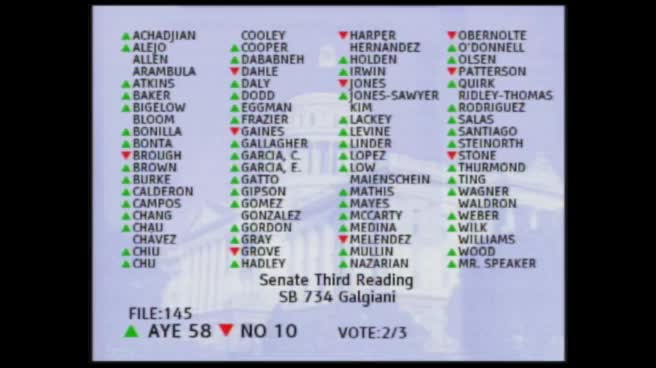 13MIN
Assembly Floor
 2MIN
Senate Floor
 7MIN
Senate Standing Committee on Judiciary
Bill Author

Bill Co-Author(s):