SB 1262: Water supply planning.
- Session Year: 2015-2016
- House: Senate
- Latest Version Date: 2016-09-24
(1)Existing law requires a city or county that determines a project, as defined, is subject to the California Environmental Quality Act to identify certain water systems that may supply water for the project and to request those public water systems to prepare and approve a specified water supply assessment. Under existing law, if no public water system is identified, the city or county is required to prepare and approve the water supply assessment. Existing law provides that if, as a result of its assessment, the public water system or city or county concludes that its water supplies are, or will be, insufficient, the public water system or city or county is required to provide its plans for acquiring additional water supplies, as prescribed.
Existing law, the Sustainable Groundwater Management Act, requires all groundwater basins designated as high- or medium-priority basins by the Department of Water Resources that are designated as basins subject to critical conditions of overdraft to be managed under a groundwater sustainability plan or coordinated groundwater sustainability plans by January 31, 2020, and requires all other groundwater basins designated as high- or medium-priority basins to be managed under a groundwater sustainability plan or coordinated groundwater sustainability plans by January 31, 2022, except as specified. The act authorizes the State Water Resources Control Board to designate a basin as a probationary basin if the state board makes a certain determination and to develop an interim plan for the probationary basin.
This bill would require a city or county that determines a project is subject to the California Environmental Quality Act to identify any water system whose service area includes the project site and any water system adjacent to the project site. This bill would provide that hauled water is not a source of water for the purposes of a water supply assessment, as specified. This bill would, if a water supply for a proposed project includes groundwater, require certain additional information to be included in the water supply assessment. By imposing additional duties on cities and counties, this bill would impose a state-mandated local program.
(2)Existing law, the Subdivision Map Act, establishes a statewide regulatory framework for controlling the subdividing of land. The act generally requires a subdivider to submit, and have approved by the city, county, or city and county in which the land is situated, a tentative map for subdivisions of land, as specified. Existing law requires a city or county to deny approval of a tentative map, or parcel map for which a tentative map was not required, if it makes certain findings relating to the proposed subdivision. Existing law requires a city or county to include as a condition in any tentative map that includes a subdivision a requirement that a sufficient water supply be available. Existing law requires proof of the availability of a sufficient water supply, as prescribed, and that the written verification of a public water systems ability or inability to provide a sufficient water supply be supported by substantial evidence.
This bill would revise the definition of sufficient water supply to include additional factors relating to a proposed subdivision that relies in whole or in part on groundwater.
(3)The California Constitution requires the state to reimburse local agencies and school districts for certain costs mandated by the state. Statutory provisions establish procedures for making that reimbursement.
This bill would provide that no reimbursement is required by this act for a specified reason.
(1)Existing law requires a city or county that determines a project, as defined, is subject to the California Environmental Quality Act to identify certain water systems that may supply water for the project and to request those public water systems to prepare and approve a specified water supply assessment. Under existing law, if no public water system is identified, the city or county is required to prepare and approve the water supply assessment. Existing law provides that if, as a result of its assessment, the public water system or city or county concludes that its water supplies are, or will be, insufficient, the public water system or city or county is required to provide its plans for acquiring additional water supplies, as prescribed.
Existing law, the Sustainable Groundwater Management Act, requires all groundwater basins designated as high- or medium-priority basins by the Department of Water Resources that are designated as basins subject to critical conditions of overdraft to be managed under a groundwater sustainability plan or coordinated groundwater sustainability plans by January 31, 2020, and requires all other groundwater basins designated as high- or medium-priority basins to be managed under a groundwater sustainability plan or coordinated groundwater sustainability plans by January 31, 2022, except as specified. The act authorizes the State Water Resources Control Board to designate a basin as a probationary basin if the state board makes a certain determination and to develop an interim plan for the probationary basin.
This bill would require a city or county that determines a project is subject to the California Environmental Quality Act to identify any water system whose service area includes the project site and any water system adjacent to the project site. This bill would provide that hauled water or groundwater from a probationary basin are is not sources a source of water for the purposes of a water supply assessment, as specified. This bill would, if a water supply for a proposed project includes groundwater, require certain additional information to be included in the water supply assessment. By imposing additional duties on cities and counties, this bill would impose a state-mandated local program.
(2)Existing law, the Subdivision Map Act, establishes a statewide regulatory framework for controlling the subdividing of land. The act generally requires a subdivider to submit, and have approved by the city, county, or city and county in which the land is situated, a tentative map for subdivisions of land, as specified. Existing law requires a city or county to deny approval of a tentative map, or parcel map for which a tentative map was not required, if it makes certain findings relating to the proposed subdivision. Existing law requires a city or county to include as a condition in any tentative map that includes a subdivision a requirement that a sufficient water supply be available. Existing law requires proof of the availability of a sufficient water supply, as prescribed, and that the written verification of a public water systems ability or inability to provide a sufficient water supply be supported by substantial evidence.
This bill would revise the definition of sufficient water supply to include additional factors relating to a proposed subdivision that relies in whole or in part on groundwater. This bill would provide that groundwater from a probationary basin is not a water supply for these purposes, as specified.
(3)The California Constitution requires the state to reimburse local agencies and school districts for certain costs mandated by the state. Statutory provisions establish procedures for making that reimbursement.
This bill would provide that no reimbursement is required by this act for a specified reason.
(1)Existing law requires a city or county that determines a project, as defined, is subject to the California Environmental Quality Act to identify certain water systems that may supply water for the project and to request those public water systems to prepare and approve a specified water supply assessment. Under existing law, if no public water system is identified, the city or county is required to prepare and approve the water supply assessment. Existing law provides that if, as a result of its assessment, the public water system or city or county concludes that its water supplies are, or will be, insufficient, the public water system or city or county is required to provide its plans for acquiring additional water supplies, as prescribed.
Existing law, the Sustainable Groundwater Management Act, requires all groundwater basins designated as high- or medium-priority basins by the Department of Water Resources that are designated as basins subject to critical conditions of overdraft to be managed under a groundwater sustainability plan or coordinated groundwater sustainability plans by January 31, 2020, and requires all other groundwater basins designated as high- or medium-priority basins to be managed under a groundwater sustainability plan or coordinated groundwater sustainability plans by January 31, 2022, except as specified. The act authorizes the State Water Resources Control Board to designate a basin as a probationary basin if the state board makes a certain determination and to develop an interim plan for the probationary basin.
This bill would require a city or county that determines a project is subject to the California Environmental Quality Act to identify any water system whose service area includes the project site and any water system adjacent to the project site. This bill would require, if a water source for a proposed project includes water of a quality not sufficient to meet certain drinking water standards, that prescribed additional information be included in a water supply assessment. This bill would provide that hauled water or groundwater from a probationary basin are not sources of water for the purposes of a water supply assessment. assessment, as specified. This bill would, if a water supply for a proposed project includes groundwater, require certain additional information to be included in the water supply assessment. By imposing additional duties on cities and counties, this bill would impose a state-mandated local program.
(2)Existing law, the Subdivision Map Act, establishes a statewide regulatory framework for controlling the subdividing of land. The act generally requires a subdivider to submit, and have approved by the city, county, or city and county in which the land is situated, a tentative map for subdivisions of land, as specified. Existing law requires a city or county to deny approval of a tentative map, or parcel map for which a tentative map was not required, if it makes certain findings relating to the proposed subdivision. Existing law requires a city or county to include as a condition in any tentative map that includes a subdivision a requirement that a sufficient water supply be available. Existing law requires proof of the availability of a sufficient water supply, as prescribed, and that the written verification of a public water systems ability or inability to provide a sufficient water supply be supported by substantial evidence.
This bill would revise the definition of sufficient water supply to include additional factors relating to a proposed subdivision that relies in whole or in part on groundwater. This bill would provide that groundwater from a probationary basin is not a water supply for these purposes. purposes, as specified.
(3)The California Constitution requires the state to reimburse local agencies and school districts for certain costs mandated by the state. Statutory provisions establish procedures for making that reimbursement.
This bill would provide that no reimbursement is required by this act for a specified reason.
(1)Existing law requires a city or county that determines a project, as defined, is subject to the California Environmental Quality Act to identify certain water systems that may supply water for the project and to request those public water systems to prepare and approve a specified water supply assessment. Under existing law, if no public water system is identified, the city or county is required to prepare and approve the water supply assessment. Existing law provides that if, as a result of its assessment, the public water system or city or county concludes that its water supplies are, or will be, insufficient, the public water system or city or county is required to provide its plans for acquiring additional water supplies, as prescribed.
This bill would require a city or county that determines a project is subject to the California Environmental Quality Act to identify any water system whose service area includes the project site and any water system adjacent to the project site. This bill would require, if a water source for a proposed project includes water of a quality not sufficient to meet certain drinking water standards, that prescribed additional information be included in a water supply assessment. This bill, if no water system is identified, would require a city or county to prepare a technical report containing prescribed information. This bill would require a city or county to submit the technical report to the local agency formation commission with jurisdiction if the city or county concludes based on the technical report that it is feasible for a water system to provide water to the project. This bill, if the local agency formation commission declines to approve an annexation or extensive of service, would require the city or county to develop a water supply assessment for the project, as specified. By imposing new duties on cities and counties, this bill would impose a state-mandated local program.
Existing law, the Sustainable Groundwater Management Act, requires all groundwater basins designated as high- or medium-priority basins by the Department of Water Resources that are designated as basins subject to critical conditions of overdraft to be managed under a groundwater sustainability plan or coordinated groundwater sustainability plans by January 31, 2020, and requires all other groundwater basins designated as high- or medium-priority basins to be managed under a groundwater sustainability plan or coordinated groundwater sustainability plans by January 31, 2022, except as specified. The act authorizes the State Water Resources Control Board to designate a basin as a probationary basin if the state board makes a certain determination and to develop an interim plan for the probationary basin.
This bill would require a city or county that determines a project is subject to the California Environmental Quality Act to identify any water system whose service area includes the project site and any water system adjacent to the project site. This bill would require, if a water source for a proposed project includes water of a quality not sufficient to meet certain drinking water standards, that prescribed additional information be included in a water supply assessment. This bill would provide that hauled water or groundwater from a probationary basin are not sources of water for the purposes of a water supply assessment. This bill would, if a water supply for a proposed project includes groundwater, require certain additional information to be included in the water supply assessment. By imposing additional duties on cities and counties, this bill would impose a state-mandated local program.
(2)Existing law, the Subdivision Map Act, establishes a statewide regulatory framework for controlling the subdividing of land. The act generally requires a subdivider to submit, and have approved by the city, county, or city and county in which the land is situated, a tentative map for subdivisions of land, as specified. Existing law requires a city or county to deny approval of a tentative map, or parcel map for which a tentative map was not required, if it makes certain findings relating to the proposed subdivision. Existing law requires a city or county to include as a condition in any tentative map that includes a subdivision a requirement that a sufficient water supply be available. Existing law requires proof of the availability of a sufficient water supply, as prescribed, and that the written verification of a public water systems ability or inability to provide a sufficient water supply be supported by substantial evidence.
This bill would revise the definition of sufficient water supply to include additional factors relating to a proposed subdivision that relies in whole or in part on groundwater. This bill would provide that groundwater from a probationary basin is not a water supply for these purposes.
(3)The California Constitution requires the state to reimburse local agencies and school districts for certain costs mandated by the state. Statutory provisions establish procedures for making that reimbursement.
This bill would provide that, if the Commission on State Mandates determines that the bill contains costs mandated by the state, reimbursement for those costs shall be made pursuant to these statutory provisions.
(3)The California Constitution requires the state to reimburse local agencies and school districts for certain costs mandated by the state. Statutory provisions establish procedures for making that reimbursement.
This bill would provide that no reimbursement is required by this act for a specified reason.
(1)Existing law requires a city or county that determines a project, as defined, is subject to the California Environmental Quality Act to identify certain water systems that may supply water for the project and to request those public water systems to prepare and approve a specified water supply assessment. Under existing law, if no public water system is identified, the city or county is required to prepare and approve the water supply assessment. Existing law provides that if, as a result of its assessment, the public water system or city or county concludes that its water supplies are, or will be, insufficient, the public water system or city or county is required to provide its plans for acquiring additional water supplies, as prescribed.
This bill would require a city or county that determines a project is subject to the California Environmental Quality Act to identify any water system whose service area includes the project site and any water system adjacent to the project site. This bill would require, if a water source for a proposed project includes water of a quality not sufficient to meet certain drinking water standards, that prescribed additional information be included in a water supply assessment. This bill, if no water system is identified, would require a city or county to prepare a technical report containing prescribed information. This bill would require a city or county to submit the technical report to the local agency formation commission with jurisdiction if the city or county concludes based on the technical report that it is feasible for a water system to provide water to the project. This bill, if the local agency formation commission declines to approve an annexation or extensive of service, would require the city or county to develop a water supply assessment for the project, as specified. By imposing new duties on cities and counties, this bill would impose a state-mandated local program.
Existing law, the Sustainable Groundwater Management Act, requires all groundwater basins designated as high- or medium-priority basins by the Department of Water Resources that are designated as basins subject to critical conditions of overdraft to be managed under a groundwater sustainability plan or coordinated groundwater sustainability plans by January 31, 2020, and requires all other groundwater basins designated as high- or medium-priority basins to be managed under a groundwater sustainability plan or coordinated groundwater sustainability plans by January 31, 2022, except as specified. The act authorizes the State Water Resources Control Board to designate a basin as a probationary basin if the state board makes a certain determination and to develop an interim plan for the probationary basin.
This bill would provide that hauled water or groundwater from a probationary basin are not sources of water for the purposes of a water supply assessment. This bill would, if a water supply for a proposed project includes groundwater, require certain additional information to be included in the water supply assessment.
(2)Existing law, the Subdivision Map Act, establishes a statewide regulatory framework for controlling the subdividing of land. The act generally requires a subdivider to submit, and have approved by the city, county, or city and county in which the land is situated, a tentative map for subdivisions of land, as specified. Existing law requires a city or county to deny approval of a tentative map, or parcel map for which a tentative map was not required, if it makes certain findings relating to the proposed subdivision. Existing law requires a city or county to include as a condition in any tentative map that includes a subdivision a requirement that a sufficient water supply be available. Existing law requires proof of the availability of a sufficient water supply, as prescribed, and that the written verification of a public water systems ability or inability to provide a sufficient water supply be supported by substantial evidence.
This bill would revise the definition of sufficient water supply to include additional factors relating to a proposed subdivision that relies in whole or in part on groundwater. This bill would provide that groundwater from a probationary basin is not a water supply for these purposes.
(3)The California Constitution requires the state to reimburse local agencies and school districts for certain costs mandated by the state. Statutory provisions establish procedures for making that reimbursement.
This bill would provide that, if the Commission on State Mandates determines that the bill contains costs mandated by the state, reimbursement for those costs shall be made pursuant to these statutory provisions.
(a)For the purposes of this section, the following definitions apply:
(1)Subdivision means a proposed residential development of more than 500 dwelling units, except that for a public water system that has fewer than 5,000 service connections, subdivision means any proposed residential development that would account for an increase of 10 percent or more in the number of the public water systems existing service connections.
(2)Sufficient water supply means the total water supplies available during normal, single-dry, and multiple-dry years within a 20-year projection that will meet the projected demand associated with the proposed subdivision, in addition to existing and planned future uses, including, but not limited to, agricultural and industrial uses. In determining sufficient water supply, all of the following factors shall be considered:
(A)The availability of water supplies over a historical record of at least 20 years.
(B)The applicability of an urban water shortage contingency analysis prepared pursuant to Section 10632 of the Water Code that includes actions to be undertaken by the public water system in response to water supply shortages.
(C)The reduction in water supply allocated to a specific water use sector pursuant to a resolution or ordinance adopted, or a contract entered into, by the public water system, as long as that resolution, ordinance, or contract does not conflict with Section 354 of the Water Code.
(D)The amount of water that the water supplier can reasonably rely on receiving from other water supply projects, such as conjunctive use, reclaimed water, water conservation, and water transfer, including programs identified under federal, state, and local water initiatives such as CALFED and Colorado River tentative agreements, to the extent that these water supplies meet the criteria of subdivision (d).
(E)If a proposed subdivision relies in whole or in part on groundwater, the following factors:
(i)For a basin for which a court or the State Water Resources Control Board has adjudicated the rights to pump groundwater, the order or decree adopted by the court or the State Water Resources Control Board.
(ii)For a basin that has not been adjudicated, as follows:
(I)For a basin designated as high- or medium-priority pursuant to Section 10722.4 of the Water Code, the most recently adopted or revised adopted groundwater sustainability plan or approved alternative. If there is no adopted groundwater sustainability plan or approved alternative, information as to whether the Department of Water Resources has identified the basin or basins as overdrafted or has projected that the basin will become overdrafted if present management conditions continue.
(II)For a basin designated as low- or very low priority pursuant to Section 10722.4 of the Water Code, information as to whether the Department of Water Resources has identified the basin or basins as overdrafted or has projected that the basin will become overdrafted if present management conditions continue.
(3)Public water system means the water supplier that is, or may become as a result of servicing the subdivision included in a tentative map pursuant to subdivision (b), a public water system, as defined in Section 10912 of the Water Code, that may supply water for a subdivision.
(b)(1)The legislative body of a city or county or the advisory agency, to the extent that it is authorized by local ordinance to approve, conditionally approve, or disapprove the tentative map, shall include as a condition in any tentative map that includes a subdivision a requirement that a sufficient water supply shall be available. Proof of the availability of a sufficient water supply shall be requested by the subdivision applicant or local agency, at the discretion of the local agency, and shall be based on written verification from the applicable public water system within 90 days of a request.
(2)If the public water system fails to deliver the written verification as required by this section, the local agency or any other interested party may seek a writ of mandamus to compel the public water system to comply.
(3)If the written verification provided by the applicable public water system indicates that the public water system is unable to provide a sufficient water supply that will meet the projected demand associated with the proposed subdivision, then the local agency may make a finding, after consideration of the written verification by the applicable public water system, that additional water supplies not accounted for by the public water system are, or will be, available prior to completion of the subdivision that will satisfy the requirements of this section. This finding shall be made on the record and supported by substantial evidence.
(4)If the written verification is not provided by the public water system, notwithstanding the local agency or other interested party securing a writ of mandamus to compel compliance with this section, then the local agency may make a finding that sufficient water supplies are, or will be, available prior to completion of the subdivision that will satisfy the requirements of this section. This finding shall be made on the record and supported by substantial evidence.
(c)The applicable public water systems written verification of its ability or inability to provide a sufficient water supply that will meet the projected demand associated with the proposed subdivision as required by subdivision (b) shall be supported by substantial evidence. The substantial evidence may include, but is not limited to, any of the following:
(1)The public water systems most recently adopted urban water management plan adopted pursuant to Part 2.6 (commencing with Section 10610) of Division 6 of the Water Code.
(2)A water supply assessment that was completed pursuant to Part 2.10 (commencing with Section 10910) of Division 6 of the Water Code.
(3)A groundwater sustainability plan adopted or alternative approved pursuant to Part 2.74 (commencing with Section 10720) of Division 6 of the Water Code.
(4)Other information relating to the sufficiency of the water supply that contains analytical information that is substantially similar to the assessment required by Section 10635 of the Water Code.
(d)When the written verification pursuant to subdivision (b) relies on projected water supplies that are not currently available to the public water system, to provide a sufficient water supply to the subdivision, the written verification as to those projected water supplies shall be based on all of the following elements, to the extent each is applicable:
(1)Written contracts or other proof of valid rights to the identified water supply that identify the terms and conditions under which the water will be available to serve the proposed subdivision.
(2)Copies of a capital outlay program for financing the delivery of a sufficient water supply that has been adopted by the applicable governing body.
(3)Securing of applicable federal, state, and local permits for construction of necessary infrastructure associated with supplying a sufficient water supply.
(4)Any necessary regulatory approvals that are required in order to be able to convey or deliver a sufficient water supply to the subdivision.
(e)If there is no public water system, the local agency shall make a written finding of sufficient water supply based on the evidentiary requirements of subdivisions (c) and (d) and identify the mechanism for providing water to the subdivision.
(f)In making any findings or determinations under this section, a local agency, or designated advisory agency, may work in conjunction with the project applicant and the public water system to secure water supplies sufficient to satisfy the demands of the proposed subdivision. If the local agency secures water supplies pursuant to this subdivision, which supplies are acceptable to and approved by the governing body of the public water system as suitable for delivery to customers, it shall work in conjunction with the public water system to implement a plan to deliver that water supply to satisfy the long-term demands of the proposed subdivision.
(g)The written verification prepared under this section shall also include a description, to the extent that data is reasonably available based on published records maintained by federal and state agencies, and public records of local agencies, of the reasonably foreseeable impacts of the proposed subdivision on the availability of water resources for agricultural and industrial uses within the public water systems service area that are not currently receiving water from the public water system but are utilizing the same sources of water. To the extent that those reasonably foreseeable impacts have previously been evaluated in a document prepared pursuant to the California Environmental Quality Act (Division 13 (commencing with Section 21000) of the Public Resources Code) or the National Environmental Policy Act (Public Law 91-190) for the proposed subdivision, the public water system may utilize that information in preparing the written verification.
(h)Where a water supply for a proposed subdivision includes groundwater, the public water system serving the proposed subdivision shall evaluate, based on substantial evidence, the extent to which it or the landowner has the right to extract the additional groundwater needed to supply the proposed subdivision. Nothing in this subdivision is intended to modify state law with regard to groundwater rights.
(i)This section shall not apply to any residential project proposed for a site that is within an urbanized area and has been previously developed for urban uses, or where the immediate contiguous properties surrounding the residential project site are, or previously have been, developed for urban uses, or housing projects that are exclusively for very low and low-income households.
(j)The determinations made pursuant to this section shall be consistent with the obligation of a public water system to grant a priority for the provision of available and future water resources or services to proposed housing developments that help meet the citys or countys share of the regional housing needs for lower income households, pursuant to Section 65589.7.
(k)The County of San Diego shall be deemed to comply with this section if the Office of Planning and Research determines that all of the following conditions have been met:
(1)A regional growth management strategy that provides for a comprehensive regional strategy and a coordinated economic development and growth management program has been developed pursuant to Proposition C as approved by the voters of the County of San Diego in November 1988, which required the development of a regional growth management plan and directed the establishment of a regional planning and growth management review board.
(2)Each public water system, as defined in Section 10912 of the Water Code, within the County of San Diego has adopted an urban water management plan pursuant to Part 2.6 (commencing with Section 10610) of the Water Code.
(3)The approval or conditional approval of tentative maps for subdivisions, as defined in this section, by the County of San Diego and the cities within the county requires written communications to be made by the public water system to the city or county, in a format and with content that is substantially similar to the requirements contained in this section, with regard to the availability of a sufficient water supply, or the reliance on projected water supplies to provide a sufficient water supply, for a proposed subdivision.
(l)Nothing in this section shall preclude the legislative body of a city or county, or the designated advisory agency, at the request of the applicant, from making the determinations required in this section earlier than required pursuant to subdivision (b).
(m)Nothing in this section shall be construed to create a right or entitlement to water service or any specific level of water service.
(n)Nothing in this section is intended to change existing law concerning a public water systems obligation to provide water service to its existing customers or to any potential future customers.
(o)Any action challenging the sufficiency of the public water systems written verification of a sufficient water supply shall be governed by Section 66499.37.
SEC. 2.Section 10910 of the Water Code is amended to read:10910.(a)Any city or county that determines that a project, as defined in Section 10912, is subject to the California Environmental Quality Act (Division 13 (commencing with Section 21000) of the Public Resources Code) under Section 21080 of the Public Resources Code shall comply with this part.
(b)The city or county, at the time that it determines whether an environmental impact report, a negative declaration, or a mitigated negative declaration is required for any project subject to the California Environmental Quality Act pursuant to Section 21080.1 of the Public Resources Code, shall identify any water system whose service area includes the project site and any water system adjacent to the project site that is, or may become as a result of supplying water to the project identified pursuant to this subdivision, a public water system, as defined in Section 10912, that may supply water for the project. If the city or county is not able to identify any public water system that may supply water for the project, the city or county shall prepare the water assessment required by this part after consulting with any entity serving domestic water supplies whose service area includes the project site, the local agency formation commission, and any public water system adjacent to the project site.
(c)(1)The city or county, at the time it makes the determination required under Section 21080.1 of the Public Resources Code, shall request each public water system identified pursuant to subdivision (b) to determine whether the projected water demand associated with a proposed project was included as part of the most recently adopted urban water management plan adopted pursuant to Part 2.6 (commencing with Section 10610).
(2)If the projected water demand associated with the proposed project was accounted for in the most recently adopted urban water management plan, the public water system may incorporate the requested information from the urban water management plan in preparing the elements of the assessment required to comply with subdivisions (d), (e), (f), and (g).
(3)If the projected water demand associated with the proposed project was not accounted for in the most recently adopted urban water management plan, or the public water system has no urban water management plan, the water supply assessment for the project shall include a discussion with regard to whether the public water systems total projected water supplies available during normal, single dry, and multiple dry water years during a 20-year projection will meet the projected water demand associated with the proposed project, in addition to the public water systems existing and planned future uses, including agricultural and manufacturing uses.
(4)If the city or county is required to comply with this part pursuant to subdivision (b), the water supply assessment for the project shall include a discussion with regard to whether the total projected water supplies, determined to be available by the city or county for the project during normal, single dry, and multiple dry water years during a 20-year projection, will meet the projected water demand associated with the proposed project, in addition to existing and planned future uses, including agricultural and manufacturing uses.
(d)(1)The assessment required by this section shall include an identification of any existing water supply entitlements, water rights, or water service contracts relevant to the identified water supply for the proposed project, and a description of the quantities of water received in prior years by the public water system, or the city or county if either is required to comply with this part pursuant to subdivision (b), under the existing water supply entitlements, water rights, or water service contracts.
(2)An identification of existing water supply entitlements, water rights, or water service contracts held by the public water system, or the city or county if either is required to comply with this part pursuant to subdivision (b), shall be demonstrated by providing information related to all of the following:
(A)Written contracts or other proof of entitlement to an identified water supply.
(B)Copies of a capital outlay program for financing the delivery of a water supply that has been adopted by the public water system.
(C)Federal, state, and local permits for construction of necessary infrastructure associated with delivering the water supply.
(D)Any necessary regulatory approvals that are required in order to be able to convey or deliver the water supply.
(e)If no water has been received in prior years by the public water system, or the city or county if either is required to comply with this part pursuant to subdivision (b), under the existing water supply entitlements, water rights, or water service contracts, the public water system, or the city or county if either is required to comply with this part pursuant to subdivision (b), shall also include in its water supply assessment pursuant to subdivision (c), an identification of the other public water systems or water service contractholders that receive a water supply or have existing water supply entitlements, water rights, or water service contracts, to the same source of water as the public water system, or the city or county if either is required to comply with this part pursuant to subdivision (b), has identified as a source of water supply within its water supply assessments.
(f)If a water supply for a proposed project includes groundwater, the following additional information shall be included in the water supply assessment:
(1)A review of any information contained in the urban water management plan relevant to the identified water supply for the proposed project.
(2)(A)A description of any groundwater basin or basins from which the proposed project will be supplied.
(B)For those basins for which a court or the board has adjudicated the rights to pump groundwater, a copy of the order or decree adopted by the court or the board and a description of the amount of groundwater the public water system, or the city or county if either is required to comply with this part pursuant to subdivision (b), has the legal right to pump under the order or decree.
(C)For a basin that has not been adjudicated that is a basin designated as high- or medium-priority pursuant to Section 10722.4, information regarding the following:
(i)Whether the department has identified the basin as being subject to critical conditions of overdraft pursuant to Section 12924.
(ii)If a groundwater sustainability agency has adopted a groundwater sustainability plan or has an approved alternative, a copy of that alternative or plan.
(D)For a basin that has not been adjudicated that is a basin designated as low- or very low priority pursuant to Section 10722.4, information as to whether the department has identified the basin or basins as overdrafted or has projected that the basin will become overdrafted if present management conditions continue, in the most current bulletin of the department that characterizes the condition of the groundwater basin, and a detailed description by the public water system, or the city or county if either is required to comply with this part pursuant to subdivision (b), of the efforts being undertaken in the basin or basins to eliminate the long-term overdraft condition.
(3)A detailed description and analysis of the amount and location of groundwater pumped by the public water system, or the city or county if either is required to comply with this part pursuant to subdivision (b), for the past five years from any groundwater basin from which the proposed project will be supplied. The description and analysis shall be based on information that is reasonably available, including, but not limited to, historic use records.
(4)A detailed description and analysis of the amount and location of groundwater that is projected to be pumped by the public water system, or the city or county if either is required to comply with this part pursuant to subdivision (b), from any basin from which the proposed project will be supplied. The description and analysis shall be based on information that is reasonably available, including, but not limited to, historic use records.
(5)An analysis of the sufficiency of the groundwater from the basin or basins from which the proposed project will be supplied to meet the projected water demand associated with the proposed project. A water supply assessment shall not be required to include the information required by this paragraph if the public water system determines, as part of the review required by paragraph (1), that the sufficiency of groundwater necessary to meet the initial and projected water demand associated with the project was addressed in the description and analysis required by paragraph (4) of subdivision (b) of Section 10631.
(g)(1)Subject to paragraph (2), the governing body of each public water system shall submit the assessment to the city or county not later than 90 days from the date on which the request was received. The governing body of each public water system, or the city or county if either is required to comply with this act pursuant to subdivision (b), shall approve the assessment prepared pursuant to this section at a regular or special meeting.
(2)Prior to the expiration of the 90-day period, if the public water system intends to request an extension of time to prepare and adopt the assessment, the public water system shall meet with the city or county to request an extension of time, which shall not exceed 30 days, to prepare and adopt the assessment.
(3)If the public water system fails to request an extension of time, or fails to submit the assessment notwithstanding the extension of time granted pursuant to paragraph (2), the city or county may seek a writ of mandamus to compel the governing body of the public water system to comply with the requirements of this part relating to the submission of the water supply assessment.
(h)Notwithstanding any other provision of this part, if a project has been the subject of a water supply assessment that complies with the requirements of this part, no additional water supply assessment shall be required for subsequent projects that were part of a larger project for which a water supply assessment was completed and that has complied with the requirements of this part and for which the public water system, or the city or county if either is required to comply with this part pursuant to subdivision (b), has concluded that its water supplies are sufficient to meet the projected water demand associated with the proposed project, in addition to the existing and planned future uses, including, but not limited to, agricultural and industrial uses, unless one or more of the following changes occurs:
(1)Changes in the project that result in a substantial increase in water demand for the project.
(2)Changes in the circumstances or conditions substantially affecting the ability of the public water system, or the city or county if either is required to comply with this part pursuant to subdivision (b), to provide a sufficient supply of water for the project.
(3)Significant new information becomes available that was not known and could not have been known at the time when the assessment was prepared.
(i)For the purposes of this section, hauled water is not considered as a source of water.
SEC. 3.No reimbursement is required by this act pursuant to Section 6 of Article XIIIB of the California Constitution because a local agency or school district has the authority to levy service charges, fees, or assessments sufficient to pay for the program or level of service mandated by this act, within the meaning of Section 17556 of the Government Code.
(a)For the purposes of this section, the following definitions apply:
(1)Subdivision means a proposed residential development of more than 500 dwelling units, except that for a public water system that has fewer than 5,000 service connections, subdivision means any proposed residential development that would account for an increase of 10 percent or more in the number of the public water systems existing service connections.
(2)Sufficient water supply means the total water supplies available during normal, single-dry, and multiple-dry years within a 20-year projection that will meet the projected demand associated with the proposed subdivision, in addition to existing and planned future uses, including, but not limited to, agricultural and industrial uses. In determining sufficient water supply, all of the following factors shall be considered:
(A)The availability of water supplies over a historical record of at least 20 years.
(B)The applicability of an urban water shortage contingency analysis prepared pursuant to Section 10632 of the Water Code that includes actions to be undertaken by the public water system in response to water supply shortages.
(C)The reduction in water supply allocated to a specific water use sector pursuant to a resolution or ordinance adopted, or a contract entered into, by the public water system, as long as that resolution, ordinance, or contract does not conflict with Section 354 of the Water Code.
(D)The amount of water that the water supplier can reasonably rely on receiving from other water supply projects, such as conjunctive use, reclaimed water, water conservation, and water transfer, including programs identified under federal, state, and local water initiatives such as CALFED and Colorado River tentative agreements, to the extent that these water supplies meet the criteria of subdivision (d).
(E)If a proposed subdivision relies in whole or in part on groundwater, the following factors:
(i)For a basin for which a court or the State Water Resources Control Board has adjudicated the rights to pump groundwater, the order or decree adopted by the court or the State Water Resources Control Board.
(ii)For a basin that has not been adjudicated, as follows:
(I)For a basin designated as high- or medium-priority pursuant to Section 10722.4 of the Water Code, the most recently adopted or revised adopted groundwater sustainability plan or approved alternative. If there is no adopted groundwater sustainability plan or approved alternative, information as to whether the Department of Water Resources has identified the basin or basins as overdrafted or has projected that the basin will become overdrafted if present management conditions continue.
(II)For a basin designated as low- or very low priority pursuant to Section 10722.4 of the Water Code, information as to whether the Department of Water Resources has identified the basin or basins as overdrafted or has projected that the basin will become overdrafted if present management conditions continue.
(3)Public water system means the water supplier that is, or may become as a result of servicing the subdivision included in a tentative map pursuant to subdivision (b), a public water system, as defined in Section 10912 of the Water Code, that may supply water for a subdivision.
(b)(1)The legislative body of a city or county or the advisory agency, to the extent that it is authorized by local ordinance to approve, conditionally approve, or disapprove the tentative map, shall include as a condition in any tentative map that includes a subdivision a requirement that a sufficient water supply shall be available. Proof of the availability of a sufficient water supply shall be requested by the subdivision applicant or local agency, at the discretion of the local agency, and shall be based on written verification from the applicable public water system within 90 days of a request.
(2)If the public water system fails to deliver the written verification as required by this section, the local agency or any other interested party may seek a writ of mandamus to compel the public water system to comply.
(3)If the written verification provided by the applicable public water system indicates that the public water system is unable to provide a sufficient water supply that will meet the projected demand associated with the proposed subdivision, then the local agency may make a finding, after consideration of the written verification by the applicable public water system, that additional water supplies not accounted for by the public water system are, or will be, available prior to completion of the subdivision that will satisfy the requirements of this section. This finding shall be made on the record and supported by substantial evidence.
(4)If the written verification is not provided by the public water system, notwithstanding the local agency or other interested party securing a writ of mandamus to compel compliance with this section, then the local agency may make a finding that sufficient water supplies are, or will be, available prior to completion of the subdivision that will satisfy the requirements of this section. This finding shall be made on the record and supported by substantial evidence.
(c)The applicable public water systems written verification of its ability or inability to provide a sufficient water supply that will meet the projected demand associated with the proposed subdivision as required by subdivision (b) shall be supported by substantial evidence. The substantial evidence may include, but is not limited to, any of the following:
(1)The public water systems most recently adopted urban water management plan adopted pursuant to Part 2.6 (commencing with Section 10610) of Division 6 of the Water Code.
(2)A water supply assessment that was completed pursuant to Part 2.10 (commencing with Section 10910) of Division 6 of the Water Code.
(3)A groundwater sustainability plan adopted or alternative approved pursuant to Part 2.74 (commencing with Section 10720) of Division 6 of the Water Code.
(4)Other information relating to the sufficiency of the water supply that contains analytical information that is substantially similar to the assessment required by Section 10635 of the Water Code.
(d)When the written verification pursuant to subdivision (b) relies on projected water supplies that are not currently available to the public water system, to provide a sufficient water supply to the subdivision, the written verification as to those projected water supplies shall be based on all of the following elements, to the extent each is applicable:
(1)Written contracts or other proof of valid rights to the identified water supply that identify the terms and conditions under which the water will be available to serve the proposed subdivision.
(2)Copies of a capital outlay program for financing the delivery of a sufficient water supply that has been adopted by the applicable governing body.
(3)Securing of applicable federal, state, and local permits for construction of necessary infrastructure associated with supplying a sufficient water supply.
(4)Any necessary regulatory approvals that are required in order to be able to convey or deliver a sufficient water supply to the subdivision.
(e)If there is no public water system, the local agency shall make a written finding of sufficient water supply based on the evidentiary requirements of subdivisions (c) and (d) and identify the mechanism for providing water to the subdivision.
(f)In making any findings or determinations under this section, a local agency, or designated advisory agency, may work in conjunction with the project applicant and the public water system to secure water supplies sufficient to satisfy the demands of the proposed subdivision. If the local agency secures water supplies pursuant to this subdivision, which supplies are acceptable to and approved by the governing body of the public water system as suitable for delivery to customers, it shall work in conjunction with the public water system to implement a plan to deliver that water supply to satisfy the long-term demands of the proposed subdivision.
(g)The written verification prepared under this section shall also include a description, to the extent that data is reasonably available based on published records maintained by federal and state agencies, and public records of local agencies, of the reasonably foreseeable impacts of the proposed subdivision on the availability of water resources for agricultural and industrial uses within the public water systems service area that are not currently receiving water from the public water system but are utilizing the same sources of water. To the extent that those reasonably foreseeable impacts have previously been evaluated in a document prepared pursuant to the California Environmental Quality Act (Division 13 (commencing with Section 21000) of the Public Resources Code) or the National Environmental Policy Act (Public Law 91-190) for the proposed subdivision, the public water system may utilize that information in preparing the written verification.
(h)(1)Where a water supply for a proposed subdivision includes groundwater, the public water system serving the proposed subdivision shall evaluate, based on substantial evidence, the extent to which it or the landowner has the right to extract the additional groundwater needed to supply the proposed subdivision. Nothing in this subdivision is intended to modify state law with regard to groundwater rights.
(2)Groundwater from a basin designated by the State Water Resources Control Board as a probationary basin pursuant to Chapter 11 (commencing with Section 10735) of Part 2.74 of Division 6 of the Water Code is not considered as a water supply for the purposes of this section. This paragraph does not apply to groundwater from any portion of a basin excluded from probationary status pursuant to subdivision (e) of Section 10735.2 of the Water Code.
(i)This section shall not apply to any residential project proposed for a site that is within an urbanized area and has been previously developed for urban uses, or where the immediate contiguous properties surrounding the residential project site are, or previously have been, developed for urban uses, or housing projects that are exclusively for very low and low-income households.
(j)The determinations made pursuant to this section shall be consistent with the obligation of a public water system to grant a priority for the provision of available and future water resources or services to proposed housing developments that help meet the citys or countys share of the regional housing needs for lower income households, pursuant to Section 65589.7.
(k)The County of San Diego shall be deemed to comply with this section if the Office of Planning and Research determines that all of the following conditions have been met:
(1)A regional growth management strategy that provides for a comprehensive regional strategy and a coordinated economic development and growth management program has been developed pursuant to Proposition C as approved by the voters of the County of San Diego in November 1988, which required the development of a regional growth management plan and directed the establishment of a regional planning and growth management review board.
(2)Each public water system, as defined in Section 10912 of the Water Code, within the County of San Diego has adopted an urban water management plan pursuant to Part 2.6 (commencing with Section 10610) of the Water Code.
(3)The approval or conditional approval of tentative maps for subdivisions, as defined in this section, by the County of San Diego and the cities within the county requires written communications to be made by the public water system to the city or county, in a format and with content that is substantially similar to the requirements contained in this section, with regard to the availability of a sufficient water supply, or the reliance on projected water supplies to provide a sufficient water supply, for a proposed subdivision.
(l)Nothing in this section shall preclude the legislative body of a city or county, or the designated advisory agency, at the request of the applicant, from making the determinations required in this section earlier than required pursuant to subdivision (b).
(m)Nothing in this section shall be construed to create a right or entitlement to water service or any specific level of water service.
(n)Nothing in this section is intended to change existing law concerning a public water systems obligation to provide water service to its existing customers or to any potential future customers.
(o)Any action challenging the sufficiency of the public water systems written verification of a sufficient water supply shall be governed by Section 66499.37.
SEC. 2.Section 10910 of the Water Code is amended to read:10910.(a)Any city or county that determines that a project, as defined in Section 10912, is subject to the California Environmental Quality Act (Division 13 (commencing with Section 21000) of the Public Resources Code) under Section 21080 of the Public Resources Code shall comply with this part.
(b)The city or county, at the time that it determines whether an environmental impact report, a negative declaration, or a mitigated negative declaration is required for any project subject to the California Environmental Quality Act pursuant to Section 21080.1 of the Public Resources Code, shall identify any water system whose service area includes the project site and any water system adjacent to the project site that is, or may become as a result of supplying water to the project identified pursuant to this subdivision, a public water system, as defined in Section 10912, that may supply water for the project. If the city or county is not able to identify any public water system that may supply water for the project, the city or county shall prepare the water assessment required by this part after consulting with any entity serving domestic water supplies whose service area includes the project site, the local agency formation commission, and any public water system adjacent to the project site.
(c)(1)The city or county, at the time it makes the determination required under Section 21080.1 of the Public Resources Code, shall request each public water system identified pursuant to subdivision (b) to determine whether the projected water demand associated with a proposed project was included as part of the most recently adopted urban water management plan adopted pursuant to Part 2.6 (commencing with Section 10610).
(2)If the projected water demand associated with the proposed project was accounted for in the most recently adopted urban water management plan, the public water system may incorporate the requested information from the urban water management plan in preparing the elements of the assessment required to comply with subdivisions (d), (e), (f), and (g).
(3)If the projected water demand associated with the proposed project was not accounted for in the most recently adopted urban water management plan, or the public water system has no urban water management plan, the water supply assessment for the project shall include a discussion with regard to whether the public water systems total projected water supplies available during normal, single dry, and multiple dry water years during a 20-year projection will meet the projected water demand associated with the proposed project, in addition to the public water systems existing and planned future uses, including agricultural and manufacturing uses.
(4)If the city or county is required to comply with this part pursuant to subdivision (b), the water supply assessment for the project shall include a discussion with regard to whether the total projected water supplies, determined to be available by the city or county for the project during normal, single dry, and multiple dry water years during a 20-year projection, will meet the projected water demand associated with the proposed project, in addition to existing and planned future uses, including agricultural and manufacturing uses.
(d)(1)The assessment required by this section shall include an identification of any existing water supply entitlements, water rights, or water service contracts relevant to the identified water supply for the proposed project, and a description of the quantities of water received in prior years by the public water system, or the city or county if either is required to comply with this part pursuant to subdivision (b), under the existing water supply entitlements, water rights, or water service contracts.
(2)An identification of existing water supply entitlements, water rights, or water service contracts held by the public water system, or the city or county if either is required to comply with this part pursuant to subdivision (b), shall be demonstrated by providing information related to all of the following:
(A)Written contracts or other proof of entitlement to an identified water supply.
(B)Copies of a capital outlay program for financing the delivery of a water supply that has been adopted by the public water system.
(C)Federal, state, and local permits for construction of necessary infrastructure associated with delivering the water supply.
(D)Any necessary regulatory approvals that are required in order to be able to convey or deliver the water supply.
(e)If no water has been received in prior years by the public water system, or the city or county if either is required to comply with this part pursuant to subdivision (b), under the existing water supply entitlements, water rights, or water service contracts, the public water system, or the city or county if either is required to comply with this part pursuant to subdivision (b), shall also include in its water supply assessment pursuant to subdivision (c), an identification of the other public water systems or water service contractholders that receive a water supply or have existing water supply entitlements, water rights, or water service contracts, to the same source of water as the public water system, or the city or county if either is required to comply with this part pursuant to subdivision (b), has identified as a source of water supply within its water supply assessments.
(f)If a water supply for a proposed project includes groundwater, the following additional information shall be included in the water supply assessment:
(1)A review of any information contained in the urban water management plan relevant to the identified water supply for the proposed project.
(2)(A)A description of any groundwater basin or basins from which the proposed project will be supplied.
(B)For those basins for which a court or the board has adjudicated the rights to pump groundwater, a copy of the order or decree adopted by the court or the board and a description of the amount of groundwater the public water system, or the city or county if either is required to comply with this part pursuant to subdivision (b), has the legal right to pump under the order or decree.
(C)For a basin that has not been adjudicated that is a basin designated as high- or medium-priority pursuant to Section 10722.4, information regarding the following:
(i)Whether the department has identified the basin as being subject to critical conditions of overdraft pursuant to Section 12924.
(ii)Whether the board has designated the basin as a probationary basin pursuant to Chapter 11 (commencing with Section 10735) of Part 2.74.
(iii)
(ii)If a groundwater sustainability agency has adopted a groundwater sustainability plan or has an approved alternative, a copy of that alternative or plan.
(D)For a basin that has not been adjudicated that is a basin designated as low- or very low priority pursuant to Section 10722.4, information as to whether the department has identified the basin or basins as overdrafted or has projected that the basin will become overdrafted if present management conditions continue, in the most current bulletin of the department that characterizes the condition of the groundwater basin, and a detailed description by the public water system, or the city or county if either is required to comply with this part pursuant to subdivision (b), of the efforts being undertaken in the basin or basins to eliminate the long-term overdraft condition.
(3)A detailed description and analysis of the amount and location of groundwater pumped by the public water system, or the city or county if either is required to comply with this part pursuant to subdivision (b), for the past five years from any groundwater basin from which the proposed project will be supplied. The description and analysis shall be based on information that is reasonably available, including, but not limited to, historic use records.
(4)A detailed description and analysis of the amount and location of groundwater that is projected to be pumped by the public water system, or the city or county if either is required to comply with this part pursuant to subdivision (b), from any basin from which the proposed project will be supplied. The description and analysis shall be based on information that is reasonably available, including, but not limited to, historic use records.
(5)An analysis of the sufficiency of the groundwater from the basin or basins from which the proposed project will be supplied to meet the projected water demand associated with the proposed project. A water supply assessment shall not be required to include the information required by this paragraph if the public water system determines, as part of the review required by paragraph (1), that the sufficiency of groundwater necessary to meet the initial and projected water demand associated with the project was addressed in the description and analysis required by paragraph (4) of subdivision (b) of Section 10631.
(g)(1)Subject to paragraph (2), the governing body of each public water system shall submit the assessment to the city or county not later than 90 days from the date on which the request was received. The governing body of each public water system, or the city or county if either is required to comply with this act pursuant to subdivision (b), shall approve the assessment prepared pursuant to this section at a regular or special meeting.
(2)Prior to the expiration of the 90-day period, if the public water system intends to request an extension of time to prepare and adopt the assessment, the public water system shall meet with the city or county to request an extension of time, which shall not exceed 30 days, to prepare and adopt the assessment.
(3)If the public water system fails to request an extension of time, or fails to submit the assessment notwithstanding the extension of time granted pursuant to paragraph (2), the city or county may seek a writ of mandamus to compel the governing body of the public water system to comply with the requirements of this part relating to the submission of the water supply assessment.
(h)Notwithstanding any other provision of this part, if a project has been the subject of a water supply assessment that complies with the requirements of this part, no additional water supply assessment shall be required for subsequent projects that were part of a larger project for which a water supply assessment was completed and that has complied with the requirements of this part and for which the public water system, or the city or county if either is required to comply with this part pursuant to subdivision (b), has concluded that its water supplies are sufficient to meet the projected water demand associated with the proposed project, in addition to the existing and planned future uses, including, but not limited to, agricultural and industrial uses, unless one or more of the following changes occurs:
(1)Changes in the project that result in a substantial increase in water demand for the project.
(2)Changes in the circumstances or conditions substantially affecting the ability of the public water system, or the city or county if either is required to comply with this part pursuant to subdivision (b), to provide a sufficient supply of water for the project.
(3)Significant new information becomes available that was not known and could not have been known at the time when the assessment was prepared.
(i)For the purposes of this section, the following are hauled water is not considered as a source of water: water.
(1)Hauled water.
(2)Groundwater from a basin designated by the board as a probationary basin pursuant to Chapter 11 (commencing with Section 10735) of Part 2.74. This paragraph does not apply to groundwater from any portion of a basin excluded from probationary status pursuant to subdivision (e) of Section 10735.2 of the Water Code.
SEC. 3.No reimbursement is required by this act pursuant to Section 6 of Article XIIIB of the California Constitution because a local agency or school district has the authority to levy service charges, fees, or assessments sufficient to pay for the program or level of service mandated by this act, within the meaning of Section 17556 of the Government Code.
(a)For the purposes of this section, the following definitions apply:
(1)Subdivision means a proposed residential development of more than 500 dwelling units, except that for a public water system that has fewer than 5,000 service connections, subdivision means any proposed residential development that would account for an increase of 10 percent or more in the number of the public water systems existing service connections.
(2)Sufficient water supply means the total water supplies available during normal, single-dry, and multiple-dry years within a 20-year projection that will meet the projected demand associated with the proposed subdivision, in addition to existing and planned future uses, including, but not limited to, agricultural and industrial uses. In determining sufficient water supply, all of the following factors shall be considered:
(A)The availability of water supplies over a historical record of at least 20 years.
(B)The applicability of an urban water shortage contingency analysis prepared pursuant to Section 10632 of the Water Code that includes actions to be undertaken by the public water system in response to water supply shortages.
(C)The reduction in water supply allocated to a specific water use sector pursuant to a resolution or ordinance adopted, or a contract entered into, by the public water system, as long as that resolution, ordinance, or contract does not conflict with Section 354 of the Water Code.
(D)The amount of water that the water supplier can reasonably rely on receiving from other water supply projects, such as conjunctive use, reclaimed water, water conservation, and water transfer, including programs identified under federal, state, and local water initiatives such as CALFED and Colorado River tentative agreements, to the extent that these water supplies meet the criteria of subdivision (d).
(E)If a proposed subdivision relies in whole or in part on groundwater, the following factors:
(i)For a basin for which a court or the State Water Resources Control Board has adjudicated the rights to pump groundwater, the order or decree adopted by the court or the State Water Resources Control Board.
(ii)For a basin that has not been adjudicated, as follows:
(I)For a basin designated as high- or medium-priority pursuant to Section 10722.4 of the Water Code, the most recently adopted or revised adopted groundwater sustainability plan or approved alternative. If there is no adopted groundwater sustainability plan or approved alternative, information as to whether the Department of Water Resources has identified the basin or basins as overdrafted or has projected that the basin will become overdrafted if present management conditions continue.
(II)For a basin designated as low- or very low priority pursuant to Section 10722.4 of the Water Code, information as to whether the Department of Water Resources has identified the basin or basins as overdrafted or has projected that the basin will become overdrafted if present management conditions continue.
(3)Public water system means the water supplier that is, or may become as a result of servicing the subdivision included in a tentative map pursuant to subdivision (b), a public water system, as defined in Section 10912 of the Water Code, that may supply water for a subdivision.
(b)(1)The legislative body of a city or county or the advisory agency, to the extent that it is authorized by local ordinance to approve, conditionally approve, or disapprove the tentative map, shall include as a condition in any tentative map that includes a subdivision a requirement that a sufficient water supply shall be available. Proof of the availability of a sufficient water supply shall be requested by the subdivision applicant or local agency, at the discretion of the local agency, and shall be based on written verification from the applicable public water system within 90 days of a request.
(2)If the public water system fails to deliver the written verification as required by this section, the local agency or any other interested party may seek a writ of mandamus to compel the public water system to comply.
(3)If the written verification provided by the applicable public water system indicates that the public water system is unable to provide a sufficient water supply that will meet the projected demand associated with the proposed subdivision, then the local agency may make a finding, after consideration of the written verification by the applicable public water system, that additional water supplies not accounted for by the public water system are, or will be, available prior to completion of the subdivision that will satisfy the requirements of this section. This finding shall be made on the record and supported by substantial evidence.
(4)If the written verification is not provided by the public water system, notwithstanding the local agency or other interested party securing a writ of mandamus to compel compliance with this section, then the local agency may make a finding that sufficient water supplies are, or will be, available prior to completion of the subdivision that will satisfy the requirements of this section. This finding shall be made on the record and supported by substantial evidence.
(c)The applicable public water systems written verification of its ability or inability to provide a sufficient water supply that will meet the projected demand associated with the proposed subdivision as required by subdivision (b) shall be supported by substantial evidence. The substantial evidence may include, but is not limited to, any of the following:
(1)The public water systems most recently adopted urban water management plan adopted pursuant to Part 2.6 (commencing with Section 10610) of Division 6 of the Water Code.
(2)A water supply assessment that was completed pursuant to Part 2.10 (commencing with Section 10910) of Division 6 of the Water Code.
(3)A groundwater sustainability plan adopted or alternative approved pursuant to Part 2.74 (commencing with Section 10720) of Division 6 of the Water Code.
(4)Other information relating to the sufficiency of the water supply that contains analytical information that is substantially similar to the assessment required by Section 10635 of the Water Code.
(d)When the written verification pursuant to subdivision (b) relies on projected water supplies that are not currently available to the public water system, to provide a sufficient water supply to the subdivision, the written verification as to those projected water supplies shall be based on all of the following elements, to the extent each is applicable:
(1)Written contracts or other proof of valid rights to the identified water supply that identify the terms and conditions under which the water will be available to serve the proposed subdivision.
(2)Copies of a capital outlay program for financing the delivery of a sufficient water supply that has been adopted by the applicable governing body.
(3)Securing of applicable federal, state, and local permits for construction of necessary infrastructure associated with supplying a sufficient water supply.
(4)Any necessary regulatory approvals that are required in order to be able to convey or deliver a sufficient water supply to the subdivision.
(e)If there is no public water system, the local agency shall make a written finding of sufficient water supply based on the evidentiary requirements of subdivisions (c) and (d) and identify the mechanism for providing water to the subdivision.
(f)In making any findings or determinations under this section, a local agency, or designated advisory agency, may work in conjunction with the project applicant and the public water system to secure water supplies sufficient to satisfy the demands of the proposed subdivision. If the local agency secures water supplies pursuant to this subdivision, which supplies are acceptable to and approved by the governing body of the public water system as suitable for delivery to customers, it shall work in conjunction with the public water system to implement a plan to deliver that water supply to satisfy the long-term demands of the proposed subdivision.
(g)The written verification prepared under this section shall also include a description, to the extent that data is reasonably available based on published records maintained by federal and state agencies, and public records of local agencies, of the reasonably foreseeable impacts of the proposed subdivision on the availability of water resources for agricultural and industrial uses within the public water systems service area that are not currently receiving water from the public water system but are utilizing the same sources of water. To the extent that those reasonably foreseeable impacts have previously been evaluated in a document prepared pursuant to the California Environmental Quality Act (Division 13 (commencing with Section 21000) of the Public Resources Code) or the National Environmental Policy Act (Public Law 91-190) for the proposed subdivision, the public water system may utilize that information in preparing the written verification.
(h)(1)Where a water supply for a proposed subdivision includes groundwater, the public water system serving the proposed subdivision shall evaluate, based on substantial evidence, the extent to which it or the landowner has the right to extract the additional groundwater needed to supply the proposed subdivision. Nothing in this subdivision is intended to modify state law with regard to groundwater rights.
(2)Groundwater from a basin designated by the State Water Resources Control Board as a probationary basin pursuant to Chapter 11 (commencing with Section 10735) of Part 2.74 of Division 6 of the Water Code is not considered as a water supply for the purposes of this section. This paragraph does not apply to groundwater from any portion of a basin excluded from probationary status pursuant to subdivision (e) of Section 10735.2 of the Water Code.
(i)This section shall not apply to any residential project proposed for a site that is within an urbanized area and has been previously developed for urban uses, or where the immediate contiguous properties surrounding the residential project site are, or previously have been, developed for urban uses, or housing projects that are exclusively for very low and low-income households.
(j)The determinations made pursuant to this section shall be consistent with the obligation of a public water system to grant a priority for the provision of available and future water resources or services to proposed housing developments that help meet the citys or countys share of the regional housing needs for lower income households, pursuant to Section 65589.7.
(k)The County of San Diego shall be deemed to comply with this section if the Office of Planning and Research determines that all of the following conditions have been met:
(1)A regional growth management strategy that provides for a comprehensive regional strategy and a coordinated economic development and growth management program has been developed pursuant to Proposition C as approved by the voters of the County of San Diego in November 1988, which required the development of a regional growth management plan and directed the establishment of a regional planning and growth management review board.
(2)Each public water system, as defined in Section 10912 of the Water Code, within the County of San Diego has adopted an urban water management plan pursuant to Part 2.6 (commencing with Section 10610) of the Water Code.
(3)The approval or conditional approval of tentative maps for subdivisions, as defined in this section, by the County of San Diego and the cities within the county requires written communications to be made by the public water system to the city or county, in a format and with content that is substantially similar to the requirements contained in this section, with regard to the availability of a sufficient water supply, or the reliance on projected water supplies to provide a sufficient water supply, for a proposed subdivision.
(l)Nothing in this section shall preclude the legislative body of a city or county, or the designated advisory agency, at the request of the applicant, from making the determinations required in this section earlier than required pursuant to subdivision (b).
(m)Nothing in this section shall be construed to create a right or entitlement to water service or any specific level of water service.
(n)Nothing in this section is intended to change existing law concerning a public water systems obligation to provide water service to its existing customers or to any potential future customers.
(o)Any action challenging the sufficiency of the public water systems written verification of a sufficient water supply shall be governed by Section 66499.37.
SEC. 2.Section 10910 of the Water Code is amended to read:10910.(a)Any city or county that determines that a project, as defined in Section 10912, is subject to the California Environmental Quality Act (Division 13 (commencing with Section 21000) of the Public Resources Code) under Section 21080 of the Public Resources Code shall comply with this part.
(b)The city or county, at the time that it determines whether an environmental impact report, a negative declaration, or a mitigated negative declaration is required for any project subject to the California Environmental Quality Act pursuant to Section 21080.1 of the Public Resources Code, shall identify any water system whose service area includes the project site and any water system adjacent to the project site that is, or may become as a result of supplying water to the project identified pursuant to this subdivision, a public water system, as defined in Section 10912, that may supply water for the project. If the city or county is not able to identify any public water system that may supply water for the project, the city or county shall prepare the water assessment required by this part after consulting with any entity serving domestic water supplies whose service area includes the project site, the local agency formation commission, and any public water system adjacent to the project site.
(c)(1)The city or county, at the time it makes the determination required under Section 21080.1 of the Public Resources Code, shall request each public water system identified pursuant to subdivision (b) to determine whether the projected water demand associated with a proposed project was included as part of the most recently adopted urban water management plan adopted pursuant to Part 2.6 (commencing with Section 10610).
(2)If the projected water demand associated with the proposed project was accounted for in the most recently adopted urban water management plan, the public water system may incorporate the requested information from the urban water management plan in preparing the elements of the assessment required to comply with subdivisions (d), (e), (f), and (g).
(3)If the projected water demand associated with the proposed project was not accounted for in the most recently adopted urban water management plan, or the public water system has no urban water management plan, the water supply assessment for the project shall include a discussion with regard to whether the public water systems total projected water supplies available during normal, single dry, and multiple dry water years during a 20-year projection will meet the projected water demand associated with the proposed project, in addition to the public water systems existing and planned future uses, including agricultural and manufacturing uses.
(4)If the city or county is required to comply with this part pursuant to subdivision (b), the water supply assessment for the project shall include a discussion with regard to whether the total projected water supplies, determined to be available by the city or county for the project during normal, single dry, and multiple dry water years during a 20-year projection, will meet the projected water demand associated with the proposed project, in addition to existing and planned future uses, including agricultural and manufacturing uses.
(d)(1)The assessment required by this section shall include an identification of any existing water supply entitlements, water rights, or water service contracts relevant to the identified water supply for the proposed project, and a description of the quantities of water received in prior years by the public water system, or the city or county if either is required to comply with this part pursuant to subdivision (b), under the existing water supply entitlements, water rights, or water service contracts.
(2)An identification of existing water supply entitlements, water rights, or water service contracts held by the public water system, or the city or county if either is required to comply with this part pursuant to subdivision (b), shall be demonstrated by providing information related to all of the following:
(A)Written contracts or other proof of entitlement to an identified water supply.
(B)Copies of a capital outlay program for financing the delivery of a water supply that has been adopted by the public water system.
(C)Federal, state, and local permits for construction of necessary infrastructure associated with delivering the water supply.
(D)Any necessary regulatory approvals that are required in order to be able to convey or deliver the water supply.
(e)If no water has been received in prior years by the public water system, or the city or county if either is required to comply with this part pursuant to subdivision (b), under the existing water supply entitlements, water rights, or water service contracts, the public water system, or the city or county if either is required to comply with this part pursuant to subdivision (b), shall also include in its water supply assessment pursuant to subdivision (c), an identification of the other public water systems or water service contractholders that receive a water supply or have existing water supply entitlements, water rights, or water service contracts, to the same source of water as the public water system, or the city or county if either is required to comply with this part pursuant to subdivision (b), has identified as a source of water supply within its water supply assessments.
(f)If a water supply for a proposed project includes groundwater, the following additional information shall be included in the water supply assessment:
(1)A review of any information contained in the urban water management plan relevant to the identified water supply for the proposed project.
(2)(A)A description of any groundwater basin or basins from which the proposed project will be supplied.
(B)For those basins for which a court or the board has adjudicated the rights to pump groundwater, a copy of the order or decree adopted by the court or the board and a description of the amount of groundwater the public water system, or the city or county if either is required to comply with this part pursuant to subdivision (b), has the legal right to pump under the order or decree.
(C)For a basin that has not been adjudicated that is a basin designated as high- or medium-priority pursuant to Section 10722.4, information regarding the following:
(i)Whether the department has identified the basin as being subject to critical conditions of overdraft pursuant to Section 12924.
(ii)Whether the board has designated the basin as a probationary basin pursuant to Chapter 11 (commencing with Section 10735) of Part 2.74.
(iii)If a groundwater sustainability agency has adopted a groundwater sustainability plan or has an approved alternative, a copy of that alternative or plan.
(D)For a basin that has not been adjudicated that is a basin designated as low- or very low priority pursuant to Section 10722.4, information as to whether the department has identified the basin or basins as overdrafted or has projected that the basin will become overdrafted if present management conditions continue, in the most current bulletin of the department that characterizes the condition of the groundwater basin, and a detailed description by the public water system, or the city or county if either is required to comply with this part pursuant to subdivision (b), of the efforts being undertaken in the basin or basins to eliminate the long-term overdraft condition.
(3)A detailed description and analysis of the amount and location of groundwater pumped by the public water system, or the city or county if either is required to comply with this part pursuant to subdivision (b), for the past five years from any groundwater basin from which the proposed project will be supplied. The description and analysis shall be based on information that is reasonably available, including, but not limited to, historic use records.
(4)A detailed description and analysis of the amount and location of groundwater that is projected to be pumped by the public water system, or the city or county if either is required to comply with this part pursuant to subdivision (b), from any basin from which the proposed project will be supplied. The description and analysis shall be based on information that is reasonably available, including, but not limited to, historic use records.
(5)An analysis of the sufficiency of the groundwater from the basin or basins from which the proposed project will be supplied to meet the projected water demand associated with the proposed project. A water supply assessment shall not be required to include the information required by this paragraph if the public water system determines, as part of the review required by paragraph (1), that the sufficiency of groundwater necessary to meet the initial and projected water demand associated with the project was addressed in the description and analysis required by paragraph (4) of subdivision (b) of Section 10631.
(g)(1)Subject to paragraph (2), the governing body of each public water system shall submit the assessment to the city or county not later than 90 days from the date on which the request was received. The governing body of each public water system, or the city or county if either is required to comply with this act pursuant to subdivision (b), shall approve the assessment prepared pursuant to this section at a regular or special meeting.
(2)Prior to the expiration of the 90-day period, if the public water system intends to request an extension of time to prepare and adopt the assessment, the public water system shall meet with the city or county to request an extension of time, which shall not exceed 30 days, to prepare and adopt the assessment.
(3)If the public water system fails to request an extension of time, or fails to submit the assessment notwithstanding the extension of time granted pursuant to paragraph (2), the city or county may seek a writ of mandamus to compel the governing body of the public water system to comply with the requirements of this part relating to the submission of the water supply assessment.
(h)Notwithstanding any other provision of this part, if a project has been the subject of a water supply assessment that complies with the requirements of this part, no additional water supply assessment shall be required for subsequent projects that were part of a larger project for which a water supply assessment was completed and that has complied with the requirements of this part and for which the public water system, or the city or county if either is required to comply with this part pursuant to subdivision (b), has concluded that its water supplies are sufficient to meet the projected water demand associated with the proposed project, in addition to the existing and planned future uses, including, but not limited to, agricultural and industrial uses, unless one or more of the following changes occurs:
(1)Changes in the project that result in a substantial increase in water demand for the project.
(2)Changes in the circumstances or conditions substantially affecting the ability of the public water system, or the city or county if either is required to comply with this part pursuant to subdivision (b), to provide a sufficient supply of water for the project.
(3)Significant new information becomes available that was not known and could not have been known at the time when the assessment was prepared.
(i)For the purposes of this section, the following are not considered as a source of water:
(1)Hauled water.
(2)Groundwater from a basin designated by the board as a probationary basin pursuant to Chapter 11 (commencing with Section 10735) of Part 2.74. This paragraph does not apply to groundwater from any portion of a basin excluded from probationary status pursuant to subdivision (e) of Section 10735.2 of the Water Code.
(j)If a water supply for a proposed project includes water of a quality not sufficient to meet all primary and secondary drinking water standards, the following additional information shall be included in the water supply assessment:
(1)A detailed description of the concentration of contaminants.
(2)The proposed method for treating, blending, or otherwise ensuring that the water will meet drinking water quality standards.
(3)The project cost to achieve drinking water quality.
(4)An analysis of the affordability of water for the projects anticipated residents.
SEC. 3.No reimbursement is required by this act pursuant to Section 6 of Article XIIIB of the California Constitution because a local agency or school district has the authority to levy service charges, fees, or assessments sufficient to pay for the program or level of service mandated by this act, within the meaning of Section 17556 of the Government Code.
(a)For the purposes of this section, the following definitions apply:
(1)Subdivision means a proposed residential development of more than 500 dwelling units, except that for a public water system that has fewer than 5,000 service connections, subdivision means any proposed residential development that would account for an increase of 10 percent or more in the number of the public water systems existing service connections.
(2)Sufficient water supply means the total water supplies available during normal, single-dry, and multiple-dry years within a 20-year projection that will meet the projected demand associated with the proposed subdivision, in addition to existing and planned future uses, including, but not limited to, agricultural and industrial uses. In determining sufficient water supply, all of the following factors shall be considered:
(A)The availability of water supplies over a historical record of at least 20 years.
(B)The applicability of an urban water shortage contingency analysis prepared pursuant to Section 10632 of the Water Code that includes actions to be undertaken by the public water system in response to water supply shortages.
(C)The reduction in water supply allocated to a specific water use sector pursuant to a resolution or ordinance adopted, or a contract entered into, by the public water system, as long as that resolution, ordinance, or contract does not conflict with Section 354 of the Water Code.
(D)The amount of water that the water supplier can reasonably rely on receiving from other water supply projects, such as conjunctive use, reclaimed water, water conservation, and water transfer, including programs identified under federal, state, and local water initiatives such as CALFED and Colorado River tentative agreements, to the extent that these water supplies meet the criteria of subdivision (d).
(E)If a proposed subdivision relies in whole or in part on groundwater, the following factors:
(i)For a basin for which a court or the State Water Resources Control Board has adjudicated the rights to pump groundwater, the order or decree adopted by the court or the State Water Resources Control Board.
(ii)For a basin that has not been adjudicated, as follows:
(I)For a basin designated as high- or medium-priority pursuant to Section 10722.4 of the Water Code, the most recently adopted or revised adopted groundwater sustainability plan. plan or approved alternative.
(II)For a basin designated as low- or very low priority pursuant to Section 10722.4 of the Water Code, information as to whether the Department of Water Resources has identified the basin or basins as overdrafted or has projected that the basin will become overdrafted if present management conditions continue.
(3)Public water system means the water supplier that is, or may become as a result of servicing the subdivision included in a tentative map pursuant to subdivision (b), a public water system, as defined in Section 10912 of the Water Code, that may supply water for a subdivision.
(b)(1)The legislative body of a city or county or the advisory agency, to the extent that it is authorized by local ordinance to approve, conditionally approve, or disapprove the tentative map, shall include as a condition in any tentative map that includes a subdivision a requirement that a sufficient water supply shall be available. Proof of the availability of a sufficient water supply shall be requested by the subdivision applicant or local agency, at the discretion of the local agency, and shall be based on written verification from the applicable public water system within 90 days of a request.
(2)If the public water system fails to deliver the written verification as required by this section, the local agency or any other interested party may seek a writ of mandamus to compel the public water system to comply.
(3)If the written verification provided by the applicable public water system indicates that the public water system is unable to provide a sufficient water supply that will meet the projected demand associated with the proposed subdivision, then the local agency may make a finding, after consideration of the written verification by the applicable public water system, that additional water supplies not accounted for by the public water system are, or will be, available prior to completion of the subdivision that will satisfy the requirements of this section. This finding shall be made on the record and supported by substantial evidence.
(4)If the written verification is not provided by the public water system, notwithstanding the local agency or other interested party securing a writ of mandamus to compel compliance with this section, then the local agency may make a finding that sufficient water supplies are, or will be, available prior to completion of the subdivision that will satisfy the requirements of this section. This finding shall be made on the record and supported by substantial evidence.
(c)The applicable public water systems written verification of its ability or inability to provide a sufficient water supply that will meet the projected demand associated with the proposed subdivision as required by subdivision (b) shall be supported by substantial evidence. The substantial evidence may include, but is not limited to, any of the following:
(1)The public water systems most recently adopted urban water management plan adopted pursuant to Part 2.6 (commencing with Section 10610) of Division 6 of the Water Code.
(2)A water supply assessment that was completed pursuant to Part 2.10 (commencing with Section 10910) of Division 6 of the Water Code.
(3)A groundwater sustainability plan adopted or alternative approved pursuant to Part 2.74 (commencing with Section 10720) of Division 6 of the Water Code.
(4)Other information relating to the sufficiency of the water supply that contains analytical information that is substantially similar to the assessment required by Section 10635 of the Water Code.
(d)When the written verification pursuant to subdivision (b) relies on projected water supplies that are not currently available to the public water system, to provide a sufficient water supply to the subdivision, the written verification as to those projected water supplies shall be based on all of the following elements, to the extent each is applicable:
(1)Written contracts or other proof of valid rights to the identified water supply that identify the terms and conditions under which the water will be available to serve the proposed subdivision.
(2)Copies of a capital outlay program for financing the delivery of a sufficient water supply that has been adopted by the applicable governing body.
(3)Securing of applicable federal, state, and local permits for construction of necessary infrastructure associated with supplying a sufficient water supply.
(4)Any necessary regulatory approvals that are required in order to be able to convey or deliver a sufficient water supply to the subdivision.
(e)If there is no public water system, the local agency shall make a written finding of sufficient water supply based on the evidentiary requirements of subdivisions (c) and (d) and identify the mechanism for providing water to the subdivision.
(f)In making any findings or determinations under this section, a local agency, or designated advisory agency, may work in conjunction with the project applicant and the public water system to secure water supplies sufficient to satisfy the demands of the proposed subdivision. If the local agency secures water supplies pursuant to this subdivision, which supplies are acceptable to and approved by the governing body of the public water system as suitable for delivery to customers, it shall work in conjunction with the public water system to implement a plan to deliver that water supply to satisfy the long-term demands of the proposed subdivision.
(g)The written verification prepared under this section shall also include a description, to the extent that data is reasonably available based on published records maintained by federal and state agencies, and public records of local agencies, of the reasonably foreseeable impacts of the proposed subdivision on the availability of water resources for agricultural and industrial uses within the public water systems service area that are not currently receiving water from the public water system but are utilizing the same sources of water. To the extent that those reasonably foreseeable impacts have previously been evaluated in a document prepared pursuant to the California Environmental Quality Act (Division 13 (commencing with Section 21000) of the Public Resources Code) or the National Environmental Policy Act (Public Law 91-190) for the proposed subdivision, the public water system may utilize that information in preparing the written verification.
(h)(1)Where a water supply for a proposed subdivision includes groundwater, the public water system serving the proposed subdivision shall evaluate, based on substantial evidence, the extent to which it or the landowner has the right to extract the additional groundwater needed to supply the proposed subdivision. Nothing in this subdivision is intended to modify state law with regard to groundwater rights.
(2)Groundwater from a basin designated by the State Water Resources Control Board as a probationary basin pursuant to Chapter 11 (commencing with Section 10735) of Part 2.74 of Division 6 of the Water Code is not considered as a water supply for the purposes of this section.
(i)This section shall not apply to any residential project proposed for a site that is within an urbanized area and has been previously developed for urban uses, or where the immediate contiguous properties surrounding the residential project site are, or previously have been, developed for urban uses, or housing projects that are exclusively for very low and low-income households.
(j)The determinations made pursuant to this section shall be consistent with the obligation of a public water system to grant a priority for the provision of available and future water resources or services to proposed housing developments that help meet the citys or countys share of the regional housing needs for lower income households, pursuant to Section 65589.7.
(k)The County of San Diego shall be deemed to comply with this section if the Office of Planning and Research determines that all of the following conditions have been met:
(1)A regional growth management strategy that provides for a comprehensive regional strategy and a coordinated economic development and growth management program has been developed pursuant to Proposition C as approved by the voters of the County of San Diego in November 1988, which required the development of a regional growth management plan and directed the establishment of a regional planning and growth management review board.
(2)Each public water system, as defined in Section 10912 of the Water Code, within the County of San Diego has adopted an urban water management plan pursuant to Part 2.6 (commencing with Section 10610) of the Water Code.
(3)The approval or conditional approval of tentative maps for subdivisions, as defined in this section, by the County of San Diego and the cities within the county requires written communications to be made by the public water system to the city or county, in a format and with content that is substantially similar to the requirements contained in this section, with regard to the availability of a sufficient water supply, or the reliance on projected water supplies to provide a sufficient water supply, for a proposed subdivision.
(l)Nothing in this section shall preclude the legislative body of a city or county, or the designated advisory agency, at the request of the applicant, from making the determinations required in this section earlier than required pursuant to subdivision (b).
(m)Nothing in this section shall be construed to create a right or entitlement to water service or any specific level of water service.
(n)Nothing in this section is intended to change existing law concerning a public water systems obligation to provide water service to its existing customers or to any potential future customers.
(o)Any action challenging the sufficiency of the public water systems written verification of a sufficient water supply shall be governed by Section 66499.37.
SEC. 2.Section 10910 of the Water Code is amended to read:10910.(a)Any city or county that determines that a project, as defined in Section 10912, is subject to the California Environmental Quality Act (Division 13 (commencing with Section 21000) of the Public Resources Code) under Section 21080 of the Public Resources Code shall comply with this part.
(b)The city or county, at the time that it determines whether an environmental impact report, a negative declaration, or a mitigated negative declaration is required for any project subject to the California Environmental Quality Act pursuant to Section 21080.1 of the Public Resources Code, shall identify any water system whose service area includes the project site and any water system adjacent to the project site that is, or may become as a result of supplying water to the project identified pursuant to this subdivision, a public water system, as defined in Section 10912, that may supply water for the project. If the city or county is not able to identify any public water system that may supply water for the project, the city or county shall prepare the water assessment required by this part after consulting with any entity serving domestic water supplies whose service area includes the project site, the local agency formation commission, and any public water system adjacent to the project site.
(c)(1)The city or county, at the time it makes the determination required under Section 21080.1 of the Public Resources Code, shall request each public water system identified pursuant to subdivision (b) to determine whether the projected water demand associated with a proposed project was included as part of the most recently adopted urban water management plan adopted pursuant to Part 2.6 (commencing with Section 10610).
(2)If the projected water demand associated with the proposed project was accounted for in the most recently adopted urban water management plan, the public water system may incorporate the requested information from the urban water management plan in preparing the elements of the assessment required to comply with subdivisions (e), (f), (g), and (h). (d), (e), (f), and (g).
(3)If the projected water demand associated with the proposed project was not accounted for in the most recently adopted urban water management plan, or the public water system has no urban water management plan but the public water system is willing to supply water, plan, the water supply assessment for the project shall include a discussion with regard to whether the public water systems total projected water supplies available during normal, single dry, and multiple dry water years during a 20-year projection will meet the projected water demand associated with the proposed project, in addition to the public water systems existing and planned future uses, including agricultural and manufacturing uses.
(4)If the city or county is required to comply with this part pursuant to subdivision (b), the water supply assessment for the project shall include a discussion with regard to whether the total projected water supplies, determined to be available by the city or county for the project during normal, single dry, and multiple dry water years during a 20-year projection, will meet the projected water demand associated with the proposed project, in addition to existing and planned future uses, including agricultural and manufacturing uses.
(d)(1)If a water system is not identified pursuant to subdivision (b), or none of the water systems identified pursuant to subdivision (b) are willing to supply the water, the city or county shall prepare a technical report that includes all of the following:
(A)The name of each public water system that has a service area boundary within five miles of any boundary of the applicants proposed service area.
(B)An analysis of the feasibility of a water system identified pursuant to subdivision (b) annexing, connecting, or otherwise supplying domestic water to the project.
(C)An analysis of the long-term feasibility of creating a new water system to serve the project, including, but not limited to, projecting the capacity of anticipated ratepayers to sustain a water system if there is the potential that water treatment will be required in the foreseeable future.
(D)A description of all actions taken by the city or county to secure a supply of domestic water from an existing public water system for the project.
(E)A description of all actions taken by the project proponent to pursue a contract for managerial or operational oversight from an existing public waster system.
(2)If the city or county concludes, based on the technical report prepared pursuant to paragraph (1), that it is feasible for a water system identified pursuant to subdivision (b) to provide water to the project, the city or county shall submit their technical report to the local agency formation commission with jurisdiction over the project.
(3)If the local agency formation commission declines to approve an annexation or extension of service, the city or county shall develop a water supply assessment for the project that includes a discussion on whether the total projected water supplies, determined to be available by the city or county for the project during normal, single dry, or multiple dry water years during a 20-year projection, will meet the projected water demand associated with the proposed project, in addition to existing and planned future uses, including agricultural and manufacturing uses.
(e)
(d)(1)The assessment required by this section shall include an identification of any existing water supply entitlements, water rights, or water service contracts relevant to the identified water supply for the proposed project, and a description of the quantities of water received in prior years by the public water system, or the city or county if either is required to comply with this part pursuant to subdivision (d), (b), under the existing water supply entitlements, water rights, or water service contracts.
(2)An identification of existing water supply entitlements, water rights, or water service contracts held by the public water system, or the city or county if either is required to comply with this part pursuant to subdivision (d), (b), shall be demonstrated by providing information related to all of the following:
(A)Written contracts or other proof of entitlement to an identified water supply.
(B)Copies of a capital outlay program for financing the delivery of a water supply that has been adopted by the public water system.
(C)Federal, state, and local permits for construction of necessary infrastructure associated with delivering the water supply.
(D)Any necessary regulatory approvals that are required in order to be able to convey or deliver the water supply.
(f)
(e)If no water has been received in prior years by the public water system, or the city or county if either is required to comply with this part pursuant to subdivision (d), (b), under the existing water supply entitlements, water rights, or water service contracts, the public water system, or the city or county if either is required to comply with this part pursuant to subdivision (d), (b), shall also include in its water supply assessment pursuant to subdivision (c), an identification of the other public water systems or water service contractholders that receive a water supply or have existing water supply entitlements, water rights, or water service contracts, to the same source of water as the public water system, or the city or county if either is required to comply with this part pursuant to subdivision (d), (b), has identified as a source of water supply within its water supply assessments.
(g)
(f)If a water supply for a proposed project includes groundwater, the following additional information shall be included in the water supply assessment:
(1)A review of any information contained in the urban water management plan relevant to the identified water supply for the proposed project.
(2)(A)A description of any groundwater basin or basins from which the proposed project will be supplied.
(B)For those basins for which a court or the board has adjudicated the rights to pump groundwater, a copy of the order or decree adopted by the court or the board and a description of the amount of groundwater the public water system, or the city or county if either is required to comply with this part pursuant to subdivision (d), (b), has the legal right to pump under the order or decree.
(C)For a basin that has not been adjudicated that is a basin designated as high- or medium-priority pursuant to Section 10722.4, information regarding the following:
(i)Whether the department has identified the basin as being subject to critical conditions of overdraft pursuant to Section 12924.
(ii)Whether the board has designated the basin as a probationary basin pursuant to Chapter 11 (commencing with Section 10735) of Part 2.74.
(iii)If a groundwater sustainability agency has adopted a groundwater sustainability plan or submitted an alternative plan, has an approved alternative, a copy of that alternative or plan.
(D)For a basin that has not been adjudicated that is a basin designated as low- or very low priority pursuant to Section 10722.4, information as to whether the department has identified the basin or basins as overdrafted or has projected that the basin will become overdrafted if present management conditions continue, in the most current bulletin of the department that characterizes the condition of the groundwater basin, and a detailed description by the public water system, or the city or county if either is required to comply with this part pursuant to subdivision (d), (b), of the efforts being undertaken in the basin or basins to eliminate the long-term overdraft condition.
(3)A detailed description and analysis of the amount and location of groundwater pumped by the public water system, or the city or county if either is required to comply with this part pursuant to subdivision (d), (b), for the past five years from any groundwater basin from which the proposed project will be supplied. The description and analysis shall be based on information that is reasonably available, including, but not limited to, historic use records.
(4)A detailed description and analysis of the amount and location of groundwater that is projected to be pumped by the public water system, or the city or county if either is required to comply with this part pursuant to subdivision (d), (b), from any basin from which the proposed project will be supplied. The description and analysis shall be based on information that is reasonably available, including, but not limited to, historic use records.
(5)An analysis of the sufficiency of the groundwater from the basin or basins from which the proposed project will be supplied to meet the projected water demand associated with the proposed project. A water supply assessment shall not be required to include the information required by this paragraph if the public water system determines, as part of the review required by paragraph (1), that the sufficiency of groundwater necessary to meet the initial and projected water demand associated with the project was addressed in the description and analysis required by paragraph (4) of subdivision (b) of Section 10631.
(h)
(g)(1)Subject to paragraph (2), the governing body of each public water system shall submit the assessment to the city or county not later than 90 days from the date on which the request was received. The governing body of each public water system, or the city or county if either is required to comply with this act pursuant to subdivision (d), (b), shall approve the assessment prepared pursuant to this section at a regular or special meeting.
(2)Prior to the expiration of the 90-day period, if the public water system intends to request an extension of time to prepare and adopt the assessment, the public water system shall meet with the city or county to request an extension of time, which shall not exceed 30 days, to prepare and adopt the assessment.
(3)If the public water system fails to request an extension of time, or fails to submit the assessment notwithstanding the extension of time granted pursuant to paragraph (2), the city or county may seek a writ of mandamus to compel the governing body of the public water system to comply with the requirements of this part relating to the submission of the water supply assessment.
(i)
(h)Notwithstanding any other provision of this part, if a project has been the subject of a water supply assessment that complies with the requirements of this part, no additional water supply assessment shall be required for subsequent projects that were part of a larger project for which a water supply assessment was completed and that has complied with the requirements of this part and for which the public water system, or the city or county if either is required to comply with this part pursuant to subdivision (d), (b), has concluded that its water supplies are sufficient to meet the projected water demand associated with the proposed project, in addition to the existing and planned future uses, including, but not limited to, agricultural and industrial uses, unless one or more of the following changes occurs:
(1)Changes in the project that result in a substantial increase in water demand for the project.
(2)Changes in the circumstances or conditions substantially affecting the ability of the public water system, or the city or county if either is required to comply with this part pursuant to subdivision (d), (b), to provide a sufficient supply of water for the project.
(3)Significant new information becomes available that was not known and could not have been known at the time when the assessment was prepared.
(j)
(i)For the purposes of this section, the following are not considered as a source of water:
(1)Hauled water.
(2)Groundwater from a basin designated by the board as a probationary basin pursuant to Chapter 11 (commencing with Section 10735) of Part 2.74.
(k)
(j)If a water supply for a proposed project includes water of a quality not sufficient to meet all primary and secondary drinking water standards, the following additional information shall be included in the water supply assessment:
(1)A detailed description of the concentration of contaminants.
(2)The proposed method for treating, blending, or otherwise ensuring that the water will meet drinking water quality standards.
(3)The project cost to achieve drinking water quality.
(4)An analysis of the affordability of water for the projects anticipated residents.
SEC. 3.Section 10911 of the Water Code is amended to read:10911.(a)If, as a result of its assessment, the public water system concludes that its water supplies are, or will be, insufficient, the public water system shall provide to the city or county its plans for acquiring additional water supplies, setting forth the measures that are being undertaken to acquire and develop those water supplies. If the city or county, if either is required to comply with this part pursuant to subdivision (d) of Section 10910, concludes as a result of its assessment, that water supplies are, or will be, insufficient, the city or county shall include in its water supply assessment its plans for acquiring additional water supplies, setting forth the measures that are being undertaken to acquire and develop those water supplies. Those plans may include, but are not limited to, information concerning all of the following:
(1)The estimated total costs, and the proposed method of financing the costs, associated with acquiring the additional water supplies.
(2)All federal, state, and local permits, approvals, or entitlements that are anticipated to be required in order to acquire and develop the additional water supplies.
(3)Based on the considerations set forth in paragraphs (1) and (2), the estimated timeframes within which the public water system, or the city or county if either is required to comply with this part pursuant to subdivision (d) of Section 10910, expects to be able to acquire additional water supplies.
(b)The city or county shall include the water supply assessment provided pursuant to Section 10910, and any information provided pursuant to subdivision (a), in any environmental document prepared for the project pursuant to Division 13 (commencing with Section 21000) of the Public Resources Code.
(c)The city or county may include in any environmental document an evaluation of any information included in that environmental document provided pursuant to subdivision (b). The city or county shall determine, based on the entire record, whether projected water supplies will be sufficient to satisfy the demands of the project, in addition to existing and planned future uses. If the city or county determines that water supplies will not be sufficient, the city or county shall include that determination in its findings for the project.
SEC. 4.If the Commission on State Mandates determines that this act contains costs mandated by the state, reimbursement to local agencies and school districts for those costs shall be made pursuant to Part 7 (commencing with Section 17500) of Division 4 of Title 2 of the Government Code.
SEC. 3.No reimbursement is required by this act pursuant to Section 6 of Article XIIIB of the California Constitution because a local agency or school district has the authority to levy service charges, fees, or assessments sufficient to pay for the program or level of service mandated by this act, within the meaning of Section 17556 of the Government Code.
(a)For the purposes of this section, the following definitions apply:
(1)Subdivision means a proposed residential development of more than 500 dwelling units, except that for a public water system that has fewer than 5,000 service connections, subdivision means any proposed residential development that would account for an increase of 10 percent or more in the number of the public water systems existing service connections.
(2)Sufficient water supply means the total water supplies available during normal, single-dry, and multiple-dry years within a 20-year projection that will meet the projected demand associated with the proposed subdivision, in addition to existing and planned future uses, including, but not limited to, agricultural and industrial uses. In determining sufficient water supply, all of the following factors shall be considered:
(A)The availability of water supplies over a historical record of at least 20 years.
(B)The applicability of an urban water shortage contingency analysis prepared pursuant to Section 10632 of the Water Code that includes actions to be undertaken by the public water system in response to water supply shortages.
(C)The reduction in water supply allocated to a specific water use sector pursuant to a resolution or ordinance adopted, or a contract entered into, by the public water system, as long as that resolution, ordinance, or contract does not conflict with Section 354 of the Water Code.
(D)The amount of water that the water supplier can reasonably rely on receiving from other water supply projects, such as conjunctive use, reclaimed water, water conservation, and water transfer, including programs identified under federal, state, and local water initiatives such as CALFED and Colorado River tentative agreements, to the extent that these water supplies meet the criteria of subdivision (d).
(E)If a proposed subdivision relies in whole or in part on groundwater, the following factors:
(i)For a basin for which a court or the State Water Resources Control Board has adjudicated the rights to pump groundwater, the order or decree adopted by the court or the State Water Resources Control Board.
(ii)For a basin that has not been adjudicated, as follows:
(I)For a basin designated as high- or medium-priority pursuant to Section 10722.4 of the Water Code, the most recently adopted or revised adopted groundwater sustainability plan.
(II)For a basin designated as low- or very-low priority pursuant to Section 10722.4 of the Water Code, information as to whether the Department of Water Resources has identified the basin or basins as overdrafted or has projected that the basin will become overdrafted if present management conditions continue.
(3)Public water system means the water supplier that is, or may become as a result of servicing the subdivision included in a tentative map pursuant to subdivision (b), a public water system, as defined in Section 10912 of the Water Code, that may supply water for a subdivision.
(b)(1)The legislative body of a city or county or the advisory agency, to the extent that it is authorized by local ordinance to approve, conditionally approve, or disapprove the tentative map, shall include as a condition in any tentative map that includes a subdivision a requirement that a sufficient water supply shall be available. Proof of the availability of a sufficient water supply shall be requested by the subdivision applicant or local agency, at the discretion of the local agency, and shall be based on written verification from the applicable public water system within 90 days of a request.
(2)If the public water system fails to deliver the written verification as required by this section, the local agency or any other interested party may seek a writ of mandamus to compel the public water system to comply.
(3)If the written verification provided by the applicable public water system indicates that the public water system is unable to provide a sufficient water supply that will meet the projected demand associated with the proposed subdivision, then the local agency may make a finding, after consideration of the written verification by the applicable public water system, that additional water supplies not accounted for by the public water system are, or will be, available prior to completion of the subdivision that will satisfy the requirements of this section. This finding shall be made on the record and supported by substantial evidence.
(4)If the written verification is not provided by the public water system, notwithstanding the local agency or other interested party securing a writ of mandamus to compel compliance with this section, then the local agency may make a finding that sufficient water supplies are, or will be, available prior to completion of the subdivision that will satisfy the requirements of this section. This finding shall be made on the record and supported by substantial evidence.
(c)The applicable public water systems written verification of its ability or inability to provide a sufficient water supply that will meet the projected demand associated with the proposed subdivision as required by subdivision (b) shall be supported by substantial evidence. The substantial evidence may include, but is not limited to, any of the following:
(1)The public water systems most recently adopted urban water management plan adopted pursuant to Part 2.6 (commencing with Section 10610) of Division 6 of the Water Code.
(2)A water supply assessment that was completed pursuant to Part 2.10 (commencing with Section 10910) of Division 6 of the Water Code.
(3)A groundwater sustainability plan adopted pursuant to Part 2.74 (commencing with Section 10720) of Division 6 of the Water Code.
(3)
(4)Other information relating to the sufficiency of the water supply that contains analytical information that is substantially similar to the assessment required by Section 10635 of the Water Code.
(d)When the written verification pursuant to subdivision (b) relies on projected water supplies that are not currently available to the public water system, to provide a sufficient water supply to the subdivision, the written verification as to those projected water supplies shall be based on all of the following elements, to the extent each is applicable:
(1)Written contracts or other proof of valid rights to the identified water supply that identify the terms and conditions under which the water will be available to serve the proposed subdivision.
(2)Copies of a capital outlay program for financing the delivery of a sufficient water supply that has been adopted by the applicable governing body.
(3)Securing of applicable federal, state, and local permits for construction of necessary infrastructure associated with supplying a sufficient water supply.
(4)Any necessary regulatory approvals that are required in order to be able to convey or deliver a sufficient water supply to the subdivision.
(e)If there is no public water system, the local agency shall make a written finding of sufficient water supply based on the evidentiary requirements of subdivisions (c) and (d) and identify the mechanism for providing water to the subdivision.
(f)In making any findings or determinations under this section, a local agency, or designated advisory agency, may work in conjunction with the project applicant and the public water system to secure water supplies sufficient to satisfy the demands of the proposed subdivision. If the local agency secures water supplies pursuant to this subdivision, which supplies are acceptable to and approved by the governing body of the public water system as suitable for delivery to customers, it shall work in conjunction with the public water system to implement a plan to deliver that water supply to satisfy the long-term demands of the proposed subdivision.
(g)The written verification prepared under this section shall also include a description, to the extent that data is reasonably available based on published records maintained by federal and state agencies, and public records of local agencies, of the reasonably foreseeable impacts of the proposed subdivision on the availability of water resources for agricultural and industrial uses within the public water systems service area that are not currently receiving water from the public water system but are utilizing the same sources of water. To the extent that those reasonably foreseeable impacts have previously been evaluated in a document prepared pursuant to the California Environmental Quality Act (Division 13 (commencing with Section 21000) of the Public Resources Code) or the National Environmental Policy Act (Public Law 91-190) for the proposed subdivision, the public water system may utilize that information in preparing the written verification.
(h)(1)Where a water supply for a proposed subdivision includes groundwater, the public water system serving the proposed subdivision shall evaluate, based on substantial evidence, the extent to which it or the landowner has the right to extract the additional groundwater needed to supply the proposed subdivision. Nothing in this subdivision is intended to modify state law with regard to groundwater rights.
(2)Groundwater from a basin designated by the State Water Resources Control Board as a probationary basin pursuant to Chapter 11 (commencing with Section 10735) of Part 2.74 of Division 6 of the Water Code is not considered as a water supply for the purposes of this section.
(i)This section shall not apply to any residential project proposed for a site that is within an urbanized area and has been previously developed for urban uses, or where the immediate contiguous properties surrounding the residential project site are, or previously have been, developed for urban uses, or housing projects that are exclusively for very low and low-income households.
(j)The determinations made pursuant to this section shall be consistent with the obligation of a public water system to grant a priority for the provision of available and future water resources or services to proposed housing developments that help meet the citys or countys share of the regional housing needs for lower income households, pursuant to Section 65589.7.
(k)The County of San Diego shall be deemed to comply with this section if the Office of Planning and Research determines that all of the following conditions have been met:
(1)A regional growth management strategy that provides for a comprehensive regional strategy and a coordinated economic development and growth management program has been developed pursuant to Proposition C as approved by the voters of the County of San Diego in November 1988, which required the development of a regional growth management plan and directed the establishment of a regional planning and growth management review board.
(2)Each public water system, as defined in Section 10912 of the Water Code, within the County of San Diego has adopted an urban water management plan pursuant to Part 2.6 (commencing with Section 10610) of the Water Code.
(3)The approval or conditional approval of tentative maps for subdivisions, as defined in this section, by the County of San Diego and the cities within the county requires written communications to be made by the public water system to the city or county, in a format and with content that is substantially similar to the requirements contained in this section, with regard to the availability of a sufficient water supply, or the reliance on projected water supplies to provide a sufficient water supply, for a proposed subdivision.
(l)Nothing in this section shall preclude the legislative body of a city or county, or the designated advisory agency, at the request of the applicant, from making the determinations required in this section earlier than required pursuant to subdivision (b).
(m)Nothing in this section shall be construed to create a right or entitlement to water service or any specific level of water service.
(n)Nothing in this section is intended to change existing law concerning a public water systems obligation to provide water service to its existing customers or to any potential future customers.
(o)Any action challenging the sufficiency of the public water systems written verification of a sufficient water supply shall be governed by Section 66499.37.
SEC. 2.Section 10910 of the Water Code is amended to read:10910.(a)Any city or county that determines that a project, as defined in Section 10912, is subject to the California Environmental Quality Act (Division 13 (commencing with Section 21000) of the Public Resources Code) under Section 21080 of the Public Resources Code shall comply with this part.
(b)The city or county, at the time that it determines whether an environmental impact report, a negative declaration, or a mitigated negative declaration is required for any project subject to the California Environmental Quality Act pursuant to Section 21080.1 of the Public Resources Code, shall identify any water system whose service area includes the project site and any water system adjacent to the project site that is, or may become as a result of supplying water to the project identified pursuant to this subdivision, a public water system, as defined in Section 10912, that may supply water for the project. If the city or county is not able to identify any public water system that may supply water for the project, the city or county shall prepare the water assessment required by this part after consulting with any entity serving domestic water supplies whose service area includes the project site, the local agency formation commission, and any public water system adjacent to the project site.
(c)(1)The city or county, at the time it makes the determination required under Section 21080.1 of the Public Resources Code, shall request each public water system identified pursuant to subdivision (b) to determine whether the projected water demand associated with a proposed project was included as part of the most recently adopted urban water management plan adopted pursuant to Part 2.6 (commencing with Section 10610).
(2)If the projected water demand associated with the proposed project was accounted for in the most recently adopted urban water management plan, the public water system may incorporate the requested information from the urban water management plan in preparing the elements of the assessment required to comply with subdivisions (d), (e), (f), and (g). (g), and (h).
(3)If the projected water demand associated with the proposed project was not accounted for in the most recently adopted urban water management plan, or the public water system has no urban water management plan, plan but the public water system is willing to supply water, the water supply assessment for the project shall include a discussion with regard to whether the public water systems total projected water supplies available during normal, single dry, and multiple dry water years during a 20-year projection will meet the projected water demand associated with the proposed project, in addition to the public water systems existing and planned future uses, including agricultural and manufacturing uses.
(4)If the city or county is required to comply with this part pursuant to subdivision (b), the water supply assessment for the project shall include a discussion with regard to whether the total projected water supplies, determined to be available by the city or county for the project during normal, single dry, and multiple dry water years during a 20-year projection, will meet the projected water demand associated with the proposed project, in addition to existing and planned future uses, including agricultural and manufacturing uses.
(d)(1)If a water system is not identified pursuant to subdivision (b), or none of the water systems identified pursuant to subdivision (b) are willing to supply the water, the city or county shall prepare a technical report that includes all of the following:
(A)The name of each public water system that has a service area boundary within five miles of any boundary of the applicants proposed service area.
(B)An analysis of the feasibility of a water system identified pursuant to subdivision (b) annexing, connecting, or otherwise supplying domestic water to the project.
(C)An analysis of the long-term feasibility of creating a new water system to serve the project, including, but not limited to, projecting the capacity of anticipated ratepayers to sustain a water system if there is the potential that water treatment will be required in the foreseeable future.
(D)A description of all actions taken by the city or county to secure a supply of domestic water from an existing public water system for the project.
(E)A description of all actions taken by the project proponent to pursue a contract for managerial or operational oversight from an existing public waster system.
(2)If the city or county concludes, based on the technical report prepared pursuant to paragraph (1), that it is feasible for a water system identified pursuant to subdivision (b) to provide water to the project, the city or county shall submit their technical report to the local agency formation commission with jurisdiction over the project.
(3)If the local agency formation commission declines to approve an annexation or extension of service, the city or county shall develop a water supply assessment for the project that includes a discussion on whether the total projected water supplies, determined to be available by the city or county for the project during normal, single dry, or multiple dry water years during a 20-year projection, will meet the projected water demand associated with the proposed project, in addition to existing and planned future uses, including agricultural and manufacturing uses.
(d)
(e)(1)The assessment required by this section shall include an identification of any existing water supply entitlements, water rights, or water service contracts relevant to the identified water supply for the proposed project, and a description of the quantities of water received in prior years by the public water system, or the city or county if either is required to comply with this part pursuant to subdivision (b), (d), under the existing water supply entitlements, water rights, or water service contracts.
(2)An identification of existing water supply entitlements, water rights, or water service contracts held by the public water system, or the city or county if either is required to comply with this part pursuant to subdivision (b), (d), shall be demonstrated by providing information related to all of the following:
(A)Written contracts or other proof of entitlement to an identified water supply.
(B)Copies of a capital outlay program for financing the delivery of a water supply that has been adopted by the public water system.
(C)Federal, state, and local permits for construction of necessary infrastructure associated with delivering the water supply.
(D)Any necessary regulatory approvals that are required in order to be able to convey or deliver the water supply.
(e)
(f)If no water has been received in prior years by the public water system, or the city or county if either is required to comply with this part pursuant to subdivision (b), (d), under the existing water supply entitlements, water rights, or water service contracts, the public water system, or the city or county if either is required to comply with this part pursuant to subdivision (b), (d), shall also include in its water supply assessment pursuant to subdivision (c), an identification of the other public water systems or water service contractholders that receive a water supply or have existing water supply entitlements, water rights, or water service contracts, to the same source of water as the public water system, or the city or county if either is required to comply with this part pursuant to subdivision (b), (d), has identified as a source of water supply within its water supply assessments.
(f)
(g)If a water supply for a proposed project includes groundwater, the following additional information shall be included in the water supply assessment:
(1)A review of any information contained in the urban water management plan relevant to the identified water supply for the proposed project.
(2)(A)A description of any groundwater basin or basins from which the proposed project will be supplied. For
(B)For those basins for which a court or the board has adjudicated the rights to pump groundwater, a copy of the order or decree adopted by the court or the board and a description of the amount of groundwater the public water system, or the city or county if either is required to comply with this part pursuant to subdivision (b), (d), has the legal right to pump under the order or decree. For basins that have not been adjudicated, information as to whether the department has identified the basin or basins as overdrafted or has projected that the basin will become overdrafted if present management conditions continue, in the most current bulletin of the department that characterizes the condition of the groundwater basin, and a detailed description by the public water system, or the city or county if either is required to comply with this part pursuant to subdivision (b), of the efforts being undertaken in the basin or basins to eliminate the long-term overdraft condition.
(C)For a basin that has not been adjudicated that is a basin designated as high- or medium-priority pursuant to Section 10722.4, information regarding the following:
(i)Whether the department has identified the basin as being subject to critical conditions of overdraft pursuant to Section 12924.
(ii)Whether the board has designated the basin as a probationary basin pursuant to Chapter 11 (commencing with Section 10735) of Part 2.74.
(iii)If a groundwater sustainability agency has adopted a groundwater sustainability plan or submitted an alternative plan, a copy of that plan.
(D)For a basin that has not been adjudicated that is a basin designated as low- or very-low priority pursuant to Section 10722.4, information as to whether the department has identified the basin or basins as overdrafted or has projected that the basin will become overdrafted if present management conditions continue, in the most current bulletin of the department that characterizes the condition of the groundwater basin, and a detailed description by the public water system, or the city or county if either is required to comply with this part pursuant to subdivision (d), of the efforts being undertaken in the basin or basins to eliminate the long-term overdraft condition.
(3)A detailed description and analysis of the amount and location of groundwater pumped by the public water system, or the city or county if either is required to comply with this part pursuant to subdivision (b), (d), for the past five years from any groundwater basin from which the proposed project will be supplied. The description and analysis shall be based on information that is reasonably available, including, but not limited to, historic use records.
(4)A detailed description and analysis of the amount and location of groundwater that is projected to be pumped by the public water system, or the city or county if either is required to comply with this part pursuant to subdivision (b), (d), from any basin from which the proposed project will be supplied. The description and analysis shall be based on information that is reasonably available, including, but not limited to, historic use records.
(5)An analysis of the sufficiency of the groundwater from the basin or basins from which the proposed project will be supplied to meet the projected water demand associated with the proposed project. A water supply assessment shall not be required to include the information required by this paragraph if the public water system determines, as part of the review required by paragraph (1), that the sufficiency of groundwater necessary to meet the initial and projected water demand associated with the project was addressed in the description and analysis required by paragraph (4) of subdivision (b) of Section 10631.
(g)
(h)(1)Subject to paragraph (2), the governing body of each public water system shall submit the assessment to the city or county not later than 90 days from the date on which the request was received. The governing body of each public water system, or the city or county if either is required to comply with this act pursuant to subdivision (b), (d), shall approve the assessment prepared pursuant to this section at a regular or special meeting.
(2)Prior to the expiration of the 90-day period, if the public water system intends to request an extension of time to prepare and adopt the assessment, the public water system shall meet with the city or county to request an extension of time, which shall not exceed 30 days, to prepare and adopt the assessment.
(3)If the public water system fails to request an extension of time, or fails to submit the assessment notwithstanding the extension of time granted pursuant to paragraph (2), the city or county may seek a writ of mandamus to compel the governing body of the public water system to comply with the requirements of this part relating to the submission of the water supply assessment.
(h)
(i)Notwithstanding any other provision of this part, if a project has been the subject of a water supply assessment that complies with the requirements of this part, no additional water supply assessment shall be required for subsequent projects that were part of a larger project for which a water supply assessment was completed and that has complied with the requirements of this part and for which the public water system, or the city or county if either is required to comply with this part pursuant to subdivision (b), (d), has concluded that its water supplies are sufficient to meet the projected water demand associated with the proposed project, in addition to the existing and planned future uses, including, but not limited to, agricultural and industrial uses, unless one or more of the following changes occurs:
(1)Changes in the project that result in a substantial increase in water demand for the project.
(2)Changes in the circumstances or conditions substantially affecting the ability of the public water system, or the city or county if either is required to comply with this part pursuant to subdivision (b), (d), to provide a sufficient supply of water for the project.
(3)Significant new information becomes available which that was not known and could not have been known at the time when the assessment was prepared.
(j)For the purposes of this section, the following are not considered as a source of water:
(1)Hauled water.
(2)Groundwater from a basin designated by the board as a probationary basin pursuant to Chapter 11 (commencing with Section 10735) of Part 2.74.
(k)If a water supply for a proposed project includes water of a quality not sufficient to meet all primary and secondary drinking water standards, the following additional information shall be included in the water supply assessment:
(1)A detailed description of the concentration of contaminants.
(2)The proposed method for treating, blending, or otherwise ensuring that the water will meet drinking water quality standards.
(3)The project cost to achieve drinking water quality.
(4)An analysis of the affordability of water for the projects anticipated residents.
SEC. 3.Section 10911 of the Water Code is amended to read:10911.(a)If, as a result of its assessment, the public water system concludes that its water supplies are, or will be, insufficient, the public water system shall provide to the city or county its plans for acquiring additional water supplies, setting forth the measures that are being undertaken to acquire and develop those water supplies. If the city or county, if either is required to comply with this part pursuant to subdivision (b), (d) of Section 10910, concludes as a result of its assessment, that water supplies are, or will be, insufficient, the city or county shall include in its water supply assessment its plans for acquiring additional water supplies, setting forth the measures that are being undertaken to acquire and develop those water supplies. Those plans may include, but are not limited to, information concerning all of the following:
(1)The estimated total costs, and the proposed method of financing the costs, associated with acquiring the additional water supplies.
(2)All federal, state, and local permits, approvals, or entitlements that are anticipated to be required in order to acquire and develop the additional water supplies.
(3)Based on the considerations set forth in paragraphs (1) and (2), the estimated timeframes within which the public water system, or the city or county if either is required to comply with this part pursuant to subdivision (b), (d) of Section 10910, expects to be able to acquire additional water supplies.
(b)The city or county shall include the water supply assessment provided pursuant to Section 10910, and any information provided pursuant to subdivision (a), in any environmental document prepared for the project pursuant to Division 13 (commencing with Section 21000) of the Public Resources Code.
(c)The city or county may include in any environmental document an evaluation of any information included in that environmental document provided pursuant to subdivision (b). The city or county shall determine, based on the entire record, whether projected water supplies will be sufficient to satisfy the demands of the project, in addition to existing and planned future uses. If the city or county determines that water supplies will not be sufficient, the city or county shall include that determination in its findings for the project.
SEC. 4.If the Commission on State Mandates determines that this act contains costs mandated by the state, reimbursement to local agencies and school districts for those costs shall be made pursuant to Part 7 (commencing with Section 17500) of Division 4 of Title 2 of the Government Code.
|
Date
|
Status
|
|---|---|
| Aug 30, 2016 | Enrolled and presented to the Governor at 1:30 p.m. |
| Aug 24, 2016 | Assembly amendments concurred in. (Ayes 39. Noes 0.) Ordered to engrossing and enrolling. |
| Aug 19, 2016 | In Senate. Concurrence in Assembly amendments pending. |
| Aug 18, 2016 | Read third time. Passed. (Ayes 76. Noes 0. Page 5894.) Ordered to the Senate. |
| Aug 18, 2016 | Read third time. Passed. Ordered to the Senate. |
| Aug 4, 2016 | Read second time. Ordered to third reading. |
| Aug 3, 2016 | From committee: Do pass. (Ayes 14. Noes 0.) (August 3). |
| Jun 30, 2016 | From committee: Do pass and re-refer to Com. on APPR. (Ayes 8. Noes 0.) (June 29). Re-referred to Com. on APPR. |
| Jun 28, 2016 | From committee: Do pass and re-refer to Com. on L. GOV. (Ayes 13. Noes 0.) (June 28). Re-referred to Com. on L. GOV. |
| Jun 23, 2016 | Assembly Rule 56 suspended. (Page 5473.) |
| Jun 23, 2016 | Assembly Rule 56 suspended. |
| Jun 15, 2016 | From committee with author's amendments. Read second time and amended. Re-referred to Com. on W., P., & W. |
| Jun 6, 2016 | Referred to Coms. on W., P., & W. and L. GOV. |
| May 26, 2016 | Read third time. Passed. (Ayes 22. Noes 13. Page 3952.) Ordered to the Assembly. |
| May 26, 2016 | In Assembly. Read first time. Held at Desk. |
| May 26, 2016 | Read third time. Passed. (Ayes 22. Noes 13.) Ordered to the Assembly. |
| May 12, 2016 | Read second time. Ordered to third reading. |
| May 11, 2016 | Ordered to second reading. |
| May 11, 2016 | Read third time and amended. |
| May 10, 2016 | Read second time. Ordered to third reading. |
| May 9, 2016 | From committee: Be ordered to second reading pursuant to Senate Rule 28.8. |
| Apr 29, 2016 | Set for hearing May 9. |
| Apr 27, 2016 | From committee with author's amendments. Read second time and amended. Re-referred to Com. on APPR. |
| Apr 20, 2016 | From committee: Do pass and re-refer to Com. on APPR. (Ayes 5. Noes 2. Page 3609.) (April 20). Re-referred to Com. on APPR. |
| Apr 20, 2016 | From committee: Do pass and re-refer to Com. on APPR. (Ayes 5. Noes 2.) (April 20). Re-referred to Com. on APPR. |
| Apr 5, 2016 | Set for hearing April 20. |
| Mar 29, 2016 | From committee: Do pass and re-refer to Com. on GOV. & F. (Ayes 7. Noes 2. Page 3313.) (March 29). Re-referred to Com. on GOV. & F. |
| Mar 29, 2016 | From committee: Do pass and re-refer to Com. on GOV. & F. (Ayes 7. Noes 2.) (March 29). Re-referred to Com. on GOV. & F. |
| Mar 9, 2016 | Set for hearing March 29. |
| Mar 3, 2016 | Referred to Coms. on N.R. & W. and GOV. & F. |
| Feb 19, 2016 | From printer. May be acted upon on or after March 20. |
| Feb 18, 2016 | Introduced. Read first time. To Com. on RLS. for assignment. To print. |
|
Date
|
Description
|
Location
|
Votes
|
|
|---|---|---|---|---|
| Aug 24, 2016 | Unfinished Business SB1262 Pavley Concurrence | Senate Floor |
Passed |
|
| Aug 18, 2016 | SB 1262 Pavley Senate Third Reading By LEVINE | Assembly Floor |
Passed |
|
| Aug 3, 2016 | Do pass. | Assembly Standing Committee on Appropriations |
Passed |
|
| Jun 29, 2016 | Do pass and be re-referred to the Committee on [Appropriations] | Assembly Standing Committee on Local Government |
Passed |
|
| Jun 28, 2016 | Do pass and be re-referred to the Committee on [Local Government] | Assembly Standing Committee on Water, Parks, and Wildlife |
Passed |
|
| May 26, 2016 | Senate 3rd Reading SB1262 Pavley | Senate Floor |
Passed |
|
| Apr 20, 2016 | Do pass, but first be re-referred to the Committee on [Appropriations] | Senate Standing Committee on Governance and Finance |
Passed |
|
| Mar 29, 2016 | Do pass, but first be re-referred to the Committee on [Governance and Finance] | Senate Standing Committee on Natural Resources and Water |
Passed |
This list shows positions taken on this bill by organizations on the date displayed, which is linked to the original source.
Positions by individuals are not included.
Office of Senate Floor Analyses (916) 651-1520 Fax: (916) 327-4478 | SB |
UNFINISHED BUSINESS
Bill No: SB 1262
:
SENATE NATURAL RES. & WATER COMMITTEE: 7-2, 3/29/16
AYES: Pavley, Allen, Hertzberg, Hueso, Jackson, Monning, Wolk
NOES: Stone, Vidak
SENATE GOVERNANCE & FIN. COMMITTEE: 5-2, 4/20/16
AYES: Hertzberg, Beall, Hernandez, Lara, Pavley
NOES: Nguyen, Moorlach
SENATE APPROPRIATIONS COMMITTEE: Senate Rule 28.8
SENATE FLOOR: 22-13, 5/26/16
AYES: Allen, Beall, Block, De León, Glazer, Hall, Hancock, Hernandez, Hertzberg, Hill, Hueso, Jackson, Leno, Leyva, Liu, McGuire, Mitchell, Monning, Pan, Pavley, Wieckowski, Wolk
NOES: Anderson, Bates, Berryhill, Cannella, Fuller, Gaines, Huff, Moorlach, Morrell, Nguyen, Nielsen, Stone, Vidak
NO VOTE RECORDED: Galgiani, Lara, Mendoza, Roth, Runner
ASSEMBLY FLOOR: 76-0, 8/18/16 - See last page for vote
DIGEST: This bill revises requirements that new developments must meet in order to demonstrate that its water supply is sufficient to include consideration of provisions of the Sustainable Groundwater Management Act (SGMA).
Assembly Amendments eliminate provisions that excluded groundwater from probationary basins from being considered as a source of water supply.
Existing law:
- Requires every large-scale development project of 500 new residential connections or an equivalent size to have a water supply assessment prepared according to the following:
- A city or county, at the time that it determines that a development is subject to the California Environmental Quality Act (CEQA), must identify any water system that may supply water for the project.
- Identify any existing water supply entitlements, water rights, or water service contracts relevant to the identified water supply for the proposed project, and describe the quantities of water received in prior years by the public water system, or the city or county, through its water rights or other sources.
- If the project relies in whole or in part on groundwater, requires additional information, including a description of any groundwater basins that will supply the project; the court or State Water Resources Control Board (SWRCB) order if the basin is adjudicated; and an analysis of the sufficiency of the groundwater from the basin or basins.
- Requires that, under CEQA, whenever a city or county determines that a large-scale project is subject to CEQA, it must comply with the water supply assessment requirements triggered by that determination.
- Requires, under the Subdivision Map Act, cities and counties to demonstrate that a sufficient water supply is available as a condition of their approval of a tentative map for a subdivision with more than 500 dwelling units.
- Specifies that SGMA, among other provisions, directs the Department of Water Resources (DWR) to categorize the state's groundwater basins into high, medium, low, and very low priorities, based on factors such as the population overlying the basin, number of wells in the basin, and overlying irrigated acreage. The DWR must also identify basins subject to critical overdraft. Under SGMA:
- Basins designated as high or medium priority must be managed by a groundwater sustainability agency (GSA). GSA's must develop a groundwater sustainability plan (GSP) to ensure that by 2040, the basin is in a sustainable condition.
- A GSP must include, among other things, a description of the consideration given to the applicable county and city general plans, and a description of the various adopted water resources-related plans and programs within the basin, and an assessment of how the GSP may affect those plans.
This bill:
- Adds information about the reliance on, and management of, groundwater supplies in factors considered in determining if there are sufficient water supplies for residential development of more than 500 units.
- Specifies that a GSP may be included as substantial evidence in a public water system's written verification of its ability or inability to provide sufficient water supply as part of the approval of a residential development of more than 500 units.
- Includes an identification of water systems that are adjacent to large-scale projects subject to CEQA that trigger a water supply assessment.
- Adds SGMA compliance status to required information in a water supply assessment for projects that receive water supply from groundwater.
- Excludes hauled water from consideration as a source of water under a water supply assessment.
Background
Show Me the Water. In response to local land use decisions adversely affecting local water supply agencies, the Legislature enacted SB 610 (Costa, Chapter 643, Statutes of 2001) and SB 221 (Kuehl, Chapter 643, Statutes of 2001). Often referred to as the “show-me-the-water” bills, together these two bills formally linked land use planning with water use planning, and vice versa. SB 1262 amends those bills.
Comments
Correcting an Oversight. The SGMA legislation in 2014 introduced necessary changes to the local land use planning laws, but inadvertently omitted conforming changes to the “show-me-the-water” legislation. SB 1262 provides the necessary updates to harmonize new development approvals with the requirements of SGMA.
FISCAL EFFECT: Appropriation: Fiscal Com.: Local:
According to the Assembly Appropriations Committee, “Negligible state fiscal impact. Although a state mandate, costs are not reimbursable because the Agency has authority to levy fees sufficient to cover any costs.”
Association of California Water Agencies
Clean Water Action
Community Water Center
Desert Water Agency
East Bay Municipal Utility District
Leadership Counsel for Justice and Accountability
Planning and Conservation League
Sierra Club California
Valley Ag Water Coalition
OPPOSITION: (Verified 8/19/16)
None received
ARGUMENTS IN SUPPORT: According to the author, “California has a number of interconnecting laws that together attempt to ensure that water supply availability is given proper consideration when making land use decisions, and vice versa. Among those laws are 2002’s SBs 610 (Costa) and 221 (Kuehl), also known as the ‘show me the water bills.’ When we passed the Sustainable Groundwater Management Act (SGMA) in 2014, we updated some water and land use planning laws to reflect SGMA, but not the show me the water bills.
“SB 1262 (Pavley and Wieckowski), updates the show me the water bills to integrate groundwater sustainability agencies and consideration of groundwater sustainability plans into water supply and land use planning. In addition, it prohibits the use of hauled water to comply with show me the water bills.”
ASSEMBLY FLOOR: 76-0, 8/18/16
AYES: Achadjian, Alejo, Travis Allen, Arambula, Atkins, Baker, Bloom, Bonilla, Bonta, Brough, Brown, Burke, Calderon, Campos, Chang, Chau, Chávez, Chiu, Chu, Cooley, Cooper, Dababneh, Dahle, Daly, Dodd, Eggman, Frazier, Gallagher, Cristina Garcia, Eduardo Garcia, Gatto, Gipson, Gomez, Gonzalez, Gordon, Gray, Grove, Hadley, Harper, Holden, Irwin, Jones, Jones-Sawyer, Kim, Lackey, Levine, Linder, Lopez, Low, Maienschein, Mathis, Mayes, McCarty, Medina, Melendez, Mullin, Nazarian, O'Donnell, Olsen, Patterson, Quirk, Ridley-Thomas, Rodriguez, Salas, Santiago, Steinorth, Mark Stone, Thurmond, Ting, Wagner, Waldron, Weber, Wilk, Williams, Wood, Rendon
NO VOTE RECORDED: Bigelow, Beth Gaines, Roger Hernández, Obernolte
8/19/16 19:37:24
**** END ****
SENATE THIRD READING
STR Bill Id:SB 1262
Author:(Pavley and Wieckowski)
As Amended Ver:June 15, 2016
Majority vote
SENATE VOTE: 22-13
Committee | Votes | Ayes | Noes |
Water | 13-0 | Levine, Gallagher, Dodd, Eggman, Cristina Garcia, Eduardo Garcia, Gomez, Harper, Lopez, Mathis, Nazarian, Salas, Williams | |
Local Government | 8-0 | Eggman, Waldron, Alejo, Bonilla, Chiu, Cooley, Gordon, Linder | |
Appropriations | 14-0 | Gonzalez, Bloom, Bonilla, Bonta, Calderon, Daly, Eggman, Eduardo Garcia, Holden, Quirk, Santiago, Weber, Wood, Chau |
|
SUMMARY: This bill revises requirements that new developments must meet in order to demonstrate that its water supply is sufficient to include consideration of provisions of the Sustainable Groundwater Management Act (SGMA). Specifically, this bill:
- Adds information about the reliance on, and management of, groundwater supplies in factors considered in determining if there are sufficient water supplies for residential development of more than 500 units.
- Specifies that a Groundwater Sustainability Plan (GSP) may be included as substantial evidence in a public water system's written verification of its ability or inability to provide sufficient water supply as part of the approval of a residential development of more than 500 units.
- Includes an identification of water systems that are adjacent to large-scale projects subject to the California Environmental Quality Act (CEQA) that trigger a water supply assessment.
- Adds SGMA compliance status to required information in a water supply assessment for projects that receive water supply from groundwater.
- Excludes hauled water from consideration as a source of water under a water supply assessment.
EXISTING LAW:
- Requires every large-scale development project of 500 new residential connections or an equivalent size to have a water supply assessment prepared according to the following:
- A city or county, at the time that it determines that a development is subject to CEQA, must identify any water system that may supply water for the project.
- Identify any existing water supply entitlements, water rights, or water service contracts relevant to the identified water supply for the proposed project, and describe the quantities of water received in prior years by the public water system, or the city or county, through its water rights or other sources.
- If the project relies in whole or in part on groundwater, requires additional information, including a description of any groundwater basins that will supply the project; the court or State Water Resources Control Board (SWRCB) order if the basin is adjudicated; and an analysis of the sufficiency of the groundwater from the basin or basins.
- Requires that, under CEQA, whenever a city or county determines that a large-scale project is subject to CEQA, it must comply with the water supply assessment requirements triggered by that determination.
- Requires, under the Subdivision Map Act, cities and counties to demonstrate that a sufficient water supply is available as a condition of their approval of a tentative map for a subdivision with more than 500 dwelling units.
- Specifies that SGMA, among other provisions, directs the Department of Water Resources (DWR) to categorize the state's groundwater basins into high, medium, low, and very low priorities, based on factors such as the population overlying the basin, number of wells in the basin, and overlying irrigated acreage. The DWR must also identify basins subject to critical overdraft. Under SGMA:
- Basins designated as high or medium priority must be managed by a groundwater sustainability agency (GSA). GSA's must develop a GSP to ensure that by 2040, the basin is in a sustainable condition.
- A GSP must include, among other things, a description of the consideration given to the applicable county and city general plans, and a description of the various adopted water resources-related plans and programs within the basin, and an assessment of how the GSP may affect those plans.
FISCAL EFFECT: According to Assembly Appropriations Committee, the bill has negligible state fiscal impact. Although a state mandate, costs are not reimbursable because the Agency has authority to levy fees sufficient to cover any costs.
COMMENTS:
In 2001, in response to local land use decisions that adversely affected local water supplies, the Legislature enacted a package of bills that linked land use planning with water use planning. These bills are often referred to as the "show me the water" legislation.
In 2014, the Legislature passed SGMA creating a statewide requirement to sustainably manage groundwater resources. The package of bills was signed by Governor Brown with the objective to ensure the long-term reliability of groundwater resources and connected surface water resources by requiring sustainable management. Prior to 2014, there was no statutory mandate to manage groundwater in California.
When passing SGMA the Legislature updated some water and land use planning laws to reflect SGMA, but did not make conforming changes to the "show me the water" legislation. This bill updates the "show me the water" bills to integrate GSAs and consideration of GSPs into water supply and land use planning. In addition, it prohibits the use of hauled water to comply with show me the water bills.
Analysis Prepared by: Ryan Ojakian / W., P., & W. / (916) 319-2096 FN: 0003790
Date of Hearing: August 3, 2016
ASSEMBLY COMMITTEE ON APPROPRIATIONS
Lorena Gonzalez, Chair
SBPCA Bill Id:SB 1262
Author:(Pavley) – As Amended Ver:June 15, 2016
Policy Committee: | Water, Parks and Wildlife | Vote: | 13 - 0 |
Local Government | 8 - 0 |
Urgency: No State Mandated Local Program: Yes Reimbursable: No
SUMMARY: This bill revises requirements that a new developments must meet in order to demonstrate that its water supply are sufficient to include consideration of provisions of the Sustainable Groundwater Management Act (SGMA). Specifically, this bill:
- Adds information about the reliance on, and management of, groundwater supplies in factors considered in determining if there are sufficient water supplies for residential development
of more than 500 units. - Specifies that a Groundwater Sustainability Plan (GSP) may be included as substantial evidence in a public water system’s written verification of its ability or inability to provide sufficient water supply as part of the approval of a residential development of more than
500 units. - Includes an identification of water systems that are adjacent to large-scale projects subject to the California Environmental Quality Act (CEQA) that trigger a water supply assessment.
- Adds SGMA compliance status to required information in a water supply assessment for projects that receive water supply from groundwater.
- Excludes hauled water from consideration as a source of water under a water supply assessment.
FISCAL EFFECT:
Negligible state fiscal impact. Although a state mandate, costs are not reimbursable because the Agency has authority to levy fees sufficient to cover any costs.
COMMENTS:
- Purpose and Background. In 2001, in response to local land use decisions that adversely affected local water supplies, the Legislature enacted a package of bills that linked land use planning with water use planning. That pack of bills is often referred to as the “show me the water” legislation.
In 2014, the Legislature passed SGMA creating a statewide requirement to sustainably manage groundwater resources. The package of bills was signed by Governor Brown with the objective to ensure the long-term reliability of groundwater resources and connected surface water resources by requiring sustainable management. Groundwater Sustainability Agency's (GSAs) must by formed by 2017; GSPs, for critically overdrafted basins, must be written by 2020; and, sustainability must be reached by 2040. Prior to 2014, there was no statutory mandate to manage groundwater in California.
The Legislature updated some water and land use planning laws to reflect SGMA, but did not make conforming changes to the “show me the water” legislation. This bill updates the "show me the water" bills to integrate GSAs and consideration of GSPs into water supply and land use planning. In addition, it prohibits the use of hauled water to comply with show me the water bills.
- Prior Legislation.
- SB 1168 (Pavley), Chapter 346, Statutes of 2014, enacted SGMA.
- AB 1738 (Dickinson), Chapter 347, Statutes of 2014, enacted SGMA.
- SB 221 (Kuehl), Chapter 642, Statutes of 2001, required cities and counties to demonstrate a sufficient water supply as part of the subdivision map act.
- SB 610 (Costa), Chapter 643, Statutes of 2001, required large-scale development to have a water supply assessment.
Analysis Prepared by: Jennifer Swenson / APPR. / (916) 319-2081
Date of Hearing: June 29, 2016
ASSEMBLY COMMITTEE ON LOCAL GOVERNMENT
Susan Talamantes Eggman, Chair
SBPCA Bill Id:SB 1262
Author:(Pavley and Wieckowski) – As Amended Ver:June 15, 2016
SENATE VOTE: 22-13
SUBJECT: Water supply planning.
SUMMARY: Revises requirements that new developments must meet in order to demonstrate that its water supplies are sufficient to include consideration of provisions of the Sustainable Groundwater Management Act (SGMA). Specifically, this bill:
- Adds information about the reliance on and management of groundwater supplies in factors considered in determining if there are sufficient water supplies for residential development
of more than 500 units. - Specifies that a Groundwater Sustainability Plan (GSP) may be included as substantial evidence in a public water system’s written verification of its ability or inability to provide sufficient water supply as part of the approval of a residential development of more than
500 units. - Includes an identification of water systems that are adjacent to large-scale projects subject to the California Environmental Quality Act (CEQA) that trigger a water supply assessment.
- Adds SGMA compliance status to required information in a water supply assessment for projects that receive water supply from groundwater.
- Excludes hauled water from consideration as a source of water under a water supply assessment.
- States that no reimbursement is required because a local agency has the authority to levy service charges, fees, or assessments sufficient to pay for the program or level of service,
as specified.
EXISTING LAW:
- Requires every large-scale development project of 500 new residential connections or an equivalent size to have a water supply assessment prepared according to the following:
- A city or county, at the time that it determines that a development is subject to CEQA, must identify any water system that may supply water for the project;
- Identify any existing water supply entitlements, water rights, or water service contracts relevant to the identified water supply for the proposed project, and describe the quantities of water received in prior years by the public water system, or the city or county, through its water rights or other sources; and,
- If the project relies in whole or in part on groundwater, requires additional information, including a description of any groundwater basins that will supply the project; the court or State Water Resources Control Board (SWRCB) order, if the basin is adjudicated; and, an analysis of the sufficiency of the groundwater from the basin or basins.
- Requires that, under CEQA, whenever a city or county determines that a large-scale project is subject to CEQA, it must comply with the water supply assessment requirements triggered by that determination.
- Requires, under the Subdivision Map Act, cities and counties to demonstrate that a sufficient water supply is available as a condition of their approval of a tentative map for a subdivision with more than 500 dwelling units. Specifically requires:
- Sufficient water supply is defined as the total water supplies available during normal, single-dry, and multiple-dry years within a 20-year projection that will meet the projected demand associated with the proposed subdivision, in addition to existing and planned future uses.
- Proof of sufficient water must be based on a written verification from the applicable public water system. In order to be sufficient, the water supply must be able to meet the demands of existing and future planned uses, in addition to the subdivision’s demand over the next 20 years.
- The public water system’s written verification of its ability or inability to provide a sufficient water supply to meet the projected demand associated with the proposed subdivision must be supported by substantial evidence.
- Specifies that SGMA, among other provisions, directs the Department of Water Resources (DWR) to categorize the state’s groundwater basins into high, medium, low, and very low priorities, based on factors, such as the population overlying the basin, number of wells in the basin, and overlying irrigated acreage. The DWR must also identify basins subject to critical overdraft. Under SGMA:
- Basins designated as high or medium priority must be managed by a groundwater sustainability agency (GSA). GSA's must develop a GSP to ensure that by 2040, the basin is in a sustainable condition.
- A GSP must include, among other things, a description of the consideration given to the applicable county and city general plans, and a description of the various adopted water resources-related plans and programs within the basin, and an assessment of how the GSP may affect those plans.
- Basins designated as high or medium priority must be managed by a groundwater sustainability agency (GSA). GSA's must develop a GSP to ensure that by 2040, the basin is in a sustainable condition.
FISCAL EFFECT: According to the Senate Appropriations Committee, pursuant to Senate Rule 28.8, negligible state costs.
COMMENTS:
- Background and Prior Legislation. The Legislature passed SGMA [SB 1168 (Pavley),
AB 1739 (Dickinson) and SB 1319 (Pavley), Statutes of 2014], creating a statewide requirement to sustainably manage groundwater resources. The package of bills was signed by Governor Brown with the objective to ensure the long-term reliability of groundwater resources and connected surface water resources by requiring sustainable management. GSAs must by formed by 2017; GSPs, for critically overdrafted basins, must be written by 2020; and, sustainability must be reached by 2040. Prior to 2014, there was no statutory mandate to manage groundwater in California.
SB 221 (Kuehl), Chapter 642, Statutes of 2001, required cities and counties to demonstrate
a sufficient water supply as part of the Subdivision Map Act. SB 610 (Costa), Chapter 643, Statutes of 2001, required large-scale development to have a water supply assessment.
- Bill Summary and Author’s Statement. This bill revises requirements that new developments must meet in order to demonstrate that its water supplies are sufficient to include consideration of provisions of the SGMA. This bill is an author-sponsored measure.
According to the author, “California has a number of interconnecting laws that together attempt to ensure that water supply availability is given proper consideration when making land use decisions, and vice versa. Among those laws are 2002’s SBs 610 (Costa) and 221 (Kuehl), also known as the ‘show me the water bills.’ When we passed the Sustainable Groundwater Management Act (SGMA) in 2014, we updated some water and land use planning laws to reflect SGMA, but not the show me the water bills.”
“SB 1262 (Pavley and Wieckowski), updates the show me the water bills to integrate groundwater sustainability agencies and consideration of groundwater sustainability plans into water supply and land use planning. In addition, it prohibits the use of hauled water to comply with show me the water bills.”
- Arguments in Support. Supporters argue that this bill makes common sense changes to the water supply assessment process to ensure that water sources cited are, in fact reliable, and that land use planning agencies take the status of their groundwater basins and other water sources into account when planning or approving new development.
- Arguments in Opposition. None on file.
- Double-Referral. This bill is double-referred to the Water, Parks and Wildlife Committee.
REGISTERED SUPPORT / OPPOSITION:
Support
Clean Water Action
Community Water Center
Desert Water Agency (if amended)
East Bay Municipal Utility District
Leadership Counsel for Justice and Accountability
Planning and Conservation League
Sierra Club California
Valley Ag Water Coalition (if amended)
Opposition
None on file
Analysis Prepared by: Debbie Michel / L. GOV. / (916) 319-3958
Date of Hearing: June 28, 2016
ASSEMBLY COMMITTEE ON WATER, PARKS, AND WILDLIFE
Marc Levine, Chair
SBPCA Bill Id:SB 1262
Author:(Pavley) – As Amended Ver:June 15, 2016
SENATE VOTE: 22-13
SUBJECT: Water supply planning
SUMMARY: Revises requirements that new developments must meet in order to demonstrate that its water supplies are sufficient to include consideration of provisions of the Sustainable Groundwater Management Act (SGMA). Specifically, this bill:
- Adds information about the reliance on and management of groundwater supplies in factors considered in determining if there are sufficient water supplies for residential development of more than 500 units.
- Specifies that a Groundwater Sustainability Plan (GSP) may be included as substantial evidence in a public water system’s written verification of its ability or inability to provide sufficient water supply as part of approval of a residential development of more than 500 units.
- Includes an identification of water systems that are adjacent to large-scale projects subject to the California Environmental Quality Act (CEQA) that trigger a water supply assessment.
- Adds SGMA compliance status to required information in a water supply assessment for projects that receive water supply from groundwater.
- Excludes hauled water from consideration as a source of water under a water supply assessment.
EXISTING LAW:
- Requires every large-scale development project of 500 new residential connections or an equivalent size to have a water supply assessment prepared according to the following:
- A city or county, at the time that it determines that a development is subject to CEQA, must identify any water system that may supply water for the project.
- Identify any existing water supply entitlements, water rights, or water service contracts relevant to the identified water supply for the proposed project, and describe the quantities of water received in prior years by the public water system, or the city or county, through its water rights or other sources.
- If the project relies in whole or in part on groundwater, requires additional information, including a description of any groundwater basins that will supply the project; the court or State Water Resources Control Board (SWRCB) order if the basin is adjudicated; and an analysis of the sufficiency of the groundwater from the basin or basins.
- Requires that, under CEQA, whenever a city or county determines that a large-scale project is subject to CEQA, it must comply with the water supply assessment requirements triggered by that determination.
- Requires, under the Subdivision Map Act, cities and counties to demonstrate that a sufficient water supply is available as a condition of their approval of a tentative map for a subdivision with more than 500 dwelling units. Specifically requires:
- Sufficient water supply is defined as the total water supplies available during normal, single-dry, and multiple-dry years within a 20-year projection that will meet the projected demand associated with the proposed subdivision, in addition to existing and planned future uses.
- Proof of sufficient water must be based on a written verification from the applicable public water system. In order to be sufficient, the water supply must be able to meet the demands of existing and future planned uses in addition to the subdivision’s demand over the next 20 years.
- The public water system’s written verification of its ability or inability to provide a sufficient water supply to meet the projected demand associated with the proposed subdivision must be supported by substantial evidence.
- Specifies that SGMA, among other provisions, directs the Department of Water Resources (DWR) to categorize the state’s groundwater basins into high, medium, low, and very low priorities, based on factors such as the population overlying the basin, number of wells in the basin, and overlying irrigated acreage. The DWR must also identify basins subject to critical overdraft. Under SGMA:
- Basins designated as high or medium priority must be managed by a groundwater sustainability agency (GSA). GSA’s must develop a GSP to ensure that by 2040, the basin is in a sustainable condition.
- A GSP must include, among other things, a description of the consideration given to the applicable county and city general plans, and a description of the various adopted water resources-related plans and programs within the basin, and an assessment of how the GSP may affect those plans.
FISCAL EFFECT: Unknown.
COMMENTS: Revises requirements that new developments must meet in order to demonstrate that its water supplies are sufficient to include consideration of provisions of the SGMA.
- Author’s Statement: California has a number of interconnecting laws that together attempt to ensure that water supply availability is given proper consideration when making land use decisions, and vice versa. Among those laws are 2002’s SBs 610 (Costa) and 221 (Kuehl), also known as the “show me the water bills.” When we passed SGMA in 2014, we updated some water and land use planning laws to reflect SGMA, but not the “show me the water bills.” This bill, updates the “show me the water bills” to integrate GSA’s and consideration of GSP’s into water supply and land use planning. In addition, it prohibits the use of hauled water to comply with “show me the water bills.”
- Background: In 2001, in response to local land use decisions that adversely affected local water supplies, the Legislature enacted a package of bills that linked land use planning with water use planning. That pack of bills is often referred to as the “show me the water” legislation.
In 2014, the Legislature passed SGMA which made significant changes to local land use planning laws pertaining to groundwater. SGMA did not make conforming changes to the “show me the water” legislation. This bill addresses that oversight and integrates SGMA into the requirements of the “show me the water” legislation.
Double Referal: Should this bill pass this committee it will be re-referred to Assembly Local Government Committee.
- Prior and Related Legislation:
- SB 221 (Kuehl), Chapter 642, Statutes of 2001, required cities and counties to demonstrate a sufficient water supply as part of the subdivision map act.
- SB 610 (Costa), Chapter 643, Statutes of 2001, required large-scale development to have a water supply assessment.
- SB 1168 (Pavley), Chapter 346, Statutes of 2014, enacted SGMA.
- AB 1738 (Dickinson), Chapter 347, Statutes of 2014, enacted SGMA.
- Supporting Arguments: This bill will strengthen the existing link between land use and water supply planning by incorporating changes in groundwater planning and management as a result of SGMA. This will help ensure that new development is not approved in areas that lack groundwater necessary to provide sufficient supplies. These are common sense changes to the water supply assessment process to ensure that water sources cited are in fact reliable, and that land use planning agencies take the status of their groundwater basins and other water sources into account when planning or approving new development. This will update statue to harmonize approvals of new development with the requirements of SGMA.
- Support if Amended: Two entities write in support if amended requesting specific changes that they believe will ensure greater workability for local governments.
REGISTERED SUPPORT / OPPOSITION:
Support
Clean Water Action
Community Water Center
Desert Water Agency (if amended)
East Bay Municipal Utility District
Leadership Counsel for Justice and Accountability
Planning and Conservation League
Sierra Club California
Valley Ag Water Coalition (if amended)
Opposition
None on File
Analysis Prepared by: Ryan Ojakian / W., P., & W. / (916) 319-2096
Office of Senate Floor Analyses (916) 651-1520 Fax: (916) 327-4478 | SB |
THIRD READING
Bill No: SB 1262
:
SENATE NATURAL RES. & WATER COMMITTEE: 7-2, 3/29/16
AYES: Pavley, Allen, Hertzberg, Hueso, Jackson, Monning, Wolk
NOES: Stone, Vidak
SENATE GOVERNANCE & FIN. COMMITTEE: 5-2, 4/20/16
AYES: Hertzberg, Beall, Hernandez, Lara, Pavley
NOES: Nguyen, Moorlach
SENATE APPROPRIATIONS COMMITTEE: Senate Rule 28.8
DIGEST: This bill revises requirements that new developments must meet in order to demonstrate that its water supplies are sufficient to include consideration of provisions of the Groundwater Sustainability Act.
Senate Floor Amendments of 5/11/16 clarify how to address groundwater in land use planning.
Existing law:
- Requires, pursuant to the California Water Code, every large-scale development project – 500 new residential connections or an equivalent size for other uses – to have a water supply assessment prepared according to the following process:
- A city or county, at the time that it determines that a development is subject to the California Environmental Quality Act (CEQA), must identify any water system that may supply water for the project.
- A water supply assessment must identify any existing water supply entitlements, water rights, or water service contracts relevant to the identified water supply for the proposed project, and describe the quantities of water received in prior years by the public water system or the city or county through its water rights or other sources.
- If the project relies in whole or in part on groundwater, the water supply assessment must include additional information, including a description of any groundwater basins that will supply the project, the court or State Water Resources Control Board (SWRCB or State Board) order if the basin is adjudicated, and an analysis of the sufficiency of the groundwater from the basin or basins.
- Requires that, under CEQA, whenever a city or county determines that a large-scale project, as defined in the California Water Code (above), is subject to CEQA, it must comply with the water supply assessment requirements triggered by that determination.
- Requires, under the Subdivision Map Act, cities and counties to demonstrate that a sufficient water supply is available as a condition in their approval of a tentative map for a subdivision with more than 500 dwelling units.
- Sufficient water supply is defined as the total water supplies available during normal, single-dry, and multiple-dry years within a 20-year projection that will meet the projected demand associated with the proposed subdivision, in addition to existing and planned future uses. In determining sufficient water supply, all of the following factors shall be considered:
- The availability of water supplies over a historical record of at least 20 years.
- The applicability of an urban water shortage contingency analysis that includes actions to be undertaken by the public water system in response to water supply shortages.
- The reduction in water supply allocated to a specific water use sector pursuant to a resolution or ordinance adopted, or a contract entered into, by the public water system.
- The amount of water that the water supplier can reasonably rely on receiving from other water supply projects, such as conjunctive use, reclaimed water, water conservation, and water transfers.
- Proof of sufficient water must be based on a written verification from the applicable public water system. In order to be sufficient, the water supply must be able to meet the demands of existing and future planned uses in addition to the subdivision’s demand over the next 20 years.
- The public water system’s written verification of its ability or inability to provide a sufficient water supply to meet the projected demand associated with the proposed subdivision must be supported by substantial evidence. The substantial evidence may include, but is not limited to, any of the following:
- The public water system’s most recently adopted urban water management plan.
- A water supply assessment that was completed pursuant to the California Water Code (above).
- Other information relating to the sufficiency of the water supply that contains analytical information that is substantially similar to the assessment required for urban water management plans.
- Sufficient water supply is defined as the total water supplies available during normal, single-dry, and multiple-dry years within a 20-year projection that will meet the projected demand associated with the proposed subdivision, in addition to existing and planned future uses. In determining sufficient water supply, all of the following factors shall be considered:
- Specifies that the Sustainable Groundwater Management Act (SGMA), among other provisions, directs the Department of Water Resources (DWR) to categorize the state’s groundwater basins into high, medium, low, and very low priorities, based on factors such as the population overlying the basin, number of wells in the basin, and overlying irrigated acreage. DWR must also identify basins subject to critical overdraft.
- Under SGMA, basins designated as high or medium priority must be managed by a groundwater sustainability agency. That agency must develop a groundwater sustainability plan (GSP) to ensure that by 2040, the basin is in a sustainable condition—there can be no undesirable results (such as land sinking) from use of the basin.
- A GSP must include, among other things, a description of the consideration given to the applicable county and city general plans and a description of the various adopted water resources-related plans and programs within the basin and an assessment of how the GSP may affect those plans.
- If a basin does not have a groundwater sustainability agency by July 1, 2017, or the agency fails to adopt or implement a GSP pursuant to SGMA, the State Board may designate the basin as “probationary” and can develop a plan to achieve sustainability for the basin.
This bill:
- Revises the groundwater requirements for a water supply assessment under the California Water Code to include, for high- and medium-priority basins, information regarding the following:
- Whether the DWR has identified the basin as being subject to critical overdraft.
- Whether the State Board has designated the basin as a probationary basin.
- If a groundwater sustainability agency has adopted a GSP or has an approved alternative, a copy of that alternative or plan.
- Excludes from consideration as a source of water under the water supply assessment:
- Hauled water.
- Groundwater from a basin designated by the board as a probationary basin. This exclusion does not apply to groundwater from any portion of a basin excluded from probationary status.
- Adds to the factors for determining sufficient water supply under the Subdivision Map Act, if the subdivision relies in whole or in part on groundwater, the following:
- For a basin for which a court or the State Board has adjudicated the rights to pump groundwater, the order or decree adopted by the court or the State Board.
- For a basin that has not been adjudicated, as follows:
- For a basin designated as high- or medium-priority, the most recently adopted or revised adopted GSP or approved alternative. If there is no adopted GSP or approved alternative, information as to whether DWR has identified the basin or basins as overdrafted or has projected that the basin will become overdrafted if present management conditions continue.
- For a basin designated as low- or very low priority, information as to whether DWR has identified the basin or basins as overdrafted or has projected that the basin will become overdrafted if present management conditions continue.
- Adds to list of supporting materials for the determination of substantial evidence an adopted GSP or alternative approved pursuant to SGMA.
- Excludes from the determination of sufficient water supply under the Subdivision Map Act, groundwater from a basin designated by the board as a probationary basin. This exclusion does not apply to groundwater from any portion of a basin excluded from probationary status.
Background
Show Me the Water. In response to local land use decisions adversely affecting local water supply agencies, the Legislature enacted SB 610 (Costa, Chapter 643, Statutes of 2001) and SB 221 (Kuehl, Chapter 642, Statutes of 2001). Often referred to as the “show-me-the-water” bills, together these two bills formally linked land use planning with water use planning, and vice versa. SB 1262 amends those bills.
Correcting an Oversight. The SGMA legislation in 2014 introduced necessary changes to the local land use planning laws, but inadvertently omitted conforming changes to the “show-me-the-water” legislation. SB 1262 provides the necessary updates to harmonize new development approvals with the requirements of SGMA.
Definition of a Project. This bill does not change the definition of a project subject to the “show-me-the-water” bills. However, there seems to be interest in exploring that option.
A coalition of environmental justice groups write “Unfortunately, this legislation lets stand the definition of a subdivision (500 or more connections) which effectively precludes most development from this sensible review process. We urge the authors and the committee to consider a substantial reduction in this number in order to protect new communities and ensure that the state will not have to share the burden of supporting them in future droughts.”
The California Association of Local Agency Formation Commissions similarly writes, “While we have no magic bullet number to offer in terms of what is the “right size” for a project, we believe a threshold of 500 units for projects at the zoning level (water supply assessment pursuant to SB 610) probably captures less than half of the growth, and therefore, less than half of the demand. The 500 unit threshold for subdivisions (written verification pursuant to SB 221) probably captures a very small percentage of subdivision activity. Most projects are considerably smaller. … We do feel it is best that thresholds should change.” Moreover, “We believe if there was a lower trigger number for a project, the concern regarding phased development and the demand for water required to adequately supply those new phases will be addressed.”
The author has indicated that she is willing to explore a different definition as this bill moves forward.
Related Legislation
SB 1263 (Wieckowski/Pavley) strengthens the permitting process for new public water systems to create greater environmental, public health, and financial sustainability of drinking water supplies.
FISCAL EFFECT: Appropriation: Fiscal Com.: Local:
Clean Water Action
Community Water Center
Desert Water Agency
Leadership Counsel for Justice and Accountability
Planning and Conservation League
Sierra Club California
Valley Ag Water Coalition
OPPOSITION: (Verified 5/13/16)
California Apartment Association
California Association of Realtors
California Building Industries Association
California Business Properties Association
California Chamber of Commerce
California Independent Petroleum Association
ARGUMENTS IN SUPPORT: According to the author, “California has a number of interconnecting laws that together attempt to ensure that water supply availability is given proper consideration when making land use decisions, and vice versa. Among those laws are 2002’s SBs 610 (Costa) and 221 (Kuehl), also known as the ‘show me the water bills.’ When we passed the Sustainable Groundwater Management Act (SGMA) in 2014, we updated some water and land use planning laws to reflect SGMA, but not the show me the water bills.
“SB 1262 (Pavley/Wieckowski), in conjunction with SB 1263 (Wieckowski/Pavley), builds on the administration’s Affordable Safe Drinking Water Initiative to update the show me the water bills as follows:
- Integrates groundwater sustainability agencies and consideration of groundwater sustainability plans into water supply and land use planning.
- Prohibits use of groundwater to supply new development if the groundwater basin has been deemed out of compliance with SGMA (i.e., is ‘probationary’).
- Prohibits the use of hauled water to comply with show me the water bills.”
ARGUMENTS IN OPPOSITION: A coalition of building, real estate, and other business interests write, “While we agree that water supply and quality issues in the state deserve critical attention, we are concerned with several provisions in the bill:
- SB 1262 takes a project-by-project approach as a way to solve issues that are endemic to entire basins. This approach draws a litigation target on greatly needed new housing and employment centers while ignoring the impact of the basin’s conditions on other water supply demands. These issues are best dealt with in a plan-based, programmatic way that creates a more level playing field through changes to urban water management plans.
- New construction projects do not have authority or the responsibility to develop, approve and maintain legally valid groundwater sustainability plans. Those duties and the punishment for failing to comply with those duties – designation of the basin as ‘probationary’ – should fall on the agencies charged with responsibility – not on much-needed new housing.
For these reasons, we oppose SB 1262.”
5/13/16 13:47:48
**** END ****
SENATE COMMITTEE ON GOVERNANCE AND FINANCE
Senator Robert M. Hertzberg, Chair
2015 - 2016 Regular
Bill No: | SB 1262 | Hearing Date: | 4/20/16 |
Author: | Pavley | Tax Levy: | No |
Version: | 2/18/16 | Fiscal: | Yes |
Consultant: | Favorini-Csorba | ||
Water supply planning
Increases requirements that new developments must meet in order to demonstrate that its water supplies are sufficient.
Background
Water Supply Planning for New Development. An urban water supplier with more than 3,000 customers must adopt an urban water management plan (UWMP). An important component of a UWMP is an assessment of water service reliability during normal, dry, and multiple-dry years. Part of that analysis requires information about the availability of groundwater supplies.
Cities and counties must consider information provided by water suppliers when they act on proposals for large-scale residential, commercial, hotel, industrial, or mixed-use projects (SB 901, Costa, 1995). Every large-scale development project—proposing new 500 connections or an equivalent size for other uses—must have a water supply assessment (SB 610, Costa, 2001), prepared according to the following process. First, a city or county, at the time that it determines that a development is subject to the California Environmental Quality Act (CEQA), must identify any water system that that may supply water for the project. If the proposed project was included in the UWMP of one of the identified systems, the water system prepares the water supply assessment for the project. If the projected demand was not accounted for, or the city or county was not able to identify a water system to serve the project, the city or county prepares the assessment, in consultation with the local agency formation commission (LAFCO) and other relevant water systems.
A water supply assessment must identify any existing water supply entitlements, water rights, or water service contracts relevant to the identified water supply for the proposed project, and describe the quantities of water received in prior years by the public water system or the city or county through its water rights or other sources. If a water supply for a proposed project includes groundwater, the water supply assessment must include additional information, including a description of any groundwater basins that will supply the project, the court or SWRCB order if the basin is adjudicated, and an analysis of the sufficiency of the groundwater from the basin or basins. The water supply assessment must be incorporated into the analysis of the project under the California Environmental Quality Act (CEQA). LAFCOs then use the water supply assessment in determining whether to authorize an annexation or extension of service to the proposed development.
Greater certainty about water supplies for a proposed development is required later in the process of approving a development. Specifically, the Subdivision Map Act requires cities and counties to demonstrate that a sufficient water supply is available as a condition in their approval of a tentative map for a subdivision with more than 500 dwelling units (SB 221, Kuehl, 2001). Proof of sufficient water must be based on a written verification from the applicable public water system. In order to be sufficient, the water supply must be able to meet the demands of existing and future planned uses in addition to the subdivision’s demand over the next 20 years.
Sustainable Groundwater Management Act. In response to a multi-year drought, the Legislature enacted the Sustainable Groundwater Management Act (SGMA) in 2014. Composed of three bills—AB 1739 (Dickinson), SB 1168 (Pavley) and SB 1319 (Pavley)—SGMA comprehensively reformed California’s groundwater laws. Among other provisions, the Act directs the Department of Water Resources (DWR) to categorize the state’s groundwater basins into high, medium, low, and very low priorities, based on factors such as the population overlying the basin, number of wells in the basin, and overlying irrigated acreage. DWR must also identify basins subject to critical overdraft.
Under SGMA, basins designated as high or medium priority must be managed by a groundwater sustainability agency. That agency must develop a groundwater sustainability plan (GSP) to ensure that by 2040, the basin is in a sustainable condition—there can be no undesirable results (such as land sinking) from use of the basin. If a basin does not have a groundwater sustainability agency, or the agency fails to adopt or implement a GSP, the State Water Resources Control Board may designate the basin as “probationary” and can develop a plan to achieve sustainability for the basin.
SGMA also took steps to integrate groundwater considerations into local planning. A GSP must take into account the most recent planning assumptions contained in the general plans of cities and counties overlying the basin, and the GSP must be provided to the legislative body of those cities and counties. If the basin is managed pursuant to a court order, SWRCB order, or SWRCB plan for a probationary basin, that order must be provided instead of the GSP. Similarly, a city or county that is proposing to amend its general plan must refer the proposed amendment to the relevant groundwater sustainability agency for comment. Some legislators want to also incorporate groundwater considerations into the water supply planning required for new developments.
Proposed Law
Senate Bill 1262 requires cities and counties, when making a determination of water supply sufficiency for a proposed subdivision that relies in whole or in part on groundwater, to consider certain plans and information regarding the basin. Specifically, the city or county must consider the order or decree adopted by the court or the SWRCB for a basin that has been adjudicated. For basins that have not been adjudicated, the city or county must consider:
- In high or medium priority basins, the most recently adopted or revised adopted groundwater sustainability plan.
- In low or very low priority basins, whether the Department of Water Resources has identified the basin or basins as overdrafted or has projected that the basin will become overdrafted if present management conditions continue.
The bill allows this information to support the agency’s determination, and also provides that water from a probationary basin shall not be counted as a water supply.
SB 1262 also makes conforming changes to the information required in a water supply assessment that includes groundwater from a non-adjudicated basin. In addition, in the case that the project relies on water from an overdrafted basin of low or very low priority, SB 1262 requires the water supply assessment to include a detailed description of the efforts being undertaken in the basin or basins to eliminate the overdraft. It also prohibits hauled water and groundwater from a probationary basin from being considered a source of water. In addition, if the water supply for a proposed project includes water that doesn’t meet all primary and secondary drinking water standards, the following additional information needs to be included:
- A detailed description of the concentration of contaminants in the water.
- The proposed method for treating, blending, or otherwise ensuring that the water will meet drinking water quality standards.
- The project cost to achieve drinking water quality.
- An analysis of the affordability of water for the project’s anticipated residents.
SB 1262 also recasts the process for developing water supply assessments. If a city or county cannot identify a water system for a proposed project, or if the systems identified are unwilling to supply water to the project, SB 1262 requires the city or county to prepare a technical report that includes all of the following:
- The name of each public water system that has a service area boundary within five miles of the proposed project.
- An analysis of the feasibility of a water system annexing, connecting, or otherwise supplying domestic water to the project.
- An analysis of the long-term feasibility of creating a new water system to serve the project, including, but not limited to, projecting the capacity of anticipated ratepayers to sustain a water system if there is the potential that water treatment will be required in the foreseeable future.
- A description of all actions taken by the city or county to secure a supply of domestic water from an existing public water system for the project.
- A description of all actions taken by the project proponent to pursue a contract for managerial or operational oversight from an existing public water system.
If the city or county concludes, based on the technical report, that it is feasible for a water system to provide water to the project, SB 1262 requires the city or county submit their technical report to the relevant LAFCO. If the LAFCO doesn’t approve an annexation or extension of service, the city or county must develop the water supply assessment for the project.
State Revenue Impact
No estimate.
Comments
1. Purpose of the bill. Cities and counties must already consider information provided by water suppliers in their general plans, and California’s water supply assessment laws, enacted through SB 610 and 221, have helped to ensure that new developments in California have sufficient water supplies. However, the passage of SGMA in 2014 introduced new plans and requirements for groundwater extraction, and the “show-me-the-water” legislation has not yet caught up. In addition, some loopholes in SB 610 and SB 211 allow new developments to skirt the requirements for sufficient water supplies by establishing new systems without consideration of their long-term sustainability. SB 1262 provides the necessary updates to harmonize new development approvals with the requirements of SGMA and creates a process to discourage the creation of new water systems when it is geographically and economically feasible to connect to an existing system.
2. Burdensome requirements. Historically, some developments in California have proceeded on shaky water supply assumptions. However, since the passage of SB 610 and SB 221, developments have been required to demonstrate that they have sufficient water supplies before receiving the needed land use approvals from local governments. These laws already require cities and counties to do water supply assessments if no system is available to serve the development. SB 1262 adds a new requirement to prepare a technical report that includes analyses of future ratepayers ability to pay for a water system before ground can be broken on a project. It also requires cities and counties to look at all water systems within five miles of the proposed development, regardless of whether it makes sense for those systems to serve the project or not. The costs of this technical report will be passed along in the form of higher development fees, potentially creating a disincentive to new, more water efficient development.
3. Analysis paralysis. Under current law, the water supply assessment is a part of the CEQA process, which must precede any LAFCO action on an annexation or extension of services needed to support a development. SB 1262 upends this process by requiring a water supply assessment to be prepared after LAFCO has acted in order to encourage developments to use existing water systems even when a water system is opposed. But this structure deprives LAFCOs of important information and potentially creates a loop within CEQA that cannot be completed. For example, a city or county may prepare a water supply assessment that identifies a water system to serve the development, have an application for annexation be rejected by LAFCO, and then have to prepare another water supply assessment that must again identify the same public water system. Retaining the existing statutory language that governs the order of land use approvals for new developments may eliminate these issues.
4. Missed connections. SB 1262 intends to ensure that new developments have sustainable water supplies and ratepayer bases that can support the long term funding and effective management of a water system. However, the state’s show-me-the-water statutes only apply to developments with 500 or more connections. This threshold only covers large developments; according to an estimate by CALAFCO, it may only cover half the growth in the state. It may miss smaller developments that are in fact more vulnerable to water supply shocks or economic challenges due to lack of economies of scale. On the other hand, setting the threshold too low could burden small projects that tie into an existing system with adequate capacity with no adverse effects. Under state law, a public water system with 200 or fewer connections is considered a small system and can be regulated by the county health department instead of the State Water Resources Control Board. The Committee may wish to consider amending SB 1262 to lower the threshold for water supply assessments and verifications to more closely align with other state laws on water systems.
5. Incoming! The Senate Natural Resources and Water Committee approved SB 1262 by a vote of 7-2 on March 29, 2016.
6. Mandate. The California Constitution generally requires the state to reimburse local agencies for their costs when the state imposes new programs or additional duties on them. According to the Legislative Counsel’s Office, SB 1262 creates a new state-mandated local program. SB 1262 provides that if the Commission on State Mandates determines that this bill contains a reimbursable mandate, payment to local agencies must be made pursuant to an existing statutory process.
7. Related legislation. SB 1263 (Wiekowski) increases state oversight of the formation of new public water systems by requiring, among other provisions, a potential system to develop a technical report on its water sources and future costs.
Support and Opposition
(4/14/16)
Support: Clean Water Action; Community Water Center; Desert Water Agency; Leadership Counsel for Justice and Accountability; Planning and Conservation League; Sierra Club California; Valley Ag Water Coalition.
Opposition: California Apartment Association; California Association of Realtors; California Building Industries Association; California Business Properties Association; California Chamber of Commerce; California Independent Petroleum Association.
-- END --
SENATE COMMITTEE ON NATURAL RESOURCES AND WATER
Senator Fran Pavley, Chair
2015 - 2016 Regular
Bill No: SB 1262 Hearing Date: March 29, 2016
Author: | |||
Version: |
| ||
Urgency: | Fiscal: | ||
Consultant: | |||
Subject: Water supply planning
BACKGROUND AND EXISTING LAW
California has a number of interconnecting laws that together attempt to ensure that water supply availability is given proper consideration when making land use decisions, and increasingly vice versa.
- Under California’s Planning and Zoning Law:
- (GC §65352) Before a city or county adopts or substantially amends a general plan, the planning agency must refer the proposed action to a number of entities, including:
- A public water system with 3,000 or more service connections that serves water to customers within the area covered by the proposal. The public water system shall have at least 45 days to comment on the proposed plan, in accordance with subdivision (b), and to provide the planning agency with the information set forth in Section 65352.5.
- Any groundwater sustainability agency (GSA) that has adopted a groundwater sustainability plan (GSP) under the Sustainable Groundwater Management Act (SGMA) or local agency that otherwise manages groundwater pursuant to other provisions of law or a court order, judgment, or decree within the planning area of the proposed general plan.
- The State Water Resources Control Board (SWRCB), if it has adopted an interim plan pursuant to Chapter 11 (commencing with Section 10735) of Part 2.74 of Division 6 of the Water Code that includes territory within the planning area of the proposed general plan.
- (GC §65352.5) Upon receipt of such a proposed action:
- A public water system is to provide the planning agency with information relevant to determining the adequacy of existing and planned future water supplies to meet existing and planned future demands on these water supplies, including such things as:
- The current version of its urban water management plan (UWMP).
- The current version of its capital improvement program or plan.
- A description of the source or sources of the total water supply currently available to the water supplier by water right or contract, taking into account historical data concerning wet, normal, and dry runoff years.
- A description of all proposed additional sources of water supplies for the water supplier.
- A GSA is to provide the planning agency with a report on the anticipated effect of the proposed action on implementation of a groundwater sustainability plan, along with a GSP or alternative plan, and information regarding any adjudication of groundwater rights in the basin.
- The SWRCB is not required to provide any information.
- Under what are often called California’s “Show Me the Water Bills” [aka SBs 610 & 221, (Ch.s 643 & 642, Stat. 2001)]: (WC §§10910 & GOV §66473.7)
- A project is defined, generally, as:
- A residential development of 500 or more units, or a project that would demand an equivalent amount of water as a 500 unit residential development.
- If a public water system that would serve the project has fewer than 5,000 service connections, then a project means a proposed development that would account for an increase of 10 percent or more of the number of the public water system’s existing service connections.
- A city or county, at the time that it determines that a project is subject to the California Environmental Quality Act (CEQA), must identify any water system that that may supply water for the project. (This is typically at the time of a general plan amendment.)
If the city or county is not able to identify any public water system that may supply water for the project, the city or county must prepare a water assessment after consulting with any entity serving domestic water supplies whose service area includes the project site, the local agency formation commission, and any public water system adjacent to the project site.
- The city or county, at the time it determines a project is subject to CEQA, must ask each and any of the public water system identified (above) to determine whether the projected water demand associated with a proposed project was included as part of the most recently adopted UWMP.
- If the projected water demand was accounted for in the most recently adopted UWMP, the public water system may incorporate information from the UWMP in preparing the elements of a water supply assessment (described below).
- If the projected water demand was not accounted for in the most recently adopted UWMP, or the public water system has no UWMP, the water supply assessment is required to include a discussion regarding whether the public water system’s total projected water supplies available during normal, single dry, and multiple dry water years during a 20-year projection will meet the projected water demand associated with the proposed project, in addition to the public water system’s existing and planned future uses.
- If the city or county must prepare the water assessment, the water supply assessment for the project must include a discussion regarding whether the total projected water supplies, determined to be available by the city or county for the project during normal, single dry, and multiple dry water years during a 20-year projection, will meet the projected water demand associated with the proposed project, in addition to existing and planned future uses, including agricultural and manufacturing uses.
- The water supply assessment must identify any existing water supply entitlements, water rights, or water service contracts relevant to the identified water supply for the proposed project, and describe the quantities of water received in prior years by the public water system, or the city or county, under the existing water supply entitlements, water rights, or water service contracts.
- If a water supply for a proposed project includes groundwater, the following additional information must be included in the water supply assessment:
- A review of any information contained in the UWMP relevant to the identified water supply for the proposed project.
- A description of any groundwater basin or basins from which the proposed project will be supplied.
For those basins for which a court or the board has adjudicated the rights to pump groundwater, the assessment must include a copy of the order or decree adopted by the court or the board and a description of the amount of groundwater the public water system, or the city or county, has the legal right to pump under the order or decree.
For basins that have not been adjudicated, the assessment must include information regarding whether DWR has identified the basin or basins as overdrafted or has projected that the basin will become overdrafted if present management conditions continue and a detailed description by the public water system, or the city or county, of the efforts being undertaken in the basin or basins to eliminate the long-term overdraft condition.
- A detailed description and analysis of the amount and location of groundwater pumped by the public water system, or the city or county, for the past five years from any groundwater basin from which the proposed project will be supplied. The description and analysis shall be based on information that is reasonably available, including, but not limited to, historic use records.
- If the city or county was unable to identify a public water service that may provide water to the project, a detailed description and analysis of the amount and location of groundwater that is projected to be pumped by the public water system, or the city or county. The description and analysis shall be based on information that is reasonably available, including, but not limited to, historic use records.
- An analysis of the sufficiency of the groundwater from the basin or basins from which the proposed project will be supplied to meet the projected water demand associated with the proposed project.
- When the project proponent submits a tentative map for approval by the city or county, the city or county must include as a condition in any tentative map that includes a subdivision a requirement that a “sufficient water supply” shall be available. Proof of the availability of a sufficient water supply must be requested by the subdivision applicant or local agency, and shall be based on written verification from the applicable public water system.
- “Sufficient water supply” means the total water supplies available during normal, single-dry, and multiple-dry years within a 20-year projection that will meet the projected demand associated with the proposed subdivision, in addition to existing and planned future uses, including, but not limited to, agricultural and industrial uses. In determining “sufficient water supply,” all of the following factors shall be considered:
- The availability of water supplies over a historical record of at least 20 years.
- The applicability of an urban water shortage contingency analysis that includes actions to be undertaken by the public water system in response to water supply shortages.
- The reduction in water supply allocated to a specific water use sector under a water shortage emergency.
- The amount of water that the water supplier can reasonably rely on receiving from other water supply projects, such as conjunctive use, reclaimed water, water conservation, and water transfer, including programs identified under federal, state, and local water initiatives.
- The applicable public water system’s written verification of its ability or inability to provide a sufficient water supply that will meet the projected demand associated with the proposed subdivision must be supported by substantial evidence. The substantial evidence may include, but is not limited to, any of the following:
- The public water system’s most recently adopted UWMP.
- A water supply assessment that was completed pursuant to Part 2.10 (commencing with Section 10910) of Division 6 of the Water Code.
- Other information relating to the sufficiency of the water supply that contains analytical information that is substantially similar to the water service reliability assessment required by the Urban Water Management Planning Act.
- Where a water supply for a proposed subdivision includes groundwater, the public water system serving the proposed subdivision shall evaluate, based on substantial evidence, the extent to which it or the landowner has the right to extract the additional groundwater needed to supply the proposed subdivision.
- Under CEQA, (PRC §21151.9) whenever a city or county determines that a project, as defined under the “Show Me the Water Bills,” is subject to CEQA, it must comply with the water supply assessment requirements of the “Show Me the Water Bills,” triggered by that determination.
- Under the Sustainable Groundwater Management Act (SGMA):
- (WC §10726.9) A GSP must take into account the most recent planning assumptions stated in local general plans of jurisdictions overlying the basin.
- (WC §10727.2(g)) A GSP must include, among other things, a description of the consideration given to the applicable county and city general plans and a description of the various adopted water resources-related plans and programs within the basin and an assessment of how the groundwater sustainability plan may affect those plans.
- (WC §10727.8) Before initiating the development of a GSP, the GSA must make available to the public and the Department of Water Resources (DWR) a written statement describing the manner in which interested parties may participate in the development and implementation of the groundwater sustainability plan.
Additionally, the GSA must provide the written statement to the legislative body of any city, county, or city and county located within the geographic area to be covered by the plan.
PROPOSED LAW
This bill would:
- Amend the requirements for a water supply assessment triggered by a city or county determination that a project is subject CEQA as follows:
- Changes the procedures for when a water system is not identified by a city or county or none of the identified water systems are willing to supply the water, to the following:
- Requires the city or county to prepare a technical report that includes all of the following:
- The name of each public water system that has a service area boundary within five miles of any boundary of the applicant’s proposed service area.
- An analysis of the feasibility of a water system annexing, connecting, or otherwise supplying domestic water to the project.
- An analysis of the long-term feasibility of creating a new water system to serve the project, including, but not limited to, projecting the capacity of anticipated ratepayers to sustain a water system if there is the potential that water treatment will be required in the foreseeable future.
- A description of all actions taken by the city or county to secure a supply of domestic water from an existing public water system for the project.
- A description of all actions taken by the project proponent to pursue a contract for managerial or operational oversight from an existing public water system.
- If the city or county concludes, based on the technical report, that it is feasible for a water system to provide water to the project, the city or county shall submit their technical report to the local agency formation commission with jurisdiction over the project.
- If the local agency formation commission (LAFCo) declines to approve an annexation or extension of service, the city or county shall develop a water supply assessment for the project that includes a discussion on whether the total projected water supplies, determined to be available by the city or county for the project during normal, single dry, or multiple dry water years during a 20-year projection, will meet the projected water demand associated with the proposed project, in addition to existing and planned future uses, including agricultural and manufacturing uses.
- Changes the information requirements for when a water supply for a proposed project includes groundwater from a non-adjudicated basin to the following:
- For a basin that has not been adjudicated and is designated as high- or medium-priority under SGMA, information regarding the following:
- Whether DWR has identified the basin as being subject to critical conditions of overdraft.
- Whether the SWRCB has designated the basin as a probationary basin.
- If a GSA has adopted a GSP or submitted an alternative plan, a copy of that plan.
- For a basin that has not been adjudicated and is designated as low- or very-low priority pursuant SIGMA, Information regarding:
- Whether DWR has identified the basin or basins as overdrafted or has projected that the basin will become overdrafted if present management conditions continue; and if so,
- A detailed description by the public water system, or the city or of the efforts being undertaken in the basin or basins to eliminate the long-term overdraft condition.
- Prohibits the following from being considered a source of water:
- Hauled water.
- Groundwater from a basin designated by the board as a probationary basin under SGMA.
- Adds a requirement to the water supply assessment that if a water supply for a proposed project includes water of a quality not sufficient to meet all primary and secondary drinking water standards, the following additional information needs to also be included:
- A detailed description of the concentration of contaminants.
- The proposed method for treating, blending, or otherwise ensuring that the water will meet drinking water quality standards.
- The project cost to achieve drinking water quality.
- An analysis of the affordability of water for the project’s anticipated residents.
- Amend the requirements for a determination of sufficient water supply triggered by project proponent submitting a tentative map for approval by the city or county as follows:
- If a proposed subdivision relies in whole or in part on groundwater, add the following to the list of factors to be considered in determining sufficient water supply:
- For a basin for which a court or the SWRCB has adjudicated the rights to pump groundwater, the order or decree adopted by the court or the SWRCB.
- For a basin that has not been adjudicated, as follows:
- For a basin designated as high- or medium-priority pursuant to Section 10722.4 of the Water Code, the most recently adopted or revised adopted groundwater sustainability plan.
- For a basin designated as low- or very-low priority pursuant to Section 10722.4 of the Water Code, information as to whether the Department of Water Resources has identified the basin or basins as overdrafted or has projected that the basin will become overdrafted if present management conditions continue.
- Adds to the list of items to be considered as substantial evidence in support of a determination of sufficient water supply a groundwater sustainability plan adopted under SGMA.
- When a water supply for a proposed subdivision includes groundwater, groundwater from a basin designated by the SWRCB as a probationary basin under SGMA cannot considered as a water supply.
- Make other technical amendments.
ARGUMENTS IN SUPPORT
According to the author, “California has a number of interconnecting laws that together attempt to ensure that water supply availability is given proper consideration when making land use decisions, and vice versa. Among those laws are 2002’s SBs 610 (Costa) and 221 (Kuehl), also known as the “show me the water bills.” When we passed the Sustainable Groundwater Management Act (SGMA) in 2014, we updated some water and land use planning laws to reflect SGMA, but not the show me the water bills.”
“SB 1262 (Pavley/Wieckowski), in conjunction with SB 1263 (Wieckowski/Pavley), builds on the administration’s Affordable Safe Drinking Water Initiative to update the show me the water bills as follows:
- Integrates groundwater sustainability agencies and consideration of groundwater sustainability plans into water supply and land use planning.
- Prohibits use of groundwater to supply new development if the groundwater basin has been deemed out of compliance with SGMA (i.e., is “probationary”)
- Prohibits the use of hauled water to comply with show me the water bills.
- Creates a process to discourage creation of new water systems when it is geographically and economically feasible to connect to an existing system.”
ARGUMENTS IN OPPOSITION
A coalition of building, real estate, and other business interests write, “The bill significantly expands the California Environmental Quality Act (CEQA) and complicates the Subdivision Map Act in ways that make adherence to those processes by project applicants substantially more difficult to achieve.”
“In the spirit of finding workable solutions to the issues you have identified, we respectfully offer the following approaches.” They then describe three suggestions which can be described as
- Shift from a project based to programmatic based water/landuse planning approach.
- Revise the proposed procedures for a “technical report” to one that more realistically encourages public water systems to provide water.
- Resolve some “circular” provisions regarding CEQA and LAFCo reviews.
They conclude: “We believe that the problems we have touched on in the introduced version of the bill are serious but can be remedied. Therefore, we must oppose the measure but we appreciate your consideration of our suggested changes and are ready to assist in seeking solutions.”
COMMENTS
Harmonizing Water/Land Use Planning. This bill, among other things, attempts to ensure all water and land use planning laws properly reflect the changes in groundwater planning brought on by SGMA. As noted in the discussion of current planning and zoning law, (see background and existing law 1a & 1b) before a city or county adopts or substantially amends a general plan, the planning agency must refer the proposed action to a number of entities, including the SWRCB. However, unlike other notified agencies, the SWRCB is not required to provide any information to the city or county, even if the SWRCB has adopted an interim plan for the basin. (See suggested amendment).
Provisions Regarding LAFCos Need Work. In addition to the issues regarding LAFCos raised by business coalition, the California Association of Local Agency Formation Commissions (CALAFCo) and League of California Cities have raised concerns of their own. CALAFCo writes “The proposed process pertaining to the timing of the required water supply assessment after the LAFCo has denied the application for annexation or extension of service is out of place.” The League similarly is concerned about the “additional burdensome requirements on local governments to identify and determine the capacity and feasibility of another water agency/system annexing or extending its services into the area in which the large project is located when the water supplier in the area cannot sufficiently supply water.” The LAFCo issues will likely be addressed in the Governance and Finance Committee, should this committee pass this bill. (See below).
Definition of a Project. Neither this bill or SB 1263 (see below) change the definition of a project subject to the show me the water bills. However, there seems to be interest in exploring that option.
A coalition of environmental justice groups write “Unfortunately, this legislation lets stand the definition of a subdivision (500 or more connections) which effectively precludes most development from this sensible review process. We urge the authors and the committee to consider a substantial reduction in this number in order to protect new communities and ensure that the state will not have to share the burden of supporting them in future droughts.”
CALAFCo similarly write “While we have no magic bullet number to offer in terms of what is the “right size” for a project, we believe a threshold of 500 units for projects at the zoning level (water supply assessment pursuant to SB 610) probably captures less than half of the growth, and therefore, less than half of the demand. The 500 unit threshold for subdivisions (written verification pursuant to SB 221) probably captures a very small percentage of subdivision activity. Most projects are considerably smaller. … We do feel it is best that thresholds should change.” Moreover, “We believe if there was a lower trigger number for a project, the concern regarding phased development and the demand for water required to adequately supply those new phases will be addressed.”
The authors have indicated that they are willing to explore a different definition as this bill moves forward.
Related Bills:
SB 1263 (Wieckowski/Pavley), strengthens the permitting process for new public water systems to create greater environmental, public health, and financial sustainability of drinking water supplies.
Double-Referral. The Rules Committee referred this bill to both the Committee on Natural Resources and Water and to the Committee on Governance and Finance. Therefore, if this bill passes this committee, it will be referred to the Committee on Governance and Finance, which will consider the issues within their jurisdiction.
SUGGESTED AMENDMENTS: Note. To ensure there is sufficient time to amend and hear this bill before the policy bill deadline, the amendments should be taken in the Governance and Finance Committee.
AMENDMENT 1
Amend GC §106352.5 to require the SWRCB, when notified by city or county of a substantive amendment or adoption of a general plan, and when the SWRCB has adopted an interim plan for the relevant groundwater basin, to require the SWRCB provide the city or county a copy of the interim plan and other relevant information.
SUPPORT
Clean Water Action
Community Water Center
Leadership Counsel for Justice and Accountability
Planning and Conservation League
Sierra Club California
OPPOSITION
California Apartment Association
California Association of Relators
California Building Industry Association
California Business Properties Association
California Chamber of Commerce
California Independent Petroleum Association
-- END --
Discussed in Hearing
 5MIN
Assembly Standing Committee on Transportation
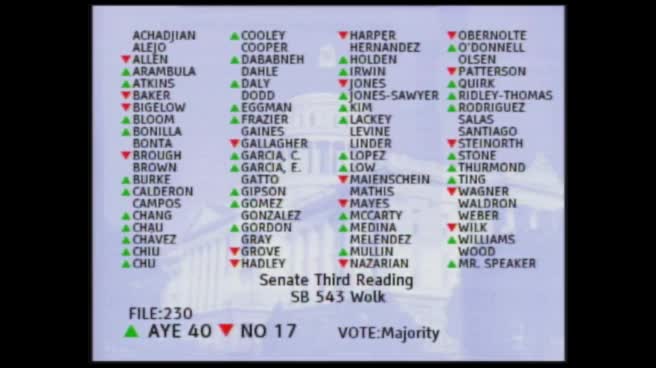 1MIN
Assembly Floor
 1MIN
Assembly Standing Committee on Appropriations
 2MIN
Assembly Standing Committee on Local Government
 12MIN
Senate Standing Committee on Governance and Finance
 10MIN
Senate Standing Committee on Natural Resources and Water
Bill Author

Bill Co-Author(s):