SB 1263: Public water system: permits.
- Session Year: 2015-2016
- House: Senate
- Latest Version Date: 2016-09-29
(1)Existing law, the California Safe Drinking Water Act, imposes on the State Water Resources Control Board various responsibilities and duties relating to providing a dependable, safe supply of drinking water. The act prohibits a person from operating a public water system unless he or she first submits an application, including a technical report, to the state board and receives a permit, as specified. The act requires the state board, upon determination that the application is complete, to make a specified investigation, and allows the state board to impose permit conditions, requirements for system improvements, and time schedules as the state board deems necessary to ensure an affordable, reliable, and adequate supply of water at all times that is pure, wholesome, and potable. The act provides that a person who knowingly makes a false statement or representation in a report submitted, maintained, or used for purposes of compliance with the act may be punished as a misdemeanor.
This bill would require a person submitting an application for a permit for a proposed new public water system to first submit a preliminary technical report to the state board at least 6 months before initiating construction of any water-related improvement, as defined. Because a misstatement in the report could be a crime under the provision described above, this bill would impose a state-mandated local program by expanding the scope of a crime. The bill would allow the state board to direct the applicant to undertake additional discussion and negotiation with certain existing public water systems the state board determines have the technical, managerial, and financial capacity to provide an adequate and reliable supply of domestic water to the service area of the proposed new public water system, as specified, and would require an applicant to comply before submitting an application for a permit to operate a system and would prohibit the application from being deemed complete unless the applicant has complied. The bill would, if the state board determines that it is feasible for the service area of the public water system addressed by the application to be served by one or more currently permitted public water systems, authorize the state board to deny the permit of a proposed new public water system if it determines that it is reasonably foreseeable that the proposed new public water system will be unable to provide affordable, safe drinking water in the reasonably foreseeable future, as prescribed.
(2)Existing law allows the state board to delegate primary responsibility for the administration and enforcement of the act within a county to a local health officer if certain criteria are met. Existing law requires that the local primacy agency be empowered with all of the authority granted to the state board over the specified public water systems.
This bill would prohibit a local primacy agency from issuing a permit to operate a public water system without the concurrence of the state board. The bill would require, for a proposed new public water system that would be regulated by a local primacy agency, the applicant to also submit a copy of the preliminary technical report to the state board.
(3)Existing law declares the established policy of the state that every human being has the right to safe, clean, affordable, and accessible water adequate for human consumption, cooking, and sanitary purposes. Existing law requires a city or county that determines a project, as defined, is subject to the California Environmental Quality Act to identify certain water systems that may supply water for the project and to request those public water systems to prepare and approve a specified water supply assessment. Under existing law, if no public water system is identified, the city or county is required to prepare and approve the water supply assessment. Existing law provides that if, as a result of its assessment, the public water system or city or county concludes that its water supplies are, or will be, insufficient, the public water system or city or county is required to provide its plans for acquiring additional water supplies, as prescribed.
This bill would prohibit a city, including a charter city, or a county from issuing a building permit for the construction of a new residential development where a source of the water supply is water transported by a water hauler, bottled water, a water-vending machine, or a retail water facility, as specified. By imposing new duties on a city or county in connection with the issuance of a building permit, the bill would impose a state-mandated local program.
(4)The California Constitution requires the state to reimburse local agencies and school districts for certain costs mandated by the state. Statutory provisions establish procedures for making that reimbursement.
This bill would provide that no reimbursement is required by this act for specified reasons.
(1)Existing law, the California Safe Drinking Water Act, imposes on the State Water Resources Control Board various responsibilities and duties relating to providing a dependable, safe supply of drinking water. The act prohibits a person from operating a public water system unless he or she first submits an application, including a technical report, to the state board and receives a permit, as specified. The act requires the state board, upon determination that the application is complete, to make a specified investigation, and allows the state board to impose permit conditions, requirements for system improvements, and time schedules as the state board deems necessary to ensure an affordable, reliable, and adequate supply of water at all times that is pure, wholesome, and potable. The act provides that a person who knowingly makes a false statement or representation in a report submitted, maintained, or used for purposes of compliance with the act may be punished as a misdemeanor.
This bill would require a person submitting an application for a permit for a proposed new public water system to first submit a preliminary technical report to the state board at least 6 months before initiating construction of any water-related improvement, as defined. Because a misstatement in the report could be a crime under the provision described above, this bill would impose a state-mandated local program by expanding the scope of a crime. The bill would allow the state board to direct the applicant to undertake additional discussion and negotiation with certain existing public water systems the state board determines have the technical, managerial, and financial capacity to provide an adequate and reliable supply of domestic water to the service area of the proposed new public water system, as specified, and would require an applicant to comply before submitting an application for a permit to operate a system and would prohibit the application from being deemed complete unless the applicant has complied. The bill would, if the state board determines that it is feasible for the service area of the public water system addressed by the application to be served by one or more currently permitted public water systems, authorize the state board to deny the permit of a proposed new public water system if it determines that it is reasonably foreseeable that the proposed new public water system will be unable to provide affordable, safe drinking water in the reasonably foreseeable future, as prescribed.
(2)Existing law allows the state board to delegate primary responsibility for the administration and enforcement of the act within a county to a local health officer if certain criteria are met. Existing law requires that the local primacy agency be empowered with all of the authority granted to the state board over the specified public water systems.
This bill would prohibit a local primacy agency from issuing a permit to operate a public water system without the concurrence of the state board. The bill would require, for a proposed new public water system that would be regulated by a local primacy agency, the applicant to also submit a copy of the preliminary technical report to the state board.
(3)Existing law declares the established policy of the state that every human being has the right to safe, clean, affordable, and accessible water adequate for human consumption, cooking, and sanitary purposes. Existing law requires a city or county that determines a project, as defined, is subject to the California Environmental Quality Act to identify certain water systems that may supply water for the project and to request those public water systems to prepare and approve a specified water supply assessment. Under existing law, if no public water system is identified, the city or county is required to prepare and approve the water supply assessment. Existing law provides that if, as a result of its assessment, the public water system or city or county concludes that its water supplies are, or will be, insufficient, the public water system or city or county is required to provide its plans for acquiring additional water supplies, as prescribed.
This bill would prohibit a city, including a charter city, or a county from issuing a building permit for the construction of a new residential development where a source of the water supply is water transported by a water hauler, bottled water, a water-vending machine, or a retail water facility. facility, as specified. By imposing new duties on a city or county in connection with the issuance of a building permit, the bill would impose a state-mandated local program.
(4)The California Constitution requires the state to reimburse local agencies and school districts for certain costs mandated by the state. Statutory provisions establish procedures for making that reimbursement.
This bill would provide that no reimbursement is required by this act for specified reasons.
(1)Existing law, the California Safe Drinking Water Act, imposes on the State Water Resources Control Board various responsibilities and duties relating to providing a dependable, safe supply of drinking water. The act prohibits a person from operating a public water system unless he or she first submits an application, including a technical report, to the state board and receives a permit, as specified. The act requires the state board, upon determination that the application is complete, to make a specified investigation, and allows the state board to impose permit conditions, requirements for system improvements, and time schedules as the state board deems necessary to ensure an affordable, reliable, and adequate supply of water at all times that is pure, wholesome, and potable. The act provides that a person who knowingly makes a false statement or representation in a report submitted, maintained, or used for purposes of compliance with the act may be punished as a misdemeanor.
This bill would require a person submitting an application for a permit for a proposed new public water system to first submit a preliminary technical report to the board at least 6 months before initiating construction of any water-related improvement, as defined. Because a misstatement in the report could be a crime under the provision described above, this bill would impose a state-mandated local program by expanding the scope of a crime. The bill would allow the board to direct the applicant to undertake additional discussion and negotiation with certain existing public water systems the board determines have the technical, managerial, and financial capacity to provide an adequate and reliable supply of domestic water to the service area of the proposed new public water system, as specified, and would require an applicant to comply before submitting an application for a permit to operate a system and would prohibit the application from being deemed complete unless the applicant has complied. The bill would, if the board determines that it is feasible for the service area of the public water system addressed by the application to be served by one or more currently permitted public water systems, authorize the board to deny the permit of a proposed new public water system if it determines that it is reasonably foreseeable that the proposed new public water system will be unable to provide affordable, safe drinking water in the reasonably foreseeable future, as prescribed.
(2)Existing law allows the state board to delegate primary responsibility for the administration and enforcement of the act within a county to a local health officer if certain criteria are met. Existing law requires that the local primacy agency be empowered with all of the authority granted to the state board over the specified public water systems.
This bill would prohibit a local primacy agency from issuing a permit to operate a public water system without the concurrence of the state board. The bill would require, for a proposed new public water system that would be regulated by a local primacy agency, the applicant to also submit a copy of the preliminary technical report to the state board.
(3)Existing law declares the established policy of the state that every human being has the right to safe, clean, affordable, and accessible water adequate for human consumption, cooking, and sanitary purposes. Existing law requires a city or county that determines a project, as defined, is subject to the California Environmental Quality Act to identify certain water systems that may supply water for the project and to request those public water systems to prepare and approve a specified water supply assessment. Under existing law, if no public water system is identified, the city or county is required to prepare and approve the water supply assessment. Existing law provides that if, as a result of its assessment, the public water system or city or county concludes that its water supplies are, or will be, insufficient, the public water system or city or county is required to provide its plans for acquiring additional water supplies, as prescribed.
This bill would prohibit a city, including a charter city, or a county from issuing a building permit for the construction of a new residential development where a source of the water supply is water transported by a water hauler, bottled water, a water-vending machine, or a retail water facility. By imposing new duties on a city or county in connection with the issuance of a building permit, the bill would impose a state-mandated local program.
(4)The California Constitution requires the state to reimburse local agencies and school districts for certain costs mandated by the state. Statutory provisions establish procedures for making that reimbursement.
This bill would provide that no reimbursement is required by this act for specified reasons.
(1)Existing law, the California Safe Drinking Water Act, imposes on the State Water Resources Control Board various responsibilities and duties relating to providing a dependable, safe supply of drinking water. The act prohibits a person from operating a public water system unless he or she first submits an application, including a technical report, to the state board and receives a permit, as specified. The act requires the state board, upon determination that the application is complete, to make a specified investigation, and allows the state board to impose permit conditions, requirements for system improvements, and time schedules as the state board deems necessary to ensure an affordable, reliable, and adequate supply of water at all times that is pure, wholesome, and potable. The act provides that a person who knowingly makes a false statement or representation in a report submitted, maintained, or used for purposes of compliance with the act may be punished as a misdemeanor.
This bill would require an application for a permit for a proposed new public water system to first submit a preliminary technical report to the board at least 6 months before initiating construction of any water-related improvement, as defined. Because a misstatement in the report could be a crime under the provision described above, this bill would impose a state-mandated local program by expanding the scope of a crime. The bill would allow the board to direct the applicant to undertake additional discussion and negotiation with certain existing public water systems the board determines have the technical, managerial, and financial capacity to provide an adequate and reliable supply of domestic water to the service area of the proposed new public water system, as specified, and would require an applicant to comply before submitting an application for a permit to operate a system and would prohibit the application from being deemed complete unless the applicant has complied. The bill would authorize the board to deny the permit would, if the board determines that it is feasible for the service area of the public water system can addressed by the application to be served by one or more currently permitted public water systems or that the proposed new public water system may lack the technical, managerial, or financial capacity to sustainably systems, authorize the board to deny the permit of a proposed new public water system if it determines that it is reasonably foreseeable that the proposed new public water system will be unable to provide affordable, safe drinking water in the reasonably foreseeable future, as prescribed.
(2)Existing law allows the state board to delegate primary responsibility for the administration and enforcement of the act within a county to a local health officer if certain criteria are met. Existing law requires that the local primacy agency be empowered with all of the authority granted to the state board over the specified public water systems.
This bill would prohibit a local primacy agency from issuing a permit to operate a public water system without the concurrence of the state board. The bill would require, for a proposed new public water system that would be regulated by a local primacy agency, the applicant to also submit a copy of the preliminary technical report to the state board.
(3)Existing law declares the established policy of the state that every human being has the right to safe, clean, affordable, and accessible water adequate for human consumption, cooking, and sanitary purposes. Existing law requires a city or county that determines a project, as defined, is subject to the California Environmental Quality Act to identify certain water systems that may supply water for the project and to request those public water systems to prepare and approve a specified water supply assessment. Under existing law, if no public water system is identified, the city or county is required to prepare and approve the water supply assessment. Existing law provides that if, as a result of its assessment, the public water system or city or county concludes that its water supplies are, or will be, insufficient, the public water system or city or county is required to provide its plans for acquiring additional water supplies, as prescribed.
This bill would prohibit a city, including a charter city, or a county from issuing a building permit for the construction of a new residential development where a source of the water supply is water transported by a water hauler, bottled water, a water-vending machine, or a retail water facility. By imposing new duties on a city or county in connection with the issuance of a building permit, the bill would impose a state-mandated local program.
(4)The California Constitution requires the state to reimburse local agencies and school districts for certain costs mandated by the state. Statutory provisions establish procedures for making that reimbursement.
This bill would provide that no reimbursement is required by this act for specified reasons.
(1)Existing law, the California Safe Drinking Water Act, imposes on the State Water Resources Control Board various responsibilities and duties relating to providing a dependable, safe supply of drinking water. The act prohibits a person from operating a public water system unless he or she first submits an application, including a technical report, to the state board and receives a permit, as specified. The act requires the state board, upon determination that the application is complete, to make a specified investigation, and allows the state board to impose permit conditions, requirements for system improvements, and time schedules as the state board deems necessary to ensure an affordable, reliable, and adequate supply of water at all times that is pure, wholesome, and potable. The act prohibits a public water system that was not in existence on January 1, 1998, from being granted a permit unless the system demonstrates that the water supplier possesses adequate financial, managerial, and technical capability to ensure the delivery of pure, wholesome, and potable drinking water, and requires that this prohibition apply to any change of ownership of a public water system. The act provides that a person who knowingly makes a false statement or representation in a report submitted, maintained, or used for purposes of compliance with the act may be punished as a misdemeanor.
This bill would, commencing January 1, 2017, prohibit an application for a permit for a new public water system from being deemed complete unless the applicant has submitted would require an application for a permit for a proposed new public water system to first submit a preliminary technical report to the state board, as specified, and would allow the state board to impose technical, financial, or managerial requirements on the permit. The bill would prohibit a public water system not in existence on January 1, 1998, from being granted a permit unless the public water system demonstrates that the water supplier also possesses adequate water rights to ensure the delivery of pure, wholesome, and potable drinking water, and would specify that the prohibition applies to any change in ownership of the public water system, including the consolidation of a public water system. board at least 6 months before initiating construction of any water-related improvement, as defined. Because a misstatement in the report could be a crime under the provision described above, this bill would impose a state-mandated local program by expanding the scope of a crime. The bill would allow the state board to direct the applicant to undertake additional discussion and negotiation with certain existing public water systems the board determines have the technical, managerial, and financial capacity to provide an adequate and reliable supply of domestic water to the service area of the proposed new public water system, as specified, and would require an applicant to comply before submitting an application for a permit to operate a system and would prohibit the application from being deemed complete unless the applicant has complied. The bill would authorize the board to deny the permit if the state board determines that the service area of the public water system can be served by one or more currently permitted public water systems. systems or that the proposed new public water system may lack the technical, managerial, or financial capacity to sustainably provide affordable, safe drinking water in the reasonably foreseeable future, as prescribed.
(2)Existing law allows the state board to delegate primary responsibility for the administration and enforcement of the act within a county to a local health officer if certain criteria are met. Existing law requires that the local primacy agency be empowered with all of the authority granted to the state board over the specified public water systems.
This bill would prohibit a local primacy agency from issuing a permit to operate a public water system without the concurrence of the state board. The bill would require, for a proposed public water system that would be regulated by a local primacy agency, the applicant to also submit a copy of the preliminary technical report to the state board.
(3)Existing law declares the established policy of the state that every human being has the right to safe, clean, affordable, and accessible water adequate for human consumption, cooking, and sanitary purposes. Existing law requires a city or county that determines a project, as defined, is subject to the California Environmental Quality Act to identify certain water systems that may supply water for the project and to request those public water systems to prepare and approve a specified water supply assessment. Under existing law, if no public water system is identified, the city or county is required to prepare and approve the water supply assessment. Existing law provides that if, as a result of its assessment, the public water system or city or county concludes that its water supplies are, or will be, insufficient, the public water system or city or county is required to provide its plans for acquiring additional water supplies, as prescribed.
This bill would prohibit a city, including a charter city, or a county from issuing a building permit for the construction of a new residential development where a source of the water supply is water transported by a water hauler, bottled water, a water-vending machine, or a retail water facility. By imposing new duties on a city or county in connection with the issuance of a building permit, the bill would impose a state-mandated local program.
(4)The California Constitution requires the state to reimburse local agencies and school districts for certain costs mandated by the state. Statutory provisions establish procedures for making that reimbursement.
This bill would provide that no reimbursement is required by this act for specified reasons.
(1)Existing law, the California Safe Drinking Water Act, imposes on the State Water Resources Control Board various responsibilities and duties relating to providing a dependable, safe supply of drinking water. The act prohibits a person from operating a public water system unless he or she first submits an application, including a technical report, to the state board and receives a permit, as specified. The act requires the state board, upon determination that the application is complete, to make a specified investigation, and allows the state board to impose permit conditions, requirements for system improvements, and time schedules as the state board deems necessary to ensure an affordable, reliable, and adequate supply of water at all times that is pure, wholesome, and potable. The act prohibits a public water system that was not in existence on January 1, 1998, from being granted a permit unless the system demonstrates that the water supplier possesses adequate financial, managerial, and technical capability to ensure the delivery of pure, wholesome, and potable drinking water, and requires that this prohibition apply to any change of ownership of a public water system.
This bill would, commencing January 1, 2017, prohibit an application for a permit for a new public water system from being deemed complete unless the applicant has submitted a preliminary technical report to the state board, as specified, and would allow the state board to impose technical, financial, or managerial requirements on the permit. The bill would prohibit a public water system not in existence on January 1, 1998, from being granted a permit unless the public water system demonstrates that the water supplier also possesses adequate water rights to ensure the delivery of pure, wholesome, and potable drinking water, and would specify that the prohibition applies to any change in ownership of the public water system, including the consolidation of a public water system. The bill would allow the state board to deny the permit if the state board determines that the service area of the public water system can be served by one or more currently permitted public water systems.
(2)Existing law allows the state board to delegate primary responsibility for the administration and enforcement of the act within a county to a local health officer if certain criteria are met. Existing law requires that the local primacy agency be empowered with all of the authority granted to the state board over the specified public water systems.
This bill would prohibit a local primacy agency from issuing a permit without the concurrence of the state board.
The Legislature finds and declares all of the following:
(a)There are over 7,500 public water systems in California. The vast majority of these systems provide a reliable supply of safe drinking water. However, there are hundreds of smaller public water systems that consistently fail to provide a reliable supply of safe drinking water to their customers. Many failing public water systems were created without the necessary technical, managerial, or financial capacity to be sustainable in the long term in view of water supply uncertainties. These uncertainties can be created by effects on water quality and quantity, global climate change, migration of groundwater contamination, the establishment of new drinking water standards, and other factors that are known to significantly erode a systems capacity.
(b)Failing public water systems disproportionately affect disadvantaged communities who are least able to afford to address the conditions that led to the failure.
(c)The proliferation of new, unsustainable public water systems also may undermine the states human right to water policy.
(d)Therefore, it is the policy of the state to discourage the establishment of new, unsustainable public water systems when there is a feasible alternative.
SEC. 2.Section 116527 is added to the Health and Safety Code, to read:116527.(a)As used in this section, water-related improvement includes, but is not limited to, a water pipe, a water pump, or drinking water infrastructure.
(b)(1)Before a person submits an application for a permit for a proposed new public water system, the person shall first submit a preliminary technical report to the state board at least six months before initiating construction of any water-related improvement.
(2)In order to assist in expediting the permitting process, a person that is considering submitting an application for a permit for a proposed new public water system is encouraged, but is not required, to submit the preliminary technical report no later than seven days after submission of an application to the city or county for a building permit for any water-related improvement.
(3)For a proposed new public water system that would be regulated by a local primacy agency, the applicant shall also submit a copy of the preliminary technical report to the state board.
(c)The preliminary technical report shall include all of the following:
(1)The name of each public water system for which any service area boundary is within three miles, as measured through existing public rights-of-way, of any boundary of the applicants proposed public water systems service area.
(2)A discussion of the feasibility of each of the adjacent public water systems identified pursuant to paragraph (1) annexing, connecting, or otherwise supplying domestic water to the applicants proposed new public water systems service area. The applicant shall consult with each adjacent public water system in preparing the report and shall include in the report any information provided by each adjacent public water system regarding the feasibility of annexing, connecting, or otherwise supplying domestic water to that service area.
(3)A discussion of all actions taken by the applicant to secure a supply of domestic water from an existing public water system for the proposed new public water systems service area.
(4)All sources of domestic water supply for the proposed new public water system.
(5)The estimated cost to construct, operate, and maintain the proposed new public water system, including long-term operation and maintenance costs and a potential rate structure.
(6)A comparison of the costs associated with the construction, operation and maintenance, and long-term sustainability of the proposed new public water system to the costs associated with providing water to the proposed new public water systems service area through annexation by, consolidation with, or connection to an existing public water system.
(7)A discussion of all actions taken by the applicant to pursue a contract for managerial or operational oversight from an existing public water system.
(8)An analysis of whether a proposed new public water systems total projected water supplies available during normal, single dry, or multiple dry water years during a 20-year projection will meet the projected water demand for the service area.
(9)Any information provided by the local agency formation commission. The applicant shall consult with the local agency formation commission if any adjacent public water system identified pursuant to paragraph (1) is a local agency as defined by Section 56054 of the Government Code.
(d)(1)If documents prepared to comply with Division 13 (commencing with Section 21000) of the Public Resources Code or any other application for public agency approval concerning providing drinking water to the proposed new public water systems service area include the information required by subdivision (c), including documentation of the consultation with each adjacent public water system and the local agency formation commission, the applicant may submit those documents to the state board in lieu of the preliminary technical report and the documents shall be considered the functional equivalent of the preliminary technical report.
(2)If documents prepared to comply with Division 13 (commencing with Section 21000) of the Public Resources Code or any other application for public agency approval concerning providing drinking water to the proposed new public water systems service area include some, but not all, of the information required by subdivision (c), including documentation of the consultation with an adjacent public water system and the local agency formation commission, the applicant shall submit those documents and the preliminary technical report to the state board and together those documents and the preliminary technical report shall be considered the functional equivalent of the preliminary technical report requirements of this section. A preliminary technical report submitted pursuant to this paragraph shall only be required to include information that is not otherwise addressed by the other submitted documents.
(e)Upon review of a preliminary technical report submitted pursuant to this section, the state board may do all of the following actions:
(1)If an existing public water system has not already sought annexation of the service area of a proposed new public water system from the local agency formation commission or the applicant has not already sought an extension of services agreement from an existing public water system, direct the applicant to undertake additional discussion and negotiation with the local agency formation commission and any existing public water system meeting the requirements of paragraph (1) of subdivision (c) that the state board determines has the technical, managerial, and financial capacity to provide an adequate and reliable supply of domestic water to the service area of the proposed new public water system. The state board shall not direct the applicant to undertake additional discussion and negotiation if documentation submitted to the state board demonstrates that additional discussion and negotiation is unlikely to be successful, including, but not limited to, documentation that the local agency formation commission has previously denied the application for an extension of service or annexation, or that the existing public water system has declined to apply to the local agency formation commission for approval of an extension of services to, or annexation of, the service area of the proposed new public water system.
(2)Direct the applicant to report on the results of discussion and negotiations conducted pursuant to paragraph (1) to the state board.
(3)Establish a time schedule for the applicants performance of directives issued pursuant to this subdivision.
(f)(1)An applicant shall comply with the state boards directives as assigned in and consistent with subdivision (e) before submitting an application for a permit for a proposed new public water system under this chapter.
(2)An application for a permit for a proposed new public water system under this chapter shall not be deemed complete unless the applicant has complied with the requirements of this section.
(g)The state boards review of a preliminary technical report pursuant to this section shall not be deemed a project or approval of a permit application submitted under this chapter.
(h)The requirements of this section do not apply to either of the following:
(1)An application for a permit for a new public water system that was deemed complete prior to January 1, 2017, pursuant to the statutory permit application requirements effective at the date of the permit submission.
(2)An extension of, or annexation to, an existing public water system.
(i)(1)The requirements of this section do not apply to a service area where an applicant certifies in writing to the state board that the applicant will not rely on the establishment of a new public water system for its water supply. The state board shall acknowledge receipt of the applicants certification in a timely manner.
(2)An applicant who certifies that the service area will not rely on the establishment of a new public water system and later seeks a permit for a new public water system shall comply with the provisions of this section and shall assume all risk of delay or rejection related to the permit application.
(j)(1)The provisions of this subdivision apply to a proposed new public water system that achieves either or both of the following:
(A)Consolidates two or more existing public water systems, existing state small water systems, or other existing water systems, which results in the creation of a new public water system.
(B)Provides water service in lieu of individual domestic wells.
(2)At least six months before the construction of any water-related improvements, an applicant for a new public water system that meets the criteria in paragraph (1) shall provide a written notice to the state board that does both of the following:
(A)Clearly describes the proposed new public water system and how it meets the criteria in paragraph (1).
(B)Requests an exemption from the requirements of this section.
(3)The state board shall promptly acknowledge receipt of a written notice described in paragraph (2). The state board shall have 30 days from the acknowledgment of receipt of the written notice to issue a written notice to the applicant that compliance with the requirements of this section is necessary and that an application for a permit of a new public water system under this chapter is not complete until the applicant has complied with the requirements of this section. A determination by the state board that compliance with the requirements of this section is necessary shall be final and is not subject to review by the state board. A determination by the state board pursuant to this subdivision is not considered a project subject to Division 13 (commencing with Section 21000) of the Public Resources Code.
(4)If the state board receives a written notice from a project applicant that satisfies the requirements of paragraph (2), the project described in the notice is deemed exempt from the requirements of this section on the 35th day following the date of the state boards acknowledgment of receipt of the written notice, unless the state board has issued a notice to comply pursuant to paragraph (3).
SEC. 3.Section 116540 of the Health and Safety Code is amended to read:116540.(a)Following completion of the investigation and satisfaction of the requirements of paragraphs (1) and (2), the state board shall issue or deny the permit. The state board may impose permit conditions, requirements for system improvements, technical, financial, or managerial requirements, and time schedules as it deems necessary to ensure a reliable and adequate supply of water at all times that is pure, wholesome, potable, and does not endanger the health of consumers.
(1)A public water system that was not in existence on January 1, 1998, shall not be granted a permit unless the public water system demonstrates to the state board that the water supplier possesses adequate financial, managerial, and technical capability to ensure the delivery of pure, wholesome, and potable drinking water. This section shall also apply to any change of ownership of a public water system.
(2)A permit under this chapter shall not be issued to an association organized under Title 3 (commencing with Section 18000) of the Corporations Code. This section shall not apply to unincorporated associations that, as of December 31, 1990, are holders of a permit issued under this chapter.
(b)Notwithstanding Section 116330, a local primacy agency shall not issue a permit under this article without the concurrence of the state board.
(c)In considering whether to approve a proposed new public water system, the state board shall consider the sustainability of the proposed new public water system and its water supply in the reasonably foreseeable future, in view of global climate change, potential migration of groundwater contamination and other potential treatment needs, and other factors that can significantly erode a systems capacity.
(d)If the state board determines that it is feasible for the service area of the public water system addressed by an application under this article to be served by one or more permitted public water systems identified pursuant to paragraph (1) of subdivision (c) of Section 116527, the state board may deny the permit of a proposed new public water system if it determines, based on its assessment of the preliminary technical report submitted pursuant to Section 116527, the permit application, and other relevant, substantial evidence submitted, that it is reasonably foreseeable that the proposed new public water system will be unable to provide affordable, safe drinking water in the reasonably foreseeable future.
(e)An applicant may appeal decisions and actions of the deputy director taken pursuant to this section to the state board.
SEC. 4.Section 106.4 is added to the Water Code, to read:106.4.(a)For the purposes of this section:
(1)Bottled water has the same meaning as defined in Section 111070 of the Health and Safety Code.
(2)Residential development has the same meaning as defined in Section 65008 of the Government Code.
(3)Retail water facility has the same meaning as defined in Section 111070 of the Health and Safety Code.
(4)Water-vending machine has the same meaning as defined in Section 111070 of the Health and Safety Code.
(5)Water hauler has the same meaning as defined in Section 111070 of the Health and Safety Code.
(b)A city, including a charter city, or a county shall not issue a building permit for the construction of a new residential development where a source of water supply is water transported by a water hauler, bottled water, a water-vending machine, or a retail water facility.
(c)This section does not apply to a residence that will be rebuilt because of a natural disaster.
(d)The Legislature finds and declares that this section addresses a matter of statewide concern and not a municipal affair, as that term is used in Section 5 of Article XI of the California Constitution.
SEC. 5.No reimbursement is required by this act pursuant to Section 6 of Article XIIIB of the California Constitution because a local agency or school district has the authority to levy service charges, fees, or assessments sufficient to pay for the program or level of service mandated by this act or because costs that may be incurred by a local agency or school district will be incurred because this act creates a new crime or infraction, eliminates a crime or infraction, or changes the penalty for a crime or infraction, within the meaning of Section 17556 of the Government Code, or changes the definition of a crime within the meaning of Section 6 of Article XIIIB of the California Constitution.
The Legislature finds and declares all of the following:
(a)There are over 7,500 public water systems in California. The vast majority of these systems provide a reliable supply of safe drinking water. However, there are hundreds of smaller public water systems that consistently fail to provide a reliable supply of safe drinking water to their customers. Many failing public water systems were created without the necessary technical, managerial, or financial capacity to be sustainable in the long term in view of water supply uncertainties. These uncertainties can be created by effects on water quality and quantity, global climate change, migration of groundwater contamination, the establishment of new drinking water standards, and other factors that are known to significantly erode a systems capacity.
(b)Failing public water systems disproportionately affect disadvantaged communities who are least able to afford to address the conditions that led to the failure.
(c)The proliferation of new, unsustainable public water systems also may undermine the states human right to water policy.
(d)Therefore, it is the policy of the state to discourage the establishment of new, unsustainable public water systems when there is a feasible alternative.
SEC. 2.Section 116527 is added to the Health and Safety Code, to read:116527.(a)As used in this section, water-related improvement includes, but is not limited to, a water pipe, a water pump, or drinking water infrastructure.
(b)(1)Before a person submits an application for a permit for a proposed new public water system, the person shall first submit a preliminary technical report to the state board at least six months before initiating construction of any water-related improvement.
(2)In order to assist in expediting the permitting process, a person that is considering submitting an application for a permit for a proposed new public water system is encouraged, but is not required, to submit the preliminary technical report no later than seven days after submission of an application to the city or county for a building permit for any water-related improvement.
(3)For a proposed new public water system that would be regulated by a local primacy agency, the applicant shall also submit a copy of the preliminary technical report to the state board.
(c)The preliminary technical report shall include all of the following:
(1)The name of each public water system for which any service area boundary is within three miles, as measured through existing public rights-of-way, of any boundary of the applicants proposed public water systems service area.
(2)A discussion of the feasibility of each of the adjacent public water systems identified pursuant to paragraph (1) annexing, connecting, or otherwise supplying domestic water to the applicants proposed new public water systems service area. The applicant shall consult with each adjacent public water system in preparing the report and shall include in the report any information provided by each adjacent public water system regarding the feasibility of annexing, connecting, or otherwise supplying domestic water to that service area.
(3)A discussion of all actions taken by the applicant to secure a supply of domestic water from an existing public water system for the proposed new public water systems service area.
(4)All sources of domestic water supply for the proposed new public water system.
(5)The estimated cost to construct, operate, and maintain the proposed new public water system, including long-term operation and maintenance costs and a potential rate structure.
(6)A comparison of the costs associated with the construction, operation and maintenance, and long-term sustainability of the proposed new public water system to the costs associated with providing water to the proposed new public water systems service area through annexation by, consolidation with, or connection to an existing public water system.
(7)A discussion of all actions taken by the applicant to pursue a contract for managerial or operational oversight from an existing public water system.
(8)An analysis of whether a proposed new public water systems total projected water supplies available during normal, single dry, or multiple dry water years during a 20-year projection will meet the projected water demand for the service area.
(9)Any information provided by the local agency formation commission. The applicant shall consult with the local agency formation commission if any adjacent public water system identified pursuant to paragraph (1) is a local agency as defined by Section 56054 of the Government Code.
(d)(1)If documents prepared to comply with Division 13 (commencing with Section 21000) of the Public Resources Code or any other application for public agency approval concerning providing drinking water to the proposed new public water systems service area include the information required by subdivision (c), including documentation of the consultation with each adjacent public water system and the local agency formation commission, the applicant may submit those documents to the state board in lieu of the preliminary technical report and the documents shall be considered the functional equivalent of the preliminary technical report.
(2)If documents prepared to comply with Division 13 (commencing with Section 21000) of the Public Resources Code or any other application for public agency approval concerning providing drinking water to the proposed new public water systems service area include some, but not all, of the information required by subdivision (c), including documentation of the consultation with an adjacent public water system and the local agency formation commission, the applicant shall submit those documents and the preliminary technical report to the state board and together those documents and the preliminary technical report shall be considered the functional equivalent of the preliminary technical report requirements of this section. A preliminary technical report submitted pursuant to this paragraph shall only be required to include information that is not otherwise addressed by the other submitted documents.
(e)Upon review of a preliminary technical report submitted pursuant to this section, the state board may do all of the following actions:
(1)If an existing public water system has not already sought annexation of the service area of a proposed new public water system from the local agency formation commission or the applicant has not already sought an extension of services agreement from an existing public water system, direct the applicant to undertake additional discussion and negotiation with the local agency formation commission and any existing public water system meeting the requirements of paragraph (1) of subdivision (c) that the state board determines has the technical, managerial, and financial capacity to provide an adequate and reliable supply of domestic water to the service area of the proposed new public water system. The state board shall not direct the applicant to undertake additional discussion and negotiation if documentation submitted to the state board demonstrates that additional discussion and negotiation is unlikely to be successful, including, but not limited to, documentation that the local agency formation commission has previously denied the application for an extension of service or annexation, or that the existing public water system has declined to apply to the local agency formation commission for approval of an extension of services to, or annexation of, the service area of the proposed new public water system.
(2)Direct the applicant to report on the results of discussion and negotiations conducted pursuant to paragraph (1) to the state board.
(3)Establish a time schedule for the applicants performance of directives issued pursuant to this subdivision.
(f)(1)An applicant shall comply with the state boards directives as assigned in and consistent with subdivision (e) before submitting an application for a permit for a proposed new public water system under this chapter.
(2)An application for a permit for a proposed new public water system under this chapter shall not be deemed complete unless the applicant has complied with the requirements of this section.
(g)The state boards review of a preliminary technical report pursuant to this section shall not be deemed a project or approval of a permit application submitted under this chapter.
(h)The requirements of this section do not apply to either of the following:
(1)An application for a permit for a new public water system that was deemed complete prior to January 1, 2017, pursuant to the statutory permit application requirements effective at the date of the permit submission.
(2)An extension of, or annexation to, an existing public water system.
(i)(1)The requirements of this section do not apply to a service area where an applicant certifies in writing to the state board that the applicant will not rely on the establishment of a new public water system for its water supply. The state board shall acknowledge receipt of the applicants certification in a timely manner.
(2)An applicant who certifies that the service area will not rely on the establishment of a new public water system and later seeks a permit for a new public water system shall comply with the provisions of this section and shall assume all risk of delay or rejection related to the permit application.
(j)(1)The provisions of this subdivision apply to a proposed new public water system that achieves either or both of the following:
(A)Consolidates two or more existing public water systems, existing state small water systems, or other existing water systems, which results in the creation of a new public water system.
(B)Provides water service in lieu of individual domestic wells.
(2)At least six months before the construction of any water-related improvements, an applicant for a new public water system that meets the criteria in paragraph (1) shall provide a written notice to the state board that does both of the following:
(A)Clearly describes the proposed new public water system and how it meets the criteria in paragraph (1).
(B)Requests an exemption from the requirements of this section.
(3)The state board shall promptly acknowledge receipt of a written notice described in paragraph (2). The state board shall have 30 days from the acknowledgment of receipt of the written notice to issue a written notice to the applicant that compliance with the requirements of this section is necessary and that an application for a permit of a new public water system under this chapter is not complete until the applicant has complied with the requirements of this section. A determination by the state board that compliance with the requirements of this section is necessary shall be final and is not subject to review by the state board. A determination by the state board pursuant to this subdivision is not considered a project subject to Division 13 (commencing with Section 21000) of the Public Resources Code.
(4)If the state board receives a written notice from a project applicant that satisfies the requirements of paragraph (2), the project described in the notice is deemed exempt from the requirements of this section on the 35th day following the date of the state boards acknowledgment of receipt of the written notice, unless the state board has issued a notice to comply pursuant to paragraph (3).
SEC. 3.Section 116540 of the Health and Safety Code is amended to read:116540.(a)Following completion of the investigation and satisfaction of the requirements of paragraphs (1) and (2), the state board shall issue or deny the permit. The state board may impose permit conditions, requirements for system improvements, technical, financial, or managerial requirements, and time schedules as it deems necessary to ensure a reliable and adequate supply of water at all times that is pure, wholesome, potable, and does not endanger the health of consumers.
(1)A public water system that was not in existence on January 1, 1998, shall not be granted a permit unless the public water system demonstrates to the state board that the water supplier possesses adequate financial, managerial, and technical capability to ensure the delivery of pure, wholesome, and potable drinking water. This section shall also apply to any change of ownership of a public water system.
(2)A permit under this chapter shall not be issued to an association organized under Title 3 (commencing with Section 18000) of the Corporations Code. This section shall not apply to unincorporated associations that, as of December 31, 1990, are holders of a permit issued under this chapter.
(b)Notwithstanding Section 116330, a local primacy agency shall not issue a permit under this article without the concurrence of the state board.
(c)In considering whether to approve a proposed new public water system, the state board shall consider the sustainability of the proposed new public water system and its water supply in the reasonably foreseeable future, in view of global climate change, potential migration of groundwater contamination and other potential treatment needs, and other factors that can significantly erode a systems capacity.
(d)If the state board determines that it is feasible for the service area of the public water system addressed by an application under this article to be served by one or more permitted public water systems identified pursuant to paragraph (1) of subdivision (c) of Section 116527, the state board may deny the permit of a proposed new public water system if it determines, based on its assessment of the preliminary technical report submitted pursuant to Section 116527, the permit application, and other relevant, substantial evidence submitted, that it is reasonably foreseeable that the proposed new public water system will be unable to provide affordable, safe drinking water in the reasonably foreseeable future.
(e)An applicant may appeal decisions and actions of the deputy director taken pursuant to this section to the state board.
SEC. 4.Section 106.4 is added to the Water Code, to read:106.4.(a)For the purposes of this section:
(1)Bottled water has the same meaning as defined in Section 111070 of the Health and Safety Code.
(2)Residential development has the same meaning as defined in Section 65008 of the Government Code.
(3)Retail water facility has the same meaning as defined in Section 111070 of the Health and Safety Code.
(4)Water-vending machine has the same meaning as defined in Section 111070 of the Health and Safety Code.
(5)Water hauler has the same meaning as defined in Section 111070 of the Health and Safety Code.
(b)A city, including a charter city, or a county shall not issue a building permit for the construction of a new residential development where a source of water supply is water transported by a water hauler, bottled water, a water-vending machine, or a retail water facility.
(c)This section does not apply to a residence that will be rebuilt because of a natural disaster.
(c)
(d)The Legislature finds and declares that this section addresses a matter of statewide concern and not a municipal affair, as that term is used in Section 5 of Article XI of the California Constitution.
SEC. 5.No reimbursement is required by this act pursuant to Section 6 of Article XIIIB of the California Constitution because a local agency or school district has the authority to levy service charges, fees, or assessments sufficient to pay for the program or level of service mandated by this act or because costs that may be incurred by a local agency or school district will be incurred because this act creates a new crime or infraction, eliminates a crime or infraction, or changes the penalty for a crime or infraction, within the meaning of Section 17556 of the Government Code, or changes the definition of a crime within the meaning of Section 6 of Article XIIIB of the California Constitution.
The Legislature finds and declares all of the following:
(a)There are over 7,500 public water systems in California. The vast majority of these systems provide a reliable supply of safe drinking water. However, there are hundreds of smaller public water systems that consistently fail to provide a reliable supply of safe drinking water to their customers. Many failing public water systems were created without the necessary technical, managerial, or financial capacity to be sustainable in the long term in view of water supply uncertainties. These uncertainties can be created by effects on water quality and quantity, global climate change, migration of groundwater contamination, the establishment of new drinking water standards, and other factors that are known to significantly erode a systems capacity.
(b)Failing public water systems disproportionately affect disadvantaged communities who are least able to afford to address the conditions that led to the failure.
(c)The proliferation of new, unsustainable public water systems also may undermine the states human right to water policy.
(d)Therefore, it is the policy of the state to discourage the establishment of new, unsustainable public water systems when there is a feasible alternative.
SEC. 2.Section 116527 is added to the Health and Safety Code, to read:116527.(a)As used in this section, water-related improvement includes, but is not limited to, a water pipe, a water pump, or drinking water infrastructure.
(b)(1)Before a person submits an application for a permit for a proposed new public water system, the person shall first submit a preliminary technical report to the state board at least six months before initiating construction of any water-related improvement.
(2)In order to assist in expediting the permitting process, a person that is considering submitting an application for a permit for a proposed new public water system is encouraged, but is not required, to submit the preliminary technical report no later than seven days after submission of an application to the city or county for a building permit for any water-related improvement.
(3)For a proposed new public water system that would be regulated by a local primacy agency, the applicant shall also submit a copy of the preliminary technical report to the state board.
(c)The preliminary technical report shall include all of the following:
(1)The name of each public water system for which any service area boundary is within three miles, as measured through existing public rights-of-way, of any boundary of the applicants proposed public water systems service area.
(2)A discussion of the feasibility of each of the adjacent public water systems identified pursuant to paragraph (1) annexing, connecting, or otherwise supplying domestic water to the applicants proposed new public water systems service area. The applicant shall consult with an each adjacent public water system in preparing the report and shall include in the report any information provided by an each adjacent public water system regarding the feasibility of annexing, connecting, or otherwise supplying domestic water to that service area.
(3)A discussion of all actions taken by the applicant to secure a supply of domestic water from an existing public water system for the proposed new public water systems service area.
(4)All sources of domestic water supply for the proposed new public water system.
(5)The estimated cost to construct, operate, and maintain the proposed new public water system, including long-term operation and maintenance costs and a potential rate structure.
(6)A comparison of the costs associated with the construction, operation and maintenance, and long-term sustainability of the proposed new public water system to the costs associated with providing water to the proposed new public water systems service area through annexation by, consolidation with, or connection to an existing public water system.
(7)A discussion of all actions taken by the applicant to pursue a contract for managerial or operational oversight from an existing public water system.
(8)An analysis of whether a proposed new public water systems total projected water supplies available during normal, single dry, or multiple dry water years during a 20-year projection will meet the projected water demand for the service area.
(9)Any information provided by the local agency formation commission. The applicant shall consult with the local agency formation commission if any adjacent public water system identified pursuant to paragraph (1) is a local agency as defined by Section 56054 of the Government Code.
(d)(1)If documents prepared to comply with Division 13 (commencing with Section 21000) of the Public Resources Code or any other application for public agency approval concerning providing drinking water to the proposed new public water systems service area include the information required by subdivision (c), including documentation of the consultation with an each adjacent public water system, system and the local agency formation commission, the applicant may submit those documents to the state board in lieu of the preliminary technical report and the documents shall be considered the functional equivalent of the preliminary technical report.
(2)If documents prepared to comply with Division 13 (commencing with Section 21000) of the Public Resources Code or any other application for public agency approval concerning providing drinking water to the proposed new public water systems service area include some, but not all, of the information required by subdivision (c), including documentation of the consultation with an adjacent public water system, system and the local agency formation commission, the applicant shall submit those documents and the preliminary technical report to the state board and together those documents and the preliminary technical report shall be considered the functional equivalent of the preliminary technical report requirements of this section. A preliminary technical report submitted pursuant to this paragraph shall only be required to include information that is not otherwise addressed by the other submitted documents.
(e)Upon review of a preliminary technical report submitted pursuant to this section, the state board may do all of the following actions:
(1)If an existing public water system has not already sought annexation of the service area of a proposed new public water system from the local agency formation commission or the applicant has not already sought an extension of services agreement from an existing public water system, direct the applicant to undertake additional discussion and negotiation with the local agency formation commission and any existing public water system meeting the requirements of paragraph (1) of subdivision (c) that the state board determines has the technical, managerial, and financial capacity to provide an adequate and reliable supply of domestic water to the service area of the proposed new public water system. The state board shall not direct the applicant to undertake additional discussion and negotiation if documentation submitted to the state board demonstrates that additional discussion and negotiation is unlikely to be successful, including, but not limited to, documentation that a the local agency formation commission has already previously denied the application for an extension of service or annexation, or that the existing public water system has declined to apply to the local agency formation commission for approval of an extension of services to, or annexation of, the service area of the proposed new public water system.
(2)Direct the applicant to report on the results of discussion and negotiations conducted pursuant to paragraph (1) to the state board.
(3)Establish a time schedule for the applicants performance of directives issued pursuant to this subdivision.
(f)(1)An applicant shall comply with the state boards directives as assigned in and consistent with subdivision (e) before submitting an application for a permit for a proposed new public water system under this chapter.
(2)An application for a permit for a proposed new public water system under this chapter shall not be deemed complete unless the applicant has complied with the requirements of this section.
(g)The state boards review of a preliminary technical report pursuant to this section shall not be deemed a project or approval of a permit application submitted under this chapter.
(h)The requirements of this section do not apply to either of the following:
(1)An application for a permit for a new public water system that was deemed complete prior to January 1, 2017, pursuant to the statutory permit application requirements effective at the date of the permit submission.
(2)An extension of, or annexation to, an existing public water system.
(i)(1)The requirements of this section do not apply to a service area where an applicant certifies in writing to the state board that the applicant will not rely on the establishment of a new public water system for its water supply. The state board shall acknowledge receipt of the applicants certification in a timely manner.
(2)An applicant who certifies that the service area will not rely on the establishment of a new public water system and later seeks a permit for a new public water system shall comply with the provisions of this section and shall assume all risk of delay or rejection related to the permit application.
(j)(1)The provisions of this subdivision apply to a proposed new public water system that achieves either or both of the following:
(A)Consolidates two or more existing public water systems, existing state small water systems, or other existing water systems, which results in the creation of a new public water system.
(B)Provides water service in lieu of individual domestic wells.
(2)At least six months before the construction of any water-related improvements, an applicant for a new public water system that meets the criteria in paragraph (1) shall provide a written notice to the state board that does both of the following:
(A)Clearly describes the proposed new public water system and how it meets the criteria in paragraph (1).
(B)Requests an exemption from the requirements of this section.
(3)The state board shall promptly acknowledge receipt of a written notice described in paragraph (2). The state board shall have 30 days from the acknowledgment of receipt of the written notice to issue a written notice to the applicant that compliance with the requirements of this section is necessary and that an application for a permit of a new public water system under this chapter is not complete until the applicant has complied with the requirements of this section. A determination by the state board that compliance with the requirements of this section is necessary shall be final and is not subject to review by the state board. A determination by the state board pursuant to this subdivision is not considered a project subject to Division 13 (commencing with Section 21000) of the Public Resources Code.
(4)If the state board receives a written notice from a project applicant that satisfies the requirements of paragraph (2), the project described in the notice is deemed exempt from the requirements of this section on the 35th day following the date of the state boards acknowledgment of receipt of the written notice, unless the state board has issued a notice to comply pursuant to paragraph (3).
SEC. 3.Section 116540 of the Health and Safety Code is amended to read:116540.(a)Following completion of the investigation and satisfaction of the requirements of paragraphs (1) and (2), the state board shall issue or deny the permit. The state board may impose permit conditions, requirements for system improvements, technical, financial, or managerial requirements, and time schedules as it deems necessary to ensure a reliable and adequate supply of water at all times that is pure, wholesome, potable, and does not endanger the health of consumers.
(1)A public water system that was not in existence on January 1, 1998, shall not be granted a permit unless the public water system demonstrates to the state board that the water supplier possesses adequate financial, managerial, and technical capability to ensure the delivery of pure, wholesome, and potable drinking water. This section shall also apply to any change of ownership of a public water system.
(2)A permit under this chapter shall not be issued to an association organized under Title 3 (commencing with Section 18000) of the Corporations Code. This section shall not apply to unincorporated associations that, as of December 31, 1990, are holders of a permit issued under this chapter.
(b)Notwithstanding Section 116330, a local primacy agency shall not issue a permit under this article without the concurrence of the state board.
(c)In considering whether to approve a proposed new public water system, the state board shall consider the sustainability of the proposed new public water system and its water supply in the reasonably foreseeable future, in view of global climate change, potential migration of groundwater contamination and other potential treatment needs, and other factors that can significantly erode a systems capacity.
(d)If the state board determines that it is feasible for the service area of the public water system addressed by an application under this article to be served by one or more permitted public water systems identified pursuant to paragraph (1) of subdivision (c) of Section 116527, the state board may deny the permit of a proposed new public water system if it determines, based on its assessment of the preliminary technical report submitted pursuant to Section 116527, the permit application, and other relevant, substantial evidence submitted, that it is reasonably foreseeable that the proposed new public water system will be unable to provide affordable, safe drinking water in the reasonably foreseeable future.
(e)An applicant may appeal decisions and actions of the deputy director taken pursuant to this section to the state board.
SEC. 4.Section 106.4 is added to the Water Code, to read:106.4.(a)For the purposes of this section:
(1)Bottled water has the same meaning as defined in Section 111070 of the Health and Safety Code.
(2)Residential development has the same meaning as defined in Section 65008 of the Government Code.
(3)Retail water facility has the same meaning as defined in Section 111070 of the Health and Safety Code.
(4)Water-vending machine has the same meaning as defined in Section 111070 of the Health and Safety Code.
(5)Water hauler has the same meaning as defined in Section 111070 of the Health and Safety Code.
(b)A city, including a charter city, or a county shall not issue a building permit for the construction of a new residential development where a source of water supply is water transported by a water hauler, bottled water, a water-vending machine, or a retail water facility.
(c)The Legislature finds and declares that this section addresses a matter of statewide concern and not a municipal affair, as that term is used in Section 5 of Article XI of the California Constitution.
SEC. 5.No reimbursement is required by this act pursuant to Section 6 of Article XIIIB of the California Constitution because a local agency or school district has the authority to levy service charges, fees, or assessments sufficient to pay for the program or level of service mandated by this act or because costs that may be incurred by a local agency or school district will be incurred because this act creates a new crime or infraction, eliminates a crime or infraction, or changes the penalty for a crime or infraction, within the meaning of Section 17556 of the Government Code, or changes the definition of a crime within the meaning of Section 6 of Article XIIIB of the California Constitution.
The Legislature finds and declares all of the following:
(a)There are over 7,500 public water systems in California. The vast majority of these systems provide a reliable supply of safe drinking water. However, there are hundreds of smaller public water systems that consistently fail to provide a reliable supply of safe drinking water to their customers. Many failing public water systems were created without the necessary technical, managerial, or financial capacity to be sustainable in the long term in view of water supply uncertainties. These uncertainties can be created by effects on water quality and quantity, global climate change, migration of groundwater contamination, the establishment of new drinking water standards, and other factors that are known to significantly erode a systems capacity.
(b)Failing public water systems disproportionately affect disadvantaged communities who are least able to afford to address the conditions that led to the failure.
(c)The proliferation of new, unsustainable public water systems also may undermine the states human right to water policy.
(d)Therefore, it is the policy of the state to discourage the establishment of new, unsustainable public water systems when there is a feasible alternative.
SEC. 2.Section 116527 is added to the Health and Safety Code, to read:116527.(a)As used in this section, water-related improvement includes, but is not limited to, a water pipe, a water pump, or drinking water infrastructure.
(b)(1)Before a person submits an application for a permit for a proposed new public water system, the person shall first submit a preliminary technical report to the state board at least six months before initiating construction of any water-related improvement.
(2)In order to assist in expediting the permitting process, a person that is considering submitting an application for a permit for a proposed new public water system is encouraged, but is not required, to submit the preliminary technical report no later than seven days after submittal submission of an application to the city or county for a building permit for any water-related improvement.
(3)For a proposed new public water system that would be regulated by a local primacy agency, the applicant shall also submit a copy of the preliminary technical report to the state board.
(c)The preliminary technical report shall include all of the following:
(1)The name of each public water system for which any service area boundary is within three miles, as measured through existing public rights-of-way, of any boundary of the applicants proposed public water systems service area.
(2)A discussion of the feasibility of each of the adjacent public water systems identified pursuant to paragraph (1) annexing, connecting, or otherwise supplying domestic water to the applicants proposed new public water systems service area. The applicant shall consult with an adjacent public water system in preparing the report and shall include in the report any information provided by an adjacent public water system regarding the feasibility of annexing, connecting, or otherwise supplying domestic water to that service area.
(3)A discussion of all actions taken by the applicant to secure a supply of domestic water from an existing public water system for the proposed new public water systems service area.
(4)All sources of domestic water supply for the proposed new public water system.
(5)The estimated cost to construct, operate, and maintain the proposed new public water system, including long-term operation and maintenance costs and a potential rate structure.
(6)A comparison of the costs associated with the construction, operation and maintenance, and long-term sustainability of the proposed new public water system to the costs associated with providing water to the proposed new public water systems service area through annexation by, consolidation with, or connection to an existing public water system.
(7)A discussion of all actions taken by the applicant to pursue a contract for managerial or operational oversight from an existing public water system.
(8)An analysis of whether a proposed new public water systems total projected water supplies available during normal, single dry, or multiple dry water years during a 20-year projection will meet the projected water demand for the service area.
(d)(1)If documents prepared to comply with Division 13 (commencing with Section 21000) of the Public Resources Code or any other application for public agency approval concerning providing drinking water to the proposed new public water systems service area include the information required by subdivision (c), including documentation of the consultation with an adjacent public water system, the applicant may submit those documents to the state board in lieu of the preliminary technical report and the documents shall be considered the functional equivalent of the preliminary technical report.
(2)If documents prepared to comply with Division 13 (commencing with Section 21000) of the Public Resources Code or any other application for public agency approval concerning providing drinking water to the proposed new public water systems service area include some, but not all, of the information required by subdivision (c), including documentation of the consultation with an adjacent public water system, the applicant shall submit those documents and the preliminary technical report to the state board and together those documents and the preliminary technical report shall be considered the functional equivalent of the preliminary technical report requirements of this section. A preliminary technical report submitted pursuant to this paragraph shall only be required to include information that is not otherwise addressed by the other submitted documents.
(e)Upon review of a preliminary technical report submitted pursuant to this section, the state board may do all of the following actions:
(1)If an existing public water system has not already sought annexation of the service area of a proposed new public water system from the local agency formation commission or the applicant has not already sought an extension of services agreement from an existing public water system, direct the applicant to undertake additional discussion and negotiation with any existing public water system meeting the requirements of paragraph (1) of subdivision (c) that the state board determines has the technical, managerial, and financial capacity to provide an adequate and reliable supply of domestic water to the service area of the proposed new public water system. The state board shall not direct the applicant to undertake additional discussion and negotiation if documentation submitted to the state board demonstrates that additional discussion and negotiation is unlikely to be successful, including, but not limited to, documentation that a local agency formation commission has already denied the application for an extension of service or annexation, or that the existing public water system has declined to apply to the local agency formation commission for approval of an extension of services to, or annexation of, the service area of the proposed new public water system.
(2)Direct the applicant to report on the results of discussion and negotiations conducted pursuant to paragraph (1) to the state board.
(3)Establish a time schedule for the applicants performance of directives issued pursuant to this subdivision.
(f)(1)An applicant shall comply with the state boards directives as assigned in and consistent with subdivision (e) before submitting an application for a permit for a proposed new public water system under this chapter.
(2)An application for a permit for a proposed new public water system under this chapter shall not be deemed complete unless the applicant has complied with the requirements of this section.
(g)The state boards review of a preliminary technical report pursuant to this section shall not be deemed a project or approval of a permit application submitted under this chapter.
(h)The requirements of this section do not apply to either of the following:
(1)An application for a permit for a new public water system that was deemed complete prior to January 1, 2017, pursuant to the statutory permit application requirements effective at the date of the permit submittal. submission.
(2)An extension of, or annexation to, an existing public water system.
(i)(1)The requirements of this section do not apply to a service area where an applicant certifies in writing to the state board that the applicant will not rely on the establishment of a new public water system for its water supply. The state board shall acknowledge receipt of the applicants certification in a timely manner.
(2)An applicant who certifies that the service area will not rely on the establishment of a new public water system and later seeks a permit for a new public water system shall comply with the provisions of this section and shall assume all risk of delay or rejection related to the permit application.
(j)(1)The provisions of this subdivision apply to a proposed new public water system that achieves either or both of the following:
(A)Consolidates two or more existing public water systems, existing state small water systems, or other existing water systems, which results in the creation of a new public water system.
(B)Provides water service in lieu of individual domestic wells.
(2)At least six months before the construction of any water-related improvements, an applicant for a new public water system that meets the criteria in paragraph (1) shall provide a written notice to the state board that does both of the following:
(A)Clearly describes the proposed new public water system and how it meets the criteria in paragraph (1).
(B)Requests an exemption from the requirements of this section.
(3)The state board shall promptly acknowledge receipt of a written notice described in paragraph (2). The state board shall have 30 days from the acknowledgment of receipt of the written notice to issue a written notice to the applicant that compliance with the requirements of this section is necessary and that an application for a permit of a new public water system under this chapter is not complete until the applicant has complied with the requirements of this section. A determination by the state board that compliance with the requirements of this section is necessary shall be final and is not subject to review. review by the state board. A determination by the state board pursuant to this subdivision is not considered a project subject to Division 13 (commencing with Section 21000) of the Public Resources Code.
(4)If the state board receives a written notice from a project applicant that satisfies the requirements of paragraph (2), the project described in the notice is deemed exempt from the requirements of this section on the 35th day following the date of the state boards acknowledgment of receipt of the written notice, unless the state board has issued a notice to comply pursuant to paragraph (3).
SEC. 3.Section 116540 of the Health and Safety Code is amended to read:116540.(a)Following completion of the investigation and satisfaction of the requirements of paragraphs (1) and (2), the state board shall issue or deny the permit. The state board may impose permit conditions, requirements for system improvements, technical, financial, or managerial requirements, and time schedules as it deems necessary to ensure a reliable and adequate supply of water at all times that is pure, wholesome, potable, and does not endanger the health of consumers.
(1)A public water system that was not in existence on January 1, 1998, shall not be granted a permit unless the public water system demonstrates to the state board that the water supplier possesses adequate financial, managerial, and technical capability to ensure the delivery of pure, wholesome, and potable drinking water. This section shall also apply to any change of ownership of a public water system.
(2)A permit under this chapter shall not be issued to an association organized under Title 3 (commencing with Section 18000) of the Corporations Code. This section shall not apply to unincorporated associations that, as of December 31, 1990, are holders of a permit issued under this chapter.
(b)Notwithstanding Section 116330, a local primacy agency shall not issue a permit under this article without the concurrence of the state board.
(c)In considering whether to approve a proposed new public water system, the state board shall consider the sustainability of the proposed new public water system and its water supply in the reasonably foreseeable future, in view of global climate change, potential migration of groundwater contamination and other potential treatment needs, and other factors that can significantly erode a systems capacity.
(d)If the state board determines that it is feasible for the service area of the public water system addressed by an application under this article to be served by one or more permitted public water systems identified pursuant to paragraph (1) of subdivision (c) of Section 116527, the state board may deny the permit of a proposed new public water system if it determines, based on its assessment of the preliminary technical report submitted pursuant to Section 116527, the permit application, and other relevant, substantial evidence submitted, that it is reasonably foreseeable that the proposed new public water system will be unable to provide affordable, safe drinking water in the reasonably foreseeable future.
(e)An applicant may appeal decisions and actions of the deputy director taken pursuant to this section to the state board.
SEC. 4.Section 106.4 is added to the Water Code, to read:106.4.(a)For the purposes of this section:
(1)Bottled water has the same meaning as defined in Section 111070 of the Health and Safety Code.
(2)Residential development has the same meaning as defined in Section 65008 of the Government Code.
(3)Retail water facility has the same meaning as defined in Section 111070 of the Health and Safety Code.
(4)Water-vending machine has the same meaning as defined in Section 111070 of the Health and Safety Code.
(5)Water hauler has the same meaning as defined in Section 111070 of the Health and Safety Code.
(b)A city, including a charter city, or a county shall not issue a building permit for the construction of a new residential development where a source of water supply is water transported by a water hauler, bottled water, a water-vending machine, or a retail water facility.
(c)The Legislature finds and declares that this section addresses a matter of statewide concern and not a municipal affair, as that term is used in Section 5 of Article XI of the California Constitution.
SEC. 5.No reimbursement is required by this act pursuant to Section 6 of Article XIIIB of the California Constitution because a local agency or school district has the authority to levy service charges, fees, or assessments sufficient to pay for the program or level of service mandated by this act or because costs that may be incurred by a local agency or school district will be incurred because this act creates a new crime or infraction, eliminates a crime or infraction, or changes the penalty for a crime or infraction, within the meaning of Section 17556 of the Government Code, or changes the definition of a crime within the meaning of Section 6 of Article XIIIB of the California Constitution.
The Legislature finds and declares all of the following:
(a)There are over 7,500 public water systems in California. The vast majority of these systems provide a reliable supply of safe drinking water. However, there are hundreds of smaller public water systems that consistently fail to provide a reliable supply of safe drinking water to their customers. Many failing public water systems were created without the necessary technical, managerial, or financial capacity to be sustainable in the long term in view of water supply uncertainties. These uncertainties can be created by effects on water quality and quantity, global climate change, migration of groundwater contamination, the establishment of new drinking water standards, and other factors that are known to significantly erode a systems capacity.
(b)Failing public water systems disproportionately affect disadvantaged communities who are least able to afford to address the conditions that led to the failure.
(c)The proliferation of new, unsustainable public water systems also may undermine the states human right to water policy.
(d)Therefore, it is the policy of the state to discourage the establishment of new, unsustainable public water systems when there is a feasible alternative.
SEC. 2.Section 116527 is added to the Health and Safety Code, to read:116527.(a)As used in this section, water-related improvement includes, but is not limited to, a water pipe, a water pump, or drinking water infrastructure.
(b)(1)Before a person submits an application for a permit for a proposed new public water system, the person shall first submit a preliminary technical report to the state board at least six months before initiating construction of any water-related improvement.
(2)In order to assist in expediting the permitting process, a person that is considering submitting an application for a permit for a proposed new public water system is encouraged, but is not required, within seven days of an application to submit the preliminary technical report no later than seven days after submittal of an application to the city or county for a building permit for any water-related improvement to submit the preliminary technical report to the city or county. improvement.
(3)For a proposed new public water system that would be regulated by a local primacy agency, the applicant shall also submit a copy of the preliminary technical report to the state board.
(c)The preliminary technical report shall include all of the following:
(1)The name of each public water system for which any service area boundary is within three miles, as measured through existing public right of ways, rights-of-way, of any boundary of the applicants proposed public water systems service area.
(2)A discussion of the feasibility of each of the adjacent public water systems identified pursuant to paragraph (1) annexing, connecting, or otherwise supplying domestic water to the applicants new proposed new public water systems service area. The applicant shall consult with an adjacent public water system in preparing the report and shall include in the report any information provided by an adjacent public water system regarding the feasibility of annexing, connecting, or otherwise supplying domestic water to that service area.
(3)A discussion of all actions taken by the applicant to secure a supply of domestic water from an existing public water system for the proposed new public water systems service area.
(4)All sources of domestic water supply for the proposed new public water system.
(5)The estimated cost to construct, operate, and maintain the proposed new public water system, including long-term operation and maintenance costs and a potential rate structure.
(6)A comparison of the costs associated with the construction, operation and maintenance, and long-term sustainability of the proposed new public water system to the costs associated with providing water to the proposed new public water systems service area through annexation by, consolidation with, or connection to an existing public water system.
(7)A discussion of all actions taken by the applicant to pursue a contract for managerial or operational oversight from an existing public water system.
(8)An analysis of whether a new proposed new public water systems total projected water supplies available during normal, single dry, or multiple dry water years during a 20-year projection will meet the project projected water demand for the service area.
(d)(1)If documents prepared to comply with Division 13 (commencing with Section 21000) of the Public Resources Code or any other application for public agency approval concerning providing drinking water to the new proposed new public water systems service area include the information required by subdivision (c), including documentation of the consultation with an adjacent public water system, the applicant may submit those documents to the state board in lieu of the preliminary technical report and the documents shall be considered the functional equivalent of the preliminary technical report.
(2)If documents prepared to comply with Division 13 (commencing with Section 21000) of the Public Resources Code or any other application for public agency approval concerning providing drinking water to the new proposed new public water systems service area include some, but not all, of the information required by subdivision (c), including documentation of the consultation with an adjacent public water system, the applicant shall submit those documents and the preliminary technical report to the state board and together those documents and the preliminary technical report shall be considered the functional equivalent of the preliminary technical report requirements of this section. A preliminary technical report submitted pursuant to this paragraph shall only be required to include information that is not otherwise addressed by the other submitted documents.
(e)Upon review of a preliminary technical report submitted pursuant to this section, the state board may do all of the following actions:
(1)If the applicant has not already sought annexation or an extension of services agreement from the local agency formation commission, an existing public water system has not already sought annexation of the service area of a proposed new water system from the local agency formation commission or the applicant has not already sought an extension of services agreement from an existing public water system, direct the applicant to undertake additional discussion and negotiation with any existing public water system meeting the requirements of paragraph (1) of subdivision (c) that the state board determines has the technical, managerial, and financial capacity to provide an adequate and reliable supply of domestic water to the service area of the proposed new public water system. The state board shall not direct the applicant to undertake additional discussion and negotiation if documentation submitted to the state board demonstrates that additional discussion and negotiation is unlikely to be successful, including, but not limited to, documentation that a local agency formation commission has already denied the application for an extension or annexation. extension of service or annexation, or that the existing public water system has declined to apply to the local agency formation commission for approval of an extension of services to, or annexation of, the service area of the proposed new public water system.
(2)Direct the applicant to report on the results of discussion and negotiations conducted pursuant to paragraph (1) to the state board.
(3)Establish a time schedule for the applicants performance of directives issued pursuant to this subdivision.
(f)(1)An applicant shall comply with the state boards directives as assigned in and consistent with subdivision (e) before submitting an application for a permit under this chapter.
(2) An application for a permit for a proposed new public water system under this chapter shall not be deemed complete unless the applicant has complied with the requirements of this section.
(g)The state boards review of a preliminary technical report pursuant to this section shall not be deemed approval of a project or approval of a permit application submitted under this chapter.
(h)The requirements of this section do not apply to an either of the following:
(1)An application for a permit for a new public water system that was deemed complete prior to January 1, 2017, pursuant to the statutory permit application requirements effective at the date of the permit submittal.
(2)An extension of, or annexation to, an existing public water system.
(i)(1)The requirements of this section do not apply to a service area where an applicant certifies in writing to the state board that the applicant will not rely on the establishment of a new public water system for its water supply. The state board shall acknowledge receipt of the applicants certification in a timely manner.
(2)An applicant who certifies that the service area will not rely on the establishment of a new public water system and later seeks a permit for a new public water system shall comply with the provisions of this section and shall assume all risk of delay or rejection related to the permit application.
(j)(1)The provisions of this subdivision apply to a proposed new public water system that achieves either or both of the following:
(A)Consolidates two or more existing public water systems, existing state small water systems, or other existing water systems, which results in the creation of a new public water system.
(B)Provides water service in lieu of individual domestic wells.
(2)At least six months before the construction of any water-related improvements, an applicant for a new public water system that meets the criteria in paragraph (1) shall provide a written notice to the state board that does both of the following:
(A)Clearly describes the proposed new public water system and how it meets the criteria in paragraph (1).
(B)Requests an exemption from the requirements of this section.
(3)The state board shall promptly acknowledge receipt of a written notice described in paragraph (2). The state board shall have 30 days from the acknowledgment of receipt of the written notice to issue a written notice to the applicant that compliance with the requirements of this section is necessary and that an application for a permit of a new public water system under this chapter is not complete until the applicant has complied with the requirements of this section. A determination by the state board that compliance with the requirements of this section is necessary shall be final and is not subject to review. A determination by the state board pursuant to this subdivision is not considered a project subject to Division 13 (commencing with Section 21000) of the Public Resources Code.
(4)If the state board receives a written notice from a project applicant that satisfies the requirements of paragraph (2), the project described in the notice is deemed exempt from the requirements of this section on the 35th day following the date of the state boards acknowledgment of receipt of the written notice, unless the state board has issued a notice to comply pursuant to paragraph (3).
SEC. 3.Section 116540 of the Health and Safety Code is amended to read:116540.(a)Following completion of the investigation and satisfaction of the requirements of paragraphs (1) and (2), the state board shall issue or deny the permit. The state board may impose permit conditions, requirements for system improvements, technical, financial, or managerial requirements, and time schedules as it deems necessary to ensure a reliable and adequate supply of water at all times that is pure, wholesome, potable, and does not endanger the health of consumers.
(1)A public water system that was not in existence on January 1, 1998, shall not be granted a permit unless the public water system demonstrates to the state board that the water supplier possesses adequate financial, managerial, and technical capability to ensure the delivery of pure, wholesome, and potable drinking water. This section shall also apply to any change of ownership of a public water system.
(2)A permit under this chapter shall not be issued to an association organized under Title 3 (commencing with Section 18000) of the Corporations Code. This section shall not apply to unincorporated associations that, as of December 31, 1990, are holders of a permit issued under this chapter.
(b)Notwithstanding Section 116330, a local primacy agency shall not issue a permit under this article without the concurrence of the state board.
(c)In considering whether to approve a proposed new public water system, the state board shall consider the sustainability of the proposed new public water system and its water supply in the reasonably foreseeable future, in view of global climate change, potential migration of groundwater contamination and other potential treatment needs, and other factors that can significantly erode a systems capacity.
(d)The state board may deny the permit if it determines either of the following:
(1)That it is feasible for the service area of the proposed new public water system addressed by an application under this chapter to be served by one or more currently permitted public water systems.
(2)That the proposed new public water system may lack the technical, managerial, or financial capacity to sustainably provide affordable, safe drinking water in the reasonably foreseeable future based on its assessment of the preliminary technical report submitted pursuant to Section 116527, the permit application, relevant substantial evidence, or the factors considered pursuant to subdivision (c).
(d)If the state board determines that it is feasible for the service area of the public water system addressed by an application under this article to be served by one or more permitted public water systems identified pursuant to paragraph (1) of subdivision (c) of Section 116527, the state board may deny the permit of a proposed new public water system if it determines, based on its assessment of the preliminary technical report submitted pursuant to Section 116527, the permit application, and other relevant, substantial evidence submitted, that it is reasonably foreseeable that the proposed new public water system will be unable to provide affordable, safe drinking water in the reasonably foreseeable future.
(e)An applicant may appeal decisions and actions of the deputy director taken pursuant to this section to the state board.
SEC. 4.Section 106.4 is added to the Water Code, to read:106.4.(a)For the purposes of this section:
(1)Bottled water has the same meaning as defined in Section 111070 of the Health and Safety Code.
(2)Residential development has the same meaning as defined in Section 65008 of the Government Code.
(3)Retail water facility has the same meaning as defined in Section 111070 of the Health and Safety Code.
(4)Water-vending machine has the same meaning as defined in Section 111070 of the Health and Safety Code.
(5)Water hauler has the same meaning as defined in Section 111070 of the Health and Safety Code.
(b)A city, including a charter city, or a county shall not issue a building permit for the construction of a new residential development where a source of water supply is water transported by a water hauler, bottled water, a water-vending machine, or a retail water facility.
(c)The Legislature finds and declares that this section addresses a matter of statewide concern and not a municipal affair, as that term is used in Section 5 of Article XI of the California Constitution.
SEC. 5.No reimbursement is required by this act pursuant to Section 6 of Article XIIIB of the California Constitution because a local agency or school district has the authority to levy service charges, fees, or assessments sufficient to pay for the program or level of service mandated by this act or because costs that may be incurred by a local agency or school district will be incurred because this act creates a new crime or infraction, eliminates a crime or infraction, or changes the penalty for a crime or infraction, within the meaning of Section 17556 of the Government Code, or changes the definition of a crime within the meaning of Section 6 of Article XIIIB of the California Constitution.
The Legislature finds and declares all of the following:
(a)There are over 7,500 public water systems in California. The vast majority of these systems provide a reliable supply of safe drinking water. However, there are hundreds of smaller public water systems that consistently fail to provide a reliable supply of safe drinking water to their customers. Many failing public water systems were created without the necessary technical, managerial, or financial capacity to be sustainable in the long term in view of water supply uncertainties. These uncertainties can be created by effects on water quality and quantity, global climate change, migration of groundwater contamination, the establishment of new drinking water standards, and other factors that are known to significantly erode a systems capacity.
(b)Failing public water systems disproportionately affect disadvantaged communities who are least able to afford to address the conditions that led to the failure.
(c)The proliferation of new, unsustainable public water systems also may undermine the states human right to water policy.
(d)Therefore, it is the policy of the state to discourage the establishment of new, unsustainable public water systems when there is a feasible alternative.
SECTION 1.SEC. 2.Section 116527 is added to the Health and Safety Code, to read:116527.(a)Commencing January 1, 2017, an application for a permit for a new public water system under this chapter shall not be deemed complete unless the applicant has complied with the requirements of this section.
(b)The applicant shall submit a preliminary technical report to the state board six months before submission of an application for a building permit for any improvement in the service area of a proposed new public water system or six months before initiating construction of any facility or component of a new public water system, whichever is earliest. This report shall include all of the following:
116527.(a)As used in this section, water-related improvement includes, but is not limited to, a water pipe, a water pump, or drinking water infrastructure.
(b)(1)Before a person submits an application for a permit for a proposed new public water system, the person shall first submit a preliminary technical report to the state board at least six months before initiating construction of any water-related improvement.
(2)In order to assist in expediting the permitting process, a person that is considering submitting an application for a permit for a proposed new public water system is encouraged, but is not required, within seven days of an application for a building permit for any water-related improvement to submit the preliminary technical report to the city or county.
(3)For a proposed public water system that would be regulated by a local primacy agency, the applicant shall also submit a copy of the preliminary technical report to the state board.
(c)The preliminary technical report shall include all of the following:
(1)The name of each public water system for which any service area boundary is within three miles miles, as measured through existing public right of ways, of any boundary of the applicants proposed public water systems service area.
(2)A discussion of the feasibility of each of the adjacent public water systems identified pursuant to paragraph (1) annexing, connecting, or otherwise supplying domestic water to the service area of the applicants new proposed public water system. systems service area. The applicant shall consult with an adjacent public water system in preparing the report and shall include in the report any information provided by an adjacent public water system regarding the feasibility of annexing, connecting, or otherwise supplying domestic water to that service area.
(3)A discussion of all actions taken by the applicant to secure a supply of domestic water from an existing public water system for the proposed new public water systems service area.
(3)
(4)All proposed sources of domestic water supply for the proposed new public water system.
(4)
(5)The estimated cost to construct, operate, and maintain the proposed new public water system, including long-term operation and maintenance costs and a proposed potential rate structure.
(5)
(6)A comparison of the cost costs associated with the construction, operation and maintenance, and long-term sustainability of the proposed new public water system to the costs associated with the annexation, consolidation, providing water to the proposed new public water systems service area through annexation by, consolidation with, or connection to an existing public water system.
(6)A discussion of all actions taken by the applicant to secure a supply of domestic water from an existing public water system for the service area of the proposed new public water system.
(7)A discussion of all actions taken by the applicant to pursue a contract for managerial or operational oversight from an existing public water system.
(8)An analysis of whether a new proposed public water systems total projected water supplies available during normal, single dry, or multiple dry water years during a 20-year projection will meet the project water demand for the service area.
(d)(1)If documents prepared to comply with Division 13 (commencing with Section 21000) of the Public Resources Code or any other application for public agency approval concerning providing drinking water to the new proposed public water systems service area include the information required by subdivision (c), the applicant may submit those documents to the state board in lieu of the preliminary technical report and the documents shall be considered the functional equivalent of the preliminary technical report.
(2)If documents prepared to comply with Division 13 (commencing with Section 21000) of the Public Resources Code or any other application for public agency approval concerning providing drinking water to the new proposed public water systems service area include some, but not all, of the information required by subdivision (c), the applicant shall submit those documents and the preliminary technical report to the state board and together those documents and the preliminary technical report shall be considered the functional equivalent of the preliminary technical report requirements of this section. A preliminary technical report submitted pursuant to this paragraph shall only be required to include information that is not otherwise addressed by the other submitted documents.
(c)
(e)Upon review of a preliminary technical report submitted pursuant to this section, the state board may do all of the following actions:
(1)Direct If the applicant has not already sought annexation or an extension of services agreement from the local agency formation commission, direct the applicant to undertake additional discussion and negotiation with any existing public water system meeting the requirements of paragraph (1) of subdivision (c) that the state board determines has the technical, managerial, and financial capacity to provide an adequate and reliable supply of domestic water to the service area of the proposed new public water system. The state board shall not direct the applicant to undertake additional discussion and negotiation if documentation submitted to the state board demonstrates that additional discussion and negotiation is unlikely to be successful, including, but not limited to, documentation that a local agency formation commission has already denied the application for an extension or annexation.
(2)Direct the applicant to report on the results of discussion and negotiations conducted pursuant to paragraph (1) to the state board.
(3)Establish a time schedule for the applicants performance of directives issued pursuant to this subdivision.
(d)
(f)(1)An applicant shall comply with the state boards directives as assigned in and consistent with subdivision (e) before submitting an application for a permit under this chapter.
(2) An application for a permit for a new public water system under this chapter shall not be deemed complete unless the applicant has complied with the requirements of this section.
(e)
(g)The state boards review of a preliminary technical report pursuant to this section shall not be deemed approval of a project or approval of any a permit application submitted under this chapter.
(h)The requirements of this section do not apply to an application for a permit for a new public water system that was deemed complete prior to January 1, 2017, pursuant to the statutory permit application requirements effective at the date of the permit submittal.
(i)(1)The requirements of this section do not apply to a service area where an applicant certifies in writing to the state board that the applicant will not rely on the establishment of a new public water system for its water supply. The state board shall acknowledge receipt of the applicants certification in a timely manner.
(2)An applicant who certifies that the service area will not rely on the establishment of a new public water system and later seeks a permit for a new public water system shall comply with the provisions of this section and shall assume all risk of delay or rejection related to the permit application.
(j)(1)The provisions of this subdivision apply to a proposed new public water system that achieves either or both of the following:
(A)Consolidates two or more existing public water systems, existing state small water systems, or other existing water systems, which results in the creation of a new public water system.
(B)Provides water service in lieu of individual domestic wells.
(2)At least six months before the construction of any water-related improvements, an applicant for a new public water system that meets the criteria in paragraph (1) shall provide a written notice to the state board that does both of the following:
(A)Clearly describes the proposed new public water system and how it meets the criteria in paragraph (1).
(B)Requests an exemption from the requirements of this section.
(3)The state board shall promptly acknowledge receipt of a written notice described in paragraph (2). The state board shall have 30 days from the acknowledgment of receipt of the written notice to issue a written notice to the applicant that compliance with the requirements of this section is necessary and that an application for a permit of a new public water system under this chapter is not complete until the applicant has complied with the requirements of this section. A determination by the state board that compliance with the requirements of this section is necessary shall be final and is not subject to review. A determination by the state board pursuant to this subdivision is not considered a project subject to Division 13 (commencing with Section 21000) of the Public Resources Code.
(4)If the state board receives a written notice from a project applicant that satisfies the requirements of paragraph (2), the project described in the notice is deemed exempt from the requirements of this section on the 35th day following the date of the state boards acknowledgment of receipt of the written notice, unless the state board has issued a notice to comply pursuant to paragraph (3).
SEC. 2.SEC. 3.Section 116540 of the Health and Safety Code is amended to read:116540.(a)Following completion of the investigation and satisfaction of the requirements of paragraphs (1) and (2), the state board shall issue or deny the permit. The state board may impose permit conditions, requirements for system improvements, technical, financial, or managerial requirements, and time schedules as it deems necessary to ensure a reliable and adequate supply of water at all times that is pure, wholesome, potable, and does not endanger the health of consumers.
(1)A public water system that was not in existence on January 1, 1998, shall not be granted a permit unless the public water system demonstrates to the state board that the water supplier possesses adequate water rights, as well as financial, managerial, and technical capability to ensure the delivery of pure, wholesome, and potable drinking water. This section shall also apply to any change of ownership of a public water system, including the consolidation of a public water system.
(2)A permit under this chapter shall not be issued to an association organized under Title 3 (commencing with Section 18000) of the Corporations Code. This section shall not apply to unincorporated associations that, as of December 31, 1990, are holders of a permit issued under this chapter.
(b)Notwithstanding Section 116330, a local primacy agency shall not issue a permit under this chapter article without the concurrence of the state board.
(c)If the state board determines that the service area of the public water system addressed by an application under this article can be served by one or more currently permitted public water systems, the state board may deny the permit.
(c)In considering whether to approve a proposed new public water system, the state board shall consider the sustainability of the proposed new public water system and its water supply in the reasonably foreseeable future, in view of global climate change, potential migration of groundwater contamination and other potential treatment needs, and other factors that can significantly erode a systems capacity.
(d)The state board may deny the permit if it determines either of the following:
(1)That it is feasible for the service area of the proposed new public water system addressed by an application under this chapter to be served by one or more currently permitted public water systems.
(2)That the proposed new public water system may lack the technical, managerial, or financial capacity to sustainably provide affordable, safe drinking water in the reasonably foreseeable future based on its assessment of the preliminary technical report submitted pursuant to Section 116527, the permit application, relevant substantial evidence, or the factors considered pursuant to subdivision (c).
(e)An applicant may appeal decisions and actions of the deputy director taken pursuant to this section to the state board.
SEC. 4.Section 106.4 is added to the Water Code, to read:106.4.(a)For the purposes of this section:
(1)Bottled water has the same meaning as defined in Section 111070 of the Health and Safety Code.
(2)Residential development has the same meaning as defined in Section 65008 of the Government Code.
(3)Retail water facility has the same meaning as defined in Section 111070 of the Health and Safety Code.
(4)Water-vending machine has the same meaning as defined in Section 111070 of the Health and Safety Code.
(5)Water hauler has the same meaning as defined in Section 111070 of the Health and Safety Code.
(b)A city, including a charter city, or a county shall not issue a building permit for the construction of a new residential development where a source of water supply is water transported by a water hauler, bottled water, a water-vending machine, or a retail water facility.
(c)The Legislature finds and declares that this section addresses a matter of statewide concern and not a municipal affair, as that term is used in Section 5 of Article XI of the California Constitution.
SEC. 5.No reimbursement is required by this act pursuant to Section 6 of Article XIIIB of the California Constitution because a local agency or school district has the authority to levy service charges, fees, or assessments sufficient to pay for the program or level of service mandated by this act or because costs that may be incurred by a local agency or school district will be incurred because this act creates a new crime or infraction, eliminates a crime or infraction, or changes the penalty for a crime or infraction, within the meaning of Section 17556 of the Government Code, or changes the definition of a crime within the meaning of Section 6 of Article XIIIB of the California Constitution.
(a)Commencing January 1, 2017, an application for a permit for a new public water system under this chapter shall not be deemed complete unless the applicant has complied with the requirements of this section.
(b)The applicant shall submit a preliminary technical report to the state board six months before submission of an application for a building permit for any improvement in the service area of a proposed new public water system or six months before initiating construction of any facility or component of a new public water system, whichever is earliest. This report shall include all of the following:
(1)The name of each public water system for which any service area boundary is within three miles of any boundary of the applicants proposed public water systems service area.
(2)A discussion of the feasibility of each of the adjacent public water systems annexing, connecting, or otherwise supplying domestic water to the service area of the applicants proposed public water system.
(3)All proposed sources of domestic water supply for the proposed new public water system.
(4)The estimated cost to construct, operate, and maintain the proposed new public water system, including long-term operation and maintenance costs and a proposed rate structure.
(5)A comparison of the cost associated with the construction, operation and maintenance, and long-term sustainability of the proposed new public water system to costs associated with the annexation, consolidation, or connection to an existing public water system.
(6)A discussion of all actions taken by the applicant to secure a supply of domestic water from an existing public water system for the service area of the proposed new public water system.
(7)A discussion of all actions taken by the applicant to pursue a contract for managerial or operational oversight from an existing public water system.
(c)Upon review of a preliminary technical report submitted pursuant to this section, the state board may do all of the following actions:
(1)Direct the applicant to undertake additional discussion and negotiation with any existing public water system the state board determines has the technical, managerial, and financial capacity to provide an adequate and reliable supply of domestic water to the service area of the proposed new public water system.
(2)Direct the applicant to report on the results of discussion and negotiations conducted pursuant to paragraph (1) to the state board.
(3)Establish a time schedule for the applicants performance of directives issued pursuant to this subdivision.
(d)An applicant shall comply with the state boards directives before submitting an application for a permit under this chapter.
(e)The state boards review of a preliminary technical report pursuant to this section shall not be deemed approval of a project or approval of any permit application submitted under this chapter.
SEC. 2.Section 116540 of the Health and Safety Code is amended to read:116540.(a)Following completion of the investigation and satisfaction of the requirements of subdivisions (a) and (b) paragraphs (1) and (2), the department state board shall issue or deny the permit. The department state board may impose permit conditions, requirements for system improvements, technical, financial, or managerial requirements, and time schedules as it deems necessary to ensure a reliable and adequate supply of water at all times that is pure, wholesome, potable, and does not endanger the health of consumers.
(a)No
(1)A public water system that was not in existence on January 1, 1998, shall not be granted a permit unless the public water system demonstrates to the department state board that the water supplier possesses adequate water rights, as well as financial, managerial, and technical capability to ensure the delivery of pure, wholesome, and potable drinking water. This section shall also apply to any change of ownership of a public water system that occurs after January 1, 1998. system, including the consolidation of a public water system.
(b)No
(2)A permit under this chapter shall not be issued to an association organized under Title 3 (commencing with Section 18000) of the Corporations Code. This section shall not apply to unincorporated associations that that, as of December 31, 1990, are holders of a permit issued under this chapter.
(b)Notwithstanding Section 116330, a local primacy agency shall not issue a permit under this chapter without the concurrence of the state board.
(c)If the state board determines that the service area of the public water system addressed by an application under this article can be served by one or more currently permitted public water systems, the state board may deny the permit.
|
Date
|
Status
|
|---|---|
| Sep 8, 2016 | Enrolled and presented to the Governor at 5 p.m. |
| Aug 29, 2016 | Assembly amendments concurred in. (Ayes 24. Noes 14. Page 5476.) Ordered to engrossing and enrolling. |
| Aug 29, 2016 | Assembly amendments concurred in. (Ayes 23. Noes 14.) Ordered to engrossing and enrolling. |
| Aug 25, 2016 | Read third time. Passed. (Ayes 43. Noes 30. Page 6307.) Ordered to the Senate. |
| Aug 25, 2016 | In Senate. Concurrence in Assembly amendments pending. |
| Aug 25, 2016 | Read third time. Passed. Ordered to the Senate. |
| Aug 19, 2016 | Reconsideration granted. (Ayes 50. Noes 21. Page 5980.) |
| Aug 19, 2016 | Ordered to third reading. |
| Aug 19, 2016 | Read third time and amended. |
| Aug 19, 2016 | Reconsideration granted. |
| Aug 18, 2016 | Motion to reconsider made by Assembly Member Eduardo Garcia. |
| Aug 18, 2016 | Read third time. Refused passage. |
| Aug 11, 2016 | Ordered to third reading. |
| Aug 11, 2016 | Read third time and amended. |
| Aug 4, 2016 | Read second time. Ordered to third reading. |
| Aug 3, 2016 | From committee: Do pass. (Ayes 14. Noes 6.) (August 3). |
| Jun 29, 2016 | Read second time and amended. Re-referred to Com. on APPR. |
| Jun 28, 2016 | From committee: Do pass as amended and re-refer to Com. on APPR. (Ayes 10. Noes 4.) (June 28). |
| Jun 20, 2016 | From committee with author's amendments. Read second time and amended. Re-referred to Com. on W., P., & W. |
| Jun 15, 2016 | From committee: Do pass and re-refer to Com. on W., P., & W. (Ayes 5. Noes 0.) (June 14). Re-referred to Com. on W., P., & W. |
| Jun 8, 2016 | From committee with author's amendments. Read second time and amended. Re-referred to Com. on E.S. & T.M. |
| May 16, 2016 | Referred to Coms. on E.S. & T.M. and W., P., & W. |
| May 10, 2016 | In Assembly. Read first time. Held at Desk. |
| May 9, 2016 | Read third time. Passed. (Ayes 21. Noes 13. Page 3806.) Ordered to the Assembly. |
| May 9, 2016 | Read third time. Passed. (Ayes 21. Noes 13.) Ordered to the Assembly. |
| May 3, 2016 | Read second time. Ordered to third reading. |
| May 2, 2016 | From committee: Be ordered to second reading pursuant to Senate Rule 28.8. |
| Apr 22, 2016 | Set for hearing May 2. |
| Apr 6, 2016 | From committee: Do pass and re-refer to Com. on APPR. (Ayes 4. Noes 2. Page 3419.) (April 6). Re-referred to Com. on APPR. |
| Apr 6, 2016 | From committee: Do pass and re-refer to Com. on APPR. (Ayes 4. Noes 2.) (April 6). Re-referred to Com. on APPR. |
| Mar 15, 2016 | Set for hearing April 6. |
| Mar 3, 2016 | Referred to Com. on E.Q. |
| Feb 19, 2016 | From printer. May be acted upon on or after March 20. |
| Feb 18, 2016 | Introduced. Read first time. To Com. on RLS. for assignment. To print. |
|
Date
|
Description
|
Location
|
Votes
|
|
|---|---|---|---|---|
| Aug 29, 2016 | Unfinished Business SB1263 Wieckowski Concurrence | Senate Floor |
Passed |
|
| Aug 25, 2016 | SB 1263 Wieckowski Senate Third Reading By GARCIA, E. | Assembly Floor |
Passed |
|
| Aug 19, 2016 | SB 1263 Wieckowski Motion to Reconsider By GARCIA, E. | Assembly Floor |
Passed |
|
| Aug 18, 2016 | SB 1263 Wieckowski Senate Third Reading By GARCIA, E. | Assembly Floor |
Failed |
|
| Aug 3, 2016 | Do pass. | Assembly Standing Committee on Appropriations |
Passed |
|
| Jun 28, 2016 | Do pass as amended and be re-referred to the Committee on [Appropriations] | Assembly Standing Committee on Water, Parks, and Wildlife |
Passed |
|
| Jun 14, 2016 | Do pass and be re-referred to the Committee on [Water, Parks, and Wildlife] | Assembly Standing Committee on Environmental Safety and Toxic Materials |
Passed |
|
| May 9, 2016 | Senate 3rd Reading SB1263 Wieckowski | Senate Floor |
Passed |
|
| Apr 6, 2016 | Do pass, but first be re-referred to the Committee on [Appropriations] | Senate Standing Committee on Environmental Quality |
Passed |
This list shows positions taken on this bill by organizations on the date displayed, which is linked to the original source.
Positions by individuals are not included.
Office of Senate Floor Analyses (916) 651-1520 Fax: (916) 327-4478 | SB 1263 |
UNFINISHED BUSINESS
Bill No: SB 1263
Author: Wieckowski (D) and Pavley (D)
Amended: 8/19/16
SENATE ENVIRONMENTAL QUALITY COMMITTEE: 4-2, 4/6/16
AYES: Wieckowski, Hill, Leno, Pavley
NOES: Gaines, Bates
NO VOTE RECORDED: Jackson
SENATE APPROPRIATIONS COMMITTEE: Senate Rule 28.8
SENATE FLOOR: 21-13, 5/9/16
AYES: Allen, Block, De León, Hall, Hancock, Hernandez, Hertzberg, Hill, Jackson, Lara, Leno, Leyva, Liu, McGuire, Mendoza, Mitchell, Monning, Pan, Pavley, Wieckowski, Wolk
NOES: Anderson, Berryhill, Cannella, Fuller, Glazer, Huff, Moorlach, Morrell, Nguyen, Nielsen, Roth, Stone, Vidak
NO VOTE RECORDED: Bates, Beall, Gaines, Galgiani, Hueso, Runner
ASSEMBLY FLOOR: 39-30, 8/18/16 (FAIL) - See last page for vote
ASSEMBLY FLOOR: 43-30, 8/25/16 - See last page for vote
SUBJECT: Public water system: permits
DIGEST: This bill requires the State Water Resources Control Board (SWRCB) to review permit applications for new water systems and authorizes SWRCB to deny a permit if it is found that the service area of the public water system can be served by one or more currently permitted public water systems, as specified.
Assembly Amendments clarify the process by which SWRCB would review, approve or deny an application for a new public water system and provides a process by which to appeal a decision to the SWRCB.
ANALYSIS: Existing law, under the California Safe Drinking Water Act (SDWA):
- Requires SWRCB to regulate drinking water and enforce the federal SDWA and other regulations.
- Requires permits for the operation of public water systems; permit applications to the SWRCB must include a technical report.
- Authorizes the SWRCB, upon determination that an application is complete, to make a specified investigation, and, if deemed necessary, impose permit conditions, requirements for system improvements, and time schedules to ensure an affordable, reliable, and adequate supply of water at all times that is pure, wholesome, and potable.
- Prohibits a public water system that was not in existence on January 1, 1998, or changes ownership after that date, from receiving a permit unless the system demonstrates that the water supplier possesses adequate financial, managerial, and technical capability to ensure delivery of pure, wholesome, and potable drinking water.
- Allows the SWRCB to delegate primary responsibility for the administration and enforcement of the SDWA within a county to a local health officer if certain criteria are met. Existing law requires that the local primacy agency (LPA) be empowered with all of the authority granted to the SWRCB over the specified public water systems.
This bill requires a person submitting an application for a permit for a proposed new public water system to first submit a preliminary technical report to the SWRCB at least six months before initiating construction of any water-related development. Specifically, this bill:
- Requires the technical report to include an analysis of other public water systems within three miles of the proposed new system and the ability to connect to or utilize the resources from those public water systems.
- Requires the technical report to include an analysis of all water supplies for the proposed new public water system and the ability to meet 20-year water demand under a variety of hydrologic conditions.
- Authorizes SWRCB to deny a permit if it is feasible to connect to an existing system or if the new system is unsustainable.
- Authorizes SWRCB to direct the applicant to engage in negotiations to receive services from existing water systems.
- Subjects the ability of a local primacy agency to issue a permit for a public water system to SWRCB oversight.
- Prohibits a city or county from issuing a building permit for new residential development when the proposed water supply is bottled water, transported by a water hauler, or provided by a water-vending machine or a retail water facility.
Background
- History of California drinking water program.
California’s drinking water program was created in 1915, when the Bureau of Sanitary Engineering was established by the State Board of Health. The bureau’s primary duty at that time was to prevent and eliminate water-borne diseases.
In 1974, the federal SDWA was passed to protect public health by regulating the nation’s public drinking water supply, which requires the United States Environmental Protection Agency (US EPA) to establish mandatory nationwide drinking water standards. It also requires water systems to monitor public water supplies to ensure drinking water standards are met and report to consumers if the standards are not met.
Two years after the federal act was passed, California adopted its own SWDA. The state’s Act has two main goals: to continue the state’s drinking water program, and to be the delegated authority (referred to as the “primacy”) by US EPA for enforcement of the federal act. And, as required by the federal act, the state’s drinking water program must set drinking water standards that are at least as stringent as the US EPA’s standards.
In 1989, AB 21 (Sher, Chapter 823, Statutes of 1989) amended California’s SDWA. This law requires the development of a comprehensive safe drinking water plan, sets forth requirements for adopting primary drinking water standards, requires large water systems to identify all reasonable measures to reduce contaminant levels in their water, and requires operators of public water systems to notify the California Department of Health Services (CDHS subsequently DPH) and the public whenever the system is not in compliance with drinking water standards.
In 1993, CDHS (subsequently DPH) submitted to the Legislature the report entitled, “Drinking Water into the 21st Century: Safe Drinking Water Plan for California” (1993 Plan).
In 1996, the California Legislature enacted SB 1307 (Calderon, Chapter 755). SB 1307 amended Section 116355 of the Health and Safety Code to require a periodic update of the original Plan.
However, DPH did not release an update of the Safe Drinking Water Plan and was subsequently sued by California Rural Legal Assistance in 2009 for failing to ensure safe drinking water in certain communities, including failing to comply with this reporting requirement. The suit was settled in 2011 and included a requirement that DPH complete the Safe Drinking Water Plan update within three years.
In 2012, the California Legislature passed the Human Right to Water Law, adding to the Water Code the declaration that it be the “established policy of the state that every human being has the right to safe, clean, affordable and accessible water adequate for human consumption, cooking and sanitary purposes.”
In April 2013, US EPA sent notice to DPH for noncompliance with the requirements of the federal SDWA, its implementing regulations, and the terms and conditions of the Safe Drinking Water State Revolving Fund (SDWSRF) grant agreements funded by the US EPA for fiscal years 2009–11.
The letter of noncompliance from the US EPA was the result of DPH’s failure to meet federal SDWA requirements regarding the administration of SDWSRF. This included not disbursing federal funds in a timely matter. At one point in 2012, DPH’s drinking water fund had an unspent balance of $455 million, which was the largest unspent balance of any state in the United States.
The failing of DPH to effectively administer SDWSRF put in jeopardy California’s federal appropriation for the SDWSRF, precipitating the discussion to consolidate the administration of the SDWSRF and the Clean Water SRF, which was then administered separately by SWRCB.
In March 2014, the California Environmental Protection Agency and the Health and Human Services Agency published their Drinking Water Reorganization and Transition Plan stating that the Administration had evaluated the governance structure of the state’s drinking water and water quality activities and concluded that “aligning the state’s drinking water and water quality programs in an integrated organizational structure would best position the state to both effectively protect water quality, while meeting current needs and future demands on water supplies.”
SB 861 (Committee on Budget and Fiscal Review, Chapter 35, Statutes of 2014) transferred the Drinking Water Program DPH to SWRCB effective July 1, 2014, creating the new Division of Drinking Water within SWRCB and made other statutory changes to create efficiencies and adoption and administration of the Drinking Water Program.
SWRCB directly enforces the SDWA for all large water systems (those with 200 or more service connections). For small water systems (those with less than 200 connections), local health departments can be delegated to have regulatory authority as the LPA.
As of January 2014, there were 7,642 public water systems in California classified into three different categories: 3,015 Community Water Systems serving communities with full-time residents; 1,489 Non-Transient Non-Community Water Systems serving the same non-residents at least six months per year (e.g., schools, places of work, and prisons); and 3,138 Transient Non-Community Water Systems serving non-residents at least 60 days per (e.g., restaurants & campgrounds).
- Risks for people dependent on small water systems.
When larger systems exceed maximum contaminant levels, those problems are usually corrected promptly. In contrast, over time, small water systems, because of their small base of rate payers, are much less able to remain compliant with state drinking water standards. This is especially true when water system users include disadvantaged communities, defined as any community where the median household income is below 80 percent of the statewide median household income. This problem with small water systems experiencing the bulk of violations extends across water system categories. In addition to the community systems where residents may have repeated long-term exposure to contaminants in impure water, many Non-Transient Non-Community systems include schools, where vulnerable populations may also get substantial repeated exposure to contaminants. In 2014, 68 schools or day-care facilities with their own water systems served contaminated water to more than 24,000 people.
As reported in a Senate Office of Research report, SWRCB’s Drinking Water Division estimated that in 2014, 472 out-of-compliance drinking water systems served more than 275,000 people.
- New Public Water Systems.
Over the last five years, approximately 100 new public water systems have been created, including 12 Community (11.7%), 34 Non-Transient Non-Community (33%), and 57 Transient Non-Community (55.3%) Systems.
FISCAL EFFECT: Appropriation: No Fiscal Com.: Yes Local: Yes
According to the Assembly Appropriations Committee, SWRCB costs are minor and absorbable.
California League of Conservation Voters
Clean Water Action
Community Water Center
East Bay Municipal Utility District
Environment California
Environmental Working Group
Evangelical Lutheran Church in America
Food and Water Watch
Leadership Counsel for Justice and Accountability
Natural Resource Defense Council
Sierra Club California
Tri-City Ecology Center
Union of Concerned Scientists
OPPOSITION: (Verified 8/25/16)
None received
ASSEMBLY FLOOR: 39-30, 8/18/16 (FAIL)
AYES: Alejo, Arambula, Atkins, Bonilla, Brown, Calderon, Campos, Chau, Chiu, Cooley, Dodd, Eggman, Cristina Garcia, Eduardo Garcia, Gatto, Gipson, Gomez, Gonzalez, Gordon, Holden, Irwin, Jones-Sawyer, Levine, Lopez, Low, McCarty, Medina, Mullin, Nazarian, Ridley-Thomas, Rodriguez, Santiago, Mark Stone, Thurmond, Ting, Weber, Williams, Wood, Rendon
NOES: Achadjian, Travis Allen, Baker, Bigelow, Brough, Chang, Chávez, Dahle, Beth Gaines, Gallagher, Gray, Grove, Hadley, Harper, Jones, Kim, Lackey, Linder, Maienschein, Mathis, Mayes, Melendez, Obernolte, Olsen, Patterson, Salas, Steinorth, Wagner, Waldron, Wilk
NO VOTE RECORDED: Bloom, Bonta, Burke, Chu, Cooper, Dababneh, Daly, Frazier, Roger Hernández, O'Donnell, Quirk
ASSEMBLY FLOOR: 43-30, 8/25/16
AYES: Alejo, Arambula, Atkins, Bloom, Bonilla, Bonta, Calderon, Campos, Chau, Chiu, Cooley, Dababneh, Dodd, Eggman, Cristina Garcia, Eduardo Garcia, Gatto, Gipson, Gomez, Gonzalez, Gordon, Gray, Roger Hernández, Holden, Irwin, Jones-Sawyer, Levine, Lopez, Low, McCarty, Medina, Mullin, Nazarian, Quirk, Rodriguez, Santiago, Mark Stone, Thurmond, Ting, Weber, Williams, Wood, Rendon
NOES: Achadjian, Travis Allen, Baker, Bigelow, Brough, Chang, Chávez, Dahle, Frazier, Beth Gaines, Gallagher, Grove, Hadley, Harper, Jones, Kim, Lackey, Linder, Maienschein, Mathis, Mayes, Melendez, Obernolte, Olsen, Patterson, Salas, Steinorth, Wagner, Waldron, Wilk
NO VOTE RECORDED: Brown, Burke, Chu, Cooper, Daly, O'Donnell, Ridley-Thomas
Prepared by: Rachel Machi Wagoner / E.Q. / (916) 651-4108
8/29/16 9:42:09
**** END ****
SENATE THIRD READING
STR Bill Id:SB 1263
Author:(Wieckowski and Pavley)
As Amended Ver:August 19, 2016
Majority vote
SENATE VOTE: 21-13
Committee | Votes | Ayes | Noes |
Environmental Safety | 5-0 | Alejo, Arambula, Gray, Lopez, McCarty |
|
Water | 10-4 | Levine, Dodd, Eggman, Cristina Garcia, Eduardo Garcia, Gomez, Lopez, Nazarian, Salas, Williams | Gallagher, Bigelow, Harper, Olsen |
Appropriations | 14-6 | Gonzalez, Bloom, Bonilla, Bonta, Calderon, Daly, Eggman, Eduardo Garcia, Holden, Quirk, Santiago, Weber, Wood, Chau | Bigelow, Chang, Gallagher, Jones, Obernolte, Wagner |
SUMMARY: Requires a person submitting an application for a permit for a proposed new public water system to first submit a preliminary technical report to the State Water Resources Control Board (State Water Board). Authorizes the State Water Board to deny a permit for a new public water system if it determines that it is reasonably foreseeable that the proposed new public water system will be unable to provide affordable, safe drinking water. Specifically, this bill:
- Encourages, but does not require, a person considering submitting an application for a permit for a proposed new public water system to, no later than seven days after submitting an application for a building permit for any water-related improvement, submit the preliminary technical report to the city or county.
- Requires an applicant for a permit for a proposed new public water system that would be regulated by a local primacy agency to submit a copy of the preliminary technical report to the State Water Board.
- Requires the preliminary technical report for a proposed new public water system to include a number of elements including the name of existing public water systems within three miles of the proposed public water system, any information provided by the local agency formation commission, and a discussion of the feasibility of connecting to an adjacent public water system.
- Authorizes an applicant for a new proposed public water system to submit documents, prepared to comply with the California Environmental Quality Act (CEQA), to the State Water Board, in lieu of the preliminary technical report and provides that these documents shall be considered the functional equivalent of the preliminary technical report.
- Authorizes an applicant for a new proposed public water system to submit the preliminary technical report and documents prepared to comply with the CEQA to the State Water Board, if those documents include some, but not necessarily all, of the information required by the preliminary technical report, and provides that together those documents and the preliminary technical report shall be considered the functional equivalent of the preliminary technical report.
- Authorizes the State Water Board, upon review of a preliminary technical report, to take a number of actions including directing the applicant to undertake additional discussions with the local agency formation commission and any existing public water system within three miles of the proposed public water system.
- Authorizes the State Water Board to impose technical, financial, or managerial requirements as part of a permit for a proposed public water system.
- Prohibits a local primacy agency from issuing a permit for a new proposed public water system without the concurrence of the State Water Board.
- Authorizes the State Water Board to deny a permit for a proposed new public water system if it determines, based on its assessment of the preliminary technical report, the permit application and other relevant substantial evidence submitted, that it is reasonably foreseeable that the proposed new public water system will be unable to provide affordable, safe drinking water in the reasonably foreseeable future.
- Prohibits a city, including a charter city, or a county from issuing a building permit for the construction of a new residential development where a source of water supply is water transported by water hauler, bottled water, a water-vending machine or a retail water facility.
- Exempts a residence that will be rebuilt because of a natural disaster from the prohibition of the issuance of building permit by a city, charter city or county for the construction of a new residential development where a source of water supply is water transported by a water hauler, bottled water, a water-vending machine, or a retail water facility.
EXISTING LAW:
- Prohibits any person from operating a public water system unless he or she first submits an application to the State Water Board and receives a permit. (Health and Safety Code Section (HSC) 116525)
- Requires the State Water Board, following completion of its required investigation, to issue or deny the permit for a public water system. Authorizes the State Water Board to impose permit conditions, requirements for system improvements, and time schedules as it deems necessary to ensure a reliable and adequate supply of water at all times that is pure, wholesome, potable, and does not endanger the health of consumers. (HSC 116540)
- Requires any person who owns a public water system to ensure that the system meets drinking water standards, provides a reliable and adequate supply of pure, wholesome, healthful, and potable water and other requirements. (HSC 116555(a))
- Declares to be the established policy of the state that every human being has the right to safe, clean, affordable, and accessible water adequate for human consumption, cooking and sanitary purposes. (Water Code Section 106.3)
FISCAL EFFECT: According to the Assembly Appropriations Committee, enactment of this bill will result in minor and absorbable costs to the State Water Board.
COMMENTS:
Need for the bill: According to the author, "SB 1263 will limit the proliferation of new, unsustainable public water systems by creating a strengthened review process for new system applications. California has more than 7,600 public water systems and these smaller systems can be challenged over the long term by their lack of technical, financial and managerial abilities."
Framework for affordable, safe drinking water: Governor Jerry Brown's Administration has a framework for resilient, affordable, safe drinking water for disadvantaged communities. The goal of this framework is to ensure that every Californian has access to an adequate supply of safe water for daily human needs. According to the Governor's Office, this goal will be achieved by easing the burden on local governments by limiting the proliferation of new, unsustainable systems.
This bill is designed to encourage new developments to first look at the possibility of connecting to an existing public water system before submitting an application to the State Water Board for a new public water system. California currently has over 7,600 public water systems, some of which are unable to provide clean, affordable and safe water to their customers. The State Water Board is currently dealing with water systems that are unsustainable, while this bill looks to prevent future unsustainable public water systems. In order to stem the flow of more potentially unsustainable water systems in the future, this bill strengthens the application process for new public water systems by requiring developers to assess whether the proposed development can be connected to an existing public water system before embarking on the creation of a new water system.
Analysis Prepared by: Josh Tooker / E.S. & T.M. / (916) 319-3965 FN: 0004662
SENATE THIRD READING
STR Bill Id:SB 1263
Author:(Wieckowski and Pavley)
As Amended Ver:August 11, 2016
Majority vote
SENATE VOTE: 21-13
Committee | Votes | Ayes | Noes |
Environmental Safety | 5-0 | Alejo, Arambula, Gray, Lopez, McCarty | |
Water | 10-4 | Levine, Dodd, Eggman, Cristina Garcia, Eduardo Garcia, Gomez, Lopez, Nazarian, Salas, Williams | Gallagher, Bigelow, Harper, Olsen |
Appropriations | 14-6 | Gonzalez, Bloom, Bonilla, Bonta, Calderon, Daly, Eggman, Eduardo Garcia, Holden, Quirk, Santiago, Weber, Wood, Chau | Bigelow, Chang, Gallagher, Jones, Obernolte, Wagner |
SUMMARY: Requires a person submitting an application for a permit for a proposed new public water system to first submit a preliminary technical report to the State Water Resources Control Board (State Water Board). Authorizes the State Water Board to deny a permit for a new public water system if it determines that it is reasonably foreseeable that the proposed new public water system will be unable to provide affordable, safe drinking water. Specifically, this bill:
- Encourages, but does not require, a person considering submitting an application for a permit for a proposed new public water system to, no later than seven days after submitting an application for a building permit for any water-related improvement, submit the preliminary technical report to the city or county.
- Requires an applicant for a permit for a proposed new public water system that would be regulated by a local primacy agency to submit a copy of the preliminary technical report to the State Water Board.
- Requires the preliminary technical report for a proposed new public water system to include a number of elements including the name of existing public water systems within three miles of the proposed public water system, any information provided by the local agency formation commission, and a discussion of the feasibility of connecting to an adjacent public water system.
- Authorizes an applicant for a new proposed public water system to submit documents, prepared to comply with the California Environmental Quality Act (CEQA), to the State Water Board, in lieu of the preliminary technical report and provides that these documents shall be considered the functional equivalent of the preliminary technical report.
- Authorizes an applicant for a new proposed public water system to submit the preliminary technical report and documents prepared to comply with the CEQA to the State Water Board, if those documents include some, but not necessarily all, of the information required by the preliminary technical report, and provides that together those documents and the preliminary technical report shall be considered the functional equivalent of the preliminary technical report.
- Authorizes the State Water Board, upon review of a preliminary technical report, to take a number of actions including directing the applicant to undertake additional discussions with the local agency formation commission and any existing public water system within three miles of the proposed public water system.
- Authorizes the State Water Board to impose technical, financial, or managerial requirements as part of a permit for a proposed public water system.
- Prohibits a local primacy agency from issuing a permit for a new proposed public water system without the concurrence of the State Water Board.
- Authorizes the State Water Board to deny a permit for a proposed new public water system if it determines, based on its assessment of the preliminary technical report, the permit application and other relevant substantial evidence submitted, that it is reasonably foreseeable that the proposed new public water system will be unable to provide affordable, safe drinking water in the reasonably foreseeable future.
- Prohibits a city, including a charter city, or a county from issuing a building permit for the construction of a new residential development where a source of water supply is water transported by water hauler, bottled water, a water-vending machine or a retail water facility.
EXISTING LAW:
- Prohibits any person from operating a public water system unless he or she first submits an application to the State Water Board and receives a permit. (Health and Safety Code Section (HSC) 116525)
- Requires the State Water Board, following completion of its required investigation, to issue or deny the permit for a public water system. Authorizes the State Water Board to impose permit conditions, requirements for system improvements, and time schedules as it deems necessary to ensure a reliable and adequate supply of water at all times that is pure, wholesome, potable, and does not endanger the health of consumers. (HSC 116540)
- Requires any person who owns a public water system to ensure that the system meets drinking water standards, provides a reliable and adequate supply of pure, wholesome, healthful, and potable water and other requirements. (HSC 116555(a))
- Declares to be the established policy of the state that every human being has the right to safe, clean, affordable, and accessible water adequate for human consumption, cooking and sanitary purposes. (Water Code Section 106.3)
FISCAL EFFECT: According to the Assembly Appropriations Committee, enactment of this bill will result in minor and absorbable costs to the State Water Board.
COMMENTS:
Need for the bill: According to the author, "SB 1263 will limit the proliferation of new, unsustainable public water systems by creating a strengthened review process for new system applications. California has more than 7,600 public water systems and these smaller systems can be challenged over the long term by their lack of technical, financial and managerial abilities."
Framework for affordable, safe drinking water: Governor Jerry Brown's Administration has a framework for resilient, affordable, safe drinking water for disadvantaged communities. The goal of this framework is to ensure that every Californian has access to an adequate supply of safe water for daily human needs. According to the Governor's Office, this goal will be achieved by easing the burden on local governments by limiting the proliferation of new, unsustainable systems.
This bill is designed to encourage new developments to first look at the possibility of connecting to an existing public water system before submitting an application to the State Water Board for a new public water system. California currently has over 7,600 public water systems, some of which are unable to provide clean, affordable and safe water to their customers. The State Water Board is currently dealing with water systems that are unsustainable, while this bill looks to prevent future unsustainable public water systems. In order to stem the flow of more potentially unsustainable water systems in the future, this bill strengthens the application process for new public water systems by requiring developers to assess whether the proposed development can be connected to an existing public water system before embarking on the creation of a new water system.
Analysis Prepared by: Josh Tooker / E.S. & T.M. / (916) 319-3965 FN: 0003916
SENATE THIRD READING
STR Bill Id:
Author:()
As Amended Ver:
Majority vote
SENATE VOTE: 21-13
Committee | Votes | Ayes | Noes |
Environmental Safety | 5-0 | Alejo, Arambula, Gray, Lopez, McCarty | |
Water | 10-4 | Levine, Dodd, Eggman, Cristina Garcia, Eduardo Garcia, Gomez, Lopez, Nazarian, Salas, Williams | Gallagher, Bigelow, Harper, Olsen |
Appropriations | 14-6 | Gonzalez, Bloom, Bonilla, Bonta, Calderon, Daly, Eggman, Eduardo Garcia, Holden, Quirk, Santiago, Weber, Wood, Chau | Bigelow, Chang, Gallagher, Jones, Obernolte, Wagner |
SUMMARY: Requires a person submitting an application for a permit for a proposed new public water system to first submit a preliminary technical report to the State Water Resources Control Board (State Water Board). Authorizes the State Water Board to deny a permit for a new public water system if it determines that it is reasonably foreseeable that the proposed new public water system will be unable to provide affordable, safe drinking water. Specifically, this bill:
- Encourages, but does not require, a person considering submitting an application for a permit for a proposed new public water system to, no later than seven days after submitting an application for a building permit for any water-related improvement, submit the preliminary technical report to the city or county.
- Requires an applicant for a permit for a proposed new public water system that would be regulated by a local primacy agency to submit a copy of the preliminary technical report to the State Water Board.
- Requires the preliminary technical report for a proposed new public water system to include a number of elements including the name of existing public water systems within three miles of the proposed public water system and a discussion of the feasibility of connecting to an adjacent public water system.
- Authorizes an applicant for a new proposed public water system to submit documents, prepared to comply with the California Environmental Quality Act (CEQA), to the State Water Board, in lieu of the preliminary technical report and provides that these documents shall be considered the functional equivalent of the preliminary technical report.
- Authorizes an applicant for a new proposed public water system to submit the preliminary technical report and documents prepared to comply with the CEQA to the State Water Board, if those documents include some, but not necessarily all, of the information required by the preliminary technical report, and provides that together those documents and the preliminary technical report shall be considered the functional equivalent of the preliminary technical report.
- Authorizes the State Water Board, upon review of a preliminary technical report, to take a number of actions including directing the applicant to undertake additional discussions with any existing public water system within three miles of the proposed public water system.
- Authorizes the State Water Board to impose technical, financial or managerial requirements as part of a permit for a proposed public water system.
- Prohibits a local primacy agency from issuing a permit for a new proposed public water system without the concurrence of the State Water Board.
- Authorizes the State Water Board to deny a permit for a proposed new public water system if it determines, based on its assessment of the preliminary technical report, the permit application and other relevant substantial evidence submitted, that it is reasonably foreseeable that the proposed new public water system will be unable to provide affordable, safe drinking water in the reasonably foreseeable future.
- Prohibits a city, including a charter city, or a county from issuing a building permit for the construction of a new residential development where a source of water supply is water transported by water hauler, bottled water, a water-vending machine or a retail water facility.
EXISTING LAW:
- Prohibits any person from operating a public water system unless he or she first submits an application to the State Water Board and receives a permit. (Health and Safety Code Section (HSC) 116525)
- Requires the State Water Board, following completion of its required investigation, to issue or deny the permit for a public water system. Authorizes the State Water Board to impose permit conditions, requirements for system improvements, and time schedules as it deems necessary to ensure a reliable and adequate supply of water at all times that is pure, wholesome, potable, and does not endanger the health of consumers. (HSC 116540)
- Requires any person who owns a public water system to ensure that the system meets drinking water standards, provides a reliable and adequate supply of pure, wholesome, healthful, and potable water and other requirements. (HSC 116555 (a))
- Declares to be the established policy of the state that every human being has the right to safe, clean, affordable, and accessible water adequate for human consumption, cooking and sanitary purposes. (Water Code Section 106.3)
FISCAL EFFECT: According to the Assembly Appropriations Committee, enactment of this bill will result in minor and absorbable costs to the State Water Board.
COMMENTS:
Need for the bill: According to the author, "SB 1263 will limit the proliferation of new, unsustainable public water systems by creating a strengthened review process for new system applications. California has more than 7,600 public water systems and these smaller systems can be challenged over the long term by their lack of technical, financial and managerial abilities."
Framework for affordable, safe drinking water: Governor Jerry Brown's Administration has a framework for resilient, affordable, safe drinking water for disadvantaged communities. The goal of this framework is to ensure that every Californian has access to an adequate supply of safe water for daily human needs. According to the Governor's Office, this goal will be achieved by easing the burden on local governments by limiting the proliferation of new, unsustainable systems.
This Bill is designed to encourage new developments to first look at the possibility of connecting to an existing public water system before submitting an application to the State Water Board for a new public water system. California currently has over 7,600 public water systems, some of which are unable to provide clean, affordable and safe water to their customers. The State Water Board is currently dealing with water systems that are unsustainable, while this bill looks to prevent future unsustainable public water systems. In order to stem the flow of more potentially unsustainable water systems in the future, this bill strengthens the application process for new public water systems by requiring developers to assess whether the proposed development can be connected to an existing public water system before embarking on the creation of a new water system.
Analysis Prepared by: Josh Tooker / E.S. & T.M. / (916) 319-3965 FN: 0003851
Date of Hearing: August 3, 2016
ASSEMBLY COMMITTEE ON APPROPRIATIONS
Lorena Gonzalez, Chair
SBPCA Bill Id:SB 1263
Author:(Wieckowski) – As Amended Ver:June 29, 2016
Policy Committee: | Environmental Safety and Toxic Materials | Vote: | 5 - 0 |
Water, Parks and Wildlife | 10 - 4 |
Urgency: No State Mandated Local Program: Yes Reimbursable: No
SUMMARY:
This bill requires a person submitting an application for a permit for a proposed new public water system to first submit a preliminary technical report to the State Water Resources Control Board (SWRCB) at least six months before initiating construction of any water-related development. Specifically, this bill:
- Requires the technical report to include an analysis of other public water systems within three miles of the proposed new system and the ability to connect to or utilize the resources from those public water systems.
- Requires the technical report to include an analysis of all water supplies for the proposed new public water system and the ability to meet 20-year water demand under a variety of hydrologic conditions.
- Authorizes SWRCB to deny a permit if it is feasible to connect to an existing system or if the new system is unsustainable.
- Authorizes SWRCB to direct the applicant to engage in negotiations to receive services from existing water systems.
- Subjects the ability of a local primacy agency to issue a permit for a public water system to SWRCB oversight.
- Prohibits a city or county from issuing a building permit for new residential development when the proposed water supply is bottled water, transported by a water hauler, or provided by a water-vending machine or a retail water facility.
FISCAL EFFECT:
SWRCB costs are minor and absorbable.
COMMENTS:
- Purpose. According to the author, this bill will limit the proliferation of new, unsustainable public water systems by creating a strengthened review process for new system applications. The author further notes, with its requirements for a preliminary technical report, this bill will strengthen the public water system permitting process by systematizing and making more transparent the analytical due diligence than developers typically do.
- Background. SB 861 (Committee on Budget and Fiscal Review, Chapter 35, Statutes of 2014) transferred the Drinking Water Program from the Department of Public Health (DPH) to SWRCB effective July 1, 2014, creating the new Division of Drinking Water within SWRCB, and made other statutory changes to create efficiencies.
SWRCB directly enforces the federal Safe Drinking Water Act for all large water systems (those with 200 or more service connections). For small water systems (those with less than 200 connections), local health departments can be delegated regulatory authority as the local primacy agency.
The SWRCB estimates that 500 communities rely on public water systems that do not meet drinking water standards. Drinking water contamination disproportionally affects disadvantaged communities that rely on groundwater as their drinking water source. Many small communities do not have the technical, managerial, or financial capability to operate what can be complex drinking water systems.
The bill gives SWRCB the authority to deny a permit if a determination is made that the proposed new system will not be sustainable into the future.
Analysis Prepared by: Jennifer Galehouse / APPR. / (916) 319-2081
Date of Hearing: June 28, 2016
ASSEMBLY COMMITTEE ON WATER, PARKS, AND WILDLIFE
Marc Levine, Chair
SBPCA Bill Id:SB 1263
Author:(Wieckowski) – As Amended Ver:June 20, 2016
SENATE VOTE: 21-13
SUBJECT: Public water system: permits
SUMMARY: Requires a person submitting an application for a permit for a proposed new public water system to first submit a preliminary technical report, with specified information, to the State Water Resources Control Board (SWRCB) at least six months before initiating construction of any water-related development. Authorizes the SWRCB to deny a permit for a new public water system under specified conditions. Specifically, this bill:
- Establishes a requirement that prior to a person submitting an application for a permit for a proposed new public water system to first submit a technical report to the SWRCB at least six months before construction.
- Requires specific information to be included in the technical report including an analysis of other public water systems within three miles of the proposed new public water system and the ability to connect to or utilize the resources from those public water systems. Additionally, requires the technical report to include an analysis of all water supply for the proposed new public water system and the ability to meet 20-year water demand under a variety of hydrologic conditions.
- Authorizes the SWRCB to direct the applicant to engage in negotiations to receive services from existing water systems.
- Makes specified exemptions from the requirement an applicant submit a technical report.
- Subjects the ability of a local primacy agency to issue a permit for a public water system to SWRCB oversight.
- Prohibits a city or county from issuing a building permit for new residential development where a water supply source is water transported by a water hauler, bottled water, a water-vending machine or a retail water facility.
EXISTING LAW:
- Establishes the policy of the state that every human being has the right to safe, clean, affordable, and accessible water adequate for human consumption, cooking and sanitary purposes.
- Vests the SWRCB with all of the authority, duties, powers, purposes, functions and responsibilities, to enforce the State Drinking Water Act (SDWA).
- Prohibits any person from operating a public water system unless he or she first submits an application to the State Water Board and receives a permit.
- Requires the SWRCB, upon determination that an application for a public water system is complete, to make a thorough investigation of the proposed or existing plant, works, system, or water supply, and all other circumstances and conditions that it deems material, including any financial assurance information.
- Requires the State Water Board, following completion of its required investigation, to issue or deny the permit for a public water system. Authorizes the State Water Board to impose permit conditions, requirements for system improvements, and time schedules as it deems necessary, to ensure a reliable and adequate supply of water at all times that is pure, wholesome, potable, and does not endanger the health of consumers.
- Requires any person who owns a public water system to ensure that the system complies with drinking water standards.
- Permits the SWRCB to delegate drinking water quality enforcement to a “local primacy agency” as defined.
FISCAL EFFECT: Unknown.
COMMENTS: Requires a person submitting an application for a permit for a proposed new public water system to first submit a preliminary technical report, with specified information, to the State Water Resources Control Board (SWRCB) at least six months before initiating construction of any water-related development. Authorizes the SWRCB to deny a permit for a new public water system under specified conditions.
- Author’s statement: When Californians turn on their water at the kitchen sink, they assume that it’s safe, quality drinking water that meets all the government standards. But in many communities, especially those connected to the small public water systems, the high quality of drinking water should not be taken for granted.
California has more than 7,600 public water systems and these smaller systems can be challenged over the long term by their lack of technical, financial and managerial abilities.
This bill gives the State Water Board a stronger role in ensuring such systems are not approved if they are unnecessary.
SB 1263 will limit the proliferation of new, unsustainable public water systems by creating a strengthened review process for new system applications. With its requirements for a preliminary technical report, SB 1263 will strengthen the public water system permitting process by systematizing and making more transparent the analytical due diligence that developers typically do.
- Background: California has a challenge providing safe drinking water to all of its residents. The SWRCB is responsible for the state’s drinking water program and estimates that 500 communities rely on public water systems that do not meet drinking water standards. We do not know exactly how many Californians lack access to safe drinking water on a daily basis, but it is on the order of millions of people. Drinking water contamination disproportionally affects disadvantaged communities that rely on groundwater as their drinking water source. Many small communities do not have the technical, managerial, or financial capability to operate what can be complex drinking water systems.
The SWRCB has primary enforcement authority to enforce federal and state safe drinking water acts, and is responsible for the regulatory oversight of about 8,000 public water systems throughout the state. Enforcement authority for approximately 5,500 small water systems, defined as systems with under 200 service connections, has been delegated to local health officers through local primacy agreements.
The SWRCB primary authority lies in approving or disapproving a permit for a new public drinking water system. Once a drinking water system is in place the actions that can be taken to address problems with the system become more limited. Under existing law the evaluation for approval of a permit is focused on the immediate ability of a proposed new public drinking water system to meet standards. Existing law is not clear on the authority of the SWRCB to evaluate the ability of a proposed new public drinking water system to meet drinking water standards prospectively.
This bill would allow the SWRCB to exercise greater evaluation over a proposed new public water system. The submission of the required information in the technical report six months prior to the submission of a permit application will give the SWRCB the information necessary to make an evaluation of the ability of the proposed new public water system’s water supplies to meet drinking water standards for the foreseeable future. The bill also gives the SWRCB the authority to deny a permit if a determination is made that the proposed new system will not be sustainable into the future.
- Suggested Technical Amendments: Committee staff suggests the following technical amendments.
- On page 6 lines 9-31 the bolded italicized language should be added as follows:
(1) If an existing public water system has not already sought annexation of the service area of a proposed new public water system from the local agency formation commission or the applicant has not already sought an extension of services agreement from an existing public water system, direct the applicant to undertake additional discussion and negotiation with any existing public water system meeting the requirements of paragraph (1) of subdivision (c) that the state board determines has the technical, managerial, and financial capacity to provide an adequate and reliable supply of domestic water to the service area of the proposed new public water system. The state board shall not direct the applicant to undertake additional discussion and negotiation if documentation submitted to the state board demonstrates that additional discussion and negotiation is unlikely to be successful, including, but not limited to, documentation that a local agency formation commission has already denied the application for an extension of service or annexation, or that the existing public water system has declined to apply to the local agency formation commission for approval of an extension of services to, or annexation of, the service area of the proposed new public water system.
- On page 6 lines 37-39 the bolded italicized language should be added as follows:
(f) (1) An applicant shall comply with the state board’s directives as assigned in and consistent with subdivision (e) before submitting an application for a permit for a proposed new public water system under this chapter.
- On page 8 in lines 1-13 the bolded italicized language should be added as follows:
3) The state board shall promptly acknowledge receipt of a written notice described in paragraph (2). The state board shall have 30 days from the acknowledgment of receipt of the written notice to issue a written notice to the applicant that compliance with the requirements of this section is necessary and that an application for a permit of a new public water system under this chapter is not complete until the applicant has complied with the requirements of this section. A determination by the state board that compliance with the requirements of this section is necessary shall be final and is not subject to review by the state board. A determination by the state board pursuant to this subdivision is not considered a project subject to Division 13 (commencing with Section 21000) of the Public Resources Code.
- Prior and Related Legislation:
- SB 552 (Wolk), would authorize the SWRCB to contract with an administrator to provide administrative and managerial services in specified disadvantaged communities. To be heard in this committee on June 28, 2016.
- SB 88 (Committee on Budget), Chapter 27, Statues of 2015, authorizes the SWRCB to order water system consolidation or extension of services.
- Supporting Arguments: This bill will place reasonable standards on new small public water systems throughout the state by enhancing the permitting procedure required. This bill specifically includes a discussion of existing nearby water systems, proposed sources of domestic water, estimated costs of development and long-term operation and maintenance relative to other options. This will help strengthen the permitting process and limit the proliferation of small, unsustainable systems. This will be an important tool for providing access to safe drinking water.
REGISTERED SUPPORT / OPPOSITION:
Support
California League of Conservation Voters
Clean Water Action
Community Water Center
East Bay Municipal Utility District
Environment California
Environmental Working Group
Leadership Counsel for Justice and Accountability
Lutheran Office of Public Policy – California
Natural Resources Defense Council
Sierra Club
Tri-City Ecology Center
Union of Concerned Scientists
Opposition
None on File
Analysis Prepared by: Ryan Ojakian / W., P., & W. / (916) 319-2096
Date of Hearing: June 14, 2016
ASSEMBLY COMMITTEE ON ENVIRONMENTAL SAFETY AND TOXIC MATERIALS
Luis Alejo, Chair
SBPCA Bill Id:SB 1263
Author:(Wieckowski) – As Amended Ver:June 8, 2016
SENATE VOTE: 21-13
SUBJECT: Public water system: permits
SUMMARY: Requires a person submitting an application for a permit for a proposed new public water system to first submit a preliminary technical report to the State Water Resources Control Board (State Water Board) at least six months before initiating construction of any water-related development. Authorizes the State Water Board to deny a permit for a new public water system if it is feasible to connect to an existing system or if the new public water system is unsustainable. Specifically, this bill:
- States that “water-related improvement” includes, but is not limited to, a water pipe, a water pump, or drinking water infrastructure.
- Requires a person submitting an application for a permit for a proposed new public water system to, at least six months before initiating construction of any water-related improvement, first submit a preliminary technical report to the State Water Board.
- Encourages, but does not require, a person considering submitting an application for a permit for a proposed new public water system to, within seven days of an application for a building permit for any water-related improvement, submit the preliminary technical report to the city or county.
- Requires an applicant for a permit for a proposed new public water system that would be regulated by a local primary agency to submit a copy of the preliminary technical report to the State Water Board.
- Requires the preliminary technical report, for a proposed new public water system, to include all of the following:
- The name of each existing public water system for which any service area boundary is within three miles, as measured through existing public rights-of-ways, of any boundary of the applicant’s proposed public water system’s service area;
- A discussion of the feasibility of each of the adjacent public water systems annexing, connecting, or otherwise supplying domestic water to the applicant’s new proposed public water system’s service area. Requires the applicant to consult with an adjacent public water system in preparing the report and include in the preliminary technical report any information provided by an adjacent public water system regarding the feasibility of annexing, connecting, or otherwise supplying domestic water to that service area;
- A discussion of all actions taken by the applicant to secure a supply of domestic water from an existing public water system for the proposed new public water system’s service area;
- All sources of domestic water supply for the proposed new public water system;
- The estimated cost to construct, operate, and maintain the proposed new public water system, including long-term operation and maintenance costs and a potential rate structure;
- A comparison of the costs associated with the construction, operation, and maintenance, and long-term sustainability of the proposed new public water system to the costs associated with providing water to the proposed new public water system’s service area through annexation by, consolidation with, or connection to an existing public water system;
- A discussion of all actions taken by the applicant to pursue a contract for managerial or operational oversight from an existing public water system; and,
- An analysis of whether a new proposed public water system’s total projected water supplies available during normal, single dry, or multiple dry water years during a 20-year projection will meet the projected water demand for the service area.
- Authorizes an applicant for a new proposed public water system to submit documents to the State Water Board, prepared to comply with the California Environmental Quality Act (CEQA), or any other application for public agency approval concerning providing drinking water to the new proposed public water system’s service area, if those documents include the information required by the preliminary technical report, in lieu of the preliminary technical report and provides that these documents shall be considered the functional equivalent of the preliminary technical report.
- Authorizes an applicant for a new proposed public water system to submit the preliminary technical report and documents to the State Water Board, prepared to comply with the CEQA, or any other application for public agency approval concerning providing drinking water to the new proposed public water system’s service area, if those documents include some, but not necessarily all, of the information required by the preliminary technical report, provides that together those documents and the preliminary technical report shall be considered the functional equivalent of the preliminary technical report. Provides that a preliminary technical report submitted via this process shall only be required to include information that is not otherwise addressed by the other submitted documents.
- Upon review of a preliminary technical report submitted, the State Water Board may do all of the following:
- Direct, if the applicant has not already sought annexation or an extension of services agreement from the local agency formation commission, the applicant to undertake additional discussion and negotiation with any existing public water system that is within three miles of the boundaries of the proposed public water system and that the State Water Board determines has the technical, managerial, and financial capacity to provide an adequate and reliable supply of domestic water to the service area of the proposed new public water system. Prohibits the State Water Board from directing the applicant to undertake additional discussion and negotiation if documentation submitted to the State Water Board demonstrates that additional discussion and negotiation is unlikely to be successful, including, but not limited to, documentation that a local agency formation commission has already denied the application for an extension or annexation;
- Direct the applicant to report on the results of discussion and negotiations to the State Water Board; and,
- Establish a time schedule for the applicant’s performance of directives issued by the State Water Board.
- Requires an applicant for a proposed new public water system to comply with the State Water Board’s directives before submitting an application for a permit for a proposed new public water system.
- Provides that an application for a permit for a new public water system from being deemed complete unless the applicant has submitted the preliminary technical report and complied with the State Water Board’s directives.
- Provides that the State Water Board’s review of a preliminary technical report shall not be deemed to be an approval of a project or approval of a permit application submitted to the State Water Board.
- Provides that the requirements for the submittal of a preliminary technical report do not apply to an application for a permit for a new public water system that was deemed complete prior to January 1, 2017.
- Provides that the requirements for the submittal of a preliminary technical report do not apply to a service area where an applicant certifies in writing to the State Water Board that the applicant will not rely on the establishment of a new public water system for its water supply. Requires the State Water Board to acknowledge receipt of the applicant’s certification in a timely manner.
- Requires an applicant for a new proposed public water system, who certifies that the service area will not rely on the establishment of a new public water system, and later seeks a permit for a new public water system, to comply with the preliminary technical report requirements and directives of the State Water Board as required by this bill and to assume all risk of delay or rejection related to the permit application.
- Requires applicants of a proposed new public water system that a) consolidates two or more existing public water systems, existing state small water systems, or other existing water systems which results in the creation of a new public water system; and/or, b) provides water service in lieu of individual domestic wells, to comply with each of the following:
- Requires at least six months before the construction of any water-related improvements, an applicant for a new public water system to provide a written notice to the State Water Board that clearly describes the proposed new public water system including how it meets the criteria of either a) or b) and requests an exemption from the requirements of submitting a preliminary technical report.
- Requires the State Water Board to promptly acknowledge receipt of the written notice provided by the applicant. Requires the State Water Board, within 30 days of acknowledging receipt of the written notice, to issue a written notice to the applicant that compliance with the requirements of the preliminary technical report and directives of the State Water Board is necessary and that an application for a permit of a new public water system is not complete until the applicant has complied with the requirements for a preliminary technical report and directives by the State Water Board. States that a determination by the State Water Board regarding compliance with the preliminary technical report and directives by the State Water Board are final and not subject to review. This determination by the State Water Board is not considered a project subject to CEQA.
- Provides that the project described in the written notice to the State Water Board is exempt from complying with the requirements of the preliminary technical report and directives by the State Water Board on the 35th day following the date of the State Water Board’s acknowledgement of receipt of the written notice, unless the State Water Board has issued a notice to comply with the preliminary technical report and directives by the State Water Board.
- Authorizes the State Water Board to impose technical, financial or managerial requirements as part of a permit for a proposed public water system.
- Prohibits a local primacy agency from issuing a permit for a new proposed public water system without the concurrence of the State Water Board.
- Requires the State Water Board, in consideration of whether to approve a proposed new public water system, to consider the sustainability of the proposed new public water system and its water supply in the reasonably foreseeable future, in view of global climate change, potential migration of groundwater contamination and other potential treatment needs, and other factors that can significantly erode a system’s capacity.
- Authorizes the State Water Board to deny a permit for a proposed new public water system if it determines either of the following:
- That it is feasible for the service area of the proposed new public water system addressed by an application to be served by one or more currently permitted public water systems; or,
- That the proposed new public water system may lack the technical, managerial, or financial capacity to sustainably provide affordable, safe drinking water in the reasonably foreseeable future based on the State Water Board’s assessment of the preliminary technical report, the permit application, relevant substantial evidence, or other factors considered.
- Authorizes an applicant to appeal decisions and actions of the deputy director taken when issuing or denying a permit for a new proposed public water system to the State Water Board.
- Prohibits a city, including a charter city, or a county from issuing a building permit for the construction of a new residential development where a source of water supply is water transported by water hauler, bottled water, a water-vending machine or a retail water facility.
EXISTING LAW:
- Vests the State Water Board with all of the authority, duties, powers, purposes, functions, responsibilities, and jurisdiction of the State Department of Public Health and its predecessor to enforce the State Drinking Water Act (SDWA). (Health and Safety Code (HSC) § 116271)
- Prohibits any person from operating a public water system unless he or she first submits an application to the State Water Board and receives a permit. Requires the submittal of a new application when there is a change in ownership of a public water system. (HSC § 116525)
- Requires a public water system to submit a technical report to the State Water Board as part of the permit application for a new water system or when otherwise required by the State Water Board. Authorizes the report to include, but not be limited to, detailed plans and specifications, water quality information, and physical descriptions of the existing or proposed system, and financial assurance information. (HSC § 116530)
- Requires the State Water Board, upon determination that an application for a public water system is complete, to make a thorough investigation of the proposed or existing plant, works, system, or water supply, and all other circumstances and conditions that it deems material, including any financial assurance information. (HSC § 116535)
- Requires the State Water Board, following completion of its required investigation, to issue or deny the permit for a public water system. Authorizes the State Water Board to impose permit conditions, requirements for system improvements, and time schedules as it deems necessary to ensure a reliable and adequate supply of water at all times that is pure, wholesome, potable, and does not endanger the health of consumers. (HSC § 116540)
- Authorizes the State Water Board, prior to the issuance of any new, revised, renewed or amended permit, or the denial of a permit, to conduct a public hearing to obtain additional public comment. (HSC § 116545)
- Requires any person who owns a public water system to ensure that the system does all of the following:
- Complies with primary and secondary drinking water standards;
- Will not be subject to backflow under normal operating conditions;
- Provides a reliable and adequate supply of pure, wholesome, healthful, and potable water;
- Employs or utilizes only water treatment operators or water treatment operators-in-training that have been certified by the State Water Board at the appropriate grade; and,
- Complies with the operator certification program. (HSC § 116555 (a))
- Requires the State Water Board to appoint a deputy director who reports to the executive director to oversee the issuance and enforcement of the public water system permits. Requires the deputy director to have public health expertise (HSC § 116271 (k)(1))
- Delegates to the deputy director, who oversees the issuance and enforcement of public water system permits, the State Water Board’s authority to provide notice, approve notice content, approve emergency notification plans, and take other action, to issue, renew, reissue, revise, amend or deny any public water system permits, to suspend or revoke any public water system permit, and to issue citations, assess penalties, or issue order. (HSC § 116271 (k)(2))
- Defines a “public water system” as a system for the provision of water for human consumption through pipes or other constructed conveyances that has 15 or more service connections or regularly serves at least 25 individuals daily at least 60 days out of the year. (HSC § 116275)
- Defines a “local primacy agency” as a local health officer that has applied for and received primacy delegation from the State Water Board. (HSC § 116275 (r))
- Declares to be the established policy of the state that every human being has the right to safe, clean, affordable, and accessible water adequate for human consumption, cooking and sanitary purposes. (Water Code § 106.3)
FISCAL EFFECT: Unknown
COMMENTS:
Need for the bill: According to the author: “When Californians turn on their water at the kitchen sink, they assume that it’s safe, quality drinking water that meets all the government standards. But in many communities, especially those connected to the small public water systems, the high quality of drinking water should not be taken for granted.
California has more than 7,600 public water systems and these smaller systems can be challenged over the long term by their lack of technical, financial and managerial abilities.
The author introduced the bill to give the State Water Board a stronger role in ensuring such systems are not approved if they are unnecessary.
SB 1263 will limit the proliferation of new, unsustainable public water systems by creating a strengthened review process for new system applications. Enhanced procedures include submission and consideration of preliminary technical reports that include discussions of existing water systems adjacent to the applicant service area, the feasibility of these adjacent systems providing water to the service area, proposed sources of domestic water for the proposed water system, and estimated costs of development and long-term operations and maintenance of the proposed system versus costs to rate payers associated with connecting to an existing system.
With its requirements for preliminary technical report, SB 1263 will strengthen the public water system permitting process by systematizing and making more transparent the analytical due diligence that developers typically do.”
California’s drinking water program: Senate Bill 861 (Committee on Budget and Fiscal Review, Chapter 35, Statutes of 2014) transferred the Drinking Water Program from the Department of Public Health (DPH) to the State Water Board effective July 1, 2014 creating the new Division of Drinking Water within the State Water Board and made other statutory changes to create efficiencies and adoption and administration of the Drinking Water Program.
The State Water Board directly enforces the federal Safe Drinking Water Act for all large water systems (those with 200 or more service connections). For small water systems (those with less than 200 connections), local health departments can be delegated to have regulatory authority as the local primacy agency.
Human right to water: In 2012, California became the first state to enact a Human Right to Water law, AB 685 (Chapter 524, Statutes of 2012). Public policy continues to be focused on the right of every human being to have safe, clean, affordable, and accessible water adequate for human consumption, cooking, and sanitation. Water supply, contaminants, costs of treatment and distribution systems, the number and nature of small public water systems, especially in disadvantaged communities, and many other factors will continue to challenge progress in addressing the Human Right to Water.
Framework for affordable, safe drinking water: Governor Jerry Brown's Administration has a framework for resilient, affordable, safe drinking water for disadvantaged communities. The goal of this framework is to ensure that every Californian has access to an adequate supply of safe water for daily human needs. According to the Governor’s Office, this goal will be achieved by:
- “Making more strategic use of existing funding resources;
- Improving technical, managerial, and financial capacity where possible, consolidating as a second option, and if neither of those work, contracting with a third party to manage the system with a commitment to transitioning the system to a sustainable condition; and,
- Easing the burden on local governments by limiting the proliferation of new, unsustainable systems.”
There are several bills moving through the Legislature that address aspects of the Administration’s framework. SB 552 (Wolk), which is being heard in the Assembly Environmental Safety and Toxic Materials Committee on June 14, 2016, addresses one aspect, by proposing to improve the technical, managerial and financial capacity of water systems by authorizing the State Water Board to appoint an administrator to a non-compliant water system.
SB 1263 addresses an another element meant to deal with limiting the proliferation of new, unsustainable systems. Governor Brown's Administration’s framework describes this element further:
“Ease the burden on local governments with new tools to limit the proliferation of new, unsustainable systems by:
- Requiring hookup to existing public water systems if feasible, rather than creation of new systems;
- Adding a requirement that the State Water Board must concur in permits issued by Local Primacy Agencies for the creation of a new water system;
- Reducing the threshold size of proposed residential development subject to Government Code 66473.7 from 500 to 15 dwelling units/service connections, to match the threshold for community public water systems; and ,
- Barring approval of new communities that would rely on hauled water for a permanent water supply.”
Policy questions: The main policy question before the Committee is how to balance the needs of new development, which require either a new water system or a hookup to an existing water system, while restructuring the current system for new public water systems in order to encourage the interconnection of new developments with existing systems first and the creation of a new public water system as the last option.
In SB 1263 there are several new requirements for those seeking to submit an application for a new public water system. These include items that need to happen months before submittal of an application for a new public water system, including the drafting and submittal of a preliminary technical report, the review by the State Water Board of the preliminary technical report and directives issued by the State Water Board that the applicant is required to comply with. The bill states that an application for a permit for a new public water system is not deemed complete until it complies with the requirements of submitting the preliminary technical report and complying with the directives of the State Water Board. This is important because until these requirements are met, the application will not move forward. How long will it take for the State Water Board to review the preliminary technical permit? The bill does not specify a timeframe. While it does not seem to be the intent to hold up a permit application for a new proposed public water system without some certainty in the process, this could happen.
The Committee may wish to consider options for providing finality to the State Water Board’s process of reviewing the preliminary technical report. One option would be to provide a date certain whereby if the applicant has not received directives from the State Water Board, it could appeal to the State Water Board for a response and a schedule by which the State Water Board would provide a response.
The bill has provided some options for applicants to speed up this process by allowing documents submitted for compliance with the CEQA to be used in whole or in part for compliance with the preliminary technical report. Additionally, SB 1263 allows a development to be exempt from the requirements of submitting the preliminary technical report if the development is going to connect to an existing system. Therefore, the major impacts of SB 1263 would be on those developments that seek a permit for a new public water system and would not connect to an existing system.
While the author has been working with stakeholders, however, one key issue remains: should the State Water Board be granted the authority to deny a permit to a new public water system if the new public water system cannot be sustainable on its own or if the system is able to connect to an existing system? In essence this means that a proposed public water system that is shown to be sustainable could still be denied a permit if it’s feasible to connect to an existing system.
Arguments in support: According to the Natural Resources Defense Council, “SB 1263 enhances permitting procedures to require submission and consideration of preliminary technical reports that include discussions of existing water systems adjacent to the applicant service area, the feasibility of these adjacent systems providing water to the service area, proposed sources of domestic water for the proposed water system, and estimated costs of development and long-term operations and maintenance of the proposed system versus costs to rate payers associated with connecting to an existing system.
SB 1263 will help to strengthen the permitting process for new drinking water systems to better limit the proliferation of small, unsustainable systems. Such small systems sometimes end up without adequate water supply or fall out of compliance for contaminants and therefore threaten the health and well-being of the communities that they serve. This represents a violation of these communities’ right to safe, clean, affordable, and accessible drinking water.”
Arguments in opposition: According to the Association of California Water Agencies (ACWA), “Our concern is that the bill would authorize the SWRCB to deny the permit for the system even when the new local system would be sustainable.
ACWA has been working with and continues to work with the Senate Environmental Quality Committee’s and SWRCB’s staff on amendments. The new version of the bill is not in print as of this writing, but based on a June 3, mockup, the following critical amendments are needed in addition to other minor amendments: 1) the new authority for the SWRCB to deny a permit for a new public water system should be limited to situations where the new public water system will not or may not be sustainable in the reasonably forseeable future; 2) the bill should be clear that it applies to proposed new public water systems and does not apply to any extension of or annexation to an existing public water system; and 3) the appeal provision should be clear that the appeal is to the SWRCB as opposed to SWRCB staff.
The discussions on this bill have been constructive and are continuing….”
Double- referral: Should this bill pass out of the Assembly Environmental Safety and Toxic Materials Committee, it will be referred to the Assembly Water Parks and Wildlife Committee.
Related legislation: SB 88 (Budget Committee, Chapter 27 Statutes of 2015) authorizes the State Water Board to require water systems that are serving disadvantaged communities with unreliable and unsafe drinking water to consolidate with or receive service from public water systems with safe, reliable, and adequate drinking water.
SB 552 (Wolk) would authorize the State Water Board to contract with an administrator to provide administrative and managerial services to a designated public water system, as defined, to assist with the provision of an adequate and affordable supply of safe drinking water. This bill is scheduled to be heard in the Assembly Environmental Safety and Toxic Materials Committee on June 14, 2016.
REGISTERED SUPPORT / OPPOSITION:
Support
California League of Conservation Voters
Clean Water Action
Community Water Center
Environment California
Environmental Working Group
Food and Water Watch
Leadership Counsel for Justice and Accountability
Lutheran Office of Public Policy – California
Mono Lake Committee
Natural Resources Defense Council
Sierra Club
Tri-City Ecology Center
Opposition
Association of California Water Agencies
California Apartment Association
California Building Industry Association
California Business Properties Association
California Chamber of Commerce
California Municipal Utilities Association
Analysis Prepared by: Josh Tooker / E.S. & T.M. / (916) 319-3965
Office of Senate Floor Analyses (916) 651-1520 Fax: (916) 327-4478 | SB |
THIRD READING
Bill No: SB 1263
:
SENATE ENVIRONMENTAL QUALITY COMMITTEE: 4-2, 4/6/16
AYES: Wieckowski, Hill, Leno, Pavley
NOES: Gaines, Bates
NO VOTE RECORDED: Jackson
SENATE APPROPRIATIONS COMMITTEE: Senate Rule 28.8
DIGEST: This bill requires the State Water Resources Control Board (SWRCB) to review permit applications for new water systems and authorizes SWRCB to deny a permit if it is found that the service area of the public water system can be served by one or more currently permitted public water systems, as specified.
ANALYSIS: Existing law, under the California Safe Drinking Water Act (SDWA):
- Requires SWRCB to regulate drinking water and enforce the federal SDWA and other regulations.
- Requires permits for the operation of public water systems; permit applications to the SWRCB must include a technical report.
- Authorizes the SWRCB, upon determination that an application is complete, to make a specified investigation, and, if deemed necessary, impose permit conditions, requirements for system improvements, and time schedules to ensure an affordable, reliable, and adequate supply of water at all times that is pure, wholesome, and potable.
- Prohibits a public water system that was not in existence on January 1, 1998, or changes ownership after that date, from receiving a permit unless the system demonstrates that the water supplier possesses adequate financial, managerial, and technical capability to ensure delivery of pure, wholesome, and potable drinking water.
- Allows the SWRCB to delegate primary responsibility for the administration and enforcement of the SDWA within a county to a local health officer if certain criteria are met. Existing law requires that the local primacy agency (LPA) be empowered with all of the authority granted to the SWRCB over the specified public water systems.
This bill:
- Prohibits, commencing January 1, 2017, an application for a permit for a new public water system from being deemed complete unless the applicant has submitted a preliminary technical report to the SWRCB, as specified, and allows the SWRCB to impose technical, financial, or managerial requirements on the permit.
- Prohibits a public water system not in existence on January 1, 1998, or one that experiences subsequent changes in system ownership or consolidation, from receiving a permit unless the public water system demonstrates that the water supplier also possesses adequate water rights to ensure the delivery of pure, wholesome, and potable drinking water.
- Authorizes SWRCB to deny the permit if the SWRCB determines that the service area of the public water system can be served by one or more currently permitted public water systems.
- Requires concurrence of SWRCB before a LPA may issue a permit.
Background
- History of California Drinking Water Program
California’s drinking water program was created in 1915, when the Bureau of Sanitary Engineering was established by the State Board of Health. The bureau’s primary duty at that time was to prevent and eliminate water-borne diseases.
In 1974, the federal SDWA was passed to protect public health by regulating the nation’s public drinking water supply, which requires the United States Environmental Protection Agency (US EPA) to establish mandatory nationwide drinking water standards. It also requires water systems to monitor public water supplies to ensure drinking water standards are met and report to consumers if the standards are not met.
Two years after the federal act was passed, California adopted its own SWDA. The state’s act has two main goals: to continue the state’s drinking water program, and to be the delegated authority (referred to as the “primacy”) by US EPA for enforcement of the federal act. And, as required by the federal act, the state’s drinking water program must set drinking water standards that are at least as stringent as the US EPA’s standards.
In 1989, AB 21 (Sher, Chapter 823, Statutes of 1989) amended California’s SDWA. This law requires the development of a comprehensive safe drinking water plan, sets forth requirements for adopting primary drinking water standards, requires large water systems to identify all reasonable measures to reduce contaminant levels in their water, and requires operators of public water systems to notify the California Department of Health Services (CDHS subsequently DPH) and the public whenever the system is not in compliance with drinking water standards.
In 1993, CDHS (subsequently DPH) submitted to the Legislature the report entitled, “Drinking Water into the 21st Century: Safe Drinking Water Plan for California” (1993 Plan).
In 1996, the California Legislature enacted SB 1307 (Calderon, Chapter 755). SB 1307 amended Section 116355 of the Health and Safety Code to require a periodic update of the original Plan.
However, DPH did not release an update of the Safe Drinking Water Plan and was subsequently sued by California Rural Legal Assistance in 2009 for failing to ensure safe drinking water in certain communities, including failing to comply with this reporting requirement. The suit was settled in 2011 and included a requirement that DPH complete the Safe Drinking Water Plan update within three years.
In 2012, the California Legislature passed the Human Right to Water Law, adding to the Water Code the declaration that it be the “established policy of the state that every human being has the right to safe, clean, affordable and accessible water adequate for human consumption, cooking and sanitary purposes.”
In April 2013, US EPA sent notice to DPH for noncompliance with the requirements of the federal SDWA, its implementing regulations, and the terms and conditions of the Safe Drinking Water State Revolving Fund (SDWSRF) grant agreements funded by the US EPA for fiscal years 2009–11.
The letter of noncompliance from the US EPA was the result of DPH’s failure to meet federal SDWA requirements regarding the administration of SDWSRF. This included not disbursing federal funds in a timely matter. At one point in 2012, DPH’s drinking water fund had an unspent balance of $455 million, which was the largest unspent balance of any state in the United States.
The failing of DPH to effectively administer SDWSRF put in jeopardy California’s federal appropriation for the SDWSRF, precipitating the discussion to consolidate the administration of the SDWSRF and the Clean Water SRF, which was then administered separately by SWRCB.
In March 2014 , the California Environmental Protection Agency and the Health and Human Services Agency published their Drinking Water Reorganization and Transition Plan stating that the Administration had evaluated the governance structure of the state’s drinking water and water quality activities and concluded that “aligning the state’s drinking water and water quality programs in an integrated organizational structure would best position the state to both effectively protect water quality, while meeting current needs and future demands on water supplies.”
SB 861 (Committee on Budget and Fiscal Review, Chapter 35, Statutes of 2014) transferred the Drinking Water Program DPH to SWRCB effective July 1, 2014 creating the new Division of Drinking Water within SWRCB and made other statutory changes to create efficiencies and adoption and administration of the Drinking Water Program.
SWRCB directly enforces the SDWA for all large water systems (those with 200 or more service connections). For small water systems (those with less than 200 connections), local health departments can be delegated to have regulatory authority as the LPA.
As of January 2014, there were 7,642 public water systems in California classified into three different categories: 3,015 Community Water Systems serving communities with full-time residents; 1,489 Non-Transient Non-Community Water Systems serving the same non-residents at least six months per year (e.g., schools, places of work, and prisons); and 3,138 Transient Non-Community Water Systems serving non-residents at least 60 days per (e.g., restaurants & campgrounds).
- Risks for people dependent on small water systems
When larger systems exceed maximum contaminant levels, those problems are usually corrected promptly. In contrast, over time, small water systems, because of their small base of rate payers, are much less able to remain compliant with state drinking water standards. This is especially true when water system users include disadvantaged communities, defined as the any community where the median household income is below 80 percent of the statewide median household income. This problem with small water systems experiencing the bulk of violations extends across water system categories. In addition to the community systems where residents may have repeated long-term exposure to contaminants in impure water, many Non-Transient Non-Community systems include schools, where vulnerable populations may also get substantial repeated exposure to contaminants. In 2014, 68 schools or day-care facilities with their own water systems served contaminated water to more than 24,000 people.
As reported in a Senate Office of Research report, SWRCB’s Drinking Water Division estimated that in 2014, 472 out-of-compliance drinking water systems served more than 275,000 people. - New Public Water Systems
Over the last five years, approximately 100 new public water systems have been created, including 12 Community (11.7%), 34 Non-Transient Non-Community (33%), and 57 Transient Non-Community (55.3%) Systems.
FISCAL EFFECT: Appropriation: Fiscal Com.: Local:
California League of Conservation Voters
Clean Water Action
Community Water Center
Environment California
Environmental Working Group
Leadership Counsel for Justice and Accountability
Lutheran Office of Public Policy – California
Sierra Club California
Association of California Water Agencies
California Building Industry Association
California Business Properties Association
California Chamber of Commerce
California Municipal Utilities Association
ARGUMENTS IN SUPPORT: According to the author, SB 1263 will limit the proliferation of new, unsustainable public water systems by creating a strengthened review process for new system applications. Enhanced procedures include submission and consideration of preliminary technical reports that include discussions of existing water systems adjacent to the applicant service area, the feasibility of these adjacent systems providing water to the service area, proposed sources of domestic water for the proposed water system, and estimated costs of development and long-term operations and maintenance of the proposed system versus costs to rate payers associated with connecting to an existing system.
The author states that given data from the last five years, it appears that at least 25 out of 103 new permitted water systems were geographic adjacency to an existing water systems.
Supporters state that this bill helps strengthen the permitting process for new drinking water systems to better limit the proliferation of small, unsustainable systems. Such small systems sometimes end up without adequate water supply or fall out of compliance for contaminants and therefore threatening the health and well-being of the communities that they serve. This represents a violation of these communities’ right to safe, clean, affordable, and accessible drinking water, as articulated in AB 685 (Eng, Chapter 524, Statutes of 2012).
ARGUMENTS IN OPPOSITION: The Association of California Water Agencies (ACWA) states that they support the goal, articulated in the Brown Administration’s Resilient, Affordable, Safe, Drinking Water Framework for Disadvantaged Communities (Framework) and embodied in this bill, of limiting the establishment of new, unsustainable drinking water systems. However, they object to how this bill allows the SWRCB to deny permits for systems that meet the required financial, managerial, and technical capacities if the proposed service area could be served by one or more currently permitted systems. ACWA therefore requests that either this provision be eliminated or amended with language that limits permit denials to cases where one or more of these capacities are lacking or there are insufficient water rights to ensure delivery.
The California Building Industry Association argues “Home builders prefer to have existing public water systems provide water service to their customers. The formation of a new public water system only occurs as a last resort when an existing public water system opposes a request for annexation or an extension of service. To the extent that SB 1263 moves in that direction, we believe it is on the right track.
“However, definite standards should be set so that if a new water system meets those standards, it may receive a permit. It is necessary to know at the outset what criteria the permittee must meet to avoid arbitrary and capricious decision making. Additionally, at the end of this process, we believe that the public water system needs to be more strongly encouraged to annex or extend services to the area proposed to be served by the new public water system. A denial of a permit for a new water system represents no incentive or threat to an existing public water system that cannot be bothered with providing service to new customers.”
5/4/16 14:58:04
**** END ****
SENATE COMMITTEE ON ENVIRONMENTAL QUALITY
Senator Wieckowski, Chair
2015 - 2016 Regular
Bill No: SB 1263
Author: | Wieckowski and Pavley | ||
Version: | 2/18/2016 | Hearing Date: | 4/6/2016 |
Urgency: | No | Fiscal: | Yes |
Consultant: | Dan Brumbaugh/Rachel Wagoner | ||
SUBJECT: Public water system: permits
ANALYSIS:
Existing law: Under the California Safe Drinking Water Act (SDWA):
- Requires the State Water Resources Control Board (SWRCB) to regulate drinking water and enforce the federal Safe Drinking Water Act and other regulations.
- Requires permits for the operation of public water systems; permit applications to the SWRCB must include a technical report;
- Authorizes the SWRCB, upon determination that an application is complete, to make a specified investigation, and, if deemed necessary, impose permit conditions, requirements for system improvements, and time schedules to ensure an affordable, reliable, and adequate supply of water at all times that is pure, wholesome, and potable;
- Prohibits a public water system that was not in existence on January 1, 1998, or changes ownership after that date, from receiving a permit unless the system demonstrates that the water supplier possesses adequate financial, managerial, and technical capability to ensure delivery of pure, wholesome, and potable drinking water;
- Allows the SWRCB to delegate primary responsibility for the administration and enforcement of the act within a county to a local health officer if certain criteria are met. Existing law requires that the local primacy agency be empowered with all of the authority granted to the state board over the specified public water systems.
This bill:
- Commencing January 1, 2017, prohibits an application for a permit for a new public water system from being deemed complete unless the applicant has submitted a preliminary technical report to the state board, as specified, and allows the state board to impose technical, financial, or managerial requirements on the permit.
- Prohibits a public water system not in existence on January 1, 1998, or one that experiences subsequent changes in system ownership or consolidation, from receiving a permit unless the public water system demonstrates that the water supplier also possesses adequate water rights to ensure the delivery of pure, wholesome, and potable drinking water.
- Authorizes SWRCB to deny the permit if the state board determines that the service area of the public water system can be served by one or more currently permitted public water systems.
- Requires concurrence of SWRCB before a local primacy agency may issue a permit.
Background
- History of California Drinking Water Program.
California’s drinking water program was created in 1915, when the Bureau of Sanitary Engineering was established by the State Board of Health. The bureau’s primary duty at that time was to prevent and eliminate water-borne diseases. In 1974, the federal Safe Drinking Water Act was passed to protect public health by regulating the nation’s public drinking water supply, which requires the United States Environmental Protection Agency (U.S. EPA) to establish mandatory nationwide drinking water standards. It also requires water systems to monitor public water supplies to ensure drinking water standards are met and report to consumers if the standards are not met.
Two years after the federal act was passed, California adopted its own Safe Drinking Water Act. The state’s act has two main goals: to continue the state’s drinking water program, and to be the delegated authority (referred to as the “primacy”) by the U.S. EPA for enforcement of the federal act. And, as required by the federal act, the state’s drinking water program must set drinking water standards that are at least as stringent as the U.S. EPA’s standards. Each community water system also must monitor for a specified list of contaminants, and the findings must be reported to SWRCB.
In 1989, Assembly Bill 21 (Sher, Chapter 823, Statutes of 1989) amended California’s Safe Drinking Water Act. This law requires the development of a comprehensive safe drinking water plan, sets forth requirements for adopting primary drinking water standards, requires large water systems to identify all reasonable measures to reduce contaminant levels in their water, and requires operators of public water systems to notify the California Department of Health Services (CDHS subsequently DPH) and the public whenever the system is not in compliance with drinking water standards.
In 1993, CDHS (subsequently DPH) submitted to the Legislature the report entitled, “Drinking Water into the 21st Century: Safe Drinking Water Plan for California” (1993 Plan).
In 1996, the California Legislature enacted Senate Bill (SB) 1307 (Chapter 755, Statutes of 1996). SB 1307 amended Section 116355 of the Health and Safety Code to require a periodic update of the original Plan. The issues that were to be addressed were essentially the same as those included in the 1993 Plan.
However, DPH did not release an update of the Safe Drinking Water Plan and was subsequently sued by California Rural Legal Assistance in 2009 for failing to ensure safe drinking water in certain communities, including failing to comply with this reporting requirement. The suit was settled in 2011 and included a requirement that DPH complete the Safe Drinking Water Plan update within three years.
In 2012, the California Legislature passed the Human Right to Water Law, adding to the Water Code the declaration that it be the “established policy of the state that every human being has the right to safe, clean, affordable and accessible water adequate for human consumption, cooking and sanitary purposes.”
In April 2013, U.S. EPA sent notice to DPH for noncompliance with the requirements of the federal Safe Drinking Water Act (SDWA), its implementing regulations, and the terms and conditions of the Safe Drinking Water State Revolving Fund (SDWSRF) grant agreements funded by the U.S. EPA for fiscal years 2009–11. (Since 1997, the U.S. EPA had provided DPH an annual grant from the SDWSRF to use for low-interest loans and principal forgiveness to assist public water systems in achieving and maintaining compliance with safe drinking water standards.)
The letter of noncompliance from the U.S. EPA was the result of DPH’s failure to meet federal SDWA requirements regarding the administration of SDWSRF. This included not disbursing federal funds in a timely matter. At one point in 2012, DPH’s drinking water fund had an unspent balance of $455 million, which was the largest unspent balance of any state in the United States.
The failing of DPH to effectively administer SDWSRF put in jeopardy California’s federal appropriation for the SRF, precipitating the discussion to consolidate the administration of the SDWSRF and the Clean Water SRF, which was then administered separately by SWRCB. That discussion resulted in a broader review of California’s Drinking Water Program and water quality programs.
In March 2014 , the California Environmental Protection Agency and the Health and Human Services Agency published their Drinking Water Reorganization and Transition Plan stating that the Administration had evaluated the governance structure of the state’s drinking water and water quality activities and concluded that “aligning the state’s drinking water and water quality programs in an integrated organizational structure would best position the state to both effectively protect water quality, while meeting current needs and future demands on water supplies.” The Administration also stated in this plan that “with the Legislature’s approval and appropriate legislation, this alignment [would] be achieved by moving the Drinking Water Program from DPH to SWRCB on July 1, 2014.” The Legislature approved the transfer in a budget trailer bill.
Senate Bill 861 (Committee on Budget and Fiscal Review, Chapter 35, Statutes of 2014) transferred the Drinking Water Program from the Department of Public Health (DPH) to SWRCB effective July 1, 2014 creating the new Division of Drinking Water within SWRCB and made other statutory changes to create efficiencies and adoption and administration of the Drinking Water Program.
SWRCB directly enforces the Safe Drinking Water Act for all large water systems (those with 200 or more service connections). For small water systems (those with less than 200 connections), local health departments can be delegated to have regulatory authority as the local primacy agency (LPA).
As of January 2014, there were 7,642 public water systems in California classified into three different categories: 3,015 Community Water Systems serving communities with full-time residents; 1,489 Non-Transient Non-Community Water Systems serving the same non-residents at least six months per year (e.g., schools, places of work, and prisons); and 3,138 Transient Non-Community Water Systems serving non-residents at least 60 days per (e.g., restaurants & campgrounds).
- Risks for people dependent on small water systems.
When larger systems exceed maximum contaminant levels, those problems are usually corrected promptly. In contrast, over time, small water systems, because of their small base of rate payers, are much less able to remain compliant with state drinking water standards. This is especially true when water system users include disadvantaged communities, defined as the any community where the median household income is below 80 percent of the statewide median household income. This problem with small water systems experiencing the bulk of violations extends across water system categories (e.g., Table 1). In addition to the community systems where residents may have repeated long-term exposure to contaminants in impure water, many Non-Transient Non-Community systems include schools, where vulnerable populations may also get substantial repeated exposure to contaminants. In 2014, 68 schools or day-care facilities with their own water systems served contaminated water to more than 24,000 people.
As reported in a Senate Office of Research report, SWRCB’s Drinking Water Division estimated that in 2014, 472 out-of-compliance drinking water systems served more than 275,000 people. If one excludes the Total Coliform Rule (TCR) violations, which are indicative of possible pathogen contamination, the total was 341 contaminated water systems serving more than 184,000 people (Table 2). In 2014, TCR violations occurred only once in about 75% of the systems with that kind of violation, presumably because such contamination is relatively easily treated through disinfection, flushing, and making repairs to facilities and pipelines. In contrast, common non-TCR contaminants include arsenic, nitrate, and uranium, which take longer to remediate and can be ongoing issues. The DDW believes that systems with ongoing issues are located predominantly in disadvantaged communities.
Table 1. 2012 Percent Distribution of Maximum Contaminant Level (MCL) Violations Based on Public Water System Size and Type. Small is 15-199 (or <660 persons/day), Intermediate is 200-999 (or 660-3,300 person/day), Medium is 1000-9999 (or >3,300 person/day), and Large is >10,000 connections. NC refers to Non-Community, DBPs are Disinfectant Byproducts, and SWTR is Surface Water Treatment Rule for pathogens. Source: SRWCB, Safe Drinking Water Plan for California: Report to the Legislature (June 2015).
Community | Violations | Small | Intermediate | Medium | Large |
Arsenic | 131 | 68% | 16% | 13% | 3% |
Nitrate | 40 | 87.5% | 7.5% | 2.5% | 2.5% |
Uranium | 21 | 67% | 28% | 5% |
|
DBPs | 44 | 64% | 20% | 12% | 2% |
SWTR | 27 | 85% | 11% |
| 4% |
|
|
|
|
|
|
Non-Transient NC | Violations | Small | Intermediate | Medium | Large |
Arsenic | 61 | 90% | 10% |
|
|
Nitrate | 38 | 100% |
|
|
|
Uranium | 6 | 67% | 33% |
|
|
DBPs | 14 | 86% | 14% |
|
|
SWTR | 5 | 100% |
|
|
|
|
|
|
|
|
|
Transient NC | Violations | Small | Intermediate | Medium | Large |
Nitrate | 46 | 100% |
|
|
|
SWTR | 12 | 100% |
|
|
|
Table 2. 2014 Public Water Systems Out of Compliance. TCR is Total Coliform Rule. Source: SWRCB’s Division of Drinking Water, in Senate Office of Research, The Water We Drink, Part II: What is California Doing to Ensure Safe Water is Affordable and Accessible? (August 2015).
SIZE | NO. CONNECTIONS SERVED | ALL VIOLATIONS | VIOLATIONS w/o TCR | ||
Pop. Served | Systems | Pop. Served | Systems | ||
Small | 15-199 (incl. schools & daycare)* | 76,736 | 408 | 47,667 | 294 |
Intermediate | 200-999 | 92,252 | 46 | 59,075 | 34 |
Medium | 1,000-3,300 | 106,397 | 18 | 77,386 | 13 |
TOTAL | 275,385 | 472 | 184,128 | 341 | |
* Includes Community, Non-Transient Non-Community, and Transient Non-Community systems for nitrate violations because nitrate is an acute contaminant.
Although it is difficult to assess how ongoing these water contamination problems are, there is cause for concern in that many vulnerable people are at potential risk. Consequently, a number of state reports and strategies, including the SWRCB’s Resilient, Affordable, Safe, Drinking Water Framework for Disadvantaged Communities (Framework) have recommended limiting the proliferation of new, unsustainable public water systems.
- New Public Water Systems.
Over the last five years, approximately 100 new public water systems have been created, including 12 Community (11.7%), 34 Non-Transient Non-Community (33%), and 57 Transient Non-Community (55.3%) Systems.
With respect to degree of geographical isolation, these new systems range from being in close proximity to being remote relative to larger existing water systems.
Figure 1. Distance in miles from new public water systems permitted from Fiscal Years 2010/11 to 2015/16 to nearest larger water systems. NC refers to Non-Community. Unk refers to water system permits for which the distance is unknown. Source: data supplied from SWRCB’s Division of Drinking Water.
Comments
- Purpose of Bill.
The author notes that SB 1263 will limit the proliferation of new, unsustainable public water systems by creating a strengthened review process for new system applications. Enhanced procedures include submission and consideration of preliminary technical reports that include discussions of existing water systems adjacent to the applicant service area, the feasibility of these adjacent systems providing water to the service area, proposed sources of domestic water for the proposed water system, and estimated costs of development and long-term operations and maintenance of the proposed system versus costs to rate payers associated with connecting to an existing system.
The author asserts that with its requirements for preliminary technical report, SB 1263 will strengthen the public water system permitting process by systematizing and making more transparent the analytical due diligence that developers
typically do.
The author states that given data from the last five years, it appears that at least 25 out of 103 permittees (24.3%) would have fallen under the scope of geographic adjacency for consideration of existing water systems.
The author further asserts that because SB 1263 addresses unsustainability of new, newly transferred, or consolidated public water systems, and much of the risks faced by small disadvantaged communities involve small water systems, additional efforts to make all types of drinking water more sustainable will be necessary to better ensure that people have dependable access to pure, wholesome, and potable water.
SOURCE:
Senator Wieckowski
SUPPORT:
California League of Conservation Voters
Clean Water Action
Community Water Center
Environmental Working Group
Leadership Counsel for Justice and Accountability
Lutheran Office of Public Policy – California
Sierra Club California
OPPOSITION:
Association of California Water Systems
California Building Industry Association (CBIA)
California Business Properties Association
California Chamber of Commerce
ARGUMENTS IN SUPPORT:
Supporters state that the bill would help strengthen the permitting process for new drinking water systems to better limit the proliferation of small, unsustainable systems. Such small systems sometimes end up without adequate water supply or fall out of compliance for contaminants and therefore threatening the health and well-being of the communities that they serve. This represents a violation of these communities’ right to safe, clean, affordable, and accessible drinking water, as articulated in AB 685 (Eng, 2012).
ARGUMENTS IN OPPOSITION:
The Association of California Water Agencies (ACWA) states that they support the goal, articulated in the Brown Administration’s Resilient, Affordable, Safe, Drinking Water Framework for Disadvantaged Communities (Framework) and embodied in this bill, of limiting the establishment of new, unsustainable drinking water systems. However, they object to how the bill would allow the SWRCB to deny permits for systems that meet the required financial, managerial, and technical capacities if the proposed service area could be served by one or more currently permitted systems. ACWA therefore requests that either this provision be eliminated or amended with language that limits permit denials to cases where one or more of these capacities are lacking or there are insufficient water rights to ensure delivery.
The California Building Industry Association argues “Home builders prefer to have existing public water systems provide water service to their customers. The formation of a new public water system only occurs as a last resort when an existing public water system opposes a request for annexation or an extension of service. To the extent that SB 1263 moves in that direction, we believe it is on the right track.
However, definite standards should be set so that if a new water system meets those standards, it may receive a permit. It is necessary to know at the outset what criteria the permittee must meet to avoid arbitrary and capricious decision making. Additionally, at the end of this process, we believe that the public water system needs to be more strongly encouraged to annex or extend services to the area proposed to be served by the new public water system. A denial of a permit for a new water system represents no incentive or threat to an existing public water system that cannot be bothered with providing service to new customers.”
-- END --
Discussed in Hearing
 3MIN
Assembly Standing Committee on Water, Parks, and Wildlife
 3MIN
Assembly Standing Committee on Environmental Safety and Toxic Materials
 2MIN
Senate Floor
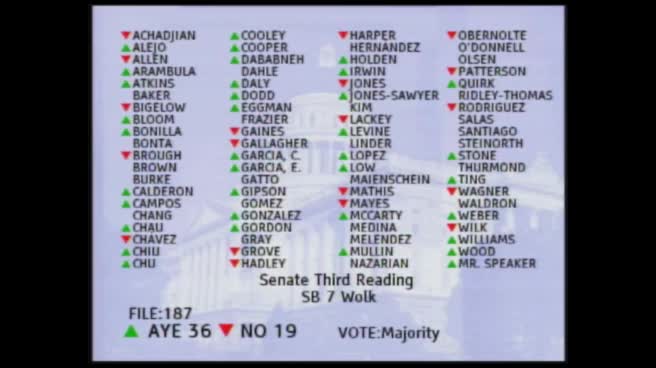 5MIN
Assembly Floor
 3MIN
Assembly Floor
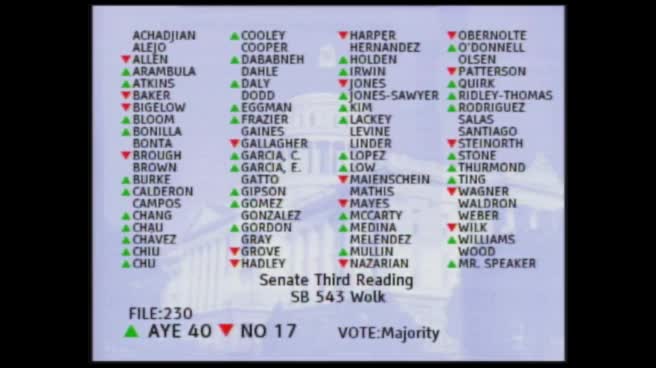 5MIN
Assembly Floor
 1MIN
Assembly Floor
 1MIN
Assembly Standing Committee on Appropriations
Bill Author

Bill Co-Author(s):