SB 1277: California Environmental Quality Act: supplemental environmental impact report: City of Oakland: coal shipment.
- Session Year: 2015-2016
- House: Senate
- Latest Version Date: 2016-04-04
The California Environmental Quality Act requires a lead agency, as defined, to prepare, or cause to be prepared, and certify the completion of an environmental impact report (EIR) on a project that it proposes to carry out or approve that may have a significant effect on the environment or to adopt a negative declaration if it finds that the project will not have that effect. The act also requires a lead agency to prepare a mitigated negative declaration for a project that may have a significant effect on the environment if revisions in the project would avoid or mitigate that effect and there is no substantial evidence that the project, as revised, would have a significant effect on the environment. The act prohibits a public agency from requiring the preparation of a subsequent EIR unless one or more certain events occur.
This bill would require a public agency, with discretionary approval over a project necessary for, and directly related to, the use of a certain port facility in the City of Oakland for the shipment of coal, to prepare or cause to be prepared a supplemental EIR to consider and mitigate the environmental impacts of coal shipment through the facility.
This bill would make legislative findings and declarations as to the necessity of a special statute for the City of Oakland.
The California Constitution requires the state to reimburse local agencies and school districts for certain costs mandated by the state. Statutory provisions establish procedures for making that reimbursement.
This bill would provide that no reimbursement is required by this act for a specified reason.
Existing law regulates the operation of ports and harbors. The Highway Safety, Traffic Reduction, Air Quality, and Port Security Bond Act of 2006 (Proposition 1B) created the Trade Corridors Improvement Fund and provided for allocation by the California Transportation Commission of $2 billion in bond funds for infrastructure improvements on highway and rail corridors that have a high volume of freight movement, and specified categories of projects eligible to receive these funds, including projects to enhance the capacity and efficiency of ports.
This bill would prohibit the shipment of coal to, or through, a certain port facility located in the former Oakland Army Base that has been funded in part by the proceeds of Proposition 1B.
This bill would make legislative findings and declarations as to the necessity of a special statute for the City of Oakland.
(a)The Legislature finds and declares all of the following:
(1)The City of Oakland has received substantial funding from the California Transportation Commission for the development of the Bulk and Oversized Terminal at the former Oakland Army Base. The funding has been provided from the proceeds of bonds sold pursuant to the Highway Safety, Traffic Reduction, Air Quality, and Port Security Bond Act of 2006 (Chapter 12.49 (commencing with Section 8879.20) of Division 1 of Title 2 of the Government Code).
(2)According to the Legislative Analysts analysis of the Highway Safety, Traffic Reduction, Air Quality, and Port Security Bond Act of 2006, one of the goals of the act was to provide funding to projects to improve air quality by reducing emissions related to goods movement.
(3)In the agreement between the City of Oakland and a private developer for a project that includes the development of the Bulk and Oversized Terminal, paragraph D of the Recitals states that the development of the project will provide many benefits to the City and the public including but not limited to: (1) mitigate or avoid potential significant environmental impacts; ... . impacts; .... In paragraph 3.4.2 of that agreement, the City of Oakland reserves the right to apply regulations adopted after the effective date of the agreement if the city finds failure to apply those regulations would place existing or future occupants or users of the Project, adjacent neighbors, or any portion thereof, or all of them, in a condition substantially dangerous to their health or safety.
(4)During the consideration of an environmental impact report prepared by the City of Oakland for the Bulk and Oversized Terminal in 2012, coal was not considered as a commodity that would be shipped through the terminal.
(4)
(5)There is currently a proposal to export coal from the Bulk and Oversized Terminal. This constitutes a change in the proposed project and is new information that was not known and could not have been known at the time the environmental impact report was certified as complete.
(5)
(6)Coal export poses unique and substantial dangers to citizens in adjacent neighborhoods, workers at the site, and to the Oakland community as a whole.
(6)
(7)Assuming that 10.5 million tons of coal is shipped annually, as much as 646 tons per year of fugitive coal dust may be generated by the movement of coal through the port facility.
(7)
(8)Coal dust poses serious health concerns for a neighborhood already burdened with a history of environmental injustices and ill equipped to cope with additional stresses.
(8)
(9)The American Lung Association considers coal dust a source of particulate matter that is dangerous to breathe.
(9)
(10)The World Health Organization cites coal dust, along with silica and asbestos, as responsible for most occupational lung diseases due to airborne particulate.
(10)
(11)The United States Environmental Protection Agency cites numerous scientific studies that link particulate matter with a series of significant health problems, including premature death in people with lung or heart disease, nonfatal heart attacks, irregular heartbeat, aggravated asthma, decreased lung function, and increased respiratory symptoms, such as irritation of the airways, coughing, or difficulty in breathing.
(11)
(12)There are no proven topping agents that have demonstrated effectiveness at reducing coal dust over long trips.
(12)
(13)Confined or covered coal transportation and terminal operations would shift the burden of toxic pollution to workers at the site while also exacerbating risks of fire during transport, storage, and loading.
(13)
(14)Covered and clean coal operations raise significant safety concerns for workers related to the increased likelihood of coal combustion when it is confined. Trains often have open-top cars as a technique to mitigate the chances of fires by allowing heat to escape. If these train cars and warehouse spaces are covered then risk of fire is likely to be higher.
(14)
(15)Coal transport, warehousing, and loading operations will increase worker exposure to coal dust due to inherent jostling of the commodity. Covering and confining the coal export terminal and its operations will only exacerbate these problems because dust will be more concentrated within the workspace.
(15)
(16)Coal presents transportation concerns because the weight of the trains increases stress on tracks and slows traffic, and because the dust damages rail tracks.
(16)
(17)Coal dust and leachates can pollute waterways, often with long-lasting impacts.
(17)
(18)The community of West Oakland, which is near the Bulk and Oversized Terminal, is already heavily and adversely impacted by goods movements through the community.
(18)
(19)The California Environmental Protection Agency, using the California Communities Environmental Health Screening Tool (CalEnviroScreen), a tool that assesses all census tracts in California, has identified the community of West Oakland as a disadvantaged community disproportionately burdened by, and vulnerable to, multiple sources of pollution.
(19)
(20)The residents of West Oakland breathe air containing three times the amount of diesel particulate matter than in other parts of the San Francisco Bay area, which translates to a 2.5 times greater risk of cancer. Children in West Oakland suffer from ailments like asthma at higher rates than children in other neighborhoods.
(20)
(21)The residents of West Oakland are two times more likely to go to a hospital emergency room with asthma as compared to residents in other parts of the County of Alameda. According to the Office of Statewide Health Planning and Development, in 2009, for every 10,000 visits, 183 visits in West Oakland were due to asthma, whereas the statewide average is 48 visits. Those residents are also more likely to die of illnesses linked to air pollution like cancers, heart diseases, and other ailments.
(21)
(22)The residents of West Oakland are already impacted by goods movements, and do not deserve to bear the brunt of the health impacts of coal moving through their community.
(22)
(23)The transportation of coal through the Bulk and Oversized Terminal would present a substantially dangerous condition to the health and safety of the residents of Oakland along with the workers at the Port of Oakland and is contrary to the goals of the Highway Safety, Traffic Reduction, Air Quality, and Port Security Bond Act of 2006.
(b)Because of the substantial dangers to the City of Oakland and its residents associated with coal shipment and because this activity is contrary to the intent of the Highway Safety, Traffic Reduction, Air Quality, and Port Security Bond Act of 2006, to the extent consistent with federal law, coal shall not be transported to, or through, the Bulk and Oversized Terminal located in the former Oakland Army Base.
(b)Pursuant to Section 21166 of the Public Resources Code, before approving a project that is necessary for, and directly related to, the use of the Bulk and Oversized Terminal in the City of Oakland for the shipment of coal, a public agency with discretionary authority over the project shall prepare or cause to be prepared a supplemental environmental impact report to consider and mitigate the environmental impacts of coal shipment through the terminal pursuant to the California Environmental Quality Act (Division 13 (commencing with Section 21000) of the Public Resources Code).
SEC. 2.The Legislature finds and declares that a special law is necessary and that a general law cannot be made applicable within the meaning of Section 16 of Article IV of the California Constitution because of the unique nature of the proposed coal shipment through the Bulk and Oversized Terminal located in the former Oakland Army Base in the City of Oakland.
SEC. 3.No reimbursement is required by this act pursuant to Section 6 of Article XIIIB of the California Constitution because a local agency or school district has the authority to levy service charges, fees, or assessments sufficient to pay for the program or level of service mandated by this act, within the meaning of Section 17556 of the Government Code.
(a)The Legislature finds and declares all of the following:
(1)The City of Oakland has received substantial funding from the California Transportation Commission for the development of the Bulk and Oversized Terminal at the former Oakland Army Base. The funding has been provided from the proceeds of bonds sold pursuant to the Highway Safety, Traffic Reduction, Air Quality, and Port Security Bond Act of 2006 (Chapter 12.49 (commencing with Section 8879.20) of Division 1 of Title 2 of the Government Code).
(2)According to the Legislative Analysts analysis of the Highway Safety, Traffic Reduction, Air Quality, and Port Security Bond Act of 2006, one of the goals of the act was to provide funding to projects to improve air quality by reducing emissions related to goods movement.
(3)In the agreement between the City of Oakland and a private developer for a project that includes the development of the Bulk and Oversized Terminal, paragraph D of the Recitals states that the development of the project will provide many benefits to the City and the public including but not limited to: (1) mitigate or avoid potential significant environmental impacts; ... . In paragraph 3.4.2 of that agreement, the City of Oakland reserves the right to apply regulations adopted after the effective date of the agreement if the city finds failure to apply those regulations would place existing or future occupants or users of the Project, adjacent neighbors, or any portion thereof, or all of them, in a condition substantially dangerous to their health or safety.
(4)There is a proposal to export coal from the Bulk and Oversized Terminal.
(5)Coal export poses unique and substantial dangers to citizens in adjacent neighborhoods, workers at the site, and to the Oakland community as a whole.
(6)Assuming that 10.5 million tons of coal is shipped annually, as much as 646 tons per year of fugitive coal dust may be generated by the movement of coal through the port facility.
(7)Coal dust poses serious health concerns for a neighborhood already burdened with a history of environmental injustices and ill equipped to cope with additional stresses.
(8)The American Lung Association considers coal dust a source of particulate matter that is dangerous to breathe.
(9)The World Health Organization cites coal dust, along with silica and asbestos, as responsible for most occupational lung diseases due to airborne particulate.
(10)The United States Environmental Protection Agency cites numerous scientific studies that link particulate matter with a series of significant health problems, including premature death in people with lung or heart disease, nonfatal heart attacks, irregular heartbeat, aggravated asthma, decreased lung function, and increased respiratory symptoms, such as irritation of the airways, coughing, or difficulty in breathing.
(11)There are no proven topping agents that have demonstrated effectiveness at reducing coal dust over long trips.
(12)Confined or covered coal transportation and terminal operations would shift the burden of toxic pollution to workers at the site while also exacerbating risks of fire during transport, storage, and loading.
(13)Covered and clean coal operations raise significant safety concerns for workers related to the increased likelihood of coal combustion when it is confined. Trains often have open-top cars as a technique to mitigate the chances of fires by allowing heat to escape. If these train cars and warehouse spaces are covered then risk of fire is likely to be higher.
(14)Coal transport, warehousing, and loading operations will increase worker exposure to coal dust due to inherent jostling of the commodity. Covering and confining the coal export terminal and its operations will only exacerbate these problems because dust will be more concentrated within the workspace.
(15)Coal presents transportation concerns because the weight of the trains increases stress on tracks and slows traffic, and because the dust damages rail tracks.
(16)Coal dust and leachates can pollute waterways, often with long-lasting impacts.
(17)The community of West Oakland, which is near the Bulk and Oversized Terminal, is already heavily and adversely impacted by goods movements through the community.
(18)The California Environmental Protection Agency, using the California Communities Environmental Health Screening Tool (CalEnviroScreen), a tool that assesses all census tracts in California, has identified the community of West Oakland as a disadvantaged community disproportionately burdened by, and vulnerable to, multiple sources of pollution.
(19)The residents of West Oakland breathe air containing three times the amount of diesel particulate matter than in other part parts of the San Francisco Bay area, which translates to a 2.5 times greater risk of cancer. Children in West Oakland suffer from ailments like asthma at higher rates than children in other neighborhoods.
(20)The residents of West Oakland are two times more likely to go to a hospital emergency room with asthma as compared to residents in other parts of the County of Alameda. According to the Office of Statewide Health Planning and Development, in 2009, for every 10,000 visits, 183 visits in West Oakland were due to asthma, whereas the statewide average is 48 visits. Those residents are also more likely to die of illnesses linked to air pollution like cancers, heart diseases, and other ailments.
(21)The residents of West Oakland are already impacted by goods movements, and do not deserve to bear the brunt of the health impacts of coal moving through their community.
(22)The transportation of coal through the Bulk and Oversized Terminal would present a substantially dangerous condition to the health and safety of the residents of Oakland along with the workers at the Port of Oakland and is contrary to the goals of the Highway Safety, Traffic Reduction, Air Quality, and Port Security Bond Act of 2006.
(b)Because of the substantial dangers to the City of Oakland and its residents associated with coal shipment and because this activity is contrary to the intent of the Highway Safety, Traffic Reduction, Act Quality Air Quality, and Port Security Bond Act of 2006, to the extent consistent with federal law, coal shall not be transported to, or through, the Bulk and Oversized Terminal located in the former Oakland Army Base.
SEC. 2.The Legislature finds and declares that a special law is necessary and that a general law cannot be made applicable within the meaning of Section 16 of Article IV of the California Constitution because of the unique nature of the proposed coal shipment through the Bulk and Oversized Terminal located in the former Oakland Army Base in the City of Oakland.
(a)The Legislature finds and declares all of the following:
(1)The City of Oakland has received substantial funding from the California Transportation Commission for the development of the Bulk and Oversized Terminal at the former Oakland Army Base. The funding has been provided from the proceeds of bonds sold pursuant to the Highway Safety, Traffic Reduction, Air Quality, and Port Security Bond Act of 2006 (Chapter 12.49 (commencing with Section 8879.20) of Division 1 of Title 2 of the Government Code).
(2)According to the Legislative Analysts analysis of the Highway Safety, Traffic Reduction, Air Quality, and Port Security Bond Act of 2006, one of the goals of the act was to provide funding to projects to improve air quality by reducing emissions related to goods movement.
(3)In the agreement between the City of Oakland and a private developer for a project that includes the development of the Bulk and Oversized Terminal, paragraph D of the Recitals states that the development of the project will provide many benefits to the City and the public including but not limited to: (1) mitigate or avoid potential significant environmental impacts; ... . In paragraph 3.4.2 of that agreement, the City of Oakland reserves the right to apply regulations adopted after the effective date of the agreement if the city finds failure to apply those regulations would place existing or future occupants or users of the Project, adjacent neighbors, or any portion thereof, or all of them, in a condition substantially dangerous to their health or safety.
(4)There is a proposal to export coal from the Bulk and Oversized Terminal.
(5)Coal export poses unique and substantial dangers to citizens in adjacent neighborhoods, workers at the site, and to the Oakland community as a whole.
(6)Assuming that 10.5 million tons of coal is shipped annually, as much as 646 tons per year of fugitive coal dust may be generated by the movement of coal through the port facility.
(7)Coal dust poses serious health concerns for a neighborhood already burdened with a history of environmental injustices and ill equipped to cope with additional stresses.
(8)The American Lung Association considers coal dust a source of particulate matter that is dangerous to breathe.
(9)The World Health Organization cites coal dust, along with silica and asbestos, as responsible for most occupational lung diseases due to airborne particulate.
(10)The United States Environmental Protection Agency cites numerous scientific studies that link particulate matter with a series of significant health problems, including premature death in people with lung or heart disease, nonfatal heart attacks, irregular heartbeat, aggravated asthma, decreased lung function, and increased respiratory symptoms, such as irritation of the airways, coughing, or difficulty in breathing.
(11)There are no proven topping agents that have demonstrated effectiveness at reducing coal dust over long trips.
(12)Confined or covered coal transportation and terminal operations would shift the burden of toxic pollution to workers at the site while also exacerbating risks of fire during transport, storage, and loading.
(13)Covered and clean coal operations raise significant safety concerns for workers related to the increased likelihood of coal combustion when it is confined. Trains often have open-top cars as a technique to mitigate the chances of fires by allowing heat to escape. If these train cars and warehouse spaces are covered then risk of fire is likely to be higher.
(14)Coal transport, warehousing, and loading operations will increase worker exposure to coal dust due to inherent jostling of the commodity. Covering and confining the coal export terminal and its operations will only exacerbate these problems because dust will be more concentrated within the workspace.
(15)Coal presents transportation concerns because the weight of the trains increases stress on tracks and slows traffic, and because the dust damages rail tracks.
(16)Coal dust and leachates can pollute waterways, often with long-lasting impacts.
(17)The community of West Oakland, which is near the Bulk and Oversized Terminal, is already heavily and adversely impacted by goods movements through the community.
(18)The California Environmental Protection Agency, using the California Communities Environmental Health Screening Tool (CalEnviroScreen), a tool that assesses all census tracts in California, has identified the community of West Oakland as a disadvantaged community disproportionately burdened by, and vulnerable to, multiple sources of pollution.
(19)The residents of West Oakland breathe air containing three times the amount of diesel particulate matter than in other part of the San Francisco Bay area, which translates to a 2.5 times greater risk of cancer. Children in West Oakland suffer from ailments like asthma at higher rates than children in other neighborhoods.
(20)The residents of West Oakland are two times more likely to go to a hospital emergency room with asthma as compared to residents in other parts of the County of Alameda. According to the Office of Statewide Health Planning and Development, in 2009, for every 10,000 visits, 183 visits in West Oakland were due to asthma, whereas the statewide average is 48 visits. Those residents are also more likely to die of illnesses linked to air pollution like cancers, heart diseases, and other ailments.
(21)The residents of West Oakland are already impacted by goods movements, and do not deserve to bear the brunt of the health impacts of coal moving through their community.
(22)The transportation of coal through the Bulk and Oversized Terminal would present a substantially dangerous condition to the health and safety of the residents of Oakland along with the workers at the Port of Oakland and is contrary to the goals of the Highway Safety, Traffic Reduction, Air Quality, and Port Security Bond Act of 2006.
(b)Because of the substantial dangers to the City of Oakland and its residents associated with coal shipment and because this activity is contrary to the intent of the Highway Safety, Traffic Reduction, Act Quality and Port Security Act of 2006, coal shall not be transported to, or through, the Bulk and Oversized Terminal located in the former Oakland Army Base.
SEC. 2.The Legislature finds and declares that a special law is necessary and that a general law cannot be made applicable within the meaning of Section 16 of Article IV of the California Constitution because of the unique nature of the proposed coal shipment through the Bulk and Oversized Terminal located in the former Oakland Army Base in the City of Oakland.
|
Date
|
Status
|
|---|---|
| Aug 11, 2016 | August 11 hearing. Held in committee and under submission. |
| Aug 3, 2016 | August 3 set for first hearing. Placed on APPR. suspense file. |
| Jun 28, 2016 | From committee: Do pass and re-refer to Com. on APPR. (Ayes 6. Noes 3.) (June 27). Re-referred to Com. on APPR. |
| Jun 13, 2016 | Referred to Com. on NAT. RES. |
| Jun 2, 2016 | In Assembly. Read first time. Held at Desk. |
| Jun 1, 2016 | Read third time. Passed. (Ayes 26. Noes 13. Page 4086.) Ordered to the Assembly. |
| Jun 1, 2016 | Read third time. Passed. (Ayes 26. Noes 13.) Ordered to the Assembly. |
| May 27, 2016 | From committee: Do pass. (Ayes 5. Noes 2. Page 4007.) (May 27). |
| May 27, 2016 | Read second time. Ordered to third reading. |
| May 27, 2016 | From committee: Do pass. (Ayes 5. Noes 2.) (May 27). |
| May 20, 2016 | Set for hearing May 27. |
| May 16, 2016 | May 16 hearing: Placed on APPR. suspense file. (Ayes 7. Noes 0.) |
| May 6, 2016 | Set for hearing May 16. |
| Apr 21, 2016 | From committee: Do pass and re-refer to Com. on APPR. (Ayes 5. Noes 2. Page 3643.) (April 20). Re-referred to Com. on APPR. |
| Apr 21, 2016 | From committee: Do pass and re-refer to Com. on APPR. (Ayes 5. Noes 2.) (April 20). Re-referred to Com. on APPR. |
| Apr 14, 2016 | Set for hearing April 20. |
| Apr 13, 2016 | From committee: Do pass and re-refer to Com. on E.Q. (Ayes 7. Noes 3. Page 3523.) (April 12). Re-referred to Com. on E.Q. |
| Apr 13, 2016 | From committee: Do pass and re-refer to Com. on E.Q. (Ayes 7. Noes 3.) (April 12). Re-referred to Com. on E.Q. |
| Apr 5, 2016 | Set for hearing April 12. |
| Apr 4, 2016 | April 5 hearing postponed by committee. |
| Apr 4, 2016 | From committee with author's amendments. Read second time and amended. Re-referred to Com. on T. & H. |
| Mar 30, 2016 | From committee with author's amendments. Read second time and amended. Re-referred to Com. on T. & H. |
| Mar 16, 2016 | Set for hearing April 5. |
| Mar 3, 2016 | Referred to Coms. on T. & H. and E.Q. |
| Feb 22, 2016 | Read first time. |
| Feb 22, 2016 | From printer. May be acted upon on or after March 23. |
| Feb 19, 2016 | Introduced. To Com. on RLS. for assignment. To print. |
|
Date
|
Description
|
Location
|
Votes
|
|
|---|---|---|---|---|
| Jun 27, 2016 | Do pass and be re-referred to the Committee on [Appropriations] | Assembly Standing Committee on Natural Resources |
Passed |
|
| Jun 1, 2016 | Senate 3rd Reading SB1277 Hancock | Senate Floor |
Passed |
|
| May 27, 2016 | Do pass | Senate Standing Committee on Appropriations |
Passed |
|
| May 16, 2016 | Placed on suspense file | Senate Standing Committee on Appropriations |
Passed |
|
| Apr 20, 2016 | Do pass, but first be re-referred to the Committee on [Appropriations] | Senate Standing Committee on Environmental Quality |
Passed |
|
| Apr 12, 2016 | Do pass, but first be re-referred to the Committee on [Environmental Quality] | Senate Standing Committee on Transportation and Housing |
Passed |
This list shows positions taken on this bill by organizations on the date displayed, which is linked to the original source.
Positions by individuals are not included.
Date of Hearing: August 3, 2016
ASSEMBLY COMMITTEE ON APPROPRIATIONS
Lorena Gonzalez, Chair
SBPCA Bill Id:SB 1277
Author:(Hancock) – As Amended Ver:April 4, 2016
Policy Committee: | Natural Resources | Vote: | 6 - 3 |
Urgency: No State Mandated Local Program: Yes Reimbursable: No
SUMMARY:
This bill requires a public agency with discretionary authority over the Bulk and Oversized Terminal project, located in the former Oakland Army Base (OBOT), to prepare or cause to be prepared, a supplemental environmental impact report (EIR) to consider and mitigate the shipment of coal through the terminal.
This bill also states legislative findings and declarations including that during the consideration of the EIR, coal was not considered as a commodity that would be shipped through the terminal.
FISCAL EFFECT:
Unknown significant costs, which could be state or local costs depending on which public agency would have the next discretionary authority over approving a project. These costs would be recovered by fees charged to the project proponent for the cost of preparing the supplemental EIR.
The duty to prepare a supplemental EIR could fall to any one of several public entities that may have permitting authority over a project, including the City of Oakland, the Bay Area Air Quality Management District (BAAQMD), the San Francisco Bay Conservation and Development Commission (BCDC), or other public agency.
To the extent the responsibility falls to a state entity, there would be significant state costs, and potential impacts particularly if the agency has no expertise in considering environmental issues that fall outside of its purview. These costs would eventually be recovered by fees charged to the project proponent, but the responsible agency could experience significant workload disruptions and incur secondary fiscal impacts.
COMMENTS:
- Purpose. According to the author:
"Most recently, the City of Oakland has adopted a zoning ordinance to amend the Oakland Municipal Code and to prohibit the storage and handling of coal and coke at bulk material facilities or terminals throughout the City of Oakland. The City’s zoning ordinance comes as a result of a proposed project at the former Oakland Army Base that would bring up to 10 million tons of coal to West Oakland each year. Coal would come on railroad lines from Utah and be transferred to cargo ships for export to China and other overseas countries. If built, it will be nearly four times larger than any coal export terminal in the West Coast.
Although the zoning ordinance was adopted, it does not stop the coal export terminal from being built. The project developer has publicly advised that he will enter litigation and sue the City of Oakland for breach of contract and violation of his vested rights. If litigation takes place, and the developer is victorious in court, he can move on with the coal export facility and not have to do an Environmental Impact Report (EIR). The City’s zoning ordinance adopts CEQA exemption findings and relies on the previously certified 2002 and 2012 EIRs; both EIRs did not analyze the impact of the coal export facility."
- CEQA Background. CEQA provides a process for evaluating the environmental effects of applicable projects undertaken or approved by public agencies. If a project is not exempt from CEQA, an initial study is prepared to determine whether the project may have a significant effect on the environment. If the initial study shows there would not be a significant effect on the environment, the lead agency must prepare a negative declaration. If the initial study shows that the project may have a significant effect on the environment, the lead agency must prepare an EIR.
CEQA also requires a lead agency or responsible agency to prepare a subsequent or supplemental EIR if one or more of the following occurs:
- Substantial changes are proposed in the project that will require major revisions of the EIR.
- Substantial changes occur in the circumstances under which the project is being undertaken that will require major revisions to the EIR.
- New information, which was not known and could not have been known at the time the EIR was certified as complete, becomes available.
- The Oakland Bulk and Oversized Terminal (OBOT) and coal. After the Oakland Army Base was closed was closed in 1999, part of the property reverted to the City of Oakland, while another portion was transferred to the Port of Oakland. The following year, the Oakland City Council designated the base and surrounding properties as a redevelopment project area, and the City of Oakland prepared an EIR in 2002 related to proposed development in the project area. In 2009, the Port of Oakland secured state transportation bond funding for a project to develop warehouse space, logistics facilities, and a rail terminal on the site.
Following the dissolution of the redevelopment agency in 2012, the area owned by the redevelopment agency was transferred to the City of Oakland. The Port and the City began working together on the site and significantly expanded the scope of the redevelopment, including the addition of a bulk terminal (OBOT). The expansion required an update to the original EIR that was completed in 2002, and the City prepared an addendum in 2012.
In spring of 2015, stories surfaced in the media revealing that the state of Utah was in discussions with port developers about shipping coal from Utah to China through the proposed bulk terminal in Oakland. Utah currently exports about 1 million tons of coal each year, mainly through the ports of Richmond, Stockton, and Long Beach. As coal-fired power plants in the U.S. close or switch to natural gas, access to overseas markets is becoming increasingly important for coal-producing states.
On July 19, 2016, the Oakland City Council adopted an Ordinance to prohibit the storage and handling of coal and coke at bulk material facilities or terminals throughout the City of Oakland and declaring the ordinance exempt from CEQA.
- Related legislation. SB 1279 (Hancock) prohibits the California Transportation Commission (CTC) from programming or allocating any state funds, including proceeds from the sale of general obligation bonds, under its jurisdiction for any new bulk coal terminal project proposed on or after January 1, 2017. SB 1279 is also on today’s calendar.
Analysis Prepared by: Jennifer Galehouse / APPR. / (916) 319-2081
Date of Hearing: June 27, 2016
ASSEMBLY COMMITTEE ON NATURAL RESOURCES
Das Williams, Chair
SBPCA Bill Id:SB 1277
Author:(Hancock) – As Amended Ver:April 4, 2016
SENATE VOTE: 26-13
SUBJECT: California Environmental Quality Act: supplemental environmental impact report: City of Oakland: coal shipment
SUMMARY: Requires a public agency with discretionary authority over the Bulk and Oversized Terminal project, located in the former Oakland Army Base, to prepare or cause to be prepared a supplemental environmental impact report (EIR) to consider and mitigate the shipment of coal through the terminal.
EXISTING LAW:
- Requires lead agencies with the principal responsibility for carrying out or approving a proposed discretionary project to prepare a negative declaration, mitigated negative declaration, or environmental impact report (EIR) for this action, unless the project is exempt from CEQA (CEQA includes various statutory exemptions, as well as categorical exemptions in the CEQA Guidelines).
- Requires a lead agency or responsible agency to prepare a subsequent or supplemental EIR only if specified events occur, such as when new information, which was not known and could not have been known at the time the EIR was certified as complete, becomes available.
- Proposition 1B, the Highway Safety, Traffic Reduction, Air Quality, and Port Security Bond Act of 2006, was approved by California voters in November 2006. Proposition 1B authorized the issuance of $19.9 billion in general obligation bonds to fund a variety of transportation projects. Of this, $2 billion was allocated to the Trade Corridor Improvement Fund (TCIF) for infrastructure improvements along high-volume freight corridors.
THIS BILL:
- Requires a public agency, before approving a project that is necessary for, and directly related to, the use of the Bulk and Oversized Terminal in the City of Oakland for the shipment of coal, to prepare or cause to be prepared a supplemental EIR to consider and mitigate the environmental impacts of coal shipment through the terminal.
- Includes related findings and declarations.
FISCAL EFFECT: According to the Senate Appropriations Committee, unknown significant costs, which could be state or local costs depending on which public agency would have the next discretionary authority over approving a project. These costs would be recovered by fees charged to the project proponent for the cost of preparing the supplemental EIR.
COMMENTS:
- CEQA background. CEQA provides a process for evaluating the environmental effects of applicable projects undertaken or approved by public agencies. If a project is not exempt from CEQA, an initial study is prepared to determine whether the project may have a significant effect on the environment. If the initial study shows that there would not be a significant effect on the environment, the lead agency must prepare a negative declaration. If the initial study shows that the project may have a significant effect on the environment, the lead agency must prepare an EIR.
Generally, an EIR must accurately describe the proposed project, identify and analyze each significant environmental impact expected to result from the proposed project, identify mitigation measures to reduce those impacts to the extent feasible, and evaluate a range of reasonable alternatives to the proposed project. If mitigation measures are required or incorporated into a project, the agency must adopt a reporting or monitoring program to ensure compliance with those measures.
CEQA also requires a lead agency or responsible agency to prepare a subsequent or supplemental EIR if one or more of the following occurs:
- Substantial changes are proposed in the project that will require major revisions of the EIR.
- Substantial changes occur in the circumstances under which the project is being undertaken that will require major revisions to the EIR.
- New information, which was not known and could not have been known at the time the EIR was certified as complete, becomes available.
- Oakland Bulk and Oversize Terminal project. After the Oakland Army Base was closed in 1999, part of the property reverted to the City of Oakland, while another portion went to the Port of Oakland. The following year, the Oakland City Council designated the base and surrounding properties, an area totaling 1,800 acres, as a redevelopment project area. In 2009, the Port of Oakland secured TCIF funding for a project to develop warehouse space, logistics facilities, and a rail terminal on the site. By diverting freight from trucks to trains, the new rail terminal complex was expected to reduce diesel PM emissions while simultaneously increasing the efficiency of goods movement through the Port.
Following the dissolution of the redevelopment agency in 2012, the area owned by the redevelopment agency was transferred to the City of Oakland. The Port and the City began working together on the site and significantly expanded the scope of the redevelopment, including the addition of a bulk terminal. The Port obtained a grant under the federal Transportation Investment Generating Economic Recovery (TIGER) program, as well as additional TCIF funds. The expansion of the project required an update to the environmental impact report (EIR) completed in 2002; an addendum was prepared in 2012.
Meanwhile, the City of Oakland forged an agreement with two private entities, California Capital and Investment Group (CCIG) and Prologis, to develop the site. These two companies were tasked with finding additional investors and tenants for the project. Details of what commodities would be transported through the bulk terminal were largely contingent upon the contracts that would be executed, and therefore were not reviewed in the new environmental documents.
To date, the Port and the City have secured about two-thirds of needed project funding. Of this, the majority comes from public funding sources; specifically, the state TCIF ($242 million); the federal TIGER program ($15 million); the Port of Oakland ($16 million); and the City of Oakland ($55 million). In addition, CCIG and Prologis have identified funding totaling approximately $172 million.
In spring of 2015, stories surfaced in the media revealing that the state of Utah was in discussions with Port developers about shipping coal from Utah to China through the bulk terminal in Oakland. Utah currently exports about 1 million tons of coal each year, mainly through the ports of Richmond, Stockton, and Long Beach. As coal-fired power plants in the U.S. close or switch to natural gas, access to overseas markets is becoming increasingly important for coal-producing states. In February 2016, eight working days before the end of the Utah legislative session, a bill surfaced to authorize, and provide $53 million in funding for, the deal. The legislation passed by a wide margin and was signed by Utah Governor Gary Herbert.
As noted above, the City had tasked two companies, CCIG and Prologis, to come up with additional project funding. CCIG, in turn, executed a contract with Terminal Logistics Solutions, a company headed by Jerry Bridges, a former executive director of the Port of Oakland. It was this company that negotiated the deal with Utah.
- Author's statement:
Coal transport spreads the damages caused by coal dust and contributes to the likelihood that residents in adjacent communities will suffer from illnesses linked to pollution -- cancer, heart disease, asthma and other ailments. Coal puts residents and workers at risk, and defeats efforts to ensure a clean and healthy environment. Coal dust is a source of particulate matter that is dangerous to breathe and is also responsible for most occupational lung disease due to airborne particulate. West Oakland is already heavily impacted by pollution. Residents are 2.5 times more likely to get cancer due to breathing air which contains three times the amount of diesel particulate matter than air in other parts of the Bay Area. In addition, West Oakland residents are two times as likely to go to the emergency room with asthma as people in other parts of Alameda County.
The City of Oakland was awarded $176 million from the CTC via the Trade Corridor Improvement Fund (TCIF) for site preparation and infrastructure redevelopment of the former Oakland Army Base. The initial redevelopment project proposal provided to the CTC, did not include the potential for the transportation and export of coal, nor was the initial EIR done with the use of a coal export facility examined. However, the current proposal plans to transport up to 10 million tons of coal to West Oakland each year. Coal would come on railroad lines from Utah and be transferred to cargo ships for export to China and other countries. West Oakland, the location of the development project, is designated by the CalEnviroScreen as being a disadvantaged community due to its high asthma rates, cancer risks, and pollution levels. This proposal to transport approximately 10 million tons of coal is not in accordance with Proposition 1B and contradicts California’s efforts in reducing climate change. Further, this development would be the largest export facility on the west coast of the United States.
When the EIR was prepared by the City of Oakland for the bulk and oversized terminal, coal was not considered as a commodity that would be shipped through the terminal. This constitutes a change to the project and could not have been know at the time the EIR was certified as complete. There needs to be further review done to review the impacts of a coal terminal.
- Related legislation. SB 1279 (Hancock) prohibits the California Transportation Commission (CTC) from programming or allocating any state funds, including proceeds from the sale of general obligation bonds, under its jurisdiction for any new bulk coal terminal project proposed on or after January 1, 2017. SB 1279 is pending in the Assembly Transportation Committee.
REGISTERED SUPPORT / OPPOSITION:
Support
350 Bay Area
Alameda County Board of Supervisors
Alameda County Democratic Party
Asian Pacific Environmental Network
Berkeley Climate Action Coalition
California League of Conservation Voters
California Nurses Association
Center for Environmental Health
City of Berkeley
City of Emeryville
City of Richmond
East Bay Regional Park District
East Bay Young Democrats
Ecology Center
El Cerrito Democratic Club
Environment California
Fossil Fuel California
inNative
International Longshore and Warehouse Union, Northern California District Council
No Coal in Oakland
Oakland Unified School District Board
Peace, Earthcare and Social Witness Committee
Physicians for Social Responsibility, San Francisco Bay Area Chapter
Planning and Conservation League
Public Advocates
San Francisco Baykeeper
Service Employees International Union Local 1021
Sierra Club California
West Oakland Environmental Indicators Project
Opposition
American Planning Association, California Chapter
BNSF Railway Company
California Building Industry Association
California Business Properties Association
California Capital and Investment Group
California Chamber of Commerce
California Manufacturers and Technology Association
California Short Line Railroad Association
California Teamsters Public Affairs Council
California Trade Coalition
Union Pacific Railroad Company
Ventura County Railroad
Analysis Prepared by: Lawrence Lingbloom / NAT. RES. / (916) 319-2092
Office of Senate Floor Analyses (916) 651-1520 Fax: (916) 327-4478 | SB |
THIRD READING
Bill No: SB 1277
:
SENATE TRANS. & HOUSING COMMITTEE: 7-3, 4/12/16
AYES: Beall, Allen, Galgiani, Leyva, McGuire, Roth, Wieckowski
NOES: Cannella, Bates, Gaines
NO VOTE RECORDED: Mendoza
SENATE ENVIRONMENTAL QUALITY COMMITTEE: 5-2, 4/20/16
AYES: Wieckowski, Hill, Jackson, Leno, Pavley
NOES: Gaines, Bates
SENATE APPROPRIATIONS COMMITTEE: 5-2, 5/27/16
AYES: Lara, Beall, Hill, McGuire, Mendoza
NOES: Bates, Nielsen
DIGEST: This bill requires a public agency with discretionary authority over the Bulk and Oversized Terminal project, located in the former Oakland Army Base, to prepare or cause to be prepared a supplemental environmental impact report (EIR) to consider and mitigate the shipment of coal through the terminal.
Existing law:
- Requires, under the California Environmental Quality Act (CEQA), the lead agencies with the principal responsibility for carrying out or approving a proposed discretionary project to prepare a negative declaration, mitigated negative declaration, or environmental impact report (EIR) for this action, unless the project is exempt from CEQA (CEQA includes various statutory exemptions, as well as categorical exemptions in the CEQA Guidelines). (Public Resources Code (PRC) §21000 et seq.)
- Enacts, pursuant to Proposition 1B (Prop. 1B), enacts the Highway Safety, Traffic Reduction, Air Quality, and Port Security Bond Act of 2006 and authorizes $19.9 billion in general obligation bonds to fund a variety of transportation projects. (Government Code §8879.22 et seq.)
This bill:
- Requires a public agency with discretionary authority over the Bulk and Oversized Terminal project, located in the former Oakland Army Base, to prepare or cause to be prepared a supplemental EIR to consider and mitigate the shipment of coal through the terminal.
- States that coal shipment was not considered under the original EIR for this project as a commodity that would be shipped through the terminal.
- States that the proposal to export coal from the terminal constitutes a change in the proposed project and is new information that was not known, and could not have been known, at the time the EIR was certified as complete.
Background
Proposition 1B and the Trade Corridor Improvement Fund (TCIF). Proposition 1B, the Highway Safety, Traffic Reduction, Air Quality, and Port Security Bond Act of 2006, was approved by California voters in November 2006. Proposition 1B authorized the issuance of $19.9 billion in general obligation bonds to fund a variety of transportation projects. Of this, $2 billion was allocated to the TCIF for infrastructure improvements along high-volume freight corridors.
The TCIF program requires at least a 50% match from local, federal, or private sources. The project application must include a specific description of non-TCIF funding (source, amount, and availability) to be applied to the project. The California Transportation Commission (CTC) evaluates TCIF applications based on factors including increased speed of freight traffic; relief for freight system bottlenecks; and reduction of local and regional emissions of diesel particulate matter (PM), carbon dioxide (CO2), oxides of nitrogen (NOx), and other pollutants.
The Oakland Army Base Redevelopment Project. After the Oakland Army Base was closed in 1999, part of the property reverted to the City of Oakland, while another portion went to the Port of Oakland. The following year, the Oakland City Council designated the base and surrounding properties, an area totaling 1,800 acres, as a redevelopment project area. In 2009, the Port of Oakland secured TCIF funding for a project to develop warehouse space, logistics facilities, and a rail terminal on the site. By diverting freight from trucks to trains, the new rail terminal complex was expected to reduce diesel PM emissions while simultaneously increasing the efficiency of goods movement through the Port.
Following the dissolution of the redevelopment agency in 2012, the area owned by the redevelopment agency was transferred to the City of Oakland. The Port and the City began working together on the site and significantly expanded the scope of the redevelopment, including the addition of a bulk terminal. The Port obtained a grant under the federal Transportation Investment Generating Economic Recovery (TIGER) program, as well as additional TCIF funds. The expansion of the project required an update to the EIR completed in 2002; an addendum was prepared in 2012.
Meanwhile, the City of Oakland forged an agreement with two private entities, California Capital and Investment Group (CCIG) and Prologis, to develop the site. These two companies were tasked with finding additional investors and tenants for the project. Details of what commodities would be transported through the bulk terminal were largely contingent upon the contracts that would be executed, and therefore were not reviewed in the new environmental documents.
To date, the Port and the City have secured about two-thirds of needed project funding. Of this, the majority comes from public funding sources; specifically, the state TCIF ($242 million); the federal TIGER program ($15 million); the Port of Oakland ($16 million); and the City of Oakland ($55 million). In addition, CCIG and Prologis have identified funding totaling approximately $172 million.
In spring of 2015, stories surfaced in the media revealing that the state of Utah was in discussions with Port developers about shipping coal from Utah to China through the bulk terminal in Oakland. Utah currently exports about 1 million tons of coal each year, mainly through the ports of Richmond, Stockton, and Long Beach. As coal-fired power plants in the U.S. close or switch to natural gas, access to overseas markets is becoming increasingly important for coal-producing states. In February 2016, eight working days before the end of the Utah legislative session, a bill surfaced to authorize, and provide $53 million in funding for, the deal. The legislation passed by a wide margin and was signed by Governor Gary Herbert on March 22, 2016.
As noted above, the City had tasked two companies, CCIG and Prologis, to come up with additional project funding. CCIG, in turn, executed a contract with Terminal Logistics Solutions, a company headed by Jerry Bridges, a former executive director of the Port of Oakland. It was this company that negotiated the deal with Utah.
California Environmental Quality Act (CEQA). CEQA requires state and local agencies to identify the significant environmental impacts of their actions and to avoid or mitigate those impacts, if feasible. Every development project that requires a discretionary government approval requires at least some environmental review pursuant to CEQA, unless an exemption applies. Specifically:
- If the initial study shows there would not be a significant impact on the environment, the lead agency must prepare a negative declaration.
- If the study shows potentially significant impacts but the applicant revises the project plan in a manner to avoid or mitigate those impacts, before the proposed negative declaration and initial study are released for public review, the lead agency must prepare a mitigated negative declaration.
- If the initial study shows the project might have a significant effect on the environment, the lead agency must prepare an EIR.
Generally, an EIR must accurately describe the proposed project, identify and analyze each significant environmental impact expected to result from the proposed project, identify mitigation measures to reduce those impacts to the extent feasible, and evaluate a range of reasonable alternatives to the proposed project.
CEQA also requires a lead agency or responsible agency to prepare a subsequent or supplemental EIR if one or more of the following occurs:
- Substantial changes are proposed in the project that will require major revisions of the EIR.
- Substantial changes occur in the circumstances under which the project is being undertaken that will require major revisions to the EIR.
- New information, which was not known and could not have been known at the time the EIR was certified as complete, becomes available.
Comments
- Why didn’t the TCIF application mention coal? The TCIF application, in reference to the bulk terminal portion of the project, stated that it would be “converted to a modern bulk cargo marine terminal for movement of commodities such as iron ore, corn, and other products brought in to the terminal by rail … the terminal would also accommodate project cargo such as windmills, steel coils, and oversized goods.” The TCIF application did not require the applicant to disclose, or commit to, exactly what commodity or commodities would be transported through the terminal.
- How would this bill impact the Oakland project? This bill requires that when the next step of this project is reached, the agency with discretionary approval of that step (e.g., the local air district or the water board) will have to prepare or commission a supplemental EIR. By requiring a supplemental EIR, this bill could potentially delay the project timeline. At the same time, however, a supplemental EIR will help ensure that any potential impacts from shipping coal through the port and community are addressed. Because there has been no movement by a local agency, for nearly a year, seeking to put on record that potential coal shipment is new information that should be analyzed, this bill seeks to clarify and ensure that this issue gets addressed.
- Concerns. The Pacific Merchant Shipping Association (PMSA) has taken a position of “concern” on this bill, citing legal concerns and noting that “all of these facilities in question have already received their environmental clearances, mostly through exceptionally thorough and highly-scrutinized EIR processes …”
Related/Prior Legislation
SB 1279 (Hancock, 2016) prohibits the CTC from programming or allocating state funds for any port facility project in or adjacent to one or more DACs which export or propose to export coal from California.
FISCAL EFFECT: Appropriation: Fiscal Com.: Local:
According to the Senate Appropriations Committee:
Unknown significant costs, which could be state or local costs depending on which public agency would have the next discretionary authority over approving a project. These costs would be recovered by fees charged to the project proponent for the cost of preparing the supplemental EIR.
Alameda County Democratic Central Committee
Berkeley Climate Action Coalition
California Nurses Association
Center for Environmental Health
City of Berkeley
City of Emeryville
City of Richmond
East Bay Regional Park District
East Bay Young Democrats
Ecology Center
El Cerrito Democratic Club
Environment California
Fossil Free California
Friends Committee on Legislation
inNative
International Longshore and Warehouse Union, Northern California District Council
No Coal in Oakland
Oakland Unified School District
Peace, Earthcare, and Social Witness Committee of Strawberry Creek Quaker
Meeting
Physicians for Social Responsibility
Public Advocates
San Francisco Baykeeper
Save the Bay
SEIU Local 1021
Sierra Club California
West Oakland Environmental Indicators Project
350 Bay Area
One individual
OPPOSITION: (Verified 5/27/16)
American Planning Association, California Chapter
California Building Industry Association
California Business Properties Association
California Capital and Investment Group
California Chamber of Commerce
California Manufacturers and Technology Association
California Railroad Industry
California Teamsters Public Affairs Council
ARGUMENTS IN SUPPORT: The author states that coal transport spreads the damages caused by coal dust and contributes to the likelihood that residents in adjacent communities will suffer from illnesses linked to pollution, such as cancer, heart disease, and asthma. Coal dust is a source of PM that is dangerous to breathe and is responsible for most occupational lung disease. West Oakland is already heavily impacted by pollution: Its residents are 2.5 times more likely to get cancer due to breathing air which contains three times the amount of diesel PM than air in other parts of the Bay Area. In addition, West Oakland residents are two times as likely to go to the emergency room with asthma as people in other parts of Alameda County.
The author states that the initial redevelopment project proposal provided to the CTC in the TCIF application did not include the potential for the transport and export of coal, nor did the initial EIR examine the use of a coal export facility. Now, however, the project proposes to transport up to 9 million tons of coal each year from Utah, through the Port, to China and other countries. West Oakland, the location of the project, has already been designated by the state as a disadvantaged community (DAC) due to its high asthma rates, cancer risks, and pollution levels. The author states that this proposal is not in accordance with Proposition 1B and contradicts California’s efforts in reducing climate change.
ARGUMENTS IN OPPOSITION: The American Planning Association, California Chapter, writing in opposition to this bill, states that “While APA supports the State’s renewable energy portfolio; we do not support the idea of special CEQA treatment of an individual project by the Legislature.” The California Railroad Industry, also writing in opposition to this bill, states that it “singles out coal-related projects at a specified bulk cargo terminal, treating coal shipments differently than every other commodity that moves through that facility.”
5/28/16 17:15:15
**** END ****
SENATE COMMITTEE ON
Senator Ricardo Lara, Chair
2015 - 2016 Regular Session
SB 1277 (Hancock) - California Environmental Quality Act: supplemental environmental impact report: City of Oakland: coal shipment
Version: | Policy Vote: |
Urgency: | Mandate: |
Hearing Date: | Consultant: |
This bill meets the criteria for referral to the Suspense File.
Bill Summary:
SB 1277 would require a public agency with discretionary authority over a proposed project that is necessary for the shipment of coal at a proposed Oakland port facility to prepare a supplemental environmental impact report (EIR) to consider and mitigate the environmental impacts of coal shipments.
Fiscal Impact:
Unknown significant costs, which could be state or local costs depending on which public agency would have the next discretionary authority over approving a project. These costs would be recovered by fees charged to the project proponent for the cost of preparing the supplemental EIR. See staff comments.
Background:
California Environmental Quality Act (CEQA)
Existing CEQA law generally requires lead agencies with the principal responsibility for carrying out or approving a proposed discretionary project to prepare a negative declaration, mitigated negative declaration, or EIR for this action. Generally, an EIR must accurately describe the proposed project, identify and analyze each significant environmental impact expected to result from the proposed project, identify mitigation measures to reduce those impacts to the extent feasible, and evaluate a range of reasonable alternatives to the proposed project. If mitigation measures are required or incorporated into a project, the agency must adopt a reporting or monitoring program to ensure compliance with those measures.
Lead agencies and other responsible agencies are required to prepare a subsequent or supplemental EIR only if specified events occur, such as when new information of substantial importance was not known or could not have been known without the exercise of reasonable due diligence at the time the original EIR was certified. When the original EIR has been certified, comprehensive analysis of the project is presumed to have already taken place and the question becomes whether circumstances have changed enough to justify repeating a part of the environmental review process. A supplemental EIR need only address those EIR topics that require major revisions to the original EIR. If the project was approved by the lead agency before the conditions that trigger a supplemental EIR occurred, then the supplemental EIR must be prepared by the public agency that grants the next discretionary approval for the project.
Existing law authorizes a lead agency to charge and collect a reasonable fee from a project proponent to recover the estimated costs incurred by the lead agency in preparing a negative declaration or an EIR, as specified.
The Oakland Bulk and Oversized Terminal (OBOT) and coal
After the Oakland Army Base was closed in 1999, part of the property reverted to the City of Oakland, while another portion was transferred to the Port of Oakland. The following year, the Oakland City Council designated the base and surrounding properties as a redevelopment project area, and the City of Oakland prepared an EIR in 2002 related to proposed development in the project area. In 2009, the Port of Oakland secured state transportation bond funding for a project to develop warehouse space, logistics facilities, and a rail terminal on the site.
Following the dissolution of the redevelopment agency in 2012, the area owned by the redevelopment agency was transferred to the City of Oakland. The Port and the City began working together on the site and significantly expanded the scope of the redevelopment, including the addition of a bulk terminal (OBOT). The expansion required an update to the original EIR that was completed in 2002, and the City prepared an addendum in 2012.
The City entered into an agreement with two private entities, California Capital and Investment Group (CCIG) and Prologis, to develop the site and find additional investors and tenants for the project. Details of what commodities would be transported through the bulk terminal were largely contingent upon the contracts that would be executed, and therefore were not reviewed in the original and addendum environmental documents for the project. CCIG subsequently executed a contract with Terminal Logistics Solutions (TLS) as a long-term lessee that would also manage an existing track network.
In spring of 2015, stories surfaced in the media revealing that the state of Utah was in discussions with port developers about shipping coal from Utah to China through the proposed bulk terminal in Oakland. Utah currently exports about 1 million tons of coal each year, mainly through the ports of Richmond, Stockton, and Long Beach. As coal-fired power plants in the U.S. close or switch to natural gas, access to overseas markets is becoming increasingly important for coal-producing states.
In early 2016, Utah Governor Gary Herbert signed legislation that would contribute $53 million in Utah transportation funds towards the construction of the new Oakland cargo terminal. To fund the Oakland project, Utah would use state tax revenue and then reimburse the state with federal royalties from mineral leases. TLS is looking to partner with four Utah counties to export commodities including coal, providing four to five million tons of annual shipping capacity and access to overseas markets in exchange for a $53 million investment in the OBOT. TLS has yet to exercise its option to develop the terminal.
According to the Senate Environmental Quality Committee’s analysis of this bill:
“Coal dust is a fine powdered form of coal, which is created by the crushing, grinding, or pulverizing of coal. Because of the brittle nature of coal, coal dust can be created during mining, transportation, or by mechanically handling coal. Also, not all coal is created equally – some types break down into dust more easily than others. Particulate matter from the transportation of coal can impact air quality, and severe exposure to coal dust can cause various pulmonary diseases. In addition, questions may arise regarding potential environmental impacts caused by chronic, low-level input of coal dust that may result from steady coal shipment traffic. For example, could the transportation of coal cause pollutant emissions, noise, potential fires, or leaching of chemicals? Could coal dust cover the leaves of nearby vegetation and reduce its photosynthesis capabilities or have toxic effects on public health or wildlife?”
Proposed Law:
SB 1277 would require a public agency with discretionary authority over a project that is necessary for, and directly related to, the use of the OBOT for the shipment of coal, to prepare or cause to be prepared a supplemental EIR to consider and mitigate the environmental impacts of coal shipment through the terminal, prior to approving the project.
The bill also includes extensive findings and declarations. Among these is a statement that coal was not considered as a commodity that would be shipped through the terminal when the City of Oakland prepared the 2012 EIR, but that there is a current proposal to export coal from the OBOT. There is also a finding that this constitutes a change in the proposed project that is new information that was not known and could not have been known at the time the EIR was certified as complete.
Related Legislation:
SB 1279 (Hancock), which is also scheduled for hearing in this Committee, would prohibit the California Transportation Commission (CTC) from programming or allocating state funds for proposed projects at certain port facilities that are involved in the handling, storage, or transportation of coal. The bill would also require the CTC to evaluate every project it considers to determine whether it will increase the state’s capacity to facilitate the transportation of coal.
Staff Comments:
Since there has been no action on the local level to consider the environmental impacts related to the transportation and shipment of coal through the proposed OBOT, this bill requires the next public agency with discretionary authority over a project related to the terminal to prepare a supplemental EIR that would consider and mitigate those impacts. This duty could fall to any one of several public entities that may have permitting authority over a project, including the City of Oakland, the Bay Area Air Quality Management District (BAAQMD), the San Francisco Bay Conservation and Development Commission (BCDC), or other public agency. To the extent the responsibility is placed upon a local agency, any costs related to the preparation of a supplemental EIR would not be reimbursable from the state because existing law provides fee authority to offset those costs. To the extent the responsibility falls to a state entity, there would be significant state costs, and potentially peripheral impacts if the agency has no expertise in considering environmental issues that fall outside of its purview. These costs would eventually be recovered by fees charged to the project proponent for the cost of preparing the supplemental EIR, but the responsible agency could experience significant workload disruptions and incur secondary fiscal impacts.
-- END --
SENATE COMMITTEE ON ENVIRONMENTAL QUALITY
Senator Wieckowski, Chair
2015 - 2016 Regular
Bill No: SB 1277
Author: | Hancock | ||
Version: | 4/4/2016 | Hearing Date: | 4/20/2016 |
Urgency: | No | Fiscal: | Yes |
Consultant: | Joanne Roy | ||
SUBJECT: California Environmental Quality Act: supplemental environmental impact report: City of Oakland: coal shipment
ANALYSIS:
Existing law, under the California Environmental Quality Act (CEQA),
- Requires lead agencies with the principal responsibility for carrying out or approving a proposed discretionary project to prepare a negative declaration, mitigated negative declaration, or environmental impact report (EIR) for this action, unless the project is exempt from CEQA (CEQA includes various statutory exemptions, as well as categorical exemptions in the CEQA Guidelines). (Public Resources Code (PRC) §21000 et seq.)
- Requires a lead agency or responsible agency to prepare a subsequent or supplemental EIR only if specified events occur, such as when new information, which was not known and could not have been known at the time the EIR was certified as complete, becomes available. (PRC §21166(c))
- Pursuant to Proposition 1B (Prop. 1B), enacts the Highway Safety, Traffic Reduction, Air Quality, and Port Security Bond Act of 2006 and authorizes $19.9 billion in general obligation bonds to fund a variety of transportation projects. (Government Code §8879.22 et seq.)
This bill:
- Makes several findings and declarations related to a project to develop the Bulk and Oversized Terminal at the former Oakland Army Base and a proposal to export coal from there.
- Requires a public agency with discretionary authority over the project to prepare or cause to prepare a supplemental EIR to consider and mitigate the environmental impacts of the proposed coal terminal before approving a project that is necessary for, and directly relates to, the use of the terminal for the shipment of coal.
Background
- CEQA: Environmental review process.
CEQA provides a process for evaluating the environmental effects of a project, and includes statutory exemptions as well as categorical exemptions in the CEQA guidelines. If a project is not exempt from CEQA, an initial study is prepared to determine whether a project may have a significant effect on the environment. If the initial study shows that there would not be a significant effect on the environment, the lead agency must prepare a negative declaration. If the initial study shows that the project may have a significant effect on the environment, then the lead agency must prepare an EIR.
Generally, an EIR must accurately describe the proposed project, identify and analyze each significant environmental impact expected to result from the proposed project, identify mitigation measures to reduce those impacts to the extent feasible, and evaluate a range of reasonable alternatives to the proposed project. Prior to approving any project that has received an environmental review, an agency must make certain findings. If mitigation measures are required or incorporated into a project, the agency must adopt a reporting or monitoring program to ensure compliance with those measures.
If a mitigation measure would cause one or more significant effects in addition to those that would be caused by the proposed project, the effects of the mitigation measure must be discussed but in less detail than the significant effects of the proposed project. - What is analyzed in an environmental review?
Pursuant to CEQA, an environmental review analyzing the significant direct and indirect environmental impacts of a proposed project, may include water quality, surface and subsurface hydrology, land use and agricultural resources, transportation and circulation, air quality and greenhouse gas emissions, terrestrial and aquatic biological resources, aesthetics, geology and soils, recreation, public services and utilities such as water supply and wastewater disposal, cultural resources, and tribal cultural resources.
The analysis must also evaluate the cumulative impacts of any past, present, and reasonably foreseeable projects/activities within study areas that are applicable to the resources being evaluated. A study area for a proposed project must not be limited to the footprint of the project because many environmental impacts of a development extend beyond the identified project boundary. Also, CEQA stipulates that the environmental impacts must be measured against existing physical conditions within the project area, not future, allowable conditions. - CEQA: Supplemental EIR.
A supplemental EIR may be necessary, such as when new information of substantial importance was not known or could not have been known without the exercise of reasonable due diligence at the time the original EIR was certified. When the original EIR has been certified, comprehensive analysis of the project is presumed to have already taken place and the question becomes whether circumstances have changed enough to justify repeating a part of the environmental review process. A supplemental EIR need only address those EIR topics that require major revisions to the original EIR. A supplemental EIR is subject to the same notice and public review requirements as the original EIR, except a new notice of preparation is not required. If the project was approved by the lead agency before the conditions that trigger a supplemental EIR happened, then the supplemental EIR must be prepared by the public agency that grants the next discretionary approval for the project. - Coal.
Coal consumption in the United States has been declining in recent years due to the abundance of cheap natural gas, the growth of renewable energy, and environmental regulation. The coal industry has sought to make up for the loss of U.S. demand by increasing exports. Demand for coal globally continues to grow, fueled largely by China. While some U.S. coal is exported to Japan and South Korea, it is not a major player in Asia despite the relative cheapness of western U.S. coal; and the lack of export terminal capacity may be viewed as one of the reasons why. Proposals over the past several years to construct or expand port terminals in Oregon and Washington in order to grow exports to Asia have been defeated or stalled at almost every step, primarily due to concerns about both local environmental impacts and global climate change.- Coal and climate change.
Coal is a fossil fuel. When coal is burned, carbon dioxide, sulfur dioxide, nitrogen oxides, and mercury compounds are released. The fifth assessment report from the Intergovernmental Panel on Climate Change notes that atmospheric concentrations of global warming pollutants have risen to levels unseen in the past 800,000 years. Carbon dioxide concentrations have increased by approximately 40% since pre-industrial times. There is broad scientific consensus that these GHG emission increases are leading to higher air and water temperatures as well as rising sea levels, with serious consequences for California.
In July 2015, Governor Brown spoke at the Vatican symposium on climate change and modern slavery, which aimed to drive awareness, dialogue, and action at the local level – among his remarks, he stated that 90% of the world’s coal must remain unused to help avoid the dangers of global warming. - Coal dust: environmental and public health risks.
Coal dust is a fine powdered form of coal, which is created by the crushing, grinding, or pulverizing of coal. Because of the brittle nature of coal, coal dust can be created during mining, transportation, or by mechanically handling coal. Also, not all coal is created equally – some types break down into dust more easily than others.
Particulate matter from the transportation of coal can impact air quality, and severe exposure to coal dust can cause various pulmonary diseases. In addition, questions may arise regarding potential environmental impacts caused by chronic, low-level input of coal dust that may result from steady coal shipment traffic. For example, could the transportation of coal cause pollutant emissions, noise, potential fires, or leaching of chemicals? Could coal dust cover the leaves of nearby vegetation and reduce its photosynthesis capabilities or have toxic effects on public health or wildlife?
- Coal and climate change.
- Coal shipments through California.
According to the author, three ports in California export coal:- Levin-Richmond Terminal: A private terminal, which exported approximately 1 million tons of coal per year for the last four years; but currently unknown as to whether exports are continuing in 2016.
- Port of Stockton: Coal exports have varied from 25,000 tons to up to 1.8 million tons.
- Port of Long Beach: Less than one million tons.
- Levin-Richmond Terminal: A private terminal, which exported approximately 1 million tons of coal per year for the last four years; but currently unknown as to whether exports are continuing in 2016.
If the coal export terminal is built in West Oakland to handle 10 million tons of coal, it would be the largest coal export facility along the west coast.
- West Oakland public health.
According to the author, West Oakland has been designated as a disadvantaged community by the California Environmental Protection Agency via CalEnviroScreen. The community of West Oakland is impacted heavily by goods movement. West Oakland residents breathe air containing three times the amount of diesel particulate matter than air in other parts of the Bay Area, which translates into 2.5 times greater risk of cancer. Children in West Oakland suffer from ailments like asthma at higher rates than children in other neighborhoods. West Oakland residents are two times as likely to go to the emergency room with asthma as people in other parts of Alameda County. - History of the Oakland Bulk and Oversize Terminal (OBOT).
- Redevelopment of Oakland Army Base.
According to the Senate Transportation and Housing Committee, after the Oakland Army Base closed in 1999, part of the property reverted to the City of Oakland while another portion went to the Port of Oakland. The following year, the Oakland City Council designated the base and surrounding properties, an area totaling 1,800 acres, as a redevelopment area. In 2009, the Port of Oakland secured Trade Corridor Improvement Fund (TCIF) funding for a project to develop warehouse space, logistics facilities, and a rail terminal on the site. By diverting freight from trucks to trains, the new rail terminal complex was expected to reduce diesel PM emissions while simultaneously increasing the efficiency of goods movement through the port.
Following the dissolution of the redevelopment agency in 2012, the area owned by the redevelopment agency was transferred to the City of Oakland. The Port and the City began working together on the site and significantly expanded the scope of the redevelopment, including the addition of a bulk terminal. The Port obtained a grant under the federal Transportation Investment Generating Economic Recovery (TIGER) program, as well as additional TCIF funds. The expansion of the project required an update to the EIR completed in 2002; an addendum was prepared in 2012. - Funding.
According to the Senate Transportation and Housing Committee, the Port and the City forged an agreement with two private entities, California Capital and Investment Group (CCIG) and Prologis, to develop the site. These two companies were tasked with finding additional investors and tenants for the project. Details of what commodities would be transported through the bulk terminal were largely contingent upon the contracts that would be executed, and therefore were not reviewed in the environmental documents.
To date, the Port and the City have secured about two-thirds of needed project funding. Of this, the majority comes from public funding sources, specifically: the state TCIF ($242 million); the federal TIGER program ($15 million); the Port of Oakland ($16 million); and the City of Oakland ($55 million). In addition, CCIG and Prologis have identified funding totaling approximately $172 million. CCIG executed a contract with Terminal Logistics Solutions (TLS), a company headed by Jerry Bridges, a former executive director of the Port of Oakland. It was this company that negotiated the deal with Utah. - Enter Utah.
As coal-fired power plants in the United States close or switch to natural gas, access to overseas markets is becoming increasingly important for coal-producing states. In spring of 2015, stories surfaced in the media revealing that the state of Utah was in discussions with port developers about shipping coal from Utah to China through a proposed bulk terminal in Oakland.
In February 2016, the Utah Legislature passed SB 246 to authorize and provide $53 million in Utah transportation funding to aid construction for the new Oakland cargo terminal. On March 22, 2016, the Utah Governor Gary Herbert signed the bill. To fund the Oakland project, Utah would use state tax revenue and then reimburse the state with federal royalties from federal mineral leases. However, federal mining royalties are required to go to local projects such as building roads, parks, public buildings, water and sewer systems—infrastructure to mitigate the impact of mineral development in Utah. Instead, Utah is putting tax revenue moneys into a newly created, Throughput Infrastructure Fund, and then reimbursing the state with mineral royalties. - What’s the plan?
The OBOT is part of the larger redevelopment project at the former Oakland Army Base, financed with a combination of public and private funds. The improvements for the OBOT part of the project will cost an estimated $250 million. The developer is CCIG and the long-term lessee of the terminal would be TLS, which would also manage an existing track network. TLS is looking to partner with the four Utah counties to export commodities including coal, giving the Utah counties four million to five million tons of annual shipping capacity and access to overseas markets in exchange for a $53 million investment. According to the Los Angeles Times article, “Coal represents the polluted past – except in the interior West,” (William Yardley, March 16, 2016), public records from March 2015 show that at least under a plan being developed at that point, the company that would operate the terminal, TLS, would be controlled in part by Bowie Natural Resources, the company whose Utah coal mines would serve the terminal. TLS has yet to exercise its option to develop the terminal.
- Redevelopment of Oakland Army Base.
Comments
- Purpose of Bill.
According to the author:
A proposed project at the former Oakland Army Base would bring up to 10 million tons of coal to West Oakland each year. Coal would come on railroad lines from Utah and be transferred to cargo ships for export to China and overseas countries. If built, it will be nearly four times larger than any coal export terminal in the West Coast.
West Oakland would be impacted by this coal export facility and coal dust would add to the high pollution levels in West Oakland. West Oakland residents are already 2.5 more likely to get cancer due to breathing air which contains three times the amount of diesel particulate matter than air in other parts of the Bay Area. West Oakland has also been designated by the CalEnviroScreen as being a disadvantaged community due to its high asthma rates, cancer risks, and pollution levels.
I am certainly concerned about the impact of a large coal export terminal and the impact it would have for the surrounding environment, including the San Francisco Bay. It is not acceptable to have the City of Oakland build a large new facility to export coal to places like China where people often must cover their faces or stay inside to avoid breathing dirty air.
The need for a legislative response has gotten even more pronounced as a result of legislation that was just signed into law in Utah that would direct $53 million from the state’s Community Impact Bonds to purchase ownership shares in the Oakland project in order to guarantee port access for Utah’s coal industry. The City of Oakland has already received over $176 million in public funds from the California Transportation Commission via the Trade Corridor Improvement Fund from Proposition 1B. All of which means these efforts to prop up a dirty and antiquated energy source are being supported through public dollars.
SB 1277 declares that the transportation of coal through West Oakland is a clear and present danger to the health and safety of Oakland residents as well as to the workers that would handle the coal. It also requires, before approving a project that is necessary for and directly related to the use of the terminal for the shipment of coal, a public agency with discretionary authority over the project to prepare or cause to prepare a supplemental EIR to consider and mitigate the environmental impacts through the coal terminal pursuant to CEQA.
- Why should the state be concerned?
Some contend that this bill is a district issue and should be dealt with at the local level. However, the impacts of coal on public health and global warming are statewide concerns. For example, the state has policies that prohibit utilities from renewing contracts with coal-fired power plants. Also, coal transported from Utah would have to go through multiple counties in the state before it reaches OBOT – would citizens in those counties be affected by this project?
It seems appropriate for the state to have some concern about a project, which the state has provided $176 million in general obligation funds. As noted above, the Port of Oakland secured TCIF funding in 2009. Prop. 1B mandates, among other things, that when allocating TCIF, emphasis must be placed on projects that improve corridor mobility while reducing emissions of diesel particulate and other pollutant emissions. Coal, which can have significant air quality impacts, was not considered in 2009 as a potential commodity to use in the facility; and, now the export terminal may be built to handle up to 10 million tons of coal annually.
It seems reasonable that when no action has occurred at the local level for almost a year to address this issue that the state may wish to ensure that the law is adhered to and state funds are used as intended. - How much was known when?
The developer, CCIG, explicitly stated in a December 2013 newsletter that CCIG “has no interest or involvement in the pursuit of coal-related operations at the former Oakland Army Base.”
According to the Los Angeles Times article, “How Utah quietly made plans to ship coal through California,” [W]hen state and county officials in southern Utah came up with an unusual plan to invest $53 million in public money to help build an export terminal in San Francisco Bay, they decided to tell as few people as possible what commodity they planned to export. ‘The script,’ according to Jeffrey Holt, the [former] chairman of the Utah Transportation Commission and a central figure in arranging the $53-million loan, writing in an email last spring, ‘was to downplay coal.’” (William Yardley, December 11, 2015).
Over the past several years, with the environmental reviews, contract negotiations, and public funding processes, Oakland City officials claim that they were never advised that coal would be part of the product mix. CCIG did not formally confirm that coal would be one of the exports from the OBOT until a July 2015 letter to the Oakland Mayor. - Need for a supplemental EIR.
CEQA provides that a public agency must prepare a subsequent or supplemental EIR for a project if the lead agency determines that new information of substantial importance has come to light since the EIR was certified. CCIG states that it has already complied with CEQA. However, neither the original EIR, which was certified 13 years ago, nor the CEQA addendum in 2012, included any mention of coal as a commodity that would pass through OBOT – there was no reason to analyze the impacts of coal if coal was not even considered a potential commodity to go through the facility. As noted above, even as late as December 2013, people were under the belief that coal was not a commodity being deliberated.
The developer’s July 2015 letter confirming coal to the Oakland mayor and Utah’s recent approval to help fund the facility with $53 million show a commitment that coal is intended to be shipped through the facility. Both of these show a change in the project requiring supplementation to the environmental review. However, there has been no action at the local level to consider this new development that coal is a commodity that will be shipped through OBOT.
A question that arises is – in what stage of the development process is this facility and what is the next discretionary permitting/action required? Because of the new information regarding coal, the next public agency with discretionary action cannot fully rely on the certified EIR. Thus, the next public agency will become the lead agency that must prepare, or cause to be prepared, a supplemental EIR to analyze and mitigate the environmental impacts related to the shipment of coal.
The original discretionary action by the City of Oakland and for which the EIR was certified is done. Unless Oakland has another discretionary action regarding the facility, the city is no longer the lead agency. For example, if the city reopens the development agreement, then the city could be the lead agency to prepare the supplemental EIR.
Because there has been no movement by a local agency, for almost a year now, that seeks to put on record that this is new information that should be analyzed and to ensure that this does not slip through the cracks, this bill is intended to clarify and make certain that this issue gets addressed.
DOUBLE REFERRAL:
This measure was heard in Senate Committee on Transportation & Housing on April 12, 2016, and passed out of committee with a vote of 7-3.
SOURCE:
Author
SUPPORT:
350 Bay Area
Berkeley Climate Action Coalition
City of Richmond
East Bay Young Democrats
Ecology Center
Environment California
Fossil Free California
Northern California District Council of the International Longshore and
Warehouse Union (ILWU)
Physicians for Social Responsibility San Francisco Bay Area Chapter
Public Advocates
San Francisco Baykeeper
Save the Bay
Sierra Club California
The Peace, Earthcare and Social Witness Committee
West Oakland Environmental Indicators Project
1 Individual
OPPOSITION:
American Planning Association, California Chapter
California Building Industry Association
California Business Properties Association
California Chamber of Commerce
California Manufacturers & Technology Association
California Railroad Industry
California Teamsters Public Affairs Council
-- END --
SENATE COMMITTEE ON TRANSPORTATION AND HOUSING
Senator Jim Beall, Chair
2015 - 2016 Regular
Bill No: Hearing Date: 4/12/2016
Author: | Hancock | ||
Version: | 4/4/2016 Amended | ||
Urgency: | No | Fiscal: | Yes |
Consultant: | Erin Riches | ||
SUBJECT:
DIGEST: This bill requires a public agency with discretionary authority over the Bulk and Oversized Terminal project, located in the former Oakland Army Base, to prepare or cause to be prepared a supplemental environmental impact report to consider and mitigate the shipment of coal through the terminal.
ANALYSIS:
AB 32 and Disadvantaged Communities
AB 32 (Núñez and Pavley, Chapter 488, Statutes of 2006) requires the state Air Resources Board (ARB) to develop a plan to reduce emissions to 1990 levels by 2020. It also requires ARB to ensure that programs to reduce greenhouse gas (GHG) emissions are targeted, to the extent feasible, to the most disadvantaged communities (DACs) in the state. AB 32 authorizes ARB to deposit any fees paid by GHG emission sources into the Greenhouse Gas Reduction Fund (GGRF).
SB 535 (De León, Chapter 830, Statutes of 2012) requires 25% of GGRF funds to be allocated to projects that provide benefits to DACs, and at least 10% to projects located within DACs. DACs have been identified by the California Environmental Protection Agency using census tract data based on geographic, socioeconomic, public health, and environmental hazard criteria.
Proposition 1B and the Trade Corridor Improvement Fund (TCIF)
Proposition 1B, the Highway Safety, Traffic Reduction, Air Quality, and Port Security Bond Act of 2006, was approved by California voters in November 2006. Proposition 1B authorized the issuance of $19.9 billion in general obligation bonds to fund a variety of transportation projects. Of this, $2 billion was allocated to the TCIF for infrastructure improvements along high-volume freight corridors.
The TCIF program requires at least a 50% match from local, federal, or private sources. The project application must include a specific description of non-TCIF funding (source, amount, and availability) to be applied to the project. The California Transportation Commission (CTC) evaluates TCIF applications based on factors including increased speed of freight traffic; relief for freight system bottlenecks; and reduction of local and regional emissions of diesel particulate matter (PM), carbon dioxide (CO2), oxides of nitrogen (NOx), and other pollutants.
The Oakland Army Base Redevelopment Project
After the Oakland Army Base was closed in 1999, part of the property reverted to the City of Oakland, while another portion went to the Port of Oakland. The following year, the Oakland City Council designated the base and surrounding properties, an area totaling 1,800 acres, as a redevelopment project area. In 2009, the Port of Oakland secured TCIF funding for a project to develop warehouse space, logistics facilities, and a rail terminal on the site. By diverting freight from trucks to trains, the new rail terminal complex was expected to reduce diesel PM emissions while simultaneously increasing the efficiency of goods movement through the Port.
Following the dissolution of the redevelopment agency in 2012, the area owned by the redevelopment agency was transferred to the City of Oakland. The Port and the City began working together on the site and significantly expanded the scope of the redevelopment, including the addition of a bulk terminal. The Port obtained a grant under the federal Transportation Investment Generating Economic Recovery (TIGER) program, as well as additional TCIF funds. The expansion of the project required an update to the environmental impact report (EIR) completed in 2002; an addendum was prepared in 2012.
Meanwhile, the City of Oakland forged an agreement with two private entities, California Capital and Investment Group (CCIG) and Prologis, to develop the site. These two companies were tasked with finding additional investors and tenants for the project. Details of what commodities would be transported through the bulk terminal were largely contingent upon the contracts that would be executed, and therefore were not reviewed in the new environmental documents.
To date, the Port and the City have secured about two-thirds of needed project funding. Of this, the majority comes from public funding sources; specifically, the state TCIF ($242 million); the federal TIGER program ($15 million); the Port of Oakland ($16 million); and the City of Oakland ($55 million). In addition, CCIG and Prologis have identified funding totaling approximately $172 million.
In spring of 2015, stories surfaced in the media revealing that the state of Utah was in discussions with Port developers about shipping coal from Utah to China through the bulk terminal in Oakland. Utah currently exports about 1 million tons of coal each year, mainly through the ports of Richmond, Stockton, and Long Beach. As coal-fired power plants in the U.S. close or switch to natural gas, access to overseas markets is becoming increasingly important for coal-producing states. In February 2016, eight working days before the end of the Utah legislative session, a bill surfaced to authorize, and provide $53 million in funding for, the deal. The legislation passed by a wide margin and is currently on the desk of the state’s Republican Governor, Gary Herbert, who is expected to sign it.
As noted above, the City had tasked two companies, CCIG and Prologis, to come up with additional project funding. CCIG, in turn, executed a contract with Terminal Logistics Solutions, a company headed by Jerry Bridges, a former executive director of the Port of Oakland. It was this company that negotiated the deal with Utah.
California Environmental Quality Act (CEQA)
CEQA requires state and local agencies to identify the significant environmental impacts of their actions and to avoid or mitigate those impacts, if feasible. Every development project that requires a discretionary government approval requires at least some environmental review pursuant to CEQA, unless an exemption applies. Specifically:
- If the initial study shows there would not be a significant impact on the environment, the lead agency must prepare a negative declaration.
- If the study shows potentially significant impacts but the applicant revises the project plan in a manner to avoid or mitigate those impacts, before the proposed negative declaration and initial study are released for public review, the lead agency must prepare a mitigated negative declaration.
- If the initial study shows the project might have a significant effect on the environment, the lead agency must prepare an EIR.
Generally, an EIR must accurately describe the proposed project, identify and analyze each significant environmental impact expected to result from the proposed project, identify mitigation measures to reduce those impacts to the extent feasible, and evaluate a range of reasonable alternatives to the proposed project.
CEQA also requires a lead agency or responsible agency to prepare a subsequent or supplemental EIR if one or more of the following occurs:
- Substantial changes are proposed in the project that will require major revisions of the EIR.
- Substantial changes occur in the circumstances under which the project is being undertaken that will require major revisions to the EIR.
- New information, which was not known and could not have been known at the time the EIR was certified as complete, becomes available.
This bill:
- Requires a public agency with discretionary authority over the Bulk and Oversized Terminal project, located in the former Oakland Army Base, to prepare or cause to be prepared a supplemental EIR to consider and mitigate the shipment of coal through the terminal.
- States that coal shipment was not considered under the original EIR for this project as a commodity that would be shipped through the terminal.
- States that the proposal to export coal from the terminal constitutes a change in the proposed project and is new information that was not known, and could not have been known, at the time the EIR was certified as complete.
COMMENTS:
- Purpose. The author states that coal transport spreads the damages caused by coal dust and contributes to the likelihood that residents in adjacent communities will suffer from illnesses linked to pollution, such as cancer, heart disease, and asthma. Coal dust is a source of PM that is dangerous to breathe and is responsible for most occupational lung disease. West Oakland is already heavily impacted by pollution: its residents are 2.5 times more likely to get cancer due to breathing air which contains three times the amount of diesel PM than air in other parts of the Bay Area. In addition, West Oakland residents are two times as likely to go to the emergency room with asthma as people in other parts of Alameda County.
The author states that the initial redevelopment project proposal provided to the CTC in the TCIF application did not include the potential for the transport and export of coal, nor did the initial EIR examine the use of a coal export facility. Now, however, the project proposes to transport up to 9 million tons of coal each year from Utah, through the Port, to China and other countries. West Oakland, the location of the project, has already been designated by the state as a DAC due to its high asthma rates, cancer risks, and pollution levels. The author states that this proposal is not in accordance with Proposition 1B and contradicts California’s efforts in reducing climate change.
- Why didn’t the TCIF application mention coal? The TCIF application, in reference to the bulk terminal portion of the project, stated that it would be “converted to a modern bulk cargo marine terminal for movement of commodities such as iron ore, corn, and other products brought in to the terminal by rail … the terminal would also accommodate project cargo such as windmills, steel coils, and oversized goods.” The TCIF application did not require the applicant to disclose, or commit to, exactly what commodity or commodities would be transported through the terminal.
- Recent amendments. The prior version of this bill prohibited the transport of coal to or through the Bulk or Oversized Terminal located in the former Oakland Army Base. The author amended this bill on April 4 to instead require a public agency with discretionary authority over this project to prepare or cause to be prepared a supplemental EIR to consider and mitigate coal shipment through the terminal. Under the new version of this bill, when the next step of this project is reached, the agency with discretionary approval of that step (e.g., the local air district, the water board) will have to prepare or commission a supplemental EIR.
- How would this bill impact the Oakland project? By requiring a supplemental EIR, this bill could potentially delay the project timeline. At the same time, however, a supplemental EIR will help ensure that any potential impacts from shipping coal through the port and community are addressed.
- Opposition concerns. The American Planning Association, California Chapter, writing in opposition to the current version of this bill, states that “While APA supports the State’s renewable energy portfolio; we do not support the idea of special CEQA treatment of an individual project by the Legislature.” The California Railroad Industry, also writing in opposition to the current version of this bill, states that it “singles out coal-related projects at a specified bulk cargo terminal, treating coal shipments differently than every other commodity that moves through that facility.” The Industry also states that the bill’s provisions extend beyond the state’s authority in areas such as interfering with federal rail operations, discriminating against common carriers, restricting the export of coal in conflict with multiple treaties to which the U.S. is a party, discriminating against interstate and foreign commerce, and imposing retroactive restrictions on a project that has already been approved.
To help allay concerns about conflicts with federal regulations or treaties, the author amended this bill on March 31 to clarify that it will be implemented only to the extent it is consistent with federal law.
- Double-referral. This bill has also been referred to the Environmental Quality Committee.
Related Legislation:
SB 1279 (Hancock) — prohibits the CTC from programming or allocating state funds for any port facility project in or adjacent to one or more DACs which exports or proposes to export coal from California. This bill is also being heard by this committee today.
FISCAL EFFECT: Appropriation: No Fiscal Com.: Yes Local: No
POSITIONS: (Communicated to the committee before noon on Wednesday,
April 6, 2016.)
SUPPORT:
Alameda County Democratic Central Committee
Berkeley Climate Action Coalition
California Nurses Association
City of Berkeley
City of Emeryville
City of Richmond
East Bay Young Democrats
Ecology Center
El Cerrito Democratic Club
Environment California
Fossil Free California
Friends Committee on Legislation
inNative
International Longshore and Warehouse Union, Northern California District Council
No Coal in Oakland
Oakland Unified School District
Peace, Earthcare, and Social Witness Committee of Strawberry Creek Quaker
Meeting
Physicians for Social Responsibility
Public Advocates
San Francisco Baykeeper
SEIU Local 1021
Sierra Club California
West Oakland Environmental Indicators Project
One individual
OPPOSITION:
American Planning Association, California Chapter
California Building Industry Association
California Railroad Industry
California Teamsters Public Affairs Council
-- END --
SENATE COMMITTEE ON TRANSPORTATION AND HOUSING
Senator Jim Beall, Chair
2015 - 2016 Regular
Bill No: Hearing Date: 4/5/2016
Author: | Hancock | ||
Version: | 3/30/2016 Amended | ||
Urgency: | No | Fiscal: | No |
Consultant: | Erin Riches and Sarah Carvill | ||
SUBJECT:
DIGEST: This bill prohibits the transport of coal to or through the Bulk and Oversized Terminal located in the former Oakland Army Base.
ANALYSIS:
AB 32 and Disadvantaged Communities
AB 32 (Núñez and Pavley, Chapter 488, Statutes of 2006) requires the state Air Resources Board (ARB) to develop a plan to reduce emissions to 1990 levels by 2020. It also requires ARB to ensure that programs to reduce greenhouse gas (GHG) emissions are targeted, to the extent feasible, to the most disadvantaged communities (DACs) in the state. AB 32 authorizes ARB to deposit any fees paid by GHG emission sources into the Greenhouse Gas Reduction Fund (GGRF).
SB 535 (De León, Chapter 830, Statutes of 2012) requires 25% of GGRF funds to be allocated to projects that provide benefits to DACs, and at least 10% to projects located within DACs. DACs have been identified by the California Environmental Protection Agency using census tract data based on geographic, socioeconomic, public health, and environmental hazard criteria.
Proposition 1B and the Trade Corridor Improvement Fund (TCIF)
Proposition 1B, the Highway Safety, Traffic Reduction, Air Quality, and Port Security Bond Act of 2006, was approved by California voters in November 2006. Proposition 1B authorized the issuance of $19.9 billion in general obligation bonds to fund a variety of transportation projects. Of this, $2 billion was allocated to the TCIF for infrastructure improvements along high-volume freight corridors.
The TCIF program requires at least a 50% match from local, federal, or private sources. The project application must include a specific description of non-TCIF funding (source, amount, and availability) to be applied to the project. The California Transportation Commission (CTC) evaluates TCIF applications based on factors including increased speed of freight traffic; relief for freight system bottlenecks; and reduction of local and regional emissions of diesel particulate matter (PM), carbon dioxide (CO2), oxides of nitrogen (NOx), and other pollutants.
The Oakland Army Base Redevelopment Project
After the Oakland Army Base was closed in 1999, part of the property reverted to the City of Oakland while another portion went to the Port of Oakland. The following year, the Oakland City Council designated the base and surrounding properties, an area totaling 1,800 acres, as a redevelopment project area. In 2009, the Port of Oakland secured TCIF funding for a project to develop warehouse space, logistics facilities, and a rail terminal on the site. By diverting freight from trucks to trains, the new rail terminal complex was expected to reduce diesel PM emissions while simultaneously increasing the efficiency of goods movement through the Port.
Following the dissolution of the redevelopment agency in 2012, the area owned by the redevelopment agency was transferred to the City of Oakland. The Port and the City began working together on the site and significantly expanded the scope of the redevelopment, including the addition of a bulk terminal. The Port obtained a grant under the federal Transportation Investment Generating Economic Recovery (TIGER) program, as well as additional TCIF funds. The expansion of the project required an update to the environmental impact report (EIR) completed in 2002; an addendum was prepared in 2012.
Meanwhile, the Port and the City forged an agreement with two private entities, California Capital and Investment Group (CCIG) and Prologis, to develop the site. These two companies were tasked with finding additional investors and tenants for the project. Details of what commodities would be transported through the bulk terminal were largely contingent upon the contracts that would be executed, and therefore were not reviewed in the new environmental documents.
To date, the Port and the City have secured about two-thirds of needed project funding. Of this, the majority comes from public funding sources; specifically, the state TCIF ($242 million); the federal TIGER program ($15 million); the Port of Oakland ($16 million); and the City of Oakland ($55 million). In addition, CCIG and Prologis have identified funding totaling approximately $172 million.
In spring of 2015, stories surfaced in the media revealing that the state of Utah was in discussions with Port developers about shipping coal from Utah to China through the bulk terminal in Oakland. Utah currently exports about 1 million tons of coal each year, mainly through the ports of Richmond, Stockton, and Long Beach. As coal-fired power plants in the U.S. close or switch to natural gas, access to overseas markets is becoming increasingly important for coal-producing states. In February 2016, eight working days before the end of the Utah legislative session, a bill surfaced to authorize, and provide $53 million in funding for, the deal with the Port. The legislation passed by a wide margin and is currently on the desk of the state’s Republican Governor, Gary Herbert, who is expected to sign it.
As noted above, the Port and the City had tasked two companies, CCIG and Prologis, to come up with additional project funding. CCIG, in turn, executed a contract with Terminal Logistics Solutions, a company headed by Jerry Bridges, a former executive director of the Port of Oakland. It was this company that negotiated the deal with Utah.
This bill prohibits the transport of coal to or through the Bulk and Oversized Terminal located in the former Oakland Army Base.
COMMENTS:
- Purpose. The author states that coal transport spreads the damages caused by coal dust and contributes to the likelihood that residents in adjacent communities will suffer from illnesses linked to pollution, such as cancer, heart disease, and asthma. Coal dust is a source of PM that is dangerous to breathe and is responsible for most occupational lung disease. West Oakland is already heavily impacted by pollution: its residents are 2.5 times more likely to get cancer due to breathing air which contains three times the amount of diesel PM than air in other parts of the Bay Area. In addition, West Oakland residents are two times as likely to go to the emergency room with asthma as people in other parts of Alameda County.
The author states that the initial redevelopment project proposal provided to the CTC in the TCIF application did not include the potential for the transport and export of coal, nor did the initial EIR examine the use of a coal export facility. Now, however, the project proposes to transport up to 9 million tons of coal each year from Utah, through the Port, to China and other countries. West Oakland, the location of the project, has already been designated by the state as a DAC due to its high asthma rates, cancer risks, and pollution levels. The author states that this proposal is not in accordance with Proposition 1B and contradicts California’s efforts in reducing climate change.
- Why didn’t the TCIF application mention coal? The TCIF application, in reference to the bulk terminal portion of the project, stated that it would be “converted to a modern bulk cargo marine terminal for movement of commodities such as iron ore, corn, and other products brought in to the terminal by rail … the terminal would also accommodate project cargo such as windmills, steel coils, and oversized goods.” The TCIF application did not require the applicant to disclose, or commit to, exactly what commodity or commodities would be transported through the terminal.
- Does coal shipment violate the terms of Proposition 1B? The author states that “the state needs to analyze whether funding infrastructure for a coal export facility violates the intent of Proposition 1B. California cannot continue to finance a project that would harm the air quality, health and safety of West Oakland residents as well as all Californians.”
The TCIF guidelines state that “Proposition 1B mandates that the Commission program and allocate TCIF monies in a manner that,” among other things, “places emphasis on projects that improve trade corridor mobility while reducing emissions of diesel particulate and other pollutant emissions.” By shifting goods movement from trucks to trains, the Oakland project will indeed reduce diesel PM in keeping with the intent of the TCIF. However, if coal is shipped on these trains, the project potentially could also increase CO2 emissions via coal dust from the rail cars. Nonetheless, since the TCIF application did not require a commitment to a certain commodity or commodities to be transported through the terminal, the project developers did not violate any program rules.
- CTC’s authority relating to project amendments. TCIF award recipients must submit quarterly reports to the CTC on project implementation, including the “commitment status of supplemental funding identified in the project baseline agreement.” If the implementing agency anticipates that costs will exceed the approved project budget, it must submit a plan to the CTC that either downsizes the scope of the project or identifies alternative funding sources. The CTC may either approve the corrective plan or direct the implementing agency to modify its plan. In the case of the Oakland project, neither the funding source nor the funding amount changed; rather, the commodities that were expected to be shipped through the bulk terminal changed. Since the original application did not require a commitment to what commodity or commodities would be shipped through the terminal, it does not appear the CTC had cause to further review this project.
- Could the rail cars be covered to reduce coal dust concerns? West Oakland has been identified by the state as a DAC pursuant to SB 535. As such, the prospect of rail cars full of coal raises concerns in the community about coal dust from the cars further polluting the local air. The solution would appear simple: cover the rail cars. However, the committee understands that the technology to do this either does not exist or is prohibitively expensive. In addition, the railroads indicate they already conduct some degree of mitigation for coal dust out of concern for track safety; for example, coal can be coated before it leaves the mine in order to reduce the amount of dust. The author states that while Utah already ships coal through several other California ports, there are no current studies which highlight that coal is not impactful to communities through which it travels.
- How would this bill impact the Oakland project? TCIF requires at least a 50% match from local, federal, or private sources. By prohibiting transport of coal through the Port, this bill would effectively eliminate $53 million worth of matching funds. Forcing the project developers to find an alternative funding source potentially poses the risk of delaying the project.
- Does this bill violate federal law? The California Railroad Industry, writing in opposition to this bill, states that its provisions “reach far beyond the bounds of California’s regulatory authority in a number of different areas” such as interfering with federal rail operations, discriminating against common carriers, restricting the export of coal in conflict with multiple treaties to which the U.S. is a party, discriminating against interstate and foreign commerce, and imposing retroactive restrictions on a project that has already been approved.
The author states that Legislative Counsel indicates that this bill only addresses regulation of a commodity, not regulation of railroad operations. In addition, this bill would only apply retroactively, in cases where project money has already been allocated — not prospectively. To help allay concerns, the author amended this bill on March 31 to clarify that it will be implemented only to the extent it is consistent with federal law.
- Double-referral. This bill has also been referred to the Environmental Quality Committee.
Related Legislation:
SB 1278 (Hancock) — requires every public agency with discretionary approval of any portion of a project relating to the shipment of coal through the Port of Oakland to prepare or cause to prepare an EIR. This bill is also being heard by this committee today.
SB 1279 (Hancock) — prohibits the CTC from programming or allocating any funds for any port facility project in or adjacent to one or more DACs which exports or proposes to export coal from California. This bill is also being heard by this committee today.
SB 1280 (Hancock) — requires, for any project receiving TCIF monies, either a ban on coal shipment or full mitigation of the coal shipment. This bill is also being heard by this committee today.
FISCAL EFFECT: Appropriation: No Fiscal Com.: No Local: No
POSITIONS: (Communicated to the committee before noon on Wednesday,
March 30, 2016.)
SUPPORT:
Alameda County Democratic Central Committee
California Nurses Association
City of Berkeley
City of Emeryville
City of Richmond
East Bay Young Democrats
El Cerrito Democratic Club
Environment California
Friends Committee on Legislation
inNative
International Longshore and Warehouse Union, Northern California District Council
No Coal in Oakland
Oakland Unified School District
Peace, Earthcare, and Social Witness Committee of Strawberry Creek Quaker
Meeting
Physicians for Social Responsibility
Public Advocates
San Francisco Baykeeper
SEIU Local 1021
Sierra Club California
OPPOSITION:
California Railroad Industry
California Teamsters Public Affairs Council
-- END --
Discussed in Hearing
 19MIN
Assembly Standing Committee on Natural Resources
 4MIN
Senate Floor
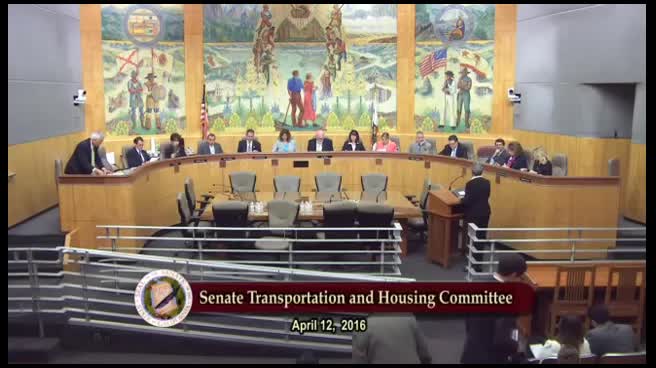 1H
Senate Standing Committee on Transportation and Housing
Bill Author
Bill Co-Author(s):