SB 1279: California Transportation Commission: funding prohibition: coal shipment.
- Session Year: 2015-2016
- House: Senate
- Latest Version Date: 2016-08-26
Existing law creates the California Transportation Commission, with various duties and responsibilities relative to the programming and allocation of funds for transportation capital projects.
This bill would, except as specified, prohibit the commission from programming or allocating any state funds for new bulk coal terminal projects, as defined. The bill would require terminal project grantees to annually report to the commission that the project is not being used to handle, store, or transport coal in bulk.
Existing law creates the California Transportation Commission, with various duties and responsibilities relative to the programming and allocation of funds for transportation capital projects.
This bill would, except as specified, prohibit the commission from programming or allocating any state funds for new bulk terminal projects, as defined. The bill would require terminal project grantees to annually report to the commission that the project is not being used to handle, store, or transport coal in bulk.
Existing law creates the California Transportation Commission, with various duties and responsibilities relative to the programming and allocation of funds for transportation capital projects.
This bill would, except as specified, prohibit the commission from programming or allocating any state funds for any newly proposed project that proposes to allow or facilitate the handling, storage, or transportation of coal in bulk at a port facility that is located at, or adjacent to, a disadvantaged community. new bulk terminal projects, as defined. The bill would require a grantee of funds subject to the above prohibition terminal project grantees to annually report to the commission that the project is not being used to handle, store, or transport coal in bulk.
Existing law creates the California Transportation Commission, with various duties and responsibilities relative to the programming and allocation of funds for transportation capital projects.
This bill would, except as specified, prohibit the commission from programming or allocating any state funds for any newly proposed project that proposes to allow or facilitate the handling, storage, or transportation of coal in bulk at a port facility that is located at, or adjacent to, a disadvantaged community and that proposes to allow or facilitate the handling, storage, or transportation of coal in bulk. community. The bill would require a grantee of funds subject to the above prohibition to annually report to the commission that the project is not being used to handle, store, or transport coal in bulk.
Existing law creates the California Transportation Commission, with various duties and responsibilities relative to the programming and allocation of funds for transportation capital projects.
This bill would would, except as specified, prohibit the commission from programming or allocating any state funds for any newly proposed project at a port facility that is located at, or adjacent to, a disadvantaged community and that exports or proposes to export coal from the state. proposes to allow or facilitate the handling, storage, or transportation of coal in bulk.
Existing law creates the California Transportation Commission, with various duties and responsibilities relative to the programming and allocation of funds for transportation capital projects.
This bill would prohibit the commission from programming or allocating any public state funds for any project at a port facility that is located at, or adjacent to, a disadvantaged community and that exports or proposes to export coal from the state.
Existing law creates the California Transportation Commission, with various duties and responsibilities relative to the programming and allocation of funds for transportation capital projects.
This bill would prohibit the commission from programming or allocating any public funds for any project at a port facility that is located at, or adjacent to, a disadvantaged community and that exports or proposes to export coal from the state.
(a)The Legislature finds and declares that, to avoid the impacts of localized airborne particulate matter associated with the transportation of coal and the increased emissions of greenhouse gases associated with the use of coal, the State of California should make all reasonable and legal efforts to avoid the investment of state funds in coal-supporting transportation projects.
(b)It is the intent of the Legislature that the State of California cease all investments in transportation infrastructure projects that store, transfer, or transport significant amounts of coal in bulk. While it is not the intent of the Legislature to disrupt existing, regular, and lawful interstate and international commerce involving operations that may transport coal at present, it is the intent of the Legislature to avoid making new investments in coal-supporting projects.
SEC. 2.Section 14525.3 is added to the Government Code, to read:14525.3.(a)To the extent consistent with federal law, the commission shall not program or allocate any state funds, including proceeds from the sale of general obligation bonds, under its jurisdiction for any new bulk coal terminal project proposed on or after January 1, 2017.
(b)(1)The commission shall evaluate each new terminal project before the commission to determine consistency with this section and also whether or not the purpose or intent of the new terminal project is to increase the states overall capacity to facilitate the transportation of coal in bulk, based on a review of the completed environmental documents and written confirmation from the lead agency of the project, as designated pursuant to the California Environmental Quality Act (Division 13 (commencing with Section 21000) of the Public Resources Code).
(2)A terminal project grantee of funds identified by the commission as subject to this section shall annually notify the commission that the project is not being used to handle, store, or transport coal in bulk.
(c)This section does not apply to a project or infrastructure already permitted as of January 1, 2016.
(d)For purposes of this section, the following definitions apply:
(1)(A)New bulk coal terminal means a terminal that stores, handles, or transports coal in bulk to a degree or significance that is categorized as having the potential for significant impacts in an environmental document prepared pursuant to the California Environmental Quality Act (Division 13 (commencing with Section 21000) of the Public Resources Code) as a result of the storage, handling, or transport of coal in bulk.
(B)New bulk coal terminal does not include a project that is designed for safety, rehabilitation, congestion reduction, modernization, maintenance, or repair of an existing operation or facility, including rail terminals, railyards, rail facilities, rail infrastructure, and rail right-of-way.
(2)(A)Terminal project or terminal means a yard, depot, or off-road or other facility that exchanges freight in bulk between transportation modes.
(B)Terminal project does not include a project that is designed for safety, rehabilitation, congestion reduction, modernization, maintenance, or repair of an existing operation or facility, including rail terminals, railyards, rail facilities, rail infrastructure, and rail right-of-way.
(a)The Legislature finds and declares that, to avoid the impacts of localized airborne particulate matter associated with the transportation of coal and the increased emissions of greenhouse gases associated with the use of coal, the State of California should make all reasonable and legal efforts to avoid the investment of state moneys funds in coal-supporting transportation projects.
(b)It is the intent of the Legislature that the State of California cease all investments in transportation infrastructure projects that store, transfer, or transport significant amounts of coal in bulk. While it is not the intent of the Legislature to disrupt existing, regular, and lawful interstate and international commerce involving operations that may transport coal at present, it is the intent of the Legislature to avoid making new investments in coal-supporting projects.
SEC. 2.Section 14525.3 is added to the Government Code, to read:14525.3.(a)To the extent consistent with federal law, the commission shall not program or allocate any state funds, including proceeds from the sale of general obligation bonds, under its jurisdiction for any new bulk coal terminal project proposed on or after January 1, 2017.
(b)(1)The commission shall evaluate each new terminal project before the commission to determine consistency with this section and also whether or not the purpose or intent of the new terminal project is to increase the states overall capacity to facilitate the transportation of coal in bulk, based on a review of the completed environmental documents and written confirmation from the lead agency of the project, as designated pursuant to the California Environmental Quality Act (Division 13 (commencing with Section 21000) of the Public Resources Code).
(2)A terminal project grantee of funds identified by the commission as subject to this section shall annually notify the commission that the project is not being used to handle, store, or transport coal in bulk.
(c)This section does not apply to a project or infrastructure already permitted as of January 1, 2016.
(d)For purposes of this section, the following definitions apply:
(1)(A)New bulk coal terminal means a terminal that stores, handles, or transports coal in bulk to a degree or significance that is categorized as having the potential for significant impacts in an environmental document prepared pursuant to the California Environmental Quality Act (Division 13 (commencing with Section 21000) of the Public Resources Code) as a result of the storage, handling, or transport of coal in bulk.
(B)New bulk coal terminal does not include a project that is designed for safety, rehabilitation, congestion reduction, modernization, maintenance, or repair of an existing operation or facility, including rail terminals, railyards, rail facilities, rail infrastructure, and rail right-of-way.
(2)(A)Terminal project or terminal means a yard, depot, or off-road or other facility that exchanges freight in bulk between transportation modes.
(B)Terminal project does not include a project that is designed for safety, rehabilitation, congestion reduction, modernization, maintenance, or repair of an existing operation or facility, including rail terminals, railyards, rail facilities, rail infrastructure, and rail right-of-way.
(a)The Legislature finds and declares that, to avoid the impacts of localized airborne particulate matter associated with the transportation of coal and the increased emissions of greenhouse gases associated with the use of coal, the State of California should make all reasonable and legal efforts to avoid the investment of state moneys in coal-supporting transportation projects.
(b)It is the intent of the Legislature that the State of California cease all investments in transportation infrastructure projects that store, transfer, or transport significant amounts of coal in bulk. While it is not the intent of the Legislature to disrupt existing, regular, and lawful interstate and international commerce involving operations that may transport coal at present, it is the intent of the Legislature to avoid making new investments in coal-supporting projects.
SEC. 2.Section 14525.3 is added to the Government Code, to read:14525.3.(a)To the extent consistent with federal law, the commission shall not program or allocate any state funds, including proceeds from the sale of general obligation bonds, under its jurisdiction for any new bulk coal terminal project proposed on or after January 1, 2017, that proposes to allow or facilitate the handling, storage, or transportation of coal in bulk at a port facility that is located in, or adjacent to, one or more disadvantaged communities identified pursuant to Chapter 4.1 (commencing with Section 39710) of Part 2 of Division 26 of the Health and Safety Code. 2017.
(b)(1)The commission shall evaluate each new terminal project before the commission to determine consistency with this section and also whether or not the purpose or intent of any the new terminal project that meets the requirements of this section is to increase the states overall capacity to facilitate the transportation of coal, coal in bulk, based on a review of the completed environmental documents and written confirmation from the lead agency of the project, as designated pursuant to the California Environmental Quality Act (Division 13 (commencing with Section 21000) of the Public Resources Code).
(2)A terminal project grantee of funds identified by the commission as subject to this section shall annually notify the commission that the project is not being used to handle, store, or transport coal in bulk.
(c)This section does not apply to a project or infrastructure, at a port facility, infrastructure already permitted in operation as of January 1, 2016.
(d)This section does not apply to a project, at a port facility, that is designed for safety, rehabilitation, congestion reduction modernization, maintenance, or repair of an existing operation or facility, including rail terminals, yards, facilities, infrastructure, and right-of- way.
(d)For purposes of this section, the following definitions apply:
(1)(A)New bulk coal terminal means a terminal that stores, handles, or transports coal in bulk to a degree or significance that is categorized as having the potential for significant impacts in an environmental document prepared pursuant to the California Environmental Quality Act (Division 13 (commencing with Section 21000) of the Public Resources Code) as a result of the storage, handling, or transport of coal in bulk.
(B)New bulk coal terminal does not include a project that is designed for safety, rehabilitation, congestion reduction, modernization, maintenance, or repair of an existing operation or facility, including rail terminals, railyards, rail facilities, rail infrastructure, and rail right-of-way.
(2)(A)Terminal project or terminal means a yard, depot, or off-road or other facility that exchanges freight in bulk between transportation modes.
(B)Terminal project does not include a project that is designed for safety, rehabilitation, congestion reduction, modernization, maintenance, or repair of an existing operation or facility, including rail terminals, railyards, rail facilities, rail infrastructure, and rail right-of-way.
(a)The Legislature finds and declares that, to avoid the impacts of localized airborne particulate matter associated with the transportation of coal and the increased emissions of greenhouse gases associated with the use of coal, the State of California should make all reasonable and legal efforts to avoid the investment of state moneys in coal-supporting transportation projects.
(b)It is the intent of the Legislature that the State of California cease all investments in transportation infrastructure projects that store, transfer, or transport significant amounts of coal in bulk. While it is not the intent of the Legislature to disrupt existing, regular, and lawful interstate and international commerce involving operations that may transport coal at present, it is the intent of the Legislature to avoid making new investments in coal-supporting projects.
SEC. 2.Section 14525.3 is added to the Government Code, to read:14525.3.(a)To the extent consistent with federal law, the commission shall not program or allocate any state funds, including proceeds from the sale of general obligation bonds, under its jurisdiction for any project proposed on or after January 1, 2017, that proposes to allow or facilitate the handling, storage, or transportation of coal in bulk at a port facility that is located in, or adjacent to, one or more disadvantaged communities identified pursuant to Chapter 4.1 (commencing with Section 39710) of Part 2 of Division 26 of the Health and Safety Code and that proposes to allow or facilitate the handling, storage, or transportation of coal in bulk. Code.
(b)(1)The commission shall evaluate each project before it for consistency with this section and determine whether or not the project as proposed will determine consistency with this section and also whether or not the purpose or intent of any project that meets the requirements of this section is to increase the states overall capacity to facilitate the transportation of coal. coal, based on a review of the completed environmental documents and written confirmation from the lead agency of the project, as designated pursuant to the California Environmental Quality Act (Division 13 (commencing with Section 21000) of the Public Resources Code).
(2)A grantee of funds subject to this section shall annually notify the commission that the project is not being used to handle, store, or transport coal in bulk.
(c)This section does not apply to a project or infrastructure infrastructure, at a port facility, already permitted in operation as of January 1, 2016.
(d)This section does not apply to a project project, at a port facility, that is designed for safety, rehabiliation, rehabilitation, congestion reduction modernization, maintenance, or repair of an existing operation or facility. facility, including rail terminals, yards, facilities, infrastructure, and right-of- way.
(a)The Legislature finds and declares that, to avoid the impacts of localized airborne particulate matter associated with the transportation of coal and the increased emissions of greenhouse gases associated with the use of coal, the State of California should make all reasonable and legal efforts to avoid the investment of state moneys in coal-supporting transportation projects.
(b)It is the intent of the Legislature that the State of California cease all investments in transportation infrastructure projects that store, transfer, or transport significant amounts of coal in bulk. While it is not the intent of the Legislature to disrupt existing, regular, and lawful interstate and international commerce involving operations that may transport coal at present, it is the intent of the Legislature to avoid making new investments in coal-supporting projects.
SECTION 1.SEC. 2.Section 14525.3 is added to the Government Code, to read:14525.3.(a)To the extent consistent with federal law, the commission shall not program or allocate any state funds, including proceeds from the sale of general obligation bonds, under its jurisdiction for any project proposed on or after January 1, 2017, at a port facility that is located in, or adjacent to, one or more disadvantaged communities identified pursuant to Chapter 4.1 (commencing with Section 39710) of Part 2 of Division 26 of the Health and Safety Code and that exports or proposes to export coal from the state. proposes to allow or facilitate the handling, storage, or transportation of coal in bulk.
(b)The commission shall evaluate each project before it for consistency with this section and determine whether or not the project as proposed will increase the states overall capacity to facilitate the transportation of coal.
(c)This section does not apply to a project or infrastructure already permitted in operation as of January 1, 2016.
(d)This section does not apply to a project designed for safety, rehabiliation, modernization, maintenance, or repair of an existing operation or facility.
To the extent consistent with federal law, the commission shall not program or allocate any public state funds, including proceeds from the sale of general obligation bonds, under its jurisdiction for any project at a port facility that is located in, or adjacent to, one or more disadvantaged communities identified pursuant to Chapter 4.1 (commencing with Section 39710) of Part 2 of Division 26 of the Health and Safety Code and that exports or proposes to export coal from the state.
The To the extent consistent with federal law, the commission shall not program or allocate any public funds, including proceeds from the sale of general obligation bonds, under its jurisdiction for any project at a port facility that is located in, or adjacent to, one or more disadvantaged communities identified pursuant to Chapter 4.1 (commencing with Section 39710) of Part 2 of Division 26 of the Health and Safety Code and that exports or proposes to export coal from the state.
The commission shall not program or allocate any public funds, including proceeds from the sale of general obligation bonds, under its jurisdiction for any project at a port facility that is located in, or adjacent to, one or more disadvantaged communities identified pursuant to Chapter 4.1 (commencing with Section 39710) of Part 2 of Division 26 of the Health and Safety Code and that exports or proposes to export coal from the state.
|
Date
|
Status
|
|---|---|
| Aug 26, 2016 | Chaptered by Secretary of State. Chapter 215, Statutes of 2016. |
| Aug 26, 2016 | Approved by the Governor. |
| Aug 25, 2016 | Enrolled and presented to the Governor at 10 a.m. |
| Aug 24, 2016 | Assembly amendments concurred in. (Ayes 26. Noes 13.) Ordered to engrossing and enrolling. |
| Aug 22, 2016 | Read third time. Passed. (Ayes 50. Noes 26. Page 6019.) Ordered to the Senate. |
| Aug 22, 2016 | In Senate. Concurrence in Assembly amendments pending. |
| Aug 22, 2016 | Read third time. Passed. Ordered to the Senate. |
| Aug 8, 2016 | Read second time. Ordered to third reading. |
| Aug 4, 2016 | Read second time and amended. Ordered to second reading. |
| Aug 3, 2016 | From committee: Do pass as amended. (Ayes 14. Noes 6.) (August 3). |
| Jun 28, 2016 | From committee: Do pass and re-refer to Com. on APPR. (Ayes 10. Noes 5.) (June 27). Re-referred to Com. on APPR. |
| Jun 20, 2016 | From committee with author's amendments. Read second time and amended. Re-referred to Com. on TRANS. |
| Jun 13, 2016 | Referred to Com. on TRANS. |
| Jun 2, 2016 | Read third time. Passed. (Ayes 26. Noes 12. Page 4124.) Ordered to the Assembly. |
| Jun 2, 2016 | In Assembly. Read first time. Held at Desk. |
| Jun 2, 2016 | Read third time. Passed. (Ayes 26. Noes 12.) Ordered to the Assembly. |
| May 31, 2016 | Read second time and amended. Ordered to third reading. |
| May 27, 2016 | From committee: Do pass as amended. (Ayes 5. Noes 2. Page 4007.) (May 27). |
| May 27, 2016 | From committee: Do pass as amended. (Ayes 5. Noes 2.) (May 27). |
| May 20, 2016 | Set for hearing May 27. |
| May 16, 2016 | May 16 hearing: Placed on APPR. suspense file. (Ayes 7. Noes 0.) |
| May 6, 2016 | Set for hearing May 16. |
| Apr 26, 2016 | Read second time and amended. Re-referred to Com. on APPR. |
| Apr 25, 2016 | From committee: Do pass as amended and re-refer to Com. on APPR. (Ayes 8. Noes 3. Page 3617.) (April 19). |
| Apr 25, 2016 | From committee: Do pass as amended and re-refer to Com. on APPR. (Ayes 8. Noes 3.) (April 19). |
| Apr 14, 2016 | Set for hearing April 19. |
| Apr 13, 2016 | April 12 hearing: Testimony taken. Hearing postponed by committee. |
| Apr 5, 2016 | Set for hearing April 12. |
| Apr 4, 2016 | From committee with author's amendments. Read second time and amended. Re-referred to Com. on T. & H. |
| Apr 4, 2016 | April 5 hearing postponed by committee. |
| Mar 30, 2016 | From committee with author's amendments. Read second time and amended. Re-referred to Com. on T. & H. |
| Mar 16, 2016 | Set for hearing April 5. |
| Mar 3, 2016 | Referred to Com. on T. & H. |
| Feb 22, 2016 | Read first time. |
| Feb 22, 2016 | From printer. May be acted upon on or after March 23. |
| Feb 19, 2016 | Introduced. To Com. on RLS. for assignment. To print. |
|
Date
|
Description
|
Location
|
Votes
|
|
|---|---|---|---|---|
| Aug 24, 2016 | Unfinished Business SB1279 Hancock Concurrence | Senate Floor |
Passed |
|
| Aug 22, 2016 | SB 1279 Hancock Senate Third Reading By BONTA | Assembly Floor |
Passed |
|
| Aug 3, 2016 | Do pass as amended. | Assembly Standing Committee on Appropriations |
Passed |
|
| Jun 27, 2016 | Do pass and be re-referred to the Committee on [Appropriations] | Assembly Standing Committee on Transportation |
Passed |
|
| Jun 2, 2016 | Senate 3rd Reading SB1279 Hancock | Senate Floor |
Passed |
|
| May 27, 2016 | Do pass as amended | Senate Standing Committee on Appropriations |
Passed |
|
| May 16, 2016 | Placed on suspense file | Senate Standing Committee on Appropriations |
Passed |
|
| Apr 19, 2016 | Do pass as amended, but first amend, and re-refer to the Committee on [Appropriations] | Senate Standing Committee on Transportation and Housing |
Passed |
This list shows positions taken on this bill by organizations on the date displayed, which is linked to the original source.
Positions by individuals are not included.
Office of Senate Floor Analyses (916) 651-1520 Fax: (916) 327-4478 | SB 1279 |
UNFINISHED BUSINESS
Bill No: SB 1279
Amended: 8/4/16
SENATE TRANS. & HOUSING COMMITTEE: 8-3, 4/19/16
AYES: Beall, Allen, Galgiani, Leyva, McGuire, Mendoza, Roth, Wieckowski
NOES: Cannella, Bates, Gaines
SENATE APPROPRIATIONS COMMITTEE: 5-2, 5/27/16
AYES: Lara, Beall, Hill, McGuire, Mendoza
NOES: Bates, Nielsen
SENATE FLOOR: 26-12, 6/2/16
AYES: Allen, Beall, Block, De León, Galgiani, Glazer, Hall, Hancock, Hernandez, Hertzberg, Hill, Hueso, Jackson, Lara, Leno, Leyva, Liu, McGuire, Mendoza, Mitchell, Monning, Pan, Pavley, Roth, Wieckowski, Wolk
NOES: Anderson, Bates, Berryhill, Cannella, Fuller, Gaines, Huff, Moorlach, Morrell, Nguyen, Nielsen, Stone
NO VOTE RECORDED: Runner, Vidak
ASSEMBLY FLOOR: 50-26, 8/22/16 - See last page for vote
SUBJECT: California Transportation Commission: funding prohibition: coal shipment
DIGEST: This bill prohibits the California Transportation Commission (CTC) from programming or allocating funds for any new bulk-coal terminal project proposed on or after January 1, 2017.
Assembly Amendments expand the scope of this bill to any terminal project before the CTC (rather than only projects located in or adjacent to disadvantaged communities) and clarify the definitions of “new bulk-coal terminal” and “terminal project.”
Existing law:
- Establishes the CTC, which consists of 11 voting members and two non-voting ex officio members. The CTC is responsible for programming and allocating funds for the construction of highway, passenger rail, and transit improvements throughout California.
- Enacts, pursuant to Proposition 1B (Prop. 1B), the Highway Safety, Traffic Reduction, Air Quality, and Port Security Bond Act of 2006, and authorizes $19.9 billion in general obligation bonds to fund a variety of transportation projects.
This bill:
- Prohibits the CTC from programming or allocating any state funds under its jurisdiction, including general obligation bond revenues, for any new bulk-coal terminal project proposed on or after January 1, 2017.
- Requires the CTC to evaluate each new terminal project before it to determine whether its purpose or intent is to increase the state’s overall capacity to facilitate the transportation of coal in bulk, based on a review of completed environmental documents and written confirmation from the lead agency on the project, as designated pursuant to the California Environmental Quality Act (CEQA).
- Requires a terminal project grantee of funds identified by the CTC to annually notify the CTC that the project is not being used to handle, store, or transport coal in bulk.
- Defines “new bulk-coal terminal,” “terminal project,” and “terminal.” Excludes from these definitions projects or infrastructure already permitted as of January 1, 2016, as well as those designed for safety, rehabilitation, congestion reduction, modernization, maintenance, or repair of an existing operation or facility, including rail terminals, rail yards, rail facilities, rail infrastructure, and rail right-of-way.
Background
The Oakland Army Base redevelopment project. After the Oakland Army Base was closed in 1999, part of the property reverted to the City of Oakland while another portion went to the Port of Oakland. The following year, the Oakland City Council designated the base and surrounding properties, an area totaling 1,800 acres, as a redevelopment project area. In 2009, the Port of Oakland secured Trade Corridor Improvement Fund (TCIF) funding for a project to develop warehouse space, logistics facilities, and a rail terminal on the site. By diverting freight from trucks to trains, the new rail terminal complex was expected to reduce diesel particulate matter (PM) emissions while simultaneously increasing the efficiency of goods movement through the Port.
Following the dissolution of the redevelopment agency in 2012, the area owned by the redevelopment agency was transferred to the City of Oakland. The Port and the City began working together on the site and significantly expanded the scope of the redevelopment, including the addition of a bulk terminal. The Port obtained a grant under the federal Transportation Investment Generating Economic Recovery (TIGER) program, as well as additional TCIF funds. The expansion of the project required an update to the environmental impact report (EIR) completed in 2002; an addendum was prepared in 2012.
Meanwhile, the City forged an agreement with two private entities, California Capital and Investment Group (CCIG) and Prologis, to develop the site. These two companies were tasked with finding additional investors and tenants for the project. Details of what commodities would be transported through the bulk terminal were largely contingent upon the contracts that would be executed, and therefore were not reviewed in the new environmental documents.
To date, the Port and the City have secured about two-thirds of needed project funding. Of this, the majority comes from public funding sources. Specifically, the state TCIF ($242 million); the federal TIGER program ($15 million); the Port of Oakland ($16 million); and the City of Oakland ($55 million). In addition, CCIG and Prologis identified funding totaling approximately $172 million.
In spring of 2015, stories surfaced in the media revealing that the state of Utah was in discussions with Port developers about shipping coal from Utah to China through the bulk terminal in Oakland. Utah currently exports about 1 million tons of coal each year, mainly through the ports of Richmond, Stockton, and Long Beach. As coal-fired power plants in the U.S. close or switch to natural gas, access to overseas markets is becoming increasingly important for coal-producing states. In exchange for investing in the bulk terminal, Utah hoped to secure the right to ship a fixed amount of cargo through it each year. In February 2016, eight working days before the end of the Utah legislative session, a bill surfaced to authorize, and provide $53 million in funding for, this deal. The legislation passed by a wide margin and was signed by Governor Gary Herbert on March 22, 2016.
As noted above, the City had tasked two companies, CCIG and Prologis, to come up with additional project funding. CCIG, in turn, executed a contract with Terminal Logistics Solutions, a company headed by Jerry Bridges, a former executive director of the Port of Oakland. It was this company that negotiated the deal with Utah.
Comments
- Purpose. The author states that coal transport spreads the damages caused by coal dust and contributes to the likelihood that residents in adjacent communities will suffer from illnesses linked to pollution, such as cancer, heart disease, and asthma. Coal dust is a source of PM that is dangerous to breathe and is responsible for most occupational lung disease. West Oakland is already heavily impacted by pollution: its residents are 2.5 times more likely to get cancer due to breathing air which contains three times the amount of diesel PM than air in other parts of the Bay Area. The author states that while the TCIF application did not specifically require the applicant to disclose or commit to exactly what commodity or commodities would be transported through the terminal, the project would likely not have qualified for TCIF funds had the information regarding coal transport been provided to the CTC. This bill aims to ensure that in the future, state funds are not allocated to projects that facilitate the transport of coal.
- Oakland project is now a moot point. The TCIF requires at least a 50% match from local, federal, or private sources. Because this bill excludes projects that were already permitted as of January 1, 2016, it would not threaten the $53 million worth of matching funds for Oakland project. Moreover, the City of Oakland voted on June 27, 2016, to ban the transport and storage of large coal shipments, effectively shutting down the bulk-coal terminal plan.
- Establishing a state policy. The state of Utah currently exports about 1 million tons of coal each year, mainly through the ports of Richmond, Stockton, and Long Beach. Under this bill, state funding could not be provided for any future bulk-coal terminal projects at these or other California ports. This bill also declares the intent of the Legislature to cease all investments in transportation infrastructure projects that store, transfer, or transport significant quantities of bulk coal. By doing so, it emphasizes the state’s commitment to policies on climate change and health objectives.
- Opposition concerns. Opponents raise a variety of concerns about this bill, including the possibility that it might violate U.S. treaty obligations and the Commerce Clause; concerns about the legal implications of singling out port infrastructure; the potential impact on existing business relationships and operations; and singling out a single commodity.
FISCAL EFFECT: Appropriation: No Fiscal Com.: Yes Local: No
According to the Assembly Appropriations Committee, any costs to the CTC will be minor and absorbable.
Alameda County
Alameda County Democratic Central Committee
Asian Pacific Environmental Network
Berkeley Climate Action Coalition
California Democratic Party Executive Board
California Interfaith Power and Light
California Nurses Association
City of Berkeley
City of Emeryville
City of Richmond
East Bay Young Democrats
Ecology Center
El Cerrito Democratic Club
Environment California
Fossil Free California
Friends Committee on Legislation
inNative
International Longshore and Warehouse Union, Northern California District Council
No Coal in Oakland
Oakland Unified School District
Peace, Earthcare, and Social Witness Committee of Strawberry Creek Quaker
Meeting
Physicians for Social Responsibility
Public Advocates
Redlands Area Democratic Club
San Francisco Baykeeper
Save the Bay
SEIU Local 1021
Sierra Club California
West Oakland Environmental Indicators Project
350 Bay Area
One individual
OPPOSITION: (Verified 8/22/16)
California Capital and Investment Group
California Teamsters Public Affairs Council
California Trade Coalition
League of California Cities
ASSEMBLY FLOOR: 50-26, 8/22/16
AYES: Alejo, Arambula, Atkins, Baker, Bloom, Bonilla, Bonta, Brown, Burke, Calderon, Campos, Chau, Chiu, Chu, Cooley, Cooper, Dababneh, Dodd, Eggman, Frazier, Cristina Garcia, Eduardo Garcia, Gatto, Gipson, Gomez, Gonzalez, Gordon, Hadley, Roger Hernández, Holden, Irwin, Jones-Sawyer, Levine, Lopez, Low, McCarty, Mullin, Nazarian, Quirk, Ridley-Thomas, Rodriguez, Salas, Santiago, Mark Stone, Thurmond, Ting, Weber, Williams, Wood, Rendon
NOES: Achadjian, Travis Allen, Bigelow, Brough, Chang, Chávez, Dahle, Beth Gaines, Gallagher, Gray, Grove, Harper, Jones, Kim, Lackey, Linder, Maienschein, Mathis, Mayes, Obernolte, Olsen, Patterson, Steinorth, Wagner, Waldron, Wilk
NO VOTE RECORDED: Daly, Medina, Melendez, O'Donnell
Prepared by: Erin Riches / T. & H. / (916) 651-4121
8/22/16 21:33:55
SENATE THIRD READING
STR Bill Id:
Author:(Hancock)
As Amended Ver:
Majority vote
SENATE VOTE: 26-12
Committee | Votes | Ayes | Noes |
Transportation | 10-5 | Frazier, Baker, Bloom, Brown, Chu, Daly, Dodd, Eduardo Garcia, Gomez, Nazarian | Linder, Kim, Mathis, Melendez, O'Donnell |
Appropriations | 14-6 | Gonzalez, Bloom, Bonilla, Bonta, Calderon, Daly, Eggman, Eduardo Garcia, Holden, Quirk, Santiago, Weber, Wood, Chau | Bigelow, Chang, Gallagher, Jones, Obernolte, Wagner |
SUMMARY: Prohibits the California Transportation Commission (CTC) from programming or allocating state funds for bulk coal terminal projects, and requires terminal project grantees under specific conditions, to annually report to CTC that the project is not being used to handle, store, or transport bulk coal. Specifically, this bill:
- Makes findings and declarations with regard to impacts associated with the transportation and use of coal.
- Declares the intent of the Legislature to cease all investments in transportation infrastructure projects that store, transfer, or transport significant quantities of bulk coal.
- Prohibits CTC, to the extent consistent with federal law, from programming or allocating state funds, including bond proceeds, for new bulk coal terminal projects proposed on or after January 1, 2017.
- Requires CTC to evaluate each new terminal project to determine whether or not the purpose or intent of the project is to increase the state's overall capacity to facilitate the transport of bulk coal based on a review of the completed California Environmental Quality Act (CEQA) documents and written confirmation from the lead agency of the project.
- Requires a terminal project grantee identified by CTC as subject to this section to annually notify the CTC that the project is not being used to handle, store, or transport bulk coal.
- Provides that the prohibition for funding bulk coal terminals does not apply to infrastructure already permitted as of January 1, 2016.
- Defines a "new bulk coal terminal" as a terminal that stores, handles, or transports coal in bulk to a degree or significance that is categorized as having the potential for significant impacts in an environmental document prepared pursuant to CEQA as a result of the storage, handling, or transport of coal in bulk.
- Provides that a "new bulk coal terminal" does not include a project that is designed for safety, rehabilitation, congestion reduction, modernization, maintenance, or repair of an existing operation or facility, including rail terminals, railyards, rail facilities, rail infrastructure, and rail right-of-way.
- Provides that a terminal project does not include a project that is designed for safety, rehabilitation, congestion reduction, modernization, maintenance, or repair of an existing operation or facility, including rail terminals, railyards, rail facilities, rail infrastructure, and rail right-of-way.
FISCAL EFFECT: According to the Assembly Appropriations Committee, any costs to the CTC will be minor and absorbable.
COMMENTS: After the Oakland Army Base closed in 1999, part of the property reverted to the City of Oakland, while another portion was transferred to the Port of Oakland (Port). The following year, the Oakland City Council designated the base and surrounding properties as a redevelopment project area and in 2009, the Port of Oakland secured Trade Corridor Improvement Fund (TCIF) funding for a project to develop warehouse space, logistics facilities, and a rail terminal on the site. By diverting freight from trucks to trains, the new rail terminal complex was expected to reduce diesel emissions while simultaneously increasing the efficiency of goods movement through the Port.
Following the dissolution of the redevelopment agency in 2012, the area owned by the redevelopment agency was transferred to the City of Oakland. The Port and the City began working together to significantly expand the scope of the redevelopment, including the addition of a bulk terminal (the Oakland Bulk and Oversized Terminal (OBOT)). The Port obtained federal transportation grant funding, as well as additional TCIF funds. Meanwhile, the City of Oakland forged an agreement with two private entities, California Capital and Investment Group (CCIG) and Prologis, to develop the site and find additional investors and tenants for the project. Details of what commodities would be transported through the bulk terminal were largely contingent upon the contracts that would be executed, and therefore were not reviewed in the environmental documents for the project.
In spring of 2015, stories surfaced in the media revealing that the State of Utah was in discussions with Port developers about shipping coal from Utah to China through the proposed bulk terminal in Oakland. Utah currently exports about 1 million tons of coal each year, mainly through the ports of Richmond, Stockton, and Long Beach. As coal-fired power plants in the United States (U.S.) close or switch to natural gas, access to overseas markets is becoming increasingly important for coal-producing states.
In early 2016, Utah's Governor signed legislation that would contribute $53 million in transportation funds towards the construction of the new Oakland cargo terminal. To fund the Oakland project, Utah proposed to use state tax revenue and then reimburse the state with federal royalties from federal mineral leases. Under the agreement, Utah would have access to overseas markets for shipped products and commodities, such as coal, in exchange for a $53 million investment in OBOT.
In total, the CTC has allocated $242 million in TCIF funds for the bulk terminal portion of the project, specifically, for the construction of a proposed intermodal rail terminal complex that will provide a high-density, green intermodal terminal, trade and logistics facilities, marine terminal improvements, and a grade separation connection between intermodal and marine terminals. The Port of Oakland's TCIF application, in reference to the bulk terminal portion of the project, stated that it would be "converted to a modern bulk cargo marine terminal for movement of commodities such as iron ore, corn, and other products brought in to the terminal by rail…the terminal would also accommodate project cargo such as windmills, steel coils, and oversized goods." The TCIF application did not require, nor did the applicant disclose or commit to, exactly what commodity or commodities would be transported through the OBOT. To date, all of the TCIF funding has been allocated and the projects utilizing TCIF funds are nearly completed.
Author's statement: According to the author, the project proposal submitted to CTC along with the application for TCIF funds did not disclose that the OBOT would involve the transport and export of coal. In fact, the author points out that the TCIF application, when referencing the bulk terminal portion of the project, stated that it would be "converted to a modern bulk cargo marine terminal for movement of commodities such as iron ore, corn, and other products brought in to the terminal by rail…the terminal would also accommodate project cargo such as windmills, steel coils, and oversized goods."
The author contends that while the TCIF application did not specifically require that the applicant to disclose, or commit to, exactly what commodity or commodities would be transported through the terminal, it is her belief that had the information been provided to CTC with regard to plans for coal transport, the project would likely not have qualified for TCIF funds given that Prop 1B, as its name implies "The Highway Safety, Traffic Reduction, Air Quality, and Port Security Bond Act of 2006", was explicitly intended to result in air quality improvements.
To address this issue and to memorialize that state transportation infrastructure funding should not be expended for projects that move significant quantities of bulk coal, the author introduced this bill, which would prohibit the CTC from programming or allocating state funds, to the extent that it is consistent with federal law, for new bulk coal terminals proposed after January 1, 2017. This bill would also require that CTC evaluate each new bulk terminal project that comes before it for transportation funding to determine whether or not the project would increase the state's ability to transport bulk coal and if not, that any bulk terminal grantees be required to continually submit information to the CTC to ensure that future movement of coal is not undertaken. This bill also declares the Legislature's intent to cease all investments in transportation infrastructure projects that store, transfer, or transport significant quantities of bulk coal.
Provisions that prohibit the programming or allocation of funds for new bulk terminal projects that transfer coal does not apply to infrastructure that is permitted as of January 1, 2016, appear to exempt the OBO; however, if for some reason the project were to be subject to this legislation, it is unlikely that it would have a substantial impact on the construction of projects currently funded using TCIF monies given that these projects are largely completed. (The portions of the OBOT that received TCIF funding include construction of a proposed intermodal rail terminal complex, marine terminal improvements, and a grade separation connection between the intermodal and marine terminal.)
While this bill's effect is largely symbolic (in that it is unlikely to impact an existing project), the bill does serve to emphasize California's commitment to policies on climate change and health by ensuring that the state's funding practices are in alignment with its important state policy objectives. In fact, the Legislature has a history of taking this stand on investments relative to climate change policies with the recent passage of SB 185 (De León), Chapter 605, Statutes of 2015, which prohibited the California Public Employees' Retirement System (CalPERS) and California State Teachers' Retirement System (CalSTRS) from investing in thermal coal companies along with the call of California's Insurance Commissioner earlier this year asking that the insurance industry divest its interests in coal.
Please see the policy committee analysis for full discussion of this bill.
Analysis Prepared by: Victoria Alvarez / TRANS. / (916) 319-2093 FN: 0003864
Date of Hearing: August 3, 2016
ASSEMBLY COMMITTEE ON APPROPRIATIONS
Lorena Gonzalez, Chair
SBPCA Bill Id:SB 1279
Author:(Hancock) – As Amended Ver:June 20, 2016
Policy Committee: | Transportation | Vote: | 10 - 5 |
Urgency: No State Mandated Local Program: No Reimbursable: No
SUMMARY:
This bill prohibits state funding for future bulk coal terminal projects. Specifically, this bill:
- Prohibits the California Transportation Commission (CTC), to the extent consistent with federal law, from programming or allocating state funds for new bulk coal terminal projects, as defined and proposed on or after January 1, 2017.
- Requires CTC to evaluate each new terminal project to determine whether the purpose of the project is to increase the state's capacity to facilitate the transport of bulk coal, based on a review of the completed California Environmental Quality Act (CEQA) documents and written confirmation from the project's lead agency.
- Requires a terminal project grantee to annually notify the CTC that the project is not being used to handle, store, or transport bulk coal.
- Provides that the prohibition for funding bulk coal terminals does not apply to infrastructure permitted as of January 1, 2016.
FISCAL EFFECT:
Any costs to the CTC will be minor and absorbable.
COMMENTS:
- Background. The burning of coal produces a significant amount of pollution which adversely affects human health and the environment. The Legislature's policies addressing climate change include SB 1368 (Perata), Chapter 598, Statutes of 2006, which had the effect of preventing the state's electric utilities from entering into or renewing contracts for coal-fire electricity generation, and SB 185 (de León), Chapter 605, Statutes of 2015, which prohibits the California Public Employees' Retirement System (CalPERS) and California State Teachers' Retirement System (CalSTRS) from investing in thermal coal companies.
The CTC has allocated $242 million in general obligation bonds from the Trade Corridor Improvement Fund (TCIF) for the Oakland Bulk and Oversized Terminal Project (OBOT), which has also received federal transportation grant funding. This project at the Port of Oakland involves construction of an intermodal rail terminal complex that will provide a high-density, green intermodal terminal, trade and logistics facilities, marine terminal improvements, and a grade separation connection between intermodal and marine terminals.
In spring of 2015, stories surfaced in the media revealing that the State of Utah was in discussions with Port developers about shipping coal from Utah to China through the proposed bulk terminal in Oakland. Utah currently exports about 1 million tons of coal each year, mainly through the ports of Richmond, Stockton, and Long Beach. As coal-fired power plants in the U.S. close or switch to natural gas, access to overseas markets is becoming increasingly important for coal-producing states.
- Purpose. According to the author, the project proposal submitted to CTC along with the application for TCIF funds did not disclose that the OBOT would involve the transport and export of coal. The author contends that, while such a disclosure was not required as part of the TCIF application, it is her belief that, had the information been provided to CTC with regard to plans for coal transport, the project likely would not have qualified for TCIF bond funds given that the authorizing bond measure, "The Highway Safety, Traffic Reduction, Air Quality, and Port Security Bond Act of 2006", was explicitly intended to result in air quality improvements.
To address this issue going forward, and to memorialize that state transportation infrastructure funding should not be expended for projects that move significant quantities of bulk coal, SB 1279 prohibits the CTC from programming or allocating state funds, to the extent consistent with federal law, for new bulk coal terminals proposed after January 1, 2017.
- Opposition. The League of California Cities argues that a blanket prohibition on allocating state funds because it facilitates the transport of a specific commodity would set a concerning precedent and potentially result in the unintended consequence of making critical infrastructure projects of statewide significance ineligible for public funds.
Analysis Prepared by: Chuck Nicol / APPR. / (916) 319-2081
Date of Hearing: June 27, 2016
ASSEMBLY COMMITTEE ON TRANSPORTATION
Jim Frazier, Chair
SBPCA Bill Id:SB 1279
Author:(Hancock) – As Amended Ver:June 20, 2016
SENATE VOTE: 26-12
SUBJECT: California Transportation Commission: funding prohibition: coal shipment
SUMMARY: Prohibits the California Transportation Commission (CTC) from programming or allocating state funds for bulk coal terminal projects, and requires terminal project grantees under specific conditions, to annually report to CTC that the project is not being used to handle, store, or transport bulk coal. Specifically, this bill:
- Makes findings and declarations with regard to impacts associated with the transportation and use of coal.
- Declares the intent of the Legislature to cease all investments in transportation infrastructure projects that store, transfer, or transport significant quantities of bulk coal.
- Prohibits CTC, to the extent consistent with federal law, from programming or allocating state funds, including bond proceeds, for new bulk coal terminal projects proposed on or after January 1, 2017.
- Requires CTC to evaluate each new terminal project to determine whether or not the purpose or intent of the project is to increase the state's overall capacity to facilitate the transport of bulk coal based on a review of the completed California Environmental Quality Act (CEQA) documents and written confirmation from the lead agency of the project.
- Requires a terminal project grantee identified by CTC as subject to this section to annually notify the CTC that the project is not being used to handle, store, or transport bulk coal.
- Provides that the prohibition for funding bulk coal terminals does not apply to infrastructure already permitted as of January 1, 2016.
- Defines a "new bulk coal terminal” as a terminal that stores, handles, or transports coal in bulk to a degree or significance that is categorized as having the potential for significant impacts in an environmental document prepared pursuant to CEQA as a result of the storage, handling, or transport of coal in bulk.
- Provides that a "new bulk coal terminal” does not include a project that is designed for safety, rehabilitation, congestion reduction, modernization, maintenance, or repair of an existing operation or facility, including rail terminals, railyards, rail facilities, rail infrastructure, and rail right-of-way.
- Provides that a terminal project does not include a project that is designed for safety, rehabilitation, congestion reduction, modernization, maintenance, or repair of an existing operation or facility, including rail terminals, railyards, rail facilities, rail infrastructure, and rail right-of-way.
EXISTING LAW:
- Establishes CTC consisting of 11 voting members and two non-voting ex-officio members.
- Vests the CTC with the responsibility for programming and allocating funds for the construction of highway, passenger rail, and transit improvements throughout California.
- Vests CTC with responsibility to advise and assist the Secretary of the California State Transportation Agency and the Legislature in formulating and evaluating state policies and plans for California’s transportation programs.
- Requires CTC to submit to the Legislature an annual report that, among other things, identifies timely and relevant transportation issues facing California and that may include a discussion of any significant upcoming transportation issues anticipated to be of concern to the public and the Legislature.
- Assigns to the CTCs the responsibility of advising and assisting the Administration and the Legislature in formulating and evaluating state policies and plans for California’s transportation programs. A large part of this responsibility currently includes approving various transportation programs funded by state and federal funds and proposed by both the state and regional transportation planning entities.
- Enacts, pursuant to the passage of Proposition 1B (Prop. 1B), the Highway Safety, Traffic Reduction, Air Quality, and Port Security Bond Act of 2006 that authorized $19.9 billion in general obligation bonds to fund a variety of transportation projects.
- Established the Trade Corridor Improvement Fund (TCIF) following the passage of Prop. 1B to distribute $2 billion of Prop. 1B bond funds by the CTC in accordance with established criteria for infrastructure improvements along federally designated "Trade Corridors of National Significance" or along other corridors with high volumes of freight movement.
FISCAL EFFECT: Unknown
COMMENTS: Coal is a material composed primarily of carbon that has been burned throughout history to produce heat and, in more modern times, to generate electricity. Burning coal also produces a significant amount of pollution which adversely affects human health and the environment. Health effects include lung cancer, stroke, and heart disease while the environmental effects include the release of carbon into the atmosphere which contributes to climate change. Breathing coal dust is also known to cause "black-lung," and it is estimated that in the United States approximately 1,500 former employees of the coal industry die every year from the effects of breathing coal mine dust.
Background: After the Oakland Army Base closed in 1999, part of the property reverted to the City of Oakland, while another portion was transferred to the Port of Oakland (Port). The following year, the Oakland City Council designated the base and surrounding properties as a redevelopment project area and in 2009, the Port of Oakland secured TCIF funding for a project to develop warehouse space, logistics facilities, and a rail terminal on the site. By diverting freight from trucks to trains, the new rail terminal complex was expected to reduce diesel emissions while simultaneously increasing the efficiency of goods movement through the Port.
Following the dissolution of the redevelopment agency in 2012, the area owned by the redevelopment agency was transferred to the City of Oakland. The Port and the City began working together to significantly expand the scope of the redevelopment, including the addition of a bulk terminal (the Oakland Bulk and Oversized Terminal, or OBOT). The Port obtained federal transportation grant funding, as well as additional TCIF funds. Meanwhile, the City of Oakland forged an agreement with two private entities, California Capital and Investment Group (CCIG) and Prologis, to develop the site and find additional investors and tenants for the project. Details of what commodities would be transported through the bulk terminal were largely contingent upon the contracts that would be executed, and therefore were not reviewed in the environmental documents for the project.
In spring of 2015, stories surfaced in the media revealing that the State of Utah was in discussions with Port developers about shipping coal from Utah to China through the proposed bulk terminal in Oakland. Utah currently exports about 1 million tons of coal each year, mainly through the ports of Richmond, Stockton, and Long Beach. As coal-fired power plants in the U.S. close or switch to natural gas, access to overseas markets is becoming increasingly important for coal-producing states.
In early 2016, Utah's Governor signed legislation that would contribute $53 million in transportation funds towards the construction of the new Oakland cargo terminal. To fund the Oakland project, Utah proposed to use state tax revenue and then reimburse the state with federal royalties from federal mineral leases. Under the agreement, Utah would have access to overseas markets for shipped products and commodities, such as coal, in exchange for a $53 million investment in OBOT.
In total, the CTC has allocated $242 million in TCIF funds for the bulk terminal portion of the project, specifically, for the construction of a proposed intermodal rail terminal complex that will provide a high-density, green intermodal terminal, trade and logistics facilities, marine terminal improvements, and a grade separation connection between intermodal and marine terminals. The Port of Oakland’s TCIF application, in reference to the bulk terminal portion of the project, stated that it would be “converted to a modern bulk cargo marine terminal for movement of commodities such as iron ore, corn, and other products brought in to the terminal by rail … the terminal would also accommodate project cargo such as windmills, steel coils, and oversized goods.” The TCIF application did not require, nor did the applicant disclose or commit to, exactly what commodity or commodities would be transported through the OBOT. To date, all of the TCIF funding has been allocated and the projects utilizing TCIF funds are nearly completed.
Author's statement: According to the author, the project proposal submitted to CTC along with the application for TCIF funds did not disclose that the OBOT would involve the transport and export of coal. In fact, the author points out that the TCIF application, when referencing the bulk terminal portion of the project, stated that it would be “converted to a modern bulk cargo marine terminal for movement of commodities such as iron ore, corn, and other products brought in to the terminal by rail … the terminal would also accommodate project cargo such as windmills, steel coils, and oversized goods.”
The author contends that while the TCIF application did not specifically require that the applicant to disclose, or commit to, exactly what commodity or commodities would be transported through the terminal, it is her belief that had the information been provided to CTC with regard to plans for coal transport, the project would likely not have qualified for TCIF funds given that Prop 1B, as its name implies "The Highway Safety, Traffic Reduction, Air Quality, and Port Security Bond Act of 2006", was explicitly intended to result in air quality improvements.
To address this issue and to memorialize that state transportation infrastructure funding should not be expended for projects that move significant quantities of bulk coal, the author introduced SB 1279 which would prohibit the CTC from programming or allocating state funds, to the extent that it is consistent with federal law, for new bulk coal terminals proposed after January 1, 2017. This bill would also require that CTC evaluate each new bulk terminal project that comes before it for transportation funding to determine whether or not the project would increase the state's ability to transport bulk coal and if not, that any bulk terminal grantees be required to continually submit information to the CTC to ensure that future movement of coal is not undertaken. This bill also declares the Legislature's intent to cease all investments in transportation infrastructure projects that store, transfer, or transport significant quantities of bulk coal.
Provisions that prohibit the programming or allocation of funds for new bulk terminal projects that transfer coal does not apply to infrastructure that is permitted as of January 1, 2016, appear to exempt the OBO; however, if for some reason the project were to be subject to this legislation, it is unlikely that it would have a substantial impact on the construction of projects currently funded using TCIF monies given that these projects are largely completed. (The portions of the OBOT that received TCIF funding include construction of a proposed intermodal rail terminal complex, marine terminal improvements, and a grade separation connection between the intermodal and marine terminal.)
Writing in support of SB 1279, the California Nurses Association notes that coal presents a clear health risk to workers and communities at every state of its lifecycle, and they note that coal pollutants affects all major body organ systems and contributes to four of the five leading causes of mortality in the United States. They also point out that burning coal is responsible for one third of the carbon emissions in the United States and is the primary contributor to climate change. For these reasons, CNA believes it is vital that local and state governments do everything possible to reduce and prevent the transport and use of heavily polluting fossil fuels such as coal.
While organizations such as the Pacific Merchant Shipping Association and the California Railroads have removed their opposition, the League of California Cities (League) remains opposed to SB 1279 noting that California's ports are some of the busiest in the world and make a critical contribution to the global economy. The League appropriately contends that a blanket prohibition on allocating state funds because it facilitates the transport of a specific commodity would set a concerning precedent and potentially result in the unintended consequence of making critical infrastructure projects of statewide significance ineligible for public funds.
While this bill's effect is largely symbolic (in that it is unlikely to impact an existing project), the bill does serve to emphasize California's commitment to policies on climate change and health by ensuring that the state's funding practices are in alignment with its important state policy objectives. In fact, the Legislature has a history of taking this stand on investments relative to climate change policies with the recent passage of SB 185 [(de León), Chapter 605, Statutes of 2015) which prohibited the California Public Employees' Retirement System (CalPERS) and California State Teachers' Retirement System (CalSTRS) from investing in thermal coal companies along with the call of California's Insurance Commissioner earlier this year asking that the insurance industry divest its interests in coal.
Related legislation: SB 1277 (Hancock), requires a public agency with discretionary authority over the OBOT project to prepare or cause to be prepared a supplemental Environmental Impact Report to consider and mitigate the shipment of coal through the terminal. SB 1277 is scheduled to be heard by the Assembly Natural Resources Committee on June 27, 2016.
Previous legislation: SB 185 (de León), Chapter 605, Statutes of 2015, prohibits CalPERS and CalSTRS from investing in thermal coal companies, as specified.
REGISTERED SUPPORT / OPPOSITION:
Support
Alameda County Board of Supervisors
Alameda County Democratic Central Committee
Asian Pacific Environmental Network
Berkley Climate Action Coalition
California Interfaith Power and Light
California Nurses Association
City of Berkeley
City of Emeryville
City of Richmond
East Bay Young Democrats
Ecology Center
El Cerrito Democratic Club
Environment California
Fossil Free California
Friends Committee on Legislation in California
InNative
No Coal in Oakland
Northern California District Council of the International Longshore and Warehouse Union
Oakland Unified School District
Physicians for Social Responsibility, San Francisco Bay Chapter
Public Advocates
Redlands Area Democratic Club
San Francisco Baykeeper
Save the Bay
Service Employees International Union, Local 1021
Sierra Club California
The Peace, Earthcare and Social Witness Committee
West Oakland Environmental Indicators Project
350 Bay Area
1 Individual
Opposition
League of California Cities
California Teamsters Public Affairs Council
California Trade Coalition
Analysis Prepared by: Victoria Alvarez / TRANS. / (916) 319-2093
Office of Senate Floor Analyses (916) 651-1520 Fax: (916) 327-4478 | SB |
THIRD READING
Bill No: SB 1279
:
SENATE TRANS. & HOUSING COMMITTEE: 8-3, 4/19/16
AYES: Beall, Allen, Galgiani, Leyva, McGuire, Mendoza, Roth, Wieckowski
NOES: Cannella, Bates, Gaines
SENATE APPROPRIATIONS COMMITTEE: 5-2, 5/27/16
AYES: Lara, Beall, Hill, McGuire, Mendoza
NOES: Bates, Nielsen
DIGEST: This bill prohibits the California Transportation Commission (CTC) from programming or allocating funds for any port facility project located in or adjacent to a disadvantaged community which proposes to allow or facilitate the handling, storage, or transportation of coal in bulk.
Existing law:
- Establishes the CTC, which consists of 11 voting members and two non-voting ex officio members. The CTC is responsible for programming and allocating funds for the construction of highway, passenger rail, and transit improvements throughout California.
- Enacts, pursuant to Proposition 1B (Prop. 1B), enacts the Highway Safety, Traffic Reduction, Air Quality, and Port Security Bond Act of 2006 and authorizes $19.9 billion in general obligation bonds to fund a variety of transportation projects. (Government Code §8879.22 et seq.)
This bill:
- Prohibits the CTC from programming or allocating any state funds under its jurisdiction for any project proposed on or after January 1, 2017, that proposes to allow or facilitate the handling, storage, or transportation of coal in bulk for any project at a port facility located in or adjacent to one or more disadvantaged communities (DACs).
- Requires the CTC to determine whether or not a project’s purpose or intent is increase the state’s overall capacity to facilitate the transportation of coal, based on a review of completed environmental documents and written confirmation from the lead agency on the project.
- Requires a recipient of funds allocated by the CTC to annually notify the CTC that the project is not being used to handle, store, or transport coal in bulk.
- Excludes projects or infrastructure at port facilities that were already permitted in operation as of January 1, 2016, as well as those designed for safety, rehabilitation, congestion reduction, modernization, maintenance, or repair of an existing operation or facility, including rail terminals, yards, facilities, infrastructure, and right-of-way.
Background
The Oakland Army Base redevelopment project. After the Oakland Army Base was closed in 1999, part of the property reverted to the City of Oakland while another portion went to the Port of Oakland. The following year, the Oakland City Council designated the base and surrounding properties, an area totaling 1,800 acres, as a redevelopment project area. In 2009, the Port of Oakland secured Trade Corridor Improvement Fund (TCIF) funding for a project to develop warehouse space, logistics facilities, and a rail terminal on the site. By diverting freight from trucks to trains, the new rail terminal complex was expected to reduce diesel particulate matter (PM) emissions while simultaneously increasing the efficiency of goods movement through the Port.
Following the dissolution of the redevelopment agency in 2012, the area owned by the redevelopment agency was transferred to the City of Oakland. The Port and the City began working together on the site and significantly expanded the scope of the redevelopment, including the addition of a bulk terminal. The Port obtained a grant under the federal Transportation Investment Generating Economic Recovery (TIGER) program, as well as additional TCIF funds. The expansion of the project required an update to the environmental impact report (EIR) completed in 2002; an addendum was prepared in 2012.
Meanwhile, the City forged an agreement with two private entities, California Capital and Investment Group (CCIG) and Prologis, to develop the site. These two companies were tasked with finding additional investors and tenants for the project. Details of what commodities would be transported through the bulk terminal were largely contingent upon the contracts that would be executed, and therefore were not reviewed in the new environmental documents.
To date, the Port and the City have secured about two-thirds of needed project funding. Of this, the majority comes from public funding sources. Specifically, the state TCIF ($242 million); the federal TIGER program ($15 million); the Port of Oakland ($16 million); and the City of Oakland ($55 million). In addition, CCIG and Prologis have identified funding totaling approximately $172 million.
In spring of 2015, stories surfaced in the media revealing that the state of Utah was in discussions with Port developers about shipping coal from Utah to China through the bulk terminal in Oakland. Utah currently exports about 1 million tons of coal each year, mainly through the ports of Richmond, Stockton, and Long Beach. As coal-fired power plants in the U.S. close or switch to natural gas, access to overseas markets is becoming increasingly important for coal-producing states. In exchange for investing in the bulk terminal, Utah hoped to secure the right to ship a fixed amount of cargo through it each year. In February 2016, eight working days before the end of the Utah legislative session, a bill surfaced to authorize, and provide $53 million in funding for, this deal. The legislation passed by a wide margin and was signed by Governor Gary Herbert on March 22, 2016.
As noted above, the City had tasked two companies, CCIG and Prologis, to come up with additional project funding. CCIG, in turn, executed a contract with Terminal Logistics Solutions, a company headed by Jerry Bridges, a former executive director of the Port of Oakland. It was this company that negotiated the deal with Utah.
Comments
- Why didn’t the TCIF application mention coal? The TCIF application, in reference to the bulk terminal portion of the project, stated that it would be “converted to a modern bulk cargo marine terminal for movement of commodities such as iron ore, corn, and other products brought in to the terminal by rail … the terminal would also accommodate project cargo such as windmills, steel coils, and oversized goods.” The TCIF application did not require the applicant to disclose, or commit to, exactly what commodity or commodities would be transported through the terminal.
- How might this bill impact the Oakland project? TCIF requires at least a 50% match from local, federal, or private sources. As currently written, this bill excludes projects that were already permitted in operation as of January 1, 2016 and thus would likely not threaten the $53 million worth of matching funds for Oakland project.
- How might this bill impact other ports? This bill applies to ports in or adjacent to one or more DACs. The state of Utah currently exports about 1 million tons of coal each year, mainly through the ports of Richmond, Stockton, and Long Beach. The committee understands that the Port of Stockton is located in a DAC, while the ports of Long Beach and Richmond are located in or near DACs; thus, this bill could potentially prohibit any more public funding from being allocated to these ports.
- Recent amendments. To help address opposition concerns, the author amended this bill in the Appropriations Committee to require the CTC, instead of evaluating the project in relation to transportation of coal, to review completed environmental documents and written confirmation from the project’s lead agency; require fund recipients to annually report to the CTC that the funds are not being used in relation to coal in bulk; and to clarify exemptions from this bill. The California Railroad Industry indicated on May 9 that it would remove its opposition if the amendment was taken to exempt rail terminals, yards, and facilities; this amendment was taken in Appropriations Committee.
Related/Prior Legislation
SB 1277 (Hancock, 2016) requires a public agency with discretionary authority over the Bulk and Oversized Terminal project, located in the former Oakland Army Base, to prepare or cause to be prepared a supplemental EIR to consider and mitigate the shipment of coal through the terminal.
FISCAL EFFECT: Appropriation: Fiscal Com.: Local:
According to the Senate Appropriations Committee:
- Minor CTC costs to adopt guidelines prohibiting programming and allocation of state funds for port facility projects. (State Highway Account)
- Likely minor CTC costs to determine consistency with specified requirements and also whether or not an applicable project at a port facility near a disadvantaged community is intended to increase overall capacity to facilitate coal transportation.
Alameda County Democratic Central Committee
Berkeley Climate Action Coalition
California Interfaith Power and Light
California Nurses Association
City of Berkeley
City of Emeryville
City of Richmond
East Bay Young Democrats
Ecology Center
El Cerrito Democratic Club
Environment California
Fossil Free California
Friends Committee on Legislation
inNative
International Longshore and Warehouse Union, Northern California District Council
No Coal in Oakland
Oakland Unified School District
Peace, Earthcare, and Social Witness Committee of Strawberry Creek Quaker
Meeting
Physicians for Social Responsibility
Public Advocates
San Francisco Baykeeper
Save the Bay
SEIU Local 1021
Sierra Club California
West Oakland Environmental Indicators Project
350 Bay Area
One individual
OPPOSITION: (Verified 5/27/16)
California Capital and Investment Group
California Railroad Industry
California Teamsters Public Affairs Council
California Trade Coalition
League of California Cities
Pacific Merchant Shipping Association
ARGUMENTS IN SUPPORT: The author states that coal transport spreads the damages caused by coal dust and contributes to the likelihood that residents in adjacent communities will suffer from illnesses linked to pollution, such as cancer, heart disease, and asthma. Coal dust is a source of PM that is dangerous to breathe and is responsible for most occupational lung disease. West Oakland is already heavily impacted by pollution: its residents are 2.5 times more likely to get cancer due to breathing air which contains three times the amount of diesel PM than air in other parts of the Bay Area. In addition, West Oakland residents are two times as likely to go to the emergency room with asthma as people in other parts of Alameda County.
The author states that the initial redevelopment project proposal provided to the CTC in the TCIF application did not include the potential for the transport and export of coal, nor did the initial EIR examine the use of a coal export facility. Now, however, the project proposes to transport up to 9 million tons of coal each year from Utah, through the Port, to China and other countries. West Oakland, the location of the project, has already been designated by the state as a disadvantaged community (DAC) due to its high asthma rates, cancer risks, and pollution levels. The author states that this proposal is not in accordance with Proposition 1B and contradicts California’s efforts in reducing climate change.
ARGUMENTS IN OPPOSITION: Opponents raise a variety of concerns about this bill, including the possibility that it might violate U.S. treaty obligations and the Commerce Clause; concerns about the legal implications of singling out port infrastructure; the potential impact on existing business relationships and operations; and singling out a single commodity.
5/31/16 20:45:39
**** END ****
SENATE COMMITTEE ON APPROPRIATIONS
Senator Ricardo Lara, Chair
2015 - 2016 Regular Session
SB 1279 (Hancock) - California Transportation Commission: funding prohibition: coal shipment
Version: April 26, 2016 | Policy Vote: T. & H. 8 - 3 |
Urgency: No | Mandate: No |
Hearing Date: May 27, 2016 | Consultant: Mark McKenzie |
Bill Summary:
SB 1279 would prohibit the California Transportation Commission (CTC) from programming or allocating state funds for proposed projects at certain port facilities that are involved in the handling, storage, or transportation of coal. The bill would also require the CTC to evaluate every project it considers to determine whether it will increase the state’s capacity to facilitate the transportation of coal.
*********** ANALYSIS ADDENDUM – SUSPENSE FILE ***********
The following information is revised to reflect amendments
adopted by the committee on May 27, 2016
Fiscal Impact:
- Minor CTC costs to adopt guidelines prohibiting programming and allocation of state funds for port facility projects. (State Highway Account)
- Likely minor CTC costs to determine consistency with specified requirements and also whether or not an applicable project at a port facility near a disadvantaged community is intended to increase overall capacity to facilitate coal transportation.
Author Amendments:
- Delete the requirement that the CTC evaluate each project it considers to determine whether it will increase capacity to facilitate coal transportation, and instead require the CTC to determine whether any applicable project at a port facility is intended to increase the state’s overall capacity to facilitate the transportation of coal.
- Require a grantee of funds subject to the bill to annually notify CTC that the funded project is not being used to handle, store, or transport coal in bulk.
- Clarify that the bill’s restrictions do not apply to projects or infrastructure at a port facility already permitted in operation as of January 1, 2016, and make other clarifying changes.
-- END --
SENATE COMMITTEE ON APPROPRIATIONS
Senator Ricardo Lara, Chair
2015 - 2016 Regular Session
SB 1279 (Hancock) - California Transportation Commission: funding prohibition: coal shipment
Version: April 26, 2016 | Policy Vote: T. & H. 8 - 3 |
Urgency: No | Mandate: No |
Hearing Date: May 16, 2016 | Consultant: Mark McKenzie |
This bill meets the criteria for referral to the Suspense File.
Bill Summary:
SB 1279 would prohibit the California Transportation Commission (CTC) from programming or allocating state funds for proposed projects at certain port facilities that are involved in the handling, storage, or transportation of coal. The bill would also require the CTC to evaluate every project it considers to determine whether it will increase the state’s capacity to facilitate the transportation of coal.
Fiscal Impact:
- CTC costs of $413,000 annually for two new positions to conduct additional project evaluations to determine the impact on the state’s capacity to transport coal. (State Highway Account)
- Minor CTC costs to adopt guidelines prohibiting programming and allocation of state funds for port facility projects. (State Highway Account)
Background:
Existing law establishes the CTC, which consists of 11 voting members and two non-voting ex officio members. The CTC is responsible for programming and allocating funds for the construction of highway, passenger rail, and transit improvements throughout California.
Proposition 1B, the Highway Safety, Traffic Reduction, Air Quality, and Port Security Bond Act of 2006, was approved by California voters in November 2006. Proposition 1B authorized the issuance of $19.9 billion in general obligation bonds to fund a variety of transportation projects, including $2 billion for Transportation Corridor Improvement Fund (TCIF) projects. The TCIF is a program designed to improve freight movement along trade high-volume trade corridors while reducing diesel particulate and other pollution emissions. The CTC evaluates TCIF applications based on certain factors and projected outcomes, including increased speed of freight traffic; relief for freight system bottlenecks; and reduction of local and regional emissions of diesel particulate matter, carbon dioxide, oxides of nitrogen, and other pollutants.
After the Oakland Army Base was closed in 1999, part of the property reverted to the City of Oakland, while another portion was transferred to the Port of Oakland. The following year, the Oakland City Council designated the base and surrounding properties as a redevelopment project area. In 2009, the Port of Oakland secured TCIF funding for a project to develop warehouse space, logistics facilities, and a rail terminal on the site. By diverting freight from trucks to trains, the new rail terminal complex was expected to reduce diesel PM emissions while simultaneously increasing the efficiency of goods movement through the Port.
Following the dissolution of the redevelopment agency in 2012, the area owned by the redevelopment agency was transferred to the City of Oakland. The Port and the City began working together on the site and significantly expanded the scope of the redevelopment, including the addition of a bulk terminal (the Oakland Bulk and Oversized Terminal, or OBOT). The Port obtained federal transportation grant funding, as well as additional TCIF funds. Meanwhile, the City of Oakland forged an agreement with two private entities, California Capital and Investment Group (CCIG) and Prologis, to develop the site and find additional investors and tenants for the project. Details of what commodities would be transported through the bulk terminal were largely contingent upon the contracts that would be executed, and therefore were not reviewed in the environmental documents for the project. CCIG executed a contract with Terminal Logistics Solutions (TLS) as a long-term lessee that would also manage an existing track network.
In spring of 2015, stories surfaced in the media revealing that the state of Utah was in discussions with Port developers about shipping coal from Utah to China through the proposed bulk terminal in Oakland. Utah currently exports about 1 million tons of coal each year, mainly through the ports of Richmond, Stockton, and Long Beach. As coal-fired power plants in the U.S. close or switch to natural gas, access to overseas markets is becoming increasingly important for coal-producing states.
In early 2016, Utah Governor Gary Herbert signed legislation that would contribute $53 million in Utah transportation funds towards the construction of the new Oakland cargo terminal. To fund the Oakland project, Utah would use state tax revenue and then reimburse the state with federal royalties from federal mineral leases. TLS is looking to partner with four Utah counties to export commodities including coal, which would provide four million to five million tons of annual shipping capacity and access to overseas markets in exchange for a $53 million investment in OBOT. TLS has yet to exercise its option to develop the terminal.
In total, the CTC has allocated $242 million in TCIF funds for the bulk terminal portion of the project. The TCIF funding is for construction of a proposed intermodal rail terminal complex that will provide a high-density, green intermodal terminal, trade and logistics facilities, marine terminal improvements, and a grade separation connection between intermodal and marine terminals. The Port of Oakland’s TCIF application, in reference to the bulk terminal portion of the project, stated that it would be “converted to a modern bulk cargo marine terminal for movement of commodities such as iron ore, corn, and other products brought in to the terminal by rail … the terminal would also accommodate project cargo such as windmills, steel coils, and oversized goods.” The TCIF application did not require the applicant to disclose, or commit to, exactly what commodity or commodities would be transported through the terminal.
Proposed Law:
To the extent consistent with federal law, SB 1279 would prohibit the CTC from programming or allocating any state funds, including the proceeds of bonds, for any project proposed on or after January 1, 2017 at a port facility that is located in or adjacent to a disadvantaged community and that proposes to allow or facilitate the handling, storage, or transportation of coal in bulk.
The bill would also require the CTC to evaluate each project it considers for consistency with these requirements and determine whether the project would increase the state’s overall capacity to facilitate the transportation of coal.
The bill’s requirements would not apply to projects or infrastructure permitted in operation as of January 1, 2016, or to projects designed for safety, rehabilitation, modernization, maintenance, or repair of an existing operation or facility.
Related Legislation:
SB 1277 (Hancock), which is also scheduled for today’s hearing of the Senate Appropriations Committee, would require a public agency with discretionary authority over a proposed project that is necessary for the shipment of coal at the OBOT to prepare a supplemental environmental impact report to consider and mitigate the environmental impacts of coal shipments.
Staff Comments:
According to the Senate Environmental Quality Committee’s analysis of SB 1277:
“Coal dust is a fine powdered form of coal, which is created by the crushing, grinding, or pulverizing of coal. Because of the brittle nature of coal, coal dust can be created during mining, transportation, or by mechanically handling coal. Also, not all coal is created equally – some types break down into dust more easily than others. Particulate matter from the transportation of coal can impact air quality, and severe exposure to coal dust can cause various pulmonary diseases. In addition, questions may arise regarding potential environmental impacts caused by chronic, low-level input of coal dust that may result from steady coal shipment traffic.”
This bill seeks to limit the dedication of state funding for projects that facilitate the handling, storage, or transportation of coal because of the potential environmental and air quality impacts. Specifically, the bill prospectively prohibits the CTC from programming or allocating state funds for projects at ports located in the vicinity of disadvantaged communities for those proposed purposes. The CTC indicates that it would adopt guidelines to prohibit the allocation of state funds for any project at port facilities since there is no way to feasibly determine that a port project may at some point allow or facilitate the handling, storage, or transportation of coal. The costs to adopt those guidelines would be minor and absorbable.
SB 1279 would also require the CTC to evaluate every project it considers (not just port projects) to determine whether or not the proposed project would increase the state’s overall capacity to facilitate the transportation of coal. Staff notes that the CTC annually considers approximately 250 projects under the State Highway Operation and Protection Program (SHOPP), 175 projects under the State Transportation Improvement Program (STIP), 200 projects under the Active Transportation Program (ATP), as well as hundreds of projects that are included in lump-sum allocations to regional transportation partners. The CTC estimates that evaluating hundreds of projects each year to determine whether they would facilitate coal transportation would require two additional staff positions at a cost of approximately $413,000 annually.
-- END --
SENATE COMMITTEE ON TRANSPORTATION AND HOUSING
Senator Jim Beall, Chair
2015 - 2016 Regular
Bill No: SB 1279 Hearing Date: 4/19/2016
Author: | Hancock | ||
Version: | 4/4/2016 | ||
Urgency: | No | Fiscal: | Yes |
Consultant: | Erin Riches | ||
SUBJECT: California Transportation Commission: funding prohibition: coal shipment
DIGEST: This bill prohibits the California Transportation Commission (CTC) from programming or allocating funds for any port facility project located in or adjacent to a disadvantaged community which exports or proposes to export coal from California.
ANALYSIS:
AB 32 and disadvantaged communities
AB 32 (Núñez and Pavley, Chapter 488, Statutes of 2006) requires the state Air Resources Board (ARB) develop a plan to reduce emissions to 1990 levels by 2020. It also requires ARB to ensure that programs reduce greenhouse gas (GHG) emissions are targeted, to the extent feasible, to the most disadvantaged communities (DACs) in the state. AB 32 authorizes ARB to deposit any fees paid by GHG emission sources into the Greenhouse Gas Reduction Fund (GGRF).
SB 535 (De León, Chapter 830, Statutes of 2012) requires 25% of GGRF funds to be allocated to projects that provide benefits to DACs, and at least 10% to projects located within DACs. DACs have been identified by the California Environmental Protection Agency using census tract data based on geographic, socioeconomic, public health, and environmental hazard criteria.
The Oakland Army Base redevelopment project
After the Oakland Army Base was closed in 1999, part of the property reverted to the City of Oakland while another portion went to the Port of Oakland. The following year, the Oakland City Council designated the base and surrounding properties, an area totaling 1,800 acres, as a redevelopment project area. In 2009, the Port of Oakland secured Trade Corridor Improvement Fund (TCIF) funding for a project to develop warehouse space, logistics facilities, and a rail terminal on the site. By diverting freight from trucks to trains, the new rail terminal complex was expected to reduce diesel particulate matter (PM) emissions while simultaneously increasing the efficiency of goods movement through the Port.
Following the dissolution of the redevelopment agency in 2012, the area owned by the redevelopment agency was transferred to the City of Oakland. The Port and the City began working together on the site and significantly expanded the scope of the redevelopment, including the addition of a bulk terminal. The Port obtained a grant under the federal Transportation Investment Generating Economic Recovery (TIGER) program, as well as additional TCIF funds. The expansion of the project required an update to the environmental impact report (EIR) completed in 2002; an addendum was prepared in 2012.
Meanwhile, the City forged an agreement with two private entities, California Capital and Investment Group (CCIG) and Prologis, to develop the site. These two companies were tasked with finding additional investors and tenants for the project. Details of what commodities would be transported through the bulk terminal were largely contingent upon the contracts that would be executed, and therefore were not reviewed in the new environmental documents.
To date, the Port and the City have secured about two-thirds of needed project funding. Of this, the majority comes from public funding sources. Specifically, the state TCIF ($242 million); the federal TIGER program ($15 million); the Port of Oakland ($16 million); and the City of Oakland ($55 million). In addition, CCIG and Prologis have identified funding totaling approximately $172 million.
In spring of 2015, stories surfaced in the media revealing that the state of Utah was in discussions with Port developers about shipping coal from Utah to China through the bulk terminal in Oakland. Utah currently exports about 1 million tons of coal each year, mainly through the ports of Richmond, Stockton, and Long Beach. As coal-fired power plants in the U.S. close or switch to natural gas, access to overseas markets is becoming increasingly important for coal-producing states. In exchange for investing in the bulk terminal, Utah hoped to secure the right to ship a fixed amount of cargo through it each year. In February 2016, eight working days before the end of the Utah legislative session, a bill surfaced to authorize, and provide $53 million in funding for, this deal. The legislation passed by a wide margin and was signed by Utah Governor Gary Herbert.
As noted above, the City had tasked two companies, CCIG and Prologis, to come up with additional project funding. CCIG, in turn, executed a contract with Terminal Logistics Solutions, a company headed by Jerry Bridges, a former executive director of the Port of Oakland. It was this company that negotiated the deal with Utah.
This bill prohibits the CTC from programming or allocating any state funds under its jurisdiction for any project at a port facility located in or adjacent to one or more DACs, that exports or proposes to export coal from the state.
COMMENTS:
- Purpose. The author states that coal transport spreads the damages caused by coal dust and contributes to the likelihood that residents in adjacent communities will suffer from illnesses linked to pollution, such as cancer, heart disease, and asthma. Coal dust is a source of PM that is dangerous to breathe and is responsible for most occupational lung disease. West Oakland is already heavily impacted by pollution: its residents are 2.5 times more likely to get cancer due to breathing air which contains three times the amount of diesel PM than air in other parts of the Bay Area. In addition, West Oakland residents are two times as likely to go to the emergency room with asthma as people in other parts of Alameda County.
The author states that the initial redevelopment project proposal provided to the CTC in the TCIF application did not include the potential for the transport and export of coal, nor did the initial EIR examine the use of a coal export facility. Now, however, the project proposes to transport up to 9 million tons of coal each year from Utah, through the Port, to China and other countries. West Oakland, the location of the project, has already been designated by the state as a disadvantaged community (DAC) due to its high asthma rates, cancer risks, and pollution levels. The author states that this proposal is not in accordance with Proposition 1B and contradicts California’s efforts in reducing climate change.
- Why didn’t the TCIF application mention coal? The TCIF application, in reference to the bulk terminal portion of the project, stated that it would be “converted to a modern bulk cargo marine terminal for movement of commodities such as iron ore, corn, and other products brought in to the terminal by rail … the terminal would also accommodate project cargo such as windmills, steel coils, and oversized goods.” The TCIF application did not require the applicant to disclose, or commit to, exactly what commodity or commodities would be transported through the terminal.
- How would this bill impact the Oakland project? TCIF requires at least a 50% match from local, federal, or private sources. By prohibiting transport of coal through the Port, this bill would effectively eliminate $53 million worth of matching funds. Forcing the project developers to find an alternative funding source potentially poses the risk of delaying the project. On the other hand, allowing the shipment of coal through the bulk terminal could conflict with AB 32 goals to reduce GHG emissions.
- How might this bill impact other ports? This bill applies to ports in or adjacent to one or more DACs. The state of Utah currently exports about 1 million tons of coal each year, mainly through the ports of Richmond, Stockton, and Long Beach. The committee understands that the Port of Stockton is located in a DAC, while the ports of Long Beach and Richmond are located in or near DACs; thus, this bill could potentially prohibit any more public funding from being allocated to these ports. The ports of Los Angeles and West Sacramento are located in DACs, but the committee is not aware that coal is currently being shipped through these ports.
- Opposition concerns. The California Teamsters Public Affairs Council, writing in opposition to the February 19 version of this bill, stated that “It should be up to the countries that import fuels to determine whether they wish to ban a product.” The California Railroad Industry, writing in opposition to the current version of this bill, states that because it applies to every port in California and therefore appears to restrict coal exports statewide, it appears to violate both U.S. treaty obligations and the Commerce Clause.
In response, the author states that Legislative Counsel indicates that this bill would only place restrictions on funding, not commodities; furthermore, these restrictions would only be on public funding, with no impact on private funding. In addition, this bill would only affect other ports in California if they have received public funding. To help address opposition concerns, the author amended this bill on March 30 to clarify that it will be implemented only to the extent it is consistent with federal law. In addition, the author amended this bill on April 4 to change “public funds” to “state funds” to avoid any potential conflict with federal or local funds.
- Other stakeholder concerns. The Pacific Merchant Shipping Association (PMSA) has taken a position of “concern” on this bill. PMSA states that the bill package (SB 1277-1280) raises a variety of operational questions and legal hurdles. In particular, “to the extent these bills propose to eliminate all public funding for existing facilities because one commodity was transferred across the dock, they will result in unnecessarily painful, and extremely disruptive, results if imposed on existing ports and marine terminals.”
- Second hearing. Testimony, but no vote, was taken on this bill in this committee on April 12. At that hearing, the author pledged to work with concerned stakeholders, including PMSA and the California Association of Port Authorities, on amendments to address their concerns. The committee had not yet received any draft amendments as of the morning of April 14.
Related Legislation:
SB 1277 (Hancock) — This bill requires a public agency with discretionary authority over the Bulk and Oversized Terminal project, located in the former Oakland Army Base, to prepare or cause to be prepared a supplemental EIR to consider and mitigate the shipment of coal through the terminal. This bill was passed by this committee on April 12 and will be heard in the Senate Environmental Quality Committee on April 20.
FISCAL EFFECT: Appropriation: Fiscal Com.: Local:
POSITIONS: (Communicated to the committee before noon on Wednesday,
April 13, 2016.)
SUPPORT:
Alameda County Democratic Central Committee
Berkley Climate Action Coalition
California Nurses Association
City of Berkeley
City of Emeryville
City of Richmond
East Bay Young Democrats
Ecology Center
El Cerrito Democratic Club
Environment California
Fossil Free California
Friends Committee on Legislation
inNative
International Longshore and Warehouse Union, Northern California District Council
No Coal in Oakland
Oakland Unified School District
Peace, Earthcare, and Social Witness Committee of Strawberry Creek Quaker
Meeting
Physicians for Social Responsibility
Public Advocates
San Francisco Baykeeper
SEIU Local 1021
Sierra Club California
West Oakland Environmental Indicators Project
One individual
OPPOSITION:
California Capital and Investment Group
California Railroad Industry
California Teamsters Public Affairs Council
-- END --
SENATE COMMITTEE ON TRANSPORTATION AND HOUSING
Senator Jim Beall, Chair
2015 - 2016 Regular
Bill No: SB 1279 Hearing Date: 4/12/2016
Author: | Hancock | ||
Version: | 4/4/2016 | ||
Urgency: | No | Fiscal: | Yes |
Consultant: | Erin Riches | ||
SUBJECT: California Transportation Commission: funding prohibition: coal shipment
DIGEST: This bill prohibits the California Transportation Commission (CTC) from programming or allocating funds for any port facility project located in or adjacent to a disadvantaged community which exports or proposes to export coal from California.
ANALYSIS:
AB 32 and disadvantaged communities
AB 32 (Núñez and Pavley, Chapter 488, Statutes of 2006) requires the state Air Resources Board (ARB) develop a plan to reduce emissions to 1990 levels by 2020. It also requires ARB to ensure that programs reduce greenhouse gas (GHG) emissions are targeted, to the extent feasible, to the most disadvantaged communities (DACs) in the state. AB 32 authorizes ARB to deposit any fees paid by GHG emission sources into the Greenhouse Gas Reduction Fund (GGRF).
SB 535 (De León, Chapter 830, Statutes of 2012) requires 25% of GGRF funds to be allocated to projects that provide benefits to DACs, and at least 10% to projects located within DACs. DACs have been identified by the California Environmental Protection Agency using census tract data based on geographic, socioeconomic, public health, and environmental hazard criteria.
The Oakland Army Base redevelopment project
After the Oakland Army Base was closed in 1999, part of the property reverted to the City of Oakland while another portion went to the Port of Oakland. The following year, the Oakland City Council designated the base and surrounding properties, an area totaling 1,800 acres, as a redevelopment project area. In 2009, the Port of Oakland secured Trade Corridor Improvement Fund (TCIF) funding for a project to develop warehouse space, logistics facilities, and a rail terminal on the site. By diverting freight from trucks to trains, the new rail terminal complex was expected to reduce diesel particulate matter (PM) emissions while simultaneously increasing the efficiency of goods movement through the Port.
Following the dissolution of the redevelopment agency in 2012, the area owned by the redevelopment agency was transferred to the City of Oakland. The Port and the City began working together on the site and significantly expanded the scope of the redevelopment, including the addition of a bulk terminal. The Port obtained a grant under the federal Transportation Investment Generating Economic Recovery (TIGER) program, as well as additional TCIF funds. The expansion of the project required an update to the environmental impact report (EIR) completed in 2002; an addendum was prepared in 2012.
Meanwhile, the City forged an agreement with two private entities, California Capital and Investment Group (CCIG) and Prologis, to develop the site. These two companies were tasked with finding additional investors and tenants for the project. Details of what commodities would be transported through the bulk terminal were largely contingent upon the contracts that would be executed, and therefore were not reviewed in the new environmental documents.
To date, the Port and the City have secured about two-thirds of needed project funding. Of this, the majority comes from public funding sources. Specifically, the state TCIF ($242 million); the federal TIGER program ($15 million); the Port of Oakland ($16 million); and the City of Oakland ($55 million). In addition, CCIG and Prologis have identified funding totaling approximately $172 million.
In spring of 2015, stories surfaced in the media revealing that the state of Utah was in discussions with Port developers about shipping coal from Utah to China through the bulk terminal in Oakland. Utah currently exports about 1 million tons of coal each year, mainly through the ports of Richmond, Stockton, and Long Beach. As coal-fired power plants in the U.S. close or switch to natural gas, access to overseas markets is becoming increasingly important for coal-producing states. In exchange for investing in the bulk terminal, Utah hoped to secure the right to ship a fixed amount of cargo through it each year. In February 2016, eight working days before the end of the Utah legislative session, a bill surfaced to authorize, and provide $53 million in funding for, this deal. The legislation passed by a wide margin and is currently on the desk of the state’s Republican Governor, Gary Herbert, who is expected to sign it.
As noted above, the City had tasked two companies, CCIG and Prologis, to come up with additional project funding. CCIG, in turn, executed a contract with Terminal Logistics Solutions, a company headed by Jerry Bridges, a former executive director of the Port of Oakland. It was this company that negotiated the deal with Utah.
This bill: prohibits the CTC from programming or allocating any state funds under its jurisdiction for any project at a port facility located in or adjacent to one or more DACs, that exports or proposes to export coal from the state.
COMMENTS:
- Purpose. The author states that coal transport spreads the damages caused by coal dust and contributes to the likelihood that residents in adjacent communities will suffer from illnesses linked to pollution, such as cancer, heart disease, and asthma. Coal dust is a source of PM that is dangerous to breathe and is responsible for most occupational lung disease. West Oakland is already heavily impacted by pollution: its residents are 2.5 times more likely to get cancer due to breathing air which contains three times the amount of diesel PM than air in other parts of the Bay Area. In addition, West Oakland residents are two times as likely to go to the emergency room with asthma as people in other parts of Alameda County.
The author states that the initial redevelopment project proposal provided to the CTC in the TCIF application did not include the potential for the transport and export of coal, nor did the initial EIR examine the use of a coal export facility. Now, however, the project proposes to transport up to 9 million tons of coal each year from Utah, through the Port, to China and other countries. West Oakland, the location of the project, has already been designated by the state as a disadvantaged community (DAC) due to its high asthma rates, cancer risks, and pollution levels. The author states that this proposal is not in accordance with Proposition 1B and contradicts California’s efforts in reducing climate change.
- Why didn’t the TCIF application mention coal? The TCIF application, in reference to the bulk terminal portion of the project, stated that it would be “converted to a modern bulk cargo marine terminal for movement of commodities such as iron ore, corn, and other products brought in to the terminal by rail … the terminal would also accommodate project cargo such as windmills, steel coils, and oversized goods.” The TCIF application did not require the applicant to disclose, or commit to, exactly what commodity or commodities would be transported through the terminal.
- How would this bill impact the Oakland project? TCIF requires at least a 50% match from local, federal, or private sources. By prohibiting transport of coal through the Port, this bill would effectively eliminate $53 million worth of matching funds. Forcing the project developers to find an alternative funding source potentially poses the risk of delaying the project. On the other hand, allowing the shipment of coal through the bulk terminal could conflict with AB 32 goals to reduce GHG emissions.
- How might this bill impact other ports? This bill applies to ports in or adjacent to one or more DACs. The state of Utah currently exports about 1 million tons of coal each year, mainly through the ports of Richmond, Stockton, and Long Beach. The committee understands that the Port of Stockton is located in a DAC, while the ports of Long Beach and Richmond are located near DACs; thus, this bill could potentially prohibit any more public funding from being allocated to these ports. The ports of Los Angeles and West Sacramento are located in DACs, but the committee is not aware that coal is currently being shipped through these ports.
- Opposition concerns. The California Teamsters Public Affairs Council, writing in opposition to the February 19 version of this bill, stated that “It should be up to the countries that import fuels to determine whether they wish to ban a product.” The California Railroad Industry, writing in opposition to the current version of this bill, states that because it applies to every port in California and therefore appears to restrict coal exports statewide, it appears to violate both U.S. treaty obligations and the Commerce Clause.
In response, the author states that Legislative Counsel indicates that this bill would only place restrictions on funding, not commodities; furthermore, these restrictions would only be on public funding, with no impact on private funding. In addition, this bill would only affect other ports in California if they have received public funding. To help address opposition concerns, the author amended this bill on March 30 to clarify that it will be implemented only to the extent it is consistent with federal law. In addition, the author amended this bill on April 4 to change “public funds” to “state funds” to avoid any potential conflict with federal or local funds.
Related Legislation:
SB 1277 (Hancock) — This bill requires a public agency with discretionary authority over the Bulk and Oversized Terminal project, located in the former Oakland Army Base, to prepare or cause to be prepared a supplemental EIR to consider and mitigate the shipment of coal through the terminal. This bill is also being heard by this committee today.
FISCAL EFFECT: Appropriation: Fiscal Com.: Local:
POSITIONS: (Communicated to the committee before noon on Wednesday,
April 6, 2016.)
SUPPORT:
Alameda County Democratic Central Committee
Berkley Climate Action Coalition
California Nurses Association
City of Berkeley
City of Emeryville
City of Richmond
East Bay Young Democrats
Ecology Center
El Cerrito Democratic Club
Environment California
Fossil Free California
Friends Committee on Legislation
inNative
International Longshore and Warehouse Union, Northern California District Council
No Coal in Oakland
Oakland Unified School District
Peace, Earthcare, and Social Witness Committee of Strawberry Creek Quaker
Meeting
Physicians for Social Responsibility
Public Advocates
San Francisco Baykeeper
SEIU Local 1021
Sierra Club California
West Oakland Environmental Indicators Project
One individual
OPPOSITION:
California Railroad Industry
California Teamsters Public Affairs Council
-- END --
SENATE COMMITTEE ON TRANSPORTATION AND HOUSING
Senator Jim Beall, Chair
2015 - 2016 Regular
Bill No: SB 1279 Hearing Date: 4/5/2016
Author: | Hancock | ||
Version: | 3/30/2016 Amended | ||
Urgency: | No | Fiscal: | Yes |
Consultant: | Erin Riches and Sarah Carvill | ||
SUBJECT: California Transportation Commission: funding prohibition: coal shipment
DIGEST: This bill prohibits the California Transportation Commission (CTC) from programming or allocating funds for any port facility project located in or adjacent to a disadvantaged community which exports or proposes to export coal from California.
ANALYSIS:
AB 32 and Disadvantaged Communities
AB 32 (Núñez and Pavley, Chapter 488, Statutes of 2006) requires the state Air Resources Board (ARB) to develop a plan to reduce emissions to 1990 levels by 2020. It also requires ARB to ensure that programs to reduce greenhouse gas (GHG) emissions are targeted, to the extent feasible, to the most disadvantaged communities (DACs) in the state. AB 32 authorizes ARB to deposit any fees paid by GHG emission sources into the Greenhouse Gas Reduction Fund (GGRF).
SB 535 (De León, Chapter 830, Statutes of 2012) requires 25% of GGRF funds to be allocated to projects that provide benefits to DACs, and at least 10% to projects located within DACs. DACs have been identified by the California Environmental Protection Agency using census tract data based on geographic, socioeconomic, public health, and environmental hazard criteria.
The Oakland Army Base Redevelopment Project
After the Oakland Army Base was closed in 1999, part of the property reverted to the City of Oakland while another portion went to the Port of Oakland. The following year, the Oakland City Council designated the base and surrounding properties, an area totaling 1,800 acres, as a redevelopment project area. In 2009, the Port of Oakland secured Trade Corridor Improvement Fund (TCIF) funding for a project to develop warehouse space, logistics facilities, and a rail terminal on the site. By diverting freight from trucks to trains, the new rail terminal complex was expected to reduce diesel particulate matter (PM) emissions while simultaneously increasing the efficiency of goods movement through the Port.
Following the dissolution of the redevelopment agency in 2012, the area owned by the redevelopment agency was transferred to the City of Oakland. The Port and the City began working together on the site and significantly expanded the scope of the redevelopment, including the addition of a bulk terminal. The Port obtained a grant under the federal Transportation Investment Generating Economic Recovery (TIGER) program, as well as additional TCIF funds. The expansion of the project required an update to the environmental impact report (EIR) completed in 2002; an addendum was prepared in 2012.
Meanwhile, the Port and the City forged an agreement with two private entities, California Capital and Investment Group (CCIG) and Prologis, to develop the site. These two companies were tasked with finding additional investors and tenants for the project. Details of what commodities would be transported through the bulk terminal were largely contingent upon the contracts that would be executed, and therefore were not reviewed in the new environmental documents.
To date, the Port and the City have secured about two-thirds of needed project funding. Of this, the majority comes from public funding sources, specifically: the state TCIF ($242 million); the federal TIGER program ($15 million); the Port of Oakland ($16 million); and the City of Oakland ($55 million). In addition, CCIG and Prologis have identified funding totaling approximately $172 million.
In spring of 2015, stories surfaced in the media revealing that the state of Utah was in discussions with Port developers about shipping coal from Utah to China through the bulk terminal in Oakland. Utah currently exports about 1 million tons of coal each year, mainly through the ports of Richmond, Stockton, and Long Beach. As coal-fired power plants in the U.S. close or switch to natural gas, access to overseas markets is becoming increasingly important for coal-producing states. In exchange for investing in the bulk terminal, Utah hoped to secure the right to ship a fixed amount of cargo through it each year. In February 2016, eight working days before the end of the Utah legislative session, a bill surfaced to authorize, and provide $53 million in funding for, the deal with the Port. The legislation passed by a wide margin and is currently on the desk of the state’s Republican Governor, Gary Herbert, who is expected to sign it.
As noted above, the Port and the City had tasked two companies, CCIG and Prologis, to come up with additional project funding. CCIG, in turn, executed a contract with Terminal Logistics Solutions, a company headed by Jerry Bridges, a former executive director of the Port of Oakland. It was this company that negotiated the deal with Utah.
This bill prohibits the CTC from programming or allocating any public funds under its jurisdiction for any project at a port facility located in or adjacent to one or more DACs, that exports or proposes to export coal from the state.
COMMENTS:
- Purpose. The author states that coal transport spreads the damages caused by coal dust and contributes to the likelihood that residents in adjacent communities will suffer from illnesses linked to pollution, such as cancer, heart disease, and asthma. Coal dust is a source of PM that is dangerous to breathe and is responsible for most occupational lung disease. West Oakland is already heavily impacted by pollution: its residents are 2.5 times more likely to get cancer due to breathing air which contains three times the amount of diesel PM than air in other parts of the Bay Area. In addition, West Oakland residents are two times as likely to go to the emergency room with asthma as people in other parts of Alameda County.
The author states that the initial redevelopment project proposal provided to the CTC in the TCIF application did not include the potential for the transport and export of coal, nor did the initial EIR examine the use of a coal export facility. Now, however, the project proposes to transport up to 9 million tons of coal each year from Utah, through the Port, to China and other countries. West Oakland, the location of the project, has already been designated by the state as a disadvantaged community (DAC) due to its high asthma rates, cancer risks, and pollution levels. The author states that this proposal is not in accordance with Proposition 1B and contradicts California’s efforts in reducing climate change.
- Why didn’t the TCIF application mention coal? The TCIF application, in reference to the bulk terminal portion of the project, stated that it would be “converted to a modern bulk cargo marine terminal for movement of commodities such as iron ore, corn, and other products brought in to the terminal by rail … the terminal would also accommodate project cargo such as windmills, steel coils, and oversized goods.” The TCIF application did not require the applicant to disclose, or commit to, exactly what commodity or commodities would be transported through the terminal.
- How would this bill impact the Oakland project? TCIF requires at least a 50% match from local, federal, or private sources. By prohibiting transport of coal through the Port, this bill would effectively eliminate $53 million worth of matching funds. Forcing the project developers to find an alternative funding source potentially poses the risk of delaying the project. On the other hand, allowing the shipment of coal through the bulk terminal could conflict with AB 32 goals to reduce GHG emissions.
- How might this bill impact other ports? This bill applies to ports in or adjacent to one or more DACs. The state of Utah currently exports about 1 million tons of coal each year, mainly through the ports of Richmond, Stockton, and Long Beach. The committee understands that the Port of Stockton is located in a DAC, while the ports of Long Beach and Richmond are located near DACs; thus, this bill could potentially prohibit any more public funding from being allocated to these ports. The ports of Los Angeles and West Sacramento are located in DACs, but the committee is not aware that coal is currently being shipped through these ports.
- Does this bill violate federal law? The California Railroad Industry, writing in opposition to this bill, states that because it applies to every port in California and therefore appears to restrict coal exports statewide, it appears to violate both U.S. treaty obligations and the Commerce Clause.
The author states that Legislative Counsel indicates that this bill would only place restrictions on funding, not commodities; furthermore, it would only place restrictions on public funding, with no impact on private funding. Further, it would only affect other ports in California if they have received public funding. To help allay concerns, the author amended this bill on March 31 to clarify that it will be implemented only to the extent it is consistent with federal law.
Related Legislation:
SB 1277 (Hancock) — prohibits transport of coal to or through the Bulk and Oversized Terminal located in the former Oakland Army Base. This bill is also being heard by this committee today.
SB 1278 (Hancock) — requires every public agency with discretionary approval of any portion of a project relating to the shipment of coal through the Port of Oakland to prepare or cause to prepare an EIR. This bill is also being heard by this committee today.
SB 1280 (Hancock) — requires, for any project receiving TCIF monies, either a ban on coal shipment or full mitigation of the coal shipment. This bill is also being heard by this committee today.
FISCAL EFFECT: Appropriation: Fiscal Com.: Local:
POSITIONS: (Communicated to the committee before noon on Wednesday,
March 30, 2016.)
SUPPORT:
Alameda County Democratic Central Committee
California Nurses Association
City of Berkeley
City of Emeryville
City of Richmond
East Bay Young Democrats
El Cerrito Democratic Club
Environment California
Friends Committee on Legislation
inNative
International Longshore and Warehouse Union, Northern California District Council
No Coal in Oakland
Oakland Unified School District
Peace, Earthcare, and Social Witness Committee of Strawberry Creek Quaker
Meeting
Physicians for Social Responsibility
Public Advocates
San Francisco Baykeeper
SEIU Local 1021
Sierra Club California
OPPOSITION:
California Railroad Industry
California Teamsters Public Affairs Council
-- END --
Discussed in Hearing
 2MIN
Senate Floor
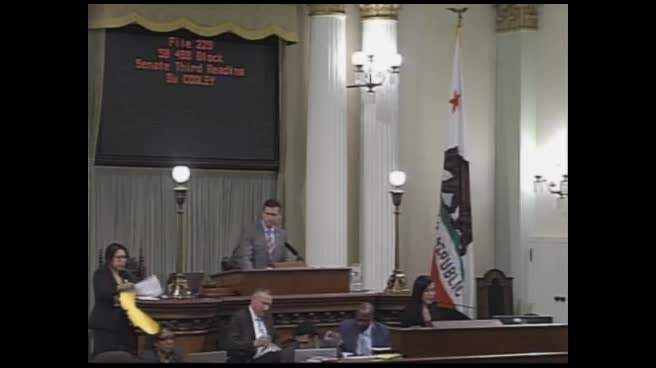 3MIN
Assembly Floor
 7MIN
Assembly Standing Committee on Appropriations
 25MIN
Assembly Standing Committee on Transportation
 3MIN
Senate Floor
 20MIN
Senate Standing Committee on Transportation and Housing
 44MIN
Senate Standing Committee on Transportation and Housing
Bill Author