AB 1323: Marine debris: removal and disposal.
- Session Year: 2015-2016
- House: Assembly
- Latest Version Date: 2015-10-08
Existing law authorizes a public agency that removes or causes the removal of wrecked property that is an unseaworthy derelict or hulk, specified abandoned property, or other specified property from a navigable waterway to sell or otherwise dispose of the property if, among other things, within 48 hours after the removal, the public agency has sent notice of the removal to the registered and legal owners and persons known to have an interest in the property and has provided the opportunity for a poststorage hearing. Existing law requires the public agency, if it is unable to locate those persons, to publish, or cause to be published, the notice of removal for at least 2 weeks in succession in one or more daily newspapers circulated in the county. Within 15 days of the date of notice of removal, the property may be claimed and recovered by its registered and legal owners, or by any other person known to have an interest in the property.
This bill would authorize a public agency to remove and dispose of after 10 days marine debris, defined as a vessel, as defined, or part of a vessel that is unseaworthy and not reasonably fit or capable of being made fit to be used as a means of transportation by water, if that marine debris is floating, sunk, partially sunk, or beached in or on a public waterway, public beach, or on state tidelands or submerged lands, and if the marine debris has no or little value, as provided, and the public agency provides notice, as specified. The bill would exempt from this provision marine debris that constitutes a public nuisance or a danger to navigation, health, safety, or the environment, and would authorize such marine debris to be removed and disposed of immediately, unless the marine debris is whole and the owner of the marine debris is identifiable, in which case the bill would require it to be maintained or stored for 10 days. The bill would authorize a public agency to recover costs incurred for removal and disposal of marine debris from the owner or other specified persons. The bill would require the State Lands Commission, on or before January 1, 2017, to adopt best management practices for salvage of marine debris, as specified.
Existing law authorizes a public agency that removes or causes the removal of wrecked property that is an unseaworthy derelict or hulk, specified abandoned property, or other specified property from a navigable waterway to sell or otherwise dispose of the property if, among other things, within 48 hours after the removal, the public agency has sent notice of the removal to the registered and legal owners and persons known to have an interest in the property and has provided the opportunity for a poststorage hearing. Existing law requires the public agency, if it is unable to locate those persons, to publish, or cause to be published, the notice of removal for at least 2 weeks in succession in one or more daily newspapers circulated in the county. Within 15 days of the date of notice of removal, the property may be claimed and recovered by its registered and legal owners, or by any other person known to have an interest in the property.
This bill would authorize a public entity agency to remove and dispose of after 10 days marine debris, defined as a vessel, as defined, or part of a vessel that is unseaworthy and not reasonably fit or capable of being made fit to be used as a means of transportation by water, if that marine debris is floating, sunk, partially sunk, or beached in or on a public waterway, public beach, or on state tidelands or submerged lands, and if the marine debris has no or little value, as provided, and the public entity agency provides notice, as specified. The bill would exempt from this provision marine debris that constitutes a public nuisance or a danger to navigation, health, safety, or the environment, and would authorize such marine debris to be removed and disposed of immediately, unless the marine debris is whole and the owner of the marine debris is identifiable, in which case the bill would require it to be maintained or stored for 10 days. The bill would authorize a public entity agency to recover costs incurred for removal and disposal of marine debris from the owner or other specified persons. The bill would require the State Lands Commission, on or before January 1, 2017, to adopt best management practices and requirements for salvage of marine debris, as specified.
Existing law authorizes a public agency that removes or causes the removal of wrecked property that is an unseaworthy derelict or hulk, specified abandoned property, or other specified property from a navigable waterway to sell or otherwise dispose of the property if, among other things, within 48 hours after the removal, the public agency has sent notice of the removal to the registered and legal owners and persons known to have an interest in the property and has provided the opportunity for a poststorage hearing. Existing law requires the public agency, if it is unable to locate those persons, to publish, or cause to be published, the notice of removal for at least 2 weeks in succession in one or more daily newspapers circulated in the county. Within 15 days of the date of notice of removal, the property may be claimed and recovered by its registered and legal owners, or by any other person known to have an interest in the property.
This bill would authorize a public entity to remove and dispose of after 10 days marine debris, defined as a vessel, as defined, or part of a vessel that is unseaworthy and not reasonably fit or capable of being made fit to be used as a means of transportation by water, if that marine debris is floating, sunk, partially sunk, or beached in or on a public waterway, public beach, or on state tidelands or submerged lands, and if the marine debris has no or little value, as provided, and the public entity provides notice, as specified. The bill would exempt from this provision marine debris that constitutes a public nuisance or a danger to navigation, health, safety, or the environment, and would authorize such marine debris to be removed and disposed of immediately, unless the marine debris is whole and the owner of the marine debris is identifiable, in which case the bill would require it to be maintained or stored for 10 days. The bill would authorize a public entity to recover costs incurred for removal and disposal of marine debris from the owner or other specified persons. The bill would prohibit a state or local agency from requiring a permit for removal activities by any state or local government entity if the removal activities conform to the require the State Lands Commission, on or before January 1, 2017, to adopt best management practices and requirements for salvage adopted by the State Lands Commission, salvage of marine debris, as specified.
Existing law authorizes a public agency that removes or causes the removal of wrecked property that is an unseaworthy derelict or hulk, specified abandoned property, or other specified property from a navigable waterway to sell or otherwise dispose of the property if, among other things, within 48 hours after the removal, the public agency has sent notice of the removal to the registered and legal owners and persons known to have an interest in the property and has provided the opportunity for a poststorage hearing. Existing law requires the public agency, if it is unable to locate those persons, to publish, or cause to be published, the notice of removal for at least 2 weeks in succession in one or more daily newspapers circulated in the county. Within 15 days of the date of notice of removal, the property may be claimed and recovered by its registered and legal owners, or by any other person known to have an interest in the property. Existing law makes abandoning a vessel on a public waterway an infraction.
This bill would apply those and related provisions, except for the newspaper notice requirement, to authorize a public entity to remove and dispose of after 10 days marine debris, defined as a vessel, as defined, or part of a vessel that is unseaworthy and not reasonably fit or capable of being made fit to be used as a means of transportation by water. water, if that marine debris is floating, sunk, partially sunk, or beached in or on a public waterway, public beach, or on state tidelands or submerged lands, and if the marine debris has no or little value, as provided, and the public entity provides notice, as specified. The bill would exempt from this provision marine debris that constitutes a public nuisance or a danger to navigation, health, safety, or the environment, and would authorize such marine debris to be removed immediately and sold, destroyed, or otherwise disposed of after immediately, unless the marine debris is whole and the owner of the marine debris is identifiable, in which case the bill would require it to be maintained or stored for 10 days. The bill would authorize a public entity to recover costs incurred for removal and disposal of marine debris from the owner or other specified persons. The bill would prohibit a state or local agency from requiring a permit for removal activities by any state or local government entity if the removal activities conform to the best management practices and requirements for salvage adopted by the State Lands Commission, as specified. The bill would make depositing marine debris in a public waterway, or on state tidelands or submerged lands an infraction, thereby imposing a state-mandated local program.
The California Constitution requires the state to reimburse local agencies and school districts for certain costs mandated by the state. Statutory provisions establish procedures for making that reimbursement.
This bill would provide that no reimbursement is required by this act for a specified reason.
Existing law authorizes a public agency that removes or causes the removal of wrecked property that is an unseaworthy derelict or hulk, specified abandoned property, or other specified property from a navigable waterway to sell or otherwise dispose of the property if, among other things, within 48 hours after the removal, the public agency has sent notice of the removal to the registered and legal owners and persons known to have an interest in the property and provided the opportunity for a poststorage hearing. Existing law requires the public agency, if it is unable to locate those persons, to publish, or cause to be published, the notice of removal for at least 2 weeks in succession in one or more daily newspapers circulated in the county. Within 15 days of the date of notice of removal, the property may be claimed and recovered by its registered and legal owners, or by any other person known to have an interest in the property. Existing law makes abandoning a vessel on a public waterway an infraction.
This bill would apply those and related provisions, except for the newspaper notice requirement, to marine debris, defined as a vessel, as defined, or part of a vessel that is unseaworthy and not reasonably fit or capable of being made fit to be used as a means of transportation by water. The bill would exempt from this provision marine debris that constitutes a public nuisance or a danger to navigation, health, safety, or the environment, and would authorize such marine debris to be removed immediately and sold, destroyed, or otherwise disposed of after 10 days. The bill would prohibit a state or local agency from requiring a permit for removal activities by any state or local government entity if the removal activities conform to the best management practices and requirements for salvage adopted by the State Lands Commission, as specified. The bill would make depositing marine debris in a public waterway, or on state tidelands or submerged lands an infraction, thereby imposing a state-mandated local program.
The California Constitution requires the state to reimburse local agencies and school districts for certain costs mandated by the state. Statutory provisions establish procedures for making that reimbursement.
This bill would provide that no reimbursement is required by this act for a specified reason.
For purposes of this article, the following terms have the following meanings:
(a)A vessel includes every description of watercraft or other artificial contrivance used, or capable of being used, as a means of transportation by water.
(b)Marine debris is a vessel or part of a vessel, including a derelict, wreck, hulk, or part of any ship or other watercraft or dilapidated vessel, that is unseaworthy and not reasonably fit or capable of being made fit to be used as a means of transportation by water.
551.(a)(1)Notwithstanding any other law, marine debris that is floating, sunk, partially sunk, or beached in or on a public waterway, public beach, or on state tidelands or submerged lands may be removed and destroyed, or otherwise disposed of, by any state, county, city, or other public agency having jurisdiction over its location or having authority to remove marine debris or solid waste, subject to the following conditions:
(A)The object meets the definition of marine debris in subdivision (b) of Section 550 and has no value or a value that does not exceed the cost of removal and disposal.
(B)If there is no discernible registration, hull identification number, or other identification insignia, a peace officer or authorized public employee securely attaches to the marine debris a notice stating that the marine debris shall be removed by the public agency if not claimed or removed within 10 days.
(C)If there is discernible registration, hull identification number, or other identification insignia, a notice is attached to the marine debris as described in subparagraph (B), and sent to the owner of the marine debris, if known, at the owners address of record with the Department of Motor Vehicles, by certified or first-class mail.
(D)The marine debris remains in place for 10 days from the date of attaching the notice to the marine debris or from the date the notice letter was sent, whichever is later, before being removed.
(2)(A)The notice attached to the marine debris shall state the name, address, and telephone number of the public agency providing the notice.
(B)A notice sent to the owner shall contain the information specified in subparagraph (A), and further state that the marine debris will be removed and disposed of within 10 days if not claimed, and that the marine debris may be claimed and recovered upon the payment of the public agencys costs.
(b)Notwithstanding subdivision (a), marine debris that constitutes a public nuisance or a danger to navigation, health, safety, or the environment may be removed and disposed of immediately, unless the marine debris is whole or not demolished during removal, in which case it shall be maintained or stored for 10 days to permit notification of the owner. If the owner of the marine debris is not identifiable, the marine debris may be immediately destroyed or otherwise disposed of.
(c)Costs incurred by a public agency for removal and disposal of marine debris may be recovered from an owner or any person or entity who placed the marine debris in or on or caused the marine debris to be in or on the public waterway, public beach, or state tidelands or submerged lands through any appropriate legal action in the courts of this state or by administrative action.
552.On or before January 1, 2017, the State Lands Commission shall adopt, at a public meeting and after consultation with interested state and local agencies, best management practices for salvage of marine debris. These best management practices shall be published by the State Lands Commission on its Internet Web site. The State Lands Commission may amend the best management practices from time to time by the same process, as the State Lands Commission deems necessary.
(a)
SECTION 1.Article 3 (commencing with Section 550) is added to Chapter 3 of Division 3 of the Harbors and Navigation Code, to read:3.Marine Debris550.For purposes of this section, article, the following terms have the following meanings:
(1)
(a)A vessel includes every description of watercraft or other artificial contrivance used, or capable of being used, as a means of transportation by water.
(2)
(b)Marine debris is a vessel or part of a vessel, including a derelict, wreck, hulk hulk, or part of any ship or other watercraft or dilapidated vessel, that is unseaworthy and not reasonably fit or capable of being made fit to be used as a means of transportation by water.
(b)
551.(a)(1)Notwithstanding any other law, marine debris that is floating, sunk, partially sunk, or beached in or on a public waterway, public beach, or on state tidelands or submerged lands may be removed and destroyed, or otherwise disposed of, by any state, county, city, or other public entity agency having jurisdiction over its location or having authority to remove marine debris or solid waste, subject to the following conditions:
(A)The object meets the definition of marine debris in subdivision (a) (b) of Section 550 and has no value or a value that does not exceed the cost of removal and disposal.
(B)If there is no discernible registration, hull identification number, or other identification insignia, a peace officer or authorized public employee securely attaches to the marine debris a notice stating that the marine debris shall be removed by the public agency if not claimed or removed within 10 days.
(C)If there is discernible registration, hull identification number, or other identification insignia, a notice is attached to the marine debris as described in subparagraph (B), and sent to the owner of the marine debris, if known, at the owners address of record with the Department of Motor Vehicles, by certified or first class first-class mail.
(D)The marine debris remains in place for 10 days from the date of attaching the notice to the marine debris or from the date the notice letter was sent, whichever is later, before being removed.
(2)(A)The notice attached to the marine debris shall state the name, address, and telephone number of the public entity agency providing the notice.
(B)A notice sent to the owner shall contain the information specified in subparagraph (A), and further state that the marine debris will be removed and disposed of within 10 days if not claimed, and that the marine debris may be claimed and recovered upon the payment of the public entitys agencys costs.
(c)
(b)Notwithstanding subdivision (b), (a), marine debris that constitutes a public nuisance or a danger to navigation, health, safety, or the environment may be removed and disposed of immediately, unless the marine debris is whole or not demolished during removal, in which case it shall be maintained or stored for 10 days to permit notification of the owner. If the owner of the marine debris is not identifiable, the marine debris may be immediately destroyed or otherwise disposed of.
(d)
(c)Costs incurred by a public entity agency for removal and disposal of marine debris may be recovered from an owner or any person or entity who placed the marine debris in or on or caused the marine debris to be in or on the public waterway, public beach, or state tidelands or submerged lands through any appropriate legal action in the courts of this state or by administrative action.
(e)
552.On or before January 1, 2017, the State Lands Commission shall adopt, at a public meeting and after consultation with interested state and local agencies, best management practices and requirements for salvage of marine debris. These best management practice standards practices shall be published by the commission State Lands Commission on its Internet Web site. The State Lands Commission may amend the best management practice standards practices from time to time by the same process, as the State Lands Commission deems necessary.
(a)For purposes of this section, vessel
SECTION 1.Section 524.5 is added to the Harbors and Navigation Code, to read:524.5.(a)For purposes of this section, the following terms have the following meanings:
(1)A vessel includes every description of watercraft or other artificial contrivance used, or capable of being used, as a means of transportation by water. A
(2)Marine debris is a vessel or part of a vessel, including a derelict, wreck, hulk or part of any ship or other watercraft or dilapidated vessel, that is unseaworthy and not reasonably fit or capable of being made fit to be used as a means of transportation by water is marine debris. water.
(b)(1)Notwithstanding any other law, marine debris that is floating, sunk, partially sunk, or beached in or on a public waterway, public beach, or on state tidelands or submerged lands may be removed and destroyed, or otherwise disposed of, by any state, county, city, or other public entity having jurisdiction over its location or having authority to remove marine debris or solid waste, subject to the following conditions:
(A)The object meets the definition of marine debris in subdivision (a) and has no value or a value that does not exceed the cost of removal and disposal.
(B)If there is no discernible registration, hull identification number, or other identification insignia, a peace officer or authorized public employee securely attaches to the marine debris a notice stating that the marine debris shall be removed by the public agency if not claimed or removed within 10 days.
(C)If there is discernible registration, hull identification number, or other identification insignia, a notice is attached to the marine debris as described in subparagraph (b), (B), and sent to the owner of the marine debris, if known, at the owners address of record with the Department of Motor Vehicles, by certified or first class mail.
(D)The marine debris remains in place for 10 days from the date of attaching the notice to the marine debris or from the date the notice letter was sent, whichever is later, before being removed.
(2)(A)The notice attached to the marine debris shall state the name, address, and telephone number of the public entity providing the notice.
(B)A notice sent to the owner shall contain the information specified in subparagraph (A), and further state that the marine debris will be removed and disposed of within 10 days if not claimed, and that the marine debris may be claimed and recovered upon the payment of the public entitys costs.
(c)Notwithstanding subdivision (b), marine debris that constitutes a public nuisance or a danger to navigation, health, safety, or the environment may be removed and disposed of immediately, unless the marine debris is whole or not demolished during removal, in which case it shall be maintained or stored for 10 days to permit notification of the owner. If the owner of the marine debris is not identifiable, the marine debris may be immediately destroyed or otherwise disposed of.
(d)Costs incurred by a public entity for removal and disposal of marine debris may be recovered from an owner or any person or entity who placed the marine debris in or on or caused the marine debris to be in or on the public waterway, public beach, or state tidelands or submerged lands through any appropriate legal action in the courts of this state or by administrative action.
(e)A state or local agency shall not require a permit for removal activities conducted under this section by any state or local government entity if the removal activities conform to the On or before January 1, 2017, the State Lands Commission shall adopt, at a public meeting and after consultation with interested state and local agencies, best management practices and requirements for salvage adopted by the commission at a public meeting after consultation with interested state and local agencies. of marine debris. These best management practice standards shall be published by the commission on its Internet Web site. The commission State Lands Commission may amend the best management practice standards from time to time by the same process, as the commission State Lands Commission deems necessary.
(a)For purposes of this section, vessel includes every description of watercraft or other artificial contrivance used, or capable of being used, as a means of transportation by water. A vessel or part of a vessel, including a derelict, wreck, hulk or part of any ship or other watercraft or dilapidated vessel, that is unseaworthy and not reasonably fit or capable of being made fit to be used as a means of transportation by water is marine debris.
(b)(1)Notwithstanding any other law, marine debris that is floating, sunk, partially sunk sunk, or beached upon in or on a public waterway, public beach, or on state tidelands or submerged lands may be removed and sold, destroyed, or otherwise disposed of of, by any state, county, city city, or other public entity having jurisdiction over its location or having authority to remove marine debris or solid waste, subject to the following conditions:
(1)The marine debris has been appraised by disinterested persons and has an estimated value of less than two thousand dollars ($2,000).
(2)There is no discernable registration, license, hull identification number, or other identifying insignia on the marine debris, or the Department of Motor Vehicles is unable to produce any record of the registered or legal owners or lienholders.
(3)Not less than 72 hours before the marine debris was removed, a peace officer or authorized public employee securely attached to the marine debris a distinctive notice stating that the marine debris would be removed by the public agency.
(4)Within 48 hours after the removal, excluding weekends and holidays, the public agency that removed or caused the removal of the marine debris sent notice of the removal to the registered and legal owners, if known or discovered subsequent to the removal, at their addresses of record with the Department of Motor Vehicles, and to any other person known to have an interest in the marine debris. A notice sent by the public agency shall be sent by certified or first-class mail.
(A)The object meets the definition of marine debris in subdivision (a) and has no value or a value that does not exceed the cost of removal and disposal.
(B)If there is no discernible registration, hull identification number, or other identification insignia, a peace officer or authorized public employee securely attaches to the marine debris a notice stating that the marine debris shall be removed by the public agency if not claimed or removed within 10 days.
(C)If there is discernible registration, hull identification number, or other identification insignia, a notice is attached to the marine debris as described in subparagraph (b), and sent to the owner of the marine debris, if known, at the owners address of record with the Department of Motor Vehicles, by certified or first class mail.
(D)The marine debris remains in place for 10 days from the date of attaching the notice to the marine debris or from the date the notice letter was sent, whichever is later, before being removed.
(2)(A)The notice attached to the marine debris shall state the name, address, and telephone number of the public entity providing the notice.
(B)A notice sent to the owner shall contain the information specified in subparagraph (A), and further state that the marine debris will be removed and disposed of within 10 days if not claimed, and that the marine debris may be claimed and recovered upon the payment of the public entitys costs.
(c)Notwithstanding subdivision (b), marine debris that constitutes a public nuisance or a danger to navigation, health, safety, or the environment may be removed immediately and sold, destroyed, or otherwise disposed of after 10 days. and disposed of immediately, unless the marine debris is whole or not demolished during removal, in which case it shall be maintained or stored for 10 days to permit notification of the owner. If the owner of the marine debris is not identifiable, the marine debris may be immediately destroyed or otherwise disposed of.
(d)The notice of removal required by paragraphs (3) and (4) of subdivision (b) shall state all of the following:
(1)The name, address, and telephone number of the public agency providing the notice.
(2)A description of the marine debris removed.
(3)The location from which the marine debris is to be or was removed.
(4)The location of the intended or actual place of storage.
(5)The authority and purpose for removal of the marine debris.
(6)A statement that the marine debris may be claimed and recovered within 15 days of the date the notice of removal was issued pursuant to paragraph (4) of subdivision (b) after payment of any costs incurred by the public agency related to salvage and storage of the marine debris, and that following the expiration of the 15-day period, the marine debris will be sold or otherwise disposed of by the public agency.
(7)A statement that a registered or legal owner or any other person known to have an interest in the marine debris has the opportunity for a poststorage hearing before the public agency that removed, or caused the removal of, the marine debris to determine the validity of the removal and storage if a request for a hearing is made in person or in writing to that public agency within 10 days from the date of notice; that if a registered or legal owner or any other person known to have an interest in the marine debris disagrees with the decision of the public agency, the decision may be reviewed pursuant to Section 11523 of the Government Code; and that during the time of the initial hearing, or during the time the decision is being reviewed pursuant to Section 11523 of the Government Code, the marine debris in question shall not be sold or otherwise disposed of.
(e)(1)Any requested hearing shall be conducted within 48 hours of the time the request for a hearing is received by the public agency, excluding weekends and holidays. The public agency that removed the marine debris may authorize its own officers or employees to conduct the hearing, but the hearing officer shall not be the same person who directed the removal and storage of the marine debris.
(2)The failure of either a registered or legal owner or any other person known to have an interest in the marine debris to request or attend a scheduled hearing shall not affect the validity of the hearing.
(f)The marine debris may be claimed and recovered by its registered or legal owner or by any other person known to have an interest in the marine debris within 15 days of the date the notice of removal was issued pursuant to paragraph (4) of subdivision (b) after payment of any costs incurred by the public agency related to salvage and storage of the marine debris.
(g)The marine debris may be sold or otherwise disposed of by the public agency not less than 15 days from the date the notice of removal was issued pursuant to paragraph (4) of subdivision (b) or the date of actual removal, whichever is later.
(h)(1)
(d)Costs incurred by a state or local public entity for removal and disposal of marine debris may be recovered from a registered or legal an owner or any person or entity who placed or caused the marine debris to be in or on the public waterway waterway, public beach, or on state tidelands or submerged lands through any appropriate legal action in the courts of this state or by administrative action.
(2)The proceeds from the sale of the marine debris, after deducting expenses for salvage, storage, sales costs, and any property tax liens, shall be deposited in the Abandoned Watercraft Abatement Fund for grants to local agencies, as specified in paragraph (1) of subdivision (d) of Section 525 of the Harbors and Navigation Code.
(i)
(e)A state or local agency shall not require a permit for removal activities conducted under this section by any state or local government entity if the removal activities conform to the best management practices and requirements for salvage adopted by the commission at a public meeting after consultation with interested state and local agencies. These best management practice standards shall be published by the commission on its Internet Web site. The commission may amend the best management practice standards from time to time by the same process, as the commission deems necessary.
(j)Except for the urgent and immediate concern for the safety of those aboard, a person who knowingly and willfully deposits or sinks marine debris in a public waterway, or on state tidelands or submerged lands, is guilty of an infraction.
SEC. 2.No reimbursement is required by this act pursuant to Section 6 of Article XIIIB of the California Constitution because the only costs that may be incurred by a local agency or school district will be incurred because this act creates a new crime or infraction, eliminates a crime or infraction, or changes the penalty for a crime or infraction, within the meaning of Section 17556 of the Government Code, or changes the definition of a crime within the meaning of Section 6 of Article XIIIB of the California Constitution.
(a)For purposes of this section, vessel includes every description of watercraft or other artificial contrivance used, or capable of being used, as a means of transportation by water. A vessel or part of a vessel, including a derelict, wreck, hulk or part of any ship or other watercraft or dilapidated vessel, that is unseaworthy and not reasonably fit or capable of being made fit to be used as a means of transportation by water is marine debris.
(b)Notwithstanding any other law, marine debris that is floating, sunk, partially sunk or beached upon a public waterway, public beach, or on state tidelands or submerged lands may be removed and sold, destroyed, or otherwise disposed of by any state, county, city or other public entity having jurisdiction over its location or having authority to remove marine debris or solid waste, subject to the following conditions:
(1)The marine debris has been appraised by disinterested persons and has an estimated value of less than two thousand dollars ($2,000).
(2)There is no discernable registration, license, hull identification number, or other identifying insignia on the marine debris, or the Department of Motor Vehicles is unable to produce any record of the registered or legal owners or lienholders.
(3)Not less than 72 hours before the marine debris was removed, a peace officer or authorized public employee securely attached to the marine debris a distinctive notice stating that the marine debris would be removed by the public agency.
(4)Within 48 hours after the removal, excluding weekends and holidays, the public agency that removed or caused the removal of the marine debris sent notice of the removal to the registered and legal owners, if known or discovered subsequent to the removal, at their addresses of record with the Department of Motor Vehicles, and to any other person known to have an interest in the marine debris. A notice sent by the public agency shall be sent by certified or first-class mail.
(c)Notwithstanding subdivision (b), marine debris that constitutes a public nuisance or a danger to navigation, health, safety, or the environment may be removed immediately and sold, destroyed, or otherwise disposed of after 10 days.
(d)The notice of removal required by paragraphs (3) and (4) of subdivision (b) shall state all of the following:
(1)The name, address, and telephone number of the public agency providing the notice.
(2)A description of the marine debris removed.
(3)The location from which the marine debris is to be or was removed.
(4)The location of the intended or actual place of storage.
(5)The authority and purpose for removal of the marine debris.
(6)A statement that the marine debris may be claimed and recovered within 15 days of the date the notice of removal was issued pursuant to paragraph (4) of subdivision (b) after payment of any costs incurred by the public agency related to salvage and storage of the marine debris, and that following the expiration of the 15-day period, the marine debris will be sold or otherwise disposed of by the public agency.
(7)A statement that a registered or legal owner or any other person known to have an interest in the marine debris has the opportunity for a poststorage hearing before the public agency that removed, or caused the removal of, the marine debris to determine the validity of the removal and storage if a request for a hearing is made in person or in writing to that public agency within 10 days from the date of notice; that if a registered or legal owner or any other person known to have an interest in the marine debris disagrees with the decision of the public agency, the decision may be reviewed pursuant to Section 11523 of the Government Code; and that during the time of the initial hearing, or during the time the decision is being reviewed pursuant to Section 11523 of the Government Code, the marine debris in question shall not be sold or otherwise disposed of.
(e)(1)Any requested hearing shall be conducted within 48 hours of the time the request for a hearing is received by the public agency, excluding weekends and holidays. The public agency that removed the marine debris may authorize its own officers or employees to conduct the hearing, but the hearing officer shall not be the same person who directed the removal and storage of the marine debris.
(2)The failure of either a registered or legal owner or any other person known to have an interest in the marine debris to request or attend a scheduled hearing shall not affect the validity of the hearing.
(f)The marine debris may be claimed and recovered by its registered or legal owner or by any other person known to have an interest in the marine debris within 15 days of the date the notice of removal was issued pursuant to paragraph (4) of subdivision (b) after payment of any costs incurred by the public agency related to salvage and storage of the marine debris.
(g)The marine debris may be sold or otherwise disposed of by the public agency not less than 15 days from the date the notice of removal was issued pursuant to paragraph (4) of subdivision (b) or the date of actual removal, whichever is later.
(h)(1)Costs incurred by a state or local entity for removal and disposal of marine debris may be recovered from a registered or legal owner or any person or entity who placed the marine debris in the public waterway or on state tidelands or submerged lands through any appropriate legal action in the courts of this state or by administrative action.
(2)The proceeds from the sale of the marine debris, after deducting expenses for salvage, storage, sales costs, and any property tax liens, shall be deposited in the Abandoned Watercraft Abatement Fund for grants to local agencies, as specified in paragraph (1) of subdivision (d) of Section 525 of the Harbors and Navigation Code.
(i)A state or local agency shall not require a permit for removal activities conducted under this section by any state or local government entity if the removal activities conform to the best management practices and requirements for salvage adopted by the commission at a public meeting after consultation with interested state and local agencies. These best management practice standards shall be published by the commission on its Internet Web site. The commission may amend the best management practice standards from time to time by the same process, as the commission deems necessary.
(j)Except for the urgent and immediate concern for the safety of those aboard, a person who knowingly and willfully deposits or sinks marine debris in a public waterway, or on state tidelands or submerged lands, is guilty of an infraction.
SEC. 2.No reimbursement is required by this act pursuant to Section 6 of Article XIIIB of the California Constitution because the only costs that may be incurred by a local agency or school district will be incurred because this act creates a new crime or infraction, eliminates a crime or infraction, or changes the penalty for a crime or infraction, within the meaning of Section 17556 of the Government Code, or changes the definition of a crime within the meaning of Section 6 of Article XIIIB of the California Constitution.
|
Date
|
Status
|
|---|---|
| Oct 8, 2015 | Chaptered by Secretary of State - Chapter 645, Statutes of 2015. |
| Oct 8, 2015 | Approved by the Governor. |
| Sep 17, 2015 | Enrolled and presented to the Governor at 4 p.m. |
| Sep 9, 2015 | Senate amendments concurred in. To Engrossing and Enrolling. (Ayes 79. Noes 0. Page 3023.). |
| Sep 9, 2015 | Assembly Rule 77 suspended. (Page 2990.) |
| Sep 9, 2015 | Senate amendments concurred in. To Engrossing and Enrolling. (Ayes 79. Noes 0.). |
| Sep 9, 2015 | Senate amendments concurred in. To Engrossing and Enrolling. |
| Sep 9, 2015 | Assembly Rule 77 suspended. |
| Sep 8, 2015 | Read third time. Passed. Ordered to the Assembly. (Ayes 40. Noes 0. Page 2563.). |
| Sep 8, 2015 | In Assembly. Concurrence in Senate amendments pending. May be considered on or after September 10 pursuant to Assembly Rule 77. |
| Sep 8, 2015 | Read third time. Passed. Ordered to the Assembly. |
| Aug 18, 2015 | Read second time. Ordered to third reading. |
| Aug 17, 2015 | From committee: Be placed on second reading file pursuant to Senate Rule 28.8. |
| Jul 15, 2015 | From committee: Do pass and re-refer to Com. on APPR. with recommendation: To Consent Calendar. (Ayes 7. Noes 0.) (July 14). Re-referred to Com. on APPR. |
| Jun 24, 2015 | From committee: Do pass and re-refer to Com. on JUD. (Ayes 9. Noes 0.) (June 23). Re-referred to Com. on JUD. |
| Jun 10, 2015 | From committee chair, with author's amendments: Amend, and re-refer to committee. Read second time, amended, and re-referred to Com. on N.R. & W. |
| Jun 4, 2015 | Referred to Coms. on N.R. & W. and JUD. |
| May 22, 2015 | Read third time. Passed. Ordered to the Senate. (Ayes 74. Noes 0. Page 1564.) |
| May 22, 2015 | In Senate. Read first time. To Com. on RLS. for assignment. |
| May 14, 2015 | Read second time. Ordered to Consent Calendar. |
| May 13, 2015 | From committee: Do pass. To Consent Calendar. (Ayes 17. Noes 0.) (May 13). |
| May 6, 2015 | Re-referred to Com. on APPR. |
| May 5, 2015 | Read second time and amended. |
| May 4, 2015 | From committee: Amend, and do pass as amended and re-refer to Com. on APPR. (Ayes 9. Noes 0.) (April 27). |
| Apr 7, 2015 | Re-referred to Com. on NAT. RES. |
| Apr 6, 2015 | From committee chair, with author's amendments: Amend, and re-refer to Com. on NAT. RES. Read second time and amended. |
| Mar 23, 2015 | Referred to Com. on NAT. RES. |
| Mar 2, 2015 | Read first time. |
| Mar 1, 2015 | From printer. May be heard in committee March 31. |
| Feb 27, 2015 | Introduced. To print. |
|
Date
|
Description
|
Location
|
Votes
|
|
|---|---|---|---|---|
| Sep 9, 2015 | AB 1323 FRAZIER Concurrence in Senate Amendments | Assembly Floor |
Passed |
|
| Sep 8, 2015 | Assembly 3rd Reading AB1323 Frazier By Hueso | Senate Floor |
Passed |
|
| Jul 14, 2015 | Do pass, but first be re-referred to the Committee on [Appropriations] with the recommendation: To Consent Calendar | Senate Standing Committee on Judiciary |
Passed |
|
| Jun 23, 2015 | Do pass, but first be re-referred to the Committee on [Judiciary] | Senate Standing Committee on Natural Resources and Water |
Passed |
|
| May 22, 2015 | AB 1323 FRAZIER Consent Calendar Second Day Regular Session | Assembly Floor |
Passed |
|
| May 13, 2015 | Do pass. To Consent Calendar. | Assembly Standing Committee on Appropriations |
Passed |
|
| Apr 27, 2015 | Do pass as amended and be re-referred to the Committee on [Appropriations] | Assembly Standing Committee on Natural Resources |
Passed |
This list shows positions taken on this bill by organizations on the date displayed, which is linked to the original source.
Positions by individuals are not included.
AB 1323
Page 2
CONCURRENCE IN SENATE AMENDMENTS
AB 1323
(Frazier)
As Amended June 10, 2015
Majority vote
ASSEMBLY: |
74-0 |
(May 22, 2015) |
SENATE: |
40-0 |
(September 8, 2015) |
Original Committee Reference: NAT. RES.
SUMMARY: Authorizes a public agency to remove and dispose of marine debris after 10 days if the marine debris is floating, sunk, partially sunk, or beached in or on a public waterway, public beach, or on state tidelands or submerged lands, as specified.
The Senate amendments are technical and clarifying.
EXISTING LAW:
Pursuant to the Public Resources Code:
Authorizes the State Lands Commission (SLC) to remove vessels located on state lands under specified conditions.
Authorizes SLC to remove and dispose of an abandoned or derelict vessel on a navigable waterway that is not under the jurisdiction of SLC, if requested by the public entity that has regulatory authority over the area in which the vessel is located.
Defines "vessel" as:
A vessel, boat, raft, or similar watercraft;
A buoy, anchor, mooring, or other ground tackles used to secure a vessel, boat, raft, or similar watercraft; or,
A hulk, derelict, wreck, or parts of a ship, vessel, or other watercraft.
Pursuant to the Harbors and Navigation Code:
Requires the sheriff of any county in which wrecked property is found, when no person entitled to the possession appears, to take possession of it, have it independently appraised, and safely store it for the owner. Establishes timelines and guidelines for managing wrecked property that is not claimed.
States that any hulk, derelict, wreck, or parts of any ship, vessel, or other watercraft sunk, beached, or allowed to remain in an unseaworthy or dilapidated condition upon publicly owned submerged lands, salt marsh, or tidelands without consent for longer than 30 days is abandoned property.
Authorizes a local government to take title of the abandoned property for purposes of abatement, as specified. Establishes requirements for the collection of property tax and sale of abandoned property.
Authorizes removal of abandoned property by a peace officer to remove and, if necessary, store a vessel removed from a public waterway under specified conditions.
Authorizes the public entity to pursue cost recovery in any court in the state.
Prohibits a person from abandoning a vessel upon a public waterway or public or private property without the express consent of the owner, except for immediate safety concerns.
Establishes the Abandoned Watercraft Abatement Fund (AWAF), administered by the Department of Boating and Waterways, to provide grants to local agencies to remove, store, and dispose of abandoned, wrecked, or dismantled recreational vessels which pose a substantial hazard to navigation.
FISCAL EFFECT: According to the Senate Appropriations Committee, pursuant to Senate Rule 28.8, negligible state costs.
COMMENTS: The state has experienced an increase in the amount of watercraft being abandoned in state waterways over the last several years. Boats are some of the most expensive luxury items to maintain and store, and unlike other luxury goods cannot be disposed of easily or cheaply. An August 2010 Petaluma Argus-Courier article reported that some boat owners were selling vessels for as little as one-dollar to avoid the cost of removing their boats from California waterways and properly disposing of the vessel. Even more distressing, the Argue-Courier noted that an underground “scuttle” economy has developed whereby a boat owner pays individuals to strip a boat of all usable material and identifiable markings then dump the boat in a public waterway.
Abandoned boats, especially those that capsize and sink, can interfere with boating traffic and damage operational vessels attempting to navigate a waterway. More troublesome, abandoned boats that begin to deteriorate can leach toxic chemicals or fuel into state waterways. Removing these vessels is difficult, potentially dangerous, and expensive. To ensure that a boat does not further deteriorate and expose salvage crews or the local environment to toxic chemicals, salvage efforts take significant time and require great care and effort. The sooner an abandoned boat is removed from the waterway, the less likely it is to pose harm to the environment and salvage crews.
Currently, there are processes in place to allow SLC and local authorities to remove vessels from state and public waterways, under certain conditions. However, such removals are expensive, and the process is lengthy, which often results in it only being used for intact vessels with clear ownership markings. The state has taken action to assist with the cost by establishing the AWAF, which provides grants to local public agencies for the removal of abandoned vessels and other navigational hazards. The grants cover the costs of removal, storage, and disposal of abandoned vessels. This bill addresses the remaining barrier to local public entities by streamlining the process for the removal of marine debris.
Analysis Prepared by: Elizabeth MacMillan / NAT. RES. / (916) 319-2092 FN: 0001466
AB 1323
Page 6
|
Office of Senate Floor Analyses (916) 651-1520 Fax: (916) 327-4478 |
THIRD READING
Bill No: AB 1323
Amended: 6/10/15 in Senate
SENATE NATURAL RES. & WATER COMMITTEE: 9-0, 6/23/15
AYES: Pavley, Stone, Allen, Hertzberg, Hueso, Jackson, Monning, Vidak, Wolk
SENATE JUDICIARY COMMITTEE: 7-0, 7/14/15
AYES: Jackson, Moorlach, Anderson, Hertzberg, Leno, Monning, Wieckowski
SENATE APPROPRIATIONS COMMITTEE: Senate Rule 28.8
ASSEMBLY FLOOR: 74-0, 5/22/15 - See last page for vote
SUBJECT: Marine debris: removal and disposal
DIGEST: This bill authorizes a public agency to remove and dispose of marine debris after 10 days if the marine debris is floating, sunk, partially sunk, or beached in or on a public waterway, public beach, or on state tidelands or submerged lands, as specified.
Existing law:
Provides a definition for “vessel” that “includes ships of all kinds, steamboats, steamships, canal boats, barges, sailing vessels, and every structure adapted to be navigated from place to place for the transportation of merchandise or persons” (Harbors and Navigation Code (HNC) Section 21).
Defines abandoned property as “any hulk, derelict, wreck, or parts of any ship, vessel, or other watercraft sunk, beached, or allowed to remain in an unseaworthy or dilapidated condition upon publicly owned submerged lands, salt marsh, or tidelands within the corporate limits of any municipal corporation or other public corporation or entity having jurisdiction or control over those lands, without its consent expressed by resolution of its legislative body, for a period longer than 30 days without a watchman or other person being maintained upon or near and in charge of the property” (HNC Section 522).
Provides authority for a peace office, lifeguard, or marine safety officer, while engaged in the performance of official duties, to remove and store, as necessary, a vessel from a public waterway when the vessel (HNC Section 523):
Is left unattended and is moored, docked, beached, or made fast to land in a position that obstructs the normal movement of traffic or in a condition that creates a hazard to other vessels using the waterway, to public safety, or to the property of another;
Interferes with, or otherwise poses a danger to, navigation or to the public health, safety, or welfare;
Poses a threat to adjacent wetlands, levies, sensitive habitat, any protected wildlife species, or water quality.
Restricts the abandonment of a vessel upon a public waterway or public or private property without the express or implied consent of the owner or person in lawful possession or control of the property (HNC Section 525).
Specifies that such abandonment is prima facie evidence that the last registered owner of record, not having notified the appropriate registration or documenting agency of any relinquishment of title or interest therein, is responsible for the abandonment and is thereby liable for the cost of the removal and disposition of the vessel (HNC Section 525).
Authorizes the State Lands Commission (SLC) to immediately remove a vessel that (Public Resources Code Section (PRC) 6302.1):
Is left unattended and is moored, docked, beached, or made fast to land in a position as to obstruct the normal movement of traffic or in a condition as to create a hazard to navigation, other vessels using a waterway, or the property of another;
Poses a significant threat to the public health, safety, or welfare or to sensitive habitat, wildlife, or water quality, or that constitutes a public nuisance; and
Is abandoned or derelict, if requested to do so by another public entity that has regulatory authority over the navigable waterway where the vessel is located.
Authorizes the SLC to recover all costs incurred during removal of vessels, hulks, derelict or wrecked vessels, or parts of vessels, through appropriate action in state courts or through an administrative remedy (PRC 6302.1).
This bill:
Provides definitions for “vessel” and “marine debris.”
Vessel is defined as any watercraft or other artificial contrivance used, or capable of being used, as a means of transportation by water, and
Marine debris is defined as a vessel or part of a vessel, including a derelict, wreck, hulk, or part of any ship or other watercraft or dilapidated vessel, that is unseaworthy and not reasonably fit or capable of being made fit to be used as a means of transportation by water.
Provides authority for any state, county, city, or other public agency having jurisdiction over a given location, or having authority to remove marine debris or solid waste, to remove and destroy marine debris that is floating, sunk, partially sunk, or beached in or on a public waterway, public beach, or on state tidelands or submerged lands, subject to the following:
The marine debris meets the definition provided in HNC Section 550, and the value of the debris does not exceed the cost of removal and disposal;
If the debris cannot be positively identified as belonging to an individual, a peace officer or authorized public employee securely attaches to the marine debris a notice stating that the marine debris shall be removed by the public agency if not claimed or removed within 10 days. This notice should include the name, address, and telephone number of the public agency providing the notice;
If the debris can be positively identified as belonging to an individual, a notice is attached to the marine debris as described previously, and sent to the owner of the marine debris, if known, at the owner’s address of record with the Department of Motor Vehicles, by certified or first-class mail. The mailed notice should include a warning that the debris will be removed in 10 days; and
The marine debris is not removed prior to the 10-day notification period.
Provides authority to immediately remove and dispose of any marine debris that constitutes a public nuisance or a danger to navigation, health, safety, or the environment, unless the debris is whole or not demolished during removal, in which case it will be maintained or stored for ten days to allow for notification of the owner.
Charges the SLC to adopt, at a public meeting and after consultation with interested state and local agencies, best management practices for salvage of marine debris. This should be accomplished prior to January 1, 2017, and published on the SLC website.
Comments
Necessity of an expedited removal process. Currently, there are processes in place to allow SLC and local authorities to remove vessels from state and public waterways, under certain conditions. However, such removals are expensive, and the process is lengthy, which often results in it only being used for intact vessels with clear ownership markings. Increasingly, boats are being scrubbed before they are abandoned, making it very difficult to track the owners. In addition, it is often not cost effective to remove wrecked or partial vessels, allowing such marine debris to build up in California waterways.
Abandoned vessels. Over the last several years, the state has experienced an increase in the amount of watercraft being abandoned in state waterways. Boats are some of the most expensive luxury items to maintain and store, and unlike other luxury goods cannot be disposed of easily or cheaply. An August 2010 Petaluma Argus-Courier article reported that some boat owners were selling vessels for as little as one-dollar to avoid the cost of removing their boats from California waterways and properly disposing of the vessel. Even more distressing, the Argus-Courier noted that an underground “scuttle” economy has developed whereby a boat owner pays individuals to strip a boat of all usable (financially valuable) material and identifiable markings (including boat name and vehicle identification number) then dump the boat overnight in a public waterway. Once abandoned, boats pose hazards to commercial and recreation boat traffic as well as the ecosystem of the waterway. This problem is especially troublesome in the Sacramento-San Joaquin Delta where personal pleasure boats are abandoned alongside aging steamboats and river barges. Statewide hundreds of boats are abandoned annually.
Abandoned boats, especially those that capsize and sink, can interfere with boating traffic and damage operational vessels attempting to navigate a waterway. More troublesome, abandoned boats that begin to deteriorate can leach toxic chemicals or fuel into state waterways. Removing these vessels is difficult, potentially dangerous and expensive. To ensure that a boat does not further deteriorate and expose salvage crews or the local environment to toxic chemicals, salvage efforts take significant time and require great care and effort. The sooner an abandoned boat is removed from the waterway, the less likely it is to deteriorate and pose significant harm to the environment and salvage crews.
Related Legislation
AB 166 (Lieu, Chapter 416, Statutes of 2009) raised the minimum fine for an abandoned vessel from $500 to $1,000. It also established a program allowing individuals to surrender a recreational vessel to a public agency, if the public agency believed there was a danger of the vessel being otherwise abandoned.
FISCAL EFFECT: Appropriation: No Fiscal Com.: Yes Local: No
Alameda Marina
California Association of Harbor Masters and Port Captains
California Boating Safety Officers Association
California State Lands Commission
California State Sheriffs’ Association
California Yacht Brokers Association
Marina Recreation Association
National Marine Manufacturers Association
Recreational Boaters of California
Worldwide Boaters Safety Group
OPPOSITION: (Verified 8/19/15)
None received
ARGUMENTS IN SUPPORT: The California State Lands Commission, in support, writes: “[AB 1323] would create a simple and logical process for removal of derelict vessels that constitute marine debris from a public waterway, public beach, or on state tidelands or submerged lands. Derelict vessels and parts thereof are a hazard to navigation and the environment. While responsible owners dispose of vessels lawfully, other owners dump them on state waterways where they disintegrate and pollute the environment and impede navigation.”
The California Association of Harbor Masters and Port Captains, the California Yacht Brokers Association, the Marina Recreation Association, the National Marine Manufacturers Association, and the Worldwide Boaters Safety Group note that this bill creates an efficient and cost effective method of removing hazards to navigation and that: “California has the second largest boating population in the United States. There are over 800,000 registered vessels, not including federally documented vessels, and boating activity generates roughly $8.9 billion to the State’s economy. . . . A byproduct of this economic and boating activity is a continual problem with the abandonment of vessels that are beyond their useful life. This bill will allow for a streamlined process to remove these vessels, thereby not only removing the hazards to navigation and the threat to the environment, but will improve our waterways, which can only enhance this significant aspect of our economy and State’s cultural heritage.”
ASSEMBLY FLOOR: 74-0, 5/22/15
AYES: Achadjian, Travis Allen, Baker, Bigelow, Bloom, Bonilla, Bonta, Brough, Brown, Burke, Calderon, Campos, Chang, Chau, Chávez, Chiu, Chu, Cooley, Cooper, Dababneh, Dahle, Daly, Dodd, Eggman, Frazier, Beth Gaines, Gallagher, Cristina Garcia, Eduardo Garcia, Gatto, Gipson, Gomez, Gonzalez, Gordon, Gray, Grove, Hadley, Harper, Roger Hernández, Holden, Irwin, Jones-Sawyer, Kim, Lackey, Levine, Linder, Lopez, Low, Maienschein, Mathis, Mayes, McCarty, Medina, Melendez, Mullin, Nazarian, Obernolte, Patterson, Perea, Quirk, Rendon, Ridley-Thomas, Rodriguez, Salas, Santiago, Steinorth, Mark Stone, Thurmond, Ting, Wagner, Wilk, Williams, Wood, Atkins
NO VOTE RECORDED: Alejo, Jones, O'Donnell, Olsen, Waldron, Weber
Prepared by: Angee Doerr / N.R. & W. / (916) 651-4116
8/19/15 20:34:37
**** END ****
AB 1323 (Frazier)
Page 7 of 7
Senator Hannah-Beth Jackson, Chair
2015-2016 Regular Session
AB 1323 (Frazier)
Version: June 10, 2015
Hearing Date: July 14, 2015
Fiscal: Yes
Urgency: No
BCP
SUBJECT
Marine debris: removal and disposal
DESCRIPTION
This bill would authorize a public agency to remove and dispose of marine debris after 10 days if the marine debris is floating, sunk, partially sunk, or beached in or on a public waterway, public beach, or on state tidelands or submerged lands, as specified.
This bill would allow marine debris that constitute a public nuisance or a danger to navigation, health, safety, or the environment, to be removed and disposed of immediately, unless the marine debris is whole and the owner of the marine debris is identifiable, in which case the bill would require the marine debris to be maintained or stored for 10 days.
This bill would authorize a public agency to recover costs incurred for removal and disposal of marine debris from the owner or other specified persons, and require the State Lands Commission, on or before January 1, 2017, to adopt best management practices for salvage of marine debris, as specified.
BACKGROUND
The Division of Boating and Waterways (DBW) administers the Abandoned Watercraft Removal Program to provide grants to local agencies to help pay the costs of abatement, removal, storage, and disposal of abandoned, wrecked, and dismantled vessels or parts of those vessels that pose navigational hazards on the public waterways. That program is funded by the Abandoned Watercraft Abatement Fund (AWAF).
As an example of the issues posed by abandoned watercraft, the Sacramento News and Review’s August 28, 2008 article entitled “Wreckage on the river,” reported:
Government officials touring the Sacramento-San Joaquin Delta in July gasped when they saw the wreckage. They’d heard of the problem with abandoned boats sinking and polluting our waterways, but most had not seen for themselves the extent of the trash.
They gasped loudest in Fisherman’s Cut, off Franks Tract State Recreation Area, a place local fisherman call “The Shipyard,” where roughly a dozen vessels languish, including a few barges and tugboats and, strangely, a vessel that once served as a floating schoolhouse with two classrooms, now half-sunken in the blue water. Inside some of these vessels may be lead-acid batteries, gasoline, lead paint, asbestos, antifreeze, plastic items, appliances and refrigerants from air-conditioning units. And when boats sink, these hazardous materials go straight into the water, affecting sensitive surrounding habitat[s], wetlands, protected wildlife and levees.
To further address the issue of abandoned vessels, this bill seeks to create a streamlined process for the removal of marine debris from a public waterway, public beach, or on state tidelands or submerged lands.
This bill was heard by the Senate Committee on Natural Resources and Water on June 23, 2015, and passed out on a vote of 9-0 .
CHANGES TO EXISTING LAW
Existing law provides that any peace officer, lifeguard or marine safety officer employed by a county, city, or district while engaged in the performance of official duties, may remove, and if necessary, store a vessel removed from a public waterway under specified circumstances. (Harb. & Nav. Code Sec. 523.)
Existing law provides that, except for the urgent and immediate concern for the safety of those aboard a vessel, a person shall not abandon a vessel upon a public waterway or public or private property without the express or implied consent of the owner or person in lawful possession or control of the property (Harb. & Nav. Code Sec. 525(a).)
Existing law provides that the abandonment of a vessel in the manner described above is prima facie evidence that the last registered owner of record, not having notified the appropriate registration or documenting agency of any relinquishment of title or interest therein, is responsible for the abandonment and is thereby liable for the cost of removal and disposition of the vessel. (Harb. & Nav. Code Sec. 525(b).)
Existing law provides that the state shall not assume liability for any injuries or damages to a person or entity, public or private, connected to or resulting from the processing or disposal of a surrendered vessel. (Harb. & Nav. Code Sec. 525(e).)
Existing law authorizes the State Lands Commission (SLC) to take immediate action, without notice, to remove from areas under its jurisdiction a vessel that is left unattended and is moored, docked, beached, or made fast to land in a position as to obstruct the normal movement of traffic or in a condition as to create a hazard to navigation, other vessels using a waterway, or the property of another. (Pub. Resources Code Sec. 6302.1(a)(1).) Existing law similarly allows the SLC to take immediate action to remove a vessel that poses a significant threat to public health, safety, or welfare or to sensitive habitat, wildlife, or water quality, or that constitutes a public nuisance. (Pub. Resources Code Sec. 6302.1(a)(2).)
Existing law provides that a vessel removed by the SLC under the above provisions that remains unclaimed for 30 days after notice of removal is abandoned property. (Pub. Resources Code Sec. 6302.1(a)(3).)
This bill would provide that, notwithstanding any other law, marine debris that is floating, sunk, partially sunk, or beached in or on a public waterway, public beach, or on state tidelands or submerged lands may be removed and destroyed, or otherwise disposed of, by any state, county, city, or other public agency having jurisdiction over its location or having authority to remove marine debris or solid waste, subject to the following conditions:
the object meets the definition of marine debris and has no value or a value that does not exceed the cost of removal and disposal;
if there is no discernable registration, hull identification number, or other identification insignia, a peace officer or authorized public employee securely attaches to the marine debris a notice stating that the marine debris shall be removed by the public agency if not claimed or removed within 10 days;
if there is discernable registration, hull identification number, or other identification insignia, a notice is attached to the marine debris and sent to the owner of the marine debris, if known, at the owner’s address of record with the Department of Motor Vehicles, by certified or first-class mail; and
the marine debris remains in place for 10 days from the date of attaching the notice to the marine debris or from the date the notice letter was sent, whichever is later, before being removed.
This bill would require the notice attached to the marine debris to state the name, address, and telephone number of the public agency providing the notice. A notice sent to the owner must contain that same information and further state that the marine debris will be removed and disposed of within 10 days if not claimed, and that the marine debris may be claimed and recovered upon the payment of the public agency’s costs.
This bill would provide that, notwithstanding the above, marine debris that constitute a public nuisance or a danger to navigation, health, safety, or the environment may be removed and disposed of immediately, unless the marine debris is whole or not demolished during removal, in which case it shall be maintained or stored for 10 days to permit notification of the owner. If the owner of the marine debris is not identifiable, the marine debris may be immediately destroyed or otherwise disposed of.
This bill would provide that costs incurred by a public agency for removal and disposal of marine debris may be recovered from an owner or any person or entity who placed the marine debris in or on or caused the marine debris to be in or on the public waterway, public beach, or state tidelands or submerged lands through any appropriate legal action in the courts of this state or by administrative action.
This bill would require the SLC, on or before January 1, 2017, to adopt, at a public meeting and after consultation with interested state and local agencies, best management practices for the salvage of marine debris. These best management practices shall be published by the SLC on its Internet Web site. The SLC may amend the best management practices from time to time by the same process, as the State Lands Commission deems necessary.
This bill would define “vessel” as including every description of watercraft or other artificial contrivance used, or capable of being used, as a means of transportation by water.
This bill would define “marine debris” as a vessel or part of a vessel, including a derelict, wreck, hulk, or part of any ship or other watercraft or dilapidated vessel, that is unseaworthy and not reasonably fit or capable of being made fit to be used as a means of transportation by water.
COMMENT
1. Stated need for the bill
According to the author
The purpose of this bill is to allow for an expedited removal process for derelicts, wrecks, hulks and parts of ships that are no longer truly vessels that [litter] and pollute our state waterways, beaches and tide[,] and submerged land.
This proposal draws the distinction between a seaworthy vessel and a vessel or parts of a vessel that are unseaworthy, i.e., one longer capable of performing its purpose or function, and defines it as marine debris. Such marine debris in a state waterway, on a public beach or on state tide[,] and submerged lands may be posted for removal by a state, county, city or other local entity with jurisdiction over the area and removed after 30 day[s]. If an owner can reasonably be determined, a written notice by mail is also required. Removal can be done immediately if it is a public nuisance or a hazard to health, safety or the environment.
2. Streamlined process for removal
Under existing law, any wrecked property that is an unseaworthy derelict or hulk, abandoned property, or property removed from a navigable waterway may be sold or otherwise disposed of by the public agency that removed the property. (Harb. & Nav. Code Sec. 526.) That removal is conditioned upon various requirements, including, an appraisal, attaching a notice prior to removal, notifying registered and legal owners, and a hearing, if requested under certain circumstances. The author asserts that “[b]ecause the current process prescribed by [the] Harbor & Navigation Code is so impractical[,] it is seldom used and[,] as a result[,] broken or disintegrated vessels and parts of them remain and continue to pollute our waterways and the environment,” Accordingly, this bill seeks to enact a streamlined process for the removal of marine debris from a public waterway, public beach, or on state tidelands or submerged lands.
To create the streamlined process, this bill would allow a public agency with jurisdiction over the location of the marine debris or the authority to remove those debris or solid waste to remove, destroy, or otherwise dispose of the debris. That process would be subject to the following conditions: (1) the object has no value or a value that does not exceed the cost of removal and disposal; (2) if there is no discernable registration, a public employee attaches a notice 10 days before removal; (3) if there is a discernable registration, a notice is attached and mailed to the owner; and (4) the marine debris remain in place for 10 days from the date of attaching the notice to the marine debris or from the date the letter was sent. Staff notes that while a 10-day notice of removal may appear to be a short amount of time, the bill would only apply to “marine debris,” which would be defined as a watercraft or vessel that is unseaworthy and not reasonably fit or capable of being made fit to be used as a means of transportation by water. As a result, this bill would appear to only apply to vessels and watercraft that are no longer usable, cannot be fixed, and have been abandoned by their owners.
The California State Lands Commission, in support, writes: “[AB 1323] would create a simple and logical process for removal of derelict vessels that constitute marine debris from a public waterway, public beach, or on state tidelands or submerged lands. Derelict vessels and parts thereof are a hazard to navigation and the environment. While responsible owners dispose of vessels lawfully, other owners dump them on state waterways where they disintegrate and pollute the environment and impede navigation.” The California Association of Harbor Masters and Port Captains, the California Yacht Brokers Association, the Marina Recreation Association, the National Marine Manufacturers Association, and the Worldwide Boaters Safety Group note that this bill creates an efficient and cost effective method of removing hazards to navigation and that: “California has the second largest boating population in the United States. There are over 800,000 registered vessels, not including federally documented vessels, and boating activity generates roughly $8.9 billion to the State’s economy. . . . A byproduct of this economic and boating activity is a continual problem with the abandonment of vessels that are beyond their useful life. This bill will allow for a streamlined process to remove these vessels, thereby not only removing the hazards to navigation and the threat to the environment, but will improve our waterways, which can only enhance this significant aspect of our economy and State’s cultural heritage.”
It should be noted that in cases where the marine debris constitute a public nuisance or a danger to navigation, health, safety or the environment, this bill would allow the debris to be removed and disposed of immediately. That provision would not apply if the marine debris are whole or not demolished during removal, in which case the marine debris would be stored for 10 days to permit notification to the owner (if identifiable). Additionally, this bill would allow a public agency to recover their costs for removal and disposal of marine debris through any appropriate legal or administrative action. Despite that allowance, it is unclear whether the owner of marine debris could realistically be tracked down due to the nature of the debris (primarily abandoned vessels) that would be removed pursuant to this bill.
Support: Alameda Marina; California Association of Harbor Masters and Port Captains; California Boating Safety Officers Association; California State Lands Commission; California State Sheriffs’ Association; California Yacht Brokers Association; Marina Recreation Association; National Marine Manufacturers Association; Recreational Boaters of California; Worldwide Boaters Safety Group
Opposition: None Known
HISTORY
Source: Author
Related Pending Legislation: None Known
Prior Legislation: AB 166 (Lieu, Chapter 416, Statutes of 2009) established a pilot program that authorizes the sale of surrendered recreational vessels prior to their potential or eventual abandonment.
Prior Vote:
Senate Natural Resources and Water Committee (Ayes 9, Noes 0)
Assembly Floor (Ayes 74, Noes 0)
Assembly Appropriations Committee (Ayes 17, Noes 0)
Assembly Natural Resources Committee (Ayes 9, Noes 0)
**************
AB 1323 (Frazier) Page 4 of 4
SENATE COMMITTEE ON NATURAL RESOURCES AND WATER
Senator Fran Pavley, Chair
2015 - 2016 Regular
Bill No: AB 1323 Hearing Date: June 23, 2015
Author: |
Frazier |
|
|
Version: |
June 10, 2015 Amended |
||
Urgency: |
No |
Fiscal: |
Yes |
Consultant: |
Angee Doerr |
||
Subject: Marine debris: removal and disposal.
BACKGROUND AND EXISTING LAW
Existing law:
Provides a definition for “vessel” that “includes ships of all kinds, steamboats, steamships, canal boats, barges, sailing vessels, and every structure adapted to be navigated from place to place for the transportation of merchandise or persons” (Harbors and Navigation Code (HNC) Section 21).
Defines abandoned property as “any hulk, derelict, wreck, or parts of any ship, vessel, or other watercraft sunk, beached, or allowed to remain in an unseaworthy or dilapidated condition upon publicly owned submerged lands, salt marsh, or tidelands within the corporate limits of any municipal corporation or other public corporation or entity having jurisdiction or control over those lands, without its consent expressed by resolution of its legislative body, for a period longer than 30 days without a watchman or other person being maintained upon or near and in charge of the property” (HNC Section 522).
Provides authority for a peace office, lifeguard, or marine safety officer, while engaged in the performance of official duties, to remove and store, as necessary, a vessel from a public waterway when the vessel (HNC Section 523):
is left unattended and is moored, docked, beached, or made fast to land in a position that obstructs the normal movement of traffic or in a condition that creates a hazard to other vessels using the waterway, to public safety, or to the property of another;
interferes with, or otherwise poses a danger to, navigation or to the public health, safety, or welfare;
poses a threat to adjacent wetlands, levies, sensitive habitat, any protected wildlife species, or water quality.
Restricts the abandonment of a vessel upon a public waterway or public or private property without the express or implied consent of the owner or person in lawful possession or control of the property (HNC Section 525).
Specifies that such abandonment is prima facie evidence that the last registered owner of record, not having notified the appropriate registration or documenting agency of any relinquishment of title or interest therein, is responsible for the abandonment and is thereby liable for the cost of the removal and disposition of the vessel (HNC Section 525).
Authorizes the State Lands Commission (SLC) to immediately remove a vessel that (Public Resources Code Section (PRC) 6302.1):
is left unattended and is moored, docked, beached, or made fast to land in a position as to obstruct the normal movement of traffic or in a condition as to create a hazard to navigation, other vessels using a waterway, or the property of another;
poses a significant threat to the public health, safety, or welfare or to sensitive habitat, wildlife, or water quality, or that constitutes a public nuisance; and
is abandoned or derelict, if requested to do so by another public entity that has regulatory authority over the navigable waterway where the vessel is located.
Authorizes the SLC to recover all costs incurred during removal of vessels, hulks, derelict or wrecked vessels, or parts of vessels, through appropriate action in state courts or through an administrative remedy (PRC 6302.1).
PROPOSED LAW
This bill:
Adds Article 3, commencing with Section 550, to Chapter 3 of Division 3 of HNC.
Specifically, this bill:
Provides definitions for “vessel” and “marine debris.”
Vessel is defined as any watercraft or other artificial contrivance used, or capable of being used, as a means of transportation by water, and
Marine debris is defined as a vessel or part of a vessel, including a derelict, wreck, hulk, or part of any ship or other watercraft or dilapidated vessel, that is unseaworthy and not reasonably fit or capable of being made fit to be used as a means of transportation by water.
Provides authority for any state, county, city, or other public agency having jurisdiction over a given location, or having authority to remove marine debris or solid waste, to remove and destroy marine debris that is floating, sunk, partially sunk, or beached in or on a public waterway, public beach, or on state tidelands or submerged lands, subject to the following:
The marine debris meets the definition provided in HNC Section 550, and the value of the debris does not exceed the cost of removal and disposal;
If the debris cannot be positively identified as belonging to an individual, a peace officer or authorized public employee securely attaches to the marine debris a notice stating that the marine debris shall be removed by the public agency if not claimed or removed within 10 days. This notice should include the name, address, and telephone number of the public agency providing the notice;
If the debris can be positively identified as belonging to an individual, a notice is attached to the marine debris as described previously, and sent to the owner of the marine debris, if known, at the owner’s address of record with the Department of Motor Vehicles, by certified or first-class mail. The mailed notice should include a warning that the debris will be removed in ten days; and
The marine debris is not removed prior to the ten day notification period.
Provides authority to immediately remove and dispose of any marine debris that constitutes a public nuisance or a danger to navigation, health, safety, or the environment, unless the debris is whole or not demolished during removal, in which case it will be maintained or stored for ten days to allow for notification of the owner.
Charges the SLC to adopt, at a public meeting and after consultation with interested state and local agencies, best management practices for salvage of marine debris. This should be accomplished prior to January 1, 2017, and published on the SLC website.
ARGUMENTS IN SUPPORT
Writing on behalf of several boating organization, the Apex Group states that AB1323 “creates an efficient and cost-effective manner to remove these hazards to the navigation and the environment. California has the second largest boating population in the United States. There are over 800,000 registered vessels, not including federally documented vessels…A byproduct of this economic and boating activity is a continual problem with the abandonment of vessels that are beyond their useful life. This bill will allow for a streamlined process to remove these vessels, thereby not only removing the hazards to navigation and the threat to the environment, but will improve our waterways, which can only enhance this significant aspect of our economy and the State’s cultural heritage.”
ARGUMENTS IN OPPOSITION
None Received
COMMENTS
Necessity of an expedited removal process: Currently there are processes in place to allow SLC and local authorities to remove vessels from state and public waterways, under certain conditions. However, such removals are expensive, and the process is lengthy, which often results in it only being used for intact vessels with clear ownership markings. Increasingly, boats are being scrubbed before they are abandoned, making it very difficult to track the owners. In addition, it is often not cost effective to remove wrecked or partial vessels, allowing such marine debris to build up in California waterways.
Abandoned vessels: Over the last several years, the state has experienced an increase in the amount of watercraft being abandoned in state waterways. Boats are some of the most expensive luxury items to maintain and store, and unlike other luxury goods cannot be disposed of easily or cheaply. An August 2010 Petaluma Argus-Courier article reported that some boat owners were selling vessels for as little as one-dollar to avoid the cost of removing their boats from California waterways and properly disposing of the vessel. Even more distressing, the Argus-Courier noted that an underground “scuttle” economy has developed whereby a boat owner pays individuals to strip a boat of all usable (financially valuable) material and identifiable markings (including boat name and vehicle identification number) then dump the boat overnight in a public waterway. Once abandoned, boats pose hazards to commercial and recreation boat traffic as well as the ecosystem of the waterway. This problem is especially troublesome in the Sacramento-San Joaquin Delta where personal pleasure boats are abandoned alongside aging steamboats and river barges. Statewide hundreds of boats are abandoned annually.
Abandoned boats, especially those that capsize and sink, can interfere with boating traffic and damage operational vessels attempting to navigate a waterway. More troublesome, abandoned boats that begin to deteriorate can leach toxic chemicals or fuel into state waterways. Removing these vessels is difficult, potentially dangerous and expensive. To ensure that a boat does not further deteriorate and expose salvage crews or the local environment to toxic chemicals, salvage efforts take significant time and require great care and effort. The sooner an abandoned boat is removed from the waterway, the less likely it is to deteriorate and pose significant harm to the environment and salvage crews.
Double-Referral. The Rules Committee referred this bill to both the Committee on Natural Resources and Water and to the Committee on Judiciary. Therefore, if this bill passes this committee, it will be referred to the Committee on Judiciary, which will consider the issues within their jurisdiction.
Related Legislation:
AB166 (Lieu, 2009, chaptered) raised the minimum fine for an abandoned vessel from $500 to $1000. It also established a program allowing individuals to surrender a recreational vessel to a public agency, if the public agency believed there was a danger of the vessel being otherwise abandoned.
SUPPORT
Alameda Marina
California Association of Harbor Masters and Port Captains
California Boating Safety Officers Association
California Yacht Brokers Association
Marina Recreation Association
National Marine Manufacturers Association
Recreational Boaters of California
Worldwide Boaters Safety Group
OPPOSITION
None Received
-- END --
AB 1323
Page 2
Date of Hearing: May 13, 2015
ASSEMBLY COMMITTEE ON APPROPRIATIONS
Jimmy Gomez, Chair
AB 1323
(Frazier) – As Amended May 5, 2015
Policy Committee: |
Natural Resources |
Vote: |
9 - 0 |
|
|
|
|
|
|
|
|
Urgency: No State Mandated Local Program: No Reimbursable: No
SUMMARY:
This bill authorizes any state, county, city, or other public entity to remove, destroy, or otherwise dispose of any marine debris in or on a public waterway, public beach, or state tidelands or submerged lands, subject to the specified conditions.
Additionally, this bill:
authorizes a public entity to pursue cost recovery from an owner or any person who placed the marine debris; and
requires State Lands Commission (SLC) to develop best management practices for the removal of marine debris by January 1, 2017 and post them on its website.
FISCAL EFFECT:
Minor, absorbable costs.
COMMENTS:
Purpose. According to the author, current law provides authority to the Sheriff to deal with wrecked property, and for municipalities and other public entities to deal with abandoned vessels within their limits, but procedures are both time consuming and costly. Further, removing vessels can trigger state and federal oversight and permitting requirements.
This bill streamlines the process for marine debris removal and requires the SLC to develop best management practices to assist other local and state agencies.
Abandoned vessels. Over the last several years, the state has experienced an increase in the amount of watercraft being abandoned in state waterways. Boats are some of the most expensive luxury items to maintain and store, and unlike other luxury goods cannot be disposed of easily or cheaply.
An August 2010 Petaluma Argus-Courier article reported that some boat owners were selling vessels for as little as one-dollar to avoid the cost of removing their boats from California waterways and properly disposing of the vessel. Even more distressing, the Argue-Courier noted that an underground “scuttle” economy has developed whereby a boat owner pays individuals to strip a boat of all usable (financially valuable) material and identifiable markings (including boat name and vehicle identification number) then dump the boat overnight in a public waterway. Once abandoned, boats pose hazards to commercial and recreation boat traffic, as well as the ecosystem of the waterway. This problem is especially troublesome in the Sacramento-San Joaquin Delta where personal pleasure boats are abandoned alongside aging steamboats and river barges. Statewide, hundreds of boats are abandoned annually.
SLC and abandoned vessels. SLC is entrusted with the management of the land underlying the state’s navigable and tidal waterways, which accounts for almost four million acres within the state. Common law dictates that these lands are held in the Public Trust and can only be used for purposes consistent with that trust. SLC is charged with protecting that Public Trust and has a duty to protect and preserve state lands for future generations.
SLC is authorized to remove vessels on its lands, however, existing law only allows SLC to recover costs incurred in the removal of vessels from waterways. This bill allows for cost recovery for the removal of any marine debris.
Local removal. Local public entities and law enforcement have the authority to remove derelict and abandoned vessels within their jurisdictions. The process is designed to remove vessels that have some value and grant adequate time to locate the owner and provide ample opportunity for an owner to reclaim the vessel once it's been removed. While this is appropriate for vessels of value, the time and cost involved makes it cumbersome for public entities that are faced with removing vessels that are essentially junk. Removing vessels can trigger state and federal oversight. For vessels that are removed for salvaging, one or more of a number of permits may be required.
Analysis Prepared by: Jennifer Galehouse / APPR. / (916) 319-2081
AB 1323
Page 6
Date of Hearing: April 27, 2015
ASSEMBLY COMMITTEE ON NATURAL RESOURCES
Das Williams, Chair
AB 1323
(Frazier) – As Amended April 6, 2015
SUBJECT: Marine debris: removal and disposal
SUMMARY: Streamlines the process for a public agency that removes marine debris, as defined.
EXISTING LAW:
Pursuant to the Public Resources Code:
Authorizes the State Lands Commission (SLC) to remove vessels located on state lands:
By immediate action, without notice, if a vessel is left unattended and is moored, docked, beached, or made fast to land in a position that obstructs the normal movement of traffic or in a condition that creates a hazard.
By immediate action, without notice, if the vessel poses a significant threat to public health, safety, or welfare or to sensitive habitat, wildlife, or water quality, or that constitutes a public nuisance.
After a 30-day notice period, as specified, any vessel that has been placed on state lands without the permission of SLC.
Requires SLC to notify an owner, if known, by mail of any removals and authorizes SLC to dispose of the vessel after 30 days if not claimed.
Authorizes SLC to remove and dispose of an abandoned or derelict vessel on a navigable waterway that is not under the jurisdiction of SLC, if requested by the public entity that has regulatory authority over the area in which the vessel is located.
Defines "vessel" as:
A vessel, boat, raft, or similar watercraft;
A buoy, anchor, mooring, or other ground tackles used to secure a vessel, boat, raft, or similar watercraft; or,
A hulk, derelict, wreck, or parts of a ship, vessel, or other watercraft.
Pursuant to the Harbors and Navigation Code:
Requires the sheriff of any county in which wrecked property is found, when no person entitled to the possession appears, to take possession of it, have it independently appraised, and safely store it for the owner. Establishes timelines and guidelines for managing wrecked property that is not claimed.
States that any hulk, derelict, wreck, or parts of any ship, vessel, or other watercraft sunk, beached, or allowed to remain in an unseaworthy or dilapidated condition upon publicly owned submerged lands, salt marsh, or tidelands without consent for longer than 30 days is abandoned property.
Authorizes a local government to take title of the abandoned property for purposes of abatement, as specified. Establishes requirements for the collection of property tax and sale of abandoned property.
Authorizes removal of abandoned property by a peace officer to remove and, if necessary, store a vessel removed from a public waterway:
When the vessel is left unattended and is moored, docked, beached, or made fast to land in a position that obstructs the normal movement of traffic and creates a hazard to other vessels, public safety, or the property of another.
When the vessel is found upon a waterway and a report has previously been made that the vessel was stolen.
When the person in charge of a vessel is unable to provide removal due to illness or physical injuries.
When an officer arrests any person operating or in control of the vessel, as specified.
When the vessel interferes with, or otherwise poses a danger to, navigation or to the public health, safety, or welfare.
When the vessel poses a threat to adjacent wetlands, levies, sensitive habitat, any protected wildlife species, or water quality.
When a vessel is found or operated upon a waterway with a registration that has been expired for over a year.
Authorizes the public entity to pursue cost recovery in any court in the state.
Prohibits a person from abandoning a vessel upon a public waterway or public or private property without the express consent of the owner, except for immediate safety concerns.
Specifies that wrecked property and derelict vessels that are removed by a public agency may be sold or otherwise disposed, as specified.
Establishes the Abandoned Watercraft Abatement Fund (AWAF), administered by the Department of Boating and Waterways, to provide grants to local agencies to remove, store, and dispose of abandoned, wrecked, or dismantled recreational vessels which pose a substantial hazard to navigation.
THIS BILL:
Defines "vessel" as every description of a watercraft or other artificial contrivance used, or capable of being used, as a means of transportation by water.
States that a derelict, wreck, hulk, or part of any ship or watercraft or dilapidated vessel that is unseaworthy and not reasonably fit or capable of being made fit to be used as a means of transportation by water is "marine debris."
Authorizes any state, county, city, or other public entity to remove and destroy, or otherwise dispose of, any marine debris that is floating, sunk, partially sunk, or beached in or on a public waterway, public beach, or on a state tidelands or submerged lands, subject to the following conditions:
The marine debris has no value or a value that does not exceed the cost of removal and disposal.
If there is no discernible registration, hull identification number, or other identification insignia, a peace officer or authorized public employee securely attaches a notice stating that the marine debris will be removed by the public agency if not claimed or removed within 10 days.
If there is a discernible registration, hull identification number, or other identification insignia, a notice is attached to the marine debris and sent to the owner.
The marine debris remains in place for 10 days from the date of the notice before being removed.
Authorizes a public entity to remove and dispose of marine debris immediately, if the marine debris constitutes a public nuisance or poses a danger to navigation, health, safety, or the environment. If the marine debris is not destroyed during removal and the owner is identifiable, requires that it be stored for 10 days prior to disposal.
Authorizes a public entity to pursue cost recovery from an owner or any person who placed the marine debris.
Prohibits a state or local entity from requiring a permit for the removal activities authorized by the bill.
Requires SLC to develop best management practices for the removal of marine debris and post them on its website.
FISCAL EFFECT: Unknown
COMMENTS:
Need for the bill. According to the author:
The purpose of this bill is to deal with derelicts, wrecks, hulks, and other parts of ships that are no longer truly vessels, and which litter and pollute our state waterways, beaches, and tide and submerged lands. Although the Harbors and Navigation Code… provides authority to the Sheriff to deal with wrecked property and for municipalities and other public entities to deal with abandoned vessels within their limits, each of these code sections requires procedures [that] are both time consuming and costly. Because they are so impractical, they are seldom used and, as a result, broken or disintegrated vessels and parts of them remain and continue to pollute our waterways and the environment.
Abandoned vessels. Over the last several years, the state has experienced an increase in the amount of watercraft being abandoned in state waterways. Boats are some of the most expensive luxury items to maintain and store, and unlike other luxury goods cannot be disposed of easily or cheaply. An August 2010 Petaluma Argus-Courier article reported that some boat owners were selling vessels for as little as one-dollar to avoid the cost of removing their boats from California waterways and properly disposing of the vessel. Even more distressing, the Argue-Courier noted that an underground “scuttle” economy has developed whereby a boat owner pays individuals to strip a boat of all usable (financially valuable) material and identifiable markings (including boat name and vehicle identification number) then dump the boat overnight in a public waterway. Once abandoned, boats pose hazards to commercial and recreation boat traffic as well as the ecosystem of the waterway. This problem is especially troublesome in the Sacramento-San Joaquin Delta where personal pleasure boats are abandoned alongside aging steamboats and river barges. Statewide hundreds of boats are abandoned annually.
Abandoned boats, especially those that capsize and sink, can interfere with boating traffic and damage operational vessels attempting to navigate a waterway. More troublesome, abandoned boats that begin to deteriorate can leach toxic chemicals or fuel into state waterways. Removing these vessels is difficult, potentially dangerous and expensive. To ensure that a boat does not further deteriorate and expose salvage crews or the local environment to toxic chemicals, salvage efforts take significant time and require great care and effort. The sooner an abandoned boat is removed from the waterway, the less likely it is to deteriorate and pose significant harm to the environment and salvage crews.
SLC and abandoned vessels. SLC is entrusted with the management of the land underlying the state’s navigable and tidal waterways, which accounts for almost four million acres within the state, and according to the SLC, includes: “1) more than 120 rivers, streams and sloughs; 2) nearly 40 non-tidal navigable lakes, such as Lake Tahoe and Clear Lake; 30 tidal navigable bays and lagoons; and, 4) the tide and submerged lands adjacent to the entire coast and offshore islands of the state from the mean high tide line to three nautical miles offshore.” Common law dictates that these lands are held in the Public Trust and can only be used for purposes consistent with that trust. SLC is charged with protecting that Public Trust and has a duty to protect and preserve state lands for future generations.
SLC is authorized to remove vessels its lands; however, existing law only allows SLC to recover costs incurred in the removal of vessels from waterways. It is challenging to recover costs for vessels that meet the bill's definition of marine debris, as it is generally impossible to locate a responsible party. Due to lack of other funding sources, it has not been possible for SLC to remove the bulk of the state's marine debris.
Local removal. Local public entities and law enforcement have the authority to remove derelict and abandoned vessels within their jurisdictions. The process is designed to remove vessels that have some value and grant adequate time to locate the owner and provide ample opportunity for an owner to reclaim the vessel once it's been removed. While this is appropriate for vessels of value, the time and cost involved makes it cumbersome for public entities that are faced with removing vessels that are essentially junk.
Removing vessels can trigger state and federal oversight. For vessels that are removed for salvaging, one or more of a number of permits may be required. If the removal will result in the discharge of solid materials to wetlands, streams, rivers, or other waters of the United States, the operator must acquire a Section 404 Permit from the US Army Corps of Engineers, and a related certification. State permits that may be required include Industrial Stormwater General Permits, compliance with General Permit order No. R2-2012-0500, compliance with individual Waste Discharge Requirements, and individual permits if the activity may result in the discharge of wastewater. Additional regulation may exist if the operation involves hazardous wastes. Small vessel dismantling and removal generally does not trigger a permit requirement; however, the State Water Resources Control Board has issued best management practices to protect water quality that require that all removal operations have a plan at the work site that addresses the scope of work and schedule; spill prevention and response procedures; hazardous waste handling procedures; and, stormwater pollution prevention.
The state has taken action to assist with the cost by establishing the AWAF, which provides grants to local public agencies for the removal of abandoned vessels and other navigational hazards. The grants cover the costs of removal, storage, and disposal of abandoned vessels. Grants must be approved prior to removal and require a 10% local match.
This bill addresses the remaining barrier to local public entities by streamlining the process for the removal of marine debris. As drafted, AB 1323 prohibits state and local entities from requiring permits for any removal of marine debris, as defined.
Suggested amendments.
The provisions of this bill were created in Section 6302.5 of the Public Resources Code, which is located in the article that establishes administrative duties for SLC. As this bill is intended to apply to all public agencies, and is not limited to SLC, the committee may wish to amend the bill to move the provisions to Article 1 (Wrecks and Wrecked Property) of Chapter 3 or Division 3 of the Harbors and Navigation Code, which contains all other state law related to public agency removal of derelict vessels.
This bill includes a definition of "vessel" and "marine debris" in the same subdivision. For clarity and consistency with other statutes, the committee may wish to amend the bill to separately define "marine debris."
This bill exempts the removal of any marine debris in accordance with the bill from state and local permitting requirements. These permits are designed to protect water quality and the environment and generally do not apply to the removal of the small vessels, such as those that would qualify under the definition of marine debris. The committee may wish to amend the bill to eliminate this exemption.
This bill requires SLC to adopt best practice guidelines for the removal of marine debris, but does not establish a timeline for this requirement. The committee may wish to amend the bill to require SLC to adopt the guidelines no later than January 1, 2017.
REGISTERED SUPPORT / OPPOSITION:
Support
Alameda Marina
Brock de Lappe, Harbor Mater, Alameda Marina
California Association of Harbor Masters and Port Captains
California Boating Safety Officers Association
California Yacht Brokers Association
Marina Recreation Association
National Marine Manufacturers Association
Recreational Boaters of California
Worldwide Boaters Safety Group
Opposition
None on file
Analysis Prepared by: Elizabeth MacMillan / NAT. RES. / (916) 319-2092
Discussed in Hearing
 52SEC
Assembly Floor
 10MIN
Senate Floor
 7MIN
Senate Standing Committee on Natural Resources and Water
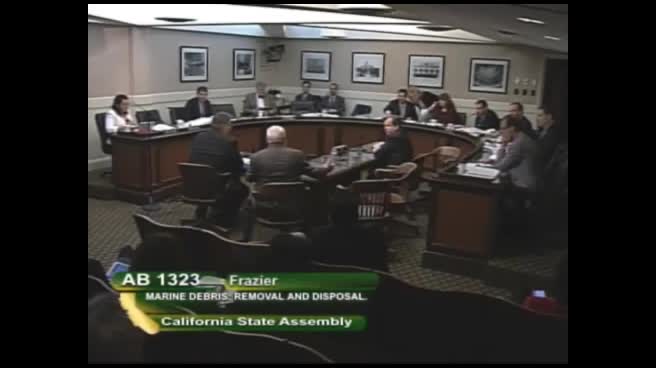 1MIN
Assembly Standing Committee on Natural Resources
Bill Author

Bill Co-Author(s):