SB 1353: State Teachers' Retirement System: funding.
- Session Year: 2015-2016
- House: Senate
- Latest Version Date: 2016-09-14
Existing law, the Teachers Retirement Law, establishes the State Teachers Retirement System and creates the Defined Benefit Program of the State Teachers Retirement Plan, which provides a defined benefit to members of the program, based on final compensation, credited service, and age at retirement, subject to certain variations. The Defined Benefit Program is funded by employer and employee contributions, investment returns, and state appropriations, which are deposited or credited to the Teachers Retirement Fund. Existing law prescribes methods for calculating the amounts of employer and employee contributions as well as state appropriations for support of the system. For the 201718 fiscal year, and each fiscal year thereafter, existing law requires the board to increase or decrease certain percentages relating to the state appropriation to reflect the contribution required to eliminate the unfunded actuarial obligation of the system. Existing law prohibits these requirements from being construed as applicable to any unfunded actuarial obligation resulting from any benefit increase or change in member or employer contribution rate under this part that occurs after July 1, 1990.
This bill would qualify this prohibition to clarify that specified state contributions made in this regard be allocated to reduce any unfunded actuarial obligation resulting from the benefits and contribution rates in effect as of July 1, 1990.
The California Constitution grants the retirement board of a public employee retirement system plenary authority and fiduciary responsibility for investment of moneys and administration of the retirement fund and system. The California Constitution qualifies this grant of powers by reserving to the Legislature the authority to prohibit investments if it is in the public interest and the prohibition satisfies standards of fiduciary care and loyalty required of a retirement board. Existing law prohibits the boards of administration of the Public Employees Retirement System and the State Teachers Retirement System from investing, as specified, in Sudan and in thermal coal companies, subject to the boards plenary authority and fiduciary responsibility for investment of moneys and administration of the systems. Existing law requires the boards to provide reports to the Legislature in regard to their actions in connection with these provisions.
This bill would provide, in connection with the prohibitions described above, that a board determination that an action fails to satisfy constitutional fiduciary responsibilities requires a recorded rollcall vote of the full board, following a presentation and discussion of findings in an open session during a properly noticed public hearing, as specified. The bill would also require that proposed findings be made public 72 hours before board consideration and that the findings and any public comments regarding adopted findings and determinations be included in the required reports to the Legislature.
Existing law, the Teachers Retirement Law, establishes the State Teachers Retirement System (STRS) and creates the Defined Benefit Program of the State Teachers Retirement Plan, which provides a defined benefit to members of the program, based on final compensation, credited service, and age at retirement, subject to certain variations. Existing law prohibits a person serving as an exchange teacher or sojourn teacher from out of state from being members of the plan.
The bill would make nonsubstantive changes in the provisions described above relating to an exchange teacher or sojourn teacher.
(a)Notwithstanding Section 13340 of the Government Code, commencing July 1, 2003, a continuous appropriation is hereby annually made from the General Fund to the Controller, pursuant to this section, for transfer to the Teachers Retirement Fund. The total amount of the appropriation for each year shall be equal to 2.017 percent of the total of the creditable compensation of the fiscal year ending in the immediately preceding calendar year upon which members contributions are based, as reported annually to the Director of Finance, the Chairperson of the Joint Legislative Budget Committee, and the Legislative Analyst pursuant to Section 22955.5, and shall be divided into four equal payments. The payments shall be made on, or the following business day after, July 1, October 1, December 15, and April 15 of each fiscal year.
(b)(1)Commencing July 1, 2014, the amount of the appropriation required under subdivision (a) shall increase by the following percentages of the creditable compensation upon which that appropriation is based:
(A)On July 1, 2014, by 1.437 percent.
(B)On July 1, 2015, by 2.874 percent.
(C)On July 1, 2016, by 4.311 percent.
(2)For fiscal year 201718 and each fiscal year thereafter, the board shall increase or decrease the percentage specified in this subdivision from the percentage paid during the prior fiscal year to reflect the contribution required to eliminate the remaining unfunded actuarial obligation, as determined by the board based upon a recommendation from its actuary. If a rate increase is required, the adjustment may be for no more than 0.50 percent per year of the total of the creditable compensation of the fiscal year ending in the immediately preceding calendar year upon which members contributions are based. At any time when there is not an unfunded actuarial obligation as determined by the board, the percentage specified in this subdivision shall be reduced to zero.
(c)Pursuant to Section 22001 and case law, members are entitled to a financially sound retirement system. It is the intent of the Legislature that this section shall provide the retirement fund stable and full funding over the long term.
(d)This section continues in effect but in a somewhat different form, fully performs, and does not in any way unreasonably impair, the contractual obligations determined by the court in California Teachers Association v. Cory, 155 Cal.App.3d 494.
(e)Subdivision (b) shall not be construed to be applicable to any unfunded actuarial obligation resulting from any benefit increase or change in contribution rate under this part that occurs after July 1, 1990, except that state contributions made pursuant to subdivision (b) shall be allocated to reduce the unfunded actuarial obligation resulting from the benefits and contribution rates in effect as of July 1, 1990.
(f)The provisions of this section shall be construed and implemented to be in conformity with the judicial intent expressed by the court in California Teachers Association v. Cory, 155 Cal.App.3d 494.
(g)(1) Except as described in paragraph (2), this section shall become inoperative on July 1, 2046, and as of January 1, 2047, is repealed.
(2)Notwithstanding paragraph (1), on July 1 of the first fiscal year after a 30-day notice has been sent to the Joint Legislative Budget Committee and the Controller in compliance with subdivision (d) of Section 22957, this section shall become inoperative and, as of the following January 1, is repealed.
(a)Notwithstanding Section 13340 of the Government Code, commencing July 1, 2003, a continuous appropriation is hereby annually made from the General Fund to the Controller, pursuant to this section, for transfer to the Teachers Retirement Fund. The total amount of the appropriation for each year shall be equal to 2.017 percent of the total of the creditable compensation of the fiscal year ending in the immediately preceding calendar year upon which members contributions are based, as reported annually to the Director of Finance, the Chairperson of the Joint Legislative Budget Committee, and the Legislative Analyst pursuant to Section 22955.5, and shall be divided into four equal payments. The payments shall be made on, or the following business day after, July 1, October 1, December 15, and April 15 of each fiscal year.
(b)(1)Commencing July 1, 2014, the amount of the appropriation required under subdivision (a) shall increase by the following percentages of the creditable compensation upon which that appropriation is based:
(A)On July 1, 2014, by 1.437 percent.
(B)On July 1, 2015, by 2.874 percent.
(C)On July 1, 2016, by 4.311 percent.
(2)For fiscal year 201718 and each fiscal year thereafter, the board shall increase or decrease the percentage specified in this subdivision from the percentage paid during the prior fiscal year to reflect the contribution required to eliminate the remaining unfunded actuarial obligation, as determined by the board based upon a recommendation from its actuary. If a rate increase is required, the adjustment may be for no more than 0.50 percent per year of the total of the creditable compensation of the fiscal year ending in the immediately preceding calendar year upon which members contributions are based. At any time when there is not an unfunded actuarial obligation as determined by the board, the percentage specified in this subdivision shall be reduced to zero.
(c)Pursuant to Section 22001 and case law, members are entitled to a financially sound retirement system. It is the intent of the Legislature that this section shall provide the retirement fund stable and full funding over the long term.
(d)This section continues in effect but in a somewhat different form, fully performs, and does not in any way unreasonably impair, the contractual obligations determined by the court in California Teachers Association v. Cory, 155 Cal.App.3d 494.
(e)Subdivision (b) shall not be construed to be applicable to any unfunded actuarial obligation resulting from any benefit increase or change in member or employer contribution rate under this part that occurs after July 1, 1990. 1990, except that state contributions made pursuant to subdivision (b) shall be allocated to reduce the unfunded actuarial obligation resulting from the benefits and contribution rates in effect as of July 1, 1990.
(f)The provisions of this section shall be construed and implemented to be in conformity with the judicial intent expressed by the court in California Teachers Association v. Cory, 155 Cal.App.3d 494.
(g)(1) Except as described in paragraph (2), this section shall become inoperative on July 1, 2046, and as of January 1, 2047, is repealed.
(2)Notwithstanding paragraph (1), on July 1 of the first fiscal year after a 30-day notice has been sent to the Joint Legislative Budget Committee and the Controller in compliance with subdivision (d) of Section 22957, this section shall become inoperative and, as of the following January 1, is repealed.
SECTION 1.Section 7513.6 of the Government Code is amended to read:7513.6.(a)As used in this section, the following definitions shall apply:
(1)Active business operations means a company engaged in business operations that provide revenue to the government of Sudan or a company engaged in oil-related activities.
(2)Board means the Board of Administration of the Public Employees Retirement System or the Teachers Retirement Board of the State Teachers Retirement System, as applicable.
(3)Business operations means maintaining, selling, or leasing equipment, facilities, personnel, or any other apparatus of business or commerce in Sudan, including the ownership or possession of real or personal property located in Sudan.
(4)Company means a sole proprietorship, organization, association, corporation, partnership, venture, or other entity, its subsidiary or affiliate that exists for profitmaking purposes or to otherwise secure economic advantage. Company also means a company owned or controlled, either directly or indirectly, by the government of Sudan, that is established or organized under the laws of or has its principal place of business in the Republic of the Sudan.
(5)Government of Sudan means the government of Sudan or its instrumentalities.
(6)Invest or investment means the purchase, ownership, or control of stock of a company, association, or corporation, the capital stock of a mutual water company or corporation, bonds issued by the government or a political subdivision of Sudan, corporate bonds or other debt instruments issued by a company, or the commitment of funds or other assets to a company, including a loan or extension of credit to that company.
(7)Military equipment means weapons, arms, or military defense supplies.
(8)Oil-related activities means, but is not limited to, the export of oil, extracting or producing oil, exploration for oil, or the construction or maintenance of a pipeline, refinery, or other oil field infrastructure.
(9)Public employee retirement funds means the Public Employees Retirement Fund described in Section 20062 of this code, and the Teachers Retirement Fund described in Section 22167 of the Education Code.
(10)Research firm means a reputable, neutral third-party research firm.
(11)Substantial action means a boycott of the government of Sudan, curtailing business in Sudan until that time described in subdivision (m), selling company assets, equipment, or real and personal property located in Sudan, or undertaking significant humanitarian efforts in the eastern, southern, or western regions of Sudan.
(12)Sudan means the Republic of the Sudan, a territory under the administration or control of the Sudan, including but not limited to, the Darfur region, or an individual, company, or public agency located in Khartoum, northern Sudan, or the Nile River Valley that supports the Republic of the Sudan.
(b)The board shall not invest public employee retirement funds in a company with business operations in Sudan that meets all of the following criteria:
(1)The company is engaged in active business operations in Sudan. If that company is not engaged in oil-related activities, that company also lacks significant business operations in the eastern, southern, and western regions of Sudan.
(2)Either of the following apply:
(A)The company is engaged in oil-related activities or energy or power-related operations, or contracts with another company with business operations in the oil, energy, and power sectors of Sudan, and the company failed to take substantial action related to the government of Sudan because of the Darfur genocide.
(B)The company has demonstrated complicity in the Darfur genocide.
(c)Notwithstanding subdivision (b), the board shall not invest public employee retirement funds in a company that supplies military equipment within the borders of Sudan. If a company provides equipment within the borders of Sudan that may be readily used for military purposes, including, but not limited to, radar systems and military-grade transport vehicles, there shall also be a strong presumption against investing in that company unless that company implements safeguards to prevent the use of that equipment for military purposes.
(d)(1)The board shall, without regard to the provisions regarding competitive bidding, contract with a research firm or firms to determine those companies that have business operations in Sudan. Those research firms shall, in the aggregate, obtain data on a majority of companies with business operations in Sudan. On or before March 30, 2007, those research firms shall report any findings to the board and those research firms shall submit further findings to the board if there is a change of circumstances in Sudan.
(2)In addition to the reports described in paragraph (1), the board shall take all of the following actions no later than March 30, 2007:
(A)Review publicly available information regarding companies with business operations in Sudan.
(B)Contact other institutional investors that invest in companies with business operations in Sudan.
(C)Send written notice to a company with business operations in Sudan that the company may be subject to this section.
(e)(1)The board shall determine, by the next applicable board meeting and based on the information and reports described in subdivision (d), if a company meets the criteria described in subdivision (b) or (c). If the board plans to invest or has investments in a company that meets the criteria described in subdivision (b) or (c), that planned or existing investment shall be subject to subdivisions (g) and (h).
(2)Investments of the board in a company that does not meet the criteria described in subdivision (b) or (c) or does not have active business operations in Sudan are not subject to subdivision (h), provided that the company does not subsequently meet the criteria described in subdivision (b) or (c) or engage in active business operations. The board shall identify the reasons why that company does not satisfy the criteria described in subdivision (b) or (c) or does not engage in active business operations in the report to the Legislature described in subdivision (i).
(f)(1)Notwithstanding subdivision (e), if the boards investment in a company described in subdivision (b) or (c) is limited to investment via an externally and actively managed commingled fund, the board shall contact that fund manager in writing and request that the fund manager remove that company from the fund as described in subdivision (h). On or before June 30, 2007, if the fund or account manager creates a fund or account devoid of companies described in subdivision (b) or (c), the transfer of board investments from the prior fund or account to the fund or account devoid of companies with business operations in Sudan shall be deemed to satisfy subdivision (h).
(2)If the boards investment in a company described in subdivision (b) or (c) is limited to an alternative fund or account, the alternative fund or account manager creates an actively managed commingled fund that excludes companies described in subdivision (b) or (c), and the new fund or account is deemed to be financially equivalent to the existing fund or account, the transfer of board investments from the existing fund or account to the new fund or account shall be deemed to satisfy subdivision (h). If the board determines that the new fund or account is not financially equivalent to the existing fund, the board shall include the reasons for that determination in the report described in subdivision (i).
(3)The board shall make a good faith effort to identify any private equity investments that involve companies described in subdivision (b) or (c) or are linked to the government of Sudan. If the board determines that a private equity investment clearly involves a company described in subdivision (b) or (c) or is linked to the government of Sudan, the board shall consider, at its discretion, if those private equity investments shall be subject to subdivision (h). If the board determines that a private equity investment clearly involves a company described in subdivision (b) or (c) or is linked to the government of Sudan and the board does not take action as described in subdivision (h), the board shall include the reasons for its decision in the report described in subdivision (i).
(g)Except as described in subdivision (f) or paragraph (2) of subdivision (e), the board, in the boards capacity of shareholder or investor, shall notify any company described in paragraph (1) of subdivision (e) that the company is subject to subdivision (h) and permit that company to respond to the information and reports described in subdivision (d). The board shall request that the company take substantial action no later than 90 days from the date the board notified the company under this subdivision. If the board determines that a company has taken substantial action or has made sufficient progress towards substantial action before the expiration of that 90-day period, that company shall not be subject to subdivision (h). The board shall, at intervals not to exceed 90 days, continue to monitor and review the progress of the company until that company has taken substantial action in Sudan. A company that fails to complete substantial action or continue to make sufficient progress towards substantial action by the next time interval shall be subject to subdivision (h).
(h)If a company described in paragraph (1) of subdivision (e) fails to complete substantial action by the time described in subdivision (g), the board shall take the following actions:
(1)The board shall not make additional or new investments or renew existing investments in that company.
(2)The board shall liquidate the investments of the board in that company no later than 18 months after this subdivision applies to that company. The board shall liquidate those investments in a manner to address the need for companies to take substantial action in Sudan and consistent with the boards fiduciary responsibilities as described in Section 17 of Article XVI of the California Constitution.
(i)On or before January 1, 2008, and every year thereafter, the board shall file a report with the Legislature. The report shall describe the following:
(1)A list of investments the board has in companies with business operations in Sudan, including, but not limited to, the issuer, by name, of the stock, bonds, securities, and other evidence of indebtedness.
(2)A detailed summary of the business operations a company described in paragraph (1) has in Sudan and whether that company satisfies all of the criteria in subdivision (b) or (c).
(3)Whether the board has reduced its investments in a company that satisfies the criteria in subdivision (b) or (c).
(4)If the board has not completely reduced its investments in a company that satisfies the criteria in subdivision (b) or (c), when the board anticipates that the board will reduce all investments in that company or the reasons why a sale or transfer of investments is inconsistent with the fiduciary responsibilities of the board as described in Section 17 of Article XVI of the California Constitution.
(5)Any information described in subdivision (e).
(6)A detailed summary of investments that were transferred to funds or accounts devoid of companies with business operations in Sudan as described in subdivision (f).
(j)If the board voluntarily sells or transfers all of its investments in a company with business operations in Sudan, this section shall not apply except that the board shall file a report with the Legislature related to that company as described in subdivision (i).
(k)(1)Nothing in this section shall require the board to take action as described in this section unless the board determines, in good faith, that the action described in this section is consistent with the fiduciary responsibilities of the board as described in Section 17 of Article XVI of the California Constitution.
(2)A determination that an action described in this section would fail to satisfy the fiduciary responsibilities of the board as described in Section 17 of Article XVI of the California Constitution shall require a recorded rollcall vote of the full board, following a presentation and discussion of findings in open session, during a properly noticed public hearing of the full board. All proposed findings of the board shall be made public 72 hours before they are considered by the board. The findings and any public comments regarding the adopted findings and determinations made pursuant to this paragraph shall be included in the report to the Legislature required by subdivision (i).
(l)Subdivision (h) shall not apply to any of the following:
(1)Investments in a company that is primarily engaged in supplying goods or services intended to relieve human suffering in Sudan.
(2)Investments in a company that promotes health, education, journalistic, or religious activities in or welfare in the western, eastern, or southern regions of Sudan.
(3)Investments in a United States company that is authorized by the federal government to have business operations in Sudan.
(m)This section shall remain in effect only until one of the following occurs, and as of the date of that action, is repealed:
(1)The government of Sudan halts the genocide in Darfur for 12 months as determined by both the Department of State and the Congress of the United States.
(2)The United States revokes its current sanctions against Sudan.
SEC. 2.Section 7513.75 of the Government Code is amended to read:7513.75.(a)The Legislature finds and declares all of the following:
(1)The combustion of coal resources is the single largest contributor to global climate change in the United States.
(2)Climate change affects all parts of the California economy and environment, and the Legislature has adopted numerous laws to mitigate greenhouse gas emissions and to adapt to a changing climate.
(3)The purpose of this section is to require the Public Employees Retirement System and the State Teachers Retirement System, consistent with, and not in violation of, their fiduciary responsibilities, to divest their holding of thermal coal power as one part of the states broader efforts to decarbonize the California economy and to transition to clean, pollution free energy resources.
(b)As used in this section, the following definitions apply:
(1)Board means the Board of Administration of the Public Employees Retirement System or the Teachers Retirement Board of the State Teachers Retirement System, as applicable.
(2)Company means a sole proprietorship, organization, association, corporation, partnership, venture, or other entity, or its subsidiary or affiliate, that exists for profit-making purposes or to otherwise secure economic advantage.
(3)Investment means the purchase, ownership, or control of publicly issued stock, corporate bonds, or other debt instruments issued by a company.
(4)Public employee retirement funds means the Public Employees Retirement Fund described in Section 20062 of this code, and the Teachers Retirement Fund described in Section 22167 of the Education Code.
(5)Thermal coal means coal used to generate electricity, such as that which is burned to create steam to run turbines. Thermal coal does not mean metallurgical coal or coking coal used to produce steel.
(6)Thermal coal company means a publicly traded company that generates 50 percent or more of its revenue from the mining of thermal coal, as determined by the board.
(c)The board shall not make additional or new investments or renew existing investments of public employee retirement funds in a thermal coal company.
(d)The board shall liquidate investments in a thermal coal company on or before July 1, 2017. In making a determination to liquidate investments, the board shall constructively engage with a thermal coal company to establish whether the company is transitioning its business model to adapt to clean energy generation, such as through a decrease in its reliance on thermal coal as a revenue source.
(e)On or before January 1, 2018, the board shall file a report with the Legislature, in compliance with Section 9795, and the Governor, which shall include the following:
(1)A list of thermal coal companies of which the board has liquidated its investments pursuant to subdivision (d).
(2)A list of companies with which the board engaged pursuant to subdivision (d) that the board established were transitioning to clean energy generation, with supporting documentation to substantiate the boards determination.
(3)A list of thermal coal companies of which the board has not liquidated its investments as a result of a determination made pursuant to subdivision (f) that a sale or transfer of investments is inconsistent with the fiduciary responsibilities of the board as described in Section 17 of Article XVI of the California Constitution and the boards findings adopted in support of that determination.
(f)(1)Nothing in this section shall require a board to take action as described in this section unless the board determines in good faith that the action described in this section is consistent with the fiduciary responsibilities of the board described in Section 17 of Article XVI of the California Constitution.
(2)A determination that an action described in this section would fail to satisfy the fiduciary responsibilities of the board as described in Section 17 of Article XVI of the California Constitution shall require a recorded rollcall vote of the full board, following a presentation and discussion of findings in open session, during a properly noticed public hearing of the full board. All proposed findings of the board shall be made public 72 hours before they are considered by the board. The findings and any public comments regarding the adopted findings and determinations made pursuant to this paragraph shall be included in the report to the Legislature required by subdivision (e).
(a)As used in this section, the following definitions shall apply:
(1)Active business operations means a company engaged in business operations that provide revenue to the government of Sudan or a company engaged in oil-related activities.
(2)Board means the Board of Administration of the Public Employees Retirement System or the Teachers Retirement Board of the State Teachers Retirement System, as applicable.
(3)Business operations means maintaining, selling, or leasing equipment, facilities, personnel, or any other apparatus of business or commerce in Sudan, including the ownership or possession of real or personal property located in Sudan.
(4)Company means a sole proprietorship, organization, association, corporation, partnership, venture, or other entity, its subsidiary or affiliate that exists for profitmaking purposes or to otherwise secure economic advantage. Company also means a company owned or controlled, either directly or indirectly, by the government of Sudan, that is established or organized under the laws of or has its principal place of business in the Republic of the Sudan.
(5)Government of Sudan means the government of Sudan or its instrumentalities.
(6)Invest or investment means the purchase, ownership, or control of stock of a company, association, or corporation, the capital stock of a mutual water company or corporation, bonds issued by the government or a political subdivision of Sudan, corporate bonds or other debt instruments issued by a company, or the commitment of funds or other assets to a company, including a loan or extension of credit to that company.
(7)Military equipment means weapons, arms, or military defense supplies.
(8)Oil-related activities means, but is not limited to, the export of oil, extracting or producing oil, exploration for oil, or the construction or maintenance of a pipeline, refinery, or other oil field infrastructure.
(9)Public employee retirement funds means the Public Employees Retirement Fund described in Section 20062 of this code, and the Teachers Retirement Fund described in Section 22167 of the Education Code.
(10)Research firm means a reputable, neutral third-party research firm.
(11)Substantial action means a boycott of the government of Sudan, curtailing business in Sudan until that time described in subdivision (m), selling company assets, equipment, or real and personal property located in Sudan, or undertaking significant humanitarian efforts in the eastern, southern, or western regions of Sudan.
(12)Sudan means the Republic of the Sudan, a territory under the administration or control of the Sudan, including but not limited to, the Darfur region, or an individual, company, or public agency located in Khartoum, northern Sudan, or the Nile River Valley that supports the Republic of the Sudan.
(b)The board shall not invest public employee retirement funds in a company with business operations in Sudan that meets all of the following criteria:
(1)The company is engaged in active business operations in Sudan. If that company is not engaged in oil-related activities, that company also lacks significant business operations in the eastern, southern, and western regions of Sudan.
(2)Either of the following apply:
(A)The company is engaged in oil-related activities or energy or power-related operations, or contracts with another company with business operations in the oil, energy, and power sectors of Sudan, and the company failed to take substantial action related to the government of Sudan because of the Darfur genocide.
(B)The company has demonstrated complicity in the Darfur genocide.
(c)Notwithstanding subdivision (b), the board shall not invest public employee retirement funds in a company that supplies military equipment within the borders of Sudan. If a company provides equipment within the borders of Sudan that may be readily used for military purposes, including, but not limited to, radar systems and military-grade transport vehicles, there shall also be a strong presumption against investing in that company unless that company implements safeguards to prevent the use of that equipment for military purposes.
(d)(1)The board shall, without regard to the provisions regarding competitive bidding, contract with a research firm or firms to determine those companies that have business operations in Sudan. Those research firms shall, in the aggregate, obtain data on a majority of companies with business operations in Sudan. On or before March 30, 2007, those research firms shall report any findings to the board and those research firms shall submit further findings to the board if there is a change of circumstances in Sudan.
(2)In addition to the reports described in paragraph (1), the board shall take all of the following actions no later than March 30, 2007:
(A)Review publicly available information regarding companies with business operations in Sudan.
(B)Contact other institutional investors that invest in companies with business operations in Sudan.
(C)Send written notice to a company with business operations in Sudan that the company may be subject to this section.
(e)(1)The board shall determine, by the next applicable board meeting and based on the information and reports described in subdivision (d), if a company meets the criteria described in subdivision (b) or (c). If the board plans to invest or has investments in a company that meets the criteria described in subdivision (b) or (c), that planned or existing investment shall be subject to subdivisions (g) and (h).
(2)Investments of the board in a company that does not meet the criteria described in subdivision (b) or (c) or does not have active business operations in Sudan are not subject to subdivision (h), provided that the company does not subsequently meet the criteria described in subdivision (b) or (c) or engage in active business operations. The board shall identify the reasons why that company does not satisfy the criteria described in subdivision (b) or (c) or does not engage in active business operations in the report to the Legislature described in subdivision (i).
(f)(1)Notwithstanding subdivision (e), if the boards investment in a company described in subdivision (b) or (c) is limited to investment via an externally and actively managed commingled fund, the board shall contact that fund manager in writing and request that the fund manager remove that company from the fund as described in subdivision (h). On or before June 30, 2007, if the fund or account manager creates a fund or account devoid of companies described in subdivision (b) or (c), the transfer of board investments from the prior fund or account to the fund or account devoid of companies with business operations in Sudan shall be deemed to satisfy subdivision (h).
(2)If the boards investment in a company described in subdivision (b) or (c) is limited to an alternative fund or account, the alternative fund or account manager creates an actively managed commingled fund that excludes companies described in subdivision (b) or (c), and the new fund or account is deemed to be financially equivalent to the existing fund or account, the transfer of board investments from the existing fund or account to the new fund or account shall be deemed to satisfy subdivision (h). If the board determines that the new fund or account is not financially equivalent to the existing fund, the board shall include the reasons for that determination in the report described in subdivision (i).
(3)The board shall make a good faith effort to identify any private equity investments that involve companies described in subdivision (b) or (c) or are linked to the government of Sudan. If the board determines that a private equity investment clearly involves a company described in subdivision (b) or (c) or is linked to the government of Sudan, the board shall consider, at its discretion, if those private equity investments shall be subject to subdivision (h). If the board determines that a private equity investment clearly involves a company described in subdivision (b) or (c) or is linked to the government of Sudan and the board does not take action as described in subdivision (h), the board shall include the reasons for its decision in the report described in subdivision (i).
(g)Except as described in subdivision (f) or paragraph (2) of subdivision (e), the board, in the boards capacity of shareholder or investor, shall notify any company described in paragraph (1) of subdivision (e) that the company is subject to subdivision (h) and permit that company to respond to the information and reports described in subdivision (d). The board shall request that the company take substantial action no later than 90 days from the date the board notified the company under this subdivision. If the board determines that a company has taken substantial action or has made sufficient progress towards substantial action before the expiration of that 90-day period, that company shall not be subject to subdivision (h). The board shall, at intervals not to exceed 90 days, continue to monitor and review the progress of the company until that company has taken substantial action in Sudan. A company that fails to complete substantial action or continue to make sufficient progress towards substantial action by the next time interval shall be subject to subdivision (h).
(h)If a company described in paragraph (1) of subdivision (e) fails to complete substantial action by the time described in subdivision (g), the board shall take the following actions:
(1)The board shall not make additional or new investments or renew existing investments in that company.
(2)The board shall liquidate the investments of the board in that company no later than 18 months after this subdivision applies to that company. The board shall liquidate those investments in a manner to address the need for companies to take substantial action in Sudan and consistent with the boards fiduciary responsibilities as described in Section 17 of Article XVI of the California Constitution.
(i)On or before January 1, 2008, and every year thereafter, the board shall file a report with the Legislature. The report shall describe the following:
(1)A list of investments the board has in companies with business operations in Sudan, including, but not limited to, the issuer, by name, of the stock, bonds, securities, and other evidence of indebtedness.
(2)A detailed summary of the business operations a company described in paragraph (1) has in Sudan and whether that company satisfies all of the criteria in subdivision (b) or (c).
(3)Whether the board has reduced its investments in a company that satisfies the criteria in subdivision (b) or (c).
(4)If the board has not completely reduced its investments in a company that satisfies the criteria in subdivision (b) or (c), when the board anticipates that the board will reduce all investments in that company or the reasons why a sale or transfer of investments is inconsistent with the fiduciary responsibilities of the board as described in Section 17 of Article XVI of the California Constitution.
(5)Any information described in subdivision (e).
(6)A detailed summary of investments that were transferred to funds or accounts devoid of companies with business operations in Sudan as described in subdivision (f).
(j)If the board voluntarily sells or transfers all of its investments in a company with business operations in Sudan, this section shall not apply except that the board shall file a report with the Legislature related to that company as described in subdivision (i).
(k)(1)Nothing in this section shall require the board to take action as described in this section unless the board determines, in good faith, that the action described in this section is consistent with the fiduciary responsibilities of the board as described in Section 17 of Article XVI of the California Constitution.
(2)A determination that an action described in this section would fail to satisfy the fiduciary responsibilities of the board as described in Section 17 of Article XVI of the California Constitution shall require a recorded rollcall vote of the full board, following a presentation and discussion of findings in open session, during a properly noticed public hearing of the full board. All proposed findings of the board shall be made public 72 hours before they are considered by the board. The findings and any public comments regarding the adopted findings and determinations made pursuant to this paragraph shall be included in the report to the Legislature required by subdivision (i).
(l)Subdivision (h) shall not apply to any of the following:
(1)Investments in a company that is primarily engaged in supplying goods or services intended to relieve human suffering in Sudan.
(2)Investments in a company that promotes health, education, journalistic, or religious activities in or welfare in the western, eastern, or southern regions of Sudan.
(3)Investments in a United States company that is authorized by the federal government to have business operations in Sudan.
(m)This section shall remain in effect only until one of the following occurs, and as of the date of that action, is repealed:
(1)The government of Sudan halts the genocide in Darfur for 12 months as determined by both the Department of State and the Congress of the United States.
(2)The United States revokes its current sanctions against Sudan.
SEC. 2.Section 7513.75 of the Government Code is amended to read:7513.75.(a)The Legislature finds and declares all of the following:
(1)The combustion of coal resources is the single largest contributor to global climate change in the United States.
(2)Climate change affects all parts of the California economy and environment, and the Legislature has adopted numerous laws to mitigate greenhouse gas emissions and to adapt to a changing climate.
(3)The purpose of this section is to require the Public Employees Retirement System and the State Teachers Retirement System, consistent with, and not in violation of, their fiduciary responsibilities, to divest their holding of thermal coal power as one part of the states broader efforts to decarbonize the California economy and to transition to clean, pollution free energy resources.
(b)As used in this section, the following definitions apply:
(1)Board means the Board of Administration of the Public Employees Retirement System or the Teachers Retirement Board of the State Teachers Retirement System, as applicable.
(2)Company means a sole proprietorship, organization, association, corporation, partnership, venture, or other entity, or its subsidiary or affiliate, that exists for profit-making purposes or to otherwise secure economic advantage.
(3)Investment means the purchase, ownership, or control of publicly issued stock, corporate bonds, or other debt instruments issued by a company.
(4)Public employee retirement funds means the Public Employees Retirement Fund described in Section 20062 of this code, and the Teachers Retirement Fund described in Section 22167 of the Education Code.
(5)Thermal coal means coal used to generate electricity, such as that which is burned to create steam to run turbines. Thermal coal does not mean metallurgical coal or coking coal used to produce steel.
(6)Thermal coal company means a publicly traded company that generates 50 percent or more of its revenue from the mining of thermal coal, as determined by the board.
(c)The board shall not make additional or new investments or renew existing investments of public employee retirement funds in a thermal coal company.
(d)The board shall liquidate investments in a thermal coal company on or before July 1, 2017. In making a determination to liquidate investments, the board shall constructively engage with a thermal coal company to establish whether the company is transitioning its business model to adapt to clean energy generation, such as through a decrease in its reliance on thermal coal as a revenue source.
(e)On or before January 1, 2018, the board shall file a report with the Legislature, in compliance with Section 9795, and the Governor, which shall include the following:
(1)A list of thermal coal companies of which the board has liquidated its investments pursuant to subdivision (d).
(2)A list of companies with which the board engaged pursuant to subdivision (d) that the board established were transitioning to clean energy generation, with supporting documentation to substantiate the boards determination.
(3)A list of thermal coal companies of which the board has not liquidated its investments as a result of a determination made pursuant to subdivision (f) that a sale or transfer of investments is inconsistent with the fiduciary responsibilities of the board as described in Section 17 of Article XVI of the California Constitution and the boards findings adopted in support of that determination.
(f)(1)Nothing in this section shall require a board to take action as described in this section unless the board determines in good faith that the action described in this section is consistent with the fiduciary responsibilities of the board described in Section 17 of Article XVI of the California Constitution.
(2)A determination that an action described in this section would fail to satisfy the fiduciary responsibilities of the board as described in Section 17 of Article XVI of the California Constitution shall require a recorded rollcall vote of the full board, following a presentation and discussion of findings in open session, during a properly noticed public hearing of the full board. All proposed findings of the board shall be made public 72 hours before they are considered by the board. The findings and any public comments regarding the adopted findings and determinations made pursuant to this paragraph shall be included in the report to the Legislature required by subdivision (e).
SECTION 1.Section 22601 of the Education Code is amended to read:22601.A person serving as an exchange teacher or sojourn teacher from outside of this state is excluded from membership in the plan.
Persons A person serving as an exchange teachers teacher or sojourn teachers teacher from outside of this state are is excluded from membership in the plan.
|
Date
|
Status
|
|---|---|
| Sep 14, 2016 | Chaptered by Secretary of State. Chapter 350, Statutes of 2016. |
| Sep 14, 2016 | Approved by the Governor. |
| Aug 30, 2016 | Enrolled and presented to the Governor at 1:30 p.m. |
| Aug 24, 2016 | Assembly amendments concurred in. (Ayes 39. Noes 0.) Ordered to engrossing and enrolling. |
| Aug 15, 2016 | From committee: That the Assembly amendments be concurred in. (Ayes 5. Noes 0. Page 4993.) |
| Aug 15, 2016 | From committee: That the Assembly amendments be concurred in. (Ayes 5. Noes 0.) |
| Aug 11, 2016 | Set for hearing August 15. |
| Aug 8, 2016 | From committee: Be re-referred to Com. on P.E. & R. pursuant to Senate Rule 29.10(d). (Ayes 5. Noes 0. Page 4819.) Re-referred to Com. on P.E. & R. |
| Aug 8, 2016 | From committee: Be re-referred to Com. on P.E. & R. pursuant to Senate Rule 29.10(d). (Ayes 5. Noes 0.) Re-referred to Com. on P.E. & R. |
| Aug 8, 2016 | Re-referred to Com. on RLS. pursuant to Senate Rule 29.10(d). |
| Aug 4, 2016 | Read third time. Passed. (Ayes 77. Noes 0. Page 5721.) Ordered to the Senate. |
| Aug 4, 2016 | In Senate. Concurrence in Assembly amendments pending. |
| Aug 4, 2016 | Read third time. Passed. Ordered to the Senate. |
| Jun 30, 2016 | Read second time. Ordered to consent calendar. |
| Jun 29, 2016 | From committee: Do pass. Ordered to consent calendar. (Ayes 18. Noes 0.) (June 29). |
| Jun 22, 2016 | From committee: Do pass and re-refer to Com. on APPR. (Ayes 6. Noes 0.) (June 22). Re-referred to Com. on APPR. |
| Jun 8, 2016 | From committee with author's amendments. Read second time and amended. Re-referred to Com. on P.E., R., & S.S. |
| May 16, 2016 | Referred to Com. on P.E., R., & S.S. |
| May 10, 2016 | In Assembly. Read first time. Held at Desk. |
| May 9, 2016 | Read third time. Passed. (Ayes 25. Noes 10. Page 3806.) Ordered to the Assembly. |
| May 9, 2016 | Read third time. Passed. (Ayes 25. Noes 10.) Ordered to the Assembly. |
| May 3, 2016 | Read second time. Ordered to third reading. |
| May 2, 2016 | From committee: Be ordered to second reading pursuant to Senate Rule 28.8. |
| Apr 22, 2016 | Set for hearing May 2. |
| Apr 20, 2016 | From committee: Do pass and re-refer to Com. on APPR. (Ayes 5. Noes 2. Page 3611.) (April 19). Re-referred to Com. on APPR. |
| Apr 20, 2016 | From committee: Do pass and re-refer to Com. on APPR. (Ayes 5. Noes 2.) (April 19). Re-referred to Com. on APPR. |
| Apr 13, 2016 | Set for hearing April 19. |
| Apr 12, 2016 | From committee: Do pass and re-refer to Com. on JUD. (Ayes 3. Noes 2. Page 3497.) (April 11). Re-referred to Com. on JUD. |
| Apr 12, 2016 | From committee: Do pass and re-refer to Com. on JUD. (Ayes 3. Noes 2.) (April 11). Re-referred to Com. on JUD. |
| Apr 6, 2016 | Set for hearing April 11. |
| Mar 31, 2016 | Re-referred to Coms. on P.E. & R. and JUD. |
| Mar 28, 2016 | From committee with author's amendments. Read second time and amended. Re-referred to Com. on RLS. |
| Mar 3, 2016 | Referred to Com. on RLS. |
| Feb 22, 2016 | Read first time. |
| Feb 22, 2016 | From printer. May be acted upon on or after March 23. |
| Feb 19, 2016 | Introduced. To Com. on RLS. for assignment. To print. |
|
Date
|
Description
|
Location
|
Votes
|
|
|---|---|---|---|---|
| Aug 24, 2016 | Unfinished Business SB1353 Pan Concurrence | Senate Floor |
Passed |
|
| Aug 15, 2016 | That the Assembly amendments be concurred in | Senate Standing Committee on Public Employment and Retirement |
Passed |
|
| Aug 4, 2016 | SB 1353 Pan Consent Calendar Second Day Regular Session | Assembly Floor |
Passed |
|
| Jun 29, 2016 | Do pass. To Consent Calendar. | Assembly Standing Committee on Appropriations |
Passed |
|
| Jun 22, 2016 | Do pass and be re-referred to the Committee on [Appropriations] | Assembly Standing Committee on Public Employees, Retirement, and Social Security |
Passed |
|
| May 9, 2016 | Senate 3rd Reading SB1353 Pan | Senate Floor |
Passed |
|
| Apr 19, 2016 | Do pass, but first be re-referred to the Committee on [Appropriations] | Senate Standing Committee on Judiciary |
Passed |
|
| Apr 11, 2016 | Do pass, but first be re-referred to the Committee on [Judiciary] | Senate Standing Committee on Public Employment and Retirement |
Passed |
This list shows positions taken on this bill by organizations on the date displayed, which is linked to the original source.
Positions by individuals are not included.
Office of Senate Floor Analyses (916) 651-1520 Fax: (916) 327-4478 | SB |
UNFINISHED BUSINESS
Bill No: SB 1353
:
PRIOR VOTES NOT RELEVANT
SENATE PUBLIC EMP. & RET. COMMITTEE: 5-0, 8/15/16 (Pursuant to Senate Rule 29.10 (d))
AYES: Pan, Morrell, Beall, Hall, Moorlach
ASSEMBLY FLOOR: 77-0, 8/4/16 (Consent) - See last page for vote
SOURCE: California State Teachers’ Retirement System
DIGEST: This bill makes necessary technical changes to eliminate possible confusion over how to calculate the applicable unfunded actuarial obligation (UAO) when determining future adjustments to the state contribution rate pursuant to the 2014 California State Teachers’ Retirement System (CalSTRS) Full Funding Plan.
Assembly Amendments delete the Senate version of this bill relating to pension fund divestments and instead now clarify that state contribution rate changes made by legislation prior to the AB 1469 Full Funding Plan continue to be allocated, as before AB 1469, to the post 1990 UAO and that state contribution rate changes required by the Full Funding Plan apply to the 1990 UAO (and only to the 1990 UAO).
ANALYSIS:
Existing law:
- Establishes the California State Teachers’ Retirement System (CalSTRS) and creates the Defined Benefit (DB) program, which provides a defined benefit to CalSTRS members, based on final compensation, credited service, and age at retirement, as specified.
- Funds the DB program through employer and employee contributions, investment returns, and state appropriations as prescribed.
- Establishes the Full Funding Plan pursuant to AB 1469 (Bonta), Chapter 47, Statutes of 2014, to address the DB program’s unfunded actuarial obligation (UAO) by June 30, 2046. Under the plan, teachers’, employers’, and the state’s contribution rates increase beginning July 1, 2014, as specified. The plan further requires the CalSTRS Board to adjust the state contribution rate within a specified range beginning fiscal year 2017–18, and each fiscal year thereafter, to reflect the contribution required to assist in eliminating the UAO by June 30, 2046.
This bill clarifies that state contribution rate changes made by legislation prior to the AB 1469 Full Funding Plan continue to be allocated, as before AB 1469, to the post 1990 UAO and that state contribution rate changes required by the Full Funding Plan apply to the 1990 UAO (and only to the 1990 UAO).
Background
Legislation in the 1990s provided for specified changes in state contribution rates and benefit plan benefit changes. Under those legislative changes, adjustments in contribution rates that occurred after July 1, 1990, are excluded from the calculation of the UAO to which CalSTRS applies the state appropriation. This language was intended to segregate the UAO of the 1990 DB benefit plan from any UAO that might occur from changes made after July 1, 1990, and hold the state harmless from liability arising out of the post 1990 changes.
AB 1469 included a similar provision that was intended to mirror the language segregating the 1990 benefit plan UAO so that the Full Funding Plan’s increased state contribution would be allocated only to the 1990 UAO and not to the UAO attributable to plan changes after July 1, 1990. The intent of this language was to continue to hold the state harmless for post 1990 benefit plan changes.
CalSTRS believes that due to inartful drafting, the provision could be misinterpreted in the future to require all state appropriations from prior to the Full Funding plan to be used to pay down the 1990 UAO. The apparent effect of such an interpretation would be to eliminate the 1990 UAO much earlier than anticipated and increase exponentially the remaining post 1990 UAO such that it could not be paid down by 2046, if at all, as intended by the Full Funding Plan.
This technical bill clarifies that the post 1990 state rate changes made prior to AB 1469 will continue as previously administered (i.e., they will not be applied to the 1990 UAO calculation and will instead continue to apply to the post 1990 UAO calculation).
The bill will also ensure that the AB 1469 state rate changes, that technically are also post 1990 state rate changes, will not be caught in the technical language prohibiting post 1990 state rate changes from being used in the calculation of the 1990 UAO. This will ensure that the AB 1469 state rate changes are applied to the 1990 UAO and not the post 1990 UAO.
Related/Prior Legislation
AB 1469 (Bonta, Chapter 47, Statutes of 2014) created the CalSTRS Full Funding Plan to address the system’s unfunded actuarial obligation by June 30, 2046.
FISCAL EFFECT: Appropriation: Fiscal Com.: Local:
According to Assembly Appropriations Committee this bill would result in no additional state costs.
California State Teachers’ Retirement System (source)
OPPOSITION: (Verified 8/15/16)
None received
ARGUMENTS IN SUPPORT: According to the sponsor, SB 1353 is necessary to avoid confusion in the future about how to adjust the state’s contribution rate to CalSTRS and is consistent with the original intent of the 2014 Full Funding Plan.
ASSEMBLY FLOOR: 77-0, 8/4/16
AYES: Achadjian, Alejo, Travis Allen, Arambula, Atkins, Baker, Bigelow, Bloom, Bonilla, Bonta, Brough, Brown, Burke, Calderon, Campos, Chang, Chau, Chiu, Chu, Cooper, Dababneh, Dahle, Daly, Dodd, Eggman, Frazier, Beth Gaines, Gallagher, Cristina Garcia, Eduardo Garcia, Gatto, Gipson, Gomez, Gonzalez, Gordon, Gray, Grove, Hadley, Harper, Holden, Irwin, Jones, Jones-Sawyer, Kim, Lackey, Levine, Linder, Lopez, Low, Maienschein, Mathis, Mayes, McCarty, Medina, Melendez, Mullin, Nazarian, Obernolte, O'Donnell, Olsen, Patterson, Quirk, Ridley-Thomas, Rodriguez, Salas, Santiago, Steinorth, Mark Stone, Thurmond, Ting, Wagner, Waldron, Weber, Wilk, Williams, Wood, Rendon
NO VOTE RECORDED: Chávez, Cooley, Roger Hernández
8/15/16 20:58:49
**** END ****
SENATE COMMITTEE ON
PUBLIC EMPLOYMENT AND RETIREMENT
Dr. Richard Pan, Chair
2015 - 2016 Regular
Bill No: SB 1353 Hearing Date: 8/15/16
Author: | Pan | ||
Version: | 6/8/16 As amended | ||
Urgency: | No | Fiscal: | Yes |
Consultant: | Glenn Miles | ||
Subject: State Teachers’ Retirement System: funding
SOURCE: California State Teachers’ Retirement System
ASSEMBLY VOTES:
Assembly Floor: | 77 - 0 |
Assembly Appropriations Committee: | 18 - 0 |
Assembly Public Employees, Retirement/Soc Sec Committee: | 6 - 0 |
DIGEST: This bill previously dealt with pension fund divestments but was substantially amended in the Assembly. Now the bill makes necessary technical changes to eliminate possible confusion over how to calculate the applicable unfunded actuarial obligation (UAO) when determining future adjustments to the state contribution rate pursuant to the 2014 CalSTRS Full Funding Plan.
ANALYSIS:
Existing law:
- Establishes the California State Teachers’ Retirement System (CalSTRS) and creates the Defined Benefit (DB) program, which provides a defined benefit to CalSTRS members, based on final compensation, credited service, and age at retirement, as specified.
- Funds the DB program through employer and employee contributions, investment returns, and state appropriations as prescribed.
- Establishes the Full Funding Plan pursuant to AB 1469 (Bonta), Chapter 47, Statutes of 2014, to address the DB program’s unfunded actuarial obligation (UAO) by June 30, 2046. Under the plan, teachers’, employers’, and the state’s contribution rates increase beginning July 1, 2014, as specified. The plan further requires the CalSTRS Board to adjust the state contribution rate within a specified range beginning fiscal year 2017–18, and each fiscal year thereafter, to reflect the contribution required to assist in eliminating the UAO by June 30, 2046.
This bill:
- Clarifies that state contribution rate changes made by legislation prior to the AB 1469 Full Funding Plan continue to be allocated, as before AB 1469, to the post 1990 UAO and that state contribution rate changes required by the Full Funding Plan apply to the 1990 UAO (and only to the 1990 UAO).
Background
Legislation in the 1990s provided for specified changes in state contribution rates and benefit plan benefit changes. Under those legislative changes, adjustments in contribution rates that occurred after July 1, 1990, are excluded from the calculation of the UAO to which CalSTRS applies the state appropriation. This language was intended to segregate the UAO of the 1990 DB benefit plan from any UAO that might occur from changes made after July 1, 1990, and hold the state harmless from liability arising out of the post 1990 changes.
AB 1469 included a similar provision that was intended to mirror the language segregating the 1990 benefit plan UAO so that the Full Funding Plan’s increased state contribution would be allocated only to the 1990 UAO and not to the UAO attributable to plan changes after July 1, 1990. The intent of this language was to continue to hold the state harmless for post 1990 benefit plan changes.
CalSTRS believes that due to inartful drafting, the provision could be misinterpreted in the future to require all state appropriations from prior to the Full Funding plan to be used to pay down the 1990 UAO. The apparent effect of such an interpretation would be to eliminate the 1990 UAO much earlier than anticipated and increase exponentially the remaining post 1990 UAO such that it could not be paid down by 2046, if at all, as intended by the Full Funding Plan.
This technical bill clarifies that the post 1990 state rate changes made prior to AB 1469 will continue as previously administered (i.e., they will not be applied to the 1990 UAO calculation and will instead continue to apply to the post 1990 UAO calculation).
The bill will also ensure that the AB 1469 state rate changes, that technically are also post 1990 state rate changes, will not be caught in the technical language prohibiting post 1990 state rate changes from being used in the calculation of the 1990 UAO. This will ensure that the AB 1469 state rate changes are applied to the 1990 UAO and not the post 1990 UAO.
Related/Prior Legislation
AB 1469 (Bonta, Chapter 47, Statutes of 2014) created the CalSTRS Full Funding Plan to address the system’s unfunded actuarial obligation by June 30, 2046.
FISCAL EFFECT: Appropriation: No Fiscal Com.: Yes Local: No
SUPPORT:
California State Teachers’ Retirement System (source)
OPPOSITION:
None received
ARGUMENTS IN SUPPORT: According to the sponsor, SB 1353 is necessary to avoid confusion in the future about how to adjust the state’s contribution rate to CalSTRS and is consistent with the original intent of the 2014 Full Funding Plan.
Date of Hearing: June 29, 2016
ASSEMBLY COMMITTEE ON APPROPRIATIONS
Lorena Gonzalez, Chair
SBPCA Bill Id:SB 1353
Author:(Pan) – As Amended Ver:June 8, 2016
Policy Committee: | Public Employees, Retirement/Soc Sec | Vote: | 6 - 0 |
Urgency: No State Mandated Local Program: No Reimbursable: No
SUMMARY:
This bill clarifies that the state contribution that the Teachers' Retirement Board (TRB) has the authority to adjust beginning in 2017-18 for funding the California State Teachers' Retirement System (CalSTRS) will be applied to retire the unfunded liability associated with the 1990 benefit structure.
FISCAL EFFECT:
No additional state costs.
COMMENTS:
Purpose and Background. AB 1469 (Bonta), Chapter 47, Statutes of 2014, established a “Full Funding Plan” to address the CalSTRS pension unfunded liability by increasing contribution rates of teachers, employers, and the state. The Full Funding Plan increases the state contribution rate through the 2016-17 school year and then requires the TRB to adjust the state contribution rate to eliminate any remaining unfunded actuarial obligation (UAO) applicable to the 1990 benefit structure.
According to the author, SB 1353 is needed to avoid confusion in the future about how to adjust the state’s contribution rate to CalSTRS. When the Full Funding Plan was being developed in 2014, the intent was always to utilize these increased state contributions to reduce the UAO resulting from the benefits and contribution rates in effect as of July 1, 1990. However, a technical reading of the relevant portions of the Education Code could lead to a different interpretation. The author and the sponsor of the bill, CalSTRS, argue that it is necessary to amend the provisions to clarify that the state contributions will be allocated to reduce the UAO resulting from the benefits and contribution rates in effect as of July 1, 1990.
Analysis Prepared by: Luke Reidenbach / APPR. / (916) 319-2081
Date of Hearing: June 22, 2016
ASSEMBLY COMMITTEE ON PUBLIC EMPLOYEES, RETIREMENT, AND SOCIAL SECURITY
Rob Bonta, Chair
SBPCA Bill Id:SB 1353
Author:(Pan) – As Amended Ver:June 8, 2016
SENATE VOTE: 25-10
SUBJECT: State Teachers’ Retirement System: funding
SUMMARY: Clarifies that the state contribution that the Teachers' Retirement Board (TRB) has the authority to adjust beginning in Fiscal year 2017-18 that is required by the full funding plan for the California State Teachers' Retirement System (CalSTRS) will be applied to retire the unfunded liability associated with the 1990 benefit structure. This is consistent with the plan as it was to be enacted in AB 1469.
EXISTING LAW, as enacted by AB 1469 (Bonta), Chapter 47, Statutes of 2014, establishes a plan to address the CalSTRS Defined Benefit Program’s (DB) unfunded liability by increasing contribution rates, beginning July 1, 2014, of teachers, employers, and the state.
FISCAL EFFECT: Unknown.
COMMENTS: The provisions of the 2014 full funding plan for CalSTRS increase the state contribution rate through the 2016-17 school year and then require the TRB to adjust the state contribution rate to eliminate any remaining unfunded actuarial obligation (UAO) applicable to the 1990 benefit structure. The statute, however, prohibits these provisions from being construed to be applicable to any UAO resulting from any benefit increase or change in member or employer contribution rate that occurs after July 1, 1990.
When the Full Funding Plan was being developed in 2014, the intent was always to utilize these increased state contributions to reduce the UAO resulting from the benefits and contribution rates in effect as of July 1, 1990. It is, therefore, necessary to amend the provisions to clarify that the state contributions will be allocated to reduce the UAO resulting from the benefits and contribution rates in effect as of July 1, 1990.
According to the author, "This technical change is needed to avoid confusion in the future about how to adjust the state’s contribution rate to CalSTRS."
REGISTERED SUPPORT / OPPOSITION:
Support
California State Teachers' Retirement System (Sponsor)
Opposition
None on file
Analysis Prepared by: Karon Green / P.E.,R., & S.S. / (916) 319-3957
Office of Senate Floor Analyses (916) 651-1520 Fax: (916) 327-4478 | SB |
THIRD READING
Bill No: SB 1353
:
SENATE PUBLIC EMP. & RET. COMMITTEE: 3-2, 4/11/16
AYES: Pan, Beall, Hall
NOES: Morrell, Moorlach
SENATE JUDICIARY COMMITTEE: 5-2, 4/19/16
AYES: Jackson, Hertzberg, Leno, Monning, Wieckowski
NOES: Moorlach, Anderson
SENATE APPROPRIATIONS COMMITTEE: Senate Rule 28.8
DIGEST: This bill requires CalPERS and CalSTRS (respectively, board) to hold a properly noticed public hearing and take a rollcall vote, as specified, when making a determination that statutory prohibited investments (PI)s in Sudan and thermal coal violate the board’s fiduciary duty. This requirement already exists for statutory PIs in Iran.
ANALYSIS:
Existing law:
- Provides, pursuant to the California Constitution, that:
- The respective boards of California's public retirement systems have "plenary authority and fiduciary responsibility for investment of monies and administration of the system."
- The Legislature retains its authority, by statute "to prohibit certain investments by a retirement board where it is in the public interest to do so, and provided that the prohibition satisfies the standards of fiduciary care and loyalty required of a retirement board pursuant to this section."
- The members of the retirement board of a public pension or retirement system shall discharge their duties with respect to the system solely in the interest of, and for the exclusive purposes of providing benefits to, participants and their beneficiaries, minimizing employer contributions thereto, and defraying reasonable expenses of administering the system.
- The board shall diversify the investments of the system so as to minimize the risk of loss and to maximize the rate of return, unless under the circumstances it is clearly not prudent to do so.
- Prohibits the board from investing public employee retirement funds in companies:
- With business operations in the defense and nuclear sectors of Iran, or that are involved in the development of Iranian petroleum or natural gas resources and are subject to specified federal sanctions, or have demonstrated complicity with an Iranian organization that has been labeled as a terrorist organization by the U.S. government.
- That supply military equipment within the borders of Sudan. If a company provides equipment within the borders of Sudan that may be readily used for military purposes, including, but not limited to, radar systems and military-grade transport vehicles, there shall also be a strong presumption against investing in that company unless that company implements safeguards to prevent the use of that equipment for military purposes.
- That produce thermal coal, as specified. The board shall also liquidate investments in thermal coal companies on or before July 1, 2017, but in making a determination to liquidate investments in a thermal coal company, the board shall constructively engage with the thermal coal company to establish whether the company is transitioning its business model to adapt to clean energy generation, such as through a decrease in its reliance on thermal coal as a revenue source.
- Requires the board to file annual reports with the Legislature detailing relevant investments in companies subject to the investment restrictions on investing in Iran and Sudan and any actions that the board has taken related to those restrictions. The board must also file a report with the Legislature on or before January 1, 2018, providing information relating to engagement initiatives with thermal coal companies and related information.
- States that the board is not required to implement the PI provisions related to Iran, Sudan, and thermal coal companies, or take other prescribed actions unless it determines, in good faith, that the action is consistent with its fiduciary duties.
- Provides, pursuant to the Bagley-Keene Open Meeting Act, that nothing in the Act shall be construed to prohibit the board from holding closed sessions when considering investment decisions.
- Requires that the board hold a recorded rollcall vote, following a presentation and discussion of findings in open session during a properly noticed public hearing of the full board when making a determination that the statutory PI in Iran fails to satisfy the fiduciary responsibilities of the board as described in Section 17 of Article XVI of the California Constitution.
This bill:
- Requires that the board hold a recorded rollcall vote, following a presentation and discussion of findings in open session during a properly noticed public hearing of the full board when making a determination that the statutory PIs in Sudan and thermal coal fail to satisfy the fiduciary responsibilities of the board as described in Section 17 of Article XVI of the California Constitution.
- Requires the board to make public 72 hours before consideration by the board its proposed findings to be used in making its determination that the PIs in Sudan and thermal coal fail to satisfy the board’s fiduciary responsibilities.
- Requires that the board include in a report to the Legislature, as specified, its findings adopted in making a determination that the statutory PIs in Sudan and thermal coal violate the board’s fiduciary responsibilities and any public comments regarding the findings.
Background
In February 2016, CalPERS Investment staff recommended a revision to CalPERS’ divestment policy to establish a loss mitigation component regarding PIs. The proposed policy would authorize staff to automatically reinvest in PIs that result in a loss of either $750 million individually over 12 consecutive quarters or in a cumulative loss of $2.5 billion collectively. If the cumulative loss reached $2.5 billion, all PIs, except a PI that generated no loss, would be subject to the new automatic reinvestment policy regardless of a PI’s proportional contribution to the loss. The policy requires the staff to inform the board when a PI exceeds a loss mitigation limit but authorizes staff to reinvest in the PI without any further approval.
The proposed policy makes no distinction between PIs required by statute and those set independently by the board. In treating statutory PIs the same as board-initiated PIs the proposed policy violates the intent of the constitutional provision reserving authority to the Legislature to prohibit certain investments by a retirement board subject to the board’s standards of fiduciary care and loyalty.
This bill ensures that the CalPERS board would have to provide proper notice of its decision to reinvest in statutory PIs in Sudan and thermal coal and requires the board to have a rollcall vote when making a determination that the PIs violate the board’s fiduciary responsibilities. This requirement already exists for PIs in Iran.
Related/Prior Legislation
SB 185 (De León, Chapter 605, Statutes of 2015) prohibited CalPERS and CalSTRS from investing in thermal coal but after first determining whether a company is transitioning from thermal coal as a revenue source.
AB 1151 (Feuer, Chapter 441, Statutes of 2011) amended the California Public Divest from Iran Act to clarify that CalPERS and CalSTRS must divest public employee retirement funds, as specified, unless to do so would fail to satisfy the fiduciary responsibilities of the boards, modified the types of companies that fall within the scope of the bill, and required that certain findings and determinations must be made in noticed public hearings.
AB 221 (Anderson, Chapter 671, Statutes of 2007) established the California Public Divest from Iran Act which prohibits CalPERS and CalSTRS from investing public employee retirement funds in companies that have specified energy- or defense-related operations in Iran.
AB 2941 (Koretz, Chapter 442, Statutes of 2006) prohibited CalPERS and CalSTRS from investing public employee retirement funds in companies with business operations in the Sudan.
FISCAL EFFECT: Appropriation: Fiscal Com.: Local:
SUPPORT: (Verified 5/2/16)
None received
None received
ARGUMENTS IN SUPPORT: According to the author, “this bill is intended to ensure that state public retirement systems hold public board meetings and take a public vote prior to reinvesting in companies in which they are otherwise statutorily prohibited from investing should the system decide that the statutorily required divestment violates its fiduciary responsibilities.
This bill merely adds existing procedural requirements before reinvesting in statutorily prohibited investments in Iran to the divestment requirements in Sudan and Thermal Coal, ensuring that the CalPERS board would have to provide proper public notice of its intention to reinvest in statutorily prohibited investments and would require the board to have a rollcall vote when making a determination that the required divestment violates the board’s fiduciary responsibilities.”
5/4/16 14:58:05
**** END ****
Senator Hannah-Beth Jackson, Chair
2015-2016 Regular Session
Bill No: SB 1353 (Author:Pan)
Version: March 28, 2016
Hearing Date: April 19, 2016
Fiscal: Yes
Urgency: No
Consultant: TMW
SUBJECT
Public employee retirement systems: prohibited investments
DESCRIPTION
This bill would require, if the boards of administration of the California Public Employees’ Retirement System (CalPERS) and the California State Teachers’ Retirement System (CalSTRS) determine that an action regarding investment in Sudan or thermal coal companies fails to satisfy the boards’ constitutional fiduciary responsibilities, that determination to be recorded in a rollcall vote of the full board, following a presentation and discussion of findings in an open session during a properly noticed public hearing, as specified. This bill would also require that proposed findings be made public 72 hours before board consideration and that the findings and any public comments regarding adopted findings and determinations be included in the required reports to the Legislature.
BACKGROUND
The California Constitution grants the retirement board of a public employee retirement system plenary authority and fiduciary responsibility for investment of moneys and administration of the retirement fund and system. The California Constitution qualifies this grant of powers by reserving to the Legislature the authority to prohibit investments if it is in the public interest and the prohibition satisfies standards of fiduciary care and loyalty required of a retirement board.
In 2006, the Legislature enacted AB 2941 (Koretz, Dymally, Jerome Horton, Chapter 442, Statutes of 2006), which prohibits CalPERS and CalSTRS from investing public employee retirement funds in a company with active business operations in Sudan, as specified, and requires the boards of administration of CalPERS and CalSTRS to sell or transfer any investments in a company with active business operations in Sudan. AB 2941 also requires those boards to report to the Legislature any investments in a company with business operations in Sudan and the sale or transfer of those investments, subject to the fiduciary duty of those boards, by January 1, 2008, and every year thereafter.
The following year, the Legislature enacted the California Public Divest from Iran Act (CPDIA), which prohibits CalPERS and CalSTRS from investing public employee retirement funds in a company with business operations in Iran that is invested in or engaged in business operations with entities in the defense or nuclear sectors of Iran, or the company is invested or engaged in business operations with entities involved in the development of petroleum or natural gas resources of Iran. (AB 221 (Anderson, Ch. 671, Stats. 2007).)
Last year, SB 185 (De León, Chapter 605, Statutes of 2015) prohibited the boards of administration of CalPERS and CalSTRS from making new investments or renewing existing investments of public employee retirement funds in a thermal coal company, as defined. SB 185 also requires the boards to liquidate investments in thermal coal companies on or before July 1, 2017, and requires the boards, in making a determination to liquidate investments, to constructively engage with thermal coal companies to establish whether the companies are transitioning their business models to adapt to clean energy generation.
With respect to divesture in Iranian businesses as required under the CPDIA, CalPERS and CalSTRS filed reports on the status of those investments on December 31, 2009. After reviewing these reports, the California Attorney General notified both CalPERS and CalSTRS of their failure to provide enough detail to enable the public to know whether CalPERS and CalSTRS were complying with CPDIA. Further, the reports failed to explain why CalPERS and CalSTRS continued to invest in companies that do business in Iran. (See Attorney General Edmund G. Brown Jr., letters to CalPERS Chief Executive Officer Anne Stausboll and CalSTRS Chief Executive Officer Jack Ehnes, Feb. 8, 2010.) In addition, the 2010 annual report submitted by CalPERS showed that CalPERS continued to maintain investments in companies with business operations in Iran because divesting investments in these companies “would be inconsistent with the Board’s constitutional fiduciary duties.” (CalPERS, California Public Divest from Iran Act, Annual Legislative Report (Dec. 31, 2010), pg. 9.)
In response to the lack of adequate information provided in those reports, AB 1151 (Feuer, Chapter 441, Statutes of 2011), among other things, required additional public reporting requirements, as specified, by CalPERS and CalSTRS, regarding public employee retirement investments in companies with business operations in Iran, and clarified the fiduciary duties of CalPERS and CalSTRS regarding investments subject to the CPDIA.
This bill would require additional public reporting requirements for public employee retirement investments in thermal coal companies and Sudan business operations similar to those enacted in AB 1151 for investments in Iran.
This bill was heard by the Senate Public Employment and Retirement Committee on April 11, 2016, and passed out on a vote of 3-2.
CHANGES TO EXISTING LAW
Existing law, the California Constitution, provides that a retirement board of a public pension or retirement system has the sole and exclusive responsibility to administer the retirement system in a manner that will assure prompt delivery of benefits and related services to the participants and their beneficiaries. (Cal. Const., art. XVI, sec. 17.) The assets of a public pension or retirement system are trust funds and shall be held for the exclusive purposes of providing benefits to participants in the pension or retirement system and their beneficiaries and defraying reasonable expenses of administering the system. (Id.)
Existing law authorizes the Legislature by statute to prohibit certain investments by a retirement board where it is in the public interest to do so, and provided that the prohibition satisfies the standards of fiduciary care and loyalty required of a retirement board. (Cal. Const., art. XVI, sec. 17(g).)
Existing law defines “board” to mean the Board of Administration of CalPERS or the Teacher’s Retirement Board of CalSTRS. (Gov. Code Secs. 7513.6(a)(2), 7513.7(a)(1), 7513.75(b)(1).)
Existing law prohibits the board from investing public employee retirement funds in a company with business operations in Sudan, as specified, or a company that supplies military equipment within the borders of Sudan. (Gov. Code Sec. 7513.6(b), (c).)
Existing law prohibits the board from making additional or new investments or renewing existing investments in a company that fails to take substantial action, as specified, regarding its business operations in Sudan, and, consistent with the board’s fiduciary responsibilities, requires the board to liquidate the investments of the board in that company, as specified. (Gov. Code Sec. 7513.6(h).)
Existing law requires the board to file annual reports with the Legislature, including, among other things, a list of investments the board has in companies with business operations in Sudan, whether the board has reduced its investments in the prohibited companies, and, if the board has not completely reduced its investments in a prohibited company, when the board anticipates that it will reduce all investments in that company or the reasons why a sale or transfer of investments is inconsistent with the fiduciary responsibilities of the board. (Gov. Code Sec. 7513.6(i).)
Existing law provides that a board is not required to take divestment action unless the board determines, in good faith, that the action is consistent with the fiduciary responsibilities of the board. (Gov. Code Sec. 7513.6(k).)
Existing law prohibits the board from making additional or new investments or renewing existing investments of public employee retirement funds in a thermal coal company, and requires the board to liquidate investments in a thermal coal company on or before July 1, 2017. (Gov. Code Sec. 7513.75(c).)
Existing law requires the board to file a report with the Legislature, as specified, regarding liquidation of thermal coal company investments. (Gov. Code Sec. 7513.75(e).)
Existing law does not require the board to take divestment action unless the board determines in good faith that the action is consistent with the fiduciary responsibilities of the board. (Gov. Code Sec. 7513.75(f).)
Existing law, the California Public Divest from Iran Act (CPDIA), generally prohibits the board from investing public employee retirement funds in a company which has business operations in Iran. (Gov. Code Sec. 7513.7.)
Existing law requires any determination made at each 90-day interval that a company has taken substantial action in Iran to be supported by findings adopted by a rollcall vote of the board following a presentation and discussion of the findings in open session, during a properly noticed public hearing of the full board. (Gov. Code Sec. 7513.7(g).) Existing law requires the board to make public all proposed findings of the board 72 hours before they are considered by the board and requires the board to maintain a list of interested parties who shall be notified of proposed findings 72 hours before the board’s consideration. (Id.) Existing law requires those findings and any public comments regarding the adopted findings and determinations to be included in the report to the Legislature. (Id.)
Existing law requires the board to file a report with the Legislature, which includes, among other things, a list of investments the board has in the prohibited companies, whether the board has reduced investments in the prohibited company, and, if the board has not completely reduced investments in the prohibited company, when the board anticipates that it will reduce all investments in that company or the findings adopted in support of a determination made pertaining to why a sale or transfer of investments is inconsistent with the fiduciary responsibilities of the board. (Gov. Code Sec. 7513.7(i).)
Existing law does not require the board to take divestment action if the board determines, and adopts findings, in good faith and based on credible information available to the public, that the divestment action would fail to satisfy the fiduciary responsibilities of the board. (Gov. Code Sec. 7513.7(k).)
Existing law, the California Constitution, provides that the people have the right of access to information concerning the people’s business and requires meetings of public bodies and the writings of public officials and agencies to be open to public scrutiny. (Cal. Const., art. I, sec. 3(b)(1).)
Existing law, the Bagley-Keene Open Meeting Act, provides statutory requirements of state public bodies to keep the public informed. (Gov. Code Sec. 11120 et seq.) Existing law requires state public bodies to post notices and agendas of state public body meetings. (Gov. Code Secs. 11123, 11125, 11125.4, 11125.5, 11125.9, and 11126.)
This bill, if a determination that an action relating to public employee retirement investments in a company with business operations in Sudan or a thermal coal company would fail to satisfy the fiduciary responsibilities of the board as described in Section 17 of Article XVI of the California Constitution, would require the board to hold a recorded rollcall vote of the full board, following a presentation and discussion of findings in open session, during a properly noticed public hearing of the full board.
This bill would require all proposed findings of the board to be made public 72 hours before they are considered by the board.
This bill would require the findings and any public comments regarding the adopted findings and determinations made to be included in the reports to the Legislature.
COMMENT
1. Stated need for the bill
The author writes:
In February 2016, CalPERS investment staff recommended a revision to CalPERS’ divestment policy which would authorize the investment staff to automatically reinvest in prohibited investments if divestment mandates (i.e., prohibited investments) result in losses (i.e., opportunity costs) either individually or collectively above specified limits. The policy, as proposed, would allow the CalPERS board to avoid taking a position on whether to reinvest in the prohibited investments.
SB 1353 ensures that the CalPERS board would have to provide proper public notice of its intention to reinvest in statutorily prohibited investments.
2. Public access to board determinations regarding prohibited investments
Existing law provides a public right of access to information concerning the people’s business and requires meetings of public bodies and the writings of public officials and agencies to be open to public scrutiny. (Cal. Const., art. I, sec. 3(b)(1).) In furtherance of this constitutional right, the Legislature enacted the Bagley-Keene Open Meeting Act (Bagley-Keene), which provides statutory requirements of state public bodies to keep the public informed. (Gov. Code Sec. 11120 et seq.) Bagley-Keene also requires state public bodies to post notices and agendas of state public body meetings. (Gov. Code Secs. 11123, 11125, 11125.4, 11125.5, 11125.9, and 11126.)
This bill would provide that a determination by the Board of Administration of CalPERS or the Teachers’ Retirement Board of CalSTRS that an action relating to public employee retirement investments in thermal coal companies or business operations in Sudan fails to satisfy the constitutional fiduciary responsibilities of the board would require:
- a presentation and discussion of findings in open session;
- a recorded rollcall vote of the full board;
- public notice of all proposed findings 72 hours before they are considered by the board; and
- inclusion in the report to the Legislature the findings and any public comments regarding the adopted findings and determinations made.
In support of this bill, the author notes that in February 2016, CalPERS investment staff recommended a revision to CalPERS’ divestment policy, which would authorize the investment staff to automatically reinvest in prohibited investments if divestment mandates (i.e., prohibited investments) result in losses (i.e., opportunity costs) either individually or collectively above specified limits. The author argues that the policy, as proposed, would allow the CalPERS board to avoid taking a position on whether to reinvest in the prohibited investments.
Notably, AB 1151 (Feuer, Chapter 441, Statutes of 2011) sought to address the Attorney General’s findings that CalPERS and CalSTRS had failed to divest their investments as required under the California Public Divest from Iran Act (CPDIA) and subsequent annual reports by CalPERS and CalSTRS showed the failure to comply with CPDIA, even though the public has a right of access under the Constitution to oversee these agencies and their decisions for failing to conform to the divestment requirements. (See Attorney General Edmund G. Brown Jr., letters to CalPERS Chief Executive Officer Anne Stausboll and CalSTRS Chief Executive Officer Jack Ehnes, Feb. 8, 2010.) The Attorney General notified CalPERS and CalSTRS that the reports submitted by these agencies as required by the CPDIA had failed to explain why CalPERS and CalSTRS continue to invest in companies that do business in Iran. (Id.)
Similarly, this bill seeks to provide the same level of transparency required under the CPDIA for the investment practices of CalPERS and CalSTRS and pension fund compliance with state divestment requirements related to business operations in Iran and thermal coal companies. The author argues that if these boards believe they have fiduciary duties that will be breached by divesting the investments, then the public has a right to know why. Accordingly, this bill would provide that determinations made by CalPERS and CalSTRS on whether an action taken by the board could result in a breach of fiduciary duties with respect to investments in thermal coal companies or business operations in Sudan would be based on written findings disclosed to the public and made at a properly noticed public hearing with an opportunity for the public to comment on these determinations. This bill would also require those findings and public comments to be included in the reports to the Legislature.
Support: None Known
Opposition: None Known
HISTORY
Source: Author
Related Pending Legislation: None Known
Prior Legislation:
SB 185 (De León, Chapter 605, Statutes of 2015) See Background.
AB 1410 (Nazarian, Achadjian, Wilk, 2015) would have prohibited CalPERS and CalSTRS from investing public employee retirement funds in a Turkish investment vehicle, as specified. AB 1410 was held under submission in the Assembly Appropriations Committee.
AB 761 (Dickinson, 2013) would have prohibited CalPERS and CalSTRS from investing public employee retirement funds in a company with business operations described as the manufacture of firearms or ammunition and contained public meeting requirements similar to those in this bill. AB 761 was held under submission in the Assembly Appropriations Committee.
AB 1151 (Feuer, Chapter 441, Statutes of 2011) See Background; Comment 2.
AB 2337 (Ammiano, 2010) would have prohibited CalPERS and CalSTRS from investing public employee retirement funds in a company with business operations engaged in predatory investment practices, as defined, that rely on, or result in, the displacement of persons residing in rent-regulated housing, converting rent-regulated housing units to market rate units, or raising rents above regulated levels, as specified. AB 2337 failed passage in the Senate Public Employment and Retirement Committee.
AB 221 (Anderson, Chapter 671, Statutes of 2007) See Background.
AB 2941 (Koretz, Dymally, Jerome Horton, Chapter 442, Statutes of 2006) See Background.
Prior Vote: Senate Committee on Public Employment and Retirement (Ayes 3, Noes 2.
**************
SENATE COMMITTEE ON
PUBLIC EMPLOYMENT AND RETIREMENT
Dr. Richard Pan, Chair
2015 - 2016 Regular
Bill No: SB 1353 Hearing Date: 4/11/16
Author: | Pan | ||
Version: | 3/28/16 As amended | ||
Urgency: | No | Fiscal: | Yes |
Consultant: | Glenn Miles | ||
Subject: Public employee retirement systems: prohibited investments
SOURCE: Author
DIGEST: This bill requires CalPERS and CalSTRS (respectively, board) to hold a properly noticed public hearing and take a rollcall vote, as specified, when making a determination that statutory prohibited investments (PI)s in Sudan and thermal coal violate the board’s fiduciary duty. This requirement already exists for statutory PIs in Iran.
ANALYSIS:
Existing law:
- Provides, pursuant to the California Constitution, that:
- The respective boards of California's public retirement systems have "plenary authority and fiduciary responsibility for investment of monies and administration of the system."
- The Legislature retains its authority, by statute "to prohibit certain investments by a retirement board where it is in the public interest to do so, and provided that the prohibition satisfies the standards of fiduciary care and loyalty required of a retirement board pursuant to this section."
- The members of the retirement board of a public pension or retirement system shall discharge their duties with respect to the system solely in the interest of, and for the exclusive purposes of providing benefits to, participants and their beneficiaries, minimizing employer contributions thereto, and defraying reasonable expenses of administering the system."
- The board shall diversify the investments of the system so as to minimize the risk of loss and to maximize the rate of return, unless under the circumstances it is clearly not prudent to do so.
- Prohibits the board from investing public employee retirement funds in companies:
- With business operations in the defense and nuclear sectors of Iran, or that are involved in the development of Iranian petroleum or natural gas resources and are subject to specified federal sanctions, or have demonstrated complicity with an Iranian organization that has been labeled as a terrorist organization by the U.S. government.
- That supply military equipment within the borders of Sudan. If a company provides equipment within the borders of Sudan that may be readily used for military purposes, including, but not limited to, radar systems and military-grade transport vehicles, there shall also be a strong presumption against investing in that company unless that company implements safeguards to prevent the use of that equipment for military purposes.
- That produce thermal coal, as specified. The board shall also liquidate investments in thermal coal companies on or before July 1, 2017, but in making a determination to liquidate investments in a thermal coal company, the board shall constructively engage with the thermal coal company to establish whether the company is transitioning its business model to adapt to clean energy generation, such as through a decrease in its reliance on thermal coal as a revenue source.
- Requires the board to file annual reports with the Legislature detailing relevant investments in companies subject to the investment restrictions on investing in Iran and Sudan and any actions that the board has taken related to those restrictions. The board must also file a report with the Legislature on or before January 1, 2018, providing information relating to engagement initiatives with thermal coal companies and related information.
- States that the board is not required to implement the PI provisions related to Iran, Sudan, and thermal coal companies, or take other prescribed actions unless it determines, in good faith, that the action is consistent with its fiduciary duties.
- Provides, pursuant to the Bagley-Keene Open Meeting Act, that nothing in the Act shall be construed to prohibit the board from holding closed sessions when considering investment decisions.
- Requires that the board hold a recorded rollcall vote, following a presentation and discussion of findings in open session during a properly noticed public hearing of the full board when making a determination that the statutory PI in Iran fails to satisfy the fiduciary responsibilities of the board as described in Section 17 of Article XVI of the California Constitution.
This bill:
- Requires that the board hold a recorded rollcall vote, following a presentation and discussion of findings in open session during a properly noticed public hearing of the full board when making a determination that the statutory PIs in Sudan and thermal coal fail to satisfy the fiduciary responsibilities of the board as described in Section 17 of Article XVI of the California Constitution.
- Requires the board to make public 72 hours before consideration by the board its proposed findings to be used in making its determination that the PIs in Sudan and thermal coal fail to satisfy the board’s fiduciary responsibilities.
- Requires that the board include in a report to the Legislature, as specified, its findings adopted in making a determination that the statutory PIs in Sudan and thermal coal violate the board’s fiduciary responsibilities and any public comments regarding the findings.
Background
In February 2016, CalPERS Investment staff recommended a revision to CalPERS’ divestment policy to establish a loss mitigation component regarding PIs. The proposed policy would authorize staff to automatically reinvest in PIs that result in a loss of either $750 million individually over 12 consecutive quarters or in a cumulative loss of $2.5 billion collectively. If the cumulative loss reached $2.5 billion, all PIs, except a PI that generated no loss, would be subject to the new automatic reinvestment policy regardless of a PI’s proportional contribution to the loss. The policy requires the staff to inform the board when a PI exceeds a loss mitigation limit but authorizes staff to reinvest in the PI without any further approval.
The proposed policy makes no distinction between PIs required by statute and those set independently by the board. In treating statutory PIs the same as board-initiated PIs the proposed policy violates the intent of the constitutional provision reserving authority to the Legislature to prohibit certain investments by a retirement board subject to the board’s standards of fiduciary care and loyalty.
This bill would ensure that the CalPERS board would have to provide proper notice of its decision to reinvest in statutory PIs in Sudan and thermal coal and would require the board to have a rollcall vote when making a determination that the PIs violate the board’s fiduciary responsibilities. This requirement already exists for PIs in Iran.
Related/Prior Legislation
SB 185 (De León, Chapter 605, Statutes of 2015) prohibits CalPERS and CalSTRS from investing in thermal coal but after first determining whether a company is transitioning from thermal coal as a revenue source.
AB 1151 (Feuer, Chapter 441, Statutes of 2011) amends the California Public Divest from Iran Act to clarify that CalPERS and CalSTRS must divest public employee retirement funds, as specified, unless to do so would fail to satisfy the fiduciary responsibilities of the boards, modified the types of companies that fall within the scope of the bill, and required that certain findings and determinations must be made in noticed public hearings.
AB 221 (Anderson, Chapter 671, Statutes of 2007) established the California Public Divest from Iran Act which prohibits CalPERS and CalSTRS from investing public employee retirement funds in companies that have specified energy- or defense-related operations in Iran.
AB 2941 (Koretz, Chapter 442, Statutes of 2006) prohibits CalPERS and CalSTRS from investing public employee retirement funds in companies with business operations in the Sudan.
FISCAL EFFECT: Appropriation: No Fiscal Com.: Yes Local: No
OPPOSITION:
None received
ARGUMENTS IN SUPPORT: According to the author, “this bill is intended to ensure that state public retirement systems hold public board meetings and take a public vote prior to reinvesting in companies in which they are otherwise statutorily prohibited from investing should the system decide that the statutorily required divestment violates its fiduciary responsibilities.
This bill merely adds existing procedural requirements before reinvesting in statutorily prohibited investments in Iran to the divestment requirements in Sudan and Thermal Coal, ensuring that the CalPERS board would have to provide proper public notice of its intention to reinvest in statutorily prohibited investments and would require the board to have a rollcall vote when making a determination that the required divestment violates the board’s fiduciary responsibilities.”
Discussed in Hearing
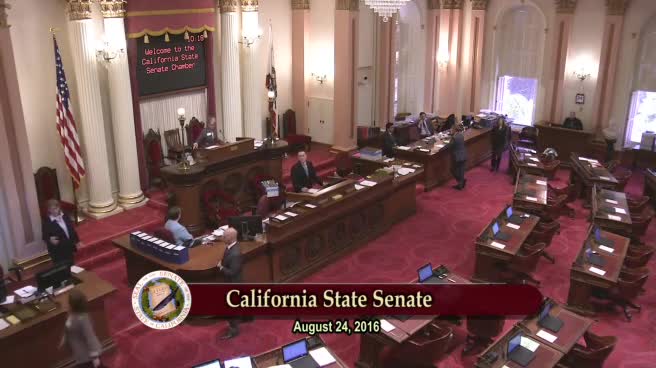 2MIN
Senate Floor
 6MIN
Senate Standing Committee on Public Employment and Retirement
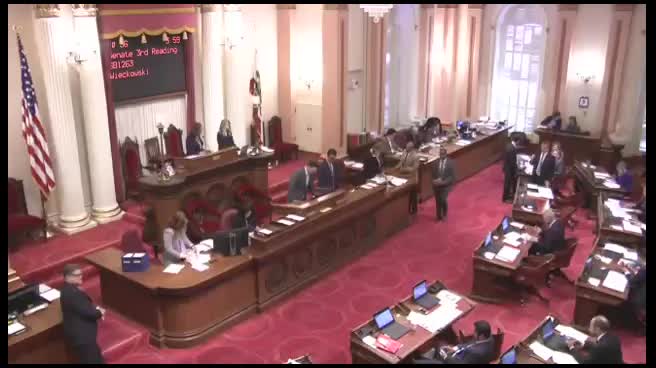 2MIN
Senate Floor
 4MIN
Senate Standing Committee on Judiciary
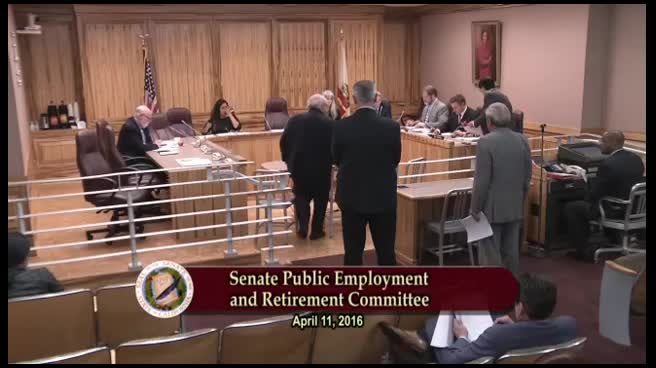 4MIN
Senate Standing Committee on Public Employment and Retirement
Bill Author

Bill Co-Author(s):