SB 1380: Homeless Coordinating and Financing Council.
- Session Year: 2015-2016
- House: Senate
- Latest Version Date: 2016-09-29
Existing law establishes various programs, including, among others, the Emergency Housing and Assistance Program, to provide assistance to homeless persons.
This bill would require a state agency or department that funds, implements, or administers a state program that provides housing or housing-related services to people experiencing homelessness or at risk of homelessness, except as specified, to revise or adopt guidelines and regulations to include enumerated Housing First policies. The bill would also establish the Homeless Coordinating and Financing Council to oversee the implementation of the Housing First guidelines and regulations and, among other things, to identify resources, benefits, and services that can be accessed to prevent and end homelessness in California.
Existing law establishes various programs, including, among others, the Emergency Housing and Assistance Program, to provide assistance to homeless persons.
This bill would require a state agency or department that funds, implements, or administers a state program that provides housing or housing-related services to people experiencing homelessness or at risk of homelessness, except as specified, to revise or adopt guidelines and regulations to include enumerated Housing First policies. The bill would also establish the Homeless Coordinating and Financing Council to oversee the implementation of the Housing First guidelines and regulations and, among other things, to identify resources, benefits, and services that can be accessed to prevent and end homelessness in California. The bill would establish the Homeless Trust Fund, a continuously appropriated fund, to receive specified grant moneys and fund the administrative costs of the council, as specified.
By authorizing the deposit of moneys into a continuously appropriated fund, this bill would make an appropriation.
Existing law establishes various programs, including, among others, the Emergency Housing and Assistance Program, to provide assistance to homeless persons.
This bill would declare the intent of the Legislature to enact legislation to establish a coordinating council on homelessness. require a state agency or department that funds, implements, or administers a state program that provides housing or housing-related services to people experiencing homelessness or at risk of homelessness, except as specified, to revise or adopt guidelines and regulations to include enumerated Housing First policies. The bill would also establish the Homeless Coordinating and Financing Council to oversee the implementation of the Housing First guidelines and regulations and, among other things, to identify resources, benefits, and services that can be accessed to prevent and end homelessness in California. The bill would establish the Homeless Trust Fund, a continuously appropriated fund, to receive specified grant moneys and fund the administrative costs of the council, as specified.
By authorizing the deposit of moneys into a continuously appropriated fund, this bill would make an appropriation.
Existing law establishes various programs, including, among others, the Emergency Housing and Assistance Program, to provide assistance to homeless persons.
This bill would declare the intent of the Legislature to enact legislation to establish a coordinating council on homelessness.
The Legislature finds and declares all of the following:
(a)California leads the nation in the number of homeless residents with 115,738 people experiencing homelessness at some point, which is 21 percent of the nations total. California also leads the nation in the number and ratio of chronically homeless residents with 29,178 chronically homeless residents at any point in time, which is 31 percent of the nations total. California also has 10,416 homeless youth, which is 28 percent of the nations total.
(b)Homelessness is expensive to the state and local governments. A homeless person receiving general assistance in Los Angeles County, for example, incurs $2,897 per month in crisis response services.
(c)A chronically homeless Californian moving into supportive housing is able to reduce costs he or she incurs by almost 80 percent. Moving an individual or family experiencing chronic homelessness to housing stability costs less than the resulting savings in public expenditures.
(d)Following the example of other states, as well as jurisdictions within California, it is the intent of the Legislature to adopt a Housing First model for all state programs funding housing for people experiencing homelessness or at risk of homelessness. These housing models should address the distinct needs of homeless populations, including unaccompanied youth under 25 years of age.
(e)Housing First is an evidence-based model of ending all types of homelessness and is the most effective approach to ending chronic homelessness. The federal government recognizes that Housing First yields high-housing retention rates, low returns to homelessness, and significant reductions in crisis or institutional care. The federal government also recognizes the value of time-limited housing to address the needs of unaccompanied homeless youth and persons fleeing domestic violence.
(f)Homelessness affects multiple systems in California. Though almost every state with significant homeless populations has established a council to coordinate a Housing First-oriented response to homelessness, California does not have any entity to manage the states response to homelessness.
(g)California participated in a federally funded policy academy to reduce chronic homelessness. That policy academy succeeded in revising programs that the Department of Housing and Community Development (HCD) administers, and in attracting federal funding opportunities requiring collaboration between the HCD and the State Department of Health Care Services. To implement additional successes, it is essential that California have a coordinating council on homelessness.
SEC. 2.Chapter 6.5 (commencing with Section 8255) is added to Division 8 of the Welfare and Institutions Code, to read:6.5.Housing First and Coordinating Council8255.For purposes of this chapter:
(a)Coordinating council means the Homeless Coordinating and Financing Council established pursuant to Section 8257.
(b)Core components of Housing First means all of the following:
(1)Tenant screening and selection practices that promote accepting applicants regardless of their sobriety or use of substances, completion of treatment, or participation in services.
(2)Applicants are not rejected on the basis of poor credit or financial history, poor or lack of rental history, criminal convictions unrelated to tenancy, or behaviors that indicate a lack of housing readiness.
(3)Acceptance of referrals directly from shelters, street outreach, drop-in centers, and other parts of crisis response systems frequented by vulnerable people experiencing homelessness.
(4)Supportive services that emphasize engagement and problem solving over therapeutic goals and service plans that are highly tenant-driven without predetermined goals.
(5)Participation in services or program compliance is not a condition of permanent housing tenancy.
(6)Tenants have a lease and all the rights and responsibilities of tenancy, as outlined in Californias Civil, Health and Safety, and Government codes.
(7)The use of alcohol or drugs in and of itself, without other lease violations, is not a reason for eviction.
(8)In communities with coordinated assessment and entry systems, incentives for funding promote tenant selection plans for supportive housing that prioritize eligible tenants based on criteria other than first-come-first-serve, including, but not limited to, the duration or chronicity of homelessness, vulnerability to early mortality, or high utilization of crisis services. Prioritization may include triage tools, developed through local data, to identify high-cost, high-need homeless residents.
(9)Case managers and service coordinators who are trained in and actively employ evidence-based practices for client engagement, including, but not limited to, motivational interviewing and client-centered counseling.
(10)Services are informed by a harm-reduction philosophy that recognizes drug and alcohol use and addiction as a part of tenants lives, where tenants are engaged in nonjudgmental communication regarding drug and alcohol use, and where tenants are offered education regarding how to avoid risky behaviors and engage in safer practices, as well as connected to evidence-based treatment if the tenant so chooses.
(11)The project and specific apartment may include special physical features that accommodate disabilities, reduce harm, and promote health and community and independence among tenants.
(c)Homeless has the same definition as that term is defined in Section 91.5 of Title 24 of the Code of Federal Regulations.
(d)(1)Housing First means the evidence-based model that uses housing as a tool, rather than a reward, for recovery and that centers on providing or connecting homeless people to permanent housing as quickly as possible. Housing First providers offer services as needed and requested on a voluntary basis and that do not make housing contingent on participation in services.
(2)(A)Housing First includes time-limited rental or services assistance, so long as the housing and service provider assists the recipient in accessing permanent housing and in securing longer-term rental assistance, income assistance, or employment.
(B)For time-limited, supportive services programs serving homeless youth, programs should use a positive youth development model and be culturally competent to serve unaccompanied youth under 25 years of age. Providers should work with the youth to engage in family reunification efforts, where appropriate and when in the best interest of the youth. In the event of an eviction, programs shall make every effort, which shall be documented, to link tenants to other stable, safe, decent housing options. Exit to homelessness should be extremely rare, and only after a tenant refuses assistance with housing search, location, and move-in assistance.
(e)State programs means any programs a California state agency or department funds, implements, or administers for the purpose of providing housing or housing-based services to people experiencing homelessness or at risk of homelessness, with the exception of federally funded programs with requirements inconsistent with this chapter or programs that fund emergency shelters.
8256.(a)Agencies and departments administering state programs created on or after July 1, 2017, shall collaborate with the coordinating council to adopt guidelines and regulations to incorporate core components of Housing First.
(b)By July 1, 2019, agencies and departments administering state programs in existence prior to July 1, 2017, shall collaborate with the coordinating council to revise or adopt guidelines and regulations that incorporate the core components of Housing First, if the existing guidelines and regulations do not already incorporate the core components of Housing First.
8257.(a)Within 180 days of the effective date of the measure adding this chapter, the Governor shall create a Homeless Coordinating and Financing Council.
(b)The council shall have the following goals:
(1)To oversee implementation of this chapter.
(2)To identify mainstream resources, benefits, and services that can be accessed to prevent and end homelessness in California.
(3)To create partnerships among state agencies and departments, local government agencies, participants in the United States Department of Housing and Urban Developments Continuum of Care Program, federal agencies, the United States Interagency Council on Homelessness, nonprofit entities working to end homelessness, homeless services providers, and the private sector, for the purpose of arriving at specific strategies to end homelessness.
(4)To promote systems integration to increase efficiency and effectiveness while focusing on designing systems to address the needs of people experiencing homelessness, including unaccompanied youth under 25 years of age.
(5)To coordinate existing funding and applications for competitive funding. Any action taken pursuant to this paragraph shall not restructure or change any existing allocations or allocation formulas.
(6)To make policy and procedural recommendations to legislators and other governmental entities.
(7)To identify and seek funding opportunities for state entities that have programs to end homelessness, including, but not limited to, federal and philanthropic funding opportunities, and to facilitate and coordinate those state entities efforts to obtain that funding.
(8)To broker agreements between state agencies and departments and between state agencies and departments and local jurisdictions to align and coordinate resources, reduce administrative burdens of accessing existing resources, and foster common applications for services, operating, and capital funding.
(9)To serve as a statewide facilitator, coordinator, and policy development resource on ending homelessness in California.
(10)To report to the Governor, federal Cabinet members, and the Legislature on homelessness and work to reduce homelessness.
(11)To ensure accountability and results in meeting the strategies and goals of the council.
(12)To identify and implement strategies to fight homelessness in small communities and rural areas.
(13)To create a statewide data system or warehouse that collects local data through Homeless Management Information Systems, with the ultimate goal of matching data on homelessness to programs impacting homeless recipients of state programs, such as Medi-Cal (Chapter 7 (commencing with Section 14000) of Part 3 of Division 9 of the Welfare and Institutions Code) and CalWORKS (Chapter 2 (commencing with Section 11200) of Part 3 of Division 9 of the Welfare and Institutions Code).
(c)(1)The Governor shall appoint up to 15 members of the council as follows:
(A)A representative from the Department of Housing and Community Development.
(B)A representative of the State Department of Social Services.
(C)A representative of the California Housing Finance Agency.
(D)A representative of the State Department of Health Care Services.
(E)A representative of the Department of Veterans Affairs.
(F)A representative of the Department of Corrections and Rehabilitation.
(G)A representative from the California Tax Credit Allocation Committee in the Treasurers office.
(H)A representative of the Victim Services Program within the Division of Grants Management within the Office of Emergency Services.
(I)A formerly homeless person who lives in California.
(J)Two representatives of local agencies or organizations that participate in the United States Department of Housing and Urban Developments Continuum of Care Program.
(K)State advocates or other members of the public or state agencies, according to the Governors discretion.
(2)The Senate Committee on Rules and the Speaker of the Assembly shall each appoint one representative of the council from two different stakeholder organizations.
(3)The council may, at its discretion, invite stakeholders, individuals who have experienced homelessness, members of philanthropic communities, and experts to participate in meetings or provide information to the council.
(d)The council shall hold public meetings at least once every quarter.
(e)The members of the council shall serve at the pleasure of the Governor.
(f)Within existing funding, the council may establish working groups, task forces, or other structures from within its membership or with outside members to assist it in its work. Working groups, task forces, or other structures established by the council shall determine their own meeting schedules.
(g)The members of the council shall serve without compensation, except that members of the council who are, or have been, homeless may receive reimbursement for travel, per diem, or other expenses.
(h)The Department of Housing and Community Development shall provide staff for the council.
(i)The members of the council may enter into memoranda of understanding with other members of the council to achieve the goals set forth in this chapter, as necessary, in order to facilitate communication and cooperation between the entities the members of the council represent.
The Legislature finds and declares all of the following:
(a)California leads the nation in the number of homeless residents with 115,738 people experiencing homelessness at some point, which is 21 percent of the nations total. California also leads the nation in the number and ratio of chronically homeless residents with 29,178 chronically homeless residents at any point in time, which is 31 percent of the nations total. California also has 10,416 homeless youth, which is 28 percent of the nations total.
(b)Homelessness is expensive to the state and local governments. A homeless person receiving general assistance in Los Angeles County, for example, incurs $2,897 per month in crisis response services.
(c)A chronically homeless Californian moving into supportive housing is able to reduce costs he or she incurs by almost 80 percent. Moving an individual or family experiencing chronic homelessness to housing stability costs less than the resulting savings in public expenditures.
(d)Following the example of other states, as well as jurisdictions within California, it is the intent of the Legislature to adopt a Housing First model for all state programs funding housing for people experiencing homelessness or at risk of homelessness. These housing models should address the distinct needs of homeless populations, including unaccompanied youth under 25 years of age.
(e)Housing First is an evidence-based model of ending all types of homelessness and is the most effective approach to ending chronic homelessness. The federal government recognizes that Housing First yields high-housing retention rates, low returns to homelessness, and significant reductions in crisis or institutional care. The federal government also recognizes the value of time-limited housing to address the needs of unaccompanied homeless youth and persons fleeing domestic violence.
(f)Homelessness affects multiple systems in California. Though almost every state with significant homeless populations has established a council to coordinate a Housing First-oriented response to homelessness, California does not have any entity to manage the states response to homelessness.
(g)California participated in a federally funded policy academy to reduce chronic homelessness. That policy academy succeeded in revising programs that the Department of Housing and Community Development (HCD) administers, and in attracting federal funding opportunities requiring collaboration between the HCD and the State Department of Health Care Services. To implement additional successes, it is essential that California have a coordinating council on homelessness.
SEC. 2.Chapter 7 6.5 (commencing with Section 8260) 8255) is added to Division 8 of the Welfare and Institutions Code, to read: 7. 6.5.Housing First and Coordinating Council8260.8255.For purposes of this chapter:
(a)Coordinating council means the Homeless Coordinating and Financing Council established pursuant to Section 8262. 8257.
(b)Core components of Housing First means all of the following:
(1)Tenant screening and selection practices that promote accepting applicants regardless of their sobriety or use of substances, completion of treatment, or participation in services.
(2)Applicants are not rejected on the basis of poor credit or financial history, poor or lack of rental history, criminal convictions unrelated to tenancy, or behaviors that indicate a lack of housing readiness.
(3)Acceptance of referrals directly from shelters, street outreach, drop-in centers, and other parts of crisis response systems frequented by vulnerable people experiencing homelessness.
(4)Supportive services that emphasize engagement and problem solving over therapeutic goals and service plans that are highly tenant-driven without predetermined goals.
(5)Participation in services or program compliance is not a condition of permanent housing tenancy.
(6)Tenants have a lease and all the rights and responsibilities of tenancy, as outlined in Californias Civil, Health and Safety, and Government codes.
(7)The use of alcohol or drugs in and of itself, without other lease violations, is not a reason for eviction.
(8)In communities with coordinated assessment and entry systems, incentives for funding promote tenant selection plans for supportive housing that prioritize eligible tenants based on criteria other than first-come-first-serve, including, but not limited to, the duration or chronicity of homelessness, vulnerability to early mortality, or high utilization of crisis services. Prioritization may include triage tools, developed through local data, to identify high-cost, high-need homeless residents.
(9)Case managers and service coordinators who are trained in and actively employ evidence-based practices for client engagement, including, but not limited to, motivational interviewing and client-centered counseling.
(10)Services are informed by a harm-reduction philosophy that recognizes drug and alcohol use and addiction as a part of tenants lives, where tenants are engaged in nonjudgmental communication regarding drug and alcohol use, and where tenants are offered education regarding how to avoid risky behaviors and engage in safer practices, as well as connected to evidence-based treatment if the tenant so chooses.
(11)The project and specific apartment may include special physical features that accommodate disabilities, reduce harm, and promote health and community and independence among tenants.
(c)Homeless has the same definition as that term is defined in Section 91.5 of Title 24 of the Code of Federal Regulations.
(d)(1)Housing First means the evidence-based model that uses housing as a tool, rather than a reward, for recovery and that centers on providing or connecting homeless people to permanent housing as quickly as possible. Housing First providers offer services as needed and requested on a voluntary basis and that do not make housing contingent on participation in services.
(2)(A)Housing First includes time-limited rental or services assistance, so long as the housing and service provider assists the recipient in accessing permanent housing and in securing longer-term rental assistance, income assistance, or employment.
(B)For time-limited, supportive services programs serving homeless youth, programs should use a positive youth development model and be culturally competent to serve unaccompanied youth under age 25. 25 years of age. Providers should work with the youth to engage in family reunification efforts, where appropriate and when in the best interest of the youth. In the event of an eviction, programs shall make every effort, which shall be documented, to link tenants to other stable, safe, decent housing options. Exit to homelessness should be extremely rare, and only after a tenant refuses assistance with housing search, location, and move-in assistance.
(e)State programs means any programs a California state agency or department funds, implements, or administers for the purpose of providing housing or housing-based services to people experiencing homelessness or at risk of homelessness, with the exception of federally funded programs with requirements inconsistent with this chapter or programs that fund emergency shelters.
8261.8256.(a)Agencies and departments administering state programs created on or after July 1, 2017, shall collaborate with the coordinating council to adopt guidelines and regulations to incorporate core components of Housing First.
(b)By July 1, 2019, agencies and departments administering state programs in existence prior to July 1, 2017, shall collaborate with the coordinating council to revise or adopt guidelines and regulations that incorporate the core components of Housing First, if the existing guidelines and regulations do not already incorporate the core components of Housing First.
8262.8257.(a)Within 180 days of the effective date of the measure adding this chapter, the Governor shall create a Homeless Coordinating and Financing Council.
(b)The council shall have the following goals:
(1)To oversee implementation of this chapter.
(2)To identify mainstream resources, benefits, and services that can be accessed to prevent and end homelessness in California.
(3)To create partnerships among state agencies and departments, local government agencies, participants in the United States Department of Housing and Urban Developments Continuum of Care Program, federal agencies, the United States Interagency Council on Homelessness, nonprofit entities working to end homelessness, homeless services providers, and the private sector, for the purpose of arriving at specific strategies to end homelessness.
(4)To promote systems integration to increase efficiency and effectiveness while focusing on designing systems to address the needs of people experiencing homelessness, including unaccompanied youth under 25 years of age.
(5)To coordinate existing funding and applications for competitive funding. Any action taken pursuant to this paragraph shall not restructure or change any existing allocations or allocation formulas.
(6)To make policy and procedural recommendations to legislators and other governmental entities.
(7)To identify and seek funding opportunities for state entities that have programs to end homelessness, including, but not limited to, federal and philanthropic funding opportunities, and to facilitate and coordinate those state entities efforts to obtain that funding.
(8)To broker agreements between state agencies and departments and between state agencies and departments and local jurisdictions to align and coordinate resources, reduce administrative burdens of accessing existing resources, and foster common applications for services, operating, and capital funding.
(9)To serve as a statewide facilitator, coordinator, and policy development resource on ending homelessness in California.
(10)To report to the Governor, federal Cabinet members, and the Legislature on homelessness and work to reduce homelessness.
(11)To ensure accountability and results in meeting the strategies and goals of the council.
(12)To identify and implement strategies to fight homelessness in small communities and rural areas.
(13)To create a statewide data system or warehouse that collects local data through Homeless Management Information Systems, with the ultimate goal of matching data on homelessness to programs impacting homeless recipients of state programs, such as Medi-Cal (Chapter 7 (commencing with Section 14000) of Part 3 of Division 9 of the Welfare and Institutions Code) and CalWORKS (Chapter 2 (commencing with Section 11200) of Part 3 of Division 9 of the Welfare and Institutions Code).
(c)(1)The Governor shall appoint up to 15 members of the council as follows:
(A)A representative from the Department of Housing and Community Development.
(B)A representative of the State Department of Social Services.
(C)A representative of the California Housing Finance Agency.
(D)A representative of the State Department of Health Care Services.
(E)A representative of the Department of Veterans Affairs.
(F)A representative of the Department of Corrections and Rehabilitation.
(G)A representative from the California Tax Credit Allocation Committee in the Treasurers Office. office.
(H)A representative of the Victim Services Program within the Division of Grants Management within the Office of Emergency Services.
(H)
(I)A formerly homeless person who lives in California.
(I)
(J)Two representatives of local agencies or organizations that participate in the United States Department of Housing and Urban Developments Continuum of Care Program.
(J)
(K)State advocates or other members of the public or state agencies, according to the Governors discretion.
(2)The Senate Committee on Rules and the Speaker of the Assembly shall each appoint one representative of the council from two different stakeholder organizations.
(3)The council may, at its discretion, invite stakeholders, individuals who have experienced homelessness, members of philanthropic communities, and experts to participate in meetings or provide information to the council.
(d)The council shall hold public meetings at least once every quarter.
(e)The members of the council shall serve at the pleasure of the Governor.
(f)Within existing funding, the council may establish working groups, task forces, or other structures from within its membership or with outside members to assist it in its work. Working groups, task forces, or other structures established by the council shall determine their own meeting schedules.
(g)The members of the council shall serve without compensation, except that members of the council who are, or have been, homeless may receive reimbursement for travel, per diem, or other expenses.
(h)The Department of Housing and Community Development shall provide staff for the council.
(i)The members of the council may enter into memoranda of understanding with other members of the council to achieve the goals set forth in this chapter, as necessary, in order to facilitate communication and cooperation between the entities the members of the council represent.
The Legislature finds and declares all of the following:
(a)California leads the nation in the number of homeless residents with 115,738 people experiencing homelessness at some point, which is 21 percent of the nations total. California also leads the nation in the number and ratio of chronically homeless residents with 29,178 chronically homeless residents at any point in time, which is 31 percent of the nations total. California also has 10,416 homeless youth, which is 28 percent of the nations total.
(b)Homelessness is expensive to the state and local governments. A homeless person receiving general assistance in Los Angeles County, for example, incurs $2,897 per month in crisis response services.
(c)A chronically homeless Californian moving into supportive housing is able to reduce costs he or she incurs by almost 80 percent. Moving an individual or family experiencing chronic homelessness to housing stability costs less than the resulting savings in public expenditures.
(d)Following the example of other states, as well as jurisdictions within California, it is the intent of the Legislature to adopt a Housing First model for all state programs funding housing for people experiencing homelessness or at risk of homelessness. These housing models should address the distinct needs of homeless populations, including unaccompanied youth under 25 years of age.
(e)Housing First is an evidence-based model of ending all types of homelessness and is the most effective approach to ending chronic homelessness. The federal government recognizes that Housing First yields high-housing retention rates, low returns to homelessness, and significant reductions in crisis or institutional care. The federal government also recognizes the value of time-limited housing to address the needs of unaccompanied homeless youth and persons fleeing domestic violence.
(f)Homelessness affects multiple systems in California. Though almost every state with significant homeless populations has established a council to coordinate a Housing First-oriented response to homelessness, California does not have any entity to manage the states response to homelessness.
(g)California participated in a federally funded Policy Academy policy academy to reduce chronic homelessness. That Policy Academy policy academy succeeded in revising programs Californias that the Department of Housing and Community Development (HCD) administers, and in attracting federal funding opportunities requiring collaboration between the HCD and the State Department of Health Care Services. To implement additional successes, it is essential that California have a coordinating council on homelessness.
SEC. 2.Chapter 7 (commencing with Section 8260) is added to Division 8 of the Welfare and Institutions Code, to read:7.Housing First and Coordinating Council8260.For purposes of this chapter:
(a)Coordinating Council council means the Homeless Coordinating and Financing Council established pursuant to Section 8262.
(b)Core components of Housing First means all of the following:
(1)Tenant screening and selection practices that promote accepting applicants regardless of their sobriety or use of substances, completion of treatment, or participation in services.
(2)Applicants are not rejected on the basis of poor credit or financial history, poor or lack of rental history, criminal convictions unrelated to tenancy, or behaviors that indicate a lack of housing readiness.
(3)Acceptance of referrals directly from shelters, street outreach, drop-in centers, and other parts of crisis response systems frequented by vulnerable people experiencing homelessness.
(4)Supportive services that emphasize engagement and problem solving over therapeutic goals and service plans that are highly tenant-driven without predetermined goals.
(5)Participation in services or program compliance is not a condition of permanent housing tenancy.
(6)Tenants have a lease and all the rights and responsibilities of tenancy, as outlined in Californias Civil, Health and Safety, and Government codes.
(7)The use of alcohol or drugs in and of itself, without other lease violations, is not a reason for eviction.
(8)In communities with coordinated assessment and entry systems, incentives for funding promote tenant selection plans for supportive housing that prioritize eligible tenants based on criteria other than first-come-first-serve, including, but not limited to, the duration or chronicity of homelessness, vulnerability to early mortality, or high utilization of crisis services. Prioritization may include triage tools, developed through local data, to identify high-cost, high-need homeless residents.
(9)Case managers and service coordinators who are trained in and actively employ evidence-based practices for client engagement, including, but not limited to, motivational interviewing and client-centered counseling.
(10)Services are informed by a harm-reduction philosophy that recognizes drug and alcohol use and addiction as a part of tenants lives, where tenants are engaged in nonjudgmental communication regarding drug and alcohol use, and where tenants are offered education regarding how to avoid risky behaviors and engage in safer practices, as well as connected to evidence-based treatment if the tenant so chooses.
(11)The project and specific apartment may include special physical features that accommodate disabilities, reduce harm, and promote health and community and independence among tenants.
(c)Homeless has the same definition as that term is defined in Section 91.5 of Title 24 of the Code of Federal Regulations.
(d)(1)Housing First means the evidence-based model that uses housing as a tool, rather than a reward, for recovery and that centers on providing or connecting homeless people to permanent housing as quickly as possible. Housing First providers offer services as needed and requested on a voluntary basis and that do not make housing contingent on participation in services.
(2)(A)Housing First includes time-limited rental or services assistance, so long as the housing and service provider assists the recipient in accessing permanent housing and in securing longer-term rental assistance, income assistance, or employment.
(B)For time-limited, supportive services programs serving homeless youth, programs should use a positive youth development model and be culturally competent to serve unaccompanied youth under age 25. Providers should work with the youth to engage in family reunification efforts, where appropriate and when in the best interest of the youth. In the event of an eviction, programs shall make every effort, which shall be documented, to link tenants to other stable, safe, decent housing options. Exit to homelessness should be extremely rare, and only after a tenant refuses assistance with housing search, location, and move-in assistance.
(e)State programs means any programs a California state agency or department funds, implements, or administers for the purpose of providing housing or housing-based services to people experiencing homelessness or at risk of homelessness, with the exception of federally funded programs with requirements inconsistent with this chapter or programs that fund emergency shelters.
8261.(a)Agencies and departments administering state programs created on or after July 1, 2017, shall collaborate with the Coordinating Council coordinating council to adopt guidelines and regulations to incorporate core components of Housing First.
(b)By July 1, 2019, agencies and departments administering state programs in existence prior to July 1, 2017, shall collaborate with the Coordinating Council coordinating council to revise or adopt guidelines and regulations that incorporate the core components of Housing First, if the existing guidelines and regulations do not already incorporate the core components of Housing First.
8262.(a)Within 180 days of the effective date of the measure adding this chapter, the Governor shall create a Homeless Coordinating and Financing Council.
(b)The council shall have the following goals:
(1)To oversee implementation of this chapter.
(2)To identify mainstream resources, benefits, and services that can be accessed to prevent and end homelessness in California.
(3)To create partnerships among state agencies and departments, local government agencies, participants in the United States Department of Housing and Urban Developments Continuum of Care Program, federal agencies, the United States Interagency Council on Homelessness, nonprofit entities working to end homelessness, homeless services providers, and the private sector, for the purpose of arriving at specific strategies to end homelessness.
(4)To promote systems integration to increase efficiency and effectiveness while focusing on designing systems to address the needs of people experiencing homelessness, including unaccompanied youth under 25 years of age.
(5)To coordinate existing funding and applications for competitive funding. Any action taken pursuant to this paragraph shall not restructure or change any existing allocations or allocation formulas.
(6)To make policy and procedural recommendations to legislators and other government governmental entities.
(7)To identify and seek funding opportunities for state entities that have programs to end homelessness, including, but not limited to, federal and philanthropic funding opportunities, and to facilitate and coordinate those state entities efforts to obtain that funding.
(8)To broker agreements between state agencies and departments and between state agencies and departments and local jurisdictions to align and coordinate resources, reduce administrative burdens of accessing existing resources, and foster common applications for services, operating, and capital funding.
(9)To serve as a statewide facilitator, coordinator, and policy development resource on ending homelessness in California.
(10)To report to the Governor, federal Cabinet members, and the Legislature on homelessness and work to reduce homelessness.
(11)To ensure accountability and results in meeting the strategies and goals of the council.
(12)To identify and implement strategies to fight homelessness in small communities and rural areas.
(13)To create a statewide data system or warehouse that collects local data through Homeless Management Information Systems, with the ultimate goal of matching data on homelessness to programs impacting homeless recipients of state programs, such as Medi-Cal (Chapter 7 (commencing with Section 14000) of Part 3 of Division 9 of the Welfare and Institutions Code) and CalWORKS (Chapter 2 (commencing with Section 11200) of Part 3 of Division 9 of the Welfare and Institutions Code).
(c)(1)The Governor shall appoint up to 15 members of the council as follows:
(A)A representative from the Department of Housing and Community Development.
(B)A representative of the State Department of Social Services.
(C)A representative of the California Housing Finance Agency.
(D)A representative of the State Department of Health Care Services.
(E)A representative of the Department of Veterans Affairs.
(F)A representative of the Department of Corrections and Rehabilitation.
(G)A representative from the California Tax Credit Allocation Committee in the Treasurers Office.
(H)A formerly homeless person who lives in California. To the extent funding is available, their travel costs shall be paid for.
(I)Two representatives of local agencies or organizations that participate in the United States Department of Housing and Urban Developments Continuum of Care Program.
(J)State advocates or other members of the public or state agencies, according to the Governors discretion.
(2)The Senate Committee on Rules and the Speaker of the Assembly shall each appoint one representative of the council from two different stakeholder organizations.
(3)The council may, at its discretion, invite stakeholders, individuals who have experienced homelessness, members of philanthropic communities, and experts to participate in meetings or provide information to the council.
(d)The council shall hold public meetings at least once every quarter.
(e)The members of the council shall serve at the pleasure of the Governor.
(f)Within existing funding, the council may establish working groups, task forces, or other structures from within its membership or with outside members to assist it in its work. Working groups, task forces, or other structures established by the council shall determine their own meeting schedules.
(g)The members of the council shall serve without compensation, except that members of the council who are, or have been, homeless may receive reimbursement for travel, per diem, or other expenses.
(h)The Department of Housing and Community Development shall provide staff for the council.
(i)The members of the council may enter into memoranda of understanding with other members of the council to achieve the goals set forth in this chapter, as necessary, in order to facilitate communication and cooperation between the entities the members of the council represent.
The Legislature finds and declares all of the following:
(a)California leads the nation in the number of homeless residents with 115,738 people experiencing homelessness at some point, which is 21 percent of the nations total. California also leads the nation in the number and ratio of chronically homeless residents with 29,178 chronically homeless residents at any point in time, which is 31 percent of the nations total. California also has 10,416 homeless youth, which is 28 percent of the nations total.
(b)Homelessness is expensive to the state and local governments. A homeless person receiving general assistance in Los Angeles County, for example, incurs $2,897 per month in crisis response services.
(c)A chronically homeless Californian moving into supportive housing is able to reduce costs he or she incurs by almost 80 percent. Moving an individual or family experiencing chronic homelessness to housing stability costs less than the resulting savings in public expenditures.
(d)Following the example of other states, as well as jurisdictions within California, it is the intent of the Legislature to adopt a Housing First model for all state programs funding housing for people experiencing homelessness or at risk of homelessness. These housing models should address the distinct needs of homeless populations, including unaccompanied youth under 25 years of age.
(e)Housing First is an evidence-based model of ending all types of homelessness and is the most effective approach to ending chronic homelessness. The federal government recognizes that Housing First yields high-housing retention rates, low returns to homelessness, and significant reductions in crisis or institutional care. The federal government also recognizes the value of time-limited housing to address the needs of unaccompanied homeless youth and persons fleeing domestic violence.
(f)Homelessness affects multiple systems in California. Though almost every state with significant homeless populations has established a council to coordinate a Housing First-oriented response to homelessness, California does not have any entity to manage the states response to homelessness.
(g)California participated in a federally funded Policy Academy to reduce chronic homelessness. That Policy Academy succeeded in revising programs Californias Department of Housing and Community Development (HCD) administers, and in attracting federal funding opportunities requiring collaboration between the HCD and the State Department of Health Care Services. To implement additional successes, it is essential that California have a coordinating council on homelessness.
SEC. 2.Chapter 7 (commencing with Section 8260) is added to Division 8 of the Welfare and Institutions Code, to read:7.Housing First and Coordinating Council8260.For purposes of this chapter:
(a)Coordinating Council means the Homeless Coordinating and Financing Council established pursuant to Section 8262.
(b)Core components of Housing First means all of the following:
(1)Tenant screening and selection practices that promote accepting applicants regardless of their sobriety or use of substances, completion of treatment, or participation in services.
(2)Applicants are not rejected on the basis of poor credit or financial history, poor or lack of rental history, criminal convictions unrelated to tenancy, or behaviors that indicate a lack of housing readiness.
(3)Acceptance of referrals directly from shelters, street outreach, drop-in centers, and other parts of crisis response systems frequented by vulnerable people experiencing homelessness.
(4)Supportive services that emphasize engagement and problem solving over therapeutic goals and service plans that are highly tenant-driven without predetermined goals.
(5)Participation in services or program compliance is not a condition of permanent housing tenancy.
(6)Tenants have a lease and all the rights and responsibilities of tenancy, as outlined in Californias Civil, Health and Safety, and Government codes.
(7)The use of alcohol or drugs in and of itself, without other lease violations, is not a reason for eviction.
(8)In communities with coordinated assessment and entry systems, incentives for funding promote tenant selection plans for supportive housing that prioritize eligible tenants based on criteria other than first-come-first-serve, including, but not limited to, the duration or chronicity of homelessness, vulnerability to early mortality, or high utilization of crisis services. Prioritization may include triage tools, developed through local data, to identify high-cost, high-need homeless residents.
(9)Case managers and service coordinators who are trained in and actively employ evidence-based practices for client engagement, including, but not limited to, motivational interviewing and client-centered counseling.
(10)Services are informed by a harm-reduction philosophy that recognizes drug and alcohol use and addiction as a part of tenants lives, where tenants are engaged in nonjudgmental communication regarding drug and alcohol use, and where tenants are offered education regarding how to avoid risky behaviors and engage in safer practices, as well as connected to evidence-based treatment if the tenant so chooses.
(11)The project and specific apartment may include special physical features that accommodate disabilities, reduce harm, and promote health and community and independence among tenants.
(c)Homeless has the same definition as that term is defined in Section 91.5 of Title 24 of the Code of Federal Regulations.
(d)(1)Housing First means the evidence-based model that uses housing as a tool, rather than a reward, for recovery and that centers on providing or connecting homeless people to permanent housing as quickly as possible. Housing First providers offer services as needed and requested on a voluntary basis and that does do not make housing contingent on participation in services.
(2)(A)Housing First includes time-limited rental or services assistance, so long as the housing and service provider assists the recipient in accessing permanent housing and in securing longer-term rental assistance, income assistance, or employment.
(B)For time-limited, supportive services programs serving homeless youth, programs should use a positive youth development model and be culturally competent to serve unaccompanied youth under age 25. Providers should work with the youth to engage in family reunification efforts, where appropriate and when in the best interest of the youth. In the event of an eviction, programs shall make every effort, which shall be documented, to link tenants to other stable, safe, decent housing options. Exit to homelessness should be extremely rare, and only after a tenant refuses assistance with housing search, location, and move-in assistance.
(e)State programs means any programs a California state agency or department funds, implements, or administers for the purpose of providing housing or housing-based services to people experiencing homelessness or at risk of homelessness, with the exception of federally funded programs with requirements inconsistent with this chapter or programs that fund emergency shelters.
8261.(a)Agencies and departments administering state programs created on or after July 1, 2017, shall collaborate with the Coordinating Council to adopt guidelines and regulations to incorporate core components of Housing First.
(b)By July 1, 2019, agencies and departments administering state programs in existence prior to July 1, 2017, shall collaborate with the Coordinating Council to revise or adopt guidelines and regulations that incorporate the core components of Housing First, if the existing guidelines and regulations do not already incorporate the core components of Housing First.
8262.(a)Within 180 days of the effective date of the measure adding this chapter, the Governor shall create a Homeless Coordinating and Financing Council.
(b)The Coordinating Council council shall have the following goals:
(1)To oversee implementation of this chapter.
(2)To identify mainstream resources, benefits, and services that can be accessed to prevent and end homelessness in California.
(3)To create partnerships among state agencies and departments, local government agencies, participants in the United States Department of Housing and Urban Developments Continuum of Care Program, federal agencies, the United States Interagency Council on Homelessness, nonprofit entities working to end homelessness, homeless services providers, and the private sector, for the purpose of arriving at specific strategies to end homelessness.
(4)To promote systems integration to increase efficiency and effectiveness. effectiveness while focusing on designing systems to address the needs of people experiencing homelessness, including unaccompanied youth under 25 years of age.
(5)To coordinate existing funding and applications for competitive funding. Any action taken pursuant to this paragraph shall not restructure or change any existing allocations or allocation formulas.
(6)To make policy and procedural recommendations to legislators and other government entities.
(7)To identify and seek funding opportunities for state entities that have programs to end homelessness, including, but not limited to, federal and philanthropic funding opportunities, and to facilitate and coordinate those state entities efforts to obtain that funding.
(8)To broker agreements between state agencies and departments and between state agencies and departments and local jurisdictions to align and coordinate resources, reduce administrative burdens of accessing existing resources, and foster common applications for services, operating, and capital funding.
(9)To serve as a statewide facilitator, coordinator, and policy development resource on ending homelessness in California.
(10)To report to the Governor, federal Cabinet members, and the Legislature on homelessness and work to reduce homelessness.
(11)To ensure accountability and results in meeting the strategies and goals of the council.
(12)To identify and implement strategies to fight homelessness in small communities and rural areas.
(c)(1)The Governor shall appoint up to 15 members of the Coordinating Council council as follows:
(A)A representative from the Department of Housing and Community Development.
(B)A representative of the Department of Social Services.
(C)A representative of the California Housing Finance Agency.
(D)A representative of the Department of Health Care Services.
(E)A representative of the Department of Veterans Affairs.
(F)A representative of the Department of Corrections and Rehabilitation.
(G)A representative from the California Tax Credit Allocation Committee in the Treasurers Office.
(H)A homeless person who lives in California. To the extent funding is available, their travel costs shall be paid for.
(I)Two representatives of local agencies or organizations that participate in the United States Department of Housing and Urban Developments Continuum of Care Program.
(J)State advocates or other members of the public or state agencies, according to the Governors discretion.
(2)The Senate Committee on Rules and the Speaker of the Assembly shall each appoint one representative of the council from two different stakeholder organizations.
(2)
(3)The council may, at its discretion, invite stakeholders, individuals who have experienced homelessness, members of philanthropic communities, and experts to participate in meetings or provide information to the council.
(d)The council shall hold public meetings at least once every quarter.
(e)The members of the council shall serve at the pleasure of the Governor.
(f)Within existing funding, the council may establish working groups, task forces, or other structures from within its membership or with outside members to assist it in its work. Working groups, task forces, or other structures established by the council shall determine their own meeting schedules.
(g)The members of the council shall serve without compensation, except that members of the council who are, or have been, homeless may receive reimbursement for travel, per diem, or other expenses.
(h)The Department of Housing and Community Development shall provide staff for the council.
(i)The council members of the council may enter into memoranda of understanding with other council members of the council to achieve the goals set forth in this chapter, as necessary, in order to facilitate communication and cooperation between the entities the council members of the council represent.
The Legislature finds and declares all of the following:
(a)California leads the nation in the number of homeless residents with 115,738 people experiencing homelessness at some point, which is 21 percent of the nations total. California also leads the nation in the number and ratio of chronically homeless residents with 29,178 chronically homeless residents at any point in time, which is 31 percent of the nations total.
(b)Homelessness is expensive to the state and local governments. A homeless person receiving general assistance in Los Angeles County, for example, incurs $2,897 per month in crisis response services.
(c)A chronically homeless Californian moving into supportive housing is able to reduce costs he or she incurs by almost 80 percent. Moving an individual or family experiencing chronic homelessness to housing stability costs less than the resulting savings in public expenditures.
(d)Following the example of other states, as well as jurisdictions within California, it is the intent of the Legislature to adopt a Housing First model for all state programs funding housing for people experiencing homelessness or at risk of homelessness.
(e)Housing First is an evidence-based model of ending all types of homelessness and is the most effective approach to ending chronic homelessness. The federal government recognizes that Housing First yields high-housing retention rates, low returns to homelessness, and significant reductions in crisis or institutional care.
(f)Homelessness affects multiple systems in California. Though almost every state with significant homeless populations has established a council to coordinate a Housing First-oriented response to homelessness, California does not have any entity to manage the states response to homelessness.
(g)California participated in a federally funded Policy Academy to reduce chronic homelessness. That Policy Academy succeeded in revising programs Californias Department of Housing and Community Development (HCD) administers, and in attracting federal funding opportunities requiring collaboration between the HCD and the State Department of Health Care Services. To implement additional successes, it is essential that California have a coordinating council on homelessness.
SEC. 2.Chapter 7 (commencing with Section 8260) is added to Division 8 of the Welfare and Institutions Code, to read:7.Housing First and Coordinating Council8260.For purposes of this chapter:
(a)Coordinating Council means the Homeless Coordinating and Financing Council established pursuant to Section 8262.
(b)Core components of Housing First means all of the following:
(1)Tenant screening and selection practices that promote accepting applicants regardless of their sobriety or use of substances, completion of treatment, or participation in services.
(2)Applicants are not rejected on the basis of poor credit or financial history, poor or lack of rental history, criminal convictions unrelated to tenancy, or behaviors that indicate a lack of housing readiness.
(3)Acceptance of referrals directly from shelters, street outreach, drop-in centers, and other parts of crisis response systems frequented by vulnerable people experiencing homelessness.
(4)Supportive services that emphasize engagement and problem solving over therapeutic goals and service plans that are highly tenant-driven without predetermined goals.
(5)Participation in services or program compliance is not a condition of permanent housing tenancy.
(6)Tenants have a lease and all the rights and responsibilities of tenancy, as outlined in Californias Civil, Health and Safety, and Government codes.
(7)The use of alcohol or drugs in and of itself, without other lease violations, is not a reason for eviction.
(8)In communities with coordinated assessment and entry systems, incentives for funding promote tenant selection plans for supportive housing that prioritize eligible tenants based on criteria other than first-come-first-serve, including, but not limited to, the duration or chronicity of homelessness, vulnerability to early mortality, or high utilization of crisis services. Prioritization may include triage tools, developed through local data, to identify high-cost, high-need homeless residents.
(9)Case managers and service coordinators who are trained in and actively employ evidence-based practices for client engagement, including, but not limited to, motivational interviewing and client-centered counseling.
(10)Services are informed by a harm-reduction philosophy that recognizes drug and alcohol use and addiction as a part of tenants lives, where tenants are engaged in nonjudgmental communication regarding drug and alcohol use, and where tenants are offered education regarding how to avoid risky behaviors and engage in safer practices, as well as connected to evidence-based treatment if the tenant so chooses.
(11)The project and specific apartment may include special physical features that accommodate disabilities, reduce harm, and promote health and community and independence among tenants.
(c)Homeless has the same definition as that term is defined in Section 91.5 of Title 24 of the Code of Federal Regulations.
(d)(1)Housing First means the evidence-based model that uses housing as a tool, rather than a reward, for recovery and that centers on providing or connecting homeless people to permanent housing as quickly as possible. Housing First providers offer services as needed and requested on a voluntary basis and that does not make housing contingent on participation in services.
(2)Housing First includes time-limited rental or services assistance, so long as the housing and service provider assists the recipient in accessing permanent housing and in securing longer-term rental assistance, income assistance, or employment.
(e)State programs means any programs a California state agency or department funds, implements, or administers for the purpose of providing housing or housing-based services to people experiencing homelessness or at risk of homelessness, with the exception of federally funded programs with requirements inconsistent with this chapter or programs that fund emergency shelters.
8261.(a)Agencies and departments administering state programs created on or after July 1, 2017, shall collaborate with the Coordinating Council to adopt guidelines and regulations to incorporate core components of Housing First.
(b)By July 1, 2019, agencies and departments administering state programs in existence prior to July 1, 2017, shall collaborate with the Coordinating Council to revise or adopt guidelines and regulations that incorporate the core components of Housing First, if the existing guidelines and regulations do not already incorporate the core components of Housing First.
8262.(a)Within 180 days of the effective date of the measure adding this chapter, the Governor shall create a Homeless Coordinating and Financing Council.
(b)The Coordinating Council shall have the following goals:
(1)To oversee implementation of this chapter.
(2)To identify mainstream resources, benefits, and services that can be accessed to prevent and end homelessness in California.
(3)To create partnerships among state agencies and departments, local government agencies, participants in the United States Department of Housing and Urban Developments Continuum of Care Program, federal agencies, the United States Interagency Council on Homelessness, nonprofit entities working to end homelessness, and the private sector, for the purpose of arriving at specific strategies to end homelessness.
(4)To promote systems integration to increase efficiency and effectiveness.
(5)To coordinate existing funding and applications for competitive funding. Any action taken pursuant to this paragraph shall not restructure or change any existing allocations or allocation formulas.
(6)To make policy and procedural recommendations to legislators and other government entities.
(7)To identify and seek funding opportunities for state entities that have programs to end homelessness, including, but not limited to, federal and philanthropic funding opportunities, and to facilitate and coordinate those state entities efforts to obtain that funding.
(8)To broker agreements between state agencies and departments and between state agencies and departments and local jurisdictions to align and coordinate resources, reduce administrative burdens of accessing existing resources, and foster common applications for services, operating, and capital funding.
(9)To serve as a statewide facilitator, coordinator, and policy development resource on ending homelessness in California.
(10)To report to the Governor, federal Cabinet members, and the Legislature on homelessness and work to reduce homelessness.
(11)To ensure accountability and results in meeting the strategies and goals of the council.
(12)To identify and implement strategies to fight homelessness in small communities and rural areas.
(c)(1)The Governor shall appoint up to 15 members of the Coordinating Council as follows:
(A)A representative of the Governors office. from the Department of Housing and Community Development.
(B)A representative of the Department of Social Services.
(C)A representative of the California Housing Finance Agency.
(D)A representative of the Department of Health Care Services.
(E)A representative of the Department of Veterans Affairs.
(F)A representative of the Department of Corrections and Rehabilitation.
(G)A representative from the California Tax Credit Allocation Committee in the Treasurers Office.
(H)People who are, or have been, A homeless person who lives in California, to California. To the extent funding is available to pay for available, their travel costs and stipends. shall be paid for.
(I)Representatives Two representatives of local agencies or organizations that participate in the United States Department of Housing and Urban Developments Continuum of Care Program.
(J)A state advocate State advocates or other member members of the public or state agencies, according to the Governors discretion.
(2)The council may, at its discretion, invite stakeholders, individuals who have experienced homelessness, members of philanthropic communities, and experts to participate in meetings or provide information to the council.
(d)The council shall hold public meetings at least once every quarter.
(e)The members of the council shall serve at the pleasure of the Governor.
(f)Within existing funding, the council may establish working groups, task forces, or other structures from within its membership or with outside members to assist it in its work. Working groups, task forces, or other structures established by the council shall determine their own meeting schedules.
(g)The members shall serve without compensation, except that members who are, or have been, homeless may receive reimbursement for travel, per diem, or other expenses.
(h)The Assistant Director for Homeless and Housing Policy within the Department of Housing and Community Development shall provide staff for the council.
(i)The council members may enter into memoranda of understanding with other council members to achieve the goals set forth in this chapter, as necessary, in order to facilitate communication and cooperation between the entities the council members represent.
The Legislature finds and declares all of the following:
(a)California leads the nation in the number of homeless residents with 115,738 people experiencing homelessness at some point, which is 21 percent of the nations total. California also leads the nation in the number and ratio of chronically homeless residents with 29,178 chronically homeless residents at any point in time, which is 31 percent of the nations total.
(b)Homelessness is expensive to the state and local governments. A homeless person receiving general assistance in Los Angeles County, for example, incurs $2,897 per month in crisis response services.
(c)A chronically homeless Californian moving into supportive housing is able to reduce costs he or she incurs by almost 80 percent. Moving an individual or family experiencing chronic homelessness to housing stability costs less than the resulting savings in public expenditures.
(d)Following the example of other states, as well as jurisdictions within California, it is the intent of the Legislature to adopt a Housing First model for all state programs funding housing for people experiencing homelessness or at risk of homelessness.
(e)Housing First is an evidence-based model of ending all types of homelessness and is the most effective approach to ending chronic homelessness. The federal government recognizes that Housing First yields high-housing retention rates, low returns to homelessness, and significant reductions in crisis or institutional care.
(f)Homelessness affects multiple systems in California. Though almost every state with significant homeless populations has established a council to coordinate a Housing First-oriented response to homelessness, California does not have any entity to manage the states response to homelessness.
(g)California participated in a federally funded Policy Academy to reduce chronic homelessness. That Policy Academy succeeded in revising programs Californias Department of Housing and Community Development (HCD) administers, and in attracting federal funding opportunities requiring collaboration between the HCD and the State Department of Health Care Services. To implement additional successes, it is essential that California have a coordinating council on homelessness.
SEC. 2.Chapter 7 (commencing with Section 8260) is added to Division 8 of the Welfare and Institutions Code, to read:7.Housing First and Coordinating Council8260.For purposes of this chapter:
(a)Coordinating Council means the Homeless Coordinating and Financing Council established pursuant to Section 8262.
(b)Core components of Housing First means all of the following:
(1)Tenant screening and selection practices that promote accepting applicants regardless of their sobriety or use of substances, completion of treatment, or participation in services.
(2)Applicants are not rejected on the basis of poor credit or financial history, poor or lack of rental history, criminal convictions unrelated to tenancy, or behaviors that indicate a lack of housing readiness.
(3)Acceptance of referrals directly from shelters, street outreach, drop-in centers, and other parts of crisis response systems frequented by vulnerable people experiencing homelessness.
(4)Supportive services that emphasize engagement and problem solving over therapeutic goals and service plans that are highly tenant-driven without predetermined goals.
(5)Participation in services or program compliance is not a condition of permanent housing tenancy.
(6)Tenants have a lease and all the rights and responsibilities of tenancy, as outlined in Californias Civil, Health and Safety, and Government codes.
(7)The use of alcohol or drugs in and of itself, without other lease violations, is not a reason for eviction.
(8)In communities with coordinated assessment and entry systems, incentives for funding promote tenant selection plans for supportive housing that prioritize eligible tenants based on criteria other than first-come-first-serve, including, but not limited to, the duration or chronicity of homelessness, vulnerability to early mortality, or high utilization of crisis services. Prioritization may include triage tools, developed through local data, to identify high-cost, high-need homeless residents.
(9)Case managers and service coordinators who are trained in and actively employ evidence-based practices for client engagement, including, but not limited to, motivational interviewing and client-centered counseling.
(10)Services are informed by a harm-reduction philosophy that recognizes drug and alcohol use and addiction as a part of tenants lives, where tenants are engaged in nonjudgmental communication regarding drug and alcohol use, and where tenants are offered education regarding how to avoid risky behaviors and engage in safer practices, as well as connected to evidence-based treatment if the tenant so chooses.
(11)The project and specific apartment may include special physical features that accommodate disabilities, reduce harm, and promote health and community and independence among tenants.
(c)Homeless has the same definition as that term is defined in Section 91.5 of Title 24 of the Code of Federal Regulations.
(d)(1)Housing First means the evidence-based model that uses housing as a tool, rather than a reward, for recovery and that centers on providing or connecting homeless people to permanent housing as quickly as possible. Housing First providers offer services as needed and requested on a voluntary basis and that does not make housing contingent on participation in services.
(2)Housing First includes time-limited rental or services assistance, so long as the housing and service provider assists the recipient in accessing permanent housing and in securing longer-term rental assistance, income assistance, or employment.
(e)State programs means any programs a California state agency or department funds, implements, or administers for the purpose of providing housing or housing-based services to people experiencing homelessness or at risk of homelessness, with the exception of federally funded programs with requirements inconsistent with this chapter. chapter or programs that fund emergency shelters.
8261.(a)Agencies and departments administering state programs created on or after July 1, 2017, shall collaborate with the Coordinating Council to adopt guidelines and regulations to incorporate core components of Housing First.
(b)By July 1, 2019, agencies and departments administering state programs in existence prior to July 1, 2017, shall collaborate with the Coordinating Council to revise or adopt guidelines and regulations that incorporate the core components of Housing First. First, if the existing guidelines and regulations do not already incorporate the core components of Housing First.
8262.(a)Within 180 days of the effective date of the measure adding this chapter, the Governor shall create a Homeless Coordinating and Financing Council.
(b)The Coordinating Council shall have the following goals:
(1)To oversee implementation of this chapter.
(2)To identify mainstream resources, benefits, and services that can be accessed to prevent and end homelessness in California.
(3)To create partnerships among state agencies and departments, local government agencies, participants in the United States Department of Housing and Urban Developments Continuum of Care Program, federal agencies, the United States Interagency Council on Homelessness, nonprofit entities working to end homelessness, and the private sector, for the purpose of arriving at specific strategies to end homelessness.
(4)To promote systems integration to increase efficiency and effectiveness.
(5)To coordinate existing funding and applications for competitive funding. Any action taken pursuant to this paragraph shall not restructure or change any existing allocations or allocation formulas.
(6)To make policy and procedural recommendations to legislators and other government entities.
(7)To identify and seek money funding opportunities for state entities that have programs to end homelessness, including, but not limited to, federal and philanthropic funding opportunities. opportunities, and to facilitate and coordinate those state entities efforts to obtain that funding.
(8)To broker agreements between state agencies and departments and between state agencies and departments and local jurisdictions to align and coordinate resources, reduce administrative burdens of accessing existing resources, and foster common applications for services, operating, and capital funding.
(9)To serve as the single a statewide facilitator, coordinator, and policy development resource on ending homelessness planning and policy development resource. in California.
(10)To report to the Governor, federal Cabinet members, and the Legislature on homelessness and work to reduce homelessness.
(11)To ensure accountability and results in meeting the strategies and goals of the council.
(12)To identify and implement strategies to fight homelessness in small communities and rural areas.
(c)(1)The Governor shall appoint up to 15 members of the Coordinating Council as follows:
(1)
(A)A representative of the Governors office.
(2)
(B)A representative of the Department of Social Services.
(3)
(C)A representative of the California Housing Finance Agency.
(4)
(D)A representative of the Department of Health Care Services.
(5)
(E)A representative of the Department of Veterans Affairs.
(6)
(F)A representative of the Department of Corrections and Rehabilitation.
(G)A representative from the California Tax Credit Allocation Committee in the Treasurers Office.
(7)
(H)People who are, or have been, homeless in California, to the extent funding is available to pay for travel costs and stipends.
(8)
(I)Representatives of local agencies or organizations that participate in the United States Department of Housing and Urban Developments Continuum of Care Program.
(9)State advocates and other members
(J)A state advocate or other member of the public or state agencies, according to the Governors discretion.
(2)The council may, at its discretion, invite stakeholders, individuals who have experienced homelessness, members of philanthropic communities, and experts to participate in meetings or provide information to the council.
(d)The council shall hold public meetings at least once every quarter.
(d)
(e)The members of the council shall serve at the pleasure of the Governor. The Governor shall appoint a chairperson, who may rotate among members at terms set by the Governor.
(f)Within existing funding, the council may establish working groups, task forces, or other structures from within its membership or with outside members to assist it in its work. Working groups, task forces, or other structures established by the council shall determine their own meeting schedules.
(e)
(g)The members shall serve without compensation, except that members who are, or have been, homeless may receive reimbursement for travel, per diem, or other expenses.
(f)
(h)The Assistant Director for Homeless and Housing Policy within the Department of Housing and Community Development shall provide staff for the council.
(i)The council members may enter into memoranda of understanding with other council members to achieve the goals set forth in this chapter, as necessary, in order to facilitate communication and cooperation between the entities the council members represent.
8263.There is hereby established in the State Treasury the Homeless Trust Fund. Moneys in the fund shall consist of funds awarded to the state through philanthropic, federal, or other grants the Coordinating Council, or departments within the Coordinating Council, receive that are not otherwise designated to be administered by another agency and that are expressly restricted for use only for the purposes set forth in this chapter. Moneys in the fund are hereby continuously appropriated as follows:
(a)For the purposes of the grant.
(b)For the administrative costs of the Coordinating Council, when appropriate and available.
The Legislature finds and declares all of the following:
(a)California leads the nation in the number of homeless residents with 115,738 people experiencing homelessness at some point, which is 21 percent of the nations total. California also leads the nation in the number and ratio of chronically homeless residents with 29,178 chronically homeless residents at any point in time, which is 31 percent of the nations total.
(b)Homelessness is expensive to the state and local governments. A homeless person receiving general assistance in Los Angeles County, for example, incurs $2,897 per month in crisis response services.
(c)A chronically homeless Californian moving into supportive housing is able to reduce costs he or she incurs by almost 80 percent. Moving an individual or family experiencing chronic homelessness to housing stability costs less than the resulting savings in public expenditures.
(c)
(d)Following the example of other states, as well as jurisdictions within California, it is the intent of the Legislature to adopt a housing first Housing First model for all state programs funding housing for people experiencing homelessness or at risk of homelessness.
(d)
(e)Housing first First is an evidence-based model of ending all types of homelessness and is the most effective approach to ending chronic homelessness. Housing first offers individuals and families experiencing homelessness access to permanent affordable or supportive housing with a low-threshold for entry, as it does not impose clinical prerequisites like completion of a course of treatment or evidence of sobriety. The federal government recognizes that housing first Housing First yields high-housing retention rates, low returns to homelessness, and significant reductions in crisis or institutional care.
(e)
(f)Homelessness affects multiple systems in California. Though almost every state with significant homeless populations has established a council to coordinate a housing first oriented Housing First-oriented response to homelessness, California does not have an any entity to manage the states response. response to homelessness.
(f)
(g)California participated in a federally funded policy academy federally funded Policy Academy to reduce chronic homelessness. That policy academy Policy Academy succeeded in revising programs administered by the Californias Department of Housing and Community Development, Development (HCD) administers, and in attracting federal funding opportunities requiring collaboration between the Department of Housing and Community Development HCD and the State Department of Health Care Services. To implement additional successes, it is essential that California has have a coordinating council on homelessness.
(g)It is therefore the intent of the Legislature to enact legislation to establish a coordinating council on homelessness.
SEC. 2.Chapter 7 (commencing with Section 8260) is added to Division 8 of the Welfare and Institutions Code, to read:7.Housing First and Coordinating Council8260.For purposes of this chapter:
(a)Coordinating Council means the Homeless Coordinating and Financing Council established pursuant to Section 8262.
(b)Core components of Housing First means all of the following:
(1)Tenant screening and selection practices that promote accepting applicants regardless of their sobriety or use of substances, completion of treatment, or participation in services.
(2)Applicants are not rejected on the basis of poor credit or financial history, poor or lack of rental history, criminal convictions unrelated to tenancy, or behaviors that indicate a lack of housing readiness.
(3)Acceptance of referrals directly from shelters, street outreach, drop-in centers, and other parts of crisis response systems frequented by vulnerable people experiencing homelessness.
(4)Supportive services that emphasize engagement and problem-solving over therapeutic goals and service plans that are highly tenant-driven without predetermined goals.
(5)Participation in services or program compliance is not a condition of permanent housing tenancy.
(6)Tenants have a lease and all the rights and responsibilities of tenancy, as outlined in Californias Civil, Health and Safety, and Government codes.
(7)The use of alcohol or drugs in and of itself, without other lease violations, is not a reason for eviction.
(8)In communities with coordinated assessment and entry systems, incentives for funding promote tenant selection plans for supportive housing that prioritize eligible tenants based on criteria other than first-come-first-serve, including, but not limited to, the duration or chronicity of homelessness, vulnerability to early mortality, or high utilization of crisis services. Prioritization may include triage tools, developed through local data, to identify high-cost, high-need homeless residents.
(9)Case managers and service coordinators who are trained in and actively employ evidence-based practices for client engagement, including, but not limited to, motivational interviewing and client-centered counseling.
(10)Services are informed by a harm-reduction philosophy that recognizes drug and alcohol use and addiction as a part of tenants lives, where tenants are engaged in nonjudgmental communication regarding drug and alcohol use, and where tenants are offered education regarding how to avoid risky behaviors and engage in safer practices, as well as connected to evidence-based treatment if the tenant so chooses.
(11)The project and specific apartment may include special physical features that accommodate disabilities, reduce harm, and promote health and community and independence among tenants.
(c)Homeless has the same definition as that term is defined in Section 91.5 of Title 24 of the Code of Federal Regulations.
(d)(1)Housing First means the evidence-based model that uses housing as a tool, rather than a reward, for recovery and that centers on providing or connecting homeless people to permanent housing as quickly as possible. Housing First providers offer services as needed and requested on a voluntary basis and that does not make housing contingent on participation in services.
(2)Housing First includes time-limited rental or services assistance, so long as the housing and service provider assists the recipient in accessing permanent housing and in securing longer-term rental assistance, income assistance, or employment.
(e)State programs means any programs a California state agency or department funds, implements, or administers for the purpose of providing housing or housing-based services to people experiencing homelessness or at risk of homelessness, with the exception of federally funded programs with requirements inconsistent with this chapter.
8261.(a)Agencies and departments administering state programs created on or after July 1, 2017, shall collaborate with the Coordinating Council to adopt guidelines and regulations to incorporate core components of Housing First.
(b)By July 1, 2019, agencies and departments administering state programs in existence prior to July 1, 2017, shall collaborate with the Coordinating Council to revise or adopt guidelines and regulations that incorporate the core components of Housing First.
8262.(a)Within 180 days of the effective date of the measure adding this chapter, the Governor shall create a Homeless Coordinating and Financing Council.
(b)The Coordinating Council shall have the following goals:
(1)To oversee implementation of this chapter.
(2)To identify mainstream resources, benefits, and services that can be accessed to prevent and end homelessness in California.
(3)To create partnerships among state agencies and departments, local government agencies, participants in the United States Department of Housing and Urban Developments Continuum of Care Program, federal agencies, the United States Interagency Council on Homelessness, nonprofit entities working to end homelessness, and the private sector, for the purpose of arriving at specific strategies to end homelessness.
(4)To promote systems integration to increase efficiency and effectiveness.
(5)To coordinate existing funding and applications for competitive funding.
(6)To make policy and procedural recommendations to legislators and other government entities.
(7)To identify and seek money to end homelessness, including, but not limited to, federal and philanthropic funding opportunities.
(8)To broker agreements between state agencies and departments and between state agencies and departments and local jurisdictions to align and coordinate resources, reduce administrative burdens of accessing existing resources, and foster common applications for services, operating, and capital funding.
(9)To serve as the single statewide homelessness planning and policy development resource.
(10)To report to the Governor, federal Cabinet members, and the Legislature on homelessness and work to reduce homelessness.
(11)To ensure accountability and results in meeting the strategies and goals of the council.
(c)The Governor shall appoint up to 15 members of the Coordinating Council as follows:
(1)A representative of the Governors office.
(2)A representative of the Department of Social Services.
(3)A representative of the California Housing Finance Agency.
(4)A representative of the Department of Health Care Services.
(5)A representative of the Department of Veterans Affairs.
(6)A representative of the Department of Corrections and Rehabilitation.
(7)People who are, or have been, homeless in California, to the extent funding is available to pay for travel costs and stipends.
(8)Representatives of local agencies or organizations that participate in the United States Department of Housing and Urban Developments Continuum of Care Program.
(9)State advocates and other members of the public or state agencies, according to the Governors discretion.
(d)The members of the council shall serve at the pleasure of the Governor. The Governor shall appoint a chairperson, who may rotate among members at terms set by the Governor.
(e)The members shall serve without compensation, except that members who are, or have been, homeless may receive reimbursement for travel, per diem, or other expenses.
(f)The Assistant Director for Homeless and Housing Policy within the Department of Housing and Community Development shall provide staff for the council.
8263.There is hereby established in the State Treasury the Homeless Trust Fund. Moneys in the fund shall consist of funds awarded to the state through philanthropic, federal, or other grants the Coordinating Council, or departments within the Coordinating Council, receive that are not otherwise designated to be administered by another agency and that are expressly restricted for use only for the purposes set forth in this chapter. Moneys in the fund are hereby continuously appropriated as follows:
(a)For the purposes of the grant.
(b)For the administrative costs of the Coordinating Council, when appropriate and available.
The Legislature finds and declares all of the following:
(a)California leads the nation in the number of homeless residents with 115,738 people experiencing homelessness at some point, which is 21 percent of the nations total. California also leads the nation in the number and ratio of chronically homeless residents with 29,178 chronically homeless residents at any point in time, which is 31 percent of the nations total.
(b)Homelessness is expensive to the state and local governments. A homeless person receiving general assistance in Los Angeles County, for example, incurs $2,897 per month in crisis response services.
(c)Following the example of other states, as well as jurisdictions within California, it is the intent of the Legislature to adopt a housing first model for all state programs funding housing for people experiencing homelessness or at risk of homelessness.
(d)Housing first is an evidence-based model of ending all types of homelessness and is the most effective approach to ending chronic homelessness. Housing first offers individuals and families experiencing homelessness access to permanent affordable or supportive housing with a low-threshold for entry, as it does not impose clinical prerequisites like completion of a course of treatment or evidence of sobriety. The federal government recognizes that housing first yields high-housing retention rates, low returns to homelessness, and significant reductions in crisis or institutional care.
(e)Homelessness affects multiple systems in California. Though almost every state with significant homeless populations has established a council to coordinate a housing first oriented response to homelessness, California does not have an entity to manage the states response.
(f)California participated in a federally funded policy academy to reduce chronic homelessness. That policy academy succeeded in revising programs administered by the Department of Housing and Community Development, and in attracting federal funding opportunities requiring collaboration between the Department of Housing and Community Development and the State Department of Health Care Services. To implement additional successes, it is essential that California has a coordinating council on homelessness.
(g)It is therefore the intent of the Legislature to enact legislation to establish a coordinating council on homelessness.
|
Date
|
Status
|
|---|---|
| Sep 9, 2016 | Enrolled and presented to the Governor at 3:30 p.m. |
| Aug 31, 2016 | Assembly amendments concurred in. (Ayes 30. Noes 8. Page 5555.) Ordered to engrossing and enrolling. |
| Aug 31, 2016 | Assembly amendments concurred in. (Ayes 30. Noes 8.) Ordered to engrossing and enrolling. |
| Aug 30, 2016 | In Senate. Concurrence in Assembly amendments pending. |
| Aug 29, 2016 | Read third time. Passed. (Ayes 55. Noes 24. Page 6369.) Ordered to the Senate. |
| Aug 29, 2016 | Read third time. Passed. Ordered to the Senate. |
| Aug 18, 2016 | Ordered to third reading. |
| Aug 18, 2016 | Read third time and amended. |
| Aug 15, 2016 | Read second time. Ordered to third reading. |
| Aug 12, 2016 | From committee: Do pass. (Ayes 14. Noes 5.) (August 11). |
| Aug 3, 2016 | August 3 set for first hearing. Placed on APPR. suspense file. |
| Jun 30, 2016 | Read second time and amended. Re-referred to Com. on APPR. |
| Jun 29, 2016 | From committee: Do pass as amended and re-refer to Com. on APPR. (Ayes 5. Noes 2.) (June 29). |
| Jun 20, 2016 | From committee with author's amendments. Read second time and amended. Re-referred to Com. on H. & C.D. |
| Jun 9, 2016 | Referred to Com. on H. & C.D. |
| Jun 1, 2016 | In Assembly. Read first time. Held at Desk. |
| May 31, 2016 | Read third time. Passed. (Ayes 29. Noes 7. Page 4055.) Ordered to the Assembly. |
| May 31, 2016 | Read third time. Passed. (Ayes 29. Noes 7.) Ordered to the Assembly. |
| May 27, 2016 | From committee: Do pass. (Ayes 5. Noes 2. Page 4009.) (May 27). |
| May 27, 2016 | Read second time. Ordered to third reading. |
| May 27, 2016 | From committee: Do pass. (Ayes 5. Noes 2.) (May 27). |
| May 20, 2016 | Set for hearing May 27. |
| May 9, 2016 | May 9 hearing: Placed on APPR. suspense file. |
| Apr 29, 2016 | Set for hearing May 9. |
| Apr 21, 2016 | Read second time and amended. Re-referred to Com. on APPR. |
| Apr 20, 2016 | From committee: Do pass as amended and re-refer to Com. on APPR. (Ayes 9. Noes 1. Page 3617.) (April 19). |
| Apr 20, 2016 | From committee: Do pass as amended and re-refer to Com. on APPR. (Ayes 9. Noes 1.) (April 19). |
| Apr 18, 2016 | Re-referred to Com. on T. & H. |
| Apr 14, 2016 | Read second time and amended. Re-referred to Com. on RLS. |
| Apr 14, 2016 | Set for hearing April 19 in T. & H. pending receipt. |
| Apr 13, 2016 | From committee: Do pass as amended and re-refer to Com. on RLS. (Ayes 3. Noes 0. Page 3519.) (April 12). |
| Apr 13, 2016 | From committee: Do pass as amended and re-refer to Com. on RLS. (Ayes 3. Noes 0.) (April 12). |
| Apr 5, 2016 | Set for hearing April 12. |
| Mar 31, 2016 | Re-referred to Com. on HUMAN S. |
| Mar 28, 2016 | From committee with author's amendments. Read second time and amended. Re-referred to Com. on RLS. |
| Mar 10, 2016 | Referred to Com. on RLS. |
| Feb 22, 2016 | Read first time. |
| Feb 22, 2016 | From printer. May be acted upon on or after March 23. |
| Feb 19, 2016 | Introduced. To Com. on RLS. for assignment. To print. |
|
Date
|
Description
|
Location
|
Votes
|
|
|---|---|---|---|---|
| Aug 31, 2016 | Unfinished Business SB1380 Mitchell Concurrence | Senate Floor |
Passed |
|
| Aug 29, 2016 | SB 1380 Mitchell Senate Third Reading By CHIU | Assembly Floor |
Passed |
|
| Aug 11, 2016 | Do pass. | Assembly Standing Committee on Appropriations |
Passed |
|
| Jun 29, 2016 | Do pass as amended and be re-referred to the Committee on [Appropriations] | Assembly Standing Committee on Housing and Community Development |
Passed |
|
| May 31, 2016 | Senate 3rd Reading SB1380 Mitchell | Senate Floor |
Passed |
|
| May 27, 2016 | Do pass | Senate Standing Committee on Appropriations |
Passed |
|
| May 9, 2016 | Placed on suspense file | Senate Standing Committee on Appropriations |
Passed |
|
| Apr 19, 2016 | Do pass as amended, but first amend, and re-refer to the Committee on [Appropriations] | Senate Standing Committee on Transportation and Housing |
Passed |
|
| Apr 12, 2016 | Do pass as amended, but first amend, and re-refer to the Committee on [Rules] | Senate Standing Committee on Human Services |
Passed |
This list shows positions taken on this bill by organizations on the date displayed, which is linked to the original source.
Positions by individuals are not included.
Office of Senate Floor Analyses (916) 651-1520 Fax: (916) 327-4478 | SB |
UNFINISHED BUSINESS
Bill No: SB 1380
:
SENATE HUMAN SERVICES COMMITTEE: 3-0, 4/12/16
AYES: McGuire, Hancock, Liu
NO VOTE RECORDED: Berryhill, Nguyen
SENATE TRANS. & HOUSING COMMITTEE: 9-1, 4/19/16
AYES: Beall, Cannella, Allen, Galgiani, Leyva, McGuire, Mendoza, Roth, Wieckowski
NOES: Gaines
NO VOTE RECORDED: Bates
SENATE APPROPRIATIONS COMMITTEE: 5-2, 5/27/16
AYES: Lara, Beall, Hill, McGuire, Mendoza
NOES: Bates, Nielsen
SENATE FLOOR: 29-7, 5/31/16
AYES: Allen, Beall, Block, Cannella, De León, Galgiani, Glazer, Hall, Hancock, Hernandez, Hertzberg, Hill, Hueso, Huff, Jackson, Lara, Leno, Leyva, Liu, McGuire, Mendoza, Mitchell, Monning, Moorlach, Pan, Pavley, Roth, Wieckowski, Wolk
NOES: Anderson, Bates, Gaines, Morrell, Nielsen, Stone, Vidak
NO VOTE RECORDED: Berryhill, Fuller, Nguyen, Runner
ASSEMBLY FLOOR: 55-24, 8/29/16 - See last page for vote
DIGEST: This bill requires a state agency or department that funds, implements, or administers a state program that provides housing or housing-related services to people experiencing homelessness or at risk of homelessness to adopt guidelines and regulations to include Housing First policies. It also establishes the Homeless Coordinating and Financing Council (Council) to oversee implementation of the Housing First regulations and, among other things, identify resources, benefits, and services that can be accessed to prevent and end homelessness in California.
Assembly Amendments add legislative findings and declarations regarding homeless youth and persons fleeing domestic violence, add to the list of council goals, modify council membership, and provide expectations and mandates for time-limited supported services for homeless youth.
Existing law:
- Defines, in federal statute, the word “homeless” for the purpose of housing assistance, to mean an individual or family who lacks a fixed, regular, and adequate nighttime residence, as specified. (42 CFR 91.5)
- States legislative findings and declarations about homelessness, the housing shortfall and other related issues. (HSC 50003.3)
- Establishes the federal Temporary Assistance for Needy Families (TANF) program, which permits states to implement the program under a state plan. (42 USC § 601 et seq.)
- Establishes in state law the CalWORKs program to provide cash assistance and other social services for low-income families through the TANF program. Under CalWORKs, each county provides assistance through a combination of state, county and federal TANF funds. (WIC 10530)
This bill:
- Makes a series of legislative finding and declarations regarding homelessness.
- Defines “homeless,” “Core Components of Housing First,” and “state programs.”
- Defines “Housing First” to mean the evidence-based model that uses housing as a tool, rather than a reward, for recovery and that centers on providing or connecting homeless people to permanent housing as quickly as possible. Housing First providers offer services as needed and requested on a voluntary basis and that do not make housing contingent on participation in services. It includes time-limited rental or services assistance, so long as the housing and service provider assists the recipient in accessing permanent housing and in securing longer-term rental assistance, income assistance, or employment.
- Establishes requirements and expectations for time-limited, supportive services programs serving homeless youth
- Creates the Council and goals for the Council, including, but not limited to the following:
- To identify mainstream resources, benefits, and services that can be accessed to prevent and end homelessness in California.
- To create partnerships among state and federal agencies and departments, local government agencies, and nonprofit entities working to end homelessness, homeless services providers, and the private sector, for the purpose of arriving at specific strategies to end homelessness.
- To promote systems integration to increase efficiency and effectiveness while focusing on designing systems to address the needs of people experiencing homelessness, including unaccompanied youth under 25 years of age.
- To coordinate existing funding and applications for competitive funding. Any action taken pursuant to this paragraph shall not restructure or change any existing allocations or allocation formulas.
- To make policy and procedural recommendations to legislators and other governmental entities.
- To identify and seek funding opportunities for state entities that have programs to end homelessness and to facilitate and coordinate those state entities’ efforts to obtain that funding.
- To broker agreements between state agencies and departments and between state agencies and departments and local jurisdictions to align and coordinate resources, reduce administrative burdens of accessing existing resources, and foster common applications for services, operating, and capital funding.
- To serve as a statewide facilitator, coordinator, and policy development resource on ending homelessness in California.
- To report to the Governor, federal Cabinet members, and the Legislature on homelessness and work to reduce homelessness.
- To ensure accountability and results in meeting the strategies and goals of the council.
- To identify and implement strategies to fight homelessness in small communities and rural areas.
- To create a statewide data system or warehouse that collects local data through Homeless Management Information Systems, with the ultimate goal of matching data on homelessness to programs impacting homeless recipients of state programs, as specified.
- Requires agencies and departments administering state programs created on or after July 1, 2017, to collaborate with the Council to adopt guidelines and regulations to incorporate core components of Housing First.
- Requires agencies and departments administering state programs in existence prior to July 1, 2017, to collaborate with the Council to adopt guidelines and regulations to incorporate core components of Housing First by July 1, 2019, if existing guidelines and regulations do not already do so.
- Requires the Governor, within 180 days of enacting this bill, to appoint up to 15 members to the Council, as specified.
- Requires the Senate Committee on Rules and the Speaker of the Assembly to each appoint one representative of the council from two different stakeholder organizations.
- Permits the Council to invite stakeholders, individuals who have experienced homelessness, members of philanthropic communities, and experts to participate in meetings or provide information to the Council.
- Requires the Council to hold public meetings at least once every quarter.
- Requires that Council members shall serve at the pleasure of the Governor.
- Permits the Council to establish working groups, task forces, or other structures from within its membership or with outside members to assist it in its work within existing funding. Working groups, task forces, or other structures established by the Council shall determine their own meeting schedules.
- Requires that Council members shall serve without compensation, except that members who are, or have been, homeless may receive reimbursement for travel, per diem, or other expenses.
- Requires the Department of Housing and Community Development (HCD) to provide staff for the Council.
- Permits Council members to enter into memoranda of understanding with other Council members to achieve the Council goals in order to facilitate communication and cooperation between the entities the Council members represent.
Background
Poverty. A 2014 Stanford poverty center report found that 26.3 percent of children aged six or younger were living below the poverty level as defined by the California Poverty Measure, and 24.9 percent were classified below poverty using the official measure. The California Poverty Measure takes into account costs of living besides food, including transportation, child care, medical out of pocket expenses. Researchers have indicated that California’s high poverty rate is significantly impacted by the state’s high housing costs and other high costs of living.
Homelessness in California. According to the Annual Homeless Assessment Report produced by the U.S. Department of Housing and Urban Development on a single night in January 2014, there were 113,952 homeless people in California, 71,437 of who were unsheltered. According to the author, California has the nation’s largest homeless population -- 22 percent of the nation’s total.
The health, personal, and economic challenges that chronically homeless individuals and families face and the lack of effective, coordinated services to address these problems often lead to a vicious cycle of housing instability and health deterioration. Health conditions of those experiencing long-term homelessness often prevent housing stability, while persistent homelessness impedes access to needed health and employment services. Consequently, people who are chronically homeless cycle through costly emergency-driven public systems – emergency shelters, emergency rooms, detoxification centers, criminal justice facilities – without getting the ongoing care they need to address severe mental illness, substance abuse disorders, or chronic health conditions.
Housing First. Housing First approaches homelessness by providing permanent, affordable housing for families and individuals, and then providing supportive services in order to help people avoid returning to homelessness. Housing First is premised on the idea that housing should not be denied to anyone, even if they are abusing alcohol or other substances. Under Housing First, supportive services are offered to maximize housing stability and prevent returns to homelessness as opposed to addressing predetermined treatment goals prior to providing housing. Many current state programs, and some programs that are under development, already embrace the Housing First model.
The Housing First model is contrasted with a model known as “housing readiness,” which is exhibited in some transitional housing models. This model requires homeless people to earn their way into transitional housing and make progress on certain goals; when they are deemed well enough, they earn their spot in permanent housing.
Housing and homeless programs. There are number of state agencies involved in providing housing assistance, serving the homeless, preventing homelessness, and financing the development of affordable housing. In addition, the federal government has its own programs and programs requirements. Below is a brief description of some of these state agencies and their programs:
- HCD administers a variety of programs to meet a large range of housing needs, including emergency shelters and transitional housing, affordable rental housing, and affordable homeownership.
- The California Housing Finance Agency is the state’s affordable-housing bank and administers a number of programs that support affordable housing, including issuing tax-exempt revenue bonds and providing down-payment assistance
- Tax Credit Allocation Committee within the State Treasurer’s Office allocates tax credits to developers of affordable rental housing.
- CalWORKs Housing Support Program is an evidence-based rapid rehousing support program for CalWORKs families that are experiencing homelessness or housing instability. Included in the Program are rental assistance and security costs, caseworker engagement with the clients’ landlord, home finding, credit repair, and financial literacy. This program contains core components of Housing First.
- CalWORKs Homeless Assistance Program offers temporary shelter assistance and permanent housing assistance to homeless families under the CalWORKs program.
- Transitional Housing Program-Plus (THP-Plus) is a transitional housing program for young adults who exited from foster care (including those supervised by probation) on or after their 18th birthday who are not yet 24 years of age.
What programs would be affected? In recent years, the federal government has shifted its focus towards funding Housing First programs. In fact, federal McKinney-Vento Homeless Assistance Grants must be used for Housing First programs. As a result, housing programs under the HCD, such as the Veterans Housing and Homeless Prevention Program, already integrate core components of Housing First. Existing programs under other state agencies, however, such as the THP-Plus administered by the Department of Social Services (DSS), and other housing programs at the state level that fund other housing models, would likely have to adopt core Housing First principles.
Under this bill, new programs created on or after July 1, 2017, will be required to adopt guidelines and regulations to incorporate the core components of Housing First. Existing programs that do not already incorporate the core components of Housing First will be required to revise or adopt guidelines and regulations that incorporate the core components of Housing First.
Prior Legislation
AB 2821 (Chiu, 2016) would create the Housing for a Healthy California Program to provide rental assistance to individuals who are homeless and receive services from the Whole Person Care pilot program, Health Homes, or another locally controlled funding source. The bill is pending in the Assembly awaiting concurrence on Senate amendments.
AB 998 (Fong, 2013) would have created the California Interagency Council on Homelessness and required various state agencies to meet quarterly to coordinate efforts on homelessness. The bill was held in the Assembly Appropriations Committee.
AB 1167 (Fong, 2011) would have created a state Interagency Council on Homelessness, with specified membership and duties. The bill was held in the Senate Appropriations Committee.
AB 1177 (Fong, 2010) was substantially similar to AB 1167 noted above. The bill was held in the Senate Appropriations Committee.
AB 1875 (Fong, 2009) would have created a state Interagency Council on Homelessness, with specified membership and duties. The bill was held in the Assembly Business, Professions, and Consumer Protections Committee.
FISCAL EFFECT: Appropriation: No Fiscal Com.: Yes Local: No
According to the Assembly Appropriations Committee:
- Council: One-time and ongoing costs potentially in excess of $200,000 (GF) to the HCD to staff and facilitate meetings, as well as collaborate with agencies on activities as outlined under the listed goals of the Council. The costs for a representative of HCD to participate in Council meetings are estimated to be minor.
- DSS: Minor costs to participate on the Council. Potentially significant workload (GF) to review existing housing assistance programs to ensure compliance with the core components of the Housing First model.
- Department of Veterans Affairs: Minor costs to participate on the Council. No significant impact to existing housing programs, as they currently adhere to the core components of the Housing First model.
- Department of Corrections and Rehabilitation (CDCR): Potentially significant impacts (GF) to the Division of Adult Parole Operations to the extent specific components of the Housing First model are inconsistent with current policy and practices utilized for parolee services.
- State Treasurer’s Office: Minor costs of less than $10,000 (GF) to have a representative participate on the Council.
- Compliance with Housing First components: Unknown, potentially significant costs to DSS and CDCR to bring existing housing and housing-related assistance programs into compliance with the Housing First core components including but not limited to the component specifying case managers and service coordinators who are trained in and actively employ evidence-based practices.
Poverty Matters (source)
Brownie Mary Democrats of California
California National Organization for Women
Century Housing Corporation
City of Santa Monica
Coalition for Youth
Corporation for Supportive Housing
County Health Executives Association of California
County Welfare Directors Association of California
Destination: Home
Health Officers Association of California
Housing California
Malibu Democratic Club
Office of the Lieutenant Governor of California
Office of the Mayor of San Francisco
Residents United Network
Rural County Representatives of California
Santa Clara County Board of Supervisors
The Arc and United Cerebral Palsy California Collaboration
Upward Bound House
One individual
OPPOSITION: (Verified 8/29/16)
None received
ASSEMBLY FLOOR: 55-24, 8/29/16
AYES: Achadjian, Alejo, Arambula, Atkins, Bloom, Bonilla, Bonta, Brown, Burke, Calderon, Campos, Chau, Chiu, Chu, Cooley, Cooper, Dababneh, Daly, Dodd, Eggman, Frazier, Cristina Garcia, Eduardo Garcia, Gatto, Gipson, Gomez, Gonzalez, Gordon, Gray, Roger Hernández, Holden, Irwin, Jones-Sawyer, Kim, Levine, Lopez, Low, Maienschein, McCarty, Medina, Mullin, Nazarian, O'Donnell, Quirk, Ridley-Thomas, Rodriguez, Salas, Santiago, Mark Stone, Thurmond, Ting, Weber, Williams, Wood, Rendon
NOES: Travis Allen, Baker, Bigelow, Brough, Chang, Chávez, Dahle, Beth Gaines, Gallagher, Grove, Hadley, Harper, Jones, Lackey, Mathis, Mayes, Melendez, Obernolte, Olsen, Patterson, Steinorth, Wagner, Waldron, Wilk
NO VOTE RECORDED: Linder
8/30/16 20:24:27
SENATE THIRD READING
STR Bill Id:
Author:(Mitchell)
As Amended Ver:
Majority vote
SENATE VOTE: 29-7
Committee | Votes | Ayes | Noes |
Housing | 5-2 | Chiu, Burke, Chau, Lopez, Mullin | Steinorth, Beth Gaines |
Appropriations | 14-5 | Gonzalez, Bloom, Bonilla, Bonta, Calderon, Daly, Eggman, Eduardo Garcia, Holden, Quirk, Santiago, Weber, Wood, McCarty | Bigelow, Gallagher, Jones, Obernolte, Wagner |
SUMMARY: Requires a state agency or department that funds, implements, or administers a state program that provides housing or housing-related services to people experiencing homelessness or at risk of homelessness, except as specified, to adopt guidelines and regulations to include Housing First policies and establishes the Homeless Coordinating and Financing Council (Coordinating Council) to oversee implementation of the Housing First regulations and, among other things, identify resources, benefits, and services that can be accessed to prevent and end homelessness in California. Specifically, this bill:
- Defines "Housing First" as the evidence-based model that uses housing as a tool, rather than a reward for recovery. It connects homeless people to housing as quickly as possible and does not make housing contingent on participation in services. Housing First includes time-limited rental or services assistance, so long as the housing and service provider assists the recipient in accessing permanent housing and in securing longer-term rental assistance, income assistance, or employment.
- Defines "Core Components of Housing First" to mean all of the following:
- Tenant screening and selection practices that promote accepting applicants regardless of their sobriety or use of substances, completion of treatment, or participation in services;
- Applicants are not rejected on the basis of poor credit or financial history, poor or lack of rental history, criminal convictions unrelated to tenancy, or behaviors that indicate a lack of "housing readiness;"
- Acceptance of referrals directly from shelters, street outreach, drop-in centers, and other parts of crisis response systems frequented by vulnerable people experiencing homelessness;
- Supportive services that emphasize engagement and problem-solving over therapeutic goals and service plans that are highly tenant-driven without predetermined goals;
- Participation in services or program compliance is not a condition of permanent housing tenancy;
- Tenants have a lease and all the rights and responsibilities of tenancy, as outlined in the Civil Code, Health and Safety Code, and Government codes;
- The use of alcohol or drugs in and of itself, without other lease violations, is not grounds for eviction;
- In communities with coordinated assessment with entry systems, incentives for funding promote tenant selection plans for supportive housing that prioritize eligible tenants based on criteria other than "first-come-first-serve," including, but not limited to, the duration or frequency of homelessness, vulnerability to early mortality, or high utilization of crisis services. Prioritization may include triage tools, developed through local data, to identify high-cost, high-need homeless residents;
- Case managers and service coordinators who are trained in and actively employ evidence-based practices;
- Services are informed by a harm-reduction philosophy that recognizes drug and alcohol use and addiction as part of tenants' lives, where tenants are engaged in non-judgmental communication regarding drug and alcohol use, and where tenants are offered education regarding how to avoid risky behaviors and engage in safer practices, as well as participating in evidence-based treatment if the tenant so chooses; and
- The project and specific apartment may include special features that accommodate disabilities, reduce harm, and promote health and community and independence among tenants.
- Creates the Coordinating Council, which shall have the following goals:
- Identify mainstream resources, benefits, and services that can be assessed to prevent and end homelessness in California;
- Create partnerships among state agencies and departments, local government agencies, participants in the United States (U.S.) Department of Housing and Urban Development (HUD) Continuum of Care Program, federal agencies, the U.S. Interagency Council on Homelessness (US ICH), nonprofit entities working to end homelessness, and the private sector, for purposes of arriving at specific strategies to end homelessness;
- Promote systems integration to increase efficiency and effectiveness;
- Coordinate existing funding and applications for competitive funding. Any action taken shall not restructure or change any existing allocations or allocation formula;
- Make policy and procedural recommendations to legislators and other government entities;
- Identify and seek funding opportunities for state entities that have programs to end homelessness and facilitate and coordinate those state entities' efforts to obtain funding;
- Broker agreements between state agencies, departments and local jurisdictions to align and coordinate resources, reduce administrative burdens of accessing existing resources, and foster common applications to services, operating, and capital funding;
- Serve as a statewide homelessness planning and policy development resource;
- Report to the Governor, federal Cabinet members, and the Legislature on homelessness and work to reduce homelessness; and
- Ensure accountability and results in meeting the strategies and goals of the council.
- Create a statewide data system or warehouse that collects local data through Homeless Management Information Systems, with the ultimate goal of matching data on homelessness to programs impacting homeless recipients of state programs, such as Medi-Cal and CalWORKS.
- Requires the Governor, within 180 days of enacting this bill, to appoint up to 15 members to the Coordinating Council as follows:
- A representative from the Department of Housing and Community Development (HCD);
- A representative of the Department of Social Services;
- A representative of the California Housing Finance Agency;
- A representative of the Department of Health Care Services;
- A representative of the Department of Veterans Affairs;
- A representative of the Department of Corrections and Rehabilitation;
- A representative of the Tax Credit Allocation Committee in the State Treasurer's office;
- A formerly homeless person who lives in California to the extent funding is available to pay for travel;
- Two representatives of local agencies or organizations that participate in the HUD Continuum of Care Program;
- State advocates or other members of the public or state agencies, according to the Governor's discretion.
- Two representatives from different stakeholder groups. One selected by the Senate Committee on Rules and the other by the Speaker of the Assembly; and
- The council may, at its discretion, invite stakeholders, individuals who have experienced homelessness, members of philanthropic communities, and experts to participate in meetings or provide information to the council.
- Requires HCD to provide staff for the council.
- Requires agencies and departments administering state programs created on or after July 1, 2017, to collaborate with the Coordinating Council to adopt guidelines and regulations to incorporate core components of Housing First. Additionally, agencies and departments administering state programs in existence prior to July 1, 2017, shall collaborate with the Coordinating Council to adopt guidelines and regulations to incorporate core components of Housing First by July 1, 2019, if the existing guidelines and regulations do not already incorporate the core components of Housing First.
- Defines "state programs" as any programs a California state agency or department funds, implements, or administers for the purpose of providing housing or housing-based services to people experiencing homelessness or at risk of homelessness, with the exception of federally funded programs with requirements inconsistent with this chapter or programs that fund emergency shelters.
FISCAL EFFECT: According to the Assembly Committee on Appropriations:
- Coordinating Council: One-time and ongoing costs potentially in excess of $200,000 (General Fund (GF)) to the HCD to staff and facilitate meetings, as well as collaborate with agencies on activities as outlined under the listed goals of the council. The costs for a representative of HCD to participate in council meetings are estimated to be minor.
- Department of Social Services (DSS): Minor costs to participate on the council. Potentially significant workload (GF) to review existing housing assistance programs to ensure compliance with the core components of the Housing First model.
- Department of Veterans Affairs (CalVet): Minor costs to participate on the council. No significant impact to existing housing programs, as they currently adhere to the core components of the Housing First model.
- Department of Corrections and Rehabilitation (CDCR): Potentially significant impacts (GF) to the Division of Adult Parole Operations to the extent specific components of the Housing First model are inconsistent with current policy and practices utilized for parolee services.
- State Treasurer's Office (STO): Minor costs of less than $10,000 (GF) to have a representative participate on the council.
- Compliance with Housing First components: Unknown, potentially significant costs to DSS and CDCR to bring existing housing and housing-related assistance programs into compliance with the Housing First core components including but not limited to the component specifying case managers and service coordinators who are trained in and actively employ evidence-based practices.
COMMENTS:
California is home to 21% of the nation's homeless population. On average on any given night, 115,738 people experience homelessness. California leads the nation in the number of chronic homeless with 29,178 chronically homeless residents at any given point in time which is 31% of the nation's total. California also has 28% of the nation's homeless youth population. The state has a variety of programs to address homelessness operated by multiple agencies and departments, including the Veterans Housing and Homeless Prevention Program, the CalWorks Housing Program, the Mental Health Services Act, the and Multi-family Housing Program with Supportive Services.
In 2005, Governor Arnold Schwarzenegger launched his Chronic Homeless Initiative which included the creation of an Interagency Council comprised of the leaders of 11 agencies and departments with responsibility for housing and services for citizens who are at risk of or already chronically homeless. The Interagency Council initiated the process of a collaboratively developed Ten Year Chronic Homelessness Action Plan and created a Vision Statement and Guiding Principles. The plan was not formally adopted until 2010 and has not been the guiding policy document envisioned at the time. The interagency council was not created by statute leaving no formal process for state agencies and departments to coordinate efforts to address homelessness. In 2013, HCD participated in a federally funded Policy Academy to reduce the rate of chronic homelessness in participating states through a cross-agency federal effort to provide intensive, targeted technical assistance to state teams. The Policy Academy succeeded in revising HCD's programs and in developing greater collaboration with the State Department of Health Care Services.
According to the Corporation for Supportive Housing, over 20 other states have interagency councils on homelessness. This bill proposes to create an interagency council to coordinate state resources to address homelessness. HCD would provide staff to the interagency council.
Coordination of local, state and federal resources: HUD and other planners and policymakers use aggregate Homelessness Management Information Systems (HMIS) data to better inform homeless policy and decision making at the federal, state, and local levels. HMIS enables HUD to collect national-level data on the extent and nature of homelessness over time. Specifically, an HMIS can be used to produce an unduplicated count of homeless persons, understand patterns of service use, and measure the effectiveness of homeless programs. Data on homeless persons is collected and maintained at the local level. This data would be useful at the state level to coordinate programs across agencies that serve homeless clients including CalWORKS and Medi- Cal. The committee may wish to consider setting as a goal of the Interagency Council the creation of a statewide data system or warehouse that collects local data through HMIS, with the ultimate goal of matching data on homelessness to programs impacting homeless recipients of state programs, such as Medi-Cal and CalWORKS.
Housing First Approach: Housing First is an evidence-based housing model that centers on providing people experiencing homelessness with housing as quickly as possible and then providing services as needed. A core component of Housing First includes a tenant screening process that promotes accepting applicants regardless of their sobriety or use of substances, completion of treatment, or participation in services. This model recognizes that an individual experiencing homelessness should be provided shelter and stability before underlying issues can be successfully tackled. The housing first model is contrasted with a model known as "housing readiness," which is exhibited in some transitional housing models. This model requires homeless people to earn their way into transitional housing and make progress on certain goals; when they are deemed well enough; they earn their spot in permanent housing. The Federal government through the leadership of the US Interagency Council of Homelessness has successfully integrated the housing first approach into programs at the federal level.
Purpose of this bill: According to the author, "Homelessness affects multiple systems in California, and a state as large, diverse, and complex as California requires a coordinating body that would allow our State agencies to maximize federal funding, leverage local dollars, and ensure programs touching homeless Californians are as effective as possible. California has several programs designed to fund housing for our homeless residents, but has no coordinated plan or program to address homelessness systematically. In fact, our programs promote policies at odds with each other, some funding evidence-based housing programs while others fund programs not effectively addressing homelessness. While almost every state with a large homeless population has an interagency council on homelessness, California does not have any coordinating body that fosters collaboration among the state agencies homelessness impacts, or with local governments dealing with homelessness on the ground. SB 1380 would require programs funding housing for homeless residents to use evidence-based practices recognized and adopted throughout all federal agencies by July 1, 2019. "Housing First" is the only evidence-based model proven to reduce homelessness, prevent returns to homelessness, and decrease public expenditures. While allowing for transitional housing for populations for whom transitional housing makes sense, the Housing First provisions of SB 1380 promote practices that work."
Related legislation:
AB 2821 (Chiu) of the current legislative session would create the Medi-Cal Housing Program to fund rental assistance for homeless Medi-Cal recipients receiving services through the Whole Person Care Pilot program authorized by the 2016 1115 Medi-Cal Waiver. This bill is pending in Senate Transportation and Housing Committee.
AB 998 (Fong) of 2013 — would have created the California Interagency Council on Homelessness and required various state agencies to meet quarterly to coordinate efforts on homelessness. This bill died on suspense in the Assembly Appropriations Committee.
AB 1167 (Fong) of 2011 — would have created a state Interagency Council on Homelessness, with specified membership and duties. This bill died in the Senate Appropriations Committee.
AB 1875 (Fong) of 2009 — would have created a state Interagency Council on Homelessness, with specified membership and duties. This bill died in the Assembly Business, Professions and Consumer Protections Committee.
Analysis Prepared by: Lisa Engel / H. & C.D. / (916) 319-2085 FN: 0004135
SENATE THIRD READING
STR Bill Id:SB 1380
Author:(Mitchell)
As Amended Ver:August 18, 2016
Majority vote
SENATE VOTE: 29-7
Committee | Votes | Ayes | Noes |
Housing | 5-2 | Chiu, Burke, Chau, Lopez, Mullin | Steinorth, Beth Gaines |
Appropriations | 14-5 | Gonzalez, Bloom, Bonilla, Bonta, Calderon, Daly, Eggman, Eduardo Garcia, Holden, Quirk, Santiago, Weber, Wood, McCarty | Bigelow, Gallagher, Jones, Obernolte, Wagner |
SUMMARY: Requires a state agency or department that funds, implements, or administers a state program that provides housing or housing-related services to people experiencing homelessness or at risk of homelessness, except as specified, to adopt guidelines and regulations to include Housing First policies and establishes the Homeless Coordinating and Financing Council (Coordinating Council) to oversee implementation of the Housing First regulations and, among other things, identify resources, benefits, and services that can be accessed to prevent and end homelessness in California. Specifically, this bill:
- Defines "Housing First" as the evidence-based model that uses housing as a tool, rather than a reward for recovery. It connects homeless people to housing as quickly as possible and does not make housing contingent on participation in services. Housing First includes time-limited rental or services assistance, so long as the housing and service provider assists the recipient in accessing permanent housing and in securing longer-term rental assistance, income assistance, or employment.
- Defines "Core Components of Housing First" to mean all of the following:
- Tenant screening and selection practices that promote accepting applicants regardless of their sobriety or use of substances, completion of treatment, or participation in services;
- Applicants are not rejected on the basis of poor credit or financial history, poor or lack of rental history, criminal convictions unrelated to tenancy, or behaviors that indicate a lack of "housing readiness;"
- Acceptance of referrals directly from shelters, street outreach, drop-in centers, and other parts of crisis response systems frequented by vulnerable people experiencing homelessness;
- Supportive services that emphasize engagement and problem-solving over therapeutic goals and service plans that are highly tenant-driven without predetermined goals;
- Participation in services or program compliance is not a condition of permanent housing tenancy;
- Tenants have a lease and all the rights and responsibilities of tenancy, as outlined in the Civil Code, Health and Safety Code, and Government codes;
- The use of alcohol or drugs in and of itself, without other lease violations, is not grounds for eviction;
- In communities with coordinated assessment with entry systems, incentives for funding promote tenant selection plans for supportive housing that prioritize eligible tenants based on criteria other than "first-come-first-serve," including, but not limited to, the duration or frequency of homelessness, vulnerability to early mortality, or high utilization of crisis services. Prioritization may include triage tools, developed through local data, to identify high-cost, high-need homeless residents;
- Case managers and service coordinators who are trained in and actively employ evidence-based practices;
- Services are informed by a harm-reduction philosophy that recognizes drug and alcohol use and addiction as part of tenants' lives, where tenants are engaged in non-judgmental communication regarding drug and alcohol use, and where tenants are offered education regarding how to avoid risky behaviors and engage in safer practices, as well as participating in evidence-based treatment if the tenant so chooses; and
- The project and specific apartment may include special features that accommodate disabilities, reduce harm, and promote health and community and independence among tenants.
- Creates the Coordinating Council, which shall have the following goals:
- Identify mainstream resources, benefits, and services that can be assessed to prevent and end homelessness in California;
- Create partnerships among state agencies and departments, local government agencies, participants in the U.S Department of Housing and Urban Development (HUD) Continuum of Care Program, federal agencies, the United States Interagency Council on Homelessness (US ICH), nonprofit entities working to end homelessness, and the private sector, for purposes of arriving at specific strategies to end homelessness;
- Promote systems integration to increase efficiency and effectiveness;
- Coordinate existing funding and applications for competitive funding. Any action taken shall not restructure or change any existing allocations or allocation formula;
- Make policy and procedural recommendations to legislators and other government entities;
- Identify and seek funding opportunities for state entities that have programs to end homelessness and facilitate and coordinate those state entities’ efforts to obtain funding;
- Broker agreements between state agencies, departments and local jurisdictions to align and coordinate resources, reduce administrative burdens of accessing existing resources, and foster common applications to services, operating, and capital funding;
- Serve as a statewide homelessness planning and policy development resource;
- Report to the Governor, federal Cabinet members, and the Legislature on homelessness and work to reduce homelessness; and
- Ensure accountability and results in meeting the strategies and goals of the council.
- Create a statewide data system or warehouse that collects local data through Homeless Management Information Systems, with the ultimate goal of matching data on homelessness to programs impacting homeless recipients of state programs, such as Medi-Cal and CalWORKS.
- Requires the Governor, within 180 days of enacting this bill, to appoint up to 15 members to the Coordinating Council as follows:
- A representative from the Department of Housing and Community Development (HCD);
- A representative of the Department of Social Services;
- A representative of the California Housing Finance Agency;
- A representative of the Department of Health Care Services;
- A representative of the Department of Veterans Affairs;
- A representative of the Department of Corrections and Rehabilitation;
- A representative of the Tax Credit Allocation Committee in the State Treasurer’s office;
- A formerly homeless person who lives in California to the extent funding is available to pay for travel;
- Two representatives of local agencies or organizations that participate in the HUD Continuum of Care Program;
- State advocates or other members of the public or state agencies, according to the Governor's discretion.
- Two representatives from different stakeholder groups. One selected by the Senate Committee on Rules and the other by the Speaker of the Assembly; and
- The council may, at its discretion, invite stakeholders, individuals who have experienced homelessness, members of philanthropic communities, and experts to participate in meetings or provide information to the council.
- Requires HCD to provide staff for the council.
- Requires agencies and departments administering state programs created on or after July 1, 2017, to collaborate with the Coordinating Council to adopt guidelines and regulations to incorporate core components of Housing First. Additionally, agencies and departments administering state programs in existence prior to July 1, 2017, shall collaborate with the Coordinating Council to adopt guidelines and regulations to incorporate core components of Housing First by July 1, 2019, if the existing guidelines and regulations do not already incorporate the core components of Housing First.
- Defines "state programs" as any programs a California state agency or department funds, implements, or administers for the purpose of providing housing or housing-based services to people experiencing homelessness or at risk of homelessness, with the exception of federally funded programs with requirements inconsistent with this chapter or programs that fund emergency shelters.
FISCAL EFFECT: According to the Assembly Committee on Appropriations:
- Coordinating Council: One-time and ongoing costs potentially in excess of $200,000 (General Fund (GF)) to the HCD to staff and facilitate meetings, as well as collaborate with agencies on activities as outlined under the listed goals of the council. The costs for a representative of HCD to participate in council meetings are estimated to be minor.
- Department of Social Services (DSS): Minor costs to participate on the council. Potentially significant workload (GF) to review existing housing assistance programs to ensure compliance with the core components of the Housing First model.
- Department of Veterans Affairs (CalVet): Minor costs to participate on the council. No significant impact to existing housing programs, as they currently adhere to the core components of the Housing First model.
- Department of Corrections and Rehabilitation (CDCR): Potentially significant impacts (GF) to the Division of Adult Parole Operations to the extent specific components of the Housing First model are inconsistent with current policy and practices utilized for parolee services.
- State Treasurer's Office (STO): Minor costs of less than $10,000 (GF) to have a representative participate on the council.
- Compliance with Housing First components: Unknown, potentially significant costs to DSS and CDCR to bring existing housing and housing-related assistance programs into compliance with the Housing First core components including but not limited to the component specifying case managers and service coordinators who are trained in and actively employ evidence-based practices.
COMMENTS:
California is home to 21% of the nation's homeless population. On average on any given night, 115,738 people experience homelessness. California leads the nation in the number of chronic homeless with 29,178 chronically homeless residents at any given point in time which is 31% of the nation's total. California also has 28% of the nation's homeless youth population. The state has a variety of programs to address homelessness operated by multiple agencies and departments, including the Veterans Housing and Homeless Prevention Program, the CalWorks Housing Program, the Mental Health Services Act, the and Multi-family Housing Program with Supportive Services.
In 2005, Governor Arnold Schwarzenegger launched his Chronic Homeless Initiative which included the creation of an Interagency Council comprised of the leaders of eleven agencies and departments with responsibility for housing and services for citizens who are at risk of or already chronically homeless. The Interagency Council initiated the process of a collaboratively developed Ten Year Chronic Homelessness Action Plan and created a Vision Statement and Guiding Principles. The plan was not formally adopted until 2010 and has not been the guiding policy document envisioned at the time. The interagency council was not created by statute leaving no formal process for state agencies and departments to coordinate efforts to address homelessness. In 2013, HCD participated in a federally funded Policy Academy to reduce the rate of chronic homelessness in participating states through a cross-agency federal effort to provide intensive, targeted technical assistance to state teams. The Policy Academy succeeded in revising HCD's programs and in developing greater collaboration with the State Department of Health Care Services.
According to the Corporation for Supportive Housing, over 20 other states have interagency councils on homelessness. This bill proposes to create an interagency council to coordinate state resources to address homelessness. HCD would provide staff to the interagency council.
Coordination of local, state and federal resources: HUD and other planners and policymakers use aggregate Homelessness Management Information Systems (HMIS) data to better inform homeless policy and decision making at the federal, state, and local levels. HMIS enables HUD to collect national-level data on the extent and nature of homelessness over time. Specifically, an HMIS can be used to produce an unduplicated count of homeless persons, understand patterns of service use, and measure the effectiveness of homeless programs. Data on homeless persons is collected and maintained at the local level. This data would be useful at the state level to coordinate programs across agencies that serve homeless clients including CalWORKS and Medi- Cal. The committee may wish to consider setting as a goal of the Interagency Council the creation of a statewide data system or warehouse that collects local data through HMIS, with the ultimate goal of matching data on homelessness to programs impacting homeless recipients of state programs, such as Medi-Cal and CalWORKS.
Housing First Approach: Housing First is an evidence-based housing model that centers on providing people experiencing homelessness with housing as quickly as possible and then providing services as needed. A core component of Housing First includes a tenant screening process that promotes accepting applicants regardless of their sobriety or use of substances, completion of treatment, or participation in services. This model recognizes that an individual experiencing homelessness should be provided shelter and stability before underlying issues can be successfully tackled. The housing first model is contrasted with a model known as "housing readiness," which is exhibited in some transitional housing models. This model requires homeless people to earn their way into transitional housing and make progress on certain goals; when they are deemed well enough; they earn their spot in permanent housing. The Federal government through the leadership of the US Interagency Council of Homelessness has successfully integrated the housing first approach into programs at the federal level.
Purpose of this bill: According to the author, "Homelessness affects multiple systems in California, and a state as large, diverse, and complex as California requires a coordinating body that would allow our State agencies to maximize federal funding, leverage local dollars, and ensure programs touching homeless Californians are as effective as possible. California has several programs designed to fund housing for our homeless residents, but has no coordinated plan or program to address homelessness systematically. In fact, our programs promote policies at odds with each other, some funding evidence-based housing programs while others fund programs not effectively addressing homelessness. While almost every state with a large homeless population has an interagency council on homelessness, California does not have any coordinating body that fosters collaboration among the state agencies homelessness impacts, or with local governments dealing with homelessness on the ground. SB 1380 would require programs funding housing for homeless residents to use evidence-based practices recognized and adopted throughout all federal agencies by July 1, 2019. "Housing First" is the only evidence-based model proven to reduce homelessness, prevent returns to homelessness, and decrease public expenditures. While allowing for transitional housing for populations for whom transitional housing makes sense, the Housing First provisions of SB 1380 promote practices that work."
Related legislation:
AB 2821 (Chiu) of the current legislative session would create the Medi-Cal Housing Program to fund rental assistance for homeless Medi-Cal recipients receiving services through the Whole Person Care Pilot program authorized by the 2016 1115 Medi-Cal Waiver. This bill is pending in Senate Transportation and Housing Committee.
AB 998 (Fong) of 2013 — would have created the California Interagency Council on Homelessness and required various state agencies to meet quarterly to coordinate efforts on homelessness. This bill died on suspense in the Assembly Appropriations Committee.
AB 1167 (Fong) of 2011 — would have created a state Interagency Council on Homelessness, with specified membership and duties. This bill died in the Senate Appropriations Committee.
AB 1875 (Fong) of 2010 — would have created a state Interagency Council on Homelessness, with specified membership and duties. This bill died in the Assembly Business, Professions and Consumer Protections Committee.
Analysis Prepared by: Lisa Engel / H. & C.D. / (916) 319-2085 FN: 0004490
Date of Hearing: August 3, 2016
ASSEMBLY COMMITTEE ON APPROPRIATIONS
Lorena Gonzalez, Chair
SBPCA Bill Id:SB 1380
Author:(Mitchell) – As Amended Ver:June 30, 2016
Policy Committee: | Housing and Community Development | Vote: | 5 - 2 |
Urgency: No State Mandated Local Program: No Reimbursable: No
SUMMARY: This bill requires a state agency or department that funds, implements, or administers a state program that provides housing or housing-related services to people experiencing homelessness or at risk of homelessness to adopt guidelines and regulations to include Housing First policies. It also establishes the Homeless Coordinating and Financing Council (Coordinating Council) to oversee implementation of the Housing First regulations and, among other things, identify resources, benefits, and services that can be accessed to prevent and end homelessness in California. Specifically, this bill:
- Defines “Housing First” as the evidence-based model that uses housing as a tool, rather than a reward for recovery. It connects homeless people to housing as quickly as possible and does not make housing contingent on participation in services. Housing First includes time-limited rental or services assistance, so long as the housing and service provider assists the recipient in accessing permanent housing and in securing longer-term rental assistance, income assistance, or employment.
- Creates the Coordinating Council and specifies its goals including identifying resources, creating partnerships, promoting systems integration, making recommendations to legislators, and ensuring accountability, among other goals. Requires the Department of Housing and Community Development (HCD) to provide staff for the council.
- Requires the Governor, within 180 days of enacting this bill, to appoint up to 15 members to the Coordinating Council, including representatives from specified state agencies, advocates, stakeholders, and a homeless person, among others.
- Requires agencies and departments administering state programs created on or after July 1, 2017, to collaborate with the Coordinating Council to adopt guidelines and regulations to incorporate core components of Housing First. Additionally, agencies and departments administering state programs in existence prior to July 1, 2017, must collaborate with the Coordinating Council to adopt guidelines and regulations to incorporate core components of Housing First by July 1, 2019, if the existing guidelines and regulations do not already incorporate the core components of Housing First.
FISCAL EFFECT:
- Coordinating Council: One-time and ongoing costs potentially in excess of $200,000 (GF) to the HCD to staff and facilitate meetings, as well as collaborate with agencies on activities as outlined under the listed goals of the council. The costs for a representative of HCD to participate in council meetings are estimated to be minor.
- Department of Social Services (DSS): Minor costs to participate on the council. Potentially significant workload (GF) to review existing housing assistance programs to ensure compliance with the core components of the Housing First model.
- Department of Veterans Affairs (CalVet): Minor costs to participate on the council. No significant impact to existing housing programs, as they currently adhere to the core components of the Housing First model.
- Department of Corrections and Rehabilitation (CDCR): Potentially significant impacts (GF) to the Division of Adult Parole Operations to the extent specific components of the Housing First model are inconsistent with current policy and practices utilized for parolee services.
- State Treasurer’s Office (STO): Minor costs of less than $10,000 (GF) to have a representative participate on the council.
- Compliance with Housing First components: Unknown, potentially significant costs to DSS and CDCR to bring existing housing and housing-related assistance programs into compliance with the Housing First core components including but not limited to the component specifying case managers and service coordinators who are trained in and actively employ evidence-based practices.
COMMENTS:
- Purpose. According to the author, "Homelessness affects multiple systems in California, and a state as large, diverse, and complex as California requires a coordinating body that would allow our State agencies to maximize federal funding, leverage local dollars, and ensure programs touching homeless Californians are as effective as possible. California has several programs designed to fund housing for our homeless residents, but has no coordinated plan or program to address homelessness systematically. In fact, our programs promote policies at odds with each other, some funding evidence-based housing programs while others fund programs not effectively addressing homelessness. While almost every state with a large homeless population has an interagency council on homelessness, California does not have any coordinating body that fosters collaboration among the state agencies homelessness impacts, or with local governments dealing with homelessness on the ground. SB 1380 would require programs funding housing for homeless residents to use evidence-based practices recognized and adopted throughout all federal agencies by July 1, 2019. “Housing First” is the only evidence-based model proven to reduce homelessness, prevent returns to homelessness, and decrease public expenditures. While allowing for transitional housing for populations for whom transitional housing makes sense, the Housing First provisions of SB 1380 promote practices that work."
- Background. California is home to 21% of the nation's homeless population. On average on any given night, 115,738 people experience homelessness. California leads the nation in the number of chronic homeless with 29,178 chronically homeless residents at any given point in time which is 31% of the nation's total. California also has 28% of the nation's homeless youth population. The state has a variety of programs to address homelessness operated by multiple agencies and departments, including the Veterans Housing and Homeless Prevention Program, the CalWorks Housing Program, the Mental Health Services Act, and the and Multi-family Housing Program with Supportive Services.
In 2005, Governor Arnold Schwarzenegger launched his Chronic Homeless Initiative which included the creation of an Interagency Council comprised of the leaders of eleven agencies and departments with responsibility for housing and services for citizens who are at risk of or already chronically homeless. The Interagency Council initiated the process of a collaboratively developed Ten Year Chronic Homelessness Action Plan and created a Vision Statement and Guiding Principles. The plan was not formally adopted until 2010 and has not been the guiding policy document envisioned at the time. The interagency council was not created by statute, leaving no formal process for state agencies and departments to coordinate efforts to address homelessness. In 2013, HCD participated in a federally funded Policy Academy to reduce the rate of chronic homelessness in participating states through a cross-agency federal effort to provide intensive, targeted technical assistance to state teams. The Policy Academy succeeded in revising HCD's programs and in developing greater collaboration with the State Department of Health Care Services.
According to the Corporation for Supportive Housing, over 20 other states have interagency councils on homelessness. This bill proposes to create an interagency council to coordinate state resources to address homelessness. HCD would provide staff to the interagency council.
- Related Legislation. AB 2821 (Chiu), pending in the Senate Appropriations Committee, creates the Medi-Cal Housing Program to fund rental assistance for homeless Medi-Cal recipients receiving services through the Whole Person Care Pilot program authorized by the 2016 1115 Medi-Cal Waiver.
- Prior Legislation.
- AB 998 (Fong, 2013), would have created the California Interagency Council on Homelessness and required various state agencies to meet quarterly to coordinate efforts on homelessness. That bill was held on this Committee's Suspense File.
- AB 1167 (Fong, 2011) would have created a state Interagency Council on Homelessness, with specified membership and duties. That bill was held on the Senate Appropriations Suspense File
- AB 1177 (Fong, 2010) was substantially similar to AB 1167 noted above. That bill was held on the Senate Appropriations Suspense File.
- AB 1875 (Fong, 2009) would have created a state Interagency Council on Homelessness, with specified membership and duties. That bill stalled in the Assembly Committee on Business, Professions, and Consumer Protection.
Analysis Prepared by: Jennifer Swenson / APPR. / (916) 319-2081
Date of Hearing: June 29, 2016
ASSEMBLY COMMITTEE ON HOUSING AND COMMUNITY DEVELOPMENT
David Chiu, Chair
SBPCA Bill Id:SB 1380
Author:(Mitchell) – As Amended Ver:June 20, 2016
SENATE VOTE: 29-7
SUBJECT: Homeless Coordinating and Financing Council
SUMMARY: Requires a state agency or department that funds, implements, or administers a state program that provides housing or housing-related services to people experiencing homelessness or at risk of homelessness, except as specified, to adopt guidelines and regulations to include Housing First policies and establishes the Homeless Coordinating and Financing Council (Coordinating Council) to oversee implementation of the Housing First regulations and, among other things, identify resources, benefits, and services that can be accessed to prevent and end homelessness in California. Specifically, this bill:
- Defines “Housing First” as the evidence-based model that uses housing as a tool, rather than a reward for recovery. It connects homeless people to housing as quickly as possible and does not make housing contingent on participation in services. Housing First includes time-limited rental or services assistance, so long as the housing and service provider assists the recipient in accessing permanent housing and in securing longer-term rental assistance, income assistance, or employment.
- Defines “Core Components of Housing First” to mean all of the following:
- Tenant screening and selection practices that promote accepting applicants regardless of their sobriety or use of substances, completion of treatment, or participation in services;
- Applicants are not rejected on the basis of poor credit or financial history, poor or lack of rental history, criminal convictions unrelated to tenancy, or behaviors that indicate a lack of “housing readiness;”
- Acceptance of referrals directly from shelters, street outreach, drop-in centers, and other parts of crisis response systems frequented by vulnerable people experiencing homelessness;
- Supportive services that emphasize engagement and problem-solving over therapeutic goals and service plans that are highly tenant-driven without predetermined goals;
- Participation in services or program compliance is not a condition of permanent housing tenancy;
- Tenants have a lease and all the rights and responsibilities of tenancy, as outlined in the Civil Code, Health and Safety Code, and Government codes;
- The use of alcohol or drugs in and of itself, without other lease violations, is not grounds for eviction;
- In communities with coordinated assessment with entry systems, incentives for funding promote tenant selection plans for supportive housing that prioritize eligible tenants based on criteria other than “first-come-first-serve,” including, but not limited to, the duration or frequency of homelessness, vulnerability to early mortality, or high utilization of crisis services. Prioritization may include triage tools, developed through local data, to identify high-cost, high-need homeless residents;
- Case managers and service coordinators who are trained in and actively employ evidence-based practices;
- Services are informed by a harm-reduction philosophy that recognizes drug and alcohol use and addiction as part of tenants’ lives, where tenants are engaged in non-judgmental communication regarding drug and alcohol use, and where tenants are offered education regarding how to avoid risky behaviors and engage in safer practices, as well as participating in evidence-based treatment if the tenant so chooses; and
- The project and specific apartment may include special features that accommodate disabilities, reduce harm, and promote health and community and independence among tenants.
- Creates the Coordinating Council, which shall have the following goals:
- Identify mainstream resources, benefits, and services that can be assessed to prevent and end homelessness in California;
- Create partnerships among state agencies and departments, local government agencies, participants in the U.S Department of Housing and Urban Development (HUD) Continuum of Care Program, federal agencies, the U.S. Interagency Council on Homelessness (US ICH), nonprofit entities working to end homelessness, and the private sector, for purposes of arriving at specific strategies to end homelessness;
- Promote systems integration to increase efficiency and effectiveness;
- Coordinate existing funding and applications for competitive funding. Any action taken shall not restructure or change any existing allocations or allocation formula;
- Make policy and procedural recommendations to legislators and other government entities;
- Identify and seek funding opportunities for state entities that have programs to end homelessness and facilitate and coordinate those state entities’ efforts to obtain funding;
- Broker agreements between state agencies, departments and local jurisdictions to align and coordinate resources, reduce administrative burdens of accessing existing resources, and foster common applications to services, operating, and capital funding;
- Serve as a statewide homelessness planning and policy development resource;
- Report to the Governor, federal Cabinet members, and the Legislature on homelessness and work to reduce homelessness; and
- Ensure accountability and results in meeting the strategies and goals of the council.
- Requires the Governor, within 180 days of enacting this bill, to appoint up to 15 members to the Coordinating Council as follows:
- A representative from the Department of Housing and Community Development (HCD);
- A representative of the Department of Social Services;
- A representative of the California Housing Finance Agency;
- A representative of the Department of Health Care Services;
- A representative of the Department of Veterans Affairs;
- A representative of the Department of Corrections and Rehabilitation;
- A representative of the Tax Credit Allocation Committee in the State Treasurer’s office;
- A homeless person who lives in California to the extent funding is available to pay for travel;
- Two representatives of local agencies or organizations that participate in the HUD Continuum of Care Program;
- State advocates or other members of the public or state agencies, according to the Governor’s discretion.
- Two representatives from different stakeholder groups. One selected by the Senate Committee on Rules and the other by the Speaker of the Assembly; and
- The council may, at its discretion, invite stakeholders, individuals who have experienced homelessness, members of philanthropic communities, and experts to participate in meetings or provide information to the council.
- Requires HCD to provide staff for the council.
- Requires agencies and departments administering state programs created on or after July 1, 2017, to collaborate with the Coordinating Council to adopt guidelines and regulations to incorporate core components of Housing First. Additionally, agencies and departments administering state programs in existence prior to July 1, 2017, shall collaborate with the Coordinating Council to adopt guidelines and regulations to incorporate core components of Housing First by July 1, 2019, if the existing guidelines and regulations do not already incorporate the core components of Housing First.
- Defines “state programs” as any programs a California state agency or department funds, implements, or administers for the purpose of providing housing or housing-based services to people experiencing homelessness or at risk of homelessness, with the exception of federally funded programs with requirements inconsistent with this chapter or programs that fund emergency shelters.
EXISTING LAW:
- Defines, in federal statute, the word “homeless” for the purpose of housing assistance, to mean an individual or family who lacks a fixed, regular, and adequate nighttime residence, as specified.
- States legislative findings and declarations about homelessness, the housing shortfall and other related issues.
- Establishes the federal Temporary Assistance for Needy Families (TANF) program, which permits states to implement the program under a state plan.
- Establishes in state law the California Work Opportunity and Responsibility to Kids (CalWORKs) program to provide cash assistance and other social services for low-income families through the TANF program. Under CalWORKs, each county provides assistance through a combination of state, county and federal TANF funds.
FISCAL EFFECT: According to the Senate Committee on Appropriations:
- Coordinating Council: One-time and ongoing costs potentially in excess of $200,000 (General Fund) to the HCD to staff and facilitate meetings, as well as collaborate with agencies on activities as outlined under the listed goals of the council. The costs for a representative of HCD to participate in council meetings are estimated to be minor.
- Department of Social Services (DSS): Minor costs to participate on the council. Potentially significant workload (General Fund) to review existing housing assistance programs to ensure compliance with the core components of the Housing First model.
- Department of Veterans Affairs (DVA): Minor costs to participate on the council. No significant impact to existing housing programs, as they currently adhere to the core components of the Housing First model.
- CDCR: Potentially significant impacts (General Fund) to the Division of Adult Parole Operations to the extent specific components of the Housing First model are inconsistent with current policy and practices utilized for parolee services.
- State Treasurer’s Office (STO): Minor costs of less than $10,000 (General Fund) to have a representative participate on the council.
- Compliance with Housing First components: Unknown, potentially significant costs to DSS and CDCR to bring existing housing and housing-related assistance programs into compliance with the Housing First core components including but not limited to the component specifying case managers and service coordinators who are trained in and actively employ evidence-based practices
COMMENTS:
California is home to 21% of the nation's homeless population. On average on any given night, 115,738 people experience homelessness. California leads the nation in the number of chronic homeless with 29,178 chronically homeless residents at any given point in time which is 31% of the nation's total. California also has 28% of the nation's homeless youth population. The state has a variety of programs to address homelessness operated by multiple agencies and departments, including the Veterans Housing and Homeless Prevention Program, the CalWorks Housing Program, the Mental Health Services Act, the and Multi-family Housing Program with Supportive Services.
In 2005, Governor Arnold Schwarzenegger launched his Chronic Homeless Initiative which included the creation of an Interagency Council comprised of the leaders of eleven agencies and departments with responsibility for housing and services for citizens who are at risk of or already chronically homeless. The Interagency Council initiated the process of a collaboratively developed Ten Year Chronic Homelessness Action Plan and created a Vision Statement and Guiding Principles. The plan was not formally adopted until 2010 and has not been the guiding policy document envisioned at the time. The interagency council was not created by statute leaving no formal process for state agencies and departments to coordinate efforts to address homelessness. In 2013, HCD participated in a federally funded Policy Academy to reduce the rate of chronic homelessness in participating states through a cross-agency federal effort to provide intensive, targeted technical assistance to state teams. The Policy Academy succeeded in revising HCD's programs and in developing greater collaboration with the State Department of Health Care Services.
According to the Corporation for Supportive Housing, over 20 other states have interagency councils on homelessness. This bill proposes to create an interagency council to coordinate state resources to address homelessness. HCD would provide staff to the interagency council.
Coordination of local, state and federal resources: HUD and other planners and policymakers use aggregate Homelessness Management Information Systems (HMIS) data to better inform homeless policy and decision making at the federal, state, and local levels. HMIS enables HUD to collect national-level data on the extent and nature of homelessness over time. Specifically, an HMIS can be used to produce an unduplicated count of homeless persons, understand patterns of service use, and measure the effectiveness of homeless programs. Data on homeless persons is collected and maintained at the local level. This data would be useful at the state level to coordinate programs across agencies that serve homeless clients including CalWORKS and Medi- Cal. The committee may wish to consider setting as a goal of the Interagency Council the creation of a statewide data system or warehouse that collects local data through HMIS, with the ultimate goal of matching data on homelessness to programs impacting homeless recipients of state programs, such as Medi-Cal and CalWORKS.
Housing First Approach: Housing First is an evidence-based housing model that centers on
providing people experiencing homelessness with housing as quickly as possible and then
providing services as needed. A core component of Housing First includes a tenant screening
process that promotes accepting applicants regardless of their sobriety or use of substances,
completion of treatment, or participation in services. This model recognizes that an individual
experiencing homelessness should be provided shelter and stability before underlying issues can
be successfully tackled. The housing first model is contrasted with a model known as “housing
readiness,” which is exhibited in some transitional housing models. This model requires
homeless people to earn their way into transitional housing and make progress on certain goals;
when they are deemed well enough; they earn their spot in permanent housing. The Federal government through the leadership of the US Interagency Council of Homelessness has successfully integrated the housing first approach into programs at the federal level.
Purpose of this bill: According to the author, "Homelessness affects multiple systems in California, and a state as large, diverse, and complex as California requires a coordinating body that would allow our State agencies to maximize federal funding, leverage local dollars, and ensure programs touching homeless Californians are as effective as possible. California has several programs designed to fund housing for our homeless residents, but has no coordinated plan or program to address homelessness systematically. In fact, our programs promote policies at odds with each other, some funding evidence-based housing programs while others fund programs not effectively addressing homelessness. While almost every state with a large homeless population has an interagency council on homelessness, California does not have any coordinating body that fosters collaboration among the state agencies homelessness impacts, or with local governments dealing with homelessness on the ground. SB 1380 would require programs funding housing for homeless residents to use evidence-based practices recognized and adopted throughout all federal agencies by July 1, 2019. “Housing First” is the only evidence-based model proven to reduce homelessness, prevent returns to homelessness, and decrease public expenditures. While allowing for transitional housing for populations for whom transitional housing makes sense, the Housing First provisions of SB 1380 promote practices that work."
Committee amendments:
On page 7, strike out lines 3 and 4 and insert, "A formerly homeless person who lives in California."
On page 6, after line 30, insert the following: "To create a statewide data system or warehouse that collects local data through Homeless Management Information Systems, with the ultimate goal of matching data on homelessness to programs impacting homeless recipients of state programs, such as Medi-Cal and CalWORKS."
Related legislation:
AB 2821 (Chiu) would create the Medi-Cal Housing Program to fund rental assistance for homeless Medi-Cal recipients receiving services through the Whole Person Care Pilot program authorized by the 2016 1115 Medi-Cal Waiver. This bill is pending in Senate Transportation and Housing Committee.
AB 998 (Fong, 2013) — would have created the California Interagency Council on Homelessness and required various state agencies to meet quarterly to coordinate efforts on homelessness. This bill died on suspense in the Assembly Appropriations Committee.
AB 1167 (Fong, 2011) — would have created a state Interagency Council on Homelessness, with specified membership and duties. This bill died in the Senate Appropriations Committee.
AB 1875 (Fong, 2009) — would have created a state Interagency Council on Homelessness, with specified membership and duties. This bill died in the Assembly Business, Professions and Consumer Protections Committee.
REGISTERED SUPPORT / OPPOSITION:
Support
California Coalition for Youth
CaliforniaHealth+ Advocates
City of Riverside
Corporation for Supportive Housing
County Health Executives Association of California
Health Officers Association of California
Rural County Representatives of California
Santa Clara County Board of Supervisors
Opposition
None on file
Analysis Prepared by: Lisa Engel / H. & C.D. / (916) 319-2085
Office of Senate Floor Analyses (916) 651-1520 Fax: (916) 327-4478 | SB 1380 |
THIRD READING
Bill No: SB 1380
Amended: 4/21/16
SENATE HUMAN SERVICES COMMITTEE: 3-0, 4/12/16
AYES: McGuire, Hancock, Liu
NO VOTE RECORDED: Berryhill, Nguyen
SENATE TRANS. & HOUSING COMMITTEE: 9-1, 4/19/16
AYES: Beall, Cannella, Allen, Galgiani, Leyva, McGuire, Mendoza, Roth, Wieckowski
NOES: Gaines
NO VOTE RECORDED: Bates
SENATE APPROPRIATIONS COMMITTEE: 5-2, 5/27/16
AYES: Lara, Beall, Hill, McGuire, Mendoza
NOES: Bates, Nielsen
SUBJECT: Homeless Coordinating and Financing Council
DIGEST: This bill requires a state agency or department that funds, implements, or administers a state program that provides housing or housing-related services to people experiencing or at risk of homelessness, except as specified, to adopt guidelines and regulations to include Housing First policies. This bill establishes the Homeless Coordinating and Financing Council to oversee implementation of the Housing First regulations and, among other things, to identify resources, benefits, and services that can be accessed to prevent and end homelessness in California.
Existing law:
- Defines, in federal statute, the word “homeless” for the purpose of housing assistance, to mean an individual or family who lacks a fixed, regular, and adequate nighttime residence, as specified. (42 CFR 91.5)
- States legislative findings and declarations about homelessness, the housing shortfall and other related issues. (HSC 50003.3)
- Establishes the federal Temporary Assistance for Needy Families (TANF) program, which permits states to implement the program under a state plan. (42 USC § 601 et seq.)
- Establishes in state law the California Work Opportunity and Responsibility to Kids (CalWORKs) program to provide cash assistance and other social services for low-income families through the TANF program. Under CalWORKs, each county provides assistance through a combination of state, county and federal TANF funds. (WIC 10530)
This bill:
- Makes a series of legislative finding and declarations regarding homelessness.
- Defines “Housing First,” “Core Components of Housing First,” and “state programs.”
- Creates the Homeless Coordinating and Financing Council (Council) and goals for the Council, as specified.
- Requires agencies and departments administering state programs created on or after July 1, 2017, to collaborate with the Council to adopt guidelines and regulations to incorporate core components of Housing First.
- Requires agencies and departments administering state programs in existence prior to July 1, 2017, to collaborate with the Council to adopt guidelines and regulations to incorporate core components of Housing First by July 1, 2019, if existing guidelines and regulations do not already do so.
- Requires the Governor, within 180 days of enacting this bill, to appoint up to 15 members to the Council. Membership includes, but is not limited to, representatives from eight specified state entities with a role in housing and homelessness policy. Council membership also includes a homeless person who lives in California, two representatives of local agencies or organizations, and other advocates, as specified.
- Permits the Council to invite stakeholders, individuals who have experienced homelessness, members of philanthropic communities, and experts to participate in meetings or provide information to the Council.
- Requires the Council to hold public meetings at least once every quarter.
- Requires that Council members shall serve at the pleasure of the Governor.
- Permits the Council to establish working groups, task forces, or other structures from within its membership or with outside members to assist it in its work within existing funding. Working groups, task forces, or other structures established by the Council shall determine their own meeting schedules.
- Requires that Council members shall serve without compensation, except that members who are, or have been, homeless may receive reimbursement for travel, per diem, or other expenses.
- Requires the Department of Housing and Community Development to provide staff for the Council.
- Permits Council members to enter into memoranda of understanding with other Council members to achieve the Council goals in order to facilitate communication and cooperation between the entities the Council members represent.
Background
According to the author, homelessness affects multiple systems in California. Larger cities like Los Angeles, San Francisco, and San Diego, as well as smaller municipalities like Redding and Ukiah, are searching for answers and best practices to help homeless populations in their respective areas, per the author.
Per the author, a state as large, diverse, and complex as California requires a coordinating body to enable state agencies to maximize federal funding, leverage local dollars, and ensure programs touching homeless Californians are as effective as possible. This bill creates a statewide council for the purpose of coordinating the state’s efforts to fight homelessness.
SB 1380 also requires state programs that fund housing for homeless residents to adopt guidelines and regulations that incorporate the core components of “Housing First,” as defined in this bill. According to the author, Housing First is the only evidence-based model proven to reduce homelessness, prevent returns to homelessness, and decrease public expenditures.
Poverty. A 2014 Stanford poverty center report found that 26.3 percent of children aged six or younger were living below the poverty level as defined by the California Poverty Measure, and 24.9 percent were classified below poverty using the official measure. The California Poverty Measure takes into account costs of living besides food, including transportation, child care, medical out of pocket expenses. Researchers have indicated that California’s high poverty rate is significantly impacted by the state’s high housing costs and other high costs of living.
Homelessness in California . According to the Annual Homeless Assessment Report produced by the U.S. Department of Housing and Urban Development on a single night in January 2014, there were 113,952 homeless people in California, 71,437 of whom were unsheltered. According to the author, California has the nation’s largest homeless population -- 22 percent of the nation’s total.
The health, personal, and economic challenges that chronically homeless individuals and families face and the lack of effective, coordinated services to address these problems often lead to a vicious cycle of housing instability and health deterioration. Health conditions of those experiencing long-term homelessness often prevent housing stability, while persistent homelessness impedes access to needed health and employment services. Consequently, people who are chronically homeless cycle through costly emergency-driven public systems – emergency shelters, emergency rooms, detoxification centers, criminal justice facilities – without getting the ongoing care they need to address severe mental illness, substance abuse disorders, or chronic health conditions.
Housing First. Housing First approaches homelessness by providing permanent, affordable housing for families and individuals, and then providing supportive services in order to help people avoid returning to homelessness. Housing First is premised on the idea that housing should not be denied to anyone, even if they are abusing alcohol or other substances. Under Housing First, supportive services are offered to maximize housing stability and prevent returns to homelessness as opposed to addressing predetermined treatment goals prior to providing housing. Many current state programs, and some programs that are under development, already embrace the Housing First model.
The Housing First model is contrasted with a model known as “housing readiness,” which is exhibited in some transitional housing models. This model requires homeless people to earn their way into transitional housing and make progress on certain goals; when they are deemed well enough, they earn their spot in permanent housing.
Housing and Homeless Programs. There are number of state agencies involved in providing housing assistance, serving the homeless, preventing homelessness, and financing the development of affordable housing. In addition, the federal government has its own programs and programs requirements. Below is a brief description of some of these state agencies and their programs:
- California Department of Housing and Community Development (HCD) administers a variety of programs to meet a large range of housing needs, including emergency shelters and transitional housing, affordable rental housing, and affordable homeownership.
- The California Housing Finance Agency is the state’s affordable-housing bank and administers a number of programs that support affordable housing, including issuing tax-exempt revenue bonds and providing down-payment assistance
- Tax Credit Allocation Committee within the State Treasurer’s Office allocates tax credits to developers of affordable rental housing.
- CalWORKs Housing Support Program is an evidence-based rapid rehousing support program for CalWORKs families that are experiencing homelessness or housing instability. Included in the Program are rental assistance and security costs, caseworker engagement with the clients’ landlord, home finding, credit repair, and financial literacy. This program contains core components of Housing First.
- CalWORKs Homeless Assistance Program offers temporary shelter assistance and permanent housing assistance to homeless families under the CalWORKs program.
- Transitional Housing Program-Plus (THP-Plus) is a transitional housing program for young adults who exited from foster care (including those supervised by probation) on or after their 18th birthday who are not yet 24 years of age.
What programs would be affected? In recent years, the federal government has shifted its focus towards funding Housing First programs. In fact, federal McKinney-Vento Homeless Assistance Grants must be used for Housing First programs. As a result, housing programs under the HCD, such as the Veterans Housing and Homeless Prevention Program, already integrate core components of Housing First. Existing programs under other state agencies, however, such as the THP-Plus administered by the Department of Social Services (DSS), and other housing programs at the state level that fund other housing models, would likely have to adopt core Housing First principles.
Under this bill, new programs created on or after July 1, 2017, will be required to adopt guidelines and regulations to incorporate the core components of Housing First. Existing programs that do not already incorporate the core components of Housing First will be required to revise or adopt guidelines and regulations that incorporate the core components of Housing First.
Prior Legislation
AB 998 (Fong, 2013) would have created the California Interagency Council on Homelessness and required various state agencies to meet quarterly to coordinate efforts on homelessness. The bill was held in the Assembly Appropriations Committee.
AB 1167 (Fong, 2011) would have created a state Interagency Council on Homelessness, with specified membership and duties. The bill was held in the Senate Appropriations Committee.
AB 1177 (Fong, 2010) was substantially similar to AB 1167 noted above. The bill was held in the Senate Appropriations Committee.
AB 1875 (Fong, 2009) would have created a state Interagency Council on Homelessness, with specified membership and duties. The bill was held in the Assembly Business, Professions, and Consumer Protections Committee.
FISCAL EFFECT: Appropriation: No Fiscal Com.: Yes Local: No
According to the Senate Appropriations Committee:
- The Council: One-time and ongoing costs potentially in excess of $200,000 (General Fund) to HCD to staff and facilitate meetings, as well as collaborate with agencies on activities as outlined under the listed goals of the Council. The costs for a representative of HCD to participate in Council meetings are estimated to be minor.
- DSS: Minor costs to participate on the Council. Potentially significant workload (General Fund) to review existing housing assistance programs to ensure compliance with the core components of the Housing First model.
- Department of Veterans Affairs: Minor costs to participate on the Council. No significant impact to existing housing programs, as they currently adhere to the core components of the Housing First model.
- California Department of Corrections and Rehabilitation (CDCR): Potentially significant impacts (General Fund) to the Division of Adult Parole Operations to the extent specific components of the Housing First model are inconsistent with current policy and practices utilized for parolee services.
- State Treasurer’s Office: Minor costs of less than $10,000 (General Fund) to have a representative participate on the Council.
- Compliance with Housing First components: Unknown, potentially significant costs to DSS and CDCR to bring existing housing and housing-related assistance programs into compliance with the Housing First core components including but not limited to the component specifying case managers and service coordinators who are trained in and actively employ evidence-based practices.
Poverty Matters (source)
Lieutenant Governor Gavin Newsom
Brownie Mary Democrats of California
California National Organization for Women
Corporation for Supportive Housing
County Health Executives Association of California
County Welfare Directors Association of California
Destination: Home
Housing California
Malibu Democratic Club
Rural County Representatives of California
Santa Clara County Board of Supervisors
The Arc and United Cerebral Palsy California Collaboration
Upward Bound House
1 individual
OPPOSITION: (Verified 5/27/16)
None received
Prepared by: Taryn Smith / HUMAN S. / (916) 651-1524
5/28/16 17:00:38
**** END ****
SENATE COMMITTEE ON APPROPRIATIONS
Senator Ricardo Lara, Chair
2015 - 2016 Regular Session
SB 1380 (Mitchell) - Homeless Coordinating and Financing Council
Version: April 21, 2016 | Policy Vote: HUMAN S. 3-0, T. & H. 9 - 1 |
Urgency: No | Mandate: No |
Hearing Date: May 9, 2016 | Consultant: Jolie Onodera |
This bill meets the criteria for referral to the Suspense File.
Bill Summary:
SB 1380 would create the Homeless Coordinating and Financing Council (Council), as specified. This bill would require agencies and departments administering state programs that provide housing or housing-related assistance to persons experiencing homelessness or who are at risk of homelessness, as specified, to collaborate with the Council to revise or adopt guidelines and regulations that incorporate core components of Housing First.
Fiscal Impact:
- Coordinating Council: One-time and ongoing costs potentially in excess of $200,000 (General Fund) to the Department of Housing and Community Development (HCD) to staff and facilitate meetings, as well as collaborate with agencies on activities as outlined under the listed goals of the Council. The costs for a representative of HCD to participate in Council meetings are estimated to be minor.
- Department of Social Services (DSS): Minor costs to participate on the Council. Potentially significant workload (General Fund) to review existing housing assistance programs to ensure compliance with the core components of the Housing First model.
- Department of Veterans Affairs (DVA): Minor costs to participate on the Council. No significant impact to existing housing programs, as they currently adhere to the core components of the Housing First model.
- CDCR: Potentially significant impacts (General Fund) to the Division of Adult Parole Operations to the extent specific components of the Housing First model are inconsistent with current policy and practices utilized for parolee services.
- State Treasurer’s Office (STO): Minor costs of less than $10,000 (General Fund) to have a representative participate on the Council.
- Compliance with Housing First components: Unknown, potentially significant costs to DSS and CDCR to bring existing housing and housing-related assistance programs into compliance with the Housing First core components including but not limited to the component specifying case managers and service coordinators who are trained in and actively employ evidence-based practices.
Background:
Under existing law, various state agencies and departments have prescribed responsibilities relating to the provision of housing and/or housing-related assistance to individuals who are homeless or are at risk of homelessness. While not exhaustive, the following list provides an example of the types of housing-related supports provided by state agencies:
California Department of Housing and Community Development (HCD) administers a variety of programs to meet a large range of housing needs, including emergency shelters and transitional housing, affordable rental housing, and affordable homeownership. As a general rule, HCD administers programs that receive money from the state’s General Fund, either through the budget or from general obligation bonds. Currently, HCD, in collaboration with California Housing Finance Agency and the California Department of Veterans Affairs (DVA), is administering $600 million in general obligation bonds to provide multifamily housing to veterans under the voter-approved Veterans Housing and Homeless Prevention Bond Act of 2014. The program requires providers to adhere to Housing First practices.
The California Housing Finance Agency (CalHFA) is the state’s affordable-housing bank. CalHFA borrows money from the private financial market at below-market interest rates by issuing tax-exempt revenue bonds. CalHFA also provides down-payment assistance in the form of deferred, “silent second” mortgages (i.e., the borrower makes no monthly payments but repays the loan at sale or refinance). On behalf of counties that choose to dedicate some of their revenues from Proposition 63 — the mental health services tax — for supportive housing, CalHFA also administers the Mental Health Services Act Housing Program. This program provides developers of affordable housing who agree to set aside units for persons with mental illness with both capital funding and critical operating and service funding.
Tax Credit Allocation Committee (TCAC) within the State Treasurer’s Office allocates tax credits to developers of affordable rental housing.
CalWORKs Housing Support Program is an evidence-based rapid rehousing support program for CalWORKs families that are experiencing homelessness or housing instability which is a barrier to self-sufficiency or child well-being. Included in the program are rental assistance and security costs, as well as caseworker engagement with the clients’ landlord, home finding, credit repair, and financial literacy. The Housing Support Program was established in 2014. This program contains core components of Housing First. The program is not available in all counties.
CalWORKs Homeless Assistance Program offers temporary shelter assistance and permanent housing assistance to homeless families under the CalWORKs program. Permanent housing assistance can be provided to help secure or maintain permanent housing and help prevent eviction for a family. Temporary shelter assistance is provided to homeless families for up to 16 consecutive days. Any break in the use of the assistance, including one night spent with a friend or relative, automatically terminates a family's ability to receive shelter assistance for any days remaining within the 16 consecutive day limit. The 16 consecutive day limit is a lifetime limit for temporary shelter assistance, provided that a family doesn’t meet criteria for an exception.
CalWORKs Family Stabilization Program provides intensive case management and services in addition to those provided by the county’s WTW program to families who are experiencing an identified situation or crisis that is destabilizing the family. Additional services include treatment for family members, intensive day treatment, non-medical outpatient drug treatment, residential treatment, and emergency shelter, movement to transitional housing, rehabilitative services and/or substance abuse counseling and treatment. While Family Stabilization Program is not a housing program, counties are given flexibility to offer housing assistance within the program.
CDCR Parolee Service Center (PSC) and Residential Multi-Service Center (RMSC) programs are provided to find housing for homeless parolees. The CDCR indicates the programs include exclusionary criteria created in the interests of public safety.
Proposed Law:
This bill creates the Homeless Coordinating and Financing Council, the goals of which include but are not limited to the following:
- Oversee the implementation of this bill.
- Identifying mainstream resources, benefits, and services that can be assessed to prevent and end homelessness in California.
- Creating partnerships among state agencies and departments, local government agencies, participants in the U.S Department of Housing and Urban Development (HUD) Continuum of Care Program, federal agencies, the U.S. Interagency Council on Homelessness (US ICH), nonprofit entities working to end homelessness, and the private sector, for purposes of arriving at specific strategies to end homelessness.
- Promote systems integration to increase efficiency and effectiveness.
- Coordinate existing funding and applications for competitive funding. Any action taken pursuant to this paragraph shall not restructure or change any existing allocations or allocation formula.
- Make policy and procedural recommendations to legislators and other government entities.
- Identify and seek funding opportunities for state entities that have programs to end homelessness and facilitate and coordinate those state entities’ efforts to obtain funding.
- Broker agreements between state agencies and departments and between state agencies and departments and local jurisdictions to align and coordinate resources, reduce administrative burdens of accessing existing resources, and foster common applications to services, operating, and capital funding.
- Serve as a statewide homelessness planning and policy development resource.
- Report to the Governor, federal Cabinet members, and the Legislature on homelessness and work to reduce homelessness.
- Ensure accountability and results in meeting the strategies and goals of the council.
- Requires the Governor, within 180 days of enacting this bill, to appoint up to 15 members to the Coordinating Council as follows:
- A representative from the HCD.
- A representative of the Department of Social Services.
- A representative of the California Housing Finance Agency.
- A representative of the Department of Health Care Services.
- A representative of the Department of Veterans Affairs.
- A representative of the Department of Corrections and Rehabilitation.
- A representative of the Tax Credit Allocation Committee in the State Treasurer’s office.
- A homeless person who lives in California. To the extent funding is available, their travel costs shall be paid for.
- Two representatives of local agencies or organizations that participate in the United States Department of Housing and Urban Development (HUD) Continuum of Care Program.
- State advocates or other members of the public or state agencies, according to the Governor’s discretion.
- The council may, at its discretion, invite stakeholders, individuals who have experienced homelessness, members of philanthropic communities, and experts to participate in meetings or provide information to the council.
- Requires the HCD to provide staff for the council.
- Defines “Housing First” as the evidence-based model that uses housing as a tool, rather than a reward, for recovery. It connects homeless people to housing as quickly as possible and does not make housing contingent on participation in services. Housing First includes time-limited rental or services assistance, so long as the housing and service provider assists the recipient in accessing permanent housing and in securing longer-term rental assistance, income assistance, or employment.
- Defines “Core Components of Housing First” as the following:
- Tenant screening and selection practices that promote accepting applicants regardless of their sobriety or use of substances, completion of treatment, or participation in services.
- Applicants are not rejected on the basis of poor credit or financial history, poor or lack of rental history, criminal convictions unrelated to tenancy, or behaviors that indicate a lack of “housing readiness.”
- Acceptance of referrals directly from shelters, street outreach, drop-in centers, and other parts of crisis response systems frequented by vulnerable people experiencing homelessness.
- Supportive services that emphasize engagement and problem-solving over therapeutic goals and service plans that are highly tenant-driven without predetermined goals.
- Participation in services or program compliance is not a condition of permanent housing tenancy.
- Tenants have a lease and all the rights and responsibilities of tenancy, as outlined in California’s Civil, Health and Safety, and Government codes.
- The use of alcohol or drugs in and of itself, without other lease violations, is not grounds for eviction.
- In communities with coordinated assessment with entry systems, incentives for funding promote tenant selection plans for supportive housing that prioritize eligible tenants based on criteria other than “first-come-first-serve,” including, but not limited to, the duration or frequency of homelessness, vulnerability to early mortality, or high utilization of crisis services. Prioritization may include triage tools, developed through local data, to identify high-cost, high-need homeless residents.
- Case managers and service coordinators who are trained in and actively employ evidence-based practices.
- Services are informed by a harm-reduction philosophy that recognizes drug and alcohol use and addiction as part of tenants’ lives, where tenants are engaged in non-judgmental communication regarding drug and alcohol use, and where tenants are offered education regarding how to avoid risky behaviors and engage in safer practices, as well as participating in evidence-based treatment if the tenant so chooses.
- The project and specific apartment may include special features that accommodate disabilities, reduce harm, and promote health and community and independence among tenants.
- Requires agencies and departments administering state programs created on or after July 1, 2017, to collaborate with the Coordinating Council to adopt guidelines and regulations to incorporate core components of Housing First.
- Requires agencies and departments administering state programs in existence prior to July 1, 2017, to collaborate with the Coordinating Council to adopt guidelines and regulations to incorporate core components of Housing First by July 1, 2019, if the existing guidelines and regulations do not already incorporate the core components of Housing First.
- Defines “state programs” as any programs a California state agency or department funds, implements, or administers for the purpose of providing housing or housing-based services to people experiencing homelessness or at risk of homelessness, with the exception of federally funded programs with requirements inconsistent with this chapter or programs that fund emergency shelters.
Prior Legislation:
AB 998 (Fong) 2013 would have created the California Interagency Council on Homelessness and required various state agencies to meet quarterly to coordinate efforts on homelessness. AB 998 was held on the Suspense File of the Assembly Appropriations Committee.
AB 1167 (Fong) 2011 would have created a state Interagency Council on Homelessness, with specified membership and duties. AB 1167 was held on the Suspense File of this Committee.
AB 1177 (Fong) 2010 was substantially similar to AB 1167 noted above. AB 1177 was held on the Suspense File of this Committee.
AB 1875 (Fong) 2009 would have created a state Interagency Council on Homelessness, with specified membership and duties. AB 1875 stalled in the Assembly Committee on Business, Professions, and Consumer Protections Committee.
Staff Comments:
The HCD has indicated the Council representative would likely be HCD’s Assistant Director of Homeless and Housing Policy. Costs associated with travel to/from and attendance at Council meetings are not expected to be significant.
The bill provides a broad description of the Council’s goals, but lacks detail regarding the actual staff work it would generate. As a result, costs associated with providing staff for the Council cannot be estimated with any certainty. Given the requirement that the Council collaborate with agencies and departments to adopt or revise guidelines and regulations, HCD anticipates additional resources would be required. Costs are unknown but potentially in excess of $200,000 annually.
-- END --
SENATE COMMITTEE ON TRANSPORTATION AND HOUSING
Senator Jim Beall, Chair
2015 - 2016 Regular
Bill No: Hearing Date: 4/19/2016
Author: | Mitchell | ||
Version: | 4/14/2016 Amended | ||
Urgency: | No | Fiscal: | Yes |
Consultant: | Alison Dinmore | ||
SUBJECT:
DIGEST: This bill requires a state agency or department that funds, implements, or administers a state program that provides housing or housing-related services to people experiencing homelessness or at risk of homelessness, except as specified, to adopt guidelines and regulations to include Housing First policies. This bill establishes the Homeless Coordinating and Financing Council (Coordinating Council) to oversee implementation of the Housing First regulations and, among other things, to identify resources, benefits, and services that can be accessed to prevent and end homelessness in California.
ANALYSIS:
Under existing law, several state agencies, including but not limited to, the Department of Housing and Community Development, California Department of Veterans Affairs, California Housing Finance Agency, and the California Department of Social Services, have prescribed responsibilities relating to homeless persons.
This bill:
1) Creates the Homeless Coordinating and Financing Council, which shall have the following goals:
- Oversee the implementation of this bill.
- Identify mainstream resources, benefits, and services that can be assessed to prevent and end homelessness in California.
- Create partnerships among state agencies and departments, local government agencies, participants in the U.S Department of Housing and Urban Development (HUD) Continuum of Care Program, federal agencies, the U.S. Interagency Council on Homelessness (US ICH), nonprofit entities working to end homelessness, and the private sector, for purposes of arriving at specific strategies to end homelessness.
- Promote systems integration to increase efficiency and effectiveness.
- Coordinate existing funding and applications for competitive funding. Any action taken pursuant to this paragraph shall not restructure or change any existing allocations or allocation formula.
- Make policy and procedural recommendations to legislators and other government entities.
- Identify and seek funding opportunities for state entities that have programs to end homelessness and facilitate and coordinate those state entities’ efforts to obtain funding.
- Broker agreements between state agencies and departments and between state agencies and departments and local jurisdictions to align and coordinate resources, reduce administrative burdens of accessing existing resources, and foster common applications to services, operating, and capital funding.
- Serve as a statewide homelessness planning and policy development resource.
- Report to the Governor, federal Cabinet members, and the Legislature on homelessness and work to reduce homelessness.
- Ensure accountability and results in meeting the strategies and goals of the council.
2) Requires the Governor, within 180 days of enacting this bill, to appoint up to 15 members to the Coordinating Council as follows:
- A representative of the Governor’s office.
- A representative of the Department of Social Services.
- A representative of the California Housing Finance Agency.
- A representative of the Department of Health Care Services.
- A representative of the Department of Veterans Affairs.
- A representative of the Department of Corrections and Rehabilitation.
- A representative of the Tax Credit Allocation Committee in the State Treasurer’s office.
- A person who is, or has been, homeless in California to the extent funding is available to pay for travel costs and stipends.
- Representatives of local agencies or organizations that participate in the United States Department of Housing and Urban Development (HUD) Continuum of Care Program.
- A state advocate or other member of the public or state agencies, according to the Governor’s discretion.
- The council may, at its discretion, invite stakeholders, individuals who have experienced homelessness, members of philanthropic communities, and experts to participate in meetings or provide information to the council.
3) Requires the Assistant Director for Homeless and Housing Policy within the Department of Housing and Community Development to provide staff for the council.
4) Defines “Housing First” as the evidence-based model that uses housing as a tool, rather than a reward, for recovery. It connects homeless people to housing as quickly as possible and does not make housing contingent on participation in services. Housing First includes time-limited rental or services assistance, so long as the housing and service provider assists the recipient in accessing permanent housing and in securing longer-term rental assistance, income assistance, or employment.
5) Defines “Core Components of Housing First” as the following:
- Tenant screening and selection practices that promote accepting applicants regardless of their sobriety or use of substances, completion of treatment, or participation in services.
- Applicants are not rejected on the basis of poor credit or financial history, poor or lack of rental history, criminal convictions unrelated to tenancy, or behaviors that indicate a lack of “housing readiness.”
- Acceptance of referrals directly from shelters, street outreach, drop-in centers, and other parts of crisis response systems frequented by vulnerable people experiencing homelessness.
- Supportive services that emphasize engagement and problem-solving over therapeutic goals and service plans that are highly tenant-driven without predetermined goals.
- Participation in services or program compliance is not a condition of permanent housing tenancy.
- Tenants have a lease and all the rights and responsibilities of tenancy, as outlined in California’s Civil, Health and Safety, and Government codes.
- The use of alcohol or drugs in and of itself, without other lease violations, is not grounds for eviction.
- In communities with coordinated assessment with entry systems, incentives for funding promote tenant selection plans for supportive housing that prioritize eligible tenants based on criteria other than “first-come-first-serve,” including, but not limited to, the duration or frequency of homelessness, vulnerability to early mortality, or high utilization of crisis services. Prioritization may include triage tools, developed through local data, to identify high-cost, high-need homeless residents.
- Case managers and service coordinators who are trained in and actively employ evidence-based practices.
- Services are informed by a harm-reduction philosophy that recognizes drug and alcohol use and addiction as part of tenants’ lives, where tenants are engaged in non-judgmental communication regarding drug and alcohol use, and where tenants are offered education regarding how to avoid risky behaviors and engage in safer practices, as well as participating in evidence-based treatment if the tenant so chooses.
- The project and specific apartment may include special features that accommodate disabilities, reduce harm, and promote health and community and independence among tenants.
6) Requires agencies and departments administering state programs created on or after July 1, 2017, to collaborate with the Coordinating Council to adopt guidelines and regulations to incorporate core components of Housing First. Additionally, agencies and departments administering state programs in existence prior to July 1, 2017, shall collaborate with the Coordinating Council to adopt guidelines and regulations to incorporate core components of Housing First by July 1, 2019, if the existing guidelines and regulations do not already incorporate the core components of Housing First.
7) Defines “state programs” as any programs a California state agency or department funds, implements, or administers for the purpose of providing housing or housing-based services to people experiencing homelessness or at risk of homelessness, with the exception of federally funded programs with requirements inconsistent with this chapter or programs that fund emergency shelters.
COMMENTS:
- Purpose. According to the author, homelessness affects multiple systems in California. A state as large, diverse, and complex as California requires a coordinating body to enable state agencies to maximize federal funding, leverage local dollars, and ensure programs touching homeless Californians are as effective as possible. California has several programs designed to fund housing for our homeless residents, but has no coordinated plan or program to address homelessness systematically. While many other states with large homeless populations have an interagency council on homelessness, California does not have any coordinating body that fosters collaboration among the state agency’s homelessness impacts, or with local governments dealing with homelessness on the ground. This bill would require programs funding housing for homeless residents to use evidence-based practices recognized and adopted throughout all federal agencies.
- Interagency Councils on Homelessness. According to the Corporation for Supportive Housing, over 20 other states have interagency councils on homelessness. The US ICH is comprised of 19 federal agencies that meet four times per year to advance federal collaboration and coordination. In between Council meetings, US ICH convenes interagency working groups focused on key issues and activities. These meetings all focus on identifying high-impact strategies and aligning efforts to achieve the goals of Opening Doors. Opening Doors, released in 2010 and updated in 2015, is the nation’s first comprehensive federal strategy to prevent and end homelessness. Interagency Councils in other states have focused on establishing coordination among state and local agencies to further the goal of creating housing opportunities. This bill would establish an interagency council at the California state level, to facilitate and coordinate those state entities’ efforts to obtain funding to end homelessness.
3) Council membership and staffing. The Coordinating Council is comprised of 15 members representing state entities that work on homelessness issues. Noticeably absent from this list, however, is the Department of Housing and Community Development. This department oversees many existing state housing programs that serve homeless individuals and arguably is the agency with the most expertise in Housing First principles. Additionally, this bill requires the Assistant Director for Homeless and Housing Policy within the Department of Housing and Community Development to provide staff for the Council. This position is not a statutorily defined position and there is a possibility that this position may not always be filled. Further, the Assistant Director for Homeless and Housing Policy does not have any staff.
The committee may wish to consider adding a representative of the Housing and Community Development Department to the council and require this department to provide staff to the council, in place of the Assistant Director for Homeless and Housing Policy.
4) Too many cooks in the kitchen. The idea of the Coordinating Council is to create more efficiency and facilitate discussion among relevant agencies and therefore remove layers of bureaucracy. Too many participants, however, could potentially undermine the goal of this council. To that end, the committee may wish to consider reducing the number of Coordinating Council participants to 11. This can be accomplished by removing the representative from the Governor’s office (since arguably the administration is represented by the relevant departments), reducing the number of homeless persons to one, and providing two representatives from local agencies. When necessary, the bill provides that the council may at its discretion invite stakeholders, individuals who have experienced homelessness, members of philanthropic communities, and experts to participate in meetings or provide information to the council. The Governor also retains discretion to appoint a state advocate or other member of the public or state agencies.
5) Housing First. Housing First is an evidence-based housing model that centers on providing people experiencing homelessness with housing as quickly as possible — and then providing services as needed. A core component of Housing First includes a tenant screening process that promotes accepting applicants regardless of their sobriety or use of substances, completion of treatment, or participation in services. This model recognizes that an individual experiencing homelessness should be provided shelter and stability before underlying issues can be successfully tackled.
The Housing First model is contrasted with a model known as “housing readiness,” which is exhibited in some transitional housing models. This model requires homeless people to earn their way into transitional housing and make progress on certain goals; when they are deemed well enough; they earn their spot in permanent housing.
6) What programs would be affected? In recent years, the federal government has shifted its focus towards funding Housing First programs. In fact, federal McKinney-Vento Homeless Assistance Grants must be used for Housing First programs. As a result, housing programs under the Department of Housing and Community Development, such as the Veterans Housing and Homeless Prevention Program, already integrate core components of Housing First. Existing programs under other state agencies, however, such as the Transitional Housing Program Plus (THP-Plus) administered by the Department of Social Services, and other housing programs at the state level that fund other housing models, would likely have to adopt core Housing First principles.
Under this bill, new programs created on or after July 1, 2017, would be required to adopt guidelines and regulations to incorporate the core components of Housing First. Existing programs that do not already incorporate the core components of Housing First would be required to revise or adopt guidelines and regulations that incorporate the core components of Housing First.
7) Double-referral. This bill was heard in the Senate Human Services Committee on April 12 and passed on a 3-0 vote.
Related Legislation:
AB 998 (Fong, 2013) — would have created the California Interagency Council on Homelessness and required various state agencies to meet quarterly to coordinate efforts on homelessness. This bill died on suspense in the Assembly Appropriations Committee.
AB 1167 (Fong, 2011) — would have created a state Interagency Council on Homelessness, with specified membership and duties. This bill died in the Senate Appropriations Committee.
AB 1875 (Fong, 2009) — would have created a state Interagency Council on Homelessness, with specified membership and duties. This bill died in the Assembly Business, Professions and Consumer Protections Committee.
FISCAL EFFECT: Appropriation: Yes Fiscal Com.: Yes Local: No
POSITIONS: (Communicated to the committee before noon on Wednesday,
April 13, 2016.)
SUPPORT:
Poverty Matters (sponsor)
Corporation for Supportive Housing
Destination: Home
OPPOSITION:
None received
-- END --
SENATE COMMITTEE ON HUMAN SERVICES
Senator McGuire, Chair
2015 - 2016 Regular
Bill No: SB 1380
Author: | Mitchell | ||
Version: | March 28, 2016 | Hearing Date: | April 12, 2016 |
Urgency: | No | Fiscal: | Yes |
Consultant: | Taryn Smith | ||
Subject: Homeless Coordinating and Financing Council
SUMMARY
This bill requires a state agency or department that funds, implements, or administers a state program that provides housing or housing-related services to people experiencing homelessness or at risk of homelessness, except as specified, to adopt guidelines and regulations to include Housing First policies. The bill establishes the Homeless Coordinating and Financing Council to oversee implementation of the Housing First regulations and, among other things, to identify resources, benefits, and services that can be accessed to prevent and end homelessness in California. It also establishes the Homeless Trust Fund, a continuously appropriated fund, to receive specified grant moneys and fund the administrative costs of the council, as specified.
ABSTRACT
Existing law:
- Defines, in federal statute, the word “homeless” for the purpose of housing assistance, to mean an individual or family who lacks a fixed, regular, and adequate nighttime residence, such as:
- A primary nighttime residence that is a public or private place not designed for or ordinarily used as a regular sleeping accommodation for human beings, including a car, park, abandoned building, bus or train station, airport, or camping ground;
- A supervised publicly or privately operated shelter designated to provide temporary living arrangements (including congregate shelters, transitional housing, and hotels and motels paid for by charitable organizations or by federal, state, or local government programs for low-income individuals); or
- Exiting an institution where he or she resided for 90 days or less and who resided in an emergency shelter or place not meant for human habitation immediately before entering that institution (42 CFR 91.5)
- Additionally defines homeless to mean an individual or family who will imminently lose their primary nighttime residence, as specified, an unaccompanied youth younger than 25 years of age who meets certain circumstantial criteria or an individual or family who is fleeing domestic violence, stalking or other dangerous situations, under certain circumstances.
- States Legislative findings and declarations about homelessness, the housing shortfall and other related issues including: The Legislature finds and declares that there exists within the urban and rural areas of the state a significant number of persons without decent, safe, and sanitary housing. This shortage is inimical to the health, safety, and welfare of the residents of this state and the sound growth of its communities. Without the assistance contemplated in this division, it is not financially feasible for private enterprise and private investors to provide decent, safe, and sanitary emergency housing for persons who are homeless. (HSC 50003.3)
- Establishes the federal Temporary Assistance for Needy Families (TANF) program, which permits states to implement the program under a state plan. (42 USC § 601 et seq.)
- Establishes in state law the California Work Opportunity and Responsibility to Kids (CalWORKs) program to provide cash assistance and other social services for low-income families through the federal Temporary Assistance for Needy Families (TANF) program. Under CalWORKs, each county provides assistance through a combination of state, county and federal TANF funds. (WIC 10530)
This bill:
Makes a series of legislative findings and declarations regarding homelessness.
Adds a new section of the Welfare and Institutions Code, and defines the terms “Coordinating Council,” “homeless” and “state programs.”
Establishes that core components of a Housing First model includes all of the following:
Tenant screening and selection practices that promote accepting applicants regardless of their sobriety or use of substances, completion of treatment, or participation in services.
Applicants are not rejected on the basis of poor credit or financial history, poor or lack of rental history, criminal convictions unrelated to tenancy, or behaviors that indicate a lack of “housing readiness.”
Acceptance of referrals directly from shelters, street outreach, drop-in centers, and other parts of crisis response systems frequented by vulnerable people experiencing homelessness.
Supportive services that emphasize engagement and problem-solving over therapeutic goals and service plans that are highly tenant-driven without predetermined goals.
Participation in services or program compliance is not a condition of permanent housing tenancy.
Tenants have a lease and all the rights and responsibilities of tenancy, as outlined in California’s Civil, Health and Safety, and Government codes.
The use of alcohol or drugs in and of itself, without other lease violations, is not a reason for eviction.
In communities with coordinated assessment and entry systems, incentives for funding promote tenant selection plans for supportive housing that prioritize eligible tenants based on criteria other than “first-come-first-serve,” including, but not limited to, the duration or chronicity of homelessness, vulnerability to early mortality, or high utilization of crisis services. Prioritization may include triage tools, developed through local data, to identify high-cost, high-need homeless residents.
Case managers and service coordinators who are trained in and actively employ evidence-based practices for client engagement, including, but not limited to, motivational interviewing and client-centered counseling.
Services are informed by a harm-reduction philosophy that recognizes drug and alcohol use and addiction as a part of tenants’ lives, where tenants are engaged in nonjudgmental communication regarding drug and alcohol use, and where tenants are offered education regarding how to avoid risky behaviors and engage in safer practices, as well as connected to evidence-based treatment if the tenant so chooses.
The project and specific apartment may include special physical features that accommodate disabilities, reduce harm, and promote health and community and independence among tenants.
Requires that agencies and departments administering state programs created on or after July 1, 2017, shall collaborate with the Homeless Coordinating and Financing Council to adopt guidelines and regulations to incorporate core components of Housing First. By July 1, 2019, agencies and departments administering state programs in existence prior to July 1, 2017, must collaborate with the Coordinating Council to revise or adopt guidelines and regulations that incorporate the core components of Housing First.
Establishes a set of goals for the council as the single statewide homeless planning and policy development resource to accomplish within 180 days of the bill’s effective date, including:
- To identify mainstream resources, benefits, and services that can be accessed to prevent and end homelessness in California.
- To create partnerships among state agencies and departments, local government agencies, participants in the United States Department of Housing and Urban Development’s Continuum of Care Program, federal agencies, the United States Interagency Council on Homelessness, nonprofit entities working to end homelessness, and the private sector, for the purpose of arriving at specific strategies to end homelessness.
- To promote systems integration to increase efficiency and effectiveness.
- To coordinate existing funding and applications for competitive funding.
- To make policy and procedural recommendations to legislators and other government entities.
- To identify and seek money to end homelessness, including, but not limited to, federal and philanthropic funding opportunities.
- To broker agreements between state agencies and departments and between state agencies and departments and local jurisdictions to align and coordinate resources, reduce administrative burdens of accessing existing resources, and foster common applications for services, operating, and capital funding.
- To serve as the single statewide homelessness planning and policy development resource.
- To report to the Governor, federal Cabinet members, and the Legislature on homelessness and work to reduce homelessness.
- To ensure accountability and results in meeting the strategies and goals of the council.
Requires the Governor to appoint up to 15 members of the Coordinating Council as follows:
- A representative of the Governor’s office.
- A representative of the Department of Social Services.
- A representative of the California Housing Finance Agency.
- A representative of the Department of Health Care Services.
- A representative of the Department of Veterans Affairs.
- A representative of the Department of Corrections and Rehabilitation.
- People who are, or have been, homeless in California, to the extent funding is available to pay for travel costs and stipends.
- Representatives of local agencies or organizations that participate in the United States Department of Housing and Urban Development’s Continuum of Care Program.
- State advocates and other members of the public or state agencies, according to the Governor’s discretion.
- Requires that members of the council shall serve at the pleasure of the Governor, and that the Governor shall appoint a chairperson, who may rotate among members at terms set by the Governor.
Requires that the members shall serve without compensation, except that members who are, or have been, homeless may receive reimbursement for travel, per diem, or other expenses.
Requires the Assistant Director for Homeless and Housing Policy within the Department of Housing and Community Development to provide staff for the council.
Establishes in the state treasury the Homeless Trust Fund. Requires moneys in the fund to consist of funds awarded to the state through philanthropic, federal, or other grants the Coordinating Council, or departments within the Coordinating Council, receive that are not otherwise designated to be administered by another agency and that are expressly restricted for use only for the council’s purposes, as specified.
Continuously appropriates moneys in the fund as follows:
- For the purposes of the grant.
- For the administrative costs of the Coordinating Council, when appropriate and available.
FISCAL IMPACT
This bill has not yet been analyzed by a fiscal committee.
BACKGROUND AND DISCUSSION
Purpose of the bill:
According to the author, homelessness affects multiple programs in California, and a state as large, diverse, and complex as California requires a coordinating body that would allow agencies to maximize federal funding, leverage local dollars, and ensure programs touching homeless Californians are as effective as possible. Larger cities like Los Angeles, San Francisco, and San Diego, as well as smaller municipalities like Redding and Ukiah, are searching for answers and best practices to help homeless populations in their respective areas, per the author. The author states that solutions to homelessness must be coordinated statewide.
The author states that California has several programs designed to fund housing for homeless residents, but has no coordinated plan or program to address homelessness systematically. In fact, according to the author, California’s programs promote policies that are at odds with each other: Some fund evidence-based housing programs while others fund programs that are ineffectively addressing homelessness. SB 1380 requires state programs that fund housing for homeless residents to adopt guidelines and regulations that incorporate the core components of “Housing First,” as defined in the bill. According to the author, Housing First is the only evidence-based model proven to reduce homelessness, prevent returns to homelessness, and decrease public expenditures.
Poverty
A 2014 Stanford poverty center report found that 26.3 percent of young children – aged 6 or younger - were living below the poverty level as defined by the California Poverty Measure, and 24.9 percent were classified below poverty using the official measure. The federal poverty rate is updated annually to reflect price shifts in food, using a formula that was created in the 1960s. More recently, the California Poverty Measure, published by researchers at Stanford University’s Center on Poverty and Inequality and the Public Policy Institute of California (PPIC), attempts to refine California’s data to include geographic and demographic differences throughout the state.
The California Poverty Measure takes into account costs of living besides food, including transportation, child care, medical out of pocket expenses. Researchers have indicated that California’s high poverty rate is significantly impacted by the state’s high housing costs and other high costs of living. Children suffer the highest poverty rates. The 2015 poverty threshold is reflected below.
2015 Federal Poverty Thresholds | |
Persons in | Poverty guideline |
1 | $11,770 |
2 | $15,930 |
3 | $20,090 |
4 | $24,250 |
5 | $28,410 |
6 | $32,570 |
7 | $36,730 |
8 | $40,890 |
Each additional | $4,160 per person |
Source: US Health and Human Services Agency | |
Homelessness in California
According to the Annual Homeless Assessment Report (AHAR) produced by the US Department of Housing and Urban Development (HUD) on a single night in January 2014, there were 113,952 homeless people in California, 71,437 of whom were unsheltered. According to the author, California has the nation’s largest homeless population -- 22 percent of the nation’s total.
The health, personal, and economic challenges that chronically homeless individuals and families face and the lack of effective, coordinated services to address these problems often lead to a vicious cycle of housing instability and health deterioration. Health conditions of those experiencing long-term homelessness often prevent housing stability, while persistent homelessness impedes access to needed health and employment services. Consequently, people who are chronically homeless cycle through costly emergency-driven public systems – emergency shelters, emergency rooms, detoxification centers, criminal justice facilities – without getting the ongoing care they need to address severe mental illness, substance abuse disorders, or chronic health conditions. People who experience multiple episodes of homelessness, who are chronically homeless, or who frequently use avoidable crisis services use a disproportionate share of public resources.
Homelessness has particularly damaging effects on children. The effects of homelessness on children include hunger and related physical, cognitive and developmental issues, lowered academic achievement and increases in stress, depression, emotional instability and overall poor mental health. Data compiled by Los Angeles County’s Department of Public Social Services shows the number of families on CalWORKs experiencing homelessness has grown exponentially through and since the Great Recession.
CalWORKs Families | Homeless CalWORKs Families | |
July 2006 | 152,722 | 5,487 |
November 2014 | 169,910 | 15,814 |
% Increase | 11% | 188% |
Los Angeles County Department of Public Social Services, 2015
Housing First
Housing First approaches homelessness by providing permanent, affordable housing for families and individuals, and then providing supportive services in order to help people avoid returning to homelessness. Housing First is premised on the idea that housing should not be denied to anyone, even if they are abusing alcohol or other substances. Under Housing First, supportive services are offered to maximize housing stability and prevent returns to homelessness as opposed to addressing predetermined treatment goals prior to providing housing.
According to the U. S Department of Housing and Urban Development, “Housing First is an approach to quickly and successfully connect individuals and families experiencing homelessness to permanent housing without preconditions and barriers to entry, such as sobriety, treatment or service participation requirements.”
The model also emphasizes supportive services that prioritize engagement and problem solving. By adopting a harm-reduction philosophy, tenants are engaged in non-judgmental communication regarding drug and alcohol use and encouraged to find solutions to the problems that have made them homeless. Many current state programs, and some programs that are under development, already embrace the Housing First model.
Housing and Homeless Programs
There are number of state agencies involved in providing housing assistance, serving the homeless, preventing homelessness, and financing the development of affordable housing. In addition, the federal government has its own programs and programs requirements. Below is a brief description of some of these state agencies and their programs.
California Department of Housing and Community Development (HCD) administers a variety of programs to meet a large range of housing needs, including emergency shelters and transitional housing, affordable rental housing, and affordable homeownership. As a general rule, HCD administers programs that receive money from the state’s General Fund, either through the budget or from general obligation bonds. Currently, HCD, in collaboration with California Housing Finance Agency and California Department of Veterans Affairs, is administering $600 million in general obligation bonds to provide multifamily housing to veterans under the voter-approved Veterans Housing and Homeless Prevention Bond Act of 2014. The program requires providers to adhere to Housing First practices.
The California Housing Finance Agency (CalHFA) is the state’s affordable-housing bank. CalHFA borrows money from the private financial market at below-market interest rates by issuing tax-exempt revenue bonds. CalHFA also provides down-payment assistance in the form of deferred, “silent second” mortgages (i.e., the borrower makes no monthly payments but repays the loan at sale or refinance). On behalf of counties that choose to dedicate some of their revenues from Proposition 63 — the mental health services tax — for supportive housing, CalHFA also administers the Mental Health Services Act Housing Program. This program provides developers of affordable housing who agree to set aside units for persons with mental illness with both capital funding and critical operating and service funding.
Tax Credit Allocation Committee (TCAC) within the State Treasurer’s Office allocates tax credits to developers of affordable rental housing.
CalWORKs Housing Support Program is an evidence-based rapid rehousing support program for CalWORKs families that are experiencing homelessness or housing instability which is a barrier to self-sufficiency or child well-being. Included in the program are rental assistance and security costs, as well as caseworker engagement with the clients’ landlord, home finding, credit repair, and financial literacy. The Housing Support Program was established in 2014. This program contains core components of Housing First. The program is not available in all counties.
CalWORKs Homeless Assistance Program offers temporary shelter assistance and permanent housing assistance to homeless families under the CalWORKs program. Permanent housing assistance can be provided to help secure or maintain permanent housing and help prevent eviction for a family. Temporary shelter assistance is provided to homeless families for up to 16 consecutive days. Any break in the use of the assistance, including one night spent with a friend or relative, automatically terminates a family's ability to receive shelter assistance for any days remaining within the 16 consecutive day limit. The 16 consecutive day limit is a lifetime limit for temporary shelter assistance, provided that a family doesn’t meet criteria for an exception.
CalWORKs Family Stabilization Program provides intensive case management and services in addition to those provided by the county’s WTW program to families who are experiencing an identified situation or crisis that is destabilizing the family. Additional services include treatment for family members, intensive day treatment, non-medical outpatient drug treatment, residential treatment, and emergency shelter, movement to transitional housing, rehabilitative services and/or substance abuse counseling and treatment. While Family Stabilization Program is not a housing program, counties are given flexibility to offer housing assistance within the program.
Related legislation:
AB 998 (Fong and Atkins, 2013) would have created the California Interagency Council on Homelessness and provided that the council be composed of specified members. AB 998 would have authorized the council to perform various duties, including providing a state plan to respond to homelessness. This bill would have authorized the council to seek all available federal funding for purposes of funding the council and its activities. AB 998 was held in Assembly Appropriations Committee.
AB 1167 (Fong, 2011) would have create the California Interagency Council on Homelessness and authorize the council to perform various activities, including acting as the lead for coordinating and planning the state’s response to homelessness and would require the council to seek all available federal funding for purposes of funding the council and its activities. This bill was held in Senate Appropriations Committee.
AB 1875 (Fong, 2010) would have created the California Interagency Council on Homelessness, composed of specified members and performing duties as prescribed, to construct cross-agency and community cooperation in responding to homelessness, and to identify and apply for increased federal funding to respond to homelessness. This bill w was held in Assembly Business, Professions and Consumer Protection Committee.
COMMENTS
There are myriad programs in California to address homelessness, however the effort is plagued by too-few resources and a lack of coordination among state agencies, local government and nonprofit organizations. Program requirements administered by one agency may conflict with program requirements administered by another, or may replicate efforts of agency staff. It is unclear that adding a 15-member coordinating council to oversee existing efforts will, in fact, create efficiencies. Concerns have been raised about the effect on existing allocation formulas within various agencies and other priority needs that departments have established. However, creating a statewide council may serve to streamline efforts and reduce redundancies within the state by providing statewide policy recommendations and coordination for critical issues, including the need to address rural homelessness and housing for specialized populations, such as those with mental illness. Staff recommends the following clarifying amendments:
- Council activities will not affect shelter programs.
- Housing programs that have already adopted the Housing First model will not be required to revisit their existing guidelines and regulations.
- The Council will facilitate and coordinate state entities’ efforts to obtain funding for housing programs and act as a policy development resource on ending homelessness in California.
- The Council will focus on the needs of small communities and rural areas.
- The Council will not have a grant distribution function.
The committee also recommends amendments that would:
- Reduce the number of Council members while also adding representative of specified local and state government.
- Encourage public input and participation in Council activities.
All of these recommendations are discussed below.
Recommended Amendments
- Shelter programs
According to the author’s office, SB 1380 is focused on housing policy, not shelters. Therefore the following clarifying amendment is recommended:
On page 5, line 9: (e) “State programs” means any programs a California state agency or department funds, implements, or administers for the purpose of providing housing or housing-based services to people experiencing homelessness or at risk of homelessness, with the exception of federally funded programs with requirements inconsistent with this chapter or programs that fund emergency shelters.
- Existing Housing First Guidelines and Policies
Many state funded housing programs have already adopted the core components of Housing First The following amendment would clarify those state programs that have already incorporated Housing First into their guidelines and regulations will not be required to revise existing guidelines or polices.
On page 5, line 19: (b) By July 1, 2019, agencies and departments administering state programs in existence prior to July 1, 2017, shall collaborate with the Coordinating Council to revise or adopt guidelines and regulations that incorporate the core components of Housing First, if the existing guidelines and regulations do not already incorporate the core components of Housing First.
- Avoiding Bureaucratic Redundancy
As drafted, it appears this bill may to create another layer of bureaucracy between program funding and services for the homeless or near homeless. Currently, the bill would make the Council the “single statewide homelessness planning and policy development resource,” which appears to conflict with the role and purpose of Housing and Community Development. Additionally, it gives the Council broad powers and authorities that may be redundant to existing programs. Therefore, the committee recommends the following amendments.
On page 5, line 23: 8262. (a) Within 180 days of the effective date of the measure adding this chapter, the Governor shall create a Homeless Coordinating and Financing Council.
(b) The Coordinating Council shall have the following goals:
(1) To oversee implementation of this chapter.
(2) To identify mainstream resources, benefits, and services that can be accessed to prevent and end homelessness in California.
(3) To create partnerships among state agencies and departments, local government agencies, participants in the United States Department of Housing and Urban Development’s Continuum of Care Program, federal agencies, the United States Interagency Council on Homelessness, nonprofit entities working to end homelessness, and the private sector, for the purpose of arriving at specific strategies to end homelessness.
(4) To promote systems integration to increase efficiency and effectiveness.
(5) To coordinate existing funding and applications for competitive funding. Any action taken pursuant to this paragraph shall not not restructure or change any existing allocations or allocation formulas.
(6) To make policy and procedural recommendations to legislators and other government entities.
(7) To identify and seek money funding opportunities for state entities that have programs to end homelessness, including, but not limited to, federal and philanthropic funding opportunities and to facilitate and coordinate those state entities’ efforts to obtain that funding.
(8) To broker agreements between state agencies and departments and between state agencies and departments and local jurisdictions to align and coordinate resources, reduce administrative burdens of accessing existing resources, and foster common applications for services, operating, and capital funding.
(9) To serve as the single statewide homelessness planning and policy development resource.
To serve as a statewide facilitator, coordinator and policy development resource on ending homelessness in California.
- Small Communities and Rural Areas
According to the National Alliance to End Homelessness, while homeless rates in urban and mostly urban areas are generally higher than in rural, there are some rural places with extremely high rates of homelessness. For example, in 2010 Mendocino County had highest homeless rate in a rural area in the country with 161.3 homeless residents per 10,000[1]. According to U.S Department of Agriculture Economic Research Service, rural areas have almost double the percent of unsheltered persons in families. In 2014, the non-metropolitan child poverty rate was 25.2 percent, as compared to the rate in metropolitan areas of 21.1 percent[2]. Rural areas, with less dense populations, may have unique needs when addressing homelessness. Therefore, the committee recommends the following amendment:
On page 6, line 18: (12) To identify and implement strategies to fight homelessness in small communities and rural areas.
- Council Membership
Currently, SB 1380 would create a 15-member Coordinating Council with representatives from government agencies that have a role in implementing homeless programs and with homeless advocates. The committee recommends that the Tax Credit Allocation Committee within the State Treasuere’s Office be added to the Council because they have a role in allocating tax credits to developers of affordable rental housing. Additionally, the committee recommends that the Council should be permitted to select its own Chairperson. Therefore, the committee recommends the following amendments.
On page 6, line 18: (c) The Governor shall appoint up to 15 members of the Coordinating Council as follows:
(1) A representative of the Governor’s office.
(2) A representative of the Department of Social Services.
(3) A representative of the California Housing Finance Agency.
(4) A representative of the Department of Health Care Services.
(5) A representative of the Department of Veterans Affairs.
(6) A representative of the Department of Corrections and Rehabilitation.
(7) A representative from the Tax Credit Allocation Committee in the State Treasurer’s Office.
(7) (8) People who are, or have been, homeless in California, to the extent funding is available to pay for travel costs and stipends.
(8) (9) Representatives of local agencies or organizations that participate in the United States Department of Housing and Urban Development’s Continuum of Care Program.
(9) (10) State advocates and other members A state advocate or other member of the public or state agencies, according to the Governor’s discretion.
On page 6, line 34: (d) The members of the council shall serve at the pleasure of the Governor. The Governor shall appoint a chairperson, who may rotate among members at terms set by the Governor.
- Public Input and Participation
Currently, SB 1380 is silent on how the public will be permitted or invited to participate in Council activities. Public input is especially important when crafting statewide guidelines and policies that have such a profound effect on communities. While the Council membership will represent wide range of expertise, it might be helpful to provide the Council with the authority to invite other stakeholders, advocates, experts or individuals who have experienced homelessness to share their perspectives and experiences as the Council works to develop recommended statewide policies. Therefore, the committee recommends the following amendments:
On page 6, line 37: (e) The council may, at its discretion, invite stakeholders, individuals who have experienced homelessness, members of philanthropic communities, and experts to participate in meetings or provide information to the council.
(f) The council shall hold public meetings at least once every quarter. Within current costs, the council may establish working groups, task forces, or other structures from within its membership or with outside members to assist it in its work. Working groups, task forces, or other structures established by the council shall determine their own meeting schedules.
(e) (g) The members shall serve without compensation, except that members who are, or have been, homeless may receive reimbursement for travel, per diem, or other expenses.
- Memoranda of Understanding
Under Section 8262 (b) (3) of the bill, one of the Council’s goals will be to create partnerships among government and nonprofit entities working to end homelessness for the purpose of arriving at specific strategies to end homelessness. It may be necessary for these government entities to enter into formal agreements to facilitate information sharing or other cooperative activities in order to accomplish this goal.
On page 7, line 4: (h) The council members shall have the authority to enter into Memoranda of Understanding with other council members to achieve the goals set forth in this chapter, as necessary, in order to facilitate communication and cooperation between the entities the council members represent.
- Homeless Trust Fund
SB 1380 creates a Homeless Trust Fund, which would not be necessary, as the Council will not receive or distribute grant money. Therefore, the committee recommends the following amendment.
On page 7, line 4: 8263. There is hereby established in the State Treasury the Homeless Trust Fund. Moneys in the fund shall consist of funds awarded to the state through philanthropic, federal, or other grants the Coordinating Council, or departments within the Coordinating Council, receive that are not otherwise designated to be administered by another agency and that are expressly restricted for use only for the purposes set forth in this chapter. Moneys in the fund are hereby continuously appropriated as follows:
(a) For the purposes of the grant.
(b) For the administrative costs of the Coordinating Council, when appropriate and available.
Additional Comments
In addition to the issues addressed with the committee amendments noted above, committee staff has identifed a couple of issues that the author may wish to explore in the next committee.
- The committee recommends, to the extent that funding is available, Council support staff from Housing and Community Development will be supported with Council funds.
- The committee recommends that the author consider the following to further refine the make up of the Coordinating Coucil.
In Section 8262 (c) The Governor shall appoint up to 15 members of the Coordinating Council as follows:
(1) A representative of the Governor’s office. A representative from the Department of Housing and Community Development.
(2) A representative of the Department of Social Services.
(3) A representative of the California Housing Finance Agency.
(4) A representative of the Department of Health Care Services.
(5) A representative of the Department of Veterans Affairs.
(6) A representative of the Department of Corrections and Rehabilitation.
(7) A representative from the Tax Credit Allocation Committee in the State Treasurer’s Office.
(8) People who are, or have been, homeless in California, to the extent funding is available to pay for travel costs and stipends. Homeless persons who live in California will serve on the Council. To the extent funding is available, they will have their travel costs paid for.
(9) Representatives of local agencies or organizations that participate in the United States Department of Housing and Urban Development’s Continuum of Care Program. Representatives among local law enforcement, county or city government, local agencies or organizations that participate in the United States Department of Housing and Community Development’s Continuum of Care Program, or organizations representing these interests.
(10) A state advocate or other member of the public or state agencies, according to the Governor’s discretion.
- The author may wish to explore whether to define the following questions about the Council’s operations:
- Should the Council meeting be subject to the Bagley Keene Open Meetings Act?
- How will the Council’s operations, like travel expenses, be paid for?
- Should the Council be located within an existing state agency or department?
- Should the Council be required to submit an annual report to the Legislature?
- Are provisions needed to ensure certain housing programs are not negatively impacted with passage of SB 1380? For example, there may be housing programs operated by the Department of Corrections and Rehabilitation and Office of Emergency Services for which a Housing First model may not be appropriate.
POSITIONS
Support:
Poverty Matters (Sponsor)
Brownie May Democrats of California
Corporation for Supportive Housing
Destination: Home
Malibu Democratic Club
Upward Bound House
1 individual
Oppose:
None received.
-- END –
Discussed in Hearing
 2MIN
Senate Floor
 1MIN
Assembly Floor
 1MIN
Assembly Floor
 4MIN
Senate Floor
 4MIN
Senate Standing Committee on Appropriations
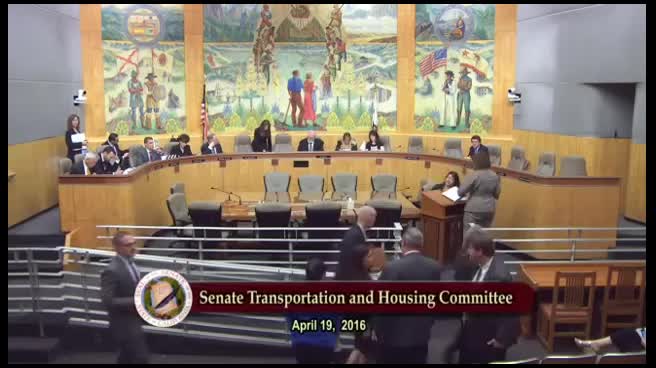 11MIN
Senate Standing Committee on Transportation and Housing
Bill Author