SB 1428: Contracts: automatic renewal provisions.
- Session Year: 2015-2016
- House: Senate
- Latest Version Date: 2016-05-10
Existing law generally regulates formation and enforcement of contracts, including how a contract is extinguished.
This bill would require a contract that is entered into online that includes a provision for the automatic renewal of the term of the contract to include a provision that allows a party to terminate the contract in the same manner as the contract was entered into.
Existing law makes it unlawful for any business making an automatic renewal or continuous service offer to a consumer in this state to, among other things, fail to present the automatic renewal or continuous service offer terms in a clear and conspicuous manner, charge the consumer for an automatic renewal or continuous service without first obtaining the consumers affirmative consent, and to fail to provide an acknowledgment that includes the automatic renewal or continuous service offer terms, cancellation policy, and information regarding how to cancel in a manner that is capable of being retained by the consumer.
This bill would require a business that makes an automatic renewal or continuous service offer that is subject to the above-described requirements to provide a consumer with an email address or option on the business Internet Web site for the consumer to communicate his or her decision to not renew the subscription or purchasing agreement. The bill would also require, within 24 hours of receipt of a consumers communication to not renew the subscription or purchasing agreement, the business to notify the consumer of receipt of the consumers communication. The bill would require the business to honor this decision.
Existing law generally regulates formation and enforcement of contracts, including how a contract is extinguished.
This bill would require a contract that is entered into online that includes a provision for the automatic renewal of the term of the contract to include a provision that allows a party to terminate the contract in the same manner as the contract was entered into.
A business that makes an automatic renewal or continuous service offer that is subject to Article 9 (commencing with Section 17600) of Chapter 1 of Part 3 of Division 7 of the Business and Professions Code shall provide a consumer with an email address or option on the business Internet Web site for the consumer to communicate his or her decision to not renew the subscription or purchasing agreement. Within 24 hours of receipt of a consumers communication to not renew the subscription or purchasing agreement, the business shall notify the consumer of receipt of the consumers communication. The business shall honor the consumers decision to not renew. The definitions of automatic renewal, consumer, and continuous service provided in Section 17601 of the Business and Professions Code shall apply to this section.
SECTION 1.Section 1683 is added to the Civil Code, to read:1683.A contract that is entered into online that includes a provision for the automatic renewal of the term of the contract shall also include a provision that allows a party to terminate the contract in the same manner as the contract was entered into.
A contract that is entered into online that includes a provision for the automatic renewal of the term of the contract shall also include a provision that allows a party to terminate the contract in the same manner as the contract was entered into.
|
Date
|
Status
|
|---|---|
| Jun 9, 2016 | Referred to Com. on P. & C.P. |
| Jun 1, 2016 | In Assembly. Read first time. Held at Desk. |
| May 31, 2016 | Read third time. Passed. (Ayes 26. Noes 13. Page 4062.) Ordered to the Assembly. |
| May 31, 2016 | Read third time. Passed. (Ayes 26. Noes 13.) Ordered to the Assembly. |
| May 10, 2016 | Read second time and amended. Ordered to third reading. |
| May 9, 2016 | From committee: Do pass as amended. (Ayes 4. Noes 2. Page 3767.) (May 3). |
| May 9, 2016 | From committee: Do pass as amended. (Ayes 4. Noes 2.) (May 3). |
| Apr 21, 2016 | Set for hearing May 3. |
| Apr 20, 2016 | April 26 set for first hearing canceled at the request of author. |
| Apr 14, 2016 | Set for hearing April 26. |
| Mar 10, 2016 | Referred to Com. on JUD. |
| Feb 22, 2016 | Read first time. |
| Feb 22, 2016 | From printer. May be acted upon on or after March 23. |
| Feb 19, 2016 | Introduced. To Com. on RLS. for assignment. To print. |
|
Date
|
Description
|
Location
|
Votes
|
|
|---|---|---|---|---|
| May 31, 2016 | Senate 3rd Reading SB1428 Hernandez | Senate Floor |
Passed |
|
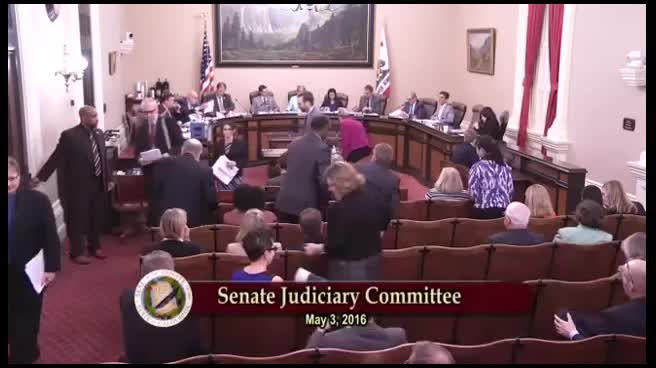
| May 3, 2016 | Do pass as amended | Senate Standing Committee on Judiciary |
Passed |
This list shows positions taken on this bill by organizations on the date displayed, which is linked to the original source.
Positions by individuals are not included.
Office of Senate Floor Analyses (916) 651-1520 Fax: (916) 327-4478 | SB |
THIRD READING
Bill No: SB 1428
:
SENATE JUDICIARY COMMITTEE: 4-2, 5/3/16
AYES: Jackson, Leno, Monning, Wieckowski
NOES: Moorlach, Anderson
NO VOTE RECORDED: Hertzberg
DIGEST: This bill requires that businesses offering automatic renewal or continuous service offers provide an email address or option on their Internet Web Site for the purpose of communicating the consumer’s decision to not renew the contract or service.
Existing law:
- Establishes requirements governing automatic purchase renewals and states the Legislature’s intent to end the practice of ongoing charging of consumer accounts without the consumer’s explicit consent. (Bus. & Prof. Code Sec. 17600 et seq.)
- Prohibits a business making an automatic renewal or continuous service offer from doing any of the following:
- failing to present the terms in a clear and conspicuous manner before the subscription or purchasing agreement is fulfilled, as specified;
- charging the consumer’s credit or debit card or the consumer’s account with a third party for an automatic renewal or continuous service without first obtaining the consumer’s affirmative consent; and
- failing to provide an acknowledgment that includes the automatic renewal or continuous service offer terms, cancellation policy, and information regarding how to cancel, as specified. (Bus. & Prof. Code Sec. 17602(a).)
- Requires a business making an automatic renewal or continuous service offer to provide a toll-free telephone number, electronic mail address, or other cost-effective, timely, and easy-to-use mechanism for cancellation, as specified. (Bus. & Prof. Code Sec. 17602(a).)
- Exempts certain services and businesses from the above provisions, including:
- a business or affiliate that is regulated by the California Public Utility Commission, the Federal Communications Commission, or the Federal Energy Regulatory Commission;
- an entity regulated by the Department of Insurance;
- alarm company operators;
- licensed banks and bank holding companies; and
- service contract sellers and service contract administrators regulated by the Bureau of Electronic and Appliance Repair.
- Provides for the modification and cancellation of contracts. (Civ. Code Sec. 1697 et seq.)
This bill:
- Requires that businesses making automatic renewal or continuous service offers shall provide an electronic mail address or option on their Internet Web site for the purpose of a consumer to communicate to the business his or her decision to not renew the subscription or purchasing agreement.
- Requires the business to, within 24 hours, notify the consumer of receipt of the communication, and requires that the business honor the consumer’s decision to not renew the contract or service.
FISCAL EFFECT: Appropriation: Fiscal Com.: Local:
None received
OPPOSITION: (Verified 5/11/16)
California Chamber of Commerce
Direct Marketing Association
ARGUMENTS IN SUPPORT: The author writes:
Current law establishes that companies must provide a toll free number, email, or other “easy method” to cancel contracts. […] There have been numerous news stories that reference customers who must spend hours on the phone with customer service agents just to simply cancel service. While these are egregious examples, even spending short amounts of time having to navigate the system of customer service can be burdensome to someone who is solely looking to cancel. This bill seeks to address this problem by providing an online cancellation method, which will be good for consumers and potentially allow companies to provide better customer support by alleviating some call volume.
The bill seeks to allow consumers a means to cancel services online. Currently, it targets automatic renewal contracts and states that if allowed to sign up online, then a similar means of cancellation should be provided to consumers.
ARGUMENTS IN OPPOSITION: A coalition, in opposition to the prior version of this bill, wrote, “Clearly, direct contact with retailers or service providers – whether in person or through a phone call – prior to cancellation may be helpful to consumers, not harmful. If companies or service providers are not clear or are combative – as in the case of the few notorious examples – there is ample law already to set them straight, making SB 1428 unnecessary.”
That coalition removed its opposition with the adoption of the amendments taken in the Senate Judiciary Committee, with the exception of the Direct Marketing Association and the California Chamber of Commerce, which both remain opposed.
5/11/16 15:12:49
**** END ****
Senator Hannah-Beth Jackson, Chair
2015-2016 Regular Session
Bill No: SB 1428 (Author:Hernandez)
Version: February 19, 2016
Hearing Date: May 3, 2016
Fiscal: No
Urgency: No
Consultant: NR
SUBJECT
Online contracts
DESCRIPTION
This bill would require a contract that includes a provision for the automatic renewal of the contract, which is entered into online, to include a provision that allows a party to terminate the contract in the same manner as it was entered into.
BACKGROUND
In 2009, the Legislature passed SB 340 (Yee, Ch. 350, Stats. 2009), which requires any business making an automatic renewal or continuous service offer to clearly and conspicuously disclose the terms of the offer, obtain the consumer’s affirmative consent, and also requires that the business provide easy-to-use mechanisms for cancellation. SB 340 was prompted after subscribers to Time, Inc. magazines were discovering that their subscriptions were automatically renewed despite their lack of knowledge of providing any consent to the renewal.
In 2010, Congress passed the Restore Online Shoppers’ Confidence Act (ROSCA) to address consumer complaints regarding the privacy of consumer information. ROSCA prohibited an online merchant from sharing billing information with a third party seller, unless it obtained the consumer’s informed and express consent prior to charging their accounts. It also required sellers to provide simple mechanisms for a consumer to stop recurring charges from being placed on his or her account.
Recently there have been many news stories about the difficulties consumers face when attempting to cancel certain memberships or subscriptions including, gym memberships, cellular phone plans, or cable television plans. In 2014, the public was outraged after a recording of a customer trying to repeatedly cancel Comcast service went viral, which prompted a public apology from the company. Regarding gym memberships, ABC News recently reported:
At one gym – a Gold’s Gym franchise in Oxnard, California – members found it so hard to cancel that the Ventura County district attorney’s office compared that location to the popular Eagles song “Hotel California,” where, according to the lyrics, guests can check out anytime but can never leave.
Prosecutors opened an investigation and even sent in an agent undercover.
In an audio recording, the investigator can be heard saying: “I’m doing exactly what the contract says and you’re not letting me cancel.”
The gym’s representative replied: “So would you like to leave your phone number?”
The case resulted in a $6 million judgment against that particular gym, which has since gone out of business. (Sarah Messer, ‘GMA’ Investigates: Tips to Help You Cancel Your Gym Membership < http://abcnews.go.com/Lifestyle/gma-investigates-tips-cancel-gym-membership/story?id=29176198> [as of April 28, 2016].)
This bill, seeking to ensure consumers have the ability to easily cancel contracts, memberships, or subscriptions, would require that an automatically renewing contract that is entered into online shall also allow a party to terminate the contract online.
CHANGES TO EXISTING LAW
Existing law establishes requirements governing automatic purchase renewals and states the Legislature’s intent to end the practice of ongoing charging of consumer accounts without the consumer’s explicit consent. (Bus. & Prof. Code Sec. 17600 et seq.)
Existing law prohibits a business making an automatic renewal or continuous service offer from doing any of the following:
- failing to present the terms in a clear and conspicuous manner before the subscription or purchasing agreement is fulfilled, as specified;
- charging the consumer’s credit or debit card or the consumer’s account with a third party for an automatic renewal or continuous service without first obtaining the consumer’s affirmative consent; and
- failing to provide an acknowledgment that includes the automatic renewal or continuous service offer terms, cancellation policy, and information regarding how to cancel, as specified. (Bus. & Prof. Code Sec. 17602(a).)
Existing law requires a business making an automatic renewal or continuous service offer to provide a toll-free telephone number, electronic mail address, or other cost-effective, timely, and easy-to-use mechanism for cancellation, as specified. (Bus. & Prof. Code Sec. 17602(a).)
Existing law exempts certain services and businesses from the above provisions, including:
- a business or affiliate that is regulated by the California Public Utility Commission, the Federal Communications Commission, or the Federal Energy Regulatory Commission;
- an entity regulated by the Department of Insurance;
- alarm company operators;
- licensed banks and bank holding companies; and
- service contract sellers and service contract administrators regulated by the Bureau of Electronic and Appliance Repair.
Existing law provides, generally, for the modification and cancellation of contracts. (Civ. Code Sec. 1697 et seq.)
This bill would provide that a contract that is entered into online that includes a provision for the automatic renewal of the term of the contract shall also include a provision that allows a party to terminate the contract in the same manner as the contract was entered into.
COMMENT
- Stated need for the bill
According to the author:
Current law establishes that companies must provide a toll free number, email, or other “easy method” to cancel contracts. […] There have been numerous news stories that reference customers who must spend hours on the phone with customer service agents just to simply cancel service. While these are egregious examples, even spending short amounts of time having to navigate the system of customer service can be burdensome to someone who is solely looking to cancel. This bill seeks to address this problem by providing an online cancellation method, which will be good for consumers and potentially allow companies to provide better customer support by alleviating some call volume.
The bill seeks to allow consumers a means to cancel services online. Currently, it targets automatic renewal contracts and states that if allowed to sign up online, then a similar means of cancellation should be provided to consumers.
- Consumers should be able to communicate a decision to not renew subscriptions, contracts, or purchase agreements easily to a business
This bill would require that specified contracts entered into online must be able to be terminated online. In support, the Consumer Federation of California argues that this is necessary because, “though businesses make it easy for consumers to enter into contracts and easy to maintain or update their contact or billing information during the life of the contract, the same convenience does not exist when it comes to cancellation. Consumers are frequently required to call and speak with a representative in order to terminate the contract. These hurdles result in situations where consumers are aggressively pressured by representatives to remain in the contract, despite their desire to simply end the business relationship.”
In opposition, a coalition including the California Chamber of Commerce and the California Cable & Telecommunications Association (CCTA), argue that there are many benefits to the consumer which can only be exercised through verbal communication, and that consumers may actually be harmed if denied the opportunity to consult with a representative of the business prior to cancellation. The coalition writes:
SB 1428 discourages consumers from resolving problems in a way that is beneficial to them. […] For a customer who participates in a bundled offering and wants to cancel one service but keep the others, canceling that one service may affect the price of remaining services. This consequence needs to be explained to the customer to prevent confusion and, ultimately, unhappiness when the next bill comes.
Some customers may need to cancel after a family tragedy or natural disaster, and product or service representatives have discretion to waive certain charges or fees in these situations. There is no way for an online program to allow for this that would not be abused.
CCTA further notes that requiring a company to enable a customer to cancel a service online would “deprive consumers of an opportunity to benefit from service options, pricing concessions, or other benefits that may be offered by a company through a real-time communication.”
Staff notes that nothing in this bill would require that contract termination must be completed online. Companies are still free to create other avenues for cancellation in addition to those required under this bill. Furthermore, there is nothing prohibiting consumers who are looking to enhance their service from calling the company directly to describe their dissatisfaction. The company may then offer whatever incentives it sees fit to ensure customer satisfaction.
- Protecting consumers against unintended consequences
This bill would allow for the “termination” of a contract that automatically renews, as specified. Terminating a contract before the expiration of the term, however, may subject the consumer to a number of penalties, including early termination fees. However, “terminating” a contract is distinct from a decision to “not renew” a contract, which, despite when communicated, necessarily takes effect at the end of the contract term.
In addition, this bill does not specify what is required to “enter into a contract online.” Would sending an acceptance by electronic mail be sufficient? Would setting up an appointment online to have a technician install a product in the consumer’s home, at which point the consumer signs physical documents, be considered entering into a contract “online?” The bill also does not require any guidance as to how one would “terminate” a contract online, and does not provide any mechanism whereby a consumer would be assured that the transaction was received by the business.
The following amendments would instead require a business that makes automatic renewal contract offers to provide an electronic mail address or option on their Internet Web site for the purpose of allowing a consumer to communicate to the business his or her decision to not renew the contract.
The amendment would require the business to notify the consumer of receipt of the electronic message or Internet transaction. Thus, because this amendment addresses only a desire to not renew a contract, it would ensure that businesses who wish to have real-time communication with customers who seek to terminate a contract prior to the completion of the contract’s term, may discuss with the customer any penalties to which he or she may be subjected. These amendments would also not foreclose the right of a business to reach out to a consumer to explain any remaining fees associated with the account, or any further action that might be required of the consumer. For example, a business would be able to communicate to the consumer the need to return equipment to the company when the contract comes to term. Staff additionally notes that the amendment would limit the provisions of this bill to companies that are not regulated by the Federal Communications Commission, thereby removing the bill’s application to much of the opposition, including cellular, internet, and cable providers.
Author’s amendment:
- Strike the contents of the bill
- Section 1702 is added to the Civil Code:
A business making automatic renewal or continuous service offers, subject to Business & Professions Code Section 17601, shall provide an electronic mail address or option on their Internet Web site for the purpose of a consumer to communicate to the business his or her decision to not renew the subscription or purchasing agreement. The business shall, within 24 hours, notify the consumer of receipt of the electronic mail or Internet Web site transaction, and shall honor the consumer’s decision to not renew the contract or service.
Support: Consumer Federation of California
Opposition: California Chamber of Commerce; California Cable & Telecommunications Association; California Communications Association; California Retailers Association; CompTIA; CTIA—The Wireless Association; Direct Marketing Association; MPA—The Association of Magazine Media; TechNet
HISTORY
Source: Author
Related Pending Legislation: AB 2867 (Gatto) would require a cable or Internet service provider, if it enables an individual to subscribe to its services through an Internet Web site, to also enable all of its customers to cancel their subscriptions through the Internet Web site.
Prior Legislation: SB 340 (Yee, Ch. 350, Stats. 2009) requires any business making an “automatic renewal” or “continuous service” contract to clearly and conspicuously disclose terms of the offer and obtain the consumers’ affirmative consent to the offer.
**************
Discussed in Hearing
View Older Hearings
Bill Author

Bill Co-Author(s):